/










































Text
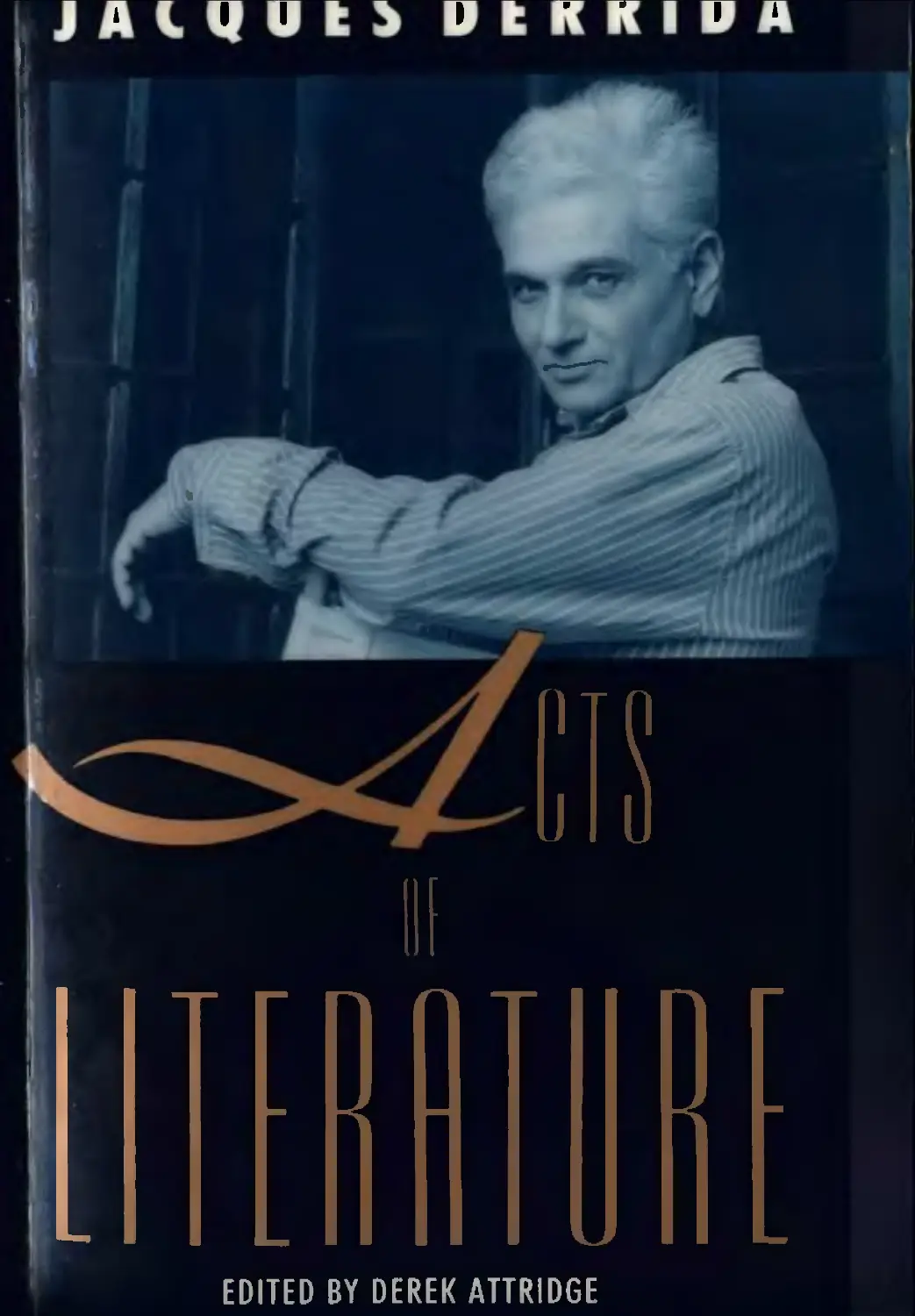
                    EDITED BY DEREK ATTRIDGE
JACQUES DERRIDA
EDITED BY DEREK ATTRIDGE
ROU Tl I 1)G1
M W YORK • 1 ()M)()N
Published in 1992. by
Routledge
An imprint of Routledge, Chapman and Hall, Inc.
29 West 35 Street
New York, NY 10001
Published in Great Britain in 1992 by
Routledge
11 New Fetter Lane
London EC4P 4EE
Copyright © 1992 by Derek Attridge
Printed in the United States of America
All rights reserved. No part of this book may be reprinted or reproduced or utilized in
any form or by any electronic, mechanical or other means, now known or hereafter
invented, including photocopying and recording, or in any information storage or re-
trieval system, without permission in writing from the publishers.
Library of Congress cataloging in publication data
Derrida, Jacques.
Acts of literature / Jacques Derrida : edited by Derek Attridge.
p. cm.
Includes bibliographical references and index.
ISBN 0-415-90056-5 ISBN 0-415-90057-3 (pb)
1. Derrida, Jacques—Contributions in criticism.
2. Deconstruction. 3. Literature—Philosophy. 4. Literature—
History and criticism. 1. Attridge, Derek. 11. Title.
PN98.D43D44 1991
801.95—dc2o	91-30342
C1P
British Library Cataloguing in Publication Data
Derrida, Jacques, 1930-
Acts of literature.
I. Title
194
ISBN 0-415-90056-5
ISBN 0-415-90057-я pbk
1
Contents
I
2
3
4
5
6
7
8
9
ю
11
Prefaces	ix
Acknowledgments	xiii
Introduction: Derrida and	the Questioning of	i
Literature, Derek Attridge
“This Strange Institution Called Literature”:	33
An Interview with Jacques Derrida
“.. . That Dangerous Supplement ...”	76
Mallarme	no
The First Session	127
Before the Law	181
The Law of Genre	221
Ulysses Gramophone: Hear Say Yes in Joyce	253
Front Psyche: Invention of the Other	310
Front Signsponge	344
Front Shibboleth: For Paul Celan	370
Aphorism Countertime	414
A Selected Bibliography of Derrida’s Writing	435
Index
443

Act sb. A thing done; a deed, a performance (of an intelli-
gent being).... A decree passed by a legislative body, a court
of justice, etc. . . . Any instrument in writing to verify facts.
. . . A “performance” of part of a play.. .. Part of a formula
used when signing a legal instrument [act and deed\. . . .
Pretence (of being what one is not).
Act v. To carry out or represent in mimic action (an ideal,
incident, or story); to perform (a play). Hence fig. in a bad
sense: To simulate, counterfeit. ... To perform on the stage
of existence; to perform actions, to do things, in the widest
sense. ... To do the duties of an office temporarily, without
being the regular officer.
—Oxford English Dictionary
vii

Prefaces
From his earliest publications, literature has made demands on
Jacques Derrida. His writings abound in responses to a wide range of
literary texts in French, German, and English, including drama, poetry,
and fiction, as well as texts which find no obvious place in the generic
classifications of the literary institution (or indeed in the classification
literature/nonliterature). This volume brings together a number of these
responses, selected in accordance with several criteria: 1 have tried to
achieve a spread across literary traditions and genres (this has meant
leaving out many other French authors about whom Derrida has writ-
ten, including Flaubert, Valery, Artaud, Genet, Jabes, Bataille, and
Sollers), to choose texts that are relatively accessible to the nonphiloso-
pher, and to maintain a continuing focus on the central question of
literature as an institution and literary writing as a practice. I have
included both complete texts—sometimes long ones—and excerpts.
The selection also constitutes my singular response, at this particular
time, to the many demands—imperious, pleasurable, unfathomable—
which Derrida’s texts have made on me.
Л The specific works to which these texts of Derrida’s respond are
all acts—doings and records—of literature: that is, works convention-
ally and institutionally categorized as “literary” (with one borderline
case in Rousseau’s Confessions), but also works which in some way
“perform” literature, put it into play, establish and question its laws,
operate at some internal distance from the institution and the category
which they at the same time confirm. Derrida’s responses, too, might
be thought of as “acts of literature” in many of these senses. They
range from texts written relatively early in his career, at least as an
internationally renowned philosopher, to more recent publications;
some appear here for the first time in English or in hitherto untranslated
revised versions (see the headnotes to “Mallarme,” “Before the Law,”
the excerpt from Shibboleth, and “Aphorism Countertime”). The inter-
IX
Prefaces
view was conducted at Derrida's suggestion, and has not been pub-
lished previously. Taken together, these texts offer to those who are
not well acquainted with Derrida’s writing an introduction to his work
and to the phenomenon known as “deconstruction"; to those who are,
they invite a fresh consideration of the significance of literature—
literary’ texts and the institution of literature—in Derrida’s work, and
of Derrida’s work in literature.
М» Editors of anthologies conventionally preface their volumes with
remarks on the necessary arbitrariness of selection, the inevitable vio-
lence of excerpting, the regrettable impossibility of true representative-
ness. All these disclaimers are as valid for this anthology as for any
other, if not more so; Jacques Derrida’s work seems especially ill suited,
in its arguments as well as in its form, to the neat compartments, the
simplified headnotes, the limits on length and detail that typify the
genre. The presentation in translation of these untranslatable works
requires a further caveat that scarcely needs spelling out. On the other
hand, Derrida’s work also helps us to appreciate the implicit, and chal-
lengeable, assumptions that underlie these conventional apologies: that
there is an “original,” “whole,” seamless oeuvre, free from the opera-
tions of translation, that could in principle be read or represented in a
nonselective, unexcerpted, nonviolent way. In large measure thanks to
Derrida, we have become aware that all reading, all memories of reading,
all publication and all criticism are processes of fragmenting, anthologiz-
ing, and translating, a prey to (but also the beneficiaries of) the random,
the contingent, the mediated. Perhaps Derrida’s work is more open to
anthologizing and translation than most... as long as no single anthol-
ogy—such as this one—is assumed to have a transcendent or central
position among all the possible representations of his writing.
Many of the reprinted translations were originally derived from
early versions of Derrida’s texts that have subsequently been published
in revised form; where necessary, editorial modifications have been
X
ГКЕНАСЕ5
made to reflect the author’s final revisions. It has also been necessary
to make some minor alterations in the interests of consistency and
clarity. Translator’s notes and editor’s notes are indicated by TN and
EN respectively; other notes are Derrida’s.
Publication details of works by Derrida mentioned in the course of
the volume, whether in editorial matter or in the selections themselves,
will be found in the Selected Bibliography at the end. This list also
incorporates suggestions for further reading on the subject of Derrida
and literature.
A collection such as this does not come together by itself, but the
necessary labor has been made a pleasure both by the fascination of
the material itself and by the extraordinary generosity and good will
that prevails among those who have worked closely on and with it.
My first and overriding acknowledgment is to Jacques Derrida, who
was willing to entrust to someone else significant decisions about his
texts and yet to provide assistance whenever it was requested, making
him the ideal coilaborator/subject. Peggy Kamuf, whose Derrida
Reader was in preparation at the same time as this collection, made
the coexistence of the two projects a matter for fruitful interchange—
to the lasting improvement of this one, at least. The introduction
has benefited greatly from the comments and conversation of Geoff
Bennington, Rachel Bowlby, David Carroll, Tom Keenan, Richard
Rand, Nicholas Royle, and Samuel Weber. The work of the translators
made the volume imaginable in the first place, and many of them
were actively involved in its development; in addition to those already
mentioned, valuable contributions were made by Avital Ronell, Chris-
tine Roulston, Gayatri Spivak, and Joshua Wilner. Others who helped
were Marc Chenetier, Uri Eisenzweig, and Penny Wilson. My graduate
class at Rutgers University in the spring of 1989 increased my under-
standing of many of these texts, without making them seem any less
challenging. The interview was made possible by a grant from the
Research Council of Rutgers University. Bill Germano at Routledge
xi
Prefaces
was a benign critical presence from start to finish. My thanks go to all
these, and much more than thanks to Suzanne Hall and Laura Cather-
ine Attridge.
D.A.
Glasgow-New Brunswick-Paris, 1987-90
xii
Acknowledgments
ж» The publishers gratefully acknowledge the following sources for
selections reprinted or translated in this volume: The Johns Hopkins
University Press for “. . . That Dangerous Supplement . . .” (from Of
Grammatology, trans. Gayatri Chakravorty Spivak) and for “The Law
of Genre” (Glyph 7); Editions Gallimard for “Mallarme” (from Tab-
leau de la litterature franqaise, tome 3: De Madame de Stael a Rim-
baud); The University of Chicago Press and the Athlone Press for
“The Double Session” (from Dissemination, trans. Barbara Johnson);
Indiana University Press for “Before the Law” (from Franz Kafka and
the Contemporary Critical Performance, ed. Alan Udoff); Syracuse
University Press for “Ulysses Gramophone: Hear Say Yes in Joyce”
(from James Joyce: The Augmented Ninth, ed. Bernard Benstock); the
University of Minnesota Press for “Psyche: Invention of the Other”
(from Reading de Man Reading, ed. Lindsay Waters and Wlad God-
zich); Columbia University Press for “Signsponge” (from Signepongel
Signsponge, trans. Richard Rand); Yale University Press for “Shibbo-
leth: For Paul Celan” (from Midrash and Literature, ed. Geoffrey
Hartman and Sanford Budick); and Editions Galilee for “Aphorism
Countertime” (from Psyche: Inventions de Гautre).
xiii

INTRODUCTION
Derrida and the Questioning of Literature
Derek Attridge
When and how does an inscription become literature and what takes
place when it does? To what and to whom is this due? What takes
place between philosophy and literature, science and literature, poli-
tics and literature, theology and literature, psychoanalysis and liter-
ature?
—“The Time of a Thesis”
Deconstruction ... is a coming-to-terms with literature.
—“Deconstruction in America”
What is literature? This question, which must be a central one
for anybody committed to literary studies, has also—since Plato and
Aristotle—repeatedly been asked within the Western tradition of phi-
losophy. It is, after all, a philosophical, not a literary question; it asks
for a statement of the essence of literature, for that which distinguishes
literature from all that is not literature. And among the things from
which literature has traditionally been distinguished, in order more
clearly to establish the properties of both, is philosophy.
We need not be surprised, therefore, that Jacques Derrida, as a
philosopher (and especially as a philosopher who feels strongly the
continuing pressure of the entire philosophical tradition), should find
Introduction
this question haunting him.1 He does not, however, attempt a strictly
philosophical answer, much less a sociological, political, or psychologi-
cal one, for it is first of all the question of the question that fascinates
him. It is articulated, like all questions, in language, and one of Derri-
da’s constant concerns is to remind us, and the philosophical tradition,
that this fact is not negligible. What Derrida dwells on in the question
is the relationship of “What is . . .?” to “literature”: might it not be
the case, he asks, that something in the final word retroactively chal-
lenges the first two, with their assumptions about essence, identity,
and truth?i. 2 And this is a question upon which abstract philosophical
speculation can gain no purchase; it requires that one read a number
of texts called “literary,” and that one do so with particular attention
to the ways in which they potentially confirm or unsettle philosophical
presuppositions without themselves offering philosophical arguments.
Literary texts, one might say, are acts of writing that call forth acts of
reading: though in saying this, it is important to remain aware of the
polysemy of the term act: as both “serious” performance and “staged”
performance, as a “proper” doing and an improper or temporary one,
as an action, a law governing actions, and a record documenting
actions.3
i. In addition to the testimony of Derrida's repeated engagement with literary texts
and with the question of literature, there are such autobiographical witnesses as the
statement in his thesis defense of 1980: u[M]y most constant interest, coming even before
my philosophical interest 1 should say, if this is possible, has been directed towards
literature, towards that writing which is called literary” (“The Time of a Thesis,” 37),
and the comment in a 1983 interview with Le nouvel observateur: “My ‘first’ inclination
wasn’t really towards philosophy, but rather towards literature, no, towards something
that literature accommodates more easily than philosophy” (“An Interview with Der-
rida,” 73). The qualifications in these comments are important, however; see also the
opening response in the Interview below.
2. For some of the ramifications of this question see—for example—“The First Ses-
sion” below.
3. In the extract from Signsponge reprinted here, Derrida says of the signature:
“.. .the work of writing designates, describes, and inscribes itself as act (action and
archive)” (see below, p. 363), and in a later part of the book he remarks that “the
signature, as act, splits immediately into event and legend, and cannot be at one and the
same time what it immediately is, event and legend” (108). The term act, that is,
transgresses the boundaries that separate happening and object, speech and writing,
parole and langue, original and copy, time and space. Of course, in any given context—
such as the phrase “speech act theory” and the ideology it represents—these border-
crossings are inhibited, though they always continue as covert operations. Noting the
connection between act and terms such as active and actual (with their connotations of
self-present intentionality), Derrida remarks, “|T]he value of the act (used so generally
Introduction
In their questioning of philosophical questioning, Derrida’s acts of
reading literature impinge directly upon philosophy, and are closely
connected with his readings of philosophical, linguistic, theological,
constitutional, judicial, aesthetic, and other kinds of nonliterary text.4
But they demand equal attention within the discipline of literary stud-
ies: not just because any strong and conscientious reading of a literary
text is of interest to those who work with and take pleasure in such
writing, but because it is Derrida’s contention that in spite of literature’s
potential challenge to philosophy, literary studies are dominated by
philosophical assumptions quite as much as philosophy is—perhaps
even more so, given philosophy’s long tradition of critical reflection on
its own assumptions. Literary theory, or poetics, has always con-
sciously worked under the sign of philosophy. But literary criticism,
too, has operated for the most part within the bounds established by
classical Greek thought, taking for granted the rules of syllogistic
reason, the ultimate priority of meaning over its mode of articulation,
and such fundamental and absolute oppositions as the intelligible and
the sensible, form and matter, subject and object, nature and culture,
presence and absence.5 Literature has often been read in terms of a
dominant meaning or of a dominant form; although a given critical
tradition may emphasize one of these at the expense of the other, or
insist on their interdependence, this does not diminish the determining
and analyzed so little in the theory of speech acts), like that of event, should be submitted
to systematic questioning” (Limited Inc, 58). Much of Limited Inc is concerned with
the impoverishment of terms such as act in speech act theory and the philosophical
tradition it participates in; see also the references to speech act theory in “Psyche” and
“Ulysses Gramophone” below.
4. To call Derrida's engagements with texts, literary or philosophical, “readings” is
inadequate to the extent that this term suggests a traditional interpretative project; like
any alternative term one might use, it needs to be understood in the light of Derrida’s
practice (which is different for every text he “reads”). Paul de Man's understanding of
reading as an act which responds to those aspects of a text which cannot be defined
grammatically (that is, according to a general code or program) is useful here, forcing
one to face the paradox that reading in the strictest sense is called for by that which is
unreadable in a text (“The Resistance to Theory,” 15-17). See also Weber, “Reading
and Writing chez Derrida” and the collection Reading de Man Reading, ed. Waters and
Godzich.
5. Derrida gives as examples of philosophically derived categories that have domi-
nated literature “the values of meaning or of content, of form or signiher, of metaphor/
metonymy, of truth, of representation” (Positions, 69), and refers to such “reductions
and misconstruings” of literature as “thematism, sociologism, historicism, psycholo-
gism” (Positions, 70).
Introduction
force of the philosophical categories themselves.6 Or it has been read
as understandable in terms of an origin (biographical, historical, socio-
economic, psychoanalytic) or a goal (aesthetic, moral, spiritual, politi-
cal), or as fundamentally mimetic and therefore answerable to a classi-
cal notion of truth. The result has been a representation of literature as
itself governed by these oppositions and assumptions, a representation
which one cannot simply call “inaccurate” since it responds to a
marked tendency in a large part of Western literary writing.
Of course, the literary tradition is far from homogeneous, and some
works of literature, criticism, and literary theory have resisted such
philosophical categories more than others—not by abolishing mimesis,
reference, form, content, genre, origin, intention, and so on, but by
staging, suspending, and testing these concepts, showing them to be
other than the self-consistent, controlling categories they are usually
taken to be. Derrida’s own interest has been largely in literary texts
whose resistance to these terms is particularly strong, beginning with
Mallarme’s unmistakable challenge to the conventions of reading and
criticism over a century ago. As his discussion of Shakespeare’s Romeo
and Juliet in this volume indicates, however, this selectivity does not
imply an identification of “modernity” or “modernism” with the ca-
pacity to unsettle philosophic-critical categories; a concentration on
certain works of this century has a strategic value, and also springs
from a particular response with very specific historical determinants
that Derrida would be the last to undervalue.7
tb In drawing attention to the philosophical allegiances of most liter-
ary criticism and literary theory, and of literature as read through their
6. In Positions, Derrida comments on the equal inadequacy of “a criticism concerned
only with content” and “a purely formalist criticism which would be interested only in
the code, the pure play of signifiers, the technical manipulation of a text-object” and
adds: “These two insufficiencies are rigorously complementary” (46—47).
7. Derrida has explained his focus on certain writers from Mallarme to the present
as follows: “It is incontestable that certain texts classed as ‘literary’ have seemed to me to
operate breaches or infractions at the most advanced points. Artaud, Bataille, Mallarme,
Sollers. ... These texts implement, in their very movement, the demonstration and
practical deconstruction of the representation that was made of literature, it being well
understood that long before these ‘modem’ texts a certain ‘literary’ practice was able to
operate against this model, against this representation. But it is on the basis of these last
texts, on the basis of the general configuration to be remarked in them, that one can best
4
Introduction
glasses, however, Derrida is not “attacking” this tradition, any more
than he is attacking the philosophers he reads with such care and
commitment (“1 am very fond of everything that 1 deconstruct in my
own manner; the texts 1 want to read from the deconstructive point
of view are texts I like, with that impulse of identification which is
indispensable for reading” [The Ear of the Other, 87; translation
modified].) Derrida’s writing on literary texts arises from a strong
response to them which is also a strong sense of his responsibility
tow ard them, the registering of a demand which they and their signator-
ies make, of a call that seems to come from somewhere outside the
orbit within which we comfortably go about our intellectual business—
but an outside which cannot simply be classified as exterior. Although
the philosophical discourse of ethics is as much subject to Derrida’s
de-totalizing interrogation as the other branches of philosophy, there
has always been an ethico-political dimension to Derrida’s writing,
manifesting itself particularly in a respect for otherness, be it textual,
historical, cultural, or personal (to use categories which are by no
means separate or self-sufficient). This responsibility toward the other
is also a responsibility toward the future, since it involves the struggle
to create openings within which the other can appear beyond any of
our programs and predictions, can come to transform what we know
or think we know. (See “Psyche,” in this volume, for a discussion of
this issue.) Responsibility for Derrida is not something we simply
“take”: we find ourselves summoned, confronted by an undecidability
which is also always an opportunity and a demand, a chance and a
risk/ Highlighted in Derrida’s readings of literary texts are those as-
r-Tcad, without retrospective teleology, the law of the previous fissures" (Positions* 69;
translation modified).
K. Derrida discusses “responsibility," and in particular “academic responsibility," in
"Mochlos or The Conflict of the Faculties." In preparing for his reading of Kant’s The
(anflict of Faculties, he asks: “Would it not be more interesting, even if it proves
difficult or perhaps impossible, to conceive of a responsibility—that is, a summons to be
responded to—w'hich would no longer in the final analysis pass by way of the ego, the
*1 think,’ the subject, intention, or the ideal of decidability? Would it not be more
responsible’ to attempt to think the ground upon which, in the history of the West, the
juridical and egological values of responsibility' have arisen and imposed themselves?
I here, perhaps, lies a source of responsibility’ at once ‘older’ and—to the extent that it
is now newly perceived through the crisis afflicting the classic ideal of responsibility—also
younger,’ or still to come?" See also Derrida's discussion of response and responsibility’ in
“ fhe Politics of Friendship.”
Introduction
pects which make most demands on us, which are most difficult to
write about in the conventional discourse of criticism because they
shake the foundations of that discourse. And Derrida’s argument is
that it is those aspects which mark literature as literature; while the
features that criticism has traditionally foregrounded are features
that exist in common across a variety of discourses—which is not
a reason for desisting from such criticism, though it may be a reason
for not accepting some of the claims it makes. (We shall consider
later the further—more difficult and more important—argument
that the “literary” aspects of these texts not only trouble the
“philosophical” grounds of the critical discourse but are what make
this discourse possible.)
tb What I have sketched here may sound like the assertion of a literary
essence, a set of detectable characteristics from which one could derive
an exact compartmentalization of the literary and the nonliterary; in
short, a theoretically clear (if in practice difficult) answer to the ques-
tion “What is literature?” Let us therefore attend to one of Derrida’s
engagements with this question, which arises from his reading of Mal-
larme’s short prose piece “Mimique” (see “The First Session” below):
If this handbook of literature meant to say something, which we now
have some reason to doubt, it would proclaim first of all that there is
no—or hardly any, ever so little—literature; that in any event there is no
essence of literature, no truth of literature, no literary-being or being-
literary of literature. And that the fascination exerted by the “is,” or the
“what is” in the question “what is literature” is worth what the hymen
is worth—that is, not exactly nothing—when for example it causes one
to die laughing.
The references to the hymen and death by laughter arise from the
specificity of Mallarme’s text, and one has to note that the comments
on literature are presented not apodictically but contextually and dra-
matically: as always with Derrida’s writing, to wrench a piece out of
context is to transform it. But there remains in this passage a challenge
to the notion that “literature”—in the sense of those unsettling aspects
we have been discussing—operates as a substantial presence or force.
6
Introduction
It is barely “there” at all, precarious, fleeting, to be experienced only
by means of a certain kind of attention and effort, confirmed by a
certain kind of act.
Not only do these “literary” potentialities have no substantial pres-
ence in literature, but they do not serve to distinguish it absolutely
from other categories of writing. Derrida insists—for instance, in the
Interview below—that no text is wholly governed by the concepts
and oppositions of philosophy, every text can be read (though not
necessarily without some tough and extended intellectual labor) as
“literary.”9 Equally, no text could be wholly “literary”: all acts of
language and interpretation depend on philosophical categories and
presuppositions. There can be no absolutely sharp distinction between
Derrida’s readings of what are conventionally called literary texts and
his readings of other types of text; and there is therefore a sense in
which the raison d’etre of the present volume, as a selection of writings
on literary texts, is unmistakably at odds with Derrida’s own thinking.
What then justifies a selection of Derrida’s writing on literary texts?
Apart from the inherent interest of these pieces, some of them famous,
some little known, their appearance between the same covers may serve
to correct some of the biases in the reception of Derrida’s work in the
English-speaking world.10 Paradoxically, the works by Derrida most
cited and most imitated in readings of literary texts by literary critics
are those on philosophical texts. (We may take “philosophy” here
to include those disciplines whose procedures and assumptions are
fundamentally philosophical, including anthropology, linguistics, aes-
thetics, structuralism, and political theory.) We have already touched
on an explanation for this phenomenon: the tradition of literary criti-
cism is dominated by philosophical thinking, and it is—broadly speak-
9- In view of a frequent misunderstanding, it may be worth stressing that for Derrida
the “literariness” of texts conventionally classed as non-literature is not a matter of their
employment of metaphor or rhetoric; he argues at length in “White Mythology” that
metaphor is a thoroughly (if not simply) philosophical figure, and he frequently includes
rhetoric—the study and classification of purely formal features of discourse—within the
domain of philosophy. Discovering figurative language in philosophical texts has very
little to with the practice of deconstruction.
i о. I have discussed this topic further in an essay that overlaps with this Introduc-
tion—see “Singularities, Responsibilities.”
7
Introduction
ing—in many of Derrida’s readings of philosophical texts that his
procedure most closely approaches such thinking, even while exposing
and questioning its foundations. Among the terms Derrida has used of
this procedure is deconstruction, and although the term has come to
stand for a much broader range of practices, many having little to do
with Derrida’s work, these readings could still be regarded as exem-
plary of “classical” or “philosophical” deconstruction—one thinks of
the reading of Husserl’s Logical Investigations in Speech and Phenom-
ena, of Rousseau’s Essay on the Origin of Languages in Of Gramma-
tology, of Plato’s Phaedrus in Dissemination, Such readings use the
same strategies of logical-argument an<Ldistinction-drawing that can
be found in the text being discussed in order to demonstrate the depen-
dence of such strategies on something which they cannot grasp, some-
thing which renders their claims of self-sufficiency and exhaustiveness
questionable. (That “something” is not a “thing,” it must immediately
be added; it is not strictly namable at all, since all names are, in the
end, governed by philosophy.) These readings, difficult and challenging
as they were when they first appeared (and indeed as they still are if
approached with the rigorous attention they call for), can seem now
to yield fairly readily to an approach in traditional conceptual and
logical terms. Such an approach leaves the reader in the odd situation
of having had the conceptual underpinnings of his or her thought both
shaken and reaffirmed.
This means that it is possible, although inevitably misleading, to
summarize “philosophical deconstruction” as a method of reading;
this has frequently been attempted in commentaries on Derrida’s work,
and the summary 1 am about to offer is as inadequate as any other
attempt. By means of a close engagement with its language and its
argument, Derrida demonstrates both the text’s privileging, in accor-
dance with the habits of what he terms “logocentric” or “metaphysi-
cal” or just “philosophical” thought, of one of the two terms in a
classical opposition, and also an inverse relation (obscured but detect-
able), whereby the subsidiary term is characterized by a structure or a
movement upon which the other term, and the whole argument of
the text being read, depends. (In this volume, the excerpt from Of
Introduction
Granimatology—“. . .That Dangerous Supplement. . .”—comes clos-
est to a deconstructive reading in this sense.) Thus the philosophical
tradition’s repeated preference for speech over writing as a model of
language’s unmediated relation to meaning, truth, and subjectivity is
shown in several varied readings to rely upon a submerged acknowledg-
ment that it is the properties of writing which make speech possible;
these properties are necessarily excluded by philosophy since they do
not answer to philosophical thought (or, indeed, to “common sense”).
They do not obey the logic of identity, they cannot be classed as either
spatial or temporal, active or passive, they originate without being an
origin. Rather than introducing a new term that would seem to tran-
scend the texts he is discussing, Derrida retains the word writing to
refer to these properties, sometimes distinguishing the new sense from
the literal one by using the terms arche-writing or general writing."
But this is only one of the names—we might call them “nicknames”—
Derrida uses to point to a movement or a realm anterior to thought
and its concepts and categories; since we can apprehend this realm
only by means of an act of reading that displaces the entrenched
configurations of our mental habits, it can never be isolated, conceptu-
alized, or named. To call “it” a “movement” or a “realm” that is
“anterior” to thought is already to bring it back within conceptual
categories, to deny its otherness.^errida’s strategy is therefore to allow
the text he is reading to proffer a temporary reference mark, not
susceptible of generalization—“writing” (from Plato, Saussure, Hus-
serl, and several others), “the supplement” (from Rousseau), the “hy-
men” (from Mallarme), the “trace” (from Nietzsche, Freud, Levinas),
and so on. He also coins terms that do not function as simple names,
such as “differancen and “re-mark,” and shows that certain familiar
concepts that we take for granted are not concepts at all, since they
operate in this undecidable manner, such as “metaphor,” “law”—
11.	Although sometimes misrepresented in this way, Derrida’s claims about writing
do not refer to its “materiality” or physical and visible substance; on the contrary, such
•i notion of language, dependent as it is on the opposition between the sensible and the
mtelligible, is a longstanding metaphysical one. Nor—to counter another misunder-
standing—does “writing” mean “literature,” even though there is a specific relation
between the two terms which demands careful examination.
9
Introduction
and, we might conjecture, “literature.”12 Once the anterior movement
nicknamed by “arche-writing,” “trace,” etc., has been demonstrated
(it can never be “revealed” as such), a transformation of the whole
field is necessarily effected, since the philosophical concepts are now
understood not only as owing their existence to this movement but as
limited by it—this threat of limitation (dividedness, contamination by
that which is exterior) being what produced the suppression of the
second term of the opposition in the first place.
tb It is no doubt the relative summarizability and applicability of
deconstruction as found in these readings of philosophy—in spite of
their questioning of the notions of summary and application—that has
led to the bias in readings of and responses to Derrida’s work in the
anglophone world.13 14 (Titles sometimes imply as much: Deconstruc-
tion—Theory and Practice, or Applied Grammatology.)'4 Jonathan
Culler, one of the most effective conduits of Derrida’s influence in
English-speaking countries, succinctly describes the operation of this
preference: “Derrida’s own discussions of literary works draw atten-
tion to important problems, but they are not deconstructions as we
have been using the term, and a deconstructive literary criticism will
be primarily influenced by his readings of philosophical works” (On
Deconstruction, 213). Most of those who have written extensive com-
mentaries on Derrida, whether their institutional affiliation is to philos-
12. For the relation between law and literature, see, in particular, “Before the Law”
in this volume; and note Derrida’s comment in the Interview below: “What literature
‘does’ with language holds a revealing power which is certainly not unique, which it can
share up to a point with law, for example with juridical language.” Rodolphe Gasche,
in The Tain of the Mirror, examines the potential of the term “literature” (which he
distinguishes sharply from literature as ordinarily understood) as a member of the chain
that includes differance, arche-writing, supplementary, the trace-structure, etc. No
metaphysical concept, in fact, is free of undecidability and self-difference.
13. Derrida has named the reduction of deconstruction to an applicable and teachable
method “deconstructionism” (a word often used by those who take this approach to it,
whether to employ it or to dismiss it); “Some Statements and Truisms, ” 75-76, 83-
90. He stresses in this lecture, however, that the border between deconstruction and
deconstructionism (or deconstructionisms) is “always being crossed, erased and re-
traced” (76).
14. Christopher Norris, Deconstruction: Theory and Practice; Gregory L. Ulmer,
Applied Grammatology: Post(e)-Pedagogy from Jacques Derrida to Joseph Beuys.
Ulmer’s “application” of Derrida, it should be added, is not the simple philosophical or
technical procedure which the term might at first suggest.
10
Introduction
ophy or literature, take a strong stand in defense of this “philosophical”
deconstruction against what they see as a trivializing “literary” interest.
Thus Rodolphe Gasche accuses “deconstructionist critics” of having
“chosen simply to ignore the profoundly philosophical thrust of Derri-
da’s thought” (The Tain of the Mirror, 3). Christopher Norris distances
himself from “those zealots of a limitless textual ‘freeplay’ who reject
the very notions of rigorous thinking or conceptual critique” (Derrida,
Z7). Irene Harvey states (in a prefatory “Open Letter to Literary Crit-
ics”) that her aim in Derrida and the Economy of “Differance” is “to
suggest a Derrida and a deconstruction that rely on his textual practice
and his own claims concerning the ‘theory’ behind it in a more rigor-
ously philosophic way than hitherto” (x).15 In making these assertions,
all three of these commentators—whose insistence on the philosophical
thrust of Derrida’s writing has valuably countered one possible imbal-
ance in its reception—are justifying the selectivity of their reading of
Derrida: the texts on literature do not figure centrally in any of their
books, and we hear little of the delight of Derrida’s writing, its pathos,
its elegance, its humor.
As might be gleaned from the rather embattled tone of some of these
comments, there is another strand in “American deconstruction,” one
which takes its inspiration from those of Derrida’s writings that seek
most inventively to exceed the modes and methods of philosophical
argument—such writings as Gias, “Envois” in The Post Card, and The
Truth in Painting. Thus Gregory Ulmer says of his methodology in
Applied Grammatology, “1 approach Derrida through his style rather
than through his philosophical arguments” (318), and in Saving the
Text Geoffrey Hartman notes that he has “looked at Gias as a work
of art and bracketed specific philosophical concepts developed by Der-
rida” (90). Here, in spite of the brilliance with which Derrida’s use of
“literary” techniques is developed, the tendency is to overlook the
i $. A similar preference for a “philosophical” as against a “literary” Derrida can be
found in Henry Staten, Wittgenstein and Derrida—which, it should be added, is, like all
these books on Derrida, substantial and illuminating. A study by a philosopher which
is more alert to the problematization of the category of the “philosophical” than those
mentioned above is John Llewelyn, Derrida on the Threshold of Sense. For a meticulous
and funny meditation on some philosophically-oriented studies of Derrida, see Geoffrey
Bennington, “Deconstruction and the Philosophers (The Very Idea).”
Introduction
degree to which all Derrida’s writing is tenaciously concerned with
philosophical problems, and the inseparability of this concern from his
“style” and “art.”16 Although Derrida’s less orthodox texts have not
been as influential as the defenders of his philosophical seriousness
often claim, it is true that this version of deconstruction has given rise
to some rather pointless verbal antics among those with only a limited
first-hand acquaintance with Derrida’s work, and has come to stand for
deconstruction—especially “American deconstruction”—in the eyes of
many of its detractors. However, the popularity of this more “literary”
image of deconstruction has not led to a focus on Derrida’s readings
of literary texts; as Ulmer’s remark suggests, the selectivity of its ap-
proach to Derrida is based on the style of certain of his works, and not
on their subject-matter. Those who favor this approach are just as
likely to be basing their understanding of deconstruction on Derrida’s
readings of philosophy (or on summaries of those readings) as those
who attack it.17
The academic journals in the field of literary studies of the 1970s
and ’80s abound with essays that pursue one or other of these visions
of a Derridean criticism, sternly philosophical or playfully literary, or
that mix the two in an uneasy jostling of the logical and the ludic.18
16. One influential American philosopher—Richard Rorty—also devalues Derrida's
concern with philosophical problems, regarding this as a phase characteristic of his early
writing, and preferring the later Derrida who “offers not a way of reading but a kind
of writing—comic writing that does not presuppose 'the discourse of philosophy' as
anything more than a butt” (“Two Meanings of ‘Logocentrism,’ ” 212). While right to
emphasize Derrida’s superb comic prose (which, however, is only one of his many
modes), Rorty presents an extremely impoverished view of Derrida's “later” works,
failing to appreciate how they draw out and extend the implications of the more obviously
philosophical engagement of his earliest writing.
17. Thus a number of the very specific arguments made by Derrida in relation to
particular philosophical texts have been generalized ad absurdum, and used to legitimate
free-wheeling discourses claiming to be deconstructive: all binary oppositions and all
indications of presence are illusory or evil, all meaning is indeterminate, there is a place
in every text where it undoes itself, language is essentially unreliable or self-reflexive,
communication always fails, intention or context or theme are irrelevant, there is no
such thing as the referent, etc., etc. A major topic for intellectual historians of our time
will be the (mis)appropriation of Derrida's work in this manner, often by intelligent and
well-informed commentators.
18. This is not to deny the value of the truly original work carried out during this
period, especially in the United States, by literary theorists who read Derrida carefully
and responsibly (and therefore from their specific time and place); the most influential
mediating figure was, of course, Paul de Man. In a longer study, it would be necessary
to take up the complex issue of the relation between Derrida and de Man, vis-a-vis the
Introduction
Now that this academic trend is, it seems, being supplanted by others,
there may be a particular value and timeliness in tackling the difficult
question ignored in much of the “American deconstruction” of this
period: what is the relation between Derrida’s readings of literary
texts and his readings of philosophical texts? What, for Derrida, “is”
literature?
& The polarization between these two versions of Derrida’s work,
though understandable, is quite out of keeping with the work itself.
The opposition that underlies it—“philosophy” versus “literature”—
is an opposition that Derrida has patiently chipped away at in his
readings of both kinds of text. Not only is the opposition itself a
philosophical one, it is an opposition by means of which philosophy
produces, and thus constitutes itself against, its other. (For Derrida,
the alterity that we need to attend to is not that by which the same
relates to its other, which provides only confirmation of the opposition,
but a completely heterogeneous alterity that overruns all opposition-
ality.) The rejection of the “literary” Derrida can be seen as the repeti-
tion by philosophy, once again, of its founding move, even when the
“philosophical” Derrida who emerges is shown to have profoundly
questioned the philosophical tradition. At the same time, any thought
of expelling philosophy from the practices of writing in the name of
literary “free play” or “textuality” is doomed: philosophy will always
come in by the back door—indeed, it will never have left the house.
The very notion of literature as ungoverned rhetoricity, as a practice
safely “outside” philosophy, is a philosophical notion par excellence.
What is necessary, then, is to make the attempt to grasp together the
literature/philosophy couple, to gain a sense of their co-implication—
which is also the double bind in which both are caught—as well as
their distinctiveness. One way of doing this is to separate out, as a
strategic move, Derrida’s writings on literary texts, and to ask what it
question of literature and philosophy. For important contributions to the discussion, see
Gasche, “‘Setzung’ and ‘Ubersetzung,’ ” Gearhart, “Philosophy before Literature,”
Godzich, “The Domestication of Derrida,” and—in a discussion which relates de Man
to Philippe Lacoue-Labarthe (whose work is also important in this connection)—Carroll,
Paraesthetics, 11-21. Derrida himself touches on the subject in Memoires, and in the
extract from “Psyche: Invention of the Other” reprinted below.
13
Introduction
is about these texts that interests him, and what in his own response
to them can throw light on the question “What is literature?”—which,
as we’ve seen, is inseparable from the question “What is philosophy?”,
and is implicated in any consideration of culture, politics, ethics, or
history. Derrida’s writing on literature is not necessarily more “liter-
ary” in style than his writing on philosophy or art criticism or ethics;
and the essays in this collection take advantage of a variety of tools,
“philosophical” as well as “literary,” in pursuing and staging a number
of interconnected issues arising out of the peculiar status of literature,
and bearing close links with the issues addressed in Derrida’s readings
of philosophy.
Л I have already stressed that “philosophical” deconstruction can
work only through particular acts of reading (Derrida’s reading of a
text, my reading of Derrida, my reading of that text in the light of
Derrida’s reading, my reading of other texts...), that there is no ab-
stractable or applicable argument, concept, or method which could be
laid out independently of such readings.19 (This, of course, is precisely
the deconstructive quarrel with philosophy, which is based on the
principle of abstraction away from particular acts of language, and
responses to language, toward transcendent meaning, truth, or instru-
mentality). Much of the difficulty of Derrida’s work stems from this
insistence, since our inclination in any strenuous mental activity is to
extract the meaning, the theme, the repeatable program. While Derrida
demands that we do not economize on this effort—and there is much
in his writing that is systematic and programmable—he also finds ways
of thwarting it by placing in its way reminders of the idiomatic, the
irreducibly singular, as a necessary aspect of any act of writing.
There is one linguistic practice in which we habitually celebrate the
unique, instead of finding it a hindrance, in which we usually have little
objection to the impossibility of abstracting a detachable meaning or
19. One mark of this is Derrida's repeated acknowledgment of his own unique
historical and cultural situation, in contrast to the philosophical goal of writing from a
place that transcends such specificities; another is the frequency with which his texts are
dated (an issue addressed in the extract from Shibboleth in this volume), and bear the
traces of the occasion of their composition and delivery.
Introduction
moral, in which we welcome being obliged to read the text again (in
a repetition which is always different) in order to apprehend its power
or its value: the practice we call literature. This, at least, is the claim
frequently made about the distinctiveness of literature, but we’ve al-
ready had occasion to consider the ease with which the tradition of
literary commentary passes to the assertion of generalities, the abstrac-
tion of meanings, the uncovering of origins, and many other typically
philosophical activities. Against this transcendentalizing and universal-
izing tendency, Derrida tries to do justice to the literary text as radically
situated—written and read and re-read at particular times and places—
and as possessing a singularity (each time) which can never be reduced
by criticism or theoretical contemplation; the presence of this quality
in his own writings is therefore a response to what he finds in literary
texts—and in philosophical texts when they show themselves to be
readable as literary. (It is this singular response to singularity that
Derrida’s philosophical commentators tend, inevitably, to undervalue.)
However, Derrida places his emphasis not on singularity as such,
but on the puzzling yet productive relation between singularity and
generality, a relation which for him is not merely a paradoxical coexis-
tence but a structural interdependence. For if the literary text were
absolutely singular each time we encountered it, it would have no
access to the human world at all; its readability, its possession of
“meaning,” however subject to change across the particular instances
of reading and interpretation, implies a repetition, a law, an ideality
of some type. Thus to be interpretable any literary text must belong to
a genre or a number of genres, a set of generalized conventions which
guide reading; but the relation of “belonging” in this instance, like the
status of an individual or an act “before the law,” is not one that can
be easily handled by philosophical thought (as Derrida shows in “The
Law of Genre,” reprinted here). Whenever the text signals its own
status as writing, as literature, as a member of a specific genre, it does
so by means of a mark which is necessarily marked in advance as a
mark—by what Derrida calls the “re-mark.”20 This is not a self-reflec-
zo. The complex operation of the re-mark is usefully summarized—while the diffi-
culty of discussing it in philosophical terms is demonstrated—in Gasche’s The Tain of
the Mirror (2.17-2.3).
15
Introduction
tion nor a classical mise-en-abyme (as in the inclusion within a heraldic
shield of a small representation of itself), but a moment at which the
categories of form and content, inside and outside, break down; an-
other intimation of the anterior movement—the trace, differance, sup-
plementary—which both produces and restricts the categories of phi-
losophy. Once again, we should note that this does not involve the
extraction of an essence of literature; the re-mark is a permanent
possibility in all texts, all signs, but literature has the capacity to
stage its operation with unusual forcefulness and to produce unusual
pleasure in doing so. Or put it the other way round: a text in which
the re-mark, and the relation between singularity and generality, are
staged with haunting power is, to that extent, “literary.”
For Derrida the literary text is not, therefore, a verbal icon or a
hermetically sealed space; it is not the site of a rich plenitude of meaning
but rather a kind of emptying-out of meaning that remains potently
meaningful; it does not possess a core of uniqueness that survives
mutability, but rather a repeatable singularity that depends on an
openness to new contexts and therefore on its difference each time it
is repeated. That which marks out the specific literary text is also a
property of the “general text”—and it must be remembered that the
general text is not by any means limited to language or graphic signs.21
Derrida’s writings on literary texts are therefore not commentaries in
any conventional sense, not criticism, not interpretation (the hermeneu-
tic search for the meaning of a text, however qualified by sensitivity to
contextual changes, is still a fundamentally philosophic quest). They
do not attempt to place, or master, or exhaust, or translate, or penetrate
21. The preference which Derrida evinces for the word mark over words such as sign,
signifier, or language is related to his claim that the operations he is pointing to take
place over an extremely wide held; beyond what are usually thought of as sign-systems
or effects of meaning, beyond, indeed, the realm of the purely human. It is the failure
to appreciate the extensive reach of the “text” that has led to the frequent misunder-
standing of such aphorisms as “There is nothing outside the text” (see . .That Danger-
ous Supplement. ..,” note 21, below). Among the many clear accounts Derrida has
given of this point is the following: “What I call ‘text’ implies all the structures called
'real,' 'economic,' 'historical,' socio-institutional, in short: all possible referents. Another
way of recalling once again that 'there is nothing outside the text.' That does not mean
that all referents are suspended, denied, or enclosed in a book, as people have claimed.
... But it does mean that every referent, all reality has the structure of a differential
trace, and that one cannot refer to this ‘real’ except in an interpretive experience”
(“Afterword,” 148; see also 136 and 137).
16
Introduction
the literary work. Like all valuable readings of literature, they seek to
make the text strange (or perhaps strangely familiar), offering not a
reduced and simplified version of the text but one which operates at
its own level of difficulty. They do not simply represent the operations
of a subject with respect to an object; these readings (and any effects
of subjectivity and agency they may produce) are also read by the texts
they read. (Just as a letter does not simply reach, but participates in
the creation of, its addressee, so the literary text in part constitutes
its reader.22) Each one is different in style, tone, manner, emphasis,
argument, as it responds to a text that is different from all others. But
it is not merely a matter of writing a poem in response to a poem;
Derrida’s texts on literature—though they are not more centrally philo-
sophical than they are literary—remain fascinated by philosophical
questions, and look for ways of letting the literary text’s undoing of
philosophy be heard.23 In doing so, they foreground what is literary
about literature; that which makes the word literature a term like
writing or law, capable of destabilizing the discourses and institutions
within which it has its being.
M' This question of the singular and the universal raises a number of
issues of importance in any consideration of literature. One of these is
the issue of translation and translatability, about which Derrida has
often written. For instance:
A text lives only if it lives on, and it lives on only if it is at once translatable
and untranslatable. . . . Totally translatable, it disappears as a text, as
writing, as a body of language. Totally untranslatable, even within what
is believed to be one language, it dies immediately. (“Living On/Border-
lines,” 102-03)
Once again, this is not a feature peculiar to literature; it is equally
constitutive of the operation of justice, which relies on an impossible
12.	See, for instance, Derrida's “Telepathy,” 4-6. This epistolary piece, and the
related series of letters entitled “Envois” (in The Post Card), can be usefully read in
connection with the question of the addressee of the literary text.
23.	Stephen Heath, in “Modem Literary Theory,” makes an intriguing connection
between Derrida’s responses to literary texts and F. R. Leavis’s in that for both of them
literature is a “force” that resists or exceeds theory (35—36).
Introduction
union of a singular occurrence and a general law,24 and in fact of
all discursive events. One name Derrida gives it is “iterability”: the
necessary repeatability of any item experienced as meaningful, which
at the same time can never be repeated exactly since it has no essence
that could remain unaffected by the potentially infinite contexts (which
are always contexts within contexts...) into which it could be grafted.
Moreover, its “first” occurrence is made possible by this openness to
change and loss, so there is a sense in which it is never purely and
simply “itself.” Iterability—which overruns the conventional border-
line between substance and accidents, necessity and chance—both
makes meaningful items and events possible, and prevents them from
being meaningful in the sense that philosophy or linguistics would
ideally want—single, self-identical representations of prior, whole,
meanings. (For a full discussion, see Derrida’s “Signature Event
Context.”)
Two closely-related instances of this alogical logic of particular
importance in considering literature are the signature and the proper
name (among the texts reprinted here, see in particular “Ulysses Gram-
ophone,” the extract from Signspongey and—for the proper name—
“Aphorism Countertime”). The function of the signature in our legal
culture is dependent upon two contradictory properties, its unique
affirmation of the here-and-now of the signatory, and its repeatability,
recognizability, and reproducibility (which also implies its forgeabil-
ity). Once again, Derrida extends the notion of the “signature” beyond
its literal sense to take in the operation of this impossible double in
much wider contexts; every literary text, for instance, has the self-
contradictory characteristics of the signature. And like any signature,
it does not exist until it calls forth some response that affirms its status
as signature, a response that is not a subjective answering to another
subject but one that has itself the structure of a signature. It is never
merely “I” who signs, and “I” alone never completes the event of the
signature: there is always an other who countersigns (an other both
unforeseen and yet made possible by the “first” signature).
24. See “Force of Law” for a discussion of justice which, although presented in the
context of legal theory, has important implications for all acts of judgment, including
those of literary criticism.
18
Introduction
The proper name is another instance of the mutually constitutive
co-occurrence of the singular and the general: on the one hand the
distinctiveness of proper names is that they function outside the lan-
guage system, they are supposed only to refer and not to mean, they
are wholly untranslatable, etc.; on the other hand, their “propemess”
depends on their occurrence within a system of differences, they have
to be repeatable (and therefore falsifiable), and they can never be
prevented from slipping into the functions of common nouns. Another
important feature of both signatures and proper names, which has a
bearing on literature, is that neither could begin to function if they
were not able to survive beyond the death of the person whom they
identify; death is therefore structurally implicit in every occurrence of
a signature or a proper name. (See “Aphorism Countertime” for some
of the consequences of this; Derrida also discusses survival in “Living
On/Borderlines,” a text devoted partly to a consideration of The Tri-
umph of Life by Shelley and L’arret de mort by Blanchot.) In another
discussion included here, taken from “Psyche,” Derrida finds a similar
doubleness in the notion of invention-, a coming into being (whether
technical or literary) which is wholly new and yet at the same time
recognizable and exploitable. And in Shibboleth, reprinted here in part,
the necessary uniqueness and repeatability of the date—concretely
manifested in Celan’s poetry—are shown to be a property of any poem.
The literary text, like the signature, the proper name, and the date,
is an act (both a doing and an imitation of doing, both a performance
and a record, both an event and a law) which displaces and resituates
the philosophical opposition between unique and general, concrete and
ideal, idiomatic and rule-governed. And each reading of it is a response
to both sides of this (non-)opposition, to that which is irreducible,
which resists assimilation to what we know and how we think, and at
the same time to that which speaks to us of the systems which overarch
the text and its readers. Moreover, this dual response involves the
apprehension of the interdependence of these two qualities as an oscil-
lation or vibration that underlies, but also undermines, all logic. We
have to qualify the term response, then, insofar as it carries with it
connotations of the Romantic subject reacting to a text out of a devel-
oped sensitivity of feelings and intellect, organically united with one
19
Introduction
another and with the text; the “answer” exemplified by Derrida’s
reading exists, from the beginning, as language (of some kind), it is
itself subject to the contradictory structure we have described, and,
like the counter-signature to a signature, it both confirms the text
and opens up a new need for confirmation.25 Its response is tied to
responsibility, it is an answer that recognizes that it must always be
answerable—both to the laws of the text and to the text as irreducibly
other. Because of its uniqueness and its responsiveness to a particular
situation, because of its call for another response, such a reading does
not claim exhaustiveness or definitiveness, nor does it offer any kind
of key to the work. Nor should one think, in accordance with some
misconstruals of deconstruction, of the “text” to which such a response
is made as simply a verbal entity, words-on-the-page; what deconstruc-
tion is concerned to show is that a verbal artifact can never close upon
itself, and the other that summons us from literature is not confined
within language in the narrow sense. Derrida comments: “I never cease
to be surprised by critics who see my work as a declaration that there
is nothing beyond language, that we are imprisoned in language; it is,
in fact, saying the exact opposite. The critique of logocentrism is
above all else the search for the ‘other’ and the ‘other of language’ ”
(“Deconstruction and the Other,” 123).
One striking feature of Derrida’s responses to literary texts is their
predominantly affirmative mode: they affirm what they take the texts
to be doing in their most challenging operations, they bring this quality
or movement out into the open (as far as it is possible to do so), they
celebrate it, they put it to work, they invite a further response to it. By
25. Derrida discusses what he calls “the question of the response” in “The Politics of
Friendship” (638-41). One might note in particular the close connection between his
comments on the relationship to the other in the context of friendship and the relationship
to the literary text as we have been discussing it: “One answers before the other because
first one answers to the other.... In the idiom, the expression "before* generally indicates
the passage to an institutional instance of alterity. It is no longer singular, but is universal
in its principle. One answers to the other who can always be singular, and who must
remain so in a certain way, but one answers before the law, a tribunal, a jury, some
agency (instance) authorized to represent the other legitimately, in the form of a moral,
legal, or political community.... But is this an alternative? Are there really two different,
even antagonistic or incompatible relations? Do not these two relations imply each other
at the moment they seem to exclude each other? Does not my relation to the singularity
of the other as other pass through the law?” (639-41; translation modified).
20
Introduction
contrast, the mode of his writing on philosophical texts may seem
neutral or even antagonistic (though Derrida has been at pains to
distance himself from the possible negative connotations of the term
Reconstruction)^ As we have seen, it is the latter mode that has been
niost influential in literary theory: the appeal of the term deconstruction
to a wide audience—as against the numerous other terms Derrida
has introduced—lies no doubt in its air of mechanical precision and
methodological repeatability, seeming to bring into the murky realm
of literary studies a much needed technical rigor. Generality, in other
words, has been emphasized at the expense of singularity.27 But it
would be wrong to erect another opposition between two kinds or
moments of deconstruction, the analytical and the affirmative. The
effect of “philosophical” deconstruction is a shaking loose, an opening,
which makes possible—while it is made possible by—the coming and
the call of the other, the “yes” that precedes all speech and subjectivity
(see “Psyche” and “Ulysses Gramophone”), the affirmation of the
unpredicted and unpredictable. The two modes are always at work
together, implicit in one another, like the two kinds of laugh that
Derrida, in “Ulysses Gramophone,” responds to in Joyce’s writing. If
there is an implicit negative in deconstruction, it is directed against
those who would reduce and simplify both literature and philosophy,
instead of recognizing that the texts to which we give these labels
remain always ahead of us, calling to us, making demands on us,
laughing at us and with us.
2.6. See, for example, “Letter to a Japanese Friend”: “[T]he undoing, decomposing,
dcsedimenting of structures, in a certain sense more historical than the structuralist
movement it called into question, was not a negative operation. Rather than destroying,
и was also necessary to understand how an ‘ensemble’ was constituted and to reconstruct
<t to this end. However, the negative appearance was and remains much more difficult
to efface than is suggested by the grammar of the word (de-), even though it can designate
genealogical restoration [remonter] rather than a demolition. This is why the word, at
least on its own, has never appeared satisfactory to me (but what word is?), and must
I ways be girded by an entire discourse” (3).
i**. This seems to be the case with Gasche’s project in The Tain of the Mirror. He
proposes a “deconstructive literary criticism” which would “proceed from the signifying
'•tructures that reinscribe, and thus account for, the differences constitutive of the literary
work and the critical discourse,” adding: “Except marginally, Derrida has not systemati-
cally undertaken to establish the particular infrastructures of the critical discourse”
2.69). This may be because such a systematic and differentiating analysis would come
()nce more under the aegis of philosophy, and reestablish the opposition philosophy/
Introduction
In a response to the question “What is poetry?” written for an
Italian literary magazine,28 Derrida introduces the phrase “to learn by
heart.” The poetic, he suggests, is “that which you desire to learn, but
from and of the other, thanks to the other and under dictation, by
heart.” And “heart,” here, “no longer names only pure inferiority,
independent spontaneity, the active self-affection free to reproduce the
beloved trace. The memory of the ‘by heart’ is confided like a prayer—
that’s safer—to a certain exteriority of the automaton, to the laws of
mnemotechnics, to that liturgy that mimes mechanics on the surface.”
In other words, the poem has the power both to speak to your most
intimate feelings and thoughts, and at the same time to reveal how
even these private depths are always made possible by otherness and
exteriority, always passing through the institution, the law, that which
is not you, which calls to you, and without which “you” could not
come into being. One corollary of the exteriority at the heart of the
literary text is its openness (like the signature or the proper name) to
accidents: it cannot set limits to the way it will be read, and the
accidents which “befall” it cannot simply be separated from some
essence which they unfortunately betray. (Any more than the mis-
chances—the contretemps—in Romeo and Juliet, or the multiple coin-
cidences in Ulysses, can be separated from the instituted networks of
marks which, while set up to forestall them, make them possible.) This
does not mean that there are not, in any given context, appropriate or
inappropriate readings, but that the relation between “appropriate”
and “inappropriate”—like that between “genuine” and “forged” sig-
natures—is not one of absolute heterogeneity, and needs to be thought
through with great care. Like a hedgehog rolled into a defensive ball
on the freeway, suggests Derrida in “Che cos’e la poesia?”, the poem’s
singular self-possession is also that which most exposes it to accident
(and calls forth the desire to make it our own, to learn it by heart).
literature (and philosophy/literary criticism). See also the Interview below. (It should be
added that Gasche has written illuminatingly about the question of singularity; see, for
example, “Edges of Understanding,” 218-19).
28. See “Che cos’e la poesia?” Derrida ends this piece by once more problematizing
the posing of the question itself: “ ‘What is.. .?* laments the disappearance of the poem.
. . . By announcing that which is just as it is, a question salutes the birth of prose.”
Introduction
If the literary text has no essence and no inherently determined
limits, what governs its appearance and operation on the cultural and
political scene? What gives it to us as “literature”? The answer to this
question is of central importance in any consideration of Derrida’s
interest in literature, yet it is not one which has been given the attention
it demands. What Derrida emphasizes is that literature is an institution-.
it is not given in nature or the brain but brought into being by processes
that are social, legal, and political, and that can be mapped historically
and geographically. (The same is true, of course, of philosophy—the
history of exclusions which Derrida traces from Plato onwards is not
to be explained in terms of “natural” or “logical” causes, since this is
exactly the kind of explanation being deconstructed.) It is worth stress-
ing this point, lest the attention which Derrida gives to literature seem
to indicate a perpetual, ahistorical, privileging. That a body of texts
called “literary” can, at a certain historical conjuncture, serve strategic
purposes is not the result of any transcendent properties these texts
possess, any permanent access to truth. Rather, it is an opportunity
that can be seized, just as any individual text (literary or not, verbal or
not) may proffer the chance of a productive and important interven-
tion. The institution of literature, especially as we have known it in the
Western democracies since the seventeenth or eighteenth century, has
certain features that make it an unusual member of the set of verbal
practices around us, and Derrida stresses this peculiarity: although the
historical origins and geographical limits of this institution can be
(roughly) calculated, it cannot simply be contained by our usual socio-
economic-historical thought about such human constructions, because
of the way it takes that thought’s founding oppositions to the limits,
including the oppositions between the given and the produced, and
between nature and its series of others such as culture, art, education,
technique, and institution. (Derrida speculates further on the particular
function of the literary institution in Western democracies—as a space
in which, in principle, anything and everything may be said—in the
Interview below.) Never forgetting that literature is an institution also
means never forgetting the relations of power within which it exists,
nor the laws which keep it in being; in “Before the Law,” responding
23
Introduction
to Kafka’s text of this name, Derrida focuses not only on the question
“What is literature?” but on the inescapable companion question
“Who decides?” And if literature is characterized by a certain structural
undecidability, then the act of deciding is not a calculation but an
ethical, political act, an act for which we remain responsible since it is
not determined in advance by a law we can simply appeal to.29 30 31
While “literature” names for Derrida a relatively recent cultural
institution, differing from the predecessor institutions which we often
subsume under the name “literature” as well,’0 in its reappropriated
guise—when it names that which resists philosophical conceptuality—
it can be found at work over a much longer history, beginning with
ancient Greece. In this guise (which is still a historical, not a universal,
one), it always functions as the supplement of a use of language re-
garded as “normal”; and, as emerges from Derrida’s discussion of
Rousseau in . .That Dangerous Supplement. . .,” this relation of
supplementary always involves a contradictory logic that relates it to
the workings of differance, both leaving the final determination of what
counts as “literary” to economic and political forces and rendering
impossible the final control of the literary by those forces.’1 We might
observe, too, the paradoxical fact that in such differentiations, litera-
29. “A decision can only come into being in a space that exceeds the calculable
program that would destroy all responsibility by transforming it into a programmable
effect of determinate causes. There can be no moral or political responsibility without
this trial and this passage by way of the undecidable” (“Afterword,” 116; see also “Force
of Law,” 961-71). It should be added that an understanding of “ethics” or “politics”
faithful to Derrida's argument here necessarily differs from the traditional meanings—
and programs—associated with these terms. For an economical account of Derrida's
sense of his relation to the domain of ethics, see Alterites, 70-72, 76-77.
30. See Derrida’s comments on the distinction between “literature” and “poetry” in
the Interview below. In his discussion of glossematics in Of Grammatology (59), Derrida
equates “the literary element” with “what in literature passes through an irreducibly
graphic text” and with “something in literature which does not allow itself to be reduced
to the voice, to epos or poetry.” He notes that the Russian Formalists, “in their attention
to the being-literary of literature, perhaps favored the phonological instance and the
literary models that it dominates. Notably poetry.” Derrida's most striking deployment
of this distinction is in “No Apocalypse, Not Now” (26-27), in which he associates the
uniqueness of nuclear war with the possibility of the destruction of the entire literary
archive, in that “literature produces its referent as a fictive or fabulous referent, which
in itself is dependent on the possibility of archivizing, indeed constituted in itself by the
archivizing act.” By contrast, “poetry or the epic” might “reconstitute their living process
and their archive” after a nuclear cataclysm.
31. I have discussed this set of issues more fully in Peculiar Language., in relation to
a number of specific texts and historical conjunctures.

Introduction
ture tends to be deprived of its power in the same gesture that exalts
it; it is valued for its transcendence of the practical, the social, the
economic, the political, and even its moral influence is represented in
the most generalized of terms. Like writing in relation to speech, if it
is not belittled it is praised in such terms as deny it the radical force it
potentially possesses.
As a peculiar institution which sheds light on institutionality, as a
site of resistance to the philosophical tradition of conceptual thought,
as a series of singular (but repeatable) acts that demand singular (but
responsible) responses, as a staging of a number of strategic issues—
the signature, the proper name, the date, invention, law, iterability, and
many others which will emerge over the following pages—literature is
clearly of major importance in Derrida’s work. He says in Positions,
“If we had the time, we could. . . ask ourselves too, why the irreducibil-
ity of writing and, let us say, the subversion of logocentrism are an-
nounced better than elsewhere, today, in a certain sector and certain
determined form of ‘literary’ practice” (i i). To insist upon this impor-
tance of literature is not, however, to accord it a position of superiority
over other modes of writing (we might note in the comment quoted
above that, as so often, Derrida puts “literary” in inverted commas,
and stresses that he is talking about a strategic value, at a particular
historical moment, rather than a transcendent quality);32 it is to stress
the specific role literature plays in Derrida’s work—or rather roles,
since it is a different one each time, and it is the impossibility of
predicting what kind of summons the next literary text will make that
is part of literature’s importance and power.
If we can use the term deconstruction of the essays collected here—
я z. In “Institutional Authority vs. Critical Power/ David Carroll argues strongly
Against the use of Derrida’s work, or some version of it, as part of an effort to sustain
the authority of literature and the institutions that promote it over other disciplines and
institutions; and in Paraesthetics, chap. 4, he stresses the strategic quality of the privilege
given to literature in Derrida’s writing. Timothy Clark has clarified the nature of litera-
ture’s importance for Derrida by contrasting it with the more metaphysically derived
privilege accorded to poetry by Heidegger (“Being in Mime”); in spite of this contrast
which one might heighten by adducing Derrida’s emphasis on literature as an institu-
tion), Heidegger’s attention to literature remains a crucial precursory context for Derri-
da’s work.
Introduction
Derrida has acknowledged that the word has acquired a generality and
a celebrity which he did not foresee—it is necessary to revise radically
the popular images associated with it. Derrida’s practice is neither the
bloodless dissection of a scalpel-wielding technician nor the frolicsome
play of an exuberant comedian; it is not trapped within the borders of
the text (those borders being precisely what it questions),33 nor does it
range with reckless abandon across all borders (their force being one
of the things it is most interested in). Deconstruction is not an evil
product of the latest stage of multinational capitalism, nor is it a
predictable reappearance in new clothes of an ancient philosophical—
or literary—game. However, these widespread responses do not come
from nowhere; and perhaps the most significant fact about them is
the deep contradictions they evince (often within the same hostile
response). Deconstruction is indeed contradictory. (It is also impossi-
ble, Derrida likes to say—and it doesn’t exist.) It is both careful and
irreverent, it does both acknowledge and traverse borders, it is both
very old—older than philosophy, Derrida claims—and very new, not
yet born, perhaps. Deconstruction is radical and, in a strict sense,
conservative,34 and challenges political rhetorics of both left and right.
Neither the language of communality and historical laws nor the lan-
guage of individuality and pragmatic freedom matches deconstruc-
tion’s insistence on the structural interconnectedness of the absolutely
singular and the absolutely general, necessitating a new understanding
of both “absolutes”; and there is a strong ethico-political summons
implicit in the constant attention in these essays to the uniqueness of
the other, the function of alterity in any movement or consciousness
of the self, and the call to and dependence upon the other in any
33. Derrida writes of the relation between Nietzsche’s “life” and “works”: “[WJher-
ever the paradoxical problem of the border is posed, then the line that could separate
an author’s life from his work, for example, or which, within this life, could separate an
essentialness or transcendentality from an empirical fact, or, yet again, within his work,
an empirical fact from something that is not empirical—this very line itself becomes
unclear. Its mark becomes divided; its unity, its identity becomes dislocated” (The Ear
of the Other, 44-45). Derrida’s own crossing of the boundary between autobiographical
and philosophical writing is particularly evident in “Envois” and in “Circonfession,” in
Bennington and Derrida, Jacques Derrida-, see also his autobiographical comments in
the Interview below, and his use of personal anecdotes in “Ulysses Gramophone.”
34. In “Deconstruction in America” Derrida expresses his support for the university’s
mission to “assure the memory of culture, of thought, of philosophy” (7).
26
Introduction
signature and any signed text. Nor is deconstruction manifested only
in individual acts; Derrida often uses the term to designate a process
constantly at work, whether recognized or not, in cultural, intellectual,
and political change/5
га “What is literature?” It will be evident by now that the question
with which we began was being both asked and quoted, used and
mentioned (to draw on a distinction from speech act theory which
Derrida is fond of using, mentioning, and undermining). It is not, for
Derrida, a question that can simply be used, since it is always a citation,
a quotation from philosophy that puts itself—and philosophy—in
question. In every text in this collection, and in every text being re-
sponded to, the question is both posed and staged, followed through
and subverted. These responses to literature, and to the question of
literature, cannot serve as models for a new critical practice, since they
shake the foundations of any such mimetic extrapolation. As verbal
acts which “belong” both to literature and philosophy the only respon-
sible answer to the demands they make is another act on the reader's
part, an invention, a risk, at once singular and general, which will
countersign them and so make them happen, again, for the first time.
Works For works by Derrida, see the Selected Bibliography at the
Cited end r^e v°lume-
Attridge, Derek. Peculiar Language: Literature as Difference from the
Renaissance to James Joyce. Ithaca: Cornell University Press, 1988.
-------. “What Literature Means to Derrida, and Derrida to Litera-
ls. In “Some Questions and Responses,” tor instance, Derrida replies to the question
”1 whether “all changes in human thought in the past have been, in some sense or other,
«wertly, or patently even, deconstructive”: “[l]f there is change this means that there is
somewhere a structural logic which makes it possible. I^his has to do w ith deconstruction.
• • Of course deconstruction today designates not only this principle of disintegration
’>r dislocation in any question writhin a system, but a way of thematising this possibility”
262-6;).
Introduction
tore: Deconstructive Criticism after Twenty Years.” Deconstruction
Reviewed (provisional title). Ed. Cathy Caruth and Deborah Esch.
Rutgers University Press, forthcoming.
Bennington, Geoffrey. “Deconstruction and the Philosophers (The
Very Idea).” Oxford Literary Review io (1988): 73-130.
Bennington, Geoffrey, and Jacques Derrida. Jacques Derrida. Paris:
Seuil, 1991.
Carroll, David. “Institutional Authority vs. Critical Power, or the
Uneasy Relations of Psychoanalysis and Literature.” Taking
Chances: Derrida, Psychoanalysis, and Literature. Ed. Joseph H.
Smith and William Kerrigan. Baltimore: Johns Hopkins University
Press, 1984. 107—34.
-------. Paraesthetics: Foucault, Lyotard, Derrida. New York: Meth-
uen, 1987.
Clark, Timothy. “Being in Mime: Heidegger and Derrida on the Ontol-
ogy of Literary Language.” MLN 101 (1986): 1003-21.
Culler, Jonathan. On Deconstruction: Theory and Criticism after
Structuralism. Ithaca: Cornell University Press, 1982.
de Man, Paul. “The Resistance to Theory.” The Resistance to Theory.
Minneapolis: University of Minnesota Press, 1986. 3-20.
Gasche, Rodolphe. “Edges of Understanding.” Responses: On Paul de
Man's Wartime Journalism. Ed. Werner Hamacher, Neil Hertz, and
Thomas Keenan. Lincoln: University of Nebraska Press, 1989. 208—
20.
-------. “ ‘Setzung’ and ‘Ubersetzung’: Notes on Paul de Man.” Dia-
critics 11.4 (Winter 1981): 36-57.
-------. The Tain of the Mirror: Derrida and the Philosophy of Re-
flection. Cambridge, Mass.: Harvard University Press, 1986.
Gearhart, Suzanne. “Philosophy before Literature: Deconstruction,
Historicity, and the Work of Paul de Man.” Diacritics 13.4 (Winter
1983): 63-81.
Godzich, Wlad. “The Domestication of Derrida.” The Yale Critics:
Deconstruction in America. Ed. Jonathan Arae, Wlad Godzich, and
Wallace Martin. Minneapolis: University of Minnesota Press, 1983.
20—40.
Hartman, Geoffrey H. Saving the Text: Literature/Derrida/Philoso-
phy. Baltimore: Johns Hopkins University Press, 1981.
28
Introduction
Harvey, Irene E. Derrida and the Economy of “Differance. ” Blooming-
ton: Indiana University Press, 1986.
Heath, Stephen. “Modern Literary Theory.” Critical Quarterly 31.2
(Summer 1989): 35-49.
Llewelyn, John. Derrida on the Threshold of Sense. London: Macmil-
lan, 1986.
Norris, Christopher. Deconstruction: Theory and Practice. London:
Methuen, 1982.
-------. Derrida. Cambridge, Mass.: Harvard University Press, 1987.
Rorty, Richard. “Two Meanings of ‘Logocentrism’: A Reply to Nor-
ris.” Redrawing the Lines: Analytic Philosophy, Deconstruction,
and Literary Theory. Ed. Reed Way Dasenbrock. Minneapolis: Uni-
versity of Minnesota Press, 1989. 204-16.
Staten, Henry. Wittgenstein and Derrida. Lincoln: University of Ne-
braska Press, 1984.
Ulmer, Gregory L. Applied Grammatology: Post(e)-Pedagogy from
Jacques Derrida to Joseph Beuys. Baltimore: Johns Hopkins Univer-
sity Press, 1985.
Waters, Lindsay, and Wlad Godzich, eds. Reading de Man Reading.
Minneapolis: University of Minnesota Press, 1989.
Weber, Samuel. “Reading and Writing chez Derrida.” Institution and
Interpretation. Minneapolis: University of Minnesota Press, 1987.
85-101.
19


I
“This Strange Institution
Called Literature”
AN INTERVIEW WITH JACQUES DERRIDA
The original interview, of which this is an edited transcript, took
place in Laguna Beach over two days in April 1989. The translation is
by Geoffrey Bennington and Rachel Bowlby.
D.A. You said to your thesis jury in 1980 that wmy most constant
interest, coming even before my philosophical interest I should say, if
this is possible, has been directed towards literature, towards that
writing which is called literary.” And you have published a number of
texts which present readings of literary texts, about which we shall
soon be talking. Yet a large part of your work has been concerned with
writing that would be more likely to be called philosophical. Could
you expand upon that statement concerning your primary interest in
literature, and say something about its relation to your extensive work
on philosophical texts?
J-E). What can a “primary interest” be? 1 would never dare to say
that my primary interest went toward literature rather than toward
33
An Interview with Jacques Derrida
philosophy. Anamnesis would be risky here, because I’d like to escape
my own stereotypes. To do that, we’d have to determine what got
called “literature” and “philosophy” during my adolescence, at a time
when, in France at least, the two were meeting through works which
were then dominant. Existentialism, Sartre, Camus were present every-
where and the memory of surrealism was still alive. And if these
writings practiced a fairly new kind of contact between philosophy
and literature, they were prepared for this by a national tradition and
by certain models given a solid legitimacy by the teaching in schools.
What’s more, the examples I have just given seem very different from
each other.
No doubt I hesitated between philosophy and literature, giving up
neither, perhaps seeking obscurely a place from which the history of
this frontier could be thought or even displaced—in writing itself and
not only by historical or theoretical reflection. And since what interests
me today is not strictly called either literature or philosophy, I’m
amused by the idea that my adolescent desire—let’s call it that—should
have directed me toward something in writing which was neither the
one nor the other. What was it?
“Autobiography” is perhaps the least inadequate name, because it
remains for me the most enigmatic the most open, even today. At this
moment, here, I’m trying, in a way that would commonly be called
“autobiographical,” to remember what happened when the desire to
write came to me, in a way that was as obscure as it was compulsive,
both powerless and authoritarian. Well, what happened then was just
like an autobiographical desire. At the “narcissistic” moment of “ado-
lescent” identification (a difficult identification which was often
attached, in my youthful notebooks, to the Gidian theme of Proteus),
this was above all the desire to inscribe merely a memory or two. 1 say
“only,” though 1 already felt it as an impossible and endless task. Deep
down, there was something like a lyrical movement toward confidences
or confessions. Still today there remains in me an obsessive desire to
save in uninterrupted inscription, in the form of a memory, what
happens—or fails to happen. What 1 should be tempted to denounce
as a lure—i.e., totalization or gathering up—isn’t this what keeps me
going? The idea of an internal polylogue, everything that later, in what
м
An Interview with Jacques Derrida
1 hope was a slightly more refined way, was able to lead me to
Rousseau (about whom I had been passionate ever since childhood)
or to Joyce, was first of all the adolescent dream of keeping a trace
of all the voices which were traversing me—or were almost doing
so—and which was to be so precious, unique, both specular and
speculative. I’ve just said “fails to happen” and “almost doing so”
so as to mark the fact that what happens—in other words, the
unique event whose trace one would like to keep alive—is also the
very desire that what does not happen should happen, and is thus
a “story” in which the event already crosses within itself the archive
of the “real” and the archive of “fiction.” Already we’d have trouble
not spotting but separating out historical narrative, literary fiction,
and philosophical reflexion.
So there was a movement of nostalgic, mournful lyricism to reserve,
perhaps encode, in short to render both accessible and inaccessible.
And deep down this is still my most naive desire. I don’t dream of
either a literary work, or a philosophical work, but that everything
that occurs, happens to me or fails to, should be as it were sealed
(placed in reserve, hidden so as to be kept, and this in its very signature,
really like a signature, in the very form of the seal, with all the para-
doxes that traverse the structure of a seal). The discursive forms we
have available to us, the resources in terms of objectivizing archivation,
are so much poorer than what happens (or fails to happen, whence
the excesses of hyper-totalization). This desire for everything 4- n—
naturally I can analyze it, “deconstruct” it, criticize it, but it is an
experience I love, that I know and recognize. In the moment of narcis-
sistic adolescence and “autobiographical” dream I’m referring to now
(“Who am 1? Who is me? What’s happening?,” etc.), the first texts I
got interested in had that in them: Rousseau, Gide, or Nietzsche—
texts which were neither simply literary, nor philosophical, but confes-
sions, the Reveries du promeneur solitaire, the Confessions, Gide’s
Journal, La porte etroite, Les nourritures terrestres, L'immoraliste,
and at the same time Nietzsche, the philosopher who speaks in the
first person while all the time multiplying proper names, masks and
signatures. As soon as things become a little sedimented, the fact of
not giving anything up, not even the things one deprives oneself of,
и
An Interview with Jacques Derrida
through an interminable “internal” polylogue (supposing that a poly-
logue can still be “internal”) is also not giving up the “culture” which
carries these voices. At which point the encyclopedic temptation be-
comes inseparable from the autobiographical. And philosophical dis-
course is often only an economic or strategic formalization of this
avjdity.
All the same, this motif of totality circulates here in a singular way
between literature and philosophy. In the naive adolescent notebooks
or diaries I’m referring to from memory, the obsession with the protei-
fortn motivates the interest for literature to the extent that literature
seemed to me, in a confused way, to be the institution which allows
one to say everything' in every way. The space of literature is not only
that of an instituted fiction but also a fictive institution which in
principle allows one to say everything. To say everything is no doubt
to gather, by translating, all figures into one another, to totalize by
formalizing, but to say everything is also to break out of [franchir]
prohibitions. To affranchise oneself [s'a ffranchir]—in every field where
law can lay down the law. The law of literature tends, in principle, to
defy or lift the law. It therefore allows one to think the essence of the
law in the experience of this “everything to say.” It is an institution
which tends to overflow the institution.
For a serious answer to your question, an analysis of my time at
school would also be necessary, and of the family in which I was bom,
of its relation or non-relation with books, etc. In any case, at the
moment when I was beginning to discover this strange institution called
literature, the question “What is literature?” imposed itself upon me
in its most naive form. Only a little later, this was to be the title of one
of the first texts by Sartre 1 think I read after La nausee (which had
made a strong impression on me, no doubt provoking some mimetic
movements in me; briefly, here was a literary fiction grounded on a
philosophical “emotion,” the feeling of existence as excess, “being-
superfluous,” the very beyond of meaning giving rise to writing). Bewil-
derment, then, faced with this institution or type of object which allows
i. TN Tout dire, both to “say everything/ with a sense of exhausting a totality, and
to “say anything/ i.e., to speak without constraints on what one may say.
36
An Interview with Jacques Derrida
one to say everything. What is it? What “remains” when desire has
just inscribed something which “remains” there, like an object at the
disposal of others, one that can be repeated? What does “remaining”
mean? This question subsequently took on forms which were perhaps
a little more elaborated, but ever since the beginning of adolescence,
when I was keeping these notebooks, I was absolutely bewildered at
the possibility of consigning things to paper. The philosophical becom-
ing of these questions goes by way of the content of the texts of the
culture I was entering—when one reads Rousseau or Nietzsche, one
has a certain access to philosophy—just as much as through naive or
marveling bewilderment at remains as a written thing.
Subsequently, philosophical training, the profession, the position of
teacher were also a detour to come back to this question: “What is
writing in general?” and, in the space of writing in general, to this
other question which is more and other than a simple particular case:
“What is literature?”; literature as historical institution with its con-
ventions, rules, etc., but also this institution of fiction which gives in
principle the power to say everything, to break free of the rules, to
displace them, and thereby to institute, to invent and even to suspect
the traditional difference between nature and institution, nature and
conventional law, nature and history. Here we should ask juridical and
political questions. The institution of literature in the West, in its
relatively modem form, is linked to an authorization to say everything,
and doubtless too to the coming about of the modern idea of democ-
racy. Not that it depends on a democracy in place, but it seems insepara-
ble to me from what calls forth a democracy, in the most open (and
doubtless itself to come) sense of democracy.
I) A. Could you elaborate on your view of literature as “this strange
institution which allows one to say everything”?
I -I). Let’s make this clear. What we call literature (not belles-lettres
°r poetry) implies that license is given to the writer to say everything
he wants to or everything he can, while remaining shielded, safe from
all censorship, be it religious or political. When Khomeini called for
the murder of Rushdie, it happened that 1 put my signature to a text—
37
An Interview with Jacques Derrida
without approving all its formulations to the letter—which said that
literature has a “critical function.” I am not sure that “critical function”
is the right word. First of all, it would limit literature by fixing a mission
for it, a single mission. This would be to finalize literature, to assign it
a meaning, a program and a regulating ideal, whereas it could also
have other essential functions, or even have no function, no usefulness
outside itself. And by the same token it can help to think or delimit what
“meaning,” “regulating ideal,” “program,” “function,” and “critical”
might mean. But above all, the reference to a critical function of
literature belongs to a language which makes no sense outside what in
the West links politics, censorship, and the lifting of censorship to the
origin and institution of literature. In the end, the critico-political
function of literature, in the West, remains very ambiguous. The free-
dom to say everything is a very powerful political weapon, but one
which might immediately let itself be neutralized as a fiction. This
revolutionary power can become very conservative. The writer can just
as well be held to be irresponsible. He can, I’d even say that he must
sometimes demand a certain irresponsibility, at least as regards ideolog-
ical powers, of a Zhdanovian type for example, which try to call him
back to extremely determinate responsibilities before socio-political or
ideological bodies. This duty of irresponsibility, of refusing to reply
for one’s thought or writing to constituted powers, is perhaps the
highest form of responsibility. To whom, to what?^fKat’s the whole
question of the future or the event promised by or to such an experience,
what I was just calling the democracy to come. Not the democracy of
tomorrow, not a future democracy which will be present tomorrow
but one whose concept is linked to the to-come [a-venir, cf. avenir,
future], to the experience of a promise engaged, that is always an
endless promise, j
As an adolescent, I no doubt had the feeling that I was living in
conditions where it was both difficult and therefore necessary, urgent,
to say things that were not allowed, in any case to be interested in
those situations in which writers say things which are not allowed. For
me, Algeria in the forties (Vichy, official anti-semitism, the Allied
landing at the end of 1942, the terrible colonial repression of Algerian
resistance in 1945 at the time of the first serious outbursts heralding
38
An Interview with Jacques Derrida
the Algerian war) was not only or primarily my family situation, but
it is true that my interest in literature, diaries, journals in general, also
signified a typical, stereotypical revolt against the family. My passion
for Nietzsche, Rousseau, and also Gide, whom I read a lot at that
time, meant among other things: “Families, I hate you.” 1 thought of
literature as the end of the family, and of the society it represented,
even if that family was also, on the other hand, persecuted. Racism
was everywhere in Algeria at that time, it was running wild in all
directions. Being Jewish and a victim of anti-semitism didn’t spare one
the anti-Arab racism 1 felt everywhere around me, in manifest or latent
form. Literature, or a certain promise of “being able to say everything,”
was in any case the outline of what was calling me or signaling to me
in the situation I was living in at that time, familial and social. But it
was no doubt much more complicated and overdetermined than think-
ing and saying it in a few words makes it now. At the same time, I
believe that very rapidly literature was also the experience of a dissatis-
faction or a lack, an impatience. If the philosophical question seemed
at least as necessary to me, this is perhaps because I had a presentiment
that there could sometimes be an innocence or irresponsibility, or
even an impotence, in literature. Not only can one say everything in
literature without there being any consequences, I thought, no doubt
naively, but at bottom the writer as such does not ask the question of
the essence of literature. Perhaps against the backdrop of an impotence
or inhibition faced with a literary writing I desired but always placed
higher up than and further away from myself, I quickly got interested
in either a form of literature which bore a question about literature, or
else a philosophical type of activity which interrogated the relationship
between speech and writing. Philosophy also seemed more political,
let’s say, more capable of posing politically the question of literature
with the political seriousness and consequentiality it requires.
I was interested by the possibility of fiction, by fictionality, but I
must confess that deep down I have probably never drawn great enjoy-
ment from fiction, from reading novels, for example, beyond the plea-
sure taken in analyzing the play of writing, or else certain naive move-
ments of identification. I like a certain practice of fiction, the intrusion
of an effective simulacrum or of disorder into philosophical writing,
39
An Interview with Jacques Derrida
for example, but telling or inventing stories is something that deep
down (or rather on the surface!) does not interest me particularly.
I’m well aware that this involves an immense forbidden desire, an
irrepressible need—but one forbidden, inhibited, repressed—to tell
stories, to hear stories told, to invent (language and in language), but
one which would refuse to show itself so long as it has not cleared a
space or organized a dwelling-place suited to the animal which is still
curled up in its hole half asleep.
D.A. You have just made a distinction between “literature” and
“belles-lettres” or “poetry”; and it is a distinction that comes up
elsewhere in your work (in “Before the Law,” for instance). Could you
be more precise about the difference that is being assumed here?
J.D. The two possibilities are not entirely distinct. I’m referring here
to the historical possibility for poetry, epic, lyric or other, not only to
remain oral, but not to give rise to what has been called literature. The
name “literature” is a very recent invention. Previously, writing was
not indispensable for poetry or belles-lettres, nor authorial property,
nor individual signatures. This is an enormous problem, difficult to get
into here. The set of laws or conventions which fixed what we call
literature in modernity was not indispensable for poetic works to
circulate. Greek or Latin poetry, non-European discursive works, do
not, it seems to me, strictly speaking belong to literature. One can say
that without reducing at all the respect or the admiration they are due.
If the institutional or socio-political space of literary production as
such is a recent thing, it does not simply surround works, it affects
them in their very structure. I’m not prepared to improvise anything
very serious about this—but I do remember having used some seminars
at Yale (around 1979—80) to look at the appearance of this word
“literature” and the changes which accompanied it. The principle (I
stress that it’s a principle) of “being able to say everything,” the socio-
juridico-politico guarantee granted “in principle” to literature, is some-
thing which did not mean much, or not that, in Graeco-Latin culture
and a fortiori in a non-Western culture. Which does not mean that the
40
An Interview with Jacques Derrida
West has ever respected this principle: but at least here or there it has
set it up as a principle.
Having said that, even if a phenomenon called “literature” appeared
historically in Europe, at such and such a date, this does not mean that
one can identify the literary object in a rigorous way. It doesn’t mean
that there is an essence of literature, it even means the opposite.
D.A. Turning to the literary texts you have written on, it is notable
that they form a more homogeneous group than the philosophical
texts (still using these categories in a highly conventional way): mostly
twentieth-century, and mostly modernist, or at least nontraditional
(many would say “difficult”) in their use of language and literary
conventions: Blanchot, Ponge, Celan, Joyce, Artaud, Jabes, Kafka.
What has led you to make this choice? Was it a necessary choice in
terms of the trajectory of your work?
J.D. In what way would the literary texts I write about, with, toward,
for (what should one say? this is a serious question), in the name of,
in honor of, against, perhaps too, on the way toward—in what way
do they form, as you put it, a more homogeneous group? On the one
hand, I almost always write in response to solicitations or provocations.
These have more often concerned contemporaries, whether it be Mal-
larme, Joyce or Celan, Bataille, Artaud, or Blanchot. But this explana-
tion remains unsatisfactory (there were Rousseau and Flaubert too),
the more so as my response to such expectations is not always docile.
These “twentieth-century modernist, or at least nontraditional texts”
all have in common that they are inscribed in a critical experience of
literature. They bear within themselves, or we could also say in their
literary act they put to work, a question, the same one, but each time
singular and put to work otherwise: “What is literature?” or “Where
does literature come from?” “What should we do with literature?”
These texts operate a sort of turning back, they are themselves a sort
of turning back on the literary institution. Not that they are only
reflexive, specular or speculative, not that they suspend reference to
something else, as is so often suggested by stupid and uninformed
rumor. And the force of their event depends on the fact that a thinking
41
An Interview with Jacques Derrida
about their own possibility (both general and singular) is put to work
in them in a singular work. Given what I was saying just now, I’m
brought more easily toward texts which are very sensitive to this crisis
of the literary institution (which is more than, and other than, a crisis),
to what is called “the end of literature,” from Mallarme to Blanchot,
beyond the “absolute poem” that “there is not” (udas es nichtgibt”—
Celan). But given the paradoxical structure of this thing called litera-
ture, its beginning is its end. It began with a certain relation to its own
institutionality, i.e., its fragility, its absence of specificity, its absence
of object. The question of its origin was immediately the question of
its end. Its history is constructed like the ruin of a monument which
basically never existed. It is the history of a ruin, the narrative of a
memory which produces the event to be told and which will never have
been present. Nothing could be more “historical,” but this history
can only be thought by changing things, in particular this thesis or
hypothesis of the present—which means several other things as well,
doesn’t it? There is nothing more “revolutionary” than this history,
but the “revolution” will also have to be changed. Which is perhaps
what is happening...
Those texts were all texts which in their various ways were no longer
simply, or no longer only, literary. But as to the disquieting questions
about literature, they do not only pose them, they do not only give
them a theoretical, philosophical, or sociological form, as is the case
with Sartre, for example. Their questioning is also linked to the act
of a literary performativity and a critical performativity (or even a
performativity in crisis). And in them are brought together the two
youthful worries or desires I was talking about a moment ago: to write
so as to put into play or to keep the singularity of the date (what does
not return, what is not repeated, promised experience of memory as
promise, experience of ruin or ashes); and at the same time, through
the same gesture, to question, analyze, transform this strange contra-
diction, this institutionless institution.
What is fascinating is perhaps the event of a singularity powerful
enough to formalize the questions and theoretical laws concerning it.
No doubt we shall have to come back to this word power. The “power”
that language is capable of, the power that there is, as language or as
An Interview with Jacques Derrida
writing, is that a singular mark should also be repeatable, iterable, as
mark. It then begins to differ from itself sufficiently to become exem-
plary and thus involve a certain generality. This economy of exemplary
iterability is of itself formalizing. It also formalizes or condenses his-
tory. A text by Joyce is simultaneously the condensation of a scarcely
delimitable history. But this condensation of history, of language, of the
encyclopedia, remains here indissociable from an absolutely singular
event, an absolutely singular signature, and therefore also of a date, of
a language, of an autobiographical inscription. In a minimal autobio-
graphical trait can be gathered the greatest potentiality of historical,
theoretical, linguistic, philosophical culture—that’s really what inter-
ests me. I am not the only one to be interested by this economic power.
I try to understand its laws but also to mark in what regard the
formalization of these laws can never be closed or completed. Precisely
because the trait, date, or signature—in short, the irreplaceable and
untranslatable singularity of the unique—is iterable as such, it both
does and does not form part of the marked set. To insist on this
paradox is not an antiscientific gesture—quite the contrary. To resist
this paradox in the name of so-called reason or of a logic of common
sense is the very figure of a supposed enlightenment as the form of
modern obscurantism.
All of which ought to lead us, among other things, to think about
“context” in general in a different way. The “economy” of literature
sometimes seems to me more powerful than that of other types of
discourse: such as, for example, historical or philosophical discourse.
Sometimes', it depends on singularities and contexts. Literature would
be potentially more potent.
Я.А. In Of Grammatology you observe that “with the exception of
a point of advance or a point of resistance which has only very lately
been recognized as such, literary writing has, almost always and almost
everywhere, in accordance with very different fashions and across very
different periods, lent itself to that transcendent reading, that search
for the signified which we here put in question” (160, translation
modified). That phrase “lent itself” [s’est pretee d’elle-meme a] suggests
that although this mass of literature may invite such a transcendent
41
An Interview with Jacques Derrida
reading, it does not oblige it. Do you see possibilities for re-reading
everything that goes under the name of literature in ways which would
counter or subvert this dominant tradition? Or would this only be
possible for some literary texts, as is suggested by your reference in
Positions to “a certain ‘literary’ practice” which was able, prior to
modernism, to operate against the dominant model of literature?
J.D. You say “lent itself.” Does not every text, every discourse, of
whatever type—literary, philosophical and scientific, journalistic, con-
versational—lend itself, every time, to this reading? Depending on the
types of discourse I’ve just named—but there would be others—the
form of this lending itself is different. It would have to be analyzed in
a way specific to each case. Conversely, in none of these cases is one
simply obliged to go in for this reading. Literature has no pure original-
ity in this regard. A philosophical, or journalistic, or scientific dis-
course, can be read in “nontranscendent” fashion. “Transcend” here
means going beyond interest for the signifier, the form, the language
(note that I do not say “text”) in the direction of the meaning or
referent (this is Sartre’s rather simple but convenient definition of
prose). One can do a nontranscendent reading of any text whatever.
Moreover, there is no text which is literary in itself. Literarity is not a
natural essence, an intrinsic property of the text. It is the correlative of
an intentional relation to the text, an intentional relation which inte-
grates in itself, as a component or an intentional layer, the more or less
implicit consciousness of rules which are conventional or institu-
tional—social, in any case. Of course, this does not mean that literarity
is merely projective or subjective—in the sense of the empirical subjec-
tivity or caprice of each reader^The literary character of the text is
inscribed on the side of the intentional object, in its noematic structure,
one could say, and not only on the subjective side of the noetic act?
There are “in” the text features which call for the literary reading an<f
recall the convention, institution, or history of literature. This noematic
structure is included (as “nonreal,” in Husserl’s terms) in subjectivity,
but a subjectivity which is non-empirical and linked to an intersubjec-
tive and transcendental community. I believe this phenomenological-
type language to be necessary, even if at a certain point it must yield
44
An Interview with Jacques Derrida
to what, in the situation of writing or reading, and in particular literary
writing or reading, puts phenomenology in crisis as well as the very
concept of institution or convention (but this would take us too far).
Without suspending the transcendent reading, but by changing one’s
attitude with regard to the text, one can always reinscribe in a literary
space any statement—a newspaper article, a scientific theorem, a snatch
of conversation. There is therefore a literary functioning and a literary
intentionality, an experience rather than an essence of literature (natu-
ral or ahistorical). The essence of literature, if we hold to this word
essence, is produced as a set of objective rules in an original history of
the “acts” of inscription and reading.
But it is not enough to suspend the transcendent reading to be dealing
with literature, to read a text as a literary text. One can interest oneself
in the functioning of language, in all sorts of structures of inscription,
suspend not reference (that’s impossible) but the thetic relation to
meaning or referent, without for all that constituting the object as a
literary object. Whence the difficulty of grasping what makes for the
specificity of literary intentionality. In any case, a text cannot by itself
avoid lending itself to a “transcendent” reading. A literature which
forbade that transcendence would annul itself. This moment of “tran-
scendence” is irrepressible, but it can be complicated or folded; and it
is in this play of foldings that is inscribed the difference between
literatures, between the literary and the non-literary, between the differ-
ent textual types or moments of non-literary texts. Rather than peri-
odize hastily, rather than say, for example, that a modern literature
resists more this transcendent reading, one must cross typology with
history. There are types of text, moments in a text, which resist this
transcendent reading more than others, and this is true not only for
literature in the modern sense. In preliterary poetry or epic (in the
Odyssey as much as in Ulysses), this reference and this irreducible
intentionality can also suspend “thetic” and naive belief in meaning or
referent.
Even if they always do so unequally and differently, poetry and
literature have as a common feature that they suspend the “thetic”
naivety of the transcendent reading. This also accounts for the philo-
sophical force of these experiences, a force of provocation to think
4S
An Interview with Jacques Derrida
phenomenality, meaning, object, even being as such, a force which is
at least potential, a philosophical dunamis—which can, however, be
developed only in response, in the experience of reading, because it is
not hidden in the text like a substance. Poetry and literature provide
or facilitate “phenomenological” access to what makes of a thesis a
thesis as such. Before having a philosophical content, before being or
bearing such and such a “thesis,” literary experience, writing or read-
ing, is a “philosophical” experience which is neutralized or neutralizing
insofar as it allows one to think the thesis; it is a nonthetic experience
of the thesis, of belief, of position, of naivety, of what Husserl called
the “natural attitude.” The phenomenological conversion of the gaze,
the “transcendental reduction” he recommended is perhaps the very
condition (I do not say the natural condition) of literature. But it is
true that, taking this proposition to its limit, I’d be tempted to say (as
I have said elsewhere) that the phenomenological language in which
I’m presenting these things ends up being dislodged from its certainties
(self-presence of absolute transcendental consciousness or of the indu-
bitable cogito, etc.), and dislodged precisely by the extreme experience
of literature, or even quite simply of fiction and language.
You also ask, “Do you see possibilities for re-reading everything that
goes under the name of literature in ways that would counter or subvert
this dominant tradition? Or would this only be possible for some
literary texts . . .?”
Another “economistic” reply: one can always inscribe in literature
something which was not originally destined to be literary, given the
conventional and intentional space which institutes and thus consti-
tutes the text. Convention and intentionality can change; they always
induce a certain historical instability. But if one can re-read everything
as literature, some textual events lend themselves to this better than
others, their potentialities are richer and denser. Whence the economic
point of view. This wealth itself does not give rise to an absolute
evaluation—absolutely stabilized, objective, and natural. Whence the
difficulty of theorizing this economy. Even given that some texts appear
to have a greater potential for formalization, literary works and works
which say a lot about literature and therefore about themselves, works
whose performativity, in some sense, appears the greatest possible in
46
An Interview with Jacques Derrida
the smallest possible space, this can give rise only to evaluations in-
scribed in a context, to positioned readings which are themselves for-
malizing and performative. Potentiality is not hidden in the text like
an intrinsic property.
D.A. For certain literary theorists and critics who associate them-
selves with deconstruction, a text is “literary” or “poetic” when it
resists a transcendental reading of the sort we have been discussing...
J.D. I believe no text resists it absolutely. Absolute resistance to such
a reading would purely and simply destroy the trace of the text. I’d say
rather that a text is poetico-literary when, through a sort of original
negotiation, without annulling either meaning or reference, it does
something with this resistance, something that we’d have a lot of
trouble defining for the reasons 1 was mentioning earlier. For such a
definition would require not only that we take into account multiple,
subtle and stratified conventional and intentional modifications, but
also at a certain point the questioning of the values of intention and
convention which, with the textuality of the text in general and litera-
ture in particular, are put to the test of their limits. If every literary
text plays and negotiates the suspension of referential naivety, of thetic
referentiality (not reference or the intentional relation in general), each
text does so differently, singularly. If there is no essence of literature—
i.e., self-identity of the literary thing—if what is announced or promised
as literature never gives itself as such, that means, among other things,
that a literature that talked only about literature or a work that was
purely self-referential would immediately be annulled. You’ll say that
that's maybe what’s happening. In which case it is this experience of
the nothing-ing of nothing that interests our desire under the name of
literature. Experience of Being, nothing less, nothing more, on the edge
of metaphysics, literature perhaps stands on the edge of everything,
almost beyond everything, including itself. It’s the most interesting
thing in the world, maybe more interesting than the world, and this is
why, if it has no definition, what is heralded and refused under the
name of literature cannot be identified with any other discourse. It will
never be scientific, philosophical, conversational.
47
An Interview with Jacques Derrida
But if it did not open onto all these discourses, if it did not open
onto any of those discourses, it would not be literature either. There
is no literature without a suspended relation to meaning and reference.
Suspended means suspense, but also dependence, condition, condition-
ality. In its suspended condition, literature can only exceed itself. No
doubt all language refers to something other than itself or to language
as something other. One must not play around with this difficulty.
What is the specific difference of literary language in this respect? Does
its originality consist in stopping, arresting attention on this excess of
language over language? In exhibiting, re-marking, giving to be re-
marked this excess of language as literature, i.e., an institution which
cannot identify itself because it is always in relationship, the relation-
ship with the nonliterary ? No: for it shows nothing without dissimulat-
ing what it shows and that it shows it. You'll say that that too is true
of all language and that we’re reproducing here a statement whose
generality can be read, for example, in texts of Heidegger’s which do
not concern literature but the very being of language in its relation
with truth. It is true that Heidegger puts thought and poetry in parallel
(one beside the other). By the same token, we still have trouble defining
the question of literature, dissociating it from the question of truth,
from the essence of language, from essence itself. Literature “is” the
place or experience of this “trouble” we also have with the essence of
language, with truth and with essence, the language of essence in
general. If the question of literature obsesses us, and especially this
century, or even this half-century since the war, and obsesses us in its
Sartrian form (“What is literature?”) or the more “formalist” but just
as essentialist form of “literarity,” this is perhaps not because we expect
an answer of the type “S is P,” “the essence of literature is this or that,”
but rather because in this century the experience of literature crosses all
the “deconstructive” seisms shaking the authority and the pertinence of
the question “What is . . .?” and all the associated regimes of essence
or truth. In any case, to come back to your first question, it is in this
“place” so difficult to situate that my interest in literature crosses my
interest in philosophy or metaphysics—and can finally come to rest
neither with the one nor the other.
48
An Interview with Jacques Derrida
[).A. Could you be more explicit about the ways in which you see
the Western tradition of literature and of reading literature as domi-
nated by metaphysical assumptions? You refer in Positions to “the
necessity of formal and syntactic work” to counter such misconstruings
of literature as “thematism, sociologism, historicism, psychologism,”
but you also warn against a formal reduction of the work. Is it necessary
to make a distinction between literature and literary criticism here?
Have any kinds of criticism or commentary escaped such reductions
in your view?
J.D.: “Metaphysical assumptions” can inhabit literature or reading
(you say “reading literature”) in a number of ways which should be
very carefully distinguished. They aren’t faults, errors, sins or accidents
that could be avoided. Across so many very necessary programs—
language, grammar, culture in general—the recurrence of such “as-
sumptions” is so structural that it couldn’t be a question of eliminating
them. In the content of literary texts, there are always philosophical
theses. The semantics and the thematics of a literary text carry, “as-
sume”—in the English or in the French sense of the word—some
metaphysics. This content itself can be stratified, it occurs via themes,
voices, forms, different genres. But, to pick up again the deliberately
equivocal expression I just used, literature’s being-suspended neutral-
izes the “assumption” which it carries; it has this capacity, even if the
consciousness of the writer, interpreter or reader (and everyone plays
all these roles in some way) can never render this capacity completely
effective and present. First of all, because this capacity is double,
equivocal, contradictory, hanging on and hanging between, dependent
and independent, an “assumption” both assumed and suspended. The
terribly equivocal word fiction (which is sometimes misused as though
it were coextensive with literature) says something about this situation.
Not all literature is of the genre or the type of “fiction,” but there is
fictionality in all literature. We should find a word other than “fiction.”
And it is through this fictionality that we try to thematize the “essence”
or the “truth” of “language.”
Although I did not always, or in every respect, agree with him on
49
An Interview with Jacques Derrida
this point, Paul de Man was not wrong in suggesting that ultimately
all literary rhetoric in general is of itself deconstructive, practicing what
you might call a sort of irony, an irony of detachment with regard to
metaphysical belief or thesis, even when it apparently puts it forward.
No doubt this should be made more complex, “irony” is perhaps not
the best category to designate this “suspension,” this epoche, but there
is here, certainly, something irreducible in poetic or literary experience.
Without being ahistorical, far from it, this trait, or rather retrain would
far exceed the periodizations of “literary history,” or of the history of
poetry or belles-lettres, from Homer to Joyce, before Homer and after
Joyce.
Inside this immense space, many distinctions remain necessary. Some
texts called “literary” “question” (let us not say “critique” or “decon-
struct”) philosophy in a sharper, or more thematic, or better informed
way than others. Sometimes this questioning occurs more effectively
via the actual practice of writing, the staging, the composition, the
treatment of language, rhetoric, than via speculative arguments. Some-
times theoretical arguments as such, even if they are in the form of
critique, are less “destabilizing,” or let’s just say less alarming, for
“metaphysical assumptions” than one or other “way of writing.” A
work laden with obvious and canonical “metaphysical” theses can, in
the operation of its writing, have more powerful “deconstructive”
effects than a text proclaiming itself radically revolutionary without in
any way affecting the norms or modes of traditional writing. For
instance, some works which are highly “phallocentric” in their seman-
tics, their intended meaning, even their theses, can produce paradoxical
effects, paradoxically antiphallocentric through the audacity of a writ-
ing which in fact disturbs the order or the logic of phallocentrism or
touches on limits where things are reversed: in that case the fragility,
the precariousness, even the ruin of order is more apparent. 1 am
thinking here as much of the example of Joyce as of that of Ponge. The
same thing goes from a political point of view. The experience, the
passion of language and writing (I’m speaking here just as much of
body, desire, ordeal), can cut across discourses which are thematically
“reactionary” or “conservative” and confer upon them a power of
provocation, transgression or destabilization greater than that of so-
50
An Interview with Jacques Derrida
called “revolutionary” texts (whether of the right or of the left) which
advance peacefully in neo-academic or neoclassical forms. Here too
I’m thinking of a large number of works of this century whose political
message and themes would be legitimately situated “on the right” and
whose work of writing and thought can no longer be so easily classified,
either in itself or in its effects.
Our task is perhaps to wonder why it is that so many of this century’s
strong works and systems of thought have been the site of philosophi-
cal, ideological, political “messages” that are at times conservative
(Joyce), at times brutally and diabolically murderous, racist, anti-se-
mitic (Pound, Celine), at times equivocal and unstable (Artaud, Ba-
taille). The histories of Blanchot or Heidegger, that of Paul de Man
too, are even more complicated, more heterogeneous in themselves and
so different from each other that this mere association might risk
encouraging into confusion some of those who are multiplying inepti-
tudes on this matter. The list, alas, would be a long one. In the matter
of equivocation, heterogeneity or instability, analysis by definition
escapes all closure and all exhaustive formalization.
What goes for “literary production” also goes for “the reading of
literature.” The performativity we have just been talking about calls
for the same responsibility on the part of the readers. A reader is not
a consumer, a spectator, a visitor, not even a “receiver.” So we find
once more the same paradoxes and the same stratifications. A critique
presenting itself with “deconstructionist” proclamations, theses or the-
orems can practice, if 1 may put it this way, the most conventional of
readings. And reciprocally. And between the two extremes, right inside
each reading, signed by one and the same person, a certain inequality
and even a certain heterogeneity remains irreducible.
Your question also refers to “the necessity of formal and syntactic
work,” as opposed to “thematism,” “sociologism,” “historicism,”
“psychologism,” but also to the warning against formalist reduction.
If I have thought it necessary to make apparently contradictory gestures
,n this matter, it is because this series of oppositions (form/content,
syntax/semantics or thematics) seems to me, as I have often noted,
especially in “The Double Session,” incapable of getting the measure
of what happens in the event and in the signature of a text. It is always
51
An Interview with Jacques Derrida
this series of oppositions which governs the debates with the socio-
psycho-historicist reductions of literature, by alternating the two types
of hegemony.
This leads me to the last part of your question: “Is it necessary to
make a distinction between literature and literary criticism here?” I’m
not sure. What has just been said can have to do with both of them.
I don’t feel at ease either with a rigorous distinction between “litera-
ture” and “literary criticism” or with a confusion of the two. What
would the rigorous limit between them be? “Good” literary criticism,
the only worthwhile kind, implies an act, a literary signature or count-
er-signature, an inventive experience of language, in language, an in-
scription of the act of reading in the field of the text that is read. This
text never lets itself be completely “objectified.” Yet I would not say
that we can mix everything up and give up the distinctions between all
these types of “literary” or “critical” production (for there is also a
“critical” instance at work “ш” what is called the literary work). So it
is necessary to determine or delimit another space where we justify
relevant distinctions between certain forms of literature and certain
forms of... I don’t know what name to give it, that’s the problem, we
must invent one for those “critical” inventions which belong to litera-
ture while deforming its limits. At any rate I wouldn’t distinguish
between “literature” and “literary criticism,” but I wouldn’t assimilate
all forms of writing or reading. These new distinctions ought to give
up on the purity and linearity of frontiers. They should have a form
that is both rigorous and capable of taking account of the essential
possibility of contamination between all these oppositions, those we
encountered above and, here, the one between literature and criticism
or reading or literary interpretation.
D.A. To pursue this question a little further, would you say that the
tradition of literary criticism has shown itself to be as governed by
metaphysical presuppositions as philosophy, and more so than the
literary texts it treats of?
J.D.: To give too sweeping a reply, I would say yes. Simply, a work
of literary criticism is not, any more than a philosophical discourse,
Si
An Interview with Jacques Derrida
simply “governed by metaphysical assumptions.” Nothing is ever ho-
mogeneous. Even among the philosophers associated with the most
canonical tradition, the possibilities of rupture are always waiting to
be effected. It can always be shown (I have tried to do so, for example,
in relation to the chora of the Timaeus)1 that the most radically decons-
tructive motifs are at work “in” what is called the Platonic, Cartesian,
Kantian text. A text is never totally governed by “metaphysical assump-
tions.” So the same will be true for literary criticism. In “each case”
(and the identification of the “case,” of singularity, of the signature or
corpus is already a problem) there is a domination, a dominant, of the
metaphysical model, and then there are counter-forces which threaten
or undermine this authority. These forces of “ruin” are not negative,
they participate in the productive or instituting force of the very thing
they seem to be tormenting. There are hierarchies, there are relations
of force: as much in literary criticism, moreover, as in philosophy.
They aren’t the same ones. The fact that literary criticism is dealing
with texts declared “literary,” and of which we were saying just now
that they suspend the metaphysical thesis, must have effects on criti-
cism. It is difficult to speak in general of “literary criticism.” As such,
in other words as an institution, installed at the same time as the
modern European universities, from the beginning of the nineteenth
century, thereabouts, I think it must have tended, precisely because it
wanted to be theoretical, to be more philosophical than literature itself.
From this point of view, it is perhaps more metaphysical than the
literary texts it speaks about. But it would be necessary to look at this
for each case. In general literary criticism is very philosophical in its
form, even if the professionals in the matter haven’t been trained as
philosophers, or if they declare their suspicion of philosophy. Literary
criticism is perhaps structurally philosophical. What I am saying here
is not necessarily a compliment—for those very reasons that we are
talking about.
1У.А.: Do you also see the demonstration of literature’s historical
solidarity with the metaphysical tradition as an important task to be
i. EN Jacques Derrida, “Chora ”
53
An Interview with Jacques Derrida
undertaken by literary critics? Would you in any way wish to ques-
tion—in a critical sense—the enjoyment which most readers have ob-
tained, and still obtain, from literature of this kind, and from the
criticism that promotes it? Is literature, understood and taught in this
way, as logocentric and metaphysical, complicit with a particular ethics
and politics, historically and at present?
J.D. Let me first quote your question: “Do you also see the demon-
stration of literature's historical solidarity with the metaphysical tradi-
tion as an important task to be undertaken by literary critics?” By
“demonstration” you are perhaps hinting at deconstruction: demon-
stration of a link which must be, if not denounced, at least questioned,
deconstituted, and displaced. In any case, I think we should demon-
strate this solidarity, or at any rate become aware of the link between
literature, a history of literature, and the metaphysical tradition—even
if this link is complicated for the reasons given just now.
Contrary to what some people believe or have an interest in making
believe, I consider myself very much a historian, very historicist—from
this point of view. We must constantly recall this historical solidarity -
and the way in which it is put together. Deconstruction calls for a
highly “historian’s” attitude (Of Grammatology^ for example, is a
history book through and through), even if we should also be suspicious
of the metaphysical concept of history. It is everywhere.
So this “historical solidarity” of literature and the history or tradition
of metaphysics must be constantly recalled, even if the differences, the
distances must be pointed out, as we were just doing. Having said that,
this task, “an important task” as you correctly say, is not on’y for
literary critics, it’s also a task for the writer; not necessarily a duty, in
the moral or political sense, but in my opinion a task inherent in the
experience of reading or writing. “There must be” this historicity,
which doesn’t mean that all reading or all writing is historicized,
“historian’s,” still less “historicist.” We shall no doubt come back to
this problem later on.
There is a sort of paradoxical historicity in the experience of writing.
The writer can be ignorant or naive in relation to the historical tradition
which bears him or her, or which s/he transforms, invents, displaces.
54
An Interview with Jacques Derrida
But I wonder whether, even in the absence of historical awareness or
knowledge s/he doesn’t “treat” history in the course of an experience
which is more significant, more alive, more necessary in a word, than
that of some professional “historians” naively concerned to “objectify”
the content of a science.
Even if that isn’t a moral or political duty (but it can also become
one), this experience of writing is “subject” to an imperative: to give
space for singular events, to invent something new in the form of acts
of writing which no longer consist in a theoretical knowledge, in new
constative statements, to give oneself to a poetico-literary performativ-
ity at least analogous to that of promises, orders, or acts of constitution
or legislation which do not only change language, or which, in changing
language, change more than language. It is always more interesting
than to repeat. In order for this singular performativity to be effective,
for something new to be produced, historical competence is not indis-
pensable in a certain form (that of a certain academic kind of knowl-
edge, for example, on the subject of literary history), but it increases
the chances. In his or her experience of writing as such, if not in a
'research activity, a writer cannot not be concerned, interested, anxious
about the past, that of literature, history, or philosophy, of culture in
general. S/he cannot not take account of it in some way and not
consider her- or himself a responsible heir, inscribed in a genealogy,
whatever the ruptures or denials on this subject may be. And the
sharper the rupture is, the more vital the genealogical responsibility.
Account cannot not be taken, whether one wish it or not, of the
past. Once again, this historicity or this historical responsibility is not
necessarily linked to awareness, knowledge, or even the themes of
history. What I have just suggested is as valid for Joyce, that immense
allegory of historical memory, as for Faulkner, who doesn’t write in
such a way that he gathers together at every sentence, and in several
languages at once, the whole of Western culture.
Perhaps this should be linked to your question on “enjoyment”? I
don't know if this word can be translated by plaisir or jouissance (that
word which is so difficult to translate into English). The experience of
‘deconstruction,” of “deconstructive” questioning, reading, or writ-
>ng, in no way threatens or casts suspicion on “enjoyment.” I believe
55
An Interview with Jacques Derrida
rather the opposite. Every time there is “jouissance” (but the “there is”
of this event is in itself extremely enigmatic), there is “deconstruction.”
Effective deconstruction. Deconstruction perhaps has the effect, if not
the mission, of liberating forbidden jouissance. That’s what has to be
taken on board. It is perhaps this jouissance which most irritates the
all-out adversaries of “deconstruction.” Who, moreover, blame those
they call the “deconstructionists” for depriving them of their habitual
delectation in the reading of the great works or the rich treasures of
tradition, and simultaneously for being too playful, for taking too
much pleasure, for saying what they like for their own pleasure, etc.
An interesting and symptomatic contradiction. These masters of “kettle
logic” understand in some obscure way that the “deconstructionists,”
to use that ridiculous vocabulary, are not those who most deprive
themselves of pleasure. Which is sometimes hard to put up with.
Of course the question of pleasure, of the pleasure principle and its
beyond, is not simple, above all in literature, and we cannot deal with
it here. But if I may be a bit abrupt and aphoristic, collapsing the
separate psychoanalytic stages and referring back to what I try to
demonstrate about it in The Post Card, let’s say that there is no efficient
deconstruction without the greatest possible pleasure. It’s possible—
in a provisional way and for convenience, to save time—to present
these paradoxes in terms of repression and the lifting of repression. In
these terms, literature would lift repression: to a certain extent at least,
in its own way, never totally, and according to rule-governed scenarios,
but always in the process of modifying their rules in what we call the
history of literature. This lifting or simulacrum of a lifting of repression,
a simulacrum which is never neutral and without efficacity, perhaps
hangs on this being-suspended, this epochё of the thesis or “metaphysi-
cal assumption” which we were talking about just now. That can
procure a subtle and intense pleasure. It can be produced without
literature, “in life,” in life without literature, but literature is also “in
life” in its way, in “real life,” as people calmly say who think they can
distinguish between the “real life” and the other one. Pleasure is linked
to the game which is played at this limit, to what is suspended at this
limit. It is also linked to all the paradoxes of the simulacrum and
even of mimesis. For if “deconstruction,” to use this word again for
56
An Interview with Jacques Derrida
shorthand, can dismantle a certain interpretation of mimesis—what I
have called a mimetologism, a mimesis reduced to imitation—the
“logic” of mimesthai is undeconstructible or rather deconstructible as
deconstruction “itself.” Which is at once identification and disidentifi-
cation, experience of the double, thought about iterability, etc. Like
literature, like pleasure, like so many other things. The pleasure taken
in mimesis is not necessarily naive. The things in play in mimesis are
very cunning. And even if there is some naivete, and irreducible naivete,
to deconstruct does not consist in denouncing or dissolving naivete, in
the hope of escaping from it completely: it would rather be a certain
way of resigning oneself to it and taking account of it.
So: no deconstruction without pleasure and no pleasure without
deconstruction. “It is necessary,” if one wants to or can, to resign
oneself to it or take it from there. But I give up on proceeding further
while improvising. We lack the time or the space.
D.A. The kind of historical re-reading I referred to in my previous
question is perhaps most advanced in some feminist criticism, which
takes as its goal the demonstration of the phallocentric assumptions of
literary texts over a long period, as well as of commentaries on those
texts. Does this work overlap with your own? To what extent does
“literature” name the possibility of texts’ being read in ways that put
phallocentrism—along with logocentrism—in question?
J.D.: Another very difficult question. It’s true, isn’t it, that “feminist”
literary criticism, as such, as an identifiable institutional phenomenon,
is contemporary with the appearance of what is called deconstruction
in the modern sense? The latter deconstructs first of all and essentially
what announces itself in the figure of what 1 have proposed to call
phallogocentrism, to underline a certain indissociability between phal-
locentrism and logocentrism. It was after the war—and even well
after a period whose dates and limit could be marked by Simone de
Beauvoir—that “feminist criticism” was developed as such. Not before
the sixties, and even, if I’m not mistaken, as far as the most visible and
organized demonstrations are concerned, not before the end of the
sixties. To appear at the same time as the theme of deconstruction, as
57
An Interview with Jacques Derrida
deconstruction of phallogocentrism, does not necessarily or always
mean to depend on it, but at least to belong to the same configuration
and participate in the same movement, the same motivation. Starting
from that, the strategies can of course be different, be opposed here
and there, and inequalities can appear.
But let’s go back, if you don’t mind, for a little detour, to what we
were saying on the subject of literature in general: a place at once
institutional and wild, an institutional place in which it is in principle
permissible to put in question, at any rate to suspend, the whole
institution. A counter-institutional institution can be both subversive
and conservative. It can be conservative in that it is institutional, but
it can also be conservative in that it is anti-institutional, in that it is
“anarchist,” and to the extent that a certain kind of anarchism can be
conservative. Following this logic, if we come back to the question of
what is called “feminist” literature or criticism, we risk finding the
same paradoxes: sometimes the texts which are most phallocentric or
phallogocentric in their themes (in a certain way no text completely
escapes this rubric) can also be, in some cases, the most deconstructive.
And their authors can be, in statutory terms, men or women. There
are sometimes more deconstructive resources—when you want or at
least are able to make something of them in reading—and there is no
text before and outside reading—in some texts by Joyce or Ponge, who
are often phallocentric or phallogocentric in appearance, than in some
texts which, thematically, are theatrically “feminist” or “anti-phallo-
gocentric,” be they signed by the names of men or women.
Because of the literary dimension, what “phallogocentric” texts dis-
play is immediately suspended. When someone stages a hyperbolically
phallocentric discourse or mode of behavior, s/he does not subscribe
to it by signing the work, s/he describes and, describing it as such, s/
he exposes it, displays it. Whatever the assumed attitude of the author
on the matter, the effect can be paradoxical and sometimes “decons-
tructive.” But we shouldn’t talk generally, there are no rules here such
that each singular work would be merely a case or example of them,
a sample. The logic of the work, especially in literature, is a “logic” of
the signature, a paradoxology of the singular mark, and thus of the
exceptional and the counter-example.
58
An Interview with Jacques Derrida
Texts like those by Nietzsche, Joyce, Ponge, Bataille, Artaud, vio-
lently phallocentric in so many ways, produce deconstructive effects,
and precisely against phallocentrism, whose logic is always ready to
reverse itself or subvert itself. Inversely, if I can put it that way, who
will calmly believe that George Sand, George Eliot, or immensely great
modern writers like Virginia Woolf, Gertrude Stein, or Helene Cixous,
write texts that are simply non- or anti-phallogocentric? Here 1 demand
that one look, and closely, each time. There must be refinements, both
around the concept or the law of “phallocentrism” and in the possible
plurality of readings of works that remain singular. At the moment we
are in a slightly “crude” and heavy-handed phase of the question. In
polemical argument, there is too much confidence in the assumed
sexual identities of the signatories, in the very concept of sexual iden-
tity, things are dealt with too generally, as if a text were this or that,
in a homogeneous way, for this or that, without taking account of
what it is in the status or the very structure of a literary work—I would
rather say in the paradoxes of its economy—which ought to discourage
these simplistic notions.
Whether it is phallocentric or not (and that is not so easy to decide),
the more “powerful” a text is (but power is not a masculine attribute
here and it is often the most disarming feebleness), the more it is
written, the more it shakes up its own limits or lets them be thought,
as well as the limits of phallocentrism, of all authority and all “cen-
trism,” all hegemony in general. Taking account of these paradoxes,
some of the most violent, most “reactionary,” most odious or diaboli-
cal texts keep, in my view, an interest which 1 will never give up, in
particular a political interest from which no intimidation, no dogma-
tism, no simplification should turn us away.
D.A.: Would you say, then, that a literary text which puts in question
logocentrism does the same with regard to phallocentrism, and does
so in the same act and in the same measure?
I-D.: If 1 could answer in a word, 1 would say yes. If I had the time
to formulate sentences, I would develop this suggestion: although
phallocentrism and logocentrism are indissociable, the stresses can lie
59
An Interview with Jacques Derrida
more here or there according to the case; the force and the trajectory
of the mediations can be different. There are texts which are more
immediately logocentric than phallocentric, and vice versa. Some texts
signed by women can be thematically anti-phallocentric and powerfully
logocentric. Here the distinctions should be refined. But in the last
instance, a radical dissociation between the two motifs cannot be
made in all rigor. Phallogocentrism is one single thing, even if it is an
articulated thing which calls for different strategies. This is what is at
issue in some debates, real or virtual, with militant feminists who do
not understand that without a demanding reading of what articulates
logocentrism and phallocentrism, in other words without a consequen-
tial deconstruction, feminist discourse risks reproducing very crudely
the very thing which it purports to be criticizing.
D.A.: Let me move on to some specific authors and texts. In an
interview you once mentioned Samuel Beckett along with other writers
whose texts “make the limits of our language tremble.” As far as I’m
aware, you’ve never written on Beckett: is this a future project, or are
there reasons why you have observed this silence?
J.D.: Very rapidly. This is an author to whom I feel very close, or to
whom I would like to feel myself very close; but also too close. Precisely
because of this proximity, it is too hard for me, too easy and too hard.
1 have perhaps avoided him a bit because of this identification. Too
hard also because he writes—in my language, in a language which is
his up to a point, mine up to a point (for both of us it is a “differently”
foreign language)—texts which are both too close to me and too distant
for me even to be able to “respond” to them. How could I write in
French in the wake of or “with” someone who does operations on this
language which seem to me so strong and so necessary, but which must
remain idiomatic? How could 1 write, sign, countersign performatively
texts which “respond” to Beckett? How could I avoid the platitude of
a supposed academic metalanguage? It is very hard. You will perhaps
say to me that for other foreign authors like Kafka, Celan, or Joyce, I
attempted it. Yes, at least attempted. Let’s not speak of the result. I
had a kind of excuse or alibi: I write in French, from time to time I quote
60
An Interview with Jacques Derrida
the German or the English, and the two writings, the “performative
signatures,” are not only incommensurable in general, that goes with-
out saying, but above all without a “common language,” at least in
the ordinary sense of the term. Given that Beckett writes in a particular
French, it would be necessary, in order to “respond” to his oeuvre, to
attempt writing performances that are impossible for me (apart from
a few stammering [and thus oral] tries in some seminars devoted to
Beckett in the last few years). 1 was able to risk linguistic compromises
with Artaud, who also has his way of loving and violating, of loving
violating a certain French language of its language. But in Artaud (who
is paradoxically more distant, more foreign for me than Beckett) there
are texts which have permitted me writing transactions. Whatever one
thinks of their success or failure, 1 have given myself up to them and
published them. That wasn’t possible for me with Beckett, whom I will
thus have “avoided” as though I had always already read him and
understood him too well.
D.A.: Is there a sense in which Beckett’s writing is already so “decon-
structive,” or “self-deconstructive,” that there is not much left to do?
J.D.: No doubt that’s true. A certain nihilism is both interior to
metaphysics (the final fulfillment of metaphysics, Heidegger would
say) and then, already, beyond. With Beckett in particular, the two
possibilities are in the greatest possible proximity and competition. He
is nihilist and he is not nihilist. Above all, this question should not be
treated as a philosophical problem outside or above the texts. When I
found myself, with students, reading some Beckett texts, I would take
three lines, 1 would spend two hours on them, then I would give up
because it would not have been possible, or honest, or even interesting,
to extract a few “significant” lines from a Beckett text. The composi-
tion, the rhetoric, the construction and the rhythm of his works, even
the ones that seem the most “decomposed,” that’s what “remains”
hnally the most “interesting,” that’s the work, that’s the signature, this
remainder which remains when the thematics is exhausted (and also
exhausted, by others, for a long time now, in other modes).
With Joyce, I was able to pretend to isolate two words (He war or
6i
An Interview with Jacques Derrida
yes, yes)-, with Celan, one foreign word (Shibboleth)-, with Blanchot,
one word and two homonyms (pas).' But 1 will never claim to have
“read” or proposed a general reading of these works. I wrote a text,
which in the face of the event of another’s text, as it comes to me at a
particular, quite singular, moment, tries to “respond” or to “counter-
sign,” in an idiom which turns out to be mine. But an idiom is never
pure, its iterability opens it up to others. If my own “economy” could
provoke other singular readings, I would be delighted. That it should
produce “effects of generality” here or there, of relative generality,
by exceeding singularity, is inscribed in the iterable structure of any
language, but in order to talk about that seriously, it would be necessary
to re-elaborate a whole “logic” of singularity, of the example, the
counter-example, iterability, etc. That is what I try to do in another
mode elsewhere, and often in the course of the readings I have just
mentioned. They are all offered, simultaneously, as reflections on the
signature, the proper name, singularity. All this to explain that I have
given up on writing in the direction of Beckett—for the moment.
D.A.: “Aphorism Countertime” is an unusual text for you in that it
presents a reading of a sixteenth-century work, Romeo and Juliet. Does
a literary work as historically and culturally distant as this one pose
any problems for your reading of it? And was your choice of this play
largely by chance, as a result of an invitation, or do you feel that of
Shakespeare’s works this one merits special attention in terms of your
interests and goals?
J.D.: As you have noticed, I did not read Romeo and Juliet as a
sixteenth-century text, 1 was incapable of it. The title was, after all,
“countertime.” And also the aphorism, which means that 1 did not
even claim to read the work itself as an ensemble. Not that 1 am only
interested in modern texts, but I did not have the necessary competence
to read this play “in its period.” I should also remind you of the
reasons, which are also the opportunities, for which I write these kinds
of text. Spontaneously, I would never have had the audacity to write
Я. EN See “Two Words for Joyce,** “Ulysses Gramophone,” Shibboleth, and Parages.
6z
An Interview with Jacques Derrida
on Romeo and Juliet or anything at all of Shakespeare’s. My respect
for an oeuvre which is one of the “greatest” in the world for me is too
intimidated, and I consider myself too incompetent. In this case, 1 was
asked for a short, oblique text to accompany a production. In this
sketch of a reading of Romeo and Juliet, I privileged the motifs of the
contretemps and anachrony, which I was interested in anyway, and
precisely in this place where they intersect with the question of the
proper name. I would like all the same to say something about the
historical problem, since you ask me: “Does a literary work as histori-
cally and culturally distant as this one pose any problem for your
reading of it?”
Yes, lots of problems, and serious problems, of which I think I am
reasonably aware. It would be necessary to reconstitute in the most
informed and intelligible way, if necessary against the usual history of
the historians, the historical element in a play like this—not just the
historicity of its composition by Shakespeare, its inscription in a chain
of works, etc. (I did at least indicate this dimension in my text and put
the problem of structure that this raises), but also what is historical in
the play itself: it’s an enormous task, and one I think totally necessary.
That doesn’t mean that any reading which lets itself off this history—
and up to a point that’s the case with my modest reading in this little
text (it’s a tiny little text)—is thereby irrelevant. This brings us back
to the question of the structure of a text in relation to history. Here
the example of Shakespeare is magnificent. Who demonstrates better
that texts fully conditioned by their history, loaded with history, and
on historical themes, offer themselves so well for reading in historical
contexts very distant from their time and place of origin, not only in
the European twentieth century, but also in lending themselves to
Japanese or Chinese productions and transpositions?
This has to do with the structure of a text, with what I will call, to
cut corners, its iterability, which both puts down roots in the unity of
a context and immediately opens this non-saturable context onto a
recontextualization. All this is historical through and through. The
iterability of the trace (unicity, identification, and alteration in repeti-
tion) is the condition of historicity—as too is the structure of anachrony
and contretemps which I talk about in relation to Romeo and Juliet:
63
An Interview with Jacques Derrida
from this point of view my brief essay is not only “historical” in one
or other of its dimensions, it is an essay on the very historicity of
history, on the element in which “subjects” of history, just as much as
the historians, whether or not they are “historicist,” operate. To say
that marks or texts are originally iterable is to say that without a
simple origin, and so without a pure originarity, they divide and repeat
themselves immediately. They thus become capable of being rooted
out at the very place of their roots. Transplantable into a different
context, they continue to have meaning and effectiveness.
Not that the text is thereby dehistoricized, but historicity is made of
iterability. There is no history without iterability, and this iterability is
also what lets the traces continue to function in the absence of the
general context or some elements of the context. I give a somewhat
better explanation of this in “Signature Event Context” and in “Lim-
ited Inc a b c . . .” Even if Romeo and Juliet's historical context,
even if its “external” borders or its internal social landscape are not
altogether the ones in which 1 read it, the play can be read nowadays.
We have available contextual elements of great stability (not natural,
universal and immutable but fairly stable, and thus also destabilizable)
which, through linguistic competence, through the experience of the
proper name, of family structures which are still analogous ones, etc.,
allow reading, transformation, transposition, etc. There is a possible
play, with regulated gaps and interpretative transformations. But this
play would not be possible without the iterability which both repeats
the same and—by repetition itself—introduces into it what we call in
French the jeu [“play,” “give,”], not simply in the sense of the ludic,
but also in the sense of that which, by the spacing between the pieces
of an apparatus, allows for movement and articulation—which is to
say for history, for better or for worse. This play is sometimes what
allows the machine to function normally, but sometimes the same word
designates an articulation that is too loose, without rigor, the cause of
an anomaly or a pathological malfunctioning. The question is always
one of an economic evaluation: what makes the “best play”? How far
does “good” play, which makes things work, risk giving rise to “bad”
play which compromises working well? Why, in wanting at all costs
64
An Interview with Jacques Derrida
to avoid play, because it could be bad, do we also risk depriving
ourselves of “good” play, which is as much as to say of everything, at
least of a minimal functioning or so-called “normal” functioning, in
particular of writing, reading, history, etc.?
This is why, for all it is oblique, partial, modest, a reading like the
one I attempt of Romeo and Juliet is perhaps not simply irrelevant or
incompetent. Of course, I didn't reconstitute all the history. But who
can claim to do that? And I said a couple of things about this “historico-
anachronistic” situation in speaking of the singularity of the play and
in the play by Shakespeare, of his proper name and proper names. I
am certainly not claiming to make of this brief incursion an example
or a model. It's something I felt like signing and even dating at a past
moment in December, that year, at Verona (as it says at the end of the
text). I wanted to remember this and say that I am very aware of this
history of contretemps, of history as contretemps, of these laws which
greatly exceed the case of Romeo and Juliet, since it is inscribed right
on the structure of the name and the iterable mark. No one is obliged
to be interested in what interests me. But if that did come about, then
we would have to ask what is happening, on what conditions, etc.
Which I often do, not always. I wanted to say that Romeo and Juliet
is not the only example but that it’s a very good example. Its singularity
should not escape us even if, like any singularity, it is a singularity
among others. And what only goes for one work, one proper name,
evidently goes for any work, in other words for any singularity and
any proper name. What is tragically and happily universal here is
absolute singularity. How could one speak or write, otherwise? What
would one have to say, otherwise? And all to say nothing, in fact?
Nothing which absolutely touches on absolute singularity without
straightaway missing it, while also never missing it? That’s what I
suggest in this little text and in a few others, especially Shibboleth, Feu
la cendre, or “Che cos’e la poesia?” This tragedy, I mean this destiny
without a strictly assignable destination, is also the tragedy of compe-
tence, relevance, truth, etc. There are many, but there has to be this
play of iterability in the singularity of the idiom. And this play threatens
what it makes possible. The threat cannot be separated from the
65
An Interview with Jacques Derrida
chance, or the condition of possibility from what limits possibility.
There is no pure singularity which affirms itself as such without in-
stantly dividing itself, and so exiling itself.
You also asked me, “And was your choice of this play largely by
chance, as a result of an invitation?” Yes, I did respond to an invitation
which could have not come about. But I wouldn’t have responded to
it if the story of Romeo and Juliet—as for everyone—hadn’t meant
something to me which I wanted to talk about. And to “countersign”
in a way. But there was the element of chance, of course, always
the intersection of an old story, a timeless program, and apparent
randomness. If the actor-producer Daniel Mesguich had not put the
play on at that point (but why did he?), if he hadn’t been interested in
what I write (but why?—this opens up another chain of causality), he
wouldn’t have asked anything of me and I would never have written
this text. That would have been no great loss. Especially since a certain
content, a certain logic of this text is also to be found in some other
texts of mine, in a form that is both similar and different. It’s always
the effect of the same a-logical “logic” of the singular and iterable
mark. As to the question “Do you feel that of Shakespeare’s works this
one merits special attention in terms of your interests and goals?” No
doubt this play lends itself in an “exemplary” way to what I wanted
to say, to what I thought it necessary to think about the proper name,
history, the contretemps, etc. But I tried to talk about all that specifi-
cally in relation to a text whose nontransposable singularity I respect.
On the same “subject” I would write something completely different
if I had to reply (responsibly, that’s the point) to a different provocation
or countersign a different singular work, signing but with a signature
which countersigns and tries to respond in another way to the signature
of the other (as I tried to do for the signatures and proper names of
Blanchot, Genet, Artaud, Ponge, etc., but also for texts where the
proper name was not linked in the same way to the patronym). My
law, the one to which I try to devote myself or to respond, is the text
of the other, its very singularity, its idiom, its appeal which precedes
me. But I can only respond to it in a responsible way (and this goes for
the law in general, ethics in particular) if I put in play, and in guarantee
[en gage], my singularity, by signing, with another signature; for the
66
An Interview with Jacques Derrida
countersignature signs by confirming the signature of the other, but
also by signing in an absolutely new and inaugural way, both at once,
like each time I confirm my own signature by signing once more: each
time in the same way and each time differently, one more time, at
another date.
Having said this, I would very much like to read and write in the
space or heritage of Shakespeare, in relation to whom 1 have infinite
admiration and gratitude; I would like to become (alas, it’s pretty late)
a “Shakespeare expert”; I know that everything is in Shakespeare:
everything and the rest, so everything or nearly. But after all, everything
is also in Celan, and in the same way, although differently, and in Plato
or in Joyce, in the Bible, in Vico or in Kafka, not to mention those still
living, everywhere, well, almost everywhere...
D.A.: One of the traditional claims of literary criticism is that it
heightens or reveals the uniqueness, the singularity, of the text upon
which it comments. Is traditional literary criticism capable of achieving
this aim? To what extent is this a part of your aim in writing on literary
texts? Is it possible to talk of the uniqueness of a text apart from this
or that historical act of reading it?
J.D.: My response will once again be double and divided, apparently
contradictory. But that has to do with what is called the experience of
singularity. On the one hand, yes, I subscribe to the “traditional
claims” and in this regard I share the most classical of concerns or
desires: a work is always singular and is of interest only from this point
of view. And that is why I like the word oeuvre, traditional as it is,
which keeps this connotation (the English word work doesn’t perhaps
do this in the same way, generally). A work takes place just once, and
far from going against history, this uniqueness of the institution, which
is in no way natural and will never be replaced, seems to me historical
through and through. It must be referred to as a proper name and
whatever irreplaceable reference a proper name bears within it. Atten-
tion to history, context, and genre is necessitated, and not contradicted,
by this singularity, by the date and the signature of the work: not the
date and signature which might be inscribed on the external border of
67
An Interview with Jacques Derrida
the work or around it, but the ones which constitute or institute the
very body of the work, on the edge between the “inside” and the
“outside.” This edge, the place of reference, is both unique and divisi-
ble, whence the difficulty I was indicating. For on the other hand, while
there is always singularization, absolute singularity is never given as a
fact, an object or existing thing [etant] in itself, it is announced in a
paradoxical experience. An absolute, absolutely pure singularity, if
there were one, would not even show up, or at least would not be
available for reading. To become readable, it has to be divided, to
participate and belong. Then it is divided and takes its part in the genre,
the type, the context, meaning, the conceptual generality of meaning,
etc. It loses itself to offer itself. Singularity is never one-off [ponctuelle],
never closed like a point or a fist [pomg]. It is a mark [trait], a differen-
tial mark, and different from itself: different with itself. Singularity
differs from itself, it is deferred [se differe] so as to be what it is and
to be repeated in its very singularity. There would be no reading of the
work—nor any writing to start with—without this iterability. Here, it
seems to me, are the paradoxical consequences to which the logic of
the “traditional claims” should lead. To pick up the terms of your
question, I would say that the “best” reading would consist in giving
oneself up to the most idiomatic aspects of the work while also taking
account of the historical context, of what is shared (in the sense of both
participation and division, of continuity and the cut of separation), of
what belongs to genre and type according to that clause or enclave of
non-belonging which I analyzed in “The Law of Genre.” And any work
is singular in that it speaks singularly of both singularity and generality.
Of iterability and the law of iterability.
This is what we were saying in relation to Kafka’s “Before the Law,”
that text which, while it speaks in a general, powerful, formalizing and
economical way of the generality of the law, remains absolutely unique
among all the texts which speak of the same thing. What happens is
always some contamination. The uniqueness of the event is this coming
about of a singular relation between the unique and its repetition, its
iterability. The event comes about, or promises itself initially, only by
thus compromising itself by the singular contamination of the singular
68
An Interview with Jacques Derrida
and what shares it. It comes about as impurity—and impurity here is
chance.
Singularity “shared” in this way does not keep itself to the writing
aspect, but also to the reading aspect and to what comes to sign, by
countersigning, in reading. There is as it were a duel of singularities, a
duel of writing and reading, in the course of which a countersignature
comes both to confirm, repeat and respect the signature of the other,
of the “original” work, and to lead it off elsewhere, so running the risk
of betraying it, having to betray it in a certain way so as to respect
it, through the invention of another signature just as singular. Thus
redefined, the concept of countersignature gathers up the whole para-
dox: you have to give yourself over singularly to singularity, but singu-
larity then does have to share itself out and so compromise itself,
promise to compromise itself. In reality, I don’t even think it is a matter
of a duel here, in the way I just said a bit hastily: this experience always
implies more than two signatures. No reading (and writing is also
already a countersigning reading, looking at it from the work’s side)
would be, how can I put it, “new,” “inaugural,” “performative,”
without this multiplicity or proliferation of countersignatures. All these
words, which usually tend to efface the axioms 1 am reminding us of
here, need quotation marks (a countersignature cannot be simply,
absolutely “new,” “inaugural” or “performative” since it includes an
element of “unproductive” repetition and of pre-convention, even if
this is only the possibility of language use and the system of language
[du langage et de la langue]).
Let’s take any example at all. Although this play is taken up in a
chain of other ones, Romeo and Juliet (which 1 mention in “Aphorism
Countertime”), the Romeo and Juliet which bears Shakespeare’s signa-
ture, takes place only once. This singularity is worked, in fact consti-
tuted, by the possibility of its own repetition (readings, indefinite num-
ber of productions, references, be they reproductive, citational, or
transformative, to the work held to be original which, in its ideality,
takes place just one single, first and last time). Reading mustgzi'e itself
up [se rendre] to this uniqueness, take it on board, keep it in mind,
take account of it [en rendre compte]. But for that, for this “rendering”
69
An Interview with Jacques Derrida
[rendre], you have to sign in your turn, write something else which
responds or corresponds in an equally singular, which is to say irreduc-
ible, irreplaceable, “new” way: neither imitation, nor reproduction,
nor metalanguage. This countersigning response, this countersignature
which is responsible (for itself and for the other), says “yes” to the
work, and again “yes, this work was there before me, without me, I
testify,” even if it begins by calling for the co-respondent countersigna-
ture; and even, then, if it turns out to have implied it from the very
beginning, so as to presuppose the possibility of its birth, at the moment
of giving a name. The countersignature of the other text is held under
the law of the first, of its absolute pastness. But this absolute pastness
was already the demand for the countersigning reading. The first only
inaugurates from after, and as the expectation of, the second counter-
signature. What we have here is an incalculable scene, because we can’t
count i, z, 3, or the first before the second, a scene which never reveals
itself, by definition, and whose phenomenality can only disappear, but
a “scene” which must have programmed the “traditional claims” of
all “literary criticism.” It has doubtless produced the history of its
theorems and its schools.
D.A.: On the subject of a “deconstructive literary criticism,” Ro-
dolphe Gasche has written as follows: “Derrida has, by reading literary
writing itself, exhibited precisely those structures of textuality and
‘literature’ with which literary criticism is to enter into exchange. Still,
the kind of infrastructures which underlie this exchange have not yet
been developed as such” (The Tain of the Mirror, 169). Is “litera-
ture”—which Gasche is here distinguishing from what is commonly
called literature—constituted by an infrastructure specific to it, that is,
one which is clearly distinguishable from, for instance, differance,
the arche-trace, supplementarity? Could you say anything—this is a
massive topic which we can only broach here—about this possible
specificity of “literature”?
J.D.: The word infrastructure troubles me a bit, even though I did
once use it myself for pedagogical and analogical purposes, at the time
of Of Grammatology, in a very specific rhetorical and demonstrative
70
An Interview with Jacques Derrida
context, and even though I understand what justifies the strategic use
of it proposed by Gasche (and I talked to him about it). In an analysis
of “literary” writing, you do of course have to take account of the most
“general” structures (1 don’t dare say “fundamental,” “originary,”
“transcendental,” “ontological,” or “infra-structural,” and I think it
has to be avoided) of textuality in general. You were reminding us
of them: differance, arche-trace, supplement, and everything 1 called
“quasi-transcendental” in Gias. They are implicated in every literary
text, but not all texts are literary—Gasche is right to remind us of this.
Once you have situated the structure of textuality in general, you have
to determine its becoming-literature, if 1 can put it like that, and then
distinguish between fiction in general (not all fiction is literature, all
literature is not strictly of the order of fiction), poetry and belles-lettres,
the literature which has been called that for only a few centuries, etc.
Also—and this is just what we’re talking about here—you have to
discern exactly the historically determined phenomenon of social con-
ventions and the institutions which give rise, give its place, to literature.
Gasche is right to point out that this historico-institutional structure is
not a general “infrastructure” of the text. It is not the same level as
what 1 won’t call an infrastructure but rather the limitless generality
of diffёrance, the trace, the supplement, etc. Having said this, it is
perhaps at this point that there could be a discussion with Gasche
beyond the strategic choice of terminology: although literature is not
the text in general, although not all arche-writing is “literary,” 1 wonder
whether literature is simply an example, one effect or region among
others, of some general textuality. And I wonder if you can simply
apply the classic question to it: what, on the basis of this general
textuality, makes the specificity of literature, literariness?
I ask this question for two reasons. First of all, it is quite possible
that literary writing in the modern period is more than one example
among others, rather a privileged guiding thread for access to the
general structure of textuality, to what Gasche calls the infrastructure.
What literature “does” with language holds a revealing power which
is certainly not unique, which it can share up to a point with law,
for example with juridical language, but which in a given historical
situation (precisely our own, and this is one more reason for feeling
7 1
An Interview with Jacques Derrida
concerned, provoked, summoned by “the question of literature”)
teaches us more, and even the “essential,” about writing in general,
about the philosophical or scientific (for example linguistic) limits of
the interpretation of writing. In short, this is one of the main reasons
for my interest in literature and I am convinced that this motivates the
interest of so many theorists of literature in deconstructive endeavors
when these privilege writing.
Secondly, even if we should be relentlessly analyzing those historico-
institutional matters, the politics and sociology of literature, this is not
one institution among others or like the others. We have glimpsed
more than once in the course of this conversation the paradoxical trait:
it is an institution which consists in transgressing and transforming,
thus in producing its constitutional law; or to put it better, in producing
discursive forms, “works” and “events” in which the very possibility
of a fundamental constitution is at least “fictionally” contested, threat-
ened, deconstructed, presented in its very precariousness. Hence, while
literature shares a certain power and a certain destiny with “jurisdic-
tion,” with the juridico-political production of institutional founda-
tions, the constitutions of States, fundamental legislation, and even the
theological-juridical performatives which occur at the origin of the
law, at a certain point it can also exceed them, interrogate them,
“fictionalize” them: with nothing, or almost nothing, in view, of
course, and by producing events whose “reality” or duration is never
assured, but which by that very fact are more thought-provoking, if
that still means something.
D.A.: In “The Double Session” you use the formulation “there is
no—or hardly any, ever so little—literature” (223). Could you elabo-
rate on this comment?
J.D.: 1 don’t remember the context in which 1 thought I could say—
playing a bit, but believing in the necessity of the provocation—“there
is ever so little literature.” That certainly didn’t mean that there are
few texts 1 consider to be authentically literary, for example the ones
I have been led to privilege, wrongly or rightly (those of Mallarmc or
Joyce, Blanchot or Celan, Ponge or Genet). No—for the reasons we
An Interview with Jacques Derrida
have just mentioned, 1 would rather emphasize that the existence of
something like a literary reality in itself will always remain problematic.
The literary event is perhaps more of an event (because less natural)
than any other, but by the same token it becomes very “improbable,”
hard to verify. No internal criterion can guarantee the essential “li-
terariness” of a text. There is no assured essence or existence of litera-
ture. If you proceed to analyze all the elements of a literary work, you
will never come across literature itself, only some traits which it shares
or borrows, which you can find elsewhere too, in other texts, be it a
matter of the language, the meanings or the referents (“subjective” or
“objective”). And even the convention which allows a community to
come to an agreement about the literary status of this or that phenome-
non remains precarious, unstable and always subject to revision. The
“so little literature” was pointing in the direction of this convention,
and so toward this fiction on the subject of an unfindable fiction inside
a text, rather than toward a very small ideal library. But if it is not
almost everything, it is anything but nothing—or, if it is nothing, it’s
a nothing which counts^ which in my view counts a lot.
D.A.r You have expressed in the past a desire to write a text even
less categorizable by generic conventions than Gias and The Post Card.
If you were to succeed in this aim, what would be the relation of the
text you wrote to existing traditions and institutions? Would it not
only be neither philosophy nor literature, but not even a mutual con-
tamination of philosophy and literature? Who would be able to read
it?
J.D.: Still now, and more desperately than ever, I dream of a writing
that would be neither philosophy nor literature, nor even contaminated
by one or the other, while still keeping—1 have no desire to abandon
this—the memory of literature and philosophy. 1 am certainly not the
only one to have this dream, the dream of a new institution to be
precise, of an institution without precedent, without pre-institution.
You will say, and quite rightly, that this is the dream of every literary
work. Every literary work “betrays” the dream of a new institution of
73
An Interview with Jacques Derrida
literature. It betrays it first by revealing it: each work is unique and is
a new institution unto itself. But it also betrays it in causing it to fail:
insofar as it is unique, it appears in an institutional field designed so
that it cuts itself up and abducts itself there: Ulysses arrives like one
novel among others that you place on your bookshelf and inscribe in
a genealogy. It has its ancestry and its descendants. But Joyce dreamt
of a special institution for his oeuvre, inaugurated by it like a new
order. And hasn’t he achieved this, to some extent? When 1 spoke
about this as 1 did in “Ulysses Gramophone,” I did indeed have to
understand and share his dream too: not only share it in making it
mine, in recognizing mine in it, but that 1 share it in belonging to the
dream of Joyce, in taking a part in it, in walking around in his space.
Aren’t we, today, people or characters in part constituted (as readers,
writers, critics, teachers) in and through Joyce’s dream? Aren’t we
Joyce’s dream, his dream readers, the ones he dreamed of and whom
we dream of being in our turn?
As to the question “Who would be able to read it?,” there is no pre-
given response. By definition the reader does not exist. Not before the
work and as its straightforward “receiver.” The dream we were talking
about concerns what it is in the work which produces its reader, a
reader who doesn’t yet exist, whose competence cannot be identified,
a reader who would be “formed,” “trained,” instructed, constructed,
even engendered, let’s say invented by the work. Invented, which is to
say both found by chance and produced by research. The work then
becomes an institution forming its own readers, giving them a compe-
tence which they did not possess before: a university, a seminar, a
colloquium, a curriculum, a course. If we trusted the current distinction
between competence and performance, we would say that the work’s
performance produces or institutes, forms or invents, a new compe-
tence for the reader or the addressee who thereby becomes a counter-
signatory. It teaches him or her, if s/he is willing, to countersign. What
is interesting here is thus the invention of the addressee capable of
countersigning and saying “yes” in a committed and lucid way. But this
“yes” is also an inaugural performance, and we recover the structure of
iterability which would prevent us, at this point, from distinguishing
rigorously between performance and competence, as between producer
74
An Interview with Jacques Derrida
and receiver. As much as that between the addressee and the signatory
or the writer and the reader. This is the space in which The Post Card
is involved. It did so in a certain fashion, at the same time general and
singular. Other ways are certainly possible—and yes, 1 would also like
to involve myself in them.
75
2
. . . That Dangerous Supplement . . .
М» Probably Derrida’s best-known and most influential book, Of
Grammatology is concerned with the status of writing in Western
thought since Plato, though it takes as its major focus the works of
Rousseau and, in particular, his short Essay on the Origin of Lan-
guages. Derrida argues that Rousseau—or, more strictly, the body of
texts signed “Rousseau”—represents a moment of particular impor-
tance in the phase of philosophical history that stretches from Descartes
to Hegel, in that a new model of presence, one based on the self-
presence of a feeling subject, comes to the fore. Self-presence is founded
on the experience of hearing oneself speak, and requires a particularly
insistent rejection of writing and all that it represents. But Derrida is
less interested in why Rousseau feels it is necessary to condemn writing
than in the <vay he is forced, again and again, to rely on writing in
order to make good the imperfections of the “perfect” speech he
elevates. This structure of “supplementarity”—which undermines the
logic of identity, of a clear distinction between A and not-A—can be
traced in a number of oppositions in Rousseau’s texts, all of them
versions of his central opposition between Nature and its others (art,
artifice, culture, education, language, technique, etc.).
One of the interesting features of Rousseau’s writing is his use of
literary forms and techniques; this sets him apart from the central
philosophical tradition with its project of effacing the vehicle of mean-
ing in order to allow the truth to be heard in all its purity. Rousseau
is thus already engaged in a deconstruction of philosophical opposi-
tions, and Derrida’s reading attempts to draw out the deconstructive
activity implicit in Rousseau’s writing, though never explicitly articu-
lated. In the chapter translated here (chapter z of part II, “Nature,
Culture, Writing”), he considers Rousseau’s shifting use of the word
76
. . That Dangerous Supplement . . .
supplement, a word which can signal both the addition of something
to an already complete entity and the making good of an insufficiency.
It is in the realm of Rousseau's erotic life, as narrated in his autobio-
graphical Confessions, that the strange contradictoriness of this term
is most startlingly evident, producing a structure that matches exactly!
the contradictory relations of speech and writing in his more philosoph-r
ically oriented work.	j
This section also includes an important methodological discussion,
in which Derrida both makes clear the necessity for scrupulous com-
mentary of the traditional sort and urges the kind of reading which he
is undertaking—one that pays close attention to writing as writing, not
as a mere window on some other, more “real,” reality. The domain in
which writing is allowed most significance is literature, yet, as Derrida
points out, literature has usually been read in accordance with the
model provided by philosophy: the reduction of the text to a context,
a moral, a biographical or historical origin, a formal scheme, a psycho-
analytic template, a political agenda. His claim goes further than the
restoration of literature’s rights, however; he argues that to read as he
does is to activate the movements and relations (nonlogical, noncon-
ceptual) upon which all these reductions depend. Following in the track
of the wandering “supplement” in Rousseau’s texts constitutes one
such activation.
Л De la grammatologie was first published in 1967 (Paris: Minuit);
the English translation by Gayatri Chakravorty Spivak was published
in 1976 (Baltimore: Johns Hopkins University Press). References to
translations of Rousseau’s texts are from the following editions: Emile,
trans. Barbara Foxley (London: Dent, 1911); The Confessions (New
York: Random House, 1945); The Reveries of a Solitary, trans. John
Gould Fletcher (New York: Routledge, 1927). (The translations have
occasionally been slightly modified.) French texts are cited from the
Pleiade edition (see note 2). References to other works are given in the
notes.
77
“. . . That Dangerous Supplement . .
How people will cry out against me! I hear from afar the shouts of
that false wisdom which is ever dragging us onwards, counting the
present as nothing, and pursuing without a pause a future which flies
as we pursue, that false wisdom which removes us from our place
and never brings us to any other.
—Entile
All the papers which I have collected to fill the gaps in my memory
and to guide me in my undertaking, having passed into other hands,
will never return to mine.
—Confessions
1 have implied it repeatedly: the praise of living speech, as it preoccu-
pies Levi-Strauss’s discourse, is faithful to only one particular motif in
Rousseau. This motif comes to terms with and is organized by its
contrary: a perpetually reanimated mistrust with regard to so-called
full speech. In the spoken address, presence is at once promised and
refused. The speech that Rousseau raised above writing is speech as it
should be or rather as it should have been. And we must pay attention
to that mode, to that tense which relates us to presence within living
colloquy. In fact, Rousseau had experienced the concealment within
speech itself, in the mirage of its immediacy. He had recognized and
analyzed it with incomparable acumen. We are dispossessed of the
longed-for presence in the gesture of language by which we attempt to
seize it. It is not only in the play of the mirror image which “captures
his reflection and betrays his presence” that Jean-Jacques is subjected
to the experience of the “robber robbed” that Starobinski admirably
describes in The Living Eye.1 It lies in wait for us from the first word.
The speculary dispossession which at the same time institutes and
deconstitutes me is also a law of language. It operates as a power of
death in the heart of living speech: a power all the more redoubtable
because it opens as much as it threatens the possibility of the spoken
word.
Having in a certain way recognized this power which, inaugurating
speech, dislocates the subject that it constructs, prevents it from being
present to its signs, torments its language with a complete writing,
i. Jean Starobinski, The Living Eye, trans. Arthur Goldhammer (Cambridge, Mass.:
Harvard University Press, 1990), 2.5.
78
. . . That Dangerous Supplement . .
Rousseau is nevertheless more pressed to exorcise it than to assume its
necessity. That is why, straining toward the reconstruction of presence,
he valorizes and disqualifies writing at the same time. At the same time;
that is to say, in one divided but coherent movement. We must try
not to lose sight of its strange unity. Rousseau condemns writing as
destruction of presence and as disease of speech. He rehabilitates it to
the extent that it promises the reappropriation of that of which speech
allowed itself to be dispossessed. But by what, if not already a writing
older than speech and already installed in that place?
The first movement of this desire is formulated as a theory of lan-
guage. The other governs the experience of the writer. In the Confes-
sions, when Jean-Jacques tries to explain how he became a writer, he
describes the passage to writing as the restoration, by a certain absence
and by a sort of calculated effacement, of presence disappointed of
itself in speech. To write is indeed the only way of keeping or recaptur-
ing speech since speech denies itself as it gives itself. Thus an economy
of signs is organized. It will be equally disappointing, closer yet to the
very essence and to the necessity of disappointment. One cannot help
wishing to master absence and yet we must always let go. Starobinski
describes the profound law that commands the space within which
Rousseau must move:
How can he dispel the misunderstanding that prevents him from showing
his true worth? How can he avoid the risks of improvised speech? What
other mode of communication can he try? In what other way can he show
himself? Jean-Jacques chooses to be absent and to ivrite. Paradoxically,
he will hide in order to make himself more visible and trust to the written
word: “I would love society as much as any other man, were I not sure
of showing myself there not only to my disadvantage but quite other than
I really am. Aly decision to ivrite and to hide myself was perfectly suited
to me. With me present, no one would ever have known what I was
worth” (Confessions, Pleiade I, 116). This confession is striking and
deserves emphasis: Jean-Jacques breaks with society but only in order to
present himself through the written word. He will polish his phrases at
leisure, protected by solitude.2
z. Jean Starobinski, Jean-Jacques Rousseau: Transparency and Obstruction, trans.
Arthur Goldhammer (Chicago: University of Chicago Press, 1988), 125. Naturally, 1
can cite Rousseau’s interpreters only to indicate borrowings or to circumscribe a debate.
“. . . That Dangerous Supplement . . .
Let us note that the economy is perhaps indicated in the following:
the operation that substitutes writing for speech also replaces presence
by value: to the / am or to the I am present thus sacrificed, a what 1
am or a what 1 am worth is preferred, “With me present, no one would
ever have known what I was worth.” 1 renounce my present life, my
present and concrete existence in order to make myself known in the
ideality of truth and value. A well-known schema. The battle by which
1 wish to raise myself above my life even while 1 retain it, in order to
enjoy recognition, is in this case within myself, and writing is indeed
the phenomenon of this battle.
Such would be the writing lesson in Jean-Jacques’s existence. The
act of writing would be essentially—and here in an exemplary fash-
ion—the greatest sacrifice aiming at the greatest symbolic reappropria-
tion of presence. From this point of view, Rousseau knew that death
is not the simple outside of life. Death by writing also inaugurates life.
“I can certainly say that I never began to live, until I looked upon
myself as a dead man” (Confessions, book 6, 236). As soon as one
determines it within the system of this economy, does not the sacrifice—
the “literary suicide”— vanish in the appearance? Is it anything but a
symbolic reappropriation? Does it not renounce the present and the
proper in order to master them better in their meaning, in the ideal
form of truth, of the presence of the present and of the proximity or
property of the proper?3 We would be obliged to return a verdict of
ruse and appearance if in fact we were to abide by these concepts
(sacrifice, expenditure, renunciation, symbol, appearance, truth, etc.)
which determine what we here call economy in terms of truth and
appearance, starting from the opposition presence/absence.
But it goes without saying that every reader of Rousseau is guided by the admirable
edition of the Oeuvres completes now in progress at the Bibliotheque de la Pleiade (ed.
Bernard Gagnebin and Marcel Raymond [Paris: Gallimard, 1959-69]), and by the
masterful work of Francois Bouchardy, Pierre Burgelin, Jean-Daniel Candaux, Robert
Derathe, Jean Fabre, Michel Foucault, Bernard Gagnebin, Henri Gouhier, Bernard
Groethuysen, Bernard Guyon, Charly Guyot, Robert Osmont, Georges Poulet, Marcel
Raymond, Sven Stelling-Michaud, and, here especially, jean Starobinski.
3. EN The meanings of propre include all the connotations of the English uproper,"
including correctness, appropriateness, and ownership; propriete means both “property”
and “correctness” (of stylistic choice). A further series of meanings revolves around
“clean” and “cleanliness”; all these connotations are set to work in Signsponge (see the
extract below, and note 4 to that extract).
80
. That Dangerous Supplement . . .
But the work of writing and the economy of differance will not be
dominated by this classical conceptuality, by this ontology or this
epistemology.4 On the contrary, these furnish its hidden premises.
Differance does not resist appropriation, it does not impose an exterior
limit upon it. Differance began by broaching alienation and it ends by
leaving reappropriation breached. Until death. Death is the moment
of differance to the extent that that movement is necessarily finite. This
means that differance makes the opposition of presence and absence
possible. Without the possibility of differance, the desire of presence
as such would not find its breathing-space. That means by the same
token that this desire carries in itself the destiny of its non-satisfaction.
Differance produces what it forbids, makes possible the very thing that
it makes impossible.
If differance is recognized as the obliterated origin of absence and
presence, major forms of the disappearing and the appearing of the
entity, it would still remain to be known if Being, before its determina-
tion into absence or presence, is already implicated in the thought of
differance. And if differance as the project of the mastery of the entity
should be understood with reference to the sense of Being. Can one
not think the converse? Since the sense of Being is never produced as
history outside of its determination as presence, has it not always
already been caught within the history of metaphysics as the epoch of
presence? This is perhaps what Nietzsche wanted to write and what
resists the Heideggerian reading of Nietzsche; differance in its active
movement—what is comprehended in the concept of diffёrance with-
out exhausting it—is what not only precedes metaphysics but also
extends beyond the thought of Being. The latter speaks nothing other
than metaphysics, even if it exceeds it and thinks it as what it is within
its closure. *
4. EN The term differance has been left in its original form. It is a Derridean coinage
which brings together the senses of “deferring,” “differing,” “being deferred,” and
“being differentiated”; time and space, active and passive remain undecidable. For a full
discussion, see Derrida’s essay “Differance.”
81
“. . . That Dangerous Supplement . .
From/Of
Blindness
to the
Supplement5
In terms of this problematical scheme, we must there-
fore think Rousseau's experience and his theory of
writing together, the accord and the discord that, un-
der the name of writing, relate Jean-Jacques to Rous-
seau, uniting and dividing his proper name. On the
side of experience, a recourse to literature as reappro-
priation of presence, that is to say, as we shall see, of Nature; on the
side of theory, an indictment against the negativity of the letter, in
which must be read the degeneracy of culture and the disruption of the
community.
If indeed one wishes to surround it with the entire constellation of
concepts that shares its system, the word supplement seems to account
for the strange unity of these two gestures.
In both cases, in fact, Rousseau considers writing as a dangerous
means, a menacing aid, the critical response to a situation of distress.
When Nature, as self-proximity, comes to be forbidden or interrupted,
when speech fails to protect presence, writing becomes necessary, к
must be added to the word urgently. I have identified in advance one
of the forms of this addition; speech being natural or at least the
natural expression of thought, the most natural form of institution or
convention for signifying thought, writing is added to it, is adjoined,
as an image or representation. In that sense, it is not natural. It diverts
the immediate presence of thought to speech into representation and
the imagination. This recourse is not only “bizarre,” but dangerous. It
is the addition of a technique, a sort of artificial and artful ruse to make
speech present when it is actually absent. It is a violence done to the
natural destiny of the language:
Languages are made to be spoken, writing serves only as a supplement
to speech. . . . Speech represents thought by conventional signs, and
5. EN De I’aveuglement au supplement means both “From blindness to the supple-
ment” and “Of, concerning, blindness to the supplement.” (Compare “De la grammato-
logie.”)
«z
. That Dangerous Supplement . . .
writing represents speech in the same way. Thus the art of writing is
nothing but a mediated representation of thought?
Writing is dangerous from the moment that representation there
claims to be presence and the sign of the thing itself. And there is a
fatal necessity, inscribed in the very functioning of the sign, that the
substitute make one forget the vicariousness of its own function and
make itself pass for the plenitude of a speech whose deficiency and
infirmity it nevertheless only supplements. For the concept of the sup-
plement—which here determines that of the representative image—
harbors within itself two significations whose cohabitation is as strange
as it is necessary. The supplement adds itself, it is a surplus, a plenitude
enriching another plenitude, the fullest measure of presence. It cumu-
lates and accumulates presence. It is thus that art, techne^ image,
representation, convention, etc., come as supplements to nature and are
rich with this entire cumulating function. This kind of supplementarity
determines in a certain way all the conceptual oppositions within which
Rousseau inscribes the notion of Nature to the extent that it should be
self-sufficient.
But the supplement supplements. It adds only to replace. It intervenes
or insinuates itself in-the-place of; if it fills, it is as one fills a void. If
it represents and makes an image, it is by the anterior default of a
presence. Compensatory [suppieant] and vicarious, the supplement is
an adjunct, a subaltern instance which takes-(the)-place [tient-lieu]. As
substitute, it is not simply added to the positivity of a presence, it
produces no relief, its place is assigned in the structure by the mark of
an emptiness. Somewhere, something can be filled up of itself can
accomplish itself, only by allowing itself to be filled through sign and
proxy. The sign is always the supplement of the thing itself.
This second signification of the supplement cannot be separated
from the first. We shall constantly have to confirm that both operate
within Rousseau's texts. But the inflexion varies from moment to
6. EN Manuscript included in the Pleiade edition of Rousseau's works under the title
Pronunciation (11, 1x48).
*. . . That Dangerous Supplement . . .”
moment. Each of the two significations is by turns effaced or becomes
discreetly vague in the presence of the other. But their common function
is shown in this: whether it adds or substitutes itself, the supplement
is exterior, outside of the positivity to which it is super-added, alien to
that which, in order to be replaced by it, must be other than it. Unlike
the complement, dictionaries tell us, the supplement is an “exterior
addition” (Robert’s French Dictionary),
According to Rousseau, the negativity of evil will always have the
form of supplementarity. Evil is exterior to nature, to what is by nature
innocent and good. It supervenes upon nature. But always by way of
compensation for [sows I’espece de la suppleance] what ought to lack
nothing at all in itself.
Thus presence, always natural, which for Rousseau more than for
others means maternal, ought to be self-sufficient. Its essence, another
name for presence, may be read through the grid of this ought to be
[ce conditional]. Like Nature’s love, “there is no substitute for a
mother’s love” [la sollicitude matemelle ne se supplee point], says
Emile (13). It is in no way supplemented, that is to say it does not have
to be supplemented, it suffices and is self-sufficient; but that also means
that it is irreplaceable; what one would substitute for it would not
equal it, would be only a mediocre makeshift. Finally it means that
Nature does not supplement itself at all; Nature’s supplement does not
proceed from Nature, it is not only inferior to but other than Nature.
Yet all education, the keystone of Rousseauist thought, will be de-
scribed or presented as a system of substitution [suppleance] destined
to reconstitute Nature’s edifice in the most natural way possible. The
first chapter of Emile announces the function of this pedagogy. Al-
though there is no substitute for a mother’s love, “it is better that the
child should suck the breast of a healthy nurse rather than of a petted
mother, if he has any further evil to fear from her who has given him
birth” (12). It is indeed culture or cultivation that must supplement a
deficient Nature, a deficiency that cannot by definition be anything but
an accident and a deviation from Nature. Culture or cultivation is here
called habit; it is necessary and insufficient from the moment when
the substitution of mothers is no longer envisaged “only from the
physiological point of view”:
84
*. . . That Dangerous Supplement . . .
Other women, or even animals, may give him the milk she denies him,
but there is no substitute for a mother’s love. The woman who nurses
another’s child in place of her own is a bad mother; how can she be a
good nurse? She may become one in time; habit must overcome nature.
(В)
Here the problems of natural right, of the relationship between
Nature and Society, the concepts of alienation, alterity, and corruption,
are adapted most spontaneously to the pedagogic problem of the substi-
tution of mothers and children:
And this affection when developed has its drawbacks, which should make
every sensible woman afraid to put her child out to nurse. Is she prepared
to divide her mother’s rights, or rather to abdicate them in favor of a
stranger; to see her child loving another as much as and more than herself?
(13)
If, premeditating the theme of writing, 1 begin by speaking of the
substitution of mothers, it is because, as Rousseau will himself say,
“more depends on this than you realize”:
How emphatically would I speak if it were not so hopeless to keep
struggling in vain on behalf of a real reform. More depends on this than
you realize. Would you restore all men to their primal duties, begin with
the mothers; the results will surprise you. Every evil follows in the train
of this first sin; the whole moral order is disturbed, nature is quenched in
every breast. (13)
Childhood is the first manifestation of the deficiency which, in Na-
ture, calls for substitution [suppleance], Pedagogy illuminates perhaps
more crudely the paradoxes of the supplement. How is a natural
weakness possible? How can Nature ask for forces that it does not
furnish? How is a child possible in general?
First Maxim,—Far from being too strong, children are not strong enough
for all the claims of nature. Give them full use of such strength as they
have and which they will not abuse. Second Maxim.—Help them and
supply what they lack, in intelligence or in strength, whenever the need
is of the body. (35)
85
'. . . That Dangerous Supplement . . .
All the organization of, and all the time spent in, education will be
regulated by this necessary evil: “supply [supplier] what is lacking”
and replace Nature. It must be done as little and as late as possible.
“One of the best rules of good farming [culture] is to keep things back
as much as possible” (193). “Give nature time to work before you act
in her place” (71; italics added).
Without childhood, no supplement would ever appear in Nature.
The supplement is here both humanity’s good fortune and the origin
of its perversion. The health of the human race:
Plants are fashioned by cultivation, man by education. If man were bom
tall and strong, his size and strength would be of no good to him till he
had learnt to use them; they would even harm him by preventing others
coming to his aid; left to himself, he would die of want before he knew
his needs. We lament the helplessness of infancy; we fail to perceive that
the race would have perished had not man begun by being a child. (6)
The threat of perversion:
While the Author of nature has given children the active principle, He
takes care that it shall do little harm by giving them small power to use
it. But as soon as they can think of people as tools that they are responsible
for activating, they use them to carry out their wishes and to supplement
their own weakness. This is how they become tiresome, masterful, imperi-
ous, naughty, and unmanageable; a development which does not spring
from a natural love of power, but one which gives it to them, for it does
not need much experience to realize how pleasant it is to act through the
hands of others and to move the world by simply moving the tongue. (34;
italics added)
The supplement will always be the moving of the tongue or acting
through the hands of others. In it everything is brought together:
progress as the possibility of perversion, regression toward an evil that
is not natural and that adheres to the power of substitution that permits
us to absent ourselves and act by proxy, through representation,
through the hands of others. Through the written [par icrit]. This
substitution always has the form of the sign. The scandal is that the
86
. . That Dangerous Supplement . .
sign, the image, or the representer, become forces and make “the world
move.”
This scandal is such, and its evil effects are sometimes so irreparable,
that the world seems to turn the wrong way (and we shall see later what
such a catastrophe can signify for Rousseau); then Nature becomes
the supplement of art and society. It is the moment when evil seems
incurable: “As the child does not know how to be cured, let him know
how to be ill. The one art takes the place of [supplee] the other and is
often more successful; it is the art of nature” (22). It is also the moment
when maternal Nature, ceasing to be loved, as she ought to be, for
herself and in an immediate proximity (“O Nature! О my mother!
behold me under thy protection alone! Here there is no cunning or
knavish mortal to thrust himself between me and thee.” [Confessions,
book 12,669]), becomes the substitute for another love and for another
attachment:
The contemplation of Nature always had a very great attraction for his
heart; he found there a supplement to the attachments that he needed;
but he would have left the supplement for the thing, if he had had the
choice, and he was reduced to conversing with the plants only after vain
efforts to converse with human beings. (Dialogues, Pleiade I, 794)
That botany becomes the supplement of society is more than a
catastrophe. It is the catastrophe of the catastrophe. For in Nature,
the plant is the most natural thing. It is natural life. The mineral is
distinguished from the vegetable in that it is a dead and useful Nature,
servile to man’s industry. When man has lost the sense and the taste
of true natural riches—plants—he rummages in the entrails of his
mother and risks his health:
The Mineral Kingdom has nothing in itself either amiable or attractive;
its riches, enclosed in the womb of the earth, seem to have been removed
from the gaze of man in order not to tempt his cupidity; they are there
like a reserve to serve one day as a supplement to the true wealth which
is more within his grasp, and for which he loses taste according to the
extent of his corruption. Then he is compelled to call in industry, to
struggle, and to labor to alleviate his miseries; he searches the entrails of
87
. . . That Dangerous Supplement . . .
earth; he goes seeking to its center, at the risk of his life and at the expense
of his health, for imaginary goods in place of the real good which the
earth offers of herself if he knew how to enjoy it. He flies front the sun
and the day, which he is no longer worthy to see. (Reveries, Seventh
Promenade, 144-45; italics added)
Man has thus put out his eyes, he blinds himself by the desire
to rummage in these entrails. Here is the horrible spectacle of the
punishment that follows the crime, in sum a simple substitution:
He buries himself alive, and does well, not being worthy of living in the
light of day. There quarries, pits, forges, furnaces, a battery of anvils,
hammers, smoke and fire, succeed to the fair images of his rustic labors.
The wan faces of the unhappy people who languish in the poisonous
vapors of mines, of black forgemen, of hideous cydops, are the spectacle
which the working of the mine substitutes, in the womb of the earth, for
that of green fields and flowers, the azure sky, amorous shepherds and
robust laborers upon its surface.7 8 (Reveries, 145)
Such is the scandal, such the catastrophe. The supplement is what
neither Nature nor Reason can tolerate. Neither Nature, our “common
mother” (Reveries, 143), nor the reason which is reasonable, if not
reasoning. 9 And had they not done everything to avoid this catastro-
phe, to protect themselves from this violence and to guard and keep
us from this fatal crime? “so that,” says the second Discourse precisely
of mines, “it looks as if nature had taken pains to keep the fatal secret
from us.”10 And let us not forget that the violence that takes us toward
7. It may be objected that the animal represents a natural life even more animated
than the plant, but one can only deal with it dead. “The study of animals is nothing
without anatomy" (146).
8. Without looking for a principle of reading there, I refer, out of curiosity and from
among many other possible examples, to what Karl Abraham says of the Cyclops, of
the fear of being blind, of the eye, of the sun, of masturbation, etc., in Oeuvres completes,
trans. Use Barande and E. Grin (Paris: Payot, 1965), II, i8f. Let us recall that in a
sequence of Egyptian mythology, Seth, helper of Thoth (god of writing here considered
as a brother of Osiris), kills Osiris by trickery (cf. Jacques Vandier, La religion egyptienne
[Paris: P.U.F., 1944], 46). Writing, auxiliary and suppletory, kills the father and light in
the same gesture.
9. See De I'etat de nature [Fragments politiques], Pleiade III, 478.
10. Jean-Jacques Rousseau, The Social Contract and Discourses, trans. G. D. H. Cole
(London: Dent, 1913), zoo.
88
“. . . That Dangerous Supplement . .
the entrails of the earth, the moment of mine-blindness, that is, of
metallurgy, is the origin of society. For according to Rousseau, as
we shall often confirm, agriculture, marking the organization of civil
society, assumes the beginning of metallurgy. Blindness thus produces
that which is born at the same time as society: the languages, the
regulated substitution of signs for things, the order of the supplement.
One goes front blindness to the supplement. But the blind person
cannot see, in its origin, the very thing he produces to supplement his
sight. Blindness to the supplement is the law. And especially blindness
to its concept. Moreover, in order to see its meaning, it is not enough
to locate its functioning. The supplement has no sense and is given to
no intuition. We do not therefore make it emerge out of its strange
penumbra. We speak its reserve.
Reason is incapable of thinking this double infringement upon Na-
ture: that there is lack in Nature and that because of that very fact
something is added to it. Yet one should not say that Reason is power-
less to think this; it is constituted by that lack of power. It is the
principle of identity. It is the thought of the self-identity of the natural
being. It cannot even determine the supplement as its other, as the
irrational and the non-natural, for the supplement comes naturally to
put itself in Nature’s place. The supplement is the image and the
representation of Nature. The image is neither in nor out of Nature.
The supplement is therefore equally dangerous for Reason, the natural
health of Reason.
Dangerous supplement. These are the words that Rousseau uses in
the Confessions. He uses them in a context which is only apparently
different, and in order to explain, precisely, a “condition almost incon-
ceivable to reason”: “In a word, between myself and the most passion-
ate lover there was only one, but that an essential, point of distinction,
which makes my condition almost inconceivable to reason” (in).
If we lend to the text below a paradigmatic value, it is only provi-
sional and does not prejudge what the discipline of a future reading
might rigorously determine. No model of reading seems to me at the
moment ready to measure up to this text—which I would like to read
as a text and not as a document. Measure up to it fully and rigorously,
that is, beyond what already makes the text more readable, and more
89
“. . . That Dangerous Supplement . . .
readable, no doubt, than has been so far thought. My only ambition
will be to draw out of it a signification which that presumed future
reading will not be able to dispense with [faire Veconomie]', the econ-
omy of a written text, circulating through other texts, referring to them
constantly, conforming to the element of a language and to its regulated
functioning. For example, what unites the word supplement to its
concept was not invented by Rousseau and the originality of its func-
tioning is neither fully mastered by Rousseau nor simply imposed by
history and the language, by the history of the language. To speak of
the writing of Rousseau is to try to recognize what escapes these
categories of passivity and activity, blindness and responsibility. And
one cannot abstract from the written text to rush to the signified it
would mean'' since the signified is here writing itself. It is so little a
matter of looking for a truth signified by these writings (metaphysical
or psychological truth: Jean-Jacques’s life behind his work) that if the
texts that interest us mean [veulent dire] something, it is the engagement
and the belonging that encompass existence and writing in the same
tissue, the same text. The same is here called supplement, another name
for differance.
Here is the irruption of the dangerous supplement in Nature, be-
tween nature and nature, between natural innocence as virginity and
natural innocence as pucelage:'2 “In a word, between myself and the
most passionate lover there was only one, but that an essential, point
of distinction, which makes my condition almost inconceivable to
reason.” Here, the lineation should not hide the fact that the following
paragraph is destined to explain the “only point of distinction” and
the “condition almost inconceivable to reason.” Rousseau elaborates:
I had returned from Italy not quite the same as 1 had entered it, but as,
perhaps, no one of my age has ever returned from it. 1 had brought back,
not my virginity but my pucelage. 1 had felt the progress of years; my
restless temperament had at last made itself felt, and its first outbreak,
ii. EN The French voudrait dire literally means “would like to say”; vouloir dire,
“to wish to say,” is the normal French equivalent for the verb “to mean.”
i z. TN Pucelage is the more earthy French word for the actual physical fact of sexual
intactness, in the female the membrane itself. Rousseau applies the word to his own case
with some derision, contrasting it to the spiritual innocence of true “virginity.”
90
. . That Dangerous Supplement . . .
quite involuntary, had caused me alarm about my health in a manner
which shows better than anything else the innocence in which 1 had lived
up to that time. Soon reassured, 1 learned that dangerous supplement
which cheats Nature and saves up for young men of my temperament
many forms of excess at the expense of their health, strength, and, some-
times, their life, (i 11)
We read in Entile (book IV): “If once he acquires this dangerous
supplement he is ruined” (299). In the same book, it is also a question
of “mak[ing] up ... by trading on . . . inexperience” [suppleer en
gagnant de vitesse sur Vexperience; literally “supplementing by out-
distancing experience”] (315), and of the “mind, which reinforces
[supplee] . . . the bodily strength” (129).
The experience of auto-eroticism is lived in anguish. Masturbation
reassures (“soon reassured”) only through that culpability traditionally
attached to the practice, obliging children to take responsibility for the
fault and to interiorize the threat of castration that always accompanies
it. Pleasure is thus lived as the irremediable loss of the vital substance,
as exposure to madness and death.13 It is produced “at the expense of
their health, strength, and, sometimes, their life.” In the same way, the
Reveries will say, the man who “searches the entrails of earth . . . goes
seeking to its center, at the risk of his life and at the expense of his
health, for imaginary goods in place of the real good which the earth
offers of herself if he knew how to enjoy it [en jouir]” (145).
And indeed it is a question of the imaginary. The supplement that
“cheats” maternal “nature” operates as writing, and as writing it is
dangerous to life. This danger is that of the image. Just as writing opens
the crisis of living speech in terms of its “image,” its painting or its
representation, so onanism announces the ruin of vitality in terms of
imaginary seduction:
This vice, which shame and timidity find so convenient, possesses, besides,
a great attraction for lively imaginations—that of being able to dispose
of the whole sex as they desire, and to make the beauty which tempts
H. EN La jouissance, translated here by “pleasure,” includes the meaning of
“orgasm.”
91
. . That Dangerous Supplement . . .”
them minister to their pleasures, without being obliged to obtain its
consent. (Confessions, in)
The dangerous supplement, which Rousseau also calls a “fatal ad-
vantage,” is properly seductive; it leads desire away from the good
path, makes it err far from natural ways, guides it toward its loss or
fall and therefore it is a sort of lapsus or scandal (scandalon). It thus
destroys Nature. But the scandal of Reason is that nothing seems more
natural than this destruction of Nature. It is myself who exerts myself
to separate myself from the force that Nature has entrusted to me:
“Seduced by this fatal advantage, I did my best to destroy the good
constitution which Nature had restored to me, and which I had allowed
time to strengthen itself.” We know what importance Emile gives to
time, to the slow maturation of natural forces. The entire art of peda-
gogy is a calculated patience, allowing the work of Nature time to
come to fruition, respecting its rhythm and the order of its stages. The
dangerous supplement destroys very quickly the forces that Nature
has slowly constituted and accumulated. In “out-distancing” natural
experience, it runs non-stop and consumes energy without possibility
of recovery. As I shall confirm, like the sign it bypasses the presence of
the thing and the duration of Being.
The dangerous supplement breaks with Nature. The entire descrip-
tion of this moving away from Nature has a scene [theatre]. The
Confessions stage the evocation of the dangerous supplement at the
moment when it is a question of making visible a distancing which is
neither the same nor an other; Nature draws away at the same time as
the Mother, or rather “Mamma,” who already signified the disappear-
ance of the true mother and substituted herself for her in the ambiguous
manner familiar to readers of the Confessions. It is therefore now a
question of the distance between Mamma and the person she called
“Little one.”14 As Emile says, all evil comes from the fact that “women
14. “‘Little one’ was my name; ‘Mamma’ was hers; and we always remained ‘Little
one’ and ‘Mamma,’ even when advancing years had almost obliterated the difference
between us. 1 find that these two names give a wonderfully good idea of the tone of our
intercourse, of the simplicity of our manners, and, above all, of the mutual relation of
our hearts. For me she was the tenderest of mothers, who never sought her own pleasure.
92.
. . That Dangerous Supplement . . .
have ceased to be mothers, they do not and will not return to their
duty” (14). A certain absence, then, of a certain sort of mother. And
the experience of which we speak is such as to reduce that absence as
much as to maintain it. A furtive experience, that of a thief who needs
invisibility: that the mother be both invisible and not see. These lines
are often quoted:
I should never have done, if 1 were to enter into the details of all the follies
which the remembrance of this dear mamma caused me to commit when
I was no longer in her presence. How often have I kissed my bed, since
she had slept in it; my curtains, all the furniture of my room, since they
belonged to her, and her beautiful hand had touched them; even the floor,
on which 1 prostrated myself, since she had walked upon it! Sometimes,
even in her presence, I was guilty of extravagances, which only the most
violent love seemed capable of inspiring. At table one day, just when she
had put a piece of food into her mouth, I exclaimed that I saw a hair in
it; she put back the morsel on her plate, and I eagerly seized and swallowed
it.15 In a word, between myself and the most passionate lover there was
only one, but that an essential, point of distinction, which makes my
condition almost inconceivable to reason. ... [A little above, we read:]
I only felt the full strength of my attachment when I no longer saw her.
(in)
but always what was best for me; and if sensuality entered at all into her attachment for
me, it did not alter its character, but only rendered it more enchanting, and intoxicated
me with the delight of having a young and pretty mamma whom it was delightful to me
to caress—I say caress in the strictest sense of the word, for it never occurred to her to
be sparing of kisses and the tenderest caresses of a mother, and it certainly never entered
my mind to abuse them. It will be objected that, in the end, we had relations of a different
character; I admit it, but I must wait a little—I cannot say all at once” (106). Let us add
this sentence from Georges Bataille: UI am myself the ‘little one,’ I have only a hidden
place” (Le petit, id ed. [ Paris: Pauvert, 1963], 9).
15. This passage is often cited, but has it ever been analyzed for itself? The Pleiade
editors of the Confessions, Gagnebin and Raymond, are no doubt right in being cautious,
as they are, systematically and inevitably, of what they call psychiatry (1, 12.81л; this
same note checks off very usefully all the texts where Rousseau recalls his “follies” or
“extravagances”). But this caution is not legitimate, it seems to me, except to the extent
that it concerns the abuse—which has hitherto no doubt been confounded with the use—
of psychoanalytic reading, and where it does not prescribe the duplication of the usual
commentary which has rendered this kind of text most often unreadable. [EN Some
comments on specific examples of French psychoanalytic readings of Rousseau have
been omitted here.J
93
“. . . That Dangerous Supplement . . .
The	The discovery of the dangerous supplement will be
Chain of	neXt C*ted amon& г^е5е “follies,” but it will still retain
-	a privilege; Rousseau evokes it after the others and
as a sort of explanation of the state inconceivable to
reason. For it is not a question of diverting total enjoyment [jouissance]
toward a particular substitute, but now of experiencing it or miming
it directly and in its totality. It is no longer a question of kissing the
bed, the floor, the curtains, the furniture, etc., not even of “swallowing”
the “piece [that] she had put into her mouth,” but of “disposing] of
the whole sex as [one] desire[s].”
I remarked that the stage of this theater was not only a setting in the
generally understood sense: an ensemble of accessories. The topo-
graphic disposition of the experience is not unimportant. Jean-Jacques
is in the house of Madame de Warens; close enough to Mamma to see
her and to nourish his imagination upon her but with the possibility
of physical separation. It is at the moment when the mother disappears
that substitution becomes possible and necessary. The play of maternal
presence or absence, this alternation of perception and imagination
must correspond to an organization of space; the text argues as follows:
Add to this habit the circumstances of my position, living as I was with
a beautiful woman, caressing her image in the bottom of my heart, seeing
her continually throughout the day, surrounded in the evening by objects
which reminded me of her, sleeping in the bed in which I knew she had
slept! What causes for excitement! Many a reader, who reflects upon
them, no doubt already considers me as half-dead! Quite the contrary;
that which ought to have destroyed me was just the thing that saved me,
at least for a time. Intoxicated with the charm of living with her, with the
ardent desire of spending my life with her, I always saw in her, whether
she were absent or present, a tender mother, a beloved sister, a delightful
friend, and nothing more. . . . She was for me the only woman in the
world; and the extreme sweetness of the feelings with which she inspired
me did not allow my senses time to awake for others, and protected me
against her and all her sex. (in-12)
This experience was not an event marking an archaic or adolescent
period. It did not only construct or sustain a particular hidden founda-
94
“. . . That Dangerous Supplement . .
tion, an edifice of significations. It remained an active obsession whose
“present” is constantly reactivated and constituted in its turn, until the
end of Jean-Jacques Rousseau’s “life” and “text.” A little later, a little
further on in the text of the Confessions (book 4), “a little incident,
which I find some difficulty in relating,” is related to us. The encounter
with a man “addicted to the same vice.” Terrified, Jean-Jacques runs
away, “trembling as if” he had just “committed a crime.” “The recol-
lection of this incident cured me of it for a long time” (171).
For a long time? Rousseau will never stop having recourse to, and
blaming himself for, this onanism that enables one to affect oneself by
providing oneself with presences, by summoning absent beauties. In
his eyes it will remain the model of vice and perversion. Affecting
oneself by another presence, one corrupts oneself by oneself.16 Rous-
seau neither wishes to think nor can think that this alteration does not
simply happen to the self, that it is the self’s very origin. He must
consider it a contingent evil coming from without to affect the integrity
of the subject. But he cannot give up what immediately restores to him
the other desired presence; no more than one can give up language.
This is why, in this respect as well, as he says in the Dialogues (Pleiade,
I, 800), “to the end of his life he will remain an aged child.”
The restitution of presence by language, restitution at the same
time symbolic and immediate. This contradiction must be thought.
Immediate experience of restitution because as experience, as con-
sciousness or conscience, it dispenses with passage through the world.
What is touching is touched, auto-affection gives itself as pure autar-
chy. If the presence that it then gives itself is the substitutive symbol of
another presence, it has never been possible to desire that presence “in
person” before this play of substitution and this symbolic experience of
auto-affection. The thing itself does not appear outside of the symbolic
system that does not exist without the possibility of auto-affection.
Experience of immediate restitution, also because it does not wait. It
is satisfied then and there and in the moment. If it waits, it is not
because the other makes it wait. Pleasure [La jouissance] seems no
longer to be deferred. “Why give oneself so much trouble in a hope
16. EN On s'altere soi-тёте, literally, “one makes oneself other.”
95
. . . That Dangerous Supplement . . .”
remote from so poor and uncertain a success, when one can, from the
very instant ...” (Dialogues).
But what is no longer deferred is also absolutely deferred. The
presence that is thus delivered to us in the present is a chimera. Auto-
affection is a pure speculation. The sign, the image, the representation,
which come to supplement the absent presence are the illusions that
sidetrack us. To culpability, to the anguish of death and castration, is
added or rather is assimilated the experience of frustration. Donner le
change [“sidetracking” or “giving money”]: in whatever sense it is
understood, this expression describes the recourse to the supplement
admirably. In order to explain his “dislike” for “common prostitutes,”
Rousseau tells us that in Venice, at thirty-one, the “propensity which
had modified all my passions” (Confessions, 35)17 has not disappeared.
“I had not lost the pernicious habit of satisfying my wants (donner le
change a mes besoms]* (325).
The enjoyment of the thing itself is thus undermined, in its act and
in its essence, by frustration. One cannot therefore say that it has an
essence or an act (eidos, ousia, energeia, etc.). Something promises
itself as it escapes, gives itself as it moves away, and strictly speaking
it cannot even be called presence. Such is the constraint of the supple-
ment, such, exceeding all the language of metaphysics, is this structure
“almost inconceivable to reason.” Almost inconceivable: simple irra-
tionality, the opposite of reason, are less irritating and waylaying for
classical logic. The supplement is maddening because it is neither
presence nor absence and because it consequently breaches both our
pleasure and our virginity. “. . . Abstinence and enjoyment, pleasure
and prudence, equally escaped my grasp” (Confessions, 10). r
Are things not complicated enough? The symbolic is the immediate,
17. In these celebrated pages of the first book of the Confessions. Rousseau compares
the first experiences of reading (“secret and ill-chosen reading**) to the first discoveries
of auto-eroticism. Not that “filthy and licentious [books]** encouraged him in it. Quite
the contrary. “Chance aided my modest disposition so well, that I was more than thirty
years old before I set eyes upon any of those dangerous books which a fine lady finds
inconvenient because, she says, they can only be read with one hand** (40). Without
these “dangerous books,** Jean-Jacques gives himself to other dangers. The following
paragraph is well known; it closes thus: “It is sufficient for me to have defined the origin
and first cause of a propensity which has modified all my passions, and which, restraining
them by means of themselves, has always made me slow to act, owing to my excessive
96
. . That Dangerous Supplement . . .
presence is absence, the nondeferred is deferred, pleasure is the menace
of death. But one stroke must still be added to this system, to this
strange economy of the supplement. In a certain way, it was already
legible. A terrifying menace, the supplement is also the first and surest
protection: against that very menace. This is why it cannot be given
up. And sexual auto-affection, that is auto-affection in general, neither
begins nor ends with what one thinks can be circumscribed by the
name of masturbation. The supplement has not only the power of
procuring an absent presence through its image; procuring it for us
through the proxy [procuration] of the sign, it holds it at a distance
and masters it. For this presence is at the same time desired and feared.
The supplement transgresses and at the same time respects the interdict.
This is what also permits writing as the supplement of speech; but
already also the spoken word as writing in general. Its economy exposes
and protects us at the same time according to the play of forces and of
the differences of forces. Thus, the supplement is dangerous in that it
threatens us with death, but Rousseau thinks that it is not at all as
dangerous as “cohabitation with women.” Pleasure itself, without
symbol or suppletory, that which would accord us (to) pure presence
itself, if such a thing were possible, would be only another name for
death. Rousseau says it:
Enjoyment! [Jouirl] Does this ever fall to the lot of man? If I had ever, a
single time in my life, tasted all the delights of love in their fullness, I do
not believe that my frail existence would have endured it; 1 should have
died on the spot. (Confessions, 226)
If one abides by the universal evidence, by the necessary and a priori
value of this proposition in the form of a sigh, one must immediately
recognize that “cohabitation with women,” hetero-eroticism, can be
lived (effectively, really, as we believe we can say) only through the
ability to reserve within itself its own supplementary protection. In
impetuosity in desire” (41). The intention and the letter of this passage should be related
to another page of the Confessions (459; cf. the Pleiade editors’ note, I, 444), and to the
page from which 1 quote these lines: “For I have always had a fancy for reading while
eating, if I am alone; it supplies the want of society. 1 devour alternately a page and a
morsel. It seems as if my book were dining with me” (278).
97
“. . . That Dangerous Supplement . . .
other words, between auto-eroticism and hetero-eroticism, there is not
a frontier but an economic distribution. It is within this general rule that
the differences are mapped out. This is Rousseau's general rule. And
before trying—what 1 do not pretend to be doing here—to encompass the
pure singularity of Rousseau's economy or his writing, we must carefully
raise and articulate among them all the structural or essential necessities,
at their different levels of generality.
It is from a certain determined representation of “cohabitation with
women” that Rousseau had to have recourse throughout his life to that
type of dangerous supplement that is called masturbation and that can-
not be separated from his activity as a writer. To the end. Therese—the
Therese of whom we can speak, Therese in the text, whose name and
“life” belong to the writing we read—experienced it to her cost. In book
iz of the Confessions, at the moment when “I must speak without re-
serve,” the “two reasons” for certain “resolutions” are confided to us:
I must speak without reserve. I have never concealed either my poor
mamma’s faults or my own. I must not show greater favor to Therese
either; and, pleased as I am to render honor to one who is so dear to me,
neither do I wish to conceal her faults, if so be that an involuntary change
in the heart’s affections is really a fault. 1 had long since observed that
her affection for me had cooled. ... I was conscious again of an unpleas-
antness, the effects of which I had formerly felt when with mamma; and the
effect was the same with Therese. Let us not look for perfections which are
not to be found in nature; it would be the same with any other woman
whatsoever.. . .My situation, however, was at that time the same, and even
aggravated by the animosity of my enemies, who only sought to find me at
fault. I was afraid of a repetition; and, not desiring to run the risk of it, I
preferred to condemn myself to strict continence, than to explbse Therese
to the risk of finding herself in the same condition again. Besides, I had
observed that intercourse with women distinctly aggravated my ill health.
These two reasons combined caused me to form resolutions which I had
sometimes been very inconsistent in keeping, but in which I had persevered
with greater firmness for the last three or four years. (616—17)
In the Manuscritde Paris, after “distinctly aggravated my ill health!”
we read: “The corresponding vice, of which 1 have never been able to
98
. . That Dangerous Supplement . . .
cure myself completely, appeared to me to produce less injurious re-
sults. These two reasons combined . . .”18
This perversion consists of preferring the sign and protects me from
mortal expenditure. To be sure. But this apparently egotistical economy
also functions within an entire system of moral representation. Egotism
is redeemed by culpability, which determines auto-eroticism as a fatal
waste and a wounding of the self by the self. But as 1 thus harm only
myself, this perversion is not truly condemnable. Rousseau explains it
in more than one letter. Thus: “With that exception and [the exception
of] vices that have always done harm to me alone, 1 can expose to all
eyes a life irreproachable in all the secrets of my heart” (to M. de Saint-
Germain, 2-26-70). “I have great vices, but they have never harmed
anyone but me” (to M. Le Noir, 1-15-72).19
Jean-Jacques could thus look for a supplement to Therese only on
one condition: that the system of supplementarity in general be already
open in its possibility, that the play of substitutions be already operative
for a long time and that in a certain way Therese herself be already a
supplement. As Mamma was already the supplement of an unknown
mother, and as the “true mother” herself, at whom the known “psycho-
analyses” of the case of Jean-Jacques Rousseau stop, was also in a
certain way a supplement, from the first trace, and even if she had not
“truly” died in giving birth. Here is the chain of supplements. The
name Mamma already designates one.
Ah, my Therese! 1 am only too happy to possess you, modest and healthy,
and not to find what 1 never looked for. [The question is of “maidenhood”
(pucelage) which Therese has just confessed to have lost in innocence and
by accident.] At first 1 had only sought amusement; 1 now saw that I had
found more and gained a companion. A little intimacy with this excellent
girl, a little reflection upon my situation, made me feel that, while thinking
only of my pleasures, I had done much to promote my happiness. To
18. See editors' note, Pleiade edition, 1, 1569. [TN The English translation incorpo-
rates, on p. 617, the sentence quoted in the Pleiade note.)
19. See also the editors’ note, Pleiade edition, 1, 109. [TN The letters quoted can be
found in Correspondence generate de J.-J. Rousseau, ed. Theophile Dufour (Paris:
Armand Colin, 1934), XIX, 242, and XX, 122, the latter actually addressed to M. de
Sartine, lieutenant general of police.]
99
. . . That Dangerous Supplement . . .
supply the place of my extinguished ambition, I needed a lively sentiment
which should fill my heart. In a word, I needed a successor to mamma.
As I should never live with her again, 1 wanted someone to live with her
pupil, in whom I might find the simplicity and docility’ of heart which she
had found in me. I felt it necessary that the gentle tranquillity cf private
and domestic life should make up to me for the loss of the brilliant career
which 1 was renouncing. When I was quite alone, 1 felt a void in my heart,
which it only needed another heart to fill. Destiny had deprived me of,
or, at least in part, alienated me from, that heart for which Nature had
formed me. From that moment I was alone; for there has never been for
me an intermediary between everything and nothing. I found in Therese
the substitute [supplement] that I needed.20 (340-41; italics added)
Through this sequence of supplements a necessity is announced:
that of an infinite chain, ineluctably multiplying the supplementary
mediations that produce the sense of the very thing they defer: the
mirage of the thing itself, of immediate presenfe, of originary percep-
tion. Immediacy is derived. That all begins through the intermediary
is what is indeed “inconceivable to reason.”
“There has never been for me an intermediary between
everything and nothing.” The intermediary is the mid-
Exorbitant point and the mediation, the middle term between total
Question	absence and the absolute plenitude of presence. It is
of Method	clear tbat mediacy is the name of all that Rousseau
wanted opinionatedly to efface. This wish is expressed
in a deliberate, sharp, thematic way. It does not have toi>e deciphered.
Jean-Jacques recalls it here at the very moment when he is spelling out
the supplements that are linked together to replace a mother or a
Nature. And here the supplement occupies the middle point between
total absence and total presence. The play of substitution fills and
marks a determined lack. But Rousseau argues as if the recourse to the
supplement—here to Therese—was going to appease his impatience
when confronted with the intermediary: “From that moment I was
20. Starobinski (Jean-Jacques Rousseau: Transparency and Obstruction, 179) and
the editors of the Confessions (Pleiade I, 33201) justly relate the use of the word
supplement to what is made of it on p. 111 (“that dangerous supplement”).
100
. . That Dangerous Supplement . . .”
alone; for there has never been for me an intermediary between every-
thing and nothing. I found in Therese the substitute that I needed.”
The virulence of this concept is thus appeased, as if one were able to
arrest it, domesticate it, tame it.
This brings up the question of the usage of the word supplement: of
Rousseau's situation within the language and the logic that assures to
this word or this concept sufficiently surprising resources so that the
presumed subject of the sentence might always say, through using the
“supplement,” more, less, or something other than what he would
mean [youdrait dire]. This question is therefore not only of Rousseau’s
writing but also of our reading. We should begin by taking rigorous
account of this being held within [prise] or this surprise: the writer
writes in a language and in a logic whose proper system, laws, and life
his discourse by definition cannot dominate absolutely. He uses them
only by letting himself, after a fashion and up to a point, be governed by
the system. And the reading must always aim at a certain relationship,
unperceived by the writer, between what he commands and what he
does not command of the patterns of the language that he uses. This
relationship is not a certain quantitative distribution of shadow and
light, of weakness or of force, but a signifying structure that critical
reading should produce,	z
What does “produce” mean here? In my attempt to explain that, I
would initiate a justification of my principles of reading. A justification,
as we shall see, entirely negative, outlining by exclusion a space of
reading that I shall not fill here: a task of reading.
To produce this signifying structure obviously cannot consist of
reproducing, by the effaced and respectful doubling of commentary,
the conscious, voluntary, intentional relationship that the writer insti-
tutes in his exchanges with the history to which he belongs thanks to
the element of language. This moment of doubling commentary should
no doubt have its place in a critical reading. To recognize and respect
all its classical exigencies is not easy and requires all the instruments of
traditional criticism. Without this recognition and this respect, critical
production would risk developing in any direction at all and authorize
itself to say almost anything. But this indispensable guardrail has
always only protected, it has never opened, a reading.
IOI
. . . That Dangerous Supplement . . .”
Yet if reading must not be content with doubling the text, it cannot
legitimately transgress the text toward something other than it, toward
a referent (a reality that is metaphysical, historical, psychobiographical,
etc.) or toward a signified outside the text whose content could take
place, could have taken place outside of language, that is to say, in the
sense that we give here to that word, outside of writing in general.
That is why the methodological considerations that we risk applying
here to an example are closely dependent on general propositions that
we have elaborated above; as regards the absence of the referent or the
transcendental signified. There is no outside-the-text2' And that is
neither because Jean-Jacques’s life, or the existence of Mamma or
Therese themselves, is not of prime interest to us, nor because we have
access to their so-called “real” existence only in the text and we have
no means of altering this, nor any right to neglect thi§ limitation. All
reasons of this type would already be sufficient, to be sure, but there
are more radical reasons. What we have tried to show by following
the guiding line of the “dangerous supplement” is that in what one
calls the real life of these existences “of flesh and bone,” beyond and
behind what one believes can be circumscribed as Rousseau’s text,
there has never been anything but writing; there have never been
anything but supplements, substitutive significations which could only
come forth in a chain of differential references, the “real” supervening,
and being added only while taking on meaning from a trace and from
an invocation of the supplement, etc. And thus to infinity, for we have
read, in the text, that the absolute present, Nature, that which words
like “real mother” name, have always already escaped^ have never
existed; that what opens meaning and language is writing a^the disap-
pearance of natural presence.
Although it is not commentary, our reading must be intrinsic and
remain within the text. That is why, in spite of certain appearances,
zi. EN This is my literal translation of // n'y a pas de hors-texte, one of Derrida’s
more notorious, and notoriously misunderstood, formulations. It does not mean “the
things that we usually consider to be outside texts do not exist” but “there is nothing
that completely escapes the general properties of textuality, differance, etc.”—that is, as
Derrida goes on to explain, no “natural presence” that can be known “in itself.” But it
is also true that there is no inside-the-text, since this would again imply an inside/outside
boundary. See also the Introduction, note 21, above.
102
. . That Dangerous Supplement . .
the locating of the word supplement is here not at all psychoanalytical,
if by that we understand an interpretation that takes us outside of the
writing toward a psychobiographical signified, or even toward a gen-
eral psychological structure that could rightly be separated from the
signifier. This method has occasionally been opposed to the traditional
doubling commentary; it could be shown that it actually comes to
terms with it quite easily. The security with which the commentary
considers the self-identity of the text, the confidence with which it
carves out its contour, goes hand in hand with the tranquil assurance
that leaps over the text toward its presumed content, in the direction
of the pure signified. And in effect, in Rousseau’s case, psychoanalytical
studies like those of Dr. Laforgue transgress the text only after having
read it according to the most current methods. The reading of the
literary “symptom” is the most banal, most academic, most naive
reading. And once one has thus blinded oneself to the very tissue of
the “symptom,” to its proper texture, one cheerfully exceeds it toward
a psychobiographical signified whose link with the literary signifier
then becomes perfectly extrinsic and contingent. One recognizes the
other aspect of the same gesture when, in general works on Rousseau,
in a package of classical shape that gives itself out to be a synthesis
that faithfully restores, through commentary and compilation of
themes, the totality of the work and the thought, one encounters a
chapter of biographical and psychoanalytical cast on the “problem of
sexuality in Rousseau,” with a reference in an appendix to the author’s
medical case history.
If it seems to us in principle impossible to separate, through interpre-
tation or commentary, the signified from the signifier, and thus to
destroy writing by the writing that reading still is, we nevertheless
believe that this impossibility is historically articulated. It does not
limit attempts at deciphering in the same way, to the same degree, and
according to the same rules. Here we must take into account the
history of the text in general. When we speak of the writer and of the
encompassing power of the language to which he is subject, we are not
only thinking of the writer in literature. The philosopher, the chroni-
cler, the theoretician in general, and at the limit everyone writing, is
thus taken by surprise. But, in each case, the person writing is inscribed
103
. . . That Dangerous Supplement . .
in a determined textual system. Even if there is never a pure signified,
there are different relationships as to that which, from the signifier, is
presented as the irreducible stratum of the signified. For example,
the philosophical text, although it is in fact always written, includes,
precisely as its philosophical specificity, the project of effacing itself in
the face of the signified content which it transports and in general
teaches. Reading should be aware of this project, even if, in the last
analysis, it intends to expose the project’s failure. The entire history of
texts, and within it the history of literary forms in the West, should be
studied from this perspective. With the exception of a point of advance
or a point of resistance which has only been very lately recognized as
such, literary writing has, almost always and almost everywhere, in
accordance with diverse fashions and across diverse ages, lent itself to
that transcendent reading, that search for the signified which we here
put in question, not to annul it but to understand it within a system to
which such a reading is blind. Philosophical literature is only one
example within this history but it is among the most significant. And
it interests us particularly in the case of Rousseau, who at the same
time and for profound reasons produced a philosophical literature to
which belong The Social Contract and La nouvelle Heloise, and chose
to live by literary writing; by a writing which would not be exhausted
by the message—philosophical or otherwise—which it could, so to
speak, deliver. And what Rousseau has said, as philosopher or as
psychologist, of writing in general, cannot be separated from the system
of his own writing. This must be taken into account. i
Which poses formidable problems. Problems of marking divisions
in particular. Let me give three examples.	4
i. If the course I have followed in the reading of the “supplement”
is not merely psychoanalytical, it is undoubtedly because the habitual
psychoanalysis of literature begins by putting the literary signifier as
such within parentheses. It is no doubt also because psychoanalytic
theory itself is for me a collection of texts belonging to my history and
my culture. To that extent, if it marks my reading and the writing of
my interpretation, it does not do so as a principle or a truth that
one could abstract from the textual system that 1 inhabit in order to
illuminate it with complete neutrality. In a certain way, we are within
104
“. . . That Dangerous Supplement . .
the history of psychoanalysis as we are within Rousseau's text. Just as
Rousseau drew upon a language that was already there—and which is
found to be somewhat our own, thus assuring us a certain minimal
readability of French literature—in the same way we operate today
within a certain network of significations marked by psychoanalytical
theory, even if we do not master it and even if we are assured of never
being able to master it perfectly.
But it is for another reason that this is not even a somewhat inarticu-
late psychoanalysis of Jean-Jacques Rousseau. Such a psychoanalysis
would have to have already located all the structures of belonging that
characterize Rousseau’s text, all that is not unique in that it is—by
reason of the encompassing power and the already-thereness of the
language or of the culture—inhabited rather than produced by writing.
Around the irreducible point of originality of this writing an immense
series of structures, of historical totalities of all orders, are organized,
enveloped, and blended. Supposing that psychoanalysis can by rights
succeed in outlining them and their interpretations, supposing that it
takes into account the entire history of metaphysics—the history of
that Western metaphysics that entertains relationships of cohabitation
with Rousseau’s text, it would still be necessary for this psychoanalysis
to elucidate the law of its own belonging to metaphysics and Western
culture. Let us not pursue this any further. We have already measured
the difficulty of the task and the element of frustration in our interpreta-
tion of the supplement. We are sure that something irreducibly Rous-
seauist is captured there but we have carried off, at the same time, a
yet quite unformed mass of roots, soil, and sediments of all sorts.
z. Even supposing that Rousseau’s text can be rigorously isolated
and articulated within history in general, and then within the history
of the sign supplement, one must still take into consideration many
other possibilities. Following the appearances of the word supplement
and of the corresponding concept or concepts, we traverse a certain
path within Rousseau’s text. To be sure, this particular path will assure
us the economy of a synopsis. But are other paths not possible? And
as long as the totality of paths is not effectively exhausted, how shall
we justify this one?
3. In Rousseau’s text, after having indicated—by anticipation and
jos
. . . That Dangerous Supplement . . .”
as a prelude—the function of the sign supplement, 1 now prepare
myself to give special privilege, in a manner that some might consider
exorbitant, to certain texts like the Essay on the Origin of Languages
and other fragments on the theory of language and writing.22 By what
right? And why these short texts, published for the most part after the
author’s death, difficult to classify, of uncertain date and inspiration?
To all these questions and within the logic of their system, there is no
satisfying response. In a certain measure and in spite of the theoretical
precautions that 1 formulate, my choice is in fact exorbitant.
But what is the exorbitant?
I wished to reach the point of a certain exteriority in relation to the
totality of the age of logocentrism. Starting from this point of exteri-
ority, a certain deconstruction of that totality whicR is also a traced
path, of that orb (prbis) which is also orbitary (orbita), might be
broached. The first gesture of this departure and this deconstruction,
although subject to a certain historical necessity, cannot be given meth-
odological or logical intraorbitary assurances. Within the closure, one
can judge its style only in terms of the accepted oppositions. It may be
said that this style is empiricist and in a certain way that would be
correct.23 The departure is radically empiricist. It proceeds like a wan-
dering thought on the possibility of itinerary and of method. It is
affected by nonknowledge as by its future and it ventures out deliber-
ately. I have myself defined the form and the vulnerability of this
empiricism. But here the very concept of empiricism destroys itself. To
exceed the metaphysical orb is an attempt to get out of the orbit
(orbita), to think the entirety of the classical conceptual oppositions,
particularly the one within which the value of empiricism is held:
the opposition of philosophy and nonphilosophy, another name for
empiricism, for this incapability of sustaining on one’s own and to the
limit the coherence of one’s discourse, for being produced as truth at
the moment when the value of truth is shattered, for escaping the
22. EN The remaining chapters of Of Orammatology have as their focus Rousseau's
Essay on the Origin of Languages.
23. EN L'empirisme in French has overtones of a nonsystematic, ad hoc manner of
proceeding; hence it can function more obviously as an opposite of “philosophy” than
the English term that translates it. See Marian Hobson, “Deconstruction, Empiricism,
and the Postal Services,” French Studies 36 (1982): 290-314.
106
u. . . That Dangerous Supplement . .
internal contradictions of skepticism, etc. The thought of this historical
opposition between philosophy and empiricism is not simply empirical
and it cannot be thus qualified without abuse and misunderstanding.
Let us make the diagram more specific. What is exorbitant in the
reading of Rousseau? No doubt Rousseau, as I have already suggested,
has only a very relative privilege in the history that interests us. If we
merely wished to situate him within this history, the attention that we
accord him would be clearly disproportionate. But that is not our
intention. We wish to identify a decisive articulation of the logocentric
epoch. For purposes of this identification Rousseau seems to us to be
most revealing. That obviously supposes that we have already prepared
the exit, determined the repression of writing as the fundamental opera-
tion of the epoch, read a certain number of texts but not all of them,
a certain number of Rousseau’s texts but not all of them. This avowal
of empiricism can sustain itself only by the strength of the question.
The opening of the question, the departure from the closure of a self-
evidence, the putting into doubt of a system of oppositions, all these
movements necessarily have the form of empiricism and of errancy. At
any rate, they cannot be described, as to past norms, except in this
form. No other trace is available, and as these errant questions are not
absolute beginnings in every way, they allow themselves to be effec-
tively reached, on one entire surface of themselves, by this description
which is also a criticism. We must begin wherever we are14 and the
thought of the trace, which cannot not take the scent into account, has
already taught us that it was impossible to justify a point of departure
absolutely. Wherever we are: in a text already where we believe our-
selves to be.
Let us narrow the arguments down further. In certain respects, the
theme of supplementarity is certainly no more than one theme among
others. It is in a chain, carried by it. Perhaps one could substitute
something else for it. But it happens that this theme describes the chain
itself, the being-chain of a textual chain, the structure of substitution,
the articulation of desire and of language, the logic of all conceptual
oppositions taken over by Rousseau, and particularly the role and the
14. EN Quelque part ой nous sommes; literally, “somewhere where we are.”
107
. . . That Dangerous Supplement . .
function, in his system, of the concept of Nature. It tells us in a text
what a text is, it tells us in writing what writing it, in Rousseau’s
writing it tells us Jean-Jacques’s desire, etc. If we consider, according
to the axial proposition of this essay, that there is nothing outside the
text, our ultimate justification would be the following: the concept of
the supplement and the theory of writing designate textuality itself in
Rousseau’s text, en abyme, to employ the current phrase. And we shall
see that this abyss is not an accident, happy or unhappy. An entire
theory of the structural necessity of the abyss will be gradually consti-
tuted in our reading; the indefinite process of supplementarity has
always already infiltrated presence, always already inscribed there the
space of repetition and the splitting of the self. Representation in the
abyss of presence is not an accident of presence; the desire of presence
is, on the contrary, bom from the abyss of representation, from the
representation of representation, etc. The supplement itself is quite
exorbitant, in every sense of the word.
Thus Rousseau inscribes textuality in the text. But its operation is
not simple. It tricks with a gesture of effacement, and the strategic
relations like the relationships of force between the two movements
form a complex design. This design seems to us to be represented in
the handling of the concept of the supplement. Rousseau cannot utilize
it at the same time in all the virtualities of its meaning. The way in
which he determines the concept and, in so doing, lets himself be
determined by that very thing that he excludes from it, the direction
in which he bends it, here as addition, there as substitute? now as the
positivity and exteriority of evil, now as a happy auxiliary, all this
conveys neither a passivity nor an activity, neither an unconsciousness
nor a lucidity on the part of the author. Reading should not only
abandon these categories—which are also, let us recall in passing, the
founding categories of metaphysics—but should produce the law of
this relation to the concept of the supplement. It is certainly a produc-
tion, because I do not simply duplicate what Rousseau thought of this
relationship. The concept of the supplement is a sort of blind spot in
Rousseau’s text, the not-seen that opens and limits visibility. But the
production, if it attempts to make the not-seen accessible to sight, does
not leave the text. It has moreover only believed it was doing so
108
. . . That Dangerous Supplement . .
by illusion. It is contained in the transformation of the language it
designates, in the regulated exchanges between Rousseau and history.
We know that these exchanges only take place by way of the language
and the text, in the infrastructural sense that we now give to that word.
And what we call production is necessarily a text, the system of a
writing and of a reading which we know—a priori, but only now and
with a knowledge that is not one at all—are ordered around their own
blind spot.
109
3
Mallarme
Л This short discussion of Mallarme’s work was written for a volume
in a series entitled Tableau de la litterature frangaise, a collection of
introductory essays on canonic French writers. Literally, the title of the
series means “Picture of French Literature,” and Derrida begins by
questioning—in Mallarme’s name—the conception of literature that
this phrase implies. Mallarme’s writing, both that which is classed as
“literary” and that which is not, unsettles the traditional categories of
literature and of literary criticism, including referent, book, theme,
meaning, and form. But the model of the revolutionary writer single-
handedly breaking with the past is inadequate; borrowing, as he so
often does, from the texts he is reading, Derrida identifies the Mallar-
mean moment as one of crisis, simultaneously marking the end of
literature as classically understood and the exposure of those aspects
of literature which have always, potentially, threatened that classical
understanding. Derrida emphasizes that this is not la matter of Mal-
larme’s taking to an extreme the exploitation of semantic richness that
has been a critically foregrounded feature of poetry since the culture
of ancient Greece, but his decomposition of the linguistic elements
upon which such commentary depends, notably the word.
Especially important is Mallarme’s use of “spacing” as a way of
drawing attention to the properties of language that are not reducible
to meaning, intention, or reference. (Espacement, taken from the pref-
ace to Mallarme’s graphic poem Un coup de des, can be nominal or
verbal and can thus refer to an arrangement in space and/or an action
in time.) All language, that is, can be understood in terms of “writing”:
the marks and white spaces on the page are only one realization of the
articulations and systems of difference upon which the operations of
signification rely, and which at the same time prevent signification from
I IO
Mallarm£
ever closing on itself or on the world. The unstable and undecidable
relations between meanings, between meaning and form, between dif-
ferent grammatical categories, that Derrida traces in Mallarme’s texts
are thus a revelation of the logic of language and not an aberrant
distortion of it. For Derrida, the crisis that Mallarme provokes and
symptomatizes is both new—we are still developing critical methods
adequate to it—and very old, at least as old as the rhetorical under-
standing of language and truth held by the sophists and driven to the
margins of Western thought by Plato and Aristotle. This essay presents
in brief compass some of the issues and examples discussed in detail
in the second part of “The Double Session,” not reprinted in this
selection.
“Mallarme” was published in Tableau de la litterature franqaise:
De Madante de Stael a Rimbaud (Paris: Gallimard, 1974); this is its
first appearance in an English translation. All references to Mallarme’s
texts are to the Pleiade edition of the Oeuvres completes, ed. Henri
Mondor and G. Jean-Aubry (Paris: Gallimard, 1945). Since much
of Derrida’s argument concerns untranslatable aspects of Mallarme’s
language, the original French is given at many points, followed by a
literal translation which makes no attempt to disambiguate and sim-
plify the semantic uncertainties of the original. The translator, Chris-
tine Roulston, wishes to thank Claude Gillard for her invaluable
knowledge, support, and sense of humor during the translation of this
piece.
...lam inventing a language which necessarily must spring from a
highly original poetics . . .
—Letter to Cazalis, 1864 (Correspondance, 137)
Is there a place for Mallarme in a “history of literature”? Or, to
begin with: does his text take place, take its place, in some overall
picture of French literature? In a picture? of literature? of French
literature? We have been reading him for close to a century now: we
Mallarme
are only beginning to glimpse that something has been contrived (by
Mallarme? in any case in terms of what passes through him, what
traverses him, as it were) in order to elude the categories of history
and of literary classification, of literary criticism, and of all kinds of
philosophies and hermeneutics. We are beginning to glimpse that the
disruption of these categories is also the effect of what was written by
Mallarme.
We can no longer even talk here of an event, of the event of such a
text; we can no longer question its meaning except by falling short of
it, within the network of values which it has in practice put into
question; the value of event on the one hand (presence, singularity
without possible repetition, temporality, historicity),
Once, and only once, for, because of an event which 1 shall explain,
always, there is no Present, no—a present does not exist... For lack of a
declaration by the crowd, for lack—of everything. The one who would
call himself his own contemporary is misinformed, deserting, usurping,
with equal impudence, when the past has ceased and a future is delayed
or when the two are perplexingly mixed in order to mask the space
between them. (Quant au livre, 372)
and, on the other hand, the value of meaning: Mallarme never stopped
tracking down signification wherever loss of meaning arose, in particu-
lar within the two alchemies of aesthetics and political economy.
Everything is summed up in Aesthetics and in Political Economy. (La
musique et les lettres, 656)
Since, all in all, there are only two paths open to mental research, where
our desire branches, aesthetics on the one hand, and on the other political
economy: and alchemy was essentially the glorious, hasty and troubled
precursor of the latter. Everything which by itself, pure, for lack of
meaning, as it were, before the appearance, now of the crowd, must be
restored to the social domain. The worthless stone, dreaming of gold,
known as the philosopher's stone: but it announces, in financial terms,
future credit, preceding capital or reducing it to the lowness of small
change! (“Magie,” 399-400)
Mallarme
The purity of the sign is noticed only at the point where the text,
referring to nothing but itself, pointing to its inscription and its func-
tioning while seeming, with no possible return, to refer to something
other than itself, “loses even a meaning,” like “specie” (“Or,” 398).
And if Mallarme marks a rupture, it would still be in the form of
repetition; for example, it would reveal the essence of past literature
for what it is. One would have to discover, with the help of this text,
through it, the new logic of this double operation; which moreover we
could only attribute to Mallarme by resorting to a naive and self-
interested theory of the signature, the very one which Mallarme, defin-
ing precisely what he called the “operation,” never ceased derailing. A
text is made to do without references; either to the thing itself, as
we shall see, or to the author who consigns to it nothing except its
disappearance. This disappearance is actively inscribed, it is not an
accident of the text, it is rather its nature; it marks the signature of an
unceasing omission. The book is often described as a tomb.
The organization of a book of poems appears innate or everywhere,
eliminating chance; and yet it is necessary, in order to omit the author . ..
(Crise de vers, 366)
The right to accomplish anything exceptional or different from the ordi-
nary, is always paid for by the omission of the author and, as it were, by
his death as such. (Quant au livre, 370)
Through the enigmatic simul of rupture and repetition we will define
the crisis, the moment when simple decision is no longer possible, where
the choice between opposing paths is suspended. A crisis, therefore, of
criticism, which will always use judgment to decide (krinein) on value
and meaning, to distinguish between what is and what is not, what has
value and what has not, the true and the false, the beautiful and the
ugly, all signification and its opposite. A crisis, equally, of rhetoric,
which arms criticism with an entire hidden philosophy. A philosophy
of meaning, of the tvord, of the name.
Has rhetoric evej been interested in anything other than the meaning
of a text, that is to say, in its content? The substitutions which it defines
11 *
Mallarm£
are always from a full meaning to a full meaning; and even if one takes
the place of the other, it is as meaning that it becomes a theme for
rhetoric, even if this meaning is in the position of signifier or, in other
words, of vehicle. But rhetoric, as such, does not deal with signifying
forms (whether phonic or graphic) or with the effects of syntax, at least
as far as semantic control does not dominate them. For rhetoric or
criticism to have something to see or to do before a text, a meaning
has to be determinable.
All of Mallarme’s text, however, is organized in such a^way that at
its strongest points, the meaning remains undecidable; from then on,
the signifier no longer lets itself be traversed, it remains, resists, exists
and draws attention to itself. The labor of writing is no longer a
transparent ether. It catches our attention and forces us, since we are
unable to go beyond it with a simple gesture in the direction of what
it “means,” to stop short in front of it or to work with it. We could
borrow the formula for this permanent warning from a passage in Les
mots anglais: “Reader, this is what you have before your eyes, a written
work . . .” (902).
What suspends the decision is not the richness of meaning, the
inexhaustible resources of a word, it is a certain play of the syntax (“1
am profoundly and scrupulously a syntaxer”)1 In “Mimique,” the
word hymen is inscribed in such a place that it is impossible to decide
whether it means the consummation of marriage or the veil of virgin-
ity.2 The syntax of the short word or is sometimes calculated to prevent
us from deciding whether it is the noun “gold,” the logical conjunction
“or,” or the adverb of time, “now.” Other such games have been
identified: continue operates in the same utterance both as a verb or
as an adjective:
Mais sans or soupirer que cette vive nue
L’ignition du feu toujours interieur
Originellement la seule continue
1. EN A comment made by Mallarme to Maurice Guillemot, and recorded in the
latter’s Villegiatures d'artistes (1898); cited by Henri Mondor in Vie de Mallarme (Paris:
Gallimard, 1945), 507.
z. EN For a discussion of hymen in Mallarme, see “The First Session” below.
114
Mallarme
Dans le joyau de Toeil veridique ou rieur
(“La chevelure,” 53)
(But without gold wishing that this living cloud
The igniting of the fire always within
Originally the only one should continue/the only
unremitting one
In the jewel of the truthful or laughing eye.)
Elsewhere, offre (“offer”) acts as a verb and/or as a noun, parjure
as a verb (“to perjure”) and/or as a noun (“betrayal”), and/or as an
adjective (“disloyal”). The mark of the “and/or” (and it is not fortu-
itous that this mark weighs down so many theoretical texts today)
signs the most singular effects of Mallarmean writing.
This is why this crisis does not belong to symbolism, nor this text to
its time. Here the undecidability is no longer attached to a multiplicity
of meanings, to a metaphorical richness, to a system of correspon-
dences. Something takes place, something “more” or “less,” as one
likes, in any case the angle of a certain re-mark, which prevents poly-
semy from having its horizon: the unity, the totality, the gathering of
meaning. For example the sign blanc (“white,” “blank,” “space”),
with all that is associated with it from one thing to the next, is a huge
reservoir of meaning (snow, cold, death, marble, etc.; swan, wing, fan,
etc.; virginity, purity, hymen, etc.; page, canvas, veil, gauze, milk,
semen, Milky Way, star, etc.). It permeates Mallarme’s entire text, as
if by symbolic magnetization. And yet, the white also marks, through
the intermediary of the white page, the place of the writing of these
“whites”; and first of all the spacing between the different significations
(that of white among others), the spacing of reading. “The ‘whites’
indeed, assume primary importance” (Un coup de des, 455). The white
of the spacing has no determinate meaning, it does not simply belong
to the plurivalence of all the other whites. More than or less than the
polysemic series, a loss or an excess of meaning, it folds up the text
toward itself, and at each moment points out the place (where “nothing
will have taken place except the place” [Un coup de des, 474-75]), the
condition, the labor, the rhythm. As the page folds in upon itself, one
will never be able to decide if white signifies something, or signifies
115
MA L LA RM Ё
only, or in addition, the space of writing itself. The use of the word pH
(“fold”) and its variations (pliage, ploiement, repli, reploiement, etc.),
which is as frequent, produces the same effects.
Aristotle, whose Poetics and Rhetoric inaugurated the traditional
praise of metaphor (in that it enunciates and makes known the same
or the similar), also said that not to signify a single thing was to signify
nothing. Mallarme’s text does not only break this rule, it eludes its
false transgression, its symmetrical inversion: the polysemy which con-
tinues to make a sign—in the direction of the law.3
Is it a question here, as has often been said, of the power of the
word, of the alchemy of the verb? Does not the name, the act of naming
reach here its greatest efficacy, the one which has been recognized by
poetics, rhetoric and philosophy from Aristotle to Hegel? Has not
Mallarme created his theme out of this idealizing power of the word
which makes the existence of the thing appear and disappear by the
simple declaration of its name? Let us read again
I say: a flower! and beyond the oblivion to which my voice relegates any
shape, insofar as it is something other than the calyx, there arises musi-
cally, as the suave idea itself, the one absent from every bouquet. (Crise
de vers, 368)
The production and annihilation of the thing by means of the name;
but first of all, by means of the verse-line or the play of the rhyme, the
creation of the name itself:
The verse-line which uses several vocables to recreate a whole, new
word foreign to the language and, as it were, incantatory, completes this
isolation of speech . . . (Crise de vers, 368)
And yet, by working on the unity of the word, the pacified harmony
of a vocable and a meaning, Mallarme has also, by disintegration,
liberated its energy. The word, for him, is no longer the primary
element of the language. The consequences of this are far-reaching.
3. TN The French faire signe means both to make a sign and to catch somebody’s
attention—in this case, the attention of the law.
116
Mallarme
Since we cannot follow them here, let us limit ourselves to a few
examples.
Mallarme knew that his “operation” on the word was also the
dissection of a corpse; of a decomposable body each part of which
could be of use elsewhere:
Related to the whole of nature and in this way coming closer to the
organism that possesses life, the Word presents itself, in its vowels and
its diphthongs, like a piece of flesh, and, in its consonants, like a skeletal
structure difficult to dissect. Etc., etc., etc. If life nourishes itself from
its own past, or from a continual death, Science will trace this fact in
language . . . (Les mots anglais, 901)
Already the identity of entire words disappears in a game which
nevertheless seems to leave them intact. We are here between the
homonym and the synonym: elle (“she”) expresses all the ailes
(“wings”), all the birds, all the dancers, all the fans, whether the two
words are present in the rhyme—
Car, comme la mouette, aux flots qu’elle a rases
Jette un echo joyeux, une plume de Haile,
Elle donna partout un doux souvenir d’elle!
(“Sa fosse est fermee,” 8)
(For, as the seagull, to the waters which it has
skimmed
Gives a joyful echo, a feather from the wing,
Everywhere she offered a gentle reminder of herself!)
—or whether one of the two words, by itself, summons the other in
absentia—
Une d’elles, avec un passe de ramages
Sur Ina robe blanchie en Tivoire ferme
Au ciel d’oiseaux . . .
(Herodiade, 41)
117
Mallarme
(One of them, with a past of songs/branches
On my dress whitened in ivory closed
To the sky of birds . ..)
—or again:
Quand s’isole pour le regard un signe de reparse beaute generale, fleur,
onde, nuees et bijou, etc., si, chez nous, le moyen exclusif de le savoir
consiste a en juxtaposer Taspect a notre nudite spirituelle afin qu’elle le
sente analogue et se 1’adapte dans quelque confusion exquise d’elle avec
cette forme envolee—rien qu’au travers du rite, la, enonce de 1’Idee, est-
ce que ne parait pas la danseuse . . . ? (Crayonne au theatre, 295-96)
(When a sign of pervading general beauty manifests itself to the eye as a
flower, a wave, a cloud, a jewel, etc., if, for us, the only way to know it
consists in juxtaposing its appearance to our spiritual nakedness so that
our nakedness senses it to be analogous and adapts it in some exquisite
confusion between itself and this shape in flight—simply through the
ritual, there, a manifestation of the Idea, does not the dancer appear. ..?)
We could show that aile belongs to a more masculine chain of
significations (phallic, associated with the shape of the feather), even
as elle is propagated through more feminine significations. Anterior to
the word, L stands between the two and supports the ^ntire Mallar-
mean suspense:
This letter would sometimes appear incapable of expressing by itself
anything other than an appetite with no result to follow . . . (Les mots
anglais, discussion of L, 957-58)
The I gives rise to games calculated with equal deliberateness and,
moreover, very closely related, whether they deal with the graphic form
of the stroke and the dot or with the acute sharpness of the phonic
form. It is the fundamental I, therefore, which enters into all kinds of
compositions: for example, with the L, in IL (“he,” “it”), or conversely
LIT, LIS, each of these last two words leaving the way open for the
verbal function and/or for the nominal function (le lit [“the bed”], il
lit [“he reads”]; le lis [“the lily”], Us! [“read!”], le livre [“the book”]).
118
Mallarme
Le Its (lilium virginal) is also the page; one example among so many
others, concerning “this principle accessory of Villiers de I’lsle-Adam,
a manuscript”:
Delivered [Livre] up to the ignoble fact. . . several signs already readable
[lisibles]. ... He shared the existence of the underprivileged, precisely
because of this light page interposed between the rest and himself! Then
1 think of family [familiales] arms and, notably that this paper, held like
a lily [/is], would have ended up, in a legitimate, immaculate blossoming,
as this hand on its “golden coat of arms . .(Villiers de Lisle-Adam,
485-86)
And right next to the hymen and to the la (the musical note A, or
the feminine definite article), here is the flower again, like an established
order:
Inerte, tout bruie dans 1'heure fauve
Sans marquer par quel art ensemble detala
Trop d'hymen souhaite de qui cherche le la:
Alors m’eveillerai-je a la ferveur premiere,
Droit et seul, sous un flot antique de lumiere,
Lys! et 1’un de vous tous pour I’ingenuite.
(“L’apres-midi d’un faune,” 51)
(Inert, all bums in the tawny hour
Without showing by what art together ran off
Too much hymen desired by the one who seeks the la:
Then I shall awaken to the initial fervor,
Upright and alone, under an ancient flood of light,
Lilies! and one of you all for the sake of candor.)
Both writing and death lie down in the bed. The book is both the
place of the hymen and the figure of the sepulchre. The “sepulchral
door” [porte sepulcrale] is always close to a “heraldic clasp” [fermoir
heraldique]. In Herodiade, which includes an “empty bed” [lit vide]:
Elie a chaste, parfois incoherente, signe
Lamentable!
le lit aux pages de velin,
119
Mai.larm£
Tel, inutile et si daustral, n’est pas le lin!
Qui des reves par plis n’a plus le cher grimoire,
Ni le dais sepulcral a la deserte moire,
Le parfum des cheveux endormis. L’avait-il?
(4^-43)
(She sang, at times incoherent, a lamentable
Sign!
the bed with vellum pages,
Such, useless and so monastic, is not linen!
Which no longer possesses the precious book of
dreams by folds,
Nor the sepulchral dais with the abandoned watered
silk,
The perfume of sleeping hair. Did it once?)
The “Prose pour des Esseintes” again sets up, not far from an
“esoteric book” [grirnoire] and an “iron-clad book” [livre de fer vetu]y
between “a hundred irises” [cent fris], “of eternal parchments, I Before
a sepulchre laughs” [d’eternels parchemins, I Avant quun sepulcre ne
tie], and “too large a gladiolus” [trop grandglaieul], the litigation and
the stalk of the lily [litige et la tige de lis]:
Oh! sache PEsprit de litige,
A cette heure oil nous nous taisons,
Que de lis multiples la tige
Grandissait trop pour nos raisons .. .
(56)
(Oh! know, spirit of litigation,
At this hour when we are silent,
That from multiple lilies the stalk
Grew too much for our reasons . . .)
Let us not forget that these chains, which are infinitely vaster, more
powerful and intertwined than is even possible to hint at here, are as
if without support, always suspended. It is the Mallarmean doctrine
of suggestion, of undecided allusion. Such indecision, which enables
12.0
Mallarm£
them to move alone and without end, cuts them off, in spite of appear-
ances, from all meaning (signified theme) and from all referents (the
thing itself, and the conscious or unconscious intention of the author).
Which leads to numerous traps for criticism, and numerous new proce-
dures and categories to be invented.
It remains, therefore, that the “word,” the particles of its decomposi-
tion or of its reinscription, without ever being identifiable in their singu-
lar presence, finally refer only to their own game, and never really move
toward anything else. The thing is included, as the effect of the thing in
this long citation of the language. Simply, the signifier (which we refer to
as such out of convenience, since strictly speaking it is no longer a ques-
tion of the “sign” here), without ever being present for itself, is marked, in
its place, in its powers and its values. We could always put it in quotation
marks, for is not what Mallarme writes, finally, the signifying resource
of the language in the form of the 1, the LIT, or the LIS, etc. ? It is what we
would call, among other things, the re-mark. “Reader, this is what you
have before your eyes, a written work ...”
“The eternal absence of the bed” [L’absence eternelle de lit], like the
absence of the lis from every bouquet, also reminds us, whatever its
effects of multiple meanings, that the lit, the thing itself or the theme
are no more present to the text, or intended by it, than the word lit or
Г1 (the letter I), or the fragments of enseveli, aboli, etc. The “subject”
of the text would be, if we could still talk of a subject here, this word, this
letter, this syllable, the text which they already form in the tissue of their
relations. Moreover, Mallarme nearly always writes on a text—such is
the referent—occasionally even on his own text in an earlier version. Let
us take the example of the text entitled “Or” (398-99): it is a brilliant
demonstration of a recourse to the homonym, to what Aristotle de-
nounced as bad poetry, as an instrument of rhetoric for sophists. The
first version named its referent, the event which was the pretext for it:
the Panama scandal, the story of Ferdinand de Lesseps, etc., although it
was in order to maintain them in the role of poetic opportunity:
Apart from truths w^ich the poet can extract and keep as his secret,
outside of conversation, intending to produce them, at the opportune
Mallarm£
moment in a transfigured form, nothing, in the glamor of this collapse of
Panama, interests me. (1577)
In the final version, the extraction and condensation are such that
only the sparkle of the gold is kept, and the referent is effaced: no more
proper name. We could believe that this is in order to liberate a poetical
meditation on the general meaning of or (“gold”). And gold Is indeed,
to a certain extent, the theme of this text, its “signified,” as it were.
On closer examination, however, we realize that it is only a question
of writing, of dealing with the signifier “OR,” and nothing more. An
entire thematic configuration, and a very rich one, doubtless explores
the vein of gold [la veine d’or] in all its senses, but it is primarily to
bring attention to the signifier or; that is, gold [/’or], as it turns from
its natural substance into a monetary sign, but also as a linguistic
element, as letters, as a syllable, as a word. The act of naming, the
direct relationship to the thing, is then suspended. “Specie, a tool of
terrible precision, clear to consciences, loses even a meaning” (398).
From then on [Des lors] the crisis erupts, in the analogous fields of
political economy and of language or of literary writing: “phantasma-
gorical sunsets.” All Mallarmean sunsets are moments of crisis, whose
gilding [dorure] is continually evoked in the text by a dust of golden
gleams [une poussiere d’eclats d’or] (dehORs [“outside”], fantasma-
gORiques [“phantasmagorical”], tresOR [“treasure”], hORizon [“ho-
rizon”], majORe [“increase”], hORs [“outside”]) until the “efface-
ment de Гог” [“disappearance of the gold”]; which loses itself in the
numerous o’s of this page, in the accumulated zeros which increase the
value only to return it to the void: “ ... if a number increases [se
majore] and recedes, toward the improbable, it inscribes more zeroes:
which signifies that its totality is spiritually equivalent to nothing,
almost” (398). About the void itself, nothing is decided.
This work on or is not limited to the page which carries this title.
The sign or is re-marked everywhere. For example in these lines: “Fasse
le delqu’ilnoussigne, or / Bravos et louangesonore” (“Triolets,” 186)
(“Have the sky give us a sign, now I Cheers and sonorous praises”).
Or here is very close to sonore (“sonorous”): it frequently happens
that Mallarme places the noun or after the possessive adjective son—
122
MALLARME
son or. This is heard as sonore; it makes son hesitate between the form
of the possessive adjective and that of the noun; it makes or quiver
between the value of the noun and that of the determinative adjective:
son or meaning “his gold,” le son or meaning “the sound that is the
color of gold” (for such is the fundamental color of music and of
sunsets for Mallarme), le son or meaning the empty phonic or graphic
signifier or. Here are a few examples. The first will also bring attention
to the play of or with heure (“hour”). We know that or and ores, the
logical conjunction “whereas” and the adverb of time “now, already,”
have hora, hour, as their etymology. Encore is hanc horam, and here
is what provides a certain reading of all the encores (“agains”) and
alors (“thens”) of Mallarme, who seems sometimes to be literally
asserting the identity of or and of heure: “. . . une eclipse, or, telle est
Гheure” (La demiere mode, 751) (“. . . an eclipse, now, such is the
hour”). Igitur is both a dismantling and a demonstration of this com-
plicity between the goldsmith and the dockmaker. In the section called
“Le Minuit”
Certainement subsiste une presence de Minuit. L’heure n*a pas disparu
par un miroir, ne s’est pas enfouie en tentures, evoquant un ameublement
par sa vacante sonorite. Je me rappelle que son or allait feindre en
Tabsence un joyau nul de reverie, riche et inutile survivance, sinon que
sur la complexite marine et stellaire d’une orfevrerie se lisait le hasard
infini des conjonctions.
Revelateur du Minuit, il n’a jamais alors indique pareille conjoncture,
car voici 1’unique heure. . . . J’etais I’heure qui doit me rendre pur. (435)
(Certainly a presence of Midnight subsists. The hour has not disap-
peared through a mirror, has not buried itself in drapes, evoking a furnish-
ing by its vacant sonority. 1 remember that its gold was going to feign in
its absence a jewel void of reverie, rich and useless survival, except that
upon the marine and stellar complexity of a goldsmith’s work of art the
infinite chance of conjunctions was to be read.
Revealer of Midnight, he has never indicated such a conjunction, for
here is the unique hour. . * . 1 was the hour which ought to make me
pure.)
In the “Sonnet en -yx”:
Mallarme
Sur les credences, au salon vide: nul ptyx,
Aboli bibelot d’inanite sonore,
(Car le Maitre est alle puiser des pleurs au Styx
Avec ce seul objet dont le Neant s’honore).
Mais proche la croisee au nord vacante, un or
Agonise seion peut-etre le decor
Des licornes . . .
(68)
(On the credence tables, in the empty drawing-room:
no ptyx,
Extinct curio of sonorous inanity,
(For the Master has gone to draw tears from the Styx
With that unique object on which the Void prides
itself).
But near the vacant northern window, gold
Agonizes, perhaps according to the motif
Of unicorns . . .)
In “Mimique”:
.. . un orchestre ne faisant avec son or, des ffolements de pensee et de
soir, qu’en detailler la signification a I’egal d’une ode tue . . . (310)
(. . . an orchestra only marking with its gold, rustlings of thought and
dusk, detailing its signification on a par with a silent ode . . .)
And the peculiar syntax to which this word is submitted only redou-
bles the semantic indecision (“or, telle est I’heure . . .” [La demiere
mode, 751] [“now, such is the hour ... ”]; “Apitoye, le perpetuel
suspens d’une larme qui ne peut jamais toute se former ni choir (encore
le lustre) scintille en mille regards, or, un ambigu sourire denoue la
levre . . .” [Crayonneau theatre, 2,96] [“Moved to pity, the permanent
suspension of a tear which can never become fully formed or fall (the
lustre once again) sparkles in a thousand gazes, whereas an ambiguous
smile unties the lips ...”]; “Or—Le pliage est, vis-a-vis de la feuille
Ьпрптёе grande, un indice . . .” [Quant au livre, 379] [“Now—The
fold is, with regard to the large printed sheet, a sign . . .”]).
Gold, the color of sunsets, of moonrises (“Ce lever de lune or . . .”
124
Mallarme
[Eventails y 109] [“This rising of the golden moon . . . ”]), of the ends
of afternoons, the time of critical indecision, also connotes the tomb-
book, the clasp (“O fernioirs d’or des vieux missels! ...” [Heresies
artistiques, 257] [“O golden clasps of old missals!...”]; “. . . a Petin-
celle d’or du fermoir heraldique” [Igitur, 437] [“. . . at the golden spark
of the heraldic clasp”]).
Is or, here, one word or several words? The linguist—and the philos-
opher—will perhaps say that each time, since the meaning and function
change, we should read a different word. And yet this diversity crosses
itself and goes back to an appearance of identity which has to be taken
into account. If what circulates in this way is not a family of synonyms,
is it the simple mask of a homonymy? But there is no noun: the thing
itself is (that which is) absent, nothing is simply named, the noun is
also a conjunction or an adverb. No more word: the efficacy often
comes from one syllable which scatters the word. There is, therefore,
neither homonymy nor synonymy.
The classical rhetorician will be just as disarmed: we are not dealing
here with any of the essentially semantic relations with which he is
familiar. There is neither a metaphorical relation (there is no similarity
between these instances of or); nor one of metonymy (besides the fact
that the unities are not nouns, no identity is stable enough, of itself, to
give rise to relationships of the whole and the part, of cause and effect,
etc.).
Finally, why could not the critical treatment of a particular or play,
at a distance, with its English homonym, or rather homogram, with
the disjunctive versus which it enunciates? We know, and not only
through his biography, that Mallarme’s language is always open to the
influence of the English language, that there is a regular exchange
between the two, and that the problem of this exchange is explicitly
treated in Les mots anglais. For this reason alone, “Mallarme” does
not belong completely to “French literature.”
How will one represent in a picture the historical displacement
effected in this way, tfie opening and the repetition of a memorable
crisis (“Here literature undergoes an exquisite and fundamental crisis”
[Crise de versy 360]), a reminder, in appearance, of the theological
form of the great Book?
1 2Л
Mallarme
Quite rightly, this attempt has been likened to that of the great
rhetoricians. Mallarme is probably in greater historical complicity with
them than with many of his “contemporaries,” indeed of his “succes-
sors.” But this is because he has broken with the protocols of rhetoric,
that is, with the muted classical and philosophical representation that
the rhetorical tradition has provided for itself, let us say since Plato
and Aristotle. His text escapes the control of this representation, it
demonstrates in practice its nonpertinence. If, on the contrary, the
rhetor is not the one who submits his discourse to the correct rules of
meaning, philosophy, philosophical dialectic, or truth, nor the one
whom, in short, philosophical rhetoric accepts by imposing on him its
rules of decorum, but if he is, instead, the one whom Plato, exasperated,
wanted to drive out of the city like a sophist or an anti-philosopher,
Mallarme is then perhaps a very great rhetorician; a sophist, doubtless,
but a sophist who is not deceived by the image of himself which
philosophy has wanted to hand down to us by holding him in a Platonic
speculum and at the same time, which is in no way contradictory, by
making him an outlaw. We know that, like many readers of Mallarme,
Plato accompanied his active incomprehension with a declared admi-
f
ration.
(One should probably also have spoken of Stephane Mallarme. One
should have spoken of his work, of his thought, of his unconscious
and of his themes, of what in short he seemed obstinately to want to
say, of the game of necessity and chance, of being and non-being, of
nature and literature, and other similar things. One should have spoken
of influences, experienced or exercised; of his life, first of all, of his
bereavements and his depressions, of his teaching, of his travels, of
Anatole and Mery, of his friends, of the literary salons, etc. Until the
final spasm of the glottis.)
126
4
The First Session
Since Plato first defined art in terms of the concept of mimesis, and
Aristotle developed this concept for the linguistic arts in the Poetics,
Western literature and commentary on literature has been dominated
by it. In this extract from “The Double Session,” which comprises all
of the “first session” except some introductory pages, Derrida shows
how mimesis has always been closely tied to a notion of truth, whether
truth as aletheia (nature unveiling itself) or as homoidsisladaequatio
(nature represented by an accurate imitation). By placing together an
extract from Plato’s Philebus, in which the internal contradictions of
the notion of mimesis are already evident (see in particular note 3),
and Mallarme’s short prose-poem “Mimique,” which stages those
contradictions, Derrida is dramatizing the hold which this essentially
philosophical notion—which he terms mimetologism—has had over
literature since its beginnings, as well as literature’s potential for sus-
pending and questioning it, realized with particular force by Mallarme.
In the introductory pages omitted here, Derrida sets the stage for his
double session by raising, while suggesting the problematic nature of,
the question “What is literature?” As we noted in the Introduction
above, the philosophical question “What is . . . ?”, the question of
truth and essence, is one that literature resists—though this discussion
of Mallarme demonstrates that resisting here involves not opposing or
ignoring but staging and exploiting. “Mimique” puts into play notions
of mimesis, imitation, trufh, representation, reference, and temporality,
unsettling any absolute distinctions between that which is imitated and
that which imitates, between truth and the representation of truth,
between referent and reference, between present and past. It does this
in many ways at once: in its concern with a mime who mimes nothing
that pre-exists his mimicry, in its short-circuiting of temporal relations,
<2-7
The First Session
in its situation as one term in a dizzying network of texts and perfor-
mances which have no “origin,” and in its exploitation of what Derrida
calls the “between,” the “antre,” or the “hymen.” Instead of abiding
within the opposed domains of metaphysical concepts, clearly sepa-
rated by a border that marks an inside and an outside, literature
operates in a realm that undermines alternatives and the logic of iden-
tity. In Mallarme’s writing, Derrida locates this operation above all in a
distinctive use of syntax, which often resists the reader’s (philosophical)
push toward a single, clear signified; but he finds it conveniently
summed up in the term entre (“between”) and its homophone antre
(“cave”—translated here by the rare English word antre. which has
the same meaning), and in the term hymen, which in French balances
much more equivocally than its English counterpart between two op-
posed meanings, “marriage” and “maidenhead.”
The first publication of “The Double Session” was accompanied by
an editorial note explaining that the original presentation of this mate-
rial took up two sessions of the Groupe d’etudes theoriques in 1969,
and was untitled—the question of the title being one which Derrida,
citing Mallarme, raised himself, especially in the opening moments of
the meeting (which included a brief mime performed by the lecturer).
The editors therefore devised a title, which in French—la double seance
(a phrase of Mallarme’s)—echoes la double science, the double science
or double knowledge that is deconstruction, and alludes to la double
scene, the double scene and staging of Mallarme’s “Mimique.” The
participants in the sessions were handed a sheet bearing a passage from
Plato’s Philebus (38г—39г) together with “Mimique” (Pleiade, 310).
The layout and typography of that handout have been reproduced
here.
The “second session,” not reprinted here, is taken up largely with a
wide-ranging reading of Mallarme’s texts in terms of their undecidabil-
ity of meaning, their exploitation of phonetic networks, and their
resistance to transcendent readings, as an alternative to the thematic
interpretations which have dominated literary criticism. A shorter ver-
sion of some of this material constitutes part of the essay on Mallarme
printed above.
“La Double Seance” was first published in Tel quel in 1970, and
reprinted in La dissemination (Paris: Seuil, 1972.); this section com-
prises pp. 201 and 208-55. The translation by Barbara Johnson was
published in Dissemination (Chicago: University of Chicago Press,
1981). The translations of Mallarme’s writing are by Barbara Johnson,
12.8
The First Session
and the references are to the Pleiade edition of Mallarme’s Oeuvres
completes, ed. Henri Mondor and G. Jean-Aubry (Paris: Gallimard,
1945). Quotations from Plato’s dialogues are taken from The Collected
Dialogues of Plato, ed. Edith Hamilton and Huntington Cairns
(Princeton: Princeton University Press, 1961).
On the page that each of you has read (see overleaf), a short text
by Mallarme, “Mimique,”1 is embedded in one corner, sharing or
completing it, with a segment from the Philebus,* 2 which, without
actually naming mimesis, illustrates the mimetic system and even de-
fines it, let us say in anticipation, as a system of illustration.
What is the purpose of placing these two texts there, and of placing
them in that way, at the opening of a question about what goes (on)
or doesn’t go (on) between [ent re] literature and truth? That question
will remain, like these two texts and like this mimodrama, a sort of
epigraph to some future development, while the thing entitled surveys
(from a great height) an event, of which we will still be obliged, at the
end of the coming session, to point to the absence.
Because of a certain fold that we shall outline, these texts, and
their commerce, definitively escape any exhaustive treatment. We can
nevertheless begin to mark out, in a few rough strokes, a certain
number of motifs. These strokes might be seen to form a sort of frame,
the enclosure or borders of a history that would precisely be that of a
certain play between literature and truth. The history of this relation-
ship would be organized by—1 won’t say by mimesis, a notion one
should not be in a hurry to translate (especially by imitation), but by
a certain interpretation of mimesis. Such an interpretation has never
Л
1. TN Mimique: 1. Adj. (a) Mimic. Langage mimique, (i) sign language, (ii) dumb
show. Ib) /[oology]: Mimetic, 2. Subst. fem. (a) Mimic art; mimicry, (b) F[amiliar|:
Dumb show.” (Mauston's Shorter French and English Dictionary.)
1. TN Philebus. trans. R. Hackforth, in The Collected Dialogues of Plato, 1118-19.
1 ranslation slightly modified.
129
The First Session
SOCRATES: And if he had someone with him, he would put what he said to himself
into actual speech addressed to his companion, audibly uttering those same thoughts,
so that what before we called opinion has now become assertion.—PROTARCHUS:
Of course.—SOCRATES: Whereas if he is alone he continues thinking the same thing
by himself, going on his way maybe for a considerable time with^the thought in his
mind.—PROTARCHUS: Undoubtedly.—SOCRATES: Well now, 1 wonder whether
you share my view on these matters.—PROTARCHUS: What is it?—SOCRATES: It
seems to me that at such times our soul is like a book.—PROTARCHUS: How so?—
SOCRATES: It appears to me that the conjunction of memory with sensations,
together with the feelings consequent upon memory and sensation, may be said as
it were to write words in our souls. And when this experience writes what is true,
the result is that true opinion and true assertions spring up in us, while when the
iinternal scribe that 1 have suggested writes what is false we get the opposite sort of
lopinions and assertions.—PROTARCHUS: That certainly seems to me right, and 1
approve of the way you put it.—SOCRATES: Then please give your approval to the
presence of a second artist in our souls at such a lime.—PROTARCHUS: Who is that?—
SOCRATES: A painter, who comes after the writer and paints in the soul pictures of
these assertions that we make.—PROTARCHUS:	\xi\xirn ir
How do we make out that he in his turn acts, and	MIMIQUE
when?—SOCRATES: When we have got those
opinions and assertions clear of the act of sight, or
other sense, and as it were see in ourselves pictures
or images of what we previously opined or as-
serted. That does happen with us, doesn’t it?—
PROTARCHUS: Indeed it does.—SOCRATES:
Then are the pictures of true opinions and asser-
tions true, and the pictures of false ones false?—
PROTARCHUS: Unquestionably.—SOCRATES:
Well, if we are right so far, here is one more point
in this connection for us to consider.—PROTAR-
CHUS: What is that?—SOCRATES: Does all this
necessarily befall us in respect of the present and
the past, but not in respect of the future?—PRO-
TARCHUS: It applies equally to them all.—SOC-
RATES: We said previously, did we not, that plea-
sures and pains felt in the soul alone might precede
those that come through the body? That must
mean that we have anticipatory pleasures and an-
ticipatory pains in regard to the future.—PRO-
TARCHUS: Very true.—SOCRATES: Now do
those writings and paintings, which a while ago
we assumed to occur within ourselves, apply to
past and present only, and not to the future?—
PROTARCHUS: To the future especially.—SOC-
RATES: When you say “to the future, especially,”
do you mean that they are all expectations con-
cerned with what is to come, and that we are full of
expectations all our life long?—PROTARCHUS:
Undoubtedly.—SOCRATES: Well now, as a sup-
plement to all we have said, here is a further ques-
tion for you to answer.
Silence, sole luxury after rhymes, an or-
chestra only marking with its gold, its
brushes with thought and dusk, the detail of
its signification on a par with a stilled ode
and which it is up to the poet, roused by a
dare, to translate! the silence of afternoons
of music; I find it, with contentment, also,
before the ever original reappearance of Pier-
rot or of the poignant and elegant mime Paul
Margueritte.
Such is this PIERROT MURDERER OF
HIS WIFE composed and set down by him-
self, a mute soliloquy that the phantom,
white as a yet unwritten page, holds in both
face and gesture at full length to his soul. A
whirlwind of naive or new reasons emanates,
which it would be pleasing to seize upon with
securin’: the esthetics of the genre situated
closer to principles than any! (no)thing in
this region of caprice foiling the direct sim-
plifying instinct... This—“The scene illus-
trates but the idea, not any actual action, in
a hymen (out of which flows Dream), tainted
with vice yet sacred, between desire and ful-
fillment, perpetration and remembrance:
here anticipating, there recalling, in the fu-
ture, in the past, under the false appearance
of a present. That is how the Mime operates,
whose act is confined to a perpetual allusion
without breaking the ice or the mirror: he
thus sets up a medium, a pure medium, of
fiction." Less than a thousand lines, the role,
the one that reads, will instantly comprehend
the rules as if placed before the stageboards,
their humble depositors’. Surprise, accompa-
nying the artifice of a notation of sentiments
by unproffered sentences—that, in the sole
case, perhaps, with authenticity, between the
sheets and the eye there reigns a silence still,
the condition and delight of reading.
i ЯО
The First Session
been the act or the speculative decision of any one author at a given
moment, but rather, if one reconstitutes the system, the whole of a
history. Between Plato and Mallarme—whose proper names, it should
be understood, are not real references but indications for the sake of
convenience and initial analysis—a whole history has taken place. This
history was also a history of literature if one accepts the idea that
literature was born in it and died of it, the certificate of its birth as such,
the declaration of its name, having coincided with its disappearance,
according to a logic that the hymen will help us define. And this history,
if it has any meaning, is governed in its entirety by the value of truth
and by a certain relation, inscribed in the hymen in question, between
literature and truth. In saying “this history, if it has any meaning,” one
seems to be admitting that it might not. But if we were to go to the
end of this analysis, we would see it confirmed not only that this history
has a meaning, but that the very concept of history has lived only upon
the possibility of meaning, upon the past, present, or promised presence
of meaning and truth. Outside this system, it is impossible to resort to
the concept of history without reinscribing it elsewhere, according to
some specific systematic strategy.
True history, the history of meaning, is told in the Philebus. In
rereading the scene you have before your eyes, you will have remarked
four facets.
i.	The book is a dialogue or a dialectic. At least it should be. The
comparison of the soul to a book (biblidi) comes up in such a way that
the book appears only as a mode or instance of discourse (/ogos),
namely, stilled, silent, internal discourse: not any “stilled ode” or
“silence of afternoons of music,” as in “Mimique,” nor the “stilled
voice,” as in Music and Letters, but internalized speech. That is, in a
word, thinking (dianoia) as it is defined in the Theaetetus and the
Sophist: “Well, thinking ^hd discourse are the same thing, except that
what we call thinking is, precisely, the inward dialogue carried on by
the mind with itself without spoken sound” (Sophist, z6^e). “ ‘How
do you describe that process of thinking (dianoeisthai)?' ‘As a discourse
that the mind carries on with itself about any subject it is considering.
You must take this explanation as coming from an ignoramus, but I
i} i
The First Session
have a notion that, when the mind is thinking, it is simply talking to
itself, asking questions and answering them, and saying yes or no’ ”
(Theaetetus, i8ye). According to the reasoning of the Philebus, first
there was the doxa, the opinion, feeling, or evaluation that sprang up
spontaneously within me and pertained to an appearance or semblance
of truth, prior to any communication or discourse. Then when I prof-
fered that doxa aloud, addressing it to a present interlocutor, it became
discourse (logos). But from the instant this logos can have been formed,
when the possibility of dialogue has come into being, it might happen,
through an accident of circumstance, that I wouldn’t have a partner
handy: alone, then, 1 address this discourse to myself, I converse with
myself in a sort of inward commerce. What I then hold is still a
discourse but it is soundless, aphonic, private—which also means de-
prived: of its mouthpiece, its voice. Now, it is in connection with this
deficient logos, this blank voice, this amputated dialogue—amputated
of its vocal organ as well as of its other—that Socrates resorts to the
“metaphor” of the book. Our soul then resembles a book not only for
the obvious reason that it is a kind of logos and dialogue (and the book
is thus only a species within the genus “dialogue”), but particularly
because this reduced or mumbled conversation remains a false dia-
logue, a minor interchange, equivalent to a loss of voice. In this dialogue
that has run out of voice, the need for the book or for writing in the
soul is only felt through lack of the presence of the other, through lack
of any employment of the voice: the object is to reconstitute the pres-
ence of the other by substitution, and by the same token to repair the
vocal apparatus. The metaphorical book thus has all the characteristics
that, until Mallarme, have always been assigned to the book, however
these might or should have been belied by literary practice. The book,
then, stands as a substitute for (so-called) living (so-called) dialogue.
2.	The truth of the book is decidable. This false dialogue consti-
tuted by the book is not necessarily a dialogue that is false. The psychic
volumen, the book within the soul, can be either true or false according
as the writer in us (par hemin grammateus) says and, as a direct
consequence, writes down things that are true or false. The value of
the book as flattened-out logos is a function of, in proportion to, in a
i
The First Session
ratio (also logos) with, its truth. “When the internal scribe that I have
suggested writes what is false we get the opposite sort of opinions and
assertions.” Psychic writing must in the last instance appear before the
tribunal of dialectics and ontology. It is only worth its weight in truth,
and truth is its sole standard of measurement. It is through recourse to
the truth of that which is, of things as such, that one can always decide
whether writing is or is not true, whether it is in conformity or in
“opposition” to the true.
3.	The value of the book (true!false) is not intrinsic to it. A span
of writing is worth nothing in itself; it is neither good nor bad, neither
true nor false. This proposal of neutrality (neither/nor), when exported
outside the Platonic context, can have some surprising effects, as we
shall see in a moment. But as for the Platonic book, its truth or falsity
declares itself only at the moment when the writer transcribes an inner
speech, when he copies into the book a discourse that has already taken
place and stands in a certain relation of truth (of similarity) or falsity
(dissimilarity) with things in themselves. If one steps outside the meta-
phorical instance of the book, one can say that the writer transcribes
into the outer book, into the book in what is called its “proper”
meaning, what he has previously engraved upon his psychic shell. It is
with respect to that primary engraving that it is necessary to divide
between the true and the false. The book, which copies, reproduces,
imitates living discourse, is worth only as much as that discourse is
worth. It can be worth less, to the extent that it is bereft of the life of
logos; it can’t be worth more. In this way, writing in general is interpre-
ted as an imitation, a duplicate of the living voice or present logos.
Writing in general is not, of course, literary writing. But elsewhere, in
the Republic, for example, poets are judged and condemned only for
being imitators, mimes that do not practice “simple diegesis.” The
specific place of the poet can as such be judged according to whether
or not he makes use, and in this or that way, of mimetic form? The
Я. It is not possible for us to examine here the extremely complex system of Plato’s
concept of mimesis. We will attempt elsewhere to reconstitute its network and its “logic”
around three focal points.
a.	The double parricide/The parricidal double. Homer, toward whom Plato directs
numerous signs of filial respect, admiration, and gratitude, is cast out of the city, like
i.M
The First Session
every other mimetic poet, with ail honors due to a being who is “holy and wondrous”
(hieron kai thaumaston) (Republic, 3984), when he isn’t being asked to “erase” from
his text all the politically dangerous passages (386c). Homer, the blind old father, is
condemned because he practices mimesis (or mimetic, rather than simple, diegesis). The
other father, Parmenides, is condemned because he neglects mimesis. If violence must be
done to him, it is because his logos, the “paternal thesis,” would prohibit (one from
accounting for) the proliferation of doubles (“idols, icons, likeness, semblances”). The
necessity for this parricide, we are told in this very connection (Sophist z^id-e), ought
to be plain enough for even the blind (tuphloi) to see.
b.	The double inscription of mimesis. It is impossible to pin mimesis down to a binary
classification or, more precisely, to assign a single place to the techne mimetike within
the “division” set forth in the Sophist (at the point at which a method and a paradigm
are being sought in an effort to hunt down the Sophist in an organized manner). The
mimetic form is both one of the three forms of “productive or creative art” (techne
poietike) and, on the other branch of the fork, a form or procedure belonging among
the acquisitive arts (ktetike) (nonproductive, nonpoetic) used by the Sophist in his hunt
for rich young men (zi8d-z336ff). As a “wizard and imitator,” the Sophist is capable
of “producing” “likenesses and homonyms” of everything that exists (2346-23 5a). The
Sophist mimes the poetic, which nevertheless itself comprises the mimetic; he produces
production’s double. But just at the point of capture, the Sophist still eludes his pursuers
through a supplementary division, extended toward a vanishing point, between two
forms of the mimetic (233d): the making of likenesses (the eikastic) or faithful reproduc-
tion, and the making of semblances (the fantastic), which simulates the eikastic, pre-
tending to simulate faithfully and deceiving the eye with a simulacrum (a phantasm),
which constitutes “a very extensive class, in painting (zographia) and in imitation of all
sorts.” This is an aporia (236^) for the philosophical hunter, who comes to a stop before
this bifurcation, incapable of continuing to track down his quarry; it is an endless escape
route for that quarry (who is also a hunter), who will turn up again, after a long detour,
in the direction of Mallarme’s “Mimique.” This mimodrama and the double science
arising from it will have concerned only a certain obliterated history of the relations
between philosophy and sophistics.
c.	Mimesis, guilty or not guilty. If we go back to mimesis “prior” to the philosophical
“decision,” we find that Plato, far from linking the destiny of art and poetry to the
structure of mimesis (or rather to the structure of all of what people today often
translate—in order to reject it—as re-presentation, imitation, expression, reproduction,
etc.), disqualifies in mimesis everything that “modernity” makes much of: the mask, the
disappearance of the author, the simulacrum, anonymity, apocryphal textuality. This
can be verified by rereading the passage in the Republic on simple narration and
mimesis (393aff). What is important for our purposes here is this “internal” duplicity
of the mimeisthai that Plato wants to cut in two, in order to separate good mimesis
(which reproduces faithfully and truly yet is already threatened by the simple fact of
its duplication) from bad, which must be contained like madness (3964) and (harmful)
play (396г).
Here is an outline of this “logic”: 1. Mimesis produces a thing’s double. If the double
is faithful and perfectly like, no qualitative difference separates it from the model. Three
consequences of this: (a) The double—the imitator [imitant; i.e., that which imitates]—
is nothing, is worth nothing in itself, (b) Since the imitator’s value comes only from its
model, it is good when the model is good, and bad when the model is bad. In itself it
is neutral and transparent, (c) If mimesis is nothing and is worth nothing in itself, then
it is nothing in value and being—it is in itself negative. Therefore it is an evil: to imitate
is bad in itself and not just when what is imitated is bad. 2. Whether like or unlike, the
imitator is something, since mimesis and likenesses do exist. Therefore this nonbeing
does “exist” in some way (The Sophist). Hence: (a) in adding to the model, the imitator
comes as a supplement and ceases to be a nothing or a nonvalue, (b) In adding to the
“existing” model, the imitator is not the same thing, and even if the resemblance were
absolute, the resemblance is never absolute (Cratylus). And hence never absolutely true.
H4
The First Session
kind of poetry whose case is thus being heard cannot, of course, be
simply identified with what we call “literature.” If, as we have precisely
been tempted to think, literature is born/dead of a relatively recent
break, it is nonetheless true that the whole history of the interpretation
of the arts of letters has moved and been transformed within the diverse
logical possibilities opened up by the concept of mimesis. These are
numerous, paradoxical, and disconcerting enough to have unleashed
a rich system of combinations and permutations. Here is not the place
for us to demonstrate this. Let us retain the schematic law that struc-
tures Plato’s discourse: he is obliged sometimes to condemn mimesis
in itself as a process of duplication, wherever its model might be,4 and
sometimes to disqualify mimesis only in function of the model that is
“imitated,” the mimetic operation in itself remaining neutral, or even
advisable.5 But in both cases, mimesis is lined up alongside truth: either
it hinders the unveiling of the thing itself by substituting a copy or
double for what is; or else it works in the service of truth through the
double’s resemblance (homoidsis). Logos, which is itself imitated by
writing, only has value as truth; it is under this heading that Plato
always interrogates it.
4. And finally, a fourth trait, to finish out the frame of this text:
the element of the thus characterized book is the image in general (the
icon or phantasm), the imaginary or the imaginal. If Socrates is able
to compare the silent relation between the soul and itself, in the “mute
soliloquy” (“Mimique”), to a book, it is because the book imitates the
soul or the soul imitates the book, because each is the image or likeness
of the other (“image” has the same root as “imitari”). Both of these
likenesses, even before resembling each other, were in themselves al-
ready reproductive, imitative, and pictorial (in the representative sense
of the word) in essence. Logos must indeed be shaped according to the
c; As a supplement that can take the model's place but never be its equal, the imitator
is in essence inferior even at the moment it replaces the model and is thus “promoted."
I his schema (two propositions and six possible consequences) forms a kind of logical
machine; it programs the prototypes of all the propositions inscribed in Plato's discourse
as well as those of the whole tradition. According to a complex but implacable law, this
machine deals out all the cliches of criticism to come.
4. Republic, w$b-c and passim.
$. Republic, w6c-d.
1 И
The First Session
model of the eidos;b the book then reproduce^ the logos, and the whole
is organized by this relation of repetition, resemblance (homoiosis),
doubling, duplication, this sort of specular process and play of reflec-
tions where things (onta), speech, and writing come to repeat and
mirror each other.
As of this point, the appearance of the painter is prescribed and
becomes absolutely ineluctable. The way is paved for it in the scene
from the Philebus. This other “demiurge,” the zographos, comes after
the grammateus: “a painter, who comes after the writer and paints in
the soul pictures of these assertions that we make.” This collusion
between painting (zographia) and writing is, of course, constant. Both
in Plato and after him. But painting and writing can only be images of
each other to the extent that they are both interpreted as images,
reproductions, representations, or repetitions of something alive, of
living speech in the one case, and of animal figures in the other (zd-
graphia). Any discourse about the relationship between literature and
truth always bumps up against the enigmatic possibility of repetition,
within the framework of the portrait.
What, in fact, is the painter doing here? He too is painting metaphori-
cally, of course, and in the soul, just like the grammateus. But he comes
along after the latter, retraces his steps, follows his traces and his trail.
And he illustrates a book that is already written when he appears on the
scene. He “paints in the soul pictures of these assertions.” Sketching,
painting, the art of space, the practice of spacing, the inscription written
inside the outside (the outwork [hors-livre]), all these are only things
6. After showing in the Cratylus that nomination excluded mimesis, that the form of
a word could not, mimelike, resemble the form of a thing (42}<jff), Socrates nevertheless
maintains that, through another sort of resemblance, a non-sensible sort, the right name
could be taken as an image of the thing in its “truth” (439^ff). And this thesis is not
carried away by the ironic oscillations of the Cratylus, ТЪе priority of what is, in its
truth, over language, like the priority of a model over its image, is as unshakable as
absolute certainty. “Let us suppose that to any extent you please you can learn things
through the medium of names, and suppose also that you can learn them from the things
themselves. Which is likely to be the nobler and clearer way—to learn of the image (ek
tes eikonos), whether the image and the truth of which the image is the expression have
been rightly conceived, or to learn of the truth (ek tes a let betas') whether the truth and
the image of it have been duly executed?. . . We may admit so much, that the knowledge
of things is not to be derived from names. No, they must be studied and investigated in
themselves” (trans. B. Jowett).
1
The First Session
that are added, for the sake of illustration, representation, or decora-
tion, to the book of the discourse of inner thought. The painting that
shapes the images is a portrait of the discourse; it is worth only as
much as the discourse it fixes and freezes along its surface. And conse-
quently, it is also worth only as much as the logos capable of interpre-
ting it, of reading it, of saying what it is-trying-to-say [veut-dire] and
what in truth it is being made to say through the reanimation that
makes it speak.
But painting, that degenerate and somewhat superfluous expression,
that supplementary frill of discursive thought, that ornament of dianoia
and logos, also plays a role that seems to be just the opposite of this.
It functions as a pure indicator of the essence of a thought or discourse
defined as image, representation, repetition. If logos is first and
foremost a faithful image of the eidos (the figure of intelligible
visibility) of what is, then it arises as a sort of primary painting,
profound and invisible. In that case painting in its usual sense, a
painter’s painting, is really only the painting of a painting. Hence
it can reveal the essential picturality, the representativity, of logos.
That is indeed the task assigned by Socrates to the zographos-
demiourgos in the Philebus: “How do we make out that he in his
turn acts, and when?” asks Protarchus, and Socrates replies, “When
we have got those opinions and assertions clear of the act of sight
(opseds), or other sense, and as it were see in ourselves pictures or
images of what we previously opined or asserted.” The painter who
works after the writer, the worker who shapes his work after opinion
and assertion, the artisan who follows the artist, is able, through an
exercise of analysis, separation, and impoverishment, precisely to
purify the pictorial, imitative, imaginal essence of thought. The
painter, then, knows how to restore the naked image of the thing,
the image as it presents itself to simple intuition, as it shows itself
in its intelligible eidos or sensible horaton. He strips it of all that
superadded language, of that legend that now has the status of a
commentary, of an envelope around a kernel, of an epidermic canvas.
So that in psychic writing, between the zographia and the logos
tor dianoia) there exists a very strange relation: one is always the
I 17
The First Session
supplement of the other. In the first part of the scene, the thought
that directly fixed the essence of things did not essentially need the
illustrative ornament that writing and painting constituted. The soul’s
thinking was only intimately linked to logos (and to the proffered or
held-back voice). Inversely, a bit further on, painting (in the metaphori-
cal sense of psychic painting, of course, just as a moment ago it was a
question of psychic writing) is what gives us the image of the thing
itself, what communicates to us the direct intuition, the immediate
vision of the thing, freed from the discourse that accompanied it, or
even encumbered it. Naturally, I would like to stress once more, it is
always the metaphors of painting and writing that are linked in this
way back and forth: we recall that, on another plane, outside these
metaphors, Plato always asserts that in their literal sense painting and
writing are totally incapable of any intuition of the thing itself, since
they only deal in copies, and in copies of copies.
If discourse and inscription (writing-painting) thus appear alter-
nately as useful complements or as useless supplements to each other,
now useful, now useless, now in one sense, now in another, this is
because they are forever intertwined together within the tissue of the
following complicities or reversibilities:
i. They are both measured against the truth they are capable of.
z. They are images of each other and that is why one<an replace
[suppleer] the other when the other is lacking.
3. Their common structure makes them both partake of тпётё
(“memory”) and mfmes/s, of тпётё precisely by dint of participating
in	Within the movement of the mimeisthai, the relation of the
mime to the mimed, of the reproducer to the reproduced, is always a
relation to a past present. The imitated comes before the imitator
[I’imitant], Whence the problem of time, which indeed does not fail to
come up: Socrates wonders whether it would be out of the question to
think that grammata and zographemata might have a relation to the
future. The difficulty lies in conceiving that what is imitated could be
still to come with respect to what imitates, that the image can precede
7. EN For a discussion of the “supplement,” see “ . . . That Dangerous Supplement
. . above.
1 ;8
The First Session
the model, that the double can come before the simple. The overtures
of “hope” (elpis), anamnesis (the future as a past present due to return),
the preface, the anterior future (future perfect), all come to arrange
things?
It is here that the value of minwsis is most difficult to master. A
certain movement effectively takes place in the Platonic text, a move-
ment one should not be too quick to call contradictory. On the one
hand, as we have just verified, it is hard to separate тпётё from
mimesis. But on the other hand, while Plato often discredits minwsis
and almost always disqualifies the mimetic arts, he never separates the
unveiling of truth, aletheia, from the movement of anamnesis (which
is, as we have seen, to be distinguished from hupomnesis)8 9
What announces itself here is an internal division within w/wes/s, a
self-duplication of repetition itself; ad infinitum, since this movement
feeds its own proliferation. Perhaps, then, there is always more than
one kind of minwsis; and perhaps it is in the strange mirror that reflects
but also displaces and distorts one minwsis into the other, as though
it were itself destined to mime or mask itself, that history—the history
of literature—is lodged, along with the whole of its interpretation.
Everything would then be played out in the paradoxes of the supple-
mentary double: the paradoxes of something that, added to the simple
and the single, replaces and mimes them, both like and unlike, unlike
8. Nothing in the above-mentioned logical program was to change when, following
Aristotle, and particularly during the “age of classicism,” the models for imitation were
to be found not simply in nature but in the works and writers of Antiquity that had
known how to imitate nature. One could find a thousand examples up to the Romantics
(including the Romantics and often those well after them). Diderot, who nevertheless so
powerfully solicited the mimetological “machine,” especially in Le paradoxe sur le
comedien, confirms upon the analysis of what he calls the “ideal imagined model”
(supposedly non-Platonic) that all manner of reversals are included in the program. And,
as for the logic of the future perfect: “Antoine Coy pel was certainly a man of wit when
he recommended to his fellow artists: ‘Let us paint, if we can, in such a way that the
figures in our paintings will be the living models of the ancient statues rather than that
those statues be the originals of the figures we paint.' The same advice could be given
to literati” (“Pensees detachees sur la peinture,” in Oeuvres esthetiques, ed. Paul Vemiere
(Paris: Garnier, 1968), 816).
9. EN Derrida discusses Plato’s attempt to distinguish between a living memory
(mneme) or knowledge as this kind of memory (aletheia, anamnesis) and the operation
of being reminded by something external such as writing (hupomnesis, hypomnesis) in
“Plato's Pharmacy,” Dissemination, 102-12, 135. This text also includes a discussion
of Platonic mimesis, 136-42.
H9
The First Session
because it is—in that it is—like, the same as and different from what
it duplicates. Faced with all this, what does “Platonism” decide and
maintain? (“Platonism” here standing more or less immediately for the
whole history of Western philosophy, including the anti-Platonisms
that regularly feed into it.) What is it that is decided and maintained
in ontology or dialectics throughout all the mutations or revolutions
that are entailed? It is precisely the ontological: the presumed possibil-
ity of a discourse about what is, the deciding and decidable logos of
or about the on (being-present). That which is, the being-present (the
matrix-form of substance, of reality, of the oppositions between matter
and form, essence and existence, objectivity and subjectivity, etc.) is
distinguished from the appearance, the image, the phenomenon, etc.,
that is, from anything that, presenting it as being-present, doubles it,
re-presents it, and can therefore replace and de-present it. There is thus
the i and the 2, the simple and the double. The double comes after the
simple; it multiplies it as a follow-up. It follows, 1 apologize for re-
peating this, that the image supervenes upon reality, the representation
upon the present in presentation, the imitation upon the thing, the
imitator [I’imitant] upon the imitated. First there is what is, “reality,”
the thing itself, in flesh and blood as the phenomenologists say; then
there is, imitating these, the painting, the portrait, the zogppheme, the
inscription or transcription of the thing itself. Discernibility, at least
numerical discernibility, between the imitator and the imitated is what
constitutes order. And obviously, according to “logic” itself, according
to a profound synonymy, what is imitated is more real, more essential,
more true, etc., than what imitates. It is anterior and superior to it.
One should constantly bear in mind, henceforth, the clinical paradigm
of mimesis, the order of the three beds in the Republic X (5$6а((): the
painter’s, the carpenter’s, and God’s.
Doubtless this order will appear to be contested, even inverted, in
the course of history, and on several occasions. But never have the
absolute distinguishability between imitated and imitator, and the ante-
riority of the first over the second, been displaced by any metaphysical
system. In the domain of “criticism” or poetics, it has been strongly
stressed that art, as imitation (representation, description, expression,
imagination, etc.), should not be “slavish” (this proposition scans
140
The First Session
twenty centuries of poetics) and that consequently, through the liberties
it takes with nature, art can create or produce works that are more
valuable than what they imitate. But all these derivative oppositions
send us back to the same root. The extra-value or the extra-being
makes art a richer kind of nature, freer, more pleasant, more creative:
more natural. At the time of the great systematization of the classical
doctrine of imitation, Desmarets, in his Art of Poetry, translates a then
rather common notion:
And Art enchants us more than nature does. . . .
Not liking what is imitated, we yet love what imitates.
Whether one or the other is preferred (but it could easily be shown
that because of the nature of the imitated/imitator relation, the prefer-
ence, whatever one might say, can only go to the imitated), it is at
bottom this order of appearance, the precedence [pre-seance] of the
imitated, that governs the philosophical or critical interpretation of
“literature,” if not the operation of literary writing. This order of
appearance is the order of all appearance, the very process of appearing
in general. It is the order of truth. “Truth” has always meant two
different things, the history of the essence of truth—the truth of truth—
being only the gap and the articulation between the two interpretations
or processes. To simplify the analyses made by Heidegger but without
necessarily adopting the order of succession that he seems to recognize,
one can retain the fact that the process of truth is on the one hand the
unveiling of what lies concealed in oblivion (aletheia), the veil lifted or
raised [releve] from the thing itself, from that which is insofar as it is,
presents itself, produces itself, and can even exist in the form of a
determinable hole in Being; on the other hand (but this other process
is prescribed in the first, in the ambiguity or duplicity of the presence
of the present, of its appearance—that which appears and its ap-
pearing—in the fold of the present participle),10 truth is agreement
\honioidsis or adaequatio), a relation of resemblance or equality be-
io. Ct. Heidegger, “Moira,” in Early Greek Thinking, trans. D. F. Kreil and F. A.
t apuzzi (New York: Harper & Row, 1975).
141
The First Session
tween a re-presentation and a thing (unveiled present), even in the
expression of a judgment.
Now, mimesis, all through the history of its interpretation, is always
commanded by the process of truth:
i. either, even before it can be translated as imitation, mimesis
signifies the presentation of the thing itself, of nature, of the phusis
that produces itself, engenders itself, and appears (to itself) as it really
is, in the presence of its image, its visible aspect, its face: the theatrical
mask, as one of the essential references of the mimeisthai, reveals as
much as it hides. Mimesis is then the movement of the phusis, a
movement that is somehow natural (in the nonderivative sense of this
word), through which the phusis, having no outside, no other, must
be doubled in order to make its appearance, to appear (to itself), to
produce (itself), to unveil (itself); in order to emerge from the crypt
where it prefers itself; in order to shine in its aletheia. In this sense,
тпётё and minwsis are on a par, since тпётё too is an unveiling (an
un-forgetting), afetheia.
z. or else minwsis sets up a relation of homoidsis or adaequatio
between two (terms). In that case it can more readily be translated
as imitation. This translation seeks to express (or radj^r historically
produces) the thought of this relation. The two faces are separated and
set face to face: the imitator and the imitated, the latter being none
other than the thing or the meaning of the thing itself, its manifest
presence. A good imitation will be one that is true, faithful, like or
likely, adequate, in conformity with the phusis (essence or life) of what
is imitated; it effaces itself of its own accord in the process of restoring
freely, and hence in a living manner, the freedom of true presence.
In each case, mimesis has to follow the process of truth. The presence
of the present is its norm, its order, its law. It is in the name of truth,
its only reference—reference itself—that minwsis is judged, proscribed
or prescribed according to a regular alternation.
The invariable feature of this reference sketches out the closure of
metaphysics: not as a border enclosing some homogeneous space but
according to a noncircular, entirely other, figure. Now, this reference
is discreetly but absolutely displaced in the workings of a certain
syntax, whenever any writing both marks and goes back over its mark
142
The First Session
with an undecidable stroke. This double mark escapes the pertinence
or authority of truth: it does not overturn it but rather inscribes it
within its play as one of its functions or parts. This displacement does
not take place, has not taken place once, as an event. It does not occupy
a simple place. It does not take place in writing. This dis-location (is
what) writes/is written. This redoubling of the mark, which is at once
a formal break and a formal generalization, is exemplified by the text
of Mallarme, and singularly by the “sheet” you have before your eyes
(but obviously every word of this last proposition must by the same
token be displaced or placed under suspicion).
Let us reread “Mimique.” Near the center, there is a sentence in
quotation marks. It is not a citation, as we shall see, but the simulacrum
of a citation or explication:—“The scene illustrates but the idea, not
any actual action ...”
This is a trap: one might well be tempted to interpret this sentence
and the sequence that follows from it in a very classical way, as an
“idealist” reversal of traditional mimetology. One would then say: of
course, the mime does not imitate any actual thing or action, any reality
that is already given in the world, existing before and outside his own
sphere; he doesn’t have to conform, with an eye toward verisimilitude,
to some real or external model, to some nature, in the most belated
sense of the word. But the relation of imitation and the value of
adequation remain intact since it is still necessary to imitate, represent,
or “illustrate” the idea. But what is the idea? one would proceed to
ask. What is the ideality of the idea? When it is no longer the ontos on
in the form of the thipg itself, it is, to speak in a post-Cartesian manner,
the copy inside me, the representation of the thing through thought,
the ideality—for a subject—of what is. In this sense, whether one
conceives it in its “Cartesian” or in its “Hegelian” modification, the
idea is the presence of what is, and we haven’t yet escaped from
Platonism. It is still a matter of imitating (expressing, describing, repre-
senting, illustrating) an eidos or idea, whether it is a figure of the thing
itself, as in Plato, a subjective representation, as in Descartes, or both,
as in Hegel.
Of course. Mallarme’s text can be read this way and reduced to a
brilliant literary idealism. The frequent use of the word Idea—often
The First Session
enlarged and hypostatized by a capital letter—and the story of the
author’s supposed Hegelianism tend to invite such a reading. And that
invitation has rarely gone unanswered. But a reading here should no
longer be carried out as a simple table of concepts or words, as a static
or statistical sort of punctuation. One must reconstitute a chain in
motion, the effects of a network and the play of a syntax. In that case
“Mimique” can be read quite differently than as a neo-idealism or a
neo-mimetologism. The system of illustration is altogether different
there than in the Philebus. With the values that must be associated
with it, the lustre is reinscribed in a completely other place.”
There is no imitation. The Mime imitates nothing. And to begin
with, he doesn’t imitate. There is nothing prior to the writing of his
gestures. Nothing is prescribed for him. No present has preceded or
supervised the tracing of his writing. His movements form a figure that
no speech anticipates or accompanies. They are not linked with logos
in any order of consequence. “Such is this PIERROT MURDERER OF
HIS WIFE composed and set down by himself, a mute^»liloquy . . .”
“Composed and set down by himself . . .” We here enter a textual
labyrinth panelled with mirrors. The Mime follows no preestablished
script, no program obtained elsewhere. Not that he improvises or lets
himself go spontaneously: he simply does not obey any verbal order.
His gestures, his gestural writing (and Mallarme’s insistence on describ-
ing the regulated gesture of dance or pantomime as a hieroglyphic
inscription is legendary), are not dictated by any verbal discourse or
imposed by any diction. The Mime inaugurates; he breaks into a white
page: “ . . . a mute soliloquy that the phantom, white as a yet unwritten
page, holds in both face and gesture at full length to his soul.”
The blank—the other face of this double session here declares its
white color—extends between the candid virginity (“fragments of can-
dor” . . . “nuptial proofs of the Idea”) of the white (Candida) page and
the white paint of the pale Pierrot who, by simulacrum, writes in the
paste of his own make-up, upon the page he is. Through all the surfaces
superimposed white on white, between all the layers of Mallarmean
ii. EN Lustre, an important Mallarmean word exploited by Derrida in this text,
means, in English as well as in French, both “chandelier” and “brightness.”
«44
The First Session
make-up, one comes across, every time, on analysis, the substance of
some “drowned grease paint” (“The Chastised Clown” [“Le pitre
chatie,” 31]). One can read, each within the other, the Pierrot of
“Mimique” and the “bad Hamlet” of the “Chastised Clown” (“Eyes,
lakes with my simple intoxication of rebirth I Other than as the histrion
who with a gesture evoked / As a quill the smoking lamps’ ignoble
soot, 11 pierced a window in the canvas wall”). Pierrot is brother to
all the Hamlets haunting the Mallarmean text. If one takes account of
the crime, incest, or suicide in which they are all simultaneously en-
gaged, then it is, in the form of an 1 or A, the ghost of a castrated point,
quill, or stick that lies therein whetting its threats. To prove this, one
must go through several relays, that of all signifiers containing -IQUE,
for example, and this we shall not fail to do.12
The Mime is not subjected to the authority of any book: the fact
that Mallarme points this out is all the more strange since the text
called “Mimique” is initially a reaction to a reading. Mallarme had
earlier had the booklet of the mimodrama in his hands, and it is this
little work that he is at first commenting upon. We know this because
Mallarme had published the first version of this text, without its title,
in the November 1886 issue of La revue independante. In place of
what was to become the first paragraph of “Mimique,” one could read
this in particular: “A type of luxury not inferior to any gala seems to
me to be, during the treacherous season all with its calls to go out, the
setting aside, under the first lamp, of an evening at home for reading.
The suggestive and truly rare booklet that opens in my hands is none
other, in sum, than a pantomime booklet: Pierrot Murderer of His
Wife . . .” (published by Calmann-Levy, new edition, 1886).13
1 2. EN See the second part of “The Double Session/ in Dissemination, especially
i^”-40.
Ц. The editors of the Pleiade edition of Mallarme’s works have not deemed it
necessary to point out, in their “Notes et Variantes/ that the text printed in La revue
independante, which was part of a much longer sequence, did not carry’ the title “Mim-
ique/ and that the paragraph we have just quoted and broken off at the same point as
the Pleiade editors was followed by a paragraph which, both in vocabulary’ and syntax,
was quite different from the second paragraph of “Mimique/ Contrary to the rule
observed for other texts, those editors have not included the variants from the second
version, published in Pages (Brussels, 1891) in the chapter called “Le Genre ou des
Modernes/ still without a title. “Mimique” is a third version, published under that title
in Divagations (1897), in the series called Crayonneau theatre. When the Pleiade editors,
The First Session
after quoting two paragraphs from the Revue independante (up to Pierrot Murderer of
His Wife . . .), go on to add: “These two paragraphs, in Pages (1891), were part (pp.
135“0) of the chapter Че Genre ou des Modemes.' They also appeared in Divagations,
p. 186/ this description is both incomplete and inexact. If we have chosen to reproduce
here the two earlier versions, it is because the transformation of each paragraph (in
certain of its words, its syntax, its punctuation, its play of parentheses and italics, etc.)
displays the economy of the “syntaxer” at work; and also because, at the proper moment,
we will draw from them certain specific lessons.
a.	La revue independante (1886) (immediately following the passage we have quoted
in the body of the text). “. .. a pantomime booklet: Pierrot Murderer of His Wife,
composed and set down by M. Paul Margueritte. A monomime, rather, I would say
along with the author, before the tacit soliloquy that the phantom, white as a yet
unwritten page, holds in both face and gesture at full length to himself. A whirlwind of
delicate new thoughts emanates, which I would like to seize upon with security, and say.
The entire esthetic there of a genre situated closer to principles than any other! nothing
in this region of fantasy being able to foil the direct simplifying instinct. Thus: “The
scene illustrates but the idea, not any actual action, through a hymen out of which flows
Dream, tainted with vice, yet sacred, between desire and fulfillment, perpetration and
remembrance: here anticipating, there recalling, in the future, in the past, under the false
appearance of a present. This is how the Mime operates, whose act is confined to a
perpetual allusion: not otherwise does he set up a pure medium of fiction.' This marvelous
bit of nothing, less than a thousand lines, whoever will read it as I have just done, will
comprehend the eternal rules, just as though facing the stageboards, their humble
depository. The surprise, which is also charming, caused by the artifice of a notation of
sentiments by unproffered sentences, is that, in this sole case perhaps wiA authenticity,
between the sheets and the eye silence is established, the delight of reading.”
b.	Pages (1891). “Silence, sole luxury after rhymes, an orchestra only marking with
its gold, its brushes with dusk and cadence, the detail of its signification on a par with
a stilled ode and which it is up to the poet, roused by a dare, to translate! the silence
that 1 have sought ever since from afternoons of music, I have also found with content-
ment before the reappearance, always as original as himself, of Pierrot, that is, of the
bright and sagacious mime, Paul Legrand. [This paragraph can now be found in Cray-
onne au theatre, in Oeuvres completes, 340.]
“Such is this Pierrot Murder of His Wife composed and set down by M. Paul Marguer-
itte, a tacit soliloquy that the phantom, white as a yet unwritten page, holds in both face
and gesture at full length to himself. A whirlwind of naive or new thoughts emanates,
which it would be pleasing to seize upon with security, and say. The entire esthetic of
a genre situated closer to principles than any other! nothing in this region of fantasy
being able to foil the direct simplifying spirit. Thus: “The scene illustrates but the
idea, not any actual action, through a hymen (out of which flows Dream), tainted
with vice yet sacred, between desire and fulfillment, perpetration and remembrance:
here anticipating, there recalling, in the future, in the past, under the false appearance
of a present. That is how the Mime operates, whose act is confined to a perpetual
allusion: not otherwise does he set up a pure medium of fiction.’ This role, less than
a thousand lines, whoever reads it will comprehend the rules as if placed before the
stageboards, their humble depository. The surprise, too, accompanying the artifice of
a notation of sentiments by unproffered sentences, is that, in this sole case perhaps
with authenticity, between the sheets and the eye is established this silence, the delight
of reading.”
On comparing these three versions, we can draw a first conclusion: the sentence in
quotation marks is indeed a simulacrum of a citation—an expli-citation, rather—an
impersonal, concise, solemn statement, a kind of illustrious rule, an anonymous axiom
or law of unknown origin. Aside from the fact that such a “citation” is nowhere to be
found (particularly among the different booklets, prefaces, and notes), the fact that it
changes slightly in the course of the three versions would suffice to prove that we are
dealing with a Mallarmcan fiction. Its syntax should already have suggested as much.
146
The First Session
It is thus in a booklet, upon a page, that Mallarme must have read
the effacement of the booklet before the gestural initiative of the Mime.
That, in fact, is a structural necessity, marked in the text of “Mimique.”
Whether Mallarme ever did actually go to see the “spectacle” too is
not only hard to verify but irrelevant to the organization of the text.
What Mallarme read, then, in this little book is a prescription that
effaces itself through its very existence, the order given to the Mime to
imitate nothing that in any way preexists his operation: neither an act
“the scene illustrates but the idea, not any actual action”) nor a word
(“stilled ode . . . mute soliloquy that the phantom, white as a yet
It is not impossible that, several years earlier, Mallarme had also attended a perfor-
mance by this Pierrot. The second edition, the “rare booklet** to which “Mimique” is
responding, was indeed accompanied by the following Notice, signed by Paul Marguer-
itte himself: “In 1881, the amusement afforded by a theatrical performance in the
country, an unexpected success in the role of Pierrot, beneath the white mask and in
Deburau’s costume, made me suddenly become enamoured of pantomime, and write
and act out, among other scenarios, this one: Pierrot murderer of his wife. Having
never seen a mime, Paul Legrand or Rouff, or read anything concerning this special art,
I was ignorant of all traditions. I thus came up with a personal Pierrot, in conformity
with my innermost esthetic self. As I sensed him and translated him, it seems, he was a
modern being, neurotic, tragic, and ghostly. For lack of the proper sideshow stage, I was
prevented from going on with this eccentric vocation, this veritable artistic madness that
had gripped me, to which I owed certain singular personality-sheddings, strange nervous
sensations, and, on the mornings after, some cerebral intoxications like those one gets
from hashish. Unknown, a beginner in the world of letters, without any supporting cast
or Columbine, I modestly performed a few monomimes in drawing-rooms and for the
general public. Poets and artists judged m^attempts curious and new: MM. Leon Cladel,
Stephane Mallarme, J. K. Huysmans, and M. Theodore de Banville, who, in a letter
sparkling with wit, tried to dissuade me, alleging that the worldly public was too...
witty, and that the heyday of pantomime had passed. Amen. If anything is left of my
mimic efforts, it is the literary conception of a modern, suggestive Pierrot, donning at
will the flowing classical costume or the tight black suit, and moving about in uneasiness
and fear. This idea, set down in a little pantomime,* was one I later developed in a
novel,** and I intend to use it again in two volumes that will be: a study of artistic
sensations, and a collection of pantomimes. Henceforth 1 should be allowed to emphasize
the dates of my works. My cup is small, but I drink it all. It would be unjust if my
forthcoming books should seem to be inspired by someone else, and if I should be
accused of imitation or plagiarism. Ideas belong to everyone. I am convinced that it is
by mere coincidence that following Pierrot murderer of his wife there should have
appeared a work with a similar title and that after the character of Paul Violas in all
i our there should follow a Pierrot reminiscent of him. I am just affirming my priority
and reserving it for the future. This granted, the affection I feel toward the pretty art of
pantomime, for Pierrots—Willette’s Album, Huysmans’s Skeptical Pierrot, and Hen-
nique—induces me to applaud any effort that will resuscitate, on stage or in a book, our
friend Pierrot.” (*Pierrot Murderer of His Wife, 1882, Schmidt, printer. **All Four, a
novel, 188$, ed. Giraud.)
This lengthy quotation is also of interest in that it marks the historical complexity of
the textual network in which we are already engaged and in which Margueritte declares
his claim to originality.
Н7
The First Session
unwritten page, holds in both face and gesture at full length to his
soul”).	%
In the beginning of this mime was neither the deed nor the word. It
is prescribed (we will define this word in a moment) to the Mime that
he not let anything be prescribed to him but his own writing, that he
not reproduce by imitation any action (pragma: affair, thing, act) or
any speech (logos: word, voice, discourse). The Mime ought only to
write himself on the white page he is; he must himself inscribe himself
through gestures and plays of facial expressions. At once page and
quill, Pierrot is both passive and active, matter and form, the author,
the means, and the raw material of his mimodrama. The histrion
produces himself here. Right here—“A veracious histrion was 1 of
myself!” (495).
Before we investigate this proposition, let us consider what Mallarme
is doing in “Mimique.” We read “Mimique.” Mallarme (he who fills
the function of “author”) writes upon a white page on the basis of a
text he is reading in which it is written that one must write upon a
white page. One could nevertheless point out that while the referent
indicated by Mallarme is not a spectacle he actually perceived, it is at
least a “real” object called a booklet, which Mallarme could see, the
brochure he has before his eyes or in his hands (since he says so!: “The
suggestive and truly rare booklet that opens in my hands”), which is
firmly maintained in its self-identity.
Let us see, since we must see, this little book. What Mallarme has
in his hands is a second edition, issued four years after the first, five
years after the performance itself. The author’s Note has replaced the
Preface by a certain Fernand Beissier. The latter had described what
he had seen: in the barn of an old farm, in the midst of a crowd of
workers and peasants, a mimodrama—with no entry fee—of which he
gives an outline after having described the setting at length. An inebri-
ated Pierrot, “white, long, emaciated,” enters with an undertaker.
“And the drama began. For it truly was a drama we attended, a brutal,
bizarre drama that burned the brain like one of Hoffmann’s fantastic
tales, atrocious at times, making one suffer like a veritable nightmare.
Pierrot, who remains alone, tells how he has killed Columbine who
had been unfaithful to him. He has just buried her, and no one will
148
The First Session
ever know of his crime. He had tied her to the bed while she was asleep,
and he had tickled her feet until a horrible, ghastly death burst upon
her amongst those atrocious bursts of laughter. Only this long white
Pierrot with his cadaverous face could have come up with the idea of
this torture fit for the damned. And, miming the action, he represented
before us the whole scene, simulating the victim and the murderer by
turns.”
Beissier describes the reaction of the audience and wonders what
sort of reception Paris would give this “bizarre, tormented, bony Pier-
rot who seems to be slightly neurotic” (“This destroyed all my ideas
about that legendary Pierrot who once made me laugh so hard . . .”)
The next day, he tells us, he meets the Mime who has “become a man
of the world again”: it is Paul Margueritte, the brother of Victor
Margueritte, the son of the general, Mallarme’s cousin. He asks Beissier
to write a preface to the booklet of Pierrot Murderer of His Wife which
he, Paul Margueritte, intends to write and publish. That is exactly what
has happened. The Preface is dated “Valvins [where Mallarme had a
vacation house.—Trans.], September 15,1882”: it is thus not improba-
ble that Mallarme, linked to the enterprise in all these ways, might
have attended the performance and read the first edition of the booklet.
The temporal and textual structure of the “thing” (what shall we
call it?) presents itself, for the time being, thus: a mimodrama “takes
place,” as a gestural writing preceded by no booklet; a preface is
planned and then written after the “event” to precede a booklet written
after the fact, reflecting the mimodrama rather than programming it.
This Preface is replaced four years later by a note written by the
“author” himself, a sort of floating outwork [hors-livre].
Such is the object that is supposed to have served as Mallarme’s
supposed “referent.” What was it, then, that he had in his hands,
before his eyes? At what point? in what now? along what line?
We have not yet opened the booklet “itself.” The textual machina-
tion derives its complexity first of all from the fact that this little book,
a verbal text aligning w'ords and sentences, describes retrospectively a
purely gestural, silent sequence, the inauguration of a writing of the
body. This discrepancy or heterogeneity in the signifier is remarked
upon by Margueritte in an N.B. After the physical presentation of
>49
The First Session
Pierrot in which white predominates (“in a white surtoutwith
head and hands as white a» plaster	a white kerchief . . .”
“. . . hands of plaster, too . . .”): “N.B.—Pierrot seems to speak?—A
pure literary fiction!—Pierrot is mute, and the drama is, from one end
to the other, mimed” These words—“pure,” “fiction,” “mute”—will
be picked up again by Mallarme.
Within this literary fiction whose verbal writing supervenes after the
occurrence [coup] of a different sort of writing, the latter—the gestural
act of the mimodrama—is described as anamnesis. It is already the
memory of a certain past. The crime has already taken place at the
moment Pierrot mimes it. And he mimes—“in the present”—“under
the false appearance of a present, ” the perpetrated crime. But in miming
the past in the present, he reconstitutes, in the ^aid “present,” the
deliberations through which he prepared the murder, when, examining
all possible means to be used, he was still dealing with a crime to come,
a death to give. Pierrot has sent the undertaker away; he stares at
Columbine’s portrait and “points at it with a mysterious finger.” “I
remember... let’s close the curtains! I don’t dare... (He backs up and, without
looking behind him, pulls the drapes shut. His mouth trembles and then an invincible
force wrenches from him the secret that has risen to his lips. The MUSIC stops, listens).
Here [italics, large letters, the discourse of the mute mime]:
Columbine, my charming wife, the Columbine in the portrait, was
sleeping. She slept over there, in the big bed: I killed her. Why?... Ah,
here is why! My gold, she filched; my best wine, she drank; my back,
she beat, and hard, too: as for my forehead, she decorated it. A cuckold,
yes, that’s what she made me, and exorbitantly, but what does that
matter? I killed her—because I felt like it, I am the master, what can
anyone say? To kill her, yes... that pleases me. But how shall I go about
it? (For Pierrot, like a sleepwalker, reproduces his crime, and in his hallucination, the
past becomes present.) [a sleepwalker: all this is happening, if one can still
say, between sleep and wakefulness, perception and dream; the words
“past” and “present” are underlined by the author; we encounter them
again, underlined differently, in “Mimique.” Thus, in the apparent
present of his writing, the author of the booklet, who is none other
than the Mime, describes in words the past-present of a mimodrama
which itself, in its apparent present, silently mimed an event—the
150
The First Session
crime—in the past-present but of which the present has never occupied
the stage, has never been perceived by anyone, nor even, as we shall
see, ever really been committed. Never, anywhere, not even in the
theatrical fiction. The booklet reminds us that the mime “is reproducing
his crime,” miming what he remembers, and in so doing is obliged to
begin by miming, in the present, the past deliberations over a crime yet
to be committed]. Of course, there’s the rope—pull it tight and blam!
it’s done! yes, but then the tongue hanging out, the horrible face? no—
the knife? or a saber, a long saber? zap! in the heart... yes, but then the
blood flows out in torrents, streaming.—Ugh! what a devil of a...
Poison? a little tiny vial, quaff it and then... yes! then the cramps, the
runs, the pains, the tortures, ah! how awful (it would be discovered,
anyway). Of course, there’s the gun, bam! but bam! would be heard.—
Nothing, I can think of nothing. (He paces gravely back and forth, deep in
thought. By accident, he trips). Ow! that hurts! (He strokes his foot.) Oof! that
hurts! It’s not serious, it’s better already. (He keeps on stroking and tickling
his foot.) Ha! ha! that’s funny! Ha! Ha! No, it makes me laugh. Ah! (He
abruptly lets go of his foot. He slaps himself on the head.) I’ve got it! (Slyly:) I’ve
got it! I’m going to ticklexny wife to death. There!”
Pierrot then mimes all the way to the “supreme spasm” the rising of
ecstatic hilarity. The crime, the orgasm, is mimed doubly: the Mime
plays the roles of both Pierrot and Columbine alternately. Here, simply,
is the descriptive passage (in parentheses and in roman letters) in which
the crime and the orgasm (what Bataille calls dying laughing and
laughing [at] dying) take place such that in the final analysis what
happens is nothing, no violence, no stigmata, no traces; the perfect
crime in that it can be confused only with the heights of pleasure
[jouissance] obtainable from a certain speculation. The author indeed
disappears since Pierrot also is (plays) Columbine and since at the end
of the scene he dies, too, before the spectacle of Columbine, who
suddenly comes to life and, inside her portrait, bursts out laughing.
Here, then, is the apparent production of the spasm or, let us already
hazard the word, of the hymen: “And now, let’s tickle: Columbine,
it’s you that will pay for this.” (And he tickles wild, he tickles fierce, he tickles
again, he tickles without mercy, then throws himself on the bed and becomes Columbine.
She [he] writhes in horrible gaiety. One of the arms gets loose and frees the other arm,
The First Session
and these two crazed arms start fulminating against Pierrot. She [he] bursts out in a true,
strident, mortal laugh; sits bolt upright; tries to jump out of bed; and still her [his] feet
are dancing, tickled, tortured, epileptic. It is the death throes. She [he] rises up once or
twice—supreme spasm!—opens her [his] mouth for one last curse, and throws back, out
of the bed, her [his] drooping head and arms. Pierrot becomes Pierrot again. At the foot
of the bed, he is still scratching, worn out, gasping, but victorious...)
After congratulating him(her)self for having, through this nonviolent
crime, through this sort of masturbatory suicide, saved his (her) head
from the “chopper’s blow [coup de couperet]” of the guillotine (“I
wash my hands of it, you understand”), the androgynous mime is
overtaken, incoercibly, by “Columbine’s tickle, like a contagious,
avenging ill.” He tries to escape it by what hk calls a “remedy”: the
bottle with which another erotic scene concludes in a “spasm” and a
“swoon.” After the second lapse, a hallucination presents him with a
Columbine who has become animate in her portrait, bursting out in
laughter. Pierrot is again overcome by trepidation and tickling, and
finally he dies at the feet of his “painted victim laughing still.”
With all its false bottoms, its abysses, its trompe-l'oeil, such an
arrangement of writings could not be a simple pretextual referent for
Mallarme’s “Mimique.” But despite the (structural, temporal, textual)
complexity of this booklet-object, one might have been tempted to
consider it a system closed upon itself, folded back over the relation,
which is certainly very tangled, between, let us say, the “act” of the
mimodrama (the one Mallarme says writes itself upon a white page)
and the retrospectiveness [I'apres-coup] of the booklet. In this case,
Mallarme’s textual play of reference would be checked by a definite
safety-catch.
But such is not the case. A writing that refers back only to itself
carries us at the same time, indefinitely and systematically, to some
other writing. At the same time: this is what we must account for. A
writing that refers only to itself and a writing that refers indefinitely to
some other writing might appear noncontradictory: the reflecting
screen never captures anything but writing, indefinitely, stopping no-
where, and each reference still confines us within the element of reflec-
tion. Of course. But the difficulty arises in the relation between the
medium of writing and the determination of each textual unit. It is
152
The First Session
necessary that while referring each time to another text, to another
determinate system, each organism refer only to itself as a determinate
structure; a structure that is open and closed at the same time.
Letting itself be read for itself, doing without any external pretext,
“Mimique” is also haunted by the ghost or grafted onto the arbores-
cence of another text. Concerning which, “Mimique” explains that
that text describes a gestural writing dictated by nothing and pointing
only toward its own initiality, etc. Margueritte’s booklet is thus, for
“Mimique,” both a sort of epigraph, an hors d’oeuvre, and a seed, a
seminal infiltration: indeed both at once, which only the operation of
the graft can no doubt represent. One ought to explore systematically
not only what appears to be a simple etymological coincidence uniting
the graft and the graph (both from graphion: writing implement, sty-
lus), but also the analogy between the forms of textual grafting and
so-called vegetal grafting, or even, more and more commonly today,
animal grafting. It would not be enough to compose an encyclopedic
catalogue of grafts (approach grafting, detached scion grafting; whip
grafts, splice grafts, saddle grafts, cleft grafts, bark grafts; bridge graft-
ing, inarching, repair grafting, bracing; T-budding, shield budding,
etc.); one must elaborate a systematic treatise on the textual graft.
Among other things, this would help us understand the functioning of
footnotes, for example, or epigraphs, and in what way, to the one who
knows how to read, these are sometimes more important than the so-
called principal or capital text. And when the capital title itself becomes
a scion, one can no longer choose between the presence or absence of
the title.14
14. For the reasons being set forth here, this concept of the textual graft would be
hard to confine simply to the field of a “human psychology” of the imagination, as
Bachelard defines it in the following beautifully written passage from L*eau et les reves
| Water and Dreams] (Paris: Corti, 1948): “What we love above ail in man is what can
be written about him. Does what can’t be written deserve to be lived? We have thus been
obliged to content ourselves with the grafted material imagination, and we have almost
always confined ourselves to the study of the different branches of the materializing
imagination found above the graft whenever any culture has put its mark on any nature.
“Moreover, this is not, for us, a simple metaphor. On the contrary, the graft appears
to us to be a concept essential to the understanding of human psychology. It is, in our
view, the human sign as such, the necessary sign for specifying human imagination. For
us, humanity imagining is something that lies beyond nature naturing. It is the graft that
can really give the material imagination the exuberance of forms. It is the graft that can
transmit the variety and density of matter to the formal imagination. It forces the seedling
>53
The First Session
We have pointed out just about all the structural elements of Mar-
gueritte’s book. We know what its theme and title are. What is left?
On the title page, between the author’s proper name and the title on
the one hand, and the name of the writer of the preface on the other
hand, there is an epigraph and a third proper name. It is a quotation
from Theophile Gautier:
The story of Pierrot who tickled his wife,
And thus made her laughingly give up her life.
Now we know. This whole mimodrama refers back one more step,
through the incision marked by the epigraph, to another text. At least
one, and whatever Margueritte may have said in'his Note. An eye graft,
a text extending far out of sight.
Out of sight—you are here slowly coming back to the hymen and
dissemination—for there would be a certain imprudence in believing
that one could, at last, stop at a textual seed or principle of life referring
only to itself in the form of Gautier’s Pierrot Posthume.iS A notch is
marked there, one that again opens onto another text and practices
another reading. The analysis of all this would be infinite. Harlequin
to flower and gives matter to the flower. In a completely nonmetaphorical sense, the
production of a poetic work requires that there be a union between a dreaming activity
and an ideating activity. Art is grafted nature” (14-15; original emphasis). These state-
ments are disputed, from a “psychocritical” point of view, by Charles Mauron, Des
metaphores obsedantes au my the personnel (From Obsessive Metaphors to Personal
Myth] (Paris: Corti, 1963), 26-27.
15. A Harlequinade in one act and in verse (done in collaboration with P. Siraudin),
first performed on the Vaudeville stage on October 4, 1847. Margueritte was much later
to write: “The perusal of a tragic tale by Commander Riviere along with two lines by
Gautier, "The story of Pierrot who tickled his wife, And thus made her laughingly give
up her life/ determined my Satanic, ultraromantic and yet very* modern conception: a
refined, neurotic, cruel yet ingenuous Pierrot in whom all possible contrasts were alloyed,
a veritable psychic Proteus, a bit sadistic, quite willingly a lush, and a perfect scoundrel.
Thus it is that with Pierrot Murderer of His Wife—a tragic nightmare a la Hoffmann
or Edgar Allan Poe, in which Pierrot makes his wife die laughing by tickling the bottoms
of her feet—I was a precursor in the revival of pantomime back in 1881; I might even
say the precursor” (Nos Treteaux [Our Stage], 1910). Margueritte seems not to be
familiar with all the back corridors and genealogies of this scene. For example, death by
foot tickling occurs in Les roueries de Trialph, Notre contemporain avant son suicide
[Trialph’s Tricks: Our Contemporary prior to His Suicide] by Lassailly (1833); tickling
to death is already found in The White Devil by Webster (1612): “He tickles you to
death, makes you die laughing” (V, iii), the whole time, of course, in the interval and
already, so to speak, in the English language.
«54
The First Session
offers a mouse to Columbine under the pretext that “A woman’s cat
holding us in her claws; / A mouse is the right gift to place in her
paws.” To which Columbine replies: “A jewel-box is nicer than thirty
mousetraps.” All this at the moment that Pierrot’s death in Algiers is
being announced by Harlequin (“Bah! nothing’s surer: his obituary, /
On the opening pages of each dictionary, / Is visibly written with pa-
raphs profuse, / Just under Pierrot attached to a noose.”). Pierrot re-
turns, and is summoned to testify to his own death: “I can rejoice
no longer in seeing myself,” and he wanders about like a phantom.
Mistakenly, he drinks a philter of resurrection and swallows the mouse
Harlequin has surreptitiously introduced into the bottle. He begins to
wiggle and laugh, “mad and wild-eyed” (“If I only could slip down a
tomcat inside!”), and finally decides to kill himself. And in the course
of a soliloquy, as he deliberates over the various ways of putting an
end to his life, he remembers something he has read: “Let’s go commit
suicide once and for all. I Hm, what about rope? No, that’s no
solution: / Hemp doesn’t go with my soul’s constitution... I Jump off
a bridge? cold water’s too chilling... / Smother myself in a bed with
down filling? I Fi! I’m too white to be aping Othello... I Not feathers,
nor water, nor rope for this fellow... /. . . I have it: I’ve read in an old-
fashioned story / The tale of a husband who tickled his wife, / And
thus made her laughingly give up her life... /... He tickles himself. Ha! ha!
1 shall soon leap about like a calf I If I don’t... Let’s go on... How this
does make me laugh! I I’m bursting! and now to move down to the
feet. / I’m fainting, I’m crawling, I’m in a fire’s heat! / How the universe
opens before my dazed eyes! I Ho! ho! I am fainting and cannot arise.”
Columbine: “Who’s this idiot pinching himself just for fun?” Pierrot:
“A ghost who is dying.” Columbine: “Say that again?”
After a number of other episodes (scenes of poisoning, Pierrot as a
vampire figure, etc.), Pierrot turns to address the audience. This time
we do not have a Mime-librettist attributing fictional status to a booklet
of words being substituted for a mute mimic. We have a Pierrot who,
while speaking upon the stage, begs forgiveness for having done so,
the entire thing being enclosed within the writing of a booklet: “Pardon
Pierrot for speaking, please. Most of the time 11 play my part only
through grimace and mime. /1 silently move like a phantom in white, /
*55
The First Session
Always fooled, always beaten, and trembling with fright, I Through
all the imbroglios traced out in bold I Brush-strokes by the Comedy
dreamed up of old. I Comedia dell'arte was once this art’s name, I
Where actors embroidered their role as it came.”
One could go on at great length in order to find out where this
Pierrot had read the exemplary story of this husband who tickled his
wife and thus made her laughingly give up her life. With all the threads
provided by the comedia dell'arte, one would find oneself caught in an
interminable network.16 Bibliographical research, source studies, the
archeology of all Pierrots would be at once endless and useless, at least
as far as what interests us here is conceded, since the process of cross-
referencing and grafting is remarked inside Mallarme’s text, which
thereby has no more “inside” than it can properly be said to be by
Mallarme.
The moment at which we appeared to take leave of that text was
marked by the proposition I shall here recall: setting down and compos-
ing by himself his soliloquy, tracing it upon the white page he himself
is, the Mime does not allow his text to be dictated to him from any
other place. He represents nothing, imitates nothing, does not have to
conform to any prior referent with the aim of achieving adequation or
verisimilitude. One can here foresee an objection: since the mime
imitates nothing, reproduces nothing, opens up in its origin the very
thing he is tracing out, presenting, or producing, he must be the very
movement of truth. Not, of course, truth in the form of adequation
16. Among other intersections, one would encounter a Pierrot Dead and Alive, a
Pierrot Valet of Death (with a review by Nerval, who had combed all of Europe in order
to study pantomime), a Pierrot Hanged (by Champfleury) in punishment for the theft of
a book, a Pierrot disguised as a mattress on which his Columbine more or less makes
love with Harlequin, after which they make a hole in the mattress cover and card the
wool, which prompts Theophile Gautier to write: UA moment later some woolcarders
appear and subject Pierrot to a painful quarter-hour [quart d'heure ~ cardeur (carder)];
to be carded, what a fate! it’s enough to take your breath [Phaleine — la laine (wool)]
away. Please excuse these puns, which cannot occur in pantomime, which proves the
superiority of those sorts of works over all others.” Elsewhere, Gautier notes that “the
origin of Pierrot,” “the symbol of the proletarian,” is just as “interesting” as those
enigmas “that have aroused the curiosity of the . . . Father Kirchers, the Champoilions,
etc.” This is a lead to follow. 1 would like to thank Paule Thevenin for helping me in
this library of Pierrots, who are all, including Margueritte’s, at once living and dead,
living more dead than alive, between life and death, taking into consideration those
effects of specular doubling which the abundant literature of the time associates with
Hoffmann, Nerval, and even Poe.
i S6
The First Session
between the representation and the present of the thing itself, or be-
tween the imitator and the imitated, but truth as the present unveiling
of the present: monstration, manifestation, production, aletheia. The
mime produces, that is to say makes appear in praesentia, manifests
the very meaning of what he is presently writing: of what he performs.
He enables the thing to be perceived in person, in its true face. If one
followed the thread of this objection, one would go back, beyond
imitation, toward a more “originary” sense of aletheia and of mimeis-
thai. One would thus come up with one of the most typical and
tempting metaphysical reappropriations of writing, one that can al-
ways crop up in the most divergent contexts.
One could indeed push Mallarme back into the most “originary”
metaphysics of truth if all mimicry [mimique] had indeed disappeared,
if it had effaced itself in the scriptural production of truth.
But such is not the case. There is mimicry. Mallarme sets great store
by it, along with simulacrum (and along with pantomime, theater, and
dance; all these motifs intersect in particular in Richard Wagner, reverie
d’un poete fran^ais, which we are holding and commenting upon here
behind the scenes). We are faced then with mimicry imitating nothing;
faced, so to speak, with a double that doubles no simple, a double that
nothing anticipates, nothing at least that is not itself already double.
There is no simple reference. It is in this that the mime’s operation does
allude, but alludes to nothing, alludes without breaking the mirror,
without reaching beyond the looking-glass. “That is how the Mime
operates, whose act is confined to a perpetual allusion without breaking
the ice or the mirror.” This speculum reflects no reality; it produces
mere “reality-effects.” For this double that often makes one think of
Hoffmann (mentioned by Beissier in his Preface), reality, indeed, is
death. It will prove to be inaccessible, otherwise than by simulacrum,
just like the dreamed-of simplicity of the supreme spasm or of the
hymen. In this speculum with no reality, in this mirror of a mirror, a
difference or dyad does exist, since there are mimes and phantoms. But
it is a difference without reference, or rather a reference without a
referent, without any first or last unit, a ghost that is the phantom of
no flesh, wandering about without a past, without any death, birth, or
presence.
I 57
The First Session
Mallarme thus preserves the differential structure of mimicry or
mimesis, but without its Platonic or metaphysical interpretation, which
implies that somewhere the being of something that is, is being imitated.
Mallarme even maintains (and maintains himself in) the structure of
the phantasma as it is defined by Plato: the simulacrum as the copy of
a copy. With the exception that there is no longer any model, and
hence, no copy, and that this structure (which encompasses Plato’s
text, including his attempt to escape it) is no longer being referred
back to any ontology or even to any dialectic. Any attempt to reverse
mimetologism or escape it in one fell swoop by leaping out of it with
both feet would only amount to an inevitable and immediate fall back
into its system: in suppressing the double orfmaking it dialectical, one
is back in the perception of the thing itrelf, the production of its
presence, its truth, as idea, form, or matter. In comparison with Pla-
tonic or Hegelian idealism, the displacement we are here for the sake
of convenience calling “Mallarmean” is more subtle and patient, more
discreet and efficient. It is a simulacrum of Platonism or Hegelianism,
which is separated from what it simulates only by a barely perceptible
veil, about which one can just as well say that it already runs—unno-
ticed—between Platonism and itself, between Hegelianism and itself.
Between Mallarme’s text and itself. It is thus not simply false to say
that Mallarme is a Platonist or a Hegelian. But it is above all not true.17
17. Just as the motif of neutrality, in its negative form, paves the way for the most
classical and suspect attempts at reappropriation, it would be imprudent just to cancel
out the pairs of metaphysical oppositions, simply to mark off from them any text
(assuming this to be possible). The strategic analysis must be constantly readjusted. For
example, the deconstruction of the pairs of metaphysical oppositions could end up
defusing and neutralizing Mallarme's text and would thus serve the interests invested in
its prevailing traditional interpretation, which up to now has been massively idealist. It
is in and against this context that one can and should emphasize the “materialism of
the idea." We have borrowed this definition from Jean Hyppolite (u. . . within this
materialism of the idea he imagines the diverse possibilities for reading the text. .." “Le
coup de des de Stephane Mallarme et le message," in Les etudes philosophiques, 1958,
no. 4). This is an example of that strategic dissymmetry that must ceaselessly counterbal-
ance the neutralizing moments of any deconstruction. This dissymmetry has to be
minutely calculated, taking into account all the analyzable differences within the topogra-
phy of the field in which it operates. It will in any case be noted that the ulogic of the
hymen" we are deciphering here is not a logic of negative neutrality, nor even of neutrality
at all. Let us also stress that this “materialism of the idea" does not designate the content
of some projected “philosophical" doctrine proposed by Mallarme (we are indeed in the
process of determining in what way there is no “philosophy" in his text, or rather that
that text is calculated in such a way as no longer to be situated in philosophy), but
158
The First Session
And vice versa.
What interests us here is less these propositions of a philosophical
type than the mode of their reinscription in the text of “Mimique.”
What is marked there is the fact that, this imitator having in the last
instance no imitated, this signifier having in the last instance no signi-
fied, this sign having in the last instance no referent, their operation is
no longer comprehended within the process of truth but on the contrary
comprehends it, the motif of the last instance being inseparable for
metaphysics as the search for the arche, the eschaton, and the telos.'*
If all this leaves its mark upon “Mimique,” it is not only in the
chiseled precision of the writing, its extraordinary formal or syntactical
felicity; it is also in what seems to be described as the thematic content
or mimed event, and which in the final analysis, despite its effect of
content, is nothing other than the space of writing: in this “event”—
hymen, crime, suicide, spasqp (of laughter or pleasure)—in which noth-
ing happens, in which the simulacrum is a transgression and the trans-
gression a simulacrum, everything describes the very structure of the
text and effectuates its possibility. That, at least, is what we now must
demonstrate.
The operation, which no longer belongs to the system of truth, does
not manifest, produce, or unveil any presence; nor does it constitute
any conformity, resemblance, or adequation between a presence and
a representation. And yet this operation is not a unified entity but the
manifold play of a scene that, illustrating nothing—neither word nor
deed—beyond itself, illustrates nothing. Nothing but the many-faceted
multiplicity of a lustre which itself is nothing beyond its own frag-
mented light. Nothing but the idea which is nothing. The ideality of
the idea is here for Mallarme the still metaphysical name that is still
necessary in order to mark nonbeing, the nonreal, the nonpresent. This
mark points, alludes without breaking the glass, to the beyond of
precisely the form of what is at stake in the operation of writing and “Reading—That
practice—,” in the inscription of the “diverse possibilities for reading the text.”
18. For the reasons indicated in the preceding note, the simple erasing of the metaphys-
ical concept of last instance would run the risk of defusing the necessary critique it
permits in certain determinate contexts. To take this double inscription of concepts into
account is to practice a double science, a bifid, dissymmetrical writing. Whose “general
economy,” defined elsewhere, does indeed constitute, in a displaced sense of the words,
the last instance.
<59
The First Session
beingness, toward the epekeina tes ousias: a hymen (a closeness and a
veil) between Plato’s sun and Mallarme’s lustre. This “materialism of
the idea” is nothing other than the staging, the theater, the visibility of
nothing or of the self. It is a dramatization which illustrates nothing,
which illustrates the nothing, lights up a space, re-marks a spacing as
a nothing, a blank: white as a yet unwritten page, blank as a difference
between two lines. “I am for—no illustration . . .”19
This chain of terms, Theater-Idea-Mime-Drama, can be found
sketched out in one of the fragments from the unpublished plans for
the Book:
)
“The summary of the theater
as Idea and hymn
whence theater = Idea”
And, a bit further on, off to one side:
“Theater V Idea
Drama
Hero	Hymn
mime	dance”
The stage [scene] thus illustrates but the stage, the scene only the
scene; there is only the equivalence between theater and idea, that is
(as these two names indicate), the visibility (which remains outside) of
the visible that is being effectuated. The scene illustrates, in the text of
a hymen—which is more than an anagram of “hymn” [hymne]—“in
a hymen (out of which flows Dream), tainted with vice yet sacred,
between desire and fulfillment, perpetration and remembrance: here
19. The context of this quotation should here be restituted and related back to what
was said, at the start of this session, concerning the book, the extra-text [£ors-/«/re], the
image, and the illustration; then it should be related forward to what will be set in
motion, in the following session, between the book and the movement of the stage.
Mallarme is responding to a survey: u! am for—no illustration; everything a book evokes
should happen in the reader’s mind: but, if you replace photography, w'hy not go straight
to cinematography, whose successive unrolling will replace, in both pictures and text,
many a volume, advantageously” (878).
160
The First Session
anticipating, there recalling, in the future, in the past, under the false
appearance of a present."
“Hymen” (a word, indeed the only word, that reminds us that what
is in question is a “supreme spasm”) is first of all a sign of fusion, the
consummation of a marriage, the identification of two beings, the
confusion between two. Between the two, there is no longer difference
but identity. Within this fusion, there is no longer any distance between
desire (the awaiting of a full presence designed to fulfill it, to carry it
out) and the fulfillment of presence, between distance and non-dis-
tance; there is no longer any difference between desire and satisfaction.
It is not only the difference (between desire and fulfillment) that is
abolished, but also the difference between difference and nondiffer-
ence. Nonpresence, the gaping void of desire, and presence, the fullness
of enjoyment, amount to th^same. By the same token [du meme coup]y
there is no longer any textual difference between the image and the
thing, the empty signifier and the full signified, the imitator and the
imitated, etc. But it does not follow, by virtue of this hymen of confu-
sion, that there is now only one term, a single one of the differents.20
It does not follow that what remains is thus the fullness of the signified,
the imitated, or the thing itself, simply present in person. It is the
difference between the two terms that is no longer functional. The
confusion or consummation of this hymen eliminates the spatial hetero-
geneity of the two poles of the “supreme spasm,” the moment of dying
laughing. By the same token, it eliminates the exteriority or anteriority,
the independence, of the imitated, the signified, or the thing. Fulfillment
is summed up within desire; desire is (ahead of) fulfillment, which, still
mimed, remains desire, “without breaking the mirror.”
What is lifted, then, is not difference but the different, the differents,
the decidable exteriority of differing terms. Thanks to the confusion
and continuity of the hymen, and not in spite of it, a (pure and impure)
difference inscribes itself without any decidable poles, without any
independent, irreversible terms. Such difference without presence ap-
20. EN Derrida uses the unusual term differents here; I have altered the original
translation's “differends" to “differents," since the former term (differend in French)
suggests an irresolvable dispute, and has in recent years been made widely familiar in
translations of the work of J.-F. Lyotard.
161
The First Session
pears, or rather baffles the process of appearing, by dislocating any
orderly time at the center of the present. The present is no longer a
mother-form around which are gathered and differentiated the future
(present) and the past (present). What is marked in this hymen between
the future (desire) and the present (fulfillment), between the past (re-
membrance) and the present (perpetration), between the capacity and
the act, etc., is only a series of temporal differences without any central
present, without a present of which the past and future would be but
modifications. Can we then go on speaking about time, tenses, and
temporal differences?
The center of presence is supposed to offer itself to what is called
perception or, generally, intuition. In “Mimique,” however, there is
no perception, no reality offering itself up, in the present, to be per-
ceived. The plays of facial expression and the gestural tracings are not
present in themselves since they always refer, perpetually allude or
represent. But they don’t represent anything that has ever been or can
ever become present: nothing that comes before or after the mimo-
drama, and, within the mimodrama, an orgasm-crime that has never
been committed and yet nevertheless turns into a suicide without strik-
ing or suffering a blow, etc. The signifying allusion does not go through
the looking-glass: “a perpetual allusion without breaking the ice or the
mirror,” the cold, transparent, reflective window (“without breaking
the ice or the mirror” is added in the third version of the text), without
piercing the veil or the canvas, without tearing the moire. The antre of
Mallarme, the theater of his glossary: it lies in this suspension, the
“center of vibratory suspense,” the repercussions of words between
the walls of the grotto, or of the glottis, sounded among others by
the rhymes hoir (“heir”), soir (“evening”), noire (“black”), miroir
(“mirror”), grimoire (“wizard’s black book,”) ivoire (“ivory”), ar-
moire (“wardrobe”), etc.
What does the hymen that illustrates the suspension of differents
remain, other than Dream? The capital letter marks what is new in a
concept no longer enclosed in the old opposition: Dream, being at once
perception, remembrance, and anticipation (desire), each within the
others, is really none of these. It declares the “fiction,” the “medium,
the pure medium, of fiction” (the commas in “milieu, pur, de fiction”
!6X
The First Session
also make their appearance in the third version), a presence both
perceived and not perceived, at once image and model, and hence
image without model, neither image nor model, a medium (medium in
the sense of middle, neither/nor, what is between extremes, and me-
dium in the sense of element, ether, matrix, means). When we have
rounded a certain corner in our reading, we will place ourselves on
that side of the lustre where the “medium” is shining. The referent is
lifted, but reference remains: what is left is only the writing of dreams,
a fiction that is not imaginary, mimicry without imitation, without
verisimilitude, without truth or falsity, a miming of appearance without
concealed reality, without any world behind it, and hence without
appearance: “ false appearance ...” There remain only traces, an-
nouncements and souvenirs, foreplays and aftereffects [avant-coups et
apres-coups] which no present will have preceded or followed and
which cannot be arranged on a line around a point, traces “here
anticipating, there recalling, in the future, in the past, under the false
appearance of a present. ” It is Mallarme who underlines (as of the
second version, in Pages) and thus marks the ricochet of the moment
of mimed deliberation from Margueritte’s Pierrot: at that point—in
the past—where the question is raised of what to do in the future (“But
how shall I go about it?”), the author of the booklet speaks to you
in parentheses, in the “present”: (“For Pierrot, like a sleepwalker,
reproduces his crime, and in his hallucination, the past becomes pres-
ent”) (Underlined by the author.) The historical ambiguity of the word
appearance (at once the appearing or apparition of the being-present
and the masking of the being-present behind its appearance) impresses
its indefinite fold on this sequence, which is neither synthetic nor
redundant: “under the false appearance of a present.” What is to be
re-marked in the underlining of this circumstantial complement is
the displacement without reversal of Platonism and its heritage. This
displacement is always an effect of language or writing, of syntax, and
never simply the dialectical overturning of a concept (signified). The
very motif of dialectics, which marks the beginning and end of philoso-
phy, however that motif might be determined and despite the resources
it entertains within philosophy against philosophy, is doubtless what
Mallarme has marked with his syntax at the point of its sterility, or
16}
The First Session
rather, at the point that will soon, provisionally, analogically, be called
the undecidable.
Or hymen.
The virginity of the “yet unwritten page” opens up that space. There
are still a few words that have not been illustrated: the opposition
vicious!sacred (“hymen (out of which flows-Dream), tainted with vice
yet sacred”; the parentheses intervene in the second version to make
it clear that the adjectives modify “hymen”), the opposition desire!
perpetration, and most importantly the syncategorem between [entre].
To repeat: the hymen, the confusion between the present and the
nonpresent, along with all the indifferences it entails within the whole
series of opposites (perception/nonperception, memory/image, mem-
огу/desire, etc.), produces the effect of a medium (a medium as element
enveloping both terms at once; a medium located between the two
terms). It is an operation that both sows confusion between opposites
and stands between the opposites “at once.” What counts here is the
between, the in-between-ness of the hymen. The hymen “takes place”
in the “inter-,” in the spacing between desire and fulfillment, between
perpetration and its recollection. But this medium of the entre has
nothing to do with a center.
The hymen enters into the antre. Entre can just as easily be written
with an a. Indeed, are these two (e)(a)ntres not really the same? Littre:
“ANTRE, s.m. i. Cave, natural grotto, deep dark cavern. ‘These antres,
these braziers that offer us oracles,’ Voltaire, Oedipe 11, 5.2. Fig. The
antres of the police, of the Inquisition. 3. Anatomy: name given to
certain bone cavities.—Syn: Antre, cave, grotto. Cave, an empty, hol-
low, concave space in the form of a vault, is the generic term; antre is
a deep, dark, black cave; grotto is a picturesque cave created by nature
or by man. Etym. Antrum, dtvrpov, Sanscrit, antara, cleft, cave. Antara
properly signifies ‘interval’ and is thus related to the Latin preposition
inter (see entre). Provenc. antre; Span, and Ital. antro.” And the entry
for ENTRER [“to enter”) ends with the same etymological reference.
The interval of the entre, the in-between of the hymen: one might be
tempted to visualize these as the hollow or bed of a valley (vallis)
without which there would be no mountains, like the sacred vale
between the two flanks of the Parnassus, the dwelling-place of the
164
The First Session
Muses and the site of Poetry; but intervallum is composed of inter
(between) and vallus (pole), which gives us not the pole in between,
but the space between two palisades. According to Littre.
We are thus moving from the logic of the palisade, which is always,
in a sense, “full,” to the logic of the hymen. The hymen, the consumma-
tion of differents, the continuity and confusion of the coitus, merges
with what it seems to be derived from: the hymen as protective screen,
the jewel box of virginity, the vaginal partition, the fine, invisible veil
which, in front of the hystera, stands between the inside and the outside
of a woman, and consequently between desire and fulfillment. It is
neither desire nor pleasure but in betweenihetwo. Neither future nor
present, b.ut between the two. It is the hymen that desire dreams of
piercing, of bursting, in an act of violence that is (at the same time or
between) love and murder. If either one did take place, there would be
no hymen. But neither would there simply be a hymen in (case events
go) no place. With all the undecidability of its meaning, the hymen
only takes place when it doesn’t take place, when nothing truly hap-
pens, when there is consummation without violence, or a violence
without blows, or a blow without marks, a mark without a mark (a
margin), etc., when the veil is, without being, tom, for example when
one is made to die or come laughing.
'Y/rfjp [humen] designates a fine, filmy membrane enveloping certain
bodily organs; for example, says Aristotle, the heart or the intestines.
It is also the cartilage in certain fish, the wings of certain insects (bees,
wasps, and ants, which are called hymenoptera), the foot membranes
in certain birds (the hymenopoda), a white pellicle over the eyes of
certain birds, the sheath encasing the seed or bean of plants. A tissue
on which so many bodily metaphors are written.
There exist treatises on membranes or hymenologies; descriptions
of membranes or hymenographies. Rightly or wrongly, the etymology
of “hymen” is often traced to a root и that can be found in the Latin
suo, suere (to sew) and in huphos (tissue). Hymen might then mean a
little stitch (syuman) (syuntah, sewn, siula, needle; schuh, sew; suo).
The same hypothesis, while sometimes contested, is put forth for hymn,
which would thus not be a merely accidental anagram of hymen
[hymne/hymen]. Both words would have a relation with huphaino (to
l6s
The First Session
weave, spin—the spider web—machinate), with huphos (textile, spider
web, net, the text of a work—Longinus), and with humnos (a weave,
later the weave of a song, by extension a wedtfing song or song of
mourning). Littre: “. . . according to Curtius, 'v/x^os has the same root
as to weave, 'vcpos, textile; in that long ago era when
writing was unknown, most of the words used to designate a poetic
composition were borrowed from the art of the weaver, the builder,
etc.”
The hymen is thus a sort of textile. Its threads should be interwoven
with all the veils, gauzes, canvases, fabrics, moires, wings, feathers, all
the curtains and fans that hold within their folds all—almost—of the
Mallarmean corpus. We could spend a night doing that. The text of
“Mimique” is not the only place where the word hymen occurs. It
appears, with the same syntactical resources of undecidability, handled
more or less systematically, in the “Cantate pour la premiere commu-
nion” [“Cantata for the First Communion”] composed by Mallarme
at the age of sixteen (“in this mysterious hymen I Between strength and
weakness”), in “L’apres-midi d’un faune” [“The Afternoon of a Faun”]
(“Too much hymen hoped for by him who seeks the /л”), in the
“Offrandes a divers du faune” [“Gifts of the Faun to a Few”] (“The
Faun would dream of hymen and of a chaste ring”), and especially in
Richard Wagner, reverie d'un poete franqais, where all the elements of
the constellation are named over two pages (543-5): the Mime, the
hymen, the virgin, the occult, the penetration and the envelope, the
theater, the hymn, the “folds of a tissue,” the touch that transforms
nothing, the “song, spurtingout of a rift,” the “fusion of these disparate
forms of pleasure.”
A folding back, once more: the hymen, “a medium, a pure medium,
of fiction,” is located between present acts that don’t take place. What
takes place is only the entre, the place, the spacing, which is nothing,
the ideality (as nothingness) of the idea. No act, then, is perpetrated
(“hymen . . . between perpetration and remembrance”); no act is com-
mitted as a crime. There is only the memory of a crime that has never
been committed, not only because on the stage we have never seen it
in the present (the Mime is recalling it), but also because no violence
has been exerted (someone has been made to die of laughter, and then
166
The First Session
the “criminal”—bursting with hilarity—is absolved by his own death),
and because this crime is its opposite: an act of love. Which itself
has not taken place. To perpetrate, as its calculated consonance with
“penetrate” suggests, is to pierce, but Actively, the hymen, the threshold
never crossed. Even when he takes that step, Pierrot remains, before
the doors, the “solitary captive of the threshold” (“Pour votre chere
morte” [“For Your Dear Departed”]).
To pierce the hymen or to pierce one’s eyelid (which in some birds
is called a hymen), to lose one’s sight or one’s life, no longer to see the
light rff day, is the fate of all Pierrots. Gautier’s Pierrot Posthume
succumbs to it, prior to Margueritte’s. It is the fate of the simulacrum.
He applies the procedure to himself and pretends to die, after swal-
lowing the mouse, then by tickling himself, in the supreme spasm of
infinite masturbation. This Pierrot’s hymen was perhaps not quite so
subtly transparent, so invisibly lacking in consistency, as Mallarme’s.
But it is also because his hymen (marriage) remains precarious and
uncertain that he kills himself or passes himself off as dead. Thinking
that, if he is already dead in others’ eyes, he would be incapable of
rising to the necessary hymen, the true hymen, between Columbine
and himself, this posthumous Pierrot simulates suicide: “I’ll beat up
on Harlequin, take back my wife... I But how? and with what? my
soul’s all my life, I I’m a being of reason, I’m all immaterial. I A hymen
needs palpable things, not ethereal... I What a puzzle! to settle these
doubts, let’s not stall: I Let’s go commit suicide once and for all.”21 But
suicide being still another species of the genus “hymen,” he will never
have finished killing himself, the “once and for all” expressing precisely
that which the hymen always makes a mockery of, that before which
we shall always burst out laughing.
zi. The word Hymen, sometimes allegorized by a capital H, is of course part of the
vocabulary of “Pierrots” (“Harlequin and Polichinelle both aspire to a glorious hymen
with Columbine,” Gautier), just as it is included in the “symbolist” code. It nevertheless
remains—and is significant—that Mallarme with his syntactic play remarks the undecid-
able ambivalence. The “event” (the historical event, if you wish) has the form of a
repetition, the mark—readable because doubled—of a quasi-tearing, a dehiscence. “DE-
HISCENCE: s.f. Botanical term. The action through which the distinct parts of a closed
organ open up, without tearing, along a seam. A regular predetermined splitting that,
at a certain moment in the cycle, is undergone by the closed organs so that what they
contain can come out... E. Lat. Dehiscere, to open slightly, from de and hiscere, the
frequentative of hiare (see hiatus).” Littre.
167
The First Session
Quant au livre [As for the Book]: The structures of the hymen,
suicide, and time are closely linked together. “Sufcide or abstention,
to do nothing, why? Only time in the world, for, aue to an event that
I shall explain, always, there is no Present, no—a present does not
exist... For lack of the Crowd’s declaration, for lack—of all. Ill-in-
formed is he who would pronounce himself his own contemporary,
deserting, usurping, with equal impudence, when some past has ceased
and a future is slow in coming or else both are perplexedly mixed with
a view to masking the gap” (372).
A masked gap, impalpable and insubstantial, interposed, slipped
between, the entre of the hymen is reflected in the screen without
penetrating it. The hymen remains in the hymen. The one—the veil of
virginity where nothing has yet taken place—remains in the other—
consummation, release, and penetration of the antre.
And vice versa.
The mirror is never passed through and the ice never broken. At the
edge of being.
At the edge of being, the medium of the hymen never becomes a
mere mediation or work of the negative; it outwits and undoes all
ontologies, all philosophemes, all manner of dialectics. It outwits
them and—as a cloth, a tissue, a medium again—it envelops them,
turns them over, and inscribes them. This nonpenetration, this
nonperpetration (which is not simply negative but stands between
the two), this suspense in the antre of perpenetration, is, says
Mallarme, “perpetual”: “This is how the Mime operates, whose act
is confined to a perpetual allusion without breaking the ice or the
mirror: he thus sets up a medium, a pure medium, of fiction.” (The
play of the commas [virgulae] only appears, in all its multiplicity,
in the last version, inserting a series of cuts marking pauses and
cadence, spacing and shortness of breath, within the continuum of
the sequence).22 Hymen in perpetual motion: one can’t get out of
Mallarme’s antre as one can out of Plato’s cave. Never min(e)d
22.	. I prefer, as being more to my taste, upon a white page, a carefully spaced
pattern of commas and periods and their secondary combinations, imitating, naked, the
melody—over the text, advantageously suggested if, even though sublime, it were not
punctuated” (407).
168
The First Session
[mine de rien]f' it requires an entirely different kind of speleology
which no longer searches behind the lustrous appearance, outside
the “beyond,” “agent,” “motor,” “principal part or nothing” of the
“literary mechanism” (A4«szc and Letters, 647).
“ ... as much as it takes to illustrate one of the aspects and this lode
of language” (406).
“That is how the Mime operates”: every time Mallarme uses the
word operation, nothing happens that could be grasped as a present
event, a reality, an activity, etc. The Mime doesn’t do anything; there
is no act (neither murderous nor sexual), no acting agent and hence no
patient. Nothing is. The word is does not appear in “Mimique,” which
is nevertheless conjugated in the present, within and upon the “false
appearance of a present, ” with one exception, and even then in a form
that is not that of a declaration of existence and barely that of a
predicative copula (“It is up to the poet, roused by a dare, to trans-
late!”). Indeed, the constant ellipsis of the verb “to be” by Mallarme has
already been noted.23 24 This ellipsis is complementary to the frequency of
the word jeu [play, game, act]; the practice of “play” in Mallarme’s
writing is in collusion with the casting aside of “being.” The casting
aside [mise a Lecart] of being defines itself and literally (im)prints itself
in dissemination, as dissemination.
The play of the hymen is at once vicious and sacred, “tainted with
vice yet sacred.” And so, too, is it neither the one nor the other since
nothing happens and the hymen remains suspended entre, outside
and inside the antre. Nothing is more vicious than this suspense, this
distance played at; nothing is more perverse than this rending penetra-
tion that leaves a virgin womb intact. But nothing is more marked by
the sacred, like so many Mallarmean veils, more folded, intangible,
sealed, untouched. Here we ought to grasp fully the analogy between
“Mimique”’s “scenario” and the one that is spottily sketched out in
the fragments of the Book [Le “Livre” de Mallarme, ed. Jacques
Scherer (Paris: Gallimard, 1978)]. Among them, these:
23. TN In French, mine de rien means, in its colloquial sense, “as though it were of
no importance,” but literally it can mean “a mine full of nothing.”
24. Cf. Jacques Scherer, [/expression litteratre dans Гоеииге de Mallarme (Pans:
Nizet, 1947), i42ff.
169
The First Session
19A
On the other side, both future
and past
Such is what takes place
visible
with him omitted
(one arm, another,
raised, posture of
a dancer
20A
to open onto1 medium (solitary
within the self—1 2 this extends
to the mysterious fore-stage, like the
ground—preparation for the festival
= intermission*
confusion of the two
with interruption of the open ground
or = **
the action in
the background
—taking up where
one leaves off
=	* intermission
before alone
and growing
with the medium
and the curtain rises—falls
corresponds to ground
(recall the festival (regrets, etc.)
the “house”
and backdrop
the beyond
and mysterious fore-stage—corresponds to
what hides the background (canvas, etc.) makes its
mystery—
background = the “house”
** with lustres
1. onto a second ground
2. solitary festival in the self—festival
170
The First Session
ziA	the electrical arabesque lights up behind—and the two veils —a sort of sacred rending of the veil, written there—or rends—
J	and two beings at once bird and scent—like the two in a pulpit high (balcony) com the egg	church
22A	There, that is all the echo says— double, lying, questioned by the wandering spirit (of the wind)
24A	—During that time—the curtain of the diorama deepened—shadow more and more pronounced, as though hollowed out by it—by the mystery— The blinds have rendered themselves null ....
169A	[in the corner of a page] Operation* crime oath? *which is neither, nor.
50B	5 years, the lustre
171
The Hirst Session
)
The Mime is acting from the moment he is ruled by no actual action
and aims toward no form of verisimilitude. The act always plays out
a difference without reference, or rather without a referent, without
any absolute exteriority, and hence, without any inside. The Mime
mimes reference. He is not an imitator; he mimes imitation. The hymen
interposes itself between mimicry and mimesis or rather between mime-
sis and mimesis, A copy of a copy, a simulacrum that simulates the
Platonic simulacrum—the Platonic copy of a copy as well as the Hege-
lian curtain25 have lost here the lure of the present referent and thus
find themselves lost for dialectics and ontology, lost for absolute knowl-
edge. Which is also, as Bataille would literally have it, “mimed.” In
this perpetual allusion being performed in the background of the entre
that has no ground, one can never know what the allusion alludes to,
unless it is to itself in the process of alluding, weaving its hymen and
manufacturing its text. Wherein illusion becomes a game conforming
only to its own formal rules. As its name indicates, allusion plays. But
that this play should in the last instance be independent of truth does
not mean that it is false, an error, appearance, or illusion. Mallarme
writes “allusion,” not “illusion.” Allusion, or “suggestion” as Mal-
larme says elsewhere, is indeed that operation we are here by analogy
calling undecidable. An undecidable proposition, as Godel demon-
25. As for the hymen between Hegel and Mallarme, one can analyze, for example,
in the Phenomenology of Spirit, a certain curtain-raising observed from the singular
standpoint of the we, the philosophic consciousness, the subject of absolute knowing:
“The two extremes . . ., the one, of the pure inner world, the other, that of the inner
being gazing into this pure inner world, have now coincided, and just as they, qua
extremes, have vanished, so too the middle term, as something other than these extremes,
has also vanished. This curtain [Vorbang] hanging before the inner world is therefore
drawn away, and we have the inner being .. . gazing into the inner world—the vision
of the undifferentiated selfsame being, which repels itself from itself, posits itself as an
inner being containing different moments, but for which equally these moments are
immediately not different—self-consciousness. It is manifest that behind the so-called
curtain which is supposed to conceal the inner world, there is nothing to be seen unless
we go behind it ourselves, as much in order that we may see, as that there may be
something behind there which can be seen. But at the same time it is evident that we
cannot without more ado go straightway behind appearance” [trans. Miller, 10;J. I
would like to thank A. Boutruche for recalling this text to my attention.
171
The First Session
strated in 1931, is a proposition which, given a system of axioms
governing a multiplicity, is neither an analytical nor deductive conse-
quence of those axioms, nor in contradiction with them, neither true
nor false with respect to those axioms. Tertium datur, without syn-
thesis.
“Undecidability” is not caused here by some enigmatic equivocality,
some inexhaustible ambivalence of a word in a “natural” language,
and still less by some “Gegensinn der Urivorte” lh (“antithetical sense
of primal words”) (Abel). In dealing here with hymen, it is not a matter
of repeating what Hegel undertook to do with German words like
Aufhebung, Urteil, Meinen, Beispiel, etc., marveling over that lucky
accident that installs a natural language within the element of specula-
tive dialectics. What counts here is not the lexical richness, the semantic
infiniteness of a word or concept, its depth or breadth, the sedimenta-
tion that has produced inside it two contradictory layers of signification
(continuity and discontinuity, inside and outside, identity and differ-
ence, etc.). What counts here is the formal or syntactical praxis that
composes and decomposes it. We have indeed been making believe that
everything could be traced to the word hymen. But the irreplaceable
character of this signifier, which everything seemed to grant it, was
laid out like a trap. This word, this syllepsis,2 is not indispensable;
philology and etymology interest us only secondarily, and the loss of
the “hymen” would not be irreparable for “Mimique.” It produces its
effect first and foremost through the syntax, which disposes the entre
26. We are referring less to the text in which Freud is directly inspired by Abel (1910)
than to Das Unheimliche (1919), of which we are here, in sum, proposing a rereading.
We find ourselves constantly being brought back to that text by the paradoxes of the
double and of repetition, the blurring of the boundary lines between “imagination” and
“reality,” between the “symbol” and the “thing it symbolizes” (“The Uncanny,” trans.
Alix Strachey, in On Creativity and the Unconscious (New York: Harper & Row, 195 8],
1 $2), the references to Hoffmann and the literature of the fantastic, the considerations
on the double meaning of words: “Thus heimlich is a word the meaning of which
develops towards an ambivalence, until it finally coincides w'ith its opposite, unheimlich.
Unhetmlich is in some way or other a sub-species of heimlich'' (ip) (to be continued).
z". “The mixed tropes called Syllepses consist of taking one and the same word in
two different senses, one of which is, or is supposed to be, the original, or at least the
literal, meaning; the other, the figurative, or supposedly figurative, even if it is not so in
reality. This can be done by metonymy, synecdoche, or metaphor” (P. Fontanier, Les
figures du discours, introduction by G. Genette |Paris: Flammarion, 1968], 105). |TN
This figure is more commonly called zeugma in English.|
The Hirst Session
I
in such a way that the suspense is due only to the placement and not
to the content of words. Through the “hymen” one can remark only
what the place of the word entre already marks and would mark even
if the word “hymen” were not there. If we replaced “hymen” by
“marriage” or “crime,” “identity” or “difference,” etc., the effect
would be the same, the only loss being a certain economic condensation
or accumulation, which has not gone unnoticed. It is the “between,”
whether it names fusion or separation, that thus carries all the force of
the operation. The hymen must be determined through the entre and
not the other way around. The hymen in the text (crime, sexual act,
incest, suicide, simulacrum) is inscribed at the very tip of this indecision.
This tip advances according to the irreducible excess of the syntactic
over the semantic. The word “between” has no full meaning of its
own. Inter acting28 29 forms a syntactical plug; not a categorem, but a
syncategorem: what philosophers from the Middle Ages to Husserl’s
Logical Investigations have called an incomplete signification. What
holds for “hymen” also holds, mutatis mutandis, for al) other signs
which, like pharmakon, supplement, differance,19 and others, have a
double, contradictory, undecidable value that always derives from their
syntax, whether the latter is in a sense “internal,” articulating and
combining under the same yoke, huph’hen [“under one,” the Greek
etymology of hyphen], two incompatible meanings, or “external,”
dependent on the code in which the word is made to function. But
the syntactical composition and decomposition of a sign renders this
alternative between internal and external inoperative. One is simply
dealing with greater or lesser syntactical units at work, and with eco-
nomic differences in condensation. Without reducing all these to the
same, quite the contrary, it is possible to recognize a certain serial law
in these points of indefinite pivoting: they mark the spots of what can
never be mediated, mastered, sublated, or dialecticized through any
Erinnerung or Aufhebung. Is it by chance that all these play effects,
these “words” that escape philosophical mastery, should have, in
28. EN The original is “Entre ouvert”-. “between open” (or “open between”), and,
understood as entr'ouvert, “half-open.”
29. EN For pharmakon see “Plato’s Pharmacy”; for supplement see . .That Danger-
ous Supplement ...” above; for differance, see “Differance.”
174
The First Session
widely differing historical contexts, a very singular relation to writing?
These “words” admit into their games both contradiction and noncon-
tradiction (and the contradiction and noncontradiction between con-
tradiction and noncontradiction). Without any dialectical Aufhebung,
without any time off, they belong in a sense both to consciousness
and to the unconscious, which Freud tells us can tolerate or remain
insensitive to contradiction. Insofar as the text depends upon them,
bends to them plie], it thus plays a double scene upon a double
stage. It operates in two absolutely different places at once, even if
these are only separated by a veil, which is both traversed and not
traversed, intersected [entr'ouvert]. Because of this indecision and in-
stability, Plato would have conferred upon the double science arising
from these two theaters the name doxa rather than episteme. Pierrot
Murderer of His Wife would have reminded him of the riddle of the
bat struck by the eunuch.30
Everything is played out, everything and all the rest—that is to say,
the game—is played out in the entre, about which the author of the
Essai sur la connaissance approchee, who also knew all about caves,31
says that it is “a mathematical concept” (32). When this undecidability
is marked and re-marked in writing, it has a greater power of formaliza-
30. “And again, do the many double things appear any the less halves than doubles?—
None the less.—And likewise of the great and the small things, the light and the heavy
things—will they admit these predicates any more than their opposites?—No, he said,
each of them will always hold of, partake of, both.—Then each is each of these multiples
rather than it is not that which one affirms it to be?—They are like those jesters who
palter with us in a double sense at banquets, he replied, and resemble the children's
riddle about the eunuch and his hitting of the bat—with what and as it sat on what they
signify that he struck it.* For these things too equivocate, and it is impossible to conceive
firmly any one of them to be or not to be or both or neither.... But we agreed in advance
that if anything of that sort should be discovered, it must be denominated opinable, not
knowable, the wanderer between being caught by the faculty that is betwixt and be-
tween” (Republic V, 479 b, c, d, trans. Paul Shorey, p. 719). |*TN Francis M. Cornford,
in his edition of the Republic (New York: Oxford University Press, 1945), glosses the
riddle as follows (188): “A man who was not a man (eunuch), seeing and not seeing
(seeing imperfectly) a bird that was not a bird (bat) perched on a bough that was not a
bough (a reed), pelted and did not pelt it (aimed at it and missed) with a stone that was
not a stone (pumice-stone.)”)
31. The chapter of La terre et les reveries du repos (Earth and Dreams ofRest\ which
deals with caves does not, however, mention Mallarme's in its rich survey of various
“caves in literature.” If this fact is not simply insignificant, the reason for it may perhaps
appear later in the course of our discussion of Mallarme's “imaginary.” |EN These texts
are by Gaston Bachelard; Essai sur la connaissance approchee (Paris: Vrin, 1927), La
terre et les reveries du repos (Paris: Corti, 1948).)
«75
The First Session
t
tion, even if it is “literary” in appearance, or appears to be attributable
to a natural language, than when it occurs as a proposition in logico-
mathematical form, which would not go as far as the former type of
mark. If one supposes that the distinction, still a metaphysical one,
between natural language and artificial language be rigorous (and we
no doubt here reach the limit of its pertinence), one can say that there
are texts in so-called natural languages whose power of formalization
would be superior to that attributed to certain apparently formal
notations.
One no longer even has the authority to say that “between” is a
purely syntactic function. Through the re-marking of its semantic void,
it in fact begins to signify.’2 Its semantic void signifies, but it signifies
spacing and articulation; it has as its meaning the possibility of syntax;
it orders the play of meaning. Neither purely syntactic nor purely
semantic, it marks the articulated opening of that opposition.
The whole of this dehiscence, finally, is repeated and partially opened
up in a certain “lit” [“bed,” “reads”], which “Mimique” has painstak-
ingly set up. Toward the end of the text, the syntagm “le lit” reproduces
the strategem of the hymen.
Before we come to that, I would like to recall the fact that in this
“Mimique,” which is cannily interposed between two silences that are
breached or broached thereby (“Silence, sole luxury after rimes . . .
there reigns a silence still, the condition and delight of reading.”), as a
“gambol” or “debate” of “language,” it has never been a question of
anything other than reading and writing. This text could be read as a
sort of handbook of literature. Not only because the metaphor of
writing comes up so often (“a phantom . . . white as a yet unwritten
32. From that point on, the syncategorem “between” contains as its meaning a
semantic quasi-emptiness; it signifies the spacing relation, the articulation, the interval,
etc. It can be nominalized, turn into a quasi-categorem, receive a definite article, or even
be made plural. We have spoken of “be twee ns," and this plural is in some sense primary.
One “between" does not exist. In Hebrew, entre can be made plural: “In truth this
plural expresses not the relation between one individual thing and another, but rather
the intervals between things {loca ahis intermedia)—in this connection see chapter 10,
verse 2, of Ezekiel—or else, as I said before, this plural represents preposition or relation
abstractly conceived.” (Spinoza, Abrege de grammaire hehraique [Paris: Vrin, 19681,
108).
176
The First Session
page”)—which is also the case in the Philebus—but because the neces-
sity of that metaphor, which nothing escapes, makes it something other
dhan a particular figure among others. What is produced is an absolute
extension of the concepts of writing and reading, of text, of hymen, to
the point where nothing of what is can lie beyond them. “Mimique”
describes a scene of writing within a scene of writing and so on without
end, through a structural necessity that is marked in the text. The mime,
as “corporeal writing” (Ballets), mimes a kind of writing (hymen) and
is himself written in a kind of writing. Everything is reflected in the
medium or speculum of reading-writing, “without breaking the mir-
ror.” There is writing without a book, in which, each time, at every
moment, the marking tip proceeds without a past upon the virgin
sheet; but there is also, simultaneously, an infinite number of booklets
enclosing and fitting inside other booklets, which are only able to
issue forth by grafting, sampling, quotations, epigraphs, references, etc.
Literature voids itself in its limitlessness. If this handbook of literature
meant to say something, which we now have some reason to doubt, it
would proclaim first of all that there is no—or hardly any, ever so
little—literature; that in any event there is no essence of literature, no
truth of literature, no literary-being or being-literary of literature. And
that the fascination exerted by the “is,” or the “what is” in the question
“what is literature” is worth what the hymen is worth—that is, not
exactly nothing—when for example it causes one to die laughing.
All this, of course, should not prevent us—on the contrary—from
attempting to find out what has been represented and determined under
that name—“literature”—and why.
Mallarme reads. He writes while reading; while reading the text
written by the Mime, who himself reads in order to write, reading for
example the Pierrot posthume so as to write with his gestures a mimic
that owes that book nothing, since he reads the mimic he thus creates
in order to write after the fact the booklet that Mallarme is reading.
But does the Mime read his role in order to write his mimic or his
booklet? Is the initiative of reading his? Is he the acting subject who
knows how to read what he has to write? One could indeed believe
that although he is passive in reading, he at least has the active freedom
to choose to begin to read, and that the same is true of Mallarme; or
177
The First Session	I
even that you, dear everyreader, retain the initiative of reading all these
texts, including Mallarme’s, and hence, to that extent, in that place,
you are indeed attending it, deciding on it, mastering it.
Nothing could be less certain. The syntax of “Mimique” imprints a
movement of (non-Platonic) simulacrum in which the function of le lit
[“the bed,” “reads it,” “reads him”] complicates itself to the point of
admitting a multitude of subjects among whom you yourself are not
necessarily included. Plato’s clinical paradigm is no longer operative.
The question of the text is—(for whom are) I (for whoever reads)
these sheets.”
Among diverse possibilities, let us take this: the Mime does not read
his role; he is also read by it. Or at least he is both read and reading,
written and writing, between the two, in the suspense of the hymen, at
once screen and mirror. As soon as a mirror is interposed in some
way, the simple opposition between activity and passivity, between
production and the product, or between all concepts in -er and all
concepts in -ed (imitator!imitated, signifier!signified, structure/struc-
tured, etc.), becomes impracticable and too formally weak to encom-
pass the graphics of the hymen, its spider web, and the play of its
eyelids.
This impossibility of identifying the path proper to the letter of a
text, of assigning a unique place to the subject, of locating a simple
origin, is here consigned, plotted by the machinations of the one who
calls himself “profoundly and scrupulously a syntaxer.” In the sentence
that follows, the syntax—and the carefully calculated punctuation—
prevent us from ever deciding whether the subject of “reads” is the
role (“less than a thousand lines, the role, the one that reads . . .”) or
some anonymous reader (“the role, the one that reads, will instantly
comprehend the rules as if placed before the stageboards . ..”) Who is
“the one”? “The one” [qui] may of course be the indefinite pronoun
meaning “whoever,” here in its function as a subject. This is the easiest
reading; the role—whoever reads it will instantly understand its rules.
33. TN La question du texte est—pour qui le lit: both “The question of the text is
for the one who reads it (or him)” and “The question of the text is: whom is the bed
for?”
178
The First Session
Empirical statistics would show that the so-called “linguistic sense”
wouldShost often give this reading.
But nothing in the grammatical code would render the sentence
incorrect if, without changing a thing, one were to read “the one”
(subject of “reads”) as a pronoun whose antecedent was “role.” Out
of this reading would spring a series of syntactic and semantic transfor-
mations in the function of the words “role,” le [it or him],” “placed,”
and in the meaning of the word “comprehend.” Thus: “Less than a
thousand lines, the role [subject, not object], the one [referring back
to “role”] that reads [the one that reads “him,” not “it”, referring
to the Mime, the subject of the preceding sentence], will instantly
comprehend [embrace, contain, rule, organize: read] the rules as if
placed before the stageboards [the role is placed facing the stage, either
as the author-composer, or as the spectator-reader, in the position of
the “whoever” in the first hypothesis], their humble depository.”
This reading is possible. It is “normal” both from the syntactic and
from the semantic point of view. But what a laborious artifice! Do you
really believe, goes the objection, that Mallarme consciously parceled
out his sentence so that it could be read two different ways, with each
object capable of changing into a subject and vice versa, without our
being able to arrest this movement? Without our being able, faced with
this “alternative sail,” to decide whether the text is “listing to one side
or the other” (A Throw of Dice). The two poles of the reading are not
equally obvious: but the syntax at any rate has produced an effect of
indefinite fluctuation between two possibilities.
Whatever might have been going on in Mallarme’s head, in his
consciousness or in his unconscious, does not matter to us here; the
reader should now know why. That, in any event, does not hold the
least interest for a reading of the text. Everything in the text is inter-
woven, as we have seen, so as to do without references, so as to cut
them short. Nevertheless, for those who are interested in Stephane
Mallarme and would like to know what he was thinking and meant to
do by writing in this way, we shall merely ask the following question.
But we are asking it on the basis of texts, and published texts at that:
how is one to explain the fact that the syntactic alternative frees itself
179
The First Session
only in the third version of the text? How is one to explain the fact
that, some words being moved, others left out, a tense transformed, a
comma added, then and only then does the one-way reading, the only
reading possible in the first two versions, come to shift, to waver,
henceforth without rest? and without identifiable reference? Why is it
that, when one has written, without any possible ambiguity, this: “This
marvelous bit of nothing, less than a thousand lines, whoever will read
it as I have just done, will comprehend the eternal rules, just as though
facing the stageboards, their humble depository” (1886),
and then this: “This role, less than a thousand lines, whoever reads
it will comprehend the rules as if placed before the stageboards, their
humble depository” (1891),
one should finally write this, with all possible ambiguity: “Less than
a thousand lines, the role, the one that reads, will instantly comprehend
the rules as if placed before the stageboards, their humble depository”
(1897)?
Perhaps he didn’t know what he was doing? Perhaps he wasn’t
conscious of it? Perhaps, then, he wasn’t completely the author of what
was being written? The burst of laughter that echoes deep inside the
antre, in “Mimique,” is a reply to all these questions. They can have
been formulated only through recourse to certain oppositions, by pre-
supposing possibilities of decision whose pertinence was rigorously
swept away by the very text they were supposed to question. Swept
away by that hymen, the text always calculates and suspends some
supplementary “surprise” and “delight.” “Surprise, accompanying the
artifice of a notation of sentiments by unproffered sentences—that, in
the sole case, perhaps, with authenticity, between the sheets and the
eye there reigns a silence still, the condition and delight of reading.”
Supplement, principle, and bounty. The baffling economy of seduction.
enter . . . between ... a silence
“Each session or play being a game, a fragmentary
show, but sufficient at that unto itself ...”
(Le “Livre” [The “Book”] 93 (A))
180
5
Before the Law
Л The self-questioning question “What is literature?” is taken up
again in this extended reading of Kafka’s short parable Before the Law,
which appears as part of The Trial but was published as a separate
text in Kafka’s lifetime. Derrida focuses on the institutional, ethical,
and juridical implications of any such question: what is the law ac-
cording to which a text can be classified as “literary” or “nonliterary,”
and who is entitled (and by what legal authority) to make such a
decision? Literature, that is, is seen as a historical (and relatively recent)
institution, brought into being and governed by laws; but the texts
which come under its aegis have the peculiar attribute of being able
to stage and suspend all the presuppositions upon which any such
institution rests—among them the operation of laws, the property of
belonging to a category, the function of proper names. Crucial to the
literary text are such features as its external boundaries, its uniqueness,
its authorship, its title, and its acts of reference, yet equally crucial is the
way in which these features are put into question as stable properties or
concepts. Kafka’s text stages this simultaneous assertion and un-
dermining of the institution of literature in a remarkably condensed
and striking fashion, and Derrida is as interested in its unique qualities
as a literary act as he is in the more general issues it raises. Indeed, it
is this problematic relation between the singular and the general (the
basis of Kafka’s story) which provides one of the main motifs of
Derrida’s essay, and which could be reapplied to the essay itself as a
unique intervention in the debate about literature and law.
The title of Derrida’s text is identical to that of Kafka’s fable, al-
though—as he points out in his opening comments—this identity also
necessarily involves a difference, as does the identity between the title
and the opening words of Kafka’s story. Neither text specifies the type
i 8 i
Before the Law
of law in question; moral law, judicial law, and natural law are all
implicated in the dramatization and discussion of the condition of
being “before the law,” subject to an imperative to which unmediated
access is impossible. The strict notion of the law is predicated upon its
absolute separability from anything like fiction, narrative, history, or
literature; yet, as Derrida shows in his reading of Kafka’s fiction, this
separation cannot be sustained. Not only does literature simultane-
ously depend on and interrogate laws, but the law—the continual
subject of narratives—can only be understood as self-contradictory,
lacking in pure essence, and structurally related to what Derrida terms
differance or, in its nonmetaphysical sense, “literature.” Being before
the law is therefore not wholly distinguishable from being before the
literary text; and in both cases, as Kafka’s parable suggests, the intangi-
bility of that which we confront stems not from some concealed essence
but from its very accessibility.
This essay may be fruitfully read in conjunction with the following
one, “The Law of Genre,” which, starting from a different literary
text, engages with the question of obligation to the law and its represen-
tatives, and the importance of literature in approaching that question.
“Before the Law” was first given as a lecture to the Royal Philosoph-
ical Society in London in 1982. Part of the French text was published
as “Devant la loi” in Philosophy and Literature, ed. A. Phillips Griffiths
(Cambridge: Cambridge University Press, 1984). This lecture was then
combined with additional material on the work of J.-F Lyotard and
presented at the 1982 Colloque de Cerisy on Lyotard; the extended
text was published as “Prejuges: Devant la loi” in the conference
volume (Derrida et al., La faculte de juger [Paris: Minuit, 1985], 87—
139). An English translation by Avital Ronell of most of the original
version was published as “Devant la loi” in Kafka and the Contempo-
rary Critical Performance: Centenary Readings, ed. Alan Udoff
(Bloomington: Indiana University Press, 1987). The following text,
based on Ronell’s translation, is that of the complete original version,
which has not hitherto been published in French or in English. Addi-
tional material has been translated by Christine Roulston, who also
assisted in the editing of the entire piece and provided the translator’s
footnotes.
182

Before the Law
. . . : science does likewise (and even our law, it is said, has legitimate
fictions on which it bases the truth of its justice) . ..
—Montaigne, Essays II, 12
A title occasionally resonates like the citation of another title. But
as soon as it names something else, it no longer simply cites, it diverts
the other title under cover of a homonym. All of this could never occur
without some degree of prejudice or usurpation.
1 shall try to do justice to these possibilities by beginning to read—
and reading here amounts to citing—Kafka's story entitled Vor dem
Gesetz or, in English, Before the Law. While the translation of the title
may appear problematical, in three words it sums up in advance and
formalizes what is at stake.
BEFORE THE LAW
Before the Law stands a doorkeeper. To this doorkeeper there comes a
countryman and prays for admittance to the Law. But the doorkeeper
says that he cannot grant admittance at the moment. The man thinks it
over and then asks if he will be allowed in later. “It is possible," says the
doorkeeper, “but not at the moment." Since the gate stands open, as
usual, and the doorkeeper steps to one side, the man stoops to peer
through the gateway into the interior. Observing that, the doorkeeper
laughs and says: “If you are so drawn to it, just try to go in despite my
veto. But take note: 1 am powerful. And I am only the least of the
doorkeepers. From hall to hall there is one doorkeeper after another, each
more powerful than the last. The third doorkeeper is already so terrible
that even I cannot bear to look at him." These are difficulties the country-
man has not expected; the Law, he thinks, should surely be accessible at
all times and to everyone, but as he now takes a closer look at the
doorkeeper in his fur coat, with his big sharp nose and long, thin, black
Tartar beard, he decides that it is better to wait until he gets permission
to enter. The doorkeeper gives him a stool and lets him sit down at one
side of the door. There he sits for days and years. He makes many attempts
to be admitted, and wearies the doorkeeper by his importunity. The
doorkeeper frequently has little interviews with him, asking him questions
about his home and many other things, but the questions are put indiffer-
ently, as great lords put them, and always finish with the statement that
he cannot be let in yet. The man, who has furnished himself with many
183
Before the Law
things for his journey, sacrifices all he has, however valuable, to bribe the
doorkeeper. That official accepts everything, but always with the remark:
“I am only taking it to keep you from thinking you have omitted any-
thing.” During these many years the man fixes his attention almost contin-
uously on the doorkeeper. He forgets the other doorkeepers, and this first
one seems to him the sole obstacle preventing access to the Law. He curses
his bad luck, in his early years boldly and loudly, later, as he grows old,
he only grumbles to himself. He becomes childish, and since in his year-
long contemplation of the doorkeeper he has come to know even the fleas
in his fur collar, he begs the fleas as well to help him and to change the
doorkeeper's mind. At length his eyesight begins to fail, and he does not
know whether the world is really darker or whether his eyes are only
deceiving him. Yet in his darkness he is now aware of a radiance that
streams inextinguishably from the gateway of the Law. Now he has not
very long to live. Before he dies, all his experiences in these long years
gather themselves in his head to one point, a question he has not yet asked
the doorkeeper. He waves him nearer, since he can no longer raise his
stiffening body. The doorkeeper has to bend low towards him, for the
difference in height between them has altered much to the countryman’s
disadvantage. “What do you want to know now?” asks the doorkeeper.
“You are insatiable.” “Everyone strives to reach the Law,” says the man,
“so how does it happen that for all these many years no one but myself
has ever begged for admittance?” The doorkeeper recognizes that the
man has reached his end, and to let his failing senses catch the words
roars in his ear: “No one else could ever be admitted here, since this gate
was made only for you. 1 am now going to shut it.”1
I shall underline somewhat heavily a few axiomatic trivialities or
presuppositions. 1 have every reason to suppose that we shall readily
agree upon them at first, even if 1 mean later to undermine the condi-
tions of such a consensus. In appealing to this agreement among us 1
am referring, a little rashly perhaps, to our community of subjects
participating on the whole in the same culture and subscribing, in a
given context, to the same system of conventions. What are they?
The first axiomatic belief is our recognition that the text 1 have just
read has its own identity, singularity and unity. We consider these, a
priori, inviolable, however enigmatic the conditions of this self-iden-
i. TN Franz Kafka, “Before the Law” in Wedding Preparations in the Country and
Other Stories, trans. Willa. and Edwin Muir (Harmondsworth: Penguin, 1978).
184
Before the Law
tity, this singularity, and this unity actually remain. There is a beginning
and an end to this story whose boundaries or limits seem guaranteed
by a certain number of established criteria—established, that is, by posi-
tive rules and conventions. We presuppose this text, which we hold to be
unique and self-identical, to exist as an original version incorporated
in its birthplace within the German language. According to the most
widespread beliefs in our domains, we generally allow that such a so-
called original version constitutes the ultimate reference for what might
be called the legal personality of the text, its identity, its unicity, its
rights, and so on. All this is now guaranteed by law, by a set of legal
acts which have their own history, even if the discourse that justifies
them tends most often to claim that they are rooted in natural law.
The second element of this axiomatic consensus, essentially insepara-
ble from the first, is that the text has an author. The existence of its
signatory is not fictitious, in contrast with the characters in the story.
Again, it is the law which requires and guarantees that the difference
between the presumed reality of the author, bearing the name of Franz
Kafka, whose civil status is registered by authority of the state, be one
thing, while the fictitious characters within the story be another. This
difference implies a system of laws and conventions without which the
consensus to which 1 am presently referring, within a context that to
a certain extent we share, would never have the chance of appearing—
whether it is well founded or not. Now, we can know at least the
apparent history of this system of laws, the judicial events that have
articulated its evolution into the form of positive law. This history
of conventions is very recent, and everything it guarantees remains
essentially unstable, as fragile as an artifice. As you know, among the
works we have inherited there are those in which unity, identity, and
completion remain problematic because nothing can allow us to decide
for certain whether the unfinished state of the work is a real accident
or a pretence, a deliberately contrived simulacrum by one or several
authors of our time or before. There are and have been works in which
one or several authors are staged as characters without leaving us signs
or strict criteria for distinguishing between their two functions or
values. The Conte du Graal (Story of the Grail), for example, still
raises such problems (complete or incomplete, real or feigned incomple-
18s
Before the Law
tion, the inscription of authors within the story, pen names and literary
rights).2 3 Without wishing to cancel the differences and historical muta-
tions here, one can be sure that, according to modalities which are
each time original, these problems arise in every period and for every
work.
Our third axiom or presupposition is that in this text, bearing the
title Before the Law, events are related,’ and the relation belongs to
what we call literature. There is something of a relation or a narrative
form in this text; the narration carries everything along in its train; it
determines each atom of the text, even if not everything figures directly
as part of the narration. Leaving aside the question of whether this
narrativity is the genre, mode, or type of the text,4 let me simply
note in a preliminary way that this narrativity, in this particular case,
belongs, in our view, to literature. To this end, 1 appeal once more to
the same prior consensus which we share. Without yet touching upon
the contextual presuppositions of our consensus, I take it that we are
dealing with what seems to be a literary relation [recit] (the word recit
also raises problems of translation which 1 shall keep in reserve). Does
all this remain too obvious or trivial to merit our attention? I think
not. Certain relations do not belong to literature, historical chronicles,
for example, or accounts that we encounter daily. Thus, 1 might tell
you that I have appeared before the law for a traffic violation after
somebody photographed me at night while 1 was driving home at an
excessive speed. Or that 1 was to appear before the law in Prague,
accused of drug trafficking. It is therefore not as narrative that we
define Before the Law as a literary phenomenon, nor is it as fictional,
allegorical, mythical, symbolic, parabolic narrative, and so on. There
are fictions, allegories, myths, symbols, or parables that are not specifi-
2. On all these questions (truly or deceptively incomplete, multiple authorship: “liter-
ary property, a problem that seems not, or hardly, to have existed in the Middle Ages”
[ 521) see Roger Dragonetti, La vie de la lettre au Moyen Age (Le conte du Graal) (Paris:
Seuil, 1980).
3. TN 11 у a du recit, literally “there is recit" or “there is some recit." In this translation,
recit is usually rendered as “story” or “relation,” depending on context, though the
former suggests fiction, and the latter non-fiction, rather too strongly. See also “The Law
of Genre,” note 3, below.
4. Cf. Gerard Genette, “Genres, ‘types,’ modes,” Poetique 32 (November 1977):
^89-421; republished with some changes as Introduction a I'architexte (Paris: Seuil,
1979).
186
Before the Law
cally literary. What then decides that Before the Law belongs to what
we think we understand under the name of literature? And who de-
cides? Who judges? To focus these two questions (what and who), 1
ought to stress that neither of them will be privileged and that they
concern literature rather than belles-lettres, poetry or discursive art in
general, although these distinctions remain highly problematical.5
The double question, then, would be as follows: “Who decides, who
judges, and according to what criteria, that this relation belongs to
literature?”
1 shall say without further delay that 1 cannot give nor am 1 withhold-
ing an answer to such a question. Perhaps you will think that I am
leading you toward a purely aporetic conclusion or in any case toward
a problematic overstatement; one would thus claim that the question
was badly phrased or that when it comes to literature we cannot speak
of a work belonging to a field or class, that there is no such thing as
a literary essence or a specifically literary domain strictly identifiable
as such; or, indeed, that this name of literature perhaps is destined to
remain improper, with no criteria, or assured concept or reference, so
that “literature” has something to do with the drama of naming, the
law of the name and the name of the law. You would doubtless not be
wrong. However, 1 am less interested in the generality of these laws or
these problematical conclusions than in the singularity of a proceeding
which, in the course of a unique drama, summons them before an
irreplaceable corpus, before this very text, before Before the Law.
There is a singularity about relationship to the law, a law of singularity
which must come into contact with the general or universal essence of
the law without ever being able to do so. Now this text, this singular
text, as you will already have noted, names or relates in its way this
conflict without encounter between law and singularity, this paradox
or enigma of being-before-the-law; and ainigma, in Greek, is often a
relation, a story, the obscure words of a fable: “These are difficulties
the countryman has not expected; the Law, he thinks, should surely
be accessible at all times and to everyone. ...” The answer, if we can
5. EN See Derrida’s discussion of the distinction between “literature” and “poetry”
in the interview above, pp. 40—41; and see also the Introduction, note 30.
187
Before the Law
still call it that, comes at the end of the story, which also marks the
end of the man: “The doorkeeper recognizes that the man has reached
his end, and to let his failing senses catch the words roars in his ear:
‘No one else could ever be admitted here, since this gate was made
only for you. I am now going to shut it.’ ”
My only ambition, therefore, without offering an answer, will be to
focus, at the risk of deforming, this double question (who decides, who
judges, and with what entitlement, what belongs to literature?) and,
above all, to summon before the law the utterance [enonce] itself of
this double question, indeed, as is commonly said in France today, the
subject of its enunciation [enonciation]. Such a subject would claim to
read and understand the text entitled Before the Law as a story and
would classify it conventionally as literature; s/he would believe that
s/he knew what literature was and would merely wonder, being so well
armed: what authorizes me to determine this relation as a literary
phenomenon? Or to judge it under the category of “literature”?
It is a matter, then, of summoning this question, the subject of the
question and the subject’s system of axioms or conventions “before
the law,” before Before the Law. What would this mean?
We cannot reduce the singularity of the idiom. To appear before the
law means in the German, French, or English idiom to come or to be
brought before judges, the representatives or guardians of the law, for
the purpose, in the course of a trial, of giving evidence or being judged.
The trial, the judgment (Urteil), this is the place, the site, the setting—
this is what is needed for such an event to take place: “to appear before
the law.”
Here, “Before the Law,” an expression 1 put in quotation marks, is
the title of a story. This is the fourth axiomatic presupposition to be
added to our list. We think we know what a title is, notably the title
of a work. It is placed in a specific position, highly determined and
regulated by conventional laws: at the beginning of and at a set distance
above the body of a text, but in any case before it. The title is generally
chosen by the author or by his or her editorial representatives whose
property it is. The title names and guarantees the identity, the unity
and the boundaries of the original work which it entitles. It is self-
evident that the power and import of a title have an essential relation-
188
Before the Law
ship with something like the law, regardless of whether we are dealing
with titles in general or with the specific title of a work, literary or not.
A sort of intrigue is already apparent in a title which names the law
{Before the Law), a little as if the law had entitled itself or as if the
word “title” had insidiously inserted itself into the title. Let us suspend
this intrigue.
Let us emphasize the topology. Another intriguing aspect is that the
sense of the title announces a topological indication, before the law.
The same utterance, the same name (for the title is a name), or in any
case the same group of words, would not have the value of a title were
they to appear elsewhere, in places not prescribed by convention, for
example in a different context or in a different place within the same
context. In this case, for instance, the expression “ Vor dem Gesetz”
occurs a first or, if you like, a second time, as the beginning of the
story, it is part of the first sentence, “ Vor dem Gesetz steht ein Tur-
huter” “Before the Law stands a doorkeeper.” Although we can as-
sume that the same meaning underlies these two occurrences of the
same expression, they are homonyms rather than synonyms, for they
do not name the same thing; they do not have the same reference or
the same value. On either side of the invisible line that separates title
from text, the first names the text in its entirety, of which it is in sum
the proper name and title, the second designates a situation, the site
where the character is localized within the internal geography of the
story. The former, the title, is before the text and remains external if
not to the fiction then at least to the content of the fictional narration.
The latter is also at the head of the text, before it, but already in it;
this is a first internal element of the narration’s Active content. And
yet, although it is outside the fictional narrative or the story that is
being told, the title {Before the Law) remains a fiction that likewise
bears the signature of the author or a representative of the author. We
would say that the title belongs to literature even if its belonging has
neither the structure nor the status of that which it entitles, to which
it remains essentially heterogeneous. That the title belongs to literature
does not prevent it from having legal authority. For example, the title
of a book allows us to classify it in a library, to attribute to it rights of
authorship, as well as the trials and judgments which can follow, and
189
Before the Law
the like. However, this function does not operate like the title of a
nonliterary work, say a textbook of physics or law.
The reading of Before the Law which 1 shall now attempt will be
colored by a seminar during which, last year, I thought I had teased
out this story of Kafka’s. In truth, it was Kafka’s story which laid siege
to my attempt at a discourse on moral law and respect for law in
Kant’s doctrine of practical reason, and on Heidegger’s and Freud’s
views on moral law and respect in the Kantian sense of the term.
The details of this struggle would be out of place here; but to point
out the principal titles and topoi, let me indicate that the first
question concerned the strange status of the example, the symbol,
and the type in Kant’s doctrine. Kant speaks of a typology and not
a schematism of practical reason; of a symbolic presentation of
moral good (the beautiful as a symbol, of morality; Critique of
Judgment, 59); and finally, of a respect which, though never ad-
dressed to things, is nevertheless aimed at persons only insofar as
they offer an example of the moral law: this respect is due only to
the moral law, which never shows itself but is the only cause of
that respect. Further, I was concerned with the “as if” (als ob) in
the second formulation of the categorical imperative: “Act as if the
maxim of your action were by your will to turn into a universal
law of nature.” This “as if” enables us to reconcile practical reason
with an historical teleology and with the possibility of unlimited
progress. I tried to show how it almost introduces narrativity and
fiction into the very core of legal thought, at the moment when the
latter begins to speak and to question the moral subject. Though
the authority of the law seems to exclude all historicity and empirical
narrativity, and this at the moment when its rationality seems alien
to all fiction and imagination—even the transcendental imagination—
it still seems a priori to shelter these parasites.6 Two other motifs
among those pointing to Kafka’s story caught my attention: the
motif of height and the sublime that plays an essential role in it,
6. It is at this point that the seminar examined Heidegger’s interpretation of “respect”
as related to the transcendental imagination. Cf. Kant and the Problem of Metaphysics,
chapter 30 in particular.
190
Before the Law
and the motif of guarding and the guardian/ This, in broad outline,
served as the context in which I read Before the Law. A space, then,
in which it is difficult to say whether Kafka’s story proposes a powerful,
philosophic ellipsis or whether pure, practical reason contains an ele-
ment of the fantastic or of narrative fiction. One of the questions could
be phrased as follows; what if the law, without being itself transfixed
by literature, shared the conditions of its possibility with the literary
object?
In order to formulate this question in the briefest manner, I will
speak of an appearance, in the legal sense, of the story and the law,
which appear together and find themselves summoned one before the
other: the story, as a certain type of relation, is linked to the law that
it relates, appearing, in so doing, before that law, which appears before
it. And yet, as we shall read, nothing really presents itself in this
appearance; and just because this is given to us to be read does not
mean that we shall have proof or experience of it.
It seems that the law as such should never give rise to any story. To
be invested with its categorical authority, the law must be without
history, genesis, or any possible derivation. That would be the law of
the law. Pure morality has no history: as Kant seems at first to remind
us, no intrinsic history. And when one tells stories on this subject, they
can concern only circumstances, events external to the law and, at best,
the modes of its revelation. Like the man from the country in Kafka’s
story, narrative accounts would try to approach the law and make it
present, to enter into a relation with it, indeed, to enter it and become
intrinsic to it, but none of these things can be accomplished. The story
of these maneuvers would be merely an account of that which escapes
the story and which remains finally inaccessible to it. However, the
inaccessible incites from its place of hiding. One cannot be concerned
with the law, or with the law of laws, either at close range or at a
distance, without asking where it has its place and whence it comes. I
say “the law of laws” because in Kafka’s story one does not know
7. Among other examples: at the end of the Critique of Practical Reason, philosophy
is presented as the guardian (Aufbetvahrerin) of the pure science of morals; it is also the
“narrow gate” (enge Pforte) leading to the doctrine of wisdom.
191
Before the Law
what kind of law is at issue—moral, judicial, political, natural, etc.
What remains concealed and invisible in each law is thus presumably
the law itself, that which makes laws of these laws, the being-law
of these laws. The question and the quest are ineluctable, rendering
irresistible the journey toward the place and the origin of law. The law
yields by withholding itself, without imparting its provenance and its
site. This silence and discontinuity constitute the phenomenon of the
law. To enter into relations with the law which says “you must” and
“you must not” is to act as if it had no history or at any rate as if it
no longer depended on its historical presentation. At the same time, it
is to let oneself be enticed, provoked, and hailed by the history of this
non-history. It is to let oneself be tempted by the impossible: a theory
of the origin of law, and therefore of its non-origin, for example, of
moral law. Freud (whom Kafka is known to have read, although
this Austro-Hungarian law of the early 1900s is not important here)
invented the concept if not the word “repression” as an answer to the
question of the origin of moral law. This was before Kafka wrote Vor
dem Gesetz (1919), though this relation is of little interest to us, and
more than twenty-five years before the second topography and the
theory of the superego. From the time of the letters to Fliess, he gives
the account of his presentiments and premonitions, with a kind of
unsettled fervor, as though he were on the verge of a revelation:
“Another presentiment tells me as though I already knew [my empha-
sis, J.D.]—but 1 know nothing at all—that I shall very soon uncover
the source of morality” (May 31, 1897; 2.49).8 There follow some
accounts of dreams, and four months later another letter announces
“the certain insight that there are no indications of reality in the
unconscious, so that one cannot distinguish between truth and fiction
that has been cathected with affect” (September 21, 1897; 264). Some
weeks later still, there is another letter, from which I quote the follow-
ing lines:
. . . after the frightful labor pains of the last few weeks, 1 gave birth to a
new piece of knowledge. Not entirely new, to tell the truth; it had repeat-
8. TN The Complete Letters of Sigmund Freud to Wilhelm Fliess, 1881-1904, trans,
and ed. J. M. Masson (Cambridge, Mass.: Harvard University’ Press, 19#^)-
192.
Before the Law
edly shown itself and withdrawn again; but this time it stayed and looked
upon the light of day. Strangely enough, I had had a presentiment of such
events a good while beforehand. For instance, I wrote to you once in the
summer that I was going to find the source of normal sexual repression
(morality, shame, and so forth) and then for a long time failed to find it.
Before the vacation trip I told you that the most important patient for me
was myself; and then, after I came back from vacation, my self-analysis,
of which there was at the time no sign, suddenly started. A few weeks
ago came my wish that repression might be replaced by my knowledge
of the essential thing lying behind it [my emphasis, J.D.]; and that is what
I am concerned with now. (November 14, 1897; 278-79)
Freud goes on to consider the concept of repression, the hypothesis
that it is organic in origin and linked with the upright position, that is,
to a certain elevation.9 The passage to the upright position raises man,
thus distancing his nose from the sexual zones, anal or genital. This
distance ennobles his height and leaves its traces by delaying his action.
Delay, difference, ennobling elevation, diversion of the olfactory sense
from the sexual stench, repression—here are the origins of morality:
To put it crudely, the memory actually stinks just as in the present the
object stinks; and in the same manner as we turn away our sense organ
(the head and nose) in disgust, the preconscious and the sense of con-
sciousness turn away from the memory. This is repression.
What, now, does normal repression furnish us with? Something which,
free, can lead to anxiety; if psychically bound, to rejection—that is to say,
the affective basis for a multitude of intellectual processes of development,
such as morality, shame, and the like. Thus the whole of this arises at the
expense of extinct (virtual) sexuality. (November 14, 1897; 280)
Whatever the initial poverty of this notion of repression, the only
example of “intellectual processes” that Freud gives of it is the moral
law or sense of decency. The scheme of elevation, the upward move-
ment, everything that is marked by the prefix super (uber) is here as
decisive as the schema of purification, of the turning away from impu-
rity, from the zones of the body that are malodorous and must not be
9. Ibis argument should be linked with what Freud later says about Kant, the
categorical imperative, the moral law writhin us, and the starry sky above us.
19Я
Before the Law
touched. The turning away is an upward movement. The high (and
therefore the great) and the pure, are what repression produces as
origin of morality, they are what is better absolutely, they are the origin
of value and of the judgment of value. This is further defined in the
Outline of a Scientific Psychology and later in other references to the
categorical imperative, the starry sky above us and so on.
From the outset, therefore, Freud, like others, wanted to write a
history of the law. He was following its traces and told Fliess his own
history (his auto-analysis, as he put it), the history of the trail he
followed in tracking the law. He smelled out the origin of law, and for
that he had to smell out the sense of smell. He thus set in motion a
great narrative, an interminable auto-analysis, in order to relate, to
give an account of, the origin of the law, in other words the origin of
what, by breaking away from its origin, interrupts the genealogical
story. The law, intolerant of its own history, intervenes as an absolutely
emergent order, absolute and detached from any origin. It appears as
something that does not appear as such in the course of a history. At
all events, it cannot be constituted by some history that might give rise
to any story. If there were any history, it would be neither presentable
nor relatable: the history of that which never took place.
Freud scented it, he had a nose for this sort of thing, he even had,
as he says, a “presentiment.” And he told Fliess of this, with whom an
incredible story of noses was unfolding, lasting until the end of their
friendship, which was marked by the sending of a last postcard of two
lines.10 Had we pursued this track, we should also have had to speak
of the shape of the nose, which is pointed and prominent. This has
given rise to all manner of discussion in psychoanalytic circles, but
perhaps there has not been enough attention paid to the hairs which
do not always hide themselves decently inside the nostrils, to the point
where they sometimes have to be cut.
io. In 1897, Fliess published a work on the Relations Between Nose and Female
Genitals. An ear, nose, and throat specialist, he greatly valued his speculations on the
nose and bisexuality, on the analogy between nasal and genital mucous membranes as
much in men as in women, and on the swelling of nasal mucous membranes and the
rhythm of menstruation.
194
Before the Law
If, without taking into account any relation between Freud and
Kafka, you now place yourself before “Before the Law,” and before
the doorkeeper (the Turhiiter), and if, settling before him, like the man
from the country, you observe him, what do you see? What feature
captivates you to the point that you isolate and fixate upon it? Clearly
the abundance of the hair, whether natural or artificial, around pointed
shapes, and to begin with the nasal protuberance. All this is very black,
and the nose comes to symbolize that genital zone which is represented
in these dark colors even though it is not always somber. Given his
situation, the man from the country does not know the law which is
always the city’s law, the law of cities and edifices protected by gates
and boundaries, of spaces shut by doors. He is therefore astonished by
the doorkeeper of the law, a man of the town, and he stares at him.
“These are difficulties the countryman has not expected; the Law, he
thinks, should surely be accessible at all times and to everyone, but as
he now takes a closer [genauer] look at the doorkeeper in his fur coat
[in seinem Pelzmantel] [the artificial hair, that of the town and the law,
which will be added to the natural hairiness], with his big sharp nose
and long, thin, black Tartar beard, he decides that it is better to wait
[literally: entschliesst ersich, doch Heber zu ivarten, bis er die Erlaubnis
zum Eintritt bekommty he decides to prefer to wait] until he gets
permission to enter.”
The sequence scans neatly. Even if it looks as though there is a simple
narrative and chronological juxtaposition, the contiguity and selection
of details lead to a logical inference. The grammatical structure of the
sentence implies the following: as soon as (afc, at the moment when)
the man from the country sees the doorkeeper with his big, pointed
nose and his abundant black hair, he decides to wait, he judges that it
is better to wait. It is at the sight of this hairy promontory, before this
abundance of dark forest surrounding a headland, a nasal point or
protuberance, that, through a strange and at the same time a completely
natural consequence (we might say uncanny, unheindich), the man
makes a resolution, a decision. Does he decide to renounce entry after
appearing determined to enter? Not in the least: he decides to put off
deciding, he decides not to decide, he delays and adjourns while he
«95
Before the Law
waits. But waits for what? For “permission to enter,” as it is written?
But you will have noticed that such permission was refused him only
in the form of an adjournment: “It’s possible, but not now.”
Let us be patient too. But don’t go thinking that 1 am stressing this
story to mislead you, or to make you wait in the anteroom of literature
or fiction for a properly philosophic treatment of the question of law
and the respect before it, or of the categorical imperative. Is not what
holds us in check before the law, like the man from the country, also
what paralyzes and detains us when confronted with a story: is it not
its possibility and its impossibility, its readability and unreadability,
its necessity and prohibition, and the questions of relation, of repetition
and of history?
This seems at first sight to be due to the essentially inaccessible
character of the law, to the fact that a “first sight” of it is always
refused, as the doublet of the title and the incipit already suggest. In a
certain way, Vor dent Gesetz is the story of this inaccessibility, of this
inaccessibility to the story, the history of this impossible history, the
map of this forbidden path: no itinerary, no method, no path to accede
to the law, to what would happen there, to the topos of its occurrence.
Such inaccessibility puzzles the man from the country, beginning with
the moment he looks carefully at the doorkeeper, who is himself the
observer, overseer, and sentry, the very figure of vigilance, or we might
say of conscience. What the man from the country asks for is the way
in: is not the law defined precisely in terms of its accessibility; is it not
or must it not be so “at all times and to everyone”? This could give
rise to the problem of exemplarity, particularly in Kant’s notion of
“respect”: this is only the effect of the law, Kant emphasizes, it is due
only to the law and appears to answer a summons only before the law,
it addresses persons only insofar as they give the example of the fact
that a law can be respected. Thus one never accedes directly either to
the law or to persons, one is never immediately before any of these
authorities; as for the detour, it may be infinite: the very universality
of the law exceeds all finite boundaries and thus carries this risk. But
let us leave it at that, for fear that we too might be diverted from our
story.
The law, thinks the man from the country, should be accessible at
196
Before the Law
all times and to everyone. It should be universal. By the same token,
no one, we maintain in French, is supposed to be ignorant of the law,”
that is to say, of positive law; provided s/he is not illiterate and can
read the text or delegate this task and skill to a lawyer, to the representa-
tion of a man of law. Unless being able to read makes the law less
accessible still. Reading a text might indeed reveal that it is untouch-
able, literally intangible, precisely because it is readable, and for the
same reason unreadable to the extent to which the presence within it
of a clear and graspable sense remains as hidden as its origin. Unread-
ability thus no longer opposes itself to readability. Perhaps man is the
man from the country as long as he cannot read; or, if knowing how
to read, he is still bound up in unreadability within that very thing
which appears to yield itself to be read. He wants to see or touch the
law, he wants to approach and “enter” it, because perhaps he does not
know that the law is not to be seen or touched but deciphered. This is
perhaps the first sign of the law’s inaccessibility, or of the delay it
imposes upon the man from the country. The gate is not shut, it is
“open as usual” (says the text), but the law remains inaccessible; and
if this forbids or bars the gate to genealogical history, it also fuels desire
for the origin and genealogical drive, which wear themselves out as
much before the process of the law’s engenderment as before parental
generation. Historical research leads the relation toward an impossible
exhibition of a site and an event, of a taking-place where law originates
as prohibition.
The law as prohibition: let us abandon this formula, suspend it for
a while.
When Freud goes beyond his initial schema for the origin of morality
and names the categorical imperative in Kant’s sense, he does so within
a seemingly historical framework. A story [recit] refers back to the
unique historicity of an event, namely the murder of the primeval
father, as clearly stated at the end of Totem and Taboo (1912):
The earliest moral precepts and restrictions in primitive society have been
explained by us as reactions to a deed which gave those who performed
11. IN Nh/ n'est cense ignorer la lor, in other words, “Ignorance of the law is no
excuse.”
19“’
Before the Law
it the concept of “crime.” They felt remorse [but how and why, if this is
before morality, before law? J.D.] for the deed and decided that it should
never be repeated and that its performance should bring no advantage.
This creative sense of guilt still persists among us. We find it operating in
an asocial manner in neurotics, and producing new moral precepts and
persistent restrictions, as an atonement for crimes that have been commit-
ted and as a precaution against the committing of new ones.12
Speaking of the totemic meal and “mankind’s earliest festival” (203)
to commemorate the murder of the father and the origin of morality,
Freud emphasizes the sons’ ambivalence toward the father; in a move-
ment that I shall call, precisely, repentance, he himself appends a note.
This note is important for me. It explains the excess of tenderness by
the increase of horror conferred upon the crime by its total uselessness:
“Not one of the sons had in fact been able to put his original wish—
of taking his father’s place—into effect” (204). The murder fails be-
cause the dead father holds even more power. Is not the best way of
killing him to keep him alive (and finite)—and is not the best way of
keeping him alive to murder him? Now, failure, Freud specifies, is
conducive to moral reaction. Thus morality arises from a useless crime
which in fact kills nobody, which comes too soon or too late and does
not put an end to any power; in fact, it inaugurates nothing since
repentance and morality had to be possible before the crime. Freud
appears to cling to the reality of an event, but this event is a sort of
non-event, an event of nothing or a quasi-event which both calls for
and annuls a narrative account. For this “deed” or “misdeed” to be
effective, it must be somehow spun from fiction. Everything happens
as if. The guilt is none the less effective and painful for all that: “The
dead father became stronger than the living one had been—for events
took the course we so often see them follow in human affairs to this
day” (204). Since the father dead is more powerful than he was when
alive, since he lives better from his death and, very logically, he would
have been dead while he was alive, more dead alive than post mortem,
12. TN Totem and Taboo, trans. James Strachey, in The Origins of Religion. Pelican
Freud Library, vol. 13 (Harmondsworth: Penguin, 1985), 222. Further references are
given in the text.
198
Before the Law
the murder of the father is not an event in the ordinary sense of the
word. Nor is the origin of moral law. Nobody would have encountered
it in its proper place of happening, nobody would have faced it in its
taking place. Event without event, pure event where nothing happens,'
the eventiality of an event which both demands and annuls the relation
in its fiction. Nothing new happens and yet this nothing new would
instate the law, the two fundamental prohibitions of totemism, namely
murder and incest. However, this pure and purely presumed event
nevertheless marks an invisible rent in history. It resembles a fiction, a
myth, or a fable, and its relation is so structured that all questions as
to Freud’s intentions are at once inevitable and pointless (“Did he
believe in it or not? did he maintain that it came down to a real and
historical murder?” and so on). The structure of this event is such that
one is compelled neither to believe nor disbelieve it. Like the question
of belief, that of the reality of its historical referent is, if not annulled,
at least irremediably fissured. Demanding and denying the story, this
quasi-event bears the mark of Active narrativity (fiction of narration
as well as fiction as narration: Active narration as the simulacrum of
narration and not only as the narration of an imaginary history). It is
the origin of literature at the same time as the origin of law—like the
dead father, a story told, a spreading rumor, without author or end, but
an ineluctable and unforgettable story. Whether or not it is fantastic,
whether or not it has arisen from the imagination, even the transcen-
dental imagination, and whether it states or silences the origin of the
fantasy, this in no way diminishes the imperious necessity of what it
tells, its law. This law is even more frightening and fantastic, unheim-
lich or uncanny, than if it emanated from pure reason, unless precisely
the latter be linked to an unconscious fantastic. As of 1897, let me
repeat, Freud stated his “certain insight that there are no indications
of reality in the unconscious, so that one cannot distinguish between
truth and fiction that has been cathected with affect.”
If the law is fantastic, if its original site and occurrence are endowed
with the qualities of a fable, we can see that das Gesetz remains
essentially inaccessible even when it, the law, presents or promises
itself. In terms of a quest to reach the law, in order to stand before it,
199
Before the Law
face to face and with respect, or to introduce oneself to it and into it,
the story becomes the impossible story of the impossible. The story of
prohibition is a prohibited story.
Did the man from the country wish to enter the law or merely the
place where law is safeguarded? We cannot tell, and perhaps there is
no genuine choice, since the law figures itself as a kind of place, a topos
and a taking place. At all events, the man from the country, who is
also a man existing before the law" as nature exists before the city,
does not want to stay before the law, in the situation of the doorkeeper.
The latter also stands before the law. This may mean that he respects
it: to stand or appear before the law is to submit to it and respect it,
the more so as respect keeps one at a distance, on the other side,
forbidding contact or penetration. But this could mean that, standing
before the law, the doorkeeper enforces respect for it. In charge of
surveillance, he does guard duty before the law by turning his back to
it, without facing up to it, as it were, and thus not “in front” of it; he
is a sentry guarding the entry to the edifice and holding at a respectful
distance visitors who present themselves before the castle. The inscrip-
tion “before the law” is therefore divided once more: according to its
textual place, it was in a certain sense twofold already, as title or
incipit. It further redoubles itself in what it says or describes: namely,
a division of territory and an absolute opposition in the situation with
regard to the law. The two characters in the story, the doorkeeper and
the man from the country, are both before the law, but since in order
to speak they face each other, their position “before the law” is an
opposition. One of them, the doorkeeper, turns his back on the law
and yet stands before it (Vor dem Gesetz steht ein Turhiiter). The man
from the country, on the other hand, is also before the law but in a
contrary position, insofar as one can suppose that, being ready to enter,
he faces it. The two protagonists are both attendant before the law but
in opposition to one another, being on either side of a line of inversion
whose mark in the text is precisely the separation of the title from the
narrative body. The double inscription of “Vor dem Gesetz” flanks an
i V TN The French is un bomme d'avant Zu loi. The double meaning of “before”
(and vor in German)—spatial and temporal—does not occur in French; devant refers
exclusively to a spatial relationship, and avant is used for time.
2.00
Before the Law
invisible line that divides, separates and of itself renders divisible a
unique expression. It splits the line.
This can happen only with the rise of an entitling authority, in its
topical and juridical function. That explains my interest in the story
entitled in this way rather than in an all but identical passage in The
Trial that appears of course without a title. In German as in French
and English, the expression “before the law” commonly describes the
position of a subject who respectfully and submissively comes before
the representatives or guardians of the law. S/he presents himself or
herself before representatives: the law in person, so to speak, is never
present, even though the expression “before the law” seems to signify
“in the presence of the law.” The man is therefore in front of the law
without ever facing it; while he may be in front of it, he thus never
confronts it. The first words of the incipit are snatched up by a sentence
whose interrupted version might be the title (“ Vor dent Gesetz” uVor
dent Gesetz steht ein Tiirhiiter”); these words come to signify some-
thing else entirely, perhaps even the opposite of the title that neverthe-
less reproduces them, just as often some poems receive as their title the
beginning of a first line. I repeat here that the structure and function
of the two occurrences, of the two events of the same mark, are certainly
heterogeneous, but as these two different yet identical events are not
linked in narrative sequence or logical consequence, we cannot say that
one precedes the other in any order. Both come first in their order, and
neither of the two homonyms or perhaps synonyms cites the other.
The entitling event confers upon the text its law and its name, but this
is a coup de force, for example with respect to The Trial, from which
the story is torn to become another institution. Without rehearsing the
narrative sequence, the event opens a scene, giving rise to a topographi-
cal system of law that prescribes the two inverse and adverse positions,
the antagonisms of two characters equally concerned with it. The
entitling sentence describes the one who turns his back to the law (to
turn one’s back also means to ignore, neglect, or even transgress)—not
in order that the law present itself or that one be present to it but, on
the contrary, in order to prohibit all presentation. The other, who faces
the law, sees no more than the one who turns his back to it. Neither
is in the presence of the law. The only two characters in the story are
1OI
Before the Law
blind and separated from one another, and from the law. Such is the
modality of this rapport, of this relation, of this narration: blindness
and separation, a kind of non-rapport. For we must not forget that the
doorkeeper too is separated from the law by other doorkeepers “each
more powerful than the last” (einer machtiger als der andere): “But
take note: I am powerful. And I am only the least of the doorkeepers
[the lowest in the hierarchy, der unterste]. From hall to hall there is
one doorkeeper after another, each more powerful than the last. The
third doorkeeper is already so terrible that even I cannot bear to look
at him” (den Anblick . . . ertragen). The lowest of doorkeepers is the
first to see the man from the country. The first in the order of the
narration is the last in the order of the law and in the hierarchy of its
representatives. And this first-last doorkeeper never sees the law: he
cannot even bear the sight of the doorkeepers who are before him,
prior to and above him. This is inscribed in his title of doorkeeper. He
is in full view, observed even by the man who, in his view, decides not
to decide or judges that he does not have to stop his judging. I use
“man” here for the man from the country, as sometimes in the story
which suggests that the doorkeeper is perhaps no longer just a man,
and that the “man” is both Man and anybody, the anonymous subject
of the law. The latter thus decides that he would “rather wait,” at the
very moment when his attention is caught by the pilosity and the
pointed nose of the doorkeeper. His resolution of nonresolution brings
the story into being and sustains it. Yet permission had never been
denied him: it had merely been delayed, adjourned, deferred.14 It is all
a question of time, and it is the time of the story; however, time itself
does not appear until this adjournment of the presentation, until the
law of delay or the advance of the law, according to the anachrony of
the relation.
The present prohibition of the law is not a prohibition in the sense
14. EN Compare the following fragment from Kafka's notebooks: “I ran past the
first watchman. Then I was horrified, ran back again and said to the watchman: ‘I ran
through here while you were looking the other way.’ The watchman gazed ahead of him
and said nothing. ‘I suppose I really oughtn’t to have done it,' I said. The watchman still
said nothing. 'Does your silence indicate permission to pass?'...” (Wedding Preparations
in the Country and Other Posthumous Prose Writings, trans. Ernst Kaiser and Eithne
Wilkins [London: Seeker & Warburg, 1954], 354-5$)-
202
Before the Law
of an imperative constraint; it is a differance}5 For after having said
to him “later,” the doorkeeper specifies: “If you are so drawn to it,
just try to go in despite my veto.” Earlier he had said merely “not at
the moment.” He then simply steps aside and lets the man stoop to
look inside through the door, which always remains open, marking a
limit without itself posing an obstacle or barrier. It is a mark, but it is
nothing firm, opaque, or uncrossable. It lets the inside (das Innere)
come into view—not the law itself, perhaps, but interior spaces that
appear empty and provisionally forbidden. The door is physically open,
the doorkeeper does not bar the way by force. It is his discourse, rather,
that operates at the limit, not to prohibit directly, but to interrupt and
defer the passage, to withhold the pass. The man has the natural,
physical freedom to penetrate spaces, if not the law. We are therefore
compelled to admit that he must forbid himself from entering. He must
force himself, give himself an order, not to obey the law but rather to
not gain access1** to the law, which in fact tells him or lets him know:
do not come to me. I order you not to come yet to me. It is there and
in this that I am law and that you will accede to my demand, without
gaining access to me.
For the law is prohibition/prohibited [interdit]. Noun and attribute.
Such would be the terrifying double-bind of its own taking-place. It is
prohibition: this does not mean that it prohibits, but that it is itself
prohibited, a prohibited place. It forbids itself and contradicts itself by
placing the man in its own contradiction:15 16 17 18 one cannot reach the law,
and in order to have a rapport of respect with it, one must not™ have
15. EN See “. .. That Dangerous Supplement..note 4, above.
16. TN The French acceder a means both “accede to” and “gain access to.”
17. This contradiction probably is not simply that of a law, which in itself supposes
and therefore produces transgression, the active or actual relationship to sin, to the fault.
Before the Late perhaps gives rise to, in a kind of movement or trembling between the
Old and the New’ Testament, a text which is both archived and altered, such as the
Epistle to the Romans 7. More time needs to be devoted to the relationship between
these two texts. Paul reminds his brothers, “people who know the law,” that “the law
exercises its power over man as long as he lives.” And the death of Christ would be the
death of this old law’ by w'hich we “know” sin: dead along with Christ, we are released,
absolved from this law, we are dead to this law’, to the great age of its “letter,” in any
case, and we serve it in a new “spirit.” And Paul adds that when he was without law’,
he lived; and when, along w’ith the law, the commandment came, he died.
18. TN The original is il faut ne pas, tl ne faut pas, literally, “/t must be that one does
not, it must not be that one does."
203
Before the Law
a rapport with the law, one must interrupt the relation. One must
enter into relation only with the law’s representatives, its examples, its
guardians. And these are interrupters as well as messengers. We must
remain ignorant of who or what or where the law is, we must not
know who it is or what it is, where and how it presents itself, whence
it comes and whence it speaks. This is what must be L?fore the must
of the law. [Voila ce gw’il faut au il faut de la lot]. Ci fait, as used to
be written in the Middle Ages at the end of a story.19
This, then, is the trial and judgment, the process and the Urteil, the
originary division of the law. The law is prohibited. But this contradic-
tory self-prohibition allows man the freedom of self-determination,
even though this freedom cancels itself through the self-prohibition of
entering the law. Before the law, the man is a subject of the law in
appearing before it. This is obvious, but since he is before it because
he cannot enter it, he is also outside the law (an outlaw). He is neither
under the law nor in the law. He is both a subject of the law and an
outlaw. Since he stoops to view the inside, we are led to suppose that,
for the time being, he is taller than the open door—and this question
of size will have to be dealt with. On observing the doorkeeper more
carefully, he decides to await a permission simultaneously given and
deferred, although the first doorkeeper’s hint suggests that the delay
will be indefinite. After the first guardian there are an undefined number
of others, perhaps they are innumerable, and progressively more pow-
erful and therefore more prohibitive, endowed with greater power of
delay. Their potency is differance, an interminable differance, since it
lasts for days and “years,” indeed, up to the end of (the) man. Dif-
ferance till death, and for death, without end because ended. As the
doorkeeper represents it, the discourse of the law does not say “no”
but “not yet,” indefinitely. That is why the story is both perfectly ended
and yet brutally, one could say primally, cut short, interrupted.
19. Ci fait: this terminal sign, by which the medieval writer marks the end of his work
before giving its title or his own name, rightly does not occur in the Story of the Grail.
the unfinished romance by Chretien de Troyes. Derived from Latin fallere, giving faillir
(“to fall” and “to deceive”) and falloir (“to lack”), the verb fait (or faut). in the Old
French formula ci fait, takes the meaning of “here ends” without losing the idea of
“lack” and “failure.” “Thus the work ends at the point where it begins to be lacking”
(Dragonetti, op. cit., 9). Dragonetti’s thesis in this book is that “the Story of the Grail
was quite complete” (ibid).
204
Before the Law
What is delayed is not this or that experience, the access to some
enjoyment or to some supreme good, the possession or penetration of
something or somebody. What is deferred forever till death is entry
into the law itself, which is nothing other than that which dictates the
delay. The law prohibits by interfering with and deferring the “ference”
\“ferance”\, the reference, the rapport, the relation. What must not
and cannot be approached is the origin of differance: it must not be
presented or represented and above all not penetrated. That is the law
of the law, the process of a law of whose subject we can never say,
"There it is,” it is here or there. It is neither natural nor institutional;
one can never reach it, and it never reaches the depths of its original
and proper taking-place. It is even more “sophisticated,” so to speak,
than the convention of conventionalism which is conventionally attrib-
uted to the sophists. It is always cryptic; that is, it is a secret which a
caste—for example, the nobility of which Kafka speaks in Zur Frage
der Gesetze10—pretends to possess by delegation. The secret is noth-
ing—and this is the secret that has to, be kept well, nothing either
present or presentable, but this nothing must be well kept. To this task
of keeping, the nobility is delegated. The nobility is nothing but this,
and, as The Problem of Our Laws suggests, the people would be
taking many risks in depriving themselves of it. They would understand
nothing of the essence of the law. If the nobility is necessary, it is
because this essence has no essence, it can neither be nor be there. It is
both obscene and unpresentable—and the nobles must be left to take
charge of it. One has to be a noble for this. Unless one is God.
In fact, here is a situation where it is never a question of trial or
judgment, nor of verdict or sentence, which is all the more terrifying.
There is some law, some law which is not there but which exists. The
judgment, however, does not arrive. In this other sense, the man of
nature is not only a subject of the law outside the law, he is also, in
both an infinite and a finite way, the prejudged; not so much as a
20. EN The Problem of Our Laics (The Great Wall of China: Stories and Reflections,
trans. AX'illa and Edwin Muir [New York: Schocken Books, 1946], 254-57) is a short
parable describing a class-divided society in which the laws are completely unknown to
the people, giving rise to two schools of thought: that the ancient laws are scrupulously,
though secretly, administered by the nobles, and that there is no law, except what the
nobles do.
20$
Before the Law
prejudged subject but as a subject before a judgment which is always
in preparation and always being deferred. Prejudged as having to be
judged, arriving in advance of the law which only signifies “later.”
And if this concerns the essence of the law, it is that the latter has
no essence. It eludes this essence of being which would be presence. Its
“truth” is this non-truth which Heidegger calls the truth of truth. As
such, as truth without truth, it guards itself, it guards itself without
doing so, guarded by a doorkeeper who guards nothing, the door
remaining open—and open on nothing. Like truth, the law would be
the guarding itself (Wahrheit), only the guarding. And this singular
look between the guardian and the man.
But, beyond a look, beyond beings (the law is nothing that is present),
the law calls in silence. Even before moral conscience as such, it forces
an answer, it calls for responsibility and guarding. It puts into motion
both the guardian and the man, this odd couple, attracting them to it
and stopping them before it. It determines the being-for-death before
it. Another minute displacement and the guardian of the law (Huter)
would resemble the shepherd of Being (Hirt). I believe in the need for
this “rapprochement” as we say, but under the proximity, or perhaps
the metonymy (law, another name for Being, Being, another name for
law; in both cases, the “transcendent,” as Heidegger says of Being),
there is perhaps still hidden or guarded the abyss of a difference.
The story (of what never happens) does not tell us what kind of
law manifests itself in its non-manifestation: natural, moral, judicial,
political? As to gender, the German is neuter, das Gesetz, neither
feminine nor masculine. In French, the feminine determines a semantic
contagion that we cannot forget,21 any more than we can ignore lan-
guage as the elementary medium of the law. In Maurice Blanchot’s The
Madness of the Day, we can speak of an apparition of the Law, and
it is a feminine “silhouette,” neither a man nor a woman, but a feminine
silhouette come as companion to the quasi-narrator of a forbidden or
impossible narration (that is the whole story of this non-story).22 The
narrative “I” frightens the Law. It is the Law who seems to be afraid
ii. TN “The Law” is la lot and elle throughout; the English translation necessarily
elides this submerged potential for genderization.
22. EN See “The Law of Genre” below.
206
Before the Law
and to beat a retreat. As for the narrator, in another analogy without
rapport to Before the Law, he recounts his appearance before the law’s
representatives (policemen, judges, doctors), men who demanded from
him an account which he could not give, although it is the very one he
puts forward in order to relate the impossible.
Here, we know neither who nor what is the law, das Gesetz. This,
perhaps, is where literature begins. A text of philosophy, science, or
history, a text of knowledge or information, would not abandon a
name to a state of not-knowing, or at least it would do so only by
accident and not in an essential or constitutive way. Here one does not
know the law, one has no cognitive rapport with it; it is neither a
subject nor an object before which one could take a position. Nothing
holds before the law. It is not a woman or a feminine figure, even if
man—homo and vir—wants to enter or penetrate it (that, precisely, is
its trap). Nor yet is the law a man; it is neutral, beyond sexual and
grammatical gender, and remains thus indifferent, impassive, little
concerned to answer yes or no. It lets the man freely determine himself,
it lets him wait, it abandons him. It is neuter, neither feminine nor
masculine, indifferent because we do not know whether it is a (respect-
able) person or a thing, who or what. The law is produced (without
showing itself, thus without producing itself) in the space of this non-
knowledge. The doorkeeper watches over this theater of the invisible,
and the man wishes to look in by stooping. Is the law then low, lower
than he, or does he respectfully bow before what the author of The
Madness of the Day calls the “knee” of the Law? Unless indeed the
law is lying down, or as we say of justice and its representatives,
’’seated.” The law then would not stand up, which is perhaps again
why it would be difficult to place oneself before it. In fact, the whole
scenography of the story would be a drama of standing and sitting. At
the beginning, at the origin of the story, the doorkeeper and the man
are up, standing, and face to face. At the end of the text, at the
interminable but interrupted end of the story and of history, at the end
of man, the end of this man’s life, the doorkeeper is much taller than
his interlocutor and has to bend down in his turn from an overhanging
height; and the story of the law marks the looming dominance or
difference in height (Grossenunterschied), which gradually alters itself
Before the Law
to the man’s disadvantage and seems to measure the time of the story.
In the interval, in mid-text, which is also the middle of the man’s life
after he decides to wait, the doorkeeper gives him a footstool and
makes him sit down. The man stays there, “sitting for days and years,”
all his life. In the end, he sinks back into childhood, as we say. The
difference in height may also point to the relationship between genera-
tions. The child dies old like a small child (on four, two, and finally
three legs—and take into account the footstool) before a doorkeeper
who grows, standing and over-seeing.
The law is silent, and of it nothing is said to us. Nothing, only its
name, its common name and nothing else. In German it is capitalized,
like a proper name. We do not know what it is, who it is, where it is.
Is it a thing, a person, a discourse, a voice, a document, or simply a
nothing that incessantly defers access to itself, thus forbidding itself in
order thereby to become something or someone?
The elderly child finally becomes almost blind but hardly knows it:
“He does not know whether the world is really darker or whether his
eyes are only deceiving him. Yet in his darkness he is now aware of a
radiance that streams inextinguishably from the gateway of the Law.”
This is the most religious moment of the writing.
There is an analogy with Judaic law here. Hegel narrates a story
about Pompey, interpreting it in his own way. Curious to know what
was behind the doors of the tabernacle that housed the holy of holies,
the triumvir approached the innermost part of the Temple, the center
(Mittelpunkt) of worship. There, says Hegel, he sought “a being, an
essence offered to his meditation, something meaningful (sinnvolles)
to command his respect; and when he thought he was entering into
the secret (Geheimnis), before the ultimate spectacle, he felt mystified,
disappointed, deceived (getauscht). He found what he sought in ‘an
empty space’ and concluded from this that the genuine secret was
itself entirely extraneous to them, the Jews; it was unseen and unfelt
(ungesehen und ungefiihlt)”
Guardian after guardian. This differantial topology [topique diffe-
rantielle] adjourns, guardian after guardian, within the polarity of high
and low, far and near (fortldd), now and later. The same topology
without its own place, the same atopology \atopiqne\, the same mad-
2O«
Before the Law
ness defers the law as the nothing that forbids itself and the neuter that
annuls oppositions. The atopology annuls that which takes place, the
event itself. This nullification gives birth to the law, before as before and
before as behind. That is why there is and is not place for a story. The
differantial atopology pushes the repetition of the story before the law.
It confers on it that which it takes away, its title of story. This applies
both to the text signed by Kafka and entitled Before the Law and to
the passage of The Trial that seems to recount almost the same story,
condensing the whole of The Trial in the scene of Before the Law.
It would be tempting, beyond the limits of this reading, to reconstitute
this story without story within the elliptic envelope of Kant’s Critique of
Practical Reason or Freud’s Totem and Taboo, but however far we might
go in this direction, we could neverexplain the parable of a relation called
“literary” with the help of semantic contents originating in philosophy
or psychoanalysis, or drawing on some other source of knowledge. We
have seen why this must be so: the fictitious nature of this ultimate story
which robs us of every event, of this pure story, or story without story,
has as much to do with philosophy, science, or psychoanalysis as with
literature.
1 conclude. These are the doorkeeper’s last words: “I am now going to
shut it,” I close the door, 1 conclude (Ich gehe jetzt und schliesse ihn).
In the terms of a certain medical code, the expression ante portas
refers to the place of premature ejaculation, of which Freud claims
to have given the clinical description, the symptomatology and the
aetiology. In the text or before the text entitled Vor dem Gesetz (vor
being the preposition inscribed, in the first place, in the title set in place
“before the law”), what happens or does not happen, its place and
non-place ante portas, is this not precisely the hymen with the law, the
entry (Eintritt} into the law? The adjournment until the death of the
elderly child, the little old man, can be interpreted as non-penetration
by premature ejaculation or by non-ejaculation. The result, namely,
the judgment and conclusion, is the same. The tabernacle remains
empty and dissemination fatal. Relation to the law remains interrupted,
a without-relation that one should not attempt to grasp too precipi-
tously in terms of the sexual or genital paradigm of coitus interruptus,
of impotence and the neuroses that Freud deciphers in it. Is this not
XO9
Before the Law
the place [и’у a-t-il pas lieu] to question what we calmly call sexual
relations in the context of the storyless story of the law? One can be
quite sure that the so-called normal pleasures [jouissances] would not
escape this enquiry.
N’y a-t-il pas lieu, 1 said in French, in a barely translatable way. This
implied: “it must” be questioned. The French idiom that established
law here also pronounces the law: il у a lieu de means il faut, “it is
prescribed, opportune, or necessary to ...” It is commanded by law.
Is this not in fact what the doorkeeper says? Is it not “there is place
for you here . . .” [“/7 у a lieu pour toi, /d”]. There is a place for you?
For what, we do not know, but there is a place. You must. Il у a
lieu. The doorkeeper is not ante portas but ante portam. Prohibiting
nothing, he does not guard the doors but the door. And he insists upon
the uniqueness of this singular door. The law is neither manifold nor,
as some believe, a universal generality. It is always an idiom, and this
is the sophistication of Kant’s thought. Its door concerns only you, dich,
toi—a door that is unique and specifically destined and determined for
you (nur fur dich bestimmt). At the moment when the man comes to
his end, just before his death, the doorkeeper points out to him that he
will not reach his destination, or that it will not reach him. The man
comes to his end without reaching his end. The entrance is destined
for and awaits him alone; he arrives there but cannot arrive at entering;
he cannot arrive at arriving.23 Thus runs the account of an event which
arrives at not arriving, which manages not to happen. The doorkeeper,
recognizing that the man is near the end, shouts out to reach his failing
ear: “No one else could ever be admitted here, since this gate was made
only for you. I am now going to shut it.”
And this is the final word, the conclusion or closure of the story.
The text would be the door, the entrance (Eingang), what the door-
keeper has just closed. And to conclude, 1 shall start from this judg-
ment,24 with this conclusion of the doorkeeper. As he doses the object,
he closes the text. Which, however, closes on nothing. The story Before
2.3. TN Arriver a can mean “to arrive at,” “to achieve,” “to succeed in,” “to happen
to.”
14. TN In the original, je partirai de cette sentence (arret ou jugement): sentence
means “verdict” or “maxim”; arret means “halt” or “legal judgment.”
xio
Before the Law
the Law does not tell or describe anything but itself as text. It does
only this or does also this. Not within an assured specular reflection
of some self-referential transparency—and I must stress this point—
but in the unreadability of the text, if one understands by this the
impossibility of acceding to its proper significance and its possibly
inconsistent content, which it jealously keeps back. The text guards
itself, maintains itself—like the law, speaking only of itself, that is to
say, of its non-identity with itself. It neither arrives nor lets anyone
arrive. It is the law, makes the law and leaves the reader before the
law.
To be precise. We are before this text that, saying nothing definite
and presenting no identifiable content beyond the story itself, except for
an endless differance, till death, nonetheless remains strictly intangible.
Intangible: by this 1 understand inaccessible to contact, impregnable,
and ultimately ungraspable, incomprehensible—but also that which
we have not the right to touch. This is an “original” text, as we say;
it is forbidden or illicit to change or disfigure it, or to touch its form.
Despite the non-identity in itself of its sense or destination, despite its
essential unreadability, its “form” presents and performs itself as a
kind of personal identity entitled to absolute respect. If someone were
to change one word or alter a single sentence, a judge could always
declare him or her to have infringed upon, violated, or disfigured the
text. A bad translation will always be summoned to stand before the
original, which supposedly acts as a point of reference, being author-
ized by its author or his or her legal representatives and identified by
its title, which according to civil status is its proper name, and framed
between its first and last word. Anyone impairing the original identity
of this text may have to appear before the law. This may happen to
any reader in the presence of the text, to critic, publisher, translator,
heirs, or professors. All these are then at the same time doorkeepers
and men from the country. On both sides of the frontier.
The title and the initial words, I said; these are “Before the Law,”
precisely, and again, “Before the law.” The last words аге “I am now
going to shut it.” This “I” of the doorkeeper is also that of the text or
of the law, announcing the identity with itself of a bequeathed corpus,
of a heritage that pronounces non-identity with itself. Neither identity
Z1 1
** Before the Law
nor non-identity is natural, but rather the effect of a juridical performa-
tive. This (and it is no doubt what we call the writing, the act and
signature of the “writer”) poses before us, preposes or proposes a text
that lays down the law, and in the first place with respect to itself. In
its very act, the text produces and pronounces the law that protects it
and renders it intangible. It does and says, saying what it does by doing
what it says. This possibility is implicit in any text, even if it does
not take as obviously a self-referential form as in this case. At once
allegorical and tautological, Kafka’s story operates across the naively
referential framework of its narration which leads us past a portal that
it comports, an internal boundary opening on nothing, before nothing,
the object of no possible experience.
Devant la lot, dit le titre. Vor dem Gesetz, the title says.
Devant la lot, dit le titre. Vor dem Gesetz, says the title.25
The text bears its title and bears upon it. Would not its proper object,
if it had one, be the effect produced by the play of the title? To show
and to veil in an ellipsis the powerful operation of the given title?
The door furthermore severs the title from itself. It is interposed
between the expression “Before the Law” as title or proper name and
the same expression as incipit, and thus splits the origin. As we saw,
the incipit belongs to the text and has neither the same value nor the
same referent as the title, but qua incipit its relationship to the body
of the text is unique. It marks the boundary that guarantees the identity
of the corpus. Between the two events of “Before the Law,” within the
repetition itself, there passes a line separating two boundaries. It splits
the boundary by dividing its line. The homonymy remains impassive,
however, as if nothing had happened. It is as if nothing had come to
pass.
I conclude. Here I interrupt this type of analysis, which could be
carried to much greater length, and return to my initial question.
What would allow us to judge that this text belongs to “literature”;
and, anyway, what is literature? No answer will be forthcoming, I fear;
does not the question once more betray the rustic simplicity of a man
Z5. TN These two lines are reproduced unchanged from the original.
Before the Law
from the country? That in itself would not be enough to disqualify it,
for (the) man’s reason imperturbably claims its rights; it is indefatigable
at any age.
If we subtract from this text all the elements which could belong to
another register (everyday information, history, knowledge, philoso-
phy, fiction, and so forth—anything that is not necessarily affiliated
with literature), we vaguely feel that what is at work in this text retains
an essential rapport with the play of framing and the paradoxical logic
of boundaries, which introduces a kind of perturbation in the “normal”
system of reference, while simultaneously revealing an essential struc-
ture of referentiality. It is an obscure revelation of referentiality which
does not make reference, which does not refer, any more than the
eventness of the event is itself an event.
That this nevertheless makes up a work is perhaps a gesture toward
literature. An insufficient gesture, perhaps, but a necessary one: there
is no literature without a work, without an absolutely singular perfor-
mance, and this necessary irreplaceability again recalls what the man
from the country asks when the singular crosses the universal, when
the categorical engages the idiomatic, as a literature always must. The
man from the country had difficulty in grasping that an entrance was
singular or unique when it should have been universal, as in truth it
was. He had difficulty with literature.
How can we check the subtraction just mentioned? The Trial itself
proposes a counterproof. We find there the same content differently
framed, with a different system of boundaries and above all without a
proper title, except that of a volume of several hundred pages. From
the point of view of literature, the same content gives rise to an entirely
different work. What differs from one work to the other is not the
content, nor is it the form (the signifying expression, the phenomena of
language or rhetoric). It is the movements of framing and referentiality.
These two works become, along the lines of their strange filiation, a
metonymic interpretation of each other, each becoming a part that is
absolutely independent of the other and each time greater than the
whole; the title of the other. This is not yet enough. If framing, title,
and referential structure are necessary for the literary work as such to
emerge, these conditions of possibility still remain too general and hold
Before the Law
for other texts to which we would hardly ascribe literary value. These
possibilities give the text the power to make the law, beginning with
its own. However, this is on condition that the text itself can appear
before the law of another, more powerful text protected by more
powerful guardians. Indeed, the text (for example the so-called “liter-
ary” text and particularly this story by Kafka) before which we the
readers appear as before the law, this text protected by its guardians
(author, publisher, critics, academics, archivists, librarians, lawyers,
and so on) cannot establish law unless a more powerful system of laws
(“a" more powerful guardian”) guarantees it, in particular the set of
laws and social conventions that legitimates all these things.
If Kafka's text says all this about literature, the powerful ellipsis it
gives us does not entirely belong to literature. The place from which it
tells us about the laws of literature, the law without which no literary
specificity would take shape or substance, this place cannot be simply
interior to literature.
It is necessary to think [il у a lieu de penser] together, no doubt, a
certain historicity of law and a certain historicity of literature. If I speak
of “literature” rather than of poetry or belles-lettres, it is to emphasize
the hypothesis that the relatively modem specificity of literature as
such retains a close and essential rapport to a period in legal history.
In a different culture, or in Europe at a different period of the history
of positive law, of explicit or implied legislation on the ownership of
works, for example in the Middle Ages or earlier, the identity of this
text, its play with the title, with signatures, and with its boundaries
or those of other texts, this whole framing system would function
differently and under different conventional guarantees. Not that dur-
ing the Middle Ages it would have been without institutional protection
and supervision.26 But that protection had quite a different way of
regulating the identity of works, which were more readily delivered to
the transformative initiatives of copyists or other “guardians,” to the
graftings practiced by inheritors or other “authors” (whether anony-
mous or not, whether masked by pseudonyms or not, or whether more-
z6. Dragonetti, op. cit., 5 iff. Cf. also the works of Ernst Kantorowicz, especially his
article “Sovereignty of the Artist,” republished in Selected Studies (Locust Valley, N.Y.:
J. J. Augustin, 1965).
Z14
Before the Law
ог-less identifiable individuals or groups). But, whatever the structure
of the juridical and therefore political institution that protects the
work, the latter always is and remains before the law. Only under the
conditions of law does the work have an existence and a substance,
and it becomes “literature” only at a certain period of the law that
regulates problems involving property rights over works, the identity
of corpora, the value of signatures, the difference between creating,
producing, and reproducing, and so on. Roughly speaking, this law
became established between the late seventeenth and early nineteenth
centuries in Europe. Still, the concept of literature that upholds this
law remains vague. The positive laws here referred to pertain to other
arts as well and shed no critical light on their own conceptual presuppo-
sitions. What matters here is that these obscure presuppositions are
also the lot of “guardians,” critics , academics, literary theorists, writ-
ers, and philosophers. They all have to appeal to a law and appear
before it, at once to watch over it and be watched by it. They all
interrogate it naively on the singular and the universal, and none
receives an answer that does not involve differance: (no) more law and
(no) more literature [plus de lot et plus de litterature].
In this sense, Kafka’s text tells us perhaps of the being-before-the-
law of any text. It does so by ellipsis, at once advancing and retracting
it. It belongs not only to the literature of a given period, inasmuch as
it is itself before the law (which it articulates), before a certain type of
law. The text also points obliquely to literature, speaking of itself as a
literary effect—and thereby exceeding the literature of which it speaks.
But is it not necessary for all literature to exceed literature? [Ma/s
n у a-t-il pas lieu, pour toute litterature, de deborder la litterature?]
What would be a literature that would be only what it is, literature? It
would no longer be itself if it were itself. This is also part of the ellipsis
of “Before the Law.” Surely one could not speak of “literariness” as a
belonging to literature, as of the inclusion of a phenomenon or object,
even a work, within a field, a domain, a region whose frontiers would
be pure and whose titles indivisible. The work, the opus, does not
belong to the field, it is the transformer of the field.
Perhaps literature has come to occupy, under historical conditions
that are not merely linguistic, a position that is always open to a kind
21$
Before the Law
of subversive juridicity. ItAvould have occupied this place for some
time, without itself being wholly subversive, indeed often the contrary.
This subversive juridicity requires that self-identity never be assured,
nor reassuring; and it supposes also a power to produce performatively
the statements of the law, of the law that literature can be, and not just
of the law to which literature submits. Thus literature itself makes law,
emerging in that place where the law is made. Therefore, under certain
determined conditions, it can exercise the legislative power of linguistic
performativity to sidestep existing laws from which, however, it derives
protection and receives its conditions of emergence. This is owing to
the referential equivocation of certain linguistic structures. Under these
conditipns literature can play the law,2' repeating it while diverting or
circumventing it. These conditions, which are also the conventional
conditions of any performative, are doubtless not purely linguistic,
although any convention can give rise in its turn to a definition or
contract of a linguistic nature. We touch here on one of the most
difficult points of this whole problematic: when we must recover lan-
guage without language, language beyond language, this interplay of
forces which are mute but already haunted by writing, where the
conditions of a performative are established, as are the rules of the
game and the limits of subversion.
In the fleeting moment when it plays the law, a literature passes
literature. It is on both sides of the line that separates law from the
outlaw, it splits the being-before-the-law, it is at once, like the man
from the country, “before the law” and “prior to the law” {“devant la
loi” et “avant la loi”]. Prior to the being-before-the-law which is also
that of the doorkeeper. But within so unlikely a site, would it have
taken place? Would it have been appropriate to [y aura-t-il lieu de]
name literature?
This has hardly been a scene of categorical reading. 1 have ventured
glosses, multiplied interpretations, asked and diverted questions, aban-
doned decipherings in mid-course, left enigmas intact; I have accused,
acquitted, defended, praised, subpoenaed. This scene of reading seemed
27. TN J oner la loi implies both “playing at being the law” and “deceiving the law"
as well as “playing the law.”
216
Before the Law
to be concentrated around an insular story. However, besides all the
metonymical hand-to-hand engagements which it could have had with
The Problem of Our Laws or with Paul’s Epistle to the Romans 7,
this exegetical dramatization is perhaps, and primarily, a piece or a
moment, a fragment of The Trial. The latter would therefore have
already set up a mise-en-abyme of everything you have just heard,
unless Before the Law does the same thing through a more powerful
ellipsis which itself would engulf The Trial, and us along with it.
Chronology is of little relevance here, even if, as we know, it is only
Before the Law that Kafka will have published, under this title, during
his lifetime. The structural possibility of this contre-abyme opens a
challenge to this order.
In The Trial (chap. 9, “In the Cathedral”), the text which forms the
whole of Before the Law, with, naturally, the exception of the title, is
related in quotation marks by a priest. This priest is not only a narrator,
he is someone who cites or who tells a story. He cites a work which
does not belong to the text of the law in the Scriptures, but, he says, to
“ ‘the writings which preface the Law’ “ ‘You are deluding yourself
about the Court,’ said the priest [to K.]. ‘In the writings which preface
the Law that particular delusion is described thus: before the Law
stands ...,’” etc.28 This entire chapter is a prodigious scene of Talmu-
dic exegesis, concerning Before the Law, between the priest and K. It
would take hours to study the grain of it, its ins and outs. The general
law of this scene is that the text (the short story in quotation marks,
Before the Law, if you like), which seems to be the object of the
hermeneutical dialogue between the priest and K., is also the program,
down to its very detail, of the exegetical altercation to which it gives
rise; the priest and K. being in turn the doorkeeper and the man
from the country, exchanging their place before the law, miming one
another, going toward one another. Not a single detail is missing, and
we could verify this, if you wished, in the course of another session of
patient reading. I don’t want to keep you here until the end of the day
or of your days, even though you are seated and seated not at the door
2.8. TN The Penguin Complete Novels of Franz Kafka, trans. Willa and Edwin Muir
(Harmondsworth: Penguin Books, 1983), 161. All further references will be to this
edition.
Before the Law
but in the castle itself. I shall simply cite a few places in the chapter to
conclude, a little like the white pebbles which one drops on a path, or
those on the tomb of the rabbi Loew which 1 saw again at Prague a
few months ago, just before an arrest and an investigation without
trial during which the representatives of the law asked me, among
other things, whether the philosopher whom 1 was going to visit was
a “Kafkologue” (1 had said that 1 had come to Prague also to follow
the tracks of Kafka); my officially appointed lawyer had told me: “You
must feel that you are living a story by Kafka”; and upon leaving me:
“Don’t take this too tragically, live it as a literary experience.” And
when 1 said that 1 had never seen the drugs that were supposed to have
been discovered'in my suitcase before the customs officers themselves
saw them, the prosecutor replied: “That’s what all drug traffickers
say.”
Here, then, are the little white pebbles. It is a question of prejudgment
and prejudice.
“But I am not guilty,” said K.; “if s a misunderstanding. And if it comes
to that, how can any man be called guilty? We are all simply men here,
one as much as the other.” “That is true,” said the priest, “but that’s how
all guilty men talk.” “Are you prejudiced against me too?” asked К. “I
have no prejudices against you,” said the priest. “I thank you,” said K.;
“but all the others who are concerned in these proceedings are prejudiced
against me. They are influencing even outsiders. My position is becoming
more and more difficult.” “You are misinterpreting the facts of the case,”
said the priest. “The verdict is not so suddenly arrived at, the proceedings
only gradually merge into the verdict.” (159-60)
After the priest has told K. the story without a title—the story of
“before the law” taken from the works which precede the law, K.
concludes that “the doorkeeper deluded the man.” To which the
priest—to a certain extent identifying himself with the doorkeeper—
takes up a defense of the latter during a long lesson in Talmudic style
which begins, “You have not enough respect for the written word and
you are altering the story ...” During this lesson, among other things
particularly destined to read Before the Law in its very unreadability,
he warns, “The commentators note in this connection: ‘The right
218
Before the Law
perception of any matter and a misunderstanding of the same matter
do not wholly exclude each other’ ” (164).
The second stage: he convinces K., who then identifies himself with
the doorkeeper and justifies him. Immediately the priest reverses the
interpretation and changes the places of identification:
“You have studied the story more exactly and for a longer time than I
have,” said K. They were both silent for a little while. Then K. said: “So
you think the man was not deluded?” “Don’t misunderstand me,” said
the priest, “1 am only showing you the various opinions concerning that
point. You must not pay too much attention to them. The scriptures are
unalterable and the comments often enough merely express the commen-
tator’s bewilderment. In this case there even exists an interpretation which
claims that the deluded person is really the doorkeeper.” “That’s a far-
fetched interpretation,” said K. “On what is it based?” (164)
So we get a second exegetico-Talmudic wave from the priest, who
is both, in some way, an abbot and a rabbi, a kind of Saint Paul, the
Paul of the Epistle to the Romans who speaks according to the law, of
the law and against the law, “whose letter has aged”; he is also the
one who says that “apart from the law sin lies dead”: “I was once alive
apart from the law, but when the commandment came, sin revived and
I died ...” (Romans 7).
“ ‘[This interpretation] is based,’ answered the priest, ‘on the simple-
mindedness of the doorkeeper. The argument is that he does not know
the Law from inside, he knows only the way that leads to it, where he
patrols up and down. His ideas of the interior are assumed to be
childish, and it is supposed that he himself is afraid of the other
guardians whom he holds up as bogies before the man. Indeed, he fears
them more than the man does . . . ’” (164-65).
I leave you to read the rest of an incredible scene, where the priest-
rabbi goes on and on dissecting—or de-fleaing—this story whose deci-
pherment searches out even this little creature.29
Everything includes without including [tout у comprend, sans com-
prendre], en abyrne, Before the Law, for example the quasi-tabernacu-
19. TN Cherche jusqu'a la petite bete is also a colloquial phrase for “splitting hairs.”
2.19
Before the Law
lar glow (“The lamp in his hand had long since gone out. The silver
image of some saint once glimmered into sight immediately before him,
by the sheen of its own silver, and was instantaneously lost in the
darkness again [Saint Paul, perhaps]. To keep himself from being
utterly dependent on the priest, K. asked: ‘Aren’t we near the main
doorway now?’ ‘No,’ said the priest, ‘we’re a long way from it. Do
you want to leave already?’ ” (167), or again, in the same contre-
abyme as Before the Law, it is K. who asks the abbot to wait and this
same request even entails asking the priest-interpreter to ask a question
himself. It is K. who asks him to ask (“ ‘Please wait a moment.’ ‘1 am
waiting,’ said the priest. ‘Don’t you want anything more to do with
me?’ asked K. ‘No,’ said the priest.” [167]). Let us not forget that the
abbot, like the doorkeeper of the story, is a representative of the law,
a doorkeeper as well, since he is the chaplain of prisons. And he reminds
K., not of who he is, the doorkeeper or priest of prisons, but that K.
must first understand and say himself who he, the priest, is. These are
the last words of the chapter:
“You must first see that I can’t help being what 1 am,” said the priest.
“You are the prison chaplain,” said K., groping his way nearer to the
priest again; his immediate return to the Bank was not so necessary as he
had made out, he could quite well stay longer. “That means 1 belong to
the Court,” said the priest. “So why should 1 make any claims upon you?
The court makes no claims upon you. Das Gericht will nichts von dir. Es
nimmt dich auf, wenn du kommst, und es entlasst dich, wenn du gehst.
It receives you when you come and it relinquishes you when you go.”
(168)
220
6
The Law of Genre
M* The question of genre—literary genre but also gender, genus, and
taxonomy more generally—brings with it the question of law, since it
implies an institutionalized classification, an enforceable principle of
non-contamination and non-contradiction. But genre always poten-
tially exceeds the boundaries that bring it into being, for a member of
a genre always signals its membership by an explicit or implicit mark;
its relation to the generic field is, in the terminology of speech-act
theory, a matter of mention as well as use. Derrida sees this not as an
occasional and optional possibility but as a constitutive property of
genre; and the crucial feature of any such mention, or possibility-of-
mention, is that it cannot be said to belong to the genre it mentions.
Derrida calls this re-marking, this being inside and outside at the same
time, “the law of the law of genre.”
The text which raises these issues for Derrida is Maurice Blanchot’s
short fiction The Madness of the Day. It’s a text which stages an
encounter between the narrating “I” and the law—or rather two en-
counters, since the law appears in a double guise, both as that which
is enforced by its representatives (here medical experts) and as a myste-
rious, apparently female, figure. Derrida does not minimize the baffling
quality of Blanchot’s writing; in his introduction to Parages (a collec-
tion of his essays on Blanchot) he says of his relation to the works one
can call “literary,” as distinct from those that are more obviously
critical or philosophical:
The fictions remained inaccessible to me, as if immersed in a fog from
which there came to me only fascinating gleams, and occasionally, but at
irregular intervals, the flare of an invisible lighthouse on the coast. I will
not say that here they have now emerged from this reserve; on the
221
The Law of Genre
contrary. But in their very dissimulation, in the distancing of the inaccessi-
ble as such, because they give onto it in the act of giving it names,
they have presented themselves to me afresh. With a force that is now
ineluctable, the most discreet yet the most provocative force, the force of
obsession and conviction, the injunction of a truth without truth, always
beyond the fascination of which people speak in connection with them.
They do not exercise this fascination. They traverse it, describe it, they
yield it up to thought, rather than making use of it or playing at it. (11)
Among the fascinating topics touched on in The Madness of the Day
are law (and in this respect the piece is continuous with “Before the
Law,” reprinted above), gender, affirmation, madness, narrative, and,
as the above quotation suggests, fascination. But the story is of particu-
lar interest to Derrida because it is not merely a representation of a
certain content; if so, it could be rephrased philosophically. Blanchot’s
text (in its various versions) itself enacts the displacements and overrun-
nings that concern the narrative—not, it might be noted, in some
satisfying achievement of organic form, but in a way that challenges
the initial separation of content and form that a theory of organic
union presupposes. In particular, the use, or rather mention, of a
generic designation, and the refusal of the narrative to obey the linearity
and closure of the genre, make the experience of reading The Madness
of the Day—and Derrida’s response to it—one which brings home
(beyond any discursive explanation) the inability of a law of genre to
maintain absolute purity, and the productiveness of this apparent fail-
ure of the literary institution.
“La loi du genre” was originally given as a lecture at an interna-
tional colloquium on Genre held in July 1979 in Strasbourg. The first
version of the text was published in Glyph 7 (1980) together with an
English translation by Avital Ronell (the volume also contains other
contributions to the same colloquium). Ronell’s translation is given
here with some editorial modifications made in the light of the revised
version published in 1986 in Parages ([Paris: Galilee], 249—87), which
contains three other essays that relate to Blanchot’s fictions: “Pas,”
“Survivre” (translated as “Living On/Borderlines”), and “Titre a pre-
ciser” (translated as “Title [to be specified]”).
2.2.2
The Law of Genre
Genres are not to be mixed.1
1 will not mix genres.
I repeat: genres are not to be mixed. I will not mix them.
Now suppose I let these utterances resonate all by themselves. Sup-
pose: 1 abandon them to their fate, I set free their random virtualities
and turn them over to your hearing, to whatever mobility they retain
and you bestow upon them to engender effects of all kinds without my
having to stand behind them.
I merely said, and then repeated: genres are not to be mixed; 1 will
not mix them.
As long as 1 release these utterances (which others might call speech
acts) in a form yet scarcely determined, given the open context out of
which 1 have just let them be grasped from “my” language—as long as
I do this, you may find it difficult to choose among several interpretative
options. They are legion, as 1 could demonstrate. They form an open
and essentially unpredictable series. But you may be tempted by at
least two types of hearing, two modes of interpretation, or, if you
prefer to give these words more of a chance, two different genres of
hypothesis. Which ones?
On the one hand, it could be a matter of a fragmentary discourse
whose propositions would be of the descriptive, constative, and neutral
genre. In such a case, 1 would have named the operation which consists
of “not mixing genres.” I would have designated this operation in a
neutral fashion without evaluating it, without recommending or advis-
ing against it, certainly without binding anyone to it. Without claiming
to lay down the law or to make this an act of law, I merely would have
summoned up, in a fragmentary utterance, the sense of a practice, an
act or event, as you wish: which is what sometimes happens when it
is a matter of “not mixing genres.” With reference to the same case,
and to a hypothesis of the same type, same mode, same genre—or same
order: when 1 said, “1 will not mix genres,” you may have discerned
a foreshadowing description—1 am not saying a prescription—the
descriptive designation telling in advance what will transpire, pre-
i. EN Ne pas meler les genres; literally, “not to mix genres”—the French phrase can
be either a pure infinitive or an imperative, and Derrida draws on this undecidability in
the discussion that follows. An English equivalent would be “No mixing of genres.”

The Law of Genre
dieting it in the constative mode or genre, i.e. it will happen thus. I will
not mix genres. The future tense describes, then, what will surely take
place, as you yourselves can judge; but for my part it does not constitute
a commitment. I am not making you a promise here, nor am I issuing
myself an order or invoking the authority of some law to which 1 am
resolved to submit myself. In this case, the future tense does not set the
time of a performative speech act of a promising or ordering type.
But another hypothesis, another type of hearing, and another inter-
pretation would have been no less legitimate. “Genres are not to be
mixed” could strike you as a sharp order. You might have heard it
resound the elliptical but all the more authoritarian summons to a law
of “do” or “do not” which, as everyone knows, occupies the concept
or constitutes the value of genre. As soon as the word genre is sounded,
as soon as it is heard, as soon as one attempts to conceive it, a limit is
drawn. And when a limit is established, norms and interdictions are
not far behind: “Do,” “Do not,” says “genre,” the word genre, the
figure, the voice, or the law of genre. And this can be said of all genres
of genre, be it a question of a generic or a general determination of
what one calls “nature” or phusis (for example, a biological genre, or
the human genre, a genre of all that is in general), or be it a question
of a typology, designated as non-natural and depending on laws or
orders which were once held to be opposed to phusis according to
those values associated with 1есЬпё, thesis, nomos (for example, an
artistic, poetic or literary genre).2 But the whole enigma of genre springs
perhaps most closely from within this limit between the two genres of
genre which, neither separable nor inseparable, form an odd couple of
one without the other in which each evenly serves the other a citation
to appear in the figure of the other, simultaneously and indiscernibly
saying “I” and “we,” me the genre, we genres, without it being possible
to think that the “I” is a species of the genre “we.” For who would
have us believe that we, we two for example, would form a genre or
belong to one? Thus, as soon as genre announces itself, one must
respect a norm, one must not cross a line of demarcation, one must
z. EN Genre in French carries the general sense of “genus,” “kind,” or “type” (le
genre huntain means “the human race”); the sense of artistic or literary genre; and the
sense of “gender,” especially grammatical gender.
The Law of Genre
not risk impurity, anomaly or monstrosity. And so it goes in ail cases,
whether or not this law of genre be interpreted as a determination or
perhaps even as a destination of phusis, and regardless of the weight
or range imputed to phusis. If a genre is what it is, or if it is supposed
to be what it is destined to be by virtue of its telos, then “genres are
not to be mixed”; one should not mix genres, one owes it to oneself
not to get mixed up in mixing genres. Or, more rigorously, genres
should not intermix. And if it should happen that they do intermix, by
accident or through transgression, by mistake or through a lapse, then
this should confirm, since, after all, we are speaking of “mixing,” the
essential purity of their identity. This purity belongs to the typical
axiom: it is a law of the law of genre, whether or not the law is, as it
is considered justifiable to say, “natural.” This normative position and
this evaluation are inscribed and prescribed even at the threshold of
the “thing itself,” if something of the genre “genre” can be so named.
And so it follows that you might have taken the second sentence in the
first person, “1 will not mix genres,” as a vow of obedience, as a docile
response to the injunction emanating from the law of genre. In place
of a constative description, you would then hear a promise, an oath;
you would grasp the following respectful commitment: I promise you
that I will not mix genres, and, through this act of pledging faithfulness
to my commitment, I will be faithful to the law of genre, since of itself,
it invites and commits me in advance not to mix genres. By publishing
my response to the imperious call of the law, I would correspondingly
commit myself to be responsible.
Unless, of course, I were actually implicated in a wager, a challenge,
an impossible bet—in short, a situation that would exceed the matter
of merely engaging a commitment from me. And suppose for a moment
that it were impossible not to mix genres. What if there were, lodged
within the heart of the law itself, a law of impurity or a principle of
contamination? And suppose the condition for the possibility of the
law were the a priori of a counter-law, an axiom of impossibility that
would confound its sense, order and reason?
1 have just proposed an alternative between two interpretations. I
did not do so, as you can imagine, in order to leave it at that. The line
or trait that seemed to separate the two bodies of interpretation is
22$
The Law of Genre
affected straight atuay by an essential disruption that, for the time
being, I shall let you name or qualify in any way you care to: as internal
division of the trait, impurity, corruption, contamination, decomposi-
tion, perversion, deformation, even cancerization, generous prolifera-
tion or degenerescence. All these disruptive “anomalies” are engen-
dered—and this is their common law, the lot or site they share—by
repetition. One might even say by citation or re-citation [re-cit], pro-
vided that the restricted use of these two words is not a call to strict
generic order. A citation in the strict sense implies all sorts of contextual
conventions, precautions and protocols in the mode of reiteration, of
coded signs such as quotation marks or other typographical devices
used for writing a citation. The same holds no doubt for the recit as a
form, mode, or genre of discourse, even—and I shall return to this—
as a literary type.3 And yet the law that protects the usage, in stricto
sensu, of the words citation and recit, is threatened intimately and in
advance by a counterlaw that constitutes this very law, renders it
possible, conditions it and thereby makes itself—for reasons of edges
on which we shall run aground in just a moment—impossible to edge
through, to edge away from or to hedge around. The law and the
counter-law serve each other citations summoning each other to ap-
pear, and each re-cites the other in these proceedings. There would be
no cause for concern if one were rigorously assured of being able to
distinguish with rigor between a citation and a non-citation, a recit
and a пт-recit or a repetition within the form of one or the other.
I shall not undertake to demonstrate, assuming it is still possible,
why you were unable to decide whether the sentences with which I
opened this presentation and marked this context were or were not
repetitions of a citational type; or whether they were or were not of
the performative type; or certainly whether they were, both of them,
together—and each time together—the one or the other. For perhaps
3. EN The translator's use of the French recit has been retained here, and continued
throughout the essay, because the argument hinges on the complex of meanings possessed
by this term in Blanchot’s text; most importantly for this text they include both the sense
of a completely fictional narration and the sense of an account of real events which the
speaker witnessed or was involved in. See also “Before the Law” above, note 3 and
passim.
116
The Law of Genre
someone has noticed that, from one repetition to the next, a change
insinuated itself into the relationship between the two initial utterances.
The punctuation was slightly modified, as was the content of the second
independent clause. This barely noticeable shift could theoretically
have created a mutual independency between the interpretative alterna-
tives that might have tempted you to opt for one or the other, or for one
and the other of these two decisions. A particularly rich combinatory of
possibilities would thus ensue, which, in order not to exceed my time
limit and out of respect for the law of genre and of the audience, I
shall abstain from recounting. I am simply going to assume a certain
relationship between what has just now happened and the origin of
literature, as well as its aborigine or its abortion, to quote Philippe
Lacoue-Labarthe.
Provisionally claiming for myself the authority of such an assump-
tion, 1 shall let our field of vision contract as I limit myself to a sort of
species of the genre “genre.” I shall focus on this genre of genre which
is generally supposed, and always a bit too rashly, not to be part of
nature, of phusis, but rather of techne, of the arts, still more narrowly
of poetry, and most particularly of literature. But at the same time, I
take the liberty to think that, while limiting myself thus, I exclude
nothing, at least in principle and de jure—the relationships here no
longer being those of extension, from exemplary individual to species,
from species to genre as genus or from the genre to genre in general;
rather, as we shall see, these relationships are a whole order apart.
What is at stake, in effect, is exemplarity and the whole enigma—in
other words, as the word enigma indicates, the recit—which works
through the logic of the example.
Before going about putting a certain example to the test, I shall
attempt to formulate, in a manner as elliptical, economical, and formal
as possible, what 1 shall call the law of the law of genre. It is precisely
a principle of contamination, a law of impurity, a parasitical economy.
In the code of set theories, if 1 may use it at least figuratively, I would
speak of a sort of participation without belonging—a taking part in
without being part of, without having membership in a set. The trait
that marks membership inevitably divides, the boundary of the set
227
The Law of Genre
i
comes to form, by invagination, an internal pocket larger than the
whole; and the consequences of this division and of this overflowing
remain as singular as they are limitless.4
The recit which I will discuss presently makes the impossibility of
the recit its theme, its impossible theme or content at once inaccessible,
indeterminable, interminable and inexhaustible; and it makes the word
urecitn its titleless title, the mentionless mention of its genre. This text,
as I shall try to demonstrate, seems to be made, among other things,
to make light [se jouer] of all the tranquil categories of genre-theory and
history in order to»upset their taxonomic certainties, the distribution of
their classes, and the presumed stability of their classical nomencla-
tures. It is a text destined, at the same time, to summon up these classes
by conducting their proceeding, by proceeding from the proceeding to
the law of genre. For if the juridical code has frequently thrust itself
upon me in order to hear this case, it has done so to call as witness a
(possibly) exemplary text, and because I am convinced rights and the
law are bound up in all of this.
Here now, very quickly, is the law of overflowing, of excess, the law
of participation without membership, which I mentioned earlier. It will
seem meager to you, and even of staggering abstractness. It does not
particularly concern either genres, or types, or modes or any form in
the strict sense of its concept. I therefore do not know under what title
the field or object submitted to this law should be placed. It is perhaps
the limitless field of general textuality. I can take each word of the
series (genre, type, mode, form) and decide that it will hold for all the
others (all genres of genres, types, modes, forms; all types of types,
genres, modes, forms; all forms of forms, etc.). The trait common to
these classes of classes is precisely the identifiable recurrence of a
common trait by which one recognizes, or should recognize, a member-
ship in a class. There should be a trait upon which one could rely in
order to decide that a given textual event, a given “work,” corresponds
4. EN Some paragraphs have been omitted here; they discuss an essay by Gerard
Genette, “Genres, ‘types,’ modes” (Poetique 32 [November 1977b 389-421; revised
and reissued as Introduction a I'architexte [Paris: Seuil, 1979I). Derrida is particularly
interested in Genette’s insistence on the distinction between modes (which are formal
and linguistic categories) and genres (which are determined by content). The recit, for
Genette, is a mode.
22K
The Law of Genre
to a given class (genre, type, mode, form, etc.). And there should be a
code enabling one to decide questions of class-membership on the basis
of this trait. For example—a very humble axiom, but, by the same
token, hardly contestable—if a genre exists (let us say the novel, since
no one seems to contest its generic quality), then a code should provide
an identifiable trait and one which is identical to itself, authorizing us
to adjudicate whether a given text belongs to this genre or perhaps to
that genre. Likewise, outside of literature or art, if one is bent on
classifying, one should consult a set of identifiable and codifiable traits
to determine whether this or that, such a thing or such an event, belongs
to this set or that class. This may seem trivial. Such a distinctive trait
qua mark is however always a priori remarkable. It is always possible
that a set—I have compelling reasons for calling this a text, whether it
be written or oral—re-marks on this distinctive trait within itself. This
can occur in texts that do not, at a given moment, assert themselves to
be literary or poetic. A defense speech or newspaper editorial can
indicate by means of a mark, even if it is not explicitly designated as
such, “Voila! I belong, as anyone may remark, to the type of text called
a defense speech or an article of the genre newspaper-editorial.” The
possibility is always there. This does not constitute a text ipso facto as
“literature,” even though such a possibility, always left open and
therefore eternally remarkable, situates perhaps in every text the possi-
bility of its becoming literature. But this does not interest me at the
moment. What interests me is that this re-mark—ever possible for
every text, for every corpus of traces—is absolutely necessary for and
constitutive of what we call art, poetry or literature. It underwrites the
eruption of techne, which is never long in coming. I submit this axiom-
atic question for your consideration: can one identify a work of art, of
whatever sort, but especially a work of discursive art, if it does not
bear the mark of a genre, if it does not signal or mention it or make it
remarkable in any way? Let me clarify two points on this subject. First,
it is possible to have several genres, an intermixing of genres or a total
genre, the genre “genre” or the poetic or literary genre as genre of
genres. Second, this re-mark can take on a great number of forms and
can itself pertain to highly diverse types. It need not be a “mention”
of the type found beneath the title of certain books (novel, recit, drama).
2.2.9
f The Law of Genre
The remark of belonging need not pass through the consciousness of
the author or the reader, although it often does so. It can also refute
this consciousness or render the explicit “mention” mendacious, false,
inadequate or ironic according to all sorts of overdetermined figures.
Finally, this remarking-trait need be neither a theme nor a thematic
component of the work—although of course this instance of belonging
to one or several genres, not to mention all the traits that mark this
belonging, often have been treated as theme, even before the advent of
what we call “modernism.” If I am not mistaken in saying that such a
trait is remarkable in every aesthetic, poetic or literary corpus, then
consider this paradox,' consider the irony (which is not reducible to a
consciousness or an attitude): this supplementary and distinctive trait,
a mark of belonging or inclusion, does not properly pertain to any
genre or class. The re-mark of belonging does not belong. It belongs
without belonging, and the “without” (or the suffix “-less”) which
relates belonging to non-belonging appears only in the timeless time
of the blink of an eye. The eyelid closes, but barely, an instant among
instants, and what it closes is verily the eye, the view, the light of day.
But without the respite or interval of a blink, nothing would come to
light. To formulate it in the scantiest manner—the simplest but most
apodictic—I submit for your consideration the following hypothesis:
a text would not belong to any genre. Every text participates in one or
several genres, there is no genreless text, there is always a genre and
genres, yet such participation never amounts to belonging. And not
because of an abundant overflowing or a free, anarchic and unclassifi-
able productivity, but because of the trait of participation itself, because
of the effect of the code and of the generic mark. In marking itself
generically, a text unmarks itself [se demarque]. If remarks of belonging
belong without belonging, participate without belonging, then genre-
designations cannot be simply part of the corpus. Let us take the
designation “novel” as an example. This should be marked in one way
or another, even if it does not appear in the explicit form of a subtitled
designation, and even if it proves deceptive or ironic. This designation
is not novelistic; it does not, in whole or in part, take part in the corpus
whose denomination it nonetheless imparts. Nor is it simply extraneous
to the corpus. But this singular topos places within and without the
no
The Law of Genre
work, along its boundary, an inclusion and exclusion with regard to
genre in general, as to an identifiable class in general. It gathers together
the corpus and, at the same time, in the same blinking of an eye, keeps
it from closing, from identifying itself with itself. This axiom of non-
closure or non-fulfillment enfolds within itself the condition for the
possibility and the impossibility of taxonomy. This inclusion and this
exclusion do not remain exterior to one another; they do not exclude
each other. But neither are they immanent or identical to each other.
They are neither one nor two. They form what I shall call the genre-
clause, a clause stating at once the juridical utterance, the designation
that makes precedent and law-text, but also the closure, the closing
that excludes itself from what it includes (one could also speak, without
winking, of a floodgate [ecluse] of genre). The clause or floodgate of
genre declasses what it allows to be classed. It tolls the knell of geneal-
ogy or of genericity, which it however also brings forth to the light of
day. Putting to death the very thing that it engenders, it cuts a strange
figure; a formless form, it remains nearly invisible, it neither sees the
day nor brings itself to light. Without it, neither genre nor literature
come to light, but as soon as there is this blinking of an eye, this clause
or this floodgate of genre, at the very moment that a genre or a literature
is broached, at that very moment, degenerescence has begun, the end
begins.
The end begins, this is a citation. Maybe a citation. I might have
taken it from that text which seems to me to bring itself forth as an
example, as an example of this unfigurable figure of elusion.
What 1 shall try to convey to you now will not be called by its generic
or modal name. I shall not say this drama, this epic, this novel, this
novella or this recit, certainly not this recit. All of these generic or
modal names would be equally valid or equally invalid for something
which is not even quite a book, but which was published in 1973 in
the form of a small volume of thirty-two pages under the title La folie
du jour' The author’s name: Maurice Blanchot. In order to speak
5. EN For a bilingual edition, see Maurice Blanchot, The Madness of the Day, trans.
Lydia Davis (Barrytown, N.Y.: Station Hill Press, 1981). The page references given here
are to this volume, though the quotations have been translated by Avital Ronell.
Mi
The Law of Genre
about it, I shall call this thing “La folie du jour,” its given name which
it bears legally and which gives us the right, as of its publication date,
to identify and classify it in our copyright records at the Bibliotheque
Nationale. One could fashion a nonfinite number of readings from La
folie du jour. 1 have attempted a few myself, and shall do so again
elsewhere, from another point of view. The topos of view, sight, blind-
ness, point of view is, moreover, inscribed and traversed in La folie du
jour according to a sort of permanent revolution that engenders and
virtually brings to the light of day points of view, twists, versions and
reversions of which the sum remains necessarily uncountable and the
account impossible. The deductions, rationalizations, and warnings
that I must inevitably propose will arise, then, from an act of unjustifi-
able violence. A brutal and mercilessly depleting selectivity will obtrude
upon me, upon us, in the name of a law that La folie du jour has, in
its turn, already reviewed, and with the foresight that a certain kind of
police brutality is perhaps an inevitable accomplice to our concern for
professional competence.
What will I ask of La folie du jour? To answer, to testify, to say
what it has to say with respect to the law of mode or the law of genre,
and more precisely, with respect to the law of the recit.
On the cover, below the title, we find no mention of genre. In this
most peculiar place that belongs neither to the title nor to the subtitle,
nor even simply to the corpus of the work, the author did not affix,
although he has often done so elsewhere, the designation “recit” or
“novel.” About this designation which figures elsewhere and which
appears to be absent here, I shall say only two things.
i. On the one hand it commits one to nothing. Neither reader nor
critic nor author are bound to believe that the text preceded by this
designation conforms readily to the strict, normal, normed or norma-
tive definition of the genre, to the law of the genre or of the mode.
Confusion, irony, the shift in conventions toward a new definition (in
what name could it be prohibited?), the search for a supplementary
effect, any of these things could prompt one to entitle as novel or recit
what in truth or according to yesterday’s truth would be neither one
nor the other. All the more so if the words recit, novel, cine-roman,
complete dramatic works or, for all I know, literature are no longer in
MX
The Law of Genre
the place which conventionally mentions genre but, as has happened
and will happen again (shortly), they are found to be holding the
position and function of the title itself, of the work’s given name.
2. Blanchot has often had occasion to modify the genre-designation
from one version of his work to the next, or from one edition to the
next. Since I am unable to cover the entire spectrum of this problem,
I shall simply cite the example of the designation “recit” effaced be-
tween one version and the next of L’arret de mort at the same time as
a certain epilogue is removed from the end of the double recit which,
in a manner of speaking, constitutes this book.6 This effacement of
“ recit,” leaving a trace that, inscribed and filed away, remains as an
effect of supplementary relief which is not easily accounted for in all
of its facets. I cannot arrest the course of my lecture here, no more than
I can pause to consider the very scrupulous and minutely differentiated
distribution of the designations “recit” and “novel” from one narrative
work to the next, no more than I can question whether Blanchot
distinguished the genre and mode designations, no more than I can
discuss Blanchot’s entire discourse on the difference between the narra-
torial voice and the narrative voice which is, to be sure, something
other than a mode. I would point out only one thing: at the very
moment the first version of L’arret de mort appears, bearing mention
as it does of “ recit,n the first version of La folie du jour is published
with another title about which I shall momentarily speak.
La folie du jour, then, makes no mention of genre or mode. But the
word “recit” appears at least five times in the last two pages in order
to name the theme of La folie du jour, its sense or its story, its content
or part of its content—in any case, its decisive proceedings and stakes.
It is a recit without a theme and without a cause entering from the
outside; yet it is without interiority. It is the recit of an impossible recit
whose “production” occasions what happens, or rather, what remains;
but the recit does not relate it, nor relate to it as to an outside reference,
even if everything remains foreign to it and out of bounds. It is even
less feasible for me to relate to you the story of La folie du jour which
6. EN L’arret de mort has been translated by Lydia Davis as Death Sentence (Barry-
town, N.Y.: Station Hill Press, 1978). For an extended reading of this fiction, see
Derrida's “Living On/Borderlines.”
The Law of Genre
is staked precisely on the possibility and the impossibility of relating a
story. Nonetheless, in order to create the greatest possible clarity, in
the name of daylight itself, that is to say (as will become dear), in the
name of the law, I shall take the calculated risk of flattening out the
unfolding or coiling up of this text, its permanent revolution whose
rounds are made to resist any kind of flattening. And this is why the
one who says “I,” the one who after all speaks to us, who “recites”
for us, this one who says “I” tells his inquisitors that he cannot manage
to constitute himseH as narrator (in the sense of the term that is not
necessarily literary), and tells them that he cannot manage to identify
with himself sufficiently, or to remember himself well enough to gather
the story and recit that are demanded of him—which the representa-
tives of society and the law require of him. The one who says “I” (who
does not manage to say “I”) seems to relate what has happened to him,
or rather, what has nearly happened to him after presenting himself in
a mode that defies all norms of self-presentation: he nearly lost his sight
following a traumatic event—probably an assault. 1 say “probably”
because La folie du jour wholly upsets, in a discreet but terribly efficient
manner, all the certainties upon which so much of discourse is con-
structed: the value of an event, first of all, of reality, of fiction, of
appearance and so on, all this being carried away by the disseminal
and mad polysemy of “day,” of the word day, which, once again, I
cannot dwell upon here. Having nearly lost his sight, having been taken
in by a kind of medico-social institution, he now resides under the
watchful eye of doctors, handed over to the authority of these special-
ists who are representatives of the law as well, legist doctors who
demand that he testify—and in his own interest, or so it seems at first—
about what happened to him so that remedial justice may be dispensed.
His faithful recit of events should render justice unto the law. The law
demands a recit.
Pronounced five times in the last three paragraphs of La folie du
jour, the word “recit” does not seem to designate a literary genre, but
rather a certain type or mode of discourse. That is, in effect, the
appearance of it. Everything seems to happen as if the recit—the ques-
tion of or rather the demand for the recit, the response and the nonre-
sponse to the demand—found itself staged and figured as one of the
The Law of Genre
themes, objects, stakes in a more bountiful text, La folie du jour, whose
genre would be of another order and would in any case overstep the
boundaries of the recit with all of its generality and all of its genericity.
The recit itself would not cover this generic generality of the literary
corpus named La folie du jour. Now we might already feel inclined to
consider this appearance suspect and be jolted from our certainties by
an allusion that “Г makes at a certain moment: the one who says “I,”
who is not by force of necessity a narrator, nor necessarily always the
same, notes that the representatives of the law, those who demand of
him a recit in the name of the law, consider and treat him, in his
personal and civil identity, not only as an “educated” man—and an
educated man, they often tell him, ought to be able to speak and
recount; as a competent subject, he ought to know how to piece
together a story by saying “I” and “exactly” how things happened to
him—they regard him not only as an “educated” man, but also as a
writer. He is writer and reader, a creature of “libraries,” the reader of
this recit. This is not sufficient cause, but it is, in any case, a first clue
and one whose impact incites us to think that the required ricit does
not simply remain in an extraneous relationship to literature or even
to a literary genre. Lest we not be content with this suspicion, let us
weigh the possibility of the inclusion of a modal structure within a
vaster, more general corpus, whether literary or not and whether or
not related to the genre. Such an inclusion raises questions concerning
edge, borderline, boundary, and overflowing which do not arise with-
out a fold.
What sort of a fold? According to which fold and which figure of
folding?
Here are the three final paragraphs; they are of unequal length, with
the last of them comprising approximately one line:
They demanded: Tell us “exactly” how things happened.—A recit? 1
began: I am neither learned nor ignorant. 1 have known some joy. This
is saying too little. I related the story in its entirety, to which they listened,
it seems, with great interest—at least initially. But the end was a surprise
for us all. “After that beginning,” they said “you should proceed to the
facts.” How so? The recit was over.
I should have realized that 1 was incapable of composing a recit of these
*3 5
The Law of Genre
events. I had lost the sense of the story; this happens in a good many
illnesses. But this explanation only made them more demanding. Then 1
remarked, for the first time, that they were two and that this infringement
on their traditional method—even though it can be explained away by
the fact that one of them was an eye doctor, the other a specialist in
mental illnesses—increasingly gave our conversation the character of an
authoritarian interrogation, overseen and controlled by a strict set of
rules. To be sure, neither of them was the chief of police. But being two,
due to that, they were three, and this third one remained firmly convinced,
1 am sure, that a writer, a man who speaks and reasons with distinction,
is always capable of recounting the facts which he remembers.
A recit? No, no recit, never again. (18)
In the first of the three paragraphs that 1 have just cited, he claims
that something is to begin after the word “recit” punctuated by a
question mark (“A recit?”—herein implied: they want a recit, is it then
a recit that they want? “I began ...”). This something is nothing other
than the first line on the first page of La folie du jour. These are the
same words, in the same order, but this is not a citation in the strict
sense for, stripped of quotation marks, these words commence or
recommence a quasi-redt that will engender anew the entire sequence
including this new point of departure. In this way, the first words (“1
am neither learned nor ignorant . . . ”) that come after the word
urecit” and its question mark, that broach the beginning of the account
extorted by the law’s representatives—these first words mark a collapse
that is unthinkable, unrepresentable, unsituable within a linear order
of succession, within a spatial or temporal sequentiality, within an
objectifiable topology or chronology. One sees, without seeing, one
reads the crumbling of an upper boundary or of the initial edge in
La folie du jour, uncoiled according to the “normal” order, the one
regulated by common law, editorial convention, positive law, the re-
gime of competency in our logo-alphabetical culture, etc. Suddenly,
this upper or initial boundary, which is commonly called the first line
of a book, is forming a pocket inside the corpus. It is taking the
form of an invagination through which the trait of the first line, the
borderline, splits while remaining the same and traverses yet also
bounds the corpus. The Mrecit” which he claims is beginning at the
1Я6
The Law of Genre
end, and by legal requisition, is none other than the one that has begun
from the beginning of La folie du jour and in which, therefore, he gets
around to saying that he begins, etc. And it is without beginning, or
end, without content and without edge. There is only content without
edge—without boundary or frame—and there is only edge without
content. The inclusion (or the occlusion, the inocclusive invagination)
is interminable, it is an analysis of the recit that can only turn in circles
in an unarrestable, inenarrable and insatiably recurring manner—but
one terrible for those who, in the name of the law, require that order
reign in the recit, for those who want to know, with all the required
competence, “exactly” how this happens. For if “I” or “he” continued
to tell what he has told, he would end up endlessly returning to this
point and once more beginning to begin, that is to say, to begin with
an end that precedes the beginning. And from the viewpoint of objective
space and time, the point at which he stops is absolutely unascertain-
able (“1 have told them the entire story . . . ”), for there is no “entire”
story except for the one that interrupts itself in this way.
A lower edge of invagination will, if one can say so, respond to this
“first” invagination of the upper edge by intersecting it. The “final
line” resumes the question posed before the “I began” (“A recit?n) and
tells of the resolution or the promise, the commitment made never
again to produce a recit. As if he had already given one! And yet, yes
(yes and no), a recit has taken place. Hence the last word: “A recit?
No, no recit, never again.” It has been impossible to decide whether
the recounted event and the event of the recit itself ever took place.
Impossible to decide whether there was a recit, for the one who barely
manages to say “I” and to constitute himself as narrator recounts that
he has not been able to recount—but what, exactly? Well, everything,
including the demand for a recit. And if an assured and guaranteed
decision is impossible, this is because there is nothing more to be done
than to decide without guardrail, w ithout limits, to commit oneself, to
perform, to wager, to allow chance its chance. It is also impossible to
decide whether the promise “No, no recit, never again” is a part of or
apart from the recit. Legally speaking, it is party to La folie du jour,
but not necessarily to the recit or to the simulacrum of the rdcit. its
trait splits again into an internal and external edge. It repeats—without
237
The Law of Genre
h
citing—the question apparently posed above (A recit?), of which it can
be said that, in this permanent revolution of order, it follows, doubles
or reiterates it in advance. Thus another lip or invaginating loop takes
shape here. This time the lower edge creates a pocket in order to come
back into the corpus and to rise again on this side of the upper or
initial line’s line of invagination. This would form a double chiasmatic
invagination of edges:.
A. “I am neither learned nor ignorant ...”
В. “А гёсй? I began:
A'. 1 am neither learned nor ignorant ...”
B'. “A recit? No, no recit, never again ...”
The / of “1 began” appears to carry the full responsibility of the
recit, at least of the recit that could be seen as included and which
nevertheless also becomes larger than what appears to include it. /
represents the beginning, the very act of beginning, reminding us by
the same token that it is en arche, in the beginning, the first word of
the book: “I am neither learned nor ignorant.” It is required of him or
her, of me, of / both to begin and to repeat, to give an account of the
facts. And, in short, to assume one’s responsibilities. But in order to
give an account of the facts, a relation begins which relates another
relation in which the / is included. Moreover, represented here in the
sketch I have just drawn as a point, an eye, a point of view, the /
seems not to belong to the lineage of the two recits which are forever
intertwined and intersected. The inaugural decision to answer the de-
mand and to “begin” the recit does not belong to the recit, any more
than does the “No, no recit, never again” at the end of the book, an

The Law of Genre
inverse resolution which seems not to cite anything either. “1 began”
and “No, no recit, never again” could therefore resemble quasi-tran-
scendental commitments on the part of the recit, the modes of which
are different, but which are equally exterior to the actual content of
the narration. The first describes or notes, in the past tense, a kind of
performative: I begin, 1 began. The other enunciates, in a more mani-
festly performative mode, in the present tense, a decision engaging the
future. It is the decision to begin and then to interrupt the relation for
good, to take some kind of responsibility in answer to the demand for
a recit, which would tear the canvas of a narrative text even as it tends
to envelop itself indefinitely within itself. It was inevitable that I begin
and that I end, even if I begin with the end, and if “the end begins.”
Could it be this simple? and this reassuring? as the purity of a
transcendental or a performative, in the end, can always be? Certainly,
the two resolutions appear to be inaugural, and the final one itself
has the form of an inaugural decision having come spontaneously to
interrupt any possible sequence. But these two resolutions immediately
become once again moments of passage, within the general recit enti-
tled La folie du jour. If, after “I began: I am neither learned nor
ignorant...” the simulacrum of repetition continued according to its
own logic and the internal necessity of its movement, turning endlessly
upon itself, the “I began” and the “No, no recit, never again” would
be unmistakably inscribed and bound there, taken up in the general
fabric, in the citation and the narration, in the madness of a fiction
that no decidability can safely interrupt. “I began ...” and “No, no
recit, never again” belong to the sequel, to the consequence of the text
that / begin(s) to cite. One could say that they are implicitly cited, re-
implicated within this singular continuum. No tearing, never again
between А, В, A', B', not even within В and B', between the question
and the answer.
It is thus impossible to decide whether an event, recit, recit of event
or event of recit took place. Impossible to settle upon the simple
borderlines of this corpus, of this ellipsis unremittingly canceling itself
within its own expansion. When we fall back on the poetic conse-
quences enfolding within this dilemma, we find that it becomes difficult
indeed to speak here with conviction about a recit as a determined
The Law of Genre
i
mode included within a more general corpus or one simply related, in
its determination, to other modes, or, quite simply, to something other
than itself. All is recit and nothing is; the exit out of the recit remains
within the recit in a noninclusive mode, and this structure is itself
related so remotely to a dialectical structure that it even inscribes
dialectics in the ellipsis of the recit. All is recit, nothing is: and we shall
not know whether the relationship between these two propositions—
the strange conjunction of the recit and the rec/f-less—belongs to the
recit itself. What indeed happens when the edge pronounces a sentence?
Faced with this type of difficulty—the consequences or implications
of which cannot be deployed here—one might be tempted to have
recourse to the law or the rights which govern published texts. One
might be tempted to argue as follows: all these insoluble problems of
delimitation are raised “on the inside” of a book classified as a work
of literature or literary fiction. Pursuant to these juridical norms, this
book has a beginning and an end that leave no opening for indecision.
This book has a determinable beginning and end, a title, an author, a
publisher. It is called La folie du jour. At this place, where I am
pointing, on this page, right here, you can see its first word; here, its
final period, perfectly situable in objective space. And all the sophisti-
cated transgressions, all the infinitesimal subversions that may capti-
vate you are not possible except within this enclosure for which these
transgressions and subversions moreover maintain an essential need in
order to take place. Furthermore, on the inside of this normed space,
the word “recit” does not name a literary operation or genre, but a
current mode of discourse, and it does so regardless of the formidable
problems of structure, edge, set theory, the part and whole, etc., that
it raises in this “literary” corpus.
That is all well and good. But in its very relevance, this objection
cannot be sustained—for example, it cannot save the modal determina-
tion of the recit—except by referring to extra-literary and even extra-
linguistic juridical norms. The objection appeals to the law and calls
to mind the fact that the subversion of La folie du jour needs the
law in order to take place. Whereby the objection reproduces and
accomplishes the demonstration staged within La folie du jour: the
recit, mandated and prescribed by law but also, as we shall see, com-
240
The Law of Genre
manding, requiring, and producing law in turn. In short, the whole
critical scene of competence in which we are engaged is party to and
part of La folie du jour, in whole and in part, the whole is a part.
The whole does nothing but begin. I could have begun with what
resembles the absolute beginning, within the juridico-historical order
of this publication. What has been lightly termed the first version of
La folie du jour was not a book. Published in the journal Empedocle
(May 2, 1949), it bore another title—indeed, several other titles. On
the journal's cover, here it is, one reads:
Maurice Blanchot
Un recit?
Later the question mark disappears twice. First, when the title is
reproduced within the journal in the table of contents:
Maurice Blanchot
Un recit
then below the first line:
Un recit
par
Maurice Blanchot
Could you tell whether these titles, written earlier and filed away in
the archives, make up a single title, titles of the same text, titles of the
recit (which of course figures as an impracticable mode in the book),
or the title of a genre? Even if the latter were to cause some confusion,
it would be of the sort that releases questions already implemented
and enacted by La folie du jour. This enactment enables in turn the
denaturalization and deconstitution of the opposition nature/history
and mode/genre.
What could the words “A recit” refer to in their manifold occur-
rences and diverse punctuations? And precisely how does reference
141
The Law of Genre
function here? In one case, the question mark can also serve as a
supplementary remark indicating the necessity of all these questions as
the insolvent character of indecision: is this a recit? Is it a recit that I
entitle? asks the title in entitling. But also, announcing outside the
inside of the story: is it a recit that they want? What entitles them? Is
it a recit as discursive mode or as literary operation, or perhaps even
as literary genre or fiction on the theme of mode and genre? Likewise,
the title could excerpt, as does a metonymy, a fragment of the recit
without a recit (to wit, the words “a recit” with and without a question
mark), but such an iterative excerpting is not citational. For the title,
guaranteed and protected by law but also making law, retains a referen-
tial structure which differs radically from the one underlying other
occurrences of the “same” words in the text. Whatever the issue—title,
reference, or mode and genre—the case before us always involves the
law and, in particular, the relations formed around and to law. All the
questions which we have just addressed can be traced to an enormous
matrix that generates the nonthematizable thematic power of a simu-
lated recit: it is this inexhaustible writing which recounts without
telling, and which speaks without recounting.
Recit of a recit without recit, a recit without edge or boundary, recit
all of whose visible space is but some border of itself without “self,”
consisting of the framing edge without content, without modal or
generic boundaries—such is the law of this textual event. This text also
speaks the law, its own and that of the other as reader. And speaking
the law, it also imposes itself as a law text, as the text of the law. What
is, then, the law of the genre of this singular text? It is law, it is the
figure of the law which will also be the invisible center, the themeless
theme of La folie du jour, or, as I am now entitled to say, of “A recit?”
But this law, as law of genre, is not exclusively binding on genre
understood as category of art and literature. Paradoxically, and just as
impossibly, the law of genre is also binding on that which draws genre
into engendering, generations, genealogy, and degenerescence. You
have already witnessed its approach often enough, with all the figures
of this degenerescent self-engendering of a recit, with this figure of the
law which, like the day that it is, challenges the opposition between
the law of nature and the law of symbolic history. The remarks that
14 г
The Law oe Genre
have just been made on the double chiasmatic invagination of edges
should suffice to exclude any notion that these complications are mat-
ters of pure form or that they could be formalized outside the content.
The question of the literary genre is not a formal one: it covers the
motif of the law in general, of generation in the natural and symbolic
senses, of birth in the natural and symbolic senses, of the generation
difference, sexual difference between the feminine and masculine gen-
der, of the hymen between the two, of a relationless relation between
the two, of an identity and difference between the feminine and mascu-
line. The word hymen not only points toward a paradoxical logic that
is inscribed without being formalized under this namef it also reminds
us of everything that Philippe Lacoue-Labarthe and Jean-Luc Nancy
tell us in The Literary Absolute about the relationship between genre
(Gattung) and marriage, as well as the whole series gattieren (to mix,
to classify), gatten (to couple), GattelGattin (husband/wife), and so
forth.7 8
Once articulated within the precinct of Blanchot’s entire discourse
on the neuter, the most elliptical question would inevitably have to
assume this form: what about a neutral genre/gender? Or one whose
neutrality would not be negative (neither . . . nor), nor dialectical, but
affirmative, and doubly affirmative (or . . . or)?
Here again, due to time limitations but also to more essential reasons
concerning the structure of the text, I shall have to excerpt some
isolated fragments. This will not occur without a supplement of vio-
lence and pain.
First word and most important word of La folie du jour, “I” presents
itself as self [mof], me, a man. Grammatical law leaves no doubt about
this subject. The first sentence, phrased in French in the masculine (u/e
ne suis ni savant ni ignorant” and not ne suis ni savante ni igno-
rante”) says, with regard to knowledge, nothing but a double negation
(neither . . . nor). Thus, no glint of self-presentation. But the double
negation gives passage to a double affirmation (yes, yes) that enters
7. EN For a discussion of the hymen as an undecidable term, see “The First Session”
above, especially pp. 160-175.
8. Philippe Lacoue-Labarthe and Jean-Luc Nancy, The Literary Absolute, trans. Philip
Barnard and Cheryl Lester (Albany: State University of New York Press, 1988), 91.
The Law of Genre
i ----------------------
into alignment or alliance with itself. Forging an alliance or marriage-
bond (“hymen”) with itself, this boundless double affirmation utters a
measureless, excessive, immense yes: both to life and to death:
I am neither learned nor ignorant. I have known some joy. This is saying
too little: I am living, and this life gives me the greatest pleasure. And
death? When 1 die (perhaps soon), I shall know an immense pleasure. 1
am not speaking of the foretaste of death, which is bland and often
disagreeable. Suffering is debilitating. But this is the remarkable truth of
which I am sure: I feel a boundless pleasure in living and shall be bound-
lessly content to die. (5)
Now, seven paragraphs further along, the chance and probability of
such an affirmation (one that is double and therefore boundless, lim-
itless) is granted to woman. It returns to woman. Rather, not to woman
or even to the feminine, to the female gender [genre feminin], or to the
generality of the feminine gender but—and this is why I spoke of
chance and probability—“usually” to women. It is “usually” women
who say yes, yes. To life to death. This “usually” avoids treating the
feminine as a general and generic force; it makes an opening for the
event, the performance, the uncertain contingencies, the encounter.
And it is indeed from the contingent experience of the encounter that
“I” will speak here. In the passage that I am about to cite, the expression
“men” occurs twice. The second occurrence names the sexual genre,
the sexual difference (aner, vir—but sexual difference does not occur
between a species and a genre); in the first occurrence, “men” comes
into play in an indecisive manner in order to name the human race
(named “species” in the text) or sexual difference:
Men would like to escape death, bizarre species that they are. And some
cry out, “die, die,” because they would like to escape life. “What a life!
Г11 kill myself, I’ll surrender!” This is pitiful and strange; it is in error.
But I have encountered beings who never told life to be quiet or death
to go away—usually women, beautiful creatures. As for men, terror
besieges them ... (7; italics added)
What has thus far transpired in these seven paragraphs? Usually
women, beautiful creatures, relates “I.” As it happens, encounter,
Z44
The Law of Genrf
chance, affirmation of chance do not always manage to happen. There
is no natural or symbolic law, universal law, or law of a genre/gender
here. Only usually, usually women, (comma of apposition) beautiful
creatures. Through its highly calculated logic, the comma of apposition
leaves open the possibility of thinking that these women are not, on
the one hand, beautiful and then, on the other hand, as it happens,
capable of saying yes, yes to life to death, of not saying be quiet, go
away to life to death. The comma of apposition lets us think they are
beautiful, women and beauties, these creatures, insofar as they affirm
both life and death. Beauty, the feminine beauty of these “beings,”
would be bound up with this double affirmation.
Now I myself, who “am neither learned nor ignorant,” “I feel a
boundless pleasure in living and shall be boundlessly content to die.”
In this random claim that links affirmation usually to women, beautiful
ones, it is then more than probable that, as long as I say yes, yes, 1 am
a woman and beautiful. I am a woman, and beautiful. Grammatical
sex (or anatomical as well, in any case, sex submitted to the law
of objectivity): the masculine gender [genre] is thus affected by the
affirmation through a random drift that could always render it other.
A sort of secret coupling would take place here, forming an odd
marriage (“hymen”), an odd couple, for none of this can be regulated
by objective, natural, or civil law. The “usually” is a mark of this secret
and odd hymen, of this coupling that is also perhaps a mixing of
genders/genres. The genders/genres pass into each other. And we will
not be barred from thinking that this mixing of genders, viewed in light
of the madness of sexual difference, may bear some relation to the
mixing of literary genres.
“I,” then, keep alive the chance of being a female or of changing
sex. Transsexuality permits me, in a more than metaphorical and
transferential way, to engender. “I” can give birth, and many other
signs which I cannot mention here bear this out, among other things
the fact that on several occasions I “bring something forth to the light
of day.” In the rhetoric of La folie du jour, the idiomatic expression
“to bring forth to the light of day” [donner le jour] is one of the players
in an exceedingly powerful polysemic and disseminal game that I shall
not attempt to reproduce here. I only retain its standard and dominant
MS
1 The Law of Genre
meaning which the spirit of linguistics gives it: donner le jour is to give
birth—a verb whose subject is usually maternal, that is to say, generally
female. At the center, closely hugging an invisible center, a primal scene
could have alerted us, if we had had the time, to the point of view of
La folie du jour and to A Primal Scene? This is also called a “short
scene.”
“I” can bring forth to light, can give birth. To what? Well, precisely
to law, or more exactly, to begin with, to the representatives of law,
to those who wield authority—and let us also understand by this the
authority of the author, the rights of authorship—simply by virtue of
possessing an overseer’s right, the right to see, the right to have every-
thing in sight. This panoptic, this synopsis, they demand nothing else,
but nothing less. Now herein lies the essential paradox: from where
and from whom do they derive this power, this right-to-sight that
permits them to have “me” at their disposal? Well, from “me,” rather,
from the subject who is subjected to them. It is the “I”-less “I” of the
narrative voice, the “I” “stripped” of itself, the one that does not take
place, it is he who brings them to light, who engenders these lawmen
in giving them insight into what regards them and what should not
regard them.
1 liked the doctors well enough. 1 did not feel belittled by their doubts.
The bother was that their authority grew with every hour. One isn’t
initially aware of it, but these men are kings. Showing me my rooms they
said: Everything here belongs to us. They threw themselves upon the
parings of my mind: This is ours. They interpellated my story: Speak!
and it placed itself at their service. In haste, I stripped myself of myself.
I distributed my blood, my privacy among them, I offered them the
universe, 1 brought them forth to the light of day. Under their unblinking
gaze, I became a water drop, an ink blot. 1 was shrinking into them, 1 was
held entirely in their view and when, finally, 1 no longer had anything but
my perfect nullity present and no longer had anything to see, they, too,
ceased to see me, most annoyed, they rose shouting: Well, where are you?
Where are you hiding? Hiding is prohibited, it is a misdeed, etc. (14)
9. Maurice Blanchot, Une scene primitive—initially published separately (in Premiere
livraison, 1976), the text thus entitled was reinscribed in L’ecriture du desastre (1980).
[EN This work has been translated by Ann Smock as The Writing of the Disaster
(Lincoln: University of Nebraska Press, 1986).]
2.46
The Law of Genre
Law, day. It is generally believed that one can oppose law to affirma-
tion, and particularly to unlimited affirmation, to the immensity of yes,
yes. Law—we often figure it as an instance of the interdictory limit, of
the binding obligation, as the negativity of a boundary not to be
crossed. Now the mightiest and most divided trait of La folie du jour
or of “A recit?" is the one relating the birth of the law, its genealogy,
engenderment, generation, or genre, the very genre of the law, to the
process of the double affirmation. The excessiveness of yes, yes is no
stranger to the genesis of law (nor to genesis itself, as could be easily
shown, for there is also at stake here a recit of Genesis in “the light of
seven days” [ii]). The double affirmation is not foreign to the genre,
genius or spirit of the law. No affirmation, and certainly no double
affirmation without the law sighting the light of day and the daylight
becoming law. Such is the madness of the day, such is a recit in its
“remarkable” truth, in its truthless truth.
Now the feminine, the almost always affirmative gender/genre (“usu-
ally women”), is also the gender of this figure of law, not of its represen-
tatives, but of the law herself who, throughout a recit, forms a couple
with me, with the “I” of the narrative voice.
The law is in the feminine.
She is not a woman (it is only a figure, a “silhouette,” and not a
representative of the law) but she, la loi, is in the feminine, declined in
the feminine; not only as a grammatical gender in my language; else-
where Blanchot will have brought this gender into play for speech [ula
parole”] and for thought [ula pensee”]. No, she is described as a
“female element,” which does not signify a female person. And the
affirmative “I,” the narrative voice, who has brought forth the repre-
sentatives of the law to the light of day, claims to find the law seduc-
tive—sexually seductive. The law appeals to him: “The truth is that
she appealed to me. In this milieu overpopulated with men, she was
the only female element. One time she had me touch her knee: a bizarre
impression. I declared to her: I am not the kind of man who contents
himself with a knee. Her response: that would be revolting!” (16-17).
She pleases him and he would not like to content himself with the knee
that she “had (him) touch.” This contact with the knee [genou], as my
student and friend Pierre-Francois Berger brought to my notice, recalls
47
The Law of Genre
the inflectional contiguity of the I and the we, the je and the nous, of
an 1/we couple of whom we shall speak again in a moment.
The law’s female element has thus always attracted: me, I, he, we.
The law attracts: “The law attracted me. ... In order to tempt her, I
called softly to the law: ‘Approach, so 1 can see you face to face’ (I
wanted to take her aside for a moment). Impudent appeal; what would
I have done had she responded?” (9).
He is perhaps subjected to law, but he neither attempts to escape
her, nor does he shrink before her: he wishes to seduce the law to
whom he gives birth (there is a hint of incest in this) and especially—
this is one of the most striking and singular traits of this scene—he
inspires fear in the law. He not only troubles the representatives of the
law, the lawmen who are medical experts and the “psy” ’s—who
demand of him, but are unable to obtain, an organized account, a
testimony oriented by a sense of history or his history, ordained and
ordered by reason, and by the unity of an / think, or of an originally
synthetic apperception accompanying all representations. That the “I”
here does not always accompany itself is by no means borne lightly by
the lawmen; in fact, he alarms thus the lawmen, he radically persecutes
them, and, in his manner, conceals from them without altercation the
truth they demand and without which they are nothing. But he not
only alarms the lawmen, he alarms the law; one would be tempted to
say the law herself, if she did not remain here a silhouette and an effect
of the recit. And what is more, this law whom the “I” frightens is
none other than “me,” than the “I,” effect of his desire, child of his
affirmation, of the genre “I” clasped in a specular couple with “me.”
They are inseparable (jelnous and genou, jeltoi and jeltoit}, and so she
tells him, once more, as truth: “The truth is that we can no longer be
separated. I shall follow you everywhere, I shall dwell under your roof
(toit}, we shall have the same sleep” (15). We see the law, whose
silhouette stands behind her representatives, frightened by “me,” by
“him”; she is inclined toward and declined by jelnous, I/we, in front
of “me,” in front of him, her knees marking perhaps the articulation
of a gait [pas], the flexion of the couple and sexual difference, but
also the contiguity without contact of the hymen and the “mixing of
genres.”
2.48
The Law of Genre
Behind their backs, I perceived the silhouette of the law. Not the familiar
law, who is strict and not terribly agreeable: this one was different. Far
from falling prey to her menace, I was the one who seemed to frighten
her. According to her, my glance was lightning and my hands, grounds
on which to perish. Moreover, she ridiculously attributed to me all kinds
of power, she declared herself perpetually at my knees. But she let me
demand nothing, and when she granted me the right to be in all places,
that meant that I hadn’t a place anywhere. When she placed me above
the authorities, that meant: you are authorized to do nothing. (14—15)
UI hadn’t a place anywhere,” at the same time as she granted me the
right to be in all places. It’s in this way that Blanchot elsewhere desig-
nates the non-place and the topological or hypertopological mobility
of the narrative voice.
What game is the law, a law of this genre, playing? What is she
playing at when she has her knee touched? For if La folie du jour plays
down the law, plays at law, plays with law, it is also because the law
herself plays. The law, in its female element, is a silhouette that plays.
At what? At being born, at being born like anybody or nobody.10 She
plays upon her generation and her genre, she plays out her nature and
her history, and she makes a plaything of a recit. In mock-playing
herself she recites; and she is born of the one for whom she becomes
the law. She is born of him himself, one could even say of her herself,
since her gender can reverse itself in the affirmation; he or she is the
narrative voice, him, her, I, we, the neuter gender that lets itself be
captivated by the law, subjects itself to her and escapes her, whom she
escapes and whom she loves, etc. She lets herself be put in motion, she
lets herself be cited by him when, in the midst of her game, she says,
pursuing an idiom that her disseminal polysemy conveys to the abyss,
“I see day”:
Here is one of her games. [He has just recalled that she “once had [him]
touch her knee.”] She showed me a section of the space between the top
of the window and the ceiling: “You are there,” she said. 1 looked at this
10. TN Naitre comme personne; this phrases releases a number of interpretations: it
lets us hear naitre (to be born) as n'etre (not to be), and personne as a person and its
opposite, nobody.
M9
The Law of Genre
point with intensity. “Are you there?” I looked at it with all my power.
“Well?” I felt the scars of my gaze leap, my sight became a wound, my
head, a gap, a gutted bull. Suddenly she cried out: “Oh! I see day! Oh
God!” etc. I protested that this game tired me enormously, but she was
insatiable for my glory. (17)
For the law to see the day is her madness, is what she loves madly
like glory, the sunlit illustration, the day of the writer, of the author
who says “1,” and who brings forth law to the light of day. He says
that she is insaturable, insatiable for his glory—he who is, too, author
of the law to which he submits himself, he who engenders her, he, her
mother who no longer knows how to say “I” or to keep memory intact.
I am the mother of law, behold my daughter's madness. It is also the
madness of the day, for day, the word day in its disseminal abyss, is
law, the law of the law. My daughter's madness is to want to be born—
like anybody and nobody [comme personne]. Whereas she remains a
“silhouette,” a shadow, a profile, her face never in view. He had said
to her, to the law, in order to “tempt her”: “Approach, so 1 can see
you face to face.”
Such would be the “remarkable truth” that clears an opening for
the madness of day—and that appeals, like law, like madness, to the
one who says “I” or “I/we.” Let us be attentive to this syntax of truth.
She, the law, says: “The truth is that we can no longer be separated.
I shall follow you everywhere, I shall live under your roof...” He:
“The truth is that she appealed to me ... ,” she, law, but also—and
this is always the principal theme of these sentences—she, truth [La
verite, cest qu'elle me plaisait]. One cannot conceive truth without the
madness of the law.
I have let myself be commanded by the law of our encounter, by the
convention of our subject, notably genre, the law of genre. This law,
articulated as an I/we which is more or less autonomous in its move-
ments, assigned us places and limits. Even though I have launched an
appeal against this law, it was she who turned my appeal into a
confirmation of her own glory. But she also desires ours insatiably.
z.so
The Law of Genre
Submitting myself to the subject of our colloquim, as well as to its law,
I have sifted “A recit” La folie du jour. 1 have isolated a type, if not
a genre, of reading from an infinite series of trajectories or possible
courses. I have pointed out the generative principle of these courses,
beginnings, and new beginnings in every sense: but from a certain point
of view. Elsewhere—in accordance with other subjects, other colloquia
and lectures, other 1/we drawn together in one place—other trajectories
could have come to light.
Nonetheless, it would be folly to draw any sort of general conclusion
here. 1 could not say what exactly has happened in this scene, nor in
my discourse or my account. What was perhaps seen, in the time of a
blink, is a madness of law—and, therefore, of order, reason, sense and
meaning, of day: “But often,” (said “I”) “I was dying without saying
a thing. In time, 1 became convinced that 1 was seeing the madness of
day face to face; such was the truth: light became mad, clarity took
leave of her senses; she assailed me unreasonably, without a set of
rules, without a goal. This discovery was like jaws clutching at my
life.”
I am woman, and beautiful; my daughter, the law, is mad about me.
I speculate on my daughter. My daughter is mad about me; this is law.
The law is mad, she is mad about “me.” And across the madness of
this day, I keep this in sight.11 There, this will have been my self-portrait
of the genre.
The law is mad. The law is mad, is madness; but madness is not the
predicate of law. There is no madness without the law; madness cannot
be conceived before its relation to law. This is the law, the law is a
madness.
There is a general trait here: the madness of the law mad for me, the
day madly in love with me, the silhouette of my daughter mad about
me, her mother, etc. But La folie du jour, “A recit?” without recit,
carrying and miscarrying its titles, is not at all exemplary of this general
trait. Not at all, not of the whole [Pas du towf]. This is not an example
of a general or generic whole. Not of the whole, not at all. Of the
11. LN Several meanings are possible for qa me regarde in this context: “this is of
concern to me," “it watches me," even “the id watches me."
251
Тнб Law ое Genre
whole, which begins by finishing and never finishes beginning apart
from itself, of the whole that stays at the edgeless boundary of itself,
of the whole greater and less than a whole and nothing. “A recit?” will
not have been exemplary. Rather, with regard to the whole, it will have
been wholly counter-exemplary.
The genre has always in all genres been able to play the role of order’s
principle: resemblance, analogy, identity and difference, taxonomic
classification, organization and genealogical tree, order of reason, or-
der of reasons, sense of sense, truth of truth, natural light and sense of
history. Now, the test of “A recit?” brought to light the madness of
genre. Madness has given birth to, thrown light on genre in the most
dazzling, most blinding sense of the word. And in the writing of “A
recit?”, in literature, satirically practicing all genres, imbibing them
but never allowing herself to be saturated with a catalogue of genres,
she, madness, has started spinning Peterson’s genre-disc like a de-
mented sun.ii. 12 And she does not only do so in literature, for in conceal-
ing the boundaries that sunder mode and genre, she has also inundated
and divided the borders between literature and its others.
There, that is the whole of it, it is only what “1,” so they say,
here kneeling at the edge of literature, see. In sum, the law. The law
summoning. [La loi en somme.] What “I” sees and what T says that
I see in a recit where l/we are, where I summon us [ой jelnoussomme].
ii. EN Julius Peterson was a German aesthetician of the first part of the twentieth
century who devised a schema encompassing all literary genres, laid out in the form of
a wheel. See Genette, Introduction d I'arcbitexte, 56—60.
7
Ulysses Gramophone
HEAR SAY YES IN JOYCE
When Derrida was invited to deliver the opening address at the
Ninth International James Joyce Symposium in Frankfurt in 1984, he
had already on a number of occasions made clear the importance of
Joyce’s writing to his own work, and in the one essay on Joyce he had
published at that time, “Two Words for Joyce” (which devotes most
attention to Finnegans Wake), he had given some account of this
continuing importance. But few people in the audience could have
been prepared for the long, detailed, circuitous, always unpredictable,
frequently comic exploration of Ulysses that developed out of the
apparently innocuous opening, “Oui, oui, vous m’entendez bien, ce
sont des mots fran^ais.”
The essay’s wandering path, as it weaves together the story of its
own composition, fragments of the text of Ulysses, and a number of
the issues which Derrida has addressed at length elsewhere, mimes
both Joyce’s novel (together with its Homeric predecessor) and a crucial
aspect of its argument: the necessary connection between chance and
necessity. What must have seemed to most of its first audience a haphaz-
ard trajectory becomes, with greater familiarity, an intricately plotted
itinerary, a series of circular movements that keep returning to them-
selves and at the same time opening themselves beyond previously estab-
lished limits. And one of Derrida’s points—broached also in “Aphorism
Countertime”—is that what we call “chance events” are made possible
only by the pre-existence of a network of codes and connections; hence
one of his deployments of the figure of Elijah in Ulysses, as the mega-
switchboard operator. But the emphasis runs the other way as well; Eli-
jah is also a figure for the unexpected, the unpredictability built into any
1SS
Ulysses Gramophone
highly complex program (and Derrida associates himself, the outsider to
the Joyce establishment, with this figure).
Joyce’s oeuvre, in the thematics of this lecture, stands for the most
comprehensive synthesis of the modern university’s fields of knowl-
edge, containing within itself all that can be written about itself. Ap-
proached in this light, the laughter it evokes is a derisive mockery of
the efforts of those who analyze and systematize, who try to say
something new. Yet it is precisely the overdetermined complexity of
this textual program that makes possible the new, the advent of the
completely other, the chance collocation that results in a new invention.
And so the laughter of Joyce’s writings has another modality, a positive,
if fleeting, affirmation, which we might compare with the fleeting
appearance of “literature” suggested by Mallarme’s “Mimique” (see
p. 177 above). Both of these responses are necessary, and both are
evident in Derrida’s dealings with Ulysses: his painstaking counting of
the yeses in the text, and his relishing of the coincidences that stud the
history of his writing on the text, during an odyssey that takes him
from Ohio to Tokyo, from Tokyo to Paris.
It is the yes in Ulysses that provides the connection between many
of the diverse sequences of the lecture. The apparent simplicity of the
word quickly gives way to a sense of its capacity to upset all the
conventional, “philosophical” categorizations of linguistics. In Derri-
da’s hands it starts to show its affinity with a number of other terms—
differance, supplement, trace, re-mark, hymen, etc.—that open onto
the unnameable preconditions of all naming and categorizing. Every
utterance involves a kind of minimal “yes,” an “I am here” (Derrida
finds a number of telephones in Ulysses that help him to make this
point); an affirmation that “precedes” (not temporally or logically)
even the utterance “I,” whether vocalized or silent. But the other crucial
feature of “yes” is that it is always a response, strikingly dramatized
in the words of Molly Bloom that bring Ulysses to a close, and this
remains true even if it is a response to oneself; that is to say, it always
involves a relay through an other. (Oui dire—saying yes—is always
out dire—hearsay.) “Yes” breaches time as well as space, as it always
involves a commitment, a willingness to say “yes” again. With this
relay, this differing and deferring, this necessary failure of total self-
identity, comes spacing (space and time), gramophoning (writing and
speech), memory, recording, computers, and ultimately the whole
Joyce mega-machine. In other words, the very possibility of a Joyce
industry—the acme and splendid caricature of contemporary humanis-
tic studies—stems from the distance established within the apparently
2S4
Ulysses Gramophone
simple “yes”; it is this that provides it with its tools (which are essen-
tially those of the Western philosophical tradition) and its materials.
At the same time, because its projects—totalization, theorization, for-
malization, explication, archeology, instrumentalization—all demand
the abolition of that self-difference and spacing, it is the “yes” that ren-
ders its task uncompletable, and the notion of a “competent” scholar in
Joyce studies impossible. It is this ultimate impossibility that gives Joyce
studies its chance, if it will take the risk (for instance, by invitingoutsiders
to its symposia); since if it were not for the incalculable self-difference of
the “yes,” the answers would already, in principle, be known, and the
mocking modality of Joycean laughter would be the only one.
As always, Derrida is responding to what seems to him at a given
moment to be the singularity of Joyce’s text: its encyclopedic ambitions
(one might even say that Derrida imagines a text that fulfills these
ambitions more totally than Joyce was able to do), its simultaneous
foregrounding of complex connectedness and chance collocations, its
double-edged comedy (we might recall how the tradition of Ulysses
criticism has frequently divided between those who see it as essentially
satiric and those who see it as life-enhancingly affirmative), its involve-
ment with communications networks (in both technological and more
general senses), its concern with the relation of the self to itself (notably
in interior monologues), and its extraordinary capacity to generate an
international industry, of which the biennial James Joyce Symposia are
the most remarkable manifestation. (We might note, however, that the
“play of the signifier”—often taken to be the major affinity between
Joyce and Derrida—is not of great importance here.) In order to sketch
some kind of response to this singularity, to countersign Joyce’s signa-
ture with his own (both signatures being, like all signatures, at once
unique and programmable; and, like all signatures, involving a “yes,”
just as all yeses involve a signature), Derrida exploits an assortment of
examples from Ulysses, often examples which thematize the issues under
discussion—though he makes it clear that the requirements of exposition
always necessitate a certain violence in excerpting from a text. Most
notable, of course, are the occurrences of “yes”: it becomes clear that
even if Ulysses did not contain a single actualized “yes,” the argument
would be no different—but the number and variety of instances of the
word, and in particular its function in the last chapter, allow Derrida to
focus very precisely his powerful response to Joyce’s achievement.
Derrida’s two essays on Joyce have been published together in
French under the title Ulysse gramophone: Deux mots pour Joyce
2-SS
Ulysses Gramophone
(Paris: Galilee, 1987); the English translation of the first version of
“Ulysse gramophone: Oui-dire de Joyce” was published in the Proceed-.,
ings of the Ninth International James Joyce Symposium, Janies Joyce:
The Augmented Ninth, ed. Bernard Benstock (Syracuse, N.Y.: Syracuse
University Press, 1988). The text was translated by Tina Kendall and
revised by Shari Benstock; translator’s notes are by Shari Benstock.
The translation has been editorially modified in the light of the pub-
lished French text. The text of Ulysses to which Derrida refers is that
of the Penguin edition (Harmondsworth, 1968).
Oui, oui, you are receiving me, these are French words.1 To be sure,
and I do not even need to reinforce my message with another phrase,
all you need is to have heard the first word, oui, to know, that is if you
understand enough French, that, thanks to the authorization graciously
bestowed on me by the organizers of this James Joyce Symposium, I
shall address you, more or less, in the language presumed to be mine
[ma langue supposee], though the last expression can be almost seen
as an anglicism.
But can oui be quoted or translated? This is one of the questions 1
intend to pose during this talk. How can the sentences that 1 have just
thrown out at you be translated? The one I began with, just as Molly
begins and ends what is too lightly referred to as her monologue, that
is, the repetition of a oui, is not content just to mention, it uses in its
own way these two ouis, the ones that 1 now quote. In my opening,
you could not decide, and you are still incapable of deciding, if I was
saying oui to you or if I was quoting, or shall we say more generally,
if I was mentioning the word oui twice, as a reminder, and 1 quote,
that these are indeed French words.
In the first case, I affirm, acquiesce, subscribe to, approve, reply, or
make a promise; at any rate, I commit myself and I sign: to take up
1. TN The French verb entendre includes in its range of meanings “to hear” and “to
understand/ both of which are implied in the translation “receiving.”
Ulysses Gramophone
again the old speech act theory distinction, which is useful up to a
certain point, between use and mention, the use of oui is always impli-
cated in the moment of a signature.
In the second case, 1 would, rather, have quoted or mentioned the
oui, oui. Now if the act of quoting or mentioning also undoubtedly
presupposes some signature, some confirmation of the act of men-
tioning, this remains implicit and the implicit oui is not to be confused
with the quoted or mentioned oui.
So you still do not know what I wanted to say or do when I began
with this sentence, “Oui, oui, you are receiving me, these are French
words.” In fact you are not receiving me loud and clear at all.
I repeat the question: how will the sentences that 1 have just thrown
out at you be translated? Insofar as they mention or quote oui, they
repeat the French word, and translation is, in principle, absurd or
illegitimate: yes, yes, these are not French words. When at the end of
the Discours de la methode, Descartes explains why he had decided to
write in the language of his country, the Latin translation of the Dis-
cours simply omits this paragraph. What is the sense of writing a
sentence in Latin, the gist of which is: the following reasons illustrate
why I am now writing in French? It is true that the Latin translation
was the only one violently to erase this affirmation of the French
language. For it was not just one translation among many; it claimed,
according to the laws of the philosophical society of the time, to bring
the Discours de la methode back to what should have been the true
original in its true language. But we’ll leave that for another lecture.2
1 simply wanted to mark that the affirmation of a language through
itself is untranslatable. An act which in one language remarks the !
language itself, and which in this way affirms doubly, once by speaking
it and once by saying that it has thus been spoken, opens up the space
for a re-marking, which, at the same time and in the same double
way, defies and calls for translation. According to a distinction 1 have
hazarded elsewhere concerning history and the name of Babel,' what
remains untranslatable is at bottom the only thing to translate, the
z. See “Languages and Institutions of Philosophy,” lectures I and 11.
Я. EN See “Des tours de Babel” and “Two Words for Joyce.”
Ulysses Gramophone
only thing translatable. What must be translated of that which is
translatable can only be the untranslatable.
You have already realized that I have been preparing the ground to
speak to you about the oui, the yes, or at the very least, about some of
the modalities of oui, and 1 shall now be more explicit, in the form of
an initial sketch focusing on some of the sequences in Ulysses.
To put an end, without further ado, to circulation or to an intermina*
ble circumnavigation, to avoid the aporia with a view to a better
beginning, I threw myself in the water, as we say in French, and I
decided to open myself, together with you, to a chance encounter. With
Joyce, luck is always taken in hand by the law, by meaning, by the
program, according to the overdetermination of figures and ruses. And
yet the chance nature of meetings, the randomness of coincidences
lends itself to being affirmed, accepted, yes, even approved in all their
fallings-out.4 In all their fallings-out, that is to say, in all the genealogi-
cal chances that set adrift the notion of legitimate filiation in Ulysses
and no doubt elsewhere. This is all too clear in the encounter between
Bloom and Stephen, to which I shall return shortly.
To throw oneself in the water, I was saying. I was, to be specific,
thinking of the water of a lake. But, knowing Joyce’s word, you may
have thought that I was referring to the bottle in the sea. But lakes
were not so foreign to him, as 1 shall presently demonstrate.
The throw of the dice to which I said oui, deciding in the same
gesture to subject you to it too: I give it the proper name—Tokyo.
Tokyo: does this city lie on the western circle that leads back to
Dublin or to Ithaca?
An aimless wandering, a random trek, led me one day to the passage
(“Eumaeus,” The Shelter, i a.m.) in the course of which Bloom names
“the coincidence of meeting, discussion, dance, row, old salt, of the
here today and gone tomorrow type, night loafers, the whole galaxy
of events, all went to make up a miniature cameo of the world we live
in” (U, $67). The “galaxy of events” was translated into French by
4. EN “Fallings-out” here does duty for echeances, which combines the sense of
necessity (ГёсЬёапсе is the falling due of a bill) and chance (le cas ёсЬёап! means “if it
should happen”). With regard to the next sentence, it is worth citing part of the etymology
of ёсЬёапсе given in Robert: “17th cent.: inheritance by collateral line.”
Ulysses Gramophone
“ger be [‘sheaf’] des ёиепётеШз” which omits the milk and therefore
the milky tea that runs through Ulysses, turning it into a milky way or
“galaxy.” Allow me one more slight detour, a parenthesis: we were
wondering what happens to the yes when it is repeated in a “mention”
or in a quotation. But what happens when it becomes a trademark, a
kind of nontransferable commercial license? And since we are spinning
in the milk here, what happens when yes becomes, yes, a brand, or a
brandname, of yoghurt? I shall come back to Ohio, this place marked
in Ulysses. Now in Ohio there exists a type of Dannon yoghurt which
is simply called YES. Underneath the YES to be read on the lid, we
find the slogan: “Bet You Can’t Say No to Yes.”
“Coincidence of meeting” declares the passage 1 was in the middle
of quoting. A little later the name Tokyo crops up: suddenly, like a
telegram or the heading of a page in a newspaper, The Telegraph,
which is to be found under Bloom’s elbow, “as luck would have it”—
as it says at the beginning of the paragraph.
The name Tokyo is associated with a battle. “Great battle Tokio.”
It is not Troy, but Tokyo, in 1904; the battle with Russia. Now, 1 was
in Tokyo just over a month ago, and that is where 1 began writing this
lecture—or rather, 1 began to dictate the main ideas into a pocket
cassette recorder.
1 decided to date it like this—and dating is signing—on the morning
of 11 May when 1 was looking for postcards in a sort of news agency
in the basement of the Okura Hotel. 1 was looking for postcards that
would show Japanese lakes, or let’s call them inland seas. It had crossed
my mind to follow the edges of lakes in Ulysses, to venture out on a
grand lakeside tour between the lake of life which is the Mediterranean
Sea and the Lacus Mortis referred to in the hospital scene, as it happens,
and dominated by the symbol of the mother: “. . . they came trooping
to the sunken sea, Lacus Mortis. . . . Onward to the dead sea they
tramp to drink . . .” (U, 411). This is, in fact, what I had initially
thought of for this lecture on Ulysses, to address, as you say in English,
the postcard scene, to some extent the inverse of what 1 did in La carte
postale, where 1 tried to restage the babelization of the postal system
in Finnegans Wake. You will no doubt know better than I that the
whole pack of postcards perhaps hints at the hypothesis that the geog-
XS9
Ulysses Gramophone
raphy of Ulysses’ trips around the Mediterranean lake could have the
structure of a postcard or a cartography of postal dispatches. This will
gradually be illustrated, but for the moment 1 should like to take up a
remark made by J. J. in which he speaks of the equivalence of a postcard
and a publication. Any public piece of writing, any open text, is also
offered like the exhibited surface, in no way private, of an open letter,
and therefore of a postcard with its address incorporated in the message
and hereafter open to doubt, and with its coded and at the same
time stereotyped language, trivialized by the very code and number.
Conversely, any postcard is a public document, deprived of all privacy
and, moreover, in this way laying itself open to the law. This is indeed
what J. J. says: “—And moreover, says J. J. [they are not just any
initials], a postcard is publication. It was held to be sufficient evidence
of malice in the testcase Sadgrove v Hole. In my opinion an action
might lie” (U, 320). Translated: there would be cause for a certain
action to be pursued before the law, to sue, but also that the action
itself might tell an untruth. In the beginning, the speech act...
The trace, the relay, of the postcard that we are following can be
found in Mr. Reggy Wylie’s postcard, “his silly postcard” that Gerty
could tear “into a dozen pieces” ((J, 360). Among others, there is also
the “postcard to Flynn” on which Bloom remembers, furthermore,
having forgotten to write the address, which underlies the nature of
anonymous publicity: a postcard has no proper addressee, apart from
the person who acknowledges having received it with some inimitable
signature. Ulysses, an immense postcard. “Mrs. Marion. Did I forget
to write the address on that letter like the postcard I sent to Flynn?”
(U, 367). I lift these postcards from a discursive path, or more precisely,
a narrative path, which 1 cannot reconstitute each time. Here there is
an ineluctable problem of method to which 1 shall return in a moment.
The postcard without an address does not let itself be forgotten; it
recalls itself to Bloom’s memory just when he is looking for a misplaced
letter: “Where did I put the letter? Yes, all right” (U, 365). We can
assume that the reassuring “yes” accompanies and confirms the return
of memory: the letter’s place has been found. A little further, after
Reggy’s “silly postcard,” there is the “silly letter”: “Damned glad I
2.60
Ulysses Gramophone
didn’t do it in the bath this morning over her silly 1 will punish you
letter” (U, 366). Let us leave enough time for the fragrance of this
bath and the revenge of this letter to reach us. You could pursue the
intensification of derision up to Molly’s sarcastic remarks about Breen:
“now [he's] going about in his slippers to look for £1000 for a postcard
up up О Sweetheart May" (1Д 665).
So I was in the middle of buying postcards in Tokyo, in an under-
ground passage in the Hotel Okura. Now the sequence which, in
telegraphic style, mentions the “Great battle Tokio," after having
recalled the “coincidence of meeting,” the illegitimate genealogy and
erratic seed that links Stephen to Bloom, “the galaxy of events,” and
so on, is a passage from another postcard. Not this time a postcard
without an address but a postcard without a message. So one could
say a postcard without a text, which could be reduced to the mere
association of a picture and an address. Now it so happens that here
the address is fictitious too. The addressee of this messageless card is
a sort of fictitious reader. Before returning to this question, let us
complete a circle by way of the “Tokyo” sequence, which I must quote.
It follows closely upon the extraordinary exchange between Bloom
and Stephen on the subject of belonging: “You suspect, Stephen re-
torted with a sort of half laugh, that I may be important because I
belong to the Faubourg Saint Patrice called Ireland for short” (U, 565).
“I would go a step farther, Mr. Bloom insinuated” (the French
translation, which renders “a step farther” as un peu plus loin, and
which met the approval of J. J., who cosigned it, lacks among other
things the association “stepfather,” which superimposes at the heart
of all these genealogical fantasies, with their generic crossovers and
chance disseminations, a dream of legitimation through adoption and
the return of the son, or through marriage with the daughter. But we
can never tell who belongs to whom, what to whom, what to what,
who to what. There is no subject of belonging, no more than there is
an owner of the postcard: it remains without any assigned addressee.)
—But I suspect, Stephen interrupted, that Ireland must be important
because it belongs to me.
2.61
Ulysses Gramophone
—What belongs? queried Bloom, bending, fancying he was perhaps
under some misapprehension. Excuse me. Unfortunately 1 didn’t catch
the latter portion. What was it you?...
Stephen speeds things up: MWe can’t change the country. Let us
change the subject” (U, 565-66).
But going to Tokyo is not enough to change the country, let alone
the language.
A little later, then; the return of the messageless postcard made out
to a fictitious addressee. Bloom thinks of the aleatory encounters, the
galaxy of events, and he dreams of writing, as I am doing here, of what
happens to him, his story, “my experiences,” as he puts it, and he wants
to keep some kind of chronicle of this, a diary within a newspaper, by
making free associations without constraint. So here it is, we are draw-
ing close to the postcard in the vicinity of Tokyo: “The coincidence of
meeting ... the whole galaxy of events. ... To improve the shining
hour he wondered whether he might meet with anything approaching
the same luck [my italics] as Mr. Philip Beaufoy if taken down in
writing. Supposing he were to pen something out of the common
groove (as he fully intended doing) at the rate of one guinea per column,
My Experiences, let us say, in a Cabman s Shelter" (U, 567).
My Experiences is both my “phenomenology of mind” in the Hege-
lian sense of a “science of the experience of consciousness” and the
great circular return, the autobiographic-encyclopedic circumnaviga-
tion of Ulysses: there has often been talk of the Odyssey of the phenom-
enology of mind. Here the phenomenology of mind would have the
form of a diary of the conscious and the unconscious in the chance
form of letters, telegrams, newspapers called, for example, The Tele-
graph (long-distance writing), and also of postcards whose only text,
sometimes, taken out of a sailor’s pocket, exhibits nothing but a phan-
tom address.
Bloom has just spoken of “My Experiences”:
The pink edition, extra sporting, of the Telegraph, tell a graphic lie, lay,
as luck would have it, beside his elbow and as he was just puzzling again,
far from satisfied, over a country belonging to him and the preceding
rebus the vessel came from Bridgwater and the postcard was addressed
x6z
Ulysses Gramophone
to A. Boudin, find the captain’s age, his eyes [my emphasis on the word
eyes, to which we shall return] went aimlessly over the respective captions
which came under his special province, the allembracing give us this day
our daily press. First he got a bit of a start but it turned out to be only
something about somebody named H. du Boyes, agent for typewriters
or something like that. Great battle Tokio. Lovemaking in Irish £200
damages. (U, 567)
I am not going to analyze here the stratigraphy of this “battle Tokio”
field: experts can do that ad infinitum; the limitations of a lecture
permit me only to recount to you, like a postcard cast to sea, my
experiences in Tokyo, and then to pose the question in passing of the
yes, of chance, and of Joycean experience as expertise: what is an
expert, a Ph.D. scholar in things Joycean? What of the Joycean institu-
tion and what should I think of the hospitality with which it honors
me today in Frankfurt?
Bloom juxtaposes the allusion to the postcard and something that
already offers a pure associative juxtaposition, the contiguity of which
is apparently insignificant and yet this insignificance is underlined: it
is the question of the captain’s age, which we should guess rather than
calculate, after the presentation of a series of facts, the figures of a
rebus, with no evident connection to the question in hand. Neverthe-
less, always understood in the joke is the fact that the captain is the
captain of a ship. Now the postcard is in fact the very same one the
sailor spoke about, a sea-traveler, a captain who, like Ulysses, returns
one day from a long circular voyage around the Mediterranean lake. A
few pages earlier, same place, same time: “—Why, the sailor answered,
upon reflection upon it, I’ve circumnavigated a bit since I first joined
on. I was in the Red Sea. I was in China and North America and South
America. I seen icebergs plenty, growlers. I was in Stockholm and the
Black Sea, the Dardanelles, under Captain Dalton the best bloody man
that ever scuttled a ship. I seen Russia. ... I seen maneaters in Peru...”
(U, 545-46).
He has been everywhere except Japan, I said to myself. And here he
is taking a messageless postcard out of his pocket. As for the address,
it is fictitious, as fictitious as Ulysses, and it is the only thing that this
Ulysses has in his pocket:
2.6 я
I
Ulysses Gramophone
He fumbled out a picture postcard from bis inside pocket, which seemed
to be in its way a species of repository, and pushed it along the table. The
printed matter on it stated: Choza de Indios. Beni, Bolivia.
All focused their attention on the scene exhibited, at a group of savage
women in striped loincloths. . . .
His postcard proved a centre of attraction for Messrs the greenhorns
for several minutes, if not more. . . .
Mr. Bloom, without evincing surprise, unostentatiously turned over
the card to peruse the partially obliterated address and postmark. It ran
as follows: Tarjeta Postal. Senor A. Boudin, Galeria Becehe, Santiago,
Chile. There was no message evidently, as he took particular notice.
Though not an implicit believer in the lurid story narrated . . ., having
detected a discrepancy between his name (assuming he was the person he
represented himself to be and not sailing under false colours after having
boxed the compass on the strict q.t. somewhere) and the fictitious ad-
dressee of the missive which made him nourish some suspicions of our
friend’s bona fides, nevertheless ... (U, 546-47)
So I am in the process of buying postcards in Tokyo, pictures of
lakes, and apprehensive about the intimidating talk to be given before
the “Joyce scholars” on the subject of yes in Ulysses, and on the
institution of Joyce Studies when, in the shop in which I find myself
quite by chance, in the basement of the Hotel Okura, I fall upon—
“coincidence of meeting”—a book entitled 16 Ways to Avoid Saying
No by Massaki Imai. It was, I believe, a book of commercial diplomacy.
It is said that out of courtesy the Japanese avoid, as far as possible,
saying no, even when they mean no. How can you make no heard,
when you mean it without saying it? How can no be translated by yes,
and what does translation mean when dealing with the odd pair yes/
no; this is, then, a question that awaits us? Next to this book, on the
5. The way this question is dealt with would be heavily overdetermined by the Irish
idiom which silently and broadly weighs over the whole text. In its own way, Irish also
avoids “yes” and “no” in their direct form. To the question, “Are you ill?”, it replies
neither “yes” nor “no,” using instead the form “I am” or “I am not.” “Was he sick?”
would elicit “He was” or “He was not,” and so on. The manner in which the word hoc
came to take on the meaning of “yes” is not at all alien to this process. Oil {hoc illud)
and oc served then to designate languages by the way people said “yes” in them. [EN
Langue d'oil was the language of northern France w'hich became modern French; langue
d'oc was the southern language.] Italian was sometimes called the si language. Yes, rhe
name of a language.
264
Ulysses Gramophone
same shelf and by the same author, there was another book, again in
the English translation: Neuer Take Yes for an Answer. Now if it is
difficult to say something very definite, and certainly metalinguistic,
on this odd word, yes, which names nothing, describes nothing, whose
grammatical and semantic status is most enigmatic, it seems at least
possible to affirm the following: it must be taken for an answer. It is
always in the form of an answer. It occurs after the other, to answer
a request or a question, at least implicit, of the other, even if this is the
other in me, the representation in me of another speech. Yes implies,
as Bloom would say, an “implicit believer” in some summons of the
other. Yes always has the meaning, the function, the mission of an
answer, even if this answer, as we shall also see, sometimes has the
force of an originary and unconditional commitment. Now our Japa-
nese author advises us never to take “yes for an answer.” Which may
mean two things: yes can mean “no,” or yes is not an answer. Outside
the diplomatic-commercial context in which it is situated, such pru-
dence could take us further.
But I am continuing the chronicle of my experiences. Just as I was
jotting down these titles, an American tourist of the most typical variety
leaned over my shoulder and sighed: “So many books! What is the
definitive one? Is there any?” It was an extremely small bookshop, a
news agency. I almost replied, “Yes, there are two of them, Ulysses
and Finnegans Wake,” but I kept this yes to myself and smiled inanely
like someone who does not understand the language.
Up until now I have been speaking to you about letters in Ulysses,
and postcards, about typewriters and telegraphs, but the telephone is
missing, and 1 must relate to you a telephonic experience. For a long
time, I have thought—and this is still true today—that I would never
be ready to give a talk on Joyce to an audience of Joyce experts. But
when it comes to Joyce, what is an expert? that’s my question. Still just
as intimidated and behind schedule, I felt highly embarrassed when, in
March, my friend Jean-Michel Rabate telephoned me to ask for a title.
1 didn't have one. I only knew that I wanted to discuss yes in Ulysses.
16$
Ulysses Gramophone
I had even tried casually countingMthem; more than 222 yeses in the
so-called original version (and we know better than ever what precau-
tions we must take when we use this expression). I came up with this
no doubt approximate figure after an initial counting up, which took
into consideration only the yeses in their explicit form.6 I mean the
word yes, since there are other examples of yes without the word yes,
and indeed, the number of yeses is not the same in translation, which
is a major problem; the French version adds quite a few. More than a
quarter of these yeses are to be found in what is so ingenuously termed
Molly’s monologue: from the moment there is yes, a break will have
been made in the monologue, the other is hooked up somewhere on
the telephone.
When Jean-Michel Rabate phoned me, I had, then, already decided
to interrogate, if we can put it like that, the yeses of Ulysses as well as
the institution of Joycean experts, and also to question what happens
when the word yes is written, quoted, repeated, archived, recorded,
gramophoned, or is the subject of translation or transfer. But 1 still had
no title, only a statistic and a few notes on a single sheet. I asked Rabate
to wait a second, went up to my room, cast a glance at the page of
6. In the week following this lecture, a student and friend whom I met in Toronto
was to draw my attention to another counting up of yeses. This calculation arrived at
a far higher figure, having no doubt included all the ayes, which, I note in passing, are
pronounced like the word / and pose a problem to which 1 shall return. Here is the other
estimation, that of Noel Riley Fitch in Sylvia Beach and the Lost Generation: A History
of Literary Paris in the Twenties and Thirties (New York: Norton; London: Penguin,
1983). If I quote the whole paragraph, it is because it seems to me to go beyond the mere
arithmeticality of the yes: “One consultation with Joyce concerned Benoist-Mechin’s
translation of the final words of Ulysses: ‘and his heart was going like mad and yes I
said Yes 1 will.’ The young man wanted the novel to conclude with a final ‘yes’ following
the ‘I will.’ Earlier Joyce had considered using ‘yes* (which appears 354 times in the
novel) as his final word, but had written ‘I will’ in the draft that Benoist-Mechin was
translating. There followed a day of discussion in which they dragged in all the world’s
greatest philosophers. Benoist-Mechin, who argued that in French the ‘ouf is stronger
and smoother, was more persuasive in the philosophical discussion. ‘I will' sounds
authoritative and Luciferian. ‘Yes,* he argued, is optimistic, an affirmation to the world
beyond oneself. Joyce, who may have changed his mind earlier in the discussion, conceded
hours later, ‘yes,’ the young man was right, the book would end with ‘the most positive
word in the language* ” (109-10). [EN The computer which controlled the typesetting
of the 1984 critical edition of Ulysses prepared by Hans Walter Gabler, and unveiled at
the Frankfurt Symposium, made its own count of the yeses in the text, and came up with
the figure of 3 59 (not including any dyes); see Wolfhard Steppe with Hans Walter Gabler,
A Handlist to James Joyce's “Ulysses” (New York: Garland, 1985). But this is clearly
not the “nth generation computer” envisaged by Derrida later in this essay. |
266
Ulysses Gramophone
notes and a title crossed my mind with a kind of irresistible brevity,
the authority of a telegraphic order: hear say yes in Joyce [Гош dire de
Joyce.] So, you are receiving me, Joyce’s saying yes but also the saying
or the yes that is heard, the saying yes that travels round like a quotation
or a rumor circulating, circumnavigating via the ear’s labyrinth, that
which we know only by hearsay [oui-dire]. The play on 44 hear say yes,”
I'oui-dire and Гош-dire, can be fully effective only in French, which
exploits the obscure, babelian homonymy of oui with just a dotted “i,”
and oui' with a diaresis. The untranslatable homonymy can be heard
(by hearsay, that is) rather than read with the eyes—the last word,
eyes, let us note in passing, giving itself to a reading of the grapheme
yes rather than a hearing of it. Yes in Ulysses can only be a mark at
once written and spoken, vocalized as a grapheme and written as a
phoneme, yes, in a word, gramophoned.
So the ouidire seemed to me to be a good title^ sufficiently untranslat-
able and potentially capable of captioning what 1 wanted to say about
the yeses in Joyce. Rabate said “yes” to me on the telephone, that this
title was fine. A few days, less than a week, later, I received Rabate’s
admirable book, Joyce, portrait de Vauteur en autre lecteur [James
Joyce, Authorized Reader], whose fourth chapter is entitled Molly:
oui'-dire (with a diaresis). “Curious coincidence, Mr. Bloom confided
to Stephen unobtrusively,” just when the sailor admits that he already
knows Simon Dedalus; “coincidence of meeting” says Bloom a little
later when he bumps into Stephen. So I decided to keep this title as a
subtitle to commemorate the coincidence, convinced as I was that the
same title did not serve quite the same story.
But as Jean-Michel Rabate can confirm, it was during another such
chance meeting—I was driving along with my mother and I leapt out
of my car in a Paris street at the sight of Jean-Michel Rabate—that we
later said, on my return from Japan, that this coincidence must have
been “telephoned” in some way by some rigorous program for which
the prerecorded necessity, like an answering service, even though it
passed through a great number of wires, must have come together in
some telephone exchange and worked on us, separately, the one with or
on the other, the one before the other without any legitimate belonging
being able to be assigned. But this tale of correspondence and tele-
2.6-r
Ulysses Gramophone
phones does not stop here. Rabate had* to pass on by telephone the
title of my talk to someone: this did not fail to produce some specifically
Joycean and programmed deformations at the expert exchange, as I
received one day from Klaus Reichert a letter on Ninth International
James Joyce Symposium letterhead from which I shall just quote this
paragraph: “I am very curious to know about your Lui/Oui’s which
could be spelt Louis as well I suppose. And the Louis’ have not yet
been detected in Joyce as far as I know. Thus it sounds promising from
every angle.”
There is at least one major difference between Rabate, Reichert, and
myself, as there is between all of you and myself, and that is the
difference of competence. All of you are experts, you belong to one of
the most remarkable of institutions. It bears the name of a man who
did everything, and admitted it, to make this institution indispensable,
to keep it busy for centuries, as though on some new Tower of Babel
to “make a name” again. The institution can be seen as a powerful
reading machine, a signature and countersignature machine in the
service of his name, of his “patent.” But as with God and the Tower
of Babel, it is an institution which he did everything he could to make
impossible and improbable in its very principle, to deconstruct it in
advance, even going as far as to undermine the very concept of compe-
tence, upon which one day an institutional legitimacy might be
founded, whether we are dealing with a competence of knowledge or
know-how.
Before returning to this question, that is, of what you and I are doing
here, as an exemplification of competence and incompetence, I shall
hang on to the telephone for a little longer, before breaking off a more
or less telepathic communication with Jean-Michel Rabate. Up until
now we have amassed letters, postcards, telegrams, typewriters, et
cetera. We should remember that if Finnegans Wake is the sublime
babelization of a penman and postman, the motif of postal difference,
of remote control and telecommunication, is already powerfully at
work in Ulysses. And this is remarked, as always, en abyme. For
example, in “the wearer of the crown”: “Under the porch of the
general post office shoeblacks called and polished. Parked in North
Prince’s street, His Majesty’s vermilion mailcars, bearing on their sides
268
Ulysses Gramophone
the royal initials, E. R., received loudly flung sacks of letters, postcards,
lettercards, parcels, insured and paid, for local, provincial, British and
overseas delivery” (1А 118). This remote control technology, as we say
of television, is not an external element of the context; it affects the
inside of meaning in the most elementary sense, even so far as the
statement or the inscription of practically the shortest word, the gramo-
phony of yes. This is why the wandering circumnavigation of a post-
card, letter, or a telegram shifts designations only in the perpetual
buzzing of a telephonic obsession, or again, if you take into account a
gramophone or answering machine, a telegramophonic obsession.
If I am not mistaken, the first phone call sounds with Bloom’s words:
“Better phone him up first” in the section entitled “and it was the
feast of the passover” (U, 124). A little before, he had somewhat
mechanically, like a record, repeated this prayer, the most serious of
all prayers for a Jew, the one that should never be allowed to become
mechanical, to be gramophoned: Shema Israel Adonai Elohenu. If,
more or less legitimately (for everything and nothing is legitimate when
we lift out some segment on the basis of narrative metonymy) we take
out this element from the most manifest thread of the story, then we
can speak of the telephonic Shema Israel between God, who is infinitely
removed (a long-distance call, a collect call from or to the “collector
of prepuces”) and Israel. Shema Israel means, as you know, call to
Israel, listen Israel, hello Israel, to the address of the name of Israel, a
person-to-person call.7 The “Better phone him up first” scene takes
7. Elsewhere, in the brothel, it is the circumcised who say the “Shema Israel,** and
there is also the Lacus Mortis, the Dead Sea: “the circumcised: {In a dark guttural
chant as they cast dead sea fruit upon him, no flowers) Shema Israel Adonai Elohenu
Adonai Tchad" (U, 496).
And while we are speaking of Ulysses, the Dead Sea, the gramophone, and soon
laughter, here is Remembrance of Things Past: “He stopped laughing; I should have
liked to recognize my friend, but, like Ulysses in the Odyssey when he rushes forward
to embrace his dead mother, like the spiritualist who tries in vain to elicit from a ghost
an answer which will reveal its identity, like the visitor at an exhibition of electricity
who cannot believe that the voice which the gramophone restores unaltered to life is not
a voice spontaneously emitted by a human being, 1 was obliged to give up the attempt.**
A little higher up: “The familiar voice seemed to be emitted by a gramophone more
perfect than any I had ever heard.** The Past Recaptured, trans. Andreas Mayor (New
unk: Vintage, 1971), 188-89. Biographies: “Those of the earlier generation—Paul
*Jlery, Paul Claudel, Marcel Proust, Andre Gide (all born around 1870)—were either
indifferent to or hostile toward his work. Valery’ and Proust were indifferent. . . . Joyce
had only one brief meeting with Proust, who died within months after the publication
2.69
Ulysses Gramophone
place in the offices of The Telegraph [Le telegramme] newspaper (and
not The Tetragram) and Bloom has just paused to watch a kind of
typewriter, or rather a typesetting machine, a typographic matrix: “He
stayed in his walk to watch a typesetter neatly distributing type.”
And as he “reads it backwards first,” composing the name of Patrick
Dignam, the name of the father, Patrick, from right to left, he remem-
bers his own father reading the hagadah in the same direction. In the
same paragraph, around the name of Patrick, you can follow the whole
series of fathers, the twelve sons of Jacob, et cetera, and the word
“practice” crops up twice to scan this patristic and perfectly paternal
litany (“Quickly he does it. Must require some practice that.” And
twelve lines lower, “How quickly he does that job. Practice makes
perfect.”) Almost immediately after this we read, “Better phone him
up first”: “plutot un coup de telephone pour commencer” the French
translation says. Let’s say: a phone call, rather, to begin with. In the
beginning, there must indeed have been some phone call?
Before the act or the word, the telephone. In the beginning was the
telephone. We can hear the telephone constantly ringing, this coup de
telephone which plays on figures that are apparently random, but about
which there is so much to say. And it sets going within itself this yes
toward which, moving in circles around it, we are slowly returning.
There are several modalities or tonalities of the telephonic yes, but one
of them, without saying anything else, amounts to marking, simply,
that we are here, present, listening, on the end of the line, ready to
respond but not for the moment responding with anything other than
the preparation to respond (hello, yes: I’m listening, I can hear that
you are there, ready to speak just when 1 am ready to speak to you).
In the beginning the telephone, yes, at the beginning of the telephone
call, in the beginning, some telephone call [au commencement du coup
de telephone],
of Ulysses” (Fitch, Sylvia Beach and the Lost Generation, 95). “. .. coincidence of
meeting . . . galaxy of events ...”
8. EN One might expect the plural here—“some phone calls” (quelque coups de
telephone)—but the singular is in line with Derrida’s use elsewhere in the essay of de
meaning, roughly, “some” with a singular count noun (e.g., de la ntarque, de I'autre;
“some mark,” “some other”), indicating that we have gone beyond the literal meaning
of the noun (without, however, entering the metaphorical).
270
Ulysses Gramophone
A few pages after “Shema Israel” and the first telephone call, just
after the unforgettable Ohio scene entitled “memorable battles re-
called ” (you understand that a voice moves quickly from Ohio to the
Battle of Tokyo), a certain telephonic yes resounds with a “Bingbang”
which recalls the origin of the universe. A competent professor has just
passed by “—A perfect cretic! the professor said. Long, short and
long,” after the cry “In Ohio!” “My Ohio!” Then, at the beginning of
“o harp eolian” (U, 12.9), there is the sound of teeth trembling as
dental floss is applied (and if I were to tell you that this year, before
going to Tokyo, 1 went to Oxford, Ohio, and that 1 even bought some
dental floss—that is to say, an eolian harp—in a drugstore in Ithaca,
you would not believe me. You would be wrong; it is true and can be
verified). When “the resonant unwashed teeth” vibrate to the dental
floss, we hear “—Bingbang, bangbang.” Bloom then asks if he may
ring: “1 just want to phone about an ad.” Then “the telephone whirred
inside.” This time the eolian harp is not dental floss but the telephone,
the cables of which are elsewhere “the navel cords,” which connect
with Eden ((J, 43). “—Twenty eight... No, twenty... Double four...
Yes.” We do not know if this Yes is part of a monologue, approving
the other within (yes, that’s the right number), or if he is already in
communication with the other at the end of the line. And we cannot
know. The context is cut, it’s the end of the section.
But at the end of the following section (“spot the winner”) the
telephonic “yes” rings again in the same offices of The Telegraph:
“Yes... Evening Telegraph here, Mr. Bloom phoned from the inner
office. Is the boss...? Yes, Telegraph... To where?... Aha! Which auction
rooms?... Aha! 1 see... Right. I’ll catch him” ((J, 130).
It is repeatedly said that the phone call is internal. “Mr. Bloom . . .
made for the inner door” when he wants to ring; then “the telephone
whirred inside,” and finally, “Mr. Bloom phoned from the inner of-
fice.” So, a telephonic interiority: for before any appliance bearing the
name “telephone” in modern times, the telephonic techne is at work
within the voice, multiplying the writing of voices without any instru-
ments, as Mallarme would say, a mental telephony, which, inscribing
remoteness, distance, differance, and spacing [espacement] in the
phone, at the same time institutes, forbids, and interferes with the so-
Ulysses Gramophone
called monologue. At the same time, in the same way, from the first
phone call and from the simplest vocalization, from the monosyllabic
quasi-interjection of the word oui, “yes,” “ay.” A fortiori for those
yes, yeses which speech act theorists use as an illustration of the per-
formative and which Molly repeats at the end of her co-called mono-
logue, the “Yes, Yes, I do” that consents to marriage. When 1 speak of
mental telephony, or even of masturbation, 1 am implicitly quoting
“the sins of the past”: “(In a medley of voices} He went through a
form of clandestine marriage with at least one woman in the shadow
of the Black Church. Unspeakable messages he telephoned mentally to
Miss Dunne at an address in d’Olier Street while he presented himself
indecently to the instrument in the callbox” (U, 491-92).
Telephonic spacingfis particularly superimprinted in the scene enti-
tled “a distant voice.” The scene crosses all the lines in our network,
the paradoxes of competence and institution, represented here in the
shape of the professor, and, in every sense of the word, the repetition
of yes between eyes and ears. All these telephonic lines can be drawn
from one paragraph:
A DISTANT VOICE
—1*11 answer it, the professor said going.
—Hello? Evening Telegraph here... Hello?... Who’s there?... Yes...
Yes... Yes...
The professor came to the inner door, [inner again]
—Bloom is at the telephone, he said. (U, 137-38)
Bloom is-at-the-telephone. In this way, the professor defines a partic-
ular situation at a certain moment in the novel, no doubt, but as is
always the case in the stereophony of a text that gives several levels to
each statement and always allows metonymic extracts—and 1 am not
the only reader of Joyce to indulge in this pursuit, at once legitimate
and abusive, authorized and improper—the professor is also naming
the permanent essence of Bloom. It can be read in this particular
paradigm: he is at the telephone, he is always there, he belongs to the
Ulyssf.s Gramophone
telephone, he is at once riveted and destined there. His being is a
being-at-the-telephone. He is hooked up to a multiplicity of voices and
answering machines. His being-there is a being-at-the-telephone, a
being for the telephone, in the way that Heidegger speaks of the being
for death of Dasein. And 1 am not playing with words when I say this:
Heideggerian Dasein is also a being-called, it always is, as we are
informed in Sein und Zeit, and as my friend Sam Weber has reminded
me, a Dasein that accedes to itself only on the basis of the Call {der
Ruf), a call which has come from afar, which does not necessarily use
words, and which, in a certain way, does not say anything. To such an
analysis, we could apply down to the last detail the whole of chapter
57 of Sein und Zeit on the subject of der Ruf drawing, for example,
on sentences like the following: Der Angerufene ist eben dieses Dasein;
aufgerufen zu seinem eigensten Seinkonnen (Sich-vorweg...). Undaufg-
erufen ist das Dasein durch den Anruf aus dem Verfallen in das
Man. . . : the called one is precisely this Dasein; summoned, provoked,
challenged toward its ownmost possibility of being (ahead of itself).
And in this way the Dasein is summoned by this call from or out of
the fall into the “they.” Unfortunately, we do not have the time to enter
further into this analysis, within or beyond the jargon of authenticity
{Eigentlicbkeitf of which this university [Frankfurt] keeps some
memory.
—Bloom is at the telephone, he said.
—Tell him to go to hell, the editor said promptly. X is Burke’s public
house, see? (U, 138)
Bloom is at the telephone, hooked up to a powerful network to
which I shall return in an instant. He belongs in his essence to a
polytelephonic structure. But he is at the telephone in the sense that
one also waits at the telephone. When the professor says, “Bloom is at
the telephone,” and 1 shall shortly say, “Joyce is at the telephone,” he
is saying: he is waiting for someone to respond to him, waiting for
an answer, which the editor—who decides the future of the text, its
safekeeping or its truth—does not want to give, and who at this point
Ulysses Gramophone
-----1-----------
sends him down to hell, into the Verfallen, into the hell of censured
books.9 Bloom is waiting for an answer, for someone to say, “hello,
yes,” that is, for someone to say, “Yes, yes,” beginning with the
telephonic yes indicating that there is indeed another voice, if not an
answering machine, on the other end of the line. When, at the end of
the book, Molly says, “yes, yes,” she is answering a request, but a
request that she requests. She is at the telephone, even when she is in
bed, asking, and waiting to be asked, on the telephone (since she is
alone) to say, “yes, yes.” And the fact that she asks “with my eyes”
does not prevent this demand being made by telephone; on the con-
trary: “well as well him as another and then I asked him with my eyes
to ask again yes and then he asked me would 1 yes to say yes my
mountain flower and first 1 put my arms around him yes and drew him
down to me so he could feel my breasts all perfume yes and his heart
was going like mad and yes I said yes 1 will Yes” (U, 704).
The final “Yes,” the last word, the eschatology of the book, yields
itself only to reading, since it distinguishes itself from the others by an
inaudible capital letter; what also remains inaudible, although visible,
is the literal incorporation of the yes in the eye [oe/7] of the language,
of yes in eyest Langue d'oeil.
We still do not know what yes means and how this small word, if
it is one, operates in language and in what we calmly refer to as speech
acts. We do not know whether this word shares anything at all with
any other word in any language, even with the word no, which is most
certainly not symmetrical to it. We do not know if a grammatical,
semantic, linguistic, rhetorical, or philosophical concept exists capable
of this event marked yes. Let us leave that aside for the moment. Let
us, and this is not merely a fiction, act as if this does not prevent us,
on the contrary, from hearing what the word yes governs. We will
move on to the difficult questions later, if we have time.
Yes on the telephone can be crossed, in one and the same occurrence,
by a variety of intonations whose differentiating qualities are poten-
tialized on stereophonic long waves. They may appear only to go as
9. EN “Hell,” "Venfer* is the name given to the section of the Bibliotheque Nationale
where questionable items are stored. For Ver fallen see the quotation from Heidegger
above.
2.74
Ulysses Gramophone
far as interjection, the mechanical quasi-signal that indicates either the
mere presence of the interlocutory Dasein at the other end of the line
(Hello, yes?) or the passive docility of a secretary or a subordinate
who, like some archiving machine, is ready to record orders (yes sir)
or who is satisfied with purely informative answers (yes, sir; no, sir).
Here is just one example among many. 1 have deliberately chosen the
section where a typewriter and the trade name H. E. L. Y.’S lead us to
the last piece of furniture in this vestibule or techno-telecommunica-
tional preamble, to a certain gramophone, at the same time as they
connect us to the network of the prophet Elijah. So here we are, though
of course I have sectioned and selected, filtering out the noise on the
line:
Miss Dunne hid the Capel street library copy of The Woman in White
far back in her drawer and rolled a sheet of gaudy notepaper into her
typewriter.
Too much mystery business in it. Is he in love with that one, Marion?
Change it and get another by Mary Cecil Haye.
The disk shot down the groove, wobbled a while, ceased and ogled
them: six.
Miss Dunne clicked at the keyboard:
—16 June 1904. [almost eighty years.]
Five tallwhitehhatted sandwichmen between Monypeny’s corner and
the slab where Wolfe Tone’s statue was not, eeled themselves turning H.
E. L. Y.’S and plodded back as they had come. . . .
The telephone rang rudely by her ear.
—Hello. Yes, sir. No, sir. Yes, sir. I’ll ring them up after five. Only
those two, sir, for Belfast and Liverpool. All right, sir. Then 1 can go after
six if you're not back. A quarter after. Yes, sir. Twentyseven and six. I’ll
tell him. Yes: one, seven, six.
She scribbled three figures on an envelope.
—Mr. Boylan! Hello! That gentleman from Sport was in looking for
you. Mr. Lenehan, yes. He said he’ll be in the Ormond at four. No, sir.
Yes, sir. HI ring them up after five. (U, 228-29)
It is not by accident that the repetition of yes can be seen to assume
mechanical, servile forms, often bending the woman to her master,
Ulysses Gramophone
even if any answer to the ocher as a singular other must, it seems,
escape those forms. In order for the yes of affirmation, assent, consent,
alliance, of engagement, signature, or gift to have the value it has, it
must carry the repetition within itself. It must a priori and immediately
confirm its promise and promise its confirmation. This essential repeti-
tion lets itself be haunted by an intrinsic threat, by an internal telephone
which parasites it like its mimetic, mechanical double, like its incessant
parody. We shall return to this fatality. But we can already hear a
gramophony which records writing in the liveliest voice. A priori it
^reproduces it, in the absence of intentional presence on the part of the
I affirmer. Such gramophony responds, of course, to the dream of a
reproduction which preserves as its truth the living yes, archived in the
very quick of its voice. But by the same token it allows the possibility
of parody, of a yes technique that persecutes the most spontaneous,
the most giving desire of the yes. To meet [repondre я] its destination,
this yes must reaffirm itself immediately. Such is the condition of a
signed commitment. The yes can only state itself by promising itself its
own memory. The affirmation of the yes is the affirmation of memory.
Yes must preserve itself, and thus reiterate itself, archive its voice in
order to allow it once again to be heard.
This is what I call the gramophone effect. Yes gramophones itself
and telegramophones itself, a priori.
The desire for memory and the mourning of yes set in motion the
anamnesic machine. And its hypermnesic overacceleration. The ma-
chine reproduces the living, it doubles it with its automaton. The
example I have chosen offers the privilege of a double contiguity: from
the word yes to the word voice and to the word gramophone in a
sequence expressing the desire for memory, desire as memory of desire
and desire for memory. It takes place in Hades, in the cemetery, at
about 11 o’clock in the morning, the time reserved for the heart (that
is, as Heidegger would put it again, the place of preserving memory
and truth), here in the sense of the Sacred Heart:
The Sacred Heart that is: showing it. Heart on his sleeve. . . .
How many! All these here once walked round Dublin. Faithful de-
parted. As you are now so once were we.
276
Ulysses Gramophone
Besides how could you remember everybody? Eyes, walk, voice. Well,
the voice, yes: gramophone. Have a gramophone in every grave or keep
it in the house. After dinner on a Sunday. Put on poor old greatgrandfather
Kraahraark! Hellohellohello amawfullyglad kraark awfullygladaseera-
gain hellohello amarawf kopthsth. Remind you of the voice like the
photograph reminds you of the face. Otherwise you couldn’t remember
rhe face after fifteen years, say. For instance who? For instance some
fellow that died when I was in Wisdom Hely’s. (U, 115-16)'°
What right do we have to select or interrupt a quotation from
Ulysses? This is always legitimate and illegitimate, to be made legiti-
mate like an illegitimate child. I could follow the sons of Hely (Bloom’s
old boss), threading them through all sorts of genealogies. Rightly or
wrongly, 1 judge it more economical here to rely on the association
with the name of the prophet Elijah, to whom a good many passages are
devoted, or rather whose coming at regular intervals can be foretold. I
pronounce Elie in the French way, but in the English name for Elijah,
Molly’s Ja can be heard echoing—if Molly gives voice to the flesh (la
chair, hang on to this word) which always says yes (stets bejaht, Joyce
reminds us, reversing Goethe’s words). I shall not investigate further
the part of the text where it is said, “And there came a voice out of
heaven, calling: Elijah! Elijah! And he answered with a main cry:
Abba! Adonai! And they beheld Him even Him, ben Bloom Elijah,
amid clouds of angels” (U, 343).
No, without transition, I give myself up to repetition, to that which
is called “the second coming of Elijah” in the brothel. The Gramo-
phone, the character and the voice, if 1 can put it like this, of the
gramophone has just shouted:
Jerusalem!
Open your gates and sing
Hosanna... (U, 472)
In the second coming of Elijah after “the end of the world,” Elijah’s
voice acts as a kind of telephone exchange or marshalling yard. All
10. I am told that James Joyce's grandson is here, now, in this room. This quotation
,s naturally dedicated to him.
i77
Ulysses Gramophone
communication, transport, transfer, and translation networks go
through him. Polytelephony goes through Elijah’s programophony.
But do not forget, whatever'you do, that Molly reminds us that ben
Bloom Elijah lost his job at Hely’s. Bloom had thought at that time of
prostituting Molly, of making her pose naked for a very rich man (U,
674).
Elijah is just a voice, a skein of voices. It says, “C’est moi qui opere
tous les telephones de ce reseau-la” in the French translation approved
by Joyce for “Say, 1 am operating all this trunk line. Boys, do it now.
God’s time is 12.25. Tell mother you’ll be there. Rush your order and
you play a slick ace. Join on right here! Book through to eternity
junction, the nonstop run” (U, 473). I want to insist (in French) on the
fact that seats must be booked [/омег], reserved with Elijah, Elijah must
be praised [louer] and the booking [location] of this praise [louange]
is none other than the book which stands in lieu of eternity junction,
like a transferential and teleprogramophonic exchange." “Just one
word more,” continues Elijah, who also evokes the second coming of
Christ and asks us if we are ready, “Florry Christ, Stephen Christ, Zoe
Christ, Bloom Christ,” et cetera. “Are you all in this vibration? 1 say
you are”—which is translated into French by “Moz je dis que oui,” a
problematic though not illicit translation about which we must speak
again. And the voice of the one who says “yes,” Elijah, saying to those
who are in the vibration (a key word in my view) that they can call
him any time, straightaway, instantaneously, without using any tech-
nique or postal system, but going by the sun, by solar cables and rays,
by the voice of the sun—we could say photophone or heliophone. He
says “by sunphone”: “Got me? That’s it. You call me up by sunphone
any old time. Bumboosers, save your stamps” (U, 473). So do not write
me any letters, save your stamps, you can collect them, like Molly’s
father.
We have arrived at this point because 1 was telling you about my
travel experiences, my round trip, and about a few phone calls. If 1 am
telling stories, it is to put off speaking about serious things and because
11. TN The French plays upon both meanings of louer (“to book” or “to rent”
and “to praise”), upon location (a “hiring” or “renting”) and louange (“praise” or
“commendation”), as well as livre (“book” as a noun).
27«
Ulysses Gramophone
1 am too intimidated. Nothing intimidates me more than a community
of experts in Joycean matters. Why? I wanted first of all to speak to
vou about this, to speak to you about authority and intimidation. The
page that 1 am going to read was written on the plane to Oxford, Ohio,
a few days before my trip to Tokyo. 1 had decided at that time to put
before you the question of competence, of legitimacy, and of the
Joycean institution. Who has a recognized right to speak of Joyce, to
write on Joyce, and who does this well? What do competence and
performance consist of here? When 1 agreed to speak before you,
before the most intimidating assembly in the world, before the greatest
concentration of knowledge on such a polymathic work, 1 was primar-
ily aware of the honor that was being paid me. 1 wondered by what
claim 1 had managed to make people think I deserved it, however
minimally. I do not intend to answer this question here. But I know,
as you do, that I do not belong to your large, impressive family. I prefer
the word family to that of foundation or institute. Someone answering,
yes, in Joyce’s name and to Joyce’s name has succeeded in linking the
future of an institution to the singular adventure of a proper name and
a signature, a signed proper name, for writing out one’s name is not
yet signing. In a plane, if you write out your name on the identity card
which you hand in on arrival in Tokyo, you have not yet signed. You
sign when the gesture with which, in a certain place, preferably at the
end of the card or the book, you inscribe your name again, takes on
the sense of yes, this is my name, I certify this, and, yes, yes, 1 will be
able to attest to this again. 1 will remember later, I promise, that it is
really 1 who signed. A signature is always a yes, yes, the synthetic
performative of a promise and a memory conditioning every commit-
ment. We shall return to this obligatory departure point of all discourse,
following a circle which is also that of the yes, of the “so be it,” of the
amen and the hymen.
I did not feel worthy of the honor that had been bestowed on me,
far from it, but 1 must have been nourishing some obscure desire to be
part of this mighty family which tends to sum up all others, including
their hidden narratives of bastardy, legitimation, and illegitimacy. If 1
have accepted, it is mainly because I suspected some perverse challenge
n a legitimation so generously offered. You know better than 1 the
179
Ulysses Gramophone
disquiet regarding familial legitimation; it is this which makes Ulysses,
as well as Finnegans Wake, vibrate. 1 was thinking, in the plane, of the
challenge and the trap, because experts, I said to myself, with the
lucidity and experience that a long acquaintance with Joyce confers on
them, ought to know better than most to what extent, beneath the
simulacrum of a few signs of complicity, of references or quotations in
each of my books, Joyce remains a stranger to me, as if 1 did not know
him. Incompetence, as they are aware, is the profound truth of my
relationship to this work which I know after all only directly, through
hearsay, through rumors, through what people say, second-hand exe-
geses, readings that are always partial. For these experts, I said to
myself, the time has come for the deception to made evident, and how
could it be demonstrated or denounced better than at the opening of
a large symposium?
So, in order to defend myself against this hypothesis, which was
almost a certainty, I asked myself: but in the end what does competence
come down to in the case of Joyce? And what can a Joycean institution,
a Joycean family, a Joycean international organization be? I do not
know how far we can speak of the modernity of Joyce, but if this exists,
beyond the apparatus for postal and programophonic technologies, it
consists in the fact that the declared project of keeping generations of
university scholars at work for centuries of babelian edification must
itself have been drawn up using a technological model and the division
of university labor that could not be that of former centuries. The
scheme of bending vast communities of readers and writers to this law,
of detaining them by means of an interminable transferential chain of
translation and tradition, can equally well be attributed to Plato and
Shakespeare, to Dante and Vico, without mentioning Hegel and other
finite divinities. But none of these could calculate, as well as Joyce did,
his feat, by modifying it in accordance with certain types of world
research institutions prepared to use not only means of transport, of
communication, of organizational programming allowing an acceler-
ated capitalization, a crazy accumulation of interest in terms of knowl-
edge blocked in Joyce’s name, even as he lets you all sign in his name,
as Molly would say (“1 could often have written out a fine cheque
for myself and write his name on it” [U, 702]), but also modes of
280
Ulysses Gramophone
archivization and consultation of data unheard of [inoui'es] for all the
grandfathers whom I have just named, omitting Homer.
The intimidation amounts to this: Joyce experts are the representa-
tives as well as the effects of the most powerful project for programming
over the centuries the totality of research in the onto-logico-encyclope-
dic field, all the while commemorating his own, proper signature. A
Joyce scholar has the right to dispose of the totality of competence in
the encyclopedic field of the universitas. He has at his command the
computer of all memory, he plays with the entire archive of culture—
at least of what is called Western culture, and, in it, of that which
returns to itself according to the Ulyssean circle of the encyclopedia;
and this is why one can always at least dream of writing on Joyce and
not in Joyce from the fantasy of some Far Eastern capital, without,
in my case, having too many illusions about it. The effects of this
preprogramming, you know better than I, are admirable and terrifying,
and sometimes of intolerable violence. One of them has the following
form: nothing can be invented on the subject of Joyce. Everything we
can say about Ulysses, for example, has already been anticipated,
including, as we have seen, the scene about academic competence and
the ingenuity of metadiscourse. We are caught in this net. All the
gestures made in the attempt to take the initiative of a movement are
found to be already announced in an overpotentialized text that will
remind you, at a given moment, that you are captive in a network of
language, writing, knowledge, and even narration. This is one of the
things 1 wanted to demonstrate earlier, in recounting all these stories,
true ones moreover, about the postcard in Tokyo, the trip to Ohio, or
the phone call from Rabate. We have verified that all this had its
narrative paradigm and was already recounted in Ulysses. Everything
that happened to me, including the narrative that I would attempt
to make of it, was already pre-dieted and pre-narrated, in its dated
singularity, prescribed in a sequence of knowledge and narration:
within Ulysses, to say nothing of Finnegans Wake, by a hypermnesic
machine capable of storing in an immense epic work Western memory
and virtually all the languages in the world including traces of the
future. Yes, everything has already happened to us with Ulysses and
has been signed in advance by Joyce.
2.81
Ulysses Gramophone
What remains to be seen is what happens to this signature in these
conditions, and this is one of my questions.
This situation is one of reversal, stemming from the paradox of the
yes. Moreover, the question of the yes is always linked to that of the
doxa, to what is opined in opinion. So this is the paradox: just when
the work of such a signature gets going—some might say submits itself,
at any rate restarts for itself so that it might return to itself—the
most competent and reliable production and reproduction machine, it
simultaneously ruins the model. Or, at least, it threatens to ruin the
model. Joyce laid stakes on the modern university, but he challenges it
to reconstitute itself after him. At any rate he marks the essential limits.
Basically, there can be no Joycean competence, in the certain and strict
sense of the concept of competence, with the criteria of evaluation and
legitimation that are attached to it. There can be no Joycean founda-
tion, no Joycean family; there can be no Joycean legitimacy. What
relationship is there between this situation and the paradoxes of the
yes, or the structure of a signature?
The classical concept of competence supposes that one can rigorously
dissociate knowledge (in its act or in its positing) from the event that
one is dealing with, and especially from the ambiguity of written or
oral marks—let’s call them gramophonies. Competence implies that a
metadiscourse is possible, neutral and univocal with regard to a field
of objectivity, whether or not it possesses the structure of a text.
Performances ruled by this competence must in principle lend them-
selves to a translation with nothing left over on the subject of the
corpus that is itself translatable. Above all, they should not essentially
be of a narrative type. In principle, one doesn’t relate stories in a
university; one does history, one recounts in order to know and to
explain; one speaks about narrations or epic poems, but events ana
stories must not be produced in the name of institutionalizable knowl-
edge. Now with the event signed by Joyce a double bind has become
at least explicit (for we have been caught in it since Babel and Homer
and everything else that follows): on the one hand, we must write, we
must sign, we must bring about new events with untranslatable
marks—and this is the frantic call, the distress of a signature that is'
282
Ulysses Gramophone
asking for a yes from the other, the pleading injunction for a counter-
signature; but on the other hand, the singular novelty of any other yes,
of anv other signature, finds itself already programophoned in the
Joycean corpus.
I do not notice the effects of the challenge of this double bind on
myself alone, in the terrified desire 1 might have to belong to a family
of Joycean representatives among whom 1 will always remain an illegiti-
mate son; 1 also notice these effects on you.
On the one hand, you have the legitimate assurance of possessing,
or of being in the process of constructing, a supercompetence, measur-
ing up to a corpus that includes virtually all those bodies of knowledge
treated in the university (sciences, technology, religion, philosophy,
literature, and, со-extensive with all these, languages). With regard to
this hyperbolic competence, nothing is transcendent. Everything is
internal, mental telephony; everything can be integrated into the do-
mesticity of this programotelephonic encyclopedia.
On the other hand, it must be realized at the same time, and you
realize this, that the signature and the yes that occupy you, are capa-
ble—it is their destination—of destroying the very root of this compe-
tence, of this legitimacy, of its domestic interiority, capable of decon-
structing the university institution, its internal or interdepartmental
divisions, as well as its contract with the extra-university world.
Hence the mixture of assurance and distress that one can sense in
“Joyce scholars.” From one point of view, they are as crafty as Ulysses,
knowing, as did Joyce, that they know more, that they always have
one more trick up their sleeve. Whether it is a question of totalizing
summary or subatomistic micrology (what I call the “divisibility of the
letter”), no-one does it better; everything is integratable in the “this is
my body” of the corpus. But from another point of view, this hyper-
mnesic interiorization can never be closed upon itself. For reasons
connected with the structure of the corpus, the project and the signa-
ture, there can be no assurance of any principle of truth or legitimacy,
so you also have the feeling, given that nothing new can take you by
surprise from the inside, that something might eventually happen to
you from an unforeseeable outside.
Ulysses Gramophone
And you have guests.
i
You are awaiting the passing through or the second coming of Elijah.
And, as in all good Jewish families, you always have a place set for
him. Waiting for Elijah, even if his coming is already gramophoned in
Ulysses, you are prepared to recognize, without too many illusions, I
think, the external competence of writers, philosophers, psychoana-
lysts, linguists. You even ask them to open your colloquia. And, for
example, to ask questions like the following: what is happening todav
here in Frankfurt, in this city where the Joyce international, the cosmo-
politan, but very American James Joyce Foundation, established
Bloomsday 1967, whose president, the representative of a very large
American majority, is to be found in Ohio (Ohio again!), continues its
edification in a modern Babel, which is also the capital of the book fair
and of a famous philosophical school of modernity? When you call on
incompetents, like me, or on allegedly external competences, knowing
full well that these do not exist, is it not both to humiliate them, and
because you expect from these guests not only news, good news come
at last to deliver you from the hypermnesic interiority in which you go
round in circles like hallucinators in a nightmare, but also, paradoxi-
cally, a legitimacy? For you are at once very sure and very unsure of
your rights, and even of your community, of the homogeneity of your
practices, your methods, your styles. You cannot rely on the least
consensus, on the least axiomatic concordat among you. As a matter
of fact, you do not exist, you are not founded to exist as a foundation,
which is what Joyce’s signature gives you to read. And you call on
strangers to come and tell you, as 1 am doing in replying to your
invitation: you exist, you intimidate me, I recognize you, 1 recognize
your paternal and grandpaternal authority, recognize me and give me
a diploma in Joycean studies.
Of course you do not believe a word of what I am saying to you at
the moment. And even if it were true, and even if, yes, it is true, you
would not believe me if I told you that I too am called Elijah: this name
is not inscribed, no, on my official documents, but it was given me on
my seventh day. Moreover, Elijah is the name of the prophet present
at all circumcisions. He is the patron, if we can put it like this, of
284
Ulysses Gramophone
circumcisions. The chair on which the new-born baby boy is held is
called “Elijah’s chair.” This name should be given to all the “chairs”
of Joycean studies, to the “panels” and “workshops” organized by
vour foundation. Rather than Postcard from Tokyo, 1 had thought of
calling this lecture Circumnavigation and Circumcision, A Midrash
tells how Elijah had complained about Israel’s forgetting the alliance,
that is, Israel’s forgetting circumcision. God is then supposed to have
given the order for him to be present at all circumcisions, perhaps as
a punishment. This scene of signature could have been marked with
blood connecting all the announced passages concerning the prophet
Elijah to the event of circumcision, the moment of entry into the
community, of alliance and legitimation. At least twice in Ulysses
there are references to the “collector of prepuces” (“—The islanders,
Mulligan said to Haines casually, speak frequently of the collector of
prepuces” [U, 20]; “What’s his name? Ikey Moses? Bloom./He rattled
on./—Jehovah, collector of prepuces, is no more. I found him over in
the museum when I went to hail the foamborn Aphrodite” [U, 201]).
Each time, and often near the arrival of milk or foam, circumcision is
associated with the name of Moses, as in this passage before “the name
of Moses Herzog”: “—Circumcised! says Joe./—Ay, says 1. A bit off
the top” (U, 290). “Ay, says I”: yes, says I; or again 1 says I; or
again 1 (says)I, yes(says)yes; 1: I,yes: yes, yes, yes, I, I, etc. Tautology,
monology, but surely synthetic judgment a priori. You might also have
played on the fact that in Hebrew the word for stepfather (think back
to Bloom when he declares himself in front of Stephen to be ready to
go “a step farther”) also refers to the circumciser. And if Bloom has a
dream, it is of having Stephen as part of the family, and therefore,
either by way of marriage or adoption, of circumcising the Greek.
So where are we going with the union [alliance] of this Joycean
community? What will become of it at this pace of accumulation and
commemoration in one or two centuries, taking into account new
technologies for archiving and storing information? Finally, Elijah is
not me, nor some stranger come to say this thing to you, the news from
outside, even the apocalypse of Joycean studies, that is, the truth, the
hnal revelation (and you know that Elijah was always associated with
an apocalyptic discourse). No, Elijah is you: you are the Elijah of
2«S
Ulysses Gramophone
Ulysses, who is presented as a targe telephone exchange (“hello
there, central!” [U, 149]), the marshalling yard, the network
through which all information must transit. We can imagine that there
will soon be a giant computer of Joycean studies (“operating all this
trunk line. . . . Book through to eternity junction” [U, 473]). It
would capitalize all publications, coordinate and teleprogram all
communication, colloquia, theses, papers, and would draw up an
index in all languages. We would be able to consult it any time by
satellite or by “sunphone,” day and night, taking advantage of the
“reliability” of an answering machine. “Hello, yes, yes, what are
you asking for? Oh, for all the occurrences of the word yes in
Ulysses? Yes.” It would remain to be seen if the basic language of
this computer would be English and if its patent would be American,
given the overwhelming and significant majority of Americans among
the trustees of the Joyce Foundation. It would also remain to be
seen if we could consult this computer on the word yes in every
language, and if the yes, in particular the one involved in the
operations of consultation, can be counted, calculated, numbered. A
circle will lead me in due course back to this question.
In any case, the figure of Elijah, whether it be that of the prophet or
the circumciser, of polymathic competence or of telematic control, is
only a synecdoche of Ulyssean narration, at once smaller and greater
than the whole.
We should, then, get rid of a double illusion and a double intimida-
tion. (1) No truth can come from outside the Joycean community, and
without the experience, the cunning, and the knowledge amassed by
trained readers. But (2) inversely, or symmetrically, there is no model
for “Joycean” competence, no interiority and no closure possible for
the concept of such a competence. There is no absolute criterion for
measuring the relevance of a discourse on the subject of a text signed
by “Joyce.” Even the concept of competence finds itself shaken by this
event. For we must write, write in one language and respond to the yes
and countersign in another language. The very discourse of competence
(that of neutral, metalinguistic knowledge immune from all untranslat-
able writing, etc.) is thus incompetent, the least pertinent there is on
286
Ulysses Gramophone
the subject of Joyce, who, moreover, also finds himself in the same
situation whenever he speaks of his “work.”
Instead of pursuing these generalities, and bearing in mind time
passing, 1 return to yes in Ulysses. For a very long time, the question
of the yes has mobilized or traversed everything I have been trying to
think, write, teach, or read. To limit myself to examples of readings,
I had devoted seminars and texts to the yes, to the double yes in
Nietzsche’s Zarathustra (“Thus spake Zarathustra,” Mulligan more-
over says [U, 2.9]), the yes, yes in the marriage ceremony [hymen],
which is still the best example, the yes of the great midday affirmation,
and then the ambiguity of the double yes: one of them comes down to
the Christian assumption of one’s burden, the Ja, Ja of the donkey
overloaded as Christ was with memory and responsibility, and the
other light, airy, dancing, solar yes, yes is also a yes of reaffirmation,
of promise, of oath, a yes to eternal recurrence. The difference between
the two yeses, or rather between the two repetitions of the yes, remains
unstable, subtle, sublime. One repetition haunts the other. For Nietz-
sche, yes always finds its chance with a certain kind of woman, and
he, like Joyce, anticipated that one day professorships would be set up
to study his Zarathustra. In the same way, in Blanchot’s La folie du
jour, the quasi-narrator attributes the power to say yes to women, to
the beauty of women, beautiful insofar as they say yes: “Yet I have
met people who have never said to life, “Quiet!”, who have never said
to death, “Go away!” Almost always women, beautiful creatures.”12
The yes would then be that of woman—and not just that of the
mother, the flesh, the earth, as is so often said of Molly’s yeses in
the majority of readings devoted to her: “Penelope, bed, flesh, earth,
monologue,” said Gilbert,13 and many others after him and even before
him, and here Joyce is no more competent than anyone else. This is
not false, it is even the truth of a certain truth, but it is not all, and it
ls not so simple. The law of gender [genre] seems to me to be strongly
1 x. EN Maurice Blanchot, The Madness of the Day, trans. Lydia Davis (Barrytown,
• A.: Station Hill Press, 1981), 7; see “The Law of Genre” above.
И. EN Stuart Gilbert, James Joyce's “Ulysses" (Harmondsworth: Penguin, 196^),
*x8. Gilbert is quoting from the schema which Joyce gave him.
187
Ulysses Gramophone
overdetermined and infinitely more complicated, whether we are deal-
ing with sexual or grammatical gender, or again with rhetorical tech-
nique. To call this a monologue is to display a somnambulistic care-
lessness.
So I wanted to listen again to Molly’s yeses. But can this be done
without making them resonate with all the yeses that prepare the way
for them, correspond to them, and keep them hanging on at the other
end of the line throughout the whole book? Last summer in Nice I read
Ulysses again, first in French, then in English, pencil in hand, counting
the oui’s and then the yeses and sketching out a typology. As you can
imagine, 1 dreamt of hooking up to the Joyce Foundation computer,
and the result was not the same from one language to the other.
Molly is not Elijah [Elie], is not Moelie (for you know that the
Mohel is the circumciser), and she is not Joyce, but even so her yes
circumnavigates and circumcises, encircling the last chapter of Ulysses,
since it is at once her first and her last word, her send-off [envoi] and
her closing fall: “Yes because he never did” and finally “and yes I said
yes I will Yes” (U, 704). The eschatological final “Yes” occupies the
place of the signature at the bottom right of the text. Even if one
distinguishes, as one must, Molly’s “yes” from that of Ulysses, of
which she is but a figure and a moment, even if one distinguishes, as
one must also do, these two signatures (that of Molly and that of
Ulysses) from that of Joyce, they read each other and call out to each
other. To be precise, they call to each other across a yes, which always
inaugurates a scene of call and request: it confirms and countersigns.
Affirmation demands a priori confirmation, repetition, safekeeping,
and the memory of the yes. A certain narrativity is to be found at the
simple core of the simplest yes: “I asked him with my eyes to ask again
yes and then he asked me would I yes to say yes” (U, 704).
A yes never comes alone, and we never say this word alone. Nor do
we laugh alone, as Freud says, and we shall come back to this. And
Freud also stresses that the unconscious knows nothing of no. But in
what way does the Joycean signature imply what we will curiously
refer to here as the question of the yes? There is a question of the yes, a
request of the yes, and perhaps, for it is never certain, an unconditional,
inaugural affirmation of the yes that cannot necessarily be distinguished
288
Ulysses Gramophone
from the question or the request. Joyce’s signature, or at least the
one that interests me here, though I in no way claim to exhaust the
phenomenon, cannot be summarized by the affixation of his seal in the
form of a surname and the play of signifiers, as they say, in which to
reinscribe the name “Joyce.” The inferences to which these games of
association and society pastimes have for a long time been giving rise
are facile, tedious, and naively jubilatory. And even if they are not
entirely irrelevant, they begin by confusing a signature with a simple
mention, apposition, or manipulation of the officially authorized name.
For neither in its juridical capacity, as I have just suggested, nor in the
essential complexity of its structure, does a signature amount to the
mere mention of a proper name. The proper name itself, which a
signature does not merely spell or mention, cannot be reduced to a
legal surname. This runs the risk of setting up a screen or mirror toward
which psychoanalysts, in a hurry to conclude, would rush headlong
like dazzled larks. I have tried to show this for Genet, Ponge, and
Blanchot.14 As for the scene of the surname, the opening pages of
Ulysses should suffice to educate the reader.
Who signs? Who signs what in Joyce’s name? The answer could not
be in the form of a key or a clinical category that could be pulled out
of a hat whenever a colloquium required. Nevertheless, as a modest
foreword, though it might be of interest only to me, shall we say that
I believed it possible to examine this question of the signature through
that of the yes which it always implies and insofar as it here marries
the question of knowing who is laughing and how laughter comes
about with Joyce, in Joyce, in a singular way, since Ulysses.
Who is the man laughing? Is it a man? And that which laughs, how
does it laugh? Does it laugh? For there is more than one modality,
more than one tonality of laughter just as there is a whole gamut, a
polygamy in the game and the gamble of the yes. Why gamut, game,
and gamble? Because before the gramophone, just before, and before
Elijah’s tirade as the operator of the telephone exchange, the hobgoblin
M- FN For Ponge, see the extract from Signsponge below; for Blanchot see “Pas” in
Mages (especially pp. 109-16); for Genet see (Has, right-hand column.
289
Ulysses Gramophone
speaks the croupier’s language in French: “// vient! [Elijah, I suppose,
or Christ] C'est moi! L'homme qui rit! L'homme primigene! (He
whirls round and round with dervish howls.) Sieurs et dames, faites
vos jeux! (He crouches juggling. Tiny roulette planets fly from his
hands.) Les jeux sont faits! (The planets rush together, uttering
crepitant cracks.) Rien n'va plus” (U, 472). “// vient!”, “rien n'va
plus,” in French in the original. The French translation does not
include this, the French effaces the French, then, at the risk of
cancelling an essential connotation or reference in this self-presenta-
tion of the man laughing.
Since we are speaking of the translation, the tradition, and the
transfer of yes, we should remember that the same problem exists for
the French version of the yes when this is to be found, as they say, “en
franqais dans le texte,” and even in italics. The effacing of these marks
is even more serious in that the “Mow pere, oui” presents the value of
a quotation that shows up all the problems of the quoted yes. In I, 3
(“Proteus”), shortly after the evocation of the “ineluctable modality of
the visible” and of the “ineluctable modality of the audible”—in other
words, the ineluctable gramophony of the word yes—“sounds solid”
enunciates the same transfer through the “navel cord” that interrogates
the consubstantiality of father and son, and all of this occurs close to
a scripturo-telephonic and Judaeo-Hellenic scene: “Hello. Kinch here.
Put me on to Edenville. Aleph, alpha: nought, nought, one” (U, 43).
“Yes, sir. No, sir. Jesus wept: and no wonder by Christ” (U, 44). On
the same page (and we must for essential reasons deal here with things
in accordance with contiguity) what the French translation, co-signed
by Joyce, translates by “oui” is not yes, but once “I am” and once “I
will.” We shall return to this in a circular way. Here, then, is the
passage, closely followed by the mother’s postal order that Stephen
cannot cash in a French post office (counter “ferme”) and by the
allusion to the “blue French telegram; curiosity to show: / —Mother
dying come home father”:
—C'est tordant, vous savez. Moi je suis socialiste. Je ne crois pas a
I'existence de Dieu. Faut pas le dire a mon pere.
290
Ulysses Gramophone
—// croit?
___Mon pere, oui. (U, 47) (In French in the original.)
Since the question of the signature remains in its entirety before us, the
modest but indispensable preliminary dimension of its elaboration
would situate itself, I believe, at the intersection of the yes, of the visible
yes and the audible yes, of the oui oui [“heard yes”], without any
etymological filiation between the two words oui and oui, of the yes
for the eyes and the yes for the ears, and of laughter, at the intersection
of the yes and laughter. In sum, across the telephonic lapsus that made
me say or that caused to be heard “oui dire” (“hearing”), it is “oui
rire” (“yes laughter”)15 that forced its way through, the consonantal
difference between dire and rire, that is, d and r (which are, moreover,
the only consonants in my name).
But why laugh? Why laughter? Everything has doubtless already
been said on laughter in Joyce, on parody, satire, derision, humor, irony
raillery. And on his Homeric laughter and his Rabelaisian laughter. It
remains perhaps to think of laughter, as, precisely, a remains. What
does laughter want to say? What does laughter want? [Qu’est-ce que
qa veut dire, le rire? Quest-ce que qa veut rire?] Once one recognizes
that, in principle, in Ulysses the virtual totality of experience—of
meaning, of history, of the symbolic, of languages, and of writings, the
great cycle and the great encyclopedia of cultures, scenes, and affects,
in short, the sum total of all sum totals—tends to unfold itself and
reconstitute itself by playing out all its possible combinations,’with a
writing that seeks to occupy virtually all the spaces, well, the totalizing
hermeneutic that makes up the task of a worldwide and eternal institu-
tion of Joyce studies will find itself confronted with what 1 hesitatingly
call a dominant affect, a Stimmung or a pathos, a tone which re-
traverses all the others yet which does not participate in the series of
the others since it re-marks all of them, adds itself to them without
allowing itself to be added in or totalized, in the manner of a remainder
that is both quasi-transcendental and supplementary. And it is this yes-
I * l Derrida's coinage oui-rire. for which 1 have introduced the translation “yes-
aughter,” also means “to laugh yes” or “laughing yes,” as oui dire means “saying yes.”
2.91
Ulysses Gramophone
laughter [oui-rire] that overmarks not only the totality of writing, but
all the qualities, modalities, genres of laughter whose differences might
be classified into some sort of typology.16
So why yes-laughter before and after all, for all that a signature is
accountable for—or, rather, leaves on account? Why this remainder?
I have not the time to sketch out this work and this typology. Cutting
across country, I shall say only two words on the double relationship,
and therefore on the unstable relationship, which, with its double
tonality, instructs my reading and my re-writing of Joyce, this time
beyond even Ulysses, and my double relationship to this yes-laughter.
My presumption is that I am not the only person to project this double
relationship. It is instituted and requested, required, by the Joycean
signature itself.17 18
With a certain ear, with a certain hearing [оше], I can hear a reactive,
even negative, yes-laughter resonating. It takes joy in hypermnesic
mastery and in spinning spiderwebs that defy all other possible mastery,
as impregnable as an alpha and omegaprogramophone in which all the
histories, stories, discourses, knowledges, all the signatures to come
that Joycean and other institutions might address, would be prescribed,
computed in advance outside the scope of any effective computer,
precomprehended, captive, predicted, partialized, metonymized, ex-
hausted, like the subjects, whether they know it or not. And science or
consciousness can settle nothing—on the contrary, it merely allows its
supplementary calculation to be put at the service of the master signa-
ture; it may laugh at Joyce, but it thereby indebts itself once again to
him. As is said in Ulysses, “Was Du verlachst wirst Du noch dienen.™ I
Brood of mockers” (U, 197).
There is a James Joyce who can be heard laughing at this omnipo-
tence, at this great tour joue: a trick played and a grand tour completed.
I am speaking of the tricks and tours [to«rs] of Ulysses, of his ruses,
his cunning [retors], and of the great tour he completes when on his
16. EN Yes-laughter, oui-rire, functions, that is, in a manner which is related to the
operation of terms like “arche-writing,” “the supplement,” and differance. See the
Introduction.
17. EN See also Derrida’s “Two Words for Joyce.”
18. EN “What you laugh at you will still serve”; a German aphorism.
2.92
Ulysses Gramophone
return [retour], he comes back from everything. A triumphal, jubilatory
laughter, certainly, but also, since jubilation always betrays some kind
of mourning, the laughter of resigned lucidity. For omnipotence re-*"
mains phantasmatic, it opens and defines the dimensions of phantasm.^
Joyce cannot not know this. He cannot, for example, not know that
the book of all books, Ulysses or Finnegans Wake, is still a mere
opuscule among the millions and millions of works in the Library of
Congress, absent forever no doubt from the news agency in a Japanese
hotel, and lost too in the non-book archives, the expansion of which
has nothing to do with the library. Millions of tourists, American and
otherwise, are less and less likely to come across this thing in some
“curious meeting.” And this crafty little book will be judged by some
to be too ingenious, industrious, manipulatory, overloaded with
knowledge impatient to reveal itself by hiding, by adding itself on to
everything: in sum, poor literature, vulgar in that it never leaves its
luck to the incalculable simplicity of a poem, grimacing from overculti-
vated and hyperscholastic technology, a doctor’s literature, just a shade
too subtle in other words, the literature of a Doctor Pangloss with his
eyes newly opened (wasn’t this Nora’s opinion?), which would have
had the calculated good fortune to be censored, and therefore launched,
by the U.S. postal authorities.
Even in its resignation to phantasm, this yes-laughter reaffirms con-
trol of a subjectivity that draws everything together as it draws itself
together, or as it delegates itself to the name, in what is merely a vast
rehearsal, during the sun’s movement for one day from the Orient to
the Occident. It condemns and condemns itself, sometimes sadistically,
sardironically, it is the cynicism of a rictus, of sarcasm, and of derision:
brood of mockers. It overwhelms itself and loads itself down, it makes
itself pregnant with the whole of memory, it takes on summary, exhaus-
tion, the second coming. It is not contradictory to state, regarding this
yes-laughter, that it is that of Nietzsche’s Christian donkey, the one
that cries Ja, ja, or even that of the Judaeo-Christian beast that wants
to make the Greek laugh once he has been circumcised of his own
bughter: absolute knowledge as truth of religion, shouldered memory, {
^uilt, literature of burden [litterature de somme]—as we say, “beast of
burden”—literature of summons [litterature de sommation], moment
*9 Я
Ulysses Gramophone
of the debt: A. E. I. O. U, I owe you, with the I constituting itself in
the very debt; it only comes into its own, there where it was, on the
basis of the debt.19 This relationship between the debt and the vowels,
between “I owe you” and vocalization, might have led me—but 1 have
not got the time—to link what 1 have tried to say elsewhere (in The
Post Card and “Two Words for Joyce”) about “he war” and “Ha, he,
hi, ho, hu” in Finnegans Wake with the “1, O, U” in Ulysses, which is
a strange anagram of the French oui, badly and didactically translated
by uje vous dois” in the version authorized by Joyce, the one to which
he said yes and thus consented to.
But did he say it in French—that is, all in vowels—or in English?
Laughter laughs at having got generations of heirs, readers, custodians,
and Joyce scholars and writers for ever in its debt. This yes-laughter
of encircling reappropriation, of omnipotent Odyssean recapitulation,
accompanies the installation of a device virtually capable of impregnate_
ing in advance its patented signature, even that of Molly, with all the
countersignatures to come, even after the death of the artist as an old
man, who carries off only an empty shell, the accident of a substance.
The machine of filiation—legitimate or illegitimate—functions well
and is ready for anything, ready to domesticate, circumcise, circumvent
everything; it lends itself to the encyclopedic reappropriation of abso-
lute knowledge which gathers itself up close to itself, as Life of the
Logos, that is, also in the truth of natural death. We are here, in
Frankfurt, to bear witness to this in commemoration.
But the eschatological tone of this yes-laughter also seems to me to
be worked or traversed—1 prefer to say haunted—joyously ventrilo-
quised by a completely different music, by the vowels of a completely
different song. 1 can hear this too, very close to the other one, as the
yes-laughter of a gift without debt, light affirmation, almost amnesic,
of a gift or an abandoned event, which in classical language is called
“the work,” a lost signature without a proper name that reveals and
names the cycle of reappropriation and domestication of all the paraphs
only to delimit their phantasm, and does so in order to contrive the
19. EN Compare Freud’s well-known slogan, “Where id was, there shall ego be.”

Ulysses Gramophone
breach necessary for the coming of the other, whom one can always
call Elijah, if Elijah is the name of the unforeseeable other for whom
! place must be kept, and no longer Elijah, the great operator,
Elijah, the head of the megaprogramotelephonic network, but the
other Elijah: Elijah, the other. But there we are, this is a homonym,
Elijah can always be one and the other at the same time, we cannot
invite the one, without the risk of the other turning up. But this is
a risk that must always be run. In this final movement, I return then
to the risk or the chance of this contamination of one yes-laughter
bv the other, to the parasiting of an Elijah, that is to say of a me,
by the other.
Why have I linked the question of laughter, of a laughter which
remains, as a fundamental, quasi-transcendental tonality, to that of the
“yes”?
In order to ask oneself what happens with Ulysses, or with the arrival
of whatever, whoever—of Elijah for example—it is necessary to try to
think the singularity of the event, and therefore the uniqueness of a
signature, or rather of an irreplaceable mark that cannot necessarily
be reduced to the phenomenon of copyright, legible across a patronym,
after circumcision. It is necessary to try to think circumcision, if you
like, from the possibility of a mark, of a feature, preceding and provid-
ing its figure. Now if laughter is a fundamental or abyssal tonality in
Ulysses, if the analysis of this laughter is not exhausted by any of the
available forms of knowledge precisely because it laughs at knowledge
and from knowledge, then laughter bursts out in the event of signature
itself. And there is no signature without yes. If the signature cannot be
reduced to the manipulation or the mention of a name, it assumes the
irreversible commitment of the person confirming, who says or does
yes, the token of a mark left behind.
Before asking oneself who signs, if Joyce is or is not Molly, what is
the status of the difference between the author’s signature and that of
a figure or a fiction signed by an author; before chattering about sexual
difference as duality and expressing one’s conviction as to the character
of Molly as “onesidedly womanly woman” (and here I am quoting
Erank Budgen and others after him)—Molly, the beautiful plant, the
195
F'J Г
Ulysses Gramophone
. -J
herb or pharmakon20—or the “oncsidedly masculine” character of
James Joyce; before taking into consideration what Joyce says about
the non-stop monologue as “the indispensable countersign to Bloom’s
passport to eternity” (and once again, the competence of Joyce in
letters and conversations does not seem to me to enjoy any privilege);
before manipulating clinical categories and a psychoanalytic knowl-
edge that are largely derivative of the possibilities of which we are
speaking here, one will ask oneself what a signature is: it requires a
yes more “ancient” than the question “what is?” since this question
presupposes it, a yes more ancient than knowledge. One will ask oneself
for what reason the yes always appears as a yes, yes. 1 say the yes and
not the word “yes,” because there can be a yes without a word.
One ought, then, to have preceded this entire discourse with a long,
learned and thoughtful meditation on the meaning, the function, above
all the presupposition of the yes: before language, in language, but also
in an experience of the plurality of languages that perhaps no longer
belongs to linguistics in the strict sense. The expansion toward a prag-
matics seems to me to be necessary but inadequate as long as it does
not open itself up to a thinking of the trace, of writing, in a sense that
I have tried to explain elsewhere and which 1 cannot go into here.21
What is it that is said, is written, occurs with yes?
Yes can be implied without the word being said or written. This
permits, for example the multiplication of yeses everywhere in the
French version when it is assumed that a yes is marked in English
sentences from which the word yes is in fact absent. But at the limit,
given that yes is со-extensive with every statement, there is a great
temptation, in French but first of all in English, to double up everything
with a kind of continuous yes, even to double up the yeses that are
zo. EN Moly was the plant given by Hermes to Odysseus to protect him From
Circe (see Ellmann, James Joyce |New York: Oxford University Press, 1982], 496—
97); pharmakon is the drug, beneficial or harmful, that Derrida exploits in “Plato’s
Pharmacy.”
21. EN See, especially, Of Grammatology and “Plato’s Pharmacy”; Derrida’s special
use of “writing” is discussed in the Introduction, pp. 9-10 above.
296
Ulysses Gramophone
articulated by the simple mark of a rhythm, intakes of breath in the
form of pauses or murmured interjections, as sometimes happens in
Ulysses: the yes comes from me to me, from me to the other in me,
from the other to me, to confirm the primary telephonic “Hello”: yes,
that's right, that’s what I’m saying, 1 am, in fact, speaking, yes, there
we are, I’m speaking, yes, yes, you can hear me, I can hear you, yes,
we are in the process of speaking, there is language, you are receiving
me it’s like this, it takes place, it happens, it is written, it is marked,
yes, yes.
But let’s start out from the yes phenomenon, the manifest yes patently
marked as a word, spoken, written or phonogramed. Such a word says
but says nothing in itself, if by saying we mean designating, showing,
describing some thing to be found outside language, outside marking.
Its only references are other marks, which are also marks of the other.
Given that yes does not say, show, name anything that is beyond
marking, some would be tempted to conclude that yes says nothing: an
empty word, barely an adverb, since all adverbs, in which grammatical
category yes is situated in our languages, have a richer, more deter-
mined semantic charge than the yes they always presuppose. In short,
yes would be transcendental adverbiality, the ineffaceable supplement
to any verb: in the beginning was the adverb, yes, but as an interjection,
still very close to the inarticulate cry, a preconceptual vocalization, the
perfume of discourse. '	k f
Can one sign with a perfume? Just as we cannot replace yes by a
thing which it would be supposed to describe (it describes nothing,
states nothing, even if it is a sort of performative implied in all state-
ments: yes, I am stating, it is stated, etc.), nor even by the thing it is
supposed to approve or affirm, so it would be impossible to replace
tiie yes by the names of the concepts supposedly describing this act or
operation, if indeed this is an act or operation. The concept of activity
or of actuality does not seem to me to be enough to account for a yes.
And this quasi-act cannot be replaced by “approval,” “affirmation,”
confirmation,” “acquiescence,” “consent.” The word affirmative
used by the military to avoid all kinds of technical risks, does not
replace the yes; it still assumes it: yes, I am saying “affirmative.”
What does this yes lead us to think, this yes which names, describes,
*97
Ulysses Gramophone
designates nothing, and which has no reference outside marking (which
is not to say outside language, for the yes can do without words, or at
least the word yes)? In its radically non-constative or non-descriptive
dimension, even if it is saying “yes” to a description or a narration,
yes is through and through and par excellence a performative. But this
characterization seems to me inadequate. First because a performative
must be a sentence, a sentence sufficiently endowed with meaning in
itself, in a given conventional context, to bring about a determined
event. Now I believe, yes, that—to put it in a classical philosophical
code—yes is the transcendental condition of all performative dimen-
sions. A promise, an oath, an order, a commitment always implies a
yes, I sign. The I of I sign says yes and says yes to itself, even if it signs
a simulacrum. Any event brought about by a performative mark, any
writing in the widest sense of the word, involves a yes, whether this is
phenomenalized or not, that is, verbalized or adverbalized as such.
Molly says yes, she remembers yes, the yes that she spoke with her eyes
to ask for yes with her eyes, et cetera.
We are in an area which is not yet the space where the large questions
of the origin of negation, of affirmation or of denegation, can and must
be unfolded. Nor are we even in the space in which Joyce was able to
reverse “Ich bin der Geist, der stets vemeint” by saying that Molly is
the flesh which always says yes. The yes to which we now refer is
“anterior” to all these reversible alternatives, to all these dialectics.
They assume it and envelop it. Before the Ich in Ich bin affirms or
negates, it poses itself or pre-poses itself: not as ego, as the conscious
or unconscious self, as masculine or feminine subject, spirit or flesh,
but as a pre-performative force which, for example, in the form of the
“I” [/e] marks that “I” as addressing itself to the other, however
undetermined he or she is: “Yes-I,” or “Yes-I-say-to-the-other,” even
if / says no and even if I addresses itself without speaking. The minimal,
primary yes, the telephonic “hello” or the tap through a prison wall,
marks, before meaning or signifying: “I-here,” listen, answer, there is
some mark, there is some other. Negatives may ensue, but even if they
completely take over, this yes can no longer be erased.
I have had to yield to the rhetorical necessity of translating this
minimal and undetermined, almost virgin, address into words, into
298
Ulysses Gramophone
words such as “I,” “I am,” “language,” at a point where the position
of the /, of being, and of language still remains derivative with regard
to this yes. This is the whole difficulty for anyone wishing to speak on
the subject of the yes. A metalanguage will always be impossible here
insofar as it will itself assume the event of a yes which it will fail to
comprehend. It will be the same for all accountancy or computation,
for any calculation aiming to arrange a series of yeses according to the
principle of reason and its machines. Yes indicates that there is address
to the other. This address is not necessarily a dialogue or an interlocu-
tion, since it assumes neither voice nor symmetry, but the haste, in
advance, of a response that is already asking. For if there is some other,
if there is some yes, then the other no longer lets itself be produced by
the same or by the ego.} Yes, the condition of any signature and of
any performative, addresses itself to some other which it does not
constitute, and it can only begin by asking the other, in response to a
request that has always already been made, to ask it to say yes. Time
appears only as a result of this singular anachrony. These commitments
may remain fictitious, fallacious, and always reversible, and the address
may remain invisible or undetermined; this docs not change anything
about the necessity of the structure. A priori it breaches all possible
monologue. Nothing is less a monologue than Molly’s “monologue,”
even if, within certain conventional limits, we have the right to view it
as belonging to the genre or type known as the “monologue.” But a
discourse embraced by two Yeses of different qualities, two Yeses with
capital letters, and therefore two gramophoned Yeses, could not be a
monologue, but at the very most a soliloquy.
But we can see why the appearance of a monologue imposes itself
here, precisely because of the yes, yes. The yes says nothing and asks
only for another yes, the yes of an other, which, as we will shortly see,
is analytically—or by a priori synthesis—implied in the first yes. The
latter only situates itself, advances itself, marks itself in the call for its
confirmation, in the yes, yes. It begins with the yes, yes, with the second
with the other yes, but as this is still only a yes that recalls (and
Molly remembers, recalls to herself from the other yes), we might
always be tempted to call this anamnesis monologic. And tautological.
I he yes says nothing but the yes: another yes that resembles the first
X99
Ulysses Gramophone
even if it says yes to the advent of a completely other yes. It appears
monotautological or specular, or imaginary, because it opens up the
position of the /, which is itself the condition for performativity. Austin
reminds us that the performative grammar par excellence is that of a
sentence in the first person of the present indicative: yes, I promise, I
accept, I refuse, I order, 1 do, I will, and so on. “He promises” is not
an explicit performative and cannot be so unless an / is understood,
as, for example, in “I swear to you that he promises.”
Think back to Bloom in the chemist’s. Among other things, he speaks
to himself about perfumes. And remember, too, that the yeses of Molly
(moly), the herb, also belong to the element of perfume. I could (and
I thought about it for a while) have turned this paper into a treatise on
perfumes—that is, on the pharmakon—and I could have called it On
the perfumative in “Ulysses.” Remember that Molly remembers all
these yeses, remembers herself through these yeses, as consenting to
that which smells good, that is, to perfume: “He asked me would 1 yes
to say yes my mountain flower [Bloom’s name, Flower, in pseudonym
form on the postcard in the poste restante, evaporates here] and first
I put my arms around him yes and drew him down to me so he could
feel my breasts all perfume yes” (U, 704). Right at the beginning of
the book, the bed, the chair, and the yes are all perfume calls: “To
smell the gentle smoke of tea, fume of the pan, sizzling butter. Be near
her ample bedwarmed flesh. Yes, yes” (U, 63). The “yes 1 will” seems
tautological, opening out the repetition called for or presupposed by
the so-called primary “yes” which, in short, is only saying “I will,”
and “1” as “I will.” I asked you to think back to Bloom in the chemist’s.
He is talking to himself about perfumes: “. . . had only one skin.
Leopold, yes. Three we have.” A line later he says, “But you want a
perfume too. What perfume docs your? Pean d'Espagne. That or-
angeflower” (U, 86). From there, he passes to the baths, then to the
massage: “Hammam. Turkish. Massage. Dirt gets rolled up in your
navel. Nicer if a nice girl did it. Also I think I. Yes I. Do it in the bath”
(U, 86). If we lift out this segment (Also I think I. Yes /), as we are
always, and never, justified in doing, we have the minimal proposition,
which, moreover, is equivalent to the “I will,” illustrating the hetero-'
tautology of the yes implied in every cogito as thought, self-positing,
я 00
Ulysses Gramophone
nid will to seif-positing. But despite the umbilical scene (“navelcord”
again), despite the archi-narcissistic and auto-affective appearance of
this “Yes-Г which dreams of massaging itself, of washing itself, of
appropriating itself, of making itself clean, all alone even in the caress
itself, the yes addresses itself to some other and can appeal only to the
Ves of some other; it begins by responding.
We have no more time, so I rush into an even more telegraphic style.
The French translation for “I think I. Yes Г is extremely deficient,
since it gives uJe pense aussi a. Oui, je,” instead of “Je pense je” I
think the / or the / thinks Z, and so on; and the “Curious longing Г
which immediately follows on becomes in French “Drdle d’envie que
j'ai la, moi” The response, the yes of the other, comes from elsewhere
to bring him out of his dream, in the slightly mechanical form of a yes
from the chemist. “Yes, sir, the chemist said,” telling him twice that
he must pay: “Yes, sir, the chemist said. You can pay altogether, sir,
when you come back” (U, 86). The dream of a perfumed bath, a
clean body, and an unguent massage continues as far as the Christly
repetition of “this is my body,” thanks to which he crosses himself in
bliss, like the anointing of the Lord: “Enjoy a bath now: clean trough
of water, cool enamel, the gentle tepid stream. This is my body” (U,
88). The following scene refers to the anointing of Christ (“oiled by
scented melting soap”), the navel, the flesh (“his navel, bud of flesh”:
the remains of the umbilical cord as the remains of the mother), and
we’re at the end of the chapter with, again, the word “flower,” Bloom’s
other signature: “a languid floating flower.”
The great dream of perfumes unfolds in the Nausicaa section. Begin-
ning with “Yes. That’s her perfume” (U, 372), it illustrates a move of
fidelity to Molly, and sets itself forth as a grammar of perfumes.
The self-positing of the self with regard to the yes crops up each
time, repeatedly, differently throughout the periplus. One place, among
others (I quote it because it is near to one of the A. E. I. O. U. examples),
*s the one which refers to the “I” as “entelechy of forms.” But “I” is
fivre at once mentioned and used:
But I, entelechy, form of forms, am 1 by memory because under ever-
’-hangmg forms.
Я01
Ulysses Gramophone
1 that sinned and prayed and fasted.
A child Conmee saved from pandies.
1, 1 and I. I.
A.E.l.O.U. (U, 190)
A little further: “Her ghost at least has been laid for ever. She died, for
literature at least, before she was born” (U, 190). (This is the sequence
about the ghost and the French Hamlet “lisant au livre de lui-ntente,”
in which John Eglinton says about French people “Yes. . . . Excellent
people, no doubt, but distressingly shortsighted in some matters” [U,
187]). Elsewhere, at the end of Nausicaa, Bloom writes something in
the sand and then rubs it out:
Write a message for her. Might remain. What?
I....
AM. A. (U, 379)
The self-positing in the yes or the Ay is, however, neither tautological
nor narcissistic; it is not egological even if it initiates the movement of
circular reappropriation, the odyssey that can give rise to all these
determined modalities. It holds open the circle that it institutes. In the
same way, it is not yet performative, not yet transcendental, although
it remains presupposed in any performativity, a priori in any constative
theoricity, in any knowledge, in any transcendentality. For the same
reason, it is preontological, if ontology expresses what is or the being
of what is. The discourse on Being presupposes the responsibility of
the yes, yes what is said is said, 1 am responding to the summons of
Being, the summons of Being is being responded to, and so on. Still in
telegraphic style, I will situate the possibility of the yes and of yes-
laughter in the place where transcendental egology, the ontoencyclo-
pedia, the great speculative logic, fundamental ontology and the
thought of Being open onto a thought of the gift and sending [envoi]
which they presuppose but cannot contain. 1 cannot develop this argu-
ment as I would like and as 1 have tried to do elsewhere.22 I shall
zz. EN See, for example, “Envois’* in The Post Card, and, on the gift, “Women in
the Beehive,** 198—zoo, and “Two Words for Joyce,” 146-47.
?oz
Ulysses Gramophone
content myself with connecting these remarks to what, at the beginning
of this trip, concerned the postal networks in Ulysses: a postcard, letter,
check, telegramophone, telegram, et cetera.
The self-affirmation of the yes can address itself to the other only in
recalling itself to itself, in saying to itself yes, yes. The circle of this
universal presupposition, fairly comic in itself, is like a dispatch to
oneself, a sending-back [renvoi] of self to self, which both never leaves
itself and never arrives at itself. Molly says to herself (apparently
speaking to herself alone), she reminds herself, that she says yes in
asking the other to ask her to say yes, and she starts or finishes by
saying yes to the other in herself, but she does so in order to say to the
other that she will say yes if the other asks her, yes, to say yes. These
dispatches and returned dispatches [envois et renvois] always mime the
situation of the questions/answers in scholastics. And the scene of
“sending oneself to oneself, having it off with oneself,”23 is repeated
many times in Ulysses in its literally postal form. And it is always
marked with scorn, like the phantasm and failure themselves. The
circle does not close upon itself. For want of time, I shall draw on only
three examples. First is the one which mentions Milly, aged four or five,
sending herself love letters, and in which, moreover, she is compared to
a looking glass (“O Milly Bloom, . . . You are my looking glass” [U,
65]). To this end she left “pieces of folded brown paper in the let-
terbox.” At least that is what the French version says (“Elie s'envoy-
ait”). The English text is less clear, but let us continue. As for Molly,
the philatelist’s daughter, she sends herself everything, like Bloom and
Joyce, but this is remarked en abyme in the literality of the following
sequence, which recounts how she dispatches herself to herself [s'en-
voyer] through the post: “like years not a letter from a living soul
except the odd few I posted to myself with bits of paper in them” (U,
Four lines earlier she is sent (away) or rejected [envoyee ou
renvoyee] by him: “but he never forgot himself when I was there
sending me out of the room on some blind excuse.”
It is a question, then, of self-sending [s'envoyer]. And in the end,
23. EN The French expression s'envoyer (literally “to send oneself” something) is
U?e colloquially with a sexual meaning: s'enuoyer quelq'un, to have it off with someone;
5 eni,(iyer en Pair, to have it off.
Ulysses Gramophone
sending oneself someone who says yes without needing, in order to say
it, what the French idiom or argot babelizes under the terms of s’ew-
voyer: to “have it off” with oneself or someone else. Self-sending barely
allows itself a detour via the virgin mother when the father imagines
himself sending himself, getting off on, the seed of a consubstantial
son: “a mystical estate, an apostolic succession, from only begetter to
only begotten” (U, 207). It is one of the passages on “Amor matris,
subjective and objective genitive,” which “may be the only true thing
in life. Paternity may be a legal fiction” (U, 207).
My third example precedes it slightly and comes immediately after
“Was Du verlachst ivirst Du noch dienen”: “He Who Himself begot,
middler the Holy Ghost, and Himself sent Himself, Agenbuyer, be-
tween Himself and others, Who . . . ” (V, 197). Two pages later:
—Telegram! he said. Wonderful inspiration! Telegram! A papal bull!
He sat on a comer of the unlit desk, reading aloud joyfully:
—The sentimentalist is he who would enjoy without incurring the
immense debtorship for a thing done. Signed: Dedalus. (U, 199)
To be more and more aphoristic and telegraphic, I will say in conclusion
that the Ulyssean circle of self-sending commands a reactive yes-laugh-
ter, the manipulatory operation of hypermnesic reappropriation, when-
ever the phantasm of a signature wins out, a signature gathering to-
gether the sending in order to gather itself together near itself. But
when, and it is only a question of rhythm, the circle opens, reappropria-
tion is renounced, the sgecula£ gathering together of the sending lets
itself be joyfully dispersed in a multiplicity of unique yet numberless
sendings, then the other yes laughs, the other, yes, laughs.
For here the relationship of a yes to the Other, of a yes to the other
and of one yes to the other yes, must be such that the contamination
of the two yeses remains inevitable. And not only as a threat: but also
as an opportunity. With or without a word, taken as a minimal event,
a yes demands a priori its own repetition, its own memorizing, demands
that a yes to the yes inhabit the arrival of the “first” yes, which is never
therefore simply originary. We cannot say yes without promising to
confirm it and to remember it, to keep it safe, countersigned in another
304
Ulysses Gramophone
yes without promise and memory, without the promise of memory.
Mollv remembers (and recalls herself). The memory of a promise
initiates the circle of appropriation, with all the risks of technical
repetition, of automatized archives, of gramophony, of simulacrum, of
wandering deprived of an address and destination. A yes must entrust
itself to memory. Having come already from the other, in the dissymme-
try of the request, and from the other of whom it is requested to request
a yes, the yes entrusts itself to the memory of the other, of the yes of
the other and of the other yes. All the risks already crowd around from
the first breath of yes. And the first breath is suspended in the breath
of the other, it is already and always a second breath. It remains
there out of sound and out of sight, linked up in advance to some
“gramophone in the grave.”
We cannot separate the twin yeses, and yet they remain completely
other. Like Shem and Shaun, like writing and the post. Such a coupling
seems to me to ensure not so much the signature of Ulysses but the
vibration of an event which succeeds only in asking. A differential
vibration of several tonalities, several qualities of yes-laughters which
do not allow themselves to be stabilized in the indivisible simplicity of
one sole sending, of self to self, or of one sole consigning, but which
call for the counter-signature of the other, for a yes which would
resound in a completely other writing, an other language, an other
idiosyncrasy, with an other stamp.
I return to you, to the community of Joycean studies. Supposing a
department of Joycean studies decides, under authority of an Elijah
Professor, Chairman or Chairperson, to put my reading to the test and
to institute a “program,” the first phase of which would consist of
putting in table form a typology of all the yeses in Ulysses, before
moving on to the yeses in Finnegans Wake. The chairperson agrees
(the chair, like the flesh, always says yes)24 to buy an nth generation
computer that would be up to the task. The operation agreed to could
go very far. I could keep you for hours describing what 1 myself
computed, a pencil in my hand: the mechanical figure of yeses legible
(^Jdlr dit toujours oui: “The flesh always says yes”; “The chair always
30$
Ulysses Gramophone
in the original gives more than 222 in all, of which more than a quarter,
at least 79, are in Molly’s so-called monologue (!), with an even greater
number in French, since certain types of words or phrases or rhythmic
pauses are in fact translated by “ош” (“ay,” “well,” uhe nodded,” for
example), sometimes in the absence of the word yes.15 Another count
would be necessary in every language, with a special fate for those used
in Ulysses. What would we do, for example, with “mon pere, oui”
which is written in French in the original, or with “O si certo” where
yes stands as near as possible to Satanic temptation, that of the spirit
saying no (“You prayed to the devil.... О si, certo! Sell your soul for
that” [U, 46]). Beyond this perilous counting of explicit yeses, the
chairperson would decide on or promise two tasks which would be
impossible for any computer of which we possess the concept and
control today. These are two impossible tasks for all the reasons 1 have
listed and which I reduce to two main types.
1. By hypothesis, we would have to organize the different catego-
ries of yes according to a large number of criteria. I found at least ten
25. Here are some examples; French and then English page references are given (the
French edition is that published by Gallimard in 1948). 13/16 oui purely and simply
added; 39/42 oui for “1 am”; 39/43 oui for “I will”; 43/46 oui for иау”; 90/93 oui mais
for “well but”; 93/96 Oh mais oui for “O, he did”; 100/103 Je crois que oui for “1
believe so”; 104/108 Oh mais oui for “O, to be sure”; 118/121 fit oui de la tete for
“nodded”; 120/123 oui for “Ay”; 125/128 pardi oui for “So it was”; 164/167 Je crois
que oui for “I believe there is”; 169/172 oui merci for “thank you”; oui for “ay”; 171/
174 oui for “ay”; 186/189 oui-da, il me la fallait for “marry, 1 wanted it”; 191/194 Oui.
Un oui juvenile de M. Bon for “—Yes, Mr. Best said youngly”; 195/199 oui-da for
“Yea”; 199-203 oh si for “o yes”; 210/214 Oui da for “Ay”; 214/218 Oh Oui for
“very well indeed”; 220/224 Dame oui for “Ay”; 237/242 Elie fit oui for “she nodded”;
238/243 Oui, essayez voir for “Hold him now”; 250/256 Oui, oui for “Ay, ay”; 261/
266 oui, essayez voir for “hold him now”; 262/268 Mais oui, mais oui for “Ay, ay, Mr.
Dedalus nodded”; 266/271 Oui, mais for “But ...	272/277 Oui, certainement for
“o, certainly is”; 277/281 Oui, chantez ...” for “Ay do”; 285/289 oui, oui for “Ay,
ay”; 294/299 oui for “ay”; oui for “ay”; 305/309 Ben oui pour sur for “So I would”
(complicated syntax); 309/313 Ah oui for “Ay”; 323/328 oui for “ay”; oui for “ay”;
330/335 oui for “That’s so”; 331/336 oui for “well”; 346/351 oui for “so I would”;
347/352 oui for “nay”; 363/367 oui for “what!”; 365/370 Sapristi oui for “devil you
are”; oui! for “see!”; 374/377 Elie regardait la mer le jour ou elle m'a dit oui for
“Looking out over the sea she told me”; 394/397 oui da for “ay”; 429/431 Je crois que
oui for “1 suppose so”; 475/473 je dis que oui for “I say you are”; 522/518 oui, je sais
for “О, I know”; 550/546 Ben oui for “Why”; 554/550 Oui for “Ay”: 557/552 si, si
for “ay, ay”; si, si for “ay, ay”; 669/666 oui for “well”; oui bien sur for “but of course”;
687/684 oui for “ay”; 699/694 bien oui for “of course”; 706/701 le disait oui for “say
they are.” There are more than fifty shifts of diverse kinds. A systematic typology would
be tempting.
}O6
Ulysses Gramophone
categories or modalities.26 This list cannot be closed, since each cate-
gory can be divided into two depending on whether yes appears in a
manifest monologue in response to the other in itself or in manifest
dialogue."" We would have to take into consideration the different
tonalities attributed to the alleged modalities of yes in English and in
every language. Now supposing that we could give the computer read-
ing-head relevant instructions to pick up subtle changes in tone, a thing
which is doubtful in itself, the over-marking of every yes with the
remains of a quasi-transcendental, yes-laughter can no longer give rise
to a diacritical detection ruled by binary logic. The two yes-laughters
of differing quality call one to the other, call for and imply each other
irresistibly; consequently they risk, as much as they request, the signed
pledge. One doubles the other, not as a countable presence, but as a
26. For example: (i) The “yes” in question form: ош? Allo? as in “Yes? Buck
Mulligan said. What did 1 say?” (14); (2) the “yes” of rhythmic breathing in the form
of monologic self-approbation, as in “Two in the back bench whispered. Yes. They knew
...” (30), or “yes, 1 must” (44); (3) the “yes” of obedience, as in “Yes, sir” (44); (4) the
“yes” marking agreement on a fact, as in “O yes, but I prefer Q. Yes, but W is wonderful”
(46); (5) the “yes” of the passionate breathing of desire, as in “Be near her ample
bedwarmed flesh. Yes, yes” (63); (6) the “yes” of calculatedly and precisely determined
breathing, as in “yes, exactly” (81); (7) the “yes” of absentminded politeness, as in “Yes,
yes” (88); (8) the “yes” of emphatic confirmation, as in “Indeed yes, Mr. Bloom agreed”
(103); (9) the “yes” of open approval, as in “Yes, Red Murray agreed” (119); (10) the
“yes” of insistent confidence, as in “Yes, yes. They went under” (135). This list is in its
essence open, and the distinction between explicit monologue and dialogue can also lend
itself to all those parasitings and grafts which are the most difficult to systematize.
2,7. Closure is impossible, then. It opens up new and destabilizing questions for the
institution of Joyce studies. There are a number of reasons for this. First, those to which
we have just referred with regard to the structure of a “yes.” Then those connected with
the new relationship which Joyce deliberately, maliciously instituted from a certain date
between the pre-text and the so-called completed or published work. He watched over
his archive. We now know that from a certain moment, conscious of the treatment to
which the archive of the “work in progress” would give rise, he carried out a part of the
work himself and began to save rough notes, sketches, drafts, corrections, variations
and studio works (we might think here of Ponge, of La fabrique du pre or of the
manuscripts of La table). In this way he deferred his signature up to the moment of
readiness the press. He has given generations of university students and professors,
custodians of his “open work,” a new task, a task which in principle is infinite. Rather
an giving himself up by accident and posthumously to the “genetic criticism” industry,
ends'*°ГЬ ЧаУ constructed the concept and programmed the routes and the dead
theS diachronic dimension, the incorporation or rather the addition of variants,
t C rnanuscript form of the work, the play of the proofs, even the printer’s errors, point
bod^nCntS wh’ch arc essential in the work and not just the accident of a “This is my
lette/b1 ex^austcd> abandoned, no more young. I stand, so to speak, with an unposted
°f huma^H^th^*4*™ re8ulation fee before the too late box of the general postoffice
Я 07
Ulysses Gramophone
ghost. The yes of memory, with its recapitulating control and reactive
repetition, immediately doubles the light, dancing yes of affirmation,
the open affirmation of the gift. Reciprocally, two responses or two
responsibilities refer to each other without having any relationship
between them. The two sign yet prevent the signature from gathering
itself together. They can only call up another yes, another signature.
And, on the other hand, one cannot decide between two yeses that
must gather together like twins, to the point of simulacrum, the one
being the gramophony of the other.
1 hear this vibration as the very music of Ulysses. A computer cannot
today enumerate these interlacings, in spite of all the many ways it can
help us out. Only an as yet unheard-of computer could, by attempting
to integrate with it, and therefore by adding to it its own score, its
other language and its other writing, respond to that in Ulysses. What
1 say or write here is merely putting forward a proposition, a small
piece in regard to that other text which would be the unheard-of
computer.
z. Hence the second part of the argument. The program of the
operation to be carried out on the computer or in the institute, ordered
by the chairperson, in fact presupposes ayes—others would call i t A.
speech act—which, responding in some way to the event of the yeses
in Ulysses and to their call, to whatever in their structure is or uttertf
a call, is part of and not part of the analyzed corpus. The chairperson’s ।
yes, like that of the program of whoever writes on Ulysses, responding
and countersigning in some way, does not let itself be counted or,
discounted, no more than does the yes which it calls for in turn. It is?
not just binarity which proves to be impossible, it is, for the same
reason, totalization, and the closing of the circle, and the return of
Ulysses, and Ulysses himself, and the self-sending of some indivisible
signature.
Yes, yes, this is what arouses laughter, and we never laugh alone,
as Freud rightly said, never without sharing something of the same
repression. Or, rather, this is what leads to laughter, just as it, and the
id, lead to thought. And just as it, and the id, give quite simply, beyond
laughter and beyond the yes, beyond the yeslnolyes of the melnotzme,
ego/not-ego which can always turn toward the dialectic.
Я08
Ulysses Gramophone
But can we sign with a perfume?
Only another event can sign, can countersign to bring it about that
an event has already happened. This event, that we naively call the
first event, can only affirm itself in the confirmation of the other: a
completely other event.
The other signs. And the yes keeps restarting itself, an infinite number
of times, even more than, and quite differently from, Mrs. Breen’s week
of seven yeses when she hears Bloom recount to her the story of Marcus
Tertius Moses and Dancer Moses (U, 437): “mrs. breen (eagerly) Yes,
yes, yes, yes, yes, yes, yes.”
I decided to stop here because 1 almost had an accident just as I was
jotting down this last sentence, when, on leaving the airport, I was
driving home after the trip to Tokyo.
309
8
FROM
Psyche
INVENTION OF THE OTHER
Francis Ponge’s short poem “Fable” provides an example of literary
inventiveness that Derrida, in the full essay from which this is an
extract, relates to the notion of “invention” in wider cultural and
political senses. The text that represents to a more orthodox literary
critic an instance of the “gratuitous obscurity” evident in Ponge’s
writing (Martin Sorrell, Francis Ponge [Boston: G. K. Hall, 1981],
119) is for Derrida a lucid demonstration of the enigma of invention,
at once requiring and unsettling protocols and rules, at once finding
something already implicit in the cultural fabric by means of which to
make itself understood and bringing something wholly new into being.
Like the signature, the invention is constituted by its originality (a
reproduction of a signature is not a signature; a copy can never be an
invention) and yet wholly dependent on recognition and legitimation
(and therefore subject to codes and laws). Any invention, any poem,
any reading, must be turned toward the past and the same (“invention”
in its older sense of “finding” what already exists), and toward the
future and the other, neither of which exists or can be known in
advance. “Fable,” in Derrida’s reading, invents on the subject of the
title, of reference, of the reflexiveness of language, of allegory, of the
other, of irony—and of invention; its inventive handling of discourse
enforces while it problematizes the distinction between constative and
performative language.
Deconstruction—which Derrida says “is inventive or it is nothing at
all”—emerges in this piece as a movement of affirmation with impor-
tant political consequences, exposing the social repressiveness of the
traditional concept of invention while seeking to harness the concept’s
problematic qualities—to “reinvent invention”—in order to make a
space for an inventiveness open to the wholly other. Invention—as
310
From Psyche
both discussed and exemplified in this extract—is one name for what
Derrida continually aims to achieve in his responses to literary texts:
an originality that respects the laws within which it finds itself, even
while it probes, as anything that is new must do, those laws’ differences
from themselves. He finds this kind of inventiveness in the work of
Paul de Man, who died shortly before “Psyche” was written. Decon-
struction’s work at the limits of philosophy (which is also the work of
a poem like “Fable”) is directed toward an undoing of closed structures
in order to make possible the coming of the other; not an other which
merely reinforces the same (as, notes Derrida, the other produced by
racism always does), not an other which is simply outside or absolutely
new, but one that displaces the very opposition of same and other,
inside and outside, old and new.
“Psyche: Invention de 1’autre,” originally given as two lectures at
Cornell University in 1984, appears as the first text in Derrida’s collec-
tion of almost the same name: Psyche: Inventions de I'autre ([Paris:
Galilee, 1987], 11-61). The omitted section (37-58) deals with the
institutional procedures of patent and copyright, with the varied mean-
ings of the word invention (referring especially to the Port Royal Logic,
to Descartes, and to Leibniz), with the attempt of modern governments
to reduce invention to an exploitable program, and with the theological
dimensions of the term’s history (notably in Schelling). The English
translation by Catherine Porter was published, as “Psyche: Inventions
of the Other,” in Reading de Man Reading, ed. Lindsay Waters and
Wlad Godzich (Minneapolis: University of Minnesota Press, 1989). It
has been modified slightly in the light of the published French text.
What am I going to be able to invent this time?1
Here perhaps we have an inventive incipit for a lecture. Imagine, if
1  Qt4e luis-je inuenter encore?-, a rendering doser to the colloquial meaning
tn°u d be “What am 1 going to be able to come up with this time?” As Derrida goes on
tI|?^st. lmpl*cations of encore are multiple: “again/ “once more/ “still/ “this
my C C^SC” (“what else am 1 going to be able to invent?”). The paradoxical logic of
, cnt’on as the wholly new' and the institutionally recognizable—is thus broached
^‘diately. And this opening sentence is at once used—it is Derrida’s incipit—and

From Psyche
you will, a speaker daring to address his hosts in these terms. He seems
not to know what he is going to say; he declares rather insolently that
he is setting out to improvise. He is going to have to invent on the spot,
and he asks himself once more [encore] “Just what am I going to have
to invent?” But simultaneously he seems to be implying, not without
presumptuousness, that the improvised speech will constantly remain
unpredictable, that is to say, as usual, “still” [“encore”] new, original,
unique—in a word, inventive. And in fact, by having at least invented
something with his very first sentence, such an orator would be break-
ing the rules, would be breaking with convention, etiquette, the rhetoric
of modesty, in short, with all the conditions of social interaction.
An invention always presupposes some illegality, the breaking of an
implicit contract; it inserts a disorder into the peaceful ordering of
things, it disregards the proprieties. Apparently without the patience
of a preface—it is itself a new preface—, this is how it unsettles the
givens.
Cicero would certainly not have advised his son to
The	begin this way. For, as you know, it was in responding
Question	one day to his son’s request and desire that Cicero
of the Son defined, on one occasion among others, oratorical in-
vention.2
The reference to Cicero is indispensable here. If we are to speak of
invention, we must always keep in mind the word’s Latin roots, which
mark the construction of the concept and the history of its problemat-
ics. Moreover, the first request of Cicero’s son bears on language, and
on translation from Greek to Latin (“Studeo, mi pater, Latine ex te
audire ea quae mihi tu de ratione dicendi Graece tradidisti, si modo
tibi est otium et si vis”: “1 am burning with a desire, father, to hear
you say to me in Latin those things concerning the doctrine of speaking
that you have given [dispensed, reported, delivered or translated, be-
queathed] to me in Greek, at least if you have the time and want to do
it”) (Partitiones oratoriae, i).
mentioned, as an example of an opening sentence; this undecidability of use and mention
is another topic to be addressed later.
z. Cf. Partitiones oratoriae, 1-3, and De inventione, I, 7.
From Psyche
Cicero the father answers*his son. He first tells him, as if to echo his
request or to restate it narcissistically, that as a father his first desire is
for his son to be as learned as possible, doctissimum. The son has then,
with his burning desire, anticipated the father’s wish. Since his desire
is burning with that of his father, the latter takes satisfaction in it and
reappropriates it for himself in satisfying it. Then the father offers the
son this teaching: given that the orator’s special power, his vis, consists
in the things he deals with (ideas, objects, themes), as well as in the
words he uses, invention has to be distinguished from disposition*,
invention finds or discovers things, while disposition places or localizes
them, positions them while arranging them: uet res et verba invenienda
sunt et collocanda.” Yet invention is “properly” applied to ideas, to
the things one is talking about, and not to elocution or verbal forms.
As for disposition, which locates words as well as things, form as well
as substance, it is often linked to invention, father Cicero then explains.
So disposition, furnishing places with their contents, concerns both
words and things. We would then have, on the one hand, the “inven-
tion-disposition” pairing for ideas or things, and on the other hand the
“elocution-disposition” pairing for words or forms.
We now have in place one of the most traditional philosophical
topoi. Paul de Man recalls that topos in a beautifully wrought text
entitled “Pascal’s Allegory of Persuasion.”1 I should like to dedicate
this essay to the memory of Paul de Man. Allow me to do so in a very
simple way, by trying once more to borrow from him—from among
all the things we have received from him—a bit of that serene discretion
by which his thought—its force and its radiance—was marked. It was
ln г9б7, when he directed the Cornell University Program in Paris,
that 1 first came to know him, to read him, to listen to him, and there
‘‘rose between us an unfailing friendship that was to be utterly cloudless
and that will remain in my life, in me, one of the rarest and most
precious rays of light.
In “Pascal’s Allegory of Persuasion,” de Man pursues his unceasing
nieditation on the theme of allegory. And it is also, more or less directly,
1 ‘ I au' Man, “Pascal’s Allegory of Persuasion,” in Stephen Greenblatt, ed., Alle-
<)r> Jnd Representation (Baltimore: Johns Hopkins University Press, 1981), 1-25.
From Psyche
invention as allegory, another name for the invention of the other, that
1 wish to speak of today. Is the invention of the other an allegory, a
myth, a fable? After pointing out that allegory is “sequential and
narrative,” although “the topic of its narration” is “not necessarily
temporal at all,” de Man insists on the paradoxes in what we could
call the task of allegory or the allegorical imperative: “Allegory is the
purveyor of demanding truths, and thus its burden is to articulate an
epistemological order of truth and deceit with a narrative or composi-
tional order of persuasion” (1—2). And in the same development he
encounters the classical distinction between rhetoric as invention and
rhetoric as disposition: “A large number of such texts on the relation-
ship between truth and persuasion exist in the canon of philosophy
and rhetoric, often crystallized around such traditional philosophical
topoi as the relationship between analytic and synthetic judgments,
between propositional and modal logic, between logic and mathemat-
ics, between logic and rhetoric, between rhetoric as inventio and rheto-
ric as dispositio, and so forth” (2).
Had we had the time for it here, it would have been interesting to
ask why and how, in the positive notion of rights that is established
between the seventeenth and nineteenth centuries, the view of an au-
thor’s rights, or of an inventor’s proprietary rights in the realm of arts
and letters, takes into account only form and composition. This law
excludes all consideration of “things,” content, themes, or meaning.
All the legal texts, often at the price of considerable difficulty and
confusion, stress this point: invention can display its originality only
in the values of form and composition. As for “ideas,” they belong to
everyone; universal in their essence, they could not ground a property
right. Is that a betrayal, a bad translation, or a displacement of the
Ciceronian heritage? Let us leave this question hanging. 1 simply
wanted to include in these opening remarks some praise for the father
Cicero. Even if he never invented anything else, I find a great deal of
vis, of inventive power, in someone who opens a discourse on discourse,
a treatise on oratory art, and a text on invention, with what 1 shall call
the question of the son as a question de ratione dicendi. This question
happens to be a scene of traditio as tradition, transfer, and translation;
we could also say it is an allegory of metaphor. The child who speaks,
V4
From Psyche
zealously seeks knowledge—is he the fruit of an invention?
invent a child? This question will resurface later on. Does it
concern the son as the legitimate offspring and bearer of the
questions,
Does one
first of all
name?
What am 1 going to be able to invent this time?
It is certainly expected of a discourse on invention that it should
fulfill its own promise or honor its contract: it will deal with invention.
But it is also hoped (the letter of the contract implies this) that it will
put forth something brand new—in terms of words or things, in its
utterance or its enunciation—on the subject of invention. To however
limited an extent, in order not to disappoint its audience, it ought to
invent. We expect that it state the unexpected. No preface announces
it, no horizon of expectation prefaces its reception.
In spite of all the ambiguity of this word and concept, invention,
you already have some sense of what I am trying to say.
This discourse must then be presented as an invention. Without
claiming to be inventive through and through, and continually, it has
to exploit a largely common stock of rule-governed resources and
possibilities in order to sign, as it were, an inventive proposition, at
least one, and that signed innovation will alone determine the extent
to which it wiU be able to engage the listener’s desire. But—and here
is where the dramatization and the allegory begin—it will also need
the signature or the countersignature of the other, let’s say here that
of the son who is not the invention of the father. A son will have to
recognize the invention as such, as if the heir were the sole judge (hang
on to the word judgment), as if the son’s countersignature bore the
legitimating authority.
But presenting an invention, presenting itself as an invention, the
discourse I am talking about will have to have its invention evaluated,
recognized, and legitimized by someone else, by an other who is not
°ne of the family: the other as a member of a social community or of
an institution. For an invention can never be private once its status as
invention, let us say its patent or warrant, its manifest, open, public
^entification, has to be certified and conferred. Let us translate: as we
sPeak of invention, that old grandfatherly subject we are seeking to
invent here today, we ought to see this very speech acquire a sort
From Psyche
of patent, the title of invention—and that presupposes a contract,
consensus, promise, commitment, institution, law, legality, legitima-
tion. There is no natural invention—and yet invention also presupposes
originality, a relation to origins, generation, procreation, genealogy,
that is to say, a set of values often associated with genius or geniality,
thus with naturality. Hence the question of the son, of the signature,
and of the name.
We can already see the unique structure of such an event—the
occurrence of an invention—taking shape. Who sees it taking shape?
The father, the son? Who finds himself or herself excluded from this
scene of invention? What other of invention? Father, son, daughter,
wife, brother, or sister? If invention is never private, what then is its
relation with all the family dramas?
So, then, the unique structure of an event, for the speech act I am
speaking of must be an event. It will be so, on the one hand, insofar
as it is unique, and on the other hand, inasmuch as its very uniqueness
will produce the coming or the coming about of something new. It
should promote or allow the coming of what is new in a “first time
ever.” The full weight of the enigma condenses in every word of this
cluster—“new,” “event,” “coming” [wwir], “singularity,” “firstjime”
(here the English phrase “first time” marks the temporal aspect that
the French premiere fois elides). Never does an invention appear, never
does an invention take place, without an inaugural event. Nor is there
any invention without an advent [avenement\y if we take this latter
word to mean the inauguration for the future [avenir] of a possibility
or of a power that will remain at the disposal of everyone. Advent
there must be, because the event of an invention, its act of inaugural
production, once recognized, legitimized, countersigned by a social
consensus according to a system of conventions, must be valid for the
future. It will only receive its status of invention, furthermore, to the
extent that this socialization of the invented thing will be protected by
a system of conventions that will ensure for it at the same time its
recording in a common history, its belonging to a culture: to a heritage,
a lineage, a pedagogical tradition, a discipline, a chain of generations.
Invention begins by being susceptible to repetition, exploitation, reins-
cription.
From Psyche
\Ve have already encountered, limiting ourselves to a network that
t so|ely lexical and that does not reduce to the games of a simple
erb il invention, the convergence of several modes of coming [du venir
on de la venue], the enigmatic collusion of invenire and inventio, of
evencnicHt (“event”), avenement (“advent”), avenir (“future”), aven-
ture (“adventure”), and convention (“convention”). How could one
translate this lexical cluster outside the Romance languages while pre-
serving its unity, the unity linking the first time of invention to the
coming, to the arrival of the future, of the event, of the advent, of the
convention or of the adventure? For the most part these words of Latin
origin are, for example, welcomed by English (even the term “venue,”
in its narrow, highly coded judicial sense, and the special sense of
“advent” designating the coming of Christ); they are welcome with,
however, a notable exception at the center of the grouping: the verb
venir itself. To be sure an invention comes down [revient], says the
Oxford English Dictionary, to “the action of coming upon or finding.”
But 1 can already imagine the inventiveness required of the translator
of this lecture in those places where it exploits the institution of the
Latin-based languages. Even if this verbal collusion appears adventur-
ous or conventional, it makes us think. What does it make us think?
What else? Whom else? What do we still have to invent in regard to
the coming [venir]} What does it mean, to come? To come a first time?
Every invention supposes that something or someone comes a first
time, something or someone comes to someone, to someone else. But
for an invention to be an invention, to be unique (even if the uniqueness
has to be repeatable), it is also necessary for this first time, this unique
moment of origin, to be a last time: archaeology and eschatology
acknowledge each other here in the irony of the one and only instant.
So we are considering the singular structure of an event that seems
lo produce itself by speaking of itself, by the fact of speaking of itself,
once it has begun to invent on the subject of invention, paving the way
f°r it, inaugurating or signing its uniqueness, bringing it about, as it
4ere, at the same moment as it also names and describes the generality
,ls genre and the genealogy of its topos: de inventione, sustaining
()tir memory of the tradition of a genre and its practitioners. In its claim
to be inventing again [inventer encore], such a discourse would be

From Psyche
Fables:
Beyond
the
Speech
Act
stating the inventive beginning by speaking of itself, in a reflexive
structure that not only does not produce coincidence with or presence
to itself, but which instead projects the advent of the self, of the
“speaking” or “writing” of itself as other, that is to say, in the manner
of the trace. I shall content myself with mentioning the value of “self-
reflexivity” that was often at the core of Paul de Man’s analyses.
Doubtless more wily than it seems, it has occasioned some very interest-
ing debates, notably in essays by Rodolphe Gasche and Suzanne Gear-
hart.4 1 shall try to return to these matters some other time.
But in speaking of itself, such a discourse would then be trying to
gain recognition by a public community not only for the general truth
value of what it is advancing on the subject of invention (the truth of
invention and the invention of truth) but at the same time for the
operative value of a technical apparatus henceforth available to all.
Without yet having cited it, I have been describing for a
while now, with one finger pointed toward the margin of
my discourse, a text by Francis Ponge. This text is quite
short: six lines in italics, not even counting the title line—
I shall come back in a moment to this figure 7—plus a two-
line parenthesis in roman type. The roman and italic!
characters, although their positions are reversed from one edition to
the next, may serve to highlight the Latin linguistic heritage that I have
mentioned and that Ponge has never ceased to invoke.
To what genre does this text belong? Perhaps we are dealing with
one of those pieces Bach called his Inventions, contrapuntal pieces in
two or three voices that are developed on the basis of a brief initial cell
whose rhythm and melodic contour are very clear and sometimes lend
themselves to an essentially didactic writing.5 Ponge’s text disposes one
4. Rodolphe Gasche, “Deconstruction as Criticism,” Glyph 6 (1979): 177-216, and
“ ‘Setzung’ and ‘Ubersetzung’: Notes on Paul de Man,” Diacritics 11.4 (Winter 1981):
36-57; Suzanne Gearhart, “Philosophy before Literature: Deconstruction, Historicity,
and the Work of Paul de Man,” Diacritics 13.4 (Winter 1983): 63-81.
5. We may also recall Clement Jannequin’s Inventions musicales (circa 1545). Bach’s
inventions were not merely didactic, even though they were also intended to teach
counterpoint technique. They may be (and often are) treated as composition exercises
(exposition of the theme in its principal key, reexposition in the dominant, new develop-
ments, supplementary or final exposition in the key indicated in the signature). There
я 18
From Psyche
such initial cell, which is the following syntagm: “Par le mot par . . . ,”
. c “With the word with ...” I shall designate this “invention” not
by its genre but by its title, that is, by its proper name: “Fable.”6
This text is called “Fable.” This proper name embraces, so to speak,
the name of a genre. A title, always unique, like a signature, is confused
here with a genre name; an apt comparison would be a novel entitled
Novel, or inventions called Inventions. And we can bet that this fable
entitled “Fable,” and constructed like a fable right through to its
concluding “moral,” will treat the subject of the fable. The fable, the
essence of the fabulous about which it will claim to be stating the truth,
will also be its general subject. Topos: fable.
I shall read “Fable,” then, the fable “Fable.”
FABLE
Par le mot par commence done ce texte
Dont la premiere ligne dit la verite,
Mais ce tain sous Pune et I'autre
Peut-il etre tolere?
Cher lecteur deja tu juges
La de nos difficultes...
(APRES sept ans de malheurs
Elie brisa son miroir).
are inventions in A major, in F minor, in G minor, and so on. And as soon as one gives
the title inventions in the plural, as 1 am doing here, one invites thoughts of technical
virtuosity, didactic exercise, instrumental variations. But is one obliged to accept the
invitation to think what one is thus invited to think?
6. In Proetnes, part 1, “Natare piscem doces” (Paris: Gallimard, 1948), 45. The term
proeme, in the didactic sense that is emphasized by the learned doces, says something
about invention, about the inventive moment of a discourse: beginning, inauguration,
lncipit, introduction. Cf. the second edition of “Fable,” with roman and italic type
,n^crted, in Ponge’s Oeuvres, vol. I (Paris: Gallimard, 1965), 114.
bable” finds and states the truth that it finds in finding it, that is, in stating it.
nilosopheme, theorem, poem. A very sober Eureka, reduced to the greatest possible
economy in its operation. In Poe's fictive preface to Eureka we read: “I offer this book
” Troths, not in its character of Truth-Teller, but for the Beauty that abounds in its
1е?И^' const1tut*n8 true. To these 1 present the composition as an Art-Product alone,—
us say as a Romance; or if I be not urging too lofty a claim, as a Poem. What I here
Propound is true:—therefore it cannot die” (The Works of Edgar Allan Poe, vol. 9,
aJ,td Miscellanies (Chicago: Stone and Kimball, 1895], 4). “Fable” may be called
spongism, for here truth signs its own name (signed: Pongej, if Eureka is a poem.
one ,S ,S per^aPs r^e place to ask, since we are speaking of Eureka, what happens when
I fiC lir?nsl‘KcsJ^urema as “inventio/^ewre/es as “inventor,” heurisko as “I encounter,
by looking or by chance, upon reflection or by accident, I discover or obtain . . .”
}i9
From Psyche
FABLE
With the word with commences then this text
Of which the first line states the truth,
But this silvering under the one and the other
Can it be tolerated?
Dear reader already you judge
There as to our difficulties...
(AFTER seven years of misfortune
She broke her mirror).
Why did I wish to dedicate the reading of this fable to the memory
of Paul de Man? First of all because it deals with a text by Francis
Ponge. I am thus recalling a beginning. The first seminar that I gave at
Yale, at the invitation of Paul de Man who introduced me there, was
on Francis Ponge. La chose was the title of this seminar; it continued
for three years, touching upon a number of related subjects: the debt,
the signature, the countersignature, the proper name, and death. To
remember this starting point is, for me, to mime a starting over; I take
consolation in calling that beginning back to life through the grace of
a fable that is also a myth of impossible origins. In addition, I wish to
dedicate this reading to Paul de Man because of the resemblance
Ponge’s fable, bespeaking a unique intersection of irony and allegory,
bears to a poem of truth. It presents itself ironically as an allegory “of.
which the first line states the truth”: truth of allegory and allegory of
truth, truth as allegory. Both are fabulous inventions, by which we
mean inventions of language (at the root of “fable”/“fabulous” is fart
or phanai: to speak, to affirm) as inventions of the same and of the
other, of oneself as (of) the other. This is what we are going to attempt
to demonstrate.
The allegorical is marked here both in the fable’s theme and in its
structure. “Fable” tells of allegory, of an utterance’s move to cross
over to the other, to the other side of the mirror. Of the desperate
effort of an unhappy utterance to move beyond the specularity that it
constitutes itself. We might say in another code that “Fable” puts into
7. EN The translation of par as “with” is my own, as the usual preposition after
“commence.” Otherwise it follows Catherine Porter’s translation.
Я 2.0
From Psyche
[en acte\ the question of reference, of the specularity of language
or of literature, and of the possibility of stating the other or speaking
to the other. We shall see how it does so; but already we know the
issue is unmistakably that of death, of this moment of mourning when
the breaking of the mirror is the most necessary and also the most
difficult. The most difficult because everything we say or do or cry,
however outstretched toward the other we may be, remains within us.
A part of us is wounded and it is with ourselves that we are conversing
in the travail of mourning and of Erinnerung. Even if this metonymy
of the other in ourselves already constituted the truth and the possibility
of our relation to the living other, death brings it out into more abun-
dant light. So we see why the breaking of the mirror is still more
necessary, because at the instant of death, the limit of narcissistic
reappropriation becomes terribly sharp, it increases and neutralizes
suffering: let us weep no longer over ourselves, alas when we must no
longer be concerned with the other in ourselves, we can no longer be
concerned with anyone except the other in ourselves. The narcissistic
wound enlarges infinitely for want of being able to be narcissistic any
longer, for no longer even finding appeasement in that Erinnerung we
call the work of mourning. Beyond internalizing memory, it is then
necessary to think, which is another way of remembering. Beyond
Erinnerung, it is then a question of Gedachtnis, to use a Hegelian
distinction that Paul de Man was wont to recall in his recent work for
the purpose of presenting Hegelian philosophy as an allegory of a
certain number of dissociations, for example, between philosophy and
history, between literary experience and literary theory.8
Allegory, before it is a theme, before it relates to us the other, the
discourse of the other or toward the other, is here, in “Fable,” the
structure of an event. This stems first of all from its narrative form.9
The moral” or “lesson” of the fable, as one says, resembles the ending
°f a story. In the first line the done appears merely as the conclusive
M‘ln* лп^ Symbol in Hegel’s Aesthetics/ Critical Inquiry 8 (198г):
again.	,s sc4uenual and narrative” (“Pascal’s Allegory of Persuasion/ 1). And
toltndt » Ч°Гу appears as a successive mode” (“The Rhetoric of Temporality/ in
Wtss and Insight, id ed. [Minneapolis: University of Minnesota Press, 1983], 116).
From Psyche
seal of a beginning, as a logical and temporal scansion that sets up a
singular consequentiality; the word APRES (“AFTER”) in capital let-
ters brings it into sequential order. The parenthesis that comes after
marks the end of the story, but in a while we shall observe the inversion
of these times.
This fable, this allegory of allegory, presents itself then as an inven-
tion. First of all because this fable is called “Fable.” Before venturing
any other semantic analysis, let me state a hypothesis here—leaving its
justification for later. Within an area of discourse that has been fairly
well stabilized since the end of the seventeenth century in Europe, there
are only two major types of authorized examples for invention. On the
one hand, people invent stories (fictional or fabulous), and on the other
hand they invent machines, technical devices or mechanisms, in the
broadest sense of the word. Someone may invent by fabulation, by
producing narratives to which there is no corresponding reality outside
the narrative (an alibi, for example), or else one may invent by produc-
ing a new operational possibility (such as printing or nuclear weaponry,
and I am purposely associating these two examples, since the politics
of invention—which will be my theme—is always at one and the same
time a politics of culture and a politics of war). Invention as production
in both cases—and for the moment I leave to the term “production”
a certain indeterminacy. Fabula or fictio on the one hand, and on the
other techne, epistenw, historia, methodos, i.e., art or know-how,
knowledge and research, information, procedure, etc. There, I would
say for the moment in a somewhat elliptical and dogmatic fashion, are
the only two possible, and rigorously specific, registers of all invention
today. 1 am indeed saying “today,” stressing the relative modernity of
this semantic categorization. Whatever else may resemble invention
will not be recognized as such. Our aim here is to grasp the unity or
invisible harmony of these two registers.
“Fable,” Francis Ponge’s fable, invents itself as fable. It tells an
apparently fictional story, which seems to last seven years, as the eighth
line notes. But first “Fable” is the tale of an invention, it recites and
describes itself, it presents itself from the start as a beginning, the
inauguration of a discourse or of a textual mechanism. It does what it
says, not being content with announcing, as did Valery, appropriately
From Psyche
enough On the Subject of “Eureka”'" “In the beginning was the
Fable ” This latter phrase, miming but also translating the first words
of John’s gospel (“In the beginning was the logos”) is perhaps also a
erformative demonstration of the very thing it is saying. And “fable”
like logos, does indeed say saying, speak of speech. But Ponge’s “Fa-
ble ” while locating itself ironically in this evangelical tradition, reveals
and perverts, or rather brings to light, by means of a slight perturbation,
the strange structure of the envoi or the evangelical message, in any
case of its incipit which says that in the incipit there is the logos.
“Fable,” owing to a turn of syntax, is a sort of poetic performative
that simultaneously describes and carries out, on the same line, its own
generation.
Not all performatives are somehow reflexive, certainly; they do not
all describe themselves, they do not constate themselves as performa-
tives while they take place. This one does so, but its constative descrip-
tion is nothing other than the performative itself. “With the word with
commences then this text” Its beginning, its invention or its first
coming does not come about before the sentence that recounts precisely
this event. The narrative is nothing other than the coming of what it
cites, recites, constates, or describes. It is hard to distinguish the telling
and the told faces of this sentence that invents itself while inventing
the tale of its invention; in truth, telling and told are undecidable here.
The tale is given to be read; it is itself a legend since what the tale
narrates does not occur before it or outside of it, of this tale producing
the event it narrates; but it is a legendary fable or a fiction in a single
line of verse with two versions or two sides [versants] of the same.
Invention of the other in the same—in verse the same from all sides of
э mirr°r whose silvering could (should) not be tolerated. By its very
typography, the second occurrence of the word “with” reminds us that
the first “with”—the absolute incipit of the fable—is being quoted.
The citation institutes a repetition or an originary reflexivity that, even
as »t divides the inaugural act, at once the inventive event and the
atlon or archive of an invention, also allows it to unfold in order to
867. Jaul Valery, Oeuvres, ed. Jean Hytier (Paris: Gallimard, 1957-60), vol. I,
3*3
From Psyche
say nothing but the same, itself, the dehiscent and refolded invention
of the same, at the very instant when it takes place. And already
heralded here, expectantly, is the desire for the other—and to break a
mirror. But the first “with,” quoted by the second, actually belongs to
the same sentence as the latter one, i.e., to the sentence that points out
the operation or event, which nonetheless takes place only through
the descriptive quotation and neither before it nor anywhere else.
Borrowing terms employed by some proponents of speech act theory,;
we could say that the first “with” is used, the second quoted or men*
tioned. This distinction seems pertinent when it is applied to the word
“with.” Is it still pertinent on the scale of the sentence as a whole?!
The used “with” belongs to the mentioning sentence, but also to th
mentioned sentence; it is a moment of quotation, and it is as such tha
it is used. What the sentence cites integrally, from “with” to “with*?
is nothing other than itself in the process of citing, and the use valud
within it are only subsets of the mentioned values. The inventive even
is the quotation and the narrative. In the body of a single line, on di
same divided line, the event of an utterance mixes up two absolute!
heterogeneous functions, “use” and “mention,” but also heterordfifl
rence and self-reference, allegory and tautegory. Is that not predsdjj
the inventive force, the masterstroke of this fable? But this vis inventtttib
this inventive power, is inseparable from a certain syntactic play
the places in language; it is also an art of disposition.	4
If “Fable” is both performative and constative from its very first liiM
this effect extends across the whole of the text. By a process of роеСИ
generation we shall have to verify, the concept of invention distribute!
its two essential values between these two poles: the constative-^
discovering or unveiling, pointing out or saying what is—and th0
performative—producing, instituting, transforming. But the sticking
point here has to do with the figure of co-implication, with the configu*
ration, of these two values. In this regard Fable is exemplary from i®
very first line. That line’s inventiveness results from the single act of
enunciation that performs and describes, operates and states. Here the
conjunction “and” does not link two different activities. The constative
statement is the performative itself since it points out nothing that is
prior or foreign to itself. Its performance consists in the “constatation
Я M
From Psyche
f the constative—and nothing else. A quite unique relation to itself,
reflection that produces the self of self-reflection by producing the
3	;r> rhe verv act of recounting it. An infinitely rapid circulation—
event in
h are the irony and the temporality of this text. It is what it is, a
text this text, in as much as it all at once shunts the performative into
the constative, and vice versa. De Man has written of undecidability
as an infinite and thus intolerable acceleration. It is significant for our
reading of “Fable” that he says this about the impossible distinction
between fiction and autobiography:11 the play of our fable also lies
between fiction and the implicit intervention of a certain I that I shall
bring up shortly. As for irony, de Man always describes its particular
temporality as a structure of the instant, of what becomes “shorter and
shorter and always climaxes in the single brief moment of a final
pointe”11 “Irony is a synchronic structure,”13 but we shall soon see
how it can be merely the other face of an allegory that always seems
to be unfolded in the diachronic dimension of narrative. And there
again “Fable” would be exemplary. Its first line speaks only of itself,
it is immediately metalingual, but its metalanguage has nothing to set
it off; it is an inevitable and impossible metalanguage since there is no
language before it, since it has no prior object beneath or outside
itself. So that in the first line, which states the truth of (the) “Fable,”
everything is put simultaneously in a first language and in a second
metalanguage—and nothing is. There is no metalanguage, the first line
repeats; there is only that, says the echo, or Narcissus. The property
of language whereby it always can and cannot speak of itself is thus
demonstrated in action and in accordance with a paradigm. Here I
refer you to a passage from Allegories of Reading where de Man returns
to question of metaphor and the role of Narcissus in Rousseau. I
shall simply extract a few propositions that will allow you to recall the
rust of his full demonstration: “To the extent that all language is
conceptual, it already speaks about language and not about things.. . .
language is language about denomination, that is, a conceptual,
Co|Umk * I ;^llt<)k,(>graphy as De-Facement,” The Rhetoric of Romanticism (New York:
«г “Тк	PrCSS' I98^
1Я “1 Rhetoric of Temporality,” 126.
<•* Rhetoric of Temporality.” 226.
515
From Psyche
figural, metaphorical metalanguage. ... If all language is about lan-
guage, then the paradigmatic linguistic model is that of an entity that
confronts itself.”14
The infinitely rapid oscillation between the performative and the
constative, between language and metalanguage, fiction and nonfic-
tion, autoreference and heteroreference, etc., does not just produce an
essential instability. This instability constitutes that very event—let us
say, the work—whose invention disturbs normally, as it were, the
norms, the statutes, and the rules. It calls for a new theory and for the
constitution of new statutes and conventions that, capable of recording
the possibility of such events, would be able to account for them. I am
not sure that speech act theory, in its present state and dominant fom^
is capable of this, nor, for that matter, do I think the need could be
met by literary theories either of a formalist variety or of a hermeneutic
inspiration (i.e., semanticist, thematicist, intentionalist, etc.). *
The fabulous economy of a very simple little sentence, perfectly
intelligible and normal in its grammar, spontaneously deconstructs the
oppositional logic that relies on an untouchable distinction betweeu
the performative and the constative and so many other related distinct
tions;15 it deconstructs that logic without disabling it totally, to be sure,
since it also needs it in order to bring about this singular event. Now
in this case does the deconstructive effect depend on the force of a
literary event? What is there of literature, and what of philosophy»
here, in this fabulous staging of deconstruction? I shall not attack this
enormous problem head on. I shall merely venture a few remarks that
have some bearing upon it.
14. Paul de Man, Allegories of Reading: Figural Language in Rousseau, Nietzsche,
Rilke, and Proust (New Haven: Yale University Press, 1979), 152-3. A note appended
to this sentence begins as follows: “The implication is that the self-reflective moment or
the cogito, the self-reflection of what Rilke calls ‘/e Narcisse exhauce,' is not an original
event but itself an allegorical (or metaphorical) version of an intralinguistic structure,
with all the negative epistemological consequences this entails.” The equation between
allegory and metaphor, in this context, poses problems to which I shall return elsewhere.
15. “The first passage (section 516) on identity showed that constative language is Ш
fact performative, but the second passage (section 477) asserts that the possibility f°r
language to perform is just as fictional as the possibility for language to assert.. • •
The differentiation between performative and constative language (which Nietzsche
anticipates) is undecidable; the deconstruction leading from the one model to the othjj
is irreversible but it always remains suspended, regardless of how often it is repeated
(“Rhetoric of Persuasion (Nietzsche),” Allegories of Reading, 119-30).
326
From Psyche
Suppose we knew what literature is, and that in accord with
vailing conventions we classified “Fable” as literature: we still could
РГе sure that it is integrally literary (it is hardly certain, for example,
hat this poem, as soon as it speaks of the truth and expressly claims
state it, is nonphilosophical). Nor could we be sure that its decons-
tructive structure cannot be found in other texts that we would not
dream of considering as literary. I am convinced that the same struc-
ture however paradoxical it may seem, also turns up in scientific and
especially juridical utterances, and indeed can be found in the most
foundational or institutive of these utterances, thus in the most inven-
tive ones.
z. On this subject I shall quote and comment briefly on another text
by de Man that meets up in a very dense fashion with all the motifs
that concern us at this point: performative and constative, literature
and philosophy, possibility or impossibility of deconstruction. This is
the conclusion of the essay “Rhetoric of Persuasion (Nietzsche)” in
Allegories of Reading:
If the critique of metaphysics is structured as an aporia between performa-
tive and constative language, this is the same as saying that it is structured
as rhetoric. And since, if one wants to conserve the term “literature,” one
should not hesitate to assimilate it with rhetoric, then it would follow that
the deconstruction of metaphysics, or “philosophy,” is an impossibility to
the precise extent that it is “literary.” This by no means resolves the
problem of the relationship between literature and philosophy in Nietz-
sche, but it at least establishes a somewhat more reliable point of “refer-
ence” from which to ask the question. (131)
Tais paragraph shelters too many nuances, shadings, and reserves
for us to be able, in the short time we have here, to lay open all the
ISSUes it raises. I hope to deal with it more patiently some other time.
F°r now I shall make do with a somewhat elliptical gloss. In the
suggestion that a deconstruction of metaphysics is impossible “to the
Precise extent that it is ‘literary,’ ” I suspect there may be more irony
an first appears. At least for this reason, among others, the most
!gorous deconstruction has never claimed to be foreign to literature,
°r above all to be possible. And I would say that deconstruction loses
3*7
From Psyche
nothing from admitting that it is impossible; also that those who would
rush to delight in that admission lose nothing from having to wait. For
a deconstructive operation possibility would rather be the danger
the danger of becoming an available set of rule-governed procedures,
methods, accessible approaches. The interest of deconstruction, of such
force and desire as it may have, is a certain experience of the impossible:
that is, as 1 shall insist in my conclusion, of the other—the experience
of the other as the invention of the impossible, in other words, as the
only possible invention. Where, in relation to this, might we place that,
unplaceable we call “literature”? That, too, is a question 1 shall leave
aside for the moment.
“Fable” gives itself then, by itself, by herself, a patent of invention^
And its double strike is its invention. This singular duplication, fro®
“with” to “with,” is destined for an infinite speculation, and the specif
larization first seems to seize or freeze the text. It paralyzes it, or makes
it spin in place at an imperceptible or infinite speed. It captivates it®
a mirror of misfortune. The breaking of a mirror, according to the.
superstitious saying, announces seven years of misfortune. Here, in>
typographically different letters and in parentheses, it is after seven
years of misfortune that she broke the mirror. APRES—“after”—is in
capital letters in the text. This strange inversion, is it also a mirror
effect, a sort of reflection of time? But if the initial effect of this fall o£
“Fable,” which in parentheses assumes the classic role of a sort of
“moral,” retains an element of forceful reversal, it is not only because
of this paradox, not just because it inverts the meaning or direction of
the superstitious proverb. In an inversion of the classical fable form,
this “moral” is the only element that is explicitly narrative, and thus,
let us say, allegorical. A fable of La Fontaine’s usually does just the
opposite: there is a narrative, then a moral in the form of a maxim or
aphorism. But reading the narrative we get here in parentheses and in
conclusion, in the place of the “moral,” we do not know where to
locate the inverted time to which it refers. Is it recounting what would
have happened before or what happens after the “first line”? Or again,
what happens throughout the whole poem, of which it would be the
very temporality? The difference in the grammatical tenses (the simple
*18
From Psyche
of the allegorical “moral” following a continuous present) does
Pillow us to answer. And there will be no way of knowing whether
misfortune,” the seven years of misfortune that we are tempted
nchronize with the seven preceding lines, is being recounted by
he fable or simply gets confused with the misfortune of the narrative,
this distress of a fabulous discourse able only to reflect itself without
ever moving out of itself. In this case, the misfortune would be the
mirror itself. Far from being expressible in the breaking of a mirror, it
would consist—whence the infinity of the reflection—in the very pres-
ence and possibility of the mirror, in the specular play for which
language provides. And upon playing a bit with these misfortunes of
performatives or constatives that are never quite themselves because
they are parasites of one another, we might be tempted to say that this
misfortune is also the essential “infelicity” of these speech acts, that
“infelicity” so often depicted by the authors of speech act theory as an
accident.
In any case, through all these inversions and perversions, through
this fabulous revolution, we have come to the crossroads of what Paul
de Man calls allegory and irony. In this connection, I shall indicate
three moments or motifs in “The Rhetoric of Temporality”:
i.	A “provisional conclusion” links allegory and irony in the dis-
covery—we can say the invention—“of a truly temporal predicament.”
Here are some lines that seem to have been written for “Fable”:
The act of irony, as we now understand it, reveals the existence of a
temporality that is definitely not organic, in that it relates to its source
only in terms of distance and difference and allows for no end, for no
totality [this is indeed the mirror, a technical and nonorganic structure].
Irony divides the flow of temporal experience into a past that is pure
mystification and a future that remains harassed forever by a relapse
within the inauthentic. It can know this inauthenticity but can never
overcome it. It can only restate and repeat it on an increasingly conscious
kvel, but it remains endlessly caught in the impossibility of making this
n°wledge applicable to the empirical world. It dissolves in the narrowing
sP«raI of a linguistic sign that becomes more and more remote from its
meaning, and it can find no escape from this spiral. The temporal void
at it reveals is the same void we encountered when we found allegory
^9
From Psyche
always implying an unreachable anteriority. Allegory and irony are linked
in their common discovery of a truly temporal predicament. (222, my
emphasis)
Suppose we let the word predicament (and the word is a predica-
ment) keep all its connotations, including the most adventitious ones.
Here the mirror is the predicament: a necessary or fateful situation, a
quasi-nature; we can give a neutral formulation of its predicate or
category, and we can state the menacing danger of such a situation,
the technical machinery, the artifice that constitutes it. We are caught
in the mirror’s fatal and fascinating trap.
2.	A bit later, Paul de Man presents irony as the inverted specular
image of allegory: “The fundamental structure of allegory reappears
here [in one of Wordsworth’s Lucy Gray poems] in the tendency of the
language toward narrative, the spreading out along the axis of an
imaginary time in order to give duration to what is, in fact, simultane-
ous within the subject. The structure of irony, however, is the reversed
mirror-image of this form” (225, my emphasis).
3.	And finally, a passage bringing these two inverted mirror images
together in their sameness: “Irony is a synchronic structure, while
allegory appears as a successive mode capable of engendering duration
as the illusion of a continuity that it knows to be illusionary. Yet the
two modes, for all their profound distinctions in mood and structure,
are the two faces of the same fundamental experience of time” (226,
my emphasis).
“Fable,” then: an allegory stating ironically the truth of allegory that
it is in the present, and doing so while stating it through a play of
persons and masks. The first four lines are in the third person of the
present indicative (the evident mode of the constative, although the
UI,” about which Austin tells us that it has, in the present, the privilege
of the performative, can be implicit there). In these four lines, the first
two are indicative, the next two interrogative. Lines five and six could
make the implicit intervention of an “I” explicit insofar as they address
the reader; they dramatize the scene by means of a detour into apostro-
phe or parabasis. Paul de Man gives much attention to parabasis,
notably as it is evoked by Schlegel in relation to irony. He brings it up
ИО
From Psyche
in “The Rhetoric of Temporality” (222) and elsewhere. Now the
“vou judge” [fw juges] is also both performative and constative; and
“our difficulties” [wos difficultes] are as much the difficulties of the
author as those of the implicit “I” of a signatory, those of the fable that
presents itsejf, and those of the community of fable-author-readers. For
everyone gets tangled up in the same difficulties, all reflect them, and
all can judge them.
But who is the “she” of the last line? Who “broke her mirror?”
Perhaps “Fable,” the fable itself (feminine in French), which is here,
really, the subject. Perhaps the allegory of truth, indeed Truth itself,
and it is often, in the realm of allegory, a Woman. But the feminine
can also countersign the author’s irony. She would speak of the author,
she would state or show the author himself in her mirror. One would
then say of Ponge what Paul de Man says of Wordsworth. Reflecting
upon the “she” of a Lucy Gray poem (“She seemed a thing that could
not feel”), he writes: “Wordsworth is one of the few poets who can
write proleptically about their own death and speak, as it were, from
beyond their own graves. The ‘she’ in the poem is in fact large enough
to encompass Wordsworth as well” (“The Rhetoric of Temporality,”
225). Let us call the “she” in this “Fable” “Psyche,” the one who
appears in the Metamorphoses of Apuleius, the one who loses Eros,
her betrothed husband, for having wished to see him in spite of the
prohibition. But in French a “psyche,” a homonym and common noun,
is also a large double mirror installed on a rotating stand. The woman,
let us say Psyche, the soul, her beauty or her truth, can be reflected
there, can admire or adorn herself from head to foot. Psyche does not
appear here, at least does not do so under her name, but Ponge could
w?ll have dedicated his fable to La Fontaine, who is celebrated in
French literature both for his fables and his retelling of the Psyche
myth. Ponge has often expressed his admiration for La Fontaine: “If I
Prefer La Fontaine—the slightest fable—to Schopenhauer or Hegel, I
d° ^now why.” This Ponge writes in Proemes (Part II, “Pages bis,” V,
^7).
As fop Pau] Man, he does name Psyche, not the mirror, but the
Mythical character. And he does so in a passage that matters much to
s,nce it also points up the distance between the two “selves,” the
From Psyche
subject’s two selves, the impossibility of seeing oneself and touching
oneself at the same time, the “permanent parabasis” and the “allegory
of irony”:
[T]his successful combination of allegory and irony also determines the
thematic substance of the novel as a whole [La Chartreuse de Parme], the
underlying mythos of the allegory. The novel tells the story of two lovers
who, like Eros and Psyche, are never allowed to come into full contact
with each other. When they can see each other they are separated by an
unbreachable distance; when they can touch, it has to be in a darkness
imposed by a totally arbitrary and irrational decision, an act of the gods.
The myth is that of the unovercomable distance which must always
prevail between the selves, and it thematizes the ironic distance that i
Stendhal the writer always believed prevailed between his pseudonymous r
and nominal identities. As such, it reaffirms Schlegel's definition of irony ,
as a “permanent parabasis" and singles out this novel as one of the few
novels of novels, as the allegory of irony.
These are the last words of “The Rhetoric of Temporality” (228).
Thus, in the same strike, but a double strike, a fabulous invention
becomes the invention of truth, of its truth as fable, of the fable o|
truth, the truth of truth as fable. And of that which in the fable depends
on language (fari, fable). It is the impossible mourning of truth: in and
through the word. For you have seen it well, if the mourning is not
announced by the breaking of the mirror, but consists in the mirror, if
it comes with specularization, well then, the mirror comes to be itself
solely through the intercession of the word. It is an invention and an
intervention of the word, and here even of the word “word.” The word
itself is reflected in the word mot as it is in the name “name.” The
silvering [tain], which excludes transparency and authorizes the inven-
tion of the mirror, is a trace of language:
With the word with commences then this text
Of which the first line states the truth,
But this silvering under the one and the other
Can it be tolerated?
From Psyche
Between the two withs, the silvering that is deposited under the two
I nes between the one and the other, is language itself; it depends on
the word, and the word “word”; it is “the word” which distributes,
separates, on each side of itself, the two appearances of “with”: “With
the word with ...” It opposes them, puts them opposite or vis-a-vis
each other, links them indissociably yet also dissociates them forever.
Eros and Psyche. This process does an unbearable violence that the
law should prohibit (can this silvering be tolerated under the two lines
or between the lines?); it should prohibit it as a perversion of usage, an
overturning of linguistic convention. Yet it happens that this perversion
obeys the law of language, it is a quite normal proposition, no grammar
has anything to object to this rhetoric. We have to get along without
that prohibition, such is both the observation and the command con-
veyed by the igitur of this fable—the simultaneously logical, narrative,
and Active done of the first line: “With the word with commences,
then, this text ...”
This igitur speaks for a Psyche, to it/her and before it/her, about it/
her as well, and psyche would be only the rotating speculum that has
come to relate the same to the other: “With the word with ...” Of
this relation of the same to the other, we could say, playfully: it is only
an invention, a mirage, or an admirable mirror effect, its status remains
that of an invention, of a simple invention, by which is meant a
technical mechanism. The question remains: is the psyche an invention?
The analysis of this fable would be endless. 1 abandon it here. “Fable”
in speaking of the fable does not only invent insofar as it tells a story
that does not take place, that has no place outside itself and is nothing
other than itself in its own inaugural intervention. This invention is
not only that of a poetic fiction, a work whose production becomes
the occasion for a signature, for a patent, for the recognition of its
status as a literary work by its author and also by its reader, the other
who judges (“Dear reader already you judge . . . ”)—but who judges
from the point of his inscription in the text, from the place that,
although first assigned to the addressee, becomes that of a counter-
s’gning. "Fable” has this status as an invention only insofar as, from
c double position of the author and the reader, of the signatory and
From Psyche
the countersignatory, it also puts out a machine, a technical mechanism
that one must be able, under certain conditions and limitations, to
reproduce, repeat, reuse, transpose, set within a public tradition and
heritage. It thus has the value of a procedure, model, or method,
furnishing rules for exportation, for manipulation, for variations. Tak-
ing into account other linguistic variables, a syntactic invariable can,
recurringly, give rise to other poems of the same type. And this typed
construction, which presupposes a first instrumentalization of the lan-
guage, is indeed a sort of techne. Between art and the fine arts. This
hybrid of the performative and the constative that from the first line
at once says the truth (uof which the first line states the truth,” ac-
cording to the description and reminder of the second line), and a truth
that is nothing other than its own truth producing itself: this is indeed
a unique event, but it is also a machine and a general truth. Whilci
appealing to a preexistent linguistic background (syntactic rules and
the fabulous treasure of language), it furnishes a rule-governed mecha*
nism or regulator capable of generating other poetic utterances of the
same type, a sort of printing matrix. So we can propose the following!
example: “At the word at begins then this fable”; there would be otheq
regulated variants, at greater or lesser distances from the model, thafl
I do not have the time to note here. Then again, think of the problem^
of quotability, both inevitable and impossible, that are occasioned bjl
a self-quoting invention. If, for example, 1 say, as 1 have done already!
“With the word with commences then this text by Ponge entitled
‘Fable,’ for it commences as follows: ‘With the word with, etc.’ ” Th#
is a process without beginning or end that nonetheless does nothing
but begin, but without ever being able to do so since its sentence or its
initiatory phase is already secondary, already the sequel of a first one
that it describes even before it has properly taken place, in a sort of
exergue as impossible as it is necessary. It is always necessary to begin
again in order finally to arrive at the beginning, and reinvent invention.
Let us try, here in the margin of the exergue, to begin.
It was understood that we would address here the status of inven-
tion.16 You are well aware that an element of disequilibrium is at work
16. EN The French statut covers both “status” and written “statute.”
334
From Psyche
that contract of ours, and that there is thus something provocative
^out it. We have to speak of the status of invention, but it is better
invent something on this subject. However, we are authorized to
nvent only within the statutory limits assigned by the contract and by
the title (status of invention or inventions of the other). An invention
refusing to be dictated, ordered, programmed by these conventions
would be out of place, out of phase, out of order, impertinent, trans-
gressive. And yet, some eagerly impatient listeners might be tempted
to retort that indeed there will be no invention here today unless that
break with convention, into impropriety, is made; in other words, that
there will be invention only on condition that the invention transgress,
in order to be inventive, the status and the programs with which it was
supposed to comply.
As you have already suspected, things are not so simple. No matter
how little we retain of the semantic load of the word “invention,” no
matter what indeterminacy we leave to it for the moment, we have at
least the feeling that an invention ought not, as such and as it first
emerges, have a status. At the moment when it erupts, the inaugural
invention ought to overflow, overlook, transgress, negate (or, at least—
this is a supplementary complication—avoid or deny) the status that
people would have wanted to assign to it or grant it in advance; indeed
it ought to overstep the space in which that status itself takes on
its meaning and its legitimacy—in short, the whole environment of
reception that by definition ought never be ready to welcome an authen-
tic innovation. On this hypothesis (which is not mine, for the time
being) it is here that a theory of reception should either encounter its
essential limit or else complicate its claims with a theory of transgressive
gaps. About the latter we can no longer tell whether it would still be
theory and whether it would be a theory of something like reception.
Let s stick with this commonsense hypothesis a while longer: an inven-
tion ought to produce a disordering mechanism, to open up a space of
Unrest or turbulence for every status assignable to it when it makes its
aPpearance. Is it not then spontaneously destabilizing, even deconstruc-
tivc. Thc question would then be the following: what can be the
constructive effects of an invention? Or, conversely, in what respect
an a movcment of deconstruction, far from being limited to the nega-
From Psyche
tive or destructuring forms that are often naively attributed to it, be
inventive in itself, or at least be the signal of an inventiveness at work
in a sociohistorical field? And finally, how can a deconstruction of
the very concept of invention, moving through all the complex and
organized wealth of its semantic field, still invent? Invent over and
beyond the concept and the very language of invention, beyond its
rhetoric and its axiomatics?
I am not trying to conflate the problematic of invention with that of
deconstruction. Moreover, for fundamental reasons, there could be no
problematic of deconstruction. My question lies elsewhere: why is the
word invention, that tired, worn-out classical word, today experiencing
a revival, a new fashionableness, and a new way of life? A statistical
analysis of the occidental doxa would, I am sure, bring it to light: in
vocabulary, book titles,17 the rhetoric of advertising, literary criticism,
political oratory, and even in the passwords of art, morality, and
religion. A strange return of a desire for invention. “One must invent”:
not so much create, imagine, produce, institute, but rather invent; and
it is precisely in the interval between these meetings (invent/create*
invent/imagine, invent/produce, invent/institute, etc.) that the unique*
ness of this desire to invent dwells. To invent not this or that, some
techne or some fable, but to invent the world—a world, not America*
the New World, but a new world, another habitat, another person,
another desire even. A closer analysis should show why it is then the
word “invention” that imposes itself, more quickly and more often
17. Why have these titles proliferated in recent years? [/invention du social by Jacques
Donzelot, [/invention democratique by Claude Lefort, [/invention d’Athenes . . . bf
Nicole Loraux, [/invention de la politique by M. I. Finley (a title all the more significant
since it was invented as the French translation of Politics in the Ancient World). At
intervals of a few weeks there appeared Gerald Holton’s [/invention scientifique (Paris:
P.U.F., 1982; this title also having been imposed by the translation), Judith Schlanger’s
[/invention intellectuelle (Paris: Fayard, 1983), and Christian Delacampagne’s [/invert-
tion du racisme (Paris: Fayard, 1983). Delacampagne’s book reminds us that the inven-
tion of evil, like all inventions, is a matter of culture, language, institutions, history, and
technology. In the case of racism in the strict sense, it is doubtless a very recent invention
in spite of its ancient roots. Delacampagne connects the signifier, at least, to reason and
razza. Racism is also an invention of the other, but in order to exclude it and tighten the
circle of the same. A logic of the psyche, the topic of its identifications and projections
warrants a lengthy discussion. It is the subject of all the texts in Psyche; for its “political
exemplification, see in particular “Racism’s Last Word,” “Geopsychanalyse,” and “The
Laws of Reflection: Nelson Mandela, In Admiration.”
336
From Psyche
han other neighboring words (“discover,” “create,” “imagine,” “pro-
j ce “institute,” and so on). And why this desire for invention, which
’ hr as to dream of inventing a new desire, on the one hand
goes so rar
einains contemporary with a certain experience of fatigue, of weari-
ness of exhaustion, but on the other hand accompanies a desire for
Reconstruction, going so far as to lift the apparent contradiction that
might exist between deconstruction and invention.
Deconstruction is inventive or it is nothing at all; it does not settle
for methodical procedures, it opens up a passageway, it marches ahead
and marks a trail; its writing is not only performative, it produces
Hjlej__other conventions—for new performativities and never installs
itself in the theoretical assurance of a simple opposition between per-
formative and constative. Its process19 involves an affirmation, this
latter being linked to the coming [venir] in event, advent, invention.
But it can only make it by deconstructing a conceptual and institutional
structure of invention that would neutralize by putting the stamp of
reason on some aspect of invention, of inventive power: as if it were
necessary, over and beyond a certain traditional status of invention, to
reinvent the future.
Coming,
Inventing,
Finding,
Finding
Oneself
A strange proposition. We have said that every inven-
tion tends to unsettle the status that one would like to
assign it at the moment when it takes place. We are
saying now that deconstruction must assume the task of
calling into question the traditional status of invention
itself. What does this mean?
What is an invention? What does it do? It finds something for the
first time. And the ambiguity lies in the word “find.” To find is to
lnvent when the experience of finding takes place for the first time.
n event without precedent whose novelty may be either that of the
invented) thing found (for example, a technical apparatus that did not
eXlSt before: printing, a vaccine, nuclear weapons, a musical form, an
I* ^rench is demarche: gait, way of moving, step, process (as of thought).
47
From Psyche
institution—good or bad—and so on), or else the act and not the object
of “finding” or “discovering” (for example, in a now dated sense, the
Invention of the Cross—by Saint Helena, mother of Constantine the
Great, in Jerusalem in a.d. 326—or Tintoretto’s “Invention of the
Body of Saint Mark”). But in both cases, from both points of view
(object or act) invention does not create an existence or a world as a
set of existents, it does not have the theological meaning of a veritable
creation of existence ex nihilo. It discovers for the first time, it unveils
what was already found there, or produces what, as techne, was not
already found there but is still not created, in the strong sense of the
word, is only put together, starting with a stock of existing and avail-
able elements, in a given configuration. This configuration, this ordered
totality that makes an invention and its legitimation possible, raises all
the problems you know about, whether we refer to cultural totality,
Weltanschauung, epoch, episteme, paradigm, etc. However important
and difficult these problems may be, they all call for an elucidation of
what inventing means and implies. In any event, Ponge’s “Fable*
creates nothing, in the theological sense of the word (at least this is
apparently the case); it invents only by having recourse to a lexicon
and to syntactic rules, to a prevailing code, to conventions to which in
a certain fashion it subjects itself. But it gives rise to an event, tells a
fictional story and produces a machine by introducing a disparity Of
gap into the customary use of discourse, by upsetting to some extent
the mind-set of expectation and reception that it nevertheless needs; it
forms a beginning and speaks of that beginning, and in this double,
indivisible movement, it inaugurates. This double movement harbors
that uniqueness and novelty without which there would be no in-
vention.
In every case and through all the semantic displacements of the word
“invention,” this latter remains the coming [venir], the event of a
novelty that must surprise, because at the moment when it comes
about, there could be no statute, no status, ready and waiting to reduce
it to the same.
But this coming about [survenue] of the new must be due to an
operation of the human subject. Invention always belongs to man as
the inventing subject. This is a defining feature of very great stability,
From Psyche
>niantic quasi-invariant that we must take rigorously into account.
3 whatever may be the history or the polysemy of the concept of
rention as it is inscribed in the workings of Latin culture, even if not
the Latin language itself, never, it seems to me, has anyone assumed
the authority to speak of invention without implying in the term the
technical initiative of the being called man.19 Man himself, and the
human world, is defined by the human subject’s aptitude for invention,
in the double sense of narrative fiction or fable and of technical or
technoepistemic innovation (just as I am linking techne and fabula, I
am recalling here the link between historia and episteme}. No one
has ever authorized himself—it is indeed a question of status and
convention—to say of God that he invents, even if, as people have
thought, divine creation provides the ground and support for human
invention; and no one has ever authorized himself to say of animals
that they invent, even if, as it is sometimes said, their production and
manipulation of instruments resemble human invention. On the other
hand, men can invent gods, animals, and especially divine animals.
This techno-epistemo-anthropocentric dimension inscribes the value
of invention in the set of structures that binds differently the technical
order and metaphysical humanism. (By value of invention I mean its
dominant sense, governed by conventions.) If today it is necessary to
reinvent invention, it will have to be done through questions and
deconstructive performances bearing upon this traditional and domi-
nant value of invention, upon its very status, and upon the enigmatic
history that links, within a system of conventions, a metaphysics to
technoscience and to humanism.
Invention amounts [revient] to the same, and it is always possible,
as soon as it can receive a status and thereby be legitimized by an
institution that it then becomes in its turn. For always the objects we
or h* °r ,nvcnt*	invent. Man can invent by finding, by finding invention,
। Bo	,nvJ;nt beyond what he finds and what is already to be found. Two examples:
^ngers"SUCt: ” dca^ and tbe dumb ^nd tbc invcnt*on of communicating with their
adantS ' 2 benelon: “Finding the world as it is, men have had the inventiveness to
‘hupi 1 tO tbcir own uscs ” “Human” invention often has the negative sense of the
natl°n, delirium, arbitrary or deceptive fiction.
Я 39
From Psyche
invent in this way are institutions. The institutions are inventions and
the inventions on which a status is conferred are in turn institutions.
How can an invention come back [revenir] to being the same, how can
the invenire, the advent of time-to-come, come to come back, to fold
back toward the past a movement always said to be innovative? For
that to happen it suffices that invention be possible and that it invent
what is possible. Then, right from its origin (“With the word with
commences then this text”), it envelops in itself a repetition, it unfolds
only the dynamics of what was already found there, a set of comprehen-
sible possibilities that come into view as ontological or theological
truth, a program of cultural or technoscientific politics (civil or mili-
tary), and so forth. By inventing the possible on the basis of the possible,
we relate the new—that is, something quite other that can also be quite
ancient—to a set of present possibilities, to the present time and state
of the order of possibility that provides for the new the conditions of
its status. This statutory economy of public invention does not break
the psyche, does not pass beyond the mirror. And yet the logic of
supplementarity introduces into the very structure of the psyche a
fabulous complication, the complication of a fable that does more than
it says and invents something other than what it offers for copyrighting.
The very movement of this fabulous repetition can, through a merging
of chance and necessity, produce the new of an event. Not only with
the singular invention of a performative, since every performative
presupposes conventions and institutional rules—but by bending these
rules with respect for the rules themselves in order to allow the other'
to come or to announce its coming in the opening of this dehiscence.
That is perhaps what we call deconstruction. The performance of the
“Fable” respects the rules, but does so with a strange move—one
that others would adjudge perverse, although it is thereby complying
faithfully and lucidly with the very conditions of its own poetics. This
move consists in defying and exhibiting the precarious structure of its
rules, even while respecting them, and through the mark of respect that
it invents.
A unique situation. Invention is always possible, it is the invention
of the possible, the techne of a human subject in an ontotheological
horizon, the invention in truth of the subject and of this horizon; it is
Я40
From Psyche
the invention of the law, invention in accord with the law that confers
status; invention of and in accord with the institutions that socialize,
recognize, guarantee, legitimize; the programmed invention of pro-
grams; the invention of the same through which the other amounts to
the same when its event is again reflected in the fable of a psyche. Thus
it is that invention would be in conformity with its concept, with the
dominant feature of the word and concept “invention,” only insofar
as paradoxically, invention invents nothing, when in invention the
other does not come, and when nothing comes to the other or from
the other. For the other is not the possible. So it would be necessary
to say that the only possible invention would be the invention of the
impossible. But an invention of the impossible is impossible, the other
would say. Indeed. But it is the only possible invention: an invention
has to declare itself to be the invention of that which did not appear to
be possible; otherwise it only makes explicit a program of possibilities
within the economy of the same.20
It is in this paradoxical predicament that a deconstruction gets under
way. Our current tiredness results from the invention of the same and
from the possible, from the invention that is always possible. It is not
against it but beyond it that we are trying to reinvent invention itself,
another invention, or rather an invention of the other that would come,
through the economy of the same, indeed while miming or repeating
it (“with the word with ...”), to offer a place for the other, to let the
other come. I am careful to say “let it come” because if the other is
precisely what is not invented, the initiative or deconstructive inventive-
ness can consist only in opening, uncloseting, destabilizing foreclusio-
nary structures so as to allow for the passage toward the other. But
one does not make the other come, one lets it come by preparing for
.io* economy is obviously not limited to any conscious representation and to the
Wa^'u at’ons that appear there. And if there is no invention without the stroke of what
be*Ei<>nct J^kd genius, without, indeed, the flash of a Witz through which everything
rc ,,s' st"‘ rhat generosity must no longer respond to a principle of savings and to a
«пса| С | м C°n°my ^ff^rance' The aleatory advent of the entirely other, beyond the
“true*1 1 C 3S 3 StI^ Poss*ble calculus, beyond the order of the calculus itself—there is
finite ^,nvcnt,on’ which is no longer invention of truth and can only come about for a
°nlv	VC™ °PPortt<nity [chance] of hnitude. It invents and appears to itself
above on Ms r^us fa^s ot4t echoit; see “Ulysses Gramophone,” note 4,
341
From Psyche
its coming. The coming of the other or its coming back is the only
possible arrival [survenue], but it is not invented, even if the inventive-
ness of the greatest genius is needed to prepare to welcome it: to
prepare to affirm the chance of an encounter that not only is no longer
calculable but is not even an incalculable factor still homogeneous with
the calculable, not even an undecidable still caught up in the process
of decision making. Is this possible? Of course it is not, and that is why
it is the only possible invention.
A moment ago, I said we were searching to reinvent invention. No,
that search cannot be an outgrowth of research as such, whatever
Greek or Latin tradition we may find behind the politics and the
modern programs of research. Nor is it any longer possible for us to
say that we are searching: what is promised here is not, is no longer
or not yet, the identifiable “we” of a community of human subjects,
with all those familiar features we wrap up in the names society,
contract, institution, and so forth. All these traits are linked to that
concept of invention that remains to be deconstructed. It is another
“we” that is offered to this inventiveness, after seven years of misfor-
tune, with the mirror broken and the tain crossed, a “we” that does
not find itself anywhere, does not invent itself: it can be invented only
by the other who says “come” and to whom a response with another
“come” seems to me to be the only invention that is desirable and
worthy of interest. The other is indeed what is not inventable, and it
is then the only invention in the world, the only invention of the world,
our invention, the invention that invents us. For the other is always
another origin of the world and we are (always) (still) to be invented.
And the being of the we, and Being itself. Beyond Being.
By the other, beyond the performance and the psyche of “With the
word with” Performativity is necessary but not sufficient. In the strict
sense, a performative still presupposes too much conventional institu-
tion to break the mirror. The deconstruction I am invoking only invents
or affirms, lets the other come insofar as, while a performative, it is
not only performative but also continues to unsettle the conditions of
the performative and of whatever distinguishes it comfortably from
the constative. This writing is liable to the other, opened to and by the
other, to the work of the other; it is writing working at not letting itself
34*
From Psyche
be enclosed or dominated by that economy of the same in its totality
h^h guarantees both the irrefutable power and the closure of the
classical concept of invention, its politics, its technoscience, its institu-
tions These are not to be rejected, criticized, or combated, far from
___an(j a|l the less so since the economic circle of invention is only a
movement for reappropriating exactly what sets it in motion, the
differance of the other. And that movement cannot be recast as mean-
ing, existence, or truth.
Passing beyond the possible, it is without status, without law, with-
out a horizon of reappropriation, programmation, institutional legiti-
mation, it passes beyond the order of demand, of the market for art or
science, it asks for no patent and will never have one. In that respect
it remains very gentle, foreign to threats and wars. But for that it is felt
as something all the more dangerous.
Like the future. For the time to come is its only concern: allowing
the adventure or the event of the entirely other to come. Of an entirely
other that can no longer be confused with the God or the Man of
ontotheology or with any of the figures of that configuration (the
subject, consciousness, the unconscious, the self, man or woman, and
so on). To say that this is the only future is not to advocate amnesia.
The coming of invention cannot make itself foreign to repetition and
memory. For the other is not the new. But its coming extends beyond
this past present that once was able to construct—to invent, we must
saY—the techno-onto-anthropo-theological concept of invention, its
very convention and status, the status of invention and the statue of
the inventor.
What am 1 going to be able to invent this time, you asked yourselves,
at the beginning, when it was the fable.
And to be sure, you have seen nothing come.
The other, that’s no longer inventable.
What do you mean by that? That the other will have been only an
*nvention, the invention of the other?”
No, that the other is what is never inventable and will never have
^aitcd for your invention. The call of the other is a call to come, and
at happens only in multiple voices.”
343
9
FROM
Signsponge
Ж Derrida’s response to the writing of Francis Ponge is in part an act
of recognition: recognizing the achievement of one of the most invent
tive and risk-taking of twentieth-century French writers, and recognize
ing in Ponge’s texts an enactment of some of the concerns that have
frequently preoccupied Derrida himself. In this extract from his book
on Ponge, Derrida homes in on the closely related questions of the
signature and the proper name, questions which are never far from
the inescapable, if unaskable, question of the other—that which is
absolutely heterogeneous to me, but which makes demands upon me
nonetheless (all the more, in fact). In the discussion of Ponge in “Psyche:
Invention of the Other” (see above) Derrida addresses the question of
the other via the issue of invention; here it is implied in Ponge’s concern
with the thing, “la chose,” and in Derrida’s concern with his thing,
Francis Ponge—author, proper name (always on the verge of dissolving
into a common noun), and signed body of texts. (The original title,
Signeponge, is untranslatable: it combines the senses of “signed,
Ponge” and “sign-sponge.”)
Derrida’s interest is in the structure of the signature (the clearest
exposition of which is in the dosing pages of “Signature Event Con-
text”): it is an act whereby 1 affirm my unique presence, here and now
(often accompanied by an explicit mention of the place and date which
are always, in any case, implicit), but it is an act 1 can perform only if
1 conform to a code that will allow my signature to be recognized,
repeated, copied, forged, mechanically reproduced. If 1 merely write
my name, using a graphic style that appeals to me at the moment
of writing—one, perhaps, that seems to respond to my mood, the
344
From Signsponge
roundings, the purpose of the document, and so on—I will not have
SU ned, and 1 will have failed to affirm the uniqueness and genuineness
ofmy attestation by, paradoxically, attending too fully to the singular-
of the event. But even in this case the proper name that 1 write in
non-signature has the same structure; it can carry out its task of
uniquely specifying “me” only by participating in the linguistic code
that allows it to be repeated, realized in different media, bestowed on
a descendent, confused with other names, or made to serve as a quarry
for common nouns. In both these cases, it will be evident that the
conditions that allow for smooth functioning are exactly the same
conditions that allow for breakdowns; breakdowns are therefore, Der-
rida argues, not accidents that befall the signature and the proper
name, but a necessary precondition of their very existence, both making
them possible and preventing them from achieving the pure authentic-
ity they claim to possess.
The structure traced here is not limited to these cases, however;
Derrida refers to the “general signature” (much as he refers to “general
writing” or the “general text”), the signature-like property (and propri-
ety) of all writing, which affirms its here-and-now as writing, as a
writing, unique, localized, dated. (The datedness of writing is a topic
in the extract from Shibboleth included in this volume.) In so doing it
also asserts itself as other, other than the total embodiment of an
intention, other than a code simply to be read off by any reader. And
this marking of itself—which is related to the generic marking discussed
in “The Law of Genre”—involves a placing en abyme: any reference
(explicit or implicit) by the writing to itself as writing is an inclusion
of the whole within a part of the whole, upsetting the logic of identity
upon which its unique status seemed to rest. (Of course, a particular
kind of reading is implied here; a response, or recognition, which
countersigns the work—see “Ulysses Gramophone”—affirming and
endorsing its signature, though only by means of a gesture that itself
partakes of the same self-divided structure.)
The fascination of Ponge’s procedures, for Derrida, is that they do
not merely play out these structural paradoxes; they play with them,
or perhaps play them, offering a series of unique, signed, dated, placed
tC£tS.that’ as they affirm the uniqueness and otherness of the things to
w ich they respond, exhibit for our pleasure and fascination the curi-
Us ogic of their responding. A series of texts very like Derrida’s, that
Was ^rst Slivered as a lecture at a colloquium on Ponge
at Gerisy-la-Salle in 1975; and first published in its full form in a
345
From Signsponge
bilingual edition, Signeponge! Signsponge (1984), translated by Rich-
ard Rand. The French text was subsequently published in France in
1988 (Paris: Seuil), incorporating slight changes. The extract that fol-
lows—pp. 24-64 of the bilingual edition—has been revised by Richard
Rand in the light of these changes. Quotations from Ponge have been
translated by Rand; sources of the original French texts cited are listed
at the end of the extract.
My object, my thing, that which is going to prescribe a rhetoric
proper to this event, if it takes place, would be Francis Ponge. If I had
asked, as at the outset of a conference or a course, what are we going
to talk about? what is the subject today? the answer would have come
very quickly: about Francis Ponge, or about the texts of Francis Ponge.
But will the question have been about whom or about what?
We always pretend to know what a corpus is all about. When we
put the texts of Francis Ponge on our program, we are assured, even
if we dismiss the author’s biography, of knowing at least what the link
is, be it natural or contractual, between a given text, a given so-called
author, and his name designated as proper. The academic conventions
of literary biography presuppose at least one certainty—the one con-
cerning the signature, the link between the text and the proper name
of the person who retains the copyright. Literary biography begins
after the contract, if one may put it like this, after the event of signature.
All the philological fuss about apocryphal works is never bothered by
the slightest doubt, on the contrary, it is set in movement by an absence
of doubt as to the status (further on we shall have to say the statue) of
a paraph.1 They certainly ask whether or not it has taken place, this
paraph, but as to the very strange structure of this place and this taking-
place, the critic and the philologist (and various others), do not as such
1. EN The French parafe means, most commonly, the initials one puts on a legal
document; it can also mean—as it does in English—a flourish added to a signature to
guard against forgery.
Я46
From Signsponge
t|iernselves a single question. They may wonder whether a certain
a. of writing is indeed assignable to a certain author, but as regards
^eCevent of the signature, the abyssal machinery of this operation, the
between the said author and his proper name, in other
commerce
ords whether he signs when he signs, whether his proper name is
truly his name and truly proper, before or after the signature, and how
all this is affected by the logic of the unconscious, the structure of the
language, the paradoxes of name and reference, of nomination and
description, the links between common and proper names, names of
things and personal names, the proper and the nonproper, no question
is ever posed by any of the regional disciplines which are, as such,
concerned with texts known as literary.2
The Francis-Ponge-text (at the moment I can only designate it by
means of a double hyphen) not only furnishes an example, but also
opens up a science of these questions. Which it puts into practice and
into the abyss. For me, Francis Ponge is someone first of all who has
known that, in order to know what goes on in the name and the thing,
one has to get busy with one’s own, let oneself be occupied by it (he
has said elsewhere, I no longer know exactly where, and the connection
is not an accident, that he was never occupied with anything except
death). Occupied with his name, he has taken account of his engage-
ment as subject-writer-in-a-language, at work.
He is always at work. With the supplementary trap or abyss effect
that I spoke of, he has unceasingly explained, exhibited, turned what
he did inside out. And without effacing his name, he has nonetheless
effaced it by showing that the stony monumentalization of the name
was a way of losing the name; 1 shall say, by way of anticipating a bit,
a way °f sponging his signature. And, of course, and this is the twist
°f the signature, vice versa. Thanks to the idiom, “the complete work
°f an author,” he says, still in Reasons for Living Happily, “can in its
turn be considered as a thing.”
Is the signature gained or lost by becoming a thing?
He, to begin with (and what I assume, as 1 open it up at this point,
s<* Derr t €l,SCUSMon some of rhe issues pertaining to the event of the signature,
1 11 s "Signature Event Context.”
From Signsponge
by saying he from now on about my thing, is praise for the renown
that he has made for himself, and I designate him, just as he does the
thing in The Third Person Singular, which was the first title for Oral
Essay: “There,” he says, “you have to take the thing in the singular*
it is amusing because third person . . . singular at the same time . ..”)—
he, to begin with, engaged himself (1 insist on the gage that marks here
the immemorial contract, the debt, the duty, the law, the trial aiming
for acquittal, I do not speak of nonsuit); he has resolutely engaged
himself (resolution is his obstinate watchword, we shall have to asfe
ourselves why); with resolution, then, with this unceasingly reaffirmed
taste for the frank act, he is himself engaged, has engaged himself—
and in the face of what and of whom if not of an instance represented
by his proper name—engaged in his name, not to write anything^
not to produce anything that he could not sign, he himself and Ц0
one else, anything that, from that point on, could not be absolutely
proper to himself, reserved for himself alone, even if, by chancy
and this was not in play at the outset, this should remain not тшф
Slightly before “you have been remarked by F. Ponge” [in
Notebook of the Pine Forest]: “Bring out only that which I am
only one to say.” And after having recited a whole poetical antholoj^
on the Seine: “But certainly, also, songs of this sort are not, propd^
speaking, for us. We are not particularly marked out to recite thd$
And so it does not interest us very much to recite them. Nor уоф
to hear them from us.”
It is therefore in the abyss of the proper that we are going to t|y
to recognize the impossible idiom of a signature.'
He will have speculated as no one else on the proper, the proper way
to write and the proper way to sign. No longer separating, within the
proper, the two stems of propriety and property.3 4
3. TN Derrida uses two spellings of the French word for “abyss,” abyme and abb^f-
The former is the specifically heraldic term for the device whereby the image of a shieW
is represented on the surface of that shield. Mise en abyme, or “placement in abyss»
designates the way in which the operations of reading and writing are represented in the
text, and in advance, as it were, of any other possible reading.
4. EN The adjective propre can mean both “clean” and “own,” giving rise to tW®
different nouns, proprete, “cleanliness, propriety” and propriety, “ownership, property*
The English word “proper” includes both of these among its older senses, and win be
used in this translation.
цн
From Signsponge
The only difference, after all, between the one and the other, is an
1 out of which we can always make some dead wood. He has treated
the I in every way, in every language, in upper case (“I (i), J (je). I (one):
one simple, single, singularity. .. . Chaos of the matter of the I (one).
This I is my likeness . . .” \Joca Seria])\ in lower case, taking it off
in order to write, in the Pre, “a verdant verity”;5 playing with its frail
or fresh erection in the Making of the Pre: “Difference between the
liquid drop or accent (acute here) dot on the i and the virgule of the
grass. Virgule, verge.6
“On the wet grass there is a dot of dew on the i,” this grass, this
herb rising up here with this “something male” that he will have
discerned in the opening of his Malherbe. If we had time to describe
all the “woods” and “trees” in Ponge, we would see all the implications
of dead wood (take it also as an order)7 where he, the I, is erected
again; but we shall see, from among these trees, only the family tree,
to which it is not a matter of reducing everything else. Here is just one,
because it bears, like the proprietary aspect of the proper, an I in its
center: “Pine (I would not be far from saying) is the elementary idea
of tree. It is an I, a stem, and the rest is of little importance. This is
why it supplies—among its obligatory developments along the hori-
zontal—so much dead wood.”
And so he loves the proper: what is proper to himself, proper to the
other, proper, that is, to the always singular thing, which is proper in
that it is not dirty, soiled, sickening, or disgusting. And he demands
the proper in all these states, but with an obstinacy so obsessive that
°ne has to suspect, in this agonistic insistence, some hand-to-hand
conflict with the impossible, with something which, within the proper,
within the very structure of the proper, is produced only by shifting
mto its opposite, by being set in abyss, by being inverted, contaminated,
гЬерЬгъ-П	means “prairie” or “meadow,” but also the prefix “pre-.” In
^Rreen**’° l 1 ertte s<nt L'erte> translated here as “a verdant verity,” the word uerte
6 HN V W°r^ (“truth”) minus the letter r.
7t I ’ l’erKette-' literally, “comma, small cane (or penis).”
'It links french phrase bois mort means “dead wood” but also “drink, dead man!”
lJP, thematically, with the homophone pain/pin, “bread”/“pine.”)
Я49
From Signsponge
and divided. And one has to suspect that the grand affair of the signa*
ture is to be found there.
I am proceeding slowly. 1 do not want it to seem as if I were
explaining him, still less as if 1 were explaining to him what it is, with
him or of him, that is taking place here, as one of those professors or
metaphysicolicians that he particularly denounces—complaining also
(but the case is too complicated for today) that too much has been said
about him—would be tempted to do.
He is right not to tolerate explication, and in effect he does not
tolerate it (“There are moments when I feel altogether pricklish [defen-
sively] at the idea of being explained; and other moments when this
subsides, when I feel discouraged and inclined to let it happen...”). I
do not dare to imagine the condition in which this colloquium will
have taken or left him, but I believe that in fact he cannot be explained,
having readied everything for this in various texts which explain them-
selves very well, and in such a way that everything can be found there,
in addition to that remainder which prevents an explanatory discourse
from ever attaining saturation. What I am doing here, in the matters
of explanation, professors, academic discourse, the academic figure par
excellence who is the philosopher, and the philosopher par excellence
known as Hegel, is to ask why, among all the reproaches addressed to
them, we meet up with the following: Hegel (the philosopher) is not
very proper, and after reading him you have to wash up, to wash your
hands of him, you might even say. Repeated Pages from Proems: “If
I prefer La Fontaine—the slightest fable—to Schopenhauer or Hegel,
I certainly know why.
“It seems to me: i. less tiring, more fun; z. more proper, less dis-
gusting. . . . The trick, then, would be to make only "small writings’ or
'Sapates,'* but ones that would hold, satisfy, and at the same time
relax, cleanse after reading the grrand metaphysicolicians.”
Why, along with all their other shortcomings, would philosophers
be unclean?
In explaining this, I must also refuse to be the philosopher that, in
8. TN “Sapates”— a kind of Christmas stocking found in southern France, and also,
according to Littre, a big gift disguised as a small one, as when a diamond is concealed
within a lemon. The reference is to Ponge’s poem “Preface to the Sapates.”
Я5О
From Signsponge
г ht of some appearances, I am thought to be, and above all I must
ake a scene in 1 oblige him not to wash his hands any more of
he things 1 say here, be they proper or improper. And to do this, I
have to have it out with the signature, with his, with mine, perhaps, and
with the other’s, since one of the reasons (perhaps) that philosophers as
uch are a little disgusting is that none of them, as philosophers (this
being a part of philosophy), will have known how to cut short, to stop
(whence the “ volumeinseveraltominous” character of their work, there
is only one Volume One by Ponge), or to cut, and thereby to shorten
and to sign. In order to sign, one has to stop one’s text, and no
philosopher will have signed his text, resolutely and singularly, will
have spoken in his own name, accepting all the risks involved in doing
so. Every philosopher denies the idiom of his name, of his language,
of his circumstance, speaking in concepts and generalities that are
necessarily improper.
Francis Ponge, for his part, would wish to sing the praises and fame
only of those who sign. And twice even more so than once, causing us
to suspect that you never get there on the first try, supposing that you
ever get there at all.
From the outset, however, For a Malherbe is caught in an indeci-
sion—something that resoluteness will always want to resolve—be-
tween a certain effacing of the signature that will transform the text
into a thing, as ought to be—or into a legendary, proverbial, oracular
inscription—and a stubborn redoubling of the signature, it being my
hypothesis here that these end up as somewhat the same, or do not, in
any case, lend themselves to a simple distinction. “The silent world is
our only homeland [hence a silent homeland, without language, with-
out discourse, without family name, without a father, but then we were
earned beforehand: “We who only get the word from the silent world,
our only homeland, are not so stupid, and you can count on it, Gentle-
men Critics, as not to observe that we use it according to a particular
idiom, and that our books end up being put on the French shelf of the
UniVcrsal library.”] The only homeland, moreover, never to proscribe
^nyone, except perhaps the poet who leaves it in search of other honors.
wUt|^Oes one not, perhaps, proscribe oneself from it by signing only
One s name? This is an idea held by certain absolutist thinkers,
From Signsponge
who tend to proverbs, that is to say, to formulas so striking (so authori-
tarian) and so evident, that they can do without the signature. But a
poet of this sort no sooner calls upon something in the silent world
(no, not no sooner! with great difficulty, in fact, and forcibly!) than he
produces an object-work that re-enters it, the silent world, that is; a
work which, objectively, reinserts itself into that world. This is what
justifies the indifference of ambiguity and self-evidence in poetic texts,
their oracular character, shall we say.”
And so you must certainly sign, but it is as well also not to sign, to
write things that, finally, are things, worthy of going without your
signature. There is thus a good way of signing, a bad way of signing.
The bar does not pass between the signature and the absence of signa-
ture, but through the signature. Which is therefore always overflowing»
Before asking how this can be, I note that it may in part account for
the ambiguity of his link with philosophers who do not sign, who have
a way of signing without signing: "... it seems to me that philosophy
belongs to literature as one of its genres... And . . . there are others that
I prefer. ... It remains the case that I have to remain a philosopher m
petto, worthy, that is—convinced though 1 am of philosophy’s and the
world’s absurdity—of pleasing my philosophy professors, so as to
remain a good man of letters, and so give pleasure to you...” (Repeat^
Pages from Proems).
And after naming the chaos which Malherbe, like the rest of us, had
to pull himself out of, “let us add that he signed his name, and twice
rather than once.”
The process of transforming a work into a thing—mute, therefore»
and silent when speaking, because dispensing with the signature—ca0
only be brought about by inscribing the signature in the text, which
amounts to signing twice in the process of not signing any more. We
shall have to pass through this point once again.
To be more demonstrative, in the effusiveness of my praise, I shall
now bring out the resoluteness with which he will have taken sides
with the proper against the dirty, or rather against the soiled, the
sullied, a distinction which reveals a whole story, one that takes time
and decomposes itself: there is no dirty thing, only a soiled thingy *
Я52
From Signsponge
г thing which is made dirty. Which is moiled,9 since impurity, as
P liall show, often comes about through liquid means, and so should
be absorbed by a cloth which is appropriate. Appropriating. The proper
moiled. That which is soiled is moiled.
This is the first meaning of proper, which then goes on to thicken
with the other meaning (the proper of property), but thickens in a
strange way, one which, to my way of thinking (an objection which I
lack the time to develop), produces something entirely different from
semantic density, let alone this semantic materialism whose simplifica-
tion he has endorsed too quickly.
He has everywhere sung the praises of that which would be proper.
1 will let you multiply the examples. Consider The Washing Machine,'0
which, like al) his objects, is, in addition or beforehand, a writing as
well, one that is standing, stable, stabile, a stance on the page. The
washing machine is “very impatiently written”: “Should we not before-
hand, however—as well as we could as on its tripod—have set up, in
this way, trunconically, our washing machine in the middle of the
page?”
The operation or scene of writing that the washing machine turns
into (though never reducing itself to this, and we shall see why) is a
reappropriation.
And the fact that it renders linen, tissue, or cloth clean and proper
is something that matters to us a great deal, not only in light of the
affinity which we have so overused of late between text and tissue, to
say nothing as yet of the sponge-towel,11 but also because the appropri-
ation of linen draws us toward the underclothes of this kind of writing.
The washing machine is so conceived that, having been filled with a
heap of ignoble tissue [I underline ignoble—J. D.], the inner emotion,
the boiling indignation that it feels from this, when channelled to the
"шиШет l*'rc”Ch Se means “gets wet”; Derrida exploits the rhyme of
to ’ to and souiller, “to dirty.” The English transitive verb “to moil” means
10 V/et or to dirty.
the	lessireuse—not only a washing machine, but also a washerwoman, whence
“Turkish	,s translated as “sponge-towel” instead of the more correct
here, b •	' *or obvious reasons. [EN In a later part of this text, not reprinted
tFri a makcs much of the texture of the sponge-towel.]
From Signsponge
upper part of its being, falls back as rain on the heap of ignoble tissue
turning its stomach—more or less perpetually—it being a process that
should end up with a purification.
“So here we are at the very heart of the mystery. The sun is setting
on this Monday evening. Oh housewives! And you, near the end of
your study, how tired your backs are! But after grinding away all day
long like this (what is the demon that makes me talk this way?) look
at what clean and proper arms you have, and pure hands, worn by the
most moving toil!”
And to telescope the erotic scene that brings the signer into the text
every time, and on the side of the washing machine, placing his hands
“on your dear hips” (the housewife is a washer “releasing the spigot*
before untying the apron “of a blue just like the noble utensil’s”), but
figuring also the signer hard at the work of reappropriation, and always
from both sides (he, facing the washing machine, is the washing ma-
chine that describes the washing machine, which, however, can do very
nicely without him)—here, to telescope this erotic scene, is the rinsing
process: “. . . yes, we have to come back again to our object; once
again we have to rinse our idea in clear water:
“Certainly the linen, once it went into the washing machine, had
already been cleaned, roughly. The machine did not come into contact
with filthiness as such, with snot, for example, dried out, filthy, and
clinging to the handkerchiefs.
“It is still a fact, however, that the machine experiences an idea or
a diffuse feeling of filthiness about the things inside of itself, which,
through emotions, boilings, and efforts, it manages to overcome—in
separating the tissue: so much so that, when rinsed in a catastrophe of
fresh water, these will come to seem extremely white...
“And here, in effect, is the miracle:
“A thousand white flags are suddenly unfurled—attesting not to
defeat, but to victory—and are not just, perhaps, the sign of bodily
propriety among the inhabitants of the neighborhood.”
The moment of rinsing, always in fresh water (I have underlined it),
is decisive, by which 1 mean that it carries with it a decision, placed at
the end of the text. As in Soap, at the end of the “intellectual toilet,
after the “exhaustion of the subject.” The Rinse fits into one page, the
3 54
From Signsponge
w у/e have to finish up. Toiled skin, though very proper. We
'aSt obtained what we wanted from the soap. And even a little more,
naybe ” [This is the little more that (than) the signature requires—a
ured paraph, such is the formula. And the word paraph is the same,
in its origin, as paragraph.] “A paragraph of fresh water. A rising a)
of the body—b) of the soap...”
Soap, that sort-of-stone-but that figures the subject, washing and
washed, has to be rinsed as well: “Would it not be his entry into
society, then, his being put into company with some other (being or
thing), with some object, finally, that might enable a person to conceive
of his own personal identity, to disengage it from what it is not, to
scour and to decarbonize it? To signify himself?”
To signify oneself in the insignificant (outside meaning or concept),
isn’t this the same thing as signing? Somewhere he says that the insig-
nificant is “hygienic.” We will find this word useful later on.
The desire for the proper that necessarily fastens on to linen and
freshness (but also, as always, onto the words linen and fresh) is always
at work here (among its other under-determinations, 1 pass over, for
the time being, the hidden, phonic, semantic and graphic thread in the
word linen that joins the linen-pin (the clothespin) to the sponge-towel:
it can wait12)—at work here, in other words threatened, extended, and
trembling in front of The Carnation: “At the end of the stem, out of
an olive, of a supple nut of leaves, the marvelous luxury of linen comes
unbuttoned.
“Carnations, these marvelous rags.
“How proper they are.
Inhaling them, you feel a pleasure whose opposite would be a
sneeze.
Seeing them, the pleasure you feel when you see the panties, torn
lnto 'ovely shreds,H of a young girl taking care of her linen.”
et Us wait, patiently, between the legs of this “young girl” [fille
।	ГГ,ка UP thread in the later part of the text, not reprinted here,
figuratively to P"rasc dt’c'A/ree a belles dents, here translated literally, is usually employed
И5
From Signsponge
jeune] (he does not tell us whether she is a virgin [jeune pile]), and try
in the meantime, to find some sponge-cloth there. Meanwhile, on the
facing page (where there are some notes on the carnation that begin
by defining the engagement to write as “an affair of self-esteem, nothing
more”), from among some words classed and grouped in the dictionary
(his most beautiful objest,14 made for sinking al) illiterate scientisms
into the greatest confusion), 1 notice that al) the words beginning in frt
like freshness [fraicheur], describe a certain way of handling linen:
“Frounce [Frowser]: to rumple, to cause to assume irregular folds.
(The origin is a noise.)
“Frizz [Fnser] (a towel): to fold it in such a way as to form small
curls.
“Frip [Friper], in the sense of rumple, is confused with fespe, from
fespa, which means rags and also fringe, a kind of plush.
“Fringes [Franges]: etymology unknown...”
This last word, with a so-called unknown genealogy, bears the closest
resemblance to the given name of the signer, and the fringes signal, iff
their margins, as much on the side of fracture, fraction, or the fragment
that you know to be cut, as on the side of frankness or franchise, which
is just as good for cutting as for freeing and affranchising (liberating^
emancipating, stamping, paying off a debt).	W
If he writes, as he says, “against the spoken word, the eloquent
spoken word,” he also writes, in the same gesture, against dirt. Dili
takes place, its place, first of all, closest to the body, as in dirty lineftl
Whence The Practice of Literature: “And often after a conversation»
after talking, 1 have the feeling of dirt, of insufficiency, of muddled
things; even a conversation that has moved forward a bit, that has
gone just a bit toward the bottom of things, and with intelligent people-
We say so many stupid things. . . . This is not proper. And often ШУ
taste for writing comes when 1 return to my house after a conversation
in which 1 had the impression of taking old clothes, old shirts from one
trunk and putting them into another, all this in the attic, you know,
with lots of dust, lots of dirt, sweating a little and dirty, feeling unconi’
14. EN Derrida has earlier coined the term objeu from the words objet (“object )
and enjeu (“stake, in a bet”).
Я56
From Signsponge
fortable. I see a piece of white paper and I say: ‘Maybe, with a little
ttention, 1 can write something proper, something neat and clean.’
i< it not is often the reason, maybe one of the principal reasons,
This, is ’
for writing."
The fragment from Proems with the very title Reasons for Writing
says almost the same thing, but I want to take some tweezers from it
which, like clothespins, describe very well the instruments with which
he treats the French language when it is too dirty, so as to reappropriate
it or in other words refrancify it: “In all deference to the words
themselves, given the habits they have contracted in so many foul
mouths, it takes a certain courage to decide not only to write but even
to speak. A pile of dirty rags, not to be picked up with tweezers; this
is what they offer us for stirring, shaking, and moving from place to
place. In the secret hope that we will fall silent. Well, let us take up the
challenge, then!”
To take up the challenge, resolutely, will consist in grabbing the
tweezers and treating words between quotation marks, in the first place
as a generalized citation of the French language. Even his signature,
included within the text, will be held in quotation marks.
How can the signature be caught, by the signer, between quotation
marks?
I am not pushing things too far when I compare quotation marks to
tweezers. He has done it himself, and precisely around the word
“proper” in the expression “proper name”—“this is done in quotation
marks, in other words with tweezers.”
And so he does not run away from dirt, he writes with dirt, against
dirt, on dirt, about dirt. It is his matter.
This is set down in The Augean Stables: “Alas, as a crowning horror,
Ле same sordid order speaks within our very selves. ... It all happens
to us as if we were painters who had only one single immense pot at
eir disposal for soaking their brushes, in which, from the night of
ages, everyone would have had to thin out their colors. ... It is not a
matter of cleansing the Augean stables, but of painting them in fresco
the medium of the manure proper to them.”
paint in fresco—in other words, with fresh charges yet again,
resco directly kneads (he loves this word for all that it kneads)
Я 57
From Signsponge
the fresh, as its name indicates; it mixes color with the humid freshness
of moiled paste, in the erases of earth and water. In this sense The Pre
will also give rise, among other things, to fresco.
“It is not a matter of cleansing the Augean stables, but of painting
them in fresco with the medium of the manure proper to them.”
Their proper manure. The word proper plays, expropriating itself
and reappropriating itself to itself, right in the manure.
It works right into the matter.
In the linen (of the body), its tissue, its text, proper envelops both
propriety and property. Property: the idion of the thing which dictate^
according to its muteness, in other words singularly, a description of
itself or rather a writing of itself that would be idiomatic, appropriate
to the thing and appropriated by the thing, to the signer and by th£
signer. This double appropriation of the idion is prescribed right herb
in the overture to The Carnation, a little before the ecstacy induced hy
the “propriety” of “linen”: “to take up the challenge of things to
language. ... Is that poetry? . . . For me it is a need, an engagement
a rage, an affair of self-esteem, nothing more. . . . Once a thing ha$
been given—no matter how ordinary it may be—I find that it alwayi
presents some truly particular qualities . .. those are the ones that IttJJ
to draw out and disengage.	ц
“What interest is there in disengaging them? To cause the human
mind to gain those qualities of which it is capable and which its routine
alone prevents from appropriating to itself.” I underline challenge
engagement, interest, and disengaging.
(That this process promises to engage in the production of events,
and even revolutions, along with the placement in abyss that will
necessarily ensue, is something that we would have to put into collo-
quy—elsewhere, and in another tone—with the Aneignung of Marx
or the Ereignis [Ring, annular object, and Reigen des Ereignens, proprr
ation as well as event] of the Heideggerian thing.1')
Why is this wager impossible, and why does this impossibility make
possible, cause to rise, to become erect and then extended, the signature
15. TN Marx refers to Aneignung (“appropriation”) throughout Capital, and HeideS
ger to Ereignis (“event”) throughout his later writings.
358
From Signsponge
f a Pong*-’’ grant*n& ** a stature both monumental and mortuary? What
° the interest in this gage? What is the risk in this wager?
1 hasten the answer a bit even at the cost of some disorder.
He has to acquit himself of an infinite debt. And we are, anyway,
always fascinated, under the law of someone who will have known
how to incur a debt.
He is undebted.16
The twist here lies in the fact that an infinite debt is canceled by itself
and is never effaced, which oddly amounts to the same thing. He,
therefore, is undebted. With respect to what he calls the thing. The
thing dictates its conditions, silent though it is, and being silent, does
not enter into the contract. It is irresponsible, he alone being responsible
from the outset toward the thing, which remains entirely other, indiffer-
ent, never engaging itself. “To acknowledge the greatest right of the
object, its imprescribable right, opposable to any poem..............The
object is always more important, more interesting, more capable (full
of rights): it has no duty toward me, it is I who am entirely duty-bound
in its regard.” (Banks of the Loire, or how to be beaten by the thing,
regularly, without ever “sacrificing” it to “the putting in value of some
verbal find,” returning always to “the object itself, to whatever it has
that is raw, different: different in particular from what I have already
[up to this moment] written about it.”)
The law is all the more imperious, unlimited, insatiably hungry for
sacrifice, in that it proceeds from something entirely other (the thing)
which demands nothing, which does not even have a relationship to
>tself, which does not exchange anything either with itself or with any
person, and which—death, in short—is not a subject (anthropomor-
phic or theomorphic, conscious or unconscious, neither a discourse
n°r even a form of writing in the current sense of the word). Demanding
Лthing аП^ noth*n8> the tbing Puts the debtor (the one who would
and tO РГОРСГ^ thing) a situation of absolute heteronomy
°f infinitely unequal alliance. So that, to be acquitted, for him, or
* Tn Th. к
(“he without debt”1Se	5 ^dette (uhe is indebted”) can also be heard as lui sans dette
3 59
From Signsponge
at least “to pick up the challenge,” would not be to obey a verbal
contract which has never been signed, but rather to do, he himself,
signing, what is necessary so that, in the end, in the orgastic jubilation
of what he calls the truth, he could not only sign his text, imposing or
apposing his signature, but also, by transforming his text into a signa-
ture, he could oblige the thing, oblige-it-to, yes, to do nothing less than
sign itself, to signify itself (see the extraordinary Appendix V to Soap)
to become a writing-signature, and so to contract with Francis Ponge
the absolute idiom of a contract: one single countersigned signature^
one single thing signing double. But this contract, of course, is really
nothing of the sort: in a certain manner, nothing is exchanged iii
exchange for the signatures; and, on the other hand, since the event
idiomatic every single time, neither thing nor person is engaged beyond
the momentary singularity of a certain coitus of signatures. And sino^
the confusion of signatures only gains its value by causing the entire^
other to come into the event, this entirely-other remains, on both side£
outside the contract, indifferent, unconcerned. The countersignatug£
lets it be (lets it live, as is said of the object of love in Proems). Tbisij
just as true for Ponge’s side as it is for the side of the thing, whence
this feeling, when we read him, of vital engagement and flippancy, fl
of someone who knows at once how to be here and how to be disflte
gaged, who knows that he is disengaged. Whence this inimitable intro
nation, serious and light at the same time, of a “take it or leave it,* aj
and nothing, all or nothing, everything said and done.
The structure of the placement in abyss, such as he practices it, seems
to me to repeat this scene every time: every time, but every time ini
necessarily idiomatic fashion, the “differential quality” affecting the
very form of the signature, this latter remaining the other's. From this
comes the infinite monumentalization of the signature, and also its
dissipation without return, the signature no longer being tied to a single
proper name, but to the atheological multiplicity of a new signature
rerum.
What is singular about this tyrannical thou must of the thing 1s
exactly its singularity. The singularity of a command which is irreplace-
able each time—its rarity—prevents it from becoming law. Or rather»
if you prefer, it is a law that is immediately transgressed (let us say»
}6O
From Signsponge
ore precisely, freed up [franchie]). the one who responds being placed,
ejiately, in a singular link with it, whereby he frees himself from
the tyranny even as he experiences and approves it. And then the law
ill be freed up a second time when—we will get to this later on—the
signer will make the thing sign, will make it enter into a singular
contract and transform the singular demand into law by means of the
placement in abyss. The transgression that enfranchises and frees up
will be the law of repetition in abyss.
And, properly, the step, the stop, of Ponge.17
This reading hypothesis has two preliminary consequences. In the
very first place, it is on the basis of his debt, and of the fact that he
puts himself into debt without debt, that, at the very point where
he seems to flare up against prescription (didactic, ethical, political,
philosophical, etc.), his texts also engage, prescribe, oblige, and teach
in the form of a lesson and a morality. See what he says about duty
and difference in the Preface to the Making of the Pre. He assumes the
duty and the need, therefore, to dictate a duty of some kind, according
to “what it would, no doubt, be pretentious to call my ethic” (For a
Malherbe). We must accept the fact, as he does, that he gives a lesson
(ethical, political, rhetorical, poetical, etc.): not in order to receive it,
but in order to understand the basis on which—the formula, the ring
(the debt undebts itself)—one can give and receive a lesson. Imperious,
gentle, intractable. His lesson (his ethic, his politics, in other words his
philosophy) is less interesting to me (I do not, in fact, always listen to
without murmuring) than the basis on which it is constituted, and
which he expounds better than anyone, thereby showing—and we are
too readily dubious about this—that the ethical instance is at work in
the body of literature. Which is why, rather than listen to the lesson
be gives, 1 prefer to read it, as a lesson, in other words, on morals, and
По 'on£er of morals, on the genealogy of morals that he has drawn, as
We s^a" sce, from a morals of genealogy.
Second consequence: since the two (engaged-disengaged) entirely
rs arc outside of the contract process, are inaccessible, and since
c can never do anything other than let them be (he and the thing),
•<’ pJs de Ponge: both the step and the negative, the “no,” of Ponge.
361
From Signsponge
that which interests, or interests us, and engages us in reading, is
inevitably what happens in the middle, between them: the intermediar-
ies (names and things), the witnesses, the intercessors, the events that
go on between them, the interested parties.
I return to this point by taking a step, a stop, backwards.
How is the proper double or double proper (propriety and idiomatic
property, but also the double of the proper that is placed in abyss)
produced in signature?
We can, as a first and insufficient approach, distinguish three modal-
ities of signature. The one that we call the signature in the proper sense
represents the proper name, articulated in a language and readable as
such: the act of someone not content to write his proper name (as if
he were filling out an identity card), but engaged in authenticating (if
possible) the fact that it is indeed he who writes: here is my name, I
refer to myself, named as 1 am, and 1 do so, therefore, in my name. I,
the undersigned, I affirm (yes, on my honor). The line between the
autography of one’s proper name and a signature poses (de facto and
de jure, therefore) redoubtable problems, which I do not wish to evade,
as is always being done (on the contrary, it is my question here), but
which, for the moment, 1 pass over.
The second modality, a banal and confused metaphor for the first,
is the set of idiomatic marks that a signer might leave by accident or
intention in his product. These marks would have no essential link
with the form of the proper name as articulated or read “in” a language*
But then the inclusion of the proper name “in” a language never
happens as a matter of course. We sometimes call this the style, the
inimitable idiom of a writer, sculptor, painter, or orator. Or of a
musician, the only one who is incapable, as such, of inscribing his
signature in the first sense, his nominal signature, that is, upon the
work itself: the musician cannot sign within the text. He lacks the
space to do so, and the spacing of a language (unless he overcodes his
work on the basis of another semiotic system, one of musical notation,
for example). This is also his opportunity.
In keeping with this second sense, let us say that the work is signed
Ponge or X without having to read the proper name.
Thirdly, and it is more complicated here, we may designate as general
362
From Signsponge
signature, or signature of the signature, the fold of the placement in
abvss where, after the manner of the signature in the current sense, the
work of writing designates, describes, and inscribes itself as act (action
ind archive), signs itself before the end by affording us the opportunity
to read: I refer to myself, this is writing, / am a writing, this is writing—
which excludes nothing since, when the placement in abyss succeeds,
and is thereby decomposed and produces an event, it is the other, the
thing as other, that signs. This does not just happen in books, not only,
but also in revolutions, or between the Sapates of Francis Ponge.
These three modalities are, in principle, structurally distinct. But I
want to show how Francis-Ponge (I put a hyphen between his first
name and his last name)—and this is what constitutes his style, his
paraph, or, if such a thing exists, his own particular operation—is able
to fold all three into a single one, or in any case combine them in the
same scene for the same drama and the same orgasm.
The law producing and prohibiting the signature (in the first mo-
dality) of the proper name, is that, by not letting the signature fall
outside the text any more, as an undersigned subscription, and by
inserting it into the body of the text, you monumentalize, institute, and
erect it into a thing or a stony object. But in doing so, you also lose the
identity, the title of ownership over the text: you let it become a
moment or a part of the text, as a thing or a common noun. The
erection-tomb falls.18 Step, and stop, of man [pas d’homme].
Hence the signature has to remain and disappear at the same time,
remain in order to disappear, or disappear in order to remain. It has
to do so, it is lacking,'9 this is what matters. It has to, it fails to, remain
by disappearing, it has to have to disappear, it has to have yet to
disappear, a simultaneous and double demand, a double and contradic-
tory postulation, a double obligation, a double bind which I translated
,n Gias as the double band of the signature, the double band, the
double band(s), hence the double(s) band. There has to be a signature
J9 114’ l:.erectton-t()mbe: both “the erection-tomb” and “the erection falls.”
h(>m< к faut means both “it is lacking” and “it has to, one must”; it is also a
phras^ ^Jaux “it (is) faulty.” (EN See Derrida’s note on the earlier form of this
e’ 1 fdlt; Before the Law,” note 19, above.)

From Signsponge
so that it can remain-to-disappear. It is lacking, which is why there has
to be one, but it is necessary that it be lacking, which is why there does
not have to be one.
It has to write that as you wish, such is the countersigned signa-
ture, useless and indispensable, supplementary.
Let us begin with a point of departure that is somewhat aleatory,
though not any more so, perhaps, than a proper name; and which is,
moreover, sufficiently motivated by the figure of the “geneanalogical”
tree (Interviews of Francis Ponge with Philippe Sollers); let us begin
with one of the oldest archives, with the tree from Reasons for Living
Happily (1928-29).
After appealing to the idion, and to the “unique circumstances”
which, “at the same moment,” create “the motive for making me seize
my pencil”—along with a “new tool on our bench” (wood on wood)
for describing things “from their own point of view,” so as to give “the
impression of a new idiom”—he explains the conditions under which,
“later on, the complete work of an author” may “be considered a thing
in its turn”: “not only a rhetoric per poem” or “a manner per year or
per work.”
The figure of the tree then imposes itself, as if by chance: “.. . like
the successive rinds of a tree, detaching themselves at each period
through the natural effort of the tree.” Now the tree, whose elementary
idea, as we recall, is one of pine wood, from which we make dead*
wood (coffins and tables also), turns up again in 1941, in a letter
announcing the rule of the counter-rule: “. . . every writer ‘worthy of
the name’ must write against all writing that precedes him (must in the
sense of is forced to, is obliged to)—notably against all existing rules.*
(What we have to remember here is Ponge against the rules, right up
against the origin of rules). The letter continues: “But 1 favor one
technique per poet, and even, at the limit, one technique per poem—
which its object would determine.
“Thus, for The Pine Forest, if I may be permitted to put it so—is
not the pine tree that furnishes (during its lifetime) the most dead
wood? ...
“The ultimate preciosity?—No doubt. But what can 1 do? Having
364
From Signsponge
once imagined this kind of difficulty, honor requires us to confront it
(and then again, it’s fun).”
Fun is not an accessory value here. And once again, as if by chance
and for the sake of amusement, the Oral Essay, when speaking of the
“dutv of trees” (to make branches and leaves), and of “this tree which
js my friend,” inscribes on a leaf (of a tree, of course), the common
noun that is closest, nearest to the proper given name of the author,
except for a gender and an aitch.20 It is presented as a “small apologue,”
but we read an apologia as well: “Let us suppose that I had a friend
(I have friends: I have them in literature, philosophy, politics, journal-
ism). But let us suppose that this friend of mine is a tree. What is the
duty of trees, the point about trees? It is to make branches, then leaves;
this, of course, is their duty. Now then, this tree, who is my friend,
thought that he had written on his leaves, on each of his leaves (in the
language of trees, everyone knows what I mean), that he had written
franchise on a leaf . . . ”21
This is the first example, the last one being “neither executioner nor
victim.”
Now the sequel to the apologue tells how, in brief, the tree becomes
an executioner and a victim at one and the same time, signing itself
and bleeding to death from the very moment that the woodcutter, after
making off with one of its branches, turns it into a hatchet [hache]
with which he then tries to cut down the tree. The eyes of the tree
“fasten on to the axe held by the woodsman—something the tree
almost failed to remark the first time—and it recognizes, in the brand-
new handle of this axe the wood of the branch that was removed in
the first place.” “Almost failed to remark...”
The end of the apologue suggests that we should not “push meta-
phors too far. It is one of their hazards that we can take them in all
senses."
.l 1 French word for the letter h is hache, and the same word means “hatchet”;
s pun becomes crucial later on.
to и* * I*1 trjnsbting franchise 1 have retained the faux ami “franchise” in preference
. s Pr°Pcr meaning of “frankness.” “Francis” plus an “h” plus the final “e” signaling
ammine gender in French produces franchise.
365
From Signs ponce
But we can stay here right next to what is nearest. For “it becomes
tragic at the moment when our tree, not content with complaining,
with saying: Tu quoque, fill mi, reaches the point where it thinks: Am
I the wood, then, that hatchets [haches] are made of? That, that’s
terrible.” What comes back to cut the tree, and then to put it to death,
is thus a part of the tree, a branch, a son, a handle, a piece detached
from the tree which writes, which writes itself on itself, on its leaf, its
first leaf, franchise. The tree itself, the signer, cuts itself, and the torn-
off piece with which it cuts itself to death is also a hatchet, an aitch,
a letter subtracted from the franchise written on the tree, what has to
be cut away from this common noun so that the noun can become, or
very nearly so, a proper given name. But the supplementary hatchet,
the aitch, by making dead wood, confers a monumental stature on the
apologetic tree.
The phallic character of the I, of pine wood, the incisor of the cutting
and resolute franchise, the sharpened decision of the hatchet or aitch
that the tree allows to be turned against itself—all this is understood
according to the male value, the cutting virility recognized in frankness
and francity. If all this were not regularly put, so as to invert itself, in
abyss, according to a necessary law which has indeed to be explained,
we would see once again affirmed, with the greatest force, the desire
for the proper joined with the most fully assumed phallocentrism.
After having, for example, as he often does, decomposed and ana/
lyzed the proper name of Malherbe into an adjective and a common
noun (male/herb)—the splitting up, or the process of naturalization,
transforming the name at once into a blazon or legendary rebus, as
happens elsewhere with the names of Spada (this time, once again, the
phallic sword)22; of Picasso (“This is also the reason why, at the outset
of this text, I had to plant this name, and first of all its initial capital
[also his own, as if by chance] like, on the tip of a pike [pique] [this
time, a piece picked out from the pronounceable name is also the
graphic and visible form of the initial], an oriflamme: that of the
intellectual offensive” [here the whole word—not pronounced, and, as
22. I thought I read this in “For Marcel Spada” (preface to “At the Carrot Festival”)-
! do not find it there. ! must have heard Ponge talking about it.
;66
From Signsponge
always, under-written, discreetly left to be guessed at, without insis-
tence or bad taste—this whole word, assault, is a piece of Picasso,23
and he recalls further on that this is the representation of a “pennant”]);
of Braque, always on the franb attack for renown (“Bracket [Braquet]
the range, to disengage yourself”)—very well, he associates, on the
page of male/herb, the frank, the male, the resolute: “Pride. Resolution.
Its way of menacing, teasing, when women resist.” And toward the
end of the book: “The hard kernel of Francity. Enlightened patriotism.
“Poetry of the certainty. Articulation of the Yes. . . . Something
magisterial. An unmistakable tone of superiority. Something male as
well.” The yes (affirmed, approved, signed), is associated with the
inscription of his proper name, with the autographic signature, as at
the end, for example, of the Braque. Let us not hasten to link this
francity to its poorly enlightened national referent, since we ought at
least to guide it through this detour of the proper forename which, for
Malherbe and for Ponge, was also almost shared in common. An
almost common given name if we compare Francois to Francis, “Eldest
son of the great Logos . . . Francois, in whom your presence bathes me
on this beautiful day. . .” But an altogether common proper given
name, since it is twice relatinized on the pedestal, or the epitaph:
“Primus Franciscus Malherba” and “Franciscus Pontius! Nemausensis
Poet a,” according to the first publication of The Fig (Dried).
To be frank, French, free, and disengaged is also to know how to
cut, to transgress, to infringe the law or to cross [franchir] the line: he
plays with this at the end of the Prose on the Name of Vulliamy (“If
at last the step from voyance to your vuillance is one that only a poet
could freely take [faire franchir], and since Francis at least makes you
dare at last to take it, vuillingly take it in your turn, my friend”).
Over the single instance of the given name, we have already seen, on
the one hand, the double band of the signature stretched between the
need to become a thing, the common name of a thing, or the name of
a generality losing the idion in order to inscribe the colossal, and, on
the other hand, the contrary demand for a pure idiomaticity, a capital
word assaut (“assault”) is pronounced in the same way as the
567
From Signsponge
letter unsoiled by the common, the condition of the signature in the
proper sense. The rebus signature, the metonymic or anagrammatic
signature, these are the condition of possibility and impossibility. The
double bind of a signature event. As if the thing (or the common name
of the thing), ought to absorb the proper, to drink it and to retain it in
order to keep it. But, in the same stroke, by keeping, drinking, and
absorbing it, it is as if the thing (or its name) lost or soiled the proper
name.
French Sources
Ac L’atelier contemporain. Paris: Gallimard, 1977
E Entretiens de Francis Ponge avec Philippe Sollers. Paris: Galli-
mard/Seuil, 1970. (Interviews of Francis Ponge with Philippe
Sollers)
Fp La fabrique du pre. Geneva: Skira, 1971. (The Making of the
Pre)
M Methodes. Paris: Gallimard (Collection Idees), 1971.
NR Nouveau recueil. Paris: Gallimard, 1967.
P Pieces. Paris: Gallimard (Collection Poesie), 1962.
PM Pour un Malherbe. Paris: Gallimard, 1965. (For a Malherbe) *
5 Le savon. Paris: Gallimard, 1976. (Soap)
Tp Tome premier. Paris: Gallimard, 1965. (Volume One) This vol-
ume includes Proemes (117-252).
“Berges de la Loire.” Tp, 255-58. (Banks of the Loire)
“Braque ou la meditation-a-l’oeuvre.” Ac, 283-317. (Braque)
“Le carnet du bois de pins.” Tp, 325-82. (The Notebook of the Pine
Forest)
“Les ecuries d’Augias.” Tp, 175-76. (The Augean Stables)
“La figue (seche).” P, 179-82. (The Fig [Dried])
“Joca Seria.” Ac, 153—90. (Joca Seria)
“La lessiveuse.” P, 72.-76. (The Washing Machine)
“L’oeillet.” Tp, 289-304. (The Carnation)
“La pratique de la litterature.” M, 269—93. (The Practice of Literature)
“Le pre.” NR, 201-09; Fp> 2.01-02. (The Pre)
368
From Signsponge
“Prefaces aux sapates.” Tp, 126-17. (Prefaces to the Sapates)
“Prose sur le nom de Vulliamy.” Ac, 78-79. (Prose on the Name of
Vulliamy)
“Raisons de vivreheureux.” Tp, 188-90. (Reasons for Living Happily)
“Tentative orale.” M, 213—68. (Oral Essay)
369
IO
FROM
Shibboleth
FOR PAUL CELAN
Л Paul Celan’s poems enact with peculiar intensity the paradox which
lies at the heart of Derrida’s sense of literature: each one is imbued
with a quality of uniqueness, of here-and-nowness, while at the same
time owing that quality to the cultural and linguistic crossroads that
constitute it, and from which it speaks to us, in our equally singular
and situated place and time. In this lecture Derrida focuses this dual
quality by means of a number of motifs drawn from the poems, includ-
ing the password shibboleth, circumcision, ash (“that remainder with-
out remainder”), and the date. It is what Derrida calls “the enigma of
the date” which figures most extensively in the portion of the text—
approximately its first half—reprinted here.
Paul Celan, who grew up in an orthodox Jewish family in Romania
and survived the German occupation and the murder of his parents by
the S.S., shows in his poetry and his comments on art a concern
not only with the dates of European history but with the date as a
phenomenon not reducible to the systems of history (or philosophy).
Derrida discusses The Meridian, Celan’s i960 address on the occasion
of the award of the Georg Buchner Prize (an address which, for Derrida,
is as much a poem as a treatise), and some poems which name particular
dates. But the significance of the date extends well beyond specific
mentions and uses of it; it is a term—like “the signature” and “the
proper name”—which Derrida employs, in a complex strategy of re-
application, for that characteristic of literature which renders it- un-
graspable by philosophy, making philosophy both possible and, in
370
From Shibboleth
terms of its own goals, impossible. For what philosophy attempts, in
lts most fundamental mission, is a writing without a date, a writing
that transcends the here-and-now of its coming-into-existence, and
the heres-and-nows of the acts which confirm, extend, and renew
that existence. (“Date” can be used, in English as in French, to refer
to place as well as time.) But all writing is a dating (as it is a
signing), every text has a provenance, and the date, like the signature,
exhibits the counter-logic of iterability: serving to fix for the future
a specific and unique time and place, it can do so only on the basis
of its readability, which is to say that it has to remain open to
repetition and reinscription; its repeatability is a condition of its
singularity, its effacement a condition of its legibility. Like literature
in the question “What is literature?” the date pre-dates the “what
is?” of philosophy. Later in the lecture, Derrida points out that “a
formal poetics” is in the same situation as philosophy: in spite of
their project of transcendence, “both presuppose the date, the mark
incised in language, of a proper name or an idiomatic event”
(Schibboleth, 89).
It is in poetry such as Celan’s that the functioning of the date is
especially evident. In a passage not reprinted here Derrida writes:
Radicalizing and generalizing, we may say, without artifice, that poetic
writing offers itself up, in its entirety, to dating. The Bremen address
recalls this: a poem is en route from a place toward “something open”
(“an approachable you”), and it makes its way “across” time, it is never
“timeless.” It is all cipher of singularity, offering its place and recalling it,
offering and recalling its time at the risk of losing them in the holocaustic
generality of recurrence and the readability of the concept, in the anniver-
sary repetition of the unrepeatable. (Schibboleth, 87)
The date implies, for Celan and for Derrida, the possibility of en-
counter (including the encounter with the absolutely other), and of the
anniversary, the gathering together of events across historical bound-
j*r,es; it is figured in circumcision, an act of incision in the body that
appens only once, yet a “once” that is never pure; it is a kind of
* uf,f)()leth, a border-crossing test at which it is not enough to know
Philosophy does) since one has to succeed in doing (and a doing
at is bodily, not simply mental). Derrida generalizes the shibboleth
J* delude “every insignificant, arbitrary mark” as it “becomes
oM rimmat*Ve’ derive, and divisive.” It thus signifies the condition
anguage, the divisions between and within languages (translation
17*
From Shibboleth
is another topic raised here); it also signifies an always possible
abuse of language in a discriminatory politics. The poem as date
as shibboleth, both secret and open, commemorates that which is
destined to be forgotten; and the remainder of this lecture, violently
excised here due to the exigencies of space, commemorates as it
explores Celan’s Jewishness, his rings, hours, words, circumcisions,
ashes.
Shibboleth was first given as a lecture at an international conference
on the work of Celan at the University of Washington, Seattle, on
October 14, 1984. (Derrida dates the text carefully.) An English trans-
lation by Joshua Wilner of the text as given at the Seattle conference
was published in Midrash and Literature, ed. Geoffrey H. Hartman and
Sanford Budick (New Haven: Yale University Press, 1986). Derrida
subsequently published a revised and expanded version of the text
as Schibboleth: Pour Paul Celan (Paris: Galilee, 1986), stating in a
prefatory note: “Despite certain revisions and some new developments,
the plan of exposition, the rhythm, and the tone of the lecture have
been preserved as far as possible.” The extract that follows (comprising
pp. 11—62 of the French volume) is taken from Wilner’s hitherto
unpublished translation of the revised text. (The full translation will
be published in Word Traces, ed. Aris Fioretis [Baltimore: Johns
Hopkins University Press].) A long footnote on the work of Jean
Greisch, Martin Heidegger, and Paul Ricoeur has been omitted. Quota-
tions from Celan are taken from Gesammelte Werke in fiinf Banden,
ed. Beda Allemann and Stefan Reichert with the assistance of Rudolf
Bucher (Frankfurt am Main: Suhrkamp, 1983) (GW); and translations
from Poems of Paul Celan, trans. Michael Hamburger (New York:
Persea, 1988) (P); Paul Celan: Collected Prose, trans. Rosmarie Wal-z
drop (Manchester: Carcanet, 1986) (CP); 65 Poems: Paul Celan, trans*
Brian Lynch and Peter Jankowsky (Dublin: Raven Arts, 1985) (6j)>
and Speech-Grille, and Selected Poems, trans. Joachim Neugroschel
(New York: Dutton, 1971) (SG). Translations have occasionally been
modified in the interest of a more exact articulation between Derrida’s
text and the passage he cites. Otherwise unidentified translations are
by Joshua Wilner.
371
From SHMteoi.ETH
I
One time alone: circumcision takes place but once.
Such, at least, is the appearance we receive, and the tradition of the
appearance, we do not say of the semblance.
We will have to circle around this appearance. Not so much in order
to circumscribe or circumvent some truth of circumcision—that must
be given up for essential reasons. But rather to let ourselves be ap-
proached by the resistance which “once” may offer thought. And it is
a question of offering, and of that which such resistance gives one to
think. As for resistance, this will be our theme as well, calling up the last
war, all wars, clandestine activity, demarcation lines, discrimination,
passports and passwords.
Before we ask ourselves what, if anything, is meant by “once,” and
the word time in “one time alone”; before interpreting, as philosophers
or philosophers of language, as hermeneuts or poeticians, the meaning
or truth of what one speaks of in English as “once,” we should keep,
no doubt, a long and thoughtful while to those linguistic borders where,
as you know, only those who know how to pronounce shibboleth are
granted passage and, indeed, life. “Once,” “one time”—nothing, one
would think, could be easier to translate: une fois, einmal, una volta. We
will find ourselves returning more than once to the vicissitudes of latinity,
to the Spanish vez, to the whole syntax of vicem, vice, vices, vicibus,
vtcissim, in vicem, vice versa, and even vicarius, to its turns, returns,
replacements and supplantings, voltes and revolutions. For the moment,
a single remark: the semantic registers of all these idioms do not immedi-
ately translate each other; they appear heterogeneous. One speaks of
tlIne’ in the English “one time,” but not in “once,” or einmal, or any
°f the French, Italian, or Spanish locutions. The Latin idioms resort
rather to the figure of the turn or the volte, the turnabout. And yet, despite
1 is border, the crossing of ordinary translation takes place every day
^ithout the least uncertainty, each time that the semantics of the every-
> imposes its conventions. Each time that it effaces the idiom,
a circumcision takes place one time only, this time is thus, at once,
*be same time, the first and last time. This is the appearance—
373
From Shibboleth
archaeology and eschatology—that we will have to circle around, as
around the ring which it traces, carves out, or sets off. This ring or
annulation is at once the seal of an alliance,1 or wedding band, the
circling back on itself of an anniversary date, and the year’s recurrence.
I am going to speak then about circumcision and the one-and-only
time, in other words, of what conies to mark itself as the one-and-only
time: what one sometimes calls a date.
My main concern will not be to speak about the date so much as to
listen to Celan speak about it. Better still, to watch as he gives himself
over to the inscription of invisible, perhaps unreadable, dates: anniver-
saries, rings, constellations, and repetitions of singular, unique, unre-
peatable events: unwiederholbar, this is his word.
How can one date what does not repeat if dating also calls for some
form of recurrence, if it recalls in the readability of a repetition? But
how date anything else than that which does not repeat?
Having just named the unrepeatable (unwiederholbar) and marked
the borders of translation, I am led to cite here the poem which Celan
entitled, in French, “A la pointe асёгёе,”1 2 not because it has any direct
connection with the surgery of circumcision, but because it seeks its
way in the night along paths of questions “Nach I deni Unwieder-
holbar,” after the unrepeatable. 1 will limit myself at first to these small
pebbles of white chalk on a board, a sort of non-writing in which the
concretion of language hardens:
Ungeschriebenes, zu
Sprache verhartet . . . (GW, I, 251)
(Unwritten things, hardened
into language . . .) (P, 195)
1. TN Alliance denotes a broader range of meanings in French than in English»
including marriage, wedding ring, and the Biblical covenant.
2. The title of the poem alludes to Baudelaire's “Confiteor de Г artiste”: “et il
pas de pointe plus асёгёе que celle de I’lnfini” (“and there is no point more piercing thaj1
that of the Infinite”) {Oeuvres completes, ed. Claude Pichois (Paris: Gallimard, 19751» •»
178), as confirmed by Werner Hamacher's very beautiful text, “The Second of Inversion1
Movements of a Figure through Celan's Poetry” (Yale French Studies 69 [ 1985Ц: aCeU°
reported in conversation that he borrowed this text’s title from a note by Baudelaire
cited in Hofmannsthal's journal under the date June 29, 1917” (308).
374
From Shibboleth
Without writing, un-writing, the unwritten switches over to a ques-
tion of reading on a board or tablet which you perhaps are. You are
a board or a door: we will see much later how a word can address
itself, indeed confide itself to a door, count on a door open to the other.
Tur du davor einst, Tafel
(Door you in front of it once, tablet)
(And with this einst it is again a question of one time, one time alone)
mit dem getdteten
Kreidestem drauf:
ihn
hat nun ein—lesendes?—Aug. (GW, I, 2.51)
(with the killed
chalk star on it:
that
a—reading?—eye has now.) (P, 195 [translation
modified])
We could have followed in this poem the ever discrete, discontinu-
ous, cesuraed, elliptical circuitry of the hour (Waldstunde), or of the
trace, and of the track of a wheel that turns on itself (Radspur). But
here what I am after is the question which seeks its way after (nach)
the unrepeatable, through beechmast (Buchecker). Which may also be
read as book corners or the sharp, gaping edges of a text:
Wege dorthin
Waldstunde an
der blubbemde Radspur entlang.
Auf-
gelesene
kleine, klaffende
Buchecker: schwarzliches
Offen, von
Fingergedanken befragt
nach—
375
From Shibboleth
wonach?
Nach
dem Unwiederholbaren, nach
ihm, nach
allem.
Blubbemde Wege dorthin.
Etwas, das gehn kann, grusslos
wie Herzgewordenes,
kommt. (GW, I, 251-52)
(Ways to that place.
Forest hour alongside
the spluttering wheeltrack.
Col-	Л
lected	I
small, gaping
beechnuts: blackish
openness, asked of	<
by fingerthoughts	j
after—
after what?	;
After	1
the unrepeatable, after
it, after
everything.	I
j
Spluttering tracks to that place.	?
'I
Something that can go, ungreeting	4
as all that’s become heart,
is coming.) (P, 195 [translation modified])
Ways (Wege): something comes, which can go (Etwas, das gehn
kann, . . . kommt). What is going, coming, going to come, going and
coming? and becoming heart? What coming, what singular event is in
question? What impossible repetition (Nach I dem Unwiederholbaren,
nach I ihm)?
How to “become heart”? Let us not, for the moment, invoke Pascal
or Heidegger—who in any case suspects the former of having yielded
376
From Sh/Bboleth
too much to science and forgotten the original thinking of the heart.
Hearing me speak of the date and of circumcision, some might rush
on to the “circumcised heart” of the Scriptures. That would be moving
too fast and along a path of too little resistance. Celan’s trenchant
ellipsis requires more patience, it demands more discretion. Cesura is
the law. It gathers, however, in the discretion of the discontinuous, in
the cutting in of the, relation to the other or in the interruption of
address, as address itself.
It makes no sense, as you may well suppose, to dissociate in Celan’s
writings those on the subject of the date, which name the theme of the
date, from the poetic traces of dating. To rely on the division between a
theoretical, philosophical, hermeneutic, or even technopoetic discourse
concerning the phenomenon of the date, on the one hand, and its poetic
implementation,3 on the other, is to no longer read him.
The example of The Meridian warns us against such a misconstruc-
tion. It is, as they say, a “discourse”: one pronounced on a given
occasion and at a given date—that is, an address. Its date is that of the
conferral of a prize (Rede anlasslich der Verleihung des Georg-Biich-
ner-Preises, am 22. Oktober i960 [GW, III, 187]). On October 22,
i960, this address deals, in its way, with art or more precisely with the
memory of art, perhaps with art as a thing of the past, Hegel would
have said, “art as we already know it,” but as “also a problem, and,
as we can see, one that is variable, tough, longlived, let us say, eternal”
(GW, III, 188 I CP, 38). The thing of the past: “Meine Damen und
Herren! Die Kunst, das ist, Sie erinnem sich . . .,” “Art, you will
remember ...” (GW, 111, 187/CP, 37). The ironic attack of this first
sentence seems to speak of a history gone by, but it does so in order
to call on the memory of those who have read Buchner. Celan an-
nounces that he is going to evoke several appearances of art, in particu-
lar in V^oyzeck and Leonce und Lena: you remember. A thing from
°ur past that comes back in memory, but also a problem for the future,
an eternal problem, and above all a way toward poetry. Not poetry,
but a way in view of poetry, one way only, one among others and not
м IN Mise en oeuvre: that is, “setting-to-work,” but also, in the idiom of this text,
рн/Г,П^ ln'to -work.” In subsequent occurrences, I have simply retained the French
377
From Shibboleth
the shortest. “This would mean art is the distance poetry must cover
no less and no more. 11 know that there are other, shorter, routes. But
poetry, too, can be ahead. La poesie, elle aussi, brule nos etapes” (GW,
III, 194 I CP, 44-45).
At this crossing of ways between art and poetry, in this place to
which poetry makes its way at times without even the patience of a
path, lies the enigma of the date.
It seems to resist every philosophical question and mode of ques-
tioning, every objectification, every theoretico-hermeneutic themati-
zation.
Celan shows this poetically: by a mise-en-oeuure of the date. In this
address itself. He begins by citing several dates: 1909, the date of a
work devoted to Jakob Michael Lenz by a university lecturer in Mos-
cow, M. N. Rosanov; then the night of May 23—24, 1792, a date itself
cited, already mentioned in this work, the date of Lenz's death in
Moscow. Then Celan mentions the date which appears this time on
the first page of Buchner’s Lenz, “the Lenz who ‘on the 20th of January
was walking through the mountains’ ” (GW, III, 194 / CP, 46).
Who was walking through the mountains, on this date?
He, Lenz, Celan insists, he and not the artist preoccupied by ques-
tions of art. He, as an “I,” “er als ein Ich” This “I” who is not the
artist obsessed by questions of art, those posed him by art—Celan does
not rule out that it may be the poet; but in any case it is not the artist.
The singular turn of this syntagm, “he as an I,” will support the
whole logic of individuation, of that “sign of individuation” which
each poem constitutes. The poem is “one person’s language become
shape” (gestaltgewordene Sprache eines Einzelnen) (GW, III, 198 / CP,
49). Singularity but also solitude: the only one, the poem is alone
(“einsam”). And from within the most intimate essence of its solitude,
it is en route (“unterwegs”), “aspiring to a presence,” following the
French translation of Andre du Bouchet4 (und seinem innersten Wesen
nach Gegenwart und Prasenz) (GW, III, 194/ CP, 46). Insofar as alone,
the only one, the poem would keep itself then, perhaps, within the
“secrecy of encounter.”
4. Le meridien in Strette (Paris: Mercure de France, 1971), 191.
From Shibboleth
The only one: singularity, solitude, secrecy of encounter. What as-
signs the only one to its date? For example: there was a zoth of January,
д date of this kind will have allowed of being written, alone, unique,
exempt from repetition. Yet this absolute property can be transcribed,
exported, deported, expropriated, reappropriated, repeated in its utter
singularity. Indeed, this has to be if the date is to expose itself, to risk
losing itself in readability. This absolute property can enunciate, as its
sign of individuation, something like the essence of the poem, the only
one. Celan prefers to say, ofuevery poem,” better still, of “each poem.”
“Vielleicht darf man sagen, dass jedem Gedicht sein ‘20. Janner’ ein-
geschrieben bleibt?”: “Perhaps we can say that each poem remains
marked by its own ‘zoth of January?’ ” (GW, III, 1941 CP, 47 [transla-
tion modified]). Here is a generality: to the keeping of each poem, thus
of every poem, the inscription of a date, of this date, for example a
“zoth of January,” is entrusted. But despite the generality of this law,
the example remains irreplaceable. And what must remain, committed
to the keeping, in other words to the truth of each poem, is the
irreplaceable itself: the example offers its example only on condition
that it holds for no other. But it offers its example in that very fact,
and the only example possible, the one that it alone offers: the only
one.
Today, on this day, at this date. And this marking of today tells us
perhaps something of the essence of the poem today, for us now. Not
the essence of poetic modernity or postmodernity, not the essence of
an epoch or a period in some history of poetry, but what happens
today” “anew” to poetry, to poems, what happens to them at this
date.
What happens to them at this date, is precisely the date, a certain
experience of the date. One no doubt very ancient, dateless, but abso^
lutelY new at this date. And new because, for the first time, it here
shows itself or is sought after “most plainly” (“am deutlichsten”).
Clarity, distinction, sharpness, readability, this is what today would
C neu’* What thus becomes readable is not, it must be understood, the
^ate but only the poetic experience of the date, that which a date,
th *	ordains in our relation to it, a certain poetic seeking. “Perhaps
newness of poems written today is that they try most plainly to be
;79
From Shibboleth
1
mindful of this kind of date?" (Vielleicht is das Nene an den Gedichten
die heute geschrieben werden, gerade dies: dass hier am deutlichsten
versucht wird, solcher Daten eingedenk zu bleiben?) (GW, III, 196 /
CP, 47)-
This question concerning the date, this hypothesis (“Perhaps ... ”)
is dated by Celan; it relates today to every poem today, to what is new
in each poetic work of our time, each of which, at this date, would
share the singularity of dating (transitively), of remaining mindful of A
dates {Daten eingedenk zu bleiben). The poetic today would perhapJK
be dated by an inscription of the date or at least a certain coming to»
light, newly, of a poetic necessity which, for its part, does not data»
from today. Granted.	Л
But—the sentences which we have just heard are followed by thregM
“Buts”: three times “But.”	"J
The first, the least energetic and the least oppositional, raises again»
the same questions concerning the traces of the other as I: how сэдЯ
some other irreplaceable and singular date, the date of the other, the»
date for the other, be deciphered, transcribed, or appropriated? How»
can I appropriate it for myself? Or rather, how can I transcribe myselO
into it? And how can the memory of such a date still dispose of аД.
future? What dates to come do we prepare in such a transcription?^
Here, then, is the first “But.” The ellipsis of the sentence is morel
economical than I can convey and its gripping sobriety can only regis*»
ter, which is to say date itself, from within its idiom, a certain way of V,
inhabiting and dealing with its idiom (signed: Celan from a certain ,
place in the German language, which was his property alone). “But do ’
we not all transcribe ourselves out of such dates? And to what dates
to come do we ascribe ourselves?” {Aber schreiben wir uns nicht allt
von solchen Daten her? Und welchen Daten schreiben wir uns zu?) t
(GW, III, 196 / CP, 47 [variant translation])
Here the second “But” is sounded, but only after a blank space, the
mark of a very long silence, the time of a meditation through which
the preceding question makes its way. It leaves the trace of an affirma-
tion, over against which arises, at least to complicate it, a second
affirmation. And its force of opposition reaches the point of exclama-
tion: “Aber das Gedicht spricht ja! Es bleibt seiner Daten eingedenk,
380
From Shibboleth
al)er—es spricht. Gewiss, es spricht immer nur in seiner eigenen, aller-
ei^ensten Sache.” (“But the poem speaks! It is mindful of its dates, but
it speaks. True, it speaks only on its own, its very own behalf”) (GW,
111, 196/CP, 48 [translation modified]).
What does this “but” mean? No doubt that despite the date, in spite
of its memory rooted in the singularity of an event, the poem speaks;
to ail and in general, to the other first of all. The “but” seems to carry
the poem’s utterance beyond its date: if the poem recalls a date, calls
itself back to its date, to the date when it writes or of which it writes,
as of [depuis] which it is written, nevertheless it speaks! to all, to the
other, to whoever does not share the experience or the knowledge of
the singularity thus dated: as of [depuis] or from a given place, a
given day, a given month, a given year. In the preceding phrase, the
ambiguous force of von collects in itself in advance all of our paradoxes
{Aber schreiben wir uns nicht alle von solchen Daten her?): we write
of the date, about certain dates, but also as of [depuis] certain dates,
at [я] certain dates. But the English “at,” like the French a, may be
turned by the ambiguous force of its own idiom, toward a future of
unknown destination, something which was not literally said by any
given sentence of Celan’s, but which doubtless corresponds to the
general logic of this discourse, as made explicit in the sentence which
follows, “Und welchen Daten schreiben wir uns zu?” To what dates
do we ascribe ourselves, what dates do we appropriate, now, but also,
in more ambiguous fashion, tunned toward what dates to come do we
write ourselves, do we transcribe ourselves? As if writing at a certain
date meant not only writing on a given day, at a given hour, but also
writing to [a] the date, addressing oneself to it, committing oneself to
the date as to the other, the date past as well as the promised date.
What is this “to” of “to come”5—as date?
Yet the poem speaks. Despite the date, even if it also speaks thanks
to !t, of it, as of it, to it, and speaks always of itself, “on its own, its
УегУ °wn behalf” (CP, 48), “in seiner eigenen, allereigensten Sache,”
In its own name, without ever compromising with the absolute singu-
larity, the inalienable property of that which convokes its. And yet, the
s IN Id uenir (“the ‘to come’ "); cf. I'avenir (“the future”).
S81
From Shibboleth
inalienable must speak of the other, and to the other, it must speak.
The date provokes the poem, but the latter speaks! And it speaks of
what provokes it, to the date which provokes it, thus convoked from
the future of the same date, in other words from its recurrence at
another date.
How are we to understand the exclamation? Why this exclamation
point after the “but” of what in no way would seem to be a rhetorical
objection? One might find it surprising. I think that it confers the
accent, it accentuates and marks the tone, of admiration, of astonish-
ment in the face of poetic exclamation itself. The poet exclaims—faced
with the miracle which makes clamor, poetic acclamation, possible:
the poem speaks! and it speaks to the date of which it speaks! Instead
of walling it up and reducing it to the silence of singularity, a date gives
it its chance, its chance to speak to the other!
If the poem is due its date, due to its date, owes itself to its date as
its own inmost concern (Sache) or signature, if it owes itself to its
secret, it speaks of this date only insofar as it acquits itself, so to speak,
of a given date—of that date which was also a gift—releasing itself
from the date without denying it, and above all without disavowing it.
It absolves itself of it so that its utterance may resonate and proclaim
beyond a singularity which might otherwise remain undecipherable,
mute, and immured in its date—in the unrepeatable. One must, while
preserving its memory, speak of the date which already speaks of
itself: the date, by its mere occurrence, by the inscription of a sign as
memorandum, will have broken the silence of pure singularity. But to
speak of it, one must also efface it, make it readable, audible, intelligible
beyond the Pure singularity of which it speaks. Now the beyond of
absolute singularity, the chance of the poem’s exclamation, is not the
simple effacement of the date in a generality, but its effacement faced
with another date, the one to which it speaks, the date of an other
strangely wed or joined in the secrecy of an encounter, a chance secret,
with the same date. I will offer—by way of clarification—some exam-
ples in a moment.
What takes place in this experience of the date, experience itself?
and of a date which must be effaced in order to be preserved, in order
to preserve the commemoration of the event, that advent of the unique
381
From Shibboleth
in thrall to the poem which must exceed it and which alone, by itself,
may transport it, offer it up to understanding beyond the unreadability
of its cipher? What takes place is perhaps what Celan calls a little
further on “Geheimnis der Begegnung,” “the secrecy of encounter”
(GW, HU 194 / CP, 49 [translation modified]).
Encounter—in the word encounter two values meet without which
there would be no date:6 “encounter” as it suggests the random occur-
rence, the chance meeting, the coincidence or conjuncture which comes
to seal one or more than one event once, at a given hour, on a given
day, in a given month, in a given region; and “encounter” as it suggests
an encounter with the other, the ineluctable singularity out of which
and destined for which the poem speaks. In its otherness and its solitude
(which is also that of the poem, “alone,” “solitary”), it may inhabit
the conjunction of one and the same date. This is what happens.
What happens, if something happens, is this; and this encounter, in
an idiom, of all the meanings of encounter.
But—a third time, a third “but” opens a new paragraph. It begins
with a “But I think,” it closes with a “today and here,” and it is the
signature of an “Aber ich denke” . . . “heute und hier”:
But 1 think—and this will hardly surprise you—that the poem has always
hoped, for this very reason, to speak also on behalf of the strange—no,
1 can no longer use this word here—on behalf of the other—who knows,
perhaps of an altogether other.
This “who knows” which 1 have reached is all I can add here, today,
to the old hopes. (GW, HI, 196 I CP, 48)
The “altogether other” thus opens the thought of the poem to some
thing or some concern (Sache: “in eines Anderen Sache . . . in eines
&anz Anderen Sache”) the otherness of which must not contradict but
rather enter into alliance with, in expropriating, the “inmost concern”
,Ust in question, that due to which the poem speaks at its date, as of
in F* 1 distinction which Derrida develops in the following paragraph is clearer
1 rcnch, since the French word for “encounter,” rencontre, is also employed in the
“z/1 .C re,ncontre> meaning “chance,” “passing,” “casual,” etc. Thus, for example,
is d'une rencontre” is “the secrecy of an encounter”-, Uun secret de rencontre”
a chance secret” (see the two previous paragraphs).
38 3
From Shibboleth
its date, and always in seiner eigenen, allereigensten Sache. Several
singular events may conjoin, enter into alliance, concentrate in the
same date, which thus becomes both the same and other, altogether
other as the same, capable of speaking to the other of the other, to the
one who cannot decipher one or another absolutely closed date, a tomb
closed over the event which it marks. This gathered multiplicity Celan
calls by a strong and charged name: concentration. A little further on
he speaks of the poem’s “attentiveness” (Aufmerksamkeit) to all that it
encounters. This attentiveness would be rather a kind of concentration
which remains mindful of “all our dates” (eine aller unserer Daten
eingedenk bleibende Konzentration) (GW, III, 198 / CP, 50). The word
can become a terrible word for memory. But one can understand it at
once in that register in which one speaks of the gathering of the soul,
or of the heart, and of “spiritual concentration,” as, for example, in
the experience of prayer (and Celan cites Benjamin citing Malebranche
in his essay on Kafka: “Attention is the natural prayer of the soul*
[GW, III, 198 / CP, 50]), and in that other sense in which concentration
gathers around the same anamnesic center a multiplicity of dates, “all
our dates” coming to conjoin or constellate in a single occurrence or
a single place: in truth in a single poem, in the only one, in that poem
which is each time, we have seen, alone, the only one, solitary and
singular.
This perhaps is what goes on in the exemplary act of The Meridian,
This discourse, this address, this speech act (Rede) is not—not only—
a treatise or a metadiscourse on the subject of the date, but rather tbe
habitation, by a poem, of its own date, its poetic mise-en-oeuvre as
well, making of a date which is the poet’s own a date for the other, the
date of the other, or, inversely, for the gift comes around like an
anniversary, a step by which the poet ascribes or commits himself to
the date of the other. In the unique ring of its constellation, one and
the “same” date commemorates heterogeneous events, each suddenly
neighboring the other, even as one knows that they remain, and must
continue to remain, infinitely foreign. It is just this which is called the
encounter, the encounter of the other, “the secrecy of encounter”—*
and precisely here the Meridian is discovered. There was a 20th of
January, that of Lenz who “on the 20th of January was walking
$84
From Shibboleth
through the mountains." And then at the same date, on another zoth of
January, Celan encounters, he encounters the other and he encounters
himself at the intersection of this date with itself, with itself as other,
as the date of the other. And yet this takes place but once, and always
anew, each time once alone, the each-time-once-alone constituting a
generic law. One would have to resituate here the question of the
transcendental schematism, of the imagination and of time, as a ques-
tion of the date—of the once. And one would have to reread what
Celan had said earlier about images:
Then what are images?
What has been, what can be perceived, again and again, and only here,
only now. Hence the poem is the place where all tropes and metaphors
want to be led ad absurdum. (GWt III, 199 / CP, 51)
This radical ad absurdum, the impossibility of that which, each time
once alone, has meaning only on condition of having no meaning, no
ideal or general meaning, or which has meaning only so it can invoke,
in order to betray it, the concept, law, or genre, is the pure poem. Now
the pure poem does not exist, or rather, it is “what there isn’t!” (das
es nicht gibt!). To the question: of what do I speak when 1 speak not
of poems but of the poem, Celan answers: “I speak of the poem which
does not exist! I The absolute poem—no, it certainly does not, cannot
exist!” (GW, III, 199 I CP, 51 [translation modified]).
But if the absolute poem does not take place, if there is none (es gibt
nicht), there is the image, the each time once alone, the poetic of the
date and the secrecy of encounter: the other-I, a zoth of January which
was also mine after having been that of Lenz. Here:
Several years ago, 1 wrote a little quatrain:
wVoices from the path through nettles:
Come to us on your bands.
Alone with your lamp
Only your hand to read.”
And a year ago, I commemorated a missed encounter in the Engadine
alley by putting a little story on paper where I had a man “like Lenz”
alk through the mountains.
From Shibboleth
Both the one time and the other, I had transcribed myself from a “loth
of January,” from my “2.0th of January.”
I... encountered myself. (GW, III, 201 / CP, 52-53 [translation mod-
ified])
I encountered myself—myself like the other, one 20th of January
like the other, and like Lenz, like Lenz himself, “ivie Lenz”: the quota-
tion marks around the expression set off, in the text, what is strange
in the figure.
This “like” is also the signal of another appearance summoned
within the same comparison. This man whom I described, wrote,
signed, was just like Lenz, almost like Lenz himself, as Lenz. The urie
almost has the force of an als. But at the same time, it is myself since
in this figure of the other, as the other, it is myself whom 1 encountered
at this date. The “like” is the со-signature of the date, the very figure
or image, each time, of the other, “the one time and the other,” one
time like the other time (das eine wie das andere Mai). Such would be
the anniversary turn of the date. In The Meridian, it is also the find*
the encountering of the place of encounter, the discovery of the mend*'
ian itself:
I am also, since 1 am again at my point of departure, searching for my
own place of origin.
1 am looking for all of this with my imprecise, because nervous, finger
on a map—a child's map, I must admit.
None of these places can be found. They do not exist. But 1 know where
they ought to exist, especially now and... 1 find something else!
... I find something which consoles me a bit for having walked this
impossible road in your presence, this road of the impossible.
I find the connective which, like the poem, leads to encounters.
I find something—like language—immaterial, yet earthly, terrestrial,
in the shape of a circle which, via both poles, rejoins itself and on the way
serenely crosses even the tropics: 1 find... a meridian. (GW, Ill, 202 I CP,
54—55 [translation modified])
Almost the last word of the text, near the signature. What Celan
finds or discovers all at once, invents if one may say so, more and less
than a fiction, is not only a meridian, the Meridian, but the word and
;86
From Shibboleth
the image, the trope “meridian” which offers the example of the law,
in its inexhaustible polytropy, and which binds (das Verbindende, both
that which binds and that which connects or acts as intermediary),
which provokes in broad daylight, at noon, at midday, the encounter
of the other in a single place, at a single point, that of the poem, of this
poem: u. . . in the here and now of the poem—and the poem has only
this one, unique, momentary present—even in this immediacy and
nearness, that which is addressed gives voice to what is most its own:
its time, the time of the other,” (GW, III, 198-99 I CP, 50 [translation
modified]).
u
A date would be the gnomon of these meridians.
’ Does one ever speak of a date? But does one ever speak without
speaking of a date? Of it and as of it?
Whether one will or no, whether one knows it, acknowledges it or
dissembles it, an utterance is always dated. What I am going to hazard
concerningthedate in gener^ concerning that which a generality may!
say or gainsgyjyhere the date isjconcemed, concerning the gnomon of|
Paul Celan,7 will all be dated in its turn.
Under certain conditions at least, what dating comes to is signing.
To inscribe a date, to enter it, is not simply to sign as of a given year,
month, day, or hour (all words which haunt the whole of Celan’s
text), but also to sign from a given place. Certain poems are “dated”
Zurich, Tubingen, Todtnauberg, Paris, Jerusalem, Lyon, Tel Aviv,
Vienna, Assisi, Cologne, Geneva, Brest, etc. At the beginning or at the
end of a letter, the date consigns a “now” of the calendar or of the
clock (“ 'alle Uhren und Kalendef ”: second page of The Meridian
[GW, III, 1884 / CP, 38]), as well as the here, in their proper names,
°f the country, region, or house. It marks in this way, at the point of
gnomon, the provenance of what is given, or, in any case, sent; of
what is, whether or not it arrives, destined. Addressing its date, what
an address or discourse declares about the concept or meaning of the
u ‘ The phrase au gnomon de Paul Celan resonates with au nom de Paul Celan—
n the name of Paul Celan.”
387
From Shibboleth
date is not, by this fact, dated, in the sense in which one says of
something that it dates in order to imply that it has aged or aged badly;
in speaking of a discourse as dated, our intention is not to disqualify
or invalidate it, but rather to signify that it is, at the least, marked by
its date, signed by it or re-marked in a singular manner. What is thus
remarked is its point of departure, that to which it no doubt belongs
but from which it departs in order to address itself to the other: a
certain imparting?
It is concerning this singular remarking that I am going to hazard in
my turn some remarks—in memory of some missives dated from Paul
Celan.
What is a date? Do we have the right to pose such a question, and
in this form? The form of the question “what is” has a provenance. It
has its place of origin and its language. It dates. That it is dated
does not discredit it, but if we had the time, we could draw certain
philosophical inferences from this fact, inferences indeed about the
philosophical regime which this question governs.
Has anyone ever been concerned with the question “what is a date?*
The “you” who is told “Nirgends I fragt es nach dir—nowhere is
there any asking about you, nowhere any concern with you, is a date*
of that we may be certain a priori. This you, which must be an I, like
the er als ein Ich of a moment ago, always figures an irreplaceable
singularity. Only another singularity, just as irreplaceable, can take its
place without substituting for it. One addresses this you as one ad-
dresses a date, the here and now of a commemorable provenance.
As it reaches me, at least, the question “What is a date?” presupposes
two things.
First of all, the question “What is. .. ?” has a history or provenance;
it is signed, engaged, or commanded by a place, a time, a language or
a network of languages, in other words by a date in relation to whose
essence this question’s power is hence limited, its claim finite, and its
very pertinence contestable. This fact is not unrelated to what our
symposium calls “the philosophical implications” of Celan’s work.
8. TN Partage in French signifies at once division, participation through sharing'^1
what is divided, and the share apportioned. It will be translated in most cases by either
“imparting” or “partaking.”
388
From Shibboleth
perhaps philosophy, as such, and insofar as it makes use of the question
“What is . . . ?,” has nothing essential to say about what bears Celan’s
date or about what Celan says or makes of the date—and which might
jn its turn say something to us, perhaps, about philosophy.
On the other hand, and this is a second presupposition, in the
inscription of a date, in the explicit and coded phenomenon of dating,
ivhat is dated must not be dated. The date: yes and no, Celan would
sav, as he does more than once.
Sprich—
Doch scheide das Nein nicht vom Ja.
Gib deinem Spruch auch den Sinn:
gib ihm den Schatten.
Gib ihm Schatten genug,
gib ihm so viel,
als du um dich verteilt weisst zwischen
Mittnacht und Mittag und Mittnacht. (GW, I, 135)
(Speak—
But keep yes and no unsplit.
And give your say this meaning:
give it the shade.
Give it shade enough,
give it as much
as you know has been dealt out between
midnight and midday and midnight.) (P, 99)
Again the meridian. It is necessary that the mark which one calls a date
be marked off, in a singular manner, detached from the very thing
which it dates; and that in this de-marcation, this deportation, it
become readable, that it become readable, precisely, as a date in
wresting or exempting itself from itself, from its immediate adherence,
from the here and now; in freeing itself from what it nonetheless
remains, a date. It is necessary that the unrepeatable (das Unwieder-
holbare) be repeated in it, effacing in itself the irreducible singularity
^hich it denotes. It is necessary that in a certain manner it divide itself
,n repeating, and by the same stroke encipher or encrypt itself. Like
389
From Shibboleth
phusis, a date likes to encrypt itself. It must efface itself in order to
become readable, to render itself unreadable in its very readability. For
if it does not annul in itself the unique marking which connects it to
an event without witness, without other witness, it remains intact but
absolutely indecipherable. It is no longer even what it has to be, what
it will have had to be, its essence and its destination, it no longer keeps
its promise, that of a date.
How, then, can that which is dated, while at the same time marking
a date, not date? The question, whether one finds this hopeful or
troubling, cannot be formulated in this way in all languages. It remains
scarcely translatable. I insist on this because what a date, always bound
up with some proper name, gives us to think, commemorate, or bless^
as well as to cross in a possible-impossible translation, is, each time,
an idiom. And if the idiomatic form of my question may appear im>
translatable, this is because it plays on the double functioning of the
verb “to date.” In French or in English. Transitively: I date a poem.
Intransitively: a poem dates if it ages, if it has a history, and is of a
certain age.
To ask “What is a date?” is not to wonder about the meaning of
the word “date.” Nor is it to inquire into an established or putative
etymology, though this may not be without interest for us. It might, in
fact, lead us to think about gifts and literality, and, in particular, the
giving of the letter: data littera, the first words of a formula for indicat-
ing the date. This would set us on the trace of the first word, of the
initial or the opening of a letter, of the first letter of a letter—but also
of something given9 or sent. The sense of the date as something given
or sent will carry us beyond the question given in the form “what is?*
A date is not something which is there, since it withdraws in order to
appear, but if there is no absolute poem (Das absolute Gedicht—nein,
dasgibt esgetuiss nicht, das kann es nicht geben!), says Celan, perhaps
there are (es gibt) dates—even if they do not exist.
I will associate for the moment, in a preliminary and disorderly way,
9. EN “Date” derives from the Latin data, “given,” used in the formula indicating
the time and place of a letter.
390
From Shibboleth
the values of the given and the proper name (for a date functions like
a proper name) with three other essential values.
j. That of the missive within the strict limits of the epistolary code.
2. The re-marking of place and time, at the point of the here and
now.
j. The signature: if the date is an initial, it may come at the letter’s
end and in all cases, whether at the beginning or the end, have the
force of a signed commitment, of an obligation, a promise or an oath
(sac ramentum). In its essence, a signature is always dated and has value
only by virtue of this. It dates and it has a date. And prior to being
mentioned, the inscription of a date (here, now, this day, etc.) always
entails a kind of signature: whoever inscribes the year, the day, the
place, in short the present of a “here and now,” attests thereby to his
or her own presence at the act of inscription.
Celan dated all his poems. I am not thinking here, in the first place,
of a kind of dating which one might—mistakenly, but conveniently—
call “external,” that is, the mention of the date on which a poem was
written. In its conventional form this mention lies in some ways outside
the poem. One is certainly not entitled to push to its limit the distinction
between this external notation of the date and a more essential incorpo-
ration of the date within a poem wherein it forms a part, a poem itself.
In a certain way, as we will see, Celan’s poetry tends to displace,
indeed to efface, such a limit. But supposing we maintain for clarity of
exposition the provisional hypothesis, we will concern ourselves first
of all with a dating which is registered in the body of the poem, in one
of its parts and under a form which accords with the traditional code
(for example, “the 13th of February”), and then with a nonconven-
tional, noncalendrical form of dating, one which would merge entirely,
without residue, with the general organization of the poetic text.10
In “Eden,” that memorable reading of the poem from Schneepart,
uDu liegst im grossen Gelausche” (GW, II, 334), Szondi recalls that
an indication of date accompanied its first publication: “Berlin 22J23.
»o. EN The second, “noncalendrical,” form of dating is discussed in the section of
1 e text not reprinted here.
391
From Shibboleth
12. 1967”" We know how Szondi turned to account these dates and
his chance to have been the intimate witness of, and at times actor in,
or party to, the experiences commemorated, displaced, and ciphered
by the poem. We also know with what rigor and modesty he posed the
problems of this situation, both with regard to the poem’s genesis and
with regard to the competence of its decipherers. Like him, we must
take into account the following fact: as the intimate and lucid witness
of all the chance happenings and all the necessities which intersected
Celan’s passing through Berlin at this date, Szondi was the only one
able to bequeath us the irreplaceable passwords of access to the poem,
a priceless shibboleth, a luminous, clamorous, swarm of notes, so many
signs of gratitude for a deciphering and translation of the enigma. And
yet, left to itself without witness, without the alerted complicity of a
decipherer, without even the “external” knowledge of its date, a certain
internal necessity of the poem would nonetheless speak to us, in the
sense in which Celan says of the poem, “But it speaks!” beyond wtad
appears to confine it within the dated singularity of an individual
experience.	f
Szondi was the first to acknowledge this. He set this enigma befoig
him with an admirable lucidity and prudence. How is one to give ай
account of this: concerning the circumstances in which the poem wm
written, or better, concerning those which it names, codes, disguisa
or dates in its own body, concerning the secrets of which it partake^
witnessing is at once indispensable, essential to the reading of the poeflty
to the partaking which it becomes in its turn, and finally supplementary^
nonessential, merely the guaranty of an excess of intelligibility whidl
the poem can also forego. At once essential and inessential. This al
once derives, this is my hypothesis, from the structure of the date.
(I will not here give myself over to my own commemorations, I will
not give over my dates. Permit me nevertheless to recall here that in
my encounter with Paul Celan and in the friendship which subsequently
bound us, such a short time before his death, Peter Szondi was always
the mediator and witness, the common friend who presented us to one
11. TN Peter Szondi, Schriften, ed. Wolfgang Fietkau (Frankfurt am Main: Suhrkamp»
1978), II, Я9О.
From Shibboleth
another in Paris, though we were already working there at the same
institution. And this took place a few months after a visit which I made
to the University of Berlin, at Szondi’s invitation, in July 1968, just a
short time after the month of December 1967 of which I spoke a
moment ago.)
What does Szondi recall for us, from the outset of his reading? That
Celan suppressed the poem’s date for the first collection. It does not
figure in the Ausgewahlte Gedichte edited by Reichert in 197c.12 This
conforms, according to Szondi, with Celan’s customary practice: “The
poems are dated in the manuscript, but not in the published versions”
(“Eden,” 391).
But the retraction of what we are calling the “external” date does
not do away with the internal dating. And while the latter harbors in
its turn, as I will try to show, a force of self-effacement, what is involved
in that case is another structure, that, of the inscription of the date
itself.
We are going to be concerned then with the date as a cut or incision
which the poem bears in its body like ameniQryj like^ at times, several
memories in one, the mark of a provenance, of a place and of a time.
To speak of an incision or cut is to say that the poem is entered into,
that it begins in the wounding of its date.
If we had the time, we should patiently analyze the modalities of
dating. There are many. In this typology, the most conventional form
of dating, dating in the so-called literal or strict sense, involves marking
a missive with coded signs. It entails reference to charts, and the
utilization of systems of notation and spatio-temporal plottings said to
be “objective”: the calendar (year, month, day), the clock (the hours,
whether or not they are named—and how often will Celan have named
them, here or there, but only to restore them to the night of their
ciphered silence: “sie tverden die Stunde nicht nennen” “They will not
name the hour” [GW, 1, 12.5 / P, 91]), toponomy, and first of all the
names of cities. These coded marks all share a common resource, but
also a dramatic and fatally equivocal power. Assigning or consigning
1 Ausgewahlte Gedichte, ed. Klaus Reichert (Frankfurt am Main: Suhrkamp,
1 9"Oi.
393
From Shibboleth
absolute singularity, they must mark themselves off simultaneously, at
one and the same time, and from themselves, by the possibility of
commemoration. In effect, they mark only insofar as their readability
enunciates the possibility of a recurrence. Not the absolute recurrence
of that which precisely cannot return: a birth or circumcision takes
place but once, nothing could be more self-evident. But rather the
spectral return of that which, unique in its occurrence, will never
return. A date is a specter. But the spectral return of this impossible
recurrence is marked in the date, it seals or specifies itself in the sort
of anniversary ring secured by the code. For example by the calendar.
The anniversary ring inscribes the possibility of repetition, but also the
circuit of return to the city whose name a date bears. The first inscrip-
tion of a date signifies this possibility: that which cannot come back
will come back as such, not only in memory, like all remembrance, but
also at the same date, at an in any case analogous date, for example
each February 13... And each time, at the same date, what one com-
memorates will be the date of that which could never come back. This
latter will have signed and sealed the unique, the unrepeatable; but to
do so, it will have had to offer itself for reading in a form sufficiently
coded, readable, and decipherable for the indecipherable to appear in
the analogy of the anniversary ring (February 13, 1962., is analogous
to February 13, 1936), even if it appears as indecipherable.
One is tempted to associate here all of Celan’s rings with this alliance
between the date and itself as other. There are ever so many and they
are all unique. I will cite only one; it imposes itself here, since it seals
in the same beeswax—and the fingers themselves are of wax—the
alliance, the letter, the ciphered name, the hive of the hours, and the
writing of what is not written:
MIT BRIEF UND UHR
Wachs,
Ungeschriebnes zu siegein,
das deinen Namen
erriet,
das deinen Namen
verschliisselt.
394
From Shibboleth
Kommst du nun, schwimmendes Licht?
Finger, wachsern auch sie
durch fremde,
schmerzende Ringe gezogen.
Fortgeschmolzen die Kuppen.
Kommst du, schwimmendes Licht?
Zeitleer die Waben der Uhr,
brautlich das Immentausend,
reisebereit.
Komm, schwimmendes Licht. (GW, I, 154)
(WITH LETTER AND CLOCK
Wax
To seal the unwritten
that guessed
your name,
that enciphers
your name.
Swimming light, will you come now?
Fingers, waxen too,
drawn
through strange, painful rings.
The tips melted away.
Swimming light, will you come?
Empty of time the honeycomb cells of the clock,
bridal the thousand of bees,
ready to leave.
Swimming light, come.) (P, 107)
Clock and ring are quite close again in “Chymisch” (GW, I, 2.2.7-
*8 / P, 178—81). A ring awakens on our finger, and the fingers are the
ring itself, in uEs war Erde in ihnen” (GW, I, 2.11 / P, 153). But above
all, since a date is never without a letter to be deciphered, I think of
the ring of the carrier-pigeon at the end of uLa Contrescarpe.” The
earrier-pigeon transports, transfers, or translates a coded message, but
this is not a metaphor. It departs at its date, that of its sending, and it
395
From Shibboleth
must return from the other place to the same one, that from which it
came, completing a round trip. Now the question of the cipher is posed
by Celan not only with regard to the message but also with regard to the
ring itself, sign of belonging and alliance, and condition of return. The
cipher of the seal, the imprint of the ring, counts, perhaps more than the
content of the message. As with shibboleth, the meaning of the word
matters less than, let us say, its signifying form once it becomes a pass-
word, a mark of belonging, a manifestation of an alliance:
Scherte die Brieftaube aus, war ihr Ring
zu entziffem? (All das
Gewolk um sie her—es war lesbar.) Litt es
der Schwarm? Und verstand,
und flog wie sie fortlieb? (GW, 1, 282)
(Did the carrier pigeon sheer off, was its ring
decipherable? (All that cloud around it—it was
readable.) Did the
flock endure it? And understand,
and fly as the other went on?)
A date gets carried away, transported; it takes off, takes itself off—
and thus effaces itself in its very readability. Effacement is not some-
thing that befalls it like an accident; it affects neither its meaning nor
its readability; it merges, on the contrary, with reading’s very access
to that which a date may still signify. But if readability effaces the date»
the very thing which it offers for reading, this strange process will have
begun with the very inscription of the date. The date must conceal
within itself some stigma of singularity if it is to last longer—and this
lasting is the poem—than that which it commemorates. This is its only
chance of assuring its spectral return. Effacement or concealment, this
annulment in this annulation of return belongs to the movement of
dating. And so what must be commemorated, at once gathered together
and repeated, is, at the same time, the date’s annihilation, a kind of
nothing, or ash.
Ash awaits us.
396
From Shibboleth
III
Let us keep for the moment to those dates which we recognize through
the language-grid of the calendar: the day, the month, and sometimes
the year.
First case: a date relates to an event which, at least in appearance
and outwardly, is distinct from the actual writing of the poem and the
moment of its signing. The metonymy of the date (a date is always also
a metonymy) designates part of an event or a sequence of events by
way of recalling the whole. The mention “13th of February” forms a
part of what happened on that day, only a part, but it stands for the
whole in a given context. What happened on that day, in the first case
w hich we are going to consider, is not, in appearance and outwardly,
the advent of the poem.
The example then is that of the first line of “In eins” (“In One”). It
begins with “Dreizehnter Feber” “Thirteenth of February.”
What is gathered and commemorated in the single time of this “In
eins,” at one poetic stroke? And is it a matter, moreover, of one
commemoration? The “in one,” “all at once,” several times at once,
seems to constellate in the uniqueness of a date. But this date, in being
unique and the only one, all alone, the lone of its kind—is it one?
And what if there were more than one February 13?
Not only because February 13 recurs, becoming each year its own
revenant, but first of all because a multiplicity of events, dispersed
(for example, on a political map of Europe) among diverse places, at
different periods, in foreign idioms, may have conjoined at the heart
of the same anniversary.
IN EINS
Dreizehnter Feber. Im Herzmund
erwachtes Schibboleth. Mit dir,
Peuple
de Paris. No pasaran. (GW, I, 270)
(IN ONE
Thirteenth of February. In the heart’s mouth
397
From Shibboleth
an awakened shibboleth. With you,
Peuple
de Paris. No pasaran.) (P, 206)
Like the rest of the poem, and well in excess of what I could say
concerning them, these first lines are evidently ciphered.
Ciphered, in full evidence: in several senses and in several languages.
Ciphered, first of all, in that they include a cipher, the cipher of the
number thirteen. This is one of those numbers where chance and
necessity cross and in crossing are both at once consigned. Within its
strictures a ligament binds together, in a manner at once significant
and insignificant, fatality and its opposite: chance and coming-due,
coincidence in the event, what falls—well or ill—together.
DIE ZAHLEN, im Bund
mit der Bilder Verhangnis
und Gegen-
verhangnis. (GW, II, 17)
(THE NUMBERS, bonded
with the images’ doom
and their counter-
doom.) (65, 49)
Und Zahlen waren
mitverwoben in das
Unzahlbare. Eins und Tausend... (GW, I, 280)
(And numbers were
interwoven into the
numberless. One and a thousand...)
Even before the number thirteen, the “one” of the title, “IN EINS,”
announces the con-signing and со-signing of a multiple singularity.
From the title and the opening on, cipher, and then date, are incorpo-
rated in the poem. They give access to the poem which they are, but a
ciphered access.
These first lines are ciphered in another sense: more than others,
they are untranslatable. I am not thinking here of all the poetic chal-
398
From Shibboleth
lenges with which this great poet-translator confronts poet-translators.
No, 1 will limit myself to the aporia (to the barred passage, no pasaran:
this is what “aporia” means). What seems to bar the passage of transla-
tion is the multiplicity of languages in a single poem, all at once. Four
languages, like a series of proper names or signatures, like the face of
a seal.
Like the title and the date, the first line is in German. But with the
second line, a second language, an apparently Hebrew word, arises in
the “heart’s mouth”: shibboleth.
Dreizehnter Feber. Im Herzmund
erwachtes Schibboleth. Mit dir, . . .
(Thirteenth of February. In the heart’s mouth
an awakened shibboleth. With you, . . .)
This second language could well be a first language, the language of
the morning, the language of origin speaking of the heart, out of the
heart and out of the East. “Language” in Hebrew is “lip,” and does
not Celan elsewhere (we will come to it) call words circumcised, as
one speaks of the “circumcised heart”? Let this be for the moment.
Shibboleth, this word I have called Hebrew, is found, as you know, in
a whole family of languages: Phoenician, Judaeo-Aramaic, Syriac. It is
traversed by a multiplicity of meanings: river, stream, ear of grain,
olive-twig. But beyond these meanings, it acquired the value of a
password. It was used during or after war, at the crossing of a border
under watch. The word mattered less for its meaning than for the way
in which it was pronounced. The relation to the meaning or to the
thing was suspended, neutralized, bracketed: the opposite, one could
say, of a phenomenological epoche which preserves, first of all, the
leaning. The Ephraimites had been defeated by the army of Jephthah;
in order to keep the soldiers from escaping across the river (shibboleth
also means river, of course, but that is not necessarily the reason it
Was chosen), each person was required to say shibboleth. Now the
hphraimites were known for their inability to pronounce correctly
the shi of shibboleth, which became for them, in consequence, an
399
From Shibboleth
“unpronounceable name”; they said sihboleth, and, at that invisible
border between shi and si, betrayed themselves to the sentinel at the
risk of death. They betrayed their difference in rendering themselves
indifferent to the diacritical difference between shi and si; they marked
themselves as unable to re-mark a mark thus coded.
This happened at the border of the Jordan. We are at another
border, another barred passage in the fourth language of the strophe:
no pasaran. February 1936: the electoral victory of the Frente
Popular, the eve of civil war. No pasaran: la Pasionaria, the no to
Franco, to the Phalange supported by Mussolini’s troops and Hitler’s
Condor legion. Rallying cry and sign, clamor and banderoles during
the siege of Madrid, three years later, no pasaran was a shibboleth
for the Republican people, for their allies, for the International
Brigades. What passed this cry, what passed despite it, was the
Second World War, the war of extermination. A repetition of Ле
first, certainly, but also of that dress rehearsal [repetition generate],
its own future anterior, which was the Spanish Civil War. This is
the dated structure of the dress rehearsal: everything happens as if
the Second World War had already begun in February of 1936, in
a slaughter at once civil and international, violating or reclosing the
borders, leaving ever so many wounds in the body of a single,
country—grievous figure of a metonymy. Spanish is allotted to the
central strophe, which transcribes, in short, a kind of Spanish*
shibboleth, a password, and not a word in passing, but a silent
word transmitted like a symbolon or handclasp, a rallying sign, a
sign of membership and political watchword.
... er sprach
uns das Wort in die Hand, das wir brauchten, es war
Hirten-Spanisch, darin,
im Eislicht des Kreuzers “Aurora” . . .
(. . . into our hands
he spoke the word that we needed, it was
400
From Shibboleth
shepherd-Spanish, and in it
in icelight of the cruiser “Aurora” . . ,)n
Amidst the German, the Hebrew, and the Spanish, in French, the
People of Paris:
... Mit dir,
Peuple
de Paris. No pasaran.
(. .. With you,
Peuple
de Paris. No pasaran.)
It is not written in italics, no more than is shibboleth. The italics are
reserved for “No pasaran” and the last line, “Friede den Hiftten!”
“ Peace to the cottages! ” the terrible irony of which must surely aim
at someone.
The multiplicity of languages may concelebrate, all at once, at the
same date, the poetic and political anniversary of singular events,
spread like stars over the map of Europe, and henceforth conjoined by
a secret affinity: the fall of Vienna and the fall of Madrid, for as we
will see, Vienna and Madrid are associated in the same line by another
poem, entitled “Schibboleth”; and still other memories of February,
the beginnings of the October Revolution with the incidents tied not
only to the cruiser Aurora and to Petrograd, both of which are named
in the poem, but in fact to the Peter and Paul Fortress. It is the last
stanza of “In eins” which recalls other “unforgettable” singularities,
the Tuscan for example, which I will not here undertake to decipher.
“Aurora”:
die Bruderhand, winkend mit der
von den wortgrossen Augen
genommenen Binde—Petropolis, der
13- Martine Broda devotes “a long parenthesis” to this “shepherd-Spanish” in
Bouteilles, caillous, schibboleths: un nom dans la main,” in Dans la main de personne
Cerf, 1986), 95-105.
401
From Shibboleth
Unvergessenen Wanderstadt lag
auch dir toskanisch zu Herzen
Friede den Hiitten!
(...
“Aurora”:
the brotherly hand, waving with
the blindfold removed from
his word-wide eyes—Petropolis, the
roving city of those unforgotten,
was Tuscanly close to your heart also.
Peace to the cottages!)
But already within the habitation of a single language, for example
French, a discontinuous swarm of events may be commemorated all
at once, at the same date, which consequently takes on the strange,
coincident, unheimlich dimensions of a cryptic predestination.
The date itself resembles a shibboleth. It gives ciphered access to this
collocation, to this secret configuration of places for memory.
The series thus constellated becomes all the more ample and numer-
ous as the date remains relatively indeterminate. If Celan does not
specify the day (13), and says only “February,” (Februar, this time and
not Feber), as in the poem entitled “Schibboleth,” the memory swelb
even further of demonstrations of the same kind, with the same political
significance, which were able to bring the People of Paris, that is, the
people of the left, together in the surge of a single impulse to proclaim»
like the Republicans of Madrid, No pasaran. One sole example: it is
on the twelfth of February, 1934, a^er the failure of the attempt to
form a Common Front of the Right, with Doriot, after the riot of
February 6, that a huge march takes place which spontaneously re-
groups the masses and the leadership of the parties of the left. This was
the origin of the Popular Front.
But if, in “In eins,” Celan specifies the thirteenth of February (Drei-
zehnter Feber), one may think of February 13, 1962. I consign this
hypothesis to those who may know something about or can testify to
the so-called “external” date of the poem; I am unaware of it, but even
should my hypothesis be factually false, it would still designate the
40Z
From Shibboleth
power of those dates to come to which, Celan says, we write and
ascribe ourselves. A date always remains a kind of hypothesis, the
support for a, by definition, unlimited number of projections of mem-
ory. The slightest indetermination (the day and the month without the
year, for example) increases the chances, and the chances of a future
anterior. The date is a future anterior, it gives the time one assigns to
anniversaries to come. Thus, on February 13,1962, Celan was in Paris.
Die Niemandsrose, the collection in which “In eins” appears, is not
published until 1963. On the other hand, in moving from one poem
to the other, from “Schibboleth,” published eight years before, to “In
eins,” Celan specifies “Thirteenth of February” where the earlier poem
said only “February.” Thus something must have happened. February
13, 1962 is the day of the funeral for the Metro Charonne massacre
victims, an anti-OAS demonstration at the end of the Algerian war.
Several hundred thousand Parisians, the People of Paris, are marching.
Two days after, the meetings begin which lead to the Evian accords.
These People of Paris are still the People of the Commune, the People
with whom one must band together: with you, Peuple de Paris. In the
same event, at the same date, national war and civil war, the end of
one and the beginning—as the beginning of the other.
Like the date, shibboleth is marked several times, several times in
one, “in eins,” at once. A marked multiplicity but also a marking one.
On the one hand, within the poem, it names, as is evident, the
password or rallying cry, a right of access or sign of membership in all
the political situations along the historical borders which are brought
together in the poem’s configuration. This visa, it will be said, is the
shibboleth, it determines a theme, a meaning or a content.
But on the other hand, as cryptic or numerical cipher, shibboleth
also spells the anniversary date’s singular power of gathering together.
The anniversary grants access to the date’s memory, its future, but also
to the poem—itself. Shibboleth is the shibboleth for the right to the
poem which calls itself a shibboleth, its own shibboleth at the very
moment that it commemorates others. Shibboleth is its title, whether
or not it appears in that place, as in one of the two poems.
This does not mean—two things.
On the one hand, this does not mean that the events commemorated
403
From Shibboleth
in this fantastic constellation are nonpoetic events, suddenly transfig-
ured by an incantation. No, 1 believe that for Celan the signifying
conjunction of ail these dramas and historical actors will have consti-
tuted the dated signature, the dating of the poem.
Nor does this mean, on the other hand, that possession of the
shibboleth effaces the cipher, holds the key to the crypt, and guarantees
transparency of meaning. The crypt remains, the shibboleth remains
secret, the passage uncertain, and the poem only unveils this secret to
confirm that there is something secret there, withdrawn, forever beyond
the reach of any hermeneutic exhaustion. A non-hermetic secret, it
remains, and the date with it, heterogeneous to all interpretative total-
ization, eradicating the hermeneutic principle. There is no one meaning,
from the moment that there is date and shibboleth, no longer a sole
originary meaning.
A shibboleth, the word shibboleth, if it is one, names, in the broadest
extension of its generality or its usage, every insignificant arbitrary
mark, for example the phonemic difference between shi and si, as that
difference becomes discriminative, decisive and divisive. The difference
has no meaning in and of itself, but it becomes what one must know
how to recognize and above all to mark if one is to get on, to get over
the border of a place or the threshold of a poem, to see oneself granted
asylum or the legitimate habitation of a language. So as no longer to
be an outlaw there. And to inhabit a language, one must already have
a shibboleth at one's disposal: not simply understand the meaning of
the word, not simply know this meaning or know how a word should be
pronounced (the difference of h between shi and si: this the Ephraimites
knew), but be able to say it as one ought, as one ought to be able to
say it. It does not suffice to know the difference, one must be capable
of it, one must be able to do it, or know how to do it—and doing here
means marking. It is this differential mark which it is not enough to
know like a theorem which is the secret. A secret without secrecy. The
right of alliance involves no hidden secret, no meaning concealed in a
crypt.
In the word, the difference between shi and si has no meaning. But
it is the ciphered mark which one must be able to partake of with the
other, and this differential power must be inscribed in oneself, that is
404
Fro*I Shibboleth
to say in one’s body itself, just as much as in the body of one’s own
language, and the one to the same extent as the other. This inscription
of difference in the body (for example by the phonatory ability to
pronounce this or that) is nonetheless not natural, is in no way an
innate organic faculty. Its very origin presupposes participation in a
cultural and linguistic community, in a milieu of apprenticeship, in
short, an alliance.
Shibboleth does not cipher something, it is not only a cipher, and
the cipher of the poem; it is now, emerging from non-meaning where
it keeps itself in reserve, the cipher of the cipher, the ciphered manifesta-
tion of the cipher as such. And when a cipher manifests itself as what
it is, that is to say, in encrypting itself, this is not in order to say to us:
1 am a cipher. It may still conceal from us, without the slightest hidden
intention, the secret which it shelters in its readability. It moves,
touches, fascinates, or seduces us all the more. The ellipsis and cesura
of discretion inhabit it, there is nothing it can do about it. This pass is
a passion before becoming a calculated risk, prior to any strategy, any
poetics of ciphering intended, as with Joyce, to keep the professors
busy for generations. Even supposing that this exhausts Joyce’s first
and true desire, something I do not believe, nothing seems to me more
foreign to Celan.
Multiplicity and migration of languages, certainly, and within lan-
guage itself. Babel: named in “Hinausgekront,” after the ttGhetto-
Rose” and that phallic figure knotted in the heart of the poem (uphal-
lisch gebiindelt”), this is also its last word, both its address and its
envoy.
Und es steigt eine Erde herauf, die unsre,
diese.
Und wir schicken
keinen der Unsern hinunter
zu dir,
Babel. (GW, I, 272)
(And an earth rises up, ours,
this one.
And we’ll send
405
From Shibboleth
none of our people down
to you,
Babel.) (P, 211)
Address and envoi of the poem, yes, but what seems to be said to
Babel, addressed to it, is that nothing will be addressed to it. One will
send it nothing, nothing from us, none of ours.
Multiplicity and migration of languages, certainly, and within lan-
guage. Your country, it says, migrates all over, like language. The
country itself migrates and transports its borders. It displaces itself like
those names and stones which one gives as a pledge, from hand to
hand, and the hand is given too, and what gets detached, sundered,
tom away, can gather itself together anew in the symbol, the pledge,
the promise, the alliance, the imparted word, the migration of the
imparted word.
—was abriss, wachst wieder zusammen—
da hast du sie, da nimm sie dir, da hast du alle beide,
den Namen, den Namen, die Hand, die Hand
da nimm sie dir zum Unterpfand,
er nimmt auch das, und du hast
wieder, was dein ist, was sein war,
Windmuhlen
stossen dir Luft in die Lunge .. . (GW, I, 284)
(—what was severed joins up again—
there you have it, so take it, there you have them
both,
the name, the name, the hand, the hand,
so take them, keep them as a pledge,
he takes it too, and you have
again what is yours, what was his,
windmills
push air into your lungs .. .) (P, 217)
Chance and risk of the windmill—language which holds as much of
wind and of illusion as it draws from breath and spirit, from the
406
From Shibboleth
breathing bestowed. We will ndt recall all the coded trails of this
immense poem (“Es ist alles anders...”), from Russia—“the name of
Osip”—to Moravia, to the Prague cemetery (“the pebble from / the
Moravian hollow / which your thought carried to Prague, / on to the
grave, to the graves, into life”) and “near Normandy-Niemen,” the
French squadron in war exile in Moscow, etc. Only this, which speaks
of the emigration of the country itself, and of its name. Like language:
wie heisst es, dein Land
hinterm Berg, hinterm Jahr?
Ich weiss, wie es heisst.
es wandert iiberallhin, wie die Sprache,
wirf sie weg, wirf sie weg,
dann hast du sie wieder, wie ihn,
den Kieselstein aus
der Mahrischen Senke,
den dein Gedanke nach Prag trug ... (GW, 1, 285)
(What is it called, your country
behind the mountain, behind the year?
I know what it’s called.
It wanders off everywhere, like language,
throw it away, throw it away,
then you’ll have it again, like that other thing,
the pebble from
the Moravian hollow
which your thought carried to Prague . ..) (P, 219)
Multiplicity and migration of languages, certainly, and within lan-
guage itself, Babel within a single language. Shibboleth marks the
multiplicity within language, insignificant difference as the condition
°f meaning. But by the same token, the insignificance of language, of
the properly linguistic body: it can only take on meaning in relation to
a place. By place, I mean just as much the relation to a border, country,
house, or threshold, as any site, any situation in general from within
which, practically, pragmatically, alliances are formed, contracts,
c°des and conventions established which give meaning to the insignifi-
407
From Shibboleth
cant, institute passwords, bend language to what exceeds it, make of
it a moment of gesture and of step, secondarize or “reject” it in order
to find it again.
Multiplicity within language, or rather heterogeneity. One should
specify that untranslatability is connected not only with the difficult
passage (no pasaran), the aporia or impasse which would isolate one
poetic language from another. Babel is also this possible impossible
step,'4 beyond hope of transaction, tied to the multiplicity of languages
within the uniqueness of the poetic inscription: several times in one,
several languages in a single poetic act. The uniqueness of the poem,
itself yet another date and shibboleth, forges and seals, in a single
idiom, in eins, the poetic event, a multiplicity of languages and of
equally singular dates. “In eins”: within the unity and within the
uniqueness of this poem, the four languages are certainly not untrans-
latable, neither among themselves nor into other languages. But what
will always remain untranslatable into any other language whatsoever,
is the marked difference of languages in the poem. We spoke of the
doing which does not reduce to knowing, and of that being able to do
the difference which is what marking comes to. This is what goes on
and what comes about here. Everything seems, in principle, by right,
translatable, except for the mark of the difference among the languages
within the same poetic event. Let us consider for example the excellent
French translation of “In eins.” The German is translated into French,
as is normal. Schibboleth and no pasaran are left untranslated, which
respects the foreignness of these words in the principal medium, the
German idiom of what one calls the original version. But in preserving,
and how could one not, the French of this version in the translation,
“Avec toi, I Peuple I de Paris,” the translation must efface the very
thing which it preserves, the foreign effect of the French (unitalicized)
in the poem, and that which places it in configuration with all those
ciphers, passwords, and shibboleths which date and sign the poem, “In
eins,” in the at once dissociated, rent, and adjoined, rejoined, rega-
thered unity of its singularities. There is no remedy to which translation 14
14. TN In French, “ce pas impossible1": i.e., both “this impossible step” and “this not
impossible.”
408
From Shibboleth
could have recourse here, none at least in the body of the poem. No
one is to blame, moreover there is nothing to bring before the bar of
translation. The shibboleth, here again, does not resist translation by
reason of some inaccessibility of its meaning to transference, by reason
of some semantic secret, but by virtue of that in it which forms the cut
of a nonsignifying difference in the body of the written or oral mark,
written in speech as a mark within a mark, an incision marking the
very mark itself. On both sides of the historical, political, and linguistic
border (a border is never natural), the meaning, the different meanings
of the word shibboleth are known: river, ear of grain, olive twig. One
even knows how it should be pronounced. But a single trial determines
chat some cannot while others can pronounce it with the heart’s mouth.
The first will not pass, the others will pass the line—of the place, of
the country, of the community, of what takes place in a language, in
languages as poems. Every poem has its own language, it is one time
alone its own language, even and especially if several languages are
able to cross there. From this point of view, which may become a
watch tower, the vigilance of a sentinel, one sees well: the value of the
shibboleth may always, and tragically, be inverted. Tragically because
the inversion sometimes overtakes the initiative of subjects, the good
will of men, their mastery of language and of politics. Watchword or
password in the struggle against oppression, exclusion, fascism, and
racism, it may also corrupt its differential value, which is the condition
of alliance and of the poem, making of it a discriminatory limit, the
grill work of policing, of normalization and of methodical subjugation.
IV
Inserted in the second line of “In eins,” the word schibboleth forms
the title of a longer and earlier poem, published in 19 5 5 in the collection
Vow Schwelle zu Schwelle. Shibboleth could also serve, by metonymy,
as the title of the collection. It speaks in effect of the threshold, of the
crossing of the threshold (Schwelle), of that which permits one to pass
or to cross, to transfer from one threshold to another: to translate.
One meets here in the earlier poem with more or less the same configu-
ration of events, sealed by the same February anniversary, the linking
409
From Shibboleth
of the capitals of Vienna and Madrid substituted perhaps for the
linking, in “In eins,” of Paris, Madrid and Petropolis. No pasaran
already figures in close conjunction with shibboleth. Again we are
dealing, no doubt, with the memory of February 1936-39, though this
time neither the day (13), nor the year appear. Which leads one to
think, given the seeming absence of references to France and the French
language, that, in fact, another date is in question, this time, in the
otherness of which other Februaries, and then a certain thirteenth
of February, come together, overdetermining the Sprachgitter of the
signature. The play of resemblances and differences, the shibboleth
between the two poems, could occasion an interminable analysis.
Apart from its presence as title, the word shibboleth almost directly
precedes “February” and no pasaran, in a strophe which one might
call open-hearted, opened here again through the heart, through the
single word “heart” (in “In eins,” it will also be “Im Herzmund,” in
the heart’s mouth, in the first line):
Herz:
gib dich auch hier zu erkennen,
hier, in der Mitte des Marktes.
Rufs, das Schibboleth, hinaus
in die Fremde der Heimat:
Februar. No pasaran. (GW, I, 131)
(Heart:
make yourself known even here,
here, in the midst of the market.
Call it out, the shibboleth,
into the alien homeland strangeness:
February. No pasaran.) (SG, 73)
Strangeness, estrangement in one’s own home, not being at home,
being called away from one’s homeland or away from home in one’s
homeland, the “shall not” pass [cepas du “ne pas”] which secures and
threatens every border crossing in and out of oneself, this moment of
the shibboleth is re-marked in the date in the month of and in the word
February. The difference is hardly translatable: Februar in “Schibbo-
410
From Shibboleth
leth,” Feber (“Dreizehnter Feber”) in “In eins,” a shibboleth in Febru-
ary perhaps leading back, through a play of archaism and Austrian, to
some no doubt falsely attributed etymology of februarius as the mo-
ment of fever, access, crisis, inflammation.15
The two poems beckon to one another, kindred, complicitous, allies,
but as different as is possible. They bear and do not bear the same date.
A shibboleth secures the passage from one to the other in the difference,
within sameness, of the same date, between Februar and Feber. They
speak, in the same language, two different languages. They partake of
it.
We make use here of “partaking,” as elsewhere “imparting,” to
render the ambiguities of the French partage,16 a word which names
difference, the line of demarcation, the parting of the waters, scission,
cesura as well as participation, that which is divided because it is shared
or held in common, imparted and partaken of.
Fascinated by a resemblance at once semantic and formal and which
nonetheless has no linguistico-historical explanation, I will hazard a
comparison between the imparted or partaken as shibboleth and as
symbolon. In both cases of S-B-L, a pledge is transmitted to another,
“er sprach I uns das Wort in die Hand” (“he spoke I the word in our
hand”), a word or piece of a word, the complementary part of an
object divided in two to seal an alliance, a tessera. This is the moment
of engagement, of signing, of the pact or contract, of the promise, of
the ring.17
15. Feber: Austrian dialect for Februar. Janner, occurring in other poems, goes back
Hike Jenner) to the beginnings of Middle High German and remains in use up through
the nineteenth century, and even today in Austria, and here and there in Switzerland and
Msace.
>6. TN In the French, Derrida refers here to Jean-Luc Nancy’s use of “partage” in
Ее partage des voix (Paris: Galilee, 1982). Among its other meanings, “partage des voix”
•s the French idiom for a split, that is to say tied, vote.
i It would have been appropriate to do it everywhere, but I choose to recall Freud’s
shibboleths here, at the moment of this allusion to the ring, for example the one
synibolizmg the alliance of the founders of psychoanalysis. Freud often used this word,
shibboleth, to designate that which “distinguishes the followers of psychoanalysis from
those who are opposed to it” (Three Essays on the Theory of Sexuality, in The Standard
Edition of the Complete Psychological Works of Sigmund Freud, ed. and trans. James
Strachey (London: The Hogarth Press, 1953—66], VII, zi6nz; Gesammelte Werke [Lon-
don: Imago, 1940-68], V, 128л2) or “dreams, the shibboleth of psychoanalysis” (On
lhe History of the Psycho-Analytic Movement, Standard Edition, XIV, 57; Gesammelte
W erke, X, 102). Cf. also The Ego and the Id (Standard Edition, XIX, 13; Gesammelte
41!
From Shibbou th
The signature of the date plays a role here. Beyond the singular event
which it marks and of which it would be the detachable proper name,
capable of outliving and thus of calling, of recalling, the vanished as
vanished, its very ash, it gathers together, like a title (titulus includes
a sense of gathering), a more or less apparent and secret conjunction
of singularities which partake of, and in the future will continue to
partake of, the same date.
There is no limit assignable to such a conjunction. It is determined
by the future to which a fracture promises it. No testimony, no knowl-
edge, not even Celan’s, could by definition exhaust its deciphering.
First of all because there is no absolute witness for an external decoding.
Celan may always have imparted one more shibboleth: under cover of
a word, a cipher, or a letter. Second, he would not have claimed
himself to have totalized the possible and compossible meanings of a
constellation. Finally and above all, the poem is destined to remain
alone, it is destined for this from its first breath, alone with the van-
ishing of the witnesses and the witnesses of witnesses. And of the poet
The date is a witness, but one may very well bless it without knowing
all of that for which and of those for whom it bears witness. It is always
possible that there may no longer be any witness for this witness. We
are going to slowly approach this affinity between a date, a name—
and ash. The last words of “Aschenglorie”:
Niemand
zeugt fur den
Zeugen. (GW, II, 72)
(No one
bears witness for
the witness.) (SG, 241)
Folded or refolded in the simplicity of the singular, a certain repeti-
tion thus assures the minimal and “internal” readability of the poem,
Werke, XIII, 239) and New Introductory Lectures on Psychoanalysis (Standard Edition»
XXII, 7; Gesammelte Werke, XV, 6). The motif of the shibboleth was discussed during
a seminar arranged around Wladimir Granoff, Marie Moscovici, Robert Pujol and Jean-
Michel Rey in conjunction with a symposium at Cerisy-la-Saile. Cf. Les fins de I’homme
(Paris: Galilee, 1981), 185-89.
412
From Shibboleth
even in the absence of a witness, of a signatory or of anyone who might
have some knowledge concerning the historical reference of the poetic
legacy. This in any case, is what is signified, if one can still speak in
this way, by the word or title shibboleth. Not this or that meaning
derived from its language of origin: river, ear of grain, olive-twig, or
indeed the other meanings which it takes on in the poem. It signifies:
there is shibboleth, there is something of a crypt, it remains incalcula-
ble, it does not conceal a single determinate secret, a semantic content
waiting for the one who holds a key behind the door. If there is indeed
a door, it does not present itself in this way. If this crypt is symbolic,
this does not in the last analysis derive from some tropic or rhetoric.
To be sure, the symbolic dimension never disappears, and at times it
takes on thematic values. But what the poem marks, what enters and
incises languages in the form of a date, is that there is partaking of the
shibboleth, a partaking at once open and closed. The date (signature,
moment, place, gathering of singular marks) always functions as a
shibboleth. It shows that there is something not shown, that there is
ciphered singularity: irreducible to any concept, to any knowledge,
even to a history or tradition, be it of a religious kind. A ciphered
singularity which gathers a multiplicity in eins, and through whose
grid a poem remains readable: “Aber das Gedicht spricht ja!” The
poem speaks, even should none of its references be intelligible, no other
than the Other, the one to whom it addresses itself and to whom it
speaks in saying that it speaks to him. Even if it does not reach and
leave its mark on, at least it calls to, the Other. Address takes place.
In a language, in the poetic writing of a language, there is nothing
but shibboleth. Like the date, like a name, it permits anniversaries,
alliances, returns, commemorations—even if there should be no trace,
what one commonly calls a trace, the subsistent presence of a remain-
der, even if there should be scarcely an ash of what we thus still date,
celebrate, commemorate, or bless.
Seattle, October 14, 1984
4’3
II
Aphorism Countertime
“L’aphorisme a contretemps” came into being in 1986 when Der-
rida was invited to write a piece on Romeo and Juliet for a production
of the play in Paris by Daniel Mesguich, and its specificity is signaled
by the irreducibly personal note with which it ends. Derrida has re-
marked that although he probably would not have written about Ro-
meo and Juliet had he not been asked to do so, he had been aware for
a long time that Shakespeare’s play represented something he wanted
to discuss (see the Interview above). It is both a text which articulates
certain problems that run through the entire history of Western culture,
and one of that culture’s most familiar and endlessly recirculated icons.
Derrida responds to, and connects, these twin features of the play by
means of a focus on contretemps, a word which in French can mean
both “mishap” and “syncopation,” while the phrase a contretemps
suggests both “inopportunely” and, in a musical sense, “out of time”
or “in counter-time.” For many more than have seen or read the play,
the story of Romeo and Juliet has become a byword for love blighted
by mischance and destroyed by unfortunate timing; and it is notable
that Derrida focuses his attention on the scene that, more than any
other, has become a cultural commonplace. Close attention to the
verbal interchange in the balcony scene, and to the question of the
name in particular, leads to an understanding of the force of contre-
temps both in the play and in the institutional and intellectual context
within which, and by means of which, we experience it. Derrida exam-
ines the contradictory force of naming (in both literal and more general
senses) as a cultural practice: in instituting and enforcing temporal and
spatial homogeneity, it brings into being the possibility of the very
accidents—including death as we understand it—which it is designed
414
Aphorism Countertime
to prevent. The names of Romeo and Juliet, Montague and Capulet,
produce both the desire that drives the events of the play and the tragic
mischances that thwart it. In their confounding of homogeneous time
and place, therefore, countertime and mishap echo an absolute hetero-
geneity which is “anterior” to times and happenings, and the various
labels by which we try to order them. Love and hate are to be under-
stood neither as arbitrary individual emotions nor as determined cul-
tural products, but as powerful effects of chance built into the network
of names and dates that make relations both possible and impossible.
(For a further discussion of the date which is closely related to this
discussion of the name, see the extract from Shibboleth above; “Ulysses
Gramophone” is also concerned with networks and accidents.)
The traditional critical essay, too, is an attempt to produce a homoge-
neous spatiotemporal continuum, and Derrida chooses in its stead an
aphoristic form characterized by disjunction and heterogeneity. (The
question of the aphorism—which for Derrida is the question of the
mark in general—is also raised aphoristically in “Fifty-Two Apho-
risms.”) The aphoristic voice is one which asserts and delimits, func-
tioning like the name; and like the name, it is never far from contre-
temps and death. Aphorisms and proper names are characterized by
their capacity for surviving the deaths of those who employ them or
are designated by them, and are therefore structured by the possibility
of death; they thus exhibit in a particularly striking way the working
of iterability that makes possible any utterance or recognizable act. So
do plays, for they live on in the repetition of dramatic productions,
each one affirming in a different way the uniqueness of the text they
repeat, and each one repeating differently the play’s staging of theatri-
cality itself. Derrida’s “Aphorism Countertime” is another such singu-
lar staging of Shakespeare’s play.
“L’aphorisme a contretemps” was first published in Romeo et Juliette
(Paris: Papiers) in 1986, and collected in Р$усЬё: Inventions de I'autre
(519-3 3). This is its first appearance in English translation. The transla-
tor, Nicholas Royle, would like to thank Geoffrey Bennington and
James Raeside for all their invaluable criticisms and suggestions made
in the course of his work on this translation.
415
Aphorism Countertime
I. Aphorism is the name.
As its name indicates, aphorism separates, it marks dissociation
(apo), it terminates, delimits, arrests (horizo). It brings to an end
by separating, it separates in order to end—and to define [finir—et
definir].
An aphorism is a name but every name can take on the figure
of aphorism.
An aphorism is exposure to contretemps.1 It exposes discourse—
hands it over to contretemps. Literally—because it is abandon-
ing a word [une parole] to its letter.
(Already this could be read as a series of aphorisms, the alea of
an initial anachrony. In the beginning there was contretemps. In the
beginning there is speed. Word and deed are overtaken. Aphorism
outstrips.)
To abandon speech [la parole], to entrust the secret to letters—
this is the stratagem of the third party, the mediator, the Friar,
the matchmaker who, without any other desire but the desire of others,
organizes the contretemps. He counts on the letters without taking
account of them:
In the meantime, against thou shalt awake,
Shall Romeo by my letters know our drift,
And hither shall he come. (IV, i, 113-15)1 2
Despite appearances, an aphorism never arrives by itself, it
doesn’t come all alone. It is part of a serial logic. As in Shake-
speare’s play, in the trompe-ГоеН depth of its paradigms, all the Romeo
1. TN The word contretemps signifies, in English as well as French, “an inopportune
occurrence; an untoward accident; an unexpected mishap or hitch” (OED), but Ш
French it also refers to being “out of time” or “off-beat” in the musical sense, to a sense
of “bad or wrong time,” “counter-time.”
2. TN References to Shakespeare's Romeo and Juliet are to the Arden text, ed. Brian
Gibbons (New York: Methuen, 1980).
416
Aphorism Countertime
and Juliets that came before it, there will be several series of aphorisms
here.
Romeo and Juliet, the heroes of contretemps in our mythology,
the positive heroes. They missed each other, how they missed
each other! Did they miss each other? But they also survived, both of
them, survived one another, in their name, through a studied effect of
contretemps: an unfortunate crossing, by chance, of temporal and
aphoristic series.3
g Aphoristically, one must say that Romeo and Juliet will have
lived, and lived on, through aphorism. Romeo and Juliet owes
everything to aphorism. Aphorism can, of course, turn out to be a
device of rhetoric, a sly calculation aiming at the greatest authority,
an economy or strategy of mastery which knows very well how to
potentialize meaning (“See how I formalize, in so few words I always
say more than would appear”). But before letting itself be manipulated
in this way, aphorism hands us over, defenseless, to the very experience
of contretemps. Before every calculation but also across it, beyond the
calculable itself.
9 The aphorism or discourse of dissociation: each sentence, each
paragraph dedicates itself to separation, it shuts itself up,
whether one likes it or not, in the solitude of its proper duration. Its
encounter and its contact with the other are always given over to
chance, to whatever may befall, good or ill. Nothing is absolutely
assured, neither the linking nor the order. One aphorism in the series
can come before or after the other, before and after the other, each
can survive the other—and in the other series. Romeo and Juliet are
aphorisms, in the first place in their name, which they are not (Juliet:
“ "Tis but thy name that is my enemy” . . . Romeo: “My name, dear
saint, is hateful to myself, I Because it is an enemy to thee. I Had I it
I*N Derrida’s text works with several senses of the verb survivre: “to survive/ “to
survivc beyond** or “survive through/ “to live on/ and so forth. For a fuller account
“living on** and the related double-notion of “death sentence” and “arrest of death”
' Arret de mort], see Derrida's “Living On/Borderhnes.”
4>7
Aphorism Countertime
written, I would tear the word” [II, ii, 38, 55-57]), for there is no
aphorism without language, without nomination, without appellation,
without a letter, even to be torn up.
Each aphorism, like Romeo and Juliet, each aphoristic series
has its particular duration. Its temporal logic prevents it from
sharing all its time with another place of discourse, with another
discourse, with the discourse of the other. Impossible synchronization.
I am speaking here of the discourse of time, of its marks, of its dates,
of the course of time and of the essential digression which dislocates
the time of desires and carries the step of those who love one another
off course. But that is not sufficient to characterize our aphorism, it
is not sufficient that there be language or mark, nor that there be
dissociation, dislocation, anachrony, in order for aphorism to take
place. It still must have a determined form, a certain mode. Which?
The bad aphorism, the bad of aphorism is sententious, but every apho-
rism cuts and delimits by virtue of its sententious character:4 it says
the truth in the form of the last judgment, and this truth carries [portej
death.5 The death sentence [Varret de mort], for Romeo and Juliet, is
a contretemps which condemns them to death, both of them, but als^
a contretemps which arrests death, suspends its coming, secures fol;
both of them the delay necessary in order to witness and survive the
other’s death.
Aphorism: that which hands over every rendezvous to chance»
But desire does not lay itself open to aphorism by chance. There
is no time for desire without aphorism. Desire has no place without
aphorism. What Romeo and Juliet experience is the exemplary anach-
rony, the essential impossibility of any absolute synchronization. But
4. TN The French phrase here is caractere de sentence, which can also mean “quality
of judgment”; “sentence" carries the sense of “moral saying” as well as “judgment.
5. TN “Aphorism Countertime” contains—or carries—a certain play on the verb
porter, corresponding in some ways to the English verb “to bear” (“to carry” as well as
“to wear [clothes]”). Porter is the verb used to designate, for example, being called by»
having, or bearing a name [porter le worn], as well as being in mourning [porter le deud}'
Derrida treats the idea of the name as bearing death within it—and as being structurally
conditioned to survive its bearer—in several of his works: among others, Signepongd
Signsponge, “Otobiographies,” and Memoires.
418
Aphorism Countertime
at the same time they live—as we do—this disorder of the series.
Disjunction, dislocation, separation of places, deployment or spacing
of a story because of aphorism—would there be any theater without
that? The survival of a theatrical work implies that, theatrically, it is
saying something about theater itself, about its essential possibility.
And that it does so, theatrically, then, through the play of uniqueness
and repetition, by giving rise every time to the chance of an absolutely
singular event as it does to the untranslatable idiom of a proper name,
to its fatality (the “enemy” that “I hate”), to the fatality of a date and
of a rendezvous. Dates, timetables, property registers, place-names, all
the codes that we cast like nets over time and space—in order to reduce
or master differences, to arrest them, determine them—these are also
contretemps-traps. Intended to avoid contretemps, to be in harmony
with our rhythms by bending them to objective measurement, they
produce misunderstanding, they accumulate the opportunities for false
steps or wrong moves, revealing and simultaneously increasing this
anachrony of desires: in the same time. What is this time? There is no
place for a question in aphorism.
Romeo and Juliet, the conjunction of two desires which are
aphoristic but held together, maintained in the dislocated now
of a love or a promise. A promise in their name, but across and beyond
their given name, the promise of another name, its request rather: “O
be some other name ...” (II, ii, 42). The and of this conjunction, the
theater of this “and,” has often been presented, represented as the
scene of fortuitous contretemps, of aleatory anachrony: the failed ren-
dezvous, the unfortunate accident, the letter which does not arrive at
its destination, the time of the detour prolonged for a purloined letter,6
the remedy which transforms itself into poison when the stratagem of
a third party, a brother, Friar Laurence, proposes simultaneously the
remedy and the letter (“And if thou dar’st, I’ll give thee remedy.... In
6. TN English in original. This is an allusion to Derrida’s uLe facteur de la verite,”
a text concerned with Edgar Allan Poe’s short story “The Purloined Letter,” and Jacques
Lacan’s “Seminar on ‘The Purloined Letter’ ” (the latter partly translated in Yale French
Studies 48 [1973]: 38-72). “Aphorism Countertime” follows Shakespeare’s text in
focusing on the (tragic, comic, ironic, and above all necessary) possibility that a letter
can always not reach its destination.
4’9
Aphorism Countertime
the meantime, against thou shalt awake, ! Shall Romeo by my letters
know our drift, / And hither shall he come . . .” [IV, i, 76, 113—
15]). This representation is not false. But if this drama has thus been
imprinted, superimprinted on the memory of Europe, text upon text,
this is because the anachronous accident comes to illustrate an essential
possibility. It confounds a philosophical logic which would like acci-
dents to remain what they are, accidental. This logic, at the same time,
throws out into the unthinkable an anachrony of structure, the absolute
interruption of history as deployment of a temporality, of a single and
organized temporality. What happens to Romeo and Juliet, and which
remains in effect an accident whose aleatory and unforeseeable appear-
ance cannot be effaced, at the crossing of several series and beyond
common sense, can only be what it is, accidental, insofar as it has
already happened, in essence, before it happens. The desire of Romeo
and Juliet did not encounter the poison, the contretemps or the detour
of the letter by chance. In order for this encounter to take place, there
must already have been instituted a system of marks (names, hours,
maps of places, dates and supposedly “objective” place-names) to
thwart, as it were, the dispersion of interior and heterogeneous dura-
tions, to frame, organize, put in order, render possible a rendezvous:
in other words to deny, while taking note of it, non-coincidence, the
separation of monads, infinite distance, the disconnection of experi-
ences, the multiplicity of worlds, everything that renders possible a
contretemps or the irremediable detour of a letter. But the desire of
Romeo and Juliet is born in the heart of this possibility. There would
have been no love, the pledge would not have taken place, nor time,
nor its theater, without discordance. The accidental contretemps comes
to remark the essential contretemps. Which is as much as to say it is
not accidental. It does not, for all that, have the signification of an
essence or of a formal structure. This is not the abstract condition of
possibility, a universal form of the relation to the other in general, a
dialectic of desire or consciousnesses. Rather the singularity of an
imminence whose “cutting point” spurs desire at its birth—the very
birth of desire. I love because the other is the other, because its time
will never be mine. The living duration, the very presence of its love
remains infinitely distant from mine, distant from itself in that which
420
Aphorism Countertime
stretches it toward mine and even in what one might want to describe
as amorous euphoria, ecstatic communion, mystical intuition. I can
love the other only in the passion of this aphorism. Which does not
happen, does not come about like misfortune, bad luck, or negativity.
It has the form of the most loving affirmation—it is the chance of
desire. And it not only cuts into the fabric of durations, it spaces.
Contretemps says something about topology or the visible; it opens
theater.
13-
Conversely, no contretemps, no aphorism without the promise
of a now in common, without the pledge, the vow of synchrony,
the desired sharing of a living present. In order that the sharing may
be desired, must it not first be given, glimpsed, apprehended? But this
sharing is just another name for aphorism.7
14.
This aphoristic series crosses over another one. Because it traces,
aphorism lives on, it lives much longer than its present and it
lives longer than life. Death sentence [arret de mort]. It gives and carries
death, but in order to make a decision thus on a sentence [arret] of
death, it suspends death, it stops it once more [il I’arrete encore].
There would not be any contretemps, nor any anachrony, if the
separation between monads only disjoined interiorities. Contre-
temps is produced at the intersection between interior experience (the
“phenomenology of internal time-consciousness”8 or space-conscious-
ness) and its chronological or topographical marks, those which are
said to be “objective,” “in the world.” There would not be any series
otherwise, without the possibility of this marked spacing, with its
social conventions and the history of its codes, with its fictions and its
simulacra, with its dates. With so-called proper names.
7. EN Partage, the usual word for “sharing,” also signifies “division”; see the extract
from Shibboleth above, note 8.
8. TN The reference is to Husserl. See, for example, The Phenomenology of Internal
Time-Consciousness, trans. James S. Churchill (Bloomington: Indiana University Press,
1964). See also Derrida's Edmund Husserl’s "Origin of Geometry": An Introduction,
S7, and chapter 5 (“Signs and the Blink of an Eye”) of his Speech and Phenomena.
421
Aphorism Countertime
The simulacrum raises the curtain, it reveals, thanks to the
dissociation of series, the theater of the impossible: two people
each outlive the other. The absolute certainty which rules over the duel
(Romeo and Juliet is the mise-en-scene of all duels) is that one must
die before the other. One of them must see the other die. To no matter
whom, I must be able to say: since we are two, we know in an absolutely
ineluctable way that one of us will die before the other. One of us will
see the other die, one of us will live on, even if only for an instant. One
of us, only one of us, will carry the death of the other—and the
mourning. It is impossible that we should each survive the other. That’s
the duel, the axiomatic of every duel, the scene which is the most
common and the least spoken of—or the most prohibited—concerning
our relation to the other. Yet the impossible happens—not in “objective
reality,” which has no say here, but in the experience of Romeo and
Juliet. And under the law of the pledge, which commands every given
word. They live in turn the death of the other, for a time, the contre-
temps of their death. Both are in mourning—and both watch over the
death of the other, attend to the death of the other. Double death
sentence. Romeo dies before Juliet, whom he has seen dead. They both
live, outlive the death of the other.
The impossible—this theater of double survival—also tells, like
every aphorism, the truth. Right from the pledge which binds
together two desires, each is already in mourning for the other, entrusts
death to the other as well: if you die before me, I will keep you, if I die
before you, you will carry me in yourself, one will keep the other, will
already have kept the other from the first declaration. This double
interiorization would be possible neither in monadic interiority nor in
the logic of “objective” time and space. It takes places nevertheless
every time I love. Everything then begins with this survival. Each time
that I love or each time that I hate, each time that a law engages me to
the death of the other. And it is the same law, the same double law. A
pledge which keeps (off) death can always invert itself.9
9. TN The French text reads: Un gage pent toujours s'inverser qui garde de la mort.
This double bind of what keeps off death and at the same time keeps it might be further
elucidated by way of Derrida's Memo/res, where for example he explores the notion that
Aphorism Countertime
x g A given series of aphorisms crosses over into another one, the
same under different names, under the name of the name. Romeo
and Juliet love each other across their name, despite their name, they
die on account of their name, they live on in their name. Since there is
neither desire nor pledge nor sacred bond (sacramentum) without
aphoristic separation, the greatest love springs from the greatest force
of dissociation, here what opposes and divides the two families in their
name. Romeo and Juliet bear these names. They bear them, support
them even if they do not wish to assume them. From this name which
separates them but which will at the same time have tightened their
desire with all its aphoristic force, they would like to separate them-
selves. But the most vibrant declaration of their love still calls for the
name that it denounces. One might be tempted to distinguish here,
another aphorism, between the proper forename and the family name
which would only be a proper name in a general way or according to
genealogical classification. One might be tempted to distinguish Romeo
from Montague and Juliet from Capulet. Perhaps they are, both of
them, tempted to do it. But they don’t do it, and one should notice that
in the denunciation of the name (Act II, scene ii), they also attack their
forenames, or at least that of Romeo, which seems to form part of the
family name. The forename still bears the name of the father, it recalls
the law of genealogy. Romeo himself, the bearer of the name is not the
name, it is Romeo, the name which he bears. And is it necessary to call
the bearer by the name which he bears? She calls him by it in order to
tell him: I love you, free us from your name, Romeo, don’t bear it any
longer, Romeo, the name of Romeo:
JULIET.
О Romeo, Romeo, wherefore art thou Romeo?
Deny thy father and refuse thy name.
Or if thou wilt not, be but sworn my love
And I’ll no longer be a Capulet. (II, ii, 33-36)
She is speaking, here, in the night, and there is nothing to assure her
that she is addressing Romeo himself, present in person. In order to
already you are in memory of your own death; and your friends as well, and all the
others, both of your own death and already of their own through yours** (87^1).
4Z3
Aphorism Countertime
ask Romeo to refuse his name, she can only, in his absence, address
his name or his shadow. Romeo—himself—is in the shadow and he
wonders if it is time to take her at her word or if he should wait a little.
Taking her at her word will mean committing himself to disowning his
name, a little later on. For the moment, he decides to wait and to carry
on listening:
ROMEO [aside].
Shall 1 hear more, or shall I speak at this?
JULIET.
*Tis but thy name that is my enemy:
Thou art thyself, though not a Montague.
What’s Montague? It is nor hand nor foot
Nor arm nor face nor any other part
Belonging to a man. О be some other name.
What’s in a name? That which we call a rose
By any other word would smell as sweet;
So Romeo would, were he not Romeo call’d,
Retain that dear perfection which he owes
Without that title. Romeo, doff thy name,
And for thy name, which is no part of thee,	*
Take all myself.	t
ROMEO.
I take thee at thy word.	Ц
Call me but love, and I’ll be new baptis’d:	1
Henceforth I never will be Romeo.
JULIET.
What man art thou that thus bescreen’d in night
So stumblest on my counsel?
ROMEO.
By a name
I know not how to tell thee who I am:
My name, dear saint, is hateful to myself
Because it is an enemy to thee.
Had 1 it written, I would tear the word.
4M
Aphorism Countertime
JULIET.
My ears have yet not drunk a hundred words
Of thy tongue’s uttering, yet I know the sound,
Art thou not Romeo, and a Montague?
ROMEO.
Neither, fair maid, if either thee dislike.
(II, ii, 37-61)
When she addresses Romeo in the night, when she asks him “O
Romeo, Romeo, wherefore art thou Romeo? I Deny thy father
and refuse thy name,” she seems to be addressing him, himself, Romeo
bearer of the name Romeo, the one who is not Romeo since he has
been asked to disown his father and his name. She seems, then, to call
him beyond his name. He is not present, she is not certain that he is
there, himself, beyond his name, it is night and this night screens the
lack of distinction between the name and the bearer of the name. It is
in his name that she continues to call him, and that she calls on him
not to call himself Romeo any longer, and that she asks him, Romeo,
to renounce his name. But it is, whatever she may say or deny, he
whom she loves. Who, him? Romeo. The one who calls himself Romeo,
the bearer of the name, who calls himself Romeo although he is not
only the one who bears this name and although he exists, without
being visible or present in the night, outside his name.
Night. Everything that happens at night, for Romeo and Juliet,
is decided rather in the penumbra, between night and day. The
indecision between Romeo and the bearer of this name, between “Ro-
meo,” the name of Romeo and Romeo himself. Theater, we say, is
visibility, the stage [la scene]. This drama belongs to the night because
it stages what is not seen, the name; it stages what one calls because
one cannot see or because one is not certain of seeing what one calls.
Theater of the name, theater of night. The name calls beyond presence,
phenomenon, light, beyond the day, beyond the theater. It keeps—
whence the mourning and survival—what is no longer present, the
invisible: what from now on will no longer see the light of day.
4*5
Aphorism Countertime
She wants the death of Romeo. She will have it. The death of
his name (“ *Tis but thy name that is my enemy”), certainly, the
death of “Romeo,” but they will not be able to get free from their
name, they know this without knowing it [saws le sauoir]. She declares
war on “Romeo,” on his name, in his name, she will win this war only
on the death of Romeo himself. Himself? Who? Romeo. But “Romeo”
is not Romeo. Precisely. She wants the death of “Romeo.” Romeo dies,
“Romeo” lives on. She keeps him dead in his name. Who? Juliet,
Romeo.
Aphorism: separation in language and, in it, through the name
which closes the horizon. Aphorism is at once necessary and
impossible. Romeo is radically separated from his name. He, his living
self, living and singular desire, he is not “Romeo,” but the separation,
the aphorism of the name remains impossible. He dies without his
name but he dies also because he has not been able to set himself free
from his name, or from his father, even less to renounce him, to respond
to Juliet’s request (“Deny thy father and refuse thy name”).
When she says to him: my enemy is only your name, she does
not think “my” enemy. Juliet, herself, has nothing against the
name of Romeo. It is the name which she bears (Juliet and Capulet)
that finds itself at war with the name of Romeo. The war takes place
between the names. And when she says it, she is not sure, in the night,
that she is making contact with Romeo himself. She speaks to him, she
supposes him to be distinct from his name since she addresses him in
order to say to him: “You are yourself, not a Montague.” But he is
not there. At least she cannot be sure of his presence. It is within
herself, deep down inside, that she is addressing him in the night,
but still him in his name, and in the most exclamatory form of
apostrophe: “O Romeo, Romeo, wherefore art thou Romeo?” She
does not say to him: why are you called Romeo, why do you bear
this name (like an article of clothing, an ornament, a detachable
sign)? She says to him: why are you Romeo? She knows it: detachable
and dissociable, aphoristic though it be, his name is his essence.
Inseparable from his being. And in asking him to abandon his name,
42.6
Aphorism Countertime
she is no doubt asking him to live at last, and to live his love (for
in order to live oneself truly, it is necessary to elude the law of the
name, the familial law made for survival and constantly recalling
me to death), but she is just as much asking him to die, since his
life is his name. He exists in his name: “wherefore art thou Romeo?”
“O Romeo, Romeo.” Romeo is Romeo, and Romeo is not Romeo.
He is himself only in abandoning his name, he is himself only in
his name. Romeo can (be) call(ed) himself only if he abandons his
name, he calls himself only from his name. Sentence of death and
of survival: twice rather than once.
24-
Speaking to the one she loves within herself and outside herself,
in the half-light, Juliet murmurs the most implacable analysis of
the name. Of the name and the proper name. Implacable: she expresses
the judgment, the death sentence [Varret de mort\, the fatal truth of the
name. Pitilessly she analyzes, element by element. What’s Montague?
Nothing of yourself, you are yourself and not Montague, she tells him.
Not only does this name say nothing about you as a totality but it
doesn’t say anything, it doesn’t even name a part of you, neither your
hand, nor your foot, neither your arm, nor your face, nothing that is
human! This analysis is implacable for it announces or denounces the
inhumanity or the ahumanity of the name. A proper name does not
name anything which is human, which belongs to a human body, a
human spirit, an essence of man. And yet this relation to the inhuman
only befalls man, for him, to him, in the name of man. He alone gives
himself this inhuman name. And Romeo would not be what he is, a
stranger to his name, without this name. Juliet, then, pursues her
analysis: the names of things do not belong to the things any more
than the names of men belong to men, and yet they are quite differently
separable. The example of the rose, once more. A rose remains what
it is without its name, Romeo is no longer what he is without his name.
But, for a while, Juliet makes out as if Romeo would lose nothing in
losing his name: like the rose. But like a rose, she says to him in short,
and without genealogy, “without why.” (Supposing that the rose,
all the roses of thought, of literature, of mysticism, this “formidable
anthology,” absent from every bouquet...)
4Z7
Aphorism Countertime
She does not tell him to lose all names, rather just to change
names: “O be some other name.” But that can mean two things:
take another proper name (a human name, this inhuman thing which
belongs only to man); or: take another kind of name, a name which is
not that of a man, take the name of a thing then, a common name
which, like the name of the rose, does not have that inhumanity which
consists in affecting the very being of the one who bears it even though
it names nothing of himself. And, after the colon, there is the question:
О be some other name:
What’s in a name? That which we call a rose
By any other word would smell as sweet;
So Romeo would, were he not Romeo call’d,
Retain that dear perfection which he owes
Without that title.10
The name would only be a “title,” and the title is not the thing
which it names, any more than a title of nobility participates in
the very thing, the family, the work, to which it is said to belong.
Romeo and Juliet also remains the—surviving—title of an entire family
of plays. We must apply what goes on in these plays also to the
plays themselves, to their genealogy, their idiom, their singularity, their
survival.
27-
Juliet offers Romeo an infinite deal, what is apparently the most
dissymmetrical of contracts: you can gain all without losing
anything, it is just a matter of a name. In renouncing your name, you
renounce nothing, nothing of you, of yourself, nor anything human.
In exchange, and without losing anything, you gain me, and not just
a part of me, but the whole of myself: “Romeo, doff thy name, / And
for thy name, which is no part of thee, / Take all myself.” He will have
io. TN 1 have followed the text of Derrida’s quotation here, thus preserving the colon
at the end of the first line. The Arden version, already cited, gives a full stop. As Brian
Gibbons points out (Arden, 129), there have been several variants and varying hypotheses
regarding these lines of the play. Confusingly perhaps, Q2-4 and F in fact give: “6 be
some other name / Belonging to a man.”
428
Aphorism Countertime
gained everything, he will have lost everything: name and life, and
Juliet.
The circle of all these names in o: words, Romeo, rose, love. He
has accepted the deal, he takes her at her word (“I take thee at
thy word”) at the moment where she proposes that he take her in her
entirety (“Take all myself”). Play of idiom: in taking you at your word,
in taking up the challenge, in agreeing to this incredible, priceless
exchange, 1 take the whole of you. And in exchange for nothing, for a
word, my name, which is nothing, nothing human, nothing of myself,
or else nothing for myse?i;. I give nothing in taking you at your word,
1 abandon nothing and take absolutely all of you. In truth, and they
both know the truth of aphorism, he will lose everything. They will
lose everything in this aporia, this double aporia of the proper name.
And for having agreed to exchange the proper name of Romeo for a
common name: not that of rose, but of love. For Romeo does not
renounce all of his name, only the name of his father, that is to say his
proper name, if one can still say that: “I take thee at thy word. / Call
me but love, and 1*11 be new baptis’d: / Henceforth I never will be
Romeo.” He simultaneously gains himself and loses himself not only
in the common name, but also in the common law of love: Call me
love. Call me your love.
The dissymmetry remains infinite. It also hangs on this: Romeo
does not make the same demand of her. He does not request
that this woman who is secretly to be his wife renounce her name or
disown her father. As if that were obvious and there was no call for
any such rift [dechirement] (he will speak in a moment of tearing
[dechtrer] his name, the writing or the letter of his name, that is if he
had written it himself, which is just what is in principle and originarily
excluded). Paradox, irony, reversal of the common law? Or a repetition
which on the contrary confirms the truth of this law? Usually, in our
cultures, the husband keeps his name, that of his father, and the wife
renounces hers. When the husband gives his name to his wife, it is not,
as here, in order to lose it, or to change it, but to impose it by keeping
it. Here it is she who asks him to renounce his father and to change
4X9
Aphorism Countertime
his name. But this inversion confirms the law: the name of the father
should be kept by the son, it is from him that there is some sense in
tearing it away, and not at all from the daughter who has never been
put in charge of it. The terrible lucidity of Juliet. She knows the two
bonds of the law, the double bind, which ties a son to the name of his
father. He can only live if he asserts himself in a singular fashion,
without his inherited name. But the writing of this name, which he
has not written himself (“Had I it written, 1 would tear the word”),
constitutes him in his very being, without naming anything of him, and
by denying it he can only wipe himself out. In sum, at the very most
he can deny it, renounce it, he can neither efface it nor tear it up. He
is therefore lost in any case and she knows it. And she knows it because
she loves him and she loves him because she knows it. And she demands
his death from him by demanding that he hold onto his life because
she loves him, because she knows, and because she knows that death
will not come to him by accident. He is doomed [voue] to death, and
she with him, by the double law of the name.
There would be no contretemps without the double law of the
name. The contretemps presupposes this inhuman, too human,
inadequation which always dislocates a proper name. The secret mar-
riage, the pledge (sacramentum), the double survival which it involves,
its constitutive anachrony, all of this obeys the same law. This law, the
law of contretemps, is double since it is divided; it carries aphorism
within itself, as its truth. Aphorism is the law.
л _ Even if he wanted to, Romeo could not renounce his name and
his father of his own accord. He cannot want to do so of
his own accord, even though this emancipation is nevertheless being
presented to him as the chance of at last being himself, beyond the
name—the chance of at last living, for he carries the name as his death.
He could not want it himself, in himself, because he is not without his
name. He can only desire it from the call of the other, in the name of
the other. Moreover he only hates his name starting from the moment
Juliet, as it were, demands it from him:
43°
Aphorism Countertime
My name, dear saint, is hateful to myself
Because it is an enemy to thee.
Had I it written, I would tear the word.
When she thinks she recognizes him in the shadow, by moon-
light, the drama of the name is consummated (Juliet: “My ears
have yet not drunk a hundred words / Of thy tongue’s uttering, yet I
know the sound. I Art thou not Romeo, and a Montague?” Romeo:
“Neither, fair maid, if either thee dislike”). She recognizes him and
calls him by his name (Are you not Romeo and a Montague?), she
identifies him on the one hand by the timbre of his voice, that is to say
by the words she hears without being able to see, and on the other
hand at the moment when he has, obeying the injunction, renounced
his name and his father. Survival and death are at work, in other words
the moon. But this power of death which appears by moonlight is
called Juliet, and the sun which she comes to figure all of a sudden
carries life and death in the name of the father. She kills the moon.
What does Romeo say at the opening of the scene (which is not a scene
since the name destines it to invisibility, but which is a theater since its
light is artificial and figurative)? “But soft, what light through yonder
window breaks? I It is the east, and Juliet is the sun! I Arise fair sun
and kill the envious moon, / Who is already sick and pale with grief
. . . ” (II, ii, 2-5).
33 The lunar face of this shadow play, a certain coldness of Romeo
and Juliet. Not all is of ice or glass, but the ice on it does not
come only from death, from the marble to which everything seems
doomed (the tomb, the monument, the grave, the flowers on the lady’s
grave), in this sepulchrally statuesque fate which entwines and sepa-
rates these two lovers, starting from the fact of their names. No, the
coldness which little by little takes over the body of the play and, as if
in advance, cadaverizes it, is perhaps irony, the figure or rhetoric of
irony, the contretemps of ironic consciousness. It always places itself
disproportionately between finitude and infinitude, it makes use of
inadequation, of aphorism, it analyzes and analyzes, it analyzes the
law of misidentification, the implacable necessity, the machine of the
43 i
Aphorism Countertime
proper name that obliges me to live through precisely that, in other
words my name, of which I am dying.
Irony of the proper name, as analyzed by Juliet. Sentence of
34* truth which carries death, aphorism separates, and in the first
place separates me from my name. I am not my name. One might as
well say that I should be able to survive it. But firstly it is destined to
survive me. In this way it announces my death. Non-coincidence and
contretemps between my name and me, between the experience ac-
cording to which I am named or hear myself named and my “living
present.” Rendezvous with my name. Untimely, bad timing, at the
wrong moment.
35-
Changing names: the dance, the substitution, the masks, the
simulacrum, the rendezvous with death. Untimely. Neuer on
time.
36.
Speaking ironically, that is to say in the rhetorical sense of the
figure of irony: conveying the opposite of what one says. Here,
the impossible then: 1) two lovers both outlive each other, each seeing
the other die; 2) the name constitutes them but without being anything
of themselves, condemning them to be what, beneath the mask, they
are not, to being merged with the mask; 3) the two are united by that
which separates them, etc. And they state this clearly, they formalize
it as even a philosopher would not have dared to do. A vein, through
the sharp tip of this analysis, receives the distilled potion. It does not
wait, it does not allow any time, not even that of the drama, it comes
at once to turn to ice the heart of their pledges. This potion would be
the true poison, the poisoned truth of this drama.
Irony of the aphorism. In the Aesthetics, Hegel pokes fun at
those who, quick to heap praises on ironists, show themselves
37-
not even capable of analyzing the analytical irony of Romeo and Juliet.
He has a go at Tieck: “But when one thinks one has found the perfect
431
Aphorism Countertime
opportunity to show what irony is, for example in Romeo and Juliet,
one is disappointed, for it is no longer a question of irony.”11
38.
Another series, which cuts across all the others: the name, the
law, the genealogy, the double survival, the contretemps, in
short the aphorism of Romeo and Juliet. Not of Romeo and of Juliet
but of Romeo and Juliet, Shakespeare’s play of that title. It belongs to
a series, to the still-living palimpsest, to the open theater of narratives
which bear this name. It survives them, but they also survive thanks to
it. Would such a double survival have been possible “without that
title,” as Juliet put it? And would the names of Matteo Bandello or
Luigi da Porto survive without that of Shakespeare, who survived
them?12 And without the innumerable repetitions, each staked in its
particular way, under the same name? Without the grafting of names?
And of other plays? “O be some other name . . .”
The absolute aphorism: a proper name. Without genealogy,
without the least copula. End of drama. Curtain. Tableau (The
Таю Lovers United in Death by Angelo dall’Oca Bianca). Tourism,
December sun in Verona (“Verona by that name is known” [V, iii,
299]). A true sun, the other (“The sun for sorrow will not show his
head” [V, iii, 305]).
11. TN See G. W. F. Hegel, Aesthetics: Lectures on Fine Art, trans. T. M. Knox, vol.
1 (Oxford: Clarendon Press, 1975), 69.
1 2. EN Bandello and da Porto were the authors of two of the many earlier versions
of the Romeo and Juliet story.
433

A Selected Bibliography of
Derrida’s Writing
(with particular reference to
THE QUESTION OF LITERATURE)
The following is a telegraphically annotated list of texts by Derrida
that engage with literary works and with the question of literature,
augmented by other texts by Derrida referred to in the course of this
book; it will thus serve as both a guide for further reading and a list
of works cited. (It should be added that none of Derrida’s writings can
be said to be wholly irrelevant to the question of literature.) Wherever
there is an English translation in existence, this is the text that is cited.
In the case of books first published in French, the date of the original
publication is given after the title. Although the texts included in this
volume are mentioned here, the bibliographical information provided
in the headnotes is not duplicated. (A bibliography of Derrida’s publi-
cations from 1962 to 1990, compiled by Albert Leventure, appears in
Textual Practice 5.1 [Spring 1991].)
“Afterword: Toward an Ethic of Discussion.” In Limited Inc, in—
60.
Alterites. With Pierre-Jean Labarriere, Francis Guibal, and Stanislas
Breton. Paris: Editions Osiris, 1986. Includes transcripts of discus-
sions on such topics as the other, undecidability, ethics, responsibil-
ity, Necessity.
“Aphorism Countertime.” Included in this volume.
“Before the Law.” Included in this volume.
435
Selected Bibliography
“Che cos’e la poesia?” In A Derrida Reader, 223-37. Derrida’s re-
sponse to the question “What is poetry?”: the poem, the “poematic,”
learning by heart.
“Chora.” Poikilia: Etudes offertes a Jean-Pierre Vernant. Paris:
EHESS, 1987. 265-96.
“Circonfession.” Jacques Derrida. Geoffrey Bennington and Jacques
Derrida. Paris: Seuil, 1991. An exploration/explosion of the autobio-
graphical mode. English translation in preparation.
“The Deaths of Roland Barthes.” Philosophy and Non-Philosophy
Since Merleau-Ponty. Ed. Hugh J. Silverman. New York: Routledge,
1988. 259-96. This tribute to Barthes includes some speculations
on the question of reference which are highly relevant to Derrida’s
readings of literary texts.
“Declarations of Independence.” New Political Science 15 (Summer
1986): 7-15. On the act of founding an institution.
“Deconstruction and the Other.” Dialogues with Contemporary Con-
tinental Thinkers. Ed. Richard Kearney. Manchester: Manchester
University Press, 1984. 105—26. Touches at several points on the
importance of literature in Derrida’s work.
“Deconstruction in America: An Interview.” Critical Exchange 17
(Winter 1985): 1-33. Among other issues Derrida discusses the
significance of literature for deconstruction.
A Derrida Reader: Between the Blinds. Ed. Peggy Kamuf. New York:
Columbia University Press, 1991. An invaluable anthology, covering
a wide range of work, mostly in the form of excerpts. Includes “Che
cos’e la poesia?” and “Letter to a Japanese Friend.”
“Differance.” In Margins, 1-27, and Speech and Phenomena, 129-
60. An essay of major significance in Derrida’s oeuvre; relevant to
his work on literature and everything else.
Dissemination (1972). Trans. Barbara Johnson. Chicago: University
of Chicago Press; London: Athlone, 1981. Comprises “Outwork,”
“Plato’s Pharmacy,” “The Double Session,” and “Dissemination.”
“Dissemination.” In Dissemination, 287-366. A highly citational en-
gagement with Nombres, an unorthodox “literary” text by Philippe
Sollers.
“The Double Session.” In Dissemination, 173-285. Mallarme and the
question of literature; extract included in this volume (“The First
Session”).
Du droit a la philosophic. Paris: Galilee, 1990. A substantial collection
436
Selected Bibliography
of pieces on the institutions of philosophy and the university. Trans-
lation in progress, together with additional material, for Institutions
of Philosophy.
The Ear of the Other: Otobiography, Transference, Translation
(1982). Ed. Christie V. McDonald. Trans. Avital Ronell and Peggy
Kamuf. New York: Schocken Books, 1985. Derrida’s lecture on
Nietzsche, “Otobiographies,” is followed by two roundtable discus-
sions—on autobiography and translation—to which he makes ex-
tended contributions.
“Economimesis.” Diacritics 11.2 (Summer 1981): 3-25. A discussion
of Kant’s aesthetic theory, and its imbrication with economics.
“Edmond Jabes and the Question of the Book.” In Writing and Differ-
ence, 64—78. On the writing of Jabes, especially the first volume of
Le livre des questions.
Edmund Husserl’s “Origin of Geometry”: An Introduction (1962).
Trans. John P. Leavey, Jr. Stony Brook: Nicolas Hays, 1978.
“Ellipsis.” In Writing and Difference, 294—300. Short piece on Jabes’s
Le retour au livre (the third volume of Le livre des questions).
“Envois.” In The Post Card, 1—256. An epistolary work ranging across,
and exemplifying, a number of concerns with implications for litera-
ture; Joyce, in particular, features occasionally by name and through-
out by implication.
“Le facteur de la verite.” In The Post Card, 411-96. A lengthy engage-
ment with Lacan’s discussion of a Poe story, “The Purloined Letter.”
(An earlier translation was entitled “The Purveyor of Truth.”)
Feu la cendre. Paris: Des Femmes, 1987. A “conversation” around
the term cendre (“ash”), with several literary references (including
Virginia Woolf). English translation in preparation.
“Fifty-Two Aphorisms for a Foreword.” Deconstruction: Omnibus
Volume. Ed. Andreas Papadakis, Catherine Cooke, and Andrew
Benjamin. New York: Rizzolli; London: Academy Editions, 1989.
67-69. Aphorisms on architecture, prefaces, the work of the Interna-
tional College of Philosophy—and on the aphorism.
“Forcener le subjectile.” Antonin Artaud: Dessins et portraits. Paule
Thevenin and Jacques Derrida. Paris: Gallimard, 1986. 55-108. On
the drawings, and associated texts, of Artaud. English translation in
preparation.
“Force of Law: The ‘Mystical Foundation of Authority,’ ” Cardozo
Law Review 11 (1990): 919—1045. On Benjamin’s “Critique of
417
Selected Bibliography
Violence”; includes an analysis of judgment that is highly relevant
to literary criticism.
“Geopsychanalyse ‘and the rest of the world,’ ” In Psyche, 327-51.
English translation to appear in Negotiations.
Gias (1974)- Trans. John P. Leavey, Jr., and Richard Rand. Lincoln:
University of Nebraska Press, 1986. The right-hand column consti-
tutes one of Derrida’s most extended engagements with a literary
oeuvre, that of Jean Genet (particularly Funeral Rights, Miracle of
the Rose, Our Lady of the Flowers, and The Thiefs Journal).
Of Grammatology (1967). Trans. Gayatri Chakravorty Spivak. Balti-
more: Johns Hopkins University Press, 1976. Writing and the sign,
especially in texts by Saussure, Levi-Strauss, and—predominantly—
Rousseau. A chapter—“. . . That Dangerous Supplement . . .”—
included in this volume.
“An Idea of Flaubert: ‘Plato’s Letter.’ ” MLN 99 (1984): 748—68.
Flaubert’s interest in, and relation to, philosophy.
Institutions of Philosophy. Ed. Deborah Esch and Thomas Keenan.
Cambridge, Mass.: Harvard University Press, forthcoming. An ex-
panded English version of Du droit a la philosophic.
“An Interview with Derrida.” Derrida and “Differance.” Ed. David
Wood and Robert Bemasconi. Evanston: Northwestern University
Press, 1988. 71—82. Some comments on the importance of literature
for Derrida, in an interview with Le nouvel observateur.
“Interview with Jean-Luc Nancy.” Topoi 7 (1988): 113-21. On the
question of the “subject.” Reprinted in Who Comes After the Sub-
ject?, ed. Eduardo Cadava, Peter Connor, and Jean-Luc Nancy (New
York: Routledge, 1991).
“Languages and Institutions of Philosophy.” Recherches sthniotiques!
Semiotic Inquiry 4 (1984): 91-154.
“The Laws of Reflection: Nelson Mandela, in Admiration.” For Nelson
Mandela. Ed. Jacques Derrida and Mustapha Tlili. New York:
Seaver Books/Henry Holt, 1987. 11-42.
“Letter to a Japanese Friend.” Derrida and “Differance.” Ed. David
Wood and Robert Bernasconi. Evanston: Northwestern University
Press, 1988. 1—5. Reprinted in A Derrida Reader, 270—76. A useful
clarification of the term deconstruction.
Limited Inc. Ed. Gerald Graff. Evanston: Northwestern University
Press, 1988. Includes “Signature Event Context,” “Limited Inc a b c
. . . ,” and “Afterword: Toward an Ethic of Discussion.”
438
Selected Bibliography
“Limited Inc a b c ...” In Limited Inc, 2.9-110. A response to John
Searle’s attack on “Signature Event Context.”
“ Living On/Borderlines.” Deconstruction and Criticism. Harold Bloom
et al. New York: Continuum, 1979- 75-176. Concerning Shelley’s
“The Triumph of Life” and Blanchot’s The Madness of the Day
and Death Sentence; and in a continuous footnote, the question of
translation.
“Mallarme.” Included in this volume.
Margins—of Philosophy (1972.). Trans. Alan Bass. New York: Univer-
sity of Chicago Press; Brighton: Harvester, 1982.. Includes “Tym-
pan,” “Differance,” “White Mythology,” “Qual Quelle,” and “Sig-
nature Event Context.”
Memoires d'aveugle: L’autoportrait et autres mines. Paris: Reunion
des musees nationaux, 1990. The catalogue of an exhibition of
drawings at the Louvre, chosen and discussed by Derrida; the or-
ganizing topic of blindness embraces a number of literary artists as
well, including Milton, Marvell, Joyce, and Borges. English transla-
tion in preparation.
Memoires: For Paul de Man. Trans. Cecile Lindsay, Jonathan Culler,
and Eduardo Cadava. New York: Columbia University Press, 1986.
A range of topics of relevance to literature, including de Man’s work
in relation to Derrida’s, the poetry of Holderlin, and deconstruction
in America.
“Mochlos or The Conflict of the Faculties.” Logomachia: The Conflict
of the Faculties. Ed. Richard Rand. Lincoln: University of Nebraska
Press, forthcoming. On the question of academic responsibility and
the place of philosophy in the university.
Negotiations: Writings. Ed. Thomas Keenan and Deborah Esch. Min-
neapolis: Minnesota University Press, forthcoming. A collection of
texts by Derrida on political questions.
“No Apocalypse, Not Now (Full Speed Ahead, Seven Missiles, Seven
Missives).” Diacritics 14.2. (Summer 1984): 2.-31. Includes a re-
markable discussion of the nuclear age as the “age of literature.”
“Ocelle comme pas un.” Published as a preface to a fictional work by
Jos Joliet, L'enfant au chien-assis. Paris: Galilee, 1980. 9-43?No
English translation.
“Otobiographies: The Teaching of Nietzsche and the Politics of the
Proper Name.” In The Ear of the Other, 1—38. The unfixable bound-
4Я9
Selected Bibliography
ary of “life” and “works”; the role of the other in the meaning of a
text.
“Outwork, prefacing.” In Dissemination, 1-59* The question of the
“book” and its limits; includes discussions of Lautreamont, Novalis,
and Mallarme.
Parages. Paris: Galilee, 1986. Four texts on Blanchot’s fictions, three
of which have been translated separately (“Living On/Borderlines,”
“The Law of Genre,” and “Title [to be specified]”). As yet untrans-
lated is “Pas,” which elaborates upon the viens (come) and the pas
(step/no) in/of Blanchot. A translation of the volume is in prepa-
ration.
“La parole soufflee.” In Writing and Difference, 169—95. Artaud’s
theater as both a fulfillment and a disruption of metaphysics.
“Plato’s Pharmacy.” In Dissemination, 61-171. Plato’s attempt to
discredit writing; constantly relevant to the question of literature, if
not directly addressed to it.
“The Politics of Friendship,” The Journal of Philosophy 85 (1988):
632—44. A discussion of some texts on friendship which has a bearing
on the ethics of literary criticism.
Positions (1972). Trans. Alan Bass. Chicago: University of Chicago
Press; London: Athlone, 1981. Three interviews with Derrida, in
which the question of literature is frequently broached.
The Post Card: From Socrates to Freud and Beyond (1980). Trans.
Alan Bass. Chicago: University of Chicago Press, 1987. Includes
“Envois” and “Le facteur de la verite.”
“The Principle of Reason: The University in the Eyes of Its Pupils.”
Diacritics 13.3 (Fall 1983): 3—20. The role of reason in the function-
ing of the university.
“Psyche: Invention of the Other.” Extract included in this volume.
Psyche: Inventions de Pautre. Paris: Galilee, 1987. A large collection
of pieces published over ten years, including “Psyche,” “Aphorism
Countertime,” “Fifty-Two Aphorisms for a Foreword,” and several
others that are relevant to the question of literature.
“Qual Quelle: Valery’s Sources.” In Margins, 273-306. The question
of the “I” as source or origin, with special reference to Valery’s
Notebooks.
“Racism’s Last Word.” Critical Inquiry 12 (1985): 290-99.
“The Retrait of Metaphor.” Enclitic 2.2 (1978): 4-33- A postscript to
440
Selected Bibliography
“White Mythology” and further discussion of metaphor, especially
in Heidegger.
Shibboleth: For Paul Celan. Extract included in this volume.
“Signature Event Context.” In Margins, 307-30, and Limited Inc, 1-
23 (different translations). Also reprinted in A Derrida Reader, 82-
in. Though not specifically concerned with literature, this essay is
one of the best introductions to deconstruction’s relation to philoso-
phy, and in particular to the operations of iterability and the sig-
nature.
SignepongeiSignsponge. Trans. Richard Rand. New York: Columbia
University Press, 1984. The writing of Francis Ponge; extract in-
cluded in this volume.
“Some Questions and Responses.” The Linguistics of Writing: Argu-
ments between Language and Literature. Ed. Nigel Fabb, Derek
Attridge, Alan Durant, and Colin MacCabe. Manchester: Manches-
ter University Press, 1987; New York: Routledge, 1988. 252—64.
An interview on aspects of deconstruction and linguistics.
“Some Statements and Truisms about Neologisms, Newisms, Postisms,
Parasitisms, and Other Small Seismisms.” The States of “Theory”
Ed. David Carroll. New York: Columbia University Press, 1990.
63—94. Theory—or rather “theory”—in America.
Speech and Phenomena, and Other Essays on Husserl's Theory of Signs
(1967). Trans. David B. Allison. Evanston: Northwestern University
Press, 1973.
Spurs: Nietzsche’s Styles (1978). Trans. Barbara Harlow. Chicago:
University of Chicago Press, 1979. The question of style, the question
of woman, in Nietzsche.
“Telepathy.” Oxford Literary Review 10 (1988): 3—41. Presented as
an “accidentally” omitted portion of “Envois,” this epistolary essay
is concerned with the question of touching at a distance.
“The Theater of Cruelty and the Closure of Representation.” In Writ-
ing and Difference, 232-50. Artaud’s theory of a “theater of cruelty”
as marking the limits of mimesis and representation.
“The Time of a Thesis: Punctuations.” Philosophy in France Today.
Ed. Alan Montefiore. Cambridge: Cambridge University Press,
1982. 34-50. Derrida’s thesis defense; includes comments on the
place of literature in his work.
“Title (to be specified).” Sub-stance 31 (1981): 5-22. On titles: Blan-
chot’s The Madness of the Day via Baudelaire and Ponge.
441
Selected Bibliography
“Des Tours de Babel.” Difference in Translation. Ed. Joseph F.
Graham. Ithaca: Cornell University Press, 1985.165-207. The ques-
tion of translation, particularly with reference to Benjamin.
The Truth in Painting (1978). Trans. Geoff Bennington and Ian
McLeod. Chicago: University of Chicago Press, 1987. Writings on
painting (and on writings on painting). The discussion of framing
in Kant’s aesthetic theory—“Parergon” (15-147)—is particularly
pertinent to considerations of literature.
“Two Words for Joyce.” Post-structuralist Joyce: Essays from the
French. Ed. Derek Attridge and Daniel Ferrer. Cambridge: Cam-
bridge University Press, 1984. 145-59. Both a general response to
Joyce and a focused account of two “words” in Finnegans Wake.
“Tympan.” In Margins, ix-xxix; reprinted in A Derrida Reader, 148—
68. The question of the limit; discussed in counterpoint with a
passage from Michel Leiris’s Biffures.
“Ulysses Gramophone: Hear Say Yes in Joyce.” Included in this
volume.
“White Mythology: Metaphor in the Text of Philosophy.” In Margins,
207—71. Metaphor as philosophical, philosophy as metaphorical;
the question of metaphor and mimesis. Not, however, a “literary”
reading of philosophy, as the subtitle might suggest.
“Women in the Beehive: A Seminar.” Men in Feminism. Ed. Alice
Jardine and Paul Smith. New York: Methuen, 1987. 189—203. An
interview which raises questions of feminism, the law, and the gift.
Writing and Difference (1967). Trans. Alan Bass. Chicago: University
of Chicago Press; London: Routledge & Kegan Paul, 1978. Includes
“Edmond Jabes and the Question of the Book,” “La parole soufflee,”
“The Theater of Cruelty and the Closure of Representation,” and
“Ellipsis.”
442.
Index of Names
Texts included in this collection are indicated by bold type; refer-
ences to the introduction and headnotes are in italics.
Abel, Karl 173
Abraham, Karl 88n
Adorno, Theodor 273
Algeria 38-39
Algerian war 403
Apuleius 331
Aristotle in, 116, 121, 126, 127, 139П
Artaud, Antonin 4», 41, 51, 59, 61, 66
Austin, J. L. 300, 330
Babel, Tower of 257, 268, 405-08
Bach, johann Sebastian 318
Bachelard, Gaston 153-54П, 175
Bandello, Matteo 433
Bataille, Georges 4П, 41, 51, 59, 93П,
151
Baudelaire, Charles 374П
Beckett, Samuel 60-62
Beissier, Fernand 148, 157
Benjamin, Walter 384
Bennington, Geoffrey 1 in
Benoist-Mechin, Jacques z66n
Berlin 392—93
Bible, The 67, юзп, 217, 219, 247,
3*3» 374» 377
Blanchot, Maurice 41, 42, 51, 62, 66,
71, 289
L’arret de mort (Death Sentence)
19, М3
L’ecriture du desastre (The Writing
of the Disaster) 24 6n
La folie du jour (The Madness of
the Day) 206-07, 221-22, 231-
51» 187
Une scene primitive (A Primal
Scene) 246
Bossuet, Jacques Benigne 339П
Bouchardy, Francois 8on
Bouchet, Andre du 378
Braque, Georges 367
Broda, Martine 401
Biichner, Georg 377-78
Budgen, Frank 295
Burgelin, Pierre 8on
Camus, Albert 34
Candaux, Jean-Daniel 8on
Carroll, David i$n, zyn
Celan, Paul 19, 41, 42, 60, 62, 67, 370-
72, 373-4*3
The Meridian 370, 377-87
Celine, Louis-Ferdinand 51
Champfleury, Jules 156П
Chretien de Troyes 185, 204П
Cicero 312-14
Cixous, Helene 59
Clark, Timothy zsn
443
Index of Names
Claudel, Paul 2690
Culler, Jonathan 10
Curtius, Ernst 166
Dante Alighieri 280
de Beauvoir, Simone 57
de Man, Paul m, u-ipt, 50, 51, 311,
V 3—14, 3>8, 310-21, 325-27, 329-
31
Delacampagne, Christian 336П
Derathe, Robert 8on
Derrida, Jacques—works by
“Afterword” i6n, 24П
Alterites 24П
“Aphorism Countertime” 18, 19,
62, 69, 253, 414—rj, 416-ЗЗ
“Before the Law” row, 23-14, 40,
181-82, 183-220
“Che cos’e la poesia?” 22, 65
“Сбогд” 53
“Circonfessions” z6n
“The Conflict of Faculties” уя
. That Dangerous Supplement
...” 9, i6n, 24, 76-77, 78—109
“Deconstruction and the Other” 20
“Deconstruction in America” 1,
2611
“Differance” 8in
Dissemination 8
“The Double Session” 51, 72
The Ear of the Other 5, 26П
Edmund Husserl's “Origin of
Geometry”: An Introduction
42m
“Envois” 11, 17П, 2бп, 302П
Feu la cendre 65
“Fifty-two Aphorisms” 41s
“The First Session” 2, 6, 127-29.
129-80
“Force of Law” i8n, 24П
“Geopsychanalyse” 336П
Gias r j, 71, 73, 289П, 363
Of Grammatology 8-9, 24П, 43,
70, 78-109, 296П
“An Interview with Derrida” 2П
“Languages and Institutions of
Philosophy” 257П
“The Law of Genre” 15, 68, 182,
221—22, 223—252, 345
“Letter to a Japanese Friend” 2in
“Limited Inc a b c ...” 2-3Я, 64
“Living On/Borderlines” 17, 19,
ц1~п
“Mallarme” no-111, 111-126
Memoires i$n, 418П, 422П
“No Apocalypse, Not Now” 24л
“Otobiographies” 418П
Parages 62, 221, 289П
“Plato’s Pharmacy” 139П, 296П
“The Politics of Friendship” yn,
20П
Positions in, 4П, 25, 44, 49
The Post Card 56, 73, 75, 294
“Psyche” in, f, 1 in, 19, 2i, 3io-
ii, 3”-343
“Racism’s Last Word” 336П
Shibboleth 14П, 19, 62, 65, 345,
370-72, 373-413»
“Signature Event Context” 18, 64,
344, 347П
Signsponge 2n, 18, 8on, 289П, 344—
46, 346-69, 418П
“Some Questions and Responses’*
27"
“Some Statements and Truisms”
ion
Speech and Phenomena 8, 42in
“This Strange Institution Called
Literature” 33—76
“Telepathy” 17П
“The Time of a Thesis” 1, 2n, 33
“Des Tours de Babel” 257П	'
The Truth in Painting 11	v
“Two Words for Joyce” 62, 253,
257П, 292П, 294, 302П
“Ulysses Gramophone” in, 18, 21,
26n, 62, 74, 251-46, 256-309,
34 m, З4у, 415
“White Mythology” 711
“Women in the Beehive” 302П
Descartes, Rene 53, 76, 143, 257,
Vi
Desmarets de Saint-Sorlin, Jean 141
Diderot, Denis 139П
Donzelot, Jacques 336П
Dragonetti, Roger i86n, 204П, 214П
Elijah 2 $ 3-V4, 277-78. 284-86, 288, -
289-90, 295
Eliot, George $9
444
Index of Names
Empedode 241
Eros 332-33
Fabre, Jean 8on
Fenelon, Francois 339П
Finley, M. I. 336П
Fitch, Noel Riley z66n
Flaubert, Gustave 41
Fliess, Wilhelm 192, 194
Foucault, Michel 8on
Frankfurt 273, 284
/• rente Popular 400
Freud, Sigmund 9, 173П, 175» 190,
192-95, 197-99, 209, 288, 294П,
41 in
Gabler, Hans Walter 266П
Gagnebin, Bernard 8on, 93n
Gasche, Rodolphe ion, 11, rjn, iyn,
21-iin, 70-71, 318
Gautier, Theophile 154-56, 167, 177
Gearhart, Suzanne 13 л, 318
Genet, Jean 66, 72, 289
Genette, Gerard 186, 228л
Gibbons, Brian 428П
Gide, Andre 34, 35, 39, 269П
Gilbert, Stuart 287
Godel, Kurt 172
Godzich, Wlad 13n
Goethe, Johann Wolfgang von 277
Gouhier, Henri 8on
Groethuysen, Bernard 8on
Guyon, Bernard 8on
Guyot, Charly 8on
Hamacher, Werner 374П
Hartman, Geoffrey H. 11
Harvey, Irene E. 11
Heath, Stephen iyn
Hegel, G. W. F. 76, 116, 172, 173, 208,
280, 321, 33G 35°* 377
Aesthetics 432-33
and idealism 143-44, 158
Phenomenology of Spirit 172П, 262
Heidegger, Martin 51, 61, 81, 190, 206,
358» *76-77
Kant and the Problem of
Metaphysics 190П
and poetry 25И, 48
Sem und 7,eit 27 3
and truth 141
Helena, Saint 338
Hobson, Marian io6n
Hoffman, E. T. А. 154П, i$6n, 157,
173П
Holton, Gerald 336П
Homer 45, 133П, 296П, 281
Husserl, Edmund 8, 9, 44, 46, 174,
42m
Hyppolite, Jean 158П
Imai, Massaki 264
International Brigades 400
Jannequin, Clement 318n
Jordan 400
Joyce, James 41, 43, 50, 51, 58-59, 60-
61, 67, 72, 253-56, 256, 309, 405
Finnegans Wake 253, 259, 268,
280-81, 284, 294, 305
Ulysses 22, 45, 74, 253-55, 258—
78, 280-309
Joyce, Nora 293
Joyce, Stephen James 277П
Kafka, Franz 60, 67, 384
Before the Law 68, z 81-82, 183—
220
The Problem of Our Laws 205,
217
The Trial 181, 201, 209, 213-214,
217-20
Kant, Immanuel 5л, 53, 190, 19m,
193П, 196-97, 209, 210, 248
Kantorowicz, Ernst 214П
Khomeini, Ayatollah 37
1л Fontaine, Jean de 328, 331, 350
Lacan, Jacques 419"
Lacoue-Labarthe, Philippe 227, 243
Laforgue, Rene 103
Lassailly, Charles 154П
Leavis, F. R. 17л
Lefort, Claude 33 6n
Leibniz, G. W. 311
Lenz, Jakob Michael 378, 384-86
Lesseps, Ferdinand de 121
Levi-Strauss, Claude 78
Levinas, Emmanuel 9
Llewelyn, John un
445
Index of Names
Logic, Port Royal 311
Loraux, Nicole 3360
Lyotard, Jean-Francois i6in, 182
Madrid 400, 401, 402,, 410
Malebranche, Nicolas 384
Malherbe, Franqois 352, 366—67
Mallarme, Stephane 4, 6, 9, 41, 42, 72,
110-80, 271
“Mimique” 6, 114, 124, 127—8,
131, 134П, 135, 143—80, 254
“Mamma” (Mme de Warens) 92-94,
99, 102
Margueritte, Paul 146-47П, 149-54,
163, 167
Margueritte, Victor 149
Marx, Karl 358
Mauron, Charles 154П
Mesguich, Daniel 66, 414
Montaigne, Michel de 183
Nancy, Jean-Luc 243, 41 in
Narcissus 325, 32611
Nerval, G6rard de 156П
Nietzsche, Friedrich 9, i6n, 34, 37, 39,
81, 287, 293, 326П
Norris, Christopher 10, 11
Oca Bianca, Angelo dall* 433
October Revolution 401
Osmont, Robert 8on
Paris 393, 401, 402, 403, 410
Parmenides 134П
Pascal, Blaise 376
Paul, Saint 203П, 217, 219-20
Petersen, Julius 252
Petropolis 410
Picasso, Pablo 366—67
Plato 9, 23, 67, 76, in, 127, 160, 168,
175, 280
Cratylus 134П, 136П
and idealism 143
Phaedrus 8
Philebus 127, 129-39, 144, 177
Republic 134П, 140, 175П
and rhetoric 126
and the simulacrum 158, 172, 178
Sophist 131, 134П
Theaetetus 131-32
Timaeus 53
Poe, Edgar Allan 154П, 156П, 3190,
4i9n
Pompey 208
Ponge, Francis 50, 58-59, 66, 72, 289,
307П,	320, 331, 344, 346, 346-
69
“Fable” 310-11, 318-34, 338,
340-42
Popular Front 402
Porto, Luigi da 433
Poulet, Georges 8on
Pound, Ezra 51
Prague 218
Proust, Marcel 269П
Psyche 331-ЗЗ
Rabate, Jean-Michel 265-68
Raymond, Marcel 8on, 93n
Reichert, Klaus 268
Revue independante, La 145-46
Rilke, Rainer Maria 326П
Rorty, Richard 12П
Rosanov, M. N. 378
Rousseau, Jean-Jacques 9, 24, 37, 39,
41, 76—77, 78-109, 325
Confessions 34, 77, 78-79, 87, 89-
100
Dialogues 87, 95-96
Discours sur I'origine de PinegaliU
88
Emile 78, 84, 91-93
Essay on the Origin of Languages
8, 76, 106
De I'etat de nature 88n
Manuscrit de Paris 98—99
La nouvelle Heloise 104
Reveries of a Solitary 34, 87-88, 91
The Social Contract 104
Rushdie, Salman 37
Russian Formalism 24П
Sand, George 59
Sartre, Jean-Paul 34, 36, 42, 44, 48
Saussure, Ferdinand de 9
Schelling, Friedrich 311
Scherer, Jacques 169
Schlanger, Judith 336П
Schlegel, Friedrich von 330, 332
Schopenhauer, Arthur 331, 350
446
Index of Names
Shakespeare, William 4, 22, 62-67, 69,
145, 280, 302,414-15, 416-33
Shelley, Percy Bysshe 19
Sollers, Philippe 4»
Sorrell, Martin 310
Spada, Marcel 366
Spinoza, Baruch de 176л
Starobinski, Jean 78-79, 8on, icon
Staten, Henry un
Stein, Gertrude 59
Stelling-Michaud, Sven 8on
Stendhal 332
Steppe, Wolfhard 266n
Story of the Grail see Chretien de
Troyes
Szondi, Peter 391-93
Talmud, The 217, 219
Therese (Levasseur) 98-102
Tieck, Ludwig 432
Tintoretto 338
Tokyo 258-59, 261-64, 309
Ulmer, Gregory L. ro, 11
Val6ry, Paul 269л, 322-33
Valvins 149
Vandier, Jacques 88n
Verona 433
Vico, Giambattista, 67, 280
Vienna 401, 410
Warens, Madame de see “Mamma”
Weber, Samuel 3»
Webster, John 154
Woolf, Virginia 59
Wordsworth, William 330-31
447
Index of Topics
M, This index is designed in part to allow the reader to find quickly
the more significant occurrences of terms, familiar or technical, used
by Derrida in a special sense. Where closely related terms are indexed
together, the additional terms are given in parentheses. References to
the introduction and headnotes are in italics.
absence 79-82, 93, 117, 125, 424
vs. presence 80-81, 94, 97, 100
abyme see mise-en-abyme
abyss, placement in see mise-en-abyme
accident 22, 84, 345, 396, 420, 430
act 2-3, 19, 45, 96, 152, 172, 297,
320-21, 363
adaequatio (adequation, homoidsis,
resemblance), truth as 127, 135-36,
141-42, 156-57, 159
address 298, 301, 303, 387-88, 413
addressee 17, 260-62, 333
affirmation 18, 247-49, 276, 287, 288,
297» 308, 337, 367, 421
deconstruction as 20—211 $iot 342
double 243-44, 247, 287, 380
laughter as 254, 294
see also “yes”
aletbeia (unveiling), truth as 127, 135,
139, 141-42, 156—57, 159
allegory 313-15, 320-22, 324-25,
326П, 328-32
alliance (union) 285, 374, 383-84, 394—
96, 404-06, 411,413
allusion 120, 172
alterity 5, 85; see also the
other
anachrony 62, 202, 299, 416, 418-21,
430
anamnesis 34, 139, 150
anniversary 37г, 374, 384, 386, 394,
397, 403, 4>3
answer 265; see also response
anti-semitism 38-39
antre 128, 162, 164, 168
aphorism 62, 415, 416-19, 421, 423,
426, 429-ЗЗ
aporia 134П, 187, 399, 408, 429
apostrophe 30, 426
appearance 80, 163
arche-trace 70-71
arche-writing 9-10, 71
archive 24 л, 35, 305
ash 42, 370, 396, 412-1;
448
Index of Topics
author 113, 179, 185-86, 246, 195»
33b 333
auto-affection 22, 95—97, 301
autobiography i6nt 34-37, 43, 325
Being (being) 47, 81, 92, 169, 106, 302,
341
belles-lettres 40, 50, 71, 187, 214
belonging (appartenance, participation)
15, 68, 74, 90, 105, r8r, 187, 189,
215, 227—30, 261
betrayal, 69, 73-74
between (entre) 128, 129-31, 164, 166,
168-69, 172-76, 362; see also hymen
biography 26П, 90, 102—03, 126, 269-
7on, 346
blanc (blank, white) 115, 144, 160
blindness 82, 88—90, 104, 108-09, 167,
202, 232
book 119-20, 125, 131-37, 293
border (boundary, edge, frontier, limit,
line) 26, 67—68, 98, 189, 203, 22i,
231, 235-39, 242, 252, 409
divisibility of 68, 200-01, 212,
224-28, 236-37, 252; see also
excess; hymen; invagination
call (Ruf) 206, 273, 343, 425
censorship 38
chance 69, 255, 295, 34m, 398, 418
and encounter 244—45, 158, 3T9n,
342, 383, 417
vs. necessity or program 22, 66, 74,
253, 267, 340, 415, 420
chiasmus 238
chdra 53
chose, la see the thing
Christianity 278, 287, 293
cipher (encrypting, enciphering) 389—90,
*93-96, 398, 402-05, 412
circumcision 284—86, 288, 293-95,
*70-71, 373-74, 377
citation (quotation) 27, 143, 146П, 183,
226, 231, 249, 313-M, 334, 357
vs. use see mention
cleanliness (proprett) 8on, 348П, 350,
З51-55; also proper
code 229, 253, 338, 393-95, 407, 419,
42’
cogito (“I think”) 46, 248, 300, 326П
coincidence 22, 254, 258, 261, 267,
383, 398
coming (to come, venir) 317, 337-38,
343, 381
commemoration 285, 382, 384, 385,
391, 396, 397, 403, 413; see ^Zso
anniversary
commentary 101, 103
common noun (common name) 19, 208,
345, 347, 363, 366-68, 428-29
competence 74, 268, 271-72, 279-80,
282, 284, 286
constative vs. performative 55, 298,
302, 323-27, 319-ЗЬ 337, 341
contamination 10, 68, 225—27, 295,
304, 349
content 103-04, 113
vs. form 3-4, 243, 314
see also meaning
context 18, 43, 63—64
contre-abyme 217, 220
contretemps (countertime) 22, 62—63,
65—66, 414—15, 416, 418, 420—22,
430, 431-33
countersignature 18, 309, 315-16, 334,
360, 364
response to literary text as 20, 52,
60-62, 66-67, 69-70, 74, 255
“yes” as 70, 283, 288, 304-05
crisis 91, 110-11, 115
criticism see literary criticism
Dasein 273, 275
date 19, 41-43» 67, 159, 370-71, 377-
404, 408-13, 415, 419, 421
death 78, 80-81, 96-97, 119-20, 157,
204-06, 244-45, 321, 359, 422, 431
and aphorism 415, 418, 421, 432
and name 19, 414—15, 418П, 426—
17, 430, 431
debt 294, 359, 361
decision 24л, 113
deconstruction 5, yn, 8-14, 20-21, 25-
27, 76, 106, 158П, 340
“American” 12-13
impossibility of 26, 327-28
and invention 310-11, 335—37,
341-41
449
Index of Topics
and literary criticism io, 2in, 54,
70, 71
and mimesis 57
performed by literary text 4П, 50,
6ц 316, 340
of ph al logocentrism 57-60
and philosophy 8-1 it 14, 53
and pleasure 55-57
of the university 283
“deconstructionism”
(“deconstructionists”) ion, 51, 56
deferral 95—96, 202-05
dehiscence 167, 176, 340
democracy 23, 37, 38
desire 22, 40, 47, 88, 276, 324, 337,
415, 420-21, 423
autobiographical 34—35
and hymen 161—62, 165
for presence 81, 97, 108
dialectic (Aufhebung) 158, 163, 173-5,
240, 308, 420
differance 9, ion, 70-71, 81, 102П, 174,
204-05, 211, 271, 34m, 343
and the law 181, 203, 205, 215
and supplementary 24, 90
difference 98, 157, 161, 404-05, 407-
09
d'rt 349, 331-58
displacement 16, 143, 158, 163
disposition vs. invention 313—14, 318
dissemination 154, 169, 209, 245, 249—
50
division (share, partaking, partage) 68-
69, 388, 404, 411, 41^-4» 4*1
double band 363, 367
double scene 128, 175
double science /28, 134П, 159П, 175
edge see border
education 84—86, 92
ego yn, 298, 299
empiricism 106-07
en abynte see mise-en-abyme
encounter 244, 258, 342, 37/, 378-79,
382-87
encyclopedia 36, 43, 262, 281, 283,
19 b 194
entre see between
envoi see sending
epigraph 153
epoche 50, 56, 399; see also suspension
essence 22, 84, 96, 420, 426
of the law 205-06
of literature 16, 41, 44-49, 73,
11 3, 177, 187; see also “What is
literature?”
see also “What is?”
ethics 24, 26, 54, 66, 361; see also
moral law
event 3л, 143, 159, 167П, 198-99, 210,
234, 239, 309, 316
literary text as 43, 73, 112, 295,
311
evil 84-86, 87, 95, 134П
excess (overflowing, debordement) 48,
62, 106, 215, 228, 335, 352
exemplarity 43, 66, 190, 196, 227, 251,
379
existentialism 34
exorbitant, the 106-08
exteriority (outside) 13, 22, 80, 84, 102;
see also inside vs. outside
fable 199, 314, 319-13, 318-29, 331-
33, 339-40
falling out (coming due, echeance) 258,
34m, 398
family 39, 279-83, 316
feminine, the 206, 244—45, 247—49,
187, 195, 331
feminism 57—60
fiction (fictionality) 35, 36-40, 49, 71—
72, 163, 199, 234
vs. autobiography 325
and the law 182, 190—91
hnitude 81, 34m
fold (pli) 115-16, 166, 235
footnote 153
force 6, 17л, 298
form 48, iio-ii, 114, 118; see also
content vs. form
frame 213, 237, 242
future 106, 138-39, 281, 31 6, 337, 343»
403, 411
and democracy 38
and the other 5, 310, 343
vs. present and past 162; see also '
anachrony
450
Index of Topics
gaze, the 46
gender 206-07, 1x40, 143-44, *47»
149, 187-88
general text 16
general writing 9, 37, 133
generality (universality) vs. singularity
(uniqueness) 15-19, ir, 26, 61, 65,
75» t8i, 187, 110, 113, 334
genre 15, 68, 73, 221-22, 113-52-,
318-19
ghost (specter) 145, 157, 308, 394» 30
gift 194, 302, 308, 384, 390
graft 18, 153-56, 433
grammar 3», 143, 165, 197, 300, 316,
333; see also syntax
gramophony (gramophoning) 254, 267,
269, 276, 290, 299, 305, 308
guardian (guarding) 191, 200, 204, 206,
211, 214-15
hearing oneself speak (s’entendre-parler)
hearsay see out-dire
heart 376—77, 410
learning by 22
hermeneutics 16, 112, 217; see also
interpretation
hetero-eroticism 97-98
historicity 54, 63—64, 112, 197, 199
history 43, 54—55» 63-65» >>*» >9>»
>94
of literature 42, 50, 56, 129-31,
>39
homoidsis see adaequatio
homonymy 117, 121, 125, 183, 189
hymen 9, 114, 128, 131, 151, 158П,
160-69, 17m, 173-80, 243-45
with the law 209, 248
idea 143-44, >59» >6o, 166, 3x3—14;
see also materialism of the idea
idealism 143—44, >58
identity 76, 89, 125, 184-85, 188, 211-
>*» 345
illustration 136—37, 143, 160
image 82-83, 89, 9>» 96-97, >35“38
imitation 133-44, >48, 156-59, 163;
see also mimesis
impossibility (the impossible) 327-2,8
34>—4*» 358, 4**> 431
infrastructure 2in, 70-71, 109
inside vs. outside 68, 169, 311; see also
exteriority
institution 72-74, 272, 339-40
James Joyce Foundation as 268,
279-80
literary criticism as 53
literature as 23-25, 36-38, 41-42,
58, 72, r8i, 214-15
intelligible vs. sensible 3, 9»
intention no, 121
intentionality 44-47
interpretation 52, 217-20, 223-25; see
also hermeneutics
invagination 228, 236-38
invention 19, 55, 74, 254, 281, jro-n,
311-43
irony 50, 320, 325, 329—32, 431—33
iterability 18, 25, 43, 63-66, 68, 74,
371» 4*5
jouissance (pleasure, orgasm) 55-56,
9>n, 94» 95» >5>» *>o; ** a^°
pleasure
Judaism 39, 208, 269-70, 284-85, 290,
293; see also the Talmud
judgment г8я, 113, 188, 205-06, 315,
4*7
language 2, i6n, 61, 69, 78-79, 101,
173, 216, 297, зз*-зз» 404-08
English 125, 286, 290, 317
French 256—57, 264П, 357
German 411
Hebrew 399
Irish 264П
Italian 264П
Latin 312, 318, 339
Spanish 400-01
see also grammar; linguistics;
metalanguage; syntax; word
laughter 21, 149-52, 154-56, 161,
165-67, 177, 180, 254, 289-93, 304,
308; see also yes-laughter
law 68, 116, 181-82, 183-220, 221-
22, 223-28, 234-37» *4o-5*» 361,
4*9-30
45>
Index of Topics
as concept 9
as feminine figure 206-7, 247-51
and invention 341
Judaic 208
and literature ion, 23-24, 36, 71-
72, 181-82, 187-90, 207, 214-
16, 232
and the other 2on, 66
representatives of 204, 207, 221,
234-35, *37» *46, 148
see also moral law
legitimacy (legitimation) 258, 261, 279-
80, 282-85, 294, 315-16, 339, 341
letter 82, 118, 303, 390, 416, 418
limit see border
linguistics 72, 173, 296
literary criticism i8n, 67, 70, no, 112,
121, 140-41, 346-47
and metaphysics 3-6, 7-8, ry, 52—
54
see also commentary;
deconstruction and literary
criticism
literature 10-27, 33-75, 176-78, 186-
88, 212-16, 240, 252, 254, 328, 361
French in, 125
origin of 199, 207, 227
and philosophy 1-7, 10-15, 27,
33-39, 49-57» 73, 104, 209,
326-27, 352, 370
and re-mark 229
and truth 129-43
see also essence of literature; history
of literature; law and literature;
“What is literature?”
logocentrism 8, 25, 57, 59-60, 106-07
logos 131-40, 148, 323; see also reason
love 415, 420-22, 429-30
lustre 144, 159-60, 169
madness 247, 250-52
mark 2in, 43, 68, 83, 295, 298, 371,
393, 404, 408-09, 420-21
masculine, the 243, 245, 296, 366-67
masturbation 90-99, 152, 167, 272
materialism of the idea 158П, 160
materiality 9»
meaning 15, 16, 44-45, 90, 110-11,
112-15, 121, 1*6, 404
medium 162—64, 168
memory (тпётё, Erinnerung,
Geddcbtnis) 22, 34, 254, 276, 293,
321, 343
and date 42, 393, 402, 403
and mimesis 138-39
and signature 279
and “yes” 299, 305, 308
see also commemoration
mention vs. use 27, 221, 229-30, 256—
57, *59, 301, 324
meridian 386-87, 389
metalanguage (metadiscourse) 265, 282,
286, 299, 325-26, 384
metaphor 7И, 9, 115-16, 125, 138, 314,
326П
metaphysics 9л, ion, 47, 49-54» 56, 90,
96, 108, 157, 49» 3*7, 339
history of 81, 105
and nihilism 61
see also literary criticism and
metaphysics; oppositions,
metaphysical
metonymy 213, 242, 321, 397
vs. metaphor 125
mimesis (mimesis, mimeisthai) 27, 56-
57, 127, 129, 133-35П, 135, 136П,
138-42, 172; see also imitation
mimetologism 57, 127, 139П, 143-44,
158
mimicry 157-58, 163
mirror 78, 157, 177-78, 3*0—21, 323-
24, 328-33; see also psyche
mise-en-abyme (en abyme, placement in
abyss) 16, 108, 217, 219, 268, 303,
345, 347-48, 349, 360-63; see also
contre-abyme
тпётё see memory
modernism 4, 41—43, 45, 71, 230
monumentalization 347, 360, 363, 366
moral law (duty) 190, 192-94, 199, 361
mother 92-94, 99-100
mourning 276, 321, 332, 422
music 318—19, 362
mythology, Egyptian 88n
name 122, 187, 316, 347, 412-13,
4M-*b 417, 4*5-33
and philosophy 8, 113
see also common noun; proper
name
Index of Topics
nature (phusis) 37, 76, 82-92, 100, 108,
I39n, I41» 224—25, 227
nihilism 61
noematic vs. noetic 44
objest (objeu) 356
oeuvre see work
once (one-and-only-time) 37.3-75* 385,
397; see also the unrepeatable
oppositions, metaphysical 4, 8, 1 $8n,
176
origin (arche) 81, 159, 304
of difftrance 205
of moral law 192—94, 199
see also literature, origin of
other, the 20, 314-15, 321-22, 324,
344, 371, 417-18» 420, 422, 430
coming of 21, 295, 341-43; see
also coming
and date 380-88
and ethics 5, 26
literary text as 20, 66
and the poem 22, 413
vs. the same 310-11, 320, 341, 384
and signature 283, 305, 309, 363
the thing as 359-61
and “yes” 299, 304-05
see also alterity
oui'~dire (hearsay) 267, 291
oui-rire see yes-laughter
outside see exteriority; inside vs. outside
outwork (hors-livre) 149
overflowing see excess
painting 136—38
parabasis 330-31, 332
parody 276
partaking see division
pas 62, 248, 361, 362, 363, 408, 410
past vs. present 150-51, 162—63
performativity (performative) 69, 226,
239, 272, 340, 342
of the literary text 42, 46-47, 51,
216
of the “yes” 297-300, 302
see also constative vs. performative
perfume 297, 300-01, 309
perversion 86, 333, 340
phallocentrism 50, 57—60, 366
phallogocentrism 57-60
pharmakon 174, 300
phenomenology 44—46, 262
philosophy 106-07, 126, 158П, 163,
255, 311, 313, 35o-5b 388-89, 420
as institution 23
see also deconstruction and
philosophy; literature vs.
philosophy; metaphysics
phusis see nature
Platonism 126, 143, 158, 163
play (jeu, jouer) 64-66, 134П, 169, 172,
216, 249, 345; see also signifier,
“play” of the
pleasure 16, 55-57, 91, 95—97; see also
jouissance
pledge 406, 420, 422-23, 430
poetry 24Я, 40, 45, 50, 71, 135, 187,
214, 377-87
politics 5, 23-25, 26, 37-39, 50-51, 54,
322, 372
polylogue 34, 36
polysemy 2, 115, 116, 234, 249
postal system 259-60, 268—69, 278,
303
power (vis) 42-43, 59, ЗЧ-М, 316,
3M
prayer 22, 269, 384
presence 76, 78—83, 92, 95-97, 100,
108, 112, 121, 161-62; see also
absence vs. presence
promise (engagement, commitment) 38,
42, 68-69, 256, 348, 406, 411, 419,
421
and date 381, 391
and “yes” 276, 279, 298, 304-05
see also pledge
proper (propre) 80, 178, 348-58, 362;
see also cleanliness
proper name 18—19, 63—66, 82, 181,
279, ^89, 344—45, 399, 419, 421,
4*7-33
and date 370-71, 390-91, 412
decomposition of 366-68
and genealogy 423
literary text as 67
and signature 346-48, 362-64
title as 189
see also name
psyche 331, 333, З40-42; see also
mirror
453
Index of Topics
psychoanalysis 56, 93П, 99» 103-05,
194» 189, 296, 41m
psychobiography 103
psychology 2, 90, 103, 105, 153
quasi-transcendental 71, 239, 291, 295,
307
racism 39, 311, 336П, 409
readability 15, 68, 197, 379, 389-90,
405
reader 17, 74~75
reading 3-4, 14-17, 51, 69, 104, 115,
176-80, 216, 274
as production 101—2, 108
transcendent 43—47, 104
real, the i6n, 35, 77, 102, 140, 157
reason 3, 88-92, 96, 191, 299
recit 186, 226, 227, 228, 231-42, 247-
49, 251-52; see also relation; story
reference (referentiality) no, 113, 152—
53, 213, 241-42, 298, 321
without referent 157, 163, 172
suspension of 41, 44—48
referent i6n, 24П, 44—45, 102, 121,
148-49, 152, 156; see also the real;
reference without referent
relation 186, 191; see also recit; story
remaining (remainder, remains) 37, 61,
19b z95» 370, 44
re-mark (double mark, remark) 9, 15-
z6, 48, 115, 121-22, 142-43, 291,
365, 400, 420
and date 388, 391
and genre 229—30
and translation 257
repetition (recurrence) 16, 69, 226, 316,
340» 394» 419
and date 374, 389
of the dramatic work 69, 415, 433
of “yes’* 272, 275-76, 287, 299-
300, 304
see also iterability
representation (representative) 82-83,
89, 91, 96, 162; see also law,
representatives of
repression 56, 193—94, 308
respect 190, 196, 200, 203, 211, 340
response 5, 17-20, 66, 70, 254, 299,
301, 308; see also countersignature
responsibility 5, 20, 27, 38, 51, 55, 70,
90, 206, 359
rhetoric 7W. 4» 5°,	14-4» ш»
125-26, 314, 333» 417
rhyme 116
Romance languages 317
ruin 42, 53, 282
sacrifice 80, 359
same see other vs. same
“say everything” (tout dire) 36-39, 40
seal 35, 289, 394-96, 399» 411
secrecy (secret) 205, 372, 378-79, 382-
85, 391, 404-05» 4i*-i3
self 95» 99»	*98; see also the
subject
self-affirmation 303
self-presence 2«, 76
self-referentiality 15-16, 47, 152-53,
211-12, 324, 326
sending (dispatch, envoi, missive) 302,
303-04» 391
sensible see intelligible vs. sensible
sexual identity 59
sexual difference 295; see also gender
share see division
shibboleth 370-72» 373» 392» 39$, 399-
44
sign r6, 78-9, 83, 86, 92, 96-97» 99»
113, 116, 121, 159
signature (paraph) 18-20, 35, 113, 255,
260, 281-84, 344-45, 360-64
and act 2 л, 363
and date 370-71. 387» 39>» 404»
411-13
and invention 310, 315—16, 333
and the literary text 43, 58, 66—67,
69-70, 288, 304, 352, 357
and philosophy 352
and the proper 348-51, 362
and proper name 279, 289, 345,
346-47, 360, 362, 367-78
and “yes” 255, 257, 279, 282-83,
288-89, 191» 195» 198-99» 308
see also counter-signature; the other
and signature; proper name and
signature
signified 90, 102, 103-04, 159
signifier 4л, i6n, 103-04, 114, 121—23,
145, 149, 159
454
Inpex of Topics
“play” of the 255, 289
simulacrum 39, 56, 157-58, 16-, i~2,
<78, 305, 432
singularity /4, 20л, 22л. 47, 360-61,
Я88—89, 420
of the date 378—84, 394-96, 412
of the event 112, 295, 14 * • 419
of the literary text 15-16, 41-43,
47» 58-59» 65-70, ?7/. 418
of the thing 349, 360
see also generality and singularity;
uniqueness
singularization 68
son 312—16, 430
sophists 121, 126, 134
space (place) vs. time 8in, no, 236,
254, 415; see also spacing
spacing (espacement) no, 115, 160
176, 254, 271, 421
speech 78-80, 82—83
vs. writing 2n, 9, 25, 39, 76-77»
78-83, 91, 97
speech act theory 2-3 л, 27, 221, 257,
272, 308, 316, 324-26, 329; see also
constative vs. performative; mention
vs. use
story 188, 191, 194, 197, 199, 209,
234, 281-82, 322; see also recit,
relation
style n-12, 14, 17, 362, 363
subject, the ул, 78» 95» 298, 338-40,
359; see also self
subjectivity 44
substitution 83-85, 87, 92, 94, 99-100,
132
supplement (supplement,
supplementary) 9, ion, 70-71, 76-
77, 82-109, 138-40, 174» 291, 340,
364, 366
countersignature as 364
and imitation 134-35П
literature as 24, 180
witnessing as 392
surrealism 34
survival (living on) 417, 421, 422, 427-
28, 4 30-33
suspension (being-suspended) 4, 48-50,
55, 58, 120, 125, 162, 169, 181; sec
also epoche
symbol 80, 95—97, 190
symbolism 115, 167П
symbolon 411
synecdoche 286
synonymy 116, 125, 189
syntax 114, 124, 128, 146П, 163, 167П,
173-76, 178-79, 334; see also
grammar
techne 83, 227, 229, 322, 334» 339, З40
telephone (telephony) 267-78, 283, 297,
298
temporality 162, 299, 316, 325» 329-
30, 371, 418, 420; see also future;
past vs. present
textuality 13, 47, 71, 102П, 108-09,
228
theater (theatricality) 92, 94, 160, 162,
207, 4'5» 4!9» 42i» 425» 433
theology 125, 311, 338
thesis (thetic) 45-47, 49-50
thing, the (la chose) 320, 344, 346-49,
351-52, 358-63» 367-68
time see space vs. time
title 153, 181, 183, 188-90, 201, 212—
13, 232, 241-42, 319, 412, 428
tonality (affect, Stimmung) 289, 291,
295» 305» 307
topology (atopology, topography, topos)
189, 201, 208-09, 230, 236, 249
totalization 34-36, 283, 308
tout dire see “say everything”
trace 9-10, 35, 63-64, 71, 107, 28 г,
296, 318, 413
trait 43, 228-30
transcendent reading see reading,
transcendent
translation 17, 257-58, 282, 301, 312,
314, 317, 37/-72. 390, 398-99»
408-10
and the law 211
of “once" 373—74
of the “yes” 256-57, 264, 278, 290
truth 80, 90, 127, 131-35» 138, 141-2,
206, 250, 3 32, 360, 422
and allegory 320
literature and 48, 131
philosophy and 76, 106, 126
see also adaequatio, truth as;
aletheia, truth as
455
Index of Topics
uncanny (unheimlich) 195, 402
undecidability 5, ion, 24л, in, 114,
164-66, 172-73* *75, З25
uniqueness 35, 74, 316-17, 338,
370. 397, 4°8, 4*5. 4*9; $ee also
generality vs. singularity;
singularity
universality see generality
university 53, 280-83
unreadability 3 л, 197, zu, 218,
390
unrepeatable, the (unwiederholbar) 374-
75, 382, 389, 394
unveiling see aletheia
use see mention vs. use
venir see coming
vibration 271, 278, 280, 305, 308
visibility 160, 421, 425
voice 131-33, 138, 271-72, 276
“What is. ..?” 1, 2, 6, 22л, 48, 127,
177, 296, 37*. 388-89
“What is a date?” 388, 390
“What is literature?” 1, 6, 14, 24, 27,
36-37, 4b 48, 127, 177, 181, 371
white see blanc
witness 362, 392, 412-13
word ni, 113-14, 116-17, 121-25,
173-75, 297-98, 332-33, 416
work (oeuvre) 41-42, 67-68, 213, 325
writing 9, 17. 88n, 90, no, 114, 119,
175-77, 212, 296 345, 353; see also
general writing; speech and writing
“yes" (oui) 21, 62, 74, 254-55, 256-60
264-67, 270-79, 282-83, 285-91,
295-309, 367; see also affirmation;
counter-signature, “yes” as
yes-laughter (oui-rire) 291-95, 302,
304-08

Jacques Derrida is one ol the most inlhiential figures in literals
theory in the 1 nglish speaking world, yet much ol his writing on
literary texts and on the question o| literaltire is not easily
axailable in translation. I< rs »l I titraiuiv blings together lor
the first time a number ol these works on J rendu German,
and I nglish literart texts and figures ini hiding Rousseau,
Mallarme, Joyce. Shakespeare, and Kalla. \lso included is a
substantial new inters iew with I )errida on questions ol
literature, detoitstniilion, politics, feminism, anti history, lor
those unfamiliar ух it h Derrida’s writing, editor Derek \ttridge
presides an inirodtlctoiy essay on deconstruction ant the
question <>i literature, as well as suggestions lor further reading
kb it/ I itemtun will sent as .in excellent introduction to
Derrida s remarkable lontiibution to literary studies, and will
help refocus attention on the importante ol literature. and on
such topics as singularity, responsibility, and affirmation. in his
work as a philosopher and critic ol institutions.
Jwtjtiis Dii idi>\ is Directcur d I tittles, 1 cole des 1 latites
1 tildes en Sdences Soc tales. Di iu к \iii<n»t.i is Prolessor ol
I nglish al Rutgers Uniyersin and author ol Peniluti I un./iiiii/i.
Coyer design. C ynthia Dunne
Photo of Jacques Derrida: Gamma
Printed tn I |S \
29 Weyt 3Sth Street
New York NY I 000 I
If New Fetter Lane
London EC4P 4EE