/










Text
                    ELECTRONICS
for HOBBYISTS
Unit 7
SURVEY OF
ELECTRONICS HOBBIES
7“2 UNIT SEVEN
CONTENTS
Introduction............................................ 7-3
Unit Objectives......................................... 7-4
Unit Activity Guide..................................... 7-5
Experiments and Construction............................ 7-6
Short Wave Listening.................................... 7-17
Amateur Radio........................................... 7-29
Radio Control Models.................................... 7-39
Personal Computing...................................... 7-49
High Fidelity Audio..................................... 7-55
Unit Examination........................................ 7-63
Examination Answers..................................... 7-67
Survey of Electronic Hobbies
INTRODUCTION
One nice thing about hobbies is that they are educational. For example,
suppose that one day your imagination is captured by the sight of a
remote control airplane, or when you hear a distant radio station by
casually tuning your AM radio. The next thing you know, you’re at the
local library reading about and investigating this new and interesting
activity. You have already started learning about a new subject and your
life is enriched as a result. This is what hobbies are all about. They are
highly educational and, of course, entertaining.
When you do run down to the library to search out information on some
new activity, you want to know several things. What is this hobby all
about? How can I get involved? Where can I go to find out more? And,
who else is involved in the same activity? The purpose of this unit is to
answer these questions and to introduce you to the broad spectrum of
electronics hobbies.
The “Unit Objectives” listed on the next page state exactly what you are
expected to learn from this unit. Study this list now and refer to it often as
you study the text. The “Unit Activity Guide” follows the Unit Objec-
tives. It lists the order in which you should complete this unit. Check off
each activity as you complete it.
7-4 UNIT SEVEN
UNIT OBJECTIVES
When you have completed this unit you should be able to:
1.	Name the four types of electronic circuit construction.
2.	List the advantages and disadvantages of wire-wrap construction
and printed circuit board construction.
3.	List the advantages of kit building.
4.	Name the radio frequency bands and their frequencies.
5.	Define DX, SWL, and QSL.
6.	Name the different areas of short-wave listening.
7.	State the requirements for an amateur radio license.
8.	List the classes of amateur radio licenses.
9.	List the major frequency bands where amateur radio operations are
allowed.
10.	Name several of the activities available to the radio amateur.
11.	Define servo.
12.	Name the three major control surfaces of an airplane and describe
what action each controls.
13.	State the licensing requirements for an R/C transmitter.
14.	List the three types of memory used in a typical home computer.
15.	List some of the applications for a home computer.
16.	Name the two basic types of audio systems.
17.	List the basic units of a component audio system.
18.	Name the three types of speakers used in an audio system.
Survey of Electronic Hobbies
I7"5
UNIT ACTIVITY GUIDE
Completion
Time
I | Read “Experiments and Construction.”
| | Answer Self-Review Questions 1-7.
I | Read “Short-wave Listening.”
| | Answer Self-Review Questions 8-14.
| | Read “Amateur Radio.”
I | Answer Self-Review Questions 15-19.
I | Read “Radio Control Models”
I | Answer Self-Review Questions 20-25.
I | Read “Personal Computing.”
| | Answer Self-Review Questions 26-29.
I | Read “High Fidelity Audio.”
I | Answer Self-Review Questions 30-33.
I | Complete the Unit Examination.
I | Check the Examination Answers.
7-6 I UNIT SEVEN
EXPERIMENTS AND CONSTRUCTION
One electronics hobby that you are already familiar with is experimenta-
tion. You have completed several experiments in the course of this
Learning Program. The next step is to devise and design your own
experiments and even your own construction projects. You can perform
the experiments on any one of several types of breadboards, including the
ET-3100 Electronic Design Experimenter used with this course.
Construction Projects
The many fine electronic publications that are available at your local
electronic distributor, library, or newsstand are an excellent source of
construction projects. “Table I” lists some of the more popular electronic
magazines and gives the addresses where you can request subscription
information. “Table I” also lists the two most popular publishers of
electronics books. They will send you a catalog of the books they publish,
upon request.
Once you have decided what project to build, several problems present
themselves. What construction technique should you use? And where do
you get the parts?
Table I
Electronics Magazines and Book Publishers
MAGAZINES	BOOK PUBLISHERS
“Elementary Electronics” “Radio Experimenter” “101 Electronic Projects” “Budget Electronics”	Howard W. Sams & Company. Inc. 4300 West 62nd Street Indianapolis, Indian^ 43206 TAB Books
Published by Davis Publications 380 Lexington Avenue New York 10017	Blue Ridge Summit, PA 17214
“Popular Electronics”
“Electronic Experimenter’s Handbook”
Published by Ziff-Davis Publishing Co.
One Park Avenue
New York 10016
“Radio-Electronics”
Published by Gernsback Publications Inc.
200 Park Avenue South
New York 10003
Survey of Electronic Hobbies
CONSTRUCTION TECHNIQUES
There are four basic types of construction: breadboard, printed circuit
board, perforated board with point-to-point wiring, and perforated board
with wire-wrap wiring. You have already used the breadboard technique;
the ET-3100 Electronic Design Experimenter uses a breadboard to con-
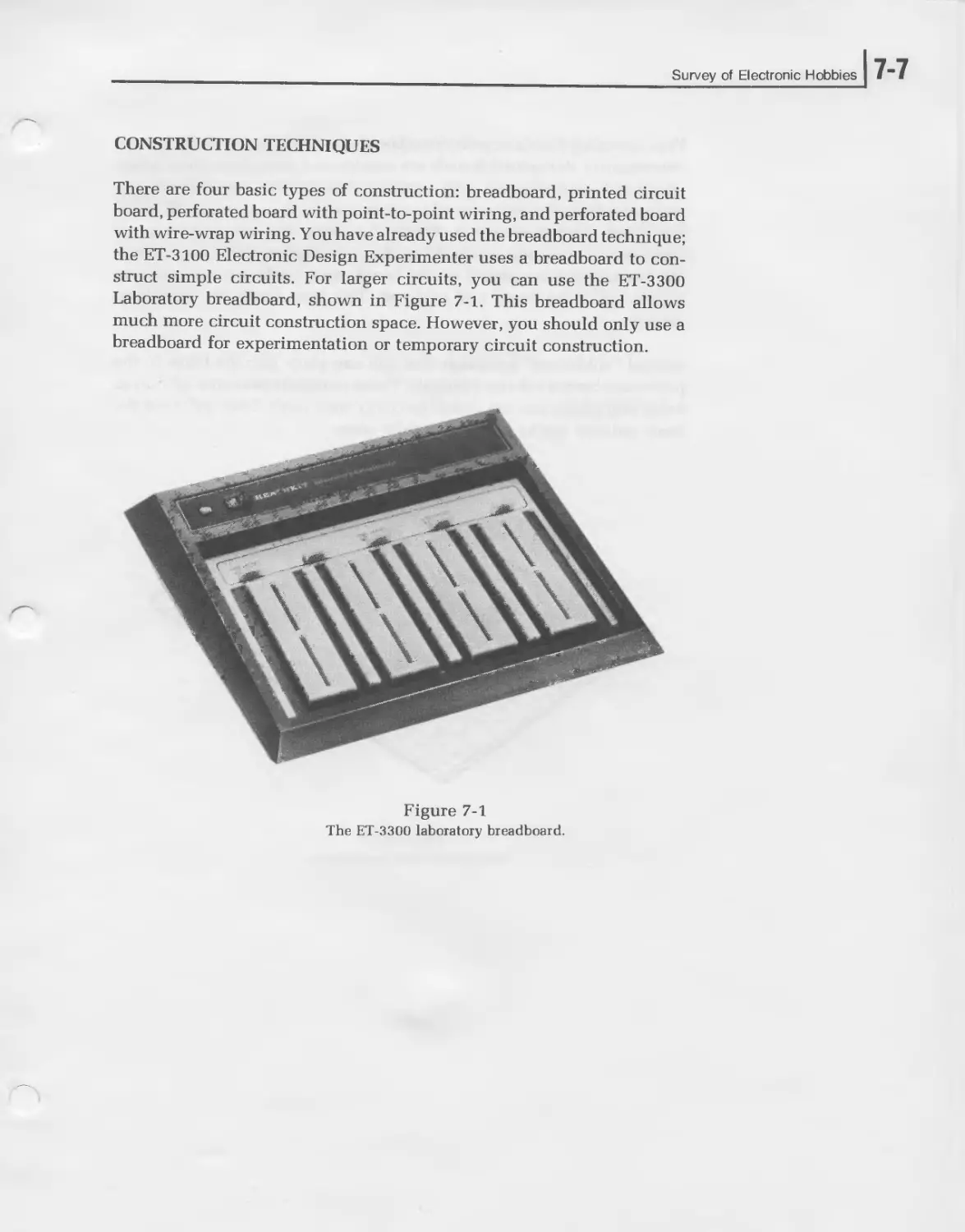
struct simple circuits. For larger circuits, you can use the ET-33OO
Laboratory breadboard, shown in Figure 7-1. This breadboard allows
much more circuit construction space. However, you should only use a
breadboard for experimentation or temporary circuit construction.
Figure 7-1
The ET-3300 laboratory breadboard.
7-8 UNIT SEVEN
Printed circuit boards or perforated boards are used for permanent circuit
construction. Perforated boards are constructed from phenolic or glass-
epoxy and are perforated with a special hole pattern. For example, one
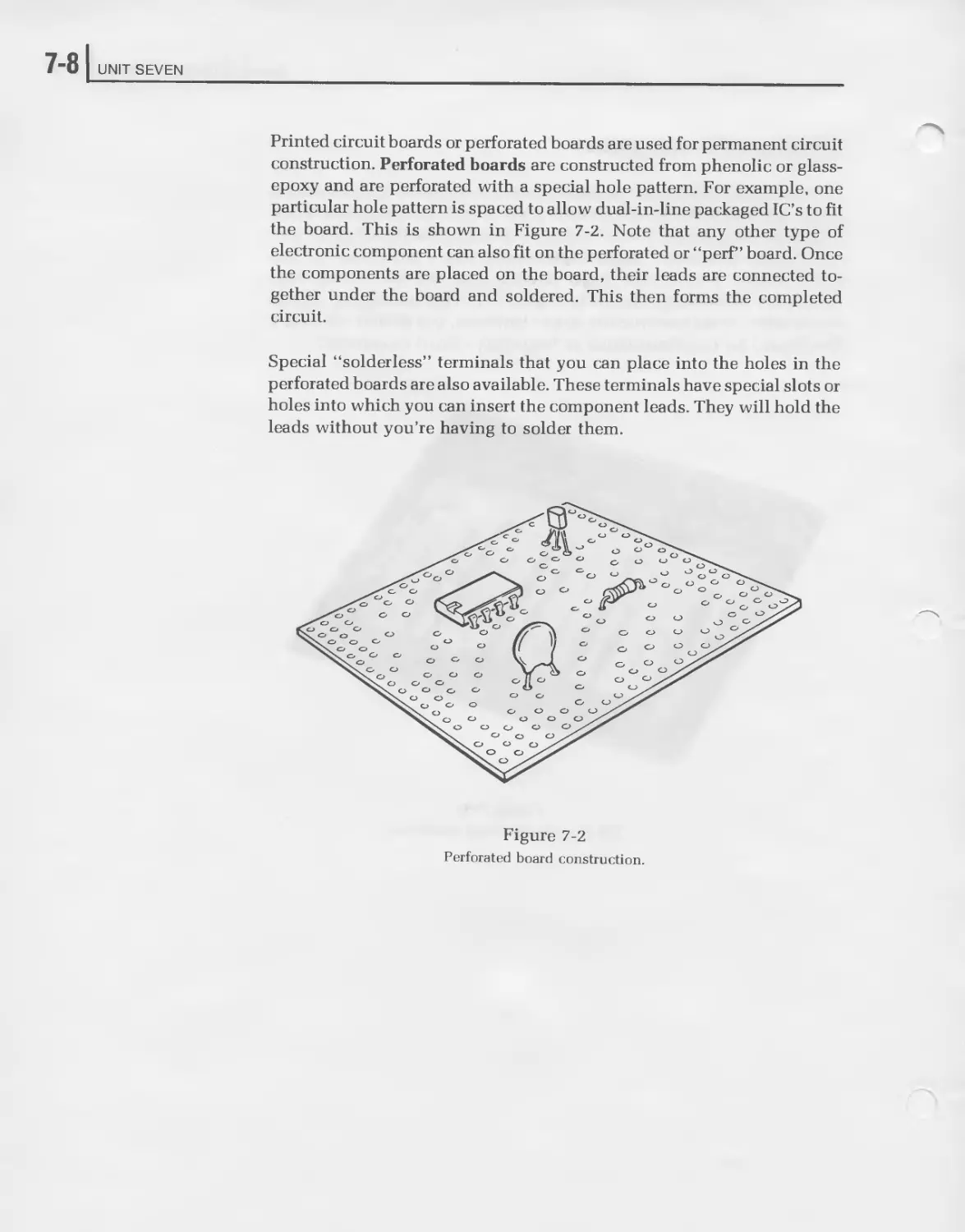
particular hole pattern is spaced to allow dual-in-line packaged IC’s to fit
the board. This is shown in Figure 7-2. Note that any other type of
electronic component can also fit on the perforated or “perf” board. Once
the components are placed on the board, their leads are connected to-
gether under the board and soldered. This then forms the completed
circuit.
Special “solderless” terminals that you can place into the holes in the
perforated boards are also available. These terminals have special slots or
holes into which you can insert the component leads. They will hold the
leads without you’re having to solder them.
Figure 7-2
Perforated board construction.
Survey of Electronic Hobbies
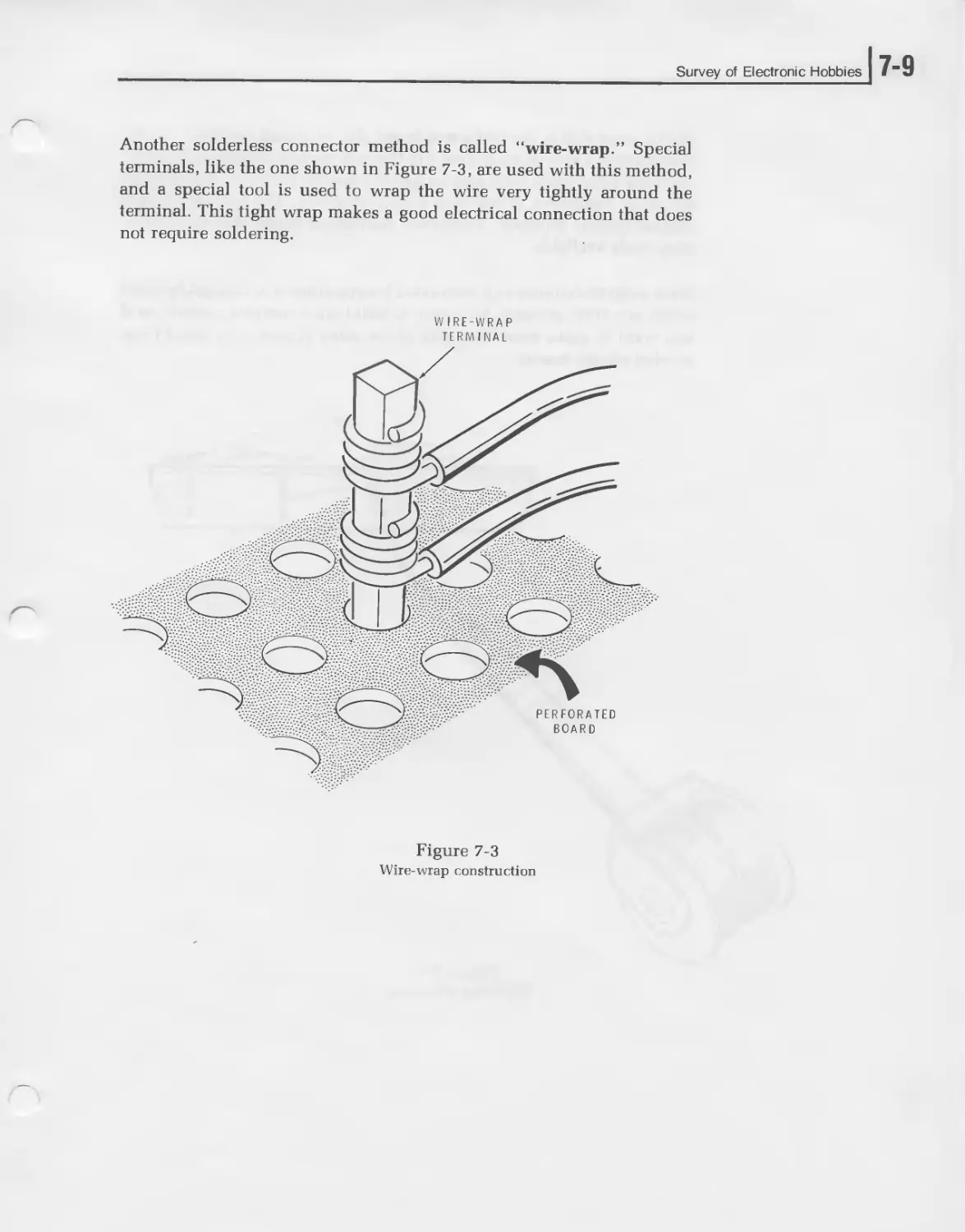
Another solderless connector method is called “wire-wrap.” Special
terminals, like the one shown in Figure 7-3, are used with this method,
and a special tool is used to wrap the wire very tightly around the
terminal. This tight wrap makes a good electrical connection that does
not require soldering.
Figure 7-3
Wire-wrap construction
7-10 UNIT SEVEN
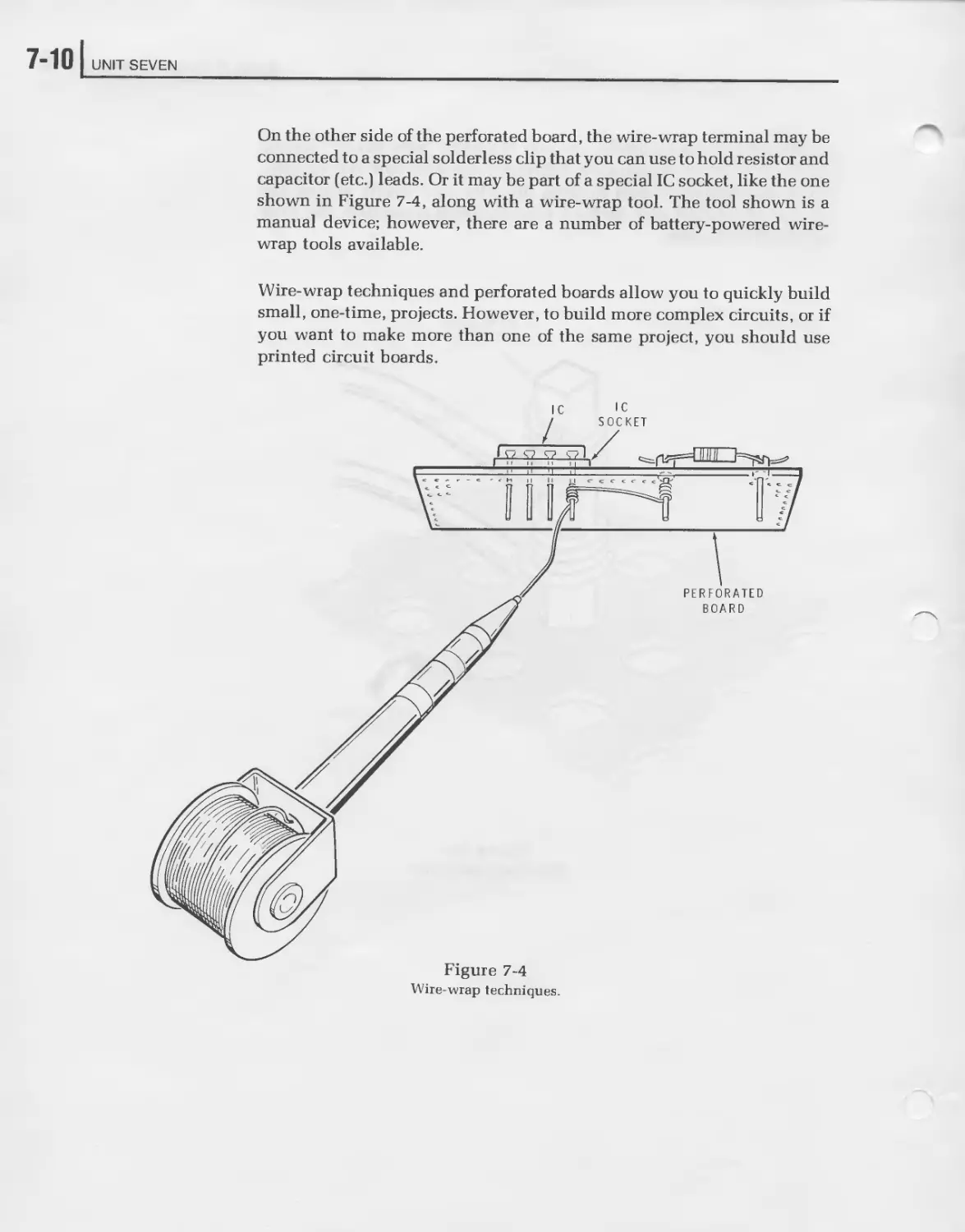
On the other side of the perforated board, the wire-wrap terminal may be
connected to a special solderless clip that you can use to hold resistor and
capacitor (etc.) leads. Or it may be part of a special IC socket, like the one
shown in Figure 7-4, along with a wire-wrap tool. The tool shown is a
manual device; however, there are a number of battery-powered wire-
wrap tools available.
Wire-wrap techniques and perforated boards allow you to quickly build
small, one-time, projects. However, to build more complex circuits, or if
you want to make more than one of the same project, you should use
printed circuit boards.
Figure 7-4
Wire-wrap techniques.
Survey of Electronic Hobbies
7-11
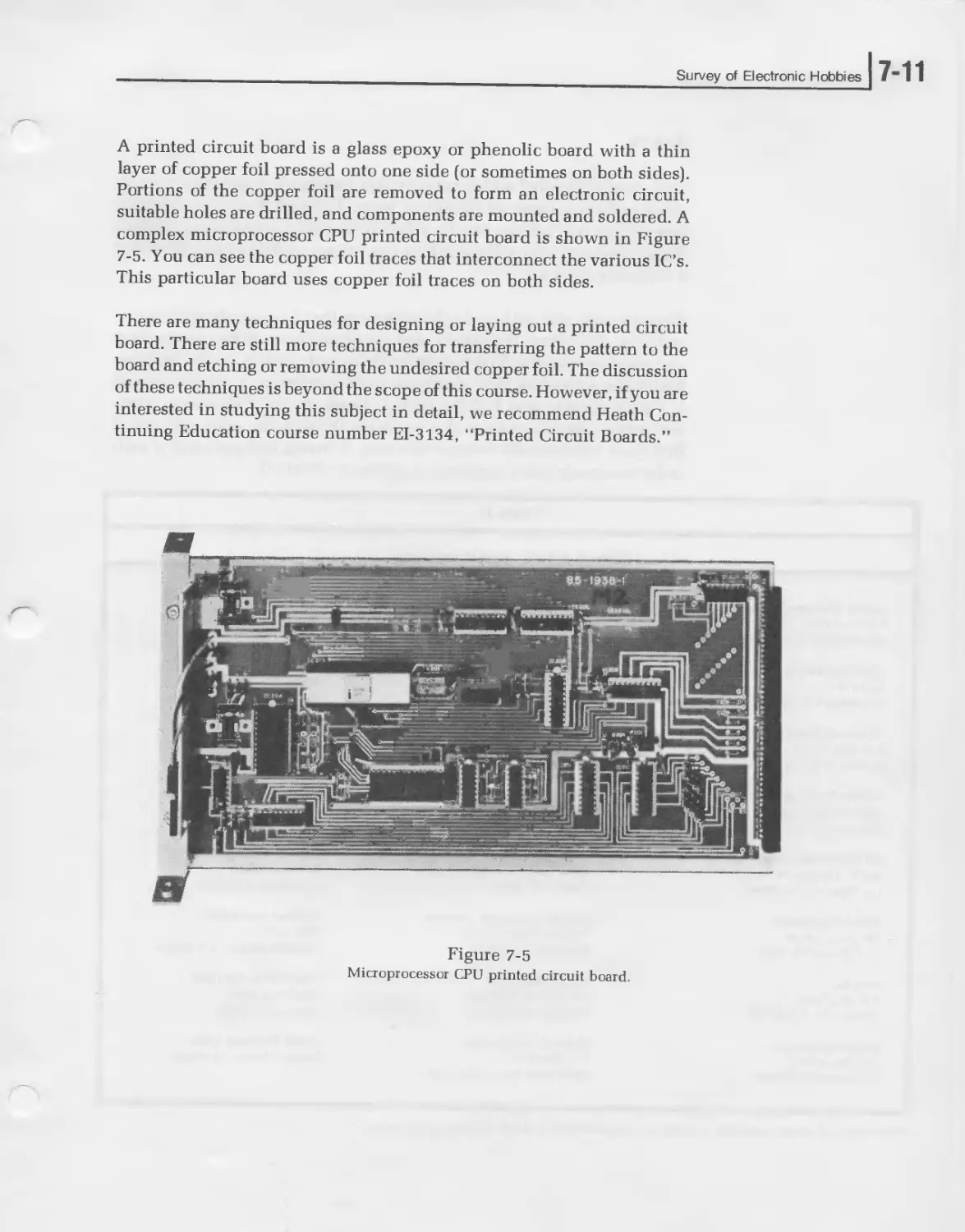
A printed circuit board is a glass epoxy or phenolic board with a thin
layer of copper foil pressed onto one side (or sometimes on both sides).
Portions of the copper foil are removed to form an electronic circuit,
suitable holes are drilled, and components are mounted and soldered. A
complex microprocessor CPU printed circuit board is shown in Figure
7-5. You can see the copper foil traces that interconnect the various IC’s.
This particular board uses copper foil traces on both sides.
There are many techniques for designing or laying out a printed circuit
board. There are still more techniques for transferring the pattern to the
board and etching or removing the undesired copper foil. The discussion
of these techniques is beyond the scope of this course. However, if you are
interested in studying this subject in detail, we recommend Heath Con-
tinuing Education course number EI-3134, “Printed Circuit Boards.”
Figure 7-5
Microprocessor CPU printed circuit board.
7-12 UNIT SEVEN
PARTS
Once you’ve decided which construction technique to use, you must go
about gathering those all important parts. The best magazine construc-
tion articles will tell you exactly where to find the hard-to-get or unusual
items. They may even tell you where you can get a printed circuit board or
a complete parts kit.
Nevertheless, you will no doubt want to gather a moderate selection of
resistors, capacitors, transistors, and integrated circuits for construction
and experimental use. You can obtain these parts locally at a Heath Store,
Radio Shack Store, or local electronic parts distributor. Your phone book
is a good place to start looking for the closest source of electronic parts.
Electronic components are also available through the mail, and you’ll
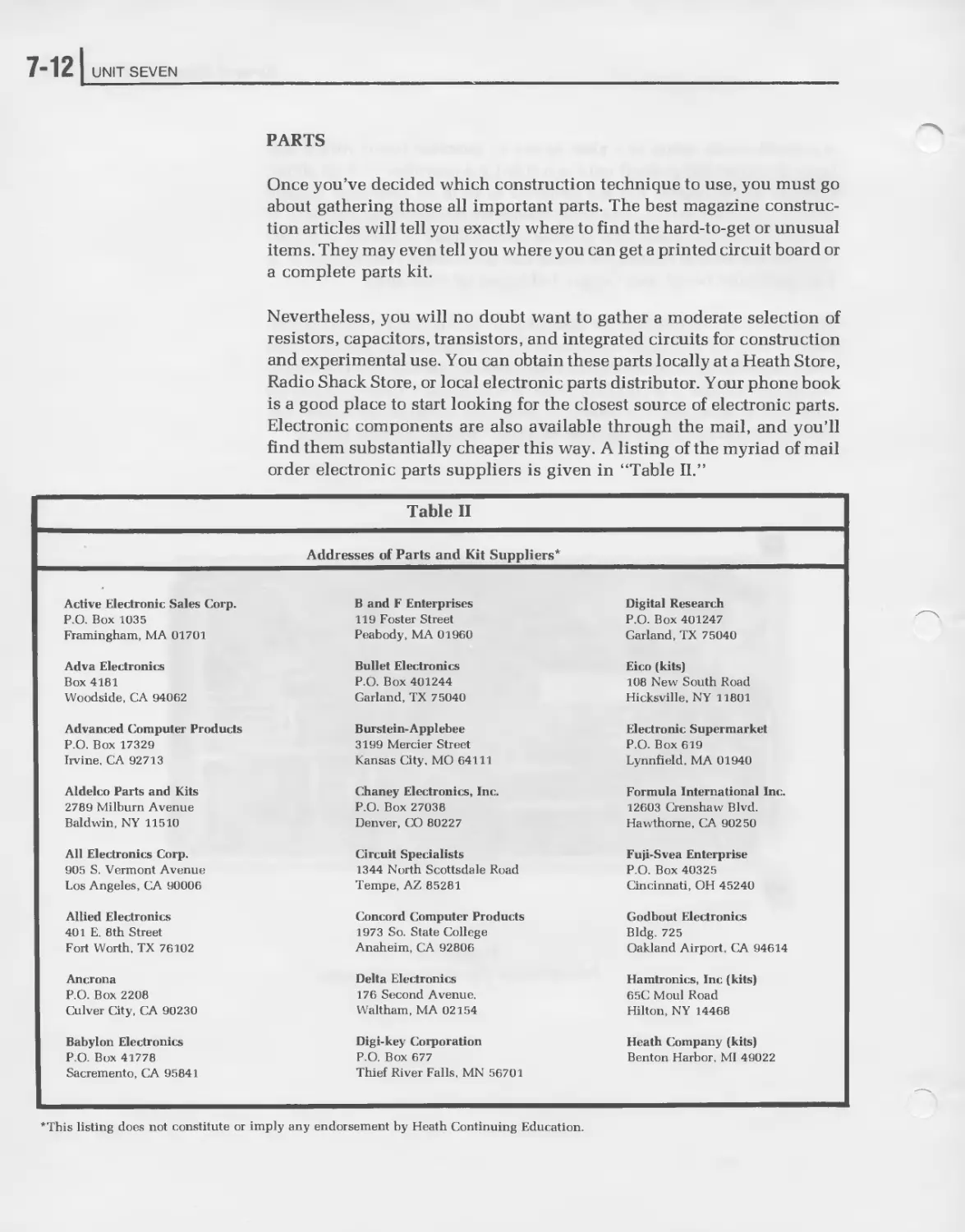
find them substantially cheaper this way. A listing of the myriad of mail
order electronic parts suppliers is given in “Table II.”
Table II
Addresses of Parts and Kit Suppliers*
Active Electronic Sales Corp.	В and F Enterprises	Digital Research
P.O. Box 1035	119 Foster Street	P.O. Box 401247
Framingham, MA 01701	Peabody, MA 01960	Garland, TX 75040
Adva Electronics	Bullet Electronics	Eico (kits)
Box 4181	P.O. Box 401244	108 New South Road
Woodside, CA 94062	Garland, TX 75040	Hicksville, NY 11801
Advanced Computer Products	Burstein- Applebee	Electronic Supermarket
P.O. Box 17329	3199 Mercier Street	P.O. Box 619
Irvine. CA 92713	Kansas City, MO 64111	Lynnfield. MA 01940
Aldelco Parts and Kits	Chaney Electronics, Inc.	Formula International Inc.
2789 Milburn Avenue	P.O. Box 27038	12603 Crenshaw Blvd.
Baldwin, NY 11510	Denver, CO 80227	Hawthorne, CA 90250
All Electronics Corp.	Circuit Specialists	Fuji-Svea Enterprise
905 S. Vermont Avenue	1344 North Scottsdale Road	P.O. Box 40325
Los Angeles, CA 90006	Tempe, AZ 85281	Cincinnati, OH 45240
Allied Electronics	Concord Computer Products	Godbout Electronics
401 E. 8th Street	1973 So. State College	Bldg. 725
Fort Worth, TX 76102	Anaheim, CA 92806	Oakland Airport, CA 94614
Ancrona	Delta Electronics	Hamtronics, Inc (kits)
P.O. Box 2208	176 Second Avenue.	65C Moul Road
Culver City, CA 90230	Waltham, MA 02154	Hilton, NY 14468
Babylon Electronics	Digi-key Corporation	Heath Company (kits)
P.O. Box 41778	P.O. Box 677	Benton Harbor, MI 49022
Sacremento, CA 95841	Thief River Falls, MN 56701
This listing does not constitute or imply any endorsement by Heath Continuing Education.
Survey of Electronic Hobbies
] 7-13
Herbach & Rademan Inc. (parts and equipment) 401 East Erie Avenue Philadelphia, PA 19134	Optoelectronics Inc. (parts and kits) 5821 N.E. 14th Avenue, Fort Lauderdale, FL 33334
Hobby world Electronics	Parts Warehouse
19511 Business Center Drive	Box 10101
Northridge, CA 91324	Rochester, NY 14610
International Components Corp.	Poly Paks
P.O. Box 1837	P.O. Box 942
Columbia, MO 65205	So. Lynnfield, MA 01940
Jade	Popular Components Inc.
4901 W. Rosecrans	1145 Walt Whitman Rd.
Hawthorne, CA 90250 Jameco Electronics (parts and kits)	P.O. Box 866 Melville, NY 11747
1355 Shoreway Road	Quest Electronics (parts and kits)
Belmont. CA 94002 Lafayette Electronics	P.O. Box 443OM Santa Clara, CA 95054
P.O. Box 428	Radiokit (parts and kits)
Syosset, NY 11791 MHz Electronics	Box 429 Hollis, NH 03049
2111 W. Camelback	Radio Shack
Phoenix, AZ 85015 Micro Mart	P.O. Box 2625 Fort Worth, TX 76101
552 Summit Avenue	Semiconductors Surplus
Westfield, NJ 07090 M-M Electronic Sales	2822 North 32nd Street/Unit 1 Phoenix, AZ 85008
2300 1st Avenue	Solid State Sales
Seattle, WA 98121 Mouser Electronics	P.O. Box 74 Somerville, MA 02143
11511 Woodside Avenue	Surplus Electronics Corporation
Lakeside, CA 92040 OK Machine and Tool Corp, wirewrap tools and supplies	7294 N.W. 54 Street Miami, FL 33166
3455 Conner Street	Тек-El Corp.
Bronx, NY 10475 Olson Electronics 260 S. Forge Street Akron, OH 44327	P.O. Box 2361 Woburn, MA 01801
You can write to these companies for their latest catalogs. However, since
most of them advertise in the electronics magazines, you can also review
their products and prices there.
7"14 UNIT SEVEN
Kit Building
The obvious advantage of kit building is that all the “bugs” or problems
have been solved for you. The circuit is proven and reliable. The parts are
all packaged with the kit and the printed circuit board is included. There
is also an assembly manual to guide you through the construction, step-
by-step.
While Heath Company is the largest electronic kit supplier in the world,
many other companies sell electronic kits of one type or another. Most of
these companies are listed in “Table II.” Each company has some particu-
lar quality to offer. Heath offers a large variety of quality kits, reliability,
the best assembly manuals, and the confidence of many years of opera-
tion. The other companies can offer more specialized kits and, some-
times, lower prices. However, there are tradeoffs involved. To get a lower
price you may have to sacrifice reliability or quality, and accept a bare
minimum assembly manual. You must be the judge of what is and is not
acceptable. So, before attempting a construction project or buying a kit,
you must look at all the options and costs involved. Then decide which is
the best way for you.
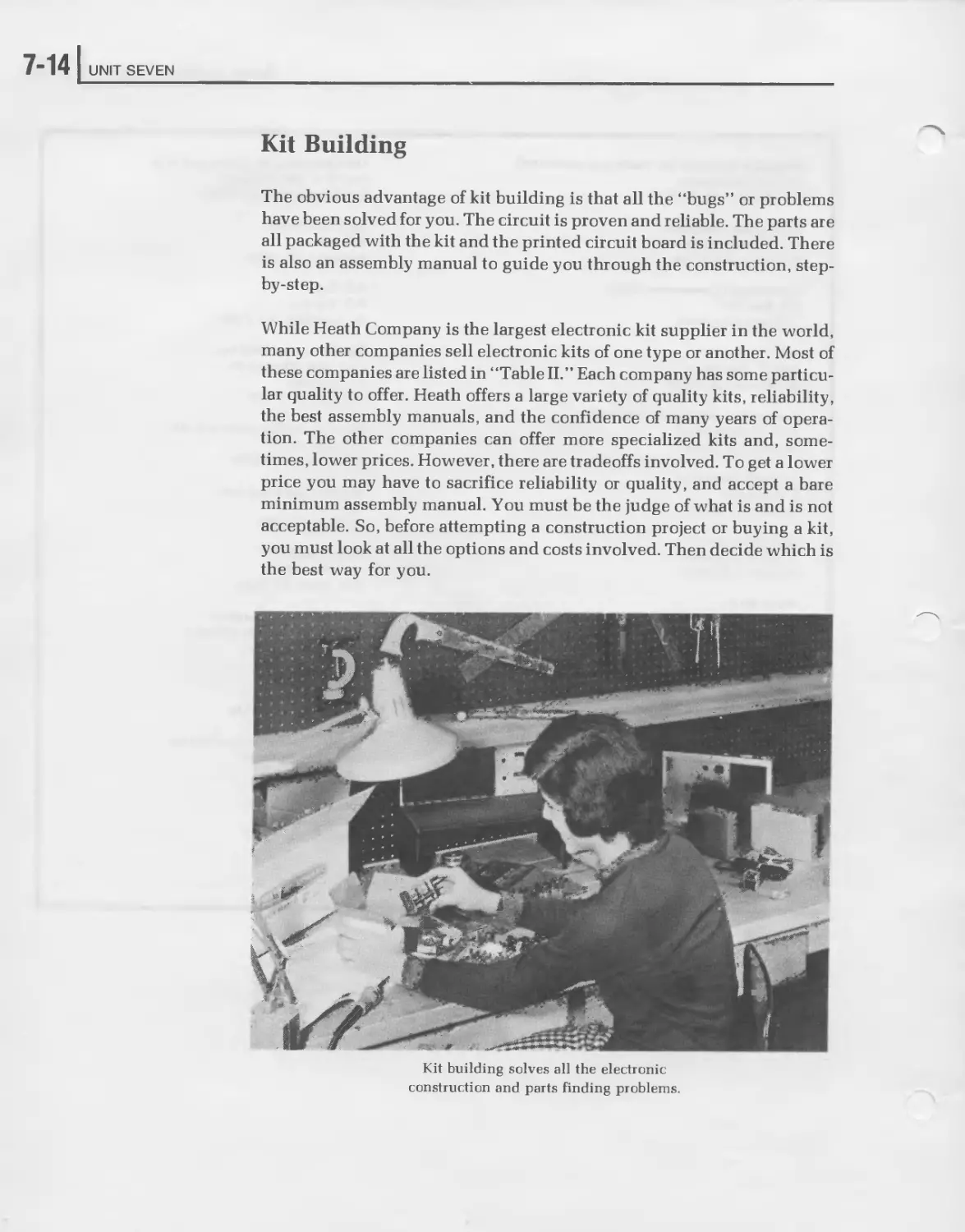
Kit building solves all the electronic
construction and parts finding problems.
Survey of Electronic Hobbies
] 7-15
Self-Review Questions
1.	Where can you find interesting and up-to-date electronic construc-
tion projects?__________________________________________________________
2.	Name the four types of electronic circuit construction.
1.
2.	_______________________________________________________________
3.	_______________________________________________________________
4.	_______________________________________________________________
3.	What is wire-wrap?__________________________________________________
4.	List one advantage and one disadvantage of wire-wrap construc-
tion. ___________________________________________________________
5.	List one advantage and one disadvantage of printed circuit board
construction.
6.	Electronic parts can be found or by
7.	What are the advantages of kit building?
7-16 UNIT SEVEN
Self-Review Answers
1.	Interesting and up-to-date electronic construction projects can be
found in any of the magazines listed in “Table I.”
2.	The four types of electronic circuit construction are:
1.	Breadboard.
2.	Printed circuit board.
3.	Perforated board with point-to-point wiring.
4.	Perforated board with wire-wrap wiring.
3.	Wire-wrap is a solderless method of wiring circuits in which wires
are tightly wrapped around special terminals.
4.	The advantage of wire-wrap is that you can wire a small project
quickly and without a soldering iron. The disadvantage is that it
does not lend itself well to complex projects, or when you are
building two or more of the same project.
5.	The advantage of printed circuit boards is that they lend them-
selves well to complex projects, or when you are building two or
more of the same project. The disadvantage is when you are build-
ing only one small circuit. Then the complexities and time required
to design and build a printed circuit board usually rule out its use.
6.	Electronic parts can be found locally or by mail order.
7.	The advantages of kit building are:
1.	The “bugs,” or problems, have been solved for you.
2.	They come with all of the parts. Therefore, no search for parts.
3.	Any printed circuit boards have already been designed and
made.
4.	There is a step-by-step assembly manual in most cases.
Survey of Electronic Hobbies
] 7-17
SHORT-WAVE LISTENING
Many of you have had the experience of tuning in a distant radio station
or even a distant TV station. This can be quite an exciting and educational
experience. You can get a glimpse of what life is like in another town,
state, or even country! Many people get “hooked” on listening to distant
radio stations. This is called “DXing” by short-wave listeners, or
“SWLs.” DX stands for distance, while SWL stands for short-wave lis-
tener.
DXing is by no means limited to radio or to the short wave bands, for that
matter. There are people who monitor distant TV stations, FM stations,
AM stations, as well as short-wave stations. The following pages will
introduce you to all areas of this fascinating hobby.
7-18 UNIT SEVEN
What’s on the Air?
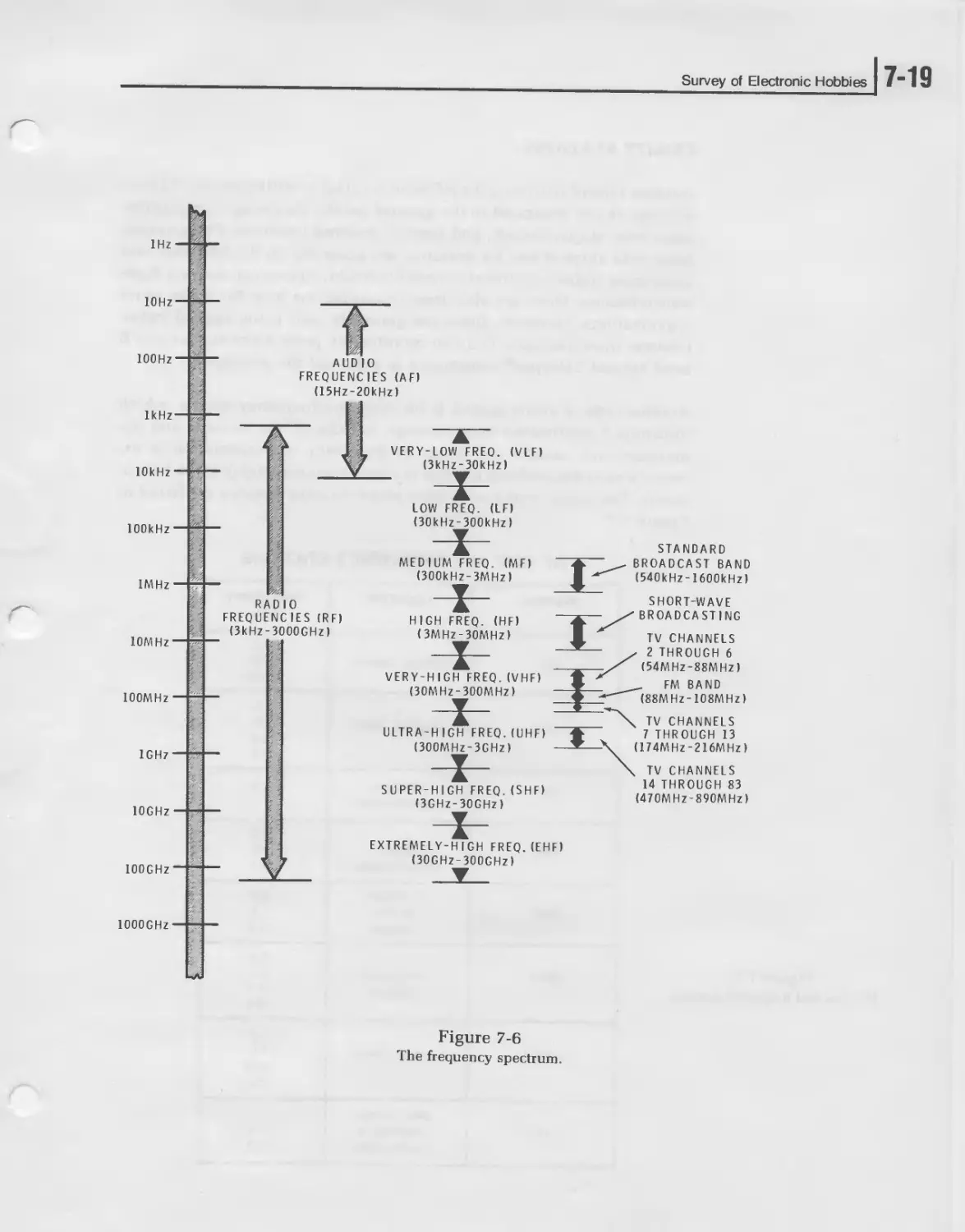
The radio frequency spectrum extends from 3 kHz to 300 GHz, as shown
in Figure 7-6. This spectrum is then divided into several frequency bands
from VLF (very low frequencies, 3 kHz-30 kHz) to EHF (extremely high
frequencies, 30 GHz-300 GHz). Each frequency band has its own particu-
lar characteristics. For example, the short-wave listener is primarily
interested in the HF band which extends from 3 MHz to 30 MHz. These
radio frequencies are capable of traveling, literally, “Around the World.”
Therefore, the HF band offers you the greatest potential for DX, or distant
listening. In fact, the term “short-waves” refers to the HF band.
Another DX band is the medium frequency or MF band, which extends
from 300 kHz to 3 mHz. The standard AM broadcast band falls within the
MF band. These frequencies offer only local radio during daytime. How-
ever, at night, these radio waves can travel very long distances, allowing
you to receive very distant stations.
When conditions are just right, DXing is also possible in the VHF and
UHF bands, where TV signals and FM broadcast signals are received. For
example, KLNE-TV Channel 3, in Holdrege, Nebraska was received in
Bellevue, Washington, with a clear color picture! So anything is possible;
but the conditions must be just right.
FOREIGN BROADCASTS
You can hear most foreign broadcasts on the HF band; but you can also
hear some Canadian, Mexican, and Carribbean standard AM broadcast
stations on the MF band in the U.S. These HF broadcasts from foreign
countries are beamed (directed) toward the United States, and most are in
English. A listing of these broadcasts is published four times a year in
Popular Electronics magazine (see “Table I”).
Foreign broadcasts contain international and local news, sports, and
entertainment features. One popular type of program is the “mailbag
feature”, where the station acknowledges listener’s letters and answers
questions. The news programs are also very interesting, since each sta-
tion offers a different view of international events.
Survey of Electronic Hobbies
]7-19
1Hz
10Hz
100Hz
1kHz
10kHz
100kHz
1MHz
10MHz
100MHz
1GHz
10GHz
100GHz
1000GHz
AUDIO
FREQUENCIES (AF)
(15Hz-20kHz)
HIGH FREQ. (HF)
(3MHz-30MHz)
VERY-HIGH FREQ (VHF)
(30MHz-300MHz)
SUPER-HIGH FREQ.(SHF)
(3GHz-30GHz)
EXTREMELY-HIGH FREQ.(EHF)
(30GHz-300GHz)
ULTRA-HIGH FREQ.(UHF)
(300MHz-3GHz)
Figure 7-6
The frequency spectrum.
VERY-LOW FREO. (VLF)
(3kHz-30kHz)
LOW FREQ. (LF)
(30kHz-3OOkHz)
RADIO
FREQUENCIES (RF)
(3kHz-3000GHz)
MEDIUM FREQ. (MF)
(300kHz-3MHz)
TV CHANNELS
7 THROUGH 13
(174MHz-216MHz)
SHORT-WAVE
BROADCASTING
TV CHANNELS
2 THROUGH 6
(54MHz-88MHz)
. FM BAND
(88MHz-108MHz)
STANDARD
BROADCAST BAND
(540kHz-1600kHz)
. TV CHANNELS
14 THROUGH 83
(470MHz-890MHz)
7-20 UNIT SEVEN
UTILITY STATIONS
Another type of station on the HF band is called a “utility station.” These
stations do not broadcast to the general public, they relay communica-
tions from ships, aircraft, and remote, isolated locations. Communica-
tions with ships at sea, for example, are generally on the HF band; and
since these signals can travel around the world, you too can monitor these
transmissions. There are also press transmissions from the major news
organizations. However, these are generally sent using special radio-
teletype transmissions. You can monitor the press services, but you’ll
need special Teletype® equipment to print out the messages.
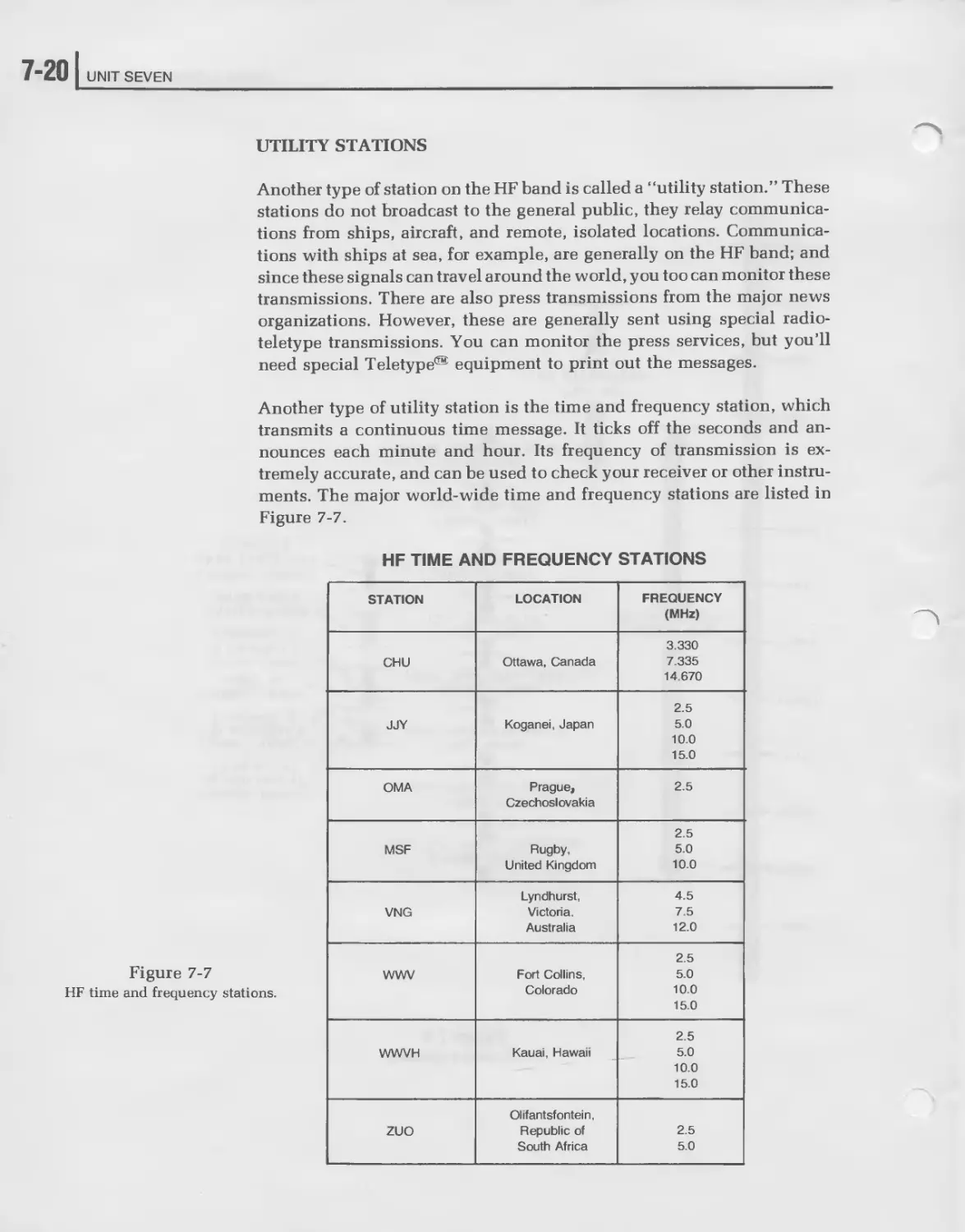
Another type of utility station is the time and frequency station, which
transmits a continuous time message. It ticks off the seconds and an-
nounces each minute and hour. Its frequency of transmission is ex-
tremely accurate, and can be used to check your receiver or other instru-
ments. The major world-wide time and frequency stations are listed in
Figure 7-7.
HF TIME AND FREQUENCY STATIONS
	STATION	LOCATION	FREQUENCY (MHz)
	CHU	Ottawa, Canada	3.330 7.335 14.670
	JJY	Koganei, Japan	2.5 5.0 10.0 15.0
	OMA	Prague, Czechoslovakia	2.5
	MSF	Rugby, United Kingdom	2.5 5.0 10.0
	VNG	Lyndhurst, Victoria. Australia	4.5 7.5 12.0
Figure 7-7 HF time and frequency stations.	WWV	Fort Collins, Colorado	2.5 5.0 10.0 15.0
	WWVH	Kauai, Hawaii	2.5 5.0 10.0 15.0
	ZUO	Olifantsfontein, Republic of South Africa	2.5 5.0
Survey of Electronic Hobbies
AM BROADCAST BAND
All of us have tuned our car radio into the local AM radio station for news
and music. You’ve probably also noticed that the AM radio dial is much
more crowded at night. This is due to the effects of the sun’s radiation, or
lack of radiation, on the earth’s upper atmosphere. At night, the MF radio
waves can travel much further, even from coast-to-coast!
Just as you’ve tuned to your local AM station for news and music, at night
you can tune to distant stations for news, weather reports, and even sports
events. For example, you can tunetoKMOX, 1120 kHz, for St. Louis Blues
ice hockey, or to WLW, 700 kHz for Cinncinati Reds baseball. The list
goes on and on; it only awaits your discovery.
FM AND TV
As we mentioned previously, TV signals can travel some phenomenal
distances. However, you must have the necessary equipment, such as
high gain antennas and a good receiver. You must also have the patience
to wait for just the right conditions to occur before those distant signals
can be received.
The same applies to FM broadcast stations. You’ll need a good receiver,
antenna, and lots of patience.
PUBLIC SERVICE RADIO
Public service radio includes police, fire, coast guard, and local aircraft
communications. Those who monitor the public service bands are not
usually interested in DX. Instead, they want to listen to local activities
that are not normally available.
The public service bands are in the VHF and UHF ranges and they usually
do not broadcast continuously. Y ou can monitor these frequencies with a
scanner type of receiver that will lock on to any active channel. This can
offer some very interesting listening.
7-221 UNIT SEVEN
How Can I Hear These Stations?
First, you’ll need a receiver that is capable of receiving the transmissions
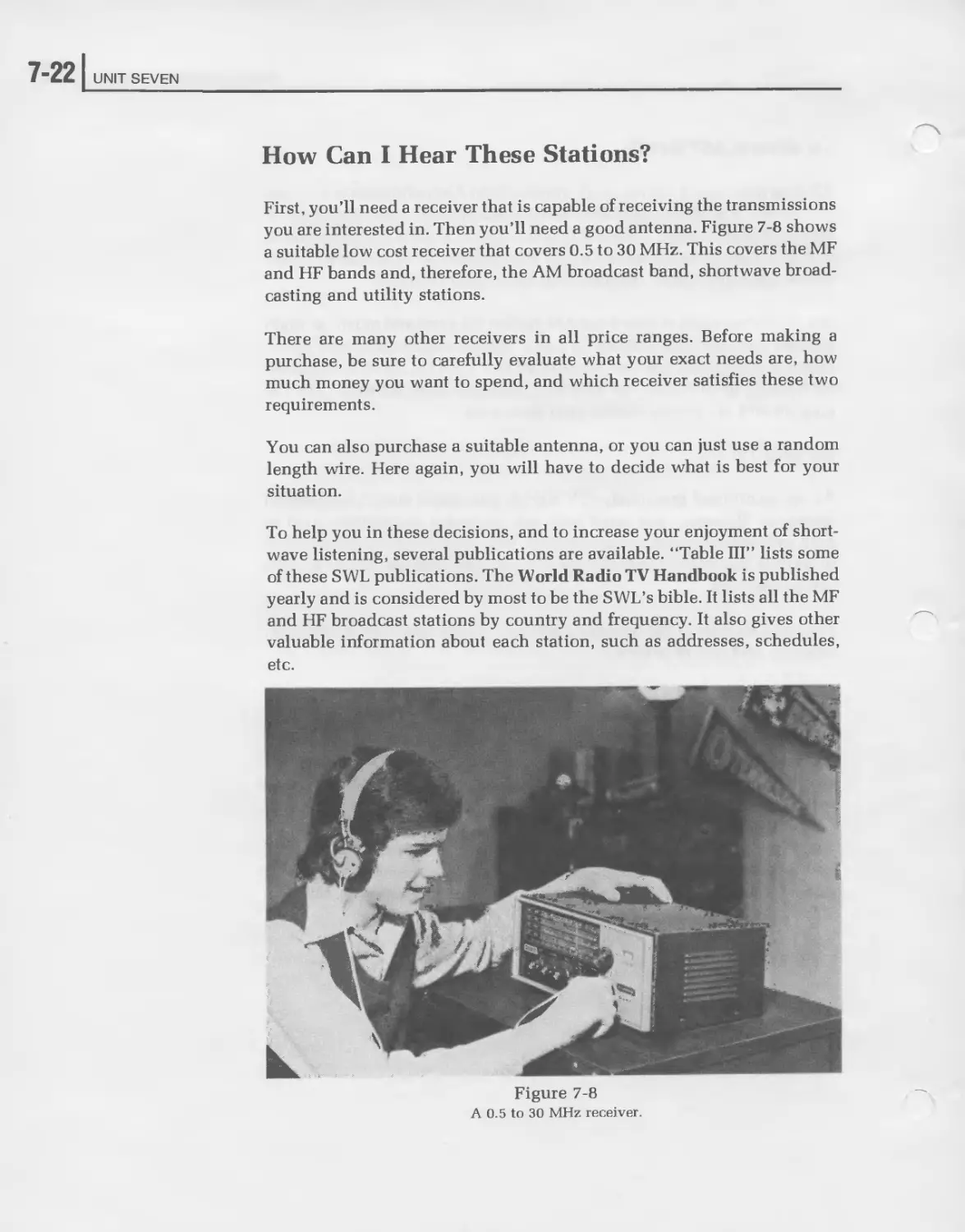
you are interested in. Then you’ll need a good antenna. Figure 7-8 shows
a suitable low cost receiver that covers 0.5 to 30 MHz. This covers the MF
and HF bands and, therefore, the AM broadcast band, shortwave broad-
casting and utility stations.
There are many other receivers in all price ranges. Before making a
purchase, be sure to carefully evaluate what your exact needs are, how
much money you want to spend, and which receiver satisfies these two
requirements.
You can also purchase a suitable antenna, or you can just use a random
length wire. Here again, you will have to decide what is best for your
situation.
To help you in these decisions, and to increase your enjoyment of short-
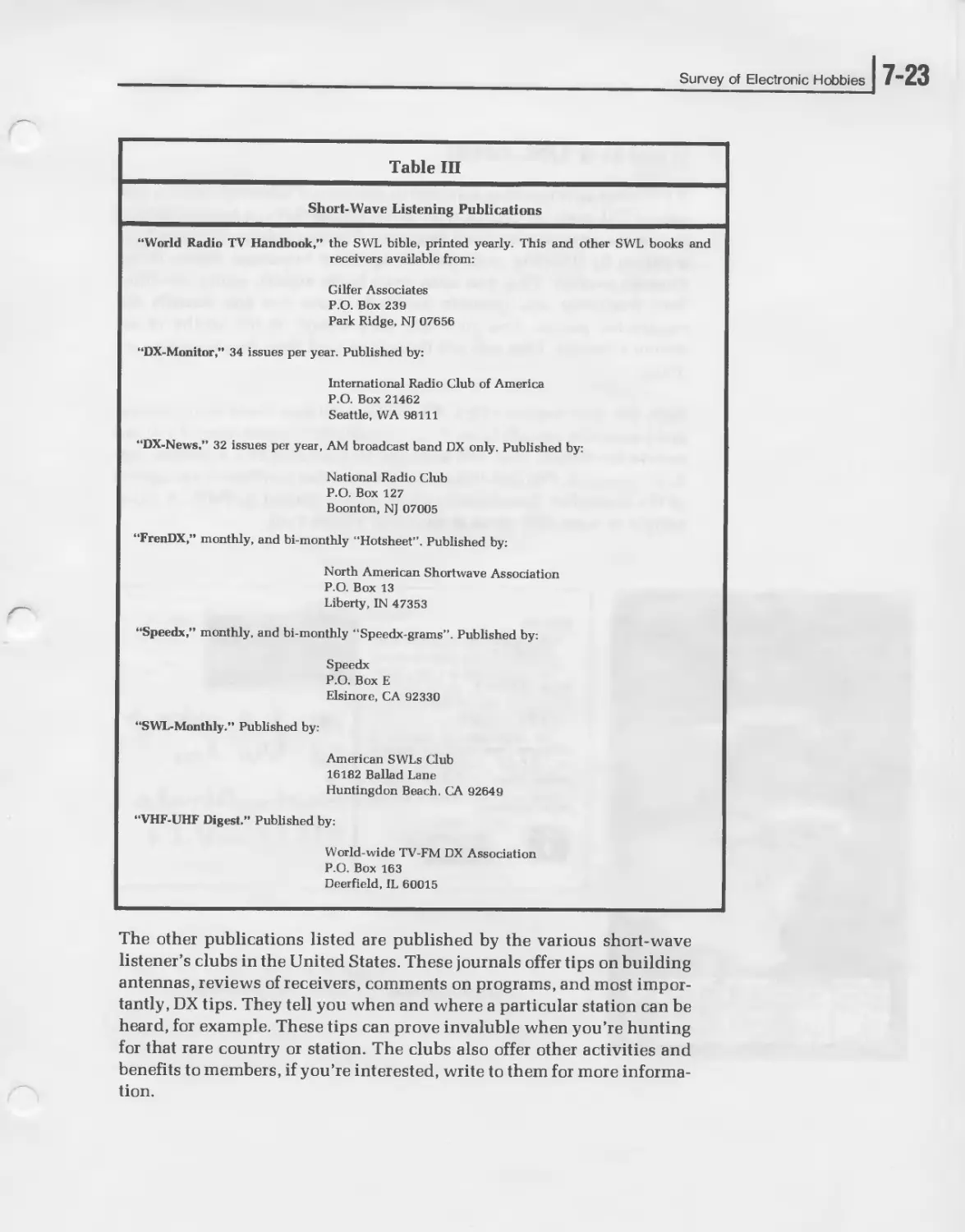
wave listening, several publications are available. “Table III” lists some
of these SWL publications. The World Radio TV Handbook is published
yearly and is considered by most to be the SWL’s bible. It lists all the MF
and HF broadcast stations by country and frequency. It also gives other
valuable information about each station, such as addresses, schedules,
etc.
Figure 7-8
A 0.5 to 30 MHz receiver.
Survey of Electronic Hobbies
17-23
Table Ш
Short-Wave Listening Publications
“World Radio TV Handbook,” the SWL bible, printed yearly. This and other SWL books and
receivers available from:
Gilfer Associates
P.O. Box 239
Park Ridge, NJ 07656
“DX-Monitor,” 34 issues per year. Published by:
International Radio Club of America
P.O. Box 21462
Seattle, WA 98111
“DX-News,” 32 issues per year, AM broadcast band DX only. Published by:
National Radio Club
P.O. Box 127
Boonton, NJ 07005
“FrenDX,” monthly, and bi-monthly “Hotsheet”. Published by:
North American Shortwave Association
P.O. Box 13
Liberty, IN 47353
“Speedx,” monthly, and bi-monthly “Speedx-grams”. Published by:
Speedx
P.O. Box E
Elsinore, CA 92330
“SWL-Monthly.” Published by:
American SWLs Club
16182 Ballad Lane
Huntingdon Beach. CA 92649
"VHF-UHF Digest.” Published by:
World-wide TV-FM DX Association
P.O. Box 163
Deerfield, IL 60015
The other publications listed are published by the various short-wave
listener’s clubs in the United States. These journals offer tips on building
antennas, reviews of receivers, comments on programs, and most impor-
tantly, DX tips. They tell you when and where a particular station can be
heard, for example. These tips can prove invaluble when you’re hunting
for that rare country or station. The clubs also offer other activities and
benefits to members, if you’re interested, write to them for more informa-
tion.
7“24 I UNIT SEVEN
What is a QSL card?
If you want an interesting sidelight to short-wave listening, you can also
collect QSL cards. A QSL card (or letter) verfies that you have received a
station at a particular time and frequency. Y ou can obtain a QSL card from
a station by listening to it and jotting down important details of the
program content. Then you must write to the station, stating the time,
date, frequency, and program details to prove that you actually did
receive the station. You must also give details on the quality of the
station’s signals. This will tell them how well their transmissions are
doing.
Next, you must request a QSL. The station will then check their program
and transmitter records to see if you actually did receive them. If you did
receive the station, they will send you an attractive QSL card that con-
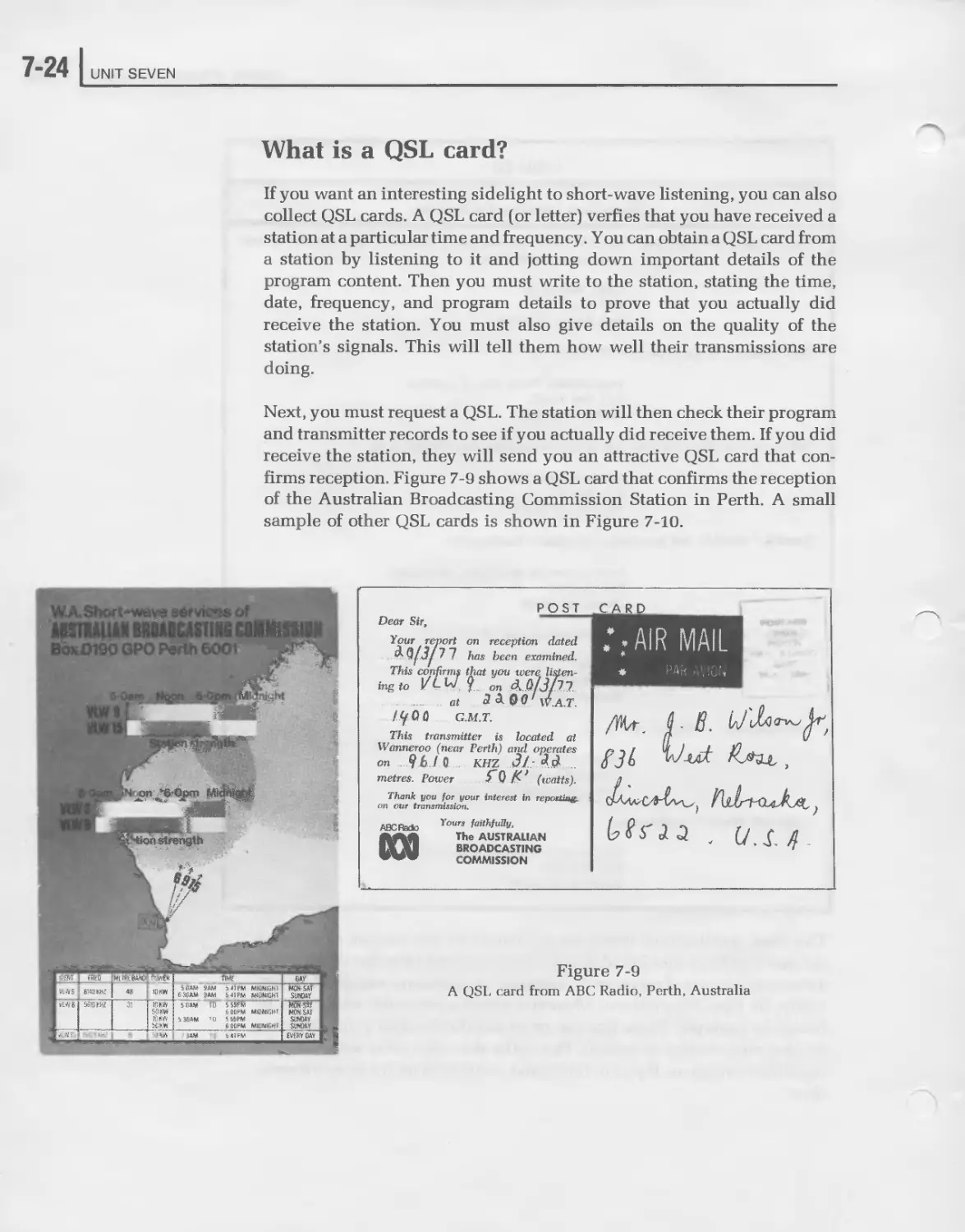
firms reception. Figure 7-9 shows a QSL card that confirms the reception
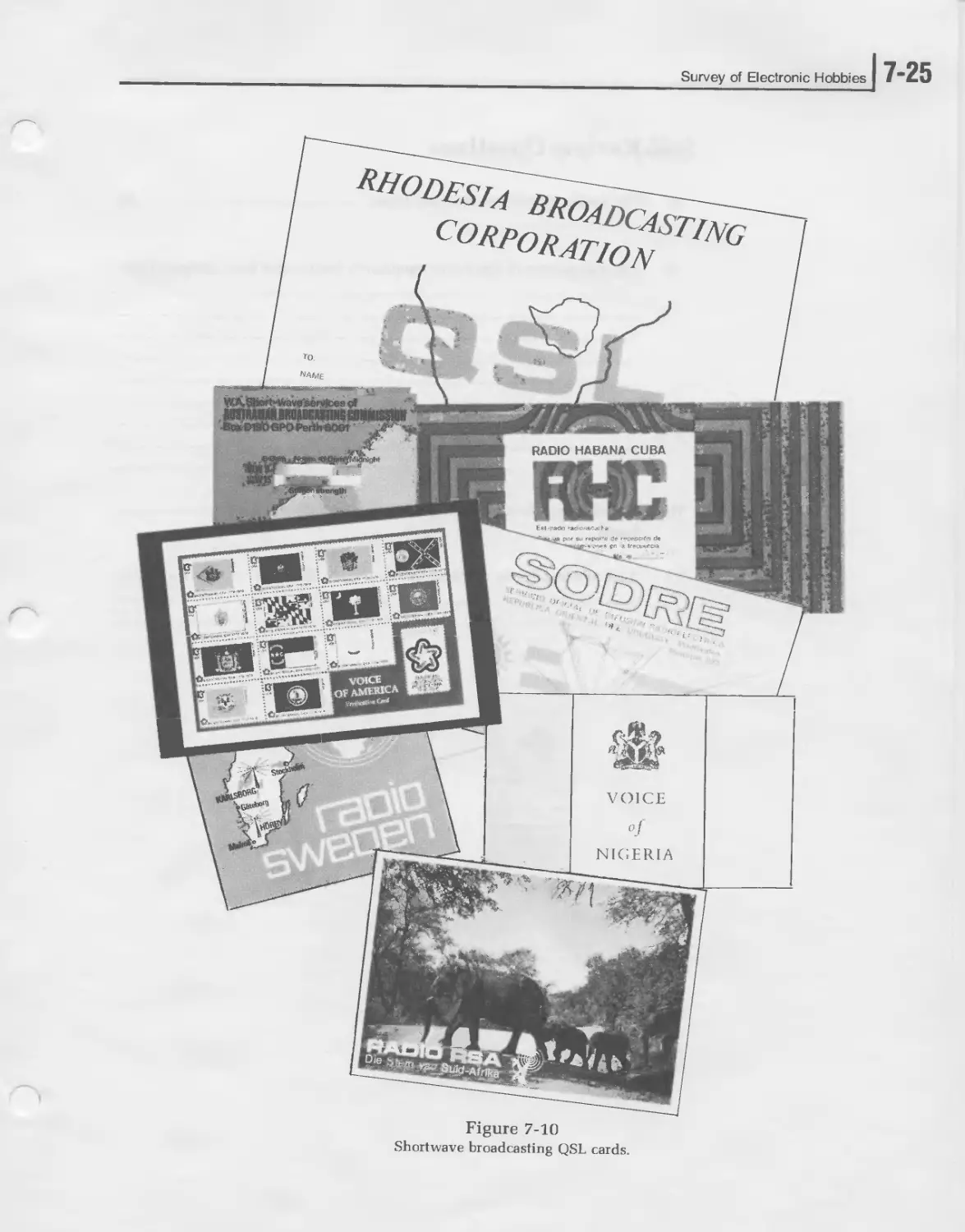
of the Australian Broadcasting Commission Station in Perth. A small
sample of other QSL cards is shown in Figure 7-10.
POST
Dear Sir,
У our report on reception dated
^(3/71 has been examined.
This confirms that you were listen-
ing to V 3. on Ай/Згл.
. .... at ЗА. 60XV.A.T.
I.CfClQ	G.M.T.
This transmitter is located al
Wanneroo (near Perth) and operates
on	KHZ 31.'	..
metres. Power	(watts).
Thank you for your interest in reporting.,
on our transmission.
ABCRadio Yo“” faifhfuBv,
The AUSTRALIAN
BROADCASTING
COMMISSION
Figure 7-9
A QSL card from ABC Radio, Perth, Australia
Survey of Electronic Hobbies I 7"25
^ortwave broadcasting QSL cards
7-261 UNIT SEVEN
Self-Review Questions
8.	The radio spectrum extends from  to
9.	List the names of the radio frequency bands and their frequencies.
10.	Short-wave listeners are primarily interested in the
band.
11.	List several types of short-wave utility stations.
Survey of Electronic Hobbies
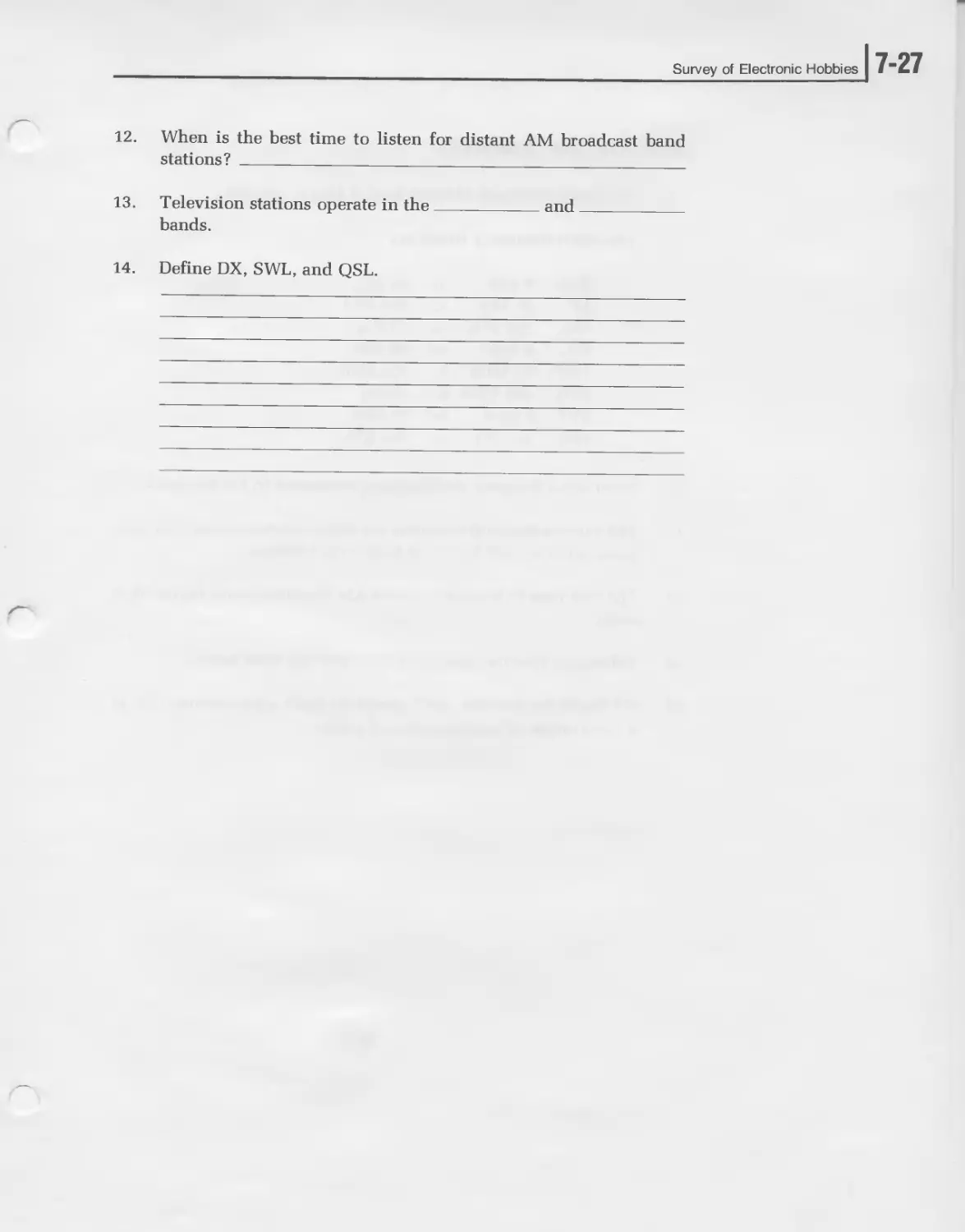
12.	When is the best time to listen for distant AM broadcast band
stations ? _________________________________________________________
13.	Television stations operate in the and
bands.
14.	Define DX, SWL, and QSL.
7-28 UNIT SEVEN
Self-Review Answers
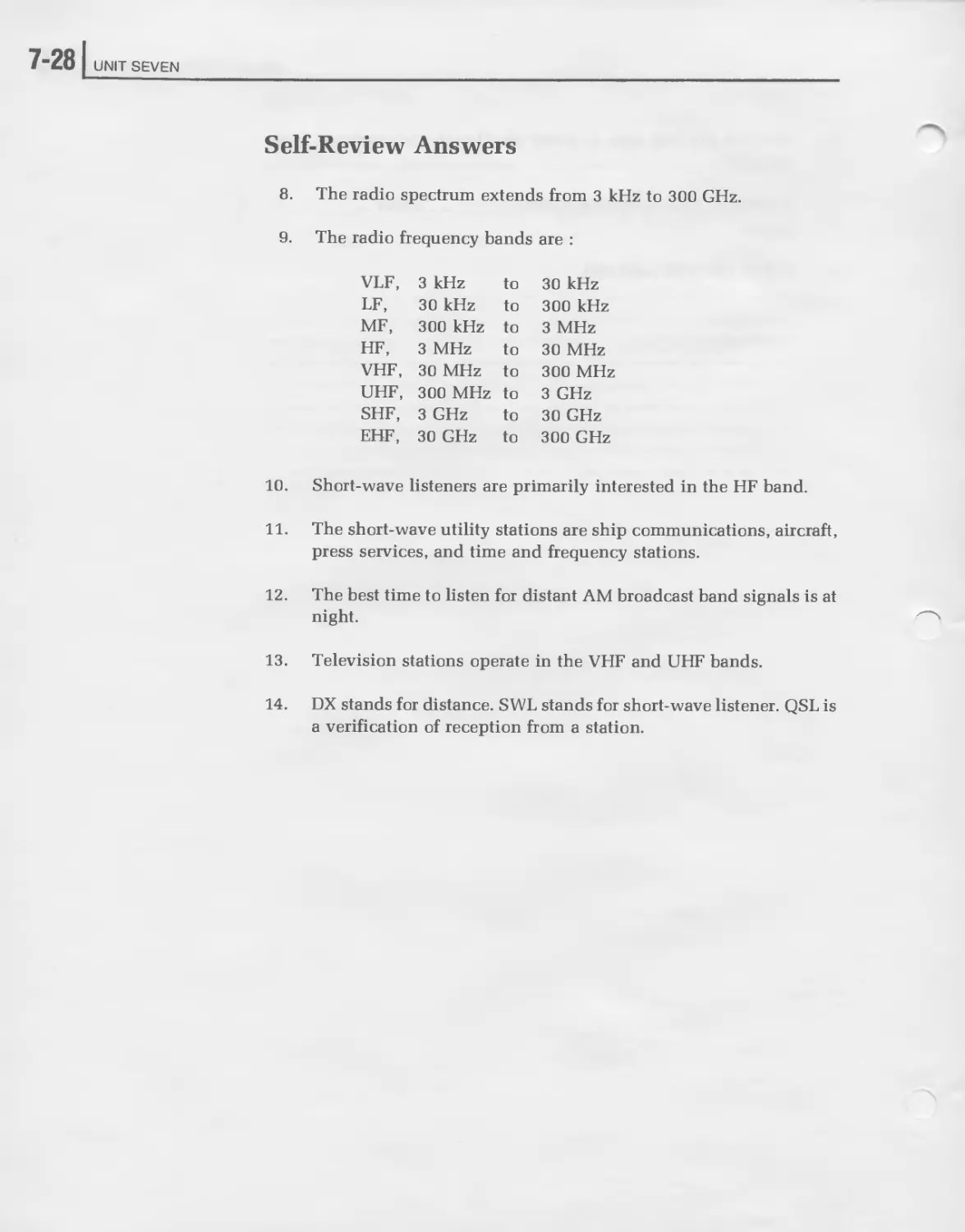
8.	The radio spectrum extends from 3 kHz to 300 GHz.
9.	The radio frequency bands are :
VLF, 3 kHz to 30 kHz
LF, 30 kHz to 300 kHz
MF, 300 kHz to 3 MHz
HF, 3 MHz to 30 MHz
VHF, 30 MHz to 300 MHz
UHF, 300 MHz to 3 GHz
SHF, 3 GHz to 30 GHz
EHF, 30 GHz to 300 GHz
10.	Short-wave listeners are primarily interested in the HF band.
11.	The short-wave utility stations are ship communications, aircraft,
press services, and time and frequency stations.
12.	The best time to listen for distant AM broadcast band signals is at
night.
13.	Television stations operate in the VHF and UHF bands.
14.	DX stands for distance. SWL stands for short-wave listener. QSL is
a verification of reception from a station.
Survey of Electronic Hobbies
] 7-29
AMATEUR RADIO
Amateur radio is one of the few electronic hobbies that requires a federal
license. The Federal Communications Commission (FCC) issues amateur
radio licenses to those who pass an examination. This examination con-
sists of a multiple choice test on radio theory and regulations, and a
Morse code receiving test.
The Morse code consists of long and short audio tones. Each letter of the
alphabet is represented by a special series of these tones. The tones can
then be used to transmit radio or telegraph messages. With practice, you
too can learn the “Language of the Airwaves,” Morse code.
In the following paragraphs, we’ll describe the amateur radio licensing
structure; and then we’ll discuss some of the activities you can get
involved in once you have your license.
7-30 I UNIT SEVEN
License Structure
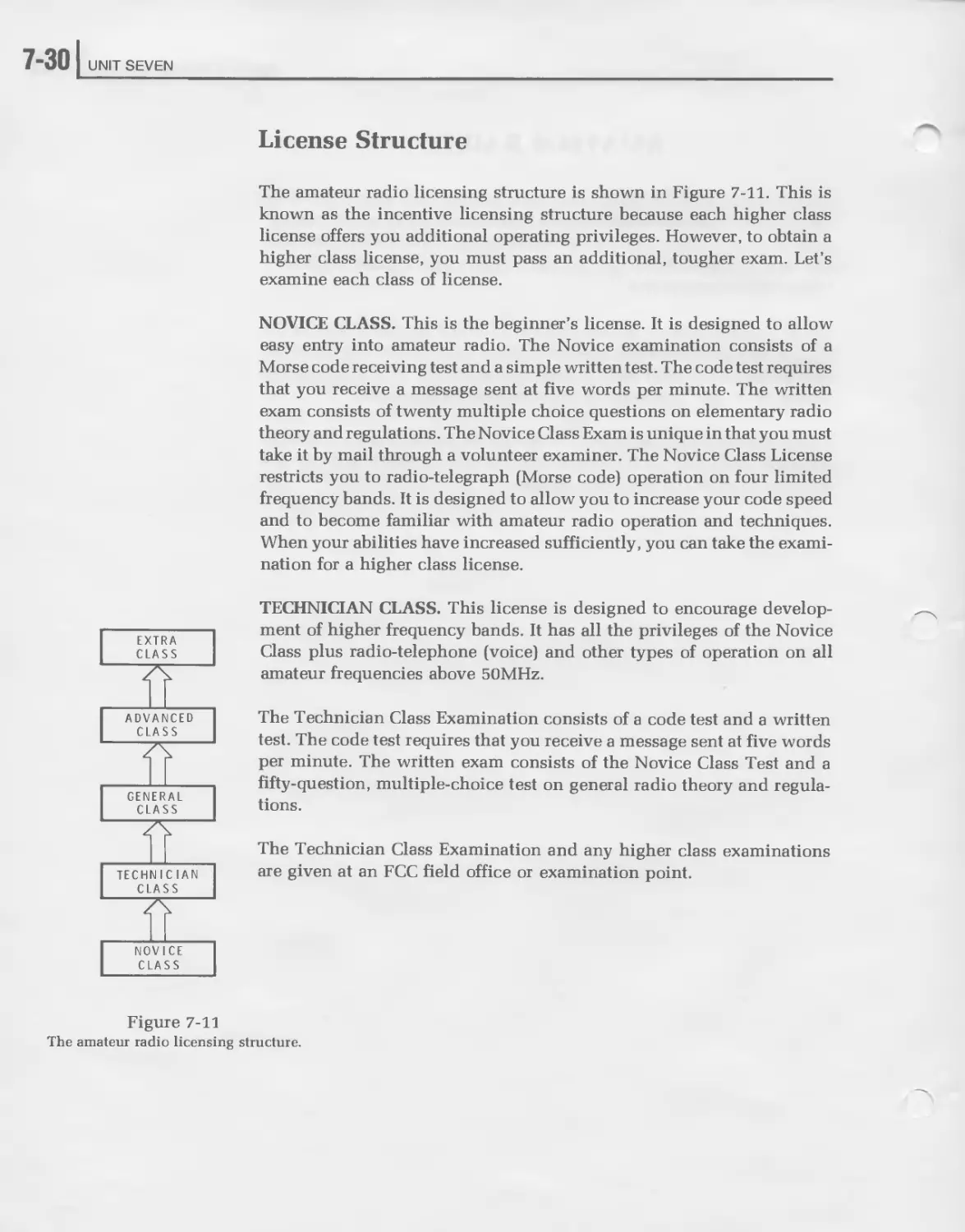
The amateur radio licensing structure is shown in Figure 7-11. This is
known as the incentive licensing structure because each higher class
license offers you additional operating privileges. However, to obtain a
higher class license, you must pass an additional, tougher exam. Let’s
examine each class of license.
NOVICE CLASS. This is the beginner’s license. It is designed to allow
easy entry into amateur radio. The Novice examination consists of a
Morse code receiving test and a simple written test. The code test requires
that you receive a message sent at five words per minute. The written
exam consists of twenty multiple choice questions on elementary radio
theory and regulations. The Novice Class Exam is unique in that you must
take it by mail through a volunteer examiner. The Novice Class License
restricts you to radio-telegraph (Morse code) operation on four limited
frequency bands. It is designed to allow you to increase your code speed
and to become familiar with amateur radio operation and techniques.
When your abilities have increased sufficiently, you can take the exami-
nation for a higher class license.
TECHNICIAN CLASS. This license is designed to encourage develop-
ment of higher frequency bands. It has all the privileges of the Novice
Class plus radio-telephone (voice) and other types of operation on all
amateur frequencies above 50MHz.
The Technician Class Examination consists of a code test and a written
test. The code test requires that you receive a message sent at five words
per minute. The written exam consists of the Novice Class Test and a
fifty-question, multiple-choice test on general radio theory and regula-
tions.
The Technician Class Examination and any higher class examinations
are given at an FCC field office or examination point.
Figure 7-11
The amateur radio licensing structure.
Survey of Electronic Hobbies
7-31
GENERAL CLASS. This license allows you to operate on portions of all
amateur frequency bands. It is truly the general license. The examination
consists of a Morse code test and a written test. The code test requires that
you receive a message sent at thirteen words per minute. The written
examination is the same as the Technician License exam.
ADVANCED AND EXTRA CLASS. These two classes of licenses offer you
additional privileges. The Advanced Class requires that you pass a thir-
teen word per minute code test. The written examination consists of the
Novice and General examinations, plus a 50 question test on Intermediate
radio theory. The Advanced License allows you to operate on additional
amateur frequencies.
The Extra Class License requires that you pass a twenty word per minute
code test. The written examination consists of the Novice, General, and
Intermediate Theory exams, plus a 50 question test on Advanced radio
techniques. This license allows you to operate on all amateur frequen-
cies.
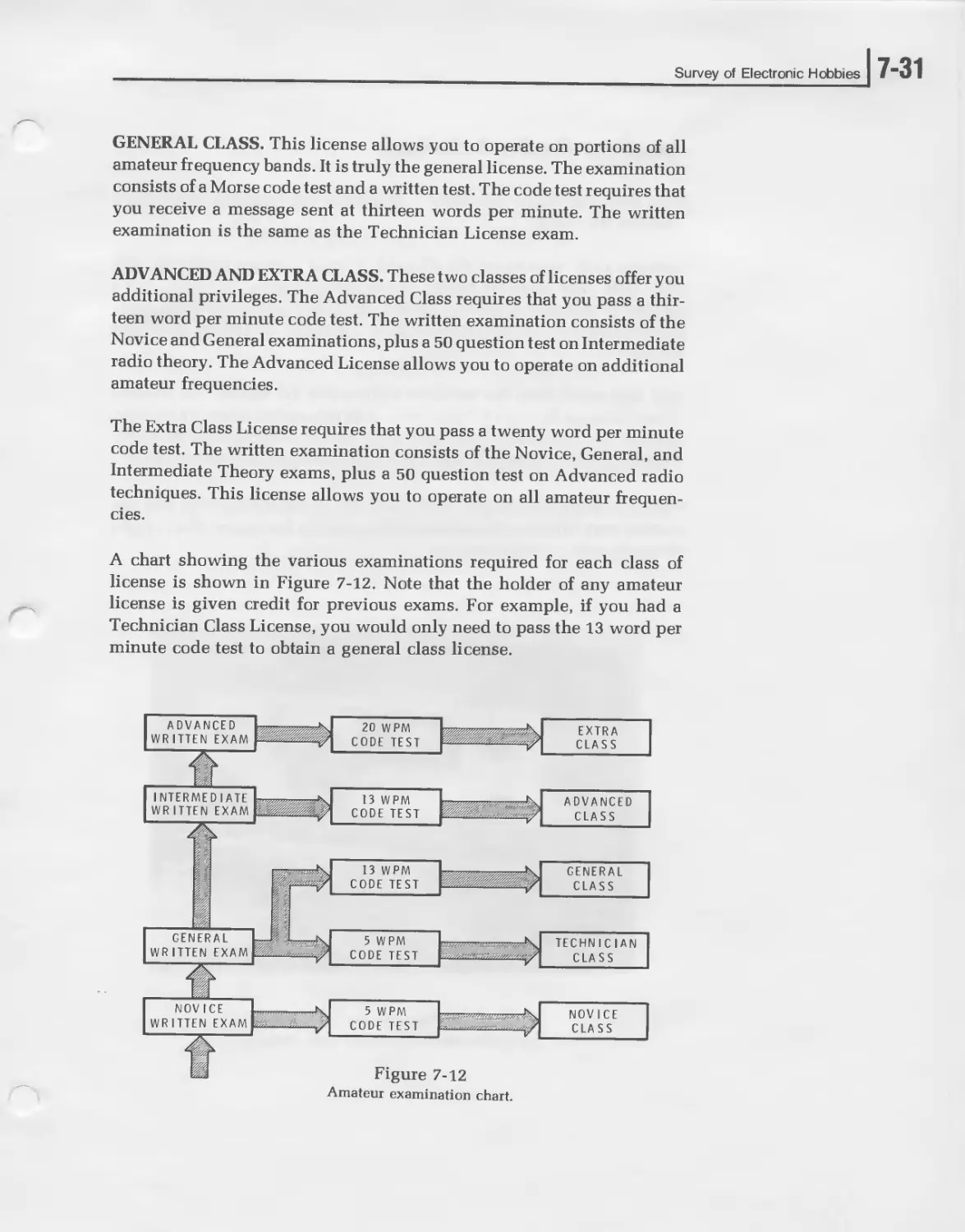
A chart showing the various examinations required for each class of
license is shown in Figure 7-12. Note that the holder of any amateur
license is given credit for previous exams. For example, if you had a
Technician Class License, you would only need to pass the 13 word per
minute code test to obtain a general class license.
ADVANCED
WRITTEN EXAM
13 WPM
CODE TEST
20 WPM
CODE TEST
13 WPM
CODE TEST
5 WPM
CODE TEST
GENERAL
WR ITTEN EXAM
NOVICE
WRITTEN EXAM^S
EXTRA
CLASS
{я,",,,,///////".''.'''/

ADVANCED
CLASS
GENERAL
CLASS
5 WPM
NOVICE
CLASS
Figure 7-12
Amateur examination chart.
TECHNICIAN
CLASS
7-32 UNIT SEVEN
Amateur Radio Activities
Now that you know the “how” of getting into amateur radio, let’s
examine the “why.”
Amateur radio operations are allowed in small portions of the MF, HF,
VHF, UHF, SHF, and EHF bands. As you can well guess, this allows for a
myriad of different activites. In fact, amateurs are involved in daily
communications on frequencies from 1.8 MHz to 10,000 mHz and
beyond.
You will recall from the previous section that HF signals can literally
travel “around the world.” Therefore, radio amateurs operating on these
frequencies can communicate with other amateurs throughout the world.
They can do this via Morse code, voice, radioteletype, or even television.
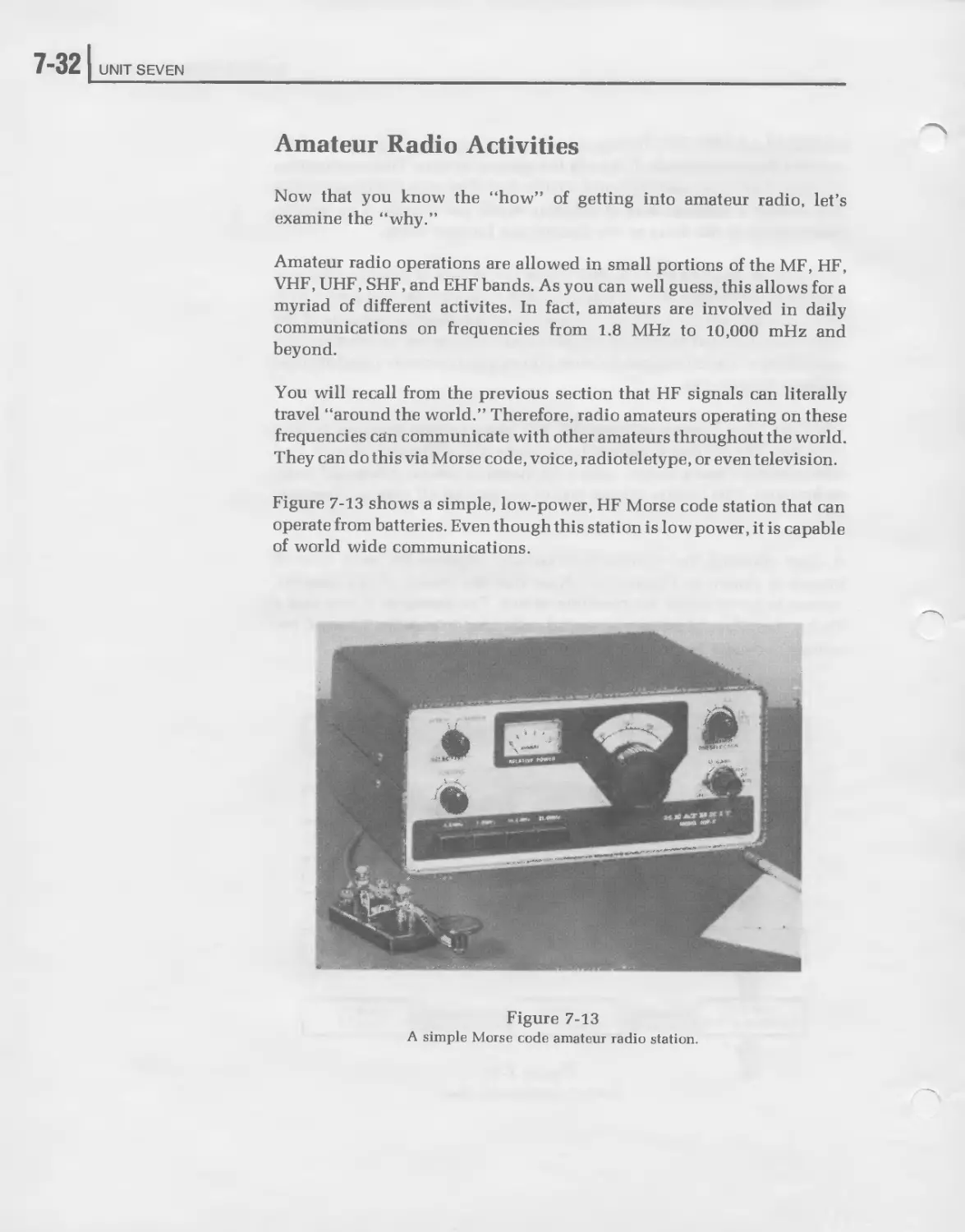
Figure 7-13 shows a simple, low-power, HF Morse code station that can
operate from batteries. Even though this station is low power, it is capable
of world wide communications.
Figure 7-13
A simple Morse code amateur radio station.
Survey of Electronic Hobbies
] 7-33
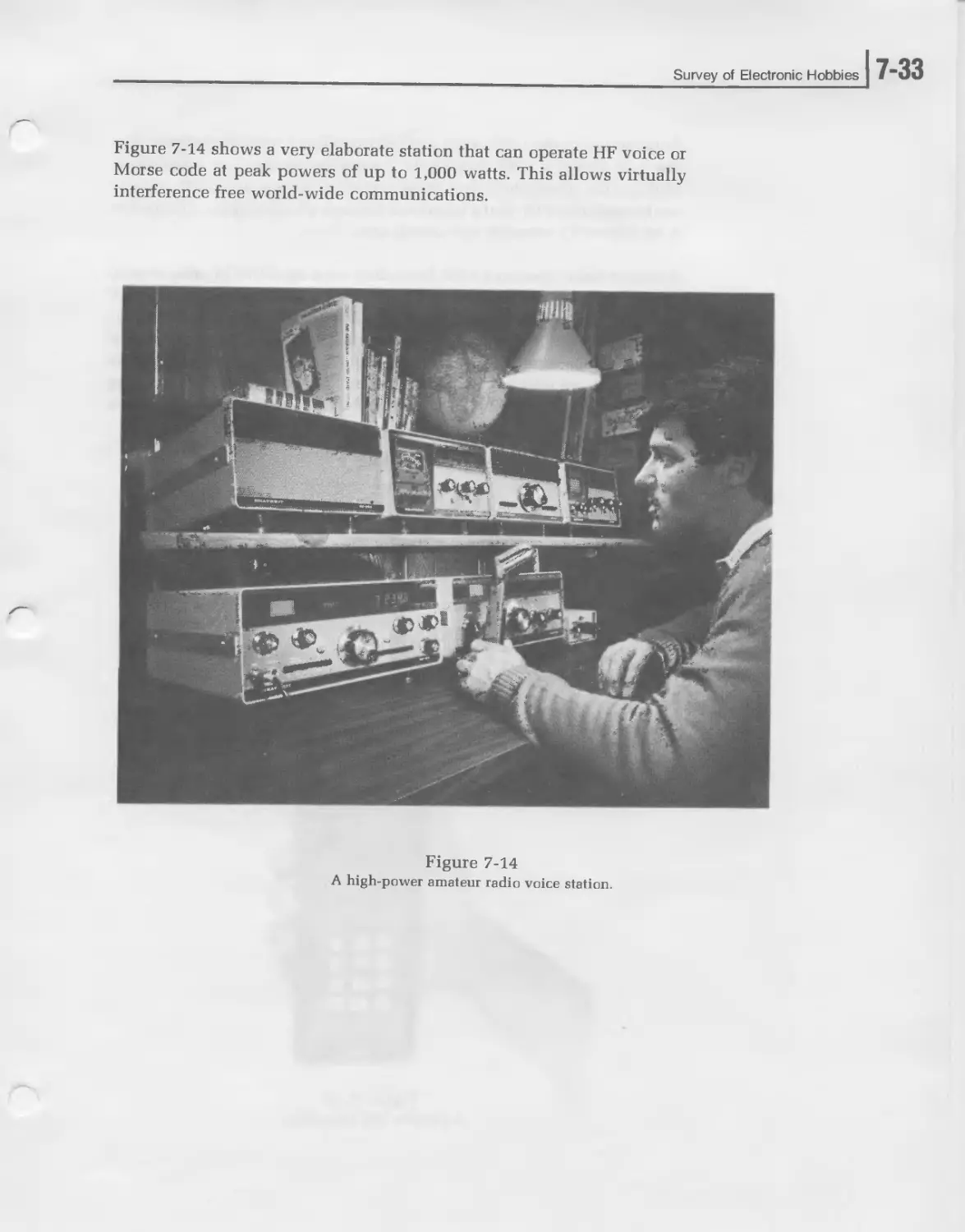
Figure 7-14 shows a very elaborate station that can operate HF voice or
Morse code at peak powers of up to 1,000 watts. This allows virtually
interference free world-wide communications.
Figure 7-14
A high-power amateur radio voice station.
7-34 UNIT SEVEN
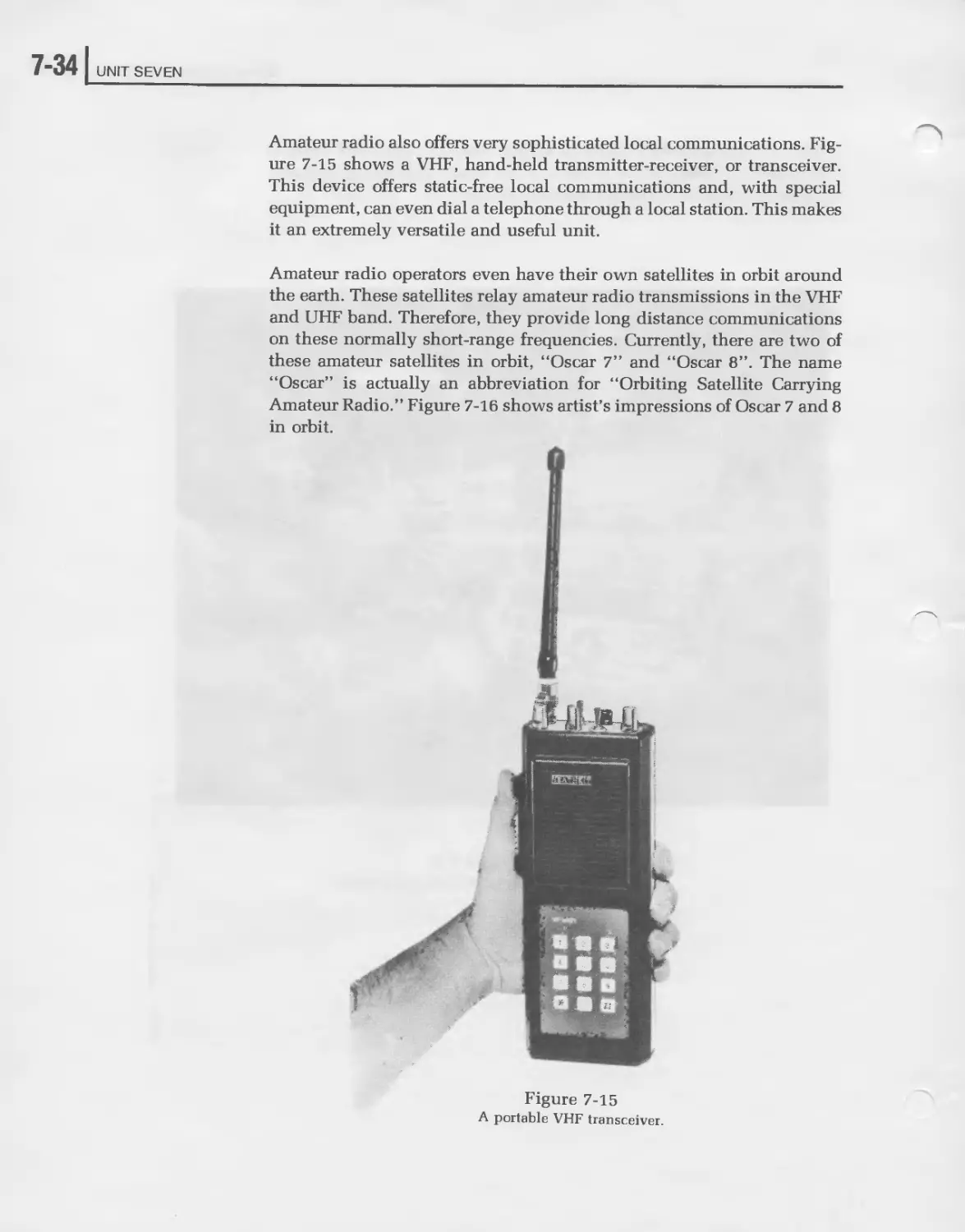
Amateur radio also offers very sophisticated local communications. Fig-
ure 7-15 shows a VHF, hand-held transmitter-receiver, or transceiver.
This device offers static-free local communications and, with special
equipment, can even dial a telephone through a local station. This makes
it an extremely versatile and useful unit.
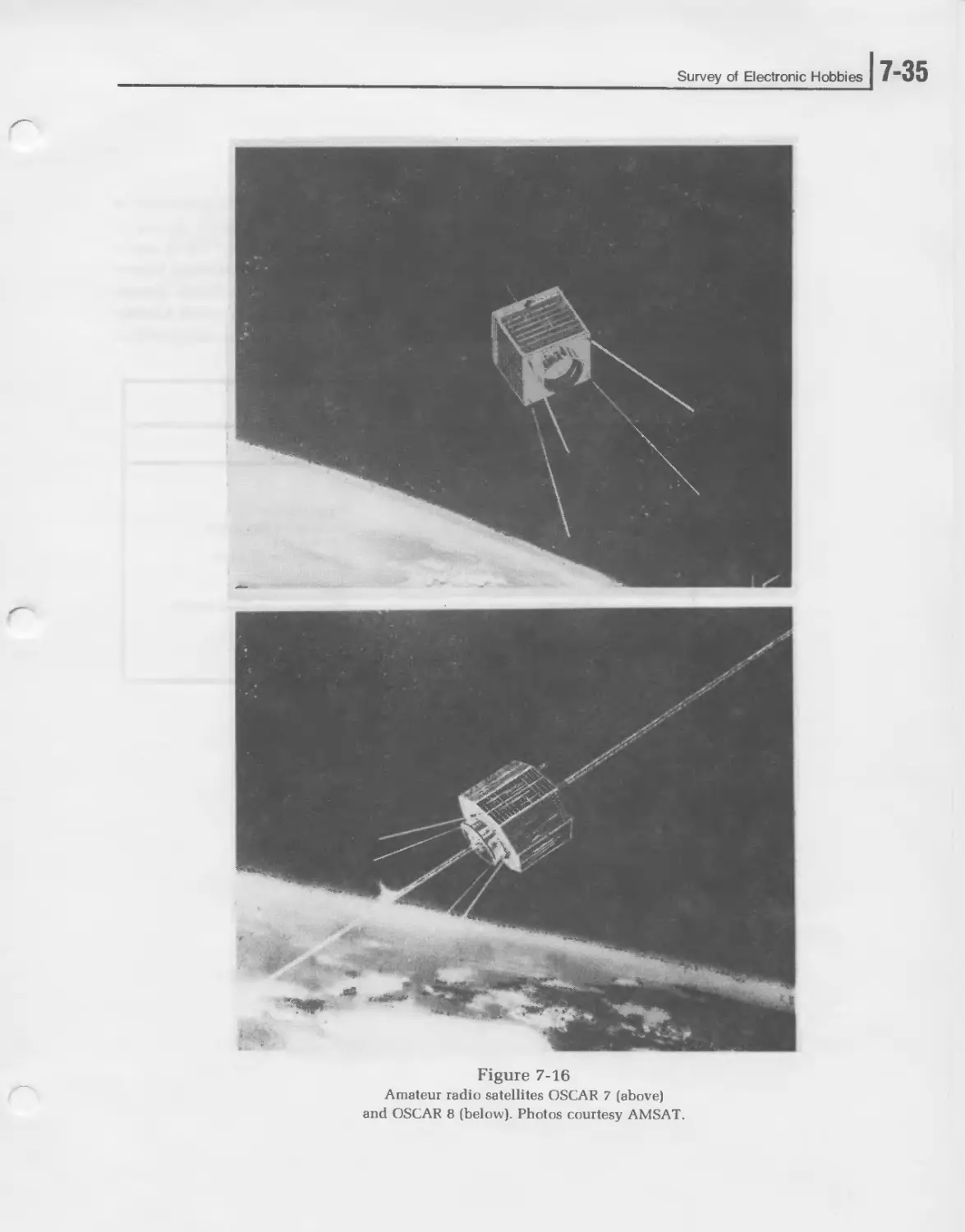
Amateur radio operators even have their own satellites in orbit around
the earth. These satellites relay amateur radio transmissions in the VHF
and UHF band. Therefore, they provide long distance communications
on these normally short-range frequencies. Currently, there are two of
these amateur satellites in orbit, “Oscar 7” and “Oscar 8”. The name
“Oscar” is actually an abbreviation for “Orbiting Satellite Carrying
Amateur Radio.” Figure 7-16 shows artist’s impressions of Oscar 7 and 8
in orbit.
Figure 7-15
A portable VHF transceiver.
Survey of Electronic Hobbies
Figure 7-16
Amateur radio satellites OSCAR 7 (above)
and OSCAR 8 (below). Photos courtesy AMSAT.
7“36 UNIT SEVEN
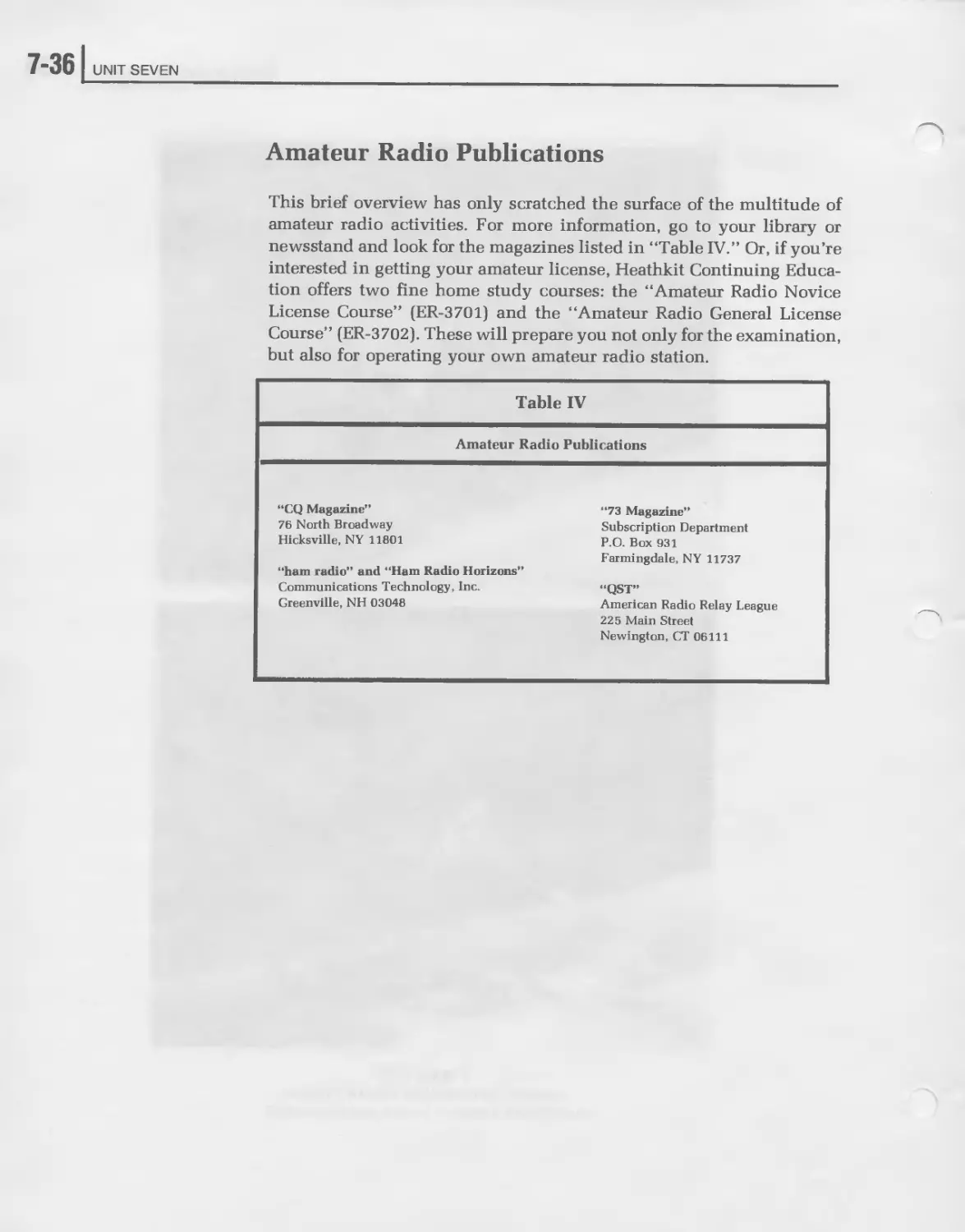
Amateur Radio Publications
This brief overview has only scratched the surface of the multitude of
amateur radio activities. For more information, go to your library or
newsstand and look for the magazines listed in “Table IV.” Or, if you’re
interested in getting your amateur license, Heathkit Continuing Educa-
tion offers two fine home study courses: the “Amateur Radio Novice
License Course” (ER-3701) and the “Amateur Radio General License
Course” (ER-3702). These will prepare you not only for the examination,
but also for operating your own amateur radio station.
Table IV
Amateur Radio Publications
“CQ Magazine”
76 North Broadway
Hicksville, NY 11801
“ham radio” and “Ham Radio Horizons”
Communications Technology, Inc.
Greenville, NH 03048
“73 Magazine”
Subscription Department
P.O. Box 931
Farmingdale, NY 11737
“QST”
American Radio Relay League
225 Main Street
Newington, CT 06111
Survey of Electronic Hobbies
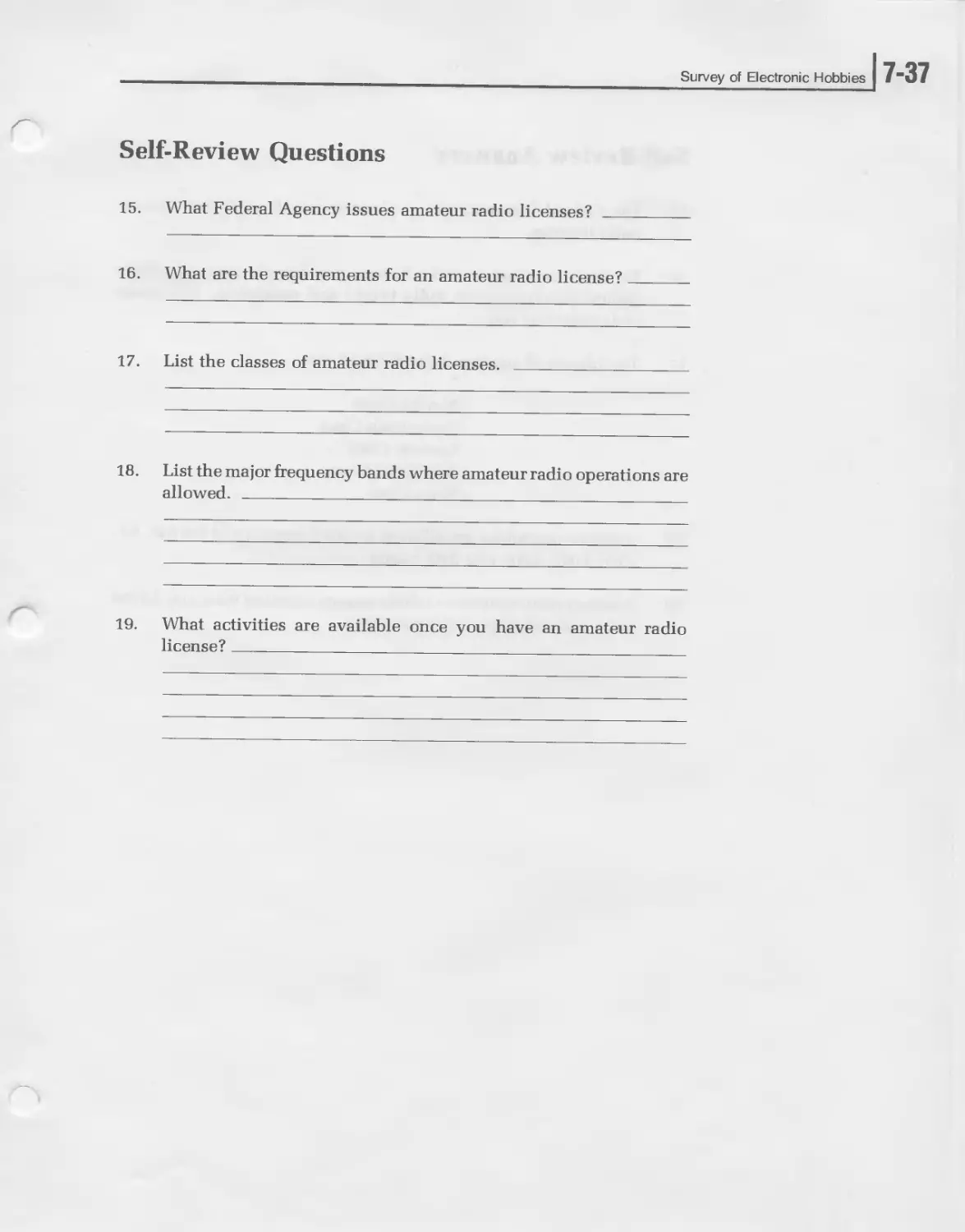
Self-Review Questions
15.	What Federal Agency issues amateur radio licenses?
16.	What are the requirements for an amateur radio license?
17.	List the classes of amateur radio licenses.
18.	List the major frequency bands where amateur radio operations are
allowed. _______________________________________________________________
19.	What activities are available once you have an amateur radio
license?________________________________________________________________
7-381 UNIT SEVEN
Self-Review Answers
15.	The Federal Communications Commission (FCC) issues amateur
radio licenses.
16.	To obtain an amateur radio license, you have to pass a multiple
choice examination on radio theory and regulations and morse
code receiving test.
17.	The classes of amateur radio licenses are :
Novice Class
Technician Class
General Class
Advanced Class
Extra Class
18.	Amateur operations are allowed in small segments of the MF, HF,
VHF, UHF, EHF, and SHF bands.
19.	Amateur radio activities include communications via voice, Morse
code, radioteletype, and television.
Survey of Electronic Hobbies
RADIO CONTROL MODELS
Radio control, or R/C, models can provide you with another interesting
electronic’s hobby. R/C models are actually scaled down versions of
real-life planes, cars, and ships. These models are capable of performing
in exactly the same way as their much larger counterparts, except that
they are controlled through a radio link.
Each model has one or more special motors, called servos, that control its
actions. These servos are connected to a radio receiver which, in turn,
gets its commands from a transmitter control unit. This allows the model
to operate without wires or lines between it and the control unit.
7-40 I UNIT SEVEN
Model Ships
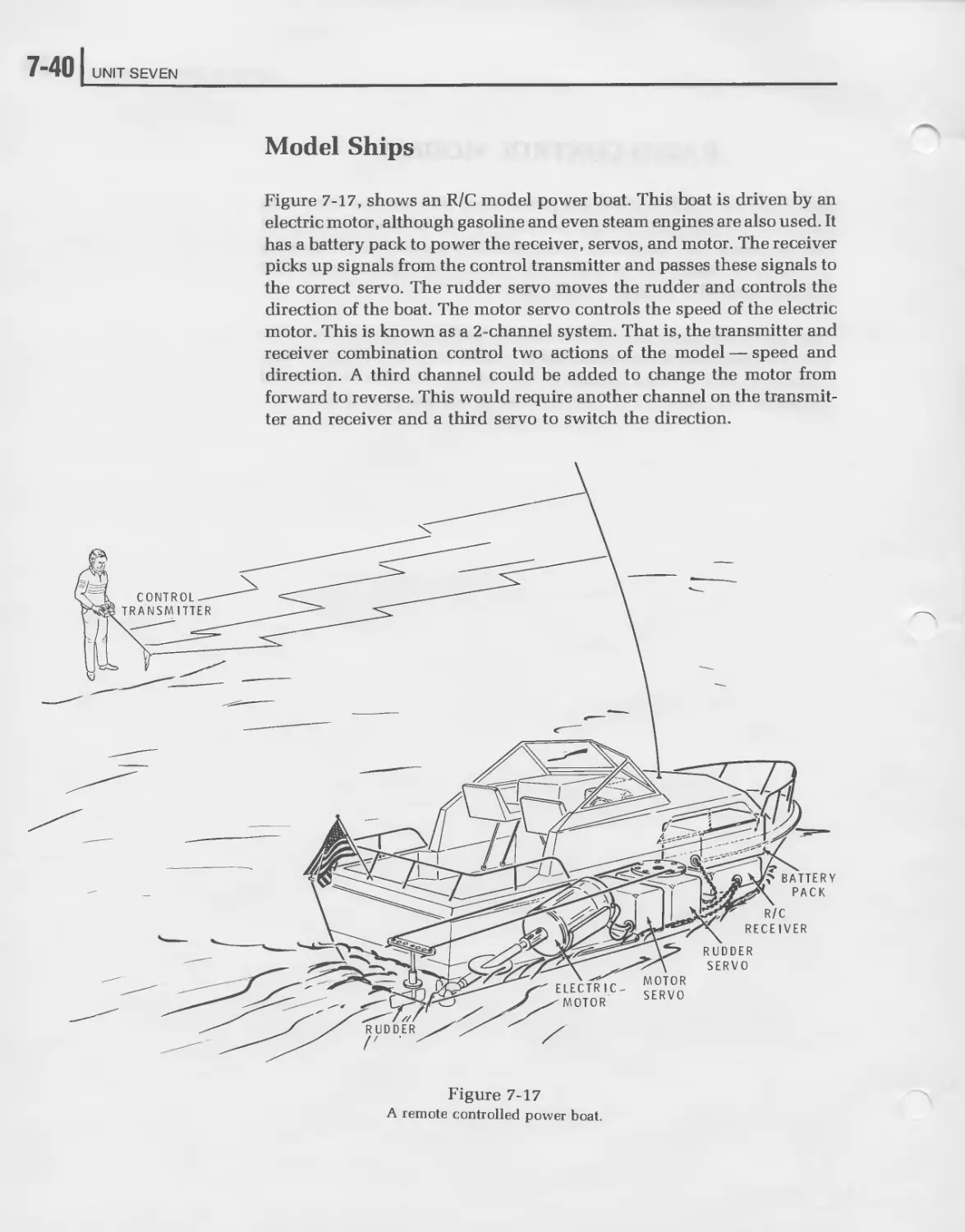
Figure 7-17, shows an R/C model power boat. This boat is driven by an
electric motor, although gasoline and even steam engines are also used. It
has a battery pack to power the receiver, servos, and motor. The receiver
picks up signals from the control transmitter and passes these signals to
the correct servo. The rudder servo moves the rudder and controls the
direction of the boat. The motor servo controls the speed of the electric
motor. This is known as a 2-channel system. That is, the transmitter and
receiver combination control two actions of the model — speed and
direction. A third channel could be added to change the motor from
forward to reverse. This would require another channel on the transmit-
ter and receiver and a third servo to switch the direction.
Figure 7-17
A remote controlled power boat.
Survey of Electronic Hobbies
] 7-41
There are many types of model ships. The boat shown in Figure 7-17 is an
electric-powered inboard. It could also be gasoline or steam powered
with slight modification. “Outboard” engines are also available. This is
where the motor mounts on the outside of the boat. In these cases, the
motor is shaped just like a “real life” outboard marine engine.
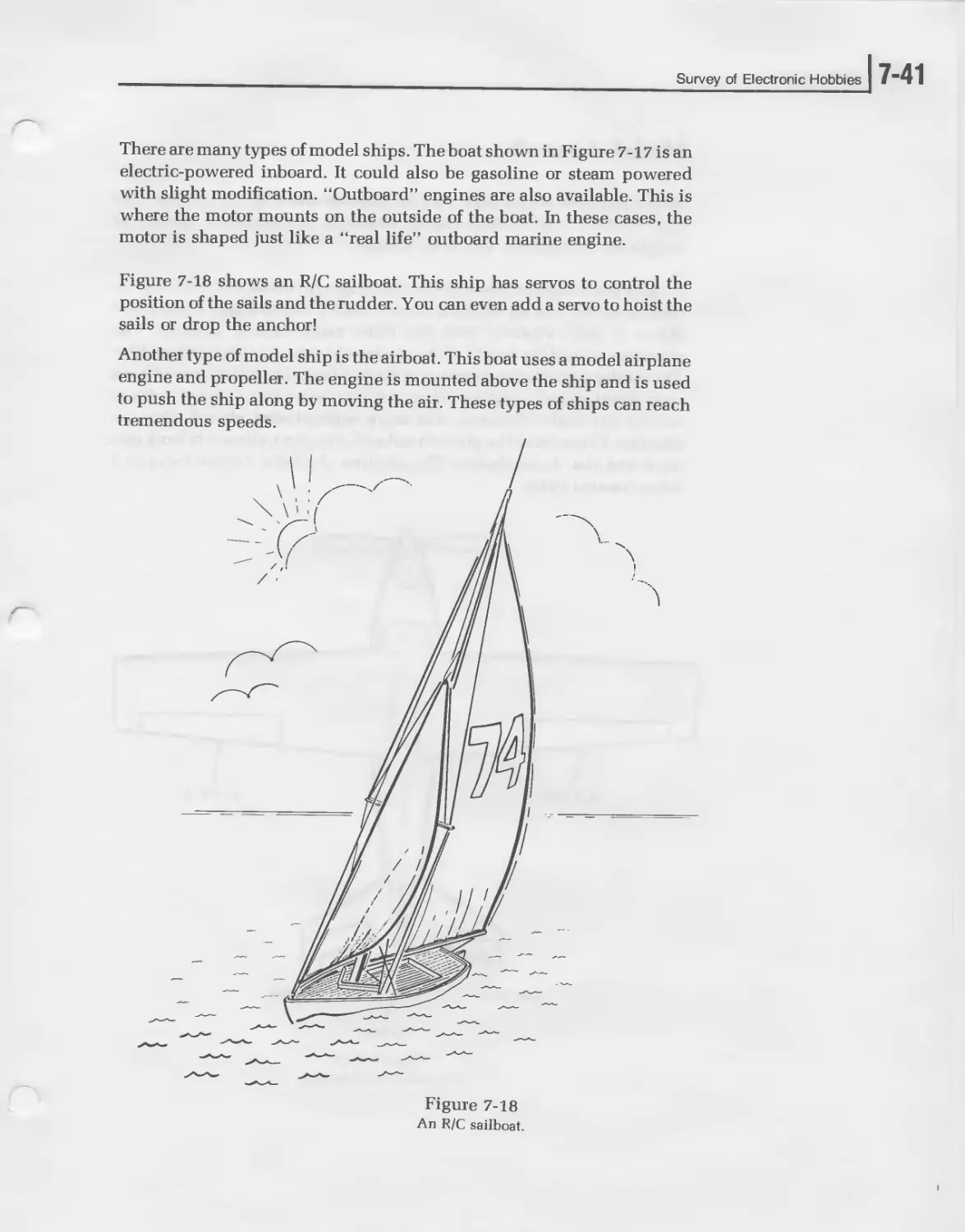
Figure 7-18 shows an R/C sailboat. This ship has servos to control the
position of the sails and the rudder. You can even add a servo to hoist the
sails or drop the anchor!
Another type of model ship is the airboat. This boat uses a model airplane
engine and propeller. The engine is mounted above the ship and is used
to push the ship along by moving the aii. These types of ships can reach
tremendous speeds.
Figure 7-18
An R/C sailboat.
7-42 UNIT SEVEN
Model Aircraft
Model airplanes are perhaps the most popular area of R/C modeling. This
area includes one to four-engine airplanes, jet airplanes, gliders or
sailplanes, helicopters, and even blimps.
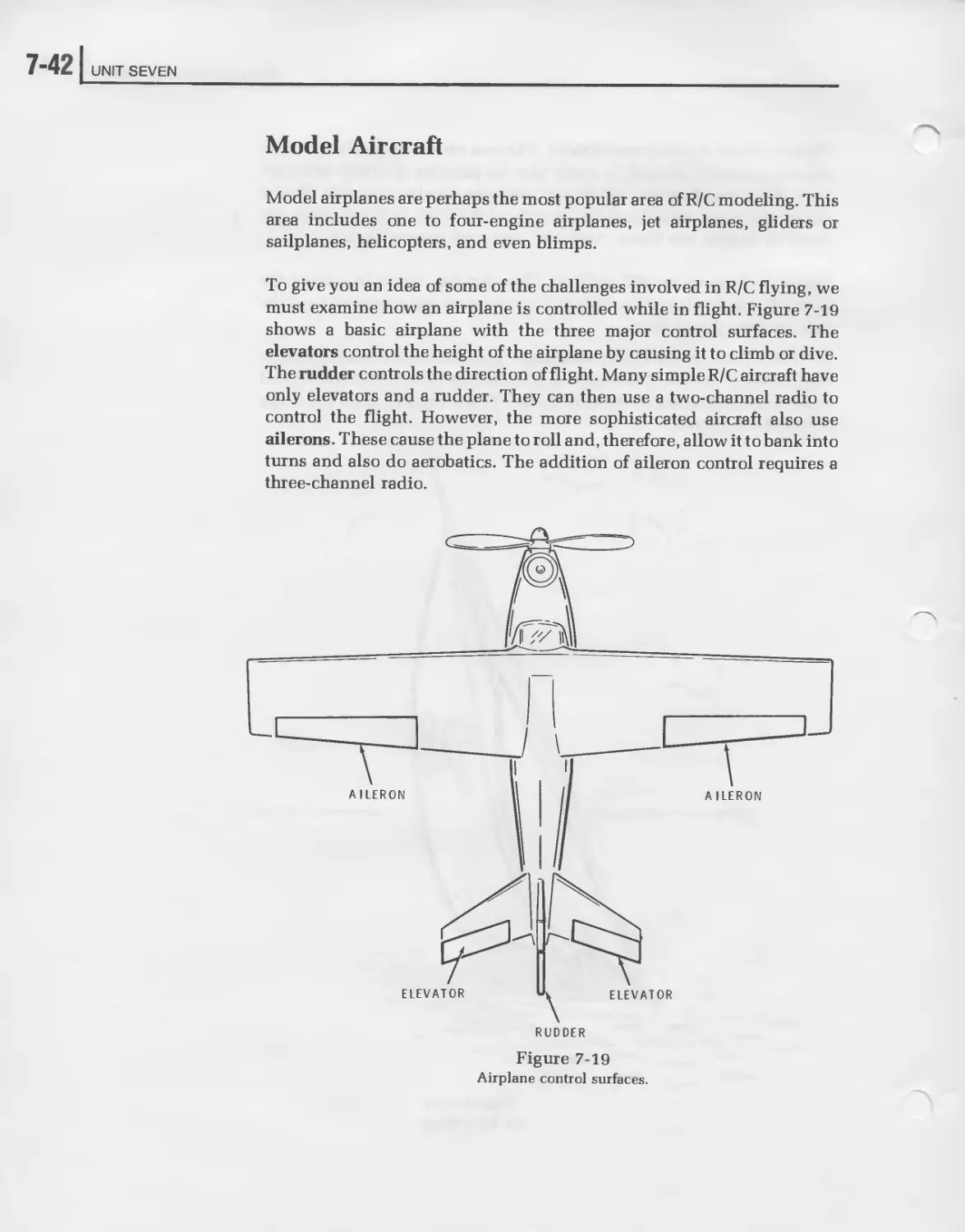
To give you an idea of some of the challenges involved in R/C flying, we
must examine how an airplane is controlled while in flight. Figure 7-19
shows a basic airplane with the three major control surfaces. The
elevators control the height of the airplane by causing it to climb or dive.
The rudder controls the direction of flight. Many simple R/C aircraft have
only elevators and a rudder. They can then use a two-channel radio to
control the flight. However, the more sophisticated aircraft also use
ailerons. These cause the plane to roll and, therefore, allow it to bank into
turns and also do aerobatics. The addition of aileron control requires a
three-channel radio.
Figure 7-19
Airplane control surfaces.
Survey of Electronic Hobbies
] 7-43
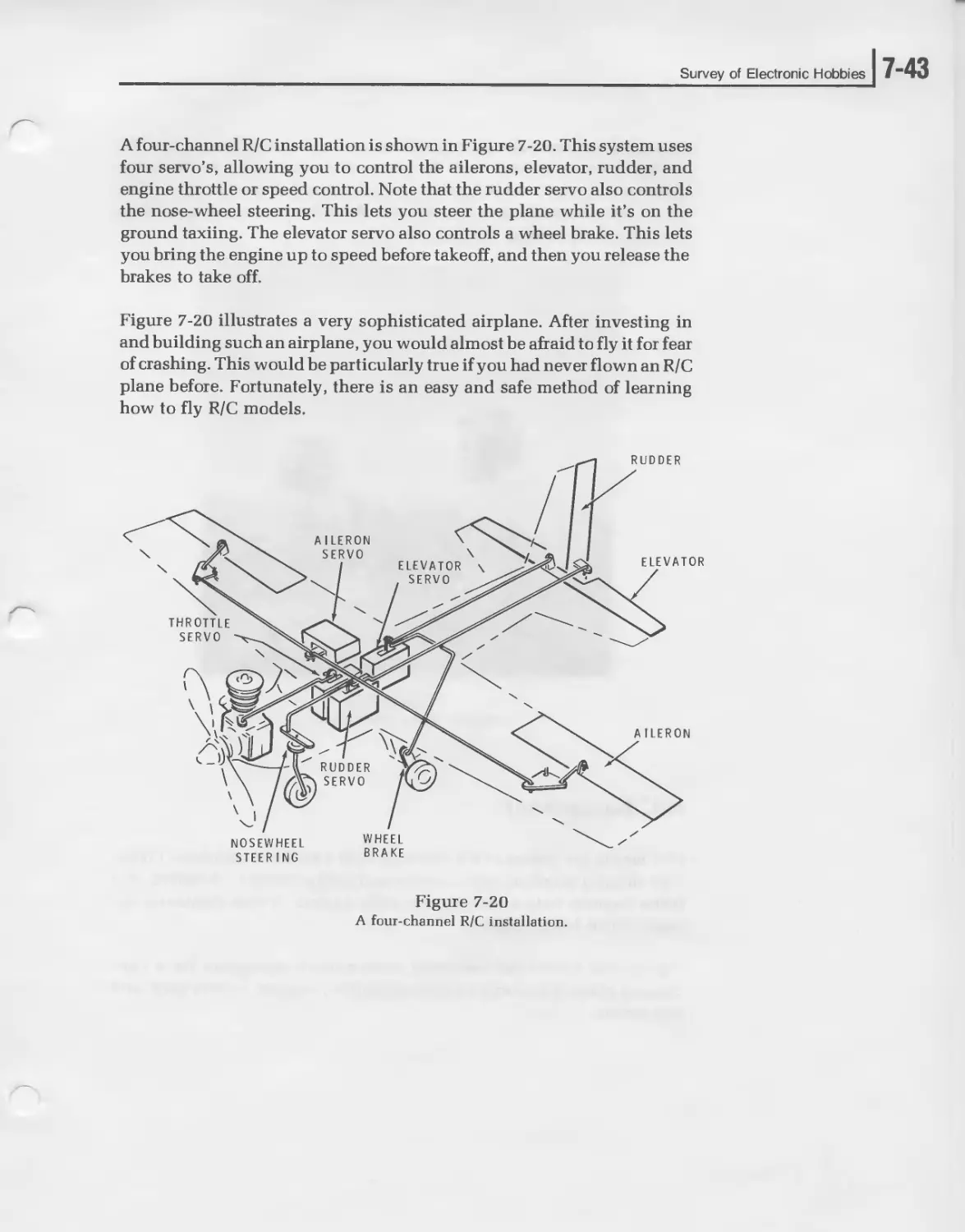
A four-channel R/C installation is shown in Figure 7-20. This system uses
four servo’s, allowing you to control the ailerons, elevator, rudder, and
engine throttle or speed control. Note that the rudder servo also controls
the nose-wheel steering. This lets you steer the plane while it’s on the
ground taxiing. The elevator servo also controls a wheel brake. This lets
you bring the engine up to speed before takeoff, and then you release the
brakes to take off.
Figure 7-20 illustrates a very sophisticated airplane. After investing in
and building such an airplane, you would almost be afraid to fly it for fear
of crashing. This would be particularly true if you had never flown an R/C
plane before. Fortunately, there is an easy and safe method of learning
how to fly R/C models.
Figure 7-20
A four-channel R/C installation.
7-44 UNIT SEVEN
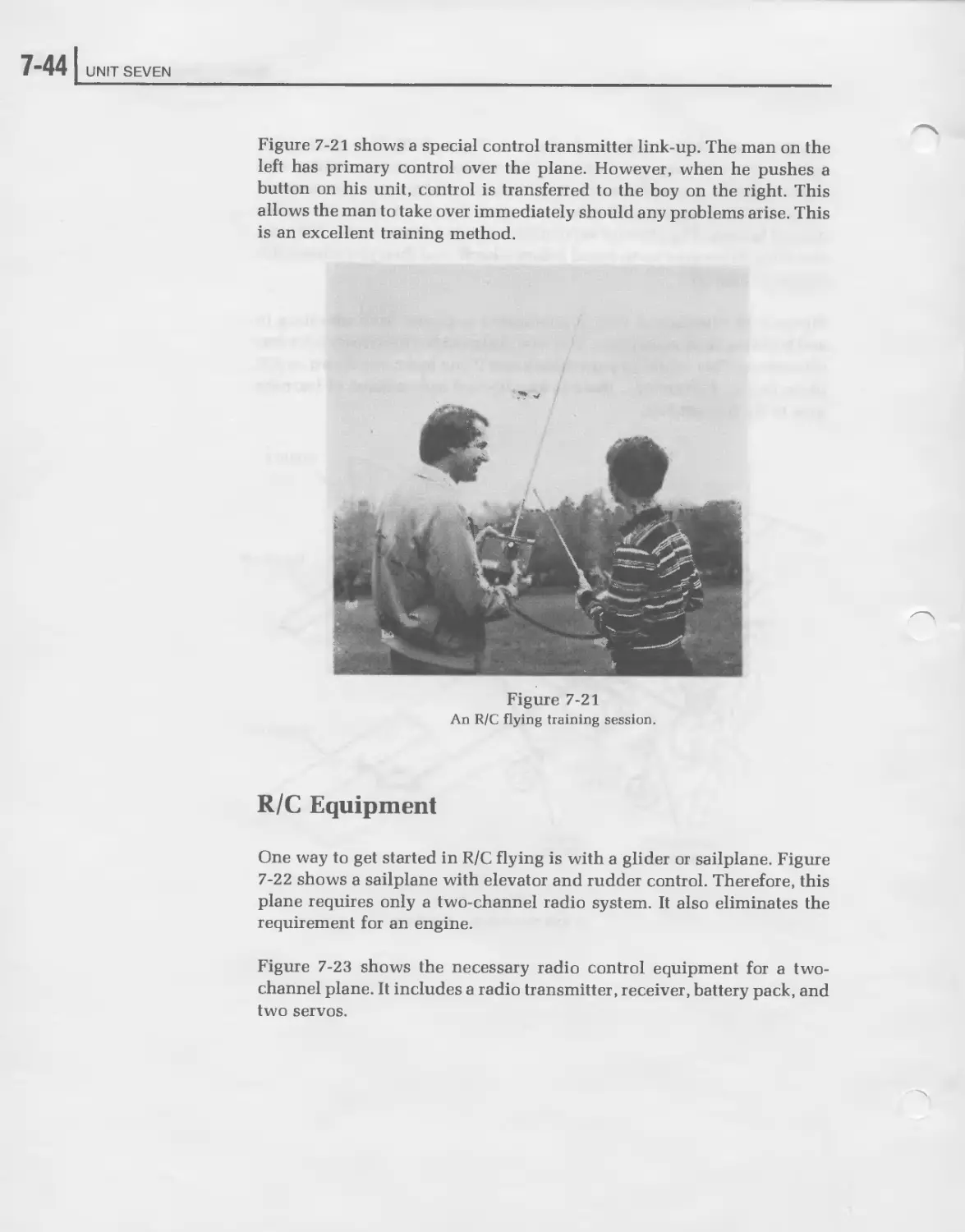
Figure 7-21 shows a special control transmitter link-up. The man on the
left has primary control over the plane. However, when he pushes a
button on his unit, control is transferred to the boy on the right. This
allows the man to take over immediately should any problems arise. This
is an excellent training method.
Figure 7-21
An R/C flying training session.
R/C Equipment
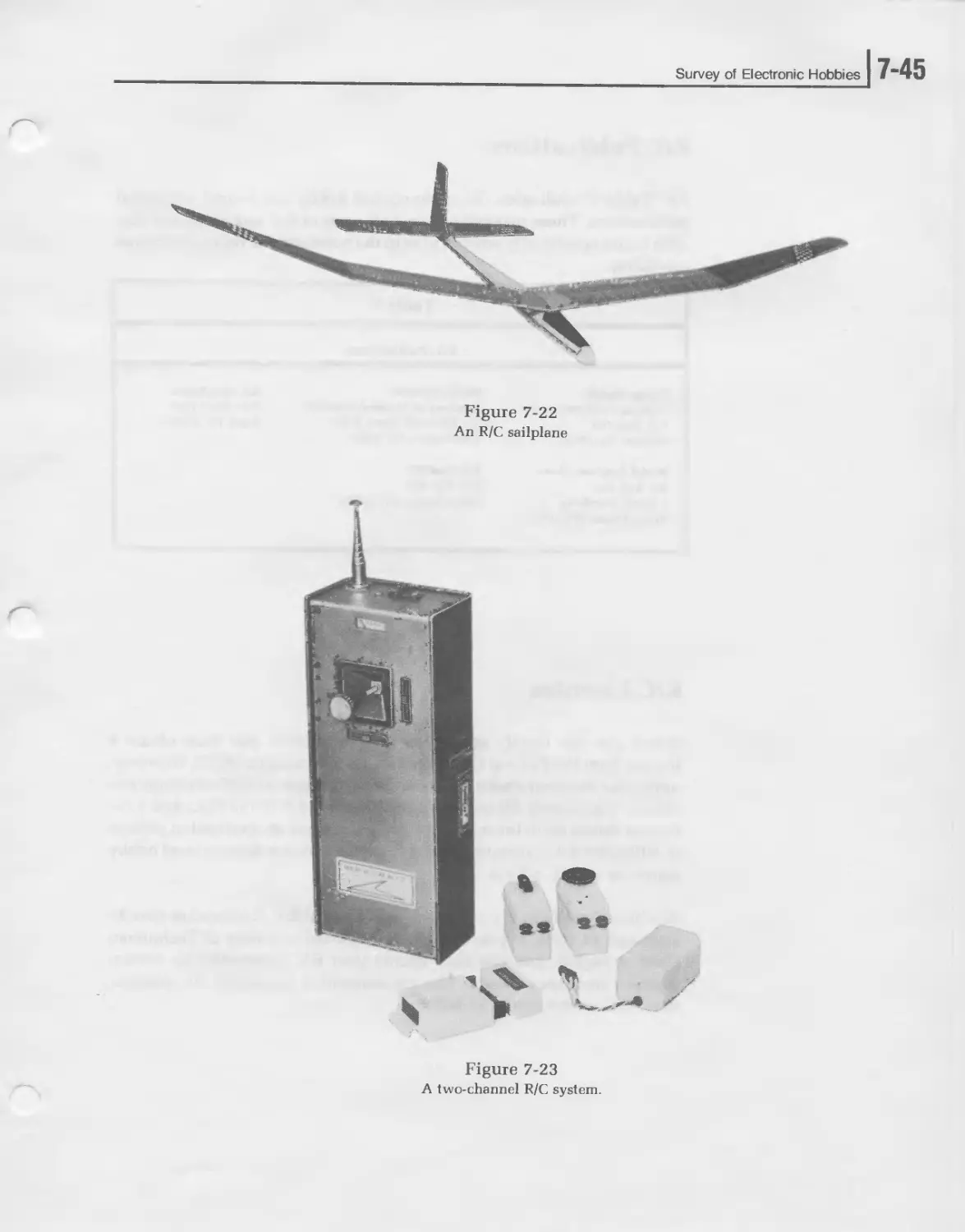
One way to get started in R/C flying is with a glider or sailplane. Figure
7-22 shows a sailplane with elevator and rudder control. Therefore, this
plane requires only a two-channel radio system. It also eliminates the
requirement for an engine.
Figure 7-23 shows the necessary radio control equipment for a two-
channel plane. It includes a radio transmitter, receiver, battery pack, and
two servos.
Survey of Electronic Hobbies
] 7-45
Figure 7-22
An R/C sailplane
Figure 7-23
A two-channel R/C system.
7-46 UNIT SEVEN
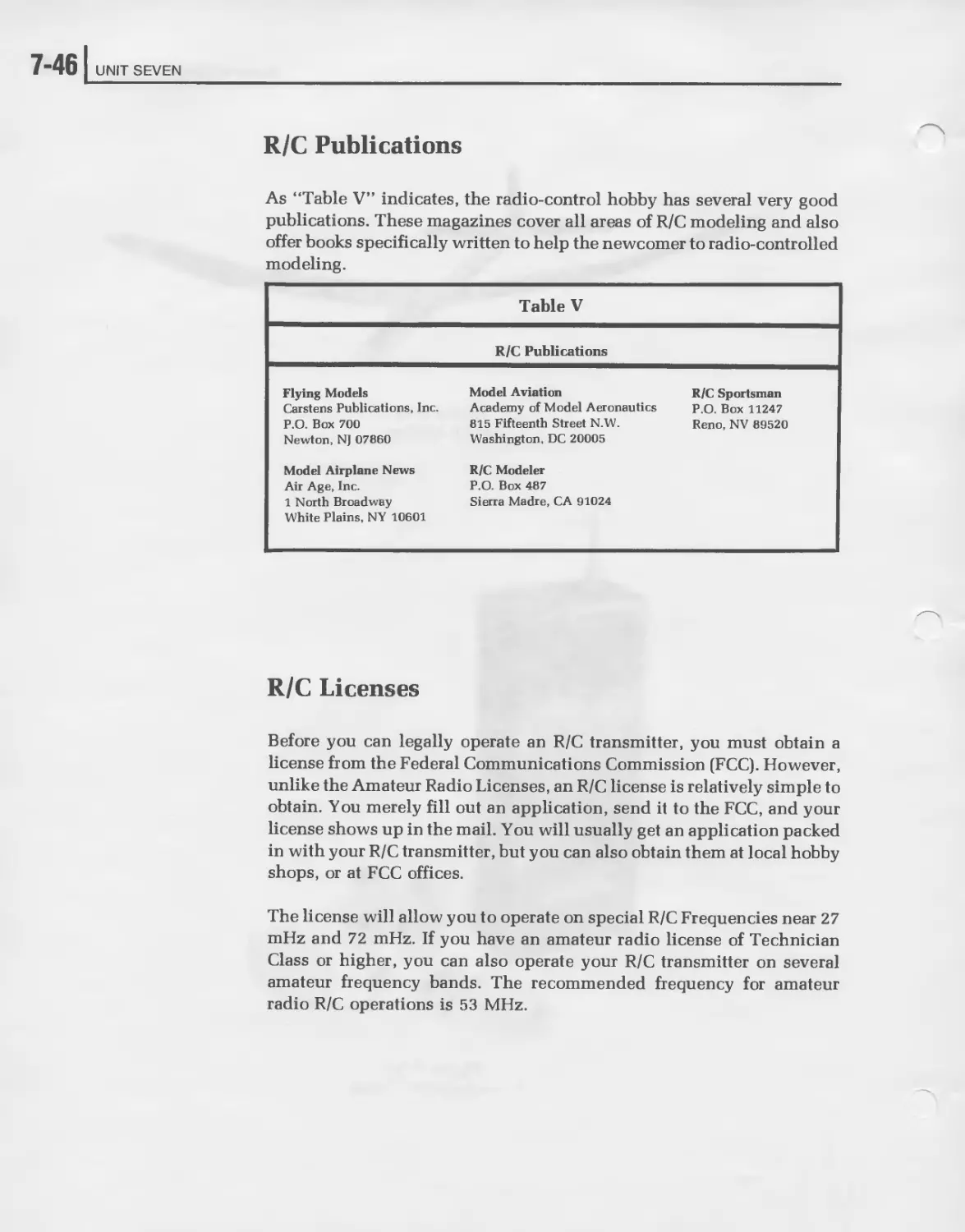
R/C Publications
As “Table V” indicates, the radio-control hobby has several very good
publications. These magazines cover all areas of R/C modeling and also
offer books specifically written to help the newcomer to radio-controlled
modeling.
Table V
R/C Publications
Flying Models	Model Aviation	R/C Sportsman
Carstens Publications, Inc.	Academy of Model Aeronautics	P.O. Box 11247
P.O. Box 700	815 Fifteenth Street N.W.	Reno, NV 89520
Newton, NJ 07860	Washington, DC 20005
Model Airplane News	R/C Modeler
Air Age, Inc.	P.O. Box 487
1 North Broadway	Sierra Madre, CA 91024
White Plains, NY 10601
R/C Licenses
Before you can legally operate an R/C transmitter, you must obtain a
license from the Federal Communications Commission (FCC). However,
unlike the Amateur Radio Licenses, an R/C license is relatively simple to
obtain. You merely fill out an application, send it to the FCC, and your
license shows up in the mail. You will usually get an application packed
in with your R/C transmitter, but you can also obtain them at local hobby
shops, or at FCC offices.
The license will allow you to operate on special R/C Frequencies near 27
mHz and 72 mHz. If you have an amateur radio license of Technician
Class or higher, you can also operate your R/C transmitter on several
amateur frequency bands. The recommended frequency for amateur
radio R/C operations is 53 MHz.
Survey of Electronic Hobbies
Self-Review Questions
20.	A motor used to control the actions of an R/C model is called a
21.	An R/C boat that is capable of speed and directional control re-
quires at least a-channel R/C system.
22.	Name at least two types of R/C model ships.
23.	Name the three major control surfaces of an airplane and describe
what action each surface controls.
24.	What R/C equipment is required for a two-channel airplane?
25.	Before operating an R/C transmitter, you must obtain a
__________________________from the_______________________________________
7-48 UNIT SEVEN
Self-Review Answers
20.	A motor used to control the actions of an R/C model is called a
servo.
21.	An R/C boat that is capable of speed and directional control re-
quires at least a two-channel R/C system.
22.	The types of model ships are:
inboard and outboard power boats,
sailboats, and
airboats.
23.	The three major control surfaces of an airplane are the elevator, the
rudder, and the ailerons. The elevator controls height by making
the plane dive or climb. The rudder controls the airplanes direction
by steering it, just as in a boat. The ailerons control roll movements
to allow banked turns and aerobatics.
24.	A two-channel airplane requires a control transmitter, a receiver
with a battery pack, and two servos.
25.	Before operating an R/C transmitter, you must obtain a license from
the Federal Communications Commission (FCC).
Survey of Electronic Hobbies
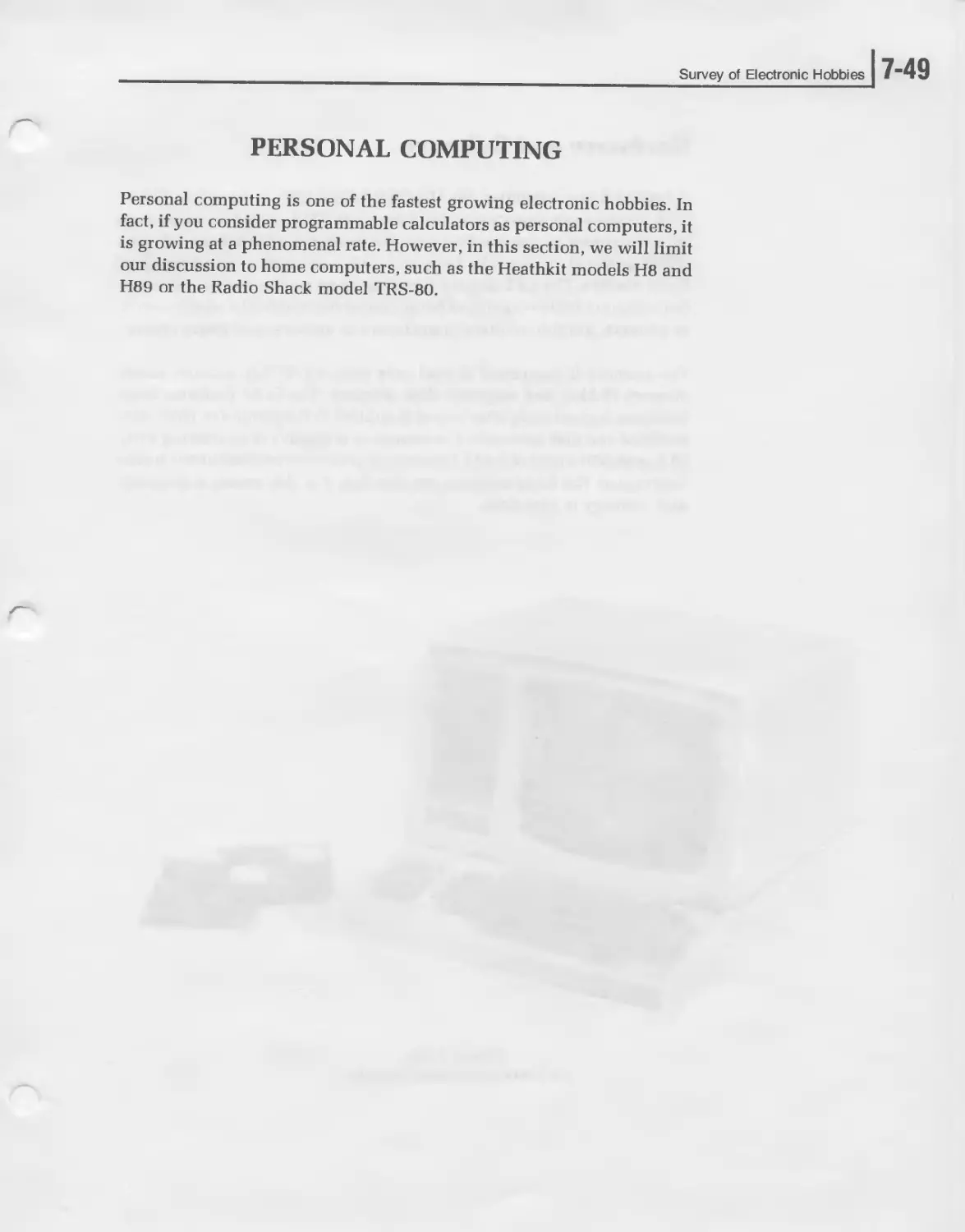
PERSONAL COMPUTING
Personal computing is one of the fastest growing electronic hobbies. In
fact, if you consider programmable calculators as personal computers, it
is growing at a phenomenal rate. However, in this section, we will limit
our discussion to home computers, such as the Heathkit models H8 and
H89 or the Radio Shack model TRS-80.
7-50 UNIT SEVEN
Hardware and Software
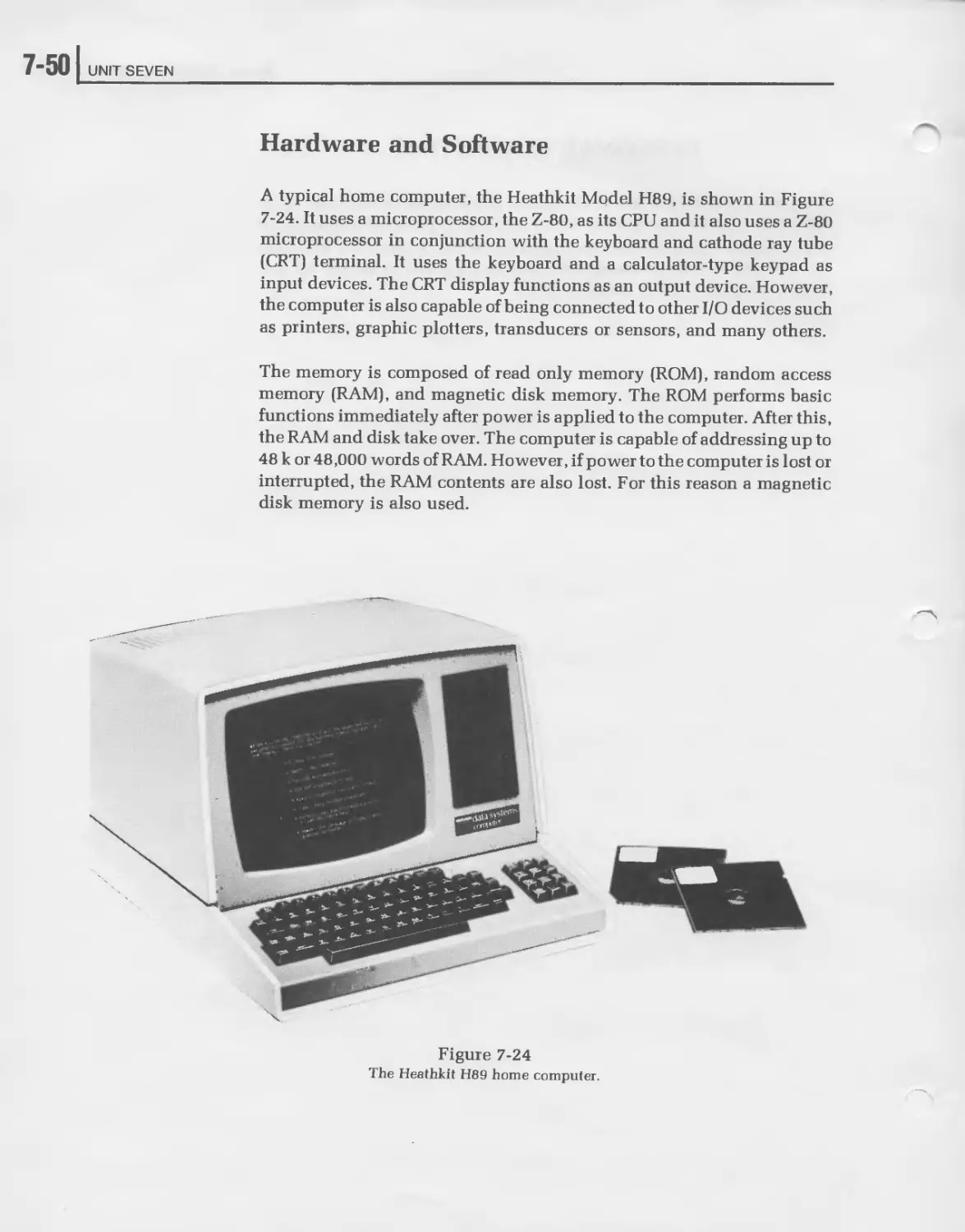
A typical home computer, the Heathkit Model H89, is shown in Figure
7-24. It uses a microprocessor, the Z-80, as its CPU and it also uses a Z-80
microprocessor in conjunction with the keyboard and cathode ray tube
(CRT) terminal. It uses the keyboard and a calculator-type keypad as
input devices. The CRT display functions as an output device. However,
the computer is also capable of being connected to other I/O devices such
as printers, graphic plotters, transducers or sensors, and many others.
The memory is composed of read only memory (ROM), random access
memory (RAM), and magnetic disk memory. The ROM performs basic
functions immediately after power is applied to the computer. After this,
the RAM and disk take over. The computer is capable of addressing up to
48 к or 48,000 words of RAM. However, if power to the computer is lost or
interrupted, the RAM contents are also lost. For this reason a magnetic
disk memory is also used.
Figure 7-24
The Heathkit H89 home computer.
Survey of Electronic Hobbies
7-51
The square magnetic “records” shown in Figure 7-24 are called floppy
disks. These disks are placed into the small door to the right of the CRT
display. This is called the disk drive unit. This unit records data on the
disks by magnetizing very small areas. This is similar to audio tape
recording; however, material stored on a disk can be found much quicker
than material stored on a long tape. Once the disk is magnetized it will
store the data indefinitely. Therefore, it is a long term storage medium. In
many ways the disk is also used as an I/O device since it can load
programs or data as well as be used as a working memory.
The software, or programs, for the computer can come from many
sources. For example, you can write programs yourself and enter them
through the keyboard. Another way is to buy prerecorded disks with the
software already developed and debugged. This is a very convenient way
to acquire a software library.
Activities and Applications
The applications and activities for your home computer are limited only
by your imagination. One popular application is computer games. These
games range from tic-tac-toe to high level chess. There have also been
many games developed strictly for computers. Among them are several
complex and engrossing games such as Star Trek or Star Wars.
There are many other applications for home computers such as account-
ing and budgeting, as well as other business applications. With some
specialized peripheral devices you can even control home heating and
lighting. The applications are virtually limitless and many are just wait-
ing to be discovered and implemented.
7-52 I UNIT SEVEN
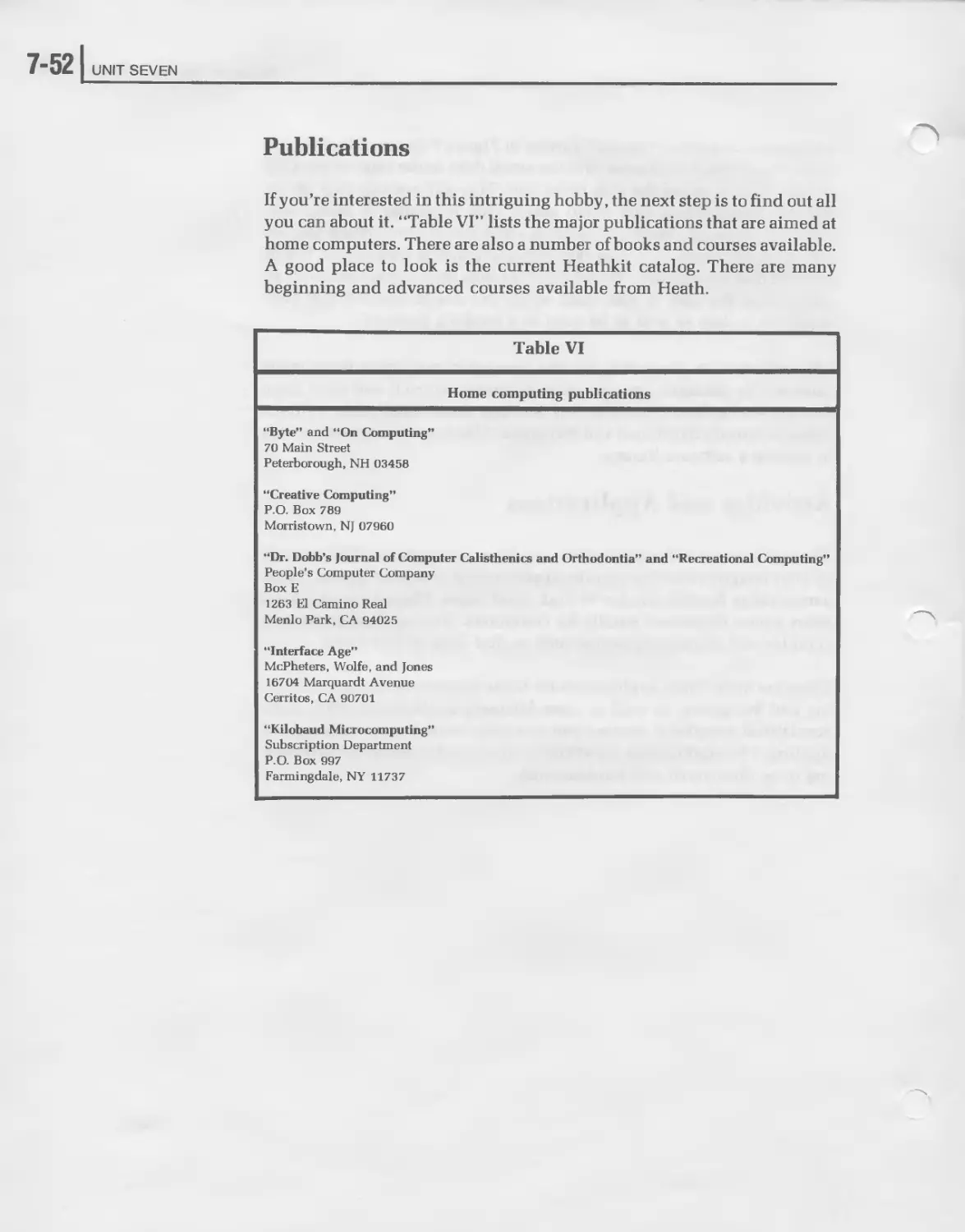
Publications
If you’re interested in this intriguing hobby, the next step is to find out all
you can about it. “Table VI” lists the major publications that are aimed at
home computers. There are also a number of books and courses available.
A good place to look is the current Heathkit catalog. There are many
beginning and advanced courses available from Heath.
Table VI
Home computing publications
“Byte” and “On Computing”
70 Main Street
Peterborough, NH 03458
“Creative Computing”
P.O. Box 789
Morristown, NJ 07960
“Dr. Dobb’s Journal of Computer Calisthenics and Orthodontia” and “Recreational Computing”
People’s Computer Company
Box E
1263 El Camino Real
Menlo Park, CA 94025
“Interface Age”
McPheters, Wolfe, and Jones
16704 Marquardt Avenue
Cerritos, CA 90701
“Kilobaud Microcomputing”
Subscription Department
P.O. Box 997
Farmingdale, NY 11737
Survey of Electronic Hobbies
] 7-53
Self-Review Questions
26.	Most home computers use a as the CPU.
27.	What I/O devices are part of the home computer of Figure 7-24?
28.	What types of memory are used with the home computer of Figure
7-24?
29.	List some of the applications for a home computer.
7-54 I UNIT SEVEN
Self-Review Answers
26.	Most home computers use a microprocessor as the CPU.
27.	The I/O devices are the keyboard and CRT terminal, and the disk.
28.	There are three types of memory used in the home computer of
Figure 7-24: ROM, RAM, and disk.
29.	Some of the applications for a home computer are:
Games
Record Keeping
Control Functions
Solving Math Problems
etc.
Survey of Electronic Hobbies
] 7-55
HIGH FIDELITY AUDIO
Audio refers to the reproduction of those frequencies audible to the
human ear, namely 20 Hz to 20,000 Hz. High Fidelity refers to the
exactness with which the audio is reproduced. That is, the reproduced
sound or audio must be a true replica of the original. Therefore, a high
fidelity audio system must be capable of duplicating the original sound
exactly, whether it is a bird call or a musical arrangement.
In practice, such a degree of perfection cannot be achieved. However,
many audio systems come very close to this ideal, and certainly close
enough to satisfy the “imperfect” human ear. This section is a brief
introduction to the high fidelity audio field.
7-56 UNIT SEVEN
Audio Equipment
There are two types of audio systems. One is the compact unit that
contains all you want in an audio system. The other is the component
system where each item is a separate unit. The compact unit usually
contains a record turntable and/or a cassette tape recorder/player, an
AM/FM radio tuner, and an audio amplifier. This is all housed in one
compact cabinet. The speakers are then connected to the unit. The advan-
tages of this method are a savings in space and usually a cost savings over
a component system.
On the other hand, a component audio system is an absolute must for the
audio “purist.” This allows him to use highly specialized (and therefore,
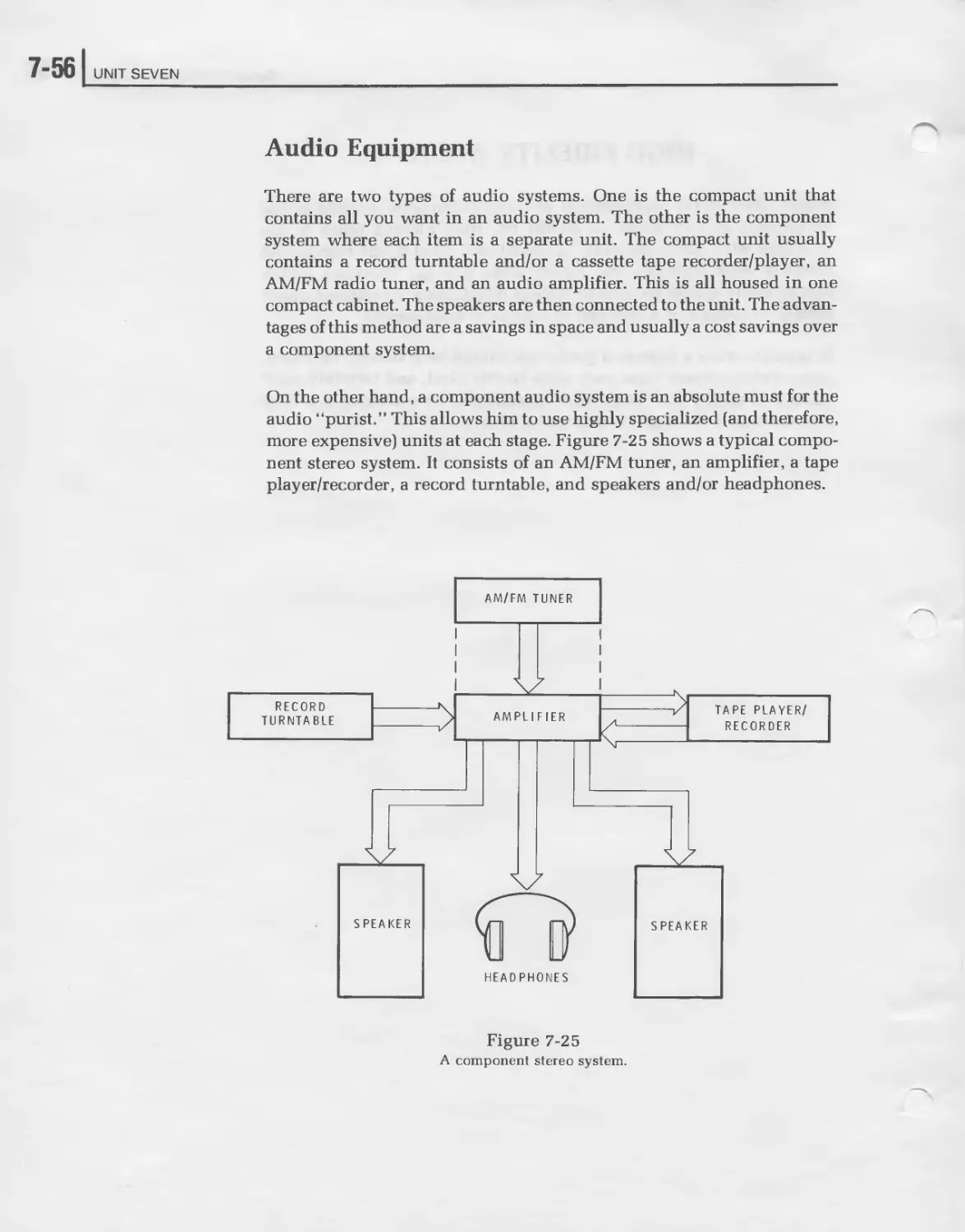
more expensive) units at each stage. Figure 7-25 shows a typical compo-
nent stereo system. It consists of an AM/FM tuner, an amplifier, a tape
player/recorder, a record turntable, and speakers and/or headphones.
Figure 7-25
A component stereo system.
Survey of Electronic Hobbies
The tuner receives AM or FM signals, recovers the original audio signal
with a minimum of distortion, and passes the signal on to the amplifier.
The amplifier then increases the audio amplitude enough to drive the
speakers.
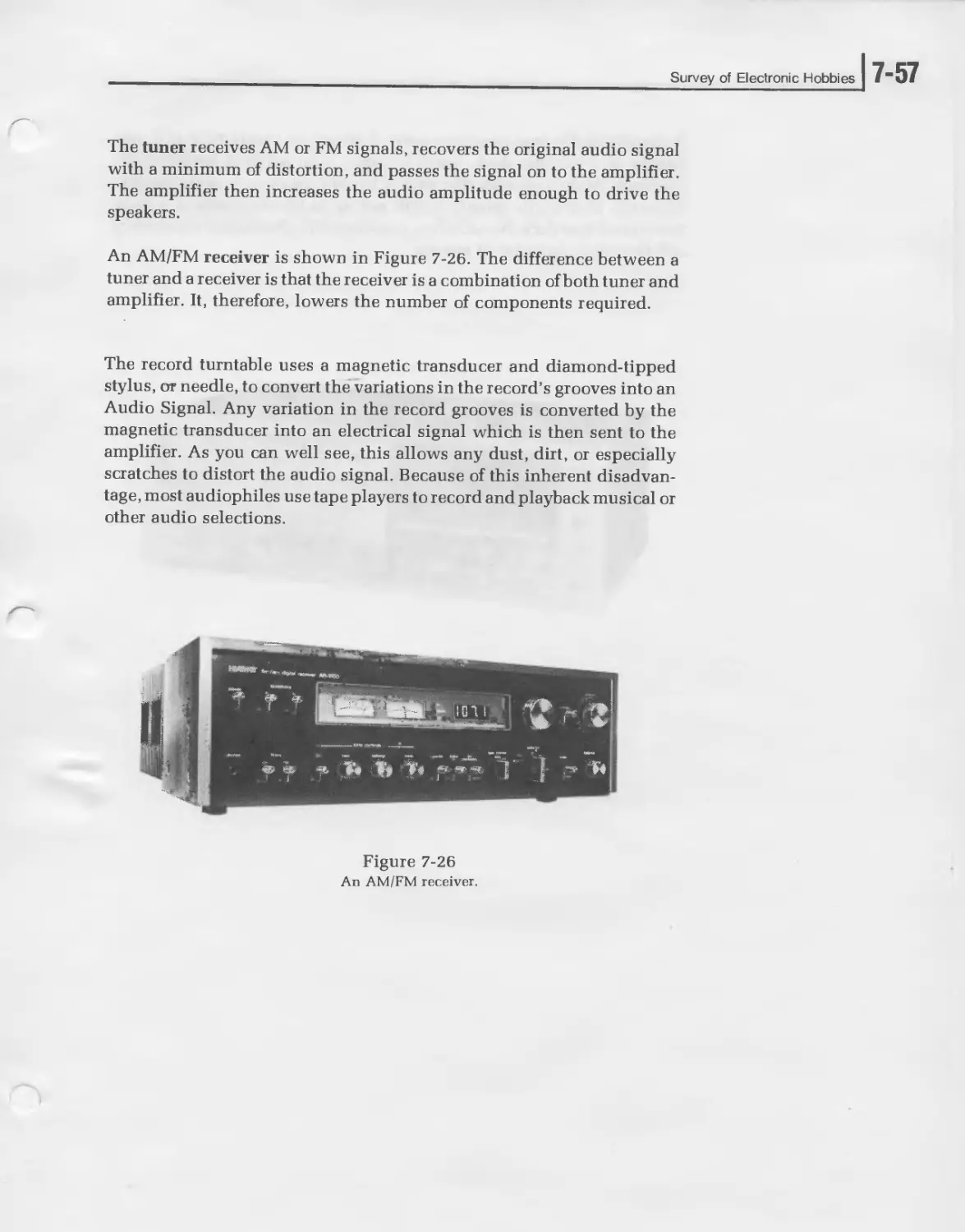
An AM/FM receiver is shown in Figure 7-26. The difference between a
tuner and a receiver is that the receiver is a combination of both tuner and
amplifier. It, therefore, lowers the number of components required.
The record turntable uses a magnetic transducer and diamond-tipped
stylus, or needle, to convert the variations in the record’s grooves into an
Audio Signal. Any variation in the record grooves is converted by the
magnetic transducer into an electrical signal which is then sent to the
amplifier. As you can well see, this allows any dust, dirt, or especially
scratches to distort the audio signal. Because of this inherent disadvan-
tage, most audiophiles use tape players to record and playback musical or
other audio selections.
Figure 7-26
An AM/FM receiver.
7-58 UNIT SEVEN
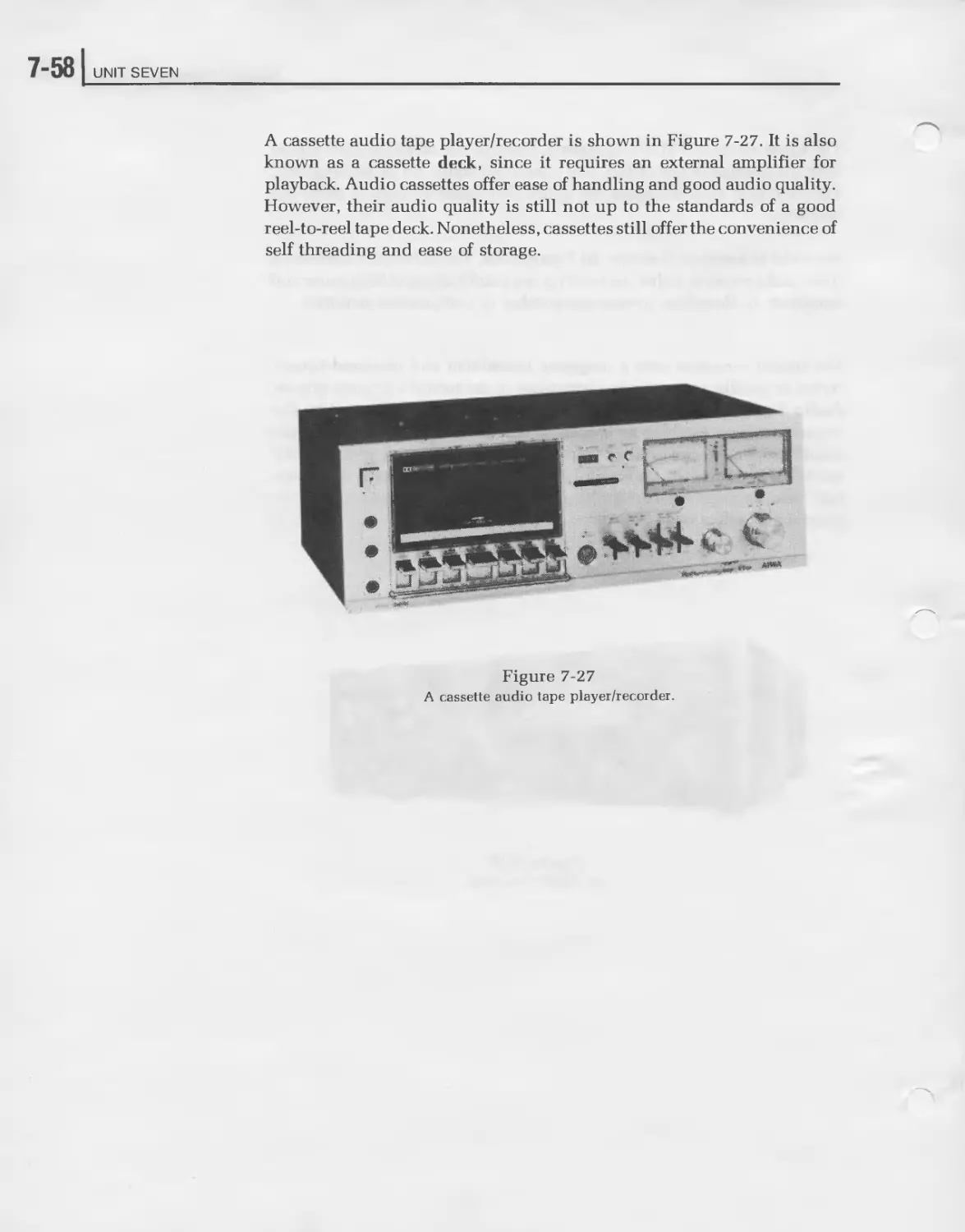
A cassette audio tape player/recorder is shown in Figure 7-27. It is also
known as a cassette deck, since it requires an external amplifier for
playback. Audio cassettes offer ease of handling and good audio quality.
However, their audio quality is still not up to the standards of a good
reel-to-reel tape deck. Nonetheless, cassettes still offer the convenience of
self threading and ease of storage.
Figure 7-27
A cassette audio tape player/recorder.
Survey of Electronic Hobbies
]7-59
Last, but certainly not least, come the speakers. These devices change the
electrical signal into sound waves. For this reason, most audio purists
believe that the speakers are the single most important component in the
audio system. Figure 7-28 shows three different types of speakers. Figure
7-28A is a basic unit with a large speaker, or woofer, and small speaker, or
tweeter. The woofer is designed to reproduce the low audio frequencies,
while the tweeter handles the high frequencies. Within the speaker is a
special crossover network. This electrical circuit routes the low frequen-
cies to the woofer and the high frequencies to the tweeter.
Figure 7-28B offers an improvement on the basic speaker. It includes a
special mid-range speaker, as well as the usual woofer and tweeter. This
is said to improve the sound quality. Figure 7-28C is a large speaker
system designed primarily for power. The horn-shaped speaker on top is
a high frequency driver and the other speaker is a woofer.
Figure 7-28
Three types of speakers.
7-601 UNIT SEVEN
Publications
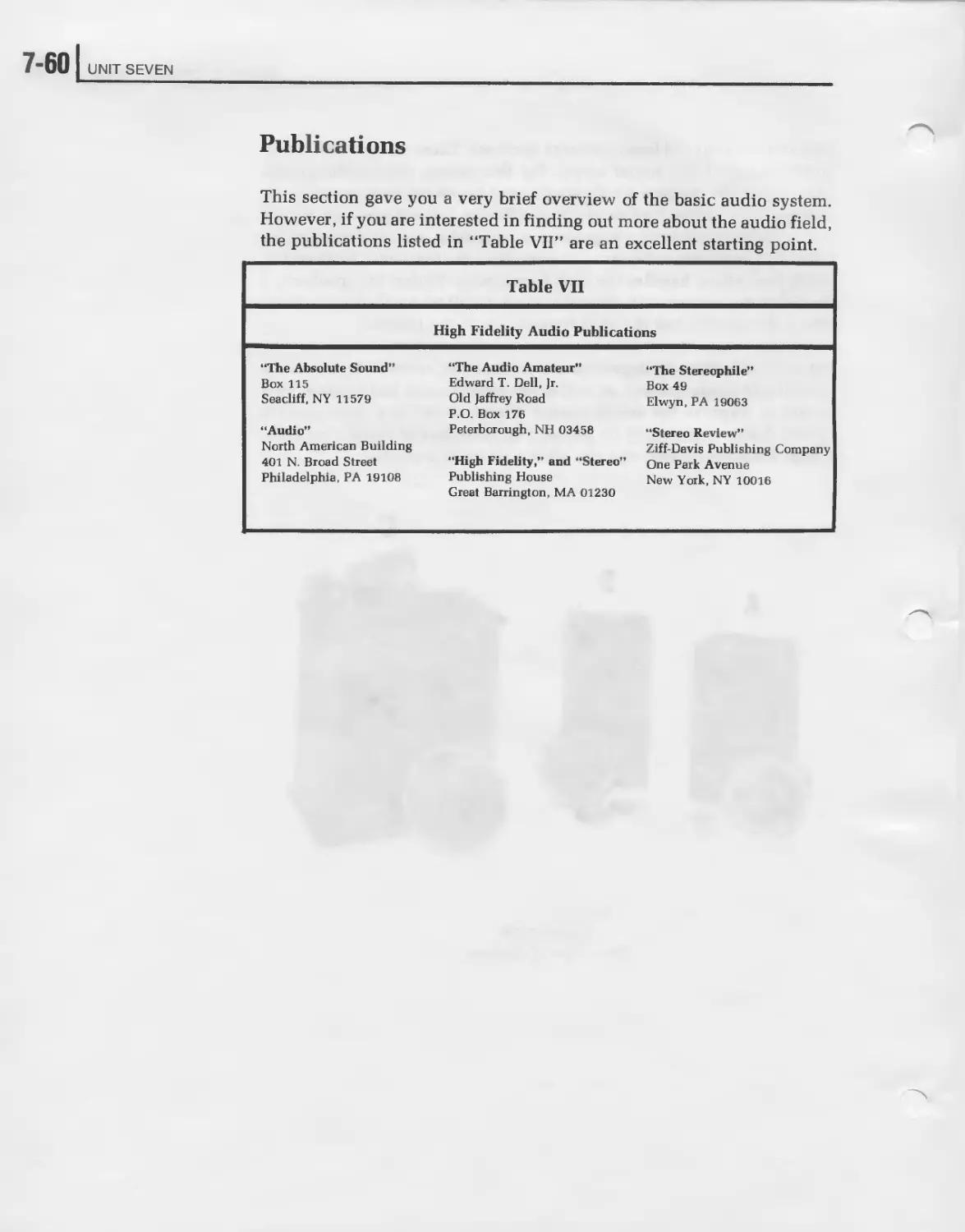
This section gave you a very brief overview of the basic audio system.
However, if you are interested in finding out more about the audio field,
the publications listed in “Table VII” are an excellent starting point.
	Table VII High Fidelity Audio Publications

“The Absolute Sound” Box 115 Seacliff, NY 11579	“The Audio Amateur”	“The Stereophile” Edward T. Dell, Jr.	gox 49 Old Jaffrey Road	Elwyn, PA 19063 P.O. Box 176
“Audio” North American Building 401 N. Broad Street Philadelphia, PA 19108	Peterborough, NH 03458	“Stereo Review” Ziff-Davis Publishing Company “High Fidelity,” and “Stereo” One Park Avenue Publishing House	New York, NY 10016 Great Barrington, MA 01230
Survey of Electronic Hobbies
] 7-61
Self-Review Questions
30.	Name the two basic types of audio systems.
31.	What are the basic units of a component audio system?
32.	What is the difference between a tuner and a receiver?
33.	Name three basic types of speakers and describe what each one
does. ____________________________________________________________
7“62 I UNIT SEVEN
Self-Review Answers
30.	The two basic types of audio systems are the compact unit and the
component system.
31.	The basic units of a component audio system are the tuner, record
turntable, tape deck, amplifier, and speakers.
32.	A tuner receives AM or FM signals and recovers the audio signal,
which must then be sent to the amplifier. The receiver combines
both tuner and amplifier.
33.	The three basic types of speakers are the tweeter, woofer, and
mid-range. The tweeter reproduces the high frequency audio, the
woofer reproduces the low frequency audio, and the mid-range
reproduces the mid-range audio.
Survey of Electronic Hobbies
] 7-63
UNIT EXAMINATION
The following multiple choice examination is designed to test your
understanding of the material presented in this unit. Read each question
and all four answers. Select the answer you feel is most correct. When you
have completed the examination, compare your answers with the correct
ones that appear after the exam.
1.	Which type of construction is best suited to very small experimental
circuits such as the experiments in this course?
A. Breadboard.
B. Wire-wrap.
C. Printed circuit board.
D. Perforated board.
2.	Which type of circuit construction is best suited to manufacturing
large quantities?
A. Breadboard.
B. Wire-wrap.
C. Printed circuit board.
D. Perforated board.
3.	What type of circuit construction eliminates the need for a soldering
iron?
A.	Wire-wrap.
B.	Printed circuit board.
C.	Perforated board.
D. Point-to-point wiring.
4.	What is the VHF band?
A.	30 kHz to 300 kHz.
B.	300 kHz to 3 MHz.
C.	3 MHz to 30 MHz.
D.	30 mHz to 300 MHz.
7-64 I UNIT SEVEN
5. The band of frequencies between 3 kHz and 30 kHz is known as the:
A.	HF band.
B.	MF band.
C. LF band.
D. VLF band.
6. Which of the following stands for “distance”?
A.
B.
C.
D.
QSL.
SWL.
DX.
HF.
7. Which of the following stands for “short-wave listener”?
A.
B.
C.
D.
QSL.
SWL.
DX.
HF.
8. Which frequency band offers the greatest potential for world-wide
radio reception?
A.
B.
C.
D.
VHF.
HF.
MF.
LF.
9. Which of the following is the highest class of amateur radio license?
A.	Extra class.
B.	Advanced class.
C.	General class.
D. Technician class.
10. To obtain an amateur radio license, you must pass:
A.	A written examination on radio theory and regulations.
B.	A Morse code examination.
C.	An oral examination on radio theory and regulations.
D.	Both A and В are required.
Survey of Electronic Hobbies
J 7-65
11.	Which of the following types of communications are available to the
radio amateur?
A.	Voice.
B.	Morse code.
C. Television.
D. All of the above.
12.	What device is used to control the movements of an R/C model
airplane’s control surfaces?
A. Servo.
B. Turntable.
C. Aileron.
D. Wire-wrap.
13.	An R/C model plane’s rudder controls its:
A.
B.
C.
D.
Height.
Direction.
Speed.
Roll.
14.	What government organization licenses both radio amateurs and
R/C transmitters?
A.	Office of Telecommunications.
B.	Federal Trade Commission.
C.	Federal Communications Commission.
D.	Radio Regulation Board.
15.	What control surface on an R/C model airplane controls its roll, or
causes it to bank into turns?
A. Rudder.
B. Elevator
C. Aileron.
D. Servo.
7-661 UNIT SEVEN
16.	An R/C sailplane requires at least channels of con-
trol.
A.
B.
C.
D.
1.
2.
3.
4.
17.	What device is used as the CPU in most home computers?
A. ROM.
B. Multivibrator.
C. Disk.
D. Microprocessor.
18.	What is a RAM?
A.	Read always memory.
B.	Random access memory.
C.	Read anytime memory.
D.	Real algorithm memory.
19.	Which of the following speakers reproduces high audio frequencies
the best?
A.
B.
C.
D.
Woofer.
Tweeter.
Mid-range.
Bass.
20.	The high fidelity AM/FM receiver combines the:
A.	Turntable and tape deck.
B.	Tuner and speakers.
C.	Tuner and amplifier.
D.	Tape deck and amplifier.
Survey of Electronic Hobbies
J 7-67
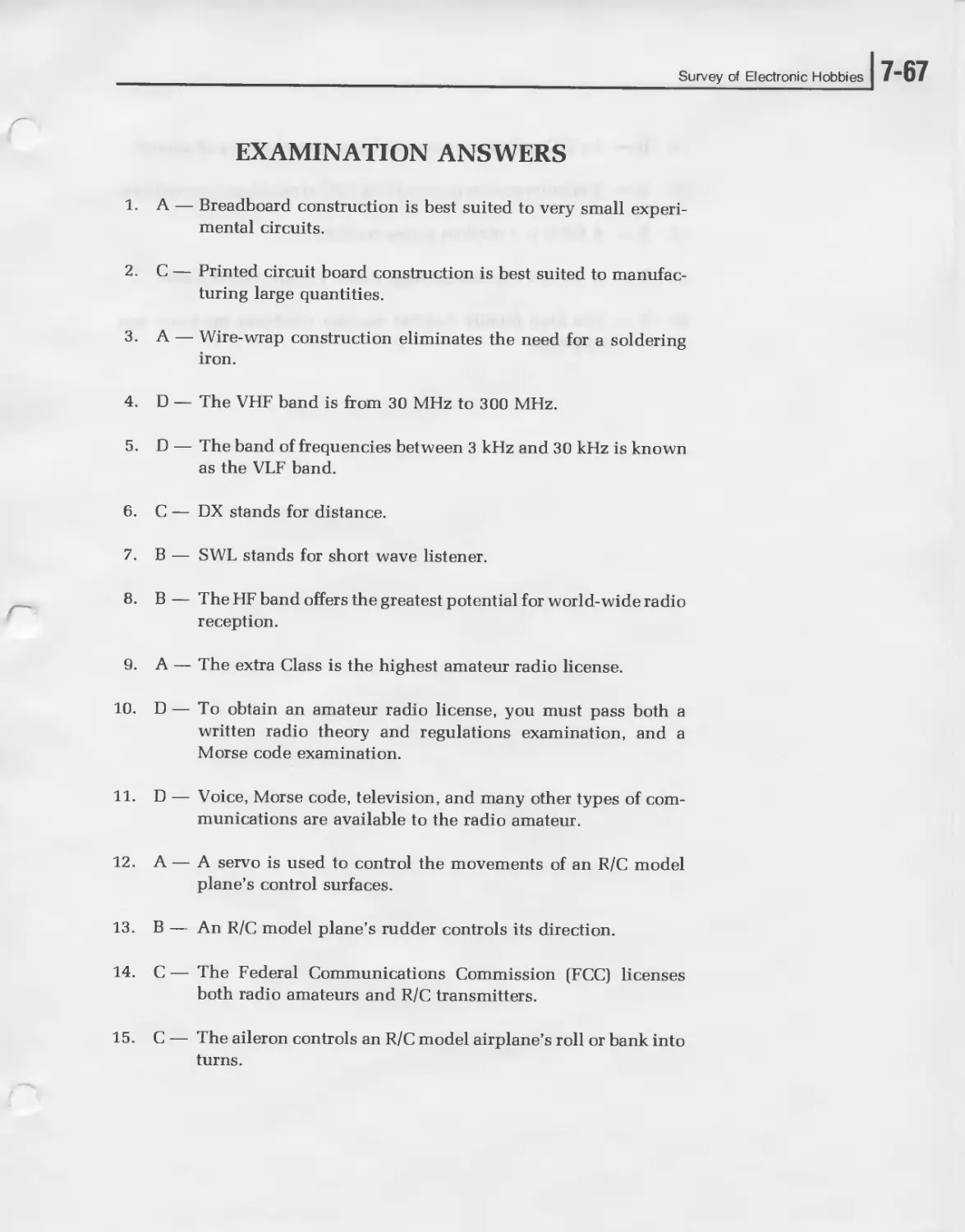
EXAMINATION ANSWERS
1.	A — Breadboard construction is best suited to very small experi-
mental circuits.
2.	C — Printed circuit board construction is best suited to manufac-
turing large quantities.
3.	A — Wire-wrap construction eliminates the need for a soldering
iron.
4.	D — The VHF band is from 30 MHz to 300 MHz.
5.	D — The band of frequencies between 3 kHz and 30 kHz is known
as the VLF band.
6.	C — DX stands for distance.
7.	В — SWL stands for short wave listener.
8.	В — The HF band offers the greatest potential for world-wide radio
reception.
9.	A — The extra Class is the highest amateur radio license.
10.	D — To obtain an amateur radio license, you must pass both a
written radio theory and regulations examination, and a
Morse code examination.
11.	D — Voice, Morse code, television, and many other types of com-
munications are available to the radio amateur.
12.	A — A servo is used to control the movements of an R/C model
plane’s control surfaces.
13.	В — An R/C model plane’s rudder controls its direction.
14.	C — The Federal Communications Commission (FCC) licenses
both radio amateurs and R/C transmitters.
15.	C — The aileron controls an R/C model airplane’s roll or bank into
turns.
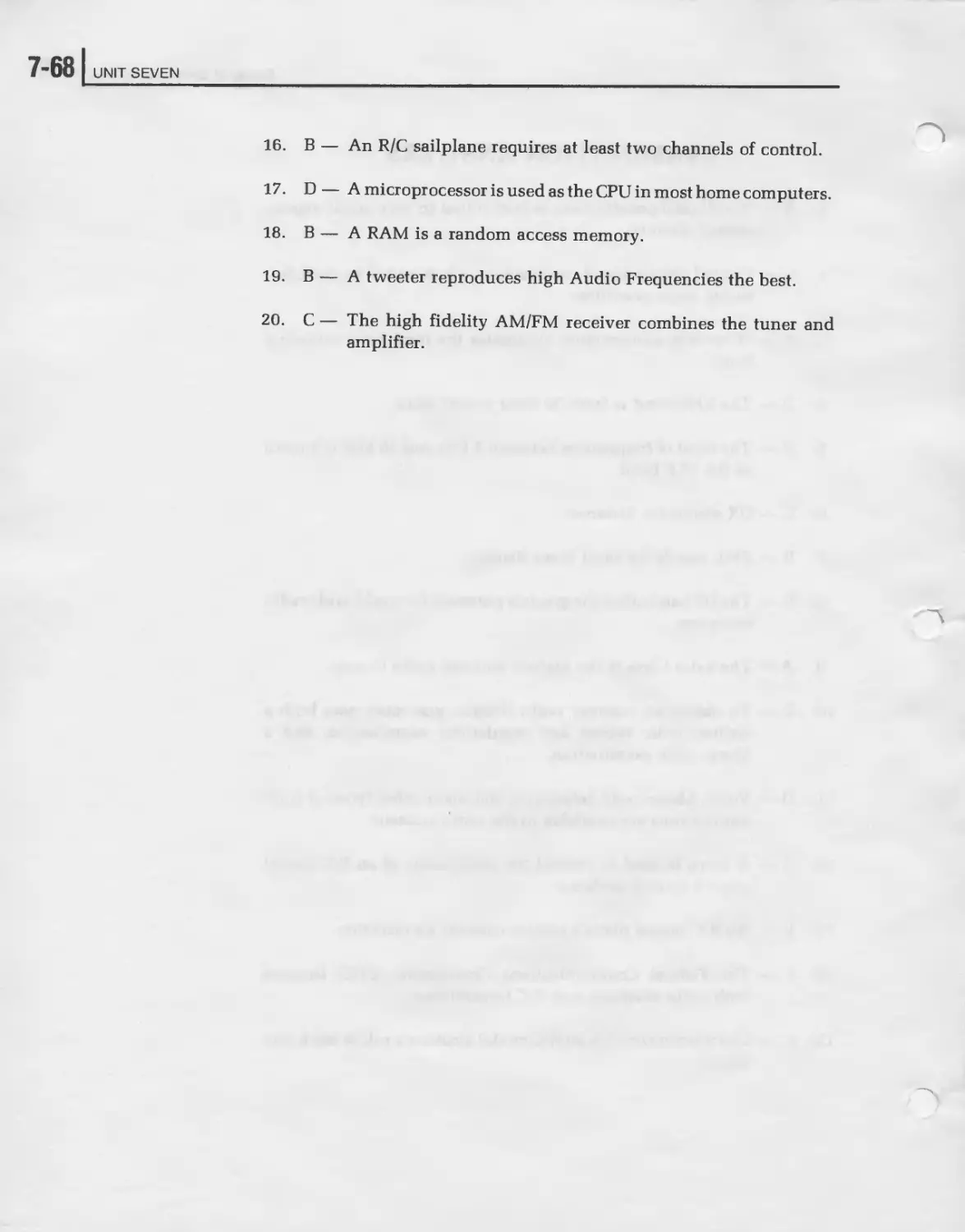
7-68 UNIT SEVEN
16.	В —	An R/C sailplane requires at least two channels of control.
17.	D —	A microprocessor is used as the CPU in most home computers.
18.	В —	A RAM is a random access memory.
19.	В —	A tweeter reproduces high Audio Frequencies the best.
20.	С —	The high fidelity AM/FM receiver combines the tuner and amplifier.