/


Author: Arfken G.B. Weber H.J.
Tags: mathematical physics mathematical analysis theoretical physics mathematical methods
ISBN: 0-12-059825-6
Year: 2001

Text
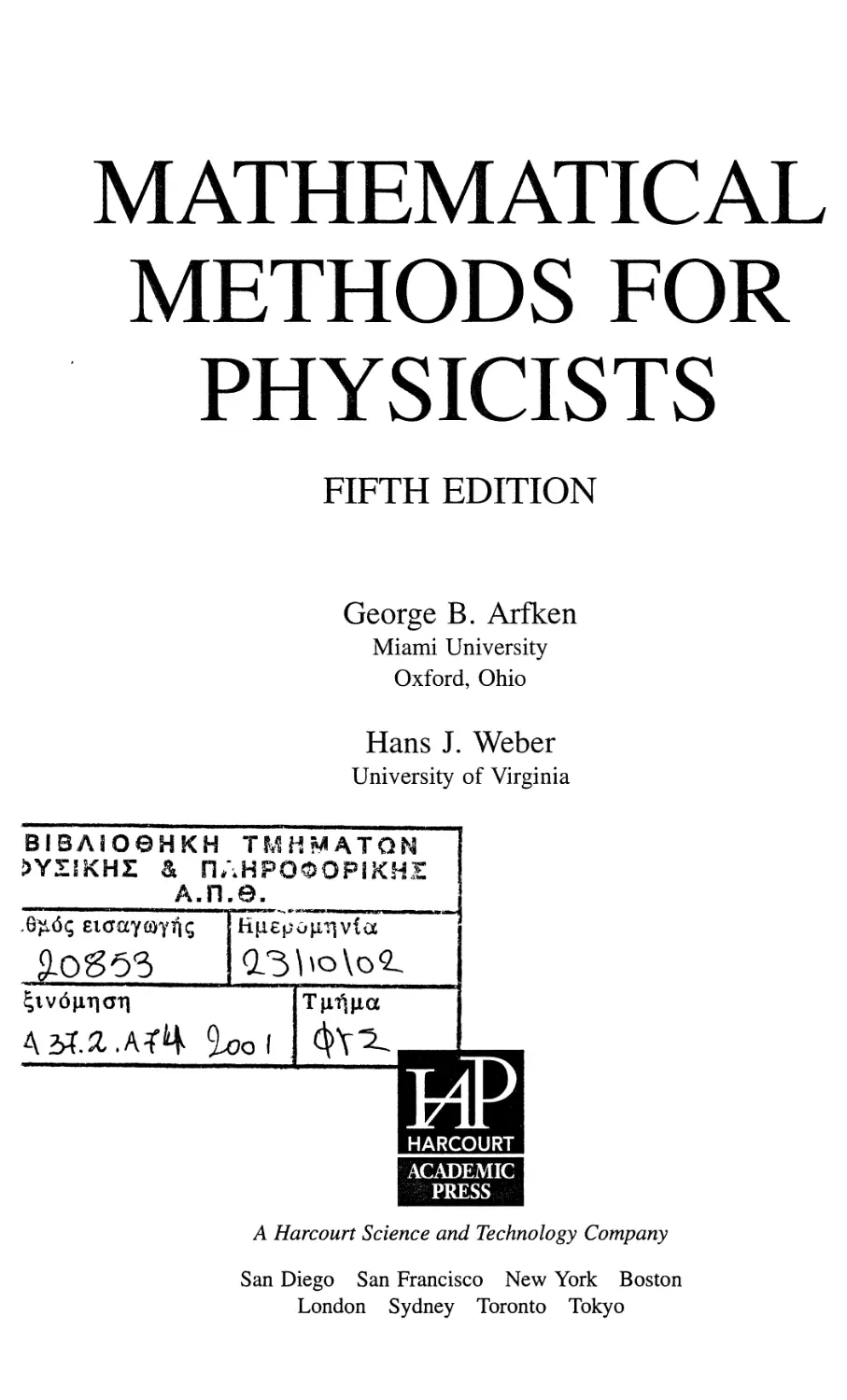
                    MATHEMATICAL
METHODS FOR
PHYSICISTS
FIFTH EDITION
George B. Arfken
Miami University
Oxford, Ohio
Hans J. Weber
University of Virginia
BIBAIOeHKH TMHMATQN
>YZ!KHE & ПЛНРОФОР1КНЕ
______A.n.e. _____
etaayayrig H[tEpogi]vfa
9-0863
^tvdgTiat]
<T3bo\o<2-
Tp.fi p.cc
HARCOURT
ACADEMIC
PRESS
A Harcourt Science and Technology Company
San Diego San Francisco New York Boston
London Sydney Toronto Tokyo
Sponsoring Editor Production Editor Editorial Assistant Marketing Manager Cover Design Printer and Binder	Barbara Holland Angela Dooley Karen Frost Marianne Rutter Richard Hannus The Maple-Vail Book Manufacturing Group
This book is printed on acid-free paper. @
Copyright © 2001, 1995, 1985, 1970, 1966 by Harcourt/Academic Press
All rights reserved.
No part of this publication may be reproduced or transmitted in any form or by any means,-electronic
or mechanical, including photocopy, recording, or any information storage and retrieval system, without
permission in writing from the publisher.
Requests for permission to make copies of any part of the work should be mailed to: Permissions
Department, Harcourt, Inc., 6277 Sea Harbor Drive, Orlando, Florida, 32887-6777.
ACADEMIC PRESS
A Harcourt Science and Technology Company
525 В Street, Suite 1900, San Diego, CA 92101-4495, USA
http://www.academicpress.com
Academic Press
Harcourt Place, 32 Jamestown Road, London NW1 7BY, UK
Harcourt/Academic Press
200 Wheeler Road, Burlington, MA 01803
www.harcourt-ap.com
Library of Congress Catalog Card Number: 00-108275
International Standard Book Number: 0-12-059825-6
Printed in the United States of America
00 01 02 03 04 MB 9 8 7 6 5 4 3 2 1
To Mary and Edith

Contents
Preface	xiii
1	Vector Analysis	1
1.1	Definitions, Elementary Approach.................................. 1
1.2	Rotation of the Coordinate Axes................................... 8
1.3	Scalar or Dot Product............................................ 13
1.4	Vector or Cross Product.......................................... 19
1.5	Triple Scalar Product, Triple Vector Product..................... 27
1.6	Gradient, V...................................................... 35
1.7	Divergence, V- ..............................................  .	40
1.8	Curl, Vx......................................................... 44
1.9	Successive Applications of V..................................... 51
1.10	Vector Integration............................................... 55
1.11	Gauss’s Theorem.................................................. 61
1.12	Stokes’s Theorem................................................. 65
1.13	Potential Theory................................................. 69
1.14	Gauss’s Law, Poisson’s Equation.................................. 80
1.15	Dirac Delta Function............................................. 84
1.16	Helmholtz’s Theorem.............................................. 96
2	Curved Coordinates, Tensors	103
2.1	Orthogonal Coordinates.......................................... 103
2.2	Differential Vector Operators................................... 108
2.3	Special Coordinate Systems: Introduction........................ 113
2.4	Circular Cylindrical Coordinates................................ 114
2.5	Spherical Polar Coordinates..................................... 121
vii
Contents
2.6	Tensor Analysis ............................................ 131
2.7	Contraction, Direct Product................................. 137
2.8	Quotient Rule.............................................   139
2.9	Pseudotensors, Dual Tensors................................. 141
2.10	Non-Cartesian Tensors ...................................... 150
2.11	Tensor Derivative Operators...............................   160
3	Determinants and Matrices	165
3.1	Determinants................................................ 165
3.2	Matrices.................................................... 174
3.3	Orthogonal Matrices......................................... 192
3.4	Hermitian Matrices, Unitary Matrices.........................206
3.5	Diagonalization of Matrices..................................213
3.6	Normal Matrices..........................................  .	227
4	Group Theory	237
4.1	Introduction to Group Theory................................237
4.2	Generators of Continuous Groups .............................242
4.3	Orbital Angular Momentum.....................................258
4.4	Angular Momentum Coupling...................................263
4.5	Homogeneous Lorentz Group....................................275
4.6	Lorentz Covariance of Maxwell’s Equations....................278
4.7	Discrete Groups .............................................286
5	Infinite Series	303
5.1	Fundamental Concepts ........................................303
5.2	Convergence Tests............................................306
5.3	Alternating Series...........................................322
5.4	Algebra of Series............................................325
5.5	Series of Functions..........................................329
5.6	Taylor’s Expansion...........................................334
5.7	Power Series...............................................  346
5.8	Elliptic Integrals ..........................................354
5.9	Bernoulli Numbers, Euler-Maclaurin Formula...................360
5.10	Asymptotic Series............................................373
5.11	Infinite Products ...........................................381
6	Functions of a	Complex Variable I	389
6.1	Complex Algebra..............................................390
6.2	Cauchy-Riemann Conditions................................  .	399
6.3	Cauchy’s Integral Theorem....................................404
6.4	Cauchy’s Integral Formula....................................411
6.5	Laurent Expansion............................................416
6.6	Mapping......................................................425
6.7	Conformal Mapping............................................434
Contents	ix
7	Functions of a Complex Variable II	439
7.1	Singularities..................................................439
7.2	Calculus of Residues...........................................444
7.3	Dispersion Relations...........................................469
7.4	Method of Steepest Descents....................................477
8	Differential Equations	487
8.1	Partial Differential Equations.................................487
8.2	First-Order Differential Equations.............................496
8.3	Separation of Variables........................................506
8.4	Singular Points ...............................................516
8.5	Series Solutions—Frobenius’s Method ...........................518
8.6	A Second Solution .............................................533
8.7	Nonhomogeneous Equation — Green’s	Function.....................548
8.8	Numerical Solutions............................................567
9	Sturm-Liouville Theory	575
9.1	Self-Adjoint ODEs .............................................575
9.2	Hermitian Operators............................................588
9.3	Gram-Schmidt Orthogonalization.................................596
9.4	Completeness of Eigenfunctions.................................604
9.5	Green’s Function — Eigenfunction	Expansion.....................616
10	Gamma-Factorial Function	631
10.1	Definitions, Simple Properties ................................631
10.2	Digamma and Polygamma Functions............................  .	643
10.3	Stirling’s Series..............................................649
10.4	The Beta Function..............................................654
10.5	Incomplete Gamma Function......................................660
11	Bessel Functions	669
11.1	Bessel Functions of the First Kind	Jv(x) ......................669
11.2	Orthogonality..................................................688
11.3	Neumann Functions, Bessel Functions	of the Second Kind .... 694
11.4	Hankel Functions.............................................  702
11.5	Modified Bessel Functions 7v(x) and	Kv(x)......................709
11.6	Asymptotic Expansions..........................................716
11.7	Spherical Bessel Functions.....................................722
12	Legendre Functions	739
12.1	Generating Function............................................739
12.2	Recurrence Relations.........................................  748
12.3	Orthogonality..................................................755
12.4	Alternate Definitions .........................................767
12.5	Associated Legendre Functions..................................771
12.6	Spherical Harmonics ...........................................786
Contents
12.7	Orbital Angular Momentum Operators............................792
12.8	The Addition Theorem for Spherical Harmonics .................796
12.9	Integrals of Three Ys.........................................802
12.10	Legendre Functions	of	the Second Kind........................806
12.11	Vector Spherical	Harmonics....................................813
13	Special Functions	817
13.1	Hermite Functions.............................................817
13.2	Laguerre Functions............................................828
13.3	Chebyshev Polynomials.........................................839
13.4	Hypergeometric Functions ...................................  850
13.5	Confluent Hypergeometric Functions............................855
14	Fourier Series	863
14.1	General Properties..........................................  863
14.2	Advantages, Uses of Fourier Series ...........................870
14.3	Applications of Fourier Series................................874
14.4	Properties of Fourier Series..................................886
14.5	Gibbs Phenomenon............................................. 893
14.6	Discrete Fourier Transform....................................898
15	Integral Transforms	905
15.1	Integral Transforms...........................................905
15.2	Development of the Fourier Integral...........................909
15.3	Fourier Transforms — Inversion Theorem........................911
15.4	Fourier Transform of Derivatives..............................920
15.5	Convolution Theorem......................................  .	924
15.6	Momentum Representation.......................................928
15.7	Transfer Functions............................................935
15.8	Laplace Transforms............................................938
15.9	Laplace Transform of Derivatives ......................... . 946
15.10	Other Properties.............................................953
15.11	Convolution or Faltungs Theorem..........................  .	965
15.12	Inverse Laplace Transform....................................969
16	Integral Equations	983
16.1	Introduction..................................................983
16.2	Integral Transforms, Generating Functions.....................991
16.3	Neumann Series, Separable Kernels.............................997
16.4	Hilbert-Schmidt Theory.....................................  1009
17	Calculus of Variations	1017
17.1	A Dependent and an Independent Variable......................1018
17.2	Applications of the Euler Equation...........................1023
17.3	Several Dependent Variables..................................1031
17.4	Several Independent Variables................................1036
Contents х'Г
17.5	Several Dependent and Independent Variables...................1038
17.6	Lagrangian Multipliers........................................1039
17.7	Variation With Constraints....................................1045
17.8	Rayleigh-Ritz Variational Technique...........................1052
18	Nonlinear Methods and Chaos	1059
18.1	Introduction..................................................1059
18.2	The Logistic Map.............................................. . 1060
18.3	Sensitivity to Initial Conditions.............................1064
18.4	Nonlinear Differential Equations............................  1068
Appendix 1	Real Zeros of a Function	1085
Appendix 2	Gaussian Quadrature	1089
Index	1097


Preface
Through five editions now, Mathematical Methods for Physicists has provided all
the mathematical methods that aspiring physicists are likely to encounter as stu-
dents and beginning researchers. More than enough material is included for a
two-semester undergraduate or graduate course.
The book is advanced in the sense that mathematical relations are almost always
proven, in addition to being illustrated in terms of examples. These proofs are not
what a mathematician would regard as rigorous, but sketch the ideas and emphasize
the relations that are essential to the study of physics and related fields. This
approach incorporates theorems that are usually not cited under the most general
assumptions, but are tailored to the more restricted applications required by physics.
For example, Stokes’s Theorem is usually applied by a physicist to a surface with
the tacit understanding that it be simply connected. In this edition such assumptions
have been made more explicit, starting in Chapter 1.
roblem-Solving Skills
The book also incorporates a deliberate focus on problem-solving skills. This more
advanced level of understanding and active learning requires much practice by the
reader. Accordingly, extensive problem sets appearing in each chapter form an
integral part of the book. They have been carefully reviewed and revised for this
Fifth Edition.
xiii
xiv
Preface
Pathways through the Material
Undergraduates may be best served if they start by reviewing Chapter 1 according
to the level of training of the class. Section 1.2 on the transformation properties of
vectors, the cross product, and the invariance of the scalar product under rotations
may be postponed until tensor analysis is started, for which these sections form the
introduction and serve as examples. They may continue their studies with linear
algebra in Chapter 3, then perhaps tensors and symmetries (Chapters 2 and 4), and
then real and complex analysis (Chapter 5-7), differential equations (Chapters 8,
9), and special functions (Chapters 11-13).
In general, the core of a graduate one-semester course comprises Chapters 5 to
9 and 11 to 13, which deal with real and complex analysis, differential equations,
and special functions. Depending on the level of the students in a course, some
linear algebra in Chapter 3 (eigenvalues, etc), along with symmetries (group theory
in Chapter 4), and tensors (Chapter 2) may be covered as needed or according to
taste. Group theory may also be included with differential equations (Chapters 8
and 9). Appropriate relations have been included and are discussed in this edition
in Chapters 4 and 8.
A two-semester course can treat tensors, group theory, and special functions
(Chapters 11 to 13) more extensively, and add Fourier series (Chapter 14), inte-
gral transforms (Chapter 15), integral equations (Chapter 16), and the calculus of
variations (Chapter 17).
Changes to the Fifth Edition
Changes to the Fifth Edition have been made in Sections 2.10 and 2.11 of chapter 2
dealing with tensors in Riemannian geometry. They have been revised to bring
them in line with current course content, for example, H. Ohanian and R. Ruffini,
Gravitation and Spacetime, 2nd ed.: Norton, New York (1994). The method of
steepest descent in Chapter 7 has been rewritten in a more systematic, didactic and
accurate fashion, facilitating numerous applications of the method. The method of
characteristics for partial differential equations in Chapter 8 has been extended, as
well as the nonlinear Chapter 18.
Acknowledgments
We have benefited from the advice and help of many people. Some of the revisions
are in response to comments by readers. We are grateful to them and to Publisher
Michael Sugarman who organized the revision and kept it on track. We would like
to thank in particular Dr. Michael Bozoian and Xuepeng Sun for their invaluable
help with the proofreading and Angela Dooley, Production Editor, for her expert
management of the Fifth Edition.
Chapter 1
Vector Analysis
1 Definitions, Elementary Approach
In science and engineering we frequently encounter quantities that have magnitude
and magnitude only, for example, mass, time, and temperature. These we label
scalar quantities. In contrast, many interesting physical quantities have magnitude
and, in addition, an associated direction. This second group includes displace-
ment, velocity, acceleration, force, momentum, and angular momentum. Quantities
with magnitude and direction are labeled vector quantities. Usually, in elementary
treatments, a vector is defined as a quantity having magnitude and direction. To
distinguish vectors from scalars, we identify vector quantities with boldface type,
that is, V.
A vector may be conveniently represented by an arrow with length proportional
to the magnitude. The direction of the arrow gives the direction of the vector, with
the positive sense of direction being indicated by the point. In this representation,
vector addition
C = A + B	(1.1)
consists in placing the rear end of vector В at the point of vector A. Vector C
is then represented by an arrow drawn from the rear of A to the point of B.
This procedure, the triangle law of addition, assigns meaning to Eq. (1.1) and is
illustrated in Fig. 1.1. By completing the parallelogram, we see that
C = A + B=B + A	(1.2)
as shown in Fig. 1.2. In words, vector addition is commutative.
For the sum of three vectors
D=A+B+C
1
2
Chapter 1 Vector Analysis
В
Figure 1.1 Triangle law of vector
addition.
Figure 1.2 Parallelogram law of
vector addition.
(Fig. 1.3), we may first add A and B:
A + B = E.
Then this sum is added to C:
D = E + C.
Similarly, we may first add В and C:
В + C = F.
Then
D = A + F.
In terms of the original expression,
(A + B) + C = A + (B + C).
Vector addition is associative.
1.1 Definitions, Elementary Approach
У
A direct physical example of the parallelogram addition law is provided by a
weight suspended by two cords. If the junction point (O in Fig. 1.4) is in equi-
librium, the vector sum of the two forces Fi and F2 must cancel the downward
force of gravity F3. Here the parallelogram addition law is subject to immediate
experimental verification.1
Figure 1.4 Equilibrium of forces; Fi 4- F2 = —F3.
Subtraction may be handled by defining the negative of a vector as a vector of
the same magnitude but with reversed direction. Then
A —В = A + (-B).
In Fig. 1.3
A = E-B.
Note that the vectors are treated as geometrical objects that are independent of
any coordinate system. Indeed, we have not yet introduced a coordinate system.
This concept of independence of a preferred coordinate system is developed in
considerable detail in the next section.
The representation of vector A by an arrow suggests a second possibility.
Arrow A (Fig. 1.5), starting from the origin,2 terminates at the point (Ax, Ay, Az).
Strictly speaking, the parallelogram addition was introduced as a definition. Experiments show that if we
ssume that the forces are vector quantities and we combine them by parallelogram addition, the equilibrium
ondition of zero resultant force is satisfied.
We could start from any point in our Cartesian reference frame; however, we choose the origin for simplicity.
Chapter 1 Vector Analysis
Figure 1.5 Cartesian components and direction cosines of A.
Thus, if we agree that the vector is to start at the origin, the positive end may be
specified by giving the Cartesian coordinates (Ax, Ay, Az) of the arrow head.
Although A could have represented any vector quantity (momentum, electric
field, etc.), one particularly important vector quantity, that is, the displacement
from the origin to the point (x, y, z), is denoted by the special symbol r. We then
have a choice of referring to the displacement as either the vector r or the collection
(x, y, z), the coordinates of its end point:
ro(x,y,z).	(1.3)
Using r for the magnitude of vector r, we find that Fig. 1.5 shows that the end-point
coordinates and the magnitude are related by
x = rcoscY, y = rcos^, z = rcosy;	(1.4)
coscy, cos/i, and cosy are called the direction cosines, with a being the angle
between the given vector and the positive x-axis, and so on. One further bit of
vocabulary: The quantities Ax, Ay, and Az are known as the (Cartesian) compo-
nents of A or the projections of A.
Thus, any vector A may be resolved into its components (or projected onto
the coordinate axes) to yield Ax = A cos a, etc., as in Eq. (1.4). We may choose
to refer to the vector as a single quantity A or to its components (Ax, Ay, Az).
Note that the subscript x in Ax denotes the x component and not a dependence
freedom of shifting the origin of coordinate system without affecting the geometry is called translation
riance.
1.1 Definitions, Elementary Approach
5
on the variable x. The choice between using A or its components (Ax, Ay, Az) is
essentially a choice between a geometric or an algebraic representation. Use either
representation at your convenience. The geometric “arrow in space” may aid in
visualization. The algebraic set of components is usually more suitable for precise
numerical or algebraic calculations.
Vectors enter physics in two distinct forms: (1) Vector A may represent a single
force acting at a single point. The force of gravity acting at the center of grav-
ity illustrates this form; and (2) Vector A may be defined over some extended
region, that is, A and its components may be functions of position, for example,
Ax = Ax(x, y, z), and so on. Examples of this sort include the velocity of a fluid
varying from point to point over a given volume and electric and magnetic fields.
Some writers distinguish these two cases by referring to the vector defined over
a region as a vector field. The concept of the vector defined over a region and
being a function of position will be extremely important in Section 1.2 and in later
sections where we differentiate and integrate vectors.
At this stage it is convenient to introduce unit vectors along each of the coordinate
axes. Let x be a vector of unit magnitude pointing in the positive x-direction, у a
vector of unit magnitude in the positive у-direction, and z a vector of unit magnitude
in the positive z-direction. Then xAx is a vector with magnitude equal to Ax and
in the positive x -direction. By vector addition
A = xAx + yAy +zAz,	(1.5)
which states that a vector equals the vector sum of its components. Note that if A
vanishes, all of its components must vanish individually, that is, if
A = 0, then Ax = Ay = Az = 0.
Finally, by the Pythagorean theorem, the magnitude of vector A is
A = ^ + A2y + A^1/2.	(1.6)
This resolution of a vector into its components can be carried out in a variety of
coordinate systems, as shown in Chapter 2. Here we restrict ourselves to Cartesian
coordinates, where the unit vectors have the coordinates x = (1, 0, 0), у = (0, 1,0),
and z = (0, 0,1).
Equation (1.5) is actually an assertion that the three unit vectors x, y, and z
span our real three-dimensional space: Any constant vector may be written as a
linear combination of x, y, and z. Because x, y, and z are linearly independent
(no one is a linear combination of the other two), they form a basis for the real
three-dimensional space.
As a replacement of the graphical technique, addition and subtraction of vectors
may now be carried out in terms of their components. For A = xAx 4- yAy 4- tAz
and В = xBx 4- у By 4-
A ± В = x(Ax ± Bx) 4- y(Ay ± By) 4- z(Az ± Bz).	(1.7)
6
Chapter 1 Vector Analysis
Example 1.1.1
Let
A = 6x + 4y + 3z
В = 2x — 3y — 3z.
Then by Eq. (1.7)
A + В = 8x + у
and
A — В = 4x + 7y + 6z.
It should be emphasized here that the unit vectors x, y, and z are used for
convenience but are not essential. We can describe vectors and use them entirely in
terms of their components: A о (Ax, Ay, Az). This is the approach of the two more
powerful, more sophisticated definitions of vector discussed in the next section.
However, x, y, and z emphasize the direction, which will be useful in Chapter 2.
So far, we have defined the operations of addition and subtraction of vectors.
Three varieties of multiplication are defined on the basis of their applicability: a
scalar or inner product in Section 1.3; a vector product peculiar to three-dimensional
space in Section 1.4; and a direct or outer product yielding a second-rank tensor in
Section 2.7. Division by a vector is not defined. See Exercises 3.2.21 and 3.2.22.
Exercises
1.1.1	Show how to find A and B, given A + В and A - B.
1.1.2	The vector A whose magnitude is 1.732 units makes equal angles with the
coordinate axes. Find Ax, Ay, and Az.
1.1.3 Calculate the components of a unit vector that lies in the xy-plane and makes
equal angles with the positive directions of the x- and y-axes.
1.1.4 The velocity of sailboat A relative to sailboat B, vrei, is defined by the equation
vrei = va — vb, where уд is the velocity of A and v# is the velocity of B.
Determine the velocity of A relative to В if
va = 30 km/hr east
vB = 40 km/hr north.
ANS. vrei = 50 km/hr, 53.1° south of east.
1.1.5 A sailboat sails for 1 hr at 4 km/hr (relative to the water) on a steady compass
heading of 40° east of north. The sailboat is simultaneously carried along by
1.1 Definitions, Elementary Approach
7
a current. At the end of the hour the boat is 6.12 km from its starting point.
The line from its starting point to its location lies 60° east of north. Find the x
(easterly) and у (northerly) components of the water velocity.
ANS. veast = 2.73 km/hr, vnorth ^.0 km/hr.
6	A vector equation can be reduced to the form A = B. From this show that
the one vector equation is equivalent to three scalar equations. Assuming the
validity of Newton’s second law F = ma as a vector equation, this means that
ax depends only on Fx and is independent of Fy and Fz.
7	The vertices of a triangle A, B, and C are given by the points (—1,0,2),
(0,1,0), and (1, —1, 0), respectively. Find point D so that the figure AB CD
forms a plane parallelogram.
ANS. (0, -2,2), or (2,0, -2).
8	A triangle is defined by the vertices of three vectors A, B, and C that extend
from the origin. In terms of A, B, and C show that the vector sum of the
successive sides of the triangle (AB + BC 4- CA) is zero.
9	A sphere of radius a is centered at a point ri.
(a)	Write out the algebraic equation for the sphere.
(b)	Write out a vector equation for the sphere.
ANS. (a) (x - xi)2 + (y - yi)2 + (z - zi)2 — a2
(b) r = и + a.
(a takes on all directions but has a fixed magnitude a.)
10 A comer reflector is formed by three mutually perpendicular reflecting surfaces.
Show that a ray of light incident upon the comer reflector (striking all three
surfaces) is reflected back along a line parallel to the line of incidence.
Hint. Consider the effect of a reflection on the components of a vector describing
the direction of the light ray.
11 Hubble’s law. Hubble found that distant galaxies are receding with a velocity
proportional to their distance from where we are on Earth. For the i th galaxy
V/ = HQri
with us at the origin. Show that this recession of the galaxies from us does not
imply that we are at the center of the universe. Specifically, take the galaxy at
ri as a new origin and show that Hubble’s law is still obeyed.
8
Chapter 1 Vector Analysis
1.2 Rotation of the Coordinate Axes*
In the preceding section vectors were defined or represented in two equivalent
ways: (1) geometrically by specifying magnitude and direction, as with an arrow;
and (2) algebraically by specifying the components relative to Cartesian coordinate
axes. The second definition is adequate for the vector analysis of this chapter. In
this section two more refined, sophisticated, and powerful definitions are presented.
First, the vector field is defined in terms of the behavior of its components under
rotation of the coordinate axes. This transformation theory approach leads into the
tensor analysis of Chapter 2 and groups of transformations in Chapter 4. Second,
the component definition of Section 1.1 is refined and generalized according to
the mathematician’s concepts of vector and vector space. This approach leads to
function spaces including the Hilbert space — Section 9.4.
The definition of vector as a quantity with magnitude and direction is incomplete.
On the one hand, we encounter such quantities as elastic constants and index of
refraction in anisotropic crystals that have magnitude and direction but that are
not vectors. On the other hand, our naive approach is awkward to generalize, to
extend to more complex quantities. We seek a new definition of vector field, using
our coordinate vector r as a prototype.
There is a physical basis for our development of a new definition. We describe
our physical world by mathematics, but it and any physical predictions we may
make must be independent of our mathematical conventions.
In our specific case we assume that space is isotropic, that is, there is no preferred
direction or all directions are equivalent. Then the physical system being analyzed
or the physical law being enunciated cannot and must not depend on our choice or
orientation of the coordinate axes.
Now we return to the concept of vector r as a geometric object independent of
the coordinate system. Let us look at r in two different systems, one rotated in
relation to the other.
For simplicity, we consider first the two-dimensional case. If the x-, y-coordinates
are rotated counterclockwise through an angle <p, keeping r fixed (Fig. 1.6), we
get the following relations between the components resolved in the original system
(unprimed) and those resolved in the new rotated system (primed):
xf = x cos (p + У sin cp,
y' = — xsin ср + у cos (p.
(1.8)
We saw in Section 1.1 that a vector could be represented by the coordinates
of a point, that is, the coordinates were proportional to the vector components.
Hence, the components of a vector must transform under rotation as coordinates
of a point (such as r). Therefore, whenever any pair of quantities Ax and Ay
in the xy-coordinate system is transformed into (A'xi Af) by this rotation of the
This section is optional here. It will be essential for Chapter 2.
1.2 Rotation of the Coordinate Axes
9
Figure 1.6 Rotation of Cartesian coordinate axes about the г-axis.
coordinate system with
Ax = Ax cos tp + Ay sin cp
Afy = — Ax sin (p + Ay cos cp,
we define3 Ax and Ay as the components of a vector A. Our vector now is defined
in terms of the transformation of its components under rotation of the coordinate
system. If Ax and Ay transform in the same way as x and y, the components of
the two-dimensional coordinate vector r, they are the components of a vector A.
If Ax and Ay do not show this form invariance when the coordinates are rotated,
they do not form a vector.
The vector field components Ax and Ay satisfying the defining equations,
Eq. (1.9), associate a magnitude A and a direction with each point in space. The
magnitude is a scalar quantity, invariant to the rotation of the coordinate system.
The direction (relative to the unprimed system) is likewise invariant to the rotation
of the coordinate system (see Exercise 1.2.1). The result of all this is that the com-
ponents of a vector may vary according to the rotation of the primed coordinate
system. This is what Eq. (1.9) indicates. But the variation with the angle is such that
the components in the rotated coordinate system A'x and A'y define a vector with the
same magnitude and the same direction as the vector defined by the components
Ax and Ay relative to the x-, у-coordinate axes. (Compare Exercise 1.2.1.) The
components of A in a particular coordinate system constitute the representation
’The corresponding definition of a scalar quantity is S' = S, that is, invariant under rotation of the coordinates.
10
Chapter 1 Vector Analysis
of A in that coordinate system. Equation (1.9), the transformation relation, is a
guarantee that the entity A is independent of the rotation of the coordinate system.
To go on to three and, later, four dimensions, we find it convenient to use a
more compact notation. Let
x -> xi
У X2
(1.10)
an=:COS^, Я12 = sin<p,
6?21 = — sin<£, a22 = COS(p.
Then Eq. (1.8) becomes
= auxi +ai2X2,
x'2 = 4/21*1 + Я22*2-
(1.11)
(1.12)
The coefficient aij may be interpreted as a direction cosine, the cosine of the angle
between x- and Xj, that is,
я12 = cos(xp X2) = sin<p,
«21
== COSO^, Xi)
= COS
sin<p.
(1-13)
The advantage of the new notation4 is that it permits us to use the summation
symbol 52 and to rewrite Eqs. (1.12) as
2
/ = 1,2.	(1.14)
J=1
Note that i remains as a parameter that gives rise to one equation when it is set
equal to 1 and to a second equation when it is set equal to 2. The index j, of
course, is a summation index, that is, a dummy index, and as with a variable of
integration, j may be replaced by any other convenient symbol.
The generalization to three, four, or N dimensions is now very simple. The set
of N quantities Vj is said to be the components of an TV-dimensional vector V if
and only if their values relative to the rotated coordinate axes are given by
=	i = 1,2,..., N.
>1
(1.15)
As before, is the cosine of the angle between x- and Xj. Often the upper limit
N and the corresponding range of i will not be indicated. It is taken for granted
that the reader knows the number of dimensions of his or her space.
4The reader may wonder at the replacement of one parameter <p by four parameters . Clearly, the ац do not
constitute a minimum set of parameters. For two dimensions the four ац are subject to the three constraints given
in Eq. (1.18). The justification for the redundant set of direction cosines is the convenience it provides. Hopefully,
this convenience will become more apparent in Chapters 2 and 3. For three-dimensional rotations (9 ац but
only three independent) alternate descriptions are provided by: (1) the Euler angles discussed in Section 3.3;
(2) quaternions; and (3) the Cayley-Klein parameters. These alternatives have their respective advantages and
disadvantages.
1.2 Rotation of the Coordinate Axes
11
From the definition of aij as the cosine of the angle between the positive
direction and the positive Xj direction we may write (Cartesian coordinates)5
9x'
aij =	(1.16a)
9x;
Using the inverse rotation (</? -> — (p) yields
’Дл . dXj
xi = 2^anxi OT =	(1-16b)
Note carefully that these are partial derivatives. By use of Eqs. (1.16a) and
(1.16b), Eq. (1.15) becomes
Дл 9x-	Эх/
(1л„
The direction cosines aij satisfy an orthogonality condition
aijaik — fyk	(1.18)
i
or, equivalently,
у aji a^i ~ $jk-	(1.19)
i
The symbol Эд is the Kronecker delta defined by
8jk = 1 for j = k,
J	(1.20)
8jk = 0 for j / k.
The reader may easily verify that Eqs. (1.18) and (1.19) hold in the two-dimensional
case by substituting in the specific from Eq. (1.11). The result is the well-known
identity sin2^ + cos2 cp = 1 for the nonvanishing case. To verify Eq. (1.18) in
general form, we may use the partial derivative forms of Eqs. (1.16a) and (1.16b)
to obtain
ул Эх; Эх/: _ ул Эх; 9xf ___ Эх;
“ дх- дх[ дх[ дхк дх^
The last step follows by the standard rules for partial differentiation, assuming that
Xj is a function of xj, x^, x^, and so on. The final result Эху/Эх^ is equal to Эд,
because Xj and x^ as coordinate lines (j k) are assumed to be perpendicular (two
or three dimensions) or orthogonal (for any number of dimensions). Equivalently,
we may assume that Xj and Xk (j k) are totally independent variables. If j = k,
the partial derivative is clearly equal to unity.
In redefining a vector in terms of how its components transform under a rotation
of the coordinate system, we should emphasize two points:
Differentiate x'. with respect to Xj. See discussion following Eq. (1.21). Section 3.3 provides an alternate
pproach.
Chapter 1 Vector Analysis
1. This definition is developed because it is useful and appropriate in de-
scribing our physical world. Our vector equations will be independent of
any particular coordinate system. (The coordinate system need not even be
Cartesian.) The vector equation can always be expressed in some particu-
lar coordinate system and, to obtain numerical results, we must ultimately
express the equation in some specific coordinate system.
2. This definition is subject to a generalization that will open up the branch
of mathematics known as tensor analysis (Chapter 2).
A qualification is also in order. The behavior of the vector components under
rotation of the coordinates is used in Section 1.3 to prove that a scalar product is a
scalar, in Section 1.4 to prove that a vector product is a vector, and in Section 1.6
to show that the gradient of a scalar is a vector. The remainder of this chapter
proceeds on the basis of the less restrictive definitions of the vector given in
Section 1.1.
Vectors and Vector Space
It is customary in mathematics to label an ordered triple of real numbers (*i, *2, *з)
a vector x. The number xn is called the nth component of vector x. The collection
of all such vectors (obeying the properties that follow) form a three-dimensional
real vector space. We ascribe five properties to our vectors: If x = (xi, *2, *з) and
У = (У1,У2,УЗ),
1.	Vector equality: x = у means xi = yi, i = 1,2, 3.
2.	Vector addition: x + у = z means Xi + yi = Zi,i = 1,2, 3.
3.	Scalar multiplication: ax <> (axi, ax2, ахз) (with a real).
4.	Negative of a vector: —x = (— l)x о (—*i, — *2, — xy).
5.	Null vector: There exists a null vector 0 о (0, 0, 0).
As our vector components are real numbers, the following properties also hold:
1.	Addition of vectors is commutative: x + у = у + x.
2.	Addition of vectors is associative: (x + y) + z = x + (y + z).
3.	Scalar multiplication is distributive:
a(x + y) = ax + ay, also (a + b)x = ax + bx.
4.	Scalar multiplication is associative: (ab~)x = a(bx).
Further, the null vector 0 is unique as is the negative of a given vector x.
Insofar as the vectors themselves are concerned this approach merely formalizes
the component discussion of Section 1.1. The importance lies in the extensions,
which will be considered in later chapters. In Chapter 4, we show that vectors form
both an Abelian group under addition and a linear space with the transformations
1.3 Scalar or Dot Product
13
in the linear space described by matrices. Finally, and perhaps most important, for
advanced physics the concept of vectors presented here may be generalized to:
(1) complex quantities;6 (2) functions; and (3) an infinite number of components.
This leads to infinite dimensional function spaces, the Hilbert spaces, which are
important in modem quantum theory. A brief introduction to function expansions
and Hilbert space appears in Section 9.4.
Exercises
1.2.1	(a) Show that the magnitude of a vector A, A = (A* + A2)1/2 is independent
of the orientation of the rotated coordinate system,
(A2 + A2)1/2 = (a;2 + Ay )1/2
independent of the rotation angle (p.
This independence of angle is expressed by saying that A is invariant
under rotations.
(b) At a given point (x, y), A defines an angle a relative to the positive x-axis
and af relative to the positive x'-axis. The angle from x to x' is cp. Show
that A = A7 defines the same direction in space when expressed in terms
of its primed components, as in terms of its unprimed components, that
is,
a' = a — (p.
1.2.2 Prove the orthogonality condition ^2ajiaki = fyk- As a special case of this the
direction cosines of Section 1.1 satisfy the relation
cos2 a + cos2 + cos2 у = 1,
a result that also follows from Eq. (1.6).
1.3 Scalar or Dot Product
Having defined vectors, we must now proceed to combine them. The laws for
combining vectors must be mathematically consistent. From the possibilities that
are consistent we select two that are both mathematically and physically interesting.
A third possibility is introduced in Chapter 2, in which we form tensors.
The projection of a vector A onto a coordinate axis, which defines its Cartesian
components in Eq. (1.4), is a special case of the scalar product of A and the
coordinate unit vectors,
Ax = A cos a == A • x, Ay = A cos /? == A • y, Az = A cos у == A • z. (1.22)
6The n-dimensional vector space of real n-tuples is often labeled Rn and the n-dimensional vector space of
complex n-tuples is labeled Cn.
Chapter 1 Vector Analysis
In the same way that the projection is linear in A, we want the scalar product of
two vectors to be linear in A and B, that is, obey the distributive and associative
laws
A-(B + C)=A-B + A- C	(1.23a)
A • (yB) = (yA) • В = у A • В,	(1.23b)
where у is a number. Now we can use the decomposition of В into its Cartesian
components according to Eq. (1.5) В = Bxx + Byy + Bzz to construct the general
scalar or dot product of the vectors A and В as
A В = A (Bxx + Byy + Bzz)
= BXA - x + By A • у + BZA • z, applying Eqs. (1.23a), (1.23b)
= BXAX + By Ay + BZAZ, upon substituting Eq. (1.22).
Hence,
=	= y^AiBi =BA- <L24)
i	i
If A = В in Eq. (1.24), we recover the magnitude A = (£2 A?)1/Z2 of A in Eq. (1.6)
from Eq. (1.24).
It is obvious from Eq. (1.24) that the scalar product treats A and В similarly, or
is symmetric in A and B, and is commutative. Thus, alternatively and equivalently
we can first generalize Eq. (1.22) to the projection Ab of A onto the direction of
a vector B^OasA^^A cos 0 == A • B, where В = B/B is the unit vector in the
direction of В and 0 is the angle between A and В as shown in Fig. 1.7. Similarly,
we project В onto A as BA = В cos# == В A. Second, we make these projections
symmetric in A and B, which leads to the definition
A • В = ABB = ABa = ABcos#.
(1.25)
Figure 1.7 Scalar product A • В
= AB cos 6.
1.3 Scalar or Dot Product
15
Figure 1.8 The distributive law A • (В + C) = AB a + AC a
= A(B + C)a, Eq. (1.23a).
The distributive law in Eq. (1.23a) is illustrated in Fig. 1.8, which shows that
the sum of the projections of В and C onto A, Ba + Ca is equal to the projection
of В + C onto А, (В + C)a-
It follows from Eqs. (1.22), (1.24), and (1.25) that the coordinate unit vectors
satisfy the relations
x-x = y-y = z-z=l,	(1.26a)
whereas
x • у = x • z = у • z = 0.	(1.26b)
If the component definition, Eq. (1.24), is labeled an algebraic definition, then
Eq. (1.25) is a geometric definition. One of the most common applications of the
scalar product in physics is in the calculation of work = force x displacement
x cos 6, which is interpreted as displacement times the projection of the force along
the displacement direction, that is, the scalar product of force and displacement
W = F*S.
Example 1.3.1
For the two vectors A and В of Example 1.1.1, A = 6x+4y+3z, В = 2x —3y—3z,
A • В = (12 — 12 — 9) = —9
by Eq. (1.24). In this case the projection of A on В (or В on A) is negative.
Actually,
|A| = (36 + 16 + 9)1/2 = (61)1/2 = 7.81,
|B| = (4 + 9 + 9)1/2 = (22)1/2 = 4.69,
and cos# = —0.246, 0 = 104.2°.
If A • В = 0 and we know that A 0 and В 0, then from Eq. (1.25),
cos 0 = 0 or 0 = 90°, 270°, and so on. The vectors A and В must be perpendicular.
Chapter 1 Vector Analysis
Alternately, we may say A and В are orthogonal. The unit vectors x, y, and z
are mutually orthogonal. To develop this notion of orthogonality one more step,
suppose that n is a unit vector and r is a nonzero vector in the xy-plane; that is,
r = XX +yy (Fig. 1.9). If
n • r = 0
for all choices of r, then n must be perpendicular (orthogonal) to the xy-plane.
Often it is convenient to replace x, y, and z by subscripted unit vectors ew,
m = 1, 2, 3, with x = ei, and so on. Then Eqs. (1.26a) and (1.26b) become
~ &mn-	(1.26c)
For m n the unit vectors and en are orthogonal. For m — n each vector is nor-
malized to unity, that is, has unit magnitude. The set em is said to be orthonormal.
A major advantage of Eq. (1.26c) over Eqs. (1.26a) and (1.26b) is that Eq. (1.26c)
may readily be generalized to A-dimensional space: m, n — 1, 2,..., N. Finally,
we are picking sets of unit vectors that are orthonormal for convenience — a
very great convenience.
Invariance of the Scalar Product under Rotations
We have not yet shown that the word scalar is justified or that the scalar product
is indeed a scalar quantity. To do this, we investigate the behavior of A • В under
a rotation of the coordinate system. By use of Eq. (1.15)
1.3 Scalar or Dot Product
17
AxBx + AyBy + AzBZ — ^axi&i Za^j + ^ayiAi E ayi B.J
i J	i J
+ £izi Ai cizj Bj.	(1.27)
i	J
Using the indices к and I to sum over x, y, and z, we obtain
E = E E E	(i-28)
к	l i j
and by rearranging the terms on the right-hand side we have
= EEE(«M =	= EA'B'- (L29>
к	I i j	i j	i
The last two steps follow by using Eq. (1.18), the orthogonality condition of the
direction cosines, and Eq. (1.20), which defines the Kronecker delta. The effect of
the Kronecker delta is to cancel all terms in a summation over either index except
the term for which the indices are equal. In Eq. (1.29) its effect is to set j = i and
to eliminate the summation over j. Of course, we could equally well set i = j and
eliminate the summation over i. Equation (1.29) gives us
=	(1.30)
к	i
which is our definition of a scalar quantity, one that remains invariant under the
rotation of the coordinate system.
In a similar approach that exploits this concept of invariance, we take С = A+B
and dot it into itself, that is,
C • С = (A + B) • (A + B)
= A-A + B-B + 2A-B.	(1.31)
Because
C • С = C2,	(1.32)
the square of the magnitude of vector C and thus an invariant quantity, we see that
A • В = (C2 — A2 — B2), invariant.	(1.33)
Because the right-hand side of Eq. (1.33) is invariant—that is, a scalar quan-
tity— the left-hand side A B must also be invariant under rotation of the coordinate
system. Hence, A • В is a scalar.
Equation (1.31) is really another form of the law of cosines that is
C2 = A2 + B2 + 2ABcos0.	(1.34)
Comparing Eqs. (1.31) and (1.34), we have another verification of Eq. (1.25), or,
if preferred, a vector derivation of the law of cosines (Fig. 1.10).
18
Chapter 1 Vector Analysis
Figure 1.10 The law of cosines.
The dot product, given by Eq. (1.24), may be generalized in two ways. The space
need not be restricted to three dimensions. In м-dimensional space, Eq. (1.24) ap-
plies with the sum running from 1 to m; n may be infinity, with the sum then a
convergent infinite series (Section 5.2). The other generalization extends the con-
cept of vector to embrace functions. The function analog of a dot or inner product
appears in Section 9.4.
Exercises
1.3.1 Two unit magnitude vectors e/ and ey- are required to be either parallel or perpen-
dicular to each other. Show that e; • ey- provides an interpretation of Eq. (1.18),
the direction cosine orthogonality relation.
1.3.2 Given that: (1) the dot product of a unit vector with itself is unity, and (2) this
relation is valid in all (rotated) coordinate systems, show that x' • x' = 1 (with
the primed system rotated 45° about the z-axis relative to the unprimed) implies
that x • у = 0.
1.3.3 The vector r, starting at the origin, terminates at and specifies the point in space
(x, y, z). Find the surface swept out by the tip of r if
(a)	(r - a) • a = 0,
(b)	(r — a) • r = 0.
The vector a is a constant (constant in magnitude and direction).
1.3.4 The interaction energy between two dipoles of moments and д,2 таУ be
written in the vector form
/11 •	3 O1 • r)  r)
V —	q “Г	5
r-5	P
and in the scalar form
V = —z— (2 cos 6>i cos 02 — sin 6>i sin 02 cos <p).
Here, 0i and 02 are the angles of /zq and /x2 relative to r, while (p is the azimutl
of /x2 relative to the /zq — r plane (Fig. 1.11). Show that these two forms an
equivalent. Hint'. Equation (12.168) will be helpful.
1.4 Vector or Cross Product
19
Figure 1.11 Two dipole moments.
.5 A pipe comes diagonally down the south wall of a building, making an angle
of 45° with the horizontal. Coming into a comer, the pipe turns and continues
diagonally down a west-facing wall, still making an angle of 45° with the
horizontal. What is the angle between the south-wall and west-wall sections of
the pipe?
ANS. 120°.
4 Vector or Cross Product
A second form of vector multiplication employs the sine of the included angle
instead of the cosine. For instance, the angular momentum of a body shown at the
point of the distance vector in Fig. 1.12 is defined as
angular momentum = radius arm x linear momentum
= distance x linear momentum x sin0.
Figure 1.12 Angular momentum.
Chapter 1 Vector Analysis
For convenience in treating problems relating to quantities such as angular mo-
mentum, torque, and angular velocity, we define the vector or cross product as
C = AxB,
with
C = AB sinO.	(1.35)
Unlike the preceding case of the scalar product, C is now a vector, and we assign
it a direction perpendicular to the plane of A and В such that A, B, and C form a
right-handed system. With this choice of direction we have
A xB = —В x A, anticommutation.	(1.36a)
From this definition of cross product we have
xxx = yxy = zxz = O,	(1.36b)
whereas
X X у = z, у X Z = X, z X X = y,
(1.36c)
у X X = —Z, z X у — —X,	X X z = —y.
Among the examples of the cross product in mathematical physics are the relation
between linear momentum p and angular momentum L (defining orbital angular
momentum),
L = r x p
and the relation between linear velocity v and angular velocity cd,
V = CD X r.
Vectors v and p describe properties of the particle or physical system. However,
the position vector r is determined by the choice of the origin of coordinates. This
means that cd and L depend on the choice of the origin.
The familiar magnetic induction В is usually defined by the vector product force
equation7
Fm = qv x В (mks units).
Here, v is the velocity of the electric charge q and Fm is the resulting force on the
moving charge.
The cross product has an important geometrical interpretation, which we shall
use in subsequent sections. In the parallelogram defined by A and В (Fig. 1.13),
В sin 9 is the height if A is taken as the length of the base. Then |A x B| = AB sin 9
is the area of the parallelogram. As a vector, A x В is the area of the parallelogram
defined by A and B, with the area vector normal to the plane of the parallelogram.
This suggests that area may be treated as a vector quantity.
An alternate definition of the vector product can be derived from the special case
of the coordinate unit vectors in Eq. (1.36c) in conjunction with the linearity of
electric field E is assumed here to be zero.
1.4 Vector or Cross Product
21
Figure 1.13 Parallelogram representation of the vector product.
the cross product in both vector arguments, in analogy with Eq. (1.2) for the dot
product,
A x (В + C) = A x В -r A x C,	(1.37a)
(A + B) x C = A x C + B x C	(1.37b)
A x (yB) = у A x В = (yA) x В,	(1.37c)
where у is a number again. Using the decomposition of A and В into their Cartesian
components according to Eq. (1.5), we find
A x В = C = (Cx, Cy, Cz) = (Axx + Ayj + Azi) x (Влх + Byy + Bzz)
= (AxBy - AyB^xx y+(AxBz - AzBx)xx z
+ (AyBz - AzBy)y x z
upon applying Eqs. (1.37a) and (1.37b) and substituting Eqs. (1.36a), (1.36b), and
(1.36c) so that the Cartesian components of A x В become
— AyBz — AzBy, Cy = AZBX AXBZ, Cz = AxBy — AyBx, (1.38)
or
Ci = AjBk — AkBj, i, j, k all different,	(1-39)
and with cyclic permutation of the indices i, j, and к. The vector product C may
be conveniently represented by a determinant8
8See Section 3.1 for a summary of determinants.
Chapter 1 Vector Analysis
x
Ад
В.
C =
У z
Ay Az
By Bz
(1.40)
Expansion of the determinant across the top row reproduces the three components
of C listed in Eq. (1.38).
Equation (1.35) might be called a geometric definition of the vector product.
Then Eq. (1.38) would be an algebraic definition.
To show the equivalence of Eq. (1.35) and the component definition, Eq. (1.38),
let us form A • C and В • C, using Eq. (1.38). We have
A • C = A • (A x B)
— Ax(AyZ?z —' ^zBy) + Ay(AzZ?x — AXBZ) + Az^AxBy — AyBx^
= 0.	(1.41)
Similarly,
В - C = В - (A X B) = 0.	(1.42)
Equations (1.41) and (1.42) show that C is perpendicular to both A and В (cos#
= 0, в = ±90°) and therefore perpendicular to the plane they determine. The
positive direction is determined by considering special cases such as the unit vectors
xxy = z (Cz = +AxBy).
The magnitude is obtained from
(A x B) • (A x B) = A2B2 - (A • B)2
= A2 B2 - A2B2 cos2 0
= A2B2sm~G.	(1.43)
Hence,
C = AB sin3.	(1.44)
The first step in Eq. (1.43) may be verified by expanding out in component form,
using Eq. (1.38) for A x В and Eq. (1.24) for the dot product. From Eqs. (1.41),
(1.42), and (1.44) we see the equivalence of Eqs. (1.35) and (1.38), the two defi-
nitions of vector product.
There still remains the problem of verifying that С = A x В is indeed a vector,
that is, it obeys Eq. (1.15), the vector transformation law. Starting in a rotated
(primed system)
C- = AjB'k — AfkBj, i, j, and к in cyclic order,
—	у &кт Bm	djm Bm
Im	Im
— ^(P-jl^km	^kl^j m) AiBm.	(1.45)
l.m
1.4 Vector or Cross Product
23
The combination of direction cosines in parentheses vanishes for m = I. We there-
fore have j and к taking on fixed values, dependent on the choice of i, and six
combinations of I and m. If i = 3, then j = 1, к = 2 (cyclic order), and we have
the following direction cosine combinations9
0Ц022 " 021012 = 033,
013021 - 0230Ц = 032,	(1.46)
012023 - 022013 = Я31
and their negatives. Equations (1.46) are identities satisfied by the direction cosines.
They may be verified with the use of determinants and matrices (see Exercise 3.3.3).
Substituting back into Eq. (1.45),
C3 = 6Z33A1 Z?2 + 032^3^1 + 03M2B3 — 033^2^1 — 032^1^3 ““ 031 A3 #2
= 031C1 -h 032C2 + 033C3
= Ea3nC„.	(1.47)
n
By permuting indices to pick up Cj and Cf2, we see that Eq. (1.15) is satisfied
and C is indeed a vector. It should be mentioned here that this vector nature of
the cross product is an accident associated with the three-dimensional nature of
ordinary space.10 It will be seen in Chapter 2 that the cross product may also be
treated as a second-rank antisymmetric tensor!
If we define a vector as an ordered triple of numbers (or functions) as in the
latter part of Section 1.2, then there is no problem identifying the cross product as
a vector. The cross-product operation maps the two triples A and В into a third
triple C, which by definition is a vector.
We now have two ways of multiplying vectors; a third form appears in Chapter 2.
But what about division by a vector? It turns out that the ratio В/A is not uniquely
specified (Exercise 3.2.21) unless A and В are also required to be parallel. Hence,
division of one vector by another is not defined.
Exercises
1.4.1 Two vectors A and В are given by
A = 2x + 4y + 6z,
В = 3x — 3y — 5z.
Compute the scalar and vector products A • В and A x B.
Equation (1.46) holds for rotations because they preserve volumes. For a more general orthogonal transfor-
mation the r.h.s. of Eq. (1.46) is multiplied by the determinant of the transformation matrix (see Chapter 3 for
matrices and determinants).
10Specifically Eq. (1.46) holds only for three-dimensional space. See D. Hestenes and G. Sobczyk, Clifford
Algebra to Geometric Calculus, Dordrecht: Reidel (1984) for a far-reaching generalization of the cross product.
24
Chapter 1 Vector Analysis
1.4.2 Prove the law of cosines starting from A2 = (В — C)2.
1.4.3 Starting with С = A + B, show that С x C leads to
A x В = —В x A.
1.4.4 Show that
(a)	(A - B) • (A + В) = A2 - B2,
(b) (A - B) x (A + В) = 2A x B.
The distributive laws needed here,
A • (В + C) = A • В + A • C,
and
Ax(B + C)=AxB + AxC,
may easily be verified (if desired) by expansion in Cartesian components.
1.4.5 Given the three vectors,
P = 3x + 2y - z,
Q = —6x — 4y + 2z,
R = x - 2y - z,
find two that are perpendicular and two that are parallel or antiparallel.
1.4.6 If P = xPx + yPy and Q — xQx + yQy are any two nonparallel (also n
antiparallel) vectors in the xy-plane, show that P x Q is in the г-direction.
1.4.7 Prove that (A x B) • (A x B) = (AB)2 - (A • B)2.
1.4.8 Using the vectors
P = xcos0 + у sin0,
Q = x cos<p — у sin<p,
R = xcos^ + у sin ^9,
prove the familiar trigonometric identities
sin(0 + cp) — sin 0 cos cp + cos 3 sin (p,
cos(0 + cp) = cos 0 cos cp — sin 0 sin cp.
1.4.9	(a) Find a vector A that is perpendicular to
U = 2x + у — z,
V = x - у + z.
1.4 Vector or Cross Product
25
(b)	What is A if, in addition to this requirement, we also demand that it have
unit magnitude?
.4.10 If four vectors a, b, c, and d all lie in the same plane, show that
(a x b) x (c x d) = 0.
Hint. Consider the directions of the cross-product vectors.
.4.11 The coordinates of the three vertices of a triangle are (2, 1,5), (5, 2, 8), and
(4, 8,2). Compute its area by vector methods.
.4.12 The vertices of parallelogram A3CD are (1,0, 0), (2, —1, 0), (0, —1,1), and
(—1,0, 1) in order. Calculate the vector areas of triangle ABD and of triangle
BCD. Are the two vector areas equal?
ANS. AreaABD = -^(x + y + 2z).
.4.13 The origin and the three vectors A, B, and C (all of which start at the origin)
define a tetrahedron. Taking the outward direction as positive, calculate the total
vector area of the four tetrahedral surfaces.
Note. In Section 1.11 this result is generalized to any closed surface.
.4.14 Find the sides and angles of the spherical triangle ABC defined by the three
vectors
Each vector starts from the origin (Fig. 1.14).
.4.15 Derive the law of sines (Fig. 1.15):
sin a sin ft sin у
7аГ = W = "icT
.4.16 The magnetic induction В is defined by the Lorentz force equation
F = q(y x B) (mks units).
Carrying out three experiments, we find that if
v = x, — = 2z — 4y,
4
v = y, — = 4x — z,
<1
v = z, — = у — 2x.
q
Chapter 1 Vector Analysis
Figure 1.15 Law of sines.
From the results of these three separate experiments calculate the magnetic
induction B.
17 Generalize the cross product to n-dimensional space (n = 2,4, 5,...) and give
a geometrical interpretation of your construction. Give concrete examples in
4- and higher-dimensional spaces.
1.5 Triple Scalar Product, Triple Vector Product
27
.5 Triple Scalar Product, Triple Vector Product
Triple Scalar Product
Sections 1.3 and 1.4 cover the two types of multiplication of interest here. However,
there are combinations of three vectors А - (В x C) and A x (В x C), which occur
with sufficient frequency to deserve further attention. The combination
A • (В x C)
is known as the triple scalar product; В x C yields a vector, which dotted into A
gives a scalar. We note that (A • В) x C represents a scalar crossed into a vector,
an operation that is not defined. Hence, if we agree to exclude this undefined
interpretation, the parentheses may be omitted and the triple scalar product written
as A • В x C.
Using Eq. (1.38) for the cross product and Eq. (1.24) for the dot product, we
obtain
A • В x C = Ax(ByCz — BzCy^ + Ay(BzCx BxCz} T Az(j3xCy ByCx)
= B- Cx A = C-AxB
= —A • C x В = —C • В x A = —В • A x C, and so on. (1.48)
The high degree of symmetry present in the component expansion should be noted.
Every term contains the factors А/, Bj, and Ck- If i, j, and к are in cyclic order
(x, y, z), the sign is positive. If the order is anticyclic, the sign is negative. Further,
the dot and the cross may be interchanged,
ABxC = AxBC.	(1.49)
A convenient representation of the component expansion of Eq. (1.48) is provided
by the determinant
A-BxC =
Ax Ay Az
Bx By Bz
Cx Cy cz
(1.50)
The rules for interchanging rows and columns of a determinant11 provide an im-
mediate verification of the permutations listed in Eq. (1.48), whereas the symmetry
of A, B, and C in the determinant form suggests the relation given in Eq. (1.49).
The triple products encountered in Section 1.4, which showed that A x В was
perpendicular to both A and B, were special cases of the general result (Eq. (1.48)).
The triple scalar product has a direct geometrical interpretation. The three vectors
A, B, and C may be interpreted as defining a parallelepiped (Fig. 1.16):
|B x C| = BC sin#
= area of parallelogram base.	(1.51)
llSee Section 3.1 for a summary of the properties of determinants.
28
Chapter 1 Vector Analysis
Figure 1.16 Parallelepiped representation of triple scalar product.
The direction, of course, is normal to the base. Dotting A into this means multi-
plying the base area by the projection of A onto the normal, or base times height.
Therefore,
A-В x C = volume of parallelepiped defined by A, B, and C.
Example 1.5.1 A Parallelepiped
For
A = x + 2y - z,
В = y + z,
C = x - y,
A-BxC =
2 -1
1 1
-1	0
By expansion by minors across the top row the determinant equals
1(0 4- 1) — 2(0 - 1) - 1(0 - 1) = 4.
This is the volume of the parallelepiped defined by A, B, and C. The reader should
note that A • В x C may sometimes turn out to be negative! This problem and its
interpretation are considered in Chapter 2.
1.5 Triple Scalar Product, Triple Vector Product 29
The triple scalar product finds an interesting and important application in the
construction of a reciprocal crystal lattice. Let a, b, and c (not necessarily mutually
perpendicular) represent the vectors that define a crystal lattice. The distance from
one lattice point to another may then be written as
r = naa 4- пьЬ 4- ncc,
(1.52)
with na, пь, and nc taking on integral values. With these vectors we may form
a x b
a • b x c
b x c
a • b x c’
b' =
a • b x c
(1.53a)
We see that a' is perpendicular to the plane containing b and c and has a magnitude
proportional to a"1. In fact, we can readily show that
a' • a = bz • b = c' • c = 1,
(1.53b)
whereas
a' • b = a' • c = b' • a = b' • c = d • a = c' • b = 0.	(1.53c)
From Eqs. (1.53b) and (1.53c) the name reciprocal lattice is derived. The mathe-
matical space in which this reciprocal lattice exists is sometimes called a Fourier
space on the basis of relations to the Fourier analysis of Chapters 14 and 15. This
reciprocal lattice is useful in problems involving the scattering of waves from
the various planes in a crystal. Further details may be found in R. B. Leighton’s
Principles of Modern Physics, pp. 440-448 [New York: McGraw-Hill (1959)].
Triple Vector Product
The second triple product of interest is A x (В x C), which is a vector. Here, the
parentheses must be retained, as may be seen from a special case (x x x) x у = 0,
while x x (x x y) = x x z = —y. The triple product vector is perpendicular to A
and to В x C. The plane defined by В and C is perpendicular to В x C and so the
triple product lies in this plane (see Fig. 1.17):
A x (B x C) = xB 4- yC.
(1.54)
Multiplying Eq. (1.54) by A gives zero for the left-hand side, so that xA • В
4- yA • C = 0. Hence, x = zA • C and у = —zA • В for a suitable z. Substituting
these values into Eq. (1.54) gives
A x (В x C) = z(B A • C - C A • B);	(1.55)
we want to show that z = 1 in Eq. (1.55), an important relation sometimes known as
the ВАС — CAB rule. Because Eq. (1.55) is linear in A, B, and C, z is independent
of these magnitudes. That is, we only need to show that z = 1 for unit vectors
Chapter 1 Vector Analysis
Figure 1.17 В and C are in the xy-plane;
В x C is perpendicular to the xy-plane and
is shown here along the z-axis. Then
A x (B x C) is perpendicular to the z-axis
and therefore is back in the xy-plane.
А, В, C. Let us denote В • C = cos a, C • A = cos fi, A • В = cos y, and square
Eq. (1.55) to obtain
[A x (B x С)]2 = A2 (B x C)2 - [A  (B x C)]2
= 1 — cos2 a — [A • (B x C)]2
= z2 [(A • C)2 + (A • В)2 - 2A  В A  CB • c]
= z2 (cos2 /} + cos2 у — 2 cos a cos fl cos y'j ,	(1.56)
using (A x B)2 = A2B2 — (A • B)2 repeatedly. Consequently, the (squared) volume
spanned by А, В, C that occurs in Eq. (1.56) can be written as
[A • (B x C)]2 = 1 — cos2 a — z2 (cos2 fi + cos2 у — 2 cos a cos fi cos у .
Here, z2 = 1, as this volume is symmetric in a, fi, y. That is, z = ±1 and
independent of А, В, C. Using again the special case x x (x x у) = —у in Eq. (1.55)
finally gives z = 1.
An alternate derivation using the Levi-Civita Sijk of Section 2.9 is the topic of
Exercise 2.9.8.
It might be noted here that as vectors are independent of the coordinates thus a
vector equation is independent of the particular coordinate system. The coordinate
1.5 Triple Scalar Product, Triple Vector Product
31
system only determines the components. If the vector equation can be established in
Cartesian coordinates, it is established and valid in any of the coordinate systems to
be introduced in Chapter 2. Thus, Eq. (1.55) may be verified by a direct though not
very elegant method of expanding into Cartesian components (see Exercise 1.5.2).
Example 1.5.2 A Triple Vector Product
By using the three vectors given in Example 1.5.1, we obtain
A x (B x C) = (y + z)(l — 2) - (x —y)(2 — 1)
—x — z
by Eq. (1.55). In detail,
and
Other, more complicated, products may be simplified by using these forms of the
triple scalar and triple vector products.
Exercises
1.5.1 One vertex of a glass parallelepiped is at the origin. The three adjacent vertices
are at (3, 0, 0), (0, 0, 2), and (0, 3, 1). All lengths are in centimeters. Calculate
the number of cubic centimeters of glass in the parallelepiped using the triple
scalar product (Fig. 1.18).
1.5.2 Verify the expansion of the triple vector product
A x (B x С) = В (A • C) - C(A • B)
by direct expansion in Cartesian coordinates.
1.5.3 Show that the first step in Eq. (1.43), which is
(A x B) • (A x B) = A2B2 - (A • B)2
is consistent with the В AC-CAB rule for a triple vector product.
1.5.4 Given the three vectors A, B, and C,
A = x4-y,
Chapter 1 Vector Analysis
Figure for Exercise 1.5.1
Figure 1.18 Parallelepiped: triple scalar product.
В = у + z,
C = x — z.
(a)	Compute the triple scalar product A • В x C. Noting that A = В 4- C, give
a geometric interpretation of your result for the triple scalar product.
(b)	Compute A x (В x C).
5 The orbital angular momentum L of a particle is given by L = r x p = mr x v,
where p is the linear momentum. With linear and angular velocity related by
v = co x r, show that
L = mr2 [o> — r (r • o>)].
Here, r is a unit vector in the r direction. For r • co = 0 this reduces to L = I co,
with the moment of inertia I given by mr2. In Section 3.5 this result is gener-
alized to form an inertia tensor.
6 The kinetic energy of a single particle is given by T = |mv2. For rotational
motion this becomes ^m(co x r)2. Show that
T =	[r2o>2 — (r • o>)2].
For r • co = 0 this reduces to T = \lo)2 with the moment of inertia I given by
7
mr .
1.5 Triple Scalar Product, Triple Vector Product
33
1.5.7 Show that12
a x (b x c) 4- b x (c x a) 4- c x (a x b) = 0.
1.5.8 A vector A is decomposed into a radial vector Ar and a tangential vector Ar.
If f is a unit vector in the radial direction, show that
(a)	Ar = r(A • f) and
(b)	A; = -r x (f x A).
1.5.9 Prove that a necessary and sufficient condition for the three (nonvanishing)
vectors A, B, and C to be coplanar is the vanishing of the triple scalar product
A • В C = 0.
1.5.10 Three vectors A, B, and C are given by
A = 3x — 2y + 2z,
В = 6x + 4y - 2z,
C = —3x — 2y — 4z.
Compute the values of A • В x C and A x (В x С), С x (A x B), and В x (C x A).
1.5.11 Vector D is a linear combination of three noncoplanar (and nonorthogonal)
vectors:
D = aA -4- £>B -4- cC.
Show that the coefficients are given by a ratio of triple scalar products,
D BxC
a —	and so on.
AB x C
1.5.12 Show that
(A x B) • (C x D) = (A • C)(B • D) - (A • D)(B • C).
1.5.13 Show that
(A x B) x (C x D) = (A • В x D)C - (A • В x C)D.
1.5.14 For a spherical triangle such as pictured in Fig. 1.14 show that
sin A sin В sin C
sin BC sin£A sin AB
Here, sin A is the sine of the included angle at A while BC is the side opposite
(in radians).
Hint. Exercise 1.5.13 will be useful.
12This is Jacobi’s identity for vector products; for commutators it is important in the context of Lie algebras
(see Eq. (4.16) in Section 4.2).
В1ВЛ1О0НКН GYZIKHZ & ПЛНР0Ф0Р1КНХ
Chapter 1 Vector Analysis
15	Given
, bxc , cxa , axb
a = —-------, b = —----------, c = —---------,
a • b x c a • b x c a • b x c
and a • b x c / 0, show that
(a)	x' • у = 8xy, (x, у = a, b, c),
(b)	a' • b' x cz = (a • b x c)-1,
16	If x' • у = 8xy, (x, у = a, b, c), prove that
. bxc
a =----------.
a • b x c
(This is the converse of Problem 1.5.15.)
17	Show that any vector V may be expressed in terms of the reciprocal vectors a',
b', c' (of Problem 1.5.15) by
V = (V • a)a' 4- (V • b)b' + (V • c)c'.
18 An electric charge qi moving with velocity Vi produces a magnetic induction
В given by
Mo vi x r
В = —qi—г— (mks units),
4тг r2
where r points from qi to the point at which В is measured (Biot and Savart’s
law).
(a)	Show that the magnetic force on a second charge q2, velocity V2, is given
by the triple vector product
F2 =	X (Vl X Г) .
4тг r2
(b)	Write out the corresponding magnetic force Fi that q2 exerts on q\. Define
your unit radial vector. How do Fi and F2 compare?
(c)	Calculate Fi and F2 for the case of q\ and q2 moving along parallel
trajectories side by side.
ANS.
(b) Fl = —---------r-vi X (v2 X r).
4тг r2
In general, there is no simple relation between Fi and F2.
Specifically, Newton’s third law Fi — —F2 does not hold.
(«) F	=
4тг r2
Mutual attraction.
1.6 Gradient, V
35
6 Gradient, V
Suppose that cp(x,y,z) is a scalar point function, that is, a function whose value
depends on the values of the coordinates (x, y, z). As a scalar, it must have the
same value at a given fixed point in space, independent of the rotation of our
coordinate system, or
cp' (x'p x'2, X0 = cp(xi, X2, хз).	(1.57)
By differentiating with respect to x- we obtain
д<р' (х1’х2’хз) _ d<p(xi,x2,x3) _ Эф ЭХ; _
дх', дх-	Эх,- Эх' “ дх,	>
‘	1	1	1	1 J 1
by the rules of partial differentiation and Eqs. (1.16a) and (1.16b). But comparison
with Eq. (1.17), the vector transformation law, now shows that we have cons-
tructed a vector with components dcp/dxj. This vector we label the gradient of cp.
A convenient symbolism is
_	Эй?	9(Z>
V^ = x—4-y—+ z—
ox oy	oz
or
„ л э л э л э
v = x— +y— 4-z—.
ox oy oz
(1.59)
(1.60)
V<p (or del cp) is our gradient of the scalar cp, whereas V (del) itself is a vector
differential operator (available to operate on or to differentiate a scalar cp). All the
relationships for V (del) can be derived from the hybrid nature of del in terms of
both the partial derivatives and its vector nature.
sample 1.6.1	The Gradient of a Function of r
Let us calculate the gradient of f(r) = f (Ух2 + y2 + z2), so that
df(r-) df(r)
Vf(r) = X —— + y—— + z——.
Эх dy dz
Now /(г) depends on x through the dependence of r on x. Therefore13
dy(r) Эг
Эх
Э/(г) _
Эх dr
Chis is a special case of the chain rule of partial differentiation:
э/(г, 6>, y) = df_ dr э/ + Э/ Э^
дх dr Эх дв дх д(р дх ’
re, df/дв = df/d(p = О, Э//Эг -> df/dr.
Chapter 1 Vector Analysis
From r as a function of x, y, z
dr d(x2 4- y1 4- Z2)1/2	x	x
Эх	9x	(x2 + ?2 + z2)1/2 r'
Therefore,
d/(r) _ df{r) x
dx dr r
Permuting coordinates (x —> у, у —> z, z —> x) to obtain the у and z derivatives,
we get
1 df
Vf(r) = (xx 4-yy 4-zz)- —
r dr
r dr dr
Here, r is a unit vector (r/r) in the positive radial direction. The gradient of a
function of r is a vector in the (positive or negative) radial direction. In Section 2.5,
r is seen as one of the three orthonormal unit vectors of spherical polar coordinates
and rd/dr as the radial component of V (compare with Eq. (2.44)).
A Geometrical Interpretation
One immediate application of is to dot it into an increment of length
dr = xdx +ydy + zdz.	(1-61)
Thus we obtain (e.g., from Taylor’s theorem in Chapter 5)
d(p	d(p	dtp
Vcp • dr = dx 4- dy 4- — dz = d(p	(1.62)
dx	dy	dz
the change in the scalar function cp corresponding to a change in position Jr. Now
consider P and Q to be two points on a surface cp(x, y, z) = C, a constant. These
points are chosen so that Q is a distance dr from P. Then moving from P to 2,
the change in <p(x, y, z) = C is given by
dtp = (S7cp) • dr = 0	(1.63)
as we stay on the surface cp(x, y, z) = C. This shows that is perpendicular to
dr. Because dr may have any direction from P as long as it stays in the surface
cp, with point Q being restricted to the surface, but having arbitrary direction, V99
is seen as normal to the surface tp = const. (Fig. 1.19).
If we now permit dr to take us from one surface <p = Ci to an adjacent surface
= C2 (Fig. 1.20),
dtp — Ci — C2 = AC = (V<p) • Jr.
(1.64
1.6 Gradient, V
37
z
Figure 1.19 The length increment dr has to stay on the surface у = C.
Figure 1.20 Gradient.
38 Chapter 1 Vector Analysis
For a given dcp, \dr\ is a minimum when it is chosen parallel to Vtp (cos# = 1);
or, for a given |Jr|, the change in the scalar function (p is maximized by choosing
dr parallel to This identifies as a vector having the direction of the
maximum space rate of change of cp, an identification that will be useful in
Chapter 2 when we consider non-Cartesian coordinate systems. This identification
of may also be developed by using variational calculus subject to a constraint,
see Exercise 17.6.9.
Example 1.6.2
As a specific example of the foregoing, and as an extension of Example 1.6.1, we
consider the surfaces consisting of concentric spherical shells, Fig. 1.21. We have
cp(x, y, z) =	+	/ = r = C,
where r is the radius equal to C, our constant; AC = &<p = kr, the distance
between two shells. From Example 1.6.1
— z .	~d(p(r) л
V<p(r) = r—-— = r.
dr
The gradient is in the radial direction and is normal to the spherical surface <p = C.
Figure 1.21 Gradient for
<p(x, y, z) = (x2 + y2 -h z2)1/2, spherical
shells: (x2 + y\ + z^2 = r2
= C2, (x2 4- y2 4- Zj)1/2 = n = Ci.
1.6 Gradient, V
39
The gradient of a scalar is of extreme importance in physics in expressing the
relation between a force field and a potential field.
force — — V (potential).	(1.65)
This is illustrated by both gravitational and electrostatic fields, among others.
Readers should note that the minus sign in Eq. (1.65) results in water flowing
downhill rather than uphill! We reconsider Eq. (1.65) in a broader context in
Section 1.13.
erases
.1 If S(x, y, z) = (x2 4- y2 4- z2) find
(a)	V S at the point (1,2, 3);
(b)	the magnitude of the gradient of S, |VS| at (1,2, 3); and
(c)	the direction cosines of VS at (1,2, 3).
.2	(a) Find a unit vector perpendicular to the surface
x2 4- y2 4- z2 = 3
at the point (1,1,1).
(b) Derive the equation of the plane tangent to the surface at (1, 1,1).
ANS. (a) (S + y + z)/V3, (b)x + y + z = 3.
.3 Given a vector n2 = x(xi - x2) 4- y(yi - yi) 4- z(zi - Z2), show that Vmz
(gradient with respect to xi, yi, and zi, of the magnitude n2) is a unit vector
in the direction of ri2.
.4 If a vector function F depends on both space coordinates (x, y, z) and time t,
show that	„
JF = (Jr • V)F 4- — dt.
dt
.5 Show that V(uv) = vVu 4- uVv, where и and v are differentiable scalar
functions of x, у, and z.
(a)	Show that a necessary and sufficient condition that u(x, у, z) and v(x, у, z)
are related by some function f(u, v) = 0 is that (Vu) x (Vv) = 0.
(b)	If и = u(x, y) and v = v(x, y), show that the condition (Vu) x (Vv) = 0
leads to the two-dimensional Jacobian
du du
u, v\ __ dx	dy
x,y J	dv	dv
dx dy
The functions и and v are assumed differentiable.
Chapter 1 Vector Analysis
7 Divergence, V
Differentiating a vector function is a simple extension of differentiating scalar
quantities. Suppose r(t) describes the position of a satellite at some time t. Then,
for differentiation with respect to time,
dr(t)	r(f 4-A?) — r(f)
—-— = lim -----------------------= v, linear velocity.
dt д/->0 Af
Graphically, we again have the slope of a curve, orbit, or trajectory, as shown in
Fig. 1.22.
If we resolve r(f) into its Cartesian components, dr/dt always reduces directly to
a vector sum of not more than three (for three-dimensional space) scalar derivatives.
In other coordinate systems (Chapter 2) the situation is more complicated, for the
unit vectors are no longer constant in direction. Differentiation with respect to the
space coordinates is handled in the same way as differentiation with respect to
time, as seen in the following paragraphs.
In Section 1.6, V was defined as a vector operator. Now, paying careful attention
to both its vector and its differential properties, we let it operate on a vector. First,
as a vector we dot it into a second vector to obtain
9VX	dVy	9VZ
—- + —~
dx	dy	dz
(1.66a)
known as the divergence of V. This is a scalar, as discussed in Section 1.3.
Figure 1.22 Differentiation of a vector.
1.7 Divergence, V
41
xample 1.7.1
Calculate V • r
Л 9 A Э A d \ A л А ч
V • г = х— 4- у— 4- z— • (хх 4- уу 4- zz)
\ дх ду	dz /
дх	ду	dz
= — ,
дх	ду	dz
or V • г = 3.
xample 1.7.2
Generalizing Example 1.7.1,
д	д	д
V • (г/(г)) = — [х/(г)] 4- — [у/(г)] 4--\zf (г)]
дх	ду	dz
х2 df у2 af z2 df
= 3f(r) + —+ —-p + -4*
r dr r dr r dr
= 3/(r) + r—.
dr
The manipulation of the partial derivatives leading to the second equation in
Example 1.7.2 is discussed in Example 1.6.1. In particular, if f(r) = rn~l,
V • (rr"-1) = V • (fr")
= 3r"-1 + (n - 1) rn~l
= (n + 2)r"-1.	(1.66b)
This divergence vanishes for n = —2, except at r = 0, an important fact in
Section 1.14.	H
A Physical Interpretation
To develop a feeling for the physical significance of the divergence, consider
V • (pv) with v(x, y, z), the velocity of a compressible fluid, and p(x, y, z), its
density at point (x,y,z). If we consider a small volume dxdydz (Fig. 1.23),
the fluid flowing into this volume per unit time (positive x-direction) through the
face EFGH is (rate of flow in)EFCH = pvx\x=ody dz. The components of the
flow pvy and pvz tangential to this face contribute nothing to the flow through
this face. The rate of flow out (still positive x-direction) through face AB CD is
PVx\x=dx dy dz. To compare these flows and to find the net flow out, we expand
42
Chapter 1 Vector Analysis
Figure 1.23 Differential rectangular parallelepiped (in first octant).
this last result in a Maclaurin series,14 Section 5.6. This yields
(rate of flow out) две d = pvx\x=zdx dydz
- Pvx + t- (.PVx) dx dy dz.
L	_|х=0
Here, the derivative term is a first correction term allowing for the possibility of
nonuniform density or velocity or both.15 The zero-order term	(corre-
sponding to uniform flow) cancels out:
d
Net rate of flow out|x = —(pvx) dx dy dz.
dx
Equivalently, we can arrive at this result by
J. pvx(Ax, 0,0) - pvx(0,0, 0) = э [рг>х(х, у, г)]
Дх->0	Ax	dx
0,0,0
Now the x-axis is not entitled to any preferred treatment. The preceding result for
the two faces perpendicular to the x-axis must hold for the two faces perpendicular
14A Maclaurin expansion for a single variable is given by Eq. (5.88), Section 5.6. Here, we have the increment
x of Eq. (5.88) replaced by dx. We show a partial derivative with respect to x as pvx may also depend on у
and z.
15Strictly speaking, pvx is averaged over face EFGH and the expression pvx + (Э/Эх)(рил) dx is similar!}
averaged over face ABCD. Using an arbitrarily small differential volume, we find that the averages reduce tc
the values employed here.
1.7 Divergence, V
43
to the у-axis, with x replaced by у and the corresponding changes for у and z‘
у z, z -> x. This is a cyclic permutation of the coordinates. A further cyclic
permutation yields the result for the remaining two faces of our parallelepiped.
Adding the net rate of flow out for all three pairs of surfaces of our volume
element, we have
net flow out
(per unit time)
T- (pux) + 7- (pvy) + 7Г (pvz)
dx 5y v 7 dz
= V • (pv) dx dy dz.
dx dy dz
(1.67)
Therefore, the net flow of our compressible fluid out of the volume element
dxdy dz per unit volume per unit time is V • (pv), hence, the name divergence.
A direct application is in the continuity equation
— 4- V • (pv) = 0,
(1.68a)
which states that a net flow out of the volume results in a decreased density inside
the volume. Note that in Eq. (1.68a), p is considered to be a possible function of
time as well as of space: p(x, y, z, £). The divergence appears in a wide variety of
physical problems, ranging from a probability current density in quantum mechanics
to neutron leakage in a nuclear reactor.
The combination V • (/V), in which f is a scalar function and V a vector
function, may be written as
Э	Э	Э
V • (/V) = — (/Vx) + -(/Vy) + -(/Vz)
dx	dy	dz
df	„dVx df	rdVy df
= -rVx +	+ -rvy +	+ a
dx dx	dy dy	dz
= (vn-v + /v-v,
dVz
dz
(1.68b)
which is what we would expect for the derivative of a product. Notice that V as a
differential operator differentiates both f and V; as a vector it is dotted into V (in
each term).
If we have the special case of the divergence of a vector vanishing,
V • В = 0,
(1.69)
the vector В is said to be solenoidal, the term coming from the example in which
В is the magnetic induction and Eq. (1.69) appears as one of Maxwell’s equations.
When a vector is solenoidal it may be written as the curl of another vector known
as the vector potential. In Section 1.13 we shall calculate such a vector potential.
44
Chapter 1 Vector Analysis
Exercises
1.7.1 For a particle moving in a circular orbit r = xr cos a>t -h yr sin
(a)	evaluate r x r.
(b)	Show that r -h cu2r = 0.
The radius r and the angular velocity a> are constant.
ANS. (a) zcur2. Note, r = dr/dt, r = d2r/dt2.
1.7.2 Vector A satisfies the vector transformation law, Eq. (1.15). Show directly that
its time derivative dA/dt also satisfies Eq. (1.15) and is therefore a vector.
1.7.3 Show, by differentiating components, that
(a)
d д dA д JB
— (A-B) = — • В-h A • —,
dt	dt	dt
d	dA
(b) — (A x B) = — x В + A x
dt	dt
in the same way as the derivative of the product of two algebraic functions.
1.7.4 In Chapter 2 it will be seen that the unit vectors in non-Cartesian coordinate
systems are usually functions of the coordinate variables, e/ = e/(^i, <72, <73) but
|e/| = 1. Show that either Эе//dqj = 0 or Эе//dqj is orthogonal to e/.
Hint. 9e?/dqj = 0.
1.7.5 Prove V • (a x b) = b • (V x a) - a • (V x b).
Hint. Treat as a triple scalar product.
1.7.6 The electrostatic field of a point charge q is
4jrso r2
Calculate the divergence of E. What happens at the origin?
1.8 Curl, V x
Another possible operation with the vector operator V is to cross it into a vector.
We obtain
„	,/S	3	\	/ 3 d \	/ Э d
VxV = x — Vz - — Vv +y — Vx-Vz I + z — Vy - — V>
\9y z dz yJ \dz dx ZJ \dx y dy
X	у	z
Э	d	d
dx	dy	dz
Vx	Vy	Vz
(1.70;
1.8 Curl, Vx
45
which is called the curl of V. In expanding this determinant we must consider the
derivative nature of V. Specifically, V x V is defined only as an operator, another
vector differential operator. It is certainly not equal, in general, to — V x V.16 In
the case of Eq. (1.70) the determinant must be expanded from the top down so
that we get the derivatives as shown in the middle portion of Eq. (1.70). If V is
crossed into the product of a scalar and a vector, we can show
V x (/V)|x =
2- (/vz) - (/vy)
.dy dz
f avz	df	dvy	df
\ dy	dy	dz	°Z
= fVx V|x + (V/) x У|л
(1.71)
If we permute the coordinates x у, у -+ z, z -> x to pick up the y-component
and then permute them a second time to pick up the z-component,
Vx(/V) = /VxV+(V/)xV,
(1.72)
which is the vector product analog of Eq. (1.68b). Again, as a differential operator
V differentiates both f and V. As a vector it is crossed into V (in each term).
ramp/e 1.8.1
Calculate V x (r/(r)).
By Eq. (1.72),
V x (r/(r)) = /(r)V x r 4- [V/(r)] x r.
(1-73)
First,
X	у	z
d	d	d
dx	dy	dz
x	у	Z
(1.74)
Second, using V f(r) = r(df/dr) (Example 1.6.1), we obtain
df
V x r/(r) = 4f x r = 0.	(1.75)
dr
This vector product vanishes, as r = rr and r x r = 0.
To develop a better feeling for the physical significance of the curl, we consider
the circulation of fluid around a differential loop in the xy-plane, Fig. 1.24.
n. this same spirit, if A is a differential operator, it is not necessarily true that A x A = 0. Specifically, for the
intum mechanical angular momentum operator L = — i(r x V) we find that L x L = iL. See Sections 4.3
1 4.4 for more details.
46
Chapter 1 Vector Analysis
у
Figure 1.24 Circulation around a differential loop.
Although the circulation is technically given by a vector line integral fV-dk
(Section 1.10), we can set up the equivalent scalar integrals here. Let us take the
circulation to be
circulationi234 =
' Vx(x, y) -h J Vy(x, y) dXy
+ fvx(x,y)dkx + jT
Vy(x, y)d^y.
(1.76)
The numbers 1, 2, 3, and 4 refer to the numbered line segments in Fig. 1.24. In
the first integral dXx = -hdx but in the third integral dXx = — dx because the third
line segment is traversed in the negative x-direction. Similarly, dXy = +dy for the
second integral, and — dy for the fourth. Next, the integrands are referred to the
point (xo, yo) with a Taylor expansion17 taking into account the displacement oi
line segment 3 from 1 and 2 from 4. For our differential line segments this leads tc
circulation1234 = Vx(xq, yo) dx -h
dVy , ‘
Vy(xo, yo) + —dx
dx
dy
dVx
+ Ух(ло,уо) + —— dy
L	9y
(—dx) + VyUo, yo) (-dy)
dvy
dx
dx dy.
(1.77
Dividing by dxdy, we have
circulation per unit area = V x V|r	(1.78
17 Vy (xq + dx, yo) = Vy (%o, yo) + (ЭVy/dxfxQyQ dx + -- •. The higher-order terms will drop out in the limit <
dx —> 0. A correction term for the variation of Vy with у is canceled by the corresponding term in the fourt
integral (see Section 5.6).
1.8 Curl, V x
47
The circulation18 about our differential area in the xy-plane is given by the z-
component of V x V. In principle, the curl V x V at (xq, yo) could be determined
by inserting a (differential) paddle wheel into the moving fluid at point (xo, yo).
The rotation of the little paddle wheel would be a measure of the curl, and its axis
along the direction of V x V, which is perpendicular to the plane of circulation.
We shall use the result, Eq. (1.77), in Section 1.13 to derive Stokes’s theorem.
Whenever the curl of a vector V vanishes,
V x V = 0,	(1.79)
V is labeled irrotational. The most important physical examples of irrotational
vectors are the gravitational and electrostatic forces. In each case
V = c4 =	(1.80)
r2 r5
where C is a constant and r is the unit vector in the outward radial direction.
For the gravitational case we have C = -Gmyni, given by Newton’s law of
universal gravitation. If C = qxqi/ArcsQ, we have Coulomb’s law of electrostatics
(mks units). The force V given in Eq. (1.80) may be shown to be irrotational by
direct expansion into Cartesian components as we did in Example 1.8.1. Another
approach is developed in Chapter 2, in which we express Vx, the curl, in terms
of spherical polar coordinates. In Section 1.13 we shall see that whenever a vector
is irrotational, the vector may be written as the (negative) gradient of a scalar
potential. In Section 1.15 we shall prove that a vector field may be resolved into
an irrotational part and a solenoidal part (subject to conditions at infinity). In terms
of the electromagnetic field this corresponds to the resolution into an irrotational
electric field and a solenoidal magnetic field.
For waves in an elastic medium, if the displacement u is irrotational, V x u = 0,
plane waves (or spherical waves at large distances) become longitudinal. If u is
solenoidal, V • u = 0, then the waves become transverse. A seismic disturbance
will produce a displacement that may be resolved into a solenoidal part and an
irrotational part (compare Section 1.15). The irrotational part yields the longitu-
dinal P (primary) earthquake waves. The solenoidal part gives rise to the slower
transverse 5 (secondary) waves.
Using the gradient, divergence, and curl, and of course the В AC-CAB rule, we
may construct or verify a large number of useful vector identities. For verification,
complete expansion into Cartesian components is always a possibility. Sometimes if
we use insight instead of routine shuffling of Cartesian components, the verification
process can be shortened drastically.
Remember that V is a vector operator, a hybrid creature satisfying two sets of
rules:
1. vector rules, and
2. partial differentiation rules—including differentiation of a product.
i fluid dynamics V x V is called the “vorticity.”
48 Chapter 1 Vector Analysis
Example 1.8.2 Gradient of a Dot Product
Verify that
V(A B) = (B V)A + (A • V)B + В x (V x A) + A x (V x B).	(1.81)
This particular example hinges on the recognition that V (A • B) is the type of term
that appears in the В AC-CAB expansion of a triple vector product, Eq. (1.55).
For instance,
A x (V x B) = V(A • B) - (A • V)B,
with the V differentiating only B, not A. From the commutativity of factors in a
scalar product we may interchange A and В and write
В x (V x A) = V(A В) - (B V)A,
now with V differentiating only A, not B. Adding these two equations, we obtain
V differentiating the product A • В and the identity, Eq. (1.81). This identity is
used frequently in advanced electromagnetic theory. Exercise 1.8.15 is one simple
illustration.
Exercises
1.8.1 Show, by rotating the coordinates, that the components of the curl of a vector
transform as a vector.
Hint. The direction cosine identities of Eq. (1.46) are available as needed.
1.8.2	Show that u x v is solenoidal if u and v are each irrotational.
1.8.3	If A is irrotational, show that A x r is solenoidal.
1.8.4 A rigid body is rotating with constant angular velocity co. Show that the linear
velocity v is solenoidal.
1.8.5 If a vector function f(x, y, z) is not irrotational but the product of f and a scalar
function g(x, y, z) is irrotational, then show that
f. V xf=0.
1.8.6 If (a) V = xVx(x, y) -h yVy(x, y) and (b) V x V / 0, prove that V x V is
perpendicular to V.
1.8.7 Classically, orbital angular momentum is given by L = r x p, where p is the
linear momentum. To go from classical mechanics to quantum mechanics, re-
place p by the operator — i V (Section 15.6). Show that the quantum mechanical
angular momentum operator has Cartesian components
I	(	3 d\
Lx = -I I У7- -Z —
\ oz dy)
1.8 Curl, Vx
49
т 7 9
Lz = — z x-------y —
z \ dy	dxj
(in units of ti).
8	Using the angular momentum operators previously given, show that they satisfy
commutation relations of the form
7*, Ly] = LxLy ~~ LyLx = iLz
and, hence,
L x L =z z’L.
These commutation relations will be taken later as the defining relations as an
angular momentum operator—see Exercise 3.2.15 and the following one and
Chapter 4.
9	With the commutator bracket notation [Lx, = LxLy — LyLx, the angular
momentum vector L satisfies [Lx, = iLz, etc., or L x L = z’L.
If two other vectors a and b commute with each other and with L, that is,
[a, b] = [a, L] = [b, L] = 0, show that
[a • L, b • L] = z(a x b) • L.
10	For A = xAx(x, y, z) and В = xBx(x, у, z) evaluate each term in the vector
identity
V(A • В) = (B • V)A + (A • V)B + В x (V x A) + A x (V x B)
and verify that the identity is satisfied.
11	Verify the vector identity
V x (A x В) = (B • V)A - (A • V)B - B(V • A) + A(V • B).
12	As an alternative to the vector identity of Example 1.8.2 show that
V(A • B) = (A x V) x В + (B x V) x A + A(V • B) + B(V • A).
13	Verify the identity
A x (V x A) = | V(A2) - (A • V)A.
14	If A and В are constant vectors, show that
V(A • В x r) = A x B.
50
Chapter 1 Vector Analysis
1.8.15 A distribution of electric currents creates a constant magnetic moment m. The
force on m in an external magnetic induction В is given by
F = V x (B x m).
Show that
F = V(m-B).
Note. Assuming no time dependence of the fields, Maxwell’s equations yield
V x В = 0. Also, V • В = 0.
1.8.16 An electric dipole of moment p is located at the origin. The dipole creates an
electric potential at r given by
p • r
^(r) = -------3 •
Find the electric field, E = — Vi/г at r.
1.8.17 The vector potential A of a magnetic dipole, dipole moment m, is given by
A(r) = (мо/4я)(т x r/r3). Show that the magnetic induction В = V x A is
given by
Mo 3r (r • m) - m
b =-------------------.
4тг r5
Note. The limiting process leading to point dipoles is discussed in Section 12. ]
for electric dipoles and in Section 12.5 for magnetic dipoles.
1.8.18 The velocity of a two-dimensional flow of liquid is given by
V = xw(x, y) -yv(x, y).
If the liquid	is	incompressible	and	the	flow is	irrotational show that
du	dv	du	dv
— = — and — =---------------.
dx	dy	dy	dx
These are	the	Cauchy-Riemann conditions of	Section 6.2.
1.8.19 The evaluation in this section of the four integrals for the circulation omitte
Taylor series terms such as dVx/dx, dVy/dy and all second derivatives. Sho
that dVx/dx, dVy/dy cancel out when the four integrals are added and that tl
second derivative terms drop out in the limit as dx -» 0, dy -» 0.
Hint. Calculate the circulation per unit area and then take the limit dx -» ’
dy 0.
1.9 Successive Applications of V
51
Successive Applications of V
We have now defined gradient, divergence, and curl to obtain vector, scalar, and
vector quantities, respectively. Letting V operate on each of these quantities, we
obtain
(a) V • Vcp (b) V x Vcp (с) V V • V
(d) V • V x V (e) V x (V x V)
all five expressions involving second derivatives and all five appearing in the
second-order differential equations of mathematical physics, particularly in elec-
tromagnetic theory.
The first expression V • that is, the divergence of the gradient, is named
the Laplacian of cp. We have
да л d л d \
V • Vp = х— + у— + z— )
\ dx dy dz /
d2(p d2(p d2cp
dx2 ‘ ду2 + dz2
\d(p dcp dcp
X— +У— +z—
dx ay dzt
(1.82a)
When cp is the electrostatic potential, we have
V. V? = 0,	(1.82b)
which is Laplace’s equation of electrostatics. (Often the combination V • V is
written v2, or A in the European literature.)
cample 1.9.1
Calculate V • Vg(r).
Referring to Examples 1.6.1 and 1.7.2,
v.vsW = v.(f^ = ^ + ^f,
\ dr /	r dr dr£
replacing jf(r) in Example 1.7.2 by 1/r • dg/dr. If g(r) = rn, this reduces to
V-Vr" =n(n + l)r”-2.
This vanishes for n — 0 [g(r) = const.] and for n = —1; that is, g(r) = 1/r is a
solution of Laplace’s equation V2g(r) = 0. This is for r 0. At r = 0, a Dirac
delta function is involved (see Eq. (1.168) and Section 8.7).	3
Expression (b) may be written as
V x Vcp =
x
d
dx
dcp
dx
У z
d	d
dy dz
dcp dcp
dy dz
52
Chapter 1 Vector Analysis
By expanding the determinant, we obtain
/ Э2<р
V x = x -4-
\dydz
д2<р \	/ d2(p
------I H- У I--------
dzdy J *\dzdx
+ z
(1.83)
assuming that the order of partial differentiation may be interchanged. This is true
as long as these second partial derivatives of cp are continuous functions. Then,
from Eq. (1.83), the curl of a gradient is identically zero. All gradients, therefore,
are irrotational. Note carefully that the zero in Eq. (1.83) comes as a mathematical
identity, independent of any physics. The zero in Eq. (1.82b) is a consequence of
physics.
Expression (d) is a triple scalar product that may be written as
	d d d
			1	I. .1 —II Ml 1	—in.
	dx dy dz
V-V X V =	d d d

	dx dy dz
	vx Vy Vz
(1.84)
Again, assuming continuity so that the order of differentiation is immaterial, we
obtain
V-V x V = 0.	(1.85)
The divergence of a curl vanishes or all curls are solenoidal. In Section 1.15 we
shall see that vectors may be resolved into solenoidal and irrotational parts by
Helmholtz’s theorem.
The two remaining expressions satisfy a relation
V x (V x V) = VV • V - V • VV.	(1.86)
This follows immediately from Eq. (1.55), the В AC-CAB rule, which we rewrite
so that C appears at the extreme right of each term. The term V • W was not
included in our list, but it may be defined by Eq. (1.86).
Example 1.9.2 Electromagnetic Wave Equation
One important application of this vector relation (Eq. (1.86)) is in the derivation
of the electromagnetic wave equation. In vacuum Maxwell’s equations become
V • В = 0,	(1.87a)
(1.87b)
(1.87c)
V  E = 0,
„ „ ЭЕ
V x В - soMOTT’
01
„ „ ЭВ
V x E =------.
dt
(1.87d)
1.9 Successive Applications of V
53
Неге E is the electric field, В is the magnetic induction, 8q is the electric permittiv-
ity, and /zo is the magnetic permeability (mks or SI units). Suppose we eliminate
В from Eqs. (1.87c) and (1.87d). We may do this by taking the curl of both sides
of Eq. (1.87d) and the time derivative of both sides of Eq. (1.87c). Because the
space and time derivatives commute,
Э	ЭВ
—V x В = V x —,	(1.88)
ot	ot
and we obtain
V x (V x E) = -еомо-^у.	(1.89)
Application of Eqs. (1.86) and of (1.87b) yields
Э2Е
V-VE = e0M0-^2-,	(1.90)
the electromagnetic vector wave equation. Again, if E is expressed in Cartesian
coordinates, Eq. (1.90) separates into three scalar wave equations, each involving
a scalar Laplacian.
xerclses
9.1	Verify Eq. (1.86)
V x (V x V) = W • V - V • VV
by direct expansion in Cartesian coordinates.
9.2	Show that the identity
V x (V x V) = VV • V - V • W
follows from the В AC-CAB rule for a triple vector product. Justify any alter-
ation of the order of factors in the ВАС and CAB terms.
9.3	Prove that V x (^V<^) = 0.
9.4	You are given that the curl of F equals the curl of G. Show that F and G may
differ by (a) a constant and (b) a gradient of a scalar function.
9.5	The Navier-Stokes equation of hydrodynamics contains a nonlinear term (v- V)v.
Show that the curl of this term may be written as
-V x [v x (V x v)].
9.6 From the Navier-Stokes equation for the steady flow of an incompressible vis-
cous fluid we have the term
V x [v x (V x v)],
where v is the fluid velocity. Show that this term vanishes for the special case
v = xv(y,z).
54 Chapter 1 Vector Analysis
1.9.7 Prove that (Vu) x (Vv) is solenoidal where и and v are differentiable scalar
functions.
1.9.8 <p is a scalar satisfying Laplace’s equation = 0. Show that is both
solenoidal and irrotational.
1.9.9 With 1Д a scalar function, show that
(г x V) • (r x V)i/r = r2V2^ —	— 2r^.
3r2 dr
(This can actually be shown more easily in spherical polar coordinates,
Section 2.5.)
1.9.10 In a (nonrotating) isolated mass such as a star, the condition for equilibrium is
VP + p'Vcp = 0.
Here, P is the total pressure, p is the density, and <p is the gravitational potential.
Show that at any given point the normals to the surfaces of constant pressure
and constant gravitational potential are parallel.
1.9.11 In the Pauli theory of the electron one encounters the expression
(p — eA) x (p — еА)тД,
where 1Д is a scalar function, and A is the magnetic vector potential related to
the magnetic induction В by В = V x A. Given that p = — i V, show that this
expression reduces to ieBx/s. Show that this leads to the orbital g-factor gL = 1
upon writing the magnetic moment as д, = g^L in units of Bohr magnetons.
See also Exercise 3.4.30.
1.9.12 Show that any solution of the equation
V x (V x A) - PA = 0
automatically satisfies the vector Helmholtz equation
v2a + Pa = 0
and the solenoidal condition
V • A = 0.
Hint. Let V • operate on the first equation.
1.9.13 The theory of heat conduction leads to an equation
= fc|v<i>|2,
where Ф is a potential satisfying Laplace’s equation V2<i> = 0. Show that a
solution of this equation is
ф = ^Ф2.
1.10 Vector Integration
55
10 Vector Integration
The next step after differentiating vectors is to integrate them. Let us start with
line integrals and then proceed to surface and volume integrals. In each case the
method of attack will be to reduce the vector integral to scalar integrals with which
it is assumed the reader is familiar.
Line Integrals
Using an increment of length dr = xdx + у dy 4- zdz, we may encounter the line
integrals
V-dr,
Vx^r,
(1.91a)
(1.91b)
(1.91c)
in each of which the integral is over some contour C that may be open (with
starting point and ending point separated) or closed (forming a loop). Because of
its physical interpretation that follows, the second form, Eq. (1.91b), is by far the
most important of the three.
With <p. a scalar, the first integral reduces immediately to
У <pdr = xУ cp(x,y,z)dx + y У (p(x, y,z)dy + % j (p(x, y, z) dz. (1.92)
This separation has employed the relation
^xcpdx=x y* (pdx,	(1.93)
which is permissible because the Cartesian unit vectors x, y, and z are constant in
both magnitude and direction. Perhaps this relation is obvious here, but it will not
be true in the non-Cartesian systems encountered in Chapter 2.
The three integrals on the right-hand side of Eq. (1.92) are ordinary scalar in-
tegrals and, to avoid complications, we assume that they are Riemann integrals.
Note, however, that the integral with respect to x cannot be evaluated unless у
and z are known in terms of x and similarly for the integrals with respect to у
and z. This simply means that the path of integration C must be specified. Unless
the integrand has special properties so that the integral depends only on the value
of the end points, the value will depend on the particular choice of contour C.
For instance, if we choose the very special case <p = 1, Eq. (1.91a) is the vector
distance from the start of contour C to the end point, in this case independent of
56 Chapter 1 Vector Analysis
the choice of path connecting fixed end points. With dr = xdx + ydy + zdz,
the second and third forms also reduce to scalar integrals and like Eq. (1.91a) are
dependent, in general, on the choice of path. The form (Eq. (1.91b)) is exactly the
same as that encountered when we calculate the work done by a force that varies
along the path,
W = y*'F-dr= y* Fx(x,y,z)dx + У Fy(x, y, z)dy+ j Fz(x, y, z) dz. (1.94a)
In this expression F is the force exerted on a particle.
Example 1.10.1
The force exerted on a body is F = —xy + yx. The problem is to calculate the
work done going from the origin to the point (1,1).
/•1,1	/4,1
W = I F • dr = /	(—ydx+xdy).	(1.94b)
Jo,о	Jo,о
Separating the two integrals, we obtain
W = - [ ydx+ [ xdy.	(1.94c)
Jo Jo
The first integral cannot be evaluated until we specify the values of у as x ranges
from 0 to 1. Likewise, the second integral requires x as a function of y. Consider
first the path shown in Fig. 1.25. Then
W = -[ Qdx+ [ ldy = l,	(1.94d)
Jo Jo
as у = 0 along the first segment of the path and x = 1 along the second. If we
select the path [x = 0, 0 < у < 1] and [0 < x < 1, у = 1], then Eq. (1.94c) gives
W = -1. For this force the work done depends on the choice of path.	К
(1,1)
(1,0)
Figure 1.25 A path of integration.
1.10 Vector Integration
57
Surface Integrals
Surface integrals appear in the same forms as line integrals, the element of area
also being a vector da.19 Often this area element is written nd A in which n is a
unit (normal) vector to indicate the positive direction.20 There are two conventions
for choosing the positive direction. First, if the surface is a closed surface we agree
to take the outward normal as positive. Second, if the surface is an open surface
the positive normal depends on the direction in which the perimeter of the open
surface is traversed. If the right-hand fingers are placed in the direction of travel
around the perimeter, the positive normal is indicated by the thumb of the right
hand. As an illustration, a circle in the xy-plane (Fig. 1.26) mapped out from x to
у to —x to — у and back to x will have its positive normal parallel to the positive
z-axis (for the right-handed coordinate system).
Analogous to the line integrals, Eqs. (1.91a) to (1.91c), surface integrals may
appear in the forms
Again, the dot product is by far the most commonly encountered form. The surface
integral fN-dcr may be interpreted as a flow or flux through the given surface.
This is really what we did in Section 1.7 to obtain the significance of the term
divergence. This identification reappears in Section 1.11 as Gauss’s theorem. Note
that both physically and from the dot product the tangential components of the
velocity contribute nothing to the flow through the surface.
t,
Figure 1.26 Right-hand rule for the
positive normal.
Recall that in Section 1.4 the area (of a parallelogram) is represented by a cross-product vector.
Although n always has unit length, its direction may well be a function of position.
58 Chapter 1 Vector Analysis
Volume Integrals
Volume integrals are somewhat simpler, for the volume element dr is a scalar
quantity.21 We have
( Vdr = x [
V	Jv
Vxdr+y] VydT+zl Vzdx,
Jv Jv
(1.95)
again reducing the vector integral to a vector sum of scalar integrals.
Integral Definitions of Gradient,
Divergence, and Curl
One interesting and significant application of our surface and volume integrals is
their use in developing alternate definitions of our differential relations. We find
V99 —
lim . , ,	(1-96)
fdr-+o J dr fV-d<? hm J	,	(1.97)
/ dr-0 j dr fdaxV hm —-	.	(1.98)
fdr-+o J dr
In these three equations f dr is the volume of a small region of space and de
is the vector area element of this volume. The identification of Eq. (1.97) as the
divergence of V was carried out in Section 1.7. Here, we show that Eq. (1.96
is consistent with our earlier definition of V99 (Eq. (1.59)). For simplicity, w<
choose dr to be the differential volume dxdydz (Fig. 1.27). This time we place
the origin at the geometric center of our volume element. The area integral lead:
to six integrals, one for each of the six faces. Remembering that dcr is outward
da- x = — \da\ for surface EFHG, and + \da\ for surface ABDC, we have
7	л f	( d<p dx' <pd<r=-x	p~-—7- Jefhg \ dx 2 t	\	f	( d(pdx\ 7 y \dydz + x	l<p + ——\dydz /	JABDC \	“ 2 /
л f	/ depdy^ -у Jaegc \ dy 2 ;	t	f	( d(p dy\ ]dxdz + y	И + VW ]dxdz '	JbFHD \	dy 2 J
Г f dtp dz\ -z JABFE \	dz 2 )	Г	/ d(p dz\ , , \dxdy + z	1 <P + — — 1 dx dy. JCDHG \	dz 2 J
21 Frequently, the symbols tZ3r and d^x are used to denote a volume element in coordinate (xyz or я 1*2*
space.
1.10 Vector Integration
59
Figure 1.27 Differential rectangular parallelepiped (origin at center).
Using the first two terms of a Maclaurin expansion, we evaluate each integrand at
the origin with a correction included to correct for the displacement (±Jx/2, etc.)
of the center of the face from the origin. Having chosen the total volume to be
of differential size (J dr = dx dydz), we drop the integral signs on the right and
obtain
f	/ dcp	dcp	dcp\
/ cpd<r= ( x-^- + y-~- + z—- ) dx dy dz.	(1.99)
J	\ dx	dy	dz J
Dividing by
У dr = dxdydz,
we verify Eq. (1.96).
This verification has been oversimplified in ignoring other correction terms
beyond the first derivatives. These additional terms, which are introduced in
Section 5.6 when the Taylor expansion is developed, vanish in the limit
У dr -» 0(dx -» 0,dy -» 0, dz -> 0).
This, of course, is the reason for specifying in Eqs. (1.96), (1.97), and (1.98) that
this limit be taken. Verification of Eq. (1.98) follows these same lines exactly, using
a differential volume dx dy dz.
tresses
.1 The force field acting on a two-dimensional linear oscillator may be described
by
F = — xkx — yky.
60
Chapter 1 Vector Analysis
Compare the work done moving against this force field when going from (1,1)
to (4, 4) by the following straight-line paths:
(a)	(1,1)-»	(4,1)-» (4,4)
(b)	(1,1)-+	(1,4)-+ (4,4)
(c)	(1,1)-»	(4, 4) along x =	y.
This means evaluating
f(4,4)
- / F•dr
ЛМ)
along each path.
1.10.2 Find the work done going around a unit circle in the xy-plane:
(a)	counterclockwise from 0 to я,
(b)	clockwise from 0 to —я, doing work against a force field given by
F=.~*y.......+ A
x2 + y2 x2 + y2
Note that the work done depends on the path.
1.10.3 Calculate the work you do in going from point (1, 1) to point (3, 3). The forct
you exert is given by
F = x(x - y) + y(x + y).
Specify clearly the path you choose. Note that this force field is nonconservative
1.10.4	Evaluate ^r-dr.
Note. The symbol f means that the path of integration is a closed loop.
1.10.5 Evaluate
3JS
over the unit cube defined by the point (0, 0, 0) and the unit intercepts on th
positive x-, y-, and z-axes. Note that (a) r • da is zero for three of the surface
and (b) each of the three remaining surfaces contributes the same amount to th
integral.
1.10.6 Show by expansion of the surface integral that
f da x V
lim ;----------= V x V.
I dr
Hint. Choose the volume to be a differential volume dx dy dz.
1.11 Gauss’s Theorem
61
11 Gauss’s Theorem
Here, we derive a useful relation between a surface integral of a vector and the
volume integral of the divergence of that vector. Let us assume that the vector V
and its first derivatives are continuous over the simply connected region of interest.
Then Gauss’s theorem states that
I N-da = I V-Ndr.	(1.100a)
In words, the surface integral of a vector over a closed surface equals the volume
integral of the divergence of that vector integrated over the volume enclosed by
the surface.
Imagine that volume V is subdivided into an arbitrarily large number of tiny
(differential) parallelepipeds. For each parallelepiped
^2 V-d<r = V-Vdr	(1.100b)
six surfaces
from the analysis of Section 1.7, Eq. (1.67), with pv replaced by V. The summation
is over the six faces of the parallelepiped. Summing over all parallelepipeds, we find
that the V-da terms cancel (pairwise) for all interior faces; only the contributions of
the exterior surfaces survive (Fig. 1.28). Analogous to the definition of a Riemann
integral as the limit of a sum, we take the limit as the number of parallelepipeds
approaches infinity (-» oo) and the dimensions of each approach zero (—> 0):
E	E v Ndz
exterior surfaces	volumes
j N-da= j V-Vdr.
Figure 1.28 Exact cancellation
of da on interior surfaces; no
cancellation on the exterior surface.
Chapter 1 Vector Analysis
The result is Eq. (1.100a), Gauss’s theorem.
From a physical point of view Eq. (1.67) has established V -V as the net outflow
of fluid per unit volume. The volume integral then gives the total net outflow. Bi
the surface integral f V • da is another way of expressing this same quantity, whic
is the equality, Gauss’s theorem.
Green’s Theorem
A frequently useful corollary of Gauss’s theorem is a relation known as Green
theorem. If и and v are two scalar functions, we have the identities
V • (u Vv) = uV • 'Vv + (Vu) • (Vv),	(1.10
V • (v Vu) = vV • Vu + (Vv) • (Vw).	(1.10'
Subtracting Eq. (1.102) from Eq. (1.101), integrating over a volume (u, v, ai
their derivatives, assumed continuous), and applying Eq. (1.100a) (Gauss’s the<
rem), we obtain
J (uV -Vv — vV •Vu)t/r = J (uVv-vVu)-dff.	(1.10
This is Green’s theorem. We use it for developing Green’s functions in Chapter
An alternate form of Green’s theorem derived from Eq. (1.101) alone is
I uVv-da= I uV*Vv^r + / Vu-Vudr. (1.10
Js	Jv	Jv
This is the form of Green’s theorem used in Section 1.16.
Alternate Forms of Gauss’s Theorem
Although Eq. (1.100a) involving the divergence is by far the most important fo
of Gauss’s theorem, volume integrals involving the gradient and the curl may a
appear. Suppose
V(x, y, z) = V(x, y, z)a,
(l.K
in which a is a vector with constant magnitude and constant but arbitrary directs
(You pick the direction, but once you have chosen it, hold it fixed.) Eqi
tion (1.100a) becomes
a- J V da =
I ^‘3iVdT = ei- I W dr
Jv	Jv
(l.F
by Eq. (1.68b). This may be rewritten
a •
Vda —
= 0.
(1.1
1.11 Gauss’s Theorem
63
Because |a|	0 and its direction is arbitrary, meaning that the cosine of the
included angle cannot always vanish, the terms in brackets must be zero.22 The
result is
[ V da = [ VVdr.	(1.108)
Js Jv
In a similar manner, using V = a x P in which a is a constant vector, we may
show
f daxP = [ V xPdr.	(1.109)
Js Jv
These last two forms of Gauss’s theorem are used in the vector form of Kirchhoff’s
diffraction theory. They may also be used to verify Eqs. (1.96) and (1.98).
Gauss’s theorem may also be extended to tensors (see Section 2.11).
rerases
1.1	Using Gauss’s theorem prove that
y* da = 0,
if S is a closed surface.
1.2	Show that
i [ r-dcr=V,
3 J s
where V is the volume enclosed by the closed surface S.
Note. This is a generalization of Exercise 1.10.5.
1.3	If В = V x A, show that
I В dtr=Q
for any closed surface S.
1.4	Over some volume V let 1Д be a solution of Laplace’s equation (with the deriva-
tives appearing there continuous). Prove that the integral over any closed surface
in V of the normal derivative of тД (Э1Д/Эп, or V^-n) will be zero.
1.5	In analogy to the integral definition of gradient, divergence, and curl of
Section 1.10, show that
I V99 • da
V2<p= lim 1—.------------.
I dr
his exploitation of the arbitrary nature of a part of a problem is a valuable and widely used technique,
arbitrary vector is used again in Sections 1.12 and 1.13. Other examples appear in Section 1.14 (integrands
ated) and in Section 2.8, quotient rule.
64
Chapter 1 Vector Analysis
1.11.6 The electric displacement vector D satisfies the Maxwell equation V • D = p
where p is the charge density (per unit volume). At the boundary between two
media there is a surface charge density a (per unit area). Show that a boundary
condition for D is
(D2 — Di) • n = a,
where n is a unit vector normal to the surface and out of medium 1.
Hint. Consider a thin pillbox as shown in Fig. 1.29.
medium 2
medium 1
Figure 1.29 Pill box.
1.11.7 From Eq. (1.68b) with V the electric field E, and f the electrostatic potential
(p, show that
У p(pdr=SQ y* E2dx.
This corresponds to a three-dimensional integration by parts.
Hint. E = — V99, V • E = p/so- You may assume that (p vanishes at large r a
least as fast as r"1.
1.11.8 A particular steady-state electric current distribution is localized in space. Choos
ing a bounding surface far enough out so that the current density J is zerc
everywhere on the surface, show that
I Jdr = 0.
Hint. Take one component of J at a time. With V • J = 0, show that J/ = V -jq.
and apply Gauss’s theorem.
1.11.9 The creation of a localized system of steady electric currents (current density J
and magnetic fields may be shown to require an amount of work
W = i У H Bdr.
Transform this into
W = ly J-Arfr.
Here A is the magnetic vector potential: V x A = B.
Hint. In Maxwell’s equations take the displacement current term dD/dt = (
If the fields and currents are localized, a bounding surface may be taken fi
enough out so that the integrals of the fields and currents over the surface yie]
zero.
1.12 Stokes’s Theorem
65
1.10 Prove the generalization of Green’s theorem:
/ (vCu — u£v) dr = I p (vVu — uVv) • da.
Jv	Js
Here, C is the self-adjoint operator (Section 9.1),
£ = V.[p(r)V] + ^(r)
and p, q, и, and v are functions of position, with p and q having continuous
first derivatives and и and v having continuous second derivatives.
Note. This generalized Green’s theorem appears in Section 8.7.
12 Stokes’s Theorem
Gauss’s theorem relates the volume integral of a derivative of a function to an
integral of the function over the closed surface bounding the volume. Here, we
consider an analogous relation between the surface integral of a derivative of a
function and the line integral of the function, the path of integration being the
perimeter bounding the surface.
Let us take the surface and subdivide it into a network of arbitrarily small
rectangles. In Section 1.8 we showed that the circulation about such a differential
rectangle (in the xy-plane) is V x V|z dxdy. From Eq. (1.77) applied to one
differential rectangle
V -d\ = V xV -da.	(1.110)
four sides
We sum over all the little rectangles as in the definition of a Riemann integral.
The surface contributions (right-hand side of Eq. (1.110)) are added together. The
line integrals (left-hand side of Eq. (1.110)) of all interior line segments cancel
identically. Only the line integral around the perimeter survives (Fig. 1.30). Taking
the usual limit as the number of rectangles approaches infinity while dx —> 0,
dy 0, we have
У2 N-dX= У2 VxV-do-
exterior line	rectangles
segments	I
jf V • dx = У V x V • da.
(1.111)
This is Stokes’s theorem. The surface integral on the right is over the surface
bounded by the perimeter or contour for the line integral on the left. The direction
of the vector representing the area is out of the paper plane toward the reader if
the direction of traversal around the contour for the line integral is in the positive
mathematical sense as shown in Fig. 1.30.
Chapter 1 Vector Analysis
Figure 1.30 Exact cancellation on
interior paths; no cancellation on the
exterior path.
This demonstration of Stokes’s theorem is limited by the fact that we used
Maclaurin expansion of V(x, y, z) in establishing Eq. (1.77) in Section 1.8. Actu
ally we need only demand that the curl of V(x, y, z) exists and that it be integrabl
over the surface. A proof of the Cauchy integral theorem analogous to the deve]
opment of Stokes’s theorem here but using these less restrictive conditions appear
in Section 6.3.
Stokes’s theorem obviously applies to an open surface. It is possible to consider
closed surface as a limiting case of an open surface with the opening (and therefor
the perimeter) shrinking to zero. This is the point of Exercise 1.12.7.
Alternate Forms of Stokes’s Theorem
As with Gauss’s theorem, other relations between surface and line integrals ar
possible. We find
У dcr xV<p = У (pdk	(1.112
and
I Йх V) xP = x P.	(1.112
Equation (1.112) may readily be verified by the substitution V = sup in which
is a vector of constant magnitude and of constant direction, as in Section 1.1
Substituting into Stokes’s theorem, Eq. (1.111)
У (V x a«p) • dcr = — y* ax • dcr
x dcr.
(1.1b
1.12 Stokes's Theorem
67
For the line integral
(1.115)
and we obtain
2up • dX = a •
a • <pdk + j V99 x da^ = 0.
(1.116)
As the choice of direction of a is arbitrary, the expression in parentheses must
vanish, thus verifying Eq. (1.112). Equation (1.113) may be derived similarly by
using V = a x P, in which a is again a constant vector.
Both Stokes’s and Gauss’s theorems are of tremendous importance in a wide
variety of problems involving vector calculus. Some idea of their power and ver-
satility may be obtained from the exercises of Sections 1.11 and 1.12 and the
development of potential theory in Sections 1.13 and 1.14.
'erases
2.1	Given a vector t = —xy + yx, with the help of Stokes’s theorem, show that the
integral around a continuous closed curve in the xy -plane
| t • dk = J) (x dy — ydx) = A,
the area enclosed by the curve.
2.2	The calculation of the magnetic moment of a current loop leads to the line
integral
(j) r x dr.
(a)	Integrate around the perimeter of a current loop (in the xy-plane) and
show that the scalar magnitude of this line integral is twice the area of
the enclosed surface.
(b)	The perimeter of an ellipse is described by r = xa cos 0 + yb sin 0. From
part (a) show that the area of the ellipse is Jtab.
2.3 Evaluate fr x dr by using the alternate form of Stokes’s theorem given by
Eq. (1.113):
I (dffxS7)xP = ^dkxP.
Take the loop to be entirely in the xy-plane.
2.4 In steady state the magnetic field H satisfies the Maxwell equation V x H = J,
where J is the current density (per square meter). At the boundary between two
68 Chapter 1 Vector Analysis
media there is a surface current density К (perimeter). Show that a boundary
condition on H is
n x (H2 - Hl) = K,
where n is a unit vector normal to the surface and out of medium 1.
Hint. Consider a narrow loop perpendicular to the interface as shown ii
Fig. 1.31.
medium 2
medium 1
Figure 1.31
Integration path
at the boundary
of two media.
1.12.5 From Maxwell’s equations, V x H = J with J here the current density an<
E = 0. Show from this that
<£> H • dr = I,
where I is the net electric current enclosed by the loop integral. These are th
differential and integral forms of Ampere’s law of magnetism.
1.12.6 A magnetic induction В is generated by electric current in a ring of radius J
Show that the magnitude of the vector potential А (В = V x A) at the ring j
|A| =
2л R
where (p is the total magnetic flux passing through the ring.
Note. A is tangential to the ring.
1.12.7 Prove that
V x V • da = 0,
if S is a closed surface.
1.12.8 Evaluate f r • dr (Exercise 1.10.4) by Stokes’s theorem.
1.12.9 Prove that
(j) uVv • dX = — ф vVu • dX.
1.12.10 Prove that
(j) uVv • dX = y* (Vu) x (Vv) • da.
1.13 Potential Theory 69
13 Potential Theory
Scalar Potential
If a force over a given simply connected region of space 5 (which means that it
has no holes) can be expressed as the negative gradient of a scalar function tp, that
is,
F = -Vp,	(1.117)
then we call tp a scalar potential that describes the force by one function instead
of three. A scalar potential is only determined up to an additive constant, which
can be used to adjust its value at infinity (usually zero) or at some other point.
The force F appearing as the negative gradient of a single-valued scalar potential
is labeled a conservative force. We want to know when a scalar potential function
exists. To answer this question we establish two other relations as equivalent to
Eq. (1.117). These are
V xF = 0	(1.118)
and
F • dr = 0,	(1.119)
for every closed path in our simply connected region S. We proceed to show that
each of these three equations implies the other two. Let us start with
F = -V<p.	(1.120)
Then
V x F = —V x V<p = 0	(1.121)
by Eq. (1.83) or Eq. (1.117) implies Eq. (1.118). Turning to the line integral, we
have
F • dr — — Vtp • dr = — dtp,	(1.122)
using Eq. (1.62). Now dtp integrates to give tp. Because we have specified a closed
loop, the end points coincide and we get zero for every closed path in our region
S for which Eq. (1.117) holds. It is important to note the restriction here that
the potential be single-valued and that Eq. (1.117) hold for all points in S. This
problem may arise in using a scalar magnetic potential, a perfectly valid procedure
as long as no net current is encircled. As soon as we choose a path in space that
encircles a net current, the scalar magnetic potential ceases to be single-valued and
our analysis no longer applies.
Continuing this demonstration of equivalence, let us assume that Eq. (1.119)
holds. If </> F • dr = 0 for all paths in S, we see that the value of the integral joining
two distinct points A and В is independent of the path (Fig. 1.32). Our premise is
that
ф F • dr = 0.	(1.123)
Jacbda
о
Chapter 1 Vector Analysis
Figure 1.32 Possible paths for doing work.
Therefore,
/ F Jr = -f F-Jr= [ F-dr,	(1.12
Jacb	Jbda Jadb
reversing the sign by reversing the direction of integration. Physically, this mea
that the work done in going from A to В is independent of the path and that tl
work done in going around a closed path is zero. This is the reason for labelii
such a force conservative: Energy is conserved.
With the result shown in Eq. (1.124), we have the work done dependent only <
the end points A and В. That is,
fB
work done by force = J F • dr = <p(A) — <p(B).	(1.12
Equation (1.125) defines a scalar potential (strictly speaking, the difference in f
tential between points A and B) and provides a means of calculating the potenti
If point В is taken as a variable, say, (x, y, z), then differentiation with respect
x, y, and z will recover Eq. (1.117).
The choice of sign on the right-hand side is arbitrary. The choice here is ma
to achieve agreement with Eq. (1.117) and to ensure that water will run dov
hill rather than uphill. For points A and В separated by a length dr, Eq. (EE
becomes
F • dr = —d(p = — V99 • dr.
(l.E
This may be rewritten
(F + V<p) • dr = 0,	(l.E
and as dr is arbitrary, Eq. (1.117) must follow. If
F  dr = 0,
(El
1.13 Potential Theory
71
we may obtain Eq. (1.118) by using Stokes’s theorem (Eq. (1.111))
F • dr =
V x F • da.
(1.129)
If we take the path of integration to be the perimeter of an arbitrary differential area
da, the integrand in the surface integral must vanish. Hence Eq. (1.119) implies
Eq. (1.118).
Finally, if V x F = 0, we need only reverse our statement of Stokes’s theorem
(Eq. (1.129)) to derive Eq. (1.119). Then, by Eqs. (1.125) to (1.127) the initial
statement F = — V<p is derived. The triple equivalence is demonstrated (Fig. 1.33).
To summarize, a single-valued scalar potential function <p exists if and only if F
is irrotational or the work done around every closed loop is zero. The gravita-
tional and electrostatic force fields given by Eq. (1.80) are irrotational and therefore
are conservative. Gravitational and electrostatic scalar potentials exist. Now, by
calculating the work done (Eq. (1.125)), we proceed to determine three potentials
(Fig. 1.34).
VxF = 0(1.118)
Figure 1.33 Equivalent formulations of a conservative force.
Cample 1.13.1 Gravitational Potential
Find the scalar potential for the gravitational force on a unit mass m 1,
Gm\m2T kr
_
(1.130)
radially inward. By integrating Eq. (1.117) from infinity into position r, we obtain
Г Г	fOQ
<Pg(t) - <?g(oo) = - / FG-dr = + I FG-dr.
Joo	Jr
(1.131)
By use of Fg = — Fapplied» & comparison with Eq. (1.94a) shows that the potential
is the work done in bringing the unit mass in from infinity. (We can define only
72 Chapter 1 Vector Analysis
potential difference. Here, we arbitrarily assign infinity to be a zero of potential
The integral on the right-hand side of Eq. (1.131) is negative, meaning that cpc(r
is negative. Because Fg is radial, we obtain a contribution to <p only when dr i
radial or
kdr	к	Gm\m2
<Pg(t) = ~ /	-7“ =------=:----------’
Jr r	r r
The final negative sign is a consequence of the attractive force of gravity. 1
Example 1.13.2 Centrifugal Potential
Calculate the scalar potential for the centrifugal force per unit mass, Fc = a)2r
radially outward. Physically, this affects you on a large horizontal spinning dh
at an amusement park. Proceeding as in Example 1.13.1, but integrating from tl
origin outward and taking <pc(0) = 0, we have
fr	co2r2
(pc{r) = ~ Fc • dr =--------— .
If we reverse signs, taking Fsho = — kr, we obtain <psHO = the simp
harmonic oscillator potential.
Figure 1.34 Potential energy versus distance (gravitational,
centrifugal, and simple harmonic oscillator).
1.13 Potential Theory
73
The gravitational, centrifugal, and simple harmonic oscillator potentials are
shown in Fig. 1.34. Clearly, the simple harmonic oscillator yields stability and de-
scribes a restoring force. The centrifugal potential describes an unstable situation.
S
Thermodynamics—Exact Differentials
In thermodynamics, which is sometimes called a search for exact differentials, we
encounter equations of the form
df = P(x, y) dx + Q(x, y) dy,	(1.132a)
The usual problem is to determine whether y) dx + Q(x, y) dy) depends
only on the end points, that is, whether df is indeed an exact differential. The
necessary and sufficient condition is that
л У f я
df = —dx + — dy
ox dy
or that
df
P(x,y) = f,
dx
df
Q(x,y) = -f.
dy
Equations (1.132c) depend on the relation
ЭР(х,у) = 0Q(x,y)
Эу	dx
(1.132b)
(1.132c)
(1.132d)
being satisfied. This, however, is exactly analogous to Eq. (1.118), the requirement
that F be irrotational. Indeed, the z-component of Eq. (1.118) yields
dFx __ dFy
dy dx
(1.132e)
with

F
X dx ’
Vector Potential
In some branches of physics, especially electromagnetic theory, it is convenient to
introduce a vector potential A such that a (force) field В is given by
В = V x A.	(1.133)
Clearly, if Eq. (1.133) holds, V В = 0 by Eq. (1.85) and В is solenoidal. Here, we
want to develop a converse, to show that when В is solenoidal a vector potential
74
Chapter 1 Vector Analysis
A exists. We demonstrate the existence of A by actually calculating it. Suppost
В = xZ?i + yb2 + zZ?3 and our unknown A =	+ y«2 + By Eq. (1.133)
da3 da2 -7	7- = bl, dy	dz da\ . da/3 	— dz dx da2 dai 	£3 dx dy	(1.134a (1.134b (1.134c
Let us assume that the coordinates have been chosen so that A is parallel to th
yz-plane, that is, a\ — 0 23 Then
Эа3 l>2 =	 dx da2 Ьз = --7-- dx Integrating, we obtain rx	(1.135
«2 = / dx + f2(y,z),
JXQ Cx	(1.136
аз = - / ^2^ + /з(у,г),
Jxo
where f2 and /3 are arbitrary functions of у and z but are not functions of д
These two equations can be checked by differentiating and recovering Eq. (1.135
Equation (1.134a) becomes24
даз	da2	_ fx / db2	Э^з \ Э/з	V2
Эу	dz JXQ \ dy	dz )	Z dy	dz
_ fX 9fci л J V3 df2 Jx0 dx X dy dz’ using V • В = 0. Integrating with respect to x, we obtain da3	da2	df3	df2 -7	r- = t>i (x, y, z) - bi (x0, y, z) + 		—• dy	dz	dy	dz	(1.13: (1.13S
Remembering that /3 and f2 are arbitrary functions of у and z, we, choose
/2 = 0,
/3 = [ bx (x0, У, z) dy,
JyQ
(1.13<
23 Clearly, this can be done at any one point. It is not at all obvious that this assumption will hold at all poin
that is, A will be two-dimensional. The justification for the assumption is that it works; Eq. (1.140) satisfi
Eq. (1.133).
24Leibniz’ formula in Exercise 8.6.13 is useful here.
1.13 Potential Theory
75
so that the right-hand side of Eq. (1.138) reduces to bi(x, y9 z) in agreement with
Eq. (1.134a). With /2 and /3 given by Eq. (1.139), we can construct A:
Г fy	fx
A = y/ b3(x, y, z) dx+z / bi(xo,y,z) dy -/ Z?2 (x, y, z) dx
Jxq	L’/yo	JXQ
(1.140)
However, this is not quite complete. We may add any constant because В is a
derivative of A. What is much more important, we may add any gradient of a
scalar function Vtp without affecting В at all. Finally, the functions jf2 and /3 are
not unique. Other choices could have been made. Instead of setting a\ = 0 to get
Eq. (1.135) any cyclic permutation of 1, 2, 3, x, y, z, xq, yo, zo would also work.
zx&mple 1.13.3 A Magnetic Vector Potential for a Constant
4agnetic Field
To illustrate the construction of a magnetic vector potential, we take the special
but still important case of a constant magnetic induction
B = zB2,	(1.141)
in which Bz is a constant. Equation (1.134) becomes
da3 da2
dy dz
da\ da3
dz dx
da2 dai
dx dy
(1.142)
If we assume that = 0, as before, then by Eq. (1.140)
Bzdx = yxBz,
(1.143)
setting a constant of integration equal to zero. It can readily be seen that this A
satisfies Eq. (1.133).
To show that the choice a\ = 0 was not sacred or at least not required, let us
try setting a3 = 0. From Eq. (1.142)
^=0, 9z ^=0,	(1.144a) (1.144b)
Эй2 9ai 	 — 	 	 £>7 . dx dy	(1.144c)
Chapter 1 Vector Analysis
We see that ai and «2 are independent of z or
ai = ai(x, y), a2 = a2(x, y).
Equation (1.144c) is satisfied if we take
a2 = p y* Bzdx = px Bz
and
а1 = (р-1)У Bz dy = (p - l)yBz,
with p any constant. Then
A = x(p - V)yBz + ypxBz.
(1.145)
(1.146)
(1.147)
(1.148)
Again, Eqs. (1.133), (1.141), and (1.148) are seen to be consistent. Comparison
of Eqs. (1.143) and (1.148) shows immediately that A is not unique. The differ-
ence between Eqs. (1.143) and (1.148) and the appearance of the parameter p in
Eq. (1.148) may be accounted for by rewriting Eq. (1.148) as
A = -2 (xy - yx) Bz + (p -	(xy + yx) Bz
= —2 (xy — yx) Bz + (p —	BzV<p	(1.149)
with
cp = xy.	(1.150)
S
The first term in A corresponds to the usual form
A = i (B x r)	(1.151)
for B, a constant. Adding a gradient of a scalar function, for example, A, to the
vector potential A does not affect B, by Eq. (1.83), and is known as a gauge
transformation (see Exercises 1.13.9 and 4.6.4)
A -> Az = A + VA.
(1.152)
Suppose now that the wavefunction 1Д0 solves the Schrodinger equation of quan-
tum mechanics without magnetic induction field B,
2-(-zAV)2 + V - e) V4) = 0,
2m
(1.153)
describing a particle with mass m and charge e. When В is switched on the wave
equation becomes
1	9	1
— (-iftV - eA)2 + V - E } ф = 0.
2m
(1.154)
1.13 Potential Theory
77
Its solution i/r picks up a phase factor that depends, in general, on the coordinates:
1Д (r) = exp
'dr' iAo(r).
(1.155)
From the relation
(—inV — eA) = exp
= exp
ie Г . I	le
— I A • dr { (—ihV — eA)	—A
h J	\	n,

(1.156)
it is obvious that 1Д solves Eq. (1.154), if 1Д0 solves Eq. (1.153). The gauge co-
variant derivative V — z(e/ft)A describes the coupling of a charged particle with
the magnetic field. It is often called minimal substitution and plays a central role
in quantum electromagnetism, the first and simplest gauge theory in physics.
To summarize this discussion of the vector potential, when a vector В is
solenoidal, a vector potential A exists such that В = V x A; A is undetermined to
within an additive gradient. This corresponds to the arbitrary zero of a potential, a
constant of integration for the scalar potential.
In many problems the magnetic vector potential A will be obtained from the
current distribution that produces the magnetic induction B. This means solving
Poisson’s (vector) equation (see Exercise 1.14.4).
Exercises
1.13.1 If a force F is given by
F = (x2 + y2 + z2)n(xx + yy + zz),
find
(a)	V • F.
(b)	V x F.
(c)	A scalar potential y, z) so that F = —V99.
(d)	For what value of the exponent n does the scalar potential diverge at both
the origin and infinity?
ANS. (a) (2n + 3)r2" (b) 0
(с)	n ~1 (d)л =	= “lnr
2n + 2
1.13.2 A sphere of radius a is uniformly charged (throughout its volume). Construct
the electrostatic potential cp(r) for 0 < r < 00.
Hint. In Section 1.14 it is shown that the Coulomb force on a test charge at
r = ro depends only on the charge at distances less than ro and is independent
78
Chapter 1 Vector Analysis
1.13.3
1.13.4
1.13.5
of the charge at distances greater than ro- Note that this applies to a spherically
symmetric charge distribution.
The usual problem in classical mechanics is to calculate the motion of a particle
given the potential. For a uniform density (po), nonrotating massive sphere,
Gauss’s law of Section 1.14 leads to a gravitational force on a unit mass mo at
a point ro produced by the attraction of the mass at r < ro- The mass at r > ro
contributes nothing to the force.
(a)	Show that F/mo = — (4тгСро/3)г, 0 < r < a, where a is the radius of
the sphere.
(b)	Find the corresponding gravitational potential, 0 < r < a.
(c)	Imagine a vertical hole running completely through the center of the earth
and out to the far side. Neglecting the rotation of the earth and assuming
a uniform density po = 5.5 gm/cm3, calculate the nature of the motion of
a particle dropped into the hole. What is its period?
Note. F ос r is actually a very poor approximation. Because of varying
density, the approximation F = const., along the outer half of a radial line
and Far along the inner half is a much closer approximation.
The origin of Cartesian coordinates is at the Earth’s center. The moon is on
the z-axis, a fixed distance R away (center-to-center distance). The tidal force
exerted by the moon on a particle at the earth’s surface (point x, y, z) is given by
XV	z
Fx = -GMm-„ Fy=-GMm-„ Fz = +2GMm—,.
7?3 y	R3 z	7?3
Find the potential that yields this tidal force.
GMm / 9	1 9	1 9
ANS.------r- ? - -x2 - -y2
Л3 V 2	2
In terms of the Legendre polynomials of
Chapter 12 this becomes
GMm ,
------^-r2P2(cos0).
A long straight wire carrying a current I produces a magnetic induction В with
components
2тг \ x2 + y2 x2 + y2 J
Find a magnetic vector potential A.
ANS. A = —z(/zo//4jr)ln(x2 + y2). (This solution is not unique.)
1.13.6
If
y_ £
r3 ’ r3
B=T2 =
1.13 Potential Theory
79
find a vector A such that V x A = B. One possible solution is
д'- *yz	yxz
r(x2 T y2)	r(x2 + y2)
.13.7 Show that the pair of equations
А=|(Вхг), В = V x A,
is satisfied by any constant vector В (any orientation).
.13.8 Vector В is formed by the product of two gradients
B = (Vu)x(Vv),
where и and v are scalar functions.
(a)	Show that В is solenoidal.
(b)	Show that
A = |(u Vv — v Vu)
is a vector potential for В in that
В = V x A.
.13.9 The magnetic induction В is related to the magnetic vector potential A by
В = V x A. By Stokes’s theorem
У В • da = у A • dr.
Show that each side of this equation is invariant under the gauge transforma-
tion A -> A + V<p.
Note. Take the function <p to be single-valued. The complete gauge transforma-
tion is considered in Exercise 4.6.4.
.13.10 With E the electric field and A the magnetic vector potential, show that
[E + 3A/3f] is irrotational and that therefore we may write
_ ЭА
E = —V<p--------.
dt
.13.11 The total force on a charge q moving with velocity v is
F = g(E +v x B).
Using the scalar and vector potentials, show that

dA
+ V(A-v) .
at
Note that we now have a total time derivative of A in place of the partial
derivative of Exercise 1.13.10.
80 Chapter 1 Vector Analysis
1.14 Gauss’s Law, Poisson’s Equation
Gauss’s Law
Consider a point electric charge q at the origin of our coordinate system. This
produces an electric field E given by25
E = _£_.
47T£Qr2 *
(1.157)
We now derive Gauss’s law, which states that the surface integral in Fig. 1.35 is
q/г$ if the closed surface S includes the origin (where q is located) and zero if the
E  d<5 = 0
Figure 1.35 Gauss’s law.
25The electric field E is defined as the force per unit charge on a small stationary test charge qt'. E = F/^.
From Coulomb’s law the force on qt due to q is F = (д#г/4тг£о)(г/г2). When we divide by qt, Eq. (1.157)
follows.
1.14 Gauss’s Law, Poisson’s Equation
81 '
surface does not include the origin. The surface S is any closed surface; it need
not be spherical.
Using Gauss’s theorem, Eqs. (1.100a) and (1.100b) (and neglecting the д/4тг£о)>
we obtain
(L158)
by Example 1.7.2, provided the surface 5 does not include the origin, where the
integrands are not defined. This proves the second part of Gauss’s law.
The first part, in which the surface 5 must include the origin, may be handled
by surrounding the origin with a small sphere S' of radius 8 (Fig. 1.36). So that
there will be no question of what is inside and what is outside, imagine the volume
outside the outer surface S and the volume inside the surface Sf (r < 8) connected
by a small hole. This joins surfaces S and .S', combining them into one single
simply connected closed surface. Because the radius of the imaginary hole may be
made vanishingly small, there is no additional contribution to the surface integral.
The inner surface is deliberately chosen to be spherical so that we will be able to
integrate over it. Gauss’s theorem now applies to the volume between S and S'
without any difficulty. We have
= 0.
(1.159)
We may evaluate the second integral, for da' = —r<52 JQ, in which dQ is an
element of solid angle. The minus sign appears because we agreed in Section 1.10
to have the positive normal rz outward from the volume. In this case the outward
Figure 1.36 Exclusion of the origin.
Chapter 1 Vector Analysis
rf is in the negative radial direction fz = —f. By integrating over all angles, we
have
S'
r • de/
”12“
f f-r<52dQ
(1.160)
independent of the radius 8. With the constants from Eq. (1.157), this results in
E • da =
A4- = ->
(1.161)
s
completing the proof of Gauss’s law. Notice carefully that although the surface
S may be spherical, it need not be spherical. Going a bit further, we consider a
distributed charge so that
q = [ pdr.	(1.162)
Jv
Equation (1.161) still applies, with q now interpreted as the total distributed charge
enclosed by surface S:
I E	I — dr.	(1.163)
Js	Jv SO
Using Gauss’s theorem, we have
( V-Edr = [ — dr.
V	Jv So
(1.164)
Because our volume is completely arbitrary, the integrands must be equal or
V-E =
P_
eo'
(1.165)
one of Maxwell’s equations. If we reverse the argument, Gauss’s law follows
immediately from Maxwell’s equation.
Poisson’s Equation
Replacing E by —V(p, Eq. (1.165) becomes
V-V<p = -—,	(1.166a)
eo
which is Poisson’s equation. For the condition p = 0 this reduces to an even more
famous equation, the Laplace equation
V-Vp = 0.	(1.166b)
We encounter Laplace’s equation frequently in discussing various coordinate sys-
tems (Chapter 2) and the special functions of mathematical physics that appear
as its solutions. Poisson’s equation will be invaluable in developing the theory of
Green’s functions (Section 8.7).
1.14 Gauss’s Law, Poisson’s Equation
83
From direct comparison of the Coulomb electrostatic force law and Newton’s
law of universal gravitation
F£ =
1 9192.	„mim2
--------2~T’ *G = ~G------“
47Г80 Г	'
All of the potential theory of this section applies equally well to gravitational
potentials. For example, the gravitational Poisson equation is
V • Vp = +4jiGp
(1.167)
with p now a mass density.
zxercises
.14.1 Develop Gauss’s law for the two-dimensional case in which
In p	_ p
E=-V^=^—-----------.
27T£q	ZJTSqP
Here, q is the charge at the origin or the line charge per unit length if the two-
dimensional system is a unit thickness slice of a three-dimensional (circular
cylindrical) system. The variable p is measured radially outward from the line
charge; p is the corresponding unit vector (see Section 2.4).
1.14.2	(a) Show that Gauss’s law follows from Maxwell’s equation
V-E = —.
eo
Here, p is the usual charge density.
(b) Assuming that the electric field of a point charge q is spherically symmet-
ric, show that Gauss’s law implies the Coulomb inverse square expression
47TS07*2
1.14.3 Show that the value of the electrostatic potential <p at any point P is equal to
the average of the potential over any spherical surface centered on P. There are
no electric charges on or within the sphere.
Hint. Use Green’s theorem, Eq. (1.103), with iT1 = r, the distance from P,
and v = (p. Note also Eq. (1.169) in Section 1.15.
1.14.4 Using Maxwell’s equations, show that for a system (steady current) the magnetic
vector potential A satisfies a vector Poisson equation
V2A = -nJ,
provided we require V • A = 0.
84 Chapter 1 Vector Analysis
1.15 Dirac Delta Function
From Example 1.6.1 and the development of Gauss’s law in Section 1.14
/VV(0
(1.168)
depending on whether or not the integration includes the origin r = 0. This result
may be conveniently expressed by introducing the Dirac delta function
V2 Q) = -4Л-5 (r) = -4?r3(x)3(y)5(z).	(1.169)
This Dirac delta function is defined by its assigned properties
3(л)=0, jc/O	(1.170a)
/(0) = Г f(x)8(x)dx,	(1.170b)
J—oo
where /(x) is any well-behaved function and the integration includes the origin.
As a special case of Eq. (1.170b)
f 8(x)dx = L	(1.170c)
From Eq. (1.170b), 8 (x) must be an infinitely high, infinitely thin spike at x = 0,
as in the description of an impulsive force (Section 15.9) or the charge density
for a point charge.26 The problem is that no such function exists in the usual
sense of function. However, the crucial property in Eq. (1.170b) can be developed
rigorously as the limit of a sequence of functions, a distribution. For example, the
delta function may be approximated by the sequences of functions, Eqs. (1.171) to
(1.174) and Figs. 1.37 to 1.40:
о / \ П
(X) = -
7Г
1
1 + n2x2
. x sinnx
*72 00
7ГХ
(1-171)
(1.172)
(1.173)
(1-174)
26The delta function is frequently invoked to describe very short-range forces such as nuclear forces. It also
appears in the normalization of continuum wavefunctions of quantum mechanics. Compare Eq. (1.192c) for
plane-wave eigenfunctions.
1.15 Dirac Delta Function
85
y = SnW
Figure 1.37 8-sequence function.
Figure 1.38 8-sequence function.
These approximations have varying degrees of usefulness. Equation (1.171) is
useful in providing a simple derivation of the integral property, Eq. (1.170b).
Equation (1.172) is convenient to differentiate. Its derivatives lead to the Her-
mite polynomials. Equation (1.174) is particularly useful in Fourier analysis and in
its applications to quantum mechanics. In the theory of Fourier series, Eq. (1.174)
often appears (modified) as the Dirichlet kernel:
1 sin (и +
= -------(L175)
sin f j
Chapter 1 Vector Analysis
Figure 1.39 5-sequence function.
Figure 1.40 8-sequence function.
In using these approximations in Eq. (1.170b) and later, we assume that /(%) is
well behaved — it offers no problems at large x.
For most physical purposes such approximations are quite adequate. However,
from a mathematical point of view the situation is still unsatisfactory: The limits
lim 8n (x)
n-»oo
do not exist.
1.15 Dirac Delta Function
87
A way out of this difficulty is provided by the theory of distributions. Recog-
nizing that Eq. (1.170b) is the fundamental property, we focus our attention on it
rather than on 3(x) itself. Equations (1.171) to (1.174) with n = 1,2, 3,... may
be interpreted as sequences of normalized functions:
/*00
J—00
8n (x) dx = 1.
(1.176)
The sequence of integrals has the limit
Zoo
Sn (X) f(x) dx = /(0).
-00
(1.177)
Note that Eq. (1.177) is the limit of a sequence of integrals. Again, the limit of
8n (x), n —> oo, does not exist. (The limits for all four forms of 8n (x) diverge at
x = 0.)
We may treat 8 (x) consistently in the form
ZOO
-00
/*OO
5 (x) /(x) dx = lim / 8n (x) /(x) dx.
(1.178)
5 (x) is labeled a distribution (not a function) defined by the sequences 8n (x) as
indicated in Eq. (1.178). We might emphasize that the integral on the left-hand side
of Eq. (1.178) is not a Riemann integral,27 but rather a limit.
This distribution 8 (x) is only one of an infinite number of possible distributions,
but it is the one we are interested in because of Eq. (1.170b).
From these sequences of functions we see that the Dirac delta function must be
even in x, <5(—x) = 5(x).
The integral property, Eq. (1.170b), is useful in cases where the argument of the
delta function is a function g(x) with simple zeros on the real axis, which leads to
the rules
8 (ax') = -8 (x),
a
a >0,
(1.179)
E8 (x — a)
... (1180а)
g (*) = 0,
g' (fl) / 0
To obtain Eq. (1.179) we change the integration variable in
1	/У\	1
/	f(x)8(ax) dx = - I	dy = -/(0),
J—oo	J—oo	/	a
can be treated as a Stieltjes integral if desired; 5 (x) dx is replaced by du(x), where m(x) is the Heaviside
function (compare Exercise 1.15.13).
88
Chapter 1 Vector Analysis
and apply Eq. (1.170b). To prove Eq. (1.180a) we decompose the integral
z»oo	__ ra+e
/	f(.x)8(g(x)) dx =	/	f(x)8((x -d)g'(a)) dx (1.180b)
J—co	a Ja—E
into a sum of integrals over small intervals containing the zeros of g(x). In these
intervals, g(x) ~ g(d) + (x — d)g'(a) = (x — d)gr(a). Using Eq. (1.179) on the
right-hand side of Eq. (1.180b) we obtain the integral of Eq. (1.180a).
Using integration by parts we can also define the derivative <5'(x) of the Dirac
delta function by the relation
f f (х)З’(x ~ x'~) dx = ~ I" f'(x)8(x — x’)dx =—f’(x').	(1.181)
We use 8 (x) frequently and call it the Dirac delta function28—for historical
reasons, but remember that it is not really a function. It is essentially a shorthand
notation, defined implicitly as the limit of integrals in a sequence 8n (x) according
to Eq. (1.178). It should be understood that our Dirac delta function has significance
only as part of an integrand. In this spirit the Dirac delta function is often regarded
as an operator, a linear operator f 8 (x — x$)dx that operates on fix) and yields
/(xo):
/•ОС
£(xoW) = /	8(x — xo)f(x)dx = f(xo).	(1.182)
It may also be classified as a linear mapping or simply as a generalized function.
Shifting our singularity to the point x = xr, we write the Dirac delta function as
8ix — x'). Equation (1.170b) becomes
[ f(x) 8 (x - V) dx = /(/).	(1.183)
7—oo
As a description of a singularity at x = x', the Dirac delta function may be written
as <5(x — xr) or as 8ixr — x). Going to three dimensions and using spherical polar
coordinates, we obtain
f'lTC />71 /»ОО	/»/»/»ОО
III 5 (r)r2 dr sin# d3 dtp = Щ 8 (x) 8 (y) 8 (z) dx dy dz = 1.
70 70 70	777-ос
(1.184)
This corresponds to a singularity (or source) at the origin. Again, if our source is
at r — ri, Eq. (1.184) becomes
fff 8 (Г2 — ri)rfjr2sin^2^2^2 = 1-	(1.185)
28Dirac introduced the delta function to quantum mechanics. Actually, the delta function can be traced back to
Kirchhoff, 1882. For further details see M. Jammer, The Conceptual Development of Quantum Mechanics. New
York: McGraw-Hill (1966), p. 301.
1.15 Dirac Delta Function
89
Delta Function Representation
by Orthogonal Functions
Dirac’s delta function29 can be expanded in terms of any basis of real orthogo-
nal functions {(pn(x), n = 0, 1, 2,...}. Such functions will occur in Chapter 9 as
solutions of ordinary differential equations of the Sturm-Lionville form.
They satisfy the orthogonality relations
[ <pm (x) <pn (x) dx = $mni	(1.186)
J a
where the interval (л, b) may be infinite at either end or both. [For convenience we
assume that <pn has been defined to include (w (x))1/2 if the orthogonality relations
contain an additional positive weight function w(x).] We use the <pn to expand the
delta function as
b{x-t) = Yjan{t)(pn (x),	(1.187)
n=0
where the coefficients an are functions of the variable t. Multiplying by (pm(x) and
integrating over the orthogonality interval (Eq. (1.186)), we have
am (0 = У & (x - r) <pm (x) dx = (pm (r)	(1.188)
or
8 (x -t) = ^<рп (t)<Pn (x) = 8(t — x).	(1.189)
n—Q
This series is assuredly not uniformly convergent (see Chapter 5), but it may be
used as part of an integrand in which the ensuing integration will make it convergent
(compare Section 5.5).
Suppose we form the integral f — x) dx, where it is assumed that F(t)
can be expanded in a series of orthogonal functions (pp(f), a property called com-
pleteness. We then obtain
f F (f) 8 (r - x) dt = f ^ap<pp	(x) <pn (t) dt
J	J p=0	n=0
= £a^(x) = F(x),	(1.190)
p=0
the cross products f (pp(pndt (n p) vanishing by orthogonality (Eq. (1.186)).
Referring back to the definition of the Dirac delta function, Eq. (1.170b), we see
that our series representation, Eq. (1.189), satisfies the defining property of the
29This section is optional here. It is not needed until Chapter 9.
Chapter 1 Vector Analysis
Dirac delta function and therefore is a representation of it. This representation of
the Dirac delta function is called closure. The assumption of completeness of a set
of functions for expansion of <5(x — t) yields the closure relation. The converse,
that closure implies completeness, is the topic of Exercise 1.15.16.
Integral Representations for the Delta Function
Integral transforms, such as the Fourier integral
Zoo
f(t) exp(ia>t) dt
-00
of Chapter 15, lead to the corresponding integral representations of Dirac’s delta
function. For example, take
=	—7^ = T [ exp(iw(Z — x))d(o,	(1.191)
7t (t — X) 2n J_n
using Eq. (1.174). We have
f(x)= Um f	— x)dt,	(1.192a)
«-*00 J-oo
where 8n(t — x) is the sequence in Eq. (1.191) defining the distribution <5(r — x).
Note that Eq. (1.192a) assumes that f(t) is continuous at t = x. If we substitute
Eq. (1.191) into Eq. (1.192a) we obtain
f (x) = lim [ f(t) [ exp(zco(t - x)) da>dt.	(1.192b)
n->00 2тг J-oo
Interchanging the order of integration and then taking the limit as n -> oo, we
have the Fourier integral theorem of Section 15.
With the understanding that it belongs under an integral sign as in Eq. (1.192a),
the identification
1 f°°
<5 (t — x) = — I exp(zco (f — x)) da>	(1.192c)
J.oo
provides a very useful integral representation of the delta function. It is used to
great advantage in Sections 15.5 and 15.6.
When the Laplace transform (see Sections 15.5 and 15.9)
Z*OO
Ls (s) = / exp (—st) <5 (t - to) = exp (-sto), to > 0	(1.193)
Jo
is inverted, we obtain the complex representation
<5 (t - to) =	[ exp (л1 (t - to)) ds,	(1.194)
2TTZ Jy—ioo
which is essentially equivalent to the previous Fourier representation of Dirac’s
delta function.
1.15 Dirac Delta Function
91
rcises
Let
8n (x) =
Show that
0,
n,
0,
1
X < “T”
2n
1
----< x
2n
1
— < x.
2n
1
2?
1
f(x)8n(x) dx = f (O'),
;.2
assuming that /(x) is continuous at x = 0.
Verify that the sequence (x), based on the function
5.4
5.5
3n(x) =
o,
ne~nx
is a delta sequence (satisfying Eq. (1.177)). Note that the singularity is at +0,
the positive side of the origin.
Hint. Replace the upper limit (co) by c/n, where c is large but finite and use
the mean value theorem of integral calculus.
For
(Eq. (1.173)), show that
я г ч n
&n CO —
1
1 + n2x2’
1.
Demonstrate that 8n — sinnx/тгх is a delta distribution by showing that
lim /
7-00
sm nx ,
-----dx = /(0).
nx
Assume that f(x) is continuous at x = 0 and vanishes as x —> ±oo.
Hint. Replace x by y/n and take limn —> oo before integrating. The needed
integral is evaluated in Sections 7.2 and 15.7.
Fejer’s method of summing series is associated with the function
1 Г sin (nt/2) ”12
&n (0 = ----------•
2nn L sm(?/2)
Show that 5n(r) is a delta distribution in the sense that
"sin (nt/2)" 2
_ sin(r/2) _
8n (0 =
r 1 f°°
hm -— I
n->00 2nn J-co
dt = /(0).
92
Chapter 1 Vector Analysis
1.15.6 Prove that
<5 [a (x — xi)] = — <5 (x — xi).
Note. If <5 [tz(x — xi)] is considered even relative to xi, the relation holds for
negative a and \/a may be replaced by 1/ |a|.
1.15.7 Show that
5 [(x - xi)(x - x2)] = [<5 (x - xi) + <5(x - x2)] / |xi - x2|.
Hint. Try using Exercise 1.15.6.
1.15.8 Using the Gauss error curve delta sequence (<5n) show that
d
x—8 (x) = —<5 (x),
dx
treating <5 (x) and its derivative as in Eq. (1.178).
1.15.9 Show that
[ a,(x)/(x)Jx = -/,(0).
J —oo
Here, we assume that f'(x) is continuous at x = 0.
1.15.10 Prove that
3 (/(*)) =
J/(x)
<5 (x — xq) ,
where xo is chosen so that /(xo) = 0.
Hint. Note that <5(/) df = <5(x) dx.
1.15.11 Show that in spherical polar coordinates (r, cos0, tp) the delta function
<5 (ri — r2) becomes
-7 <5 (ri - r2) 8 (cos - cos 02) <5 (<pi - <p2) •
rf
Generalize this to the curvilinear coordinates (qi, q2, qf) of Section 2.1 with
scale factors h\, h2, and /13.
1.15.12 A rigorous development of Fourier transforms30 includes as a theorem the re-
lations
f(u + 0) + f(u	- 0),	xi	< 0	< x2
f(u +0),	xi	= 0	<	x2
f(u — 0),	xi	< 0	=	x2
Verify these results using the Dirac delta function.
30I. N. Sneddon, Fourier Transforms. New York: McGraw-Hill (1951).
1.15 Dirac Delta Function
93
15.13 (a) If we define a sequence <5rt(x) = n/(2cosh2 их), show that
/•OO
I 8n(x) dx = 1, independent of n.
J—00
(b) Continuing this analysis, show that31
I 8n (x) dx = I [1 + tanhnx] = wn(x)
J—00
and
i ч 0, x < 0,
lim un (x) = .
n~>oo	1, X > U.
This is the Heaviside unit step function (Fig. 1.41).
Figure 1.41 The expression | [1 + tanhnx] and the Heavi-
side unit step function.
.15.14 Show that the unit step function w(x) may be represented by
1	1	f00 • tdt
u(x)=- + —P e' — ,
2	2ni J-oo t
where P denotes the Cauchy principal value (Section 7.2).
.15.15 As a variation of Eq. (1.174), take
1	f°°
8n(x) = ^- eixt-^ndt.
J—oo
Show that this reduces to (и/тг)1/(1 + n2x2), Eq. (1.173), and that
/•00
I 8n W dx = 1.
J—oo
Note. In terms of integral transforms, the initial equation here may be interpreted
as either a Fourier exponential transform of е~^п or a Laplace transform
of eixt.
1 Many other symbols are used for this function. This is the AMS-55 notation: u for unit.
94 Chapter 1 Vector Analysis
1.15.16 (a) The Dirac delta function representation given by Eq. (1.189)
8 (x - t) = <Pn {x) <pn (0
n=0
is often called the closure relation. For an orthonormal set of functions
cpn, show that closure implies completeness, that is, Eq. (1.190) follows
from Eq. (1.189).
Hint. One can take
F(x) = I F (t)8(x — t) dt.
(b) Following the hint of part (a) you encounter the integral / F(t)cpn (r) dt.
How do you know that this integral is finite?
1.15.17 For the finite interval (—тг, тг) expand the Dirac delta function 8(x — f) in a
series of sines and cosines: sinnx, cosnx, n = 0, 1, 2,.... Note that although
these functions are orthogonal, they are not normalized to unity.
n	э ?
1.15.18 In the interval (—тг, тг), 8n (x) =	exp(—n x ).
y/n
(a)	Expand 8n (x) as a Fourier cosine series.
(b)	Show that your Fourier series agrees with a Fourier expansion of <5 (x) in
the limit as n —> oo.
(c)	Confirm the delta function nature of your Fourier series by showing that
for any f (x) that is finite in the interval [—тг, тг] and continuous at x = 0,
Z/(x) [Fourier expansion of <3оо(х)] dx = /(0).
-7Г
1.15.19 In the interval (—oo, oo),
(a)
(b)
Expand <5„(x) = exp(—n2x2) as a Fourier integral and compare the
д/7Г
limit n -> oo with Eq. (1.192c).
0,	x < 0 т 1 г j
z ч ~ as a Laplace transform and com-
n exp(—nx), x > 0,
Expand <5„(x) =
pare the limit n —> oo with Eq. (1.194).
Hint. See Eqs. (15.22) and (15.23) for (a) and Eq. (15.212) for (b).
1.15.20 (a) Show that the Dirac delta function <5(x — a), expanded in a Fourier sine
series in the half-interval (0, L), (0 < a < L) is given by
2 00
8 (x - a) = - Y
Note that this series actually describes
—<5(x + a) + <5(x — a) in the interval (—L, L).
1.15 Dirac Delta Function
95
(b) By integrating both sides of the preceding equation from 0 to x, show that
the cosine expansion of the square wave
r z 4 f 0, 0 < x < a
f (x) = { .	T
11, a < x < L,
is, for 0 < x < L,
(c) Verify that the term
2	1 /ппа\ ,	,	1 fL
-V-sin( —)	is (У(х)) = -/ f(x)dx.
7Г n \ L /	L Jq
5.21 Verify the Fourier cosine expansion of the square wave, Exercise 1.15.20(b), by
direct calculation of the Fourier coefficients.
5.22 We may define a sequence
A _ f W < V2h,
”W~(o, |л| > l/2n.
(This is Eq. (1.171).) Express 8n (x) as a Fourier integral (via the Fourier integral
theorem, inverse transform, etc.). Finally, show that we may write
1 Г00
5 (x) = lim 8n (x) = — / e~lkx dk.
n-+oo	2tt J-oo
5.23 Using the sequence
show that
1	Г°°
s (x) = — / e~ikx dk.
J—oo
Note. Remember that 8 (x) is defined in terms of its behavior as part of an
integrand—especially Eqs. (1.177) and (1.188).
5.24 Derive sine and cosine representations of 8(t — x) that are comparable to the
exponential representation, Eq. (1.192c).
2	f00	2 f°°
ANS. — I sin at sin ax da, — I cos at cos ax da.
7Г Jo	7T Jo
Chapter 1 Vector Analysis
16 Helmholtz’s Theorem
In Section 1.13 it was emphasized that the choice of magnetic vector potential A
was not unique. The divergence of A was still undetermined. In this section two
theorems about the divergence and curl of a vector are developed. The first theorem
is as follows:
A vector is uniquely specified by giving its divergence and its curl within a simply
connected region and its normal component over the boundary.
Note that the subregions, where the divergence and curl are defined (often in
terms of Dirac delta functions), are part of our region and are not supposed to be
removed here or in Helmholtz’s theorem in what follows. Let us take
V	• Vi = s,
(1.195)
V	x Vi =c,
where s may be interpreted as a source (charge) density and c as a circulation
(current) density. Assuming also that the normal component V\n on the boundary
is given, we want to show that Vi is unique. We do this by assuming the existence of
a second vector V2, which satisfies Eq. (1.195) and has the same normal component
over the boundary, and then showing that Vi — V2 = 0. Let
w = Vi - v2.
Then
V-W = 0	(1.196)
and
V x W = 0.	(1.197)
Because W is irrotational we may write (by Section 1.13)
W = -Vp.	(1.198)
Substituting this into Eq. (1.196), we obtain the Laplace equation
V • Vcp = 0.	(1.199)
Now we draw upon Green’s theorem in the form given in Eq. (1.104), letting и
and v each equal cp. Because
Wn = Vln -V2n=0
(1.200)
on the boundary, Green’s theorem reduces to
(V<p) • (У<р) dr =
W WJr =0.
(1.201)
1.16 Helmholtz’s Theorem
97
The quantity W • W = W2 is nonnegative and so we must have
W = V1~V2 = O	(1.202)
everywhere. Thus Vi is unique, proving the theorem.
For our magnetic vector potential A the relation В = V x A specifies the curl
of A. Often for convenience we set V • A = 0 (compare Exercise 1.14.4). Then
(with boundary conditions) A is fixed.
This theorem may be written as a uniqueness theorem for solutions of Laplace’s
equation, Exercise 1.16.1. In this form, this uniqueness theorem is of great impor-
tance in solving electrostatic and other Laplace equation boundary value problems.
If we can find a solution of Laplace’s equation that satisfies the necessary bound-
ary conditions, then our solution is the complete solution. Such boundary value
problems are taken up in Sections 12.3 and 12.5.
Helmholtz’s Theorem
The second theorem we shall prove is Helmholtz’s theorem.
A vector V satisfying Eq. (1.195) with both source and circulation densities van-
ishing at infinity may be written as the sum of two parts, one of which is irrotational,
the other solenoidal.
Note that our region is simply connected being all of space, for simplicity.
Helmholtz’s theorem will clearly be satisfied if we may write V as
V = -V^4-V x A,	(1.203a)
—being irrotational and V x A being solenoidal. We proceed to justify
Eq. (1.203a).
Here, V is a known vector. Taking the divergence and curl
V • V = $ (r)
V x V = c (r)
(1.203b)
(1.203c)
with s(r) and c(r) now known functions of position. From these two functions we
construct a scalar potential <p(ri),
<P (П) = 7- /
4тг J
s(r2)
П2
(1.204a)
dT2,
and a vector potential A(ri),
A(n) = f- f
4тг J
c(r2) ,
-----dT2.
П2
(1.204b)
If s = 0, then V is solenoidal and Eq. (1.204a) implies <p = 0. From Eq. (1.203a),
V = V x A with A as given in Eq. (1.140) is consistent with Section 1.13. Further,
Chapter 1 Vector Analysis
if c — 0, then V is irrotational and Eq. (1.204b) implies A = 0, and Eq. (1.203a)
implies V = —V^, which is consistent with scalar potential theory of Section 1.13.
Here, the argument и indicates (xi, yi, zi), the field point; 1*2, the coordinates
of the source point (X2, У2, Z2), whereas
П2 = [(*1 - *2)2 + (У1 - У2)2 + (zi - Z2)2] 7 •	(1.205)
When a direction is associated with Г12, the positive direction is taken to be away
from the source toward the field point. Vectorially, ri2 = П — 1*2, as shown in
Fig. 1.42. Of course, s and c must vanish sufficiently rapidly at large distance so
that the integrals exist. The actual expansion and evaluation of integrals such as
Eqs. (1.204a) and (1.204b) are treated in Section 12.1.
From the uniqueness theorem at the beginning of this section, V is uniquely
specified by its divergence 5 and curl c (and boundary conditions). Returning to
Eq. (1.203a), we have
V V = -V	(1.206a)
the divergence of the curl vanishing and
V x V = V x (V x A)	(1.206b)
the curl of the gradient vanishing. If we can show that
-V • (ri) = 5 (ri)	(1.206c)
and
V x (V x A(ri)) = c (ri),	(1.206d)
Figure 1.42 Source and field points.
1.16 Helmholtz’s Theorem
99
then V as given in Eq. (1.203a) will have the proper divergence and curl. Our
description will be internally consistent and Eq. (1.203a) justified.32
First, we consider the divergence of V:
V • V = -V • Vp = -Tv • V ( S-^-dT2.
4?T J Г12
(1.207)
The Laplacian operator V • V or V2 operates on the field coordinates (xi, yi, zi)
and so commutes with the integration with respect to (x2, У2, £2)- We have
v-v = -L f
47Г J	V12/
(1.208)
However, we must make two minor modifications in Eq. (1.168) before applying
it. First, our source is at r2, not at the origin. This means that the 4tt in Gauss’s
law appears if and only if the surface includes the point r = 1*2. To show this, we
rewrite Eq. (1.168) as
9 / 1 \
V2 I — ) = —4tt5 (it — 1*2).
\П2/
(1.209)
This shift of the source to r2 may be incorporated in the defining equations
(1.170b) as
5(n -r2) = 0, ri / r2,
/(ri)3(ri -r2) Jri = /(r2).
(1.210a)
(1.210b)
Second, noting that differentiating twice with respect to x2, y2, Z2 is the same
as differentiating twice with respect to xi, yi, zi, we have
V? (L ) =	( L ) = -4яЗ (n - r2)
V12/	V12/
= —4тг<5 (r2 — ri).
(1.211)
Rewriting Eq. (1.208) and using the Dirac delta function, Eq. (1.211), we may
integrate to obtain
v-v = -d- [ s(r2)v2(TLT2
4л- J	\rl2J
= ~T~ f s(r2) (-4л-) 8 (r2 - n) dr2
4л- J
= 5(П).
(1.212)
Alternatively, we could solve Eq. (1.206c), Poisson’s equation, and compare the solution with the constructed
itential, Eq. (1.204a). The solution of Poisson’s equation is developed in Section 8.7.
Chapter 1 Vector Analysis
The final step follows from Eq. (1.210b) with the subscripts 1 and 2 exchanged. Our
result, Eq. (1.212), shows that the assumed form of V and of the scalar potential
<p are in agreement with the given divergence (Eq. (1.203b)).
To complete the proof of Helmholtz’s theorem, we need to show that our
assumptions are consistent with Eq. (1.203c), that is, the curl of V is equal to
c(ri). From Eq. (1.203a),
V x V = V x (V x A)
= W • A - V2A.
The first term W • A leads to
4tt W • A = [ 0(1*2) • Vi Vi |	|
J	\Г12/
(1.213)
(1.214)
by Eq. (1.204b). Again replacing the second derivatives with respect to xi, yi, zi
by second derivatives with respect to X2, у2, z/ь we integrate each component33 of
Eq. (1.214) by parts:
4ttW-A|
3X2 V12
The second integral vanishes because the circulation density c is solenoidal.34 The
first integral may be transformed to a surface integral by Gauss’s theorem. If c
is bounded in space or vanishes faster than 1/r for large r so that the integral in
Eq. (1.204b) exists, then by choosing a sufficiently large surface the first integral
on the right-hand side of Eq. (1.215) also vanishes.
With W • A = 0, Eq. (1.213) now reduces to
V x V = -V2A = -3- f c(r2) Vf (—) dx2
Л-rr I	1 \	_ /
This is exactly similar to Eq. (1.208) except that the scalar s(r2) is replaced by the
vector circulation density с (Г2). Introducing the Dirac delta function, as before, as
a convenient way of carrying out the integration, we find that Eq. (1.216) reduces
to Eq. (1.195). We see that our assumed form of V, given by Eq. (1.203a), and of
the vector potential A, given by Eq. (1.204b), are in agreement with Eq. (1.195)
specifying the curl of V.
is avoids creating the tensor c(r2)V2-
member с = V x V is known.
Additional Readings
101
This completes the proof of Helmholtz’s theorem, showing that a vector may be
resolved into irrotational and solenoidal parts. Applied to the electromagnetic field,
we have resolved our field vector V into an irrotational electric field E, derived
from a scalar potential (p, and a solenoidal magnetic induction field B, derived
from a vector potential A. The source density y(r) may be interpreted as an electric
charge density (divided by electric permittivity a), whereas the circulation density
c(r) becomes electric current density (times magnetic permeability /z).
xerdses
16.1 Implicit in this section is a proof that a function V<(r) is uniquely specified by
requiring it to (1) satisfy Laplace’s equation and (2) satisfy a complete set of
boundary conditions. Develop this proof explicitly.
16.2	(a) Assuming that P is a solution of the vector Poisson equation, V|P(ri)
= — V(rj), develop an alternate proof of Helmholtz’s theorem, showing
that V may be written as
V = — т V x A,
where
‘ A = V x P,
and
<p = V • P.
(b) Solving the vector Poisson equation, we find
Show that this solution substituted into <p and A of part (a) leads to the
expressions given for cp and A in Section 1.16.
Additional Readings
Borisenko, A. I. and I. E. Taropov, Vector and Tensor Analysis with Applications. Englewood Cliffs,
NJ: Prentice-Hall (1968). Reprinted, Dover (1980).
Davis, H. F. and A. D. Snider, Introduction to Vector Analysis, 7th ed. Boston: Allyn & Bacon
(1995).
Kellogg, O. D., Foundations of Potential Theory. New York: Dover (1953). Originally published
(1929). The classic text on potential theory.
Lewis, P. E. and J. P. Ward, Vector Analysis for Engineers and Scientists. Reading, MA: Addison-
Wesley (1989).
Marion, J. B., Principles of Vector Analysis. New York: Academic Press (1965). A moderately ad-
vanced presentation of vector analysis oriented toward tensor analysis. Rotations and other trans-
formations are described with the appropriate matrices.
Chapter 1 Vector Analysis
Spiegel, M. R., Vector Analysis. New York: McGraw-Hill (1989).
Tai, C-Т., Generalized Vector and Dyadic Analysis. Oxford: Oxford University Press (1996).
Wrede, R. C., Introduction to Vector and Tensor Analysis. New York: Wiley (1963). Reprinted, New
York: Dover (1972). Fine historical introduction. Excellent discussion of differentiation of vectors
and applications to mechanics.
Chapter 2
/ector Analysis in Curved
Coordinates and Tensors
In Chapter 1 we restricted ourselves almost completely to Cartesian coordinate
systems. A Cartesian coordinate system offers the unique advantage that all three
unit vectors, x, y, and z, are constant in direction as well as in magnitude. We
did introduce the radial distance r but even this was treated as a function of x,
y, and z. Unfortunately, not all physical problems are well adapted to solution in
Cartesian coordinates. For instance, if we have a central force problem, F = fF(r),
such as gravitational or electrostatic force, Cartesian coordinates may be unusually
inappropriate. Such a problem literally screams for the use of a coordinate system
in which the radial distance is taken to be one of the coordinates, that is, spherical
polar coordinates.
The point is that the coordinate system should be chosen to fit the problem, to
exploit any constraint or symmetry present in it. Then, hopefully, it will be more
readily soluble than if we had forced it into a Cartesian framework.
Naturally, there is a price that must be paid for the use of a non-Cartesian
coordinate system. We have not yet written expressions for gradient, divergence, or
curl in any of the non-Cartesian coordinate systems. Such expressions are developed
in very general form in Section 2.2. First, we must develop a system of curvilin-
ear coordinates, a general system that may be specialized to any of the particu-
lar systems of interest. We shall specialize to circular cylindrical coordinates in
Section 2.4 and to spherical polar coordinates in Section 2.5.
1 Orthogonal Coordinates
In Cartesian coordinates we deal with three mutually perpendicular families of
planes, x = constant, у = constant, and z = constant. Imagine that we superimpose
on this system three other families of surfaces. The surfaces of any one family
103
Chapter 2 Curved Coordinates, Tensors
need not be parallel to each other and they need not be planes. If this is difficult
to visualize, the figure of a specific coordinate system such as Fig. 2.3 may be
helpful. The three new families of surfaces need not be mutually perpendicular,
but for simplicity we quickly impose this condition (Eq. (2.7)). We may describe
any point (x, y, z) as the intersection of three planes in Cartesian coordinates or
as the intersection of the three surfaces that form our new, curvilinear coordinates.
Describing the curvilinear coordinate surfaces by q\ = constant, q2 = constant,
<73 = constant, we may identify our point by (#i, #2> <7з) as well as by (x, y, z).
This means that in principle we may write
General curvilinear coordinates
qi,q2, q3
x = x(<7i,<72,<73)
у = y(qi,qi>qi)
Z = z(qi,q2,qi)
Circular cylindrical coordinates
— OO < X = p COS (p < oo
—oo < у = p sin 99 <00
— OO < Z = Z < 00
(2.1)
specifying x, y, z in terms of q and the inverse relations,
qi = qx(x,y>z)
qi = q2(x,y>Z)
q?> =q3(x,y,z)
0 < p = (x2 + y2)1/2 < 00
0 < cp = arctan(y/x) < 2тт (2.2)
— OO < z = z < 00.
As a specific illustration of the general, abstract qi, q2, q3 the transformation
equations for circular cylindrical coordinates (Section 2.4) are included in Eqs. (2.1)
and (2.2). With each family of surfaces qt = constant, we can associate a unit
vector ez- normal to the surface qi = constant and in the direction of increasing qi.
Then a vector V may be written
V = ei Vi + e2 V2 + ез V3.
(2.3)
The ez- are normalized to e? = 1 and form a right-handed coordinate system with
volume ei • (e2 x ез) > 0.
Differentiation of x in Eq. (2.1) leads to
1 dx 7 dx dx 7
dx = —- dqi + — dq2 + — a<73,
oqx dq2 dq3
(2.4)
and similarly for differentiation of у and z. From the Pythagorean theorem in
Cartesian coordinates the square of the distance between two neighboring points is
ds2 = dx2 + dy2 + dz2.
(2.4a)
We assume that in our curvilinear coordinate space the square of the distance
element can be written as a general quadratic form:
2.1 Orthogonal Coordinates
105
ds2 = #11 dq2 + £12 dqi dq2 + £13 dqi dqi
+ £21 dq2 dqi + £22 dq2 + £23 dq2 dqi
+ £31 dqi dqi + £32 dqi dq2 + £33 dqj
= ^gijdqidqj.	(2.5)
IJ
Spaces for which Eq. (2.5) is a legitimate expression are called metric or
Riemannian. Substituting Eq. (2.4) (squared) and the corresponding results for dy2
and dz2 into Eq. (2.4a) and equating coefficients of dqi dqj,1 we find
dx dx dy dy dz dz	Эх/ dxi
Slj dqi dqj + dqi dqj + dqi dqj
These coefficients gij, which we now proceed to investigate, may be viewed
as specifying the nature of the coordinate system (#1,#2><7з)- Collectively these
coefficients are referred to as the metric arid in Section 2.8 will be shown to be
a second-rank symmetric tensor.2 In general relativity the metric components are
determined by the properties of matter. Geometry is merged with physics.
At this point we limit ourselves to orthogonal (mutually perpendicular surfaces)
coordinate systems, which means (see Exercise 2.1.1)3
gij =0, i / j,	(2.7)
and ez • e;- = 8ij. (Nonorthogonal coordinate systems are considered in some detail
in Sections 2.10 and 2.11 in the framework of tensor analysis.) Now, to simplify
the notation, we write gu = h2 so that
ds2 = (hi dqi)2 + (h2 dqi)2 + (hl dqi)2 = ^(й,- dqt)2.	(2.8)
i
The specific orthogonal coordinate systems are described in subsequent sections by
specifying these scale factors /11, /12, and /13. Conversely, the scale factors may be
conveniently identified by the relation
dsi — hi dqi	(2.9)
for any given dqi, holding all other q constant. Note that the three curvilinear
coordinates q\, q2, #3 need not be lengths. The scale factors hi may depend on
The dq are arbitrary. For instance, setting dq2 = dq^ = 0 isolates It might be noted that Eq. (2.6) can
3 derived from Eq. (2.4) more elegantly with the matrix notation of Chapter 3. Further, matrix notation leads
rectly to the Jacobian determinant, Exercise 2.1.5.
rhe tensor nature of the set of gij follows from the quotient rule (Section 2.8). Then the tensor transformation
w yields Eq. (2.6).
n relativistic cosmology the nondiagonal elements of the metric gij are usually set equal to zero as a conse-
lence of physical assumptions such as no rotation.
Chapter 2 Curved Coordinates, Tensors
q and they may have dimensions. The product hi dqi must have dimensions of
length and be positive. The differential distance vector dr may be written
dr = hi dqi ei + hi dqi ег + 1т$ dqy ез = 22 hi dqi e,.
Using this curvilinear component form, we find that a line integral becomes
22 / Vihi dqi.
From Eq. (2.9) we may immediately develop the area and volume elements
dcjij = dsi dsj = hihj dqi dqj
(2.10)
and
dr = dsi ds2 dsi = /г 1 /г2/г3 dqi dq2 dqi.
The expressions in Eqs. (2.10) and (2.11) agree, of course, with the results of using
the transformation equations (2.1), and Jacobians (see Exercise 2.1.5).
From Eq. (2.10) an area element may be expanded:
(2.11)
da = ds2 dsi ei + dsi dsi e2 + dsi ds2 e3
= /i2/i3 dq2 dqi ei + /13/11 dqi dqi e2
+ hih^dqi dq2 e3.
A surface integral becomes
y* Vi/12/гз dqz dqi + j V2hihidqi dqi
+ У V3hih2dqidq2.
Examples of such line and surface integrals appear in Sections 2.4 and 2.5.
In anticipation of the new forms of equations for vector calculus that appear in
the next section, the student should clearly understand that vector algebra is the
same in orthogonal curvilinear coordinates as in Cartesian coordinates. Specifically,
for the dot product
A • В = A1B1 + A2B2 + A1B1,
(2.11a)
where the subscripts indicate curvilinear components. For the cross product
ei
Ai A2 A3
Bi B2 Bi
e2
e3
(2.11b)
A x В =
as in Eq. (1.40).
2.1 Orthogonal Coordinates
107
zrcises
1 Show that limiting our attention to orthogonal coordinate systems implies that
gij = 0 for i / j (Eq. (2.7)).
Hint. Construct a triangle with sides ds\, ds2, and J53. Equation (2.9) must
hold regardless of whether gij = 0. Then compare ds2 from Eq. (2.5) with a
calculation using the law of cosines. Show that cos #12 = gn/y/giig22-
.2 In the spherical polar coordinate system q\ = r, q2 = 0, q?> = y. The transfor-
mation equations corresponding to Eq. (2.1) are
x = r sin# cos^>, y = rsin#sin^, z = rcos#.
(a)	Calculate the spherical polar coordinate scale factors: hr, and h^.
(b)	Check your calculated scale factors by the relation dsi = hi dqj.
3 The w-, v-, z-coordinate system frequently used in electrostatics and in hydro-
dynamics is defined by
2	2
xy = u, x — у = V, z = z.
This u-, v~, z-system is orthogonal.
(a)	In words, describe briefly the nature of each of the three families of
coordinate surfaces.
(b)	Sketch the system in the xy-plane showing the intersections of surfaces
of constant и and surfaces of constant v with the xy-plane.
(c)	Indicate the directions of the unit vector u and v in all four quadrants.
(d)	Finally, is this w-, v-, z-system right-handed (u x v = 4-z) or left-handed
(u x v = —z)?
.4 The elliptic cylindrical coordinate system consists of three families of surfaces:
x2	y2	x2	y2
i. —-----= 1;	2. -z----Z------7—2-- =1;	3. Z = Z.
a2 cosh и a2 sinh и	cosz v a2 sm v
Sketch the coordinate surfaces и = constant and v — constant as they intersect
the first quadrant of the xy-plane. Show the unit vectors u and v. The range of
и is 0 < и < oo. The range of v is 0 < v < 2tt.
.5 A two-dimensional orthogonal system is described by the coordinates qi and q2.
Show that the Jacobian
/ x, у \ Э(х,у) Эх Эу Эх Эу
JI ------ j = --------- ---------------------— /2 j /12
\qi,q2/	9(^1, q2)	9<?i Э<?2 dq2$qi
is in agreement with Eq. (2.10).
Hint. It’s easier to work with the square of each side of this equation.
108 Chapter 2 Curved Coordinates, Tensors
2.1.6 In Minkowski space we define xi = x, X2 = y, xi = z, and xo = ct. This is
done so that the space-time interval ds2 = dx^ — dx2 — dx2 — dx2 (c = velocity
of light). Show that the metric in Minkowski space is
	/1	0	0	0\
	0	-1	0	0
(gij) =	0	0	-1	0
	(o	0	0	-1/
We use Minkowski space in Sections 4.2 and 4.6 for describing Lorentz trans-
formations.
2.2 Differential Vector Operators
Gradient
The starting point for developing the gradient, divergence, and curl operators in
curvilinear coordinates is the geometric interpretation of the gradient as the vector
having the magnitude and direction of the maximum space rate of change (com-
pare Section 1.6). From this interpretation the component of V^(qi,q2, qi) in the
direction normal to the family of surfaces qi = constant is given by4
ei • ViA = VVdi =	= 7-/-,	(2.12)
os'l h\ dqi
as this is the rate of change of for varying qi, holding q2 and qi fixed. The
quantity dsi is a differential length in the direction of increasing qi (compare
Eq. (2.9)). In Section 2.1 we introduced a unit vector ei to indicate this direction.
By repeating Eq. (2.12) for q2 and again for qi and adding vectorially, we see that
the gradient becomes
ЭтД	dty	dijs
^^(Я1,Я2,дз) = ei—- + e2---------he3 —
05'1	д$2	и Si
1 di/s	1 dlls	1 dijs
= el —  -----H e2 7“ “-H e3 — ~—
/11 dqi	h2 dq2	hi dqi
v-л 1 dxls
= ^тг-	(2-13)
hi dqi
Exercise 2.2.4 offers a mathematical alternative independent of this physical inter-
pretation of the gradient.
4Here the use of (p to label a function is avoided because it is conventional to use this symbol to denote an
azimuthal coordinate.
2.2 Differential Vector Operators
109
Divergence
The divergence operator may be obtained from the second definition (Eq. (1.97))
of Chapter 1 or equivalently from Gauss’s theorem, Section 1.11. Let us use
Eq. (1.97),
f V -da
V -V(qi,q2,q3) =	---->	(2.14)
h
with a differential volume h^hih^ dq\ dqz dq^ (Fig. 2.1). Note that the positive
directions have been chosen so that (#1, <72, #3) or (ei, в2, ез) form a right-handed
set, ei x e2 = ез.
The area integral for the two faces q\ = constant is given by
Э	1
Vl/i2^3 + 7—(Vi/i2^3)^l dqidqi - V]/i2^3 ^2^3
J
= 4-(yxh2h3)dqidq2dq3,	(2.15)
exactly as in Sections 1.7 and 1.10.5 Adding in the similar results for the other two
pairs of surfaces, we obtain
Figure 2.1 Curvilinear volume element.
Since we take the limit dq\, dq2, dq^ —> 0, the second- and higher-order derivatives will drop out.
Chapter 2 Curved Coordinates, Tensors
 Э	Э	Э	1
— (V1/Z2M + — (V2M1) + — (V3/Z1/Z2) dqidq2dq3
L9gi	dq2	dq3	J
(2.16)
Division by our differential volume (Eq. (2.14)) yields
V • V(<?i, q2, q3) = ——— -—(Vi/z2^3) + t—(^2/13^1) + 7—(V^l^) •
/11/12/23 [_d<7i	oq2	oq3
(2.17)
In Eq. (2.17), Vi is the component of V in the ez--direction, increasing that is,
Vi = e/ • V is the projection of V onto the ez-direction.
We may obtain the Laplacian by combining Eqs. (2.13) and (2.17), using
V = V^(^i, qi, qi)> This leads to
V-V^(^l,^2,^3)
1 Г 9
hih2h3 [_9gi
h2h3 dty \	Э //13/11	Э (h\h2 di[f V
hi dq\)	dq2 \ h2 dq2 J dq3 \ h3 dq3 J_
(2.18a)
Curl
Finally, to develop V x V, let us apply Stokes’s theorem (Section 1.12) and, as
with the divergence, take the limit as the surface area becomes vanishingly small.
Working on one component at a time, we consider a differential surface element
in the curvilinear surface qi = constant. From
x V • da = ei • (V x N)h2h3 dq2 dq3
(2.18b)
(mean value theorem of integral calculus), Stokes’s theorem yields
ei • (V x N)h2h3 dq2 dq3 = ф V • dr,
(2.19)
with the line integral lying in the surface qi = constant. Following the loop (1,2,
3, 4) of Fig. 2.2,
<£> V(<?1, q2, q3) • dr = V2h2dq2 + V3h3 +
— (Уз/гз)^2 dq3
91?2	J
9	"|
— V2h2 + -—(V2&2W3 dq2 — V3h3 dq3
L 9^з	J
“ д	a	"I
— (/Z3V3) - — (h2V2) dq2dq3.
L9^2	9^з	J
(2.20)
2.2 Differential Vector Operators
111 "
Figure 2.2 Curvilinear surface element with q\ = constant.
We pick up a positive sign when going in the positive direction on parts 1
and 2 and a negative sign on parts 3 and 4 because here we are going in the
negative direction. Higher-order terms in Maclaurin or Taylor expansions have
been omitted. They will vanish in the limit as the surface becomes vanishingly
small {dqz 0, dq^ —> 0).
From Eq. (2.19)
1
1 Г 9	Э
VxVli = — T-feV3)---(/i2V2)
^2^3 _9^2	9^3
(2.21)
The remaining two components of V x V may be picked up by cyclic permutation
of the indices. As in Chapter 1, it is often convenient to write the curl in determinant
form:
	eifti	ei/z2	e3/z3
1	Э	Э	Э
V x v = ——				(2.22)
hihoh^		Э<?2	Э<73
	/iiVi	h2V2	h3V3
Remember that, because of the presence of the differential operators, this determi-
nant must be expanded from the top down. Note that this equation is not identical
with the form for the cross product of two vectors, Eq. (2.1 lb). V is not an ordinary
vector; it is a vector operator.
Our geometric interpretation of the gradient and the use of Gauss’s and Stokes’s
theorems (or integral definitions of divergence and curl) have enabled us to obtain
these quantities without having to differentiate the unit vectors ez . There ex-
ist alternate ways to determine grad, div, and curl based on direct differentiation
of the e/. One approach resolves the er- of a specific coordinate system into its
Cartesian components (Exercises 2.4.1 and 2.5.1) and differentiates this Cartesian
form (Exercises 2.4.3 and 2.5.2). The point here is that the derivatives of the
112 Chapter 2 Curved Coordinates, Tensors
Cartesian x, y, and z vanish because x, y, and z are constant in direction as well
as in magnitude. A second approach [L. J. Kijewski, Am. J. Phys. 33, 816 (1965)]
assumes the equality of d2r/dqi dqj and d2r/dqj dqi and develops the derivatives
of ez- in a general curvilinear form. Exercises 2.2.3 and 2.2.4 are based on this
method.
Exercises
2.2.1 Develop arguments to show that ordinary dot and cross products (not invol-
ving V) in orthogonal curvilinear coordinates proceed as in Cartesian coordi-
nates with no involvement of scale factors.
2.2.2 With ei a unit vector in the direction of increasing qi, show that
1	d(h2h3)
hih2h3 dqi
(b)
v x ei = 7“ e2
hi L «3 oq-j
1 dhi 1 dhi'
- e3 —— •
«2 dq2 _
Note that even though ei is a unit vector, its divergence and curl do not
necessarily vanish.
2.2.3 Show that the orthogonal unit vectors e;- may be defined by
_l__dr
hi dqi ’
(a)
In particular, show that ez • ez = 1 leads to an expression for hi in agreement
with Eq. (2.6).
Equation (a) may be taken as a starting point for deriving
dti 1 dhj
___ — g.______—
dqj 1 hi dqt'
and
9ez * >	1 dhi
j^^hjdqj'
2.2.4 Derive
_	1 dilr 1 dilr 1. dilf
VlA =el ——- + e2 ——+ e3 7-7—
hi dqi h2 dq2 h3 dq3
by direct application of Eq. (1.96),
i/r da
Vi/f =limpr^0
dr
2.3 Special Coordinate Systems: Introduction
113
Hint. Evaluation of the surface integral will lead to terms like (/и/^з)-1
(3/3^i)(ei/i2^3)- The results listed in Exercise 2.2.3 will be helpful. Cancella-
tion of unwanted terms occurs when the contributions of all three pairs of
surfaces are added together.
3 Special Coordinate Systems: Introduction
As mentioned in Section 2.1, there are 11 coordinate systems in which the three-
dimensional Helmholtz equation can be separated into three ordinary differential
equations. Some of these coordinate systems have achieved prominence in the
historical development of quantum mechanics. Other systems, such as bipolar co-
ordinates, satisfy special needs. Partly because the needs are rather infrequent, but
mostly because the development of high-speed computing machines and efficient
programming techniques reduce the need for these coordinate systems, the dis-
cussion in this chapter is limited to: (1) Cartesian coordinates; (2) spherical polar
coordinates; and (3) circular cylindrical coordinates. Specifications and details of
the other coordinate systems will be found in the first two editions of this work
and in Additional Readings at the end of this chapter. (See Morse and Feshbach,
Margenau and Murphy.)
Rectangular Cartesian Coordinates
These are the Cartesian coordinates on which Chapter 1 is based. In this simplest
of all systems	hi=hx = l, h2 = hy = 1,	(2.23) J Л3=Лг = 1.
The families of coordinate surfaces are three sets of parallel planes: x = constant,
у = constant, and z = constant. The Cartesian coordinate system is unique in
that all hi are constant. This will be a significant advantage in treating tensors
in Section 2.6. Note also that the unit vectors, ei, e2, ез or x, y, z, have fixed
directions.
From Eqs. (2.13), (2.17), (2.18), and (2.22) we reproduce the results of Chapter 1,
	ЭтД	ду/f	ду/f V^=x/-+y/-+2-^,	(2.24) dx	dy	dz dVx dVy dVz V-V=-^ + -^ + -A	(2.25) dx dy dz d2y[f d2y[f d2y[f dx£ dy~ dz~
4
Chapter 2 Curved Coordinates, Tensors
x	у	z
a	a	a
dx	dy	dz
Vx	Vy	vz
(2.27)
.4 Circular Cylindrical Coordinates
In the circular cylindrical coordinate system the three curvilinear coordinates
(qi, q2, <73) are relabeled (p,(p,z). The coordinate surfaces, shown in Fig. 2.3,
are:
1.	Right circular cylinders having the z-axis as a common axis,
p = (x2 + y2)1/2 = constant.
Figure 2.3 Circular cylindrical coordinates.
2.4 Circular Cylindrical Coordinates
115
2.	Half-planes through the г-axis,
-1 /У\
cp = tan i - ) = constant.
\x/
3.	Planes parallel to the xy-plane, as in the Cartesian system,
z = constant.
The limits on p, cp, and z are
0 < p < oo, 0 <cp < 2тг, and — oo < z < oo.
Note that we are using p for the perpendicular distance from the г-axis and saving
r for the distance from the origin.
Inverting the preceding equations for p and (p (or going directly to Fig. 2.3), we
obtain the transformation relations
x = pcos^, y = psin<p, z — z.	(2.28)
The г-axis remains unchanged. This is essentially a two-dimensional curvilinear
system with a Cartesian г-axis added on to form a three-dimensional system.
According to Eq. (2.28) or from the length elements ds^ the scale factors are
hi =hp = 1, h2 = h(p = p, /13 =hz = 1.	(2.29)
The unit vectors ei, ег, ез are relabeled (p, <p, z), Fig. 2.4. The unit vector p is
normal to the cylindrical surface pointing in the direction of increasing radius p.
The unit vector (p is tangential to the cylindrical surface, perpendicular to the half-
plane <p = constant and pointing in the direction of increasing azimuth angle (p.
The third unit vector, z, is the usual Cartesian unit vector.
Figure 2.4 Circular cylindrical coordinate
unit vectors.
116
Chapter 2 Curved Coordinates, Tensors
A differential displacement dr may be written
dr = pdsp + <pdS(p + zdz
= pdp + cppdcp + z dz.
(2.30)
The differential operations involving V follow from Eqs. (2.13), (2.17), (2.18),
and (2.22),
. z . л дф л 1 дф
V^(p,<p,z) = р— +«>-т- + z^->
др р dcp dz
V.V=-^-(pVp) + -^ + ^,
р др	Р dcp dz
2/	1 9 /	1 д2ф д2ф
V i/г = — — I р— I Ч--	+ —у,
р др \ др / р2 дф2 dz2
V X V= -
Р
р	р<р	г
др	dcp	dz
Vp	pVy	vz
(2.31)
(2.32)
(2.33)
(2.34)
Finally, for problems such as circular waveguides or cylindrical cavity resonators
the vector Laplacian V2V resolved in circular cylindrical coordinates is
v2vip = v2vp-Lvp-	2 ЭУу p2 d<p
V2N\v = V2Vv -jiV(p +	2 dVp p2 dcp	(2.35)
V2V|Z = V2VZ.
The basic reason for the form of the z-component is that the z-axis is a Cartesian
axis; that is,
V2(pVp +	+ zVJ = V2(pVp + IpV?) + 2V2 Vz
= pfWp, Vv) + <pg(yp, VV + zV2Vz.
The operator V2 operating on the p, <j> unit vectors stays in the p^-plane.
Example 2.4.1 A Navi ER-Stokes Term
The Navier-Stokes equations of hydrodynamics contain a nonlinear term
V x [v x (V x v)],
2.4 Circular Cylindrical Coordinates
117
where v is the fluid velocity. For fluid flowing through a cylindrical pipe in the
z-direction
v = zv(p).
From Eq. (2.34)
РФ	z
9	Э	лЭи
—	—	— —y.—
d(p	dz	dp
0	v(p)
v x (V x v) =
<i>
о
dv
dp
= pv(p) —.
Эр
P
0
0
z
V
0
Finally,
so that, for this particular case, the nonlinear term vanishes.	S
'xercises
4.1 Resolve the circular cylindrical unit vectors into their Cartesian components
(Fig. 2.5).
ANS. p = xcosjp + у sin<p,
<p = —x sin tp + У cos cp,
z = z.
4.2 Resolve the Cartesian unit vectors into their circular cylindrical components
(Fig. 2.5).
ANS. x = pcoscp — ^sintp,
у = psin^ + ^cos (p,
z = z.
118
Chapter 2 Curved Coordinates, Tensors
2.4.3
2.4.4
2.4.5
2.4.6
Figure 2.5 Plane polar coordinates.
From the results of Exercise 2.4.1 show that
Эр	9ф
= P,	г	=	~P
dtp	o(p
and that all other first derivatives	of the circular	cylindrical unit vectors with
respect to the circular cylindrical coordinates vanish.
Compare V • V (Eq. (2.32)) with the gradient operator
_	.9 J 3 л 9
V = p------h <p------h z—
9p pd(p 9z
(Eq. (2.31)) dotted into V. Note that the differential operators of V differentiate
both the unit vectors and the components of V.
A 1 9 A
Hint. ^(1/р)(Э/Э<р) • pVp becomes <p -------(pVp) and does not vanish,
p d(p
(a)	Show that r = pp + zz.
(b)	Working entirely in circular cylindrical coordinates, show that
V • r = 3 and V x r = 0.
(a)	Show that the parity operation (reflection through the origin) on a point
(p, z) relative to fixed x-, y-, z-axes consists of the transformation
P -> P, (p~>(p±7T, Z -> —Z.
(b)	Show that p and <p have odd parity (reversal of direction) and that z has
even parity.
Note. The Cartesian unit vectors x, y, and z remain constant.
2.4 Circular Cylindrical Coordinates
119
A rigid body is rotating about a fixed axis with a constant angular velocity a>.
Take co to lie along the z-axis. Express r in circular cylindrical coordinates and
using circular cylindrical coordinates,
(a)	calculate v = a> x r, (b) calculate V x v.
ANS. (a) v = <ра>р
(b)	V x v = 2a>.
Find the circular cylindrical components of the velocity and acceleration of a
moving particle,
Vp - p, ap = p — рф2,
vv = РФ, a<p= рф + 2рф,
vz = z, az = z.
Hint.
r(0 = p(t)p(t) +zz(O
= [xcos<p(0 + ysinp(r)]p(r) +zz(f).
Note, p = dp/dt, p = d2p/dt2, and so on.
9	Solve Laplace’s equation V2^ = 0, in cylindrical coordinates for = lA(P)-
ANS. ф =itln—.
Po
10	In right circular cylindrical coordinates a particular vector function is given by
V(p, <p) = pVp(p, + <pV<p(p, <p)-
Show that V x V has only a z-component. Note that this result will hold for
any vector confined to a surface q$ = const, as long as the products hi Vj and
A2V2 are each independent of q^.
11	For the flow of an incompressible viscous fluid the Navier-Stokes equations
lead to
-V X (v x (V X v)) = —V2(V x v).
Po
Here q is the viscosity and po the density of the fluid. For axial flow in a
cylindrical pipe we take the velocity v to be
v = zv(p).
From Example 2.4.1
V x (v x (V x v)) = 0
for this choice of v. Show that
V2(V X V) = 0
120
Chapter 2 Curved Coordinates, Tensors
\_d_
pdp
1 dv
p2 dp
leads to the differential equation
d2v
pd^
and that this is satisfied by
7
v = vq + a^p .
2.4.12 A conducting wire along the z-axis carries a current I. The resulting magnetic
vector potential is given by
Show that the magnetic induction В is given by
В = ф----.
лпр
2.4.13 A force is described by
_ л у л x
F = -х-т------у + y-z------у.
х2 + у2 х2 + у2
(a)	Express F in circular cylindrical coordinates.
Operating entirely in circular cylindrical coordinates for (b) and (c),
(b)	calculate the curl of F and
(c)	calculate the work done by F in encircling the unit circle once counter-
clockwise.
(d)	How do you reconcile the results of (b) and (с)?
2.4.14 A transverse electromagnetic wave (ТЕМ) in a coaxial waveguide has
an electric field E = E(p, (p)el^kz~^ and a magnetic induction field ol
В = B(p, (p)el^kz~M\ Since the wave is transverse neither E nor В has a z
component. The two fields satisfy the vector Laplacian equation
V2E(p, <p) = 0
V2B(p,<p) = 0.
(a)	Show that E = рЕ$(а/р)е1^кг~юе> and В = <рВ$(а / р)е1(кг~юе> are so
lutions. Here a is the radius of the inner conductor and Eq and Bq arc
constant amplitudes.
(b)	Assuming a vacuum inside the waveguide, verify that Maxwell’s equation;
are satisfied with
Bq	к	/й)\	1
— = - =I1q£q(- \ =
Eq	a)	\k /	c
2.5 Spherical Polar Coordinates
121
.15 A calculation of the magnetohydrodynamic pinch effect involves the evaluation
of (B • V)B. If magnetic induction В is taken to be В = tpBptp'), show that
(B • V)B =
p
.16 The linear velocity of particles in a rigid body rotating with angular velocity co
is given by
v = tppco.
Integrate f v • dX around a circle in the xy-plane and verify that
5 Spherical Polar Coordinates
Relabeling (qi, qz, qz) as (r, 0, cp), we see that the spherical polar coordinate system
consists of the following:
1.	Concentric spheres centered at the origin,
r = (x2 + у 2 + z2)1/2 = const.
2.	Right circular cones centered on the z-(polar) axis, vertices at the origin,
в = arccos —z----z----Z~T77 = const.
(x2 + y2+Z2)1/2
3.	Half planes through the z-(polar) axis,
у
cp = arctan - = const.
x
By our arbitrary choice of definitions of 0, the polar angle, and cp, the azimuth
angle, the z-axis is singled out for special treatment. The transformation equations
corresponding to Eq. (2.1) are
x = r sin0 costp, у = r sin0 sin<p, z = rcos0,	(2.36)
measuring 0 from the positive z-axis and cp in the xy-plane from the positive x-
axis. The ranges of values are 0 < r < oo, 0 < 0 < тг, and 0 < <p < 2тт. From
Eq. (2.36)
h\ = hr = 1,
hz = he = r,	(2.37)
/23 = hy = r sin0.
Chapter 2 Curved Coordinates, Tensors
This gives a line element
dr = rdr + Or dO + <pr sin# dip.
In this spherical coordinate system the area element (for r = constant) is
dA = dctytp = r2 sin 6 d@ dip,	(2.38)
the dark, shaded area in Fig. 2.6. Integrating over the azimuth tp, we find that the
area element becomes a ring of width d3,
dAe =2тгг2 sind dd.	(2.39)
This form will appear repeatedly in problems in spherical polar coordinates with
azimuthal symmetry — such as the scattering of an unpolarized beam of particles.
By definition of solid radians or steradians, an element of solid angle d£2 is given by
dA
dQ, = —T = sin# J# dip.	(2.40)
r2
Integrating over the entire spherical surface, we obtain
JQ = 4тг.
From Eq. (2.11) the volume element is
dr = r2 dr sin# d@ dip = r2drd&.	(2.41)
The spherical polar coordinate unit vectors are shown in Fig. 2.7.
Figure 2.6 Spherical polar coordinate area
elements.
2.5 Spherical Polar Coordinates
123
Figure 2.7 Spherical polar coordinates.
It must be emphasized that the unit vectors r, 0, and (p vary in direction as
the angles в and cp vary. Specifically, the в and cp derivatives of these spherical
polar coordinate unit vectors do not vanish (Exercise 2.5.2). When differentiating
vectors in spherical polar (or in any non-Cartesian system), this variation of the
unit vectors with position must not be neglected. In terms of the fixed direction
Cartesian unit vectors x, y, and z, .
r = x sin 0 cos (p + у sin 0 sin cp + z cos Э,
0 = xcos# cos<p + у cos# sin cp ~ zsin#,	(2.42)
<p = — x sin ср + у cos cp.
Note that Exercise 2.5.5 gives the inverse transformation.
Note that a given vector can now be expressed in a number of different (but
equivalent) ways. For instance, the position vector r may be written
r = rr = r(x2 + y2 + ?)1/2
= XX + yy + zz
= xr sin #. cos cp + yr sin # sin cp + zr cos #.	(2.43)
Select the form that is most useful for your particular problem.
124
Chapter 2 Curved Coordinates, Tensors
From Section 2.2, relabeling the curvilinear coordinate unit vectors ei, e2, and
ез as r, 0, and <p gives
_ л 91/	-1 91/ A 1 9тД
= г--------h 0------h <p-----------,
9r r 9# r sin# dip
1
r2 sin#
9 9	9	9K,"
sin# — (r2Vr) + r — (smflVe) + r —,
9r	9#	dip _
(2.45)
V • Vi/ =
1
r2 sin#
1
r2 sin #
‘9
sin# —
9r
9 ЭтД \	9 / . 9тД \	1
“ — + — sin#— +-----------—
dr J	9# \	9# J	sin# dip2 _
92тД"
* , (2.46)
Э
9?
Vr
r0
9
9#
rVe
r sin#^
Э
dip
r sin 0 V(p
(2.47)
Occasionally, the vector Laplacian V2V is needed in spherical polar coordinates.
It is best obtained by using the vector identity (Eq. (1.86)) of Chapter 1. For future
reference
( 2	2 9	92 cos# 9	1 Э2 1	92 \
yr2 r dr dr2 r2sin#9# г2 9#2	r2sin2#99?2/
/29 2cos# \	/	2	9 \
T I------—--------- I Vz? 4- I---------I Vz-л
\ r2 9# r2sin#/ \ r2sin#9<p/
= V2Vr -	2 r2	2 ЭУв _ r2 90	2 cos #	2 914, r2sm#	r2sm# d(p	(2.48)
v2vi0 = v4-		1 r2 sin2	2 -I' #	r2	dVr 2cos# 9V^ Э0 r2 sin2 9 dtp	(2.49)
V2V|p = V2V^ -		1 r2 sin2	Vm + _ e	r2	2 3Vr 2cos0 dVe sin# d(p r2sin2# 9<p ’	(2.50)
These expressions for the components of V2V are undeniably messy, but some-
times they are needed.
Example 2.5.1
Using Eqs. (2.44) to (2.47), we can reproduce by inspection some of the results
derived in Chapter 1 by laborious application of Cartesian coordinates.
From Eq. (2.44)
dr
Vrn =тгп~х.
(2.51)
2.5 Spherical Polar Coordinates
125
From Eq. (2.45)
2	df
V • (r/(r)) = ~/(r) +
r	dr
V • (rr") = (n + 2)r"-1.
From Eq. (2.46)
, 2df d2f
V2f(r) = --f + -±,
r dr dr1
V2rn = n(n + l)r"-2.
(2.52)
(2.53)
(2.54)
Finally, from Eq. (2.47),
V x (r/(r)) = 0.	(2.55)

(ample 2.5.2 Magnetic Vector Potential
The computation of the magnetic vector potential of a single current loop in the
xy-plane involves the evaluation of
V = Vx[Vx^W)].
In spherical polar coordinates this reduces as
rO	rsinOip
d	9
90	9(p
0 r sinOAytr, 0)
I Л о	~ о
= v х . г— (г sin В Ад,) - гВ— (г sin в Ад,)
г2 sin 0	90	9г
(2.57)
Taking the curl a second time, we obtain
r2 sin 0
r
9
9r
1	9
sin0A^)
r2sm0 80
r0
9
90
1	9
----7-7 —O' sinflA^)
r sm 0 9r r
r sin0^
9
9<p
. (2.58)
0
By expanding the determinant, we have
л (1 92	1 8 Г 1 9	11
V=	+	f
[r9rz	r2 90 Lsin0 90	J J
= -V> V2Ag,(r,0)
1
r2 sin2 В
Ag,(r, 0)
126 Chapter 2 Curved Coordinates, Tensors
In Chapter 12 we shall see that V leads to the associated Legendre equation and
that A(p may be given by a series of associated Legendre polynomials.
Exercises
2.5.1 Resolve the spherical polar unit vectors into their Cartesian components.
ANS. f = x sin 0 cos ср + у sin 0 sin <p + z cos 0,
# = x cos 0 cos ср + у cos 0 sin cp — z sin 0,
<p = — x sin (p + у cos <p.
2.5.2
(a)	From the results of Exercise 2.5.1 calculate the partial derivatives of r, 0,
and <p with respect to r, 0, and (p.
(b)	With V given by
л Э ЛЭ л 1	9
Г----1- 0-----h ф--------
dr г 30 r sin# д(р
(greatest space rate of change), use the results of part (a) to calculate
V • V^. This is an alternate derivation of the Laplacian.
Note. The derivatives of the left-hand V operate on the unit vectors of the
right-hand V before the unit vectors are dotted together.
2.5.3 A rigid body is rotating about a fixed axis with a constant angular velocity co.
Take co to be along the z-axis. Using spherical polar coordinates,
(a)	Calculate
V = (D X Г.
(b)	Calculate
V x v.
ANS. (a) v = (poor sin#
(b) V x v = la).
2.5.4 The coordinate system (x, y, z) is rotated through an angle Ф counterclockwise
about an axis defined by the unit vector n into system (xz, y', zz). In terms of
the new coordinates the radius vector becomes
r' = rcos Ф + r x nsin Ф + n(n • r)(l — cos Ф).
(a)	Derive this expression from geometric considerations.
(b)	Show that it reduces as expected for n = z. The answer, in matrix form,
appears in Section 3.3.
(c)	Verify that r'2 = r2.
2.5 Spherical Polar Coordinates
127
Resolve the Cartesian unit vectors into their spherical polar components.
x = г sin# cos cp + #cos# cos 99 — £sin</>,
у = r sin# sin cp + # cos# sin cp + ф cos cp,
z = r cos# — #sin#.
i The direction of one vector is given by the angles #1 and tp\. For a second vector
the corresponding angles are #2 and ^2- Show that the cosine of the included
angle у is given by
cos у = cos#i cos #2 -г sin#i sin #2 cos(<pi — $2).
See Fig. 12.15.
7 A certain vector V has no radial component. Its curl has no tangential com-
ponents. What does this imply about the radial dependence of the tangential
components of V?
8 Modem physics lays great stress on the property of parity — whether a quantity
remains invariant or changes sign under an inversion of the coordinate system.
In Cartesian coordinates this means x —> —x, у -» —y, and z —z. •
(a) Show that the inversion (reflection through the origin) of a point (r, #. cp)
relative to fixed x-, y-, z-axes consists of the transformation
r r, #-> тг — #,
(b) Show that r and tp have odd parity (reversal of direction) and that # has
even parity.
9	With A any vector
A • Vr = A.
(a)	Verify this result in Cartesian coordinates.
(b)	Verify this result using spherical polar coordinates. (Equation (2.44) pro-
vides V.)
10	Find the spherical coordinate components of the velocity and acceleration of a
moving particle:
vr = r,
= r#,
Vfp = r sin #99,
ar = r — r#2 — r sin2 #<p2,
aQ = r6 + 2r# — r sin # cos 6ф2,
= r sin #99 + 2rsin#99 + 2r cos ##99.
128
Chapter 2 Curved Coordinates, Tensors
Hint.
r(f) = г(Г)г(Г)
= [x sin 0(f) cos (p(f) + у sin 0(f) sin (p(t) + zcos#(r)]r(r).
Note. Using the Lagrangian techniques of Section 17.3, we may obtain these
results somewhat more elegantly. The dot in r means time derivative, r = dr/dt.
The notation was originated by Newton.
2.5.11 A particle m moves in response to a central force according to Newton’s sec-
ond law
mr = f/(r).
Show that r x r = c, a constant, and that the geometric interpretation of this
leads to Kepler’s second law.
2.5.12 Express Э/Эх, Э/Эу, Э/Эг in spherical polar coordinates.
д^тг, Э . Э л 19 sm<p Э
ANS. —= sinycos<p---------1- cosy cos---------------,
dx	dr	r d0 r sin# d(p
d , d л .	1 d cos<p Э
	 = Sin 0 Sin (D	h COS 0 Sin (D	1-,
dy--------------------------------------------dr-r d0 rsin0d(p
9	. 9	• Л 9
— = cosy-------sin у—-.
dz dr r d0
Hint. Equate Vxyz and
2.5.13 From Exercise 2.5.12 show that
( 9	d \	d
—i lx------у— I = —i —.
\ dy	dx J	d(p
This is the quantum mechanical operator corresponding to the z-component of
orbital angular momentum.
2.5.14 With the quantum mechanical orbital angular momentum operator defined as
L = —z(r x V), show that
(a)	Lx + iLy=el,p (^-+icot9^-\
\дв	dtp J
(b)	Lx — iLy — — e~l4> ( ——icot#2_]
’	y	\Э0	dtp)
These are the raising and lowering operators of Section 4.3.
2.5.15 Verify that LxL = z’L in spherical polar coordinates. L = —z(r x V), the
quantum mechanical orbital angular momentum operator.
Hint. Use spherical polar coordinates for L but Cartesian components for the
cross product.
2.5 Spherical Polar Coordinates
129
.5.16
(a) From Eq. (2.44) show that
A 1 д л d \
L = —z(r x V) = z 0^—----tp— ).
\ sm# dcp	r d& J
(b) Resolving 0 and into Cartesian components, determine Lx, Ly, and Lz
in terms of #,.<?, and their derivatives.
(c) From L2 = L2 4- L2 + L2 show that
i э / . л э \ i a2
-------I sm#— I---------------~
sin# d0 \ Э# / sin2# d(p2
.5.17
This latter identity is useful in relating orbital angular momentum and Legendre’s
differential equation, Exercise 8.3.4.
With L = -ir x V, verify the operator identities
(a)
(b)
л а г x l
v = r— -z—
dr r2
9	/ Э
rV2-V( 1+r —
\ dr
.5.18
Show that the following three forms (spherical coordinates) of V2^(r) are
equivalent:
1 d Г 2#(r)
(a) IT r —
dr L dr
1 d2	d2^(r)	2
(b) - —y[r^(r)l, (c) —3-7- +---з—.
r dr£	dr£	r dr
The second form is particularly convenient in establishing a correspondence
between spherical polar and Cartesian descriptions of a problem. A generali-
zation of this appears in Exercise 8.6.11.
.5.19
One model of the solar corona assumes that the steady-state equation of heat flow
V • (fcVT) = 0
.5.20
is satisfied. Here, k, the thermal conductivity, is proportional to T5/2. Assuming
that the temperature T is proportional to rn, show that the heat flow equation
is satisfied by T = T^ir^/r)2^.
A certain force field is given by
• ^2Pcos# -P . л
F = r---x----F #~t sm#,
r j	ri
Г > P/2
(in spherical polar coordinates).
130
Chapter 2 Curved Coordinates, Tensors
(a)	Examine V x F to see if a potential exists.
(b)	Calculate F • d\ for a unit circle in the plane 0 = тг/2. What does this
indicate about the force being conservative or nonconservative?
(c)	If you believe that F may be described by F = — VV, find Otherwise
simply state that no acceptable potential exists.
2.5.21	(a) Show that A = — £cot#/r is a solution of V x A = r/r2.
(b)	Show that this spherical polar coordinate solution agrees with the solution
given for Exercise 1.13.6:
A = yZ - XZ
r(x2 + y2) Уг(х2 + у2У
Note that the solution diverges for 0 = 0, 7t corresponding to x, у = 0.
(c)	Finally, show that A = —fap sin0/r is a solution. Note that although this
solution does not diverge (r 0) it is no longer single-valued for all
possible azimuth angles.
2.5.22 A magnetic vector potential is given by
. /zo m x r
A~
Show that this leads to the magnetic induction В of a point magnetic dipole
with dipole moment m.
ANS. for m = zm,
_	л /zo 2m cos 0 /io m sin 0
V x A = r--------z— + 0--------z—.
4тг г5 4тг r5
Compare Eqs. (12.133) and (12.134)
2.5.23 At large distances from its source, electric dipole radiation has fields
ei(kr-cot)	ei(kr-at)
E = O-E sin 0-------------0, В = ав sin 0-------------------<p.
r	r
Show that Maxwell’s equations
VxE =
ЭВ
~dt
and V x В = soMo —
are satisfied, if we take
CD	_!/?
--- = - = С = (£омо) V •
ав к
Hint. Since r is large, terms of order r 2 may be dropped.
2.6 Tensor Analysis
131
.5.24 The magnetic vector potential for a uniformly charged rotating spherical shell is
sin#
л /loadera)
(p----------- r cos#,
3
r > a
r < a.
(Here a is the radius of spherical shell, a surface charge density, and cd angular
velocity.) Find the magnetic induction В = V x A.
2/zo«4o-a> cos#
ANS. Br(r, #) =--------------- —r—,	r > a
3 r5
, ч	ana4a cd sin#
^(r,#) = ^4-----------r>a
_ ^2p,QaacD
В = z---------,	r < a.
.5.25	(a) Explain why V2 in plane polar coordinates follows from V2 in circular
cylindrical coordinates with z = constant.
(b) Explain why taking V2 in spherical polar coordinates and restricting # to
к/2 does not lead to the plane polar form of V.
Note.
_2/	, Э2 1 Э 1 92
V (p, cp) =	+ — — + — y.
opL p др p£ dtp1
i.6 Tensor Analysis
Introduction, Definitions
Tensors are important in many areas of physics, including general relativity and
electrodynamics. Scalars and vectors are special cases of tensors. In Chapter 1,
a quantity that did not change under rotations of the coordinate system in three-
dimensional space, an invariant, was labeled a scalar. A scalar is specified by
one real number and is a tensor of rank zero. A quantity whose components
transformed under rotations like those of the distance of a point from a chosen origin
(Eq. (1.9), Section 1.2) was called a vector. The transformation of the components
of the vector under a rotation of the coordinates preserves the vector as a geometric
entity (such as an arrow in space), independent of the orientation of the reference
frame. In three-dimensional space, a vector is specified by 3 = 31 real numbers,
for example, its Cartesian components, and is a tensor of rank one. A tensor of
rank n has 3n components which transform in a definite way.6
In N-dimensional space a tensor of rank n has Nn components.
Chapter 2 Curved Coordinates, Tensors
There is a possible ambiguity in the transformation law of a vector

(2.59)
in which aij is the cosine of the angle between the x--axis and the x7-axis.
If we start with a differential distance vector Jr, then, taking dx[ to be a function
of the unprimed variables,
.	Эх-
dx'i =	T-1 dxj	(2.60)
j °xi
by partial differentiation. If we set
Эх,'
aij =	(2.61)
Эху
Eqs. (2.59) and (2.60) are consistent. Any set of quantities Aj transforming ac-
cording to
dx';
<2-62>
j 0XJ
is defined as a contravariant vector.
However, we have already encountered a slightly different type of vector trans-
formation. The gradient of a scalar V<p defined by
_ „dtp dtp dtp
V<p=x—+y—+z—	(2.63)
ЭХ1 ЭХ2 Эхз
(using xi, X2, хз for x, y, z), transforms as
<2.«)
Эх-	А-' Эх/ Эх-
1	J J 1
Using (p = <p(x, y, z) = <p(x', y', z') = <p', <p is defined as a scalar quantity.
Notice that this differs from Eq. (2.62) in that we have dxj/dx- instead of dx'Jdxj.
Equation (2.64) is taken as the definition of a covariant vector with the gradient
as the prototype.
In Cartesian coordinates
Эху Эх-
Эх*' dxj '
(2.65)
and there is no difference between contravariant and covariant transformations. In
other systems, Eq. (2.65) in general does not apply and the distinction between con-
travariant and covariant is real and must be observed. This is of prime importance
in the curved Riemannian space of general relativity.
2.6 Tensor Analysis
133
In the remainder of this section the components of a contravariant vector are
denoted by a superscript A1 whereas a subscript is used for the components of a
covariant vector A/-.7
Definition of Tensors of Rank Two
Now we proceed to define contravariant, mixed, and covariant tensors of rank 2
by the following equations for their components under coordinate transformations:
(2.66)
Clearly, the rank goes as the number of partial derivatives (or direction cosines) in
the definition, zero for a scalar, one for a vector, two for a second-rank tensor, and
so on. Each index (subscript or superscript) ranges over the number of dimensions
of the space. The number of indices (rank of tensor) is independent of the dimen-
sions of the space. We see that Akl is contravariant with respect to both indices,
Cki is covariant with respect to both indices, and Bk transforms contravariantly
with respect to the first index к but covariantly with respect to the second index I.
Once again, if we are using Cartesian coordinates, all three forms of the tensors of
second rank, contravariant, mixed, and covariant are the same.
As with the components of a vector, the transformation laws for the compo-
nents of a tensor, Eq. (2.66), yield entities (and properties) that are independent
of the choice of reference frame. This is what makes tensor analysis important in
physics. The independence of reference frame (invariance) is ideal for expressing
and investigating universal physical laws.
—The second-rank tensor A (components Akl) may be conveniently represented by
writing out its components in a square array (3 x 3 if we are in three-dimensional
I space),
/А11	A12	A13\
A =	I A21	A22	A23	.	(2.67)
\A31	A32	A33/
This does not mean that any square array of numbers or functions forms a tensor.
The essential condition is that the components transform according to Eq. (2.66).
This means that the coordinates (x,y, z) should be written (x1, x2, x3) because г transforms as a contravariant
ictor. Because we shall restrict our attention to Cartesian tensors (where the distinction between contravariance
id covariance disappears) we continue to use subscripts on the coordinates. This avoids the ambiguity of x2
presenting both x squared and y.
134 Chapter? Curved Coordinates,Tensors
In the context of matrix analysis the preceding transformation equations become
(for Cartesian coordinates) an orthogonal similarity transformation, see Section 3.3.
A geometrical interpretation of a second-rank tensor (the inertia tensor) is developed
in Section 3.5.
Addition and Subtraction of Tensors
The addition and subtraction of tensors is defined in terms of the individual elements
just as for vectors. If
A + В = C,	(2.68)
then
Aij + Bij = Cij.
Of course, A and В must be tensors of the same rank and both expressed in a space
of the same number of dimensions.
Summation Convention
In tensor analysis it is customary to adopt a summation convention to put Eq. (2.66)
and subsequent tensor equations in a more compact form. As long as we are
distinguishing between contravariance and covariance, let us agree that when an
index appears on one side of an equation, once as a superscript and once as a
subscript (except for the coordinates where both are subscripts), we automatically
sum over that index. Then we may write the second expression in Eq. (2.66) as
B?
dxk dx'j 1 ’
(2.69)
with the summation of the right-hand side over к and I implied. This is Einstein’s
summation convention.8
To illustrate the use of the summation convention and some of the techniques
of tensor analysis, let us show that the now familiar Kronecker delta 8ja is really
a mixed tensor of rank two The question is: Does transform according
to Eq. (2.66)? This is our criterion for calling it a tensor. We have, using the
summation convention,
l dx'- dxi dx'- dxk
8	=	C™)
dxk dx- dxk dXj
by definition of the Kronecker delta. Now
8In this context дх'./дх^ might better be written as alk and dxi/dx'. as bj .
9It is common practice to refer to a tensor A by specifying a typical component, Ац. As long as one refrains
from writing nonsense such as A = A/у, no harm is done.
2.6 Tensor Analysis
135
дх[ dxk _ dx-
dxk 8xj dxj
(2.71)
by direct partial differentiation of the right-hand side (chain rule). However, x- and
х'- are independent coordinates, and therefore the variation of one with respect to
the other must be zero if they are different, unity if they coincide; that is,
Hence
dxJ
= 8'j.
(2.72)
SJ =
^j_dxi_sk
dxk dxj 1 ’
showing that the 8* are indeed the components of a mixed second-rank tensor.
Notice that this result is independent of the number of dimensions of our space.
The Kronecker delta has one further interesting property. It has the same com-
ponents in all of our rotated coordinate systems and is therefore called isotropic.
In Section 2.9 we shall meet a third-rank isotropic tensor and three fourth-rank
isotropic tensors. No isotropic first-rank tensor (vector) exists.
Symmetry-Antisymmetry
The order in which the indices appear in our description of a tensor is important.
In general, Amn is independent of Anm, but there are some cases of special interest.
If, for all m and n,
Amn	(2.73)
we call the tensor symmetric. If, on the other hand,
^mn _
(2.74)
the tensor is antisymmetric. Clearly, every (second-rank) tensor can be resolved
into symmetric and antisymmetric parts by the identity
Amn = l(Amn+Anm) + ^(Amn-Anm),	(2.75)
the first term on the right being a symmetric tensor, the second, an anti-symmetric
tensor. A similar resolution of functions into symmetric and antisymmetric parts is
of extreme importance to quantum mechanics.
Spinors
It was once thought that the system of scalars, vectors, tensors (second-rank), and' so
on formed a complete mathematical system, one that was adequate for describing
a physics independent of the choice of reference frame. But the universe and
136 Chapter 2 Curved Coordinates, Tensors
mathematical physics are not this simple. In the realm of elementary particles,
for example, spin zero particles10 (тг mesons, a particles) may be described with
scalars, spin 1 particles (deuterons) by vectors, and spin 2 particles (gravitons)
by tensors. This listing omits the most common particles: electrons, protons, and
neutrons, all with spin These particles are properly described by spinors. A
spinor is not a scalar, vector, or tensor. A brief introduction to spinors in the
context of group theory appears in Section 4.3.
Exercises
2.6.1 Show that if the components of any tensor of any rank vanish in one particular
coordinate system they vanish in all coordinate systems.
Note. This point takes on special importance in the four-dimensional curved
space of general relativity. If a quantity expressed as a tensor exists in one co-
ordinate system, it exists in all coordinate systems and is not just a consequence
of a choice of a coordinate system (as are centrifugal and Coriolis forces in
Newtonian mechanics).
2.6.2 The components of tensor A are equal to the corresponding components of
tensor В in one particular coordinate system; that is,
Show that tensor A is equal to tensor B, Aij = in all coordinate systems.
2.6.3 The first three components of a four-dimensional vector vanish in each of
two reference frames. If the second reference frame is not merely a rotation
of the first about the X4 axis, that is, if at least one of the coefficients
(z = 1, 2, 3)	0, shows that the fourth component vanishes in all reference
frames. Translated into relativistic mechanics this means that if momentum is
conserved in two Lorentz frames, then energy is conserved in all Lorentz frames.
2.6.4 From an analysis of the behavior of a general second-rank tensor under 90° and
180° rotations about the coordinate axes, show that an isotropic second-rank
tensor in three-dimensional space must be a multiple of <5zy.
2.6.5 The four-dimensional, fourth-rank Riemann-Christoffel curvature tensor of
general relativity Rikim satisfies the symmetry relations
Rikim = —Rikml = ~~Rkilm-
With the indices running from 0 to 3, show that the number of independent
components is reduced from 256 to 36 and that the condition
Rikim — Rlmik
10The particle spin is intrinsic angular momentum (in units of Й). It is distinct from classical, orbital angular
momentum due to motion.
2.7 Contraction, Direct Product
137
further reduces the number of independent components to 21. Finally, if the
components satisfy an identity Rikim + Riimk + Rimki = 0, show that the number
of independent components is reduced to 20.
Note. The final three-term identity furnishes new information only if all four
indices are different. Then it reduces the number of independent components by
one third.	/
6.6 Tikim is antisymmetric with respect to all pairs of indices. How many indepen-
dent components has it (in three-dimensional space)?
L7 Contraction, Direct Product
Contraction
When dealing with vectors, we formed a scalar product (Section 1.3) by summing
products of corresponding components:
A • В = A[Bi (summation convention).	(2.76)
The generalization of this expression in tensor analysis is a process known as
contraction. Two indices, one covariant and the other contravariant, are set equal
to each other and then (as implied by the summation convention) we sum over this
repeated index. For example, let us contract the second-rank mixed tensor Bj .
Bj B?
= dxi Bk
dxk dx! 1 dxk 1
(2.77)
by Eq. (2.71) and then by Eq. (2.72)
B- = 8lkBf = Bkk.
(2.78)
Our contracted second-rank mixed tensor is invariant and therefore a scalar.11 This
is exactly what we obtained in Section 1.3 for the dot product of two vectors and
Section 1.7 for the divergence of a vector. In general, the operation of contraction
reduces the rank of a tensor by 2. An example of the use of contraction appears in
Chapter 4.
Direct Product
The components of a covariant vector (first-rank tensor) at and those of a
contravariant vector (first-rank tensor) bJ may be multiplied, component by com-
ponent, to give the general term сцЫ. This, by Eq. (2.66), is actually a second-rank
In matrix analysis this scalar is the trace of the matrix, Section 3.2.
Chapter 2 Curved Coordinates, Tensors
tensor, for
a'ib'J =
dxk
dx.
dx'j
ak-^-bl
oxi
dxk dxj
dx- dxi
(akb1).
(2.79)
Contracting, we obtain
a^b'1 = akbk,
(2.80)
as in Eqs. (2.77) and (2.78) to give the regular scalar product.
The operation of adjoining two vectors щ and Ы as in the last paragraph is
known as forming the direct product. For the case of two vectors, the direct
product is a tensor of second rank. In this sense we may attach meaning to VE,
which was not defined within the framework of vector analysis. In general, the
direct product of two tensors is a tensor of rank equal to the sum of the two initial
ranks; that is,
= CJW,
(2.81a)
where Cjkl is a tensor of fourth rank. From Eqs. (2.66)
c,iki = ^L^n^^LcrnPq	281b
J dxm dx'j dxp dxq "	V ’
The direct product is a technique for creating new higher-rank tensors.
Exercise 2.7.1 is a form of the direct product in which the first factor is V.
Applications appear in Section 4.6.
When T is an nth rank Cartesian tensor, (d/dxi)Tjki, ..., an element of VT, is
a Cartesian tensor of rank n 4-1 (Exercise 2.7.1). However, (d/dxi)Tjki... is not
a tensor under more general transformations. In non-Cartesian systems d/dx- wil]
act on the partial derivatives dxp/dxrq and destroy the simple tensor transformation
relation (see Eq. (2.130a)).
So far the distinction between a covariant transformation and a contravariani
transformation has been maintained because it does exist in non-Cartesian space
and because it is of great importance in general relativity. In Sections 2.10 and 2.11
we shall develop differential relations for non-Cartesian tensors. Now, however
because of the simplification achieved, we restrict ourselves to Cartesian tensors
As noted in Section 2.6, the distinction between contravariance and covariance
disappears and all indices are from now on shown as subscripts. We restate the
summation convention and the operation of contraction.
Summation Convention
When a subscript (letter, not number) appears twice on one side of an equation
summation with respect to that subscript is implied.
2.8 Quotient Rule
139
Contraction
Contraction consists of setting two unlike indices (subscripts) equal to each other
and then summing as implied by the summation convention.
<ercises
M If T...i is a tensor of rank n, show that dT...i/dxj is a tensor of rank n + 1
(Cartesian coordinates).
Note. In non-Cartesian coordinate systems the coefficients aij are in general
functions of the coordinates and the simple derivative of a tensor of rank n is
not a tensor except in the special case of n = 0. In this case the derivative does
yield a covariant vector (tensor of rank 1) by Eq. (2.64).
7.2 If Tijk... is a tensor of rank n, show that У2	is a tensor of rank n — 1
j
(Cartesian coordinates).
7.3 The operator
may be written as
4 я2
V—,
Й 9xr
using %4 = ict. This is the four-dimensional Laplacian, usually called the
d’Alembertian and denoted by П2. Show that it is a scalar operator.
!.8 Quotient Rule (
If Ai and Bj are vectors, as seen in Section 2.7, we can easily show that AiBj is
a second-rank tensor. Here we are concerned with a variety of inverse relations.
Consider such equations as
KiAj = В	(2.82a)
KijAj = Bi	(2.82b)
K-ijAjk = &ik	(2.82c)
KijklAij = Bkl	(2.82d)
KijAk = Bijk.	(2.82e)
In each of these expressions A and В are known tensors of rank indicated by the
number of indices and A is arbitrary. In each case К is an unknown quantity.
140 Chapter 2 Curved Coordinates, Tensors
We wish to establish the transformation properties of K. The quotient rale asserts
that if the equation of interest holds in all (rotated) Cartesian coordinate systems,
К is a tensor of the indicated rank. The importance in physical theory is that the
quotient rale can establish the tensor nature of quantities. Exercise 2.8.1 is a simple
illustration of this. The quotient rale (Eq. (2.82b)) shows that the inertia matrix
appearing in the angular momentum equation L = I a), Section 3.5, is a tensor.
In proving the quotient rale, we consider Eq. (2.82b) as a typical case. In our
primed coordinate system
К^А^В^а^,	(2.83)
using the vector transformation properties of B. As the equation holds in all rotated
Cartesian coordinate systems,
aikBk = aik(KkiAi).	(2.84)
Now, transforming A back into the primed coordinate system12 (compare
Eq. (2.62)), we have
K'ijAfj=aikKkiajiAfj.	(2.85)
Rearranging, we obtain
(^-6ziW^/)A;. =0.	(2.86)
This must hold for each value of the index i and for every primed coordinate
system. Since the Af- is arbitrary,13 we conclude
К'и=а1калКкЬ	(2.87)
which is our definition of second-rank tensor.
The other equations may be treated similarly, giving rise to other forms of
the quotient rale. One minor pitfail should be noted — the quotient rale does not
necessarily apply if В is zero. The transformation properties of zero are indeter-
minate.
Exercises
2.8.1 The double summation KijAjBj is invariant for any two vectors Az- and Bj.
Prove that Kij is a second-rank tensor.
Note. In the form ds2 (invariant) = gij dxt dxj, this result shows that gij, the
“metric,” is a tensor.
12Note carefully the order of the indices of the direction cosine ац in this inverse transformation. We have
Al=y^A’=yaA'
1 dx'. J J J
j j j
13We might, for instance, take = 1 and A'm — 0 for m 1. Then the equation K'.^ = Щка1Л1 follows
immediately. The rest of Eq. (2.87) comes from other special choices of the arbitrary Aj.
2.9 Pseudotensors, Dual Tensors
141
8.2 The equation KijAjk = Bik holds for all orientations of the coordinate system.
If A and В are second-rank tensors, show that К is also a second-rank tensor.
8.3 The exponential in a plane wave is exp[z(k • г — &>r)]. We recognize
x^ = (ct, xi, X2, хз) as a prototype vector in Minkowski space. If к • г —
cot is a scalar under Lorentz transformations (Section 4.7), show that =
(a>/c, k\, kz, £3) is a vector in Minkowski space.
Note. Multiplication by h yields {E/c, p) as a vector in Minkowski space.
.9 Pseudotensors, Dual Tensors
So far our coordinate transformations have been restricted to pure rotations. We
now consider the effect of reflections or inversions. If we have transformation
coefficients aij — —8ij, then by Eq. (2.60)
Xi =
(2.88)
which is an inversion or parity transformation. Note carefully that this transfor-
mation changes our initial right-handed coordinate system into a left-handed coor-
dinate system.14 Our prototype vector г with components (х1,х2,хз) transforms
to ri = (x'p x'2, x^) = (—xi, —X2, — X3). This new vector ri has negative compo-
nents, relative to the new transformed set of axes. As shown in Fig. 2.8, reversing
the directions of the coordinate axes and changing the signs of the components
give ri = r. The vector (an arrow in space) stays exactly as it was before the
transformation was carried out. The position vector r and all other vectors whose
Figure 2.8 Inversion of Cartesian coordinates — polar vector.
'This is an inversion of the coordinate system or coordinate axes, objects in the physical world remaining
xed.
Chapter 2 Curved Coordinates, Tensors
components behave this way (reversing sign with a reversal of the coordinate axes)
are called polar vectors and have odd parity.
A fundamental difference appears when we encounter a vector defined as the
cross product of two polar vectors. Let С = A x B, where both A and В are polar
vectors. From Eq. 1.33 of Section 1.4 the components of C are given by
Ci = A2B3-A3B2	(2.89)
and so on. Now when the coordinate axes are inverted, A, -> —АBj -> —Bj,
but from its definition Ck -> that is, our cross-product vector, vector C,
does not behave like a polar vector under inversion. To distinguish, we label it
a pseudovector or axial vector (see Fig. 2.9) that has even parity. The term axial
vector is frequently used because these cross products often arise from a description
of rotation.
Examples are
angular velocity,	V = CD x r
orbital angular momentum,	L = r x p,
torque,	N = r x f,
magnetic induction field B,	ЭВ — = -V x E. dt
In v = cd x r, the axial vector is the angular velocity cd, and r and v = dr/ dt
are polar vectors. Clearly, axial vectors occur frequently in physics, although this
fact is usually not pointed out. In a right-handed coordinate system an axial vector
C has a sense of rotation associated with it given by a right-hand rule (compare
Section 1.4). In the inverted left-handed system the sense of rotation is a left-handed
rotation. This is indicated by the curved arrows in Fig. 2.9.
The distinction between polar and axial vectors may also be illustrated by a
reflection. A polar vector reflects in a mirror like a real physical arrow, Fig. 2.10a.
Figure 2.9 Inversion of Cartesian coordinates — axial vector.
2.9 Pseudotensors, Dual Tensors
143
Figure 2.10 (a) Minor in jrz-plane; (b) Minor in xz-plane.
144 Chapter 2 Curved Coordinates, Tensors
In Figs. 2.8 and 2.9 the coordinates are inverted; the physical world remains fixed.
Here the coordinate axes remain fixed; the world is reflected — as in a mirror in the
jtz-plane. Specifically, in this representation we keep the axes fixed and associate
a change of sign with the component of the vector. For a mirror in the xz-plane,
Py -> — Py. We have
P=(Px,Py,Pz)
P' = (Px, — Py, Pz) polar vector.
An axial vector such as a magnetic field H or a magnetic moment (=current
x area of current loop) behaves quite differently under reflection. Consider the
magnetic field H and magnetic moment д, to be produced by an electric charge
moving in a circular path (Exercise 5.8.4 and Example 12.5.1). Reflection reverses
the sense of rotation of the charge. The two current loops and the resulting magnetic
moments are shown in Fig. 2.10b. We have
д/ = (—gx, /Ху, —Hz) axial vector.
If we agree that the universe does not care whether we use a right- or left-handed
coordinate system, then it does not make sense to add an axial vector to a polar
vector. In the vector equation A = B, both A and В are either polar vectors or axial
vectors.15 Similar restrictions apply to scalars and pseudoscalars and, in general,
to the tensors and pseudotensors considered subsequently.
Pseudoscalars, pseudovectors, and pseudotensors will usually transform as
S' = |a|5, c; =	\ci\ciijCj.	- Л'„	= \a\aikajiAki,	(2.90)
where |a| is the determinant16 of tl determinant is |a| = For a reflection of one axis, the x-	le array -1	0 0 -1 0	0 axis, -1 0	of coefficients amn. In our inversion the 0 0 =-l.	(2.91) -1 0
|a| =	0 1 0 0	0 = 1	-1,	(2.92)
and again the determinant |я| = —1. On the other hand, for all pure rotations the
determinant |я| is always +1. This is discussed further in Section 3.3.
15The big exception to this is in beta decay, weak interactions. Here the universe distinguishes between right-
and left-handed systems, and we add polar and axial vector interactions.
16Determinants are described in Section 3.1.
2.9 Pseudotensors, Dual Tensors
145
In Chapter 1 the triple scalar product 5 = A x В C was shown to be a scalar (un-
der rotations). Now by considering the parity transformation given by Eq. (2.88),
we see that 5 -> — S, proving that the triple scalar product is actually a pseu-
doscalar: This behavior was foreshadowed by the geometrical analogy of a volume.
If all three parameters of the volume — length, depth, and height—change from
positive distances to negative distances, the product of the three will be negative.
Levi-Civita Symbol
For future use it is convenient to introduce the three-dimensional Levi-Civita
symbol Sijk denned by
£123 — £231 = £312 = 1,
£132 = £213 = £321 = “1,	(2.93)
all other г/д = 0.
Note that £ijk is antisymmetric with respect to all pairs of indices. Suppose now
that we have a third-rank pseudotensor <5/д, which in one particular coordinate
system is equal to г/д. Then
$ijk = \a\aipajqakr£pqr	(2.94)
by definition of a pseudotensor. Now
alpa2qa3r£pqr = 1^1	(2.95)
by direct expansion of the determinant, showing that <5'123 = |я|2 = 1 = £123-
Considering the other possibilities one by one, we find
t'ijk = £ijk	(2.96)
for rotations and reflections. Hence Sijk is a pseudotensor.17,18 Furthermore, it
is seen to be an isotropic pseudotensor with the same components in all rotated
Cartesian coordinate systems.
The usefulness of ед extends far beyond this section. For instance, the matrices Mk of Exercise 3.2.16 are
rived from (Mfc)fj = ~i£ijk- Much of elementary vector analysis can be written in a very compact form
using ejjk and the identity of Exercise 2.9.4. See A. A. Evett, Pennutation symbol approach to elementary
ctor analysis. Am. J. Phys. 34, 503 (1966).
The numerical value of е/д is given by the triple scalar product of coordinate unit vectors:
e/ • e; x efc.
om this point of view each element of ед is a pseudoscalar, but the Ед collectively form a third-rank
eudotensor.
Chapter 2 Curved Coordinates, Tensors
Dual Tensors
With any antisymmetric second-rank tensor C (in three-dimensional space) we
may associate a dual pseudovector Cz defined by
Ci = ^ijkCjk-	(2.97)
Here the antisymmetric C may be written
C =
C12
0
-C*23
-C31
C*23
0
(2.98)
We know that Cz must transform as a vector under rotations from the double con-
traction of the fifth-rank (pseudo) tensor 8ijkCmn but that it is really a pseudovector
from the pseudo nature of sz;-£. Specifically, the components of C are given by
(С1,С2,Сз) = (С2з,Сз1,С12).	(2.99)
Notice the cyclic order of the indices that comes from the cyclic order of the com-
ponents of Etjk• This duality, given by Eq. (2.99), means that our three-dimensional
vector product may literally be taken to be either a pseudovector or an antisym-
metric second-rank tensor, depending on how we choose to write it out.
If we take three (polar) vectors A, B, and C, we may define the direct product
Vijk = A‘BjCk.	(2.100)
By an extension of the analysis of Section 2.6, V‘^k is a tensor of third rank. The
dual quantity is
V =	(2.101)
clearly a pseudoscalar. By expansion it is seen that
A1
A2
A3
V =
B1 C1
B2 c2
B3 c3
(2.102)
is our familiar triple scalar product.
For use in writing of Maxwell’s equations in covariant form, Section 4.6, we
want to extend this dual vector analysis to four-dimensional space and, in partic-
ular, to indicate that the four-dimensional volume element dxo dxi dx2 dx^ is i
pseudoscalar.
We introduce the Levi-Civita symbol е/д/, the four-dimensional analog of £ijk
This quantity is defined as totally antisymmetric in all four indices. If
is an even permutation19 of (0, 1, 2, 3), then £ijki is defined as —1; if it is an ode
permutation is odd if it involves an odd number of interchanges of adjacent indices such a
2 3)—>(0 2 1 3). Even permutations arise from an even number of transpositions of adjacent indices
ually the word “adjacent” is not necessary.) eq123 = +1-
2.9 Pseudotensors, Dual Tensors
147
permutation, then £ijki is +1, and 0 if any two indices are equal. The Levi-Civita
8ijki may be proved a pseudotensor of rank 4 by analysis similar to that used for
establishing the tensor nature of £ijk. Introducing the direct product of four vectors
as a fourth-rank tensor with components
Hijkl = A‘B^CkDl,	(2.103)
built from the polar vectors А, В, C, and D, we may define the dual quantity
H = ^SijkiH^1.	(2.104)
We actually have a quadruple contraction that reduces the rank to zero. From
the pseudo nature of 8ijki, H is a pseudoscalar. Now we let А, В, C, and D be
. infinitesimal displacements along the four coordinate axes (Minkowski space),
A = (dxQ, 0, 0, 0)
(2.105)
В = (0, dxi, 0, 0), and so on,
and
H = dxQ dx\ dxz dx?>.	(2.106)
. The four-dimensional volume element is now identified as a pseudoscalar. We use
this result in Section 4.6. This result could have been expected from the results of
the special theory of relativity. The Lorentz-Fitzgerald contraction of dx\ dx^dx^
just balances the time dilation of dx§.
We slipped into this four-dimensional space as a simple mathematical extension
of the three-dimensional space and, indeed, we could just as easily have discussed
five-, six-, or N-dimensional space. This is typical of the power of the component
analysis. Physically, this four-dimensional space may be taken as Minkowski space,
(xo, %i, X2, хз) = (cr,x,y,z),	(2.107)
where t is time. This is the merger of space and time achieved in special rela-
tivity. The transformations that describe the rotations in four-dimensional space
are the Lorentz transformations of special relativity. We encounter these Lorentz
transformations in Section 4.6.
Irreducible Tensors
For some applications, particularly in the quantum theory of angular momentum,
our Cartesian tensors are not particularly convenient. In mathematical language our
general second-rank tensor Aq is reducible, which means that it can be decomposed
into parts of lower tensor rank. In fact, we have already done this. From Eq. (2.78)
A = Au	(2.108)
is a scalar quantity, the trace of Atj 20
An alternate approach, using matrices, is given in Section 3.3 (see Exercise 3.3.9).
148 Chapter 2 Curved Coordinates, Tensors
The antisymmetric portion
Вц = M'j - ^i).	(2.109)
has just been shown to be equivalent to a (pseudo) vector, or
Bij = Ck cyclic permutation of z, j, k.	(2.110)
By subtracting the scalar A and the vector Q from our original tensor, we have
an irreducible, symmetric, zero-trace second-rank tensor 5z;-, in which
S,7 = 1(A,7 + Ayi)-|A5,7>	(2.111)
with five independent components. Then, finally, our original Cartesian tensor may
be written
АЦ = \А^+Ск + 8ц.	(2.112)
The three quantities A, Q, and 5zj form spherical tensors of rank 0, 1, and 2,
respectively, transforming like the spherical harmonics (Chapter 12) for L = 0,
1, and 2. Further details of such spherical tensors and their uses will be found in
Chapter 4 and the books by Rose and Edmonds cited there.
A specific example of the preceding reduction is furnished by the symmetric
electric quadrupole tensor
= У (3XjXj - r28ij)p(xi,X2,X3')dr.
The —r2bij term represents a subtraction of the scalar trace (the three z = j terms).
The resulting Qij has zero trace.
Exercises
2.9.1 An antisymmetric square array is given by
0
-C3
C2
Cl
0
-Cl
-c2
Cl
0
C12
0
-C*23
C*i3
C*23
0
where (Ci, C2, C3) form a pseudovector. Assuming that the relation
2\£i^k^^k
holds in all coordinate systems, prove that Сд is a tensor. (This is another form
of the quotient theorem.)
2.9.2 Show that the vector product is unique to three-dimensional space, that is, only
in three dimensions can we establish a one-to-one correspondence between the
components of an antisymmetric tensor (second-rank) and the components of a
vector.
2.9 Pseudotensors, Dual Tensors
149
’.3 Show that
(a)	6h-=3,
(b)	&ij£ijk =
(c)	$ipq£jpq = ^ij ’
(d)	Sijk^ijk = 6.
L4 Show that
SijkEpqk == &ip$jq &iq$jp-
>.5	(a) Express the components of a cross-product vector С, С = A x B, in terms
of Sijk and the components of A and B.
(b) Use the antisymmetry of е/д to show that A  A x В = 0.
ANS. (a) Ci = SijkAjBfc.
1.6	(a) Show that the inertia tensor (matrix) of Section 3.5 may be written
lij =m(xiXj8ij -XiXj)
for a particle of mass m at (*i, *2, *з)-
(b) Show that
A’J =: MuMij = ^^ilk^k^ljm^m >
where Мп = т^ецкХк- This is the contraction of two second-rank
tensors and is identical with the matrix product of Section 3.2.
9.7	Write V • (V x A) and V x V<p in е/д notation, so that it becomes obvious
that each expression vanishes.
Э d
ANS. V • (V x A) = е/д—-—Ak
dx; oXj
a a
(V X V<p)z = £ijk — —<p.
dxj dxk
9.8	Expressing cross products in terms of Levi-Civita symbols (suk), derive the
В AC-CAB rule, Eq. (1.55).
Hint. The relation of Exercise 2.9.4 is helpful.
9.9	Verify that each of the following fourth-rank tensors is isotropic, that is, it has
the same form independent of any rotation of the coordinate systems.
(a)	Aijki = 8ij8ki,
(b)	Bijki = 8ik8ji + 8u8jk,
(c)	Cijki = 8ik8ji — 8n8jk-
9.10	Show that the two index Levi-Civita symbol is a second-rank pseudoten-
sor (in two-dimensional space). Does this contradict the uniqueness of 5/;
(Exercise 2.6.4)?
150
Chapter 2 Curved Coordinates, Tensors
2.9.11
(a)
(b)
Represent eij by a 2 x 2 matrix, and using the 2 x 2 rotation matrix of
Section 3.3, show that £ij is invariant under orthogonal similarity trans-
formations.
Demonstrate the pseudo nature of £ij by using
forming matrix.
1 °
0-1/
as the trans-
2.9.	12 Given Ak = ^£ijkBjj with Bij = -Bji, antisymmetric, show that
Bmn — SmnkAk'
2.9.	13 Show that the vector identity
(A x B) • (C x D) = (A • C)(B • D) — (A • D)(B  C)
(Exercise 1.5.12) follows directly from the description of a cross product with
£ijk and the identity of Exercise 2.9.4.
2.10 Non-Cartesian Tensors
The distinction between contravariant transformations and covariant transforma-
tions was established in Section 2.6. Then, for convenience, we restricted our
attention to Cartesian coordinates (in which the distinction disappears). Now in
these two concluding sections we return to non-Cartesian coordinates and resurrect
the contravariant and covariant dependence. As in Section 2.6, a superscript will
be used for an index denoting contravariant and a subscript for an index denot-
ing covariant dependence. The metric tensor of Section 2.1 will be used to relate
contravariant and covariant indices.
The emphasis in this section is on differentiation, culminating in the construction
of the covariant derivative. We saw in Section 2.7 that the derivative of a vector
yields a second-rank tensor—in Cartesian coordinates. The covariant derivative of
a vector yields a second-rank tensor in non-Cartesian coordinate systems.
Metric Tensor
Let us start with the transformation of vectors from one set of coordinates \ q2.
q3) to another r = (x1, x2, x3). The new coordinates are (in general nonlinear
functions xl(qx, q2, q3) of the old, such as spherical polar coordinates (г, 0,ф)
But their differentials obey the linear transformation law
or
z7 *	3X1 z7 j
dx = —?dqJ
dqJ 4
dr = £jdqJ
(2.113a
(2.113b
2.10 Non-Cartesian Tensors
151
in vector notation. For convenience we take the basis vectors £1, £2» and £3 to form a
right-handed set. These vectors are not necessarily orthogonal. Also, a limitation to
three-dimensional space will be required only for the discussions of cross products
and curls. Otherwise these 8i may be in TV-dimensional space, including the four-
dimensional space-time of special and general relativity. The basis vectors ei may
be expressed by
dr
^ = T7’	(2-114)
oql
as in Exercise 2.2.3. Note, however, that the 8i here do not necessarily have unit
magnitude. From Exercise 2.2.3, the unit vectors are
1 dr
e. =-------(no summation)
hi dqi
and therefore
8i = hify (no summation).	(2.115)
The 8i are related to the unit vectors e, by the scale factors hi of Section 2.2.
The ei have no dimensions; the Si have the dimensions of hi. In spherical polar
coordinates, as a specific example,
sr = er = r, 8q = reg = rd, e^ = r sinde^ = r sind£>. (2.116)
In Euclidean spaces, or in Minkowski space of special relativity, the partial deriva-
tives in Eq. (2.113) are constants which define the new coordinates in terms of the
old ones. We used them to define the transformation laws of vectors in Eq. (2.59)
and (2.62) and tensors in Eq. (2.66). By generalizing, we define a contravariant
vector V1 under general coordinate transformations if its components transform
according to	Эх' • V" = —rVJ,	(2.117a) oql
or	N' = Vhj	(2.117b)
in vector notation. For covariant vectors we inspect the transformation of the
gradient operator	Э	dqj Э di = — =	(2.118) dx1	dx1 dqJ
using the chain rule. From	dx1 dqj - <2119>
it is clear that Eq. (2.118) is related to the inverse transformation of Eq. (2.113),
	dqj dq] = -^-rdxl.	(2.120) dx1
Chapter 2 Curved Coordinates, Tensors
Hence, we define a covariant vector Vi if
vi=^ivj	(2Л21а)
holds or, in vector notation
V'=Vj8j.	(2.121b)
Second-rank tensors are defined as in Eq. (2.66),
Л-1 =	(2.122)
dqk dq1
and tensors of higher rank similarly.
As in Section 2.1, we construct the square of a differential displacement
(ds)2 = dr • dr = (8j dq1)2 = 8i • 8j dq1 dqj.	(2.123)
Comparing this with (ds)2 of Section 2.1, Eq. (2.5), we identify as the
covariant metric tensor
si ' sj = gij-	(2.124)
Clearly, gij is symmetric. The tensor nature of gij follows from the quotient rule,
Exercise 2.8.1. We take the relation
gikgkj = SJ	(2.125)
to define the corresponding contravariant tensor glk. Contravariant glk enters as the
inverse21 of covariant g^j. We use this contravariant glk to raise indices, converting
a covariant index into a contravariant index, as shown subsequently. Likewise the
covariant gy will be used to lower indices. The choice of glk and gy for this
raising-lowering operation is arbitrary. Any second-rank tensor (and its inverse)
would do. Specifically, we have
glJ ej = 8l relating covariant and
contravariant basis vectors,
(2.126)
glJ Fj = Fl relating covariant and
contra variant vector components.
Then
gijSJ = 8i as the corresponding index
gijFJ = Fi lowering relations.
It should be emphasized again that the 8i and e7 do not have unit magnitude.
This may be seen in Eqs. (2.116) and in the metric tensor gij for spherical polar
he tensor g^j is written as a matrix, the tensor glk is given by the inverse matrix.
2.10 Non-Cartesian Tensors
153
coordinates and its inverse glJ:
/10	0	\
(gij) = 0 r2	0
\0 0 r2sin2#/
(gij) =	/1 0	0 r2	0 0	\
			1
		0	r2 sin2 0	/
Christoffel Symbols
Let us form the differential of a scalar тД,
Э1Д
= ~^-rdq .
dql
(2.128)
Since the dql are the components of a contravariant vector, the partial derivatives
dty/dq1 must form a covariant vector—by the quotient rule. The gradient of a
scalar becomes
Э1Д
=	(2.129)
dql
The reader should note that dty/dq1 are not the gradient components of
Section 2.2—because el of Section 2.2.
Moving on to the derivatives of a vector, we find that the situation is much more
complicated because the basis vectors ei are in general not constant. Remember we
are no longer restricting ourselves to Cartesian coordinates and the nice, convenient
x, y, z! Direct differentiation of Eq. (2.117a) yields
or in vector notation
dV,k	dxk 3V‘	d2Xk	;
---— = --------	 -j- ---- p ,
dqJ	dql dqJ-dqJdq1
dqJ dqJ dqJ
(2.130a)
(2.130b)
The right-hand side of Eq. (2.130a) differs from the transformation law for a
second-rank mixed tensor by the second term, which contains second derivatives of
the coordinates xk. The latter are nonzero for nonlinear coordinate transformations.
Now dei/dqJ will be some linear combination of the with the coefficient
depending on the indices i and j from the partial derivative and index к from the
base vector. We write
^7 =	<2Л31а>
Multiplying by and using em •	= b™ from Exercise 2.10.2, we have
rm _ m ^si
4 ~ dqj'
(2.131b)
Chapter 2 Curved Coordinates, Tensors
The is a Christoffel symbol of the second kind. It is also called a “coefficient of
connection.” These T^. are not third-rank tensors and the dVl/dqj of Eq. (2.130a)
are not second-rank tensors. Equations (2.131) should be compared with the results
quoted in Exercise 2.2.3 (remembering that in general £/ / e,). In Cartesian coordi-
nates, = 0 for all values of the indices z, j, and k. These Christoffel three-index
symbols may be computed by the techniques of Section 2.2. This is the topic of
Exercise 2.10.8. Equation (2.138) offers an easier method. Using Eq. (2.114), we
obtain
Эе, Э2г Эе, t
----7	:-----7 = --7 — 1 • . S L
dqj dqj dql dql Jl
Hence these Christoffel symbols are symmetric in the two lower indices:
ij ~ ji
(2.132)
(2.133)
Christoffel Symbols as Derivatives of the
Metric Tensor
It is often convenient to have an explicit expression for the Christoffel symbols in
terms of derivatives of the metric tensor. As an initial step, we define the Christoffel
symbol of the first kind [ij, k] by
[ij,k] = gmkr%.	(2.134)
Again, this [ij, k] is not a third-rank tensor. From Eq. (2.131b)
[ij, к] = gmk8m .^L=Sk.^L.	(2.135)
dqJ dqJ
Now we differentiate gij = Si • Sj, Eq. (2.124):
dgij ___ d£i	d8j
dqk dqk 7	1 dqk
— [ik, j] + [jk, i]	(2.136)
by Eq. (2.135). Then
[ij,k]
1 f dgik_	dgjk
2 [ dqj	dql
dgij 1
dqk J ’
(2.137)
and
= Igb , dgjk _ s8ij ]
2	| dqk dq‘ dqk j
These Christoffel symbols are applied in the next section.
(2.138)
2.10 Non-Cartesian Tensors
155
Covariant Derivative
With the Christoffel symbols, Eq. (2.130b) may be rewritten
avz
dV\ .
~	+ v L**’
(2.139)
Now i and к in the last term are dummy indices. Interchanging i and к (in this
one term), we have
avz
dqJ
3V' 4- v‘r< 'l .
a? + v 4
(2.140)
The quantity in parentheses is labeled a covariant derivative V!j. We have
dVl ,
V1- =--------h V*ri...
(2.141)
The ;j subscript indicates differentiation with respect to qJ. The differential rZV'
becomes
dV' •
dNf = —dqJ= [V/. dq^ei.	(2.142)
dqJ	,J
A comparison with either Eq. (2.113) or (2.122) shows that the quantity in square
brackets is the i th contravariant component of a vector. Since dqJ is the jth con-
travariant component of a vector (again, Eq. (2.113)), V.1. must be the zjth com-
ponent of a (mixed) second-rank tensor (quotient rule). The covariant derivatives
of the contravariant components of a vector form a mixed second-rank tensor V!j.
Since the Christoffel symbols vanish in Cartesian coordinates, the covariant
derivative and the ordinary partial derivative coincide
O V	4
—г = у/. (Cartesian coordinates).	(2.143)
dqJ
The covariant derivative of a covariant vector Vi is given by (Exercise 3.8.8)
V. -dVi vr*
Vi'J ~djj~ k
(2.144)
Like V.y, Vi-j is a second-rank tensor.
The physical importance of the covariant derivative is that
“A consistent replacement of regular partial derivatives by covariant derivatives
carries the laws of physics (in component form) from flat space time into the
curved (Riemannian) space time of general relativity. Indeed, this substitution may
be taken as a mathematical statement of Einstein’s principle of equivalence.”22 /
1 W. Misner, K. S. Thome, and J. A. Wheeler, Gravitation. San Francisco: W. H. Freeman (1973), p. 387.
56
Chapter 2 Curved Coordinates, Tensors
Geodesics, Parallel Transport
The covariant derivative of vectors, tensors, and the Christoffel symbols m;
also be approached from geodesics. A geodesic in Euclidean space is a straig
line. In general, it is the curve of shortest length between two points. Hence tl
geodesic equation can be obtained from Fermat’s variational principle of opti
(see Chapter 17 for Euler’s equation)
5 / ds = 0,
(2.14
where ds2 is the metric, Eq. (2.123), of our space. Using the variation of ds2,
2ds8ds = dqldq4gij + gijdql8qj _j_ g^dq^Sq1	(2.14
in Eq. (2.145) yields
dqJ о il ,
+	ds = 0,
ds ds
(2.14
where ds measures the length on the geodesic. Expressing the variations
Sgij = ^Sqk - (dk8i^sqk
in terms of the independent variations 8qk, shifting their derivatives in the oth
two terms of Eq. (2.147) upon integrating by parts and renaming dummy sui
mation indices, we obtain
1 f	Гdql	dqi	d
~ I	~j dkgij	~
2 J	L ds	ds	ds
/ dql dqj\
I gik~--h gkj ~~7~ I
\ ds ds /
8qkds = 0.
(2.14
The integrand of Eq. (2.148), set equal to zero, is the geodesic equation. It is t
Euler equation of our variational problem. Upon expanding
dgik
ds
(djgik)
dqj
ds
dgkj
ds
,я \dq'
= (digkj) —
ds
(2.14
along the geodesic we find
1 dql dqj , A A \
2777Г(8“"-8да'9ад)“и^ = 0-	(2'15
Multiplying Eq. (2.150) with gkl and using Eq. (2.125), we find the geode?
equation
~d^ + ~d7~dT28kI ^'8kj + ^i8ik ~ dk8ij^ = °’	(2’lf
where the coefficient of the velocities is the Christoffel symbol Г-y of Eq. (2.13
2.10 Non-Cartesian Tensors
157
Geodesics are curves that are independent of the choice of coordinates. They
can be drawn through any point in space in various directions. Since the length ds
measured along the geodesic is a scalar, the velocities dql /ds form a contravariant
vector. Hence Vkdqk/ds is a well-defined scalar on any geodesic, which we can
differentiate in order to define the covariant derivative of any covariant vector Vk.
Using Eq. (2.151) we obtain from the scalar
d ( dq^\ _ dVkdq^ d2qk
ds \ k ds ) ds ds k ds2
_dVk dq‘ dqk к dq* dqj
— 0 i л J у* *7 л j	(2.15—)
oql ds ds J ds ds
= dqi dqk /ЭУк	,	\
ds ds \ dq‘	,k lJ
When the quotient theorem is applied to Eq. (2.152) it tells us that
Vk-i = -4 - rlikV!	(2.153)
dql
is a covariant tensor that defines the covariant derivative of Vk, consistent with
Eq. (2.144). Similarly higher-order tensors may be derived.
The second term in Eq. (2.153) defines the parallel transport or displacement,
(2.154)
of the covariant vector Vk from the point with coordinates ql to ql 4- 6ql. The par-
allel transport 8Uk of a contravariant vector Uk may be found from the invariance
of the scalar product UkVk under parallel transport,
8(UkVk) = 8UkVk + Uk8Vk =0,	(2.155)
in conjunction with the quotient theorem.
• In summary, when we shift a vector to a neighboring point, parallel transport
prevents it from sticking out of our space. This can be clearly seen on the
surface of a sphere in spherical geometry, where a tangent vector is supposed
to remain a tangent upon translating it along some path on the sphere. This
explains why the covariant derivative of a vector or tensor is naturally defined
by translating it along a geodesic in the desired direction.
xercises
L0.1 Equations (2.115) and (2.116) use the scale factor hi, citing Exercise 2.2.3. In
Section 2.2 we had restricted ourselves to orthogonal coordinate systems, yet
Eq. (2.115) holds for nonorthogonal systems. Justify the use of Eq. (2.115) for
nonorthogonal systems.
158
Chapter 2 Curved Coordinates, Tensors
2.10.2	(a) Show that el • Sj =
(b) From the result of part (a) show that
F1 = F • s1 and Fz=F-®/.
2.10.3 For the special case of three-dimensional space (si, 82, 83 defining a right-
handed coordinate system, not necessarily orthogonal) show that
8j X 8k
el — —1---------? j,k = 1, 2, 3 and cyclic permutations.
£j x 8k • 8i
Note. These contravariant basis vectors 8l define the reciprocal lattice space of
Section 1.5.
2.10.4 Prove that the contravariant metric tensor is given by
gij = j • €>.
2.10.5 If the covariant vectors 8i are orthogonal, show that
(a)	gij	is diagonal,
(b)	g11	= \/ga (no	summation),
(c)	|sz|	=
2.10.6 Derive the covariant and contravariant metric tensors for circular cylindrical
coordinates.
2.10.7 Transform the right-hand side of Eq. (2.129)
into the e, basis and verify that this expression agrees with the gradient devel-
oped in Section 2.2 (for orthogonal coordinates).
2.10.8 Evaluate dei/dqi for spherical polar coordinates, and from these results calcu-
late Г*. for spherical polar coordinates.
Note. Exercise 2.5.1 offers a way of calculating the needed partial derivatives.
Remember
£1 = r but 82 = r6 and 83 — r sin#^.
2.10.9 Show that the covariant derivative of a covariant vector is given by
Hint. Differentiate
2.10 Non-Cartesian Tensors
159
10.10 Verify that Vi-j = gik^j by showing that
Bqi Г' Ч Ы | 3qi + “J j'
10.11 From the circular cylindrical metric tensor gij calculate the for circular
cylindrical coordinates.
Note. There are only three nonvanishing Г.
10.12 Using the Г^. from Exercise 2.10.11, write out the covariant derivatives V!j of
a vector V in circular cylindrical coordinates.
10.13 A triclinic crystal is described, using an oblique coordinate system. The three
covariant base vectors are
£1 = 1.5x,
= 0.4x + 1.6y,
and
$3 = 0.2x + 0.3y + l.Oz.
(a)	Calculate the elements of the covariant metric tensor gij.
(b)	Calculate the Christoffel three-index symbols, T*.. (This is a “by inspec-
tion” calculation.)
(c)	From the cross-product form of Exercise 2.10.3 calculate the contravariant
base vector s3.
(d)	Using the explicit forms e3 and Si, verify that s3 • Si = 83.
Note. If it were needed, the contravariant metric tensor could be determined by
finding the inverse of gij or by finding the sl and using glJ = sl • sJ.
10.14 Verify that
rf7- fci - 1 [^ik dgjk _ Э&Д
LV’fcJ “ 2 ( dqj + dq‘ dq^r
Hint. Substitute Eq. (2.135) into the right-hand side and show that an identity
results.
10.15 Show that for the metric tensor gij-k = 0, glJk = 0.
10.16 Show that parallel displacement 8dql = d2ql along a geodesic. Construct a
geodesic by parallel displacement of 8dql.
10.17 Construct the covariant derivative of a vector V1 by parallel transport starting
from the limiting procedure
V\qj-^dqj)- V\ql)
J-j	•
160
Chapter 2 Curved Coordinates, Tensors
2.11 Tensor Derivative Operators
In this section the covariant differentiation of Section 2.10 is applied to rederive
the vector differential operations of Section 2.2 in general tensor form.
Divergence
Replacing the partial derivative by the covariant derivative, we take the divergence
to be
dVl	к • v-v = v' = -^ + v kr-ik.	(2.156)
Expressing rlik by Eq. (2.138), we have pi __ J_ im | dgim dgkm _ dgik 1 ik ~ 28 I dqk + dq‘ dqm J ’	(2.157)
When contracted with gim the last two terms in the curly bracket cancel, since
im dgkm 	 mi dgki 	 im dgik Z dq1	dqm ~ dqm'	(2.158)
Then pi 	 „im Sim ik ~ 2S dqk ’	(2.159)
From the theory of determinants, Section 3.1, 	 im dgim dqk “	3qk '	(2.160)
where g is the determinant of the metric, g = det(gi;). Substituting this result into
Eq. (2.158), we obtain
pl ___ 1	__ 1	(Г) 1Г1\
ik ~ 2g oqk ~ gV2 dqk ’	(2’161)
This yields
v • V = V' = 4г ^Sl/2Vk).	(2.162)
’	g1/2 dqK
To compare this result with Eq. (2.17), note that /11/12^3 = g1//2 and V1 (con-
travariant coefficient of = Vi /hi (no summation), where Vi is the Section 2.2
coefficient of e/.
Laplacian
In Section 2.2 replacement of the vector V in V • V by led to the Laplacian
V • V^. Here we have a contravariant V1. Using the metric tensor to create a
contravariant VV'', we make the substitution
2.11 Tensor Derivative Operators
161
V1
gik—
g dqk'
Then the Laplacian V • Vi/г becomes
— — .	1	9 ( 1/2 ik W \
V • Vi/f = -T72 У7 g ! g T~k •
g1/2 dql у dqk J
(2.163)
For the orthogonal systems of Section 2.2 the metric tensor is diagonal and the
contravariant g11 (no summation) becomes
g" = (hi) 2.
Equation (2.163) reduces to
_ _ ,	1	9 / /11/12/13 9ifr
V = ГГТ77 ~'~r~2~~ T7
niH2”3 dql \ hf oql
in agreement with Eq. (2.18a).
Curl
The difference of derivatives that appears in the curl (Eq. (2.21)) will be written
dVj dVj
dqj dql
Again, remember that the components Vi here are coefficients of the contravariant
(nonunit) base vectors sl. The Vi of Section 2.2 are coefficients of unit vectors
Adding and subtracting, we obtain
dVj
dqj
dVj _ dVj
dq' dqj
v‘r« - 37+v‘r£
(2.164)
= V, J - vis
using the symmetry of the Christoffel symbols. The characteristic difference of
derivatives of the curl becomes a difference of covariant derivatives and therefore
is a second-rank tensor (covariant in both indices). As emphasized in Section 2.9,
the special vector form of the curl exists only in three-dimensional space.
From Eq. (2.138) it is clear that all the Christoffel three-index symbols vanish
in Minkowski space and in the real space-time of special relativity with
0
0
V
g^ii —
о 0 o\
-100
0-1 0
0 0-1/
162 Chapter 2 Curved Coordinates, Tensors
Here
xq — ct, xi = x, X2 = y, and X3 = z.
This completes the development of the differential operators in general tensor
form. (The gradient was given in Section 2.10.) In addition to the fields of elas-
ticity and electromagnetism, these differential forms find application in mechanics
(Lagrangian mechanics, Hamiltonian mechanics, and the Euler equations for ro-
tation of a rigid body), fluid mechanics, and perhaps most important of all, the
curved space-time of modem theories of gravity.
Exercises
2.11.1 Verify Eq. (2.160)
dg _ im dgin
dqk 88 dqk
for the specific case of spherical polar coordinates.
2.11.2 Starting with the divergence in tensor notation, Eq. (2.162), develop the diver-
gence of a vector in spherical polar coordinates, Eq. (2.45).
2.11.3 The covariant vector Ai is the gradient of a scalar. Show that the difference of
covariant derivatives A/j — Ay;i- vanishes.
Additional Readings
Dirac, P. A. M., General Theory of Relativity. Princeton, NJ: Princeton University Press (1996).
Jeffreys, H., Cartesian Tensors. Cambridge: Cambridge University Press (1952). This is an excellent
discussion of Cartesian tensors and their application to a wide variety of fields of classical physics.
Lawden, D. F., An Introduction to Tensor Calculus, Relativity and Cosmology, 3rd ed. New York:
Wiley (1982).
Margenau, H. and G. M. Murphy, The Mathematics of Physics and Chemistry, 2nd ed. Princeton, NJ:
Van Nostrand (1956). Chapter 5 covers curvilinear coordinates and 13 specific coordinate systems.
Misner, C. W., K. S. Thome, and J. A. Wheeler, Gravitation. San Francisco: W. H. Freeman (1973),
p. 387.
Moller, C., The Theory of Relativity. Oxford: Oxford University Press (1955). Reprinted (1972).
Most texts on general relativity include a discussion of tensor analysis. Chapter 4 develops tensor
calculus, including the topic of dual tensors. The extension to non-Cartesian systems, as required
by general relativity, is presented in Chapter 9.
Morse, P. M. and H. Feshbach, Methods of Theoretical Physics. New York: McGraw-Hill (1953).
Chapter 5 includes a description of several different coordinate systems. Note carefully that Morse
and Feshbach are not above using left-handed coordinate systems even for Cartesian coordinates.
Elsewhere in this excellent (and difficult) book there are many examples of the use of the various
coordinate systems in solving physical problems. Eleven additional fascinating but seldom encoun-
tered orthogonal coordinate systems are discussed in the second (1970) edition of Mathematical
Methods for Physicists.
Ohanian, H. C. and R. Ruffini, Gravitation and Spacetime, 2nd ed. New York: Norton & Co. (1994).
A well-written introduction to Riemannian geometry.
Additional Readings
163
Sokolnikoff, I. S., Tensor Analysis—Theory and Applications, 2nd ed. New York: Wiley (1964).
Particularly useful for its extension of tensor analysis to non-Euclidean geometries.
Weinberg, S., Gravitation and Cosmology. Principles and Applications of the General Theory of
Relativity. New York: Wiley (1972). This book and the one by Misner, Thome, and Wheeler are
the two leading texts on general relativity and cosmology (with tensors in non-Cartesian space).
Young, E. C., Vector and Tensor Analysis, 2nd ed. New York: Dekker (1993).

Chapter 3
Determinants and
Matrices
1 Determinants
We begin the study of matrices by solving linear equations that will lead us to
determinants and matrices. The concept of “determinant” and the notation were
introduced by the renowned German mathematician G. W. von Leibniz.
Homogeneous Linear Equations
One of the major applications of determinants is in the establishment of a condition
for the existence of a nontrivial solution for a set of linear homogeneous algebraic
equations. Suppose we have three unknowns xi,X2,*3 (or n equations with n
unknowns)
aixi + a2X2 + а^хз = 0,
b\x\ + b2X2 + Ьзхз = 0,	(3.1)
cixi +C2X2 + C3X3 =0.
The problem is to determine under what conditions there is any solution, apart
from the trivial one xi = 0, X2 = 0, X3 = 0. If we use vector notation
x = (xi, X2, X3) for the solution and three rows a = (ai, «2, «3), b = (bi, &2> &з),
c = (ci, Q, C3) of coefficients, then the three equations of Eq. (3.1) become
a-x = 0, b-x = 0, c-x = 0.	(3.2)
These three vector equations have the obvious geometrical interpretation that
x is orthogonal to a, b, and c. If the volume spanned by a, b, c given by the
165
Chapter3 Determinants and Matrices
determinant (or triple scalar product, see Eq. (1.50) of Section 1.5)
£>3 = (a x b) • c = det(a, b, c) =
ai
bl
ci
a2 «3
Z?2 ^3
C2 C3
(3.3)
is not zero, then clearly there is only the trivial solution x = 0.
Conversely, if the forementioned determinant of coefficients vanishes, then one
of the row vectors is a linear combination of the other two. Let us assume that
c lies in the plane spanned by a and b, that is, the third equation is a linear
combination of the first two and not independent. Then x is orthogonal to that plane
so that x ~ a x b. Since homogeneous equations can be multiplied by arbitrary
numbers, only ratios of the Xi are relevant, for which we then obtain ratios of 2 x 2
determinants
xi _ <22/23 — «3^2
x3 aib2-a2bi'	@
X2 _ _ 01^3 ~ ^3^1
хз aib2 — a2bi
from the components of the cross product a x b provided X3 ~ aib2 — <22/21 / 0.
Inhomogeneous Linear Equations
The simplest case of two equations with two unknowns
<21x1 + a2x2 = <23, biXi + b2x2 = /23,
(3.5)
can be reduced to the previous case by embedding it in three-dimensional space
with a solution vector x = (xi,X2, —1) and row vectors a = (<21, <22, <23),
b = (Z?i, b2, bs). As before, Eq. (3.5) in vector notation, a • x = 0 and b • x = 0,
imply that x ~ axb so that the analog of Eq. (3.4) holds. For this to apply, though,
the third component of a x b must not be zero, that is, a\b2 — a2b\ / 0, because
the third component of x is — 1 / 0. This yields the xt- as
<23/22 — bsa2
xi =-----------------
a\b2 — a2b\
as	a2 / <21 <22
Z23	b2 / b\	b2
x2 — (aib3 - a3bi)/(aib2 - агЬ1) =
ai <23
bi b3
ai a3
bi b2
(3.6a)
(3.6a)
The determinant in the numerator of xi(x2) is obtained from the determinant of the
coefficients
ai
b2
Я2
b2
by replacing the first (second) column vector by the vector
«3
b3
of the inhomogeneous side of Eq. (3.5).
3.1 Determinants
167
These solutions of linear equations in terms of determinants can be generalized
to n dimensions. The determinant is a square array
Dn
«1	«2	*’* an
bl b2 ••• bn
Cl C2 • • • cn
(3.7)
of numbers (or functions), the coefficients of n linear equations in our case here.
The number n of columns (and of rows) in the array is sometimes called the order
of the determinant. The generalization of the expansion in Eq. (1.48) of the triple
scalar product (of row vectors of three linear equations) leads to the following
value of the determinant Dn in n dimensions,

(3.8)
where Sijk-, analogous to the Levi-Civita symbol of Section 2.9, is 4-1 for even
permutations1 (ijk---) of (123 • • • n), — 1 for odd permutations, and zero if any
index is repeated.
Specifically, for the third-order determinant D3 of Eq. (3.3), Eq. (3.8) leads to
Z>3 =	— aiЬзс2 — a2biC3 4- <22^3^1 4- лзЬ1С2 — «з^2^ь	(3.9)
The third-order determinant, then, is this particular linear combination of prod-
ucts. Each product contains one and only one element from each row and from
each column. Each product is added if the columns (indices) represent an even
permutation of (123) and subtracted if we have an odd permutation. Equation (3.3)
may be considered short-hand notation for Eq. (3.9). The number of terms in the
sum (Eq. (3.8)) is 24 for a fourth-order determinant, n\ for an nth-order deter-
minant. Because of the appearance of the negative signs in Eq. (3.9) (and possi-
bly in the individual elements as well), there may be considerable cancellation.
It is quite possible that a determinant of large elements will have a very small
value.
Several useful properties of the nth-order determinants follow from Eq. (3.8).
Again, to be specific, Eq. (3.9) for third-order determinants is used to illustrate
these properties.
a linear sequence abed • • •, any single, simple transposition of adjacent elements yields an odd permutation
die original sequence: abed -> bacd. Two such transpositions yield an even permutation. In general, an
I number of such interchanges of adjacent elements results in an odd permutation; an even number of such
ispositions yields an even permutation.
Chapter3 Determinants and Matrices
Laplacian Development by Minors
Equation (3.9) may be written
Г*з = ai(^2C3 ~ b3c2) — аг(^1сз — 63C1) + аз(^1с2 — b2Ci)
= ai
b2 b3
C2
сз
-a2
bi b3
сз
+ a3
Z>1 b2
ci
c2
(З.Ю)
In general, the nth-order determinant may be expanded as a linear combination of
the products of the elements of any row (or any column) and the (n — 1)-order
determinants formed by striking out the row and column of the original determinant
in which the element appears. This reduced array (2 x 2 in this specific example)
is called a “minor.” If the element is in the г th row and the jth column, the sign
associated with the product is (—l)l+;. The minor with this sign is called the
“cofactor.” If Mij is used to designate the minor formed by omitting the ith row
and the jth column and Cij is the corresponding cofactor, Eq. (3.10) becomes
3
3
(3.11)
j=i
In this case, expanding along the first row, we have i = 1 and the summation over
j, the columns.
This Laplace expansion may be used to advantage in the evaluation of high-
order determinants in which many of the elements are zero. For example, to find
the value of the determinant
0
1
0
0
-1
0
0
0
D =
1
0
0
0
(3.12)
0
0
-1
0
we expand across the top row to obtain
-1
0
0
D = (-1)1+2 • (1)
1
0
0
(3.13)
0
-1
0
Again, expanding across the top row, we get
0 1
0
1
D = (-!)• (-1)1+1 -(-I)
-1 0
-1
= 1.
(3.14)
0
This determinant D (Eq. (3.12)) is formed from one of the Dirac matrices appearing
in Dirac’s relativistic electron theory in Section 3.4.
3.1 Determinants
169
Antisymmetry
The determinant changes sign if either any two rows are interchanged or any
two columns are interchanged. This follows from the even-odd character of the
Levi-Civita 8 in Eq. (3.8) or explicitly from the form of Eqs. (3.9) and (3.10).2
This property was used in Section 2.9 to develop a totally antisymmetric linear
combination. It is also frequently used in quantum mechanics in the construction of
a many particle wavefunction that, in accordance with the Pauli exclusion principle,
will be antisymmetric under the interchange of any two identical spin particles
(electrons, protons, neutrons, etc.).
As a special case of antisymmetry, any determinant with two rows equal or two
columns equal equals zero.
If each element in a row or each element in a column is zero, the determinant
is equal to zero.
If each element in a row or each element in a column is multiplied by a constant,
the determinant is multiplied by that constant.
The value of a determinant is unchanged if a multiple of one row is added
row or if a multiple of one column is added (row
(column by column) to another
by row) to another column.3
We have
	Д1 a? аз		£1 4- ka2 a2 аз
	bi Ьг Ьз	=	Z?1 4- kb2 b2 Ьз
	Cl C2 C3		C{ 4- kC2 C2 C3
Using the Laplace development
(3.15)
on the right-hand side, we obtain
a\ + kaz c2 a3		a2 a3		a2 a2 a3
bi 4- kbz Z>2 Z>3	=	bi bz Ьз	+ k	bz bz Ьз	(3.16)
Cl + kC2 C2 C3		Cl C2 C3		C2 C2 C3
then by the property of antisymmetry the second determinant on the right-hand
side of Eq. (3.16) vanishes, verifying Eq. (3.15).
As a special case, a determinant is equal to zero if any two rows are proportional
or any two columns are proportional.
Some useful relations involving determinants or matrices appear in Exercises 3.2
and 3.5.
Returning to the homogeneous Eqs. (3.1) and multiplying the determinant of the
coefficients by xi, then adding X2 times the second column and хз times the third
column, we can directly establish the condition for the presence of a nontrivial
ie sign reversal is reasonably obvious for the interchange of two adjacent rows (or columns), this clearly
ig an odd permutation. The reader may wish to show that the interchange of any two rows is still an odd
nutation.
is derives from the geometric meaning of the determinant as the volume of the parallelepiped spanned by
column vectors. Pulling it to the side without changing its height leaves the volume unchanged.
170 Chapter3 Determinants and Matrices
solution for Eq. (3.1):
	«1 a2 a-i		tfixi az аз		aixi 4- 0.3x2 + а&з аг «3		0 az аз
XI	bi Ьг b-i	=	bixi b2 Ьз	=	bixi 4- b2X2 4- Ьзхз b2 Ьз	=	0 bz Ьз	= 0.
	Cl C2 C3		6*1X1 6*2 6*3		cixi 4- C2X2 4- C3X3 C2 C3		0 6*2 6*3	(3.17)
Therefore xi (and xz and хз) must be zero unless the determinant of the coef-
ficients vanishes. Conversely (see the text below Eq. (3.3)), we can show that if
the determinant of the coefficients vanishes, a nontrivial solution does indeed exist.
This is used in Section 8.6 to establish the linear dependence or independence of
a set of functions.
If our linear equations are inhomogeneous, that is, as in Eq. (3.5) if the zeros
on the right-hand side of Eq. (3.1) are replaced by 04, Z?4, and C4, respectively, then
from Eq. (3.17) we obtain, instead,
(3.18)
which generalizes Eq. (3.6a) to n = 3 dimensions, etc. If the determinant of the
coefficients vanishes, the inhomogeneous set of equations has no solution — unless
the numerators also vanish. In this case solutions may exist but they are not unique
(see Exercise 3.1.3 for a specific example).
For numerical work, this determinant solution, Eq. (3.18), is exceedingly un-
wieldy. The determinant may involve large numbers with alternate signs, and in
the subtraction of two large numbers the relative error may soar to a point that
makes the result worthless. Also, although the determinant method is illustrated
here with 3 equations and 3 unknowns, we might easily have 200 equations with
200 unknowns which, involving up to 200! terms in each determinant, pose a
challenge even to high-speed computers. There must be a better way.
In fact, there are better ways. One of the best is a straightforward process often
called Gauss elimination. To illustrate this technique, consider the following set
of equations.
Example 3.1.1 Gauss Elimination
Solve
3x 4- 2y 4- z = 11
lx 4- 3y 4- z = 13
x4-y 4-4z= 12.
(3.19)
3.1 Determinants
171
The determinant of the inhomogeneous linear equations (3.19) is 18, so that a
solution exists.
For convenience and for the optimum numerical accuracy, the equations are
rearranged so that the largest coefficients run along the main diagonal (upper left
to lower right). This has already been done in the preceding set.
The Gauss technique uses the first equation to eliminate the first unknown x
from the remaining equations. Then the (new) second equation is used to eliminate
у from the last equation. In general, we work down through the set of equations,
and then, with one unknown determined, we work back up to solve for each of the
other unknowns in succession.
Dividing each row by its initial coefficient, we see that Eqs. (3.19) become
x +	+ \z — T	(3.20)
x + у + 4z = 12.
Now, using the first equation, we eliminate x from the second and third:
x + jy+^z=%
lv+n7= 25
3y -t- 3	— 3
and
x + |y + |z=V
У + |z =	.	(3.22)
у + llz = 25.
Repeating the technique, we use the new second equation to eliminate у from
the third equation:
x + |y +	= у
y +	(3.23)
54z = 108,
or
z = 2.
Finally, working back up, we get
y + |x2=^,
or
y = 3.
2
Chapter 3 Determinants and Matrices
Then with z and у determined,
x-h|x3-h|x2 = y,
and
x = 1.
The technique may not seem so elegant as Eq. (3.17), but it is well adapted to
modem computers and is far faster than the time spent with determinants.
This Gauss technique may be used to convert a determinant into triangular form:
«1
0
0
D =
bl Cl
b2 C2
О сз
for a third-order determinant whose elements are not to be confused with those in
Eq. (3.3). In this form D = a^c^. For an nth-order determinant the evaluation
of the triangular form requires only n — 1 multiplications compared with the n\
required for the general case.
A variation of this progressive elimination is known as Gauss-Jordan elimi-
nation. We start as with the preceding Gauss elimination, but each new equation
considered is used to eliminate a variable from all the other equations, not just
those below it. If we had used this Gauss-Jordan elimination, Eq. (3.23). would
become
x+lz = 5
У + |z = %	(3.24)
Z = 2,
using the second equation of Eq. (3.22) to eliminate у from both the first and third
equations. Then the third equation of Eq. (3.24) is used to eliminate z from the
first and second, giving
x =1
У =3
z = 2.
(3.25)
We return to this Gauss-Jordan technique in Section 3.2 for inverting matrices.
Another technique suitable for computer use is the Gauss-Seidel iteration
technique. Each technique has its advantages and disadvantages. The Gauss and
Gauss-Jordan methods may have accuracy problems for large determinants. This is
also a problem for matrix inversion (Section 3.2). The Gauss-Seidel method, as an
iterative method, may have convergence problems. The IBM Scientific Subroutine
Package (SSP) uses Gauss and Gauss-Jordan techniques. The Gauss-Seidel itera-
tive method and the Gauss and Gauss-Jordan elimination methods are discussed in
considerable detail by Ralston and Wilf and also by Pennington.4 Computer codes
. Ralston and H. Wilf, eds., Mathematical Methods for Digital Computers. New York: Wiley (1960);
H. Pennington, Introductory Computer Methods and Numerical Analysis. New York: Macmillan (1970).
3.1 Determinants
173
in FORTRAN and other programming languages and extensive literature for the
Gauss-Jordan elimination and others are also given by Press et al.5	SI
Exercises
kl.l Evaluate the following determinants
(a)
2 0
1 2
3 1
0 1	1
1 0 , (b) 3
0 0	0
1
0
1
3.1.2 Test the set of linear homogeneous equations
x 4- 3y 4- 3z = 0, x — у 4- z = 0, 2x 4- у 4- 3z = 0,
to see if it possesses a nontrivial solution and find one.
1.13 Given the pair of equations
x 4- 2y = 3, 2x 4- 4y = 6,
(a)	show that the determinant of the coefficients vanishes;
(b)	show that the numerator determinants (Eq. (3.18)) also vanish;
(c)	find at least two solutions.
3.1.4 Express the components of A x В as 2 x 2 determinants. Show then that the
dot product A • (A x B) yields a Laplacian expansion of a 3 x 3 determinant.
Finally, note that two rows of the 3 x 3 determinant are identical and hence
A • (A x B) = 0.
3.1.5 If Cij is the cofactor of element aij (formed by striking out the z th row and jth
column and including a sign (—l)z+;), show that
(a)	~ 1^1» where |A| is the determinant with the
i	i
elements а^', and
(b)	^QijCik = ^QjiCki — 0» j 7^ к.
i	i
3.1.6 A determinant with all elements of order unity may be surprisingly small. The
Hilbert determinant Htj = (z 4- j ~ l)”1, z, j = 1, 2,..., n is notorious for its
small values.
(a)	Calculate the value of the Hilbert determinants of order n for и = 1,2,
and 3.
W. H. Press, В. P. Flannery, S. A. Teukolsky, and W. T. Vetterling, Numerical Recipes, 2nd ed. Cambridge:
Cambridge University Press (1992), Chapter 2.
174
Chapter3 Determinants and Matrices
(b)	If an appropriate subroutine is available, find the Hilbert determinants of
order n for n = 4, 5, and 6.
ANS. n	Det(#„)
1	1.
2	8.33333 x 10~2
3	4.62963 x 10“4
4	1.65344 x 1СГ7
5	3.74930 x 10~12
6	5.36730 x 10“18
3.1.7 Solve the following set of linear simultaneous equations. Give the results to five
decimal places.
l.Oxi + 0.9x2 + 0.8x3 + 0.4x4 4- 0.1x5	=1.0
0.9xi	+	1-0x2	4-	0.8x3	+	0.5x4	4-	0.2x5	4- 0.1x6	=	0.9
0.8xi	4-	0.8x2	+	1.0x3	4-	0.7x4	4-	0.4x5	4- 0.2x6	=	0.8
0.4xi	4-	0.5x2	4-	0.7хз	4-	I.OX4	4-	0.6x5	4- 0.3x6	=	0.7
O.lxi	4-	0.2x2	4-	0.4хз	4-	0.6x4	4-	I.OX5	4- 0.5x6	=	0.6
0.1x2 4- 0.2x3 4- О.ЗХ4 4- 0.5x5 4- 1.0x6 = 0.5.
Note. These equations may also be solved by matrix inversion, see Section 3.2.
3.2 Matrices
Matrix analysis belongs to linear algebra because matrices are linear operators or
maps such as rotations. Suppose, for instance, we rotate the Cartesian coordinates
of a two-dimensional space as in Section 1.2 so that, in vector notation,
xi cos<p 4- X2 sin<p
—X2 sin (p 4- X2 cos <p
&i jXj
(3.26)
We label the array of elements a 2 x 2 matrix A consisting of two rows and two
columns and consider the vectors x, x' as 2 x 1 matrices. We take the summation
of products in Eq. (3.26) as a definition of matrix multiplication involving the
scalar product of each row vector of A with the column vector x. Thus, in
matrix notation Eq. (3.26) becomes
xf = Ax.
(3.27)
To extend this definition of multiplication of a matrix times a column vector to
the product of two 2x2 matrices, let the coordinate rotation be followed by a
second rotation given by matrix В such that
x" = Bx'.
(3.28)
3.2 Matrices
175
In component form
= v buxj = 52 biJ 52 aJkXk = 52 (52 ьччк)xk- (3-29)
j	j к	к \ j /
The summation over j is matrix multiplication defining a matrix C — BA such that
x" = ^CikXk,
к
(3.30)
or x" = Cx in matrix notation. Again, this definition involves the scalar products of
row vectors of В with column vectors of A. This definition of matrix multiplication
generalizes to m x n matrices and is found useful and indeed this usefulness
is the justification for its existence. The geometrical interpretation is that the
matrix product of the two matrices BA is the rotation that carries the unprimed
system directly into the double-primed coordinate system. Before passing to formal
definitions, the reader should note that operator A is described by its effect on the
coordinates or basis vectors. The matrix elements aij constitute a representation
of the operator, a representation that depends on the choice of a basis.
The special case where a matrix has one column and n rows is called a column
vector, |x), with components Xi, i = 1, 2,..., n. If A is an n x n matrix, and
|x) an n-component column vector, A|x) is defined as in Eqs. (3.27) and (3.26).
Similarly, if a matrix has one row and n columns, it is called a row vector, {x | with
components x;, i = 1, 2,..., n. Clearly, (x| results from |x) by interchanging rows
and columns, a matrix operation called transposition, and for any matrix A, A is
called6 “A transpose” with matrix elements (A)^ = Transposing a product of
matrices AB reverses the order and gives BA; similarly A|x) transpose is (x|A. The
scalar product takes the form (x|y). This Dirac bra-ket notation is used in quantum
mechanics extensively.
Basic Definitions
A matrix may be defined as a square or rectangular array of numbers or functions
that obeys certain laws. This is a perfectly logical extension of familiar mathemat-
ical concepts. In arithmetic we deal with single numbers. In the theory of complex
variables (Chapter 6) we deal with ordered pairs of numbers, (1,2)= 1 + 2i, in
which the ordering is important. We now consider numbers (or functions) ordered
in a square or rectangular array. For convenience in later work the numbers are
distinguished by two subscripts, the first indicating the row (horizontal) and the
second indicating the column (vertical) in which the number appears. For instance,
«13 is the matrix element in the first row, third column. Hence, if A is a matrix
Some texts denote A transpose by fiT.
Chapter3 Determinants and Matrices
with m rows and n columns,
(an	an	• • •	«1м
д =	«21	«33	• • •	«2м
\«ml	«m2	’ ' ’	amn	/
(3.31)
Perhaps the most important fact to note is that the elements are not combined
with one another. A matrix is not a determinant. It is an ordered array , of numbers,
not a single number.
The matrix A, so far just an array of numbers, has the properties we assign
to it. Literally, this means constructing a new form of mathematics. We postulate
that matrices A, B, and C, with elements a^, bij, and Cjj, respectively, combine
according to the following rules.
Equality
Matrix A = Matrix В if and only if = bij for all values of i and j. This, of
course, requires that A and В each be m by n arrays (m rows, n columns).
Addition
A 4- В = C if and only if a^ 4- bij = cij for all values of i and j, the elements
combining according to the laws of ordinary algebra (or arithmetic if they are simple
numbers). This means that A 4- В = В 4- A, commutation. Also, an associative law
is satisfied (A 4- B) 4- C = A 4- (B 4- Q. If all elements are zero, the matrix is called
the null matrix and is denoted by O. For all A,
A4-O = O4-A = A,
with
/0 0 0 • 	\
0 0 0	(3 32)
0 0 0 •  • ’	(	’
\.............../
Such m x n matrices form a linear space with respect to addition and subtraction.
Multiplication (by a Scalar)
The multiplication of matrix A by the scalar quantity a is defined as
aA=(aA),	(3.33)
in which the elements of a A are a aij; that is, each element of matrix A is multiplied
by the scalar factor. This is in striking contrast to the behavior of determinants ir
3.2 Matrices
177
which the factor a multiplies only one column or one row and not every element
of the entire determinant. A consequence of this scalar multiplication is that
aA = Aa, commutation.
Matrix Multiplication, Inner Product
AB = C if and only if7 c/j =	(3.34)
к
The ij element of C is formed as a scalar product of the ith row of A with the
j th column of В (which demands that A have the same number of columns (и)
as В has rows). The dummy index к takes on all values 1,2,..., n in succession,
that is,
Cij = aii^i j + ai2b2j + ai3b3j	(3.35)
for n = 3. Obviously, the dummy index к may be replaced by any other symbol
that is not already in use without altering Eq. (3.34). Perhaps the situation may be
clarified by stating that Eq. (3.34) defines the method of combining certain matrices.
This method of combination, to give it a label, is called matrix multiplication. To
illustrate, consider two (so-called Pauli) matrices
/0 1\	/10
ai-(i 0/ and	-1
(3.36)
The и element of the product, (сг1сгз)ц is given by the sum of the products of
elements of the first row of cq with the corresponding elements of the first column
of Oy.
Continuing, we have
0-1 4- 1-0 0-04-l-(-l)\	/0 -1\
1 • 14-0-0 1 -04-0- (-1)/ V 0/
Here
(^1^3)17 =	+СГ1/2СГ32Г
Direct application of the definition of matrix multiplication shows that
I 0
СГз<71 = I _ 1
1\
°/
(3.38)
and by Eq. (3.37)
0-30-1 = — cqoy
(3.39)
Jome authors follow the summation convention here (compare Section 2.6).
178
Chapter 3 Determinants and Matrices
Except in special cases, matrix multiplication is not commutative8
AB / BA.
(3.40)
However, from the definition of matrix multiplication we can show9 that an
associative law holds, (AB)C = A(BC). There is also a distributive law, A(B+C) =
AB + AC.
The unit matrix 1 has elements 8ij, Kronecker delta, and the property that
1A = Al = A for all A,
/1
0
0
0
V
0 0 0
1 о 0
0 1 0
0 0 1
(3.41)
It should be noted that it is possible for the product of two matrices to be the null
matrix without either one being the null matrix. For example, if
л _ (1 П . D _ / 1 0\
A_(o o) and B_(-i or
AB = O. This differs from the multiplication of real or complex numbers which
form a field, whereas the additive and multiplicative structure of matrices is called
a ring by mathematicians. See also Exercise 3.2.6(a) from which it is evident that,
if AB = 0, at least one of the matrices must have a zero determinant (i.e., be
singular as defined after Eq. (3.50) in Section 3.2.
If A is an n x n matrix with determinant |A| / 0, then it has a unique inverse
A-1 so that AA-1 = A-1A = 1. If В is also an n x n matrix with inverse B-1,
then the product AB has the inverse
(AB)-1 = B-1A-1
(3.42)
because ABB-1A-1 — 1 = B-1A-1AB (see also Exercises 3.2.31 and 3.2.32).
The product theorem which says that the determinant of the product, |AB|, of
two n x n matrices A and В is equal to the product of the determinants, |A||B|,
links matrices with determinants. To prove this consider the n column vectors
ck = (aijbjk, i = 1, 2,..., n) of the product matrix C = AB for к = 1, 2,..., n.
j
Each Ck = bjkajk a sum °f n column vectors &jk = ,i = 1, 2,..., n). Note
jk
that we are now using a different product summation index jk for each column q.
8Commutation or the lack of it is conveniently described by the commutator bracket symbol, [A, B] = AB — BA.
Equation (3.40) becomes [A, B] / 0.
9The reader should note that the basic definitions of equality, addition, and multiplication are given in terms
of the matrix elements, the ац. All our matrix operations can be carried out in terms of the matrix elements.
However, we can also treat a matrix as a single algebraic operator, as in Eq. (3.40). Matrix elements and single
operators each have their advantages as will be seen in the following section. We shall use both approaches.
3.2 Matrices
179
Since any determinant Dtyi^+bza-i) = Z?i£>(ai)4-Z?2^(a2) is linear in its column
vectors, we can pull out the summation sign in front of the determinant from each
column vector in C together with the common column factor bjkk so that
ici = ЕЛ11/?л2    ь^п det(a>i ал > • • • > ал )	<3-43)
jk
If we rearrange the column vectors aJJk of the determinant factor in Eq. (3.43) in the
proper order, then we can pull the common factor det(ai, a2,..., an) = |A| in front
of the n summation signs in Eq. (3.43). These column permutations generate just the
right sign Sj^'jn to produce in Eq. (3.43) the expression in Eq. (3.8) for |B| so that
|C| = |A| ^ehh...jnbhrbh2 • • • bjnn = |A||B|,	(3.44)
jk
which proves the product theorem.
Direct Product
A second procedure for multiplying matrices, known as the direct tensor or
Kronecker product, follows. If A is an m x m matrix and В an n x n matrix,
then the direct product is
A 0 В = C.	(3.45)
C is an mn x mn matrix with elements
C^ = AijBki,	(3.46)
with
a = n(i — 1) 4- k, p = n(j — 1) 4- I.
For instance, if A and В are both 2x2 matrices,
	failB	Я12В \
А® В = I	(<221В	<222 В /
		<211^12	<212^11	<212^12^	(3.47)
	ЙЦ&21	<2ц/>22	<212^21	<212^22
	Й21&11	<221^12	<222^11	<222^12
	\ Я21&21	<221^22	<222^21	<222^22 /
The direct product is associative but not commutative. As as example of the direct
product, the Dirac matrices of Section 3.4 may be developed as direct products of
the Pauli matrices and the unit matrix. Other examples appear in the construction
of groups (see Chapter 4) and in vector or Hilbert space in quantum theory.
Chapter3 Determinantsand Matrices
Diagonal Matrices
An important special type of matrix is the square matrix in which all the nondiag-
onal elements are zero. Specifically, if a 3 x 3 matrix A is diagonal,
	< an	0	° )
A =	0	an	0
	(o	0	азз У
A physical interpretation of such diagonal matrices and the method of reducing
matrices to this diagonal form are considered in Section 3.5. Here we simply note
a significant property of diagonal matrices — multiplication of diagonal matrices is
commutative,
AB = BA, if A and В are each diagonal.
Trace
In any square matrix the sum of the diagonal elements is called the trace. Clearly
the trace is a linear operation:
trace (A — B) = trace(A) — trace(B).
One of its interesting and useful properties is that the trace of a product of two
matrices A and В is independent of the order of multiplication:
trace(AB) = ^(AB),,- = ^^aijbji
j i	J
= trace(BA).
This holds even though AB / BA. Equation (3.48) means that the trace of any
commutator [A, B] = AB — BA is zero. From Eq. (3.48) we obtain
trace(ABC) = trace (BC A) = trace (CAB),
which shows that the trace is invariant under cyclic permutation of the matrices in
a product.
For a real symmetric or a complex Hermitian matrix (see Section 3.5) the trace is
the sum and the determinant the product of its eigenvalues, and both are coefficients
of the characteristic polynomial. In Exercise 3.4.23 the operation of taking the trace
selects one term out of a sum of 16 terms. The trace will serve a similar function
relative to matrices as orthogonality serves for vectors and functions.
In terms of tensors (Section 2.7) the trace is a contraction and like the contracted
second-rank tensor it is a scalar (invariant).
3.2 Matrices
181.
Matrices are used extensively to represent the elements of groups (compare Ex-
ercise 3.2.7 and Chapter 4). The trace of the matrix representing the group element
is known in group theory as the character. The reason for both special name
and attention is that while the matrices may vary, the trace or character remains
invariant (compare Exercise 3.3.9).
Matrix Inversion
At the beginning of this section matrix A is introduced as the representation of an
operator that (linearly) transforms the coordinate axes. A rotation would be one
example of such a linear transformation. Now we look for the inverse transfor-
mation A-1 that will restore the original coordinate axes. This means, as either a
matrix or an operator equation,10
AA"1 = A"1A = 1.	(3.49)
From Exercise 3.2.32, with (A"1)// =
j ij
with the assumption that the determinant of A, |A| 0. If it is zero, we label A
singular. No inverse exists. As explained at the end of Section 3.1, this determinant
form is totally unsuited for numerical work with large matrices.
There is a wide variety of alternative techniques. One of the best and most
commonly used is the Gauss-Jordan matrix inversion technique. The theory is
based on the results of Exercises 3.2.34 and 3.2.35, which show that there exist
matrices Ml such that the product Ml A will be A but with
a.	one row multiplied by a constant, or
b.	one row replaced by the original row minus a multiple of another row, or
c. rows interchanged.
Other matrices Мд operating on the right (АМд) can carry out the same oper-
ations on the columns of A.
This means that the matrix rows and columns may be altered (by matrix mul-
tiplication) as though we were dealing with determinants, so we can apply the
Gauss-Jordan elimination techniques of Section 3.1 to the matrix elements. Hence
ere and throughout this chapter our matrices have finite rank. If A is an infinite rank matrix (n x n with
—> oo), then life is more difficult. For A-1 to be the inverse we must demand that both
AA""1 = 1 and A^A = 1.
ne relation no longer implies the other.
182
Chapter3 Determinants and Matrices
there exists a matrix Ml (or M/?) such that11
MlA= 1.
(3.51)
The Ml = A We determine Ml by carrying out the identical elimination oper-
ations on the unit matrix. Then
ML1 = Ml.
(3.52)
To clarify this, we consider a specific example.
Example 3.2.1	Gauss-Jordan Matrix Inversion
We want to invert the matrix
	/3	2	1\
A =	2	3	1	(3.53)
	V	1	4>
For convenience we write A and 1 side by side and carry out the identical operations
on each:
/3 2 1\		/1 о o\
2 3 1	and	0 1 0	(3.54)
V 1 J		(о 0 J
To be systematic, we multiply each row to get ан = 1,
/1	1	1\ 1	3	3		/1 0 0\
1 1 1 1 2 2	and	0 1 0	(3.55)
V 1 4		(о 0 l)
Subtracting the first row from the second and third, we obtain
/1	2	1ч ' 1	3	3		/ 1 0 0\
0 1 5	and	-llo 3	2 U	(3.56)
\0 5		0 1)
Then we divide the second row (of both matrices) by | and subtract | times it
from the first row, and | times it from the third row. The results for both matrices
are
11 Remember that det(A) / 0.
3.2 Matrices.
183
/1 о
о 1
\o о
1
5
т/
and
' 5
_2
5
\-S
-| °\
5 °
-4 1/
(3.57)
We divide the third row (of both matrices) by у. Then as the last step | times
the third row is subtracted from each of the first two rows (of both matrices). Our
final pair is
/1 0 0\
010
\0 0 1/
7
18
11
18
1
18
1
18
(3.58)
The check is to multiply the original A by the calculated A-1 to see if we really
do get the unit matrix 1.
As with the Gauss-Jordan solution of simultaneous linear algebraic equations,
this technique is well adapted to computers. Indeed, this Gauss-Jordan matrix
inversion technique will probably be available in the program library as a subroutine
(see Sections 2.3 and 2.4 of Press et al., loc. cit.).	Ш
zxercises
.2.1 Show that matrix multiplication is associative, (AB)C = A(BC).
.2.2 Show that
(A + B)(A — В) = A2 — B2
iff A and В commute,
[A, B] = 0.
.2.3 Show that matrix A is a linear operator by showing that
A(cin 4- c2r2) = ciAri 4- c2Ar2.
It can be shown that an n x n matrix is the most general linear operator in
an n-dimensional vector space. This means that every linear operator in this
n-dimensional vector space is equivalent to a matrix.
.2.4	(a) Complex numbers, a 4- ib, with a and b real, may be represented by (or
are isomorphic with) 2x2 matrices:
,	( a b\
a + ib о \	.
y— b a j
Show that this matrix representation is valid for (i) addition and (ii) multi-
plication.
(b) Find the matrix corresponding to {a 4- ib)~l.
184 Chapter3 Determinants and Matrices
3.2.5 If A is an и x и matrix, show that
det(-A) = (-1Г det A.
3.2.6	(a) The matrix equation A2 = 0 does not imply A = 0. Show that the most
general 2x2 matrix whose square is zero may be written as
( ab b2\
у —a2 —ab J
where a and b are real or complex numbers.
(b) If C = A 4- B, in general
det C det A 4- det B.
Construct a specific numerical example to illustrate this inequality.
3.2.7 Given the three matrices
л /-1	0\	/0 1\ л / 0 -1\
A_( о -1/ B-v о/ 311(1 C-\-i о/
find all possible products of A, B, and C, two at a time, including squares.
Express your answers in terms of A, B, and C, and 1, the unit matrix. These three
matrices together with the unit matrix form a representation of a mathematical
group, the vierergruppe (see Chapter 4; vier is 4 in German).
3.2.8 Given
/ °	0	A
К = -i 0 0 I,
\ 0 -1 0/
show that
К" = KKK-(n factors) = 1
(with the correct choice of n, n ф 0).
3.2.9 Verify the Jacobi identity
[A, [B, CJ] = [B, [A, CJ] - [С, [A, B]].
This is useful in matrix descriptions of elementary particles (see Eq. (4.16)).
As a mnemonic aid, the reader might note that the Jacobi identity has the same
form as the ВАС — CAB rule of Section 1.5.
3.2.10 Show that the matrices
/0	1	0\	/00	0\
A= 0	0	0 ,	В =	I 0 0	1,
\0	0	0/	\0 0	0/
/0 0 1\
c= p о 0
\0 0 0/
satisfy the commutation relations
[А, В] = С, [A, C] = 0, and [В, C] = 0.
3.2 Matrices
185
11 Let
/ 0 1	0	°\	/0 0	0	-1\
-1 0	0	0	0 0	-1	0
0 0	0	1 ’ J_	0 1	0	0
(00	-1	0/	V 0	0	V
and
/0	0	-1	(A
0	0	0	1
1	0	0	0’
\0	-1	0	0/
Show that
(a)	i2 = j2 = k2 = — 1, where 1 is the unit matrix.
(b)	ij = —ji = k,
jk = -kj = i,
ki = —ik = j.
These three matrices (i, j, and k) plus the unit matrix 1 form a basis for quater-
nions. An alternate basis is provided by the four 2x2 matrices, iai, iao, —i&s,
and 1, where the cr are the Pauli spin matrices of Exercise 3.2.13.
12	A matrix with elements aij — 0 for j < i may be called upper right triangular.
The elements in the lower left (below and to the left of the main diagonal)
vanish. Examples are the matrices in Chapters 12 and 13, Exercise 13.1.21,
relating power series and eigenfunction expansions.
Show that the product of two upper right triangular matrices is an upper right
triangular matrix.
13	The three Pauli spin matrices are
/0 1\	/0 -A ,	/1	0\
ai_(l 0/	0/ 311(1 аз-(о -1/
Show that
(a)	ст? = 1,
(b)	= i<jk, (i, j, k) = (1, 2, 3), (2, 3,1), (3, 1, 2) (cyclic permutation),
(c)	(Ti(Tj 4- crjcri =	I2, where I2 is the 2 x 2 unit matrix.
These matrices were used by Pauli in the nonrelativistic theory of electron
spin.
14	Using the Pauli cr of Exercise 3.2.13, show that
(a • a)(a • b) = a • b I2 -H’tf • (a x b).
Here
a = xcTi 4- ycr2 4- zcr3,
a and b are ordinary vectors, and 12 is the 2 x 2 unit matrix.
186
Chapter3 Determinants and Matrices
3.2.15 One description of spin 1 particles uses the matrices
1	/0	1	0\	x	/0	—i	0\
Mx = —	I 1	0	1 I,	My =	—	| z	0	—i I,
•v2	\0	1	0/	\0	i	oj
and
/1 0	0\
Mz = 0 0	0 .
\0 0 —1/
Show that
(a)	[Mx, My] = i‘Mz, and so on12 (cyclic permutation of indices). Using the
Levi-Civita symbol of Section 3.4, we may write
[М/, My] = i8ijkMfc.
(b)	M2 = M2 + M2 + M2 = 2 13,
where I3 is the 3 x 3 unit matrix.
(c)	[M2, MJ = 0,
[Mz, L+] = L+,
[L+, L-] = 2MZ,
where
L+ = Mx +zMy,
L" = Mx - z'My.
3.2.16 Repeat Exercise 3.2.15 using an alternate representation,
/0	°	0\	/ 0	0	z\
Mx = I 0 0 —i , My = I 0 0 0 ,
\0	i	0 /	у — i	0	0/
and
/0 —i 0\
Mz = Il 0 0.
\0	0	0/
In Chapter 4 these matrices appear as the generators of the rotation group.
3.2.17 Show that the matrix-vector equation
1 9 \
M • V 4-13-—- 11Д = 0
c dt /
reproduces Maxwell’s equations in vacuum. Here i/f is a column vector with
components xj/j = Bj—iEj/с, j = x,y,z. Further, M is a vector whose elements
12 [A, B] = AB - BA.
3.2 Matrices
187
are the angular momentum matrices of Exercise 3.2.16. Note that £qMo = Vе2
and I3 is the 3 x 3 unit matrix. From Exercise 3.2.15(b)
M2^ = 2$.
A comparison with the Dirac relativistic electron equation suggests that the
“particle” of electromagnetic radiation, the photon, has zero rest mass and a
spin of 1 (in units of h).
18 Repeat Exercise 3.2.15, using the matrices for a spin of
	(0	73	0	0 \		/ 0 -V3		0	0 \
1	7з	0	2	0	i	7з	0	—2	0
Mx = - 2	0	2	0	73	My = - y 2	0	2	0	-7з
	I 0	0	73	0 )		l о	0	7з	о /
and
	/3	0	0	o\
1	0	1	0	0
Mr = - z 2	0	0	-1	0
	(o	0	0	-3/
19 An operator P commutes with Jx andjr the x and у components of an angular
momentum operator. Show that P commutes with the third component of angular
momentum; that is,
[p,JJ = o.
Hint. The angular momentum components must satisfy the commutation relation
of Exercise 3.2.15(a).
20 The L+ and LT matrices of Exercise 3.2.15 are “ladder operators” (see
Chapter 4): L+ operating on a system of spin projection m will raise the spin
projection to m 4-1 if m is below its maximum and L+ operating on mmax yields
zero. Matrix LT reduces the spin projection in unit steps in a similar fashion.
Dividing by л/2, we have
/0	1	0\	/0	0	0\
L+ = 0	0	1 ,	LT	= I 1	0	0 .
\0	0	0/	\0	1	0/
Show that
L+| — 1) = |0>, L I — 1) = null column vector,
L+|0) = |1), L~|0) = | —1),
L+11) = null column vector, L“|l) = |0),
where
/0\	/0\	Zl\
1-1)	=	I 0 |>	10)	=	1 ,	and	11)	=	0
V/	\0/	\0/
representing states	of spin projection	—1,0, and	1,	respectively.
188
Chapter 3 Determinants and Matrices
Note. Differential operator analogs of these ladder operators appear in
Exercise 12.6.7.
3.2.21 Vectors A and В are related by the tensor T
В =TA.
Given A and B, show that there is no unique solution for the components of
T. This is why vector division В/A is undefined (apart from the special case of
A and В parallel and T then a scalar).
3.2.22 We might ask for a vector A-1, an inverse of a given vector A in the sense that
A-A-1 = A-1 A = 1.
Show that this relation does not suffice to define A-1 uniquely. Vector A has
literally an infinite number of inverses.
3.2.23 If A is a diagonal, with all diagonal elements different, and A and В commute,
show that В is diagonal.
3.2.24 If A and В are diagonal, show that A and В commute.
3.2.25 Show that trace(ABC) = trace(CBA) if any two of the three matrices commute.
3.2.26 Angular momentum matrices satisfy a commutation relation
[М/, M7] = iMk, i, j, к cyclic.
Show that the trace of each angular momentum matrix vanishes.
3.2.27	(a) The operator Tr replaces a matrix A by its trace; that is,
Tr(A) = trace(A) = У^ац.
i
Show that Tr is a linear operator.
(b) The operator det replaces a matrix A by its determinant; that is,
det(A) = determinant of A.
Show that det is not a linear operator.
3.2.28 A and В anticommute. In addition, A2 = 1, B2 = 1. Show that trace(A)
= trace(B) = 0.
Note. The Pauli and Dirac (Section 3.4) matrices are specific examples.
3.2.29 With |x) an V-dimensional column vector and (y | an V-dimensional row vector,
show that
trace(|x) (у I) = (y|x).
Note. The expression |x) (y| means direct product of column vector \x} with
row vector (y|. The result is a square N x N matrix.
3.2 Matrices
189
.30	(a) If two nonsingular matrices anticommute, show that the trace of each one
is zero. (Nonsingular means that the determinant of the matrix elements
/0.)
(b) For the conditions of part (a) to hold, A and В must be n x n matrices
with n even. Show that if n is odd a contradiction results.
.31 If a matrix has an inverse, show that the inverse is unique.
.32 If A'1 has elements
,J	I A|
where Cji is the jith cofactor of |A|, show that
A-1A = 1.
Hence A-1 is the inverse of A (if |A|	0).
Note. In numerical work it sometimes happens that |A| is almost equal to zero.
Then there is trouble.
.33 Show that det A”1 = (det A).
Hint. Apply the product theorem of Section 3.2.
Note. If det A is zero, then A has no inverse. A is singular.
.34 Find the matrices M^ such that the product M^A will be A but with:
(a)	the ith row multiplied by a constant k(atj —> kaij, j = 1,2, 3, ...);
(b)	the i th row replaced by the original i th row minus a multiple of the mth
row (aij —> aij — Kamj, i = 1, 2, 3, ...); and
(c)	the ith and mth rows interchanged (a^ —> amj, amj —> aij, j =
1,2,3,...).
.35 Find the matrices Mr such that the product AMr will be A but with:
(a)	the zth column multiplied by a constant k(aji -> kaji, j = 1, 2, 3,...);
(b)	the zth column replaced by the original zth column minus a multiple of
the mth column (aji -> aji — kajm, j = 1, 2, 3,...); and
(c)	the zth and mth columns interchanged (aji -> ajm, ajm -> aji, j = 1, 2,
3,...).
.36 Find the inverse of
/3 2 1\
A= 2 2 1 .
\ 1 1 4/
.37	(a) Rewrite Eq. (2.4) of Chapter 2 (and the corresponding equations for dy
and dz) as a single matrix equation
\dxk) =)\dqj).
J is a matrix of derivatives, the Jacobian matrix. Show that
(dxk\dxk) = (dqi\G\dqj)
with the metric (matrix) G having elements gij given by Eq. (2.6).
190
Chapter3 Determinants and Matrices
(b) Show that
det(J)dgi = dxdydz,
with det(J) the usual Jacobian.
3.2.38 Matrices are far too useful to remain the exclusive property of physicists. The)
may appear wherever there are linear relations. For instance, in a study ol
population movement the initial fraction of a fixed population in each of l
areas (or industries or religions, etc.) is represented by an и-component columr
vector P. The movement of people from one area to another in a given time
is described by an n x n (stochastic) matrix T. Here T}j is the fraction of the
population in the jth area that moves to the i th area. (Those not moving are
covered by i = j.) With P describing the initial population distribution, the final
population distribution is given by the matrix equation TP = Q.
n
From its definition 22	= 1 •
Z = 1
(a)	Show that conservation of people requires that
n
E> = i, j = i,2,...,n.
i=i
3.2.39
3.2.40
(b)	Prove that
n
Ё2/ = 1
i=i
continues the conservation of people.
Given a 6 x 6 matrix A with elements a,j = 0.5l'_;l, i = 0,1,2,, 5; i =
1, 2,..., 5. Find A-1. List the matrix elements to five decimal places.
4	-2	0	0	0	0
-2	5	-2	0	0	0
0	-2	5	-2	0	0.
0	0	-2	5	-2	Cj
0	0	0	-2	5	-2
0	0	0	0	-2	^
Exercise 3.1.7 may be written in matrix form
ANS. A"1 = |
AX = C.
Find A-1 and calculate X as A-1C.	j
3.2.41	(a) Write a subroutine that will multiply complex matrices. Assume tha
complex matrices are in a general rectangular form.
(b) Test your subroutine by multiplying pairs of the Dirac 4x4 mat
Section 3.4.
3.2 Matrices
191
42	(a) Write a subroutine that will call the complex matrix multiplication sub-
routine of Exercise 3.2.41 and will calculate the commutator bracket of
two complex matrices.
(b) Test your complex commutator bracket subroutine with the matrices of
Exercise 3.2.16.
43	Interpolating polynomial is the name given to the (n — l)-degree polynomial
determined by (and passing through) n points, (jq, yz) with all xz distinct. This
interpolating polynomial forms the basis for the numerical quadrature developed
in Appendix 2.
(a)	Show that the requirement that an (n — 1)-degree polynomial in x
passes through each of the n points (xz-,yz) with all xz distinct leads
to n simultaneous equations of the form
71-1
Y^ajxl^yi, f = l,2,
j=0
(b)	Write a computer program that will read in n data points and return the
n coefficients aj. Use a subroutine to solve the simultaneous equations if
such a subroutine is available.
(c)	Rewrite the set of simultaneous equations as a matrix equation
XA = Y.
(d)	Repeat the computer calculation of part (b) but this time solve for vector
A by inverting matrix X (again, using, a subroutine).
44	A calculation of the values of electrostatic potential inside a cylinder leads to
V(0.6) = 25.844
V(0.0) = 52.640 V(0.6) = 25.844
V(0.2) = 48.292 V(0.8) = 12.648
V(0.4) = 38.270 V(1.0) = 0.0.
The problem is to determine the values of the argument for which V = 10, 20,
5
30, 40, and 50. Express V(x) as a series a2n*2n’ (Symmetry requirements
n=0
in the original problem require that V(x) be an even function of x.) Determine
the coefficients a2n- With V(x) now a known function of x, find the root of
V(x) — 10 = 0,0 < x < 1. Repeat for V(x) — 20, and so on.
ANS. ao = 52.640
a2 = - 117.676
V (0.6851) = 20.
192
Chapter3 Determinants and Matrices
3.3 Orthogonal Matrices
Ordinary three-dimensional space may be described with the Cartesian coordinates
(*1, X2, хз). We consider a second set of Cartesian coordinates (xj, x^, x'3) whose
origin and handedness coincide with that of the first set but whose orientation is
different (Fig. 3.1). We can say that the primed coordinate axes have been rotated
relative to the initial, unprimed coordinate axes. Since this rotation is a linear oper-
ation, we expect a matrix equation relating the primed basis to the unprimed basis.
Figure 3.1 Cartesian coordinate systems.
This section repeats portions of Chapters 1 and 2 in a slightly different context
and with a different emphasis. Previously, attention was focused on the vector or
tensor. In the case of the tensor, transformation properties were strongly stressed
and were critical. Here emphasis is placed on the description of the coordinate
rotation itself—the matrix. Transformation properties, the behavior of the matrix
when the basis is changed, appear at the end of this section. Sections 3.4 and 3.5
continue with transformation properties in complex vector spaces.
Direction Cosines
A unit vector along the x{-axis (xi) may be resolved into components along the
xi-, X2-, and хз-axes by the usual projection technique.
Xj = X1 cos(x{, Xl) + X2C0S(Xp X2) + Хз COS(Xp Хз).	(3.59)
3.3 Orthogonal Matrices
193
Equation (3.59) is a specific example of the linear relations discussed at the begin-
ning of Section 3.2.
For convenience these cosines, which are the direction cosines, are labeled
COS(Xp xi) = Xi • xi = ЛЦ
COS(% ।, xi) — Xj • X2 = £12	(3.60)
cos(xp %з) = Xi • £3 = £13.
Continuing, we have
cos(%9, %i) = x? • Xi = £21,
f J, .	(3.61)
COS(%2> *?) = X2 • X2 = £22,
and so on, where £21 0 £12 in general. Now Eq. (3.59) may be rewritten
Xj = x1ai1 + x2a12 + x3«i3
and also
x^> = Х1Й21 + x2a22 + x3a23,
~	л	(3-62)
X3 = X1£31 + X2£32 + Хз£зз.
We may also go the other way by resolving £1, £2, and £3 into components in
the primed system. Then
Xi = Xjflu + X2£21 + Хз£з1,
X2 = Xi£12 + X2£22 + X3£32,	(3.63)
X3 = Xi£i3 + X2£23 + X3£33.
Associating £1 and x^ with the subscript 1, £2 and x2 with the subscript 2, £3
and £3 with the subscript 3, we see that in each case the first subscript of £/; refers
to the primed unit vector (£i,£2,£3), whereas the second subscript refers to the
unprimed unit vector (£1, £2, £3).
Applications to Vectors
If we consider a vector whose components are functions of the position in space,
then
V(xi,%2,*3) =X1V1 +£2У2 + хзУз
V(xi,x^x^) =XZ1V1Z+X2^+X/3V3/,	(3.64)
since the point may be given both by the coordinates (%i, X2, %з) and the coordinates
(xj, x2, x3). Note that V and V' are geometrically the same vector (but with different
components). The coordinate axes are being rotated; the vector stays fixed. Using
4
Chapter3 Determinants and Matrices
Eq. (3.62) to eliminate xi, X2, and £3, we may separate Eq. (3.64) into three scala
equations
Vj = £цУ1 + £12 Уг + £13 У?
У£ ~ °21 У1 + £22^2 + £23 У?	(3.65
У3' = <23i У1 + ^32 У2 + £зз Уз •
In particular, these relations will hold for the coordinates of a point (xi,X2,X3
and (xpX^Xj), giving
*J = auxi + 6112X2 + £13*3,
x' = 6121*1 + £22*2 + £23*3,	(3.66
*3 = £31X1 + £32X2 + £33*3,
and similarly for the primed coordinates. In this notation the set of thret
equations (3.66) may be written as
з
X-=	(3.67
j=i
where i takes on the values 1, 2, and 3 and the result is three separate equations
Now let us set aside these results and try a different approach to the sam
problem. We consider two coordinate systems (xi,X2,*3) and (xpx^xp with .
common origin and one point (xi,X2,*3) in the unprimed system, (xpx^x^) ii
the primed system. Note the usual ambiguity. The same symbol x denotes both th<
coordinate axis and a particular distance along that axis. As our system is lineai
xz' must be a linear combination of xz-. Let
з
xi = ^2aijxi-	(3-68
J=1
The aij may be identified as our old friends, the direction cosines. This identificatio
is carried out for the two-dimensional case later.
If we have two sets of quantities (Уь У2, Уз) in the unprimed system an<
(Ур V2', У3') in the primed system, related in the same way as the coordinate
of a point in the two different systems (Eq. (3.68)),
3
V/ = E^Vy,	(3.69
then, as in Section 1.2, the quantities (У1, Уг, У3) are defined as the component
of a vector that stays fixed while the coordinates rotate; that is, a vector is define
in terms of transformation properties of its components under a rotation of th
coordinate axes. In a sense the coordinates of a point have been taken as a prototyp
vector. The power and usefulness of this definition became apparent in Chapter \
in which it is extended to define pseudovectors and tensors.
3.3 Orthogonal Matrices
195
From Eq. (3.67) we can derive interesting information about the aij that describe
the orientation of coordinate system (xj, x2, x2) relative to the system (xi, X2, %з).
The length from the origin to the point is the same in both systems. Squaring, for
convenience,13
— \xjxk у aijaik-
j,k i
(3.70)
This can be true for all points iff
Y^W^jk, j,k= 1,2,3.	(3.71)
Note that Eq. (3.71) is equivalent to the matrix equation (3.83); see also
Eqs. (3.87a)-(3.87d).
Verification of Eq. (3.71), if needed, may be obtained by returning to Eq. (3.70)
and setting r = (xi,X2,*3) = (1, 0, 0), (0, 1, 0), (0, 0, 1), (1,1, 0), and so on
to evaluate the nine relations given by Eq. (3.71). This process is valid, since
Eq. (3.70) must hold for all r for a given set of aij. Equation (3.71), a conse-
quence of requiring that the length remain constant (invariant) under rotation of
the coordinate system, is called the orthogonality condition. The , written as a
matrix A, form an orthogonal matrix. Note carefully that Eq. (3.71) is not matrix
multiplication. Rather, it will be interpreted later as a scalar product of two columns
of A.
In matrix notation Eq. (3.67) becomes
|x')=A|x).
(3.72)
Orthogonality Conditions—Two-Dimensional Case
A better understanding of aij and the orthogonality condition may be gained by
considering rotation in two dimensions in detail. (This can be thought of as a
three-dimensional system with the xi-, X2-axes rotated about X3.) From Fig. 3.2,
xj = xi cos (p + X2 sin cp,
Xf2 = —X1 sin (p + X2 COS (p.
(3.73)
Therefore by Eq. (3.72)
/ cos<p
A =
\ — sin (p
sin^
cos<p
(3.74)
^ote that two independent indices j and к are used.
Chapter3 Determinants and Matrices
Figure 3.2 Rotation of coordinates.
Notice that A reduces to the unit matrix for cp — 0. Zero angle rotation means
nothing has changed. It is clear from Fig. 3.2 that
an = cos cp = cos(x{, *i),
. x	(3.75)
Я12 = sin<p = COS (y — <p) = cos(xj, X2),
and so on, thus identifying the matrix elements as the direction cosines.
Equation (3.71), the orthogonality condition, becomes
sin2 (p + cos2 cp = 1,
(3.76)
sin <p cos <p — sin (p cos <p = 0.
The extension to three dimensions (rotation of the coordinates through an angle
cp counterclockwise about хз-axis) is simply
/ cos cp sin cp
A —	— sin cp cos (p
0\
0
V
(3.77)
\ 0	0
The «33 = 1 expresses the fact that xf3 = хз, since the rotation has been about
the хз-axis. The zeros guarantee that xj and xf2 do not depend on хз and that x3
does not depend on xi and X2. In more sophisticated language, xi and X2 span an
invariant subspace, whereas хз forms an invariant subspace alone. The general
form of A is reducible. Equation (3.77) gives one possible decomposition.
3.3 Orthogonal Matrices
197
Inverse Matrix, A 1
Returning to the general transformation matrix A, the inverse matrix A”1 is defined
such that
|x) = A"1!/).	(3.78)
That is, A-1 describes the reverse of the rotation given by A and returns the
coordinate system to its original position. Symbolically, Eqs. (3.72) and (3.78)
combine to give
|x> = A-1A|x),	(3.79)
and as |x) is arbitrary,
A-1A = 1,	(3.80)
the unit matrix. Similarly,
AA-1 = 1,	(3.81)
using Eqs. (3.72) and (3.78) and eliminating |x) instead of |xz).
Transpose Matrix, A
We can determine the elements of our postulated inverse matrix A-1 by employing
the orthogonality condition. Equation (3.71), the orthogonality condition, does not
conform to our definition of matrix multiplication, but it can be put in the required
form by defining a new matrix A such that
&ji = aij •	(3.82)
Equation (3.71) becomes
AA=1.	(3.83)
This is a restatement of the orthogonality condition and may be taken as a definition
of orthogonality. Multiplying Eq. (3.83) by A”1 from the right and using Eq. (3.81),
we have
A = A-1.	(3.84)
This important result that the inverse equals the transpose holds only for orthogonal
matrices and indeed may be taken as a further restatement of the orthogonality
condition.
Multiplying Eq. (3.84) by A from the left, we obtain
AA = 1	(3.85)
or
ajjCiki =	(3.86)
i
which is still another form of the orthogonality condition.
Chapter 3 Determinants and Matrices
Summarizing, the orthogonality condition may be stated in several equivalen
ways:	У aijaik —$jk	(3.87a i == $jk	(3.87b i A A = A A = 1	(3.87c A = A“1.	(3.87d
Any one of these relations is both a necessary and a sufficient condition for A t(
be orthogonal.
It is now possible to see and understand why the term orthogonal is appropriate
for these matrices. We have the general form
	an	«12	«I’'
A =	an	«22	«23
	\«31	«32	«33 /
a matrix of direction cosines in which a^j is the cosine of the angle between x
and Xj. Therefore an, an, £13 are the direction cosines of xj relative to xi, X2, *3
These three elements of A define a unit length along xp that is, a unit vector xp
Xj = Х1ДЦ + X2£12 + Х3Я13.
The orthogonality relation (Eq. (3.86)) is simply a statement that the unit vector
XpX2, and X3 are mutually perpendicular or orthogonal. Our orthogonal trans
formation matrix A transforms one orthogonal coordinate system into a seconc
orthogonal coordinate system by rotation and/or reflection.
As an example of the use of matrices, the unit vectors in spherical polar coordi
nates may be written as
/f \	/ x\
e =c у
(3.88
\ч>/

where C is given in Exercise 2.5.1. This is equivalent to Eq. (3.62) with xp x^, an<
x'3 replaced by f, 0, and (p. From the preceding analysis C is orthogonal. Therefore
the inverse relation becomes
у =c-'
e
\v)
= c e
\vJ
(3.89
3.3 Orthogonal Matrices
199
and Exercise 2.5.5 is solved by inspection. Similar applications of matrix inverses
appear in connection with the transformation of a power series into a series of
orthogonal functions (Gram-Schmidt orthogonalization in Section 9.3) and the
numerical solution of integral equations.
Euler Angles
Our transformation matrix A contains nine direction cosines. Clearly, only three of
these are independent, Eq. (3.71) providing six constraints. Equivalently, we may
say that two parameters (0 and <p in spherical polar coordinates) are required to fix
the axis of rotation. Then one additional parameter describes the amount of rotation
about the specified axis. In the Lagrangian formulation of mechanics (Section 17.3)
it is necessary to describe A by using some set of three independent parameters
rather than the redundant direction cosines. The usual choice of parameters is the
Euler angles.14
The goal is to describe the orientation of a final rotated system (xj", x2, x2)
relative to some initial coordinate system (xi, X2, хз). The final system is developed
in three steps — each step involving one rotation described by one Euler angle
(Fig. 3.3):
1.	The X|-, x2-, xLaxes are rotated about the хз-axis through an angle a
counterclockwise relative to xi, X2, X3. (The X3- and x^-axes coincide.)
2.	The x"-, x2-, x^-axes are rotated about the x^-axis15 through an angle /3
counterclockwise relative to xj, x2, Xy (The x2- and the x^-axes coincide.)
Figure 3.3 (a) Rotation about X3 through angle a; (b) rotation about x2 through
angle (c) rotation about x% through angle y.
There are almost as many definitions of the Euler angles as there are authors. Here we follow the choice
lerally made by workers in the area of group theory and the quantum theory of angular momentum (compare
lions 4.3, 4.4).
Лапу authors choose this second rotation to be about the xj -axis.
о
Chapter3 Determinants and Matrices
3.	The third and final rotation is through an angle у counterclockwise aboui
the X3-axis, yielding the x"', x^', x^ system. (The x^- and x^'-axes coin-
cide.)
The three matrices describing these rotations are
/ cos a Rz(a) =	— sin a \ 0	sin a 0 \ cos a 0 1 0	1 /	(3.90;
exactly like Eq. (3.77),
/ COS P Ry(P) =	0 \ sin/?	0 — sin p \ 1 ° 0 cos p /	(3.9Г
and / cosy	sin у 0\ Rz(y) = —sin у cosy 0 1. \ 0	0	1/ The total rotation is described by the triple matrix product,		(3.92:
A(a,^,y) = Rz(y)Ry(^)Rz(a).
(3.93
Note the order, Rz(a) operates first, then Ry(/?), and finally Rz(y). Direct mul
tiplication gives the 3 x 3 matrix
A(a, y) =
/ cos у cos p cos a — sin у sin a
— sin у cos p cos a — cos у sin a
sin p cos a
cos у cos P sin a + sin у cos a
— sin у cos p sin a + cos у cos a
sin P sin a
— cos у sin P
sin у sin p
cos/?
(3.94
Equating А(ягу) with A (a, /?, y), element by element, yields the direction cosine
in terms of the three Euler angles. We could use this Euler angle identification t(
verify the direction cosine identities, Eq. (1.46) of Section 1.4, but the approach о
Exercise 3.3.3 is much more elegant.
Symmetry Properties
Our matrix description leads to the rotation group SO(3) in three-dimensional spac<
R3, and the Euler angle description of rotations forms a basis for developing th
rotation group in Chapter 4. Rotations may also be described by the unitary grouj
3.3 Orthogonal Matrices
201
SU(2) in two-dimensional space C2 over the complex numbers. The concept of
groups such as SU(2) and its generalizations and group theoretical techniques are
often encountered in modem particle physics where symmetry properties play an
important role. The 5(7(2) group is also considered in Chapter 4. The power and
flexibility of matrices pushed quaternions into obscurity early in this century.16
It will be noted that matrices have been handled in two ways in the foregoing
discussion—by their components and as single entities. Each technique has its
own advantages and both are useful.
The transpose matrix is useful in a discussion of symmetry properties. If
A — A, ciij — dji,
the matrix is called symmetric, whereas if
A = —А, Оу = —dji,
(3.95)
(3.96)
it is called antisymmetric or skew symmetric. The diagonal elements vanish. It is
easy to show that any (square) matrix may be written as the sum of a symmetric
matrix and an antisymmetric matrix. Consider the identity
A = 1[A + A] + |[A-A],
(3.97)
Here [A 4- A] is clearly symmetric, whereas [A — A] is clearly antisymmetric. This
is the matrix analog of Eq. (2.75), Chapter 2, for tensors. Similarly, a function may
be broken up into its even and odd function.
So far we have interpreted the orthogonal matrix as rotating the coordinate
system. This changes the components of a fixed vector (not rotating with the coor-
dinates) (Fig. 1.7, Chapter 1). However, an orthogonal matrix A may be interpreted
equally well as a rotation of the vector in the opposite direction (Fig. 3.4).
Figure 3.4 Fixed coordinates-rotated
vector.
L J. Stephenson, Development of vector analysis from quaternions. Am. J. Phys. 34, 194 (1966).
Chapter3 Determinants and Matrices
These two possibilities: (1) rotating the vector to keep the basis fixed, and
(2) rotating the basis (in the opposite sense) to keep the vector fixed, have a direct
analogy in quantum theory. Rotation (a time transformation) of the state vector
gives the Schrodinger picture. Rotation of the basis keeping the state vector fixed
yields the Heisenberg picture.
Suppose we interpret matrix A as rotating a vector r into the position shown by
ri, that is, in a particular coordinate system we have a relation
П = Ar.	(3.98)
Now let us rotate the coordinates by applying matrix B, which rotates (x, y, z)
into (x', y', z'),
ri = Bri = BAr = (Ar)' = BA(B-1B)r
= (BAB-1)Br = (BAB-1)r'.	(3.99)
The quantity Bri is ri in the new coordinate system with a similar interpretation
holding for Br. Hence in this new system (Br) is rotated into position (Bri) by
the matrix BAB"1.
Bri = (BAB"1) Br
Ф Ф Ф
r' = A' r'.
In the new system the coordinates have been rotated by matrix B, and A has the
form A', in which
A' = BAB-1.	(3.100)
Matrix A' operates in the x', y', z' space as A operates in the x, y, z space.
The transformation defined by Eq. (3.100) with В any matrix, not necessarily or-
thogonal, is known as a similarity transformation. In component form Eq. (3.100)
becomes
aij = y2bikaki(B l)ij.		(3.101)
	k,i
Now if В is orthogonal,	(B-% = (B)Z;- = bji,	(3.102)
and we have	a'ij = Y^bikbijaki.	(3.103)
k,l
It may be helpful to think of A again as an operator, possibly as rotating co-
ordinate axes, relating angular momentum and angular velocity of a rotating solid
(Section 3.6). Matrix A is the representation in a given coordinate system—oi
basis. But there are directions associated with A — crystal axes, symmetry axes in
the rotating solid, and so on — so that representation A depends on the basis. The
similarity transformation shows just how the representation changes with a change
of basis.
3.3 Orthogonal Matrices
203
Relation to Tensors
Comparing Eq. (3.103) with the equations of Section 2.6, we see that it is the
definition of a tensor of second rank. Hence, a matrix that transforms by an or-
thogonal similarity transformation is, by definition, a tensor. Clearly, then, any
orthogonal matrix A, interpreted as rotating a vector (Eq. (3.98)), may be called
a tensor. If, however, we consider the orthogonal matrix as a collection of fixed
direction cosines, giving the new orientation of a coordinate system, there is no
tensor transformation involved.
The symmetry and antisymmetry properties defined earlier are preserved under
orthogonal similarity transformations. Let A be a symmetric matrix, A = A, and
A' = BAB-1
(3.104)
Now
A = В !AB = BAB-1
(3.105)
since В is orthogonal. But A = A. Therefore
a' = BAB-1 = A',
(3.106)
showing that the property of symmetry is invariant under an orthogonal similar-
ity transformation. In general, symmetry is not preserved under a nonorthogonal
similarity transformation.
Exercises
Note. Assume all matrix elements are real.
3.3.1 Show that the product of two orthogonal matrices is orthogonal.
Note. This is a key step in showing that all n x n orthogonal matrices form a
group (Section 4.1).
3.3.2	If A is orthogonal, show that its determinant = ±1.
3.3.3	If A is orthogonal and det A = 4-1, show that (det А)яу = Су, where Су is
the cofactor of . This yields the identities of Eq. (1.46) used in Section 1.4
to show that a cross product of vectors (in three-space) is itself a vector.
Hint. Note Exercise 3.2.32.
3.3.4 Another set of Euler rotations in common use is:
(1)	a rotation	about	the	хз-axis through an angle (p, counterclockwise;
(2)	a rotation	about	the	xj-axis through an angle в, counterclockwise;
(3)	a rotation	about	the	x^'-axis through an angle 1Д, counterclockwise.
204	Chapter 3 Determinants and Matrices If a = (p — тг/2	= a + тг/2 = 0	e = fi у = тД + тг/2	= у — Tt/2, show that the final systems are identical.
3.3.5	Suppose the Earth is moved (rotated) so that the north pole goes to 30° north, 20° west (original latitude and longitude system) and the 10° west meridian points due south. (a)	What are the Euler angles describing this rotation? (b)	Find the corresponding direction cosines. /0.9551 -0.2552 -0.1504\ ANS. (£>) A= 0.0052	0.5221 -0.8529 . у 0.2962	0.8138	0.5000/
3.3.6	Verify that the Euler angle rotation matrix, Eq. (3.94), is invariant under the transformation a —> a + yr, /3 —> — fi,	у —> у — тг.
3.3.7	Show that the Euler angle rotation matrix A(a, fi, y) satisfies the following relations: (а)	А-|(а^1у) = А(а,Ду)1 (b)	A~l(a,/3, y) = A(—y,—fl,—a).
3.3.8	Show that the trace of the product of a symmetric and an antisymmetric matrix is zero.
3.3.9	Show that the trace of a matrix remains invariant under similarity transfor- mations.
3.3.10	Show that the determinant of a matrix remains invariant under similarity trans- formations. Note. These two exercises (3.3.9) and (3.3.10) show that the trace and the de- terminant are independent of the basis. They are characteristics of the matrix (operator) itself.
3.3.11	Show that the property of antisymmetry is invariant under orthogonal similarity transformations.
3.3.12	A is 2 x 2 and orthogonal. Find the most general form of
/ a b
A =
\ c d
Compare with two-dimensional rotation.
3.3 Orthogonal Matrices
205
.3.13 Here |x) and |y) are column vectors. Under an orthogonal transformation S,
|x') = S|x), |y') = S|y). Show that the scalar product (x|y) is invariant under
this orthogonal transformation.
Note. This is equivalent to the invariance of the dot product of two vectors,
Section 1.3.
.3.14 Show that the sum of the squares of the elements of a matrix remains invariant
under orthogonal similarity transformations.
.3.15 As a generalization of Exercise 3.3.14, show that
SjkTjk = У7 $1тЛп,
jk	l,m
where the primed and unprimed elements are related by an orthogonal simila-
rity transformation. This result is useful in deriving invariants in electromagnetic
theory (compare Section 4.6).
Note. This product Mjk = 22 Sjk?jk is sometimes called an Hadamard
product. In the framework of tensor analysis, Chapter 2, this exercise becomes
a double contraction of two second-rank tensors and therefore is clearly a scalar
(invariant)!
.3.16 A rotation + (p2 about the z-axis is carried out as two successive rotations <pi
and each about the z-axis. Use the matrix representation of the rotations to
derive the trigonometric identities:
cos((?i + (P2) = COS^I COS (P2 — sincpi sin ^2
sin(g?i + (P2) = sin (p\ COS (P2 -r cos (pi sin Ф2-
.3.17 A column vector V has components Vi and V2 in an initial (unprimed) system.
Calculate V{ and f°r a
(a) rotation of the coordinates through an angle of 0 counterclockwise, and
(b) rotation of the vector through an angle of 0 clockwise.
The results for (a) and (b) should be identical.
.3.18 Write a subroutine that will test whether a real N x N matrix is symmetric.
Symmetry may be defined as
0 < \aij — aji\ < 8,
where e is some small tolerance (which allows for truncation error, etc. in the
computer).
206 Chapter3 Determinants and Matrices
3.4 Hermitian Matrices, Unitary Matrices
Definitions
Thus far it has generally been assumed that our linear vector space is a real space
and that the matrix elements (the representations of the linear operators) are real. For
many calculations in classical physics real matrix elements will suffice. However,
in quantum mechanics complex variables are unavoidable because of the form of
the basic commutation relations (or the form of the time-dependent Schrodinger
equation). With this in mind, we generalize to the case of complex matrix elements.
To handle these elements, let us define, or label, some new properties.
1.	Complex conjugate A* formed by taking the complex conjugate (z —> — z)
of each element, where z = (see Chapter 6).
2.	Adjoint, A^ formed by transposing A*,
= A* = A*.	(3.107)
3.	Hermitian matrix: The matrix A is labeled Hermitian (or self-adjoint) if
A = Af.	(3.108)
If A is real, then A'1’ — A and real Hermitian matrices are real symmet-
ric matrices. In quantum mechanics (or matrix mechanics) matrices are
usually constructed to be Hermitian, or unitary.
4.	Unitary matrix: Matrix U is labeled unitary if
Uf = U-1.	(3.109)
If U is real, then U-1 = U so that real unitary matrices are orthogonal
matrices. This represents a generalization of the concept of orthogonal
matrix (compare Eq. (3.84)).
5.	(AB)* = A*B*, (AB)+ = BtAt.
If the matrix elements are complex, the physicist is almost always concerned
with Hermitian and unitary matrices. Unitary matrices are especially important
in quantum mechanics because they leave the length of a (complex) vector un-
changed— analogous to the operation of an orthogonal matrix on a real vector. It
is for this reason that the S matrix of scattering theory is a unitary matrix. One
important exception to this interest in unitary matrices is the group of Lorentz
matrices, Chapter 4. Using Minkowski space, we see that these matrices are not
unitary.
In a complex n-dimensional linear space the square of the length of a point
x = (%i,X2,..., xn\ or the square of its distance from the origin 0, is defined
as x^x = ^x*Xi = Iх* I2- a coordinate transformation у — Ux leaves the
3.4 Hermitian Matrices, Unitary Matrices
207
distance unchanged, then x^x = y^y — (Ux)^Ux = x*"U^Ux. Since x is arbitrary
it follows that U^U = ln, that is, U is a unitary n x n matrix. If x' — Ax is a
linear map, then its matrix in the new coordinates becomes the unitary (analog of
a similarity) transformation
A' = UAUf,	(3.110)
because Ux' = y’ — UAx = UAU ly = UAU^y.
Pauli and Dirac Matrices
The set of three 2x2 Pauli matrices cr,
/0 Л
=
<r3 =
(3.111)
were introduced by W. Pauli to describe a particle of spin | in nonrelativistic
quantum mechanics. It can readily be shown that (compare Exercises 3.2.13 and
3.2.14) the Pauli cr satisfy
(?i (jj + (jj = 23,-j 12,	anticommutation	(3.112)
&i(jj = i(jk, cyclic permutation of indices (3.113)
(cr,-)2 = 12,	(3.114)
where 12 is the 2 x 2 unit matrix. Thus, the vector a/2 satisfies the same commu-
tation relations
[(Ji, (jj] = (Ji(jj - (jj(Ji = 2i8ijk(Jk	(3.115)
as the orbital angular momentum L(L x L = zL, see Exercise 2.5.15 and the
50(3) and 517(2) groups in Chapter 4).
The three Pauli matrices a and the unit matrix form a complete set so that any
2x2 matrix M may be expanded as
M = mol + miCTi + m2(72 + т^з = mo + m • a,	(3.116)
where the mz- form a constant vector m. Using cr? = 1 and 1г(сгг) = 0 we obtain
from Eq. (3.116) the expansion coefficients mz- by forming traces,
2m0 = tr(M), 2mi = tr(Mcrf), i = 1,2,3.	(3.117)
Adding and multiplying such 2x2 matrices we generate the Pauli algebra.17 Note
that tr(crj) = 0 for i = 1, 2, 3.
In 1927 P. A. M. Dirac extended this formalism to fast moving particles of spin
| such as electrons (and neutrinos). To include special relativity he started from
or its geometrical significance, see W. E. Baylis, J. Huschilt, and Jiansu Wei, Am. J. Phys. 60, 788 (1992).
Chapter3 Determinants and Matrices
Einstein’s-energy E2 = p2c2 + m2c4 instead of the nonrelativistic kinetic and
potential energy E = p2/2т + V. The key to the Dirac equation is to factorize
E2 — p2c2 = E2 — (ca • p)2 = (E — ca- p)(E + ca • p) = m2c4 (3.118)
using the 2 x 2 matrix identity
(a • p)2 = p2 12.	(3.119)
The 2x2 unit matrix I2 is not written explicitly in Eq. (3.118), and Eq. (3.119)
follows from Exercise 3.2.14 for a = b = p. Equivalently, we can introduce
matrices yo and у to factorize E2 — p2c2 directly,
(yoE - yea  p)2 = y(2E2 + y2c2(a • p)2 - Eca • p(yoy + У /о)
= E2 — p2c2 = m2c4.	(3.119')
If we recognize
y0E - yea • p = у • p = (yo, yer) • (E, cp)
(3.120)
as a scalar product of two four-vectors yM and (see Lorentz group in Chapter 4),
then Eq. (3.119') with p2 — p • p — E2 — p2c2 may be regarded as a four-vector
generalization of Eq. (3.119). Clearly, for Eq. (3.119') to hold, the conditions
Уо = 1 = -у2, УОУ + УУО = 0
(3.121)
must be satisfied so that the four matrices yM anticommute, just like the three
Pauli matrices. Since the latter are a complete set of anticommuting 2x2 matrices,
conditions equations (3.121) cannot be met by 2 x 2 matrices, but they can be
satisfied by 4 x 4 matrices
/10	0	0\
0 1	0	0	/12	0 \
У0 - У° =	- I I,
0 0-10	\0	-12/
v0 0	0-1;
(3.122)
/0	0	0 1\
0	0	10	/ 0	12\
y ~	0 -1 0 0	\-l2 о /
^-1	0	0 0^
(The subscripts 2 and 4 will be omitted when it is clear which symbol is meant.)
Alternatively, the vector of 4 x 4 matrices
3.4 Hermitian Matrices, Unitary Matrices
209
У =
I = yer = za? x a
0/
(3.123)
can be obtained as a direct product (in the sense of Section 3.2) of Pauli 2x2
matrices. Similarly, we have y° = 03 x Г2 and I4 = I2 x Ъ, etc.
Summarizing the relativistic treatment of a spin | particle, it leads to 4 x 4
matrices, while the spin | of a nonrelativistic particle is described by the 2 x 2
Pauli matrices or.
In analogy with the Pauli algebra, we can form products of the basic у and
linear combinations of them and the unit matrix 1 = I4, thereby generating a
16-dimensional (so-called Clifford18) algebra. A basis (with convenient Lorentz
transformation properties, see Chapter 4) is given (in 2 x 2 matrix notation of
Eq. (3.122)) by
14. У5 = iy°y1y2y3 = \	2 J, y5y^.	= ^(yAiyl’-yvy/i). (3.124)
\12 0 /	2
The у-matrices anticommute, but their symmetric combinations
y^yv + yvy^ = 2g^l4,	(3.125)
where g00 = 1 = —g11 = —g22 = —g33, and gMV = 0 for /z =£ v, are zero or
proportional to the 4 x 4 unit matrix I4, while the six antisymmetric combinations
in Eq. (3.124) give new basis elements which transform like a tensor under Lorentz
transformations (see Chapter 4). Any 4x4 matrix can be expanded in terms of
these 16 elements, and the expansion coefficients are given by forming traces
similar to the 2 x 2 case in Eq. (3.117) using tr(U) = 4, tr(y5) = 0, tr(yM) = 0
= 1г(у5ум), tr(o/xv) = 0 for /z, v = 0, 1,2, 3 (see Exercise 3.4.23). In Chapter 4
we show that ys is odd under parity so that ysy^ transform like an axial vector
that has even parity.
The spin algebra generated by the Pauli matrices is just a matrix representation of
the four-dimensional Clifford algebra, while Hestenes and Sobczyk (loc. cit.) have
developed in their geometric calculus a representation-free (i.e., “coordinate-free”)
algebra that contains complex numbers, vectors, the quaternion subalgebra, and gen-
eralized cross products as directed areas (called bivectors). This algebraic-geometric
framework is tailored to nonrelativistic quantum mechanics where spinors acquire
geometric aspects and the Gauss and Stokes theorems appear as components of
a unified theorem. Their geometric algebra corresponding to the 16-dimensional
Clifford algebra of Dirac у matrices is the appropriate framework for relativistic
quantum mechanics and electrodynamics.
Thus, the discussion of orthogonal matrices in Section 3.3 and unitary matrices
in this section is only a beginning. Further extensions are of vital concern in 8 *
8D. Hestenes and G. Sobczyk, loc.cit.\ D. Hestenes, Am. J. Phys. 39 (1971), 1013; and J. Math. Phys. 16
1975), 556.
210 Chapter3 Determinants and Matrices
modem “elementary” particle physics. With the Pauli and Dirac matrices, we can
develop spinor wavefunctions for electrons, protons, and other (relativistic) spin
particles. The coordinate system rotations lead to D7 (a, fi, y), the rotation group
usually represented by matrices in which the elements are functions of the Euler
angles describing the rotation. The special unitary group SU (3) (composed of 3 x 3
unitary matrices with determinant +1) has been used with considerable success to
describe mesons and baryons involved in the strong interactions, a gauge theory that
is now called quantum chromodynamics. These extensions are considered further
in Chapter 4.
Exercises
3.4.1 Show that
det(A*) = (det A)* = det(Af).
3.4.2 Three angular momentum matrices satisfy the basic commutation relation
U% Jy] =
(and cyclic permutation of indices). If two of the matrices have real elements,
show that the elements of the third must be pure imaginary.
3.4.3 Show that (AB)^ — ВШ
3.4.4 A matrix C = S^S. Show that the trace is positive definite unless S is the null
matrix, in which case trace (C) = 0.
3.4.5 If A and В are Hermitian matrices, show that (AB + BA) and i (AB — BA) are
also Hermitian.
3.4.6 The matrix C is not Hermitian. Show that then C + and i(C — C^) are
Hermitian. This means that a non-Hermitian matrix may be resolved into two
Hermitian parts
C=I(C + Ct) + lI-(C-Ct).
2	2i
This decomposition of a matrix into two Hermitian matrix parts parallels the
decomposition of a complex number z into x + iy, where x = (z + z*)/2 and
у = (z — z*)/2i.
3.4.7 A and В are two noncommuting Hermitian matrices:
AB — BA = iC.
Prove that C is Hermitian.
3.4.8 Show that a Hermitian matrix remains Hermitian under unitary similarity trans-
formations.
3.4 Hermitian Matrices, Unitary Matrices
211
9	Two matrices A and В are each Hermitian. Find a necessary and sufficient
condition for their product AB to be Hermitian.
ANS. [A,B] = 0.
10	Show that the reciprocal (i.e., inverse) of a unitary matrix is unitary.
11	A particular similarity transformation yields
A' = UAU-1
A'f = 1)А*и-1.
If the adjoint relationship is preserved (A^ = A^) and detU = 1, show that U
must be unitary.
12	Two matrices U and H are related by
with a real. (The exponential function is defined by a Maclaurin expansion. This
will be done in Section 5.11.)
(a)	If H is Hermitian, show that U is unitary.
(b)	If U is unitary, show that H is Hermitian. (H is independent of a.)
Note. With H the Hamiltonian,
r) = U(x, 0) = exp(—z7H//z)Vr(x, 0)
is a solution of the time-dependent Schrodinger equation. U(x, t)
= exp(-z7H//z) is the “evolution operator.”
13	An operator T (t + 8, r) describes the change in the wavefunction from t to t + 8.
For 8 real and small enough so that 82 may be neglected
T(r + e, r) = 1 --sH(r).
n
(a)	If T is unitary, show that H is Hermitian.
(b)	If H is Hermitian, show that T is unitary.
Note. When H(r) is independent of time, this relation may be put in exponential
form—Exercise 3.4.12.
14	Show that an alternate form
agrees with the T of part (a) of Exercise 3.5.13 neglecting 81 and is exactly
unitary (for H Hermitian).
212 Chapter3 Determinants and Matrices
3.4.15 Prove that the direct product of two unitary matrices is unitary.
3.4.16 Show that y§ anticommutes with all four
3.4.17 Use the four-dimensional Levi-Civita symbol £^vp with £0123 = — 1 (gener-
alizing Eq. (2.93) in Section 2.9 to four dimensions) and show that (i) 2у5сгму
= —	using the summation convention of Section 2.6 and (ii) yxy^Yv
= gkiiYv ~ gkvYv + g^Yx + is^vPYpY5- Define = g^yv using g^ = g^v
to raise and lower indices.
3.4.18 Evaluate the following traces:
(i)	tr(y	•	ay • b) = 4л • b\
(ii)	tr(y	•	ay • by • c) = 0;
(iii)	tr(y	•	ay • by • cy • d) =	4(я • be • d	— a	•	cb • d + a • db • c); and
(iv)	tr(y5y • ay • by • cy • d)	= ^i£a^^aab^c^dv.
3.4.19 Show that:
(i)
(ii)	УцУаУ^У^ = 4g°^; and
(iii)	YnYaYfiYvYfJ' = -Iy^Y01-
3.4.20 If M = 1/2(1 + y5), show that
M2 = M.
Note that y§ may be replaced by any other Dirac matrix (any Г/ of Eq. (3.124)).
If M is Hermitian, then this result, M2 = M, is the defining equation for a
quantum mechanical projection operator.
3.4.21 Show that
a x a = 2ia,
where a = yoy is a vector whose components are the a matrices,
a = («i, (%2, аз).
Note that if a is a polar vector (Section 2.4), then er is an axial vector.
3.4.22 Prove that the 16 Dirac matrices form a linearly independent set.
3.4.23 If we assume that a given 4x4 matrix, A (with constant elements), can be
written as a linear combination of the 16 Dirac matrices
16
A = У ' G Г i
Z = 1
show that
Ci ~ trace(Afz).
3.5 Diagonalization of Matrices
213
1.24	If C = zy2y° is the charge conjugation matrix, show that CyMC 1 = —yM,
where ~ indicates transposition.
1,25	Let x^ = A^xv be a rotation by an angle 6 about the 3-axis,
Xq = Xq, Xj = Xl COS# + X2 sin#,
Xf2 = —XI sin# + X2COS#, X^=X3.
Use R = exp(z#<r12/2) = cos#/2 + zcr12sin#/2 (see Eq. (3.170)) and show
that у transform just like the coordinates xM, that is, A^yv = R~xy^R. (Note
that yM = gMVyv, and that the уM are well denned only up to a similarity
transformation.) Similarly, if x' = Ax is a boost (pure Lorentz transformation)
along the 1-axis, that is,
Xq =xocoshf — xisinhf, xj = — xosinhf +xicosh£,
Xf2 = X2, X3 = X3,
with tanhf = v/c and В = exp(—zfa01/2) = coshf/2 — za01 sinhf/2 (see
Eq. (3.170)), show that A” yv = By^B^1.
1.26	(a) Given r7 = Ur, with U a unitary matrix and r a (column) vector with
complex elements, show that the norm (magnitude) of r is invariant under
this operation.
(b) The matrix U transforms any column vector r with complex elements into
r7, leaving the magnitude invariant: r^r = r/*r/. Show that U is unitary.
4.27	Write a subroutine that will test whether a complex n x n matrix is self-adjoint.
In demanding equality of matrix elements	allow some small tolerance
£ to compensate for truncation error, etc. of the computer.
4.28	Write a subroutine that will form the adjoint of a complex M x N matrix.
4.29	(a) Write a subroutine that will take a complex M x N matrix A and will
yield the product A^A.
Hint. This subroutine can call the subroutines of Exercises 3.2.41 and
3.4.28.
(b) Test your subroutine by taking A to be one or more of the Dirac matrices,
Eq. (3.124).
.5 Diagonalization of Matrices
Moment of Inertia Matrix
In many physical problems involving real symmetric or complex Hermitian
matrices it is desirable to carry out a (real) orthogonal similarity transformation
or a unitary transformation (corresponding to a rotation of the coordinate system)
Chapter3 Determinants and Matrices
to reduce the matrix to a diagonal form, with nondiagonal elements all equal to
zero. One particularly direct example of this is the moment of inertia matrix I of a
rigid body. From the definition of angular momentum L we have
L = k>	(3.126)
co being the angular velocity.19 The inertia matrix I is found to have diagonal
components
Ixx = mi(rl — x?), and so on,	(3.127)
i
the subscript i referring to mass mz- located at rz = (xi, yi, zf). For the nondiagonal
components we have
Ixy —	— lyx-	(3.128)
i
By inspection, matrix I is symmetric. Additionally, because I appears in a physical
equation of the form (3.126), which holds for all orientations of the coordinate
system, it may be considered to be a tensor (quotient rule, Section 2.3).
The key now is to orient the coordinate axes (along a body-fixed frame) so
that the Ixy and the other nondiagonal elements will vanish. As a consequence of
this orientation and an indication of it, if the angular velocity is along one such
realigned principal axis, the angular velocity and the angular momentum will be
parallel. As an illustration, the stability of rotation is used by football players when
they throw the ball spinning about its long principal axis.
Eigenvectors, Eigenvalues
It is instructive to consider a geometrical picture of this problem. If the iner-
tia matrix I is multiplied from each side by a unit vector of variable direction,
n = (а,Д y), then in the Dirac bracket notation of Section 3.2,
=	(3.129)
where I is the moment of inertia about the direction n and a positive number
(scalar). Carrying out the multiplication, we obtain
I = IxxOl2 + lyyfi2 + Izzy2 + 2Ixyafi + 2Ixzay + 2IyzPy. (3.130)
If we introduce
n
n = —= (ni, И2, Из),	(3.131)
which is variable in direction and magnitude then Eq. (3.130) becomes
1 = 1ххП2\ + Iyyn\ + Izzn2 + 21хуп\П2 + 2Ixzn\n3 + 21yZn2ni, (3.132)
e moment of inertia matrix may also be developed from the kinetic energy of a rotating body,
l/2(<w| I |<w).
3.5 Diagonalization of Matrices
215
a positive definite quadratic form which must be an ellipsoid (see Fig. 3.5). From
analytic geometry it is known that the coordinate axes can always be rotated to
coincide with the axes of our ellipsoid. In many elementary cases, especially when
symmetry is present, these new axes, called the principal axes, can be found by
inspection. We now proceed to develop a general method of finding the diagonal
elements and the principal axes.
If R”1 = R is the corresponding real orthogonal matrix so that n' = Rn, or
|n'> = R|n> in Dirac notation, are the new coordinates, then we obtain using
(n'|R = (n| in Eq. (3.132),
(n|l|n) = (n'|RIR|n'} = l[n't2 +	= 1,	(3.133)
where the l! > 0 are the principal moments of inertia. The inertia matrix I' in
Eq. (3.133) is diagonal in the new coordinates,
/4 0 0\ |' = R1R = 0 Z' 0 . 0 I') If we rewrite Eq. (3.134) using R”1 — R in the form Rl' = IR, n3 n3^ /	\ /	П2 “1	(3.134) (3.135) -«2
Figure 3.5 Moment of inertia ellipsoid.
6 Chapter3 Determinants and Matrices
and take R = (vi, V2, V3) to consist of three column vectors, then Eq. (3.135) splits
up into three eigenvalue equations
iv/ = z;vz, z = i,2,3	(3.136)
with eigenvalues /•' and eigenvectors vz . The names were introduced from the
early German literature on quantum mechanics. As these equations are linear and
homogeneous (for fixed /), by Section 3.1 their determinants have to vanish:
Л1 -I'i /12	/12 /22 - I'i	Лз /23	= 0.	(3.137)
Лз	/23	/ЗЗ “ I[
Replacing the eigenvalue // by a variable Л times the unit matrix 1, we may rewrite
Eq. (3.136) as
(I — A1)|v> = 0,	(3.136')
whose determinant,
|l — Л11 = 0,	(3.137)
is a cubic polynomial in Л; its three roots, of course, are the I-. Substituting one
root at a time back into Eq. (3.136) (or (3.136')), we can find the corresponding
eigenvectors. Because of its applications in astronomical theories, Eq. (3.137) (or
(3.137')) is known as the secular equation.20 The same treatment applies to any
real symmetric matrix I, except that its eigenvalues need not all be positive. In
addition, the orthogonality condition in Eq. (3.87) for R say that, in geometric
terms, the eigenvectors are mutually orthogonal unit vectors. Indeed they form
the new coordinate system. The fact that any two eigenvectors vz-, v;- are orthogonal
if lf. lf. follows from Eq. (3.136) in conjunction with the symmetry of I by
multiplying with V/ and v7, respectively,
<V; II|VZ> = Z/v; • Ni = <vz |l|vy> = Zjv/ • V;.	(3.138)
Since I[	Ij and Eq. (3.138) implies that (Zj — Z/)vz- • v; = 0, so V/ • v; = 0.
Hermitian Matrices
For complex vector spaces Hermitian and unitary matrices play the same role as
symmetric and orthogonal matrices over real vector spaces, respectively. First, let
us generalize the important theorem about the diagonal elements and the principal
axes for the eigenvalue equation
A|r) =Z|r).	(3.139)
Equation (3.126) will take on this form when a> is along one of the principal axes. Then L = and l<w = kto.
the mathematics literature X is usually called a characteristic value, to a characteristic vector.
3.5 Diagonalization of Matrices
217
We now show that if A is a Hermitian matrix,21 its eigenvalues are real and its
eigenvectors orthogonal.
Let X; and Xy be two eigenvalues and |n) and |ry), the corresponding eigen-
vectors of A, a Hermitian matrix. Then
A|rz> = Xf|rr->,	(3.140)
A|ry)=Xy|ry>.	(3.141)
Equation (3.140) is multiplied by (ry|
<ry|A|rz> = Х/(Гу|Г/).	(3.142)
Equation (3.141) is multiplied by (rj to give
(r/|A|ry) = Xy (г;|гу).	(3.143)
Taking the adjoint22 of this equation, we have
(ry|At|r/) = X;(rj|r1)	(3.144)
or
<ry]A|rf> = Aj(rj|rz>,	(3.145)
since A is Hermitian. Subtracting Eq. (3.145) from Eq. (3.142), we obtain
(Х;~х;)(гу|п)=0.	(3.146)
This is a general result for all possible combinations of i and j. First, let j = i.
Then Eq. (3.146) becomes
(Х;-Х?)(п|п)=0.	(3.147)
Since (rz- |г/) = 0 would be a trivial solution of Eq. (3.147), we conclude that
X; =X?,	(3.148)
or X/ is real, for all i.
Second, for z / y, and X/ / Xy,
(Х/-Ху)(гу|п)=0	(3.149)
or
(ry|n>=0	(3.150)
1 If A is real, the Hermitian requirement is replaced by a requirement of symmetry.
2Note (ry| = |ry for complex vectors.
218 Chapter3 Determinants and Matrices
which means that the eigenvectors of distinct eigenvalues are orthogonal,
Eq. (3.150) being our generalization of orthogonality in this complex space.23
If ki = Ay (degenerate case), |rz) is not automatically orthogonal to |r/)> but
it may be made orthogonal.24 Consider the physical problem of the moment of
inertia matrix again. If jci is an axis of rotational symmetry, then we will find that
A 2 = A3. Eigenvectors |Г2> and |гз) are each perpendicular to the symmetry axis
|ri> but they lie anywhere in the plane perpendicular to |ri >; that is, any linear
combination of In) and кз) is also an eigenvector. Consider («2 In) + #зкз)) with
«2 and «3 constants. Then
A(a2|n) +«зкз)) =02*2ln) +яз*зкз)
(3.151)
= ^2(«2k2) +«зкз)),
as is to be expected, for jci is an axis of rotational symmetry. Therefore, if |n) and
In) are fixed, кз) may simply be chosen to lie in the plane perpendicular to ki)
and also perpendicular to |n)- A general method of orthogonalizing solutions, the
Gram-Schmidt process, is applied to functions in Section 9.3.
The set of n orthogonal eigenvectors of our n x n Hermitian matrix forms a
complete set, spanning the и-dimensional (complex) space. This fact is useful in
a variational calculation of the eigenvalues, Section 17.8. Eigenvalues and eigen-
vectors are not limited to Hermitian matrices. All matrices have eigenvalues and
eigenvectors. However, only Hermitian matrices have all eigenvectors orthogonal
and all eigenvalues real.
Anti-Hermitian Matrices
Occasionally, in quantum theory we encounter anti-Hermitian matrices:
Af = -A.
Following the analysis of the first portion of this section, we can show that
(a)	The eigenvalues are pure imaginary (or zero).
(b)	The eigenvectors corresponding to distinct eigenvalues are orthogonal.
The matrix R formed from the normalized eigenvectors is unitary. This anti
Hermitian property is preserved under unitary transformations.
23The corresponding theory for differential operators (Sturm-Liouville theory) appears in Section 9.2. Th(
integral equation analog (Hilbert-Schmidt theory) is given in Section 16.4.
24 We are assuming here that the eigenvectors of the n-fold degenerate Л/ span the corresponding n-dimensiona
space. This may be shown by including a parameter e in the original matrix to remove the degeneracy an<
then letting e approach zero (compare Exercise 3.5.30). This is analogous to breaking a degeneracy in atomi<
spectroscopy by applying an external magnetic field (Zeeman effect).
3.5 Diagonalization of Matrices
219
3.5e 1 Eigenvalues and Eigenvectors of a Real Symmetric Matrix
Let
	A =	/о i \°	1 0 0 0 0>	(3.152)
The secular equation is	—X 1 -	i -X	0 0 =	: 0,	(3.153)
or	0 -xq	0 I2 —	-X 1) = 0,	(3.154)
expanding by minors. The roots are A = — 1,0,1. To find the eigenvector corre-
sponding to A = —1, we substitute this value back into the eigenvalue equation,
Eq. (3.139),
/-Л	1	0\
1 -л	0
k 0	0-1/
With A = -1, this yields
x + у = 0,
( x\		(°)
У	=	0	(3.155)
V-)
z =	0.		(3.156)
Within an arbitrary scale factor, and an arbitrary sign (or phase factor),
(ri| = (1, -1, 0). Note carefully that (for real |r) in ordinary space) the eigen-
vector singles out a line in space. The positive or negative sense is not determined.
This indeterminancy could be expected if we noted that Eq. (3.139) is homoge-
neous in jr). For convenience we will require that the eigenvectors be normalized
to unity, (ri|ri) = 1. With this choice of sign,
(3.157)
is fixed. For A = 0, Eq. (3.139) yields
у = 0, x = 0,
(3.158)
(r21 = (0,0,1) is a suitable eigenvector. Finally, for A = 1, we get
or
—x + у = 0, z = 0,
(3.159)
(3.160)
The orthogonality of п,Г2, and гз, corresponding to three distinct eigenvalues,
may be easily verified.	S
220 Chapter 3 Determinants and Matrices
Example 3.5.2 Degenerate Eigenvalues
Consider	/1	0	0\
A =	0	0	1 .	(3.161
	(0	1	0/
The secular equation is
1 - A	0		0
0	-A		i =0	(3.16;
0	1		-A.
or
(1 - A)(A2 - 1) =		о,	л =-1,1,1,	(3.16:
a degenerate case. If A = —1, the eigenvalue equation (3.139) yields
2x = 0, у + z = 0.	(3.16z
A suitable normalized eigenvector is
(rd = (0,-1=,-I
\ V2 V2
(3.16:
For A. = 1, we get
-y +z = 0.
(3.16(
Any eigenvector satisfying Eq. (3.166) is perpendicular to iq. We have an infini
number of choices. Suppose, as one possible choice, гг is taken as
<r2j =
(3.16
which clearly satisfies Eq. (3.166). Then Г3 must be perpendicular to rj and m;
be made perpendicular to гг by25
Гз = Г1 X Г2 = (1, 0, 0).
(3.16
Functions of Matrices
Polynomials with one or more matrix arguments are well defined and occur ofte
Power series of a matrix may also be defined provided the series converge (s
Chapter 5) for each matrix element. For example, if A is any n x n matrix then
25The use of the cross product is limited to three-dimensional space (see Section 1.4).
3.5 Diagonalization of Matrices
221
the power series
00 1 exp(A) = V — A', ,^l!	(3.169a)
^g^Z"2	(3.169b)
“<A)=gU’A2i	(3.169c)
are well-defined N x N matrices. For the Pauli matrices <Jk the Euler identity for
real 0 and к = 1, 2, or 3
exp(zcrjt#) = I2COS# + i<Jk sin#,	(3.170a)
follows from collecting all even and odd powers of 0 in separate series using
= 1. For the 4 x 4 Dirac matrices (jik with (crJ'k)2 = 1 if j =£ к = 1, 2,
or 3 we obtain similarly (without writing the obvious unit matrix 14 again)
txp(i(jjk0) = cos# + ia^k sin#,	(3.170b)
while
exp(zcrOfcf) = coshf 4- icrQk sinhf	(3.170c)
holds for real £ because (za0^)2 = 1 for к = 1, 2, or 3.
For a Hermitian matrix A there is a unitary matrix U that diagonalizes it, that is,
UAU^ = [ai, аг, . . ., an]. Then the trace formula
det(exp(A)) = exp(tr(A))	(3.171)
is obtained (see Exercises 3.5.2 and 3.5.9) from
det(exp(A)) = det(U exp(A)U^) = det(exp(UAUt))
= det(exp[ai, аг,..., дл]) = det[eai, ea2,..., ean]
= Ц eai = exp Q2 a<) = exp(tr(A)),
using UAzUt = (UAUt)1 in the power series equation (3.169a) for exp(UAUt) and
the product theorem for determinants in Section 3.2.
Another important relation is the Baker-Hausdorff formula
exp(zG)H exp(-zG) = H + [zG, H] + |[z'G, [zG, H]] + • • •	(3.172)
222
Chapter 3 Determinants and Matrices
which follows from multiplying the power series for exp(z’G) and collecting the
terms with the same powers of iG. Here we define
[G, H] = GH - HG
as the commutator of G and H.
The preceding analysis has the advantage of exhibiting and clarifying conceptual
relationships in the diagonalization of matrices. However, for matrices larger than
3 x 3, or perhaps 4x4, the process rapidly becomes so cumbersome that we turn
gratefully to high-speed computers and iterative techniques.26 One such technique is
the Jacobi method for determining eigenvalues and eigenvectors of real symmetric
matrices. This Jacobi technique for determining eigenvalues and eigenvectors and
the Gauss-Seidel method of solving systems of simultaneous linear equations are
examples of relaxation methods. They are iterative techniques in which hopefully
the errors will decrease or relax as the iterations continue. Relaxation methods are
used extensively for the solution of partial differential equations.
Exercises
3.5.1	(a) Starting with the orbital angular momentum of the zth element of mass,
L, = r/ x pf = miTi x (cox rz),
(b)
derive the inertia matrix such that L = lea, |L) = I .
Repeat the derivation starting with kinetic energy
1	7	/	1	\
Ti = -пц(<о x r/)2 I T = -(й)|1|й>> к
3.5.2 Show that the eigenvalues of a matrix are unaltered if the matrix is trans
formed by a similarity transformation. This property is not limited to symmetric
or Hermitian matrices. It holds for any matrix satisfying eigenvalue equatior
(3.139). If our matrix can be brought into diagonal form by a similarity trans
formation, then two immediate consequences are:
1. the trace (sum of eigenvalues) is invariant under a similarity transfer
mation; and
2. the determinant (product of eigenvalues) is invariant under a similarity
transformation.
Note. Prove this separately (for matrices that cannot be diagonalized). Th<
invariance of the trace and determinant are often demonstrated by using th<
26In higher-dimensional systems the secular equation may be strongly ill-conditioned with respect to the detei
mination of its roots (the eigenvalues). Direct solution by computer may be very inaccurate. Iterative technique
for diagonalizing the original matrix are usually preferred. See Sections 2.7 and 2.9 of Press et al., loc. cit.
3.5 Diagonalization of Matrices
223
Cayley-Hamilton theorem — A matrix satisfies its own characteristic (secular)
equation.
.3 As a converse of the theorem that Hermitian matrices have real eigenvalues and
that eigenvectors corresponding to distinct eigenvalues are orthogonal, show
that if
(a)	the eigenvalues of a matrix are real, and
(b)	the eigenvectors satisfy rtry =	= (rjrj), then the matrix is Hermitian.
.4 Show that a real matrix that is not symmetric cannot be diagonalized by an
orthogonal similarity transformation.
Hint. Assume that the nonsymmetric real matrix can be diagonalized and develop
a contradiction.
.5 The matrices representing the angular momentum components Jx, Jy, and Jz
are all Hermitian. Show that the eigenvalues of J2 where J2 = J2 + J2 -J- J2
are real and nonnegative.
.6 A has eigenvalues X/ and corresponding eigenvectors |xz ). Show that A”1 has
the same eigenvectors but with eigenvalues A”1.
.7 A square matrix with zero determinant is labeled singular.
(a)	If A is singular, show that there is at least one nonzero column vector v
such that
A|v) = 0.
(b)	If there is a nonzero vector |v) such that
A|v) = 0,
show that A is a singular matrix. This means that if a matrix (or operator)
has zero as an eigenvalue, the matrix (or operator) has no inverse and its
determinant is zero.
.8 The same similarity transformation diagonalizes each of two matrices. Show
that the original matrices must commute. (This is particularly important in the
matrix (Heisenberg) formulation of quantum mechanics.)
.9 Two Hermitian matrices A and В have the same eigenvalues. Show that A and
В are related by a unitary similarity transformation.
.10 Find the eigenvalues and an orthonormal (orthogonal and normalized) set of
eigenvectors for the matrices of Exercise 3.2.15.
.11 Show that the inertia matrix for a single particle of mass m at (x, y, z) has a zero
determinant. Explain this result in terms of the invariance of the determinant
of a matrix under similarity transformations (Exercise 3.3.10) and a possible
rotation of the coordinate system.
224 Chapter 3 Determinants and Matrices
3.5.12 A certain rigid body may be represented by three point masses: m\ = 1 at
(1, 1, —2); m2 = 2 at (-1, -1, 0); and m3 = 1 at (1, 1, 2).
(a)	Find the inertia matrix.
(b)	Diagonalize the inertia matrix obtaining the eigenvalues and the principal
axes (as orthonormal eigenvectors).
3.5.13 Unit masses are placed as shown in Fig. 3.6.
(a)	Find the moment of inertia matrix.
(b)	Find the eigenvalues and a set of orthonormal eigenvectors.
(c)	Explain the degeneracy in terms of the symmetry of the system.
< 4
ANS. 1= -1
V1
-1 -1\ Xi =2
4 -1 n = (1/V3,1/V3,1/V3)
-1 4y Л.2 = A-3 = 5-
Figure 3.6 Mass sites for inertia tensor.
3.5.14 A mass mi = | kg is located at (1,1,1) (meters), a mass m2 = | kg is
at (—1, —1, —1). The two masses are held together by an ideal (weightless,
rigid) rod.
(a)	Find the inertia tensor of this pair of masses.
(b)	Find the eigenvalues and eigenvectors of this inertia matrix.
(c)	Explain the meaning, the physical significance of the A = 0 eigenvalue.
What is the significance of the corresponding eigenvector?
(d)	Now that you have solved this problem by rather sophisticated matrix
techniques, explain how you could obtain
(1)	A = 0 and A =? by inspection (i.e., using common sense); and
(2)	гл=о =? by inspection (i.e., using freshman physics).
3.5 Diagonalization of Matrices
225
5.15 Unit masses are at the eight comers of a cube (±1, ±1, ±1). Find the moment
of inertia matrix and show that there is a triple degeneracy. This means that so
far as moments of inertia are concerned, the cubic structure exhibits spherical
symmetry.
5.16 Find the eigenvalues and corresponding orthonormal eigenvectors of the
following matrices (as a numerical check, note that the sum of the eigenvalues
equals the sum of the diagonal elements of the original matrix, Exercise 3.3.9).
Note also the correspondence between det A = 0 and the existence of A. = 0,
as required by Exercises 3.5.2 and 3.5.7.
/1 0 1\
A= 0 1 0
V 0 M
ANS. A = 0,1,2.
	/ 1 V2	0\
5.17 A =	a/2	0	0 .
	\ 0	0	0/
	/1 1 0>|
5.18 A =	1 0 1
	(o 1 1)
	/ I Л	0 )
5.19 A =	V8 1	V8
	( о -Л	1 /
	(1 0
5.20 A =	0 1 1
	(o 1 1)
	p 0	0 \
5.21 A =	0	1	-	/2 .
	(o V2	0 /
	/0 1
5.22 A =	1 0 1
	(o 1 oj
ANS. A = —1,0, 2.
ANS. A = 1,1,2.
ANS. A =-3,1, 5.
ANS. A = 0,1, 2.
ANS. A = -1,1, 2.
ANS. A = - V2,0, V2.
226
Chapter 3 Determinants and Matrices
		p	0	0\
3.5.23	A =	0	1	1		ANS. A = 0,2,2.
		(o	1	J
		/0	1	1\
3.5.24	A =	i	0	1		ANS. A = -1, -1,2.
		U	1	o)
3.5.25	A =	/ i -i \-1		-1 1 -1	-1 -1 1	ANS. A = -1,2, 2.
		A	1	1\
3.5.26	A =	i	1	1		ANS. A = 0, 0, 3.
		V	1	M
		p	0	2\
3.5.27	A =	0	1	0		ANS. A = 1, 1,6.
		V	0	V
		A	1	0^
3.5.28	A =	i	1	0		ANS. A = 0,0, 2.
		V	0	oj
		/ 5		0 -
3.5.29	A =	0		3	0	ANS. A = 2, 3, 6.
		\7з		0	3 J
3.5.30	(a) Determine the eigenvalues and eigenvectors of
/1 s\
V i /
Note that the eigenvalues are degenerate for г = 0 but the eigenvectors
are orthogonal for all s 0 and г -> 0.
(b)	Determine the eigenvalues and eigenvectors of
/1 1\
\s2 1 /
Note that the eigenvalues are degenerate for г = 0 and for this (nonsym-
metric) matrix the eigenvectors (s = 0) do not span the space.
3.6 Normal Matrices 227
(c)	Find the cosine of the angle between the two eigenvectors as a function
of e for 0 < 8 < 1.
5.31	(a) Take the coefficients of the simultaneous linear equations of Exercise 3.1.7
to be the matrix elements of matrix A (symmetric). Calculate the
eigenvalues and eigenvectors.
(b) Form a matrix R whose columns are the eigenvectors of A and calculate
the triple matrix product RAR.
ANS. A = 3.33163.
5.32	Repeat Exercise 3.5.31 by using the matrix of Exercise 3.2.39.
5.33	Describe the geometric properties of the surface
x2 + 2xy + 2y2 + 2yz + z2 = 1.
How is it oriented in 3-space? Is it a conic section? If so, which kind?
.6 Normal Matrices
In Section 3.5 we concentrate primarily on Hermitian or real symmetric matrices
and on the actual process of finding the eigenvalues and eigenvectors. In this
section27 we generalize to normal matrices with Hermitian and unitary matrices as
special cases. The physically important problem of normal modes of vibration and
the numerically important problem of ill-conditioned matrices are also considered.
A normal matrix is a matrix that commutes with its adjoint,
[A, Af] = 0.
Obvious and important examples are Hermitian and unitary matrices. We will
show that normal matrices have orthogonal eigenvectors (see Table 3.1). We
proceed in two steps.
I.	Let A have an eigenvector |x) and corresponding eigenvalue A. Then
A|x) = A|x)	(3.173)
or
(A — Al)|x> = 0.	(3.174)
For convenience the combination A — Al will be labeled B. Taking the adjoint of
Eq. (3.174), we obtain
(x|(A-M)t =0= (x|Bf.	(3.175)
7Normal matrices are the largest class of matrices that can be diagonalized by unitary transformations. For an
(tensive discussion of normal matrices, see P. A. Macklin, Normal matrices for physicists. Am. J. Phys. 52,
13 (1984).
Chapter 3 Determinants and Matrices
Table 3.1
Matrix	Eigenvalues	Eigenvectors (for different eigenvalues)
Hermitian Anti-Hermitian Unitary Normal	Real Pure imaginary (or zero) Unit magnitude If A has eigenvalue ЛА A^ has eigenvalue Л*	Orthogonal Orthogonal Orthogonal Orthogonal A and A^ have the same eigenvectors
Because
[(A - XI)f, (A - XI)] = [A, Af] = 0,
we have [B, Bf] = 0.	(3.176
The matrix В is also normal. From Eqs. (3.174) and (3.175) we form
(x|BfB|x) = 0.	(3.177
This equals (x|BBf|x) =0	(3.178
by Eq. (3.176). Now Eq. (3.178) may be rewritten as
(B^|x))t(Bt|x)) = 0.	(3.179
Thus Bf|x) =(Af-X*l)|x) =0.	(3.180
We see that for normal matrices, A^ has the same eigenvectors as A but the comple:
conjugate eigenvalues.
IL Now, considering more than one eigenvector-eigenvalue, we have
A|x,) = X,|x,)	(3.181
A|xj) = Xj|x,).	(3.182
Multiplying Eq. (3.182) from the left by (x,| yields
(x,-|A|x7) = Х,(х,|хД	(3.183
Taking the transpose of Eq. (3.183), we obtain
(x,-|A=(At|x,-))t.
(3.184
3.6 Normal Matrices
229
From Eq. (3.180) with A* having the same eigenvectors as A but the complex
conjugate eigenvalues, we obtain
(A1 lx,-))1 = (A7|xf	(3.185)
Substituting into Eq. (3.183) we have
XifXilxj) = A;(Xi|xj)
or
(X,- -X7-)(Xj|X;) = 0.
(3.186)
This is the same as Eq. (3.149).
For Xi Xj
(xjlXf) =0.
The eigenvectors corresponding to different eigenvalues of a normal matrix are
orthogonal. This means that a normal matrix may be diagonalized by a unitary
transformation. The required unitary matrix may be constructed from the orthonor-
mal eigenvectors, as shown earlier in Section 3.5.
The converse of this result is also valid. If A can be diagonalized by a unitary
transformation, then A is normal.
Normal Modes of Vibration
We consider the vibrations of a classical model of the CO2 molecule. It is an
illustration of the application of matrix techniques to a problem that does not
start as a matrix problem. It also provides an example of the eigenvalues and
eigenvectors of an asymmetric real matrix.
'.xample 3.6.1 Normal Modes
Consider three masses on the x-axis joined by springs as shown in Fig. 3.7. The
spring forces are assumed to be linear (small displacements, Hooke’s law) and the
mass is constrained to stay on the x-axis.
Figure 3.7 Double oscillator.
Chapter3 Determinants and Matrices
Using a different coordinate for each mass, Newton’s second law yields the set
of equations	k xi =	(Xi -x2) M k	k X2 =	(x2 - Xi)	(X2 - x3)	(3.187) m	m k x3 = - — (x3 -X2). M
The system of masses is vibrating. We seek the common frequencies a> such that
all masses vibrate at this same frequency. These are the normal modes. Let
Xi = XiQeia)t, i = 1,2,3.
Substituting this set into Eq. (3.187), we may rewrite it as
(3.188;
with the common factor eia>t divided out. We have a matrix-eigenvalue equatioi
with the matrix asymmetric. The secular equation is
This leads to
The eigenvalues are
к	2 м	к M	0
_k_ m	I—2	_k_ m	= 0.
0	M	-co2 м ш
£	к	2k
M'	M	m'
(3.189
all real.
The corresponding eigenvectors are determined by substituting the eigenvalue
back into Eq. (3.188) one eigenvalue at a time. For cd2 = 0, Eq. (3.188) yields
X1 — X2 = 0,	—Xi + 2X2 — X3 = 0,	—X2 + X3 = 0.
Then, we get
X] — X2 — X3 •
This describes pure translation with no relative motion of the masses and 1
vibration.
3.6 Normal Matrices
231
For o>2 = k/M, Eq. (3.188) yields
Xi = —%з,	X2 = 0.
The two outer masses are moving in opposite direction. The center mass is
stationary.
For co2 = к/M + 2k/m the eigenvector components are
2M
Xi = %з, X2 =--------*1-
m
The two outer masses are moving together. The center mass is moving opposite to
the two outer ones. The net momentum is zero.
Any displacement of the three masses along the x-axis can be described as a
linear combination of these three types of motion, translation plus two forms of
vibration.	@
Ill-Conditioned Systems
A system of simultaneous linear equations may be written as
A|x) = |y) or A-1|y) = |x),	(3.190)
with A and |y) known and |x) unknown. When a small error in |y) results in a
larger error in |x), then the matrix A is called “ill-conditioned.” With |5x) an error
in |x) and |<5x) an error in |y>, the relative errors may be written as
~(3x|3x)~|1/2	Г(3у|5у) I172
. (x|x) J	L <У1У> .
(3.191)
Here X'(A), a property of matrix A, is labeled the condition number. For an A
Hermitian, one form of the condition number is given by28
K(A) = 1^-.	(3.192)
I'Mmin
An approximate form due to Turing29 is
*(A) = MjUlA-'U	(3.193)
in which n is the order of the matrix and [Ai;]max is the maximum element in A.
3. E. Forsythe and С. B. Moler, Computer Solution of Linear Algebraic Systems. Englewood Cliffs, NJ:
mtice-Hall (1967).
Compare J. Todd, The Condition of the Finite Segments of the Hilbert Matrix, Applied Mathematics Series
>. 313. Washington, DC: National Bureau of Standards.
232 Chapter3 Determinants and Matrices
Example 3.6.2 An Ill-Conditioned Matrix
A common example of an ill-conditioned matrix is the Hilbert matrix.
Hij = (z + j — I)”1. The Hilbert matrix of order 4, H4, is encountered in a
least-squares fit of data to a third-degree polynomial. We have
/1	1	1	1\
r 1	2	3	4
1111
2	3	4	5
1111
3	4	5	6
l 1	1	1	1	i
' 4	5	6	7	/
(3.194
The elements of the inverse matrix (order n) are given by
(n + i — l)!(n + j — 1)!
i + j - 1 ’ [(i - 1)!(J - D!]2(« - 0!(n - j)!'
	/ 16	-120	240	-140 \
h;* =	-120 240	1200 -2700	-2700 6480	1680 -4200	(3.196
	^ — 140	1680	-4200	2800;
From Eq. (3.193) the Turing estimate of the condition number for H4 becomes
^Turing = 4 x 1 x 6480
= 2.59 x 10⁴.
This is a warning that an input error may be multiplied by 26,000 in the calcul
tion of the output result. It is a statement that H4 is ill-conditioned. If you encount
a highly ill-conditioned system you have two alternatives (besides abandoning t]
problem):
(a)	try a different mathematical attack; and/or
(b)	arrange to carry more significant figures and push through by brute force.
As previously seen, matrix eigenvector-eigenvalue techniques are not limited
the solution of strictly matrix problems. A further example of the transfer of tec
niques from one area to another is seen in the application of matrix techniques
the solution of Fredholm eigenvalue integral equations, Section 16.3. In turn, the
matrix techniques are strengthened by a variational calculation of Section 17.8.
3.6 Normal Matrices
233
(erases
).l Show that every 2x2 matrix has two eigenvectors and corresponding eigen-
values. The eigenvectors are not necessarily orthogonal or different. The eigen-
values are not necessarily real.
>.2 As an illustration of Exercise 3.6.1, find the eigenvalues and corresponding
eigenvectors for
/2 4\
\1 2/
Note that the eigenvectors are not orthogonal.
ANS. Xi=0, и = (2,-1);
X2 = 4, r2 = (2, 1).
j.3 If A is a 2 x 2 matrix show that its eigenvalues X satisfy the equation
X2 — X trace(A) + det A = 0.
>.4 Assuming a unitary matrix U to satisfy an eigenvalue equation Ur = Xr, show
that the eigenvalues of the unitary matrix have unit magnitude. This same result
holds for real orthogonal matrices.
Since an orthogonal matrix describing a rotation in real three-dimensional space
is a special case of a unitary matrix, such an orthogonal matrix can be diago-
nalized by a unitary transformation.
(a)	Show that the sum of the three eigenvalues is 1 + 2 cos where (p is the
net angle of rotation about a single fixed axis.
(b)	Given that one eigenvalue is 1, show that the other two eigenvalues must
be el<p and e~l(p.
Our orthogonal rotation matrix (real elements) has complex eigenvalues.
>.6 A is an nth order Hermitian matrix with orthonormal eigenvectors |xz) and real
eigenvalues Xi < X2 < X3 < • • • < X„.‘ Show that for a unit magnitude vector
|y>.
>-1 < <y|A|y) < X„.
5.7 A particular matrix is both Hermitian and unitary. Show that its eigenvalues are
all±l.
Note. The Pauli and Dirac matrices are specific examples.
5.8 For his relativistic electron theory Dirac required a set of four anticommuting
matrices. Assume that these matrices are to be Hermitian and unitary. If these
are n x n matrices, show that n must be even. With 2x2 matrices inadequate
(why?), this demonstrates that the smallest possible matrices forming a set of
four anticommuting, Hermitian, unitary matrices are 4 x 4.
234
Chapter 3 Determinants and Matrices
3.6.9 A is a normal matrix with eigenvalues kn and orthonormal eigenvectors |xn).
Show that A may be written as
A =	' Ап |x„) (xn |.
n
Hint. Show that both this eigenvector form of A and the original A give the
same result acting on an arbitrary vector |y).
3.6.10 A has eigenvalues 1 and —1 and corresponding eigenfunctions (q) and (j).
Construct A.
ANS. A=Q -1)-
3.6.11 A non-Hermitian matrix A has eigenvalues Az- and corresponding eigenvectors
|Uf). The adjoint matrix A^ has the same set of eigenvalues but different cor-
responding eigenvectors |vz). Show that the eigenvectors form a biorthogonal
set in the sense that
(vz|u;-)=0 for
3.6.12 You are given a pair of equations:
A|fn> = A„|gn>
A|gn) = with A real.
(a)	Prove that |fn) is an eigenvector of (AA) with eigenvalue A,^.
(b)	Prove that |gn) is an eigenvector of (AA) with eigenvalue A,^.
(c)	State how you know that:
(1)	the |f„) form an orthogonal set;
(2)	the Ign) form an orthogonal set; and
(3)	A^ is real.
3.6.13 Prove that A of the preceding problem may be written as
A = A.n |gn ){fn |,
n
with the |gn) and (fn| normalized to unity.
Hint. Expand your arbitrary vector as a linear combination of |fn).
3.6.14 Given
(a)	Construct the transpose A and the symmetric forms AA and AA.
(b)	From AA|g„) =	find	and |g„). Normalize all |g„).
(c)	From AA|f„) = Xjjlgn) find	[same as (b)] and |f„). Normalize all |fn)
3.6 Norma! Matrices
235
(d)	Verify that A|fn) = An|g„) and A|gn) =	|f„>.
(e)	Verify that A =	|g„) (f„ |.
15 Given the eigenvalues А4 = 1, Л2 = — 1, and the corresponding eigenvectors
(a)	construct A;
(b)	verify that A|fn) = kn |g„); and
(c)	verify that A|g„) = Xn |f„).
1 Z1
ANS. A = —— I
V2 \1
16	This is a continuation of Exercise 3.4Д2, where the unitary matrix U
Hermitian matrix H are related by
U = eioH.
(a)	If trace H = 0, show that det U = 4-1.
(b)	If det U = 4-1, show that trace H = 0.
Hint. H may be diagonalized by a similarity transformation. Then, interpreting
the exponential by a Maclaurin expansion, U is also diagonal. The corresponding
eigenvalues are given by Uj — exp(zaftj)-
Note. These properties, and those of Exercise 3.4.12, are vital in the development
of the concept of generators in group theory — Section 4.2.
17	An n x n matrix A has n eigenvalues Ai. If В = show that В has the same
eigenvectors as A with the corresponding eigenvalues Bi given by Bi = exp(At ).
Note, e& is defined by the Maclaurin expansion of the exponential:
-1
1
and the
18	A matrix P is a projection operator satisfying the condition
P2 = P.
Show that the corresponding eigenvalues (р2)л and рл satisfy the relation
(p2)x = (Px)2 = Px-
This means that the eigenvalues of P are 0 and 1.
Chapter 3 Determinants and Matrices
19	In the matrix eigenvector-eigenvalue equation
A|rt-) = AJr/),
A is an nxn Hermitian matrix. For simplicity assume that its n real eigenvalues
are distinct, Xi being the largest. If |r) is an approximation to |ri),
|r) = |ri) +
1=2
show that
(r|A|r)
(r|r) - 1
and that the error in Ai is of the order |3, |2. Take |3,|	1.
Hint. The n |rz ) form a complete orthogonal set spanning the и-dimensional
(complex) space.
20	Two equal masses are connected to each other and to walls by springs as shown
in Fig. 3.8. The masses are constrained to stay on a horizontal line.
(a)	Set up the Newtonian acceleration equation for each mass.
(b)	Solve the secular equation for the eigenvectors.
(c)	Determine the eigenvectors and thus the normal modes of motion.
Figure 3.8 Oscillator.
Additional Readings
Aitken, A. C., Determinants and Matrices. New York: Interscience (1956). Reprinted, Greenwood
(1983). A readable introduction to determinants and matrices.
Barnett, S., Matrices: Methods and Applications. Oxford: Clarendon Press (1990).
Bickley, W. G. and R. S. H. G. Thompson, Matrices—Their Meaning and Manipulation. Princeton,
NJ: Van Nostrand (1964). A comprehensive account of matrices in physical problems, their analytic
properties, and numerical techniques.
Brown, W. C., Matrices and Vector Spaces. New York: Dekker (1991).
Gilbert, J. and L., Linear Algebra and Matrix Theory. San Diego: Academic Press (1995).
Heading, J., Matrix Theory for Physicists. London: Longmans, Green and Co. (1958). A readable
introduction to determinants and matrices with applications to mechanics, electromagnetism, special
relativity, and quantum mechanics.
Vein, R. and P. Dale, Determinants and Their Applications in Mathematical Physics. Berlin: Springer
(1998).
Watkins, D. S., Fundamentals of Matrix Computations. New York: Wiley (1991).
Chapter 4
Group Theory
Disciplined judgment, about what is neat
and symmetrical and elegant, has time and
time again proved an excellent guide to
how nature works
Murray Gell-Mann
1 Introduction to Group Theory
In classical mechanics the symmetry of a physical system leads to conservation
laws. Conservation of angular momentum is a direct consequence of rotational
symmetry, which means invariance under spatial rotations. In the first third of this
century, Wigner and others realized that invariance was a key concept in under-
standing the new quantum phenomena and in developing appropriate theories. Thus,
in quantum mechanics the concept of angular momentum and spin has become even
more central. Its generalizations, isospin in nuclear physics and the flavor sym-
metry in particle physics, are indispensable tools in building and solving theories.
Generalizations of the concept of gauge invariance of classical electrodynamics
to the isospin symmetry lead to the electroweak gauge theory.
In each case the set of these symmetry operations forms a group. Group theory is
the mathematical tool to treat invariants and symmetries. It brings unification and
formalization of principles such as spatial reflections, or parity, angular momentum,
and geometry that are widely used by physicists.
In geometry the fundamental role of group theory was recognized more than
a century ago by mathematicians (e.g., Felix Klein’s Erlanger Programm). In
237
Chapter 4 Group Theory
Euclidean geometry the distance between two points, the scalar product of two
vectors or metric, does not change under rotations or translations. These symme-
tries are characteristic of this geometry. In special relativity the metric, or scalar
product of four-vectors, differs from that of Euclidean geometry in that it is no
longer positive definite and is invariant under Lorentz transformations.
For a crystal the symmetry group contains only a finite number of rotations
at discrete values of angles or reflections. The theory of such discrete or finite
groups, developed originally as a branch of pure mathematics, now is a useful
tool for the development of crystallography and condensed matter physics. A brief
introduction to this area appears in Section 4.7. When the rotations depend on
continuously varying angles (the Euler angles of Section 3.3) the rotation groups
have an infinite number of elements. Such continuous (or Lie1) groups are the
topic of Sections 4.2-4.6.
Definition of Group
A group G may be defined as a set of objects or operations, called the elements
of G, that may be combined or “multiplied” to form a well-defined product in G
that satisfies the following four conditions.
1.	If a and b are any two elements of G, then the product ab is also an
element of G; or (a, b) -» ab maps G x G onto G.
2.	This multiplication is associative, (ab)c = a(bc).
3.	There is a unit element2 I in G such that la = a 1 = a for every element
a in G.
4.	There must be an inverse or reciprocal of each element a of G, labeled
я-1 such that = a~xa = I.
An example for a group is the set of counterclockwise coordinate rotations
(cos«p
— sin«p
sin«p
cos^
(4.1)
through an angle у of the xy-coordinate system to a new orientation in Eq. (1.8),
Fig. 1.6, and Section 3.3. The product of two rotations R(^i)R(^) is defined by
rotating first by the angle <p2, then by <p\. According to Eq. (3.29), this corresponds
to the product of the orthogonal 2x2 matrices
COS^I
— sin (p\
sin <p\ \ / cos Ф2
cos<p\ / \~ sin<p2
sin (P2
COS (p2
COS(<P1 + <P2)
- sin(^i + (p2)
sin(^i + Ф2)
cvstspi + ^2)
(4.2)
er the Norwegian mathematician Sophus Lie.
lowing E. Wigner, the unit element of a group is often labeled E, from the German Einheit, that is, unit,
mply 1, or Z for identity.
4.1 Introduction to Group Theory
239
using the addition formulas for the trigonometric functions. The product is clearly
a rotation represented by the orthogonal matrix with angle (pi 4-^2. The product
is the associative matrix multiplication. It is commutative or Abelian because the
order in which these rotations are performed does not matter. The inverse of the
rotation with angle <p is that with angle —cp. The unit corresponds to the angle
<p = 0. The group name is SO(2) if the angle <p varies continuously from 0 to 2тг.
Clearly, SO(2) has infinitely many elements. The unity with angle cp = 0 and the
rotation with ср = тг form a finite subgroup. A subgroup G' of a group G consists
of elements of G so that the product of any of its elements is again in the subgroup
Gf, that is, G' is closed under the multiplication of G, If gg'g^1 is an element of
Gr for any g of G and g' of G', then Gr is called an invariant subgroup of G.
Orthogonal nxn matrices form the group O(n), and SO(n) if their determinants
are +1 (S stands for “special”). If 6/ = ОГ1 for i = 1 and 2 (see Chapter 3.3 for
orthogonal matrices), then the product
oT62 = 626i = Oj’or1 = (O1O2)-1
is also an orthogonal matrix in SO (и). The inverse is the transpose (orthogonal)
matrix. The unit of the group is ln. A real orthogonal n x n matrix has n(n — l)/2
independent parameters. For n = 2, there is only one parameter: one angle in
Eq. (4.1). For n = 3, there are three independent parameters: the three Euler angles
of Section 3.3.
Likewise, unitary nxn matrices form the group U(n), and SU(n) if their deter-
minants are +1. If ut = U71 (see Section 3.4 for unitary matrices), then
(UiU2)f = UjUj = U^Uf1 = (U1U2)-1
so that the product is unitary and an element of SU(n). Each unitary matrix obvi-
ously has an inverse that again is unitary.
In the following we shall discuss only the rotation groups SO(rc) and unitary
groups SU(n) among the classical Lie groups. More examples for finite groups
will be given in Section 4.7.
Homomorphism, Isomorphism
There may be a correspondence between the elements of two groups (or be-
tween two representations), one-to-one, two-to-one, or many-to-one. If this cor-
respondence preserves the group multiplication, we say that the two groups are
homomorphic. A most important homomorphic correspondence between the rota-
tion group SO(3) and the unitary group SU(2) is developed in Section 4.2. If the
correspondence is one-to-one, still preserving the group multiplication,3 then the
Suppose the elements of one group are labeled gf, the elements of a second group hf. Then gf hf is
one-to-one correspondence for all values of i. If gfgj = gjt and hthj = h^, then gk and must be the
responding group elements.
Chapter 4 Group Theory
groups are isomorphic. An example is the rotations of the coordinates through a
finite angle cp counterclockwise about the z-axis in three-dimensional space de-
scribed by	/ cos#)	sin#?	0\ Rz(#>) =	1 —sin#)	cos#)	0 1.	(4.3) \	0	0	1/
The group of rotations Rz is obviously isomorphic to the group of rotations in
Eq. (4.1). (See Exercise 4.1.4.)
Matrix Representations—Reducible
and Irreducible
The representation of group elements by matrices is a very powerful technique and
has been adopted almost universally by physicists. The use of matrices imposes no
significant restriction. It can be shown that the elements of any finite group and
of the continuous groups of Sections 4.2 to 4.4 may be represented by matrices.
Examples are the rotations described in Eqs. (4.1) and (4.3).
To illustrate how matrix representations arise from a symmetry, consider the sta-
tionary Schrodinger equation (or some other eigenvalue equation such as = IiVj
for the principal moments of inertia of a rigid body in classical mechanics, for
example)
= E^.	(4.4)
Let us assume that Eq. (4.4) stays invariant under a group G of transformations R in
G (coordinate rotations, for example, for a central potential V (r) in the Hamiltonian
Я), that is,
HR = RHR"1 = H.	(4.5)
Now take a solution 1Д of Eq. (4.4) and “rotate” it: i/r —> Ri/г. Then Ri/г has the
same energy E because multiplying Eq. (4.4) by R and using Eq. (4.5) yields
Rtfi/r = £(R^) = (R#R“* W = W(R^).	(4.6)
In other words, all rotated solutions Ri/г are degenerate in energy or form what
physicists call a multiplet. Let us assume that this vector space of transformed
solutions has a finite dimension n. Let тД1, Vf2> • • •, tyn be a basis. Because RVc/ *s
a member of the multiplet, we can expand it in terms of its basis
RV? = L rik^k'
к
(4.7)
Thus, with each R in G we can associate a matrix (r^), and this map R —> (гд)
is called a representation of G. If we can take any element of and by rotating
with all elements R of G transform it into all other elements of V^, then the
4.1 Introduction to Group Theory
241
representation is irreducible. If all elements of are not reached, then splits
into a direct sum of two or more vector subspaces = Vi ® V2 ©..., which are
mapped into themselves by rotating their elements. In this case the representation is
called reducible. Then we can find a basis in (i.e., there is a unitary matrix U)
so that
< Г1 0	• • )
и(гд)1?=	0 r2 •••
(4.8)
\
for all R of G and all matrices (гд)- Here, ri,r2,..., are matrices of lower
dimension than (гд) that are lined up along the diagonal and the О are matrices
made up of zeros. We may say that the representation 1Z has been decomposed
into ri 4- гэ 4--along with = Vi ® V2 ® • • •.
The irreducible representations play a role in group theory that is roughly analo-
gous to the unit vectors of vector analysis. They are the simplest representations —
all others can be built from them. (See Section 4.4 on Clebsch-Gordan coefficients
and Young tableaux.)
xercises
1.1 Show that an n x n orthogonal matrix has n(n — l)/2 independent parameters.
Hint. The orthogonality condition, Eq. (3.71), provides constraints.
1.2 Show that an n x n unitary matrix has n2 — 1 independent parameters.
Hint. Each element may be complex, doubling the number of possible param-
eters. Some of the constraint equations are likewise complex and count as two
constraints.
1.3 The special linear group SL(2) consists of all 2 x 2 matrices (with complex
elements) having a determinant of +1. Show that such matrices form a group.
Note. The SL(2) group can be related to the full Lorentz group in Section 4.4,
much as the SU(2) group is related to SO(3).
1.4 Show that the rotations about the z-axis form a subgroup of SO(3). Is it an
invariant subgroup?
1.5 Show that if R, S, T are elements of a group G so that RS = T, and
R —> (fad, S -» (Sik) is a representation according to Eq. (4.7), then
(fik)(sik) — I tik — / уг1п$пк
that is, group multiplication translates into matrix multiplication for any group
representation.
242 Chapter 4 Group Theory
4.2 Generators of Continuous Groups
A characteristic of continuous groups known as Lie groups is that the parameters
of a product element are analytic functions4 of the parameters of the factors. The
analytic nature of the functions (differentiability) allows us to develop the concept
of generator and reduce the study of the whole group to a study of the group
elements in the neighborhood of the identity element.
Lie’s essential idea was to study elements R in a group G that are infinitesimally
close to the unity of G. Let us consider the SO(2) group as a simple example. The
2x2 rotation matrices in Eq. (4.1) can be written in exponential form using the
Euler identity equation (3.170) as
(cos (p sin (p \
j = l2cos#) + zcT2 sin#> = exp(za2^). (4.9)
— sin (p cos (p }
From the exponential form it is obvious that multiplication of these matrices is
equivalent to addition of the arguments
R(P2)R(<?1) = exp(za2#)2) exp(za2#)i) = exp(za2(^i + ^2)) = R(^i + Ы-
Of course, the rotations close to 1 have small angle (p & 0.
This suggests that we look for an exponential representation
R = exp(zeS), 8 —> 0,	(4.10)
for group elements R in G close to unity. The infinitesimal transformations S are
called generators of G. They form a linear space whose dimension is the order of
G because multiplication of the elements R of the group translates into addition of
generators S.
If R does not change the volume element, that is, det(R) = 1, we use Eq. (3.171)
to see that
det(R) = exp(tr(lnR)) = exp(z*8tr(S)) = 1
implies that generators are traceless,
tr(S) = 0.	(4.11)
This is the case for the rotation groups SO(n) and unitary groups SU(n), as we
shall see in what follows.
If R of G in Eq. (4.10) is unitary, then = S is Hermitian, which is also the
case for SO(n) and SU(n), and hence, the extra i in Eq. (4.10).
Next, we go around the unity in four steps, similar to parallel transport in differ-
ential geometry. We expand the group elements in Taylor series (see Section 5.6)
R; = exp(ie,S() = 1 + z £,S, - Ie?S? 4---,
(4.12)
R; 1 = exp(—ietSi) = 1 — ieiSi — j£?S? + • • •,
4 Analytic (see Section 6.2) means having derivatives of all orders.
4.2 Generators of Continuous Groups
243
to second order in the small group parameter £/ because the linear terms and several
quadratic terms all cancel in the product (Fig. 4.1)
R^R^RiR, = 1 + eiejlSj, S;] + • • •,
= 1£c*Sfc+-..,	(4.13)
к
when Eq. (4.12) is substituted into Eq. (4.13). The last line holds because the
product in Eq. (4.13) is again a group element R/y close to unity in the group G.
Hence, its exponent must be a linear combination of the generators Sk and its
infinitesimal group parameter has to be proportional to the product 8t8j. Comparing
both lines in Eq. (4.13) we find the closure relation of the generators of the Lie
group G:
[S,-,Sj] = £^Sb	(4.14)
k.
The coefficients c^- are the structure constants of the group G. Because the com-
mutator in Eq. (4.14) is antisymmetric in i and j, so are the structure constants in
the lower indices
4 = -c£.	(4.15)
If the commutator in Eq. (4.14) is taken as a multiplication law of generators,
we see that the vector space of generators becomes an algebra, the Lie algebra Q
of the group G. For SU(Z + 1) the Lie algebra is called Ai, for SO(2Z +1) it is Б/,
and for SO(2Z) it is 7?/, where Z = 1, 2,... is a positive integer, later called the
rank of the Lie group G or of its algebra Q.
Finally, the Jacobi identity holds for all double commutators
[[Si, Sy], Sk] + [[Sy, Sk]t SJ + [[Sb Si], S;] = 0,	(4.16)
Figure 4.1 Illustration of Eq. (4.13).
Chapter 4 Group Theory
which is easily verified using the definition of any commutator [A, B] = AB — BA.
When Eq. (4.14) is substituted into Eq. (4.16) we find another constraint on struc-
ture constants
St] + c^[Sm, S,] + c£[Sm> Sj]} = 0.	(4.17)
m
Upon inserting Eq. (4.14) again, Eq. (4.17) implies that
tS„ + c%cnmiSn + c£cnmjSn] = 0,	(4.18)
mn
where the common factor Sn (and the sum over ri) may be dropped because the
generators are linearly independent. Hence,
^c?jc"mk + cjkcmi + ckicmj} = °-	<4’19)
m
The relations (4.14), (4.15), and (4.19) form the basis of Lie algebras from which
finite elements of the Lie group near its unity can be reconstructed.
Returning to Eq. (4.5), the inverse of R is R-1 = exp(—isS). We expand Hr
according to the Baker-Hausdorff formula; Eq. (3.172):
H = HR = exp(zeS)tf exp(-zeS) = H 4- i£[S, H\ - L2[S[S, H]] +  . (4.20)
We drop H from Eq. (4.20), divide by 8, and let 8 —> 0. Then Eq. (4.20) implies
that for any rotation close to 1 in G the commutator
[S, H] = 0.	(4.21)
If S and H are Hermitian matrices, Eq. (4.21) indicates that S and H can be simul-
taneously diagonalized. If S and H are differential operators like the Hamiltonian
and orbital angular momentum in quantum mechanics, then Eq. (4.21) indicates
that S and H have common eigenfunctions, and that the degenerate eigenval-
ues of H can be distinguished by the eigenvalues of the generators S. These
eigenfunctions and eigenvalues s are solutions of separate differential equations
S^s = stys, so that group theory (i.e., symmetries) leads to a separation of vari-
ables for a partial differential equation that is invariant under the transformations
of the group. For examples, see the separation of variables method for partial dif-
ferential equations in Section 8.3 and special functions in Chapter 12. This is by
far the most important application of group theory in quantum mechanics.
In the following subsections we shall study orthogonal and unitary groups as
examples to understand better the general concepts of this section.
4.2 Generators of Continuous Groups
245
Rotation Groups SO (2) and SO(3)
For SO(2) as defined by Eq. (4.1) there is only one linearly independent generator
СГ2 and the order of SO(2) is 1. We get &2 from Eq. (4.9) by differentiation at the
unity of SO(2), that is, cp = 0,
i JR(^)
d(p
= —i
(p=0
— sin#»
— cos#>
cos#»
— sin#>
(4.22)
For the rotations Rz (<p) about the z-axis described by Eq. (4.3), the generator is
given by
(0	—i	0\
i	0	0],	(4.23)
0	0	0/
where the extra factor i is inserted to make Sz Hermitian. The rotation Rz(<5#?)
through an infinitesimal angle <5#) may then be written as
Rz(3#>) = I3 + i<5#>Sz,
(4.24)
a Maclaurin-Taylor expansion (see Chapter 5) of Rz near unity (#> = 0) with terms
of order (<5#>)2 and higher omitted. A finite rotation R(#>) may be compounded of
successive infinitesimal rotations
Rz(<5pi + 8(p2) = (1 + z5#)iSz)(l + z’5^2Sz).	(4.25)
Let 8(p = (p/N for N rotations, with N -> 00. Then,
Rz (99) = lim^oo
/#> I"
1+is<
= exp(z#>Sz#>).
(4.26)
This form identifies Sz as the generator of the group Rz, an Abelian subgroup
of SO(3), the group of rotations in three dimensions with determinant +1. Each
3x3 matrix Rz(#>) is orthogonal, hence, unitary, and tr(Sz) — 0 in accord with
Eq. (4.11).
By differentiation of the coordinate rotations
	/1	0	0 \		/ COS#	0	— sin#
RxW = |	0	cos	sin^r I	, Ry(0) =	0	1	0
	\°	— sin^-	COS у		\ sin#	0	COS#
(4.27)
we get the generators
	/0	0	0\	/ 0	0	i
Sx =	0	0	—i 1,	, s? =	0	0	0
	\0	i	0/	\ ~i	0	0
of RX(R?), the subgroup of rotations about the x- (y~) axis.
(4.28)
Chapter 4 Group Theory
Rotation of Functions and Orbital
Angular Momentum
In the foregoing discussion the group elements are matrices that rotate the coor-
dinates. Any physical system being described is held fixed. Now let us hold the
coordinates fixed and rotate a function тД(х, у, z) relative to our fixed coordinates.
With R to rotate the coordinates,
x' = Rx,	(4.29)
we define R on by
Ri/r(x, y, z) = ^'(x, y, z) = tA(x').	(4.30)
In words, R operates on the function 1Д, creating a new function тД' that is numer-
ically equal to ^(x'), where x' are the coordinates rotated by R. If R rotates the
coordinates counterclockwise, the effect of R is to rotate the pattern of the function
1Д counterclockwise.
Returning to Eqs. (4.3) and (4.28), consider an infinitesimal rotation again,
cp —> Sep. Then, using Rz Eq. (4.3), we obtain
Rz(5^)i/r(x, y, z) — ^(x + y8(p, у - x8(p, z).	(4.31)
The right-hand side may be expanded as a Taylor series (Section 5.6) to first order
in dtp to give
—------— 1 + 0(8<p)2
dy	dx J
= (l-i8(pLzW(xty,z\	(4.32)
the differential expression in curly brackets being the orbital angular momentum
iLz (Exercise 1.8.7). Because a rotation of first cp and then dtp about the z-axis is
given by
Rz(<p + 8<pW = Rz(ty>)Rz(p)yr = (1 - i8<pLz)Rz((p)^,	(4.33)
we have (as an operator equation)
dRz r Rz(0> + fy>)-Rz(p)
—— = lim^o------------:----------= -iLzRztq>). (4-34)
dtp	dtp
In this form Eq. (4.34) integrates immediately to
Rz(^) = exp(-itpLz).	(4.35)
Note carefully that Rz(<p) rotates functions (counterclockwise) relative to fixed
coordinates and that Lz is the z-component of the orbital angular momentum L.
The constant of integration is fixed by the boundary condition Rz (0) = 1.
4.2 Generators of Continuous Groups
247
If we recognize that the matrix element
Lz = (x, y, z)Sz
/J_\
dx
d
dy
d
\dz /
(4.36)
it becomes clear why Lx,Ly, and Lz satisfy the same commutation relation
IX/> Lj] — iSijkLk
(4.37)
as Sx, Sy, and Sz and yield the same structure constants ieijk of SO(3).
SU(2)-SO(3) Homomorphisms
The special unitary group SU(2) of unitary 2x2 matrices with determinant +1
has all three Pauli matrices 07 as generators (while the rotations of Eq. (4.3) form
a one-dimensional Abelian subgroup). Thus, SU(2) is of order 3 and depends on
three real continuous parameters £,?],£, which are often called the Caley-Klein
parameters. Its general element has the form
U2(|,7],f) =
e1^ cos r)
sinr?
(4.38)
eli> sin?]
e~1^ cos 7]
It is easy to check that the determinant Det(U2) = 1 and that = 1
= U2U^ hold.
To get the generators we differentiate (and drop irrelevant overall factors)
—/(sin?]) 1
3U2
,3U2
^=0,77=0
. 9? J|<=0
(4.39)
. 3U2	_/0 -i
df] z)=O,f=O \ i 0
Of course, the Pauli matrices are all traceless and Hermitian.
With the Pauli matrices as generators the elements Uj, U2, U3 of SU(2) may be
generated by
—— 1, U2 = exp (—-—j, U3=exp( ——).	(4.40)
Chapter 4 Group Theory
The three parameters щ are real. The extra factor 1/2 is present in the exponents
because Si = cq/2 satisfy the same commutation relations5
[SZ, Sy] =	(4.41)
as the angular momentum in Eq. (4.37).
Equation (4.3) gives the rotation operator for rotating the Cartesian coordi-
nates in the three-space R3. Using the angular momentum matrix S3, we have
as the corresponding rotation operator in two-dimensional (complex) space RzGp)
= exp(z^cr3/2).
For rotating the two-component vector wavefunction (spinor) or a spin 1/2 par-
ticle relative to fixed coordinates, the rotation operator is Rz(<p) = exp(—icpa^/l)
according to Eq. (4.35).
Using in Eq. (4.40) the Euler identity, Eq. (3.170), we obtain
Here, the parameter aj appears as an angle, the coefficient of an angular momentum
matrix-like 99 in Eq. (4.26). With this identification of the exponentials, the general
form of the SU(2) matrix (for rotating functions rather than coordinates) may be
written as
----2~) eXp (-----2~) exp (------2~)'
This reproduces Eq. (4.57). With the rotation matrix convention
D(a,/3,y) = и\а,0,у),
„1/2, a x /iaa3\	(iya3\
D' (a, f}, y) = exp I -у- I exp I — I exp I I
DL(a, jS, y) = exp(iaLz) exp(iflLy) exp(iyLz)	(4.42)
T) = (Jm\exp(ia Jz) &xp(iflJy) exp(iyJz)\Jm')
leads to Eq. (4.58). The selection of Pauli matrices corresponds to the Euler angle
rotations described in Chapter 3.3.
As was seen, the elements of SU(2) describe rotations in a two-dimensional
complex space that leave |zi|2 + IZ2I2 invariant. The determinant is +1. There are
three independent parameters. Our real orthogonal group SO(3) clearly describes
rotations in ordinary three-dimensional space with the important characteristic of
leaving x2+y2+z2 invariant. Additionally, there are three independent parameters.
The rotation interpretations and the equality of numbers of parameters suggest the
existence of some sort of correspondence between the groups SU(2) and SO(3).
Here, we develop this correspondence.
structure constants (jsijk) lead to the SU(2) representations of dimension 2J+1 for generators of dimension
1, J = 0, 1/2, 1, .... The integral J cases also lead to the representations of SO(3).
4.2 Generators of Continuous Groups
249
Figure 4.2 Illustration of
M' = UMUf in Eq. (4.43).
The operation of SU(2) on a matrix is given by a unitary transformation,
Eq. (4.5), with R = U and Fig. 4.2
M' = UMUf.	(4.43)
Taking M to be a 2 x 2 matrix, we note that any 2x2 matrix may be written as a
linear combination of the unit matrix and the three Pauli matrices of Section 3.2.
Let M be the zero-trace matrix,
/ z
M = XCq + у 02 + Z&3 = I
\x -r iy
x — iy
-z
(4.44)
the unit matrix not entering. As the trace is invariant under a unitary similarity
transformation (Exercise 3.3.9), M' must have the same form, that is,
M' = x'cq + yfc?2 + zfO3 =
z'
x' + iy'
(4.45)
The determinant is also invariant under a unitary transformation (Exer-
cise 3.3.10). Therefore,
~(x2 + y2 + z2) = -(x12 + y12 + z^2),	(4.46)
or x2 + y2 + z2 is invariant under this operation of SU(2), as with SO(3). There-
fore, SU(2) must describe a rotation. This suggests that SU(2) and SO(3) may be
isomorphic or at least homomorphic.
We approach the problem of what rotation SU(2) describes by considering special
cases. Returning to Eq. (4.38) let a = e1^ and b = 0, or

e1^
0
0
In anticipation of Eq. (4.51), this U is given a subscript z.
(4.47)
Chapter 4 Group Theory
Carrying out a unitary similarity transformation, Eq. (4.43) on each of the three
Pauli a of SU(2), we have
.	/el* 0 \ /О 1 \ /e~l* 0 \
ILaiUl =	.fc
z \ 0	e~1^	\1	\ 0	e1^)
0
e~^
(4.48)
We rewrite this result in terms of the Pauli at as in Eq. (4.44) to obtain
Uzx<ti uj = xai cos 2£ — x&2 sin 2£.	(4.49)
Similarly,
= yai sin2^ + yo"2 cos2^.
UzzasUj = газ.	(4.50)
From these double angle expressions we see that we should start with a
half-angle: £ = a/2. Then, adding Eqs. (4.49), (4.50) and comparing with
Eq. (4.44) and (4.45), we obtain
x' = x cos a + у sin a
y' = —x sin a + у cos a
z — z.
(4.51)
The 2 x 2 unitary transformation using Uz(a/2) is equivalent to the rotation operator
R(a) of Eq. (4.3).
The establishment of the correspondence of
	II zT	I p cos — 2 ("Sin2	 sm — 1 2 £ cos — ) 2 7
and Ry(^) and of	II Z)	( cos- 2 . • <P V Sm 2	• • l sin — 2 C0S 2 /
(4.52)
(4.53)
l/f	'l/f
= hcosy +io>siny,
and Rx(<p) are left as Exercise 4.2.7. The reader might note that U^(i/r/2) has the
general form
ijf
2
yjk
where k = x,y,z. We made this point in Section 4.2.
(4.54)
4.2 Generators of Continuous Groups
251
The correspondence
/a\	/ eia/2
Uz \2/	\ 0
0
g-ia/2
COS Of
— sin a
0
sin a
cos a
0
0\
0 = Rz(a)
1 /
(4.55)
is not a simple one-to-one correspondence. Specifically, as a in R- ranges from 0
to 2тг, the parameter in Uz, a/2, goes from 0 to я. We find
Rz(a + 2тг) = Rz(a)
(4.56)
Therefore, both Uz(a/2) and Uz(a/24-7r) = — Uz(a/2) correspond to Rz(a). The
correspondence is 2 to 1, or SU(2) and SO(3) are homomorphic. This establishment
of the correspondence between the representations of SU(2) and those of SO(3)
means that the known representations of SU(2) automatically provide us with the
representations6 of SO(3).
Combining the various rotations, we find that a unitary transformation using
U(a, f}, y) = Uz (0 U? (0 Uz (0	(4.57)
corresponds to the general Euler rotation Rz(y)Rv(j5)Rz(«). By direct multipli-
cation,
/^r/2
U(a, Д y) =
\ 0
cos —
2
— sm —
2
eia/2
0
0
e*(y+a)/2 Cos—
2
_e-i(/-a)/2 sjn
\	2
2
e-i(y+a)/2 cos
2 7
(4.58)
This is our alternate general form, Eq. (4.38), with
x	£ у-a
%	2 ’ 77	2’	2
(4.59)
Thus, from Eq. (4.58) we may identify the parameters of Eq. (4.38) as
a = el^+a^2 cos —
2
b = el^y~a^2 sin	(4.60)
hereas SU(2) has representations for integral and half odd-integral values of = 0,	1, |,...), SO(3) is
ited to integral values of = 0,1, 2,...). Further discussion of this point—the relation between SO(3)
I orbital angular momentum — appears in Section 12.7.
252 Chapter 4 Group Theory
SU (2) -Isospin and SU (3) -Eightfold Way
The application of group theory to “elementary” particles has been labeled b
Wigner the third stage of group theory and physics. The first stage was the searc
for the 32 point groups and the 230 space groups giving crystal symmetries —
Section 4.7. The second stage was a search for representations such as of SO(2
and SU(2) — Section 4.2. Now in this stage physicists are back to a search ft
groups.
In discussing the strongly interacting particles of nuclear and high-energy physic
that lead to the SU(2) isospin group and the SU(3) flavor symmetry, we shou]
look to angular momentum and the rotation group SO(3) for an analogy. Suj
pose we have an electron in the spherically symmetric attractive potential of son
atomic nucleus. The electron’s Schrodinger wavefunction may be characterized t
three quantum numbers h,Z, and m that are related to the eigenvalues of coi
served operators H, L2, and Lz. The energy,7 however, is 21 + 1-fold degenerat
depending only on n and Z. The reason for this degeneracy may be stated in tv
equivalent ways:
•	the potential is spherically symmetric, independent of 0, and
•	the Schrodinger-Hamiltonian V2 + V(r) is invariant under ordinary sp
tial rotations [S0(3)J.
As a consequence of the spherical symmetry of the potential V(r), the orbit
angular momentum L is conserved. In Section 4.2 the Cartesian components of
are identified as the generators of the rotation group SO(3). Instead of represent!]
Lx,Ly, and Lz by operators, let us use matrices. The exercises at the end
Section 3.2 provide examples for Z = ^,1, and |. The Li matrices are (2Z +
x (2Z + 1) matrices with the dimension the same as the number of the degenera
states.8 These Li matrices generate the (2Z-J-1) x (2Z+1) irreducible representatio
of SO(3). The dimension 21 + 1 is identified with the 21 + 1 degenerate states.
This degeneracy is lifted by a constant magnetic induction field В leading
the Zeeman effect. This magnetic interaction adds a term to the Schrodingc
Hamiltonian that is not invariant under SO(3). It is a symmetry-breaking term.
In the case of strongly interacting particles (protons, neutrons, etc.) we cann
follow the analogy directly, because we do not yet fully understand the nucle
interaction. The strong force is described by a Yang-Mills gauge theory based <
the SU(3) color symmetry called quantum chromodynamics (or QCD). Howev<
QCD is a nonlinear theory and so complicated at long distances and low ener
that it remains unsolved. Therefore, we do not know the effective Hamilton!;
Instead, let us run the analogy backward.
In the 1930s, after the neutron was discovered, Heisenberg proposed that t
nuclear forces were charge-independent. The neutron mass differs from that of t
7For a pure Coulomb potential the energy depends only on n (Section 13.2).
8With Li a matrix, the Schrodinger wavefunction	(p) is replaced by a state vector with 2/4-1 componei
Angular momentum and the (21 4- l)-fold degeneracy are discussed at some length in Section 4.3.
4.2 Generators of Continuous Groups
253
proton by only 0.14%. If this tiny mass difference is ignored, the neutron and proton
may be considered as two charge (or isospin) states of a doublet, called the nucleon.
The isospin I has z-projection Z3 = | for the proton and I3 = — | for the neutron.
Isospin has nothing to do with spin (the particle’s intrinsic angular momentum)
but the two-component isospin state obeys the same mathematical relations as the
spin 5 state. For the nucleon, I = r/2 are the usual Pauli matrices and the
isospin states are eigenvectors of the Pauli matrix T3 = (q ). Similarly, the three
charge states of the pion — лг+, лг0, — form a triplet. The pion is the lightest
of all strongly interacting particles and is the carrier of the nuclear force at long
distances, much like the photon is that of the electromagnetic force. The strong
interaction treats similarly members of these particle families, or multiplets, and
conserves isospin. The symmetry is the SU(2) isospin group.
By the 1960s particles produced as resonances by accelerators had proliferated.
The eight shown in Table 4.1 attracted particular attention.9 The relevant conserved
quantum numbers that are analogs and generalizations of Lz and L2 from SO(3)
are Z3 and 12 for isospin, and Y for hypercharge. Particles may be grouped into
charge or isospin multiplets. Then the hypercharge may be taken as twice the
average charge of the multiplet. For the nucleon, that is, the neutron-proton doublet,
y = 2-^(0+l) = l. The hypercharge and isospin values are listed in Table 4.1 for
baryons like the nucleon and its (approximately degenerate) partners. They form
an octet as shown in Fig. 4.3 after which the corresponding symmetry is called the
eightfold way. In 1961, Gell-Mann, and independently Ne’eman, suggested that the
strong interaction should be (approximately) invariant under a three-dimensional
special unitary group SU(3), that is, have SU(3) flavor symmetry.
Table 4.1 Baryons with Spin Even
Parity
	Mass (MeV)		Y	I	Уз
	Я	1321.32			_ 1 2
a			-1	1 2
	-0	1314.9			+2
		1197.43			-1
S	s°	1192.55	0	1	0
	s+	1189.37			+1
A	A	1115.63	0	0	0
	n	939.566			2
N			1	1 2
	P	938.272			+2
ll masses are given in energy units, 1 MeV = 106 eV.
4
Chapter 4 Group Theory
Y
Figure 4.3 Baryon octet weight dia-
gram for SU(3).
The choice of SU(3) was based first on the two conserved and independei
quantum numbers Hi = /3 and H2 = Y (i.e., generators with [Z3, У] = 0, n<
Casimir invariants, see the summary in Section 4.3 on page 264) that call for
group of rank 2. Second, the group had to have an eight-dimensional representatic
to account for the nearly degenerate baryons and four similar octets for the meson
In a sense SU(3) is the simplest generalization of SU(2) isospin. Three of i
generators are zero-trace Hermitian 3x3 matrices that contain the 2 x 2 isosp
Pauli matrices rz- in the upper left comer:
/ T	0\
Xt =	0 , i = 1,2,3.
(4.61.
\ 0 0 07
Thus, the SU(2)-isospin group is a subgroup of SU(3)-flavor with Z3 = XtJ'L F01
other generators have the off-diagonal 1 of 74, and — z, i of ?2 in all other possib
locations to form zero-trace Hermitian 3x3 matrices
	(° 0		(0 0 -z\
Л4 =	0 0 0	, X5 =	0 0	0	5
	V 0 <7		0	0 J
				(4.61
	/0 0 0\		/0 0	0\
Лб =	0 0 1		0 0 -z
	(0 1 0)		^0 z 0^
4.2 Generators of Continuous Groups
255
The second diagonal generator has the two-dimensional unit matrix I2 in the upper
left comer, which makes it clearly independent of the SU(2)-isospin subgroup
because of its nonzero trace in that subspace, and —2 in the third diagonal place
to make it traceless:
/1
Zg = —	0
V3
0\
0
-2/
(4.61c)
0
1
0
Altogether there are 32 — 1 = 8 generators for SU(3), which has order 8. From
the commutators of these generators the structure constants of SU(3) can be easily
obtained.
Returning to the SU(3) flavor symmetry we imagine the Hamiltonian for our
eight baryons to be composed of three parts
H — //strong + //medium ± //electromagnetic-
(4-62)
The first part, //strong, has the SU(3) symmetry and leads to the eightfold
degeneracy. Introduction of the symmetry breaking term //medium removes part
of the degeneracy giving the four isospin multiplets (3~, 3°), (S~, S°, S+), A,
and N = (p,n) different masses. These are still multiplets because Hmedium has
SU(2)-isospin symmetry. Finally, the presence of charge-dependent forces splits
the isospin multiplets and removes the last degeneracy. This imagined sequence is
shown in Fig. 4.4.
Applying first-order perturbation theory of quantum mechanics, simple relations
about baryon masses may be calculated. Perhaps the most spectacular success of
this SU(3) model has been its prediction of new particles. In 1961, four К and three
7Г mesons (all pseudoscalar; spin 0, odd parity) suggested another octet, similar to
the baryon octet. The SU(3) predicted an eighth meson 77, mass 563 MeV. The
q meson with experimentally determined mass 548 MeV was found soon after.
Groupings of nine of the heavier baryons (all with spin |, even parity) suggested a
10-member multiplet or decuplet of SU(3). The missing tenth baryon was predicted
to have a mass of about 1680 MeV and a negative charge. In 1964, the negatively
charged Q’ with mass (1675 ±12) MeV was discovered. Since the completion
of this decuplet, octets for scalar, vector, and axial vector mesons have been
established as well.
The octet representation is not the simplest SU(3) representation. The simplest
representations are the triangular ones shown in Fig. 4.5 from which all others
can be generated by generalized angular momentum coupling (see Section 4.4 on
Young Tableaux). The fundamental representation in Fig. 4.5a contains the и
(up), d (down), and s (strange) quarks, and Fig. 4.5b the corresponding antiquarks.
Because the meson octets can be obtained from the quark representations as qq,
with 32 = 8 ± 1 states, this suggests that melons contain quarks (and antiquarks) as
their constituents (see Exercise 4.4.3). The resulting quark model gives a successful
description of hadronic spectroscopy. The resolution of its problem with the Pauli
Chapter 4 Group Theory
+ n medium
medium
Helectromagnetic
Figure 4.4 Baryon mass splitting.
Figure 4.5 (a) Fundamental representation of SU(3), the weight diagram for the
u, d, s quarks; (b) weight diagram for the antiquarks w, d, s.
exclusion principle eventually led to the SU(3)-color gauge theory of the strong
interaction called quantum chromodynamics (QCD).
To keep group theory and its very real accomplishment in proper perspective
we should emphasize that group theory identifies and formalizes symmetries, h
4.2 Generators of Continuous Groups
257
addition, it classifies (and sometimes predicts) particles. But aside from saying
that one part of the Hamiltonian has SU(2) symmetry and another part has SU(3)
symmetry, group theory says nothing about the particle interaction. Remember that
the statement that the atomic potential is spherically symmetric tells us nothing
about the radial dependence of the potential or of the wavefunction. In contrast, in
a gauge theory the interaction is mediated by vector bosons (like the photon in quan-
tum electrodynamics) and uniquely determined by the gauge covariant derivative
(see Section 1.13).
xercises
)
2.1	(i) Show that the Pauli matrices are, the generators of SU(2) without using the
parameterization of the general unitary 2x2 matrix in Eq. (4.38). (ii) Derive
the eight independent generators X/ of SU(3) similarly. Normalize them so that
tr(XjXy) = 28ij. Then determine the structure constants of SU(3).
Hint. The X/ are traceless and Hermitian 3x3 matrices.
(iii)	Construct the quadratic Casimir invariant of SU(3).
Hint. Work by analogy with cr2 + cr2 + cr^ of SU(2) or L2 of SO(3).
2.2	Prove that the general form of a 2 x 2 unitary, unimodular matrix is
/ a b \
U =
\-h* a* J
with a*a + b*b = 1.
2.3	Determine three SU(2) subgroups of SU(3).
2.4	A translation operator T(a) converts тД(х) to тД(х + a),
T(a)Vr(x) = тД(х + a).
In terms of the (quantum mechanical) linear momentum operator px = —id/dx,
show that T(a) = exp(za/?x), that is, px is the generator of translations.
Hint. Expand тД(х + a) as a Taylor series.
2.5	Consider the general SU(2) element equation (4.38) to be built up of three Euler
rotations: (i) a rotation of a/2 about the z-axis; (ii) a rotation of b/2 about the
new x-axis; and (iii) a rotation of c/2 about the new z-axis. (All rotations are
counterclockwise.) Using the Pauli a generators, show that these rotation angles
are determined by
7Г	7Г
a=^-^+-=«+2
b = 2т]	= 0
,	ТС	7Г
c=f+f--=y-_. z
Note. The angles a and b here are not the a and b of Eq. (4.38).
258
Chapter 4 Group Theory
4.2	.6 Rotate a nonrelativistic wavefunction = (тДф, VqJ of spin about the z-axis
by a small angle dO. Find the corresponding generator.
4.3 Orbital Angular Momentum
The classical concept of angular momentum Lciass = г x p is presented in
Section 1.4 to introduce the cross product. Following the usual Schrodinger repre-
sentation of quantum mechanics, the classical linear momentum p is replaced by
the operator — i V. The quantum mechanical orbital angular momentum operator
becomes10
Lqm = — zr x V.	(4.63)
This is used repeatedly in Sections 1.8, 1.9, and 2.4 to illustrate vector differen-
tial operators. From Exercise 1.8.7 the angular momentum components satisfy the
commutation relations
[Lf, Ly] = iSijkLfc.	(4.64)
The £ijk is the Levi-Civita symbol of Section 2.9. A summation over the index k
is understood.
The differential operator corresponding to the square of the angular momentum
I? = L • L = 4 + l2 + l2	(4,65)
may be determined from
L • L — (r x p) • (r x p),	(4.66)
which is the subject of Exercises 1.9.9 and 2.5.17(b). Because L2 is a rotationa]
scalar, [L2, Lz] = 0, which can also be verified directly.
Equation (4.64) presents the basic commutation relations of the components ol
the quantum mechanical angular momentum. Indeed, within the framework of quan-
tum mechanics and group theory, these commutation relations define an angulai
momentum operator. We shall use them now to construct the angular momentum
eigenstates and find the eigenvalues. For the orbital angular momentum these arc
the spherical harmonics of Section 12.6.
Ladder Operator Approach
Let us start with a general approach, where the angular momentum J we considei
may represent an orbital angular momentum L, a spin a/2, or a total angulai
momentum L + a/2, etc. We assume that:
10For simplicity, h is set equal to 1. This means that the angular momentum is measured in units of ti.
4.3 Orbital Angular Momentum
259
1. J is an Hermitian operator whose components satisfy the commutation
relations
[Ji, Jj} = ieijkJk, [J2, Л] = 0.	(4.67)
Otherwise J is arbitrary. (See Exercise 4.3.1.)
2. \XM} is simultaneously a normalized eigenfunction (or eigenvector) of Jz
with eigenvalue M and an eigenfunction11 of J2:
JJXM) = M\XM), J2|XM) =	(4.68)
We shall show that X = J(J + 1) and then find other properties of the |XM).
The treatment will illustrate the generality and power of operator techniques —
particularly the use of ladder operators.12
The ladder operators are defined as
J+ = Jx + iJy, J- = Jx~ iJy.	(4.69)
In terms of these operators J2 may be rewritten as
J2 = i (J+ J- + J- J+) + J2.	(4.70)
From the commutation relations, Eq. (4.67), we find
[Jz,J+] = +K, [Jz, /_] = -/_, [J+,J_] = 27Z.	(4.71)
Because J+ commutes with J2 (Exercise 4.3.1),
J2(J+|XM)) = J+(J2|XM)) = X(J+|AM)).	(4.72)
Therefore, J+\kM) is still an eigenfunction of J2 with eigenvalue A, and similarly
for J_|XM). But from Eq. (4.71)
= J+(JZ + 1),	(4.73)
or
JZ(J+|XM)) = J+(JZ + 1)|XM> = (M + 1)	(4.74)
Therefore, J+|XM) is still an eigenfunction of Jz but with eigenvalue M + 1;
J+ has raised the eigenvalue by 1 and so is called a raising operator. Similarly,
lowers the eigenvalue by 1 and is called a lowering operator.
Taking expectation values and using Jx = Jx, Jy = Jy, we get
(AM|J2 - J2|AM) = (AM|J2 + J2|AM) = \Jx\kM}\2 + |Jy|AM)|2
lThat |XM) is an eigenfunction of both Jz and J2 follows from [Jz, J2] = 0 in Eq. (4.67).
"Ladder operators can be developed for other mathematical functions. Compare the next subsection on other
>ie groups and Section 13.1 for Hermite polynomials.
260
Chapter 4 Group Theory
and see that Л — M2 > 0, thus M is bounded. Let J be the largest M. Then
J+|ZJ) = 0, which implies	= 0. Hence, combining Eqs. (4.70) and
(4.71) to get
J2 = J_J+ +JZ(JZ + 1),	(4.75)
we find from Eq. (4.75) that
0 = J_J+|AJ) = (J2 - Jl - JZ)|AJ) = (A — J2 — J)|AJ).
Therefore,
A, = J(J + 1) > 0,	(4.76)
with nonnegative J. We now relabel the states \kM) = \JM). Similarly, let J' be
the smallest M. Then J_| JJ') = 0. From
J2 = J+J~ + JZ(JZ - 1),	(4.77)
we see that
0 =	= (J2 + Jz - J2)j J J') = (A + J’ -	(4.78)
Hence,
A = J(J + 1) = J\J' - 1) = (-J)(-J - 1).
Thus, J' = — J, and M runs in integer steps from — J to +J:
-J <M < J.	(4.79)
Starting from | J J) and applying J_ repeatedly, we reach all other states \JM).
Hence, the \JM) form an irreducible representation; M varies and J is fixed.
Then using Eqs. (4.67), (4.75), and (4.77) we obtain
J_ J+| JM) = [J(J + 1) - M(M + 1)]|JM) = (J - M)(J + M + 1)1 JM),
J+ J_| JM) = [J(J + 1) - M(M - 1)]|JM) = (J + M)(J - M + 1)I JM),
(4.80)
As J+ and J- are Hermitian conjugates,13
4 = J-, Ji = J+,	(4.81)
the eigenvalues or expectation values in Eq. (4.80) must be positive or zero.14
Examples of Eq. (4.81) are provided by the matrices of Exercise 3.2.13 (spin |),
3.2.15 (spin 1), and 3.2.18 (spin |). For the orbital angular momentum ladder
13The Hermitian conjugation or adjoint operation is defined for matrices in Section 3.5, and for operators in
general in Section 9.1.
14For an excellent discussion of adjoint operators and Hilbert space see A. Messiah, Quantum Mechanics. New
York: Wiley (1961), Chapter 7.
4.3 Orbital Angular Momentum
261
operators L+ and L_, explicit forms are given in Exercises 2.5.14 and 12.6.7. The
reader can now show (see also Exercise 12.7.2) that
= (J+\JM)^J+\JM}.	(4.82)
As J+ raises the eigenvalue M to M + 1, we relabel the resultant eigenfunction
| JM + 1). The normalization is given by Eq. (4.80) as
J+\JM) = V(J-M)(J + .W + 1)1 JM + 1),	(4.83)
taking the positive square root and not introducing any phase factor. By the same
arguments
J_|JM) = V(J + M)(J-M+1)|JM - 1).	(4.84)
Finally, as M ranges from — J to + J in unit steps, 2 J must be an integer; J is
either an integer or half of an odd integer. As seen later, orbital angular momentum
is described with integral J. From the spins of some of the fundamental particles
and of some nuclei, we get J = 1/2, 3/2, 5/2,.... Our angular momentum is
quantized—essentially as a result of the commutation relations.
In spherical polar coordinates 0, (p the functions {0, cp\lm} = Y™(0, cp) are the
spherical harmonics of Section 12.6.
Summary of Lie Groups and Lie Algebras
The general commutation relations, Eq. (4.14) in Section 4.2, for a classical Lie
group [SO(n) and SU(rc) in particular] can be simplified to look more like Eq. (4.71)
for SO(3) and SU(2) in Section 4.3. Here, we merely review and, as a rule, do not
provide proofs for various theorems that we explain.
First, we choose linearly independent and mutually commuting generators Hi,
which are generalizations of Jz for SO(3) and SU(2). Let I be the maximum number
of such Hi with
[Hi,Hk] = 0.	(4.85)
Then I is called the rank of the Lie group G or its Lie algebra Q. The rank and
dimension or order of some Lie groups are given in Table 4.2. All other generators
Ea can be shown to be raising and lowering operators with respect to all the Hi
so that
[Hi,Ea] = (XiEa, i = l,2,...,l.	(4.86)
The set of so-called root vectors (cq, «2,....,«/) form the root diagram of Q.
Because the Hi commute, they can be simultaneously diagonalized. They pro-
vide us with a set of eigenvalues m\, m2,... ,пц [projection or additive quantum
numbers generalizing M of Jz in SO(3) and SU(2)]. The set of so-called weight
vectors (mi, m2,..., m/) for an irreducible representation form a weight diagram.
(See Fig. 4.3.)
Chapter 4 Group Theory
Table 4.2 Rank and Order of Unitary and
Rotational Groups
Lie algebra		Bi	A
Lie group	SU(/ + 1)	SO(2l + 1)	S0(2Z)
Rank	I	I	I
Order	1(1 + 2)	1(21+1)	1(21 - 1)
There are I invariant operators Q, called Casimir operators, which commute
with all generators and are generalizations of J2:
[Q, Hj] = 0, [Q, Ea] = 0, i = 1, 2,..., I.	(4.87)
The first one, Ci, is a quadratic function of the generators, the others are more
complicated. Because the Cj commute with all Hj, they can be simultaneous!}
diagonalized with Hj. Their eigenvalues <?i, <?2, • • •, Q characterize irreducible rep-
resentations and stay constant while the weight vector varies over any particulai
irreducible representation. Thus the general eigenfunction may be written as
|(c?l, C2, ..., q)mi, m2,..., mi),	.	(4.88
generalizing \J M) of SO(3) and SU(2). Their eigenvalue equations are
//J(ci, c?2,..., c/)mi, m2,..., mi) = mz-|(ci, c?2, • • •, ci)m\, m2,.. ., mi) (4.89a
Q|(ci, 6’2,..., q)mi, m2,..., mi) = ci\(ci,C2,..., q)mi, m2,..., mi). (4.89b
We can now show that Ea|(ci, <?2,..., c/)mi, m2,... ,mi) has the weight vecto
(mi + ai, m2 + «2,..., m/ + a/) using the commutation relations, Eq. (4.86), ii
conjunction with Eqs. (4.89a) and (4.89b):
HiEa\(ci, C2, ..., Q)mi, m2, ...,mi)
= (EaHi + [Hi, EaJ)|(ci, c2, ..., q)mi,m2,... ,mz)
= (mi + Q7)Ea|(ci, c2, ..., q)mi, m2,..., mi).	(4.90
Therefore,
£a|(ci, Q, • • •, Q)mi, m2, ..., mi) ~ |(ci,..., q)mi + «i, ..., m/ + &i),
the generalization of Eqs. (4.83) and (4.84) from SO(3). These changes of eigen
values by the operator Ea are called its selection rules in quantum mechanics
They are displayed in the root diagram of a Lie algebra.
Examples of root diagrams are given in Fig. 4.6 for SU(2) and SU(3). If w
attach the roots denoted by arrows in Fig. 4.6b to a weight in Figs. 4.3 or 4.5a,
we can reach any other state (represented by a dot in the weight diagram).
4.4 Angular Momentum Coupling
263
Figure 4.6 Root diagram for (a) SU(2) and
(b) SU(3).
(erases
.1 Show that (a) [J+, J2] = 0, (b) [J_, J2] = 0.
1.2 Derive the root diagram of SU(3) in Fig. 4.6b from the generators X, in
Eq. (4.61).
Hint. Work out first the SU(2) case in Fig. 4.6a from the Pauli matrices.
.4 Angular Momentum Coupling
In many-body systems of classical mechanics the total angular momentum is the
sum L = 22 Lj of the individual orbital angular momenta. In quantum mechanics
conserved angular momentum arises when particles move in a central potential,
such as the Coulomb potential in atomic physics, a shell model potential in nuclear
physics, or a confinement potential of a quark model in particle physics. In the
relativistic Dirac equation, orbital angular momentum is no longer conserved, but
J = L + S is conserved, the total angular momentum of a particle consisting of its
orbital and intrinsic angular momentum, called spin S = a/2 in units of ti.
It is readily shown that the sum of angular momentum operators obeys the same
commutation relations in Eq. (4.37) or (4.41) as the individual angular momentum
operators provided those from different particles commute.
Clebsch-Gordan Coefficients: SU(2)-S0(3)
Clearly, combining two commuting angular momenta J, to form their sum
J = J1+J2, I71i> Л&] = 0,
(4-91)
4
Chapter 4 Group Theory
occurs often in applications. For a single particle with spin 1/2, for example
an electron or a quark, the total angular momentum is a sum of orbital angulaj
momentum and spin. For two spinless particles their total orbital angular momenturr
L = Li + L2. For J2 and Jz of Eq. (4.91) to be both diagonal, [J2, Jz\ = 0 has tc
hold. To show this we use the obvious commutation relations [J/z, J2] = 0, and
J2 = J2 + J2 + 2Ji • J2 = Jf + J2 + Л+Л- + Л-Л+ + 2JizJ2z (4.91'
in conjunction with Eq. (4.71) for both J/, to obtain
[J2, 7Z] = [Л-Л+ + Л+Л-, Jiz +
= [Л-, J\z\J2+ + 7i-[72+, 72z] + [7i+, 7iz]J2— + 7i+[72-, 72Z]
= 71-72+ — 71-72+ — 71+72- + 71+72- = 0.
Similarly, [J2, J2] = 0 is proved. Hence, the eigenvalues of J2, J2, Jz can be
used to label the total angular momentum states \J\J2J M}.
The product states \J\m\)\J2m2) obviously satisfy the eigenvalue equations
7z|7imi)|72m2) = (7iz + 72Z)|7imi)|72m2) = (mi ± m2)|7imi)| 72m2)
= M|7imi)|72m2),	(4.92
J2|7imi)|72m2) = 7/(7/ + l)|7imi)|72m2),
but will not have good J2 except for the maximally stretched states witl
M = ±(7i + 72) and J = 7i + 72 (see Fig. 4.7a). To see this we use Eq. (4.91'
again in conjunction with Eqs. (4.83) and (4.84) in
Figure 4.7 Coupling of two angular momenta;
(a) parallel stretched; (b) antiparallel; (c) general
case.
4.4 Angular Momentum Coupling
265
J2| Jimi) {Ji(Ji + 1) + hUl + 1) +
+ ШЛ + 1) - ^i(mi + 1)}1/2{/2(Л + 1) - m2(m2 - 1)}1/2
x |Jiwii + 1)\J2m2 — 1) + {Ji(Ji + 1) — m\(rn\ — I)}1/2
x {J2U2 + 1) - т2(т2 + 1)}1/2| Jirrn - 1)|J2m2 + 1).
(4.93)
The last two terms in Eq. (4.93) vanish only when mi = Ji and m2 = J2, or
mi = — Ji and m2 = — /2- In both cases J = Ji + J2 follows from the first line of
Eq. (4.93). In general, therefore, we have to form appropriate linear combinations
of product states
\J1J2JM} = £ C(JiJ2J\m1m2M)\Jim1}\J2m2},	(4.94)
«1,^2
so that J2 has eigenvalue 7(7 + 1). The quantities C(7i J2J\mim2M) in Eq. (4.94)
are called Clebsch-Gordan coefficients. From Eq. (4.92) we see that they vanish
unless M = mi + m2, thus reducing the double sum to a single sum.
Clearly, the maximal 7max = Ji + J2 (see Fig. 4.7a). In this case Eq. (4.93)
reduces to a pure product state
I Ji h J = Л + J2M = Ji + J2) = |7i7i)|/2/2),	(4.95a)
so that the Clebsch-Gordan coefficient
C(7i727 = 7i + 72|7i727i + 72) = 1.	(4.95b)
The minimal J = 7i - J2 (if 7i > J2, see Fig. 4.7b) and J = J2 - Ji for 72 > Ji
follow if we keep in mind that there are just as many product states as |7M) states,
that is,
(27 + 1) = (7max ~ 7шт + l)(7max + 7niin + 1)
^ = 7rnin
= (27i + 1)(2J2 + 1).	(4.96)
This condition holds because the \J1J2JM} states merely rearrange all product
states into irreducible representations of total angular momentum. It is equivalent
to the triangle rule
A(7i727) = 1, if |7i - 72| < 7 < 7i + 72;
(4.97)
A(7i727)=0, else.
In other words, Eq. (4.94) defines a unitary transformation from the orthogonal
basis set of products of single-particle states |7imi; ^2^2) = |7imi)\J2m2} to
the two-particle states \J1J2JM). The Clebsch-Gordan coefficients are the overlap
matrix elements
С(71727|тп1ТП2М) = {J1J2JM\Jimi\ J2m2}.
(4.98)
Chapter 4 Group Theory
The explicit construction in what follows shows that they are all real. From the
orthonormality of both bases we have the immediate constraints
wi,W2, mi+m2=M	(4.99a
=	=8jj^MM'
V C{J\J2J\mxm2M}C{J\J2J\m\m~M)
ЛМ	(4.99b
= [J\ITL\ | J } 777 |) {J2m2\J2ni2) — $Ш2ГП2
Now we are ready to construct more directly the total angular momentum states
starting from | Jmax = Ji + J2 M = Ji + J2} in Eq. (4.95a) and using the lowering
operator J_ = Ji„ + J2_ repeatedly. In the first step we use Eq. (4.84) for
Л-1ЛЛ) =	+ 1) - Ji(Ji - 1)}1/2|ЛЛ - 1) = (2Л)1/21ЛЛ - 1),
which we substitute into (Ji- + J2-)| Ji Ji)| J2J2)- Normalizing the resulting state
with M = J\ + J2 — 1 properly to 1 we obtain
f л i1/2
1ЛЛЛ + ЛЛ + Л-1)= 5—Ц-	1ЛЛ-1)1ЛЛ)
I Jl + Ji J
f Л 11/2
+ TTV 1ЛЛ)1ЛЛ-1). (4.100
I Jl + J2 J
Equation (4.100) yields the Clebsch-Gordan coefficients
1 Jl 11/2
CCWi + Wi-l Ji J1 + J2-1)= 7“	,
71;72 va
C(Ji J2Ji + J2|Ji h - 1 Jl + Ji - 1) = v~~7~
l Ji + Ji J
Then we apply J_ again and normalize the states obtained until we reach |Ji J;
Jl + J2M) with M = —(Ji + J2). The Clebsch-Gordan coefficients C{J\Jz
Jl + J2\mxm2M) may thus be calculated step by step, and they are all real.
The next step is to realize that the only other state with M = J\ + J2 — 1 is the
top of the next lower tower of | Ji + J2 — 1M} states. Because | Ji + J2 — 1 Ji + J2 — Г
is orthogonal to | Ji + J2Ji + J2 — 1) in Eq. (4.100), it must be the other linea
combination with a relative minus sign:
( J2 11/2
|J1 + J2-1J1 + J2-1) = - —1-	1ЛЛ - 1)1ЛЛ)
I Jl + /2 J
1/2
1ЛЛ)1ЛЛ-1). (4.102
Hence, we have determined the Clebsch-Gordan coefficients (for J2 > -Л)
4.4 Angular Momentum Coupling
267
C{kh k + h~ 1R1 - 1 к к + h - 1) = - I
I Л -f Л
1/2
1/2
C(J1J2 к + h - ИЛ h - 1 к + h - 1) = (-ГТ-Т
l К -Г к
(4.103)
Again we continue using J- until we reach M = —(Ji + Л ~ 1), and we keep
normalizing the resulting states | Ji + J2 — IM} of the J = J\ + J2 — 1 tower.
In order to get to the top of the next tower | J\ + h—2M) with M = Ji + J2 — 2,
we remember that we have already constructed two states with that M. Both
I Ji + hh + Л ~ 2) and | J\ + J2 — 1Л + Л — 2) are known linear combinations of
the three product states | Ji Ji} | J2 h - 2), | J\ J\ — 1) | J2 h — 1), and | J\ J\ — 2} | J2 J2} •
The third linear combination is easy to find from orthogonality to these two states,
up to an overall phase, which is chosen by the Condon-Shortley phase conven-
tions15 so that the coefficient C( Ji /2 Л + h ~ 2| Ji J2 — 2 Jy + J2 ~ 2) of the last
product state is positive for | J2 J\ + Ji — 2	+ J2 — 2). It is straightforward,
though a bit tedious, to determine the rest of the Clebsch-Gordan coefficients.
Numerous recursion relations can be derived from matrix elements of various
angular momentum operators, for which we refer to the literature.16
The symmetry properties of Clebsch-Gordan coefficients are best displayed in
the more symmetric Wigner 3 j-symbols, which are tabulated16;
J1J7J3 \	(- l)jri-y2-m3
) = ' /о T" т Km'c 1/2/3
7П1Ш2/ПЗ / (ZJ3 +
(4.104)
One of the most important places where Clebsch-Gordan coefficients occur
is in matrix elements of tensor operators, which are governed by the Wigner-
Eckart theorem discussed in the next section on spherical tensors. Another is cou-
pling of operators or state vectors to total angular momentum, such as spin-orbit
coupling. Recoupling of operators and states in matrix elements leads to 6j- and
9j -symbols.16 Clebsch-Gordan coefficients can and have been calculated for other
Lie groups, such as SU(3).
Spherical Tensors
The properties of Cartesian tensors in Chapter 2 are defined using the group of
nonsingular general transformations, which contains the three-dimensional rota-
tions as a subgroup. A tensor of a given rank that is irreducible with respect
’E. U.Condon and G. H. Shortley, Theory of Atomic Spectra. Cambridge: Cambridge University Press (1935).
6 There is a rich literature on this subject, for example, A. R. Edmonds, Angular Momentum in Quantum
Mechanics. Princeton, NJ: Princeton University Press (1957); M. E. Rose, Elementary Theory of Angular Mo-
tentum. New York: Wiley (1957); A. de-Shalit and I. Talmi, Nuclear Shell Model. New York: Academic Press
1963). Clebsch-Gordan coefficients are tabulated in M. Rotenberg, R. Bivins, N. Metropolis, and J. K. Wooten,
r., The 3j- and 6j-Symbols. Cambridge, MA: Massachusetts Institute of Technology (1959).
Chapter 4 Group Theory
to the full group may well become reducible for the rotation group SO(3). To
explain this point, consider the second rank tensor with components Tjk = Xjyk
for j,k = 1,2,3. It contains the symmetric tensor Sjk = (xjyk +хку^/2 and
the antisymmetric tensor Ajk = (xjyk — Xkyf)/2 so that Tjk = Sjk + Ад. Under
rotations the scalar product x • у is invariant and may therefore be subtracted from
Sjk leading to the SO(3)-irreducible tensor
sjk = ^(xjyt + xkyj) - |x • ySjk.
Tensors of higher rank may be treated similarly. When we form tensors from
products of the components of the coordinate vector r, then in polar coordinates
that are tailored to SO(3) symmetry, we end up with the spherical harmonics of
Chapter 12.
The form of the ladder operators for SO(3) in Section 4.3 leads us to introduce
the spherical components (note the different normalization and signs, though,
prescribed by the Y\m) of a vector A:
A+i =	+ iAy), A_i = ~=(AX - iAy), Ao = Az. (4.105)
Then we have for the coordinate vector r in polar coordinates
1	/4ir	1	/4
r+l =sin6’e,?’= ry — Гц, r-i = — rsinOe l<f> = rj -Ki.-i,
/4
r°= v зГ10’
(4.106)
where Yim(9, cp) are the spherical harmonics of Section 12.6. Again, the spherical
jm components of tensors Tjm of higher rank j may be introduced similarly.
An irreducible spherical tensor operator Tjm of rank j has 2j +1 components,
just as for spherical harmonics, and m runs from — j to + j. Under a rotation R(a),
where a stands for the Euler angles, the Yim transform as
Ylm (r') = £ У""') Dlm'm (R) -	(4-107a)
m'
where r = (0', ^') are obtained from f = (0, cp) by the rotation R and are the angles
of the same point in the rotated frame. Thus, for the operator Tjm we define
R7)mR-' = 22	(4.107b)
m'
with the rotation matrices of Eq. (4.42). For an infinitesimal rotation (see Eq. (4.20)
in Section 4.2 on generators) the left-hand side of Eq. (4.107b) simplifies to a
commutator and the right-hand side to the matrix elements of J, the infinitesimal
generator of the rotation R :
4.4 Angular Momentum Coupling
269
Un, Tjm] = £ Tjml{jm'\Jn\jm}.	(4.108)
If we substitute Eqs. (4.83) and (4.84) for the matrix elements of Jm we obtain the
alternative transformation laws of a tensor operator
[Jo, Tjm] = mTjm, [J±( TJm] = T>±1{(J — m)(j±m + 1)}1/2.	(4.109)
We can use the Clebsch-Gordan coefficients of the previous subsection to couple
two tensors of given rank to another rank. An example is the cross or vector product
of two vectors a and b from Chapter 1. Let us write both vectors in spherical
components am and bm. Then it is easy to verify that the tensor Cm of rank 1
defined as
cm =	С(111\т1т2т)ат1Ьт2 = -r=(a x b)m. (4.110)
т\Ш2
Even simpler is the usual scalar product of two vectors in Chapter 1, in which a
and b are coupled to zero angular momentum:
a  b = -(аЬ)07з s -7з	C(110|m, -m, Q)amb_m. (4.111)
m
Another often-used application of tensors is the recoupling that involves
6j-symbois for three operators and 9j for four operators.16 An example is the
following scalar product, for which it can be shown16 that
1 ?
• ГОГ2 • r = ^rori • 02 + (^1^2)2 • (rr)2,	(4.112)
but which can also be rearranged by elementary means. Here, the tensor operators
are defined as
(^2)2m=	(4.113)
mim2
(rr)2m = y~^C(112|7niOT2W)rmirOT2 =	(4.114)
m	V
and the scalar product of tensors of rank 2 as
(<00-2)2 • (гг)2 = УУ_1)т(а1<Т2)2т(ГГ)2--т = л/5((<т1<г2)2(гг)2)о- (4.115)
m
One of the most important applications of spherical tensor operators is the
Wigner-Eckart theorem. It states that a matrix element of a spherical tensor
operator Tkm of rank k between states of angular momentum j and / factorizes
into a Clebsch-Gordan coefficient and a so-called reduced matrix element deno-
ted by double bars that no longer has any dependence on the projection quantum
numbers m, m', n:
(j'm'\Tkn\jm) = ±—L==C^	(4.116)
7(2/ + 1)
Chapter 4 Group Theory
In other words, such a matrix element splits into a dynamic part, the reduced
matrix element, and a geometric part, the Clebsch-Gordan coefficient that contains
the rotational properties (expressed by the projection quantum numbers) from the
SO(3) invariance. To see this we couple Tkn with the initial state to total angular
momentum j'
= y^yC(kjj'\nmm')Tkn\jm}.	(4.117)
nm
Under rotations the state l/m^o transforms exactly like Thus, the overlap
matrix element	is a rotational scalar that has no mf dependence so
that we can average over the projections
{JM(4.118)
2 J +1 V
Next, we substitute our definition, Eq. (4.117), into Eq. (4.118) and invert the
relation equation (4.117) using orthogonality, Eq. (4.99b), to find that
{JM\Tkn\jm) = ^С^км'\птт'^-ТГТТ	<4Л19>
j'm'	+ M
which proves the Wigner-Eckart theorem, Eq. (4.116).17
As an application, we can write the Pauli matrix elements in terms of Clebsch-
Gordan coefficients. We apply the Wigner-Eckart theorem to
=	(4.120)
\	I	2	\ L L	I	Z* I
Because |сг0| |	= 1 with сг0 = аз and С(Ц^ | 0^) = — l/л/З, we find
^ll<7||^ = V6,	(4.121)
which substituted into Eq. (4.120) yields
(^W = -V3C (1|| | сфу^.	(4.122)
Note carefully that the a = ±1,0 denote the spherical components of the Pauli
matrices.
Young Tableaux for SU(n)
Young tableaux (YT) provide a powerful and elegant method for decomposing
products of SU(n) group representations into sums of irreducible representations.
The YT provide the dimensions and symmetry types of the irreducible represen-
tations in this so-called Clebsch-Gordan series, though not the Clebsch-Gordan
e extra factor (—1/“J±7	+ 1) in Eq. (4.116) is simply a convention that varies in the literature.
4.4 Angular Momentum Coupling
271
coefficients by which the product states are coupled to the quantum numbers of
each irreducible representation of the series (see Eq. (4.94)).
Products of representations correspond to multiparticle states. In this context
permutations of particles are important when we deal with several identical parti-
cles. Permutations of n identical objects form the symmetric group Sn. A close
connection between irreducible representations of Sn, which are the YT and those
of SU(n) is provided by the theorem: Every N-particle state of Sn that is made up
of single-particle states of the fundamental n-dimensional SU(n) multiples belongs
to an irreducible SU(n) representation. A proof is in Chapter 22.18
For SU(2) the fundamental representation is a box that stands for the spin
(up) and ~ (down) states and has dimension two. For SU(3) the box comprises
the three quark states in the triangle of Fig. 4.5a; it has dimension 3.
An array of boxes shown in Fig. 4.8 with Xi boxes in the first row, X? boxes in
the second row,..., and X„_i boxes in the last row is called a Young tableau (YT),
denoted by [Xi,..., X„-i] and represents an irreducible representation of SU(n) if
and only if
Xi >X2 >	>X„-1.	(4.123)
Boxes in the same row are symmetric representations; those in the same column
are antisymmetric. A YT consisting of one row is totally symmetric, and a YT
consisting of a single column is totally antisymmetric.
There are at most n — 1 rows for SU(n) YT because a column of n boxes
is the totally antisymmetric (Slater determinant of single-particle states) singlet
representation that may be struck from the YT.
An array of N boxes is an N-particle state whose boxes may be labeled by
positive integers so that the (particle labels or) numbers in one row of the YT do
not decrease from left to right and those in any one column increase from top to
bottom. In contrast to the possible repetitions of row numbers, the numbers in any
column must be different because of the antisymmetry of these states.
Figure 4.8 Young tableau (YT) for SU(n).
B. G. Wybome, Classical Groups for Physicists. New York: Wiley (1974).
272 Chapter 4 Group Theory
The product of a YT with a single box [1] is the sum of YT formed when the box
is put at the end of each row of the YT, provided the resulting YT is legitimate, that
is, obeys Eq. (4.123). For SU(2) the product of two boxes, spin 1/2 representations
of dimension 2, generates
[1] 0 [1] = [2] © [1, 1]	(4.124;
the symmetric spin 1 representation of dimension 3 and the antisymmetric singlei
of dimension 1.
The column of n — 1 boxes is the conjugate representation of the fundamental
representation; its product with a single box contains the column of n boxes, which
is the singlet. For SU(3) the conjugate representation of the single box, [1] oi
fundamental quark representation, is the inverted triangle in Fig. 4.5b, [1, 1], thai
represents the three antiquarks u,d,s, obviously of dimension 3 as well.
The dimension of a YT is given by the ratio
N
dimYT = —.	(4.125
D
The numerator N is obtained by writing an n in all boxes of the YT along the
diagonal, (n + 1) in all boxes immediately above the diagonal, (n — 1) immediately
below the diagonal, etc.; N is the product of all the numbers in the YT. An example
is shown in Fig. 4.9a for the octet representation of SU(3), where N = 2-3-4 = 24
There is a closed formula that is equivalent to Eq. (4.125).19 The denominator L
is the product of all hooks.20 A hook is drawn through each box of the YT by
starting a horizontal line from the right to the box in question, then continuing i
vertically out of the YT. The number of boxes encountered by the hook-line ii
the hook-number of the box; D is the product of all hook-numbers of the YT
An example is shown in Fig. 4.9b for the octet of SU(3) whose hook-number i:
D = 1 • 3 • 1 = 3. Hence, the dimension of the SU(3) octet is 24/3 = 8, whence
its name.
Now we can calculate the dimensions of the YT in Eq. (4.124). For SU(2) the}
are 2x2 = 3+1 = 4. For SU(3) they are 3-3 = 3-4/(1 -2)+3 - 2/(2-1) = 6+3 = 9
For the product of the quark times antiquark YT of SU(3) we get
[1,1]0[1] = [2,1] ©[1,1,1],	(4.126
that is, octet and singlet, which are precisely the meson multiplets considered in th<
subsection on the eightfold way, the SU(3) flavor symmetry, that suggest meson
are bound states of a quark and antiquark, qq configurations. For the product о
three quarks we get
([1] 0 [1]) 0 [1] = (R] © [1,1]) 0 [1] = [3] © 2[2, 1] ©[1,1, 1],	(4.127
19See, for example, M. Hamermesh, Group Theory and Its Application to Physical Problems. Reading, MA
Addison-Wesley (1962).
20F. Close, Introduction to Quarks and Partons. New York: Academic Press (1979).
4.4 Angular Momentum Coupling
273
Figure 4.9 Illustration of
(a) N and (b) D in Eq. (4.125)
for the octet Young tableau of
SU(3).
that is, decuplet, octet and singlet, which are the observed multiplets for the baryons
that suggest they are bound states of three quarks, q3 configurations.
As we have seen, the YT describe the decomposition of a product of SU(n)
irreducible representations into irreducible representations of SU(n), which is called
the Clebsch-Gordan series, while the Clebsch-Gordan coefficients considered in the
foregoing allow constructing the individual states in this series.
xercises
4.1 Derive recursion relations for Clebsch-Gordan coefficients. Use them to calcu-
late C(11J | mim2M) for J = 0,1,2.
Hint. Use the known matrix elements of = Ji+ + /2+, Л+> ап^
J2 = (Ji +J2)2, etc.
4.2 Show that (Yix)JM =	। mlmsM)YimiXms, where x±i/2 are the spin
up and down eigenfunctions of 03 = crz, transforms like a spherical tensor of
rank J.
274 Chapter 4 Group Theory
4.4.3 When the spin of quarks is taken into account, the SU(3) flavor symmetry is
replaced by the SU(6) symmetry. Why? Obtain the Young tableau for the
antiquark configuration q. Then decompose the product qq. Which SU(3) rep-
resentations are contained in the nontrivial SU(6) representation for mesons?
Hint. Determine the dimensions of all YT.
4.4.4 For I = 1, Eq. (4.107a) becomes
1
w'=-l
Rewrite these spherical harmonics in Cartesian form. Show that the resul-
ting Cartesian coordinate equations are equivalent to the Euler rotation matrix
A (a, fi, y), Eq. (3.94) rotating the coordinates.
4.4.5 Assuming that Z)7(a, fi, y) is unitary, show that
i
m=—l
is a scalar quantity (invariant under rotations). This is a spherical tensor analog
of a scalar product of vectors.
4.4.6	(a) Show that the a and у dependence of D7(a, fi, y) may be factored out
such that
Oj(a, fi, y) = AJ(a)dJ(fi)CJ(y).
(b) Show that A; (a) and C7 (y) are diagonal. Find the explicit forms,
(c) Show that d7(fi) = D7 (0, fi,O).
Hint. Exercises 3.2.28 and 3.2.29 may be helpful.
4.4.7 The angular momentum-exponential form of the Euler angle rotation operators is
R=R^(y)Ry(WRzW
= exp(—iyJy) exp(-ifijy) exp(—ia Jz).
Show that in terms of the original axes
R = exp(iaJz) exp(—ifiJy) exp(—iy Jz).
Hint. The R operators transform as matrices. The rotation about the yz-axi<
(second Euler rotation) may be referred to the original у-axis by
exp(—ifiJy) = exp(—iaJz) exp(—ifiJy) exp(iaJz).
4.5 Homogeneous Lorentz Group
275
.5 Homogeneous Lorentz Group
Generalizing the approach to vectors of Section 1.2, in special relativity we demand
that our physical laws be covariant21 under
a.	space and time translations,
b.	rotations in real, three-dimensional space, and
c.	Lorentz transformations.
The demand for covariance under translations is based on the homogeneity of
space and time. Covariance under rotations is an assertion of the isotropy of space.
The requirement of Lorentz covariance follows from special relativity. All three
of these transformations together form the inhomogeneous Lorentz group or the
Poincare group. When we exclude translations, the space rotations and the Lorentz
transformations together form a group — the homogeneous Lorentz group.
We first generate a subgroup, the Lorentz transformations in which the relative
velocity v is along the x = x1 axis. The generator may be determined by consid-
ering space-time reference frames moving with a relative velocity <5v, an infinites-
imal.22 The relations are similar to those for rotations in real space, Sections 1.2,
2.6, and 3.3, except that here the angle of rotation is pure imaginary (compare
Section 4.6).
Lorentz transformations are linear not only in the space coordinates Xi but in
the time t as well. They originate from Maxwell’s equations of electrodynamics,
which are invariant under Lorentz transformations, as we shall see later. Lorentz
transformations leave the quadratic form c2t2 — x2 — x2 — x2 = Xq — x2 — x^ — x2
invariant, where xo = ct. We see this if we switch on a light source at the origin of
coordinate system. At time t light has traveled the distance ct =	so ^at
c2t2 —x2 —x^ —x2 = 0. Special relativity requires that in all (inertial) frames that
move with velocity v < c in any direction relative to the хг--system and have the
same origin at time t = 0, c2t'2 — x'2 — x'2 —x^ =0 holds also. Four-dimensional
space-time with the metric x • x = x2 = Xq — x2 — x^ — x2 is called Minkowski
space with the scalar product of two four-vectors defined as a - b = a^bo — a • b.
Using the metric tensor
(4.128)
To be covariant means to have the same form in different coordinate systems so that there is no preferred
ference system (compare Sections 1.2 and 2.6).
This derivation, with a slightly different metric, appears in an article by J. L. Strecker, Am. J. Phys. 35: 12
967).
Chapter 4 Group Theory
we can raise and lower the indices of a four-vector such as the coordinates
xM = (xq, x) so that xM = gfJLVxv = (xo, — x) and x^g^vxv = Xq — x2, Einstein’s
summation convention being understood. For the gradient = (д/дхо, —V)
= Э/Эхм and = (д/дхо, V), so that д2 = 92/9xq — V2 is a Lorentz scalar
exactly like the metric x2 = Xq — x2.
For v c, in the nonrelativistic limit, a Lorentz transformation must be Galilean.
Hence, to derive the form of a Lorentz transformation along the xi-axis, we start
with a Galilean transformation for infinitesimal relative velocity 8v:
xzl = x1 — 8vt = x1 — x°8fl.	(4.129)
Here, as usual, fl = v/c. By symmetry we also write
x'° = x° + ^x1	(4.1297)
with a as a parameter that is fixed by the requirement that Xq — x2 be invariant
Xq2 — X'2 = Xq — X2.	(4.130)
Remember xM = (x°, x) is the prototype four-dimensional vector in Minkowski
space. Thus Eq. (4.130) is simply a statement of the invariance of the square oi
the magnitude of the “distance” vector under Lorentz transformation in Minkowski
space. Here is where the special relativity is brought into our transformation. Squar-
ing and subtracting Eqs. (4.129) and (4.129') and discarding terms of order (8fl)2.
we find a = — 1. Equations (4.129) and (4.129') may be combined as a matrix
equation
(x/0\	/x°\
= (1-W	,	(4.131
X1/	\x /
where happens to be the Pauli matrix cq, and the parameter 8fl represent4
an infinitesimal change. Using the same techniques as in Section 4.2, we repea
the transformation N times to develop a finite transformation with the velocih
parameter p = N8fl. Then
In the limit as TV -» oo,
limw_>oo (1 - ^) = exp(-pcri).	(4.133
As in Section 4.2, the exponential is interpreted by a Maclaurin expansion
1 э 1 q
exp(-po-i) = 1 - pax + — (po-i)2 - — (ре?!У + • • •.	(4.134
4.5 Homogeneous Lorentz Group
277
Noting that a2 = 1,
exp(pcq) = I2 coshp — cq sinhp.	(4.135)
Hence, our finite Lorentz transformation is
(x/0 \	/ cosh p — sinh p \ / x° \
=	.	(4.136)
x'1/	\ — sinhp coshp/ yx1/
Thus, cq has generated the representations of this pure Lorentz transformation;
Cosh p and sinh p may be identified by considering the origin of primed coordinate
system x'1 = 0, or x1 = vt. Substituting into Eq. (4.136), we have
0 = x1 coshp — x° sinhp.	(4.137)
With x1 = vt and x° = ct,
tanhp = /? = -.
c
Note that the rapidity p / vic except in the limit as v —> 0. The rapidity
is the additive parameter for pure Lorentz transformations (‘boosts’) along the
same axis that corresponds to angles for rotations about the same axis. Using 1 —
tanh2 p = (cosh2 p)”1,
coshp = (1 — ^2)~1/Z2 == y, sinhp = fty.	(4.138)
The preceding special case of the velocity parallel to one space axis is easy,
but it illustrates the infinitesimal velocity-exponentiation-generator technique. Now
this exact technique may be applied to derive the Lorentz transformation for the
relative velocity v not parallel to any space axis. The matrices given by Eq. (4.136)
for the case of v = xvx form a subgroup, but the matrices in the general case do
not. The product of two Lorentz transformation matrices L(vi) and L(V2) yields
a third Lorentz matrix L(V3)—if the two velocities Vi and V2 are parallel. The
resultant velocity V3 is related to vi and V2 by the Einstein velocity addition law,
Exercise 4.5.4. If vi and V2 are not parallel, no such simple relation exists. Specifi-
cally, consider three reference frames S, S', and S", with 5 and S' related by L(vi),
and S' and S" related by L(V2). If the velocity of S" relative to the original system
5 is V3, S" is not obtained from 5 by L(V3) = L(V2)L(vi). Rather, we find that
L(v3) = RL(v2)L(vi),	(4.139)
where R is a 3 x 3 space rotation matrix embedded in our four-dimensional space-
time. With vi and V2 not parallel, the final system S" is rotated relative to 5. This
rotation is the origin of the Thomas precession involved in spin-orbit coupling terms
in atomic and nuclear physics. Because of its presence, the L(v) by themselves do
not form a group.
278
Chapter 4 Group Theory
Exercises
4.5.1 Two Lorentz transformations are carried out in succession: vi along the x-axis,
then V2 along the у-axis. Show that the resultant transformation (given by the
product of these two successive transformations) cannot be put in the form of
a single Lorentz transformation.
Note. The discrepancy corresponds to a rotation.
4.5.2 Rederive the Lorentz transformation working entirely in the real space
(x°, x1, x2, x3) with x° = xo = ct. Show that the Lorentz transformation may
be written L(v) = exp(pcr), with
/ 0 —X —fJL —v\
and X, /z, v the direction cosines of the velocity v.
4.5.3 Using the matrix relation, Eq. (4.136), let the rapidity pi relate the Lorentz
reference frames (x/0,xzl) and (x°,x]). Let p2 relate (x//0,xz/1) and (xz0,xzl).
Finally, let p relate (x//0, x"1) and (x°, x1). From p = P1+P2 derive the Einstein
velocity addition law
Vi + V2
V — -------------z-.
1 + Viv2/cz
4.6 Lorentz Covariance of Maxwell’s Equations
If a physical law is to hold for all orientations of our (real) coordinates (i.e., to
be invariant under rotations), the terms of the equation must be covariant under
rotations (Sections 1.2 and 2.6). This means that we write the physical laws in
the mathematical form scalar = scalar, vector = vector, second-rank tensor =
second-rank tensor, and so on. Similarly, if a physical law is to hold for all inertial
systems, the terms of the equation must be covariant under Lorentz transformations.
Using Minkowski space (ct = x°;x = x1, у = x2, z = x3), we have a four-
dimensional space with the metric g^v (Eq. (4.128), Section 4.5). The Lorentz
transformations are linear in space and time in this four-dimensional real space.23
Here, we consider Maxwell’s equations
ЭВ
VxE =--------,	(4.140a)
23 A group-theoretic derivation of the Lorentz transformation in Minkowski space appears in Section 4.5. See also
H. Goldstein, Classical Mechanics. Cambridge, MA: Addison-Wesley (1951), Chapter 6. The metric equation
Xq — x2 = 0, independent of reference frame, leads to the Lorentz transformations.
4.6 Lorentz Covariance of Maxwell’s Equations
279
V x H = — 4- pv,	(4.140b)
V D = p,	(4.140c)
V-B = 0,	(4.140d)
and the relations
D = £0E, B = moH.	(4.141)
The symbols have their usual meanings as given in the Introduction. For simplicity,
we assume vacuum (s = so, M = p^)-
We assume that Maxwell’s equations hold in all inertial systems, that is,
Maxwell’s equations are consistent with special relativity. (The covariance of
Maxwell’s equations under Lorentz transformations was actually shown by Lorentz
and Poincare before Einstein proposed his theory of special relativity.) Our imme-
diate goal is to rewrite Maxwell’s equations as tensor equations in Minkowski
space. This will make the Lorentz covariance explicit or manifest.
In terms of scalar, (p and magnetic vector potentials A, we may solvez4
Eq. (4.140d) and then (4.140a) by
В = V x A
E =	- V<p.	(4.142)
dt
Equation (4.142) specifies the curl of A; the divergence of A is still undefined
(compare Section 1.16). We may (and for future convenience we do) impose the
further gauge restriction on the vector potential A:
Эе»
V • A -I- еоМот1- = 0.	(4.143)
dt
This is the Lorentz gauge relation. It will serve the purpose of uncoupling the
differential equations for A and cp that follow. The potentials A and cp are not yet
completely fixed. The freedom remaining is the topic of Exercise 4.6.4.
Now we rewrite the Maxwell equations in terms of the potentials A and <p. From
Eqs. (4.140c) for V • D and (4.142)
V2p + V-^ = -A	(4.144)
dt £q
whereas Eqs. (4.140b) for V x H and (4.142) and Eq. (1.86) of Chapter 1 yield
Э2А d(p 1	о pN
—v + V— +------------{VV-A-V2A} = —.	(4.145)
dt2 dt £oMO	SO
Compare Section 1.13, especially Exercise 1.13.10.
Chapter 4 Group Theory
Using the Lorentz relation, Eq. (4.143), and the relation sqMO = 1/c2, we obtain
V2
c2 3r2
-MoPV,
V2
1 Э2 '	p
c2 3t2_	£q
(4.146)
Now the differential operator (see also Exercise 2.7.3)
V2
A21
c2 dt2
= -Э2 = -Э%
is a four-dimensional Laplacian, usually called the d’Alembertian and denoted also
by EH2. It is a scalar by construction (see Exercise 2.7.3).
For convenience we define
Л1 Ax л лз Az
A = ------ — C8qAx, A = -------- = csqAz,
№	flQC
A2 = —— = csoAy, Aq = SQ(p = A0.
MOC
(4.147)
If we further define a four-vector current density
c
then Eq. (4.146) may be written in the form
pvy _ .2
P = Jo = J°.
(4.148)
92лм = ум
(4.149)
The wave equation (4.149) resembles a tensor equation, but looks do not con-
stitute proof. To prove that it is a tensor equation, we start by investigating the
transformation properties of the generalized current
Because an electric charge element de is an invariant quantity, we have
de = pdxxdx2dx\ invariant.	(4.150)
We saw in Section 2.9 that the four-dimensional volume element dx®dx1dx2dx3
was also invariant. Comparing this result, Eq. (2.106) with Eq. (4.150), we see
that the charge density p must transform the same way as dx®, which is the
zeroth component of a four-dimensional vector dxx. We put p = j® with j® now
established as the zeroth component of a four-vector. The other parts of Eq. (4.148)
may be expanded as
c
p dx1 .Qdx1
c dt dx®
(4.151)
Because we have shown in the foregoing that j® transforms as dx®, this means that
j1 transforms as dx1. With similar results for j2 and j3, we have jx transforming
as dx\ proving that is a four-vector in Minkowski space.
Equation (4.149), which follows directly from Maxwell’s equations, Eq. (4.140),
is assumed to hold in all Cartesian systems (all Lorentz frames). Then, by the
4.6 Lorentz Covariance of Maxwell’s Equations
281
quotient rule, Section 2.8, is also a vector and Eq. (4.149) is a legitimate tensor
equation.
Now, working backward, Eq. (4.142) may be written as follows:
ЭА> ЭА°
£oEj ~ dx° dxJ ’
1 в	dAk	dAj
IXqc '	dxi	dxk ’
j = 1,2,3,
(z, j, k) = cyclical, 2, 3)
(4.152)
and cyclic permutations.
We define a new tensor
(м, X = 0,1,2, 3)
9xM dxx
an antisymmetric second-rank tensor, as is a vector. Written out explicitly,
	/	0	Ex	Ey			/ 0 —Ex -Ey -£г\
Au _	~EX	0	-cBz	cBy		Ex	0 — cBz cBy
	-Ey	cBz	0	-cBx	So	Ey cBz 0 —cBx
		—cBy	cBx			у E? cBy cjdx	0 /
(4.153)
Notice that in our four-dimensional Minkowski space E and В are no longer vectors
but together form a second-rank tensor. With this tensor we may write the two
nonhomogeneous Maxwell equations ((4.140b) and (4.140c)) combined as a tensor
equation
*7— = A-
(4.154)
The left-hand side of Eq. (4.154) is a four-dimensional divergence of a tensor and
therefore a vector. This, of course, is equivalent to contracting a third-rank tensor
(compare Exercises 2.7.1 and 2.7.2). The two homogeneous Maxwell
equations — (4.140a) for V x E and (4.140d) for V В — may be expressed in the
tensor form
—+ —+ —=0	(4.155)
3*1 дх2 дхз
for Eq. (4.140d) and three equations of the form
_^Ло_эь + эЛз =0	(4156)
дх2 дхз Эхо
for Eq. (4.140a). (A second equation permutes 120, a third permutes 130.) Because
dxx “
282 Chapter 4 Group Theory
is a tensor (of third rank), Eqs. (4.140a) and (4.140d) are given by the tensor
equation
+	+	=0_	(4.157)
From Eqs. (4.155) and (4.156) the reader will understand that the indices Л, /z
and v are supposed to be different. Actually, Eq. (4.157) automatically reduces to
0 = 0 if any two indices coincide. An alternate form of Eq. (4.157) appears in
Exercise 4.6.14.
Lorentz Transformation of E and В
(4.158)
(4.159)
The construction of the tensor equations (4.154) and (4.157) completes our initial
goal of rewriting Maxwell’s equations in tensor form.25 Now we exploit the tensor
properties of our four-vectors and the tensor f^v.
For the Lorentz transformation corresponding to motion along the z(*3)-axis
with velocity v, the “direction cosines” are given by26
xz0 = y(x° - fix3)
xr3 = y(x3 — fix0),
where
v
P = ~
c
and
у = (1 - p2rl/2-
Using the tensor transformation properties, we may calculate the electric and mag-
netic fields in the moving system in terms of the values in the original reference
frame. From Eqs. (2.66), (4.153), and (4.158) we obtain
= 7^	~	•
£; = 7гЫ£> + ?г')’	(4Л60)
3
and
®"= ТгЪ5 +
25 Modem theories of quantum electrodynamics and elementary particles are often written in this “manifestly
covariant” form to guarantee consistency with special relativity. Conversely, the insistence on such tensor form
has been a useful guide in the construction of these theories.
26A group-theoretic derivation of the Lorentz transformation appears in Section 4.5. See also Goldstein, loc.
cit., Chapter 6.
4.6 Lorentz Covariance of Maxwell’s Equations
283
By — Г.......
• У л/1 - £2 '	C2 /
(4.161)
B'Z = BZ
This coupling of E and В is to be expected. Consider, for instance, the case of zero
electric field in the unprimed system
Ex = Ey = Ez = 0.
Clearly, there will be no force on a stationary charged particle. When the particle
is in motion with a small velocity v along the z-axis,27 an observer on the particle
sees fields (exerting a force on his or her charged particle) given by
E'x = -vBy,
Ey = vBX)
where В is a magnetic induction field in the unprimed system. These equations
may be put in vector form as:
E' = v x В
or	(4.162)
F = qv x B,
which is usually taken as the operational definition of the magnetic
induction B.
Electromagnetic Invariants
Finally, the tensor (or vector) properties allow us to construct a multitude of in-
variant quantities. A more important one is the scalar product of the two four-
dimensional vectors or four vectors Ад, and We have
i	PVx	Pvy	PVz
АЛД = ~C8qAx---------csoAy—- - C8qAz--------1- 80(pp
c	c	c
= 8o(p(p — A  J), invariant	(4.163)
with A the usual magnetic vector potential and J the ordinary current density. The
first term pep is the ordinary static electric coupling with dimensions of energy per
unit volume. Hence, our newly constructed scalar invariant is an energy density.
The dynamic interaction of field and current is given by the product A • J. This
invariant Akj\ appears in the electromagnetic Lagrangians of Exercise 17.3.6 .and
17.5.1.
Other possible electromagnetic invariants appear in Exercises 4.6.9 and 4.6.11.
che velocity is not small, a relativistic transformation of force is needed.
284
Chapter 4 Group Theory
Exercises
4.6.1	(a) Show that every four-vector in Minkowski space may be decomposed
into an ordinary three-space vector and a three-space scalar. Examples:
(ct, r), (p, pv/c),	(E/c, p), (a)/c, k).
Hint. Consider a rotation of the three-space coordinates with time fixed.
(b) Show that the converse of (a) is not true — every three-vector plus scalai
does not form a Minkowski four-vector.
4.6.2	(a) Show that
Э^д = 9 • j =	= 0.
(b)	Show how the previous tensor equation may be interpreted as a statement
of continuity of charge and current in ordinary three-dimensional space
and time.
(c)	If this equation is known to hold in all Lorentz reference frames, why car
we not conclude that is a vector?
4.6.3 Write the Lorentz gauge condition (Eq. (4.143)) as a tensor equation ir
Minkowski space.
4.6.4 A gauge transformation consists of varying the scalar potential (pi and the vecto:
potential Ai according to the relation
, Эх
<P2=<P} + -7-,
ot
A2 = Ai - V/.
The new function x is required to satisfy the homogeneous wave equation
Show the following:
(a)	The Lorentz gauge relation is unchanged.
(b)	The new potentials satisfy the same inhomogeneous wave equations a
did the original potentials.
(c)	The fields E and В are unaltered.
The invariance of our electromagnetic theory under this transformation i
called gauge invariance.
4.6.5 A charged particle, charge q, mass m, obeys the Lorentz covariant equation
d-f =
dr sqhiqc
pv is the four-momentum vector (E/c\ pl, p2, p3); r is the proper time; an
dr = dty/1 — v2/c2 is a Lorentz scalar. Show that the explicit space-tim
4.6 Lorentz Covariance of Maxwell’s Equations
285
forms are
dE	dp
—— = qv • E; — = g(E + v x B).
dt	dt
6 From the Lorentz transformation matrix elements (Eq. (4.158)) derive the
Einstein velocity addition law
, и — v	и' iv
и =------------ or u —----------------
1 — (uv/c2)	1 + (u'v/c2)
where и = cdx3/dx® and uf = cdx'3/dxf®.
Hint. If Li2(v) is the matrix transforming system 1 into system 2, L23(u') the
matrix transforming system 2 into system 3, and Li3(u) the matrix transforming
system 1 directly into system 3, then Li3(u) — L23(w')Li2(v). From this matrix
relation extract the Einstein velocity addition law.
7 The dual of a four-dimensional second-rank tensor В may be defined by B,
where the elements of the dual tensor are given by
во- = LeiikiBkl_
Show that В transforms as
(a)	a second-rank tensor under rotations,
(b)	a pseudotensor under inversions.
Note. The tilde here does not mean transpose.
8	Construct f, the dual of f, where f is the electromagnetic tensor given by Eq. (4.153).
		0 — cBx —cBy —cBz^
	ANS. f'iv = so	cBx	0	Ez —Ey
		cBy —Ez	0 Ex
		Ey ~EX	0/
This corresponds to
cB -E,
E -4- cB.
This transformation, sometimes called a “dual transformation,” leaves Maxwell’s
equations in vacuum (p = 0) invariant.
9 As the quadruple contraction of a fourth-rank pseudotensor and two second-rank
tensors £^xvaf^fva is clearly a pseudoscalar, evaluate it.
ANS. -8sgcB-E.
286 Chapter 4 Group Theory
4.6.10	(a) If an electromagnetic field is purely electric (or purely magnetic) in one
particular Lorentz frame, show that E and В will be orthogonal in othe
Lorentz reference systems.
(b) Conversely, if E and В are orthogonal in one particular Lorentz frame
there exists a Lorentz reference system in which E (or B) vanishes. Fine
that reference system.
4.6.11 Show that c2B2 — E2 is a scalar invariant.
4.6.12 Because (Jx°; dx1, dx2, dx3) is a four-vector, dx^dx^ is a scalar. Evaluate thi
scalar for a moving particle in two different coordinate systems: (a) a coordinate
system fixed relative to you (lab system); and (b) a coordinate system moving
with a moving particle (velocity v relative to you). With the time incremen
labeled Jr in the particle system and dt in the lab system, show that
/	v2
dr = dt.i 1------y.
V	c2
Here, r is the proper time of the particle, a Lorentz-invariant quantity.
4.6.13 Expand the scalar expression
4so so
in terms of the fields and potentials. The resulting expression is the Lagrangia
density used in Exercise 17.5.1.
4.6.14 Show that Eq. (4.157) may be written as
£<*Py8 Эх = 0’
4.7 Discrete Groups
Here, we consider groups with a finite number of elements. In physics, group
usually appear as a set of operations that leave a system unchanged, invariant. Th;
is an expression of symmetry. Indeed, a symmetry may be defined as the invar
ance of the Hamiltonian of a system under a group of transformations. Symmeti
in this sense is important in classical mechanics, but it becomes even more in
portant and more profound in quantum mechanics. In this section we investigai
the symmetry properties of sets of objects (atoms in a molecule or crystal). Th
provides additional illustrations of the group concepts of Section 4.1 and leads d
rectly to dihedral groups. The dihedral groups in turn open up the study of the 3
point groups and 230 space groups that are of such importance in crystallograpf
and solid state physics. It might be noted that it was through the study of cryst
symmetries that the concepts of symmetry and group theory entered physics. J
4.7 Discrete Groups
287
physics, the abstract group conditions often take on direct physical meaning in
terms of transformations of vectors, spinors, and tensors.
As a very simple, but not trivial, example of a finite group, consider the set
1, a, b, c that combines according to the group multiplication table28 (see Fig. 4.10
here). Clearly, the four conditions of the definition of “group” are satisfied. The
elements a, b,c, and 1 are abstract mathematical entities, completely unrestricted
except for the preceding multiplication table.
1 a ! b I c
1	1	a	। b	!	c
a	a	b	c	;	1
b	b	с	1	a
с	с	1	a	b
Figure 4.10 Group
multiplication table.
Now, for a specific representation of these group elements, let
1-4-1, a —> i, b -4- —1, c -> —i,
(4.164)
combining by ordinary multiplication. Again, the four group conditions are
satisfied, and these four elements form a group. We label this group C4. As the
multiplication of the group elements is commutative, the group is labeled commu-
tative or Abelian. Our group is also a cyclic group in that the elements may be
written as successive powers of one element, in this case in, n =0,1,2, 3. Note
that in writing out Eq. (4.164) we have selected a specific representation for this
group of four objects C4.
We recognize that the group elements 1, i, — 1, — i may be interpreted as succes-
sive 90° rotations in the complex plane. Then, from Eq. (3.74) we create the set
of four 2x2 matrices (replacing (p by — <p in Eq. (3.74) to rotate a vector rather
than rotate the coordinates):
(cost?
smtp
— sintp
COS(p
and for (p = 0, тг/2, n, and Зтг/2 we have
(4.165)
The order of the factors is row-column: ab = c in the previously indicated example.
Chapter 4 Group Theory
This set of four matrices forms a group with the law of combination being matrix
multiplication. Here is a second representation, now in terms of matrices. A little
matrix multiplication verifies that this representation is also Abelian and cyclic.
Clearly, there is a one-to-one correspondence of the two representations
1 о 1 о 1 aoioA b o-l о В с о-f о С. (4.166)
In the group C4 the two representations (l,i, —1,—1) and (1,A, В, C) are
isomorphic.
In contrast to this, there is no such correspondence between either of these
representations of group C4 and another group of four objects, the vierergruppe
(Exercise 3.2.7). The vierergruppe has the multiplication table shown in Table 4.3.
Confirming the lack of correspondence between the group represented by
(1, i, — 1, —1) or the matrices (1, А, В, C) of Eq. (4.7), note that although the vier-
ergruppe is Abelian, it is not cyclic. The cyclic group C4 and the vierergruppe are
not isomorphic.
Table 4.3
	1 Vi v2 v3
1 Vi v2 v3	1	Vi	v2	v3 V]	1	v3	v2 v2	V3	1	Vi V3	v2	Vi	1
Classes and Character
Consider a group element x transformed into a group element у by a similarity
transform with respect to gj, an element of the group
gix§ri=y-	(4.167)
The group element у is conjugate to x. A class is a set of mutually conjugate
group elements. In general, this set of elements forming a class does not satisfy the
group postulates and is not a group. Indeed, the unit element 1, which is always in
a class by itself, is the only class that is also a subgroup. All members of a given
class are equivalent in the sense that any one element is a similarity transform of
any other element. Clearly, if a group is Abelian, every element is a class by itself.
We find that:
1. every element of the original group belongs to one and only one class;
2. the number of elements in a class is a factor of the order of the group.
We get a possible physical interpretation of the concept of class by noting that у
is a similarity transform of x. If gi represents a rotation of the coordinate system,
then у is the same operation as x but relative to the new related coordinates.
4.7 Discrete Groups
289
In Section 3.3 we see that a real matrix transforms under rotation of the co-
ordinates by an orthogonal similarity transformation. Depending on the choice of
reference frame, essentially the same matrix may take on an infinity of different
forms. Likewise, our group representations may be put in an infinity of different
forms by using unitary transformations. But each such transformed representa-
tion is isomorphic with the original. From Exercise 3.3.9 the trace of each ele-
ment (each matrix of our representation) is invariant under unitary transformations.
Only because it is invariant, the trace (relabeled the character) assumes a role of
some importance in group theory, particularly in applications to solid state physics.
Clearly, all members of a given class (in a given representation) have the same
character. Elements of different classes may have the same character but elements
with different characters cannot be in the same class.
The concept of class is important: (1) because of the trace or character; and
(2) because the number of nonequivalent irreducible representations of a group
is equal to the number of classes.
Subgroups and Cosets
Frequently, a subset of the group elements (including the unit element Z) will by
itself satisfy the four group requirements and therefore is a group. Such a subset
is called a subgroup. Every group has two trivial subgroups: the unit element
alone and the group itself. The elements 1 and b of the four-element group C4
discussed earlier form a nontrivial subgroup. In Section 4.1 we consider SO(3), the
(continuous) group of all rotations in ordinary space. The rotations about any single
axis form a subgroup of SO(3). Numerous other examples of subgroups appear in
the following sections.
Consider a subgroup H with elements hi and a group element x not in H. Then
xhi and hjx are not in subgroup H. The sets generated by
xhi, i = l,2,... and /z/х, z = l,2,...
are called cosets, respectively, the left and right cosets of subgroup H with respect
to x. It can be shown (assume the contrary and prove a contradiction) that the coset
of a subgroup has the same number of distinct elements as the subgroup. Extending
this result we may express the original group G as the sum of H and cosets:
G = H -|~ x\H “h X2H + • • •.
Then the order of any subgroup is a divisor of the order of the group. It is
this result that makes the concept of coset significant. In the next section the six-
element group D3 (order 6) has subgroups of order 1, 2, and 3; D3 cannot (and
does not) have subgroups of order 4 or 5.
The similarity transform of a subgroup H by a fixed group element x not in
Н,хНх~} yields a subgroup — Exercise 4.7.8. If this new subgroup is identical
290
Chapter 4 Group Theory
with H for all x, that is,
xHx~l = H,
then H is called an invariant, normal, or self “Conjugate subgroup. Such sut
groups are involved in the analysis of multiplets of atomic and nuclear spectra an
the particles discussed in Section 4.2. All subgroups of a commutative (Abeliar
group are automatically invariant.
Two Objects-Twofold Symmetry Axis
Consider first the two-dimensional system of two identical atoms in the xy-plan
at (1, 0) and (—1, 0) (Fig. 4.11). What rotations29 can be carried out (keej
ing both atoms in the xy-plane) that will leave this system invariant? The fir:
candidate is, of course, the unit operator 1. A rotation of л radians about th
z-axis completes the list. Thus we have a rather uninteresting group of two men
bers (1, —1). The z-axis is labeled a twofold symmetry axis — corresponding t
the two rotation angles 0 and л that leave the system invariant.
Figure 4.11 Diatomic molecules H2, N2,
O2, Cl2.
Our system becomes more interesting in three dimensions. Now imagine
molecule (or part of a crystal) with atoms of element X at ±a on the x-axi
atoms of element Y at ±b on the у-axis, and atoms of element Z at	on tl
z-axis as shown in Fig. 4.12. Clearly, each axis is now a twofold symmetry axi
Using Rx(ji) to designate a rotation of л radians about the x-axis, we may set 1
a matrix representation of the rotations as in Section 3.3:
29Here, we deliberately exclude reflections and inversions. They must be brought in to develop the full set
32 point groups.
4.7 Discrete Groups
291
Figure 4.12 D2 symmetry.
/1	0 0\	/-1	0	0\
R/i)= О	-1 0 ,	Ry(jr) = I 0	1	0 ,
\0	0—1/	\ 0	0	-1/
(4.168)
/-1	0 0\	/1 0 0\
rJtt) =	0-10,	1=010.
\ 0	01/	yo 0 17
These four elements [1, Rx(tt), Ry Or), R2Ct)] form an Abelian group with the
group multiplication table shown in Table 4.4.
The products shown in Table 4.4 can be obtained in either of two distinct ways:
(1) We may analyze the operations themselves — a rotation of тг about the x-axis
followed by a rotation of tt about the у-axis is equivalent to a rotation of тс about
the z-axis: R};(7r)Rx(7r) = Rz(jt); (2) alternatively, once the matrix representation
is established, we can obtain the products by matrix multiplication. This is where
the power of mathematics is shown — when the system is too complex for a direct
physical interpretation.
Comparison with Exercises 3.2.7, 4.7.2, or 4.7.3 shows immediately that this
group is the vierergruppe. The matrices of Eq. (4.168) are isomorphic with those of
Exercise 3.2.7. Also, they are obviously reducible — being diagonal. The subgroups
are (1, Rx), (1, Ry), and (1, RJ, and they are invariant. It should be noted that a
rotation of 7Г about the у-axis and a rotation of тс about the z-axis is equivalent to
Table 4.4
	1	Rxfr)	R/tt)	Rz(*)
1	1	Rx	R,	Rx
Rx(tt)	Rx	1	Rz	Ry
Ry(zr)	R?	Rz	1	Rx
Rz(n-)	Rz	Ry	Rx	1
292
Chapter 4 Group Theory
a rotation of тг about the л-axis: Rz(7t)Rj(7t) = Rx(tt). In symmetry terms, if
and z are twofold symmetry axes, x is automatically a twofold symmetry axis.
This symmetry group,30 the vierergruppe, is often labeled £>2, the D signifyin
a dihedral group and the subscript 2 signifying a twofold symmetry axis (and n
higher symmetry axis).
Three Objects-Threefold Symmetry Axis
Consider now three identical atoms
at the vertices of an equilateral triang]
(Fig. 4.13). Rotations of the triangle of 0, 2тг/3, and 4тг/3
invariant. In matrix form, we have31
leave the triang]
. 2тт\
— sm —
3
2tt
COSy у
(4.16(
2
1
“ 2/
The z-axis is a threefold symmetry axis; (1, A, B) form a cyclic group, a subgrot
of the complete six-element group that follows.
In the xy-plane there are three additional axes of symmetry — each atom (verte:
and the geometric center defining an axis. Each of these is a twofold symmeti
axis. These rotations may most easily be described within our two-dimension
framework by introducing reflections. The rotation of л about the C or y-axi
which means the interchanging of atoms a and c, is simply a reflection of tl
x-axis:
C=Rc(Tr)=f~ J JY	(4.17<
We may replace the rotation about the £>-axis by a rotation of 4тг/3 (about o’
z-axis) followed by a reflection of the x-axis (x —> —x) (Fig. 4.14):
D = Rd(7t) = CB =
30 A symmetry group is a group of symmetry-preserving operations, that is, rotations, reflections, and inversioi
A symmetric group is the group of permutations of n distinct objects — of order nl
31 Note that here we are rotating the triangle counterclockwise relative to fixed coordinates.
4.7 Discrete Groups
293
(4.171)
Figure 4.13 Symmetry operations on an equi-
lateral triangle.
Figure 4.14 The triangle on the right is the triangle on
the left rotated 180° about the D-axis. D = CB.
In a similar manner, the rotation of n about the E-axis interchanging a and b is
replaced by a rotation of 2тг/3(А) and then a reflection32 of the x-axis
E = R£(7t) = CA =
'tote that, as a consequence of these reflections, det(C) = det(D) = det(E) = — 1. The rotations A and B, of
irse, have a determinant of +1.
4
Chapter 4 Group Theory
7з\
2
1
~ 2/
2
1
“ 2/
(4.172)
The complete group multiplication table is
	1	A	В	C	D	E
1	1	A	В	C	D	E
A	A	В	1	D	E	C
В	В	1	A	E	C	D
C	C	E	D	1	В	A
D	D	C	E	A	1	В
E	E	D	C	В	A	1
Notice that each element of the group appears only once in each row and in each
column — as required by the rearrangement theorem, Exercise 4.7.4. In addition,
from the multiplication table the group is not Abelian. We have constructed a six-
element group and a 2 x 2 irreducible matrix representation of it. The only othei
distinct six-element group is the cyclic group [1, R, R2, R3, R4, R5] with
2
1
2/
(4.173
Our group [1, А, В, C, D, E] is labeled £>з in crystallography, the dihedral grou^
with a threefold axis of symmetry. The three axes (C, £>, and E) in the xy-plam
automatically become twofold symmetry axes. As a consequence, (1, C), (1, D)
and (1, E) all form two-element subgroups. None of these two-element subgroup;
of Е>з is invariant.
A general and most important result for finite groups of h elements is that
^nj = h,	(4.174
i
where и/ is the dimension of the matrices of the ith irreducible representation. Thi
equality, sometimes called the dimensionality theorem, is very useful in establishing
the irreducible representation of a group. Here, for we have I2 + I2 + 22 = (
for our three representations. No other irreducible representations of the symmetr
group of three objects exist.
4.7 Discrete Groups
295
Dihedral Groups Dn
A dihedral group Dn with an n-fold symmetry axis implies n axes with angular
separation of 2л/n radians; n is a positive integer, but otherwise unrestricted. If
we apply the symmetry arguments to crystal lattices, then n is limited to 1, 2, 3,
4, and 6. The requirement of invariance of the crystal lattice under translations in
the plane perpendicular to the n-fold axis excludes n = 5, 7, and higher values.
Try to cover a plane completely with identical regular pentagons and with no
overlapping.33 For individual molecules, this constraint does not exist, although
the examples with n > 6 are rare; n = 5 is a real possibility. As an example, the
symmetry group for ruthenocene,	illustrated in Fig. 4.15, is Z>5-34
Figure 4.15 Ruthenocene.
Crystallographic Point and Space Groups
The dihedral groups considered in the foregoing are examples of the crystallo-
graphic point groups. A point group is composed of combinations of rotations and
reflections (including inversions) that will leave some crystal lattice unchanged.
эг Dft imagine a plane covered with regular hexagons and the axis of rotation through the geometric center
ne of them.
ctually the full technical label is D^, with h indicating invariance under a reflection of the fivefold axis.
296 Chapter 4 Group Theory
Limiting the operations to rotations and reflections (including inversions) mean
that one point—the origin—remains fixed, hence the term point group. Including
the cyclic groups, two cubic groups (tetrahedon and octahedron symmetries), ant
the improper forms (involving reflections), we arrive at a total of 32 point groups
If, to the rotation and reflection operations that produced the point groups, w<
add the possibility of translations and still demand that some crystal lattice remaii
invariant, we obtain the space groups. There are 230 distinct space groups, a numbe
that is appalling except, possibly, to specialists in the field. For details (which cai
cover hundreds of pages) see the Additional Readings.
Exercises
4.7.1 Show that the matrices 1, A, B, and C of Eq. (4.7) are reducible. Reduce them
Note. This means transforming A and C to diagonal form (by the same unitar
transformation).
Hint. A and C are anti-Hermitian. Their eigenvectors will be orthogonal.
4.7.2 Possible operations on a crystal lattice include Ап (rotation by тг), m (reflection)
and i (inversion). These three operations combine as follows:
—	2 — -2 — i
— rri — i — i,
An • m = i, m-i = Ал, and i  Ап = m.
Show that the group (1, Ап, m, z) is isomorphic with the vierergruppe.
4.7.3 Four possible operations in the xy-plane are:
1. no change	1 * -» у I? У
2. inversion {	x —x У -у
3.	reflection	1 x -	> — X
		(У -	> У
4.	reflection	f x -	> X
		I? -	> -у
(a)	Show that these four operations form a group.
(b)	Show that this group is isomorphic with the vierergruppe.
(c)	Set up a 2 x 2 matrix representation.
4.7.4 Rearrangement theorem: Given a group of n distinct elements
(/, a, b, c,..., n), show that the set of products (al, a2, ab, ac... an) reprc
duces the n distinct elements in a new order.
4.7 Discrete Groups
297
.7.5 Using the 2 x 2 matrix representation of Exercise 3.2.7 for the vierergruppe,
(a)	Show that there are four classes, each with one element.
(b)	Calculate the character (trace) of each class. Note that two different classes
may have the same character.
(c)	Show that there are three two-element subgroups. (The unit element by
itself always forms a subgroup.)
(d)	For any one of the two-element subgroups show that the subgroup and a
single coset reproduce the original vierergruppe.
Note that subgroups, classes, and cosets are entirely different.
7.6	Using the 2 x 2 matrix representation, Eq. (4.165), of C4,
(a)	Show that there are four classes, each with one element.
(b)	Calculate the character (trace) of each class.
(c)	Show that there is one two-element subgroup.
(d)	Show that the subgroup and a single coset reproduce the original group.
7.7	Prove that the number of distinct elements in a coset of a subgroup is the same
as the number of elements in the subgroup.
7.8	A subgroup H has elements hi. Let x be a fixed element of the original group
G and not a member of H. The transform
xhix~x, i = l,2,...
generates a conjugate subgroup xHx~x. Show that this conjugate subgroup
satisfies each of the four group postulates and therefore is a group.
7.9	(a) A particular group is Abelian. A second group is created by replacing gi
by gT4 for each element in the original group. Show that the two groups
are isomorphic.
Note. This means showing that if aibi = Q, then, = c?1.
(b) Continuing part (a), if the two groups are isomorphic, show that each must
be Abelian.
7.10	(a) Once you have a matrix representation of any group, a one-dimensional
representation can be obtained by taking the determinants of the matrices.
Show that the multiplicative relations are preserved in this determinant
representation.
(b) Use determinants to obtain a one-dimensional representative of D3.
7.11	Explain how the relation
Ln? = /i
i
applies to the vierergruppe (h — 4) and to the dihedral group D3 with h = 6.
7.12	Show that the subgroup (1, A, B) of £>3 is an invariant subgroup.
Chapter 4 Group Theory
13 The group D3 may be discussed as a permutation group of three objects. Matrix
B, for instance, rotates vertex a (originally in location 1) to the position formerly
occupied by c (location 3). Vertex b moves from location 2 to location 1, and
so on. As a permutation (abc) —> (bca). In three dimensions
/0
0
V
/b\
c
\aJ
(a)	Develop analogous 3x3 representations for the other elements of D3.
(b)	Reduce your 3x3 representation to the 2 x 2 representation of this section.
(This 3 x 3 representation must be reducible or Eq. (4.174) would be violated.)
Note. The actual reduction of a reducible representation may be awkward. It is
often easier to develop directly a new representation of the required dimension.
14	(a) The permutation group of four objects P4 has 4! = 24 elements. Treating
the four elements of the cyclic group C4 as permutations, set up a 4 x 4
matrix representation of C4 • C4, which becomes a subgroup of P4.
(b) How do you know that this 4x4 matrix representation of C4 must be
reducible?
Note. C4 is Abelian and every Abelian group of h objects has only h one-
dimensional irreducible representations.
15	(a) The objects (abed) are permuted to (dacb). Write out a 4 x 4 matrix
representation of this one permutation.
(b)	Is permutation (abdc) -> (dacb) odd or even?
(c)	Is this permutation a possible member of the D4 group? Why or why not'/
16	The elements of the dihedral group Dn may be written in the form
SXR^ —, Л = 0, I
z n
/z = 0, 1,..., n — 1,
where Rz(2tt/h) represents a rotation of Inin about the n-fold symmetry axis
whereas S represents a rotation of л about an axis through the center of the
regular polygon and one of its vertices.
For S = E show that this form may describe the matrices А, В, C, and D of D3
Note. The elements Rz and S are called the generators of this finite group
Similarly, i is the generator of the group given by Eq. (4.164).
17	Show that the cyclic group of n objects, C„, may be represented by rm
m = 0, I, 2,..., n — I. Here, r is a generator given by
/ InisX
r — exp ------- .
\ n J
The parameter 5 takes on the values s = I, 2, 3,..., n, each value of 5 yielding
a different one-dimensional (irreducible) representation of Сл.
4.7 Discrete Groups
299
.18 Develop the irreducible 2x2 matrix representation of the group of operations
(rotations and reflections) that transform a square into itself. Give the group
multiplication table.
Note. This is the symmetry group of a square and also the dihedral group £>4.
(See Fig. 4.16.)
Figure 4.16 Square.
.19 The permutation group of four objects contains 4! = 24 elements. From Exer-
cise 4.7.18, D4, the symmetry group for a square, has far less than 24 elements.
Explain the relation between £>4 and the permutation group of four objects.
.20 A plane is covered with regular hexagons, as shown in Fig. 4.17.
(a)	Determine the dihedral symmetry of an axis perpendicular to the plane
through the common vertex of three hexagons (A). That is, if the axis has
n-fold symmetry, show (with careful explanation) what n is. Write out the
2x2 matrix describing the minimum (nonzero) positive rotation of the
array of hexagons that is a member of your Dn group.
(b)	Repeat part (a) for an axis perpendicular to the plane through the geometric
center of one hexagon (B).
Figure 4.17 Hexagon.
00 Chapter 4 Group Theory
.7.21 In a simple cubic crystal, we might have identical atoms at r = (la, ma, na)
with I, m, and n taking on all integral values.
(a)	Show that each Cartesian axis is a fourfold symmetry axis.
(b)	The cubic group will consist of all operations (rotations, reflections, inver-
sion) that leave the simple cubic crystal invariant. From a consideration
of the permutation of the positive and negative coordinate axes, predict
how many elements this cubic group will contain.
.7.22	(a) From the £>з multiplication table construct a similarity transform table
showing xyx~\ where x and у each range over all six elements of £>3.
(See Fig. 4.18.)
(b)	Divide the elements of £>3 into classes. Using the 2 x 2 matrix represen-
tation of Eqs. (4.169)~(4.172) note the trace (character) of each class.
Figure 4.18 Multi-
plication Table.
Additional Readings
Buerger, M. J., Elementary Crystallography. New York: Wiley (1956). A comprehensive discussion
of crystal symmetries. Buerger develops all 32 point groups and all 230 space groups. Related
books by this author include Contemporary Crystallography. New York: McGraw-Hill (1970);
Crystal Structure Analysis. New York: Krieger (1979) (reprint, 1960); and Introduction to Crystal
Geometry. New York: Krieger (1977) (reprint, 1971).
Bums, G. and A. M. Glazer, Space Groups for Solid State Scientists. New York: Academic Press
(1978). A well-organized, readable treatment of groups and their application to the solid state.
de-Shalit, A. and I. Talmi, Nuclear Shell Model. New York: Academic Press (1963). We adopt the
Condon-Shortley phase conventions of this text.
Edmonds, A. R., Angular Momentum in Quantum Mechanics. Princeton, NJ: Princeton University
Press (1957).
Falicov, L. M., Group Theory and Its Physical Applications. Notes compiled by A. Luehrmann.
Chicago: University of Chicago Press (1966). Group theory with an emphasis on applications to
crystal symmetries and solid state physics.
Gell-Mann, M. and Y. Ne’eman, The Eightfold Way. New York: Benjamin (1965). A collection of
reprints of significant papers on SU(3) and the particles of high-energy physics. Several introductory
sections by Gell-Mann and Ne’eman are especially helpful.
Greiner, W. and B. Muller, Quantum Mechanics Symmetries. Berlin: Springer (1989). We refer to
this textbook for more details and numerous exercises that are worked out in detail.
Hamermesh, M., Group Theory and Its Application to Physical Problems. Reading, MA: Addison-
Wesley (1962). A detailed, rigorous account of both finite and continuous groups. The 32 point
Additional Readings
301
groups are developed. The continuous groups are treated with Lie algebra included. A wealth of
applications to atomic and nuclear physics.
Heitler, W., The Quantum Theory of Radiation, 2nd ed. Oxford: Oxford University Press (1947).
Reprinted, New York: Dover (1983).
Higman, B., Applied Group-Theoretic and Matrix Methods. Oxford: Clarendon Press (1955). A rather
complete and unusually intelligible development of matrix analysis and group theory.
Jackson, J. D., Classical Electrodynamics, 3rd ed. New York: Wiley (1998).
Messiah, A., Quantum Mechanics, Vol. П. Amsterdam: North-Holland (1961).
Panofsky, W. К. H. and M. Phillips, Classical Electricity and Magnetism, 2nd ed. Reading, MA:
Addison-Wesley (1962). The Lorentz covariance of Maxwell’s equations is developed for both
vacuum and material media. Panofsky and Phillips use contravariant and covariant tensors.
Park, D., Resource letter SP-1 on symmetry in physics. Am. J. Phys. 36: 577-584 (1968). Includes a
large selection of basic references on group theory and its applications to physics: atoms, molecules,
nuclei, solids, and elementary particles.
Ram, B., Physics of the SU(3) symmetry model. Am. J. Phys. 35: 16 (1967). An excellent discussion
of the applications of SU(3) to the strongly interacting particles (baryons). For a sequel to this see
R.D. Young, Physics of the quark model. Am. J. Phys. 41: 472 (1973).
Rose, M. E., Elementary Theory of Angular Momentum. New York: Wiley (1957). Reprinted. New
York: Dover (1995). As part of the development of the quantum theory of angular momentum,
Rose includes a detailed and readable account of the rotation group.
Wigner, E. P., Group Theory and Its Application to the Quantum Mechanics of Atomic Spectra (trans-
lated by J. J. Griffin). New York and London: Academic Press (1959). This is the classic reference
on group theory for the physicist. The rotation group is treated in considerable detail. There is a
wealth of applications to atomic physics.

Chapter 5
Infinite Series
1 Fundamental Concepts
Infinite series, literally summations of an infinite number of terms, occur frequently
in both pure and applied mathematics. They may be used by the pure mathemati-
cian to define functions as a fundamental approach to the theory of functions, as
well as to calculate accurate values of transcendental constants and transcendental
functions. In the mathematics of science and engineering infinite series are ubiq-
uitous, for they appear in the evaluation of integrals (Sections 5.6 and 5.7), in
the solution of differential equations (Sections 8.5 and 8.6), and as Fourier series
(Chapter 14) and compete with integral representations for the description of a host
of special functions (Chapters 11, 12, and 13). In Section 16.3 the Neumann series
solution for integral equations provides one more example of the occurrence and
use of infinite series.
Right at the start we face the problem of attaching meaning to the sum of an
infinite number of terms. The usual approach is by partial sums. If we have an
infinite sequence of terms u\, 112, «з, «4, z/5,..., we define the zth partial sum as
i
si='^un.	(5.1)
H=1
This is a finite summation and offers no difficulties. If the partial sums si converge
to a (finite) limit as i —> oo,
lim si = S,	(5.2)
i-+oo
oo
the infinite series un is said to be convergent and to have the value S. Note that
H = 1
we reasonably, plausibly, but still arbitrarily define the infinite series as equal to S
303
304 Chapters Infinite Series
and that a necessary condition for this convergence to a limit is that lim un = 0.
П-+ОО
This condition, however, is not sufficient to guarantee convergence. Equation (5.2)
is usually written in formal mathematical notation:
The condition for the existence of a limit S is that for each e > 0,
there is a fixed N = N(e) such that
|5 —	< £, for i > N.
This condition is often derived from the Cauchy criterion applied to the partial
sums Si. The Cauchy criterion is:
A necessary and sufficient condition that a sequence (jsf) converge is
that for each s > 0 there is a fixed number N such that
— Si | < s for all i, j > N.
This means that the individual partial sums must cluster together as
we move far out in the sequence.
The Cauchy criterion may easily be extended to sequences of functions. We see it in
this form in Section 5.5 in the definition of uniform convergence and in Section 9.4
in the development of Hilbert space. Our partial sums Si may not converge to a
single limit but may oscillate, as in the case
oo
22 и„ = i _ i +1 _ i +1+... _ (_i)«+....
И = 1
Clearly, Si = 1 for i odd but 0 for i even. There is no convergence to a limit, and
series such as this one are labeled oscillatory. Whenever the sequence of partial
sums diverges (approaches ±oo), the infinite series is said to diverge. Often the
term divergent is extended to include oscillatory series as well. Because we evaluate
the partial sums by ordinary arithmetic, the convergent series, defined in terms of a
limit of the partial sums, assumes a position of supreme importance. Two examples
may clarify the nature of convergence or divergence of a series and will also serve
as a basis for a further detailed investigation in the next section.
Example 5*1.1 The Geometric Series
The geometrical sequence, starting with a and with a ratio r (= an^\/an indepen-
dent of n), is given by
a + ar + ar2 + ar3 H----+ arn~} H-----.
5.1 Fundamental Concepts
305
The nth partial sum is given by1
1 -rn
sn = a-------.	(5.3)
1 — r
Taking the limit as и —> oo,
lim sn = ——, for |r| < 1.	(5.4)
П-+ОО	1 — Г
Hence, by definition, the infinite geometric series converges for |r| < 1 and is
given by
On the other hand, if |r| > 1, the necessary condition un -» 0 is not satisfied and
the infinite series diverges.
Example 5.1.2 The Harmonic Series
As a second and more involved example, we consider the harmonic series
oo i	ill	1
^2~ = l + - + - + -4----------1----1---.	(5.6)
" n	2	3	4	n
H = 1
We have the lim un = lim 1/n = 0, but this is not sufficient to guarantee
H-»OO	H-»OO
convergence. If we group the terms (no change in order) as
1 + 2 + (j + ?) + (j + I + I + l) + (l 4-------+ Тб) + ’ ’ ’ >	(5-7)
each pair of parentheses encloses p terms of the form
_JL +	_C +	... + _l_	> A	*	(5 8)
p + l	p + 2	P + p 2p	2
Forming partial sums by adding the parenthetical groups one by one, we obtain
5
Si = 1, S4 >
S2 = |,	(5.9)
4 n + I
*3>2’ Sn>— •
The harmonic series considered in this way is certainly divergent.2 An alternate
and independent demonstration of its divergence appears in Section 5.2.
i .	n“1
1 Multiply and divide sn = £ or"1 by 1 -r.
m=0
2The (finite) harmonic series appears in an interesting note on the maximum stable displacement of a stack of
coins. P. R. Johnson, The Leaning Tower of Lire. Am. J. Phys. 23, 240 (1955).
306 Chapters Infinite Series
Using the binomial theorem3 (Section 5.6), we may expand the function
d+x)-1:
—-— = 1— x+x2 — x3H-----------1-(—x)"-1 4---.	(5.10)
If we let x 1, this series becomes
1- 1 + 1- 1 + 1- ! + •••,	(5.11)
a series that we labeled oscillatory earlier in this section. Although it does not
converge in the usual sense, meaning can be attached to this series. Euler, for
example, assigned a value of | to this oscillatory sequence on the basis of the
correspondence between this series and the well-defined function (1 +x)-1. Un-
fortunately, such correspondence between series and function is not unique and this
approach must be refined. Other methods of assigning a meaning to a divergent
or oscillatory series, methods of defining a sum, have been developed. In gen-
eral, however, this aspect of infinite series is of relatively little interest to either
the scientist or the engineer. An exception to this statement, the very important
asymptotic or semiconvergent series, is considered in Section 5.10.
Exercises
5.1.1 Show that
oo	1	1
У---------------= -•
+ (2n - l)(2n + 1)	2
Hint. Show (by mathematical induction) that sm = m/(2m + 1).
5.1.2 Show that
OO	i
У—L—= 1.
+ n(n + 1)
Find the partial sum sm and verify its correctness by mathematical induction.
Note. The method of expansion in partial fractions, Section 15.8, offers an al-
ternative way of solving Exercises 5.1.1 and 5.1.2.
5.2 Convergence Tests
Although nonconvergent series may be useful in certain special cases (compare
Section 5.10), we usually insist, as a matter of convenience if not necessity, that
our series be convergent. It therefore becomes a matter of extreme importance
3Actually Eq. (5.10) may be taken as an identity and verified by multiplying both sides by 1 +л.
5.2 ConvergenceTests
307
to be able to tell whether a given series is convergent. We shall develop a num-
ber of possible tests, starting with the simple and relatively insensitive tests and
working up to the more complicated but quite sensitive tests. For now let us con-
sider a series of positive terms an > 0, postponing negative terms until the next
section.
Comparison Test
If term by term a series of terms 0 < un < an, in which the an form a con-
vergent series, the series ^un is also convergent. If un < an for all n, then
— 12 an and therefore is convergent. If term by term a series of
n	n	n
terms vn > bn, in which the bn form a divergent series, the series 12 vn is
also divergent. Note that comparisons of un with bn or vn with an yield no
information. If vn > bn for all n, then 12 vn > and 12 vn therefore is
n	n	n
divergent.
For the convergent series an we already have the geometric series, whereas the
harmonic series will serve as the divergent comparison series bn. As other series
are identified as either convergent or divergent, they may be used for the known
series in this comparison test. All tests developed in this section are essentially
comparison tests. Figure 5.1 exhibits these tests and the interrelationships.
Figure 5.1 Comparison tests.
308 Chapters Infinite Series
Example 5.	2.1 A Dirichlet Series
OO
Test n~p’ P — 0.999, for convergence. Since n“0"9 > n~\ and bn = n~l
n=l
forms the divergent harmonic series, the comparison test shows that ^и“0"9 is
n
divergent. Generalizing, n~p is seen to be divergent for all p < 1, but convergent
n
for p > 1 (see Example 5.2.3).
Cauchy Root Test
If < r < 1 for all sufficiently large n, with r independent of n, then ^an
n
is convergent. If (ал)1/'2 > 1 for all sufficiently large n, then ^an is divergent.
n
The first part of this test is verified easily by raising (ал)1/'2 < r to the nth
power. We get
an < rn < 1.
Since rn is just the nth term in a convergent geometric series, an is convergent
n
by the comparison test. Conversely, if (апУ^п > 1, then an > 1 and the series
must diverge. This root test is particularly useful in establishing the properties of
power series (Section 5.7).
D’Alembert or Cauchy Ratio Test
If an+\/an < r < 1 for all sufficiently large n, and r is independent of n, then an
n
is convergent. If an+\/an > 1 for all sufficiently large n, then ^an is divergent.
n
Convergence is proved by direct comparison with the geometric series (1 + r
+ r2 + • • •)• In the second part an+\ > an and divergence should be reasonably
obvious. Although not quite so sensitive as the Cauchy root test, this d’Alembert
ratio test is one of the easiest to apply and is widely used. An alternate statement
of the ratio test is in the form of a limit: If
lim ----- < 1,
an
= 1,
convergence,
divergence,
indeterminate.
(5.12)
Because of this final indeterminate possibility, the ratio test is likely to fail at
crucial points, and more delicate, sensitive tests are necessary. The alert reader
may wonder how this indeterminacy arose. Actually it was concealed in the first
5.2 Convergence Tests
309
statement an+\/an < r < 1. We might encounter an+\/an < 1 for all finite n but
be unable to choose an r < 1 and independent of n such that an+\/an < r for all
sufficiently large n. An example is provided by the harmonic series
	an	n + 1	(5.13)
Whereas	r an+l	1 hm 	= 1,	(5.14)
no fixed ratio r <	n->oo an z 1 exists and the ratio test fails.
Example 5.	2.2 D’Alembert Ratio Test
Test ]Ги/2л for convergence.
n
an+i (n + l)/2n+1 ~ 1 n + 1
an	n/2n 2 n
Since
-------------------------------- < - for n > 2,
an 4
we have convergence. Alternatively,
(5.15)
(5.16)
(5.17)
and again—convergence.
Cauchy or Maclaurin Integral Test
This is another sort of comparison test in which we compare a series with an
integral. Geometrically, we compare the area of a series of unit-width rectangles
with the area under a curve.
Let /(x) be a continuous, monotonic decreasing function in which f(n) = an.
Then 22 an converges if f(x)dx is finite and diverges if the integral is infinite.
n
For the i th partial sum
i	i
Si=^an = ^f(n).	(5.18)
n=l	n=l
But
/*i+l
Si > f(x)dx	(5.19)
Chapter 5 Infinite Series
from Fig. 5.2a, /(x) being monotonic decreasing. On the other hand, from
Fig. 5.2b,

(5.20)
in which the series is represented by the inscribed rectangles. Taking the limit as
i —> oo, we have
°0,	r°°
I f(x)dx<Y'an< f(x)dx + a\.
1
(5.21)
Hence the infinite series converges or diverges as the corresponding integral con-
verges or diverges. This integral test is particularly useful in setting upper and
lower bounds on the remainder of a series after some number of initial terms have
been summed. That is,
oo	N	oo
an — an 4"	,
n=l	n=l	nzzW-j-l
where
/•OO	OO	z»OO
I f(x)dx< У2 - / f(x)dx+aN+i.
N+l	n=N+1	Jn+1
To free the integral test from the quite restrictive requirement that the interpo-
lating function f(x') be positive and monotonic, we show for any function f(x)
with a continuous derivative that
(x - [x])f'(x)dx
(5.22)
Nf
£
n=Ni + \
Figure 5.2 (a) Comparison of integral and sum-blocks leading.
(b) Comparison of integral and sum-blocks lagging.
5.2 Convergence Tests
311
holds. Here [x] denotes the largest integer below x, so that x — [x] varies saw-
toothlike between 0 and 1. To derive Eq. (5.22) we observe that
xf'Mdx = Nff(Nf) - Nif(Ni) -
CNf
JNi
f(x)dx,
(5.23)
using integration by parts. Next we evaluate the integral
fNf	Nf~l	pn+1	Nf~l
I [x]f'(x)dx - ^2 n f'(x)dx = J2 + 0 - /(«)}
Ni	n=Nt	n=N,
Nf
= - E fW-Nif(Ni) + Nff(Nf).	(5.24)
By subtracting Eq. (5.24) from (5.23) we arrive at Eq. (5.22). Note carefully that
/(x) may go up or down and even change sign, so that Eq. (5.22) applies to
alternating series (see Section 5.3) as well. Usually f '(x) falls faster than f (x) for
x oo so that the remainder term in Eq. (5.22) converges better. It is easy to
improve Eq. (5.22) by replacing x — [x] by x — [x] — which varies between — |
and
fNf	fNf /	1
^2	= / f№dx+ /	( * - W - z ) / Mdx+-{f(Nf )-f (M)}.
Ni<n<Nf	V	2
(5.25)
Then the /'(x)-integral becomes even smaller, if f '(x) does not change sign too of-
ten. For an application of this integral test to an alternating series see Example 5.3.1.
Example 5.	2.3 Riemann Zeta Function
The Riemann zeta function is defined by
oo
?(p) = E/7~p-
n=l
(5.26)
We may take f (x) = x p and then
x 77+1
-P+ 1
co
= lnx|~1( p=l.
(5.27)
1
The integral and therefore the series are divergent for p < 1, convergent for
p > 1. Hence Eq. (5.26) should carry the condition p > 1. This, incidentally, is an
312
Chapter 5 Infinite Series
independent proof that the harmonic series (p = 1) diverges logarithmically. The
1,000,000
sum of the first million terms n~X *s 0П^У 14.392 726....
This integral comparison may also be used to set an upper limit to the Euler-
Mascheroni constant4 defined by
у — lim^oQ I ^2 m 1 — Inn j.
\w=l	/
(5.28)
Returning to partial sums, Eq. (5.19) yields
Evaluating the integral on the right, sn < 1 for all n and therefore у < 1.
Exercise 5.2.12 leads to more restrictive bounds. Actually the Euler-Mascheroni
constant is 0.577 215 66 ....
Kummer’s Test
This is the first of three tests that are somewhat more difficult to apply than the
preceding tests. Their importance lies in their power and sensitivity. Frequently,
at least one of the three will work when the simpler, easier tests are indecisive. It
must be remembered, however, that these tests, like those previously discussed, are
ultimately based on comparisons. It can be shown that there is no most slowly con-
verging series and no most slowly diverging series. This means that all convergence
tests given here, including Kummer’s, may occasionally fail.
We consider a series of positive terms Ui and a sequence of finite positive
constants ai. If
W ^2
#n+i _ C > 0
Mn+1
(5.30)
oo
for all n > TV, where N is some fixed number,5 then ui converges. If
i=i
Un	A
an	an+l — 0
Mn4-1
(5.31)
4This notation is from the National Bureau of Standards (now National Institute of Standards & Technol-
ogy-NIST), Handbook of Mathematical Functions, Applied Mathematics Series-55 (AMS-55). New York: Dover
(1972).
5 With um finite, the partial sum s^ will always be finite for N finite. The convergence or divergence of a series
depends on the behavior of the last infinity of terms, not on the first N terms.
5.2 Convergence Tests
313
The proof of this powerful test is remarkably simple. From Eq. (5.30), with C
some positive constant,
CuN+i < aNUN -
CM2V+2 <	— ^+2M7V+2
(5.32)
Cun < an—\un—\ anun.
Adding and dividing by C (and recalling that С ф 0), we obtain
i=N+l
Hence for the partial sum sn,
~C C~
(5.33)
sn - 7 J
z=l
N
CljyU^
~C~
a constant, independent of n.
(5.34)
The partial sums therefore have an upper bound. With zero as an obvious lower
bound, the series must converge.
Divergence is shown as follows. From Eq. (5.31) for un+\ > 0,
anun > an_\un_\ > • • • >	n > N.	(5.35)
Thus, for an > 0,
and
oo	oo
и/ >	ai	(5.37)
i=W+l	z=W+l
°°	-1
If ai diverges, then by the comparison test diverges. Equations (5.30)
z = l	i
and (5.31) are often given in a limit form:
(un	\
an-------an+\ I = C.	(5.38)
«n+1	/
Thus for C > 0 we have convergence, whereas for C < 0 (and £ ai 1 divergent)
i
we have divergence. It is perhaps useful to show the equivalence of Eq. (5.38) and
Eqs. (5.30) and (5.31) and to show why indeterminacy creeps in when the limit
C = 0. From the definition of limit
Un
Un	C < 8
Un-\-\
(5.39)
N
n
c
Chapter 5 Infinite Series
for all n > N and all s > 0, no matter how small 8 may be. When the absolute
value signs are removed,
Un
C — £ < an---------an+i < C + £.	(5.40)
un+l
Now if C > 0, Eq. (5.30) follows from 8 being sufficiently small. On the
other hand, if C < 0, Eq. (5.31) follows. However, if C = 0, the center term
an(un/un+i) — an+\ may be either positive or negative and the proof fails. The
primary use of Kummer’s test is to prove other tests such as Raabe’s (compare
also Exercise 5.2.3).
If the positive constants an of Kummer’s test are chosen an = n, we have
Raabe’s test.
Raabe’s Test
If un > 0 and if
(un	\
—— - 1 > P > 1	(5.41)
Mn+1	/
for all n > N, where N is a positive integer independent of n, then ui converges.
If
n (- 1) < 1,	(5.42)
then ^ut diverges (as diverges). The limit form of Raabe’s test is
i
lim n (	- 1 ) = P.	(5.43)
n^oo \и„+1	/
We have convergence for P > 1, divergence for P < 1, and no test for P = 1
exactly as with Kummer’s test. This indeterminacy is pointed up by Exercise 5.2.4,
which presents a convergent series and a divergent series with both series yielding
P = 1 in Eq. (5.43).
oo
Raabe’s test is more sensitive than the d’Alembert ratio test because £2 n-1
n=l
oo
diverges more slowly than J2 1- We obtain a more sensitive test (and one that is
n=l
still fairly easy to apply) by choosing an = n Inn. This is Gauss’s test.
Gauss’s Test
If un > 0 for all finite n and
un _ j	h	B(n)
Un+l	n n2
(5.44)
5.2 Convergence Tests
315
in which B(n) is a bounded function of n for n -> oo, then ui converges for
h > 1 and diverges for h < 1: There is no indeterminate case here.
The Gauss test is an extremely sensitive test of series convergence. It will work
for all series the physicist is likely to encounter. For h > I or h < I the proof
follows directly from Raabe’s test
h . B(n)
B(n)l
lim n Id-------1--------1 = lim h d------------= h.
n-+oQ
n n2
(5.45)
n
If h = 1, Raabe’s test fails. However, if we return to Kummer’s test and use
an = nlnn, Eq. (5.38) leads to
lim
1 B(n)l
n Inn Id------1---5“ — (n d- 1) ln(n d- 1)
n n1
= lim n In n •
n-»oo
------(n + l)ln(n d- 1)
n
= lim (n d- 1) In n — In n — In I 1 + - )
n->oo	\ n /
(5.46)
Borrowing a result from Section 5.6 (which is not dependent on Gauss’s test), we
have
lim — (n + 1)	In | 1	+ - )	= lim -(n	+ !)(--	—• •
П-+ОО	\ Yi ) n->oo	\Yl	2n-	3n3
= -1 < 0.
(5.47)
Hence we have divergence for h = 1. This is an example of a successful application
of Kummer’s test in which Raabe’s test had failed.
Example 5.	2.4 Legendre Series
The recurrence relation for the series solution of Legendre’s equation (Exer-
cise 8.5.5) may be put in the form
<32j+2 _ 2j(2j d- 1) - I (I d- 1)
----- — -----------------------.	(Э.т’о)
a2j (2j + l)(2j+2)
For Uj = a2j and B(J) = <9(l/j2) —* 0 as J oo, we apply Eq. (5.45). Then,
for j »I,6
_uj_ (2j + l)(2j+2) = 2j+2 = i+l_
Uj+1 2j(2j + l) 2j	j
By Eq. (5.44) the series is divergent.
6The I dependence enters B(j') but does not affect h in Eq. (5.45).
316 Chapters Infinite Series
Improvement of Convergence
This section so far has been concerned with establishing convergence as an abstract
mathematical property. In practice, the rate of convergence may be of considerable
importance. Here we present one method of improving the rate of convergence of
a convergent series. Other techniques are given in Sections 5.4 and 5.9.
The basic principle of this method, due to Kummer, is to form a linear combi-
nation of our slowly converging series and one or more series whose sum is known.
For the known series the collection
OO	1
Qfl = V ------ = 1
a -V 1	- 1
n(n + l)(n + 2) “ 4
1 1
и(н + 1)(п+2)(и + 3) “ 18
“3 = 22
n=l
n(n + 1) • • • (n + p) p • p\
is particularly useful.7 The series are combined term by term and the coefficients
in the linear combination chosen to cancel the most slowly converging terms.
Example 5.2.5 Riemann Zeta Function, f (3)
OO
Let the series to be summed be	Section 5.9 this is identified as the
n=l
Riemann zeta function, f (3). We form a linear combination
oo	oo
n=l	n=l
However, cq is not included as it converges more slowly than f (3). Combining
terms, we obtain on the left-hand side
y-—\ | 1	^2	1	-J- #2) Зи 4" 2
[n3 + n(n + l)(n +2) J n3(n + l)(n+2)
7These series sums may be verified by expanding the forms by partial fractions, writing out the initial terms,
and inspecting the pattern of cancellation of positive and negative terms.
5.2 Convergence Tests
317
If we choose ^2 = — 1, the preceding equations yield
v2'	3	1	v2' Зн + 2
= ? + E	(5.50)
n = l	n=L 4 /v
The resulting series may not be beautiful but it does converge as n-4, faster than
n-3. A more convenient form comes from Exercise 5.2.21. There, the symmetry
leads to convergence as n~5.
The method can be extended including to get convergence as n~5, а^оц to
get convergence as n-6, and so on. Eventually, you have to reach a compromise
between how much algebra you do and how much arithmetic the computer does.
As computers become faster, the balance is steadily shifting to less algebra for you
and more arithmetic for them.
Exercises
5.2.1	(a) Prove that if
lim npun A < oo, p > 1,
n—>oo
oo
the series un converges.
n=l
(b) Prove that if
lim nun = A > 0,
n—>oo
the series diverges. (The test fails for A = 0.)
These two tests, known as limit tests, are often convenient for establishing the
convergence of a series. They may be treated as comparison tests, comparing
with
^nn~q, l<q<p.
5.2.2 If
lim — = K,
an
a constant with 0 < К < oo, show that T,nbn converges or diverges with Ъап.
Hint. If converges, use b'n — bn/2K. If Ъпап diverges, use b'^ = 2Ьп/К.
5.2.3 Show that the complete d’Alembert ratio test follows directly from Kummer’s
test with ai = 1.
5.2.4 Show that Raabe’s test is indecisive for P = 1 by establishing that P = 1 for
the series
(a)	un = l/(nInn) and that this series diverges; and
(b)	un = l/(n(lnn)2) and that this series converges.
318
Chapter 5 Infinite Series
5.2.5
5.2.6
100,000
Note. By direct addition £2 [и (Inn)2]-1 = 2.02288. The remainder of the
2
series n > 105 yields 0.08686 by the integral comparison test. The total, then,
2 to oo, is 2.1097 approximately.
Gauss’s test is often given in the form of a test of the ratio
un _п2 + ayn +
un+i n2 + Z?in + Z?o
For what values of the parameters a\ and b\ is there convergence? Divergence?
ANS. Convergent for a\ — b\ > 1,
divergent for a\ — b\ < 1.
Test for convergence
oo
(a) ^2(Inn)-1
n=2
oo .
Ф) Y —
^10”
n=l
(d) ^[«(n + 1)] 1/2
oo 1
oo	1
(c)	V------------
2n(2n + 1)
5.2.7
Test for convergence
5.2.8
OO	1	OO /	। \
(a) ^2 ’ <.Гп (d) ]Г1п(1 + -)
^n(n + D	\	«7
OO	|	OO	|
<»> E <e) E
n=2	n=l
OO 1
(c) V-----
V n2n
n=l
For what values of p and q will the following series converge?
E 1/ [np(lnn)9] •
71=2
ANS. Convergent for
p > 1, all q,
p = l,q > 1,
divergent for
p < 1,	all q,
P = l,	q < 1.
5.2.9
Determine the range of convergence for Gauss’s hypergeometric series
F{a, 0, y;x) = 1 + — x +---- ------------x
Uy 2!y(y + 1)
5.2 Convergence Tests
319
Hint. Gauss developed his test for the specific purpose of establishing the
convergence of this series.
ANS. Convergent for — 1 < x < 1 and x = ±1 if у > a + /3.
10 A pocket calculator yields
100
= 1.202 007.
72 = 1
Show that
1.202056 < ]Tn“3 < 1.202 057.
n=l
oo
Hint. Use integrals to set upper and lower bounds on	n~3-
72=101
OO
Comment. A more exact value for summation of f (3) = £2 n-3 is 1.202 056
72 = 1
903-	• •; f (3) is known to be an irrational number, but it is not linked to known
constants such as e, 7t, y, In 2, etc.
1,000,000
11	Set upper and lower bounds on J2 n~X ’ assuming that
72=1
(a)	the Euler-Mascheroni constant is known.
1,000,000
ANS. 14.392726 < E n-1 < 14.392 727.
72 = 1
(b)	The Euler-Mascheroni constant is unknown.
1,000
12	Given n~^ ~ 7.485 470... set upper and lower bounds on the Euler-
72 = 1
Mascheroni constant.
ANS. 0.5767 < у < 0.5778.
13	(From Olbers’s paradox.) Assume a static universe in which the stars are
uniformly distributed. Divide all space into shells of constant thickness; the
stars in any one shell by themselves subtend a solid angle of ojq. Allowing
for the blocking out of distant stars by nearer stars, show that the total net
solid angle subtended by all stars, shells extending to infinity, is exactly 4тг.
(Therefore the night sky should be ablaze with light.)
14	Test for convergence
l-3-5 --(2«- 1)"]2_ 1 , 9 , 25
2 • 4 • 6 •  • (2n) J “ 4 + 64 + 256 + ’'' ’
E
.1
320
Chapter 5 Infinite Series
5.2.15
The Legendre series	Uj (x) satisfies the recurrence relations
7 even
5.2.16
5.2.17
5.2.18
5.2.19
(J + 1)0’+ 2) — Z(Z + I)
(j+2)(j+3)
x2wy(x),
in which the index j is even and Z is some constant (but, in this problem, not a
nonnegative odd integer). Find the range of values of x for which this Legendre
series is convergent. Test the end points carefully.
ANS. -1 < x < 1.
A series solution (Section 8.5) of the Chebyshev equation leads to successive
terms having the ratio
Uj+i(x)________(k + j)2 - n2 2
Uj(x) (k + j + l)(fc + j + 2)X
with к = 0 and к = 1. Test for convergence at x = ± 1.
ANS. Convergent.
A series solution for the ultraspherical (Gegenbauer) function C“(x) leads to
the recurrence
_ (k + j)(k + j + 2a) - n(n + 2a)
aj+2 ~ (k + j + l)(k + j+2)
Investigate the convergence of each of these series at x = ±1 as a function of
the parameter a.
ANS. Convergent for a < I,
divergent for a > I.
A series expansion of the incomplete beta function (Section 10.4) yields
Bx(p,q) = xp
1 । 1-gx i V2
p p+l 2!(p+2)
(1 - q)(2-q)---(n — q) n
_]-----------------------x" _J_
nl(p + n)
Given that 0<x<l,j>>0, and q > 0, test this series for convergence. What
happens at x = 1?
Show that the following series is convergent.
oo
E
J=o
(2s - 1)!!
(2s)!! (2s + 1)’
Wj+2(x) =
5.2 Convergence Tests
321
Note. (2s - 1)!! = (2s - 1)(2лг - 3) • • • 3 • 1 with (-1)!! = 1; (2.?)!!
= (2s) (2s — 2) • • -4 • 2 with 0!! = 1. The series appears as a series expansion
of sin-1 (1) and equals тг/2, and sin-1 x == arcsinx / (sinx)"1.
oo
.20 Show how to combine f (2) = 22 n~2 with а1 and a2 to obtain a series con-
n=l
verging as n~4.
Note. £(2) is known: f (2) = тг2/6 (see Section 5.9).
.21 The convergence improvement of Example 5.2.5 may be carried out more expe-
diently (in this special case) by putting «2 into a more symmetric form: replacing
n by n — 1, we have
oo	1	1
«2 = У---------------- = -
(п - 1)п(п + 1)	4
(a)	Combine f (3) and a'2 to obtain convergence as n~5.
(b)	Let be оц with n -> n — 2. Combine ^(З),^, and ot'^ to obtain
convergence as n~7.
(c)	If f (3) is to be calculated to 6-decimal accuracy (error 5 x 10~7) how many
terms are required for f (3) alone? Combined as in part (a)? Combined as
in part (b)?
Note. The error may be estimated using the corresponding integral.
5	00	1
ANS. (a) £(3) = - - £	2
4	" n^(nz —	1)
n=2	v	7
.22 Catalan’s constant (/?(2) of AMS-55, Chapter 23) is defined by
bo	111
^(2) = £(-1/(2* + I)’2 =
k=0
Calculate, /Ц2) to 6-digit accuracy.
Hint. The rate of convergence is enhanced by pairing the terms:
(4* - I)-2 - (4* + I)-2 = 16*/(16*2 - I)2.
If you have carried enough digits in your series summation
22 16£/( 16k2 — l)2, additional significant figures may be obtained by setting
1<£<N
oo
upper and lower bounds on the tail of the series 22 • These bounds may be
l=N+l
set by comparison with integrals as in the Maclaurin integral test.
ANS. p(2) = 0.9159 6559 4177 • • •.
322 Chapters Infinite Series
5.3 Alternating Series
In Section 5.2 we limited ourselves to series of positive terms. Now, in contrast,
we consider infinite series in which the signs alternate. The partial cancellation due
to alternating signs makes convergence more rapid and much easier to identify.
We shall prove the Leibniz criterion, a general condition for the convergence of an
alternating series. For series with more irregular sign changes, like Fourier series
of Chapter 14 (see Example 5.3.1), the integral test of Eq. (5.22) is often helpful.
Leibniz Criterion
oo
Consider the series J2(-l)"+1«„ with an > 0. If an is monotonic decreasing
n=l
(for sufficiently large n) and lim an = 0, then the series converges. To prove this
n—>oo
theorem, we examine the even partial sums
sin =	- аг + аз - -----агп,
S2n+2 = S2n + (Л2и+1 “ «2п+2)-
As Л2и+1 > Л2и+2, we have
S2n+2 > S2n-
On the other hand,
S2n+2 = ai - (аг - аз) - (щ - a$)---------«2п+2-
Hence, with each pair of terms агр — «2р+1 > 0,
S2n+2 < «1-
With the even partial sums bounded S2n < £2n+2 < «1 and the terms an decreasing
monotonically and approaching zero, this alternating series converges.
One further important result can be extracted from the partial sums. From the
difference between the series limit S and the partial sum sn
S Sn —	^n+2 4“	“h ’ ’ '
= ^n+1	(^n+2	^п+з)	(^n+4 ^n+5)	’ ’ '	(5.55)
or
£ sn < 6zn_|_i.	(5.56)
(5.51)
(5.52)
(5.53)
(5.54)
Equation (5.56) says that the error in cutting off an alternating series after n terms
is less than an+\, the first term dropped. A knowledge of the error obtained this
way may be of great practical importance.
5.3 Alternating Series
323
Absolute Convergence
Given a series of terms un in which un may vary in sign, if Е|мп| converges, then
is said to be absolutely convergent. If converges but Е|мп| diverges, the
convergence is called conditional.
The alternating harmonic series is a simple example of this conditional conver-
gence. We have
i i	111	1
=	+	+	(5.57)
convergent by the Leibniz criterion; but
has been shown to be divergent in Sections 5.1 and 5.2.
Note that most tests developed in Section 5.2 assume a series of positive terms.
Therefore the tests in that section guarantee absolute convergence.
Example 5.3.1
For 0 < x < 2тг the Fourier series (see Section 14.1)
cos (ha)
> -------= - In
“ n
n=l
(5.58)
converges, having coefficients that change sign often, but not so that Leibniz’s
convergence criterion applies easily. Let us apply the integral test of Eq. (5.22).
Using integration by parts we see immediately that
f00 cos(ha)
'	-------an =
1 "
sin(n%)	1 sin(n%)
------	+ - /	----5—an
nx Ji	x Jn=1 n1
converges, and the integral on the right-hand side even converges absolutely. The
derivative term in Eq. (5.22) has the form
f°° f x
I (n — [n]) { — sin(nx)
1 I n
cos (ha)
n2
where the second term converges absolutely and need not be considered further.
Next we observe that g(N) = /^(n — [n]) sin(nx)dn is bounded for N -> oo,
just as fN sin(n;c)dn is bounded because of the periodic nature of sin(nx) and its
324
Chapter 5 Infinite Series
regular sign changes. Using integration by parts again
oo
/(«) .
----dn =
n
---	+ / -z-dn
L n J„=i Л n
we see that the second term is absolutely convergent, and the first goes to zero at
the upper limit. Hence the series in Eq. (5.58) converges, which is hard to see with
other convergence tests.
Alternatively, we may apply the q = 1 case of the Euler-Maclaurin integration
formula in Eq. (5.168b),
n	rn	i	|
У /(V) = / f(x)dx + -{/(n) + /(1)} + -{/'(«) - /'(1)}
v=l •'I	2	12
1 Г 1 /	1 \ ft —1
“ / ( %2 “ x + 7 ) 22 f"^X +
2 Л \	6/
which is straightforward but more tedious because of the second derivative.
Exercises
5.3.1	(a) From the electrostatic two hemisphere problem (Exercise 12.3.20) we
obtain the series
Test it for convergence.
(b) The corresponding series for the surface charge density is
5=0	V 7
Test it for convergence. The I! notation is explained in Section 10.1 and
Exercise 5.2.19.
5.3.2 Show by direct numerical computation that the sum of the first 10 terms of
lim ln(l +x) = ln2 = y^(-l)”~1n~1
n=l
differs from In 2 by less than the 11th term: In 2 = 0.69314 71806 • • •.
5.3.3 In Exercise 5.2.9 the hypergeometric series is shown convergent for x = ±1, if
у > a + fl. Show that there is conditional convergence for x = — 1 for у down
to у > ot + — 1.
Hint. The asymptotic behavior of the factorial function is given by Stirling’s
series, Section 10.3.
5.4 Algebra of Series
325
4 Algebra of Series
The establishment of absolute convergence is important because it can be proved
that absolutely convergent series may be reordereded according to the familiar rules
of algebra or arithmetic.
•	If an infinite series is absolutely convergent, the series sum is independent
of the order in which the terms are added.
•	The series may be multiplied with another absolutely convergent series. The
limit of the product will be the product of the individual series limits. The
product series, a double series, will also converge absolutely.
No such guarantees can be given for conditionally convergent series. Again
consider the alternating harmonic series. If we write
+	=	(5.59)
it is clear that the sum
< 1.	(5.60)
n=l
However, if we rearrange the terms slightly, we may make the alternating harmonic
series converge to We regroup the terms of Eq. (5.59), taking
(1 + I + j) “ (l) + (l + I + П + n + _ (l)
+ (t7 + ' • • + я) ~ (l) + + ' ' ’ + 35) ~ (l) + • ' • • <5-61)
Treating the terms grouped in parentheses as single terms for convenience, we
obtain the partial sums
5! = 1.5333	s2 = 1.0333
S3 = 1.5218	s4 = 1.2718
s5 = 1.5143	s6 = 1.3476
s7 = 1.5103	s8 = 1.3853
s9 = 1.5078	sio = 1.4078.
From this tabulation of sn and the plot of sn vs n in Fig. 5.3 the convergence to |
is fairly clear. We have rearranged the terms, taking positive terms until the partial
sum was equal to or greater than |, then adding in negative terms until the partial
sum fell just below | and so on. As the series extends to infinity, all original terms
will eventually appear, but the partial sums of this rearranged alternating harmonic
senes converge to
By a suitable rearrangement of terms a conditionally convergent series may
be made to converge to any desired value or even to diverge. This statement is
sometimes given as Riemann’s theorem. Obviously, conditionally convergent series
must be treated with caution.
Chapter 5 Infinite Series
Figure 5.3 Alternating harmonic series — terms
rearranged to give convergence to 1.5.
Improvement of Convergence, Rational
Approximations
The series
°o	xn
1п(1+х) = У(-1)"-1 —
n=l	"
-1 <X < 1,
(5.61a)
converges very slowly as x approaches 4-1. The rate of convergence may be
improved substantially by multiplying both sides of Eq. (5.61a) by a polynomial
and adjusting the polynomial coefficients to cancel the more slowly converging
portions of the series. Consider the simplest possibility — multiply ln(l 4- x) by
1 4- a\x:
°o	и OO	п+1
(1 + a1X) ln(l + x) = V (-1)"-1 — + ai У (-I)"-1------.
n	'	n
Combining the two series on the right term by term, we obtain
(1 +aix)ln(l +x) = x + У(-1)" 1 (---------Ц-) xn
z—<	\n	n — 1 /
n—2	x	7
n(n — 1)
n=2
Clearly, if we take a\ = 1, the n in the numerator disappears and our combined
series converges as n~2.
5.4 Algebra of Series
327
Continuing this process, we find that (1 + 2x + x2)ln(l + x) vanishes as n~3
and (1+3x4- 3x2 +x3) ln( 1 + x) vanishes as n“4. In effect we are shifting from a
simple series expansion of Eq. (5.61a) to a rational fraction representation in which
the function ln(l + x) is represented by the ratio of a series and a polynomial:
%+ £(-l)"x"/[n(n- 1)]
ln(l +x) = ----n-^----—-------------.
1 + X
Such rational approximations may be both compact and accurate. Computer sub-
routines make extensive use of such methods.
Rearrangement of Double Series
Another aspect of the rearrangement of series appears in the treatment of double
series (Fig. 5.4):
oo oo
m=Q n=0
Let us substitute
n = q > 0, m = p — q > 0, (q < p).
This results in the identity
(5.62)
n = 0
m = 0	1	2	3
2
3
Figure 5.4 Double series—
summation over n indicated by
vertical dashed lines.
Chapters Infinite Series
The summation over p and q of Eq. (5.62) is illustrated in Fig. 5.5. The substitution
n = s > 0, m = r — 2s > 0,
leads to
oo oo	oo [r/2]
m=0n—0	r=0 5=0
(5.63)
with [r/2] = r/2 for r even and (r — l)/2 for r odd. The summation over r
and s of Eq. (5.63) is shown in Fig. 5.6. Equations (5.62) and (5.63) are clearly
rearrangements of the array of coefficients anm, which rearrangements are valid as
long as we have absolute convergence.
z? = 0	1	2	3
4 = 0
1
2
3
^01	^02	fl03
^10	all	a12
a20	a21
30
Figure 5.5 Double series —
again, the first summation is
represented by vertical dashed
lines but these vertical lines
correspond to diagonals in
Fig. 5.4.
r = 0	1234
5 = 0 (Iqq
1	aio an an
2	^20
Figure 5.6 Double series. The
summation over s corresponds to a
summation along the almost horizontal
dashed lines in Fig. 5.4.
5.5 Series of Functions
329
The combination of Eqs. (5.62) and (5.63),
oo p	oo [r/2]
У2 У2 aq,p-q — 22 as’r~2s	(5.64)
p=0qz=0	r=0 .v=0
is used in Section 12.1 in the determination of the series form of the Legendre
polynomials.
Exercises
5.4.1 Given the series (derived in Section 5.6)
2	3	4
ln(l + x) =x-|-+ j-j-,	-1 <x < 1,
show that
(1 + x\	/	x3	x5	\
----I = 2 I x + --—I—-—F • • • I, — 1 < x < 1.
1—X/	\	3	5	/
The original series, In(l-Fx), appears in an analysis of binding energy in crystals.
It is | the Madelung constant (2 In 2) for a chain of atoms. The second series
is useful in normalizing the Legendre polynomials (Section 12.3) and in devel-
oping a second solution for Legendre’s differential equation (Section 12.10).
5.4.2 Determine the values of the coefficients , <22, and a3 that will make (1 + flix
+ 6/2*2 + (7зх3)1п(1+х) converge as и”4 . Find the resulting series.
5.4.3 Show that
OO	OO	|
(a)	- 1] = 1,	(b) ^(-l)"[f (n) - И =
n=2	n=2
where f (n) is the Riemann zeta function.
5.4.4 Write a program that will rearrange the terms of the alternating harmonic series
to make the series converge to 1.5. Group your terms as indicated in Eq. (5.61).
List the first 100 successive partial sums that only climb above 1.5 or only drop
jbelow 1.5, and list the new terms included in each such partial sum.
ANS.
n	1	2	3	4	5
Sn	1.5333	1.0333	1.5218	1.2718	1.5143
5.5 Series of Functions
We extend our concept of infinite series to include the possibility that each term un
may be a function of some variable, un = un(x). Numerous illustrations of such
series of functions appear in Chapters 11-14. The partial sums become functions
Chapters Infinite Series
of the variable x
sn(x) = wi(x) + W2(x) 4------------------------------1- wn(x),	(5.65)
as does the series sum, defined as the limit of the partial sums
Eun(x) — S(x) = lim sn(x).
n-+oa
n=l
(5.66)
So far we have concerned ourselves with the behavior of the partial sums as a
function of n. Now we consider how the foregoing quantities depend on x. The
key concept here is that of uniform convergence.
Uniform Convergence
If for any small £ > 0 there exists a number N, independent of x in the interval
\a, b] (i.e., a < x < b) such that
|5(x) — 5n(x)| < 8, for all и > A\	(5.67)
the series is said to be uniformly convergent in the interval [a, b]. This says that
for our series to be uniformly convergent, it must be possible to find a finite N so
oo
that the tail of the infinite series | ui(x)\ will be less than an arbitrarily small
i=w+i
8 for all x in the given interval.
This condition, Eq. (5.67), which defines uniform convergence, is illustrated in
Fig. 5.7. The point is that no matter how small 8 is taken to be we can always
choose n large enough so that the absolute magnitude of the difference between
S(x) and sn(x) is less than 8 for all x,a < x < b. If this cannot be done, then
Ew„(x) is not uniformly convergent in [a, b].
Figure 5.7 Uniform convergence.
5.5 Series of Functions
331
Example 5.5.1
oo	oo	x
22 “nto = 22 77------П I nr—Гп•	(5-68)
[(« - i)x + !][«x + 4
The partial sum sn(x) = nx(nx + I)”1, as may be verified by mathematical
induction. By inspection this expression for sn(x) holds for n = 1, 2. We assume
it holds for n terms and then prove it holds for n + 1 terms.
x
sn+x{x) = sn(x) + -.....-ir7.-.-.-——-
[nx + 1] [(n + l)x + 1]
nx	X
[nx + 1] + [nx + l][(n + l)x + 1]
(n + l)x
(n + l)x + Г
which completes the proof.
Letting n approach infinity, we obtain
5(0) = lim ^(0) = 0,
n—>oo
S(x ф 0) = lim sn(x ф 0) = 1.
/i—>oo
We have a discontinuity in our series limit at x — 0. However, sn (x) is a continuous
function of x, 0 < x < 1, for all finite n. Equation (5.67) with s sufficiently small
will be violated for all sufficiently small x. Our series does not converge uniformly.
Weierstrass M (Majorant) Test
The most commonly encountered test for uniform convergence is the Weierstrass
oo
M test. If we can construct a series of numbers 52^’’ in which Mi > |и/(х)|
1
oo
for all x in the interval [a,b] and 52 Mi convergent, our series wf (x) will be
1
uniformly convergent in [a, b].
The proof of this Weierstrass M test is direct and simple. Since 52 Mi converges,
i
some number N exists such that for и + 1 > N,
oo
22 Mi < e.
(5.69)
Chapters Infinite Series
This follows from our definition of convergence. Then, with |uf(x)| < Mi for all
x in the interval a < x < b,
oo
22 |«f(x)|<£.
i=n+l
Hence
|5(x) - j„(x)| =
OO
22
/=n+l
(5.70)
(5.71)
< S,
OO
and by definition ^2 w/(x) is uniformly convergent in [a, b]. Since we have speci-
al
oo
fied absolute values in the statement of the Weierstrass M test, the series ^2 wf(x)
/=1
is also seen to be absolutely convergent.
The reader should note carefully that uniform convergence and absolute conver-
gence are independent properties. Neither implies the other. For specific examples,
(-1)”
n + x2’
— 00 < X < OO
(5.72)
and
oo	n
V(—I)""1— = ln(l + x),	0 < x < 1
“	n
(5.73)
converge uniformly in the indicated intervals but do not converge absolutely. On
the other hand,
22(! -x)xn = i,
n—0
0<x < 1
= 0, x = 1
(5.74)
converges absolutely but does not converge uniformly in [О, 1].
From the definition of uniform convergence we may show that any series
oo
/u) = 22 м*)
n—l
(5.75)
cannot converge uniformly in any interval that includes a discontinuity of /(x) if
all un(x) are continuous.
Since the Weierstrass M test establishes both uniform and absolute convergence,
it will necessarily fail for series that are uniformly but conditionally convergent.
5.5 Series of Functions
333
Abel’s Test
A somewhat more delicate test for uniform convergence has been given by Abel. If
wn(x) = anfn(x),
an = A, convergent
and the functions fn(x) are monotonic [/n+iU) < /„(%)] and bounded,
0 < fn(x) < M, for all x in \a, b], then UM converges uniformly in [a, b].
n
This test is especially useful in analyzing power series (compare Section 5.7).
Details of the proof of Abel’s test and other tests for uniform convergence are
given in the Additional Readings listed at the end of this chapter.
Uniformly convergent series have three particularly useful properties.
1.	If the individual terms un(x) are continuous, the series sum
oo
/(х) = ^и„(х)	(5.76)
n=\
is also continuous.
2.	If the individual terms un(x) are continuous, the series may be integrated term
by term. The sum of the integrals is equal to the integral of the sum; thus,
/»b	oo pb
I f(x)dx =	/ un(x)dx.	(5.77)
Ja	Ja
3.	The derivative of the series sum f(x) equals the sum of the individual term
derivatives,
d	d
-T-fM = У? у-и»U)>	(5-78)
dx — dx
/1=1
provided the following conditions are satisfied:
dun(x)	. r z-i
un(x) and--------- are continuous in [a, b].
dx
is uniformly convergent in [a, b].
Term-by-term integration of a uniformly convergent series8 requires only conti-
nuity of the individual terms. This condition is almost always satisfied in physical
applications. Term-by-term differentiation of a series is often not valid because more
restrictive conditions must be satisfied. Indeed, we shall encounter Fourier series in
Chapter 14 in which term-by-term differentiation of a uniformly convergent series
leads to a divergent series.
rm-by-term integration may also be valid in the absence of uniform convergence.
y—dun(x}
dx
n=l
334 Chapters Infinite Series
Exercises
5.5.1 Find the range of uniform convergence of the Dirichlet series
(a)
(b) ?(x)
ANS. (a) 1 < x < oo.
(b) 1 < 5 < X < OO.
5.5.2 For what range of x is the geometric series ^2 uniformly convergent?
n=0
ANS. — 1 < — 5 < X < 5 < 1.
oo
5.5.3 For what range of positive values of x is ^2 V(1 + xn)
n=0
(a) convergent? (b) uniformly convergent?
5.5.4 If the series of the coefficients $2 an and $2 bn are absolutely convergent, show
that the Fourier series
cosnx + bn sin их)
is uniformly convergent for — сю < x < oo.
5.6 Taylor’s Expansion
This is an expansion of a function into an infinite series or into a finite series plus
a remainder term. The coefficients of the successive terms of the series involve the
successive derivatives of the function. We have already used Taylor’s expansion
in the establishment of a physical interpretation of divergence (Section 1.7) and in
other sections of Chapters 1 and 2. Now we derive the Taylor expansion.
We assume that our function /(x) has a continuous nth derivative7 * 9 in the interval
a < x < b. Then, integrating this nth derivative n times,
7 a	a
Г dx2 Г dxif(n>(xi)= Г dx2[f(n-l\x2) -	(5.79)
a J a	J a
= f(n~2)(x) -	- (x - a)/("-1)(a).
9 Taylor’s expansion may be derived under slightly less restrictive conditions, compare H. Jeffreys and B. S. Jef-
freys, Methods of Mathematical Physics, 3rd ed. Cambridge: Cambridge University Press (1999), Section 1.133.
5.6 Taylor’s Expansion
335
Continuing, we obtain
[ dx3 ( dx2 ( dxifw(xi) = f(n~3\x) - f(n~3\a) - (x - a)f(n~2\a)
Ja Ja Ja
-(X~a)2/(n~1)(^)-	(5.80)
Finally, on integrating for the nth time,
[ dxn--- [ dxif(n\xO = f(x) - f(a) - (x - a)f\a) -
Ja Ja
-------(Xf~a)n|1/(n~1)(a)-	(5-81)
(n - 1)!
Note that this expression is exact. No terms have been dropped, no approximations
made. Now, solving for /(x), we have
/(X) = /(6Z) + (X-6Z)/'(6Z)
+ U ~й)2 f"{a) +  • • + 7	(a) + Rn	(5.82)
2!	(n — l)!
The remainder Rn is given by the n-fold integral
Rn = [\Хп... Иdx^^Cxi).	(5.83)
J a	J a
This remainder, Eq. (5.83), may be put into a perhaps more intelligible form by
using the mean value theorem of integral calculus
g(x)dx = (x - d)g(£)
(5.84)
with a <	< x. By integrating n times we get the Lagrangian form10 of the
remainder:
Rn = (Х~,а)П/(п)(О.	(5.85)
n!
With Taylor’s expansion in this form we are not concerned with any questions of
infinite series convergence. This series is finite, and the only questions concern the
magnitude of the remainder.
10An alternate form derived by Cauchy is
Rn
(x-?)n l(x-a) W
(л-l)! J
with a < £ < x.
36 Chapters Infinite Series
When the function /(x) is such that
lim7?n=0,	(5.86)
/1—>oo
Eq. (5.82) becomes Taylor’s series
/(x) = f (a) + (x - a)f'(a) + >	-/» + • • •
=	<S.S7)
n\
n=0
Our Taylor series specifies the value of a function at one point, x, in terms of the
value of the function and its derivatives at a reference point a. It is an expansion
in powers of the change in the variable — Ax — x — a in this case. The notation
may be varied at the user’s convenience. With the substitution x —> x + h and
a —> x we have an alternate form
un
f{x + h') = 'y'—f(n\x).
When we use the operator D = d/dx the Taylor expansion becomes
°° un туг
f(x + h) =	---j— f(x) = ehDf(x).
to n-
(The transition to the exponential form anticipates Eq. (5.90) that follows.) An
equivalent operator form of this Taylor expansion appears in Exercise 4.2.4. A
derivation of the Taylor expansion in the context of complex variable theory appears
in Section 6.5.
Maclaurin Theorem
If we expand about the origin (a = 0), Eq. (5.87) is known as Maclaurin’s series
.2	00 xn
f(x) = f (0) + x/'(0) + -/"(0) + ••• = £ -7/(Л)(°Ь	<5-88)
2!	ton'
An immediate application of the Maclaurin series (or the Taylor series) is in the
expansion of various transcendental functions into infinite series.
^ote that 01 = 1 (compare with Section 10.1).
5.6 Taylor’s Expansion
337
Example 5.	6.1
Let /(x) = ex. Differentiating, we have
/(п)(0) = 1	(5.89)
for all n, n = 1, 2, 3,.... Then, with Eq. (5.88), we have
^2	oo n
V	XX	V—\ X	~ n
e = l+x + —+ —+	=	.	(5.90)
n=0
This is the series expansion of the exponential function. Some authors use this
series to define the exponential function.
Although this series is clearly convergent for all x, we should check the remain-
der term Rn. By Eq. (5.85) we have
Rn =	(5.91)
n\	n\
Therefore
Xn €X
|Я„| < ——	(5.92)
n\
and
lim Rn = 0	(5.93)
n->oo
for all finite values of x, which indicates that this Maclaurin expansion of ex
converges absolutely over the range — oo < x < oo.
Example 5.	6.2
Let /(x) = ln(l +x). By differentiating, we obtain
f'(x) = (1 +X)-1,
f(n\x) = (-l)n-1(« - 1)!(1 +x)~".	(5.94)
The Maclaurin expansion (Eq. (5.88)) yields
x^ x^ x^
ln(l Tx) = x —— + — + — + • • • +
= + R«- <5-95)
1	p
P=1	r
In this case our remainder is given by
Rn = X-^f(n4^, 0<£<X
n\
xn
<—. 0<£<x<l.	(5.96)
n
Chapters Infinite Series
Now the remainder approaches zero as n is increased indefinitely, provided
0 < x < I.12 As an infinite series
oo	n
ln(l + x) = V(-l)"-1—	(5.97)
n
converges for —1 < x < 1. The range — 1 < x < 1 is easily established by the
d’Alembert ratio test (Section 5.2). Convergence at x = 1 follows by the Leibniz
criterion (Section 5.3). In particular, at x = 1, we have
1111 00
ln2 = 1	+ - — - + - —	(5.98)
n—\
the conditionally convergent alternating harmonic series.	H
Binomial Theorem
A second, extremely important application of the Taylor and Maclaurin expansions
is the derivation of the binomial theorem for negative and/or nonintegral powers.
Let f(x) = (1 +x)w, in which m may be negative and is not limited to integral
values. Direct application of Eq. (5.88) gives
(1 + x)m = 1 + mx + m(-m2~ l)x2 + --- + Rn.	(5.99)
For this function the remainder is
= i-(l + f)m-nOT(w-l)...(OT-«+l)	(5.100)
n\
and £ lies between 0 and x, 0 < £ < x. Now, for n > m, (l + £)w“” is a maximum
for £ = 0. Therefore
xn
Rn < —m(m — 1) • • • (m — n + 1).	(5.101)
n\
Note that the m dependent factors do not yield a zero unless m is a nonnegative
integer; Rn tends to zero as n —> oo if x is restricted to the range 0 < x < 1. The
binomial expansion therefore is shown to be
w	m(m — 1) 9 m(m — l)(m — 2) □
(l+^)w = l+mx+ - V-2!  x2 + —---------------------x3 + ---.	(5.102)
In other, equivalent notation is
is range can easily be extended to — 1 < x < 1 but not to x = — 1.
5.6 Taylor’s Expansion
339
The quantity (™), which equals m\/[n\(m — и)!] is called a binomial coefficient.
Although we have only shown that the remainder vanishes,
lim Rn = 0,
и->оо
for 0 < x < 1, the series in Eq. (5.102) actually may be shown to be convergent
for the extended range —1 < x < 1. For m an integer, (m — ri)\ = ±oo if n > m
(Section 10.1) and the series automatically terminates at n = m.
Example 5.	6.3 Relativistic Energy
The total relativistic energy of a particle of mass m and velocity v is
E
(5.104)
Compare this expression with the classical kinetic energy mv2/2.
By Eq. (5.102) with x = —v2lc2 and m = we have
E = me2
(—1/2)(—3/2) /v^\2
c2)	2!	\ c2)
(—1/2)(—3/2)(—5/2) / v2\3
3!	( c2/
7	1	7	3	1	V2	5 2 /l>2\
E = me + -mv + -mv •	—	+	— mv • I -у I	H .
2	8	c2	16 \c2 /
(5.105)
The first term me2 is identified as the rest mass energy. Then
1	2
^kinetic — — mv
3 v2 5
4 c2 + 8
(5.106)
For particle velocity v « c, the velocity of light, the expression in the brackets
reduces to unity and we see that the kinetic portion of the total relativistic energy
agrees with the classical result.
For polynomials we can generalize the binomial expansion to
(ai +a2 +-------ham)" = E—;—p--------------a^a^2  -a^,
ni’n2! • • • nm\
where the summation includes all different combinations of ni, П2,..., nm with
m
52 ni = n. Here ni and n are all integral. This generalization finds considerable
use in statistical mechanics.
Chapters Infinite Series
Maclaurin series may sometimes appear indirectly rather than by direct use of
Eq. (5.88). For instance, the most convenient way to obtain the series expansion
^(2«-l)!l	x2n+1 _ x3 3x5
L-l (2и)!! ' (2и + 1) “ X + ~6 + "40 +
(5.106a)
is to make use of the relation (from sin^ = x, get dy/dx = 1/V1 — x2)
sin 1 x =
dt
(l-r2)V2*
We expand (1 — r2)"1/2 (binomial theorem) and then integrate term by term. This
term-by-term integration is discussed in Section 5.7. The result is Eq. (5.106a).
Finally, we may take the limit as x —> 1. The series converges by Gauss’s test,
Exercise 5.2.5.
Taylor Expansion-More Than One Variable
If the function f has more than one independent variable, say, f = /(x, y), the
Taylor expansion becomes
2!
Э/	df
y) = /(a, b) + (x - d)-±- + (y - b)-^-
dx	dy
1 Г ,Э2/	d2f	,д2Г
+ — U-a)2—4+2(x-a)(y-/?)—— +(y-b)2 —
Эх2	dxdy	dyz_
,Э3/	, d3f
^^(x-afyy-b)^
+ (y -	+ • • • ’
1 Г	id3f	о
+ т7 (x-a)3—^+3{x-a)2(y-b)
3!	dx5
3З f
+3(x - a)(y - b)2—~2
dxdyz
(5.107)
with all derivatives evaluated at the point (a, b). Using ajt = Xj — xyo, we may
write the Taylor expansion for m independent variables in the symbolic form
oo tn / rn Э \
• <5-108)
n=0	V=1	*k=XkO
A convenient vector form is
oo i
Vr(r + a) = V-(a- V)W)-	(5.Ю9)
5.6 Taylor’s Expansion
341
Exercises
5.6.1 Show that
oo	2«+l
(a) sinx = V' (— 1)"------,
h (2n+l)!’
00	2n
(Ы »SX = E<-1)"^-
n=0
In Section 6.1, elx is defined by a series expansion such that
elx = cosx + i sinx.
This is the basis for the polar representation of complex quantities. As a special
case we find, with x = тг,
eijr = -1.
5.6.2 Derive a series expansion of cot x in increasing powers of x by dividing cos x
by sinx.
Note. The resultant series that starts with 1/x is actually a Laurent series
(Section 6.5). Although the two series for sinx and cosx were valid for all x,
the convergence of the series for cot x is limited by the zeros of the denominator,
sinx (see Section 6.5).
5.6.3 The Raabe test for ^(nlnn)"1 leads to
n
limn_>0Q n
(n + 1) In (и + 1)
n Inn
-1
Show that this limit is unity (which means that the Raabe test here is indeter-
minate).
5.6.4 Show by series expansion that
1 i *70 + 1	, -i .	.	.
- In------- = coth r/о,	I*70I > 1.
2 170-1
This identity may be used to obtain a second solution for Legendre’s equation.
5.6.5 Show that /(x) = x1/2 (a) has no Maclaurin expansion but (b) has a Taylor
expansion about any point xo / 0. Find the range of convergence of the Taylor
expansion about x = xq.
5.6.6 Let x be an approximation for a zero of /(x) and Ax, the correction. Show
that by neglecting terms of order (Ax)2
Ax = —
fM .
ffW'
342 Chapters Infinite Series
This is Newton’s formula for finding a root. Newton’s method has the virtues
of illustrating series expansions and elementary calculus but is very treacherous.
See Appendix Al for details and an alternative.
5.6.7 Expand a function Ф(х,у,г) by Taylor’s expansion. Evaluate Ф, the average
value of Ф, averaged over a small cube of side a centered on the origin and
show that the Laplacian of Ф is a measure of deviation of Ф from Ф(0, 0,0).
5.6.8 The ratio of two differentiable functions f(x) and g(x) takes on the indetermi-
nate form 0/0 at x = xq. Using Taylor expansions prove UHopitaVs rule
r /(*) r /'(%)
hm -------= hm ----------.
g(x) x->*o gr(x)
5.6.9 With n > 1, show that
1	( n \	1	/и + 1 \
(a)----In I-------- ) < 0,	(b)------In I ----) > 0.
n	\n — 1 /	n	\ n J
Use these inequalities to show that the limit defining the Euler-Mascheroni
constant is finite.
5.6.10 Expand (1 — 2tz + r2)”1/2 in powers of t. Assume that t is small. Collect the
coefficients of f°, P, and r2.
ANS. av = Pq(z) = 1,
«1 = Pi(z) = z,
«2 = P2(Z) = |(3z2 - 1)
where an = Pn(z), the nth Legendre polynomial.
5.6.11 Using the double factorial notation of Section 10.1, show that
n—0	v
for m = 1, 2, 3,....
5.6.12 Using binomial expansions, compare the three Doppler shift formulas:
(a) v' = v (1
moving source;
(b)
(c)
,	/ v\
v — v 11 ± - 1 moving observer;
V /	V2\“1/2
v' = v (1 ± fl — -j J relativistic.
Note. The relativistic formula agrees with the classical formulas if terms of order
v2/с2 can be neglected.
5.6 Taylor’s Expansion
343
5.6.13 In the theory of general relativity there are various ways of relating (defining)
a velocity of recession of a galaxy to its red shift 8. Milne’s model (kinematic
relativity) gives
(a)	vi = c8 ^1 +
/ I \	9
(b)	v2 = cd 1 + -Ш1+3)-2,
1. Show that for 8 <$C 1 (and v^/c <$C 1) all three formulas reduce to v = c8.
2. Compare the three velocities through terms of order 82.
Note. In special relativity (with 8 replaced by z), the ratio of observed wave-
length Л to emitted wavelength Ло is given by
Л t Zc + vV/2
—- — 1 + z — I I
AO	\ C — V )
5.6.14 The relativistic sum w of two velocities и and v is given by
w u/c + v/c
c 1 + uv]c2
if
V и
- = — = 1 — a,
c c
where 0 < a < 1, find w/c in powers of a through terms in a3.
5.6.15 The displacement x of a particle of rest mass mo, resulting from a constant force
mog along the x-axis, is
g
1 +
including relativistic effects. Find the displacement x as a power series in time
t. Compare with the classical result
x = igr2.
5.6.16 By use of Dirac’s relativistic theory the fine structure formula of atomic spec-
troscopy is given by
E = me2 1-|-----—-—y
(s + n-\k[)2
344 Chapters Infinite Series
where
s = (|fc|2 - у2)1/2, к = ±1, ±2, ±3,....
Expand in powers of y2 through order у 4 (y2 = Ze2/he, with Z the atomic
number). This expansion is useful in comparing the predictions of the Dirac elec-
tron theory with those of a relativistic Schrodinger electron theory. Experimental
results support the Dirac theory.
5.6.17 In a head-on, proton-proton collision, the ratio of the kinetic energy in the center
of mass system to the incident kinetic energy is
у/line1 {Ek + 2mc2) — 2m c2
Find the value of this ratio of kinetic energies for
(a)	Ek me2 (nonrelativistic)
(b)	Ek » me2 (extreme-relativistic).
ANS. (a)	(b) 0. The latter answer is a sort of law
of diminishing returns for high-energy particle
accelerators (with stationary targets).
5.6.18 With binomial expansions
oo
Adding these two series yields x" = 0.
n——oo
Hopefully, we can agree that this is nonsense, but what has gone wrong?
5.6.19	(a) Planck’s theory of quantized oscillators leads to an average energy
£ neoexp(-nso/kT)
ъ’
У exp(-neo/kT)
n=0
where so is a fixed energy. Identify the numerator and denominator as
binomial expansions and show that the ratio is
/£\ = ----------.
exp(s0/A:T) — 1
(b) Show that the (s) of part (a) reduces to kT, the classical result, for
kT >> so-
5.6 Taylor’s Expansion
345
6.20	(a) Expand by the binomial theorem and integrate term by term to obtain the
Gregory series for у = tan-1 x (note tan у = x):
tan“1x = [	= [ {1 — r2 + r4 — t6-\----}dt
Jo 1 + ^2 Jo
(b) By comparing series expansions, show that
Hint. Compare Exercise 5.4.1.
6.21	In numerical analysis it is often convenient to approximate d2^(x)/dx2 by
J2	1
^2	+ h) - 2^(х) + ^(x - h)].
Find the error in this approximation.
h2
ANS. Error = —
12
6.22	You have a function y(x) tabulated at equally spaced values of the argument
Уп = У(хп)
xn = x + nh.
Show that the linear combination
7^7{-У2 + 8yi - 8y_i + y_2)
12/z
yields
/	(5)
^"30^
Hence this linear combination yields y'Q if (/z4/30)yg5) and higher powers of h
and higher derivatives of y(x) are negligible.
6.23	In a numerical integration of a partial differential equation the three-dimensional
Laplacian is replaced by
V2i/r(x, y, z) h~~2 [1Д(х + h, y, z) + ^(x — h, y, z)
+ ^(x, у + h,z) + ^(x, у - h,z) + y,z + h)
+ ^{x, y, z - h) - 6^(x, y, z)].
346
Chapter 5 Infinite Series
Determine the error in this approximation. Here h is the step size, the distance
between adjacent points in the x-, y-, or z-direction.
5.6.24 Using double precision, calculate e from its Maclaurin series.
Note. This simple, direct approach is the best way of calculating e to high
accuracy. Sixteen terms give e to 16 significant figures. The reciprocal factorials
give very rapid convergence.
5.7 Power Series
The power series is a special and extremely useful type of infinite series of the
form
f(x) = ao + a\x + a^x1 + a^x3 H- = ^anxn, (5.110)
n—Q
where the coefficients сц are constants, independent of x.13
Convergence
Equation (5.110) may readily be tested for convergence by either the Cauchy root
test or the d’Alembert ratio test (Section 5.2). If
lim ^±1 = R-1,	(5.111)
an
the series converges for —R < x < R. This is the interval or radius of convergence.
Since the root and ratio tests fail when the limit is unity, the end points of the
interval require special attention.
For instance, if an = тГх, then R = 1 and, from Sections 5.1, 5.2, and 5.3, the
series converges for x — — 1 but diverges for x = +1. If an = nl, then R = 0 and
the series diverges for all x /0.
Uniform and Absolute Convergence
Suppose our power series (Eq. (5.110)) has been found convergent for —R < x
< R; then it will be uniformly and absolutely convergent in any interior interval,
—S < x < S, where 0 < S < R.
This may be proved directly by the Weierstrass M test (Section 5.5).
13Equation (5.110) may be generalized to z = x + iy, replacing x. The following two chapters will then yield
uniform convergence, integrability, and differentiability in a region of a complex plane in place of an interval
on the x-axis.
5.7 Power Series
347
Continuity
As each of the terms un(x) = anxn is a continuous function of x and f(x) = "£апхп
converges uniformly for — S < x < 5, then /(x) must be a continuous function in
the interval of uniform convergence.
This behavior is to be contrasted with the strikingly different behavior of the
Fourier series (Chapter 14), in which the Fourier series is used frequently to
represent discontinuous functions such as sawtooth and square waves.
Differentiation and Integration
With un(x) continuous and Eanxn uniformly convergent, we find that the differ-
entiated series is a power series with continuous functions and the same radius of
convergence as the original series. The new factors introduced by differentiation
(or integration) do not affect either the root or the ratio test. Therefore our power
series may be differentiated or integrated as often as desired within the interval of
uniform convergence (Exercise 5.7.13).
In view of the rather severe restrictions placed on differentiation (Section 5.5),
this is a remarkable and valuable result.
Uniqueness Theorem
In the preceding section we used the Maclaurin series to expand ex and ln(l + x)
into infinite series. In the succeeding chapters functions are frequently represented
or perhaps defined by infinite series. We now establish that the power-series rep-
resentation is unique.
If
/(x) =	—Ra<x<Ra
n—0
= Y^bnxn, — Rb<x<Rb,	(5.112)
/1=0
with overlapping intervals of convergence, including the origin, then
an=bn	(5.113)
for all n; that is, we assume two (different) power-series representations and then
proceed to show that the two are actually identical.
From Eq. (5.112)
Y^anxn = ^bnxn, —R<x<R,	(5.114)
n=0	n=0
348 Chapters Infinite Series
where R is the smaller of Ra, Rb- By setting x = 0 to eliminate all but the constant
terms, we obtain
ao = bo.	(5.115)
Now, exploiting the differentiability of our power series, we differentiate
Eq. (5.114), getting
J^nanxn~1 = ^Jnbnxn~1.	(5.116)
n=l
We again set x = 0 to isolate the new constant terms and find
ai=bi.	(5.117)
By repeating this process n times, we get
an = bn,	(5.118)
which shows that the two series coincide. Therefore our power-series representation
is unique.
This will be a crucial point in Section 8.5, in which we use a power series
to develop solutions of differential equations. This uniqueness of power series
appears frequently in theoretical physics. The establishment of perturbation theory
in quantum mechanics is one example. The power-series representation of functions
is often useful in evaluating indeterminate forms, particularly when I’Hopital’s rule
may be awkward to apply (Exercise 5.7.9).
Example 5.7.1
Evaluate
1 — cosx
lim-----z--.	(5.119)
x—>0	X2
Replacing cosx by its Maclaurin series expansion, we obtain
1 - cbsx _ 1 - (1 - jyx2 + ^x4------) __ 1 x2
x2	x2	2!	4! +
Letting x 0, we have
1 — cosx 1
lim---------------------------------z---= -.	(5.120)
x-»0	x2 2
The uniqueness of power series means that the coefficients an may be identified
with the derivatives in a Maclaurin series. From
OO	OO -j
/(x) = £>„x" =	(0)x”
n=0	n=0 П'
we have
an = —7/(")(0).
n\
5.7 Power Series
349
Inversion of Power Series
Suppose we are given a series
co
У — yo = a\{x -%o) +a2(x - xq)2 4---=	-xo)"-	(5.121)
n=l
This gives (y — yo) in terms of (x — xo). However, it may be desirable to have an
explicit expression for (x — xo) in terms of (y — yo). We may solve Eq. (5.121)
for x — xo by inversion of our series. Assume that
co
^-ло = ^2&п(у-у°)”,	(5.122)
n=l
with the bn to be determined in terms of the assumed known an. A brute-force
approach, which is perfectly adequate for the first few coefficients, is simply to
substitute Eq. (5.121) into Eq. (5.122). By equating coefficients of (x — xo)n on
both sides of Eq. (5.122), since the power series is unique, we obtain
Ьз = -^(2а1-а1аз),	(5.123)
ai
1	? з
Ьд. = -y(5flifl2fl3 — лi^4 — 5a2), and so on.
al
Some of the higher coefficients are listed by Dwight.14 A more general and much
more elegant approach is developed by the use of complex variables in the first
and second editions of Mathematical Methods for Physicists.
Exercises
5.7.1 The classical Langevin theory of paramagnetism leads to an expression for the
magnetic polarization
/ coshx 1
/’(•x) = c I —------------
\ sinh x	x
Expand P(x) as a power series for small x (low fields, high temperature).
14H. B. Dwight, Tables of Integrals and Other Mathematical Data, 4th ed. New York: Macmillan (1961).
(Compare Formula No. 50.)
350 Chapters Infinite Series
5.7.2 The depolarizing factor L for an oblate ellipsoid in a uniform electric field
parallel to the axis of rotation is
Л = -(1+^о)(1-^осоГЧо),
*0
where fo defines an oblate ellipsoid in oblate spheroidal coordinates (£,£,#>).
Show that
lim L = —(sphere), lim L = — (thin sheet).
to->oo	3so	to-»O £0
5.7.3 The corresponding depolarizing factor (Exercise 5.7.2) for a prolate ellipsoid is
L = 7~O?o ~	- O'
£0	\2	>70-1	/
Show that
lim L = (sphere), lim L = 0 (long needle).
Зёо	W)->0
5.7.4 The analysis of the diffraction pattern of a circular opening involves
/*2тг
I cos(ccos<p)d^.
Jo
Expand the integrand in a series and integrate by using
f" cos2" ^,= -^2-2*- Г cos2"+1^=0.
Jo	22”(n!)2	Jo
The result is 2тг times the Bessel function Jq(c).
5.7.5 Neutrons are created (by a nuclear reaction) inside a hollow sphere of radius R.
The newly created neutrons are uniformly distributed over the spherical volume.
Assuming that all directions are equally probable (isotropy), what is the average
distance a neutron will travel before striking the surface of the sphere? Assume
straight line motion, no collisions.
(a)	Show that
r = -R f /* л/l — £2 sin2 6k2 dk sin0 d@.
2 Jo Jo
(b)	Expand the integrand as a series and integrate to obtain
00	1
r = R 1 - 3 V---------------------------- .
(2n - l)(2n + l)(2n + 3)
5.7 Power Series
351
(c)	Show that the sum of this infinite series is giving r = ^R.
Hint. Show that sn =	— [4(2n 4- l)(2n 4- 3)]"1 by mathematical induction.
Then let n -> oo.
5.7.6
Given that
f1 dx _,
I ? = 1311 1
ro 1+*2
тг
0	4
expand the integrand into a series and integrate term by term obtaining15
л л 1	1	1	1 z 1
4 —	3 + 5	7 + 9 ' ” +	2« 4-1
5.7.7
which is Leibniz’s formula for л. Compare the convergence (or lack of it) of
the integrand series and the integrated series at x = 1. See also Exercise 5.7.18.
Expand the incomplete factorial function
/ e ltndt
Fo
in a series of powers of x. What is the range of convergence of the resulting
series?
I e f tndt = x"+1
о
.2
~ i
_n + 1	«4-2 ' 2!(«4-3)
(-l)^xP
P'(n 4- p 4- 1) +	.
5.7.8
Derive the series expansion of the incomplete beta function
0
o (i 1-q
1	+ “Tix +
Ip p +1
(1 -q)--- (n - q)
n\(p + n)
5.7.9
for 0 < x < 1, p > 0 and q > 0 (if x = 1).
Evaluate
(a) lim [sin (tan x) — tan(sinx)]x 7,
x->0
(b) lim x njn(x), n = 3,
x->0
15 The series expansion of tan-1 x (upper limit 1 replaced by x) was discovered by James Gregory in 1671, three
years before Leibniz’s discovery. See Peter Beckmann’s entertaining book, A History of Pi, 2nd ed. Boulder,
CO: Golem Press (1971) and L. Berggren, J. and P. Borwein, Pi: A Source Book, New York: Springer (1997).
352
Chapter5 Infinite Series
where jn(x) is a spherical Bessel function (Section 11.7) defined by
„ „ /1 d \n /sinx
7n(x) = (-l)V	----
\x dx J \ x
ANS. (a) - 2-, (b), „ 	----- — A for n = 3
30	1 •3-5---(2и + 1)	105
5.7.10
Neutron transport theory gives the following expression for the inverse neutron
diffusion length of k:
a-b 1 i (k\
—-— tanh 1 I - I = 1.
к	\a /
By series inversion or otherwise, determine k2 as a series of powers of b/a.
Give the first two terms of the series.
7	(	^b\
ANS. k2 = 3abl 1--.
\	5 a /
5.7.11 Develop a series expansion of у = sinh 1 x (i.e., sinh у = x) in powers of x by
(a)	inversion of the series for sinh у, and
(b)	a direct Maclaurin expansion.
5.7.12 A function /(z) is represented by a descending power series
oo
/(z) =
n=Q
R < z < oo.
oo
Show that this series expansion is unique; that is, if /(z) = bnZ~n,
n=0
R < z < oo, then an = bn for all n.
5.7.13 A power series converges for — R < x < R. Show that the differentiated series
and the integrated series have the same interval of convergence. (Do not bother
about the end points x = ±7?.)
5.7.14 Assuming that /(x) may be expanded in a power series about the origin,
oo
/(x) = anXn, with some nonzero range of convergence. Use the techniques
n=0
employed in proving uniqueness of series to show that your assumed series is
a Maclaurin series:
an =
n\
5.7.15 The Klein-Nishina formula for the scattering of photons by electrons contains a
term of the form
/(£) =
(1+s) Г2 + 2е
£2	1 + 2e
ln(l+2e)
£
5.7 Power Series
353
Here e = hv/mc1, the ratio of the photon energy to the electron rest mass
energy. Find
lim /(g).
£->0
ANS. |.
5.7.16 The behavior of a neutron losing energy by colliding elastically with nuclei of
mass A is described by a parameter |i,
An approximation, good for large A, is
2
A + 2/3
Expand and §2 in powers of A"1. Show that §2 agrees with through (A"1)2.
Find the difference in the coefficients of the (A"1)3 term.
5.7.17 Show that each of these two integrals equals Catalan’s constant
. . fl	dt	[l dx
(a) / arc tan t—, (b) — / Inx------------r.
Jo	t Jo 1+x2
Note. See /3(2) in Section 5.9, page 368 for the value of Catalan’s constant.
5.7.18 Calculate л (double precision) by each of the following arc tangent expressions:
7T = 16tan-1(l/5) — 4 tan-1 (1/239)
7t = 24 tan-1 (1/8) + 8 tan*1 (1/57) +4 tan-1 (1/239)
7T = 48tan-1(l/18) + 32tan~1(l/57) - 20 tan-1 (1/239).
Obtain 16 significant figures. Verify the formulas using Exercise 5.6.2.
Note. These formulas have been used in some of the more accurate calculations
of 7Г.16
5.7.19 An analysis of the Gibbs phenomenon of Section 14.5 leads to the expression
2 Г sin?
- /	—— dt=.
л Jo %
(a)	Expand the integrand in a series and integrate term by term. Find the
numerical value of this expression to four significant figures.
(b)	Evaluate this expression by the Gaussian quadrature (Appendix A2).
ANS. 1.178980.
16D. Shanks and J. W. Wrench, Computation of zr to 100000 decimals. Math. Comput. 16, 76 (1962).
354
Chapters Infinite Series
5.8 Elliptic Integrals
Elliptic integrals are included here partly as an illustration of the use of power series
and partly for their own intrinsic interest. This interest includes the occurrence
of elliptic integrals in physical problems (Example 5.8.1 and Exercise 5.8.4) and
applications in mathematical problems.
Example 5.8.1	Period of a Simple Pendulum
For small amplitude oscillations our pendulum (Fig. 5.8) has simple harmonic
motion with a period T = 2jr(//g)1/2. For a maximum amplitude 0м large enough
so that sin$A/ 0м, Newton’s second law of motion and Lagrange’s equation
(Section 17.7) lead to a nonlinear differential equation (sin0 is a nonlinear function
of 0), so we turn to a different approach.
The swinging mass m has a kinetic energy of ml\d0/dtf /2 and a potential
energy of —mgl cos 0(0 = тг/2 taken for the arbitrary zero of potential energy).
Since d0/dt = 0 at 0 = 0м, conservation of energy gives
1 7.fde\2
-ml ( — I — mgl cos 0 = —mgl cos 0m>
2 \dt J
Solving for d0/dt we obtain
de	Z2e\1/2	,,,
— = ± I — I (cos 0 — COS 0м)1 2
dt	\ I /
(5.124)
(5.125)
with the mass m canceling out. We take t to be zero when 0=0 and d0/dt > 0.
An integration from 0 = 0 to 0 = 0м yields
Figure 5.8 Simple
pendulum.
(5.126)
5.8 Elliptic Integrals
355
This is | of a cycle, and therefore the time t is | of the period T. We note that
0 < and with a bit of clairvoyance we try the half-angle substitution
= sm — | sm<z>.
\ 2 J
(5.127)
With this, Eq. (5.126) becomes
/ / \ V2 fTr/2 /
T=4[-|	/	(1
\gj	Jo	\
. 2 (.2
— sm — sm (p
\ 2 /
-1/2
d(p.
(5.128)
Although not an obvious improvement over Eq. (5.126), the integral now defines
the complete elliptic integral of the first kind X'(sin2 0^/2). From the series ex-
pansion, the period of our pendulum may be developed as a power series-powers
of sin^v/2:
-г о /П1/2|, , 1 . 2	, 9 • 4	.
T — 2л I - I {1 + 7 Siir — + — sin — H-
\gj I 4	2	64	2
(5.129)
Definitions
Generalizing Example 5.8.1 to include the upper limit as a variable, the elliptic
integral of the first kind is defined as
F(<p\a) = Г(1 - sin2asin20)-1/2<W	(5.130a)
Jo
or	*
F(x\m)= I [(1 - t2)(l - mt2)r1/2dt, 0 < m < 1.	(5.130b)
Jo
(This is the notation of AMS-55.) For (p = тг/2, x = 1, we have the complete
elliptic integral of the first kind,
K(m) = /	(1 — msin20) 1^2J0
Jo
= [ [(1 - r2)(l - mt2)rl/2dt,
Jo
with m = sin2 a, 0 < m < 1.
The elliptic integral of the second kind is defined by
E((p\a) == / (1 — sin2 a sin2 fl)1/2^
Jo
or
fx (1 — mt2\
E(x\m) = J I—-------dt, 0 < m < 1.
(5.131)
(5.132a)
(5.132b)
Chapter5 Infinite Series
Again, for the case (p = тг/2, x = 1, we have the complete elliptic integral of
the second kind:
/»7Г/2
E(m) = /	(1 — m sin2 3)^2d3
Jo
1
t2\ 1/2
- ) dt,
0 < m < 1.
(5.133)
Exercise 5.8.1 is an example of its occurrence. Figure 5.9 shows the behavior of
X'(m) and E(m). Extensive tables are available in AMS-55.
Figure 5.9 Complete elliptic integrals,
K(m) and E(m).
Series Expansion
For our range 0 < m < 1, the denominator of K(m) may be expanded by the
binomial series
1	3
(1 — m sin2 fl)-1/2 = 14- -m sin2 3 4- -tn2 sin4 3 4- •• *
2	8
V (2n - 1)!! „ . 2na
> ---------------m sm 3.
(5.134)
5.8 Elliptic Integrals
357
For any closed interval [0, mmax], mmax < 1 this series is uniformly convergent
and may be integrated term by term. From Exercise 10.4.9
ede =
(2n — 1)!!
(2n)!!
(5.135)
Hence	ВД - П-	OO •+E n=l	-(2n - 1)!!“ (2n)!!	2 mn
(5.136)
Similarly,
	E(m) = у	1	’(2л - 1)!!'	2 mn
			(2л)!!	2n - 1
(5.137)
(Exercise 5.8.2). In Section 13.5 these series are identified as hypergeometric
functions, and we have
K(m) = ~2F, Q,
l;m
2
E{m) = ^2*1
(5.138)
(5.139)
Limiting Values
From the series equations (5.136) and (5.137), or from the defining integrals,
=	(5.140)
m—>0	2
lim E(m) =	(5.141)
m->0	2
For m -> 1 the series expansions are of little use. However, the integrals yield
lim К (tn) = oo,	(5.142)
the integral diverging logarithmically, and
lim E(m) = 1.	(5.143)
The elliptic integrals have been used extensively in the past for evaluating inte-
grals. For instance, integrals of the form
I = [ R(t, у/+ a2t3 4- a2tI 2 4- a\F 4- ao\ dt,
Jo v	7
358
Chapters Infinite Series
where R is a rational function of t and of the radical, may be expressed in terms of
elliptic integrals. Jahnke and Emde, Tables of Functions with Formulae and Curves.
NY: Dover Pub (1943), Chapter 5, give pages of such transformations. With high-
speed computers available for direct numerical evaluation, interest in these elliptic
integral techniques has declined. However, elliptic integrals still remain of interest
because of their appearance in physical problems — see Exercises 5.8.4 and 5.8.5.
For an extensive account of elliptic functions, integrals, and Jacobi theta func-
tions the reader is directed to Whittaker and Watson’s treatise A Course In Modem
Analysis, 4th ed. Cambridge: Cambridge University Press (1962).
Exercises
5.8.1 The ellipse x2/b1 = 1 may be represented parametrically by x = a sin#,
у = bcosO. Show that the length of arc within the first quadrant is
msin2#)1/2^ = aE(m).
Here 0 < m = (a2 — b2)/a2 < 1.
5.8.2 Derive the series expansion
5.8.3 Show that
(К — E) тг
hm --------= —.
m->o m 4
5.8.4 A circular loop of wire in the xy-plane, as shown in Fig. 5.10, carries a current I.
Given that the vector potential is
afJL^I Г71	cos a da
AptP^Z	Jq	p2 _|_z2 _ 2flpcOSa)1/2’
show that
A(p(p, z) — —— I — I (1 —— I 2Г — 2s ,
тгк \p/	|_\	2 /
where
2 = _4ap__
(a 4- p)2 + z2 ’
Note. For extension of Exercise 5.8.4 to В see Smythe.17
i7W. R. Smythe, Static and Dynamic Electricity, 3rd ed. New York: McGraw-Hill (1969) p. 270.
5.8 Elliptic Integrals
359
Figure 5.10 Circular wire loop.
5.8.5 An analysis of the magnetic vector potential of a circular current loop leads to
the expression
f(k2) = k~2[(2 - k2)K(k2-) - 2E(k2)],
where К (к2) and E(k2) are the complete elliptic integrals of the first and second
kinds. Show that for I’2 « 1 (r » radius of loop)
/(*2)
Ttk2
~16'
5.8.6
Show that
(a)
dK(k2) _ E
dk k(l — к2)
Hint. For part (b) show that
К
к
/•тг/2
E(k2) = (1 - k2) /	(1 - к sin2 e)~3/2d0
Jo
by comparing series expansions.
5.8.7	(a) Write a function subroutine that will compute E(m) from the series
expansion, equation (5.137).
(b)	Test your function subroutine by using it to calculate E(m) over the
range m = 0.0(0.1)0.9 and comparing the result with the values given
by AMS-55.
360
Chapters Infinite Series
5.8.8 Repeat Exercise 5.8.7 for K(m).
Note. These series for E(m), Eq. (5.137), and X'(m), Eq. (5.136), converge only
very slowly for m near 1. More rapidly converging series for E(m) and K(m)
exist. See Dwight’s Tables of Integrals:18 Nos. 773.2 and 774.2. (Your computer
subroutine for computing E and К probably uses polynomial approximations:
see AMS-55, Chapter 17.)
5.8.9 A simple pendulum is swinging with a maximum amplitude of 0м • In the limit
as 0м -> 0, the period is 1 s. Using the elliptic integral, K(k\ к = sin(^/2)
calculate the period T for 0м = 0 (10°) 90°.
Caution. Some elliptic integral subroutines require к = m1/2 as an input para-
meter, not m itself. Check values.
0m
10°
50°
90°
T (sec)
1.00193
1.05033
1.18258
5.8.10 Calculate the magnetic vector potential A(p, <p, z) = (pA^p, tp, z) of a circular
current loop (Exercise 5.8.4) for the ranges p/a = 2, 3,4 and z/a = 0, 1, 2, 3,4.
Note. This elliptic integral calculation of the magnetic vector potential may be
checked by an associated Legendre function calculation, Example 12.5.1.
Check value. For p/a = 3 and z/a = ^\A(p = 0.029023/zof.
5.9 Bernoulli Numbers, Euler-Maclaurin Formula
The Bernoulli numbers were introduced by Jacques (James, Jacob) Bernoulli. There
are several equivalent definitions, but extreme care must be taken because some
authors introduce variations either in numbering or in algebraic signs. One relatively
simple approach is to define the Bernoulli numbers by the series19
which converges for |x| < 2тг by the ratio test using Eq. (5.153) (see also
Example 7.2.6). By differentiating this power series repeatedly and then setting
x = 0, we obtain
Specifically,
d / x
dx \ ex — 1
x=0	- 1	(e* - I)2
1
2’
(5.146)
18H. B. Dwight, Tables of Integrals and Other Mathematical Data. New York: Macmillan (1947).
19The function x/(ex — 1) may be considered a generating function since it generates the Bernoulli numbers.
Generating functions of the special functions of mathematical physics appear in Chapters 11, 12, and 13.
5.9 Bernoulli Numbers, Euler-Maclaurin Formula
361
as may be seen by series expansion of the denominators. Using Bq = 1 and
Bi = — it is easy to verify that the function
X	X	xn	X	X
-^-T-1 + ? = ES«^ = —(5-147)
ex — 1	2	n\ e x — 1	2
n=2
is even in x, so that all #2n+i = 0.
To derive a recursion relation for the Bernoulli numbers, we multiply
ex - 1
x e:
OO m
^2^ + 1)!
OO	f
v OO	In
л	X—'	X
1-5 + E^—
m—1
oo
(m + 1)!
1
2m!
Bin
1<^/2(2«)!^-2п+1)Г
(5.148)
1
For N > 0 the coefficient of xN is zero, so that Eq. (5.148) yields
1	/^ + 4 1
(ЛГ+1)-1=	£ B2nl )= -(N-1-),
2	l<n<N/2	\ 2n /	2
2n
(5.149)
which is equivalent to
1 N
n—1
2W + 1
2n
w-i
# -1 = E
n=l
2W\
2n J
(5.150)
From Eq. (5.150) the Bernoulli numbers in Table 5.1 are readily obtained. If the
variable x in Eq. (5.144) is replaced by 2ix we obtain an alternate (and equivalent)
definition of Bin (Bi is set equal to — J>) by the expression
n (2x)2"
xcotx = V(-l) B2n - . ,
<2n>!
—71 < X <7t.
(5.151)
Using the method of residues (Section 7.2) or working from the infinite product
representation of sinx (Section 5.11), we find that
Bin =
(-1)”-!2(2п)!
(2л-)2"
n = 1,2,3,....
(5.152)
Chapters Infinite Series
Table 5.1 Bernoulli Numbers
n	Bn	Bn
0	1	1.0000 00000
1	1 “2	-0.5000 00000
2	1 6	0.1666 66667
4	1 30	-0.0333 33333
6	1 42	0.0238 09524
8		L 30	-0.0333 33333
10	5 66	0.0757 57576
Note. Further values are given in the Hand-
book of Mathematical Functions (AMS-55),
National Bureau of Standards (NIST).
This representation of the Bernoulli numbers was discovered by Euler. It is readily
seen from Eq. (5.152) that |Z?2nl increases without limit as n oo. Numerical
values have been calculated by Glaisher.20 Illustrating the divergent behavior of
the Bernoulli numbers, we have
B20 = -5.291 x 10²
#200 = -3.647 x 10215.
Some authors prefer to define the Bernoulli numbers with a modified version of
Eq. (5.152) by using
Bn
2(2n)l
(2jr)2n^P
(5.153)
with the subscript just half of our subscript and all signs positive. Again, when
the reader uses other texts or references it is necessary to check carefully to see
exactly how the Bernoulli numbers are defined.
The Bernoulli numbers occur frequently in number theory. The von Staudt-
Clausen theorem states that
111	1
В2п=Лп----------------,	(5.154)
Pl P2 P3	Pk
in which An is an integer and pi, p2,..., Pk are prime numbers so that pt — 1 is
a divisor of In. It may readily be verified that this holds for
W. L. Glaisher, Table of the first 250 Bernoulli’s numbers (to 9 figures) and their logarithms (to 10 figures).
5. Cambridge Philos. Soc. 12, 390 (1871-1879).
5.9 Bernoulli Numbers, Euler-Maclaurin Formula 363
B6(A3 = 1, p=2, 3,7),
S8(A4 = 1, p = 2,3,5),
B10(A5 = l, P=2,3, 11),
(5.155)
and other special cases.
The Bernoulli numbers appear in the summation of integral powers of the integers
N
^2jp, P integral,
J=1
and in numerous series expansions of the transcendental functions, including tanx,
cotx, ln|sinx|, (sinx)"1, In | cosx|, In | tanx|, (coshx)"1, tanhx, and cothx. For
example,
r3 о
----1---X5
3	15
(_1)П-122п(22П _ 1)B
—------------------—x2”"1 + ... (5.156)
(2n)!
The Bernoulli numbers are likely to come in such series expansions because of the
defining equations (5.144) and (5.150) and because of their relation to the Riemann
zeta function
co
£(2n) =	(5.157)
p=\
Bernoulli Functions
If Eq. (5.144) is generalized slightly, we have
xexs
ex - 1
ХП
n\
(5.158)
defining the Bernoulli functions, Bn(s). The first seven Bernoulli functions are
given in Table 5.2.
From the generating function, Eq. (5.158),
B„(0) = B„, n =0,1,2,...,	(5.159)
the Bernoulli function evaluated at zero equals the corresponding Bernoulli number.
Two particularly important properties of the Bernoulli functions follow from the
defining relation, Eq. (5.158): a differentiation relation
d
-Bn(s)=nBn-1(s), n = 1,2,3,...,	(5.160)
ds
Chapters Infinite Series
Table 5.2 Bernoulli Functions
B0 = l
Bl = x-i
B2 = x2 - x + |
B^= x^ — |x2 4- |x
Вд — x^ — 2x2 4- x2 — 2^)
d __ v5 5 4 I 5 3	1 у
05 — x — 2х 4- 2х “6х
B6 = x6 - Зх5 4- |х4 - ^х2 4- %2
Вп(0) = ВПч Bernoulli number
and a symmetry relation (replace x	— x in Eq. (5.158), then set 5 = 1)
Вл(1) = (-1)лВл(0), n = 1, 2, 3,....	(5.161)
These relations are used in the development of the Euler-Maclaurin integration
formula.
Euler-Maclaurin Integration Formula
One use of the Bernoulli functions is in the derivation of the Euler-Maclaurin
integration formula. This formula is used in Section 10.3 for the development of
an asymptotic expression for the factorial function — Stirling’s series.
The technique employs repeated integration by parts using Eq. (5.160) to create
new derivatives. We start with
[ f(x)dx = [ f(x)BQ(x)dx.	(5.162)
Jo	Jo
From Eq. (5.160) and Exercise 5.9.2
B'(x) = Bq(x) = 1.	(5.163)
Substituting Bj(x) into Eq. (5.162) and integrating by parts, we obtain
[ /(x)Jx = /(l)Bi(l)-/(0)Bi(0)- [ f'MBrMdx
Jo	Jo
1	f1
= ^[/(1) + /(0)] - /	(5.164)
2	Jo
Again, using Eq. (5.160), we have
Bi(x) = |b'(x),
(5.165)
5.9 Bernoulli Numbers, Euler-Maclaurin Formula
365
and integrating by parts
f1	1	1
/ f(x)dx = -[/(1) + /(0)] - -[/(1)B2(1) - /(0)B2(0)]
Jo
1 f1
+ - / f(24x)B2(x)dx.	(5.166)
2! Jo
Using the relations,
B2„(l) = B2„(0) = B2n, n =0,1,2,...
B2n+i (1) = В2л+1(0) = 0, n = 1, 2, 3,...	(5.167)
and continuing this process, we have
/*1 1 1
B2p[/(2p_1)(l)-/(2p-1)(0)]
+ -т~ /"
Jo
(5.168a)
This is the Euler-Maclaurin integration formula. It assumes that the function /(x)
has the required derivatives.
The range of integration in Eq. (5.168a) may be shifted from [0, 1] to [1,2] by
replacing /(x) by /(x + 1). Adding such results up to [n — 1, n],
f(x)dx = 1/(0) + /(1) + /(2) + • • • + /(n — 1) + l/(„)
q 1
-Ё тАт^д/^-’Чп) - /^-^(O)]
J z»l	n-1
/ b24(x)Y'/(29)(x + v)dx.	(5.168b)
(2?)! Jo
The terms |/(0)+/(l)-|-----appear exactly as in trapezoidal integration
or quadrature. The summation over p may be interpreted as a correction to the
trapezoidal approximation. Equation (5.168b) may be seen as a generalization of
Eq. (5.22); it is the form used in Exercise 5.9.5 for summing positive powers of
integers and in Section 10.3 for the derivation of Stirling’s formula.
The Euler-Maclaurin formula is often useful in summing series by converting
them to integrals.21
21Compare R. P. Boas and C. Stutz, Estimating sums with integrals, Am. J. Phys. 39, 745 (1971), for a number
of examples.
Chapters Infinite Series
Table 5.3 Riemann
Zeta Function
5
2 3 4 5 6 7 8 9 10	1.6449340668 1.2020569032 1.0823232337 1.0369277551 1.0173430620 1.0083492774 1.0040773562 1.0020083928 1.0009945751
Riemann Zeta Function
co
This series P~2n was used as a comparison series for testing convergence
p=i
(Section 5.2) and in Eq. (5.151) as one definition of the Bernoulli numbers, B^n-
It also serves to define the Riemann zeta function by
=	s>l.	(5.169)
n=l
Table 5.3 lists the values of f (s) for integral 5, л = 2, 3,..., 10. Closed forms for
even 5 appear in Exercise 5.9.6. Figure 5.11 is a plot of f (s) — 1. An integral ex-
pression for this Riemann zeta function appears in Section 10.2 as part of the devel-
opment of the gamma function, and the functional relation is given in Section 14.3.
The celebrated Euler prime number product for the Riemann zeta function may
be derived as
t(^)(l - 2~s) = l + l + l+ ...-(l + l + l+ ...\	(5.170)
2	у 4 о /
eliminating all the n~s, where n is a multiple of 2. Then
№)(1-2-)(i-3-) = 1 +1 + 2 +1 +1 + ...
/111 \
-^ + 9^+15^ + -)’	(5Л71)
eliminating all the remaining terms in which и is a multiple of 3. Continuing, we
have f Cs)(l-2~v)(l —3~5)(1 -5~5) • • • (1-P~S), where P is a prime number, and
all terms n~s, in which и is a multiple of any integer up through P, are canceled
5.9 Bernoulli Numbers, Euler-Maclaurin Formula
367
Figure 5.11 Riemann zeta function, £ (s) — 1 vs s.
out. As P -> oo,
co
^(s)(l -2^)(1 — 3~J) • •  (1 - P~s) -+ t(5) П (1-/’“') = 1. (5.172)
P (prime)=2
Therefore
co
№)= П (I--?"*)"1.	(5.173)
P (prime)=2
giving f (s) as an infinite product.22
This cancellation procedure has a clear application in numerical computation.
Equation (5.170) will give — 2~s) to the same accuracy as Eq. (5.169)
gives f (s), but with only half as many terms. (In either case, a correction would
be made for the neglected tail of the series by the Maclaurin integral test tech-
nique—replacing the series by an integral, Section 5.2.)
22This is the starting point for the extensive applications of the Riemann zeta function to analytic number theory.
See H. M. Edwards, Riemann’s Zeta Function. New York: Academic Press (1974); A. Ivie, The Riemann Zeta
Function. New York: Wiley (1985); S'. J. Patterson, Introduction to the Theory of the Riemann Zeta Function.
Cambridge: Cambridge University Press (1988).
Chapters Infinite Series
Along with the Riemann zeta function, AMS-55 (Chapter 23) defines three other
Dirichlet series related to £ (s):
n(s) = £(-1)"-^ = (i -
n=l
Z(s) = £(2n + I)"' = (1 - 2~s)^(s),
n=0
and
n=0
From the Bernoulli numbers (Exercise 5.9.6) or Fourier series (Example 14.3.3 and
Exercise 14.3.13) special values are
11	тг2
да = 1 + 5 + 51 + --- = т
11	7Г4
^4) = 1 + ^ + §4+'"= 90
11	тг2
^(2) = 1 ~ 22 + 32 + ' ’ ‘ = 12
„	1	1	7л-4
’’(4)“1_ 24 + 34 +’”_ 720
^2) = i + i + ^ + —т
11 4
«4) = 1 + 5j + ?+-.- = ^
11	тг
w)=1__+__...=_
11	я3
Catalan’s constant,
0(2) = 1 -	----= 0.91596559...,
is the topic of Exercise 5.2.22.
Improvement of Convergence
oo
If we are required to sum a convergent series JJ an whose terms are rational
n=l
functions of n, the convergence may be improved dramatically by introducing the
Riemann zeta function.
5.9 Bernoulli Numbers, Euler-Maclaurin Formula
369
Example 5.9.1 Improvement of Convergence
oo
The problem is to evaluate the series 52 V(1 + я2)- Expanding (1 + n2)"1
n=l
= n~2(l + n~2)“1 by direct division, we have
/	n-6 \
(1 + n2)”1 = n~2 | 1 — n~2 + n“4------- )
\	1 + n“2 J
_ J_	J_	_L _ 1
n2	n4	n6 n8 +n6’
Therefore
OO i	OO i
Z m -?(4)+?(6) - E1ПГ-6 •
The £ values are tabulated and the remainder series converges as n“8. Clearly, the
process can be continued as desired. You make a choice between how much algebra
you will do and how much arithmetic the computer will do. Other methods for
improving computational effectiveness are given at the end of Sections 5.2 and 5.4.
Exercises
5.9.1 Show that
~ (_1Г-122п(22п _ i)B2n
tan л = > -----——---------x
w-
7Г
2
7Г
2
Hint, tan л = cot л — 2 cot 2л.
5.9.2 Show that the first Bernoulli polynomials are
B0(5) = 1
#1(0 = 5 - j
B2(s) =s2 — s +
Note that Bn(0) = Bn, the Bernoulli number.
5.9.3 Show that Bfn(s) =	n = 1,2, 3,....
Hint. Differentiate Eq. (5.158).
5.9.4 Show that
BnW = (-l)”Bn(0).
Hint. Go back to the generating function, Eq. (5.158) or Exercise 5.9.2.
Chapter 5 Infinite Series
370
5.9.5
The Euler-Maclaurin integration formula may be used for the evaluation of fi
series:
У = Г f(x)dx + 1/(1) + l/(n) + ^[/'(n) - /'(1)] + • • •
Л)	2	2	2!
5.9.6
Show that
(а)	У m = -n(n + 1).
m=l 2
(b)	У2 m2 = -n(n + 1)(2и + 1).
6
(c)	£m3 = -«2(n + l)2.
m=l
n	1
(d)	m4 = ^n(n + l)(2n + l)(3n2 + 3n — 1).
m=l
From
d __________________________/ i\и—1 2(2и)! x
В2п-(	(2л-)2" 2 ’
show that
7Г2
(a) f (2) = —
о
(b)^(4) = ^
7Г6
«	= Й5
7Г8
(d)	= 9450
7t10
(еШ10) = 9^555
5.9.7
Planck’s blackbody radiation law involves the integral
x3dx
ex -1’
Show that this equals 6£(4). From Exercise 5.9.6

Hint. Make use of the gamma function, Chapter 10.
5.9.8
Prove that
f°° xnexdx
'о (ex - I)2
= л!^(л).
5.9 Bernoulli Numbers, Euler-Maclaurin Formula
371
Assuming n to be real, show that each side of the equation diverges if n = 1.
Hence the preceding equation carries the condition n > 1. Integrals such as
this appear in the quantum theory of transport effects — thermal and electrical
conductivity.
5.9.9 The Bloch-Griineisen approximation for the resistance in a monovalent metal is
f0/7 x5dx
P==C®4o (ex - 1)(1 -е-л) ’
where 0 is the Debye temperature characteristic of the metal.
(a)	For T -> oo show that
C T
(b)	For T —> 0, show that
T5
p * 5*<5)c@6-
5.9.10 Show that
(a) / ln(1 + x)-dx = L(2),	(b) lim f ———dx = f (2).
Jo x 2	а-и Jo x
From Exercise 5.9.6, f (2) = тг2/6. Note that the integrand in part (b) diverges
for a = 1 but that the integrated series is convergent.
5.9.11 The integral
f1	9 dx
I [In(l-x)]2-----
Jo	X
appears in the fourth-order correction to the magnetic moment of the electron.
Show that it equals 2£(3).
Hint. Let 1 — x — e~*.
5.9.12 Show that
(Inz)2
1 + z2
dz ~ 4 0 33 + 53 73 + ‘ ’ )
By contour integration (Exercises 7.2.17), this may be shown equal to тг3/8.
5.9.13 For “small” values of x
n £ (ti)
ln(x!) = -ух + У (-1)"— xn,
“ n
where у is the Euler-Mascheroni constant and £(n) the Riemann zeta function.
For what values of x does this series converge?
ANS. -1 <x < 1.
372 Chapters Infinite Series
Note that if x = 1, we obtain
“ n
n=2
a series for the Euler-Mascheroni constant. The convergence of this series is
exceedingly slow. For actual computation of y, other, indirect approaches are
far superior (see Exercises 5.10.11, and 10.5.16).
5.9.14 Show that the series expansion of ln(x!) (Exercise 5.9.13) may be written as
1	/ Л X \	' К (2и + 1) Ои-М
(a)	ln(x!) - - In (---) - yx - £	,
2 Vsmjrx/ “ 2n +1
n=l
(b)	ln(x!) = lln(-^-)-llnfli^) + (l-y)x
2 \sm7rx/ 2	\ 1 — x)
OO	r2n+1
- I> +1) - i]5rn.
n=l
Determine the range of convergence of each of these expressions.
5.9.15 Show that Catalan’s constant 0(2) may be written as
o°	2
/1(2) = 2^(4& — 3)~2 — —.
7"“:	о
Hint. 7Г2 = 6£(2).
5.9.16 Derive the following expansions of the Debye functions for n > 1
tndt
e‘ - 1
x	, B2kxlk
2(n + 1)	(2^ + п)(2Л)!
Г00 tndt	far Г*" nx" 1 n(n — l)x" 2	n!
L ^T = g^'[T + ^- +-----p-------+ " +H
for x > 0. The complete integral (0, oo) equals n!£(n + 1), Exercise 10.2.15.
oo
5.9.17	(a) Show that the equation ln2 = ]C(—l)544^""1 (Exercise 5.4.1) may be
5 = 1
rewritten as
oo	oo
1п2 = ^2-ЧМ + £(2рГп-1
5=2	p=l
1------
2p.
Hint. Take the terms in pairs.
(b) Calculate In 2 to six significant figures.
5.10 Asymptotic Series
373
(4p)2
oo
18	(a) Show that the equation тг/4 = 52 (“ l)n+1(2n — l)"1 (Exercise 5.7.6)
n—1
may be rewritten as
oo	oo
7 = 1- 2 ^4-24(2s) - 2 £(4p)-2"-2
5=1	p=l
(b) Calculate тг/4 to six significant figures.
19 Write a function subprogram ZETA (A) that will calculate the Riemann zeta
function for integer argument. Tabulate £(s) for s = 2, 3,4,..., 20. Check your
values against Table 5.3 and AMS-55, Chapter 23.
Hint. If you supply the function subprogram with the known values of £(2), f (3),
and £(4), you avoid the more slowly converging series. Calculation time may
be further shortened by using Eq. (5.170).
20 Calculate the logarithm (base 10) of |B2nl, n = 10, 20,..., 100.
Hint. Program (n) as a function subprogram, Exercise 5.9.19.
Check values, log |Biool =78.45
log |B2ool =215.56.
10 Asymptotic Series
Asymptotic series frequently occur in physics. In numerical computations they are
employed for the accurate computation of a variety of functions. We consider here
two types of integrals that lead to asymptotic series. First, an integral of the form
/•OO
h(x) = j e~uf(u)du,
where the variable x appears as the lower limit of an integral. Second, we consider
the form
Г00	/ и \
/2«= / e~uf( — jdu,
Jo
with the function f to be expanded as a Taylor series (binomial series). Asymptotic
series often occur as solutions of differential equations. An example of this appears
in Section 11.6 as a solution of Bessel’s equation.
374
Chapter 5 Infinite Series
Incomplete Gamma Functions
The nature of an asymptotic series is perhaps best illustrated by a specific example.
Suppose that we have the exponential integral function23
fx eu
Ei(x) = I	—du,	(5.174)
J-oo и
or
Г°° e~u
—Ei(—x)= I ---------du = Ei(x),	(5.175)
Jx и
to be evaluated for large values of x. Or, let us take a generalization of the incom-
plete factorial function (incomplete gamma function),24
I(x,p) = У e~uu~pdu = Г(1 — p,x),	(5.176)
in which x and p are positive. Again, we seek to evaluate it for large values of x.
Integrating by parts, we obtain
-X	fOQ
I(x,p) =------p I e~uu~p~xdu
xp Jx
= ^~^ + P(P+4 e-U“~P-2du-
Continuing to integrate by parts, we develop the series
(5.177)
.z , _ -x C 1 P , P(.P + i) ,, 1V1-1 (p+n-2)!
(x,p) e	xp+1 xp+2 	(p _ ^p+n-i
(р-l)! Jx
(5.178)
This is a remarkable series. Checking the convergence by the d’Alembert ratio
test, we find
lim
П-+ОО
l«n + l I
lMn I
(p + n)!
= hm --------------
П-+ОО (p -I- n — 1)!
(5.179)
for all finite values of x. Therefore our series as an infinite series diverges every-
where! Before discarding Eq. (5.178) as worthless, let us see how well a given
partial sum approximates the incomplete factorial function I (x, p).
( D I U 'I ’ C
l(x, p)-sn(x, p) = (-1)"+1^—/ e~uu-P-n-xdu = Rn(x, p). (5.180)
(P~ 1)! Jx
23This function occurs frequently in astrophysical problems involving gas with a Maxwell-Boltzmann energy
distribution.
24See also Section 10.5.
5.10 Asymptotic Series
375
In absolute value
(p A-. ny
\I(x, p) - sn(x, p)| < ------— / e^uu~p~n~xdu.
(P - 1)! Jx
When we substitute и = v 4- x the integral becomes
For large x the final integral approaches 1 and
(p + n)l e~x
\I(x, p) - sn(x, p)| *	(5.181)
(p — 1)!
This means that if we take x large enough, our partial sum sn is an arbitrarily good
approximation to the function Z(x, p). Our divergent series (Eq. (5.178)) therefore
is perfectly good for computations of partial sums. For this reason it is sometimes
called a semiconvergent series. Note that the power of x in the denominator of the
remainder (p 4- n 4- 1) is higher than the power of x in the last term included in
*У«(х,р), (р + и).
Since the remainder Rn(x, p) alternates in sign, the successive partial sums give
alternatively upper and lower bounds for I (x, p). The behavior of the series (with
p = 1) as a function of the number of terms included is shown in Fig. 5.12.
We have
ZOO e-ll
---------du
и
1	1’	2’	3’	n’
= Sn M =---------2 + "2 - "4 + ’ * * +	<5Л82>
X	XL	XL	X4	xn±l
which is evaluated at x = 5. For a given value of x the successive upper and lower
bounds given by the partial sums first converge and then diverge. The optimum
determination of exEi(x) is then given by the closest approach of the upper and
lower bounds, that is, between 54 =	= 0.1664 and 55 = 0.1741 for x = 5.
Therefore
0.1664 < exEi(x) |x=5< 0.1741.	(5.183)
Actually, from tables
ехЕгМ lx=5= 0.1704,	(5.184)
which is within the limits established by our asymptotic expansion. Note carefully
that inclusion of additional terms in the series expansion beyond the optimum
point literally reduces the accuracy of the representation. As x is increased, the
spread between the lowest upper bound and the highest lower bound will diminish.
Chapters Infinite Series
Figure 5.12 Partial sums of exEi(x) |x==5.
By taking x large enough, one may compute exE\(x) to any desired degree of
accuracy. Other properties of #i(x) are derived and discussed in Section 10.5.
Cosine and Sine Integrals
Asymptotic series may also be developed from definite integrals — if the inte-
grand has the required behavior. As an example, the cosine and sine integrals
(Section 10.5) are defined by
Ci(x) = —
cost
-----dt,
t
(5.185)
(5.186)
Combining these with regular trigonometric functions, we may define
f (x) = Ci(x) sinx — si(x) cosx =
smy
—— dy,
у 4~ x
(5.187)
cosy
g(x) = —Ci(x) cosx — si(x) sinx = /	-dy,
Jo У+*
5.10 Asymptotic Series
377
with the new variable у = t —x. Going to complex variables, Section 6.1, we have
g(x) + z/(x) = /
Jo
eiy Г°° ie~xu
-----dy = /	-----—du,
y+x Jo 1+zw
(5.188)
in which и = —iy/x. The limits of integration, 0 to сю, rather than 0 to —zoo, may
be justified by Cauchy’s theorem, Section 6.3. Rationalizing the denominator and
equating real part to real part and imaginary part to imaginary part, we obtain
ue xu 1
-----ydu,
1 + M2
-хм
7~^du-
1 + u2
(5.189)
For convergence of the integrals we must require that !ВД > 0.25
Now, to develop the asymptotic expansions, let v = xu and expand the preceding
factor [1 + (v/x)2]-1 by the binomial theorem.26 We have
OO

Л	Л0<n<N л
(5.190)
1 лею	?.2и+1
L e~V
л JO n<«<v л
Е
у 2и
0<n<W	Л
From Eqs. (5.187) and (5.190)
^•/ ч Sinx
Cz(x) -------
0<rc<N
,„(2п)!
г2и
COSX
si(x) ----------
0<rc<N
г2п
COSX у-л
х2 2^
0<n<N
sinx ул (2и + 1)!
r2 2-^f L) r2n
Л 0<n<N	Л
п(2и + 1)!
' г2и
(5.191)
are the desired asymptotic expansions.
This technique of expanding the integrand of a definite integral and integrating
term by term is applied in Section 11.6 to develop an asymptotic expansion of
the modified Bessel function Kv and in Section 13.6 for expansions of the two
confluent hypergeometric functions M(a, c;x) and U(a, c;x).
25ЭЦх) = real part of (complex) x (compare Section 6.1).
26This step is valid for v < x. The contributions from v > x will be negligible (for large x) because of the
negative exponential. It is because the binomial expansion does not converge for v > x that our final series is
asymptotic rather than convergent.
378
Chapter 5 Infinite Series
Definition of Asymptotic Series
The behavior of these series equations (5.178) and (5.191) is consistent with the
defining properties of an asymptotic series.27 Following Poincare, we take28
xn Rn(x) = xn[f(x) - *n(x)],	(5.192)
where
л 1	cio	dn
Sn(x) = бго + -1 + _£ + ... + -Л.	(5.193)
X	XL	xn
The asymptotic expansion of f(x) has the properties that
lim xnRn(x) = 0, for fixed n,	(5.194)
x—>oo
and
lim xnRn(x) = oo, for fixed x.29	(5.195)
n—>00
See Eqs. (5.178) and (5.179) for an example of these properties. For power series,
as assumed in the form of sn(x), Rn(x) ~ x~n~x. With condition equations (5.194)
and (5.195) satisfied, we write
OO
/(x) «	(5.196)
71=0
Note the use of in place of =. The function /(x) is equal to the series only in
the limit as x —> oo and a finite number of terms in the series.
Asymptotic expansions of two functions may be multiplied together and the
result will be an asymptotic expansion of the product of the two functions.
The asymptotic expansion of a given function f(t) may be integrated term
by term (just as in a uniformly convergent series of continuous functions) from
x < t < oo and the result will be an asymptotic expansion of /x°° Term-
by-term differentiation, however, is valid only under very special conditions.
Some functions do not possess an asymptotic expansion; ex is an example of
such a function. However, if a function has an asymptotic expansion, it has only
one. The correspondence is not one to one; many functions may have the same
asymptotic expansion.
One of the most useful and powerful methods of generating asymptotic expan-
sions, the method of steepest descents, will be developed in Section 7.4. Appli-
cations include the derivation of Stirling’s formula for the (complete) factorial
27It is not necessary that the asymptotic series be a power series. The required property is that the remainder
Rn(x) be of higher order than the last term kept — as in Eq. (5.194).
28Poincare’s definition allows (or neglects) exponentially decreasing functions. The refinement of Poincare’s
definition is of considerable importance for the advanced theory of asymptotic expansions, particularly for
extensions into the complex plane. However, for purposes of an introductory treatment and especially for
numerical computation with x real and positive, Poincar£’s approach is perfectly satisfactory.
29This excludes convergent series of inverse powers of x. Some writers feel that this exclusion is artificial and
unnecessary.
5.10 Asymptotic Series
379
function (Section 10.3) and the asymptotic forms of the various Bessel functions
(Section 11.6). Asymptotic series occur fairly often in mathematical physics. One
of the earliest and still important approximations of quantum mechanics, the WKB
expansion, is an asymptotic series.
Applications to Computing
Asymptotic series are frequently used in computations of functions by modem high-
speed electronic computers. This is the case for the Neumann functions No(x) and
M(x), and the modified Bessel functions 7n(x) and Kn(x). The relevant asymp-
totic series are given as Eqs. (11.127) and (11.136). A further discussion of these
functions is included in Section 11.6. The asymptotic series for the exponential
integral, Eq. (5.182), for the Fresnel integrals, Exercise 5.10.2, and for the Gauss
error function, Exercise 5.10.4, are used for the evaluation of these integrals for
large values of the argument. How large the argument should be depends on what
accuracy is required. In actual practice, a finite portion of the asymptotic series is
telescoped by using Chebyshev techniques to optimize the accuracy.
Exercises
5.10.1 Stirling’s formula for the logarithm of the factorial function is
1	/	1 \
In(x’) = - 1п2тг 4- (x 4- - ) Inx — x —	-----x1-2n.
2	\	2/	£~pn(2n-l)
The B2n are the Bernoulli numbers (Section 5.9). Show that Stirling’s formula
is an asymptotic expansion.
5.10.2 Integrating by parts, develop asymptotic expansions of the Fresnel integrals.
fX 7tU2	[X JtU2
(a) C(x) = I cos —— du	(b) s(x) = / sin--------du.
Jo 2	Jo 2
These integrals appear in the analysis of a knife-edge diffraction pattern.
5.10.3 Rederive the asymptotic expansions of Cz(x) and sz(x) by repeated integration
by parts.
Hint. Ci(x) 4- i si(x) = — /x°° ^dt.
5.10.4 Derive the asymptotic expansion of the Gauss error function
2 Cx 2
erf(x) = —= I e f dt
Jo
2
1_£2-6_2_ + -L2_L22 + ... + (_ir4»-1)!!
\	2x2	22x4	23x6	’ 2nx-n
Hint', erf(x) = 1—erfc(x) = 1 — f^°e f2dt.
380
Chapter 5 Infinite Series
Normalized so that erf(oo) = 1, this function plays an important role in prob-
ability theory. It may be expressed in terms of the Fresnel integrals (Exer-
cise 5.10.2), the incomplete gamma functions (Section 10.5), and the confluent
hypergeometric functions (Section 13.5).
5.10.5 The asymptotic expressions for the various Bessel functions, Section 11.6, con-
tain the series
^v(z)
n=l
2n
oo П [4v2 - (2s - I)2]
-------------------
(2n)!(8z)2”
2/1-1
n [4v2 - (2s - I)2]
Show that these two series are indeed asymptotic series.
5.10.6 For x > 1
1	00	1
ГЛ n=0 Л
Test this series to see if it is an asymptotic series.
5.10.7 Derive the following Bernoulli number asymptotic series for the Euler-
Mascheroni constant,
у'' -1 i 1	^2k
5=1	K=1 V 7
Hint. Apply the Euler-Maclaurin integration formula to f(x) = x'1 over the
interval [1, n] for N = 1, 2, • • •.
5.10.8 Develop an asymptotic series for
e~xv(l + v2)~2dv.
Take x to be real and positive.
X X3 X5	x2n+1
5.10.9 Calculate partial sums of exE\(x) for x = 5,10, and 15 to exhibit the behavior
shown in Fig. 5.11. Determine the width of the throat for x = 10 and 15
analogous to Eq. (5.183).
ANS. Throat width: n = 10, 0.000051
n = 15, 0.0000002.
5.11 Infinite Products
381
5.10.10 The knife-edge diffraction pattern is described by
I = O.5/o {[С(ио) + 0.5]2 + [5(и0) + 0.5]2 ],
where C(uo) and 5(«o) are the Fresnel integrals of Exercise 5.10.2. Here 1$
is the incident intensity and I the diffracted intensity; is proportional to
the distance away from the knife edge (measured at right angles to the incident
beam). Calculate I/Iq for uq varying from —1.0 to +4.0 in steps of 0.1. Tabulate
your results and, if a plotting routine is available, plot them.
Check value, uq = 1.0, I / Iq = 1.259226.
5.10.11 The Euler-Maclaurin integration formula of Section 5.9 provides a way of calcu-
lating the Euler-Mascheroni constant у to high accuracy. Using /(x) = 1/x in
Eq. (5.168b) (with interval [1, n]) and the definition of у (Eq. 5.28), we obtain
-1	1	В 2k
у = > 5	— In /1-------н > -------yr.
Using double precision arithmetic, calculate у for N = 1,2,....
Note. D. E. Knuth, Euler’s constant to 1271 places, Math. Comput. 16, 275
(1962). An even more precise calculation appears in Exercise 10.5.16.
ANS. For n = 1000,N=1
у = 0.5772 1566 4901.
5.11 Infinite Products
Consider a succession of positive factors j\ • /2 • /3 • /4 • • • fn(fi > 0). Using capital
pi ([J) to indicate product, as capital sigma (S) indicates a sum, we have
n
fl •	=
Z = 1
(5.197)
We define pn a partial product in analogy with sn the partial sum,
Рп=ПЛ	(5.198)
Z = 1
and then investigate the limit
lim Pn = P.	(5.199)
n—>OO
If P is finite (but not zero), we say the infinite product is convergent. If P is
infinite or zero, the infinite product is labeled divergent.
Chapters Infinite Series
Since the product will diverge to infinity if
lim fn > 1	(5.200)
n—>oo
or to zero for
lim fn < 1 (and > 0),	(5.201)
n->oo
it is convenient to write our infinite products as
oo
n=l
The condition an —> 0 is then a necessary (but not sufficient) condition for
convergence.
The infinite product may be related to an infinite series by the obvious method
of taking the logarithm
oo	oo
In PJ(1 +an) = £ln(l +a„).
n=l	n=l
(5.202)
A more useful relationship is stated by the following theorem.
Convergence of Infinite Product
oo	oo	oo
If 0 < an < 1, the infinite products f] (1 4-an) and f] (1 —an) converge if an
n=l	n=l	n=l
oo
converges and diverge if an diverges.
n=l
Considering the term 1 + an, we see from Eq. (5.90)
l+an<ea\	(5.203)
Therefore, for the partial product Pn
Pn<e\	(5.204)
and letting n —> oo,
fT1+a") - exP (	)’	(5.205)
n=l	\n=l /
thus establishing an upper bound for the infinite product.
To develop a lower bound, we note that
Pn = 1 + +T2T2aiaj +  - Sn’ (5.206)
i=i 1=1 j=i
5.11 Infinite Products
383
because сц > 0. Hence
oo	oo
П(1+a«) -
n=l	n=l
(5.207)
If the infinite sum remains finite, the infinite product will also. If the infinite sum
diverges, so will the infinite product.
The case of П(1 — an) is complicated by the negative signs, but a proof that
depends on the foregoing proof may be developed by noting that for an < J,
(remember an —> 0 for convergence)
(l-fl„)5(l+an)-1
and
(l-O^H^,,)-1.
(5.208)
Sine, Cosine, and Gamma Functions
An nth-order polynomial Pn(x) with n real roots may be written as a product of n
factors (see Section 6.4, Gauss’s fundamental theorem of algebra):
Pn(x) = (x - xi)(x - xi) • • • (x - xn) = P~[(x - Xi). (5.209)
Z = 1
In much the same way we may expect that a function with an infinite number of
roots may be written as an infinite product, one factor for each root. This is indeed
the case for the trigonometric functions. We have two very useful infinite product
representations,
oo / x2 \
sinx = x П I 1-------I	(5.210)
1 A \ n2TTZ /
n=l x	7
~ Г 4x2	1
cosx = n 1-----------------y-y .	(5.211)
(2« - 1)2tt2J
The most convenient and perhaps most elegant derivation of these two expressions
is by the use of complex variables.30 By our theorem of convergence, Eqs. (5.210)
and (5.211) are convergent for all finite values of x. Specifically, for the infinite
product for sinx, an = х2/п2тг2,
OO	2 oo	2	r2
= — E”-2 =	= -z	(5-212)
by Exercise 5.9.6. The series corresponding to Eq. (5.211) behaves in a simi-
lar manner.
30The derivation appears in Chapter 7.
Chapters Infinite Series
Equation (5.210) leads to two interesting results. First, if we set x = тг/2, we
obtain
л ГТ i i — 71 ГТ ~ i
2 П L “ Wj - 2 П L (2«)2 .
Solving for 7Г/2, we have
я _пГ (2")2 "I_ 2’2 4 ’4 66
2 ~ И |_(2n — l)(2n + 1) J “ Г"з ’ 3~5 ’ 5^7 ‘ ‘ ’
(5.213)
(5.214)
which is Wallis’s famous formula for тг/2.
The second result involves the gamma or factorial function (Section 10.1). One
definition of the gamma function is
Г(х) =
oo
П + ;)
(5.215)
where у is the usual Euler-Mascheroni constant (compare Section 5.2). If we take
the product of Г(х) and Г(—x), Eq. (5.215) leads to
Г(х)Г(—x) = -
OO	oo
(5.216)
Using Eq. (5.210) with x replaced by тгх, we obtain
Г(х)Г(-х) =------:----.
X SIUTTX
(5.217)
Anticipating a recurrence relation that is developed in Section 10.1, we have
—хГ(—x) = Г(1 — x). Equation (5.217) may be written as
Г(х)Г(1 -x) = --------.
SIUTTX
(5.218)
This will be useful in treating the gamma function (Chapter 10).
Strictly speaking, we should check the range of x for which Eq. (5.215) is
convergent. Clearly, individual factors will vanish for x = 0,-1, —2,.... The
proof that the infinite product converges for all other (finite) values of x is left as
Exercise 5.11.9.
These infinite products have a variety of uses in mathematics. However, because
of rather slow convergence, they are not suitable for precise numerical work in
physics.
5.11 Infinite Products
385
Exercises
5.11.1 Using
OO	oo
In f [ (1 ± an) = £ lnd ± an)
n=l	n=l
oo
and the Maclaurin expansion of ln(l ±an), show that the infinite product [J (1
n=l
oo
±an) converges or diverges with the infinite series an-
n=l
5.11.2 An infinite product appears in the form
1 + a/n\
1 + b/n /
where a and b are constants. Show that this infinite product converges only if
a ~b.
5.11.3 Show that the infinite product representations of sinx and cosx are consistent
with the identity 2sinxcosx = sin2x.
5.11.4 Determine the limit to which
П
n=2
1+^
n
converges.
5.11.5 Show that
1
3’
5.11.6 Prove that
1
2*
5.11.7 Using the infinite product representations of sinx, show that
hence that the Bernoulli number
D _ ( nn-l2(2«)Lz0 x
B2n-( °	(2тг)2п^ 2”
Chapter 5 Infinite Series
.8 Verify the Euler identity
oo	oo
Па+г^ПП-г29-1)-1’ Izl <1-
p=l	q=\
oo
.9 Show that J~[ (1 + x/r)e~xSr converges for all finite x (except for the zeros of
r=l
1 +x/r).
Hint. Write the nth factor as 1 + an.
.10 Calculate cosx from its infinite product representation, Eq. (5.211), using (a)
10, (b) 100, and (c) 1000 factors in the product. Calculate the absolute error.
Note how slowly the partial products converge — making the infinite product
quite unsuitable for precise numerical work.
ANS. For 1000 factors cos я = —1.00051.
Additional Readings
Bender, С. M. and S. Orszag, Advanced Mathematical Methods for Scientists and Engineers. New
York: McGraw-Hill (1978). Particularly recommended for methods of accelerating convergence.
Davis, H. T., Tables of Higher Mathematical Functions. Bloomington, IN: Principia Press (1935).
Volume II contains extensive information on Bernoulli numbers and polynomials.
Dingle, R. B., Asymptotic Expansions: Their Derivation and Interpretation. London and New York:
Academic Press (1973).
Galambos, J., Representations of Real Numbers by Infinite Series. Berlin: Springer (1976).
Gradshteyn, I. S. and I. M. Ryzhik, Table of Integrals, Series and Products. Corrected and enlarged
5th edition prepared by Alan Jeffrey. New York: Academic Press (1994).
Hamming, R. W., Numerical Methods for Scientists and Engineers. Reprinted, New York: Dover
(1987).
Hansen, E., A Table of Series and Products. Englewood Cliffs, NJ: Prentice-Hall (1975). A tremen-
dous compilation of series and products.
Hardy, G. H., Divergent Series. Oxford: Clarendon Press (1956), 2nd ed., Chelsea (1992). The
standard, comprehensive work on methods of treating divergent series. Hardy includes instructive
accounts of the gradual development of the concepts of convergence and divergence.
Jeffrey, A., Handbook of Mathematical Formulas and Integrals. San Diego: Acad. Press (1995).
Knopp, K., Theory and Application of Infinite Series. London: Blackie and Son (2nd ed.); New York:
Hafner (1971). Reprinted: A. K. Peters Classics (1997). This is a thorough, comprehensive, and
authoritative work, which covers infinite series and products. Proofs of almost all of the statements
not proved in Chapter 5 will be found in this book.
Mangulis, V., Handbook of Series for Scientists and Engineers. New York and London: Academic
Press (1965). A most convenient and useful collection of series. Includes algebraic functions,
Fourier series, and series of the special functions—Bessel, Legendre, and so on.
Olver, F. W. J., Asymptotics and Special Functions. New York: Academic Press (1974). A detailed,
readable development of asymptotic theory. Considerable attention is paid to error bounds for use
in computation.
Rainville, E. D., Infinite Series. New York: Macmillan (1967). A readable and useful account of
series-constants and functions.
Additional Readings 387
Sokolnikoff, I. S. and R. M. Redheffer, Mathematics of Physics and Modem Engineering, 2nd ed.
New York: McGraw-Hill (1966). A long Chapter 2 (101 pages) presents infinite series in a thorough
but very readable form. Extensions to the solutions of differential equations, to complex series,
and to Fourier series are included.
The topic of infinite series is treated in many texts on advanced calculus.

Chapter 6
Functions of a Complex
Variable I
Analytic Properties Mapping
The imaginary numbers are a wonderful
flight of God’s spirit; they are almost an
amphibian between being and not being.
Gottfried Wilhelm von Leibniz, 1702
We turn now to a study of functions of a complex variable. In this area we
develop some of the most powerful and widely useful tools in all areas of analysis.
To indicate, at least partly, why complex variables are important, we mention briefly
several areas of application.
1.	For many pairs of functions и and v, both и and v satisfy Laplace’s equation
2	d2/(x,y)	d2/(x,y)
Hence, either и or v may be used to describe a two-dimensional electrostatic
potential. The other function that gives a family of curves orthogonal to those
of the first function may then be used to describe the electric field E. A similar
situation holds for the hydrodynamics of an ideal fluid in irrotational motion. The
function и might describe the velocity potential, whereas the function v would then
be the stream function.
In many cases in which the. functions и and v are unknown, mapping or trans-
forming in the complex plane permits us to create a coordinate system tailored to
the particular problem.
2.	In Chapter 8 we shall see that the second-order differential equations of inter-
est in physics may be solved by power series. The same power series may be used
389
390 Chapter 6 Functions of a Complex Variable I
in the complex plane to replace x by the complex variable z. The dependence of
the solution f(z) at a given zo on the behavior of f(z) elsewhere gives us greater
insight into the behavior of our solution and a powerful tool (analytic continuation)
for extending the region in which the solution is valid.
3.	The change of a parameter к from real to imaginary, that is, к -» ik,
transforms the Helmholtz equation into the diffusion equation. The same change
transforms the Helmholtz equation solutions (Bessel and spherical Bessel func-
tions) into the diffusion equation solutions (modified Bessel and modified spherical
Bessel functions).
4.	Integrals in the complex plane have a wide variety of useful applications.
•	Evaluating definite integrals.
•	Inverting power series.
•	Forming infinite products.
•	Obtaining solutions of differential equations for large values of the variable
(asymptotic solutions).
•	Investigating the stability of potentially oscillatory systems.
•	Inverting integral transforms.
5.	Many physical quantities that were originally real become complex as a sim-
ple physical theory is made more general. The real index of refraction of light
becomes a complex quantity when absorption is included. The real energy associ-
ated with an energy level becomes complex when the finite lifetime of the level is
considered.
6.1 Complex Algebra
A complex number is nothing more than an ordered pair of two real numbers (a, b).
Similarly, a complex variable is an ordered pair of two real variables
z=(x,y~).	(6.1)
The ordering is significant. In general, the pair of real numbers (a, b) is not equal
to (b,a) and (x, y) is not equal to (y,x)J As usual, we continue writing a real
number (x, 0) simply as x, and call i = (0, 1) the imaginary unit.
It is frequently convenient to employ a graphical representation of the complex
variable. By plotting x — the real part of z — as the abscissa and у — the imaginary
part of z — as the ordinate, we have the complex plane or Argand plane shown
lrThe algebra of complex numbers (a, b) is isomorphic with that of matrices of the form
/ a b \
\ — b a /
(compare Exercise 3.2.4).
6.1 Complex Algebra
391
in Fig. 6.1. If we assign specific values to x and y, then z corresponds to a point
(x, y) in the plane. In terms of the ordering mentioned before, it is obvious that
the point (x, y) does not coincide with the point (y, x) except for the special case
of x = y.
All our complex variable analyses can be developed in terms of ordered pairs2
of numbers (a, b), variables (x, y), and functions (m(x, y), v(x, y)).
We now define addition of complex numbers in terms of their Cartesian com-
ponents as
Zi + Z2 = (xi, У1) 4- (x2, У2) = (*1 4- X2, У1 4- У2),	(6.2a)
that is, two-dimensional vector addition. In Chapter 1 the points in the xy-plane
are identified with the two-dimensional displacement vector r = xx 4- yy. As a
result, two-dimensional vector analogs can be developed for much of our complex
analysis. Exercise 6.1.2 is one simple example; Cauchy’s theorem, Section 6.3, is
another.
Multiplication of complex numbers is defined as
Z\Z2 = (Xi,yi) • (Х2,У2) = (X1X2 ~ У1У2, *1У2 4“ X2yi).	(6.2b)
Using Eq. (6.2b) we verify that i2 = (0, 1) • (0,1) = (—1,0) = —! so that we can
also identify i = T as usual, and further rewrite Eq. (6.1) as
z = (x, y) = (x, 0) 4- (0, y) = x 4- (0, 1) • (y, 0) = X 4- iy. (6.3a)
Clearly, the i is not necessary here but it is convenient in that it serves to keep
pairs in order — somewhat like the unit vectors of Chapter 1.
Further, from Fig. 6.1 we may write
x = rcos0, у = r sin#	(6.3b)
Figure 6.1 Complex plane —
Argand diagram.
s is precisely how a computer does complex arithmetic.
392
Chapter 6 Functions of a Complex Variable I
and
z = r(cos0 4- i sin0).	(6.4a)
Using a result that is suggested (but not rigorously proved)3 by Section 6.6, we
have the very useful polar representation
z = rel°.	(6.4b)
In this representation r is called the modulus or magnitude of z (r = |z|
= (x2 4- y2)1>/2) and the angle 0 (= tan“](y/x)) is labeled the argument or phase
of z.
The choice of polar representation, Eq. (6.4), or Cartesian representation,
Eqs. (6.1) and (6.3a), is a matter of convenience. Addition and subtraction of com-
plex variables are easier in the Cartesian representation, Eq. (6.2a). Multiplication,
division, powers, and roots are easier to handle in polar form, Eq. (6.4b).
Analytically or graphically, using the vector analogy we may show that the
modulus of the sum of two complex numbers is no greater than the sum of the
moduli and no less than the difference (Exercise 6.1.3)
kil - Ы < ki + zi| < kil 4- |Z2|.	(6.5)
Because of the vector analogy, these are called the triangle inequalities.
Using the polar form, Eq. (6.4b), we find that the magnitude of a product is the
product of the magnitudes
ki • -321 = kil • Ы-	(6.6)
Also,
arg Ui • zi) = arg zi 4- arg Z2-	(6.7)
From our complex variable z complex functions f(z) or w(z) may be con-
structed. These complex functions may then be resolved into real and imaginary
parts
w(z) = u(x, y) 4- zv(x, y),	(6.8)
in which the separate functions m(x, y) and v(x, y) are pure real. For example, if
f(z) = z2, we have
/(z) = (X + iy)2 = (x2 - y2) + i2xy.
The real part of a function f(z) will be labeled ^/(z), whereas the imaginary
part will be labeled S/(z). In Eq. (6.8)
^tw(z) = m(x, y),	3w(z) = v(x, y).
~ 00
JStrictly speaking, Chapter 5 was limited to real variables. However, we can define ez as Z,l/n\ for complex
n=0
z. The development of power-series expansions for complex functions is taken up in Section 6.5 (Laurent
expansion).
6.1 Complex Algebra
393
The relationship between the independent variable z and the dependent variable
w is perhaps best pictured as a mapping operation. A given z = x + iy means
a given point in the z-plape. The complex value of w(z) is then a point in the
w-plane. Points in the z-plane map into points in the w-plane and curves in the
z-plane map into curves in the w-plane as indicated in Fig. 6.2.
Figure 6.2 The function w(z) = m(x, y) 4- iv(x, y) maps points in the xy-plane
into points in the ми-plane.
Complex Conjugation
In all these steps, complex number, variable, and function, the operation of replac-
ing i by — i is called “taking the complex conjugate.” The complex conjugate of z
is denoted by z*9 where
z* = x - iy.	(6.9)
The complex variable z and its complex conjugate4 z* are mirror images of each
other reflected in the x-axis, that is, inversion of the у-axis (compare Fig. 6.3). The
product zz* leads to
zz* = (x + iy)(x - iy) — x2 + y2 - r2.	(6.10)
Hence,
(zz*)1/2 = |z|,
the magnitude of z.
4The complex conjugate is often denoted by z in the mathematical literature.
394
Chapter 6 Functions of a Complex Variable I
Figure 6.3 Complex conjugate
points.
Functions of a Complex Variable
All the elementary functions of real variables may be extended into the complex
plane — replacing the real variable x by the complex variable z. This is an example
of the analytic continuation mentioned in Section 6.5. The extremely important
relation, Eq. (6.4), is an illustration of this. Extension into the complex plane opens
up new opportunities for analysis.
Example 6.1.1 De Moivre’s Formula
If Eq. (6.4) is raised to the nth power, we have
е1пв = (cos# -h i sin#)”.	(6.11)
Expanding the exponential now with argument nO, we obtain
cosnO -h i sinnO = (cos# -h i sin#/1.	(6.12)
De Moivre’s formula is generated if the right-hand side of Eq. (6.12) is expanded
by the binomial theorem; we obtain cos nO as a series of powers of cos# and sin#
(Exercise 6.1.6).
Numerous other examples of relations among the exponential, hyperbolic, and
trigonometric functions in the complex plane appear in the exercises. However,
occasionally there are complications. The logarithm of a complex variable may be
expanded using the polar representation
Inz = In ге1в = Inr -h iO.	(6.13a)
This is not complete. To the phase angle в we may add any integral multiple of
2тг without changing z- Hence, Eq. (6.13a) should read
Inz = 1пгег(0+2шг) = Inr + i(0 4- 2итг).	(6.13b)
The parameter n may be any integer. This means that In z is a multivalued function
having an infinite number of values for a single pair of real values r and 0. To
6.1 Complex Algebra
395
avoid ambiguity, we usually agree to set n = 0 and limit the phase to an interval
of length 2л such as (—тг, л*).5 The line in the z-plane that is not crossed, the
negative real axis in this case, is labeled a cut line. The value of In z with n = 0 is
called the principal value of In z- Further discussion of these functions, including
the logarithm, appears in Section 6.6.
Exercises
6.1.1	(a) Find the reciprocal of x -h iy, working entirely in the Cartesian represen-
tation.
(b) Repeat part (a), working in polar form but expressing the final result in
Cartesian form.
6.1.2 The complex quantities a = и 4- iv and b = x 4- iy may also be represented as
two-dimensional vectors a = xu 4- yv, b = xx -h yy. Show that
a*b = a • b 4- ii • a x b.
6.1.3 Prove algebraically that
kil - k?l < ki + Z21 < kil + |z2|.
Interpret this result in terms of vectors. Prove that
|z-l| < |Л2-1| < |z+l|, for 9t(z)>0.
6.1.4 We may define a complex conjugation operator К such that Kz = z*. Show
that К is not a linear operator.
6.1.5 Show that complex numbers have square roots and that the square roots are
contained in the complex plane. What are the square roots of z?
6.1.6 Show that
(a)	cos n0 = cos'1 0 — (2) cos'1-2 0 sin2 0 4- (4) cos'1-4 0 sin4 0 — • • •.
(b)	sinn0 = (1) cos'1-1 0 sin0 — (") cos'1-3 0 sin3 0 4- • • •.
Note. The quantities (") are binomial coefficients: (" ) =n\/[(n — m)!m!].
6.1.7 Prove that
y2!	sin(Wx/2) '	x
sinx/2	2
. sinWx/2)	x
(b)	> sinnx = —;-------— sin(W - 1)
"	sinx/2	2
n=o	'
5There is no standard choice of phase: the appropriate phase depends on each problem.
396
Chapter 6 Functions of a Complex Variable I
These series occur in the analysis of the multiple-slit diffraction pattern. Another
application is the analysis of the Gibbs phenomenon in Section 14.5.
Hint. Parts (a) and (b) may be combined to form a geometric series (compare
Section 5.1).
6.1.8
6.1.9
For — 1 < p < 1 prove that
у-л n	1 - p COSX
(a)	> p cos их =-------------------z-,
1 — 2p cosx-h p2
/1=0	r	r
n 	PSinx
(Ь)	У p sinnx = -— ----------------у
“	1 - 2p cosx + p2
/1=0	*	r
These series occur in the theory of the Fabry-Perot interferometer.
Assume that the trigonometric functions and the hyperbolic functions are defined
for complex argument by the appropriate power series
sinz
OO	,n
z (—I)1"-1122—-
n=l,odd
cos z = 2^ '
/1=0, even
7П
,п/2£_
nl
,n
sinh z = / j
л=1,odd
oo П	oo	,.2s
coshz = + — =	------•
+ n!	+	(2s)!
n=0,even	s=0	v 7
5=0
oo	2s
= y(_iy_L_
^5 + i
(25 + 1)!’
(a) Show that
z2s+\
(2s+ 1)!’
i sinz = sinhu, sinzz = i sinhz,
cosz = coshzz, coszz = coshz.
(b) Verify that familiar functional relations such as
ez + e z
cosh z —----------,
2
sin(zi + Z2) = sin zi cos Z2 + sin Z2 COS Zl
6.1.10
still hold in the complex plane.
Using the identities
elz + e IZ	elz — e lz
cos z	sin z = ------------
2	2i
established from comparison of power series, show that
6.1 Complex Algebra
397
6.1.11
6.1.12
6.1.13
6.1.14
6.1.15
6.1.16
6.1.17
6.1.18
(a)	sin(x -h iy) = sin x cosh у 4- i cos x sinh y,
cos(x 4- iy) = cosx cosh у — i sin x sinh y,
(b)	| sinz|2 = sin2 x 4- sinh2 y, | cosz|2 = cos2 x 4- sinh2 y.
This demonstrates that we may have | sin z|, | cosz| > 1 in the complex plane.
From the identities in Exercises 6.1.9 and 6.1.10 show that
(a)	sinh(x 4- iy) = sinhx cos у 4- i coshxsiny,
cosh(x 4- iy) = cosh x cos у 4- i sinh x sin y,
(b)	| sinhzl2 = sinh2 x 4- sin2 y, | coshz|2 = sinh2 x 4- cos2 y.
Prove that
(a) | sinz| > | sinx| (b) |cosz| > |cosx|.
Show that the exponential function ez is periodic with a pure imaginary period
of 2ttz.
Show that
(a) tanh(z/2) =
sinhx 4- i sin у z, ч , z _ sinhx — i sin у
----- —•	,	(b) coth(z/2) =  -
cosh x 4- cos у-----------------------------------cosh x — cos у
Find all the zeros of
(a)	sinz, (b)cosz, (c) sinhz, (d) coshz.
Show that
(a)	sin-1 z = —i ln(z’z ± У1 - z2),	(d) sinh”1 z = ln(z 4- Vz2 4- 1),
(b)	cos”1 z = —i ln(z ± л/z2 - 1),	(e) cosh”1 z = ln(z 4- Vz2 - 1),
(c)	tan”1 z = - In (	,	(f) tanh”1 z = - In f
2 \i - zj	2 \1 - z
Hint. 1. Express the trigonometric and hyperbolic functions in terms of expo-
nentials. 2. Solve for the exponential and then for the exponent.
In the quantum theory of the photoionization we encounter the identity
ш — i \	, _i
-----	= exp(—2b cot a),
ia 4- 1 /
in which a and b are real. Verify this identity.
A plane wave of light of angular frequency co is represented by
gia>(t—nx /с)
In a certain substance the simple real index of refraction n is replaced by the
complex quantity n — ik. What is the effect of k on the wave? What does k
correspond to physically? The generalization of a quantity from real to com-
plex form occurs frequently in physics. Examples range from the complex
98
Chapter 6 Functions of a Complex Variable I
Young’s modulus of viscoelastic materials to the complex (optical) potential
of the “cloudy crystal ball” model of the atomic nucleus.
.1.19 We see that for the angular momentum components defined in Exercise 2.5.14
Lx — iLy (Лх + iLy)*,
Explain why this occurs.
.1.20 Show that the phase of f(z) = и 4- iv is equal to the imaginary part of the
logarithm of /(z). Exercise 10.2.13 depends on this result.
.1.21	(a) Show that elnz always equals z.
(b)	Show that In ez does not always equal z-
.1.22 The infinite product representations of Section 5.11 hold when the real variable
x is replaced by the complex variable z. From this, develop infinite product
representations for
(a) sinhz, (b) coshz.
.1.23 The equation of motion of a mass m relative to a rotating coordinate system is
J2 г	/	dr\	/ dco	\
m —r- = F — in co x (co x r) — 2m x — — m\ — x r .
dt2	\	dt J	\dt	J
Consider the case F = 0, r = xx + yy, and co = &>z, with co constant. Show that
the replacement of r = xx -h yy by z = x -h iy leads to
dZ 2 /А
—У 4~ i2(o—----co z — 0.
dt2 dt
Note. This ODE may be solved by the substitution z — fe~lQ)t.
.1.24 Using the complex arithmetic available in FORTRAN, write a program that
will calculate the complex exponential ez from its series expansion (defini-
tion). Calculate ez for z = ein7t^, n = 0, 1, 2,..., 12. Tabulate the phase angle
(0 = птт/6), £R(z), S(z), £H(ez), 3(ez), \ez\, and the phase of ez.
Check value, n = 5, 0 = 2.61799, 9f(z) = -0.86602,
S(z) = 0.50000, Wz) = 0.36913, S(ez) = 0.20166,
|ez| = 0.42062, phased) = 0.50000.
.1.25 Using the complex arithmetic available in FORTRAN, calculate and tabulate
^(sinhz), 3(sinhz), | sinhzl, and phase(sinhz) for x = 0.0(0.1)1.0 and
у = 0.0(0.1)1.0.
Hint. Beware of dividing by zero if calculating an angle as an arc tangent.
Check value, z = 0.2 -h 0.1 i, (sinhz) = 0.20033,
3(sinhz) = 0.10184, | sinhzl = 0.22473,
phase(sinhz) = 0.47030.
.1.26 Repeat Exercise 6.1.25 for coshz.
6.2 Cauchy-Riemann Conditions
399
2 Cauchy-Riemann Conditions
Having established complex functions of a complex variable, we now proceed to
differentiate them. The derivative of f(z), like that of a real function, is defined by
r +	r w) df
hm ------------------= lim —-— = — = f (z),
>o z + 8z~ Z <5z-*0 8z dz
(6.14)
provided that the limit is independent of the particular approach to the point z.
For real variables we require that the right-hand limit (x -> xo from above) and
the left-hand limit (x -> xo from below) be equal for the derivative df(x)/dx to
exist at x = xo- Now, with z (or zo) some point in a plane, our requirement that
the limit be independent of the direction of approach is very restrictive.
Consider increments <5x and 8y of the variables x and y, respectively. Then
$z = 8x + i8y.
(6.15)
Also,
so that
8f = 8u + i8v,
8f 8u 4- i8v
8z 8x 4- i8y
(6.16)
(6.17)
Let us take the limit indicated by Eq. (6.14) by two different approaches as shown
in Fig. 6.4. First, with 8y = 0, we let 8x -> 0. Equation (6.14) yields
8f (8u 8v\ du dv
lim — = lim -—h i — = -—h i —,
8z-+n 8z <5x-*o \dx 8x / dx dx
(6.18)
assuming the partial derivatives exist. For a second approach, we set 8x = 0 and
then let 8y -> 0. This leads to
8f / 8u	8v\
lim — = hm I — i----------1---I
8z	<Sy-*o \ 8y	8y J
, du dv
i — 4" —.
dy dy
(6.19)
dx = 0
5y —> 0
Figure 6.4 Alternate
approaches to zo-
у
8x->0	fo
5у = 0	.
Chapter 6 Functions of a Complex Variable I
If we are to have a derivative df/dz, Eqs. (6.18) and (6.19) must be identi-
cal. Equating real parts to real parts and imaginary parts to imaginary parts (like
components of vectors), we obtain
du	dv	du	dv
dx	dy9 dy	dx
(6.20)
These are the famous Cauchy-Riemann conditions. They were discovered by
Cauchy and used extensively by Riemann in his theory of analytic functions. These
Cauchy-Riemann conditions are necessary for the existence of a derivative of f(z),
that is, if df/dz exists, the Cauchy-Riemann conditions must hold.
Conversely, if the Cauchy-Riemann conditions are satisfied and the partial deriva-
tives of u(x, y) and v(x, y) are continuous, the derivative df/dz exists. This may
be shown by writing
(du	dv \	(du	dv\
----h i — I	dx 4-	I--h i — )	dy.
dx	dx J	\ dy	dy J
(6.21)
The justification for this expression depends on the continuity of the partial deriva-
tives of и and v. Dividing by dz, we have
df	(du/dx 4- i(dv/dx))dx 4- (du/dy 4- i(dv/dy))dy
dz	dx + idy
(du/dx 4- i(dv/dx)) 4- (du/dy 4- i(dv/dy))dy/dx
1 4- i(dy/dx)
(6.22)
If df/dz is to have a unique value, the dependence on dy/dx must be eliminated.
Applying the Cauchy-Riemann conditions to the у derivatives, we obtain
du	dv	dv	.du
— 4" i — —------------4" i — •
dy dy	dx dx
(6.23)
Substituting Eq. (6.23) into Eq. (6.22), we may cancel out the dy/dx dependence
and
df du ' dv
dz dx + dx’
(6.24)
which shows that lim<5//fe is independent of the direction of approach in the
complex plane as long as the partial derivatives are continuous.
It is worthwhile noting that the Cauchy-Riemann conditions guarantee that the
curves и — ci will be orthogonal to the curves v = C2 (compare Section 2.1).
This is fundamental in application to potential problems in a variety of areas of
physics. If и = ci is a line of electric force, then v = C2 is an equipotential line
(surface), and vice versa. A further implication for potential theory is developed in
Exercise 6.2.1.
6.2 Cauchy-Riemann Conditions
401
Analytic Functions
Finally, if f(z) is differentiable at z = zo and in some small region around zo, we
say that f(z) is analytic6 at z = zo- If f(z) is analytic everywhere in the (finite)
complex plane, we call it an entire function. Our theory of complex variables here
is one of analytic functions of a complex variable, which points up the crucial
importance of the Cauchy-Riemann conditions. The concept of analyticity carried
on in advanced theories of modem physics plays a crucial role in dispersion theory
(of elementary particles). If f'(z) does not exist at z = zo, then zo is labeled a
singular point and consideration of it is postponed until Section 7.1.
To illustrate the Cauchy-Riemann conditions, consider two very simple examples.
Example 6.2.1
Let f(z) — z2. Then the real part u(x,y) = x2 — y2 and the imaginary part
v(x,y) = 2xy. Following Eq. (6.20),
du	dv	du	dv
— = 2x = —, — = —2y =-----------.
dx	dy	dy	dx
We see that f(z) = z2 satisfies the Cauchy-Riemann conditions throughout the
complex plane. As the partial derivatives are clearly continuous, we conclude that
f(z) = z2 is analytic.
Example 6.2.2
Let f(z) = z*. Now и = x and v = — y. Applying the Cauchy-Riemann conditions,
we obtain
du	i dv	j
dx dy
The Cauchy-Riemann conditions are not satisfied and f(z) = z* is not an analytic
function of z- It is interesting to note that f(z) = z* is continuous, thus providing
an example of a function that is everywhere continuous but nowhere differentiable.
The derivative of a real function of a real variable is essentially a local charac-
teristic, in that it provides information about the function only in a local neighbor-
hood—for instance, as a truncated Taylor expansion. The existence of a derivative
of a function of a complex variable has much more far-reaching implications. The
real and imaginary parts of our analytic function must separately satisfy Laplace’s
equation. This is Exercise 6.2.1. Further, our analytic function is guaranteed deriva-
tives of all orders (Section 6.4). In this sense the derivative not only governs the
local behavior of the complex function, but also controls the distant behavior as
well.
6 Some writers use the term holomorphic or regular.
402
Chapter 6 Functions of a Complex Variable I
Exercises
6.2.1 The functions u(x, y) and v(x, y) are the real and imaginary parts, respectively,
of an analytic function w(z).
(a)	Assuming that the required derivatives exist, show that
V2« = V2i> = 0.
Solutions of Laplace’s equation such as u(x,y) and v(x,y) are called
harmonic functions.
(b)	Show that
du du dv dv
-----4---------=0
dx dy dx dy
and give a geometric interpretation.
Hint. The technique of Section 1.6 allows you to construct vectors normal to
the curve u(x, y) = Ci and v(x, y) = Cj.
6.2.2	Show whether or not the function f(z) =	= x is analytic.
6.2.3	Having shown that the real part w(x, y) and the imaginary part t>(x, y) of an
analytic function w(z) each satisfy Laplace’s equation, show that u(x,y) and
v(x, y) cannot have either a maximum or a minimum in the interior of any
region in which w(z) is analytic. (They can have saddle points.)
6.2.4 Let A = d2w/dx2, В = d2w/dxdy, C = d2w/dy2. From the calculus of func-
tions of two variables w(x, y), we have a saddle point if
B2 - AC > 0.
With f(z) = u(x, y)+iv(x, y), apply the Cauchy-Riemann conditions and show
that neither u(x, y) nor v(x, y) has a maximum or a minimum in a finite
region of the complex plane. (See also Section 7.4.)
6.2.5 Find the analytic function
w(z) = u(x, y) 4- iv(x, y)
if (a) m(x, y) = x3 — Злу2, (b) u(x, y) = e~y sinx.
6.2.6 If there is some common region in which w\ = u(x, y) + iv(x, y) and
W2 = w* = u(x, y) — iv(x, y) are both analytic, prove that u(x, y) and v(x, y)
are constants.
6.2.7 The function f(z) = u(x, y) 4- iv(x, y) is analytic. Show that jf*(z*) is also
analytic.
6.2.8 Using f(reie) = R(r, 0)el&^r,0\ in which R(r, 0) and 0(r, 0) are differentiable
real functions of r and 0, show that the Cauchy-Riemann conditions in polar
coordinates become
6.2 Cauchy-Riemann Conditions
403
(a)
dR	Rd®	IdR	Э0
— —-------, (b)--— _ 7?—.
dr	r dO	г d0	dr
Hint. Set up the derivative first with 8z radial and then with 8z tangential.
6.2.9 As an extension of Exercise 6.2.8 show that 0(r, 0) satisfies Laplace’s equation
in polar coordinates, Eq. (2.33) (without the final term).
6.2.10 Two-dimensional irrotational fluid flow is conveniently described by a complex
potential f(z) = u(x, v) 4- iv(x, y). We label the real part m(x, y) the velocity
potential, and the imaginary part v(x, y) the stream function. The fluid velocity
V is given by V = Viz. If f(z) is analytic,
(a)	Show that df/dz = Vx — iVy',
(b)	Show that V • V = 0 (no sources or sinks);
(c)	Show that V x V = 0 (irrotational, nonturbulent flow).
6.2.11 A proof of the Schwarz inequality (Section 9.4) involves minimizing an expres-
sion
f — tyaa + Wab + ^'Ф'аЬ +	— 0>
where i/r are integrals of products of functions, tyaa and i/гьь are real, is
complex, and A is a complex parameter.
(a)	Differentiate the preceding expression with respect to A*, treating A as an
independent parameter, independent of A*. Show that setting the derivative
df/dX* equal to zero yields
r ab
tbb
(b)	Show that df/dX = 0 leads to the same result.
(c)	Let A = x 4- iy, A* = x — iy. Set the x and у derivatives equal to zero
and show that again
r ab
tybb
This independence of A and A* appears again in Section 17.7.
6.2.12 The function f(z) is analytic. Show that the derivative of f(z) with respect to
z* does not exist unless f(z) is a constant.
Hint. Use the chain rule and take x = (z 4- z*)/2, у = (z — z*)/2z.
Note. This result emphasizes that our analytic function f(z) is not just a complex
function of two real variables x and y, but rather a function of the complex
variable x + iy.
404 Chapter 6 Functions of a Complex Variable I
6.3 Cauchy’s Integral Theorem
Contour Integrals
With differentiation under control we turn to integration. The integral of a complex
variable over a contour in the complex plane may be defined in close analogy to
the (Riemann) integral of a real function integrated along the real x-axis.
We divide the contour from zo to z'Q into n intervals by picking n — 1 intermediate
points zi, Z2,..., on the contour (Fig. 6.5). Consider the sum
=	(6.25)
j=i
where (j is a point on the curve between Zj and Zj-i- Now let n -> oo with
lz/ — Zj-il -> о
for all J. If the lim Sn exists and is independent of the details of choosing the
n-+oo
points Zj and then
lim E ~ Z7-1) = /	(6-26)
The right-hand side of Eq. (6.26) is called the contour integral of /(z) (along the
specified contour C from z = zo to z = Zq).
Figure 6.5 Integration path.
6.3 Cauchy’s Integral Theorem
405
The preceding development of the contour integral is closely analogous to the
Riemann integral of a real function of a real variable. As an alternative, the contour
integral may be defined by
fZ2	ГХ2,У2
/ f(z)dz = /	[u(x,y)+ iv(x,y)][dx+ i dy]
Г*2,У2	Г*2,У2
= I [м(х, y)dx — v(x, y)dy] + i I [v(x, y)dx + u(x, y)dy]
Jxityi	Jx\,y\
with the path joining (xi,yi) and (X2, У2) specified. This reduces the complex
integral to the complex sum of real integrals. It is somewhat analogous to the
replacement of a vector integral by the vector sum of scalar integrals (Section 1.10).
An important example is the contour integral fc zndz, where C is a circle of
radius r > 0 around the origin z = 0 in the positive mathematical sense (counter-
clockwise). In polar coordinates of Eq. (6.4b) we parameterize the circle as z = rel°
and dz = irel°d0. For n / — 1 we then obtain
1 Г	r«+l r27r
-—; / zndz= —— / exp[z(n + Y)0]d0
2ixi Jc 2tt Jo
= [2тп(п + 1)]"' rn+1 [?(п+1)<?]|^ = 0	(6.27a)
because 2тг is a period of el(n+^t while for n = — 1
Г7 f - = Гм = 1’	(6.27b)
21X1 Jc z 2ix Jo
again independent of r. These integrals are examples of Cauchy’s integral theorem
which we consider in the next section.
Stokes’s Theorem Proof
Cauchy’s integral theorem is the first of two basic theorems in the theory of the be-
havior of functions of a complex variable. First, a proof under relatively restrictive
conditions that are intolerable to the mathematician developing a beautiful abstract
theory but that are usually satisfied in physical problems.
If a function /(z) is analytic (therefore single-valued) and its partial derivatives
are continuous throughout some simply connected region R,7 for every closed
path C (Fig. 6.6) in R the line integral of f(z) around C is zero or
f f(z)dz = f
c	Jc
f(z)dz = 0.
(6.27c)
A simply connected region or domain is one in which every closed contour in that region encloses only the
wints contained in it. If a region is not simply connected, it is called multiply connected. As an example of a
nultiply connected region, consider the z-plane with the interior of the unit circle excluded.
406
Chapter 6 Functions of a Complex Variable I
Figure 6.6 A closed contour C
within a simply connected region R.
The symbol f is used to emphasize that the path is closed. Recall that in
Section 1.13 such a function f(z) identified as a force was labeled conservative.
In this form the Cauchy integral theorem may be proved by direct application of
Stokes’s theorem (Section 1.12). With f(z) = u(x, y)+iv(x, y) an&dz = dx+idy,
(j) f(z)dz = (u 4- iv)(dx 4- idy)
(udx-v dy) 4- i
(vdx + u dy).
(6.28)
These two line integrals may be converted to surface integrals by Stokes’s theorem,
a procedure that is justified if the partial derivatives are continuous within C. In
applying Stokes’s theorem note that the final two integrals of Eq. (6.28) are real.
Using
V = xVx+yV„
Stokes’s theorem states that

dx dy.
(6.29)
9y /
For the first integral in the last part of Eq. (6.28) let и = Vx and v = — Vy.8 Then
(u dx - v dy) = (Vxdx 4- Vydy)
f /9Vv dVx\ J 1 f (dv du\ J j
= / I —------— dxdy = - I — + — I dxdy.
J \ dx dy J	J \dx dy J
(6.30)
8In the proof of Stokes’s theorem (Section 1.12), Vx and Vy are any two functions (with continuous partial
derivatives).
6.3 Cauchy’s Integral Theorem
407
For the second integral on the right-hand side of Eq. (6.28) we let и = Vy and
v — Vx. Using Stokes’s theorem again, we obtain
(v dx + и dy) —
(6.31)
On application of the Cauchy-Riemann conditions that
must hold, as /(z) is as-
sumed analytic, each integrand vanishes and
dv du
7---h T-
dx dy
dv \
) dxdy = 0. (6.32)
9y/
Cauchy-Goursat Proof
This completes the proof of Cauchy’s integral theorem. However, the proof is
marred from a theoretical point of view by the need for continuity of the first
partial derivatives. Actually, as shown by Goursat, this condition is not necessary.
An outline of the Goursat proof is as follows. We subdivide the region inside the
contour C into a network of small squares as indicated in Fig. 6.7. Then
f ftt)dz
C	j JCj
(6.33)
with all integrals along interior lines canceling out. To estimate the /c. f(z)dz, we
construct the function

/(Z) ~ f(Zj)
Z — Zj
dm
dz
(6.34)
Figure 6.7 Cauchy-Goursat contours.
Chapter 6 Functions of a Complex Variable I
with Zj an interior point of the 7 th subregion. Note that [f(z) — f{zj)]/{z — Zj)
is an approximation to the derivative at z = Zj. Equivalently, we may note that if
f(z) had a Taylor expansion (which we have not yet proved), then fy(z, zj) would
be of order z — Zj, thus approaching zero as the network was made finer. But as
ff(zj) exists, that is, is finite, we may make
|<5y(z, zy)| < £,
(6.35)
where e is an arbitrarily chosen small positive quantity. Solving Eq. (6.34) for f(z)
and integrating around С/, we obtain
(z — Zj)8j(z, Zj)dz,
(6.36)
with the integrals of the other terms vanishing.9 When Eqs. (6.35) and (6.36) are
combined, one shows that
f(z)dz
(6.37)
where A is a term of the order of the area of the enclosed region. Because e is
arbitrary, we let e -> 0 and conclude that if a function f(z) is analytic on and
within a closed path C,
j> f(z)dz = 0.	(6.38)
Details of the proof of-this significantly more general and more powerful form can
be found in Churchill et al. in the Additional Readings. Actually, we can still prove
the theorem for f(z) that is analytic within the interior of C and only continuous
on C.
The consequence of the Cauchy integral theorem is that for analytic functions
the line integral is a function only of its end points and independent of the path of
integration
/ f(z)dz = F(Z2) ~ F(Z1) = - / f(z)dz,	(6.39)
Jzi
which again is exactly like the case of a conservative force (Section 1.13).
Multiply Connected Regions
The original statement of our theorem demanded a simply connected region. This
restriction may easily be relaxed by the creation of a barrier such as a contour line.
Consider the multiply connected region of Fig. 6.8, in which f(z) is not defined
Eq. (6.27a) / dz and f zdz = 0.
6.3 Cauchy’s Integral Theorem
409
Figure 6.8 A closed contour C in a
multiply connected region.
for the interior R'. Cauchy’s integral theorem is not valid for the contour C as
shown, but we can construct a contour Cr for which the theorem holds. We draw
a line from the interior forbidddn region R' to the forbidden region exterior to R
and then run a new contour C' as shown in Fig. 6.9.
The new contour C' through ABDEFGA never crosses the contour line that
literally converts R into a simply connected region. The three-dimensional analog
of this technique was used in Section 1.14 to prove Gauss’s law. By Eq. (6.39)
D
f(z)dz =
(6.40)
with f(z) having been continuous across the contour line and line segments DE
and GA arbitrarily close together. Then
( f(z)dz = ( f(z)dz + ( f(z)dz = 0	(6.41)
C'	J ABD	JEFG
Figure 6.9 Conversion of a multiply
connected region into a simply connected
region.
410 Chapter 6 Functions of a Complex Variable I
by Cauchy’s integral theorem, with region R now simply connected. Applying
Eq. (6.39) once again with ABD C[ and EFG —> — C2, we obtain
j)f(z)dz = £f(z)dz,
c;	Jc'2
(6.42)
in which CJ and C2 are both traversed in the same (counterclockwise) direction.
Let us emphasize that the contour line here is a matter of mathematical con-
venience to permit the application of Cauchy’s integral theorem. Because f(z) is
analytic in the annular region, it is necessarily single-valued and continuous across
any such contour line. When we consider branch points (Sections 6.6 and 7.1) our
functions will not be single-valued and a cut line will be required to make them
single-valued.
Exercises
6.3.1 Show that f f(z)dz = — i f(z~)dz-
Jz\	JZ2
6,3,2 Prove that
f(z)dz <|/|max’£,
where | f |max is the maximum value of | f (z) | along the contour C and L is the
length of the contour.
6,3,3 Verify that
depends on the path by evaluating the integral for the two paths shown in
Fig. 6.10. Recall that jf(z) = z* is not an analytic function of z and that
Cauchy’s integral theorem therefore does not apply.
6,3,4 Show that
in which the contour C is a circle defined by |z| = R > 1.
Hint. Direct use of the Cauchy integral theorem is illegal. Why? The integral
may be evaluated by transforming to polar coordinates and using tables. The
preferred technique would be the calculus of residues (Section 7.2). This yields
0 for R > 1 and 2ni for R < 1.
6.4 Cauchy’s Integral Formula
411
x
Figure 6.10 Contour for
Exercise 6.3.3.
4 Cauchy’S Integral Formula
As in the preceding section, we consider a function f(z) that is analytic on a closed
contour C and within the interior region bounded by C. We seek to prove that
1
2jti
dz = f(zo),
(6.43)
in which zo is some point in the interior region bounded by C. This is the second
of the two basic theorems mentioned in Section 6.2. Note carefully that because
z is on the contour C while zo is in the interior, z — zo / 0 and the integral in
equation (6.43) is well defined. Although f(z) is assumed analytic, the integrand
is /(z)/(z — zo) and is not analytic at z = zo unless /(zo) = 0. If the contour
is deformed as shown in Fig. 6.11 (or Fig. 6.9, Section 6.3), Cauchy’s integral
theorem applies. By Eq. (6.42)
f	я
ф -----dz —
Jc z — zo
dz = 0,
(6.44)
Figure 6.11 Exclusion of a singu-
lar point.
Chapter 6 Functions of a Complex Variable I
where C is the original outer contour and C2 is the circle surrounding the point
zo traversed in a counterclockwise direction. Let z = zo + relQ using the polai
representation because of the circular shape of the path around zo- Here r is smal]
and will eventually be made to approach zero. We have
£	я / /(zo+r^) . ie
(b ------dz = ф --------------rie dv.
Jc2 z-zo Jc2 relb
Taking the limit as r -> 0, we obtain
X -IQ-dz = //(zo) [ d0 = 2jtif(zo),	(6.45}
J C2 % -Z0	J c2
because f(z) is analytic and therefore continuous at z = zo- This proves the Cauchy
integral formula.
We obtain a remarkable result. The value of an analytic function f(z) is given
at an interior point z = zo once the values on the boundary C are specified. This
is closely analogous to a two-dimensional form of Gauss’s law (Section 1.14) in
which the magnitude of an interior line charge would be given in terms of the
cylindrical surface integral of the electric field E.
A further analogy is the determination of a function in real space by an Integra]
of the function and the corresponding Green’s function (and their derivatives) ovei
the bounding surface. Kirchhoff diffraction theory is an example of this.
It has been emphasized that zo is an interior point. What happens if zo is exterioi
to C? In this case the entire integrand is analytic on and within C. Cauchy’s integral
theorem (Section 6.3) applies and the integral vanishes. We have
J_Z f(z)dz
2jti Jc z- zo
f(zo), ZO interior
0, zo exterior.
Derivatives
Cauchy’s integral formula may be used to obtain an expression for the derivative
of /(z). From Eq. (6.43), with f(z) analytic,
/(zo + 3zo) - f(zp)
8zo
1
2jri3zo
f(z) J £ f(z) л \
---------— dz - 0 --------dz .
Z — Zo — ^zo J z — zo /
Then, by definition of derivative (Eq. (6.14)),
8zof(z)
f'(zo) = lim - (b -----------------Y/--------------
fco-*o 2ni8zo J (z - zo - 8zo)(z - zo)
1 1	л
2л7 J (z - zo)1 2 Z"
(6.46'
6.4 Cauchy’s Integral Formula
413
This result could have been obtained by differentiating Eq. (6.43) under the integral
sign with respect to zq- This formal or tuming-the-crank approach is valid, but the
justification for it is contained in the preceding analysis.
This technique for constructing derivatives may be repeated. We write
jf'Uo + ^o) and /'(zo), using Eq. (6.46). Subtracting, dividing by 8zo, and finally
taking the limit as <Szo 0, we have
/«’(a) =
f(z)dz
(z - zo)3 *
Note that as it must be, /(2\zo) is independent of the direction of <Szo- Continuing,
we get10
/n)(zo) =
f(z)dz
(z - zo)"+1 ’
(6.47)
that is, the requirement that f(z) be analytic not only guarantees a first derivative
but derivatives of all orders as well! The derivatives of /(z) are automatically
analytic. Notice that this statement assumes the Goursat version of the Cauchy
integral theorem. This is also why Goursat’s contribution is so significant in the
development of the theory of complex variables.
Morera’s Theorem
A further application of Cauchy’s integral formula is in the proof of Morera’s
theorem, which is the converse of Cauchy’s integral theorem. The theorem is as
follows:
If a function f(z) is continuous in a simply connected region R and $cf(z)
dz = 0 for every closed contour C within R, then f(z) is analytic throughout R.
Let us integrate f(z) from zi to Z2- Because every closed path integral of f(z)
vanishes, the integral is independent of the path and depends only on its end points.
We label the result of the integration F(z) with
F(Z2) - F(zi) = f2 f(z)dz.
As an identity,
CZ2
F(zi)-F(zi)	JZi
--------------j(zi) = —
Z2-Z1
(6.48)
(6.49)
Z2 -Z1
l0This expression is the starting point for defining derivatives of fractional order. See A. Erdelyi (ed.), Tables of
Integral Transforms, Vol. 2. New York: McGraw-Hill (1954). For recent applications to mathematical analysis
see T. J. Osler, An integral analogue of Taylor’s series and its use in computing Fourier transforms. Math.
Comput. 26: 449 (1972), and the references therein.
4 Chapter 6 Functions of a Complex Variable I
with t used as another complex variable. Now we take the limit as zz Zi‘.
lim ----------------------------= 0,
•Z2-»Z1
Z2 - Zi
(6.50)
because /(r) is continuous.11 Therefore,
r F(z2) - F(zi)
hm ----------------
Z2~>Z1 Z2 ~~ Zi
= F\z) = /(zi)
(6.51)
by definition of derivative (Eq. (6.14)). We have proved that F'(z) at z = zi exists
and equals /(zi). As Zi is any point in R, we see that F(z) is analytic. Then
by Cauchy’s integral formula (compare Eq. (6.47)) F'(z) = f(z) is also analytic,
which proves Morera’s theorem.
Drawing once more on our electrostatic analog, we might use f(z) to represent
the electrostatic field E. If the net charge within every closed region in R is zero
(Gauss’s law), the charge density is everywhere zero in R. Alternatively, in terms
of the analysis of Section 1.13, jf(z) represents a conservative force (by definition
of conservative), and thus we find that it is always possible to express it as the
derivative of a potential function F(z).
An important application of Cauchy’s integral formula is the following Cauchy
inequality. If f(z) = anZn is analytic and bounded, and |/(z)| < M on a circle
of radius r about the origin, then
|л„|гп < M (Cauchy’s inequality)	(6.52)
gives upper bounds for the coefficients of its Taylor expansion. To prove Eq. (6.52)
let us define M(r) — max |/(z)| and use the Cauchy integral for an:
1
lanl — 7~
Z7t
—7~rdz
zn+1
< M(r)
2л r
2лгп+1 *
An immediate consequence of the inequality (6.52) is Liouville’s theorem: If jf(z)
is analytic and bounded in the complex plane it is a constant. In fact, if |/(z)| < M
for all z, then Cauchy’s inequality (6.52) gives |an| < Mr~n -> 0 as r -> oo for
n > 0. Hence, /(z) = ao-
Conversely, the slightest deviation of an analytic function from a constant value
implies that there must be at least one singularity somewhere in the infinite complex
plane. Apart from the trivial constant functions, singularities are a fact of life and
although we must learn to live with them, we shall do more than that. We shall
next expand a function in a Laurent series at a singularity, and use singularities to
develop the powerful and useful calculus of residues in Chapter 7.
We can quote the mean value theorem of calculus here.
6.4 Cauchy’s Integral Formula
415
A famous application of Liouville’s theorem yields the fundamental theorem
n
of algebra (due to C. F. Gauss), which states that any polynomial P(z) = 52 avZv
v=0
with n > 0 and an / 0 has n roots. To prove this, suppose that P(z) has no zero.
Then 1/P(z) is analytic and bounded as |z| oo. Hence, jf(z) is a constant by
Liouville’s theorem, q.e.a. Thus, P(z) has at least one root that we can divide out.
Then we repeat the process for the resulting polynomial of degree n — 1. This leads
to the conclusion that P(z) has exactly n roots.
Exercises
6.4.1
Show that
(z - zo)ndz =
2тгг, n = — 1,
Jc	0, n / -1,
where the contour C encircles the point z = zo in a positive (counterclockwise)
sense. The exponent n is an integer; see also Eq. (6.27). The calculus of residues
(Chapter 7) is based on this result.
Show that
6.43
_L_ (X zm n ldz, m and n integers
2zti J
(with the contour encircling the origin once counterclockwise) is a representation
of the Kronecker 8m,n.
Solve Exercise 6.3.4 by separating the integrand into partial fractions and then
applying Cauchy’s integral theorem for multiply connected regions.
Note. Partial fractions are explained in Section 15.7 in connection with Laplace
transforms.
6.4.4
Evaluate
6.4.5
f 6?z
Jc z2 — 1 ’
where C is the circle |z| = 2.
Assuming that jf(z) is analytic on and within a closed contour C and that the
point zo is within C, show that
642
P ----dz = Ф ------zdz.
c z-zo Jc (z- zoY
6.4.6
You know that jf(z) is analytic on and within a closed contour C. You suspect
that the rath derivative f (zo) is given by
f(n)t 4 n[ 1	J
Г '(zo) = т-т Ф ------------
2тп Jc (z - zo) +1
Using mathematical induction, prove that this expression is correct.
416 Chapter 6 Functions of a Complex Variable I
6.4.7	(a) A function /(z) is analytic within a closed contour C (and continuous on
C). If /(z) / 0 within C and \f(z)| < M on C, show that
l/t)l < M
for all points within C.
Hint. Consider w(z) = l//(z).
(b) If f (z) = 0 within the contour C, show that the foregoing result does
not hold, and that it is possible to have | f (z) | = 0 at one or more points
in the interior with |/(z)| > 0 over the entire bounding contour. Cite a
specific example of an analytic function that behaves this way.
6.4.8 Using the Cauchy integral formula for the rath derivative, convert the following
Rodrigues formulas into the corresponding Schlaefli integrals.
(a) Legendre
PnM =
i a o
--------(x2 — 1)'
2nn\dxn
(-1)"
ANS. i—-
2n
(1 - z2)n .
----------rdz.
(z — x)n+1
(b) Hermite
(c) Laguerre
„ v2 dn v2
7/w(x) = (-4) e — e
dxn
ex dn
LnM = - — (xne-x).
n \ dxn
Note. From the Schlaefli integral representations one can develop generating
functions for these special functions. Compare Sections 12.4,13.1, and 13.2.
6.5 Laurent Expansion
Taylor Expansion
The Cauchy integral formula of the preceding section opens up the way for another
derivation of Taylor’s series (Section 5.6), but this time for functions of a complex
variable. Suppose we are trying to expand jf(z) about z = zo and we have z = zi
as the nearest point on the Argand diagram for which jf(z) is not analytic. We
construct a circle C centered at z = zo with radius |z' — zol < |zi — zol (Fig- 6.12).
Because zi was assumed to be the nearest point at which jf(z) was not analytic,
/(z) is necessarily analytic on and within C.
From Eq. (6.43), the Cauchy integral formula,
/U) =
f^dz'
2ni Jc z' - z
6.5 Laurent Expansion
417
J_/ f(z'W
2zti Jc (z' - zo) - (z - zo)
_±f___________________/ow__________________
2Tti Jc U' - £o)[ 1 - a - zo)/(z' - zo)] *
(6.53)
Here, z' is a point on the contour C and z is any point interior to C. It is not
legal yet to expand the denominator of the integrand in Eq. (6.53) by the binomial
theorem as we have not yet proved the binomial theorem for complex variables.
Instead, we note the identity
1 +Z- + f2 + f3 ч--=
=0
(6.54)
which may easily be verified by multiplying both sides by 1 — t. The infinite series
following the methods of Section 5.2 is convergent for |r| < 1.
Now for a point z interior to C, |z — zol < \zf — zol, and using Eq. (6.54),
Eq. (6.53) becomes
= 1 f ул (z-zo)V(zW
Z	(z'-zo)"+1
(6.55)
Interchanging the order of integration and summation (valid because Eq. (6.54) is
uniformly convergent for |f| < 1), we obtain
1 oo
/(z) = —	- zo)"
27гг„^
f f(z')dz'
C (z' - zo)n+1 ’
(6.56)
Chapter 6 Functions of a Complex Variable I
Referring to Eq. (6.47), we get
oo
/(z) = 52(z - zo)"
n=0
/(n)(zo)
n\
(6.57)
which is our desired Taylor expansion. Note that it is based only on the assumption
that /(z) is analytic for |z — zol < |zi — zol- Exactly as for real variable power
series (Section 5.7), this expansion is unique for a given zo-
From the Taylor expansion for /(z) a binomial theorem may be derived (Exer-
cise 6.5.2).
Schwarz Reflection Principle
From the binomial expansion of g(z) = (z — xo)” for integral n it is easy to see
that the complex conjugate of the function is the function of the complex conjugate
for real xo
g*(z) = (z - хоГ* = (z* - xQ)n = g(z*)-	(6.58)
This leads us to the Schwarz reflection principle:
If a function f (z) is (1) analytic over some region including the real axis and (2)
real when z is real, then
f4z) = f(z*f	(6.59)
(See Fig. 6.13).
Figure 6.13 Schwarz reflection.
6.5 Laurent Expansion
419
Expanding / (z) about some (nonsingular) point xq on the real axis,
/(z) =	- xo)"
n=0
/(n)(x0)
n\
(6.60)
by Eq. (6.56). Because / (z) is analytic at z = xq, this Taylor expansion exists, and
because jf(z) is real when z is real, jf<n\xo) must be real for all n. Then when
we use Eq. (6.58), Eq. (6.59), which is the Schwarz reflection principle, follows
immediately. Exercise 6.5.6 is another form of this principle.
Analytic Continuation
It is natural to think of the values jf(z) of an analytic function f as a single
entity that is usually defined in some restricted region Si of the complex plane, for
example, by a Taylor series (see Fig. 6.14). Then f is analytic inside the circle of
convergence Ci, whose radius is given by the distance n from the center of Ci
to the nearest singularity of f at zi (in Fig. 6.14). If we choose a point inside
Ci that is farther than r\ from the singularity zi and make a Taylor expansion of
f about it (zz in Fig. 6.14), then the circle of convergence C2 will usually extend
beyond the first circle Ci. In the overlap region of both circles Ci, C2 the function
f is uniquely defined. In the region of the circle C2 that extends beyond Ci, jf(z)
is uniquely defined by the Taylor series about the center of C2 and analytic there,
although the Taylor series about the center of Ci is no longer convergent there.
Figure 6.14 Analytic continuation.
420
Chapter 6 Functions of a Complex Variable I
After Weierstrass this process is called analytic continuation. It defines the analytic
functions in terms of its original definition (in Ci, say) and all its continuations.
A specific example is the meromorphic function
/U) =
1 + z
(6.61)
which has a simple pole at z = — 1 and is analytic elsewhere. The geometric series
expansion
I	oo
——- = 1 - z + z2 + • •  = V(-z)"	(6.62)
1 + z
converges for |z| < 1, that is, inside the circle Ci in Fig. 6.14.
Suppose we expand f(z) about z — i, so that
1 + z 1 + i + (z - 0
"i _ z~* l +	_
1 + i (1 + i)2
1
(1 + i)(l + (z- 0/(1 + 0)
(6.63)
converges for \z — i | < |1 + i | = -У2. Our circle of convergence is C2 in Fig. 6.14.
Now /(z) is defined by the expansion (6.63) in S2 that overlaps 5i and extends
further out in the complex plane.12 This extension is an analytic continuation,
and when we have only isolated singular points to contend with, the function can
be extended indefinitely. Equations (6.61), (6.62), and (6.63) are three different
representations of the same function. Each representation has its own domain of
convergence. Equation (6.62) is a Maclaurin series, and Eq. (6.63) is a Taylor
expansion about z = i and from the following paragraphs Eq. (6.61) is seen to be
a one-term Laurent series.
Analytic continuation may take many forms and the series expansion just con-
sidered is not necessarily the most convenient technique. As an alternate technique
we shall use a recurrence relation in Section 10.1 to extend the factorial func-
tion around the isolated singular points z = — n, n = 1, 2, 3,... . As another
example, the hypergeometric equation is satisfied by the hypergeometric function
defined by the series, Eq. (13.114), for |z| < 1. The integral representation given
in Exercise 13.5.10 permits a continuation over the entire complex plane.
12One of the most powerful and beautiful results of the more abstract theory of functions of a complex variable
is that if two analytic functions coincide in any region, such as the overlap of and ^2» or coincide on any
line segment, they are the same function in the sense that they will coincide everywhere as long as they are
both well defined. In this case the agreement of the expansions (Eqs. (6.62) and (6.63)) over the region common
to and S2 would establish the identity of the functions these expansions represent. Then Eq. (6.63) would
represent an analytic continuation or extension of f(z) into regions not covered by Eq. (6.62). We could state
equally well that f(z) = 1/(1 + z) is itself an analytic continuation of either of the series given by Eqs. (6.62)
and (6.63).
6.5 Laurent Expansion
421
Permanence of Algebraic Form
All our elementary functions e\ sinz, and so on, can be extended into the complex
plane (compare Exercise 6.1.9). For instance, they can be defined by power-series
expansions such as
7	71	°° ?n
«! = ' + f + ?+-- = ^	(6-64)
«=0
for the exponential. Such definitions agree with the real variable definitions along
the real x-axis and literally constitute an analytic continuation of the corresponding
real functions into the complex plane. This result is often called permanence of the
algebraic form.
Laurent Series
We frequently encounter functions that are analytic in an annular region, say, of
inner radius r and outer radius R, as shown in Fig. 6.15. Drawing an imaginary con-
tour line to convert our region into a simply connected region, we apply Cauchy’s
integral formula, and for two circles C2 and Ci centered at z = zo and with radii
Г2 and n, respectively, where r <	< r\ < R, we have13
2ni JCi z — z 2tci Jc2 z! — z
(6.65)
Note carefully that in Eq. (6.65) an explicit minus sign has been introduced so that
contour C2 (like Ci) is to be traversed in the positive (counterclockwise) sense.
The treatment of Eq. (6.65) now proceeds exactly like that of Eq. (6.53) in the
development of the Taylor series. Each denominator is written as (/ — zo)~(z — zo)
and expanded by the binomial theorem that now follows from the Taylor series
(Eq. (6.57)).
Noting that for Ci, |z' - zol > |z — zol while for C2, |zz — zol < |z-zol, we find
I 00
/(z) = — V(z - zo)"
2jrz^
f f(z')dz'
Cj (z' - zo)"+1
1 00	f
+— V(z - zo)-" Ф (z' - zo)"-1/(z'W.	(6.66)
2;rz Zi	Jc2
The minus sign of Eq. (6.65) has been absorbed by the binomial expansion. La-
beling the first series Si and the second S2,
=	7^^.	<6.67)
2jn n=O	JCi ~ Z0)"+1
13We may take 77 arbitrarily close to r and arbitrarily close to R, thereby maximizing the area enclosed
between Ci and C2.
Chapter 6 Functions of a Complex Variable I
Figure 6,15 \z' - zo lei > |z - го I; \z! - го1с2 < к - го I-
which is the regular Taylor expansion convergent for |z — zo I < \z' — го I = П, that
is, for all z interior to the larger circle Cp For the second series in Eq. (6.66) we
have
1 00	f
52 = —72(2-20)-" ф (/- 20)"-7(zW	(6.68)
2jn	Jc2
convergent for |г — го I > |г' — го I = П, that is, for all z exterior to the smaller
circle C2. Remember, C2 now goes counterclockwise.
These two series are combined into one series14 (a Laurent series) by
00
/(z) = 72 а"(г-го)",
n=—00
where
1 X f^dz’
an~ 2л i jc (z'— zo)n+l'
(6.69)
(6.70)
In Eq. (6.70), as convergence of a binomial expansion is no longer a problem,
C may be any contour within the annular region r < |г — го I < encircling
го once in a counterclockwise sense. If we assume that such an annular region
of convergence does exist, Eq. (6.69) is the Laurent series or Laurent expansion
of /(г).
place n by — n in 52 and add.
6.5 Laurent Expansion
423
The use of the contour line (Fig. 6.15) is convenient in converting the annular
region into a simply connected region. Because our function is analytic in this
annular region (and therefore single-valued), the contour line is not essential and,
indeed, does not appear in the final result (Eq. (6.70)). In contrast to this, functions
with branch points must have cut lines, see Section 7.1.
Laurent series coefficients need not come from evaluation of contour integrals
(which may be very intractable). Other techniques such as ordinary series expan-
sions may provide the coefficients.
Numerous examples of Laurent series appear in Chapter 7. We limit ourselves
here to one simple example to illustrate the application of Eq. (6.69).
Example 6.5.1
Let /(z) =. [z(z — I)]-1. If we choose zo = 0. then r — 0 and R = 1, /(z)
diverging at z = 1. From Eqs. (6.70) and (6.69)
_ 1 f dz'
Яп ~ 2тп J (z')”+2(z' - 1)
Again, interchanging the order of summation and integration (uniformly convergent
series), we have
1 Г dz!
= (6-72)
m=v v
If we employ the polar form, as in Eq. (6.47) (or compare Exercise 6.4.1),
1 ул f rieiedQ
i J rn-\-2—mei(n-\-2—m)0
।	oo
= — ~—Г * 27Г1 Y2 5n+2-m,l-	(6.73)
2л i
m=v
In other words,
an
— 1 for П > — 1,
0 for n < — 1.
(6.74)
The Laurent expansion (Eq. (6.69)) becomes
1
z(z — 1)
I ,	2	3
- - 1 — z - z —z
z
oo
- E z"-	(6-75)
n=—l
For this simple function the Laurent series can, of course, be obtained by a direct
binomial expansion or partial fraction and geometric series expansion.
424 Chapter 6 Functions of a Complex Variable I
The Laurent series differs from the Taylor series by the obvious feature of
negative powers of (z — zo)- For this reason the Laurent series will always di-
verge at least at z = zo and perhaps as far out as some distance r (Fig. 6.15).
Exercises
6.5.1 Develop the Taylor expansion of ln(l + z).
oo
ANS.
/2 = 1
6.5.2 Derive the binomial expansion
m	m(m — 1) ,	„
(1 + z) = 1 + mz 4------- z2 4---------= >2 I z
12	n=0 \” /
for m any real number. The expansion is convergent for |z| < 1. Why?
6.5.3 A function /(z) is analytic on and within the unit circle. Also, |/(z)| < 1 for
|z| < 1 and /(0) = 0. Show that | f (z)| < |z| for |z| < 1.
Hint. One approach is to show that f (z)/z is analytic and then express [f (z o)/zoP
by the Cauchy integral formula. Finally, consider absolute magnitudes and take
the Tith root. This exercise is sometimes called Schwarz’s theorem.
6.5.4 If /(z) is a real function of the complex variable z — x + iy, that is, f(x)
= /*(x), and the Laurent expansion about the origin /(z) = anZn has an
= 0 for л < —N, show that all of the coefficients an are real.
Hint. Show that zN is analytic (via Morera’s theorem, Section 6.4).
6.5.5 A function f(z) = u(x, y) + iv(x, y) satisfies the conditions for the Schwarz
reflection principle. Show that
(a) и is an even function of y; (b) v is an odd function of y.
6.5.6 A function /(z) can be expanded in a Laurent series about the origin with the
coefficients an real. Show that the complex conjugate of this function of z is
the same function of the complex conjugate of z; that is,
Г U) = /(z*)-
Verify this explicitly for
(a) /(z) = zn, n an integer; (b) jf(z) = sinz.
If f (z) = iz, (ai = z), show that the foregoing statement does not hold.
6.5.7 The function /(z) is analytic in a domain that includes the real axis. When z is
real (z = x), jf(x) is pure imaginary.
(a)	Show that
Ж) = -[/(z)]*.
6.6 Mapping
425
(b)	For the specific case jf(z) — zz, develop the Cartesian forms of f(z),
f(z*), and /*(z). Do not quote the general result of part (a).
6.5.8 Develop the first three nonzero terms of the Laurent expansion of
/(z) = (ez - I)-1
about the origin. Notice the resemblance to the Bernoulli number generating
function, Eq. (5.144) of Section 5.9.
6.5.9 Prove that the Laurent expansion of a given function about a given point is
unique; that is, if
oo	oo
f(z) = 22 a»(z-zo)'!= 22 bn(z-zo)n,
n=—N	n=—N
show that an — bn for all n.
Hint. Use the Cauchy integral formula.
6.5.10	(a) Develop a Laurent expansion of /(z) = [z(z~ 1)] “1 about the point z = 1
valid for small values of \z — 1|. Specify the exact range over which your
expansion holds. This is an analytic continuation of Eq. (6.75).
(b)	Determine the Laurent expansion of / (z)	about z = 1 but for |z — 11 large.
Hint.	Partial fraction this function and use the	geometric series.
6.5.11	(a)	Given f\(z) = /0°° e~ztdt (with t real),	show that the domain in which
jfl(z) exists (and is analytic) is 9ft (z) > 0.
(b)	Show that fz(z) — 1/z equals /i(z) over 9ft (z) > 0 and is therefore an
analytic continuation of f\ (z) over the entire z-plane except for z = 0.
oo
(c)	Expand 1/z about the point z — i. You will have /з(г) = 22 an(z —
n=0
What is the domain of /3(2)?
ANS. 1 = -z 22!'"(z - 0", Iz - i| < 1.
6.6 Mapping
In the preceding sections we have defined analytic functions and developed some
of their main features. From these developments the integral relations of Chapter 7
follow directly. Here we introduce some of the more geometric aspects of functions
of complex variables that will be useful in visualizing the integral operations in
Chapter 7 and that are valuable in their own right in solving Laplace’s equation in
two-dimensional systems.
In ordinary analytic geometry we may take у = /(x) and then plot у vs x. Our
problem here is more complicated as z is a function of two variables x and y. We
use the notation
w = f(z) = u(x, y) + iv(x, y).
(6.76)
Chapter 6 Functions of a Complex Variable I
Then for a point in the z-plane (specific values for x and y) there may correspond
specific values for w(x, y) and v(x, y), which then yield a point in the w-plane.
As points in the z-plane transform or are mapped into points in the w-plane, lines
or areas in the z-plane will be mapped into lines or areas in the w-plane. Our
immediate purpose is to see how lines and areas map from the z-plane to the
w-plane for a number of simple functions.
Translation
w = z + zo-	(6.77)
The function w is equal to the variable z plus a constant zo = -xo-H’yo- By Eqs. (6.1)
and (6.76)
и = x + xo, v = у + yo,
(6.78)
representing a pure translation of the coordinate axes as shown in Fig. 6.16.
Figure 6.16 Translation.
Rotation
w = ZZO-
Here it is convenient to return to the polar representation using
w = pel(p, z — re1®, and zo — roez(9°,
then
pe^ = rroe/(f?+0o)
or
(6-79)
(6.80)
(6.81)
P = rro,
<p - 0 + 0Q-
(6.82)
6.6 Mapping
427
Two things have occurred. First, the modulus r has been modified, that is, either
expanded or contracted by the factor ro- Second, the argument 0 has been increased
by the additive constant 0q (Fig. 6.17). This represents a rotation of the complex
variable through an angle 0q. For the special case of zo = h we have a pure rotation
through л/2 radians.
Figure 6.17 Rotation
Inversion
i
w — -.
z
Again, using the polar form, we have
pei4> = -U =	(6-84)
reiu r
which shows that
p = -, cp = -0.	(6.85)
r
The first part of Eq. (6.85) shows the inversion clearly. The interior of the unit
circle is mapped onto the exterior and vice versa (Fig. 6.18). In addition, the second
part of Eq. (6.85) shows that the polar angle is reversed in sign. Equation (6.83)
therefore also involves a reflection of the у-axis exactly like the complex conjugate
equation.
To see how lines in the z-plane transform into the w-plane, we simply return to
the Cartesian form:
и + iv =---------.	(6.86)
x + iy
Rationalizing the right-hand side by multiplying the numerator and denominator
by z* and then equating the real parts and the imaginary parts, we have
Chapter 6 Functions of a Complex Variable I
Figure 6.18 Inversion.
x	и
X2 + y2’ X w2 + v2’
у	v
x2 + у2 ' и2 + V2
(6.87)
A circle centered at the origin in the z-plane has the form
X2 + y2 = r2	(6.88)
and by Eq. (6.87) transforms into
U2	V2	2
(u2 + v2)2 + (и2 + V2)2
(6.89)
Simplifying Eq. (6.89) we obtain
u2 + v2 =	= p2,	(6.90)
which describes a circle in the w-plane also centered at the origin.
The horizontal line у = ci transforms into
—v
u2 + V2
= Cl
(6.91)
6.6 Mapping
429
or
и2 +
1
(2ci)2’
(6.92)
which describes a circle in the w-plane of radius
M=0, v = -l/2ci (Fig. 6.19).
(l/2ci) and centered at
Figure 6.19 Inversion, line о circle.
We pick up the other three possibilities x = ±ci, у = —ci by rotating the xy-
axes. In general, any straight line or circle in the z-plane will transform into a
straight line or a circle in the w-plane (compare Exercise 6.6.1).
Branch Points and Multivalent Functions
The three transformations discussed in the foregoing have all involved one-to-
one correspondence of points in the z-plane to points in the w-plane. Now to
illustrate the variety of transformations that are possible and the problems that
can arise, we introduce first a two-to-one correspondence and then a many-to-one
correspondence. Finally, we take up the inverses of these two transformations.
Consider first the transformation
w = z2,	(6.93)
which leads to
p = r2, <p = 26».	(6.94)
Clearly, our transformation is nonlinear because the modulus is squared, but the
significant feature of Eq. (6.94) is that the phase angle or argument is doubled.
Chapter 6 Functions of a Complex Variable I
This means that the
• first quadrant of z, 0 < 0 <
upper half-plane of w, 0 < <p < тг,
• upper half-plane of z, 0 < 0 < тг —> whole plane of w, 0 < <p < 2тг.
The lower half-plane of z maps into the already covered entire plane of w, thus
covering the w-plane a second time. This is our two-to-one correspondence, namely,
two distinct points in the z-plane, that is, zo and zo<?/7T = — zo, corresponding to
the single point w = Zq.
In Cartesian representation
и -p iv = (x + iy)2 — x2 — y2 + z’2xy,	(6.95)
leading to
и = x2 — у2, v = 2xy.	(6.96)
Hence, the lines и — ci, v = C2 in the w-plane correspond to x2 — y2 = ci,
2xy = C2, rectangular (and orthogonal) hyperbolas in the z-plane (Fig. 6.20). To
every point on the hyperbola x2 — y2 = in the right half-plane x > 0, one
point on the line и = c\ corresponds and vice versa. However, every point on the
line и = ci also corresponds to a point on the hyperbola x2 — y2 = q in the left
half-plane x < 0 as already explained.
It will be shown in Section 6.7 that if lines in the w-plane are orthogonal the
corresponding lines in the z-plane are also orthogonal, as long as the transformation
is analytic. Because и = c\ and v = C2 are constructed perpendicular to each
other, the corresponding hyperbolas in the z-plane are orthogonal. We have literally
constructed a new orthogonal system of hyperbolic lines (or surfaces if we add an
axis perpendicular to x and y). Exercise 2.1.3 was an analysis of this system. It
might be noted that if the hyperbolic lines are electric or magnetic lines of force,
then we have a quadrupole lens useful in focusing beams of high-energy particles.
Figure 6.20 Mapping — hyperbolic coordinates.
6.6 Mapping
431
The inverse of the fourth transformation (Eq. (6.93)) is
w = Z1/2.	(6.97)
From the relation
peitfi = rxileiei\	(6.98)
and
2<p = 0,	(6.99)
we now have two points in the w-plane (arguments (p and <p + тс) corresponding
to one point in the z-plane (except for the point z = 0). Stated otherwise, 0 and
0 + 2я correspond to (p and (p + л, which are two distinct points in the w-plane.
This is the complex variable analog of the simple real variable equation у 2 = x,
in which two values of у (plus and minus) correspond to each value of x.
The important point here is that we can make the function w of Eq. (6.97) a
single-valued function instead of a double-valued function if we agree to restrict
0 to a range such as 0 < 0 < 2л. This may be done by agreeing never to cross
the line 0 = 0 in the z-plane (Fig. 6.21). Such a line of demarcation is called a
cut line.
The cut line joins the two branch point singularities at 0 and oo, where
the function is clearly not analytic. Any line from z = 0 to infinity would serve
equally well. The purpose of the cut line is to restrict the argument of z. The
points z and гехр(2тп) coincide in the z-plane but yield different points w and
—w = wexp(7rz) in the w-plane. Hence, in the absence of a cut line the function
w = z1/2 is ambiguous. Alternatively, as the function w = zly/2 is double-valued,
we can also glue two sheets of the complex z-plane together along the cut line so
that arg (z) increases beyond 2л along the cut line and steps down from 4тг on the
second sheet to the start on the first sheet. This construction is called the Riemann
surface of w = z^2. We shall encounter branch points and cut lines frequently in
Chapter 7.
The transformation
w = ez	(6.100)
Figure 6.21 A cut line.
Chapter 6 Functions of a Complex Variable I
leads to
=	(6.101)
or
p = ex, ф = У-	(6.102)
If у ranges from 0 < у < 2л (or — тс < у < л), then cp covers the same range.
However, this is the whole w-plane. In other words, a horizontal strip in the z-plane
of width 2тг maps into the entire w-plane. Further, any point x 4- i(y + 2птг) in
which n is any integer maps into the same point (by Eq. (6.102)) in the w-plane.
We have a many-(infinitely many)-to-one correspondence.
Finally, as the inverse of the fifth transformation (Eq. (6.100)), we have
w = lnz.	(6.103)
By expanding it, we obtain
и + iv = In re1® = Inr + id.	(6.104)
For a given point zo in the z-plane the argument 0 is unspecified within an integral
multiple of 2тг. This means that
v = 0 + 2пл,	(6.105)
and as in the exponential transformation, we have an infinitely many-to-one corre-
spondence.
Equation (6.103) has a good physical representation. If we go around the unit
circle in the z-plane, r — 1, and by Eq. (6.104), и = Inr = 0; but v = 0, and 0 is
steadily increasing and continues to increase as 0 continues past 2?r.
The cut line joins the branch point at the origin with infinity. As 0 increases
past 2тг we glue a new sheet of the complex z-plane along the cut line, etc. Going
around the unit circle in the z-plane is similar to the advance of a screw as it is
rotated or the ascent of a person walking up a spiral staircase (Fig. 6.22), which is
the Riemann surface of w = In z.
As in the preceding example, we can also make the correspondence unique (and
Eq. (6.103) unambiguous) by restricting 0 to a range such as 0 < 0 < 2л by taking
the line 0 = 0 (positive real axis) as a cut line. This is equivalent to taking one
and only one complete turn of the spiral staircase.
It is because of the multivalued nature of In z that the contour integral
^ — = 2л i	0,
integrating about the origin. This property appears in Exercises 6.4.1 and 6.4.2 and
is the basis for the entire calculus of residues (Chapter 7).
The concept of mapping is a very broad and useful one in mathematics. Our
mapping from a' complex z-plane to a complex w-plane is a simple generalization
6.6 Mapping
433
Figure 6.22 This is the
Riemann surface for In z, which
is a multivalued function.
of one definition of function: a mapping of x (from one set) into у in a second set.
A more sophisticated form of mapping appears in Section 1.15 where we use the
Dirac delta function <5(x — d) to map a function /(x) into its value at the point
a. Then in Chapter 15 integral transforms are used to map one function /(x) in
x-space into a second (related) function F(t) in z-space.
Exercises
6.6.1 How do circles centered on the origin in the z-plane transform for
(a) wi(z) =	(b) W2(z) = z - for z / 0?
What happens when |z|	1?
6.6.2 What part of the z-plane corresponds to the interior of the unit circle in the
w-plane if
(a) w =	-1	(b) w = г?
z+1	z+i
6.6.3 Discuss the transformations
(a)	w(z) = sinz,	(c) w(z) = sinhz,
(b)	w(z) = cosz,	(d) w(z) = coshz.
Show how the lines x = ci,y = C2 map into the w-plane. Note that the
last three transformations can be obtained from the first one by appropriate
translation and/or rotation.
6.6.4 Show that the function
w(z) = (z2 - 1)1/2
is single-valued if we take —l<x<l,y = 0asa cut line.
434 Chapter 6 Functions of a Complex Variable I
6.6.5 Show that negative numbers have logarithms in the complex plane. In particular,
find ln(-l).
ANS. ln(-l) = iir.
6.6.6 An integral representation of the Bessel function follows the contour in the
Z-plane shown in Fig. 6.23. Map this contour into the 0-plane with t = ee.
Many additional examples of mapping are given in Chapters 11, 12, and 13.
Figure 6.23 Bessel function integration contour.
6.6.7 For noninteger m, show that the binomial expansion of Exercise 6.5.2 holds only
for a suitably defined branch of the function (1 + z)m. Show how the z-plane
is cut. Explain why |z| < 1 may be taken as the circle of convergence for the
expansion of this branch, in light of the cut you have chosen.
6.6.8 The Taylor expansion of Exercises 6.5.2 and 6.6.7 is not suitable for branches
other than the one suitably defined branch of the function (1+z)m for noninteger
m. [Note that other branches cannot have the same Taylor expansion as they
must be distinguishable.] Using the same branch cut of the earlier exercises for
all other branches, find the corresponding Taylor expansions detailing the phase
assignments and Taylor coefficients.
6.7 Conformal Mapping
In Section 6.6 hyperbolas were mapped into straight lines and straight lines were
mapped into circles. Yet in all these transformations one feature stayed constant.
This constancy was a result of the fact that all the transformations of Section 6.6
were analytic.
As long as w = f(z) is an analytic function, we have
df dw . Aw
— == — — lim ---------.
dz dz	Az
(6.106)
6.7 Conformal Mapping
435
Assuming that this equation is in polar form, we may equate modulus to modulus
and argument to argument. For the latter (assuming that df/dz 0)
Aw	Aw
arg lim -----= lim arg ------
Az->0 Az	Az->0 Az
= lim arg Aw — lim arg Az = arg — = a, (6.107)
Az->0	Az->0	dz
where a, the argument of the derivative, may depend on z but is a constant for a
fixed z independent of the direction of approach. To see the significance of this,
consider two curves Cz in the z-plane and the corresponding curve Cw in the
w-plane (Fig. 6.24). The increment Az is shown at an angle of 0 relative to the
real (x) axis whereas the corresponding increment Aw forms an angle of (p with
the real (u) axis. From Eq. (6.107)
(p = 0 + a,	(6.108)
or any line in the z-plane is rotated through an angle a in the w-plane as long as
w is an analytic transformation and the derivative is not zero.15
Because this result holds for any line through zo, it will hold for a pair of lines.
Then for the angle between these two lines
(P2-(PI = (02 + Of) - (01 + Of) = 02 - 01,	(6.109)
which shows that the included angle is preserved under an analytic transformation.
Such angle-preserving transformations are called conformal. The rotation angle a
will, in general, depend on z. In addition, |/'(z) | will usually be a function of z.
Historically, these conformal transformations have been of great importance to
scientists and engineers in solving Laplace’s equation for problems of electrostatics,
hydrodynamics, heat flow, and so on. Unfortunately, the conformal transformation
Figure 6.24 Conformal mapping—preservation of angles.
df/dz — 0, its argument or phase is undefined and the (analytic) transformation will not necessarily preserve
es.
436 Chapter 6 Functions of a Complex Variable I
approach, however elegant, is limited to problems that can be reduced to two
dimensions. The method is often beautiful if there is a high degree of symmetry
present but often impossible if the symmetry is broken or absent. Because of these
limitations and primarily because high-speed electronic computers offer a useful
alternative (iterative solution of the partial differential equation), the details and
applications of conformal mappings are omitted.
Exercises
6.7.1 Expand w(x) in a Taylor series about the point z = zo where f'(zo) = 0.
(Angles are not preserved.) Show that if the first n — 1 derivatives vanish but
f^n4zo) / 0, then angles in the z-plane with vertices at z = zo appear in the
w-plane multiplied by n.
6.7.2 Develop the transformations that create each of the four cylindrical coordinate
systems:
(a) Circular cylindrical	x = p coscp, у = p sin<p.
(b) Elliptic cylindrical	x = a cosh и cos v, у = a sinhw sin v.
(c) Parabolic cylindrical	X =^, у =	- I2)-
(d) Bipolar	a sinh г) x =	. cosh rj — cos % a sin£ J cosh r) — cos %
Note. These transformations	are not necessarily analytic.
6.7.3 In the transformation
7 a — w
e =---------
a + w
how do the coordinate lines in the z-plane transform? What coordinate system
have you constructed?
Additional Readings
Ahlfors, L. V., Complex Analysis, 3rd ed. New York: McGraw-Hill (1979). This text is detailed,
thorough, rigorous, and extensive.
Churchill, R. V., J. W. Brown, and R. F. Verkey, Complex Variables and Applications, 5th ed. New
York: McGraw-Hill (1989). This is an excellent text for both the beginning and advanced student.
It is readable and quite complete. A detailed proof of the Cauchy-Goursat theorem is given in
Chapter 5.
Greenleaf, F. P., Introduction to Complex Variables. Philadelphia: Saunders (1972). This very read-
able book has detailed, careful explanations.
Additional Readings
437
Kurala, A., Applied Functions of a Complex Variable. New York: Wiley (Interscience) (1972). An
intermediate level text designed for scientists and engineers. Includes many physical applications.
Levinson, N. and R. M. Redheffer, Complex Variables. San Francisco: Holden-Day (1970). This text
is written for scientists and engineers who are interested in applications.
Morse, P. M. and H. Feshbach, Methods of Theoretical Physics. New York: McGraw-Hill (1953).
Chapter 4 is a presentation of portions of the theory of functions of a complex variable of interest
to theoretical physicists.
Remmert, R., Theory of Complex Functions. New York: Springer (1991).
Sokolnikoff, I. S. and R. M. Redheffer, Mathematics of Physics and Modem Engineering, 2nd ed.
New York: McGraw-Hill (1966). Chapter 7 covers complex variables.
Spiegel, M. R., Complex Variables. New York: McGraw-Hill (1985). An excellent summary of the
theory of complex variables for scientists.
Titchmarsh, E. C., The Theory of Functions, 2nd ed. New York: Oxford University Press (1958). A
classic.
Watson, G. N., Complex Integration and Cauchy’s Theorem. New York: Hafner (orig. 1917; reprint-
ed, 1960). A short work containing a rigorous development of the Cauchy integral theorem and
integral formula. Applications to the calculus of residues are included. Cambridge Tracts in Math-
ematics, and Mathematical Physics, No. 15.
Other references are given at the end of Chapter 15.

s»	„Л
Chapter 7
Functions of a Complex
Variable II
Calculus of Residues
1 Singularities
In this chapter we return to the line of analysis that started with the Cauchy-
Riemann conditions in Chapter 6 and led on through the Laurent expansion
(Section 6.5). The Laurent expansion represents a generalization of the Taylor se-
ries in the presence of singularities. We define the point zo as an isolated singular
point of the function f (z) if /(z) is not analytic at z = zo but is analytic at
neighboring points. A function that is analytic throughout the finite complex plane
except for isolated poles is called meromorphic. Examples are entire functions
that have no singularities in the finite complex plane, rational functions being a
ratio of of two polynomials, or tanz, cotz (see Sections 5.9, 5.11).
Poles
In the Laurent expansion of f(z) about zo
oo
/(z) = У2 Mz-zo)",
n=—oo
(7-1)
if an = 0 for n < — m < 0 and a_m 0, we say that zo is a pole of order m.
For instance, if m = 1, that is, if a~i/(z — zo) is the first nonvanishing term in the
Laurent series, we have a pole of order one, often called a simple pole.
439
440
Chapter 7 Functions of a Complex Variable II
If, on the other hand, the summation continues to n = — oo, then zo is a pole of
infinite order and is called an essential singularity. These essential singularities
have many pathological features. For instance, we can show that in any small
neighborhood of an essential singularity of f(z) the function f(z) comes arbitrarily
close to any (and therefore every) preselected complex quantity wq.1 Literally, the
entire w-plane is mapped into the neighborhood of the point zo- One point of
fundamental difference between a pole of finite order and an essential singularity
is that a pole of order m can be removed by multiplying f(z) by (z — zo)m- This
obviously cannot be done for an essential singularity.
The behavior of f(z) as z oo is defined in terms of the behavior of /(1/r)
as r —> 0. Consider the function
~ (_1)«г2П+1
SinZ“2 (2n + l)! ’
As z —> oo, we replace the z by 1/r to obtain
 PVv (-1)"
SmW (2n +l)!^
(7.2)
(7.3)
Clearly, from the definition, sin z has an essential singularity at infinity. This result
could be anticipated from Exercise 6.1.9 since
sinz = sin zy = z sinh у, when x = 0,
which approaches infinity exponentially as у —> oo. Thus, although the absolute
value of sin x for real x is equal to or less than one, the absolute value of sin z is
not bounded.
Branch Points
There is another sort of singularity that will be important in the later sections of
this chapter. Consider
in which a is not an integer.2 As z moves around the unit circle from e° to e1711,
f(z) e1™ eQl,
for nonintegral a. As in Section 6.6, we have a branch point at the origin and
another at infinity. The points eQl and e2ni in the z-plane coincide but these co-
incident points lead to different values of /(z); that is, /(z) is a multivalued
1 This theorem is due to Picard. A proof is given by E. C. Titchmarsh, The Theory of Functions, 2nd ed. New
York: Oxford University Press (1939).
= 0 is technically a singular point, for za has only a finite number of derivatives, whereas an analytic function
is guaranteed an infinite number of derivatives (Section 6.4). The problem is that /(z) is not single-valued as
we encircle the origin. The Cauchy integral formula may not be applied.
7.1 Singularities
441
function. The problem is resolved by constructing a cut line joining both branch
points so that f(z) will be uniquely specified for a given point in the z-plane.
Note carefully that a function with a branch point and a required cut line will
not be continuous across the cut line. In general, there will be a phase difference
on opposite sides of this cut line. Exercises 7.2.18, 7.2.19, and 7.2.23 are examples
for this situation. Hence line integrals on opposite sides of this branch point cut
line will not generally cancel each other. Numerous examples of this appear in the
exercises.
The contour line used to convert a multiply connected region into a simply
connected region (Section 6.3) is completely different. Our function is continuous
across this contour line, and no phase difference exists.
Example 7.1.1
Consider the function
/(z) = (z2 - 1)1/2 = (z+ 1)1/2(Z - 1)1/2.	(7.4)
The first factor on the right-hand side, (z + I)1/2, has a branch point at z = — 1.
The second factor has a branch point at z = +1. At infinity f(z) has a simple pole.
The cut line has to connect both branch points. To check on the possibility of
taking the line segment joining z = +1 and z = — 1 as a cut line, let us follow the
phases of these two factors as we move along the contour shown in Fig. 7.1.
For convenience in following the changes of phase let z + 1 = re1® and
z — 1 = pel<p. Then the phase of /(z) is (fi + <p)/2. We start at point 1 where
both z + 1 and z — 1 have a phase of zero. Moving from point 1 to point 2, (p,
the phase of z — 1 = pel<p, increases by n (z — 1 becomes negative). The phase <p
then stays constant until the circle is completed, moving from 6 to 7. The phase
of z + 1 = re1® fi, shows a similar behavior, increasing by 2tt as we move from 3
to 5. The phase of the function /(z) = (z+ l)1//2(z — I)1/2 = r1/2pi/2gi(6»+^)/2 js
(3 + <p)/2. This is tabulated in the final column of Table 7.1.
Figure 7.1
Chapter 7 Functions of a Complex Variable II
Table 7.1 Phase Angle
Point	e	<P	0+<p 2
1	0	0	0
2	0	7Г	7Г 2
3	0	7Г	7Г 2
4	7Г	7Г	7Г
5	2л	7Г	Зтг 2
6	2л	7Г	Зтг 2
7	2л	2jT	2тт
Two features emerge:
1. The phase at points 5 and 6 is not the same as the phase at points 2 and
3. This behavior can be expected at a branch point cut line.
2. The phase at point 7 exceeds that at point 1 by 2tt and the function
/(z) = (Z2 - 1)1/2 is therefore single-valued for the contour shown,
encircling both branch points.
If we take the x-axis —1 < x < 1 as a cut line, f(z) is uniquely specified.
Alternatively, the positive x-axis for x > 1 and the negative x-axis for x < —1
may be taken as cut lines. The branch points cannot be encircled and the function
remains single-valued.
Generalizing from this example, we have that the phase of a function
is the algebraic sum of the phase of its individual factors:
arg f(z) = arg fi(z) + arg f2(z) + arg /з(г) + • • .
The phase of an individual factor may be taken as the arctangent of the ratio of its
imaginary part to its real part,
-1 ( vi \
argfi(z) = tan — -
\ui /
For the case of a factor of the form
fi(z) = (z-zo)
the phase corresponds to the phase angle of a two-dimensional vector from +zo
to z, the phase increasing by 2л as the point +zo is encircled. Conversely, the
traversal of any closed loop not encircling zo does not change the phase of z — zo-
7.1 Singularities
443
'xercises
.1.1 The function f(z) expanded in a Laurent series exhibits a pole of order m at
z = zo- Show that the coefficient of (z — zo)-1» я-ь is given by
1 dm~l
a~l = (m - 1)! rfz'"-1	~ Z0) ^(z)Lzo ’
with
a-i = [(z-zo)/(z)]z=ZO’
when the pole is a simple pole (m = 1). These equations for a_\ are extremely
useful in determining the residue to be used in the residue theorem of the next
section.
Hint. The technique that was so successful in proving the uniqueness of power
series, Section 5.7, will work here also.
M.2 A function /(z) can be represented by
in which /i(z) and /2U) are analytic. The denominator f2(z) vanishes at z = zo»
showing that /(z) has a pole at z = zo- However, /1(zo) 7^ 0»	7^ 0. Show
that a-i, the coefficient of (z — zo)-1 in a Laurent expansion of /(z) at z = zo»
is given by
Zifa))
a~l f^Y
This result leads to the Heaviside expansion theorem, Section 15.12.
7.1.3 In analogy with Example 7.1.1 consider in detail the phase of each factor and
the resultant overall phase of /(z) = (z2 + 1)1//2 following a contour similar to
that of Fig. 7.1, but encircling the new branch points.
7.1.4 The Legendre function of the second kind Qv(z) has branch points at z = ±1.
The branch points are joined by a cut line along the real (x) axis.
(a)	Show that Qq(z) = 5 ln((z + l)/(z — 1)) is single-valued (with the real
axis — 1 < x < 1 taken as a cut line).
(b)	For real argument x and |x| < 1 it is convenient to take
Co(x) =
Show that
Qo(x) = |[(2oO + i0) + Qo(x - iO)].
Here x + iO indicates z approaches the real axis from above and x — iO
indicates an approach from below.
444 Chapter 7 Functions of a Complex Variable II
7,1.5 As an example of an essential singularity consider as z approaches zero.
For any complex number zq,zq 0, show that
e1/z = zo
has an infinite number of solutions.
7.2 Calculus of Residues
Residue Theorem
oo
If the Laurent expansion of a function /(z) = 22 an(z — zo)n is integrated term
n=—oo
by term by using a closed contour that encircles one isolated singular point zo once
in a counterclockwise sense, we obtain (Exercise 6.4.1)
/	(z-zo)"+1 Z1
an <£ (z — zo^dz = an —--=0, n / -1.	(7.5)
J	n + 1 Z1
However, if n = — 1,
/*	/* ireied0
a-i Ф (z - zo)-1dz = a-i (j)	= 2тгш-1.	(7.6)
Summarizing Eqs. (7.5) and (7.6), we have
-Lff(z)dz = a-r.	(7.7)
27Г1 J
The constant a_i, the coefficient of (z — zo)”1 in the Laurent expansion, is called
the residue of /(z) at z = zo-
A set of isolated singularities can be handled by deforming our contour as shown
in Fig. 7.2. Cauchy’s integral theorem (Section 6.3) leads to
Figure 7.2 Excluding isolated singularities.
7.2 Calculus of Residues
445
f f(z)dz + (f) f(z)dz + (j) f(z)dz + f f(z)dz + ••• = ().	(7.8)
C	JCo	JCi	Jc2
The circular integral around any given singular point is given by Eq. (7.7),
2тг i ci —	,
(7.9)
assuming a Laurent expansion about the singular point z = zi. The negative sign
comes from the clockwise integration as shown in Fig. 7.2. Combining Eqs. (7.8)
and (7.9), we have
Ф f(z)dz = 2jti(a_iZo + a_kl + я_и2 4--------)
Jc
= Ini (sum of enclosed residues).	(7.10)
This is the residue theorem. The problem of evaluating one or more contour
integrals is replaced by the algebraic problem of computing residues at the enclosed
singular points.
We first use this residue theorem to develop the concept of the Cauchy principal
value. Then in the remainder of this section we apply the residue theorem to a wide
variety of definite integrals of mathematical and physical interest. In Section 7.3
the concept of Cauchy principal value is used to obtain the important dispersion
relations. The residue theorem will also be needed in Chapter 16 for a variety of
integral transforms, particularly the inverse Laplace transform.
Using the transformation z = 1/w for w 0, we can find the nature of
a singularity at z —> oo and the residue of a function f(z) with just isolated
singularities and no branch points. In such cases we know that
^{residues in the finite z-plane} + {residue at z —> oo} = 0.
Cauchy Principal Value
Occasionally an isolated first-order pole will be directly on the contour of
integration. In this case we may deform the contour to include or exclude the
residue as desired by including a semicircular detour of infinitesimal radius.
This is shown in Fig. 7.3. The integration over the semicircle then gives with
z — xq = 8el<p, dz = i8el<pd(p,
Figure 7.3 Bypassing singular points.
Chapter 7 Functions of a Complex Variable II
dz
z - XQ
dz
Z ~ Xq
is d(p = г тг, that is, nia-i if counterclockwise,
J л
i I dcp = —ijt, that is, nia-i if clockwise.
J 71
This contribution, + or —, appears on the left-hand side of Eq. (7.10). If our
detour were clockwise, the residue would not be enclosed and there would be no
corresponding term on the right-hand side of Eq. (7.10). However, if our detour
were counterclockwise, this residue would be enclosed by the contour C and a
term 27ГШ-1 would appear on the right-hand side of Eq. (7.10). The net result for
either clockwise or counterclockwise detour is that a simple pole on the contour is
counted as one half what it would be if it were within the contour. This corresponds
to taking the Cauchy principal value.
For instance, let us suppose that /(z) with a simple pole at z = xo is integrated
over the entire real axis. The contour is closed with an infinite semicircle in the
upper half-plane (Fig. 7.4). Then
f(z)dz = f f(x)dx+ [ f(z)dz
J ~OQ	J CXq
+ I f(x)dx + I infinite semicircle
Jxq+s	Jc
~ У? enclosed residues.
(7.11)
Figure 7.4 Closing the contour
with an infinite radius semicircle.
If the small semicircle CXQ includes xq (by going below the x-axis, counterclock-
wise), %o is enclosed, and its contribution appears twice—as	in
and
^0
as 27ГШ-1 in the term 2ni	enclosed residues—for a net contribution of jria-\.
If the upper small semicircle is selected, xq is excluded. The only contribution is
from the clockwise integration over CXQ, which yields — nia-i. Moving this to the
extreme right of Eq. (7.11), we have +тгш-1 as before.
7.2 Calculus of Residues
447
The integrals along the x-axis may be combined and the semicircle radius per-
mitted to approach zero. We therefore define
lim | /* j\x)dx + /*	/(x)dx| = P f f(x)dx. (7.12)
I J—oo	Jxq+8 J J—oq
The Cauchy principal value P represents the preceding limiting process. Note
carefully that the Cauchy principal value is a balancing or canceling process. In
the vicinity of our singularity at z = xo,
a_\
/(x)^--------.	(7.13)
x — xo
This is odd, relative to xq. The symmetric or even interval (relative to xo) provides
cancellation of the shaded areas; see Fig. 7.5. The contribution of the singularity
is in the integration about the semicircle.
Sometimes this same limiting technique is applied to the integration limits ±oo.
We may define
P I f(x)dx = lim / f(x)dx.	(7.14)
J-oo	a^J-a
An alternate treatment moves the pole off the contour and then considers the lim-
iting behavior as it is brought back. This technique is illustrated in Example 7.2.4,
in which the singular points are moved off the contour in such a way that the
Figure 7.5 Contour
Chapter 7 Functions of a Complex Variable II
solution is forced into the form desired to satisfy the boundary conditions of the
physical problem.
Pole Expansion of Meromorphic Functions
Analytic functions /(z) that have only well-separated poles as singularities are
called meromorphic. Examples are cotz [see dlnsinz/dz of Eq. (5.210)] and
ratios of polynomials. For simplicity we assume that these poles at finite z = an
with 0 < |ai| < |^21 < • • • are all simple with residues bn. Then an expansion of
/(z) in terms of bn(z — anyl depends only on intrinsic properties of /(z), in
contrast to the Taylor expansion about an arbitrary analytic point zo of /(z) or the
Laurent expansion about some singular point of /(z).
Let us consider a series of concentric circles Cn about the origin so that Cn
includes a\, аг,..., an but no other poles, its radius Rn oq as n oo. To
guarantee convergence we assume that | f (z) | < 8Rn for any small positive constant
8 and all z on Cn. Then the series
oo
/(z) = /(0) + ^b„|(z-«„)-*+ a;1)	(7.15)
n=l
converges to /(z). To prove this theorem (due to Mittag-Leffler) we use the residue
theorem to evaluate the contour integral for z inside Cn:
.	1 f	J
In = —	—--------dw
Jc„ w(w - z)
у bm ! /(z)-/(0)
~^Yam(am-z)	Z
(7.16)
On Cn we have for n oo
I In I — 2тг Rn
maxw on cn l/(w)|
2тг Rn (Rn — |z I)
eRn
Rn - \z\
for Rn » |z|. Using In 0 in Eq. (7.16) proves Eq. (7.15).
If |/(z)| < sRn+l, then we evaluate similarly the integral
i 1 f	л
I — --- I --- --------> Q aS П 0Q
2ni J wP+l(w-z)
and obtain the analogous pole expansion
/(z) = /(0) + z/'(0) + ..- +
zp/(p)(0)
P'-
OO
+ E
n=l
bnzp+1/an+l
z-an
(7.17)
Note that the convergence of the series in Eqs. (7.15) and (7.17) is implied by the
bound of |/(z)| for |z| oo.
7.2 Calculus of Residues
449
Product Expansion of Entire Functions
A function /(z) that is analytic for all finite z is called an entire function. The
logarithmic derivative f'/f is a meromorphic function with a pole expansion.
If /(z) has a simple zero at z = an, then f(z) ~ (z — an)g(z) with analytic g(z)
and g(an) ф 0. Hence the logarithmic derivative
/ZU)
Ж
= (z - an) 1
g'(z)
g(z)
(7.18)
has a simple pole at z — an with residue 1, and g’/g is analytic there. If f /f
satisfies the conditions that lead to the pole expansion in Eq. (7.15), then
/'(z) _ /'(0) . у Г1 ।	1
/(z)	/(0)	z-a„
(7.19)
holds. Integrating Eq. (7.19) yields
fz f'(z)
/ ~~dz = In /(z)-ln/(0)
Jo f(z)
zfw
/(0)
GO [
+ 1ln^ “ On'> ~ ln(-a«) !—
n=l 1
and exponentiating, we obtain the product expansion
/и=/(о)еЧ^)п(1~£И'-
\ J vw 7 i \ an /
Examples are the product expansions (see Chapter 5) for
00	/	7	4	00	/	72	\
Sinz = z f] (1--1627"* =гП(1-~2-2)>
1 1	\ П7Г/	, \ П1ТГЛ )
n=1
n /0
00 f z2 1
“г = Пг <"-'/2^1-
(7.20)
(7.21)
Another example is the product expansion of the gamma function which will be
discussed in Chapter 10.
As a consequence of Eq. (7.18) the contour integral of the logarithmic derivative
may be used to count the number Nf of zeros (including their multiplicities) of the
function /(z) inside the contour C:
1
2л i
f /4z)
/(z)
dz = Nf.
(7.22)
Chapter 7 Functions of a Complex Variable II
Moreover, using
[ 47T^ = ln/(z) = ln|/(z)| + iarg/(z),	(7.23)
J f(.z)
we see that the real part in Eq. (7.23) does not change as z moves once around the
contour, while the corresponding change in arg f must be
Acarg (/) = 2nNf.	(7.24)
This leads to Rouche’s theorem: If /(z) and g(z) are analytic inside and on a
closed contour C, and |g(z)| < |/(z)| on C, then /(z) and /(z) + g(z) have the
same number of zeros inside C.
To show this we use
1 + у I •
With |g| < | f | on C, the point w = 1 + g(z)//(z) is always an interior point of the
circle in the w-plane with center at 1 and radius 1. Hence arg (1 + g/f) must return
to its original value when z moves around C (it passes to the right of the origin);
it cannot decrease or increase by a multiple of 2я so that Acarg (1 + g/f) = 0.
Rouche’s theorem may be used for an alternative proof of the fundamental
n
theorem of algebra: A polynomial ^2 amZm with an 0 0 has n zeros. We define
m=0
f(z) = anzn. Then f has an и-fold zero at the origin and no other zeros. Let
n — 1
g(z) = X amZm. We apply Rouche’s theorem to a circle C with center at the
о
origin and radius R > 1. On C, |/(z)| = and
(n — 1	\
m=0	/
(n —1	\
X \am \ ) /l^nl- Thus accord-
m=0	/
ing to Rouche’s theorem, for all sufficiently large circles C, therefore, f + g =
n
amzm has n zeros inside C.
m=Q
Evaluation of Definite Integrals
Definite integrals appear repeatedly in problems of mathematical physics as well as
in pure mathematics. Three moderately general techniques are useful in evaluating
definite integrals: (1) contour integration; (2) conversion to gamma or beta func-
tions (Chapter 10); and (3) numerical quadrature (Appendix A2). Other approaches
include series expansion with term-by-term integration and integral transforms. As
will be seen subsequently, the method of contour integration is perhaps the most
versatile of these methods, since it is applicable to a wide variety of integrals.
7.2 Calculus of Residues
451
Definite Integrals /o27r/(sin0, cos 0)d0
The calculus of residues is useful in evaluating a wide variety of definite integrals
in both physical and purely mathematical problems. We first consider integrals of
the form
/»2тг
1 =	/(sin0, cost?Ж	(7.25)
Jo
where f is finite for all values of 0. We also require f to be a rational function of
sin 0 and cos 0 so that it will be single-valued. Let
z~eie, dz = ieied0.
From this,
.dz . n z-z"1	. z + z-1
dd = —i—, sin# =--------------, cos# =-----------
z	2i	2
Our integral becomes
(7.26)
(7.27)
with the path of integration the unit circle. By the residue theorem, Eq. (7.11),
I = (—i)17ii	residues within the unit circle.	(7.28)
Note that we are after the residues of f(z)/z. Illustrations of integrals of this type
are provided by Exercises 7.2.7-7.2.10.
Example 7.2.1
Our problem is to evaluate the definite integral
Г2л do
I = / -----------, |e| < 1.
Jo 1 + 8 COS 0
By Eq. (7.27) this becomes
j _ (f dz
/unit circle Z[1 + (s/2)(z + Z ^)]
- (I dZ
1 e J z2 + (2/e)z+ 1
The denominator has roots
1	1 Л----7	.	1	1 Г----7
z-=--------VI—s2 and z+=--------------h-Vl—e,
£	£	£ e
Chapter 7 Functions of a Complex Variable II
where z+ is within the unit circle and z- is outside. Then by Eq. (7.28) and
Exercise 7.1.1
2z H-2/s z=-i/e+(i/e)^/i-s2.
We obtain
d0 __ 2л
1+SCOS0 Vl - £2 ’
И < 1.
Evaluation of Definite Integrals (x)dx
Suppose that our definite integral has the form
1= f f(x)dx	(7.29)
J-oo
and satisfies the two conditions:
•	/(z) is analytic in the upper half-plane except for a finite number of poles. (It
will be assumed that there are no poles on the real axis. If poles are present
on the real axis, they may be included or excluded as discussed earlier in
this section.)
•	/(z) vanishes as strongly3 as 1/z2 for |z| -> oo, 0 < arg z < я.
With these conditions, we may take as a contour of integration the real axis and
a semicircle in the upper half-plane as shown in Fig. 7.6. We let the radius R of
the semicircle become infinitely large. Then
(j) f(z)dz = lim [ f(x)dx+ lim [ f(Reie)iReiedQ
J	R-^oqJ_r	R-+00J0
= 2ttz residues (upper half-plane).	(7.30)
could also use the condition, f(z) vanishes faster than 1/z, and we wish to have f(z) single-valued.
7.2 Calculus of Residues
453
From the second condition the second integral (over the semicircle) vanishes and
r*OO
J —oo
f(x)dx = 2jri residues (upper half-plane).
(7-31)
Example 7.2.2
Evaluate
From Eq. (7.31)
(7.32)
f°° dx
J-oa 1 + x2
= 2jri residues (upper half-plane).
Here and in every other similar problem we have the question: Where are the
poles? Rewriting the integrand as
1 1 1
z2 + 1 z 4- i z-i'
(7.33)
we see that there are simple poles (order 1) at z = i and z	— i-
A simple pole at z — zo indicates (and is indicated by) a Laurent expansion of
the form
oo
/(z) = —— + ao + V an(z - zo)"-	(7.34)
7 — 7 ex
The residue a_i is easily isolated as (Exercise 7.1.1)
a-i = (z-zo)f(z) lz=zo •
(7.35)
Using Eq. (7.35), we find that the residue at z = i is 1/2/, whereas that at z = — i
is -l/2z.
Then
f°° dx „	1
'	, , 2 = 2?rz • — = тг.
—oo 1 "I- x	2z
(7.36)
Here we have used a~i = l/2i for the residue of the one included pole at z = i.
Readers should satisfy themselves that it is possible to use the lower semicircle
and that this choice will lead to the same result, I -- n. A somewhat more delicate
problem is provided by the next example.
Evaluation of Definite Integrals f^f(x)e^axdx
Consider the definite integral
I = [ f(x)eiaxdx,
J—OQ
(7.37)
Chapter 7 Functions of a Complex Variable II
with a real and positive. This is a Fourier transform, see Chapter 15. We assume
the two conditions:
• f(z) is analytic in the upper half-plane except for a finite number of poles;
and
lim /(z) = 0, 0 < arg z < я.
|z|-»oo
(7.38)
Note that this is a less restrictive condition than the second condition imposed on
/(z) for integrating f(x)dx previously.
We employ the contour shown in Fig. 7.6. The application of the calculus of
residues is the same as the one just considered, but here we have to work a little
harder to show that the integral over the (infinite) semicircle goes to zero. This
integral becomes
IR = / f(Reie)eiaRcos(^aRslneiReiedO.
Jo
Let R be so large that |/(z)| = \ f(Rel3)\ < 8. Then
|//?| < sZ? [ e~aRsinedd =28R [ ' e~aRsinedO
Jo	Jo
In the range [0, тс/2]
2
—в < sin#.
7t
Therefore (Fig. 7.7)
лтг/2
\Ir\<2sR e~aR2eiJcde.
Jo
Now, integrating by inspection, we obtain
|Z«I <2eR
1 - e~aR
aR2/rc
Figure 7.7 (a) у = (2/лг)0,
(b) у = sin0.
(7.39)
(7.40)
(7.41)
7.2 Calculus of Residues
455
Finally,
lim |/д| < -e.	(7.42)
r-+oq a
From Eq. (7.38), 8 —> 0 as R oo and
lim |Z/?|=0.	(7.43)
>oo
This useful result is sometimes called Jordan’s lemma. With it, we are prepared
to tackle Fourier integrals of the form shown in Eq. (7.37).
Using the contour shown in Fig. 7.6, we have
POO
/ f(x)eiaxdx H- lim Ir = 2ni / residues (upper half-plane).
J-oo
As the integral over the upper semicircle Ir vanishes as R -> oo (Jordan’s lemma),
f f(x)eiaxdx = 2ni residues (upper half-plane) (a > 0).	(7.44)
J —oo
Example 7.2.3 Singularity on Contour of Integration
The problem is to evaluate
(7.45)
This may be taken as the imaginary part4 of
,, = fr!5
J — OQ Z
(7.46)
Now the only pole is a simple pole at z = 0 and the residue there by Eq. (7.35)
is а-i = 1. We choose the contour shown in Fig. 7.8: (1) to avoid the pole;
(2) to include the real axis; and (3) to yield a vanishingly small integrand for
z = iy, у —> oo. Note that in this case a large (infinite) semicircle in the lower
half-plane would be disastrous. We have
elzdz f r ixdx Г elzdz fR elxdx Г elzdz
z J-R X JCl z Jr X Jc2 z
(7.47)
the final zero coming from the residue theorem (see Eq. (7.9)). By Jordan’s lemma
elzdz q
z
(7.48)
4One can use f[(elz — e lz)/2iz]dz, but then two different contours will be needed for the two exponentials
(compare Example 7.2.4).
456
Chapter 7 Functions of a Complex Variable II
and
Figure 7.8 Singularity on contour
+ P Г eiXdx _ 0.
Z J-oo x
(7.49)
The integral over the small semicircle yields (—)тг/ times the residue of 1, and
minus, as a result of going clockwise. Taking the imaginary part,5 we have
or
sinx i
j -------dx ~ тс
—oo %
(7.50)
(7.51)
The contour of Fig. 7.8, although convenient, is not at all unique. Another choice
of contour for evaluating Eq. (7.45) is presented as Exercise 7.2.15.
Example 7.2.4 Quantum Mechanical Scattering
The quantum mechanical analysis of scattering leads to the function
Г00 x sinxdx
W =	-^=72-’	<7-52)
J —oo л u
where cr is real and positive. From the physical conditions of the problem there is
a further requirement—Z(or) is to have the form eia so that it will represent an
outgoing scattered wave.
5Alternatively, we may combine the integrals of Eq. (7.47) as
C~r ixdx [R : dx rRix -ixxdx fR sinx
/ eix—+ elx—= /	(elx — e lx)—= 2i / --dx.
J—R X	Jr X Jr	X Jr	X
7.2 Calculus of Residues
457
Using
i	-i j\7	*
sinz -= - sinhz — —e----------e
i	2i	2i
we write Eq. (7.52) in the complex plane as
Z(Or) = Zi + Z2,
(7.53)
(7.54)
with
(7.55)
Integral Zi is similar to Example 7.2.3 and, as in that case, we may complete the
contour by an infinite semicircle in the upper half-plane as shown in Fig. 7.9a.
For Z2 the exponential is negative and we complete the contour by an infinite
semicircle in the lower half-plane, as shown in Fig. 7.9b. As in Example 7.2.3,
neither semicircle contributes anything to the integral-Jordan’s lemma.
There is still the problem of locating the poles and evaluating the residues. We
find poles at z — -For and z — —o on the contour of integration. The residues
are (Exercises 7.1.1, 7.2.1)
Figure 7.9 Contours
Chapter 7 Functions of a Complex Variable II
Detouring around the poles, as shown in Fig. 7.9 (it matters little whether we go
above or below), we find that the residue theorem leads to
/ 1 \ e~ia
Ph-xi — I —
\2i J 2
eia
~2'
(7.56)
for we have enclosed the singularity at z — о but excluded the one at z ~ — or. In
similar fashion, but noting that the contour for I2 is clockwise,
P12 — TCI --------h TCI
\2i ) 2
elu
~2
(7.57)
Adding Eqs. (7.56) and (7.57), we have
PZ(or) — PI\ + PI2 — ^(eI<T + e IO) = тс cosh ia — тг cos a. (7.58)
This is a perfectly good evaluation of Eq. (7.52), but unfortunately the cosine
dependence is appropriate for a standing wave and not for the outgoing scattered
wave as specified.
To obtain the desired form, we try a different technique. Instead of dodging
around the singular points, let us move them off the real axis. Specifically, let
a a + iy, —a —a — iy, where у is positive but small and will eventually
be made to approach zero, that is, for Zi we include one pole and for I2 the other
one,
Z+(or) = lim Z(or-Hy).	(7.59)
With this simple substitution, the first integral becomes
(1 \ e1’(<*+*»
- —r-	<7-6°)
2i)	2
by direct application of the residue theorem. Also,
Z2(o- + iy) = -2лг1 I — ) —-—.	(7.61)
Adding Eqs. (7.60) and (7.61) and then letting у —> 0, we obtain
Z+(or) = lim [Zi (a + iy) + Z2(or + г у)]
Y~+o
= lim 7re,(<T+,’/) =л-е/<7,	(7.62)
a result that does fit the boundary conditions of our scattering problem.
It is interesting to note that the substitution a a — i у would have led to
Z_(or) = тсе 10,
(7.63)
7.2 Calculus of Residues
459
which could represent an incoming wave. Our earlier result (Eq. (7.58)) is seen to
be the arithmetic average of Eqs. (7.62) and (7.63). This average is the Cauchy
principal value of the integral. Note that we have these possibilities (Eqs. (7.58),
(7.62), and (7.63)) because our integral is not uniquely defined until we specify the
particular limiting process (or average) to be used.
Evaluation of Definite Integrals —
Exponential Forms
With exponential or hyperbolic functions present in the integrand, life gets some-
what more complicated than before. Instead of a general overall prescription, the
contour must be chosen to fit the specific integral. These cases are also opportunities
to illustrate the versatility and power of contour integration.
As an example, we consider an integral that will be quite useful in developing
a relation between z! and (—z)l. Notice how the periodicity along the imaginary
axis is exploited.
Example 7.2.5 Factorial Function
We wish to evaluate
(7.64)
The limits on a are necessary (and sufficient) to prevent the integral from diverging
as x -> ±oo. This integral (Eq. (7.64)) may be handled by replacing the real
variable x by the complex variable z and integrating around the contour shown in
Fig. 7.10. If we take the limit as R oo, the real axis, of course, leads to the
integral we want. The return path along у = 2тг is chosen to leave the denominator
of the integral invariant, at the same time introducing a constant factor el7jla in the
numerator. We have, in the complex plane,
-R + 2ra
R + 2ni
Figure 7.10
460
Chapter 7 Functions of a Complex Variable II
eaz
1 4-ez
dz =
a/?	eax	rR eax
------dx — el21ia I ------dx
-r 1 4- ex	J_R 1 4- ex
Г 00
= (1 - ei2™) /
eax
1 4-ex
dx.
(7.65)
In addition there are two vertical sections (0 < у < 2тг), which vanish (exponen-
tially) as R oo.
Now where are the poles and what are the residues? We have a pole when
ez = ex eiy =—1.
(7.66)
Equation (7.66) is satisfied at z = 0 4- ire. By a Laurent expansion6 in powers
of (z — ire) the pole is seen to be a simple pole with a residue of — el7ta. Then,
applying the residue theorem,
(1 - ei2™)
eax
1 + ex
dx
= 2jri(-ei7ra).
(7.67)
This quickly reduces to
eax
l+ex
dx
TC
sin arc ’
0 <a < 1.
(7.68)
Using the beta function (Section 10.4), we can show the integral to be equal
to the product (a — 1)!(—a)l. This results in the interesting and useful factorial
function relation
тса
a!(-«)! =----------.	(7.69)
SlUTTfl
Although Eq. (7.68) holds for real a, 0 < a < 1, Eq. (7.69) may be extended
by analytic continuation to all values of a, real and complex, excluding only real
integral values.
As a final example of contour integrals of exponential functions, we consider
Bernoulli numbers again.
Example 7.2.6 Bernoulli Numbers
In Section 5.9 the Bernoulli numbers were defined by the expansion
(7.70)
61 + ez = 1 +	= 1 - ez~u = -(z - in) (1 +	+ • • •
7.2 Calculus of Residues
461
Replacing x with z (analytic continuation), we have a Taylor series (compare
Eq. (6.47)) with
D _ n\ £ z dz
n~2^i fCo ег - 1 z"+1 ’
(7.71)
where the contour Co is around the origin counterclockwise with |z| < 2тг to avoid
the poles at 2тгin.
For n = 0 we have a simple pole at z = 0 with a residue of 4-1. Hence by
Eq. (7.20)
0!
B0 = —.2тг/(1) = 1.	(7.72)
2rci
For n ~ 1 the singularity at z ~ 0 becomes a second-order pole. The residue may
be shown to be — by series expansion of the exponential, followed by a binomial
expansion. This results in
1
2
1!
- 2zti
2rci
1
2’
(7.73)
For n > 2 this procedure becomes rather tedious, and we resort to a different
means of evaluating Eq. (7.71). The contour is deformed, as shown in Fig. 7.11.
The new contour C still encircles the origin, as required, but now it also encircles
(in a negative direction) an infinite series of singular points along the imaginary
axis at z = ±p2zri, p == 1, 2, 3,... . The integration back and forth along the
x-axis cancels out, and for R oo the integration over the infinite circle yields
zero. Remember that n > 2. Therefore
f z dz
Co ez - 1 zn+1
OO
—2zti	residues (z = ±р2тг/).
p=i
(7.74)
Figure 7.11 Contour of integra-
tion for Bernoulli numbers.
Chapter 7 Functions of a Complex Variable II
At z = p2ni we have a simple pole with a residue (p2ni')~n. When n is odd,
the residue from z = р2тс1 exactly cancels that from z = —p2rci and Bn = 0,
n = 3,5,7, and so on. For n even the residues add, giving
и’	1
= — (—2тгг)2 V —--
2tci	Z-j pn(2jti)n
(-l)"/22n!^	(—l)"/22n!
=—<"eve")’ <7-75)
where f (и) is the Riemann zeta function introduced in Section 5.9. Equation (7.75)
corresponds to Eq. (5.152) of Section 5.9.
mses
Determine the nature of the singularities of each of the following functions and
evaluate the residues (a	>0).
1	1
(a) 2 , 2- z2 + a2	Ф) / 2 । 2\2 * (z2 + azy
z2	sin 1 /z
C (z2 + a2)2’	(Ф ^-^2- z2 + a1
. . ze+lz	ze+lz
(e) 2. 2' z2 + aL	(f) +a2
e+iz	z—k
(g) 2	2 ’ z2 — az	(h)^—, 0 < к < 1 z + 1
Hint. For the point at infinity, use the transformation w = \/z for |z| —> 0. For
the residue transform f(z) dz into g(w)dw and look at the behavior of g(w).
Locate the singularities and evaluate the residues of each of the following
functions:
(a) z~n(ez - I)-1, z 0 0;
(c) Find a closed form expression (i.e., not a sum) for the sum of the finite-
plane singularities.
(d) Using the result in part (c), what is the residue at |z| -> oo?
Hint. See Section 5.9 for expressions involving Bernoulli numbers. Note that
Eq. (5.144) can not be used to investigate the singularity at z -> oo, as this
series is valid only for |z| < 2tc.
The statement that the integral halfway around a singular point is equal to one
half the integral all the way around was limited to simple poles. Show, by a
7.2 Calculus of Residues
463
specific example, that
f f{z)dz = | (f> f(z)dz
Js	2 Jc
does not necessarily hold if the integral encircles a pole of higher order; here S
represents a semicircle and C represents a circle.
Hint. Try f(z) ~ z~2.
7.2.4 A function /(z) is analytic along the real axis except for a third-order pole at
z = X(). The Laurent expansion about z-~xq has the form
6/-3	ci-\ z ч
/(z) = --------rj 4----------h g(z),
(z - x0) z - Xo
with g(z) analytic at z = xo- Show that the Cauchy principal value technique is
applicable in the sense that
г pXQ—8	roo	3
(a)	lim^o 1 / f(x)dx + / f(x)dx ? is well behaved.
17—oo	7x0+5	J
(b)	[ f(z)dz = ±ijra_[,
Jcx.
where Cxo denotes a small semicircle about z ~ xq.
7.2.5 The unit step function is defined as (compare Exercise 1.15.13)
s < a
u(s — a) ~
0,
1,
a.
s
Show that u(s) has the integral representations
1	Г00 eixs
(a)	u(s) = lim^o^------ /	-----dx,
2rci x — is
1	1	f00 eixs
(b)	u(s) = - 4- -—~P I --------dx.
2	2ttz	J-oq x
Note. The parameter 5 is real.
7.2.6 Most of the special functions of mathematical physics may be generated (de-
fined) by a generating function of the form
g(J,x) = ^fn(x)tn.
n
Given the following integral representations, derive the corresponding generating
function:
(a)	Bessel
л(х) = 2_(/е(х/2)а-1Л)гП-1Л.
2л i J
464 Chapter? Functions of a Complex Variable II
(b)	Modified Bessel
In{x) = J_ Z e(x/2W+l/t)t-n-ldt_
2rci J
(c)	Legendre
Pw(x) —------(I) (1 — 2tx 4* ^2) n 1 dt.
2ttz J
(d)	Hermite
Hn(x)	e-‘2+2txrn^dt.
2tci J
(e)	Laguerre
1 r
Ln(x) =----------------------------ф -----------vrdt.
} 2rci J (1 -r)rw+1
(f) Chebyshev
(1 -f2)?-"-1
1 — 2tx + t2
dt.
Each of the contours encircles the origin and no other singular points.
7.2.7 Generalizing Example 7.2.1, show that
r271 de
a ± b cos 0
r2TC de____________________________
'o a ± b sin e (a2 — b2)x!2 ’
2tc
for a > |/?|.
What happens if \b\ > |fl|?
7.2.8 Show that
f71 d6	7ta
Jo (a 4-cos#)2 (fl2—I)3/2’
7.2.9 Show that
Г2jr	de __ 2тг
Jo (1 — 2tcos# 4-t)2	1 —z2’
What happens if |z| > 1? What happens if |z| = 1?
7.2.10 With the calculus of residues show that
cos2"
ede = тг
(2nV-
22п(л!)2
(2n - 1)!!
7Г-------------
n = 0, 1,2,....
(The double factorial notation is defined in Section 10.1.)
Hint, cos# == ^(е1в 4- е~1в) = |(z + z-1),	|z| = L
7.2.11 Evaluate
f00 cosbx — cos AX
—oo	л
a > b > 0.
ANS. jr(fl —
7.2 Calculus of Residues
465
7.2.12
Prove that
7.2.13
sin2x 7Г
J-oo —	= 2 •
Hint. sin2x — f (1 — cos2x).
A quantum mechanical calculation of a transition probability leads to the func-
tion /(ri co) = 2(1 — cos (Dt) ja)1. Show that
f oo
2rct.
•00
7.2.14
Show that (cz > 0)
f°° cosx	7t _a
(a)	/ -oj-----ycZx — —e .
J-oo xL 4- aL	a
How is the right-hand side modified if cosx is replaced by cos£x?
(b)	(°° X S-^cZx = rce~a.
7.2.15
How is the right-hand side modified if sinx is replaced by sin£x?
These integrals may also be interpreted as Fourier cosine and sine transforms—
see Chapter 15.
Use the contour shown (Fig. 7.12) with R oo to prove that
f00 sinx ,
I ---------------------------------------dx ~ тс.
J — oo %
У
Figure 7.12
7.2.16
In the quantum theory of atomic collisions we encounter the integral
f°° sin? . t ,
Z = /	----eptdt
J—oo
in which p is real. Show that
/ = 0, \p\ > 1
Z = 7Г, \p\ < 1.
What happens if p = ±1?
466 Chapter 7 Functions of a Complex Variable II
7.2.17 Evaluate
(ln^)2 ,
Jo i+x2
(a)	by appropriate series expansion of the integrand to obtain
4^(-1)"(2« + I)"3,
n=0
(b)	and by contour integration to obtain
7Г3
T’
Hint, x z = ef. Try the contour shown in Fig. 7.13, letting R oo.
Figure 7.13
7.2.18 Show that
xa
X + 1
dx =
7ta
sin тга ’
where —1 < a < 1. Here is still another way of deriving Eq. (7.69).
Hint. Use the contour shown in Fig. 7.14, noting that z = 0 is a branch poin
the positive x-axis is a cut line. Note also the comments on phases folio
Example 7.1.1.
Figure 7.14
7.2 Calculus of Residues
467
7.2.19 Show that
Г00 X~a	7Г
/	-----dx =---------,
Jo x 4- 1 sin ал
where 0 < a < 1. This opens up another way of deriving the factorial function
relation given by Eq. (7.69).
Hint. You have a branch point and you will need a cut line. Recall that z~a = w
in polar form is
[геЦв+2кп)га = pei<p^
which leads to — ав — 2апл = ср.
You must restrict n to zero (or any other single integer) in order that cp may be
uniquely specified. Try the contour shown in Fig. 7.15.
7.2.20 Show that
00 dx __ л
(x2 4- a2)2	4a3 ’
7.2.21 Evaluate
oo x2
ANS. tt/V2.
7.2.22 Show that
/*00	f00	л/л
/ cos(t2)dt = / sin(Z2)dr = ——.
Jo	Jo	2V2
Hint. Try the contour shown in Fig. 7.16.
Note. These are the Fresnel integrals for the special case of infinity as the upper
limit. For the general care of a varying upper limit, asymptotic expansions of the
Fresnel integrals are the topic of Exercise 5.10.2. Spherical Bessel expansions
are the subject of Exercise 11.7.13.
468
Chapter 7 Functions of a Complex Variable II
Figure 7,16
7.2.23 Several of the Bromwich integrals, Section 15.12, involve a portion that
be approximated by
ra+iy ezt
Ja—iy <
Here a and t are positive and finite. Show that
lim Z(y) = 0.
y—>oo
7.2.24 Show that
f°°	1 .	*/"
I -------= ---------—o
JO 1 + X”	Sin(7r/n)
Hint. Try the contour shown in Fig. 7.17.
7.2.25	(a) Show that
/(z) = z4-2cos20z2+ 1
has zeros at e'e, e~'e, — e,e, and — e~'e.
(b) Show that
f°°	dx	тс	тс
J-vQ x4 - 2cos2&x2 + 1 2sin0 2V2(1 — COS20)1/2’
Exercise 7.2.24 (n = 4) is a special case of this result.
7.2.26 Show that
Г °°	X2dx	ТС	7Г
J-oo x4 — 2cos2^x2 + 1 2sin0 21/2(1 — cos20)ly/2
Exercise 7.2.21 is a special case of this result.
7.3 Dispersion Relations
469
У
Figure 7.17
7.2.27 Apply the techniques of Example 7.2.4 to the evaluation of the improper integral
I =
f°° dx
J-<x> X2 - O'2 ’
(a)	Let a a + iy.
(b)	Let cr —> cr — z у.
(c)	Take the Cauchy principal value.
7.2.28 The integral in Exercise 7.2.17 may be transformed into
y2
\Л-е~2УЛу 16
Evaluate this integral by the Gauss-Laguerre quadrature, Appendix A2, and
compare your result with тг3/16.
ANS. Integral = 1.93775 (10 points).
7.3 Dispersion Relations
The concept of dispersion relations entered physics with the work of Kronig and
Kramers in optics. The name dispersion comes from optical dispersion, a result of
the dependence of the index of refraction on wavelength or angular frequency. The
index of refraction n may have a real part determined by the phase velocity and a
(negative) imaginary part determined by the absorption—see Eq. (7.89). Kronig and
Chapter 7 Functions of a Complex Variable II
Kramers showed in 1926-1927 that the real part of (n2—1) could be expressed as an
integral of the imaginary part. Generalizing this, we shall apply the label dispersion
relations to any pair of equations giving the real part of a function as an integral of
its imaginary part and the imaginary part as an integral of its real part—Eqs. (7.81a)
and (7.81b) that follow. The existence of such integral relations might be suspected
as an integral analog of the Cauchy Riemann differential relations, see Section 6.2.
Applications in modem physics are widespread. For instance, the real part of the
function might describe the forward scattering of a gamma ray in a nuclear Coulomb
field (a dispersive process). Then the imaginary part would describe the electron-
positron pair production in that same Coulomb field (the absorptive process). As
will be seen later, the dispersion relations may be taken as a consequence of
causality and therefore are independent of the details of the particular interaction.
We consider a complex function /(z) that is analytic in the upper half-plane and
on the real axis. We also require that
lim |/(z)|=0, 0 < arg z < тг,	(7.76)
|z|—>oo
in order that the integral over an infinite semicircle will vanish. The point of these
conditions is that we may express /(z) by the Cauchy integral formula, Eq. 6.43,
/(zo) = rA f l^Ldz.	(7.77)
2тгг J z — zo
The integral over the upper semicircle7 vanishes and we have
/(zo) = r— /	------dx.	(7.78)
2тг I J—QQ X ZQ
The integral over the contour shown in Fig. 7.18 has become an integral along the
x-axis.
use of a semicircle to close the path of integration is convenient, not mandatory. Other paths are possible.
7.3 Dispersion Relations
471
Equation (7.78) assumes that zo is in the upper half-plane-interior to the closed
contour. If zo were in the lower half-plane, the integral would yield zero by the
Cauchy integral theorem, see Section 6.3. Now, either letting zo approach the real
axis from above (zo — xq), or placing it on the real axis and taking an average of
Eq. (7.78) and zero, we find that Eq. (7.78) becomes
1	f00
/(xo) = — P /
I	j — OO
fW .
-----dx,
x — xo
(7.79)
where P indicates the Cauchy principal value. Splitting Eq. (7.79) into real and
imaginary parts8 yields
/(x0) = w(x0) + zv(x0)
— P I ----------dx-----PI ----------dx.
TC J-OQ X - XO ТГ J-CQ X - xo
(7.80)
Finally, equating real part to real part and imaginary part to imaginary part, we
obtain
1	f00 ^(x)
u(xo) = -P ————dx	(7.81a)
J—oo % -^0
, .	1	f°° w(x) ,
v(xo) =-----P I ----------dx.
7Г J-OQ X -XO
(7.81b)
These are the dispersion relations. The real part of our complex function is expressed
as an integral over the imaginary part. The imaginary part is expressed as an in-
tegral over the real part. The real and imaginary parts are Hilbert transforms of
each other. Note that these relations are meaningful only when /(x) is a complex
function of the real variable x. Compare Exercise 7.3.1.
From a physical point of view w(x) and/or v(x) represent some physical mea-
surements. Then /(z) = u(z) + zv(z) is an analytic continuation over the upper
half-plane, with the value on the real axis serving as a boundary condition.
Symmetry Relations
On occasion /(x) will satisfy a symmetry relation and the integral from —oo to +oo
may be replaced by an integral over positive values only. This is of considerable
physical importance because the variable x might represent a frequency and only
zero and positive frequencies are available for physical measurements. Suppose9
/(-x) = /*(x).
(7.82)
8The second argument, у = 0, is dropped: u(xq, 0) u(xq).
9This is not just a happy coincidence. It ensures that the Fourier transform of f(x) will be real. In turn,
Eq. (7.82) is a consequence of obtaining f(x) as the Fourier transform of a real function.
472
Chapter? Functions of a Complex Variable II
Then
v(—x) + zv(—x) = u{x) — iv(x).	(7.83)
The real part of /(x) is even and the imaginary part is odd.10 In quantum mechanical
scattering problems these relations (Eq. (7.83)) are called crossing conditions. To
exploit these crossing conditions, we rewrite Eq. (7.81a) as
1 Г0 v(x) 1
w(x0) = — P I ----------dx H----P
Xt J—oo	x0 XC
v(x)
------dx.
x — xo
(7.84)
Letting x -> -x in the first integral on the right-hand side of Eq. (7.84) and
substituting v(—x) = —v(x) from Eq. (7.83), we obtain
Similarly,
1
w(xo) — —P
Xt
xv(x)
*2-*0
2
= -P
n
dx.
w(*0) =----P
n
1
x + xq
(7.85)
xqu(x)
dx.
(7.86)
The original Kronig-Kramers optical dispersion relations were in this form. The
asymptotic behavior (xo -> oo) of Eqs. (7.85) and (7.86) leads to quantum
mechanical sum rules, see Exercise 7.3.4.
Optical Dispersion
The function exp[i(kx — cor)] describes a wave moving along the x-axis in the
positive direction with velocity v = a>/k\ co is the angular frequency, k the
wave number or propagation vector, and n = ск/ш the index of refraction. From
Maxwell’s equations, electric permittivity e, and Ohm’s law with conductivity a
the propagation vector к for a dielectric becomes11
2	0)2
k2 — e —
c2
(7.87)
(with /z, the magnetic permeability taken to be unity). The presence of the conduc-
tivity (which means absorption) gives rise to an imaginary part. The propagation
vector к (and therefore the index of refraction n) have become complex.
10м(х,0) = m(—x,0), v(x,0) = -v(-x,0). Compare these symmetry conditions with those that follow from
the Schwarz reflection principle, Section 6.5.
11 See J. D. Jackson, Classical Electrodynamics, 2nd ed. New York: Wiley (1975), Sections 7.7 and 7.10.
Equation (7.87) follows Jackson in the use of Gaussian units.
7.3 Dispersion Relations
473
Conversely, the (positive) imaginary part implies absorption. For poor conduc-
tivity (4тг ct/cds	1) a binomial expansion yields
,-0)	2jl(J
k = v £ —H i —f
c	cJe
and
gi(kx— cot)  giailxy/s/с—t)^—Itcoxjc^fl
an attenuated wave.
Returning to the general expression for fc2 we find that Eq. (7.87) the index of
refraction becomes
9	c2A:2 4лгст
n — —— — 8 4- i------.
CD2	CD
(7.88)
We take и2 to be a function of the complex variable cd (with 8 and a depending on
cd). However, n2 does not vanish as cd —> oo but instead approaches unity. So to
satisfy the condition, Eq. (7.76), one works with /(cd) = h2(cd) — 1. The original
Kronig-Krariiers optical dispersion relations were in the form of
?	2
^[h2(cd0) - 1] = -P
П
cd£s[m2(cd) — 1]
------------------CZCD
S[n2(CD0)
cdo^[h2(cd) -11
------2------2----d0)-
(jOL — CDq
(7.89)
Knowledge of the absorption coefficient at all frequencies specifies the real part of
the index of refraction and vice versa.
The Parseval Relation
When the functions w(x) and v(x) are Hilbert transforms of each other and each
is square integrable,12 the two functions are related by
-oo
(7.90)
J — oo
This is the Parseval relation.
To derive Eq. (7.90), we start with
co
oo
•oo
00 1 Г°° v(s)ds 1 Г°°
OO	j—OQ $ X	J—OO
v(t)dt
------dx,
using Eq. (7.81a) twice. Integrating first with respect to x, we have
•oo
OO POO | POO
/	~2 /	7-------------v(s)dsv(f)dt.
oa J—oo Л J—oo (A -’OG -^)
(7.91)
12This means that /2^ \u(x)\2dx and /2^ |v(x)|2Jx are finite.
474 Chapter? Functions of a Complex Variable II
From Exercise 7.3.8 the x integration yields a delta function:
1 f°° dx
Я 2 J-oo 0 -x)(r -x)
= 5(s-r).
We have
w(x)|2c/x
v(s)8(s — t)ds v(t)dt.
(7.92)
Then the s integration is carried out by inspection, using the defining property of
the delta function.
/	v(s)&(s--t)ds = v(t).	(7.93)
J—oo
Substituting Eq. (7.93) into Eq. (7.92), we have Eq. (7.90), the Parseval relation.
Again, in terms of optics, the presence of refraction over some frequency range
(n / 1) implies the existence of absorption and vice versa.
Causality
The real significance of the dispersion relations in physics is that they are a
direct consequence of assuming that the particular physical system obeys causality.
Causality is awkward to define precisely but the general meaning is that the effect
cannot precede the cause. A scattered wave cannot be emitted by the scattering
center before the incident wave has arrived. For linear systems the most general
relation between an input function G (the cause) and an output function H (the
effect) may be written as
H(t) = [ F(t —	.	(7.94)
Causality is imposed by requiring that
F(t - tf) = 0 for t - tf < 0.
Equation (7.94) gives the time dependence. The frequency dependence is obtained
by taking Fourier transforms. By the Fourier convolution theorem, Section 15.5,
= /(*))$(*>),
where /(co) is the Fourier transform of F(f), and so on. Conversely, F(r) is the
Fourier transform of /(co).
The connection with the dispersion relations is provided by the Titchmarsh
theorem.13 This states that if /(co) is square integrable over the real со-axis, then
any one of the following three statements implies the other two.
1.	The Fourier transform of /(co) is zero for t < 0: Eq. (7.94).
13Refer to E. C. Titchmarsh, Introduction to the Theory of Fourier Integrals, 2nd ed., New York: Oxford
University Press (1937). For a more informal discussion of the Titchmarsh theorem and further details on
causality see J. Hilgevoord, Dispersion Relations and Causal Description. Amsterdam: North-Holland (1962).
7.3 Dispersion Relations
475
2.	Replacing cd by z, the function /(z) is analytic in the complex z plane for
у > 0 and approaches /(x) almost everywhere as у —> 0. Further,
f |/(x + zy)|2c/x < К for у > 0,
J—oo
that is, the integral is bounded.
3.	The real and imaginary parts of f(z) are Hilbert transforms of each other:
Eqs. (7.81a) and (7.81b).
The assumption that the relationship between the input and the output of our
linear system is causal (Eq. (7.94)) means that the first statement is satisfied. If
/(co) is square integrable, then the Titchmarsh theorem has the third statement as
a consequence and we have dispersion relations.
Exercises
7.3.1 The function /(z) satisfies the conditions for the dispersion relations. In addition,
f(z) = /*(z*), which is the Schwarz reflection principle; see Section 6.5. Show
that /(z) is identically zero.
7.3.2 For /(z) such that we may replace the closed contour of the Cauchy integral
formula by an integral over the real axis we have
/(*o) = — /	-------dx + /	------dx } + — /	-------dx.
[J-CQ x~xq JxQ+8X-X0 J 2jti Jcxq X - xq
Here Cxo designates a small semicircle about xq in the lower half-plane. Show
that this reduces to
„ ,	1 p f00 fW ,
/(*o) = — P /	--------dx,
7TI J-oqX-Xq
which is Eq. (7.79).
7.3.3	(a) For /(z) = elz, Eq. (7.76) does not hold at the end points, arg z = 0, тг.
Show, with the help of Jordan’s lemma, Section 7.2, that Eq. (7.77) still
holds.
(b) For /(z) = elz verify the dispersion relations, Eq. (7.81) or Eqs. (7.85)
and (7.86), by direct integration.
7.3.4 With /(x) = w(x) 4- zv(x) and /(x) = /*(—x), show that as xq -> oo,
2	f°°
(a)	w(xo) ~------у / xv(x)c/x,
jtxq Jo
2	f°°
(b)	v(xo) ~------ / u(x)dx.
я xq Jq
In quantum mechanics, relations of this form are often called sum rules.
476 Chapter 7 Functions of a Complex Variable II
7.3.5	(a) Given the integral equation
1	1 П П uM л
----- = —P I -----dx,
1+ *0 Л J—oo X — XQ
use Hilbert transforms to determine w(xq).
(b)	Verify that the integral equation of part (a) is satisfied.
(c)	From /(z)|y=o = w(x) + zv(x), replace x by z and determine /(z). Verify
that the conditions for the Hilbert transforms are satisfied.
(d)	Are the crossing conditions satisfied?
ANS. (a) u(x0) = —(c) f(z) = (z+i)
!+*0
7.3.6	(a) If the real part of the complex index of refraction (squared) is constant (no
optical dispersion), show that the imaginary part is zero (no absorption).
(b) Conversely, if there is absorption, show that there must be dispersion. In
other words, if the imaginary part of n1 2 * * — 1 is not zero, show that the real
part of n2 — 1 is not constant.
7.3.7 Given w(x) = x/(x2 + 1) and v(x) = — l/(x2 + 1), show by direct evaluation
of each integral that
ZOO	rOO
\u(x)\2dx = I \v(x)\2dx.
-co	J —co
/ОО	f OO	я
\u(x)\2dx = I	I v(x) |2Jx = —.
-00	J —OO	2
7.3.8 Take w(x) = <5(x), a delta function, and assume that the Hilbert transform
equations hold.
(a)	Show that
1 f°° dy
<5(w) = — /
J-00 У& - w)
(b)	With changes of variables w = s — t and x = s — y, transform the 5
representation of part (a) into
1	dx
S(S	Л-2 Too (x - s)(s - t) '
Note. The 8 function is discussed in Section 1.15.
7.3.9 Show that
1 Г°° dt
Л2 J_~c t(t - x)
7.4 Method of Steepest Descents
477
is a valid representation of the delta function in the sense that
/»OO
/ f(x)8(x)dx = /(0).
J—oo
Assume that /(x) satisfies the condition for the existence of a Hilbert transform.
Hint. Apply Eq. (7.79) twice.
4 Method of Steepest Descents
Analytic Landscape
In analyzing problems in mathematical physics, one often finds it desirable to know
the behavior of a function for large values of the variable or some parameter s,
that is, the asymptotic behavior of the function. Specific examples are furnished by
the gamma function (Chapter 10) and various Bessel functions (Chapter 11). All
these analytic functions are defined by integrals
I(s) = J F(z,s)dz,	(7.95)
where F is analytic in z and depends on a real parameter s. We write F(z) simply
whenever possible.
So far we have evaluated such definite integrals of analytic functions along
the real axis by deforming the path C to C' in the complex plane, so that |F|
becomes small for all z on C'. This method succeeds as long as only isolated
poles occur in the area between C and C'. The poles are taken into account by
applying the residue theorem of Section 7.2. The residues give a measure of the
simple poles where |F| —> oo, which usually dominate and determine the value of
the integral.
The behavior of such an integral in Eq. (7.95) clearly depends on the absolute
value |F| of the integrand. Moreover, the contours of |F| often become more pro-
nounced as s becomes large. Let us focus on a plot of |F(x 4- zy)|2 = l/2(x, y)
4- V2(x, y), rather than the real part SHF = U and the imaginary part 3F = V
separately. Such a plot of |F|2 over the complex plane is called the analytic
landscape after Jensen who, in 1912, proved that it has only saddle points and
troughs, but no peaks. Moreover, the troughs reach down all the way to the
complex plane. In the absence of (simple) poles, saddle points are next in line
to dominate the integral in Eq. (7.95). Hence the name saddle point method.
At a saddle point the real part U of F has a local maximum, say, which im-
plies that
эи dU л
— = — = °,
dx dy
Chapter 7 Functions of a Complex Variable II
and therefore by the use of the Cauchy-Riemann conditions of Section 6.2
av _ av -o
dx dy
so that V has a minimum, or vice versa, and F'(z) = 0. Jensen’s theorem
prevents U and V from having both a maximum or minimum. See Fig. 7.19
for a typical shape (and Exercises 6.2.3 and 6.2.4). We will choose the path C
so that it runs over the saddle point and in the valleys elsewhere. If there are
several saddle points, we treat each alike, and their contributions will add to
I (s -> oo).
To prove that there are no peaks, assume there is one at zo- That is, | F(zo) I2 >
|F(z)|2 for all z of a neighborhood |z — zol < If
F(z) =
и=0
is the Taylor expansion at zo, the mean value m(F) on the circle z = zo + ^ exp(z<p)
becomes
1 f2jr
m(F) = —	IF (zo + re141)'? dtp
2я Jo
i /»2лг oo
= — / E
271 Л
oo
= Eia«i2r2"-ia°|2 = |/?(z°)i2’	(7-96>
и=0
using orthogonality, (1/2лг) /02;г expz(n — m)(pd<p = &n,m. Since m(F) is the mean
value of |F|2 on the circle of radius r, there must be a point zi on it so that
|F(zi)|2 > m(F) > |F(zo)|2, which contradicts our assumption. Hence there can
be no such peak.
Next, let us assume there is a minimum at zo so that 0 < |F(zo)|2 < I F(z)|2
for all z of a neighborhood of zo- In other words, the dip in the valley does not go
down to the complex plane. Then |F(z)|2 > 0 and, since 1/F(z) is analytic there, it
has a Taylor expansion and zo would be a peak of l/|F(z)|2, which is impossible.
This proves Jensen’s theorem. We now return to the integral in Eq. (7.95).
Saddle Point Method
Since each saddle point zo necessarily lies above the complex plane, that is,
|F(zo) I2 > 0, we write F in exponential form, in its vicinity without loss
of generality. At zo the tangential plane is horizontal, i.e., (dF/dz)|z=Z0 = 0, or
7.4 Method of Steepest Descents
479
equivalently (3//3z)|z=zo — 0- At zo, f has a power series
/(z) - /(zo) + |/"(zo)(z - Zo)2 + • • •,	(7.97)
or
/(z) - /(Zo) + | (/"(zo) + e) (z - zo)2,	(7.98)
upon collecting all higher powers in the (small) s. Let us take /"(zo)	0 for
simplicity. Then
/"(zo)(z-zo)2--f2, t real	(7.99)
defines a line through zo (saddle point axis in Fig. 7.19). At zo, t = 0. Along
the axis S/"(zo)(z — zo)2 is zero and v — 3/(z)	^/(zo) is constant if г in
Eq. (7.98) is neglected. Equation (7.99) can also be expressed in terms of angles,
arg(z - zo) =	| arg /"(zo) = constant.	(7.100)
Since |F(z)|2 = exp(2sJi/) varies monotonically with 9ft/, |F(z)|2 ~ exp(—r2)
falls off exponentially from its maximum at t = 0 along this axis. Hence the name
steepest descent. The line through zo defined by
/"(zo)(z-zo)2 = +r2	(7.101)
is orthogonal to this axis (dot-dashed in Fig. 7.19), which is evident from its angle
arg(z - zo) = arg /"(zo) = constant,	(7.102)
when compared with Eq. (7.100). Here |F(z)|2 grows exponentially.
The curves 9ft/(z) = 9ft/(zo) go through zo so that 9ft[(/"(zo) + £)(z-zo)2] = 0,
or (/"(zo) + £)(z — zo)2 = it for real t. Expressing this in angles as
arg(z - zo) =	~ arg(/"(zo) + £), t > 0	(7.103a)
arg(z - zo) =	| arg(/"(zo) + £), t < 0,	(7.103b)
and comparing with Eqs. (7.100) and (7.102) we note that these curves (dot-dashed
in Fig. 7.19) divide the saddle point region into four sectors, two with 9ft/(z)
> 9^/(zo) (hence |F(z)| > |F(zo)l) shown shaded in Fig. 7.19, and two with
9ft/(z) < 9ft/(zo) (hence |F(z)| < |F(zo)D- They are at ±(тг/4) angles from the
axis. Thus, the integration path has to avoid the shaded areas where |F| rises.
Now we are ready to specialize the integrand F further in order to tie up the path
selection with the asymptotic behavior as s —> oo.
We assume that s appears linearly in the exponent, that is, we replace
exp/(z, s) exp(s,/(z)). This dependence on s ensures that the saddle point
Chapter 7 Functions of a Complex Variable II
at zo grows with s —> oo, as is the case in most applications in physics. In order to
account for the region far away from the saddle point that is not influenced by 5,
we include another analytic function g(z) that varies slowly near the saddle point
and is independent of s. Altogether then our integral has the more appropriate and
specific form
I(s) = I g(z)es^z')dz.	(7.104)
The path of steepest descent is the saddle point axis when we neglect the higher-
order terms, £, in Eq. (7.98). With £, the path of steepest descent is the curve
close to the axis within the unshaded sectors, where v = 3f(z) is strictly constant,
while S/(z) is only approximately constant on the axis. We approximate I (s) by
the integral along the piece of the axis inside the patch in Fig. 7.19, where (compare
with Eq. (7.99)),
z = zo+xeia, a =	- | arg/"(го), a < x < b. (7.105)
We find
I(s) eia y* g(zo +xeia) exp p/(zo 4-хгш)^| dx,	(7.106a)
and the omitted part is small and can be estimated because 9ft(/(z) — /(zo)) has an
upper negative bound, —R say, that depends on the size of the saddle point patch
in Fig. 7.19 (i.e., the values of a, b in Eq. (7.105)) that we choose. In Eq. (7.106)
we use the power expansions
f (zo + xe,a^ = /(zo) + \f"(zo)e2,ax2 + ,
g (zo + xe101^ = g(zo) + g'(zo)e,ax 4-,	(7.106b)
and recall from Eq. (7.105) that
^nzok2,'“ = 4l/"(zo)l <o.
We find for the leading term
I (s') = g(zo)esf^ f e~^s^ ^^dx.	(7.107)
J a
As the integrand in Eq. (7.107) is essentially zero when x departs appreciably from
the origin, we let b oo and a -> —oo. The small error involved is straightforward
to estimate. Noting that the remaining integral is just a Gauss error integral,
f°°	1 f00 -lx2
/ e га x dx = - I e 2х =--------------,
J—oo	& J—oo
7.4 Method of Steepest Descents
481
Figure 7.19 A saddle point.
we finally obtain
_ V27rg(zo)^/(zo)^a
(S)~	^"(zo)!1/2
(7.108)
where the phase a was introduced in Eqs. (7.100) and (7.105).
One note of warning: We assumed that the only significant contribution to the
integral came from the immediate vicinity of the saddle point(s) z = zo- This
condition must be checked for each new problem (Exercise 7.4.5).
Example 7.4.1 Asymptotic Form ofthe Hankel Function H^(S)
In Section 11.4 it is shown that the Hankel functions, which satisfy Bessel’s
equation, may be defined by
>/2)(z-l/z) _Ё£_
(7.109)
(j/2)(z-l/z)
(7.110)
The contour Ci is the curve in the upper half-plane of Fig. 7.20. The contour C2 is
in the lower half-plane. We apply the method of steepest descents to the first Hankel
Chapter 7 Functions of a Complex Variable II
Figure 7.20 Hankel function contours.
function H^\s\ which is conveniently in the form specified by Eq. (7.104), with
/(z) given by
/U) =	|	6 -	-Y	(7.111)
2	\	z J
By differentiating, we obtain
,	1	1
/'U)=5 + 2?-
Setting /'(z) = 0, we obtain
z = i, -i.	(7.113)
Hence there are saddle points at z = -H and z = — z. The integral for H^\s)
is chosen so that it starts at the origin, moves out tangentially to the positive real
axis, and then moves around through the saddle point at z = 4-z and out to minus
infinity, asymptotic with the negative real axis. We must choose the contour through
the point z = 4-z in such a way that the real part of (z — 1 /z) will be a maximum
and the phase will be constant in the vicinity of the saddle point. We have
fJi ( z — - ] = 0 for z = i-
We require 9^(z — 1/z) < 0 for the rest of Ci(z / i).
In the vicinity of the saddle point at zo = 4-z we have from Eq. (7.105)
z-i=xeia,	(7.114)
where x is a small number. Then
2/(z) = z - - = xeia 4- i - —J—	(7.115)
z	xeia + i
= x cos a 4- i (x sin a 4-1)--------------—;-------
x cos a 4- i (x sm a 4- 1)
x cosot — i(x sin a 4-1)
= x cosot 4- i(x sin a 4-1)--------------------5—. (7.116)
1 4- 2x sina 4- xz
7.4 Method of Steepest Descents
483
Therefore our real part becomes
/	1\	2
Di ( z-I = x cos a — x cosa(l + 2x sin a + x ) .	(7.117)
\	£/
Recalling that x is small, we expand by the binomial theorem and neglect terms
of order x3 and higher,
Di ( z — - | = lx2 cos of sin of + <9(t3) x2 sin2a. (7.118)
\ z/
We see that the real part of (z — 1 /z) will take on an extreme value as sin lot is an
extremum for lot = Зтг/2. For a = Злг/4
3tb--) = -x2	(7.119)
\ V
and z = i is a maximum. For a = тг/4
SR ?-- =?,	(7.120)
\ z/
z — i is a minimum. The path of steepest ascent, which we must avoid, has the
phase — arg f"(i) = (л/ty according to Eq. (7.102) and is orthogonal to the axis,
our path of steepest descent.
Direct substitution into Eq. (7.108) with a = Злг/4 now yields
ID _ 1 72^ —leO/2)«-l/Oe3^74
V	|(j/2)(-2/13)|1/2
= /Ae(^/2)(-v-2)g»e<(37r/4).	(7 121)
V TCS
By combining terms, we finally obtain
Я„(1,(^) ъ	(7.122)
У TCS
as the leading term of the asymptotic expansion of the Hankel function
Additional terms, if desired, may be picked up from the power series of f and v
in Eq. (7.106b).
Example 7.4.2 Asymptotic Form ofthe Factorial function s!
In many physical problems, particularly in the field of statistical mechanics, it is
desirable to have an accurate approximation of the gamma or factorial function of
very large numbers. As developed in Section 10.1, the factorial function may be
Chapter 7 Functions of a Complex Variable II
defined by the Euler integral
s!= f°° pse~pdp = №+1 es(inz~z)dz.	(7.123)
Jo	Joe
Here we have made the substitution p = zs in order to throw the integral into the
form required by Eq. (7.104). As before, we assume that 5 is real and positive, from
which it follows that the integrand vanishes at the limits 0 and oo. By differentiating
the z-dependence appearing in the exponent, we obtain
<f(z)	d	1	П 17ДЧ
—— =	— (Inz - z) =	-	- 1,	(7.124)
az	az	z
which shows that the point z = 1 is a saddle point. We let
z-l=xe'“, a =	- |arg/"(l) = у - | arg(-l) = 0,	(7.125)
with x small to describe the contour in the vicinity of the saddle point. Substituting
into f (z) — Inz — z, we develop a series expansion
/(z)=ln(l+x?a)-(l+xe/a)
= xeia — ^x2e2ia 4--— 1 — xeia
= -1 - \x2e2,a +•••.	(7.126)
From this we see that the integrand takes on a maximum value (e~s) at the saddle
point if we choose our contour C to follow the real axis, a conclusion that we
could have reached more or less intuitively.
Direct substitution into Eq. (7.108) with a = 0 now gives
y/2jrss+ie s
|$(— I-2)!1/2
Thus the first term in the asymptotic expansion of the factorial function is
s! V2jrssse s.
(7.127)
(7.128)
This result is the first term in Stirling’s expansion of the factorial function. The
method of steepest descent is probably the easiest way of obtaining this first term.
If more terms in the expansion are desired, then the method in Section 10.3 is
preferable.
In the foregoing example the calculation was carried out by assuming 5 to be real.
This assumption is not necessary. We may show (Exercise 7.4.6) that Eq. (7.127)
also holds when 5 is replaced by the complex variable w, provided only that the
real part of w is required to be large and positive.	И
7.4 Method of Steepest Descents
485
Exercises
7.4.1 Using the method of steepest descents, evaluate the second Hankel function
given by
7TZ J-00C2	Z +
with contour C2 as shown in Fig. 7.20.
ANS.	/Te-<-(^-^/4-v7r/2).
V тс s
7.4.2 Find the steepest path and leading asymptotic expansion for the Fresnel integrals
/0 cosa:2Jx, JqV sinx2Jx.
Hint. Use /J e'^dz-
7.4.3	(a) In applying the method of steepest descent to the Hankel function (s),
show that
WU)] < WUo)] = 0
for z on the contour C\ but away from the point z = zo = i-
(b) Show that
7Г
— < 3 <TC
9t[/(z)J >0 for 0 < r < 1,	2 n
—it < 3 < —
~	2
and
WU)] <0 for r > 1,	<3 < I
(Fig. 7.21). This is why C\ may not be deformed to pass through the second
saddle point z = — i. Compare with and verify the dot-dashed lines in Fig. 7.19
for this case.
Figure 7.21
86 Chapter 7 Functions of a Complex Variable II
.4.4 Determine the asymptotic dependence of the modified Bessel functions Iv(x\
given by
/v(x) = J_ [ e^/2)(z+i/o_^L.
7 2ni Jc	rv+1
The contour starts and ends at t = —сю, encircling the origin in a positive sense.
There are two saddle points. Only the one at z = 4-1 contributes significantly
to the asymptotic form.
.4.5 Determine the asymptotic dependence of the modified Bessel function of the
second kind Kv(x), by using
K (X\ _ 1 /’00eW2)(^+l/^)_^_
.4.6 Show that Stirling’s formula
5! ~ V2jissse~s
holds for complex values of 5 (with 9ft (s) large and positive).
Hint. This involves assigning a phase to 5 and then demanding that (z)]
= constant in the vicinity of the saddle point.
.4.7 Assume to have a negative power-series expansion of the form
= 7Ае^-”(*/2)-*/4) ^a_nS-nf
n=Q
with the coefficient of the summation obtained by the method of steepest descent.
Substitute into Bessel’s equation and show that you reproduce the asymptotic
series for H^\s) as given in Section 11.6.
Additional Readings
Nussenzveig, H. M., Causality and Dispersion Relations, Mathematics in Science and Engineering
Series, Vol. 95. New York: Academic Press (1972). This is an advanced text that covers causality
and dispersion relations in the first chapter and then moves on to develop the implications in a
variety of areas of theoretical physics.
Wyld, H. W., Mathematical Methods for Physics. Reading, MA: Benjamin Cummings (1976),
Perseus Books (1999). This is a relatively advanced text that contains an extensive discussion
of the dispersion relations.
Chapter 8
Differential Equations
8.1 Partial Differential Equations
Introduction
In physics the knowledge of the force in an equation of motion usually leads to a
differential equation. Thus, almost all the elementary and numerous advanced parts
of theoretical physics are formulated in terms of differential equations. Sometimes
these are ordinary differential equations in one variable (ODE). More often the
equations are partial differential equations (PDE) in two or more variables.
Let us recall from calculus that the operation of taking an ordinary or partial
derivative is a linear operation (S)1
d(a<p(x) +	d(p	1 dty
----------------= a— + b—
dx--------------dx dx
for ODEs involving derivatives in one variable x only and no quadratic, (dty/dx)2,
or higher powers. Similarly, for partial derivations,
Э(^(х, y) 4-Z?i/r(x, y)) fy(x,y) ,Ж*,У)
	= a	h b-.
dx------------------------------------------dx-dx
In general
£,(atp + bty) — a£(sp) + М£(тД).	(8.1)
lWe are especially interested in linear operators because in quantum mechanics physical quantities are repre-
sented by linear operators operating in a complex, infinite dimensional Hilbert space.
487
Chapters Differential Equations
Thus, ODEs and PDEs appear as linear operator equations
= F,
where F is a known (source) function of one (for ODEs) or more variables (for
PDEs), £ is a linear combination of derivatives, and t is the unknown function
or solution. Any linear combination of solutions is again a solution; this is the
superposition principle.
Since the dynamics of many physical systems involve just two derivatives, for
example, acceleration in classical mechanics and the kinetic energy operator, ~ V2,
in quantum mechanics, differential equations of second order occur most frequent-
ly in physics. [Maxwell’s and Dirac’s equations are first order but involve two
unknown functions. Eliminating one unknown yields a second-order differential
equation for the other (compare Section 1.9).]
Examples of PDEs
Among the most frequently encountered PDEs are the following:
1.	Laplace’s equation V2^ = 0.
This very common and very important equation occurs in studies of
a.	electromagnetic phenomena including electrostatics, dielectrics, steady
currents, and magnetostatics,
b.	hydrodynamics (irrotational flow of perfect fluid and surface waves),
c.	heat flow, and
d.	gravitation.
2.	Poisson’s equation V2^ = — p/so-
ln contrast to the homogeneous Laplace equation, Poisson’s equation is non-
homogeneous with a source term —p/so-
3.	The wave (Helmholtz) and time-independent diffusion equations
'V2t ± k2t — 0.
These equations appear in such diverse phenomena as
a.	elastic waves in solids including vibrating strings, bars, membranes,
b.	sound or acoustics,
c.	electromagnetic waves, and
d.	nuclear reactors.
4.	The time-dependent diffusion equation
8.1 Partial Differential Equations
489
and the corresponding four-dimensional forms involving the d’Alembertian,
a four-dimensional analog of the Laplacian in Minkowski space
5.	The time-dependent wave equation, Э1 2тД = 0.
6.	The scalar potential equation Э2тД = p/so-
Like Poisson’s equation this equation is nonhomogeneous with a source term
7.	The Klein-Gordon equation Э2тД = — 1^2гф and the corresponding vector
equations in which the scalar function is replaced by a vector function.
Other more complicated forms are common.
8.	The Schrodinger wave equation
7z2 9	д'ф
+ Vt = iti —
2m	dt
and
h2 ?
-----V2^ +	= Ei/f
2m
for the time-independent case.
9.	The equations for elastic waves and viscous fluids and the telegraphy equation.
10.	Maxwell’s coupled partial differential equations for the electric and magne-
tic fields and those of Dirac for relativistic electron wavefunctions. For
Maxwell’s equations see the Introduction and also Section 1.9.
Some general techniques for solving second-order PDEs are discussed in this
section:
1. Separation of variables, where the PDE is split into ODEs that are related
by common constants which appear as eigenvalues of linear operators £/ф = Ity,
usually in one variable. This method is closely related to symmetries of the PDE
and a group of transformations (see Section 4.2). The Helmholtz equation given
as example 3 in the preceding has this form, where the eigenvalue k2 may arise by
separation of the time t from the spatial variables. Likewise in example 8, the en-
ergy E is the eigenvalue that arises in the separation of t from r in the Schrodinger
equation. This is pursued in Chapter 9 in greater detail. Section 8.2 serves as an
introduction. Ordinary differential equations may be attacked by Frobenius’s pow-
er series method in Section 8.3. It does not always work but is often the simplest
method when it does.
Chapter 8 Differential Equations
2.	Conversion of a PDE into an integral equation using Green’s functions ap-
plies to inhomogeneous PDEs such as examples 2 and 6 given here. An introduc-
tion to the Green’s function technique is given in Section 8.7.
3.	Other analytical methods such as the use of integral transforms are developed
and applied in Chapter 15.
4.	Numerical calculations. The development of digital computers has opened up
a wealth of possibilities based on the calculus of finite differences. Here we have
the relaxation methods. In Section 8.8 two numerical methods, Runge-Kutta and a
predictor-corrector code, are applied to ODEs.2
Occasionally, we encounter equations of higher order. In both the theory of the
slow motion of a viscous fluid and the theory of an elastic body we find the equation
(V2)2^ = 0-
Fortunately, these higher-order differential equations are relatively rare and are not
discussed here.
Although not so frequently encountered and perhaps not so important as second-
order ODEs, first-order ODEs do appear in theoretical physics and are sometimes
intermediate steps for second-order ODEs. The solutions of some more important
types of first-order ODEs are developed in Section 8.2. First-order PDEs can always
be reduced to ODEs. This is a straightforward but lengthy process and involves
a search for characteristics that are briefly introduced in what follows; for more
details we refer to the literature.
Classes of PDEs and Characteristics
Second-order PDEs form three classes: (i) Elliptic PDEs involve V2 or c~2d2/
dt2 + V2; (ii) parabolic PDEs, ad/dt + V2; and (iii) hyperbolic PDEs, c~2d2/dt2
— V2. These canonical operators come about by a change of variables § = £(x, y),
17 — t](x, y) in a linear operator (for two variables just for simplicity)
„ Э2 , Э2 Э2 Э Э
£ =	ь CT~2 "* a e a-
Эх2 dxdy dyz dx dy
(8.2)
which can be reduced to the canonical forms (i), (ii), (iii) according to whether
the discriminant D = ac — b2 > 0, = 0, or < 0. If £(x, y) is determined from the
first-order, but nonlinear, PDE
= 0,
(8.3
where the lower-order terms in £ are ignored, then the coefficient of d2/d%2 ir
£ (i.e., Eq. (8.3)) is zero. If t? is an independent solution of the same Eq. (8.3)
further details of numerical computation the reader could start with R. W. Hamming’s Numerical Method
dentists and Engineers, New York: McGraw-Hill (1973) and proceed to specialized references.
8.1 Partial Differential Equations
491
then the coefficient of Э2/dr]2 is also zero. The remaining operator d2/d%dr] in
£ is characteristic of the hyperbolic case (iii) with D < Q (a = 0 = c leads to
D = — b2 < 0), where the quadratic form a\2 + ZbX + c factorizes and, therefore,
Eq. (8.3) has two independent solutions £(x, у), t?(x, y). In the elliptic case (i) with
D > 0 the two solutions £, 77 are complex conjugate which, when substituted into
Eq. (8.2), remove the mixed second-order derivative instead of the other second-
order terms yielding the canonical form (i). In the parabolic case (ii) with D = 0,
only d2/dl=2 remains in £, while the coefficients of the other two second-order
derivatives vanish.
If the coefficients a, b, c in £ are functions of the coordinates, then this classi-
fication is only local, that is, its type may change as the coordinates vary.
Let us illustrate the physics underlying the hyperbolic case by looking at wave
equation (8.2) (in 1 + 1 dimensions for simplicity)
As Eq. (8.3) now becomes
and factorizes, we determine the solution of d^/dt — cd %/дх = 0. This is an
arbitrary function § = F(x + ct), and § = G(x — ct) solves d^/dt 4- cd%/дх = 0,
which is readily verified. By linear superposition a general solution of the wave
equation is = F(x 4- ct) 4- G(x — ct). For periodic functions F, G we recognize
the lines x 4- ct and x — ct as the phases of plane waves or wavefronts, where not
all second-order derivatives of in the wave equation are well defined. Normal to
the wavefronts are the rays of geometric optics. Thus, the lines that are solutions
of Eq. (8.3) and are called characteristics or sometimes bicharacteristics (for
second-order PDEs) in the mathematical literature correspond to the wavefronts of
the geometric optics solution of the wave equation.
For the elliptic case let us consider Laplace’s equation
Э2^
dx2 dy2
for a potential of two variables. Here the characteristics equation
/Э| лш .ЭП_П
\dx J \dy J \dx dyJ ydx dy J
has complex conjugate solutions, § = F(x 4- iy) for d^/dx 4- id^/dy = 0 and
§ = G(x — iy) for d^/dx — id^/dy = 0. A general solution of Laplace’s equation
is therefore 1Д = F(x 4- iy) 4- G(x — iy), as well as the real and imaginary parts
of тД, which are called harmonic functions, while polynomial solutions are called
harmonic polynomials.
Chapter8 Differential Equations
In quantum mechanics the Wentzel-Kramers-Brillouin (WKB) form
i/r = exp(—iS/h) for the solution of the Schrodinger equation, a complex
parabolic PDE,
Й2	\
—V2 + vU = ^^7
2m	I	dt
leads to the Hamilton-Jacobi equation of classical mechanics,
2-(VS)2 + V = ^,	(8.4)
2m	dt
in the limit h -» 0. The classical action S obeys the Hamilton-Jacobi equation,
which is the analog of Eq. (8.3) of the Schrodinger equation. Substituting
Vi/r = -i^VS/h, dt/dt = -itydS/dt/h into the Schrodinger equation, drop-
ping the overall nonvanishing factor тД, and taking the limit of the resulting equation
as h -» 0, we indeed obtain Eq. (8.4).
Finding solutions of PDEs by solving for the characteristics is one of several
general techniques. For more examples we refer to H. Bateman, Partial Differential
Equations of Mathematical Physics, New York: Dover (1944); К. E. Gustafson,
Partial Differential Equations and Hilbert Space Methods, 2nd ed., New York:
Wiley (1987), reprinted Dover (1998).
In order to derive and appreciate more the mathematical method behind these
solutions of hyperbolic, parabolic and elliptic PDEs let us reconsider the PDE (8.2)
with constant coefficients and, at first, d = e = f — 0 for simplicity. In accordance
with the form of the wavefront solutions we seek a solution тД = ^(1) of Eq. (8.2)
with a function £ = £(r, x) using the variables t, x instead of x, y. Then the partial
derivatives become
dt _ d^dF dt _ d^dF
dx “ Эх dj"’ ~dt “ 9? dp
and
Э2тД _ Э2| dF	d2F
dxdt ~ dxdt~d^ + dx ~dt "dt2'
d2"^ Э2£ dF
dx2 dx2 d$
d2jf _ Э2| dF
~dt2 ~ dt2 d^
/d^\2d2F
/Э|\2 j2f
+ ('dt) Jp-’
using the chain rule of differentiation. When § depends on x and t linearly these
partial derivatives of t yield a single term only and solve our PDE (8.2) as a
consequence. From the linear § = ax + ft we obtain
d2/ _ 2d^F d2i/r _ d2F d2fi _ 2d2F
dx2 dt;2 ’ dxdt P d^2 ’ dt2 d^2
and our PDE (8.2) becomes equivalent to the analog of Eq. (8.3)
/ 7	, \ d2F л
\a2a + 2офЬ + /?2cJ	— 0.
(8.5)
8.1 Partial Differential Equations
493
A solution of (d2F/d%2) = 0 only leads to the trivial тД = kix 4- k^t 4- with
constant ki that is linear in the coordinates and for which all second derivatives
vanish. From a2 a 4- laftb 4- ft2c = 0 on the other hand we get the ratios
— = - \-b ± (b2 - лс)1/21 = и 2
act	J
(8.6)
as solutions of Eq. (8.5) with (d2F/d%2)	0 in general. The lines = x+rit and
§2 = x+r2t will solve the PDE (8.2) with (x, f) = F(£i) 4- Gfe) corresponding
to the generalization of our previous hyperbolic and elliptic PDE examples.
For the parabolic case, where b2 = ac, there is only one ratio from Eq. (8.6)
ft/a =z r = —b[c, and one solution тД (x, Г) = F(x — bt/с). In order to find the sec-
ond general solution of our PDE (8.2) we make the Ansatz i//(x, f)
= ^o(x, t)G(x — bt/c). Substituting this into Eq. (8.2) we find
э2,Ао , Э2^о	Э2^0 _n
д-----— -j- 2Z?------j- c —г- — 0
dx2 dxdt	dt2
for 1Д0 because, upon replacing F -> G, G solves Eq. (8.5) with d2G/d%2	0 in
general. The solution тДо can be any solution of our PDE (8.2) including the trivial
ones such as тДо = x or тДо = Thus we obtain the general parabolic solution
(	b \	/	b
тД(х, f) = F I x-----1 ] 4- тДо(х, t)G I x---1
\	c J	\	c
with 1Д0 = x or 1Д0 — t, etc.
With the same Ansatz one finds solutions of our PDE (8.2) with a source term,
for example, f / 0, but still d = e = 0 and constant a, b, c.
Next we determine the characteristics, that is, curves where the second-order
derivatives of the solution are not well defined. These are the wavefronts along
which the solutions of our hyperbolic PDE (8.2) propagate. We solve our PDE
with a source term f / 0 and Cauchy boundary conditions (see Table 8.1) that are
appropriate for hyperbolic PDEs, where 1Д and its normal derivative dty/dn are
specified on an open curve
C : x = x(^), t = t(s),
with the parameter 5 the length on C. Then dr = (dx, dt) is tangent and nds =
(dt, —dx) is normal to the curve C, and the first-order tangential and normal deriva-
tives are given by the chain rule
d^r	dr dty dx ЭтД dt
ds	ds dx ds dt ds ’
dty _ л dxfr dt d'dr dx
— =	• n = —  ------------ —.
dn	dx ds dt ds
Chapter 8 Differential Equations
From these two linear equations dty/dt and dty/dx can be determined on C
provided
dx	dt
ds ds ___ f	о
dt	dx	yds) yds J
ds	ds
For the second derivatives we use the chain rule again
d dty dx d2i[r dt d2ty	/o _ 4
------- =--------H----------— ,	(8.7a)
ds dx ds dx2 ds dxdt
d dty dx Э2тД dt d2ty	/o
------- _--------— H--------(8.7b)
ds dt ds dxdt ds dt2
From our PDE (8.2) and Eqs. (8.7a,b) the second-order derivatives can not be
calculated unless the determinant vanishes, that is,
a
dx
ds
2b
dt
ds
dx
ds
dt
ds
dx dt
ds ds
(8.8)
0
2
2
0
= a
From Eq. (8.8), which defines the characteristics, we find that the tangent ratio
dx/dt obeys
so that
c
. dx
— 2b — + a = 0,
dt
(8.9)
For the earlier hyperbolic wave (and elliptic potential) equation examples b = 0
and a, c are constants, so that the solutions = x + tn from Eq. (8.6) coincide
with the characteristics of Eq. (8.9).
Nonlinear PDEs
Nonlinear DDEs and PDEs are a rapidly growing and important field. We have
encountered the simplest linear wave equation
d^	d^
----h c— = 0
dt--dx
as the first-order PDE of the wavefronts of the wave equation. The simplest non-
linear wave equation
dt	dx
8.1 Partial Differential Equations
495
results if the local speed of propagation c is not constant but depends on the wave
тД. When a nonlinear equation has a solution of the form тД(x, f) = Acos(bc — cot)
where co(k) varies with к so that af(k) 0, then it is called dispersive. Perhaps
the best known nonlinear dispersive equation is the Korteweg-deVries equation
"эГ
дх дх3
(8.H)
which models the lossless propagation of shallow water waves and other phenom-
ena. It is widely known for its soliton solutions. A soliton is a traveling wave with
the property of persisting through an interaction with another soliton: After they
pass through each other, they emerge in the same shape and with the same velocity
and acquire no more than a phase shift. Let тД(£ = x — ct) be such a traveling
wave. When substituted into Eq. (8.11) this yields the nonlinear ODE
(^ - c)— + —у = 0,
d^ d£f
which can be integrated to yield
d2ty тД2
(8.12)
(8.13)
There is no additive integration constant in Eq. (8.13) to ensure that d2ty/d%2 -> 0
with -> 0 for large £, so that is localized at the characteristic § = 0, or x = ct.
Multiplying Eq. (8.13) by dty/d% and integrating again yields
MJ
,2
(8.14)
where dty/d^ -> 0 for large £. Taking the root of Eq. (8.14) and integrating once
more yields the soliton solution
l/r(x — ct) =
3c
cosh2
(8.15)
Some nonlinear topics, for example, the logistic equation and the onset of chaos,
are reviewed in Chapter 18. For more details and literature, see J. Guckenheimer,
P. Holmes, and F. John, revised ed., Nonlinear Oscillations, Dynamical Systems
and Bifurcations of Vector Fields, New York: Springer-Verlag (1990).
Boundary Conditions
Usually, when we know a physical system at some time and the law governing the
physical process, then we are able to predict the subsequent development. Such
initial values are the most common boundary conditions associated with DDEs and
6 Chapter 8 Differential Equations
PDEs. Finding solutions that match given points, curves, or surfaces corresponds
to boundary value problems. Eigenfunctions usually are required to satisfy certain
imposed (e.g., asymptotic) boundary conditions. These boundary conditions may
take three forms:
1.	Cauchy boundary conditions. The value of a function and normal deriva-
tive specified on the boundary. In electrostatics this would mean (p, the
potential, and En, the normal component of the electric field.
2.	Dirichlet boundary conditions. The value of a function specified on the
boundary.
3.	Neumann boundary conditions. The normal derivative (normal gradient)
of a function specified on the boundary. In the electrostatic case this would
be En, and therefore cr, the surface charge density.
A summary of the relation of these three types of boundary conditions to the
three types of two-dimensional partial differential equations is given in Table 8.1.
For extended discussions of these partial differential equations the reader may
consult Sommerfeld, Chapter 2, or Morse and Feshbach, Chapter 6 (see Additional
Readings).
Parts of Table 8.1 are simply a matter of maintaining internal consistency, or
common sense. For instance, for Poisson’s equation with a closed surface, Dirichlet
conditions lead to a unique, stable solution. Neumann conditions, independent of
the Dirichlet conditions, likewise lead to a unique stable solution independent of
the Dirichlet solution. Therefore Cauchy boundary conditions (meaning Dirichlet
plus Neumann) could lead to an inconsistency.
The term boundary conditions includes as a special case the concept of initial
conditions. For instance, specifying the initial position xo and the initial velocity uq
in some dynamical problem would correspond to the Cauchy boundary conditions.
The only difference in the current usage of boundary conditions in these one-
dimensional problems is that we are going to apply the conditions on both ends of
the allowed range of the variable.
.2 First-Order Differential Equations
Physics involves some first-order differential equations. For completeness (and
review) it seems desirable to touch on them briefly. We consider here differential
equations of the general form
dy	ft \ Р(Х>У)	zo
-V- = y) = -777----------7-	(8.16)
dx	Q(x,y)
Equation (8.16) is clearly a first-order, ordinary differential equation. It is first-
order because it contains the first and no higher derivatives. It is ordinary because
8.2 First-Order Differential Equations
497
Table 8.1
Boundary conditions	Type of partial differential equation
	Elliptic	Hyperbolic	Parabolic
	Laplace, Poisson	Wave equation in	Diffusion equation
	in (x, y)	(x,t)	in (x, t)
Cauchy
Open surface	Unphysical results (instability)	Unique, stable solution	Too restrictive
Closed surface	Too restrictive	Too restrictive	Too restrictive
Dirichlet
Open surface	Insufficient	Insufficient	Unique, stable solution in one direction
Closed surface	Unique, stable solution	Solution not unique	Too restrictive
Neumann
Open surface	Insufficient	Insufficient	Unique, stable solution in one direction
Closed surface	Unique, stable solution	Solution not unique	Too restrictive
the only derivative dy/dx is an ordinary or total derivative. Equation (8.16) may
or may not be linear, although we shall treat the linear case explicitly later in
Eq. (8.25).
Separable Variables
Frequently, Eq. (8.16) will have the special form
dy fi Ч	/о 1-7Ч
-T- = f(x,y) = -777--	(8.17)
dx	Qty)
Then it may be rewritten as
P(x)dx + Q(y)dy = 0.
Integrating from (xq, yo) to U, У) yields
[ P(x)dx+ [ Q(y)dy = Q.
Jxq	j У0
As the lower limits xo and yo contribute constants, we may ignore the lower limits
of integration and simply add a constant of integration. Note that this separation
of variables technique does not require that the differential equation be linear.
498
Chapter 8 Differential Equations
Example 8*2* 1 Boyle’s Law
In differential form Boyle’s gas law is
dV _ V
dP “ ~P
for the volume V of a fixed quantity of gas at pressure P (and constant temperature).
Separating variables, we have
dV _ dP
V “ P~
or
In V = - In P + C.
With two logarithms already, it is most convenient to rewrite the constant of inte-
gration C as In/с. Then
In V + In P = In P V = In &
and
P V = k.	®
Exact Differential Equations
We rewrite Eq. (8.16) as
P(x, y)dx + 2(x, y)dy = 0.	(8.18)
This equation is said to be exact if we can match the left-hand side of it to a
differential dcp,
j d(P j t d(P j	zq 191
d(p — —dx A------dy.
dx dy
As Eq. (8.18) has a zero on the right, we look for an unknown function (p(x, y) =
constant and dcp = 0.
We have (if such a function </?(%, у) exists)
P(x, y)dx + Q(x, y)dy = — dx H—^-dy	(8.20a)
dx dy
and
— = P(%, y),	— = Q(x, y).	(8.20b)
8.2 First-Order Differential Equations
499
The necessary and sufficient condition for our equation to be exact is that the
second, mixed partial derivatives of <p(x, y) (assumed continuous) are independent
of the order of differentiation:
d2<P _ dP(x, y) _ dQ(x, y) = d2<p
dydx dy	dx dxdy
Note the resemblance to Eqs. (1.13) of Section 1.13, “Potential Theory.” If
Eq. (8.18) corresponds to a curl (equal to zero), then a potential <p(x, y) must
exist.
If <p(x, y) exists then from Eqs. (8.18) and (8.20a) our solution is
у) = C.
We may construct <p(x, y) from its partial derivatives just as we constructed a
magnetic vector potential in Section 1.13 from its curl. See Exercises 8.2.7 and
8.2.8.
It may well turn out that Eq. (8.18) is not exact and that Eq. (8.21) is not satisfied.
However, there always exists at least one and perhaps an infinity of integrating
factors a(x, y) such that
a(x, y)P(x, y)dx + a(x, y)2(x, y)dy = 0
is exact. Unfortunately, an integrating factor is not always obvious or easy to find.
Unlike the case of the linear first-order differential equation to be considered next,
there is no systematic way to develop an integrating factor for Eq. (8.18).
A differential equation in which the variables have been separated is automati-
cally exact. An exact differential equation is not necessarily separable.
The wavefront method of Section 8.1 also works for a first-order PDE
dty	dilf
a(x, + b(x, y)~~“ = 0.
dx	dy
(8.22a)
We look for a solution of the form тД = /'W, where £(x, y) = const, for varying
x and у defines the wavefront. Hence
while the PDE yields
= ~dx + ^-dy = 0,
dx dy
(8.22b)
' ^ \dF n
a— +b— — = 0
Эх dy / d%
(8.23a)
with dF/d% / 0 in general. Comparing Eqs. (8.22b) and (8.23a) yields
dx dy
a b
(8.23b)
which reduces the PDE to a first-order ODE for the tangent dy/dx of the wavefront
function £(x, y).
Chapters Differential Equations
When there is an additional source term in the PDE,
dty di[f ,
a~F+b~F +c^ = 0,
dx dy
then we use the Ansatz i/s = фо(х, y)F(^) which converts our PDE to
/ dilfQ ЭтДо	\	dF ( d^ d^\
\ dx	dy	J	d^ \ dx	dy J
(8.23c)
(8.24)
If we can guess a solution тДо of Eq. (8.23c) then Eq. (8.24) reduces to our previous
Eq. (8.23a) from which the ODE of Eq. (8.23b) follows.
Linear First-Order ODEs
If /(x, y) in Eq. (8.16) has the form — p(x)y + q(x), then Eq. (8.16) becomes
dy
+ P(x)y = q(x).	(8.25)
dx
Equation (8.25) is the most general linear first-order ODE. If q(x) = 0, Eq. (8.25)
is homogeneous (in y). A nonzero q(x) may represent a source or a driving term.
Equation (8.25) is linear; each term is linear in у or dy/dx. There are no higher
powers; that is, y2, and no products, y(dy/dx). Note that the linearity refers to
the у and dy/dx\p(x) and q(x) need not be linear in x. Equation (8.25), the most
important of these first-order ODEs for physics, may be solved exactly.
Let us look for an integrating factor a(x) so that
dy
a(x)-—h a(x)p(x)y = a(x)q(x)	(8.26)
dx
may be rewritten as
= a(x)q(x).	(8.27)
dx
The purpose of this is to make the left-hand side of Eq. (8.25) a derivative so that
it can be integrated — by inspection. Incidentally, it also makes Eq. (8.25) exact.
Expanding Eq. (8.27), we obtain
dy da
a(x)— + — у = a(x)^(x).
dx dx
Comparison with Eq. (8.26) shows that we must require
— = a(x)p(x).	(8.28)
dx
Here is a differential equation for a(x), with the variables a and x separable. We
separate variables, integrate, and obtain
8.2 First-Order Differential Equations
501
a(x) = exp
(8.29)
as our integrating factor.
With a(x) known we proceed to integrate Eq. (8.27). This, of course, was the
point of introducing a in the first place. We have
a(x)q(x)dx.
Now integrating by inspection, we have
a(x)y(x) =
a(x)q(x)dx
+ 0.
The constants from a constant lower limit of integration are lumped into the constant
C. Dividing by a(x), we obtain
y(x) = [«(%)] 1 < / a(x)q(x)dx + C
Finally, substituting in Eq. (8.29) for a yields
y(x) = exp
(8.30)
Here the (dummy) variables of integration have been rewritten to make them unam-
biguous. Equation (8.30) is the complete general solution of the linear, first-order
differential equation (8.25). The portion
yi(x) = C exp
(8.31)
corresponds to the case q(x) — 0 and is a general solution of the homogeneous
differential equation. The other term in Eq. (8.30),
У2М = exp
(8.32)
is a particular solution corresponding to the specific source term q(x).
The reader might note that if our linear first-order differential equation is homo-
geneous (q =0), then it is separable. Otherwise, apart from special cases such as
p = constant, q = constant, or q(x) = ap(x), Eq. (8.25) is not separable.
Example 8.2.2	RL Circuit
For a resistance-inductance circuit Kirchhoffs law leads to
T dl(t)
L<t '

502
Chapters Differential Equations
for the current I (r), where L is the inductance and R the resistance, both constant,
and V (t) is the time-dependent input voltage.
From Eq. (8.29) our integrating factor a(t) is
<*(0 =
eRt/L
Then by Eq. (8.30)
l(t) = e~RtlL
feR^dt + C
with the constant C to be determined by an initial condition (a boundary condition).
For the special case V(t) = Vo, a constant,
z(r) = e~Rt/L
’Vb
L
LeRt/L+C] = ^+Ce-R^L.
R	R
If the initial condition is 7(0) = 0, then C = — Vq/R and

Conversion to Integral Equation
Our first-order differential equation (8.16) may be converted to an integral equation
by direct integration:
y(x) - y(x0) =
/[x, y(x)]dx.
(8.33)
As an integral equation there is a possibility of a Neumann series solution
(Section 16) with the initial approximation y(x) = y(xo) on the right-hand side. In
the differential equation literature this is called the “Picard method of successive
approximations.”
First-order differential equations will be encountered again in Chapter 15 in
connection with Laplace transforms and in Chapter 17 from the Euler equation of
the calculus of variations. Numerical techniques for solving first-order differential
equations are examined in Section 8.8.
Exercises
8.2.1 From Kirchhoff’s law the current I in an RC (resistance-capacitance) circuit
(Fig. 8.1) obeys the equation
8.2 First-Order Differential Equations
503
Figure 8.1 RC circuit.
(a)	Find 7(f).
(b)	For a capacitance of 10,000 /zF charged to 100 V and discharging through
a resistance of 1 mQ, find the current I for t = 0 and for t = 100 s.
Note. The initial voltage is IqR or QIC, where Q = I(t)dt.
8.2.2 The Laplace transform of Bessel’s equation (n = 0) leads to
(? + l)/'(s) + s/(s) = 0.
Solve for f(s).
8.2.3 The decay of a population by catastrophic two-body collisions is described by
dt
This is a first-order, nonlinear differential equation. Derive the solution
/	t \-1
W(0 = Nq 1 + -	,
\	W
where To = (fcATo)”1- This implies an infinite population at t = — To.
8.2.4 The rate of a particular chemical reaction A + В -> C is proportional to the
concentrations of the reactants A and B :
= a[A(0) - C(OJ[B(0) - C(t)J.
dt
(a)	Find C(0 for A(0) /5(0).
(b)	Find C(0 for A(0) = 5(0).
The initial condition is that C (0) = 0.
8.2.5 A boat, coasting through the water, experiences a resisting force proportional
to vn, v being the instantaneous velocity of the boat. Newton’s second law
504 Chapter 8 Differential Equations
leads to
dv , n
m— = —kv.
dt
With v(t = 0) = vo, x(t — 0) = 0, integrate to find v as a function of time and
then the distance.
8.2.6 In the first-order differential equation dy/dx = /(x, y) the function /(x, y) is
a function of the ratio y/x:
dy	(У\
-г- =<?(-) •
dx	\x /
Show that the substitution of и = y/x leads to a separable equation in и and x.
8.2.7 The differential equation
P(x, y)dx + 2(x, y)dy = 0
is exact. Construct a solution
<p(x, y) = /* P(x, y)dx + f Q(xo, у)dy = constant.
Ao	Jyo
8.2.8 The differential equation
P(x, y)dx + 2(x, y)dy — 0
is exact. If
<p(x,y)=l P(x,y)dx+f Q(xo,y)dy,
Jxq	Jyo
show that
d(p	dcp
-f = P(x,y), -^ = Q(x,y).
dx	dy
Hence cp(x, y) = constant is a solution of the original differential equation.
8.2.9 Prove that Eq. (8.26) is exact in the sense of Eq. (8.21), provided that a(x)
satisfies Eq. (8.28).
8.2.10 A certain differential equation has the form
f(x)dx + g(x)h(y)dy = 0,
with none of the functions /(x), g(x), h(y) identically zero. Show that a nec-
essary and sufficient condition for this equation to be exact is that g(x) =
const.
8.2.11 Show that
y(x) = exp
exp
8.2 First-Order Differential Equations
505
is a solution of
dy
— + P(x)y(x) = q(x)
dx
by differentiating the expression for y(x) and substituting into the differential
equation.
12	The motion of a body falling in a resisting medium may be described by
dv
m— = mg — bv
dt
when the retarding force is proportional to the velocity, v. Find the velocity.
Evaluate the constant of integration by demanding that v(0) = 0.
13	Radioactive nuclei decay according to the law
N being the concentration of a given nuclide and Л, the particular decay constant.
In a radioactive series of n different nuclides, starting with Ai,
----= XiNi — A. 2 A?, and so on.
dt
Find Аг(0 for the conditions Ai(0) = Nq and A2(0) = 0.
14	The rate of evaporation from a particular spherical drop of liquid (constant den-
sity) is proportional to its surface area. Assuming this to be the sole mechanism
of mass loss, find the radius of the drop as a function of time.
15	In the linear homogeneous differential equation
dv
— = —av
dt
the variables are separable. When the variables are separated the equation is
exact. Solve this differential equation subject to v(0) = fo by the following
three methods:
(a)	separating variables and integrating;
(b)	treating the separated variable equation as exact; and
(c)	using the result for a linear homogeneous differential equation.
ANS. v(0 = voe~at.
16	Bernoulli’s equation,
37 + f(x)y = g(x)yn
506 Chapter8 Differential Equations
is nonlinear for n 0 or 1. Show that the substitution и — у1-” reduces
Bernoulli’s equation to a linear equation. (See Chapter 18.)
ANS. — + (1 - n)f(x)u = (1 - n)g(x).
8.2.17 Solve the linear, first-order equation (8.25) by assuming y(x) = w(x)v(x),
where v(x) is a solution of the corresponding homogeneous equation [#(x) = 0].
This is the method of variation of parameters due to Lagrange. We apply it
to second-order equations in Exercise 8.6.25.
8,3 Separation of Variables
The equations of mathematical physics listed in Section 8.1 are all partial differ-
ential equations. Our first technique for their solution splits the partial differential
equation of n variables into n ordinary differential equations. Each separation in-
troduces an arbitrary constant of separation. If we have n variables, we have to
introduce n — 1 constants, determined by the conditions imposed in the problem
being solved.
Cartesian Coordinates
In Cartesian coordinates the Helmholtz equation becomes
Э2тД Э2тД Э2тД 2/
(8.34)
using Eq. (2.26) for the Laplacian. For now let k2 be a constant. Perhaps the
simplest way of treating a partial differential equation such as (8.34) is to split it
into a set of ordinary differential equations. This may be done as follows. Let
V<(x,y,z) = X(x)r(y)Z(z)
(8.35)
and substitute back into Eq. (8.34). How do we know Eq. (8.35) is valid? We are
proceeding in the spirit of let us try and see if it works. If our attempt succeeds, then
Eq. (8.35) will be justified. If it does not succeed, we shall find out soon enough
and then we shall try another attack such as Green’s functions, integral transforms,
or brute force numerical analysis. With assumed given by Eq. (8.35), Eq. (8.34)
becomes
d2X	d2Y	d2Z	2
yz-~r + XZ —-= + ХУ-—r + krXYZ = 0.
dx2-	dy2-	dz2-
(8.36)
8.3 Separation ofVariables
507
Dividing by = XYZ and rearranging terms, we obtain
1 d2X	1 d2Y 1 d2Z
______— ___ку* _______—--------
X dx2	Y dy2 Z dz2
(8.37)
Equation (8.37) exhibits one separation of variables. The left-hand side is a function
of x alone, whereas the right-hand side depends only on у and z, but x, y, and z
are all independent coordinates. This independence means that the behavior of x
as an independent variable is not determined by у and z. Therefore, each side must
be equal to a constant, a constant of separation. We choose3
1 d2X _
X "dx2 ~
(8.38)
7	1 d2Y	1 d2Z	.
Y dy2	Z dz2
(8.39)
Now, turning our attention to Eq. (8.39), we obtain
1 d2Y 9	2	1 d2Z
Y dy2"	Zdz2
(8.40)
and a second separation has been achieved. Here we have a function of у equated
to a function of z as before. We resolve it as before by equating each side to another
constant of separation3 —m2,
1 d2Y
----V — “7Л
Y dy2
2
(8.41)
= -k2 + I2 + m2 = -n2,	(8.42)
Z dz1
introducing a constant n2 by k2 = I2 + m2 + n2 to produce a symmetric set
of equations. Now we have three ODEs ((8.38), (8.41), and (8.42)) to replace
Eq. (8.34). Our assumption (Eq. (8.35)) has succeeded and is thereby justified.
Our solution should be labeled according to the choice of our constants l,m,
and n, that is,
y, z) = Xi(x)Ym(y)Zn(z).	(8.43)
Subject to the conditions of the problem being solved and to the condition k2 =
I2 + m2 + n2, we may choose /, m, and n as we like, and Eq. (8.43) will still
be a solution of Eq. (8.34), provided X/(x) is a solution of Eq. (8.38), and so
on. We may develop the most general solution of Eq. (8.34) by taking a linear
combination of solutions ^imn,
ЩтпФкпп'
l,m,n
(8.44)
he choice of sign, completely arbitrary here, will be fixed in specific problems by the need to satisfy specific
undary conditions.
Chapters Differential Equations
The constant coefficients aimn are finally chosen to permit Ф to satisfy the boundary
conditions of the problem.
Circular Cylindrical Coordinates
With our unknown function dependent on p,cp, and z, the Helmholtz equation
becomes (see Section 2.4 for V2)
572тД(р, cp, z) + k2ty(p, (p, z) = 0,	(8.45)
or i э /	i	32Vr 2	_ a ( p a ) + 2 a 2 + a 2 + k p op \ op J p2 otp2 oz	(8.46)
As before, we assume a factored form for тД,
тД(р, (p, z) = Р(р)Ф(^)/(г).	(8.47)
Substituting into Eq. (8.46), we have
ФИ d ( dP\	PZd2®	d2Z	П fQzIQA
----T~ P~T +	+ РФ—-у + k P®Z = 0-	<8-48)
p dp \ dp /	p2 d(p2	dz2
All the partial derivatives have become ordinary derivatives. Dividing by РФ/
and moving the z derivative to the right-hand side yields
1 d	/ dP\ 1 d2$>	,2	1 d2 Z	/олоч
~pP dp	V ~dp) + р2ф dtp1 +	~	Zdz2'
Again,	a	function of z	on the right appears to depend	on a function	of	p	and cp
on the	left.	We	resolve this by setting each side of Eq.	(8.49) equal	to	the same
constant. Let us choose4 — I2. Then
^-/2z
dz1 ’
(8.50)
and
1 d / dP\ 1 d2<S>	,2	2
—n ~T~ I P~r— ) ”1----77? —7 +	— —Z •
pP dp \ dp J р2Ф dtp2
Setting k2 +12 = n2, multiplying by p2, and rearranging terms, we obtain
p d / dP\ . ?	1 d2Ф
--I P--- I + n p2 =--5“.
Pdp\dpJ	Ф dtp2
(8.51)
(8.52)
choice of sign of the separation constant is arbitrary. However, a minus sign is chosen for the axial
inate z in expectation of a possible exponential dependence on z (from Eq. (8.50)). A positive sign is
n for the azimuthal coordinate cp in expectation of a periodic dependence on cp (from Eq. (8.53)).
8.3 Separation ofVariables
509
We may set the right-hand side to m2 and
Л2Ф 2rts
—- — —т Ф.
dip1
Finally, for the p dependence we have
d f dP \	9 9	9
P— p— ) + (n2p2 - m2)P = 0.
dp \ dp J
(8.53)
(8.54)
This is Bessel’s differential equation. The solutions and their properties are present-
ed in Chapter 11. The separation of variables of Laplace’s equation in parabolic
coordinates also gives rise to Bessel’s equation. It may be noted that the Bessel
equation is notorious for the variety of disguises it may assume. For an extensive
tabulation of possible forms the reader is referred to Tables of Functions by Jahnke
and Emde.5
The original Helmholtz equation, a three-dimensional PDE, has been replaced by
three ODEs, Eqs. (8.50), (8.53), and (8.54). A solution of the Helmholtz equation
is
V4p,^z) = P(p^)Z(z).	(8.55)
Identifying the specific P, Ф, Z solutions by subscripts, we see that the most general
solution of the Helmholtz equation is a linear combination of the product solutions:
z) - amn Tmn (p)&m(<p)Zn(z).	(8.56)
m,n
Spherical Polar Coordinates
Let us try to separate the Helmholtz equation, again with k2 constant, in spherical
polar coordinates. Using Eq. (2.46), we obtain
I Г 9 / 2dxk\ d / dti\ 1 32V<“|	7
-5---- sin#— I r2— H-------I sin#— ) 4- —--------7 = — k2^.	(8.57)
r2sin# L dr \ dr J	dO \ d3 J sin# dip2 J
Now, in analogy with Eq. (8.35) we try
Vr(r, #, ip) = Я(г)0(#)Ф(<р).	(8.58)
By substituting back into Eq. (8.57) and dividing by Р0Ф, we have
1 d f 2dR\ 1	d /	. d®\	1 Л2Ф z2
Rr2 dr \ dr /	0r2sin#	dO \ d3 /	Фг2зт2# dip2	~
. Jahnke and F. Emde, Tables of Functions, 4th rev. ed., New York: Dover (1945), p. 146; also, E. Jahnke,
Emde, and F. Losch, Tables of Higher Functions, 6th ed., New York: McGraw-Hill (1960).
510
Chapters Differential Equations
Note that all derivatives are now ordinary derivatives rather than partials. By
multiplying by r2sin2#, we can isolate (1/<t>)(d2<t>/dcp2) to obtain6
1 Л2Ф 9	9 Г ?	1 d ( ,dR\ 1 d / . d0\“
Ф dcp2	L r2R dr \ dr ) r2sm00 d0 \ d0 J
(8.60)
Equation (8.60) relates a function of cp alone to a function of r and 0 alone. As r, 0,
and cp are independent variables, we equate each side of Eq. (8.60) to a constant.
In almost all physical problems cp will appear as an azimuth angle. This suggests
a periodic solution rather than an exponential. With this in mind, let us use — m2
as the separation constant. Then
1 <*2<W)	2
-----z— = — m
Ф dcp2
and
1 d (idR\ 1 d (sin3d®\ m2 /
r2Rdr \ dr /	r2 sin#0 <7# \ d0 ) r2sin2#
Multiplying Eq. (8.62) by r2 and rearranging terms, we obtain
1 d /	22	1 d /	J0\ m2
~R~dr\ -d^)+rk	+
(8.61)
(8.62)
(8.63)
Again, the variables are separated. We equate each side to a constant Q and finally
obtain
1 d /	J0\
----sm#— |
sin# d0 \ d0 )
-^-0+20 = 0,
sin2#
(8.64)
r2 dr
?dR\	9 QR
2— ]+k2R- =^r- =0.
dr )	r2
(8.65)
Once more we have replaced a partial differential equation of three variables by
three ODEs. The solutions of these ODEs are discussed in Chapters 11 and 12.
In Chapter 12, for example, Eq. (8.64) is identified as the associated Legendre
equation in which the constant Q becomes /(/4-1); / is an integer. If k2 is a (positive)
constant, Eq. (8.65) becomes the spherical Bessel equation of Section 11.7.
Again, our most general solution may be written
(8.66)
<2,m
The restriction that k2 be a constant is unnecessarily severe. The separation process
will still be possible for k2 as general as
6The order in which the variables are separated here is not unique. Many quantum mechanics texts show the r
dependence split off first.
8.3 Separation ofVariables
511
к2 = /(г) +	+ к'2.	(8.67)
г2 Г1 sin2 О
In the hydrogen atom problem, one of the most important examples of the Schro-
dinger wave equation with a closed form solution is k2 = f(r). Equation (8.65)
for the hydrogen atom becomes the associated Laguerre equation.
The great importance of this separation of variables in spherical polar coordinates
stems from the fact that the case к2 = k\r) covers a tremendous amount of physics:
a great deal of the theories of gravitation, electrostatics, atomic, nuclear and particle
physics. With k2 = P(r), the angular dependence is isolated in Eqs. (8.61) and
(8.64), which can be solved exactly.
Finally, as an illustration of how the constant m in Eq. (8.61) is restricted, we
note that cp in cylindrical and spherical polar coordinates is an azimuth angle. If
this is a classical problem, we shall certainly require that the azimuthal solution
Ф(<р) be single-valued, that is,
Ф(</?4-2тг) = Ф(<р).	(8.68)
This is equivalent to requiring the azimuthal solution to have a period of 2тг or
some integral multiple of it.7 Therefore m must be an integer. Which integer it is
depends on the details of the problem. This is discussed in Chapter 9. Whenever a
coordinate corresponds to an axis of translation or to an azimuth angle the separated
equation always has the form
——— = -rn Ф(<р)
dip1
for cp, the azimuth angle, and
d-^- = ±a2Z(z)	(8.69)
Jz2
for z, an axis of translation in one of the cylindrical coordinate systems. The
solutions, of course, are sin az and cos az for — a2 and the corresponding hyperbolic
function (or exponentials) sinhaz and coshaz for 4-я2.
Other occasionally encountered ODEs include the Laguerre and associated La-
guerre equations from the supremely important hydrogen atom problem in quantum
mechanics:
d2y	dy
+ (1 - x)-~- + ay = 0,	(8.70)
ях2	dx
X~T5 +	+ k - x)— 4- ay = 0,	(8.71)
dxz	dx
7This also applies in most quantum mechanical problems but the argument is much more involved. If m is
not an integer, rotation group relations and ladder operator relations (Section 4.3) are disrupted. Compare E.
Merzbacher, Single valuedness of wavefunctions. Am. J. Phys. 30: 237 (1962).
Chapters Differential Equations
From the quantum mechanical theory of the linear oscillator we have Hermite’s
equation,
d2y	dy
—y - 2x-^- 4- 2ay = 0,	(8.72)
dx1	dx
Finally, from time to time we find the Chebyshev differential equation
(1-x2)^ -Л+п2у = 0.	(8.73)
dx1 dx
For convenient reference, the forms of the solutions of Laplace’s equation,
Helmholtz’s equation, and the diffusion equation for spherical polar coordinates are
collected in Table 8.2. The solutions of Laplace’s equation in circular cylindrical
coordinates are presented in Table 8.3.
Table 8.2 Solutions in Spherical Polar Coordinates^
’A =
l,m
1.	V2^ = 0	—	f rl | I r~l~l J	1 P™(cos0) 1 j Q™ (cos 0) J	J COS/nip 1 | sin/nip J
2.	V2t/r + к2ф = 0	&lm =	[и/(Ar) J	j P™ (cos 0) | 1 Q™ (COS 0) J	J COS/nip 1 | sin/nip J
3.	V2^ — k2i/r = 0	ЧЧт —	1 ii(kr) | | A/(Ar) J	I Pf(cos6>) 1 I (cos 0) J	f	\b J COS/nip 1 | sin/nip J
a References for some of the functions are P™(cos0), m = 0, Section 12.1;
m / 0, Section 12.5; and <2j”(cos0), Section 12.10; ji(kr}, ni(kr), ii(kr), and k}(kr),
Section 11.7.
b cos m(p and sin/nip may be replaced by e±im(p.
Table 8.3 Solutions in Circular Cylindrical Coordinates6*
'’A — атаФта^ V2t/r — 0
m,a
a.
b.
c.	If a = 0 (no z-dependence)
{Jm(ap) | | cos/nip lie az 1
Nm(ap) J |sin/n<p J [eaz J
_ f	1 f cos/nip | | cos az
Ч^та — I	J | sin mcp J | sin az
_ J pm | J cos m(p |
V^/n — j p~m J | sinm(p J
aReferences for the radial functions are Jm(ap), Section 11.1; Nm(ap), Section 11.3; and
Im(ap} and Km(ap), Section 11.5.
8.3 Separation ofVariables
513
For the Helmholtz and the diffusion equation the constant ±£2 is added to the
separation constant ±a2 to define a new parameter у 2 or — y2. For the choice 4-у2
(with у2 > 0) we get Jm(yp) and Nm(yp). For the choice — у2 (with у2 > 0) we
get Im(yp) and Km(yp) as previously.
These ODEs and two generalizations of them will be examined and systematized
in the next section. General properties following from the form of the differential
equations are discussed in Chapter 9. The individual solutions are developed and
applied in Chapters 10-13.
The practicing physicist may and probably will meet other second-order ODEs,
some of which may possibly be transformed into the examples studied here. Some
of these ODEs may be solved by the techniques of Sections 8.5 and 8.6. Others
may require a computer for a numerical solution.
We refer to the second edition of this text for other important coordinate systems.
•	To put the separation method of solving PDEs in perspective, let us review it
as a consequence of a symmetry of the PDE. Take the stationary Schrodinger
equation H'x/r = Ex/s as an example with a potential V (r) depending only
on the radial distance r. Then this PDE is invariant under rotations that
comprise the group 5(9(3). Its generator is the orbital angular momentum
operator Lz = —i(d/d(p), and its quadratic (Casimir) invariant L2. As both
commute with H (see Section 4.3), we end up with three separate eigenvalue
equations
НтД = ЕтД, Ь2тД = /(/ 4- 1)тД, Lz^f = ттД.
Upon replacing L2 in L2 by its eigenvalue m2, the L2 PDE becomes Le-
gendre’s ODE and similarly НтД — Ety becomes the radial ODE of the
separation method in spherical polar coordinates.
•	For cylindrical coordinates the PDE is invariant under rotations about the
z-axis only, which form a subgroup of 5(9(3). This invariance yields the
generator Lz = —id/dip and separate azimuthal ODE Lzty = ттД as before.
Invariance under translations along the z-axis with the generator —id/dz
gives the separate ODE in the z variable.
•	In general (see Section 4.3), there are n mutually commuting generators Hi
with eigenvalues mz- of the (classical) Lie group G of rank n and the corre-
sponding Casimir invariants Q with eigenvalues q, which yield the separate
ODEs
Ц-тД =	Ci^ = Ci^/f
in addition to the (by now) radial ODE НтД = ЕтД.
514
Chapter8 Differential Equations
Exercises
8.3.1 By letting the operator V2 + k2 act on the general form a^i(x,y, z) +
«2^2	z), show that it is linear, that is, (V2 + fc2)(ai^i + 02^2)
= ai(V2 + k2)^i + a2(V2 + k2)^2-
8.3.2 Show that the Helmholtz equation

is still separable in circular cylindrical coordinates if k2 is generalized to
k2 + ftp) + (l/p2)g(<p) + h(z).
8.3.3 Separate variables in the Helmholtz equation in spherical polar coordinates split-
ting off the radial dependence first. Show that your separated equations have
the same form as Eqs. (8.61), (8.64), and (8.65).
8.3.4 Verify that
1
V2T^(r, 3, cp) 4-
k2 + f(r) + -^(0) +
r2
2 . 2aht<P)
r2 sin 3
3,cp) = 0
is separable (in spherical polar coordinates). The functions f, g, and h are
functions only of the variables indicated; k2 is a constant.
8.3.5 An atomic (quantum mechanical) particle is confined inside a rectangular box of
sides a, b, and c. The particle is described by a wavefunction тД which satisfies
the Schrodinger wave equation
-^-VV = E^.
2m
The wavefunction is required to vanish at each surface of the box (but not to be
identically zero). This condition imposes constraints on the separation constants
and therefore on the energy E. What is the smallest value of E for which such
a solution can be obtained?
jt2/z2 /1	1	1
ANS. E = —— I —у 4~	4—у
2m \a£	p2	c2
8.3.6 For a homogeneous spherical solid with constant thermal diffusivity К and no
heat sources the equation of heat conduction becomes
9T(r, г) ,
—— = KV2T(r,t).
dt
Assume a solution of the form
T = R(r)T(t)
8.3 Separation ofVariables
515
and separate variables. Show that the radial equation may take on the standard
form
'yd2 R	dR	r 2 2	/	~
r2—z- 4- 2r-------h [a2r2 — n(n 4- 1)]2? = 0; n = integer.
dr1	dr
The solutions of this equation are called spherical Bessel functions.
8.3.7 Separate variables in the thermal diffusion equation of Exercise 8.3.6 in circu-
lar cylindrical coordinates. Assume that you can neglect end effects and take
T = T(p,t).
8.3.8 The quantum mechanical angular momentum operator is given by
L = —z(r x V). Show that
Ь-ЬтД = /(/4- W
leads to the associated Legendre equation.
Hint. Exercises 1.9.9 and 2.5.16 may be helpful.
8.3.9
The one-dimensional Schrodinger wave equation for a particle in a potential
field V = ^kx2 is
ti2 d2"^
2m dx2
1	7
4- -ЪгтД = Ei/s^x).
(a) Using | = ax and a constant A, we have
_ 2E /m\m
\~k)
show that
(b) Substituting
—+ (A - ?2Ж1) = 0.
d^£
^(1) = y(l)e~?2/2,
show that у (I) satisfies the Hermite differential equation.
8.3.10 Verify that the following are solutions of Laplace’s equation:
1 r 4" z
(a) Vl = 1/r,	(b) ^2 = — In--------.
2r r — z
Note. The z derivatives of 1/r generate the Legendre polynomials, Pn(cos#),
Exercise 12.1.7. The z derivatives of (l/2r)ln[(r 4- z)/(r — г)] generate the
Legendre functions 2n(cos0).
8.3.11 If Ф is a solution of Laplace’s equation 572Ф = 0, show that ЭФ/ск is also a
solution.
516 Chapters Differential Equations
8.4 Singular Points
In this section the concept of a singular point or singularity (as applied to a differ-
ential equation) is introduced. The interest in this concept stems from its usefulness
in: (1) classifying ODEs; and (2) investigating the feasibility of a series solution.
This feasibility is the topic of Fuchs’s theorem, Sections 8.5 and 8.6. First we give
a definition.
All the ODEs listed in Section 8.3 may be solved for d2y/dx2. Using the notation
d2y/dx2 = y", we have8
У" = f(*,y,y')-	(8.74)
Now, if in Eq. (8.74), у and y' can take on all finite values at x = xq and y"
remains finite, point x = xq is an ordinary point. On the other hand, if y" becomes
infinite for any finite choice of у and y', point x = xq is labeled a singular point.
Another way of presenting this definition of singular point is to write our second-
order homogeneous differential equation (in y) as
y" + P(x)y'+ Q(x)y = 0.
(8.75)
Now, if the functions P(x) and Q(x) remain finite at x = xq, point x = xq is an
ordinary point. However, if either P(x) or Q(x) (or both) diverges as x —> xq,
point xq is a singular point. Using Eq. (8.75), we may distinguish between two
kinds of singular points.
1. If either P(x) or Q(x) diverges as x —> xq but (x — xq)P(x) and
(x — xq)2Q(x) remain finite as x xq, then x = xq is called a regular or
nonessential singular point.
2. If P(x) diverges faster than l/l(x —xo), so that (x— xo)P(x) goes to infinity
as x xo, or 2(x) diverges faster than l/(x — xo)2 so that (x — xo)2<2(*)
goes to infinity as x xq, then point x = xq is labeled an irregular or
essential singularity.
These definitions hold for all finite values of xo- The analysis of point x —> oo
is similar to the treatment of functions of a complex variable (Section 6.6). We set
x = 1/z, substitute into the differential equation, and then let z 0. By changing
variables in the derivatives, we have
dy(x) _ dy(z~r) dz _	1 dy(z~') _	2^(г-1) ,Q
j	j	j	2	j	j	(8.76)
dx	dz	dx	xL	dz	dz
d2y(x)
dx2
d Г4у(х)~1 dz _ 2 Г_2 dy(z Ь _ 2d2y(.z Ь
dz _ dx _ dx	dz Z dz2
3dy{z !)	4d2y(z !)
—---+ z ——
dz	dz1
(8.77)
8This prime notation y' = dy/dx was introduced by Lagrange in the late eighteenth century as an abbreviation
for Leibniz’s more explicit but more cumbersome dy/dx.
8.4 Singular Points
517
Using these results, we transform Eq. (8.75) into
z4^| + [2? - z2?^1)]^ + <2(z-1)y = 0.	(8.78)
The behavior at x = oo(z = 0) then depends on the behavior of the new coefficients
2z —P(z-1)
z2
and
Q(z~l)
z4
as z -> 0. If these two expressions remain finite, point x — oo is an ordinary
point. If they diverge no more rapidly than 1/z and 1/z2, respectively, point
x = oo is a regular singular point, otherwise an irregular singular point (an essential
singularity).
Example 8.4.1
Bessel’s equation is
x2y" 4- xy' 4- (x2 - n2)y = 0.	(8.79)
Comparing it with Eq. (8.75) we have
1	n2
P(x) = Q(x) = 1 - —,
X	X1
which shows that point x = 0 is a regular singularity. By inspection we see that
there are no other singular points in the finite range. As x —> oo(z 0), from
Eq. (8.78) we have the coefficients
Because the latter expression diverges as г4, point x = oo is an irregular or essential
singularity.
The ordinary differential equations of Section 8.3, plus two others, the hyper-
geometric and the confluent hypergeometric, have singular points, as shown in
Table 8.4.
It will be seen that the first three equations in the preceding tabulation, hyper-
geometric, Legendre and Chebyshev, all have three regular singular points. The
hypergeometric equation with regular singularities at 0, 1, and oo is taken as the
standard, the canonical form. The solutions of the other two may then be expressed
in terms of its solutions, the hypergeometric functions. This is done in Chapter 13.
In a similar manner, the confluent hypergeometric equation is taken as the canon-
ical form of a linear second-order differential equation with one regular and one
irregular singular point.
518
Chapter8 Differential Equations
Table 8.4
Equation		Regular singularity x =	Irregular singularity x =
1.	Hypergeometric x(x — l)y" 4- [(1 4- a 4- b)x — c]yz 4- aby = 0.	0, 1, oo	-
2.	Legendre61 (1 — x2)y" — 2xyf 4-1 (I 4- l)y = 0.	— 1, 1, co	—
3.	Chebyshev (1 — x2)y" — xy' 4- u2y = 0.	— 1, 1, oo	—
4.	Confluent hypergeometric xy" 4- (c — x)y' — ay = 0.	0	oo
5.	Bessel x^y" 4- xy' 4- (x2 — n2)y = 0.	0	oo
6.	Laguerre67 xy" 4- (1 - x)y' + ay = 0.	0	00
7.	Simple harmonic oscillator y" 4- a>2y = 0.	—	00
8.	Hermite y" — 2xy' 4- 2ay = 0.	—	00
67 The associated equations have the same singular points.
Exercises
8.4.1	Show that Legendre’s equation has regular singularities at x = — 1, 1, and oo.
8.4.2	Show that Laguerre’s equation, like the Bessel equation, has a regular singularity
at x = 0 and an irregular singularity at x = oo.
8.4.3 Show that the substitution
1 — x
a = —b = I + 1, c — 1
converts the hypergeometric equation into Legendre’s equation.
8.5 Series Solutions—Frobenius’s Method
In this section we develop a method of obtaining one solution of the linear, second-
order, homogeneous ODE. The method, a series expansion, will always work,
provided the point of expansion is no worse than a regular singular point. In
physics this very gentle condition is almost always satisfied.
8.5 Series Solutions —Frobenius’s Method
519
A linear, second-order, homogeneous ODE may be put in the form
d2y	dy
—| + P(x)-^ + 2(x)y = 0.	(8.80)
cue	CIJi
The equation is homogeneous because each term contains y(x) or a derivative; lin-
ear because each y, dy/dx, or d2y/dx2 appears as the first power—and no prod-
ucts. In this section we develop (at least) one solution of Eq. (8.80). In Section 8.6
we develop the second, independent solution and prove that no third, indepen-
dent solution exists. Therefore the most general solution of Eq. (8.80) may be
written as
УЙ = ciyi(x) + c2y2U).	(8.81)
Our physical problem may lead to a nonhomogeneous, linear, second-order ODE
Й + P(x)^ + Q(x)y = F(x).	(8.82)
dx£ dx
On the right, the function F(x) represents a source (such as electrostatic charge) or
a driving force (as in a driven oscillator). Specific solutions of this nonhomogeneous
equation are touched on in Exercise 8.6.25. They are explored in some detail, using
Green’s function techniques, in Sections 8.7 and 9.5, and with a Laplace transform
technique in Section 15.11. Calling this solution yp, we may add to it any solution
of the corresponding homogeneous equation (Eq. (8.80)). Hence the most general
solution of Eq. (8.82) is
y(x) = ciyi(x) 4- С2У2М 4- yp(x).	(8.83)
The constants ci and c2 will eventually be fixed by boundary conditions.
For now, we assume that F(x) = 0, and that our differential equation is ho-
mogeneous. We shall attempt to develop a solution of our linear, second-order,
homogeneous differential equation (8.80) by substituting in a power series with
undetermined coefficients. Also available as a parameter is the power of the lowest
non vanishing term of the series. To illustrate, we apply the method to two important
differential equations. First, the linear oscillator equation
-4+«2y = 0,	(8.84)
dxz
with known solutions у = sincta, cosctzr.
We try
y(x) = xk(ao 4- aix 4- a2x2 4- азх3 4-)
=	ao/0,	(8.85)
x=o
520
Chapters Differential Equations
with the exponent к and all the coefficients a\ still undetermined. Note that к need
not be an integer. By differentiating twice, we obtain
7	OO
/ =У}ах(к + Х)хк+х-\
dx	x=o
ft =	+ A)(fc + A. — l)x*+x-2.
dx	x=o
By substituting into Eq. (8.84), we have
Wk + Wk + A. - l)xZ:+Z“2 + co2 22 aKxk+x = 0.	(8.86)
x=o	x=o
From our analysis of the uniqueness of power series (Chapter 5) the coefficients
of each power of x on the left-hand side of Eq. (8.86) must vanish individually.
The lowest power of x appearing in Eq. (8.86) is xk~2, for A = 0 in the first
summation. The requirement that the coefficient vanish9 yields
a$k(k — 1) = 0.
We had chosen ao as the coefficient of the lowest nonvanishing terms of the series
(Eq. (8.85)), hence, by definition, ao / 0. Therefore we have
k(k - 1) = 0.	(8.87)
This equation, coming from the coefficient of the lowest power of x, we call the
indicial equation. The indicial equation and its roots are of critical importance
to our analysis. If к = 1, the coefficient a\(k 4- l)k of xk~^ must vanish so that
a\ = 0. Clearly, in this example we must require either that к = 0 or к = 1.
Before considering these two possibilities for k, we return to Eq. (8.86) and
demand that the remaining net coefficients, say, the coefficient of xk+i (j > 0),
vanish. We set A = j 4- 2 in the first summation and A = j in the second. (They
are independent summations and A is a dummy index.) This results in
aj+2(k + j 4- 2)(& 4- J 4- 1) 4- o)2aj = 0
or
(I)2
dj 4-2 = —--------------------------•	(8.88)
J J(k + j + 2)(k + j + l)
This is a two-term recurrence relation.10 Given aj, we may compute aj+2 and
then	and so on up as far as desired. Note that for this example, if
9See the uniqueness of power series, Section 5.7.
10The recurrence relation may involve three terms; that is, «y+2’ depending on aj and «/-2- Equation (13.2)
for the Hermite functions provides an example of this behavior.
8.5 Series Solutions —Frobenius’s Method
521
we start with ao, Eq. (8.88) leads to the even coefficients аг, a$, and so on, and
ignores ai, a$, and so on. Since a\ is arbitrary if к = 0 and necessarily zero if
к = 1, let us set it equal to zero (compare Exercises 8.5.3 and 8.5.4) and then by
Eq. (8.88)
&3 = <25 = 6Z7 = • • • = 0,
and all the odd-numbered coefficients vanish. The odd powers of x will actually
reappear when the second root of the indicial equation is used.
Returning to Eq. (8.87) our indicial equation, we first try the solution к — 0.
The recurrence relation (Eq. (8.88)) becomes
which leads to
co2
a}+2 Qj (J + 2)(j + 1) ’
(8.89)
co2	co2
a2 = ^0—= --a0,
CO2	Ct>4
614 = ”^2Г4 = + 4^°’
CD2	CO6
a& = —щ--------=-------ao5 and so on.
5-6	6!
By inspection (and mathematical induction)
“2" = wa°'
(8.90)
and our solution is
Г (шх)2	(шх)4	(шх)6
У(х)^о = ао 1- — + —--------------—
= ao cos cox. (8.91)
If we choose the indicial equation root к = 1 (Eq. (8.88)), the recurrence relation
becomes
co2
aj+2 (j + 3)(j + 2)'
(8.92)
Substituting in j = 0, 2, 4, successively, we obtain
2	2
CxT	OF
a2 =
CO2	CO4
a4 = ”fl24?5 "" + 5Г30’
CD2	CO6
a& = — щ------= — — ao,	and so on.
6-7	7!
Chapters Differential Equations
Again, by inspection and mathematical induction,
a)2n
azn = (-1)	, ,ao-
(2n + 1)!
(8.93)
For this choice, к = 1, we obtain
yWbi=w 1-
(cox)2
3!
(cox)4
5!
(cox)6
7! ~
«0
co
', . (w*)3
O*)-----3!~
(COX)5
5! ~
(cox)1
7! ~
«0 .
= — smm'.
co
To summarize this approach, we may write Eq. (8.86) schematically as shown
in Fig. 8.2. From the uniqueness of power series (Section 5.7), the total co-
efficient of each power of x must vanish all by itself. The requirement that
the first coefficient (1) vanish leads to the indicial equation (8.87). The sec-
ond coefficient is handled by setting a\ = 0. The vanishing of the coeffi-
cient of xk (and higher powers, taken one at a time) leads to the recurrence
relation (8.88).
This series substitution, known as Frobenius’s method, has given us two series
solutions of the linear oscillator equation. However, there are two points about such
series solutions that must be strongly emphasized:
1. The series solution should always be substituted back into the differential
equation, to see if it works, as a precaution against algebraic and logical
errors. If it works, it is a solution.
2. The acceptability of a series solution depends on its convergence (includ-
ing asymptotic convergence). It is quite possible for Frobenius’s method
to give a series solution that satisfies the original differential equation
when substituted in the equation but does not converge over the region of
interest. Legendre’s differential equation illustrates this situation.
I	II	III	IV
Figure 8.2
8.5 Series Solutions —Frobenius’s Method
523
Expansion About Xo
Equation (8.85) is an expansion about the origin xq = 0. It is perfectly possible to
replace Eq. (8.85) with
y(x) =	- xo)k+\ a0 / 0.	(8.95)
x=o
Indeed, for the Legendre, Chebyshev, and hypergeometric equations the choice
xq = 1 has some advantages. The point xo should not be chosen at an essential
singularity — or our Frobenius method will probably fail. The resultant series (xq
an ordinary point or regular singular point) will be valid where it converges. You
can expect a divergence of some sort when |x — xol = |z5 — xol, where zs is the
closest singularity to xq in the complex plane.
Symmetry of Solutions
Let us note that we obtained one solution of even symmetry yi(x) = yi(—x) and
one of odd symmetry уг(х) = —yit—x). This is not just an accident but a direct
consequence of the form of the ODE. Writing a general ODE as
£(x)y(x) = 0,	(8.96)
in which £(x) is the differential operator, we see that for the linear oscillator
equation (Eq. (8.84)), £(x) is even under parity; that is,
£(x) = £(-x).	(8.97)
Whenever the differential operator has a specific parity or symmetry, either even
or odd, we may interchange 4-x and —x, and Eq. (8.96) becomes
±£(x)y(—x) = 0,	(8.98)
4- if £(x) is even, — if £(x) is odd. Clearly, if у (x) is a solution of the differential
equation, y(—x) is also a solution. Then any solution may be resolved into even
and odd parts,
y(x) = i[y(x) + y(-x)] + |[у(л) - у(-л)],	(8.99)
the first bracket on the right giving an even solution, the second an odd solution.
If we refer back to Section 8.4, we can see that Legendre, Chebyshev, Bessel,
simple harmonic oscillator, and Hermite equations (or differential operators) all
exhibit this even parity, that is, their P(x) in Eq. (8.80) is odd and Q(x) even.
Solutions of all of them may be presented as series of even powers of x and
separate series of odd powers of x. The Laguerre differential operator has neither
even nor odd symmetry; hence its solutions cannot be expected to exhibit even or
Chapters Differential Equations
odd parity. Our emphasis on parity stems primarily from the importance of parity
in quantum mechanics. We find that wavefunctions usually are either even or odd,
meaning that they have a definite parity. Most interactions (beta decay is the big
exception) are also even or odd and the result is that parity is conserved.
Limitations of Series Approach—Bessel’s Equation
This attack on the linear oscillator equation was perhaps a bit too easy. By substi-
tuting the power series (Eq. (8.85)) into the differential equation (Eq. (8.84)), we
obtained two independent solutions with no trouble at all.
To get some idea of what can happen we try to solve Bessel’s equation,
x2y" 4- xy' 4- (x2 — n2)y = 0,	(8.100)
using y' for dy/dx and y" for d2y/dx2. Again, assuming a solution of the form
oo
y(x) = ^axxk+\
x=0
we differentiate and substitute into Eq. (8.100). The result is
У^ак(к + k)(k + A - l)xm + £ax(fc + A)xm
x=o	x=o
oo	oo
+ £ axxk+k+2 - a\n2xk+k = 0.	(8.101)
x=o	x=o
By setting Л = 0, we get the coefficient of xk, the lowest power of x appearing on
the left-hand side,
aQ[k(k - 1) 4- к - и2] = 0,	(8.102)
and again ao / 0 by definition. Equation (8.102) therefore yields the indicial
equation
fc2—n2 = 0	(8.103)
with solutions к — ±n.
It is of some interest to examine the coefficient of xk+1 also. Here we obtain
ai[(£ + 1)A + к + 1 - n2] = 0
or
ai(£4-1 -n)(£4- 1 4-n) = 0.	(8.104)
For к = ±n neither k+ 1 — n nor к 4-14-й vanishes and we must require a\ = 0.11
= — J> are exceptions.
8.5 Series Solutions—Frobenius’s Method
525
Proceeding to the coefficient of xk+l for к = n, we set A = j in the first, second,
and fourth terms of Eq. (8.101) and A = j — 2 in the third term. By requiring the
resultant coefficient of to vanish, we obtain
+ j)(« + j - 1) + (« + j) - n2] + aj-2 - 0.
When j is replaced by j 4- 2, this can be rewritten for j > 0 as
1
a; + 2 = —a;----------------,	(8.105)
7+2	7 (j 4-2)(2n 4-7 4-2)	V J
which is the desired recurrence relation. Repeated application of this recurrence
relation leads to
1	aonl
02 = ~a°2(2n + 2) = ~22l!(n+ 1)!’
1	aonl
ад = —(22--------— —л----------•>
4(2n + 4)	242!(и + 2)!
1	aonl
ал = —ал---------= —т----------, and so on,
6(2n + 6)	263!(n + 3)!
and, in general,
_ aonl
«2P = (-1) O2P iz '1	(8.106)
p\(n 4- p)'
Inserting these coefficients in our assumed series solution, we have
И IИ I
y(x) = aoxn 1 - -r— ------4- -j----:---------.	(8.107)
л	L 22l!(n4-l)	242!(n + 2)! J	’
In summation form
; nlxn^i
y(x) = ao
p, 2^jl(n + j)l
1	/X\n+2j
= a02"n!^(-l)2, - - -- (-)	.	(8.108)
jTq j!(n4-j)!V2/
In Chapter 11 the final summation is identified as the Bessel function Jn(x). Notice
that this solution Jn(x) has either even or odd symmetry12 as might be expected
from the form of Bessel’s equation.
When к = — n and n is not an integer, we may generate a second distinct series
to be labeled J_„(x). However, when —n is a negative integer, trouble develops.
The recurrence relation for the coefficients aj is still given by Eq. (8.105), but with
Jn (x) is an even function if n is an even integer, and an odd function if n is an odd integer. For nonintegral
the xn has no such simple symmetry.
Chapters Differential Equations
2n replaced by — 2n. Then, when j + 2 = 2n or j = 2(n — 1), the coefficient rz7+2
blows up and we have no series solution. This castastrophe can be remedied in
Eq. (8.108), as it is done in Chapter 11, with the result that
J_„(x) = (— 1)" Jn(x), n an integer.	(8.109)
The second solution simply reproduces the first. We have failed to construct a
second independent solution for Bessel’s equation by this series technique when n
is an integer.
By substituting in an infinite series, we have obtained two solutions for the linear
oscillator equation and one for Bessel’s equation (two if n is not an integer). To
the questions “Can we always do this? Will this method always work?” the answer
is no, we cannot always do this. This method of series solution will not always
work.
Regular and Irregular Singularities
The success of the series substitution method depends on the roots of the indicial
equation and the degree of singularity of the coefficients in the differential equation.
To understand better the effect of the equation coefficients on this naive series
substitution approach, consider four simple equations:
y” - 4?=°>	(8.110a)
y" - ^y = °,	(8.110b)
* | И- 1 H I a to I to II О	(8.110c)
y" + -l.y' - ~гУ = °- xz	xz	(8.1 lOd)
The reader may show easily that for Eq. (8.110a) the indicial equation is
k2 - к - 6 = 0,
giving к = 3, — 2. Because the equation is homogeneous in x (counting d2/dx2 as
x~2), there is no recurrence relation. However, we are left with two perfectly good
solutions, x3 and x~2.
Equation (8.110b) differs from Eq. (8.110a) by only one power of x, but this
sends the indicial equation to
—6ao — 0,
with no solution at all, for we have agreed that ao / 0. Our series substitution
works for Eq. (8.110a), which has only a regular singularity, but breaks down at
Eq. (8.110b) which has an irregular singular point at the origin.
8.5 Series Solutions —Frobenius’s Method
527
Continuing with Eq. (8.110c), we have added a term y'/x. The indicial equation is
k2 — a2 = 0,
but again, there is no recurrence relation. The solutions are у = xa,x~a, both
perfectly acceptable one term series.
When we change the power of x in the coefficient of yf from —1 to —2,
Eq. (8.1 lOd), there is a drastic change in the solution. The indicial equation (with
only the y' term contributing) becomes
k = 0.
There is a recurrence relation
aj+i — +aj
a2 ~ j(j ~ 1)
j + 1
Unless the parameter a is selected to make the series terminate, we have
lim
J-^00
aj
v J(J + 1)
— --------------—
j-^OQ j 4- 1
Г J
= hm — = сю.
j-^oo j
Hence our series solution diverges for all x / 0. Again, our method worked
for Eq. (8.110c) with a regular singularity but failed when we had the irregular
singularity of Eq. (8.1 lOd).
Fuchs’s Theorem
The answer to the basic question when the method of series substitution can be
expected to work is given by Fuchs’s theorem, which asserts that we can always
obtain at least one power-series solution, provided we are expanding about a point
that is an ordinary point or at worst a regular singular point.
If we attempt an expansion about an irregular or essential singularity, our method
may fail as it did for Eqs. (8.110b) and (8.1 lOd). Fortunately, the more important
equations of mathematical physics listed in Section 8.4 have no irregular singulari-
ties in the finite plane. Further discussion of Fuchs’s theorem appears in Section 8.6.
From Table 8.4, Section 8.4, infinity is seen to be a singular point for all equations
considered. As a further illustration of Fuchs’s theorem, Legendre’s equation (with
infinity as a regular singularity) has a convergent series solution in negative powers
of the argument (Section 12.10). In contrast, Bessel’s equation (with an irregular
singularity at infinity) yields asymptotic series (Sections 5.10 and 11.6). Although
extremely useful, these asymptotic solutions are technically divergent.
528 Chapters Differential Equations
Summary
If we are expanding about an ordinary point or at worst about a regular singularity,
the series substitution approach will yield at least one solution (Fuchs s theorem).
Whether we get one or two distinct solutions depends on the roots of the indicial
equation.
1.	If the two roots of the indicial equation are equal, we can obtain only one
solution by this series substitution method.
2.	If the two roots differ by a nonintegral number, two independent solutions
may be obtained.
3.	If the two roots differ by an integer, the larger of the two will yield a solution.
The smaller may or may not give a solution, depending on the behavior of the
coefficients. In the linear oscillator equation we obtain two solutions; for Bessel s
equation, only one solution.
The usefulness of the series solution in terms of what is the solution (i.e., num-
bers) depends on the rapidity of convergence of the scries and the availability of
the coefficients. Many ODEs will not yield nice simple recurrence relations for
the coefficients. In general, the available series will probably be useful when |x|
(or |x — xo|) is very small. Computers can be used to determine additional series
coefficients using a symbolic language such as Mathcmatica, Maple, or Re-
duce.13 14 15 Often, however, for numerical work a direct numerical integration will be
preferred — see Section 8.8.
Exercises
8.5.1 Uniqueness theorem. The function y(x) satisfies a second-order, linear, homo-
geneous differential equation. At x = xo, y(x) = yo, and dy/dx = y0. Show
that y(x) is unique in that no other solution of this differential equation passes
through the points (xo, yo) with a slope of y^.
Hint. Assume a second solution satisfying these conditions and compare the
Taylor series expansions.
8.5.2 A series solution of Eq. (8.80) is attempted, expanding about the point x = xq.
If xo is an ordinary point show that the indicial equation has roots к = 0, 1.
8.5.3 In the development of a series solution of the simple harmonic oscillator equation
the second series coefficient a\ was neglected except to set it equal to zero. From
the coefficient of the next to the lowest power of x,xk l, develop a second
indicial type equation.
13 S. Wolfram, Mathematica, A System for Doing Mathematics by Computer, New York: Addison-Wesley (1991).
14A. Heck, Introduction to Maple, New York: Springer (1993).
15G. Rayna, Reduce Software for Algebraic Computation, New York: Springer (1987).
8.5 Series Solutions — Frobenius’s Method
529
(a)	(SHO equation with к = 0.) Show that a\, may be assigned any finite
value (including zero).
(b)	(SHO equation with к = 1.) Show that a\ must be set equal to zero.
4 Analyze the series solutions of the following differential equations to see when
a\ may be set equal to zero without irrevocably losing anything and when a\
must be set equal to zero.
(a) Legendre, (b) Chebyshev, (c) Bessel, (d) Hermite.
5
ANS. (a) Legendre, (b) Chebyshev, and (d) Hermite: For к = 0, a\
may be set equal to zero; For к = 1, ai must be set equal
to zero.
(c)	Bessel: a\ must be set equal to zero (except for
к =	= — Jp.
Solve the Legendre equation
(1 — x2)y" — 2xy' + n(n + l)y = 0
by direct series substitution.
(a) Verify that the indicial equation is
k(k - 1) = 0.
(b)
(c)
Using к = 0, obtain a series of even powers of x,(a\ = 0).
 n(n + 1) 2 n(n - 2)(n + l)(n + 3) 4
>even = ao 1--------—-------- -1------------------------~
4!
where

j(j + 1) -n(n+ 1)
aj+2~ (j + 1)(j+2)
Using к = 1, develop a series of odd powers of x(ci\ = 0).
(n - l)(n + 2) 3
У odd — «0	~ X
3!
, (n-l)(n-3)(n + 2)(n + 4) 5 ,
_|-----------------------+
where
(j + l)(j + 2) — n(n + 1)
aj+2 (j+2)(j+3) Oj'
(d)	Show that both solutions, yeven and yodd, diverge for x = ±1 if the series
continue to infinity.
Chapters Differential Equations
(e)	Finally, show that by an appropriate choice of n, one series at a time
may be converted into a polynomial, thereby avoiding the divergence
catastrophe. In quantum mechanics this restriction of n to integral values
corresponds to quantization of angular momentum.
Develop series solutions for Hermite’s differential equation
(a)	y" — 2xyf + 2ay = 0.
For к = 0
ANS. k(k — 1) =0, indicial equation.
j' — a
aj+2 = 2aj-------------, (j even),
3	7(j + 1)(j+2)
Уеуеп —	1 +
2(—a)x2
2!
22(—a)(2 — a)x4
+	4!	+
For к = 1
_ о J + 1 - «
a>+2 2aj (j+2)(j + 3)
(j even),
Уеуеп — «0 x 4"
2(1 — a)x3
3!
22 (1 — a)(3 — a)x5
5!
(b)	Show that both series solutions are convergent for all x, the ratio of
successive coefficients behaving, for large index, like the corresponding
ratio in the expansion of exp(2x2).
(c)	Show that by appropriate choice of a the series solutions may be cut off
and converted to finite polynomials. (These polynomials, properly normal-
ized, become the Hermite polynomials in Section 13.1.)
Laguerre’s ODE is
xL''(x) + (1 -x)L'n(x) + nLn(x) = 0.
Develop a series solution selecting the parameter n to make your series a poly-
nomial.
Solve the Chebyshev equation
(1 - х2)Г" - xT' + n2T„ = 0
by series substitution. What restrictions are imposed on n if you demand that
the series solution converge for x = ±1?
ANS. The infinite series does converge for x = ±1 and no
restriction on n exists (compare Exercise 5.2.16).
Solve
(1 - x2)(7"(x) - 3x[/'(x) + n(n + 2)I7„(x) = 0,
8.5 Series Solutions — Frobenius’s Method
531
choosing the root of the indicial equation to obtain a series of odd powers of
x. Because the series will diverge for x = 1, choose n to convert it into a
polynomial:
k(k - 1) = 0.
For к = 1
_ (j + l)(j+3)-n(n + 2)
flj+2 (j+2)(j+3) aj'
10 Obtain a series solution of the hypergeometric equation
x(x — l)y" + [(1 + a + b)x — c]y' + aby = 0.
Test your solution for convergence.
11 Obtain two series solutions of the confluent hypergeometric equation
xy" + (c — x)yf — ay = 0.
Test your solutions for convergence.
12 A quantum mechanical analysis of the Stark effect (parabolic coordinates) leads
to the differential equation
d
dl
du\ /1	m2 1 Л
Here a is a separation constant, E is the total energy, and F is a constant, where
Fz is the potential energy added to the system by the introduction of an electric
field.
Using the larger root of the indicial equation, develop a power series solution
about £ = 0. Evaluate the first three coefficients in terms of a^.
Indicial equation k2

m /П f	(X
«(£) = aol 7 {1------------—I
( m + 1
2(m + l)(m + 2)
4(m + 2)
Note that the perturbation E does not appear until is included.
13 For the special case of no azimuthal dependence, the quantum mechanical anal-
ysis of the hydrogen molecular ion leads to the equation
d
dr]
n du
(l-Лу
+ au + firj и = 0.
532 Chapter 8 Differential Equations
Develop a power-series solution for u(rj). Evaluate the first three non-vanishing
coefficients in terms of ao.
Indicial equation k(k — 1) = 0,
Uk=\ =aod 1 +
2 — a 2 Г(2-a)(12-a)
6	+	120
£*
20
r)4 + •  •
8.5.14 To a good approximation, the interaction of two nucleons may be described by
a mesonic potential
Ae~ax
V =--------,
x
attractive for A negative. Develop a series solution of the resultant Schrodinger
wave equation
—-4 + (E-V)^=0.
2m ахл
Through the first three nonvanishing coefficients:
VOc=i = «о + \Afx2 + |[^A/2 - Ef - aAf]x3 4-----1,
where the prime indicates multiplication by 2m/ti\
8.5.15 Near the nucleus of a complex atom the potential energy of one electron is given
by
Ze2
V =------(1 + b\r + /?2Г2),
r
where the coefficients b\ and b^ arise from screening effects. For the case
of zero angular momentum show that the first three terms of the solution of
the Schrodinger equation have the same form as those of Exercise 8.5.14. By
appropriate translation of coefficients or parameters, write out the first three
terms in a series expansion of the wavefunction.
8.5.16 If the parameter a2 in Eq. (8.110d) is equal to 2, Eq. (8.110d) becomes
y" + \у' - \y = °-
X2 X2
8.5.17
From the indicial equation and the recurrence relation derive a solution
у = 1 + 2x + 2x2. Verify that this is indeed a solution by substituting back
into the differential equation.
The modified Bessel function Iq(x) satisfies the differential equation
2 d	d	2
x 75zoW +x — h(x) -X /0(x) = 0.
dx2	dx
8.6 A Second Solution
533
From Exercise 7.4.4 the leading term in an asymptotic expansion is found to be
Assume a series of the form
7o(x) ~ .------j 1 + feix-1 + b2x~2 4-----1.
Vzttx I	J
Determine the coefficients b\ and b?,.
ANS. bi = b2 =
5.5.18	The even power-series solution of Legendre’s equation is given by Exercise 8.5.5.
Take ao = 1 and n not an even integer, say n = 0.5. Calculate the partial sums
of the series through x200, x400, x600, ... , x2000 for x = 0.95(0.01)1.00. Also,
write out the individual term corresponding to each of these powers.
Note. This calculation does not constitute proof of convergence at x = 0.99 or
divergence at x = 1.00, but perhaps you can see the difference in the behavior
of the sequence of partial sums for these two values of x.
8.5.19	(a) The odd power-series solution of Hermite’s equation is given by Exer-
cise 8.5.6. Take oq = 1. Evaluate this series for a = 0, x = 1,2, 3. Cut
off your calculation after the last term calculated has dropped below the
maximum term by a factor of 106 or more. Set an upper bound to the
error made in ignoring the remaining terms in the infinite series.
(b)	As a check on the calculation of part (a), show that the Hermite series
yodd(a = 0) corresponds to exp(x2)dx.
(c)	Calculate this integral for x = 1, 2, 3.
8.6 A Second Solution
In Section 8.5 a solution of a second-order homogeneous ODE was developed by
substituting in a power series. By Fuchs’s theorem this is possible, provided the
power series is an expansion about an ordinary point or a nonessential singularity.16
There is no guarantee that this approach will yield the two independent solutions
we expect from a linear second-order ODE. Indeed, the technique gave only one
solution for Bessel’s equation (n an integer). In this section we develop two meth-
ods of obtaining a second independent solution: an integral method and a power
series containing a logarithmic term. First, however, we consider the question of
independence of a set of functions.
l6This is why the classification of singularities in Section 8.4 is of vital importance.
Chapter 8 Differential Equations
Linear Independence of Solutions
Given a set of functions (px, the criterion for linear dependence is the existence of
a relation of the form
=	(8.111)
A
in which not all the coefficients kx are zero. On the other hand, if the only solution
of Eq. (8.111) is kx = 0 for all Л the set of functions <px is said to be linearly
independent.
It may be helpful to think of linear dependence of vectors. Consider A, B, and
C in three-dimensional space with A • В x C 0. Then no nontrivial relation of
the form
лА + 6В + сС = 0	(8.112)
exists. A, B, and C are linearly independent. On the other hand, any fourth vector
D may be expressed as a linear combination of A, B, and C (see Section 3.4). We
can always write an equation of the form
D-aA-bB-cC = 0,	(8.113)
and the four vectors are not linearly independent. The three noncoplanar vectors
A, B, and C span our real three-dimensional space.
If vectors or functions are mutually orthogonal, then they are automatically lin-
early independent. Orthogonality implies linear independence. This can easily be
demonstrated by taking inner products (scalar or dot product for vectors, orthogo-
nality integral of Section 9.2 for functions).
Let us assume that the functions <px are differentiable as needed. Then, differen-
tiating Eq. (8.111) repeatedly, we generate a set of equations
^M = 0,	(8.114)
A
=	(8.115)
A
and so on. This gives us a set of homogeneous linear equations in which kx are
the unknown quantities. By Section 3.1 there is a solution kx 0 only if the
determinant of the coefficients of the k/s vanishes. This means
<P\		<Pn
v'l	^2	•• Vn	= 0.	(8.116)
	(n-l) ^2	 dr"
This determinant is called the Wronskian.
8.6 A Second Solution
535
1.	If the Wronskian is not equal to zero, then Eq. (8.111) has no solution
other than kx = 0. The set of functions cpx is therefore independent.
2.	If the Wronskian vanishes at isolated values of the argument, this does not
necessarily prove linear dependence (unless the set of functions has only
two functions). However, if the Wronskian is zero over the entire range
of the variable, the functions <px are linearly dependent over this range17
(compare Exercise 8.5.2 for the simple case of two functions).
Example 8.	6.1 Linear Independence
The solutions of the linear oscillator equation (8.84) are (pi = sin«x>x, = cos<x»x.
The Wronskian becomes
sin cdx
CD cos cdx
cos CDX
—cd sin CDX
= — CD 0.
These two solutions epi and ^2 are therefore linearly independent. For just two
functions this means that one is not a multiple of the other, which is obviously true
in this case.
You know that
sin^x = ±(1 — cos2 6.x)1/2,
but this is not a linear relation, of the form of Eq. (8.111).
Example 8.	6.2 Linear Dependence
For an illustration of linear dependence, consider the solutions of the one-dimen-
sional diffusion equation. We have (pi = ex and <p^ = e~x, and we add 993 = coshx,
also a solution. The Wronskian is
e x cosh x
e~x sinhx
—e x sinhx
e~x coshx
= 0.
The determinant vanishes for all x because the first and third rows are identical.
Hence ex, e~\ and coshx are linearly dependent, and indeed, we have a relation
of the form of Eq. (8.111):
ex + e x — 2coshx = 0 with kx / 0.
l7Compare H. Lass, Elements of Pure and Applied Mathematics, New York: McGraw-Hill (1957), p. 187, for
proof of this assertion. It is assumed that the functions have continuous derivatives and that at least one of
the minors of the bottom row of Eq. (8.116) (Laplace expansion) does not vanish in [a, b], the interval under
consideration.
Chapter 8 Differential Equations
A Second Solution
Returning to our linear, second-order, homogeneous ODE of the general form
/ + Р(х)У + 2(х)у = 0,	(8.117)
let yi and y2 be two independent solutions. Then the Wronskian, by definition, is
№ = 'у1у'2-у[у2.	(8.118)
By differentiating the Wronskian, we obtain
W' = У1У2 + У1У2 - У1У2 - у'1У2
= У1[~Р(Х)У2 ~ Q(x)y2] - У2[-Р(Х)У1 - Q(x)yi]
= -Р(х)(У!У2-У1У2).	(8.119)
The expression in parentheses is just W, the Wronskian, and we have
W' = —P(x)W.	(8.120)
In the special case that P(x) = 0, that is,
y" + 2(x)y = 0,	(8.121)
the Wronskian
W = У1У2 — у 1У2 = const.	(8.122)
As our original differential equation is homogeneous, we may multiply solutions
yi and у2 by whatever constants we wish and arrange to have the Wronskian
equal to unity (or —1). This case, P(x) = 0, appears more frequently than might
be expected. Recall that V2 in Cartesian coordinates contains no first derivative.
Similarly, the radial dependence of V2(rVf) in spherical polar coordinates lacks
a first derivative. Finally, every linear second-order differential equation can be
transformed into an equation of the form of Eq. (8.121) (compare Exercise 8.6.11).
For the general case, let us now assume that we have one solution of Eq. (8.117)
by a series substitution (or by guessing). We now proceed to develop a second,
independent solution for which W 0. Rewriting Eq. (8.120) as
we integrate from = a to = x to obtain
,„w) r
IV(O) !„
8.6 A Second Solution
537
or18
W (x) = W(a)exp
P(X\)dx\
(8.123)
-However,
П7/ \ f 1	2 & (' У1\
W) = yiy2 - У1у2 = yi — — .
dx \yi /
(8.124)
By combining Eqs. (8.123) and (8.124), we have
d
dx
exp
= W(a)----
P(xi)dxi
(8.125)
Finally, by integrating Eq. (8.125) from x2 = b to x2 = x we get
У2&) = У1(х) W(a)
exp
Гх2
I Р(%1)б?Х1
J a___________
[yi te)]2
(8.126)
Here a and b are arbitrary constants and a term yi (x)y2(b)/yi(b) has been dropped,
for it leads to nothing new. As W(a), the Wronskian evaluated at x = a, is
a constant and our solutions for the homogeneous differential equation always
contain an unknown normalizing factor, we set W(a) = 1 and write
(*x2
exp - / P(xi)dxi
(8.127)
Note that the lower limits x± = a and x2 = b have been omitted. If they are
retained, they simply make a contribution equal to a constant times the known first
solution yi(x), hence add nothing new.
If we have the important special case of P(x) = 0, Eq. (8.127) reduces to
У2(х) = yi(x)
dx2
[У1(*2)]2’
(8.128)
This means that by using either Eq. (8.127) or (8.128) we can take one known solu-
tion and by integrating can generate a second independent solution of Eq. (8.117).
This technique is used in Section 12.10 to generate a second solution of Legendre’s
differential equation.
18If P(jq) remains finite, a < jq < x, W(x) / 0 unless W(a) = 0. That is, the Wronskian of our two solutions
is either identically zero or never zero.
538
Chapter 8 Differential Equations
Example 8.	6.3 A Second Solution for the Linear Oscillator Equation
From d2y /dx2 + y = 0 with P(x) = 0 let one solution be yi = sinx. By applying
Eq. (8.128), we obtain
fx dx2
У2(х) = sinx / —Й— = sinx(—cotx) = — cost,
J sin2 x2
which is clearly independent (not a linear multiple) of sinx.
Series Form of the Second Solution
Further insight into the nature of the second solution of our differential equation
may be obtained by the following sequence of operations:
1.	Express P(x) and Q(x) in Eq. (8.117) as
P(x) = £ p,x\ Q(x) = У2 ^xj- <8-129)
/=-1	j=-2
The lower limits of the summations are selected to create the strongest
possible regular singularity (at the origin). These conditions just satisfy
Fuchs’s theorem and thus help us gain a better understanding of Fuchs’s
theorem.
2.	Develop the first few terms of a power-series solution, as in Section 8.5.
3.	Using this solution as yi, obtain a second series type solution y2, with
Eq. (8.127), integrating term-by-term.
Proceeding with Step 1, we have
y" + (р-l*-1 + Po + PIX H----)y'
(8.130)
+(q-2X 2 + q_ix 1 4-----)y = 0,
in which point x = 0 is at worst a regular singular point. If p~i = q-i = q-2 = 0,
it reduces to an ordinary point. Substituting
oo
у = ZZ a^k+x
;.=o
(Step 2), we obtain
+ k)(k + Л - 1)алхт'2 + £ PiX1 + Л)ллх*+л-1
Л=0	z=-l	Л=0
+ ZZ Qixi У2а*-хк+х = °-	(8-131)
•	j=—2	Z=0
8.6 A Second Solution
539
Assuming that p-i 0, q~2 Ф 0, our indicial equation is
k(k - 1) + p-\k + q-2 = 0,
which sets the net coefficient of xk~~2 equal to zero. This reduces to
k2 + (p-1 - l)fc + q-2 = 0.	(8.132)
We denote the two roots of this indicial equation by к = a and к = a — n, where
n is zero or a positive integer. (If n is not an integer, we expect two independent
series solutions by the methods of Section 8.5 and we are done.) Then
(k — a)(k — a + n) =0,	(8.133)
or
k2 + (n — 2a)k + a (a — n) = 0,
and equating coefficients of к in Eqs. (8.132) and (8.133), we have
p-l - 1 =n -2a.	(8.134)
The known series solution corresponding to the larger root к = a may be written
as
У1 = x“
z=0
Substituting this series solution into Eq. (8.127) (Step 3), we are faced with
(Cx2 00	\
— I / Pix\dxi I
Ja z=—1	/
y2W = yiw I -------------------------“2----~dx^ (8.135)
/	/ oo \z
*2“ ( E a'-X2 )
U=0	/
where the solutions yi and y2 have been normalized so that the Wronskian
W(a) = 1. Tackling the exponential factor first, we have
Cx2	O°	p, / 22 Pix\dx^ - P~lln*2 + ^2	1%2+1 Ja i=-l	k=Q K + 1 Hence, /	CX1	\	_ exp 1 — / ^2Pixidxi ) = exp[~/(я)].*2 P~X exP \	J“	i	/ OO	к	1	/	OO = expt /(a)]x2 p 1 1 £	+ ix2+1 + 2|	(	Z ьо	• \ £=C	+ /(a).	(8.136) /	00	\ /	Pk „Л+1 1 I	1X2	1 \ k=O K + 1	/ \ 2 1 Pk fc+1 | , ;* + iX2 ) +’” •
(8.137)
540
Chapters Differential Equations
This final series expansion of the exponential is certainly convergent if the original
expansion of the coefficient P(x) was convergent.
The denominator in Eq. (8.135) may be handled by writing
/ 00
2a I Л
^2 I / >
2 I 22 ^X2 I = x22“ 22&лХ2- (8.138)
Neglecting constant factors that will be picked up anyway by the requirement that
W(a) = 1, we obtain
/X	/	\
C)X^ j dx2.
\X=0	/
(8.139)
By Eq. (8.134),
x-p-X-^ =x-n-A,	(8140)
and we have assumed here that n is an integer. Substituting this result into Eq. (8.139),
we obtain
У2(х) = У1 (x) y* (cox£n~1 ri-cix^ +C2x£n+1 4-----------hc^x^1 4----)dx2. (8.141)
The integration indicated in Eq. (8.141) leads to a coefficient of yi(x) consisting
of two parts:
1. A power series starting with x~n.
2. A logarithm term from the integration of x-1 (when A. = ri). This term
always appears when n is an integer unless cn fortuitously happens to
vanish.19
Example 8.6.4 A Second Solution of Bessel’s Equation
From Bessel’s equation, Eq. (8.100) (divided by x2 to agree with Eq. (8.117)), we
have
P(x) = x 1	2(x) = 1 for the case n = 0.
Hence, p-i = 1, qo = 1; all other pi and qj vanish. The Bessel indicial equation
is
k2 = 0
(Eq. (8.103) with n = 0). Hence, we verify Eqs. (8.132) to (8.134) with n and
a = 0.
19For parity considerations, In x is taken to be In |x|, even.
8.6 A Second Solution
541
Our first solution is available from Eq. (8.108). Relabeling it to agree with
Chapter 11 (and using uq = 1), we obtain20
x2 x4
yi(x) = J0(x) = 1 - — + — -<9(X6).	(8.142a)
4 o4
By substituting all this into Eq. (8.127), we have the specific case corresponding
to Eq. (8.135):
У2(х) = Jq(*)
exp
[1 -^2/4 + 4/64- •
(8.142b)
From the numerator of the integrand
*2 dx\~
xi _
exp
= exp[— ln%2] = —-
*2
This corresponds to the x2 p 1 in Eq. (8.137). From the denominator of the inte-
grand, using a binomial expansion, we obtain
x2 x4l
*2  л2
4	64
x2 $X2
T + IT
Corresponding to Eq. (8.139), we have
*2
xi 5xi
1 + — +	+ • • • dx^
( x2 5x4
= Л)(*) |In* + — + н-----------
(8.142c)
Let us check this result. From Eqs. (11.62) and (11.64), which give the standard
form of the second solution,
Ao(*) = “[In* - In2 + y]/o(*) H—
7Г	7Г
X2 3x4
T _ 128 +
(8.142d)
Two points arise. (1) As Bessel’s equation is homogeneous, we may multiply y2(*)
by any constant. To match Ao(*)> we multiply our y2(*) by 2/я. (2) To our second
solution (2/я)у2(*)» we may add any constant multiple of the first solution. Again,
to match Ao(*) we add
2
-[-ln2 + y]Jo(*)>
7Г
The capital О (order of) as written here denotes terms proportional to x6 and possibly higher powers of x.
Chapters Differential Equations
where у is the usual Euler-Mascheroni constant (Section 5.2).21 Our new, modified
second solution is
2	2
y2{x) = -[Inx -ln2+ yJJoO) + -Jo(x) — - — 4---------
71	71	4	12o
(8.142e)
Now the comparison with Nq(x) becomes a simple multiplication of JoW from
Eq. (8.142a) and the curly bracket of Eq. (8.142c). The multiplication checks,
through terms of order x2 and x4, which is all we carried. Our second solution from
Eqs. (8.127) and (8.135) agrees with the standard second solution, the Neumann
function Nq(x).
From the preceding analysis, the second solution of Eq. (8.117) У2ОО may be
written as
У200 = yi(x)lnx + djXj+a,	(8.142f)
the first solution times In x and another power series, this one starting with xa~n,
which means that we may look for a logarithmic term when the indicial equation
of Section 8.5 gives only one series solution. With the form of the second solution
specified by Eq. (8.142f), we can substitute Eq. (8.142f) into the original differen-
tial equation and determine the coefficients dj exactly as in Section 8.5. It may be
worth noting that no series expansion of In x is needed. In the substitution In x
will drop out; its derivatives will survive.
The second solution will usually diverge at the origin because of the logarithmic
factor and the negative powers of x in the series. For this reason У2ОО is often
referred to as the irregular solution. The first series solution, yi(x), which usually
converges at the origin, is called the regular solution. The question of behavior at
the origin is discussed in more detail in Chapters 11 and 12, in which we take up
Bessel functions, modified Bessel functions, and Legendre functions.
Summary
The two solutions of both sections (together with the exercises) provide a complete
solution of our linear, homogeneous, second-order ODE — assuming that the point
of expansion is no worse than a regular singularity. At least one solution can always
be obtained by series substitution (Section 8.5). A second, linearly independent
solution can be constructed by the Wronskian double integral, equation (8.127).
These are all there are: no third, linearly independent solution exists (compare
Exercise 8.6.10).
The nonhomogeneous, linear, second-order ODE will have an additional so-
lution: the particular solution. This particular solution may be obtained by the
method of variation of parameters, Exercise 8.6.25, or by techniques such as Green’s
functions, Section 8.7.
e Neumann function Nq is defined as it is in order to achieve convenient asymptotic properties; see
on 11.6.
8.6 A Second Solution
543
Exercises
8.6.1 You know that the three unit vectors x, y, and z are mutually perpendicular
(orthogonal). Show that x, y, and z are linearly independent. Specifically, show
that no relation of the form of Eq. (8.111) exists for x, y, and z.
8.6.2 The criterion for the linear independence of three vectors A, B, and C is that
the equation
a A + £>B + cC = 0
(analogous to Eq. (8.111)) has no solution other than the trivial a = b = c = 0.
Using components A = (Ai, A2, A3), and so on, set up the determinant criterion
for the existence or nonexistence of a nontrivial solution for the coefficients a, b,
and c. Show that your criterion is equivalent to the scalar product A В x C/0.
8.6.3 Using the Wronskian determinant, show that the set of functions
xn
1, — (n = 1,2, ...,A)
n!
is linearly independent.
8.6.4 If the Wronskian of two functions yi and у2 is identically zero, show by direct
integration that
У1 = CV2i
that is, yi and y2 are dependent. Assume the functions have continuous deriva-
tives and that at least one of the functions does not vanish in the interval under
consideration.
8.6.5 The Wronskian of two functions is found to be zero at x = xq. Show that this
Wronskian vanishes for all x and that the functions are linearly dependent.
8.6.6 The three functions sinx, ex, and e~x are linearly independent. No one function
can be written as a linear combination of the other two. Show that the Wronskian
of sinx, ex, and e~x vanishes but only at isolated points.
ANS. W = 4sinx,
W = 0 for x = ±htt, n = 0, 1, 2,... .
8.6.7 Consider two functions (p\ = x and <p2 = |x| = x sgn x (Fig. 8.3). The function
sgn x is the sign of x. Because (p[ = 1 and cp'2 = sgn x, W(^i, (pi) = 0 for
any interval including [— 1, +1]. Does the vanishing of the Wronskian over
[—1, +1] prove that (p\ and (p2 are linearly dependent? Clearly, they are not.
What is wrong?
8.6.8 Explain that linear independence does not mean the absence of any dependence.
Illustrate your argument with coshx and ex.
544
Chapter 8 Differential Equations
Figure 8.3 x and |x|.
8.6.9 Legendre’s differential equation
(1 — x2)y” — 2xy' + n(n + l)y = 0
has a regular solution Pn(x) and an irregular solution Qn(x). Show that the
Wronskian of Pn and Qn is given by
PnMQ'(x) - Pn,(x)2n(x) =
1 — XL
with independent of x.
8.6.10 Show, by means of the Wronskian, that a linear, second-order, homogeneous
ODE of the form
/'(*) + P(x)/(x) + 2(x)y(x) = 0
cannot have three independent solutions. (Assume a third solution and show
that the Wronskian vanishes for all x.)
8.6.11 Transform our linear, second-order ODE
y" + P(*)/ + Q(x)y = 0
by the substitution
у = z exp
and show that the resulting differential equation for z is
-ip P(t)dt
z" + q(x)z = o,
8.6 A Second Solution
545
where
?(%) = e(x)-i/’z(x)-|p2(x).
Note. This substitution can be derived by the technique of Exercise 8.6.24.
12 Use the result of Exercise 8.6.11 to show that the replacement of (p(r) by rcp(r)
may be expected to eliminate the first derivative from the Laplacian in spherical
polar coordinates. See also Exercise 2.5.18(b).
13 By direct differentiation and substitution show that
У2&) = yi(x)
exp
P(t)dt
Lyi(s)]2
ds
satisfies
?2 W + P(x)y'2(x) + G(x)J2(x) = 0.
Note. The Leibniz formula for the derivative of an integral is
d rh(a)
f(x,a)dx =
fh(a) df(x,a)
I -----------dx
g(«) da
> /ть/ X ,dh{a)	,dg(a)
+ f[h(a), a]—-------f[g(a), a]——
da	da
14 In the equation
У2(х) = У1(х)
exp
[yi(s)]2
—ds
yi(x) satisfies
У1 + P(x)y{ + Q(x)yi = 0.
The function y2(x) is a linearly independent second solution of the same
equation. Show that the inclusion of lower limits on the two integrals leads
to nothing new; that is, it throws in only overall factors and/or a multiple of the
known solution yi(x).
15 Given that one solution of
R" +-R' ->2-R=0
r
is R = rm, show that Eq. (8.127) predicts a second solution R = r m.
16
oo
Using yi(x) = 22 (—1)п*2л+1/(2и + 1)! as a solution of the linear oscillator
n=0
equation, follow the analysis culminating in Eq. (8.142f) and show that cq = 0
so that the second solution does not, in this case, contain a logarithmic term.
546 Chapters Differential Equations
8.6.17 Show that when n is not an integer the second solution of Bessel’s equation,
obtained from Eq. (8.127), does not contain a logarithmic term.
8.6.18	(a) One solution of Hermite’s differential equation
y" — 2xy' + 2ory = 0
for a = 0 is yi(x) = 1. Find a second solution уг(х), using Eq. (8.127).
Show that your second solution is equivalent to yodd (Exercise 8.5.6).
(b) Find a second solution for a = 1, where yi(x) = x, using Eq. (8.127).
Show that your second solution is equivalent to yeven (Exercise 8.5.6).
8.6.19 One solution of Laguerre’s differential equation
xy" + (1 - x)y' + ny = 0
for n = 0 is yi(x) = 1. Using Eq. (8.127), develop a second, linearly indepen-
dent solution. Exhibit the logarithmic term explicitly.
8.6.20 For Laguerre’s equation with n = 0
Cx eS ,
У2М = / —ds.
(a)	Write ?2(*) as a logarithm plus a power series.
(b)	Verify that the integral form of previously given, is a solution of
Laguerre’s equation (n = 0) by direct differentiation of the integral and
substitution into the differential equation.
(c)	Verify that the series form of yztx), part (a), is a solution by differentiating
the series and substituting back into Laguerre’s equation.
8.6.21 One solution of the Chebyshev equation
(1 — x2)y" — xy' + n2y = 0
for n = 0 is yi = 1.
(a)	Using Eq. (8.127), develop a second, linearly independent solution.
(b)	Find a second solution by direct integration of the Chebyshev equation.
Hint. Let v = y' and integrate. Compare your result with the second solution
given in Section 13.3.
ANS. (a) y2 = sin-1 x.
(b) The second solution Vn(x) is not defined for n = 0.
8.6.22 One solution of the Chebyshev equation
(1 — x2)y" — xy' + n2y = 0
for n = 1 is yi(x) = x. Set up the Wronskian double integral solution and
derive a second solution yz(x).
ANS. y2 = -(1 -x2)1/2
8.6 A Second Solution
547
23 The radial Schrodinger wave equation has the form
7z2 d2	7z2
2^^+/(Z + 1)2^ + V(r)
y(r) = Ey(r).
The potential energy V (r) may be expanded about the origin as
Z?_i
V(r) =--------h bo + bir 4-----.
r
(a)	Show that there is one (regular) solution starting with rz+1.
(b)	From Eq. (8.128) show that the irregular solution diverges at the origin
as r"z.
24 Show that if a second solution y2 is assumed to have the form y2(x)
= yi(x)f(x), substitution back into the original equation
У2 + р(*)У2 + @(Х)У2 = 0
leads to
exp - / P(t)dt
f(x) = / --------ГЛ12---------ds
J	[ji(^)]2
in agreement with Eq. (8.127).
25 If our linear, second-order ODE is nonhomogeneous, that is, of the form of
Eq. (8.82), the most general solution is
У CO = У1С0 + уг(.х) + yp(x),
(yi and уг are independent solutions of the homogeneous equation). Show that
, 4 z ч Г yi(^F(s)ds i Ч p y2(s)F(5)Jj
J W{yi(s), y2(^)} J №{yi(.s), y2(s)}
with W {yi(x), y2(x)} the Wronskian of yifs) and y2(s).
Hint. As in Exercise. 8.6.24, let yp(x) = yi(x)v(x) and develop a first-order
differential equation for v'(x).
26	(a) Show that
has two solutions:
У1(х) = йо*<1+“)/2
y2(x) = a0x(1-“)/2.
548
Chapters Differential Equations
(b) For a = 0 the two linearly independent solutions of part (a) reduce to
ую = а0-г1//2- Using Eq. (8.128) derive a second solution
j?2o(x) = aox1//2lnx.
Verify that У20 is indeed a solution.
(c) Show that the second solution from part (b) may be obtained as a limiting
case from the two solutions of part (a):
/ ч r fУ1 ~У2\
J2oW = hm --------- .
a->0 \ a /
8.7 Nonhomogeneous Equation
— Green’s Function
The series substitution of Section 8.5 and the Wronskian double integral of
Section 8.6 provide the most general solution of the homogeneous, linear, second-
order ODE. The specific solution yp, linearly dependent on the source term (F(x)
of Eq. (8.122)) may be cranked out by the variation of parameters method, Ex-
ercise 8.6.25. In this section we turn to a different method of solution — Green’s
functions.
For a brief introduction to Green’s function method, as applied to the solution
of a nonhomogeneous PDE, it is helpful to use the electrostatic analog. In the pres-
ence of charges the electrostatic potential satisfies Poisson’s nonhomogeneous
equation (compare Section 1.14) '
V2i/r = —— (mks units)	(8.143)
and Laplace’s homogeneous equation,
V2^ = 0,	(8.144)
in the absence of electric charge (p = 0). If the charges are point charges qi, we
know that the solution is
=	(8.145)
4л £o 4-^ n
a superposition of single-point charge solutions obtained from Coulomb’s law for
the force between two point charges qi and qz,
F = qiqir
4-7Г8()Г2
(8.146)
8.7 Nonhomogeneous Equation — Green’s Function
549
By replacement of the discrete point charges with a smeared-out distributed charge,
charge density p, Eq. (8.145) becomes
1 f p(r)
= 0) =-------- / — dr	(8.147)
4tT£o J r
or, for the potential at r = iq away from the origin and the charge at r = r2,
1 f P(r2)
Vr(ri) =  ---- / --	(8.148)
4тг£о J In - r2|
We use if/ as the potential corresponding to the given distribution of charge and
therefore satisfying Poisson’s equation (8.143), whereas a function G, which we
label Green’s function, is required to satisfy Poisson’s equation with a point source
at the point defined by r2:
V2G = -3(П -r2).	(8.149)
Physically, then, G is the potential at iq corresponding to a unit source (so) at r2.
By Green’s theorem (Section 1.11)
У* (VfV2G -	= У* (lAVG - GVi/0 • da. (8.150)
Assuming that the integrand falls off faster than r~2 we may simplify our problem
by taking the volume so large that the surface integral vanishes, leaving
У* ^2GdT2 = У GV2i/f</r2	(8.151)
or by substituting in Eqs. (8.143) and (8.149), we have
f /z	f G(iq,r2)p(r2)
- Vr(r2)<S(ri -vi)dT2 = -J -------------—--------dr2. (8.152)
Integration by employing the defining property of the Dirac delta function
(Eq. (1.170b)) produces
^(n) = - f G(ri, r2)p(r2)Jr2.	(8.153)
£0 J
Note that we have used Eq. (8.149) to eliminate V2G but that the function G
itself is still unknown. In Section 1.14, Gauss’s law, we found that
0,
—4tt,
(8.154)
Chapters Differential Equations
0 if the volume did not include the origin and —4tt if the origin were included.
This result from Section 1.14 may be rewritten as in Eq. (1.169), or
9 / 1 \ 9	( 1 \
V2 -—I	= -5(r),	or V2	------I	= -3(ri	- r2),
\4ттг /	\4тГГ12/
(8.155)
corresponding to a shift of the electrostatic charge from the origin to the position
r = Г2. Here ri? = |ri — Г2|, and the Dirac delta function <S(ri — Г2) vanishes
unless и = Г2. Therefore in a comparison of Eqs. (8.149) and (8.155) the function
G (Green’s function) is given by
G(ri,r2) = ——------------
4тт|Г1 - r2|
The solution of our differential equation (Poisson’s equation) is
(8.156)
Vr(Fi) =
P(r2)	,
---------aT2,
|П - r2|
(8.157)
in complete agreement with Eq. (8.148). Actually i/r(ri), Eq. (8.157), is the par-
ticular solution of Poisson’s equation. We may add solutions of Laplace’s equation
(compare Eq. (8.83)). Such solutions could describe an external field.
These results will be generalized to the second-order linear but nonhomogeneous,
differential equation
O(ri) =-/(П),	(8.158)
where C is a linear differential operator. The Green’s function is taken to be a
solution of
£G(ri,r2) = -5(ri-r2)	(8.159)
(analogous to Eq. (8.149)). Then the particular solution y(n) becomes
у(П)= [ С(Г1,Г2)/(г2)б/т2.	(8.160)
(There may also be an integral over a bounding surface depending on the conditions
specified.)
• In summary, Green’s function, often written G(ri,r2) as a reminder
of the name, is a solution of Eq. (8.149) or Eq. (8.159) more general-
ly. It enters in an integral solution of our differential equation, as in
Eq. (8.148). For the simple, but important, electrostatic case we obtain
Green’s function G(ri,r2) by Gauss’s law, comparing Eqs. (8.149)
and (8.155). Finally, from the final solution (Eq. (8.157)) it is possible
to develop a physical interpretation of Green’s function. It occurs as a
weighting function or propagator function that enhances or reduces the
effect of the charge element p(r2)dz2 according to its distance from
the field point iq. Green’s function G(rir2) gives the effect of a unit
point source at Г2 in producing a potential at ri. This is how it was
introduced in Eq. (8.149); this is how it appears in Eq. (8.157).
8.7 Nonhomogeneous Equation — Green’s Function
551
Symmetry of Green’s Function
An important property of Green’s function is the symmetry of its two variables,
that is,
G(rbr2) = G(r2, iq).	(8.161)
Although this is obvious in the electrostatic case just considered, it can be proved
under much more general conditions. In place of Eq. (8.149), let us require that
G(r, ri) satisfy22
V • [p(r) VG(r, n)] + ^(r)G(r, n) = —5(r - n),	(8.162)
corresponding to a mathematical point source at r = ri. Here the functions p(r)
and q(r) are well behaved but otherwise arbitrary functions of r. Green’s function
G(r, r2) satisfies the same equation but the subscript 1 is replaced by subscript 2.
Then G(r, r2) is a sort of potential at r, created by a unit point source at r2. We
multiply the equation for G(r, iq) by G(r, r2) and the equation for G(r, r2) by
G(r, ri) and then subtract the two:
G(r, r2) V • [p(r)VG(r, n)] - G(r, n)V • [p(r)VG(r, r2)]
= —G(r, r2)<S(r - n) + G(r, ri)5(r - r2).	(8.163)
The first term in Eq. (8.163),
G(r, r2)V • [p(r)VG(r, n)]
may be replaced by
V • [G(r, r2)p(r)VG(r, n)] - VG(r, r2) • p(r)VG(r, n).
A similar transformation is carried out on the second term. Then integrating over
whatever volume is involved and using Green’s theorem, we obtain a surface
integral:
[ [G(r, r2)p(r)VG(r, n) - G(r, ri)p(r)VG(r, r2)] • da
Js
= -G(ri,r2) + G(r2,ri).	(8.164)
The terms on the right-hand side appear when we use the Dirac delta functions
in Eq. (8.163) and carry out the volume integration. Under the requirement that
Green’s functions G(r, iq) and G(r, r2) have the same values over the surface S
and that their normal derivatives have the same values over the surfaces S, or that
quation (8.162) is a three-dimensional version of the self-adjoint eigenvalue equation (9.4).
Chapter 8 Differential Equations
the Green’s functions vanish (Dirichlet boundary conditions, Section 9.1)23 over
the surface S, the surface integral vanishes and
G(n,r2) = G(r2,ri),	(8.165)
which shows that Green’s function is symmetric. If the eigenfunctions are com-
plex, boundary conditions corresponding to Eqs. (9.19)-(9.20) are appropriate.
Equation (8.165) becomes
G(ri,r2) = G*(r2,n),	(8.166)
Note that this symmetry property holds for Green’s functions in every equation
in the form of Eq. (8.162). In Chapter 9 we shall call equations in this form self-
adjoint. The symmetry is the basis of various reciprocity theorems; the effect of a
charge at r2 on the potential at iq is the same as the effect of a charge at n on the
potential at r2.
This use of Green’s functions is a powerful technique for solving many of the
more difficult problems of mathematical physics.
Form of Green’s Functions
Let us assume that £, is a self-adjoint differential operator of the general form24
(8.167)
Here the subscript 1 on £ emphasizes that C operates on iq. Then, as a simple
generalization of Green’s theorem, Eq. (1.103), we have
У (v£2m — w£2v)dr2 = У p(vV2w — wV2v) • da2, (8.168)
in which all quantities have r2 as their argument. (To verify Eq. (8.168), take the
divergence of the integrand of the surface integral.) We let u(r2) = y(r2) so that
Eq. (8.158) applies and v(r2) = G(ri, r2) so that Eq. (8.159) applies. (Remember
G(ri, r2) = G(r2, ri).) Substituting into Green’s theorem
У {- О(Г1,г2)/(Г2) + у(г2)5(Г1-r2)}dT2
= У p(r2){G(ri,r2)V2y(r2) - y(r2)V2G(ri, r2)}  da2. (8.169)
у attempt to demand that the normal derivatives vanish at the surface (Neumann’s conditions, Section 9.1)
to trouble with Gauss’s Law. It is like demanding that f E • da = 0 when you know perfectly well that
is some electric charge inside the surface.
may be in 1, 2, or 3 dimensions (with appropriate interpretation of Vj).
8.7 Nonhomogeneous Equation — Green’s Function
553
Integrating over the Dirac delta function
y(ri) = / G(ri, r2)/(r2)dr2
+ / p(r2) {G(ri, r2)V2y(r2)
-y(r2)V2G(ri,r2)} • dtrz,
(8.170)
our solution to Eq. (8.158) appears as a volume integral plus a surface integral. If
у and G both satisfy Dirichlet boundary conditions, or if both satisfy Neumann
boundary conditions, the surface integral vanishes and we regain Eq. (8.160). The
volume integral is a weighted integral oyer the source term /(Г2) with our Green’s
function G(ri, Г2) as the weighting function.
For the special case of p(ri) = 1 and #(ri) = 0, £ is V2, the Laplacian. Let us
integrate
VfG(n,r2) = -3(ri-r2)	(8.171)
over a small volume including the point source. Then
Vi • ViG(rb r2)Jri = - / <5(ri -r2)Jri = -1.
(8.172)
The volume integral on the left may be transformed by Gauss’s theorem as in the
development of Gauss’s law — Section 1.14. We find that
VjG(ri, r2)  da\ = -1.
(8.173)
This shows, incidentally, that it may not be possible to impose a Neumann boundary
condition and that the normal derivative of the Green’s function dG/dn vanishes
over the entire surface.
If we are in three-dimensional space, Eq. (8.173) is satisfied by taking
Э	1	1
-—G(rb r2) =	• ------2»
3ri2	4л |ri - r2|z
П2 = |г1-г2|.	(8.174)
The integration is over the surface of a sphere centered at r2. The integral of
Eq. (8.174) is
1 1
G(n, r2) = — — • -------------,	(8.175)
4л |ri - r2|
in agreement with Section 1.14.
If we are in two-dimensional space, Eq. (8.173) is satisfied by taking
Э	1	1
——G(/?i, p2) = — • —----—,
OP12	2л |p, - 021
(8.176)
Chapter 8 Differential Equations
with r being replaced by p, p = (x2 + y2)1/2 and the integration being over
the circumference of a circle centered on p2. Here P12 = IPi — P2l- Integrating
Eq. (8.176), we obtain
G(pi, p2) =	“^l-
Ztt
(8.177)
To G(p1? p2) (and to G(ri, Г2)) we may add any multiple of the regular solution
of the homogeneous equation as needed to satisfy boundary conditions.
The behavior of the Laplace operator Green’s function in the vicinity of the
source point и = 1*2 shown by Eqs. (8.175) and (8.177) facilitates the identification
of the Green’s functions for the other cases, such as the Helmholtz and modified
Helmholtz equations.
1. For и 7^ Г2, G(ri, Г2) must satisfy the homogeneous differential equation
£iG(ri,r2)=0,	n^r2.	(8.178)
2. As ri -> r2 (or P! -> p2),
G(p\, Pi) ~	1 —— In |Pi — p2|,	two-dimensional space,	(8.179) 2tt
G(r1; r2) '	_L 		!	, three-dimensional space.	(8.180) 4tt |ri - r2|
The term ±£2 in the operator does not affect the behavior of G near the singular
point и = 1*2. For convenience, the Green’s functions for the Laplace, Helmholtz
and modified Helmholtz operators are listed in Table 8.5.
Table 8.5 Green’s Functions"
			Modified
	Laplace	Helmholtz	Helmholtz
	V2	V2+P	V2 — k2
One-dimensional	No solution	i — exp(ifc|;q -x2|) Zk	1 — expf-fcln -x2|) 2k
space	for (—00, 00)
Two- dimensional space Three-	- 7- In |P1 -P2l Ztt	l-H^\k\px-pi)	^-K0(k\Pl - Pi) Ztt
dimensional	1 1	exp(»fc|n - r2|)	exp(-*|ri — r2|)
space	4tt |ri - r2|	4тг In - r2|	4л In -r2|
aThese are the Green’s functions satisfying the boundary condition G(it, r2) = 0 as 1*1 -> 00 for the
Laplace and modified Helmholtz operators. For the Helmholtz operator, G(rj,r2) corresponds to an
outgoing wave, is the Hankel function of Section 11.4, and Kq is the modified Bessel function of
Section 11.5.
8.7 Nonhomogeneous Equation — Green’s Function
555
Spherical Polar Coordinate Expansion
As an alternate determination of the Green’s function of the Laplace operator, let
us assume a spherical harmonic expansion of the form
G(ri, r2) = E E &(п^2)ГГ(01^1)уГ(02, <P2).	(8.181)
Z=0 m=-l
We will determine gi(ri, г^). From Exercises 1.15.11 and 12.6.6,
3(rj - r2) = -L<S(ri - r2)<5(cos#i - cos#2)<5(ipi - <p2)
ri
=	- r2) £ E	<P2).	(8.182)
rl	Z=0 m=-l
Substituting Eqs. (8.181) and (8.182) into the Green’s function differential
equation (8.171), and making use of the orthogonality of the spherical harmonics,
we obtain a radial equation:
J2
ri^[rigz(ri,r2)] -/(/ + l)gz(ri,T2) = -5(n -r2).
(8.183)
This is now a one-dimensional problem. The solutions25 of the corresponding
homogeneous equation are r\ and r^-1. If we demand that gi remain finite as
И -> 0 and vanish as ri -> oo, the technique of Section 9.5 leads to
й(Г1’Г2) = ^ТТ
J+T’ ri <
r2
Г1
r2
7й’ ri>r2’
4
(8.184)
or
gl(r\,r2) =
1
2/ + 1 *
(8.185)
Hence our Green’s function is
OO Z 1 I
G(rx, Г2) = E E	<Рг).	(8.186)
1=0 rn=-l u + 1 r>
As we already have G(n, r2) in closed form, Eq. (8.175), we may write
1	1 °o z I z
<8.187)
ompare Table 8.2.
Chapter 8 Differential Equations
One immediate use for this spherical harmonic expansion of the Green’s function
is in the development of an electrostatic multipole expansion. The potential for an
arbitrary charge distribution is
,/ \	1 f .
1Д(Г1) = ------ / -----------dr2
4tt£o J lri — r2|
(which is Eq. (8.148)). Substituting Eq. (8.187), we get
1 00
=- £ E
t0 l=0m=-l

21 + 1	r'+!
• / р(Г2)У;т*(02, <^>2^2 Sin 026/6*2^2^2 I, for rl > Ъ-
This is the multipole expansion. The relative importance of the various terms in
the double sum depends on the form of the source p(r2).
Legendre Polynomial Addition Theorem
From the generating expression for Legendre polynomials, Eq. (12.4a),
1	1	j 00 rl
— --------Г = ^ЕПТГР'<С05^’	<8-188^
4я |ri — r2|	4тт r>
where у is the angle included between vectors и and r2, see Fig. 8.4. Equating
Eqs. (8.187) and (8.188), we have the Legendre polynomial addition theorem
P/(cosy) = -^- У Tf (01, <Р1)УГ(02^2).	(8.189)
21 + 1 m=-l
Compare the simplicity (once Green’s functions are understood) of this derivation
with the relatively cumbersome derivation of Section 12.8.
Circular Cylindrical Coordinate Expansion
In analogy with the preceding spherical polar coordinate expansion, we write
5(H - r2) = 2-3(pi _ p2)3(^ - ^)5(zi - zi)
Pi
= L5(P1_P2)_L у	[°° eik(zi-^dk, (8.190)
Pl	4*2	J-oo
8.7 Nonhomogeneous Equation — Green’s Function
557
using Exercise 12.6.5 and Eq. (1.192c). But why a summation for the 99-dependence
and an integration for the г-dependence? The requirement that the azimuthal
dependence be single-valued quantizes m, hence the summation. No such restriction
applies to k.
To avoid problems later with negative values of k, we rewrite Eq. (8.190) as
1	1	00	I
5(ri-r2) = -3(P1-P2)— У
Pl	271	*
cos£(zi — Z2)dk, (8.191)
using the Cauchy principal value. We assume a similar expansion of the Green’s
function
1	00	r°°
G(ri, Г2) = т-» У gm{p\,	I cosk(z\ - zi)dk, (8.192)
/7T~	4—-j
with the p-dependent coefficients gw(pi,P2) to be determined. Substituting in-
to Eq. (8.171), now in circular cylindrical coordinates, we find that if g(pi, pi)
satisfies
d Г dSm'] Г,2	, "I2! oz x
-— pi—------ — к pi -I-------gm — —<$(P1 — P2),
dpi L dpi J L Pl J
(8.193)
then Eq. (8.171) is satisfied.
The operator in Eq. (8.193) is identified as the modified Bessel operator (in self-
adjoint form). Hence the solutions of the corresponding homogeneous equation
are wi = Im(kp),U2 = Km(kp). As in the spherical polar coordinate case, we
demand that G be finite at pi = 0 and vanish as pi -> oo. Then the technique of
558
Chapters Differential Equations
Section 9.5 yields
gm(pl, Pl) = ~~vIm(kp<)Km(kp>).	(8.194)
/1
This corresponds to Eq. (8.155). The constant A comes from the Wronskian (see
Eq. (8.120)):
Im(kp)K'm(kp) - l'm(kp)Km(kp) =	(8.195)
r\Kp)
From Exercise 11.5.10, A = — 1 and
gm(Pl,P2) = Im^p^KmCkp^.	(8.196)
Therefore our circular cylindrical coordinate Green’s function is
G(ri,r2) = T  -—-—-
4tt |ri - r2|
= Т“2 У2 f Im(kp<)Km(kp>)eim(((’1~,p2) cos£(zi - zz)dk.
(8.197)
Exercise 8.7.14 is a special case of this result.
Example 8.	7.1 Quantum Mechanical Scattering
— Neumann Series Solution
The quantum theory of scattering provides a nice illustration of integral equation
techniques and an application of a Green’s function. Our physical picture of scat-
tering is as follows. A beam of particles moves along the negative г-axis toward
the origin. A small fraction of the particles is scattered by the potential V (r) and
goes off as an outgoing spherical wave. Our wavefunction 1Д(г) must satisfy the
time-independent Schrodinger equation
Й2 2
-VV(r) + VW(r) = E^(r)
2m
(8.198a)
or
V2i/r(r)4- к2ф(г) = - -|^V(r)Vr(r) ,
Tr
T 2	2m E
к = —y-.
h2
(8.198b)
From the physical picture just presented we look for a solution having an asymp-
totic form
eikr
^(r) ~ e'ko r _|_ Д(0,	.
r
(8.199)
8.7 Nonhomogeneous Equation — Green’s Function 559
Here ezk°r is the incident plane wave26 with ко the propagation vector carrying
the subscript 0 to indicate that it is in the 0 = 0 (г-axis) direction. The magnitudes
ко and к are equal (ignoring recoil) and elkr /r is the outgoing spherical wave with
an angular (and energy) dependent amplitude factor fktfi, <p).27 Vector к has the
direction of the outgoing scattered wave. In quantum mechanics texts it is shown
that the differential probability of scattering da/dQ, the scattering cross section
per unit solid angle, is given by | Д($, cp\2.
Identifying [—(2m//z2) V(r)^(r)] with /(r) of Eq. (8.158), we have
f 2m	о
= - / р-У(г2Шг2)б(г1, r2)d3r2	(8.200)
by Eq. (8.170). This does not have the desired asymptotic form of Eq. (8.199), but
we may add to Eq. (8.200) ezk°ri, a solution of the homogeneous equation and put
1Д(г) into the desired form:
/2т
-^V(r2)ir(r2)G(r},r2)d3r2-	(8.201)
Our Green’s function is the Green’s function of the operator £, = V2 + k2
(Eq. (8.198)) satisfying the boundary condition that it describe an outgoing wave.
Then, from Table 8.5, G(n, r2) = exp(ifc|ri - Г2|)/(4тг |п - r2|) and
/2т	eik\ri-r2\
-тУ(г2Шг2)—---------------d3r2.	(8.202)
h2	4тг|Г1 - r2|
This integral equation analog of the original Schrodinger wave equation is exact.
Employing the Neumann series technique of Section 16.3 (remember, the scattering
probability is very small), we have
Vr0(n) = e,k°ri,	(8.203a)
which has the physical interpretation of no scattering.
Substituting ^0(1*2) = егк° Г2 into the integral, we obtain the first correction term
/2т,	^*21
-yV(r2) —-----------el^d3r2.	(8.203b)
ti2 4тг|Г1 - r2|
This is the famous Born approximation. It is expected to be most accurate for
weak potentials and high incident energy. If a more accurate approximation is
desired the Neumann series may be continued.28
26For simplicity we assume a continuous incident beam. In a more sophisticated and more realistic treatment,
Eq. (8.199) would be one component of a Fourier wave packet.
27 If V(r) represents a central force, Д will be a function of в only, independent of azimuth.
28This assumes the Neumann series is convergent. In some physical situations it is not convergent and then
other techniques are needed.
560 Chapters Differential Equations
Example 8.	7.2 Quantum Mechanical Scattering — Green’s Function
Again, we consider the Schrodinger wave equation (Eq. (8.198b)) for the scattering
problem. This time we use Fourier transform techniques and derive the desired form
of the Green’s function by contour integration. Substituting the desired asymptotic
form of the solution (with k replaced by ко)
eik®r
^(r)~e'*»z +- =е'*°г + Ф(г)	(8.204)
into the Schrodinger wave equation, Eq. (8.198b), yields
(V2 + ^)Ф(г) = U(r)eik°z + 17(г)Ф(г).	(8.205a)
Here
Й2
— t/(r) = V(r),
2m
the scattering (perturbing) potential. As the probability of scattering is much less
than one, the second term on the right-hand side of Eq. (8.205a) is expected to be
negligible (relative to the first term on the right-hand side) and thus, we drop it.
Note that we are approximating our differential equation with
(V2 + ^)Ф(г) = t7(r)e'^oz.	(8.205b)
We now proceed to solve Eq. (8.205b), a nonhomogeneous PDE. The differential
operator V2 generates a continuous set of eigenfunctions
V2Vb(r) =	(8-206)
where
Vb(r) = (2тг)“3/2е,кг.
These plane wave eigenfunctions form a continuous but orthonormal set in the
sense that
I V<k1(r)^k2(rM3r = 3(ki-k2)
(compare Eq. (15.21 d)).29 We use these eigenfunctions to derive a Green’s function.
We expand the unknown function Ф(п) in these eigenfunctions,
Ф(Г1) = У AkiVTciCriM3^,	(8.207)
a Fourier integral with Ak1? the unknown coefficients. Substituting Eq. (8.207) into
Eq. (8.205b) and using Eq. (8.206), we obtain
[ Ak(k% - £2)Vb(r)d3£ = U(r)eik°z.	(8.208)
= dxdydz, a (three-dimensional) volume element in r-space.
8.7 Nonhomogeneous Equation — Green’s Function
561
Using the now familiar technique of multiplying by (r) and integrating over
the space coordinates, we have
У Akl (^ -	y* V'k-.WV'kjMdV = Ak2(*o
= [ t^(y)U(r)eik°zd3r.	(8.209)
Solving for Ak2 and substituting into Eq. (8.207) we have
кЪ 1 У K2(r^U(-r^e‘koZld3ri ^2(^2)d3k2.
(8.210)
Hence
Ф(Г1)= / ^(n)^-^)-1^! / ^r2)U(r2)eik^d3r2,	(8.211)
replacing k2 by ki and iq by Г2 to agree with Eq. (8.207). Reversing the order of
integration, we have
Ф(п) = - j Gk0(n, r2)U(r2)eik^d3r2,	(8.212)
where Gjt0(ri, Г2), our Green’s function, is given by
Г ^к.(г2Ж1(Г1) ,
<Шг2) = /	72---d kl	(8.213)
J	kl~kQ
analogous to Eq. (9.90) of Section 9.5 for discrete eigenfunctions. Equation (8.212)
should be compared with the Green’s function solution of Poisson’s
equation (8.157).
It is perhaps worth evaluating this integral to emphasize once more the vital role
played by the boundary conditions. Using the eigenfunctions from Eq. (8.206) and
d^k = k2dk sin GdGd(p,
we obtain
Gjt0(ri,r2) =
1
(W
gikpcosf)
—-----^dcp sin 3 d0 k2 dk,
k^-k2 *
(8.214)
Here kp cos в has replaced к • (и — Г2), with p = rj — r? indicating the polar axis
in £-space. Integrating over у by inspection, we pick up a 2tt. The 0-integration
then leads to
। лоо eikp _ e-ikp
G*0(n, r2) = ^2- У	kdk>	<8-215)
Chapters Differential Equations
and as the integrand is an even function of k, we may set
^0(П, Г2) =
1	(eiK - e~iK) ,
—-z— I	—z------z—как.
%Л2р1 J-oo KZ - CT2
(8.216)
The latter step is taken in anticipation of the evaluation of G^Or, r2) as a contour
integral. The symbols к and a (a >0) represent kp and k$p, respectively.
If the integral in Eq. (8.216) is interpreted as a Riemann integral, the integral
does not exist. This implies that does not exist, and in a literal sense it does not.
Here С = V2 + k2 is singular because nontrivial solutions i/f exist for which the
homogeneous equation Cty = 0 (compare Exercise 3.5.6). We avoid this problem
by introducing a parameter y, defining a different operator and taking the
limit as у -> 0.
Splitting the integral into two parts so each part may be written as a suitable
contour integral gives us
1 f ке1К(1к 1 f Ke lKdK
^(Г1,	8tt2/?z Jcx к2 — a2 + 8tt2/?z Jc2 k2 — a2
(8.217)
Contour Ci is closed by a semicircle in the upper half-plane, C2 by a semicircle
in the lower half-plane. These integrals were evaluated in Chapter 7 by using appro-
priately chosen infinitesimal semicircles to go around the singular points к = ±cr.
As an alternative procedure, let us first displace the singular points from the real
axis by replacing a by cr + z у and then, after evaluation, taking the limit as у -» 0
(Fig. 8.5).
For у positive, contour Ci encloses the singular point к — су + iy and the first
integral contributes
2ni
From the second integral we also obtain
2ni  ±ei(a+iv\
the enclosed singularity being к = — (cr + zy). Returning to Eq. (8.217) and letting
у -» 0, we have
J	е^01П-Г2|
G(rb r2) = — el° = —-------------
4ттр 4тт|Г1- r2|
(8.218)
in full agreement with Exercise 8.7.16. This result depends on starting with у
positive. Had we chosen у negative, our Green’s function would have included
eia, which corresponds to an incoming wave. The choice of positive у is dictated
by the boundary conditions we wish to satisfy.
Equations (8.212) and (8.218) reproduce the scattered wave in Eq. (8.203b) and
constitute an exact solution of the approximate Eq. (8.205b). Exercises 8.7.18 and
8.7.20 extend these results.
8.7 Nonhomogeneous Equation — Green’s Function
563
Figure 8.5 Possible Green’s func-
tion contours of integration.
Exercises
8.7.1 Verify Eq. (8.168),
p(uV2W — иV2U) • d(J2-
8.7.2 Show that the terms +k2 in the Helmholtz operator and —k2 in the modified
Helmholtz operator do not affect the behavior of G(ri, Г2) in the immediate
vicinity of the singular point iq = Г2- Specifically, show that
lim
|ri-r2|->0
&2G(ri, Г2)б/Т2 = 0.
8.7.3 Show that
exp(f£|ri - r2|)
4тт|Г1 -r2|
satisfies the two appropriate criteria and therefore is a Green’s function for the
Helmholtz equation.
8.7.4	(a) Find the Green’s function for the three-dimensional Helmholtz equation,
Exercise 8.7.3, when the wave is a standing wave.
(b) How is this Green’s function related to the spherical Bessel functions?
64 Chapter 8 Differential Equations
.7.5 The homogeneous Helmholtz equation
V2(p + Л2<р = 0
has eigenvalues A? and eigenfunctions epi. Show that the corresponding Green’s
function that satisfies
V2G(ri, тг) + A.2G(ri, Г2) = -<S(ri -r2)
may be written as
Г1,Г2 S л?-л2
An expansion of this form is called a bilinear expansion. If the Green’s function
is available in closed form, this provides a means of generating functions.
.7.6 An electrostatic potential (mks units) is
^(r) =
Z
4тГ£о
r
Reconstruct the electrical charge distribution that will produce this potential.
Note that <p (r) vanishes exponentially for large r, showing that the net charge
is zero.
Za2 e~ar
ANS. p(r) = Z5(r) - -----------
4tt r
.7.7 Transform the ODE
6?2y(r)	9	e r
—7-5-----k2y(r) + Vo----y(r) = 0,
dr1	r
and the boundary conditions у (0) = у (oo) = 0 into a Fredholm integral equation
of the form
е~*
y(r) = k G(r, t)—y(t)dt.
Jo	t
The quantities Vo = к and k2 are constants. The ODE is derived from the
Schrodinger wave equation with a mesonic potential.
kt sinh£r, 0 < r < r,
к
G(r, 0 =
1	__l(r .	1	7
-e sinh^r, t < r < oo.
к
.7.8 A charged conducting ring of radius a (Example 12.3.3) may be described by
p(r) = ^2S(-r - aWostf).
8.7 Nonhomogeneous Equation— Green’s Function
565
Using the known Green’s function for this system, find the electrostatic potential.
Hint. Exercise 12.6.3 will be helpful.
8.7.9 Changing a separation constant from k2 to —к2 and putting the discontinuity of
the first derivative into the z-dependence, show that
1	1 OO /* OO
—---------Г = — E /
4тг|Г1 — r2|	4тгт£^о/0
Hint. The required — p2) may be obtained from Exercise 15.1.2.
8.7.10 Derive the expansion
expUfcln - r2|]	,	J^ri)h^\kr2), n < r2
-------------= ik > •
4тг|г!- r2|	(i)
'“° Jltkr^h, \kri), ri > r2
i
Hint. The left-hand side is a known Green’s function. Assume a spherical har-
monic expansion and work on the remaining radial dependence. The spherical
harmonic closure relation, Exercise 12.6.6, covers the angular dependence.
8.7.11 Show that the modified Helmholtz operator Green’s function,
exp(-£|ri -r2|)
4?rIn - r2|
has the spherical polar coordinate expansion
exp(-fc|ri - r2|) = ik^ii{kr<}ki{kr>} £ rzm(0i^i)yzm*(02>^2).
4тг1п—r2|
Note. The modified spherical Bessel functions ii(kr) and ki(kr) are defined in
Exercise 11.7.15.
8.7.12 From the spherical Green’s function of Exercise 8.7.10, derive the plane wave
expansion
e«kr _	+ l)ji(kr)Pi(cosy),
1=0
where у is the angle included between к and r. This is the Rayleigh equation
of Exercise 12.4.7.
Hint. Take г2 п so that
к • п
In - r2| -> Г2 - r20 • n = Г2----
к
Let r2 oo and cancel a factor of elkr2 /r2.
566
8.7.13
8.7.14
Chapter 8 Differential Equations
From the results of Exercises 8.7.10 and 8.7.12, show that
+ l)y/(x).
1=0
(a) From the circular cylindrical coordinate expansion of the Laplace Gree
function (Eq. (8.197)), show that
1	2 Г°°
Z ? , ?\i7? = - / K0(kp) cos kzdk.
(p^ + z2-)1'2	л Jo
This same result is obtained directly in Exercise 15.3.11.
(b) As a special case of part (a) show that
P ОС
0
Ko(k)dk = ^.
8.7.15
Noting that
*(r,= (5^575 C'“'r
is an eigenfunction of
(V2 + fc2)^(r) = 0
(Eq. (8.206)), show that the Green’s function of C = V2 may be expanded
1 1
4тг|Г1 — Г2|	(2тг)3 J	к2
8.7.16
Using Fourier transforms, show that the Green’s function satisfying the non
mogeneous Helmholtz equation
(V2 + ^)G(n,r2) = -5(r1-r2)
is
G(ri,r2) =
1
(W
eik-(ri-r2)
k2~ko
d3k,
in agreement with Eq. (8.213).
8.7.17
The basic equation of the scalar Kirchhoff diffraction theory is
1 f [ eikr	(eikr
^(п) = 7- / —Vi/r(r2) - tytyiyv —
4я Js2 L r	\ r
 dff2,
where У satisfies the homogeneous Helmholtz equation and r = |ri —
Derive this equation. Assume that iq is interior to the closed surface S2.
Hint. Use Green’s theorem.
8.8 Numerical Solutions
567
8.7.18 The Bom approximation for the scattered wave is given by Eq. (8.203b) (and
Eq. (8.211)). From the asymptotic form, Eq. (8.199),
eikr Im Г eik\r-r2\
----= --2 / V(r2)—----------------e‘k^d3r2.
r h2 J 4тг|г - r2|
For a scattering potential V(r2) that is independent of angles and for r r2,
show that
2m vr sin(|ko - k|r2)
/Ж (p) = -~y / r2V(r2)------------------------dr2.
ti2 Jo	|ko - k|
Here kg is in the 0 = 0 (original z-axis) direction, whereas к is in the (0, <p)
direction. The magnitudes are equal: |ko| = |k|; m is the reduced mass.
Hint. You have Exercise 8.7.12 to simplify the exponential and Exercise 15.3.20
to transform the three-dimensional Fourier exponential transform into a one-
dimensional Fourier sine transform.
8.7.19 Calculate the scattering amplitude fk(0,<p) for a mesonic potential V(r)
= Vo{e~ar/ar).
Hint. This particular potential permits the Bom integral, Exercise 8.7.18 to be
evaluated as a Laplace transform.
1
2m Vq
ti2a a2 + (ко — к)2
used to describe the
ANS. fk(0,<p) = -
8.7.20 The mesonic potential V(r) = Vo(e~ar /ar) may be
Coulomb scattering of two charges q\ and q2. We let a
take the ratio Vo/a to be #i#2/47r£o- (For Gaussian units omit the 4tt£o.) Show
that the differential scattering cross section da/dQ = \fk(0,<p)\2 is given by
da_ _ / q\q2 \2	1	E _ p2 _ ?i2fc2
JQ “ Ww 16E2 sin4(0/2) ’	~ 2m ~ 2m'
It happens (coincidentally) that this Bom approximation is in exact agreement
with both the exact quantum mechanical calculations and the classical Ruther-
ford calculation.
8.8 Numerical Solutions
The analytic solutions and approximate solutions to differential equations in this
chapter and in succeeding chapters may suffice to solve the problem at hand —
particularly if there is some symmetry present. The power-series solutions show
how the solution behaves at small values of x. The asymptotic solutions (compare
Sections 11.6 and 12.10) show how the solution behaves at large values of x. These
limiting cases and also the possible resemblance of our differential equation to the
standard forms with known solutions (Chapters 11 to 13) are invaluable in helping
us gain an understanding of the general behavior of our solution.
Chapters Differential Equations
However, the usual situation is that we have a different equation, perhaps a
different potential in the Schrodinger wave equation, and we want a reasonably
exact solution. So we turn to numerical techniques.
First-Order Differential Equations
The differential equation involves a continuity of points. The independent variable
x is continuous. The (unknown) dependent variable y(x) is assumed continuous.
The concept of differentiation demands continuity. Our numerical processes replace
these continua by discrete sets. We consider x at
xo, xo + h, xq + 2/z, xo + 3/z, and so on,
where h is some small interval. The smaller h is, the better the approximation
is — in principle. However if h is made too small, the demands on machine time
will be excessive, and accuracy may actually decline because of accumulated round-
off errors. We refer to the successive discrete values of x as xn,xn+i, and so on,
and the corresponding values of y(x) as y(xn) = yn. If xo and yo are given, the
problem is to find yi, then to find y2, and so on.
Taylor Series Solution
Consider the ordinary (possibly nonlinear) first-order differential equation
d
—y(x) = f(x,y)	(8.219)
dx
with the initial condition y(xo) = yo- In principle, a step-by-step solution of the
first-order equation (8.219) may be developed to any degree of accuracy by a Taylor
expansion
h2	hn
y(xo + h) = y(xo) + hy'(xo) + — y"(xo) H-------1- — y{n\xo) 4--,	(8.220)
2!	n\
(assuming the derivatives exist and the series is convergent). The initial value y(xo)
is known and y'(xo) is given as f(xo, yo). In principle, the higher derivatives may
be obtained by differentiating y'(x) = f(x, y). In practice, this differentiation may
be tedious. Now, however, this differentiation can be done by computer, or using
symbolic languages such as Mathematica, Maple, or Reduce. For equations of the
form encountered in this chapter a large computer has no trouble generating and
evaluating ten or more derivatives.
The Taylor series solution is a form of analytic continuation, see Section 6.5. If
the right-hand side of Eq. (8.220) is truncated after two terms, we have
У1 = >’O + hy'0 = y0 + hf(xo,yo),	(8.221)
8.8 Numerical Solutions
569
neglecting the terms of order h2. Equation (8.221) is often called the Euler solution.
Clearly, it is subject to serious error with the neglect of terms of order h2.
Runge-Kutta Method
The Runge-Kutta method is a refinement of this, with an error of order h5. The
relevant formulas are
Уи+1 = Уп + |[&0 + 2&i + 2k2 + кз],	(8.222)
where
ко = hf(xn, yn)
kx = hf(xn + |A, yn + |&o),
= hf(xn + ^h, yn + \k\),
кз = hf(xn + h,yn + k2).
(8.223)
A derivation of these equations appears in Ralston and Wilf30 (see Chapter 9 by
M. J. Romanelli) and in Press et al.3i
Equations (8.222) and (8.223) define what might be called the classic fourth-
order Runge-Kutta method (accurate through terms of order /z4). This is the form
followed in Sections 15.1 and 15.2 of Press et al. Many other Runge-Kutta methods
exist. Lapidus and Seinfeld (see Additional Readings) analyze and compare other
possibilities and recommend a fifth-order form due to Butcher as slightly superior to
the classic method. However, for applications that do not demand high precision and
such smooth ODEs, the fourth-order Runge-Kutta method with adaptive step-size
control is and remains the method of choice for numerical solutions of ODEs.
The form of Eqs. (8.222) and (8.223) is assumed and the parameters adjusted
to fit a Taylor expansion through /z4. From this Taylor expansion viewpoint the
Runge-Kutta method is also an example of analytic continuation.
For the special case in which dy/dx is a function of x alone (/(x, y) in
Eq. (8.219) —> /(x)), the last term in Eq. (8.222) reduces to a Simpson rule
numerical integration from xn, to xn+b
The Runge-Kutta method is stable, meaning that small errors do not get ampli-
fied. It is self-starting, meaning that we just take the xo and yo and away we go.
However, it has disadvantages. Four separate calculations of /(x, y) are required at
each step. The errors, although of order h5 per step, are not known. One checks the
numerical solution by cutting h in half and repeating the calculation. If the second
result agrees with the first, then h was small enough. Finally, the Runge-Kutta
30 A. Ralston and H. S. Wilf (eds.), Mathematical Methods for Digital Computers, New York: Wiley (1960).
31W. H. Press, В. P. Flannery, S. A. Teukolsky, and W. T. Vetterling, Numerical Recipes, 2nd ed., Cambridge:
Cambridge University Press (1992).
Chapter 8 Differential Equations
method can be extended to a set of coupled first-order equations:
du	dv
— = /i(x,w,v),	— =	w,v), and so on, (8.224)
dx	dx
with as many dependent variables as desired. Again, Eq. (8.224) may be nonlinear,
which is an advantage of the numerical solution.
For high-precision applications one can use either Richardson’s extrapolation
in conjunction with the Burlish-Stoer method,32 or the predictor-corrector method
to be described here. Richardson’s extrapolation is based on approximating the
numerical solution by a rational function, which can then be evaluated in the limit
of stepsize /1 —> 0. This often allows for a large actual stepsize in applications.
Predictor-Corrector Methods
As an alternate attack on Eq. (8.219), we might estimate or predict a tentative
value of yn+i by
Уи+1 = Уп-1 + 2hy'n = yn-i + 2hf(xn, yn).	(8.225)
This is not quite the same as Eq. (8.221). Rather, it may be interpreted as
the derivative as a tangent being replaced by a chord. Next we calculate
Ул_|-1 =/fc+1, Уп+1)-	(8.227)
Then to correct for the crudeness of Eq. (8.225), we take
/z _	,
Уи+1 = Уп + 2 СУп+1 + ynY	(8.228)
Here the finite difference ratio ky/h is approximated by the average of the two
derivatives. This technique — a prediction followed by a correction (and iteration
until agreement is reached) — is the heart of the predictor-corrector method. It
should be emphasized that the preceding set of equations is intended only to il-
lustrate the predictor-corrector method. The accuracy of this set (to order /г3) is
usually inadequate.
The iteration (substituting yn+i from Eq. (8.228) back into Eq. (8.227) and recy-
cling until yn+i settles down to some limit) is time-consuming in a computing ma-
chine operation. Consequently, the iteration is usually replaced by an intermediate
e Section 15.4 of Press et al., loc. cit., and J. Stoer and R. Burlirsch, Introduction to Numerical Analysis,
York: Springer-Verlag (1980), Chapter 7.
8.8 Numerical Solutions
571
step (the modifier) between Eqs. (8.225) and (8.227). This modified predictor-
corrector method has the major advantage over the Runge-Kutta method of re-
quiring only two computations of f(x, y) per step, instead of four. Unfortunately,
the method as originally developed was unstable — small errors (round-off and
truncation) tended to propagate and become amplified.
This very serious problem of instability has been overcome in a version of
the predictor-corrector method devised by Hamming. The formulas (which are
moderately involved), a partial derivation, and detailed instructions for starting the
solution are all given by Ralston (Chapter 8, Ralston and Wilf). Hamming’s method
is accurate to order /z4. It is stable for all reasonable values of h and provides an
estimate of the error. Unlike the Runge-Kutta method, it is not self-starting. For
example, Eq. (8.225) requires both yn-\ and yn. Starting values (yo, yi, У2, Уз)
for the Hamming predictor-corrector method may be computed by series solution
(power series for small x, asymptotic series for large x) or by the Runge-Kutta
method. The Hamming predictor-corrector method may be extended to cover a set
of coupled first-order ODEs, that is, Eq. (8.224).
Second-Order ODEs
Any second-order differential equation
y"(x) + P(x)y'(x) + 2(x)y(x) = F(x),	(8.229)
may be split into two first-order ODEs by writing
y'(x) =z(x),	(8.230)
and then
z'(x) + F(x)z(x) + 2(x)y(x) = F(x).	(8.231)
These coupled first-order ODEs may be solved by either the Runge-Kutta or Ham-
ming predictor-corrector techniques previously described.
As a final note, a thoughtless “turning the crank” application of these powerful
numerical techniques is an invitation to disaster. The solution of a new and differ-
ent differential equation will usually involve a mixture of analysis and numerical
calculation. There is little point in trying to force a Runge-Kutta solution through
a singular point where the solution is going to blow up. For a more extensive
treatment of computational methods we refer the reader to Garcia in Additional
Readings.
Exercises
8.8.1 The Runge-Kutta method, Eq. (8.222), is applied to a first-order ODE dy/dx
= f(x). Note that this function /(x) is independent of y. Show that in this
572 Chapter 8 Differential Equations
special case the Runge-Kutta method reduces to Simpson’s rule for numerical
quadrature, see Appendix A2.
8.8.2	(a) A body falling through a resisting medium is described by
dv
Tt=g~av
(for a retarding force proportional to the velocity). Take the constants to be
g = 9.80 (m/s2) and a = 0.2 (s-1). The initial conditions are t = 0, v = 0.
Integrate this equation out to t = 20.0 in steps of 0.1 s. Tabulate the
value of the velocity for each whole second, v(1.0), v(2.0), and so on. If
a plotting routine is available, plot v(r) vs t.
(b) Calculate the ratio of v(20.0) to the terminal velocity v(oo).
Check value. v(10) = 42.369 m/s.
ANS. (b) 0.9817.
8.8.3 The differential equation for the population of a radioactive daughter element is
—— = M exp(-Mr) - А2ЛГ2,
at
Ai exp(—AiO being the rate of production resulting from the decay of the parent
element, Ai = 0.10 s-1, A 2 = 0.08 s-1. Integrate this ODE from t = 0 out to
t = 40 s for the initial condition A?(0) = 0. Tabulate and plot vs t.
8.8.4 The time-reversed asteroid depletion equation is
Solve this equation by using a Runge-Kutta or equivalent subroutine. The initial
conditions are
r0 =0(yr)
No = 100 (asteroids)
k = 0.25 x 10⁻¹¹ (yr)-1 (asteroid)-1.
Carry out your solution as far as you can. (There will be trouble as you approach
t = 5 x 10⁹ yr.) Tabulate N(t) vs t, with Ar = 5 x 10⁷ yr.
Note. Exercise 8.2.3 (with к replaced by —к) gives the analytic solution.
8.8.5 Integrate Legendre’s differential equation, Exercise 8.5.5, from x = 0 to x = 1
with the initial conditions y(0) = 1, y'(0) = 0 (even solution). Tabulate y(x)
and dy/dx at intervals of 0.05. Take n — 2.
8.8.6 The Lane-Emden equation of astrophysics is
d2y	2 dy
dx2	x dx
Additional Readings
573
Take y(0) = 1, /(О) = 0, and investigate the behavior of y(x) for 5=0,
1, 2, 3,4, 5, and 6. In particular, locate the first zero of y(x).
Hint. From a power-series solution y"(0) = —
Note. For 5 = 0, y(x) is a parabola, for 5 = 1, a spherical Bessel function,
j’o(x). As 5	5, the first zero moves out to oo, and for 5 > 5, y(x) never
crosses the positive x-axis.
ANS. For y(xj =0, xo = 2.45(« V6),
xi = 3.14(~ тг), X2 = 4.35,
X3 = 6.90.
7 As a check on Exercise 8.6.18(a), integrate Hermite’s equation
from x = 0 out to x = 3. The initial conditions are y(0) = 0, y'(0) = 1.
Tabulate y(l), у (2), and y(3).
ANS. y(l) = 1.463,	y(2) = 16.45,	y(3) = 1445.
Additional Readings
Bateman, H. Partial Differential Equations of Mathematical Physics, New York: Dover (1944); 1st
ed. (1932). A wealth of applications of various partial differential equations in classical physics.
Excellent examples of the use of different coordinate systems — ellipsoidal, paraboloidal, toroidal
coordinates, and so on.
Cohen, H. Mathematics for Scientists and Engineers, Englewood Cliffs, NJ: Prentice-Hall (1992).
Courant, R. and D. Hilbert, Methods of Mathematical Physics, vol. 1 (English edition), New York:
Interscience (1953); Wiley (1989). This is one of the classic works of mathematical physics.
Originally published in German in 1924, the revised English edition is an excellent reference for
a rigorous treatment of Green’s functions, and a wide variety of other topics on mathematical
physics.
Davis, P. J. and P. Rabinowitz, Numerical Integration, Waltham, MA: Blaisdell (1967). This book
covers a great deal of material in a relatively easy-to-read form. Appendix 1 (On the Practical
Evaluation of Integrals by M. Abramowitz) is excellent as an overall view.
Garcia, A. L., Numerical Methods for Physics, Englewood Cliffs, NJ: Prentice-Hall (1994).
Hamming, R. W., Numerical Methods for Scientists and Engineers, 2nd ed., New York: McGraw-
Hill (1973); reprinted Dover (1987). This well-written text discusses a wide variety of numerical
methods from zeros of functions to the fast Fourier transform. All topics are selected and developed
with a modem high-speed computer in mind.
Hubbard, J. and В. H. West, Differential Equations, Berlin: Springer (1995).
Ince, E. L., Ordinary Differential Equations, New York: Dover (1956). The classic work in the theory
of ordinary differential equations.
Lapidus, L. and J. H. Seinfeld, Numerical Solutions of Ordinary Differential Equations, New York:
Academic Press (1971). A detailed and comprehensive discussion of numerical techniques with
emphasis on the Runge-Kutta and predictor-corrector methods. Recent work on the improvement
of characteristics such as stability is clearly presented.
Chapters Differential Equations
Margenau, H. and G. M. Murphy, The Mathematics of Physics and Chemistry, 2nd ed., Princeton,
NJ: Van Nostrand (1956). Chapter 5 covers curvilinear coordinates and 13 specific coordinate
systems.
Miller, R. K. and A. N. Michel, Ordinary Differential Equations, New York: Academic Press (1982).
Morse, P. M. and H. Feshbach, Methods of Theoretical Physics, New York: McGraw-Hill (1953).
Chapter 5 includes a description of several different coordinate systems. Note carefully that Morse
and Feshbach are not above using left-handed coordinate systems even for Cartesian coordinates.
Elsewhere in this excellent (and difficult) book there are many examples of the use of the various
coordinate systems in solving physical problems. Eleven additional fascinating but seldom encoun-
tered orthogonal coordinate systems are discussed in the second edition (1970) of Mathematical
Methods for Physicists. Chapter 7 is a particularly detailed, complete discussion of Green’s func-
tions from the point of view of mathematical physics. Note, however, that Morse and Feshbach
frequently choose a source of 4тг5(г — г') in place of our <5(r — r'). Considerable attention is
devoted to bounded regions.
Murphy, G. M., Ordinary Differential Equations and Their Solutions, Princeton, NJ: Van Nostrand
(1960). A thorough, relatively readable treatment of ordinary differential equations, both linear and
nonlinear.
Press, W. H., В. P. Flannery, S. A. Teukolsky, and W. T. Vetterling, Numerical Recipes, 2nd ed.,
Cambridge: Cambridge University Press (1992).
Ralston, A. and H. Wilf (eds.), Mathematical Methods for Digital Computers, New York: Wiley
(1960).
Ritger, P. D. and N. J. Rose, Differential Equations with Applications, New York: McGraw-Hill
(1968).
Stakgold, L, Green’s Functions and Boundary Value Problems, 2nd ed., New York: Wiley (1997).
Stoer, J. and R. Burlirsch, Introduction to Numerical Analysis, New York: Springer-Verlag (1992).
Stroud, A. H., Numerical Quadrature and Solution of Ordinary Differential Equations, Applied Math-
ematics Series, vol. 10. New York: Springer-Verlag (1974). A balanced, readable, and very helpful
discussion of various methods of integrating differential equations. Stroud is familiar with the work
in this field and provides numerous references.
Chapter 9
Stu rm-Li о и ville
Theory — Orthogonal
Functions
In the preceding chapter we developed two linearly independent solutions of the
second-order linear homogeneous differential equation and proved that no third,
linearly independent solution existed. In this chapter the emphasis shifts from sol-
ving the differential equation to developing and understanding general properties
of the solutions. There is a close analogy between the concepts in this chapter
and those of linear algebra in Chapter 3. Functions here play the role of vectors
there, and linear operators that of matrices in Chapter 3. The diagonalization of a
real symmetric matrix in Chapter 3 corresponds here to the solution of an ODE
defined by a self-adjoint operator C in terms of its eigenfunctions, which are the
“continuous” analog of the eigenvectors in Chapter 3.
In Section 9.1 the concepts of self-adjoint operator, eigenfunction, eigenvalue,
and Hermitian operator are presented. The concept of adjoint operator, given first
in terms of differential equations, is then redefined in accordance with usage in
quantum mechanics. The vital properties of reality of eigenvalues and orthogonality
of eigenfunctions are derived in Section 9.2. In Section 9.3 we discuss the Gram-
Schmidt procedure for systematically constructing sets of orthogonal functions.
Finally, the general property of the completeness of a set of eigenfunctions is
explored in Section 9.4 and Green’s functions are continued in Section 9.5.
1 Self-Adjoint ODEs
In Chapter 8 we studied, classified, and solved linear, second-order ODEs corres-
ponding to linear, second-order, differential operators of the general form
d?	d
£u(x) = po(x)—^u(x) + pi(x)—w(x) + pz(x)u(x). (9.1)
dx1	dx
575
576
Chapter 9 Stu rm-Liouvilie Theory
The coefficients po(x), pi(x) and P2(x) are real functions of x and over the region
of interest, a < x < b, the first 2 — i derivatives of Pi(x) are continuous. Reference
to Eq. (8.117) shows that P(x) = pi(x)/pe(x) and Q(x) = pi(x)/po(x). Hence,
po(x) must not vanish for a < x < b. Now, the zeros of p$(x) are singular points
(Section 8.4), and the preceding statement means that we choose our interval [a, b]
so that there are no singular points in the interior of the interval. There may be
and often are singular points on the boundaries.
For a linear operator C the analog of a quadratic form for a matrix in Chapter 3
is the integral
Cb
(w|£|w) = (u\£u) = I u(x)Cu(x)dx
u{pou" + p\u' + p2u}dx,
(9-2)
where the primes on the real function u(x) denote derivatives as usual. If we shift
the derivatives to the first factor и in Eq. (9.2) by integrating by parts once or
twice, we are led to the equivalent expression
= [w(x)(pi - Ро)и(х)]*=й
fb [ d2	d	1
+ / { j-y[pou] - —[piu] + P2U I udx.
Ja I dx2 dx
Comparing the integrands in Eqs. (9.2) and (9.3) yields
«(Po ~ Pi)u + 2“(Po - Pi)M' = °’
(9.3)
p'0(x) = Pit*)
(9.4)
and as a bonus the terms at the boundary x = a and x = b in Eq. (9.3) also vanish
then.
Because of the analogy with the transposed matrix in Chapter 3, it is convenient
to define the linear operator in Eq. (9.3)
= — [pou] - —[piu] + P2U
dx
(9.5)
as the adjoint1 operator £,. The necessary and sufficient condition that £ = £, or
(u\£u) = (£u\u) upon rewriting Eq. (9.3), is that Eq. (9.4) be satisfied. When this
lrThe adjoint operator bears a somewhat forced relationship to the adjoint matrix. A better justification for the
nomenclature is found in a comparison of the self-adjoint operator (plus appropriate boundary conditions) with
the self-adjoint matrix. Significant properties are developed in Section 9.2. Because of these properties, we are
interested in self-adjoint operators.
9.1 Self-Adjoint ODEs
577
condition is satisfied,
- n d
Си = Си = —
dx
z Xdu(x)'
PW——
dx
+ q(x)u(x)
(9-6)
and the operator C is said to be self-adjoint. Here, for the self-adjoint case, po(x)
is replaced by p(x) and pz(x) by q(x) to avoid unnecessary subscripts. The impor-
tance of the form of Eq. (9.6) is that we will be able to carry out two integrations
by parts in Eq. (9.3) and in Eq; (9.22) and following.2
In a survey of the ODEs introduced in Section 8.3, Legendre’s equation and
the linear oscillator equation are self-adjoint, but others, such as the Laguerre
and Hermite equations, are not. However, the theory of linear, second-order, self-
adjoint differential equations is perfectly general because we can always transform
the non-self-adjoint operator into the required self-adjoint form. Consider Eq. (9.1)
with pg / pi. If we multiply C by3
1
—7~TexP
44
po(O J
we obtain
1
------exp
Po(x)
p^t) ~
----at
Poll) .
„ d
Cu(x) = —-
dx
Pl (0-1 du(x)
-----dt -----
Po(O dx
! P2(-0
p£o(x)
Pl(0 4
----dt w,
Po(0 _
(9.7)
which is clearly self-adjoint (see Eq. (9.6)). Notice the po(x) in the denominator.
This is why we require po(x) / 0, a < x < b. In the following development we
assume that C has been put into self-adjoint form.
Eigenfunctions, Eigenvalues
Schrodinger’s wave equation
(x) = E^(x)
2The full importance of the self-adjoint form (plus boundary conditions) will become apparent in Section 9.2.
In addition, self-adjoint forms will be required for developing Green’s functions in Section 9.5.
3If we multiply £ by /(x)/po(%) anc^ then demand that
/// x fP\
f (x) = ---------
P0
so that the new operator will be self-adjoint, we obtain
dt].
Po(f) J
578 Chapter 9 Sturm-Liouville Theory
is the major example of an eigenvalue equation in physics; here the differential
operator £ is defined by the Hamiltonian H and the eigenvalue becomes the total
energy E of the system. The eigenfunction тД (x) is usually called a wavefunction. A
variational derivation of this Schrodinger equation appears in Section 17.7. Based
on spherical, cylindrical, or some other symmetry properties, a three- or four-
dimensional PDE or eigenvalue equation such as the Schrodinger equation usually
separates into eigenvalue equations in a single variable. Examples are Eqs. (8.41),
(8.42), (8.50), and (8.53). However, sometimes an eigenvalue equation takes the
more general self-adjoint form
£u(x) + Aw(x)w(x) = 0,	(9.8)
where the constant A is the eigenvalue and w(x) is a known weight or density
function; w(x) > 0 except possibly at isolated points at which w(x) = 0. For a
given choice of the parameter A, a function u\(x), which satisfies Eq. (9.8) and the
imposed boundary conditions, is called an eigenfunction corresponding to A. The
constant A is then called an eigenvalue. There is no guarantee that an eigenfunction
wzW will exist for an arbitrary choice of the parameter A. Indeed, the requirement
that there be an eigenfunction often restricts the acceptable values of A to a discrete
set. Examples of this for the Legendre, Hermite and Chebyshev equations appear
in the exercises in Section 8.5. Here we have the mathematical approach to the
process of quantization in quantum mechanics.
The extra weight function w(x) appears sometimes as an asymptotic wave-
function тДоо, which is a common factor in all solutions of a PDE such as the
Schrodinger equation, for example, when the potential V (x) —> 0 as x —> oo in
H = T + V. We can find тДоо when we set V = 0 in the Schrodinger equation.
Another source for w(x) may be a nonzero angular momentum barrier Z(Z + l)/x2
in a PDE or separated ODE (8.65) that has a regular singularity and dominates at
x —> 0. In such a case the indicial equation such as Eq. (8.87) or (8.103) shows
that the wavefunction has xz as an overall factor. As the wavefunction enters twice
in matrix elements and orthogonality relations, the weight functions in Table 9.1
come from these common factors in both radial wavefunctions. This is how the
exp(—x) for Laguerre polynomials arises and xk exp(—x) for associated Laguerre
polynomials in Table 9.1.
Example 9.	1.1 Legendre’S Equation
Legendre’s equation is given by
(1 - x2)/ - 2xy' + n(n + l)y = 0.	(9.9)
From Eqs. (9.1), (9.8), and (9.9),
po(x) - 1 - x2 = p, w(x) = 1,
Pi(x) = —2x — p', A = n(n + 1),
p2U) = 0 - q.
9.1 Self-Adjoint ODEs
579
Table 9.1
Equation	p(x)	<?(x)	X	w(x)
Legendre	1 - x2	0	1(1 +1)	1
Shifted Legendre	x(l — x)	0	1(1 +1)	1
Associated Legendre	1 — x2	m2 (1—;t2)	1(1 +1)	1
Chebyshev I	(l-x2)‘/2	0	n2	(l-x2)-‘/2
Shifted Chebyshev I	k(l -x)]‘/2	0	n2	[x(l-x)]-1/2
Chebyshev II	(1 - x2)3/2	0	n (n + 2)	(l-X2)‘/2
Ultraspherical (Gegenbauer)	(1 _x2)a+l/2	0	n(n + 2a)	(1 -x2)“-V2
Bessel^	X		a2	X
Laguerre	xe~x	Q	a	e~x
Associated Laguerre	xk~^e~x	0	a — к	xke~x
Hermite	—x2 e x	0	2a	_ „2 e л
Simple harmonic oscillator^	1	0	n2	1
aOrthogonality of Bessel functions is rather special. Compare Section 11.2 for details. A second
type of orthogonality is developed in Section 11.7.
^This will form the basis for Chapter 14, Fourier series.
Recall that our series solutions of Legendre’s equation (Section 8.5)4 diverged
unless n was restricted to one of the integers. This represents a quantization of the
eigenvalue A.
When the equations of Chapter 8 are transformed into the self-adjoint form, we
find the following values of the coefficients and parameters (Table 9.1).
The coefficient p(x) is the coefficient of the second derivative of the eigen-
function. The eigenvalue A is the parameter that is available in a term of the
form Xw(x)y(x); any x dependence apart from the eigenfunction becomes the
weighting function w(x). If there is another term containing the eigenfunction
(not the derivatives), the coefficient of the eigenfunction in this additional term is
identified as q(x). If no such term is present, q(x) is simply zero.
Example 9.	1.2 Deuteron
Further insight into the concepts of eigenfunction and eigenvalue may be provided
by an extremely simple model of the deuteron. The neutron-proton nuclear inter-
action is represented by a square well potential: V = Vb<0for0<r<a,V = 0
for r > a. The Schrodinger wave equation is
ti2
-—V2t + V^ = E^.	(9.10)
4Compare also Sections 5.2 and 12.10.
Chapter 9 Sturm-Liouville Theory
With тД = i^(r), we may write w(r) = гтД(г), and using Exercise 2.5.18, the wave
equation becomes
d2u n
—у + k^u = 0,	(9.11)
dr1
with
fc2 = ^(£_vo)>o	(9.12)
tir
for the interior range, 0 < r < a. Here M is the reduced mass of the neutron-proton
system. For a < r < oo, we have
d2u n
——г- —	— 0,	(9.13)
dr1
with
9 2ME
% =	> 0.	(9.14)
7Г
From the boundary condition that тД remain finite, w(0) = 0 and
ui(r) = sinA^r, 0 < r < a.	(9.15)
In the range outside the potential well, we have a linear combination of the two
exponentials,
w2(r) = А екркъг + В exp(—kzr), a < r < oo.	(9.16)
Continuity of particle and current density demands that u\(a) = «2(0) and that
и\(а) = u'2(a). These joining or matching conditions give
sin^itf = A exp kza + В exp(—k^a),
k\ cos k\a = k^A exp k^a — k^B exp(—kza).
(9.17)
The condition for which we actually have one proton-neutron combination is that
f ^^dr = 1. This constraint can be met if we impose a boundary condition
that тД(г) remain finite as r —> oo. And this turn means that A = 0. Dividing the
preceding pair of equations (to cancel B), we obtain
tan Z: = —
ki
k2
e-vg
—E
(9.18)
a transcendental equation for the energy E with only certain discrete solutions. If E
is such that Eq. (9.18) can be satisfied, our solutions wi(r) and иг(г) can satisfy the
boundary conditions. If Eq. (9.18) is not satisfied, no acceptable solution exists.
The values of E for which Eq. (9.18) is satisfied are the eigen-values; the corre-
sponding functions u\ and (or тД) are the eigenfunctions. For the actual deuteron
problem there is one (and only one) negative value of E satisfying Eq. (9.18), that
is, the deuteron has one and only one bound state.
9.1 Self-Adjoint ODEs
581
Now, what happens if E does not satisfy Eq. (9.18), that is, E / Eq is not an
eigenvalue? In graphical form, imagine that E and therefore k\ are varied slightly.
For E = E\ < Eq, k\ is reduced, and sin^ia has not turned down enough to match
exp(—kia). The joining conditions, Eq. (9.17), require A > 0 and the wavefunction
goes to +oo, exponentially. For E = Ег > EQ,k\ is larger, sinfcia peaks sooner
and has descended more rapidly at r = a. The joining conditions demand A < 0,
and the wavefunction goes to —oo exponentially. Only for E = Eq, an eigenvalue,
will the wavefunction have the required negative exponential asymptotic behavior
(see Fig. 9.1).
Figure 9.1 A deuteron eigenfunction.
Boundary Conditions
In the foregoing definition of eigenfunction, it was noted that the eigenfunction
wa.(*) was required to satisfy certain imposed boundary conditions.
The term boundary conditions includes as a special case the concept of initial
conditions. For instance, specifying the initial position xq and the initial velocity vq
in some dynamical problem would correspond to the Cauchy boundary conditions.
The only difference in the present usage of boundary conditions in these one-
dimensional problems is that we are going to apply the conditions on both ends of
the allowed range of the variable.
Usually the form of the differential equation or the boundary conditions on the
solutions will guarantee that at the ends of our interval (that is, at the boundary)
the following products will vanish,
p(x)v (x) —-—
dx
x=a
= 0 and	p(x)v* (x)^M —
dx
x=b
= 0.	(9.19)
582 Chapter 9 Sturm-Li о uville Theory
Here w(x) and v(x) are solutions of the particular ODE (Eq. (9.8)) being con-
sidered. We can however work with a somewhat less restrictive set of boundary
conditions,
v*pu'\x=a = V*pu'\x=b,	(9.20)
in which u(x) and v(x) are solutions of the differential equation corresponding to
the same or to different eigenvalues. Equation (9.20) might well be satisfied if we
were dealing with a periodic physical system such as a crystal lattice.
Equations (9.19) and (9.20) are written in terms of u*, complex conjugate. When
the solutions are real, v — v* and the asterisk may be ignored. However, in Fourier
exponential expansions and in quantum mechanics the functions will be complex
and the complex conjugate will be needed.
These properties (Eq. (9.19) or (9.20)) are so important for the concept of Her-
mitian operator (which follows) and the consequences (Section 9.2) that literally
the interval (a,b) will be chosen to ensure that Eq. (9.19) or (9.20) is satis-
fied. If our solutions are polynomials, the coefficient p(x) will determine the
range of integration. Note that p(x) also determines the singular points of the
differential equation, see Section 8.3. For nonpolynomial solutions, for example,
sin их, cos их; (p = 1), the range of integration is determined by properties of the
solutions — as in Example 9.1.3.
Example 9.1.3 Choice of Integration Interval [a, b]
For C = d2/dx2 a possible eigenvalue equation is
J2	2
—y(x) + n2y(x) = o,	(9.21)
dxz
with eigenfunctions
= cos их, vm = sinmx.
Equation (9.20) becomes
—n sin/их sin их = 0, or m cos/их cos их = 0,
interchanging un and vm. As sin mx and cosnx are periodic with period 2л (for n
and m integral), Eq. (9.20) is clearly satisfied if a = xo and b = xo + 2я.
The interval is chosen so that the boundary conditions (Eq. (9.20) etc.) are
satisfied. For this case (Fourier series), the usual choices are xo = 0 leading to
(0, 2тг) and xo = —я leading to (—тг, тг). Here and throughout the following sev-
eral chapters the integration interval is chosen so that the boundary conditions
(Eq. (9.20)) will be satisfied. The interval [a, b] and the weighting factor w(x) for
the most commonly encountered second-order differential equations are listed in
Table 9.2.
9.1 Self-Adjoint ODEs
583
Table 9.2
Equation	a	b	w(x)
Legendre	-1	1	1
Shifted Legendre	0	1	1
Associated Legendre	-1	1	1
Chebyshev I	-1	1	(1 - %2)-1/2
Shifted Chebyshev I	0	1	[x(l -x)]"1/2
Chebyshev II	-1	1	(1 — X2)1/2
Laguerre	0	oo	e~x
Associated Laguerre	0	oo	xke~x
Hermite	—oo	oo	— e x
Simple harmonic oscillator	0	2/r	1
	—7Г	7Г	1
l.The orthogonality interval [a, b] is determined by the boundary conditions
of Section 9.1.
2. The weighting function is established by putting the ODE in self-adjoint
form.
Hermitian Operators
We now prove an important property of the combination self-adjoint, second-order
differential operator (Eq. (9.8)), plus solutions w(x) and v(x) that satisfy boundary
conditions given by Eq. (9.20).
By integrating v* (complex conjugate) times the second-order, self-adjoint dif-
ferential operator C (operating on u) over the range a < x < b, we obtain
rb	pb	rb
I v*£u dx = I v*(pu,ydx + / v*qu dx
a	J a	Ja
(9.22)
using Eq. (9.6). Integrating by parts, we have
v*(puydx
* f
= v pu
(9.23)
The integrated part vanishes on application of the boundary conditions (Eq. (9.20)).
Integrating the remaining integral by parts a second time, we have
v* pudx = — v* pu
b fb /
+ / u(pv*)'dx.
a Ja
(9.24)
Again, the integrated part vanishes in an application of Eq. (9.20). A combination
of Eqs. (9.22)-(9.24) gives us
f v*£u dx = f u£v*dx.	(9.25)
J a	J a
Chapter 9 Sturm-Liouville Theory
This property, given by Eq. (9.25), is expressed by saying that the operator
C is Hermitian with respect to the functions u(x) and v(x), which satisfy the
boundary conditions specified by Eq. (9.20). Note carefully that this Hermitian
property follows from self-adjointness plus boundary conditions.
Hermitian Operators in Quantum Mechanics
The preceding development in this section has focused on the classical second-
order differential operators of mathematical physics. Generalizing our Hermitian
operator theory as required in quantum mechanics, we have an extension: The
operators do not need to be either second-order differential operators or real. Here
px = —iti(d/dx) will be an Hermitian operator. We simply assume (as is custom-
ary in quantum mechanics) that the wavefunctions satisfy appropriate boundary
conditions — vanishing sufficiently strongly at infinity or having periodic behavior
(as in a crystal lattice, or unit intensity for waves). The operator C is called
Hermitian if
= У (£^1)*^2^т.	(9.26)
Apart from the simple extension to complex quantities, this definition is identical
with Eq. (9.25).
The adjoint A^ of an operator A is defined by
(АтД1)*^2^т.
(9.27)
This generalizes our classical, second derivative operator-oriented definition,
Eq. (9.5). Here the adjoint is defined in terms of the resultant integral, with the
A^ as part of the integrand. Clearly, if A = A^ (self-adjoint) and satisfies the
foregoing boundary conditions, then A is Hermitian.
The expectation value of an operator C is defined as
(£) = / dr.
(9.28a)
In the framework of quantum mechanics, (£) corresponds to the result of a mea-
surement of the physical quantity represented by C when the physical system is
in a state described by the wavefunction If we require C to be Hermitian, it
is easy to show that (£) is real (as would be expected from a measurement in a
physical theory). Taking the complex conjugate of Eq. (9.28a), we obtain
Cty dr


Rearranging the factors in the integrand, we have

(£т/0* тД dr.
9.1 Self-Adjoint ODEs
585
Then, applying our definition of Hermitian operator, Eq. (9.26), we get
(£)* = / = (£),
(9.28b)
or {£) is real. It is worth noting that тД is not necessarily an eigenfunction of £,.
Exercises
9.1.1 Show that Laguerre’s equation may be put into self-adjoint form by multiplying
by e~x and that w(x) = e~x is the weighting function.
9.1.2 Show that the Hermite equation may be put into self-adjoint form by multiplying
2	2
by e~x and that this gives w(x) = e~x as the appropriate density function.
9.1.3 Show that the Chebyshev equation (type I) may be put into self-adjoint form
by multiplying by (1 — x2)-1/2 gnd that this gives w(x) = (1 — x2)-1/2 as the
appropriate density function.
9.1.4 Show the following when the linear second-order differential equation is ex-
pressed in self-adjoint form:
(a)	The Wronskian is equal to a constant divided by the initial coefficient p.
C
W[yi, y2l = —
p(x)
(b)	A second solution is given by
[x dt
y2(x) = Cyi(x) / — — .
J p[yi(Or
9.1.5 Un(x), the Chebyshev polynomial (type II), satisfies the differential equation
(1 - x2)U”{x) - 3xU„(x) + n{n + 2)Un(x) = 0.
(a)	Locate the singular points that appear in the finite plane and show whether
they are regular or irregular.
(b)	Put this equation in self-adjoint form.
(c)	Identify the complete eigenvalue.
(d)	Identify the weighting function.
9.1.6 For the very special case Л = 0 and q(x) = 0, the self-adjoint eigenvalue
equation becomes
d Г f du(x)~]
-7- PW—T~ =0’
dx L dx _
satisfied by
du 1
dx	p(x)
586 Chapter 9 Sturm-Liouville Theory
Use this to obtain a “second” solution of the following:
(a)	Legendre’s equation;
(b)	Laguerre’s equation; and
(c)	Hermite’s equation.
1	1 -T x
ANS. (а) и2(х) = -In——;
2	1 — x
fx dt
(b)	и2(х) - и2(х0) = / ег —;
Г 2	0	'
(с)	U2(x) = е* dt.
Jo
These second solutions illustrate the divergent behavior usually found in a sec-
ond solution.
Note. In all three cases u\(x) = 1.
9.1.7 Given that Си = 0 and gCu is self-adjoint, show that for the adjoint operator
C, C(gu) = 0.
9.1.8 For a second-order differential operator C that is self-adjoint show that
/ te-Cyi - yityildx = р(у'гУ2 - У1У2)1а-
J a
9.1.9 Show that if a function is required to satisfy Laplace’s equation in a finite
region of space and Dirichlet boundary conditions over the entire closed bound-
ing surface, then is unique.
Hint. One of the forms of Green’s theorem, Section 1.11, will be helpful.
9.1.10 Consider the solutions of the Legendre, Chebyshev, Hermite, and Laguerre
equations to be polynomials. Show that the ranges of integration that guar-
antee that the Hermitian operator boundary conditions will be satisfied are
(a) Legendre [—1, 1],	(b) Chebyshev [—1, 1],
(c) Hermite (—oo, oo),	(d) Laguerre [0, oo).
9.1.11 Within the framework of quantum mechanics (Eqs. (9.26) and what follows),
show that the following are Hermitian operators:
(a)	momentum p = —iti'V = —z^V; and
(b)	angular momentum L = — itir x V = —z^r x
Hint. In Cartesian form L is a linear combination of noncommuting Hermitian
operators.
9.1.12	(a) A is a non-Hermitian operator. In the sense of Eqs. (9.26) and (9.27),
show that
A + A1" and z(A —A1")
are Hermitian operators.
9.1 Self-Adjoint ODEs
587
(b) Using the preceding result, show that every non-Hermitian operator may
be written as a linear combination of two Hermitian operators.
13	U and V are two arbitrary operators, not necessarily Hermitian. In the sense of
Eq. (9.27), show that
= v№.
Note the resemblance to Hermitian adjoint matrices.
Hint. Apply the definition of adjoint operator Eq. (9.27).
14	Prove that the product of two Hermitian operators is Hermitian (Eq. (9.26)) if
and only if the two operators commute.
15	A and В are noncommuting quantum mechanical operators:
AB — BA = iC.
Show that C is Hermitian. Assume that appropriate boundary conditions are
satisfied.
16	The operator C is Hermitian. Show that (£2) > 0.
17	A quantum mechanical expectation value is defined by
(A) = У тД*(х) АтД(х)<7х,
where A is a linear operator. Show that demanding that (A) be real means that
A must be Hermitian — with respect to тД(х).
18 From the definition of adjoint, Eq. (9.27), show that A^ = A in the sense
that / ^A^^dr = f 1Д*Afadr. The adjoint of the adjoint is the original
operator.
Hint. The functions 1Д1 and 1Д2 of Eq. (9.27) represent a class of functions. The
subscripts 1 and 2 may be interchanged or replaced by other subscripts.
19 The Schrodinger wave equation for the deuteron (with a Woods-Saxon poten-
tial) is
Й2 7	, Vo
-------V2Vr q-------------------iZr = Exlr.
2M 1 + exp[(r - r0)/a]
Here E = —2.224 MeV, a is a “thickness parameter,” 0.4 x 10⁻¹³ cm. Express-
ing lengths in fermis (10-13 cm) and energies in million electron volts (MeV),
we may rewrite the wave equation as
d2 1 Г	Vo 1
— (rVO-b--------- E------------------------ (riZf)=O,
dr2^ 41.47 [_	1 + exp((r - r^/a)J
with E assumed known from experiment. The goal is to find Vo for a specified
value of ro (say, ro = 2.1). If we let y(r) = гтД(г), then y(0) = 0 and we take
y'(0) — 1. Find Vo such that у(20.0) = 0. (This should be у(00), but r = 20 is
far enough beyond the range of nuclear forces to approximate infinity.)
ANS. For a = 0.4 and r0 = 2.1 fm, Vo = -34.159 MeV.
588
Chapter 9 Sturm-Liouville Theory
9.1.20 Determine the nuclear potential well parameter Vo of Exercise 9.1.19 as a
function of ro for r = 2.00(0.05)2.25 fermis. Express your results as a power
law
|V0|r0v=^
Determine the exponent v and the constant k. This power law formulation is
useful for accurate interpolation.
9.1.21 In Exercise 9.1.19 it was assumed that 20 fermis was a good approximation to
infinity. Check on this by calculating Vo for r^(r) = 0 at (a) r = 15, (b) r = 20,
(c) r = 25, and (d) r = 30. Sketch your results. Take ro = 2.10 and a = 0.4
(fermis).
9.1.22 For a quantum particle moving in a potential well, V(x) = ^mw2x2, the
Schrodinger wave equation is
Й2 J2i/r(x) 1	7 9
-------—+ -тш2х2ф(х) = Еф(х),
2m dx1 2
where z = (m<w//z)l/2x. As this operator is even, we expect solutions of definite
parity. For the initial conditions that follow integrate out from the origin and
determine the minimum constant 2E/ha) that will lead to = 0 in each
case. (You may take z = 6 as an approximation of infinity.)
(a)	For an even eigenfunction,
Vf(O) = l, ^'(0) = 0.
(b)	For an odd eigenfunction
Vr(O) = O, ^'(0) = l.
Note. Analytical solutions appear in Section 13.1.
9.2 Hermitian Operators
Hermitian or self-adjoint operators with appropriate boundary conditions have three
properties that are of extreme importance in physics, both classical and quantum.
1.	The eigenvalues of an Hermitian operator are real.
2.	The eigenfunctions of an Hermitian operator are orthogonal.
3.	The eigenfunctions of an Hermitian operator form a complete set.5
5This third property is not universal. It does hold for our linear, second-order differential operators in Sturm-
Liouville (self-adjoint) form. Completeness is defined and discussed in Section 9.4. A proof that the eigen-
functions of our linear, second-order, self-adjoint, differential equations form a complete set may be developed
from the calculus of variations of Section 17.8.
9.2 Hermitian Operators 589
Real Eigenvalues
We proceed to prove the first two of these three properties. Let
Сщ +kiWUi = 0.	(9.29)
Assuming the existence of a second eigenvalue and eigenfunction
Cuj + ^jwuj = 0-	(9.30)
Then, taking the complex conjugate, we obtain
Си*+ k*wu* =0.	(9.31)
Here C is a real operator (p and q are real functions of x) and w(x) is a real
function. But we permit X&, the eigenvalues, and Uk, the eigenfunctions, to be
complex. Multiplying Eq. (9.29) by Uj and Eq. (9.31) by щ and then subtracting,
we have
u*jCui — UiCu*j = (XJ — ki)wujUj.	(9.32)
We integrate over the range a < x < b,
fb	rb	rb
I UjCuidx— I UiCujdx = (X* — X/) / UiUjW dx. (9.33)
Ja	Ja	Ja
As C is Hermitian, the left-hand side vanishes by Eq. (9.27) and
(Xj — X/) f UiU*w dx = 0.	(9.34)
J a
If i = j, the integral cannot vanish (w(x) > 0, apart from isolated points), except
in the trivial case щ = 0. Hence the coefficient (X* — Хг ) must be zero,
X* = X<,	(9.35)
which says that the eigenvalue is real. Because X/ can represent any one of the
eigenvalues, this proves the first property. This is an exact analog of the na-
ture of the eigenvalues of real symmetric (and of Hermitian) matrices (compare
Section 3.4).
Real eigenvalues of Hermitian operators have a fundamental significance in
quantum mechanics. In quantum mechanics the eigenvalues correspond to pre-
cisely measurable quantities, such as energy and angular momentum. With the
theory formulated in terms of Hermitian operators, this proof of real eigenvalues
guarantees that the theory will predict real numbers for these measurable physical
quantities. In Section 17.8 it will be seen that the set of real eigenvalues has a
lower bound.
590 Chapter 9 Sturm-Liouville Theory
Orthogonal Eigenfunctions
If we now take i =£ j and if Xz =£ X; in Eq. (9.34), the integral of the product of
the two different eigenfunctions must vanish,
I UjUjW dx = 0.
a
(9.36)
This condition, called orthogonality, is the continuum analog of the vanishing of
a scalar product of two vectors.6 We say that the eigenfunctions wz(x) and Uj(x)
are orthogonal with respect to the weighting function w(x) over the interval [a, £>].
Equation (9.36) constitutes a partial proof of the second property of our Hermitian
operators. Again, the precise analogy with matrix analysis should be noted. Indeed,
we can establish a one-to-one correspondence between this Sturm-Liouville theory
of differential equations and the treatment of Hermitian matrices. Historically, this
correspondence has been significant in establishing the mathematical equivalence
of matrix mechanics developed by Heisenberg and wave mechanics developed
by Schrodinger. Today, the two diverse approaches are merged into the theory of
quantum mechanics and the mathematical formulation that is more convenient for a
particular problem is used for that problem. Actually the mathematical alternatives
do not end here. Integral equations (see Chapter 16) form a third equivalent and
sometimes a more convenient or more powerful approach.
This proof of orthogonality is not quite complete. There is a loophole because
we may have / тД/ but still have Хг- = Xy. Such a case is labeled degenerate.
Illustrations of degeneracy are given at the end of this section. If Xz = Xy, the
integral in Eq. (9.34) need not vanish. This means that linearly independent eigen-
functions corresponding to the same eigenvalue are not automatically orthogonal
and that some other method must be sought to obtain an orthogonal set. Although
the eigenfunctions in this degenerate case may not be orthogonal, they can al-
ways be made orthogonal. One method is developed in the next section. See also
Eq. (4.21) for degeneracy due to symmetry.
We shall see in succeeding chapters that it is just as desirable to have a given
set of functions orthogonal as it is to have an orthogonal coordinate system. We
can work with nonorthogonal functions, but they are likely to prove as messy as
an oblique coordinate system.
6From the definition of the Riemann integral
Cb	/ N	\
/ f(x)g(x)dx = lim I V f(xi)g(xi)Ax ,
J a	N-+oo	/
where xq = a, x^ = b, and — xz-_j = Ax. If we interpret /(xz) and g(xz) as the zth components of an N
component vector, then this sum (and therefore this integral) corresponds directly to a scalar product of vectors,
Eq. (1.24). The vanishing of the scalar product is the condition for orthogonality of the vectors — or functions.
9.2 Hermitian Operators
591
Example 9.2.1 Fourier Series — Orthogonality
To continue Example 9.1.3, the eigenvalue equation (9.21)
d2	2
+ n У(x) = 0
perhaps describes a quantum mechanical particle in a box, perhaps a vibrating
violin string with (degenerate) eigenfunctions-cos их, sinnx.
With n real (here taken to be integral), the orthogonality integrals become
(a)
(b)
(c)
/»хо+2тг
«/xo
sin mx sin nx dx = Cn8nm
/»хо+2тг
«/xo
/»хо+2тг
«/xq
cos mx cos nx dx = Dn8nm, and
sin mx cos nx dx = 0.
For an interval of 2tt the preceding analysis guarantees the Kronecker delta in
(a) and (b) but not the zero in (c) because (c) involves degenerate eigenfunctions.
However, inspection shows that (c) always vanishes for all integral m and n.
Our Sturm-Liouville theory says nothing about the values of Cn and Dn. Actual
calculation yields
These orthogonality integrals form the basis of the Fourier series developed in
Chapter 14.
Example 9.2.2 Orthogonal Eigenfunction Expansion — Square Wave
The property of completeness means that certain classes of function (i.e., sec-
tionally or piecewise continuous) may be represented by a series of orthogonal
eigenfunctions to any desired degree of accuracy. Consider the square wave
fW =
h
2’
h
2’
0 < X < 7Г,
—7Г < X < 0.
(9.37)
Chapter 9 Sturm-Liouvilie Theory
This function may be expanded in any of a variety of eigenfunctions — Legendre,
Hermite, Chebyshev, and so on. The choice of eigenfunction is made on the basis of
convenience. To illustrate the expansion technique, let us choose the eigenfunctions
of Example 9.2.1, cos их and sin их.
The eigenfunction series is conveniently (and conventionally) written as
oo
cos их + bn sin их).
2	n=\
From the orthogonality integrals of Example 9.2.1 the coefficients are given by
If71	If
an = — / f(t)cosntdt, bn = — f(t)sinntdt, и = 0,1,2....
J—Л	Л J—71
Direct substitution of ±7t/2 for f(t) yields
an = 0,
which is expected here because of the antisymmetry /(—x) = — /(x) and
h
bn = —(1 — coshtt) =
И7Г
0,	и even,
2/z
—,	n odd.
П7Г
Hence the eigenfunction (Fourier) expansion of the square wave is
2h sin(2n + l)x
f(x) = — у —-———
7Г " 2n + 1
n=0
(9.38)
Additional examples, using other eigenfunctions, appear in Chapters 11 and 12.
Degeneracy
The concept of degeneracy was introduced earlier. If N linearly independent eigen-
functions correspond to the same eigenvalue, the eigenvalue is said to be N-fold
degenerate. A particularly simple illustration is provided by the eigenvalues and
eigenfunctions of the linear oscillator equation, Example 9.2.1. For each value of
the eigenvalue и, there are two possible solutions: sin их and cos их (and any linear
combination). We may say the eigenfunctions are degenerate or the eigenvalue is
degenerate.
A more involved example is furnished by the physical system of an elec-
tron in an atom (nonrelativistic treatment, spin neglected). From the Schrodinger
equation (13.53) for hydrogen, the total energy of the electron is our eigenvalue.
We may label it Еп^м by using the quantum numbers и, L, and M as subscripts.
For each distinct set of quantum numbers (n,L,Af) there is a distinct, linear-
ly independent eigenfunction ^пьм(г,0,(р). For hydrogen, the energy Еп^м is
9.2 Hermitian Operators
593
independent of L and M. With 0 < L < n — 1 and — L < M < L, the eigenvalue
is rc2-fold degenerate (including the electron spin raises this to In2). In atoms with
more than one electron the electrostatic potential is no longer a simple r-1 poten-
tial. The energy depends on L as well as on n, although not on M. Energy Епьм
is still (2L + l)-fold degenerate. This degeneracy may be removed by applying an
external magnetic field, giving rise to the Zeeman effect.
Often an underlying symmetry, such as rotational invariance, is causing the
degeneracies. States belonging to the same energy eigenvalue then will form a
multiplet or representation of the symmetry group. The powerful group-theoretical
methods are treated in Chapter 4 in some detail.
Exercises
9.2.1 The functions (x) and U2(x) are eigenfunctions of the same Hermitian operator
but for distinct eigenvalues Xi and Л2. Prove that iq(x) and U2(x) are linearly
independent.
9.2.2	(a) The vectors ел are orthogonal to each other: ел • ew = 0 for n / m. Show
that they are linearly independent.
(b) The functions тДи W are orthogonal to each other over the interval [a, £>]
and with respect to the weighting function w(x). Show that the тДп W are
linearly independent.
9.2.3 Given that
1	/ 1 x \
Pi(x) = X and 2oO) = -In ~----------------)
2	— X/
are solutions of Legendre’s differential equation corresponding to different eigen-
values:
(a)	Evaluate their orthogonality integral
(b)	Explain why these two functions are not orthogonal, that is, why the proof
of orthogonality does not apply.
9.2.4 The quantities 7b(x) = 1 and Vj (x) = (1—x2)1/Z2 are solutions of the Chebyshev
differential equation corresponding to different eigenvalues. Explain, in terms
of the boundary conditions, why these two functions are not orthogonal.
9.2.5	(a) Show that the first derivatives of the Legendre polynomials satisfy a self-
adjoint differential equation with eigenvalue X = n(n + 1) — 2.
(b) Show that these Legendre polynomial derivatives satisfy an orthogonality
relation
Zi
P'm(x)P^x)(l - x2)dx =0, m n.
-1
594 Chapter 9 Sturm-Liouville Theory
Note. In Section 12.5, (1 — x2)1/Z2P^(x) will be labeled an associated Legendre
polynomial /^(x).
9.2.6 A set of functions un(x) satisfies the Sturm-Liouville equation
d
dx
d
p(x) — un(x)
dx
+ knw(x)un(x) = 0.
The functions um(x) and un(x) satisfy boundary conditions that lead to orthog-
onality. The corresponding eigenvalues and kn are distinct. Prove that for
appropriate boundary conditions urm(x) and i/^(x) are orthogonal with p(x) as
a weighting function.
9.2.7 A linear operator A has n distinct eigenvalues and n corresponding eigen-
functions: A^i = kityi. Show that the n eigenfunctions are linearly independent.
A is not necessarily Hermitian.
n — 1
Hint. Assume linear dependence — that = ZL ai^i> Use this relation and
Z=1
the operator-eigenfunction equation first in one order, then in the reverse order.
Show that a contradiction results.
9.2.8	(a) Show that the Liouville substitution
u(x) = v(|)[p(x)w(x)] 1/4,
' w(r) 11/2
_p(t) J
transforms
d Г	d
~r p(x) — u
dx	dx
+ [Xw(x) — q(x)]u(x) = 0
into
d2v
-^ + [*-<200 = 0,
where
2(1) =
w(x(|))	d^1
(b) If vi(£) and v2(?) are obtained from u\(x) and U2(x), respectively, by
a Liouville substitution, show that w(x)u\U2dx is transformed into
/0C vi(^)v2(?)^ with c = ^[w/p]i/2dx.
9.2.9 The ultraspherical polynomials C^\x) are solutions of the differential equation
(1 - x2)-^ - (2a + l)x-~ + n(n + 2a) | C^\x) — 0.
dx1	dx
9.2 Hermitian Operators
595
(a)	Transform this differential equation into self-adjoint form.
(b)	Show that the C^a\x) are orthogonal for different n. Specify the interval
of integration and the weighting factor.
Note. Assume that your solutions are polynomials.
9.2.10 With £ not self-adjoint,
Cui + X[WUi = 0
and
(a) Show that
provided that
and
£vj + \jWVj = 0.
UiPOVj
b	b
= Vj pou'i
(b) Show that the orthogonality integral for the eigenfunctions щ and Vj be-
comes
fb
I UfVjW dx = 0	(X/ 0 Xy).
9.2.11 In Exercise 8.5.8 the series solution of the Chebyshev equation is found to be
convergent for all eigenvalues n. Therefore n is not quantized by the argument
used for Legendre’s (Exercise 8.5.5). Calculate the sum of the indicial equation
к = 0 Chebyshev series for n = v = 0.8, 0.9, and 1.0 and for x = 0.0(0.1)0.9.
Note. The Chebyshev series recurrence relation is given in Exercise 5.2.16.
9.2.12	(a) Evaluate the n = v = 0.9, indicial equation к = 0 Chebyshev series for
x = 0.98, 0.99, and 1.00. The series converges very slowly at x = 1.00.
You may wish to use double precision. Upper bounds to the error in
your calculation can be set by comparison with the v = 1.0 case, which
corresponds to (1 — x2)1/Z2.
(b) These series solutions for eigenvalues v = 0.9 and for v = 1.0 are ob-
viously not orthogonal despite the fact that they satisfy a self-adjoint
eigenvalue equation with different eigenvalues. From the behavior of the
solutions in the vicinity of x'= 1.00 try to formulate a hypothesis as to
why the proof of orthogonality does not apply.
9.2.13 The Fourier expansion of the (asymmetric) square wave is given by Eq. (9.38).
With h = 2, evaluate this series for x = 0(тг/18)тг/2, using the first (a) 10 terms
and (b) 100 terms of the series.
596 Chapter 9 Sturm-Liouville Theory
Note. For 10 terms and x = tt/18 or 10° your Fourier representation has a sharp
hump. This is the Gibbs phenomenon of Section 14.5. For 100 terms this hump
has been shifted over to about 1°.
9.2.14 The symmetric square wave
fW =
7Г
kl < -j
< kl <
has a Fourier expansion
”S>	" ~1
Evaluate this series for x = 0(тг/18)тг/2 using the first
(a) 10 terms, (b) 100 terms of the series.
Note. As in Exercise 9.2.13, the Gibbs phenomenon appears at the discontinuity.
This means that a Fourier series is not suitable for precise numerical work in
the vicinity of a discontinuity.
9.3 Gram-Schmidt Orthogonalization
The Gram-Schmidt orthogonalization is a method that takes a nonorthogonal set
of linearly independent functions7 and literally constructs an orthogonal set over
an arbitrary interval and with respect to an arbitrary weight or density factor. In
the language of linear algebra the process is equivalent to a matrix transformation
relating an orthogonal set of basis vectors (functions) to a nonorthogonal set. A
specific example of this matrix transformation appears in Exercise 12.2.1. The
functions involved may be real or complex. Here for convenience they are assumed
to be real. The generalization to the complex case offers no difficulty.
Before taking up orthogonalization, we should consider normalization of func-
tions. So far no normalization has been specified. This means that
rb
I (p^w dx = N?,
J a
but no attention has been paid to the value of N[. Since our basic equation
(Eq. (9.8)), is linear and homogeneous, we may multiply our solution by any
constant and it will still be a solution. We now demand that each solution (pt(x) be
7 Such a set of functions might well arise from the solutions of a PDE in which the eigenvalue was independent of
one or more of the constants of separation. As an example, we have the hydrogen atom problem (Sections 9.2 and
13.2). The eigenvalue (energy) is independent of both the electron orbital angular momentum and its projection
on the z-axis, m. Note, however, that the origin of the set of functions is irrelevant to the Gram-Schmidt
orthogonalization procedure.
9.3 Gram-Schmidt Orthogonalization
597
multiplied by N\ 1 so that the new (normalized) epi will satisfy
r ь
I <pl(x)w(x)dx = 1	(9.39)
J a
and
Cb
I <pi(x)<pj(x')w(x')dx = 8ij.	(9.40)
J a
Equation (9.39) says that we have normalized to unity. Including the property of
orthogonality, we have Eq. (9.40). Functions satisfying this equation are said to be
orthonormal (orthogonal plus unit normalization). Other normalizations are certain-
ly possible, and indeed, by historical convention, each of the special functions of
mathematical physics treated in Chapters 12 and 13 will be normalized differently!
We consider three sets of functions: an original, linearly independent given set
un(x), n = 0, 1, 2,... ; an orthogonalized set ^n{x) to be constructed; and a final
set of functions cpn(x), which are the normalized ^n. The original un may be
degenerate eigenfunctions, but this is not necessary. We shall have:
и„(х)	iM*)	<Pn(x)
linearly independent nonorthogonal unnormalized	linearly independent orthogonal unnormalized	linearly independent orthogonal normalized (orthonormal)
The Gram-Schmidt procedure takes the и th тД function (тДл) to be un(x) plus an
unknown linear combination of the previous (p. The presence of the new un(x) will
guarantee linear independence. The requirement that V+W be orthogonal to each
of the previous (p yields just enough constraints to determine each of the unknown
coefficients. Then the fully determined will be normalized to unity, yielding
(pn(x). Then the sequence of steps is repeated for V'n+i (*)•
We start with n — 0, letting
V'oOO = wo(x)
(9.41)
with no “previous” (p to worry about. Then normalize
=
^o(x)
(9.42)
For n = 1, let
V<i(x) = mi(x) +<Я1о<Л)ОО.
(9.43)
We demand that Vq(x) be orthogonal to (At this stage the normalization of
Vq(x) is irrelevant.) This demand of orthogonality leads to
^\(p^w dx = I ui(pow dx +«io / <Pqw = 0-
(9.44)
Chapter 9 Sturm-Liouville Theory
As 9?o is normalized to unity (Eq. (9.42)), we have
6?io = — ^ Mi<pow dx,
fixing the value of дю. Normalizing, we define
, . ЛИ
= ------------------y^.
I / tfw dx j
Finally, we generalize so that
(P^X) = —-----------------TT/2’
| / ty2(x)w(x)dx j
where
^i(x) = щ +aiQ(po + ац(р1 4-----h au-Wi-i.
The coefficients are given by
aij = — У UityjW dx.
(9.45)
(9.46)
(9.47)
(9.48)
(9.49)
Equation (9.49) holds for unit normalization. If some other normalization is
selected,
pb
I l(Pj(x)]2w(x)dx = N2,
J a
then Eq. (9.47) is replaced by
4>i (X) - Ni ----	•	(9.47a)
I I dx I
and aij becomes
I UicpjW dx
aij =	----	(9.49a)
Equations (9.48) and (9.49) may be rewritten in terms of projection operators
Pj. If we consider the (pn(x) to form a linear vector space, then the integral in
Eq. (9.49) may be interpreted as the projection of щ into the (pj “coordinate” or
the j th component of With
Pjwz(x)=| I Ui(t)(pj(t)w(t)dt\<Pj(x),
Eq. (9.48) becomes
i-l
^•,(x) = i - pj ui(x).
(9.48a)
9.3 Gram-Schmidt Orthogonalization
599
Subtracting off the 7 th components, j = 1 to i — 1 leaves tyi(x) orthogonal to all
the cpj (x).
It will be noticed that although this Gram-Schmidt procedure is one possible
way of constructing an orthogonal or orthonormal set, the functions ^-(x) are not
unique. There is an infinite number of possible orthonormal sets for a given interval
and a given density function. As an illustration of the freedom involved, consider
two (nonparallel) vectors A and В in the xy-plane. We may normalize A to unit
magnitude and then form В' = aA + В so that B' is perpendicular to A. By
normalizing B' we have completed the Gram-Schmidt orthogonalization for two
vectors. However, any two perpendicular unit vectors such as x and у could have
been chosen as our orthonormal set. Again, with an infinite number of possible
rotations of x and у about the z-axis, we have an infinite number of possible
orthonormal sets.
Example 9.3.1 Legendre Polynomials by
Gram-Schmidt Orthogonalization
Let us form an orthonormal set from the set of functions un (x) =xn, n = 0, 1, 2....
The interval is — 1 < x < 1 and the density function is w(x) = 1.
In accordance with the Gram-Schmidt orthogonalization process described,
uq = 1, hence (po = —(9.50)
V2
Then
1
Vq(x) = x +	(9.51)
and	1
аю = - [ ~^=dx = 0	(9.52)
J-i V2
by symmetry. We normalize to obtain
<pi(x) = Дх.	(9.53)
Then continue the Gram-Schmidt process with
2	1	/з"
тД2(х)=х + «20-^=+«2iA/-x,	(9.54)
V2 V 2
where
f1 x2	л/2
«20 = — / —^dx = —— ,	(9.55)
J-1 V2	3
«21 = — f	=	(9.56)
Chapter 9 Sturm-Liouville Theory
again by symmetry. Therefore
^2(x)=x2-i	(9.57)
and, on normalizing to unity, we have
= У| • ^(3x2 - i).	(9.58)
The next function #>з(х) becomes
<Рз(х) =	• l(5x3 - 3x).	(9.59)
Reference to Chapter 12 will show that
/ 2м -T 1
(Pn (x) = У —-— Pn (x),	(9.60)
where Pn(x) is the nth-order Legendre polynomial. Our Gram-Schmidt process
provides a possible but very cumbersome method of generating the Legendre poly-
nomials. It illustrates how a power series expansion in wn(x) = xn, which is not
orthogonal, can be converted into an orthogonal series.
The equations for Gram-Schmidt orthogonalization tend to be ill-conditioned
because of the subtractions. A technique for avoiding this difficulty using the poly-
nomial recurrence relation is discussed by Hamming.8
In Example 9.3.1 we have specified an orthogonality interval [—1, 1], a unit
weighting function, and a set of functions xn to be taken one at a time in increas-
ing order. Given all these specifications, the Gram-Schmidt procedure is unique (to
within a normalization factor and an overall sign as discussed subsequently). Our
resulting orthogonal set, the Legendre polynomials, Po up through Pn, form a com-
plete set for the description of polynomials of order < n over [—1, 1]. This concept
of completeness is taken up in detail in Section 9.4. Expansions of functions in
series of Legendre polynomials are found in Section 12.3.
Orthogonal Polynomials
This particular example has been chosen strictly to illustrate the Gram-Schmidt pro-
cedure. Although it has the advantage of introducing the Legendre polynomials, the
initial functions un = xn are not degenerate eigenfunctions and are not solutions
of Legendre’s equation. They are simply a set of functions that we have rear-
ranged here to create an orthonormal set for the given interval and given weighting
W. Hamming, Numerical Methods for Scientists and Engineers, 2nd ed., New York: McGraw-Hill (1973).
Section 27.2 and the references given there.
9.3 Gram-Schmidt Orthogonalization
601
function. The fact that we obtained the Legendre polynomials is not quite black
magic but a direct consequence of the choice of interval and weighting function.
The use of un(x) = xn but with other choices of interval and weighting function
leads to other sets of orthogonal polynomials as shown in Table 9.3. We consi-
der these polynomials in detail in Chapters 12 and 13 as solutions of particular
differential equations.
An examination of this orthogonalization process will reveal two arbitrary fea-
tures. First, as emphasized before, it is not necessary to normalize the functions to
unity. In the example just given we could have required
Г1	2
/ cpn(x)(pm(x)dx = -——	(9.61)
J-I	2n + 1
and the resulting set would have been the actual Legendre polynomials. Second, the
sign of (pn is always indeterminate. In the example we chose the sign by requiring
the coefficient of the highest power of x in the polynomial to be positive. For the
Laguerre polynomials, on the other hand, we would require the coefficient of the
highest power to be (— \)n/n\.
Table 9.3 Orthogonal Polynomials Generated by Gram-Schmidt Orthogonal-
ization of un(x) = xn, n = 0, 1,2,...
Weighting
Polynomials	Interval		function w(x)	Standard normalization
Legendre	-1	< X < 1	1		2
				J-l "v	2n + 1
Shifted Legendre	0	< X < 1	1	f\p*M]2dx = -d— Jo	2n + 1
Chebyshev I	-1	< X < 1		f1 [Тп(х)]2 J—1 (l-%2)l/2dX	tt/2,	n / 0 7T	n = 0
Shifted Chebyshev I	0	< X < 1	[х(1-х)]-!/2	[lJ^Ldx = h [x(l-x)]V2d*		tc/2	n > 0 тс,	n =0
Chebyshev II	-1	< X < 1	(l-X2)1/2			dx = — 2
Laguerre	0:	< X < oo	e~x	[ [Ln(x)]2e Xdx = Jo	1
Associated Laguerre	0:	< X < oo	xke~x	[ [Lk(x)]2xke~xdx Jo		(n+fc)I n!
Hermite	—oo	< X < oo	-x2 e	/* [Hn(x)]2e~x2dx = J—oo		2n7T^2nl
602
Chapter 9 Sturm-Liouville Theory
Exercises
9.3.1 Rework Example 9.3.1 by replacing (pn(x) by the conventional Legendre poly-
nomial
[ [Pn(x)]2dx = —.
J-I	In + 1
Using Eqs. (9.47a), and (9.49a), construct P$, Pi(x), and
ANS. Po = 1, Pi = x, P2 = |x2 -
9.3.2 Following the Gram-Schmidt procedure, construct a set of polynomials P*(x)
orthogonal (unit weighting factor) over the range [0, 1] from the set [l,x].
Normalize so that P*(l) = 1.
ANS. Pn*(x) = 1,
Pf(x) = 2x - 1,
P*(x) = 6x2 — 6x T 1,
P3*(x) = 20x3 - 30x2 + 12x - 1.
These are the first four shifted Legendre polynomials.
Note. The is the standard notation for “shifted”: [0, 1] instead of [—1, 1]. It
does not mean complex conjugate.
9.3.3 Apply the Gram-Schmidt procedure to form the first three Laguerre polynomials
un(x) = xn, и = 0,1,2,..., 0 < x < oo, w(x) = e x.
The conventional normalization is
Pm (х)Рп (х)в dx — 8mn
2 — 4x T x2
ANS. Lo = L Li = (1 - x), L2 =----------
9.3.4
You are given
(a)	a set of functions un(x) = xn, n = 0, 1, 2, ...,
(b)	an interval (0, oo), and
(c)	a weighting function w(x) = xe~x. Use the Gram-Schmidt procedure to
construct the first three orthonormal functions from the set un (x) for this
interval and this weighting function.
ANS. cpo(x) = 1, #>i(x) = (x — 2)/V2, (pi(x) = (x2 — 6x + 6)/2л/3.
9.3 Gram-Schmidt Orthogonalization
603
9.3.5 Using the Gram-Schmidt orthogonalization procedure, construct the lowest three
Hermite polynomials:
un(x) = xn, n = 0, 1, 2,...,	—oo < x < oo, w(x) = e x .
For this set of polynomials the usual normalization is
POO
I Hm(x)Hn(x)w(x)dx = 8тп2тт1тгl/Z2.
J—oo
ANS. #o=l, #i=2x, #2=4x2-2.
9.3.6 Use the Gram-Schmidt orthogonalization scheme to construct the first three
Chebyshev polynomials (type I):
un(x)=xn, 77 = 0,1,2,...,	— 1 < x < 1, w(x) = (1 — x2) 1/Z2.
Take the normalization
У Tm(x)Tn(x)w(x)dx = 8mn
2’
m = n > 1.
n, m = n = 0,
Hint. The needed integrals are given in Exercise 10.4.3.
ANS. 7b = 1, Ti=x, T2 = 2x2-1, (T3 = 4x3 - 3x).
9.3.7 Use the Gram-Schmidt orthogonalization scheme to construct the first three
Chebyshev polynomials (type П):
un(x)=xn, 77 = 0,1,2,...,	— 1<x<1, w(x) = (1 — x2)+1/2.
Take the normalization to be
Um(x)Un(x)w(x)dx = 8mn-.
Hint.
[ (1 - x2)1/2x2nJx = x
-i	2
1 • 3 • 5 • • • (2n - 1)
4 6•8-..(2и + 2)’
77 = 1,2,3, ...
7Г
2’
77 = 0.
ANS. Uo = l, #i=2x, #2 = 4x2 — 1.
604 Chapter 9 Sturm-Liouville Theory
9.3.8 As a modification of Exercise 9.3.5, apply the Gram-Schmidt orthogonalization
procedure to the set un(x) = xn, n = 0, 1, 2,..., 0 < x < oo. Take w(x) to
be exp[—x2] . Find the first two nonvanishing polynomials. Normalize so that
the coefficient of the highest power of x is unity. In Exercise 9.3.5 the interval
(—oo, oo) led to the Hermite polynomials. These are certainly not the Hermite
polynomials.
ANS. (po = 1, (pi = x — n 1/Z2.
9.3.9 Form an orthogonal set over the interval 0 < x < oo, using un(x) = e~nx,
n = 1, 2, 3,.... Take the weighting factor w(x) to be unity. These functions
are solutions of — n2un = 0, which is clearly already in Sturm-Liouville
(self-adjoint) form. Why does the Sturm-Liouville theory not guarantee the or-
thogonality of these functions?
9.4 Completeness of Eigenfunctions
The third important property of an Hermitian operator is that its eigenfunctions
form a complete set. This completeness means that any well-behaved (at least
piecewise continuous) function F(x) can be approximated by a series
oo
= ^an(pn{x)
n=0
(9.62)
to any desired degree of accuracy.9 More precisely, the set (pn(x) is called com-
plete10 if the limit of the mean square error (MSE) vanishes,
f O) _ ^an<Pn(x)
n=0
w(x)dx = 0.
(9.63)
Technicially, the integral here is a Lebesgue integral. We have not required that
the error vanish identically in [a, b} but only that the integral of the error squared
go to zero.
This convergence in the mean, Eq. (9.63), should be compared with uniform con-
vergence (Section 5.5, Eq. (5.67)). Clearly, uniform convergence implies conver-
gence in the mean but the converse does not hold; convergence in the mean is less
restrictive. Specifically, Eq. (9.63) is not upset by piecewise continuous functions
with only a finite number of finite discontinuities. A relevant example is the Gibbs
phenomenon of discontinuous Fourier series which is discussed in Section 14.5 and
which occurs for other eigenfunction series as well. Equation (9.63) is perfectly
9If we have a finite set, as with vectors, the summation is over the number of linearly independent members of
the set.
10Many authors use the term closed here.
9.4 Completeness of Eigenfunctions
605
adequate for our purposes and is far more convenient than Eq. (5.67). Indeed, since
we frequently use eigenfunctions to describe discontinuous functions, convergence
in the mean is all we can expect.
In the language of linear algebra, we have a linear space (a function vector
space). The linearly independent, orthonormal functions (pn(x) form the basis for
this (infinite-dimensional) space. Equation (9.62) is a statement that the functions
<pn(x) span this linear space. With an inner product defined by Eq. (9.65), our linear
space is a Hilbert space.
The question of completeness of a set of functions is often determined by com-
parison with a Laurent series (see Section 6.5). In Section 14.1 this is done for
Fourier series, thus establishing the completeness of Fourier series. For all or-
thogonal polynomials mentioned in Section 9.3 it is possible to find a polynomial
expansion of each power of z,
n
(9-64)
1=0
where Pz(z) is the fth polynomial. Exercises 12.4.6, 13.1.8, 13.2.5, and 13.3.22
are specific examples of Eq. (9.64). Using Eq. (9.64), we may rewrite the Lau-
rent expansion of /(z) in terms of the polynomials, showing that the polynomial
expansion exists (when it exists, it is unique, see Exercise 9.4.1). The limitation
of this Laurent series development is that it requires the function to be analytic.
Equations (9.62) and (9.63) are more general. Here F(x) may be only piecewise
continuous. Numerous examples of the representation of such piecewise continuous
functions appear in Chapter 14 (Fourier series). A proof that our Sturm-Liouville
eigenfunctions form complete sets appears in Courant and Hilbert.11
In Eq. (9.62) the expansion coefficients am may be determined by
am = [ F{x)(pm(x)w(x)dx.	(9.65)
J a
This follows from multiplying Eq. (9.62) by <pm(x)w(x) and integrating. From the
orthogonality of the eigenfunctions cpn(x) only the mth term survives. Here we see
the value of orthogonality. Equation (9.65) may be compared with the dot or inner
product of vectors (see Section 1.3) and am interpreted as the mth projection of the
function F(x). Often the coefficient am is called a generalized Fourier coefficient.
For a known function F(x), Eq. (9.65) gives am as a definite integral that can
always be evaluated, by computer if not analytically.
For examples of particular eigenfunction expansions, see the following: Fouri-
er series, Section 9.2 and Chapter 14; Bessel and Fourier-Bessel expansions,
Section 11.2; Legendre series, Section 12.3; Laplace series, Section 12.6; Her-
mite series, Section 13.1; Laguerre series, Section 13.2; and Chebyshev series,
Section 13.3.
R. Courant and D. Hilbert, Methods of Mathematical Physics (English translation), vol. 1, New York: Inter-
ience (1953); reprinted Wiley (1989), Chapter 6, Section 3.
Chapter 9 Sturm-Liouville Theory
It may also happen that the eigenfunction expansion equation (9.62) is the expan-
sion of an unknown F(x) in a series of known eigenfunctions <pn(x) with unknown
coefficients an. An example would be the quantum chemist’s attempt to describe
an (unknown) molecular wavefunction as a linear combination of known atomic
wavefunctions. The unknown coefficients an would be determined by a variational
technique-Rayleigh-Ritz (Section 17.8).
Bessel’s Inequality
If the set of functions cpn(x) does not form a complete set, possibly because we
simply have not included the required infinite number of members of an infinite
set, we are led to Bessel’s inequality. First, consider the finite case. Let A be an n
component vector,
A = ei^i + e2«2 H-И	(9.66)
in which ег- is a unit vector and щ is the corresponding component (projection) of
A, that is,
аг-=А-ег-.	(9.67)
Then
(\2
A-^e/a, ) >0.	(9.68)
If we sum over all n components, clearly, the summation equals A by Eq. (9.66)
and the equality holds. If, however, the summation does not include all n com-
ponents, the inequality results. By expanding Eq. (9.68) and remembering that the
unit vectors satisfy an orthogonality relation,
e/ * ey — 8jj
we have
i
This is Bessel’s inequality.
For functions we consider the integral
w(x)dx > 0.
(9.69)
(9.70)
(9.71)
This is the continuum analog of Eq. (9.68), letting n -» oo and replacing the
summation by an integration. Again, with the weighting factor w(x) > 0, the
integrand is nonnegative. The integral vanishes by Eq. (9.62) if we have a complete
set. Otherwise it is positive. Expanding the squared term, we obtain
ь	_ /»ь
[f(x)]2w(x)dx - 2 ai I f(x)(pi(x)w(x)dx +	(9.72)
9.4 Completeness of Eigenfunctions
607
Applying Eq. (9.65), we have
fb
/ [f(x)]2w(x)dx > ^a2.
J a	:
(9.73)
Hence the sum of the squares of the expansion coefficients щ is less than or equal
to the weighted integral of [/(x)]2, the equality holding if and only if the expansion
is exact, that is if the set of functions <pn(x) is a complete set.
In later chapters when we consider eigenfunctions that form complete sets (such
as Legendre polynomials), Eq. (9.73) with the equal sign holding will be called a
Parseval relation.
Bessel’s inequality has a variety of uses, including proof of convergence of the
Fourier series.
Schwarz Inequality
The frequently used Schwarz inequality is similar to the Bessel inequality. Consider
the quadratic equation with unknown x:
У^(дгх + bi)2 =	a2 (x + — 'j = 0.	(9.74)
i=l	i=l ' a' 7
If bi 1а-г = constant c, then the solution is x = — c. If bi/ai is not a constant,
all terms cannot vanish simultaneously for real x. Therefore the solution must be
complex. Expanding, we find that
x2 22	22	+ 22 = 0’	(9.75)
i	i	i
and as x is complex (or = —bi/ai), the quadratic formula12 for x leads to
(n	\ 2	/ n	\ I n	\
Ё aibi) < ( Ё	’	(9’76)
1=1	/	\l=l	/ \l=l	/
the equality holding when bi/ai equals a constant.
Once more, in terms of vectors, we have
(a • b)2 = a2b2 cos2 0 < a2b2,	(9.77)
where 0 is the angle included between a and b.
The analogous Schwarz inequality for functions has the form
[ f*(x)g(x)dx < f f*(x)f(x)dx f g*(x)g(x)dx, (9.78)
J a	Ja	J a
With discriminant b2 - 4ac negative (or zero).
Chapter 9 Sturm-Liouville Theory
the equality holding iff g(x) = af(x), a being a constant. To prove this
function form of the Schwarz inequality,13 consider a complex function
= f(x) + ^g(x) with A. a complex constant. The functions f(x) and g(x) are any
two functions (for which the integrals exist). Multiplying by the complex conjugate
and integrating, we obtain
fb	fb	fb	fb
/	f*fdx + X f*gdx + k* g*fdx
J a	J a	J a	J a
+Л.Л* [b g*gdx>Q.	(9.79)
J a
The >0 appears because is nonnegative, the equal (=) sign holding only
if 1Д(х) is identically zero. Noting that A. and A.* are linearly independent, we
differentiate with respect to one of them and set the derivative equal to zero to
minimize ^tydx:
[ ^*^dx = [ g*fdx + X f g*gdx=0.
ЭА-* Ja	J a	Ja
This yields
С g*fdx
^ = -~yb---------•	(9.80a)
/ g*g dx
J a
Taking the complex conjugate, we obtain
[Ь fgdx
Л* =	-------.	(9.80b)
[ g*gdx
J a
Substituting these values of A. and A.* back into Eq. (9.79), we obtain Eq. (9.78),
the Schwarz inequality.
In quantum mechanics /(x) and g(x) might each represent a state or configu-
ration of a physical system. Then the Schwarz inequality guarantees that the inner
product f*(x)g(x)dx exists. In some texts the Schwarz inequality is a key step
in the derivation of the Heisenberg uncertainty principle.
The function notation of Eqs. (9.78) and (9.79) is relatively cumbersome. In
advanced mathematical physics and especially in quantum mechanics it is common
to use the Dirac bra-ket notation:
(f\g} = [b f*(x)g(x)dx.
J a
n alternate derivation is provided by the inequality
[/(*)#()>) -	- f(y)g(xy\dxdy > 0.
9.4 Completeness of Eigenfunctions
609
Using this new notation, we simply understand the range of integration (a, b) and
any weighting function. In this notation the Schwarz inequality becomes
Н/Ш12 < {f\f}(g\g)-
(9.78a)
If g(x) is a normalized eigenfunction, <pt(x), Eq. (9.78) yields (here w(x) = 1)
a*ai < [Ь f*(x)f(x)dx,
J a
(9.81)
a result that also follows from Eq. (9.73).
For useful representations of Dirac’s delta function in terms of orthogonal sets
of functions and the relation between closure and completeness we refer to the
relevant subsection of Section 1.15, including Exercise 1.15.16.
Summary Vector Spaces—Completeness
Here we summarize some properties of vector space, first with the vectors taken
to be the familiar real vectors of Chapter 1 and then with the vectors taken to be
ordinary functions — polynomials. The concept of completeness is developed for
finite vector spaces and carried over into infinite vector spaces.
lve We shall describe our vector space with a set of n linearly independent
vectors e/, z = 1, 2,..., n. If n = 3, ei = x, e2 = y, and ез = z. The ме, span the
linear vector space.
lfe We shall describe our vector (function) space with a set of n linearly indepen-
dent functions, ^/(x), i = 0, 1,..., n — 1. The index i starts with 0 to agree with
the labeling of the classical polynomials. Here <p/(x) is assumed to be a polynomial
of degree i. The n span the linear vector (function) space.
2ve The vectors in our vector space satisfy the following relations (Section 1.2;
the vector components are numbers):
a. Vector addition is commutative	u + V = V + u
b. Vector addition is associative	[u + v] + w = u + [v + w]
c. There is a null vector	0 +v = v
d. Multiplication by a scalar
Distributive	я[и + v] = au + ay
Distributive	(a + Z?)u = ли + bu
Associative	6z[Z?u] = (ab)u
e. Multiplication
By unit scalar	lu = u
By zero	0u = 0
f. Negative vector	(-l)u = -u.
2f. The functions in our linear function space satisfy the properties listed for
vectors (substitute “function” for “vector”):
Chapter 9 Sturm-Liouville Theory
f(x) + g(x) = g(x) + f(x)
lf(x) + g(x)J + h(x) = f(x) + [g(x) + й(х)]
0 + /(x) = /(x)
a[f(x) + #(x)] = af(x) + ag(x)
(a + b)f(x) = af(x) + bf(x)
a[bf(x)] = (ab)f(x)
1 • /(x) = f(x)
0 • /(x) = 0
(-1) •/(x) =-/(x).
3v. In «-dimensional vector space an arbitrary vector c is described by its n
components (ci, C2, .., c„) or
с=^2с;е;.
;=1
When (1) n e, are linearly independent and (2) span the «-dimensional vector space,
then the e, form a basis and constitute a complete set.
3f. In «-dimensional function space a polynomial of degree m < «—1 is described
by
n-1
fw =
1=0
When (1) the n де(х) are linearly independent and (2) span the n-dimensional
function space, then the ^-(x) form a basis and constitute a complete set (for
describing polynomials of degree m < n — 1).
4v. An inner product (scalar, dot product) is defined by
c-d = ]Tc,
i=l
c(d + e) = cd + ce
c • ad = яс • d
c • d = (d • c)*.
n
If c and d have complex components, the inner product is defined as c?di- The
/=1
inner product has the properties of
a. Distributive law of addition
b. Scalar multiplication
c. Complex conjugation
4f. An inner product is defined by
=
f f*(x)g(x)w(x)dx.
J a
9.4 Completeness of Eigenfunctions
611
The choice of the weighting function w(x) and the interval (я, b) follows from
the differential equation satisfied by (pi(x) and the boundary conditions (see
Section 9.1). In matrix terminology (Section 3.2), |g) is a column vector and (f\
is a row vector, the adjoint of \f).
The inner product has the properties listed for vectors:
a- (f\g+h} = {f\g) + {f\h)
b. </|«S> =
c. (f\g) = {g\f}*-
5ya Orthogonality:
ey • e, =0, iV j-
If the n ez- are not already orthogonal, the Gram-Schmidt process may be used
to create an orthogonal set.
5fe Orthogonality:
(<Pi\<Pj} = [ (p*(x')<pj(x)w(x)dx — 0, i^j.
J а
If the n (pi (x) are not already orthogonal, the Gram-Schmidt process (Section 9.3)
may be used to create an orthogonal set.
6ve Definition of norm:
The basis vectors ef- are taken to have unit norm (length) e, e, = 1. The components
of c are given by
Cj = e, • c, i = 1, 2,..., n.
6fe Definition of norm:
Г Cb	T'2
ll/ll = (Л/)1/2 = / \f(x)\2w(x)dx	=
J а
Parseval’s identity. Here \\f\\ > 0 unless /(x) is identically zero. The basis
functions epi (x) may be taken to have unit norm (unit normalization),
1Ш1 = 1.
The expansion coefficients of our polynomial /(x) are given by
Ci = {<Pi\f}, i = о, 1, ...,n - 1.
7v. Bessel’s inequality:
Chapter 9 Sturm-Liouville Theory
If the equal sign holds for all c, it indicates that the e, span the vector space; that
is, they are complete.
7f. Bessel’s inequality:
(/in =
|/(x)|2w(x)Jx > y^ta'I2-
If the equal sign holds for all allowable f, it indicates that the ^-(x) span the
function space, that is, they are complete.
8v. Schwarz inequality:
c-d < |c| • |d|.
The equal sign holds when c is a multiple of d. If the angle included between c
and d is 3, then | cos#| < 1.
8f. Schwarz inequality:
К/1П1 < (/l/)1/2(gin1/2 = ll/ll • кII-
The equal sign holds when /(x) and g(x) are linearly dependent, that is, when
/(x) is a multiple of g(x).
Now, let n -> oo, forming an infinite-dimensional linear vector space /2.
9v. In an infinite-dimensional space our vector c is
oo
c =
i=i
We require that
oo
Lc-2<0°-
1=1
The components of c are given by
a = er • c, i = 1,2, ..., oo,
exactly as in a finite-dimensional vector space.
Then let n -> oo, forming an infinite-dimensional vector (function) space L2.
Then L stands for Lebesgue, the superscript 2 for the quadratic norm, that is, the
2 in |/(x)|2. Our functions need no longer be polynomials but we do require that
/(x) be at least piecewise continuous (Dirichlet conditions for Fourier series) and
that (f\f) =	|/(x)|2w(x)Jx exist. This latter condition is often stated as a
requirement that /(x) be square integrable.
9f. Cauchy sequence: Let
n
fn(x) = ^2c,^(x).
1=0
If
ll/W - /nU)ll -> о as n oo
9.4 Completeness of Eigenfunctions
613
or
lim
n->oo
n
fM -
1=0
2
w(x)dx = 0,
then we have convergence in the mean. This is analogous to the partial sum-Cauchy
sequence criterion for the convergence of an infinite series (see Section 5.1).
If every Cauchy sequence of allowable vectors (square integrable, piecewise
continuous functions) converges to a limit vector in our linear space, the space is
said to be complete. Then
oo
/(x) = У^сг-^(х) (almost everywhere)
i=0
in the sense of convergence in the mean. As noted before, this is a weaker require-
ment than pointwise convergence (fixed value of x) or uniform convergence.
Expansion (Fourier) Coefficients
For a function f its Fourier coefficients are defined as
Ci = tel/), i =0, 1,..., oo,
exactly as in a finite-dimensional vector space. Hence
i
A linear space (finite- or infinite-dimensional) that (1) has an inner product
defined ((/|g)) and (2) is complete is a Hilbert space.
Infinite-dimensional Hilbert space provides a natural mathematical framework
for modem quantum mechanics. Away from quantum mechanics, Hilbert space
retains its abstract mathematical power and beauty but the necessity for its use is
reduced.
Exercises
9.4.1 A function /(x) is expanded in a series of orthonormal eigenfunctions
oo
n=0
Show that the series expansion is unique for a given set of (pn(x). The functions
(pn (x) are being taken here as the basis vectors in an infinite dimensional Hilbert
space.
Chapter 9 Sturm-Liouville Theory
614
9.4.2
9.4.3
9.4.4
A function f(x) is represented by a finite set of basis functions ^(x),
/(*) =
1 = 1
Show that the components Ci are unique, that no different set c- exists. Note. Your
basis functions are automatically linearly independent. They are not necessarily
orthogonal.
n —1
A function /(x) is approximated by a power series cixl over the interval
i=0
[0, 1]. Show that minimizing the MSE of leads to a set of linear equations
Ac = b,
where
f1  	1
Aij = / xl+jdx =-------------, z, j = 0, 1, 2,..., n — 1
7 Jo i + J + 1
and	i
bi = I xl f(x)dx, i = 0, 1, 2,..., n — 1.
Jo
Note. The Aij are the elements of the Hilbert matrix of order n. The determi-
nant of this Hilbert matrix is a rapidly decreasing function of n. For n = 5,
det A = 3.7 x 10”12 and the set of equations Ac = b is becoming ill-conditioned
and unstable.
In place of the expansion of a function F(x) given by
oo
F(x) = Z2 anVn{x),
n=0
with
fb
an — I F(x)<pn(x)w(x)dx,
J a
take the finite series approximation
m
F(x) ^cncpn(x).
n=0
Show that the MSE
^(x) -^Cnvntx)
n=0
w(x)dx
is minimized by taking cn = an.
Note. The values of the coefficients are independent of the number of terms in
the finite series. This independence is a consequence of orthogonality and would
not hold for a least-squares fit using powers of x.
9.4 Completeness of Eigenfunctions
615
9A.5
From Example 9.2.2
fM =
h
2
h
2’
2h sin(2rc + l)x
n 2n + 1
n~Q
(a) Show that
0
f71	, 7Г ,	4/l2	,
I [f(x)]2dx - —h2 =----------V(2n + 1) 2.
2 71
9.4.6
9.4.7
9.4.8
9.4.9
(b)
For a finite upper limit this would be Bessel’s inequality. For the upper
limit oo, this is Parseval’s identity.
Verify that
-h2 =
2
4/г2
7Г
OO
£(2n + I)"2
n=0
by evaluating the series.
Hint. The series can be expressed as the Riemann zeta function.
Differentiate Eq. (9.79),
= (f\f) + МШ + V(g|/) +xx*uig),
with respect to Л* and show that you get the Schwarz inequality equation (9.78).
Derive the Schwarz inequality from the identity
/ fMg(x)dx
_Ja
[\f(x)]2dx fb[g(x)]2dx
J a	J a
~ f(y)g(x')]2dx dy.
If the functions /(x) and g(x) of the Schwarz inequality equation (9.78) may
be expanded in a series of eigenfunctions ^-(x), show that Eq. (9.78) reduces
to Eq. (9.76) (with n possibly infinite).
Note the description of /(x) as a vector in a function space in which (pi(x)
corresponds to the unit vector ei.
The operator H is Hermitian and positive definite, that is,
b
f*Hf dx > 0.
Prove the generalized Schwarz inequality:
Hg dx
2
rb	rb
< / f*Hf dx / g*Hg dx.
J a	J a
616
Chapter 9 Sturm-Liouville Theory
oo
9.4.10 A normalized wavefunction ty(x) = 52 an(Pn{x). The expansion coefficients an
n—0
are known as probability amplitudes. We may define a density matrix p with
elements pij = сца-. Show that
(p2)u = Pij
or
p1 = p-
This result, by definition, makes p a projection operator.
Hint’. Use
У ^xf/dx = 1.
9.4.11 Show that
(a)	the operator
operating on
/(o = ]Г/,|^(о>
j
yields	Cflw(x)).
(b)	|<л(х))(<й(х)| = 1.
This operator is a projection operator projecting f(x) onto the ith coor-
dinate, selectively picking out the zth component Ci\(pi(x)) of /(x).
Hint. The operator operates via the well-defined inner product.
9.5 Green’s Function—Eigenfunction Expansion
A series somewhat similar to that representing 8(x—t) results when we expand the
Green’s function in the eigenfunctions of the corresponding homogeneous equation.
In the inhomogeneous Helmholtz equation we have
V2iHr) + к2ф(г) = -p(r).	(9.82)
The homogeneous Helmholtz equation is satisfied by its eigenfunctions (pn,
vW) + ^H(r) = 0.	(9.83)
As outlined in Section 8.7, the Green’s function G(ri, Г2) satisfies the point source
equation
V2G(rt, r2) + fc2G(ri, r2) = -3(n - r2).	(9.84)
9.5 Green’s Function — Eigenfunction Expansion
617
We expand the Green’s function in a series of real eigenfunctions of the homoge-
neous equation (9.83), that is,
G(ri, r2) = ^2аи(г2)Ыг1),	(9.85)
и—0
and by substituting into Eq. (9.84) we obtain
oo	oo	oo
-^Л„(Г2)^ЫГ1) +&2^an(r2Wri) -- -^2^п(Г1)<оп(г2).	(9.86)
n=0	n=0	n=0
Here 5(ri — Г2) has been replaced by its eigenfunction expansion equation (1.189).
When we employ the orthogonality of <pn(ri) to isolate an and then substitute into
Eq. (9.85), the Green’s function becomes
G(ri,r2) = 2^ k2_k2
n=0	K
(9.87)
a bilinear expansion, symmetric with respect to и and Г2 as expected. Finally,
1Д(Г1), the desired solution of the inhomogeneous equation, is given by
Vr(n) = j G(ri,T2)p(r2)dT2.	(9.88)
If we generalize our inhomogeneous differential equation to
=	(9-89)
where £ is an Hermitian operator, we find that
G(r 1, r2) = £	,	(9.90)
n=0	Л
where Xn is the zzth eigenvalue and cpn the corresponding orthonormal eigen-
function of the homogeneous differential equation
Cijs + ЛтД = 0.
(9.91)
The eigenfunction expansion of the Green’s function in Eq. (9.90) makes the sym-
metry property G(ri, Г2) = G(r2, ri) explicit.
Green’s Functions — One-Dimensional
The development of the Green’s function for two- and three-dimensional systems
was the topic discussed in the preceding material here and in Section 8.7. Here, for
simplicity, we restrict ourselves to one-dimensional cases and follow a somewhat
different approach.
618
Chapter 9 Sturm-Liouville Theory
Defining Properties
In our one-dimensional analysis we consider first the nonhomogeneous Sturm-
Liouville equation
£y(x) + /(x) = 0,	(9.92)
in which £ is the self-adjoint differential operator
£= y- (pWy-) +?U).	(9.93)
dx \ dx J
As in Section 9.1, y(x) is required to satisfy certain boundary conditions at the end
points a and b of our interval [a, b]. Indeed, the interval may well be chosen so
that appropriate boundary conditions can be satisfied. We now proceed to define a
rather strange and arbitrary function G over the interval [a, b\. At this stage the
most that can be said in defense of G is that the defining properties are legitimate,
or mathematically acceptable. Later, it is hoped, G may appear reasonable if not
obvious.
1.	The interval a < x < b is divided by a parameter t. We label G(x) =
Gi(x) for a < x < t and G(x) = Gz(x) for t < x < b.
2.	The functions Gi(x) and Сг(х) each satisfy the homogeneous14 Sturm-
Liouville equation; that is,
£Gi(x) = 0, a < x < r,
(9.94)
£G2(x) = 0, t < x < b.
3.	At x = a, Gi(x) satisfies the boundary conditions we impose on y(x). At
x = b, G2W satisfies the boundary conditions imposed on y(x) at this
end point of the interval. For convenience in renormalizing the boundary
conditions are taken to be homogeneous; that is, at x = a
у (a) = 0, or y'(a) = 0, or ay (a) 4- fry'(a) = 0
and similarly for x = b.
4.	We demand that G(x) be continuous,15
lim Gi(x) = lim G2(x).	(9.95)
x->t-	x-*t+
5.	We require that G'(x) be discontinuous, specifically that15
d	d	1
— G2(x)	Gi(x) =-------—,	(9.96)
dx t dx t p(t)
where p(t) comes from the self-adjoint operator, Eq. (9.93). Note that with
the first derivative discontinuous the second derivative does not exist.
14Homogeneous with respect to the unknown function. The function f(x} in Eq. (9.92) is set equal to zero.
15 Strictly speaking, this is the limit as x —> / .
9.5 Green’s Function — Eigenfunction Expansion
619
These requirements, in effect, make G a function of two variables, G(x,t). Also,
we note that G(x,t) depends on both the form of the differential operator £ and
the boundary conditions that y(x) must satisfy.
Now, assuming that we can find a function G(x,t) that has these properties, we
label it a Green’s function and proceed to show that a solution of Eq. (9.92) is
y(x) = f G(x,t)f(t)dt.
J a
(9.97)
To do this we first construct the Green’s function G(x,t). Let w(x) be a solution of
the homogeneous Sturm-Liouville equation that satisfies the boundary conditions
at x = a and v(x) be a solution that satisfies the boundary conditions at x = b.
Then we may take16
G(x, t) =
ciw(x), a < x < t,
C2v(x), t < x < b.
(9.98)
Continuity at x = t (Eq. (9.95)) requires
QV(O — Ciw(O = 0.
Finally, the discontinuity in the first derivative (Eq. (9.96)) becomes
C2v'(t) - Ciu'(t) =------—.
P(t)
(9.99)
(9.100)
There will be a unique solution for our unknown coefficients Q and q if the
Wronskian determinant
w(0
w'(Z)
v(0
v'(0

does not vanish. We have seen in Section 8.6 that the nonvanishing of this deter-
minant is a necessary condition for linear independence. Let us assume w(x) and
v(x) to be independent. The contrary, which occurs when w(x) satisfies the bound-
ary conditions at both end points, requires a generalized Green’s function. Strictly
speaking, no Green’s function exists when w(x) and v(x) are linearly dependent.
This is also true when Л = 0 is an eigenvalue of the homogeneous equation. How-
ever, a “generalized Green’s function” may be defined. This situation, which occurs
with Legendre’s equation, is discussed in Courant and Hilbert and other references.
For independent w(x) and v(x) we have the Wronskian (again from Section 8.6 or
Exercise 9.1.4)
д
w(r)v'(0 - v(0w'(z) = —,	(9.101)
P(t)
16The “constants” Q and are independent of x, but they may (and do) depend on the other variable, t.
620
Chapter 9 Sturm-Liouville Theory
in which A is a constant. Equation (9.101) is sometimes called Abel’s formula. Nu-
merous examples have appeared in connection with Bessel and Legendre functions.
Now, from Eq. (9.100), we identify
v(z)
C1 = -^T’
w(r)
(9.102)
Equation (9.99) is clearly satisfied. Substitution into Eq. (9.98) yields our Green’s
function
G(x,t) =
A
1
-Tw(r)v(x),
A
a < x < t,
t < x < b.
(9.103)
Note carefully that G(x,t) = G(t,x). This is the symmetry property that was
proved earlier in Section 8.7. Its physical interpretation is given by the reciprocity
principle (via our propagator function) — a cause at t yields the same effect at x as
a cause at x produces at t. In terms of our electrostatic analogy this is obvious, with
the propagator function depending only on the magnitude of the distance between
the two points
|П -r2| = |r2 - n|.
Green’s Function Integral—Differential Equation
We have constructed G(x,t), but the task of showing that the integral (Eq. (9.97))
with our new Green’s function is indeed a solution of the original differential
equation (9.92) still remains. This we do by direct substitution. With G(x, t) given
by Eq. (9.103),17 Eq. (9.97) becomes
1 Гх	1 rb
y(x) = -—l	u(x)v(t) f (t)dt.	(9.104)
A J a	A Jx
Differentiating, we obtain
1 rx	1 rb
y'(x) = -- / v'(x)u(t)f(t)dt - - / u'(x)v(t)f(t)dt, (9.105)
A J a	A Jx
the derivatives of the limits canceling. A second differentiation yields
1 «	i rb
y"(x) = -~ v"(x)u(t)f(t)dt - - u"(x)v(t)f(t)dt
A J a	A Jx
— — [и(х)г/(х) — v(x)u(x)]f(x).	(9.106)
2T.
17In the first integral a < t < x. Hence G(x, t) = G2(x, /) = —(1/A)m(/)v(x). Similarly, the second integral
requires G = G\.
9.5 Green’s Function — Eigenfunction Expansion 621
By Eqs. (9.100) and (9.102) this may be rewritten as
=	U(t)f(t)dt-^- [	(9.107)
A Ja	A Jx	p(x)
Now, by substituting into Eq. (9.93), we have
£v(x}	Cu(x} Cb
£y(x) =------u(t)f(t)dt-----------v(t)f(t)dt-f(x). (9.108)
A Ja	A Jx
Because w(x) and v(x) were chosen to satisfy the homogeneous Sturm-Liouville
equation, the ^-factors are zero and the integral terms vanish, and we see that
Eq. (9.92) is satisfied.
We must also check that y(x) satisfies the required boundary conditions. At point
x = a
y(a) =
y'(a) =
и (a)
/ v(f)f(f)dt = cu(a),
A J a
---- I v(t)f(t)dt = cu'^d),
A Ja
(9.109)
(9.110)
because the definite integral is a constant. We chose и(х) to satisfy
au(a) +fiu'(a) = 0.	(9.111)
Multiplying by the constant c, we verify that y(x) also satisfies Eq. (9.111). This
illustrates the utility of the homogeneous boundary conditions — the normalization
does not matter. In quantum mechanical problems the boundary condition on the
wavefunction is often expressed in terms of the ratio
----= —murix),
1Д(х) dx
equivalent to Eq. (9.111). The advantage is that the wavefunction need not be
normalized yet.
Summarizing, we have Eq. (9.97)
y(x)= [Ь G(x,t)f(t)dt,
J a
which satisfies the differential equation (9.92),
£yM + /(X) = о
and the boundary conditions, these boundary conditions having been built into the
Green’s function G(x, t).
Chapter 9 Sturm-Liouville Theory
Basically, what we have done is to use the solutions of the homogeneous Sturm-
Liouville equation to construct a solution of the inhomogeneous equation. Again,
Poisson’s equation is an illustration. The solution (Eq. (8.148)) represents a weight-
ed [p(r2)] combination of solutions of the corresponding homogeneous Laplace’s
equation. (We did this same sort of thing early in Section 9.5.)
It should be noted that our y(x), Eq. (9.97), is actually the particular solution
of the differential equation (9.92). Our boundary conditions exclude the addition of
solutions of the homogeneous equation. In an actual physical problem we may well
have both types of solutions. In electrostatics, for instance (compare Section 8.7),
the Green’s function solution of Poisson’s equation gives the potential created
by the given charge distribution. In addition, there may be external fields super-
imposed. These would be described by solutions of the homogeneous equation
(Laplace’s equation).
Eigenfunction, Eigenvalue Equation
The preceding analysis placed no special restrictions on our /(x). Let us now
assume that /(x) = Лр(х)у(х).18 Then we have
y(x) = Л f G(x, t)p(t)y(t)dt
J a
(9.112)
as a solution of
Гу(х) + Лр(х)у(х)=О	(9.113)
and its boundary conditions. Equation (9.112) is a homogeneous Fredholm integral
equation of the second kind and Eq. (9.113) is the Sturm-Liouville eigenvalue
equation of Chapter 9 (with the weighting function w(x) replaced by p(x)).
There is a change in the interpretation of our Green’s function. It started as
a propagator function, a weighting function giving the importance of the charge
р(г2) in producing the potential <p(ri). The charge p was the inhomogeneous term
in the inhomogeneous differential equation (9.92). Now the differential equation
and the integral equation are both homogeneous. Here G(x, r) has become a link
relating the two equations, differential and integral.
To complete the discussion of this differential equation — integral equation equiv-
alence— let us now show that Eq. (9.113) implies Eq. (9.112); that is, a solution
of our differential equation (9.113) with its boundary conditions satisfies the inte-
gral equation (9.112). We multiply Eq. (9.113) by G(x, t), the appropriate Green’s
function, and integrate from x = a to x = b to obtain
rb	rb
I G(x,t)£y(x)dx +Л / G(x, t)p(x)y(x)dx = 0.	(9.114)
Ja	J a
e function p(x) is some weighting function, not a charge density.
9.5 Green’s Function — Eigenfunction Expansion
623
The first integral is split in two (x < t,x > t), according to the construction of
our Green’s function, giving
— [ Gi(x,t)£y(x)dx — f G2(x,t)£y(x)dx = Л f G(x, t)p(x)y(x)dx.
Ja	Jt	Ja
(9.115)
Note that t is the upper limit for the Gi integrals and the lower limit for the G2
integrals. We are going to reduce the left-hand side of Eq. (9.115) to y(t). Then,
with G(x, 0 = G(t, x), we have Eq. (9.112) (with x and t interchanged).
Applying Green’s theorem to the left-hand side or, equivalently, integrating by
parts, we obtain
Gi(r,x)
“ d /	d	\	I
~T~ PM-T-yM +<7(x)y(x) dx
dx \	dx	/
= -|Gi(x, t)p(x)y\x')\ta + /* G\(x, t)p(x)y'(x)dx
J a
Gi(x, t)q(x)y(x)dx,
(9.116)
with an equivalent expression for the second integral. A second integration by parts
yields
— /* Gi(x, t)£y(x)dx = — f y(x)£Gi(x, t)dx
J a	J a
-|Gi(x, f)p(x)y'(x)\‘a
+\G'l(x,t)p(x)y(x)\ta.	(9.117)
The integral on the right-hand side vanishes because £G{ = 0. By combining the
integrated terms with those from integrating G2, we have
-p(r)[Gi(r, 0/(0 - Gj(r, 0Я0 - G2(r, 0/(0 + G'2(r, 0П0]
+p(a)[Gi(a, t)y\a) - G'^a, t)y(a)] - p(b)[G2(b, t)y'(b)
-G'2(b,t)y(b)l	(9.118)
Each of the last two expressions vanishes, for G(x, 0 and y(x) satisfy the same
boundary conditions. The first expression, with the help of Eqs. (9.95) and (9.96),
reduces to y(0- Substituting into Eq. (9.115), we have Eq. (9.112), thus completing
the demonstration of the equivalence of the integral equation and the differential
equation plus boundary conditions.
624 Chapter 9 Sturm-Liouville Theory
Example 9.5.1 Linear Oscillator
As a simple example, consider the linear oscillator equation (for a vibrating string)
y"(x) + Xy(x) =0.	(9.119)
We impose the conditions y(0) = y(l) = 0, which correspond to a string clamped
at both ends. Now, to construct our Green’s function, we need solutions of the
homogeneous Sturm-Liouville equation Cy(x) = 0, which is y"(x) = 0. To satisfy
the boundary conditions, we must have one solution vanish at x = 0, the other at
x = 1. Such solutions (unnormalized) are
u(x) = x, v(x) = 1 — x.	(9.120)
We find that
uv' - vu' = -1	(9.121)
or, by Eq. (9.101) with p(x) = 1, A = —1. Our Green’s function becomes
G(x, t) =
x(l — f), 0 < x < r,
r(l — x), t < x < 1.
(9.122)
Hence by Eq. (9.112) our clamped vibrating string satisfies
y(x) = Л /* G(x, t)y(t)dt.
Jo
(9.123)
The reader may show that the known solutions of Eq. (9.119),
•	2 2
у = SinMTTX, Л = n П ,
do indeed satisfy Eq. (9.123). Note that our eigenvalue Л is not the wavelength.
Green’s Function and the Dirac Delta Function
One more approach to the Green’s function may shed additional light on our
formulation and particularly on its relation to physical problems. Let us refer once
more to Poisson’s equation, this time for a point charge
V2<p(r) =	(9.124)
eo
The Green’s function solution of this equation was developed in Section 8.7. This
time let us take a one-dimensional analog
-Cy(x) + y(x)point = o.
(9.125)
9.5 Green’s Function — Eigenfunction Expansion
625
Here /(x)pomt refers to a unit point “charge” or a point force. We may represent
it by a number of forms, but perhaps the most convenient is
f 00 point —
1
—, t — £ < X < t + £,
2a
0, elsewhere,
(9.126)
which is essentially the same as Eq. (1.171). Then, integrating Eq. (9.125), we have
rt+e	pt+s
I £y(x)dx = - /(x)point</x — -1	(9.127)
Jt~8	Jt-S
from the definition of /(*). Let us examine £y(x) more closely. We have
rt+s d . ft+s
/	— [p(x)y (x)]dx + / q(x)y(x)dx
Jt-8 dx	Jt—8
= |р(х)/(х)|£* + / q(x)y(x)dx = -1.	(9.128)
Jt-8
In the limit £ -> 0 we may satisfy this relation by permitting y'(x) to have
a discontinuity of — l/p(x) at x = r, y(x) itself remaining continuous.19 These,
however, are just the properties used to define our Green’s function G(x, r). In
addition, we note that in the limit £ -> 0
/(x)pOint = 5(x-r),	(9.129)
in which 5(x — t) is our Dirac delta function, and defined in this manner in
Section 1.15. Hence Eq. (9.125) has become
£G(x,f) = -<5(x -r).	(9.130)
This is Eq. (8.159), which we exploit for the development of Green’s functions in
two and three dimensions (see Section 8.7). It will be recalled that we used this
relation in Section 8.7 to determine our Green’s functions.
Equation (9.130) could have been expected because it is actually a conse-
quence of our differential equation (9.92), and Green’s function integral solution
equation (9.97). If we let £x (subscript to emphasize that it operates on the x-
dependence) operate on both sides of Eq. (9.97), then
£xy(x) = £x [ G(x, t)f(t)dt.
19The functions p(x) and q(x) appearing in the operator £ are continuous functions. With y(x) remaining
continuous, f q(x)y(x)dx is certainly continuous. Hence this integral over an interval 2,8 (Eq. (9.128)) vanishes
as e vanishes.
626 Chapter 9 Sturm-Liouville Theory
By Eq. (9.92) the left-hand side is just —/(x). On the right £x is independent of
the variable of integration r, so we may write
-/(*) = [b{£xG(x,t)}f(t)dt.
J a
By definition of Dirac’s delta function, Eqs. (1.170b) and (1.183), we have
Eq. (9.130).
Exercises
9.5.1 Show that
G(x,t) = I
I ri
0 < x < r,
t < x < 1,
is the Green’s function for the operator C = cft/dx2 and the boundary conditions
y(0) = 0, y'(l) = 0.
9.5.2 Find the Green’s function for
(a)	£y(x) = -y*- + y(x),
dx1
(b)	£y(x) =	- y(x),
dx1
y(0) = o,
. y'(l) = 0. ’
y(x) finite for —oo < x < oo.
9.5.3 Find the Green’s function for the operators
(a)
£yU) - y-
ax
dy(x)\
X~1— •
ANS. (a) G(x, r) =
— In г, 0 < x < ri
— In x, t < x < 1.
(b) £y(x) = ~	— —y(x), with y(0) finite and y(l) = 0.
dx \ dx x
ANS. (b) G(x, 0 =
The combination of operator and interval specified in Exercise 9.5.3(a) is patho-
logical in that one of the end points of the interval (zero) is a singular point
of the operator. As a consequence, the integrated part (the surface integral of
Green’s theorem) does not vanish. The next four exercises explore this situation.
9.5 Green’s Function — Eigenfunction Expansion
627
).5.4
(a)
Show that the particular solution of
d Г d "I
л—y(x) =-l
dx
dx
9.5.5
9.5.6
9.5.7
(b)
is yp(x) = — x.
Show that
УрМ = -х^ f G(x,r)(-l)Jr,
Jo
where G(x, r) is the Green’s function of Exercise 9.5.3(a).
Show that Green’s theorem equation (1.103) in one dimension with a Sturm-
Liouville type operator (d/dt)p(t)(d/dt) replacing V • V, may be rewritten
as
dv(t)\	( ltdu(G
dt J dt \ dt
-ib
dv(t)	du(t)
------v(t)p(t)—~---
dt----dt
Ja
dt
Using the one-dimensional form of Green’s theorem of Exercise 9.5.5, let
v(t) = y(t)
w(r) = G(x, t)
and
and
Show that Green’s theorem yields
d / dG(x,t)\
-77 HO. J] = —8(x—t).
dt \ dt J
y(x) = f G(x, t)f(t)dt
J a
dy(t)
dt
d	Iй
- y(f)p(t)—G(x, t) .
dt	Ja
For p(t) = t, y(t) = — t,
G(x, r) =
— Inr
— Inx
b г
d (
9.5.8
verify that the integrated part does not vanish.
Construct the Green’s function for
^7-3	+ (^2%2 “ !)? = °’
dx1 dx
628
Chapter 9 Sturm-Liouville Theory
subject to the boundary conditions
y(0) = 0, y(l) = 0.
9.5.9 Given that
7 d2 d
£=('-^-2x^
and
G(±l, 0 remains finite,
show that no Green’s function can be constructed by the techniques of this
section (w(x) and u(x) are linearly dependent).
9.5.10 Construct the one-dimensional Green’s function for the Helmholtz equation
J2
у+k2 I ’AU) = gM-
dx1 )
The boundary conditions are those for a wave advancing in the positive x
direction — assuming a time dependence e~lx.
i
ANS. G(%i,x2) = — exp(zZ:|xi — *2l)-
2k
9.5.11 Construct the one-dimensional Green’s function for the modified Helmholtz
equation
( d2	2\
(yy - k2 I ф(х) = f(x).
\dx£ J
The boundary conditions are that the Green’s function must vanish for x —> oo
and x —> —oo.
ANS. G(xi,x2) = — exp(-Z:|xi -x2|).
2k
9.5.12 From the eigenfunction expansion of the Green’s function show that
2 sinftjrx sinrayrr x(l — f),	0 < x < t,
(a)	> J---------Й-------=
71	n2	[r(l-x), t<x<L
2 sin(n + 1/2)тгх sin(n + 1/2)л7 x> 0<x<t,
n2	(m + 1/2)2	tf t<x<l.
Note. In Section 9.4 the Green’s function of is expanded in eigenfunctions.
The Л there is an adjustable parameter, not an eigenvalue.
9.5.13 In the Fredholm equation,
r b
f(x) = Л2 / G(x, t)<p(t)dt,
J a
9.5 Green’s Function — Eigenfunction Expansion
629
G(x,t) is a Green’s function given by
.4	<Pn(x)<pn(t)
c^'> = E^p^-
n=l n
Show that the solution is
OO y2 __y2	rb
<p(x) = ^2	/ f^Vn(t)dt.
п=1	Л	Ja
9.5.14 Show that the Green’s function integral transform operator
f G(x,t)[ ]dt
J a
is equal to —£-1 in the sense that
(a)	£x f G(x, t)y(t)dt = -y(x),
ь a
(b)	f G(x, t)£.ty(t)dt = -y(x).
Ja
Note, Take Cy(x) + /(%) = 0, Eq. (9.92).
9.5.15 Substitute Eq. (9.87), the eigenfunction expansion of Green’s function, into
Eq. (9.88) and then show that Eq. (9.88) is indeed a solution of the nonho-
mogeneous Helmholtz equation (9.82).
9.5.16	(a) Starting with a one-dimensional inhomogeneous differential equation,
(Eq. (9.89)), assume that 1Д(х) and p(x) may be represented by eigen-
function expansions. Without any use of the Dirac delta function or its
representations, show that
oo /* p(t)(pn(t)dt
—i—<f>n^-
n=0	Л
Note that (1) if p = 0, no solution exists unless Л = Xn and (2) if Л = Xn,
no solution exists unless p is orthogonal to cpn. This same behavior will
reappear with integral equations in Section 16.4.
(b) Interchanging summation and integration, show that you have constructed
the Green’s function corresponding to Eq. (9.90).
9.5.17 The eigenfunctions of the Schrodinger equation are often complex. In this case
the orthogonality integral, equation (9.40) is replaced by
fb
I (p* (x)(pj (x)w (x)dx = 8ij.
Chapter 9 Sturm-Liouville Theory
Instead of Eq. (1.189), we have
<5(П - r2) = £^(ri)^(r2).
n=0
Show that the Green’s function equation (9.87), becomes
G(rbr2) =	= G <r2, И).
n=0	K
Additional Readings
Byron, F. W., Jr. and R. W. Fuller, Mathematics of Classical and Quantum Physics, Reading, MA:
Addison-Wesley (1969).
Dennery, P. and A. Krzywicki, Mathematics for Physicists, Reprinted. New York: Dover (1996).
Hirsch, M., Differential Equations, Dynamical Systems, and Linear Algebra, San Diego: Academic
Press (1974).
Miller, K. S., Linear Differential Equations in the Real Domain, New York: Norton (1963).
Titchmarsh, E. C., Eigenfunction Expansions Associated with Second Order Differential Equations,
2nd ed., vol. 1, London: Oxford University Press (1962); vol. II (1958).
Chapter 10
The Gamma Function
(Factorial Function)
The gamma function appears occasionally in physical problems such as the normal-
ization of Coulomb wavefunctions and the computation of probabilities in statistical
mechanics. In general, however, it has less direct physical application and interpre-
tation than, say, the Legendre and Bessel functions of Chapters 11 and 12. Rather,
its importance stems from its usefulness in developing other functions that have
direct physical application. The gamma function, therefore, is included here. A dis-
cussion of the numerical evaluation of the gamma function appears in Section 10.3.
0.1 Definitions, Simple Properties
At least three different, convenient definitions of the gamma function are in com-
mon use. Our first task is to state these definitions, to develop some simple direct
consequences, and to show the equivalence of the three forms.
Infinite Limit (Euler)
The first definition, named after Euler, is
T(z)he lim	~—-n\ z/0,-1,-2,-3,....	(10.1)
z(z + l)(z + 2) • • • (z + n)
This definition of T(z) is useful in developing the Weierstrass infinite-product form
of T(z) and Eq. (10.16) and in obtaining the derivative of InT(z) (Section 10.2).
Here and elsewhere in this chapter z may be either real or complex. Replacing z
with z + 1, we have
631
Chapter 10 Gamma-Factorial Function
(z + l)(z + 2)(z + 3) • • • (г + n + 1)
nz	1 • 2 • 3 • • -n
= lim --------------------------------------rr
z + n + 1 z(z + l)(z + 2) • • • (z + n)
= гГ(г).	(10.2)
This is the basic functional relation for the gamma function. It should be noted that
it is a difference equation. It has been shown that the gamma function is one of a
general class of functions that do not satisfy any differential equation with rational
coefficients. Specifically, the gamma function is one of the very few functions of
mathematical physics that does not satisfy either the hypergeometric differential
equation (Section 13.5) or the confluent hypergeometric equation (Section 13.6).
Also, from the definition
Г(1) = lim	= L	<103>
n-*oo 1 • 2 • 3 • •  n(n + 1)
Now, application of Eq. (10.2) gives
Г(2) = 1,
Г(3)=2Г(2) = 2, •••	(10.4)
Г(п) = 1 • 2 • 3 • • • (n - 1) = (n - 1)!.
Definite Integral (Euler)
A second definition, also frequently called the Euler integral, is
r(z) S [ e~4z~^dt, ut(z) > 0.	(10.5)
Jo
The restriction on z is necessary to avoid divergence of the integral. When the
gamma function does appear in physical problems, it is often in this form or some
variation such as
f00	2
Г(г) = 2/	e-’ t2z~rdt,
Jo
9t(z) > 0.
f(z) =

9t(z) > 0.
(10.6)
(Ю.7)
When z — Eq. (10.6) is the Gauss error integral, and we have the interesting
result
Г(1) - VF.	(10.8)
Generalizations of Eq. (10.6), the Gaussian integrals, are considered in
Exercise 10.1.11. This definite integral form of T(z), Eq. (10.5), leads to the beta
function; see Section 10.4.
10.1 Definitions, Simple Properties
633
To show the equivalence of these two definitions, Eqs. (10.1) and (10.5), consider
the function of two variables
n
9t(z) > 0,
(10.9)
with n a positive integer.1 Because
lim
n->00
n
= e
(10.10)
from the definition of the exponential
lim F(z, ri)
П-+ОО
/ e~‘t'~ldt = T(z)
0
(10.11)
by Eq. (10.5).
Returning to F(z, n), we evaluate it in successive integrations by parts. For
convenience let и = tin. Then
о
1
(1 — u)nuz~r du.
(10.12)
Integrating by parts, we obtain
,Z 1

nz
\n 1uzdu.
(10.13)
z о
0
Repeating this with the integrated part vanishing at both end points each time, we
finally get
1
F(z, ri) = nz——--------у-----—— / iF4-""1 du
z(z+ 1)---(г + и - 1) Jo
1 -2-3---И
n(n — 1) • • • 1
nz.
z(z + l)(z + 2) •• -(z + n)
(10.14)
This is identical with the expression on the right-hand side of Eq. (10.1). Hence,
lim F(z, ri) = F(z, oo) == T(z),
n->00
(10.15)
by Eq. (10.1), thus completing the proof.
lrThe form of F(z, n) is suggested by the beta function (compare Eq. (10.60)).
Chapter 10 Gamma-Factorial Function
Infinite Product (Weierstrass)
The third definition (Weierstrass’s form) is
(10.16)
where у is the usual Euler-Mascheroni constant,
у = 0.577216 •••.
(10.17)
This infinite-product form may be used to develop the reflection identity,
Eq. (10.23), and applied in the exercises, such as Exercise 10.1.19. This form can
be derived from the original definition (Eq. (10.1)) by rewriting it as
1 о о	in	__1
Г(?)= lim ——   -------= lim - [j (1 + —)	nz. (10.18)
n->00 z(z + 1) • • • (г + n) n->cc z	'
Inverting Eq. (10.18) and using
„-Z = e(-ln„)Z>
(10.19)
we obtain
— = Z lim е(-1пи)г
Г (г)
n
n(>+
m=l
(10.20)
Multiplying and dividing by
exp
= ffez/m,
m=l
(10.21)
1 1
2+ 3
1
n
we get
—7— = z I lim exp
f(z) [n->00
1	11	1	1	\
1 + - + - 4-1-In n ) Z
2	3	nJ
lim
П->ОО
e~z/m
x
(10.22)
As shown in Section 5.2, the infinite series in the exponent converges and defines
y, the Euler-Mascheroni constant. Hence, Eq. (10.16) follows.
It was shown in Section 5.11 that the Weierstrass infinite-product definition of
Г (z) led directly to an important identity
Г(г)Г(1-г) =
7Г
sin ст *
(10.23)
10.1 Definitions, Simple Properties
635
This identity may also be derived by contour integration (Example 7.2.5 and
Exercises 7.2.18 and 7.2.19) and the beta function (Section 10.4). Setting z = | in
Eq. (10.23), we obtain
Г(|) = VF	(10.24)
(taking the positive square root) in agreement with Eq. (10.8).
The Weierstrass definition shows immediately that Г (г) has simple poles at
z = 0, —1, —2, —3, ... , and that fT(z)]“1 has no poles in the finite complex
plane, which means that Г (г) has no zeros. This behavior may also be seen in
Eq. (10.23), in which we note that jr/(sinjrz) is never equal to zero.
Actually the infinite-product definition of T(z) may be derived from the Weier-
strass factorization theorem with the specification that [T(z)]~1 have simple zeros
at z = 0, —1, —2 —3, .... The Euler-Mascheroni constant is fixed by requiring
T(l) = 1. See also the products expansions of entire functions in Chapter 7.
In probability theory the gamma distribution (probability density) is given by
fW =
Ха~ге~х^
^Г(а)
(10.24a)
x > 0
The constant [^“Г(а)]“1 is chosen so that the total (integrated) probability will
be unity. For x -> E, kinetic energy, a -> | and fi -> kT, Eq. (10.24a) yields the
classical Maxwell-Boltzmann statistics.
Factorial Notation
So far, this discussion has been presented in terms of the classical notation. As
pointed out by Jeffreys and others, the — 1 of the z — 1 exponent in our second def-
inition (Eq. (10.5)) is a continual nuisance. Accordingly, Eq. (10.5) is rewritten as
e *tzdt == z!,
2t(z) > 1,
(10.25)
to define a factorial function z!. Occasionally we may still encounter Gauss’s
notation fj(^) f°r factorial function
П(г) = г!.	(10.26)
The Г notation is due to Legendre. The factorial function of Eq. (10.25) is, of
course, related to the gamma function by
Г(г) = (г-1)!, or T(z+l) = z!.	(Ю.27)
If z = n, a positive integer (Eq. (10.4)) shows that
z! = nl = 1 • 2 • 3 • • • n,
(10.28)
Chapter 10 Gamma-Factorial Function
the familiar factorial. However, it should.be noted carefully that as z! is now
defined by Eq. (10.25) (or equivalently by Eq. (10.27)) the factorial function is no
longer limited to positive integral values of the argument (Fig. 10.1). The difference
relation (Eq. (10.2)) becomes
7 J (z - 1)! = —. z	(10.29)
This shows immediately that
0! = 1	(10.30)
and
n\ = ±oo for n, a negative integer.	(10.31)
In terms of the factorial Eq. (10.23) becomes
z!(-z)!= Sinjrz	(10.32)
By restricting ourselves to the real values of the argument, we find that x! defines
the curve shown in Fig. 10.2. The minimum of the curve is
x! = (0.46163 •••)! = 0.88560 •••.
(10.33a)
Figure 10.1 The factorial
function — extension to negative
arguments.
10.1 Definitions, Simple Properties
637
Figure 10.2 The factorial function and the first two derivatives of
ln(x!).
Double Factorial Notation
In many problems of mathematical physics, particularly in connection with Legendre
polynomials (Chapter 12), we encounter products of the odd positive integers and
products of the even positive integers. For convenience these are given special labels
as double factorials:
1 • 3 • 5 • • • (2n-h 1) = (2и + 1)!!
(10.33b)
2 • 4 • 6 • • • (2n) = (2n)!!.
Clearly, these are related to the regular factorial functions by
(2n 4- Iri
(2и)!!=2"и! and (2к + 1)!! =	(10.33c)
Integral Representation
An integral representation that is useful in developing asymptotic series for the
Bessel functions is
У e~zzvdz = (e2jnv — 1)v!,	(10.34)
Chapter 10 Gamma-Factorial Function
where C is the contour shown in Fig. 10.3. This contour integral representation
is only useful when v is not an integer, z = 0 then being a branch point.
Equation (10.34) may be readily verified for v > —1 by deforming the contour
as shown in Fig. 10.4. The integral from oo into the origin yields —(v!), plac-
ing the phase of z at 0. The integral out to oo (in the fourth quadrant) then yields
e2jnvv!, the phase of z having increased to 2тг. Because the circle around the origin
contributes nothing when v > — 1, Eq. (10.34) follows.
Figure 10.3 Factorial function contour.
у
Figure 10.4 The contour of Fig. 10.3 deformed.
It is often convenient to cast this result into a more symmetrical form
У e~z(—z)vdz = 2i sin vjtv!.	(10.35)
This corresponds to choosing the phase of z to have a range of —тг to +тг in
Eq. (10.34).
This analysis establishes Eqs. (10.34) and (10.35) for v > —1. It is relatively
simple to extend the range to include all nonintegral v. First, we note that the
integral exists for v < —1 as long as we stay away from the origin. Second,
integrating by parts we find that Eq. (10.35) yields the familiar difference relation
(Eq. (10.29)). If we take the difference relation to define the factorial function
of v < —1, then Eqs. (10.34) and (10.35) are verified for all v (except negative
integers).
10.1 Definitions, Simple Properties
639
Exercises
10.1.1 Derive the recurrence relations
f(z+l) = zr(z)
from the Euler integral (Eq. (10.5))
r(z) = / e^t^dt.
Jo
10.1.2 In a power-series solution for the Legendre functions of the second kind we
encounter the expression
(n + 1)(и + 2)(и + 3) • • • (n + 2s — 1)(и + 2s)
2 • 4 • 6 • 8•••(25 — 2)(2s) (2n + 3)(2n + 5)(2n + 7) • • • (2n + 25 + 1) ’
in which 5 is a positive integer. Rewrite this expression in terms of factorials.
10.1.3 Show that
(5 — n)l _ (-l)n~s(2n -25)!
(25-2и)! “ (и -5)!	’
Here 5 and n are integers with 5 < n. This result can be used to avoid neg-
ative factorials such as in the series representations of the spherical Neumann
functions and the Legendre functions of the second kind.
10.1.4 Show that T(z) may be written
r OO 2
Г(г) = 2 / е~( t2z~'dz, nt(z) > 0,
Jo
10.1.5
In a Maxwellian distribution the fraction of particles with speed between v and
v + dv is
dN / m \3/2	/ mv2\ ?
---= 4tt (------- exp	v dv,
N \2тскТ /	2kT J
with N being the total number of particles. The average or expectation value of
vn is defined as (vn) = N~{ f vndN. Show that
10.1.6 By transforming the integral into a gamma function, show that
10.1.7 Show that
xk Inx dx =
(*+l)2’
640
Chapter 10 Gamma-Factorial Function
10.1.8	Show that (ax - 1)!	1 lim	= %->o (x — 1)! a
10.1.9	Locate the poles of T(z). Show that they are simple poles and determine the residues.
10.1.10	Show that the equation x! = к, к / 0, has an infinite number of real roots.
10.1.11	Show that (a)	f Jc2s+1 exp( ax2)dx = ^+1. (b)	=	= Jo	2а^+!/2	2s+las V a These Gaussian integrals are of major importance in statistical mechanics.
10.1.12	(a)	Develop recurrence relations for (2ri)!! and for (In + 1)!!. (b)	Use these recurrence relations to calculate (or to define) 0!! and (—1)!!. ANS. 0!! = 1,	(-1)!! = 1.
10.1.13	For 5 a nonnegative integer, show that (25-1)!!	(25)!
10.1.14	Express the coefficient of the nth term of the expansion of (1 + x)1/2 (a)	in terms of factorials of integers; and (b)	in terms of the double factorial (!!) functions. AN4 n ( nn+i (2и-3)!	1 (2n - 3)!! АгчЗ. an = ( — 1)	——r	= ( — 1)		, n = 2, 3,.... V }	22n~2n\(n-2)l v 7	(2n)!!
10.1.15	Express the coefficient of the nth term of the expansion of (1 + x)-*1/2 (a)	in terms of the factorials of integers; and (b)	in terms of the double factorial (!!) functions. ANS.a„ = (_ir	=	<2~-D!! л=		 V 7 22n(n\)2 v 7	(2n)!!
10.1.16	The Legendre polynomial may be written as (2n - 1)!! f	1 n Pn(cos0) = 2—		—-  |cos«0 + - • -		 cos(« - 2)0 (2ri)!!	(	1 2n — 1 1 • 3 n(n — 1) _|	cos (и — 4)0 1 • 2 (2n - 1)(2л - 3) 1-3-5	n(n-l)(n-2) + i о xn \\n x\n ^cos(n 6)0+ ••••. 1-2-3 (2n — Y)(2n — 3)(2n — 5)
10.1 Definitions, Simple Properties
6
Let n = 2s + 1. Then
s
P„(cos0) = i°2.y+i(cos#) = am cos(2m + 1)0.
Find am in terms of factorials and double factorials.
10.1.17
10.1.18
10.1.19
10.1.20
10.1.21
10.1.22
10.1.23
(a)	Show that
Г(1-И)Г(1+Л) = (-1)"7Г,
where и is an integer.
(b)	Express Г(| + n) and Г(| — n) separately in terms of тг1/2 and a
function.
ANS. Г(|+и)
From one of the definitions of the factorial or gamma function, show that
9	ЛХ
|(ix)!|2 = —-------.
sinh nx
Prove that
oo
r1/2
|Г(а + i/3)\ = |Г(а)| П 1 +
„V0L («+«)2J
This equation has been useful in calculations of beta decay theory.
Show that
|(и + ^)!| =
for n, a positive integer.
Show that
for all x. The variables x and у are real.
Show that
I(-| + !»!l2 = —г—
cosh тгу
The probability density associated with the normal distribution of statistics
given by
f, . - . 1	( U-m)2\
with (—oo, oo) for the range of x. Show that
(a)	the mean value of x, (x) is equal to /z,
(b)	the standard deviation ((x2) — (x)2)1/2 is given by cr.
Chapter 10 Gamma-Factorial Function
642
10.1.24
10.1.25
10.1.26
10.1.27
10.1.28
10.1.29
10.1.30
From the gamma distribution
f(x) =
-------xa le , x > 0
£*T(a)
0,	x < 0,
show that
(a) (x) (mean) = aft, (b) cr2 (variance) = (x2) — (x)2 = aft2.
The wavefunction of a particle scattered by a Coulomb potential is At
the origin the wavefunction becomes
Vr(O) =e~nr/2r(l+iy),
where у = Z]Zze2/hv. Show that
IVriO)|2= 2— .
1 r v 71 е2тсу _ i
Derive the contour integral representation of Eq. (10.34)
2zv!sinv7r = У e~z(—z)vdz.
Write a function subprogram FACT(N) (fixed point independent variable) that
will calculate WL Include provision for rejection and appropriate error message
if N is negative.
Note. For small integer N direct multiplication is simplest. For large N,
Eq. (10.55), Stirling’s series would be appropriate.
(a)	Write a function subprogram to calculate the double factorial ratio
(2N — 1)! !/(27V)!!. Include provision for N = 0 and for rejection and
an error message if N is negative. Calculate and tabulate this ratio for
N = 1(1)100.
(b)	Check your function subprogram calculation of 199!!/200!! against the
value obtained from Stirling’s series (Section 10.3).
199!!
ANS. -------= 0.056348.
200!!
Using either the Fortran supplied GAMMA or a library supplied subroutine for
x! or Г(х), determine the value of x for which Г(х) is a minimum (1 < x < 2)
and this minimum value of Г(х). Notice that although the minimum value of
Г(х) may be obtained to about six significant figures (single precision), the cor-
responding value of x is much less accurate. Why this relatively low accuracy?
The factorial function expressed in integral form can be evaluated by the Gauss-
Laguerre quadrature. For a 10-point formula Appendix 2 guarantees the resultant
x! theoretically exact for x an integer, 0 up through 19. What happens if x is not
an integer? Use the Gauss-Laguerre quadrature to evaluate x!, x = 0.0(0.1)2.0.
Tabulate the absolute error as a function of x.
Check value. x!eXact “ ^quadrature = 0.00034 for X = 1.3.
10.2 Digamma and Polygamma Functions
643
10.2 Digamma and Polygamma Functions
Digamma Functions
As may be noted from the three definitions in Section 10.1, it is inconvenient to
deal with the derivatives of the gamma or factorial function directly. Instead, it
is customary to take the natural logarithm of the factorial function (Eq. (10.1)),
convert the product to a sum, and then differentiate; that is,
z\ = zf(z) =
lim --------------------------n
П-+ОО + l)(z + 2) • • • (z + n)
(10.36)
and
ln(z!) = lim [ln(/2!) 4- Нпи - ln(z + 1)
n-+OQ
-ln(z + 2)------------ln(z + n)],	(10.37)
in which the logarithm of the limit is equal to the limit of the logarithm. Differen-
tiating with respect to z, we obtain
~ ln(z!) = F(z) = lim (inn----2-------2-------------J—) ,	(10.38)
dz	n-+oo \	£+1	£4-2	z + nj
which defines F(z), the digamma function. From the definition of the Euler-
Mascheroni constant2 Eq. (10.38) may be rewritten as
F = —y - >--------------
n'
o° -
= -’/ + E-r—T-	(Ю.39)
n(n 4- z)
One application of Eq. (10.39) is in the derivation of the series form of the
Neumann function (Section 11.3). Clearly,
F(0) = —y = -0.577 215 664 901 •• • .3	(10.40)
Another, perhaps more useful, expression for F(z) is derived in Section 10.3.
2Compare Sections 5.2 and 5.6. We add and subtract £ 5-1 •
5=1
has been computed to 1271 places by D. E. Knuth, Math. Comput. 16: 275 (1962), and to 3566 decimal
places by D. W. Sweeney, ibid. IT 170 (1963). It may be of interest that the fraction 228/395 gives у accurate
to six places.
644
Chapter 10 Gamma-Factorial Function
Polygamma Function
The diganima function may be differentiated repeatedly, giving rise to the poly-
gamma function:
/7^+1
OO	i
= (~1)т+1т! V-----------r, m = l,2, 3, •••.	(10.41)
£t(z + n)m+1
A plot of F(x) and F'(x) is included in Fig. 10.2. As the series in Eq. (10.41)
defines the Riemann zeta function4 (with z = 0),
oo
<iM2>
n=l
we have
F<m)(0) = (-l)m+1m!f(m + 1), m = 1,2,3,....	(10.43)
The values of the poly gamma functions of positive integral argument F^m\n) may
be calculated by using Exercise 10.2.6.
In terms of the perhaps more common Г notation,
——j-lnF(z) = -r-^Kz) = ^(и)(г).
dzn+l	azn
From Eq. (10.27)
yrW(z) = F(n)(z- 1).
Maclaurin Expansion, Computation
It is now possible to write a Maclaurin expansion for ln(^!):
(10.44a)
(10.44b)
(10.44c)
convergent for |z| < 1; for z = x, the range is — 1 < x < 1. Alternate forms
of this series appear in Exercise 5.9.14. Equation (10.44c) is a possible means of
computing z! for real or complex z, but Stirling’s series (Section 10.3) is usually
better, and, in addition, an excellent table of values of the gamma function for
complex arguments based on the use of Stirling’s series and the recurrence relation
(Eq. (10.29)) is now available.5
4See Section 5.9. For z / 0 this series may be used to define a generalized zeta function.
5 Table of the Gamma Function for Complex Arguments, Applied Mathematics Series No. 34, Washington, DC:
National Bureau of Standards (1954).
10.2 Digamma and Polygamma Functions
645
Series Summation
The digamma and polygamma functions may also be used in summing series. If
the general term of the series has the form of a rational fraction (with the highest
power of the index in the numerator at least two less than the highest power of the
index in the denominator), it may be transformed by the method of partial fractions
(compare Section 15.8). The infinite series may then be expressed as a finite sum
of digamma and polygamma functions. The usefulness of this method depends on
the availability of tables of digamma and poly gamma functions. Such tables and
examples of series summation are given in AMS-55, Chapter 6.
Example 10.2.1 Catalan’s Constant
Catalan’s constant, Exercise 5.2.22, or fl (2) of Section 5.9 is given by
00 (-1^
Grouping the positive and negative terms separately and starting with unit index
(to match the form of Eq. (10.41)), we obtain
V 1 _ 1 _ v 1
+	(4n + I)2	9	(4n + 3)2 ’
Now, quoting Eqs. (10.41) and (10.44b), we get
= S + „У (1 + 1) -	(1 + I) .	(10.44e)
Using the values of from Table 6.1 of AMS-55, we obtain
К = 0.91596559....
Compare this calculation of Catalan’s constant with the calculations of Chapter 5,
either direct summation by computer or a modification using Riemann zeta functions
and then a (shorter) computer code.
Exercises
10.2.1 Verify that the following two forms of the digamma function
F(x) =	- - у
“ r
646
Chapter 10 Gamma-Factorial Function
and
00 r
F(x) = V--------------------------------y,
^r(r+x)
are equal to each other (for x a positive integer).
10.2.2 Show that F(z) has the series expansion
F(z) = -y + £(-l)4(«)z"-1.
n=2
10.2.3 For a power series expansion of ln(^!), AMS-55 lists
°°	7n
ln(z!) = - ln(l + z) + z(l - y) + У(-1)пЦ(п) - 1]-.
^2	n
(a)	Show that this agrees with Eq. (10.44c) for |z| < 1.
(b)	What is the range of convergence of this new expression?
10.2.4 Show that
2 \sin7rz/	2n
4	7 n=l
|z| < 1.
Hint. Try Eq. (10.32).
10.2.5 Write out a Weierstrass infinite product definition of ln(z!). Without differ-
entiating, show that this leads directly to the Maclaurin expansion of ln(zl),
Eq. (10.44c).
10.2.6 Derive the difference relation for the polygamma function
F(m)(z + 1) = F(m)(z) + (-Dm—"TTJi+f ’	m = 0,1,2,....
(z + l)m+1
10.2.7 Show that if
Г (x + iy) = и + iv
then
Г(х — iy) = и — iv.
This is a special case of the Schwarz reflection principle; see Section 6.5.
10.2.8 The Pochhammer symbol (a)n is defined as
(a)n = a(a + 1) • • • (a + n - 1), (a)o = 1
(for integral n).
(a)	Express (a)n in terms of factorials.
(b)	Find (d/da)(a)n in terms of (a)n and digamma functions.
d
ANS. — (a)n = (a)„[F(a + n - 1) - F(a - 1)]
da
10.2 Digamma and Polygamma Functions
647
10.2.9
10.2.10
10.2.11
10.2.12
10.2.13
10.2.14
10.2.15
10.2.16
(c)	Show that
{a)n+k = (a + n)k  (a)n.
Verify the following special values of the тД form of the di- and polygamma
functions:
^(l) = -y;	iA(1)(D = £(2);	iA(2)(1) = -2f(3).
Derive the polygamma function recurrence relation
+ z) = ir(m)(z) + (-l)mrn!/zm+1, m = 0, 1, 2,....
Verify
лОО
(a)	I e~r Inr dr = —y.
Jo
rOO
(b)	/ re~r Inr dr = 1 — у.
Jo
(c)	[ rn e~r Inr dr = (n — 1)! + n f rn~x e~r Inr dr, и =1,2, 3,....
Jo	Jo
Hint. These may be verified by integration by parts, three parts, or differentiating
the integral form of n\ with respect to n.
Dirac’s relativistic wavefunctions for hydrogen involve factors such as
[2(1 — a2/2)1/2]! where a, the fine structure constant, is and Z is the
atomic number. Expand [2(1 — a2Z2)1//2]! in a series of powers of a2Z2.
The quantum mechanical description of a particle in a Coulomb field requires a
knowledge of the phase of the complex factorial function. Determine the phase
of (1 4- ib)\ for small b.
The total energy radiated by a blackbody is given by
8tt£4T4 f°° x3
U = ---I ---------------~dx.
c3h3 Jo ex — 1
Show that the integral in this expression is equal to 3!f (4). [£(4) = 7г4/90
= 1.0823...] The final result is the Stefan-Boltzmann law.
As a generalization of the result in Exercise 10.2.14, show that
f°° xsdx
*0 ^-1
= s!f(s + l),
W) > 0.
The neutrino energy density (Fermi distribution) in the early history of the
universe is given by
4tt f x3
p = __ s ------------------dx.
h3 Jo exp(x/£T) + 1
Chapter 10 Gamma-Factorial Function
Show that
7тг5 4
^зб^-
648
10.2.17
10.2.18
10.2.19
10.2.20
Prove that
00 xsdx
Jo 1
Exercises 10.2.15 and 10.2.17 actually constitute
(compare Section 15.1).
Prove that
1Д(л)(г)
tne~zt
1—~tdt'
0 1 - e ‘
Using di- and poly gamma functions sum the series
OO	-I
(a)V—,
n(n + 1)
Note. You can use Exercise 10.2.6 to calculate the needed digamma functions.
Show that
00	1
n=2
> 0.
Mellin integral transforms
W) > 0.
1
^(n+a)(n+b)	(b-a)
(b-a)
a =£ b, and neither a nor b is a negative integer. It is of some interest to compare
this summation with the corresponding integral
f00 dx	1
/	/ , v .cm = h--------{ln(1 +	“ ln(1 + a)}-
Jl (x+a)(x+b)	b-a
The relation between 1Д(х) (or F(x)) and Inx is made explicit in Eq. (10.51) in
the next section.
10.2.21
10.2.22
10.2.23
Verify the contour integral representation of £(s),
№) = —z-r / ~z----------Tdz-
2ni Jc ez — 1
The contour C is the same as that for Eq. (10.35). The points z = ±2л?тгг, n =
1,2,3... are all excluded.
Show that f (s) is analytic in the entire finite complex plane except at s = 1
where it has a simple pole with a residue of +1.
Hint. The contour integral representation will be useful.
Using the complex variable capability of FORTRAN IV calculate 9^(1 + ib)\,
S(1 + ib)\, |(1 + iby.\ and phase (1 + ib)l for b = 0.0(0.1) 1.0. Plot the phase
of (1 + ib)\ vs b.
Hint. Exercise 10.2.3 offers a convenient approach. You will need to calculate f (n).
10.3 Stirling’s Series
649
10.3 Stirling’s Series
For computation of ln(z!) for very large z (statistical mechanics) and for numerical
computations at nonintegral values of z a series expansion of ln(z!) in negative
powers of z is desirable. Perhaps the most elegant way of deriving such an expan-
sion is by the steepest descent method (Section 7.4). The following method, start-
ing with a numerical integration formula, does not require knowledge of contour
integration and is particularly direct.
Derivation from Euler-Maclaurin
Integration Formula
The Euler-Maclaurin formula for evaluating a definite integral6 is
/*n
2/(0) + /(l) + /(2) + --- + У(п)
~b2[f'W - /'(0)] - b4[f'"(n) - /"'(0)] - • • •, (10.45)
in which the h2n && related to the Bernoulli numbers B2n (compare Section 5.9) by
(10.46)
(2n)!b2n = B2n,
Bo = L	#6 — 42,
	=
= — 55’	Bio = and so on.
(10.47)
(10.48)
(10.49)
By applying Eq. (10.45) to the definite integral, we have
f00 dx _ 1
Jo (z + x)2 z
(for z not on the negative real axis), we obtain
Z 2z£	Z ZJ
This is the reason for using Eq. (10.48). The Euler-Maclaurin evaluation yields
F^(z), which is d2ln(z!)/<iz2.
Using Eq. (10.46) and solving for F^\z), we have
rn d 1	1 B2 B4
^(z) = —F(z)	= --	-^	+ 4	+ 4	+ -- -
dz z	2z2 z5 z*
_ 1
z
oo
B2n
Z2n+1'
(10.50)
0
6This is obtained by repeated integration by parts; see Section 5.9.
Chapter 10 Gamma-Factorial Function
As the Bernoulli numbers diverge strongly, this series does not converge! It is a
semicon vergent or asymptotic series, where the sum has always a finite number of
terms (compare Section 5.10).
Integrating once, we get the digamma function
1 B2 B4
= c,+i„z+±-f;-^.
2г “ 2nz2n
(10.51)
Integrating Eq. (10.51) with respect to z from z—1 to z and then letting z approach
infinity, Ci, which is the constant of integration, may be shown to vanish. This
gives us a second expression for the digamma function that is often more useful
than Eq. (10.38).
Stirling’s Series
The indefinite integral of the digamma function (Eq. (10.51)) is
/	1 \	B2	B2n
ln(z!) = C2+ z+- lnz-z+ +	2n~'i +•••, (10.52)
\	2/	2z 2n(2n — l)zzn 1
in which C2 is another constant of integration. To fix C2 we find it convenient to
use the doubling or Legendre duplication formula derived in Section 10.4,
z!(z - 1)! = 2~2’гл-1/2(2г)!.	(10.53)
This may be proved directly when г is a positive integer by writing (2г)! as a
product of even terms times a product of odd terms and extracting a factor of two
from each term (Exercise 10.3.5). Substituting Eq. (10.52) into the logarithm of
the doubling formula, we find that C2 is
С2 = |1п2л-,	(10.54)
giving
11.(г!) = 11п2^ + (г+01„г-г+т1--54? + й1г-.... (10.55)
This is Stirling’s series, an asymptotic expansion. The absolute value of the error
is less than the absolute value of the first term neglected.
The constants of integration Ci and C2 may also be evaluated by comparison
with the first term of the series expansion obtained by the steepest descent method.
This is carried out in Section 7.4.
To help convey a feeling of the remarkable precision of Stirling’s series for s'!
the ratio of the first term of Stirling’s approximation to s! is plotted in Fig. 10.5.
10.3 Stirling’s Series
651
Figure 10.5 Accuracy of Stirling’s formula.
Table 10.1
s	-^ss+i/2e-s 5!	-Vw+1/2<rJ (1 + 5!	\	1 \ Vis)
1	0.92213	0.99898
2	0.95950	0.99949
3	0.97270	0.99972
4	0.97942	0.99983
5	0.98349	0.99988
6	0.98621	0.99992
7	0.98817	0.99994
8	0.98964	0.99995
9	0.99078	0.99996
10	0.99170	0.99998
A tabulation gives the ratio of the first term in the expansion to 5! and the ratio of
the first two terms in the expansion to 5! (Table 10.1). These forms are derived in
Exercise 10.3.1.
Numerical Computation
The possibility of using the Maclaurin expansion, Eq. (10.44c), for the numerical
evaluation of the factorial function is mentioned in Section 10.2. However, for large
x, Stirling’s series, Eq. (10.55), gives much more rapid convergence. The Table
652
Chapter 10 Gamma-Factorial Function
of the Gamma Function for Complex Arguments, in Applied Mathematics Series
No. 34, National Bureau of Standards, is based on the use of Stirling’s series for
z = x 4-iy, 9 < x < 10. Lower values of x are reached with the recurrence relation,
Eq. (10.29). Now suppose the numerical value of x! is needed for some particular
value of x in a code in a high-speed digital computer. How shall we instruct the
computer to do x!? Stirling’s series followed by the recurrence relation is a good
possibility. An even better possibility is to fit x!, 0 < x < 1, by a short power series
(polynomial) and then calculate x! directly from this empirical fit. Presumably, the
computer has been told the values of the coefficients of the polynomial. Such
polynomial fits have been made by Hastings7 for various accuracy requirements.
For example,
8
x! = 1 4-	+ £(x),	(10.56a)
n=l
with
bi = -0.57719 1652 b5 = -0.75670 4078
b2 = 0.98820 5891 b6 = 0.48219 9394
b3 = -0.89705 6937 b2 = -0.19352 7818
bi = 0.91820 6857 b% = 0.03586 8343
(10.56b)
with the magnitude of the error |s(x)| < 3 x 10"7, 0 < x < 1.
This is not a least-squares fit. Hastings employed a Chebyshev polynomial tech-
nique similar to that described in Section 13.4 to minimize the maximum value of
|s(x)| in Eq. (10.56a).
Exercises
10.3.1 Rewrite Stirling’s series to give z]. instead of ln(z!).
ANS. z! = V (1 +	~ 5^ + )
10.3.2 Use Stirling’s formula to estimate 52!, the number of possible rearrangements
of cards in a standard deck of playing cards.
10.3.3 By integrating Eq. (10.51) from z — 1 to z and then letting z -> сю, evaluate
the constant Ci in the asymptotic series for the digamma function F(z).
10.3.4 Show that the constant C2 in Stirling’s formula equals ^1п2тг by using the
logarithm of the doubling formula.
10.3.5 By direct expansion verify the doubling formula for z — n 4- n is an integer.
10.3.6 Without using Stirling’s series show that
ЛИ-М	rn
(a) ln(n!) < I Inxdx, (b) ln(n!) > / Inxdx; n is an integer > 2.
71	Ji
7C. Hastings, Jr., Approximations for Digital Computers, Princeton, NJ: Princeton University Press (1955).
10.3 Stirling’s Series
653
Notice that the arithmetic mean of these two integrals gives a good approximation
for Stirling’s series.
10.3.7 Test for convergence
А Г (P-Ы2 x 2p + 1 =	(2p - l)!!(2p + 1)!!
pl J X2p + 2 Л (2p)!!(2p+2)1!
This series arises in an attempt to describe the magnetic field created by and
enclosed by a current loop.
10.3.8 Show that
lim xb a
x—>oo
(x 4- a)!
(x+Z?)!
= 1.
10.3.9 Show that
r (2/2 — 1)!! 1/2
hm ----------------n '
n^oo	(2ri)!!
= 7Г-’/2.
10.3.10 Calculate the binomial coefficient (2") to six significant figures for n = 10, 20,
and 30. Check your values by
(a) a Stirling series approximation through terms in n
(b) a double precision calculation.
ANS. (2°) = 1.84756 x 10⁵, (*J) = 1.37846 x 10¹¹, (^) = 1.18264 x 10¹⁷.
10.3.11 Write a program (or subprogram) that will calculate log10(x!) directly from
Stirling’s series. Assume that x > 10. (Smaller values could be calculated via
the factorial recurrence relation.) Tabulate log10(x!) vs x for x = 10(10)300.
Check your results against AMS-55 or by direct multiplication (for n = 10, 20,
and 30).
Check value. log10(100!) = 157.97.
10.3.12 Using the complex capability of FORTRAN IV, write a subroutine that will
calculate ln(z!) for complex z based on Stirling’s series. Include a test and an
appropriate error message if z is too close to a negative real integer. Check
your subroutine against alternate calculations for z real, z pure imaginary, and
z = 1 + ib (Exercise 10.2.23).
Check values. |(z*0.5)!|	= 0.82618
phase (z'0.5)!	= —0.24406.
Chapter 10 Gamma-Factorial Function
.4 The Beta Function
Using the integral definition (Eq. (10.25)), we write the product of two factorials
as the product of two integrals. To facilitate a change in variables, we take the
integrals over a finite range:
mini = lim [ e~uumdu [ e~vvndv, > J’ (10.57a)
j0 Jo	ад>-1.
Replacing и with x2 and v with y2, we obtain
mini = lim 4 [ e~*2 х2т+х dx [ e~yly2n+idy.	(10.57b)
a^°° Jo	Jo
Transforming to polar coordinates gives us
mini = lim 4 / e~r r2m+2n+3dr /	cos2"14-1 в sin2n+1 в d&
Jo	Jo
ГЛ/2
= (m+n + V)l2 cos2m+10 sin2"+1в de.	(10.58)
Jo
Here the Cartesian area element dxdy has been replaced by r dr dO (Fig. 10.6).
The last equality in Eq. (10.58) follows from Exercise 10.1.11.
The definite integral, together with the factor 2, has been named the beta function
/•Л-/2
B(m + 1, n + 1) = 2 / cos2m+1 0 sin2"+1 0 dO
Jo
m ^n ’
= ,	' J 14, = 5(n + 1, m + 1).	(10.59a)
(m +n + 1)!
Figure 10.6 Transformation from
Cartesian to polar coordinates.
10.4 The Beta Function
655
Equivalently, in terms of the gamma function

V(p + qY
(10.59b)
The only reason for choosing m 4-1 and n 4-1, rather than m and n, as the arguments
of В is to be in agreement with the conventional, historical beta function.
In this manipulation the transformation from Cartesian to polar coordinates needs
some justification. As seen in Fig. 10.6, the shaded area is being neglected. How-
ever, the maximum value of the integrand in this region is e~a2 a2m+2n+i, which
vanishes so strongly as a approaches infinity that the integral over the neglected
region vanishes.
Definite Integrals, Alternate Forms
The beta function is useful in the evaluation of a wide variety of definite integrals.
The substitution t = cos2# converts Eq. (10.59a) to8
B(m 4~ 1, n 4~ 1) =
mini
(m 4~ n 4~ 1)!
(10.60a)
tm(l-t)ndt.
Replacing t by x2, we obtain
mini
2(m 4~ n 4~ 1)!
x2w+1(l - x2)ndx.
(10.60b)
The substitution t = u/(l 4~ u) in Eq. (10.60a) yields still another useful form
mini
(m 4~ n 4- 1)!
um
-------------du.
(1 + и)"!+"+2
(10.61)
The beta function as a definite integral is useful in establishing integral representations
of the Bessel function (Exercise 11.1.18) and the hypergeometric function (Exer-
cise 13.5.10).
Verification of jra/sin ла Relation
If we take m = a, n = —a, — 1 < a < 1, then
ua
-------r du = д!(—a)l.
(1+u)2
(10.62)
By contour integration this integral may be shown to be equal to тс a) sin тсa
(Exercise 7.2.18), thus providing another method of obtaining Eq. (10.32).
8The Laplace transform convolution theorem provides an alternate derivation of Eq. (10.60a); compare
Exercise 15.11.2.
Chapter 10 Gamma-Factorial Function
Derivation of Legendre Duplication Formula
The form of Eq. (10.59) suggests that the beta function may be useful in deriving
the doubling formula used in the preceding section. From Eq. (10.60a) with m =
n = z and Ш(г) > — 1,
7I7I fl
75	= / tza-t)zdt.	(10.63)
(2г+1)! Jo
By substituting t = (1 4- s)/2, we have
7171	г i	r 1
----—— = 2~2z-1 / (1 - s2)zds = 2~2z / (1 - s2)zds. (10.64)
(2z+l)!	J-i	Jo
The last equality holds because the integrand is even. Evaluating this integral as a
beta function (Eq. (10.60b)), we obtain
Rearranging terms and recalling that (— ^)! = тг1/2, we reduce this equation to one
form of the Legendre duplication formula
z!(z + 1)! = 2-2г-1л-1/2(2г + 1)!.	(10.66a)
Dividing by (z + 5), we obtain an alternate form of the duplication formula:
z!(z - 1)| = 2-2г7г1/2(2г)’.	(10.66b)
Although the integrals used in this derivation are defined only for 9^(z) > —1, the
results (Eqs. (10.66a) and (10.66b)) hold for all z by analytic continuation.9
Using the double factorial notation (Section 10.1), we may rewrite Eq. (10.66a)
(with z = n, an integer) as
(n + j)! = 7T1/2(2n + l)!!/2"+1.	(10.66c)
This is often convenient for eliminating factorials of fractions.
Incomplete Beta Function
Just as there is an incomplete gamma function (Section 10.5), there is also an
incomplete beta function,
Bx(p,q)= f Гр-1(1 -t^dt, 0 <x < l,p > 0,q > 0 (if x = 1).
Jo
(10.67)
z is a negative integer, we get the valid but unilluminating result 00 = 00.
10.4 The Beta Function
657
Clearly, Bx=i(p, q) becomes the regular (complete) beta function, Eq. (10.60). A
power-series expansion of Bx(p,q) is the subject of Exercises 5.2.18 and 5.7.8.
The relation to hypergeometric functions appears in Section 13.5.
The incomplete beta function makes an appearance in probability theory in cal-
culating the probability of at most к successes in n independent trials.10
Exercises
10.4.1
10.4.2
Derive the doubling formula for the factorial function by integrating
(sin20)2n+1 = (2sin# cos0)2n+1 (and using the beta function).
Verify the following beta function identities:
(a)
B(a, b) = B(a + 1,6) + B(a, b + 1),
10.4.3
(b)
(c)
a 4- b
B(a,b) = —— B(a,b+ 1),
b
b - 1
B(a, b) =------B(a + 1, b - 1),
a
(d)
(a)
B(a, b)B(a + b,c) = B(b, c)B(a, b + c).
Show that
(1 — x2)l/2x2ndx =
1
лг/2,
(2n — 1)!!
л------------- n = i 2, 3,....
(2n + 2)!I
(b)
Show that
n = 0
(1 — x2) i^2x2ndx =
7T,	n = 0,
(2лг-1)!!
n----------- n = i 2, 3,....
(2n)!!
10.4.4
Show that
(1 — x2)ndx =
1
22n+l
n\n\
(2и + 1)!
(2n)!!
2-------------,
(2n + 1)1! ’
n = 0, 1,2,....
1
10.4.5 Evaluate + x)a(l - x)bdx in terms of the beta function.
ANS. 2a+mB(a+ 1,6 + 1).
10W. Feller, An Introduction to Probability Theory and Its Applications, 3rd ed., New York: Wiley (1968),
Section VI. 10.
Chapter 10 Gamma-Factorial Function
658
10.4.6
10.4.7
10.4.8
Show by means of the beta function that
dx
f____________________= _______!
Jt (z — x)1-a(x — t)a sinTra’
This result is used in Section 16.2 to solve Abel’s generalized integral equation.
Show that the Dirichlet integral
ff P in plql B(p + l,q + V)
JJ	(p + ^+2)! p+q + 2
where the range of integration is the triangle bounded by the positive x- and
y-axes and the line x 4- у = 1.
Show that
/	/ e-{xl+y2+2xycose)dxdy =
Jo Jo
What are the limits on 0?
Hint. Consider oblique xy coordinates.
в
2 sin#
ANS. — 7t < # < 7Г.
10.4.9
Evaluate (using the beta function)
/’’r/2	1/2 J (2л-)3/2
(a)	/ cos1'2 * 0d0 =---------:—z,
Jo	16[(|)!]2
„ fn/2 „ Vn[(n -1)/2]1
(b)	j cos 0 dO = I sin 0 dO —
/0
(n - 1)!!
2(n/2)l
for n odd,
и!!
n (и—1)!!
_ ----------for n even.
2 nil
10.4.10
10.4.11
(1 - x4)-1/2Jx as a beta function,
о
[(|)! 2 -4
ANS. 4	= 1.311028777.
(27Г)!/2
Given
2
Л(2)-
г л-/2
I sin2v 6 cos(zcos#)J#, Ш(г) > —
0
show with the aid of beta functions that this reduces to the Bessel series
1	/7\2^+v
Л(г) = £(_1у	(j)
“	4- v)! \2/
10.4 The Beta Function
659
identifying the initial Jv as an integral representation of the Bessel function, Jv
(Section 11.1).
10.4.12 Given that the associated Legendre polynomial
P™(x) = (2m - 1)!!(1 -x2)m/2,
(Section 12.5), show that
(a)	[\p™(x)]2dx =—E- (2m)!, m = 0,1,2,...,
J-l	+ 1
(b)	у\р^(х)]2^2 =2-(2m-1)!, m = 1,2,3,....
10.4.13 Show that
(a)	[ х^+1(1 — x2)~^2dx = —Lu—
Jo	(2^ + 1)!!’
/"' 2p/i 2\q j 1 (P— j)!*?-
(b)	/ x2p(l -x^dx = -----------
Jo	2(р + д+1)!
10.4.14 A particle of mass m moving in a symmetric potential that is well described by
V(x) = A|x|" has a total energy ^m(dx/dt)2 + V(x) = E. Solving for dx/dt
and integrating we find that the period of motion is
r = Г"--------------
Jo (E-Ax^W
where xmax is a classical turning point given by Ax^ = E. Show that
_ 2 /2тгт / E\1/n Г(1/п)
r-nV E (а)	Г(1/п+1)’
10.4.15 Referring to Exercise 10.4.14,
(a)	Determine the limit as n -> сю of
2 /2ттт (E_\1/п Г(1/п)
nV E (a) r(l/n + ±)
(b)	Find lim r from the behavior of the integrand (E — Ax")-1/2.
n—>oo
(c)	Investigate the behavior of the physical system (potential well) as n -> сю.
Obtain the period from inspection of this limiting physical system.
10.4.16 Show that
sinh" x 1 fa 4- 1 fi - a
I ----------—j -----------------,--------
о cost?3 x 2 \ 2	2
-1 <a < p.
Hint. Let sinh2* = u.
660 Chapter 10 Gamma-Factorial Function
10.4.17 The beta distribution of probability theory has a probability density
/(*) =
Г(а + ^)	!
г(«)Г(«х
(1-
x/-1,
with x restricted to the interval (0, 1). Show that
(a)
(b)
(x)(mean) - ——.
a+fi
cr2(variancfe) s {x2} — {x}2 —
aft
(a+ £)2(a+ £ + !)'
10.4.18 From
lim
n—>oo
r^/2
I sin2" 6 dO
Jo______________
rx/2
/	sin2"+10d0
о
derive the Wallis formula for тг:
тг _ 2-2 4-4 6-6
2 ” ТТЗ ’ 3^5 * F? ’ ‘ ‘ ’
10.4.19 Tabulate the beta function B(p, q) for p and q = 1.0(0.1)2.0 independently.
Check value. £(1.3, 1.7) = 0.40774.
10.4.20 (a) Write a subroutine that will calculate the incomplete beta function Bx(p,q).
For 0.5 < x < 1 you will find it convenient to use the relation
Bx(p, q) = B(p, q) - Bi-X(q, p).
(b) Tabulate Bx(^, ^). Spot check your results by using the Gauss-Legendre
quadrature.
10.5 The Incomplete Gamma Functions
and Related Functions
Generalizing the Euler definition of the gamma function (Eq. (10.5)), we define the
incomplete gamma functions by the variable limit integrals
y(a,x) = [	ЯКа) > 0
Jo
and
Г(я,х) = У e~tta~1dt.
Clearly, the two functions are related, as
(10.68)
у (a, x) 4- Г(л, x) = Г(а).
(10.69)
10.5 Incomplete Gamma Function
661
The choice of employing y(a,x) or Г (a, x) is purely a matter of convenience. If
the parameter a is a positive integer, Eq. (10.68) may be integrated completely to
yield
(n-1 xs \
1 — e~x — I
“ sU
n_{	7	(10.70)
Г(п, x) = (n — 1)!е-л	n = 1, 2,....
5=0 5!
For nonintegral a a power-series expansion of у (a, x) for small x and an asymp-
totic expansion of Г (я, x) are developed in Sections 5.7 and 5.10:
y(a,x) =xa
OO
n!(a+n)
oo
Г(я, x) = xa~le~x
n=0
(Д-1)!
(a — 1 — n)\
1
x*
(10.71)
= xa~le~x £(-1)"
n=0
(n — a) I
(-Д)!
1
x"'
These incomplete gamma functions may also be expressed quite elegantly in terms
of confluent hypergeometric functions (compare Section 13.6).
Exponential Integral
Although the incomplete gamma function Г (я, x) in its general form (Eq. (10.68))
is encountered only infrequently in physical problems, a special case is quite com-
mon and very useful. We define the exponential integral by11
/•oo e-t
—Ei(—x)= I -------dt = Ex(x).
Jx t
(See Fig. 10.7.) To obtain a series expansion for small x, we start from
Ei(x) = Г(0, x) = lim [Г (a) - у {a, x)].
a->0
(10.72)
(10.73)
Caution is needed here, as the integral in Eq. (10.72) diverges logarithmically as
x -> 0. We may split the divergent term in the series expansion for y(a, x),
Ei(x) = lim
‘aV(a)-xa~
a
(-l)”x”
n • n\
(10.74)
11 The appearance of the two minus signs in — Ei(—x) is an historical monstrosity; AMS-55 denotes this integral
as Ei(x).
662
Chapter 10 Gamma-Factorial Function
Figure 10.7 The exponential integral E\(x)
— — Ei(—x).
Using I’Hopital’s rule (Exercise 5.6.9) and
у-{аГ(а)} = ^-a\ = -^-eln(a!) = o!F(a),	(10.74a)
da	da da
and then Eq. (10.40),12 we obtain the rapidly converging series
00 (_\\nxn
Ei(x) = — y - Inx - V k-——.	(10.75)
n'nl
An asymptotic expansion is given in Section 5.10.
Further special forms related to the exponential integral are the sine integral,
cosine integral (Fig. 10.8), and logarithmic integral defined by13
f 00 cos t
Ci(x) = -	----dt	(10.76)
Jx t
fx du
li(x) = / ------= Ez(lnx).
Jo
By transforming from real to imaginary argument, we can show that
si(x) = ^[Ei(ix) - Ei(-ix)] = l;[Ei(ix) - Ei(-ix)],	(10.77)
2i	2i
^dxa/da — xa Inx.
13Another sine integral is given by 5i(x) — si(x) + тг/2.
10.5 Incomplete Gamma Function
663
Figure 10.8 Sine and cosine integrals.
whereas
11	n
Ci(x) = -[Ei(ix) 4- Ei(-ix)] = -~[Ei(ix) 4- Ei(-ix)],	| argx| < -.
(10.78)
Adding these two relations, we obtain
Ei(ix) = Ci(x) 4- i si(x),	(10.79)
to show that the relation among these integrals is exactly analogous to that among
elx, cosx, and sinx. In terms of Ei,
Ei(ix) = —Ci(x) 4-/ si(x).
Asymptotic expansions of Cz(x) and si (x) are developed in Section 5.10. Power-
series expansions about the origin for Ci (x), si (x), and li (x) may be obtained from
those for the exponential integral Ei(x) or by direct integration, Exercise 10.5.10.
The exponential, sine, and cosine integrals are tabulated in AMS-55, Chapter 5.
Error Integrals
The error integrals
2	2	2	2
erf z = —7= / e~l dt, erfc z = 1 - erf z = —y=- I e 1 dt (10.80a)
Jq	Jz
(normalized so that erf сю = 1) are introduced in Section 5.10 (Fig. 10.9), where
asymptotic forms are developed. From the general form of the integrands and
664
Chapter 10 Gamma-Factorial Function
Figure 10.9 Error function erf x.
Eq. (10.6) we expect that erf - and erfc z may be written as incomplete gamma
functions with a = . The relations are
erf z = тг 1/2y(|,"). erfc z = тг-1/2Г(|, z2).	(10.80b)
The power-series expansion of erf ; follows directly from Eq. (10.71).
Exercises
10.5.1 Show that
/ x _ v у-г (# “ 1)1 а_|_п
у(бЛЛ') = е л ) --->
^)(а + пУ
(a)	by repeatedly integrating by parts, and
(b)	demonstrate this relation by transforming it into Eq. (10.71).
10.5.2 Show that
dm
(a)	ay(a,x)] = (-Dm.v~,,-my(a + m,x),
(Ь)	^l‘xr{a-x>]=e'K^^a-m'xy
10.5.3 Show that y(a,x) and Г(п,лТ satisfy the recurrence relations
(a)	y(a + 1, x) = oy(«, л) —
(b)	Г (a - 1, x) = а Г («. x) ,Г‘= <•-*.
10.5.4 The potential produced by a Is hydrogen electron is (Exercise 12.8.6) given
by
V(r) =	— jly(3;2r) + r(2,2r)l.
(a)	For r « 1 show that
V(r) = —— 11 - |r2+ - | .
4.т£Ояо I 3 J
10.5 Incomplete Gamma Function
665
(b)	For r » 1 show that
47Г£оЯО Г
Неге г is a pure number, the number of Bohr radii, oq.
Note. For computation at intermediate values of r, Eqs. (10.70) are conve-
nient.
10.5.5 The potential of a 2p hydrogen electron is found to be (Exercise 12.8.7)
1	q f 1	1
V(r) = — • 77- -У(5, r) + Г(4, r)
4tt£o 24ao I r	J
1 q f 1	2	1
-7— ’	Hx(7, r) + г2Г(2, r) P2(cos0).
4тг£о 120^0 И3	J
Here r is expressed in units of до, the Bohr radius; ?2(cos0) is a Legendre
polynomial (Section 12.1).
(a)	For r 1, show that
V(r) = —— • — I7 - 77/2P2(cos0) + •••! .
4тг£о 14	120	J
(b)	For r » 1, show that
1^(6	1
V(r) = ------1	p2(cos0)+ .. .
4тг&о a^r ( r2	J
10.5.6 Prove that the exponential integral
e
—^dt = — у — Inx
(-l)nxn
n • n\
where у is the Euler-Mascheroni constant.
10.5.7 Show that E’i(z) may be written as
EAz) = e~z
p~zt
—dt.
1 4-1
Show also that we must impose the condition | arg z| < я/2.
10.5.8 Related to the exponential integral (Eq. (10.72)) by a simple change of variable
is the function
Г°° e~xt
Еп(х) = Ji —dt.
Show that En (x) satisfies the recurrence relation
1	x
En+\(x) = -e~x------En(x), n = 1, 2, 3, • • •.
n	n
666 Chapter 10 Gamma-Factorial Function
10.5.9 With En(x) defined in Exercise 10.5.8, show that En(0) = l/(n — 1), n > 1.
10.5.10 Develop the following power-series expansions:
z x -z x Л	(-D"x2"+1
(a)	si(x) =------F > -------------------.
2 (In + l)(2n + 1)!
00 l)nr2n
(b)	Ci(x) = y+ Inx + 22 x n x.
„Zi 2и(2и)!
10.5.11 An analysis of a center-fed linear antenna leads to the expression
Cx 1 - cos t i
I --------dt.
Jo t
Show that this is equal to у 4- Inx — Ci(x).
10.5.12 Using the relation
Г(я) = у (a, x) 4- Г(я, x),
show that if у (a, x) satisfies the relations of Exercise 10.5.2, then Г (a, x) must
satisfy the same relations.
10.5.13 (a) Write a subroutine that will calculate the incomplete gamma functions:
y(n, x) and Г(и, x) for n a positive integer. Spot check Г(п, x) by Gauss-
Laguerre quadratures — Appendix 2.
(b) Tabulate y(n, x) and Г (и, x) for x = 0.0(0.1)1.0 and n = 1, 2, 3.
10.5.14 Calculate the potential produced by a Is hydrogen electron (Exercise 10.5.4)
(Fig. 10.10). Tabulate V(r)I(qj4яso^o) for x = 0.0(0.1)4.0. Check your cal-
culations for r 1 and for r 1 by calculating the limiting forms given ir
Exercise 10.5.4.
Figure 10.10 Distributed charge potential
produced by a к hydrogen electron; see
Exercise 10.5.14.
Additional Readings
667
5.15 Using Eqs. (5.182) and (10.75), calculate the exponential integral E’i(x) for
(a) x = 0.2(0.2) 1.0,	(b) x = 6.0(2.0) 10.0.
Program your own calculation but check each value using a library subroutine
if available. Additionally, check your calculations at each point by a Gauss-
Laguerre quadrature.
You will find that the power series converges rapidly and yields high precision
for small x. The asymptotic series, even for x = 10, yields relatively poor
accuracy.
Check values. Ei(1.0) = 0.219384
El (10.0) = 4.15697 x IO-6.
5.16 The two expressions for Ei(x), (1) Eq. (5.182), an asymptotic series and
(2) Eq. (10.75), a convergent power series, provide a means of calculating the
Euler-Mascheroni constant у to high accuracy. Using double precision, calcu-
late у from Eq. (10.75) with Ei(x) evaluated by Eq. (5.182).
Hint. As a convenient choice take x in the range 10 to 20. (Your choice of
x will set a limit on the accuracy of your result.) To minimize errors in the
alternating series of Eq. (10.75), accumulate the positive and negative terms
separately.
ANS. For x = 10 and “double precision” у = 0.57721566.
Additional Readings
Abramowitz, M. and I. A. Stegun (eds.), Handbook of Mathematical Functions with Formulas,
Graphs, and Mathematical Tables (AMS-55), Washington, DC: National Bureau of Standards
(1972); reprinted Dover (1974). Contains a wealth of information about gamma functions, incom-
plete gamma functions, exponential integrals, error functions, and related functions — Chapters 4
to 6.
Artin, E., The Gamma Function (translated by M. Butler), New York: Holt, Rinehart and Winston
(1964). Demonstrates that if a function /(x) is smooth (log convex) and equal to (n — 1)! when
x = n = integer, it is the gamma function.
Davis, H. T., Tables of the Higher Mathematical Functions. Bloomington, IN: Principia Press (1933).
Volume I contains extensive information on the gamma function and the polygamma functions.
Gradshteyn, I. S. and I. M. Ryzhik, Table of Integrals, Series, and Products New York and London:
Academic Press (1980).
Luke, Y. L., The Special Functions and Their Approximations, vol. 1. New York and London: Aca-
demic Press (1969).
Luke, Y. L., Mathematical Functions and Their Approximations, New York: Academic Press (1975).
This is an updated supplement to Handbook of Mathematical Functions with Formulas, Graphs,
and Mathematical Tables (AMS-55). Chapter 1 deals with the gamma function. Chapter 4 treats
the incomplete gamma function and a host of related functions.

Chapter 11
Bessel Functions
11.1 Bessel Functions of the First Kind Jv (x)
Bessel functions appear in a wide variety of physical problems. In Section 8.3
separation of the Helmholtz or wave equation in circular cylindrical coordinates
led to Bessel’s equation. In Section 11.7 we will see that the Helmholtz equation
in spherical polar coordinates also leads to a form of Bessel’s equation. Bessel
functions may also appear in integral form — integral representations. This may
result from integral transforms (Chapter 15) or from the mathematical elegance of
starting the study of Bessel functions with Hankel functions (Section 11.4).
Bessel functions and closely related functions form a rich area of mathemati-
cal analysis with many representations, many interesting and useful properties, and
many interrelations. Some of the major interrelations are developed in Section 11.1
and in succeeding sections. Note that Bessel functions are not restricted to
Chapter 11. The asymptotic forms are developed in Section 7.4 as well as in
Section 11.6. The confluent hypergeometric representations appear in Section 13.6.
Generating Function for Integral Order
Although Bessel functions are of interest primarily as solutions of differential
equations, it is instructive and convenient to develop them from a completely dif-
ferent approach, namely, that of the generating function.1 This approach also has
Generating functions have already been used in Chapter 5. In Section 5.6 the generating function (1 -I- x)n
generated the binomial coefficients. In Section 5.9 the generating function — I)-1 generated the Bernoulli
numbers.
669
Chapter 11 Bessel Functions
the advantage of focusing on the functions themselves rather than on the differential
equations they satisfy. Let us introduce a function of two variables:

(11.1)
Expanding this function in a Laurent series (Section 6.5), we obtain
oo
Jn(x)tn.
n——oo
(11.2)
It is instructive to compare Eq. (11.2) with the equivalent equations (11.23) and
(11.25).
The coefficient of tn, Jn(x), is defined to be a Bessel function of the first kind
of integral order n. Expanding the exponentials, we have a product of Maclaurin
series in xt/2 and — x/2t, respectively,
(И.З)
(И.4)
For a given 5 we get f\n > 0) from r = n-\- s\
X\n+s tn+s z _ /X\s t~s
2/ (п + s)! ~ (2) 7Г’
The coefficient of tn is then2
(—I)5	/X\n+2s xn xn+2
Jn^ = ^o5!(n + i)! \2/	= 2"тИ ~ 2”+2(n + 1)! + " ’ ’
This series form exhibits the behavior of the Bessel function J„(x) for small
x and permits numerical evaluation of J„(x). The results for Jq, Ji, and J2 are
shown in Fig. ILL From Section 5.3 the error in using only a finite number of
terms in numerical evaluation is less than the first term omitted. For instance, if
we want Jn(x) to ± 1% accuracy, the first term alone of Eq. (11.5) will suffice,
provided the ratio of the second term to the first is less than 1% (in magnitude)
or x < 0.2(n 4-1)1/2. The Bessel functions oscillate but are not periodic — except
in the limit as x —> 00 (Section 11.6). The amplitude of Jn(x) is not constant but
decreases asymptotically as x“1/Z2. [See Eq. (11.137) for this envelope.]
Equation (11.5) actually holds for n < 0, also giving
j~n(x) =
5=0
(-1Г
5*! (5* — n)l
Xy2s-n
(И.6)
m the steps leading to this series and from its convergence characteristics it should be clear that this series
be used with x replaced by z and with z any point in the finite complex plane.
11.1 Bessel Functions of the First Kind Jv(x)
671
Figure 11.1 Bessel functions, Jq(x), Ji(x), and Л(^)«
which amounts to replacing n by — n in Eq. (11.5). Because n is an integer (here),
(j — ri)! —> oo for 5 = 0,..., (и — 1). Hence, the series may be considered to start
with s = n. Replacing s by Ни, we obtain
" .s!(s + п)! \2/
(П.7)
which shows immediately that Jn(x) and J_n(x) are not independent but are
related by
J_n(x) = (-l)"J„(x) (integral n).
(И.8)
These series expressions (Eqs. (11.5) and (11.6)) may be used with n replaced by
v to define Ju(x) and J-V(x) for nonintegral v (compare Exercise 11.1.7).
Recurrence Relations
The recurrence relations for Jn(x) and its derivatives may all be obtained by
operating on the series, Eq. (11.5), although this requires a bit of clairvoyance (or a
lot of trial and error). Verification of the known recurrence relations is straightfor-
ward; see Exercise 11.1.7. Here, it is convenient to obtain them from the generating
function g(x, r). Differentiating Eq. (11.1) partially with respect to r, we find that
2s(x’ 0 = f1 + 4) e(x/2)(‘ 1/0
dt	2 \ J
oo
= 72 nJn(x)tn~l,
n — — 0Q
(И.9)
672 Chapter 11 Bessel Functions
and substituting Eq. (11.2) for the exponential and equating the coefficients of like
powers of f,3 we obtain
2n
Jn-Ax) + JW+1(X) = —	(11.10)
X
This is a three-term recurrence relation. Given Jq and Ji, for example, Jz (and any
other integral order Jn) may be computed.
With the opportunities offered by high-speed digital computers (and the demands
they levy), Eq. (11.10) has acquired an interesting new application. In computing
a numerical value of Jn(xq) for a given xo, one could use Eq. (11.5) for small x,
or the asymptotic form, Eq. (11.137) of Section 11.6, for large x. A better way,
in terms of accuracy and machine utilization, is to use the recurrence relation,
Eq. (11.10), and work down.4 With n N and n xo, assume
f	Л+iUo) = 0 and J„(x0) = a,
where a is some small number. Then Eq. (11.10) leads to Jn-i(xo), Л-2(*о)> and
so on, and finally to JoUo)- Because a is arbitrary, the Jn are all off by a common
factor. This factor is determined by the condition
00
Jo(xo) + 2 £ hm(xo) = 1 	(11.10a)
m=\
(Set t = 1 in Eq. (11.2).) The accuracy of this calculation is checked by trying again
at n' = n + 3. This technique yields the desired Jn(xq) and all the lower integral
index Jn down to Jq. This is the technique employed by the FORTRAN subroutine
BESJ; it avoids the fatal accumulation of rounding errors in a recursion relation
that works up.
High-speed, high-precision numerical computation is more or less an art. Modifi-
cations and refinements of this and other numerical techniques are being proposed
year by year. For information on the current “state of the art” the student will
have to go to the literature, and this means primarily to the journal Mathematics
of Computation.
Differentiating Eq. (11.1) partially with respect to x, we have
П	1 /	1 \	00
7-g(x,0 = - (f- - )e(x/2)('-1/() = £ ^(x)f”-	(11-11)
\	/	n=-oo
Again, substituting in Eq. (11.2) and equating the coefficients of like powers of f,
we obtain the result
Л-1(х)-Jw+i(x) = 2J'(x).	(11.12)
3This depends on the fact that the power-series representation is unique (Sections 5.7 and 6.5).
4I. A. Stegun and M. Abramowitz, Generation of Bessel functions on high speed computers. Math. Tables Aids
Comput. 11: 255-257 (1957).
11.1 Bessel Functions of the First Kind Jv(x)
673
As a special case of this general recurrence relation,
J^(x) = -Ji(x).	(11.13)
Adding Eqs. (11.10) and (11.12) and dividing by 2, we have
Л-1(х) = -Л(х) + /'(х).	(11.14)
x
Multiplying by xn and rearranging terms produces the following:
-^~[xnJn(x)]=xnJn^x).	(11.15)
dx
Subtracting Eq. (11.12) from (11.10) and dividing by 2 yields
J„+i(x) = ^J„(x)-^(x).	(11.16)
Multiplying by x~n and rearranging terms, we obtain
^-[x-nJ„(x)] = -x-"J„+i(x).	(11.17)
Bessel’s Differential Equation
Suppose we consider a set of functions Zv(x) that satisfies the basic recurrence
relations (Eqs. (11.10) and (11.12)), but with v not necessarily an integer and Zv
not necessarily given by the series (Eq. (11.5)). Equation (11.14) may be rewritten
(n -> v) as
xZ'(x) = xZy-i(x) — vZv(x).	(11.18)
On differentiating with respect to x, we have
xZ^(x) + (v + l)Z^-xZ^1-Zy-l=0.	(11.19)
Multiplying by x and then subtracting Eq. (11.18) multiplied by v gives us
x2z" + xz; — v2Zu + (v — l)xZv-i -x2z;_! =0.	(11.20)
Now we rewrite Eq. (11.16) and replace n by v — 1:
xZ'v-^v-VZy^-xZy.	(11.21)
Using Eq. (11.21) to eliminate Zv-i and Z'_t from Eq. (11.20), we finally get
x2Z" + xZ'v + (x2 - v2)Zu = 0,	(11.22)
which is Bessel’s ODE. Hence, any functions Zv(x) that satisfy the recurrence
relations (Eqs. (11.10) and (11.12), (11.14) and (11.16), or (11.15) and (11.17))
674 Chapter 11 Bessel Functions
satisfy Bessel’s equation; that is, the unknown Zv are Bessel functions. In particular,
we have shown that the functions J„(x), defined by our generating function, satisfy
Bessel’s ODE. If the argument is kp rather than x, Eq. (11.22) becomes
j
p2—^Zv(kp) + p — Zv(kp) + (k2p2 - v2)Zv(kp) = 0.	(11.22a)
dp1	dp
Integral Representation
A particularly useful and powerful way of treating Bessel functions employs inte-
gral representations. If we return to the generating function (Eq. (11.2)) and sub-
stitute t = е1в, we get
ezxsin0 _	2[J2(x) cos 20 + /ф(х) cos 40 -|-]
+2z[Ji(x) sin0 + J3(x) sin 30 4--],	(11.23)
in which we have used the relations
J\(x)el6 +	= Ji(x)(ez6> — е~1в)
= 2iJi(x)sin0,	(П.24)
J2(*)£2z6> + J-2(^)^"~2z6> = 2J2(*)COS20,
and so on.
In summation notation
00
cos(x sin0) = JoU) + 2^2 J2n(^) cos(2n0),
n=l
sin(x sin0) = 2^2 Ли-100 sin[(2n — 1)0],	(11.25)
и=1
equating real and imaginary parts of Eq. (11.23). It might be noted that angle 0
(in radians) has no dimensions. Likewise sin0 has no dimensions and the function
cos(x sin0) is perfectly proper from a dimensional point of view.
By employing the orthogonality properties of cosine and sine,5
7Г
cos nO cosm0 d6 = —8nm
(11.26a)
sinn0 sinm0 dO = —bnm
(11.26b)
5They are eigenfunctions of a self-adjoint equation (linear oscillator equation) and satisfy appropriate boundary
conditions (compare Sections 9.2 and 14.1).
11.1 Bessel Functions of the First Kind Jv(x)
675
in which n and m are positive integers (zero is excluded),6 we obtain
1
7Г
cos(x sin#) cosn# dO =
I ли),
1 °’
1 f”
— I sinU sin#) sinn# dO =
7Г Jq
n even,
n odd,
n even,
n odd,
(11.27)
(11.28)
If these two equations are added together,
1 f”
Jn (x) = — / [cos(x sin 0) cos nO + sin(x sin #) sin nO]dO
л Jo
1 C”
= — / cos(n# — x sin#) dO, n = 0, 1, 2, 3,....	(11.29)
7Г Jq
As a special case,
1 C”
Jq(x) = — / cos(x sin 6*) dO.	(11.30)
7Г Jq
Noting that cosU sin#) repeats itself in all four quadrants (#i = #, #2 = я — #,
#з = тс + #, #4 = — #), we may write Eq. (11.30) as
1 f2jr
JoU) = — I	cos U sin#) dO.
2-Л Jq
(11.30a)
On the other hand, sin(x sin#) reverses its sign in the third and fourth quadrants
so that
1 f2jr
— / sin(x sin#) dO = 0.	(11.30b)
2tt J q
Adding Eq. (11.30a) and i times Eq. (11.30b), we obtain the complex exponential
representation
Jo(x) = 2- eixsinede = 2- eixcosede.	(11.30c)
This integral representation (Eq. (11.29)) may be obtained somewhat more
directly by employing contour integration (compare Exercise 11.1.16).7 Many oth-
er integral representations exist (compare Exercise 11.1.18).
Example 11.1.1 Fraunhofer Diffraction, Circular Aperture
In the theory of diffraction through a circular aperture we encounter the integral
pa р2л
Ф~ / / eibrcosed0r dr
Jq Jq
(11.31)
6Equations (11.26a) and (11.26b) hold for either m or n = 0. If both m and n = 0, the constant in Eq. (11.26a)
becomes tt; the constant in Eq. (11.26b) becomes 0.
7 For n — 0 a simple integration over 0 from 0 to 2tt will convert Eq. (11.23) into Eq. (11.30c).
676 Chapter 11 Bessel Functions
for Ф, the amplitude of the diffracted wave.8 Here, 6 is an azimuth angle in the
plane of the circular aperture of radius a, and a is the angle defined by a point
on a screen below the circular aperture relative to the normal through the center
point. The parameter b is given by
, 2тГ
b = — sin a,
X
(11.32)
with X the wavelength of the incident wave. The other symbols are defined by
Fig. 11.2. From Eq. (11.30c) we get9
Ф ~ 2тг [ Jo(br)r dr.
Jo
(11.33)
Figure 11.2 Fraunhofer diffraction-circular aperture.
Equation (11.15) enables us to integrate Eq. (11.33) immediately to obtain
2rcab	ka / 2na ,	\
Ф--------^—J\(ab) ~ -—Ji ----------sin a .	(11.34)
bz	sin a \ X /
8 The exponent ibr cos в gives the phase of the wave on the distant screen at angle a relative to the phase of the
wave incident on the aperture at the point (г, в). The imaginary exponential form of this integrand means that
the integral is technically a Fourier transform; see Chapter 15. In general, the Fraunhofer diffraction pattern is
given by the Fourier transform of the aperture.
9We could also refer to Exercise 11.1.16(b).
11.1 Bessel Functions of the First Kind Jv(x)
677
The intensity of the light in the diffraction pattern is proportional to Ф2 and
Ф2
J\[(2na/X) sin a] I2
sin a |
(11.35)
From Table 11.1, which lists the zeros of the Bessel functions and their first
derivatives,10 Eq. (11.35) will have a zero at
----sin a — 3.8317 • • •
(11.36)
Table 11.1 Zeros of the Bessel Functions and Their First Derivatives
Number of zeros	JqW	№	J2(*)	J3(x)	J4(x)	J5W
1	2.4048	3.8317	5.1356	6.3802	7.5883	8.7715
2	5.5201	7.0156	8.4172	9.7610	11.0647	12.3386
3	8.6537	10.1735	11.6198	13.0152	14.3725	15.7002
4	11.7915	13.3237	14.7960	16.2235	17.6160	18.9801
5	14.9309	16.4706	17.9598	19.4094	20.8269	22.2178
				J'(x)
1	3.8317	1.8412	3.0542	4.2012
2	7.0156	5.3314	6.7061	8.0152
3	10.1735	8.5363	9.9695	11.3459

or
3.8317Л
sin a =-------.
2л a
For green light X = 5.5 x 10“5 cm. Hence, if a = 0.5 cm,
(11.37)
a sin a = 6.7 x 10 5 (radian)	14 s. of arc,	(11.38)
which shows that the bending or spreading of the light ray is extremely small. If
this analysis had been known in the seventeenth century, the arguments against
the wave theory of light would have collapsed. In mid-twentieth century this same
diffraction pattern appears in the scattering of nuclear particles by atomic nuclei — a
striking demonstration of the wave properties of the nuclear particles.
A further example of the use of Bessel functions and their roots is provided by
the electromagnetic resonant cavity (Example 11.1.2 that follows), and the example
and exercises of Section 11.2.
10Additional roots of the Bessel functions and their first derivatives may be found in C. L. Beattie, Table of
first 700 zeros of Bessel functions. Bell Sy st. Tech. J. 37: 689 (1958), and Bell Monogr. 3055.
678 Chapter 11 Bessel Functions
Example 11.1.2 Cylindrical Resonant Cavity
In the interior of a resonant cavity electromagnetic waves oscillate with a time
dependence e~lcot. Maxwell’s equations lead to
V x V x E = a2E
for the space part of the electric field with a2 = o)28qi^q (Example 1.9.2). With
V • E = 0 (vacuum, no charges),
V2E + a2E = 0.
Separating variables in circular cylindrical coordinates (Section 2.4), we find that
the z-component (Ez, space part only) satisfies the scalar Helmholtz equation
V2 Ez+a2 Ez = 0,
(11.39)
where a2 = ct>2£oMo = о)2/с2. Further,
(E^mnk— Jm (YmnP)e Чатп SH1&Z + bmn COS&z].	(11.40)
m,n
The parameter k is a separation constant introduced in splitting off the z dependence
of Ez(p, tp, z). Similarly, m entered in splitting off the <p dependence; у enters as
а2 —к2 and is quantized by the requirement that ya be a root of the Bessel function
Jm (Eq. (11.43) which follows). Then the n in ymn designates the nth root of Jm
in Eq. (11.40). For the end surfaces at z = 0 and z = I (as in Fig. 11.3), let us set
amn = 0 (see Resonant Cavities in Jackson’s Electrodynamics for more physical
details), and
к = ^~, P = 0,1,2,....	(11-41)
Maxwell’s equations then guarantee that the tangential electric fields Ep and E^
will vanish at z = 0 and /. This is the transverse magnetic (TM) mode of oscillation.
We have
2 _	2 _ "2	P2^2
У ~ с2 к ~ C2 I2
(11.42)
However, there is the usual boundary condition that Ez(p = a) = 0. Hence, we
must set
®mn
Ymn — ----,
a
(11.43)
where amn is the nth zero of Jm.
11.1 Bessel Functions of the First Kind Jv(x)
679
Figure 11.3 Cylindrical
resonant cavity.
The result of the two boundary conditions and the separation constant m1 2 3 is that
the angular frequency of our oscillation depends on three discrete parameters:
^mnp
p2Jl2
I2
m = 0, 1, 2, • • •
n = 1,2,3, ••• .
p = 0, 1,2- •
(11.44)
These are the allowable resonant frequencies for our TM mode. The transverse
electric (ТЕ) mode of oscillation is the topic of Exercise 11.1.26.
Alternate Approaches
Bessel functions are introduced here by means of a generating function, Eq. (11.2).
Other approaches are possible. Listing the various possibilities, we have:
1. Generating function (magic); Eq. (11.2).
2. Series solution of Bessel’s differential equation; Section 8.5.
3. Contour integrals: Some writers prefer to start with contour integral def-
initions of the Hankel functions (see Section 7.4 and 11.4), and develop
the Bessel function Jv(x) from the Hankel functions.
680 Chapter 11 Bessel Functions
4. Direct solution of physical problems: Example 11.1.1. Fraunhofer dif-
fraction with a circular aperture illustrates this. Incidentally, Eq. (11.31)
can be treated by series expansion if desired. Feynman11 develops Bessel
functions from a consideration of cavity resonators.
If the generating function seems too arbitrary, it can be derived from a contour
integral, that is, Exercise 11.1.16, or from the Bessel function recurrence relations,
Exercise 11.1.6. Note that the contour integral is not limited to integer v, thus
providing a starting point for developing Bessel functions.
Bessel Functions of Nonintegral Order
These different approaches are not exactly equivalent. The generating function
approach is very convenient for deriving two recurrence relations, Bessel’s differ-
ential equation, integral representations, addition theorems (Exercise 11.1.2), and
upper and lower bounds (Exercise 11.1.1). However, the reader will probably have
noticed that the generating function defined only Bessel functions of integral or-
der Jo, Ji, J2, and so on. This is a limitation of the generating function approach
that can be avoided by using the contour integral in Exercise 11.1.16 instead, thus
leading to the foregoing approach (3). However, the Bessel function of the first
kind Jv(x) may easily be defined for nonintegral v by using the series (Eq. (11.5))
as a new definition.
The recurrence relations may be verified by substituting in the series form of
Jv(x) (Exercise 11.1.7). From these relations Bessel’s equation follows. In fact, if
v is not an integer, there is actually an important simplification. It is found that
Jv and J_y are independent as no relation of the form of Eq. (11.8) exists. On
the other hand, for v = n, which is an integer, we need another solution. The
development of this second solution and an investigation of its properties form the
subject of Section 11.3.
Exercises
11.1.1 From the product of the generating functions g(x,t)  g(x,~t) show that
1 = Uo U)]2 + 2[Ji (x)f + 2[J2(x)]2 +  • •
and therefore that | Jq(x)| < 1 and | J„(x)| < 1/V2, n — 1,2, 3,....
Hint. Use uniqueness of power series; see Section 5.7.
11.1.2 Using a generating function g(x, t) = g(u + v, t) = g(u,t) ‘g(v,t), show that
11R. P. Feynman, R. B. Leighton, and M. Sands, The Feynman Lectures on Physics, vol. II, Reading, MA:
Addison-Wesley (1964), Chapter 23.
11.1 Bessel Functions of the First Kind Jv(x)
681
oo
(a)	Jn(u + v) = 22 Js(W)  Jn-S(v),
S——OQ
(b)	Jo(« + v) = Jo (u) Jo (y) + 2^Js(u)J~s(v).
5 = 1
These are addition theorems for the Bessel functions.
11.1.3 Using only the generating function
co
e(x/2)(t-l/t) _ у Jn(x)tn
n — — OQ
and not the explicit series form of JnM, show that Jn(x) has odd or even parity
according tp whether n is odd or even, that is,12
Л(х) = (-1ГЛ(-х).
11.1.4 Derive the Jacobi-Anger expansion
eizcos8 = imjm(z)eime.
This is an expansion of a plane wave in a series of cylindrical waves.
11.1.5 Show that
(a)	cosx = Jp(x) + 2У^(-1)”
n=l
(b)	sinx = 222(-O"+l/2n+l(*).
n=l
11.1.6 To help remove the generating function from the realm of magic, show that it
can be derived from the recurrence relation, Eq. (11.10).
Hint.
(a)	Assume a generating function of the form
g(x,t) = 22
m=—OQ
(b)	Multiply Eq. (11.10) by tn and sum over n.
(c)	Rewrite the preceding result as
(., z M 2z3g(x,0
lr + -)g(x,r) =----------—.
\ t /	x dt
12This is easily seen from the series form (Eq. (11.5)).
682
Chapter 11 Bessel Functions
11.1.7
(d)	Integrate and adjust the “constant” of integration (a function of x) so that
the coefficient of r° is Jq(x) as given by Eq. (11.5).
Show by direct differentiation that
T( x V' ("1)' (X\V+2S
Jv(x) = ) i - .. I - I
“ sIls* + v)l \2/
5=0
satisfies the two recurrence relations
2v
Jv—i(x) 4- Jy+i(x) =	7v(x),
~ A+i(x) - 2J„(x),
and Bessel’s differential equation
x2J”(x) 4-xJ'(x) + (x2 - v2)Jv(x) = 0.
11.1.8
Prove that
sinx	1—cosx
----= i Jo(x cos0) cos# d@,
x Jq	x
о
Hint. The definite integral
Г/2	7.4-1	2 • 4 • 6 • • • (2л*)
/ cos2i+1 e de = ———/ \
'0	1 • 3 • 5  • • (2s + 1)
11.1.9
may be useful.
Show that
2 f1 cosxr T
JqW = - /	-^==dt.
7Г Jo Vl - t2
This integral is a Fourier cosine transform (compare Section 15.3). The corres-
ponding Fourier sine transform
f°° sinxr
I	dt
1 >Л2 - 1
11.1.10
is established in Section 11.4 using a Hankel function integral representation.
Derive
n
JnM = (-l)nXn
11.1.11
Hint. Try mathematical induction.
Show that between any two consecutive zeros of Jn(x) there is one and only
one zero of Jn+i(x).
Hint. Equations (11.15) and (11.17) may be useful.
11.1 Bessel Functions of the First Kind Jv(x)
683
1.1.12
1.1.13
An analysis of antenna radiation patterns for a system with a circular aperture
involves the equation
g(w) = [ f (r)J^(ur)rdr.
Jo
If f (r) = 1 — r2, show that
2
g(u) = -yJ2(u).
The differential cross section in a nuclear scattering experiment is given by
do [d£t = |/(0)|2 . An approximate treatment leads to
—ik f27t fR
/(0) =------ I I exp[ikp sin0 sin<p]p dp d(p.
Ъл Jq Jq
Here, 0 is an angle through which the scattered particle is scattered, and R is
the nuclear radius. Show that
do 2 1 " Ji(kR sin0)'2
d£2 (лК sin0
1.1.14
1.1.15
A set of functions Cn(x) satisfies the recurrence relations
2n
Cn—i(x) ~ Cn+100 = Сп(х\
X
Cn_i(x) + Cn+i(x) = 2C{l(x).
(a)	What linear second-order ODE does the Cn(x) satisfy?
(b)	By a change of variable transform your ODE into Bessel’s equation. This
suggests that Cn(x) may be expressed in terms of Bessel functions of
transformed argument.
A particle (mass m) is contained in a right circular cylinder (pillbox) of radius
R and height H. The particle is described by a wavefunction satisfying the
Schrodinger wave equation
Й2 л
— — V V'Go, <P> z) = Е^(р, <p, z)
2m
and the condition that the wavefunction go to zero over the surface of the pill-
box. Find the lowest (zero point) permitted energy.
4
Chapter 11 Bessel Functions
where zpq is the gth zero of Jp, and the index p is fixed by the azimuthal
dependence.
.1.16 (a) Show by direct differentiation and substitution that
Jv(x) = — [
2л i Jc
or that the equivalent equation
Jv(x) = (i)V [ es~x2^4ss~v~lds
2л i \2/ J
satisfies Bessel’s equation; C is the contour shown in Fig. 11.4. The neg-
ative real axis is cut line.
Hint. Show that the total integrand (after substituting in Bessel’s differen-
tial equation) may be written as a total derivative:
Figure 11.4 Bessel function contour.
(b) Show that the first integral (with n an integer) may be transformed into
Jn(x) = — f2” ei(xsine~ne)d0 = — ei(xc™e+nff}d0.
2n Jo	2л Jo
.1.17 The contour C in Exercise 11.1.16 is deformed to the path —oo to —1, unit
circle e~l7t to el7t, and finally —1 to —oo. Show that
J»(x) = — [ cos(v# — x smO)dO - 8-П--- [ e~v6~xsinhe dO.
л Jq	л Jo
This is Bessel’s integral.
Hint. The negative values of the variable of integration и may be handled by
using
и = te±l7r.
11.1 Bessel Functions of the First Kind Jv(x)
685
11.1.18
(a)	Show that
2	/x \ v I*71
J (x) = --------:—(-) / cos(x sin0) cos2v 6 d0,
тР/2(у-\)\ V27 Jo
where v > —
Hint. Here is a chance to use series expansion and term-by-term integra-
tion. The formulas of Section 10.4 will prove useful.
(b)	Transform the integral in part (a) into
—	1/2 ц
TCL'Z(y — |)I
1
| cos(x cos 6) sin2v 6 de
0
TT1/2(v “
1
7r1/2(v - |)!
( e±zxcos^ sin2v dO
0
e±ipx(i_ p2y-l/2 dp
These are alternate integral representations of Jv(x).
11.1.19
11.1.20
11.1.21
(a)	From
Л(Х) = J-
2л i \2/ J
derive the recurrence relation
7	V
Jv(x) = -Jv(x) - Л+1 W-
X
(b)	From
J (x) = —I— [ t~v~^ dt
2jii J
derive the recurrence relation
KM = |[Л-1 (%) - Л+1 (*)]•
Show that the recurrence relation
Jn(x) = |[J„-1(X) - J„+1(X)]
follows directly from differentiation of
1 f*
Jn(x) = — I cos(n0 — xsin0) dO.
л Jq
Evaluate
I e~ax JQ(bx) dx, a,b > 0.
Jo
Actually, the results hold for a > 0, —oo < b < oo. This is a Laplace transform
of Jq. See Chapter 15.
Hint. Either an integral representation of Jq or a series expansion will be helpful.
86 Chapter 11 Bessel Functions
1.1.22 Using trigonometric forms, verify that
1 f27r
Jo(br) = — / eibr™ede.
2n Jo
1.1.23 (a) Plot the intensity (Ф2 of Eq. (11.35)) as a function of (sina/Л) along a
diameter of the circular diffraction pattern. Locate the first two minima.
(b) What fraction of the total light intensity falls within the central maximum?
Hint. [/i(x)]2/x may be written as a derivative and the area integral of the
intensity integrated by inspection.
1.1.24 The fraction of light incident on a circular aperture (normal incidence) that is
transmitted is given by
C2ka	dx 1 C2ka
T = 2	J2(x)------—	J2(x) dx.
Jo	x	2ka JQ
Here, a is the radius of the aperture, and к is the wavenumber 2тг/Х. Show that
। oo	। rlka
(a) T = 1 - — £ J2n+1 (2^), (b) T = 1 - — /	J0(x) dx.
ka	2ka Jo
1.1.25 The amplitude U(p,<p, t) of a vibrating circular membrane of radius a satisfies
the wave equation
Here, v is the phase velocity of the wave fixed by the elastic constants and
whatever damping is imposed.
(a)	Show that a solution is
U(p, t) = Jm(kp)(a\eim<p + a2e~im(p)(b\eio)t + b2e"^).
(b)	From the Dirichlet boundary condition Jm(ka) = 0 find the allowable
values of the wavelength Л(£ = 2тг/Л).
Note. There are other Bessel functions besides Jm but they all diverge at p = 0.
This is shown explicitly in Section 11.3. The divergent behavior is actually
implicit in Eq. (11.6).
1.1.26 Example 11.1.2 describes the TM modes of electromagnetic cavity oscillation.
The ТЕ modes differ in that we work from the z component of the magnetic
induction B:
V2BZ + a2Bz = 0
with boundary conditions
dBz
BZ(O) = Bz(l) = Q and —=0.
9P p=0
11.1 Bessel Functions of the First Kind Jv(x)
687
11.1.27
11.1.28
11.1.29
11.1.30
11.1.31
11.1.32
Show that the ТЕ resonant frequencies are given by
/ Д2п2д-2
/ rmn । r JL	1 о о
^mnp —	~~2 ।	^2 ’ P — 1, 2, 3, . . . .
Plot the three lowest TM and the three lowest ТЕ angular resonant frequencies
a>mnp as a function of the radius/length (а/1) ratio for 0 < a/1 < 1.5.
Hint. Try plotting ш2 (in units of c2/a2) vs (а/1)2. Why this choice?
A thin conducting disk of radius a carries a charge q. Show that the potential
is described by
<7	/*°° _n7i sin£a
q>(r, z) = ---- / e kzJo(kr)—-—dk,
4-jTSQa Jo	к
where Jq is the usual Bessel function and r and z are the familiar cylindrical
coordinates.
Note. This is a difficult problem. One approach is through Fourier transforms
such as Exercise 15.3.11. For a discussion of the physical problem see Jackson
(Classical Electrodynamics).
Show that
[a
I xm Jn(x) dx, m >n > 0
Jo
(a)	is integrable in terms of Bessel functions and powers of x [such as
apJq(a)] for m + n odd;
(b)	may be reduced to integrated terms plus Jo(x)dx for m + n even.
Show that
/	(1-------) Jo(y)y dy =----- / Jo(y) dy.
Jo \	°^0n /	&0n Jo
Here, aon is the nth root of Jo(y). This relation is useful (see Exercise 11.2.11):
The expression on the right is easier and quicker to evaluate (and much more
accurate). Taking the difference of two terms in the expression on the left leads
to a large relative error.
Write a program that will compute successive roots of the Bessel function Jn(x),
that is, ans, where Jn(ans) = 0. Tabulate the first five roots of Jo, Ji, and of Л-
Hint. See Appendix 1 for root-finding techniques and recommendations.
Check value. «12 = 7.01559.
The circular aperture diffraction amplitude Ф of Eq. (17.35) is proportional
to f(z) = Ji(z)/z- The corresponding single slit diffraction amplitude is pro-
portional to g(z) = sinz/z.
(a)	Calculate and plot f(z) and g(z) for z = 0.0(0.2)12.0.
Chapter 11 Bessel Functions
(b)	Locate the two lowest values of z(z > 0) for which f(z) takes on an
extreme value. Calculate the corresponding values of f(z).
(c)	Locate the two lowest values of z(z > 0) for which g(z) takes on an
extreme value. Calculate the corresponding values of g(z).
.33 Calculate the electrostatic potential of a charged disk cp(r, z) from the integral
form of Exercise 11.1.28. Calculate the potential for r/a = 0.0(0.5)2.0 and
z/a = 0.25(0.25)1.25. Why is z/a = 0 omitted? Exercise 12.3.17 is a spherical
harmonic version of this same problem.
Hint. Try a Gauss-Laguerre quadrature; see Appendix 2.
.2 Orthogonality
If Bessel’s equation, Eq. (11.22a), is divided by p, we see that it becomes self-
adjoint, and therefore by the Sturm-Liouville theory (Section 9.2), the solutions
are expected to be orthogonal (if we can arrange to have appropriate boundary
conditions satisfied). To take care of the boundary conditions, for a finite interval
[0, a], we introduce parameters a and avm into the argument of Jv to get
Jv{otvmp/a). Here, a is the upper limit of the cylindrical radial coordinate p.
From Eq. (11.22a)
Р-Ал. (»,,/) +	(«.,/) +	j. («,,/) = o. (11.45)
dp£ \ aJ dp \ а/ \ a1 p )	\ a/
Changing the parameter avm to avn, we find that Jv(avnp/d) satisfies
p4~2Jv (“pn-) + /-Jv (avn-\ +	- —) Jv (avn-\ = 0. (11.45a)
dp1 \ a/ dp \ a J \ aL p / x a/
Proceeding as in Section 9.2, we multiply Eq. (11.45) by Jy(ptynp/a) and
Eq. (11.45a) by Jv(avmp/a) and subtract, obtaining
r /	p\ d	\ d	( p\
v	) j	P j Jy	\ 0lvm )
x	a / dp	dp	\ a/
d Г d	/	p\
J p J Jy )
dp L dp x a /
2	2
— Ct
“'vn uvm л T
2 PJv
a1
(Xvm Jv (<*vn ~~)•	(11.46)
ч a /	\ a /
Integrating from p = 0 to p = a, we obtain
(11.47)
11.2 Orthogonality
689
Upon integrating by parts, we see that the left-hand side of Eq. (11.47) becomes
pjv ((Xvn Jy (<Xvm	pJv (^vm , Jv (^vn
\ a/ dp \ a/ 0	\ a / dp \ a/ 0
(11.48)
For v > 0 the factor p guarantees a zero at the lower limit p = 0. Actually, the
lower limit on the index v may be extended down to v > —1; see Exercise 11.2.4.13
At p = a, each expression vanishes if we choose the parameters avn and avm to be
zeros or roots of Jv; that is, Jv(^vw) = 0- The subscripts now become meaningful:
ctvm is the mth zero of Jv.
With this choice of parameters, the left-hand side vanishes (the Sturm-Liouville
boundary conditions are satisfied) and for m /л,
(11.49)
This gives us orthogonality over the interval [0, a}.
Normalization
The normalization integral may be developed by returning to Eq. (11.48), setting
avn = avm -|- 8, and taking the limit г —> 0 (compare Exercise 11.2.2). With the
aid of the recurrence relation, Eq. (11.16), the result may be written as
Jv \^vm ) P dp — o IVv+1 (^vm)] •
(11.50)
Bessel Series
If we assume that the set of Bessel functions Jv(otvmp/a)(\) fixed, m = 1, 2, 3,...)
is complete, then any well-behaved but otherwise arbitrary function /(p) may be
expanded in a Bessel series (Bessel-Fourier or Fourier-Bessel)
f (p) —	\ CvmJv (^vm ,	0<p<€Z, V >	1.
(11.51)
The coefficients cvm are determined by using Eq. (11.50),
(11.52)
13-ni
The case v = — 1 reverts to v = +1; see Eq. (11.8).
690 Chapter 11 Bessel Functions
A similar series expansion involving Jylfivmp/a) with (d/dp)Jv(j}vmp/a) \p^a
= 0 is included in Exercises 11.2.3 and 11.2.6(b).
Example 11.2.1 Electrostatic Potential in a Hollow Cylinder
From Table 8.3 of Section 8.3 (with a replaced by k) our solution of Laplace’s
equation in circular cylindrical coordinates is a linear combination of
tkm^P, <P, Z) = Ры(р)Фт(^)2^(г)
= Jm(kp) • [am sin m(p -F bm cosmcp] - [c\ekz + C2e~kz]. (11.53)
The particular linear combination is determined by the boundary conditions to be
satisfied. Our cylinder here has a radius a and a height I. The top end section has
a potential distribution ^(p, <?)• Elsewhere on the surface the potential is zero.14
The problem is to find the electrostatic potential
^(.p,<p,z) = ^tkm(P,<P,Z)	(11.54)
k,m
everywhere in the interior.
For convenience, the circular cylindrical coordinates are placed as shown in
Fig. 11.3. As ф"(р, cp, 0) = 0, we take cj = — C2 = The z dependence becomes
sinh kz, vanishing at z = 0. The requirement that = 0 on the cylindrical sides is
met by requiring the separation constant к to be
к — kmn = umnla,	(11.55)
where the first subscript m gives the index of the Bessel function, whereas the
second subscript identifies the particular zero of Jm.
The electrostatic potential becomes
oo oo / p\
<p, Z) = Z2 Jm
m=Q n=l
•	[amn sin тер + bmn cos mcp] • sinh (amn .	(11.56)
Equation (11.56) is a double series: a Bessel series in p and a Fourier series in cp.
At z =	= i/r(p, <p), that is, a known function of p and cp. Therefore,
oo oo / P\
'Kp, ^) = ZL 12 7/71 i01™]
m~0 n=l
/ z\
•	[amn sinmcp + bmn cos mcp] • sinh amn- .	(11.57)
\	a /
14If = 0 at z = 0,1, but xp / 0 for p = a, the modified Bessel functions (Section 11.5) are involved.
11.2 Orthogonality
691
The constants amn and bmn are evaluated by using Eqs. (11.49) and (11.50) and
the corresponding equations for sin cp and cos cp (Example 9.2.1 and Eqs. (14.7) to
(14.9)). We find15
^mn
bmn
Г / z\ I"1
= 2 л a2 sinh (amn - I J2+l (amn)
\ a)
(11.58)
These are definite integrals, that is, numbers. Substituting back into Eq. (11.56) the
series is specified and the potential ^(p, <p, z) is determined.
Continuum Form
The Bessel series, Eq. (11.51), and Exercise 11.2.6 apply to expansions over the
finite interval [0, a\. If a -> (X), then the series forms may be expected to go over
into integrals. The discrete roots avm become a continuous variable a. A similar
situation is encountered in the Fourier series; see Section 14.2. The development
of the Bessel integral from the Bessel series is left as Exercise 11.2.8.
For operations with a continuum of Bessel functions Jv(ap), a key relation is
the Bessel function closure equation
1 1
/	Jv(ap) Jv(afp)p dp = -<5(a - a'), v >--.	(11.59)
Jo	a	2
This may be proved by the use of Hankel transforms in Section 15.1. An alternate
approach, starting from a relation similar to Eq. (9.82), is given by Morse and
Feshbach (Section 6.3). A second kind of orthogonality (varying the index) is
developed for spherical Bessel functions in Section 11.7.
Exercises
11.2.1 Show that
(a2 - b2) [ Jv(ax)Jv(bx)x dx = P[bJv(aP)J’v(bP) - aJ'v(aP)Jv(bP)],
Jo
with
J'W = 77~\Jv^ax^
d(ax)
rP	P2 [	( v2 \	1
[Л(ах)]2х dx = — j[J'(«P)]2 + (1 -	[4(aP)]2J , v > -1.
15If m = 0, the factor 2 is omitted (compare Eq. (14.8)).
92
Chapter 11 Bessel Functions
These two integrals are usually called the first and second Lommel integrals.
Hint. We have the development of the orthogonality of the Bessel functions as
an analogy.
1.2.2 Show that
Here, avm is the mth zero of Jv.
Hint. With avn = avm Ч-s, expand Jv[(avm +s)p/a] about avmpla by a Taylor
expansion.
1.2.3	(a) If is the mth zero of (d/dp)Jv(J}ymp/d), show that the Bessel
functions are orthogonal over the interval [0, a] with an orthogonality
integral
Jv (^Pvm Jv (j$vn P dp = 0, m 7^ n, v > — 1.
(b) Derive the corresponding normalization integral (m = n).
a2 / v2 \	9
V 1 - 72"	v > -1.
1.2.4 Verify that the orthogonality equation, Eq. (11.49), and the normalization
equation, Eq. (11.50), hold for v > -1.
Hint. Using power-series expansions, examine the behavior of Eq. (11.48) as
P -> 0.
1.2.5 From Eq. (11.49) develop a proof that Jv(z), v > —1, has no complex roots.
Hint.
(a)	Use the series form of Jv (г) to exclude pure imaginary roots.
(b)	Assume avm to be complex arid take avn to be a*m.
1.2.6	(a) In the series expansion
°°	P
f (p) ~	' Cvm Jv (^vm	>	0 — P — , V> 1.
m—1
with Jv(ptvm) = 0, show that the coefficients are given by
«	-	—у Г f{p)Jv (Cl'vm~P dp.
& [Л+1(^)] JO V /
(b) In the series expansion
f (p) =	' dvmJv (flvm 0 — P —	V>—1,
11.2 Orthogonality
693
with (4/dp)Jy(fivmp/a) \p=a — 0, show that the coefficients are given by
2	fa	/ p\
dym = —y—j	2/^2 \r i ( a yi2 /	\Pvm~) P dp.
vm)] JO	\ Cl /
11.2.7 A right circular cylinder has an electrostatic potential of ^(p, cp) on both ends.
The potential on the curved cylindrical surface is zero. Find the potential at all
interior points.
Hint. Choose your coordinate system and adjust your z dependence to exploit
the symmetry of your potential.
11.2.8 For the continuum case, show that Eqs. (11.51) and (11.52) are replaced by
/»OO
f{p)= / a(a)Jv(ap) da,
JO
POO
a(a) =a f(p) Jv(ap)p dp.
Jo
Hint. The corresponding case for sines and cosines is worked out in Section 15.2.
These are Hankel transforms. A derivation for the special case v = 0 is the topic
of Exercise 15.1.1.
11.2.9 A function /(x) is expressed as a Bessel series:
oo
/*(•*) =	Ли ((Y^nX),
n=l
with amn the nth root of Jm. Prove the Parseval relation
pl	I oo
/ [/(x)]2x dx = - Va2[jm+i(am„)]2.
0
11.2.10 Prove that
OO	|
V^^m/i) = ~ Г“7Т*
4(m +
Hint. Expand xm in a Bessel series and apply the Parseval relation.
11.2.11 A right circular cylinder of length I has a potential

(z = ±l) = 100(l--),
\	2/	\ a)
where a is the radius. The potential over the curved surface (side) is zero. Using
the Bessel series from Exercise 11.2.7, calculate the electrostatic potential for
p/a = 0.0(0.2)1.0 and z/l = 0.0(0.1)0.5. Take a/l = 0.5.
Chapter 11 Bessel Functions
Hint. From Exercise 11.1.30 you have
Show that this equals
Jo(y)y dy.
1
& On
Jo(y) dy.
Numerical evaluation of this latter form rather than the former is both faster and
more accurate.
Note. For p/a = 0.0 and z/l = 0.5 the convergence is slow, that is 20 terms
giving only 98.4 rather than 100.
Check value. For pja = 0.4 and z/l = 0.3,
= 24.558.
.3 Neumann Functions, Bessel Functions
of the Second Kind
From the theory of ODE it is known that Bessel’s equation has two independent
solutions. Indeed, for nonintegral order v we have already found two solutions and
labeled them Jv(x) and J_v(x), using the infinite series (Eq. (11.5)). The trouble is
that when v is integral, Eq. (11.8) holds and we have but one independent solution.
A second solution may be developed by the methods of Section 8.6. This yields a
perfectly good second solution of Bessel’s equation but is not the standard form.
Definition and Series Form
As an alternate approach, we take the particular linear combination of Jv(x) and
J_v(x)
cos vttJv(x) - J_v(x)
Nv(x) =-----------;-----------
sm vjt
(11.60)
This is the Neumann function (Fig. 11.5).16 For nonintegral v, Nv(x) clearly satis-
fies Bessel’s equation, as it is a linear combination of known solutions Jv(x) and
J_v(x). Substituting the power series equation (11.6) for n v (see
Exercise 11.1.7) yields
Nv(x) =
(v-1)! pV !
7Г \X)
(11.61)
AMS-55 and in most mathematics tables, this is labeled Yv(x).
11.3 Neumann Functions, Bessel Functions of the Second Kind
695
for v > 0. However, for integral v, v — n, Eq. (11.8) applies and Eq. (11.60)17
becomes indeterminate. The definition of Nv(x) was chosen deliberately for this
indeterminate property. Again substituting the power series and evaluating Nv(x)
for v -> 0 by 1’Hdpital’s rule for indeterminate forms, we obtain the limiting
value
2	9
N0(x) = —(Inx + у — ln2) + O(x2)
Л
(11.62)
for n = 0 and x -> 0, using
v!(-v)
7TV
sinjrv
(11.63)
from Eq. (10.32). The first and third terms in Eq. (11.62) come from using
(J/Jv)(x/2)V = (x/2)v ln(x/2), while у comes from (d/dv)v\ for v 0 using
Eqs. (10.38) and (10.40). For n > 0 we obtain similarly
2 /x\n 1	/x\
Nn(x) = -(n- 1)!(2/х)"/я + ••• + -(-) -In (-)+••••	(П-64)
я \2/ n\ \2z
Equations (11.62) and (11.64) exhibit the logarithmic dependence that was to be
expected. This, of course, verifies the independence of Jn and Nn.
17Note that this limiting form applies to both integral and nonintegral values of the index v.
Chapter 11 Bessel Functions
Other Forms
As with all the other Bessel functions, Nv(x) has integral representations. For
No(x) we have
2 Г°°	2 Г°° cos(xr)
Nq(x) =------I cos(xcoshr) dt =---------I —z-----------v^dt, x > 0.
л* Jo	7Г Ji (r2 —1)1/2
These forms can be derived as the imaginary part of the Hankel representations of
Exercise 11.4.7. The latter form is a Fourier cosine transform.
To verify that 7/v(x), our Neumann function (Fig. 11.5) or Bessel function of the
second kind, actually does satisfy Bessel’s equation for integral n, we may proceed
as follows. The 1’Hdpital rule applied to Eq. (11.60) yields
NnM =
(J/Jv)[cos V7T Jv(x) — J v(x)]
(d/dv) sin V7t
—it sinnjr Jn(x) -F [cosnjrd J»/dv — Э J v/3v]|v==n
7Г COSHTT
1 Гал(х) ir97'v(j)
я _ dv	dv
Differentiating Bessel’s equation for J±v(x) with respect to v, we have
2 d2 / d J±v
dx2 \ dv
d fdJ±v\ 2	2\^d±v o 7
— —— + (* - v )—— = 2vJ±v.
dx \ dv )	dv
(11.65)
(11.66)
Multiplying the equation for J_v by (— l)v, subtracting from the equation for Jv
(as suggested by Eq. (11.65)), and taking the limit v —> n, we obtain
x2-^Nn+x-^-Nn + (x2 - n2)Nn = —[Jn - (-1)" J_„],	(11.67)
dx1 dx	я
For v = n, an integer, the right-hand side vanishes by Eq. (11.8) and Nn(x) is
seen to be a solution of Bessel’s equation. The most general solution for any v can
therefore be written as
y(x) = AJv(x) + BNv(x).	(И.68)
It is seen from Eqs. (11.62) and (11.64) that Nn diverges at least logarithmically.
Any boundary condition that requires the solution to be finite at the origin [as
in our vibrating circular membrane (Section 11.1)] automatically excludes Nn(x).
Conversely, in the absence of such a requirement Nn(x) must be considered.
To a certain extent the definition of the Neumann function Nn(x) is arbitrary.
Equations (11.62) and (11.64) contain terms of the form anJn(x). Clearly, any finite
value of the constant an would still give us a second solution of Bessel’s equation.
Why should an have the particular value implicit in Eqs. (11.62) and (11.64)?
11.3 Neumann Functions, Bessel Functions of the Second Kind 697
The answer involves the asymptotic dependence developed in Section 11.6. If Jn
corresponds to a cosine wave, then Nn corresponds to a sine wave. This simple
and convenient asymptotic phase relationship is a consequence of the particular
admixture of Jn in Nn.
Recurrence Relations
Substituting Eq. (11.60) for Nv(x) (nonintegral v) or Eq. (11.61) (integral v) into
the recurrence relations (Eqs. (11.10) and (11.12)) for Jn(x), we see immediately
that Nv(x) satisfies these same recurrence relations. This actually constitutes an-
other proof that Nv is a solution. Note carefully that the converse is not necessarily
true. All solutions need not satisfy the same recurrence relations. An example of
this sort of trouble appears in Section 11.5.
Wronskian Formulas
From Section 8.6 and Exercise 9.1.4 we have the Wronskian formula18 for solutions
of the Bessel equation
uv(x)v'v(x) - u'v(x)vv(x) =	(11.69)
in which Av is a parameter that depends on the particular Bessel functions uv(x)
and vv(x) being considered. It is a constant in the sense that it is independent of
x. Consider the special case
uv(x) = Jv(x), vv(x) = J-v(x),	(11.70)
JVJLV-J'VJ-V = ^.	(11.71)
As A v is a constant, it may be identified at any convenient point such as x = 0.
Using the first terms in the series expansions (Eqs. (11.5) and (11.6)), we obtain
Jv -> xv/(2vv!),	2vx-v/(—v)!
'	,	(11.72)
J' -+ vxv-1/(2vv!), J'_v —v2*’x-1'_1/(—v)!.
Substitution into Eq. (11.69) yields
Jv(x)J'_vW~J'(x)J-v(x) = ~2v	(11.73)
xv!(-v)! nx
using Eq. (10.63). Note that Av vanishes for integral v, as it must, as the non-
vanishing of the Wronskian is a test of the independence of the two solutions. By
Eq. (11.73), Jn and J_n are clearly linearly dependent.
18This result depends on P(x) of Section 8.5 being equal to p'{x}/p(x), the corresponding coefficient of the
self-adjoint form of Section 9.1.
698
Chapter 11 Bessel Functions
Using our recurrence relations, we may readily develop a large number of alter
nate forms, among which are
JvJ-v+1 ~F	—	2 sin V7t	(11.74
	71X
	2 sin V7t
Jy — l “F	V*^V + 1 =:	7TX	(11.75
JVN'V - J'NV =	2	(11.76
	TtX ’
JVNV+1 — Jv+iNv =	2 TtX	(11.77
(Many more will be found in the references given.)
The reader will recall that in Chapter 8 Wronskians were of great value i
two respects: (1) in establishing the linear independence or linear dependence c
solutions of differential equations, and (2) in developing an integral form of a sec
ond solution. Here, the specific forms of the Wronskians and Wronskian-derive
combinations of Bessel functions are useful primarily to illustrate the general be
havior of the various Bessel functions. Wronskians are of great use in checkir
tables of Bessel functions. In Chapter 9 Wronskians appeared in connection wi
Green’s functions.
Example 11.3.1 Coaxial Waveguides
We are interested in an electromagnetic wave confined between the concent
conducting cylindrical surfaces p = a and p — b. Most of the mathematics
worked out in Section 8.3 and Example 11.1.2. To go from the standing wave
these examples to the traveling wave here, we let amn = ibmn in Eq. (11.40) a
obtain
Ez =	(11/
m,n
Additional properties of the components of the electromagnetic wave in the sim
cylindrical waveguide are explored in Exercises 11.3.8 and 11.3.9. For the
axial waveguide one generalization is needed. The origin p = 0 is now exclu
(0 < a < p < b). Hence, the Neumann function Nmtyp) may not be excluc
Ez(p, <p, z, t) becomes
Ez =	+	Nm (yp)Je±im^ei(kz-^.	(11
m,n
With the condition
= (11
we have the basic equations for a TM wave.
11.3 Neumann Functions, Bessel Functions of the Second Kind
699
The (tangential) electric field must vanish at the conducting surfaces (Dirichlet
boundary condition) or
bmnJm(ya) + cmnNm(ya) — 0.	(11.81)
bmn Jm (yb) + CmnNm(yb) = 0.	(11.82)
These transcendental equations may be solved for y(ymn) and the ratio cmn/bmn.
From Example 11.1.2,
2
k2 =	- y2 = ^ - У2.	(11-83)
Because к2 must be positive for a real wave, the minimum frequency that will be
propagated (in this TM mode) is
a) = yc,	(11.84)
with у fixed by the boundary conditions, Eqs. (11.81) and (11.82). This is the
cut-off frequency of the waveguide.
There is also a ТЕ mode with Ez = 0, and Hz given by Eq. (11.79). Then we
have Neumann boundary conditions in place of Eqs. (11.81) and (11.82). Finally,
for the coaxial guide (not for the plain cylindrical guide a = 0), a transverse
electromagnetic (ТЕМ) mode Ez = Hz = 0 is possible. This corresponds to a
plane wave as in free space.
The simpler cases (no Neumann functions, simpler boundary conditions) of a
circular waveguide are included as Exercises 11.3.8 and 11.3.9.
To conclude this discussion of Neumann functions, we introduce the Neumann
function Nv(x) for the following reasons:
1.	It is a second, independent solution of Bessel’s equation, which completes
the general solution.
2.	It is required for specific physical problems such as electromagnetic waves
in coaxial cables and quantum mechanical scattering theory.
3.	It leads to a Green’s function for the Bessel equation (Sections 8.7 and
9.5).
4.	It leads directly to the two Hankel functions (Section 11.4).
Exercises
11.3.1 Prove that the Neumann functions Nn (with n an integer) satisfy the recurrence
relations
2n
Mi-i(x) + Nn+i(x) = — Nn(x)
x
Nn^M-Nn+dx) = 2N^x).
700
Chapter 11 Bessel Functions
Hint. These relations may be proved by differentiating the recurrence relations
for Jv or by using the limit form of Nv but not dividing everything by zero.
11.3.2 Show that
^(х) = (-1Г^(х).
11.3.3 Show that
'	V'(x) = -M(x).
11.3.4 If Y and Z are any two solutions of Bessel’s equation, show that
yv(x)z;(x)-y;wzv(x) = ^,
in which Av may depend on v but is independent of x. This is really a special
case of Exercise 9.1.4.
11.3.5 Verify the Wronskian formulas
2 sin V7t
Jv(x)J_v+i(x) + J_v(x)Jv-i(x) =----------,
TtX
,	,	2
j;wvv(x) = —.
TtX
11.3.6 As an alternative to letting x approach zero in the evaluation of the Wron-
skian constant, we may invoke uniqueness of power series (Section 5.7). The
coefficient of x-1 in the series expansion of wv(x)v'(x) — w'v(x)uv(x) is then
Av. Show by series expansion that the coefficients of x° and x1 of Jv(x)JLv(x)
— J'(x)J_v(x) are each zero.
11.3.7	(a) By differentiating and substituting into Bessel’s ODE, show that
POO
/ cos(xcoshr) dt
Jo
is a solution.
Hint. You can rearrange the final integral as
d
I — {x sin(x cosh r) sinh t] dt.
Jo dt
(b) Show that
2 f°°
Nq(x) =-----I cos(xcoshr) dt
7Г Jo
is linearly independent of Jq(x).
11.3.8 A cylindrical waveguide has radius ro- Find the nonvanishing components of
the electric and magnetic fields for
(a) TMoi, transverse magnetic wave (Hz = Hp = E? = 0),
(b) TEqi, transverse electric wave (Ez = Ep = H^ = 0).
11.3 Neumann Functions, Bessel Functions of the Second Kind
701
The subscripts 01 indicate that the longitudinal component (Ez or Hz) involves
Jq and the boundary condition is satisfied by the first zero of Jq or Jq.
Hint. All components of the wave have the same factor: expz(£z — ait).
.3.9 For a given mode of oscillation the minimum frequency that will be passed by
a circular cylindrical waveguide (radius ro) is
c
vmin —
in which is fixed by the boundary condition
Jn \	) = 0 for mode,
. /2тгго\ _ q for mode.
The subscript n denotes the order of the Bessel function and m indicates the
zero used. Find this cut-off wavelength for the three TM and three ТЕ modes
with the longest cut-off wavelengths. Explain your results in terms of the graph
of Jo, Ji, and J2 (Fig. 11.1).
.3.10 Write a program that will compute successive roots of the Neumann
function Nn(x), that is, ans, where Nn(ans) = 0. Tabulate the first five roots of
Nq, Ni, and Check your values for the roots against those listed in AMS-55
(Chapter 9).
Hint. See Appendix 1 for root-finding techniques and recommendations.
Check value. »i2 = 5.42968.
.3.11 For the case m = 0, a = 1, and b = 2 the coaxial waveguide boundary con-
ditions lead to
Jo(2x) J0(x)
f(x) =------------------
Nq(2x) Nq(x)
(Fig. 11.6).
(a)	Calculate /(x) for x = 0.0(0.1)10.0 and plot /(x) vs x to find the
approximate location of the roots.
(b)	Call a root-finding subroutine to determine the first three roots to higher
precision.
ANS. 3.1230, 6.2734, 9.4182.
Note. The higher roots can be expected to appear at intervals whose length
approaches n. Why? AMS-55, Section 9.5, gives an approximate formula for
the roots. The function g(x) = Jq(x)Nq(2x) — Jq(2x)Nq(x) is much better
behaved than /(x) previously discussed.
Chapter 11 Bessel Functions
Figure 11.6
.4 Hankel Functions
Many authors prefer to introduce the Hankel functions by means of integral
representations and then use them to define the Neumann function Nv (z). An outline
of this approach is given at the end of this section.
Definitions
As we have already obtained the Neumann function by more elementary (and less
powerful) techniques, we may use it to define the Hankel functions H^\x) and
Hv(2)(x):
H^>(x) = Jv(x) + iNv(x)	(11.85)
and
H^2\x) = Jv(x) - iNv(x).	(11.86)
This is exactly analogous to taking
е±1в = cos в ± i sin#.
(11.87)
For real arguments and are complex conjugates. The extent of the analogy
will be seen even better when the asymptotic forms are considered (Section 11.6).
Indeed, it is their asymptotic behavior that makes the Hankel functions useful.
11.4 Hankel Functions
703
Series expansion of H^\x) and Ну2\х) may be obtained by combining
Eqs. (11.5) and (11.63). Often only the first term is of interest; it is given by
zi\	2	2
He }(x)	—Inx-F 1 4- I —(y -ln2) + ---,	(11.88)
U	7Г	7Г
H^(x) « -1^22! (I) + ••, v>0,	(11.89)
Hr'2)(x) « -i-Inx + 1 - i-(y - ln2) + • • •,	(11.90)
U	7Г	7Г
m (v-l)!/2V
H^2)(x)^i-------	+•••, v > 0.	(11.91)
7Г \X J
Because the Hankel functions are linear combinations (with constant coefficients)
of Jv and Nv, they satisfy the same recurrence relations (Eqs. (11.10) and (11.12))
Hv-i(x) + #v+i(x) = — Hv(x),	(11.92)
x
Hv-i(x) - Hv+i(x) = 2H'(x),	(11.93)
for both H^\x) and H„2\x).
A variety of Wronskian formulas can be developed:
И (2) u(l) _	. nv nv+l nv nv+l-i7rx^	(11.94)
- JVH^ = 1 17TX	(11.95)
JVH^ - Л-1Н<2) = —. 1	17TX	(11.96)
Example 11.4.1 Cylindrical Traveling Waves
As an illustration of the use of Hankel functions, consider a two-dimensional wave
problem similar to the vibrating circular membrane of Exercise 11.1.25. Now imag-
ine that the waves are generated at r = 0 and move outward to infinity. We replace
our standing waves by traveling ones. The differential equation remains the same,
but the boundary conditions change. We now demand that for large r the solution
behave as
U _> eKkr-^)	(Ц.97)
to describe an outgoing wave. As before, k is the wave number. This assumes, for
simplicity, that there is no azimuthal dependence, that is, no angular momentum,
or m = 0. In Sections 7.4 and 11.6, Н§\кг) is shown to have the asymptotic
behavior (for r —> oo), that is,
H^\kr) -> eikr.	(11.98)
Chapter 11 Bessel Functions
This boundary condition at infinity then determines our wave solution as
U(r, t) =	(11.99)
This solution diverges as r —> 0, which is exactly the behavior to be expected with
a source at the origin.
The choice of a two-dimensional wave problem to illustrate the Hankel function
Hq\z) is not accidental. Bessel functions may appear in a variety of ways, such as
in the separation of conical coordinates. However, they enter most commonly from
the radial equations from the separation of variables in the Helmholtz equation in
cylindrical and in spherical polar coordinates. We have taken a degenerate form of
cylindrical coordinates for this illustration. Had we used spherical polar coordinates
(spherical waves), we should have encountered index v = n + where n is an
integer. These special values yield the spherical Bessel functions to be discussed
in Section 11.7.
Contour Integral Representation
of the Hankel Functions
The integral representation (Schlaefli integral)
Л(х) =	(11.100)
may easily be established as a Cauchy integral for v = n, that is, an integer
[recognizing that the numerator is the generating function (Eq. (11.1)) and inte-
grating around the origin]. If v is not an integer, the integrand is not single-valued
and a cut line is needed in our complex plane. Choosing the negative real axis as
the cut line and using the contour shown in Fig. 11.7, we can extend Eq. (11.100)
Figure 11.7 Bessel function contour.
11.4 Hankel Functions
705
to nonintegral v. Substituting Eq. (11.100) into Bessel’s ODE, we can represent the
combined integrand by an exact differential that vanishes as t -> ooe±Z7r (compare
Exercise 11.1.16).
We now deform the contour so that it approaches the origin along the positive
real axis, as shown in Fig. 11.8. This particular approach guarantees that the exact
differential mentioned will vanish as t -> 0 because of the е~х^ factor. Hence,
each of the separate portions (X) e~llz to 0 and 0 to сю е17Г is a solution of Bessel’s
equation. We define
q/2)(r-i/r) dt
fv+i
(11.101)
-(x/2)(r-l/r) dt
Г+1 '
(11.102)
These expressions are particularly convenient because they may be handled by
the steepest descent method (Section 7.4);	has a saddle point at t = 4-i,
whereas H^\x) has a saddle point at t = — i.
The problem of relating Eqs. (11.101) and (11.102) to our earlier definition of
the Hankel function (Eqs. (11.85) and (11.86)) remains. Because Eqs. (11.100) to
(11.102) combined yield
Jv (x) = 1 [Hv(1) (x) + Hp(2) (x)]	(11.103)
by inspection, we need only show that
Nv(x) = 2щС1)(х) _ H(2)(x)].	(11.104)
Figure 11.8 Hankel function contours.
706
Chapter 11 Bessel Functions
This may be accomplished by the following steps:
1.	With the substitutions t = el7r/s for and t = e~l7T/s for H„2\ we
obtain
H^(x) = e~ivn	(11.105)
H^\x) = eiv”H^(x).	(11.106)
2.	From Eqs. (11.103) (v -> -v), (11.105), and (11.106),
J_v(x) =	\[eiv”H^\x) + e~ivnH^\x)].	(11.107)
3.	Finally, substitute Jv (Eq. (11.103)) and J_v (Eq. (11.107)) into the
defining equation for Nv, Eq. (11.60). This leads to Eq. (11.104) and es-
tablishes the contour integrals, Eqs. (11.101) and (11.102), as the Hankel
functions.
Integral representations have appeared before: Eq. (10.35) for Г (г) and various
representations of Jv(z) in Section 11.1. With these integral representations of
the Hankel functions, it is perhaps appropriate to ask why we are interested in
integral representations. There are at least four reasons. The first is simply aesthetic
appeal. Second, the integral representations help to distinguish between two linearly
independent solutions. In Fig. 11.6, the contours Ci and C2 cross different saddle
points (Section 7.4). For the Legendre functions the contour for Pn(z) (Fig. 12.11)
and that for Qn (z) encircle different singular points.
Third, the integral representations facilitate manipulations, analysis, and the
development of relations among the various special functions. Fourth, and prob-
ably most important of all, the integral representations are extremely useful in
developing asymptotic expansions. One approach, the steepest descent method,
appears in Section 7.4. A second approach, the direct expansion of an integral
representation is given in Section 11.6 for the modified Bessel function Kv(z).
This same technique may be used to obtain asymptotic expansions of the confluent
hypergeometric functions M and U; see Exercise 13.5.13.
In conclusion, the Hankel functions are introduced here for the following reasons:
•	As analogs of e±lx they are useful for describing traveling waves.
•	They offer an alternate (contour integral) and a rather elegant definition
of Bessel functions.
•	is used to define the modified Bessel function Kv of Section 11.5.
Exercises
11.4.1 Verify the Wronskian formulas
(а)	Л(х)Яр(1)'(х) - 7'(х)Яр1)(х) = 2i/?Tx,
(b)	Jv(x)H^'(x) - J'v{x)H^\x) = -lilnx,
11.4 Hankel Functions
(c)	Nv(x)H^'(x)-N'v(x)H^(x) = -2/7rx,
(d)	Nv (x)H'2)' (x) - N'v(x)H'2)(x) = -2/л-х,
(e)	H„(1) (x)H 2)' (x) -	(x)Я„(2) (x) = -4i/ях,
(f)	Я®(х)н'^Гх) - H<V>(x)H^(x) = 4/iTtx,
(g)	Jp-j (x)Hv(1) (x) - Jv(x)(x) = llinx.
11.4.2 Show that the integral forms
i />ооегя
(a) L	= Hw(xl
1П Joci	tv+1
<b) -f°	=
I X Jooe~iTC C2	$
satisfy Bessel’s ODE. The contours Ci and C2 are shown in Fig. 11.8.
11.4.3 Using the integrals and contours given in problem 11.4.2, show that
2[Я<n(x) - H<2)(x)] = Nv(x)-
11.4.4 Show that the integrals in Exercise 11.4.2 may be transformed to yield
(a)	=
xi Jc3
(b)	H.(2)(x) = —- [ exsinhy~vydy (see Fig. 11.9).
xi J Ct
11.4.5	(a) Transform H0(1)(x), Eq. (11.101), into
Hn(1)(x) = — f eixcoshsds,
ix Jc
Figure 11.9 Hankel function contours.
Chapter 11 Bessel Functions
where the contour C runs from — oo — in:/2 through the origin of the
s-plane to oo -F in:/2.
(b) Justify rewriting Hq\x) as
2 /»oo+ijr/2
Hn(1)(x) = — / e,XC0Sh^s.
гл- Jo
(c) Verify that this integral representation actually satisfies Bessel’s differen-
tial equation. (The in:/2 in the upper limit is not essential. It serves as a
convergence factor. We can replace it by ian:!2 and take the limit.)
.6 From
2 f00
H^(x) = — / e!>coshiJs
in Jq
show that
2
(a)	J0(x) = — I sin(x coshs) ds,
n Jq
7oW =
(b)
2 sin(xr)
— I —== dt.
П Jl Vr2 - 1
This last result is a Fourier sine transform.
.7 From (see Exercises 11.4.4 and 11.4.5)
2 f00
H^\x) = — / e,xcosh^s
гя Jq
show that
(a)
(b)
N0(x) =
N0(x) =
2 f°°
----I cos(xcoshs) ds.
л Jo
2 Г00 cos(xt)
----I ............dt.
л Jl y/t2 - 1)
These are the integral representations in Section 11.3 (Other Forms). This last
result is a Fourier cosine transform.
.5 Modified Bessel Functions Iv(x) and Kv(x)
The Helmholtz equation,
V2iA + k2Jt = 0,
separated in circular cylindrical coordinates, leads to Eq. (11.22a), the Bessel
equation. Equation (11.22a) is satisfied by the Bessel and Neumann functions
Jv(kp) and Nv(kp) and any linear combination such as the Hankel functions
НуХ\кр~) and H^\kp). Now the Helmholtz equation describes the space part
11.5 Modified Bessel Functions /v(x) and Kv(x)
709
of wave phenomena. If instead we have a diffusion problem, then the Helmholtz
equation is replaced by
V2i/< -k4 =0.	(11.108)
The analog to Eq. (11.22a) is
j
p2-—yu(fcp) 4- p—Yv(kp) - (k2 p2 + v2)Yv(kp) = 0.	(11.109)
dp1	dp
The Helmholtz equation may be transformed into the diffusion equation by the
transformation к —> ik. Similarly, к —> ik changes Eq. (11.22a) into Eq. (11.109)
and shows that
Yv(kp) = Zv(ikp).
The solutions of Eq. (11.109) are Bessel functions of imaginary argument. To obtain
a solution that is regular at the origin, we take Zv as the regular Bessel function
Jv- It is customary (and convenient) to choose the normalization so that
Yv(kp) = IvM = rvJv(ix).	(11.110)
(Here the variable kp is being replaced by x for simplicity.) Often this is written
as
7v(x) = e~vni/2Jv(xein/2y,	(11.111)
/о and /1 are shown in Fig. 11.10.
Figure 11.10 Modified Bessel
functions.
Chapter 11 Bessel Functions
Series Form
In terms of infinite series this is equivalent to removing the (—I)5 sign in Eq. (11.5)
and writing
1	/X\25+v	„	1	/X\25-v
W) = ^!(S+v)! G) ^-vW = E5,(j_v), (0 •
(11.112)
The extra i~v normalization cancels the iv from each term and leaves /v(x) real.
For integral v this yields
In(x) = I_n(x).	(11.113)
Recurrence Relations
The recurrence relations satisfied by /v(x) may be developed from the series
expansions, but it is perhaps easier to work from the existing recurrence relations
for Jv(x). Let us replace x by — ix and rewrite Eq. (11.110) as
Jv(x) = /vZv(-fx).	(11.114)
Then Eq. (11.10) becomes
iv~lIv_i(-ix) 4- fv+17v+i(-fx) = — ivIv(-ix).
x
Replacing x by ix, we have a recurrence relation for Iv(x),
2v
4-1W - Zv+1(x) = — 4(x).	(11.115)
x
Equation (11.12) transforms to
/v_i(x) + /v+i(x) = 2/;(x).	(11.116)
These are the recurrence relations used in Exercise 11.1.14. It is worth emphasizing
that although two recurrence relations, Eqs. (11.115) and (11.116) or
Exercise 11.5.7, specify the second-order ODE, the converse is not true. The ODE
does not uniquely fix the recurrence relations. Equations (11.115) and (11.116) and
Exercise 11.5.7 provide an example.
From Eq. (11.113) it is seen that we have but one independent solution when
v is an integer, exactly as in the Bessel functions Jv. The choice of a second,
independent solution of Eq. (11.108) is essentially a matter of convenience. The
second solution given here is selected on the basis of its asymptotic behavior — as
shown in the next section. The confusion of choice and notation for this solution is
11.5 Modified Bessel Functions Zv(x) and Kv(x)
711
perhaps greater than anywhere else in this field.19 Many authors20 choose to define
a second solution in terms of the Hankel function H^\x) by
Kv(x) = yiv+1ZZv(1)(zx) = yzv+1[Jv(zx) + iNv(ix')l (11.117)
The factor zv+1 makes Kv(x) real when x is real. Using Eqs. (11.60) and (11.110),
we may transform Eq. (11.117) to21
analogous to Eq. (11.60) for Nv(x). The choice of Eq. (11.117) as a definition
is somewhat unfortunate in that the function Kv(x) does not satisfy the same
recurrence relations as Zv(x) (compare Exercises 11.5.7 and 11.5.8). To avoid this
annoyance other authors22 have included an additional factor of cosine пл. This
permits Kv to satisfy the same recurrence relations as Iv but it has the disadvantage
of making Kv = 0 for v = j, |, • • •.
The series expansion of Kv(x) follows directly from the series form of H^\ix).
The lowest-order terms are (cf. Eqs. (11.61) and (11.62))
X'o(x) = — Inx — у 4- In2 d----,
Kv(x) = 2u-1(v - l)!x-u + • • •.	(11.119)
Because the modified Bessel function Iv is related to the Bessel function Jv, much
as sinh is related to sine, Iv and the second solution Kv are sometimes referred to
as hyperbolic Bessel functions; Ko and K\ are shown in Fig. 11.10.
In particular Io(x) and Ko(x) have the integral representations
1 Г*
Z0(x) = — / cosh(x cos O') dO,	(11.120)
Л Jo
roo	df
Ko(x) = / cos(x sinhf) dt = /	----7-777, x > 0.	(11.121)
Jo	Jo (rz + l)1/2
Equation (11.120) may be derived from Eq. (11.30) for Jo(x) or may be taken
as a special case of Exercise 11.5.4, v = 0. The integral representation of Ko,
Eq. (11.121), is a Fourier transform and may best be derived with Fourier trans-
forms (Chapter 15), or with Green’s functions (Section 8.7). A variety of other
forms of integral representations (including v / 0) appear in the exercises. These
integral representations are useful in developing asymptotic forms (Section 11.6)
and in connection with Fourier transforms (Chapter 15).
A discussion and comparison of notations will be found in Math. Tables Aids Comput. 1: 207-308 (1944).
Watson, Morse and Feshbach, Jeffreys and Jeffreys (without the тг/2).
For integral index n we take the limit as v -» n.
Whittaker and Watson.
712
Chapter 11 Bessel Functions
To put the modified Bessel functions Zv(x) and Kv(x) in proper perspective, we
introduce them here because:
•	These functions are solutions of the frequently encountered modified
Bessel equation.
•	They are needed for specific physical problems such as diffusion problems.
•	Kv(x) provides a Green’s function (Section 8.7).
•	Kv(x) leads to a convenient determination of asymptotic behavior
(Section 11.6).
Exercises
11.5.1 Show that
00
е(л/2)(Г+1/Г) = g In(x)tn,
n=—oo
thus generating modified Bessel functions In(x).
11.5.2 Verify the following identities:
(a)	1 = 70(x) + 2£(-1)"/2„(x);
H —1
(b)	ex = /0(x)+2 £/„(*);
/2—1
(c)	e~x =/0(x) + 2^(-l)"/n(x);
n=l
00
(d)	coshx = /qW + 2^2 ^2n W;
n=l
00
(e)	sinhx — 2
11.5.3	(a) From the generating function of Exercise 11.5.1 show that
1 £	\(x\ (	1 dt
(b) For n = v, not an integer, show that the preceding integral representation
may be generalized to
If Г/х\ /	1\1 dt
'"w = ЫС“Р[У V + uJ
The contour C is the same as that for Jv(x) (Fig. 11.7).
11.5 Modified Bessel Functions /v(x) and Kv(x)
713
11.5.4 For v > — | show that Iv(z) may be represented by
Ш = 1/2/ И, (1У Г e±ZC°S" Sin2V & d&
— |)! '2/ Jo
= 1/2/1 1V (1У f e±ZP(1 - P2)V“1/2 dP
tt/2(v - |)! v2/
2 /z\v Г71"/2	0
—-----------— _	/ cosh(z cos 0) sin2v 0 dO.
^l/2(v„ 1)! \27 Jo
11.5.5 A cylindrical cavity has a radius a and a height I (Fig. 11.3). The ends z = 0 and
I are at zero potential. The cylindrical walls p = a have a potential V = V((p, z).
(a)	Show that the electrostatic potential Ф(р, cp, z) has the functional form
OO 00
Ф(р, (p, z) = 57 57 !т(кпр) sinknZ  (amnsmmtp + bmn cosmtp),
m=0 n=l
where kn = пп/1.
(b)	Show that the coefficients amn and bmn are given by23
amn 1	2 Г2лг [l	. [sinm^l
bmn j 7tllm(kna) Jo Jo *	(cosm^J
Hint. Expand z) as a double series and use the orthogonality of the trigono-
metric functions.
11.5.6 Verify that 7Cv(x) is given by
and from this show that
^v(x) = ^_v(x).
11.5.7 Show that Kv(x) satisfies the recurrence relations
2v
Kv_dx) - ^v+i(x) =------Kv(x),
X
^v_1(x) + ^v+i(x) = -2^'(x).
11.5.8 If JCV = eV7ZlKv, show that 1CV satisfies the same recurrence relations as Iv.
23 When m = 0, the 2 in the coefficient is replaced by 1.
714
11.5.9
11.5.10
11.5.11
11.5.12
11.5.13
11.5.14
Chapter 11 Bessel Functions
For v > — j show that Kv(z) may be represented by
7Г1	/ 7 \ V С	TT	ТГ.
Kv(z) =--------j—(-) / e-zcosh' sinh2v t dt, < argz < —
(v — j)! '2/ Jo	2	2
Show that /v(x) and Kv(x) satisfy the Wronskian relation
Zv(x)^(x)-/;(x)^v(x) = -p
This result is quoted in Section 8.7 in the development of a Green’s function.
If r = (x2 4- y2)1/2, prove that
1	2 Г°°
- = — I cos(xt)Ko(yt) dt.
Г 71 Jo
This is a Fourier cosine transform of Ko-
(a)	Verify that
1 f*
Z0(x) = — I cosh(xcos$) d6
7t Jo
satisfies the modified Bessel equation, v = 0.
(b)	Show that this integral contains no admixture of Ko(x), the irregular sec-
ond solution.
(c)	Verify the normalization factor 1 /тг.
Verify that the integral representations
1 f*
In(z) = — I ezcos? cos(nZ) dt,
л Jo
Kv(z) = [ e~^coshr cosh(vr) dt, > 0,
Jo
satisfy the modified Bessel equation by direct substitution into that equation.
How can you show that the first form does not contain an admixture of Kn, that
the second form does not contain an admixture of 7V? How can you check the
normalization?
Derive the integral representation
In(x) = — [ excos^ cos(n$) dO.
7T Jo
Hint. Start with the corresponding integral representation of Jn(x)- Equa-
tion (11.120) is a special case of this representation.
11.6 Asymptotic Expansions
715
.5.15 Show that
K0(z) = Г 6Tzcoshz dt
Jo
satisfies the modified Bessel equation. How can you establish that this form is
linearly independent of /ofe)?
.5.16 Show that
eax = I0(a)TQ(x) + 2^In(a)Tn(x), -l<x<l.
n=l
Here, Tn(x) is the nth-order Chebyshev polynomial (Section 13.3).
Hint. Assume a Chebyshev series expansion. Using the orthogonality and nor-
malization of the T„(x), solve for the coefficients of the Chebyshev series.
.5.17 (a) Write a double precision subroutine to calculate In(x) to 12-decimal place
accuracy for n — 0, 1, 2, 3,... and 0 < x < 1. Check your results against
the 10 place values given in AMS-55, Table 9.11.
(b) Referring to Exercise 11.5.16, calculate the coefficients in the Chebyshev
expansions of coshx and of sinhx.
Note. An alternate calculation of these coefficients is one of the topics of
Section 13.4.
.5.18 The cylindrical cavity of Exercise 11.5.5 has a potential along the cylinder walls
w | 100 (1-z//), l/2<z//< 1.
With the radius-height ratio a/1 = 0.5, calculate the potential for z/l =
0.1(0.1)0.5 and p/a = 0.0(0.2)1.0.
Check value. For z/l = 0.3 and p/a = 0.8, V = 26.396.
1.6 Asymptotic Expansions
Frequently, in physical problems there is a need to know how a given Bessel or
modified Bessel function behaves for large values of the argument, that is, the
asymptotic behavior. This is one occasion when computers are not very helpful.
One possible approach is to develop a power-series solution of the differential
equation, as in Section 8.5, but now using negative powers. This is the Stokes’s
method (Exercise 11.6.5). The limitation is that starting from some positive value
of the argument (for convergence of the series), we do not know what mixture of
solutions or multiple of a given solution we have. The problem is to relate the
asymptotic series (useful for large values of the variable) to the power series or
related definition (useful for small values of the variable). This relationship can be
established by introducing a suitable integral representation and then using either
Chapter 11 Bessel Functions
the steepest descent method (Section 7.4) or the direct expansion as developed in
this section.
Expansion of an Integral Representation
As a direct approach, consider the integral representation (Exercise 11.5.9)
^1/2	/74v roo	i
*v(z)=--j-(-) / e'^-W^dx,	v>--.	(11.122)
(v - ^)! '2/ Ji	2
For the present let us take z to be real, although Eq. (11.122) may be established
for —tt/2 < arg z < tt/2 (SE(z) > 0). We have three tasks:
(1)	to show that Kv as given in Eq. (11.122) actually satisfies the modified
Bessel equation (11.108);
(2)	to show that the regular solution Iv is absent; and
(3)	to show that Eq. (11.122) has the proper normalization.
1.	The fact that Eq. (11.122) is a solution of the modified Bessel equation may
be verified by direct substitution. We obtain
zv+l f — [e-zx(%2 _ l)v+1/2]dx = 0,
Ji dx
which transforms the combined integrand into the derivative of a function that
vanishes at both end points. Hence, the integral is some linear combination of Iv
and Kv.
2.	The rejection of the possibility that this solution contains Iv constitutes
Exercise 11.6.1.
3.	The normalization may be verified by substituting x = 1 4- t/z,
(x2 — l)v~i^2dx
(v-i)!V27A
тт|/2 /z\v f00	/t2 2t\v 1/2 dt
(v - i)! '2/ Jo e \z2 + z ) z
(11.123a)
(y-±Y.2vzv Jo
1 + — I dt,
t J
(11.123b)
taking out t2/z2 as a factor. This substitution has changed the limits of integration to
a more convenient range and has isolated the negative exponential dependence e~z.
The integral in Eq. (11.123b) may be evaluated for z = 0 to yield (2v — 1)!. Then,
11.6 Asymptotic Expansions
717
using the duplication formula (Section 10.4), we have
(v - I) !2V-1
lim Kv(z) = ------------, v > 0,	(11.124)
zv
in agreement with Eq. (11.119), which thus checks the normalization.24
Now to develop an asymptotic series for A'y(z), we may rewrite (11.123a) as
rzr -Z poo	/ t \ V-1/2
Kv(z) = \ Tl------Й7 / e-?^1/2(1 + r) dt (1L125)
v 2z (v - |)! Jo	\
(taking out 2t/z as a factor).
We expand (1 + t/2z')v~1^2 by the binomial theorem to obtain
KV(Z) = £.......e-.Z-~ £ —^112L_(2z)-r [°° e-,tv+r-xl2dt. (11.126)
V2z(v-i)!^r!(v-r-i)! Jo
Term-by-term integration (valid for asymptotic series) yields the desired asymptotic
expansion of X'p(z):
^v(z) -
(4v2 - I2)
l!8z +
(4v2 — l2)(4v2 — 32)
2!(8z)2	+
(11.127)
Although the integral of Eq. (11.122), integrating along the real axis, was conver-
gent only for — тс/2 < argz < tt/2, Eq. (11.127) may be extended to —Зтт/2 <
argz < Зтт/2. Considered as an infinite series, Eq. (11.127) is actually divergent.25
However, this series is asymptotic in the sense that for sufficiently large z, Kv(z)
may be approximated to any fixed degree of accuracy with a small number of
terms. (Compare Section 5.10 for a definition and discussion of asymptotic series.)
It is convenient to rewrite Eq. (11.127) as
^v(z) = ^e^[Pv(iz) + iev(u)l,	(11.128)
V 2z
where
(M-W-9) (m-D(m-9)(m-25)(m-49)
Pv(z) ~ 1-----------z----------------------, (11.129a)
vw	2!(8z)2	4!(8z)4
м-l - 1)0 - 9)0 - 25)
Qv(z) ~ Tw--------------w-------------+' ’ ’ ’	(1L129b)
24For v = 0 the integral diverges logarithmically in agreement with the logarithmic divergence of X'o(z)
(Section 11.5).
25 Our binomial expansion is valid only for t < 2z and we have integrated t out to infinity. The exponential
decrease of the integrand prevents a disaster but the resultant series is still only asymptotic, not convergent. By
Table 8.3, z = oo is an essential singularity of the Bessel (and modified Bessel) equations. Fuchs’s theorem
does not guarantee a convergent series and we do not get a convergent series.
Chapter 11 Bessel Functions
and
= 4v2.
It should be noted that although Pv(z) of Eq. (11.129a) and Qv(z) of
Eq. (11.129b) have alternating signs, the series for Pv(iz) and Qv(jz) of
Eq. (11.128) have all signs positive. Finally, for z large, Pv dominates.
Then with the asymptotic form of Kv(z), Eq. (11.128), we can obtain expansions
for all other Bessel and hyperbolic Bessel functions by defining relations:
1.	From
yiv+,Hu(,)(iz) = ^(z)	(11.130)
we have
• [jpv(z) + z’2v(z)],	-7Г < argz < 2?r.
(11.131)
2.	The second Hankel function is the complex conjugate of the first (for real
argument),
• [^vfc) - iQv(z)], -2jt < argz < тг.
(11.132)
An alternate derivation of the asymptotic behavior of the Hankel functions appears
in Section 7.4 as an application of the steepest descent method.
3.	As Jv(z) is the real part of Hyl\z),
Jv(Z) = J—
V TCZ
Pv(z) cos
7Г
2
(11.133)
-2vU)sin z-
—7T < argz < 7Г.
z -
4.	The Neumann function is the imaginary part of H^\z), or

Pv(z)sin z-
7Г
2
7t
2
(11.134)
+ (2v(z)C0S Z-
—7T < argz < 7T.
5.	Finally, the regular hyperbolic or modified Bessel function Iv(z) is given by
/v(z) = rvJv(iz)
(11.135)
or
ez
Iv(z)= -=[P^z)-iQv(iz)l
V2itz
7t	7Г
-2<argz<-.
(11.136)
11.6 Asymptotic Expansions
719
This completes our determination of the asymptotic expansions. However, it is per-
haps worth noting the primary characteristics. Apart from the ubiquitous z”1/2, Jv
and Nv behave as cosine and sine, respectively. The zeros are almost evenly spaced
at intervals of тг; the spacing becomes exactly tt in the limit as z —> oo. The Han-
kel functions have been defined to behave like the imaginary exponentials, and the
modified Bessel functions Iv and Kv go into the positive and negative exponen-
tials. This asymptotic behavior may be sufficient to eliminate immediately one of
these functions as a solution for a physical problem. We should also note that the
asymptotic series Pv(z) and Qv(z), Eqs. (11.129a) and (11.129b), terminate for
v = ±1/2, ±3/2,... and become polynomials (in negative powers of z). For these
special values of v the asymptotic approximations become exact solutions.
It is of some interest to consider the accuracy of the asymptotic forms, taking
only the first term, for example (Fig. 11.11),
(11.137)
Clearly, the condition for the validity of Eq. (11.137) is that the sine term be
negligible; that is,
8x 4n2 — 1.
(11.138)
For n or v > 1 the asymptotic region may be far out.
As pointed out in Section 11.3, the asymptotic forms may be used to evaluate
the various Wronskian formulas (compare Exercise 11.6.3).
Figure 11.11 Asymptotic approximation of Jq(x).
720
Chapter 11 Bessel Functions
Numerical Evaluation
When a program in a high-speed computer calls for one of the Bessel or modi-
fied Bessel functions, the programmer has two alternatives: to store all the Bessel
functions and tell the computer how to locate the required value or to instruct the
computer to simply calculate the needed value. The first alternative would be fairly
slow and would place unreasonable demands on the storage capacity. Thus our
programmer adopts the “compute it yourself’ alternative.
The computation of Jn(x) using the recurrence relation, Eq. (11.10), is discussed
in Section 11.1. For Nn, In, and Kn the preferred methods are the series if x is
small and the asymptotic forms (with many terms in the series of negative powers)
if x is large. The criteria of large and small may vary as shown in Table 11.2.
Table 11.2 Equations for the Computation of Neumann and the
Modified Bessel Functions
	Power Series	Asymptotic Series
Nn(x)	Eq. (11.64), x<4	Eq. (11.134), x >4
In(x)	Eq. (11.112), x < 12 or < n	Eq. (11.136), x > 12 and >n
Kn(x)	Eq. (11.119), x < 1	Eq. (11.127), x > 1
Note. In practice, it is convenient to limit the series (power or asymptotic) computation
of Nn(x) and Kn(x) to n = 0, 1. Then Nn(x), n > 2 is computed using the recurrence
relation, Eq. (11.10); Kn(x),n > 2 is computed using the recurrence relations of
Exercise 11.5.7; In(x) could be handled this way, if desired, but direct application of
the power series or asymptotic series is feasible for all values of n and x.
Exercises
11.6.1 In checking the normalization of the integral representation of Kv(z)
(Eq. (11.122)), we assumed that Zv(z) was not present. How do we know that
the integral representation (Eq. (11.122)) does not yield Kv(z) + £lv(z) with
11.6.2	(a) Show that
y(z) = zv У e~zt(t2 — l)v-1/2Jr
satisfies the modified Bessel equation, provided the contour is chosen so
that
e~zt (t2 — l)v+1/2
has the same value at the initial and final points of the contour.
(b) Verify that the contours shown in Fig. 11.12 are suitable for this problem.
11.6.3 Use the asymptotic expansions to verify the following Wronskian formulas:
11.6 Asymptotic Expansions
721
Figure 11.12 Modified Bessel function contours.
(a)	Jv(x)4- J_v(x) Jv+i(x) = —2sin vtt/ttx;
(b)	Jv(x)Nv+i(x) - Jv+i(x)Av(x) = -2/тгх;
(c)	Jv(x)H<,2\x') -	= 2/inx-,
(d)	/u(x)2^(x)-/'(x)Kv(x) = -l/x;
(e)	/v(x)Xv+i(x) + /v+i(x)Xv(x) = 1/x.
6.4 From the asymptotic form of Kv(z), Eq. (11.127), derive the asymptotic form
of Hyl\z), Eq. (11.131). Note particularly the phase (v + |)тг/2.
6.5 Stokes’s method.
(a)	Replace the Bessel function in Bessel’s equation by x-1/2y(x) and show
that y(x) satisfies
/ v2 — 4 \
y"(x) + 11-------— I y(x) = 0.
\ x /
(b)	Develop a power-series solution with negative powers of x starting with
the assumed form
oo
y(x) = etx ^anx~n.
/1=0
Determine the recurrence relation giving an^\ in terms of an. Check your
result against the asymptotic series, Eq. (11.131).
(c)	From the results of Section 7.4 determine the initial coefficient a^.
6.6 Calculate the first 15 partial sums of PoOO and QoM, Eqs. (11.129a) and
(11.129b). Let x vary from 4 to 10 in unit steps. Determine the number of terms
to be retained for maximum accuracy and the accuracy achieved as a function of
x. Specifically, how small may x be without raising the error above 3 x 10“6?
ANS. Xmin — 6.
6.7	(a) Using the asymptotic series (partial sums) Pq(x) and Qo(x) determined in
Exercise 11.6.6, write a function subprogram FCT(X) that will calculate
Jo W, X real, for X > Xmin-
Chapter 11 Bessel Functions
(b) Test your function by comparing it with the Jq(x) (tables or computer
library subroutine) for x = *min(10)xmin + 10.
Note. A more accurate and perhaps simpler asymptotic form for Jo 00 is given
in AMS-55, Eq. (9.4.3).
.7 Spherical Bessel Functions
When the Helmholtz equation is separated in spherical coordinates the radial
equation has the form
od^R	dR	о о
r2—^ + 2r — + \k2r2 - nin + 1)]7? = 0,	(11.139)
dr1	dr
which is Eq. (8.65) of Section 8.3. The parameter к enters from the original
Helmholtz equation while n(n +1) is a separation constant. From the behavior of the
polar angle function (Legendre’s equation, Sections 8.5 and 12.7), the separation
constant must have this form, with n being a nonnegative integer. Equation (11.139)
has the virtue of being self-adjoint but clearly it is not Bessel’s equation. However,
if we substitute
R{kr}- (fcr)l/2’
Eq. (11.139) becomes
^d2^ dZ 7
r2 —y+r— + k2r
drz dr
/	1\21
2 2 i , 1 \
• ~ - I n + - )
Z = 0,
(11.140)
which is Bessel’s equation; Z is a Bessel function of order n + | (n is an integer).
Because of the importance of spherical coordinates, this combination, that is,
Z„+i/2(fcr)
(fcr)V2 ’
occurs quite often.
Definitions
It is convenient to label these functions spherical Bessel functions with the follow-
ing defining equations:
jn(x) =

nn(x)
= J~Nn+l/2(x) = (-l)n+I /^J_„_1/2(x);26
is is possible because cos (n + ) л = 0.
11.7 Spherical Bessel Functions
723
h„ \x) =	= jn(x) + in„(x);
^2)U) = J^Hn+l/2^ =	~ inn(x).
(11.141)
These spherical Bessel functions (Figs. 11.13 and 11.14) can be expressed in
series form by using the series (Eq. (11.5)) for Jn, replacing n with n +
т м-V	M\25+n+1/2
Л-Н/2ОО / J	1 \ I \ 7 /
51(5 + n + ±)! \2/
(11.142)
Figure 11.13 Spherical Bessel functions.
Using the Legendre duplication formula,
z! (z+	= 2-2z"1^1/2(2z+ 1)!,	(11.143)
Chapter 11 Bessel Functions
we have
Figure 11.14 Spherical Neumann functions.
ПГ(~V)s22s+2n+i(s +n)! /х\Ь+"+1/2
V 2x тг1/2(2^ + 2п + 1)!.j! \2/
(~W + n)! 2s
s!(2s + 2n + 1)!
(11.144)
Now M1+1/2W = (—1)"+1 J-n-i/2(x) and from Eq. (11.5) we find that
т < s V' (-1)	/x\2s-"-,/2
J_„_i/2(x) = ) , —-----j- ( - )
^sl(s-n-i)! V2/
(11.145)
This yields
г-’тг1/2 ~ (-iy /x
Пп(х) = (—1)	---—- > ----------:— ( -
X"+1 £^!(s-n-i)! V2
(11.146)
The Legendre duplication formula can be used again to give
n„(x) =
(-l)n+1 У' (-W-n)!^
2"xn+1	s'.(2s-2n)l X
(11.147)
These series forms, Eqs. (11.144) and (11.147), are useful in three ways: (1) lim-
iting values as x —> 0; (2) closed form representations for n = 0; and, as an
11.7 Spherical Bessel Functions
725
extension of this, (3) an indication that the spherical Bessel functions are closely
related to sine and cosine.
For the special case n = 0 we find from Eq. (11.144)
00
jo(x) =
.5=0
(-1У x2s =
(2s + l)!* x ’
(11.148)
whereas for no, Eq. (11.147) yields
COSX
M*) =------
(11.149)
From the definition of the spherical Hankel functions (Eq. (11.141)),
h^\x) — — (sinx — i cosx) = —elx
x	x
h^\x) = — (sinx + i cosx) = — e~lx.
U	V	V
(11.150)
Equations (11.148) and (11.149) suggest expressing all spherical Bessel func-
tions as combinations of sine and cosine. The appropriate combinations can be
developed from the power-series solutions, Eqs. (11.144) and (11.147), but this
approach is awkward. Actually, the trigonometric forms are already available as
the asymptotic expansion of Section 11.6. From Eqs. (11.131) and (11.129a),
= (-0"+1 у {Pn+l/2(z) + i2„+l/2(z)} -	(11.151)
Now Pn+i/2 and (2n+i/2 are polynomials. This means that Eq. (11.151) is math-
ematically exact, not simply an asymptotic approximation. We obtain
h(x\z) = {-i)n+x —
z
E
5=0
is (2n + 2^)!!
5!(8z)j (2n -2s)!!
_( lT+i^y iS (” + <>’
z “ s!(2z)J (n - s)!
(11.152)
Often a factor (—i)n = (e l,r/2)n will be combined with the eiz to give el<z n7rl~'1.
For z real, jn(z) is the real part of this, nn(z) is the imaginary part, and hyn (z) is
the complex conjugate.
Specifically,
h(X\x) =eix (-- - ДЛ	(11.153a)
1	\ X X2/
726
Chapter 11 Bessel Functions
/41}	(x) =	ix ( * e - \x	3	3z\ X2 X3 /
		sinx	cosx
	71 CO		. —
		X2	X
ЛСО =	- (—	1\	3
	~~ I T	— — i	sinx	z- cosx
	\ X5	x J	X2
(11.153b)
(11.154)
z cosx
ni 00 =-----2“
( 3
П2(Х) = “ “7
\XJ
sinx
x
1\	3 .
- I COSX---X sinx,
X J	XL
(11.155)
and so on.
Limiting Values
For x « I,27 Eqs. (11.144) and (11.147) yield
.n
jn(x)	77—7777
(2n + 1)!
z x ~ (-1)"+1
n„(x) « ——
™ ,n
(2n + l)!!
(~W)! x~n~x
(-2n)!
(11.156)
^x— =-(2n- l)!^1
2"n!	v 7
(11.157)
The transformation of factorials in the expressions for nn(x) employs
Exercise 10.1.3. The limiting values of the spherical Hankel functions go as
±znn(x).
The asymptotic values of jn, nn, h^\ and may be obtained from the Bessel
asymptotic forms (Section 11.6). We find
1	/	ПТС \ jn(X)	Sin X - — ) , x	\	2 / 1	/	пл\ nn(x) ~ — cos (x	)	, x \	2 /	(11.158) (11.159)
ix	Л{х-пп11} (_7,'\n+1	 — _j		(11.160a)
)	\ l)	— I	, X	X -ix	-i(x-n7r/2) h^(x} - 7H + 1-	 - i-
	(11.160b)
n \X) I	—I X	X
27 The condition that the second term in the series be negligible compared to the 2[(2n + 2)(2n + 3)/(n + l)]’/2 for j„(x).	first is actually x <£
11.7 Spherical Bessel Functions 727
The condition for these spherical Bessel forms is that x n(n + l)/2. From these
asymptotic values we see that jn(x) and nn(x) are appropriate for a description of
standing spherical waves; hn\x) and h^\x) correspond to traveling spherical
waves. If the time dependence for the traveling waves is taken to be e~ia)t, then
hn\x) yields an outgoing traveling spherical wave, and h^\x), an incoming wave.
Radiation theory in electromagnetism and scattering theory in quantum mechanics
provide many applications.
Recurrence Relations
The recurrence relations to which we now turn provide a convenient way of devel-
oping the higher-order spherical Bessel functions. These recurrence relations may
be derived from the series, but as with the modified Bessel functions, it is easier
to substitute into the known recurrence relations (Eqs. (11.10) and (11.12)). This
gives
2n + 1
A-iW + Л+iW =-------------Л(х),	(11.161)
X
nfn_x(x) - (n + 1)A+1(X) = (2n + l)^(x).	(11.162)
Rearranging these relations (or substituting into Eqs. (11.15) and (11.17)), we ob-
tain
^-[xn+7»(x)] =xn+,/„_i(x)	(11.163)
dx
-f[x~nMx)] = -x~nfn+i{x).	(11.164)
dx
Here, fn may represent jn, nn, hn \ or .
The specific forms, Eqs. (11.154) and (11.155), may also be readily obtained
from Eq. (11.164).
By mathematical induction we may establish the Rayleigh formulas
jn(x) = (-1)"%" (“ \x d. Пп(х) = -(-l)"x” (1- \x t h^\x) = —i(—1)лхл (- Л<2)(х) = 1(-1)лхл(1- \X i	')"(^), (11.165) X J \ X / Я(— ix) \ x / 1 J_\” (e™\ x dx) \ x ) d \n ( e~ix\ -		 .	(11.167) ЯХ /	\ X /
728 Chapter 11 Bessel Functions
Numerical Computation
The spherical Bessel and modified Bessel functions may be computed using
the same techniques described in Sections 11.1 and 11.6 for evaluating the
Bessel functions. For jn(x) and zn(x)28 it is convenient to use Eq. (11.161) and
Exercise 11.7.18 and work downward, as is done for Jn(x). Normalization is ac-
complished by comparing with the known forms of joCO and ioM, Eq. (11.15)
and Exercise 11.7.15. For nn(x) and kn(x), Eq. (11.161) and Exercise 11.7.19
are used again, but this time working upward, starting with the known forms of
no(x), ni(x)До(^), and k\(x), Eq. (11.155) and Exercise 11.7.17.
Orthogonality
We may take the orthogonality integral for the ordinary Bessel functions
[Eqs. (11.49), (11.50)],
fa ( p\ ( p\	т
I Jv [oiVp— ) Jv [oiVq— ) p dp = — [Jp+1 (#yp)] $pq	(11.168)
Jo \ a /	\ a /	l
and substitute in the expression for jn to obtain
Jz» ц	^3
jn \anp~) jn \(Xnq~f P dp = — [jn+1 (°тгр)] $pq-	(11.169)
0	\ a /	\ a /	l
Here, anp and anq are roots of jn.
This represents orthogonality with respect to the roots of the Bessel functions.
An illustration of this sort of orthogonality is provided later in this section by the
problem of a particle in a sphere. Equation (11.169) guarantees orthogonality of the
wavefunctions jn(r) for fixed n. (If n varies, the accompanying spherical harmonic
will provide orthogonality.)
Example 11.7.1 Particle in a Sphere
An illustration of the use of the spherical Bessel functions is provided by the
problem of a quantum mechanical particle in a sphere of radius a. Quantum theory
requires that the wavefunction i/г, describing our particle, satisfy
h2 ?
-—У2ф = Еф,	(11.170)
2m
and the boundary conditions (1)	< a) remains finite, and (2) ty(a) = 0. This
corresponds to a square-well potential V = 0, r < a, and V = oo, r > a. Here, h
is Planck’s constant divided by 2тг, m, the mass of our particle, and E is its energy.
28The spherical modified Bessel functions /и(х) and kn(x) are defined in Exercise 11.7.15.
11.7 Spherical Bessel Functions
729
Let us determine the minimum value of the energy for which our wave equation
has an acceptable solution. Equation (11.170) is Helmholtz’s equation with a radial
part (compare Section 8.3 for separation of variables):
d2R 2dR
dr2- r dr "1”
k2
n(n + 1)
r2
(11.171)
with k2 = 2mE/ti2. Hence, by Eq. (11.139), with n = 0,
R = Ajo(kr) + Bno(kr).
We choose the orbital angular momentum index n = 0 as any angular dependence
would raise the energy. The spherical Neumann function is rejected because of its
divergent behavior at the origin. To satisfy the second boundary condition (for all
angles), we require
, л/2тЕ
ka = —- a = a,
n
(11.172)
where a is a root of jo, that is, jo(a) = 0. This has the effect of limiting the allow-
able energies to a certain discrete set or, in other words, application of boundary
condition (2) quantizes the energy E. The smallest a is the first zero of jo, that is,
a = n
and
H2ti2 h2
2ma2 8ma2 ’
(11.173)
which means that for any finite sphere the particle energy will have a positive
minimum or zero-point energy. This is an illustration of the Heisenberg uncertainty
principle for Ap with Ar < a.
In solid state physics, astrophysics, and other areas of physics we may wish to
know how many different solutions (energy states) correspond to energies less than
or equal to some fixed energy Eq. For a cubic volume (Exercise 8.3.5) the problem
is fairly simple. The considerably more difficult spherical case is worked out by
Lambert (see R. H. Lambert, Am. J. Phys. 36: 417, 1169 (1968)).
The relevant orthogonality relation for the jn(kr) can be derived from the integral
given in Exercise 11.7.23.
Another form, orthogonality with respect to the indices, may be written as
jmWjntx) dx = 0,
m n, m, n >0.
(11.174)
The proof is left as Exercise 11.7.10. If m = n (compare Exercise 11.7.11), we
have
Г	7Г
/	[J„(X)]2 dx = —(11.175)
J-oo	2n + 1
730
Chapter 11 Bessel Functions
Most physical applications of orthogonal Bessel and spherical Bessel functions
involve orthogonality with varying roots and an interval [0, a]; Eqs. (11.168) and
(11.169) and Exercise 11.7.23 for continuous energy eigenvalues.
The spherical Bessel functions will enter again in connection with spherical
waves, but further consideration is postponed until the corresponding angular func-
tions, that is, the Legendre functions, have been introduced.
Exercises
11.7.1 Show that if
ип(х)
it automatically equals

11.7.2 Derive the trigonometric-polynomial forms of jn(z) and n„(z):29
Jn(z) = -sin(z-
z V
птг\ y?*	(— l/fn + 2s)!
T7 (2s)!(2z)2*(n-2s)!
1	/ _ ШГ\ l(«-O/2]	(-i)^(n + 25 + 1)!
L V 2 / “ (2s + l)!(2z)2i(n — 2s — 1)!
nn(z) =
(-l)n+1	/	шг\[^]	(-l/(n + 2s)!
--------cos z H------I > -----------й----------
z \	2 / “ (2s)!(2z)25(n — 2s)!
(-l)n+1 . / пл\ [("хЦ/2]	(-l/(n + 2s+ 1)!
+ z SmV+T/ L (2s + l)!(2z)2,s+1(n — 2s — 1)! ’
11.7.3 Use the integral representation of Jv(x), namely
JvM = in/ 1V (f )V f ~ Р2У~У2<1Р’
- |)! \2/ J-1
to show that the spherical Bessel functions jnW are expressible in terms of
trigonometric functions; that is, for example,
sinx . sinx cosx
Jo 00 =------> ji(x) = —r--------------.
x	xz x
29The upper limit on the summation [n/2] means the largest integer that does not exceed n/2.
11.7 Spherical Bessel Functions
731
1.7.4	(a) Derive the recurrence relations
2n + l
/n-l(x) + /л+1(х) = ---------/„(x),
X
nfn-\(x) ~(n + l)/„+i(x) = (2и + 1)/Дх),
satisfied by the spherical Bessel functions jn(x), nn(x), h„\x), and
(b) Show from these two recurrence relations that the spherical Bessel function
fn(x) satisfies the differential equation
x2fn'(x) + 2x/^(x) + [x2 - n(n + l)]/n(x) = 0.
1.7.5 Prove by mathematical induction that
(1 /7 \n
x dx J
for n an arbitrary nonnegative integer.
1.7.6 From the discussion of orthogonality of the spherical Bessel functions, show
that a Wronskian relation for jn(x) and nn(x) is
Jn(x)n'n(x) - j'(x)n„(x) = -y.
Ll.7.7 Verify
^n4x)h(^\x) - h^\x)h^\x) =
11.7.8 Verify Poisson’s integral representation of the spherical Bessel function,
jn(z) = on+1 I [ eos(zcos0)sin2,l+10 de.
2n+ini Jq
11.7.9 Show that
f°° r < w / xdx _ 2 sin[f/z -
Jo	X 7Г /1/ — VZ
/X + v > -1.
11.7.10 Derive Eq. (11.174):
/•CO
J—co
Jm(x)yn(x) dx = 0,
m 7^ n
m,n > 0.
11.7.11 Derive Eq. (11.175):
[b(x)]2 dx =
71
2n + 1
Chapter 11 Bessel Functions
.12 Set up the orthogonality integral for jitkr) in a sphere of radius R with the
boundary condition
jiXkR) = 0.
The result is used in classifying electromagnetic radiation according to its
angular momentum.
.13 The Fresnel integrals (Fig. 11.15) occurring in diffraction theory are given by
x(r) = / cos(v2) dv, y(f) = I sin(v2) dv.
Jo	Jo
Show that these integrals may be expanded in series of spherical Bessel functions
x(sj = l [ j-du)ul/2du = s^YMs),
2 Jo	^0
y(«) = 1 [ jo(u)ul/2du = 51/2 52 J2n+l(j).
2 Jo	^=0
Hint. To establish the equality of the integral and the sum, you may wish to
work with their derivatives. The spherical Bessel analogs of Eqs. (11.12) and
(11.14) are helpful.
Figure 11.15 Fresnel integrals.
11.7 Spherical Bessel Functions
733
.7.14
A hollow sphere of radius a (Helmholtz resonator) contains standing sound
waves. Find the minimum frequency of oscillation in terms of the radius a and
the velocity of sound v. The sound waves satisfy the wave equation
V2iA =
i эУ
v2 dt2
.7.15
and the boundary condition
n
— = 0, r = a.
dr
This is a Neumann boundary condition. Example 11.7.1 has the same PDE but
with a Dirichlet boundary condition.
ANS. vmin = 0.3313v/a, Xmax = 3.018a.
Defining the spherical modified Bessel functions (Fig. 11.16) by
in(x) =
kn(x) =
show that
sinhx
Ш) =------
e л
ko(x) =-----
Note that the numerical factors in the definitions of in and kn are not identical.
.7.16
.7.17
(a)	Show that the parity of in(x) is (— l)n.
(b)	Show that kn(x) has no definite parity.
Show that the spherical modified Bessel functions satisfy the following relations:
(a)
in(x) = i njn(ix),
(b)
(c)
kn(x) = ~inh\n\ix)‘,
d
in+i(x) = xn — (x nin),
dx
kn+\(x) = -xn-^(x~nkn);
dx
zx и ( 1 d \n sinhx
in(x) =xn	,
\xdx x
kn(.x) = (-l)V (I-7-) ~
\xdx
734
Chapter 11 Bessel Functions
Figure 11.16 Spherical modified Bessel functions.
11.7.18 Show that the recurrence relations for in(x) and kn(x) are
2n + l
(a)	/n-i(x) - i«+i(x) =---------iw(x),
x
nin-i(x) + (n + l)/n+i(x) = (2n + l)i'(x),
2n + 1
(b)	~ &n+l(x) =-----------------kn(x),
x
nkn-i(x) + (n + V)kn+i(x) - ~(2n + l)^(x).
11.7.19 Derive the limiting values for the spherical modified Bessel functions
xn	(2n — 1)!!
(a)	In(x) (2n +1)!!’ kn{x) *	x«+!	’ *<<L
c %
(b)	i„(x) ~	~, x » n(n + l)/2.
2x	x
11.7.20 Show that the Wronskian of the spherical modified Bessel functions is give
, , 1
in(x)kn(x) - in(x)kn(x) = —x.
11.7 Spherical Bessel Functions
735
11.7.21 A quantum particle is trapped in a “square” well of radius a. The Schrodinger
equation potential is
V(r) =
-V0,
0,
0 < r < a
r > a.
The particle energy E is negative (an eigenvalue).
(a)	Show that the radial part of the wavefunction is given by ji(kir) for
0 < r < a and ki(k2r) for r > a. (We require that тД(О) and тД(оо) be
finite.) Here, k2 = 2M(E + Vo)/7i2, k^ = —2ME/h\ and / is the angular
momentum (n in Eq. (11.139)).
(b)	The boundary condition at r = a is that the wavefunction тД(г) and its
first derivative be continuous. Show that this means
(d / dr) ji(k\r)	_ (d/dr)ki(k2r)
ji(kir)	ki(k2r)
r—a	r=a
This equation determines the energy eigenvalues.
Note. This is a generalization of Example 9.1.2.
11.7.22 The quantum mechanical radial wavefunction for a scattered wave is given by
, sin(&r + <5o)
Фк =-------z------,
kr
where к is the wavenumber, к = у/ЪпЕ/h, and <5o is the scattering phase shift.
Show that the normalization integral is
/•oo	n
/	^(.r)^k'(r)r2 dr = — <5(fc - k').
Jo	2k
Hint. You can use a sine representation of the Dirac delta function. See
Exercise 15.3.8.
11.7.23 Derive the spherical Bessel function closure relation
2^2 poo
--- / jn(ar)jn(br)r2 dr = 8(a — b).
Л Jo
Note. An interesting derivation involving Fourier transforms, the Rayleigh plane
wave expansion, and spherical harmonics has been given by Ugincius (see
P. Ugincius, Am. J. Phys. 40: 1690 (1972)).
11.7.24 (a) Write a subroutine that will generate the spherical Bessel functions, jn(x),
that is, will generate the numerical value of jn(x) given x and n.
Note. One possibility is to use the explicit known forms of jo and ji and
to develop the higher index jn, by repeated application of the recurrence
relation.
Chapter 11 Bessel Functions
(b) Check your subroutine by an independent calculation such as Eq. (11.154).
If possible, compare the machine time needed for this check with the time
required for your subroutine.
.25 The wavefunction of a particle in a sphere (Example 11.7.1) with angular
momentum I is тД(г, 0,<p) = Aji((y/2M E)r(0, cp). The Y™(0,(p) is a
spherical harmonic, described in Section 12.6. From the boundary condition
V'Xtf, 0, cp) = 0 or ji((y/2ME)a/ti) = 0 calculate the 10 lowest energy states.
Disregard the m degeneracy (21 + 1 values of m for each choice of I). Check
your results against AMS-55, Table 10.6.
Hint. You can use your spherical Bessel subroutine and a root-finding subroutine.
Check values. ji(ocis) = 0,
aoi = 3.1416
«11 = 4.4934
«21 = 5.7635
«02 = 6.2832.
.26 Let Example 11.7.1 be modified so that the potential is a finite Vo outside
(r > a).
(a)	For E < Vo show that
Ыг 9, <P) ~ kl(r-y/2M(V0 - E)
(b)	The new boundary conditions to be satisfied at r = a are
d	d
— /in(a, 0, cp) = — iAout(a, 0, cp)
dr	dr
or
1 dfa
i^in dr
1	9 V^OUt
lAout
For I = 0 show that the boundary condition at r = a leads to
f(E) = к | cot ka--
I	ka
+ kf 11 + I =0,
where к = JlMEjh and k' = V2M(V0 - E)/h.
(c)	With a = 1й2/Л/е2 (Bohr radius) and Vo = 4Л/е4/2й2, compute the pos-
sible bound states (0 < E < Vo).
Hint. Call a root-finding subroutine after you know the approximate loca-
tion of the roots of
f(E) = 0, (0 < E < Vo).
Additional Readings
737
(d)	Show that when a = \ti2/Me2 the minimum value of Vo for which a
bound state exists is Vo = 2.4674Л/е4/2Й2.
7.27 In some nuclear stripping reactions the differential cross section is proportional
to where I is the angular momentum. The location of the maximum on
the curve of experimental data permits a determination of Z, if the location of the
(first) maximum of j/(x) is known. Compute the location of the first maximum
of ji(x), j2(x), and 7з(х).
Note. For better accuracy look for the first zero of j/(x). Why is this more
accurate than direct location of the maximum?
Additional Readings
McBride, E. B., Obtaining Generating Functions, New York: Springer-Verlag (1971). An introduc-
tion to methods of obtaining generating functions.
Watson, G. N., A Treatise on the Theory of Bessel Functions, 2nd ed., Cambridge: Cambridge Uni-
versity Press (1952). This is the definitive text on Bessel functions and their properties. Although
difficult reading, it is invaluable as the ultimate reference.
Watson, G. N., A Treatise on the Theory of Bessel Functions, 1st ed., Cambridge: Cambridge Uni-
versity Press (1922). See also the references listed at the end of Chapter 13.

Chapter 12
Legendre Functions
2.1 Generating Function
Legendre polynomials appear in many different mathematical and physical sit-
uations: (1) They may originate as solutions of the Legendre ODE, which we
have already encountered in the separation of variables (Section 8.3) for Laplace’s
equation, Helmholtz’s equation, and similar ODEs in spherical polar coordinates;
(2) they enter as a consequence of a Rodrigues’ formula (Section 12.4); (3) they
arise as a consequence of demanding a complete, orthogonal set of functions over
the interval [—1, 1] (Gram-Schmidt orthogonalization, Section 9.3); (4) in quan-
tum mechanics they (really the spherical harmonics, Sections 12.6 and 12.7) repre-
sent angular momentum eigenfunctions; and (5) they are generated by a generating
function. We introduce Legendre polynomials here by way of a generating function.
Physical Basis—Electrostatics
As with Bessel functions, it is convenient to introduce the Legendre polynomials
by means of a generating function which, here, appears in a physical context.
Consider an electric charge q placed on the z-axis at z = a. As shown in Fig. 12.1,
the electrostatic potential of charge q is
1 Q
(p —----------- —	(SI units).
4тгёо r\
(12.1)
We want to express the electrostatic potential in terms of the spherical polar coor-
dinates r and 0 (the coordinate (p is absent because of symmetry about the z-axis).
739
740 Chapter 12 Legendre Functions
Using the law of cosines in Fig. 12.1, we obtain
cp =	(r2 4-a2 - 2arcos0)“1/2.
4tt£o
(12.2)
Figure 12.1 Electrostatic potential.
Charge q displaced from origin.
Legendre Polynomials
Consider the case of r > a or, more precisely, r2 > \a2 — 2ar cos#|. The radical
in Eq. (12.2) may be expanded in a binomial series and then rearranged in powers
of (а/r). The Legendre polynomial Pn(cos0) (see Fig. 12.2) is defined as the
coefficient of the nth power in
<р = ^г~ У Pn(cos0)(-)".	(12.3)
Dropping the factor q/^ns^r and using x and t instead of cos# and a/r, respec-
tively, we have
g(t,x) = (\-2xt + t2YX12 = ^Pn(x)tn, |t| < 1.	(12.4)
n=0
Equation (12.4) is our generating function. In the next section it is shown that
|(cos0)| < 1, which means that the series expansion (Eq. (12.4)) is convergent
for |r| < I.1 Indeed, the series is convergent for |r| = 1 except for |x| = 1.
In physical applications Eq. (12.4) often appears in the vector form (see
Section 8.7)
1	1 00 (r \n
1-------Г = — E — p«(cos^)’	(12.4a)
|Г1-Г2|	r>^\r>)
^Note that the series in Eq. (12.3) is convergent for r > a even though the binomial expansion involved is
valid only for r > (a2 + 2ar)^2 and cos# = —1, or r > a(l + ^2).
12.1 Generating Function
741
Figure 12.2 Legendre polyno-
mials Рг(х), Рз(х), ?4(x), and
P5(x).
where
for Ini > |r2|,	(12.4b)
^Z|n|} for Ir2| > |П|.	(12.4c)
Using the binomial theorem (Section 5.6) and Exercise 10.1.15, we expand the
generating function as
(l-2« + I2)-^=f J^(2«-,2)"
77=0	'
/1=1 v
For the first few Legendre polynomials, say, P$, P\, and P^, we need the coeffi-
cients of r°, r1, and t2 . These powers of t appear only in the terms n = 0, 1, and 2
and hence we may limit our attention to the first three terms of the infinite series:
0!	о n 2!	9 i 4!	99
2W<2” - ' ’ + 2W<b' - ' > + W ‘ ’
= lr° + xr1 + (|x2 - 1) t2 + O(r3).
742
Chapter 12 Legendre Functions
Then, from Eq. (12.4) (and uniqueness of power series)
Pq(x) = 1, Pi(x) = x, P2(x) = |x2 -
We repeat this limited development in a vector framework later in this section.
In employing a general treatment, we find that the binomial expansion of the
(2xr — r2)77 factor yields the double series
+'2>~,/2 = Ё
OO n	srs \ I
= У У (-1)4——-----------------(2x)n~ktn+k. (12.6)
44	22nn'.k\(n - k)l
n=Qk=0	v 7
From Eq. (5.64) of Section 5.4 (rearranging the order of summation), Eq. (12.6)
becomes
(l-2xt+t2)-1/2 = У У (-1)4	K---------(2x)n-24 (12.7)
44	22«-2^!(п _fc)!(„-2ку.
with tn independent of the index k2 Now, equating our two power series
(Eqs. (12.4) and (12.7)) term by term, we have3
“ 2пк\(п — кудп — 2к)\
Hence, for n even, Pn has only even powers of x and even parity (see Eq. (12.37)),
and odd powers and odd parity for odd n.
Linear Electric Multipoles
Returning to the electric charge on the z-axis, we demonstrate the usefulness and
power of the generating function by adding a charge — q at z = ~a, as shown in
Fig. 12.3. The potential becomes
q ( 1
(p =-------I —
4тгёо Vi
(12.9)
2[n/2] = n/2 for n even, (n — l)/2 for n odd.
3Equation (12.8) starts with xn. By changing the index, we can transform it into a series that starts with x°
for n even and x1 for n odd. These ascending series are given as hypergeometric functions in Eq. (13.104),
Section 13.5.
12.1 Generating Function
743
and by using the law of cosines, we have
Clearly, the second radical is similar to the first, except that a has been replaced
by —a. Then, using Eq. (12.4), we obtain
4tt£o^
2^P„(cos(9)
.«=0
Ez \ Л
P„(cos0)(-1)" (-)
/1=0
2g
4tt8o^
/а\	/я\3
Pl (cos 0)	+ Рз(соз0)
(12.10)
The first term (and dominant term for r a) is
laq Pi (cos 0)
<P - ~л------------2----
4тгёо	г2
(12.11)
which is the electric dipole potential and laq is the dipole moment (Fig. 12.3).
This analysis may be extended by placing additional charges on the z-axis so that
the Pi term, as well as the Po (monopole) term, is canceled. For instance, charges
of q at z = a and z = — a, —Iq at z = 0 give rise to a potential whose series
expansion starts with P2(cos#)- This is a linear electric quadrupole. Two linear
quadrupoles may be placed so that the quadrupole term is canceled, but P3, the
octupole term, survives.
Chapter 12 Legendre Functions
Vector Expansion
We consider the electrostatic potential produced by a distributed charge p(r2):
, X 1 f P(T2)
<p(ri) = ------ / ---------:dr2.	(12.12a)
4тг£0 J In - r2|
This expression has already appeared in Sections 1.16 and 8.7. Taking the denomi-
nator of the integrand, using first the law of cosines and then a binomial expansion,
yields (see Fig. 1.36)
—-L— = (r2_2ri Т2 + Г22)-1/2	(12.12b)
|Г1 - Г21
1
2ri • r2
П -r2
d
for Г1 > r2
id ,3 (n • n)2
2 Гу 2
1
r\
(For ri = l,r2 = and и • r2 = xt, Eq. (12.12b) reduces to the generating
function, Eq. (12.4).)
The first term in the square bracket, that is, 1, yields a potential
<Po(n) =
1 1
4тГ£о П
p(r2)dT2.
(12.12c)
The integral is the total charge. This part of the total potential is an electric
monopole.
The second term yields
<Р1(П) =
1 rr f z
-л-----T / r2p(r2)^T2,
47T£o rf J
(12.12d)
where the integral is the dipole moment whose charge density p(r2) is weighted
by a moment arm r2. Thus we have an electric dipole potential. For atomic or
nuclear states of definite parity p(r2) is an even function and the dipole integral is
identically zero.
The last two terms, both of order (r2/ri)2, may be handled by using Cartesian
coordinates
3	3
(ri • r2)2 = ^2xi,X2; ^XXjXij.
>•=1	J=1
Rearranging variables to keep the x2s inside the integral yields
<P2(ri) = ----—7 V X1‘X1J / ^x2iX2j ~ ^ijrl}p(r2)dT2. (12.12e)
4л- £0 2ry	J
This is the electric quadrupole term. We note that the square bracket in the inte-
grand forms a symmetric zero trace tensor.
12.1 Generating Function
745
A general electrostatic multipole expansion can also be developed by using
Eq. (12.12a) for the potential <p(n) and replacing 1/(4тг|ri — Г2|) by Green’s
function, Eq. (8.187). This yields the potential <p(ri) as a (double) series of the
spherical harmonics K/”(^i, and T™(#2, <P2)«
Before leaving multipole fields, perhaps we should emphasize three points.
•	First, an electric (or magnetic) multipole has an absolute significance only
if all lower-order terms vanish. For instance, the potential of one charge q
at z = a was expanded in a series of Legendre polynomials. Although we
refer to the P\ (cos 0) term in this expansion as a dipole term, it should be
remembered that this term exists only because of our choice of coordinates.
We actually have a monopole Po(cos^).
•	Second, in physical systems we do not encounter pure multipoles. As an
example, the potential of the finite dipole (q at z = a, — q at z = —a)
contained а Рз(со8 0) term. These higher-order terms may be eliminat-
ed by shrinking the multipole to a point multipole, in this case keeping
the product qa constant (a —> 0, q —> ex?) to maintain the same dipole
moment.
•	Third, the multipole theory is not restricted to electrical phenomena. Plane-
tary configurations are described in terms of mass multipoles (Sec-
tions 12.3 and 12.5). Gravitational radiation depends on the time behavior
of mass quadrupoles. (The gravitational radiation field is a tensor field.
The radiation quanta, gravitons, carry two units of angular momentum.)
It might also be noted that a multipole expansion is actually a decomposition into
the irreducible representations of the rotation group (Section 4.2).
Extension to Ultraspherical Polynomials
The generating function g(t, x) used here is actually a special case of a more
general generating function
.	oo
<12ЛЗ>
The coefficients C^\x) are the ultraspherical polynomials (proportional to the
Gegenbauer polynomials). For a = 1/2 this equation reduces to Eq. (12.4); that
is; C^2\x) = Pn(x). The cases a = 0 and a = 1 are considered in Chapter 13
in connection with the Chebyshev polynomials.
Exercises
12.1.1 Develop the electrostatic potential for the array of charges shown. This is a
linear electric quadrupole (Fig. 12.4).
746
Chapter 12 Legendre Functions
12.1.2
Figure 12.4 Linear electric quadrupole.
Calculate the electrostatic potential of the array of charges shown (Fig. 12.5).
Here is an example of two equal but oppositely directed dipoles. The dipole
contributions cancel. The octupole terms do not cancel.
-q	+2q	-2q	q
—•-----------®-------e—-e-----------e--------
z = -2a	-a	a	2a
Figure 12.5 Linear electric octopole.
12.1.3
Show that the electrostatic potential produced by a charge q at z = a for r < a is
<7	/ Г \n
<p(r) = -^—V (-) P„(cos0).
4тГ£п^
u /1=0
12.1.4
Using E = —V<p, determine the components of the electric field corresponding
to the (pure) electric dipole potential
^laqPx (cos#)
<P(r) = --л-----2---•
47T£or
Here, it is assumed that r a.
ANS. Er = +
4aq cos 0
47Г£ог3
2aq sin 0
Eo = +—-------
4тГ£ог
=0.
12.1.5
12.1.6
A point electric dipole of strength is placed at z = a\ a second point electric
dipole of equal but opposite strength is at the origin. Keeping the product p^a
constant, let a 0. Show that this results in a point electric quadrupole.
Hint. Exercise 12.2.5 (when proved) will be helpful.
A point charge q is in the interior of a hollow conducting sphere of radius ro-
The charge q is displaced a distance a from the center of the sphere. If the
conducting sphere is grounded, show that the potential in the interior produced
by q and the distributed induced charge is the same as that produced by q and
12.1 Generating Function
747
its image charge q'. The image charge is at a distance ar = r^/a from the center,
collinear with q and the origin (Fig. 12.6).
Hint. Calculate the electrostatic potential for a < r$ < ar. Show that the potential
vanishes for r = ro if we take qf = —qre/a.
1.7
Prove that
„rn+x dn /1\
P„(cos6>) = (-1)"—I - ) .
nl dzn \rJ
Hint. Compare the Legendre polynomial expansion of the generating function
(a —> Аг, Fig. 12.1) with a Taylor series expansion of 1/r, where z dependence
of r changes from z to z — Az (Fig. 12.7).
1.8
1.9
By differentiation and direct substitution of the series form, Eq. (12.8), show
that Pn(x) satisfies the Legendre differential equation. Note that there is no
restriction upon x. We may have any x, —oq < x < oq and indeed any z in the
entire finite complex plane.
The Chebyshev polynomials (type II) are generated by (Eq. (13.62), Section
13.3)
1	oo
l_2xt + t2 =Et/«(x)r"-
/1=0
Using the techniques of Section 5.4 for transforming series, develop a series
representation of Un(x).
[/i/2]	/ k\ ।
ANS. UM =
k—0
Chapter 12 Legendre Functions
.2 Recurrence Relationsand Special
Properties
Recurrence Relations
The Legendre polynomial generating function provides a convenient way of deriv-
ing the recurrence relations4 and some special properties. If our generating function
(Eq. (12.4)) is differentiated with respect to f, we obtain
9g(f’x) _	* ~f - VnP (x)tn~{	(1214)
dt ~ (l-2xr + t2)3/2 - 2^nPn(-X)t •	(12Л4>
v	7	/1=0
By substituting Eq. (12.4) into this and rearranging terms, we have
(1 - 2xt + r2) ^nPn(x)tn~x + (f - x) P„(x)r" = 0.	(12.15)
/1=0	/1=0
The left-hand side is a power series in t. Because this power series vanishes for
all values of t, the coefficient of each power of t is equal to zero, that is, our
power series is unique (Section 5.7). These coefficients are found by separating the
individual summations and using distinctive summation indices as follows:
rnPm(x)tm'[ — y^2nxPn(x)tn + y^sPs(x)ts+i
m=Q	n=Q	5=0
+ ^Ps(x)ts+l-^xPn(x)tn = 0.	(12.16)
5=0	/1=0
Now letting m = n + l,s = n — 1, we find
(2и + 1)хРп(х) = (п + 1)Рп+1(х)+пРп_1(х), n = 1,2,3,... .	(12.17)
This is another three-term recurrence relation similar to (but not identical to) the
recurrence relation for Bessel functions. With this recurrence relation we may easily
construct the higher Legendre polynomials. If we take n = 1 and insert the easily
found values of Po(x) and Pi(x) (Exercise 12.1.7 or Eq. (12.8)), we obtain
3xPi(x)=2P2(x) + Po«	(12.18)
or
p2(x) = i(3x2 - 1).	(12.19)
This process may be continued indefinitely, and the first few Legendre polynomials
are listed in Table 12.1.
can also apply the explicit series form (Eq. (12.8)) directly.
12.2 Recurrence Relations
749
Table 12.1 Legendre Polynomials
PqM = 1
Pi (x) = X
P2(x) = i(3x2 - 1)
Pj W — j (5x3 — 3x)
P4(x) = j (35x4 - 30x2 + 3)
P5(x) = |(63x5 - 70x3 + 15x)
P6(x) = ^(23lx6 - 315x4 + 105x2 - 5)
Py(x) = -j^(429x7 — 693x5 + 315x3 — 35x)
P8(x) = T|g(6435x8 - 12012x6 + 6930x4 - 1260x2 + 35)
As cumbersome as it may appear at first, this technique is actually more efficient
for a large digital computer than direct evaluation of the series (Eq. (12.8)). For
greater stability (to avoid undue accumulation and magnification of round-off error),
Eq. (12.17) is rewritten as
Pn+l(x) = 2xPn(x) - Pn-\(x) -
xPn(x) - Pn-i(x)
(n + 1)
(12.17a)
One starts with Pq(x) — b Pi(x) = x, and computes the numerical values of
all the Pn(x) for a given value of x up to the desired Pn(x). The values of
Pn(x), 0 < n < N are available as a fringe benefit.
Differential Equations
More information about the behavior of the Legendre polynomials can be obtained
if we now differentiate Eq. (12.4) with respect to x. This gives
=--------------z-^72 = T	(12.20)
dx (1 — 2xt + Г2)3/2	“
or
(1 - 2xt + t2) P'n(x)tn - t Pn(x)tn = 0.	(12.21)
n=0	n=0
As before, the coefficient of each power of t is set equal to zero and we obtain
Cl W + C1W = ^P'n{x) + PW(X).	(12.22)
A more useful relation may be found by differentiating Eq. (12.17) with respect
to x and multiplying by 2. To this we add (2n + 1) times Eq. (12.22), canceling
750
Chapter 12 Legendre Functions
the P„ term. The result is
^+1W - Pn-1M = (2n + l)Pn(x).	(12.23)
From Eqs. (12.22) and (12.23) numerous additional equations may be devel-
oped,5 including
p;+1(x) = (n + l)Pn(x)+xP'(x),	(12.24)
P'^x) = -nPn(x)+xP^x),	(12.25)
(1 -x2)P„'(x) = nPn-i(x) - nxPn(x),	(12.26)
(1 - x2)P^x) = (n + l)xP„(x) - (n + l)P„+1(x).	(12.27)
By differentiating Eq. (12.26) and using Eq. (12.25) to eliminate P^tx), we find
that Pn(x) satisfies the linear second-order ODE
(1 - x2)P"(x) - 2xP^(x) + n(n + l)P„(x) = 0.	(12.28)
The previous equations, Eqs. (12.22) to (12.27), are all first-order ODEs, but with
polynomials of two different indices. The price for having all indices alike is a
second-order differential equation. Equation (12.28) is Legendre’s ODE. We now
see that the polynomials Pn(x) generated by the power series for (1 — 2xt + t2y~V2
satisfy Legendre’s equation which, of course, is why they are called Legendre
polynomials.
In Eq. (12.28) differentiation is with respect to x(x = cos#). Frequently, we
encounter Legendre’s equation expressed in terms of differentiation with respect
to #:
1 d / dPn(cosO)\
-7-^ sin#---”-^---7 + n(n + l)P„(cos#) = 0.	(12.29)
sm# dO \ dO J
5 Using the equation number in parentheses to denote the left-hand side of the equation, we may write the
derivatives as
2  —(12.17) + {In + 1) • (12.22) => (12.23)
dx
1 {(12.22) + (12.23)} => (12.24)
1 {(12.22) - (12.23)} => (12.25)
(12.24)„_^„_] +л • (12.25) => (12.26)
-^-(12.26) + n- (12.25) =4- (12.28).
dx
12.2 Recurrence Relations
751
Special Values
Our generating function provides still more information about the Legendre poly-
nomials. If we set x = 1, Eq. (12.4) becomes
1 1 00
(1-2, + Р)./2 = ™ = E'"'
v	7	n—0
using a binomial expansion or the geometric series; see Example 5.1.1. However,
Eq. (12.4) for x = 1 defines
i	oo
+ = 2 Рп(1)‘П-
x	7 n—Q
Comparing the two series expansions (uniqueness of power series, Section 5.7),
we have
Pn(l) = l.	(12.31)
If we let x = — 1 in Eq. (12.4), the parity (see Eq. (12.37)) shows that
P„(-l) = (-!)”.	(12.32)
For obtaining these results, we find that the generating function is more convenient
than the explicit series form, Eq. (12.8).
If we take x = 0 in Eq. (12.4), using the binomial expansion
(1 + f2r1/2 = 1 - i?2 +	+ • • • + (-1)" 1'3 '"(2”—-t2n + , (12.33)
2	8	2nn\
we have6
P2„(0) = (-1)"
1 •3---(2n- 1)
W.
= (-ir(2--!)!!
1	(2n)!!
(—1)л(2и)!
22"(n!)2
(12.34)
Р2Л+1(0) = 0, n =0,1,2....
(12.35)
These results also follow from Eq. (12.8) by inspection.
Parity
Some of these results are special cases of the parity property of the Legendre
polynomials. We refer once more to Eqs. (12.4) and (12.8). If we replace x by — x
and t by — r, then the generating function is unchanged. Hence,
double factorial notation is defined in Section 10.1:
(2n)!! = 2 • 4 • 6 • • • (2n), (2n - 1)!! = 1 • 3 • 5 • • • (2n - 1).
752 Chapter 12 Legendre Functions
g(t, x) = g(-t, -x) = [1 - 2(—t)(—x) + (-t)2r1/2
= £ Pn(-x)(-t)n = £ Pn(x)tn.	(12.36)
n=0	n=0
Comparing these two series, we have
F„(-x) = (-l)"P„(x);	(12.37)
that is, the polynomial functions are odd or even (with respect to x = 0, 0 = тг/2)
according to whether the index n is odd or even. This is the parity7 or reflection
property that plays such an important role in quantum mechanics. For central forces
the index n is a measure of the orbital angular momentum, thus linking parity and
orbital angular momentum.
The reader will see this parity property confirmed by the series solution and for
the special values tabulated in Table 12.1. It might also be noted that Eq. (12.37)
may be predicted by inspection of Eq. (12.17), the recurrence relation. Specifically,
if Pn-i(x) and xPn(x) are even, then Pn+i(x) must be even.
Upper and Lower Bounds for Pn (cos 6)
Finally, in addition to these results, our generating function enables us to set an
upper limit on |Prt(cos0)|. We have
(1 - It cos e + f2)-1/2 = (1 - ze‘'e)-1/2(l - te~ie)~i/2
= (1 + \teie + |f2e2ie H---)
• (1 + \te-ie + |z2e-2,e + •••),	(12.38)
with all coefficients positive. Our Legendre polynomial Pn(cos0), still the coeffi-
cient of tn, may now be written as a sum of terms of the form
\am{eime + e~ime) = am cosmO	(12.39a)
with all the am positive. Then
P„(cos0) = am cos m3.	(12.39b)
m=0 or 1
This series, Eq. (12.39b), is clearly a maximum when 0 = 0 and cosm0 = 1.
However, for x = cos0 = 1, Eq. (12.31) shows that Pn(l) = 1. Therefore,
|Pn(cos0)|<P„(l) = l.	(12.39c)
7In spherical polar coordinates the inversion of the point (r, 0, (p) through the origin is accomplished by the
transformation [r —> г, в —> л — 0, and tp —> tp ± тг]. Then, cos# —> cos(tt — в) — — cos#, corresponding to
x — x (compare Exercise 2.5.8).
12.2 Recurrence Relations
753
A fringe benefit of Eq. (12.39b) is that it shows that our Legendre polynomial is
a linear combination of cosm#. This means that the Legendre polynomials form
a complete set for any functions that may be expanded by a Fourier cosine series
(Section 14.1) over the interval [0, я].
•	In this section various useful properties of the Legendre polynomials are
derived from the generating function, Eq. (12.4).
•	The explicit series representation, Eq. (12.8), offers an alternate and some-
times superior approach.
Exercises
12.2.1 Given the series
«о + cos2 6 + ад. cos4 в + #6 cos6 в = aoPo + агРг + адРд + a^P^.
Express the coefficients az- as a column vector a and the coefficients щ as a
column vector a and determine the matrices A and В such that
Aa = a and Ba = a.
Check your computation by showing that AB = 1 (unit matrix). Repeat for the
odd case
cos в + аз cos3 в + as cos5 0 + #7 cos7 в = a\ P\ + «3 P3 + as Ps + <27 P7.
Note. Рп(со$в) and cos'1 в are tabulated in terms of each other in AMS-55.
12.2.2 By differentiating the generating function g(t, x) with respect to t, multiplying
by 2t, and then adding g(t, x), show that
1 _ r2	00
(1-2Zx+z2)3/2 =	+ ^PnMtn.
v	7	n—0
This result is useful in calculating the charge induced on a grounded metal
sphere by a point charge q.
12.2.3	(a) Derive Eq. (12.27)
(1 -x2)P'n(x) = (n + l)xP„(x) - (n + 1)P„+1(X).
(b) Write out the relation of Eq. (12.27) to preceding equations in symbolic
form analogous to the symbolic forms for Eqs. (12.23) to (12.26).
12.2.4 A point electric octupole may be constructed by placing a point electric
quadrupole (pole strength p^ in the z-direction) at z = a and an equal but
opposite point electric quadrupole at z = 0 and then letting я —> 0, subject to
p^a = const. Find the electrostatic potential corresponding to a point electric
754
Chapter 12 Legendre Functions
octupole. Show from the construction of the point electric octupole that the
corresponding potential may be obtained by differentiating the point quadrupole
potential.
12.2.5 Operating in spherical polar coordinates, show that
d rPn(cos#)l	Pn+i(cos(9)
rn+l — (n ) rn+2
This is the key step in the mathematical argument that the derivative of one
multipole leads to the next higher multipole.
Hint. Compare Exercise 2.5.12.
12.2.6 From
Pl (cos#) = 777-r(l - 2rcos# + ?)“1/2 |r=o
L\ otL
show that
Pl(1) = 1, Pl(-1) = (-1)L.
12.2.7 Prove that
p"(1) =	L=1= 5n(n + 1)-
12.2.8 Show that Pn(cos#) = (—l)nPn(—cos#) by use of the recurrence relation
relating Pn, Pn+i, and Pn-\ and your knowledge of Pq and P\.
12.2.9 From Eq. (12.38) write out the coefficient of t1 in terms of cosn#, n < 2. This
coefficient is P2(cos#).
12.2.10 Write a program that will generate the coefficients as in the polynomial form
of the Legendre polynomial
Pn{x) = ^asxs.
5=0
12.2.11 (a) Calculate Pio(x) over the range [0, 1] and plot your results.
(b) Calculate precise (at least to five decimal places) values of the five positive
roots of Pio(x). Compare your values with the values listed in AMS-55
(Table 25.4).
Hint. See Appendix 1 for root-finding techniques.
12.2.12 (a) Calculate the largest root of P„(x) for n = 2(1)50.
(b) Develop an approximation for the largest root from the hypergeometric
representation of Pn(x) (Section 13.4) and compare your values from part
(a) with your hypergeometric approximation. Compare also with the values
listed in AMS-55 (Table 25.4).
12.3 Orthogonality
755
12.2.13 (a) From Exercise 12.2.1 and AMS-55 (Table 22.9) develop the 6 x 6 matrix
В that will transform a series of even-order Legendre polynomials through
5
Pio(x) into a power series ^2
n=0
(b)	Calculate A as B-1. Check the elements of A against the values listed in
AMS-55 (Table 22.9).
(c)	By using matrix multiplication, transform some even power series
5
into a Legendre series.
n=0
2V
12.2.14 Write a subroutine that will transform a finite power series ^2 anXn into a Le-
n—0
N
gendre series £ bnPn(x). Use the recurrence relation, Eq. (12.17), and follow
n=0
the technique outlined in Section 13.3 for a Chebyshev series.
12.3 Orthogonality
Legendre’s ODE (12.28) may be written in the form
^-[(1 - x2)P'(x)] + n(n + l)P„(x) = 0,	(12.40)
dx
which shows clearly that it is self-adjoint. Subject to satisfying certain boundary
conditions, then, it is known that the solutions Pn(x) will be orthogonal. Upon
comparing Eq. (12.40) with Eqs. (9.6) and (9.8) we see that the weight func-
tion w(x) = 1,2 = (d/dx)(l — x2)(d/dx), p(x) = 1 — x2 and the eigenvalue
X = n(n + 1). The integration limits on x are ±1, where p(±l) = 0. Then for
m 0 n, Eq. (9.34) becomes
l\n(x)Pm(x)dx^0,s	(12.41)
[ Pn(cos £)Pm(cos £) sin# dO = 0,	(12.42)
Jo
which show that Pn(x) and Pm(x) are orthogonal for the interval [-1, 1]. This
orthogonality may also be demonstrated by using Rodrigues’ definition of Pn(x)
(compare Section 12.4, Exercise 12.4.2).
8In Section 9.4 such integrals are intepreted as inner products in a linear vector (function) space. Alternate
notations are
I Pn(x)Pm(x)dx = (P„(x)|Pm(x)) s (P„(x), Pm(x)).
The () form, popularized by Dirac, is common in physics literature. The ( ) form is more common in the
mathematics literature.
Chapter 12 Legendre Functions
We shall need to evaluate the integral (Eq. (12.41)) when n = m. Certainly it is
no longer zero. From our generating function
(1 -2tx + t2)~1
_n=0
(12.43)
Integrating from x = — 1 to x = +1, we have
dx
1 — 2tx + f2
oo /-1
= yt2n [Pn(x)]2dx-,
(12.44)
the cross terms in the series vanish by means of Eq. (12.42). Using у = 1 — 2tx+I2,
we obtain
f1 dx	1 /’(1+,)2 dy _ i	/1 +Г
-11— 2tx + t2	2t	у t	\ 1 — t
(12.45)
Expanding this in a power series (Exercise 5.4.1) gives us
I in
i+zV2v t2n
1-t) ~ ^2n +Г
'	n=()
(12.46)
t
Comparing power series coefficients of Eqs. (12.44) and (12.46), we must have
[Pn(x)]2 dx = -2—.	(12.47)
J-l	2n + 1
Combining Eq. (12.42) with (12.47) we have the orthonormality condition
f1	2bm n
/ Pm(x)Pn(x)dx = —(12.48)
J-I	2n + 1
We shall return to this result in Section 12.6 when we construct the orthonormal
spherical harmonics.
Expansion of Functions, Legendre Series
In addition to orthogonality, the Sturm-Liouville theory shows that the Legendre
polynomials form a complete set. Let us assume then that the series
oo
^\Pn(x) = /(x),
n—0
(12.49)
in the sense of convergence in the mean (Section 9.4) in the interval [—1, 1]. This
demands that f(x) and ff(x) be at least sectionally continuous in this interval. The
12.3 Orthogonality
757
coefficients an are found by multiplying the series by Pm(x) and integrating term
by term. Using the orthogonality property expressed in Eqs. (12.42) and (12.48),
we obtain
2	Г1
—— am = / f(x)Pm(x)dx.	(12.50)
2m + 1	J-i
We replace the variable of integration x by t and the index m by n. Then, substi-
tuting into Eq. (12.49), we have
OO	I "j t Л j
=	/ f(.t)pn(t)dt\pn(x).	(12.51)
Zo 2 У"1	/
This expansion in a series of Legendre polynomials is usually referred to as a
Legendre series.9 10 Its properties are quite similar to the more familiar Fourier series
(Chapter 14). In particular, we can use the orthogonality property, (Eq. (12.48)),
to show that the series is unique.
On a more abstract (and more powerful) level, Eq. (12.51) gives the representa-
tion of /(x) in the linear vector space of Legendre polynomials (a Hilbert space,
Section 9.4).
From the viewpoint of integral transforms (Chapter 15) Eq. (12.50) may be con-
sidered a finite Legendre transform of /(x). Equation (12.51) is then the inverse
transform. It may also be interpreted in terms of the projection operators of
quantum theory. We may take
2m + 1 fl
pm = Pm(x) —— / Pm(t)[]dt
L J-1
as an (integral) operator, ready to operate on f(t). [The f(t) would go in the
square bracket as a factor in the integrand.] Then, from Eq. (12.50)
'Pmf ~
The operator Pm projects out the mth component of the function f.
Equation (12.3), which leads directly to the generating function definition of
Legendre polynomials, is a Legendre expansion of 1/ri. This Legendre expansion
of 1/ri or l/ri2 appears in several exercises of Section 12.8. Going beyond a
simple Coulomb field, the l/ri2 is often replaced by a potential V(|ri — Г2|) and
the solution of the problem is again effected by a Legendre expansion.
The Legendre series, Eq. (12.49), has been treated as a known function /(x)
that we arbitrarily chose to expand in a series of Legendre polynomials. Sometimes
the origin and nature of the Legendre series is different. In the following examples
we consider unknown functions we know can be represented by a Legendre series
because of the differential equation the unknown functions satisfy. As before, the
problem is to determine the unknown coefficients in the series expansion. Here,
9Note that Eq. (12.50) gives am as a definite integral, that is, a number for a given f(x).
10The dependent variables are arbitrary. Here, x came from the x in Pm.
758
Chapter 12 Legendre Functions
however, the coefficients are not found by Eq. (12.50). Rather, they are determined
by demanding that the Legendre series match a known solution at a boundary. These
are boundary value problems.
Example 12	.3.1 Earth’s Gravitational Field
An example of a Legendre series is provided by the description of the earth’s
gravitational potential U (for exterior points), neglecting azimuthal effects. With
R = equatorial radius = 6378.1 ±0.1 km
GM	7	7
— = 62.494 ± 0.001 km2/s2,
we write
U(r,e) = Г* - fan (*Y+1 P„(COS0)
R r	\r /
L
(12.52)
a Legendre series. Artificial satellite motions have shown that
a2 = (1,082,635 ±11) x 10-9,
a3 = (-2531 ± 7) x 10-9,
04 = (-1600 ± 12) x 1СГ9.
This is the famous pear-shaped deformation of the earth. Other coefficients have
been computed through n = 20. Note that P\ is omitted, because it would represent
a displacement and not a deformation.
More recent satellite data permit a determination of the longitudinal dependence
of the earth’s gravitational field. Such dependence may be described by a Laplace
series (Section 12.6).	№
Example 12	.3.2 Sphere in a Uniform field
Another illustration of the use of Legendre polynomials is provided by the problem
of a neutral conducting sphere (radius ro) placed in a (previously) uniform electric
field (Fig. 12.8). The problem is to find the new perturbed electrostatic potential.
Calling the electrostatic potential11 V, it satisfies
V2V = 0,
(12.53)
which is Laplace’s equation. We select spherical polar coordinates because of the
spherical shape of the conductor. (This will simplify the application of the boundary
11 It should be emphasized that this is not a presentation of a Legendre series expansion of a known V(cos0).
Here, we are back to boundary value problems of PDEs.
12.3 Orthogonality
759
Figure 12.8 Conducting sphere in
a uniform field.
condition at the surface of the conductor.) Separating variables and glancing at
Table 8.2, we can write the unknown potential V(r, в) in the region outside the
sphere as a linear combination of solutions:
V(r, 6») = ^2 anrnPn (cos в) + Еь/"У- (12.54)
n=0	n=0 Г
No «^-dependence appears because of the axial symmetry of our problem. (The
center of the conducting sphere is taken as the origin and the z-axis is oriented
parallel to the original uniform field.)
It might be noted here that n is an integer, because only for integral n is the
0 dependence well behaved at cos# = ±1. For nonintegral n the solutions of
Legendre’s equation diverge at the ends of the interval [—1, 1], the poles 6 =0, л
of the sphere (compare Example 5.2.4 and Exercises 5.2.15 and 8.5.5). It is for this
same reason that the second solution of Legendre’s equation, Qn, is also excluded.
Now we turn to our (Dirichlet) boundary conditions to determine the unknown an
and bn of our series solution, Eq. (12.54). If the original unperturbed electrostatic
field is Eq, we require, as one boundary condition,
V(r -> oo) = — Eqz = —EQrcosO = — EqvPitcosO).	(12.55)
Because our Legendre series is unique, we may equate coefficients of P„(cos0) in
Eq. (12.54) (r -> oo) and Eq. (12.55) to obtain
an = 0, n > 1 and n = 0, a\ = —Eq.	(12.56)
If an 0 0 for n > 1, these terms would dominate at large r and the boundary
condition (Eq. (12.55)) could not be satisfied.
760
Chapter 12 Legendre Functions
As a second boundary condition, we may choose the conducting sphere and the
plane 0 = 7г/2 to be at zero potential, which means that Eq. (12.54) now becomes
V(r = r0) = - + fe - Eoro'j Pi(cos0) + y^jP'>(S~ = 0. (12.57)
r0 Vo / JS rS+
In order that this may hold for all values of 0, each coefficient of P„(cos#) must
vanish.12 Hence,
/20 = 0,13 bn=0, n>2,	(12.58)
whereas
h = EOro3.	(12.59)
The electrostatic potential (outside the sphere) is then (Pi = Pi (cos#))
Enr3	/	r3 \
V = -EorA + -£#Pl=-£orA 1-4 •	(12.60)
r2	\	r J
In Section 1.16 it was shown that a solution of Laplace’s equation that satisfied
the boundary conditions over the entire boundary was unique. The electrostatic
potential V, as given by Eq. (12.60), is a solution of Laplace’s equation. It satisfies
our boundary conditions and therefore is the solution of Laplace’s equation for this
problem.
It may further be shown (Exercise 12.3.13) that there is an induced surface
charge density
= 3£qPo cos #	(12.61)
r=r0
on the surface of the sphere and an induced electric dipole moment (Exercise 12.3.13)
P = 4лт^оЯо.	(12.62)

av
Example 12.3.3	Electrostatic Potential of a Ring of Charge
As a further example, consider the electrostatic potential produced by a conduct-
ing ring carrying a total electric charge q (Fig. 12.9). From electrostatics (and
Section 1.14) the potential ф satisfies Laplace’s equation. Separating variables in
spherical polar coordinates (compare Table 8.2), we obtain
00 an
V/(r = L^a'!’7VTJ₽'I(cos0)’ r > a. (12.63a)
n=o r
12 Again, this is equivalent to saying that a series expansion in Legendre polynomials (or any complete orthogonal
set) is unique.
13 The coefficient of Pq is Ъ$/г$. We set Z?o = 0 as there is no net charge on the sphere. If there is a net charge
q, then Z?o 0.
12.3 Orthogonality
761
Figure 12.9 Charged,
conducting ring.
Here, a is the radius of the ring that is assumed to be in the в = тг/2 plane. There
is no cp (azimuthal) dependence because of the cylindrical symmetry of the system.
The terms with positive exponent in the radial dependence have been rejected
because the potential must have an asymptotic behavior
47T£o
1
r^>a.
r
(12.63b)
The problem is to determine the coefficients an in Eq. (12.63a). This may be
done by evaluating 0) at 0 = Q,r = z, and comparing with an independent
calculation of the potential from Coulomb’s law. In effect, we are using a boundary
condition along the z-axis. From Coulomb’s law (with all charge equidistant),
=	___________i_____	0 = 0
? 4тге0 (z2 + a2)1/2’ p = z,
-	q	iy	(-\2i
4jreoz 22'5(j!)2 \zj
(12.63c)
The last step uses the result of Exercise 10.1.15. Now, Eq. (12.63a) evaluated at
0 = 0, r — z (with Pn(l) = 1), yields
O° an
''Hr, 0) =	r = z-	(12.63d)
n=o z
Comparing Eqs. (12.63c) and (12.63d), we get an = 0 for n odd. Setting n = 2s,
we have
„ q < 1V (2j)!
21	4tt£o 22s(sV)2’
(12.63e)
762
Chapter 12 Legendre Functions
and our electrostatic potential ф(г, 6) is given by
OO	ZQ \ |
Vr(r, 6>) - -- --- - y2(-iyo-2;z,.,2 (-) P2s(cos0), r > a. (12.63f)
2Zs(siy \Г/
The magnetic analog of this problem appears in Section 12.5 (Example 12.5.1). №
Exercises
12.3.1 You have constructed a set of orthogonal functions by the Gram-Schmidt process
(Section 9.3), taking un(x) = xn,n = 0, 1, 2,... , in increasing order with
w(x) = 1 and an interval — 1 < x < 1. Prove that the nth such function
constructed is proportional to Рл(х).
Hint. Use mathematical induction.
12.3.2 Expand the Dirac delta function in a series of Legendre polynomials using the
interval — 1 < x < 1.
12.3.3 Verify the Dirac delta function expansions
2n + 1
3(1 -X) - У2-Z--Pn{x)
n=0	2
00 2n I 1
3(1 +x) = £(-l)"—— p„(x).
n=0	2
These expressions appear in a resolution of the Rayleigh plane wave expansion
(Exercise 12.4.7) into incoming and outgoing spherical waves.
Note. Assume that the entire Dirac delta function is covered when integrating
over [—1, 1].
12.3.4 Neutrons (mass 1) are being scattered by a nucleus of mass A(A > 1). In the
center of the mass system the scattering is isotropic. Then, in the lab system the
average of the cosine of the angle of deflection of the neutron is
If71 A cosG + 1
(cos Vr) = -	--------------— SI
2 Jo (A2 + 2Acos# + l)1/2
12.3.5
12.3.6
Show by expansion of the denominator that (cosi^) = 2/3A.
A particular function /(x) defined over the interval [—1, 1] is expanded in a
Legendre series over this same interval. Show that the expansion is unique.
oo
A function /(x) is expanded in a Legendre series /(x) = an^nW. Show
и=0
that

12.3 Orthogonality
763
This is the Legendre form of the Fourier series Parseval identity, Exercise 14.4.2.
It also illustrates Bessel’s inequality, Eq. (9.72), becoming an equality for a
complete set.
.3.7 Derive the recurrence relation
(1 -x2)P„(x) — nPn~t(x) - ttxPn(x)
from the Legendre polynomial generating function.
.3.8 Evaluate Pn(x) dx.
ANS. n = 2s; I for 5 = 0, 0 for 5 > 0,
n = 2s + 1;	P2.(0)/(25 + 2) = (-l)s(2s ~ 1)!!/l(2лг + 2)!!.
Hint. Use a recurrence relation to replace Pn(x) by derivatives and then integrate
by inspection! Alternatively, you can integrate the generating function.
.3.9	(a) For
... J+l, 0 < x < 1
show that
J-l	tb L(2n+2)!!j
(b) By testing the series, prove that the series is convergent.
.3.10 Prove that
/* x(l — x2)P^P^ dx = 0, unless m = n ± 1,
2лг(п + 2)(n + 1)
=	——<W+1,	if m > n
(2n + l)(2n + 3)
.3.11 The amplitude of a scattered wave is given by
1 oo
/(#) = - У^(2/ + 1) exp[i<5/] sin <5/Р/(cos#).
k z=o
Here, 0 is the angle of scattering, I is the angular momentum eigenvalue, tik is
the incident momentum, and 5/ is the phase shift produced by the central poten-
tial that is doing the scattering. The total cross section is crtot = f |/(#)|2dQ.
Show that
47Г	9
O-tot = -j~2	+ Sm 5/-
k Z=0
764
Chapter 12 Legendre Functions
12.3.12 The coincidence counting rate W(0) in a gamma-gamma angular correlation
experiment has the form
oo
W) = ^a2nP2n(cosO).
n=0
Show that data in the range п/2 < в < n can, in principle, define the function
W(0) (and permit a determination of the coefficients azn). This means that
although data in the range 0 < в < it/2 may be useful as a check, they are not
essential.
12.3.13 A conducting sphere of radius ro is placed in an initially uniform electric field
Eq. Show the following:
(a)	The induced surface charge density is
a = ZsqEqcosO.
(b)	The induced electric dipole moment is
p = 4тгг^оЕо-
The induced electric dipole moment can be calculated either from the
surface charge [part (a)], or by noting that the final electric field E is the
result of superimposing a dipole field on the original uniform field.
12.3.14 A charge q is displaced a distance a along the z-axis from the center of a
spherical cavity of radius R.
(a)	Show that the electric field averaged over the volume a < r < R is zero.
(b)	Show that the electric field averaged over the volume 0 < r < a is
_	q	nqa
E = zEz = —z--------- (SI units) = —z------,
4jrsoaz	3so
where n is the number of such displaced charges per unit volume. This is a
basic calculation in the polarization of a dielectric.
Hint. E = —
12.3.15 Determine the electrostatic potential (Legendre expansion) of a circular ring of
electric charge for r < a.
12.3.16 Calculate the electric field produced by the charged conducting ring of
Example 12.3.3 for
(a) r > a, (b) r < a.
12.3.17 As an extension of Example 12.3.3, find the potential tytr, 0) produced by a
charged conducting disk (Fig. 12.10) for r > a, the radius of the disk. The
12.3 Orthogonality
765
Figure 12.10 Charged, conduct-
ing disk.
charge density cr (on each side of the disk) is
^(P) = 7----T2l~---W’ P2 = *2 + У2-
4na(az — pLylL
Hint. The definite integral you get can be evaluated as a beta function; see
Section 10.4. For more details see Chapter 5 of Smythe in Additional Readings.
ANS. ^(r, P) =	У(-1У—L.	p2/(cos0).
47rsor 2Z + 1 \r /
.3.18 From the result of Exercise 12.3.17 calculate the potential of the disk. As you
are violating the condition r > a, justify your calculation carefully.
Hint. You may run into the series given in Exercise 5.2.9.
.3.19 The hemisphere defined by r = a,Q < 0 <я/2 has an electrostatic potential
+ Vq. The hemisphere r = а, тг/2 < 0 < л has an electrostatic potential — Vo-
Show that the potential at interior points is
4n + 3 /Г \ 2n+l
V =	(-) /WO)P2n+i(cos0)
" 2n + 2 \a/
n=0
,z	.U4" + 3)(2«-l)!!/П2И+1
= D~”	(2„+2)Ч	О
n=0	4
Hint. You need Exercise 12.3.8.
.3.20 A conducting sphere of radius a is divided into two electrically separate hemi-
spheres by a thin insulating barrier at its equator. The top hemisphere is main-
tained at a potential Vo, the bottom hemisphere at — Vo.
(a) Show that the electrostatic potential exterior to the two hemispheres is
(2s - 1)” /fl\2s+2
V(r, 6) = Vo	+3) о	(-)	^+1(COS0).
(2s+ 2)1'. \r/
766
Chapter 12 Legendre Functions
(b) Calculate the electric charge density cr on the outside surface. Note that
your series diverges at cos# = ±1 as you expect from the infinite capac-
itance of this system (zero thickness for the insulating barrier).
dV
ANS. cr = 8oEn = -£o —
dr
12.3.21
r—a
(X)	I \ | |
= £oVo V(-1/(4j + ЗГ - .	^+1 (cos6>).
In the notation of Section 9.4 {x | (ps) = ^/(2s + l)/2Py (x), a Legendre polyno-
mial is renormalized to unity. Explain how \(ps){(ps I acts as a projection operator.
In particular, show that if \ f) =	then
n
WM) = a's\<ps}.
12.3.22 Expand x8 as a Legendre series. Determine the Legendre coefficients from
Eq. (12.50),
2m + 1 Г1 о
am = —-— / x Pm(x)dx.
2 J-i
Check your values against AMS-55, Table 22.9. This illustrates the expansion of
a simple function. Actually, if /(x) is expressed as a power series, the technique
of Exercise 12.2.14 is both faster and more accurate.
Hint. Gaussian quadrature can be used to evaluate the integral.
12.3.23 Calculate and tabulate the electrostatic potential created by a ring of charge,
Example 12.3.3, for r/a = 1.5(0.5)5.0 and 0 = 0°(15°)90°. Carry terms
through P22(cos#).
Note. The convergence of your series will be slow for r/a — 1.5. Truncating
the series at P22 limits you to an accuracy of about four significant figures.
Check value. For r/a — 2.5 and # = 60°, = О.4О272(^/4тг£ог)*
12.3.24 Calculate and tabulate the electrostatic potential created by a charged disk, Ex-
ercise 12.3.17, for r/a = 1.5(0.5)5.0 and 0 = 0°(15°)90°. Carry terms through
P22(cos#).
Check value. For r/a = 2.0 and 0 = 15°, ф = 0.4663 8 (g/MjrsoH-
12.3.25 Calculate the first five (nonvanishing) coefficients in the Legendre series ex-
pansion of /(x) = 1 — |x I using Eq. (12.51) — numerical integration. Actually,
these coefficients can be obtained in closed form. Compare your coefficients
with those obtained from Exercise 13.3.28.
ANS. «0 = 0.5000, a2 = -0.6250, «4 = 0.1875, a6 = -0.1016, a% = 0.0664.
12.4 Alternate Definitions
767
.26 Calculate and tabulate the exterior electrostatic potential created by the two
charged hemispheres of Exercise 12.3.20, for r/a = 1.5(0.5)5.0 and
(9 = 0°(15o)90°. Carry terms through P23(cos 0).
Check value. For r/a = 2.0 and 0 = 45°, V = O.27O66Vo.
.27 (a) Given /(x) = 2.0, \x\ < 0.5; jf(x) = 0, 0.5 < \x\ < 1.0. Expand /(x) in
a Legendre series and calculate the coefficients an through (analyti-
cally).
80
(b) Evaluate anPn(.x) for x = 0.400(0.005)0.600. Plot your results.
n—0
Note. This illustrates the Gibbs phenomenon of Section 14.5 and the danger of
trying to calculate with a series expansion in the vicinity of a discontinuity.
.4 Alternate Definitions of
Legendre Polynomials
Rodrigues’ Formula
The series form of the Legendre polynomials (Eq. (12.8)) of Section 12.1 may be
transformed as follows. From Eq. (12.8)
<12-64)
For n an integer
lnNl	1	/ j \n
=	.	<12^64a)
2nn\\dx) “r!(n — r)I
Note the extension of the upper limit. The reader is asked to show in Exercise 12.4.1
that the additional terms [n/2] 4- 1 to n in the summation contribute nothing.
However, the effect of these extra terms is to permit the replacement of the new
summation by (x2 — 1)л (binomial theorem once again) to obtain
1 / d \n
= h~ t*2-1)"’	(12.65)
2nn\ \dx/
which is Rodrigues’ formula. It is useful in proving many of the properties of
the Legendre polynomials such as orthogonality. A related application is seen in
Chapter 12 Legendre Functions
Exercise 12.4.3. The Rodrigues definition is extended in Section 12.5 to define the
associated Legendre functions. In Section 12.7 it is used to identify the orbital
angular momentum eigenfunctions.
Schlaefli Integral
Rodrigues’ formula provides a means of developing an integral representation of
Pn(z). Using Cauchy’s integral formula (Section 6.4)
/(z) =
dt
(12.66)
with
/(z) = (z2 - 1)",
(12.67)
we have
(Z2 - D"
1 r - 0"
---- ф ------------dt.
2xi J t — z
(12.68)
Differentiating n times with respect to z and multiplying by l/2"n! gives
Pn(t) =
1 dn ,
--------— 1)”
2nn\dzn
2~n I (t2 -1)" ,
----ф ----------vrdt,
2л: i J (f - z)"+1
(12.69)
with the contour enclosing the point t = z-
This is the Schlaefli integral. Margenau and Murphy14 use this to derive the
recurrence relations we obtained from the generating function.
The Schlaefli integral may readily be shown to satisfy Legendre’s equation by
differentiation and direct substitution (Fig. 12.11). We obtain
(1 - z2)LJ - 2z^ + n(n + 1)P„ =
dz^ dz
n + 1
2n2ni
d |~(f2 - l)n+1'
dt _ (t — z)"+2 _
dt. (12.70)
For integral n our function (t2 — l)"+1/(r — z)”+2 is single-valued, and the integral
around the closed path vanishes. The Schlaefli integral may also be used to define
Pv(z) for nonintegral v integrating around the points t = z, t — 1, but not crossing
the cut line —1 to — oo. We could equally well encircle the points t = z and
t = — 1, but this would lead to nothing new. A contour about t = +1 and t = — 1
will lead to a second solution see Section 12.10.
Margenau and G. M. Murphy, The Mathematics of Physics and Chemistry, 2nd ed., Princeton, NJ: Van
rand (1956), Section 3.5.
12.4 Alternate Definitions
769
Exercises
12.4.1 Show that each term in the summation
n
r=[n/2]+l
(~W x2n-2r
r\(n — r)!
vanishes (r and n integral).
12.4.2 Using Rodrigues’ formula, show that the Pn(x) are orthogonal and that

[Pn(x)]2 dx =
2
2n H- 1
Hint. Use Rodrigues’ formula and integrate by parts.
12.4.3 Show that /21 xmPn(x) dx = 0 when m < n.
Hint. Use Rodrigues’ formula or expand xm in Legendre polynomials.
12.4.4 Show that
xnPn(x)dx
2"+1n!n!
(2n + 1)1'
Note. You are expected to use Rodrigues’ formula and integrate by parts, but
also see if you can get the result from Eq. (12.8) by inspection.
12.4.5 Show that
x2r P2n(x)dx =
22n+1(2r)!(r + n!)
(2r + 2n + l)!(r — и)! ’
r > n.
12.4.6 As a generalization of Exercises 12.4.4 and 12.4.5, show that the Legendre
expansions of xs are
£
770
Chapter 12 Legendre Functions
(a)
(b)
22"(4n + l)(2r)!(r + и)!
n=o (2r+ 2и + l)!(r-и)!	2" X ’
[2r+1 = £
n=Q
s = 2r + 1.
,2r
(2r + 2и + 3)!(r — и)!
12.4.7 A plane wave may be expanded in a series of spherical waves by the Rayleigh
equation
oo
earcosy _ anjn{kr)Pn(cosy).
n=0
Show that an = in(2n + 1).
Hint.
1.	Use the orthogonality of the Pn to solve for anjn(kr).
2.	Differentiate n times with respect to (kr) and set r = 0 to eliminate
the r-dependence.
3.	Evaluate the remaining integral by Exercise 12.4.4.
Note. This problem may also be treated by noting that both sides of the equation
satisfy the Helmholtz equation. The equality can be established by showing that
the solutions have the same behavior at the origin and also behave alike at large
distances. A “by inspection” type solution is developed in Section 8.7 using
Green’s functions.
12.4.8 Verify the Rayleigh equation of Exercise 12.4.7 by starting with the following
steps:
(a)	Differentiate with respect to (kr) to establish
52 anjn(kr)pn(.cosy) = i^anjn(kr) cosy F„(cosy).
n	n
(b)	Use a recurrence relation to replace cos у Pn (cos y) by a linear combina-
tion of Pn-i and Ри+ь
(c)	Use a recurrence relation to replace j'n by a linear combination of jn-i
and jn+i.
12.4.9 From Exercise 12.4.7 show that
jn(kr) = 2- [ e‘kr*Pn(ji)dn.
2in J-i
This means that (apart from a constant factor) the spherical Bessel function
jn(kr) is the Fourier transform of the Legendre polynomial Pn(p).
12.5 Associated Legendre Functions
771
12.4.10 The Legendre polynomials and the spherical Bessel functions are related by
1	f
J„(z) =-(-/)” / e,zcoseP„(cos6>)sin6i de, «=0,1,2,....
2	Jo
Verify this relation by transforming the right-hand side into
M Р7Г
—-— / cos(zcos#) sin2,1+1 0 dO
2"+1n! Jo
and using Exercise 11.7.8.
12.4.11 By direct evaluation of the Schlaefli integral show that Pn(l) = 1-
12.4.12 Explain why the contour of the Schlaefli integral, Eq. (12.69), is chosen to
enclose the points t = z and t = 1 when n —> v, not an integer.
t
12.4.13 In numerical work (see the Gauss-Legendre quadrature of Appendix 2) it is
useful to establish that Pn(x) has n real zeros in the interior of [—1, 1]. Show
that this is so.
Hint. Rolle’s theorem shows that the first derivative of (x2 — l)2n has one zero in
the interior of [—1, 1]. Extend this argument to the second, third, and ultimately
to the nth derivative.
12.5 Associated Legendre Functions
When Helmholtz’s equation is separated in spherical polar coordinates
(Section 8.3), one of the separated ODEs is the associated Legendre equation
2
m
1 d (	dP™(cosO)
— sin# -Ц----------
sin# dO \ dO
+ n(n + 1)--------y-
sin 0 _
P™(cos#) = 0.	(12.71)
With x = cos#, this becomes
d2	d	~
(Д-x2)—^PZ(x)-2x — P™(x)+ «(« + !)-
dxz	dx
m2
1 — x2
P™(x) = 0. (12.72)
Only if the azimuthal separation constant m2 = 0 do we have Legendre’s equation,
Eq. (12.28).
One way of developing the solution of the associated Legendre equation is to
start with the regular Legendre equation and convert it into the associated Le-
gendre equation by using multiple differentiation. These multiple differentiations
are suggested by the generation of associated Legendre polynomials, and spheri-
cal harmonics of the next Section 12.6 more generally, in Section 4.3 using rais-
ing or lowering operators of Eq. (4.69) repeatedly. For their derivative form see
Exercise 12.6.8. We take Legendre’s equation
(1-x2)P"-2xP^+«(« + 1)P„ =0,	(12.73)
772
Chapter 12 Legendre Functions
and with the help of Leibniz’s formula15 differentiate m times. The result is
(1 — x2)w/z — 2x(m 4- l)u' 4- (n — m)(n + m + l)w = 0,	(12.74)
where
dm
u = -—Pn(x).	(12.75)
dxm
Equation (12.74) is not self-adjoint. To put it into self-adjoint form and convert the
weighting function to unity, we replace u(x) by
v(x) = (1 - x2)m/2u(x) = (1 - x2)mt2—.	(12.76)
dxm
Solving for и and differentiating, we obtain
uf
mxv \
1 — x2 )
(1 -x2)-"1/2,
(12.77)
m(m + 2)x2v1	^-m/2
и
ff 2mxv' mv
+ 1 — x2 + 1 — x2 (1 — x2)2
(12.78)
Substituting into Eq. (12.74), we find that the new function v satisfies the self-
adjoint ODE
(1 — x2)v" — 2xvf 4- n(n + 1) —
m2
1 — x2
v = 0,
(12.79)
which is the associated Legendre equation reducing to Legendre’s equation, when
m is set equal to zero. Expressed in spherical polar coordinates, the associated
Legendre equation is
2 1
m
sin2 0 _
1 d
sin# d0
• ^dv
sin 0 ——
dO
n(n 4- 1) —
(12.80)
v = 0. i
Associated Legendre Functions
The regular solutions, relabeled P™(x), are
dm
v = P„m(x) = (1 -X2)m/2—P„(X).
dxm
(12.81)
15Leibniz’s formula for the nth derivative of a product is
n / \ jn—s	rfS
— [A(x)B(x)] =	( ) - -LyA(x) —B(x),
dxn	n\s J dxn s	dxs
s=Q x 7
n \ _ n\
S )	(« — 5')!5'! ’
a binomial coefficient.
12.5 Associated Legendre Functions
773
These are the associated Legendre functions.16 As the highest power of x in Pn(x)
is xn, we must have m < n (or the m-fold differentiation will drive our function
to zero). In quantum mechanics the requirement that m < n has the physical
interpretation that the expectation value of the square of the z-component of the
angular momentum is less than or equal to the expectation value of the square of
the angular momentum vector L, that is,
(if) < {L2} = I <L2^mJ3r.
From the form of Eq. (12.81) we' might expect m to be nonnegative. However,
if Pn(x) is expressed by Rodrigues’ formula, this limitation on m is relaxed and
we may have — n < m < n, negative as well as positive values of m being
permitted. Using Leibniz’s differentiation formula once again, the reader may show
(Exercise 12.5.1) that P™(x) and P~m(x) are related by
Pn-m(x) = (-l)m^9^Lp„m(x).	(12.81a)
(nd-m)!
From our definition of the associated Legendre functions P™(x),
P„°(x) = P„(x).	(12.82)
In addition, we may develop Table 12.2.
Table 12.2 Associated Legendre Functions
P^(x) = (1 - x2)1/2 = sin#
P<2(x) = 3x(l — x2)1/2 = 3 cos0 sin#
Pfa) = 3(1 — x2) = 3 sin2 #
P3(x) = |(5x2 — 1)(1 - x2)1/2 = |(5 cos2 # - 1) sin#
p2(x) = 15x(l — x2) = 15cos# sin2 #
P3(x) = 15(1 -x2)3/2 = 15 sin3#
Pj(x) = |(7x3 — 3x)(l — x2)1/2 = |(7cos3 # — 3 cos#) sin#
P^(x) = ^(7x2 — 1)(1 — x2) = -y (7 cos2 # — 1) sin2 #
P4 (x) = 105x(l — x2)3/2 = 105cos# sin3 #
P4(x) = 105(1 -x2)2 = 105 sin4#
^Occasionally (as in AMS-55), one finds the associated Legendre functions defined with an additional factor
of (—l)m. This (— l)m seems an unnecessary complication at this point. It will be included in the definition of
the spherical harmonics Y™(0, <p) in Section 12.6. Note also that the upper index m is not an exponent.
Chapter 12 Legendre Functions
As with the Legendre polynomials, a generating function for the associated Le-
gendre functions does exist:
2mw!(l — 2fx + t2)m+1/2		(12’83)
However, because of its more cumbersome form and lack of any direct physical
application, it is seldom used.
Recurrence Relations
As expected, the associated Legendre functions satisfy recurrence relations. Be-
cause of the existence of two indices instead of one, we have a wide variety of
recurrence relations:
Pn+l-7^^й2Рп+[^ + 1)-т(т-1)]Р^-1=0,	.	(12.84)
(1 — X^)1'^
(2n + l)xP„m = (n + myP™-! + (n — m + l)P„m+1,	(12.85)
(2n + 1)(1 - x2)1/2P^ = P„m+V - CV	(12.86)
= (n + m)(n + m - OP^j1
-(и - m + 1)(и - m + 2)Р^Д1,
(1 - x2)1/2P„m' = jP™+1 - |(и +m)(n - m + 1)P“-1.	(12.87)
These relations, and many other similar ones, may be verified by use of the gen-
erating function (Eq. (12.4)), by substitution of the series solution of the associated
Legendre equation (12.79), or reduction to the Legendre polynomial recurrence re-
lations, using Eq. (12.81). As an example of the last method, consider Eq. (12.86).
It is similar to Eq. (12.23):
(2n + l)Pn(x) = P'+1(x) - P;_i(x).	(12.88)
Let us differentiate this Legendre polynomial recurrence relation m times to obtain
dm	dm ,	dm	,
dxm	v dxm n+i	dxm "-1
=^P"+1W-^P"-1(X)- (12-89)
Now multiplying by (1 — x2)^+1^2 and using the definition of P„(x), we obtain
the first part of Eq. (12.86).
12.5 Associated Legendre Functions
775
Parity
The parity relation satisfied by the associated Legendre functions may be deter-
mined by examination of the defining equation (12.81). As x -> —x, we already
know that Pn(x) contributes a (— l)n. The m-fold differentiation yields a factor of
(—l)w. Hence, we have
P„m(-x) = (-l)n+mP„m(x).
(12.90)
A glance at Table 12.2 verifies this for 1 < m < n < 4.
Also, from the definition in Eq. (12.81)
P„m(±l) = 0, for m/0.	(12.91)
Orthogonality
The orthogonality of P™(x) follows from the ODE in the same way as for Pn(x)
(Section 12.3) if m is the same for both functions. However, it is instructive to
demonstrate the orthogonality by another method, a method that will also provide
the normalization constant.
Using the definition in Eq. (12.81) and Rodrigues’ formula (Eq. (12.65)) for
Pn(x), we find
f1	Г1 dp+m dq+m
/ P™(x)P™(x)dx =	-— / Xm—— Xp —— Xq dx. (12.92)
P^'q^>	dxp+m dxq+m	v 7
The function X is given by X = (x2 — 1). If p q, let us assume that p < q.
Notice that the superscript m is the same for both functions. This is an essential
condition. The technique is to integrate repeatedly by parts; all the integrated parts
will vanish as long as there is a factor X = x2 — 1. Let us integrate q + m times
to obtain
P™(x)P™(x)dx =
(-1Г(-1)^+/п
2p+q p\q\
dq+m
Xq^-—
dxq+m
Xm
dP+m
dxp+m
Xp) dx.
(12.93)
The integrand on the right-hand side is now expanded by Leibniz’s formula to give
dq+m / dp+m
Xq^-—[Xm^—Xp
dxq+m \ dxp+m
(g+m)! -	xm	xp
i'.(q+m- i)! dx4+m-‘ dxP+m+i
(12.94)
Because the term Xm contains no power of x greater than x2m, we must have
q + m — i <2m	(12.95)
Chapter 12 Legendre Functions
or the derivative will vanish. Similarly,
p + m + i <2p.
(12.96)
Adding both inequalities yields
(12.97)
Q < P>
which contradicts our assumption that p < q. Hence, there is no solution for i and
the integral vanishes. The same result obviously will follow if p > q.
For the remaining case p = q we have the single term corresponding to
i = q — m. Putting Eq. (12.94) into Eq. (12.93), we have
Because
(_l)9+2m(?+w)!
22? q\q! (2m)! {q — m)!
d2m
dx2m
dx.
(12.98)
= (x2 - l)w = x2m - mx2m 2
d2m
=(2"’'
(12.99)
(12.100)
Eq. (12.98) reduces to
(_l)g+2m(2g)!(g+w)! M
2^ q\q\{q — m)\	J-i
(12.101)
The integral on the right is
Г !	(-1)«22«+1а!о!
sin2<?+1 0 dd =
o	(2<? + 1)!
(12.102)
(compare Exercise 10.4.9). Combining Eqs. (12.101) and (12.102), we have the
orthogonality integral
Г1	2
Lp?Mp^dx=—
+m)!£
(q — m)\ p,q
(12.103)
or, in spherical polar coordinates,
P™ (cos 69 P™ (cos 0) sin <9 dO =
2
2^ + 1
(^ 4-w)!
(q—m)lp,q‘
(12.104)
The orthogonality of the Legendre polynomials is a special case of this result,
obtained by setting m equal to zero; that is, for m = 0, Eq. (12.103) reduces to
Eqs. (12.47) and (12.48). In both Eqs. (12.103) and (12.104) our Sturm-Liouville
theory of Chapter 9 could provide the Kronecker delta. A special calculation, such
as the analysis here, is required for the normalization constant.
The orthogonality of the associated Legendre functions over the same inter-
val and with the same weighting factor as the Legendre polynomials does not
12.5 Associated Legendre Functions 777
contradict the uniqueness of the Gram-Schmidt construction of the Legendre
polynomials, Example 9.3.1. Table 12.2 suggests (and Section 12.4 verifies) that
fLi Pp(x)P™(x) dx may be written as
/Iip;wp™(x)(i-x2)m dx,
where
P;(x)(i-x2)m/2 = p;(x).
The functions p™ (x) may be constructed by the Gram-Schmidt procedure with the
weighting function w(x) = (1 — x2)m.
It is possible to develop an orthogonality relation for associated Legendre func-
tions of the same lower index but different upper index. We find t
fl P„m(x)P*(x)(l ~x2rldx = (n +m)' 8m,k.	(12.105)
J-I	m(n — m\)
Note that a new weighting factor (1 — x2)-1 has been introduced. This relation is
a mathematical curiosity. In physical problems orthogonality of the <p dependence
makes the two upper indices equal and always leads to Eq. (12.104).
Example 12.5.1 Magnetic Induction Field of a Current Loop
Similar to the other ODEs of mathematical physics, the associated Legendre equa-
tion is likely to pop up quite unexpectedly. As an illustration, consider the magnetic
induction field В and magnetic vector potential A created by a single circular current
loop in the equatorial plane (Fig. 12.12).
We know from electromagnetic theory that the contribution of current element
IdX to the magnetic vector potential is
=	(12.106)
4т r
(This follows from Exercise 1.14.4.) Equation (12.106), plus the symmetry of our
system, shows that A has only а ф-component and that the component is indepen-
dent of <p,17
А = фА^(г,6>).	(12.107)
By Maxwell’s equations
V x H = J (ЭИ/ЭГ = 0, SI units).	(12.108)
Because
M0H = B = V x A,	(12.109)
17Pair off corresponding current elements ZJX(^i) and ZJX(^2)» where <p ~ (p\ — <P2 ~
Chapter 12 Legendre Functions
Figure 12.12 Circular current loop.
we have
Vx(VxA) = /zoJ,	(12.110)
where J is the current density. In our problem J is zero everywhere except in the
current loop. Therefore, away from the loop,
V x V x фА(р(г, 0) = 0,
(12.111)
using Eq. (12.107).
From the expression for the curl in spherical polar coordinates (Section 2.5), we
obtain (Example 2.5.2)
V x V x фА(р(г, 0) = ф
d2Av 2 dA? 1 д2А1р 1 Э n л ч
a 2 a	2 aa2	2	A<p)
Эг2 s г dr г2 дО1 г2 ди
= 0.	(12.112)
Letting А(р(г, 0) = 2?(r)®($) and separating variables, we have
,d2R	dR
r2—v+2— -n(n + l)fl = 0,	(12.113)
dr£	dr
d2®	d®	®
—-+сые— +„(„ + 1)©--—=0.	(12.114)
u02	du	sin2 0
The second equation is the associated Legendre equation (12.80) with m = 1, and
we may immediately write
©(0) = Pn’(cos0).
(12.115)
The separation constant n(n + 1) was chosen to keep this solution well behaved.
12.5 Associated Legendre Functions
779
By trial, letting R(r) = ra, we find that a = n, or — n — 1. The first possibility
is discarded, for our solution must vanish as r oo. Hence,
bn 1	/а\п+1 i
A<Pn = 7^+TP^cos0) = Cn (7) pn(cosff) (12.116)
and
ra\n+i i
Av(r, 0) = ^cn (jJ P„(cos0) (r > a).
/2 = 1
(12.117)
Here, a is the radius of the current loop.
Because must be invariant to reflection in the equatorial plane by the sym-
metry of our problem,
A(p(r, cos#) = A^(r, ~ cos#),
(12.118)
the parity property of P™(cos#) (Eq. (12.90)) shows that cn = 0 for n even.
To complete the evaluation of the constants, we may use Eq. (12.117) to cal-
culate Bz along the z-axis [Bz = Br(r, 0 = 0)] and compare with the expression
obtained from the Biot-Savart law. This is the same technique that is used in
Example 12.3.3. We have (compare Eq. (2.47))
1
r sin#
’ d . I cot# 1 дАф
_(sln0A(p) = —Ap + -—
cot# 1 ЭД
r de
(12.119)
1 2 , ”(» + !) „0
2 n 2
(12.120)
Using
ЭРДсозЯ) . dPhcosO)
---------- = - sin # —--------
Э#	J(cos#)
(Eq. (12.87)) and then Eq. (12.84) with m = 1,
n	2 cos #	1
P„ (cos#)----:---Pn’(cos#) + n(n 4- l)Pn(cos#) = 0,
sin #
(12.121)
we obtain
an+l
Br(r,0) = \ cnn(n + 1)—-yP„(cos0),
/2=1
(12.122)
(for all #). In particular, for # = 0,
an+i
Pr(r,0) = 22,спп{п + l)-^2-
n=l	r
(12.123)
We may also obtain
1 %(rA \	z7« + l
Bp(r,0) =----—— = У\спП—jP^(cos0), r > a. (12.124)
r dr “
/2=1
Chapter 12 Legendre Functions
The Biot-Savart law states that
dB=— * r (SI units).	(12.125)
4я r2
We now integrate over the perimeter of our loop (radius a). The geometry is shown
in Fig. 12.13. The resulting magnetic induction field is along the z-axis, with
«	a2\ /
= —-a (a + z ) ' = "VT I 1 + “7 )	•	(12.126)
2	2 zJ \	z2/
Expanding by the binomial theorem, we obtain
Figure 12.13 Biot-Savart law applied to a circular loop.
12.5 Associated Legendre Functions
781
Equating Eqs. (12.123) and (12.127) term by term (with r = z),18 we find
/z0/	Mo/
ci = ——,	c3 = ——,
4	16
= ( n(»-D/2
V 7 2n(n + 1)
C2 = Q = • • • = 0.
Сц
(и/2)!
[(n - 1)/2]!(1)!’
n odd.
(12.128)
Equivalently, we may
write
Mo/
Qh+1 ( 1) 22h+2
O)! = ( 1угмо/
п!(и+1)! k ’ 2
(2n- 1)1!
(2n + 2)!!
(12.129)
and
/ a \ 2	/ (i \ in .
A^O)^	(j) p2n+i(cos0)>
n=0
(12.130)
Cc	/ (2 \ 2n
Вг(г,0)=^-^с2п+1(2п+1)(2п + 2)(-) P2)1+i(cos0), (12.131)
/2=0
«	/a\2n ,
= ^3 ]Рс2п+1(2и + 1) (jj P2n+1(c°s0).
/2=0
(12.132)
These fields may be described in closed form by the use of elliptic integrals. Ex-
ercise 5.8.4 is an illustration of this approach. A third possibility is direct integration
of Eq. (12.106) by expanding the factor 1/r as a Legendre polynomial generating
function. The current is specified by Dirac delta functions. These methods have the
advantage of yielding the constants cn directly.
A comparison of magnetic current loop dipole fields and finite electric dipole
fields may be of interest. For the magnetic current loop dipole the preceding analysis
gives
/iqI а2 Г	3 /я\2
Br(r,0)=^-~ A--(-) рз + -*-
2 r5	2 \r /
Be(r,0) =
From the finite electric dipole potential of Section 12.1 we have
Er(r, 0) =
qa
TCSQr3
/ax2
P1+2(-J P3 + ...
EeM =
qa
2n£Qr3
(12.133)
(12.134)
(12.135)
(12.136)
The two fields agree in form as far as the leading term is concerned (r 3Pi), and
this is the basis for calling them both dipole fields.
18The descending power series is also unique.
782 Chapter 12 Legendre Functions
As with electric multipoles, it is sometimes convenient to discuss point magnetic
multipoles (see Fig. 12.14). For the dipole case, Eqs. (12.133) and (12.134), the
point dipole is formed by taking the limit a -> 0,1 -> oo with la2 held constant.
With n a unit vector normal to the current loop (positive sense by right-hand rule,
Section 1.10) the magnetic moment m is given by m = nlna2.
Figure 12.14 Electric dipole.
Exercises
12.5.1 Prove that
n { }	{ } (n+m)l n[ '
where P™(x) is defined by
i	jn+m
P™(x) =	(1 -x2r/2——(*2 - D".
2nn\	dxn+m
Hint. One approach is to apply Leibniz’s formula to (x 4- l)n(x — l)n.
12.5.2 Show that
^„(0) = 0
P> (0)_( ir(2»+1)!	( ir(2n + l)!!
^2„+i(0)-( 1)	(2„и!)2 -( 1)	(2л)!,	,
12.5.3
by each of the three methods:
(a)	use of recurrence relations;
(b)	expansion of the generating function;
(c)	Rodrigues’ formula.
Evaluate P™(0).
ANS. P„m(0) =
(n 4- m)\
(- i )	--------- n
2n((n — m)/2y.((n + m)/2l~)
0,	n 4- m
even,
odd.
Also, P™(0) = (—1/" m)'/2-—777—, n 4-щ even.
(n — m)\\
12.5 Associated Legendre Functions
783
12.5.4 Show that
Pn"(cos#) = (2n - 1)!! sin" 0, n = 0, 1,2,... .
12.5.5 Derive the associated Legendre recurrence relation
Pn+'(x) - 7-----ы/2РпЫ + [«(« + 1)-rn(m -	= 0.
(1 — XLylL
12.5.6 Develop a recurrence relation that will yield P„ (x) as
P„(x) = fl(x, n)Pn(x) + f2(x, n)Pn^i(x).
Follow either (a) or (b).
(a)	Derive a recurrence relation of the preceding form. Give /i(x,n) and
/2(x, n) explicitly.
(b)	Find the appropriate recurrence relation in print.
(1)	Give the source.
(2)	Verify the recurrence relation.
12.5.7
12.5.8
1	nx	n
ANS. Pn (x) = ~(1 _x2)i/2 pn + (1 _^2)1/2Pn-i.
Show that
d	i
sin#-----Pn(cos#) = Pn(cos#).
a cos#
Show that
у /dP™dp™
'o \ de de
m2p™p™\	2n(n + l)(n+OT)!f
------------ I sin# a# =	onni,
sin2# /	2n + 1 (n — m)\
pXn dPn’
P\ dPl\
,	.	,	----|sin6>d0=O.
'o \sin0 de sin# de 1
These integrals occur in the theory of scattering of electromagnetic waves by
spheres.
12.5.9 As a repeat of Exercise 12.3.10, using associated Legendre functions, show that
f1	if,	n +1	2	n\
/ x(l -x2)Pn(x)Pm(x)dx =	• ---- • --—3OT,„_]
J_i	2n + 1 2n — 1 (n — 2)!
, n 2 (n + 2)!
2n + 1 2n + 3 n\
12.5.10 Evaluate
sin2#Pn1(cos#)J#.
784
Chapter 12 Legendre Functions
12.5.11 The associated Legendre polynomial P™(x) satisfies the self-adjoint ODE
a ^d2pn^
U } Jx2	dx
1YI
n(n + l)-------2 Pn(x)=0.
1 — XL
From the differential equations for P™(x) and P^(x) show that
1	dx
Pn W Pn CO -j-------2 = °’ k m •
-1	1 — xz
12.5.12 Determine the vector potential of a magnetic quadrupole by differentiating the
magnetic dipole potential.
МО	о Po(cOS0)
ANS. Am о = -^-(Ia2)(dz)<p——x-----F higher-order terms.
2	r5
R	\ L3/>2(COS0) ^(COSfl)
Вме =	)(^z) r---------+ 0-----.
r4
This corresponds to placing a current loop of radius a at z -> dz, an oppositely
directed current loop at z -> — dz, and letting a -> 0 subject to (dz)a (dipole
strength) equal constant.
Another approach to this problem would be to integrate dA (Eq. (12.106)), to
expand the denominator in a series of Legendre polynomials, and to use the
Legendre polynomial addition theorem (Section 12.8).
12.5.13 A single loop of wire of radius a carries a constant current I.
(a)	Find the magnetic induction В for r < a, 0 = n/2.
(b)	Calculate the integral of the magnetic flux (B • da) over the area of the
current loop, that is,
ANS. oo.
The earth is within such a ring current in which I approximates millions of
amperes arising from the drift of charged particles in the Van Allen belt.
12.5.14 (a) Show that in the point dipole limit the magnetic induction field of the
current loop becomes
Mo m
Br(r, e) = ^-1PdcosO)
2k
Mo m i
^(r,0) = ^^p11(cos0)
2k
with m = Ina2.
12.5 Associated Legendre Functions
785
(b) Compare these results with the magnetic induction of the point magnetic
dipole of Exercise 1.8.17. Take m = zm.
5.15	A uniformly charged spherical shell is rotating with constant angular velocity.
(a)	Calculate the magnetic induction В along the axis of rotation outside the
sphere.
(b)	Using the vector potential series of Section 12.5, find A and then В for
all space outside the sphere.
5.16	In the liquid drop model of the nucleus the spherical nucleus is subjected to
small deformations. Consider a sphere of radius ro that is deformed so that its
new surface is given by
Г = r0[l +«2^2(cos6>)].
Find the area of the deformed sphere through terms of order a^.
Hint.
dA =
d(p.
ANS. A = 4лгг2[1 +	+ O(a%)].
Note. The area element dA follows from noting that the line element ds for
fixed (p is given by
ds = (r2 dO2 + Jr2)1/2 =
5.17	A nuclear particle is in a spherical square well potential V(r, 9,(p) = 0 for
0 < r < a and oo for r > a. The particle is described by a wavefunction
тД(г, 0, (?), which satisfies the wave equation
ti2 ?
-------+ Vbi/f = Е1Д, r < a
and the boundary condition
i/r(r = a) = 0.
Show that for the energy E to be a minimum there must be no angular depen-
dence in the wavefunction; that is, 1Д = тД(г).
Hint. The problem centers on the boundary condition on the radial function.
5.18	(a) Write a subroutine to calculate the numerical value of the associated Le-
gendre function P^(x) for given values of N and x.
Hint. With the known forms of Pj1 and you can use the recurrence
relation, Eq. (12.85), to generate P^, N > 2.
786 Chapter 12 Legendre Functions
(b) Check your subroutine by having it calculate P^(x) for x = 0.0(0.5) 1.0
and N = 1(1)10. Check these numerical values against the known values
of P^(0) and 7дг(1) and against the tabulated values of P^(0.5).
12.5.19 Calculate the magnetic vector potential of a current loop, Example 12.5.1. Tab-
ulate your results for r/a = 1.5(0.5)5.0 and 0 = 0°(15°)90°. Include terms in
the series expansion, Eq. (12.130), until the absolute values of the terms drop
below the leading term by a factor of 105 or more.
Note. This associated Legendre expansion can be checked by comparison with
the elliptic integral solution, Exercise 5.8.4.
Check value. For r/a = 4.0 and 0 = 20°,
Av/ijlqI = 4.9398 x 10"3.
12.6 Spherical Harmonics
In the separation of variables of (1) Laplace’s equation, (2) Helmholtz’s or the
space-dependence of the electromagnetic wave equation, and (3) the Schrodinger
wave equation for central force fields,
VV+*2/W=0,
(12.137)
the angular dependence, coming entirely from the Laplacian operator, is19
Ф(®) d /	d®\	@(6>) </2Ф(<»)
sin07Tr + -A;.......+ 1)@(0)Ф(?) = 0.
sm# dO \ dO J sin2# d(pz
Azimuthal Dependence—Orthogonality
/
The separated azimuthal equation is
1 </2Ф(«р)	2
---------— = ,
Ф(^) d(pz
with solutions
Ф(ср) =e~im<p, eim(p,
with m integer, which satisfy the orthogonal condition
2тг
e-iml<Peim2<pd(f) = 2я5ШьП12.
(12.138)
(12.139)
(12.140)
(12.141)
19For a separation constant of the form n(n + 1) with n an integer, a Legendre equation series solution becomes
a polynomial. Otherwise, both series solutions diverge; see Exercise 8.5.5.
12.6 Spherical Harmonics
787
Notice that it is the product Ф* (^)ФШ2(^) that is taken and that * is used to
indicate the complex conjugate function. This choice is not required, but it is
convenient for quantum mechanical calculations. We could have used
Ф = зтггкр, cos my	(12.142)
and the conditions of orthogonality that form the basis for Fourier series
(Chapter 14). For applications such as describing the earth’s gravitational or mag-
netic field sinmcp and cos ггкр would be the preferred choice (see Example 12.6.1).
In electrostatics and most other physical problems we require m to be an integer
in order that Ф(<р) be a single-valued function of the azimuth angle. In quantum
mechanics the question is much more involved because the observable quantity that
must be single-valued is the square of the magnitude of the wavefunction Ф*Ф.
However, it can be shown that we must still have m integral. Compare the footnote
in Section 8.3.
By means of Eq. (12.141),
Фт = -2=eimtp	(12.143)
V2tt
is orthonormal (orthogonal and normalized) with respect to integration over the
azimuth angle cp.
Polar Angle Dependence
Splitting off the azimuthal dependence, the polar angle dependence (0) leads to the
associated Legendre equation (12.80), which is satisfied by the associated Legendre
functions; that is, 0(0) = P™(cos 0). To include negative values of m, we use
Rodrigues’ formula, Eq. (12.65), in the definition of P™(cos0). This leads to
J	£Ш+П
P„m(cos0) = —(l-x2)ffl/2^^(x2-l)n,	-n<m<n-	(12.144)
P™(cos 0) and P~m(cos 0) are related as indicated in Exercise 12.5.1. An advan-
tage of this approach over simply defining P™(cos0) for 0 < m < n and requiring
that P~m = P^1 is that the recurrence relations valid for 0 < m < n remain valid
for — n < m < 0.
Normalizing the associated Legendre function by Eq. (12.103), we obtain the
orthonormal function
2n -4- 1 (n —
P„m(coS0)= /—±p-(cos0),	—n<m<n.	(12.145)
у 2	(n-f-m)!
Spherical Harmonics
The function Фт((р) (Eq. (12.143)) is orthonormal with respect to the azimuthal
angle (p, whereas the function P™(cos0) (Eq. (12.145)) is orthonormal with respect
to the polar angle 0. We take the product of the two and define
Chapter 12 Legendre Functions
/	-4- 1 (n — m V
W <p) ее (-1Г / /	-p^Ccosg)^	(12.146)
у 4я (нН-m)!
to obtain functions of two angles (and two indices), which are orthonormal over
the spherical surface. These Y™(0,(p) are spherical harmonics. The complete or-
thogonality integral becomes
/»2тг /*7Г
/	/	de d<p = 8ni,n28mi,m2.	(12.147)
J(p=0 J 9=0
The extra (—1)™ included in the defining equation of Y™(0, cp) deserves some
comment. It is clearly legitimate, as Eq. (12.137) is linear and homogeneous. It
is not necessary, but in moving on to certain quantum mechanical calculations,
particularly in the quantum theory of angular momentum (Section 12.7), it is most
convenient. The factor (—l)w is a phase factor, often called the Condon-Shortley
phase, named after the authors of a classic text on atomic spectroscopy. The effect
of this (-1)™ (Eq. (12.146)) and the (-1)™ of Eq. (12.81a) for P“m(cos#) is to
introduce an alternation of sign among the positive m spherical harmonics. This is
shown in Table 12.3.
Table 12.3 Spherical Harmonics
(Condon-Shortley Phase)
yo°(0, = -L
V47I yl(^)=-^ yr1^^) = +^	— sin#^ STC - cose — sin#e~z^ -3sin2#^ 7Г 3 sin# cos 0el(p IAtc
y2°(0,
Y-\e,<p)=+J- z	V	3 sin# cos#e l(p 24я — 3 sin2 0e~2l(p ITT
12.6 Spherical Harmonics
789
The functions Y™(0, (p) acquired the name “spherical harmonics” first because
they are defined over the surface of a sphere with 0 the polar angle and cp the
azimuth. The “harmonic” was included because solutions of Laplace’s equation
were called harmonic functions and Y™ (cos, cp) is the angular part of such a
solution.
In the framework of quantum mechanics, Eq. (12.138) becomes an orbital angu-
lar momentum equation and the solution Y^ (0, ф) (n replaced by L, and m, by M)
is an angular momentum eigenfunction: L being the angular momentum quantum
number and M, the z-axis projection of L. These relationships are developed in
more detail in Sections 4.3 and 12.7.
Laplace Series, Expansion Theorem
Part of the importance of spherical harmonics lies in the completeness property, a
consequence of the Sturm-Liouville form of Laplace’s equation. This property, in
this case, means that any function f(0,cp) (with sufficient continuity properties)
evaluated over the surface of the sphere can be expanded in a uniformly convergent
double series of spherical harmonics20 (Laplace’s series):
f{0,(p) = YjamnY^(0,(p).
m,n
(12.148)
If /(#, (p) is known, the coefficients can be immediately found by the use of the
orthogonality integral.
Example 12.6.1 Laplace Series — Gravity Fields
The gravity fields of the Earth, Moon, and Mars have been described by a Laplace
series with real eigenfunctions:
GM
U(r, 0, (p) =-
n+l
{CnmY^(0,<p) + SnmY^n(0,V)} .
(12.149)
Here, M is the mass of the body, and R is the equatorial radius. The real functions
and Y°n are defined by
Y^n(0,(p) = P™ (cos 0) cos пир Y°n(0,(p) = P™(cos0) sinrrup.
For applications such as this the real trigonometric forms are preferred to the
imaginary exponential form of Y^(0, cp). Satellite measurements have led to the
numerical values shown in Table 12.4.
20For a proof of this fundamental theorem see E. W. Hobson, The Theory of Spherical and Ellipsoidal Harmonics,
New York: Chelsea (1955), Chapter VII. If f(0, (p) is discontinuous we may still have convergence in the mean;
see Section 9.4.
790
Chapter 12 Legendre Functions
Table 12.4 Gravity Field Coefficients, Eq. (12.149)
Earth	Moon	Mars
C20a	1.083 X	10~3 C22	0.16 X	10~5 S22	-0.09 x	10“5	(0.200 ± 0.002) x 10~3	(1.96 ± 0.01) x 10~3 (2.4 ± 0.5) x 10-5	(-5 ± 1) x 10“5 (0.5 ± 0.6) x 10“5	(3 ± 1) x 10“5
a C20 represents an equatorial bulge, whereas C22 and S22 represent an azimuthal dependence
of the gravitational field.
Exercises
12.6.1 Show that the parity of Y^(0, <p) is (— 1)L . Note the disappearance of any M
dependence.
Hint. For the parity operation in spherical polar coordinates see Section 2.5 and
a footnote in Section 12.2.
12.6.2 Prove that
/or I 1\ V2
(O’ v) = ( —7--- )	SM,0-
\ 4л /
12.6.3 In the theory of Coulomb excitation of nuclei we encounter F^(tt/2, 0). Show
that
yM 0\ = рл + п1/2 [(L-M)!(L+M)!]V2 (L+M}n
L \2’ )	\ 4л- J (L -	+ Af)!! k '
for L + M even,
= 0 for L + M odd.
Here,
z
(2n)!! = 2n(2n — 2) • • • 6 • 4 • 2,
{In + 1)!! = {In + l)(2n - 1) • • • 5 • 3 • 1.
12.6.4	(a) Express the elements of the quadrupole moment tensor XiXj as a linear
combination of the spherical harmonics Y™ (and Fq ).
Note. The tensor XiXj is reducible. The Fq indicates the presence of a
scalar component.
(b)	The quadrupole moment tensor is usually defined as
Qij = / {'ixiXj -r28ij)p(r) dr,
with p(r) the charge density. Express the components of
{3xiXj — r2&ij) in terms of г2уМ.
12.6 Spherical Harmonics
791
(c)	What is the significance of the — r28ij term?
Hint. Compare Sections 2.9 and 4.4.
12.6.5 The orthogonal azimuthal functions yield a useful representation of the Dirac
delta function. Show that
1 oo
№1 - (fi2) = — /L exp[zm(^i - (pi)}.
12.6.6 Derive the spherical harmonic closure relation
oo +1	''	1
У У Y^O^Y^, <P2) =	- 02)S(V1 - <pi)
Sln0l
= <5(cos#i — cos3i)8{(p\ 2Г- (pi).
The quantum mechanical angular momentum operators Lx dz iLy are given by
Lx + iLy —elip\-^+i cot0T“
\30	dtp
(Э	и
----i cot 3 —
83--8(p
Show that
(a)	(Lx + iLy)Y^(0, <p), = V(L - M)(L + M + 1)У^+1 (0, <p),
(b)	(Lx - iLy)Y^(0, <p), = V(Z, + M)(L -M +	<p).
12.6.8 With L± given by
"" Э	Э ""
L± = Lx dz iLy — dze±z^ — dz i cot#— ,
y |_a# M
show that
fa) Ym — I d~	\l-myl
(a) Yl ~V(2Z)!(Z-m)!(L-)
fh)	Vm I ^L) •	/ j \l+my—l
W	Y' - У <2/)!(/ + «)!<Л+) Г'
12.6.9 In some circumstances it is desirable to replace the imaginary exponential of
our spherical harmonic by sine or cosine. Morse and Feshbach define
Ymn = P„m(cos6»)cosm^,
Ymn = P„m(cos0)sinm^,
Chapter 12 Legendre Functions
where
2я Г ICT °W, <p)12 sine de dtp =	4л,	+ n = 1,2,...
Jo	2(2n 4- 1) (n - m)!
= 4я for n = 0(7q0 is undefined).
These spherical harmonics are often named according to the patterns of their
positive and negative regions on the surface of a sphere-zonal harmonics for
m = 0, sectoral harmonics for m — n, and tesseral harmonics for 0 < m < n.
For Y^n, n — 4, m = 0, 2, 4, indicate on a diagram of a hemisphere (one diagram
for each spherical harmonic) the regions in which the spherical harmonic is
positive.
.10 A function f(r,3, cp) may be expressed as a Laplace series
f(r,0,tp) = ^almrlY™(0,tp).
l,m
With ()sphere used to denote the average over a sphere (centered on the origin),
show that
{f(r,3, ^))sphere = /(0, 0, 0).
.7 Orbital Angular Momentum Operators
Now we return to the specific orbital angular momentum operators Lx,Ly, and Lz
of quantum mechanics introduced in Section 4.3. Equation (4.68) becomes
and we want to show that
Ы*. <p) = (0, <p\LM} = Y^(6, tp)
are the eigenfunctions \LM) of L2 and Lz of Section 4.3 in spherical polar co-
ordinates, the spherical harmonics. The explicit form of Lz = —id/d(p from Ex-
ercise 2.5.13 indicates that has a cp dependence of exp(zAf^) — with M an
integer to keep single-valued. Further, if M is an integer, then L is an integer
also.
To determine the 3 dependence of tyLM(fh<PY we proceed in two main steps: (1)
the determination of Vgll(<9, cp); and (2) the development of <p) in terms
of with the phase fixed by i/clo- Let
<p) =	(12.150)
12.7 Orbital Angular Momentum Operators
793
From L+^ll = 0, L being the largest M, using the form of L+ given in Exer-
cises 2.5.14 and 12.6.7, we have
ei(L+\)<p
d
-----L cot#
de
Oll(#)=0,
and thus
tyuAe, (p) = cL sinL 3elL(p.
Normalizing, we obtain
sin2L+1 0 dO d(p = 1.
(12.151)
(12.152)
(12.153)
The 3 integral may be evaluated as a beta function (Exercise 10.4.9) and
(2L + 1)1! = V(2L)1 2L + 1
lQj У 4я(2£)1! “ 2LL\ V 4тг
(12.154)
This completes our first step.
To obtain the M / ±L, we return to the ladder operators. From Eqs. (4.83)
and (4.84) (7+ replaced by L+ and 7_ replaced by L_),
I (L + Af)! т м
= V (2ЦКД-М)! (L->
(12.155)
Again, note that the relative phases are set by the ladder operators; L+ and L_
operating on @ьм(е)е1М(? may be written as
L+®LM(0)eiM<fi = ei<M+l)v
’ d
— -McotO
ae
= ei(M+D<p sini+Mg. d sin-M	(12.156)
J(cos#)
L.®LM(0)eiM,p =
-----1- M cot 0

= ei(M 1)*’sin1 M0- d sinMgQLA/(6>).
a (cos#)
Repeating these operations n times yields
(L+)"@LM(e)e’W = (-If^^+^sin^g Sm Мв@ьм(в\
(d cos#)"
(L_)n®LM(0)e'W = ei(M~n^ sinn-Med" Slnj e&nLM(e). (12.157)
(J cos#)"
Chapter 12 Legendre Functions
From Eq. (12.155)
/ (J I MW	^L—M
<p) =	---лТЙW sin-Af в7й------дчЬ-м sin2L 0’ <12-158)
у (2L)!(L — M)\	(acos3)b M
and for M — —L:
cr 	d2L
<P) = T^e~lLg> sinL e73-----^2L sin2L в
(2L)!	(dcos#)2L
= (—l)Lc/, sinL 0e~iL*’.
(12.159)
Note the characteristic (—1)L phase of ^l.-l relative to This (—1)L enters
from
sin2L 3 = (1 — x2 * * *)L — (—l)L(x2 — 1)L.
Combining Eqs. (12.155), (12.157), and (12.159), we obtain
(12.160)
t / (L —	. M dL+M sin2L 3
M, V) = (-DlclJ	e sin 9 77,----^lTm-
у (2L)!(L + M)\	(a cos6)L+M
(12.161)
Equations (12.158) and (12.161) agree if
dL
1	7Г
^L0(&, <P) = CL ~y=== -Г.-sin 0.
V(2L)1 (dcos#)L
Using Rodrigues’s formula, Eq. (12.65), we have
^L0(&, <P) = (-l)LCL^=^=PL(C0Se)
V (2L)!
(12.162)
т	/ 2Zj 4~ 1
= (-1) rAv—;----------Pl(cos0).
z|cL|V 4tt
The last equality follows from Eq. (12.154). We now demand that 1Дло(О, 0) be
real and positive. Therefore,
(12.163)

(12.164)
With (— 1)lcl/\cl\ = 1,	<P) in Eq. (12.163) may be identified with the
spherical harmonic Y®(3, (p) of Section 12.6.
When we substitute (—1)lcl into Eq. (12.161),
2lL\ V 4л- Y(2L)!(L + M)!
dL+M
• elM(p sinM 3------Г—Т7 sin2L 3
(d cos 6>)L+M
12.7 Orbital Angular Momentum Operators
795
2^ + 1 (L-M)!?M m
4x V(L + M)l V ’
(12.165)
r i	,/L+M	>
1^(1_X2)W/2^CT(X2-1) J’ X=COS0’ M^°-
The expression in the braces is identified as the associated Legendre function,
(Eq. (12.144), and we have
= y^o,V)
(12.166)
л/ / + 1 (L — M) I w	• y .
= (-1} V^-?zT^-p"(cos6)e	M^-
in complete agreement with Section 12.6. Then by Eq. (12.81a), for negative
superscript is given by
У£М(#, (p) = (-1)МУ^*(#, (p).
(12.167)
•	Our angular momentum eigenfunctions	are identified with the
spherical harmonics. The phase factor (—1)M is associated with the posi-
tive values of M and is seen to be a consequence of the ladder operators.
•	Our development of spherical harmonics here may be considered a portion
of Lie algebra—related to group theory (Section 4.3).
Exercises
12.7.1 Using the known forms of L+ and L_ (Exercises 2.5.14 and 12.6.7), show that
у	= I(JL+Y¥)4L+Y^d£l.
12.7.2 Derive the relations
(а) ЫИ, <p) = у	?)>
<b) <«(•. y) =	?).
12.7.3 Derive the multiple operator equations
(L+)n®LM(0)eiMv = (-1)V(M+")*’ sinn+M e	,
(d cos#)"
(L_)n®LM(0)e'W = ei{M~n^ smn~M 0^ smM
(d cos#)"
Hint. Try mathematical induction.
796 Chapter 12 Legendre Functions
12.7.4	Show, using (L_)n, that
12.7.5	Verify by explicit calculation that
(a)	L+Y°(0, <p) =-JsinOe^ = V2Yl(0,<p),
V 4я
(b)	L^(0,<p)^+yl^sinee-iv = V2Y~i(e,<p).
The signs (Condon-Shortley phase) are a consequence of the ladder operators
L+ and L-.
1	2.8 The Addition Theorem
for Spherical Harmonics
Trigonometric Identity
In the following discussion (#i,^i) and (^2,^2) denote two different directions
in our spherical coordinate system, separated by an angle у (Fig. 12.15). These
angles satisfy the trigonometric identity
cosy = cos#1 cos<92 + sin<9i sin<92cos(«pi — ^2),	(12.168)
which is perhaps most easily proved by vector methods (compare Chapter 1).
The addition theorem, then, asserts that
p„(cosy) = -^-	.	(12.169)
~П ' 1 m=—n
or, equivalently,
P„(cosy) = -4- У У„т(01,^1)УГ^2,^2).21	(12.170)
A m=—n
In terms of the associated Legendre functions the addition theorem is
P„(cosy) = Pn(cos<9i)P„(cos<92)
n
+2E
m=1
(п — m)\
(n + m)\
(cos<9i)P^(cos<92)cosm(<pi — ^)- (12.171)
Equation (12.168) is a special case of Eq. (12.171), n = 1.
21	The asterisk may go on either spherical harmonic.
12.8 The Addition Theorem for Spherical Harmonics 797
Derivation of Addition Theorem
We now derive Eq. (12.170). Let g(<9, cp) be a function that may be expanded in a
Laplace series
(01,^1) relative to Xi,yi,zi
n
= 22 anmYn(Y’^ relative to x2, y2. Z2-	(12.172)
m=—n
We write no summation over n in Eqs. (12.172) and (12.176) because, as a Le-
gendre polynomial, Pn(cos у) is an eigenfunction of L2 with eigenvalue n(n + 1).
Actually, the choice of the zero of the azimuth angle is irrelevant. At у = 0 we
have
/2н + 1\1/2
g(6Wi) ly=o =ano(—------------	,	(12.173)
\ 4tt /
as P„(l) = 1, while P„m(l) = 0 (m / 0). Multiplying Eq. (12.172) by Y°*(y, i/d)
and integrating over the sphere, we obtain
g(0\, <Р1)Г„0*(у, V) d£ly^ = an0.
(12.174)
Chapter 12 Legendre Functions
Now, using Eq. (12.172), we may rewrite Eq. (12.174) as
= a„o.	(12.175)
As for Eq. (12.172), we assume that P„(cosy) has an expansion of the form
P„(cosy)=	(12.176)
m=—n
where bnm will, of course, depend on ^2,^2, that is, on the orientation of the
Z2-axis. Multiplying by У™*(#1> <?i) and integrating with respect to and <p\ over
the sphere, we have
=bnm.	(12.177)
In terms of spherical harmonics Eq. (12.177) becomes
——/ Y^(y,^)Y^(0i,<Pi)dS2 = bnm.	(12.178)
2n + 1 / J
Note that the subscripts have been dropped from the solid angle element JQ.
Because the range of integration is over all solid angles, the choice of polar axis
is irrelevant. Then in a comparison of Eqs. (12.175) and (12.178),
/ 4jr V/2
bnm - “nV (2n + 1 J ,
4я
= Z--Tg(^b^l) ly=0
2n + 1
4jt
=^у"№-и)
by Eq. (12.173),
by Eq. (12.172).	(12.179)
The change in subscripts occurs because
> O2 and cp\ —> (p2
for у -> 0.
Substituting back into Eq. (12.176), we obtain Eq. (12.170), thus proving our ad-
dition theorem.
Those familiar with group theory will find a much more elegant proof of
Eq. (12.170) by using the rotation group.22 This is Exercise 4.4.5.
One application of the addition theorem is in the construction of a Green’s
function for the three-dimensional Laplace equation in spherical polar coordinates.
mpare M. E. Rose, Elementary Theory of Angular Momentum, New York: Wiley (1957).
12.8 The Addition Theorem for Spherical Harmonics
799
If the source is on the polar axis at the point (r = а, в = 0,	= 0), then by
Eq. (12.4a)
1	1	n /	. a”
~ = 1-----^7 = / . p«(cos У)т77’ r > a
R r-zrz “	rn+l
1	1 n=Q
oo	rn
=	^(cosy)-^, r < a. (12.180)
n=o	a
Rotating our coordinate system to put the source at (я, #2, ^2) and the point of
observation at (r, 3\, <p\), we obtain ,,
G(r,
к
ОС п Д	n
=E E
n=0m=-n ’
00 n 4	n
= E E	><« (12.181)
0И-__ и	I 1	U-
m=—n
In Section 16.6 this argument is reversed to provide another derivation of the
Legendre polynomial addition theorem.
Exercises
12.8.1 In proving the addition theorem, we assumed that У*(#i, <pi) could be expanded
in a series of K™(02, ^2) in which m varied from — n to +n but n was held
fixed. What arguments can you develop to justify summing only over the upper
index m and not over the lower index n?
Hints. One possibility is to examine the homogeneity of Y™, that is, Y™ may
be expressed entirely in terms of the form cosn~p 3 sinp 0 or xn~p~sypzs/rn.
Another possibility is to examine the behavior of the Legendre equation under
rotation of the coordinate system.
12.8.2 An atomic electron with angular momentum L and magnetic quantum number
M has a wavefunction
^(r,0t<p) =
Show that the sum of the electron densities in a given complete shell is spheri-
L
cally symmetric, that is,	3,	3, <p) is independent of 3 and <p.
M=~L
12.8.3 The potential of an electron at point re in the field of Z protons at rp is
|Ге-1>Г
800
Chapter 12 Legendre Functions
Show that this may be written as
L
ф = -т^-Х
-^—Y^^p,tpp)Y^(0e,Ve),
“I" 1
where re > rp. How should Ф be written for re < rpl
12.8.4 Two protons are uniformly distributed within the same spherical volume. If the
coordinates of one element of charge are (и, 0i, <p\) and the coordinates of the
other are (r2, #2, <P2) and ri2 is the distance between them, then the element of
energy of repulsion will be given by
dT^ dr\ sin0\d0\d(p\ri dr^siwO^ d@2 d(p2
dty =	-------= p —----------------------------------------.
rn	rn
Here,
charge 3e
p = —-------= ------7, charge density,
volume	4яЯ3	6 J
r^2 =	4- 7*2 — 2Г1Г2 COS y.
Calculate the total electrostatic energy (of repulsion) of the two protons. This
calculation is used in accounting for the mass difference in “mirror” nuclei, such
as O15 and N15.
3 e2
Г2>П,--	6 e2
ANS. For	r9------(total).
3 e2 5 R V 7
Г2 < Г1,----
1 5 R
This is double that required to create a uniformly charged sphere because we
have two separate cloud charges interacting rather than one charge interacting
with itself (with permutation of pairs not considered).
12.8.5 Each of the two Is electrons in helium may be described by a hydrogenic
wavefunction
/ 73 \1/2
]Д(г) = I --7 | e Zr^Q
\^0/
in the absence of the other electron. Here, Z, the atomic number, is 2. The
symbol до is the Bohr radius ti2/me2. Find the mutual potential energy of the
two electrons given by
^*(Г1)^*(Г2)— ^(riW(r2)d3ri d3r2.
П2
ANS.
5e2Z
8a0 '
Note. d3r\ = r2dr\ sin0i df)\ d<p\ = dz\, r\2 = lrl — r2|.
12.8 The Addition Theorem for Spherical Harmonics 801
2.8.6
2.8.7
2.8.8
The probability of finding a Is hydrogen electron in a volume element
r2dr sin# dd d<p is
1	2
—- exp[—2r/ao]r drsinO d3 d(p.
7ta^
Find the corresponding electrostatic potential. Calculate the potential from
vz л 4	(
V(ri) = ----- / ------
4я£0 J Г12
with r\ not on the г-axis. Expand П2. Apply the Legendre polynomial addition
theorem and show that the angular dependence of V(ri’) drops out.
ANS. V(n) =	ri + J_p (2 —jl •
4tt£o 12ri \ ao J ao \ ^0 / J
A hydrogen electron in a 2p orbit has a charge distribution
p = —r2e"r/6Z° sin2 (9,
64tt6Zq
where ao is the Bohr radius h2/me2. Find the electrostatic potential correspond-
ing to this charge distribution.
The electric current density produced by a 2p electron in a hydrogen atom is
J = ф—-—-e~r/aQr sin#.
32m
2.8.9
Using
f Jfo ,3
A(ri) = — / --------------d3r2,
4л J |ri - r2|
find the magnetic vector potential produced by this hydrogen electron.
Hint. Resolve into Cartesian components. Use the addition theorem to eliminate
y, the angle included between и and Г2.
(a)
As a Laplace series and as an example of Eq. (1.189) (now with complex
functions), show that
(b)
oo n
3(Qj - Q2) = E E ynm*(02’ <P2)Yn(0l,<Pl).
n=0m=—n
Show also that this same Dirac delta function may be written as
2n + 1
5(Qi - Q2) = >2 —;------P„(cosy).
а 4л-
и=0
Now, if you can justify equating the summations over n term by term, you
have an alternate derivation of the spherical harmonic addition theorem.
Chapter 12 Legendre Functions
.9 Integrals of Products
of Three Spherical Harmonics
Frequently in quantum mechanics we encounter integrals of the general form
(Y^\Y^\Y^) = I	(12.182)
in which all spherical harmonics depend on 3,(p. The first factor in the integrand
may come from the wavefunction of a final state and the third factor from an initial
state, whereas the middle factor may represent an operator that is being evaluated
or whose “matrix element” is being determined.
By using group-theoretical methods, as in the quantum theory of angular momen-
tum, we may give a general expression for the forms listed. The analysis involves
the vector-addition or Clebsch-Gordan coefficients from Section 4.4, which are
tabulated. Three general restrictions appear: (1) The integral vanishes unless the
vector sum of the L (angular momentum) is zero |Li — £з| < £2 < Li + L3;
(2) The integral vanishes unless М2 + М3 = M1. Here, we have the theoretical
foundation of the vector model of atomic spectroscopy; and (3) Finally, the integral
vanishes unless the product	is even, that is, unless L\ 4- L2 + L3 is
an even integer. This is a parity conservation law.
Let us show some details of this general and powerful approach using Section 4.4.
The Wigner-Eckart theorem applied to the matrix element in Eq. (12.182) yields
(ум1|ум2|ум3) =	1 M2M3M1)
•	+ 1),	(12.183)
where the double bars denote the reduced matrix element that no longer depends on
the Mi. The selection rules (1) and (2) mentioned in the foregoing follow directly
from the Clebsch-Gordan coefficient in Eq. (12.183). Next, we use Eq. (12.183)
for M1 = М2 = М3 = 0 in conjunction with Eq. (12.146) for m = 0, which yields
= (-1)Л2“^+Л|С(Л2АзА1 I 000)
 (TMlirrJiy^V^Li + l
_ V(2Li + 1)(2L2 + 1)(2L3 + I)
(4я)3/2
• I Pl.WPl2(x)Pl3(x) dx, (12.184)
where x = cos#. By elementary methods it can be shown that
I i Pl. (x)PL2(.x)PL3(x) dx ~ C(L2L3Li | ООО)2.	(12.185)
12.9 Integrals of Three Ys
803
Substituting Eq. (12.185) into (12.184) we obtain
(YLi\\YL2\\YL3} - C(L2L3Lx 1000).	(12.186)
The forementioned parity selection rule (3) follows from Eq. (12.186) in conjunc-
tion with the phase relation
C(L2A3Li I -w2, -M3, -Ml) = (-i)L2+L3~L'C(L2L3Li | M2M3Mi),
(12.187)
for which we refer to the references.23 Note that the vector-addition coefficients are
developed in terms of the Condon-Shortley phase convention in which the (— l)m
of Eq. (12.146) is associated with the positive m.
It is possible to evaluate many of the commonly encountered integrals of this
form with the techniques already developed. The integration over azimuth may be
carried out by inspection, that is,	“
/»2тГ
/	е-‘М^е1М21ре1М3,р d(p = 2л-<5м2+Л1з_М1 о.	(12.188)
Jo
Physically, this corresponds to the conservation of the z-component of angular
momentum.
Application of Recurrence Relations
A glance at Table 12.3 will show that the 0-dependence of Y^, that is, Pf?(6)
can be expressed in terms of cos# and sin#. However, a factor of cos# or sin#
may be combined with the Y^ factor by using the associated Legendre polynomial
recurrence relations. For instance, from Eqs. (12.85) and (12.86) we get
	COS0T^ - + Г ^-^ + D^ + ^+l)l1/2 yM - + [	(2L+1X2L + 3) J + L(2T- 1)(2L + 1)J Yl~'	(12J89) J.sinnvM_ F^ + m+ixl + m + ^-i1/2 M+1 e	- L"	(2T+l)C2T+3) J {(L — M)(L — M — 1)11/2 M+i Ч (2L — 1)(2L + 1) ] Y^	(12’190)
23E. U. Condon and G. H. Shortley, The Theory of Atomic Spectra, Cambridge: Cambridge University Press
(1951); M. E. Rose, Elementary Theory of Angular Momentum, New York: Wiley (1957); A. Edmonds, Angular
Momentum in Quantum Mechanics, Princeton, NJ: Princeton University Press (1957); E. P. Wigner, Group
Theory and Its Applications to Quantum Mechanics (translated by J. J. Griffin), New York: Academic Press
(1959).
804
Chapter 12 Legendre Functions
е~^ sin 07^
= +
' (L - M + 1)(L - M + 2)11/2
(2L + l)(2L+3)
'(L+M)(L + M- 1)11/2
(2L - 1)(2L + 1)
Using these equations, we obtain
У,М’* cos 0Y^ dSl =
L\	L
rM-1
L+l
L—1 ’
’(L-M + 1)(A + M + 1)11/2
(2L + 1)(2L + 3)
(12.191)

Г(L - M)(L +
1------------SM1,m8L1,l-i.	(12.192)
_(2L - 1)(2L + 1)_
The occurrence of the Kronecker delta (Li, L ± 1) is an aspect of the conservation
of angular momentum. Physically, this integral arises in a consideration of ordinary
atomic electromagnetic radiation (electric dipole). It leads to the familiar selection
rule that transitions to an atomic level with orbital angular momentum quantum
number L\ can originate only from atomic levels with quantum numbers L\ — 1
or L\ + 1. The application to expressions such as
quadrupole moment ~	(p)Pitcos0)Y(0, (p)d£2
is more involved but perfectly straightforward.
Exercises
12.9.1 Verify
(a)	[ Y*(9, <p)Y$(0, <p)Y**(0, <p) dQ. = -L,
J	\/^7t
(b)	f Y-Y°Y^ =	M	1),
J L 1 L+1 V 4л-У (2L + 1)(2L + 3)
<=) (
J L 1 L+! V 8л-У (2L + 1)(2L + 3)
(d) (Y^Yr^=-JTl(L-M^L-M-l\
J L 1 L~l У 8л-У (2L - 1)(2L + 1)
These integrals were used in an investigation of the angular correlation of in-
ternal conversion electrons.
12.10 Legendre Functions of the Second Kind
805
12.9.2 Show that
(a)	у x P^(x) Р,\/(x)dx =
(b)	У x2Pl(x)Pn(x')<1x =
2{L + 1)
(2L + 1)(2L + 3) ’
2L
(2L - 1)(2L + 1) ’
N = L+ 1,
N = L - 1,
2(L + 1)(L + 2)
(2L + 1)(2L + 3)(2L + 5) ’
2(2 L2 + 2L - 1)
(2L- 1)(2L +l)(2L + 3) ’
2L(L - 1)
(2L - 3)(2L - 1)(2L + 1) ’
12.9.3 Because xPn{x) is a polynomial (degree n + 1), it may be represented by the
Legendre series
OQ
xPn{x) = ^asPs(x).
s=0
(a)	Show that as = 0 for 5 < n — 1 and 5 > n + 1.
(b)	Calculate an-i,an, and rz„+i and show that you have reproduced the
recurrence relation, Eq. 12.17.
Note. This argument may be put in a general form to demonstrate the existence
of a three^term recurrence relation for any of our complete sets of orthogonal
polynomials:
X(Pn =	“h an<Pn “F an—\<Pn—1-
12.9.4 Show that Eq. (12.192) is a special case of Eq. (12.183) and derive the reduced
matrix element (Y^ ||Ki \\Yl).
ANS. (Г£1||У1||У£) = (-1)L1+1“lC(ILLi | 000)+ L
4tt
12.10 Legendre Functions of the Second Kind
In all the analysis so far in this chapter we have been dealing with one solution
of Legendre’s equation, the solution P„(cos$), which is regular (finite) at the two
singular points of the differential equation cos# = ±1. From the general theory
of differential equations it is known that a second solution exists. We develop this
second solution Qn by a series solution of Legendre’s equation. Later a closed
form will be obtained.
Chapter 12 Legendre Functions
Series Solutions of Legendre’s Equation
To solve
d Г ? dyl
(1 - x2)y- + n(n + l)y = 0
we proceed as in Chapter 8, letting24
dx
(12.193)
with
oo
У = ^аххк+х
л=о
(12.194)
у' =	(^ + ^)акхк+к \
л=о
у" =	+ Л ~ 1)^хт'2
л=о
(12.195)
(12.196)
Substitution into the original differential equation gives
co
(k + X)(k + A — l)ax.?+x-2
Л=0
+ ^[n(n + 1) - 2(k + A) - (к + A)(* + A - l)]a^fc+X = 0. (12.197)
л=о
The indicial equation is
к(к- 1) = 0.	(12.198)
with solutions к = 0, 1. We try first к — 0 with ao = l,ai =0. Then our series is
described by the recurrence relation
(A. + 2)(A + l)rzx+2 ~F fn(n + 1) — 2A — A(A — 1)]ял = 0,
(12.199)
which becomes
(n + A + l)(n - A)
flX+2 “	(A+l)(A + 2)
Labeling this series pn, we have
(12.200)
n(n + l) 2 (n - 2)n(n + l)(n + 3) 4
pn(x) = 1-------------x +--------------------------x
The second solution of the indicial equation, к = 1, with r?o = 0, rzi = 1, leads
to the recurrence relation
(12.201)
(n -F A -j- 2)(n — A — 1)
flk+2 = (A + 2)(A + 3)
(12.202)
te that x may be replaced by the complex variable z.
12.10 Legendre Functions of the Second Kind
807
Labeling this series qn, we obtain
(n - l)(n + 2) 3 (n - 3)(n - l)(n + 2)(n + 4) 5
qn (x) = x-------------------xJ +--------------------------------x3
•••. (12.203)
Our general solution of Eq. (12.193) then is
yn{x) = Anpn(x) + Bnqn(x),
(Y2.2W)
provided we have convergence. From Gauss’s test, Section 5.2 (see Exam-
ple 5.2.4), we do not have convergence at x = ±1. To get out of this difficulty,
we set the separation constant n equal to an integer (Exercise 8.5.5) and convert
the infinite series into a polynomial.'
For n, a positive even integer (or zero), series pn terminates, and with a proper
choice of a normalizing factor (selected to obtain agreement with the definition of
Pn(x) in Section 12.1)
/о n’	(2s ri
Pn(x) = (~l)n/	. ' pn(x) = (-1)\L ,,2P2s(x)
2n[(n/2)\y	2£s(s\y
(2s - Iri!
=	• /, ;,, ?&(*), for n = 2s.
(2s)!!
If n is a positive odd integer, series qn terminates after a finite number of terms,
and we write
(12.205)
n\
p„(x) = (-l)^-»/2----------------------qn(x)
2«-4[(n- l)/2]!}24
(2s -I- Iri	(2s + Iri’
= (-1)	= (-D5 /О ^+1(*)’ for n = 2s + 1-
2^(5 !)2	(25)!!
Note that these expressions hold for all real values of x, — oo < x < oo, and for
complex values in the finite complex plane. The constants that multiply pn and qn
are chosen to make Pn agree with Legendre polynomials given by the generating
function.
Equations (12.201) and (12.203) may still be used with n = v, not an integer,
but now the series no longer terminates, and the range of convergence becomes
— 1 < x < 1. The end points, x = ±1 are not included.
It is sometimes convenient to reverse the order of the terms in the series. This
may be done by putting
n
n — 1
5 =---------A
2
so that Eqs. (12.205) and (12.206) become
n 2^ 2ns\(n — s)\(n—2s)\
in the first form of Pn(x), n even,
in the second form of Pn(x), n odd,
(12.206)
(12.207)
Chapter 12 Legendre Functions
where the upper limit s = n/2 (for n even) or (n — l)/2 (for n odd). This repro-
duces Eq. (12.8) of Section 12.1, which is obtained directly from the generating
function. This agreement with Eq. (12.8) is the reason for the particular choice of
normalization in Eqs. (12.205) and (12.206).
Qn(x) Functions of the Second Kind
It will be noticed that we have used only pn for n even and qn for n odd (because
they terminated for this choice of ri). We may now define a second solution of
Legendre’s equation (Fig. 12.16) by
Г(п/2)П22"	62s) П
= (-1)"/2------7----qn(x) = (-1/75------for n even, n = 2s,
n\	(25 — 1)!!
(12.208)
(.1209)
n\
= (~ l),t+1	j P2^+t (x), for n odd, n = 2s + 1.
This choice of normalizing factors forces Qn to satisfy the same recurrence
relations as Pn. This may be verified by substituting Eqs. (12.208) and (12.209)
into Eqs. (12.17) and (12.26). Inspection of the (series) recurrence relations
Figure 12.16 Second Legendre function Qn(x),
0 < x < 1.
12.10 Legendre Functions of the Second Kind 809
(Eqs. (12.200) and (12.202)), that is, by the Cauchy ratio test, shows that Qn(x)
will converge for —1 < x < 1. If |x| > I, these series forms of our second solution
diverge. A solution in a series of negative powers of x can be developed for the
region |x| > 1 (Fig. 12.17) but we proceed to a closed-form solution that can be
used over the entire complex plane (apart from the singular points x = ±1 and
with care on cut lines).
Figure 12.17 Second Legendre
function Qn(x),x > 1.
Closed-Form Solutions
Frequently, a closed form of the second solution Qn(z) is desirable. This may be
obtained by the method discussed in Section 8.6. We write
2nU) — Fn(z)
л D fz dx
" "J
(12.210)
in which the constant An replaces the evaluation of the integral at the arbitrary
lower limit. Both constants An and Bn may be determined for special cases.
For n = 0, Eq. (12.210) yields
Co(z) = Po(z)
Ao + Bq
dx
(l-x2)[Po(x)]2
1	1 + z
- Ao + Bo-In-----
2	1 - z
r
(	z^	z5	z25-*"1
= Ao + Bo(z+ — + — H------------h »—-7 H-------
\	5	3	2.S + 1
(12.211)
Chapter 12 Legendre Functions
with the last expression following from a Maclaurin expansion of the logarithm.
Comparing this with the series solution (Eq. (12.203)), we obtain
-3	_5	-25+1
2o(z) = <7o(z) = z +- + - + ••• + —— + • • •,	(12.212)
3	5	2s + 1
we have Ao = 0, Bo = 1- Similar results follow for n = 1. We obtain
Г % dx
Qi(z)=z Ai + Bd -----------
L J (l-x2)x2J
= AlZ + Biz (2 In - 1) .	(12.213)
\2	1 - z z J
Expanding in a power series and comparing with Qi(z) = —pi(z), we have Ai =
0, Bi = 1. Therefore, we may write
Go(z)=lln|^-E, Q1(Z)= lzln-LL£-l, |z| < 1.	(12.214)
Perhaps the best way of determining the higher-order Qn(z) is to use the recur-
rence relation (Eq. (12.17)), which may be verified for both x1 < 1 and for x1 > 1
by substituting in the series forms. This recurrence relation technique yields
G2(z) = lp2(z)ln 12^ - ^P1(Z).	(12.215)
2	1 — Z 2
Repeated application of the recurrence formula leads to
1	1 + z	2л — 1	2л — 5
2и(2) = -Ри(2)1п--------------Pn_l(z)- -------Рл_3(2)~--«. (12.216)
2	1 — z 1 • л	3(л — 1)
From the form ln[(l + z)/(l — z)] it will be seen that for real z these expressions
hold in the range — 1 < x < 1. If we wish to have closed forms valid outside this
range, we need only replace
1z+1
In---- by In---------.
1 — x	z — 1
When using the latter form, valid for large z, we take the line interval — 1 < x < 1
as a cut line. Values of 2„(x) on the cut line are customarily assigned by the relation
1
G«(x) = -[Qn(x + /0) + Qn(x - /0)],	(12.217)
the arithmetic average approaches from both the positive imaginary side and the
negative imaginary side. Note that for z -+ x > 1, z — 1 -+ (1 —x)e±l7T. The result
is that for all z, except on the real axis — 1 < x < 1, we have
2o(z) =	1, z + 1 2 z- Г	(12.218)
2i(z) =	1	i z+1	, _zln	1, 2	z - 1	(12.219)
and so on.
12.10 Legendre Functions of the Second Kind
811
For convenient reference some special values of 2„(z) are given.
1.	g„(l) = oo, from the logarithmic term (Eq. (12.216)).
2.	2„(oo) = 0. This is best obtained from a representation of Qn(x) as a
series of negative powers of x, Exercise 12.10.4.
3.	Qn(-z) = (-l)n+12nU). This follows from the series form. It may also
be derived by using Qo(z), Qi(z) and the recurrence relation (Eq. (12.17)).
4.	2„(0) = 0, for n even, by (3).
5.	Q„(0) = (-l)(«+i)/2P/2^ 2'*~1
(2s)!! П
= (—l)i+1 ———-—,	for n odd, n = 2s + 1.
(25 + 1)1!
This last result comes from the series form (Eq. (12.210)) with pn(0) = 1.
Exercises
12.10.1 Derive the parity relation for Qn(x).
12.10.2 From Eqs. (12.205) and (12.206) show that
(a)
n, /-1)ПУ( IV (2»+25-1)!
П 22n~1	(2s)\(n + 5 — l)!(n — 5)!
(2n+2s + 1)!
/м p	'У/ ni rzn-t-^5-t-i>:	,.2s+l
(Ь)	P2n+l W	r)2n / A I' /n	i \i/
(25 + 1)!(тг + s)\(n — 5)!
Check the normalization by showing that one term of each series agrees with
the corresponding term of Eq. (12.8).
12.10.3 Show that
(a)
(b)
G2nW = (-l)',22'’^(-l)i
5=0
(n+5)!(n -5)!	2i+1
(2s + V)l(2n -2s)lX
OO
+22n E
5=714“!
(n +5)1(25 -2п)! ^+1
(25 + 1)1(5 -n)l X
,W < 1.
n
e2n+iW = (-i)'’+122'’E(-1)'
5=0
(n+5)!(n-5)! 2s
(25)!(2n -25+ 1)!X
2n+1 (n + 5)1(25-2n-2)! 2,
s£r+l (2W-«-D!
и < 1.
12.10.4 (a) Starting with the assumed form
Qn(x) = E^-aV \
x=o
812
Chapter 12 Legendre Functions
show that
oo
Qn(x) = box~n~1 £2
i=0
(n + j)!(n +2^)!(2n + 1)! _2s
s!(n!)2(2n + 2s + 1)!
(b) The standard choice of Z?o is
2»(n!)2
°	(2n + l)!'
Show that this choice of b$ brings this negative power series form of
Qn (x) into agreement with the closed form solutions.
12.10.5 Verify that the Legendre functions of the second kind, Qn(x), satisfy the same
recurrence relations as Pn(x), both for |x| < 1 and for |x| > 1:
(2n + l)x£„(x) = (n + l)2„+i(x) + «2n-i(x),
(2л + l)2„(x) = 2'+1(x) - G'.^x).
12.10.6 (a) Using the recurrence relations, prove (independently of the Wronskian
relation) that
«[^WQn-iW - Z’n-iWGnW] = Pi(x)Qo(x) - Pq(x)Q1(x).
(b) By direct substitution show that the right-hand side of this equation
equals 1.
12.10.7 (a) Write a subroutine that will generate Qn(x) and the lower index Q based
on the recurrence relation for these Legendre functions of the second kind.
Take x to be within (—1, 1) — excluding the end-points.
Hint. Take Qo(x) and 2i(x) to be known.
b) Test your subroutine for accuracy by computing gio(x) and comparing
with the values tabulated in AMS-55 (Chapter 8).
12.11 Vector Spherical Harmonics
Most of our attention in this chapter has been directed toward solving the equations
of scalar fields such as the electrostatic field. This was done primarily because the
scalar fields are easier to handle than vector fields! However, with scalar field
problems under firm control, more and more attention is being paid to vector field
problems.
Maxwell’s equations for the vacuum, where the external current and charge
densities vanish, lead to the wave (or vector Helmholtz) equation for the vector
potential A. In a partial wave expansion of A in spherical polar coordinates we want
to use angular eigenfunctions that are vectors. To this end we write the coordinate
12.11 Vector Spherical Harmonics
813
unit vectors x, y, z in spherical notation (see Section 4.4)
e+i = —^(x + fy), e0 = z, e-i = -^(x-zy),
V2	V2
(12.220)
so that form a spherical tensor of rank 1. If we couple the spherical harmon-
ics with the em to total angular momentum J using the relevant Clebsch-Gordan
coefficients we are led to the vector spherical harmonics
?) = £ C(LlJ 1	<p)em.	(12.221)
It is obvious that they obey the orthogonality relations
<P)d£2 —
(12.222)
Given J, the selection rules of angular momentum coupling tell us that L can
only take on the values J + 1, J, and J — 1. If we look up the Clebsch-Gordan
coefficients and invert Eq. (12.221) we get
Г£ + 1-]1/2	г L ni/2
гуМ(е,ч>) = - ——	YiL+1M+ y—7	YLL_1M (12.223)
lL "t i	LLj "г 1
displaying the vector character of the Y and the orbital angular momentum contents,
L + l and L - 1, of rY^.
Under the parity operations (coordinate inversion) the vector spherical harmonics
transform as	Yll+im(0', <p') = (-Di+1YLi+iM(0, <p) Yll_im(0', <p') = (-l)i+1YLL_iM(0, VllmW', <P') = (-l)LYLiM(0, <p)	(12.224)
where	<р' = л+<р.	(12.225)
The vector spherical harmonics are useful in a further development of the gradient
(Eq. (2.44)), divergence (Eq. (2.45)) and curl (Eq. (2.47)) operators in spherical
polar coordinates:
V[F(r)yiM(0,^)] = -	~L + 1 ~	1/2	'<11 1 ’’З 1-4	FYll+im (12.226)
	_2L + 1.
+	' L ’ 2L + 1.	1/2	A L + r dr + r		F^ll-xm
V [F(r)NLL+}M(0,<p)] = -\ »	/ L + Г	\1/2	~dF L+2		F
	\2L + 1,		_ dr	r
(12.227)
814
Chapter 12 Legendre Functions
( L \1/2TdF
V • [F(r)Y££_1M(0, ?>)] = -j—	—
\2L + 1J \_dr
L - 1

F
r
L I1/2
	(12.228) (12.229)
[dF L + 2 I +	F Yllm, (12.230) _ dr	r
[^--г1у££+ш, (12.231) _ dr r _
1/2	pFL+1 1 dr	r
-—-F Nllm- (12.232)
[F(r)NLLM(0,<p)] = O.
V x [Г(г)У££+ш] = i
_2L + 1_
V x [F(r)YiLM] - i (2^
V x [F(r)Y£L_w] = i
, .( L + l
1 \2^ + 1
. Г L + l 11/2 \dF_
dr
If we substitute Eq. (12.223) into the radial component r3/3r of the gradient op-
erator, for example, we obtain both dF/dr terms in Eq. (12.226). For a complete
derivation of Eqs. (12.226) to (12.232) we refer to the literature.25 These relations
play an important role in the partial wave expansion of classical and quantum
electrodynamics.
The definitions of the vector spherical harmonics given here are dictated by
convenience, primarily in quantum mechanical calculations, in which the angular
momentum is a significant parameter. Further examples of the usefulness and power
of the vector spherical harmonics will be found in Blatt and Weisskopf, in Morse
and Feshbach, and in Jackson’s Classical Electrodynamics, 2nd ed., J. Wiley &
Sons (1975), which use vector spherical harmonics in a description of multipole
radiation and related electromagnetic problems.
•	Vector spherical harmonics are developed from coupling L units of orbital
angular momentum and 1 unit of spin angular momentum. An extension,
coupling L units of orbital angular momentum and 2 units of spin an-
gular momentum to form tensor spherical harmonics, is presented by
Mathews.26
•	The major application of tensor spherical harmonics is in the investigation
of gravitational radiation.
25E. H. Hill, Theory of vector spherical harmonics. Am. J. Phys. 22 : 211 (1954); also J. M. Blatt and V.
Weisskopf, Theoretical Nuclear Physics, New York: Wiley (1952). Note that Hill assigns phases in accor-
dance with the Condon-Shortley phase convention (Section 4.4). In Hill’s notation = ^LLM^LM
= ^LL+1M^LM = YLL-1M-
26J. Mathews, Gravitational multipole radiation. In In Memoriam (H. P. Robertson, ed.), Philadelphia: Society
for Industrial and Applied Mathematics (1963).
Additional Readings
815
Exercises
12.11.1 Construct the I — 0, m = 0 and I = 1, m = 0 vector spherical harmonics.
ANS. Yoio = -г(4тг)~1/2
Yooo = 0
Y120 = -r(27r)~1/2cos# - #(8тг)~1//2 sin#
Yno = ^/(З/Зтг)1/2 sin#
Yioo = r(47r)-1/2cos# — #(4тг)~1/2 sin#.
12.11.2 Verify that the parity of Yll+ш is (—1)L+1, the parity of Yllm is (—1)L,
and that of	is (—1)L+1. What happened to the M-dependence of the
parity?
Hint, r and ф have odd parity; # has even parity (compare Exercise 2.5.8).
12.11.3 Verify the orthonormality of the vector spherical harmonics Yjlmj-
12.11.4 In Classical Electrodynamics, 2nd ed., Jackson defines Yllm by the equation
p) = L LKlm(0, <p),
V E\E i I)
in which the angular momentum operator L is given by
L= -i(rxV).
Show that this definition agrees with Eq. (12.221).
12.11.5 Show that
2L I 1
22	’ ^LLM(0, <?) = " .	•
M=-L	4?r
Hint. One way is to use Exercise 12.11.4 with L expanded in Cartesian coordi-
nates using the raising and lowering operators of Section 4.3.
12.11.6 Show that
У Yllm • (r x Yllm) d£2 = 0.
The integrand represents an interference term in electromagnetic radiation that
contributes to angular distributions but not to total intensity.
Additional Readings
Hobson, E. W., The Theory of Spherical and Ellipsoidal Harmonics, New York: Chelsea (1955). This
is a very complete reference, which is the classic text on Legendre polynomials and all related
functions.
Smythe, W. R., Static and Dynamic Electricity, 3rd ed., New York: McGrawHill (1989). See also
the references listed in Sections 4.4, 12.9, and at the end of Chapter 13.

Chapter 13
Special Functions
In this chapter we shall study four sets of orthogonal polynomials, Hermite,
Laguerre, and Chebyshev1 of first and second kinds. Although these four sets are
of less importance in mathematical physics than the Bessel and Legendre functions
of Chapters 11 and 12, they are used occasionally and therefore deserve at least a
little attention. For example, Hermite polynomials occur in solutions of the sim-
ple harmonic oscillator of quantum mechanics and Laguerre polynomials occur in
wavefunctions of the hydrogen atom. Because the general mathematical techniques
duplicate those of the preceding two chapters, the development of these functions
is only outlined. Detailed proofs, along the lines of Chapters 11 and 12, are left
to the reader. To conclude the chapter, we express these polynomials and other
functions in terms of hypergeometric and confluent hypergeometric functions.
13.1 Hermite Functions
Generating Functions—Hermite Polynomials
The Hermite polynomials (Fig. 13.1), Hn(x), may be defined by the generating
function2
o° tn
g(x,t) = e~‘ +2tx = \'Hn(x) — .	(13.1)
n'
1This is the spelling choice of AMS-55. However, a variety of forms such as Tschebyscheff is encountered.
2A derivation of this Hermite generating function is outlined in Exercise 13.1.1.
817
Chapter 13 Special Functions
Figure 13.1 Hermite polynomials.
Recurrence Relations
Note the absence of a superscript, which distinguishes it from the unrelated Han-
kel functions. From the generating function we find that the Hermite polynomials
satisfy the recurrence relations
Hn+i(x) = 2xHn(x) - 2nHn_1(x)	(13.2)
and
Hfa) ~ 2nHn-i(x).	(13.3)
Equation (13.2) is obtained by differentiating the generating function with respect
to t\ differentiation with respect to x leads to Eq. (13.3).
Direct expansion of the generating function gives Hq(x) = 1 and^i(x) == 2x.
Then Eq. (13.2) permits the construction of any Hn(x) desired (integral ri). For
convenient reference the first several Hermite polynomials are listed in Table 13.1.
Table 13.1 Hermite Polynomials
Я0(х) = 1
Я1(х) = 2x
H2(x) = 4x2 - 2
Яз(х) = 8x3 — 12x
Яд(х) = 16x4 — 48x2 + 12
Я5СХ) = 32x5 — 160x3 + 120x
Я6(х) = 64x6 - 480x4 + 720x2 - 120
13.1 Hermite Functions
819
Special values of the Hermite polynomials follow from the generating function
for x — 0; that is,
Я2п(0) = (-1)л^ n\	(13.4)
H2n+1(0)=0.	(13.5)
We also obtain from the generating function the important parity relation
Hn(x) = (-1)лЯ„(-х),	(13.6)
by noting that g(—x, —t) = g(x, t).
Alternate Representations
Differentiation of the generating function3 n times with respect to t and then setting
t equal to zero yields
2 dn	2 Яп(х) = (-1Гг — (e~x ). dxn	(13.7)
This gives us a Rodrigues representation of Hn(x). A second representation may
be obtained by using the calculus of residues (Chapter 7). If we multiply Eq. (13.1)
by t~m~1 and integrate around the origin, only the term with Hm{x) will survive:
Hm(x)	m le t42txdt. 2m J	(13.8)
From Eq. (13.1) we may write our Hermite polynomial Hn(x) in series form:
Hn(x) = (2х)л-------—-----(2x)"~2 +-----—------(2x)”~4l • 3 • • •
7	(n-2)!2!	(n-4)!4!
[n/2]	/ x
= £ (-2/ (2x)"-2i ( 2" ) 1 • 3 • 5 • • • (2s - 1)
5=0	'
[n/2]	„! = £(-1У(2х)'1-^-	— (n-2s)!s!	(13.9)
This terminates for integral n and yields our Hermite polynomial.
write the generating function as g(x, t) = ex2e~^~x^2. Note that
dt	~ dx
Chapter 13 Special Functions
Orthogonality
The recurrence relations (Eqs. (13.2) and (13.3)) lead to the second-order ODE
Я^(х) - 2xH{1(x) + 2nHn(x) = 0,
(13.10)
which is clearly not self-adjoint.
To put Eq. (13.10) in self-adjoint form, we multiply by exp(—x2), Exercise 9.1.2.
This leads to the orthogonality integral
2
I Hm(x)Hn(x)e x dx = Q,	(13.10a)
J—oo
with the weighting function exp(—x2) a consequence of putting the differential
equation into self-adjoint form. The interval (—oo, oo) is selected to satisfy the
Hermitian operator boundary conditions, see Section 9.1. It is sometimes conve-
nient to absorb the weighting function into the Hermite polynomials. We may
define
Vn(x)=e^2Hn(x)	(13.11)
with (pn (x) no longer a polynomial.
Substitution into Eq. (13.10) yields the differential equation for (pn(x),
<P„(x) + (2n + 1 - x2)<pn(x) = 0.
(13.12)
This is the differential equation for a quantum mechanical, simple harmonic oscil-
lator, which is perhaps the most important single application of the Hermite poly-
nomials. Equation (13.12) is self-adjoint and the solutions <pn(x) are orthogonal for
the interval (—oo < x < oo) with a unit weighting function.
The problem of normalizing these functions remains. Proceeding as in
2
Section 12.3, we multiply Eq. (13.1) by itself and then by e x . This yields
(13.13)
When we integrate over x from — oo to +oo the cross terms of the double sum
drop out because of the orthogonality property4
to nW J-oo
e-x2-s2+2sx-t2+2tx dx
e-{x-s-t)2e2st dx
OO
= ^2e2st = тг1/2£
n=0
2n(st)n
n!
(13.14)
cross terms (m ф n) may be left in, if desired. Then, when the coefficients of sat& are equated, the
gonality will be apparent.
13.1 Hermite Functions
821
By equating coefficients of like powers of st, we obtain
/00
-00
e х2[Яп(х)]2 Jx = 2пл'1/2и!.
(13.15)
Quantum Mechanical Simple Harmonic Oscillator
As already indicated, the Hermite polynomials are used in analyzing the quan-
tum mechanical simple harmonic oscillator. For a potential energy V = ^Kz2
= |mo>2z2 (force F = — W = — Kzi), the Schrodinger wave equation is
^2	1
_	v2v₽(z) + -Kz2^(z) = £Ф(г).	(13.16)
2m	2
Our oscillating particle has mass m and total energy E. By use of the abbreviations
4	mK	m2co2
x — az with a = —= —r—,
h2	ti2
n	n	(13.17)
_ 2E /т\^2 _ 2E
~ha>'
in which oo is the angular frequency of the corresponding classical oscillator,
Eq. (13.16) becomes [with Ф(^) = Ф(х/а) = тД(х)]
d -f-f* + (*• - x2W(x) = 0.	(13.18)
dx1
This is Eq. (13.12) with X = 2n + 1. Hence (Fig. 13.2),
1Дп(х) = 2~’n^27t~l^(n\)~i^2e~x2^2Hn(x) (normalized). (13.19)
The requirement that n be an integer is dictated by the boundary conditions of the
quantum mechanical system,
lim Ф(г) = 0.
z->±oo
Specifically, if тг -> v, not an integer, a power-series solution of Eq. (13.10)
(Exercise 8.5.6) shows that Hv(x) will behave as xvex for large x. The functions
1Др(х) and %(z) will therefore blow up at infinity, and it will be impossible to
normalize the wavefunction Ф(г). With this requirement, the energy E becomes
E = {n + \)hw.	(13.20)
As n ranges over integral values (n > 0), we see that the energy is quantized and
that there is a minimum or zero point energy
Emin — 2^-
(13.21)
Chapter 13 Special Functions
Figure 13.2 Quantum mechani-
cal oscillator wavefunctions — the
heavy bar on the x-axis indicates
the allowed range of the classical
oscillator with the same total energy.
This zero point energy is an aspect of the uncertainty principle, a genuine quantum
phenomenon.
Raising and Lowering Operators
An alternate treatment of the quantum mechanical oscillator found in many quantum
mechanics texts employs raising and lowering operators:
(x -	) 1Дп(х) = (n + 1)1/21Дп+1(х),
V	2 \	dx /
= -4= (x +	) 1Дп(х) = л1/21Дп_1(х),
V	2 \	dx J
(13.22a)
(13.22b)
Often in quantum mechanics the raising operator is labeled a creation operator,
a\ and the lowering operator an annihilation operator, a with [a, a^] = 1 that
is characteristic of these operators. The corresponding Hermitian number opera-
tor N = a^a has nonnegative integer eigenvalues N\^n) = n\^n). This follows
13.1 Hermite Functions
823
from	— n — |й|1Д„)|2 > 0 in conjunction with the commutators
[N, tT] = and [N, a] = -a. The latter imply 2V (a | >) = (n + 1)й1'|1Д„),
N(d\i/sny) = (n — 1)й|1Дп), whence their name ’raising’ and ’lowering’ operators.
The wavefunction (actually given by Eq. (13.19)) is unknown. The development
is similar to the use of the raising and lowering operators presented in Section 4.3.
The minimum energy or ground state wavefunction 1Д0 satisfies the equation
/	d \
x + — ) тДо(-х) = 0-	(13.23a)
\	dx J
Normalized to unity,
1До(.х) = тг~1//4е~л /2,	(13.23b)
in agreement with Eq. (13.19). The excited state wavefunctions i/q,1Д2 and so
on, are then generated by the raising operator—Eq. (13.22a). The verification
of these raising and lowering operators, Eqs. (13.22a) and (13.22b), is left as
Exercise 13.1.16.
In quantum mechanical problems, particularly in molecular spectroscopy, a num-
ber of integrals of the form
roo _ 2
I xre x Hn(x)Hm(x) dx
J—00
are needed. Examples for r = 1 and r = 2 (with n = m) are included in the
exercises at the end of this section. A large number of other examples are contained
in Wilson, Decius, and Cross.5
The oscillator potential has also been employed extensively in calculations of
nuclear structure (nuclear shell model) quark models of hadrons, and the nuclear
force.
There is a second independent solution of Eq. (13.10). This Hermite function
of the second kind is an infinite series (Sections 8.5 and 8.6) and of no physical
interest, at least not yet.
Exercises
13.1.1 Assume the Hermite polynomials are known as solutions of the differential
equation (13.10) and from this the recurrence relation, equation (13.3), and the
values of Hn(0) are also known.
(a)	Assume the existence of a generating function
~ Hn(x)tn
g(x, t) = 2_ —;—•
n=0
5E. B. Wilson, Jr., J. C. Decius, and P. C. Cross, Molecular Vibrations, New York: McGraw-Hill (1955);
reprinted Dover (1980).
824
Chapter 13 Special Functions
(b)	Differentiate g(x,t) with respect to x and using the recurrence relation
develop a first-order PDE for g(x, t).
(c)	Integrate with respect to x, holding t fixed.
(d)	Evaluate g(0, t) using Eqs. (13.4) and (13.5). Finally, show that
g(x, t) = exp(—t2 + 2tx).
13.1.2 In developing the properties of the Hermite polynomials, start at a number of
different points such as:
1.	Hermite’s ODE, Eq. (13.10);
2.	Rodrigues’ formula, Eq. (13.7);
3.	Integral representation, Eq. (13.8);
4.	Generating function, Eq. (13.1); and
5.	Gram-Schmidt construction of a complete set of orthogonal polynomials
over (—oc, oo) with a weighting factor of exp(—x2) (Section 9.3).
Outline how you can go from any one of these starting points to all the other
points.
13.1.3 From the generating function show that
l«/2]	„1
= £(-1)‘7--------Txn(-2x)n~2s-
(71-25)15!
13.1.4 From the generating function derive the recurrence relations
Я„+1(х) = 2xHn(x) - 2nHn_\(x),
H^x)=2nHn^(x).
13.1.5 Prove that
(2x-^) 1 = Hn(x).
\ ax J
Hint. Check out the first couple of examples and then use mathematical
induction.
13.1.6 Prove that
\Hn(x)\ < \Hn(ix)\.
13.1.7 Rewrite the series form of Hn(x), Eq. (13.9), as an ascending power series.
ANS.	= (-1Г
13.1 Hermite Functions
825
1.8	(a) Expand x2r in a series of even-order Hermite polynomials.
(b) Expand x2r+1 in a series of odd-order Hermite polynomials.
7r (2г)! Лл H2n(x)
ANS. (a) x2r =	—
22r ~(2n)!(r -и)!
x2r+l = (2r + 1)! v- H2n+1(x)
22r+1 £$ (2/i + l)!(r -n)!’
r = 0,1,2,....
Hint. Use a Rodrigues’ representation of H2n (x) and integrate by parts.
1.9 Show that
(a)
2тгтг!
(«/2)1’
0,
n even
n odd.
1.10 Show that
0,
o (n + 1)!
2тг---------------,
((n + l)/2)!’
n even
n odd.
.2
Hn(x)dx = 0
for m an integer,
0 < m < тг — 1.
1.11 The transition probability between two oscillator states m and n depends on
Zoo
-00
_ 2
xe x Hn(x)Hm(x) dx.
Show that this integral equals 7rl/22n~17i!3An?n_1 +л'1/22п(тг + l)!5w>n+i. This
result shows that such transitions can occur only between states of adjacent
energy levels, m = n ± 1.
Hint. Multiply the generating function (Eq. (13.1)) by itself using two different
sets of variables (x, 5) and (x, t). Alternatively, the factor x may be eliminated
by the recurrence relation equation (13.2).
1.12 Show that
x2e
2Hn(x)Hn(x) dx = ytx/22nn\
This integral occurs in the calculation of the mean-square displacement of our
quantum oscillator.
Hint. Use the recurrence relation equation (13.2) and the orthogonality integral.
826
Chapter 13 Special Functions
13.1.13
Evaluate
x2e xlHn(x)Hm(x) dx
in terms of n and m and appropriate Kronecker delta functions.
ANS. 2л-17г1/2(2п +	+2n7r,/2(n +2)!5n+2,m +2n~27r1/2n!3„_2,m.
13.1.14
Show that
Zoo
-oo
_ 2
xr e x Hn(x)Hn+p(x)dx =
0,	p > r
2птг1/2(л + r)!, p — r;
n, p, and r are nonnegative integers.
Hint. Use the recurrence relation equation (13.2) p times.
13.1.15
(a)	Using the Cauchy integral formula, develop an integral representation of
Hn(x) based on Eq. (13.1) with the contour enclosing the point z = — x.
fl I 2 / C
ANS. Hn(x) = —ex d>	dz.
2л i j (z + x)n+l
(b)	Show by direct substitution that this result satisfies the Hermite equation.
13.1.16
With
irn(x) = e x2/2
Hn(x)
(2"и!тг1/2)1/2’
verify that
1	d	-j t<\
an^n(x) =—=\x +— \i}rn(x) = n ' ^rn-\(x),
V 2 \	dx J
afyntx) = (x - 2-) фп(х) = (n + l)1/2^n+i(x).
V 2 \	dx J
Note. The usual quantum mechanical operator approach establishes these raising
and lowering properties before the form of GO is known.
13.1.17
(a)	Verify the operator identity
d	Г-*2! d	Г x1'
x - — = - exp — — exp - — .
dx	[_ 2 J dx	[_ 2 _
(b)	The normalized simple harmonic oscillator wavefunction is
1Дп(х) = (тг 1/22пл!) ^2 exp
Hn(x).
Show that this may be written as
/	d \n
1Дп(х) = (тг1/22пи!)“1/2	\x---— ) exp
\	dx J
2
Note. This corresponds to an л-fold application of the raising operator of
Exercise 13.1.16.
13.1 Hermite Functions
827
1.18	(a) Show that the simple oscillator Hamiltonian (from Eq. (13.18)) may be
written as
Hint. Express E in units of hco.
(b) Using the creation, that is, the annihilation operator formulation of part
(a), show that
Н1Д(х) = (n + |)1Д(х).
This means the energy eigenvalues are E — (n + ^)(/icu), in agreement
with Eq. (13.20).
1.19	Write a program that will generate the coefficients a, in the polynomial form of
n
the Hermite polynomial Hn(x) = ^2 as*s -
5=0
1.20	A function /(x) is expanded in an Hermite series:
f(x) = ^anHn(x).
n—Q
From the orthogonality and normalization of the Hermite polynomials the coef-
ficient an is given by
1	_ 2
For /(x) = x8 determine the Hermite coefficients an by the Gauss-Hermite
quadrature (Appendix 2). Check your coefficients against AMS-55, Table 22.12.
1.21 (a) In analogy with Exercise 12.2.13 set up the matrix of even Hermite poly-
nomial coefficients that will transform an even Hermite series into an even
power series:
	/1	—2	12
	0	4	-48 •
В =	0	0	16 •
	V
Extend В to handle an even polynomial series through
(b)	Invert your matrix to obtain matrix A that will transform an even power
series (through x8) into a series of even Hermite polynomials. Check the
elements of A against those listed in AMS-55 (Table 22.12).
(c)	Finally, using matrix multiplication, determine the Hermite series equiva-
lent to /(x) = x8.
Chapter 13 Special Functions
N
.22 Write a subroutine that will transform a finite power series an%n into an
n—0
N
Hermite series bnHn(x). Use the recurrence relation equation (13.2).
n=0
Note. Both Exercises 13.1.21 and 13.1.22 are faster and more accurate than the
Gaussian quadrature, Exercise 13.1.20, if /(x) is available as a power series.
.23 Write a subroutine for evaluating Hermite polynomial matrix elements of the
form
/•oo	2
Mpqr = /	Hp(x)Hq(x)xre x dx,
J —oo
using the 10-point Gauss-Hermite quadrature (for p + q + r < 19). Include a
parity check and set equal to zero the integrals with odd parity integrand. Check
to see if r is in the range \p — q\ < r < p+q. Otherwise, Mpqr = 0. Check your
results against the specific cases listed in Exercises 13.1.11, 13.1.12, 13.1.13,
and 13.1.14.
.24 Calculate and tabulate the normalized linear oscillator wavefunctions
/ x2\
for x = 0.0(0.1)5.0
and n = 0(1)5. If a plotting routine is available, plot your results.
.2 Laguerre Functions
Differential Equation—Laguerre Polynomials
If we start with the appropriate generating function, it is possible to develop the
Laguerre polynomials in analogy with the Hermite polynomials. Alternatively, a
series solution may be developed by the methods of Section 8.5. Instead, to illus-
trate a different technique, let us start with Laguerre’s ODE and obtain a solution
in the form of a contour integral, as we did with the modified Bessel function
Kv(x) (Section 11.6). From this integral representation a generating function will
be derived.
Laguerre’s ODE is
xy"(x) + (1 - x)y'(x) + ny(x) = 0.
(13.24)
We shall attempt to represent y, or rather yn, because у will depend on тг, by the
contour integral
1 f e-xz/(l-z)
yn(x) =----ф ----------rrdz.
2xi J (1 -z)z"+1
(13.25a)
13.2 Laguerre Functions
829
The contour includes the origin but does not enclose the point z = 1. By differen-
tiating the exponential in Eq. (13.25a) we obtain
1 j* e-xz/(l-z)
yhw = -^ Ф 71-------------
2ttz J (1 - z)2z"
1 f e~xz/{l~z)
(13.25b)
(13.25c)
Substituting into the left-hand side of Eq (13.24), we obtain
x
(1 - z)3zn-1
i — x
(1 - z)2Zn
n
(l-z)z"+1
e xz/(l z)^
+
which is equal to
d
dz
e-xz/(l-z)
(1 - Z)Zn
dz.
(13.26)
If we integrate our perfect differential around a contour chosen so that the final
value equals the initial value (Fig. 13.3), the integral will vanish, thus verifying
that yn(x) (Eq. (13.25a)) is a solution of Laguerre’s equation.
Figure 13.3 Laguerre
function contour.
It has become customary to define Ln(x), the Laguerre polynomial (Fig. 13.4),
by6
1 f e~xz^~d
Ln(x) =	----r^+Tdz-	(13.27)
2zri J (1 - z)zn+l
6Other definitions of Ln(x) are in use. The definitions here of the Laguerre polynomial Ln(x) and the associated
Laguerre polynomial L^(x) agree with AMS-55 (Chapter 22).
Chapter 13 Special Functions
This is exactly what we would obtain from the series
-xz/(l-z) oo
g(x,z) = —---------= y\Ln(x)zn, |z| < 1
(13.28)
if we multiplied it by z-Z2-1 and integrated around the origin. As in the develop-
ment of the calculus of residues (Section 7.2), only the z-1 term in the series sur-
vives. On this basis we identify g(x, z) as the generating function for the Laguerre
polynomials.
With the transformation
-^~=s-x or z=-—(13.29)
1 — Z	s
ex C Sne~s
Ln(x) = — $ ---гр ds,	(13.30)
2л i j (s — x)n±[
the new contour enclosing the point s = x in the s-plane. By Cauchy’s integral
formula (for derivatives)
ex dn
Ln(x) = — — (xne x) (integral ri),	(13.31)
n\ dxn
giving Rodrigues’ formula for Laguerre polynomials. From these representations
of Ln(x) we find the series form (for integral n),
Ln CO —
(-1Г
n\
n-1 . ”2(n~ 1)2лп~2
1!	2!
••• + (—l)"n!
ул (—”	(-l)n-5n!xn~5
(и —	(n — s)\(n — s)\s\
and the specific polynomials listed in Table 13.2 (Exercise 13.2.1).
(13.32)
13.2 Laguerre Functions
831
Table 13.2 Laguerre Polynomials
L0W = 1
Lj(x) = —x + 1
2IL2M = x2 — 4x + 2
3!£з(х) = —x3 + 9x2 — 18x + 6
4!L4(x) = x4 - 16x3 + 72x2 - 96x + 24
5!L5(x) = -x5 + 25x4 - 200x3 + 600x2 - 600x + 120
6!L+(x) = x6 - 36x5 + 450x4 - 2400x3 + 5400x2 - 4320x + 720
By differentiating the generating function in Eq. (13.28), with respect to x and
z, we obtain the recurrence relations
(n + l)L„+1(x) = (2n + 1 - x)Ln(x) - nL„_i(x),	(13.33)
xL'n(x) = nLn(x) — nLn-i(x).	(13.34)
Equation (13.33), modified to read
т / \ or ( \ r ( \ (I х^п(х) ~ Ln-i(x)
^n+l(-^) — 2Ln(x) Ln—i(x)	,	(13.33a)
n + 1
for reasons of economy and numerical stability, is used for computation of numer-
ical values of Ln(x)- The computer starts with known numerical values of Lq(x)
and L\ (x) seen in Table 13.2, and works up step by step. This is the same technique
discussed for computing Legendre polynomials; see Section 12.2.
From Eq. (13.28) we find the special value
L„(0) = 1.	(13.35)
As is seen from the form of the generating function, the form of Laguerre’s ODE,
or from Table 13.2, the Laguerre polynomials have neither odd nor even symmetry
(parity).
The Laguerre ODE is not self-adjoint and the Laguerre polynomials Ln(x) do
not by themselves form an orthogonal set. However, following the method of
Section 9.1, if we multiply Eq. (13.24) by e~x (Exercise 9.1.1) we obtain
[ e~xLm(x)Ln(x) dx = 8m,n.	(13.36)
Jo
This orthogonality is a consequence of the Sturm-Liouville theory in Section 9.1.
The normalization follows from the generating function. It is sometimes convenient
to define orthogonalized Laguerre functions (with unit weighting function) by
<pn(x) = e x/2Ln(x).
(13.37)
32
Chapter 13 Special Functions
Our new orthonormal function <pn(x) satisfies the ODE
x<p"(x) + <p'n(x) + (n + i - 0 <pn(x) = 0,	(13.38)
which is seen to have the (self-adjoint) Sturm-Liouville form. Note that it is
the boundary conditions in the Sturm-Liouville theory that fix our interval as
(0 < x < oo).
Associated Laguerre Polynomials
In many applications, particularly in quantum theory, we need the associated
Laguerre polynomials defined by7
L*(x) = (-l)*-^[L„+t(x)].	(13.39)
dxK
From the series form of Ln(x)
Lk0(x) = 1
L^x) =-x + к + 1
In general,
Lk(x) = V (-l)m-----(w + fc)!-xm, k>-l.	(13.41)
A generating function may be developed by differentiating the Laguerre generating
function к times. Adjusting the index to Ln+k, we obtain
e-xz/(l-z) oo
(1_z)w	W<1-	(13'42)
From this, for x = 0, the binomial expansion yields
l«(o)=(i3-43)
n\k\
Recurrence relations can easily be derived from the generating function or by
differentiating the Laguerre polynomial recurrence relations. Among the numerous
possibilities are
(n + l)L*+1(x) = (2n + к + 1 - x)Lkn(x) - (n + k)Lkn_^x), (13.44)
Some authors use	= (dk /dxk)[Ln^{x}}. Hence, our Lj(x) — (—1/й^+л(х).
13.2 Laguerre Functions
833
л—у-- = nLk(x) - (n + куь^^х).
(13.45)
From these or from differentiating Laguerre’s ODE к times we have the associated
Laguerre ODE
x^^- + (k+l-x)^^-+nLk(x) = 0.	(13.46)
dx1	dx
When associated Laguerre polynomials appear in a physical problem it is usually
because that physical problem involves Eq. (13.46).
A Rodrigues representation of the associated Laguerre polynomial is
pxx~k dn
Lk(x) =----— — (e~xxn+k).	(13.47)
n\ dxn
Note that all these formulas for g(x) reduce to the corresponding expressions for
Ln(x) when к = 0.
The associated Laguerre equation (13.46) is not self-adjoint, but it can be put in
self-adjoint form by multiplying by e~xxk, which becomes the weighting function
(Section 9.1). We obtain
Г e~xxkLk(x)Lkm(x) dx =	(13.48)
Jo	n-
Equation (13.48) shows the same orthogonality interval (0, oo) as that for the
Laguerre polynomials, but with a new weighting function we have a new set of
orthogonal polynomials, namely, the associated Laguerre polynomials.
By letting = ex/2xk/2Lk(x), satisfies the self-adjoint equation
d2-ilsk(x) dilsk(x) / x 2n + к + 1
x dx* + ~dT~+ \ 4 +	2
k2 \ k
d^)=0-
(13.49)
The ^k(x) are sometimes called Laguerre functions. Equation (13.36) is the
special case к = 0.
A further useful form is given by defining8
Ф*(х) = e~x/2x(*+1)/2L*(x).	(13.50)
Substitution into the associated Laguerre equation yields
б/2Ф*(х)	/1 2n + £+l
dx2 \ 4 2x
P _ i \
—)«>;«=°.
(13.51)
s corresponds to modifying the function тД in Eq. (13.49) to eliminate the first derivative (compare
cise 8.6.11).
834 Chapter 13 Special Functions
The corresponding normalization integral is
00	(n I к} I
e~xxk+>[Lkn(x)]2dx = ---'(2n + k + l).	(13.52)
n!
Notice that the Ф* (x) do not form an orthogonal set (except with x-1 as a weighting
function) because of the x-1 in the term (2n + к + l)/2x.
The Laguerre functions Lp(x) in which the indices v and /z are not integers
may be defined using the confluent hypergeometric functions of Section 13.6.
Example 13.2.1 The Hydrogen Atom
The most important application of the Laguerre polynomials is in the solution of
the Schrodinger wave equation for the hydrogen atom. This equation is
^2	Ze2
- —V2V<----------ir = Eir,	(13.53)
2m	r
in which Z = 1 for hydrogen, 2 for singly ionized helium, and so on. Separating
variables, we find that the angular dependence of is (p). The radial part
R(r) satisfies the equation
h2 1 d / ,dR
------I —
2m r2 dr \ dr
Ze2
h2 L(L+ 1)
2m r2
(13.54)
---R +
r
R = ER.
By use of the abbreviations (resulting from rescaling r to the dimensionless radial
variable p)
?	8m E
p = ar with a =---------E < 0,
h2
2m Ze2
Л =-----у-,
ah2
(13.55)
Eq. (13.54) becomes
_£_£ ( 2dX(p)\ (X
p2 dp\ dp ) \p
i _	+ x(p) = 0,	(13 56)
4 p2 /
where /(p) = R(p/a). A comparison with Eq. (13.51) for Ф*(х) shows that
Eq. (13.56) is satisfied by
РХ(Р) = ^/2РЛ+1Л2Х1(Р)>	(13.57)
in which к is replaced by 2L + 1 and n by Л — L — 1.
We must restrict the parameter Л by requiring it to be an integer n,
n = 1, 2, 3,... .9 This is necessary because the Laguerre function of nonintegral n
would diverge as pnep, which is unacceptable for our physical problem in which
lim R(r) = 0.
9This is the conventional notation for Л. It is not the same n as the index n in Ф^(х).
13.2 Laguerre Functions
835
This restriction on A. imposed by our boundary condition has the effect of quantizing
the energy
Z2me4
2и2й2
(13.58)
The negative sign enters because we are dealing here with bound states E = 0,
corresponding to an electron that is able to escape to infinity, where the Coulomb
potential goes to zero. Using this result for En, we have
me2 Z	2Z	2Z
a = 2—z- • — =-----, p =------r
h	n	nao	nao
with
ti2
aQ = —-	the Bohr radius.
me~
Thus, the final normalized hydrogen wavefunction is written as
(13.59)
ч О	и 1/2
2Z\3 (и-L-l)!
nao J 2n(n + L)!
^nLM(.r,e,(p) =
e аг/\(хг)ьЕ2^\_{(аг)уМ(O,cp).
(13.60)
Exercises
13.2.1 Show with the aid of the Leibniz formula that the series expansion of Ln(x)
(Eq. (13.32)) follows from the Rodrigues representation (Eq. (13.31)).
13.2.2	(a) Using the explicit series form (Eq. (13.32)) show that
l;(0) = -n
L"(0) = ^n(n - 1).
(b) Repeat without using the explicit series form of Ln(x).
13.2.3 From the generating function derive the Rodrigues representation
-k jn
Lkn(x)=e-— — (e-xxn+k).
n\ dxn
13.2.4 Derive the normalization relation (Eq. (13.48)) for the associated Laguerre
polynomials.
13.2.5 Expand xr in a series of associated Laguerre polynomials L^(x), k fixed and n
ranging from 0 to r (or to oo if r is not an integer).
Hint. The Rodrigues form of Z^(x) will be useful.
ANS. xr = (r + ^)!r!^2	0 < л < oo.
“ (n+fc)!(r -n)!
836 Chapter 13 Special Functions
13.2.6 Expand e ax in a series of associated Laguerre polynomials L^(x), к fixed and
n ranging from 0 to oo.
(a)	Evaluate directly the coefficients in your assumed expansion.
(b)	Develop the desired expansion from the generating function.
ANS. e~ax
0 < x < oo.
13.2.7 Show that
[ e Xxk+iLk(x)Lk(x) dx = —(2n + к + 1).
Jo	n\
Hint. Note that
xLkn = (2n + к + l)Lkn ~{n + k)Lk_{ - (n + 1)L*+1.
13.2.8 Assume that a particular problem in quantum mechanics has led to the ODE
d2y	~k2 — 1
dx2	_ 4x2
2и + к + 1
2x
У = 0.
Write y(x) as
y(x) = A(x)B(x)C(x)
with the requirement that
(a)	A(x) be a negative exponential giving the required asymptotic behavior
of y(x) and
(b)	B(x) be a positive power of x giving the behavior of y(x) for 0 < x 1.
Determine A(x) and B(x). Find the relation between C(x) and the asso-
ciated Laguerre polynomial.
ANS. A(x) = e~x^ B(x) = x(*+1)/2, C(x) = Lk(x).
13.2.9 From Eq. (13.60) the normalized radial part of the hydrogenic wavefunction is
RnL(r) =
qi/2
e-“''(«r)LL^+L1(ar),
Г 3(n—L —1)!
a ----------
L 2n(n + L)\
in which a = 2Z/nao = 2Zme2/ti2. Evaluate
(a)	(r) = [ rRnL(ar)RnL(ar)r2 dr,
JO
(b)	(r~l) = [ r~lRnL(ar)RnL(ar)r2dr.
Jo
13.2 Laguerre Functions
837
The quantity (r) is the average displacement of the electron from the nucleus,
whereas (r-1). is the average of the reciprocal displacement.
ANS. (r) = ^[3n2-L(L+l)J	=
2	n~ao
13.2.10 Derive the recurrence relation for the hydrogen wavefunction expectation values:
s “I- 2	। i	1У “I- 1	о	n n 1
- (2s + 3)ao(H + —f-[(2L + I)2 - (s + l)2]^"1) = 0
4
with 5 > — 2L — 1, (rs) = rs.
Hint. Transform Eq. (13.56) into a form analogous to Eq. (13.51). Multiply by
ps+2u' — cps+iu. Here, и = рФ. Adjust c to cancel terms that do not yield
expectation values.
13.2.11 The hydrogen wavefunctions in Eq. (13.60) are mutually orthogonal as they
should be, as they are eigenfunctions of the self-adjoint Schrodinger equation
KxLxM^n2L2M2r2drdQ. = 8n
\n2^L\L2^m\ni2'
Yet the radial integral has the (misleading) form
e~ar/2(ar)LL^j‘2_1(ar)e~“r/2(ar)LL^jt2-i(ar)r2^r’
which appears to match Eq. (13.52) and not the associated Laguerre orthogo-
nality relation, equation (13.48). How do you resolve this paradox?
ANS. The parameter a is dependent on n. The first three a pre-
viously shown are 2Z/n]a$. The last three are 2Z/n26fo-
For ni = и2 Eq. (13.52) applies. For n\ neither
Eq. (13.48) nor Eq. (13.52) is applicable.
13.2.12 A quantum mechanical analysis of the Stark effect (parabolic coordinate) leads
to the ODE
d
' du\ (1	m2 1
M + G^ + L-4F-4FHM=°-
Here, F is a measure of the perturbation energy introduced by an external
electric field. Find the unperturbed wavefunctions (F = 0) in terms of associated
Laguerre polynomials.
ANS. и(£) = e~£?/2fm/2L™H), with s = J-TE > 0,
p = a/s — (m + l)/2, a nonnegative integer.
838 Chapter 13 Special Functions
13.2.13 The wave equation for the three-dimensional harmonic oscillator is
h2
— -—V2^ +	= Ei/f.
2M z
Here, co is the angular frequency of the corresponding classical oscillator. Show
that the radial part of (in spherical polar coordinates) may be written in terms
of associated Laguerre functions of argument (^r2), where fi = Mco/ti.
Hint. As in Exercise 13.2.8, split off radial factors of rl and e~^r /2. The asso-
ciated Laguerre function will have the form
13.2.14 Write a program that will generate the coefficients as in the polynomial form
of the Laguerre polynomial L„(x) = 22 asxs.
s=0
N
13.2.15 Write a subroutine that will transform a finite power series 22 anXn int0 a
n=0
N
Laguerre series 22 bnLn(x). Use the recurrence relation equation (13.33).
/2=0
13.2.16 Tabulate Аю(х) for x = 0.0(0.1)30.0. This will include the 10 roots of Lio.
Beyond x = 30.0, Lio(-x) is monotonically increasing. If a plotting subroutine
is available, plot your results.
Check value. Eighth root = 16.279.
13.2.17 Determine the 10 roots of Liot*) using a root-finding subroutine (compare
Appendix 1). You may use your knowledge of the approximate location of the
roots or develop a search routine to look for the roots. The 10 roots of LioOO
are the evaluation points for the 10-point Gauss-Laguerre quadrature (compare
Appendix 2). Check your values by comparing with AMS-55 (Table 25.9).
13.2.18 Calculate the coefficients of a Laguerre series expansion (Ln(x),k = 0) of
the exponential e~x. Evaluate the coefficients by the Gauss-Laguerre quadra-
ture (compare Eq. (9.65)). Check your results against the values given in
Exercise 13.2.6.
Note. Direct application of the Gauss-Laguerre quadrature with f (x)Ln(x)e~x
gives poor accuracy because of the extra e~x. Try a change of variable у = 2x
so that the function appearing in the integrand will be simply Ln(y/2).
13.2.19 (a) Write a subroutine to calculate the Laguerre matrix elements
Mmnp — / Lm (x)Ln (x)xpe dx.
Jo
Include a check of the condition \m — n\ < p < m + n. (If p is outside
this range, Mmnp = 0. Why?)
Note. A 10-point Gauss-Laguerre quadrature will give accurate results for
m + n + p < 19.
13.3 Chebyshev Polynomials
839
(b) Call your subroutine to calculate a variety of Laguerre matrix elements.
Check Mmni against Exercise 13.2.7.
13.2.20 Write a subroutine to calculate the numerical value of Lkn(x) for specified values
of n, k, and x. Require that n and к be nonnegative integers and x be > 0.
Hint. Starting with known values of Lq and Lj(%), we may use the recurrence
relation equation (13.44) to generate Lk(x), n = 2, 3, 4, ....
13.2.21 Write a program to calculate the normalized hydrogen radial wavefunction
tyniAr)- This is tynLM of Eq. (13.60), omitting the spherical harmonic (p).
Take Z = 1 and ao = I (which means that r is being expressed in units of
Bohr radii). Accept n and L as input data. Tabulate tynL(r) for r = 0.0(0.2)R
with R taken large enough to exhibit the significant features of This means
roughly R = 5 for n = 1, 10 for n = 2, and 30 for n = 3.
13.3 Chebyshev Polynomials
In this section two types of Chebyshev polynomials are developed as special cases
of ultraspherical polynomials. Their properties follow from the ultraspherical poly-
nomial generating function. The primary importance of the Chebyshev polynomials
is in numerical analysis.
Generating Functions
In Section 12.1 the generating function for the ultraspherical or Gegenbauer poly-
nomials
1	oo
+	=	W<1, kl<l (13.61)
was mentioned, with a = | giving rise to the Legendre polynomials. In this section
we first take a = 1 and then a = 0 to generate two sets of polynomials known as
the Chebyshev polynomials.
Type II
With a = 1 and C^\x) = Un(x), Eq. (13.61) gives
1	OO
———-= Yun(x)tn,	|x|<l,|r|<l.	(13.62)
1-2^ + r2
The functions Un(x) generated by (1 — 2xt + r2)-1 are labeled Chebyshev poly-
nomials type II. Although these polynomials have few applications in mathemat-
ical physics, one unusual application is in the development of four-dimensional
spherical harmonics used in angular momentum theory.
Chapter 13 Special Functions
Type I
With a = 0 there is a difficulty. Indeed, our generating function reduces to the
constant 1. We may avoid this problem by first differentiating Eq. (13.61) with
respect to t. This yields
—a(—2x + 2t)
(1- 2xt + Г2Г+1
= f\C(na>(x)tn~'
n=l
(13.63)
or
____X ~ t___ _	И C^\x)
(1 - 2xt + r2r+1 “	2 a
We define C^\x) by
^(0). x г
Q ?(x) = hm-------------
a-+0 a
(13.64)
(13.65)
The purpose of differentiating with respect to t was to get a in the denominator and
to create an indeterminate form. Now multiplying Eq. (13.64) by 2t and adding
1 = (1 — 2xt + r2)/(l — 2xt + Г2), we obtain
i _ Л	oo
-—--------=• = 1 + 2У -C<0)U)rn.	(13.66)
1 - 2xt + t2	t-tl n
n=l
We define Tn(x) by
Tn(x) =
1,	//=0
^°>(x),n>0.
(13.67)
Notice the special treatment for n = 0. This is similar to the treatment of the n = 0
term in the Fourier series. Also, note carefully that C^0) is the limit indicated in
Eq. (13.65) and not a literal substitution of a = 0 into the generating function
series. With these new labels,
1 - Г2	00
--------—, = Mx) + 2y2Tn(x)tn, |x| < 1,	\t\> 1.	(13.68)
1 — 2xt +
We call Tn(x) type I Chebyshev polynomials. Note that the notation and spelling
of the name for these functions differs from reference to reference. Here, we follow
the usage of AMS-55.
These Chebyshev polynomials (type 1), which combine useful features of (1) the
Fourier series and (2) orthogonal polynomials, are of great interest in numerical
computation. For example, a least-squares approximation minimizes the average
squared error. An approximation using Chebyshev polynomials allows a larger
average squared error but may keep extreme errors down. Differentiating the gen-
erating function (Eqs. (13.62) and (13.68)) with respect to t, we obtain recurrence
relations
Tn+i(x) - 2xTn(x) + T„_i(x) = 0,
(13.69)
13.3 Chebyshev Polynomials
841
Un+i (x) - 2xU„ (x) + Un-i (x) = 0
(13.70)
(see Table 13.3).
Table 13.3 Recursion Relation17 Pn+i(x) = (Anx + Bn)Pn(x) — CnPn-i(x)
	РЛ(х)	An	Bn	Cn
Legendre	P«(x)	+ 1	0	1
		n + 1
				n + 1
Chebyshev I	Tn(x)	2	0	1
Shifted Chebyshev I	T*(x) z	4	—2	1
Chebyshev II	Unix)	2	0	1
Shifted Chebyshev II	C*(x)	4	—2	1
Associated Laguerre	L®(x)	1	2n + k + 1	n + к
		n + 1	n + 1	n + 1
Hermite	Hnix)	2	0	2n
a Pn is an orthogonal polynomial listed in the preceding.
Then, using the generating functions for the first few values of n and these
recurrence relations for the higher-order polynomials, we get Tables 13.4 and 13.5
(see also Figs. 13.5 and 13.6).
Table 13.4 Chebyshev
Polynomials, Type I
T0 = l
I\ = x
T2 = 2x2 — 1
T3 = 4x3 — 3x
T4 = 8x4 - 8x2 + 1
T5 = 16x5 — 20x3 + 5x
T6 = 32x6 - 48x4 + 18x2 - 1
Table 13.5 Chebyshev
Polynomials, "type II
C0 = 1
C71 = 2x
U2 = 4x2 - 1
U3 = 8x3 - 4x
t/4 = 16x4 - 12x2 + 1
U5 = 32x5 — 32x3 + 6x
U6 = 64x6 - 80x4 + 24x2 - 1
Chapter 13 Special Functions
Figure 13.5 Chebyshev polynomials Tn(x)-
Figure 13.6 Chebyshev polynomials Un(xY
As with the Hermite polynomials of Section 13.1, the recurrence re-
lation equations (13.69) and (13.70), together with the known values of
To(x), Ti(x), Uo(x), and £7i(x), provide a convenient (that is, for a computer)
means of getting the numerical value of any Tn(xo) or Un(xo), with xo a given
number.
13.3 Chebyshev Polynomials
843
Again, from the generating functions, we have the special values
7^(1) = 1, Тл(—l) = (-1Г,
72„(0) = (-!)",	72„+i(0)=0; i/„(D=n + 1,	t/„(-l) = (-l)n(n+l),	(13.71)
U2n(Q) = (—!)”,	t/2n+i(0) = 0.	(13.72)
The parity relations for Tn and Un are
Tn(x)i = (—1 )"?’„(—x)	(13.73)
Un(x) = (-V)nUn(-x) Rodrigues’ representations of Tn(x) and Un(x) are	(13.74)
= (_,r y2(1 2"(n-|)l	dxn	(13.75)
and	"( )-2«+i(n + l)!(l-x2)V2^[(1 X)	L	(13’76)
Recurrence Relations—Derivatives
From the generating functions for Tn(x) and Un(x) differentiation with respect to
x leads to a variety of recurrence relations involving derivatives. Among the more
useful equations are
(1-л2)7’„/(х) = -пх7’„(х)+иТ„_1(х),	(13.77)
and
(1 - x2)t/'(x) = -nxUn(x) + (n+	(13.78)
From Eqs. (13.68), (13.69), and (13.77), Tn(x) the type I Chebyshev polynomial
satisfies
(1-х2)7’„"(л)-хГ„/(х)+п27’„(х) = 0.	(13.79)
The type II Chebyshev polynomial Un(x) satisfies
(1 - x2)tf"(x) - 3xU'n(x) + n(n + 2)Un(x) = 0.	(13.80)
The ultraspherical equation
z/2	j
(1 - x2)-^C<a)(x) - (2a + l)x—C<a)(x) + n(n + 2a)C^\x) = 0 (13.81)
dx1	dx
is a generalization of these differential equations, reducing to Eq. (13.79) for a — 0
and Eq. (13.80) for a = 1 (and to Legendre’s equation for a = |).
Chapter 13 Special Functions
Trigonometric Form
At this point in the development of the properties of the Chebyshev solutions
it is beneficial to change variables replacing x by cos#. With x = cos# and
djdx — (—l/sin#)(d/d#). Equation (13.79) becomes
d2T„ ,
(13.82)
the simple harmonic oscillator equation with solutions cosh# and sin и#. The spe-
cial values (boundary conditions) identify
Tn = cosh# = cos и (arc cos x).
(13.83a)
A second linearly independent solution of Eqs. (13.79) and (13.82) is labeled
Vn = sin nO = sin и (arc cos x).
(13.83b)
The solutions of the type II Chebyshev equation (13.80) become
_ sin(n + 1)6» Un —	. л sin#	(13.84a)
cos(h + 1)# . sin#	(13.84b)
The two sets of solutions (type I and type II) are related by
V„(x) =	(l-X^Wn-Kx)	(13.85a)
W„(x) =	(l-x2)-1/2T„+i(x).	(13.85b)
As already seen from generating functions, Tn(x) and Un(x) are polynomials.
Clearly, Vn(x) and Wn(x) are not polynomials. From
Tn(x) + i Vn (x) = cos h# + i sin h#
= (cos# + i sin#)72 = [x + z(l — X2)1/2]72, |x| < 1	(13.86)
we obtain expansions
Tn(x) = xn - ( ” j xn~2(l - x2) + ( ” j x"~4(l - x2)2---------,	(13.87a)
and
V„(x) = \/l - X2
n Irn-1
1 x
” )x" 3(1 — x2)H-- .
(13.87b)
13.3 Chebyshev Polynomials
845
Here, the binomial coefficient is given by
/n \ __ nl
\m J m\(n — m}\
From the generating functions, or from the ODEs, power-series representations are
r„(x) = - V(-l)m-—-—— (2x)"~2m, 2^/	т!(п-2т)Г	(13.88a)
for n > 1 and
[n/2]	/	ч. Unix) = E(-l)w ”~?\,(2x)n~2CT- ml(n — 2m)' m—Q	x	(13.88b)
Orthogonality
If Eq. (13.79) is put into self-adjoint form (Section 9.1), we obtain w(x)
= (1 —x2)-1/2 as a weighting factor. For Eq. (13.81) the corresponding weighting
factor is (1 — x2)+l/2. The resulting orthogonality integrals are
0, m 0 n, /»1	_. j Tm(x)Tn(x)(]—x2)~l/2 dx =  ->m = n^0, я, m = n = 0,	(13.89)
0, m 0 n, [ Vm(x)Vn(x)(l-x2r^2dx= -,m = n^0, J-l	2 0, m = n = 0,	(13.90)
t/m(x)I/„(x)(l -x2^2dx = ^8m,n,	(13.91)
and
I'i Wm(x)Wn(x)(l - x2)1/2dx = ~8m,n.	(13.92)
This orthogonality is a direct consequence of the Sturm-Liouville theory in
Chapter 9. The normalization values may best be obtained by using x = cos 0
and converting these four integrals into Fourier normalization integrals (for the
(half-period) interval [0, я]).
846
Chapter 13 Special Functions
Exercises
13.3.1 Another Chebyshev generating function is
1-2ХГ + Г2 =2ХЛ(Л)Л |f|<L
How is Xn(x) related to Tn(x) and Un(xy?
13.3.2 Given
(1 - x2)U^(x) - 3xU'n(x) + n(n + 2)Un(x) = 0,
show that Vn(x) (Eq. (13.85a)) satisfies
(1 - x2) V"(x) - x V„'(x) + n2Vn(x) = 0,
which is Chebyshev’s equation.
13.3.3 Show that the Wronskian of Tn(x) and Vn(x) is given by
,	,	n
TnMV (x) - T'(x)Vn(x) = ---------„
(1 — x)'
This verifies that Tn and Vn(n 0) are independent solutions of Eq. (13.79).
Conversely, for n = 0, we do not have linear independence. What happens at
n = 0? Where is the “second” solution?
13.3.4 Show that Wn(x) = (1 — x2)-1/2Tn_|_i(x) is a solution of
(1 - x2)w;(x) - 3xW'n(x) + n(n + 2)Wn(x) = 0.
13.3.5 Evaluate the Wronskian of Un(x) and Wn(x) = (1 — x2)-1/2Tn+i(x).
13.3.6 Vn(x) = (1 — x2)1/2t/n_i(x) is not defined for n = 0. Show that a second and
independent solution of the Chebyshev differential equation for T„(x), (n = 0)
is Vo(*) = arc cos x (or arc sin x).
13.3.7 Show that Vn(x) satisfies the same three-term recurrence relation as T„(x)
(Eq. (13.69)).
13.3.8 Verify the series solutions for Tn(x) and Un(x) (Eqs. (13.88a), (13.88b)).
13.3.9 Transform the series form of Tn(x) in Eq. (13.88a) into an ascending power
series.
ANS.
T2n(x) - (-l)"n£(-l)m
m=0
(n — m)!(2m)!
n > 1,
T2n+i(x) =
2» +1 А (-1Г+»(н + ?И)!	2m+1
2	£j(n-m)!(2m + l)!k
13.3 Chebyshev Polynomials
847
13.3.10 Rewrite the series form of Un(x) in Eq. (13.88b) as an ascending power series.
ANS.
UM = (-1)"
m=0
m=0
(и+^+l)! (2x?m+1
(n — m)!(2m + 1)!
13.3.11 Derive the Rodrigues representation of Tn(x).
(-irTT^d-^l/l dn
Tn(x) =----'----------
2n(n-U)\ dxn
[(1 -X2)"-1/2].
Hint. One possibility is to use the hypergeometric function relation
1F\ (a, b, c\z) = (1 - z) a 2F1 I a, c - b, c; ----
\	1 - z
with z = (1 — x)/2. An alternate approach is to develop a first-order differential
equation for у = (1 — x2)n-1/2 . Repeated differentiation of this equation leads
to the Chebyshev equation.
13.3.12 (a) From the differential equation for Tn (in self-adjoint form) show that
f1 dTm(x) dTn(x) 2x1/2 j л /
/------------------(1 — x ) ' dx = 0, m 0 n.
J-l dx dx
(b) Confirm the preceding result by showing that
13.3.13 The expansion of a power of л in a Chebyshev series leads to the integral
Imn = [ XmTn(x)-j^=.
J-l Vl-r
(a)	Show that this integral vanishes for m < n.
(b)	Show that this integral vanishes for m + n odd.
13.3.14 Evaluate the integral
Imn = / хтТп(х}~=—
J-l Vl - x1
for m > и and m + n even by each of two methods:
(a) operate with x as the variable replacing Tn by its Rodrigues representation;
and
(n — m)!(2m)I
Chapter 13 Special Functions
(b) using x = cos 0 transform the integral to a form with Q as the variable.
m\ (m-n-1)!!
ANS. lmn = л--------------------, m > n, m + n even.
(m — n)\ (m + n)!!
848
13.3.15
13.3.16
13.3.17
13.3.18
13.3.19
13.3.20
13.3.21
13.3.22
Establish the following bounds — 1 < x < 1:
(a) |£7„(x)| <n + l;
d	о
(b) — Tn(x) <n2.
dx
(a)	Establish the following bound — 1<x<1:|V„(x)|<1.
(b)	Show that И^(х) is unbounded in — 1 < x < 1.
Verify the orthogonality-normalization integrals for
(a) Tm(x), Tn(x) (b) Vm(x), Vn(x),
(c)	Vm(x), Un(x) (d) Wm(x), Wn(x).
Hint. All these can be converted to Fourier orthogonality-normalization integrals.
Show whether:
(a)	Tm(x) and Vn(x) are or are not orthogonal over the interval [—1, 1] with
respect to the weighting factor (1 — x2)-1/2; or
(b)	Um(x) and И^(х) are or are not orthogonal over the interval [—1, 1] with
respect to the weighting factor (1 — x2)1/2.
Derive
(a)	Tn+i(x) + Гл_1(х) = 2xTn(x),
(b)	4" n(x) == 2Tm(x)Tn(x),
from the “corresponding” cosine identities.
A number of equations relate the two types of Chebyshev polynomials. As
examples show that
T„(x) = Un(x) -xUn-i(x)
and
(1 — x2)Un(x) = xTn+i(x) - Tn+2(x).
Show that
dVn(x) _ n Tn(x)
dx	-л2
(a)	using the trigonometric forms of Vn and Tn,
(b)	using the Rodrigues representation.
Starting with x = cos# and T„(cos#) = cosn#, expand
eie + e~ie
2
13.3 Chebyshev Polynomials
849
and show that
л = _1_
2*"1
Tk(x) + Г ) T4_2(x) + К ) Tk-4 + • • •
the series in brackets terminating with (*)7i(x) for к = 2m 4-1 or |(^)Tq for
к = 2m.
3.23	(a) Calculate and tabulate the Chebyshev functions Vi(x), and Уз(х)
for x = -1.0(0.1)1.0.
(b) A second solution of the Chebyshev differential equation (13.79) for и = 0
is y(x) — sin-1 x. Tabulate and plot this function over the same range:
- l.O(O.l) 1.0.
3.24	Write a program that will generate the coefficients as in the polynomial form
n
of the Chebyshev polynomial 74 (x) = J2 as*s
5=0
3.25	Tabulate Тю(х) for 0.00(0.01)1.00. This will include the five positive roots of
Tio. If a plotting subroutine is available, plot your results.
3.26	Determine the five positive roots of Тю(х) by calling a root-finding subroutine
(compare Appendix 1). Use your knowledge of the approximate location of
these roots from Exercise 13.3.25 or write a search routine to look for the roots.
These five positive roots (and their negatives) are the evaluation points of the
10-point Gauss-Chebyshev quadrature method (Appendix 2).
Check values Xk — cos[(2£ — 1)тг/20], к = 1, 2, 3, 4, 5.
3.27	Develop the following Chebyshev expansions (for [—1, 1]):
Ф) tj; _?<x<Jl = ^E(-1№ + irl^+iW-
1	5=0
3.28	(a) For the interval [—1, 1] show that
= - + -E(-ir+1-^— tM.
7Г 7Г "	4s2 — 1
5 = 1
(b) Show that the ratio of the coefficient of T25 (*) to that of P25 (*) approaches
(tts)-1 as 5 -> 00. This illustrates the relatively rapid convergence of the
Chebyshev series.
Chapter 13 Special Functions
Hint. With the Legendre recurrence relations, rewrite xPn(x) as a linear combi-
nation of derivatives. The trigonometric substitution x = cos#, Tn(x) — cosnO
is most helpful for the Chebyshev part.
.29 Show that
2	oo
- = l+2^(4?-I)"2.
о	—;
5=1
Hint. Apply Parseval’s identity (or the completeness relation) to the results of
Exercise 13.3.28.
.30 Show that
1 7Г 4	1
(a)	cos- л =
n=0 v 7
4 °o	|
(b)	sin’1 X = - 52	, П2Г2"+1
Fo <2n + I)2
.4 Hypergeometric Functions
In Chapter 8 the hypergeometric equation10
x(l — x)y"(x) + [c — (a + b + l)x]yz(x) — aby(x) = 0	(13.93)
was introduced as a canonical form of a linear second-order ODE with regular
singularities at x = 0, 1, and oo. One solution is
y(x) = 2P1 (a, b, c;x)
«HIWHI)?	c/0,-l.-2.-3....
cl! c(c4-l) .	2!	r- ,	,	,	,	,
(13.94)
which is known as the hypergeometric function or hypergeometric series. The range
of convergence |x| < 1 and x = 1, for c > a 4- Z?, and x = —l, for c>a + Z>—1.
In terms of the often used Pochhammer symbol
(a 4- n — 1)!
Wn = a(a + l)(a + 2) • • • {a + n - 1) =
{a - 1)!
(cz)o = 1,
(13.95)
the hypergeometric function becomes
00
2^1(л, Z?, c; x) =
n=0
(a)n(.b)n xn
(c)n n!
(13.96)
is is sometimes called Gauss’s ODE. The solutions then become Gauss functions.
13.4 Hypergeometric Functions
851
In this form the subscripts 2 and 1 become clear. The leading subscript 2 indicates
that two Pochhammer symbols appear in the numerator and the final subscript 1
indicates one Pochhammer symbol in the denominator.11 The confluent hyperge-
ometric function iFi with one Pochhammer symbol in the numerator and one in
the denominator appears in Section 13.5.
From the form of Eq. (13.94) we see that the parameter c may not be zero or a
negative integer. On the other hand, if a or b equals 0 or a negative integer, the se-
ries terminates and the hypergeometric function becomes a polynomial. Many more
or less elementary functions can be represented by the hypergeometric function.12
We find
ln(l +x) — x 2Fi(1, 1,2;—x).	(13.97)
For the complete elliptic integrals К and E
/•Л-/2	_	/11	\
K(k2) —	/	(l-jt2sin20)_1/2d0 =	-	2F\	I -,-,1-Д2)	(13.98)
Jo	2	\2 2	/
г tc/2	_	/11	\
E(k2') — /	(1-fc2sin(?)1/2</6» = - 2Fi —,l;Jt2 .	(13.99)
Jo	2	\2	2	J
The explicit series forms and other properties of the elliptic integrals are developed
in Section 5.8.
The hypergeometric equation as a second-order linear ODE has a second inde-
pendent solution. The usual form is
y(x) = 2Fi(a + 1 -C,b+ 1 — c,2 —c;x), c/2,3,4,....	(13.100)
If c is an integer either the two solutions coincide or (barring a rescue by integral
a or integral b) one of the solutions will blow up (see Exercise 13.4.1). In such a
case the second solution is expected to include a logarithmic term.
Alternate forms of the hypergeometric ODE include
э J2 (\ — z\
(1 -z2)-77? ( —7“ I - [(a+fr+ Dz
dz/- \ 2 J
d /1 — z \	/1 — 7 \
—(a + b + 1 - 2c)] —у —— - aby ( —- = 0,	(13.101)
dz \ 2 J \ 2 J
? J2 ?
(1 -?2)узу(г2) -
dz£
1 — 2c "I d о	о
(2a + 2b + l)z 4-------— y(z2) - 4aby(z2) = 0.
z J dz
(13.102)
The Pochhammer symbol is often useful in other expressions involving factorials, for instance,
(1-z) a = 22(a)nz"/nl, |z| < 1.
и=0
With three parameters a, b, and c we can represent almost anything.
Chapter 13 Special Functions
Contiguous Function Relations
The parameters a, b, and c enter in the same way as the parameter n of Bessel,
Legendre, and other special functions. As we found with these functions, we expect
recurrence relations involving unit changes in the parameters a, Z?, and c. The usual
nomenclature for the hypergeometric functions in which one parameter changes by
+ or —1 is a “contiguous function.” Generalizing this term to include simultaneous
unit changes in more than one parameter, we find 26 functions contiguous to
2Fi(<i, Z?, c;x). Taking them two at a time, we can develop the formidable total of
325 equations among the contiguous functions. One typical example is
(a - b){c(a +b-l) + l-a2-b2 + [(a-b)2- 1](1 - x)} 2Fi(a, b, c;x)
= (c — a)(a — b 4- 1)Z? 2^1 (л — 1, b + 1, c;x)
4- (c - b)(a - b - l)a 4- 1, b - l,c;x).	(13.103)
Another contiguous function relation appears in Exercise 13.4.10.
Hypergeometric Representations
As the ultraspherical equation (13.81) in Section 13.3 is a special case of
Eq. (13.93), we see that ultraspherical functions (and Legendre and Chebyshev
functions) may be expressed as hypergeometric functions. For the ultraspherical
function we obtain
о (n 4~ 2B)!	/	1 — x \
T"(X) = 2^! 2Fi(-n,n +2/1+ 1,1+£;—).	(13.104)
For Legendre and associated Legendre functions
/
P„(x) = 2Fi(-n,n + l,l;l^),	(13.105)
pm( . = <n+m)! (1 -x2)m/2
n (n — m)\ 2mm\
/	1 — x \
• 2^1 ( m — n, m 4- n 4- 1, m 4- 1;—-—I. (13.106)
Alternate forms are
Р2и(х) = (-1Г
(2n)\
2^nn \n!
/ 1 1 2
2Fi l-n,n 4-	-;x
(-1Г
(2n - 1)!!
(2n)!!
( 1 1 2
2Fi I -n,n +	~-,x
(13.107)
13.4 Hypergeometric Functions
853
„(2и + 1)!	/	3	3 2\
^2„+lW =	С'1) ~2n I i"	2Fi \~n’n +	o'	)
2lnn\n\ \	2	2/
(	(2n + l)!! r (	3 „
— (— I)H------------- 2^1 — n, n 4—, -; x
v (2n)!!	\	2 2
3 .2
In terms of hypergeometric functions the Chebyshev functions become
Tn(x) = 2F1 ( ~n, n,	—— I,
7	3 1 - x \
(7„(x) = (n+ 1) 2^1 !-«,« +2, 2,—2~ ) ’
I-----3	(	3 1 —
Vn(x) = пу/1 — x2 2^1 ( — n + 1, п + 1,	——
(13.108)
(13.109)
(13.110)
(13.111)
The leading factors are determined by direct comparison of complete power series,
comparison of coefficients of particular powers of the variable, or evaluation at
x = 0 or 1, and so on.
The hypergeometric series may be used to define functions with nonintegral
indices. The physical applications are minimal.
Exercises
13.4.1	(a) For c, an integer, and a and b nonintegral, show that
2Fi(tz, b, c;x) and xr~c 2^1 (я 4- 1 — c, b 4- 1 — c, 2 — c; x)
yield only one solution to the hypergeometric equation.
(b) What happens if a is an integer, say, a = — 1, and c = —2?
13.4.2 Find the Legendre, Chebyshev I, and Chebyshev II recurrence relations corre-
sponding to the contiguous hypergeometric function equation (13.103).
13.4.3 Transform the following polynomials into hypergeometric functions of argument
x2: (a) T2n(x')', (b) x~1T2n+i(x); (c) t/2„U); and (d) x~lU2n+2(.x').
ANS. (a) T2n(x) = (-1)" 2Fi(-n,n, |;x2).
(b)	x-^+iCc) = (—l)”(2n + 1) 2Fi(-n,n+ 1, |;x2).
(c)	U2n(x) = (-1)" 2Fi(-n,n + 1, |;x2).
(d)	х-'и2п+1(з) = (-l)n(2n + 2) 2Fi(-n,n + 2, j;x2).
13.4.4 Derive or verify the leading factor in the hypergeometric representations of the
Chebyshev functions.
854 Chapter 13 Special Functions
13.4.5 Verify that the Legendre function of the second kind Q»(z) is given by
!/2v!
.v	. V 1 V v 3	_9
e"w=(v+>)!(2z).+. 2'Цг + Г2 + Ч + 2;г
H > 1, |argz|<7r, v /-1,-2,-3,....
13.4.6 Analogous to the incomplete gamma function, we may define an incomplete
beta function by
Bx(a,b)= [ ta~\\-t)b-'dt.
Jo
Show that
Bx(a, b) =	2^1 (a, 1 — b, a + l;x).
13.4.7 Verify the integral representation
2F1(a,fe,c;Z)= —
Г(Ь)Г(с — Ь) Jq
What restrictions must be placed on the parameters b and c, on the variable z?
Note. The restriction on |z| can be dropped-analytic continuation. For nonintegral
a the real axis in the z-plane from 1 to oo is a cut line.
Hint. The integral is suspiciously like a beta function and can be expanded into
a series of beta functions.
ANS. ад > Ж(Ь) > 0, and |z| < 1.
13.4.8 Prove that
г , 1Ч Г(с)Г(с-а-Ь)
2Fi(a,b,c;l) = —-------—------—, с / 0,-1, -2,... c>a + b.
Г(с — я)Г(с — b)
Hint. Here is a chance to use the integral representation Exercise 13.4.7.
13.4.9 Prove that
2Fi(a, b, c\x) = (1 — x)~a 2F1 I a,c — b, c; --) .
\	1-х/
Hint. Try an integral representation.
Note. This relation is useful in developing a Rodrigues representation of Tn(x)
(compare Exercise 13.3.11).
13.4.10 Verify
A n (C~b^
2Fi(-n, b, c; 1) = ———.
(c)n
Hint. Here is a chance to use the contiguous function relation [2я — c
4- (b — a)x]F(a, b, c;x) = a(l — x)F(a 4-1, Z?, c;x) — (c — a)F(a — 1, b, c\x)
and mathematical induction. Alternatively, use the integral representation and
the beta function.
13.5 Confluent Hypergeometric Functions
855
3.5 Confluent Hypergeometric Functions
The confluent hypergeometric equation13
xy"(x) + (c — x)y'(x) — ay(x) — 0	(13.112)
may be obtained from the hypergeometric equation of Section 13.4 by merging two
of its singularities. The resulting equation has a regular singularity at x = 0 and an
irregular one at x = oo. One solution of the confluent hypergeometric equation is
1 y(x) — xF\(a,c\x) = M(ji,c\x)
a x a(a 4- 1) x2
= 1 +	+	+	^0,-1,-2,.... (13.113)
c 1! c(c 4- 1) 2!
This solution is convergent for all finite x (or complex z). In terms of the Pochham-
mer symbols, we have
(a)n xn
M(a,C;x) = y^ —.	(13.114)
Clearly, M(a,c\x) becomes a polynomial if the parameter a is zero or a nega-
tive integer. Numerous more or less elementary functions may be represented by
the confluent hypergeometric function. Examples are the error function and the
incomplete gamma function (from Eq. (10.71)),
2 Cx	2	/13 A
erf(x) = -туг / e dt -	I -x2 I,	(13.115)
я1/2 Jo	\2 2	/
у(й,х)= /* е~Ча~хdt = d~xxaM(a, a 4- 1; — x), ЯЦя) > 0. (13.116)
Jo
Clearly, this coincides with the first solution for c = a. The error function and the
incomplete gamma function are discussed further in Section 10.5.
A second solution of Eq. (13.112) is given by
y(x) = xx~cM(a 4- 1 - c, 2 - c;x), c / 2, 3, 4,....	(13.117)
The standard form of the second solution of Eq. (13.132) is a linear combination
of Eqs. (13.113) and (13.117):
тг Г M(a,c;x) xl~cM(a 4- 1 — c, 2 — c;x)"
U(a, c: x) =-----------------------------------------------.
shittc LG2 “ СУ-(С ~ 1)-	(a—1)!(1—с)!
(13.118)
Note the resemblance to our definition of the Neumann function equation (11.60).
As with our Neumann function equation (11.60), this definition of U(a, c\x) be-
comes indeterminate in this case for c an integer.
This is often called Kummer’s equation. The solutions, then, are Kummer functions.
56 Chapter 13 Special Functions
An alternate form of the confluent hypergeometric equation that will be useful
later is obtained by changing the independent variable from x to x2:
d	2c — 1	d	n
V^y(x2) +-------------2x —y(x2) - 4ay(x2) = 0.	(13.119)
dx£	L x J dx
As with the hypergeometric functions, contiguous functions exist in which the
parameters a and c are changed by ±1. Including the cases of simultaneous changes
in the two parameters,14 we have eight possibilities. Taking the original function
and pairs of the contiguous functions, we can develop a total of 28 equations.15
Integral Representations
It is frequently convenient to have the confluent hypergeometric functions in inte-
gral form. We find (Exercise 13.5.10)
M(a, c;x) =-------------- [ extta~l(]. — t)c~a~ldt, $ft(c) >	> 0,
Г(а)Г(с — а) Jq
(13.120)
1	f°°
U(a,c;x) =------- / e~xtta~1(l +t')c~a~idt, W(x) > 0, 91(a) > 0.
Г(a) Jo
(13.121)
Three important techniques for deriving or verifying integral representations are
as follows:
1.	Transformation of generating function expansions and Rodrigues repre-
sentations: The Bessel and Legendre functions provide examples of this
approach.
2.	Direct integration to yield a series: This direct technique is useful for a
Bessel function representation (Exercise 11.1.18) and a hypergeometric
integral (Exercise 13.4.7). z
3.	(a) Verification that the integral representation satisfies the ODE; (b) Ex-
clusion of the other solution; (c) Verification of normalization. This is
the method used in Section 11.5 to establish an integral representation
of the modified Bessel function Kv(z). It will work here to establish
Eqs. (13.120) and (13.121).
Bessel and Modified Bessel Functions
Kummer’s first formula,
M(a, c;x) = exM(c — a, c; —x),
(13.122)
4Slater refers to these as associated functions.
5The recurrence relations for Bessel, Hermite, and Laguerre functions are special cases of these equations.
13.5 Confluent Hypergeometric Functions
857
is useful in representing the Bessel and modified Bessel functions. The formula
may be verified by series expansion or use of an integral representation (compare
Exercise 13.5.10).
As expected from the form of the confluent hypergeometric equation and the
character of its singularities, the confluent hypergeometric functions are useful in
representing a number of the special functions of mathematical physics. For the
Bessel functions
Jv(x) =	(|У M (v + l,2v+ l;2ix) ,	(13.123)
whereas for the modified Bessel functions of the first kind,
7v(x) = £— (|У M (v + I,2v + 1;2xY	(13.124)
Hermite Functions
The Hermite functions are given by
„(2тг)!	(	1 9
ti2n(x) = (-1) —— M I -n, -;x2
n\ \	2
2(2714-1)!	/	3 Л
H2n+i(x) = (-1)"----------—-xM l -n, -\x2 I,
n\	\	2	/
(13.125)
(13.126)
using Eq. (13.119).
Comparing the Laguerre ODE with the confluent hypergeometric equation, we
have
Ln(x) = M(-n, l;x).	(13.127)
The constant is fixed as unity by noting Eq. (13.35) for x = 0. For the associated
Laguerre functions
dm	(n 4" 771) ’
L^(x) = (-l)w — Ln+m(x) =	—<-M(-7i, m + l;x).	(13.128)
dxm	n\m\
Alternate verification is obtained by comparing Eq. (13.128) with the power-
series solution (Eq. (13.41) of Section 13.2). Note that in the hypergeometric form,
as distinct from a Rodrigues representation, the indices n and m need not be integers
and, if they are not integers, L™(x) will not be a polynomial.
Miscellaneous Cases
There are certain advantages in expressing our special functions in terms of hyper-
geometric and confluent hypergeometric functions. If the general behavior of the
latter functions is known, the behavior of the special functions we have investigated
858 Chapter 13 Special Functions
follows as a series of special cases. This may be useful in determining asymp-
totic behavior or evaluating normalization integrals. The asymptotic behavior of
M(a,c\x) and U(a,c;x) may be conveniently obtained from integral represen-
tations of these function equations (13.120) and (13.121). The further advantage
is that the relations between the special functions are clarified. For instance, an
examination of Eqs. (13.125), (13.126), and (13.128) suggests that the Laguerre
and Hermite functions are related.
The confluent hypergeometric equation (13.112) is clearly not self-adjoint. For
this and other reasons it is convenient to define
- к + i, 2/Л + l;x).	(13.129)
This new function М^м(х) is a Whittaker function that satisfies the self-adjoint
equation
+ (-i +	M^x) = 0.	(13.130)
The corresponding second solution is
W^(x) = е_л/2А:/х+1/2С7(м - к + i, 2g. + l;x).	(13.131)
Among those special functions that are not included here, let us point out
Mathieu’s functions and refer to H. Hochstadt, Special Functions of Mathematical
Physics, New York: Holt, Rinehart and Winston (1961); reprinted Dover (1986);
N. W. McLachlan, Theory and Applications of Mathieu Functions, Oxford: Claren-
don Press (1947).
Exercises
13.5.1 Verify the confluent hypergeometric representation of the error function
23c	/13
13.5.2 Show that the Fresnel integrals C(x) and S(x) of Exercise 5.10.2 may be
expressed in terms of the confluent hypergeometric function as
C(x) 4- iS(x) = xM
13.5.3 By direct differentiation and substitution verify that
у = ax~a f e~*ta~ldt = ax~a у (a, x)
Jo
1 3 ijrxz\
2’ 24~2~) ’
satisfies
xy" + (a + 1 + x)y' 4- ay = 0.
13.5 Confluent Hypergeometric Functions
859
13.5.4 Show that the modified Bessel function of the second kind Kv(x) is given by
Kv(x) = л1/2е~х(2хУи(у + 2v + 1; 2x).
13.5.5 Show that the cosine and sine integrals of Section 10.5 may be expressed in
terms of confluent hypergeometric functions as
Cz(x) 4- isi(x) = —elxU(l, 1; — ix).
This relation is useful in numerical computation of Ci(x) and si(x) for large
values of x.
13.5.6 Verify the confluent hypergeometric form of the Hermite polynomial #2^+1 W
(Eq. (13.126)) by showing that
(a)	H2n+i(x)/x satisfies the confluent hypergeometric equation with
a = — n, c = | and argument x2,
(b)	lim^±iW=(_ir42»±4!.
x->0 X	n\
13.5.7 Show that the contiguous confluent hypergeometric function equation
(c — a)M(a — 1, c;x) 4- (2я — c -\-x)M(a, c\x) — aM(a 4-1, c;x) = 0, leads to
the associated Laguerre function recurrence relation (Eq. (13.44)).
13.5.8 Verify the Kummer transformations:
(a)	M(a, c;x) = ex M(c — a, c;—x)
(b)	U(a, c;x) = x1~cU(a — c + 1, 2 — c;x).
13.5.9 Prove that
dn	(a)n
(a)		M(a,c;x) =--------M(a + n, b + n\x),
dxn	(b)n
dn
(b)	-—U(a, c\x) = (—1)"(a)nU(a 4- n, c 4- n;x).
dxn
13.5.10 Verify the following integral representations:
(a)	M(a,c;x) = ——------------- [ extta~\\ - ty~a~xdt,
Г(а)Г(с —a) Jo
31(c) > 31(a) > 0.
1 г00
(b)	U(a, c;x) = —— / e“*fra-1(l 4- t)c~a~ldt,
Г (a) Jo
9i(x) > 0, W(a) > 0.
Under what conditions can you accept 9t(x) = 0 in part (b)?
13.5.11 From the integral representation of M(a, c;x) in Exercise 13.5.10(a) show that
M(a, c;x) = ex M(c — a, c; —x).
60
Chapter 13 Special Functions
Hint. Replace the variable of integration t by 1 — s to release a factor ex from
the integral.
3.5.12 From the integral representation of U(a, c;x) in Exercise 13.5.10(b) show that
the exponential integral is given by
Ei(x) = e~xU(l, l;x).
Hint. Replace the variable of integration t in Ei(x) by x(l + s).
3.5.13 From the integral representations of M(a,c‘,x) and U(a,c‘,x) in Exercise
13.5.10 develop asymptotic expansions of
(a)	M(a,c‘,x),	(b) U(a,c;x).
Hint. You can use the technique that was employed with Kv(z), Section 11.6.
ANS.
(a)
Г(с) ex
Г (a) xc~a
(1 — d)(c — d)
l!x +
(1 - a)(2 — d)(c - d)(c - a + 1)
2!x2	J
... 1 L a(l+a-c) a(a + 1)(1 + a — c)(2 + a — c)
Ф) “7 1 +
2!(—-t)2
3.5.14 Show that the Wronskian of the two confluent hypergeometric functions,
M(a,c;x) and U(a,c;x) is given by
MU' - M'U = -
(c — 1)! ex
(a - 1)!
What happens if a is 0 or a negative integer?
3.5.15 The Coulomb wave equation (radial part of the Schrodinger wave equation with
Coulomb potential) is
d2y Л. 2т, L(L + 1)1 _n
Л 2	2 У 0.
dp L P P .
Show that a regular solution у = FiJj), p) is given by
FL(r), p) = CLWpL+le-ipM(L + 1 - ir), 2L + 2; 2ip).
3.5.16 (a) Show that the radial part of the hydrogen wavefunction equation (13.60)
may be written as
e-“r/2(ar)LL2^!_i(ar)
=--------(n + L).-----e~ar^2(ar)LM(L + 1 — n, 2L + 2;ar).
(n - L - 1)!(2L + 1)! v ; v	2
Additional Readings
861
(b)	It was assumed previously that the total (kinetic + potential) energy E of
the electron was negative. Rewrite the (unnormalized) radial wavefunction
for the free electron E > 0.
ANS. eiar/\ar)LM(L 4- 1 — in, 2L 4- 2, — iar), outgoing wave.
This representation provides a powerful alternative tech-
nique for the calculation of photoionization and recombi-
nation coefficients.
5.17 Show that the Laplace transform of M(a, c;x) is
£ {M(a, c;x)} = - 2F1 (a, 1, c; -
5	\	5
5.18 Evaluate
dx
(a) / [Mk^x)]2dx, (b) / [M^(x)]2 — ,
Jo	Jo	x
f00	? dx
( [Mk.(x)l2^,
where 2/x = 0, 1, 2,... ,k — /х — | = 0, 1, 2,..., a > — 2/x — 1.
ANS. (a) (2/x)\2k. (b) (2/z)!. (c) (2^l(2k)a.
Additional Readings
Abramowitz, M. and I. A. Stegun (eds.), Handbook of Mathematical Functions, Applied Mathematics
Series-55 (AMS-55). Washington, DC: National Bureau of Standards (1964). Paperback edition,
New York: Dover (1974). Chapter 22 is a detailed summary of the properties and representations of
orthogonal polynomials. Other chapters summarize properties of Bessel, Legendre, hypergeometric,
and confluent hypergeometric functions and much more.
Buchholz, H., The Confluent Hypergeometric Function, New York: Springer-Verlag (1953); Translat-
ed (1969). Buchholz strongly emphasizes the Whittaker rather than the Kummer forms. Applications
to a variety of other transcendental functions.
Erdelyi, A., W. Magnus, F. Oberhettinger, and F. G. Tricomi, Higher Transcendental Functions,
3 vols. New York: McGraw-Hill (1953); reprinted, Krieger (1981). A detailed, almost exhaustive
listing of the properties of the special functions of mathematical physics.
Fox, L. and I. B. Parker, Chebyshev Polynomials in Numerical Analysis, Oxford: Oxford University
Press (1968). A detailed, thorough but very readable account of Chebyshev polynomials and their
applications in numerical analysis.
Lebedev, N. N., Special Functions and their Applications (translated by R. A. Silverman), Englewood
Cliffs, NJ: Prentice-Hall (1965); Paperback, New York: Dover (1972).
Luke, Y. L., The Special Functions and Their Approximations, New York: Academic Press (1969).
Two volumes: Volume 1 is a thorough theoretical treatment of gamma functions, hypergeometric
functions, confluent hypergeometric functions, and related functions. Volume 2 develops approxi-
mations and other techniques for numerical work.
Chapter 13 Special Functions
Luke, Y. L., Mathematical Functions and Their Approximations, New York: Academic Press (1975).
This is an updated supplement to Handbook of Mathematical Functions with Formulas, Graphs
and Mathematical Tables (AMS-55).
Magnus, W., F. Oberhettinger, and R. P. Soni, Formulas and Theorems for the Special Functions
of Mathematical Physics, New York: Springer (1966). This is a new and enlarged edition. An
excellent summary of what the title states, including the topics of Chapters 10 to 13.
Rainville, E. D., Special Functions, New York: Macmillan (1960); reprinted, Chelsea (1971). This
book is a coherent, comprehensive account of almost all the special functions of mathematical
physics that the reader is likely to encounter.
Sansone, G., Orthogonal Functions (translated by A. H. Diamond), New York: Interscience (1959);
reprinted, Dover (1991).
Slater, L. J., Confluent Hyp er geometric Functions, Cambridge: Cambridge University Press (1960).
This is a clear and detailed development of the properties of the confluent hypergeometric functions
and of relations of the confluent hypergeometric equation to other ODEs of mathematical physics.
Sneddon, I. N., Special Functions of Mathematical Physics and Chemistry, 3rd ed., New York: Long-
man (1980).
Whittaker, E. T. and G. N. Watson, A Course of Modem Analysis, Cambridge: Cambridge University
Press, reprinted (1997). The classic text on special functions and real and complex analysis.
Chapter 14
Fourier Series
14.1 General Properties
A Fourier series is defined as an expansion of a real function or representation of
a real function in a series of sines and cosines such as
00	00
f(x) =-----h an cosnx 4- У2 bn sin rax.
2 n=l	n=l
(14.1)
The coefficients ao, an, and bn are related to the periodic function /(x) by definite
integrals: Eqs. (14.11) and (14.12). Notice that «о is singled out for special treat-
ment by the inclusion of the factor |. This is done so that Eq. (14.11) will apply
to all an, n = 0 as well as n > 0.
The conditions imposed on f(x) to make Eq. (14.1) valid are that /(x) has only
a finite number of finite discontinuities and only a finite number of extreme values,
maxima, and minima in the interval [0, 27г].1 Functions satisfying these conditions
may be called piecewise regular. The conditions themselves are known as the
Dirichlet conditions. Although there are some functions that do not obey these
Dirichlet conditions, they may well be labeled pathological for purposes of Fourier
expansions. In the vast majority of physical problems involving a Fourier series
these conditions will be satisfied. In most physical problems we shall be interested
in functions that are square integrable (in the Hilbert space L2 of Section 9.4). In
this space the sines and cosines form a complete orthogonal set. And this in turn
means that Eq. (14.1) is valid in the sense of convergence in the mean.
1 These conditions are sufficient but not necessary.
863
Chapter 14 Fourier Series
Expressing cos/ix and sinrcx in exponential form, we may rewrite Eq. (14.1) as
oo
/(x) = Y, c"einX	(14-2)
n=—oo
in which
Cn = \{an-ibn), c_n = ~(an + ibn), n > 0,	(14.3a)
and
Co =	(14.3b)
Completeness
The problem of establishing completeness may be approached in a number of
different ways. One way is to transform the trigonometric Fourier series into expo-
nential form and compare it with a Laurent series. If we expand / (z) in a Laurent
series2 (assuming jf(z) is analytic),
oo
/(z) = E d^n-	(14-4)
n=—oo
On the unit circle z = elQ and
oo
/(z) = /(C,e) = £ dneine.	(14.5)
n=—00
The Laurent expansion on the unit circle (Eq. (14.5)) has the same form as
the complex Fourier series (Eq. (14.2)), which shows the equivalence between the
two expansions. Because the Laurent series as a power series has the property of
completeness, we see that the Fourier functions elnx form a complete set. There
is a significant limitation here. Laurent series and complex power series cannot
handle discontinuities such as a square wave or the sawtooth wave of Fig. 14.1,
except on the circle of convergence.
The theory of vector spaces provides a second approach to the completeness of
the sines and cosines. Here completeness is established by the Weierstrass theorem
for two variables.
The Fourier expansion and the completeness property may be expected, for the
functions sinrcx, cos rax, einx are all eigenfunctions of a self-adjoint linear ODE,
y" + n2y — 0.	(14.6)
We obtain orthogonal eigenfunctions for different values of the eigenvalue n by
choosing the interval [0, pn], p an integer, to satisfy the boundary conditions in
ion 6.5.
14.1 General Properties
865
Figure 14.1 Fourier repre-
sentation of sawtooth wave.
the Sturm-Liouville theory (Chapter 9). If we further choose p = 2, the different
eigenfunctions for the same eigenvalue n are orthogonal. We have
p2tt
I sinmx cosnx dx = 0
0
p2tt
I sin mx sin nx dx =
о
p2tt
I cos mx cos nx dx =
'o
Л8m,n > o,	m m = 0,	(14.7)
Л$m,n > 2л,	m 0, m — n = 0,	(14.8)
for all integral m and n.		(14.9)
Note carefully that any interval xg < x < xg + 2л will be equally satisfactory.
Frequently, we shall use xg = —тг to obtain the interval —л < x < л. For
the complex eigenfunctions e±lnx orthogonality is usually defined in terms of the
complex conjugate of one of the two factors,
(eimx)*einx dx = 2л&т,п
(14.10)
This agrees with the treatment of the spherical harmonics (Section 12.6).
Sturm-Liouville Theory
The Sturm-Liouville theory guarantees the validity of Eq. (14.1) (for functions
satisfying the Dirichlet conditions) and, by use of the orthogonality relations,
Eqs. (14.7), (14.8), and (14.9), allows us to compute the expansion coefficients
1 f27r
an = — I f(t) cos nt dt,
n Jo
(14.11)
Chapter 14 Fourier Series
1 f2jr
bn — — / f(t) sinnf dt, и = 0,1,2,....	(14.12)
Jo
This, of course, is subject to the requirement that the integrals exist. They do if
f(t) is piecewise continuous (or square integrable). Substituting Eqs. (14.11) and
(14.12) into Eq. (14.1), we write our Fourier expansion as
1 f27r
f W = — /	/(r) dt
2я Jo
| 00 /	Г 2л-	р2тг	\
4—I cos их / f(t) cos nt dt 4- sin их / f(t) sinnr dt)
71	\ Jo	Jo	/
= — /	/(0Л + -У/ /(r)cosn(r-x) dt,	(14.13)
2я Jo	71 Jo
the first (constant) term being the average value of jf(x) over the interval [0, 2л].
Equation (14.13) offers one approach to the development of the Fourier integral
and Fourier transforms, see Section 15.1.
Another way of describing what we are doing here is to say that jf(x) is part
of an infinite-dimensional Hilbert space, with the orthogonal cos их and sin их as
the basis. (They can always be renormalized to unity if desired.) The statement
that cos их and sin их (и = 0, 1, 2,...) span this Hilbert space is equivalent to
saying that they form a complete set. Finally, the expansion coefficients an and bn
correspond to the projections of /(x) with the integral inner products (Eqs. (14.11)
and (14.12)) playing the role of the dot product of Section 1.3. These points were
outlined in Section 9.4.
Sawtooth Wave
An idea of the convergence of a Fourier series and the error in using only a finite
number of terms in the series may be obtained by considering the expansion of
f(.X) =
X,
x — 2л,
0 < x < л,
л < x < 2л.
(14.14)
This is a sawtooth wave, and for convenience we shall shift our interval from
[0, 2л] to [—л, л]. In this interval we have jf(x) = x. Using Eqs. (14.11) and
(14.12), we show the expansion to be
vz x	. sm2x sm3x	z 1xw+]sinnx
/(x)=x = 2 smx----------F---------+ (-1) + -----
°	3	и
+ ••• . (14.15)
2
Figure 14.1 shows jf(x) for 0 < x < л for the sum of 4, 6 and 10 terms of the
series. Three features deserve comment.
14.1 General Properties
867
1.	There is a steady increase in the accuracy of the representation as the
number of terms included is increased.
2.	All the curves pass through the midpoint f(x) — 0 at x — л.
3.	In the vicinity of x — л there is an overshoot that persists and shows no
sign of diminishing.
As a matter of incidental interest, setting x = л/2 in Eq. (14.15) provides an
alternate derivation of Leibniz’s formula, see Exercise 5.7.6.
Behavior of Discontinuities
The behavior at x = n is an example of a general rule that at a finite discontinuity
the series converges to the arithmetic mean. For a discontinuity at x = x§ the series
yields
/(xo) - |[/(*o + 0) + f(xo - 0)],	(14.16)
the arithmetic mean of the right and left approaches to x = xq. A general proof
using partial sums, as in Section 14.5, is given by Jeffreys and by Carslaw (see
the Additional Readings). The proof may be simplified by the use of Dirac delta
functions—Exercise 14.5.1.
The overshoot just before x = n is an example of the Gibbs phenomenon,
discussed in Section 14.5.
Summation of a Fourier Series
Usually in this chapter we shall be concerned with finding the coefficients of the
Fourier expansion of a known function. Occasionally, we may wish to reverse this
process and determine the function represented by a given Fourier series.
oo
Consider the series (l/я) cosrcx, x € (0,2л). As this series is only condi-
n=l
tionally convergent (and diverges at x = 0), we take
Ecosrcx
n
(14.17)
absolutely convergent for |r| < 1. Our procedure is to attempt to form power series
by transforming the trigonometric functions into exponential form:
00
rn cos nx
n
1 00 y-nJnx	i oo ^.n^—inx
1	V—Л I c	1 у—5 Г e
2	n + 2 n
n = l	n = L
(14.18)
E
Now these power series may be identified as Maclaurin expansions of — ln(l — z),
z = relx, re~lx (Eq. (5.95)), and
868
Chapter 14 Fourier Series
OO и	i
Er cos rax	1	,	/Ysn
---------= —[ln(l - re ) + ln(l - re }\
. n	2
/1=1
= — ln[(l +r2)-2rcosx]1/2.	(14.19)
Letting r = 1,
cos nx
n
= — ln(2 — 2 cosx)lyZ2
X e (0,2я).3
(14.20)
Both sides of this expression diverge as x —> 0 and 2л.
Exercises
14.1.1 A function / (x) (quadratically integrable) is to be represented by a finite Fourier
series. A convenient measure of the accuracy of the series is given by the
integrated square of the deviation
/»2л
0
p
— / cos nx sm nx>
2 n=l
2
dx.
Show that the requirement that be minimized, that is,
^г=о, ^ = o.
9	Э Ьц
for all n, leads to choosing an and bn, as given in Eqs. (14.11) and (14.12).
Note. Your coefficients an and bn are independent of p. This independence is
a consequence of orthogonality and would not hold for powers of x, fitting a
curve with polynomials.
14.1.2 In the analysis of a complex waveform (ocean tides, earthquakes, musical tones,
etc.) it might be more convenient to have the Fourier series written as
/(%) = у + 52“" cos(”x ~ &n)-
2 n=l
Show that this is equivalent to Eq. (14.1) with
an = an cosO, a2 =	+ b„,
bn = an sin6, tan 6^ = bn/an.
3The limits may be shifted to [—я, я] (and x / 0) using |jc| on the right-hand side.
14.1 General Properties
869
Note. The coefficients a2 as a function of n define what is called the power
spectrum. The importance of lies in its invariance under a shift in the
phase 0n.
1.3	A function /(x) is expanded in an exponential Fourier series
00
/(X) = £ cneinx.
n=—(X)
If /(x) is real, /(x) = f*(x), what restriction is imposed on the coefficients c/2?
1.4	Assuming that [f(xYi2dx is finite, show that
lim am = 0, lim bm = 0.
m—>oo	m—>oo
Hint. Integrate [/(x) — $n(x)]2, where sn(x) is the nth partial sum and use
Bessel’s inequality, Section 9.4. For our finite interval the assumption that /(x)
is square integrable |/(x)|2 dx is finite) implies that |/(x)| dx is also
finite. The converse does not hold.
1.5	Apply the summation technique of this section to show that
E
n=l
sinnx
n
|(tt — x),	0 < X < 7T
— |(tt+x), — 71 < X < 0
(see Fig. 14.2).
Figure 14.2
870 Chapter 14 Fourier Series
14.1.6 Sum the trigonometric series
i)”+isinnx
“	n
n=l
and show that it equals x /2.
14.1.7 Sum the trigonometric series
ir—\ sin(2n И- l)x
2-/ 2n + 1
and show that it equals
тг/4,
—тг/4,
0 < x
Tt < X
< TT
< 0.
14.1.8 Calculate the sum of the finite Fourier sine series for the sawtooth wave,
/(x) = x, (—тт, tt), Eq. (14.15). Use 4-, 6-, 8-, and 10-term series and
х/л = 0.00(0.02)1.00. If a plotting routine is available, plot your results and
compare with Fig. (14.1).
14.2 Advantages, Uses of Fourier Series
Discontinuous Functions
One of the advantages of a Fourier representation over some other representa-
tion, such as a Taylor series, is that it may represent a discontinuous function.
An example is the sawtooth wave in the preceding section. Other examples are
considered in Section 14.3 and in the exercises.
Periodic Functions
Related to this advantage is the usefulness of a Fourier series in representing a
periodic function. If /(x) has a period of 2tt, perhaps it is only natural that we
expand it in a series of functions with period 2тт, 2тт/2, 2tt/3, ... . This guarantees
that if our periodic /(x) is represented over one interval [0, 2tt] or [—tt, tt], the
representation holds for all finite x.
At this point we may conveniently consider the properties of symmetry. Using
the interval [—tt, tt], sinx is odd and cosx is an even function of x. Hence, by
Eqs. (14.11) and (14.12),4 if /(x) is odd, all an = 0 and if /(x) is even, all bn = 0.
4With the range of integration —тг < x < тг.
14.2 Advantages, Uses of Fourier Series
871
In other words,
an cosnx, /(x) even,	(14.21)
2 n=l
00
/(x) = ^bn sinnx, f(x) odd,	(14.22)
n=l
Frequently these properties are helpful in expanding a given function.
We have noted that the Fourier series is periodic. This is important in considering
whether Eq. (14.1) holds outside the initial interval. Suppose we are given only
that
f(x) — X, 0 < X < 7Г
(14.23)
and are asked to represent /(x) by a series expansion. Let us take three of the
infinite number of possible expansions.
1.	If we assume a Taylor expansion, we have
/(x) - X,
(14.24)
a 1-term series. This (1-term) series is defined for all finite x.
2.	Using the Fourier cosine series (Eq. (14.21)), we predict that
/(x) = —X,
/(x) = 2?r - x,
— 7Г < X
7Г < X < 2тг.
(14.25)
3.	Finally, from the Fourier sine series (Eq. (14.22)), we have
f(x) = X,
—7Г < X < 0,
f(x) = x — 2тг, 7Г < X < 2тг.
(14.26)
These three possibilities, Taylor series, Fourier cosine series, and Fourier sine
series, are each perfectly valid in the original interval [0, тг]. Outside, however,
their behavior is strikingly different (compare Fig. 14.3). Which of the three, then,
is correct? This question has no answer, unless we are given more information
about /(x). It may be any of the three or none of them. Our Fourier expansions
are valid over the basic interval. Unless the function /(x) is known to be periodic
with a period equal to our basic interval, or (l/n)th of our basic interval, there is
no assurance whatever that the representation (Eq. (14.1)) will have any meaning
outside the basic interval.
In addition to the advantages of representing discontinuous and periodic
functions, there is a third very real advantage in using a Fourier series. Suppose
2
Chapter 14 Fourier Series
Figure 14.3 Comparison of Fourier cosine series, Fourier sine series,
and Taylor series.
that we are solving the equation of motion of an oscillating particle subject to a
periodic driving force. The Fourier expansion of the driving force then gives us
the fundamental term and a series of harmonics. The (linear) ODE may be solved
for each of these harmonics individually, a process that may be much easier than
dealing with the original driving force. Then, as long as the ODE is linear, all the
solutions may be added together to obtain the final solution.5 This is more than
just a clever mathematical trick.
• It corresponds to finding the response of the system to the fundamental
frequency and to each of the harmonic frequencies.
One question that is sometimes raised is: “Were the harmonics there all along or
were they created by our Fourier analysis?” One answer compares the functional
resolution into harmonics with the resolution of a vector into rectangular compo-
nents. The components may have been present in the sense that they may be isolated
and observed, but the resolution is certainly not unique. Hence many authorities
prefer to say that the harmonics were created by our choice of expansion. Other
expansions in other sets of orthogonal functions would give different results. For
further discussion we refer to a series of notes and letters in the American Journal
of Physics6
ne of the nastier features of nonlinear differential equations is that this principle of superposition is not valid.
. L. Robinson, Concerning frequencies resulting from distortion. Am. J. Phys. 21: 391 (1953); F. W. Van
me, Jr., Concerning frequencies resulting from distortion, ibid. 22: 94 (1954).
14.2 Advantages, Uses of Fourier Series
873
Change of Interval
So far, attention has been restricted to an interval of length 2tt. This restriction
may easily be relaxed. If /(x) is periodic with a period 2L, we may write
rz x	«0 ,	n7TX . 7	• П7ГЛ1
/W = —- + 7 y \an cos —- + bn sin —- ,
jL	L.	La	La J
n=l
(14.27)
with
1 fL	.ruct
an — — I /(r)cos------- dt, n = 0, 1,2, 3,...,	(14.28)
L J-l	L
1 CL	nnt
bn = - /(Osin----------dt,	n = 1,2,3,...,	(14.29)
L J-l	L
replacing x in Eq. (14.1) with пх/L and t in Eqs. (14.11) and (14.12) with
Ttt/L. (For convenience, the interval in Eqs. (14.11) and (14.12) is shifted to
—tt < t < tt.) The choice of the symmetric interval (—L, L) is not essential. For
/(x) periodic with a period of 2L, any interval (xo, -*o + 2L) will do. The choice
is a matter of convenience or literally personal preference.
Exercises
14.2.1 The boundary conditions (such as тД(О) = ф(Г) = 0) may suggest solutions of
the form sin(nTrx/Z) and eliminate the corresponding cosines.
(a)	Verify that the boundary conditions used in the Sturm-Liouville theory are
satisfied for the interval (0, Z). Note that this is only half the usual Fourier
interval.
(b)	Show that the set of functions (pnM = sin(njrx/Z), n = 1,2, 3,... satis-
fies an orthogonality relation
Г1	I
I <рт(х)<рп(х) dx =
Jo
14.2.2
(a)
(b)
Expand /(x) = x in the interval (0, 2L). Sketch the series you have found
(right-hand side of Ans.) over (—2L, 2L).
r 2L у-л 1 . /плх\
ANS. x = L-------7 - sm ( —— ).
tt “ n \ L /
n=l
Expand /(x) = x as a sine series in the half interval (0, L). Sketch the
series you have found (right-hand side of Ans.) over (—2L, 2L).
2L у—л	nii . /ИТТХХ
ANS. x = — Х/(~1) +1 Sln (-------)'
n=l
874 Chapter 14 Fourier Series
14.2.3 In some problems it is convenient to approximate sinjrx over the interval [0,1]
by a parabola ax(l-x), where a is a constant. To get a feeling for the accuracy
of this approximation, expand 4x(l — x) in a Fourier sine series:
.	|4x(l—x),	0<x< 11	.
f(x) = 1 л \	4	1	} = > Z?nsmn7rx
J v 7 4x(l + x), -I < x < 0 I
32 1
ANS. bn = —у • —z-,	n odd
тг3 n3
bn = 0,	n even
(see Fig. 14.4.)
14.3 Applications of Fourier Series
Example 14.3.1 Square Wave- High Frequencies
One application of Fourier series, the analysis of a “square” wave (Fig. 14.5) in
terms of its Fourier components, occurs in electronic circuits designed to handle
sharply rising pulses. Suppose that our wave is defined by
f (x) = 0,	—тг < x < 0,
/(x) = h,	0 < x < тг.
From Eqs. (14.11) and (14.12) we find
1 Г
ao = — I h dt = h,
л Jo
1 f71
an = — I hcosntdt=Q, и = 1,2, 3,...,
л Jo
(14.30)
(14.31)
(14.32)
14.3 Applications of Fourier Series
875
-3л
-2л
Дх)
л 2л Зл
Figure 14.5 Square wave.
bn = — / h sin nt dt = —(1 — cosnir);
л JQ	П7Т
bn = —, n odd,
ПЛ
bn = 0, n even.
The resulting series is
h 2h / sin x	sin 3x
/(x) = - + — I —j--------1----—
2 7Г \ 1	3
(14.33)
(14.34)
(14.35)
(14.36)
sin 5x
5
Except for the first term, which represents an average of /(x) over the interval
[—тг, тг], all the cosine terms have vanished. Because /(x) — h/2 is odd, we
have a Fourier sine series. Although only the odd terms in the sine series occur,
they fall only as n~1. This conditional convergence is like that of the harmonic
series. Physically, this means that our square wave contains many high-frequency
components. If the electronic apparatus will not pass these components, our square
wave input will emerge more or less rounded off, perhaps as an amorphous blob.
Example 14.3.2 Full-Wave Rectifier
As a second example, let us ask how well the output of a full-wave rectifier
approaches pure direct current (Fig. 14.6). Our rectifier may be thought of as having
passed the positive peaks of an incoming sine wave and inverting the negative
peaks. This yields
/(r) = sin cor, 0 < cot < тг,
f(t) — — sin cor,	—тг < art < 0.	(14.37)
As defined here, f(t) is even and no terms of the form sinnatf will appear.
Again, from Eqs. (14.11) and (14.12), we have
876
Chapter 14 Fourier Series
If0	If*
ao =-------I sina)td(a)t) 4— I sin cor d(cot)
77 J—Jt	77	J 0
2 f*	4
= — / sina)td(a)t) = — ,	(14.38)
7Г Jo	77
2 f*
an = — I sin cot cos ncot d(a>t)
77 Jo
2	2
=--------z---, n even,
ТГ И2 — 1
= 0, n odd.	(14.39)
Note carefully that [0, тг] is not an orthogonality interval for both sines and cosines
together and we do not get zero for even n. The resulting series is
/(0 = - - -
ir—\	cos ncot
Z A W2 — 1
n=2,4,6,...
(14.40)
The original frequency a) has been eliminated. The lowest frequency oscillation is
2a). The high-frequency components fall off as n~2, showing that the full-wave
rectifier does a fairly good job of approximating direct current. Whether this good
approximation is adequate depends on the particular application. If the remaining
ac components are objectionable, they may be further suppressed by appropriate
filter circuits. These two examples bring out two features characteristic of Fourier
expansions.7
•	If /(x) has discontinuities (as in the square wave in Example 14.3.1), we
can expect the nth coefficient to be decreasing as (9(1/и). Convergence
is conditional only.8
7G. Raisbeek, Order of magnitude of Fourier coefficients. Am. Math. Mon. 62: 149-155 (1955).
8 A technique for improving the rate of convergence is developed in the Exercises of Section 14.4.
14.3 Applications of Fourier Series
877
•	If /(x) is continuous (although possibly with discontinuous derivatives
as in the full-wave rectifier of Example 14.3.2), we can expect the nth
coefficient to be decreasing as l/и2, that is, absolute convergence.
Example 14.3.3 Infinite Series, Riemann Zeta Function
As a final example, we consider the problem of expanding x2. Let
/(x) = x2,	—тг < x < тг.	(14.41)
By symmetry all bn = 0. For an we have
1 «0 = — ТГ	f X1 dx = J —TC	2?r2	(14.42)
2 an — ТГ	Z*71 2 / X COSHX Jo	dx
_ 2 ТГ	• (-1)"^ И 2
= (-	d"4- И 2		(14.43)
From this we obtain
7	OO
9	„COSHX
x2 = —+4У(-1)”—2-.	(14.44)
3 n
As it stands, Eq. (14.44) is of no particular importance, but if we set x = тг,
coshtt = (-1)"	(14.45)
and Eq. (14.44) becomes9
7Г2	°°	1
л-2 = -г-+4^2—	(14.46)
3 f и2
n=l
or
7Г2	°°	1
(i4-47)
thus yielding the Riemann zeta function, £(2), in closed form (in agreement with the
Bernoulli number result of Section 5.9). From our expansion of x2 and expansions
of other powers of x, numerous other infinite series can be evaluated. A few are
included in the subsequent list of exercises.
9Note that the point x = тг is not a point of discontinuity.
Chapter 14 Fourier Series
	Fourier Series	Reference
1.	^1	f-l(7T+x), -71 < X < 0 > — sin nx = < f Si"	I L(7T-x),	0 < X < 71	Exercise 14.1.5 Exercise 14.3.3
2.	oo	J	! V(—1)”+1 - sinnx = -x,	— 71 < X < 71 n	2 n=l	Exercise 14.1.6 Exercise 14.3.2
3.	1	[ -7Г/4,	-71 < X < 0 > 			 sin(2n + l)x = 1 2n + 1	( +7Г/4,	0 < X < 71	Exercise 14.1.7 Eq. (14.36)
4.	/ cos nx = - In 2sm 1 у 1 , — я < x < я п=1	*-	\	/ J	Eq. (14.20) Exercise 14.3.15
5.	OO	1 У^(— l)n - cosnx — — In ^2cos (y	< x < Tt	Exercise 14.3.15
6.	1	1 Г 1*^ 1 "1 £o2«+1	2 L 2 J	: 7t
The square wave Fourier series from Eq. (14.36) and item (3) above,
I	y^sin(2n + l)x	7Г ?(x) = > 	= (—1) —, ттт < x - ’ ’	2n + l	; 4 n=0	< (m + 1)я,	(14.48)
can be used to derive Riemann’s functional equation for the zeta function. Its
defining Dirichlet series can be written in various forms:
OO	00	00
= En-S =1 +22 (2n)^ + 2?2n+
n=l	n=l	n=l
00
«=()
implying	z
A(j) = ]T(2n + I)-5 = (1 - 2-'R(.v).	(14.49)
n=0
Here, s is a complex variable. Both Dirichlet series converge for cr = SRs > 1.
Alternatively, using Eq. (14.49), we have
00	00	00
r>(s) =	= Е(2и + lrS - E<2«)-S = d - 21-s)№), (14.50)
n=l	n=0	n=l
which converges for Ots > 0 using the Leibniz convergence criterion (see
Section 5.3).
Another approach to the Dirichlet series starts from Euler’s integral for the
gamma function
[ ys~xe~nydy = n~s [ e~yys~^dy = n~sr(s), (14.51)
Jo	Jo
14.3 Applications of Fourier Series
879
which may be summed to yield the integral representation for the zeta function:
-^dy = №)Г(5).
еУ — 1
(14.52)
If we combine the alternative forms of Eq. (14.51) (see Exercise 15.1.4),
f00 yS-le-inydy = n-sr{y)e-i7lsl2,
Jo
f°° y^ei^dy = и-лГ(5)е'^/2,
Jo
we obtain
f00	JIS
I y5”1 sin(ny)dy = n~sT(s) sin —.	(14.53)
Jo	2
Summing Eq. (14.53) over all odd n yields
roo	jrS
/	g(>)/_16/y = (l-2_i-1)f(5 + l)r(5)sin—,	(14.54)
Jo	2
using Eqs. (14.48) and (14.49). This relation is at the heart of the functional
equation. If we divide the integration range into intervals ттс < у < (m -F 1)тг
and substitute Eq. (14.48) into (14.54) we find
/•oo	_ oo	/•(т4-1)тт
/ g(y)ys~ldy = - E?-1)”1 / ys~Xdy
Jo	4	Jm!r
-S+l °°
= -r- • УЛ-ю™ + - w'i +1
4i ‘H
lm=l
ТГ5+1
=	— (1 - 2s+1)?(-s),	(14.55)
2s
using Eq. (14.50). The series in Eq. (14.55) converges for < 1. Comparing
Eqs. (14.54) and (14.55) for 0 < cr =	< 1, we get
^-(1 - 2i+1X(-s) = (1 -	+ 1)Г(5) sin
2s	2
which can be rewritten as
f (1 - s) = 2(2я)-ВДГ(г) cos у.	(14.56)
This functional equation provides an analytic continuation of £ (5) into the negative
half plane of s. For s -> 1 the pole of £ (5) and the zero of cos(tts/2) cancel in
Eq. (14.56), so that f (0) = —1/2 results. Because cos(tt5/2) = 0 for 5 = 2m 4- 1
= odd integer, Eq. (14.56) gives £ (—2m) = 0, the trivial zeros of the zeta function
Chapter 14 Fourier Series
1	p+‘~£'(s)
—; /	—x d s
2л7 Ja—ioQ £(^)^
(14.57)
for m = 1, 2,.... All other zeros must lie in the “critical strip” 0 < a =	< 1.
They are closely related to the distribution of prime numbers because the prime
number product for f (s) (see Section 5.9) can be converted into a Dirichlet series
over prime powers for £'/£ = d Inf (s)/ds. Using the inverse Mellin transform
(see Section 16.2) yields the relation
E ln^
pm < x, p = prime
m — 1, 2,...
for cr > 1, which is a cornerstone of analytic number theory. Since zeros of f (s')
become simple poles of £'/£, asymptotic distribution of prime numbers is
directly related by Eq. (14.57) to the zeros of the Riemann zeta function. Riemann
conjectured that all zeros lie on the line cr = 1/2, that is, have the form 1/2 -F it
with real t. If so, one could shift the line of integration to the left to a = 1/2 -F 8,
the simple pole of £($) at s = 1 giving rise to the residue x, while the integral
along the line cr = 1/2 -F s is of order ^(x1/24"8) . Hence the remarkably small
remainder in the asymptotic estimate
У Inp ~ x -F <9(x1//2+e), x -> oo
p<x
would result for arbitrarily small 8. This is equivalent to the estimate for the number
of primes below x
7r(x) =	1 = [ QhO”1 dt -F <9(x1//2+e), x -> oo.
P<X
In fact, numerical studies have shown that the first 1.5 x 10⁹ zeros are simple
and lie all on the critical line cr = For more details the reader is referred to the
classic text by E. C. Titchmarsh and D. R. Heath-Brown, The Theory of the Riemann
Zeta-Function, Oxford: Clarendon Press (1986); H. M. Edwards, Riemann's Zeta
Function, New York: Academic Press (1974); J. Van de Lune, H. J. J. Те Riele,
and D. T. Winter, On the zeros of the Riemann zeta function in the critical strip.
IV. Math. Comput. 47: 667 (1986).
More recently the statistics of the zeros p of the Riemann zeta function on
the critical line played a prominent role in the development of theories of chaos
(see Chapter 18 for an introduction). Assuming that there is a quantum mecha-
nical system whose energies are the imaginary parts of the p, then primes label
the primitive periodic orbits of the associated classically chaotic system. For this
case Gutzwilier’s trace formula, which relates quantum energy levels and classical
periodic orbits, plays a central role and can be better understood using properties
of the zeta function and primes. For more details see Sections 12.6 and 12.7 by
J. Keating in The Nature of Chaos (T. Mullin, ed.), Oxford: Clarendon Press (1993),
and references therein.
14.3 Applications of Fourier Series
881
Complex Variables—Abel’s Theorem
Consider a function f(z) represented by a convergent power series
OO	00
f(z) = ^c„z" = ^c^rV''0.	(14.58)
n=0	n=0
This is our Fourier exponential series, Eq. (14.2). Separating real and imaginary
parts
u(r, 0) = cnrn cosn0,
v(r, 0) = У2 спГп sinn0,	(14.59a)
n=l
the Fourier cosine and sine series. Abel’s theorem asserts that if u(l, 0) and v(l, 0)
are convergent for a given 0, then
u(l, 6») + iv(l, 0) = lim f{reie).	(14.59b)
An application of this appears as Exercise 14.3.15.
Exercises
14.3.1 Develop the Fourier series representation of

o,
sina>r,
—тг < cot < 0,
0 <	< 7Г.
This is the output of a simple half-wave rectifier. It is also an approximation of
the solar thermal effect that produces “tides” in the atmosphere.
ANS. /(r) = - +
7Г
1	2
- Sin 0)t-------
2	7Г
oo
E
cosncot
n2 — 1
14.3.2 A sawtooth wave is given by
f(x) = X, —7Г < X < 7Г.
Show that
/(х) = 2У----;---sinnx.
“ n
882
Chapter 14 Fourier Series
14.3.3
A different sawtooth wave is described by
-%(л + x),
+|(я - x),
/(*) =
—TT < X < 0
0 < X < TT.
14.3.4
OO
Show that /(x) = (sinnx/n).
n=l
A triangular wave (Fig. 14.7) is represented by
/(*) = I -X
Represent /(x) by a Fourier series.
4
14.3.5
ANS. /(x) = |
cosnx
n2
n=l,3,5,...
.2 . v2
< x0
.2 v2
> x0
Expand
f(x) =
1,
o,
14.3.6
in the interval [—тг, тг].
Note. This variable width square wave is of some importance in electronic music.
A metal cylindrical tube of radius a is split lengthwise into two nontouching
halves. The top half is maintained at a potential Ч-V, the bottom half at a
potential —V (Fig. 14.8). Separate the variables in Laplace’s equation and solve
for the electrostatic potential for r < a. Observe the resemblance between your
solution for r = a and the Fourier series for a square wave.
14.3 Applications of Fourier Series
883
14.3.7 A metal cylinder is placed in a (previously) uniform electric field, Eq the axis
of the cylinder perpendicular to that of the original field.
(a)	Find the perturbed electrostatic potential.
(b)	Find the induced surface charge on the cylinder as a function of angular
position.
14.3.8 Transform the Fourier expansion of a square wave, Eq. (14.36), into a power
series. Show that the coefficients of x1 form a divergent series. Repeat for the
coefficients of x3.
A power series cannot handle a discontinuity. These infinite coefficients are the
result of attempting to beat this basic limitation on power series.
14.3.9	(a) Show that the Fourier expansion of cos ax is
2a sinатг [ 1 cosx cos2x 1
cosax =	-
z „ 2a sin ал
an==(-1) ?r(a2—n2)’
(b) From the preceding result show that
00
атг cot атг = 1 — 2 f (2p')a2p.
/7=1
This provides an alternate derivation of the relation between the Riemann zeta
function and the Bernoulli numbers, Eq. (5.151).
14.3.10 Derive the Fourier series expansion of the Dirac delta function 5(x) in the
interval — тг < x < тг.
(a)	What significance can be attached to the constant term?
(b)	In what region is this representation valid?
884
Chapter 14 Fourier Series
(c)	With the identity
14.3.11
14.3.12
У
n=l
sin(Vx/2)	Г/	1\
—------— cos V + -
sin(x/2)	L\	2/
show that your Fourier representation of <5(x) is consistent with
Eq. (1.189).
Expand 8(x — r) in a Fourier series. Compare your result with the bilinear form
of Eq. (1.189).
1 1 00
ANS. 8 (x — r) =------1---2 (cos nx cos nt -F sin nx sin nt)
2тг 7Г “
n~l
1 1 00
= -----1— cosn(x - r).
2jT 7Г '
Verify that
1	00
5(^1-^) = — V
m = -0Q
is a Dirac delta function by showing that it satisfies the definition of a Dirac
delta function:
/»7Г	1	00
/ E = jw.
Hint. Represent f((pi) by an exponential Fourier series.
Note. The continuum analog of this expression is developed in Section 15.2.
The most important application of this expression is in the determination of
Green’s functions, Section 8.7.
14.3.13
(a) Using	f(x) =,z2,	— 7Г < X < 7Г,
show that	~ (-1)«+1 пг n = l	7Г2
(b) Using the Fourier series for a triangular wave developed in Exercise 14.3.4,
show that
°°	1	7Г2
S (2„ - 1)2 = T = X(2)-
(c) Using
f (x) = x4,	—7Г < X < 7Г,
show that
00 1	-4
El	7Г
й4 = 90
= ?(4),
(-1)”+1
n4
7tt4
720
= >?(4).
x
2
14.3 Applications of Fourier Series
885
(d)
Using
x(jt — x),
x(jt + X),
derive
Q 00
= |	E
n=l,3,5,...
sinnx
n3
and show that
"3	33	53	7= +
7Г3
32
(e) Using the Fourier series for a square wave, show that
' n 3	5	7	4	/ ?
n=l,3,5,...
3.14
This is Leibniz’s formula for тг, obtained by a different technique in
Exercise 5.7.6.
Note. The t?(2), tj(4), Z(2), /1(1) and /1(3) functions are defined by the
indicated series. General definitions appear in Sections 5.9 and 14.3.
(a)	Find the Fourier series representation of
0,
— ТГ < X < 0
0 < X < 7Г.
(b)	From the Fourier expansion show that
тг2 11
— = 1-1----------1-----1-----
8	32	52
3.15
Let /(z) = ln(l + z) = £ НУН1АП- (This series converges to ln(l + z)
n=l
for |z| < 1, except at the point z = —1.)
(a)	From the imaginary parts show that
, A 0\	+1cosn0
ln[2C0S-) = 7 (—1) +1-------,	-7Г < 0 < 7Г.
\	2 /	“	n
4	7 n=l
(b)	Using a change of variable, transform part (a) into
-inlW) =	о <e <2л.
\	2/	“	n
x 7	n=l
886
Chapter 14 Fourier Series
14.3.16 A symmetric triangular pulse of adjustable height and width is described by
fM =
a(l — х/Ь),
0,
0 < \x\ < b
Ь < |x| < TT.
(a)
Show that the Fourier coefficients are
ab	lab 1 — cos nb
nb2
Sum the finite Fourier series through n = 10 and through n = 100 for
х/тг = 0(1/9) 1. Take a = 1 and b = тг/2.
(b)	Call a Fourier analysis subroutine (if available) to calculate the Fourier
coefficients of /(x), ao through «ю.
14.3.17 (a) Using a Fourier analysis subroutine, calculate the Fourier cosine coeffi-
cients ao through flio of
x e [—тг, тг].
(b) Spot check by calculating some of the preceding coefficients by direct
numerical quadrature.
Check values, ao = 0.785, a^ = 0.284.
14.3.18 Using a Fourier analysis subroutine, calculate the Fourier coefficients through
Я10 and bio for
(a)	a full-wave rectifier, Example 14.3.2,
(b)	a half-wave rectifier, Exercise 14.3.1. Check your results against the ana-
lytic forms given (Eq. (14.39) and Exercise 14.3.1).
14.4
Properties of Fourier Series
Convergence
It might be noted, first, that our Fourier series should not be expected to be uni-
formly convergent if it represents a discontinuous function. A uniformly conver-
gent series of continuous functions (sin их, cos их) always yields a continuous
function (compare Section 5.5). If, however, (a)/(x) is continuous, —тг < x <
тг, (b)/(—тг) = f(+x), and (c)/z(x) is sectionally continuous, the Fourier series
for /(x) will converge uniformly. These restrictions do not demand that /(x) be
periodic, but they will be satisfied by continuous, differentiable, periodic functions
14.4 Properties of Fourier Series
887
(period of 2лг). For a proof of uniform convergence we refer to the literature.10
With or without a discontinuity in /(x), the Fourier series will yield convergence
in the mean, Section 9.4.
Integration
Term-by-term integration of the series
г/ 4	,
j (x) =----F	an cosnx
2 n=l
oo
+ bn sin nx
n=l
(14.60)
yields
an*
/(x) dx = —
X
XO
sinnx
x
XO
cosnx
(14.61)
Clearly, the effect of integration is to place an additional power of n in the
denominator of each coefficient. This results in more rapid convergence than
before. Consequently, a convergent Fourier series may always be integrated term by
term, with the resulting series converging uniformly to the integral of the original
function. Indeed, term-by-term integration may be valid even if the original se-
ries equation (14.60) is not itself convergent! The function /(x) need only be
integrable. A discussion will be found in Jeffreys and Jeffreys, Chapter 14.
Strictly speaking, Eq. (14.61) may not be a Fourier series; that is, if ao 0,
there will be a term ^aox. However,
j f(x)dx -
x0
1
-a0*
(14.62)
will still be a Fourier series.
Differentiation
The situation regarding differentiation is quite different from that of integration.
Here the word is caution. Consider the series for
/(x)=x,	—7Г < X < 7Г.	(14.63)
We readily find (compare Exercise 14.3.2) that the Fourier series is
„.I sin их
x — 2	(—1) +1-----,	—тг < x < тг.	(14.64)
'	n
n=l
ее, for instance, R. V. Churchill, Fourier Series and Boundary Value Problems, New York: McGraw-Hill,
ed. (1993), Section 38.
888
Chapter 14 Fourier Series
Differentiating term by term, we obtain
1 = 2^(—1)"+1 cosnx,
n = l
(14.65)
which is not convergent! Warning—check your derivative.
For a triangular wave (Exercise 14.3.4), in which the convergence is more rapid
(and uniform),
л OO
4 cos nx
7Г 1 JJ Л2
n=l,odd
(14.66)
/W = -
Differentiating term by term
.	4 sin их
/'(*) = - E ----------------->	(14-67)
ТГ ' AA Л
which is the Fourier expansion of a square wave
/'(*) = I J;
0 < X < 7Г,
— 71 < X < 0.
(14.68)
Inspection of Fig. 14.7 verifies that this is indeed the derivative of our triangular
wave.
•	As the inverse of integration, the operation of differentiation has placed
an additional factor n in the numerator of each term. This reduces the
rate of convergence and may, as in the first case mentioned, render the
differentiated series divergent.
•	In general, term-by-term differentiation is permissible under the same
conditions as listed for uniform convergence.
Exercises	7
14.4.1 Show that integration of the Fourier expansion of /(x) = x, —тг < x < тс
leads to
Л-2	~ (-1)"+1	1	1	1
Г2 ~	«2	- 1 - 4 + 9- 16-1
14.4.2 Parseval’s identity.
(a) Assuming that the Fourier expansion of /(x) is uniformly convergent,
show that
1	2 oo
- / [/(jc)]2 dx = + E(«„2 + fc2)-
This is Parseval’s identity. It is actually a special case of the completeness
relation equation (9.73).
14.4 Properties of Fourier Series
889
(b) Given
apply Parseval’s identity to obtain f (4) in closed form.
(c) The condition of uniform convergence is not necessary. Show this by
applying the Parseval identity to the square wave
г/ X [ — 1,	— я < x < 0
/(x) = | 1,	0 < x < тг
4 sin(2/i — l)x
7Г “	2/1 — 1
n=l
4.3	Show that integrating the Fourier expansion of the Dirac delta function
(Exercise 14.3.10) leads to the Fourier representation of the square wave,
Eq. (14.36), with h = 1.
Note. Integrating the constant term (1/2тг) leads to a term х/Ъс. What are you
going to do with this?
4.4	Integrate the Fourier expansion of the unit step function
/./X I 0,	— 7Г < x < 0,
/W = |x,	0 < x < тг.
Show that your integrated series agrees with Exercise 14.3.14.
4.5	In the interval (—я, лг),
<Sn(x) = n, for |x| < l/(2n),
0, for \x\ > l/(2n)
(see Fig. 14.9.).
3„(x)
n
-я _ _L
2n
--------------> x
_L n
2n
Figure 14.9 Rectangular pulse.
890
Chapter 14 Fourier Series
14.4.6
14.4.7
14.4.8
14.4.9
(a)	Expand <Sn(x) as a Fourier cosine series.
(b)	Show that your Fourier series agrees with a Fourier expansion of <S(x) in
the limit as n -» oo.
Confirm the delta function nature of your Fourier series of Exercise 14.4.4 by
showing that for any f(x) that is finite in the interval [—лг, n] and continuous
at x — 0,
Z/(x) [Fourier expansion of ^(x)] dx = /(0).
-7Г
(a) Show that the Dirac delta function 8(x — a), expanded in a Fourier sine
series in the half interval (0, L), (0 < a < L), is given by
x 2	. /пла\ . /птсх\
8(x — a) = 7Lsin V sin VГ
JLt - x JLt / x JLt /
n=l
Note that this series actually describes
—8(x + a) + 8(x — a) in the interval (—L, L).
(b) By integrating both sides of the preceding equation from 0 to x, show that
the cosine expansion of the square wave
f 0,	0 < x < a,
/W=|1.	a<x<L.
is
2	1 /ппа\ 2	1 /птса\ /пттх\
/w = -E-sin(—НЕКт)cos(—)’
n=l	n=l
for 0 < x < L.
(c) Verify that the term
-E-sin -г- is
я z—/ n \ L /
n=l
Verify the Fourier cosine expansion of the square wave, Exercise 14.4.7(b), by
direct calculation of the Fourier coefficients.
(a)	A string is clamped at both ends x = 0 and x = L. Assuming small
amplitude vibrations, we find that the amplitude y(x, t) satisfies the wave
equation
Э2у	1 d2y
dx2	v2 dt2
14.4 Properties of Fourier Series
891
Here v is the wave velocity. The string is set in vibration by a sharp blow
at x = a. Hence we have
y(x, 0) = 0,	= Lvq8(x — a) at t = 0.
dt
The constant L is included to compensate for the dimensions (inverse
length) of 8(x — a). With 8(x — a) given by Exercise 14.4.7(a), solve the
wave equation subject to these initial conditions.
2vqL 1 . nna nnx nnvt
ANS. y(x, t) =------ У - sin----------sin--sin-----.
z nv — n L L L
n=l
(b)	Show that the transverse velocity of the string dy(x, t)/dt is given by
dy(x, t)	. nrta . nnx nnvt
	= 2vn > sin	sin-cos-.
dt-----------------------------------------L L L
n=\
14.4.10 A string, clamped at x = 0 and at x = 1, is vibrating freely. Its motion is
described by the wave equation
d2u(x,t) 2д2'и(х,Г)
dt2	dx2
Assume a Fourier expansion of the form
oo
E, z ч . ППХ
bn(t)sm——
n=l	Z
and determine the coefficients bn(t). The initial conditions are
d
u(x, 0) = f(x) and	—и(х, °) = gW-
dt
Note. This is only half the conventional Fourier orthogonality integral inter-
val. However, as long as only the sines are included here, the Sturm-Liouville
boundary conditions are still satisfied and the functions are orthogonal.
7	/ X	A	nTCVt	T.
ANS. bn(t) = An cos —-----------------F Bn sin —-—,
2	nnx	2 Cl	nnx
An =~	/(x)sin—-dx, Bn =- / g(x)sin—-dx.
I Jo	I	nnv Jo	I
14.4.11 (a) Continuing the vibrating string problem, Exercise 14.4.10, the presence
of a resisting medium will dampen the vibrations according to
d2u(x,t) 2d2u{x,t) du(x,t)
2 Chapter 14 Fourier Series
Assume a Fourier expansion
oo
ЕПП X
bn(t) sin ——
n=l	*
and again determine the coefficients bn(t). Take the initial and boundary
conditions to be the same as in Exercise 14.4.10. Assume the damping to
be small.
(b) Repeat but assume the damping to be large.
ANS.
(a)	bn(t) = e~kt/2{An cosa>nt -F Bn sina)nt],
2 Cl , nnx ,
An = 7 / /(x)sin—- dx,
I Jq	I
2 Cl . nnx к
Bn = —- / g(x)sin—— dx + -—
Jq	I	^OJn
(b)	bn(t) = e~kt!2{An coshont -F Bn sinho^t},
2 Г1 x . nnx ,
An = 7 / /(x)sin—-dx,
I Jq	I
r.	2 Г1 , x . nnx , к л
Bn = — g(x) sm —- dx -F — An,
(Уп1 Jq	I 2&n
1	/nnv\2
an=\2) "(“) >0-
.4.12 Find the charge distribution over,.the interior surfaces of the semicircles of
Exercise 14.3.6.
Note. You obtain a divergent series and this Fourier approach fails. Using
conformal mapping techniques, we may show the charge density to be pro-
portional to csc0. Does csc0 have a Fourier expansion?
.4.13 Given
show by integrating that
	Л-+Х2	7Г2
OO			 л < x < 0
чг—\ cos nx <P2(X) = V ,	= ' — n£	4	12	“ “ П — X2 7Г2
n=l		,	0 < x < n.
	1	4	12	~ “
14.5 Gibbs Phenomenon
893
14.4.14 Given, for integer s,
sin nx	cosnx
fe(x) = X,	fe+i(x) = X, -^TT•
n=l	n=l
Develop the following recurrence relations:
(a)
(b)
^2s(x)= [ fe-lU) dx
Jo
fa+lW = £(2s + 1) -
^2s(x)dx.
Note. These functions VCsOO and the ^(x) of the preceding exercise are known
as Clausen functions. In theory they may be used to improve the rate of conver-
gence of a Fourier series. As with the series of Chapter 5, there is always the
question of how much analytical work we do and how much arithmetic work
we demand that the computer do. As they become steadily more powerful, the
balance progressively shifts so that we are doing less and demanding that the
computers do more.
14.4.15 Show that
oo
/w =
n=l
cos nx
n -h I
may be written as
oo
E COS ПХ
П=1 и2(п + 1)
Note, ^i(x) and <pi{x) are defined in the preceding exercises.
14.5 Gibbs Phenomenon
The Gibbs phenomenon is an overshoot, a peculiarity of the Fourier series and other
eigenfunction series at a simple discontinuity. An example is seen in Fig. 14.1.
Summation of Series
In Section 14.1 the sum of the first several terms of the Fourier series for a sawtooth
wave was plotted (Fig. 14.10). Now we develop analytic methods of summing the
first r terms of our Fourier series.
From Eq. (14.13)
1 Г*
an cosnx 4- bn sinnx = — I f(t) cosn(t — x) dt. (14.69)
Л J—тс
94
Chapter 14 Fourier Series
Figure 14.10 Intervals of integration — Eq. (14.75).
Then the rth partial sum becomes11
r
sr(x) = — + ^an cosnx + bn sinnx)
2	n = l

dt.
(14.70)
J 71 L n=i
Summing the finite series of exponentials (geometric progression),12 we obtain
sin[(r+ ±)(r -x)]
/(0——T7—;— dt-
sin — X)
This is convergent at all points, including t = x. The factor
sin[(r + |)(f - x)]
2тг sin |(r — x)
is the Dirichlet kernel mentioned in Section 1.15 as a Dirac delta distribution.
Sr
(14.71)
Square Wave
For convenience of numerical calculation we consider the behavior of the Fourier
series that represents the periodic square wave
-	0
2’	u
2’
f(x) =
(14.72)
1 It is of some interest to note that this series also occurs in the analysis of the diffraction grating (r slits).
2Compare Exercise 6.1.7 with initial value n = 1.
14.5 Gibbs Phenomenon
895
This is essentially the square wave used in Section 14.3, and we immediately see
that the solution is
2h /sinx sin3x sin5x
(14.73)
Applying Eq. (14.71) to our square wave (Eq. (14.72)), we have the sum of the
first r terms (plus ^ao, which is zero here):
h p sin[(r + ^)(r -%)] dt _ /г f0
4я Jo sin |(t — x)	4я J^jj.
h sin[(r + |)(r - x)] h p
4я Jo sin|(t— x)	4я Jo
sin[(r + |)(r-x)]
------------------dt
sin |(r — x)
sin[(r + |)(r +x)]
sin |(r 4* x)
(14.74)
This last result follows from the transformation
t = — t in the second integral.
Replacing t — x in the first term with s and t 4- x in the second term with s, we
obtain
h fTr~x sin(r + |)^ h Г*+х sin(r 4- |)s
^r(x) = — /	---—;----ds - —- /	---—j-----ds.
47Г J_x Sin %S	47Г Jx sm|s
(14.75)
The intervals of integration are shown in Fig. 14.10 (top). Because the integrands
have the same mathematical form, the integrals from x to л — x cancel, leaving
the integral ranges shown in the bottom portion of Fig. 14.10:
h Cx sin(r 4- |)s h C*+x sin(r 4- k)s
Sr(x) = — /	-----------ds - —- /	-----------ds.
47Г J_x sm ^s	47Г j^_x sm ^s
(14.76)
Consider the partial sum in the vicinity of the discontinuity at x = 0. As x 0,
the second integral becomes negligible, and we associate the first integral with the
discontinuity at x = 0. Using (r 4- |) = p and ps = £ we obtain
px
Sr
sin£ d%
sin(£/2j>) p '
(14.77)
0
Calculation of Overshoot
Our partial sum sr(x) starts at zero when x = 0 (in agreement with Eq. (14.16))
and increases until £ = ps = я, at which point the numerator, sin£, goes negative.
For large r, and therefore for large p, our denominator remains positive. We get the
Chapter 14 Fourier Series
maximum value of the partial sum by taking the upper limit px = тс. Right here
we see that x, the location of the overshoot maximum, is inversely proportional to
the number of terms taken
тс TC
x = — ~	.
P r
The maximum value of the partial sum is then
sr 00 max
h p singJ£ _ h
2 тс Jo sin^/2p)p 2
(14.78)
In terms of the sine integral, si(x) of Section 10.5,
f* sin£	тс
/ ——	+si(tc).
Jo s	2
(14.79)
The integral is clearly greater than тс/2, as it can be written as
sin£	Г71 sin£
~r(=L
(14.80)
We saw in Section 7.2 that the integral from 0 to oo is тс/2. From this integral
we are subtracting a series of negative terms. A Gaussian quadrature (Appendix 2)
or a power-series expansion and term-by-term integration yields
Figure 14.11 Square wave Gibbs phenomenon.
14.5 Gibbs Phenomenon
897
which means that the Fourier series tends to overshoot the positive comer by some
18% and to undershoot the negative comer by the same amount, as suggested in
Fig. 14.11. The inclusion of more terms (increasing r) does nothing to remove this
overshoot but merely moves it closer to the point of discontinuity. The overshoot
is the Gibbs phenomenon, and because of it the Fourier series representation may
be highly unreliable for precise numerical work, especially in the vicinity of a
discontinuity.
The Gibbs phenomenon is not limited to the Fourier series. It occurs with other
eigenfunction expansions. Exercise 12.3.27 is an example of the Gibbs phenomenon
for a Legendre series. For more details, see W. J. Thompson, Fourier series and
the Gibbs phenomenon. Am. J. Phys. 60: 425 (1992).
Exercises
14.5.1 With the partial sum summation techniques of this section, show that at a dis-
continuity in f(x) the Fourier series for f(x) takes on the arithmetic mean of
the right- and left-hand limits:
/(xo) = |[/(xo + O) + /(xo-O)].
In evaluating lim sr(xo) you may find it convenient to identify part of the
r—>oo
integrand as a Dirac delta function.
14.5.2 Determine the partial sum sn of the series in Eq. (14.73) by using
z x sinmx	ч ’Лл	sin2ny
(a) ------= / cos my dy, (b) > cos(2/? — l)y =----------------.
m Jo	2siny
Do you agree with the result given in Eq. (14.79)?
14.5.3 Evaluate the finite step function series Eq. (14.73), h = 2, using 100, 200, 300,
400 and 500 terms for x = 0.0000(0.0005)0.0200. Sketch your results (five
curves) or if a plotting routine is available, plot your results.
14.5.4	(a) Calculate the value of the Gibbs’s phenomenon integral
2 sinr f
I = — I ------- dt
л Jo t
by numerical quadrature accurate to 12 significant figures.
(b) Check your result by: (1) expanding the integrand as a series; (2) inte-
grating term by term; and (3) evaluating the integrated series. This calls
for double precision calculation.
ANS. I = 1.178979744472.
Chapter 14 Fourier Series
.6 Discrete Fourier Transform
For many physicists the Fourier transform is automatically the continuous Fouri-
er transform of Chapter 15. The use of digital computers, however, necessarily
replaces a continuum of values by a discrete set; an integration is replaced by a
summation. The continuous Fourier transform becomes the discrete Fourier trans-
form and an appropriate topic for this chapter.
Orthogonality over Discrete Points
The orthogonality of the trigonometric functions and the imaginary exponentials
was expressed in Eqs. (14.7)-(14.10). This is the usual orthogonality for functions:
integration of a product of functions over the orthogonality interval. The sines,
cosines, and imaginary exponentials have the remarkable property that they are
also orthogonal over a series of discrete, equally spaced points over the period (the
orthogonality interval).
Consider a set of 2N time values
T 2T	(27V-1)T
tk = 0, —, —,•••,  -—
2N 2N	2N
(14.82)
for the time interval (0, T). Then
4 = —, £ = 0, 1,2, ...,27V-1.	(14.83)
We shall prove that the exponential functions ехр(2л iptk/T) and exp(2niqtk/T)
satisfy an orthogonality relation over the discrete points 4:
22V—1
E
k=0
f2jriptk
exp\ ~t~
* flniqtkX _
exP I ? I — 27V&p,q±2nN•
(14.84)
Here n, p, and q are all integers.
Replacing q — p by s, we find that the left-hand side of Eq. (14.84) becomes
22V-1
E exp
k=0
2jt i stfc\	( 2jt isk\
1	/ k=Q '	/
This right-hand side is obtained by using Eq. (14.83) to replace T. This is a finite
geometric series with an initial term 1 and a ratio
(nis\
~N~ / ’
14.6 Discrete Fourier Transform
899
From Eq. (5.7),
22V—1
E ex₽
k=0
l-r2N
1 — r
IN,
r / 1
r = 1,
(14.85)
2jt i s tfc
T
establishing Eq. (14.84), our basic orthogonality relation. The upper value zero is
a consequence of
r2N = ехр(27Г^) = 1
for s an integer. The lower value 2N for r = 1 corresponds to p = q. The ortho-
gonality of the corresponding trigonometric functions is left as Exercise 14.6.1.
Discrete Fourier Transform
To simplify the notation and to make more direct contact with physics, we introduce
the (reciprocal) ct>-space, or angular frequency, with
2np
=	= 0, 1,2, ...,2W-1.	(14.86)
We make p range over the same integers as к. The exponential ехр(±2тгф4/Т)
of Eq. (14.84) becomes exp(±zct>p4). The choice of whether to use the + or the —
sign is a matter of convenience or convention. In quantum mechanics the negative
sign is selected when expressing the time dependence.
Consider a function of time defined (measured) at the discrete time values 4.
Then we construct
1 22V-1
F(wp) = — 22	(14.87)
k=Q
Employing the orthogonality relation, we obtain
1 22V—1
— 22 (eia>ptm')*ei<Opt,: = 8mk,	(14.88)
Zu V n
p=0
and then replacing the subscript m by к, we find that the amplitudes f(tk) become
22V—1
Ш = E Р^Р)е-‘Шр(к.	(14.89)
p=0
The time function f(tk),k = 0, 1,2, ...,2N — 1, and the frequency function
F(a>p), P = 0, 1, 2,..., 2N — 1, are discrete Fourier transforms of each other.13
Compare Eqs. (14.87) and (14.89) with the corresponding continuous Fourier trans-
forms, Eqs. (15.22) and (15.23) of Chapter 15.
e two transform equations may be symmetrized with a resulting (22V)-1/2 in each equation if desired.
900
Chapter 14 Fourier Series
Limitations
Taken as a pair of mathematical relations, the discrete Fourier transforms are exact.
We can say that the 2N 2N-component vectors exp(—ia>ptk),k = 0,1,2,...,
2N — 1, form a complete set14 spanning the ^-space. Then f(tk) in Eq. (14.89)
is simply a particular linear combination of these vectors. Alternatively, we may
take the 2N measured components /to) as defining a 2N-component vector in
fy-space. Then, Eq. (14.87) yields the 2A-component vector F(a>p) in the re-
ciprocal ct>p-space. Equations (14.87) and (14.89) become matrix equations with
exp(zct>p^)/(2A)1/2, the elements of a unitary matrix.
The limitations of the discrete Fourier transform arise when we apply
Eqs. (14.87) and (14.89) to physical systems and attempt physical interpretation
and the limit F(a>p) F(a>). Example 14.6.1 illustrates the problems that can
occur. The most important precaution to be taken to avoid trouble is to take N
sufficiently large so that there is no angular frequency component of an angular fre-
quency higher than o>n = 2ir N/ T. For details on errors and limitations in the use
of the discrete Fourier transform we refer to Bergland and Hamming in Additional
Readings.
Example 14.6.1 Discrete Fourier Transform — Aliasing
Consider the simple case of T = 2tt, N = 2, and f(tk) = cos^. From
kT kn
tk = — = —, k = 0, 1, 2, 3,	(14.90)
f(tk) = cos to) is represented by the four-component vector
/(^) = (1,0,-1,0).	(14.91)
The frequencies, a>p are given by Eq. <14.86),
o)p =2ттр/Т = p.	(14.92)
Clearly, cos implies a p = 1 component and no other frequency components.
The transformation matrix
exp(zct>pfy) exp(z/>br/2)
	2N	2N
becomes
	/1	1 1 Л
	1 1	i —1 —i
	4 1	_1	1 -1 •	(14.93)
	V	i —1
14By Eq. (14.85) these vectors are orthogonal and are therefore linearly independent.
14.6 Discrete Fourier Transform
901
Note that the 2N x 2N matrix has only 2N independent components. It is the
repetition of values that makes the fast Fourier transform technique possible.
Operating on column vector f(tk), we find that this matrix yields a column
vector
F(ft>p) = (0>i,0>i).	(14.94)
Apparently there is a p = 3 frequency component present. We reconstruct f(tk)
by Eq. (14.89), obtaining
+ y~^.	(14.95)
Taking real parts, we can rewrite the equation as
| cos tk + |cos3^.	(14.96)
This result, Eq. (14.96), obviously is not identical with our original /(^) = cos tk.
However, cos | cos tk + | cos 3tk at tk = 0, 7г/2, тс; and Зтг/2. The cos tk and
cos 3tk mimic each other because of the limited number of data points (and the
particular choice of data points). This error of one frequency mimicking another is
known as aliasing. The problem can be minimized by taking more data points.
Fast Fourier Transform
The fast Fourier transform is a particular way of factoring and rearranging the
terms in the sums of the discrete Fourier transform. Brought to the attention of
the scientific community by Cooley and Tukey,15 its importance lies in the drastic
reduction in the number of numerical operations required. Because of the tremen-
dous increase in speed achieved (and reduction in cost), the fast Fourier transform
has been hailed as one of the few really significant advances in numerical analysis
in the past few decades.
For N time values (measurements) a direct calculation of a discrete Fourier
transform would mean TV2 multiplications. For N, power of 2, the fast Fourier
transform technique of Cooley and Tukey cuts the number of multiplications re-
quired to (A/2) log2 N. If N = 1024 (= 210), the fast Fourier transform achieves
a computational reduction by a factor of over 200. This is why the fast Fourier
transform is called fast and why it has literally revolutionized the digital processing
of waveforms. The fast Fourier transform should be available at every computation
center. Details on the internal operation will be found in the paper by Cooley and
Tukey and in the paper by Bergland.16
15J. W. Cooley and J. W. Tukey, Math. Comput. 19: 297 (1965).
16G. D. Bergland, A guided tour of the fast Fourier transform, IEEE Spectrum, July, pp. 41-52 (1969); see also,
W. H. Press, В. P. Flannery, S. A. Teukolsky, and W. T. Vetterling, Numerical Recipes, 2nd ed., Cambridge:
Cambridge University Press (1996), Section 12.3.
902
Chapter 14 Fourier Series
Exercises
14.6.1 Derive the trigonometric forms of discrete orthogonality corresponding to
Eq. (14.84):
P ^<1
p=q^Q,N
p = q = 0, N
o. p^q
N, p = q^0,N
2N, p=q = 0, TV.
Hint. Trigonometric identities such as
sin A cos В = | [sin(A + B) + sin(A — B)]
are useful.
14.6.2 Equation (14.84) exhibits orthogonality summing over time points. Show that
we have the same orthogonality summing over frequency points
i 2У-1
— £ = Smk.
p=0
14.6.3 Show in detail how to go from
i 22V-1
E
k=0
to
22V-1
f(tk) = E F^Py~i<Optk-
p=0
14.6.4 The functions f(tk) and F(a>p) are discrete Fourier transforms of each other.
Derive the following symmetry relations:
(a)	If f(tk) is real, F(ct>p) is Hermitian symmetric; that is,
F, . FJ4?r'v a
F(<z>p) = F I —--------a>p I.
(b)	If /(4) is pure imaginary,
p, 4	F»/4?гЛ?	A
= -F I —---------a>p I.
Additional Readings
903
Note. The symmetry of part (a) is an illustration of aliasing. The frequency
4tcN/Т — a>p masquerades as the frequency a>p.
6.5	Given N = 2, T = 2n, and f(Jk) = sin^,
(a)	find F(ct>p), p = 0, 1, 2, 3 and
(b)	reconstruct /(^) from F(a>p) and exhibit the aliasing of = 1 and
ct>3 = 3.
ANS. (a) F(cop) = (0, z/2, 0, -i/2)
(b) f(tk) = i sin tk - 1 sin 3rt.
6.6	Show that the Chebyshev polynomials Tm(x) satisfy a discrete orthogonality
relation
1	'V-1	1
+ £2 Tm(xs)Tn(xs) + -THDTHD
S = 1
0,	т ф n
= • N/2,	m = n 7= 0
N,	m = n = 0.
Here, xs = cos0y, where all (N + 1) 0s are equally spaced along the 0 axis
sn
es = —, 5 =0, 1,2, ...,7V.
N
Additional Readings
Carslaw, H. S., Introduction to the Theory of Fourier’s Series and Integrals, 2nd ed., London: Macmil-
lan (1921); 3rd ed., paperback, New York: Dover (1952). This is a detailed and classic work, which
includes a considerable discussion of Gibbs the phenomenon in Chapter IX.
Hamming, R. W., Numerical Methods for Scientists and Engineers, 2nd ed., New York: McGraw-Hill
(1973). Reprinted, Dover (1987). Chapter 33 provides an excellent description of the fast Fourier
transform.
Jeffreys, H. and B. S. Jeffreys, Methods of Mathematical Physics, 3rd ed., Cambridge: Cambridge
University Press (1999).
Kufner, A. and J. Kadlec, Fourier Series, London: Iliffe (1971). This book is a clear account of
Fourier series in the context of Hilbert space.
Lanczos, C. Applied Analysis, Englewood Cliffs, NJ: Prentice-Hall (1956); reprinted, Dover (1988).
The book gives a well-written presentation of the Lanczos convergence technique (which suppresses
the Gibbs phenomenon oscillations). This and several other topics are presented from the point
of view of a mathematician who wants useful numerical results and not merely abstract existence
theorems.
Oberhettinger, F., Fourier Expansions, A Collection of Formulas, New York and London: Academic
Press (1973).
Zygmund, A., Trigonometric Series, Cambridge: Cambridge University Press (1988). The volume
contains an extremely complete exposition, including relatively recent results in the realm of pure
mathematics.

Chapter 15
Integral Transforms
5.1 Integral Transforms
Frequently in mathematical physics we encounter pairs of functions related by an
expression of the form
Ж)= [Ь	(15.1)
J a
The function g(a) is called the (integral) transform of f(t) by the kernel К (a, t).
The operation may also be described as mapping a function /(r) in r-space into
another function g(a) in а-space. This interpretation takes on physical significance
in the time-frequency relation of Example 15.3.1 and in the real space-momentum
space relations in quantum physics of Section 15.6.
Fourier Transform
One of the most useful of the infinite number of possible transforms is the Fourier
transform given by
1 r°°
g(a) = -= / f(f)eiatdt.	(15.2)
‘S/LTt J —oo
Two modifications of this form, developed in Section 15.3, are the Fourier cosine
and Fourier sine transforms:
gc(a) =	f f (t) cos at dt, gs(a) = У“ У sinaf dt-	(15.3) (15.4)
905
Chapter 15 Integral Transforms
The Fourier transform is based on the kernel elat and its real and imaginary parts
taken separately, cos ar and sin ar. Because these kernels are the functions used
to describe waves, Fourier transforms appear frequently in studies of waves and
the extraction of information from waves, particularly when phase information is
involved. The output of a stellar interferometer, for instance, involves a Fourier
transform of the brightness across a stellar disk. The electron distribution in an atom
may be obtained from a Fourier transform of the amplitude of scattered X-rays. In
quantum mechanics the physical origin of the Fourier relations of Section 15.6 is
the wave nature of matter and our description of matter in terms of waves.
Laplace, Mellin, and Hankel Transforms
Three other useful kernels are
e~at, tJn(at), .
These give rise to the following transforms:
/»OO
g(a) = / f(f)e~atdt, Laplace transform	(15.5)
Jo
Г°°
g(a) = / f(t)tJn(at)dt, Hankel transform (Fourier-Bessel) (15.6)
Jo
g(a) = [ f(f)ta~l dt, Mellin transform.	(15.7)
Jo
Clearly, the possible types are unlimited. These transforms have been useful in
mathematical analysis and in physical applications. We have actually used the
Mellin transform without calling it by name; that is, g(a) = (a — 1)! is the Mellin
transform of /(f) = e~l. See E. C. Titchmarsh, Introduction to the Theory of
Fourier Integrals, 2nd ed., New York: Oxford University Press (1937) for more
Mellin transforms. Of course, we could just as well say g(a) = n!/an+1 is the
Laplace transform of f(t) = tn. Of the three, the Laplace transform is by far the
most used. It is discussed at length in Sections 15.8 to 15.12. The Hankel transform,
a Fourier transform for a Bessel function expansion, represents a limiting case of
a Fourier-Bessel series. It occurs in potential problems in cylindrical coordinates
and has been applied extensively in acoustics.
Linearity
All of these integral transforms are linear; that is,

+ c2f2(t)]K(a, t)dt =
15.1 Integral Transforms
907
= ci f	f)dt + C2 f	(15.8)
J a	J a
f cf(t)K(a,t)dt = c I f(t)K(a,t)dt,	(15.9)
J a	J a
where ci and C2 are constants and fi(t) and /2W are functions for which the
transform operation is defined.
Representing our linear integral transform by the operator £, we obtain
/g(a)=£f(t).	(15.10)
We expect an inverse operator exists such that1
(15.11)
For our three Fourier transforms, £“l is given in Section 15.3. In general, the
determination of the inverse transform is the main problem in using integral trans-
forms. The inverse Laplace transform is discussed in Section 15.12. For details of
the inverse Hankel and inverse Mellin transforms we refer to Additional Readings
at the end of the chapter.
Integral transforms have many special physical applications and interpretations
that are noted in the remainder of this chapter. The most common application is
outlined in Fig. 15.1. Perhaps an original problem can be solved only with difficulty,
if at all, in the original coordinates (space). It often happens that the transform of
the problem can be solved relatively easily. Then, the inverse transform returns
the solution from the transform coordinates to the original system. Example 15.4.1
and Exercise 15.4.1 illustrate this technique.
Figure 15.1
Expectation is not proof, and here proof of existence is complicated because we are actually in an infinite-
dimensional Hilbert space. We shall prove existence in the special cases of interest by actual construction.
908
Chapter 15 Integral Transforms
Exercises
15,1,1 The Fourier transforms for a function of two variables are
F(m, v) = У У /(x, y)el^ux^~vy^dx dy,
f(x, у) = T f°° [ F(u, v)e~i(ux+vy)du dv.
2я J-cQ J
Using f(x, y) = /([x2 + y2]1/Z2), show that the zero-order Hankel transforms
F(p) = [ rf(r)J0(pr) dr,
JO
FOO
f(r) = / pF(p)J0(pr)dp,
Jo
are a special case of the Fourier transforms.
This technique may be generalized to derive the Hankel transforms of order
v = 0, |, 1, |. [compare I. N. Sneddon, Fourier Transforms, New York:
McGraw-Hill (1951)]. A more general approach, valid for v > — |, is presented
in Sneddon’s The Use of Integral Transforms, New York: McGraw-Hill (1972).
It might also be noted that the Hankel transforms of nonintegral order v =
reduce to Fourier sine and cosine transforms.
15,1,2 Assuming the validity of the Hankel transform-inverse transform pair of equations
g(«) = [	dt
Jo
FOO
/(0 = / '§(а)Л(«0« da,
Jo
show that the Dirac delta function has a Bessel integral representation
F OO
8(t — t') = t I Jn(at)Jn(atf)ada.
Jo
This expression is useful in developing Green’s functions in cylindrical coordi-
nates, where the eigenfunctions are Bessel functions.
15,1.3 From the Fourier transforms Eqs. (15.22) and (15.23) show that the trans-
formation
t Inx
i a> a — у
15.2 Development of the Fourier Integral
909
leads to
G(a) = I F(x)xa~1 dx
Jo
and
j py+ioo
F(x) = —- / G(a)x~a da.
Jy—ioo
These are the Mellin transforms. A similar change of variables is employed in
Section 15.12 to derive the inverse Laplace transform.
.1.4 Verify the following Mellin transforms:
C	jt a
(a)	/ xa-1 sin(fcx) dx = k~a(a — 1)! sin —,	— 1	< a < 1.
Jo	2
(b)	/ xa~l cos(fcx) dx = k~a(a — 1)! cos—,	0	< a < 1.
Jo	2
Hint. You can force the integrals into a tractable form	by inserting	a	conver-
gence factor e~bx and (after integrating) letting b	0.	Also, coskx	+	i	sinkx
= expikx.
5.2 Development of the Fourier Integral
In Chapter 14 it was shown that Fourier series are useful in representing certain
functions: (1) over a limited range [0, 2tt], [—F, L], and so on; or (2) for the infinite
interval (—oo, oo), if the function is periodic. We now turn our attention to the
problem of representing a nonperiodic function over the infinite range. Physically,
this means resolving a single pulse or wave packet into sinusoidal waves.
We have seen (Section 14.2) that for the interval [—L, L] the coefficients an and
bn could be written as
1 [L	nirt an = -	/(f)C0S — L J-L	F 1	1 fL	 nJTt bn = T /(Osin — F J-L	F The resulting Fourier series is 1 fL	,	1	nrcx f{x) = — / f(t) dt+- £cos — 2L J_L	L	L 1	nnx fL	nnt + 7 / -Sln ~T /	Sln ~T L J-L	L	dt	(15.12) dt.	(15.13) fL	nnt / f(f) cos — dt J-L	L dt,	(15.14)
Chapter 15 Integral Transforms
or
1	1 00	nit
f(t)cos-(t-x)dt. (15.15)
2-L J-L	L^J^l	L
We now let the parameter L approach infinity, transforming the finite interval
[—L, L] into the infinite interval (—oo, oo). We set
— = co, — = A cd, with L oo.
L L
Then we have
or
1 00
/(x) —> — У"4 Да> / f(t) coso>(f — x) dt,
77 n=i	•'-oo
| POO	POO
f{x) = — I doo I	f (t) cos cd(t — x) dt,
Л Jo	J—oo
(15.16)
(15.17)
replacing the infinite sum by the integral over co. The first term (corresponding to
czo) has vanished, assuming that f(t) dt exists.
It must be emphasized that this result (Eq. (15.17)) is purely formal. It is not
intended as a rigorous derivation, but it can be made rigorous (compare Sneddon’s,
Fourier Transforms, Section 3.2). We take Eq. (15.17) as the Fourier integral. It is
subject to the conditions that f(x) is (1) piecewise continuous, (2) differentiable,
and (3) absolutely integrable — that is, \f(x) | dx is finite.
Fourier Integral—Exponential Form
Our Fourier integral (Eq. (15.17)) may be put into exponential form by noting that
whereas
I POO	POO
/(x) = — / da> /	/(f) cos<z)(f - x) dt,
J — oo	J—oo
I POO	POO
— I doo I f(t) sinco(t — x) dt = 0;
J—oo	J—oo
(15.18)
(15.19)
cos cd (t — x) is an even function of co and sin co (t — x) is an odd function of co.
Adding Eqs. (15.18) and (15.19) (with a factor i), we obtain
1 POO	POO
/(x) - — / e~iwxda> / f (t)eiajl dt.
J—oo	J—oo
(15.20)
The variable cd introduced here is an arbitrary mathematical variable. In many
physical problems, however, it corresponds to the angular frequency cd. We may
then interpret Eq. (15.18) or (15.20) as a representation of f(x) in terms of a
distribution of infinitely long sinusoidal wave trains of angular frequency cd in
which this frequency is a continuous variable.
15.3 Fourier Transforms — Inversion Theorem
911
Dirac Delta Function Derivation
If the order of integration of Eq. (15.20) is reversed, we may rewrite it as
= Г f(t) IT (°°	dt. (15.20a)
J-oo I	J-oo	J
Apparently, the quantity in curly brackets behaves as a delta function 8(t — x).
We might take Eq. (15.20a) as presenting us with a representation of the Dirac
delta function. Alternatively, we take it as a clue to a new derivation of the Fourier
integral theorem.
From Eq. (1.70b) (shifting the singularity from t = 0 to t = x)
/(x)= lim f f(t)S„(t-x) dt,	(15.21a)
where 8n (t—x) is a sequence defining the distribution <5 (r —x). Note that Eq. (15.21a)
assumes that f(f) is continuous at t = x. We take 8n(t — x) to be
5n(f _ X) = Sin”(f-^ =1 Г e^-^d^,	(15.21b)
tt(t - x) 2zr J_n
using Eq. (1.174). Substituting into Eq. (15.21a), we have
f(x) = lim T f f(t) [ eiw(t~x}da> dt.	(15.21c)
«->co 2тт	/_„
Interchanging the order of integration and then taking the limit as и —> oo, we
have Eq. (15.20), the Fourier integral theorem.
With the understanding that it belongs under an integral sign as in Eq. (15.21a),
the identification
1	f00
8(t — x) = — / eia)(<t~x^da),
2л J-oo
(15.21d)
provides a very useful representation of the delta function. It is used to great
advantage in Sections 15.5 and 15.6.
5.3 Fourier Transforms—Inversion Theorem
Let us define g(co), the Fourier transform of the function f(t), by
1	f°°
g(co) = —= / f(t)ela>tdt.
\JlTC J—oo
(15.22)
Chapter 15 Integral Transforms
Exponential Transform
Then from Eq. (15.20) we have the inverse relation
1	f°°
fM = —= / g(o))e~la}xda>.
у/ 2тг J—oo
(15.23)
Note that Eqs. (15.22) and (15.23) are almost but not quite symmetrical, differing
in the sign of i.
Here, two points deserve comment. First, the 1/л/2тг symmetry is a matter
of choice, not of necessity. Many authors will attach the entire 1/(2тг) factor
of Eq. (15.20) to one of the two equations, Eq. (15.22) or Eq. (15.23). Second,
although the Fourier integral equation (15.20) has received much attention in the
mathematics literature, we shall be primarily interested in the Fourier transform
and its inverse. They are the equations with physical significance.
When we move the Fourier transform pair to three-dimensional space, it becomes
£(k) ~ (2я)3/2
/(r) = (2^2
j f(r)eikrd\
У g(k)e~lkrd3k.
(15.23a)
(15.23b)
The integrals are over all space. Verification, if desired, follows immediately by
substituting the left-hand side of one equation into the integrand of the other
equation and using the three-dimensional delta function.2 Equation (15.23b) may
be interpreted as an expansion of a function /(r) in a continuum of plane wave
eigenfunctions; g(k) then becomes the amplitude of the wave exp(—zk • r).
Cosine Transform
/
If /(x) is odd or even, these transforms may be expressed in a somewhat different
form. Consider, first, f(x) = f(—x), even. Writing the exponential of Eq. (15.22)
in trigonometric form, we have
1	f00
gc(aj) = - _ I fc(t)(cosa)t + i sin cot)dt
\/2tI J—oo
[2
= J— I fc(t) cos a>t dt,
V Л Jq
(15.24)
the sin cor dependence vanishing on integration over the symmetric interval
(—oo, oo). Similarly, as cos cor is even, Eq. (15.24) transforms to
-r2) = 5(X! -x2)5(n -T2W1 -Z2) with Fourier integral 5(xj -x2) = expp^ (xi -x2)№i,
15.3 Fourier Transforms — Inversion Theorem
913
[~2 C™
fc(x) =y]~ j Sc(&>) cos ojxdoj.
(15.25)
Equations (15.24) and (15.25) are known as Fourier cosine transforms.
Sine Transform
The corresponding pair of Fourier sine transforms is obtained by assuming that
/(x) = —/(—x), odd, and applying the same symmetry arguments. The equations
are	z
Г2 Г00
gs(o>) = у -	A(0 sincor dt,3
[2
fs(x) = 1 - gs(oj) sin cux da>.
ч л Jo
(15.26)
(15.27)
From the last equation we may develop the physical interpretation that /(x) is
being described by a continuum of sine waves. The amplitude of sinct>x is given
by gs(&), in which gs(a>) is the Fourier sine transform of /(x). It will be
seen that Eq. (15.27) is the integral analog of the summation (Eq. (14.22)). Similar
interpretations hold for the cosine and exponential cases.
If we take Eqs. (15.22), (15.24), and (15.26) as the direct integral transforms
described by £ in Eq. (15.10) (Section 15.1), the corresponding inverse transforms
£-1 of Eq. (15.11) are given by Eqs. (15.23), (15.25), and (15.27).
Note that the Fourier cosine transforms and the Fourier sine transforms each in-
volve only positive values (and zero) of the arguments. We use the parity of /(x)
to establish the transforms, but once the transforms are established, the behavior
of the functions f and g for negative argument is irrelevant. In effect, the trans-
form equations themselves impose a definite parity; even for the Fourier cosine
transform and odd for the Fourier sine transform.
Example 15.3.1 Finite Wave Train
An important application of the Fourier transform is the resolution of a finite pulse
into sinusoidal waves. Imagine that an infinite wave train sincoo^ is clipped by Ken-
cell or saturable dye cell shutters so that we have
f(t) =
sinct>o^
0,
\t\
Njt
Cl>o
Cl>0
(15.28)
3Note that a factor — i has been absorbed into this g(co).
Chapter 15 Integral Transforms
This corresponds to N cycles of our original wave train (Fig. 15.2). Because /(r)
is odd, we may use the Fourier sine transform (Eq. (15.26)) to obtain
p2 rN7l/tt)Q
gs{a)) = . —	sina)Qt sinart dt.	(15.29)
V 71 Jo
Integrating, we find our amplitude function
z x l~2 Г sin[(a>0 - co)(NTr/coo)] sin[(o>0 + co)(NTr/coo)]
gs И = v “ --------------г;--------;------------------;-----------------
V тс L 2(ct>o ~ &>)	2(coq + &)
(15.30)
fit)
Figure 15.2 Finite wave train.
It is of considerable interest to see how gs (co) depends on frequency. For large coo
and co ~ coq only the first term will be of any importance. It is plotted in Fig. 15.3.
This is the amplitude curve for the single slit diffraction pattern.
Figure 15.3 Fourier transform
of finite wave train.

15.3 Fourier Transforms — Inversion Theorem
915
There are zeros at
co0-co	Aco	1	2
	=	= ± —, ±—, and so on;	(15.31)
coo--------------------------------------------------coo-N	N
gs (co) may also be interpreted as a Dirac delta distribution as in Section 1.15. As
the contributions outside the central maximum are small, we may take
as a good measure of the spread in frequency of our wave pulse. Clearly, if N is
large (a long pulse), the frequency spread will be small. On the other hand, if our
pulse is clipped short, N small, the frequency distribution will be wider.
Uncertainty Principle
Here, a classical analog of the famous uncertainty principle of quantum mechanics
is presented. If we are dealing with electromagnetic wave
ho)
— = E, energy (of our wave pulse or photon)
2jt
ЪЛо) A _
----= AE,
2zr
where h is Planck’s constant, represents an uncertainty in the energy of our pulse.
There is also an uncertainty in the time, as our wave of N cycles requires 2Nrc/o)o
seconds to pass. Taking
(15.33)
2Att
АГ = -------,
COq
we have the product of these two uncertainties:
h/\o) 2rcN
&E-	=-------
2jt
coq 2jtN
= h------------ = h.
o)q 2jt N o)q
The Heisenberg uncertainty principle actually states
h
AE • Ar > —,
4zr
and this is clearly satisfied in our example.
(15.34)
(15.35)
(15.36)
Exercises
15.3.1
(a)	Show that g(—co) = g*(co) is a necessary and sufficient condition for /(x)
to be real.
(b)	Show that g(—co) = —g*(co) is a necessary and sufficient condition for
/(x) to be pure imaginary.
916
15.3.2
Chapter 15 Integral Transforms
Note. The condition of part (a) is used in the development of the dispersion
relations of Section 7.3.
Let F(co) be the Fourier (exponential) transform of /(x) and G(co) be the
Fourier transform of g(x) = f(x + a). Show that
= e~iaa)F{a)).
15.3.3
The function
.	J1,	M	<	1
=	n	II	1
I	0,	|x|	>	1
is a symmetrical finite step function.
(a)	Find the gc(a>), Fourier cosine transform of /(x).
(b)	Taking the inverse cosine transform, show that
15.3.4
sin co cos cox 1
s ----------------dco =
0
2 f°° sin co cos cox ,
/(x) = - /	-----------c/co.
л Jo &
(c)	From part (b) show that
0,	|x| > 1,
7-	И = 1’
Г w<1-
(a)	Show that the Fourier sine and cosine transforms of e~at are
p2 co	Г2 a
gs(v) = V~"2'T-"2’	\ - 7-7 -f»
V 71 ar + a1	4 7t ar + cr
Hint. Each of the transforms can be related to the other by integration by
parts.
(b)	Show that
co sin cox
co2 + cz2
c/co =
—e ax
2
cos cox
I ~z----------z-c/co =
'0 co2 + cz2
—e ax ,x > 0.
2cz
These results are also obtained by contour integration (Exercise 7.2.14).
15.3 Fourier Transforms — Inversion Theorem
917
15.3.5 Find the Fourier transform of the triangular pulse
h(l — a|x|), |x| < 1/a,
f (x) ~
J 0,	\x\ > l/a.
Note. This function provides another delta sequence with h = a and a -> oo.
(See Fig. 15.4.)
Figure 15.4 Triangular pulse.
15.3.6 Define a sequence

и,
0,
|x| < l/2n,
\x\ > l/2n.
(This is Eq. (1.171).) Express <5„(x) as a Fourier integral (via the Fourier integral
theorem, inverse transform, etc.). Finally, show that we may write
1 f00
<5(x) = lim <5„(x) = — I e~lkxdk.
n->oo	2jT
15.3.7 Using the sequence
n	9 9
<5„(x) = —— exp(—n x ),
show that
1
8(x) = — / e~ikxdk.
2я J-oo
Note. Remember that <5(x) is defined in terms of its behavior as part of an
integrand (Section 1.15), especially Eqs. (1.177) and (1.178).
15.3.8 Derive sine and cosine representations of <5 (t — x) that are comparable to the
exponential representation, Eq. (15.2Id).
2
/ sin cot sin cox da),
0
— / cos cot cos cox da).
7Г Jo
918
Chapter 15 Integral Transforms
15.3.9 In a resonant cavity an electromagnetic oscillation of frequency cdq dies out as
A(f) = Aoe-^^e-^1, t > 0.
(Take A(t) = 0 for t < 0.)
The parameter Q is a measure of the ratio of stored energy to energy loss per
cycle. Calculate the frequency distribution of the oscillation a*(a>)a(a>), where
a (cd) is the Fourier transform of A(t).
Note. The larger Q is, the sharper will be your resonance line.
ANS. a*(a>)a(a>) =	3------------x.
2л- (&> - a>o)2 + (a>o/22)2
15.3.10 Prove that
h	e-^dcp
2iri J-ос Eq — ir/2 — hco
f exp(—rt/2h) exp(—iEQt/ii),
(°,
t > 0,
t < 0.
This Fourier integral appears in a variety of problems in quantum mechanics:
WKB barrier penetration; scattering; time-dependent perturbation theory; and
so on.
Hint. Try contour integration.
15.3.11 Verify that the following are Fourier integral transforms of one another:
(a)
(b)
and Jo(ay),
|x| > a,
|x| < a,
and Mo(a|y|),
|x| > a,
Пт 1
(c)	--== and ICoWI)-
V 2 Vx2+a2
(d)	Can you suggest why lQ(ay) is not included in this list?
Hint. Jq, Nq, and Kq may be transformed most easily by using an exponential
representation, reversing the order of integration, and employing the Dirac delta
function exponential representation (Section 15.2). These cases can be treated
equally well as Fourier cosine transforms.
Note. The Kq relation appears as a consequence of a Green’s function equation
in Exercise 8.7.14.
15.3.12 A calculation of the magnetic field of a circular current loop in circular cylin-
drical coordinates leads to the integral
/•OO
I coskz к K\(ka) dk.
Jo
1 5.3 Fourier Transforms — Inversion Theorem
919
Show that this integral is equal to
тта
2(z2 +я2)3/2’
Hint. Try differentiating Exercise 15.3.11(c).
15.3.13 As an extension of Exercise 15.3.11, show that
(а) Г J0(y) dy = 1, (b) Г N0(y) dy = 0, (с) (°° K0(y) dy = J.
Jq	Jq	Jq	2
15.3.14 The Fourier integral, Eq. (15.18),'has been held meaningless for f(t) = cosat.
Show that the Fourier integral can be extended to cover f(t) = cosat by use
of the Dirac delta function.
15.3.15 Show that
oo
sinfcfl Jo(kp)dk —
Here, a and p are positive. The equation comes from the determination of the
distribution of charge on an isolated conducting disk, radius a. Note that the
function on the right has an infinite discontinuity at p — a.
Note. A Laplace transform approach appears in Exercise 15.10.8.
15.3.16 The function f(r) has a Fourier exponential transform
if	i
= f^d3r = 7^W'
Determine /(r).
Hint. Use spherical polar coordinates in fc-space.
f (cr — p1) 1'2, p < a,
lO,	p > a.
ANS. /(r) = -L
4zrr
15.3.17 (a) Calculate the Fourier exponential transform of /(x) =
(b) Calculate the inverse transform by employing the calculus of residues
(Section 7.2).
15.3.18 Show that the following are Fourier transforms of each other:
inJn(t) and
/1Г„(х)(1-х2)-1/2,
V it
o,
\x\ < 1,
\x\ > 1.
T„(x) is the nth-order Chebyshev polynomial.
Hint. With T„(cos0) = cosn0, the transform of T„(x)(l — x2)”1/2 leads to an
integral representation of Jn(t).
Chapter 15 Integral Transforms
.19 Show that the Fourier exponential transform of

{o,
lMl<l
ImI > 1
is (2in /2jr)jn(kr). Here, Pn(jx) is a Legendre polynomial and jn(kr) is a
spherical Bessel function.
.20 Show that the three-dimensional Fourier exponential transform of a radially
symmetric function may be rewritten as a Fourier sine transform:
1
(2zr)3/2
POO
J—oo
f(r)elk'rd3x =
1 /7
кУ it JLcq
[r/(r)] sinkr dr.
.21 (a) Show that /(%)=% ^2 is a self-reciprocal under both Fourier cosine
and sine transforms; that is,
x 1//2 cosxf dx = t 1//2,
x 1//2sinxr ds = t 1//2.
(b) Use the preceding results to evaluate the Fresnel integrals Jo°° cos(y2) dy
and Jo°° sin(y2) dy.
.4 Fourier Transform of Derivatives
In Section 15.1, Fig. 15.1 outlines the overall technique of using Fourier transforms
and inverse transforms to solve a problem. Here, we take an initial step in solving
a differential equation, obtaining the Fourier transform of a derivative.
Using the exponential form, we determine that the Fourier transform of /(x) is
1	г00
gM = —= / f(x)elMXdx
^/2tc J—oo
(15.37)
and for df(x)/dx
df(x)
dx
ei(DXdx.
(15.38)
Integrating Eq. (15.38) by parts, we obtain
eiwx
gl(to) = —==f(x)
oo
—oo
ioj
л/2тт
f(x)elCDXdx.
(15.39)
15.4 Fourier Transform of Derivatives
921
If /(x) vanishes4 as x —> ±oo, we have
gl(^) = -ia, g(^);
(15.40)
that is, the transform of the derivative is (—ico) times the transform of the original
function. This may readily be generalized to the nth derivative to yield
gn(w) = (-/w)ng(«),
(15.41)
provided all the integrated parts vanish as x —> ±oo. This is the power of the
Fourier transform, and the reason it is so useful in solving (partial) differential
equations. The operation of differentiation has been replaced by a multiplication.
Example 15.4.1	Wave Equation
This technique may be used to advantage in handling PDEs. To illustrate the tech-
nique let us derive a familiar expression of elementary physics. An infinitely long
string is vibrating freely. The amplitude у of the (small) vibrations satisfies the
wave equation
д2у 1 d2y
dx2 v2 dt2
(15.42)
We shall assume an initial condition
y(x,0) = /(x).
(15.43)
Applying our Fourier transform, which means multiplying by eiax and integrating
over x, we obtain
or
Э2у(х, r)
dx2
eiaxdx = 4
V2
/•oo
J—oo
Э2у(х, t)
dt2
eiaxdx
Here, we have used
(-ia)2T(a, Г) =
1 d2Y(a, t)
v2 dt2
1	f°°
Y(a, t) =—== I y(x,t)el(XXdx
's/'l.TC J—oo
(15.44)
(15.45)
(15.46)
and Eq. (15.41) for the second derivative. Note that the integrated part of Eq. (15.39)
vanishes. The wave has not yet gone to oo. As no derivatives with respect to a
appear, Eq. (15.45) is actually an ODE — in fact, the linear oscillator equation.
This transformation, from a PDE to an ODE, is a significant achievement. We
4 Apart from cases such as Exercise 15.3.6, f(x) must vanish as x -> ±oo in order for the Fourier transform
of f(x) to exist.
922
Chapter 15 Integral Transforms
solve Eq. (15.45) subject to the appropriate initial conditions. At t = 0, applying
Eq. (15.43), Eq. (15.46) reduces to
1	Г00
Y(a, 0) = —= / f{x)eiaxdx = F(a).	(15.47)
J—oo
The general solution of Eq. (15.45) in exponential form is
Y(a, t) = F(a)e±ivat.	(15.48)
Using the inversion formula (Eq. (15.23)), we have
y(x,t) = —= / Y(a, t)e iaxda,	(15.49)
J—oo
and, by Eq. (15.48),
1
y(x, t) = —— / FAa)e^ia{x^vt}da.	(15.50)
л/2тг J—oo
Because f(x) is the Fourier inverse transform of F(a),
y(x, r) = f (x =f vt),	(15.51)
corresponding to waves advancing in the +x- and ~x-directions, respectively.
The particular linear combinations of waves are given by the boundary condition
of Eq. (15.43) and some other boundary condition such as a restriction on dy/dt.
The accomplishment of the Fourier transform here deserves special emphasis.
• Our Fourier transform converted a PDE into an ODE, where the “degree of
transcendence” of the problem was reduced.
In Section 15.9 Laplace transforms are used to convert ODEs (with constant co-
efficients) into algebraic equations. Again, the degree of transcendence is reduced.
The problem is simplified — as outlined in Fig. 15.1.
Exercises
15.4.1 The one-dimensional Fermi age equation for the diffusion of neutrons slowing
down in some medium (such as graphite) is
Э2д(х, r)	dq(x, r)
dx2	dr
Here, q is the number of neutrons that slow down, falling below some given
energy per second per unit volume. The Fermi age r is a measure of the
energy loss.
15.4 Fourier Transform of Derivatives
923
If g(x,0) = 55(x), corresponding to a plane source of neutrons at x = 0,
emitting 5 neutrons per unit area per second, derive the solution
.-x2/4r
q = S—=.
V4тгт
Hint. Replace q{x, r) with
1
p(k, r) = —= I q(x, x)elkxdx.
J—oo
This is analogous to the diffusion of heat in an infinite medium.
15.4.2
Equation (15.41) yields
Ы<У) = -w2g(w)
for the Fourier transform of the second derivative of /(x). The condition
/(x) —> 0 for x —> ±oo may be relaxed slightly. Find the least restrictive
condition for the preceding equation for g2(&>) to hold.
ANS.
’df(x)
dx
OO
= 0.
—oo
— ia>f(x) eia>x
15.4.3
The one-dimensional neutron diffusion equation with a (plane) source is
-Dd^- + K~D<p(x) = Q6(x),
dx1
where ^?(x) is the neutron flux, 2<5(x) is the (plane) source at x = 0, and D and
K2 are constants. Apply a Fourier transform. Solve the equation in transform
space. Transform your solution back into x-space.
ANS. ^(x) =
Q C-\KX\
2KD
15.4.4
15.4.5
For a point source at the origin the three-dimensional neutron diffusion equation
becomes
-DVU) + K2D<p(y) = <23(r).
Apply a three-dimensional Fourier transform. Solve the transformed equation.
Transform the solution back into r-space.
(a)	Given that F(k) is the three-dimensional Fourier transform of /(r) and
Fi(k) is the three-dimensional Fourier transform of V/(r), show that
Fi(k) = (—zk)F(k).
This is a three-dimensional generalization of Eq. (15.40).
924 Chapter 15 Integral Transforms
(b)	Show that the three-dimensional Fourier transform of V • V/(r) is
F2(k) - (—ik)2F(k).
Note. Vector к is a vector in the transform space. In Section 15.6 we shall
have hk = p, linear momentum.
15.5 Convolution Theorem
We shall employ convolutions to solve differential equations, to normalize
momentum wavefunctions (Section 15.6), and to investigate transfer functions
(Section 15.7).
Let us consider two functions /(x) and g(x) with Fourier transforms F(r) and
G(t), respectively. We define the operation
=	g(y)f(x-y)dy	(15.52)
«/—oo
as the convolution of the two functions f and g over the interval (—oo, oo). This
form of an integral appears in probability theory in the determination of the prob-
ability density of two random, independent variables. Our solution of Poisson’s
equation, Eq. (8.143), may be interpreted as a convolution of a charge distribution
p(r2) and a weighting function (4ttso|iT ~ 1*21)”1- In other works this is some-
times referred to as the Faltung, to use the German term for “folding.”5 We now
transform the integral in Eq. (15.52) by introducing the Fourier transforms:
5For f(y) — e~y, f(y) and f(x — y) are plotted in Fig. 15.5. Clearly, f(y) and f(x — y) are mirror images
of each other in relation to the vertical line у = x/2, that is, we could generate f(x — y) by folding over f(y)
on the line у = x/2.
15.5 Convolution Theorem
925
FOO	I /*OO
( g(,y)f(x-y)dy = -=
—oo	‘S/ L'Tl J—oo
F(t)G(t)e~itxdt,
(15.53)
interchanging the order of integration and transforming g(y). This result may be
interpreted as follows: The Fourier inverse transform of a product of Fourier
transforms is the convolution of the'original functions f * g.
For the special case x = 0 we have
F(r)G(r) dt
f(-y)g(y) dy.
(15.54)
The minus sign in — у suggests that modifications be tried. We now do this with
g* instead of g using a different technique.
Parseval’s Relation
Results analogous to Eqs. (15.53) and (15.54) may be derived for the Fourier sine
and cosine transforms (Exercises 15.5.1 and 15.5.3). Equation (15.54) and the cor-
responding sine and cosine convolutions are often labeled “Parseval’s relations” by
analogy with Parseval’s theorem for Fourier series (Chapter 14, Exercise 14.4.2).
The Parseval relation6,7
/•OO	foo
I F(u)G*(u)du = /	f(t)g*(t) dt,
—oo	J —oo
(15.55)
may be derived elegantly using the Dirac delta function representation, Eq. (15.2Id).
We have
FOO	FOO 1 FOO	1 FOO
I f(t)g*(t) dt = /	“7= /	F{o))e~ia)tda) •  .  / G*(x)eixtdx dt,
J—oo	J—oo *4 'Fit J—oo	J—oo
(15.56)
with attention to the complex conjugation in the G*(x) to g*(r) transform. Inte-
grating over t first, and using Eq. (15.2Id), we obtain
( /(0g*(0 dt= [ F(a>) [ G*(x)8(x - a>) dx da>
—oo	J—oo	J—oo
F(a>)G*(a>) du,
(15.57)
6Note that all arguments are positive in contrast to Eq. (15.54).
7Soine authors prefer to restrict Parseval’s name to series and refer to Eq. (15.55) as Rayleigh’s theorem.
926 Chapter 15 Integral Transforms
our desired Parseval relation. If /(t) = g(r), then the integrals in the Parseval
relation are normalization integrals (Section 9.4). Equation (15.57) guarantees that
if a function f(t) is normalized to unity, its transform F(ct>) is likewise normalized
to unity. This is extremely important in quantum mechanics as developed in the
next section.
It may be shown that the Fourier transform is a unitary operation (in the Hilbert
space L2, square integrable functions). The Parseval relation is a reflection of this
unitary property — analogous to Exercise 3.4.26 for matrices.
In Fraunhofer diffraction optics the diffraction pattern (amplitude) appears as the
transform of the function describing the aperture (compare Exercise 15.5.5). With
intensity proportional to the square of the amplitude the Parseval relation implies
that the energy passing through the aperture seems to be somewhere in the dif-
fraction pattern — a statement of the conservation of energy. Parseval’s relations
may be developed independently of the inverse Fourier transform and then used rig-
orously to derive the inverse transform. Details are given by Morse and Feshbach,8
Section 4.8 (see also Exercise 15.5.4).
Exercises
15.5.1 Work out the convolution equation corresponding to Eq. (15.53) for
(a)	Fourier sine transforms
“ [	-y) dy = - /* Fs(s)Gs(s) cossx ds,
2 J—oo	Jo
where f and g are odd functions.
(b)	Fourier cosine transforms
[ g(y)f(x -y) dy = [ Fc(s)Gc(s) cossx ds,
2 J—oo	/ Jo
where f and g are even functions.
15.5.2 F(p) and G(p) are the Hankel transforms of /(r) and g(r), respectively
(Exercise 15.1.1). Derive the Hankel transform Parseval relation:
/•OO	/»OO
/ F*(p)G(p)p dp= / f*(r)g(r)dr.
Jo	Jo
15.5.3 Show that for both Fourier sine and Fourier cosine transforms Parseval’s relation
has the form
/•OO	rOO
/ F(f)G(f) dt = /	/(y)g(y) dy.
Jo	Jo
8P. M. Morse and H. Feshbach, Methods of Theoretical Physics, New York: McGraw-Hill (1953).
15.5 Convolution Theorem
927
15.5.4
15.5.5
15.5.6
15.5.7
Starting from Parseval’s relation (Eq. (15.54)), let g(y) = 1,0 < у < a, and
zero elsewhere. From this derive the Fourier inverse transform (Eq. (15.23)).
Hint. Differentiate with respect to a.
(a)	A rectangular pulse is described by
' {0.
|x| < a,
|x| > a.
' F«) = Я
Show that the Fourier exponential transform is
sin fl r
t
This is the single slit diffraction problem of physical optics. The slit is
described by /(x). The diffraction pattern amplitude is given by the
Fourier transform F(t).
(b)	Use the Parseval relation to evaluate
sin2r 1
/ ~rdt-
J —oo 1
This integral may also be evaluated by using the calculus of residues
(Exercise 7.2.12).
ANS. (b) тг.
Solve Poisson’s equation V2i^(r) = —p(r)/so by the following sequence of
operations:
(a)	Take the Fourier transform of both sides of this equation. Solve for the
Fourier transform of V^(r).
(b)	Carry out the Fourier inverse transform by using a three-dimensional
analog of the convolution theorem, Eq. (15.53).
(a)	Given /(x) = 1 — |x/2|, — 2 < x <2 and zero elsewhere, show that the
Fourier transform of /(x) is
Г1 / sin A2

(b)	Using the Parseval relation, evaluate
ANS. (b) —.
Chapter 15 Integral Transforms
.8 With F(t) and G(t) the Fourier transforms of /(x) and g(x), respectively, show
that
Г l/W - g(x)|1 2 dx = Г \F(t) - G(r)|2 dt.
J—oo	J—oo
If g(x) is an approximation to /(x), the preceding relation indicates that the
mean square deviation in r-space is equal to the mean square deviation in
x-space.
.9 Use the Parseval relation to evaluate
, , f00 da)	f00 ar dm
WLoo(«>2+«2)2’ WJ-oo(«2 + «2)2‘
Hint. Compare Exercise 15.3.4.
ANS. (a)-^, (b)
4<F 4я
.6 Momentum Representation
In advanced dynamics and in quantum mechanics linear momentum and spatial
position occur on an equal footing. In this section we shall start with the usual
space distribution and derive the corresponding momentum distribution. For the
one-dimensional case our wavefunction ^(x), a solution of the Schrodinger wave
equation, has the following properties:
1.	Vr*Cx)Vr(x) dx is the probability of finding the quantum particle between x
and x + dx and
2.
/	^*(x)^(x) dx = 1,	(15.58)
J —oo
corresponding to one particle (along the x-axis).
In addition, we have
3.
(x) = I i/f*(x)xi/r(x) dx	(15.59)
J—oo
for the average position of the particle along the x-axis. This is often called
an expectation value.
We want a function g(p) that will give the same information about the
momentum.
1-	£*(р)#(рМр is the probability that our quantum particle has a momentum
between p and p + dp.
15.6 Momentum Representation
929
2.
гос / g*(p)g(p)dp = 1. J—oo	(15.60)
3.
POO (p) = / g*(p)P g(P) dp. J—oo	(15.61)
As subsequently shown, such a function is given by the Fourier transform of our
space function тД(х). Specifically,9
'	1	f00 g{p~) =		/	tpx^dx \£7tTl J—oo 1	f 00 g*(p) = -= / r(x)eipx/hdx. \£7trl J — oo	(15.62) (15.63)
The corresponding three-dimensional momentum function is
oo
#(P) = n m3/2 [[[ 'Kr)e~‘rp/hd3r.
(2тГЙ) / J J J
— OO
To verify Eqs. (15.62) and (15.63), let us check on properties 2 and 3.
Property 2, the normalization, is automatically satisfied as a Parseval relation,
Eq. (15.55). If the space function тД(х) is normalized to unity, the momentum
function g(p) is also normalized to unity.
To check on property 3, we must show that
f°°	Г00	ti d {p} =	g*(p)pg(p)dp =	dx, J— OO	J— OO	dx	(15.64)
where (ti/i)(d/dx) is the momentum operator in the space representation. We
replace the momentum functions by Fourier-transformed space functions, and the
first integral becomes
OO /УУ* Pe~lp(<X~Xdx' dx. —oo	(15.65)
Now -ip(x-x')/h _	_h-ip(x-x')/h pc,		 c dx L i	(15.66)
9The ti may be avoided by using the wavenumber k, p = kti (and p = кй), so that
V(k} = (2^/2 / ^x)e~ikXdx-
An example of this notation appears in Section 16.1.
930
Chapter 15 Integral Transforms
Substituting into Eq. (15.65) and integrating by parts, holding x' and p constant,
we obtain
e-ip^')^dp
(p)
ti d
• тД*(х/)- — i//(x) dxf dx.
i dx
(15.67)
Here, we assume тД(х) vanishes as x —> ±oo, eliminating the integrated part. Again
using the Dirac delta function, Eq. (15.21c), Eq. (15.67) reduces to Eq. (15.64) to
verify our momentum representation. The reader will note that technically we have
employed the inverse Fourier transform in Eq. (15.62). This was chosen deliberately
to yield the proper sign in Eq. (15.67).
Example 15.6.1 Hydrogen Atom
The hydrogen atom ground state10 may be described by the spatial wavefunction
/ 1 V/2
Vr(r)= —e~r/aQ,	(15.68)
\^0/
where ao is the Bohr radius ti2/me2. We now have a three-dimensional
wavefunction. The transform corresponding to Eq. (15.62) is
Substituting Eq. (15.68) into Eq. (15.69) and using
(15.69)
(15.70)
(15.71)
we obtain the hydrogenic momentum wavefunction
23/2	^/2й5/2
я (а2р2+й2)2
Such momentum functions have been found useful in problems such as Compton
scattering from atomic electrons, the wavelength distribution of the scattered
radiation, depending on the momentum distribution of the target electrons.
The relation between the ordinary space representation and the momentum
representation may be clarified by considering the basic commutation relations of
quantum mechanics. We go from a classical Hamiltonian to the Schrodinger wave
10See E. V. Ivash, A momentum representation treatment of the hydrogen atom problem. Am. J. Phys. 40: 1095
(1972) for a momentum representation treatment of the hydrogen atom, I = 0 states.
15.6 Momentum Representation
931
equation by requiring that momentum p and position x not commute. Instead, we
require that
[p, x] = px — xp = —iti.	(15.72)
For the multidimensional case Eq. (15.72) is replaced by
[pi,Xj] =	(15.73)
The Schrodinger (space) representation is obtained by using
Э
(x) : Pi -> -th—,
replacing the momentum by a partial space derivative. We see that
[p,	= — itr\/s(x).	(15.74)
However, Eq. (15.72) can equally well be satisfied by using
Э
(p) : Xj -+
bpj
This is the momentum representation. Then
[р,*]#(р) = -ihg(p).	(15.75)
Hence, the representation (x) is not unique; (p) is an alternate possibility.
In general, the Schrodinger representation (x) leading to the Schrodinger wave
equation is more convenient because the potential energy V is generally given as
a function of position V(x,y,z)- The momentum representation (p) usually leads
to an integral equation (compare Chapter 16 for the pros and cons of the integral
equations). For an exception, consider the harmonic oscillator.
Example 15.6.2 Harmonic Oscillator
The classical Hamiltonian (kinetic energy + potential energy = total energy) is
H(p, x) = %- + \kx2 = E,	(15.76)
2m 2
where к is the Hooke’s law constant.
In the Schrodinger representation we obtain
Й2 dZ2Vrix) 1	9
--	—y- + -kx2Vf(x) = E^/(x).	(15.77)
2m------------------------------------------------dx£ 2
For total energy E equal to y/(k/m)ti/2 there is a solution (Section 13.1)
i/r(x) = e-^/^2.	(15.78)
932 Chapter 15 Integral Transforms
The momentum representation leads to
p2 h^kd^gip)
^g(p) - -T-TT1 = Eg(p\	(15.79)
2m	2 dp£
Again, for
[T h
E = J--	(15.80)
V m 2
the momentum wave equation (15.79) is satisfied by
g(p) = e-p2K^^k)_	(15 81)
Either representation, space or momentum (and an infinite number of other possi-
bilities), may be used, depending on which is more convenient for the particular
problem under attack.
The demonstration that g{p) is the momentum wavefunction corresponding to
Eq. 15.78 — that it is the Fourier inverse transform of Eq. (15.78) — is left as
Exercise 15.6.3.
Exercises
15.6.1 The function elk r describes a plane wave of momentum p = hk normalized
to unit density. (Time dependence of e~l0)t is assumed.) Show that these plane
wavefunctions satisfy an orthogonality relation
У (elk'r)*elk‘rdx dy dz = (2я)3<5(к — к').
15.6.2 An infinite plane wave in quantum mechanics may be represented by the function
^f(x)z= elP'x/h.
Find the corresponding momentum distribution function. Note that it has an
infinity and that тД(х) is not normalized.
15.6.3 A linear quantum oscillator in its ground state has a wavefunction
тД(х) = ^~1/27Г~1/4е~х2/2а2.
Show that the corresponding momentum function is
g(p) = fl1/2rl/4rlVW.
15.6.4 The nth excited state of the linear quantum oscillator is described by
тДи(х) =	2 e~x2	Hn(x /
15.6 Momentum Representation
933
where Hn(x/a) is the nth Hermite polynomial (Section 13.1). As an extension
of Exercise 15.6.3, find the momentum function corresponding to yr„(x).
Hint. тДп(х) may be represented by	where is the raising operator
(Exercise 13.1.16).
15.6.5 A free particle in quantum mechanics is described by a plane wave
h(x, t) = e‘lkx-(t>k2/2m)t]
Combining waves of adjacent momentum with an amplitude weighting factor
(p(k), we form a wave packet
ZOO
V(k)el[kx^(flk /2m)t]dk.
-OQ
(a)	Solve for (p (k) given that
Ф(х, 0) = e~x2f2a2.
(b)	Using the known value of (p (к), integrate to get the explicit form of
Ф(х, 0- Note that this wave packet diffuses or spreads out with time.
ANS. Ф(х, 0 = -----------------7—777.
[1 4- (tfitIma2)]1/2
Note. An interesting discussion of this problem from the evolution operator point
of view is given by S. M. Blinder, Evolution of a Gaussian wave-packet. Am.
J. Phys. 36: 525 (1968).
15.6.6 Find the time-dependent momentum wavefunction g(k,t) corresponding
to Ф(х,0 of Exercise 15.6.5. Show that the momentum wave packet
<£*(&, t)g(k, t) is independent of time.
15.6.7 The deuteron, Example 9.1.2, may be described reasonably well with a Hulthen
wavefunction
with A, a, and fi constants. Find g(p), the corresponding momentum function.
Note. The Fourier transform may be rewritten as Fourier sine and cosine trans-
forms or as a Laplace transform (Section 15.8).
15.6.8 The form factor F(k) and the charge distribution p(r) are three-dimensional
Fourier transforms of each other:
If the measured form factor is
/	p\-1
FW = (2тгГ3/2 ( 1 +-x )	,
\	a/
934
Chapter 15 Integral Transforms
find the corresponding charge distribution.
g?' e~ar
ANS. p(r) = ---------.
4tt r
15.6.9 Check the normalization of the hydrogen momentum wavefunction
_ 23/2	др/2й5/2
л (a^p2 + h2)2
by direct evaluation of the integral
У S*(p)#(p)^3p-
15.6.10 With тД(г) a wavefunction in ordinary space and (p (p) the corresponding
momentum function, show that
(а)	zok\3/2 f ^We~,rp/t>d3r =
(27ТЙ)3/2 J
(b)	(2л?1)3/2 / г2’//(г)е',гр/Й^3'' = (iftVp)2«p(p).
Note. Vp is the gradient in momentum space:
л э л э л э
х------1_ у---1_ z---.
дрх дру dpz
These results may be extended to any positive integer power of r and therefore
to any (analytic) function that may be expanded as a Maclaurin series in r.
15.6.11 The ordinary space wavefunction тД(г, t) satisfies the time-dependent
Schrodinger equation
Э-0-(Г, Г)	ft2r2,,VM/
гй——— = -—V i^ + VCr)^.
dt	2m
Show that the corresponding time-dependent momentum wavefunction satisfies
the analogous equation
э<р(р, z)	p2	,
гй—-— = — tp + V(ifcVp)?.
dt	2m
Note. Assume that V(r) may be expressed by a Maclaurin series and use
Exercise 15.6.10. V (itiV p) is the same function of the variable itiVp that V(r)
is of the variable r.
15.6.12 The one-dimensional time-independent Schrodinger wave equation is
ti2 d2^(x)
-7----+	= W
2m dx£
15.7 Transfer Functions
935
For the special case of V(x) an analytic function of x, show that the
corresponding momentum wave equation is
/	d \	z?2
V	+ T~s(p) = Eg(p)-
\ dp/	2m
Derive this momentum wave equation from the Fourier transform, Eq. (15.62),
and its inverse. Do not use the substitution x —> iti(d/dp') directly.
5.7 Transfer Functions
A time-dependent electrical pulse may be regarded as built up as a super-
position of plane waves of many frequencies. For angular frequency co we have a
contribution
F(co)ei(Dt.
Then the complete pulse may be written as
1 f00
/(?) = — /	F(a>)et<ot du>.	(15.82)
27T J_0q
Because the angular frequency co is related to the linear frequency v by
co
v =
2n
it is customary to associate the entire 1 /2я factor with this integral.
However, if co is a frequency, what about the negative frequencies? The negative
co may be looked on as a mathematical device to avoid dealing with two functions
(coszur and sincttf) separately (compare Section 14.1).
Because Eq. (15.82) has the form of a Fourier transform, we may solve for F(co)
by writing the inverse transform
F(o>) = f	f (t)e~io>t dt.	(15.83)
J—oo
Equation (15.83) represents a resolution of the pulse f(t) into its angular
frequency components. Equation (15.82) is a synthesis of the pulse from its
components.
Consider some device such as a servomechanism or a stereo amplifier Fig. (15.6)
with an input /(r) and an output g(t). For an input of a single frequency co,
= elCt)t, the amplifier will alter the amplitude and may also change the phase. The
changes will probably depend on the frequency. Hence,
Ы0 = <?(*>)
(15.84)
Chapter 15 Integral Transforms

g(t)			 Я0
Output		Input
Figure 15.6
This amplitude and phase modifying function (p (oi) is called a transfer function.
It usually will be complex:
<p(o>) = w(o>) 4- iv(a>),	(15.85)
where the functions и (co) and v(a>) are real.
In Eq. (15.84) we assume that the transfer function (p(a>) is independent of input
amplitude and of the presence or absence of any other frequency components. That
is, we are assuming a linear mapping of f(f) onto g(t). Then the total output may
be obtained by integrating over the entire input, as modified by the amplifier
1 Г00
g(t) = — / <p(m)F(cd)e,a)tda>.	(15.86)
2Я J-oo
The transfer function is characteristic of the amplifier. Once the transfer function
is known (measured or calculated), the output g(t) can be calculated for any input
f(t). Let us consider as the Fourier (inverse) transform of some function Ф(Г)
<р(ы) = f ^(t)e-iMdt.	(15.87)
J — OQ
Then Eq. (15.86) is the Fourier transform of two inverse transforms. From
Section 15.5 we obtain the convolution
r OOZ
S(0 = / /(т)Ф(Г-тМт.	(15.88)
J—oo
Interpreting Eq. (15.88), we have an input that is a “cause” /(r), modified by
Ф(г — r), producing an output that is an “effect” g(t). Adopting the concept of
causality, namely that the cause precedes the effect, we must require r < t. We
do this by requiring
ф(Г-т)=0, r>t.	(15.89)
Then Eq. (15.88) becomes
£« = Г /(т)Фа-тЖ	(15.90)
J—oo
The adoption of Eq. (15.89) has profound consequences here and equivalently
in the dispersion theory (Section 7.3).
15.7 Transfer Functions
937
Significance of Ф(0
To see the significance of Ф, let /(r) be a sudden impulse starting at r = 0,
/(r)=3(r),
where <5(r) is a Dirac delta distribution on the positive side of the origin. Then
Eq. (15.90) becomes
<5(т)Ф(Г — r)dr,
<g(0 =
Ф(0, t > 0,
t < 0.
(15.91)
This identifies Ф(0 as the output function corresponding to a unit impulse at
t = 0. Equation (15.91) also serves to establish that Ф(Г) is real. Our original
transfer function gives the steady-state output corresponding to a unit amplitude
single-frequency input; Ф(0 and cp(co) are Fourier transforms of each other.
From Eq. (15.87) we now have
<p(o>) = [	(15.92)
Jo
with the lower limit set equal to zero by causality (Eq. (15.89)). With Ф(0 real
from Eq. (15.91) we separate real and imaginary parts and write
/•OO
u(co) = / Ф(Осо8боГ dt,
Jq
v(ct>) = — /* Ф(0 sincttf dt, t > 0.	(15.93)
Jo
From this we see that the real part of cp(co), и (co) is even, whereas the imaginary
part of cp(co), v(co) is odd:
u(—co) = u(co), v(—co) = — v(co).
Compare this result with Exercise 15.3.1.
Interpreting Eq. (15.93) as Fourier cosine and sine transforms, we have
2
Ф(г) = — /	и (co) cos cot dco
л Jq
2 Г°°
=-----/	v(co) sin cotdco. t > 0.	(15.94)
л Jq
Combining Eqs. (15.93) and (15.94), we obtain
/•oo	f 2 r°°	1
v(co) = — / sin6ttf|— / u(co') cosco'tdcoj dt, (15.95)
Jo	I Jo	J
938
Chapter 15 Integral Transforms
which shows that if our transfer function has a real part, it will also have an
imaginary part (and vice versa). Of course, this assumes that the Fourier transforms
exist, thus excluding cases such as Ф(0 = 1.
The imposition of causality has led to a mutual interdependence of the real and
imaginary parts of the transfer function. The reader should compare this with the
results of the dispersion theory of Section 7.3, also involving causality.
It may be helpful to show that the parity properties of w(o>) and v(a>) require
Ф(0 to vanish for negative t. Inverting Eq. (15.87), we have
1 f00
ф(0 = —— /	[м(ш) 4- iv(cu)] [cosatf + i sincttf]dco.	(15.96)
2tt J-oq
With м(ш) even and v(co) odd, Eq. (15.96) becomes
Ф(0 = — I и(ш) cos G)t do)------------/ v(a>)sin cot dco. (15.97)
Д' Jo	Jo
From Eq. (15.94)
/*00	poo
I u(o>)cos cot dco = — I v(ct>)sin cot dco, t > 0.	(15.98)
Jo	Jo
If we reverse the sign of t, smcot reverses sign and from Eq. (15.97)
Ф(Г) = О, f<0
(demonstrating the internal consistency of our analysis).
Exercises
15.7.1 Derive the convolution
pOQ
g(f) = /	/(т)Ф(? - т)б/т.
J—oo
15.8 Laplace Transforms
Definition
The Laplace transform f(s) or £ of a function F(t) is defined by11
Ca
f(s) = £{F(f)} = lim / e~stF(t) dt = e~s,F(t) dt.
a^°°Jo	Jo
(15.99)
11 This is sometimes called a one-sided Laplace transform; the integral from —oo to +oo is referred to as a
two-sided Laplace transform. Some authors introduce an additional factor of 5. This extra 5 appears to have
little advantage and continually gets in the way (compare Jeffreys and Jeffreys, Section 14.13 for additional
comments). Generally, we take 5 to be real and positive. It is possible to have 5 complex provided ^(5) > 0.
15.8 Laplace Transforms
939
A few comments on the existence of the integral might be in order. The infinite
integral of F(t),
F(t) dt,
need not exist. For instance, F(t) may diverge exponentially for large t. However,
if there is some constant so such that
\e~SQtF(t)\ < M,
(15.100)
a positive constant for sufficiently large t,t > to, the Laplace transform
(Eq. (15.99)), will exist for s > sly, F(t) is said to be of exponential order. As
a counterexample, F(t) = F does not satisfy the condition given by Eq. (15.100)
and is not of exponential order; £{F } does not exist.
The Laplace transform may also fail to exist because of a sufficiently strong
singularity in the function F(t) as t —> 0; that is,
e~sttn
dt
diverges at the origin for и < —1. The Laplace transform C{tn} does not exist for
и < —1.
Because, for two functions F(r) and G(f), for which the integrals exist
C {aF(t) + bG(t)} = aC {F(t)} + bC {G(t)},	(15.101)
the operation denoted by C is linear.
Elementary Functions
To introduce the Laplace transform, let us apply the operation to some of the
elementary functions. In all cases we assume that F(t) — 0 for t < 0. If
F(f) = 1, ? > 0,
then
1
£{1} = / e~stdt = -, for 5 > 0.	(15.102)
Jo
Again, let
F (t) = ekt, t > 0.
The Laplace transform becomes
(i	1
ekt\ = / e~stektdt =--------, for s > k.	(15.103)
J Jo	s - k
Chapter 15 Integral Transforms
Using this relation, we obtain the Laplace transform of certain other functions. As
coshfcr = |(eb + e~kt), sinhfo = ^(ekt — e~kt),	(15.104)
we have
1/1	1	\	5
£{coshH} = - ---- + —— =	—-j,
2 \s — к s + к/ s1 — k£
£{sinhH} = | (—L----1—) = 2—(15.105)
2 \s — к s + kj — к/
both valid for s > k. We have the relations
coskt = coshzkt, smkt = — i sinh z Al.	(15.106)
Using Eqs. (15.105) with к replaced by ik, we find that the Laplace transforms are
$
C {cos kt} =
s2 + k2
к
(15.107)
both valid for 5 > 0. Another derivation of this last transform is given in the next
section. Note that lims_^o £ {sin kt} — 1/k. The Laplace transform assigns a value
of 1/k to /0°° sin kt dt.
Finally, for F(t) = tn, we have
о
e~sttn dt,
which is the factorial function. Hence,

n\
sn+l ’
5 > 0, П > — 1.
(15.108)
The reader will note that in all these transforms we have the variable s in the
denominator-negative powers of s. In particular, lim^oQ f(s) = 0. The signifi-
cance of this point is that if f(s) involves positive powers of ^(lim^-^Qo f(s) —>
oo), then no inverse transform exists.
Inverse Transform
There is little importance to these operations unless we can carry out the inverse
transform, as in Fourier transforms. That is, with
£{F(t)] = f(s),
15.8 Laplace Transforms
941
then
ZT1 {f (5)} = F(r).
(15.109)
Taken literally, this inverse transform is not unique. Two functions Fi(r) and F2(f)
may have the same transform f(s). However, in this case
Fi(0-F2(0 = W),
where JV(r) is a null function (Fig. 15.7) indicating that
W) dt = 0.
for all positive tQ. This result is known as Lerch’s theorem. Therefore, to the
physicist and engineer ЛГ(г) may almost always be taken as zero and the inverse
operation becomes unique.
MO
• (single point)
t
Figure 15.7 A possible null
function.
The inverse transform can be determined in various ways.
•	A table of transforms can be built-up and used to carry out the inverse trans-
formation exactly as a table of logarithms can be used to look up antiloga-
rithms. The preceding transforms constitute the beginnings of such a table.
For a more complete set of Laplace transforms see Table 15.2 or AMS-55,
Chapter 29. Employing partial fraction expansions and various operational
theorems, which are considered in succeeding sections, facilitates use of the
tables. There is some justification for suspecting that these tables are prob-
ably of more value in solving textbook exercises than in solving real-world
problems.
•	A general technique for £~l will be developed in Section 15.12 by using the
calculus of residues.
•	The difficulties and the possibilities of a numerical approach — numerical
inversion — are considered at the end of this section.
942
Chapter 15 Integral Transforms
Partial Fraction Expansion
Utilization of a table of transforms (or inverse transforms) is facilitated by expand-
ing /(5) in partial fractions.
Frequently, f(s), our transform, occurs in the form g(s)/h(s), where g(s) and
h(s) are polynomials with no common factors; g(s) is of lower degree than h(s). If
the factors of h(s) are all linear and distinct, then by the theory of partial fractions
we may write
Cl	C7	Си
Ш = —— + —+ • • • + ——,	(15.110)
s — a] s ~ az	s — an
where the с/ are independent of s. The ai are the roots of h(s). If any one of the
roots, say, ai, is multiple (occurring m times), then f(s) has the form
^) = 7-^ + 7-£^ + -’- + —+ Ё —•	(15.111)
(s — ai)m (5 — ai)m 1	s — ai r^s — ai
Finally, if one of the factors is quadratic, instead of being a simple constant,
(s2 + ps + q), the numerator, will have the form
as + b
s2 + ps + 4 ’
There are various ways of determining the constants introduced. For instance, in
Eq. (15.110) we may multiply through by (5 — a^ and obtain
щ = lim (5 -ai)f(s).	(15.112)
s-^at
In elementary cases a direct solution is often the easiest.
Example 15	.8.1 Partial Fraction Expansion
Let
k2 c as + b
= = ; + (15-113)
Putting the right-hand side of the equation over a common denominator and equat-
ing like powers of 5 in the numerator, we obtain
к2 c(s2+k2) + s(as+ b)	flSIM'i
s(s2+k2)~ s(s2 + k2)	’	U J
c + a = 0, s2; b = 0, s1; ck2 = k2, s°.
Solving these (s / 0), we have
c = 1, b = 0, a = — 1,
15.8 Laplace Transforms
943
giving
1 s
=	(15л15)
and
ZT1	{/(s)} =	1 -COSkt	(15.116)
by Eqs. (15.102) and	(15.106).
Example 15	.8.2 A Step Function
As one application of Laplace transforms, consider the evaluation of
smfx
-----dx.
x
F(0 =
(15.117)
Suppose we take the Laplace transform of this definite (and improper) integral:
sm tx
------dx dt.
x
(15.118)
Now interchanging the order of integration (which is justified!),12 we get
dx
s2 4- x2 ’
(15.119)
as the factor in square brackets is the Laplace transform of sin tx. From the integral
tables
dx
s2 4- x2
oo
0
7Г
Is
(15.120)
= №).
By Eq. (15.102) we carry out the inverse transformation to obtain
F(0 =
t > 0,
(15.121)
in agreement with an evaluation by the calculus of residues (Section 7.2). It has
been assumed that t > 0 in F(t). For F(—r) we need to note only that sin(—tx)
— —sintx, giving F(—t) = — F(t). Finally, if t = 0, F(0) is clearly zero.
Therefore,
f°° Sinrx J 7Г „ Z ч
/	-----dx = —[2u(t) - 1] =
Jo x 2
7Г
2’
0,
7Г
2’
(15.122)
t < 0.
t > 0
t =0 .
12See Jeffreys and Jeffreys (1966), Chapter 1 (uniform convergence of integrals).
944
Chapter 15 Integral Transforms
F(r)
n_________________
2
—о----------------t
__ _7t
2
Figure 15.8 F(z) = /0°° ^dx, a
step function.
Note that /0°°(sinfx/x) dx, taken as a function of t, describes a step function
(Fig. 15.8), a step of height я at t = 0. This is consistent with Eq. (1.174).
The technique in the preceding example was to: (1) introduce a second inte-
gration— the Laplace transform; (2) reverse the order of integration and integrate;
and (3) take the inverse Laplace transform. There are many opportunities where
this technique of reversing the order of integration can be applied and proved very
useful. Exercise 15.8.6 is a variation of this.
Numerical Inversion
As an integration the Laplace transform is a highly stable operation — stable in the
sense that small fluctuations (or errors) in F(f) are averaged out in the determination
of the area under a curve. Also, the weighting factor e~st means that the behavior
of F(f) at large t is effectively ignored — unless 5 is small. As a result of these
two effects, a large change in F(t) at large t indicates a very small (perhaps
insignificant) change in f(s). In contrast to the Laplace transform operation, going
from f(s) to F(t), is highly unstable. A tiny change in f(s) may result in a wild
variation of F(t), All significant figures may disappear. In a matrix formulation
the matrix is ill-conditioned with respect to inversion.
There is no general completely satisfactory numerical method for inverting
Laplace transforms. However, if we are willing to restrict attention to relative-
ly smooth functions, various possibilities open up. Bellman, Kalaba, and Lockett13
convert the Laplace transform to a Mellin transform (x = e~l) and use numerical
quadrature based on shifted Legendre polynomials P*(x) = P„(l — 2x). The key
step is analytic inversion of the resulting matrix. Krylov and Skoblya14 focus on
evaluation of the Bromwich integral (Section 15.12). As one technique, they replace
the integrand with an interpolating polynomial of negative powers and integrate
analytically.
13R. Bellman, R. E. Kalaba, and J. A. Lockett, Numerical Inversion of the Laplace Transforms, New York:
American Elsevier (1966).
14 V. I. Krylov and N. S. Skoblya, Handbook of Numerical Inversion of Laplace Transforms (translated by D.
Louvish), Jerusalem: Israel Program for Scientific Translations (1969).
15.8 Laplace Transforms
945
Exercises
15.8.1 Prove that
lim sf(s) = lim F(f).
s >oo	t—>4-0
Hint. Assume that F(t) can be expressed as F(f) = Y^=oantn-
15.8.2 Show that
— lim £{cosju} = <5(x).
7Г s->0
15.8.3 Verify that	z
{COSfl? — COSfo 1	S	2	2
b2 — a1 J (s2 + a2)(s2 + b2) ’
15.8.4 Using partial fraction expansions, show that
{i	) p-м _ p-bt
---------------I =--------------, a ^b.
(s + a)(s + b) J b — a
zl_. .1 (	1 ae~at - be~bt
(b) £ 1 I-----------------? =---------------, a b.
[ (s + a)(s + b) J a — b
15.8.5 Using partial fraction expansions, show that for a2 b2
Л 1	1	1 f sinar sin fol
I (s2 + a2)(s2 + b2) J a2 — b2 | a b J
-1 f	1	1
(b)	£	\ 7-5---7—0----75- ? = -5----75 {a sin at - b sin bt}.
\(s2+ a2)(s2+ b2) J a2 — b2
15.8.6 The electrostatic potential of a charged conducting disk is known to have the
general form (circular cylindrical coordinates)
Ф(р,г)= [ e~k^J0(kp)f(k)dk,
Jo
with f(k) unknown. At large distances (z 00) the potential must approach
the Coulomb potential Q/4tc£qz- Show that
limi f (Jc) =
k-^0 4я£о
Hint. You may set p = 0 and assume a Maclaurin expansion of f(k) or, using
e~kz, construct a delta sequence.
15.8.7 Show that
z f00 COSS ,	7Г
(a)	/	----ds =---------------------, 0 < v < 1,
Jo sv 2(v — 1)! cos(v7r/2)
946 Chapter 15 Integral Transforms
Г°° sins	я	гл о
(b)	/	----ds — --------------------, 0 < v < 2.
Jo	2(v — 1)! sin(v7r/2)
Why is v restricted to (0, 1) for (a), to (0, 2) for (b)? These integrals may be
interpreted as Fourier transforms of s~v and as Mellin transforms of sins' and
coss.
Hint. Replace s~v by a Laplace transform integral: £{rv-1} /(v — 1)!. Then
integrate with respect to s. The resulting integral can be treated as a beta function
(Section 10.4).
15.8.8 A function F(r) can be expanded in a power series (Maclaurin); that is,
fco =
n=0
Then
POO	OO	oo POO
£{F(t)} = e~st У2 antn dt = У2 an e~-sttn dt.
n=o	n=o
Show that f(s), the Laplace transform of F(t), contains no powers of s greater
than s-1. Check your result by calculating £ {<5(?)} and comment on this fiasco.
15.9 Laplace Transform of Derivatives
Perhaps the main application of Laplace transforms is in converting differential
equations into simpler forms that may be solved more easily. It will be seen, for
instance, that coupled differential equations with constant coefficients transform to
simultaneous linear algebraic equations.
Let us transform the first derivative of F(t)\
Jo dt
Integrating by parts, we obtain
£ {F'(r)} = e~stF(t)
oo pOO
+ s e~stF(t)dt
0 Jo
= s£{F(t)}-F(0).
(15.123)
Strictly speaking, F(0) = F(4-0)15 and dF/dt is required to be at least piecewise
continuous for 0 < t < oo. Naturally, both F(f) and its derivative must be such
that the integrals do not diverge. Incidentally, Eq. (15.123) provides another proof
15Zero is approached from the positive side.
15.9 Laplace Transform of Derivatives
947
of Exercise 15.8.1. An extension gives
£{F(2)(f)} = s2C {F(t)} - sF(+0) - F'(+0),	(15.124)
£{F(n)(r)} =s"r{F(z)l -.v'!-1F(+0)-----------F^-’^+O). (15.125)
The Laplace transform similarly to the Fourier transform replaces differen-
tiation with multiplication. In the following examples ODEs become algebraic
equations. This is the power and the utility of the Laplace transform. However, see
Example 15.10.3 for what may happen if the coefficients are not constant.
Note'carefully how the initial conditions F(4-0), F'(+0), and so on, are incor-
porated into the transform. Equation (15.124) may be used to derive £ {sin Ar}. We
use the identity
—kzsinkt = —ysinfcf.	(15.126)
Then applying the Laplace transform operation, we have
—k2C {sinfcr} = C
—sin kt
dt2
= s2C {sinkt} — 5 sin(0)------------ sin fcr|r=o. (15.127)
dt
Because sin(0) = 0 and d/dt sinkt |f=o= k,
C {sin kt} = -z—
s2 +
(15.128)
verifying Eq. (15.107).
Example 15	.9.1 Simple Harmonic Oscillator
As a physical example, consider a mass m oscillating under the influence of an ideal
spring, spring constant k. As usual, friction is neglected. Then Newton’s second
law becomes	dtz	(15.129)
also	X(0) = Xo,	X'(0) = 0.
Applying the Laplace transform, we obtain
mC
d2X]
dt2 J
+ kC{X(t)} = 0,
(15.130)
948 Chapter 15 Integral Transforms
and by use of Eq. (15.124) this becomes
ms2x(s) — msXo + kx(s) = 0,	(15.131)
s	к
x(s) = Xo-^----7, with = —.	(15.132)
s2+a%	m
From Eq. (15.107) this is seen to be the transform of cos6t>o?, which gives
X(0 = XocosftV,	(15.133)
as expected.
Example 15	.9.2 Earth’s Nutation
A somewhat more involved example is the nutation of the earth’s poles (force-free
precession). Treating the earth as a rigid (oblate) spheroid, the Euler equations of
motion reduce to
dX	dY
-—=—aY,	—	= +aX,	(15.134)
dt	dt
where a = [(/z — Ix)/Iz]a>z, X = a>x, Y = a>y with angular velocity vector
co = (бих, a>y, a>z) (Fig. 15.9), Iz = moment of inertia about the г-axis and Iy = Ix
moment of inertia about x- (or y~) axis. The z-axis coincides with the axis of
symmetry of the earth. It differs from the axis for the earth’s daily rotation co by
some 15 m, measured at the poles. Transformation of these coupled differential
equations yields
sx(s) - X(0) = —ay(s), sy(s) - У(0) = ax(s).	(15.135)
Combining to eliminate y(s), we have
s2x(s) — 5X(0) zH- aY(0) = — a2x(s)
Figure 15.9
15.9 Laplace Transform of Derivatives
949
or
s	a
x{s) = X(0)-y—- У(0)-у—(15.136)
Hence,
X(t) = X(0) cosat - У(0) Sinar	(15.137)
Similarly,
Y(t) = X(0) sinaf + У(0) cosat.	(15.138)
This is seen to be a rotation of the vector (X, У) counterclockwise (for a > 0)
about the z-axis with angle 0 = at and angular velocity a.
A direct interpretation may be found by choosing the time axis so that У (0) = 0.
Then,
X(0 = X(0) cos at, Y(t) = X(0) sinar,	(15.139)
which are the parametric equations for rotation of (X, У) in a circular orbit of
radius X(0), with angular velocity a in the counterclockwise sense.
In the case of the earth’s angular velocity vector X(0) is about 15 m, whereas
a, as defined here, corresponds to a period (2тг/а) of some 300 days. Actually,
because of departures from the idealized rigid body assumed in setting up Euler’s
equations, the period is about 427 days.16
If in Eq. (15.134) we set
X(t) = Lx, Y(t) = Ly,
where Lx and Ly = the x- and у-components of the angular momentum L,
а = — £lBz, gL = gyromagnetic ratio,
Bz = magnetic field (along the z-axis),
Eq. (15.134) describes the Larmor precession of charged bodies in a uniform
magnetic field Bz.
Dirac Delta Function
For use with differential equations one further transform is helpful — the Dirac
delta function:17
£ {3(r - r0)} = f°° e~s,S(t -t0) dt = e-st°, for to > 0,	(15.140)
Jo
and for to = 0
£ {<5(0} = 1,	(15.141)
16D. Menzel (ed.), Fundamental Formulas of Physics, Englewood Cliffs, NJ: Prentice-Hall (1955); reprinted,
2nd ed., Dover (1960), p. 695.
17 Strictly speaking, the Dirac delta function is undefined. However, the integral over it is well defined. This
approach is developed in Section 1.16 using delta sequences.
950
Chapter 15 Integral Transforms
where it is assumed that we are using a representation of the delta function such
that
/ <5(0 dt = 1, <5(0 = 0, for t > 0.	(15.142)
Jo
As an alternate method, <5(0 may be considered the limit as s —> 0 of F(t), where
F(0 =
0,
8~
0,
t <0,
0 < t < 8,
t > 8.
(15.143)
By direct calculation
1 - e~£S
£{F(?)} =-------------.	(15.144)
8S
Taking the limit of the integral (instead of the integral of the limit), we have
lim£{F(r)} = 1
£—>0
or Eq. (15.141)
£{5(0}= 1.
This delta function is frequently called the impulse function because it is so useful
in describing impulsive forces, that is, forces lasting only a short time.
Example 15.9.3 Impulsive Force
Newton’s second law for impulsive force acting on a particle of mass m becomes
d^X
m—r = /><5(0,	(15.145)
dt1
where P is a constant. Transforming, we obtain
ms2x(s) - msX(0) - mX'(0) = P.	'	(15.146)
For a particle starting from rest X'(0) = 0.18 We shall also take X(0) = 0. Then,
х(л) = -Дг,	(15.147)
ms£
and
P
X(t)	=	—t,	(15.148)
m
dX(t)	P
	=	—, a constant.	(15.149)
dt---------------------------------------------------m
18This really should be Х'(+0). To include the effect of the impulse, consider that the impulse will occur at
t = £ and let £ -> 0.
15.9 Laplace Transform of Derivatives
951
The effect of the impulse P<5(r) is to transfer (instantaneously) P units of linear
momentum to the particle.
A similar analysis applies to the ballistic galvanometer. The torque on the gal-
vanometer is given initially by kt, in which t is a pulse of current and к is a
proportionality constant. As t is of short duration, we set
kt = kq <5(0,	(15.150)
where q is the total charge carried by the current t. Then, with I the moment of
inertia,
die
I—y=kq8(t),	(15.151)
dtL
and transforming as before, we find that the effect of the current pulse is a transfer
of kq units of angular momentum to the galvanometer.
Exercises
15.9.1 Use the expression for the transform of a second derivative to obtain the trans-
form of cos kt.
15.9.2 A mass m is attached to one end of an unstretched spring, spring constant к
(Fig. 15.10). At time t = 0 the free end of the spring experiences a constant
acceleration a, away from the mass. Using Laplace transforms:
(a)	Find the position x of m as a function of time.
(b)	Determine the limiting form of x(t) for small t.
1	9 Cl	9 к
ANS. {a) x = -at-------y(l — cos^O, co = —,
2 aP-	m
2
a со л
(b) x = r, cot <K 1.
Figure 15.10
952
Chapter 15 Integral Transforms
15.9.3 Radioactive nuclei decay according to the law
where N is the concentration of a given nuclide and Л is the particular decay
constant. This equation may be interpreted as stating that the rate of decay is
proportional to the number of these radioactive nuclei present. They all decay
independently.
In a radioactive series of n different nuclides, starting with N{,
dN'
dN2
----= XiNi — X2N2, and so on.
dt
dN” . Л7
—— = Xn-iNn-i, stable.
dt
Find M(0, N2(t\ N3(t), n = 3, with M(0) = Nq, W2(0) = 2V3(O) = 0.
ANS. Ni(f) = Aoe“M', N2(t) = No—-—(e~X1‘ - e-k2(),
A2 - Ai
N3(0 = Ao (1 -	+
\ A2 — Ai	A2 — Ai /
Find an approximate expression for N2 and N3, valid for small t when Xi Л2.
ANS. N2 * N0Xit, N3 y-AiA2r2.
Find approximate expressions for N2 and ЛГ3, valid for large t, when
(a)	Ai » A2)	AN^ (a) N2 * Noe~^
(b)Ai«A2.	N3 % A0(l - е~^), Ajf » 1.
(b)	N2 « N0^e-^‘,
N3 « A0(l - A2f » 1.
15.9.4 The formation of an isotope in a nuclear reactor is given by
dTV2
—— = nvaiNio — X2N2(t) — nva2N2(t).
dt
Here, the product nv is the neutron flux, neutrons per cubic centimeter, times
centimeters per second mean velocity; ai and <j2 (cm2) are measures of the
probability of neutron absorption by the original isotope, concentration Nio,
which is assumed constant and the newly formed isotope, concentration N2,
respectively. The radioactive decay constant for the isotope is Л2.
15.10 Other Properties
953
(a)	Find the concentration A? of the new isotope as a function of time.
(b)	If the original element is Eu153, aj = 400 bams = 400 x 10”24 cm2,
0*2 = 1000 bams = 1000 x 10”24 cm2, and Л2 = 1.4 x 10”9 s-1. If
Am = IO20 and (nv) = 109 cm 2s \ find A2, the concentration of
Eu154 after one year of continuous irradiation. Is the assumption that Ni
is constant justified?
.9.5 In a nuclear reactor Xe135 is formed as both a direct fission product and a decay
product of I135, half-life, 6.7 hours. The half-life of Xe135 is 9.2 hours. As Xe135
strongly absorbs thermal neutrons thereby “poisoning” the nuclear reactor, its
concentration is a matter of great interest. The relevant equations are
dNj
—— = YiyafNu - XjNi,
at
dNx
—— = XjNj + YxV&fNu - 7-xAx -
Here, Nj = concentration of I135 (Xe135, U235). Assume Nu = const.
yi = yield of I135 per fission = 0.060,
yx = yield of Xe135 direct from fission = 0.003,
In 2	0.693
X/ = I133 (Xe133) decay constant = — =---------,
ri/2	ri/2
a/ = thermal neutron fission cross section for U235,
ax — thermal neutron absorption cross section for Xe135 = 3.5 x 10⁶ bams,
= 3.5 x 10”18 cm2.
(07 the absorption cross section of I135 is negligible.)
<p = neutron flux = neutrons/cm3 x mean velocity (cm/s).
(a)	Find Nx(t) in terms of neutron flux <p and the product afNy.
(b)	Find Nx(t —> 00).
(c)	AfterAx has reached equilibrium, the reactor is shut down, cp = 0. Find
Ax(0 following shut down. Notice the increase in Nx, which may for a
few hours interfere with starting the reactor up again.
5.10 Other Properties
Substitution
If we replace the parameter 5 by 5 — a in the definition of the Laplace transform
(Eq. (15.99)), we have
f(s-a)= [ e~(s-a)tF(t) dt = [ e~steat F(t) dt
Jo	Jo
= £{ea,F(t)}.
(15.152)
954 Chapter 15 Integral Transforms
Hence, the replacement of s with s — a corresponds to multiplying F (t) by eat
and conversely. This result can be used to good advantage in extending our table
of transforms. From Eq. (15.107) we find immediately that
к
£ [eat sinfcd =  -----=—-x;	(15.153)
1	1 (s - a)2 + k2
also
£ \eat cosfcd = --------------------------x---y, s > a.
1	J (5 - a)2 + k2
Example 15.10.1 Damped Oscillator
These expressions are useful when we consider an oscillating mass with damping
proportional to the velocity. Equation (15.129), with such damping added, becomes
+ bX'(t) + kX(t) = 0,	(15.154)
in which b is a proportionality constant. Let us assume that the particle starts from
rest at X(0) = Xq, X'(0) = 0. The transformed equation is
m[s2x(s) — A’Xq] + b[sx(s) — Xq] + kx(s~) = 0
and
ms + b
x(s) = Xo—r—....
ms1 + bs + к
This may be handled by completing the square of the denominator,
(15.155)
(15.156)
(15.157)
9 b к
2 + -s + -
m m
к
m
If the damping is small, b2 < 4 km, the last term is positive and will be denoted
by cd2:
/ ч _ v * + blm
(+ь/2т)2+ш;
= X, s + b'2" 2+Xo	(15.158)
(5 + b/lm)2 + cd2 (s + b/1т)2 + cd2
By Eq. (15.153)
X(t) = Xoe~^b^2m^ (coscDit H--— sin<z>iM
= Xq—e~^b/2m^ QQs{cD\t — cp),	(15.159)
where
Z?	2 к
tan^? = -------, ^o = “-
2m<z>i	m
15.10 Other Properties
955
Of course, as b -> 0, this solution goes over to the undamped solution
(Section 15.9).
RLC Analog
It is worth noting the similarity between this damped simple harmonic oscillation
of a mass on a spring and an RLC circuit (resistance, inductance, and capacitance)
(Fig. 15.11). At any instant the sum of the potential differences around the loop
must be zero (Kirchhoff’s law, conservation of energy). This gives
z
L^ + RI +	/ Idt=O.	(15.160)
at	C J
Differentiating the current I with respect to time (to eliminate the integral), we
have
d2I	di	1
L-^2+R^+rI =°-	(15.161)
at£	at	C
If we replace I(t) with X(t), L with m, R with b, C~r with k, Eq. (15.161) is
identical with the mechanical problem. It is but one example of the unification of
diverse branches of physics by mathematics. A more complete discussion will be
found in Olson’s book.19
Figure 15.11 RLC circuit.
Translation
This time let f(s) be multiplied by e bs ,b > 0:
e~bsf(s) = e~bs [°° e~s,F(t) dt
Jo
= [ e-s(t+b)F(f) dt.
Jo
F. Olson, Dynamical Analogies, New York: Van Nostrand (1943).
(15.162)
956
Chapter 15 Integral Transforms
Now let t + b = r. Equation (15.162) becomes
/»OO
e"bs f(s) = I e~ST F(t — b)dx
Jo
e ST F(т — Ь)и(т — b)dr,
(15.163)
where u(r — b) is the unit step function. This relation is often called the “Heaviside
shifting theorem” (Fig. 15.12).
Because F(t) is assumed to be equal to zero for t < 0, F(r — b) = 0 for
0 < т < b. Therefore, we can extend the lower limit to zero without changing
the value of the integral. Then, noting that т is only a variable of integration, we
obtain
e~bsf (s) = £{F(t — b)}.	(15.164)
Figure 15.12 Translation.
Example 15.10.2 Electromagnetic Waves
The electromagnetic wave equation with E = Ey or Ez, a transverse wave propa-
gating along the x-axis, is
Э2£(х, t)	1 Э2£(х,Т)
Эх2	v2 dt2
(15.165)
Transforming this equation with respect to t, we get
{E(x, ?)} - 4-C {E(x, t)} + ^E(x, 0) +
dxz	vz	vz ot
If we have the initial condition E (x, 0) =0 and
dE(x,t)
dt
= 0,
r=0
r=0
= 0. (15.166)
15.10 Other Properties
957
then
Э2	s2
{E(x, 0} =	{E(x, 0} •	(15-167)
дхл
The solution (of this ODE) is
£ {E(x, ?)} = cie-(i/v)x + c2e+(s/v)x.	(15.168)
The “constants” ci and q are obtained by additional boundary conditions. They
are constant with respect to x but may depend on 5. If our wave remains finite as
x -» oo, £ {E(x, 0} will also remain finite. Hence, q = 0.
If E(0, 0 is denoted by F(t), then ci = f(s) and
£{E(x,t)}=e~(^v>xf(s).
(15.169)
From the translation property (Eq. (15.164)) we find immediately that
E(x, t) =
x
t >
V
X
t < -.
V
(15.170)
Differentiation and substitution into Eq. (15.165) verifies Eq. (15.170). Our solution
represents a wave (or pulse) moving in the positive x-direction with velocity v.
Note that for x > vt the region remains undisturbed; the pulse has not had time
to get there. If we had wanted a signal propagated along the negative x-axis, cq
would have been set equal to 0 and we would have obtained
E(x, t) =
a wave along the negative x-axis.
x
t > —,
V
X
t < —,
V
(15.171)
Derivative of a Transform
When F(0, which is at least piecewise continuous, and 5 are chosen so that
e~stF(t) converges exponentially for large s, the integral
POO
/ e~slF(t) dt
Jo
is uniformly convergent and may be differentiated (under the integral sign) with
respect to s. Then
/*OO
f'(s) = /	F(f) dt = £, {—tF(f)}.
Jo
(15.172)
958
Chapter 15 Integral Transforms
Continuing this process, we obtain
fM(s) = £ {(-?)"F(Z)}.
(15.173)
All the integrals so obtained will be uniformly convergent because of the decreasing
exponential behavior of e~st F(t).
This same technique may be applied to generate more transforms. For example,
f OO	1
£{ekt} = / e~stektdt = —,
Jo	s-k
(15.174)
Differentiating with respect to s (or with respect to к), we obtain
C{tekt} = -2—,
(5 — К)2
(15.175)
Example 15.10.3 Bessel’s Equation
An interesting application of a differentiated Laplace transform appears in the
solution of Bessel’s equation with n = 0. From Chapter 11 we have
x2y"(x) + xy'(x) + x2y(x) = 0.	(15.176)
Dividing by x and substituting t = x and F(t) = y(x) to agree with the present
notation, we see that the Bessel equation becomes
tF\t) + F\t) + tF(t) = 0.
(15.177)
We need a regular solution, in particular, F(0) = 1. From Eq. (15.177) with
t = 0, F'(+0) = 0. Also, we assume that our unknown F(t) has a transform.
Transforming and using Eqs. (15.123), (15.124), and (15.172), we have
-f[s2f(s)-s] + sf(s)-l-ff(s)=0.	'	(15.178)
as	as
Rearranging Eq. (15.178), we obtain
(? + l)f'(s) + sf(s) = 0	(15.179)
or
df	s ds
f	s2 + 1 ’
a first-order ODE. By integration,
ln/(s) = -iln(s2+ l) + lnC,
which may be rewritten as
f(s) =
Vs2 +1
(15.180)
(15.181)
(15.182)
15.10 Other Properties
959
To make use of Eq. (15.108), we expand f(s) in a series of negative powers of s,
convergent for 5 > 1:
С Л
/(5) = - 1
5 \
c L	1
5	2s2
1-3
22 • 2!s4
(-Dn(2n)!
+ (2',n!)2.?2'1
(15.183)
Inverting, term by term, we obtain
00
F(0 = c£
и=0
(-l)"t2n
(2"n!)2 ’
(15.184)
When C is set equal to 1, as required by the initial condition F(0) = 1, F(t) is
Jo(O> our familiar Bessel function of order zero. Hence,

1
Vs2 +1
(15.185)
Note that we assumed 5 > 1. The proof for 5 > 0 is left as a problem.
It is worth noting that this application was successful and relatively easy because
we took n = 0 in Bessel’s equation. This made it possible to divide out a factor
of x (or t). If this had not been done, the terms of the form t2F(t) would have
introduced a second derivative of f(s). The resulting equation would have been
no easier to solve than the original one.
When we go beyond linear ODEs with constant coefficients, the Laplace trans-
form may still be applied, but there is no guarantee that it will be helpful.
The application to Bessel’s equation n / 0 will be found in the references.
Alternatively, we can show that
C[Jn{at)} =
a n(Vs2 + я2 — s)n
Vs2 + a2
(15.186)
by expressing Jn (t) as an infinite series and transforming term by term.
Integration of Transforms
Again, with F(0 at least piecewise continuous and x large enough so that e~xt F(t)
decreases exponentially (as x -» 00), the integral
/*00
f(x) = / e~xtF(t) dt
Jo
(15.187)
960
Chapter 15 Integral Transforms
is uniformly convergent with respect to x. This justifies reversing the order of
integration in the following equation:
pb	pb poo
I /(x) dx = I I e~xt F(t) dt dx
Js	Js Jo
= [ ~(e~st — e~bt)dt,	(15.188)
Jo t
on integrating with respect to x. The lower limit 5 is chosen large enough so that
f(s) is within the region of uniform convergence. Now letting b —> oo, we have
r/(x)Jx=f£We-^ = J£Wl (15.189)
Js	Jo	I J
provided that F(t)/t is finite at t — 0 or diverges less strongly than t 1 (so that
£ {F(t)/t} will exist).
Limits of Integration—Unit Step Function
The actual limits of integration for the Laplace transform may be specified with
the (Heaviside) unit step function
/ n 1t < k
For instance,
poo	1
£{u(t — k)} = I e~st dt = -e~ks.
Jk	s
A rectangular pulse of width к and unit height is described by F(Г) = u(t)—u(t—k).
Taking the Laplace transform, we obtain
pk	1
£ {u(t) — u(t — k)} — / e~st dt = -(1 — e~ks).
Jo	s
The unit step function is also used in Eq. (15.163) and could be invoked in Exer-
cise 15.10.13.
Exercises
15.10.1 Solve Eq. 15.154, which describes a damped simple harmonic oscillator for
X(0) = Xo, X'(0) = 0, and
(a)	b1 = 4 km (critically damped),
(b)	b1 > 4 km (overdamped).
ANS. (a) X(t) = Xoe~<b/2mlt (1 + ^-t
\ 2m
15.10 Other Properties
961
10.2 Solve Eq. (15.154), which describes a damped simple harmonic oscillator for
X(0) = 0, X'(0) = v0, and
(a)	b2 < 4 km (underdamped),
(b)	b2 = 4 km (critically damped),
ANS. (a) X(t) = ^e-{b/2m}t sincojf,
(b) X(0 = vGte~(b/2m}t.
(c) b2 > 4 km (overdamped).
10.3 The motion of a body falling in, a tesisting medium may be described by
d2X(t)	, dX(t)
m-----z— = mg — b--------
dt2 8 dt
when the retarding force is proportional to the velocity. Find X(t) and dX(t)/dt
for the initial conditions
X(0) =	= 0.
r=0
10.4 Ringing circuit. In certain electronic circuits resistance, inductance, and capac-
itance are placed in the plate circuit in parallel (Fig. 15.13). A constant voltage
is maintained across the parallel elements, keeping the capacitor charged. At
time t — 0 the circuit is disconnected from the voltage source. Find the voltages
across the parallel elements R,L, and C as a function of time. Assume R to be
large.
Hint. By Kirchhoff’s laws
Ir + Ic + II — 0 and Eg = Ec = El,
where
ri	r D	Z7 TdlL
Er = IrR,	El — L—7~
dt
Ec =	[ lc dt,
С C Jo
Figure 15.13 Ringing circuit
962
Chapter 15 Integral Transforms
With the de impedance of L = 0, let /l(0) = Zo, El(0) = 0. This means
<70 = 0-
15.10.5 With Jo(O expressed as a contour integral, apply the Laplace transform opera-
tion, reverse the order of integration, and thus show that
£ {J0(r)} = (s2 + 1)~1/2, for 5 > 0.
15.10.6 Develop the Laplace transform of Jn(t) from £ {Jo(O) by using the Bessel
function recurrence relations.
Hint. Here is a chance to use mathematical induction.
15.10.7 A calculation of the magnetic field of a circular current loop in circular cylin-
drical coordinates leads to the integral
[ e~kzkJi{ka)dk, $R(z) > 0.
Jo
Show that this integral is equal to a/tf + я2)3/2.
15.10.8 The electrostatic potential of a point charge q at the origin in circular cylindrical
coordinates is
Г e~kzJo(kp)dk =	/ ад > 0.
4jrso Jo	4jrso (p2 + z2)1/2
From this relation show that the Fourier cosine and sine transforms of Jo(^p)
are
(a)	^Fc{J0(kp)} =
(b)	^Fs{Jo(kp)}^
Hint. Replace z by z + if and take the limit as z -* 0.
15.10.9 Show that
£ {Io(at)} = (? — fl2)-1/2, s > a.
15.10.10 Verify the following Laplace transforms:
{sintzH	1	_i	/s \
-----I	=	-	cot 1	(-),
at J	a	\a/
(b) £ {no(at)} does not exist.
{sinhtfH 1 , 5 + a 1 _i /s\
--------} == — In------= - coth 1 ( - ),
at J 2a s — a a \a/
(d) £ {ko(at)} does not exist.
(p2 - i;2)-v2,
0,
0,
(P2 - f 2)~1/2, '
POO
I Jo(kp) cos kt;dk —
Jo
/•OO
/ Jo(kp) Sin kt;dk =
Jo
15.10 Other Properties
963
15.10.11 Develop a Laplace transform solution of Laguerre’s equation
tF"(t) + (1 - t)F'(t) + nF(t) = 0.
Note that you need a derivative of a transform and a transform of derivatives.
Go as far as you can with n; then (and only then) set n — 0.
15.10.12 Show that the Laplace transform of the Laguerre polynomial Ln(at) is given
by
r {Ln(at)} = ^n+1 , 5 > 0.
15.10.13 Show that
Z {Ei(t)} = - ln(s + 1), s>0,
s
where
f00 e~T	e~xt
Ei(t) = /	----dr = I ---------dx\
Jt * Ji x
E1(O is the exponential-integral function.
15.10.14 (a) From Eq. (15.189) show that
/*OO	/*00
/	/(x) dx = /	——dt,
0	Jo *
provided the integrals exist.
(b) From the preceding result show that
sin f	тг
-----dt — —
t	2
in agreement with Eqs. (15.122) and (7.51).
15.10.15 (a) Show that
(b) Using this result (with к = 1), prove that
£ {si(t)} = — - tan 1 5,
5
where
sinx
----dx,
x
the sine integral.
15.10.16 If F(t) is periodic (Fig. 15.14) with a period a so that F(t + a) = F(t) for
all t > 0, show that
f e~stF(t)dt
1 — e~as
with the integration now over only the first period of F(t).
964
Chapter 15 Integral Transforms
Figure 15.14 Periodic function.
15.10.17 Find the Laplace transform of the square wave (period a) defined by
F(0	И, 0 < r < a/2
’4	I 0, a/2 < t < a.
1 1 - e~as
ANS. f{s) = - • --------
s 1 — e a
15.10.18 Show that
s3	as2 — 2я3
(a)	C {cosher cos at} = —A-----т, (с) C {sinhat cos at} = —z---—7,
л14 + 4я4	s* + 4я4
as2 + 2я3	2б/25'
(b)	C {cosher sin at} =	-----7-, (d) £ {sinh at sin at} = —z-
s4 + 4я4	л14 + 4я4
15.10.19 Show that
(a)	£-1 I(s12 + я2)~2| = —г sinatf — -ДгГсозяГ,
I	J 2a3	/ 2a2
(b)	£-1 ls(s2 + я2)-2] = —tsinat,
I	J 2я
(c)	£-1 b2(s2 + a2)~2] = — sintzr + -t cosat,
I	J 2a 2
(d)	£-1 p3(s2 + <я2)-2| — cosat — ^t smat.
15.10.20 Show that
£{(t2 ~ k2ri/2u(t - k)} = KQ(ks).
Hint. Try transforming an integral representation of K$(ks) into the Lapl
transform integral.
15.10.21 The Laplace transform
e xsxJ$(x) dx =
s
(s2 + I)3/2
15.11 Convolution or Faltungs Theorem
965
may be rewritten as
1 r°°	5
“2 / e yyJo(y/s) dy = - Д,
Jo	(s1 + 1)J/2
which is in Gauss-Laguerre quadrature form. Evaluate this integral for 5
= 1.0, 0.9, 0.8,... decreasing 5 in steps of 0.1 until the relative error rises to
10%. (The effect of decreasing s is to make the integrand oscillate more rapidly
per unit length of y, thus decreasing the accuracy of the numerical quadrature.)
15.10.22 (a) Evaluate
I e~kzkJ]\ka)dk
Jo
by the Gauss-Laguerre quadrature. Take a = 1 and z = 0.1 (0.1) 1.0.
(b) From the analytic form (Exercise 15.10.7) calculate the absolute error and
the relative error.
15.11 Convolution or Faltungs Theorem
One of the most important properties of the Laplace transform is that given by the
convolution or Faltungs theorem.20 We take two transforms
/1G) = £ {Fi (0} and /2(5) = £ {F2(0}	(15.190)
and multiply them together. To avoid complications when changing variables, we
hold the upper limits finite:
 /2W = lim [ e~sxF\(x) dx [ e~syF2(y) dy.	(15.191)
a^°° Jo	Jo
The upper limits are chosen so that the area of integration, shown in Fig. 15.15a,
is the shaded triangle, not the square. If we integrate over a square in xy-plane,
we have a parallelogram in the fz-plane, which simply adds complications. This
modification is permissible because the two integrands are assumed to decrease
exponentially. In the limit a -> oo the integral over the unshaded triangle will give
zero contribution. Substituting x = t — z, у = z the region of integration is mapped
into the triangle shown in Fig. 15.15b. To verify the mapping, map the vertices:
t = x + y,z = y. Using Jacobians to transform the element of area, we have
	dx	dy
	~dt	dt	1 0
dxdy =	dx	dy	dtdz=	j dt dz
	dz	dz
(15.192)
or dx dy = dt dz. With this substitution Eq. (15.191) becomes
20An alternate derivation employs the Bromwich integral (Section 15.12). This is Exercise 15.12.3.
966
Chapter 15 Integral Transforms
Figure 15.15 Change of variables, (a) xy-plane (b) z^-plane.
/1W •/2(5) = lim [ e st f Fr(t - z)F2(z) dz dt
a~*°° Jo Jo
Fi(t - z)F2(z) dz
(15.193)
= F
For convenience this integral is represented by the symbol
I Fi(t - z)F2(z) dz = Fi * F2,
0
(15.194)
and referred to as the convolution, closely analogous to the Fourier convolution
(Section 15.5). If we substitute w = t — z, we find
Fi * F2 = F2 * Fi,
showing that the relation is symmetric.
Carrying out the inverse transform, we also find
{/1(5) • /2(5)}	Fl a - z)F2(z) dz.
Jo
(15.195)
(15.196)
This can be useful in the development of new transforms or as an alternative
to a partial fraction expansion. One immediate application is in the solution of
integral equations (Section 16.2). Because the upper limit t is variable, this Laplace
convolution is useful in treating Volterra integral equations. The Fourier convolution
with fixed (infinite) limits would apply to Fredholm integral equations.
Example 15.11.1 Driven Oscillator with Damping
As one illustration of the use of the convolution theorem, let us return to the mass
m on a spring, with damping and a driving force F(t). The equation of motion
((15.129) or (15.154)) now becomes
+ bX'(t) + kX(t) = F(f).
(15.197)
15.11 Convolution or Faltungs Theorem
967
Initial conditions X(0) = 0, X'(0) = 0 are used to simplify this illustration, and
the transformed equation is
ms2x(s) + bs x(s) + kx(s) = f(s)	(15.198)
or
x(s) = —-----------------i—-----(15.199)
m (s + Z?/2m)2 + a>2
where a>2 = к/m — b2/4m2, as before.
By the convolution theorem (Eq. (15.193) or (15.196)),
X(r) = — [ F(t - z)e~(h',2m,z sinwiz dz. (15.200)
ffltol Jo
If the force is impulsive, F(t) = P <5(0,21
X(t) = — e~(b/2m)t sinwir	(15.201)
тш\
Here, P represents the momentum transferred by the impulse and the constant P/m
takes the place of an initial velocity X'(0).
If F(t) = Fosintztf, Eq. (15.200) may be used, but a partial fraction expansion
is perhaps more convenient. With

Fqod
S2 + CD2
Eq. (15.199) becomes
Fqcu 1	1
m s2 + co2 (s + b/Zm)2 + a)2
Fqo> a's + b' ds + df
m s2 + cd2 (s + b/Zm)2 + a>2
The coefficients a' ,b', d, and d' are independent of 5. Direct calculation shows
1
a'
1
F
Ь 9 m о 2x2
— ^2+—(^Q-^2)2,
m b
m о q	m 9	99
--Г^О-"2) —ш + -7-("0 -й>2)2
b	[_m b
Because d and df will lead to exponentially decreasing terms (transients), they will
be discarded here. Carrying out the inverse operation, we find for the steady-state
solution
21 Note that 5(r) lies inside the interval [0, r].
Chapter 15 Integral Transforms
Fq
X(t) = 7ТГТ--------ТТЛ------ТТТГТ7Т sin^ -	(15.203)
[b2a>2 + m2(col - cu2)2]1/2
where
ba>
tan^ = —Тг---------T7
т(о)ц — <z>z)
Differentiating the denominator, we find that the amplitude has a maximum when
?	9 b2 ? b2
= <15204)
This is the resonance condition.22 At resonance the amplitude becomes F$/ba>\,
showing that the mass m goes into infinite oscillation at resonance if damping is
neglected (b = 0). It is worth noting that we have had three different characteristic
frequencies:
2 _ 2
2m2'
resonance for forced oscillations, with damping,
2 _ 2 _
4w2 ’
free oscillation frequency, with damping,
free oscillation frequency, no damping. They coincide only if the damping is zero.
Returning to Eqs. (15.197) and (15.199), Eq. (15.197) is our ODE for the re-
sponse of a dynamical system to an arbitrary driving force. The final response
clearly depends on both the driving force and the characteristics of our system. This
dual dependence is separated in the transform space. In Eq. (15.199) the transform
of the response (output) appears as the product of two factors, one describing
the driving force (input) and the other describing the dynamical system. This latter
part, which modifies the input and yields the output, is often called a transfer
function. Specifically, [(5* + b/'lm)2 + is the transfer function corresponding
to this damped oscillator. The concept of a transfer function is of great use in the
field of servomechanisms. Often the characteristics of a particular servomechanism
are described by giving its transfer function. The convolution theorem then yields
the output signal for a particular input signal.
e amplitude (squared) has the typical resonance denominator, the Lorentz line shape (Exercise 15.3.9).
15.12 Inverse Laplace Transform
969
Exercises
15.11.1 From the convolution theorem show that
1	f Г	1
-/(s) = £	I I	F(x)	dx >	,
S	Uo	J
where f(s) = £,{F(j)}.
15.11.2 If F(r) = ta and G(t) = tb,a > -l,b > -1:
(a)	Show that the convolution.'
F * G = ta+b+l [ ya(l—y)bdy.
Jo
(b)	By using the convolution theorem, show that
fly\l-y)b dy= .......
Jq	(я+ 6 + 1)!
When replacing a by a — 1 and b by b — 1, we have the Euler formula for the
beta function (Eq. (10.60)).
15.11.3 Using the convolution integral, calculate
£-1 f________*________ a2 , b2
| (i2 + a2)(s2 + £>2) J ’	«7е*-
15.11.4 An undamped oscillator is driven by a force Fq sin cot. Find the displacement as
a function of time. Notice that it is a linear combination of two simple harmonic
motions, one with the frequency of the driving force ^nd one with the frequency
cdq of the free oscillator. (Assume X(0) = X'(0) = 0.)
ANS. X(t) =	( — sinct^o^ — sin art ] .
(D2 — (Dq \(dq	/
Other exercises involving the Laplace convolution appear in Section 16.2.
15.12 Inverse Laplace Transform
Bromwich Integral
We now develop an expression for the inverse Laplace transform £-1 appearing
in the equation
F(0 = ZT1 {/(5)}.
(15.205)
970
Chapter 15 Integral Transforms
One approach lies in the Fourier transform for which we know the inverse relation.
There is a difficulty, however. Our Fourier transformable function had to satisfy
the Dirichlet conditions. In particular, we required that
lim G(a>) = 0	(15.206)
ш-»оо
so that the infinite integral would be well defined.23 Now we wish to treat functions
F(f) that may diverge exponentially. To surmount this difficulty, we extract an
exponential factor eyt from our (possibly) divergent Laplace function and write
F(f) = eytG(f).	(15.207)
If F(r) diverges as eat, we require у to be greater than a so that G(t) will be
convergent. Now, with G(t) = 0 for t <0 and otherwise suitably restricted so
that it may be represented by a Fourier integral (Eq. (15.20)),
G(r) = — [ eiu,du [ G(y)e~iuvdv.	(15.208)
2тг J—0q Jq
Using Eq. (15.207), we may rewrite Eq. (15.208) as
yt fOQ	fOQ
F(t) = — / elutdu /	F(y)e~yv e~luv dv.	(15.209)
2^T J _QQ	JQ
Now with the change of variable,
5* = у + iu,	(15.210)
the integral over v is thrown into the form of a Laplace transform
POO
/ f(v)e~svdv = f(s);	(15.211)
Jo
5* is now a complex variable and ^(s*)^ у to guarantee convergence. Notice that
the Laplace transform has mapped a function specified on the positive real axis
onto the complex plane DTCs) > y.24
With у as a constant, ds = idu. Substituting Eq. (15.211) into Eq. (15.209), we
obtain
1 py+ioo
F(t) = — / estf(s) ds,	(15.212)
£7tl Jy—ioQ
which is our inverse transform. We have rotated the line of integration through
90° (by using ds = idu). The path has become an infinite vertical line in the
complex plane, the constant у having been chosen so that all the singularities of
f(s) are on the left-hand side (Fig. 15.16).
23If delta functions are included, G(co) may be a cosine. Although this does not satisfy Eq. (15.206), G(cu) is
still bounded.
24For a derivation of the inverse Laplace transform using only real variables see C. L. Bohn and R. W. Flynn,
Real variable inversion of Laplace transforms: An application in plasma physics. Am. J. Phys. 46: 1250 (1978).
15.12 Inverse Laplace Transform
971
Figure 15.16 Singularities of

Equation (15.212), our inverse transformation, is usually known as the Bromwich
integral, although sometimes it is referred to as the Fourier-Mellin theorem or
Fourier-Mellin integral. This integral may now be evaluated by the regular methods
of contour integration (Chapter 7). If t > 0, the contour may be closed by an infinite
semicircle in the left half-plane. Then by the residue theorem (Section 7.2)
F(Z) = S (residues included for 9ft(^) < y).	(15.213)
Possibly this means of evaluation with 9ft (s) ranging through negative values seems
paradoxical in view of our previous requirement that 9ft (s) > y. The paradox dis-
appears when we recall that the requirement 9ftС?) > у was imposed to guarantee
convergence of the Laplace transform integral that defined f(s). Once is ob-
tained, we may then proceed to exploit its properties as an analytical function in
the complex plane wherever we choose.25 In effect we are employing analytic con-
tinuation to get C {F(t)} in the left half-plane exactly as the recurrence relation for
the factorial function was used to extend the Euler integral definition (Eq. (10.5))
to the left half-plane.
Perhaps a pair of examples may clarify the evaluation of Eq. (15.212).
Example 15	.12.1 Inversion via Calculus of Residues
If f(s) = a/(s2 — a2), then
estf(s) = -2-----------------------------2 = 7—^7------------7-	(15-214)
(s + a)(s — a)
The residues may be found by using Exercise 7.1.1 or various other means. The
first step is to identify the singularities, the poles. Here, we have one simple pole at
25In numerical work f(s) may well be available only for discrete real, positive values of s. Then numerical
procedures are indicated. See Section 15.8 and the reference to Krylov and Skoblya.
972
Chapter 15 Integral Transforms
s = a and another simple pole at s = —a. By Exercise 7.1.1 the residue at s = a
is (^)eat and the residue at s = — a is (— ^)e~at. Then
Residues = ^0 (eat — e~at) = sinhat = F(f) (15.215)
in agreement with Eq. (15.105).
Example 15	.12.2
if
then we have
/(*) =
(15.216)
The first term on the right-hand side has a simple pole at s' = 0, residue = 1. Then
by Eq. (15.213)
Fi(t) =
1,
0,
t > 0,
t < 0,
= w(t),
(15.217)
where u(t) is the unit step function. Neglecting the minus sign and the e~as, we
find that the second term on the right-hand side also has a simple pole at s = 0,
residue = 1. Noting the translation property (Eq. (15.164)), we have
f2(0 =
[ 1,
I0’
t — a > 0,
t — a < 0,
= u(t — a).
(15.218)
Therefore,
F(t) = F\(t) - F2(f) = u(t) - u(t — d) =
0,	t < 0,
1,	0 < t <	a,
0,	t > a,
(15.219)
a step function of unit height and length a (Fig. 15.17).
Two general comments may be in order. First, these two examples hardly begin
to show the usefulness and power of the Bromwich integral. It is always available
for inverting a complicated transform when the tables prove inadequate.
Second, this derivation is not presented as a rigorous one. Rather, it is given more
as a plausibility argument, although it can be made rigorous. The determination of
the inverse transform is somewhat similar to the solution of a differential equation.
It makes little difference how you get the solution, guess at it if you want. The
solution can always be checked by substitution back into the original differential
15.12 Inverse Laplace Transform
973
F(0
Figure 15.17 Finite-length
step function u(t) — u(t — a).
equation. Similarly, F(0 can (and, to check on careless errors, should) be checked
by determining whether by Eq. (15.99)
£{F(t)} = f(s).
Two alternate derivations of the Bromwich integral are the subjects of Exer-
cises 15.12.1 and 15.12.2.
As a final illustration of the use of the Laplace inverse transform, we have
some results from the work of Brillouin and Sommerfeld (1914) in electromagnetic
theory.
Example 15.12.3 Velocity of Electromagnetic Waves in a
Dispersive medium
The group velocity и of traveling waves is related to the phase velocity v by the
equation
dv
u = v-X — ,	(15.220)
dX
where X is the wavelength. In the vicinity of an absorption line (resonance), dv/dX
may be sufficiently negative so that и > c (Fig. 15.18). The question immediately
arises whether a signal can be transmitted faster than c, the velocity of light in
vacuum. This question, which assumes that such a group velocity is meaningful,
is of fundamental importance to the theory of special relativity.
We need a solution to the wave equation
Э21Д 1 Э2тД
dx2 v2 dt2
(15.221)
corresponding to a harmonic vibration starting at the origin at time zero. Because
our medium is dispersive, v is a function of the angular frequency. Imagine, for
instance, a plane wave, angular frequency incident on a shutter at the origin. At
Chapter 15 Integral Transforms
Figure 15.18 Optical dispersion.
t = 0 the shutter is (instantaneously) opened, and the wave is permitted to advance
along the positive x-axis.
Let us then build up a solution starting at x = 0. It is convenient to use the
Cauchy integral formula, Eq. (6.43),
1 f e~izt
i/r(0, Z) =-----ф ----------dz = e lZQt
2ni J z — zo
(for a contour encircling z = zo in the positive sense). Using s — —iz and zo = co,
we obtain
1 cy+ioo est	f q
Vr(0, Г) = —:	-----—ds = i
2тг i j у—ioQ s 4“ ico c?
t < 0,
t > 0.
(15.222)
To be complete, the loop integral is along the vertical line 9ft (s) = у and an infinite
semicircle as shown in Fig. 15.19. The location of the infinite semicircle is chosen
Figure 15.19 Possible closed contours.
15.12 Inverse Laplace Transform
975
so that the integral over it vanishes. This means a semicircle in the left half-plane
for t > 0 and the residue is enclosed. For t < 0 we pick the right half-plane and
no singularity is enclosed. The fact that this is just the Bromwich integral may be
verified by noting that

t < 0
t > 0;
(15.223)
and applying the Laplace transform. The transformed function /($) becomes
f(s) =
1
5 + id)
(15.224)
Our Cauchy-Bromwich integral provides us with the time dependence of a signal
leaving the origin at t = 0. To include the space dependence, we note that
es(t-x/v)
satisfies the wave equation. With this as a clue, we replace t by t — x/v and write
a solution
I py+foo es(t-x/v}
=------ /	---------ds.	(15.225)
2711 Jy-ioo S+lO)
It was seen in the derivation of the Bromwich integral that our variable s replaces
the a> of the Fourier transformation. Hence, the wave velocity v becomes a function
of that is, v(s). Its particular form need not concern us here, as we need only
the property
lim v(s) = const., c.	(15.226)
|s|->oo
This is suggested by the asymptotic behavior of the curve on the right-hand side
of Fig. 15.16.26
Evaluating Eq. (15.225) by the calculus of residues, we may close the path of
integration by a semicircle in the right half-plane provided
<0.
Hence,
x
тД(х, t) = 0,
t - - < 0,
(15.227)
c
which means that the velocity of our signal cannot exceed the velocity of light in
vacuum c. This simple but very significant result was extended by Sommerfeld and
Brillouin to show just how the wave advanced in the dispersive medium.
26Equation (15.226) follows rigorously from the theory of anomalous dispersion. See also the Kronig-Kramers
optical dispersion relations of Section 7.3.
976
Chapter 15 Integral Transforms
Summary—Inversion of Laplace Transform
® Direct use of tables, Table 15.2, and references; use of partial fractions
(Section 15.8) and the operational theorems of Table 15.1.
• Bromwich integral, Eq. (15.212), and the calculus of residues.
® Numerical inversion, Section 15.8, and references.
Table 15.1 Laplace Transform Operations
	Operations			Equation
1. Laplace transform 2. Transform of derivative	j/C) - F(+0) = £ s2 f (s') — s F(+0) -		/•OO / e~st F(t) dt Jo • F'(+0) =£{F"(0}	(15.99) (15.123) (15.124)
3. Transform of integral 4. Substitution	S	Uo f(s — a) = C [e‘	F(x) ’'F(r)}		(Exercise 15.11.1) (15.152)
5. Translation	e~bsf(s)=C{F(t		-£>))	(15.164)
6.	Derivative of transform 7.	Integral of transform 8.	Convolution	yn\s) =£{(-. /•OO J f(x) dx = /10) AC) = C 	0" c	F(r)} F(t) 1 z J Fi(t - z)F2(z) rfzl	(15.173) (15.189) (15.193)
9. Inverse transform, Bromwich integral	1 ry+iOQ V- /	e5t ZJll Jy—ioQ	V	J f (F)ds = F(t) /		(15.212)
Exercises
15.12.1 Derive the Bromwich integral from Cauchy’s integral formula.
Hint. Apply the inverse transform to
f (s) = -i-т lim
2tTZ a-^oo
ry+ia
Jy—ia
-----dz,
s -z
where /(z) is analytic for 9^(z) > y.
15.12.2 Starting with
Table 15.2 Laplace Transforms
	F(t)	Limitation		Equation
1.1	8(t)	Singularity at +0		(15.141)
2.1 5	1	5 2	> 0	(15.102)
з 5«+l	tn	5	> 0	(15.108)
4.-L s — к		n :	> -1
	ekt /	s	> к	(15.103)
5. 	 (5 - k)2	tekt	s	> к	(15.175)
s2 — k2	cosh kt	s	> к	(15.105)
s2 — k2	sinhA:r	s	> к	(15.105)
s2 + k2	cos kt	s	> 0	(15.107)
9.^4 s2 +k2	sin^r	s	> 0	(15.107)
s — a 10. 	z	z (5 — a)2 + k2	eat cos kt	s	> а	(15.153)
и.— (5 — a)2 + k2	eat smkt	s	> а	(15.153)
s2-k2 12 —	— (^ + fc2)2	t cos kt	s	> 0	(15.172)
13 		 (s2 + k2)2	t smkt	s	> 0	(15.172)
14. (s2 + я2)-1/2	Jo(at)	s	> 0	(15.185)
15. (s2 — я2)-1/2		s	> а	(Exercise 15.10.9)
16.1 cot-1 A a	\a/	jo(at)	s	> 0	(Exercise 15.10.10)
1 s +a — In	 P	s — a	iQ(at)	s	> а	(Exercise 15.10.10)
1	. _1 / £ \ - coth 1 I - ) a	\a/ .
1Я (5 - a)" S«+l	Ln (at)	s	> 0	(Exercise 15.10.12)
19. 1 ln(.s + 1) s	El(x) = -Ez(-x)	s	> 0	(Exercise 15.10.13)
20.^ 	-5	— In t — у	s	> 0	(Exercise 15.12.9)
A more extensive table of Laplace transforms appears in Chapter 29 of AMS-55.
978 Chapter 15 Integral Transforms
show that by introducing
f(s) = [ e~szF(z) dz,
Jo
we can convert one integral into the Fourier representation of a Dirac delta
function. From this derive the inverse Laplace transform.
15.12.3 Derive the Laplace transformation convolution theorem by use of the Bromwich
integral.
15.12.4 Find
£-i J_2______I
U2-pj
(a) by a partial fraction expansion,
(b) repeat, using the Bromwich integral.
15.12.5 Find
£-1 (_____-____I
I s(s2 + k2) J
(a) by using a partial fraction expansion,
(b) repeat using the convolution theorem,
(c) repeat using the Bromwich integral.
ANS. F(Z) = 1 -cos kt.
15.12.6 Use the Bromwich integral to find the function whose transform is f(s) = s-1/2.
Note that f(s) has a branch point at 5 = 0. The negative x-axis may be taken
as a cut line.
ANS. F(r) = (тг0“1/2.
15.12.7 Show that
r-‘{(52 + 1)-1/2} = J0(t)
by evaluation of the Bromwich integral.
Hint. Convert your Bromwich integral into an integral representation of Jo(0-
Figure 15.20 shows a possible contour.
15.12.8 Evaluate the inverse Laplace transform
C-l{(s2_a2rl/2}
by each of the following methods:
(a)	Expansion in a series and term-by-term inversion.
(b)	Direct evaluation of the Bromwich integral.
(c)	Change of variable in the Bromwich integral: s = (a/2)(z + z-1).
15.12 Inverse Laplace Transform
979
Figure 15.20 A possible
contour for the inversion of
/oW.
15.12.9 Show that
i I Ins 1
£ 1 1 — I = — Inr — y,
I 5 J
where у = 0.5772... , the Euler-Mascheroni constant.
15.12.10 Evaluate the Bromwich integral for
/(•S) = -TT~2<2-
(s2 4- a2)2
15.12.11 Heaviside expansion theorem. If the transform /(s) may be written as a ratio
,, X
f(s) = Z77’
h(s)
where g(s) and h(s) are analytic functions, h(s) having simple, isolated zeros
at s = Si, show that
pWj h'(si)
Hint. See Exercise 7.1.2.
15.12.12 Using the Bromwich integral, invert /(s) = s~2e~ks. Express F(r)
= £-1 {Д5)} in terms of the (shifted) unit step function u(t — k).
ANS. F(t) = (t — k)u(t — k).
Chapter 15 Integral Transforms
2.13 You have a Laplace transform:
f(s~) =------------------, a b.
J } (s + a)(s + b)
Invert this transform by each of three methods:
(a)	Partial fractions and use of tables.
(b)	Convolution theorem.
(c)	Bromwich integral.
e-bt — e~at
ANS. F(0 =-------------------, a^b.
a — b
Additional Readings
Champeney, D. C., Fourier Transforms and Their Physical Applications. New York: Academic Press
(1973). Fourier transforms are developed in a careful, easy to follow manner. Approximately 60%
of the book is devoted to applications of interest in physics and engineering.
Erdelyi, A., W. Magnus, F. Oberhettinger, and F. G. Tricomi, Tables of Integral Transforms, 2 vols.
New York: McGraw-Hill (1954). This text contains extensive tables of Fourier sine, cosine, and
exponential transforms, Laplace and inverse Laplace transforms, Mellin and inverse Mellin trans-
forms, Hankel transforms, and other more specialized integral transforms.
Hanna, J. R., Fourier Series and Integrals of Boundary Value Problems. Somerset, NJ: Wiley (1990).
This book is a broad treatment of the Fourier solution of boundary value problems. The concepts
of convergence and completeness are given careful attention.
Jeffreys, H. and B. S. Jeffreys, Methods of Mathematical Physics, 3rd ed., Cambridge: Cambridge
University Press (1972).
Krylov, V. I. and N. S. Skoblya, Handbook of Numerical Inversion of Laplace Transform, Jerusalem:
Israel Program for Scientific Translations (1969).
Lepage, W. R., Complex Variables and the Laplace Transform for Engineers, New York: McGraw-
Hill (1961); New York: Dover (1980). A complex variable analysis that is carefully developed and
then applied to Fourier and Laplace transforms. It is written to be read by students, but intended
for the serious student.
McCollum, P. A. and B. F. Brown, Laplace Transform Tables and Theorems, New York: Holt, Rine-
hart and Winston (1965).
Miles, J. W., Integral Transforms in Applied Mathematics, Cambridge: Cambridge University Press
(1971). This is a brief but interesting and useful treatment for the advanced undergraduate. It
emphasizes applications rather than abstract mathematical theory.
Papoulis, A., The Fourier Integral and Its Applications, New York: McGraw-Hill (1962). This is a
rigorous development of Fourier and Laplace transforms and has extensive applications in science
and engineering.
Roberts, G. E. and H. Kaufman, Table of Laplace Transforms, Philadelphia: Saunders (1966).
Sneddon, I. N., Fourier Transforms, New York: McGraw-Hill (1951); Reprinted, Dover (1995). A
detailed comprehensive treatment, this book is loaded with applications to a wide variety of fields
of modem and classical physics.
Sneddon, I. H., The Use of Integral Transforms, New York: McGraw-Hill (1972). Written for students
in science and engineering in terms they can understand, this book covers all the integral transforms
mentioned in this chapter as well as in several others. Many applications are included.
Additional Readings
981
Van der Pol, B. and H. Bremmer, Operational Calculus Based on the Two-sided Laplace Integral, 3rd
ed., Cambridge: Cambridge University Press (1987). Here is a development based on the integral
range -oo to +oo, rather than the useful 0 to oo. Chapter V contains a detailed study of the Dirac
delta function (impulse function).
Wolf, К. B., Integral Transforms in Science and Engineering, New York: Plenum Press (1979). This
book is a very comprehensive treatment of integral transforms and their applications.