/































Text
A
)....
J.. ..J
- -
1..1,. J ,.
u
, - ...
. ll.
1
.. -
)
= . .' ..
. - ..
-f -::. ..... -
0
..
. ":J-
. h...:,...J..,i.
'c.
.
T U e, 0 K.
o A ILICTR.
OF T I VICT. A
o
--
--'-.
.....
-. ........
. "
1\ (.!.:;. f ) - to.. ( ..' t)
_ , ,.. ".t f
1.. -J
f!:.of --1'
r E:,
./'lA1.lJRE
..
.
E (f\ [ )
N (h )
..t-
/' e-f,--
- ...."
.
4-
V<I .
'- -;:
L
t:. L1
-J.:.
. ,
'.) .:,
3 2
tion. Tlus nnimal "nc\'er tries to run a\Va)', but stands
and hisses, distel\din its stomach to an abnormal size."
The dog bate, it cordially; and very naturall)", for, when
\t \\ tbe dog i npproacbing to the attack in front, U the lizard
\ suddenly brlOgs his tait round and gives the Un"aT)' d?i.
... .. most tremendous wipe acrosa the side of the head.'
...,. If The first internew beu\een a dog and one of these
.. .z .. t" nnimnls is \'er)' amusing-tbe dog ia idwa)'s 50 uuerl) ...
f it) tonis11ed at tl'lb unexpected attack on the lizard-. part,
..... and also so bOI!elet.ih' wroth." \Ve may t10te that in .
. pocket at the end or the ,'oiurne there arc two maps-
..t,$ a map of tbe north.\\e"t frontier of Afghanist.,". and a
..[ 0 sJ..etch map tthowil1g the routes tnu'erled by the 1J0undary
"7 ..I '__I Commission during I -I. .88;. and 1886.
..:l:(" I . .
:-. " I II)' I t'tljj 11 (')'S. hr "mnds A. Knigbt. (London:
J . ..." j ) Fl1iot t()(:k, 188t),)
... ..
f.# .... '1\' "flUS volume is made UI) or U brid studies," which
'oJ t ..l origina1ly 8l)pcared a" art ides in the J),til.r /fI14'S. The
autho s obJett t not tn lJrellent scientific conclusions
-..:._:: about Nature, but to con\'e}' some Idea of the ImpreStIOnl
.) ... '. wbich ha\"c been prndcced upon bim by \'ano". elements
I) 1 of the c'tcrnnl "orld, lie " an ardent lo\er or e"cn"
..... thing in :\ aturc thai appeal.. to what may be caned the
:artistic sense; and he bas the secret of .ugResting, b><
means of brief and "unple de"\cription9 \er)' VI\'id pictures
of sceneo; in ",-hICh he himself hati. found delight. o one
who wants to be intellcct\tally instruceed should crouble
himself to read the \'ulume; but it will give much pleasure
to persons who like to be reminded of some of the in..
mllncrnblf: aspects in which the country reveals Itself to
sympathetic obsenees. The \'9lume IS prettih' iUu:)trated
b} E. .... Complol\' .'
I ....f ":' -b rJ b. H -r! h
-r.. .\.1.... '" _ Ii f. € 1"-\ Ji) f L -
V LETTERS TO THE ED/TOR.
-
,
)
'".,)
u
--
,
ilJ
'"",
.t
. / 11/
\ . --/ ...J
..) . ';) ...
'1 1
H
S:
[Tn, EJ;/ r clots no/ Jz,,/d hilllself rtsp."ui61t Jbr o/Inions IX«
prill' i "J' /tis lCf"ttf"NJ",/s. NiI/1t1i' (aN It, IInd",,/41t,
Ib "ef"r/l t tll ItJ <P'TiSfr",/ wi/A 1M .,1111'1 Ph ,., Itltd
111allllJlrtjJIt i1lI(t't./tII/;" Iltil "Y' 4",1 (l/Ap" rl #/ NATO."
No nl1llle IS lakin "I QH(I'Q IIIt)HI ;:pmJUuHU'tI/;VIII,)
On an Electro rragnetic Interpretation of Turbulent
L\quid Molion
Tnt' CfJU:!"Dlh of rnt nI inue or rn"1mentum !-', ct')m-
ponenhi 'X. \, I, I r unu yulu"te of n tittutd (dcn iIY - I)
nrc-
F::. )1 + " "
t rLt .... .1'
4. +{t91J,.llnd COUeJoo)Jnnuing
incomprc-"i'lblto,
x .... iii + It' II + :,1111 + if-lit + (Ij
41' d t' 'Q II: ,I.r t
tenn.; f1£ \ and Z. If the Jiquid
d.:-f._O
f. t.
,Ill + .i:' + ,/r11 = 0.
d I ,IJ tit;
:= .
Mulip )'in thL!. by It. a1\! a.ddin..;: to X, we gel.-
.' t
X = ,!!! + ./(111 + (m) + !(uw) + ,It,
,II J ,I)' Ii; .u
:and simib" ones fue V nod Z.
It is nI once ,,In'lou'- thnt the;,c,: could 1x=:writtcn dU\u}P,t one.:,
(or II'J, ,n', and 1m. nre Ihe momenta p:r second carried imo the
elelDent tllf()t\l;h iu. (aCh a.. in die kindie theory of ga\ell ; nnd it
ill cvident Ihm Ihc C'JIMuon .'" Ihe s'\me AS (or n tmlOed $Oltd
" here 'helot nn: the.. bupcrhcml normal Pond tnngential (orcef.
If WI: nll\\' t J..e Ihe 1lve.'rAge ulues or IhCIe tbroughout :10)'
till"! ,(If:
1m:..1 regiun, J1'1 wrllc ror the nv rAge or I. - = i -. wc
'X . ,I
ba\'c-
. = tltl + ./,,-: ;,;;;. + ,Imv 1 "I>.
X ,It ,ii' + dr II rl\
- ,.
F ;::: "?',o 4- -J.. @l, -;-:r"',
91 Wo"-!'" d'...
)
1-&0." I\N"\. M
v....... It," " ·
M'> (1 (.. t'}.. "'":"
X - I"' -
ell-
, .J" I
,
, ¥.
,f
.t r
i- r
(1110)' 9. 188 9
CowlJaring t hll "it h M 1111; "'ell'.. lireti in thl: et her, \\ e mu t
lake (H Jcctr aa llltIl1J:ne'Uim. "l ' i. . IO )-
,1,,1 i J ( d1f'" ,I .1
.t. = ,If · tit)'" .f,r (Q + R: - ..\.}... .i. \ UP + 'Y': - a':),
.... t' "l1 r
duV " ( d -It + ,/ PO + ,/ . .T f l '" ,..
el.r J)' ./r < J)' -If to. .I)' - all. I\A- ti -\, ". Co,
dll't('. d ( J+ .. J+ ) + ,I PR + J. VV J .. '\.""
./: J: It J: .It. J: ,.,.. ,-
It.... ,
addmg tbe..e tOl:e1her. and comp.lri .Itb the equation for X..
"C et-
x _ tl" _ ,If
a' u
.. I .f { ( 4 ) ' + ( " ) ' ., + ( , + ) 'It J + ., , ol' + " ... + _t "' }
.Ix ./.. '9' d« ,is f if.'." ,(t' III::'
+ P ( /P + /fl ... .iK ) tl ( olt} _ oil' ) .. R ( oil' -./ )
J.. ,i)' II.. Jx try tI: tis
+ . ( ". T J, + Joy ) .. , ( 'IB _ t . ) + ')' ( ". _ ./or )
o/f Ily ".. tI t J)' ,t< .1\
anI' lIAO Imilar 0IIt... in\'ol\in. Y and I.
()". ft»ulninz
_ I=-' { ( "" ) "" + ( f'+ ) ' t ( ,,+ ) . , ,
.ff 'I)' It.'
· t'
n
-h-1: { 119i
All1'
,I"" + ,I.;a. + u' +
.. o.
"T" rI)" J:"l
JI' + lit} +- ./K
dX fl)' J: - 1',
,I. + ,i' + J"1
IIf , "". III,
vy. -= CI
.../E. :: ('
*.:... H... ,.
\\c get-
X _ dll _ I'. T ." _ t . ( J4.! _ ./11 ) + k ( ,t I' _ ';1-. )
.tl ... I, .I)' of 'I'
, "
... If ( till ... t Cill ) + ') ( , A _ .1.... \.
-t.\ tI, I,.W
anti t11H'1 other .imilar ann
If \\0' now DIINNlo' Cli the klationc connertin.:: I', t.!. f<' :uul
0;, II, ')' \\ ith a ,clocil)" \'-
,. ( 'iR _ ,I J ) = ,fa end V ( ,")' _ .IB ) _ _ ., It.
J' ,I; JI ,/y t .11
j
f/c-t .11
"e.-l H '"
L :::-,
,.- .., - c: J I
I ..at- e. + ,oJ.....
.lIt I k
:\ - J := It&" + fUN + V . J, «..ry" d " .....!.. *!- W
ul fff .,....... t"
be I "hich if \\e bU I } l }OK lhe motion ltc-AIl)', "u that ,Ut - 0.. Cives
,
cl':u:dy the righl exprc"..ion (or th.: nu:t.hanrcal fun."C: duc «141\
t.le.. tfic char c. t, and CI mag,neuc tbarge, III, and to an elcclnc J
J.' d( Jk .- "....a.C. "
current wilh component' ti,' Jr' fit ...:' ""
In order to justify the MSumed rdatlon between c.. IJ, 'Y and
It, Q. R, 4:ompa,re with Sir WLUtam I'holJ ),?,'1 , tions or
l.,ropagntion of dUtturbnnce In a turbuhmt htluul (/'A.I. Alae.,
O\..'tober 1887. p. 34 2 ). .
In hIS (:a$C CYt:t)thmg i5. (unction or ) onl)', tlnd 10 that c.'\Sc
to}' equatlon!$ bct.ome, when tberc is no mccbanical (orce-
IIN = f J (Rit _ Q')').
ill \ /{
=- Q ,IP _ J{ ,II< + /J (/0. - "y 'fr.
,Iy 1& J)" fly
1'\(1" under Ihe circulUitnnccs contcml)lall:llt Rand 'Y are not
(unctiuns of)-
an,. thL cormpondhl£ otbl:r-, \\e gd-
< . ,ill = ()JI- + ,la.
t;1 " tl) flj
"r. l ,. I . I C. _,; t..., ) :4 :..... ,.t' ....... L,..
/ J
F'r' + I... ). 4-. -' (t \ t
1" 1 -"-/ --
..rI
'V -" t - - .{ \ . ...f ·
\
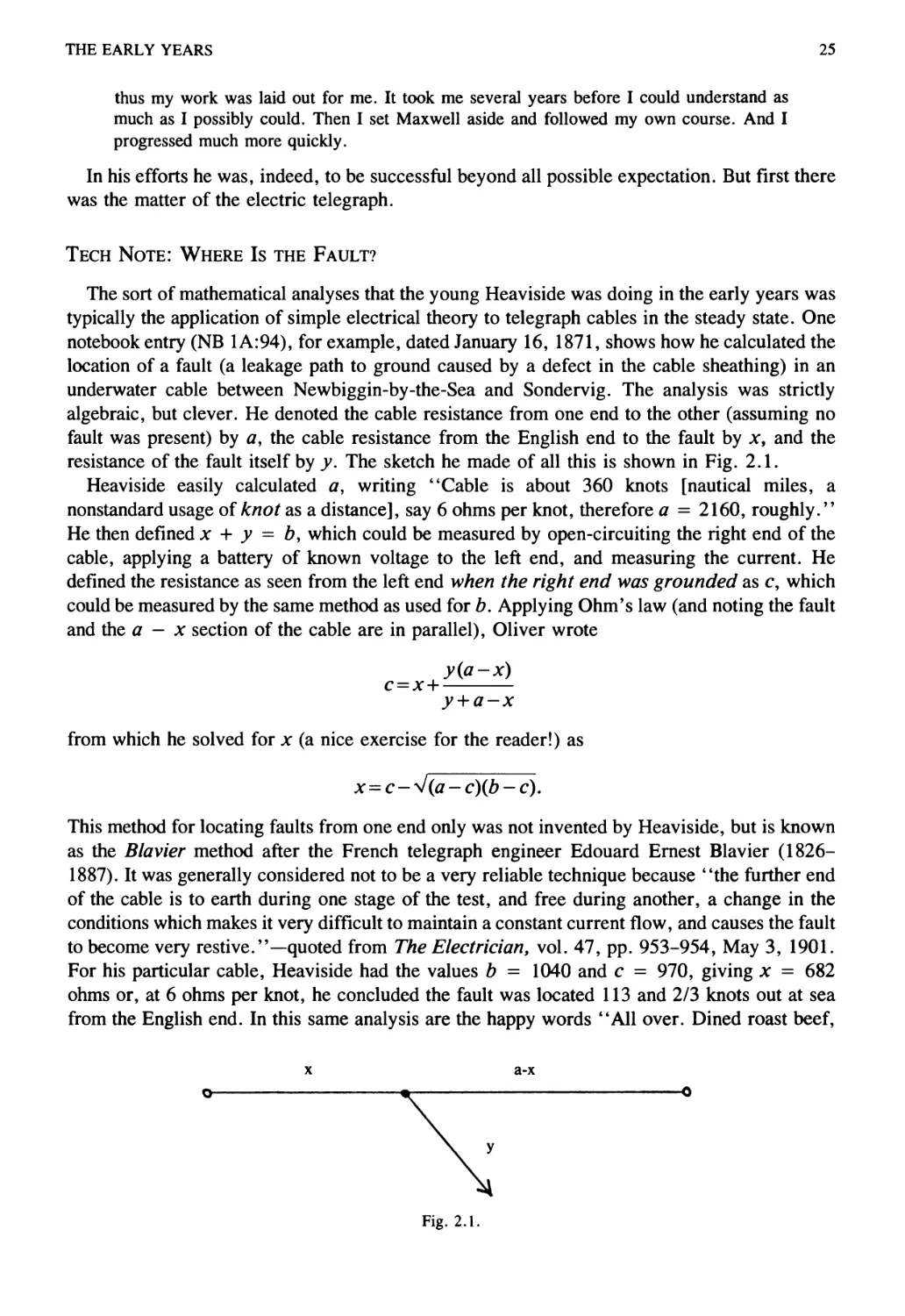
A page from Heaviside's personal copy of Nature, showing that Oliver evidently
liked to read with a pencil at hand.
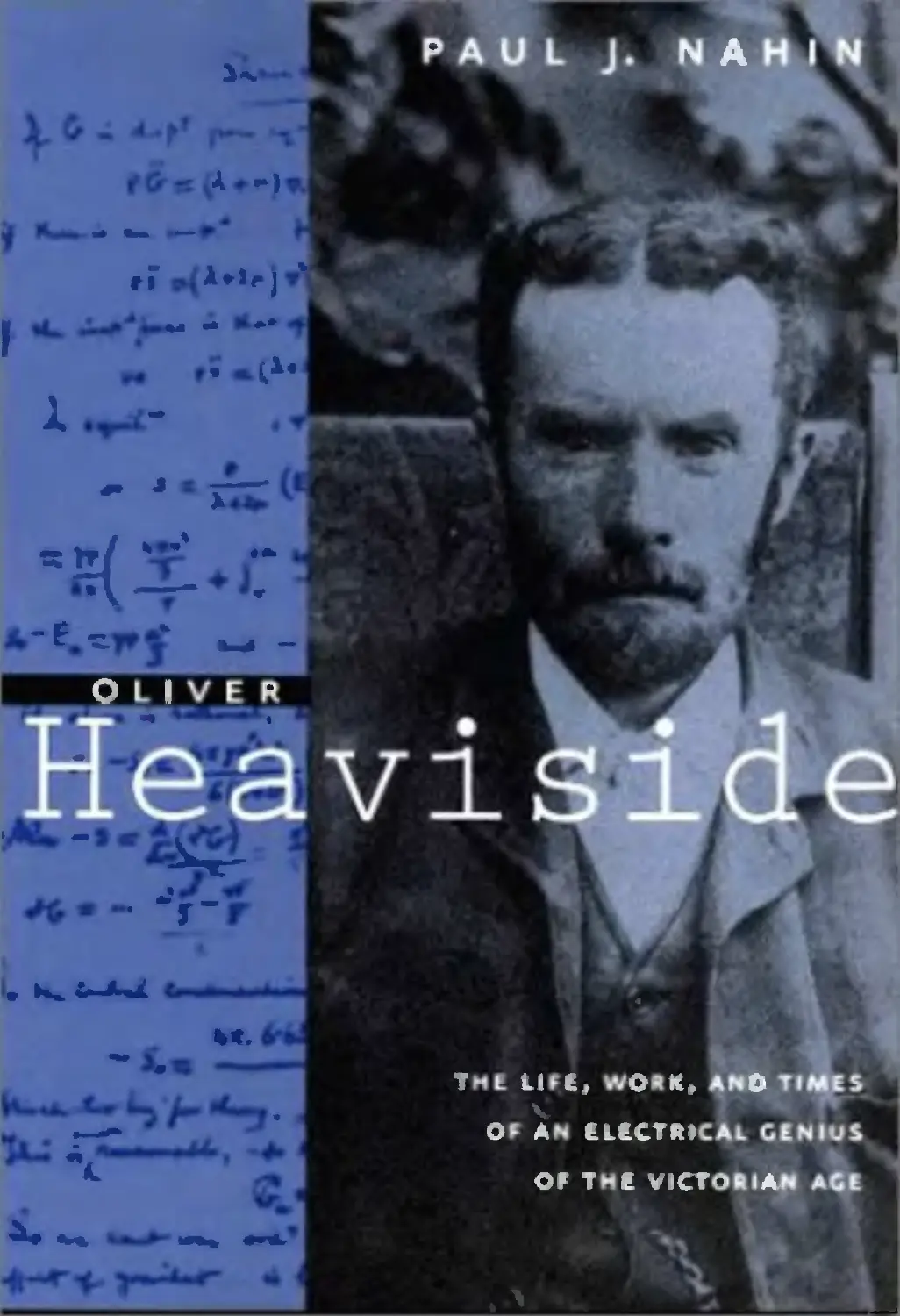
The Life, Work, and Times of an
Electrical Genius of the Victorian Age
Paul J. Nahin
Department of Electrical and Computer Engineering
University of New Hampshire
The Johns Hopkins University Press
Baltimore and London
Copyright @ 1988 by The Institute of Electrical and Electronics Engineers, mc,
New preface copyright @ 2002 by The Johns Hopkins University Press
Printed in the United States of America on acid-free paper
Originally printed in a hardcover edition by The Institute of Electrical and Electronics Engineers, Inc" 1988
Johns Hopkins Paperbacks edition, 2002
246897531
The Johns Hopkins University Press
2715 North Charles Street
Baltimore, Maryland 21218-4363
www,press,jhu.edu
Library of Congress Cataloging-in-Publication Data
N ahin, Paul J,
Oliver Heaviside : the life, work, and times of an electrical genius of the Victorian age I Paul J, Nahin,
p, cm,
Originally published: New York: IEEE Press, 1987,
Includes bibliographical references and index,
ISBN 0-8018-6909-9 (pbk, : alk, paper)
1. Heaviside, Oliver, 1850-1925,2, Electric engineers-England-Biography, I, Title,
TK140,H43 N34 2002
621,3' 092--dc21
[B] 2001038916
A catalog record for this book is available from the British Library,
Contents
Preface to the Johns Hopkins Edition
Preface to the Original Edition
A Note on Mathematics
A Note on References
A Note on Money
Acknowledgments
xi
xxv
XXXI
XXXIII
XXXIV
xxxv
1 The Origins of Heaviside
(A description of mid-19th century Victorian England.)
The Man 1
The Nature of His Work 2
The Grim World of Heaviside's Youth 4
Notes and References 9
1
2 The Early Years 13
(The young Heaviside, his family circumstances, and his education.)
The Beginning 13
A Lucky Marriage 18
First (and Last) Job 20
A Lifetime Decision 23
Tech Note: Where Is the Fault? 25
Notes and References 26
3 The First Theory of the Electric Telegraph . 29
(Historical discussion of Professor William Thomson's 1854 diffusion theory,
the starting point of Heaviside's work.)
Thomson and Stokes 29
The Law of Squares 32
The Atlantic Cable 34
The Speed of the Current 36
Phase Distortion 37
Tech Note: How Thomson Thought Electricity "Soaks" into an Infinitely
Long Cable 39
Notes and References 41
4 Heaviside's Early Telegraphy Work 43
(An account of the introduction of induction effects into cable analysis, and the
nature of Heaviside's mode of working.)
A Full-Time Student 43
The Telegraph Papers 45
The Problem of Signal Rate Asymmetry 47
A "Mathematical Monster" 49
v
Arithmetic Drudgery 51
Tech Note: Why a Cable Is Slower in One Direction than in the Other 54
Notes and References 55
5 The Scienticulist 59
(An introduction to William Henry Preece, Engineer-in-Chief of the British Post
Office and Heaviside' s great nemesis.)
Heaviside's Nemesis 59
Subdividing the Electric Light 63
The Age of the "Practical Man" 63
A Public Debate 64
Why Preece Prevailed (for a While) 66
A Clash of Personalities 67
Preece's Ability 69
The Telephone Affair 71
Heaviside Refuses to Be Shackled 72
Tech Note: Preece's Analysis of the Electric Light 73
Notes and References 74
6 Maxwell's Electricity 79
(The state of know ledge at Maxwell's death in 1879.)
Introduction 79
The Men before Maxwell 80
Action-at -a- Distance 82
The Luminiferous Ether 82
Faraday and Lines of Force 83
William Thomson 84
Maxwell 85
The Displacement Current 87
Postscript: Just What Is Electricity, Anyway? 88
Tech Note 1: A Technically Nice, Often Taught, but Historically False
, 'Explanation" of the Displacement Current 90
Tech Note 2: Action-at-a-Distance, Fields, and Faraday's Electrotonic
State 91
Notes and References 93
7 Heaviside's Electrodynamics 99
(How Heaviside formulated the field equations and what he did with them.)
The Conversion of a Skeptic 100
The Electrician 101
The Importance of Mr. Biggs 103
Getting Off to a Bad Start 106
Reformulating Maxwell's Equations 108
A Friend in Germany 110
More Germans: Foppl, Boltzmann, and Planck 113
Energy and Its Flux 115
Moving Charges 119
A Friend at Cambridge 122
vi
Faster-than-Light 124
Dr. Heaviside, F.R.S. 126
Tech Note 1: The Duplex Equations 128
Tech Note 2: The Localization of Electromagnetic Field Energy 129
Tech Note 3: Heaviside's Derivation of the Electromagnetic Energy Flow
Vector in Space 129
Tech Note 4: Poynting's Physics (and Oliver's Objection) 132
Notes and References 132
8 The Battle with Preece 139
(The story of the "KR-Iaw" and Preece's efforts to suppress Heaviside's
influence. )
High-Tech Hardware, Low-Tech Theory 140
Early Mathematical Analysis 142
The Peculiar Experiments of David Hughes 143
Preece's "KR-Law" and Heaviside's Attack 146
Oliver Lodge's Oscillating Leyden Jar 155
, 'Experience" versus "Theory" 158
Heaviside's Vindication 161
A Change of Scene-and Fame 163
Back in Print-in Style! 167
His Friends Try to Help 170
More Battles 173
Tech Note 1: The Skin Effect 175
Tech Note 2: The "KR-Law" 177
Tech Note 3: Preece and Lodge on Lightning 177
Tech Note 4: Heaviside and S. P. Thompson on the Distortionless
Circuit 179
Notes and References 180
9 The Great Quaternionic War 187
(The development of vectors by Heaviside and by Gibbs, and the debate with
Tait. )
More Debates 188
Peter Tait, the Warrior of Victorian Science 189
William Hamilton and Quaternions 191
Before 1890- The Calm before the Storm 193
The Vector Analysis of Josiah Willard Gibbs 194
Tait Throws Down the Gauntlet 195
The Battle 196
The Aftermath 201
Off to War-Again 203
Tech Note 1: Numbers and Vectors-Real, Complex, and
Hypercomplex 204
Tech Note 2: Hamilton's Insight at the Brougham Bridge 207
Tech Note 3: Quaternions Are Complex! 209
Notes and References 211
vii
10 Strange Mathematics
(Operational calculus.)
"Rigorous Mathematics Is Narrow, Physical Mathematics Bold and
Broad" 217
The Operator Concept 218
Heaviside's Operators 219
The Expansion Theorem 221
The Royal Society Affair 222
The Aftermath of the Rejection 224
A New Friend at Cambridge 227
Tech Note 1: Heaviside's Resistance Operators 230
Tech Note 2: The Problem with the p and IIp Operators 232
Tech Note 3: The Meaning of Heaviside's Fractional Operator, and
Impulses 234
Tech Note 4: Heaviside and Divergent Series 236
Notes and References 238
217
11 The Age-of-the-Earth Controversy 241
(The debate between Perry and Kelvin, and Heaviside's support of Perry via his
operational methods.)
Historical Origin of the Debate 241
The Problem of the Fossils 242
Kelvin's Theory 244
Perry's Rebuttal of Kelvin's Theory 245
Heaviside's Analysis of Kelvin's Problem 248
Perry's Theory of Discontinuous Diffusivity 248
Kelvin's Defense and Perry's Reply 249
The End of the Debate 250
An Assessment of the Debate 251
A Final Word 253
Tech Note 1: Heaviside's Operator Solution of Kelvin's Original One-
Dimensional Problem 254
Tech Note 2: Heaviside's Operator Solution of Perry's Problem of
Discontinuous Diffusivity 255
Notes and References 256
12 The Final Years of the Hermit 259
(The personal life of Heaviside after 1900, when essentially all his scientific work
was done.)
A "Gentleman" with a Pension 260
Life in the Country 265
Another Change at The Electrician 269
The Passing of the Century-and of a Friend and a Foe 271
The World Catches Up to Heaviside-and Leaves Him Behind 275
Oliver Puts His Name on the Atmosphere 277
Increasing Trouble with Life 281
Life at Homefield 284
Death Takes the Past-and the Present 287
viii
The End of the Hermit 290
A Last Look 294
Notes and References 297
13 Epilogue
(An evaluation of Heaviside's impact since his death.)
The Legend Grows 303
Heaviside Profiled in Time Magazine! 305
Formulas under the Floor 306
Last Words 307
Notes and References 308
303
Index
Credits
311
318
ix
For My Family.
Preface to the
Johns Hopkins Edition
England takes great pride and pleasure in her eccentrics; as the Spanish-born philosopher and
poet George Santayana wrote in his 1922 The British Character, "England is the paradise of
individuality, eccentricity, heresy, anomalies." She has never lacked for men (and women) with
those qualities, but the nineteenth century was particularly well stocked with "mad dogs and
Englishmen" who became famous for their unusual lives. They came in all possible shapes and
sizes, with every occupation represented by at least one slightly odd (or perhaps very odd)
individual. Names from that time, like Oscar Wilde, General Gordon of Khartoum, Florence
Nightingale, and Lewis Carroll are instantly recognized, even by those whose interest in
Victorian times is mainly limited to Jack the Ripper.
Even in anonymity the nineteenth-century Englishman can leave us astonished. We will, for
example, sadly never know anything about the man (or possibly the woman) whose long
abandoned box at London's Chancery Lane Safe Deposit Company was finally forced open in
the 1940s. Found inside, according to Peter Bushell's London's Secret History, was only a pair
of Victorian lady's knickers, along with an attached note declaring them to be "My life's
undoing." In another such box was a packet of six live bullets; written on the packet, in a faded
hand, was the single sentence: "One for each of the directors." I think I am on safe ground to
believe that those notes certainly must excite your imagination; but not nearly as much, I think,
as will the amazing story of Oliver Heaviside.
Heaviside was one of the most important yet least appreciated contributors to physics and
electrical engineering during the second half of the nineteenth century. His very name conjures
up the image of a Charles Dickens' character. Indeed, he was born at mid-century only a short
distance from the shoe-blacking factory where the author of Oliver Twist and Hard Times learned
firsthand the horrors of being down and out in Victorian London. After a mostly self-taught
technical education in advanced electrical and mathematical matters, Heaviside engaged in a
stupendously nasty and lengthy battle with William Preece, the engineering head of the Post
Office, which was England's official agency for the development of electrical communications
technology. Preece was a powerful government official, enormously ambitious, and, in some
remarkable ways, an utter blockhead. He was everything Heaviside, a poor man with no weapons
at his disposal but his brains, was not. Their conflict was of such an intense personal nature that
it had all the makings of a Victorian melodrama. In the end, although it did him precious little
good, Heaviside's brain proved to be the superior to Preece's politics.
Some time after the original 1988 edition of this book appeared I came across a review in Time
magazine of Donald Spoto's biography The Dark Side of Genius: The Life of Alfred Hitchcock.
The reviewer wrote "The word genius is good for starting arguments but bad for book titles,
unless the book is about Mozart." Having committed that very "sin," using the word "genius" in
this book's subtitle, was I contrite? Absolutely not-Heaviside was a genius, and I see no reason
xi
xii
OLIVER HEAVISIDE
to hide that fact from readers. Indeed, that fact needs to be made explicit since, even among
mathematicians, physicists, and electrical engineers (those who would be expected to know him
best), he is still a mysterious figure. I feel fortunate that my long-time editor, Trevor Lipscombe,
an Englishman himself and Oxford physicist to boot, loved the story of Heaviside, too. Trevor
asked if I would consider the Johns Hopkins University Press for reprinting, and I enthusiasti-
cally replied, "Why, of course!"
Over the years I have received a large amount of correspondence from readers of the original
edition, providing me with bits and pieces of Heavisidean lore that I had not known about. I have
carefully saved all that material, so when Trevor asked for an essay to update the book, I knew
my treasure-trove of "new" Heaviside stuff would at last come into its own.
A natural issue to take up immediately is that of other biographical writings on Heaviside that
appeared after the 1988 publication of this book, Actually, as I mention in a footnote in the
original Preface, a Heaviside biography did appear earlier, in 1985, in Russian, but at the time I
wrote I knew nothing more of that work. It wasn't until some time after 1988 that I learned the
same author, Boris M. Bolotovsky, had published an English language paper on Heaviside in the
journal International Studies in the Philosophy of Science in April 1987 called "The Birth and
Development of New Knowledge: Oliver Heaviside." In his paper Bolotovsky gives a nice
summary of Heaviside's life and work, but it contains nothing that isn't also in this book.
In 1991, unaware of B olotovsky' s book and apparently not totally happy with this one, Arnold
C. Lynch (a long-time employee of the British Post Office Engineering Department from the
mid-1930s to the mid-1970s) published an interesting essay in the journal History of Technology
titled "The Sources for a Biography of Oliver Heaviside." Lynch wrote that my book "is the best
of the biographical work we have, and unlikely to be superseded," but also that "It is open to
some criticism." Lynch feels I "play down the importance of Heaviside's mathematical
methods," and makes it clear that he thinks my opinion is that those methods are obsolete (see
Chapter 10). But, that doesn't mean I think Heaviside's methods historically unimportant; if I
gave that impression then I am truly sorry. The German historian Susann Puchta has recently
written ("Why and How American Electrical Engineers Developed 'Heaviside's Operational
Calculus,'" Archives Intemationales d' Histoire des Sciences, June 1997) in agreement with
Lynch. She feels that I have too readily brought down the curtain in my discussion of the decline
of Heaviside's operational calculus. I think she is correct. Despite the development of the
Laplace transform the use of Heaviside's method did not cease overnight, and if I were to write
Chapter 10 fresh, today, I would soften my position on that issue.
However, I do not agree with Puchta's speculation, at the end of her paper, that the occasional
appearance of a historical paper on the operational calculus is evidence for a renewed interest in
the subject by electrical engineers. I write this even though at least one electrical engineer had
written in agreement with Puchta before Puchta's paper appeared; Per A. Kullstam presents his
views in two papers displaying great mathematical virtuosity ("Heaviside's Operational Calcu-
lus: Oliver's Revenge" and "Heaviside's Operational Calculus Applied to Electrical Circuit
Problems," IEEE Transactions on Education, May 1991 and November 1992, respectively).
Still, while I admire Kullstam's skillful mathematics, I think his central conclusion that
undergraduate electrical engineering students should be taught the operational calculus is wrong.
Every undergraduate engineering textbook I am familiar with, in all of the engineering
disciplines, uses the Laplace transform to solve linear, ordinary differential equations; there is
virtually no chance of the standard undergraduate electrical engineering curriculum replacing the
Laplace transform with the Heaviside operational calculus. Indeed, that decision was made
decades ago. When the first edition of Cornell University mathematics professor Ralph Palmer
Agnew's classic Differential Equations was published in 1942, he included both the classical
PREFACE TO THE JOHNS HOPKINS EDITION
xiii
techniques and Heaviside's differential operator approach. The Laplace transform was nowhere
to be seen. Agnew, then, had no bias against Heaviside's mathematics. But when the second
edition appeared in 1960, after calling both the Laplace and Heaviside methods "expeditious,"
Agnew went on to say that "The Laplace transformation method seems to have completely won
the battle for attention because it is more interesting, it is easier to apply to routine problems, and
. . . it is more versatile." Nobody in engineering education has seen fit to argue with Agnew's
assessment since he wrote those words more than forty years ago.
While I don't believe Kullstam's papers had any impact on electrical engineering educators,
they did prompt the German historian Susann Hensel to write the very interesting essay "Ernst
Julius Berg-Educator and Proselytizer of Heaviside's Calculus," IEEE Potentials, Augustl
September 1994. You'll read more about Berg and Heaviside in Chapter 12 of this book, but
Hensel's essay does mention one amusing anecdote that I had not known; in 1936 Berg sent
Albert Einstein a copy of the new edition of his book Heaviside's Operational Calculus, and
received a thank you note from the great man saying that he appreciated the gift because now he
would be able to learn Heaviside's "peculiar mathematical witchcraft"!
Returning to Lynch's "Sources," in addition to this book he also mentions two other specific
biographical works on Heaviside; a short 1987 book based on material prepared by Heaviside's
friend G. F. C. Searle (Oliver Heaviside, The Man, St. Albans, edited by one Ivor Catt about
whom I'll say more, soon), and an unpublished typescript by the late Henry J. Josephs (also a
British Post Office Engineering Department employee, from even earlier times than those of
Lynch). As Lynch observes, and as I stated in my "A Note on References," the Searle/Catt book
appeared just as this book was going to the printer, so I did not have it available as a source. I
have, however, read it since. It is an interesting amalgamation of letters written by Heaviside to
Searle from 1892 on, with occasional commentary by Searle on the origins of particular letters.
The Searle/Catt book, though, is limited to letters written sporadically to one individual over the
last three decades of Heaviside's life, and it presents little discussion of Heaviside's life before
1892 and none at all about his work. It is mostly an expansion of a contribution Searle made to
the Heaviside Centenary volume published in 1950 by the Institution of Electrical Engineers
(lEE), which I used when writing this book.
In his "Editor's Preface," Catt writes "The behavior of the Scientific Establishment when
faced by the brilliance of Heaviside was intensely political and destructive. . . A century later, I
myself met with exactly the same kind of behaviour . . . when in my turn I produced major
advances in electromagnetic theory. Like Heaviside's, my work was suppressed." This assertion
is strange. Heaviside's work certainly was not suppressed by the scientific world (it would be
better to say that for a long time it was ignored by the engineering establishment)-The
Electrician and Philosophical Magazine regularly published him, and the papers appearing in
those journals were widely read, admired, and publicly praised by such scientific stars as Oliver
Lodge, William Thomson (Lord Kelvin), and John Strutt (Lord Rayleigh). It was through their
support that he was elected a Fellow of the Royal Society, which is hardly a mark of scientific
rejection. Heaviside is even mentioned in Maxwell's masterpiece A Treatise on Electricity and
Magnetism (see note 28 of Chapter 2 of this book).
It is true that in 1888 Preece succeeded for a while in pressuring The Electrician into not
publishing Heaviside, and that in 1894 the Royal Society refused to continue publishing his
paper on operators, but neither act rises to the level of suppression. Heaviside by then had other
avenues for disseminating his work-and he used them. Heaviside's "suppression" has not
continued into modem times; his work has been almost continually cited. For example, Sir
Edmund Whittaker's classic two volume History of the Theories of Aether and Electricity (the
first volume of which was originally published in 1910 then reprinted in 1950; the second
xiv
OLIVER HEAVISIDE
lificate of II Caudiclat for Eleel im"
.. aN_, . .. ........., ....... .. ... ............ ..... - tIN ,"11.. ....
f'--,
L PU-
(To),. U 1J""'.II",.t'OJ')
;.
g'",,
( _t..tt It!" I.,......,
J
· _ ... J-- i] iA-£..-"',......"-. '--J ..jI-t.....4 ,...." (.. -...-c::... -- .-..,-- - ..
fJ -I .....,._r;,IW -- '-''r.- ... I - _4.... ,p. ;.i t
'"'L''' t- a. ",... < 'I .......,.-u. 1L-,..." '7 ' I I>H.. #
JfJ....t;..J....4 __ ""I"" 1 P J--+L- t+ ,J' -,. .4-... ,.. / ..
1 It.. /.u..-; j4,.... --7 -.., I D...IL .,,- .,..
,..c ..,4..4.J.- ...,...... - II' > f.l II ...-.... -, ...-,"
0... £c-L-., r 7. r \ .. _ ........
...".. _ '1 ---' - -q C" j.l-t. . I 11. 1.... , .4-__
f.s..£-.f.,A....' ......,-cI:;. ,- ") ".s.... '/ If. -
-
t-., if''''''' J » .....!+- .J ..t..... J.. f. ui-- u.....,... ..,.. /'.,l. ,......... ' /IJ.. It- 01"10, 1 .,u" ...., s;.. ......
()..... .... Y J L.. "'..t:",.. , JI.. '" It r.,J.. _ r 1tf'
r sJ,.:;;.. '1 .,.,.,..-k. ,... ,...£ - to L -C-
..".. 1.....,.( f lot __ ".f ... .. . IL-rol ""'r-- -r , "71
c... Il..,.1..-....,..-c......... · "-.; I " I (
£.". .4 '""- '"'...., ,b- '7 'I " 'ff 1..A: - ....." tJ1 -tl
oJ... R.--'- J ., I'M "'" II' ') _
.. __. 71-(;"' I / .... t"'" -."...c . _ ,; r f
..=.. ,.. 1......'5.
J", (.L ..........t...r....-. '-'I-- . It.. .... tI-.L... ""'- f-4A........ 'Y'
4
.... :1 Itllt fffj. 1)/ 01'<1 1.1' \ \ f ... II \ (,I> II) 1'1'''. ."" ,If' JI',1'IC.J.
f' -.,-A-
.l:\ ., ....,..".
(I:.. ''$eo '" 01 ..............)
,..-
JI'" J (J'.d w... '.. 'lnO"[ I"J., .... 1/'1<f'f to '/ ".' 1" 'WIll ..tul . 'I. Ii fl' I.. tIC" "1#1.1,,1 u,nl
'W;; O""li Ih'll
-"11" .i.t I
....
... ,- '\.0
,.. "'-7 '
..... ......... ..........
Jl- tI c...
J, 0-
'f;1( f':A
,..,
1 ..
I/f r' .
'l?X t
l 1
(I
p
.
....
'\
, t;< /- .., < &1
tIJ . fl.. '-
,A-./d:
. vf
./ .
. .,.--
i. ('--, ,._& -
V. , w
Jk /JJ'<..
lit tlw .....,. ..... '\ .. ...M ,.,,,
Some of England's greatest scientists certify that Oliver Heaviside is their intellectual (if not social)
equal.
PREFACE TO THE JOHNS HOPKINS EDITION
xv
volume was first published in 1953), has numerous references to Heaviside's work. The 1938
polemic against Einstein and relativity theory by Alfred O'Rahilly, the still occasionally cited
book Electromagnetics, contains numerous critical references to Heaviside, both of him
personally and of his work. As the old saying among actors and writers goes, however, "say what
you want about me, just spell my name right." At the University of New Hampshire's Physics
Library I found Julius Adams Stratton's classic 1941 book Electromagnetic Theory, which
contains multiple references to Heaviside's work. And I also unearthed Sir James Jeans' 1951
The Mathematical Theory of Electricity and Magnetism, which refers the reader to Heaviside's
seminal work on electric signaling over inductive cables. Heaviside certainly did not "disappear"
from the view of those who read technical books.
Lynch writes in his essay that I "may not have seen the Josephs draft." Well, in fact I did,
during a March 1985 visit to the Heaviside Collection at the lEE in London. Before starting to
write this essay I consulted the research notebook I kept during that visit, and found a fair
number of unhappy comments that I wrote to myself as I read the Josephs draft. Most material
in the draft was available elsewhere in published documents with a proper citation of sources.
Josephs claims to have had access to letters and papers that nobody else has, but to date these
have not been produced for independent study. As such, there is no support for some of his
assertions. I do not share Lynch's opinion that the "Josephs draft has value for the historian."
You'll find more on Josephs in Chapter 13.
Not to be totally at odds with Lynch's essay, I did learn one quite interesting fact from it. As
I write in Chapter 2 of this book, Heaviside's uncle was the famous scientist Charles Wheatstone,
having married the sister of Oliver's mother. I had not known, however, that the marriage was an
unusual one for the rigid, class-conscious Victorian age; Wheatstone married his cook.
Also in 1991, the year of Lynch's paper, in a book that is about not only Heaviside's work but
also that of several other Victorian researchers, Bruce J. Hunt (a professor of history at the
University of Texas, Austin) published The Maxwellians, Cornell University Press. Hunt's book
is admirable; it is based on his 1984 doctoral dissertation written at the Johns Hopkins
University, a copy of which I purchased and used extensively while writing this book, and it is
cited in this book's notes. A few years later Ido Yavetz (a professor at the Cohn Institute for the
History of Science at Tel Aviv University) wrote the 1995 book From Obscurity to Enigma: The
Work of Oliver Heaviside, 1872-1889, Birkhauser. Like Hunt's, Yavetz's book is a smoothly
written, technically accurate and scholarly work. While it contains some biographical informa-
tion, its view on Heaviside's life as opposed to his work is much narrower (as you might expect
from the title) than is that of this book.
Finally, let me return for one last visit with Catt. In an audio tape (dated February 2, 1997)
that he placed in the lEE archives in London (a transcript is available on the Web at www
. electromagnetism. demon. co. uk), Catt discusses, with Lynch, what he calls "The International
IncidentfThe Josephs-Gossick-IEE Clash." Gossick was Ben Roger Gossick who, at the time of
his death in 1977, was professor of physics and electrical engineering at the University of
Kentucky, Lexington. (Catt incorrectly states that Gossick was, of all things, a professor of
music.) During the last years of his life Gossick worked on a biography of Heaviside (originally
to be a dual biography of Heaviside and Wheatstone, which was partly preempted by Brian
Bosworth's definitive 1975 biography of Wheatstone); much of that work made use of
discussions Gossick had with Josephs during several research visits he made to England. The
book was never published.
Josephs certainly must have been an interesting person; despite my severe reservations about
his understanding of the need to properly document an historical work, it seems clear he
xvi
OLIVER HEAVISIDE
possessed a good deal of mathematical ability. In 1946, for example, he published a highly
readable monograph on Heaviside's physics and mathematics (Heaviside's Electric Circuit
Theory), based on "after-hours" lectures Josephs had given to the engineering staff of the British
Post Office. Later, Josephs contributed a lengthy commentary on Heaviside's mathematics to the
1950 lEE Heaviside Centenary volume. Both are erudite works, although the line between what
is Heaviside and what is Josephs is often a blurry one.
Catt claims that Josephs' mathematical skills were such that all of the technical sections of
Gossick's aborted book were due to Josephs, for Gossick was, after all, just a "professor of
music." Gossick, however, was a Phi Beta Kappa at Pomona College (one of the Claremont
Colleges in California) and had a Ph.D. in physics (Purdue University, 1954); his doctoral
dissertation was titled "On the Transient Behavior of Semiconductor Rectifiers." During his
career he worked as an electrical engineer at the University of Minnesota at Minneapolis, for
RCA, and at the Oak Ridge National Laboratory, Tennessee, as well as holding academic
positions as a physicist at Purdue, Arizona State University, and at Harpur College of SUNY,
Binghamton. He conducted research on radiation effects in semiconductors, the dynamic
behavior of semiconductor rectifiers, and p-n junction particle detectors. He published numerous
scientific papers in refereed journals and wrote two books in advanced physics, both published
by Academic Press (Potential Barriers in Semiconductors, 1964, and Hamilton's Principle and
Physical Systems, 1967). He certainly did not need "help" in understanding either Heaviside's
circuit theory or his mathematics. Indeed, in his 1967 book Gossick makes use of Heaviside's
mathematics (as well as of the Laplace transform),
After his death Professor Gossick's research papers were donated by Jean Gossick to the Niels
Bohr Library of the Center for History of Physics at the American Institute of Physics (then in
New York City and now at College Park, Maryland). One need only study the Gossick papers a
short time to appreciate how central a role his stillborn book on Heaviside must have played in
Gossick's life. I never knew Ben Gossick, but I greatly admire his published work and hope that
this book on Heaviside, while not his, would nonetheless have pleased him.
In the following section I have included discussion to serve as a supplement to and/or
expansion on the original book. Much of the new material is due to the kindness of strangers, to
readers of the original book who sent me letters of personal knowledge on various issues, often
including Heaviside-related documents, as well. I have arranged these "updates" by order of
original chapter.
CHAPTER 4: HEAVISIDE'S EARLY TELEGRAPHY WORK
In April 1994 I received a letter from David W. Kraeuter, a reference librarian at Washington
and Jefferson College in Pittsburgh. An active member of the Pittsburgh Antique Radio Society,
Kraeuter had an obvious interest in Heaviside and had written to tell me that I had missed an
important detail of Heaviside's work. While preparing his own book (British Radio and
Television Pioneers: A Patent Bibliography, Scarecrow Press, 1993), he had come across a patent
in Heaviside's name, something that I believe has not been mentioned before in any historical
treatment of Heaviside. The discovery of this patent resolves a long-standing puzzle mentioned
in Ido Yavetz's book, From Obscurity to Enigma.
Kraeuter kindly sent me a copy of the entire patent document, and it made extremely
interesting reading. Dated April 6, 1880, (when Heaviside was living at 3 St. Augustine Road, in
London) it is British Patent 1407 with the title "Improvements in Electrical Conductors, and in
PREFACE TO THE JOHNS HOPKINS EDITION
xvii
the Arrangement and Manner of Using Conductors for Telephonic and Telegraphic Purposes."
This patent is interesting because it describes two ways for "zeroing-out" all inductive coupling
between separate but adjacent circuits. It is the first method that is the meat of the patent.
Heaviside opens his claim by stating the problem as follows:
When a number of wires run parallel to one another, either suspended or otherwise, any
change in the current flowing in one wire causes currents in all the rest by induction, and the
effect may be so great as to seriously interfere with the working of telephonic circuits, and to a
less degree of ordinary telegraphic circuits also.
It is a common practice to complete the circuit by means of a second wire instead of the earth
and it is well known that the inductive interference is thereby reduced in magnitude, the in-
duced electro-motive forces in one wire canceling those in the other to a certain extent. The
nearer the wires are brought together the less does the inductive interference become, but it
cannot be altogether eliminated in this way, because the axes of the two wires cannot be made
to coincide so that they shall be both at the same distance from any disturbing wire.
Next comes Heaviside's solution:
My improvements have for object to obtain perfect protection, and to render a circuit com-
pletely independent under all circumstances of external influences. For this purpose I use two
insulated conductors for the circuit, and place one of them inside the other; thus one conductor
may be a wire, and the other a tube or sheath, thus forming a compound conductor consisting of
a central wire surrounded by an insulating covering, which is in its turn surrounded by a con-
ducting tube or sheath, which must also be insulated. When the tube and inner wire are electri-
cally connected at both ends of the line, as through apparatus in the usual manner, the circuit as
thus described is completely independent of other circuits, and any number of such circuits,
each containing an insulated tube and inner wire, may be laid side by side and worked without
any mutual inductive interference, and without interference from other wires worked in ordi-
nary manners.
That is, Heaviside's patent is for nothing less than the modem, ubiquitous coaxial cable, of
which a light-year or two (metaphorically speaking) must be used each year around the world.
This was the geometry of the Atlantic Cable, discussed in Chapter 3 of this book, but apparently
nobody patented it. That cable was used at signaling speeds so slow that inductive effects were
not evident (or, at least, William Thomson's theoretical analyses ignored such effects), and it was
Heaviside who first saw the coaxial cable as the solution to avoiding magnetic coupling
interference between the adjacent, high-speed telephone circuits of the late nineteenth century
that far outran the slower mid-century submarine cabling speeds. The second method described
in the Heaviside patent is separate and distinct from the first; it shows how to position two pairs
of wires, with each pair forming a conventional circuit, so as to cancel the inductive coupling
between the two circuits.
As I mentioned earlier, this patent now clears up a historical puzzle, namely the nature of a
letter Heaviside's brother Arthur wrote on June 29, 1881, (just a year after the patent date). In it
Arthur advises Oliver to "sign the blooming [royalty] agreement and take. . . the cheque for [100
pounds]." In his book Yavetz states (p. 13) that it has been speculated that Arthur was referring
to an invention by one or both of the brothers, and that the invention concerned means of
"neutralizing disturbances in cables"; it would now seem that we do indeed know that this was
the case, as well as the details of exactly what was proposed, and that Oliver was the sole
inventor.
x viii
OLIVER HEA VIS IDE
CHAPTER 5: THE SCIENTICULIST
A scholarly paper dealing with Preece appeared before 1988, but I missed it in my original
bibliographic search. It is extremely interesting reading, addressing in part (as the author writes)
Preece's "almost arrogant self-confidence which led him into serious error on occasions. This
comes out most strongly in his work on telephone transmission, where he pushed forward his
own erroneous views in opposition to the work of Oliver Heaviside, which he could not
understand."
Read by Professor D. G. Tucker at the Science Museum in London, March 1982, you can find
it in print as "William Preece (1834-1913 )," Transactions of the N ewcomen Society for the Study
of the History of Engineering Technology 53, 1981/82, pp. 119-138.
CHAPTER 6: MAXWELL'S ELECTRICITY
I say in note 18 of this chapter that there is no extensive biographical treatment of George
Green. That was true in 1988, but in 1993 a really very nice little book by D. M. Cannell
appeared: George Green, Mathematician and Physicist, 1793-1841: The Background to His Life
and Work, Athlone Press. As I write, the Society for Industrial and Applied Mathematics (SIAM)
has just published the second edition. The new edition contains a fascinating essay by physicists
Freeman Dyson of the Institute for Advanced Study and the 1965 Nobel laureate Julian
Schwinger, describing the historical and contemporary applications of Green's work.
CHAPTER 10: STRANGE MATHEMATICS
I have already discussed Kullstam's modern-day championing of Heaviside's mathematics. In
this note I want to direct your attention to a fascinating essay by Bruce J. Hunt on the politics of
that mathematics; in particular, the refusal of the Royal Society in 1894 to continue publishing
Heaviside's multi-part paper "On Operators in Physical Mathematics." You can find Professor
Hunt's analysis ("Rigorous Discipline: Oliver Heaviside Versus the Mathematicians") in the
book The Literary Structure of Scientific Argument: Historical Studies, ed. Peter Dear,
University of Pennsylvania Press, 1991.
Hunt's argument is essentially that Heaviside simply appeared on the scene at the wrong time,
when English mathematicians were attempting to develop an identity for their discipline that
would be separate and distinct from the applied mathematics of physics and engineering. The
very nature of the Mathematical Tripos examination, with its increasing emphasis on mathemati-
cal physics, was increasingly disturbing to Cambridge mathematicians in the 1880s and 1890s.
As I discuss in Chapter 10, Heaviside was definitely an applied mathematician of the wildest sort
(as he wrote to Hertz in 1889, "Physics is above mathematics, and the slave must be trained to
work to suit the master's convenience"), and when his unrigorous use of fractional operators and
divergent series ran wild in the "On Operators. . ." paper, the new breed of "mathematical
rigorists" reacted in a hostile way; not to Heaviside the man, but to Heaviside as an icon of
"sloppy" mathematics that would simply no longer be tolerated.
This attitude can be found expressed in the classic book by G. N. Watson, A Treatise on the
Theory of Bessel Functions, Cambridge, 1922; in the midst of a discussion in his chapter on
asymptotic expansions, Watson writes "A number of extremely interesting symbolic investiga-
tions of the formulae are to be found in Heaviside's papers [Watson cites the first two parts of
"On Operators. . ." that the Royal Society did publish], but it is difficult to decide how valuable
such researches are to be considered when modem standards of rigor are adopted." Heaviside
was still alive when that appeared; I don't know if he saw Watson's book but I can imagine what
he said if he did.
PREFACE TO THE JOHNS HOPKINS EDITION
XIX
Hunt reports that it was Andrew Forsyth (1858-1942) who raised the initial objections that
eventually resulted in the Heaviside manuscript being sent to its doom at the hands of William
Burnside, as discussed in Chapter 10. (Hunt doesn't mention it, but I think it an amusing irony
that Forsyth, both the son of an engineer and the Senior Wrangler of the 1881 Mathematical
Tripos, was the one who started the chain of events that stopped the "unpure, too practical"
Heaviside,) Burnside had little patience for the "intuitive genius" of Heaviside; as Hunt reports,
Burnside was later equally harsh with the self-trained Indian genius S. Ramanujan, despite his
being the protege of G. H. Hardy, the purest of the pure in English mathematics.
The Laplace transform has come up several times before in this essay, but there remains one
additional historical aspect I learned of only after the original publication of this book. The
English mathematician Harry Bateman (1882-1946) used the Laplace transform in a 1910 paper
(the year he moved permanently to the United States, where he taught at Bryn Mawr, Johns
Hopkins, and, from 1917 until his death, Caltech). Titled "The Solution of a System of
Differential Equations Occurring in the Theory of Radio-active Transformations," it appeared in
the Proceedings of the Cambridge Philosophical Society-and in it he used contour integration
in the complex plane to invert transforms, the same technique Bromwich would later use to
justify Heaviside's operational calculus.
The author of Bateman's obituary (as a Fellow of the Royal Society) wrote that Bateman felt
his pioneering work on the Laplace transform had been ignored (Doetsch's 1937 book fails to
mention Bateman). In a 1945 letter Bateman explained that, in fact, his own interest in the
transform had been sparked by lectures on it that he had heard at Cambridge in either 1903 or
1904, and that he had written John R. Carson (the AT&T engineer who proselytized Heaviside's
operational calculus) to point out to him that the Laplace transform was yet another way to attack
circuit problems. By 1950 others had learned that lesson. See, for example, the paper by Louis
A. Pipes, "The Summation of Fourier Series by Operational Methods," Journal of Applied
Physics, April 1950, in which Heaviside and his Electromagnetic Theory are referenced but the
actual mathematics is the Laplace transform.
CHAPTER 12: THE FINAL YEARS OF THE HERMIT
After this book appeared in 1988, the editors at Scientific American invited me to write an
article about Heaviside for the magazine; that essay appeared in the June 1990 issue and, with
one exception, contained no new information. But that exception is an interesting one. In
December 1988 I received a letter from James L. Hunt, professor of physics at the University of
Guelph in Ontario, Canada, bringing to my attention that about fifteen years earlier the British
novelist Beverley Nichols (1899-1983) had published a nonfiction book titled Father Figure
(Simon & Schuster, 1972). It is a very dark work describing the horrors Nichols' abusive,
alcoholic father had inflicted upon his family throughout the entire marriage. This is relevant
because the Nichols family had been Heaviside's next-door neighbors at Torquay, and the young
Beverley had been one of the boys that Heaviside had frequently recorded as having "tormented"
him. Nichols had a symmetrical relationship with Heaviside on that score, calling him a
"singular character" and just the first of "an ever weirder horde of eccentrics" that had lived all
about the Nichols' home.
Nichols recollection of Heaviside, in particular, is shocking. He wrote
Professor Oliver Heaviside. He was our immediate neighbor on the west. . . . At the time of
my boyhood Professor Heaviside was engaged in certain intricate researches into the nature of
etheric waves. I cannot describe his discoveries, but they must have been of some importance;
when he died The TImes published a long obituary about him, in which his name was coupled
with Edison and Marconi.
xx
OLIVER HEA VIS IDE
But I could have told The Times a great many things about Professor Heaviside which, though
they might not have been of interest to the scientists, would have provided the student of eccen-
tric psychology with abundant food for thought. The Times, for instance, did not mention that
he seldom dressed, and was usually attired in a kimono of pale pink silk. Nor did The Times see
fit to mention that Heaviside, in a moment of pique, had caused most of the furniture of his
house to be removed, and had replaced it by large granite rocks, which stood about in the bare
rooms like the furnishings of some Neolithic giant. Through those fantastic rooms he wan-
dered, growing dirtier and dirtier, and more and more unkempt-with one exception. His nails
were always exquisitely manicured, and painted a glistening cherry pink.
This passage certainly gives some credibility to the idea that Heaviside was, in some sense,
mentally unbalanced during his last years. Ido Yavetz mentions in From Obscurity to Enigma
(note 194 on his page 281) that B. R. Gossick claimed in a 1977 paper Heaviside (see note 17 of
the Epilogue of this book) to have been in fact mad. Yavetz thinks that claim to have "marred"
Gossick's paper, but Nichols' words seem to support Gossick. Nichols himself was actually not
prepared to go quite as far as had Gossick, but his own additional commentary on this issue is
nevertheless damning:
Was Professor Heaviside mad? Presumably not-his scientific record shows him to have had a
brain of exceptional range and delicacy; he was probably one of the few men of this century
who could have argued intelligently with Einstein. But to me he was just another figure of
whom to be afraid; he was surrounded with a childish aura of terror. Sometimes I used to creep
under the bushes and peer through a gap in the wall, and watch him prowling about his ragged,
thorny garden. Through the unwashed windows I could see the rocks, standing against the
walls of his drawing-room, Now and then he would pause, and glare in my direction; he had a
habit of suddenly pulling his pink dressing-gown very tight, and flicking his glistening fingers
above his head.
Apparently Nichols and his brothers did rather more than just watch Heaviside because, as he
goes on to write,
occasionally, during the summer months, my father would receive a letter from [Heaviside] on
the subject of tennis balls which I, or my brothers, had inadvertently knocked into his gardens.
These letters always began as follows:
His Wormship, Professor Oliver Heaviside, (W.O.R.M.), presents his compliments to
Mr. John Nichols, and wormfully requests permission to bring certain matters to his
attention.
Then came the substance of the complaint. The letters were always signed Oliver Heaviside,
W.O.R.M. It is an ironic thought that the author of these letters was largely responsible for
bringing radio technique to its present pitch of perfection.
Nichols wrote that his father thought Heaviside to be simply a "grand joke," but to the young
boy he was far more threatening. Nichols ends his remembrance of his scary neighbor with these
words:
to me, as a child, he was a bogy, a witch-doctor, another figure to fear in a world in which fear
was the guiding force, Never would I venture into his garden, to fetch a ball that had been lost;
I felt that once inside those walls I should never come out again. . . or if I did, that I should be
changed, and have a light of madness in my eye, and should wander down the hill, and out into
the world, a lost boy, whom nobody knew.
I learned of Nichols too late for the original edition of this book, but I was able to include an
abbreviated summary of his recollections in the Scientific American essay.
PREFACE TO THE JOHNS HOPKINS EDITION
xxi
CHAPTER 13: EPILOGUE
In October 1988 I received a letter from Professor Dirk Stroik (1894-2000), professor
emeritus of mathematics at MIT and a well-known historian of mathematics. He had been given
a copy of this book by "my grandson the electronics engineer" for his 94th birthday, and wrote
to tell me about his friendship with his MIT colleague Norbert Wiener. He also included some
comments about Wiener's novel The Tempter (starring Heaviside as the thinly disguised hero).
Stroik told me that he and Wiener had had many conversations over the relative merits of using
differential operators and the Laplace transform to solve differential equations; Stroik believed
that Wiener was "one of the first to see the connection [between the Laplace transform and the
Heaviside operational calculus]." Indeed, when Wiener's electrical engineering colleague at
MIT, Vannevar Bush, published his 1929 book Operational Circuit Analysis, Wiener contributed
an appendix. It was on Fourier series and integrals, and of asymptotic series expansions of
differential operators. Perhaps it was the writing of that appendix that originally brought
Heaviside to Wiener's attention.
To quote from Stroik's letter, concerning The Tempter: "he was quite excited when it
appeared, went every day to the [campus bookstore] to see how many copies were sold, and was
utterly depressed when a review appeared that was somewhat critical. 'Even Einstein cannot be
a Dostoyevsky at the same time,' I told him."
There is one more interesting story concerning The Tempter that I learned about after this book
appeared in 1988.
In 1993, nearly thirty years after Wiener's death, the MIT Press published a book by him (a
preliminary draft had been written in 1954, for Doubleday, and then abandoned), titled
Invention: The Care and Feeding of Ideas. Wiener had lost interest in Invention and had decided
to put all of his energies towards his novel. As Steven J. Heims writes in his introduction to the
MIT Press publication of the Invention manuscript (found among Wiener's papers in the MIT
Library Archives),
He was . . . starting to contemplate a more literary work [than his earlier two-volume autobiog-
raphy, or his famous 1948 book Cybernetics]. He had for some time been thinking about the
theatrical or novelistic possibilities of a dramatic tale in the history of invention in which Oliver
Heaviside, a pioneer in the theory of telephonic communication, would be the hero while the
American Telephone and Telegraph Company and the engineer Michael Pupin of Columbia
University would be the villains. In 1941 Wiener had sent an outline of the plot and the major
characters to Orson Welles, inviting him to use it as a basis for a film, but nothing ever came of
this offer.
That last sentence would have been a tantalizing enigma to me except for a letter I had received
in 1990, from John W. Verity of Brooklyn, New York. He had just read my Scientific American
article on Heaviside and thought I might find a copy of Wiener's letter to Welles interesting, and
indeed I did (the original is in the MIT Institute Archives).
Writing from South Tamworth, New Hampshire on June 28, 1941, Wiener began his letter
(addressed only as to "Orson Welles, Esq., c/o Hollywood, California) with the heading
Oliver Heaviside and the ATandT
The spectacle of a single poor, deaf
man negotiating with equal strength
with a company greater than many nations
and successfully defying it
A movie proposal by Norbert Wiener
xxii
OLIVER HEAVISIDE
Wiener began his letter by telling Welles that he had just seen Citizen Kane, and thought it so
well done that perhaps Welles could do the same with Wiener's proposal. In the proposal Wiener
makes it clear that he despised Pupin (he called Pupin's 1923 Pulitzer prize autobiography From
Immigrant to Inventor a "particularly nauseating panegyric"), and that he thought little better of
Preece ("a fool"). Wiener respected AT&T's staff engineer George Campbell, however; although
he did not specifically name him, he wrote of "Mr. C-(Still alive and well). The real inventor
of the wave filter and originator of the details of modem loading-coil technique, as all his
colleagues in the profession recognize. Not known outside the profession."
Wiener went on in his letter to give Welles a rather well-written crash course on the inductive
loading of telephone lines by discretely positioned coils; he also explained why AT&T found that
particular invention absolutely essential to support its growing web of long lines in those days
before the invention of the vacuum tube amplifier. Wiener argued that AT&T needed to own and
control the patent rights for loading, and no doubt would have paid Heaviside for such rights if
Heaviside had filed for a patent-which he had not. So, as Wiener wrote, "since Heaviside had
no legal papers to show his fatherhood of his intellectual child, it was necessary to find another
daddy for the baby."
It was Wiener's thesis that AT&T took two parallel paths to "find a new daddy." First, it
assigned its employee George Campbell to the problem of determining the proper spacing of the
loading coils, a problem Campbell did indeed solve (and which Heaviside had not). Second, it
somehow involved an outsider (Pupin) in the matter-Wiener claimed not to know how-from
whom AT&T could then buy his patent rights. As Wiener wrote to Welles,
C---' s work is the real patent. . . On the other hand, Pupin put in a claim. . , at the patent office
[and] the matter came into interference proceedings in the U.S. Patent Office:-proceedings to
which Heaviside was naturally not a party. Pupin won these, and AT&T paid for his rights. . .
The company had a valid patent, established as valid by proceedings which had gone trium-
phantly against them. . . Pupin had a fortune, and the job of convincing himself that he had
really deserved it.
Heaviside, of course, had nothing.
The invention of loaded cables is actually a bit more complex than Wiener's version; the first
patent for a loaded cable was granted to the French inventor Lazare Weiller (1858-1928) in
1888. Since the original publication of this book a very nice paper on the history of that invention
has appeared. Heaviside does indeed play an important role, to be sure, but there were others,
too-see Helge Kragh, "The Kramp Cable: Invention and Early Development," Technology and
Culture, January 1994. (I mention Kramp only very briefly in this book, in note 38 of Chapter
12, in connection with continuously loaded cables.) Wiener's understanding of the complex
technical issues of an electrical invention may be the result of a pure mathematician trying to
apply the laws of clean logic to decidedly messy human politics-in his Invention, for example,
Wiener completely garbles, twice, the nature of the Edison effect (the existence of a current,
under certain conditions, between two electrodes in a vacuum). One should, I think, take
Wiener's explanation of hardware inventions not of his doing with a grain ( or two) of salt.
Whatever the correctness of his views, it was his outraged sense of justice denied that
prompted Wiener to write to Welles. He concluded his movie proposal in the strongest possible
words against Pupin, writing (correctly) that "Heaviside despised him as a fraud," and that
(perhaps incorrectly) "[AT &T] despised him as a stooge." Wiener declared that Pupin's name
might be enshrined at Columbia University on the physical laboratory that bears his name, "but
Pupin's real monument is in the hearts of his colleagues, and it is built of contempt." These are
very harsh words, and it would be interesting to explore the possible reasons behind such
extreme feelings--did Wiener and Pupin have a bad personal interaction at some time?
PREFACE TO THE JOHNS HOPKINS EDITION
XXIII
At the end of Chapter 6 of his Invention, Wiener continued to vent his anger at Pupin with
almost unbelievable passion, comparing Pupin to Marlowe's Doctor Faustus who sold his soul to
the devil:
Heaviside may have been a very snuffy lower-middle-class Prometheus, but at least he had
snatched a piece of fire for mankind. If the vultures of poverty and the sense of persecution
were gnawing at his liver, he shared with Prometheus the sense of having performed a godlike
feat. Pupin, on the other hand, had wrapped his soul as part and parcel of a commercial bargain.
When a soul is bought by anyone, the devil is the ultimate consumer. Even a public penance
was denied Pupin. Although he was unable to contain himself in silence, the lies and bluster
which he was forced to resort must have echoed hollowly in the empty space where his soul had
been,
One last comment on Wiener's letter to Welles; he wrote in a postscript "If you wish to verify
my own bona fides or the authenticity of the incidents here related, I suggest you turn to
Professor Eric Temple Bell, of the California Institute of Technology in Pasadena." E. T. Bell
(1883-1960) was a remarkable and somewhat mysterious character; he was an accomplished
mathematician (he made important discoveries in number theory), a best-selling author (his 1937
Men of Mathematics has never gone out of print), and a pioneering writer of science fiction (his
1931 novel The Time Stream is a recognized classic in the time travel genre). But why should he
have been able to confirm the story of Heaviside to Welles? Did Bell perhaps learn of Heaviside
from his Caltech math colleague, Harry Bateman, whose interest in the Laplace transform would
have surely led him to Oliver's operators? Equally interesting is the question of why Wiener
would refer Welles to Bell as a personal reference? In Wiener's two-volume autobiography (Ex-
Prodigy and I Am a Mathematician) Bell's name does not appear even in passing. And nowhere
in the 1993 biography of Bell by Constance Reid (The Search for E. T. Bell) is there even one
mention of Wiener. One might wonder if the two men actually ever met.
It would seem from Wiener's postscript that they must have been acquainted (and in 1925-26
Bell did indeed spend a sabbatical semester at Harvard, just "down the street" from MIT); but
why, of all people, did Wiener refer Welles to Bell concerning a project so obviously important
to Wiener? Was it perhaps Welles' famous radio prank of 1939 (of a Martian invasion of Earth)
and Bell's writing of science fiction that caused Wiener to think Welles would look more
favorably upon Bell's words than words from others in the world of academic science? Well, I
honestly don't know the answers to any of these questions; I'll simply end with the hope that
some historian reading this essay will look into the BelllWiener connection (if any) and write a
paper on it.
Newmarket, New Hampshire
June 22, 2001
Preface to the Original Edition
Why am I the author of this book?
What an odd question, you may think, for an author to ask his readers. Surely if anyone
knows it should be the author, and if he doesn't know then God help us all! But my question
isn't meant to be cryptic. Rather, why have I, an electrical engineer, a technical man who
should feel more at home with a tough equation (but not too tough) or a page of FORTRAN
computer code than with a magnifying glass trying to read century-old letters, why has such a
person as myself written this book? Why not, instead, a professional historian?
It certainly isn't because historians of science are unappreciative of Oliver Heaviside. In the
biographies of other scientists, and in the journal literature discussing the history of various
technological innovations, Heaviside' s name appears over and over again. And yet this is the
first major treatment I of his life and work. Perhaps it is, as William Berkson wrote in his
admirable Fields of Force (New York, NY: Wiley, 1974): "Because the bulk of his work is
extremely technical and difficult, it is unlikely that a full scientific and personal biography of
him will be written. ' ,
To unravel that "technical difficulty" was, indeed, no easy task. In our modern times, in
which nearly everything has to be packaged for the "person on the go," including Reader's
Digest essays (and even some so-called books) that can be consumed during the brief time one
allows for washing down a hamburger with a diet soft drink, who is going to take the time to
plow through Heaviside? There are mere paragraphs in his papers that can literally take hours
to figure out! And the decipherment isn't just the reading of cramped handwriting. Heaviside's
work is full of monstrously long and involved mathematics, enough to give even the technically
trained a headache. It is no wonder that for an historian, trained to pursue literary and social
threads through the fabric of his subject's life, the sight of all that intricate math and physics is
more than sufficient to create a tidal wave of despair. To hell with Heaviside, they might think,
and then turn their scholarly attention to Lincoln, Hitler, Faraday, or even Einstein. Lytton
Strachey wrote in Eminent Victorians (New York, NY: Putnam, 1918), his biographical
masterpiece that debunked the values of the well-to-do classes of Heaviside' s 19th century
England, that "it is perhaps as difficult to write a good life as to live one." He was right.
To write this book required that I be willing to spend hours and days and weeks and months
and years reading Heaviside (often right off the filthy pages of century-old copies of The
Electrician), and to be honest and frank with you, it was hard to do. It almost did me in, and I
now understand why so many of his readers tore their hair out trying to read him. I do not sneer
at historians who may have once thought of doing a book like this but then thought the better of
it once they realized what they would have to go through. Perhaps, in fact, they showed good
I There was a book published in 1985, in Russian, that mainly treated Heaviside's controversial mathematics. I know
of this book only through the very brief review of it that appeared in Mathematical Reviews, issue 87h, p, 4001,
August 1987 (review 87h: 01063).
xxv
xxvi
OLIVER HEAVISIDE
sense, and my decision to go ahead and do the book was really the result of what my mother and
father always told me was my chief fault-a stubborn and occasionally unreasonable tendency
to do the first most damn foolish thing that zipped through my mind as soon as I woke up in the
morning. My wife assures me that I have not outgrown this fault, so perhaps that is the reason
for this book.
But as Heaviside said after the Royal Society refused to publish his third paper on operational
mathematics, "it is not sympathy that is particularly wanted" -I just want to make the point
that a non-shallow book on Heaviside must treat his most technical and complex work, and that
this almost automatically dictates that the author have an advanced technical background. There
are, of course, historians of science with such backgrounds, but not many. So perhaps Ijust was
the first person foolhardy enough to "do Heaviside."
In his brilliantly done history (Lives and Letters, New York, NY: Knopf, 1965) of literary
biography in England and America, Professor Richard Altick wrote of the not-uncommon
shallow literary biography, "... one could make a good story out of the life of an author without
saying much about his works: it was what he was, not what he wrote, that count. By regarding
authors solely as colorful human beings who led eventful lives... popularized literary
biographies appealed to countless readers who had little interest in literature as such and were
not especially eager to acquire any knowledge of it. For every reader of a vividly written
biography of Byron who went on to sample Don Juan, there were thousands who were content
to have enjoyed a guided tour through his love life."
To a much lesser extent this same misrepresentation has been committed in scientific
biographies (Tesla and Einstein .are examples), but not in this book. Heaviside certainly was a
colorful character, even a mysterious one, and I have tried hard to get the flavor of those aspects
of his life into the pages that follow, but it is his work that is of primary concern here. And
that's the problem, of course-his work is so damn much work to figure out!
But no matter, it has been a labor of love. It has been the most enjoyable and satisfying
intellectual accomplishment of my life. Indeed, as the job draws to a close I am bedeviled by the
question, what do I do now? I have spent years reading old books, crawling through dusty,
gloomy library stacks, writing letters to interesting people whom I no doubt would otherwise
never have had the pleasure of knowing, and peering through my five-inch magnifying glass at
Oliver's letters 2 from 1890, trying (but not always succeeding) to turn an ink-blob back into the
word it once was. And I have loved every single minute of it! It has made me feel as close as I'll
ever come to my hero, that intrepid professor of action and romance, Indiana Jones. (Is there a
college professor anywhere whose heart doesn't pound with pride every time that scholarly
teacher of archaeology bullwhips, shoots, and outsmarts the Nazis to the secret of the Ark of the
Covenant?) Certainly my actual experiences have been more like those described in Richard
Altick's The Scholar Adventurers (New York, NY: Macmillan, 1950)-the discovery of
"mouse-chewed papers of an old family in a dormant English hamlet" -but the possibility of
greater discoveries was always there, too.
And now that it is done, I am sad. Saying good-bye to the task that has occupied nearly all my
free time for over six years is not easy.
Of course, how I'll feel about things a year or two from now will depend to some extent on
how the book is received. I am well aware that historical books by non-historians, and
2 I have learned, somewhat to my dismay, that the Victorians did not routinely draft letters to each other in beautiful
handwriting, This myth, which I recall being drummed into my head sometime between the fourth and seventh grades,
vanished in the reality of the uncrossed t, the undotted i, and the misshapen everything else in the correspondence found
in the Heaviside archives.
PREFACE TO THE ORIGINAL EDITION
xxvii
particularly technical history books by technicians, are often at extra jeopardy. 3 How often I
have read the review by an historian, of a technical history, that begins with the fateful
sentence: "This is a book by an engineer." And we all know what that means, don't we?
Nothing good, I assure you.
Well, I have done the very best I know how, and while my primary concern has been to
present the story of Heaviside in a nontrivial yet interesting way to engineers, math maticians,
and scientists, I do hope that historians will find much in the book to interest them, too. I
certainly owe a great deal to several historians who have willingly and graciously corresponded
with me. To paraphrase Will Rogers, I have never interacted with an historian who didn't treat
me with professional courtesy and scholarly collegiality. I hope I can at least partially justify
their interest in my book by not now making them wish they'd saved their stamps.
One question I am often asked by those who hear I have been working on this book 4 is:
"Heaviside? What did he do?" My own children are even more direct: why not write a book,
they ask, that will make a lot of money, like one of the trashy horror novels that seem to come
and go at bookstores and airport paperback stands like spots of breakfast on a white shirt? Or,
perhaps, "The College Professor's Two-Week Wonder Diet Plan" book. In response I usually
just give a boyish grin, shuffle my feet, and mumble something inane. Actually, of course, I
have nothing at all against making money, and to be paid for a hot -selling trashy horror novel
wouldn't bother me one bit. What would bother me is the sheer and utter transient shallowness
of the doing of such a book. There could be no joy, for me, in producing what would be, in the
end, today's trashy novel and tomorrow's recycled paper.
What a naive, romantic position, many will think, and that's just my point. Heaviside was
one of the most romantic, naive characters of 19th century science, and I have found that to be
an irresistible attraction. Who, for example, could not be fascinated by a man that, in the same
letter to a technical journal, managed to discuss electrical science and to toss out a sneer or two
at Archbishops (see Chapter 7)?
One of the romantic aspects of Heaviside and his colleagues is, to me, how they are at one
and the same time so close and yet so far away from us. Kellow Chesney made this same point
in his wonderful book on the Victorian underworld (The Anti-Society, Boston, MA: Gambit,
1970). In his opening words, "Much of the fascination of the Victorian age derives from its
strange familiarity." There are people almost surely still alive today who saw Oliver in the
flesh. If he had lived only fifteen years more (to age ninety, a not outlandish figure) he could
have bounced me on his knee. His closest friend, who had once met the great Maxwell, lived
until the end of 1954, when I was in high school. I could have shaken the hand of a man who
shook hands with Clerk Maxwell! And yet Heaviside is so for away from us, too. When he was
a teenager it would still be forty years before the Wright brothers would first stagger through
3 For those who may not quite believe this I recommend reading the dual book reviews, written by Professor L,
Pearce Williams, which appeared under the incredible title "Should philosophers be allowed to write history?",
British Journal for the Philosophy of Science, vol. 26, pp. 241-253, September 1975. Williams is a Cornell
University historian whose reputation rests primarily on his 1965 biography of Faraday. He claimed to be outraged at
what he called "serious, indeed crippling flaws" in the two books under review (one dealt with Faraday in its entirety,
and the other in significant part). Williams wrote savage reviews of both. The assaulted authors replied with equal
ferocity in the same journal (vol. 29, pp, 243-252, September 1978), with Williams' final comments appearing
immediately afterward (p. 252). There is a bit of irony in all this-a few years before, in the same journal, these roles
had been reversed when Williams' Faraday biography was mauled by a famous historian. Reading the book review
pages of a history journal can be more exciting than watching a Clint Eastwood movie!
4 One particularly funny incident happened when I mentioned to a nontechnical acquaintance that I was writing a
book on Oliver Heaviside, His eyes brightened in recognition and he said "Oh, you mean the old-time movie
comedian!" It took me a few seconds before I realized how he had arrived at this astonishing conclusion. He was
thinking of Oliver Hardy, the larger half of Laurel & Hardy, who was of course quite a bit on the heavy side.
xxviii
OLIVER HEA VISIDE
the air a few hundred feet. Now all this may not send shivers up and down your spine, but it
does mine. Ah, well, you must keep in mind I'm a college professor and that's a profession that
requires a certain odd twist to the brain. Let me give you another example.
One day while in London to study at the Heaviside Collection, lovingly maintained by the
Institution of Electrical Engineers, I took a bit of time off to stroll down Fleet Street. The
editorial offices of The Electrician had been on Fleet Street, and while Heaviside apparently
never actually visited there during business hours, he might well have walked down the same
street some evening a century or more ago, just to see where his manuscripts were going. It
was, at any rate, fun to imagine I might be retracing his steps. And as I walked along Fleet
Street on to Ludgate Hill and then up to the magnificent St. Paul's Cathedral, I realized that the
old General Post Office on St. Martin's-le-Grand, the lair of William Henry Preece (Oliver's
great nemesis), had been just a few blocks over on my left. Preece, a hundred years ago, had
surely walked right where I then walked. I was thrilled!
I recall how the thought of Preece turned my mind to imagining how the plump figure of that
self-confident bureaucrat must have appeared as it sailed majestically among the throng of
London-others, most far less sure than he of their place in the sun. Preece does not come off
well in this book, but that is entirely his own fault. This is not a revisionist history; my views
are essentially those of Sir Edmund Whittaker who more than a half a century ago wrote, "If,
as seems likely, Preece is known to posterity only by what is said about him in the works of
Heaviside, time will have brought an ample revenge,"
Some may feel it mean-spirited to kick a man now expired (this silly dictum would allow
every scoundrel with the luck to be dead to escape the pen of the historian, making life
inestimably duller both for the historians and their readers). Others may leap to the defense of
the departed with the cry of "Don't judge the man by our times, but by his own." By the
measure of either time, I claim Preece has no defense, and since Preece is no longer here to
dispute the issue, which he would surely do with enough bluster and bombast to refloat the
Titanic, I have gone to great lengths in this book to support my general charge of a malicious
spirit. To those who disagree with my position, I would reply read Preece, himself. The man
was quite open in revealing his true mental state, and I have used his pen, not just Heaviside's,
to draw the noose around his neck.
I am a romantic person (please understand, I do not mean I read nurse stories 5 ), even if the
last paragraph sounds a bit bloodthirsty, and I have tried very hard to get a flavor of that into
this book. I would trade almost everything I have (with the exceptions, perhaps, of my health
and the inexplicable affection a few dear friends seem to have for me) to experience just one day
in the Victorian London of 1887. How I would love to hear, from Oliver's own lips, just what
he thought of William Preece. I can guess what he would say, in essence, but just imagine how
he might put it! The thought that it will never happen makes me almost faint with frustration.
But I have not let this blind me to my historical obligations,
I started this book an uncritical admirer of Heaviside. He was, quite literally, my hero. And
why not? I accepted the standard story of the impoverished, genius nobody who came out of
nowhere and took on all the pompous, know-it-all government officials and snobbish university
5 The sort of books I do consider to be romantic are the love stories told in the time-travel novels of Richard
Matheson (Bid Time Return, New York, NY: Viking, 1975) and Jack Finney (Time and Again, New York, NY:
Simon & Schuster, 1970). Matheson's masterpiece moved me so much I made a pilgrimage (from New Hampshire) to
the old Hotel Coronado off the coast of San Diego proper so that I too could stand in the Hall of History. See Finney's
wonderful preface to his more recent book, Forgotten News (New York, NY: Doubleday, 1983), for the best
description I've ever read of what it means to be a romantic, in the historical sense in which I have used the word.
PREFACE TO THE ORIGINAL EDITION
xxix
mathematicians, Good old Oliver! He showed them you can't keep a good man down! Sock it to
'em, Ollie!
Alas, as I learned more, old Ollie started to show his spots. I still admire Heaviside. He did
the very best he could do, and that was very good, indeed. But I am not so sure that I would
have liked Oliver. Maybe, but maybe not. This, however, is not, as I said earlier, a revisionist
biography, and Oliver is not revealed to have been secretly Jack the Ripper, or to have been a
collector of Victorian pornography. It is, instead, as true and historically accurate as I could
make it. In a letter written near the end of his life to the President of the Institution of Electrical
Engineers, Heaviside declared, "I don't want compliments, but just Facts and Justice. " I have
tried to honor that request.
In the Introduction to his scholarly and entertaining anthology, The Historian as Detective
(New York, NY: Harper & Row, 1969), Robin Winks wrote, "In history perhaps more than in
any other discipline the book is the man. " That is certainly true in the case of this book, and my
authorship is reflected all through it by a marked tendency to insert chatty, first -person
commentary. This may offend the truly academic, but I really see no intellectual merit in
striving for the dry and ponderous tone for its own sake. There is already plenty of that sort of
stuff in the journal literature.
There is, of course, the concern for a biographer being too visible in a work that rightfully
belongs to the subject. Even less welcome than children at an adult party, modem biographers
are traditionally expected to be unseen as well as unheard. I admit I am well aware of early
Victorian historian Lord Thomas Babington Macaulay's assertion that Boswell appeared in his
own Life of Johnson as a conceited fool, as "a man of the meanest and feeblest
intellect.. . servile and impertinent, shallow abd pedantic, a bigot and a sot... ." Well, you get
the idea. And I also recall Professor Altick's acid observation more than a century later (Lives
and Letters) that even if it is true Boswell was conceited he "might at least have had the sense
to remove himself from [the pages of his book] so that the fact would not have been so
obvious. " Ah, well, I do take some comfort in the fact that Macaulay also called Boswell "the
first of biographers. " For those who don't like my style, I am sorry. But what you read here is,
for better or worse, the way I do things and I am far too old, much like the proverbial dog, to
change my ways now.
Finally, I would like to address a question that historians will certainly find odd (as I do), but
!
one which I hear all too often from a certain kind of technologist. "Who cares," asks this breed
of electrical engineer as he glances up from his integrated circuit breadboard, "about what
happened a hundred years ago? It's all obsolete, dead, and gone. But if you want to talk state-
of-the-art, well then let's boogie!" The hardcore "state-of-the-art junkie" has no doubt not
even read this far, of course, but for the broader technical type who does think it is important to
know about the origins of his or her profession (but perhaps still feels a bit guilty taking the
time to read books like this), let me offer a little solace. You are not alone. George Francis
FitzGerald, for example, wrote to Oliver in 1898 and asked for a photograph. To his surprise he
actually got one, and wrote back to say of Heaviside's well-known reluctance to seek publicity,
"I can see no good reason for depriving your fellow creatures of an opportunity for satisfying a
natural and innocent curiosity [my emphasis]." FitzGerald did, I must in all honesty add,
conclude his letter with, "This craving for information as to the private affairs of individuals is
a sort of intellectual itch from which the nineteenth century suffers severely." FitzGerald's
itch is still here in the 20th century, though, and I say that the right thing to do with an itch is to
scratch it!
There is a long and 'honorable tradition for finding enlightenment (as well as entertainment)
in other people's lives. As James Boswell recorded in his biography of Johnson, Dr. Johnson
xxx
OLIVER HEAVISIDE
enthusiastically declared in 1763 "the biographical part of literature is what I love most. " Or as
Boswell wrote twelve years later in his own journal, in a curious twist on the words of
Shakespeare's Othello just before he murders his wife Desdemona, "Be there a thousand lives,
My great curiosity has stomach for 'em all."
With all this now said, let me conclude with the hope that you enjoy reading this book even
just half as much as I loved writing it. As a great man (whose name I've forgotten) once said,
"Sometimes all we need to make this life a happy one is for someone to admire our mudpies. "
A Note on Mathematics
To write a history of the life and work of a man like Oliver Heaviside without the appearance
of mathematics would be to defraud readers. Exactly how to present the mathematics, of
course, depends greatly on the intended audience. This book is frankly not written for those
seeking a way to "kill time," but rather for those who understand mathematics at the level of
the first two years of college (integral calculus and differential equations) and who don't faint at
the sight of a square root. A good number of bright high school seniors are at that level these
days!
This is not a "gee-whiz" b k, the sort of biography that Nikola Tesla has, for example,
unfortunately received. Tesla has attracted mathematically shy (in my opinion) biographers
precisely because he was strictly an intuitive genius whose greatest insight, the rotating
magnetic field, came to him in finished form (as far as he took it) literally "in his head." He
neither used nor needed analytic reasoning. If Tesla ever performed a mathematical analysis, or
displayed even the slightest comprehension of Maxwell's theory, I am unaware of it. This is not
meant as a criticism of Tesla (he was, indeed, a genius, and the fact that he lived his life
promoting a self-aggrandizing 1 fantasy world just makes him all the more interesting), but it
goes far in explaining some of his biographers, who wouldn't know a rotating magnetic field
from the stationary football kind. How much easier it must have been for those writers to
ramble on about Tesla's crazy talk of "rings around the Earth," "death rays," and the
"telegeodynamic oscillator to destroy the Empire State Building," than to get into the real
scoop on multiphase power! When such writers take a look at what Heaviside did, why they
must slam his books shut in horror and try to recover from "math anxiety" by reading an issue
of The National Enquirer.
My position on mathematics is not as extreme as Robert Heinlein's, who had his immortal (in
every sense of the word) character, Lazarus Long, utter these brutal words: "Anyone who
cannot cope with mathematics is not fully human. At best he is a tolerable subhuman who has
learned to wear shoes, bathe, and not make messes in the house." Strong words, yes, and
maybe just a little too rough, but I do sympathize with the intended message. As Lord Kelvin's
famous aphorism 2 makes the point, "when you can measure what you are speaking about, and
express it in numbers, you know something about it; but when you cannot measure it, when
you cannot express it in numbers, your knowledge is of a meager and unsatisfactory kind: it
I Readers who think I am being too hard on Tesla should read his strange article "The problem of increasing human
energy" in the June 1900 issue of Century Magazine. In this very long and very peculiar article he claimed (among
many claims) to have discovered errors in Hertz's research and so he "long ago ceased to look upon his [Hertz's]
results as being an experimental verification of the poetical conceptions of Maxwell." Hertz's big mistake? He
neglected the effect of air on the oscillation frequency of his circuits! Tesla also claimed in this same piece that crystals
are "living beings."
2 For a very interesting social history of this, see: R, K, Merton, D. L. Sills, and S. M. Stigler, "The Kelvin dictum
and social science: An excursion into the history of an idea," Journal of the History of the Behavioral Sciences, vol,
20, pp, 319-331, October 1984,
xxxi
xxxii
OLIVER HEA VISIDE
may be the beginning of knowledge, but you have scarcely, in your thoughts, advanced to the
stage of science. ' ,
But, of course, too much math can be just as deadly and so I've attempted to seek the middle
ground with the device of end-of-chapter Tech Notes. The chapters themselves are nearly all
prose, with mathematical results stated when appropriate. For readers who wish to see more
detail (along with even more prose, speculation, and historical information), the Tech Notes are
designed to help satisfy that curiosity. Realizing that math if not used on a regular basis gets
rusty (just like any other tool), the Tech Notes have been written in a tutorial style that is in no
way intended to be patronizing. The Tech Notes can be skipped, but even those who would
rather tread lightly on the math will, I think, find in them much of interest.
A Note on References
Citations from Oliver Heaviside's five books (the two volumes of Electrical Papers and the
three volumes of Electromagnetic Theory) are so numerous in this book that I have adopted
the abbreviated notations, EP and EMT. For example, EP 1 and EMT 3 denote, respectively,
volume 1 of Electrical Papers and volume 3 of Electromagnetic Theory. There have been
several reprints of these books over the years, but my sources have been the very excellent
editions by Chelsea Publishing Company (New York, NY: 1970, 1971), and I thank Chelsea
for permission to quote from its works.
The Institution of Electrical Engineers (lEE) in London has an extensive collection of
Heaviside's research notebooks, his copies of Nature with many interesting comments written
in the margins, and personal letters. When referencing an annotated Nature I have used the
notation AN; e.g., AN, May 9, 1889, p. 32 refers to Heaviside's personal copy of Nature
owned by the lEE. There are also 21 surviving notebooks in the lEE archives, numbered 1, lA,
2, 2A, 3, 3A, 4,5, ..., 18. For example, NB 13:313 refers to Notebook 13, page 313. Unless
otherwise noted, all letters from which quotations have been taken are in the lEE Heaviside
Collection.
Much (but not all) of the lEE material is also available on microfilm at the Niels Bohr Library
of the Center for History of Physics (American Institute of Physics) in New York City. In
addition, Microfilms International Marketing Corporation has announced they have microfilm
copies for sale of the entire lEE Heaviside Collection.
And finally, coming to my attention literally as the last words of this book were being set into
type, was a book of recollections by Heaviside's close friend, G. F. C. Searle of Cambridge
University. I had access to all of the surviving Heaviside/Searle correspondence, but this short
(79 pages) book (Oliver Heaviside, The Man, I. Catt, Ed., St. Albans, Herts: CAM, 1987)
may include additional insights. I have not seen the book, but an interesting review of it by A.
C. Lynch can be found in Electronics & Powet, vol. 33, p. 469, July 1987.
xxxiii
A Note on Money
To understand the "worth" of money is a confusing business under the best of
circumstances, even when it is your own currency of the present day. But what if it is money
from a hundred years ago, and perhaps (for non-British readers) foreign money to boot? Just
what, for example, does it mean to say a telegram could be sent across England for sixpence in
1885, or that beginning in 1896 Oliver received an annual Government stipend of 120 pounds?
Questions like these come up in the book from time to time, and I have tried to put the issue of
the "worth" of Victorian money in a proper context at most such occurrences. For the curious
reader, however, I can recommend the delightful book Busy Times by E. Royston Pike (New
York, NY: Praeger, 1969), which devotes an entire chapter of thirty pages to this single topic.
A major point to keep in mind, in any case, is that the British now have a modem decimal
currency, with 100 pence (or pennies) to the pound sterling. In Heaviside' s day, however, there
were 240 pence to the pound (i.e., 20 shillings, each the equal of 12 pence). And as a curious
testament to the nature of the financial minds behind the Victorian mint, I remind readers that
the now obsolete guinea was a gold coin worth precisely one shilling more than a pound.
xxxiv
Acknowledgments
My name alone appears as author, but this book is really the result of the efforts of so many
other, generous people who have shared their considerable talents with me. The several library
staffs that assisted me have opened my eyes to how academic professionalism and scholarly
curiosity exist far beyond the province of the teaching faculty that all too often think these
virtues belong only to themselves. The staff members of the Dudley Knox Library of the U.S.
Naval Postgraduate School in Monterey, California, where I spent 1981-1982 as a visiting
faculty member, were most kind and helpful. The Library's complete run of the Journal of the
lEE was invaluable. Similar aid was efficiently rendered by Michael Kohl (Head of Special
Collections at Clemson University's Robert Muldrow Cooper Library), Karl Kabelac
(Manuscripts Librarian in the Department of Rare Books and Special Collections at the Rush
Rhees Library of the University of Rochester), Ellen Fladger and Ann Seemann (Archivist and
Librarian, respectively, at the Schaffer Library of Union College), and John Aubry (Niels Bohr
Library, Center for History of Physics, at the American Institute of Physics in New York City).
The Inter-Library Loan (ILL) system in this country was of inestimable value, providing me
with ready access to out-of-print books, long-forgotten articles, and the complete run of the now
decaying Electrician. The Center for Research Libraries in Chicago, and the Baker Memorial
and Kresge Libraries of Dartmouth College, in particular, provided special assistance. This
book would have been unthinkable and impossible without ILL. At my own campus library,
Dimond Library of the University of New Hampshire (UNH), very special thanks must go to
Library Specialist Jane Russell and Head Reference Librarian Professor Deborah Watson, both
of whom provided professional counsel of the highest caliber as I progressed with my writing.
In addition, Professor Watson did the German translations, made sure I dotted my umlauts,
kept my English spelling of Russian names honest, read the entire book in galley proofs (a
grubby but necessary task, as was observed by the new father while changing diapers: "The
fun is in the creation! "), and helped prepare the index. Professor Robert Morin helped me
overcome my faltering French. Library Assistants Karen Fagerberg, Susan Metcalf, and Diane
Webb would deny they gave me any special treatment, but somehow I always seemed to get my
ILL microfilm, book, and photocopy requests processed in record time. Their super service and
friendly good cheer did not go either unnoticed or unappreciated. And I must not forget
Associate University Librarian Dr. Diane Tebbetts, who tracked down several incredibly
obscure 19th century literary references after I had given up the chase in despair. I still don't
know how she did it. "All in a day's work," she would tell me, but I know there was magic
involved!
For his friendship and shared love for the "scholarly hunt" which made me feel so at home
in Dimond Library (as well as for a bottle of sherry, a magnificent dinner, and marvelous
conversation at the Crystal Quail in the depths of a spooky New Hampshire forest on a frosty
Halloween night), I ow much more than I can ever hope to acknowledge to UNH University
Librarian Dr. Donald Vincent. He, along with his colleagues Reina Hart, J. C. Kapoor,
Constance Reik, Frank Adamovich, Nathalie Wall, Arthur Lichtenstein, Robin Lent, Barbara
Lerch, Robert Reed, Joan Griffith, Kevin Coakley-Welch, and all the other Dimond Library
staffers mentioned before, "took in" this somewhat gone astray electrical engineer who wanted
xxxv
xxxvi
OLIVER HEAVISIDE
to write a history book, a stranger to their literary world, and made me feel a welcome part of
it.
In London, Eleanor Symons, the Archivist of the Institution of Electrical Engineers (lEE) has
been for years a willing correspondent, as well as a gracious host during a research visit in
1985 to the lEE Heaviside Collection. It was Eleanor who taught me that while the English
really do take their afternoon tea seriously, there could be no munchies allowed while reading
historical documents. Thanks to her there are no strange jam spots on Oliver's letters (at least
not mine) to mislead future historians. Her able staff, Allyson Whyte and Jean Robertson, also
did much to make my stay at the lEE as productive as possible. And I did, so very much, enjoy
Allyson's excitement as she helped me discover in the lEE Archives an ancient, dusty photo
album containing a long-lost, never before published photograph of Charles Henry Walker
Biggs. My pleasure was magnified by hers.
I am especially indebted to Jean K. Gossick of Lexington, Kentucky, who graciously allowed
me to study her late husband's photocopy collection of correspondence written by Heaviside to
George Francis FitzGerald. B. R. Gossick, Professor of Physics at the University of Kentucky,
died in 1977 before he could significantly use these letters in his own research. I greatly regret
not having had the opportunity to know Ben Gossick. The holder of the literary rights to the
letters is the Royal Dublin Society (RDS), Ireland, and I thank Alan, Eager, Librarian at the
RDS for permission to quote from the Gossick copies. The microfilm version of the lEE
Heaviside Papers at the American Institute of Physics (AlP) in New York was originally owned
by Professor Gossick, and its present availability to all Heaviside scholars is, again, due to the
generosity of Jean Gossick.
For whatever reasons, I found it impossible to obtain from the traditional historical research
funding sources the necessary travel money to visit archival holdings. Fortunately for me,
however, the University of New Hampshire has an enlightened group of administrators who
saw nothing odd about an electrical engineering professor writing a history book, and so
provided me with the needed funds. For two travel grants (from the Faculty Development
Program and the Central University Research Fund), as well as a 1986 Summer Faculty
Research Fellowship which paid the rent, I am most grateful. My former Department
Chairman, Professor Ronald Clark, also did the best he could for me out of a thin department
travel budget.
Ever since I began this book, my present Chairman, Professor John Pokoski, encouraged me
to continue by his willingness to let me barge into his office at any time to tell him breathlessly
of my latest astonishing discovery about Ollie. His eyes would glaze over now and then, but he
never once threw me out (although I am sure he thought about it). I must also thank all the rest
of my fellow EE professors who, with very little complaining, put up with the debris left on the
department photocopy machine after each of my sessions with a disintegrating volume of The
Electrician. I cleaned up as best I could, but a thin layer of 19th century dirt I had overlooked
seemed always to be clinging to something.
The ,illustrations in this book play an important role, and I devoted not a small amount of
energy to finding what I feel are just the right ones. Some of them have never been published
before. I was efficiently and pleasantly aided in this quest by Joyce Bedi, Curator of the IEEE
Center for the History of Electrical Engineering, Louise Hillard at the AlP Center for History
of Physics, and Dorothy Nelhybel at the Burndy Library, Norwalk, Connecticut. UNH
photographers Ronald Bergeron and Yvette Croteau made perfect copy negatives and prints of
every illustration I brought to them, including those from volumes of Punch so ancient they had
to hold their breath to keep from inhaling the ink from right off the pages.
Academic historians who helped me in some way or another, often in what might well have
ACKNOWLEDGMENTS
xxxvii
seemed like minor ways to them but not to me, include Richard Altick (Ohio State), Bruce Hunt
(University of Texas/Austin), James Brittain (Georgia Tech), Richard Kremer (Dartmouth),
Edward Layton (University of Minnesota/Minneapolis), and Stewart Gillmor (Wesleyan).
For all my students who have had to listen to countless "Oliver stories" for the last decade,
what can I say? Thanks for listening, and I am sorry are perhaps both appropriate.
W. Reed Crone, Managing Editor of the IEEE PRESS, and Randi Scholnick, the book's
editor, have together seen this book through from its initial proposal, to paper at last running
swiftly through inky presses. Dr. Ronald Kline (former Director of the IEEE Center for the
History of Electrical Engineering and now on the faculty at Cornell) has given me the benefit of
his own extensive research into the relationship between Charles Steinmetz, Heaviside, and
Professor Ernst Berg of Union College (who met and corresponded with Heaviside near the end
of Oliver's life), as well as shared his insights into the evolution of Heaviside's operational
calculus. He also alerted me to the availability of Heaviside's letters to and from Berg at Union
College, and once went beyond mere professional courtesy by taking time from his own duties
to look up and send me a nearly forgotten, ancient journal article from the IEEE archives that I
desperately needed on short notice.
The final revisions of the book were written in several places, but in particular I wish to thank
the staff of the Chief Petty Officers' Mess of the aircraft carrier USS FORREST AL. The CPO
Mess of CV -59 provided me with a congenial work place for an uninterrupted week, as well as
allowed me to verify that U.S. Navy coffee is, indeed, the thinking man's brew!
And, of course, I must thank Alice Greenleaf, who typed the entire manuscript at least ten
times. Nan Collins, head of my college's Word Processing Center, wisely assigned the book
exclusively to Alice to maximize revision efficiency, and the result was that Alice is now among
the world's authorities on Oliver Heaviside. I hope this expression of gratitude to, and affection
for, one of the nicest ladies I know, will be some compensation for all the red-ink manuscript
drafts I dumped on her desk for so many years.
ACKNOWLEDGMENTS FOR THE JOHNS HOPKINS EDITION
All of the photographic illustrations in this book have been reset for this new edition.
Producing new prints, under a tight deadline, from dozens of old negatives that had spent the last
fourteen years rather casually tossed into an office drawer was the task of Lisa Nugent, Douglas
Prince, and Beverly Conway, staff photographers at the University of New Hampshire (UNH).
They were more than equal to the job, and their efforts are much appreciated. My friend Donald
Vincent, late University Librarian at UNH, liked the first edition of this book very much. His
good opinion meant a great deal to me, and he encouraged me to continue my historical writing,
Don died in 1994, but, even now in the Other Place with Oliver, I hope he would be pleased with
this printing, too.
1
The Origins of Heaviside
To the majority of people the unusual and arresting name of Oliver Heaviside conveys
nothing.
- Richard Whiddington, from his essay
"Oliver Heaviside" in The Post- Victorians
Heaviside's life was in some respects a great tragedy, but he emerges from it a man of
tremendous intellectual stature....
- Willis Jackson, Nature
Heaviside's whole life can be read as a kind of allegory on the ultimate triumph of
virtue.
- D. W. Jordan, Annals of Science
THE MAN
Who was Oliver Heaviside?
That question has many answers, so let me give you a few of them straightaway. He was a
man born in mid-Victorian times at a low social and economic level, who, with no formal
education after the age of sixteen, eventually came to be accepted as the intellectual equal of the
finest scientific minds of the day. He }Vas a man who lived as a recluse among his relatives,
having resigned from his one and only job at age twenty-four. He then devoted the next thirty-
five years of his life to first-rate scholarly research, the publication of technical papers of
astonishing achievement, and the carrying-on of some of the most interesting correspondence
this side of the secret love letters (if only they had ever been written) between Oscar Wilde and
Lola Montez.
He was a man who often was incapable of conducting himself properly in the most
elementary social interactions (meeting a local townsperson while on a walk around the grounds
of his home inevitably led to a note in his diary about what a nasty business he had just
endured). As far as is known, his only continuing contacts with women were limited to his
mother, nieces, and housekeepers. He was a man who knew the power of money and desired it,
but refused to work for it, preferring to live off the sweat of his family and long-suffering
friends whom he often insulted even as they paid his bills.
In short, Oliver Heaviside was a highly complex man, with some rather rough edges. He
often was an uncivil, insensitive, boorish individual. But he was much more, too. He was a
1
2
OLIVER HEAVISIDE
mathematical physicist of the first rank, an electrical engineer with amazing powers of analytic
and physical insight, and an accomplished artist at the game of literary invective never before
or since equaled in the scientific literature. He could also be an extremely funny fellow in print
and didn't hesitate, even in the midst of a swirl of equations, to insert an hilarious jab at some
individual who had displeased him. In one of his copies of Nature, in the margin next to the
printed observation "The virtues of science are exactness, impartiality, candor," Heaviside
wrote 1 "Candor should come first." Clearly, then, this is a man worth learning about!
THE NATURE OF HIS WORK
There is a strange paradox involved in trying to understand just what it was Oliver Heaviside
did. To understand Einstein's special theory of relativity, for example, one needs mathematics
no more advanced than algebra. To truly delve into Heaviside's major works, however,
requires a bit more, indeed some fairly heavy mathematical artillery. The paradox in this is that
Einstein's theory applies almost everywhere in the universe (one notable exception is the inside
of a black hole where nobody knows what happens), while Heaviside's efforts are mostly
applicable to much more restrictive situations, e.g., the insides of an electric cable. It
seems superficially that more mathematics is required to understand the details of a telephone
circuit than to comprehend the most intimate secrets of Mother Nature.
Another part of the paradox is that no matter how much theoretical physicists may grumble
about it, Oliver Heaviside' s work on how to make a decent telephone cable plays a vastly
greater role in our everyday lives than does Einstein's work (knowledge of the equation behind
The Bomb, E = mc 2 , is not essential for its making,2 i.e., Hiroshima and Nagasaki would
have been doomed even had Einstein never lived). We all make several telephone calls nearly
every day, and we expect those on the other end of the line to be able to understand the sounds
that emerge from their receivers. How often, on the other hand, does the conduct of your life
depend on the nuances of relativity?
To many the study of telephone cables may seem a bit pedestrian, smacking just a little too
much of shirt-sleeve engineering (with its common public image of brawny arms all black with
dirt and wet with sweat), and rather unworthy of being compared to Einstein's cerebral work.
Even if that were true (and it isn't, as we'll see with Heaviside's theory of the distortionless
circuit), we could alternatively ponder one of Heaviside's more abstract studies, one that
touches on the very foundations of quantum mechanics, a subject even Einstein never quite
came to grips with, psychologically. Heaviside, to be sure, is not to be placed in the same class
of intellect as Maxwell and Einstein (who, with Newton, by those who like to make rankings,
are considered the supreme physicists of all time). But with this example we see Heaviside
operating at a very high level, indeed.
First, a basic fact. An accelerated electric charge radiates energy. This statement is verifiable
by mathematical manipulation of Maxwell's electromagnetic field equations (about which I'll
have a great deal more to say, since it was Heaviside, not Maxwell, who first 3 expressed the
theory in modern mathematical form using vector notation), and is the cornerstone of radio,
television, radar, and microwave ovens, too, for that matter. Indeed, the theoretical prediction
by the equations of the possibility of electromagnetic radiation predated by over twenty years
the experimental discovery by Heinrich Hertz in 1888. 4 What happens, in greatly simplified
terms, is that the negatively charged electrons in the metal of a television station's antenna are
made to oscillate back and forth to the tempo of the evening news broadcast, and since the
electrons are then constantly changing their velocity they are, by definition, accelerating (or, in
THE ORIGINS OF HEA VISIDE
3
what amounts to the same thing, decelerating). This results in the radiation of energy, and the
news, into space which can be intercepted by the antenna of your home television receiver,
possibly many miles distant.
Now, just one more basic fact. Great progress was made in the late 19th century in
understanding the nature of matter and, in particular, the now familiar image of the atom as a
heavy nucleus (with positive electric charge) orbited by electrons was developed. There was a
paradox associated with this image, however-an orbiting electron is an accelerated charge
since even if it moves at constant speed it is continuously changing its direction (and thus its
velocity). Therefore an orbiting electron should radiate energy and in so doing spiral in toward
the central nucleus; Le., according to 19th century theory all atoms should collapse, an event
difficult to overlook! The radiation rate is predicted to be so huge, in fact, that no atom should
be able to survive much longer than one ten-thousandth of a millionth of a second. Physicists
call this (erroneous) prediction the "violet death of the universe" as the entire cosmos should
collapse in one blinding flash of high-frequency radiation. 5
Heaviside was among the first 6 to calculate this enormous (and luckily for us, unobserved) rate
of energy loss in 1904, as a special case of a more general analysis he published in 1902, thus
drawing attention to the fact that something was not quite right with classical electromagnetic
theory, at least when applied to atoms. As he bluntly put it, "The radiation of energy is very
rapid-so great as seeming to shut out the possibility of anything more than momentary
persistence of revolution [of the electron]." Heaviside was tremendously frustrated by this
failure of his beloved electromagnetic theory, and page after page in his surviving notebooks
show he was never able to resolve the issue, try as he did. It would be the 1920s, in fact, before
this embarrassing situation would be fully explained by the invention of a new physics (quantum
mechanics) based on revolutionary new concepts introduced by such intellectual giants as Max
Planck, Niels Bohr, Erwin Schrodinger, Paul Dirac, and Werner Heisenberg.
Quantum mechanics tells us the accelerated electrons bound to an atom do not radiate except
during an orbital transfer. The energy radiation behavior ofjree electrons, on the other hand, is
nicely explained by Heaviside's equations. One exotic application of them, indeed, is of major
concern today (and is so bizarre that Heaviside could not possibly have imagined it). High-
altitude nuclear explosions emit powerful gamma rays that transfer their energy to electrons in
air molecules via a physical process called Compton scattering. These newly energetic,
relativistically fast electrons are then forced into curved (accelerated) trajectories by the Earth's
magnetic field, and thus they radi te energy. The net effect is to transfer a significant fraction of
the bomb's explosive energy into a powerful electromagnetic pulse (EMP) of radio energy that
can damage Earth-based electronic and orbiting satellite systems many miles distant. Indeed,
the dangers of EMP were first discovered during an H-bomb test in July 1962, some hundreds
of miles above Johnston atoll in the Pacific. Electrical systems, much to everybody's shocked
surprise, were damaged in Hawaii, 800 miles away, by the blast's EMP.7
The calculation of the energy loss by an accelerated charge at any speed is now a routine
exercise in college physics courses, but I know of not one textbook writer that gives Heaviside
credit for it-it is just one of those things most students believe' 'has always been known. " As a
final comment on this bit of forgotten lore it is amusing to read Heaviside' s last word on the
topic. After presenting a simplified derivation of his earlier 1902 radiation results, he concluded
with a sharp dig at the needlessly turgid writing so often found in the technical literature, an act
very few modem scientists would dare copy (which is regrettable): "I hope this will be
satisfactory. If not, there are lots of other more complicated ways of doing the work. ".A study
of his research notebooks suggests, however, that this remark may also have been made in
relief as well as fun. Written 8 among the rough calculations (showing all the dead ends he first
4
OLIVER HEAVISIDE
explored) of the work that eventually appeared in Nature, are the words "It is wonderful how
little work there is when you know how to do it."
THE GRIM WORLD OF HEAVISIDE'S YOUTH
Oliver Heaviside lived through the first quarter of the 20th century, but he was born at the
beginning of the mid-Victorian age and his character was set in concrete (his hardheaded
behavior makes this almost the literal truth) as that period drew to a close in 1875. He was
definitely a man of his time and social class, and to understand how Heaviside became
Heaviside it is essential to say a few words about the society that molded (one is tempted to say
warped) him.
The year he was born Queen Victoria had been on the throne thirteen years. It was a time
when' 'the wealth of Britain was regarded as fabulous; and the prosperity of the wealthier of its
citizens was all the more conspicuous for the sharpness of their juxtaposition with the many
who appeared to remain in something like immemorial poverty, ' , 9 A survey taken in 1872-73
showed, for example, that less than 0.025 % of the population owned 50% of the land. 10 The
grossly nonuniform distribution of wealth went hand in hand with a tremendous class
consciousness, far beyond merely the difference between having and not having money. It was
Heaviside's bad luck to start life as a new statistic among the poor, Godless masses.
The lower classes were actually made up of three layers-the "dregs of humanity," the
merely poor, and skilled craftsmen who might one day (with luck) actually move up to the
lower middle class. Heaviside' s parents were one of the merely poor at the time of his birth, but
some years later they had progressed a step or two. Heaviside's brothers were solid middle
class later in their lives (and he shared in their prosperity as he sponged off them). There was
a "cult of work" in those times, and Heaviside's lack of employment might seem inconsistent
with that spirit until it is realized that the' 'cult" was mostly associated with the fascination by
the middle and upper classes for visible "respectability." "Respectability" had a low priority
in Heaviside's value system. Heaviside's brothers eventually rose above their low social class at
birth, but Heaviside himself remained true, all his adult life, to the disinterest in steady
employment for regular wages held by the lowest classes in Victorian England. This was to
cause much friction and ill feelings in Heaviside's family relationships.
It is probably impossible to paint too dismal a picture of the appalling way of life for the poor
in Heaviside's youth, as "the conditions of the poor masses both at work and at home were
miserable beyond the imagination of most of their mid-20th century descendents." II The
conditions of life then were probably much like they may be again if the world suffers the
apocalypse of general nuclear war.
When Heaviside was born, for example, it was a time when even the upper classes rarely had
a water closet in their homes and the privy reigned supreme, followed (not too closely, one can
hope) by the open hole over a cesspit, and the wet-midden (an uncovered heap of human
excrement, holder of the dubious honor of being the "greatest of all forms of sanitary
barbarism"). Mid-19th century rural life in England is often romanticized these days, but
consider the following words of Benjamin Disraeli (twice British prime minister) describing a
small countryside town as he saw it in 1845: "Before the doors of the crumbling cottages of the
workers ran open drains full of :lnimal and vegetable refuse, decomposing into disease, or
sometimes in their imperfect course filling foul pits or spreading into stagnant pools, while a
concentrated solution of every species of dissolving filth was allowed to soak through, and
thoroughly impregnate, the walls and ground adjoining." 12
In 1859 Hippolyte Taine, a French writer and traveler, had much the same to say: "The
THE ORIGINS OF HEA VIS IDE
5
'twoL, "..
""""
... ..
,'< ""-:
.... f l " u i' . .....
, . . f · t,. f '1 nl'J ·
t" ." . 1\"'" ; !.
, 'I :, ..... Ita.,. \ 4. k.,'
\' UI . -
...,.,
-">
., ' <
"', I 1 .... , #. f \ 1 ,w . f '""1, t ( ,3t U'} Jt " ; fT i .
t I; ,. ,...... \ . \ ' I
...... _ . "t" I o;
, -. .,.,
-.....
I
.
ft r l
.
.
_ *IL r
I
..
,, ,
,
.. < .
.
f
......
I
t::, i
,J '
" i t\
l,
\\
.. ....
'o'fo? oJ.
< .
--, -
+
vr
· 0' t' I
'J' <. k '11 ,
'.11'
...
...
t j
'"
, .. '"' :' '.. , .
. -:; , .1
. .,
.... .
..... (
j
.;....
l' '"
._,
"
"'\....... . ,
;;
.
... ,..u
-"':\ ...... ,-
' !
,:..- < .. 7.
," \ < . ">,.J j
t \(1.. \'. J# .
" -. , .. .: l'\\ J
\\. '. " j
" \... t' __ ' ....
.Jf-
).
..' <OIIL
..;
.".;. .- -
::0-
!.
n _
"The Black Country"-the industria1landscape of 1866 at Wolverhampton, Staffordshire.
whole [British] countryside seems to be a fodder factory. The mere anteroom to a ... slaughter
house. .. ." 13
Life in the cities was no better, and they could be extremely dangerous places. Typhus, small
pox, diphtheria, scarlet fever (which would partially'deafen Heaviside), and typhoid were
common- East London was swept by an Asiatic cholera 14 epidemic as late as 1866-67. The
source of all this misery was a lack of sanitation that we would, today, consider criminal. The
rivers and canals were used as public sewage pipes, and into them were continually dumped raw
excrement, dead animals, and the discarded bones and blood from slaughter houses. It was not
a rare sight to see birds walking on the surface of streams, so thick was their pollution. In the
summer of 1858, for example, the always terrible smell of the Thames reached such depths as
to drive the M.P.s of the House of Commons from their deliberations; Charles Dickens bluntly
called the river an open sewer, and Michael Faraday echoed him by calling it "a fermenting
sewer." 15 One can speculate that if London was literally Hell on Earth (as that "merry old
town" was often described in those awful times), then the Thames would surely have been an
excellent choice for the Styx.
The degraded and sinister Thames was the worst, but not the only, offender of the public
health. Consider, for example, the following iterative quote 16 from one of the more interesting
books ever published on Victorian sanitation:
The River Cam, like the Thames, was for many years not the best of places for a pleasure
outing. Gwen Raverat, in her book about her Cambridge childhood, Period Piece, wrote: "I
can remember the smell very well, for all the sewage went into the river, till the town was at
last properly drained, when I was about ten years old. There is a tale of Queen Victoria being
shown over Trinity by the Master, Dr. Whew ell, and saying, as she looked down over the
6
OLIVER HEAVISIDE
PUSCH, OR THE LO DO CUARIVARI.-Jun 21. 18J..).
,
,
1
I
!I
l" --.---
-:-
...-..:"""
- : - -_:
. ...-... .....vJ' '""""*
......---
(
'f-:
.-
-
t ;::- - ::;"'7"
- -
--:- = '!
..
-
...
t
--
--
I'
,. j - ::-: -=
at -
... '1 IJ , - - _ . ....
... "-.. l
"" f t ; 1 : , \ ' -: - - == =- .....,.. .... :'. ,,"
U r.P l i ' \ I · 'r - -=:;== = . ;\ .
- 4 ,'} t " 1 .... :1 -- - - 1111. _.."
! ll t f !,jtlt I i 1\...- - ==- - - v I wn
, 111 mh 'i } Y 'J ' " j ,- - -'db"t\j ,...
'j I ..' !'....-. -1.. '-"", :rl t y- - '1,.\.1 \\
I..'L_:;....:: J't t j l' " t. :.H" 1'\ ,'.
,, . ...."' - d . - _ ::. ; ,., : \'
{ (" 0' " 5' \\ , i -\ 1 -f1-: ... iikt .: <r:: _\ ,
.,..,. " \ ,.).. .' » f -- - - - ij'l --
. t " ,J f I, j " \' .. ;. =-;=- : 11 -"i ', :I, i{ _ .',. .
J, ' \''''. . _ _ ;;. - .. _ _ _
-::- I \ 1 \ .-," -::: 1:;:"' .. - '. 11:-&
:- ['. f - !,; .::- - . -. - -. - \ .<>.
: lj\ 1 I J !!' - i -- L - - . -'I \ ,\
- :\ ,' 'I'f \\ =- .. .. - - .. - -
· \ I ,'" \. I' . - - ==- - -=0""" ---=..
I t'", ': d ..;r - - . . - "
I I \. J, \ :- ''': '\ _ 'f - -=- - _
! .... , k)'" ,\ t.. -=- ....,--=
\ .\ \l ;= ,; ., -h -d: . -=
"f:"", \\ \ " .\-:( - - _
f I i!< "' . .' f 'J. ==r fJ - -- ..
I I ' 2 ' ".1/" f : - -- -.. "
'J \ ., - : ,,\ I). (4 1 =!'= .-: -- ... ...:
t ! I ' '" , .'_j .: :.\" - - - -;. ; ---
- \ - " ;.....," .::' , .. , . ";......
. 1 . .".- . '!< .. i. 'I J,\\: - , --:.r
A."-, . "; ' \\i \r::.-,.. - , - q-\ ,-
" -...,:--.. ,\, h.1\. !.-. __ ... - -__
. "" " , ..' ,- - " -
--__--- _ - t - _' ' _- _, =- ...
_ _ _ - - __ n
- -==--- :"> -- - " ---
- ... . - - \ --::.:.--. -=-- - - - --..
-=- - = .-
I
!
I
II
h
1
II
I
I
j/ ' ,
\ - "'
l ...-..
l"
t
1
-
- '
,S
o- ---...........
-: - , '"
' -::.....
o _
d
I
,I
Fl\RADAY GI\TING HIS CAltD TO FATHER TIIAl\IES;
And we hope the Dirty Fellow will consult the learned Professor.
- ----
.... - .........
:::::::
This illustration from Punch was inspired by a letter Faraday wrote to the London Times. In
addition to the cartoon, the magazine wrote, "Because we are losing brave men by war (the Crimean
War), it is rather the more desirable than otherwise that we should not also lose useful citizens by
pestilence, as we certainly shall if the Thames continues much longer to be an open sewer. We hope
that Professor Faraday's publication will effect a saving of human life still greater than that which
has resulted from his predecessor's (Sir Humphry Davy) safety-lamp."
II
I
, ,
II
J
II
,I
'I
'.
"
I,
I,
J
I
J
II
I
11
L
q
"
i I
I.
tt
t!
II
r
t'
I'
f I
i.
I
II
II
II
I'
fI
r
II
I.
f I
I
THE ORIGINS OF HEA VISIDE
7
bridge: 'What are all those pieces of paper floating down the river?' To which, with great
presence of mind, he replied: 'Those, ma'am are notices that bathing is forbidden.' "
The year Heaviside was born was typical of the times with respect to housing-there wasn't
nearly enough. London and the countryside were home to over 80,000 people crammed into
what were called "lodging houses," places often not much better than houses of ill-repute
"without ventilation, cleanliness, or decency, and with forty people's breaths perhaps mingling
together in one foul choking steam of stench." 17 When Heaviside was but a few months old the
overcrowding was so bad as to be called' 'a pestilential heaping of human beings." 18
The noise of city life (particularly in the London of Heaviside's youth) was an awful din. The
steam engine was King as the prime mover for the factories and if a steam engine is anything, it
isn't quiet. These factories burned coal to run the engines, and England's cities were forests of
chimneys all belching forth a steady rain of coal dust. 19 Outside the factories was the constant
racket of horses clattering along cobblestoned and wood-blocked streets. The uproar was
enormous, but at least as vexatious must have been the pollution all those horses left daily in the
streets, literally by the ton. To add its contribution to the thundering pandemonium was the ever
expanding railroad network which by 1850 was already carrying nearly 70 million passengers
annually (over 490 million by 1875).20
To be a poor man with a family, as was Heaviside's father, was a depressing business in
those days. The social services we have all come to think our due were then still the fantasies of
I
,-
"
t1' L 'tf 1, '1.,
-:: ,..:'t, I
'( .;;I;,.:t... f ' .." ,I.. , - " .....' ' j
, _ '''i . . .
'!ir , . .. . < ..... ' ' . ... ) -- "- ,., ....." '
tl 11I4 ,') ... -'''' ' . . "-. u. - 1 1 " , .. I' f :!I ¥t!t
-... 4_"1:_ ,t" :\l...'!.. :\:'\" .. -, t<-t. :, ., .. " ,' . . ,'... , 1-.) .".,.,. , I,
o£ t { ,,," \." .:;, i! i.. -t 1. .4 .. 'n. t'
, '\:". - ' "':r-< """""'\\: ' IJ.)' - w
-: ' r;5 \"" '. "t"">.ot< I. -\...... '-:! '" ' , ' N< '. '\ tI,' , ,.,
'!..,' <"r.:0"...,lt:\. ''I."\o'i...{t, , , - , ..t.._ l. .. I "
, ;lt .. -i J'.l _1'> ,r -;' ' -::), I \l' .'! '1',4 '. ,'r, ";,
,\ -' 1- ' l . ,'\ ' < ./, '>" f1j W I ' Ji .' t " ' :d t . Vf. t," ,
, . r'1i;r .\; tv'.... ,.' , , < ..;<0."....... .:\ .::r-'t..- ,1'1, 1.-', '" ' !r: I f l < ! l , , , ",tJ'. ltf \ '
." :' (\, ," 4 '\ . ' . i l ' i -! I:o.' I ; 1 j f ! t it , I' : I - , ; t ' :",; l,Jtf : , J;r; 'i i'I 'I
, : ' 1 t .. -:. ; f i. ' 'i/ . ... . -; f I I : t ' o' I t f:il": t't1tl " .' :"'11,1' f UT ! , ' 11/1
" -:.; I It 1"............,. __ .B, J II ' ,1{f Ji, It"!l1j - .. . J' ofi,
, . ' . , '{""'!.-< I /... ,. .:# I, I b , I . , ,I i , t . ,,,,.'11 4) Ao._ II {. " <.. >':1
'",'" - .. " . - .. (, i' ' ! t ' '''')) t tv' V , [ I, . J ... 1r: ' ,., .: t.' 1 itIR , -' I
,A'- ms;. . i?l 1 " '" 'f ":1 -f, !;: 1 "' ;ri'" i < ::i fJ' fi r' t ! f f l l1 - .;; I' jJ * "" " ,' } I
,t":t(. t.. --r"'f" ). .....l t .., l' - " I ... \, I;i ,1Il"I,. it'-
"\ -.}...-1. - . i J- ,I jh- "1:2.' 'i "f': t ';" J'" . I ... AiL"","""'-' ,I' ,"If ' -r
r I >-::I' "" f?r ;,..;. "...?- .' I. ii" - 'I 1 1 . . ""'" ..-.AI, "'I t
r.r. r .\-.. .. \ ). j ' ;l, .:.r · , l! 1J' " (l I.... ' ", ... _i " < .p ,J ""1: '.1 I ;, ,"1 ....
.-- J I If h .....f t 'l .' - _... h _ -1 · " · J' Ak.J!1. ,"",,"' it f;r'
! ,ff .> - _:t J : , . V"" ',1"\ If, 1.. ,.., "'!r :;,
. .. I 1 .... \ . , ... <:' , 't' ( I t rOlf'r .. '12. ' f.,.j, I " ,
... 'i t,.t J';' .A""' ... . 10 .. I f- '-:-- "'" 1(... 'I .J
. '1 I _ r .. , ' " i:¥. .f ... " t"'; .,. . 1, Ii "'; . ' _ - . /
, t r 1 . J 'f .L..; 01' 1 l :....": "-'" ., ( If '. ! b.i
t; - ,, .... . .' a ;... ... « h- ".J..( '..,J _ · ....'
".' It A; ... ,(:' ""1- r. <0,' 'i ", ,! I ;. " \.., 1 , . t , {,
(.,' ' .' ,t.., ' I 'f ," ," _ ' .
, '- . -: .... I, . ,J' t,.. .. \ 1' flJ1 .,f '.;" 'I<[ ')J ,
,'" ..... / ... ; t f' >. ,""1 ....;: . -.40....J, -\ J , ' , '1 ,h' it .'t'<' -rAf
,.t . t' . ...:rhrt I' t... !U' .
.. i1 . - " -J' '"11! . J ( ' \ I ',j '! · '\Ii,;
.'1 .'" ) .."' . .. ,..;;,.. \I
, ! , ) "j ,'I < ''''... } -!o, " "-J ,+ , 'fI' 'f' , t'J... , '
::-.... I .,......, .,: '. '" ", 1 ..',..... .. r " . :," ,
,I 'J 1,.1 " ! ,",,,,: ....,' ..., ,: "p' I ,4 .:. , \,U" 'iuJ :
.., , , t,;\. , :: ' . ( ' ' l "' ' ,
t ,I ..... ... A", . "{ '..q. J
' 1 ' , I ( , .. "':" . i" " · , ,t ,. It.'. . ,'.....
, ii' - I r, .i' ,. · ."
f. _ ' >:,1'
"(
.....
,.< ..
l It,1
1,1
11
L , 10
,. "n..-
...
II"
IJ'
, .I r '
! .
"
t. I
! "
, . ':
'" . t. .
J-. ' .
. ...; ....
..
v.. ..
1",'04.,"
r I
; ,.
-f-
.....
I.
.. '.,..,
, ' .
"Over London-By Rail," an 1872 wood engraving by Gustave Dore.
8
OLIVER HEAVISIDE
-.: -.- -.,..... _ - ---._-"':... ., .,. "' '" , :::',' ',,;...'''' ': " II r
_ "';;, _ ___ ,.:;- ! .' j \',' " I ' 1.111,,,111 \1 -:;:..
- ....0;;- - Ii,t. I"" .'.' l " .
< o- -_ ,-:{, !11.... jr:;i .. !\,., f,I : \ i - .' II ,H ':, 1H1I1i rl
- _::-- -. -.--- _ _ ,...<'" ::\\ \ ' " " ," s. '. '_ ,a; '11',:\';1 ,!, I I
--- -- :---. ... . -;j' ,l _ '''''l' I ' .,- '1, ... 7_ ".1.\"1 I II ,> ,. II
:'Io: '\. ,,-,-- -- --..,. " : i: \ '''',. I';,,:' : I",I ',,1 ',*", , I
- -: - ,I,: ,,' ' ' HA1CH. BOXES INW\': I I t,;I I , I I
, f III ' -1 1 r 1:" .::- ,:,, : :; . :..: ': 2 *p:9rJ 6 \)' / ;:il ii i i"\: ,',":' I " :,:
di',l l i rll ;.;I'\ ! I I: 1,,!I t ; ':.!:': _ v: \i. ; _: \\\\ C; 'ij l I I .... , , "'--:>-:- ',' j ' ", : I '
II .' ''I'' '.,''' ......,. ' . --" ,. · ,\"
JI:. j "\liI bi.r j P',;, i /f..'. /\ 1, C- : ': f.I' f r 'l\ II', ,) f i' ':1.1" );1
' \ 'I'l l YIJI W I/ili " j l / l I j 'III'\' ' . ';"\" I },..:X\ - ':;:' ' -'i., "..:;-.' I' .. ' .., . I l 'l' 11 ,1 ',I 'L
I I If. J 'I 1\ '!I ' \.. - ' J \ . , , '\" ! ,,,
_, . I I ) V " '\ '. - -. . I - - ........'" \, I ' I
- - -:-- . 'J . ,::.. ...- - --. ..' . 'Ii .
: r.:: : \ - I III I. . i\ ',' , , \ -",, -' -'- ,:: !; 1ft'lff II I . II \ 1.
;i 'r ;r .,,' ' 'l-».. .). . '" - ' . )' I '''''' \ ,.' --.... .... : . 1 I J . : ' \ III'
" .I,... , ."'. - - r)V __' , \.' I.... -.- ,., 1 ' ""\,,\ .,, II
: il, i: ;: ':Ji 1 ..., , ..l'i 1ii: . ' t.., ---- - _1". \i! I IIIII' I '0'\\\\' '" 'I \ \ I;
,, : " t l - .' ' W" \:" .\ " \ \lt' 1ft's.:; ,""\ \I:;'jl ,( I, ,! ' fi p II,!, .... \:\' : ' r! ' t ' ,.
; I "'i ' 1 7 " i i" ' \'I, , \ ,,'; "# :"il/ " I ,j' IJ ' I ' 1 11 \\ ,,( - - - ." I II II . I 'I
:!; ' l ' "'.' &. .' . ') ' , \il' .';' i" .'i'J. / I(1 "I' ! '\: I ' ;:, h II ' I
'S ... \1 '@ I \...\" \ '-, I II. . . II .I ,I I t I , .-'/ r I I
'\, ' , If( \'1. ' \: \ [- .. \) "!"" II /1, : ':.. .. ""'" . I ' I
, 1 1 "\) l'\ ,\ , ' - t!;\ ',;,' """ . .... Hr ' " fA r l " I I 'II,
F , : , f" \... '!. ', ;" "I , I!II 1 ,! lJ i' I j ,
I' l I ' , , " ".,. " · '\' I ! ',. r I r I '
I .... , '. I r. ,. , ' 1' ;:. lilli' I i .:\ .,,':,' \ ......,.. I" '
I 'I ...!I. '. \.' ' i': ,\ ', ;, ' ""'1'1 f \ 1:. 111 uf \' . t ....':\ '''.:I. , A C" I 1 I /
I ' ,tt): j , i; ",, 'il L ;', k" ( I \ ' ',JI' · _: ' i{ I 'i,'\'j I ;. I
I \ '\,.,H;:;." f "' {l't ' 1 " \ &0'", "\,,, I III!""''''',"'.... -1 ::.."...'I, \:, I
---_i l I E iT (N \, , :.::', :t .' ?, ,, '...: !Ih".:.., :::. " J J '\1 !lP" - -l i ; U:.: , I f ' II I ,
I :; ===-,,",!\,...., , ';!'i"!."''1,\ '{"', """'" \ i:."\\' . r .I,J ...... ., t , I '\ J
---- - ! -='_ u,. f ':: ' ''-i:' \ . .... -- - F- - - -:\\\'i.t. , I'f:\; , ,
-=- _' ,-E " J ,'::--':: ij _ __ == -= _ - V\\ \.}"I: ,.,"H ", ....._
-= :-- - ' . -:- - -:7= Ji:- - ., -=-- -=- - - ;f:'"
- - $ -- ..
- - - ---:::::-.-:..... - - - ... ..... :\ -
S PorI! -= - ....-___ _ .. ..- .;:s:: ." __ _ ____ ___ ---
ot_____ ... =-.._ _ . -'- _ _ _
"M4 l\'IJIO 'S RENTS"!!
UNOW, THEN, MY MAN; WEEK'S HUP! CAN'T 'A VE A 'OME WITH-
OUT PA YIN' FOR IT, YER KNOW!"
This 1883 cartoon from Punch illustrates how the poor despaired over the price of even just a hovel.
It was inspired by the anonymous publication of a twenty-page pamphlet entitled The Bitter Cry of
Outcast London: An Inquiry into the Condition of the Abject Poor. Its language was direct and
blunt, with one passage reading:
Whilst we have been building our churches and solacing ourselves with our religion
and dreaming that the millenium was coming, the poor have been growing poorer, the
wretched more miserable, and the immoral more corrupt. .. . Few who will read these
pages have any conception of what these pestilential rookeries are... . To get into
them you have to penetrate courts reeking with poisonous and malodorous gases
arising from accumulations of sewage and refuse scattered in all directions... . You
have to grope your way along dark and filthy passages swarming with vermin. Then,
if you are not driven back by the intolerable stench, you may gain admittance to the
dens in which these thousands of beings, who belong, as much as you, to the race for
whom Christ died, herd together.
utopian dreamers. The reality then was a twelve-hour (or even longer) workday, and even a
skilled craftsman measured his annual income at just a few hundred dollars. To lose your job
was a terrifying thing, with no immediate future to look forward to except either humiliating
(and insufficient) aid from private charity, or public relief if you were declared "worthy." If
you were without a job too long you ran the risk of penury and the horrors of the workhouse
(which were so awful that some people preferred death).
Even with a job, working conditions were o en unpleasant. Employers did little for their
workers and it was an accepted practice, for example, for men to bring their own coal to work
each morning to burn in the company stove if they didn't want to freeze in winter. Those were
THE ORIGINS OF HEA VISIDE
9
times when the attitude of the factory owners was "the average wage-earner is not a man of
flesh and blood. He is a most important figure, but not human." 21 It shouldn't be surprising
then that such conditions of squalor and misery, both at home and work, drove many Victorian
men to seek even the temporary relief of a drunken stupor at the local gin and beer shops.
Violent crime and other forms of antisocial behavior were common in the cities, and to travel
about the London slums without police escort (or knowing what you were doing) was a risky
business. Mid-Victorian gentry were rightly terrified of the tenement districts, such as the
Camden Town borough of 81. Pancras (where Heaviside was born, and which has been
described as a "ghastly slum"22).
If one was unfortunate enough to suffer a medical catastrophe, life and death could depend on
social status. One typical tale is that of the last days of Charles Mansfield, the founder of coal
tar chemistry. At one 0' clock in the afternoon of a frigid February day in 1855, Mansfield and
his eighteen-year-old assistant, George Coppin, blew themselves up in a benzene/air explosion
of such force it collapsed the building in which they were working. The accident occurred on
Regents Canal near S1. Pancras Station (it is possible the Heaviside family could have heard the
blast), and both men ran in flames toward the canal. Because the water was frozen over,
however, there was a delay in putting the fires out and they were eventually transported to
different hospitals "like shrivelled mummies rather than human beings." 23 Coppin, an Irish
youth of "low status," was taken to the nearby Royal Free Hospital, while Mansfield had to
endure a longer, agonizing trip to the distant Middlesex Hospital which was more befitting his
loftier social level. Both men died of burns far beyond the day's medical capabilities, 24 put the
point is clear-even in a situation of extreme emergency, social class was a major factor.
It was into this smelly, noisy, unhealthy, 25 and class-conscious world that Oliver Heaviside
was born the son of a poor man on May 18, 1850. How he managed to persevere, and to finally
triumph 26 in his odd way from such an impoverished beginning, is the story of the strength of
the human spirit and of Heaviside' s own remarkable personality. 27
NOTES AND REFERENCES
1. AN, October 8, 1908, p, 585,
2, It was believed well before Einstein that energy is related to mc 2 , See, for example, The Feynman Lectures on
Physics, vol. 2, Reading, MA: Addison-Wesley, 1964, pp, 28-1 to 28-4.
3. Much more will be said on this point later, It suffices here to say that nowhere in Maxwell's writings do the
equations for the electromagnetic field appear as we write them today. Maxwell used an amalgamation of
Cartesian component and quaternion notation, and it was Heaviside who first wrote the electromagnetic field
equations in modern vector form,
4, Two interesting papers on the reason for this long delay in experimental verification of Maxwell's theory are by
T, K, Simpson, "Maxwell and the direct test of his electromagnetic theory," Isis, vol. 57, pp, 411-439,1966;
and A, F, Chalmers, "The limitations of Maxwell's electromagnetic theory," Isis, vol. 64, pp. 469-483,1973,
To see how many others came close to predating Hertz but failed to understand what they had found, see the paper
by C, Susskind, "Observations of electromagnetic-wave radiation before Hertz," Isis, vol. 55, pp, 32-42, 1964,
5, Readers should be careful not to confuse "violet death" with the similar sounding "ultraviolet catastrophe" for
blackbody radiation, a separate and distinct failure of classical 19th century physics to explain observed behavior,
This latter difficulty was also, curiously, a stimulus (indeed, the major one) for the development of quantum
mechanics, and its resolution was due to Planck's conceptual discovery of energy "quanta" in 1901.
6, Heaviside was the first to find the radiation loss rate for relativistic (i,e" fast) electrons. See F, Rohrlich's "The.
electron: Development of the first elementary particle theory," in The Physicist's Conception of Nature, J,
Mehra, Ed" Dordrecht: D, Reidel, 1973, p, 345, Sir Joseph Larmor had earlier (1897) calculated the loss rate for
slow electrons, and his work reduces to a special case of Heaviside's, In addition, while Larmor realized the
radiation loss should lead to the collapse of atoms, he tried to argue that the arrangement of the several electron
orbits in molecules would result in a "null vector sum," i,e" as he put it, "The condition for no radiation is a
natural law of the system," Heaviside, on the other hand, realized there was a problem and said so, Heaviside' s
work on radiation from an accelerated charge seems not to be widely known, even among physicists, In 1950
Richard Feynman (co-recipient of the 1965 Nobel prize in physics) independently rediscovered Heaviside's 1902
10
OLIVER HEAVISIDE
work, See J. J. Monaghan's "The Heaviside-Feynman expression for the fields of an accelerated dipole,"
Journal of Physics, vol. 1, pp, 112-117, 1968.
7. An outstanding, elementary (but not trivial) analytical treatment of EMP can be found in D. Hafemeister's article,
"Science and society test VIII: The arms race revisited," American Journal of Physics, vol. 51, pp. 215-225,
March 1983.
8. NB 13:313.
9, G, Best, Mid-Victorian Britain, New York, NY: Schocken Books, 1972, p, 3.
10, E, C, Black (Ed,), Victorian Culture and Society, New York, NY: Walker and Co" 1974, p. 3.
11. J, Roebuck, The Making of Modern English Society from 1850, New York, NY: Charles Scribner's Sons,
1973, pp, 27-28,
12, Quoted from Roebuck (Note 11), p. 2.
13. Taine was a shrewd and keen observer, who had a real flair for vivid imagery, He wrote, for example, after
seeing the weather-stained statue in Trafalgar Square of Admiral Horatio Nelson, "That hideous Nelson, planted
upon his column, like a rat empaled on the end of a stick!"
14, Cholera was a ubiquitous Victorian disease that claimed not a few lives of science, Sadi Carnot, the French
engineer who laid the foundations of thermodynamics with his studies of steam engines, was killed by it in 1832,
and Professor James Thomson (the father of William Thomson, later Lord Kelvin, a man with some influence in
Heaviside' s life) died of it in 1849.
15. F, S. Schwarzbach, Dickens and the City, London: The Athlone Press, 1979, p, 166; and L. p, Williams,
Michael Faraday, New York, NY: Simon & Schuster, 1971, p. 496, Readers will be relieved to learn that some
years later up to 50,000 tons of sodium manganate and sulfuric acid were being used, daily, to disinfect the
London sewers (see Nature, vol. 32, pp. 415-416, September 3, 1885).
16. W, Reyburn, Flushed with Pride: The Story of Thomas Crapper, Englewood Cliffs, NJ: Prentice-Hall, 1971,
pp, 24-25. This book (published with an impressive-looking toilet on an eye-catching pink cover) purports to tell
the story of the man who, as a little thought will show, gave his name to the language three times-as a verb, a
noun, and an adjective. It is a masterpiece of controlled wit, and of course is a complete fraud. Still, it does
convey an accurate' 'flavor" of the sanitation of Victorian times, and is well worth the effort it may take to locate
it today. Gwen Raverat, however, was no fraud (she was a granddaughter of Charles Darwin), and the quote is
not fiction.
17. Quoted from Best (Note 9), p. 28,
18. Quoted from Best (Note 9), p. 60, H. G. Wells, whose own childhood was every bit as awful as Heaviside's,
wrote, ",.. history fails to realize what sustained disaster, how much massacre, degeneration and disablement of
lives was due to the housing of London in the nineteenth century." (From Experiment in Autobiography,
London: Macmillan, 1934, p. 225.)
19. When mixed with one of London's infamous clammy fogs, coal dust could truly be a killer. See H. p, Dunn's
essay, "What London people die of," The Nineteenth Century, vol. 34, pp, 875-898, December 1893,
20, Best (Note 9), p. 72. The Times (of London) saw an ancillary benefit to the coming of the railroads, picturing
them as a means of slum clearance. In March 1861 it declared, "We accept railways with their consequences, and
we don't think the worst of them for ventilating the City of London,.. . You can never make those wretched alleys
really habitable, do what you will; but bring a railway to them, and the whole problem is solved," (From A,
Welsh, The City of Dickens, London: Clarendon Press, 1971, p. 36.)
21. Quoted from Best (Note 9), p, 5. In the same vein, "A sick, crippled, or merely worn-out employee was an
unregarded casualty of the system, cast out to suffer and die." (From R. D, Altick, Victorian People and Ideas,
New York, NY: W. W. Norton, 1973, p. 43.)
22, Quoted from Best (Note 9), p. 31,
23. E. Ward, "The death of Charles Blachford Mansfield (1819-1855)," Ambix, vol. 31, pp, 68-69, July 1984,
24. For a fascinating (often stomach-wrenching, too) account of what medical care was like during Heaviside's
youth, see M. F, Brightfield's "The medical profession in early Victorian England, as depicted in the novels of
the period (1840-1870)," Bulletin of the History of Medicine, vol. 35, pp. 238-256, May-June 1961.
25. Many of Heaviside's London thought of it as literally a City of the Dead, a necropolis with Pluto as its mayor,
Charles Dickens was highly aroused over this ghoulish aspect of London and often wrote about it in his novels
(e.g., Bleak House and Our Mutual Friend), and in nonfiction essays in his weekly journal Household Words.
In 1850, the year of Heaviside's birth, it was observed that "Under a surface of ground not amounting to 250
acres there had been interred within thirty years in the metropolis far more than 1,500,000 human beings, What
must be the condition of the atmosphere affected by the exhalations from that surface?"
26. In a poll of its members, the Institute of Electrical and Electronics Engineers placed Heaviside among the top ten
technical contributors to electrical engineering prior to 1900, and also for the period 1900-1939. See "Centennial
Hall of Fame," IEEE Spectrum, vol. 21, pp. 64-66, April 1984.
27, As one writer put it in an essay comparing Heaviside to Lord Kelvin, "Being an outstanding student at Cambridge
brought Thomson [William Thomson, Lord Kelvin's "real" name] in contact with scientists of the first rank, and
he learned without effort how to get along with his peers. That pleasing quality was essentially absent in
Heaviside, whose personality was as prickly as a porcupine, almost without grace." See B. R. Gossick's
"Heaviside and Kelvin: A study in contrasts," Annals of Science, vol. 33, pp, 275-287, 1976. In another essay,
THE ORIGINS OF HEA VISIDE
11
Heaviside is declared to have been "a wildly eccentric person and his work was notoriously difficult to
understand" and "First-rank scientists who knew of his work respected him and learned much from his work, but
in. the main he was just not read. He had all the marks of a crank... ," See W. Berkson's highly recommended
Fields of Force: The Development of a World View from Faraday to Einstein, New York, NY: John Wiley
& Sons, 1974, p. 198, Berkson reported (p, 351) that London University's copy of Heaviside's two-volume
classic Electrical Papers still had uncut pages nearly half a century after Heaviside's death! Michael J, Crowe put
it in the following amusing way: "Heaviside's style can be placed somewhere between brilliant and obnoxious
depending on one's point of view. At least he was never dull... ." Quoted from Crowe's A History of Vector
Analysis: The Evolution of the Idea of a Vectorial System, Notre Dame, IN: University of Notre Dame Press,
1967, p, 169,
2
The Early Years
The folio wing story is true. There was a little boy, and hisfather said, HDo try to be like
other people. Don't frown. " And he tried and tried, but could not. So his father beat
him with a strap ... .
- Oliver Heaviside's opening words to EMT 3
THE BEGINNING
A surviving photograph of the London house in Camden Town where Heaviside was born,
on King Street (subsequently renamed Plender Street, between Camden High and Royal
College Streets), near Regent's Park, shows a large, plain, three-story structure. It displays a
portico that seems oddly out of place, hinting at a grandeur that is nowhere to be seen. It is a
dreary-looking place (Heaviside called it 1 "horrid, with low neighbors and bad drains"). It is
easy to look at it and shudder at what it must have been like to live in during the 1850s. The
place has several windows in the front wall, but they are all clustered about the portico itself,
leaving vast expanses of the building's side walls sealed solid and tight against the sunlight. It
appears that each room must have had just one window, or even none at all. 2
In a remarkable stud y 3 of London by Charles Booth, King Street is shown near a section
color-coded for "Lowest class. Vicious, semi-criminal." The general area of Camden Town
is described by Booth as having "many shops, most having lodgers above," "good deal of
poverty among the labourers," and "A considerable amount of poverty exists in the centre,
mixed with a bad element. Many families only occupy one room." Charles Dickens, who lived
for a while as a boy in Camden Town (as did Tiny Tim in A Christmas Carol), occasionally
used his memories of it in his stories. In The Posthumous Papers of the Pickwick Club (in
the story of George Heyling's revenge), for example, he described Camden Town as "...
whatever it may be now, was in those days a desolate place enough, surrounded by little else
than fields and ditches." Heaviside was familiar with Dickens' works, and references to tl:te
novelist and his characters occasionally appeared in his papers.
Heaviside lived in the gloomy, dangerous dungeon on King Street until he was thirteen, and a
miserable thirteen years they must have been to cause him to later declare 1 that they had
"permanently deformed his future life. " In a letter 4 written in 1897, he recalled his childhood
in these bitter words:
I was born and lived 13 years in a very mean street in London, with the beer shop and baker
and grocer and coffee shop right opposite, and the ragged school just around the comer.
Though born and raised up in it, I never took to it, and was very miserable there, all the more
so because I was so exceedingly deaf that I couldn't go and make friends with the boys and
play about and enjoy myself. And I got to hate the way of tradespeople, having to fetch the
things, and seeing all their tricks. The sight of the boozing in the pub made me a teetotaller
13
14
OLIVER HEAVISIDE
.o ..
.
-':1=;'
': 'r. . . :- - .
( :;
.'.
./
. ,." . .,j,i,}' n
". .' .<. , . ,.'.... "
- ') " ..
;.,
>
[
t.
. .t." .' '
J'
.. ....: '"'
.. ..., '
. ...(. ..".
(::" "-......
.;; -x.,
'; J.
:
:'+ '
:= :t: .4
f .. 'J
t
- ;+li .
'.
.. .
, "
'. ,
;, . :. ( .
.
t.. ..
I
. . ::' . '
f ;.
I;
L. ,
,.'1
i ' ,..
if'
, .t';. , . (,
; '" -
,
!';
,,,
¥
;;:;:.
, {
10(")0;
""
i:'f:::i i I I ' . '1. , ". :'.l :
.'fT.f' t.;,: i'
)':; I f''' '''Lr'' ;-
.jJl.. ;:Jft:
... .......
). oQI".
.."'-
'.' : : : :, i '.": >..
) . <, .>' ,.'
1 <) ,
.
.n ".1 ,
r:f,
" ....., '
1: '1
4
. "
. .en
'-C...: :...:"." '-.,
. .....
. .
. "
o. _ .,
,'i " . '.,
, .... ..,JOOi.... ". .
Heaviside's birthplace at 55 King Street, Carnden Town. With the exception of the portico, it bears
an astonishing resemblance to Charles Dickens' house on Bayharn Street, which was also the
residence of Wilkins Micawber, in which David Copperfield lodged. See Plate VI in A. L.
Hayward's The Dickens Encyclopaedia, Harnden, CT: Archon, 1968 (first published in 1924).
Heaviside occasionally referred to Dickens' characters in his writings and, in an interesting
coincidence, Dickens once inadvertently (but all too appropriately) returned the favor. A man with
an odd sense of humor, Dickens had an ersatz book bound for his home library bearing the title
Heaviside's Conversations with Nobody.
THE EARLY YEARS
15
for life. And it was equally bad indoors, A naturally passionate man [Heaviside's father],
soured by disappointment, always whacking us, so it seemed. Mother similarly soured by the
worry of keeping a school. Well, at 13, some help came, and we moved to a private house in
a private street. It was like heaven in comparison and I began to live at once.
C. Dickens, when he was at the blacking manufactory, lived in a lodging just around the
comer and I know exactly how he got his most intimate knowledge of the lower middle class,
as shown in his early papers, It was before my time, of course, though.
Heaviside's deafness (due to a bout with scarlet fever) was to bother him all through life.
Even in his published work he referred to it; for example, in one article 5 when discussing how
the human ear can decipher a voice in the midst of telephone circuit noise: ' , . .. some
remarkable examples (of interpreting indistinct indication) may be found amongst partially deaf
persons who seem to hear very well even when all they have to go by (which practice makes
sufficient) is as like articulate speech as a man's shadow is like the man." In his private papers
he was not so poetic, but bitter; for example,6 "Got rid of deafness partly. ... Everything in
this life that you want comes too late."
Perhaps being the youngest of four brothers 7 made his life a little less awful than it might
have been, if only because his father, Thomas, had four targets over which to spread his anger.
The opening words to Oliver's third volume of Electromagnetic Theory no doubt tell us a lot
about his childhood with Thomas: "The following story is true. There was a little boy, and his
father said, 'Do try to be like other people. Don't frown.' And he tried and tried, but could not.
So his father beat him with a strap; and then he was eaten up by lions." Oddly enough,
however, Oliver did not become estranged from Thomas, even though his father ruled the
family as a despot, was subject to violent outbursts (one of which permanently drove Oliver's
oldest brother, Herbert, from the home), and believed, as the previous quote indicates, in
severe corporal punishment as an appropriate form of discipline.
It isn't hard to find the reason behind Thomas' anger. His was the frustration of a skilled
artisan, a wood engraver with a fair amount of talent, who nonetheless was only marginally able
to support his family. His was an occupation in transition to oblivion, with the death knoll for
wood engraving having already been struck, even before Oliver's birth, by the invention of
photography in 1839. One older history 8 of photography refers to it as "the greatest boon ever
conferred on the common man, ", but it is doubtful Heaviside's father would have agreed. Wood
engraving wouldn't be truly dead until the late 189Os, sometime after the development of the
halftone process for the simultaneous printing of text and photographs, but even the 1850s were
already very difficult times for Thomas Heaviside.
Thomas was frequently ill and often required the aid of his brothers (who were also
engravers to complete his work. So often, in fact, did the family's finances drift near the edge
of disaster that Oliver's mother, Rachel, decided to open a private school for girls. Before her
marriage she had worked as a governess (one of her former students may well have been
William Spottiswoode, in whose family service she had been employed, who later became a
President of the Royal Society), and she believed her experience could be turned into badly
needed money. It was at his mother's school, starting in 1855, that Oliver received his first
formal instruction. He initially rebelled at being the lone boy in the midst of giggling girls, but
after his father showed him the alternative by dragging him across the street to the regular
neighborhood school (populated by a large number of young Camden Town roughnecks) he
dropped his objections. In 1858 his mother placed him in the High Street School, St. Pancras,
which provided education for boys of the "intermediate classes. ' ,
When Rachel's school eventually failed in 1862 she tried a new tactic-that of renting out
part of their home to lodgers. This worked much better, to the extent that the family was finally
o ! J "r:;" · .. t 'O
\ ....... f- ".'"
£ : -:: .;' l ;1" \": ,, ;
\' ,\ i '-.:: " I t :: A ."
, ' ..... Y." .. · · f ":,,
· \"t "oiL" -. > '> "," .... .. l .t<-.,
> ,,_ _'" ,'" ""t.r t.. "'1I\I''ii;, '
. ":-. -:.);.-<'
16
It.
....t
"'
t
.:
" ,
j: -I .
.
..
"
: .
A """
.. .
.,-
'" iI
I' ..
-.. f '..
... it \ -f,
\, '
,r "-'" I'
IlL'" '
...'\1It, \ \.
'-r
. ,
-: .
""\
-\
.f " ,
:-- ,
> '
_ : : 1
'II 4>" l' t
.
......
.
'¥o
.
""
t
--. fa
.,''" I -.........
;t , ..
, \
. "fj't j :
\ >\, :
. 1,.
'"i
>\.'
'
· t'
i
, ..
.
,
. '}
" 'lit; ..
... ... '
" '
.. .
y
.....
/
--..
',:
... \
..
T
',
\1' "
\ .y j '!f
.... , \.
oJ.
,\ -
\
.........
-:.,1. - -- ...a.-.-..
t;_
\ ,I'.
<) \... t'..
" , .:.. ...
, \ -....-- '-.::
.. .. ':":"
...... t '"
f\ . .w
.
! I & .,
. . , (
1-'(>' .1, .,
. \ 1...... 14 :. 'If;
\ . f.. ) t, ,:.\ _..-.
',' 't- :t "-'-"., "'+" _.
. ., ..." i ' ' i'\. ), .. '\.: ..
''":1 I e \,t.'-'2- ' '"''
1 r · , '\ .. "", ,J: ,." . f'. ".
-!.-- , .\"co. "'.''1..'
,. t - - ,..' I . I.
i. i. r '..l \ I I t
,':.q"J. - 4i;;..; , .,.. \ \
? \ t.. \ r4-«'
. ...=t. -,'" \ - .. \ I} .
.. . - . "'- ... 'It: C ',,,, t.: ...... 'i
.. r..... \ '':1-' \
, de, . \ \!J '\ t ' .;ML,' ..' )
, ' ..,::'\J. .. J
..,1 ;,' I ,.-.. PI. . ,
'> ....... . , ......-.... .
... ",IIY'" . t , >.. _..k,
.--: ....W'(' ''Ta>";\' J/f ;:'4 ... .J . .,IIJ .'
.. I')J;"" .n' " Q , !",.""". f:
<to . _ ; It.. '"... 1'*; . .. ..... ,"'y
,. -c':"'"¥ <;- ..
... :,IX#"," ........ "
-
-
-...
..,...- ...
....
,
-
=:
-.-
- ..
-
,. --
'\
.. - or.
<'f>' .......,......., " ,_
";;<. tio: "'= ,
...
..
"
. .
7k. M - , '
.. .. .., '.
" ..."., '\' \\ i \#.
\ ...
I.. !.,., ".
: "'" '.. ' .. \)
"" '
\ ,: ;." 1
. - ,.- ?
. III "" J1t'4
,
. .. .
- ........
Of -- J .,.
.. , ,'...'
<It, , '. ,.
'" l ....' .< .-
Ij · t' " :a..- _ \..
... T .. A.._"'-
.. . '- .""""- - ---
.. n- '?:'" . .,... .... .... _
f ' :- r - : "' '" - -.. ' \..,; ---.
.\ .. -:... -" .
" .... ""r:'..-""_...:.o....
... , . -......' '.'\
} r"H¥'1 .t:' .' , . -,1.>1
,.t!sI.. ,. .!., <: , '" >..' t.... '!
J" ., ..- -.. - '"
., '. ' ." z"'"-..
... - ........ .
,
, r
t
OLIVER HEAVISIDE
1
t
f .
, --
.... ....
. .,.... , .
t '> ..
.... .
". -fr . "
, ,
\0 ....... -4
- ) '" "", ...
iJ . ....
.... "":' ...
or;; .. -
+' "i
r..:'" r o > .
J " , \ .
1 \"
. .
... 1 '\ <:..
t
.. , '\
, · t
'
,
,
I . .... ..
, f> t
I ....
. t
.
i .
tY ' . - - - ,
""" -
, t
...
j
..
."
!a
\
"Ir._
:. .,. ....
-
.....- -
,.'I'9{' ,
.., ..
. "
11
%
\'
01-" --.
I ,-,
, J .. _""" _ ,
· J l; .. _ !
......' .......
r. .... _,.. ......
...
..
1.\ ,..
"""..
\ '''' . .
. 'f "1
. .-
';
110
\
....;f:' -.
.. ').:J 1IIi.
....
..
.
,
t.
Oliver inherited some artistic ability from his father, as shown in these two pictures. The top one is
inscribed in pencil in his own hand: "The Cart Horse. By Oliver Heaviside. Aged 11." The bottom
one carries the legend "2nd Work by Oliver Heaviside, (No others preserved.)"
THE EARLY YEARS
17
able to leave King Street for the new home Oliver found to be "like heaven in comparison." He
was now attending the Camden House School, 10 where his principal teacher was Mr. F. R.
Cheshire, a man whom Oliver found worthy of his respect. Oliver was a good student, but
never took anything as true merely because it came from an "authority." In some ways he must
have been a pain in the neck for Mr. Cheshire, particularly so when the class took up its lessons
in geometry.
The traditional, axiomatic approach to geometry was originated by Euclid well over 2000
years ago and is commonly taught to this day in a singsong "theorem-proof" style. It is an
approach that, while often helping to avoid sloppy reasoning, can be incredibly boring even to
those who otherwise enjoy mathematics. The rigid nature of Euclid was repellent to Oliver's
already developing pragmatic approach to scientific matters. II Mr. Cheshire, however, taught
the subject according to Euclid, and it is not difficult to imagine his young student's loud and
continual complaints. Mr. Cheshire, to his almost certain regret, had no awful alternative "to
drag Oliver across the street to" as had the boy's father, and so Euclid continued to be ignored.
Many years later Oliver would write 12:
Euclid is the worst. It is shocking that young people should be addling their brains over mere
logical subtleties, trying to understand the proof of one obvious fact in terms of something
equally... obvious, and conceiving a profound dislike for mathematics, when they might be
learning geometry, a most important fundamental subject ---. I hold the view that it is
essentially an experimental science, like any other, and should be taught observationally,
descriptively and experimentally... .
And then further on in the same essay, he continued:
I feel quite certain that I am right in this question of the teaching of geometry, having gone
through it at school, where I made the closest observations on the effect of Euclid on the rest
of them. It was a sad farce, though conducted by a conscientious, hard-working teacher, Two
or three [of Heaviside's classmates] followed, and were made temporarily into conceited
logic-choppers, contradicting their parents; ... .
This attitude may explain why, when he took the 1865 College of Preceptors 13 Examination
(with questions covering English, Latin, French, physics, chemistry, and mathematics), Oliver
scored well above the minimum passing score of 600 with 1140 out of 2600, took fifth place
overall out of a total of 538 candidates (of which he was the youngest), and scored first in the
natural sciences, but could do no better than a dismal 15 % in Euclidean geometry. Although he
apparently performed satisfactorily in chemistry, this subject, too, was later recalled with
sarcastic words 14:
Chemistry is, so far, eminently unmathematical (and therefore, a suitable study for men of
large capacity who may be nearly destitute of mathematical talent) ... .
It is pretty certain that young Oliver's academic disdain wasn't limited to just Euclid and
chemistry. Here's what he had to say 15 about a subject that probably has confused more young
minds than has even poorly taught geometry:
I always hated grammar. The teaching of grammar to children is a barbarous practice, and
should be abolished. They should be taught to speak: correctly by example, not by
unutterably dull and stupid and inefficient rules. The science of grammar should come last,
as a study for learned men who are inclined to verbal finnicking. Our savage forefathers
knew no grammar. But they made far better words than the learned grammarians. Nothing is
more admirable than the simplicity of the old style of short words, as in A sad lad, A bad
18
OLIVER HEAVISIDE
-- -
.lIct.'OIIATU 1141
PRD DDCTR.NI. [T DISCIPLINIS.
Ik ?(h¥' 1!<4A £.. , .. v{.wt 4" a.
,0 ..
,I' {.-( J (.
C. /&/e, (.n.' <, I
L--O
j',j;( 1).. A ( 'nl/ x) LJo/! ( f.
.j {/l(Hc/c '" II LC. j{Y/ /I,
;7 ---
( it Lic c..rr 'i - /C 1v1" ,
,It. -/7;t,,( (JU. 7<.' 4"C(
-/ '
/; ..
t4 {j(,-\
Vi It l/ufdc-'v/aQ( l'''l '«U 'v(
,1 ( (jill ,.-(lLtl'<.(. IftJ .r.
tZ S
The bookplate in Oliver's 1865 prize award,
dog, of the spelling book. If you transform these to A lugubrious juvenile, A vicious canine,
where is the improvement?
A LUCKY MARRIAGE
Oliver's struggling parents perhaps did the very best they could for their sons, given their
limited resources. It was by an accident of fate, however, that they gave their boys, and in
particular Oliver, a way to break free of the London slums. Rachel's sister, Emma, had in 1847
made a very good marriage to the then already well known electrical scientist and inventor
Charles Wheatstone (after 1868, Sir Charles). Wheatstone today is actually better known
among electrical engineers and physicists than is his nephew. 16 This is doubly ironic since,
first, it is clear that Oliver's discoveries are of a far more fundamental and lasting nature than
those of Wheatstone and, second, Wheatstone's continuing recognition rests primarily 17 on the
ubiquitous "Wheatstone Bridge," a measuring instrument found in every high school and
college physics lecture room, and electrical instrumentation laboratory in the world. The
Bridge, however, is a device actually invented by someone else (Samuel Hunter Christie, a
THE EARLY YEARS
19
,,""*
"
Sir Charles Wheatstone (1802-1875)
Secretary of the Royal Society who knew Wheatstone quite well, first described the circuit in
1833), as Wheatstone himself always made abundantly clear!
Wheatstone was a highly successful scientific entrepreneur (at his death in 1875 his estate
totaled over 70,000 pounds, a considerable amount of money even today, and a fortune then)
who conducted his business affairs much like a lawyer or doctor in private practice. He was a
highly visible role model of enormous attraction for the Heaviside boys (during Oliver's
teenage years the Wheatstones lived in a house on Park Crescent, at the southern edge of
Regent's Park, not far from the Heavisides, and the two sisters were on close terms), far more
so than their debt-ridden father. Wheatstone's influence undoubtedly had a major impact on
their lives.
Wheatstone was a man of extremely varied interests and talents; indeed, he had first arrived
in London to enter the musical instrument-making business (his family was one of instrument
makers, music publishers, and music teachers). In 1822 (at age twenty) he opened
Wheatstone's Musical Museum 18 where, among other exhibits, he displayed the Enchanted
Lyre, or Acoucryptophone, a cluster of supposedly automated horns driven by a fantastic
clockwork mechanism to provide a half hour's program of robotic entertainment-in fact, it
was a gentle fraud, with the music actually provided by hidden human performers!
With such a wonderful uncle as this it is no surprise that Oliver soon developed a lifelong
interest in music, and learned how to play the piano 19 and the aeolian. 20 His brother, Charles,
20
OLIVER HEAVISIDE
had his musical talents encouraged by Wheatstone, too (he became very proficient on the
"English concertina," an instrument invented by Wheatstone 21 ), and he eventually became a
partner, and then sole proprietor, in a music store business.
Wheatstone's influence was most profound on Oliver, and at his suggestion the boy added
German and Danish to his language studies. This last subject may22 have been particularly
helpful when later, with the aid of his uncle's connections, Oliver became a telegraph operator
and spent some time on assignment in Denmark. His other brothers, Herbert and Arthur, also
became involved with telegraphy.
FIRST (AND LAST) JOB
Very little more of Heaviside's earliest years is known,23 except that at age sixteen he left
school for good, his mathematical training extending certainly no further than algebra and
trigonometry. There then followed a two-year period in which he remained at home pursuing
his own self-designed course 24 of studies (which included teaching himself the telegraphic
Morse code). Finally, in 1868, he ventured forth to take the first (and only) job he would hold
during his entire life. This solitary period of employment would last just six years.
Oliver began his temporary stay in the working world as a telegraph operator with the Dansk-
Norsk-Engelske Telegraf Selskab (Danish-Norwegian-English Telegraph Company), in Fre-
dericia, Denmark, at the grand wage of 150 pounds per year. This was rather nice pay for a
callow youth (and further supports the belief that Wheatstone must have provided very strong
support for his nephew). By comparison, Herbert Heaviside earned an annual wage of just 90
pounds in 1870, working as a clerk in the telegraph offices of the Post Office in Newcastle-on-
Tyne. Arthur was also in the telegraph business, having joined the Universal Private Telegraph
Company at Newcastle-on- Tyne in 1861 (he stayed in its employ as a District Superintendent
when the operation of all domestic telegraph services in England was transferred to the
monopoly control of the British Post Office in 1870).
During his stay in Denmark Oliver observed that the rates at which intelligible telegraph
signals could be sent across the 347 nautical mile Anglo-Danish cable (laid in September 1868)
were highly dependent on the direction of transmission (England to Denmark in 1868 was 40%
faster than the other way). And further, these rates varied with time, gradually decreasing (and
becoming more nearly equal) during the two years Oliver observed them. The reason for this
time-varying asymmetry was a mystery at the time (although it was suspected the occurrence of
cable faults might be the explanation), and so it would remain until Oliver explained it later in
his career (just how, we will see in Chapter 4). Until Heaviside presented his analyses, the state
of telegraph cable theory remained as it had been left in 1855 by Professor William Thomson
(later Lord Kelvin), Thomson's theory was a diffusion theory, modeling the passage of
electricity through a cable with the same mathematics that describes how heat flows (or how an
ink drop spreads in water), while Heaviside's final theory was a wave propagation theory.
Thomson's analysis was adequate for the case of a very long, low-signal-rate cable where the
effects of capacitance dominate those of inductance as was, for example, the situation for the
2000-mile-Iong transatlantic cable of 1866, joining Ireland and Newfoundland, but totally
inadequate for the high-speed, relatively short, induction-dominated, overland telegraph lines
that were rapidly coming into use. The high frequencies present in human speech (an order of
magnitude higher than those in telegraphy) meant that Thomson's theory was also an inadequate
one for long-distance telephony.
With the implementation of the Telegraph Acts of 1868 and 1869, which made the operation
of telegraphs a govel lment monopoly, came the disappearance of small, private companies,
THE EARLY YEARS
21
: :i
2
If
/'. .. 4
........ . II ...
--
b'P-;r
Oliver's brother and occasional collaborator, Arthur (1844-1923).
and a shaking out and consolidation of the large international operations. The Dansk-Norsk-
Engelske Telegraf Selskab was taken over by the Great Northern Telegraph Company in 1870,
and Oliver was transferred to its Newcastle-on- Tyne office. There he was appointed Chief
Operator in 1871 and given a raise to 175 pounds per year. One of his co-workers remembered
him this way25:
Oliver Heaviside was the principal operator at Newcastle-appointed no doubt by the
influence of his uncle, Sir Charles Wheatstone. He was usually on day duty. He was a very
gentlemanly-looking young man, always well dressed, of slim build, fair hair, and ruddy
complexion.
22
OLIVER HEAVISIDE
From another account 6 we learn of Heaviside that"... he was a short (5' 4 1/2"), red-headed
Englishman of autocratic disposition, and of superb powers of mental penetration and
. ,. "
IntuItIon,... .
During this phase of his employment he was not just a landlocked office telegraph operator.
On September 11, 1871, for example, he wrote "Spent days waiting for 'Caroline'. It was
always leaving tomorrow. A week spent in grappling, cutting and splicing cable." Other brief
notes made at about the same time discuss various electrical experiments he performed in his
free time, and also reveal broader interests. He devoted considerable thought and observation to
the nature of human vision, earthquakes, and the weather (on April 9, 1871, for example, he
noted that three earthquakes the previous month had apparently thrown so much dirt into the
atmosphere that the sky's appearance made him think the "Day of Doom had come").
We can get an idea of his level of technical sophistication at this time from a letter he wrote
near the end of his life, dated October 8, 1922. This letter was written to the parents of William
Gordon Brown, a remarkably promising young theoretician who had been killed, at age twenty,
in 1916 in France. 26 They had sent Heaviside a copy of their son's paper "On the Faraday-tube
theory of electromagnetism, " published in 1922 in the Proceedings of the Royal Society of
Edinburgh, to ask his opinion of it. In his reply to the Browns, Heaviside wrote, "For a youth
of 20 he was surprisingly advanced. Why, at his age I didn't know anything at all of Analysis,
nor about Electricity, though I had made several inventions (telegraphic) at that time, and was
trying to see my way,"
In July 1872, Oliver began to give public evidence of his "superb powers" with the
appearance of his first technical paper, "Comparing electromotive forces," in English
Mechanic. This paper uses mathematics no more advanced than algebra, but his second
publication in the February 1873 issue of Philosophical Magazine makes use of the
differential calculus. This paper discusses an optimal arrangement of the Wheatstone Bridge
and there is a note in one of Heaviside' s notebooks 27 that Sir William Thomson discussed it
with him during a visit to Newcastle. This same note includes the sentence "Sent Maxwell a
copy of it, and Maxwell noted it in his 2nd Ed. n, " which, indeed, he did. 28 It is clear that
Heaviside was doing more with his evenings than idling the time away smoking a pipe by the
fire. Indeed, on his own, he had by now mastered the work of Isaac Todhunter (calculus), the
"damnable book" -as Heaviside called it-by George Boole (differential equations), and the
work of Duncan Gregory and William Walton (solid geometry). Later, in 1874, he added
George Airy's book on partial differential equations to his growing technical library. But as
useful as these mathematical books were, none could approach the impact of the 1873
publication of James Clerk Maxwell's A Treatise on Electricity and Magnetism. This
masterpiece by the genius Maxwell without doubt gave direction and inspiration to the genius of
Heaviside, and Oliver was literally swept up by its power.
On May 31, 1874 he left his job as Chief Operator at Newcastle. He did this only a few
months after joining the Society of Telegraph Engineers,29 the next logical step in his
developing professional career. 30 It has been speculated that increasing difficulties with his
deafness had something to do with the decision, but much more likely reasons were bruised
feelings and boredom. When he submitted his letter of resignation he gave no clue himself (it
merely stated "I have obtained a situation elsewhere. "), but two of his superiors wrote 31
revealing comments:
Heaviside was a clever worker, but somewhat unruly and especially so since informed that
he was not given an increase in salary. His application to leave the Company is therefore no
great disaster, especially as it will mean a saving.
THE EARLY YEARS
23
Ok. PU . F.J 73
V¥ nH,","" --'d, :'r ..;h JI Tr
-1l.,.) fWl-". .
t .«1h!
l Jj ' , J
L.. tV'-
a. = Jef
) :- J J i. 0
D ..,.e
e = fir f' ;;C,fU
do y -...u tV W. ...
jIJ'-
Jif
r [j +r
.. ,-:8
t It
.e. ::- oJ.. G
" :. C
. 11 1.1
t 11
c =- J«-y .I a.Ol.
= j o.., at i
1-Y
jJ = J«r +
O<.n-y
A note in Maxwell's hand on Oliver's Wheatstone Bridge paper. This note was found among
Maxwell's papers after his death and was first reported on in the article by A. M, Bork, "Physics
just before Einstein," Science, vol. 152, pp, 597-603, April 29, 1966.
and
Very clever and reliable... . His conduct is exemplary, but in view of his age, high salary,
and good qualifications, more interest in the daily work should be expected.
A LIFETIME DECISION
It is, perhaps, worth looking at why Heaviside elected to skip university work. Why, in fact,
didn't he submit to a few years of extra academic work, which he surely could have done with
little difficulty, and earn the degree that could have added "official" authority to his writings?
A lack of money certainly isn't the answer, since Heaviside didn't have a job anyway-if his
parents and brothers were willing to support him even as he scribbled mathematics all day with
no obvious reward, then surely they wouldn't have objected to his attending classes! Indeed,
they might have welcomed that as a respectable alternative, compared to what they actually had
to put up with-an apparently idle relative whom the neighbors must have thought bordered on
being a ne'er-do-well.
24
OLIVER HEAVISIDE
With the passage of more than a century, and because of Heaviside' s lack of autobiographical
interest, it is all speculation today as to what really motivated him. I believe that the answer
may, however, be quite unmysterious and direct. Heaviside may have simply concluded in his
pragmatic and stubborn way that there just wasn't anything for him to learn at a university.
Heaviside's background and interests in the early 1870s were those of a practical engineer, and
as one writer put it at the turn of the century, 32
It was not so very long ago that engineers became willing to recognize that technical training
had an academic side at all.
Electrical engineering was a shirt-sleeve, workingman's job in those days, one sharply
distinct from the atmosphere of scientific training provided by a university. As one ditty of the
day put it:
Some talk of millimetres, and some of kilogrammes,
and some of decilitres to measure beer and drams;
but I'm a British workman, too old to go to school;
so by pounds I'll eat, and by quarts I'll drink and
I'll work by my three-foot rule.
But let's suppose Heaviside had decided to attend a university, say Cambridge. There would
have been the issue of having to take an oath on graduation, swearing to be a practicing member
of the Church of England, and this I believe Oliver (not being much_ of a God-fearing man)
would have refused to do. But suppose we ignore that. I don't believe he would have lasted very
long! Certainly he would have rebelled at the educational philosophy of that institution's
academic star, Isaac Todhunter, who wrote,33 concerning his attitude toward a student who
would dare put his faith in actual experiments and not just have blind faith in his teacher:
If he does not believe the statements of his tutor-probably a clergyman of mature
knowledge, recognized ability, and blameless character-his suspicion is irrational, and
manifests a want of the powers of appreciating evidence, a want fatal to his success in that
branch of science which he is supposed to be cultivating.
Heaviside, a man who energetically "took on" eminent representatives of the British
Empire's electrical establishment, would no doubt have done something unforgivable if told
this to his face in a professor's classroom. It probably was best, for Heaviside, for his potential
professors, and most certainly for the independent spirit in Heaviside' s papers, that he didn't
go to Cambridge. 34
It is clear that after he left his job there was never any question in his mind about what he
would do next. What he did was to attain, again through unguided self-study, a mastery of the
Treatise second to none, and then to devote almost all the remainder of his life to seeking out
the implications hidden away in Maxwell's theory of the electromagnetic field.
In a letter 35 written near the end of his life (dated February 24, 1918) he recalled how he first
learned of Maxwell's work one day while in a library:
I remember my first look at the great treatise of Maxwell's when I was a young man. Up to
that time there was not a single comprehensive theory, just a few scraps; I was struggling to
understand electricity in the midst of a great obscurity. When I saw on the table in the library
the work that had just been published (1873), I browsed through it and I was astonished! I
read the preface and the last chapter, and several bits here and there; I saw that it was great,
greater and greatest, with prodigious possibilities in its power. I was determined to master
the book and set to work. I was very ignorant. I had no knowledge of mathematical analysis
(having learned only school algebra and trigonometry, which I had largely forgotten), and
THE EARLY YEARS
25
thus my work was laid out for me. It took me several years before I could understand as
much as I possibly could. Then I set Maxwell aside and followed my own course. And I
progressed much more quickly.
In his efforts he was, indeed, to be successful beyond all possible expectation. But first there
was the matter of the electric telegraph.
TECH NOTE: WHERE Is THE FAULT?
The sort of mathematical analyses that the young Heaviside was doing in the early years was
typically the application of simple electrical theory to telegraph cables in the steady state. One
notebook entry (NB lA:94), for example, dated January 16, 1871, shows how he calculated the
location of a fault (a leakage path to ground caused by a defect in the cable sheathing) in an
underwater cable between Newbiggin-by-the-Sea and Sondervig. The analysis was strictly
algebraic, but clever. He denoted the cable resistance from one end to the other (assuming no
fault was present) by a, the cable resistance from the English end to the fault by x, and the
resistance of the fault itself by y. The sketch he made of all this is shown in Fig. 2.1.
Heaviside easily calculated a, writing "Cable is about 360 knots [nautical miles, a
nonstandard usage of knot as a distance], say 6 ohms per knot, therefore a = 2160, roughly."
He then defined x + y = b, which could be measured by open-circuiting the right end of the
cable, applying a battery of known voltage to the left end, and measuring the current. He
defined the resistance as seen from the left end when the right end was grounded as c, which
could be measured by the same method as used for b. Applying Ohm's law (and noting the fault
and the a - x section of the cable are in parallel), Oliver wrote
y(a-x)
c=x+
y+a-x
from which he solved for x (a nice exercise for the reader!) as
x= c- (a- c)(b - c).
This method for locating faults from one end only was not invented by Heaviside, but is known
as the Blavier method after the French telegraph engineer Edouard Ernest Blavier (1826-
1887). It was generally considered not to be a very reliable technique because "the further end
of the cable is to earth during one stage of the test, and free during another, a change in the
conditions which makes it very difficult to maintain a constant current flow, and causes the fault
to become very restive." -quoted from The Electrician, vol. 47, pp. 953-954, May 3, 1901.
For his particular cable, Heaviside had the values b = 1040 and c = 970, giving x = 682
ohms or, at 6 ohms per knot, he concluded the fault was located 113 and 2/3 knots out at sea
from the English end. In this same analysis are the happy words "Allover. Dined roast beef,
x
a-x
Fig. 2.1.
26
OLIVER HEAVISIDE
apple tart, and rabbit pie, with Claret, and enjoyed ourselves." Clearly, for Heaviside, finding
cable faults could have its pleasant moments!
NOTES AND REFERENCES
1. Sir Edmund Whittaker, "Oliver Heaviside," The Bulletin of the Calcutta Mathematical Society, vol. 20, pp.
199-220, 1928-29, facsimile reprinted as the foreword to D. H. Moore's Heaviside Operational Calculus: An
Elementary Foundation, New York, NY: American Elsevier, 19'71,
2, This was quite common, and had a sound economic basis, Until the repeal in 1851 of a law dating back to the late
17th century, every window in a dwelling (beyond a certain number) was subject to taxation.
3. C. Booth, Life and Labour of the People in London, vol. 5 (First Series: Poverty), London: Macmillan, 1902;
in particular see the "Descriptive Map of London Poverty 1889," North-Western Sheet (block E-3),
4, The letter, dated June 2, 1897, was written by Heaviside to his dear friend, the Irish physicist G, F. FitzGerald.
Heaviside carried on a twelve-year correspondence with FitzGerald, which both men greatly valued, until
FitzGerald's death in 1901, and yet they met only twice, for a total of eight hours, according to Heaviside, See F.
E, Hackett's "FitzGerald as revealed by his letters to Heaviside," Scientific Proceedings of the Royal Dublin
Society, vol. 26, no. 1, pp. 3-7, 1952/54,
5. EP 2, p. 348.
6. R. Appleyard, Pioneers of Electrical Communication, London: Macmillan, 1930, p, 217.
7, Heaviside's oldest brother, Herbert, was born in 1842, and his other two brothers, Arthur and Charles, were born
in 1844 and 1846, respectively. Oliver would, later in life, collaborate professionally with Arthur, and live with
Charles and his family. He apparently had little to do with Herbert who left the family home on King Street after
an argument with his father while Oliver was still quite young.
8, R. Taft, Photography and the American Scene: A Social History, New York, NY: Dover, 1964 (originally
published in 1938).
9. One brother, John, was sufficiently talented to find his way into Bryan's Dictionary of Painters and Engravers,
vol. III (H-M), London: Bell, 1927, p. 25,
10. Sir George Lee, "Oliver Heaviside- The man," in The Heaviside Centenary Volume, London: The Institution
of Electrical Engineers, 1950, p, 11.
11, There is at least one recorded reference by Oliver to his early interest in science, In a 1918 letter referring to his
pioneer work (inductive loading) in telegraphy he recalled "... my experiments with knotted clothes lines '"
done in the backyard at the age of 12 to 13, They sank in, tho' I had no notion of any application then." What
Heaviside was probably getting at are observations on how regularly spaced knots (mass concentrations) on a line
affect the propagation of oscillations as one end of the line is wiggled. This is a mechanical analog of electrically
exciting a telegraph cable, The ages would place Heaviside still at the King Street house, See K. Maynard's
"Oliver Heaviside as seen in his books and letters," Technology Review, vol. 35, no, 6, p, 214 and p. 234,
March 1933.
12, "The teaching of mathematics," Nature, vol. 62, pp, 548-549, October 4, 1900, In an essay on the same subject
prepared a year later for a meeting of the British Association for the Advancement of Science (often called the
B,A" which in turn Oliver would unkindly reinterpret as the "British Asses" as did Maxwell before him),
Heaviside was even more to the point: "Boys are usually exceedingly stupid in anything requiring concentrated
reasoning. It is not in the nature of their soft brains that they should take kindly to Euclid and other stuff of that
logic-chopping kind."
13, The College of Preceptors, an institution originally created to raise the professional standing of teachers (in 1872
the College approached the Privy Council seeking the establishment of chairs of education in English
universities), began administering uniform tests to students in 1850. This was part of a mid-19th century reform
movement to reduce the importance of nepotism and patronage in gaining admission to the Civil Service and
military academies.
14, EMT 1, p. 12,
15. EMT 1, pp. 404-405.
16, The definitive biography of Wheatstone is by B. Bowers, Sir Charles Wheatstone, London: Science Museum,
1975, This book will probably remain the standard on Wheatstone for a very long time, and is packed with
illustrations and clear descriptions of all the prolific inventor's gadgets. It was Bowers who discovered the curious
fact that Wheatstone's first child was born less than three months after its parents married, showing Wheatstone
must have had a certain flair for passion and persuasion, Of course, this might for all we know be better said,
instead, of Emma.
17. The single exception to this statement is Wheatstone's discovery of the principle of the stereoscope, which he
publicly displayed to the Royal Society in 1838 (by then he had had a working stereoscope for six years), before
the invention of photography. Wheatstone, of course, is also usually credited with inventing the electric telegraph
(along with William Fothergill Cooke), but this invention was clearly also the work of other men. Wheatstone
was involved with the development of the self-excited dynamo, but again others were, too, The stereoscope,
however, is solely Wheatstone's,
THE EARLY YEARS
27
18. R. D. Altick, The Shows of London: A Panoramic History of Exhibitions, 1600-1862, Cambridge, MA:
Belknap Press, 1978, p, 360, Wheatstone's musical interests were shared by his good friend at the Royal
Institution, Michael Faraday.
19. O. Heaviside, "Pianoforte touch," Nature, vol. 91, p, 397, June 19,1913. Heaviside once modestly related to a
friend, "I have no technical knowledge (of music) nor am I a pianist, though I once taught myself B, 's Opus 90, I
liked it better than anything else,"
20. Sir George Lee, Oliver Heaviside and the Mathematical Theory of Electrical Communications, New York,
NY: Longmans, Green and Co., 1947, p. 1.
21. G, F. C. Searle, "Oliver Heaviside: A personal sketch," in The Heaviside Centenary Volume, London: The
Institution of Electrical Engineers, 1950, p, 93,
22, Heaviside revealed his feelings toward foreign languages when he wrote (EMT 3, p, 52), "Though sad, it is a fact
that few Britons have any linguistic talent. This is not due to laziness, but mainly to a real mental incapacity,
combined with the feeling that one language is quite enough," As was his style, this observation is stuck right in
the middle of a detailed, theoretical analysis, The complaint was motivated by Heaviside's irritation at having to
read Lorentz in the original German (which, despite his grumbling, he could do).
23. Heaviside had remarkably little to say about the personal aspects of life, except for occasional remarks scattered
about in letters and his research notebooks (which now and then served double-duty as his diary), He did, once,
allude to a proposed autobiography ("When I started this work [volume 3 of Electromagnetic Theory] I had the
idea of four volumes.., , Circumstances have prevented this. They will be described not here, but in my
Biography in the Chapter entitled 'Wicked People I Have Known' "), This biography, if ever actually written,
has not been found, See the paper by B. R. Gossick, "Where is Heaviside's manuscript for volume 4 of his
Electromagnetic Theory?", Annals of Science, vol. 34, pp, 601-606, 1977.
24. As Heaviside was occasionally inclined to do, a parable in one of his books surely tells us something of his youth:
"More than a third part of a century ago, in the library of an ancient town, a youth might have been seen tasting
the sweets of knowledge to see how he liked them, He was of somewhat unprepossessing appearance, carrying on
his brow a heavy scowl that the 'mostly fools' consider to mark a scoundrel. In his father's house were not many
books, so it was like a journey into strange lands to go book-tasting. Some books were poison; theology and
metaphysics in particular; they were shut up with a bang, But scientific works were better; there was some sense
in seeking the laws of God by observation and experiment, and by reasoning founded thereon, Some very big
books bearing stupendous names, such as Newton, Laplace, and so on, attracted his attention, On examination he
concluded that he could understand them if he tried, though the limited capacity of his head made their study
undesirable, " This passage is from EMT 3, p. 135, and is dated March 21, 1902. The opening words would seem
to date the "youth" during Oliver's two-year period of self-study.
25. This description is from an obituary written by Sir Oliver Lodge which appeared in The Journal of the lEE
(Institution of Electrical Engineers), vol. 63, pp. 1152-1155, 1925.
26. Young Brown's tragic death was, of course, just one of many such similar cases in the "Great War," The most
infamous example of this sort of thing is the case of Henry Gwyn-Jeffreys Moseley, who used x -rays to study
atomic structure (the concept of atomic number is due to him), who died in 1915 at Gallipoli (where Brown was
invalided with dysentery). In his letter to the Browns, Heaviside addressed this issue when he wrote "I do not
think the Military Authorities should have accepted him as a fighting soldier. Ruffians are wanted for that. And I
think the Military Authorities were very wrong in not overcoming W,G,B. 's refusal [not to accept a less
dangerous post] by the simple process of compulsorily promoting him to one of their numerous scientific
departments in which higher mathematics would have been more useful than in the trenches."
27. NB 3A:4,
28. J. C, Maxwell, A Treatise on Electricity and Magnetism, vol. 1, New York, NY: Dover, 1954, p. 482 (article
350) .
29. Although he was now no longer an active professional, and seems never to ave attended a Society meeting,
Oliver did keep up with the technical literature, As proof of this (as well as an example of his need to speak his
mind bluntly on unrelated matters, right in the middle of a technical discussion) there is a letter he wrote to The
Electrician, vol. 16, p. 271, February 12, 1886. This letter begins with observations on a topic dear to Heaviside,
the art of technical nomenclature, but it quickly detours wildly, The technical portion is reprinted in EP 2, p, 28,
but the following words were cut from the book for reasons I think obvious: "I may perhaps also be allowed to
mention, whilst on the subject of nomenclature, a difficulty thrown in the way of learning by the S.T.E, and E.
[Society of Telegraph Engineers and Electricians], which some time ago had some trouble with its own
nomenclature, Having changed name three times, it might be called 'The Society of Variable Nomenclature and
of the Redundant Conjunction', I should like it to have been called simply 'The Electrical Society', following the
example of so many other societies who are satisfied with simple and comprehensive names. For instance, the
Physical Society does not call itself the Society of Physicists and of Natural Philosophers, nor does the
Mathematical Society call itself the Society of Mathematicians and of Arithmeticians and Geometricians. But that
is not the point to which I would refer, which is, that the S.T,E. and E. has its journals sewed and wired in such a
manner that a real difficulty is placed in the way of getting at their contents. They won't lie open, for one thing,
which has been called the unpardonable sin of [a] book; they must therefore be held open; more than that, they
must be strongly stretched before the words n rest the wires become readable, as they are nearly hidden by
reason of the curvature. It is as exasperating as a tight boot."
28 OLIVER HEAVISIDE
30, There is a curious story behind how Heaviside came to join the Society of Telegraph Engineers (S,T.E.). It was
told by Heaviside himself in a 1922 letter to the president of the Institution of Electrical Engineers: "I got into it
(S,T.E,) nearly 50 years ago, and had trouble with it all along. I was then, a scientific enthusiast, filled with a
strong sense of duty to impart my knowledge to others and help them. But I found them very stupid usually. They
wouldn't come out of their old grooves, A,W,H, [his brother, Arthur-the W, stood for West, their mother's
maiden name] said I should join the new Society, But there were snobs in those days, There are not so many now,
I think. On inquiry he [Arthur] was told they didn't want telegraph clerks! What would Edison say to that, if he
were here now? I was riled, So I went to Professor W, Thomson [William Thomson, at that time president of the
S.T.E,] and asked him to propose me, He was a real gentleman, and agreed at once, So I got in, in spite of the
snobs. " Obviously, Heaviside had no lack of nerve in his youth, approaching a famous scientist like Sir William
Thomson (the professor had been knighted in 1866) to intervene in his behalf, It didn't hurt, of course, that
Thomson knew Oliver's uncle, Sir Charles Wheatstone, quite well-they had, for example, served together on a
consulting committee to the Atlantic Telegraph Company prior to the laying of the 1865 Atlantic Cable. In any
case, by 1885 Heaviside had fallen so far behind on his dues that he was dropped from the membership list. In
1908, however, by which time the S,T,E. had evolved into the lEE, he was elected an Honorary Member in
recognition of his then appreciated accomplishments, See R, Appleyard's entertaining The History of the
Institution of Electrical Engineers (1871-1931), London: lEE, 1939, p, 94,
31. R, Appleyard, "A link with Oliver Heaviside, " Electrical Communication, vol. 10, pp. 53-59, October 1931.
Appleyard further recorded Heaviside was remembered by his co-workers as "lonely and silent, but always ready
to explain the construction of the [telegraph] apparatus." As to being "unruly," perhaps the following shows
how: "One day at Newcastle, he refused to work as a pasting-down clerk, remarking 'I am not a book-binder,' "
32, "The academic side of technical training," an address delivered at University College, London, by Dr, A, B, W,
Kennedy, Emeritus Professor of the Faculty of Science, The Electrician, vol. 55, pp. 435-437, June 30, 1905,
At the time of his original appointment (1874) Kennedy also observed, "The fact of the matter was that at that
time it was exceedingly difficult to find anyone who would take up the position of an engineering professor. " One
reason for this, no doubt, was lack of money, As one of Kennedy's younger colleagues (J, A, Fleming) put it,
"When I was appointed a Professor of Electrical Engineering [in 1884], all that could be done at first was to
provide me with a piece of chalk and a blackboard." See Memories of a Scientific Life, London: Marshall,
Morgan and Scott, 1934, p. 99,
33. The Conflict of Studies, London: Macmillan, 1873, p, 17,
34, I make this assertion despite Heaviside' s own apparent claim to the contrary (EMT 2, pp, 10-12), because he
used it mostly as a springboard to launch some of his most sarcastic comments at Cambridge mathematicians,
Why he felt this way we'll see in Chapter 10, He labeled the work of some of them "distressing and soul-
destroying," and accused them of being unfair, His particular phrasing is interesting, however, telling us, I
believe, of his own assessment of his early youth: "I regret exceedingly not to have had a Cambridge education
myself, instead of wasting several years of my life in mere drudgery, or little more,"
35. Quoted from the obituary notice by J, Bethenode, "Oliver Heaviside, " Annales des Postes Telegraphs, vol. 14,
pp. 521-538, 1925, This letter was written in English by Heaviside, translated by Bethenode into French, and
then retranslated back to English for inclusion here, To soothe fears that something awful may have happened
during this back-and-forth process, Bethenode states in a footnote that he made the original translation "as
literally as possible in order not to change the meaning." The second translation was so done, too.
3
The First Theory of the Electric
Telegraph
Does it seem all but incredible to you that intelligence should travel for two thousand
miles, along those slender copper lines, far down in the all but fathomless Atlantic;
never before penetrated ... save when some foundering vessel has plunged with her
hapless company to the eternal silence and darkness of the abyss? Does it seem ... but a
miracle... that the thoughts of living men ... should burn over the cold, green bones of
men and women, whose hearts, once as warm as ours, burst as the eternal gulfs closed
and roared over them centuries ago?
- A somewhat gruesome 19th century
tribute to the Atlantic cable
Sir W. Thomson's theory of the submarine cable is a splendid thing.
- Oliver Heaviside, 1887
... with the exception of the work of Oliver Heaviside, the theory of the submarine
telegraph cable remains very much where it was left by Sir William Thomson in 1855.
- The Electrician, 1912
THOMSON AND STOKES
When Heaviside began his studies of just what goes on inside a telegraph cable the existing
theory was Lord Kelvin's. He had worked this out in late 1854, while still just plain Professor
William Thomson (at Glasgow University), as the result of a correspondence with Professor
George Gabriel Stokes, 1 under the stimulus of what would culminate in the 2()()()-mile Atlantic
Cable Project. To many, the laying of such a gigantic submarine cable seemed an absurdity,
and Professor George Biddell Airy (the Astronomer Royal) declared it to be nothing less than a
mathematical impossibility. For his participation in this effort, one of the most astounding feats
of 19th century engineering, Thomson would be knighted (at least in part, on the
recommendation of Charles Wheatstone) in 1866. It is instructive to look at Thomson's
analysis, 2 as it was the starting point for Heaviside's extension two decades later. This will also
give us a look at Thomson (a man with enormous personal impact on Heaviside's career) at an
early stage of his own professional life.
Thomson began by modeling a submerged telegraph line as a very long wire conductor along
the axis of a cylinder of perfect electrical insulation. This arrangement, today, is called a-
coaxial cable, formed by two concentric, conducting cylinders, separated by the perfect (zero
conductivity) insulator, as shown in Fig. 3.1. The inner conductor is obviously the telegraph
line, and the outer conductor is formed by the insulator/seawater interface.
29
30
OLIVER HEAVISIDE
- J a - - - - - - --
Fig. 3,1, The geometry of Thomson's submarine cable.
With f denoting the electric permittivity of the insulator, Thomson next introduced the
"electrostatical capacity" per unit length; in modem notation
21rf f = nfo, n = relative permittivity,
C= ,
In (bl a)
1
fO=-X 10- 9 farad per meter.
361r
(This basic result, first worked out by Thomson, 3 is now a classic textbook example in modem
college physics and electrical engineering classes.) Using gutta-percha for insulation (an Asian
vegetable gum with insulating properties superior to those of rubber), with a relative
permittivity of n = 3.1, a cable with a bla ratio of 10 had a capacitance of 0.12 microfarad
per mile. This was quite large compared to that of overhead telegraph lines. 4
Thomson next introduced the resistance per unit length of the wire, and called it K. The
mathematical description of this cable. can then be found by applying Kirchhoff's current law
(the conservation of electric charge) and Ohm's law to an infinitesimal length of cable. If u(x, t)
is the voltage at time t at distance x from one end of the cable, the result is a partial differential
equation (partial, as there are two independent variables, distance and time):
o 2u ou
-=KC - .
ox 2 ot
Thomson called this result "... the equation of electric excitation in a submarine telegraph
wire, perfectly insulated... ." And then he informed his readers that this is a well-known
equation 5: "This equation agrees with the well-known equation of the linear motion of heat in a
solid conductor; and various forms of solution which Fourier has given are perfectly adapted
for answering practical questions regarding the use of the telegraph-wire. " It isn't surprising
that Thomson would be well aware of Jean Baptiste Joseph Fourier's work, as he had studied it
intensively as an undergraduate at Cambridge, and so impressed was he by it that he called
Fourier's 1822 seminal work Theorie analytique de la chaleur a "mathematical poem."6
Thomson would, in 1862, use this same equation to calculate the age of the Earth; his result
threw both the geologists and the evolutionists into turmoil. 7 Later in this book we shall see
how, again, Heaviside played a subsequent role in modifying Thomson's pioneering work (this
time in "theoretical" geology).
With the cable equation now established, Thomson could (and did, in a letter to Stokes dated
October 1854) attack and solve many interesting special cases. It was actually Professor Stokes,
however, who later (in a letter to Thomson in November) formally solved the most general case
considered by the two men. Stokes wrote 2 :
In working out for myself various forms of the solution of the equation dlJl dt = d 2 1J1 dx 2
under the conditions IJ = 0 when t = 0 from x = 0 to x = 00 [that is, Stokes was assuming
THE FIRST THEORY OF THE ELECTRIC TELEGRAPH
31
...
...
Inscribed on this photograph, in Kelvin's own hand and dated Nov. 23, 1892: u(W Thomson)
reading a letter or letters from Fleeming Jenkin, about experiments on submarine cables probably
about March 1859." The photo was taken by the Reverend Dr. David King who was married to
Thomson's eldest sister, Elizabeth.
an initially uncharged, infinitely long cable with KC = 1]; v = f(t) when x = 0 from t = 0
to t = 00 [that is, Stokes was allowing an arbitrary input signal, f(t)], I found that the
solution... was...
x r t
v(x, I) = - j (I - 1')-312 e- x2 /(4(H'» f(/') dl' .
2.J; 0
This result by Stokes is highly useful for understanding Thomson's most important results.
For example, suppose I(t) represents the sudden application of constant voltage of unity
amplitude (this particular I(t) wa , for a time, in the early decades of the 20th century, given
the special name of the Heaviside step since Oliver used it so much in his work). Then Stokes'
integral (generalized for arbitrary values of K and C) reduces to
2 I 2
v(x, t) = -:-- e- U du,
.J; x(I/2KJrC:/I) 1/2
t > O
x > O.
32
OLIVER HEAVISIDE
--' P JJ ,"1'
'\
- -
A/ !/I cii: / '. - .-.
Jl-, 2:,; ; A\,\ \;. ;:: .::., .
{I.'",. ''''',\ I Y \J;.::.!:.
-"_ I '
1 I! \',I, --
.), /,.
, ' 111 _, };; .. /
I " '11*1I ',I!', '.'" ..
. I I I; t f ".. .,,'.;:......... _. I \
, : . . I" f I f il l ! ;': " :;;
;t:.. I
' "':: l;I(r':,'. '. , I, -
, II.... ../ . p'
i:k"-\' ' - t:-. .\ Vi? ' '''''.''
' \'\ , , ,I ',_ :')
, ' '; _lY<, .
. ,. ,' , I;.' ' ..\ I
"". '\.":' t\, ',. " ..\I, 'I\ A \ \ '
,'''-, ! 'Ar n' '. , *\ .. . ! I
' , ,.' . \\ \. l . I l -.:." I I
" . ).' - . - \:); ..", .....-. .. i1\ ' \ '1 '
,.... · - .- -.... , , f!o,'\.\.'::" -..... !t., \'-.: J
,\:\ - - .... '\ ':..;;, . \ \' 'I'H{I 'i \ \>J\' \ I
' -. -'0' -, ""'-"'1\'\ "'. ------...... ,'\ 'i'.f " '\;
-- '"'<i --::- - -" - . . ' ./k' '\.' ':''''' ' 1 '\ t I ' " I
_ ""'- "";>..- -" , 'J . \ \,' ' ," \ :I!, '
_ --. ''' ( .... f ,": ,,'\i'::, '1 ' IS \ !
" . ' ,-<,' " ''' . "I,," r ':" ,i: ,
--.:. -- : ",,' , "<' >'1. ' &. k ''', . ," ,> .:' \: l' \.' <I
____ " " .. ',\.\." "\. :'" 'J ', :c, .... ,,, ." "',' ," " ",'I"
_ :::-::::: '\' " . ..'1.-,' '\ '''\,.: ' \. '';., ' , -,_ -\ \\' /' 1\'
-...:..... - . -'t, ':. \",' , , , ' "\, I ', : \,'\ . . , ' ,\' .\,, \__:, '
. - -'-- -" " ' ," . ... ' '..., \.. --. ,,", \"',\,:\.\.'
--- ,. ',,\, ..' ' ' , :..1\ \ " , \"
s , :' 't \ ",'.. :'. ,:"'':. '
. _ '(,';' ,, . ,;,,\,,":,. '\' r\ ' "
-- , \ " " ', .., \, " '0\ \ ' ,:\
' '
'.;' : \
,. .
' ::'" ,
:c.. ' ,,
. .:+:. .., ---..;:
- ."
,.
, " "
....
e ri 1
Stokes was one of William Thomson's dearest, lifelong friends. Thomson tried hard to get Stokes to
join him at Glasgow University, but, because this required taking an oath to be a practicing member
of the Church of Scotland, Stokes refused. He remained in England till the day he died. And when
the Cambridge professor did die (since 1848 Stokes had been Lucasian Professor at Pembroke
College), the Glasgow professor was remembered as standing at the grave "almost overcome by
emotion, saying in a low voice: 'Stokes is gone and I shall never return to Cambridge again.' "
Quoted from A. Schuster, Biographical Fragments, London: Macmillan, 1932, p. 242. (From an
1875 sketch in The Popular Science Monthly.)
It can also be shown 8 that the current in the cable is given by
i(x, t) = ( 1r t ) 1/2 e-x2xC/4/, : .
Fig. 3.2 shows the behavior of the voltage and the current at any point along the cable at any
time after the application of the step (note that these are "universal arrival" curves, as early
electricians called them, and that the horizontal axis is an amalgamation of both independent
variables, x and t). This figure graphically displays one of the most important and surprising
conclusions to come out of Thomson's analysis.
THE LAW OF SQUARES
As both curves in Fig. 3.2 show, the voltage (or current) reaches a given amplitude after a
time lapse that increases as x squared, and not linearly with x as one might intuitively expect.
THE FIRST THEORY OF THE ELECTRIC TELEGRAPH
33
0.7 -
0.6
--- - --
/
I
I
I
I
I
I
I
I
I
__-1__L-i---1__-.l__J_--1__J__-L_--L-___
1 2 3 4 5 6 7 8 9 10 4t/x 2 RC
V(X,t)
0.5
0.4
..........--.
----
- - ' ( )
- - - - - - 1 x,t
0.3
0.2
0.1
o
o
Fig, 3,2, Voltage and current behavior on Thomson's cable due to a Heaviside step,
The voltage curve rises monotonically to a fixed, steady value as the cable charges, but the case
is slightly more complicated for the current. For it, at any given distance x, there will be an
overshoot, i.e., a maximum current greater than the steady value will flow. Therefore, if there
is an electromagnetic instrument (e. g., a meter) connected to the cable that responds to the
current, then there will be an instant of time, t max , at which the instrument response will be
maximum. We can calculate this time by setting the time derivative of the current equal to zero
and, in this case, we obtain
- I KC 2
tmax-I x ·
That the retardation of the maximum signal current depends on x squared was a surprising
result,9 and indeed not everyone believed it. This curious result is not peculiar to the special
case of a Heaviside step input. For example, a far more realistic telegraph signal is not the step
(which represents closing a telegraph key and keeping it closed forever), but rather a quick
pulse of voltage (which is a good model for briefly closing a telegraph key and then opening it).
Thomson considered this particular input signal in some detail, but his analysis is extremely
cumbersome by today' s standards. This is, however, a perfect example of the value of reading
scientific papers in the original for in so doing we cannot help but admire how Thomson's
genius overcame his lack of today' s more powerful mathematical tools.
Thomson first worked out the solution of the cable equation for a pulsed input signal of finite
duration T, and then calculated the limiting form of this solution as T tends toward zero (but in
such a way that a fixed value, Q, of charge is always injected into the cable end at x = 0). To
arrive quickly at Thomson's result we could just let f(t) in Stokes' integral solution be the unit
impulse function (which is, in a certain sense, the time derivative 10 of the Heaviside step).
Alternatively, we could apply a powerful theorem from linear systems theory that states if we
know the response of a system to a step, then the response to the derivative input is the
derivative of the original response. Either approach quickly gives us the unit impulse voltage
response of Thomson's cable. This is precisely what Thomson derived and it leads immediately
to his result " . . . the time at which the maximum electrodynamic effect of connecting the battery
34
OLIVER HEAVISIDE
for an instant...," which he found to be
t = :"KCx 2
max 6
which again, with a minor change in the multiplicative factor, is a squared-distance
relationship. This simple result would be misinterpreted, however, and consequently have a
profound retarding effect on the practice of telegraphy and long-distance telephony during the
last two decades of the 19th century. We'll take this up in Chapter 8.
THE ATLANTIC CABLE
This fundamental result had tremendous implications for the very long Atlantic cable. An
acceptable delay in a loo-mile cable would not just be 20 times longer in a 2000-mile cable, but
400 times longer! Not everyone, however, accepted Thomson's theoretical results. One who
objected was Edward Orange Wildman Whitehouse, chief electrician for the Atlantic Telegraph
Company. In 1856, at a meeting of the British Association, he strenuously and dramatically
rejected Thomson's "Law of Squares" by stating II:
In all honesty, I am bound to answer, that I believe nature knows no such application of that
law; and I can only regard it as a fiction of the schools, a forced and violent adaptation of a
principle in Physics, good and true under other circumstances, but misapplied here.
This statement by Dr. Whitehouse (he was a physician before declaring himself an electrical
expert) about "a fiction of the schools" was not an uncommon belief among the "practical
men" of the day. Mathematical analysis was considered second-rate (and a poor second, at that)
to educated judgments by "men of experience." This philosophy was bluntly stated in an
editorial 12 published by an important electrical trade journal:
We may remark that of late years the (experimental) facilities for obtaining definite ideas on
the subject of electrical phenomena have greatly increased. Sciences generally become
simplified as they advance, albeit in some branches they may attenuate into the abstruse. In
electricity there is seldom any need of mathematical or other abstractions, and although the
use of formulae may in some instances be a convenience, they may for all practical purposes
be dispensed with.
And as late as 1887 the important weekly journal The Electrician printed a letter from a
practicing electrical engineer who wrote
. . . to enter a protest against the growing tendency to drag mathematics into everything. I have
as high an admiration of mathematics as anyone, but I like them as servants, not as masters;
and I like to take the shortest, simplest, and surest road to my object, which, to my mind,
mathematics do not always furnish... . Mathematics and theory are dangerous tools; you can
never be certain you are using them aright until you have clearly proved them by practice.
Whitehouse, however, did little to help the cause of the "practical man" when he ruined the
first successfully laid transatlantic cable of 1858. Convinced (by his practical experience,
presumably) that only a high voltage could send signals through thousands of miles of cable, he
constructed enormous, five-foot-Iong induction coils generating nearly 2000 volts. This
absurdly high voltage quickly broke down the cable insulation and the cable failed after only a
few weeks. As one writer much later put it, 13 "He (Whitehouse] sent a stroke of lightning over
the cable, which required only a spark." After this fiasco (and after Thomson successfully
refuted Whitehouse in the technical literature), Whitehouse was dismissed by the Atlantic
Telegraph Company.
THE FIRST THEORY OF THE ELECTRIC TELEGRAPH
35
. UISiI""t .W' .&.1<.
-,. .. '.v ... :"V" 4:j::....
. ... .. , J&.'ij., f ., , ..... ,)<'_
m"( --<;,}
> "\'
"'7. "., .. ('
. ...:
""T' . oCo .: 'f...... ::.
t "'}. ", ;:t".
""',4 ... :;-';.4f .. AilE .
'- :
.... "t
oj '
: __... . .\. . oij;..oc;:.r ,
"," :,'",
.,;. -: :"".!f-'"
-: "";, '" ;. .; '-' ., " ": ..: " ." .. """:;, : ,
J' ._,, . ,. . -\ ' } JI:'" :" . .."'" ,. .... - :: - . . :h < ". ..
-- A'!>... .....'.. 'W
.. ..... .. ....,...... .to. ..-, ".
* ' .,!::
"< .: . . ; ,; ;
tI'.q,&q-
,....
:it-::- ...
'i f: J'o
; t"'
4-. ".'Ii -AA"
. ... ...,:,;h.
:..._'J'- ;:. :........:
.:u,, ,
.,: '
t ,-.... .
. ' - '
:-' .
'
'1
.: "(;:
.t
'h.:.,
\: "ut
' """"".1"' ,....
{t"o , ( . "j;,
';:' )" ...,...... ....,
"..... .4i;.-." ; ,:. '" -. .'. . .;:.;: «1\........ . '11:.....-
. - . v.... ",="',:. ".QJo.
M
f.; .':
',I, :}':;. :"
r' " ,?' :', >',t'.
At
"': ,J! ' \ "> , ' .
, -
..' .:; '<, ;':r':>" > '.; ';,r.: rj",. .' . ". " i "
.,,' '. ,, .. F "/" " .]/ }"'" :" ,:: .(\'.
.. ""'""j: "".o: r,' 1; b'"..}orA ,';- \,':O'::1d :"': '. ::.J"{ .l"
, - , '?'fi: " -j - ,<Ii 'W"1I. , .
. ! , '" " , ""',.;
'. "",," ' 1
"'-'4., ._1 0 '<!} : '''''' ,,: .:::> ,. _ ': ::' > ,,« <:"
' "c- '> > :.. "" ',;: ; '/: .-,: .( > :'" :' : ' ',,::;: . " t, ': "" " '.. f. f, ":,' '. " :, '-:'
>" , {\> t 'A ,-> "j! ,. I " "c. , , . , 0
'A ,.,ill'. -> ' -- . ' : c '..;. , , ';1\ , ' , . i' - , .. : . . , :. '. , : . , , .'. , : , . J
:,' J ..,:,.;J' .
db'
' ..
<
f L,; . ,;'
,{
. .
<,
: :
>}
;to ' ..
1,1':
, .... ,.. ,
\> . ..;,
; ...!'
./6).(.,
..........:
" :J..
"
r"
J
, ......
". .t
,'1/ ,
>').
1"
"
Jo"..... ,
'"
'.... '
\
: l' l .
"
.... CJ 'C
" '
'
0" ..,..fo
. .
.. ..."( .--,.
Loading the 1865 cable (2233 miles long, weighing 5000 tons) into the Great Eastern, five times
larger than any other ship then afloat.
-'\
,:.:
,;>'. A 'I, ' ) "
&"
" "., '
f A )}",,---, ' I J
'., . ) ;", .; \. ':.
,"1'-" )'
" "" 1 :\0. ".; j " ;) '
. , x'" ,
',,'. . ::' . i "..',
r . 1,. . .
\ -.''X
"'.
, -:..
>.; \.J, '(,'
:..
'......
: <
'; "
'T . '-."'.. .
(;
," i'
)' '
.'
)
,- .
c.. ¥ . ; 'c,_".: .c:,
...
'... , ...:a; E :t ,...,. .
'.'< '
. ;> : ;. , '"": :' :':':' ''
; "':,r ' ij
.
>, ,'t ;
{\r.
. j, ;!io
The cables of 1865 and 1866. The cross-sectional view on the left is of the extra-strong shore end,
and the middle and right views are of the main ocean section. The seven-strand copper core was
covered by four layers of gutta-percha, wrapped in tarred hemp and protected by ten steel wires,
each wrapped in impregnated hemp.
36
OLIVER HEAVISIDE
,
..........
JJ .. 'b'
,""it
\, \ j
J .,-, \
. ' ,\
\ ,
.,," :\ .-"
x {)' "
0.l..,., ..:c J(; d:.. .L.-
At.. k/ ."1
j J..G __ ./,,_.A
<I 'i" ,.
'f; -it
V ..
,
, " .,
'\
\ \ ,
-" "1(
,\ . ,'" < j,
\1, <
-
..."
.
r
" . f
F,.:P-
.::. .....
. .. -" , ::.:
... .
if > ."" .
c:., t.:
:;\.. .. :;.
. :,,-.\
.'i
-
I I
II, ..
S""'''7 Lib",,,
,...._ t..d .,,_Jt "" \0_..
"'" -......... ..
A capitalist in the best meaning of the word C. W. Field made money even from leftover cable.
The departure of Whitehouse, who denied the law of squares had any validity at all, was
followed by the rise of a widespread belief among electricians that Thomson's result was
practically a general law of nature-the pendulum swung from one extreme to the other. It
would take some time to put matters right, and Heaviside played a role in the affair.
THE SPEED OF THE CURRENT
Heaviside called Thomson's law of squares "rather neat," 14 and so it is as long as the
limitations inherent in its derivation are kept in mind (no inductance or leakage in the cable).
Others, however, forgot to do that (or never knew they should) and tried to read far too much
into the law, such as when they argued the "speed of electricity" in a cable depends on the
length of the cable. This gave Heaviside an opportunity to poke some fun, and in 1887 he
, 'proved" the variable-speed advocates wrong in his usual undiplomatic way. After first
informing 15 his readers that "recent researches" had "proven" the speed of the current varies
"not quite so fast as the square of the length," nor "quite so slow as the inverse square of the
length, " he continued with
Is it possible to conceive that the current, when it first sets out to go, say, to Edinburgh,
knows where it's going, how long ajoumey it has to make, and where it has to stop, so that it
can adjust its speed accordingly? Of course not; it is infinitely more probable that the current
has no choice at all in this matter, that it goes just as fast as the laws of Nature, preordained
from time immemorial, will let it; and if the circuit be so constrained that the conditions
prevailing are constant, there is every reason to expect the speed will be constant, whether
the line be long or short. QED.
THE FIRST THEORY OF THE ELECTRIC TELEGRAPH
37
Earlier, in 1885, he had been less sure of things, writing l6 : "We know nothing about the
velocity of electricity; it may be an inch in a year or a million miles in a second. Following this
up, it may be nothing at all. " A quarter of a century before, Thomson himself had written an
essay (' 'Velocity of electricity") addressing this matter. 17 After listing the widely varying
experimental values obtained by a number of people (including Wheatstone's 1834 speed of
288,000 miles per second) he observed, "Now it is obvious, from the results which have been
quoted, that the supposed 'velocity' of transmission of electric signals is not a definite con-
stant ... ." And then, at the end of his essay, he may well have planted the seed that grew into
the belief Heaviside later ridiculed, "retardations [are] propOrtional to the squares of the
distances travelled over by the impulse... . In other words, the 'velocity' of propagation might
be said to be inversely proportional to the distance travelled."
The use of the word retardations shows Thomson knew what was what, but others could
easily have interpreted this as a statement about electricity itself.
PHASE DISTORTION
The second basic result that came out of Thomson's analysis, besides the law of squares, had
to do with the phase distortion produced by the cable (this is a modern term, one not used by
Thomson). The arbitrary input signal assumed by Stokes, f(t), can be represented either as a
sum (a Fourier series with possibly an infinite number of harmonically related sinusoidal
functions), or an integral (a Fourier integral, again involving sine functions, only now with all
frequencies continuously present). Thomson showed that each of these frequency components
would diffuse into the cable at a different speed. This results in a spreading of the signal, and
what might start off as a short-duration, crisp telegraph pulse at the transmitter key, could
arrive at its destination as a weak, smeared-out dribble.
Two such pulses, separate and distinct at the start of their journey (x = 0; t = 0; and x = 0,
t = T), could easily end up overlapping each other at the receiver (as the faster moving
frequencies of the second pulse overtake the slower moving frequencies of the first pulse)
unless T is made sufficiently large. To prevent such confusion (Heaviside referred to this as
"mixing-up the signal" -it is called intersymbol interference today), each new pulse would
have to be keyed into the cable only after having let the previous pulse "get clear, " so to speak.
The end result is a sharp reduction in the signaling rate, as compared to shorter overland
telegraph systems.
It is easy to derive this second important result from Thomson's analysis; the details are
given in the Tech Note at the end of this chapter.
That analysis tells us, first, that the input signal at x = 0 suffers exponential attenuation in
amplitude as it diffuses into the cable and, second, that the diffusion speed of a signal
component of angular frequency w is given by (2w/ KC) 1/2, which is obviously frequency
dependent. Since such a cable pulls apart (or disperses) the input signal, Thomson's cable is an
example of a dispersive (to use the modem term) system. This is a conclusion of enormous
importance, because it tells us that it isn't enough just to apply a huge voltage (as did
Whitehouse) to the cable to overcome the attenuation. The cable also distorts the original signal
by literally tearing it apart. This is the effect, in fact, displayed earlier in the "arrival curve"
for a step input.
To see the magnitude of these difficulties it is helpful to do a little arithmetic. From
Rayleigh 18 we learn that a typical KC product for an Atlantic cable was, in cgs units, 5 X
10 -17. Therefore, for the exponential amplitude factor to decay by a factor of e, the signal must
38
OLIVER HEAVISIDE
I?
"
Lord Rayleigh (1842-1919), who was the second (after Maxwell) Cavendish Professor of Physics at
Cambridge University until his resignation in 1884, once remarked "Professorships would be nice.
if it were not for the students." (From a steel engraving published in The Electrician, 1893.)
be diffused into the cable a distance of
x= ( 2 ) 1/2 = 497 miles.
wKC .Jj
Thus, a 100- Hz frequency component would decay by a factor of e every 49.7 miles. In a 2000-
mile cable there would be more than a forty-fold effect, and a I-volt sine wave would emerge at
the receiving end as just 3.34 x 10 -18 volt! A 10-Hz frequency component, however, would
have a decay distance (by a factor of e) of 157 miles, and a I-volt input signal would arrive as
2.97 X 10- 6 volt (a trillion times larger!), which while small is measurable (signals were sent
on the Atlantic cable by ordinary telegraph key, but received by Thomson's incredibly sensitive
mirror galvanometer which, in effect, used a light beam as a meter needle). It is the very fact
THE FIRST THEORY OF THE ELECTRIC TELEGRAPH
39
(now obvious from these numbers) that only low frequencies are of any concern on very long
cables that justifies ignoring inductive effects. 19
The diffusion speed is given by (2w/ KC) 1/2 which works out to be
31070" miles per second.
Therefore the l00-Hz frequency component travels at 31,000 miles per second, while the 10-
Hz component loafs along at "only" 9800 miles per second, 20 and this is the effect that pulls
apart and stretches out the original signal.
The problem of dispersive phase distortion would remain the ultimate block to high-speed
telegraphy (and long-distance voice transmission over telephone lines) until Heaviside's
theoretical work in the 1880s.
TECH NOTE: How THOMSON THOUGHT ELECTRICITY "SOAKS" INTO AN INFINITELY
LoNG CABLE
We begin 21 by letting the input signal be the real part of a complex 22 sinusoidal signal
v(O, t) = Re {e jwt } = cos (wt),
j=
where w is the radian frequency of some particular signal component (w is related to the
frequency, f, in Hertz-what is still often called "cycles per second"-by w = 27rf). We
assume the time variation of v (x, t) is everywhere along the cable of the form e jwt , and that the
space variation can be separated out, Le.,
v(x, t)=Re {A (x)e jwt } ,
A (0) = 1.
Direct substitution of this equation into the fundamental cable equation leads to
d 2 A
=jwKCA,
dx
A (0) = 1.
This can now be solved by assuming a solution of the form A (x) = e Px , where p is independent
of both time and distance, which upon substitution leads to
p = + (jwKC)1/2= + [( wKC) 1/2 + j( wKC) 1/2].
Only the negative root makes physical sense on an infinite cable (the root with the positive real
part gives rise to an unbounded v(x, t», and thus v(x, t) is the real part of
e- «(1/2)wKC) 112 x ej[wt- «(1/2)wKC) 112 x]
or, as Thomson concluded,
v(x, t)e-«(1/2)WKC)1I2 X cos [wt- ( wKC) 112 X ],
t > O
x > O.
From this we see that the cable voltage is a time-varying sinusoidal signal, but with an
amplitude that decays exponentially with the distance from the input end. The higher the
frequency, the more rapid the decay.
To understand what is meant by the speed of diffusion, imagine a surfer' 'riding the voltage
40
OLIVER HEAVISIDE
B
_...-
.--
.---_..-
---------
..---
-_.-..
....-....".....- -
-----
.-
A - -...--.- - - . . - - ..
11:::.-_-_-_-____________. 6 ________-------___ . . ---------._.---
tf---_.. _---....._
- ..
---
---
---
-....- -
---... .. - - ..
---
---
----...-
.... -
........ .. . - - .. - ..
-'-
Thomson's sensitive marine galvanometer for receiving telegraph signals over the Atlantic cable.
signal into the cable" at a speed just such that he observes. only the exponential amplitude
decay, but not the sinusoidal time behavior. This is what a real surfer would observe as he rides
a water crest, seeing only a decline in water height but no change in shape. This condition
requires the value of the cosine factor to remain constant or, in what amounts to the same thing,
that the cosine argument (phase angle) remain constant. This defines a diffusion velocity of
dx = ( 2W ) I/2.
dt KC
The higher the frequency, the greater the diffusion speed. In general, then, high-frequency
signals' 'live a fast life but die quickly" -no doubt a moral lesson is in here, somewhere, for all
of us.
This double effect of signaling through a dispersive medium is the bugaboo that prevents
direct radio (voice) communication with submerged submarines at all but the lowest
frequencies. 23
THE FIRST THEORY OF THE ELECTRIC TELEGRAPH
41
NOTES AND REFERENCES
1, In his 1889 Inaugural Address as the new President of the Institution of Electrical Engineers (lEE) Lord Kelvin
recalled how Stokes (who was in the audience) had become involved. "I was hurriedly leaving the meeting of the
British Association (Liverpool, 1854), when a son olSir William Hamilton, of Dublin, was introduced to me with
an electrical question. I was obliged to run away to get a steamer by which I was bound to leave for Glasgow, and
I introduced him to Professor Stokes, who took up the subject with a power which is inevitable when a scientific
question is submitted to him," See the Journal of the lEE, vol. 18, p, 10, 1889.
2. W, Thomson, "On the theory of the electric telegraph," Proceedings of the Royal Society, May 1855, and
reprinted in Mathematical and Physical Papers, vol. 2, Cambridge: Cambridge University Press, 1884, pp,
61-76,
3. "On the electro-statical capacity of a Leyden phial and of a telegraph wire insulated in the axis of a cylindrical
conducting sheath," published in 1855 in Philosophical Magazine, and in Reprints of Papers on Electrostatics
and Magnetism, London: Macmillan, 1884, pp. 38-41.
4, See, for example, Heaviside's 1880 paper "On the electrostatic capacity of suspended wires" (EP 1, pp. 42-46).
There he showed that the capacitance per unit length of an overhead telegraph wire of diameter d, strung at height
h (above a perfectly conducting earth, which is a good approximation), is 2?rEoIln (4h/ d), a result he attributed to
Thomson (NB 1: 148); "Thomson first gave the solution of this, but I have seen no proof anywhere. " This was no
doubt the motivation for Heaviside's paper, to provide a proof in the literature, although the result itself had
already been published (Heaviside himself referred his readers to Professor Fleeming Jenkin's Electricity and
Magnetism, which gives the formula without proof or attribution). In a letter to The Electrician (vol. 15, p, 375,
September 25, 1885) not included in his books, he said he did the analysis because of Jenkin's remark that theory
and experiment were in disagreement by a factor of2. Using Heaviside's numerical example (which he took from
Jenkin's book) of h = 3 meters and d = 4 millimeters, we get a capacitance of 0.01 microfarad per mile, much
less than that of the Atlantic cable.
5. Today's electrical engineers refer to Thomson's model of the electric cable as a leakage-free (because of the
perfect insulator), noninductive transmission line. Thomson did eventually relax the leakage-free restriction, but
it was Heaviside who, in 1876, removed the non inductive constraint (and who really studied, in depth, the
implications of both leakage and inductance), Gustav Robert Kirchhoff had earlier included inductive efforts in
his studies of 1857, but he based his work on pre-Maxwellian, action-at-a-distance concepts, Kirchhoff's work
was translated into English and published in the Philosophical Magazine (' 'On the motion of electricity in
wires," series 4, vol. 13, pp. 395-412, June 1857), In this prescient paper Kirchhoff derived the wave equation,
spoke of electric wave propagation and of the possibility of reflected waves on finite-length wires (as a function of
the termination conditions), and even included very modem-looking drawings of traveling wave fronts! In his
irascible book Electromagnetics (New York, NY: Longmans, Green and Co., 1938, p. 533) Alfred O'Rahilly-
who thought little of Heaviside-quoted the French scientist Marcel Brillouin as declaring Kirchhoff's work to be
based on "adventurous simplifications." Heaviside wrote in 1886 (EP 2, pp. 81-82) that his work of 1876
(discussed in the next chapter) was done "in ignorance of Kirchhoff's investigation," and when he did learn of it
he could "make neither head nor tail of it." The cable equation derived by Thomson is today just called the
diffusion equation, and it is still very important in electrical physics.
6. S, p, Thompson, The Life of William Thomson, Baron Kelvin of Largs, London: Macmillan, 1910, p. 1139.
Fourier had an enormous impact on Thomson, with one writer asserting "there are good indications that
Fourier's work as a whole was the major influence on Thomson's career as a mathematical physicist." See J.
Herival, "The influence of Fourier on British mathematics," Centaurus, vol. 17, pp, 40-57, 1972, Heaviside
shared Thomson's high opinion, writing: "No one admires Fourier more than I do, It is the only entertaining
mathematical work I ever saw. Its lucidity has always been admired. But it was more than lucid. It was luminous.
Its light showed a crowd of followers the way to a heap of new physical problems," See EMT 2, p. 32.
7. But not everyone would use this strong a word-see, for example, S. G, Brush, "Nineteenth-century debates
about the inside of the Earth: Solid, liquid or gas?", Annals of Science, vol. 36, pp. 225-254, May 1979, and in
particular Footnote 2, p, 226.
8. D. K, Cheng, Analysis of Linear Systems, Reading, MA: Addison-Wesley, 1961, p. 368. Cheng solved this
problem by performing the inversion of a Laplace transform that is transcendental in the transform variable, a
technique unknown to Thomson because it hadn't been invented yet (it was destined to appear a half-century later
as an offshoot, incredibly, of yet another aspect of Heaviside's work, the operational calculus). But still,
Thomson arrived at the correct solution, and this is instructive as to how a brilliant mind is never at a loss merely
for the lack of routine methods, Herival (Note 6) rightfully calls Thomson's solution "ingenious, and in fact
brilliant. ' ,
9. The delay, itself, was no surprise, having already been observed in real cables. The surprise was the dependency
of the delay on x 2 ,
10. "But the outstanding feature of Heaviside's creative imagination was the calm assurance with which he
differentiated the function
f(t) =
if t 0
if t < 0
42
OLIVER HEAVISIDE
to give the impulse function o(t) which is zero if t > 0 or t < 0 and infinite if t = 0." Quoted from G. Temple's
]00 Years of Mathematics: A Personal Viewpoint, Berlin: Springer-Verlag, 1981, p, 159. The impulse
function will be discussed in more detail later, as part of Heaviside's operational calculus.
11. H, Sharlin, Lord Kelvin: The Dynamic Victorian, University Park, PA: The Pennsylvania State University
Press, 1979, p. 133. As an article on Kelvin in Electrical World (vol. 19, p, 36, January 16, 1892) put it,
" . .. when the possible success of the Atlantic Cable came up Thomson's prediction of the retardation that would
be experienced struck practical electricians aghast. They were very much inclined not to believe in this
mathematical newcomer... ,"
12. Quoted from The Heaviside Centenary Volume, London: lEE, 1950, p, 53,
13. p, B. McDonald, Saga of the Seas, The Story of Cyrus W. Field and the Laying of the First Atlantic Cable,
New York, NY: Wilson-Erickson, 1937, p. 83. McDonald also related how very far from the mark Whitehouse
was with his monster induction coils: ".., after the 1866 cable was laid, an experiment was made in which a
message was sent successfully from Newfoundland to Ireland by using ,., a small copper percussion-cup and a
tiny strip of zinc, activated by a drop of acidified water-a truly pigmy battery,"
14. EMT 1, p. 415.
15. EP 2, pp. 128-129.
16. EP 1, p. 435, In 1888 (EP 2, p. 394) he changed the "million miles in a second" to "immensely great."
17. Mathematical and Physical Papers (Note 2), pp. 131-137.
18. Lord Rayleigh (Professor John William Strutt), The Theory of Sound, vol. 1, London: Macmillan, 1894, p,
466. Strutt, a Victorian genius (he received the 1904 Nobel prize in physics), every bit as talented as his good
friend Thomson, was well aware of Heaviside's abilities and occasionally mentioned him favorably in his papers,
19. There is a note (dated July 2, 1852) in one of Thomson's research notebooks that shows he did initially consider
induction, but eventually concluded it too unimportant to even mention in his analysis of a long submarine cable.
The same note also shows he did indeed realize induction might playa dominant role in other situations, See D.
W. Jordan, "The adoption of self-induction by telephony, 1886-1889," A nnals of Science, vol. 39, pp. 433-
461, September 1982.
20, The diffusion speed expression indicates that iff> 3590 Hz, then the speed exceeds that of light. This is not
possible, of course, and merely demonstrates the partial differential equation of diffusion isn't really correct.
Heaviside was well aware of this, writing (EMT 2, p, 73): "All diffusion formulae (as in heat conduction) show
instantaneous action to an infinite distance of a source, though only to an infinitesimal extent. It is a general
mathematical property, but should be taken with salt in making applications to real physics, To make the theory of
heat diffusion be rational as well as practical, some modification of the equations is needed [induction, as we'll
see in the next chapter] to remove the instantaneity, however little difference it may make quantitatively, in
general." Heaviside claimed, in fact, that by 1875 he knew this. In his words (written in 1897; EMT 2, p. 396),
as part of an analysis concerning the propagation of electromagnetic waves along a transmission line, "I set
myself the above problems 22 years ago, when I first realized as a consequence of Maxwell's theory of self-
induction, combined with W, Thomson's theory of the electric telegraph, that all disturbances travelled at finite
speed. .. ." Faster-than-light (FfL) or hyperlight velocities didn't bother anyone until the very end of the 19th
century because at that time nobody believed the speed of light (or any other speed) was an upper bound.
Heaviside, in fact, often wrote about what he thought might be possible FfL electromagnetic effects; these will
be discussed in Chapter 7.
21. The approach given is not the one used by Thomson, but rather the much more direct (and modern) one put forth
by Lord Rayleigh-see Note 18.
22. When dealing with trigonometric functions in differential equations it is almost always useful to express them in
complex exponential form, as exponentials are easier to differentiate. We merely do all the analysis with these
complex exponentials and then, as the observed physical variables (e,g., voltage and currents) must have no
imaginary parts, we keep only the real part of the resulting complex answer, The whole idea depends on Euler's
relation, e.i x = cos (x) + j sin (x), where j = R,
23. See, for example, the special issue on extremely low frequency (ELF) communication in the IEEE Transactions
on Communications, vol. 22, April 1974,
4
Heaviside's Early Telegraphy Work
He was a mathematician at one moment, and a physicist at another, but first and last,
and all the time, he was a telegraphist.
- W. E. Sumpner, in his 1932 Kelvin Lecture
to the lEE, "The work of Oliver Heaviside"
A FULL-TIME STUDENT
After Heaviside resigned from his telegraph operator's job in Newcastle in 1874, he returned
to London to live with (and off) his parents in their home at 117 Camden Street, Camden
Town. Soon after (June 1874) Philosophical Magazine published his paper "On telegraphic
signalling with condensers" in which he analyzed the transient behavior of a cable excited by a
step input at one end, and terminated in a capacitance (not an earth ground). The approach is all
in the spirit of Sir William Thomson (Heaviside treated Thomson's cable equation, but with an
additional term to account for leakage through a nonperfect, Le., realistic, cable insulation).
While actually a routine extension of Thomson's paper of nearly twenty years earlier (a fact he
admitted, writing I in the introduction" ...the only way [to solve the problem]...is to follow the
method given by Sir William Thomson in 1855...' '), it is mathematically quite sophisticated
and displays a skilled knowledge of Fourier series, partial differential equations, and the use of
boundary conditions. From the publication date Oliver must have actually written it while still
employed in Newcastle. This paper is theoretical in nature, but it is quite clear that the
motivation behind it was rooted in practical issues, and Heaviside made conclusions in this
paper concerning an actual, in-use telegraph system.
In 1876 his parents moved to 3 St. Augustine's Road, St. Pancras, and it was here that Oliver
really began to work in earnest. He quickly settled into a routine which most people certainly
must have found just a bit peculiar 2 :
His habit was to retire to his room at about 10 0' clock at night and to work there until the
early hours of the morning. He closed his door and window, lighted his oil lamp, and
.
allowed the air to become hot and stifling. He worked also during the day, in seclusion. In
order that he might not be disturbed, his food was placed outside his door, and there it
remained until he was disposed to take it. Thus he transgressed most of the rules that modem
conventions prescribe for health. On the other hand, he enjoyed walking, and occasionally he
had more vigorous exercise, for he was a good gymnast.
This description of Heaviside' s penchant for strange study conditions is similarly related by
one 3 who knew Heaviside later in life, and who recalled how Oliver liked to work in a room
"hotter than hell," and that he kept the windows of this room shut in spite of the smoke. At
43
44
OLIVER HE AVIS IDE
... )(
'-
't
'"
-
.' t$'
-
, ..
to.
.
.."..
',' >.....
"
.....
J
t
\. I
:;,$'!.i:' ,. ,'t.
, ,.
'>:{ ,If "'"
.. ... .'_ > . Jj.Jt ;
, >
"
.
I
, .,..
.,It
-.-
- .,
---
. .i '
J'
...
Heaviside's house from 1876 to 1889, at 3 St. Augustine's Road, where he did a major part of his
research. This photograph was taken in 1950. Rollo Appleyard's book Pioneers of Electrical
Communication has a picture circa late 1920s, from a different angle, showing the house in better
times.
some time in his life Heaviside picked up the habit of smoking a pipe; it is easy to imagine him
bent over his desk puffing away above his pen, papers, and electrical apparatus (for some years
after his early retirement, until at least 1887, Heaviside conducted actual experiments with
hardware in his room, and on at least one occasion-which left his father unamused-filled the
entire house with the odor of battery acid 4 ).
HEA VISIDE'S EARLY TELEGRAPHY WORK
45
THE TELEGRAPH PAPERS
The first five years after his retirement were among the most productive of his life, during
which he wrote three remarkable papers on the theory of the electric telegraph. The trilogy of
papers was an impressive display of their author's enormous practical knowledge of real
telegraph systems, as well as his mathematical skills. They were jam-packed to the point of
overflowing with results of immediate, practical importance to the then rapidly developing
telegraph industry. They certainly brought Heaviside to the attention of individuals within the
Post Office-and yet he had no impact. Why this was so makes a story of intrigue, vendetta,
and ignorance. But first the theory.
August 1876 saw the appearance in Philosophical Magazine of the first of these three
papers which extended the mathematical understanding of telegraphy far beyond William
Thomson's submarine cable theory. The initial paper in the trilogy, 5 with the intriguing title
"On the extra current," would have been an impressive piece of work even if it had been
written by the pen of a distinguished Cambridge don, and a close study of it makes it clear that
Heaviside (a 26-year-old unemployed nobody) was already a brilliant talent.
In this paper Heaviside treated the charging and discharging of a finite length of cable with
the effects of induction included. He quickly, seemingly without effort (which leaves open the
question of why it hadn't been done before), obtained the differential equation for the voltage,
u(x, t), along the cable. Assuming a uniform resistance, capacitance, and inductance per unit
length, k, c, and s, respectively, he arrived 6 at
02u OU 02u
-=kc-+sc- .
ox 2 ot ot 2
This equation is now much more than the diffusion equation of Thomson's submarine cable
(containing it as the special case for s = 0). The equation now allows finite-velocity wave
propagation (although Heaviside wouldn't fully appreciate the implications of this for several
more years); it would be the key to the solution of the phase-distortion problem bedeviling and
impeding the widespread use of the telephone.
Heaviside did, however, appreciate the interdependence of his two problems, as he first
solved the mathematically easier discharge problem (easier because it has homogeneous
boundary conditions), and then used that solution to write, by inspection, the solution to the
charging problem. Specifically, if a battery with voltage V has been applied across a cable of
length i for a very long time, then the steady-state current and voltage are
V
current = - ,
ki
o < x < i.
voltage = V (1- ) ,
Heaviside then shorted the ends of the cable (he was imagining each end of the cable now
connected to a perfect earth ground) and found that the effect of the new induction term in the
cable equation was to create oscillations in the voltage as it decayed during the discharge. He
presented Fourier series expressions for both the discharge current and the voltage, i(x, t) and
v(x, t).
He next argued that if you start with a discharged length of cable and then suddenly apply a
voltage V to the end at x = 0 (the end at x = i is grounded) then the voltage and current will go
through their discharge behavior in reverse, back toward the steady-state values of the charged
46
OLIVER HEAVISIDE
c ble. That is, if v' (x, t) and ;' (x, t) are the charging voltage and current, then
v I (x, t) = V (1 - ) - v(x, t)
V
;'(x, t)=--;(x, t).
ki
It is here that we finally learn what Heaviside meant by his enigmatic title-he calls the
decaying, oscillatory ;(x, t) "the extra current" in the charging problem. 7
Obviously, then, v' and;' will oscillate, too. As Heaviside wrote, 8
... we may be sure that, in virtue of the property of the electric current which Professor
Maxwell terms its "electromagnetic momentum", whenever any sudden change of current
or of charge takes place in a circuit possessing an appreciable amount of self-induction, the
new stage of equilibrium is arrived at through a series of oscillations [my emphasis] in the
strength of the current, which may be noticeable under certain circumstances.
He then gave some examples of such oscillations, thereby explaining earlier, puzzling
observations, e.g., anomalous behavior of telegraph receivers, and the discharge of coiled
(highly inductive) submarine cables. 9 This interest in the oscillatory behavior of inductive
circuits was the motivation for the paper, and Heaviside wrapped it up by deriving an
interesting formula for a lumped parameter circuit (as compared to the distributed-line
parameters of the first part of the paper). If L, R, and C are the total inductance, resistance,
and capacitance of a series circuit, and if C is charged and allowed to discharge, then the
discharge will be oscillatory if
R2C
L>-
4
and furthermore, if the current oscillations have n zero-crossings per second (Heaviside used
the terminology "current reversing"), then 10
L = (2C1[" 2 n 2 ) - 1[1 + (1 - 1["2 R2C 2 n 2 ) 1/2].
The most interesting aspect of this result is the idea of expressing L in terms of an observed
frequency (the value of n). This is a very natural thing to do today with inexpensive
oscilloscopes (commonly available in high schools where teenagers make them from kits) able
to observe signals up to 10 MHz and beyond. In 1876 (the oscilloscope wasn't invented II until
1897) this concept was far ahead of its time.
"On the extra current" is a paper of high technical merit, but with the exception of people of
the caliber of Maxwell or Thomson, hardly anyone involved in electrical matters could have
understood much of it (certainly no one at the Post Office, even if they had tried, which it seems
they didn't). The blame for that lies mostly with Heaviside himself. He refused to expend the
extra time and effort required to make this and subsequent papers not just correct, but also
readable, to those who could make practical use of his discoveries. In this he was foolish and
obstinate, and complaints 12 about the extreme difficulty involved in reading his papers were
always curtly dismissed by Heaviside, with no apologies. For that he would pay dearly almost
all his life.
Indeed, he defended his lack of aid for the reader in the Introduction to the first volume of
HEA VISIDE'S EARLY TELEGRAPHY WORK
47
Electromagnetic Theory with words that must have seemed arrogant: "Fault has been found
with these articles that they are hard to read. They were harder, perhaps, to write. " No doubt
tru€?, but certainly no excuse for seeming to thumb his nose at those less gifted. Later in the
book 13 Heaviside again complained bitterly about this: "...1 find that there has been too much
of an idea that I have merely given some very complicated formula which no fellow can
understand, and have made some dogmatic and paradoxical statements about the conse-
quences. " Heaviside did try to justify his position by claiming he had to eliminate explanatory
passages to achieve sufficient compactness to be published in space-cramped journals. This was
perhaps reasonable to some extent for the original appearance in print, but it was not true for
book publication. His five books (Electrical Papers and Electromagnetic Theory) contain
almost exact reprints of his journal articles.
In spite of direct appeals to sit down and write a fresh, new book from the beginning,
Heaviside refused to do so. On February 24, 1894, for example, George Francis FitzGerald
wrote to Heaviside "Perry was suggesting the other day that if you would write a book that was
easy to be understood it might pay. " The reference was to John Perry, at that time a professor
of mechanical engineering at Finsbury Technical College, London, who was one of Heaviside's
strongest supporters. We'll meet Perry again, during the age-of-the-Earth controversy with Lord
Kelvin which involved Heaviside and his controversial mathematics. On February 26 (mail
service evidently being very swift in those days) Heaviside replied to FitzGerald in a long,
rambling letter of over 2500 words. His words were a flat rejection. "I do not write for the
masses... . It demands such a heap of trouble in expanding, and trying to make readable, and to
produce connections... . In fact, the work I like best is not writing at all, but investigation... .
It is no use for Perry or anyone else to complain that I am hard to read. He must make the best
of me that he can... . I cannot favour Perry's notion of a joint book. I am sure he could do it
better by himself, if he is aiming at popularity. .. ." Not even the lure of possibly making some
badly needed money was able to sway Heaviside.
THE PROBLEM OF SIGNAL RATE ASYMMETRY
The second paper 14 in the trilogy (' 'On the speed of signalling through heterogeneous
telegraph circuits") appeared in Philosophical Magazine in March 1877. His personal
observations, to which he specifically refers, of the dependence of the maximum usable
information transmission rate on the direction of transmission over the 1868 Anglo-Danish
cable (see Chapter 2) were the motivation for this paper. His explanation of this puzzling effect
was brilliant in its simplicity.
Heaviside began by stating that the asymmetry could not be due to the underwater cable
or its associated land-lines. This really was an astonishing claim because it seemed to go
directly against intuition. It had, after all, been frequently observed that if the underwater cable
was in the electrical center of the total circuit (that is, with equal resistance land-lines at each
end), then the maximum transmission rate was the same in both directions. If, however, the
terminating land-lines were of unequal resistance, then the station connected to the cable via the
"electrically short" land-line could transmit faster than could the station at the other end. It
therefore seemed obvious that the geometry of the cable and its land-lines must cause the
transmission rate asymmetry.
Heaviside flatly declared this was not true, writing "... when the light of theory is thrown
upon this view of the matter it is at once found to be untenable. " He showed this by invoking
what is known today as the reciprocity theorem. As he wrote,
It is easily shown [but he didn'/ show it] that if condensers be distributed in any arbitrary
48
OLIVER HEAVISIDE
I '
George Francis FitzGerald (1851-190 1)
He tried to explain some of the social realities of the world to Heaviside-and failed. He could often
find startlingly refreshing ways to express himself. In an 1892 letter to Nature, for example, he
wrote in defense of Academe: "If Universities do not study useless subjects, who will?"
manner along a line which is to earth at each end, dividing it into sections having any
resistances, and the condensers be all initially discharged, the introduction of an
electromotive force in the first section will cause the current to rise in the last section, in the
same manner as the same electromotive force in the last section will cause the current to rise
in the first section. Furthermore, it may be shown [but he didn't] that if leaks be introduced
on the line in any arbitrary manner, the same property will hold good [see Note 15]. ... Now
every telegraph-line, however irregular it may be in its resistance, capacity, and insulation in
different places, may be considered as such a system of condensers and leaks, infinite in
number if necessary; whence it follows that on any line [my emphasis] there is absolutely no
difference in the retardation in either direction... . Therefore, to account for the facts, which
cannot be gainsaid, we must look outside the line [my emphasis] and fix our attention on the
sending and receiving apparatus.
Heaviside modeled a marine telegraph cable with land-based send/receive stations as a cable
with total resistance c and total capacitance S, connected to land-lines with resistances a and b.
The receiving instrument has resistance g, while the sending device (battery and key) has
resistance f, as shown in the Tech Note at the end of this chapter. In his analysis Heaviside
ignored induction.
HEAVISIDE'S EARLY TELEGRAPHY WORK
49
Letting T and T' denote signal retardation times, Heaviside's results were
T= ( +a+f)( +b+g)
T' = ( +a+g)( +b+f)
when sending left to right
when sending right to left.
From these expressions for the retardations one could, as Heaviside did, observe that
...ifa = b, T = T'; also iff = g, T = T'; but if a < b...T < T' iff < g, and T> T'
if f > g. Or, in plain English, the retardation is the same in both directions if the land-lines
have equal resistances, whatever may be the resistances of the battery and receiver; it is also
the same in both directions if the battery and receiver have equal resistances, whatever may
be the resistances of the land-lines; but if the resistances of the land-lines are unequal, the
retardation. is greatest when the station nearest the cable is receiving, if at the same time the
battery is less than the receiver resistance, and least in the contrary case.
Thus, with amazing ease, Heaviside accounted for all the previously puzzling transmission
rate effects on marine telegraph circuits.
A "MATHEMATICAL MONSTER"
No one would apply the description of "amazing ease" to the final paper in the trilogy, "On
the theory of faults," which appeared in Philosophical Magazine in the summer of 1879. This
paper is very advanced mathematically, and (in my opinion) nearly impossible to read. It would
be interesting to be able to go back in time, as a fly on the wall, to observe the reaction of
subscribers when they read, with no preliminary analysis at all (the following is the first
equation in the paper):
The maximum strength r of the received-current waves is
E Sn.J2
r = - (en + e - n - 2 cos n) - 1/2 { en + e - n + 2 cos n
Kt 7r
1 1
+- (e n -e- n +2 sin n)+ (e n +e- n -2 cos n)}-1/2.
2nz Sn 2 z 2
It is easy to sympathize with those readers (probably nearly all the readers) who found this
about as meaningful as they would a line of hieroglyphics. It must have appeared, as one writer
has put it, as "a superior form of gibberish, " 16 and the Institution of Electrical Engineers (lEE)
in London has a letter written by Heaviside in which he acknowledged that some people thought
of him as a "mathematical monster." This is not to say there are no important results in the
paper-there are, and that makes it twice as unfortunate that Heaviside chose to present his
discoveries in an obscure, intimidating manner. To gain a hint of what he was up to, the
following is about as clear as he got:
When a natural fault, or local defect in the insulation is developed in a cable, it tends to get
worse-a phenomenon, it may be observed, not confined to cable-faults. Under the action of
the current the fault is increased in size and reduced in resistance, and if it not be removed in
time, ends by stopping the communication entirely. Hence the directors and officials of
50
OLIVER HEAVISIDE
submarine-cable companies do not look upon faults [see Note 17] with favor, and a sharp
look-out is kept by the fault-finders for their detection and subsequent removal. But an
artificial fault [my emphasis], or connection by means of a coil of fine wire between the
conductor and sheathing, would not have the objectionable features of a natural fault.
Next comes the most interesting (historically) part of the paper, with Heaviside using his
theory to suggest (in vain) improvements to existing technology:
If properly constructed it [the artificial fault] would.. . considerably accelerate the speed of
working [of transmission of information]. The best position for a single fault would be the
centre of the line; and perhaps 1/32 of the line's resistance would not be too low for the fault.
In this suggestion he was decades ahead of everyone else. It would be nearly twenty years
before Silvanus Thompson would independently suggest the same thing, and people would
belatedly recall Heaviside' s analysis. But of course the overly complex presentation of his work
was a major reason for this delay.
Even Heaviside must have had some internal uneasiness over the mathematical mountains he
had erected in this paper for his readers to climb (if they could), as evidenced by the following
two lines:
All mathematical investigations of physical questions are approximative; and being such,
impossible results arise in extreme cases [see Note 18].
and
. . . the completion of a solution is of far greater importance than any proof that the solution is
possible.
This last assertion is a concise statement of a point of view Heaviside retained all his life. It
got him into hot water time and time again with many mathematicians who might otherwise
have viewed his work more sympathetically.
Heaviside wrote a very practical (and for him almost tutorial) paper 19 the year before the last
paper in the telegraph trilogy (' 'On electromagnets, etc.," in the Journal of the Society of
Telegraph Engineers). It is an important part of his early work, however, because it introduced
the expressions for the a-c impedances of resistors, inductors, and capacitors now routinely
used by all electrical engineers. This alone, of course, ensures the historical value of the paper,
but there is one passage in it that also provides the basis for some amusing speculation. After
discussing the high-frequency dominance of inductive impedance in a series resistor-inductor
circuit (e.g., a telephone 2o ), he wrote the interesting line:
AS...the telephone is sensible to very much more rapid reversals than 1000 per second, the
enormous speeds possible on short [telephone] lines is easily conceivable, would the action
be sufficiently magnified and recorded, so as to appeal to the eye instead of the ear [my
emphasis] .
What a nice description of cable TV (in 1878!).21
These four papers show he was thinking in terms of voltage and current, which he took to be
the fundamental physical quantities of interest. Later, as he applied Maxwell's theory to the
same and other problems, the electric and magnetic field vectors would take center stage.
Heaviside himself remarked on this transition by writing 22 a footnote in another paper which
referenced his earlier work: "The present article will be found to be a sort of missing link
between the earlier articles on propagation and the later ones, in which the subject is discussed
on the basis of Maxwell's theory of the ether as a dielectric."
HEA VISIDE'S EARLY TELEGRAPHY WORK
51
ARITHMETIC DRUDGERY
A characteristic feature of Heaviside' s work was already clearly evident in these early
papers. His solutions almost always were in the form of complicated formulas and/or infinite
series. To calculate numerical values for graphs and special cases of interest must have been
just awful, mind-dulling work. Today's researchers take for granted the availability of
inexpensive electronic calculators that can calculate inverse trigonometric functions and
logarithms to any base, and raise any number to any power, all to ten digits of accuracy in less
than a second. And for the really complicated stuff, programmable desk-top personal
computers can chew it all up in no time at all (as well as create plots directly on paper).
Heaviside, of course, had none of this, but only his pen, paper, a lot of ink, a book of
logarithms, and a slide rule 23 (a device now as extinct as the pterodactyl). He explained his use
of series by writing,24 "Orthodox mathematicians, when they cannot find the solution of a
problem in a plain algebraical form, are apt to take refuge in a definite integral, and call that the
solution. ' ,
It is interesting to note how evolving technology alters our feelings about what constitutes a
"good" mathematical solution. Heaviside, as noted, did not consider definite integrals to be the
end to a problem; "...a definite integral is .. .of no use until it is evaluated... "25 "Perhaps, on
the whole, it is as well to keep away from the definite integrals..." 26 and "My usual practice
is to avoid definite integrals... ." 27 Solutions in the form of series expansions, however, are in
just the right state to allow numerical work and can be easily converted to computer code. As
Heaviside wrote 28 after deriving a solution in the form of an infinite sum of Bessel functions,
"The.. . result is ornamental. Putting it in a power series, its meaning can be seen, and is easily
calculable." Yet John Carson of AT&T (a great admirer of Heaviside) wrote 29 in 1926, "Its [a
power series] chief defect, and a very serious defect indeed, is that except where the power
series can be recognized and summed, it is usually practically useless for computation... . This
disadvantage is inherent and attaches to all power series solutions. For this reason I think
Heaviside overestimated the value of power series... ." Carson suggested the use "of a
planimeter. .. or ... numerical integration" to evaluate definite integrals. When Carson wrote
his opinion (which stated a rfectly reasonable position in his day) he could have had no
inkling of the computer revolution that lay a half-century in the future and which would make
Heaviside's series solutions so natural (although even Heaviside was once moved to call 30 a
series "horrid").
How Heaviside kept from giving in to despair 31 as he plodded through his arithmetic (his
notebooks are full of calculations carried out to seven decimal places and in one place he went
out to sixteen places!) is a mystery to me. He did make it quite plain, however, that he didn't
enjoy this aspect of his studies at all, writing at one point 32
Let us now dig something out of the above formulae. This arithmetical digging is dreadful
work, only suited for very robust intellects.
In 1898, clearly fatigued from too many fractions, Heaviside commented again on the
onerous nature of arithmetic when, after arguing his way by words through a wave propagation
problem, he wrote 33
Perhaps some electrical student who possesses the patient laboriousness sometimes found
associated with early manhood may find it worth his while to calculate the waves thoroughly
and give tables of results, and several curves in every case. It should be a labour of love, of
course... ."
52
OLIVER HEAVISIDE
'Pff,'14
.\
...
(d
r:4' .
r- .. = . pw.
.. .. .
.. _ ,_ 5 PS ;....
tIAc .:' ..,
HtN. F...... .,;,.,..,. ....tt .,.". ....
,........r.. ,.._-n-. 6r,....-.. f""
. "$.... .....- .,.. Jo ...... ,.
fo" .,.) .ni "".:.
--,,
\
.
".
. "
.......,
:;,
."'1-
- -- c:.
,
'., ... eL,
......... -
,... .c....
1 9- ,.C'+I)
a
, .
,
.. . .
...
.
.A"""'" ."
-r:.
.
..
fJ.,J,.
- '" ...
.c..c.
,. -
:'
1)
I --
C.
.,-J.'
.hJ..v..
F - =- pi. } "
.
.u.. t ..
- .i.c. ,..'-
...
,.. ..... p
,"r-"J1 1/10....
(
.
....
P ":'. ,"-
E ·
- = rJI
tAM. .
I. _ II . e.f
,
f
C. 'j.,
'"
", ttJt,.i t'
J, , .. ta4h t I..
1
,.
"
f«
.. ........;.. ( . f
...
-
1-1' · :.
, A. I .
A_. . . .1 - ( I.fI"'f .l l
, ......... r'''' 'II'> ,. (1-
Jd ,.. N ,:cvU....
. .
t S
.
(..c.. · ,. "
14./\ ... .' /,./... .
.1
"
:a.
,
,;:'
. ,
I' \1
., t,..
. '
.
,. ,t(.
.: ."
,
(' '" , t'
, ,.
. ..
. {
. .
ttr
r t-
The lighter side of Heaviside.
Heaviside had more than arithmetic to block his way, however. It was during this early
period of his career that he made an enemy for life. The man he faced as an adversary was a
powerful one and, while not nearly as smart as Oliver in electrical matters, he could run circles
around the "crank from the London slum" in every other way. The rest of Oliver's life was to
take the form of a David and Goliath confrontation with this person, even after the man died.
True to the myth, Heaviside would finally win, but it would be a bloody, bitter, Pyrrhic victory
for him"
HEA VISIDE'S EARLY TELEGRAPHY WORK
j
\ ' r- I "'-;, } -t '
j t ';f l , 1i - ( 1!! t
" \,,-" 1 "':-\1 "' I .. I" )
{ I' 'C \I -A CI. II J. 3 ': e,J .J
1 J Q., , { I t 1 ::-- \ ..1 1 T-- u 11,.- j -- \ _ g \ 1.
' .. . . I · ""\ Y'4 r l.. ;::. fJ r4 """"
;:-i , t 1\ 4 J.Ll \. "' \.. 1 i . *J It ,
'l \\ p.1 I '" W + 1!"! ". -oJ · <l
\ w t : .e \ 1; f 04 '"' .1' , ' 1 11 l f'" f'A, .. j
; f 1 ; V Go I :-:--J ;t.. .t 1 i l "'a-Uo l ; '! 1 3\1 ' ·
':! I ) .. '1' )ooa J,)t J " ,. i'\P J -..0 .-
j 4 ;; ..'1 .J Y \I , .t a: \ 1 : r."'" J Q - 11 .
I.. 1. - w 1 , I"" \ !t ..,. 0. "t I". S -s. H i ' .. . i
i-) 'i t.. ''')0 ..JOt t" -- \ ,c -.). f 'CA.. d ..""
t c:.. ,c ;\ h t\lll Et t.I
r 1 . t 1 I - It w " to.. If .,: \\ , ....... 't.:) ....
r ".'" i-- .; <4'; ! ., J .t 6 J .J IW <4
'; \ t' f 7 i "to --' !.. I i ' l' ,," . i '1 "
.'j, , l . -:. II ... \1 . -. 1 'to 6- -;s- 't.b. . .; -l '.
1 ; . 1 $ :.: 11... \ + \ .:; ... tt"1t..r " ..t 1 l J
:: J :;: . t ! : ., ' I-\ 'f -1 1 4 : .; f r L
o "j .1 · ¥ 4 ': I \I 1 1 \.c-< i *
.J. .J u .J. oJ .:J 1
. * ( ,., .") p. '"
t j ...
.. .. ,) ..... - _ ,-... " " i
· ' :;a 0. i 1. c "1' t
t . .. F 1 j 1! ; 1 1 l 1 J
! . . i. j'S 1 t i J.g
.. 1 1 j .J .f .1 , :1
't 1 'j .. ... 1' l ..... :1:-r l ' 1
s" ..( i .. J d j i $
:.. ;. I :: f i -.f.1 T J } -+. - " J 4 f
J j ..;0. t . ': ] u J . "'3..! ::z :
J" .- ..It \ J J !.1 ", l? i .
..:: :\ to J I J ; -l i i -= r 1 Q '1 1 1 f
j ... - i - W ' r ":'" . tI <Pf r "" I
;( )( 1 t I . t 1 , r t. \": \:. .,....o.t
1- £ 0"" '-- r 'w,. 1 J .J ; + t..;t j\ ,a t 4-- = J ; J
.. ":-)( ,, ) t W ..- I .:r · '"'1 1 - 1 : a) c;I t
1 .2 n .t -\' .t.;.. j :5 :I I;f
i u .9. \ ": '$ J- .3 'f 4 :r '"' J
l - -,b i . t. 3 0 { It J . J f r . 't' \I {
'J '! : ::1 i 1 l. 1 1 > J T { r
,, "" 'J J )): .!- "") ,,-
"t" J I : "c r Ji r t i " :. .f I-j- {, 1.:i f.
t t 'J; -s! r -I i . t ; . i tA ! .
, rf It -.. 1 1 s:J '1 G-
"i .....' g 11 ., r -1 j , 1... \
.i :::s ") l f"-h. \} ,.. - ,
t - .. .. t I .;;:." ..
v, u >4'
53
V,)
Q)
....
o
c::
co
c::
">
'E
::s
V,)
V,)
Q)
:g
V,)
'>
Q)
::I:
f+,..j
o
Q)
c::
o
e
o
tl:
V,)
Q)
co
ta
()
's.
f--4
54
OLIVER HEAVISIDE
a
e/2
e/2
b
g
. i( t)
+
E
1-
-
IS
Fig, 4,1.
TECH NOTE: WHY A CABLE Is SLOWER IN ONE DIRECTION THAN IN THE OTHER
Before the sending key on the left side of Fig. 4.1 is closed the receiver current, i(t), is zero.
Heaviside wrote the current once the key is closed (at time t = 0) as an exponential decay
asymptotically approaching a final, steady-state value; it was already well known that that is the
generic behavior of all circuits containing only resistances and capacitances. The steady-state
current (reached when S is fully charged and therefore of no further influence) is obviously E/
R, where R is the total resistance as "seen" from the viewpoint of the key. Therefore, by
inspection,
E
i(t) = R [1 - e-t/T], t > 0
R=f+a+c+b+g.
In all such resistance/capacitance circuits the value of T is the product of a resistance and a
capacitance. Heaviside' s (tricky) contribution was the observation that the value of T is not the
same in left-to-right as in right-to-Ieft transmission. Heaviside called Tthe retardation (not too
much later the modem term time constant came into common use among electrical scientists);
obviously, the larger T is, the slower i(t) will increase and thus the slower the maximum
possible transmission rate will be. Unfortunately, Heaviside provided no clue as to how he
arrived at his expressions for T (they are, of course, correct), and this is just one more example
of how a few extra lines of explanation would have significantly increased the number of those
able to understand him. To appreciate how little more he had to do to aid his readers, redraw the
circuit of Fig. 4.1 as shown in Fig. 4.2: KI = c/2 + a + f, K 2 = c/2 + b + g, R = KI +
K 2 .
The time constant for the received current, i(t), when S is charging is the same as when it
discharges if the battery is replaced with its equivalent resistance (zero, or a short-circuit, if the
battery is ideal). When S discharges it does so through KI and K 2 in parallel, i.e., the discharge
resistance is KI K 2 /(K 1 + K 2 ) = (c/2 + a + f)(c/2 + b + g)/ R. Heaviside's expression for
KJ K 2 1 i(t)
I s
-
E I- I
- -
Fig. 4.2,
HEA VISIDE'S EARLY TELEGRAPHY WORK
55
T is just this effective resistance multiplied by S. For right-to-Ieft transmission (Le., f and g are
interchanged), then K. = c/2 + a + g and K 2 = c/2 + b + f and the expression for T'
results. This is all Heaviside had to write; unfortunately he didn't, and thus no doubt left many
of his readers mystified.
NOTES AND REFERENCES
1. EP 1, p, 48,
2, R, Appleyard, Pioneers of Electrical Communication, London: Macmillan, 1930, pp. 215-216,
3, Dr. Ludwik Silberstein (1872-1948), as related in the Heaviside Centenary Volume, London: lEE, 1950, p, 14.
There is a line in the first volume of Electromagnetic Theory (p. 5) that may explain Heaviside's fondness for
the late hours of the night to do his work: "How is it possible to be a natural philosopher when a Salvation Army
band is performing outside: joyously, it may be, but not most melodiously?"
4, Appleyard (Note 2), p, 222, In Heaviside's early papers there are several detailed descriptions of his experiments
with carbon contacts, microphones, and telephones (used as acoustic indicators, which would seem to indicate
that deafness was not always a problem). See, for example, EP 1, pp, 181-190 and 314. His hardware interests
included non-telegraphic applications, too, One of Heaviside's notebooks shows, for example, that he was
interested in the experimental design of a metal detector to locate bullets lodged within a human body. That was in
the days before x-rays, of course, and was a problem of great interest (see, for example, A, G. Bell's "Probing
by electricity," Nature, vol. 25, p, 40, November 10, 1881, in which a gadget supposedly inspired "on the
occasion of the sad attempt upon the life of President Garfield" is described).
5, EP 1, pp, 53-61.
6. Heaviside provided a terse explanation for how he arrived at his equation. More formally, it can be derived by a
nearly trivial extension of the method shown in the previous chapter for obtaining Thomson's submarine cable
equation, The implications of the extended equation (known today as the Telegrapher's equation) are, however,
far from trivial, as Heaviside went on to show,
7, Heaviside's use of the term "extra current" varied in his papers. For example, in an 1878 paper "On
electromagnets, etc," (EP 1, p, 96) he said it is "the [current] that flows in the circuit after the electromotive
force that produced the current in the first place is removed... ," In general, Heaviside's extra current is what
we call today the natural or relaxed response of a circuit, i.e., the transient response due to the dissipation of
internally stored energy,
8, EP 1, p. 59,
9. Writing ten years later (EP 2, p. 83), Heaviside provided a little more background to his interest in this problem.
He said his brother Arthur" ,. . called my attention to certain effects observed on telegraph lines which could be
explained by the combined action of the electrostatic and electromagnetic induction, causing electrical
oscillations [my emphasis].., ," I must be careful, however, not to claim too much for Heaviside in the study of
circuit oscillations. It was William Thomson in 1853, in fact, who first studied the series discharge of a capacitor
through resistance and inductance (see his "On transient electric currents" in Mathematical and Physical
Papers, vol. 1, Cambridge: Cambridge University Press, 1882, pp. 534-553). And it was James Clerk Maxwell
who was the first to publish (in 1868) an analysis of a resistor, capacitor, and inductor in series with an
alternating voltage source, as well as to study mathematically the phenomenon of resonance.
10, Heaviside derived this formula at the tail end of a detailed analysis of the series R, L, C circuit with an initial
charge in C, To derive it quickly and directly in the modern way, set the generalized circuit impedance (a word,
by the way, coined by Heaviside), Z(s) = R + sL + 1/ sC, equal to zero (because if I = E/ Z is to exist with E
= 0, then Z = 0, too), Solve for the time constants (there are two) of the natural response current as C
discharges, For this current to be oscillatory these time constants must be complex (see Note 22 in Chapter 3),
i,e" the expression under the resulting square root must be negative. This condition gives the relationship among
R, L, and C for oscillations to exist, as well as the frequency of the oscillations, and leads immediately to
Heaviside's formula, At this point I can't resist quoting the remark of a "practical man": "...You cannot
generate electricity out of the square root of minus one," It seems, however, that that is where it mostly comes
from! SeeH, J, Ettlinger's "Four sparkling personalities," Scripta Mathematica, vol. 8, pp. 237-250,1941. In
addition to Heaviside, the' 'sparkling personalities" belong to Charles Steinmetz (the genius of General Electric,
whom Heaviside greatly admired), Michael Pupin (who will appear later in Heaviside's story), and Vladimir
Karapetoff (to whom the "practical man" directed his misinformed comment). Karapetoff was a professor of
electrical engineering at Cornell University and a great admirer of Heaviside, In particular, he invented an
ingenious gadget (called the "Heavisidion") for mechanically solving the differential equations of long
transmission lines (see his paper for the construction details and a photograph of the Heavisidion in Transactions
of the American Institute of Electrical Engineers, vol. 42, pp. 42-53, February 1923). Heaviside knew of
Karapetoff, and in a letter dated September 23, 1922 (written to John S. Highfield, then President of the lEE) he
gave this reaction: "Last winter one named Karapetoff in the U.S. proposed to name a machine he was making to
imitate loaded transmission lines, 'the Heavisider'! This does not provoke me to commit Heavicide,"
11, It was invented by the German Ferdinand Braun, who would tater share the 1909 Nobel prize in physics with the
56 OLIVER HEAVISIDE
Italian Guglielmo Marconi (both men were honored for their work in wireless telegraphy). As late as 1902 even
one of Braun's own doctoral students, the Russian Leonid Isakovich Mandelstam, found he couldn't use his
professor's new cathode-ray oscilloscope at the high frequencies he encountered during his research. His
dissertation "Determination of the period of oscillation of an oscillatory condenser discharge" sounds close to the
spirit of Heaviside's analysis. See F. Kurylo and C, Susskind's Ferdinand Braun, Cambridge, MA: MIT Press,
1981, pp. 145-146.
12, Lord Kelvin came right to the point when he wrote (in an 1888 letter to J, J. Thomson, discoverer of the electron):
"I think O,H, is... unintelligible to anyone who has not read all O.H. 's papers, and it and everything else would
be unintelligible to anyone who had. No brains would be left," See Lord Rayleigh's The Life of Sir J. J.
Thomson, Cambridge: Cambridge University Press, 1943, p, 33. A more personal comment was made by
George Frederick Charles Searle at the 1950 lEE Centenary Celebration of Heaviside's birth: "On one occasion...
he asked me to verify paragraph 535 of vol. 3 of Electromagnetic Theory [on p, 499], relating to the motion of
an electrified straight line in any direction relative to its length, After an effort, I succeeded, I begged for an
insertion of a few words of guidance, which would have reduced the labour into merely 'turning the handle', but
all he did was to put '(by work)' after his original 'It follows'," See Heaviside Centenary Volume (Note 3), p,
9,
13, EMT 1, p. 417,
14, EP 1, pp, 61-70,
15. Heaviside then gave a clue at this point as to why the reciprocity property is a reasonable one, writing "The
differential equation of the current, which is linear and of the same degree as the number of condensers, is the
same for the first and last sections; and the conditions to determine the arbitrary constants are the same," As late
as 1909 Heaviside was corresponding about the reciprocity theorem with Searle (Note 12),
16, D. W, Jordan, "The adoption of self-induction by telephony, 1886-1889," Annals of Science, vol. 39, pp, 443-
461, September 1982,
17. One very curious cause of cable faults was early on found to be fish bites! As one writer reported (The
Electrician, vol. 7, pp, 186-187, August 6, 1881), a cable laid in 1874 was soon after found to have suffered "at
least four indubitable fish-bite faults". where the iron sheathing had been forcibly crushed up and distorted from
the core as if by the powerful jaws of some marine animal. " The writer presented convincing evidence pointing to
the Plagyodus ferox ("one of the most formidable of deep-sea fishes") as the culprit.
18. Heaviside often liked to push his mathematical results to the limit, just to see what would happen, For example,
he occasionally got involved with negative resistance (at best, an alien concept in those pre-electronic days), In
1882 (EP 1, p. 148) he declared this to be "physically impossible." Today, electrical engineers wouldn't miss a
step over that (e, g" an oscillator is an amplifier with an input impedance having a negative real part),
considering it to represent a source (supplier) of energy, as opposed to an energy sink (dissipater). Indeed, that is
precisely (EMT 2, pp, 163-170) what Heaviside finally (in 1895) came to say: "A source of energy is involved,
of course... ." A little later he went on to explain his interest in extreme situations: "After so much detail
concerning this simple abnormal case, others of a similar character may be very briefly treated, As for why they
are considered at all, an anecdote about Dr, Elliotson comes in useful, One of his students said he did not see the
use of studying morbid physiology; it was so unnatural. The doctor told him he was a blockhead, adding, 'It is
only by studying the morbid that the true conditions of health can be ascertained,' " The reference is probably to
Dr. John Elliotson (1791-1868), a London surgeon, highly acclaimed as a clinical teacher, Later in his career he
took up mesmerism and phrenology, which got him in trouble with the medical establishment. He eventually lost
his practice and died in poverty, The similarity of their careers must have made him a sympathetic character to
Heaviside,
19. EP 1, pp, 95-112.
20. Heaviside called the Bell telephone "this most sensational application of electricity", ,"
21, No, I do not really believe Heaviside was thinking about transmitting pictures over a telegraph line when he
wrote this, although it was precisely during this time that others were-see J, D. Ryder and D. G, Fink's
Eng ineers & Electrons, New York, NY: IEEE PRESS, 1984, pp, 149-151, and the editorial "Seeing by
electricity," The Electrician, vol. 24, pp, 448-450, March 7, 1890, which concluded, "There is more hope of
seeing through the proverbial brick wall than of seeing through a copper wire." More optimistic was the
correspondent who proposed to send people by telegraph from London to New York after dissolving them into a
"human solution"! See The Electrician, vol. 6, p. 263, April 9, 1881 (and the humorous reply on May 7, p,
328, signed by a Mr, B, A, M, Boozle),
22, EP 1, p. 141.
23, In 1901 the B.A, held its annual meeting in Glasgow, during which John Perry led a discussion on the subject of
teaching mathematics. This discussion, along with written remarks from non-attendees (including Heaviside),
was later published as the book Teaching Mathematics, London: Macmillan, 1901. As part of his presentation,
Perry asserted (p, 25) the value of teaching students the "principle underlying the construction and method of
using the common slide rule," and' 'the use of a slide rule in making calculations, " To this Heaviside replied (p,
66), "I may not think so much of the slide-rule as you do."
24, EMT 2, p. 11.
25, EMT 2, p, 314,
HEA VISIDE'S EARLY TELEGRAPHY WORK
57
26. EMT 2, p, 383,
27, EMT 3, p, 234,
28, EMT 3, p, 301.
29. Electric Circuit Theory and the Operational Calculus, New York, NY: McGraw-Hill, 1926, pp, 31-32 and
95,
30. EMT 2, p. 416,
31. Some years ago I wrote a short science-fiction story ("Newton's gift," Omni, August 1980) based on my guess
as to Newton's reaction to a time-traveler presenting him with a modern hand-calculator to do his heavy
numerical work, I imagined that Newton, a deeply religious man, would have thought such a mysterious gadget
the work of the Devil. I think Heaviside, on the other hand, would have been beside himself with joy, no matter
where he suspected it might have come from!
32, EP 2, p, 73,
33, EMT 2, p, 433,
5
The Scienticulist
Even this address may be quoted as an illustration of the ignorance of the great
Victorian period.
- W. H. Preece, from his inauguration
speech upon becoming the new President
of the Institution of Electrical
Engineers, 1893
True theory does not require the abstruse language of mathematics to make it clear and
to render it acceptable. ...AII that is solid and substantial in science and usefully applied
in practice, have been made clear by relegating mathematical symbols to their proper
store place-the study.
- From Preece's 1893 speech, showing
the previous quote to be a prophetic
one
A few men may confound mathematics with metaphysics (strange delusion!), and vent
their scorn upon the former-sour grapes to them.
- Oliver Heaviside
HEAVISIDE'S NEMESIS
William Henry Preece was born I in Carnarvon, Wales in 1834, where his father became
mayor when William was ten. By the time he died in 1913, also in Carnarvon, he had enjoyed a
life rich with public acclaim and financial rewards; his was a life where yachting and shooting
were regular recreations. Starting at age nineteen, he rose steadily through the ranks of the new
communications business to a level light-years beyond that of Oliver's telegraph operator's job,
eventually becoming Engineer-in-Chief of the British General Post Office (the GPO) in 1892.
Preece learned his trade in the school of hard-knocks, and had little analytical insight into the
nature of electricity. This was during the formative years of the electrical industry when the
now familiar concept of electrical conduction in metals due to a "sea" of negative charge
carriers (electrons) drifting under the influence of an applied electric field was still far in the
future. 2 Preece's idea of electricity was analogous to the behavior of an incompressible fluid in
a pipe (Oliver Lodge derisively called this the "drain-pipe theory" 3), and the mathematical
complexities of Maxwell's field theory (or even just those of a-c circuit theory) were always to
be beyond him. In this he was not alone, of course, but Preece always refused to admit the
simple concepts of his youth would no longer do, even in the 1890s when it was perfectly clear
he was wrong, and he was quite bitter in his scorn of theory.
59
60
OLIVER HEAVISIDE
?eo, i ;
., ,
'\
William Henry Preece (1834-1913)
Electrician and Engineer-in-Chief of the British General Post Office, he was Heaviside' s principal
(and most powerful) adversary.
It was, therefore, possibly more of a provocation than we can fully appreciate today when
Oliver Lodge publicly declared 4 "The phenomena connected with alternating currents are
peculiar and surprising, and I believe there is no person now alive who has anything like the
intimate familiarity with their idiosyncrasies than Mr. Oliver Heaviside has attained to."
Heaviside, with his highly mathematical papers, was a natural target for Preece's wrath at
upstart theoreticians who dared to challenge his position as a leading authority in all matters
electrical. 5
He was, indeed, an influential man. In 1881 Preece was elected a Fellow of the Royal Society
and, in 1899, he was knighted and thereby became Sir William. During the previous year he
had served as President of the Institution of Civil Engineers. Earlier, in 1880, Preece had been
President of the Society of Telegraph Engineers, and he served as President again in 1893 after
the Society had become the Institution of Electrical Engineers. During the 1893 inauguration
ceremonies he was introduced by his predecessor (Professor W. E. Ayrton) as ".. . undoubtedly
the most popular man in the whole electrical engineering profession. "6
Possibly so, but he would not have gotten Oliver Heaviside's vote. It was with this august
personality that Heaviside became bitterly entangled. Their decades-long conflict 7 over who
had the true insight into the role of induction in telegraph/telephone circuits would, at first, be a
one-sided affair. Heaviside had nothing but an acid tongue with which to fight all the power of
the "establishment of practical men" that Preece so ably commanded.
In 1850, when Heaviside was just a baby a few months old, the seventeen-year-old William
enrolled at King's College, London, intending to eventually acquire a commission in the army.
Due to family financial difficulties, however, he withdrew in 1852 and never returned. 8
THE SCIENTICULIST
61
'"
".: "', ,<".... '
.
. . -- =-: -:2:. :,'
,
, .
/:'
L
I !
!
."..
-
I
i I
..<
y
TJ
""':-
I. J,
i '
I
!
I
i
,
, t'
'4'
'f,
, . .
t
II
'" ," I
..
.....
jfflO<
':1" -
. '-
1 .. -If"
",'. '" .
t -\ . '
. ,.
"""'
l"'-
,'I ..
'"
..-
;;,.
r
I I
- .' . : ',I -; fg,,>t. :II!II
:.,.- .. . . ......
,\,'
"
..
-,
-...
.
Jo...
.- I
.
(t
-. \.......
1
I
..
.. 'i,if Z"
0' .
',.... . .'
,
.,,'\, '/.
. ' ,
----
. "-
,J
J.
- .
_oW
...-- j""
....
\ . '.
" ...
...
-
......
4:.
:::
The GPO on St. Martin's-le-Grand, as it looked in 1896. The Greek-style building was built during
the years 1824-1829, and was demolished in 1910.
Sometime later he obtained a job that would influence his entire life, becoming an assistant on
the Engineer's staff of the Electric & International Telegraph Company (Edwin Clark was the
Engineer and his brother, Josiah Latimer Clark 9 was his chief assistant-Josiah would also
become Preece's brother-in-law, marrying his sister Margaret in 1854).
It was during this period of employment that Preece participated in some experiments (along
with the Astronomer Royal G. B. Airy 10 and Michael Faraday) on electric signaling over
cables. This work, in 1853, led to the experimental discovery of signal retardation (recall, as
discussed in Chapter 3, that Thomson and Stokes did not perform their theoretical studies until
late 1854). This early, personal interaction with Faraday had an understandably profound
impact on the young Preece which he took to be almost a laying-on of hands, and he went to his
grave proudly relating, to all who could stand to hear the story just one more time, how he had
"sat at the feet of Faraday. " II
These experiments with long, capacity-dominated cables, and Thomson's "Law of Squares"
a year later, no doubt combined in Preece's mind, resulting in his later stubborn adherence to
the infamous "KR-Iaw." This "law," announced by Preece in 1887, was supposed to yield the
distance over which telephony could be satisfactorily conducted as a function of certain
electrical parameters of the telephone cable. It was mostly over this issue (to be discussed in
Chapter 8), in fact, that Heaviside and Preece squabbled for years, although by 1887 they had
already been taking shots at each other for nearly a decade.
The cable experiments with Faraday were not, in fact, the first time Preece had interacted
with the great man. Earlier, before joining the Electric Telegraph Company, William had
62
OLIVER HEAVISIDE
'"
Preece in his office at the GPO. This photograph accompanied an essay-interview published in the
December 1, 1892 issue of Lightning (later Electrical Times).
assisted Faraday in his public lectures at the Royal Institution (of which Faraday was Director).
It was also about this time that Preece first met Professor William Thomson (Lord Kelvin) with
whom he would become quite friendly. 12 It was during this still early stage in his life that
Preece gave evidence of his lifelong negative attitude toward theoretical analysis. During a
chance encounter at the Royal Institution with Thomson (who was visiting Faraday) the
professor declared (as he examined a new book on mathematics), "This is the only proper
language of engineers." To which Preece replied with all the confidence of youth, "I cannot
THE SCIENTICULIST
63
worry myself, when I can get it done for thirty shillings a week." This sort of unthinking
remark must have been like turpentine on a cat's back to math whiz Thomson, and the professor
promptly set him straight. Preece later 13 claimed to have been suitably enlightened, but as will
become evident the lesson apparently didn't stick. Sir William would become one of the leaders
of the "practical school of electricians, " as opposed to the new breed of mathematical electrical
engineers of which Heaviside was an outspoken member.
Preece's electrical horizons were always sharply limited by not much more than Ohm's law,
while Heaviside clearly saw things with a far broader view: "There are wheels within wheels,
and Ohm's law is merely the crust of the pie." 14 As a man thoroughly at ease with mathematics,
Heaviside could hope to make something of the way the wheels turned, while the only fate that
awaited Preece and his fellow "practicians" was to get ground up in them.
SUBDIVIDING THE ELECTRIC LIGHT
One such example of this fate has become a minor classic in the history of electrical
engineering, and gives a good illustration of Preece's style. In the late 1870s the only sources of
lighting other than candles and oil lamps were gas lights and the electric arc. The arc is a low-
resistance/high-current device, and emits a brilliant, intense light (as well as copious noxious
fumes). It was totally unsuitable for interior home lighting, and found its primary use during the
19th century as a form of street lighting; it survives today in the searchlights used for nighttime
antiaircraft raids and Hollywood-style movie premieres. The invention of the incandescent
lamp promised big changes, however, and indeed the value of gas company shares plummeted
in the resulting scare immediately after the announcement of the Edison light. It was Preece
who sought to calm frightened widows and orphans (as well as the capitalists) who had their
money invested in gas. He did this with some impressive calculations which he claimed
"proved" it is impossible to operate many incandescent lamps from a central energy source or,
as he put it, 15 "the extensive subdivision of the light must be ranked with perpetual motion,
squaring the circle, and the transmutation of metals. " Reassuringly, he declared "electricity
cannot supplant gas for domestic purposes."
To all who today pay a monthly electric utility bill, of course, it is evident that somewhere in
his mathematics Preece must have gone astray (see the Tech Note at the end of this chapter for a
discussion of Preece's analysis). Preece was in good company, however, as Lord Kelvin
himself for a time held the same negative opinion as to the viability of the electric light.
THE AGE OF THE "PRACTICAL MAN"
Not being a mathematician was not Preece's sin (or at least not a necessarily fatal one), of
course, as even the genius Faraday 16 used no mathematics beyond simple arithmetic. Unlike
Faraday, however, Preece took public pleasure in announcing his pride at being a
nonmathematical "practical man," and seemingly gloried in his analytical ignorance. What
else could anyone conclude, after reading the following typical comments?
The advance of our knowledge in this branch of electrical development has been very much
retarded by the phantasies of visionary mathematicians who monopolize the columns of our
technical literature and fill the mind of the student with false conclusions. I have no sympathy
with the pure mathematician who scorns the practical man, scoffs at his experience, directs
the Universe from his couch, and invents laws to suit his fads. [Note 17]
and
64
OLIVER HEAVISIDE
. ..1 cannot recall to mind one single instance where I have derived any benefit from pure
theory. [Note 18]
and finally, possibly the best summation of Preece's attitude toward theory, he boldly
declared 19 that he had
.. . made mathematics his slave...
and that
... there were those amongst mathematicians who certainly allowed mathematics to make
them its slaves... .
This last assault on mathematicians was delivered as part of an address Preece made at the
British Association (B.A.) meeting at Bath (1888). To support his assertion that mathematicians
were generally an unreliable bunch that practical men would do well to be wary of, Preece
recited a litany of historical examples of erroneous predictions (one of which was Airy's claim
of the impossibility of an Atlantic cable). Such remarks created a bit of astir, naturally, and
later at the same meeting Lord Rayleigh was sufficiently moved to observe 20 that "during Mr.
Preece's address one felt that 'mathematician' was becoming almost a term of abuse."
Moments later Sir William Thomson rose to add his voice to Rayleigh's.
To counter Preece's anecdotal "proof" of the superiority of the engineer over the
mathematician, Rayleigh recalled how "His thoughts went back to a well-known book, The
Life of Stephenson, by Smiles, in which a great authority of the day is said to have offered to
eat a steam engine wheel for breakfast if the locomotive ever attained a speed of twelve miles an
hour. That, he [Rayleigh] believed, was a great engineer, and not a mathematician. "21
Preece responded to Rayleigh and Thomson's criticism in the most sycophantic, obsequious
manner imaginable, declaring "It would be folly and absurdity... to call into question for one
moment the conclusions of... masters in mathematics." He went on to say they "... were all
students, who lay at the feet of their Gamaliel [the teacher of the apostle Paul-see The Acts
22:3] at the end of the room, Lord Rayleigh. Everything Lord Rayleigh wrote, everything he
said, and everything he did, was studied with the very greatest care..." and further, so Preece
said, he "... would be very grieved if anybody left [the] room and thought that [he] had called
into question anything that masters like Lord Rayleigh and Sir William Thomson.. .had ever
said. " Preece then stated his concern was actually with "... some of those young fellows
coming out [of technical institutes] with a smattering of mathematics; they wrote Papers for the
technical journals, and they thrust upon the electrical world conditions and conclusions. . . with a
coolness and effrontery that was simply appalling."
These amusing exchanges (always delivered, from the reportorial tone of The Electrician,
with the genteel politeness that is now the stereotyped hallmark of civilized Victorian
gentlemen) were only the tip of the iceberg. The conflict between the old and the new had been
years in the making, simmering at a low heat. Some years before Bath, for example, we can
find evidence of the conflict even in a book review 22: "... We have noticed a tendency now and
then in the technical journals, on the part of men of practice, evidently ignorant of the history of
the science they apply, to depreciate unduly the services of their theoretical brethren."
A PuBLIC DEBATE
The public brawl over experience versus tl).eory between Preece and men such as Lodge and
Heaviside, finally brought the issue to a boil and dragged it across the pages of the important
trade weekly The Electrician ("It has the largest circulation of any English Electrical paper,
THE SCIENTICULIST
65
and circulates all over the World," the masthead modestly announced in the third person).
Before the B.A. meeting at Bath was completed things had gotten sufficiently hot that Lodge
was reduced 23 at one point to poetic doggerel:
Some talk of Isaac Newton, of Euler and Clairaut
Of Kepler and Copernicus, and old Galileo;
But of all the mathematicians
There's none who can compare
With the row dow dow de dow dow dow
Of the British Engineer.
Lodge then went on to quote (in a way that displayed his distain) from a recent editorial in the
then oldest engineering journal published (Engineer) which flatly stated "... the world owes
next to nothing to the man of pure science, " and that" ... the engineer, and the engineer alone,
is the great civiliser. The man of science follows in his train." Clearly then, Preece was not an
oddball exception in his rejection of theory and his astonishing (by today' s standards) position
was not unusual a hundred years ago.
That this intellectual dichotomy was much more than a mere quibbling over personal styles
was made clear by the following incident. Lodge gave labels to the issue when he wrote 24 "The
opposite camps may be styled the Practical versus [Lodge's emphasis] the Theoretical." Lodge
then attempted to summarize the technical positions taken by each of the "camps" and while
doing so made the assertion "Electric charges splash about in a struck [by lightning] mass of
metal... ." This brought a quick response 25 from Preece who, just a week later, struck back
with "When Professor Lodge wrote the following sentence, 'Electric charges splash about in a
struck mass of metal, as does the sea during an earthquake or when a mountain top drops into
it,' I wish he had added 'and as does a theorist when he takes a header into a bath of cold
practice.' "
Things were evidently now beginning to take a turn to the nasty, and the editors of The
Electrician tried to playa moderating, soothing role by publishing what they hoped would be
taken as a reasoned 26 balancing of the pros and cons of each "camp." It didn't work. The very
next week the journal printed a reply from Heaviside in which he stated 27 ".. .It is the duty of
the theorist to try to keep the engineer who has to make the practical applications straight, if the
engineer should plainly show that he is behind the age, and has got shunted on to a siding." If
Preece, by some remote chance, was too dense to recognize himself in this, Heaviside then
proceeded to draw arrows to him by naming him no less than eight times in the next five
paragraphs, including".. .Mr. Preece, in the presence of some distinguished mathematicians,
recently boasted that he made mathematics his slave, yet it is not wholly improbable that he is a
very striking and remarkable example of the opposite procedure... ." Other insults (all
founded in truth) on electrical issues followed, and Preece must surely have been nothing less
than outraged.
Heaviside's public words were matched in anger in his private journals, with one entry from
this episode stating "Preece made a violent attack upon mathematical physicists with a great
laudation of himself... . Also made attacks upon me in particular, without mentioning my
name. .. ."
While Preece was no doubt still smarting over Heaviside' s public letter, another attack
arrived in the form of an unsigned essay in Nature. 28 It, too, was obviously aimed at Preece,
and the word absurd (with all its variants) was sprinkled liberally throughout the text. It could
not have been a happy time for William Henry Preece and, indeed, in retrospect it marked the
turning of the tide against the antitheoreticians.
66
OLIVER HEAVISIDE
WHY PREECE PREVAILED (FOR A WHILE)
The tide, however, didn't change overnight. It had, in fact, been running long and strong in
favor of Preece. He and others had had decades before Bath to make solid and secure positions
for themselves that no mere verbal broadsides from Heaviside and Lodge could easily damage.
More than two years after Bath, in fact, Heaviside and Lodge, along with Silvanus P.
Thompson, were again involved in a debate on the pages of The Electrician, this time with
John T. Sprague. Sprague was clearly an intelligent man superior to Preece in his knowledge of
electricity, but still he was a member of the "practical" camp and, indeed, acknowledged 29 he
belonged to the class of "half -educated electricians" who "have not surrendered... the belief
that Ohm's law represents the actual facts of nature." This remark was prompted by the inertia
of old-time electricians who couldn't understand a-c phenomena, including the idea that
the resistance of a circuit is, in general, frequency dependent. Sprague's position is perhaps best
shown by the following two quotes from The Electrician: "There are people so constituted that
they flourish on a mental diet of 1h VD(L]N2) + .J P. - R2, and so on, to whom scalars and
vector potential act like. ..champagne. I prefer to form concrete pictures of what I suppose
really to occur in nature, ..." and "I need scarcely say I entirely differ from his [Heaviside's]
opinion as to the superior value of abstract theory. I take it that our only mode of attaining truth,
is to find out what Nature does, not to invent imaginary schemes about her works."
Preece made his career a success by the Horatio Alger route of long, faithful and, to his
credit, not entirely unproductive service to his employers. These were virtues especially valued
in Victorian times (ones conspicuously absent for the most part, I might add, from Heaviside's
career). For many, Preece's inability to master the mathematically delicate, abstract subtleties
of the "new electricity" wasn't the awful evil that Heaviside would have them believe.
In 1855 he made his first independent engineering effort and received a patent for a duplex
telegraph system. Duplex was an approach that interested those looking for an economical
solution to the increasing message congestion on existing wires, and the idea of being able to
handle traffic simultaneously in both directions was attractive. The Electric Telegraph
Company (ETC) did not actually incorporate Preece's work into their system, but obviously
still thought highly enough of him that by 1856 he was promoted to the position of
Superintendent of the Southern District with headquarte s in Southampton. Within a few years
of taking that job Preece's career also became tied to the fast developing British railroad
system.
Railroads, naturally enough, found the telegraph assuming an ever increasing role in their
operations (at long last one could communicate from one end of a train to the other without
having to physically run the length of the thing, for example). In 1860 the ETC system became
so important in the day-to-day activity of the London and South-Western Railway that its
directors asked Preece to design a system exclusively for their use. ETC, to promote goodwill
with one of its best customers, agreed to let him take on this additional job.
Preece was now doing quite well financially and he married in 1863. By 1866 he was earning
a respectable 350 pounds per year and from then on his annual income increased steadily to the
1000 pounds he earned in 1892 as Engineer-in-Chief of the GPO with headquarters at St.
Martin's-le-Grand (he had been appointed the GPO's Electrician in 1877). He eventually
became the proud owner of two grand homes, one at Wimbledon and the other at a prestigious
Queen Anne's Gate address. Heaviside, of course, continued to mostly mooch-it wouldn't be
until 1896, after the deaths of his parents, that Heaviside would finally be on his own.
Heaviside's income was always much less than Preece's. 30
Preece's interest in applying electricity to railroad operations, including lighting trains and
THE SCIENTICULIST
67
sending messages while in-route, was intense. Between the years 1862 and 1882, for example,
he took out a total of seven patents with direct railroad application. In 1900, when looking back
over his life, Preece was moved to comment, 31 "I have always looked on my railway career as
the best time of my life."
Perhaps he believed this since it was a period relatively free from contention at a personal
level. With the takeover of the private telegraph companies (like the old ETC) in 1870 by the
Post Office, however, Preece's life took a new direction, one that as we've seen would involve
him in public, occasionally wild, acrimonious debates. His adversaries were not always limited
to good-natured professors (Lodge) and sharp-tongued eccentrics (Heaviside). In 1877, for
example, the year he became the GPO's Electrician, Preece was officially dispatched to
America to see what all the fuss was about concerning the Bell telephone (announced the
previous year). He met with Bell, who gave him a set of telephones (more on this later), and
later with Edison at his Menlo Park, New Jersey laboratory. It was during this meeting that
Preece learned of Edison's work toward developing a sensitive audio transducer, or
microphone.
The next year, long after Preece's return to England, his good friend, the highly successful
inventor David Hughes,32 presented a paper to the Royal Society. The topic was his latest
invention-the microphone. Immediately an international uproar developed (a decade later
Heaviside would also become involved in an occasionally unpleasant debate with Hughes) with
Edison claiming Preece had "committed a gross infringement of the confidence obtained under
the guise of friendship. " Edison soon escalated the intensity of the squabble by accusing Preece
of "piracy," "plagiarism," and "abuse of confidence. "
Preece and Hughes denied any wrongdoing,33 and the affair gradually faded away.
Historians now generally credit Hughes with being the true inventor of the microphone, and
dismiss the incident as just one more of the many rash episodes that spotted Edison's
occasionally less than admirable career. But still, it had to be a most embarrassing time for
Preece. It would not be the last.
A CLASH OF PERSONALITIES
With his new job with the State in 1870 Preece became Engineer in charge of the Southern
Division, with Oliver's brother (Arthur) reporting to him as a District Superintendent. No
doubt it was at this time that Preece first became aware of Heaviside's existence. If not, he soon
did. In June 1873 Heaviside published a paper 34 in Philosophical Magazine on duplex
telegraphy circuits, and it began with a brief history of the subject. Nowhere is Preece's 1855
effort mentioned, and this evidently greatly distressed the man. Shortly after Heaviside's paper
appeared Preece wrote a letter in which he angrily declared 35 "Oliver Heaviside has written a
most pretentious and impudent paper in the Philosophical Magazine for June. He claims to
have done everything,... . He must be met somehow." To which came the reply36 "0.
Heaviside shows what is to be done by cheek. ... We will try to pot Oliver, somehow."
Preece was apparently upset mostly by Heaviside's claim 37 to have actually gone beyond
duplex to achieve quadruplex (without actually making one). A few years later, however, even
Preece admitted 38 the truth in Heaviside's 1873 quadruple x claim. Still, historians have
traditionally credited Edison with the invention of quadruplex, and there seems to be no reason
(in spite of Heaviside' s claim, which was surely legitimate) to change that view. 39 One thing is
clear-by 1873 Preece not only knew of Heaviside but had a distinct dislike of him as well.
In turn, Heaviside's eventual public distain for Preece's abilities was certainly developing
rapidly during the 1870s. For example, Preece's joint authorship (he was senior author) in 1876
68
OLIVER HEAVISIDE
of a book on telegraphy could only have convinced him that Preece was a borderline technical
incompetent who quite often just didn't know what he was talking about. This book was
reviewed 40 in Nature and the review was devastating. The opening line gave warning of worse
yet to come, "It is with feelings of great disappointment that we lay down the latest book on
Telegraphy. " Later, the reviewer stated' 'Everything scientific is in fact left out. " Even though
Preece and his coauthor stated they couldn't be expected to discuss everything, they somehow
found space enough to explain how to preserve timber for telegraph poles, but not enough to
give even Ohm's law! In the end, the reviewer was reduced to sarcasm at the technical absurdity
that abounded in the book:
Interesting information is given as to rates of working. Some of these show very wonderful
results of practice. For example, we learn that an experienced operator usually punches
forty-five words per minute [Note 41]. Now a word contains 4.5 letters, and if we take it that
an average letter contains, including the space that divides it from the next letter, four dots,
we find that at this rate of punching 13.5 dots per second are made. If three more dots could
be made per second, the strokes would nearly cease to be heard.. . and a deep musical note
four octaves below middle C on the piano-forte would be the result. We wonder whether this
could be done were the operator to punch a few times over some sentence that he knows by
heart.
As an experienced telegrapher who had sent a few messages in his time, this must have made
Heaviside laugh aloud (and to dismiss Preece as a fool, at best). Indeed, he soon got into the
habit of using words and phrases of disrespect when writing about Preece. Never at a loss for
words,42 Heaviside had several mocking ways of referring to Preece, such as "the man of
brass" and "Mr. Prigs." It isn't at all obvious why he used these particular phrases, but
perhaps one explanation might be found somewhere in his familiarity with the more unsavory
characters in Dickens. For example, Betsey Prig in Martin Chuzzlewit was an ill-tempered,
bearded nurse with a voice "more like a man's." "Man of brass" might just be a play on the
British use of brass as slang for money, as well as its more conventional use for an individual
displaying (possibly without cause) blatant self-assurance. But Heaviside would have loved best
of all the triple play on the word, recalling from The Old Curiosity Shop that Sampson Brass
was "an attorney of no very good repute," often involved in shady business.
The most obviously insulting Heaviside name for Preece, however, was "The eminent
scienticulist, " which first appeared on the pages of The Electrician in 1887. The occasion was
prompted by a new boast from Preece of his early work on signal retardation on submarine
cables: "Mr. Preece is much to be congratulated upon having assisted at the experiments upon
which (so he tells us) Sir W. Thomson based his theory; he should therefore have an unusually
complete knowledge of it. But the theory of the eminent scientist does not resemble very closely
that of the eminent scienticulist. " Later, when reprinted in Electrical Papers, 43 "scienticulist"
was softened to "practician." On other occasions when even Heaviside feared to go too far
toward libel, he would refer to Preece as "the Nameless One."
Heaviside, in fact, had been poking fun at Preece on the pages of The Electrician for years.
Four years earlier, for example, in December 1883, Preece wrote a letter to The Times (of
London) putting forth his reasons for believing electricity to be the cause of the recent dramatic
sunsets. A few months before, in late August, the volcano on the island of Krakatoa in the
Sunda Strait between Java and Sumatra had exploded, sending five cubic miles of rock ash and
lava into the atmosphere (in addition it created far-ranging sea waves over 100 feet high that
killed 36,000 people, as well as what has been called' 'the loudest noise heard in the history of
man' '). Preece believed the material blasted into the air to be negatively charged 44 and, once
THE SCIENTICULIST
69
suspended, the similarly charged particles of debris had repelled each other and so had spread
out around the entire world (high-altitude winds are the modern theoretical explanation). A
month after this letter, in an article 45 in The Electrician, Heaviside made fun of Preece's ideas
without actually mentioning his name. But when he wrote of the "unscientific speculator"
letting his "imagination run riot," it is difficult to believe readers, and Preece, didn't know
whom Heaviside had in mind.
PREECE'S ABILITY
Surely one of the more fascinating questions about Preece must be how such a technically
weak man could rise to the very high position of Chief Engineer of the GPO? And do so in spite
of awful blunders that sometimes brought ridicule down on his head from establishment critics
more immediately credible than Heaviside (who might be dismissed by many as just a
crank). One answer is that Preece's flaws were not unique to him, and were generously shared
by many other Victorian electricians who also couldn't assimilate the new discoveries that
seemed to be made almost daily. Preece was perhaps slower than most, even if we limit our
study to those of the' 'Practical Camp," but he was also something else. He was, in fact, ahead
of his time as a big-business, big-time bureaucratic executive operating within a complex,
structured hierarchy.
Today, an Oliver Heaviside, unable to function in the modem high-pressure, team approach
to serious science (as well as being a queer duck, to boot), wouldn't stand a chance. Heaviside
wasn't disciplined enough to be even an academician, and might well be dismissed as a
"loony" with his regular tirades against the establishment. Even people who admired and
respected Heaviside' s intellectual abilities could grow tired of his continual complaints, and be
irritated by his blunt writing style. During the 1891 exchanges in The Electrician with
Sprague, for example, Heaviside, as usual, took some shots at nonmathematical electricians.
Sprague, naturally, took objection. In reply (and in support) Oliver Lodge wrote 46: "...If he
[Sprague] can divert Mr. Heaviside from tirades against 'anti-mathematicians' and get him to
give us either some more solid investigation or else some vivid explanation, he will be doing
good service."
From those who didn't appreciate Heaviside's talent in spite of his flaws, the reaction could
be far more unpleasant than Lodge's mild rebuke. Consider, for example, the following
exchange from The Electrician in 1887. On June 24 Heaviside wrote a letter suggesting Mac
for the name of the unit of inductance" .. .in honor of the man [Maxwell] who knew something
about self-induction, and whose ideas on the subject are still to be fully appreciated. This was
very much his own fault." This remark on the difficulty of Maxwell's Treatise (and anybody
who has tried to read it can hardly deny Heaviside had a point) tremendously offended one
reader, sufficiently so to move him to reply on July 1:
Mr. Heaviside.. . asserts (as I think somewhat impertinently) that' 'it was very much his own
fault" if Maxwell is "still to be fully appreciated"-which appears to be Heavisidean
English for "not yet quite understood." Well, if Maxwell's expositions are anything
approaching Heaviside' s in obscurity, no wonder.
The writer (who signed himself "Amicus") then worked up into something just short of a
frenzy in his conclusion:
Mr. Heaviside tells us that the term "mac" is quite euphonious and unobjectionable. If that
be granted, so, too, is smack; and for any scientist, who takes unwarrantable liberties with
70
OLIVER HEAVISIDE
his readers, or who drags his personal feelings into public print, or makes.. . perversions of
the English language, smack is really the only absolutely proper thing to use.
Heaviside replied on July 8 and declared he was applying a scienticulometer
to the investigation of a quite new phenomenon,... the learned grammaticuHst. Up to the
present time, however, I have failed to extract anything but froth, with a parting smack of
vulgarity. Froth is excellent in its way, but is rather too insubstantial. As for the other, it is
certainly not the proper thing to use, especially for so accomplished a literary critic, who
should, I think, endeavor to copy the refined style of.. . polite writers.
In contrast to these sorts of antics, the polished Preece, if alive today, would almost certainly
become, at the least, a vice-president for engineering development and research at some
Fortune 500 company. And as an ambitious man with an undeniably dynamic personality, he
would be good at it! Preece, in fact, was neither a scientist nor an engineer, but rather an
accomplished manager of skilled labor. Of all men to cross swords with, Heaviside could not
have found a more formidable foe.
Preece made it quite plain where his talents and interests actually converged when he
declared:
The monopoly of the Post Office is... not a mere commercial industry, maintained for the
benefit of the few who have risked their capital in speculation.
And, after citing the impressive technical advances in telegraphy made following the transfer in
1870 of the private telegraphs to the State (and after naming a few of the responsible
indi viduals) he stated:
All of these things have been done without recourse to the Patent Office. Dozens of
improvements have been effected which, in ordinary commercial life would have been
patented and published, and received recognition.
These sentiments from his 1893 lEE speech 6 were not spur of the moment utterances. He had
consistently over the years preached this point of view. As far back as 1878, for example, in an
address to the B. A., he said 47 :
It has been publicly stated by very high authorities that, since the transfer of the telegraphs to
the State, invention in that art has left the shores of the United Kingdom and flown to those of
America. Moreover, it has been intimated that the monopoly in telegraphy possessed by the
State has checked improvement. Such statements are made in ignorance of the facts. Indeed,
improvement in telegraphy was never more active in England than it has been since the
Government has managed the business.
In 1882, while describing to the B.A. the state of telephony (which was then entering a stage
of open competition among various private companies), he said 48 :
The free traffic in patents, however, leads to jobbery and speculation of the worst type. The
public have wildly rushed into ill-matured schemes that have swollen the purses of gambling
promoters, have turned the heads of inventors, have retarded the true progress of the
beneficial application of this new science to the wants of man, and have thrown away
millions upon imperfect schemes. Much has been said against the monopoly of the Post
Office in telegraphic business, but at any rate it has the merit that it has checked the rapacity
of company promoters and patent -mongers in that branch of the practical application of
electricity, while no one can assert that it has checked the progress of telegraphy.
In 1887 (the jubilee year of telegraphy) he attacked the impact of patent law on the very
THE SCIENTICULIST
71
morality of society when, in yet another address 49 to the B.A., he first listed the technical
advances since 1870 and then said:
Two reasons exist why these great advances have not received notice; they were not
patented, and they emanated from Government service. A patent has certainly one great use,
it fixes a date and it defines an invention, but it also attracts attention to novelties and
improvements, and if the patent be lucrative it incites the immoral [!] to try and do the same
thing in another way, which tends to litigation, though often resulting in still further
improvements. There is a very ridiculous conception abroad and widely circulated, that
commercial enterprise alone is competent to excite inventive skill.
and
Had the telegraph service been conducted under the severe competition of private enterprise,
each form of transmitter and of receiver, the relay, the high-speed repeater, the shunted
condenser, and every other improvement would have been patented, and would have been
found worthy of substantial reward.
In other words, Preece would, for the purposes of public image, pay lip-service to
individuals but his actual feelings were that of the high-placed civil servant whose goals are the
homogenization of invention, the total control of creativity, and the forcing of the individual to
submit to the dominance of the monopolistic organization. No free-enterprise man was Preece,
but one who would feel right at home in a State-regulated economy.
THE TELEPHONE AFFAIR
In 190 1 J. A. Fleming published 50 an historical essay on the detrimental impact of the state
monopoly in electrical communication. To be sure his position would be obvious from the start
he entitled it "Official obstruction of electrical progress," and Preece is one of the few
individuals named. As Fleming pointed out for his readers,
When the telephone made its appearance in 1877, and telephone exchanges began to be
devised in 1879, the question arose whether a telephone was a telegraph within the meaning
of the Act [passed by Parliament transferring the operation of telegraphs to the Government].
The Government telegraph officials feared that their monopoly was threatened; hence with
the assistance of the Crown lawyers they proceeded to stake out a big claim, and to obtain an
interpretation of the Telegraph Acts, passed to legalise the purchase of the old electric
telegraph companies, which was equivalent to an authoritative statement that the Post Office
possessed the sole right to transmit intelligence by electrical means in return for payment, not
merely as the art was then known, but by all and every method which the wit of man could or
might throughout everlasting ages devise.
In the end, the private providers of telephone service had to pay the GPO a ten percent tax on
their gross receipts (for which the GPO did nothing); by the end of 1900 this tax burden on the
new technology totaled more than a million pounds. This was particularly outrageous because,
as Fleming said, "When the telephone first made its appearance the technical experts of the
Post Office [in particular, Preece 51 ] laughed at it as a toy."
When Fleming considered the result of the monopoly, he concluded:
It is a pure waste of time for an inventor to spend days and nights over a telegraphic
invention, or invest capital in patenting it, unless he can get it tried, and, if it succeeds,
market his invention to a purchaser. He is not generally a philanthropist, but is spurred to
work by the hope of reward. But in electric telegraphy he can try nothing and market nothing
72
OLIVER HEAVISIDE
..
I \\
,
. . t't .
,
.
\ " r
. · 't" . f
1
': i
,
, "f ilt
I"!..... .... J
,... ...
.....- .f: \ ..., I
........ .,....... .. J ...
::::::C:a::. 0 -.J.' - . ""
...1..... u . I
I :::....:. ..
I .
". j
· R'
" y! trl l 'J I) ,I,,:';I''-' ... :
I ' "- I I r r. l' J!' ·
f ,f r it. ....
'I , 'J l uiliwi1\ iii ' i I
,r' ,
I. ,
fI i
,. ,
"
. .! 't lit
"t ':Ip
--
.. a
'I J I 1
I' ,.
. I 0 f 1"1
. I
.. . '
......
. ),. i
.. t f"
\ I.
t . t
j r
" 1 0 f'.... t t f . 'I:
S U ,, ....
:1 r ..tt* . t... , ...
f r -ti.a.
.1' L- _t , .
t ... ":Ji...
t .. 1'","
t · " ,
,. 1 t
l
't
- ....
.
.. . :,.. l'
, I l '
L
'.
.J
J'
.....
.
I
'(
" \ ::. .. ; ; . '
.. · I ,....
t .1" .. "'I
I f' · ':C;: ylU'
o : :!;. . , ,,'r
· · \e't. 0 .'
. ""'"
1
.
j .
J
I I,
I .. .
I !
j
, -c:::""'
t .
r
1
I f
I :\
hi i '..
.. ,. .. ..
i ..
.
.
-
t ,
. t "j :.:
f
.
..
E
. " ". .
.'
: .
t
!' ,.
"'_or
..
...... ...
..
"I say, Harold, those ghastly people, the Dudd-Robinsons, have asked us to one
of their filthy dinners on Tuesday. Tell me what excuse to make while I keep my
hand over the telephone."
As this 1922 cartoon from Punch shows, the telephone remained, for many, a strange and hazardous
gadget even a half-century after its invention.
unless he first persuades or pleases the permanent officials of the State Telegraph
Department. He has to overcome their inertia, opposition, or it may be ill will, before he can
even get a trial of his telegraphic apparatus, and when at last he demonstrates an important
advance, he is entirely at their mercy whether it shall be adopted or not, and, if so, what price
he shall receive for it.
HEA VISIDE REFUSES TO BE SHACKLED
There is, in fact, some evidence that Preece quite early in the game tried to gain this sort of
stranglehold control over Heaviside. In 1881 Arthur (who saw Preece regularly as part of his
Post Office duties) wrote 52 to Oliver "Preece states that the Western Union of America are
about to adopt the Wheatstone [telegraphic equipment invented by their uncle], having ordered
24, and that he has the nomination of about six clerks to manage them, with salaries of about
250 pounds, and then he asked after you and I told him you were a student still [my
emphasis]-obvious-should you apply I believe he would nominate you."
Heaviside declined to apply, thereby no doubt disappointing his family (who by now must
have been near despair over whether or not Oliver would ever return to the real world of
employment for wages and adult responsibility), and probably also Preece (who would have
found it all the easier to "pot Oliver," if necessary, with such an arrangement).
From Oliver's point of view, of course, he was insensitive to the mundane financial concerns
of his family, or to the possible Machiavellian plots of Preece. He was hot on the trail of all the
THE SCIENTICULIST
73
exciting discoveries he knew lay waiting to be found along the path outlined by Maxwell's new
theory of the electromagnetic field. He definitely was not about to become just a telegraph clerk
again, not with his powers at their maximum.
With Clerk Maxwell's ideas to spur him on, Heaviside was off to blaze his own trail.
TECH NOTE: PREECE'S ANALYSIS OF THE ELECTRIC LIGHT
A few words, first, on just what Preece meant by the "subdivision of light. " Imagine an
energy source (a battery) with a known internal resistance. Preece and other writers almost
always began their analyses by first determining the external load resistance (e. g., that of a
lamp filament) that would maximize the delivered power. It was known that this occurs when
the external resistance equals the internal resistance. 53 These writers next worried about how to
distribute or divide up that maximum possible power among many lamp filaments. However,
the actual power consumed by any practical array of lamps is for less than this maximum.
Preece considered 54 a d-c source of internal resistance p and voltage E feeding electricity to n
lamps, either all in series or all in parallel ("multiple arc," as he called it), each lamp having
resistance I. The connecting wire was taken as having resistance r. Figs. 5.1 and 5.2 show the
circuit form.
He then calculated the total heat energy dissipated per unit time in the lamps. Calling this
quantity H, he arrived at the correct results:
nl
Hs = E2
(p+r+n/)2'
2 Iin
H =E .
P (p+r+lln)2
Preece then assumed n to be a number sufficiently large that p + r nl or p + r II n. With
the large-n assumption,
1
H = E2 -
s nl '
I
H = E2 .
P n(p+r)2
In both cases the total heat energy dissipated by the n lamps decreases with the first power of n,
and thus the heat energy in any individual lamp decreases with the second power of n. From
this Preece concluded that the lamps would grow dim at a rate faster than their increase in
numbers, and so the subdivision of the electric light was reduced to "a possibility which this
demonstration shows to be hopeless." Why was Preece wrong?
Consider the parallel case, which is the way electric lamps are actually wired in a house.
Preece went wrong with his assumption of p + r Iin. In Edison's original d-c utility (the
Pearl Street facility in New York City) p + r was a fraction of an ohm, while I for the Edison
lamp was on the order of 200 ohms. For Preece's inequality to have held, !l would have to have
been on the order of a thousand lamps or more. The proper assumption was, in fact, exactly
p+r
+
ot
E
Fig. 5.1. Lamps in series.
74
OLIVER HEAVISIDE
p+r
+
t
Ii
E
Fig, 5,2. Lamps in parallel.
the reverse of Preece's, i.e., Iin p + r. Then,
n
Hp=E2 - .
I
This is just what is required, with total lamp energy increasing with the first power of n, and
individual lamp energy remaining fixed at E2 I I.
Less than three years later Preece admitted to having made a grievous error. In a talk 55 to the
Society of Arts describing his recent visit to the 1881 International Exhibition of Electricity in
Paris he said of Edison's lighting display,
The system is self-regulating, if the electromotive force is kept constant, and the resistance of
the lamps be uniform. We have the dynamo-machine at one end of the circuit, and a lamp at
the other. The circuit is complete; a small current flows, which is determined by the
resistance of the lamp alone, if the main conductors are made sufficiently large to neglect
their resistance.
He then declared the key to the success of Edison's system, contrary to his earlier analysis, to
be
. . . the value of high resistance in the lamps, and low resistance in the armature of the
dynamo-machine.
He at last stated that
Many unkind things have been said of Mr. Edison and his promises; perhaps no one has been
more severe in this direction than myself. It is some gratification for me to be able to
announce my belief that he has at last solved the problem [the subdivision of the electric
light] that he set himself to solve.
It is almost impossible today to appreciate why the "subdivision of light" was so difficult to
understand a mere century ago. Perhaps a century hence somebody will write the same about
our present confusion over time-travel! Still, if the electrical engineers of the 19th century were
bewildered by the electric light, that was nothing compared to the state of those who were not
technically trained. At the end of Preece's talk, for example, one of Edison's representatives in
the audience commented on the plans then afoot to allow the electric lamp "to be used by
uneducated or unscientific people," and "to bring the lamps within the care of ordinary house
servants, no matter how ignorant they might be."
Those were the days, after all, when it was still thought by "common folk" that electrical
wires were conduits for "fluid fire"! 56
NOTES AND REFERENCES
1. The definitive source on the life of Preece is the interesting (but slightly hagiographic) biography by E. C. Baker,
Sir William Preece, F.R.S.: Victorian Engineer Extraordinary, London: Hutchinson, 1976. Other sources of
THE SCIENTICULIST
75
information are the several lengthy obituaries that appeared (for example, Engineering, vol. 96, pp, 661-663,
November 14, 1913; The Electrician, vol. 72, pp, 253-255, November 14, 1913; and Nature, vol. 92, pp. 322-
324, November 13, 1913),
2, This is most often called the "free electron theory of metals," but for semiconductors it cannot explain observed
behavior, It then becomes necessary to consider the environment of the charge carriers (the rigid atomic lattice of
the semiconductor crystal) and to introduce quantum mechanics. This leads to the energy-band theory of electrical
conduction in solids, one of the truly impressive successes of quantum theory.
3, "Mr, Preece on lightning protection," Nature, vol. 47, p. 536, April 6, 1893. Heaviside's feelings about
electrical fluids changed with time. In 1884 (EP 1, p. 338) he wrote, "Electricity, in conductors, is subject to the
same law of continuity as an incompressible liquid." (Just two pages earlier, however, he had made it clear he
thought the fluids were not actually real.) In 1886 (EP 2, p, 182) Heaviside was still referring his readers to
earlier work (EP 1, pp. 378-384) where he had, himself, used the "waterpipe analogy" to study inductive
effects, By 1888 (EP 2, p. 486), however, when writing about Lodge's work on lightning, he dismissed the
concept totally with "The fluids are played out; they are fast evaporating into nothingness. The whole field of
electrostatics must be studied from the electromagnetic point of view to obtain an adequately comprehensive
notion of the facts.,.."
4. The Electrician, vol. 21, p, 303, July 13, 1888. Lodge will appear in this book frequently from now on as his
career often intersected those of Preece and Heaviside. Heaviside, in his later years, called Lodge "the other
Oliver. "
5. In fairness to Preece I should admit that a-c circuit analysis provided some interesting surprises even for a genius
like Lord Rayleigh. In volume 1 of his Theory of Sound (London: Macmillan, 1894, pp. 442-443), for example,
he discussed the curious ability of an alternating current in a main circuit to divide into two parallel branch
circuits in such a way that each branch current, individually, is numerically greater than the main current!
6. Journal of the lEE, vol. 22, p. 35, 1893. In an ironic twist, Preece had to wait a few minutes for Oliver's brother
Arthur (who worked for Preece) to receive an lEE award before assuming office.
7. Heaviside was not the only one to bash heads with Preece. Sir William also had a monumental public brawl with
Oliver Lodge over the subject of lightning rods (in which Heaviside's ideas played a role). This dispute was a
personal, bitter one, too, and Preece made Lodge pay dearly for his impertinence, later, in the affair with
Marconi during the earliest days of wireless telegraphy (but that is discussed later in this book).
8, Thereafter all references to Preece's education were in the form of "he completed his education at King's
College," or "he passed through King's College," but in fact he never graduated from college. However, in
view of his worldly success and influence, he was elected a Fellow of King's College in 1885. He did not, in the
end, go to his grave unanointed, eventually receiving an honorary Doctor of Science from the University of
Wales.
9, It was Latimer Clark, in fact, who conceived the "pigmy battery" Atlantic cable experiment described in Chapter
3, Note 13.
10. Airy was interested in the telegraph as a means of "instantaneous" communication of time signals 'between
widely separated astronomical observatories. Preece described in some detail the signal retardation (which was
fatal to Airy's time-keeping goal) experiments he and Latimer Clark did with Faraday in The Electrician, vol.
22, pp. 101-102, November 30, 1888.
11. In his 1893 lEE Presidential Address, for example, Preece recalled his 1880 Presidential Address and said" ...I
took [then] the opportunity to formulate the theoretical views of electricity that I had acquired at the feet of
Faraday," This coat-tailing on Faraday's immense reputation obviously irritated Heaviside and his reply can be
found in the following passage from EMT 1, p. 337, dated March 10, 1893 (Preece delivered his address on the
evening of January 26, 1893): "If you have got anything new...you need not expect anything but hindrance from
the old practitioner even though he sat at the feet of Faraday. Beetles could do that... . But when the new views
have become fashionably current, he may find it worth his while to adopt them, though, perhaps, in a somewhat
sneaking manner, not unmixed with bluster, and make believe he knew all about it when he was a little boy!"
12. After Kelvin's death in 1907 his widow commissioned a marble bust of him to be placed in the Institution of
Electrical Engineers. She asked Sir William to make the presentation and he did so in February 1912. This
solemn event, however, gave Heaviside yet a new opportunity to insult Preece. During his remarks Preece
declared his intention to present the lEE with a bust of Faraday to match that of Kelvin (which was finally done in
1914 by Preece's son). In a bitter parody of that promise, Heaviside wrote (in August 1912) in the Preface to the
third and final volume of Electromagnetic Theory, "If my life is spared, I hope to be able to present a bust of the
eminent electrician who invented everything worth mentioning to the Institution over which he once ruled, to be
placed under that of Faraday." Heaviside, to the day he died, never budged an inch from his mean feelings
toward Preece, and it is easy to imagine him chuckling at the thought of the unspeakable acts passing dogs would
perform upon Preece's bust sitting on the floor at Faraday's feet. Today, the busts of Faraday and Kelvin gaze at
each other across the marble lobby of the lEE, but nowhere is there a bust (or even a portrait) of Preece. There is
however, a "Heaviside Room" at the lEE, in which hangs a color portrait of O.H.
13, Baker (Note 1), p. 54. This little episode, supposedly recalled by Preece many years after the fact, has in my
opinion all the flavor of an apocryphal tale, at least as far as Preece's response to Thomson. For a young man,
who had not yet hired anyone, to say' 'I can get it done... " seems a bit too precocious. I suspect it was just a way
76
OLIVER HEAVISIDE
for Preece to state his true feelings about theoretical analysis, yet maintain the image that he, of course, was no
Philistine.
14. EMT 1, p, 41.
15. The Electrician, vol. 2, p, 167, February 22, 1879, In this same essay he also made his famous remark that "the
sub-division of the light is an absolute ignis fatuus." See also Preece's essay "Gas versus electricity," Nature,
vol. 19, pp. 261-262, January 16, 1879, in which he wrote, "There can be no doubt that the use of electricity for
the production of light is a very wasteful as well as costly process.,.. " Preece was in good company, it must be
emphasized-a few months earlier the editors of Nature had written (vol. 18, pp, 609-610, October 10, 1878),
"Let the directors of gas companies do all they can to improve their gas. They may be certain that it will never
cease to be required; a considerable splitting up of the electric current is impossible...."
16. We can find Heaviside's views on Faraday's lack of mathematics scattered about in his writing. For example, in
EP 1 (p. 415) "I do not mention Faraday in this connection [those having correct ideas about retardation in
submarine cables], for that great genius had all sorts of original notions, wrong as well as right, and not being a
mathematician, could not effectively discriminate, especially as he had so little practical experience with cables,"
and in EMT 3 (p. 437) "...1 do not see how the true results could be got without mathematics, not even by
Faraday," And yet, somewhat paradoxically, Heaviside also wrote (EP 1, p. 195), "But earnest students, if they
will not or cannot learn the mathematical methods, need not therefore be discouraged, for the name of Faraday
will shine forth to the end of time as a beacon of hope and encouragement to them. He was no mathematician, yet
achieved results apparently only attainable by such methods."
17, From Preece's 1893 Address (Note 6), p. 67.
18, From a letter to Oliver Lodge, quoted in B. J, Hunt's" 'Practice vs. theory': The British electrical debate, 1888-
1891," Isis, vol. 74, pp, 341-355, September 1983, As Hunt observes, this was no doubt true.
19, The Electrician, vol. 21, p. 645, September 21, 1888,
20, The Electrician, vol. 21, p. 674, September 28, 1888,
21. Ibid, Rayleigh was referring to S. Smiles' biography of the pioneer railroad man George Stephenson (Boston,
MA: Ticknor and Fields, 1858, p, 254). Rayleigh's memory failed him slightly, in that the "great authority"
thought not twelve miles an hour absurd, but just ten! Further, Smiles reported not a "steam" engine wheel, but
rather a "stewed" one,
22, Nature, vol. 25, p. 238, January 12, 1882.
23. The Electrician, vol. 21, p, 622, September 21, 1888. All the mathematicians mentioned are no doubt familiar to
the reader, with the possible exception of Alexis Claude Clairaut (1713-1765), He was a French geometer now
best remembered for his work in differential equations.
24, The Electrician, vol. 21, p. 663, September 28, 1888, Some years earlier, in a different dispute, Lodge had
coined the phrase "non-scholastic school of electricians" for what he later called the "practical camp" (The
Electrician, vol. 2, pp. 296-297, May 10, 1879),
25, The Electrician, vol. 21, p, 712, October 5, 1888.
26, "Practice versus theory," The Electrician, vol. 21, p, 730, October 12, 1888, An earlier editorial on the same
topic appeared in vol. 10, pp. 252-253, January 27, 1883, The journal's final opinion of the debate was that it
was "a somewhat unseemly and wholly profitless controversy" (vol. 22, p, 654, April 12, 1889),
27. The Electrician, vol. 21, p, 772, October 19, 1888,
28. "Empiricism versus science," Nature, vol. 18, pp, 609-611, October 25, 1888, There is evidence, in addition to
the details in the text itself, that this essay, quite bitter in tone, was written by Lodge-see Hunt (Note 18), p, 352,
In one of his notebooks (NB 3A:48) Heaviside remarked on this, writing "L, also wrote a stinging leader in
Nature, Empiricism v. Science," The October 19th issue of The Electrician (p. 749) carried an anonymous note
that Hunt also believed was due to Lodge (citing another entry in one of Heaviside' s notebooks for support), The
author of the note was referred to by the journal only as "a valued correspondent," and he said (among other
things) ".. . the only cure for the 'practical' generation is to die off.,.." It isn't entirely clear if Lodge really was
the mysterious author, however, as in the October 26th issue (p, 8(0) Lodge, himself, wrote in reply "The
correspondent...is guilty of a serious exaggeration...." Lodge may, of course, also be guilty of a bit of
dissembling,
29, The Electrician, vol. 26, p, 340, January 16, 1891. Sprague was not alone in being left behind (Thompson
warned Sprague that he was "dropping down from the position of pioneer to that of pessimist" and was in danger
of becoming "a fossil"-see The Electrician, vol. 26, p, 375, January 23, 1891), So many other "practical
men" were in the same danger, in fact, that The Electrician ran an editorial ("Alternating currents and
mathematics," vol. 26, pp. 298-299, January 9, 1891) in an attempt to make plain that progress demanded
changes in old ways of thinking. Sprague's comments are in The Electrician, vol. 26, p, 543 and pp, 671-672,
1891.
30, Heaviside's earnings were either from his technical writing (on the order of 40 pounds a year-see Hunt, Note 18)
or from a Civil List Pension he began to receive in 1896 (120 pounds per year) and which was increased to 220
pounds per year in 1914. In 1896 Preece was earning 1150 pounds per year, and even Arthur had a GPO salary of
600 pounds per year. Heaviside' s correspondence shows he often received loans from friends,
31. Baker (Note 1), p. 82. Details of Preece's work can be found in "Electric inter-communication in railway
trains," The Electrician, vol. 42, pp, 540-542, February 10, 1899,
THE SCIENTICULIST
77
32. J, 0, Marsh and R. G, Roberts, "David Edward Hughes: Inventor, engineer and scientist," Proceedings of the
lEE, vol. 126, pp. 929-935, September 1979. One of Hughes' inventions was the induction balance used in
Bell's bullet detector (Chapter 4, Note 4). Preece claimed (The Electrician, vol. 7, p. 299, September 24, 1881)
to have served as Bell's contact with Hughes for information on this use of the balance, and in 1886 he read a
paper at the B.A. meeting in Birmingham describing how lfughes had used the balance to locate a broken sewing
needle embedded in the hand of Preece's daughter (The Electrician, vol. 17, p, 363, September 10, 1886).
33, Hughes defended himself in a letter to Nature (vol. 18, pp. 277-278, July 11, 1878), claiming his work to be "a
discovery too great and of too wide bearing for anyone to be justified in holding it by patent [a curious position,
indeed!], and claiming as his own, that which belongs to the world's domain." William Thomson soon after
(Nature, vol. 18, pp, 355-356, August 1, 1878) wrote in strong support of Preece and Hughes, ending his letter
with "I cannot but think that Mr. Edison will see that he has let himself be hurried into an injustice and that he
will therefore not rest until he retracts his accusations of bad faith publicly and amply as he made them."
34, EP 1, pp. 18-24 (a second mathematical paper followed in 1876, pp, 24-34), Heaviside's 1873 duplex paper did
not pass unnoticed, as its ideas were utilized by the Indian Government Telegraph Department (see the letter to
The Electrician, vol. 2, p. 262, April 19, 1879, from that Department's "Lately Officiating Electrician," who
specifically credited Heaviside). Heaviside's brand of humor was operating in grand style in that paper, He
wrote, for example, "Prior to 1853, it is said to have been the current belief of those best qualified to judge, that
to send two messages in opposite directions at the same time on a single line was an impossibility; for it was
argued that the two messages, meeting, would get mixed up and neutralize each other more or less, leaving only a
few stray dots and dashes as survivors (after the manner of the Kilkenny cats [Heaviside was referring here to the
Mother Goose rhyme], who devoured one another and left only their tails behind), However, Dr. Gintl
effectually silenced this powerful argument by going and doing it." The reference is to the Viennese Wilhelm
Gintl, who in 1855 published a book on his pioneering 1853 duplex experiments.
35, Baker (Note 1), p, 109.
36. Baker (Note 1), p. 110,
37, EP 1, p, 24. "... From experiments I have made, I find it is not at all a difficult matter to carry on four
correspondences at the same time...." In December 1874 Edison demonstrated a working quadruplex.
38, The Electrician, vol. 1, p. 165, August 24, 1878.
39, Appleyard reported (Pioneers of Electrical Communication, London: Macmillan, 1930, p. 221) a Heaviside
notebook entry stating "I was credited in America with having described quadruplex first, or suggesting it," The
fact remains, however, that it was Edison who first built a quadruple x (R. W. Clark, Edison, New York, NY: G,
P. Putnam's Sons, 1977, pp. 50-55). Heaviside took no back seat to Edison in ingenuity, however. In 1875
Heaviside published an extremely clever paper in the Telegraphic Journal entitled "Notes on Mr. Edison's
electrical problem" (EP 1, pp. 34-38). It was a reply to Edison's publication (a few months before in the same
journal) of a difficult challenge problem in telegraphic circuitry, Heaviside wrote, tongue-in-cheek, "None of the
readers of this journal have as yet come forward with any solution. Why is this?..1 can only suppose that an
excess of modesty has prevented many of the readers of this journal from sending a solution for publication."
Heaviside then proceeded to analyze and solve Edison's problem in brilliant style. We can be sure Edison was
aware of Heaviside's existence once this appeared, and particularly so after reading the last sentence, "Mr.
Edison's own solutions would also be very acceptable," There is no record of any reply (with solutions) from
Edison,
40. "Preece's telegraphy," Nature, vol. 13, pp. 441-442, April 6, 1876. This review was unsigned, but the editorial
archives of the journal show it was written by James Thomson Bottomley, professor of physics at Glasgow
University, nephew, colleague, and collaborator of William Thomson.
41. This is incredible, certainly for routine sending. The modem radio "ham" holding the highest level of license
(Amateur Extra Class) is tested at just 20 wpm receiving-and transmission during the test is by prepunched tape
run through a code machine, Preece's fascination for high-speed telegraphy was shared by many others,
particularly in America, See "The American telegraphers' fast-sending tournament," The Electrical Engineer
(New York), vol. 9, pp. 266-267, April 23, 1890, for an example of just how silly things could get.
42. One individual, clearly on the edge of despair, began a letter to The Electrician (vol. 26, p. 554, March 6, 1891),
with the plea "Cannot something be done to check Mr, Oliver Heaviside's prolific invention of new words?"
43. EP 2, p, 119.
44. Preece had written in support of an earlier letter to The Times by Norman Lockyer, the editor of Nature, who
had speculated that electricity might be involved in some (unspecified) way.
45. EP 1, p. 332.
46, The Electrician, vol. 26, p, 375, January 23, 1891.
47. The Electrician, vol. 1, p. 164, August 24, 1878. The "high authorities" who rejected Preece's point of view
included the President of the Society of Telegraph Engineers, and Alexander Graham Bell.
48. The Electrician, vol. 9, p, 389, September 9, 1882. Jobbery is English slang for the use of unfair or politically
corrupt means to obtain one's ends.
49, The Electrician, vol. 19, pp. 423-426, September 23, 1887. In this address, by the way, Preece displayed his
occasionally puzzling misunderstanding of electrical matters as, for example, when he declared' 'Every electro-
magnet wound to a resistance R has its own coefficient of self-induction L, which determines the rate at which a
78 OLIVER HEAVISIDE
current rises or falls, and the time constant is expressed by the ratio L/ R. It is the time the current takes to rise
from zero tofull value [my emphasis]." To rise to full value would take infinite time (the current increasing as a
decaying exponential). The time constant in this case is the time to reach 1 - e- I (about 63 %) of the final-value.
50. The Nineteenth Century and After, vol. 49, pp. 348-363, February 1901.
51. Prior to leaving for America to examine Bell's invention, Preece had declared he would unmask it as a fraud, As
Silvanus Thompson put it in 1887, "We all know how perfectly sure-in fact cocksure-Mr Preece is when he
forms opinions or makes statements. He was cocksure that the early forms of telephones were only toys; he went
to America cocksure that he would in a quarter hour expose Graham Bell." (Quoted from R. Appleyard, The
History of the Institution of Electrical Engineers (1871-1931), London: lEE, 1939, p. 102.) Later, after he
had returned from America, Preece continued to deny the telephone had any practical value, saying in 1879 "I
have one in my office, but more for show, as I do not use it because I do not want it. If I want to send a message to
another room, I use a sounder or employ a boy to take it. " (Quoted from J. K. Kingsbury, The Telephone and
Telephone Exchanges, New York, NY: Longmans, Green, and Co., 1915, p. 209.) By 1893 Preece apparently
had forgotten his own words and Thompson's sarcasm, and that year he wrote "I had the good fortune in 1877 to
bring back to England the first pair of practical telephones. They had been given to me in New York by Graham
Bell himself.... Who at that time could have imagined that the instruments which were then but toys would,
within sixteen years, have become a necessity of commercial and almost of domestic life?" (Quoted from the
GPO's house organ St. Martin's-Ie-Grand, vol. 3, p. 140, 1893.)
52, Appleyard (Note 39), p. 222.
53. This is a special case of the maximum power transfer theorem. More generally, if the energy source impedance
is R + jX, then the load impedance that results in the maximum dissipated power in the load is R - jX, the
complex conjugate impedance. This is the proper criterion to use, for example, when coupling tiny amounts of
radio energy from one power amplifier stage to the next, but it is not appropriate for high energy transmission by
a utility, A utility wants to maximize the efficiency of transmission, and the maximum power transmission
criterion results in just 50% efficiency, i.e., the source consumes as much energy as the load, which can result in
a hot power plant!
54, The Electrician, vol. 2, p. 84, January 4, 1879; and pp. 94-95, January 11, 1879.
55. Journal of the Society of Arts, vol. 30, pp. 98-107, December 16, 1881.
56. In this respect, the "common folk" were not that far behind the scientists. In the late 18th century electricity and
fire were commonly associated by scientists. Preece, himself, liked to present a somewhat more generous view of
the common folk, In 1885, for example, he spoke at the B.A. meeting in Aberdeen on the lighting in his house in
Wimbledon (the lamps were powered by batteries kept charged by a gas engine), Nature (vol. 32, p, 537,
October 1, 1885) reported on his comments, "It was said that he, as an expert, could make things go which would
fail in ordinary hands; but he mentioned several cases where coachmen, butlers, gardeners, and grooms had been
found perfectly competent and intelligent enough to attend to everything."
6
Maxwell's Electricity
Ten thousand years from now there can be little doubt that the most significant event of
the 19th century will be judged as Maxwell's discovery of the laws of electrodynamics.
The American Civil War will pale into provincial insignificance in comparison.
- Richard P. Feynman, Lectures on Physics
From here on this book is absolutely unreadable.
- The opinion of an unknown 19th century college
lecturer in mathematical physics, as found written
partway through his copy of James Clerk Max-
well's Treatise on Electricity and Magnetism
It was great, greater and greatest.
- Oliver Heaviside's opinion of the Treatise
He is a genius, but one has to check his calculations... .
- Kirchhoff on Maxwell
To anyone who is motivated by anything beyond the most narrowly practical, it is
worth while to understand Maxwell's equations simply for the good of the soul.
- John R. Pierce, Electrons and Waves
The most fascinating subject at the time I was a student was Maxwell's theory.
- Albert Einstein, Autobiographical Notes
INTRODUCTION
To understand the scientific content of Heaviside's work in electrical physics after 1880, it is
necessary to understand the state of affairs concerning electricity as Maxwell left them at the
time of his tragically early death from cancer in 1879 (at age forty-eight). This could be done
most quickly by merely listing the famous equations, and in a certain sense that would be an
intellectually defensible approach. To quote no less an expert than Hertz, I
To the question, "What is Maxwell's theory?" I know of no shorter or more definitive
answer than the following:-Maxwell's theory is Maxwell's system of equations.
This is, in fact, a favorite approach of the theoretically most extreme mathematicians who
79
80
OLIVER HEAVISIDE
-.. . .' : ... ,'
. 1- J" . . ,
, -, '-, ,-- 0
, , -
., "., "':¥'>'"" '.-c., " . , '
' ',
J.. . )000.
'1(. . .. "'"_....... Jj:
u,. "...\ ,:''',_
t ': ,.
.""
' . ' ..
:: :w.,_-*:.f:
. ). "t.
oJ
:.i
Ii;:: . :.,-" ,
:;",",: ::. .,.J ,;. , .
, -.(Ai.: )\'!( :
,;,,; . " . ,_ .. . _ ',. .. J' ;'/ .. '
'> . -- . :. . '- , "' -- ... ,- "' .
. _ . "'.'/' - '.' , ot - . ' . '
.. . '-. "", - '
.<1.. '" ","'" f-' ,.. \_,?I<, :'
.: £.0- '; ,;'--::
. < ":::' ;; '-'!. ' _, : 0 . ',' . . . ,
. ' / ..::. ..
t;o .' ' J ....1>' . ...- !. >!OJ.. '
'0 ,; ':'4if"* >' ,,,!, > '-o''' \\; ........' .... "
. "t'" (.£".t ". v' ''\,,;:: \. '" t" ..10..
". it 'It. ..'......J"... .... ' ..,>\ 'J.. --;;: -i.:>"
$',AO. f/-".:.Jj' -' .".'.' ' .;. "..\"\..
.. . "'. ';;11' . .,,' , ,
,.,:: ;:',ijI.t; ; . ,: .
p .,. .' ',;F:, '" \"l l'" .'.'
.:....
'f',}>, _"- " ;
\ > o,,::. , ',' _' ,'....' '
t-
,...i'
"
. ""...( ,
-, ,r;.<:,
:..>-: '(x
'?
'-:; "/:
" . : 3-
. :
. ""
. .: .. . oQ... .
'-
.. . .
-: . . - : . .'t.
: ,
..< -c
'
. . < " '
, "'C' ....
. ....:. .. ....: ,:. ';-. :. c, ',
, <,
{- , '.'.-
.
r .....
, .. .o;: ":: .. 4 ':i' __ ..
. ,
, ., _ ,. ( C
"
1,
James Clerk Maxwell (1831-1879)
One of the great theoretical physicists of all time, and Heaviside's hero (he called him "heaven
sent"). This photograph first appeared in the Telegraphic Journal & Electrical Review the year
after Maxwell's death.
want to derive everything as logical deductions from a given set of axioms (e.g., the Maxwell
equations). But such an approach is essentially sterile and implicitly denies the element of
human toil. It avoids the essential issue of the origin of the Maxwell equations. Maxwell, after
all, did not just wake up one morning and write down his equations after a cup of coffee!
Heaviside's friend at Cambridge, G. F. C. Searle, made exactly this point in his book
review 2 of the second volume of Oliver's Electromagnetic Theory: "These descriptions are
not the work of a mere mathematician driving blindly some analytical machine, but of a man
possessing a singular insight into the physical processes involved in the propagation of
electromagnetic waves."
THE MEN BEFORE MAXWELL
Maxwell, of course, did not work in a vacuum. In the century before his time isolated
fragments of electrical knowledge had been slowly and painfully uncovered by such men as
MAXWELL'S ELECTRICITY
81
Franklin, Coulomb, Priestly, Cavendish, Volta, Poisson, Oersted, and Andre Marie Ampere
(1775-1836), professor of mathematics at the Ecole Poly technique. It is from Ampere that we
have the wonderful insight that magnetism is an effect due to circulating electrical currents; it
was Ampere who mathematically formulated the magnetic interaction of two parallel, current-
carrying wires. The link between Ampere and Maxwell was, of course, Faraday's magnificent,
brilliant concept of the field.
Even though Ampere's particular formulation of magnetic force interactions has long since
been discarded, his influence on electrical science has been enormous. Certainly he deeply
impressed Maxwell, who wrote 3
The experimental investigation by which Ampere established the laws of the mechanical
action between electric currents is one of the most brilliant achievements in science. The
whole, theory and experiment, seems as if it had leaped, full grown and full armed, from the
brain of the' 'Newton of electricity" . It is perfect in form, and unassailable in accuracy, and
it is summed up in a formula from which all the phenomena may be deduced, and which must
always remain the cardinal formula of electro-dynamics.
Great praise, indeed, but still a bit puzzling to understand in light of the oblivion to which the
"cardinal formula" has been consigned. Some years later, in 1888, Heaviside put forth his own
opinien, in his usual forceful way4:
It has been stated, on no less authority than that of the great Maxwell, that Ampere's law of
force between a pair of current-elements is the cardinal formula of electrodynamics. If so,
should we not be always using it? Do we ever use it? Did Maxwell, in his treatise? Surely
there is some mistake. I do not in the least mean to rob Ampere of the credit of being the
father of electrodynamics; I would only transfer the name of cardinal formula to another due
to him... .
Heaviside, in his own unique manner, had even earlier paid tribute to Ampere. In 1886 he
wrote a hilarious letter (which probably offended many of the older electricians) to The
Electrician about the names of the various electrical units. 5 In one paragraph he declared:
Ohm and volt are admirable; farad is nearly as good (but surely it was unpractical to make it
a million times too big-the present microfarad should be the farad); erg and dyne please me;
watt is not so good, but it is tolerable. But what about those remarkable results of the Paris
Congress, the ampere and the coulomb? Speaking entirely for myself, they are very
unpractical. Coulomb may be turned into coul, and is then endurable; this unit is, however,
little used. But ampere shortened to am or amp is abominable. Better make it pere; then it
will do, Then an additional bit of sentiment comes in to support us. Was not Ampere the
father of electrodynamics?
In this letter Heaviside also wrote "Mac, tom, bob, and dick are all good names for units.
Tom and mac (plural, Max) have sentimental reasons for adoption [obviously in reference to
William Thomson and Clerk Maxwell], bob and dick may also at some future time."
Heaviside's irreverence didn't fail to attract unfavorable notice, with a writer 5 to The
Electrician declaring melodramatically, "It is much to be regretted that Mr. Oliver Heaviside,
who has done so much for the improvement of electrical nomenclature, should talk of such
things as Macs! Mac has nothing to do with the name Maxwell whatever, and even if it had it
would be quite as great a barbarism as Am, which has come into use. Life is surely not so short
that we have to contract mere great names into what are dangerously like grotesque and familiar
nicknames, which one hardly cares to associate with the great men whose memory it is designed
to perpetuate by association with electric and magnetic units. If it is, another reason has been
added for thinking life not worth living."
82
OLIVER HEAVISIDE
ACTION-AT-A-DISTANCE
Ampere was, indeed, a man of genius, but even after his work there were still great, obvious
puzzles to be addressed. The major difficulty was that of the nature of the interaction between
currents (or electrically charged bodies). This interaction involved, obviously, forces on
bodies, but these forces were not produced by anything obviously pushing or pulling on the
bodies. It was action-at-a-distance. Action-at-a-distance was nothing new in physics by
Ampere's time, as Newton himself had been faced with the same concern in his theory of
masses interacting gravitationally and instantaneously across the empty vastness of space.
Newton was not happy about action-at-a-distance, and indeed his gravitational theory was
attacked by many who claimed it was a reversion to "explaining" Nature by invoking occult
powers. Unable to suggest anything else in place of it he contented himself with his famous
passage 6 :
That Gravity should be innate, inherent and essential to Matter, so that one body may act
upon another at a Distance thro' a Vacuum, without the Mediation of anything else, by and
through which their Action and Force may be conveyed from one to another, is to me so
great an Absurdity, that I believe no Man who has in philosophical Matters a competent
Faculty of thinking, can ever fall into it. Gravity must be caused by an Agent acting
constantly according to certain Laws; but whether this Agent be material or immaterial, I
have left to the Consideration of my Readers.
THE LUMINIFEROUS ETHER
The nature of all forces known to Newton and his contemporaries by direct, earthly
experience seemed always to be that of contact, i.e., a push or a pull by the intimate mechanical
interaction of one thing (via a rope, or a stick, or one's hand, etc.) with another. Gravitational
action-at-a-distance (whether instantaneous or not) is most mysterious if acting in a mechanical
way through a vacuum which is truly empty. But suppose that even a vacuum is filled with a
substance that can transmit forces, a substance something like air but ever so much thinner and
penetrating, a substance that can slip through all of ponderable matter and fill every nook and
cranny of the universe. Suppose the universe is embedded in an ocean of this mist called ether
(or aether)7-then what?
Interacting bodies, even though apparently separated by the empty gulf of a vacuum, could
then be imagined as actually still in mechanical communion via stresses and strains induced in
the ether. So attractive is this idea, in fact, that the ether concept can be traced to ancient times,
at least as far back as Aristotle. The price paid for this imaginative idea, however, was a high
one-for every sort of apparent action-at-a-distance phenomenon it was necessary to postulate a
corresponding ether until, as Maxwell complained, 8 "Aethers were invented for the planets to
swim in, to constitute electric atmosphere and magnetic effluvin, and so on, to convey
sensations from one part of our bodies to another, and so on, till all space had been filled three
or four times over with aethers." All of these various ethers were viewed with a mixture of
wonder and suspicion, but the one that survived the longest was perhaps the most amazing of
all. To explain the ability of light to travel through space, a special ether, the luminiferous
ether, was conceived, and it was required to be truly magical stuff.
This ether was thought able to transmit wave motion (from the interference experiments of
Thomas Young it was generally known by 1801 that light is a wave phenomenon), much like a
gas conducts sound waves. Sound waves, however, are longitudinal waves, with the medium
"waving" back-and-forth along the direction of wave propagation. The initially puzzling fact
MAXWELL'S ELECTRICITY
83
that light can be polarized was, however, incompatible with longitudinal or "back-and-forth"
compression waves. Then Young and Augustin Fresnel, in 1817-18, showed how polarization
can be explained by transversal waves, with the medium "waving" in a direction
perpendicular to the direction of the wave propagation. This, in turn, made a gaseous ether
unthinkable, as it would be unable to support the shear stresses required by a transversal wave.
The luminiferous ether could not, in fact, be a gas at all, but instead must be an elastic, jelly-
like solid, a bit of imagery due to William Thomson's old friend, G. G. Stokes. 9 The required
mechanical properties of such an ether are fantastic, to say the least.
This jelly had to be both thin enough for "the planets to swim' in" without any observable
retardation or deviation from Newton's laws of motion and rigid enough to propagate waves
(light) at a speed of 186,000 miles per second. To imagine such a substance is not easy, yet in
1854 William Thomson wrote, 10
That there must be a medium forming a continuous material communication throughout
space to the remotest visible body is a fundamental assumption in the undulatory Theory of
Light. Whether or not this medium is (as appears to me most probable) a continuation of our
own atmosphere, its existence is a fact that cannot be questioned [my emphasis]... .
Thomson was not alone in his absolute belief in the ether, and it wasn't until after Einstein's
work that the concept finally died. Even then Heaviside never wavered in his faith in the ether,
and neither did most, if not all, of his fellow Victorian electrodynamicists. II Their position was
perhaps put best by Heaviside when he wrote l2 in 1893,
As regards the ether, it is useless to sneer at it at this time of day. What substitute for it are
we to have? Its principal fault is that it is mysterious. That is because we know so little about
it. Then we should find out more. That cannot be done by ignoring it. The properties of air,
so far as they are known, had to be found out before they became known.
This passage shows an increase in either Heaviside's optimism or desperation, as earlier in
1885 he had written, 13
Ether is a very wonderful thing. It may exist only in the imaginations of the wise, being
invented and endowed with properties to suit their hypotheses; but we cannot do without
it... . But admitting the ether to propagate gravity instantaneously, it must have wonderful
properties, unlike anything we know.
and then a few months later l4
The actual constitution of the ether is unknown. It never can be known.
FARADAY AND LINES OF FORCE
So the situation just before Faraday and his conception of fields was that the underlying basis
for all of electrodynamics was action-at-a-distance, with all forces transmitted instantaneously
(the fact that light had a finite velocity was known, but it wasn't known until Maxwell that light
was electrodynamic in nature) between interacting bodies, and that all such forces are central
forces. The nature of the intervening space (the medium) between interacting bodies was taken
to be Heaviside's "mysterious" ether. Then, on August 29, 1831, Michael Faraday (1791-
1867) found the long-sought second link between electricity and magnetism, electromagnetic
induction, in an experiment sometimes claimed to be "one of the few really great experiments
in the history of science. "15 With this discovery Faraday showed how to generate electricity by
a purely mechanical (as opposed to chemical) process, which was quickly implemented in the
84
OLIVER HEAVISIDE
construction of the first d-c generator (the very next year the French instrument maker
Hippolyte Pixii built the first a-c generator).
How Faraday's field ideas influenced Maxwell is discussed in Tech Note 2 at the end of this
chapter.
WILLIAM THOMSON
As one writer has put it, 16 "The Victorian period was the golden age of classical science, and
perhaps the most original since the scientific quest was undertaken. " One reason for this praise
is the work of William Thomson. He was, in many ways, the "iron man" of 19th century
science and technology. It seemed he could do everything, and almost always better than
anybody else. Even before he died in 1907 (as Lord Kelvin) he was practically a mythical giant
(but, as would be Einstein's fate decades later, younger men came to believe his body far
outlived the scientific agility of his mind). He was buried in Westminster Abby, along with
Huxley and Darwin (with whom he had debated the age of the Earth, as we'll see in Chapter
11), to lie forever next to Newton, an honor reserved by England only for her supremely great
heroes. If an even greater honor could have been bestowed, there is little doubt that it would
have been granted. If obituary page counts mean anything, then Thomson surely holds top place
among all the Fellows of the Royal Society-his ran to a nearly book-length seventy-six pages
(with three photographs) in the Society's Proceedings. Heaviside got two pages (and no
photograph) and the passing of Sir William Henry Preece was, except for a brief note, ignored
by the Proceedings.
Thomson's ability was realized early, and while only twenty-two (in 1846) he became a
professor at Glasgow University. He remained there for more than half a century, twice
declining (in favor of Maxwell and Rayleigh) the position of Cavendish Professor at
Cambridge. His work was literally in every field of the physical sciences of his day: elasticity,
optics, hydrodynamics, thermodynamics, electrodynamics, engineering (e.g., in addition to his
electrical analysis of submarine cables, he also studied the mechanical problems of laying
long, heavy cables in deep water), and the application of mathematics to such mysterious and
wonderful problems as calculating the ages of the sun and the Earth. It seems he studied
everything from the structure of cosmic nebulae to the nature of atoms.
Thomson's genius first flourished in electricity. When barely out of his teens (1845) he
invented the ingenious method of images, today a mainstay of every undergraduate physics
course in electricity. And even earlier, in the spring of 1840 while still a student at Glasgow, he
had read Fourier's Theorie analytique de la chaleur ("In a fortnight I had mastered it-gone
right through it." 17) and had been tremendously impressed by the' 'mathematization" of heat
via the heat equation (recall from Chapter 3 how Thomson used it fourteen years later in his
submarine cable analyses). Later, after leaving Glasgow for Cambridge, he became familiar
with Gauss' mathematical work in potential theory, and George Green's application of the
theory to electrostatics.
Thomson was greatly excited by Green's work,18 and used the concept of the electrostatic
scalar potential function to calculate forces due to distributed electricity. This potential
function is usually introduced as a mathematical artifice that is calculated by an integration, and
then the force on a unit charge at any point is found by a differentiation of the potential. In
mathematical form the procedure is to first calculate
V(x, y, z)= r dv
J all space r
MAXWELL'S ELECTRICITY
85
where p is the spatial distribution of electrical charge, and r is the distance from the differential
volume element du to the point where the potential is to be found. Then the force 19 on a unit
charge is the vector F with components
av
F=--
x ax '
av
F=--
Y ay ,
av
Fz= --
az
or, in modem vector-differential notation 20
F= - gradient V = - V V.
The V symbol (a vector-differential operator, in modem terminology) plays a central part in
Maxwell's equations, as we will soon see.
But for all the importance of these and other achievements yet to come, perhaps with the
hindsight of a century it is fair to say it was Thomson's realization that a Faraday field could in
some way store energy that was his greatest idea. It was Thomson, in fact, who first
calculated 2 . 1 in 1853 the expression LF (an expression so well known today it ranks with
Ohm's law as a "technical cliche") for the energy stored by an inductor of value L conducting
a current I. His general expression for this energy is in the form of a three-dimensional volume
integral taken over all space, which might have suggested to him that the energy is distributed
throughout space (but a careful reading of Thomson shows he never took this last step). It
remained for Thomson's friend, Clerk Maxwell, to make the idea of distributed energy in a
field the central concept in electrodynamics.
MAXWELL
J ames Clerk Maxwell (1831-1879) was certainly the most influential physical scientist of the
19th century, and together with Newton and Einstein, one of the three most important of all
time (and that may well hold true for some time to come). It is clear from Heaviside's writings
that Maxwell was his hero. Maxwell's equations for the electromagnetic field are today what
they were 100 years ago, being one of the rare theories that have resisted the erosion and
corrosion of progress. Special relativity had no effect on the equations (as magnetic phenomena
are, in fact, relativistic effects, relativity is actually "built into" the equations!), and they were
hardly perturbed at all by the am val of quantum mechanics. 22
Maxwell's enduring contribution to electrical physics is his famous set of equations, and
historians of science have rightfully devoted much effort in their attempts to reconstruct the
evolution of his thought. 23 If we use E and jj to denote, respectively, the electric and magnetic
vector fields, then the state of electromagnetic knowledge just before Maxwell is quite easy to
express (in modem notation). We shall not actually do much with these equations (but see the
end-of-chapter Tech Notes), except to see precisely what Maxwell's contribution was. One is of
course free to admire them for their obvious power to sum up so succinctly the entire subjects of
electricity, magnetism, and optics (and one does not need either to know or to recall any
mathematics to appreciate this point).
So, just before Maxwell, people in essence knew that if p and] denote, respectively, the net
electric charge and the electric conduction current vector (both densities), and if € and J.L are
scale factors describing the electric and magnetic properties of the ether, then:
V · E = pi € -+ Electric field lines diverge from
positive charge, and converge onto
negative charge-this is called Gauss' Law.
86 OLIVER HEAVISIDE
- -
V. B = 0-+ Magnetic field lines have zero
divergence everywhere (that is, there
is no such thing as "magnetic
charge")," and so they always form
closed loops with no beginning or end-
this has no special name. 24
V X ii = J.L ] -+ An electric current creates 25 a
magnetic field-this is called
Ampere's Law.
_ aii
V X = - --+ A time-varying magnetic field creates
at an electric field-this is just
Faraday's Law of Induction.
ap
v.]= ---+
at
A change in the net charge density
at a point in space requires a
conduction current (the minus sign
means a reduction in charge which
implies a current flowing away from
the point)-this is called the
Continuity of Charge Law (or better,
local conservation of charge).
Essentially all this was in the ken of William Thomson (as well as Maxwell) who also eagerly
sought an understanding of the inner workings of electricity and magnetism. Indeed, when
Maxwell was about to begin his quest along research lines he had reason to believe Thomson
was also pursuing, he felt compelled to write a letter2 6 (dated September 13, 1855) to the older
man to be sure he wouldn't be thought a poacher (a word he himself used):
I have got a good deal out of you on electrical subjects, both directly & through the printer &
publisher & I have also used other helps, and read Faraday's three volumes of researches.
My object in doing so was of course to learn what had been done in electrical science.. . and to
try to comprehend the same in a rational manner by the aid of any notions I could screw into
my head.
and then soon after, perhaps in the hope of prompting some information on how far along
Thomson might be,
As there can be no doubt that you have the mathematical part of the theory in your desk. .. .
As we know today, Thomson had no such papers in his desk in 1855, and in fact would never
write such papers. Indeed, even after Maxwell's death, and up to his own death, Thomson
never quite grasped what the new theory was all about. 27 This was so despite the fact that
Maxwell's approach was in the mold of Thomson's, that of using mechanical models to deduce
a dynamical theory of electrical phenomena. 28 Maxwell had been greatly impressed with
Thomson's analogy of electricity with heat and he became quite inventive with his own
analogies. To quote one writer2 9
Maxwell's papers teem with gushing ideal fluids, gears, idle wheels and such hardware. One
French commentator was led to remark upon reading Maxwell's magisterial Treatise on
MAXWELL'S ELECTRICITY
87
Electricity and Magnetism that he thought he was to enter the quiet groves of
electromagnetic theory only to discover that he had walked into a factory!
But, and perhaps somewhat paradoxically, Maxwell did not commit himself to these models,
and they were merely aids for the evolution of his thinking. He strived, in fact, to achieve a
physical theory without making assumptions about the underlying details of the physics (such
as hypothesizing what might be the precise structure of atoms, or trying to describe the force
interactions deep inside matter, an approach others did use and which he criticized 30 ). Maxwell
came early to this philosophy, and in a letter 31 to Stokes (dated October 15, 1864) he wrote,
I have now got materials for calculating the velocity of transmission of a magnetic
disturbance through air founded on experimental evidence, without any hypothesis about
the structure of the medium or any mechanical explanation of electricity or magnetism
[my emphasis].
Heaviside very clearly adopted this point of view. As he wrote 31 in 1885:
I am not objecting to use of the imagination. That would be absurd; for most scientific
progress is accomplished by the free use of the imagination (though not after the manner of
professional poets and artists when they touch upon scientific questions). But when one, by
the use of the imagination, has got to a definite result, and then sees a stricter way of getting
it, it is perhaps as well to shift the ladder, if not to kick it down. For I find that practically, in
reading scientific papers, in which fanciful arguments are much used, it gives one great
trouble to eliminate the fancy and get at the real argument. Nothing is more useful than to be
able to distinctly separate what one knows from what one only supposes.
and then ten years later, in a penciled note 31 in his copy of Nature, next to an article by
Boltzmann which used Hertz's phrase of the "draped figure of nature":
Better put it in the other way; we should not identify the naked skeleton we assume Nature to
be with the only real thing, the gay-coloured vesture of Nature.
THE DISPLACEMENT CURRENT
Where did this frugal philosophy eventually lead Maxwell? After years of pondering and
endless tinkering with his mechanical analogies, he was led to accepting as they stood the five
equations given previously, with the exception of Ampere's Law. To the right-hand side of
that, to the term involving the conduction current] which represents the flow of electricity
(whatever that is) in a conductor, he added another term involving a new, fantastic current.
This he called the displacement current (because he was, for a while, thinking of it as arising
from a polarization or displacement of charges in the dielectric), and it is fantastic for two
reasons.
First, this new displacement current is not associated with the flow of electricity in a
conductor, but it still acts like a current. Second, there was at the time absolutely no
experimental evidence to justify such a modification to Ampere's Law. Historians of science
have scholarly analyses 32 to explain this, but I like the direct, simple (and probably simplistic,
I'll admit) explanation-Maxwell was a genius and maybe it is a bit too much to hope to
rationalize why he did what he did. This is what genius is, after all, the ability to take the
unexpected, even seemingly irrational step, but yet the correct step. With hindsight, of course,
lesser mortals have been able to partially rationalize Maxwell's leap of insight (see Tech Note 1
at the end of this chapter). Heaviside said 33 it was Maxwell's invention of the displacement
88
OLIVER HEAVISIDE
current (which made all electric circuits closed ones, even those that seemed to be open-such
as those with series capacitors) that' 'boldly cut the Gordian Knot of electromagnetic theory. "
The new equations, as is well known these days, predict the existence of propagating
electric and magnetic fields (the traveling electromagnetic wave). Further, the equations
specify the speed of propagation to be that of light. It was this' 'coincidence" which Maxwell
refused to believe was really a coincidence that led him to declare light is electromagnetic in
nature. Indeed, one historian of science has advanced the interesting idea 34 that these two events
actually took place in reverse order:
How did Maxwell hit on.. .his displacement current? The best I can suggest by way of an
answer is this: Once Maxwell had stumbled on the possible identity of the magnetic and
luminiferous ethers... his main objective became the deduction of a truly electromagnetic
theory of light that was independent of the details of any mechanical model. He then juggled
with his theory until he found the form of the displacement current that would enable
him to derive a wave equation [my emphasis].
Today we have a very dramatic means at hand to demonstrate the electromagnetic nature of
light. Lasers can now be made to create focused light beams so intense their electric fields
(more than a billion volts per centimeter) exceed the breakdown potential of air and create
sparks before our eyes. Maxwell would have loved it!
Still, it is one thing for a theory to predict and another for the predictions to be verified. It
wasn't until 1888, nearly a decade after Maxwell's death, that Hertz finally offered
experimental evidence so strong it couldn't be ignored. But before that there were other
electrodynamic theories besides Maxwell's, most notably the action-at-a-distance ones
proposed first by Karl Friedrich Gauss and then later, in 1846, by Wilhelm Weber, that
incorporated velocity- and acceleration-dependent forces. 35 This competition, as well as
Maxwell's own often difficult presentation, clunking with gears, ratchets, and other distracting
machinery, made a clear-cut choice difficult.
But of course Maxwell did prevail, and soon all men of science knew that a giant intellect had
been at work among them. Heaviside wrote,36 toward the end of his life, a moving expression
of his unbounded admiration for Maxwell and what he had wrought:
A part of us lives after us, diffused through all humanity-more or less-and through all
nature. This is the immortality of the soul. There are large souls and small souls. The
immortal soul of the "Scienticulists" is a small affair, scarcely visible. Indeed its existence
has been doubted. That of a Shakespeare or Newton is stupendously big. Such men live the
best part of their lives after they are dead. Maxwell is one of these men. His soul will live and
grow for long to come, and hundreds of years hence will shine as one of the bright stars of
the past, whose light takes ages to reach us.
POSTSCRIPT: JUST WHAT Is ELECTRICITY, ANYWAY?
Now that we have followed events through to the end of Maxwell's life perhaps It IS
reasonable to expect an answer to this fundamental question. Unfortunately, even after
Maxwell, an understanding of the nature of electricity remained beyond human knowledge. The
great French scientist Henri Poincare caught the correct spirit of gloom when he said,37
One of the French scientists who has probed Maxwell's work the most deeply said to me one
day, "I understand everything in this book, except what is meant by a charged sphere."
Oliver Lodge was equally blunt when he said,38
MAXWELL'S ELECTRICITY
89
.; J.
11' U .
['h' :T, 1 :!
,
. '
.-
-
..
'""'"
. .
-
- .
,
,
\ \.
j..;
'*"
..
....
*'
,
...
.
'.
,
,
....
"-
"', . "-
-.1
,
"
-
\
=-
\/
'\ .
,
...'\ .
","'
, ,.
\ "''11. "
, '....
-
...
. ...
i
,. .;
,. -
-
-
,
-' ., -
:!: ..
,
. ," ...
--
,
....., -
.. -....
,
-'
.
.. >.
v' ,..
)
,
'V'
.
..
...
....- -.... ......
UNFORTUNATE FOR BODGER..
This cartoon by W. S. Gilbert (later of "Gilbert and Sullivan" operatic fame), published in Fun
(May 3, 1862), carried the subcaption: "The new steel collars and wristbands are capital things in
their way; but be warned by poor Bodger's fate, and never, on any account, wear them in a
thunderstorm. " By the mid-19th century there was no doubt that electricity was a wonderful thing
(and yet slightly terrifying, too), and one had to keep its powers in mind, even in matters of fashion.
Now then we will ask first, What is Electricity? and the simple answer must be, We don't
know.
But of course not everybody had doubts; a year earlier, in 1880, William Henry Preece had
answered our question with confidence. First declaring 39 electricity must be either matter or
force, he then argued his way to the conclusion
Electricity is therefore not a form of matter. Hence, according to our reason, it must be a
form of force.
A little earlier Preece had, in fact, declared both heat and light to be forces, too. Later, in 1900,
Preece went so far as to assert (in a lecture at the Institution of Civil Engineers) that«>
Maxwell proved the identity of electricity and light [my emphasis] by showing that they
moved through the aether with the same velocity-196,400 miles per second-and in the
same undulatory fashion.
Sir William, in fact, said many astonishing things about electricity during this lecture, but
perhaps the most astonishing was his explanation of electrolysis:
In liquid conductors the [ molecular] motion [which Preece said is electric current] probably
90
OLIVER HEAVISIDE
becomes revolution. The result is decomposition by the activity of the centrifugal force [!]
overcoming chemical affinity. The atoms flyaway in fixed determined lines, and collect at
opposite poles.
Preece wasn't alone in this nonsense, and in the same year the eminent electrical engineer
Reginald Fessenden (to become best known for his work in radio broadcast engineering)
actually claimed 41 to have shown that gravitation is merely "a secondary electric effect," and
that' 'the nature of electricity and magnetism may now be considered to be definitely settled."
This intense scientific curiosity was mirrored in an almost romantic fascination by the
general public, except that it was more interested in what the mysterious stuff could do.
Electricity could light your home, but it could also burn it down, and the image of electricity
had a distinct dark side to it. The following passage is from one of the more vivid Victorian
essays42:
Day by day we read that men are killed by the very force which flashes the news of their
death across the world. One is at work on a telegraph cable: he touches a lightning wire;
instantly he hangs lifeless and burning above the head of a horror-stricken, shrieking crowd.
(It is said that a woman died of the sight.) A few days later a shopman moving a metal show-
case was done to death; in his shoe a projecting nail pierced the stocking, and thus helped on
his fate.
Electricity could kill just as surely as a bullet through the heart, but of course one could actually
hold a bullet between finger and thumb and examine it at leisure. Electricity, ough, is gone in
a twinkling, leaving nothing behind but its victim. So even the ordinary fellow on the street was
asking, "J ust what is electricity?" William Thomson knew the rewards the answer would
bring-in 1862 he declared to his friend Peter Tait, "If you will tell me what electricity is, I will
tell you everything else. " So, here we now are more than a century after Maxwell-just what
the devil is electricity? Oliver Lodge's response is still valid. Nobody knows. Perhaps we will
never know. But we do have Maxwell's equations, and as Heaviside once put it,43 "Good old
Maxwell! ' ,
TECH NOTE 1: A TECHNICALLY NICE, OFfEN TAUGHT, BUT HISTORICALLY FALSE
"EXPLANATION" OF THE DISPLACEMENT CURRENT
For any vector field (not just electric or magnetic fields) it is a mathematical truism that the
divergence of the curl is always zero. That is, if F is any vector field at all, then
- - -
V. (V xF) = O.
Many professors of electrical engineering and physics cannot resist using this pretty identity to
make the following "derivation" of the displacement current for their students (perhaps some
of the professors even believe this is historically correct, but we can all hope they are few in
number!). Maxwell (so goes this false tale) noticed that Ampere's Law and the Continuity of
Charge are not compatible. That is, from Ampere's Law we have
V. (V X Ii) = 0 = V. (J.L]) = J.L V.]
or
V.] = 0, always.
MAXWELL'S ELECTRICITY
91
But charge continuity requires
_ _ op
V.J= --
ot
For steady-state currents in closed circuits (the only sort of experimental setups studied up to
M xwell's time) p is a constant and thus both derivations for V.] agree. But for non-steady-
state situations p can vary, and something is obviously not right. Genius that he was, Maxwell
realized (remember now, this is all a myth) a patch was needed to Ampere's Law so that it
would give the V.] demanded by charge continuity. So, he added a second term (let's call it
D), i.e.,
- - --
VxB=p,(J+D).
Then
V. (V x B) = 0 = V. p,(] + D) = p,(V.] + V. D)
or
- ] --
v. =-V.D
or, to make this agree with charge continuity,
_ _ op
V.D=-
ot
But, from Gauss' Law we have (assuming, as electrical engineers almost always do, that the
time and space differentiation operators can be interchanged),
op 0 _ _ ( OE )
-=f-(V. )=V. f-
ot ot ot
and therefore
_ _ _ [ OE ]
V.D=V. fat
which "suggests" the needed patch is just exactly what Maxwell ended up with for his
displacement current,
_ oE
D=f -.
ot
This is all very pretty and Maxwell no doubt would have loved it, but it is, I repeat, not the way
he actually arrived at the displacement current. And that, when all is said and done about
historical integrity, is too bad, because it really is very pretty. Even a skilled historian can fall
into this particular quasi -history trap. 44
TECH NOTE 2: ACTION-AT-A-DISTANCE, FIELDS, AND FARADAY'S ELECTROTONIC STATE
Maxwell did not accept instantaneous action-at-a-distance. Even action-at-a-distance with
force propagated at a finite speed (an idea explored by Gauss in 1845) was rejected because
92
OLIVER HEAVISIDE
Maxwell believed it would result in a violation of conservation of energy. In a letter4 5 (dated
March 12, 1868) to his old schoolboy chum Professor Peter Guthrie Tait (who will appear again
in this book as yet another adversary for the rambunctious Heaviside), Maxwell outlined how,
given finite-speed action-at-a-distance, one could make' 'a locomotive engine fit to carry you
through space with continually increasing velocity." As described by Maxwell, this device
would propel itself forward forever without any source of energy! Rejecting this as absurd, he
instead developed Faraday's primitive field theory concepts into the mathematical equations
discussed previously in this chapter (although he used different notation).
The key idea underlying field theory is that "sometbing real" (but not force) propagates
through space at finite speed, and that this "something real" can be described by partial
differential equations. This "something real" is commonly taught today to be the fields
(electric and magnetic). Einstein, himself, stated 46 this to be Maxwell's unique contribution:
"the description of Physical Reality by fields which satisfy without singularity a set of partial
differential equations."
In actuality, however, the fields were not the primary reality to Maxwell at all (that is an idea
that developed after Maxwell's death and is due to Hertz and Heaviside), but rather it was
Faraday's "electrotonic state" that he thought to be the real thing. Like Faraday, Maxwell
believed that electromagnetic effects are observable results of an altered state of the ether. The
mathematical formulation of this electrotonic state, for Maxwell, is what we today (as he did)
call the vector potential. This is usually presented to students today as a mere mathematical aid
to making field calculations, and as not having any physical reality (another idea due to Hertz
and Heaviside). To Maxwell, however, the vector potential 47 had a most definite physical
meanIng.
To see how this works, recall the Maxwell equation that says there is no such thing as
magnetic charge,
- -
V'B=O
and, from Tech Note 1, that for any vector field A it is always true that
V.(VxA)=O.
This means that for any given magnetic field ii, there is an A such that
- - 7
B=VXA.
A is called the vector potential. So far this is nothing but mathematics, but Maxwell showed that
-
A has a deep physical meaning, too. To see this, recall now another Maxwell equation, the one
that expresses Faraday's Law of Induction,
V X E = _ aD .
at
Substituting the vector potential gives
_ iJ _ _ _ ( iJA )
Vx = -- (VxA )=Vx --
at at
which suggests
E = _ aA .
at
MAXWELL'S ELECTRICITY
93
We now do something Maxwell loved-we make an analogy. Recall from Newton's mechanics
- -
that if P is the momentum vector of a particle, then the force vector F acting on the particle is
given by
_ dP
F=-.
dt
In electrodynamics we have a force law that says if a traveling E-wave sweeps over a particle
with charge q, then that particle will experience a force
-
_ _ aA
F=qE= -q -.
at
-
By analogy, then, we are almost irresistibly led to the conclusion that A is intimately associated
with a momentum. The momentum of what? Why, the momentum of the traveling wave! Since
E propagates, so does A, and we conclude that electromagnetic waves carry momentum (this
means light pushes on whatever it hits; this is the mechanism behind the imaginative concept of
space travel by "solar sailing," using the radiation pressure of the sun as a sailboat uses the
wind 48 ). Traveling waves also carry energy, but Maxwell died before he could pursue these
ideas, and they were left for John Henry Poynting and Heaviside to develop.
Maxwell called 49 A the "Electrokinetic Momentum," and specifically said it "may even be
called the fundamental quantity in the theory of electromagnetism. " Indeed, modem thought
seems to be returning to this idea, and turning away from the view of Hertz and Heaviside that
the fields are the real thing. 50 What a man Maxwell must have been to have seen all this so
clearly that even now, a century later, we are still learning from him! I am reminded of
Professor Tait's description 51 of his friend's ability:
[a] man of real power, though (to all seeming) perfectly unconscious of it-who goes straight
to his mark with irresistible force, but neither fuss nor hurry-reminding one of some
gigantic but noiseless "crocodile".
NOTES AND REFERENCES
1. H. Hertz, Electric Waves, New York, NY: Dover, 1962, p, 21 (originally published in 1893). Heaviside used
almost the same words to say the same thing in the same year, 1893, in the Preface to EMT 1 (pp. vi-vii),
2. Physical Review, vol. 11, pp. 60-64, 1900.
3. J. C. Maxwell, A Treatise on Electricity and Magnetism, vol. 2, New York, NY: Dover, 19c;4, p. 175.
4. EP 2, p. 501,
5. The Electrician, vol. 16, pp. 227-228, January 29, 1886, reprinted in EP 2, pp, 25-27. Heaviside's critic
appeared in vol. 29, p. 433, August 19, 1892.
6, In a letter dated February 25, 1693, to Dr. Richard Bentley, Bishop of Worcester, and reprinted in I. B. Cohen,
Isaac Newton's Papers & Letters on Natural Philosophy, Cambridge, MA: Harvard University Press, 1978,
pp. 302-303.
7. The hoary metaphysical assertion that "Nature abhors a vacuum" was enough in itself for some to believe in an
ether, i.e., with an ether the concept of a vacuum becomes vacuous (no pun intended). As Oliver Lodge described
the feelings of others, "empty space could hardly exist, that it would shrink up to nothing like a pricked bladder
unless it were kept distended by something material," See "The ether and its functions," Nature, vol. 27, pp.
304-306, January 25,1883, and pp. 328-330, February 1, 1883, as well as the intelligent reply to Lodge by S. T.
Preston, vol. 27, p. 579, April 19, 1883.
8, W. D. Niven (Ed,), The Scientific Papers of James Clerk Maxwell, vol. 2, Cambridge: Cambridge University
Press, 1890, p, 763,
9. See D. B, Wilson, "George Gabriel Stokes on stellar aberration and the luminiferous ether," The British
Journalfor the History of Science, vol. 6, pp, 57-72, June 1972. A solid ether was necessary to explain the
94
OLIVER HEAVISIDE
I ,
&
il
L ,_=,
\
i
11 :ll t) t
i). " '
\ - 1' j
, '
..\
I
. ,I, . \ '" I
1 (/' ' , , I
-- I J 'F _ ; .i1I; '
,J j \ I II -.:" I '"
(11 J J , ...... I
1,',J;1J:':' ' ':t \ t : : I ' I
! t,d:!I!\I'i - 1 : ' r "l . : \h. '\II
1\1,\\1 II t tl:ti , "111 11 ,1 "r ,1\. \1 \":\1 J
. ; .l\_" \" \'\d\\ II II'\: ;1 , ! h\\ \\ \ , I,
---=-- __ -..o+:ii:: - --
"':'\'\
\'
.;;..-- ---
,
,-
--c- .....J :..',;
-
....-.:::"' - ---=--- --
-c.- '- . .. -
...............- . ......"':":
........... - ......=. _x.- - ..._ ....._....
----
--_=S? "'""3
-:::.--:;:..
---
THE MARCH OF SCIENCE
HInteresting Result Attained, with Aid of Rontgen Rays, By a First-Floor
Lodger When Photographing His Sitting-Room Door. "
While Heaviside and his fellow scientists debated the technical questions concerning x-rays, more
popular concerns were mostly along the lines of this 1896 Punch illustration. Another similar issue
was related to the need, perhaps, to develop a process to manufacture women's undergarments from
lead! And as The Electrician observed: "So long as individuals of the human race continue to
professionally inject bullets into one another, it is well to be provided with easy means for inspecting
the position of the injected lead... ."
observed transversal waves of light, but that did not preclude such an ether from supporting longitudinal waves as
well. The failure to observe such waves was long a puzzle, one that many at first thought was solved when
Rontgen discovered the very short wavelength x-rays in 1895. Rontgen himself initially believed that he had
stumbled onto the long missing longitudinal ether waves, and Silvanus Thompson went so far as to call them
"ultra violet sound"! Others thought the "new radiation" might even be the key to understanding gravity, and
Thomas Edison thought x-rays could be used to let the blind see again. Maxwell's equations predict only
transverse waves, but Oliver Lodge speculated (The Electrician, vol. 36, pp. 471-473, February 7, 1896) that
the longitudinal waves might be a "disturbance requiring some generalization or modification of these
equations." One person who claimed to know how to make this modification was Professor Gustav Jaumann at
the German University of Prague-see his mathematical paper "Longitudinal light, " The Electrician, vol. 36,
pp. 629-631, March 6, 1896, and pp. 656-657, March 13, 1896, and pp. 685-688, March 20, 1896. Lord
Kelvin's imagination was particularly struck by the "new radiation" and he wrote a curious paper about it ("On
the generation of longitudinal waves in the ether, " in Mathematical and Physical Papers, vol. 6, J. Larmor,
Ed., Cambridge: Cambridge University Press, 1911, pp. 54-57). See Note 43 and the next chapter for
Heaviside's reaction to this debate.
10. W. Thomson, "Note on the possible density of the luminiferous medium and on the mechanical value of a cubic
mile of sunlight," in Mathematical and Physical Papers, vol. 2, J. Larmor, Ed., Cambridge: Cambridge
University Press, 1884, pp. 28-33.
MAXWELL'S ELECTRICITY
95
11. S. Goldberg, "In defense of ether: The British response to Einstein's special theory of relativity, 1905-1911," in
Historical Studies in the Physical Sciences, Philadelphia, PA: University of Pennsylvania Press, 1970, pp. 89-
125. One of the most energetic English believers in the ether was Oliver Lodge, who tried to detect it
experimentally. In his autobiography (Past Years, New York, NY: Charles Scribner's Sons, 1932) Lodge called
these experiments "the most important" of his life (p. 195) and included a photograph of his "ether whirling
machine" (opposite p. 2(0). This was a rather large gadget, big enough for Lodge to sit inside; the visual impact
of the photo is much like watching H. G. Wells' Time Traveler about to set out on his journey to the year
802,701. His experiments were of course a failure; as J. J. Thomson said at the B.A. meeting of 1896 at
Liverpool, "You are all doubtless acquainted with the heroic attempts made by Prof. Lodge to set the ether in
motion, and how successfully the ether resisted them. "-see The Electrician, vol. 37, pp. 672-675, September
18, 1896. Heaviside was, of course, sympathetic with Lodge's efforts and, on October 30, 1893, wrote to Lodge
expressing how glad he was "in these days of dynamos" that there were still men interested in "abstruse
questions of science"-see B, Hunt, "Experimenting on the ether: Oliver J, Lodge and the great whirling
machine," Historical Studies in the Physical and Biological Sciences, vol. 16, part 1, pp. 111-134, 1986.
12. EMT 1, p. 321.
13. EP 1, p. 433, The passage first appeared in The Electrician, vol. 14, p. 150, January 3, 1885. When reprinted in
Electrical Papers, Heaviside' s very next words were cut: "Similarly in the propagation of the transverse
vibrations of light, it is not easy to conceive ether acting as an elastic solid. We may know some day. But if not,
what matter? Things will go on all the same whether we know how it is done or not. What vanity is this the
philosophers are striving after? Is it not 'Science, falsely so called,' when there is the infinite blank of the
unknowable behind? And, speaking of blanks, might there not be a great blank in space, to which we shall arrive
some day, to find all theories confuted?" It is curious to note that today's astrophysicists are definitely in the spirit
of Heaviside, still wondering about great blanks in space where all theories may fail-only now they call them
"black holes"!
14. EP 1, p. 420.
15. L. P. Williams, "Faraday's discovery of electromagnetic induction," Contemporary Physics, vol. 5, pp. 28-
37, October 1963. The discovery of how magnetism could create electricity (the reverse of Oersted's discovery)
had been missed by even the great Ampere, who had been looking for such an effect since 1822-all during those
years Ampere and Faraday were very friendly and corresponded regularly. See K, R. Gardiner and D. L.
Gardiner, "Andre-Marie Ampere and his English acquaintances," The British Journal for the History of
Science, vol. 2, pp. 235-245, June 1965,
16, This is the opening sentence of a really fascinating essay by L. P. Williams, "The historiography of Victorian
science, ' , Victorian Studies, vol. 9, pp, 197-204, March 1966.
17. H. T. Sharlin, Lord Kelvin, University Park, PA: The Pennsylvania State University Press, 1979, p. 16.
Interesting personality insights can also be found in A. Kent, "Lord Kelvin, the young professor,"
Philosophical Journal, vol. 5, pp. 47-53, 1968,
18. George Green (1793-1841), born the son of a Nottingham baker, left his name scattered all about in mathematical
physics in the various forms of Green's theorem and Green's functions. Despite this, however, it is safe to say
that no textbook writer today tells his readers anything about Mr. Green himself. The only extensive biographical
sketch on this unsung genius appears to be the essay by H. G. Green, "Biography of George Green," in Studies
and Essays in the History of Science and Learning in Honor of George Sarton, New York, NY: Henry
Schuman, 1944, pp. 545-594. The measure of the brilliance of Green's work is related in Sharlin (Note 17), pp.
54-57.
19, M. N. Wise, "William Thomson's mathematical route to energy conservation: A case study of the role of
mathematics in concept formation," in Historical Studies in the Physical Sciences, vol. 10, Baltimore, MD:
The Johns Hopkins University Press, 1979, pp. 49-83. Lagrange had made similar use of the scalar potential
earlier in gravitational calculations. See also Wise's later paper, which includes a scholarly study of Thomson's
analogy between electricity and heat, "The flow analogy to electricity and magnetism, Part I: William
Thomson's reformulation of action at a distance," A rchive for History of Exact Sciences, vol. 25, pp. 19-70,
1981 .
20. The vector-differential operator V is called Nabla, a name adopted by Maxwell (after the ancient Egyptian harp
which had the same shape). Heaviside once suggested it be called the vex operator! As indicated in the tex if V is
a scalar potential that is a function of the three dimensions, then V V is a vector. A second application of V to V V
leads to V2 V which is now a new scalar function called the scalar Laplacian of V (it is the algebraic sum of the
three second-order partial derivatives of JI). It is an operation that occurs countless times in mathematical physics
and electrical en,jineering. As Heaviside wrote (EP 2, p. 531), "Physical mathematics is very largely the
mathematics of V," Maxwell, himself, called the negative of V2 V the concentration of V, and a very nice
historical treatment is in J. E. McDonald, "Maxwellian interpretation of the Laplacian," American Journal of
Physics, vol. 33, pp. 706-711, September 1965.
21. "On the mechanical values of distributions of electricity, magnetism, and galvanism," in Mathematical and
Physical Papers, vol. 1, J, Larmor, Ed., Cambridge: Cambridge University Press, 1882, pp. 521-533.
22. The original, particular physical visualizations about electricity due to Maxwell have, however, been largely
discarded. This occurred primarily because of the rejection of the ether and the discovery of the electron, i.e., the
96 OLIVER HEAVISIDE
discovery that electric charge comes in tiny, discrete quantities, For a masterfully writt pn ccount of this
conceptual transition, see J. Z. Buchwald, From Maxwell to Microphysics, Chicago, IL: University of Chicago
Press, 1985.
23. See, for example, A, F, Chalmers, "Maxwell's methodology and his application of it to electromagnetism,"
Studies in History and Philosophy of Science, vol. 4, pp, 107-164, August 1973, and P. M. Heimann,
"Maxwell and the modes of consistent representation," Archive for History of Exact Sciences, vol. 6, pp.
171-213, 1 70, Chalmers is very mathematical in his treatment, while Heimann manages to do quite well with a
mere handful of equations (and even then only in the footnotes). Both of these very long articles are not the sort of
thing one reads in a single sitting. For the "reader in a hurry," I highly recommend A, M, Bork, "Maxwell and
the electromagnetic wave equation," American Journal of Physics, vol. 35, pp, 844-849, September 1967.
This paper also contrasts our modem notation with the symbols Maxwell actually used.
24. When I say there is no magnetic charge, what is meant is that none has yet been observed, If magnetic charges
(called monopoles) do exist, then all we would need to do is alter the right-hand side of V. B = O. Indeed, when
Heaviside wrote Maxwell's equations that is exactly what he did, imagining there are magnetic charges, which he
called "magnetons" (he did this because he liked the symmetrical-looking equations-he called this the
"duplex" form of the equations; see EP 1, p, viii and EMT 3, pp. 57-58), and when done with his analyses he
just set the magnetic charge value to zero, This approach possibly had an important impact on Paul Dirac's
development of monopole theory (Dirac-who won the 1933 Nobel prize in physics for his work in quantum
mechanics-did his undergraduate work in electrical engineering and was familiar with and a great admirer of
Heaviside's writings), See the paper by J. Hendry, "Monopoles before Dirac" (Studies in History and
Philosophy of Science, vol. 14, pp, 81-87, March 1983) which was written in reply to an earlier one by H,
Kragh, "The concept of the monopole, A historical and analytical case study" (Studies in History and
Philosophy of Science, vol. 12, pp, 141-172, June 1981), For Dirac the fascination in monopoles came from his
proof that the existence of just one monopole anywhere in the entire universe would explain why electricity
comes in discrete lumps (the electronic charge)-see, for example, J, Schwinger, "A magnetic model of matter,"
Science, vol. 165, pp, 757-761, August 22, 1969.
25. Since V is a vector operator (see Note 20), we can calculate both its dot (scalar) product with a field vector (which
gives the two divergence expressions for E and B), or its cross (vector) product (which gives the two curl
equations, Ampere's and Faraday's Laws), The word curl is due to Maxwell. The divergence equations describe
the space rate-of-change of the field vectors along the vector directions, while the curl equations describe the
space rate-of-change at right angles to the vector directions, This explains what is meant by saying a current
creates a magnetic field-a nonzero J means a nonzero curl of B (and hence, by extension, a B!).
26, Sir Joseph Larmor (Ed,), Origins of Clerk Maxwell's Electric Ideas, Cambridge: Cambridge University Press,
1937, pp, 17-19.
27, Oliver Lodge, for example, recalled how at the contentious meeting of the B.A, at Bath in 1888 (in which Preece
figured so prominently), with the announcement of Hertz's discovery of the electromagnetic waves as predicted
by Maxwell's theory, that" Lord Kelvin who had hitherto been hostile to Maxwell's theory, began to be shaken in
his opposition to it, and went about with the second volume [of Maxwell's Treatise] under his arm, every now
and then appealing to [George Francis] FitzGerald to explain a passage, The theory hardly fitted in with his own
conceptions, and I should say that he was never an enthusiastic admirer of Maxwell, who was a younger man than
he, and had admittedly assimilated much knowledge from his senior," Quoted from Advancing Science, New
York, NY: Harcourt, Brace, 1932, p. 98, FitzGerald was a good choice for this role as tutor, as three years
earlier he had written a critical assessment entitled "Sir Wm, Thomson and Maxwell's electro-magnetic theory of
light," Nature, vol. 32, pp, 4-5, May 7, 1885.
28. D, F. Moyer, "Continuum mechanics and field theory: Thomson and Maxwell," Studies in History and
Philosophy of Science, vol. 9, pp. 35-50, March 1978,
29, L, p, Williams, The Origins of Field Theory, New York, NY: Random House, 1966, p. 122, Three excellent
essays on this issue are J. Turner, "A note on Maxwell's interpretation of some attempts at dynamical
explanation," Annals of Science, vol. 11, pp, 238-245, 1956; M. J. Klein, "Mechanical explanation at the end
of the nineteenth century," Centaurus, vol. 17, pp. 58-82, 1972; and D, R. Topper, "Commitment to
mechanism: J, J, Thomson, the early years," Archive for History of Exact Sciences, vol. 7, pp, 393-410,
1971 .
30. R, Kargon, "Model and analogy in Victorian science: Maxwell's critique of the French scientists," Journal of
the History of Ideas, vol. 30, pp. 423-426, July-September 1969.
31. J. Larmor (Ed.), Memoir and Scientific Correspondence by the Late Sir George Gabriel Stokes, vol. 2,
Cambridge: Cambridge University Press, 1907, pp. 25-26, Heaviside's words can be found in EP 1, p. 423, and
in AN, February 28, 1895, p. 413.
32. J. Bromberg, "Maxwell's displacement current and his theory of light," Archive for History of Exact
Sciences, vol. 4, pp. 218-234, 1967; A, M. Bork, "Maxwell, displacement current, and symmetry," American
Journal of Physics, vol. 31, pp. 854-859, November 1963; and D, M, Siegal, "Completeness as a goal in
Maxwell's electromagnetic theory," Isis, vol. 66, pp. 361-368, September 1975,
33. EMT 1, p. 29.
34. A, F, Chalmers, "Maxwell and the displacement current," Physics Education, vol. 10, pp. 45-49, January
1975,
MAXWELL'S ELECTRICITY
97
35. A. E. Woodruff, "Action at a distance in nineteenth century electrodynamics," Isis, vol. 53, pp. 439-459, 1962,
and his later paper, "The contributions of Hermann von Helmholtz to electrodynamics, " Isis, vol, 59, pp, 300-
311, 1968,
36, E. J. Berg, "Oliver Heaviside, a sketch of his work and some reminiscences of his later years," Journal of the
Maryland Academy of Sciences, vol. 1, pp, 105-114, 1930,
37. Quoted from J. Bromberg, "Maxwell's electrostatics," American Journal of Physics, vol. 36, pp. 142-151,
February 1968, An analysis of Maxwell's models for electricity, and their sometimes perplexing aspects, is in p,
M. Heimann, "Maxwell, Hertz, and the nature of electricity," Isis, vol. 62, pp. 149-157,1971.
38, "The relation between electricity and light," Nature, vol. 23, pp, 302-304, January 27, 1881.
39. "The nature of electricity," Nature, vol. 21, pp. 334-338, February 5, 1880.
40. The Electrician, vol. 45, pp. 18-20, April 27 , 1900, Historians of science rightfully scorn those who laugh at the
ignorance of the past, but Preece's comments were seen to be absurd by those present at the scene of the crime,
and the April 27 Electrician editorial page was devoted to poking fun at Preece's statements.
41. "An explanation of gravitation," Electrical World and Engineer, vol. 36, pp, 478-479, September 29, 1900,
42. C, W. Vincent, "The dangers of electric lighting," The Nineteenth Century, vol. 27, pp. 145-149, January
1890 .
43, "On compressional electric or magnetic waves," The Electrician, vol. 40, pp, 93-96, November 12, 1897;
reprinted in EMT 2, pp, 493-506, The opening line is his response to the x-ray debate (see Note 9): "There are
no 'longitudinal' waves in Maxwell's theory analogous to sound waves,"
44. H, G, J, Aitken, Syntony and park: The Origins of Radio, Princeton, NJ: Princeton University Press, 1985,
p. 21,
45, A. Koslow (Ed,), The Changeless Order, New York, NY: George Braziller, 1967, pp. 245-246,
46. James Clerk Maxwell, a Commemoration Volume 1831-1931, New York, NY: Macmillan, 1931, pp, 67-73.
A quite interesting analysis of the evolution of the concept of "electromagnetic field" from Faraday to Einstein,
in great detail, is N, J, Nersessian, "Aether/or: The creation of scientific concepts," Studies in History and
Philosophy of Science, vol. 15, pp, 175-212, September 1984,
47, A. M, Bork, "Maxwell and the vector potential," Isis, vol. 58, pp, 210-222,1967, and p, F. Cranefield, "Clerk
Maxwell's corrections to the page proofs of 'A dynamical theory of the electromagnetic field'," A nnals of
Science, vol. 10, pp. 359-362, 1954.
48. Light seems such a "flimsy" thing it is probably difficult to imagine it pushing on anything, or at any rate pushing
very hard, And yet, the radiation force on the Earth due to the sun is on the order of an impressive 100,000 tons!
This is equivalent, for example, to a fully loaded aircraft carrier.
49. J. C, Maxwell, A Treatise on Electricity and Magnetism, vol. 2, New York, NY: Dover, 1954, p, 187 and p,
232.
50, For example, Feynman wrote: "In the general theory of quantum electrodynamics, one takes the vector and
scalar potentials as the fundamental quantities, E and jj are slowly disappearing from the modem expression of
physical laws . .. " -see Lectures on Physics, vol. 2, Reading, MA : Addison-Wesley, 1964, p, 15-14, Heaviside
strongly rejected A, writing in an 1888 letter to Oliver Lodge of his desire to "murder" Maxwell's "monster"-
see B, J, Hunt, The Maxwellians (Ph,D. dissertation), Baltimore, MD: The Johns Hopkins University, 1984,
pp. 116-117,
51. This is from an unsigned book review of Maxwell's Treatise in Nature (vol. 7, pp, 478-480, April 24, 1873),
but a few months after Maxwell's death Tait revealed his authorship in another Nature essay reviewing his
friend's lifework (vol, 21, pp, 317-321, February 5, 1880). Tait ended this review with a moving expression of
his emotional anguish: "I cannot adequately express in words the extent of the loss which his early death has
inflicted not merely on his personal friends, on the University of Cambridge, on the whole scientific world, but
also, and most especially, on the cause of common sense, of true science, and of religion itself, in these days of
much vain-babbling, pseudo-science, and materialism. But men of his stamp never live in vain; and in one sense
at least they cannot die, The spirit of Clerk-Maxwell still lives with us in his imperishable writings, and will speak
to the next generation by the lips of those who have caught inspiration from his teachings and example."
7
Heaviside's Electrodynamics
It will be understood that I preach the gospel according to my interpretation of
Maxwell, ... .
- Oliver Heaviside, EP 2, 1888
I see that Hertz is not a Maxwellian though he is learning to be one. By a Maxwellian I
mean one who follows Maxwell as interpreted by O.H.
- Oliver Heaviside In an 1889 letter to G. F.
FitzGerald
Now, there are spots on the sun, and I see no good reason why the many faults in
Maxwell's treatise should be ignored.
- Oliver Heaviside, EMT 1, 1891
It is, perhaps, not too much to say that the author has a clearer grasp and insight into
electromagnetic theory than any living writer.
- From a review of EMT 1 In The Electrical
Engineer (New York), 1894
The ability to follow Mr. Oliver Heaviside in his solitary voyages U on strange seas of
thought" is given to few. Most of us do get but glimpses of him when he comes into
some port of common understanding for such fresh practical provisions as are
necessary for the prosecution of further theoretical investigation. These obtained, he
steams fast to sea again. Some of us in our puny way paddle furiously after him for a
little distance, but we are rapidly left astern, and, exhausted, laboriously find our way
back to the land through the fog created of our own efforts.
- The Electrician, 1903
Now all has been blended into one theory, the main equations of which can be written
on a page of a pocket notebook. That we have got so far is due in the first place to
Maxwell, and next to him to Heaviside and Hertz.
- H. A. Lorentz, in a lecture at the California
Institute of Technology, 1922
In 1891, Heaviside summed up his work on Maxwell's theory in a single paper printed
by the Royal Society in 1892. This was the most important and the most ambitious
99
100
OLIVER HEAVISIDE
paper Heaviside ever wrote. It is fairly safe to say that no one yet born has been able to
understand it completely.
- W. E. Sumpner, in his 1932 Kelvin Lecture,
helping to spread the legend of Heaviside
THE CONVERSION OF A SKEPTIC
Heaviside may have felt he was "preaching the gospel," but for some time after Maxwell's
death the congregation was very limited in size. Maxwell's theory most definitely did not strike
the scientific world like a thunderbolt. The German and French scientists on the Continent had
their own ideas on how to treat electrodynamics I theoretically. William Thomson (as
mentioned in the previous chapter) never really quite believed in Maxwell's ideas, and others
with little or no mathematical ability (like Preece) could not have understood Maxwell no
matter how hard they tried.
But then there also were those who could rethink their initial position of skepticism, and who
had the analytical and intellectual skills to eventually appreciate the power of Maxwell's
creation. An interesting and important example of this evolution can be found in Heaviside' s
friend at Trinity College in Dublin, Professor George Francis FitzGerald. Writing in November
1879 concerning displacement currents, FitzGerald declared, 2
. .. however these [displacement currents] may be produced by any system of fixed or
movable conductors charged in any way, and discharging themselves amongst one another,
they never will be so distributed as to originate wave disturbances propagated through space
outside the system.
Two years later, almost to the day, he was still the pessimist, writing 3
It may be worth while remarking that no effect except light has ever yet been traced to the
displacement currents assumed by Maxwell ... and until some such effect of displacement
currents is observed, the whole theory of them will be open to question.
But a few months later (May 1882) he had done nearly a complete about-face (in an 1889
letter to Heaviside, FitzGerald recalled his earlier ideas and called them "more or less
idiotic" !), now saying 4
. .. equations founded on Maxwell's theory certainly lead to the conclusion ... energy is
gradually transferred to the medium ... .
He even suggested an experimental approach for generating Maxwell's propagated
disturbances: " ... discharging condensers through circuits of small resistance" to "obtain
sufficiently rapid alternating currents."
The Maxwellian conversion of FitzGerald was complete by 1883 when, in what may be the
shortest important technical paper ever printed, he predicted Leyden jar discharges might be
used to generate radiation at a wavelength of ten meters, and performed calculations 5 showing
the radiation from a small circular antenna increases as the fourth power of the frequency. As
Heaviside put it a decade later, 6 after FitzGerald came all the others who were finally
convinced by Hertz's experiments, until a veritable "electrical boom" occurred. Heaviside
also claimed, however, that while such experimental evidence is important (my own reaction is
that it is crucial!), , 'other evidence was convincing to a logical mind," meaning the
HEA VISIDE'S ELECTRODYNAMICS
101
persuasiveness of the underlying mathematical beauty of Maxwell's theory was sufficient to
convince Oliver. As he wrote 7 in 1891,
... to one who had carefully examined the nature of Maxwell's theory, and looked into its
conse!juences, and seen how rationally [Heaviside's emphasis] most of the phenomena of
electromagnetism were explained by it, and how it furnished the only approximately
satisfactory (paper) theory of light known; to such a one Hertz's demonstration came as a
matter of course-only it came rather unexpectedly.
and at about the same time, 8
Maxwell's theory is no longer entirely a paper theory, bristling with unproved possibilities.
The reality of electromagnetic waves has been thoroughly demonstrated by experiments ... .
Even earlier, in a letter to Hertz (July 13, 1889), he wrote,
I look upon Maxwell's theory as so true, that we should not be seeking to verify it, but should
turn the tables, and make use of it the other way! I.e. assume its truth, & conclude therefrom,
& experiment, the physical constants involved.
But if Heaviside was initially ahead of FitzGerald in seeing the strengths of Maxwell's
theory, FitzGerald showed more flexibility than his friend in seeing the flaws. Heaviside was a
Maxwellian from start to finish. FitzGerald, however, after once twisting around his
conceptions of how things work, was able to do it again at the turn of the century with the new
concept of the electron, as introduced by Joseph Larmor (who thought of the electron as a sort
of singularity in the ether, while the modern idea of a charged atomic particle is due to J. J.
Thomson and Hendrik Lorentz (1853-1928». Heaviside, on the other hand, as we will see,
wasn't really able to take this giant step beyond Maxwellian, Victorian ideas. In a letter to
Heaviside (December 27, 1893), for example, FitzGerald quoted Oliver's words back to him
that atoms are "human inventions." Heaviside would in a certain sense remain intellectually
trapped in the 19th century.
The Electrician
By a double quirk of timing (the dates of Heaviside's birth and Maxwell's premature death),
Heaviside was one of the first to be able to pick up the reins dropped by the Scottish genius. As
we've seen, Heaviside had already by 1879 been publishing for some time, and in 1882 he
began a long-term, amazingly fruitful association with The Electrician.
Heaviside actually first appeared on the pages of The Electrician in 1878 soon after the
journal had resumed publishing after a false first start. 9 This initial paper was a reprint of one
originally published in the Philosophical Magazine. Over the next twenty years he appeared
many more times with original work. Many other men of great importance in developing
electrical theory and practice appeared on these same pages, too, including Lodge, FitzGerald,
S. P. Thompson, and once even the great Maxwell himself. 10
The Electrician was a weekly trade journal, not a purely scientific publication like Nature or
the Philosophical Magazine. Its primary readership included electrical manufacturers,
working electricians, and interested lay-persons (and the occasional quack), not professional
scientists and academics (although such men flipped through it, too). It carried regular columns
on legal activities related to electrical matters (e.g., court actions dealing with the latest
accidental electrocutions, bankruptcies, and liquidations) and financial reports on companies
doing business of interest to electricians. Also included were reports on the most recent
murders of electrical personnel in foreign lands (the latest reports on Mr. T om London,
-:Ilf'1 [J po r'" -rr IL
".......... --...
. .
t. 1.1 A. ..-.
I- -: )l 1 _ t r
l '" t It "Iii;"' '"7
,: ;fi r,: . L ' r ! Mr\ S" 'x
, . ,!{ f.8D {:D <..
... - ....
\.
L. _.,i t : !
\ t
.:... \. " ( <I
:. '*
i\ 1'>1,1- 'j " r i
, p),-,,,Itf I ,
, ...
1') ,,'" ). '-" .. J . -
, . .i. ' I .. 'r
, ' , ,. f ,.
.f I " ., I ft1 t , I .... '
}e, , ._ I!" ' ': \'; -:
d 'It t. " , . :., '.... ' ;..(
\1111' -' · .' '1. J r ". -J ., . !,; ......;;.1. .' ,: '.
'1/ ... ,," ,.. !....\ ' '
102
'7 )L. :
} r.- ) "
1 '1" 1 i
_ ' f I Ii, .
........_ II,
'm-- ;
' ; 1 , :.I!
. 111 1 ' · -- . ',_:} J1'
II. '\Id(.t- \0, - "r t
r-.. };:, I ''\.: "If' -....
i il t ;',! [ q; :J ' , c . .,'
I: f ft' It!! I, ' I ' JJ " ' W",; 't
1 11 ,' ' d l ' l ( .,.j;" ," ,"xv,,"'" ) .....,
,'J'lfJr ri l , II; nt r .A :-'J: ! 1-
... iii.'} n J,1 > J t ...it :'-l;.t, If I" "t :'1"IIi} -' - t,
" r n tl'!1 ,,,("' :i.,r.. f , ·
'\ r _ " . -+ ,'f' '"' I
I l' ... . , 1 '" ·
;1" I ''-1'., W. .L2\ .,
i,h. 'I -.. - .. :-
.1.. L ' I
- f,' :r-'-
ttT '" , [ i"
. mr !' } J ! I ,
v.. In
; : x 1,,11 11 ' I
r;. , II I I
i' I
'II I J
..
" ,
...
,.
- 1,
,
!
f
" 1 ! ':-i
J'i,': t.
, . ,
I .. ·
1 ,1 j r
f1:t 1>/ 't
')' (
1 ' I
- 'A
....t-.
t '
.; ': F r : "
-
'
,.t
j 'J ,.1.. '"
. t 1 I ... f" ""$/ 'f4:t.?'-.-.
, 'I< "<,1(.,, t C'jJ t:. "
,I '",* \ ' > " < 'V 'o; {I ;. <'
. ...1.f" F '. "
. ..' -i., . ,
. , .. I
, '--.. 1
'1<00
- :1.
I .
': J ,
.,
..
",,\: ,;
I .: ' , I . !;
f'l, Ii.(). · I " t
. '\. ' )L.:r:
, c.,
.. : r.1J . ..
j. . ,(--,
;, ii. "
It. L '-4
,..' .
i
,..
."
. <i' -/'
, .3'
.e
..
,
'"
."
"'" }" f
,;\ <t!!
... ..... ' <0
Lf,:'" ..
"" ,..... .., -I '"
n.,A '''I . Y
f '" ' 'J! , ': ! ' .
" x It' /
., ;.
...
; \"
I,
1 r II J.
> I ' ,.}
,. I
..,
1
...
"
'A
.
f
: "'*', t,-, 't" ,
,.:fll '
q. .IJ
r
I
--'" .
't
-'
'\.\i !f
1 , i'f '4 \ '"
B s. .." ;< ,
r/tti " . f 1
f "fit' .'. .. .
. "'" I
"
.} .-
j
..
..
f
OLIVER HEAVISIDE
I, !
, '!
r
I
; Jt ,
1 :1 "".
I r\1
\.
I\'" t.
. K1
PA
J
4 ",
: " ,,
It'
HUH
\, I ,f,. , . I
I"'t" " I '.I 'I I ", ' 1 - - I - ; --: c
I, ,j I "i (, I
t .
, r · >.
I/i'!i t .
1 , > > . :- :;' , "
, f' I
.j If I
J IIJ I I,
H
,:,
..
...
,4 .....
, ,
If. .J-
.
....
J
'I f
., '. ¥.
I
t l . ,\ \
' :', ',; :
tlJ&'e
The view along Fleet Street toward Ludgate Hill (with St. Paul's dome clearly visible), much as it
must have looked outside The Electrician's offices. This area, which was home for 2000 daily,
weekly, and monthly publications (including some of the more awful "Penny Dreadiul" and
"Shilling Shocker" horror magazines which delighted the Victorian middle class), was heavily
bombed during the London Blitz and after. (From an 1872 woodcut by Dore.)
telegraph engineer who "met with foul play" in Mombasa, East Africa, appeared like soap
opera updates in 1907-8 right up to the hanging of five murderers on the very spot where they
had "hacked him to death with knives"), a reader's query section, II tutorial essays for
"students, " and a regular editorial page. These editorials usually addressed practical matters of
a timely interest, and not surprisingly reflected the nationalistic and cultural biases of male-
dominated Victorian England.
Whatever Oliver Heaviside thought of all this is unknown. What mattered was the journal
paid for his writings. This was obviously an important consideration for the unemployed
HEA VISIDE'S ELECTRODYNAMICS
103
Heaviside, but some of his friends still wondered at the wisdom of publishing his highly
technical papers in such a commercially oriented journal. Oliver Lodge, for example, wrote to
Oliver in 1888 that "it was hardly a suitable place for them to appear, " and that his (Lodge's)
own contributions to The Electrician were "mostly waste paper." Heaviside's reasoning 12
about this was quite simple: "I just tried to get as much of my work published as I could. " Still,
after Heaviside sent FitzGerald a copy of EMT 1, FitzGerald replied (January 4, 1894):
Thank you very much indeed for the copy of your book you have so kindly sent me. I am
very glad to get your papers collected in this way. It is like getting oxygen for combustion: it
works much more energetically than when diluted with the nitrogen of the Electrician in
general.
However, as we'll see, without The Electrician there might never have been the book!
In March 1881, John Pender, M.P. and Chairman of the Eastern Telegraph Company which
owned The Electrician, hosted a social dinner at the popular Criterion restaurant 13 for the staff
and contributors. Present at this first of many such dinners to follow were Oliver Lodge,
Desmond FitzGerald (one of the original founders of the journal), John Perry, David Hughes,
Latimer Clark, and William Preece; all were men who would have been greatly interested in
Heaviside's work and might have aided him (even Preece, at this early date), if only they had
met him. Oliver, of course, never attended any social gathering 14 outside those of his family,
much to his own loss. Also dining those long-ago evenings in Piccadilly Circus was a man who
would play an enormously important role in Oliver's life, Mr. Charles Henry Walker Biggs, the
editor of The Electrician. By 1884 Biggs would be reduced to making a futile personal appeal
to get Heaviside to show his face. In a letter dated April 22, 1884 he wrote, "Last year you sent
us an Excuse-this year you must come and let one see you personally ... . I look upon your
presence ... as a great personal favor. " Later, however, the journal could only print its regrets
at Oliver's absence from that year's dinner, too.
Biggs also played an active role in "The Dynamicables' , (originally called "The Electric-
Arc Angels"!), a small group of electricians whose major objective was "to meet and wyne."
Started in 1883, in addition to Biggs its membership included David Hughes, Latimer Clark,
Fleming Jenkin, Preece, and Ambrose Fleming. Its President in 1884 was Sir William
Thomson, who remained an active member right up to his death. With membership rules that
demanded an annual fee of half a guinea (a not insignificant amount of money in the 1880s) and
the pleasure of paying for one's own dinner at the regular meetings, Biggs probably knew it
would be hopeless to try to get Heaviside to join. At least there is no record of such an
invitation, and Heaviside would surely have ignored it.
THE IMPORTANCE OF MR, BIGGS
Usually the role played by a technical editor in the publication of the work of a scientist is a
behind-the-scenes one, having meaning only insofar as the act of publication itself is concerned.
The editor's contribution, while important, is in general not of historical interest a century after
the fact. C. H. W. Biggs, however, was much more than just Heaviside's editor, being also his
champion within a generally indifferent, even perhaps hostile, editorial staff. Powerful
establishment forces would have preferred Heaviside to remain silent (which will be discussed
in detail in the next chapter), and without the intervention of Biggs they might have gotten their
wish. In the end, in fact, this cost Biggs his job. Just why Biggs became Heaviside's supporter
in the face of significant opposition is unclear. Certainly he was, on the surface, an unlikely
candidate for being able to appreciate the genius underlying the manuscripts arriving at his Fleet
104
OLIVER HEAVISIDE
'
i
f
.
\"" ,
'"
.. - ., .
.
.. ,
'>
l
C. H. W. Biggs (?-1923)
Heaviside's editor at The Electrician until 1887, he published some of Oliver's most advanced,
theoretical work. This is all the more extraordinary as Biggs himself was a self-proclaimed
"practical man." As he wrote in an 1889 editorial in another journal, "electrical engineers do not
care a dump (use any other expression if this is not suitable) about theories: they want something that
will assist them to gain bread and cheese."
Street office from an obscure, unseen (there is strong reason to believe Heaviside never met
anybody connected with The Electrician) correspondent living in a seedy part of London.
Prior to joining The Electrician in 1878 Biggs had worked as a tutor and had authored a
children's grammar book, but had no involvement with electrical matters. He probably was
hired mostly for writing skills and an administrative ability to help get the journal produced
each week on time. Years later he would write and edit several texts on electricity (none of
which met with much acclaim), probably based on what he learned of the subject during his
tenure as editor. We can get an idea of what was needed to work for The Electrician from a
reminiscence IS written by W. G. Bond, who was editor from 1895 to 1897, and who had joined
the journal the year after Biggs was fired. Bond was hired by the editor who had replaced Biggs,
W. H. Snell (and who had an important negative role in Heaviside's life, as we'll see in the next
chapter) :
I drifted on to the editorial staff of The Electrician, so far as I can remember, in 1888, and
left the paper in the autumn of 1897. The mode of my introduction was in itself a tribute to
the value of the paper as an advertising medium, inasmuch as I found my way to the editorial
heart by reason of an advertisement of my manifold qualifications which I had inserted in the
space sacred to out-of-works. The bait that caught the Editor was the unusual combination of
HEA VISIDE'S ELECTRODYNAMICS
105
a modest knowledge of science, a decided knowledge of French and German, and the ability
to write phonetic shorthand at the rate of 90 words a minute-for one minute.
Bond also gives us a glimpse of working conditions at the journal when, at his promotion to
edit9r, he "was induced into the editorial chair in that noisy, evil-smelling back room." Even a
casual reading of The Electrician shows it was a well-prepared journal, one that received a lot
of care in its production. Heaviside, himself, appreciated this. There is a note in the
unpublished memoirs (in the Archives of the Institution of Electrical Engineers) of A. P.
Trotter, who was editor in the early 1890s, of a letter from Heaviside declaring, "Compositors
are very intelligent, read mathematics like winking and carry out all instructions by author."
The precise manner in which Heaviside first made contact with The Electrician is not
known, but one story 16 circulated at the time of Heaviside's death is almost certainly not true:
. .. many years ago [he] submitted by mail to Sir John Pender, the editor of the London
Electrician, a communication which Pender at once recognized as of very unusual value. In
writing to the London paper Heaviside directed that any remuneration should be sent to a
certain grocery which he designated. Apparently at that time he was living in extreme
poverty. He continued to send in articles to the Electrician and to receive remuneration in
the same manner, but persistently refused to answer letters or to reveal his abode.
This passage makes a good tale, but it strikes many false chords. Heaviside never made a secret
of his address, signing St. Augustine's Road to several early letters in The Electrician; Pender
was a highly successful financier at home with budgets and investments, and to imagine him
sitting in an editor's chair reading a Heaviside manuscript while exclaiming at its brilliance is
ludicrous-in any case, Biggs had been editor since the first issue; and for Heaviside not to have
answered a letter would have been like a bird refusing to fly.
What is known is that on September 1, 1882 Biggs wrote to Heaviside
I should be greatly obliged if you would let me have a paper or two for The Electrician. Pray
choose your own subject. The sooner I can have them the greater will be my obligation to
you.
It is interesting to speculate on how Biggs became aware of Heaviside-perhaps it was
through conversation with Preece during the first Criterion dinner. If this is so, then Preece
would eventually come to rue the day he put Heaviside' s name in the editor's ear! In any case
the request worked, and on December 5, 1882 Biggs wrote again to say
Many thanks for your recent communications which are just what I want ... . So long as you
remain good to write, so long shall I be pleased to receive and insert your MS ... . I may say
that I hope this will be a period of infinitely long duration.
It wouldn't last that long, but over the next five years Biggs found room enough for Heaviside's
writings, sufficient to fill over 500 pages when reprinted ten years later as part of the two-
volume Electrical Papers. 17 Biggs wrote his letter just three weeks after the appearance of
Heaviside's tutorial essay "The Earth as a return conductor." The opening words of this
article 18 had given Biggs fair warning as to Heaviside' s style:
The daily newspapers, as is well known, usually contain in the autumn time paragraphs and
leaders upon marvelous subjects which at other times make way for more pressing matter.
The sea-serpent is one of these subjects.
Of course, it may well have been precisely Heaviside's sense of humor that brought him to
Biggs' attention; it is easy to believe he found this an attractive aspect of his otherwise
decidedly odd contributor (certainly no one else writing for The Electrician managed to work
106
OLIVER HEAVISIDE
sea-serpents into their essays!). Biggs, the former grammar book author turned editor, must
have particularly enjoyed Heaviside' s linguistic contributions to electrical science (inductance
and reactance are Heaviside creations, for example) a few years later (1885, 1886, and 1887)
in "Notes on nomenclature," which appeared in five parts. There he discussed 19 the pros and
cons of various terms such as resistivity, conductivity, and permeability, and then concluded
with "All these things will get right in time, perhaps. Ideas are of primary importance,
scientifically. Next, suitable language." Perhaps sensing he was. becoming too serious,
Heaviside's next words on the subject were really written tongue in cheek:
In the beginning was the word. The importance of nomenclature was recognized in the
earliest times. One of the first duties that devolved upon Adam on his installation as gardener
and keeper of the zoological collection was the naming of the beasts.
The history of the race is repeated in that of the individual. This grand modem
generalisation explains in the most scientific manner that fondness for calling names
displayed by little children.
Passing over the patriarchal period, the fall of the Tower of Babel and its important effects
on nomenclature, the Egyptian sojourn, the wanderings in the desert, the times of the Kings
of the Babylonian captivity, of the minor prophets, of early Christianity, of those dreadful
middle ages of monkish learning and ignorance, when evolution worked backwards, and of
the Elizabethan revival, and coming at once to the middle of the 19th century, we find that
Mrs. Gamp [see Note 20] was much impressed by the importance of nomenclature. "Give it
a name, I beg, Sairey, give it a name!" cried that esteemed lady.
Perhaps Biggs gave Heaviside such a free hand in expressing himself on this issue because he
believed, as did Oliver, that the British were the proper choice to perform this important task.
Oliver knew his efforts weren't always appreciated (in a letter to Hertz dated April 1, 1889 he
admitted he had been called "the interminable terminologist"), but even so felt he had a
mission to perform. As Heaviside put it " ... Consider what frightful names might have been
given to the electrical units by the Germans. "21
GETTING OFF TO A BAD START
During his years with The Electrician Heaviside accomplished much of his greatest work.
As he himself somewhat overstated 22 things, "I wish to say that practically nearly all my
original work was done before 1887, and is contained in my Electrical Papers. " He published
in other places, too, such as the Philosophical Magazine and (after his election as a Fellow of
the Royal Society in 1891) the Proceedings and the Philosophical Transactions of the Royal
Society, but it is in The Electrician that we find the reformulation of Maxwell's theory into
modern form, as well as the development of energy flow in the electromagnetic field; the skin
effect for alternating currents in conductors; analytic speculation on charged particles traveling
faster than light; and the discovery of the theory of distortionless signal transmission, along
with the articulation of the concept of inductively loaded circuits.
All the while these outstanding technical accomplishments flowed from his pen, each
individually being enough to mark his as a superior intellect, he lived with his parents in their
London home on St. Augustine's Road. He was not a hermit in the sense of remaining locked in
his room to be seen only rarely through a window by curious neighbors. Oliver, in fact, was a
physically active man who at one time was a gymnast who took an interest in the state of his
body. 23 He would regularly emerge from his house to walk the streets of London to observe the
people around him (and occasionally to insert his reaction to what he saw in letters to The
Electrician); and later, at the turn of the century, he even became caught up with the multitudes
(as was Sir William Preece) in the bicycling craze that swept over England.
HEA VISIDE'S ELECTRODYNAMICS
107
But despite all that he did effectively cut himself off, in a social sense, from all technical
men. They knew him only through his published articles and a willingness to correspond by
mail. His brother, Arthur, in the 1880s already a well-known and respected electrician in his
own right, was Oliver's only direct human contact with the daily activities of the real world of
electrical engineering. This isolation led to a certain lack of sophistication on his part, and may
help explain some of his more outrageous literary acts. Consider, for example, the following
episode, in which he succeeded in offending the religious sensibilities of many, including those
of Sir William Thomson. While writing a highly technical, multipart article on "The energy of
the electric current," he concluded one installment with the following words (which were later
deleted from the first volume of Electrical Papers), words 24 that poke fun at those who put
their faith in a Supreme Being:
Before leaving Ohm's law... I cannot help unburdening myself of a conviction that has
long been forcing itself on my mind with ever-increasing persistency. Ohm's law, although,
singularly enough, its recognition was slow in the first place (for it is said that Ohm, who was
a shy, retiring man, received the cold shoulder, and was shunted off into the obscurity of his
garret with frozen grate), long ago became of immense practical importance, owing to the
commercial value of the applications of electricity. But in the last few years its use has been
multiplied enormously, through electric lights and one thing and another. In fact, for once it
is used by the telegraph engineer it is used twenty times or more by an electric light man.
Conceive, then, if you can, the electric light young man having to consult at every step
volumes of tables and intricate formulae to ascertain what current corresponded to a given
E.M,F. in a given wire under given circumstances if its resistance were not, as it is,
practically constant; if it were to vary, for instance, greatly with how long the current had
been on, or with the E.M.F., or in innumerable other ways; for who shall say what might not
have been? The electrician would be in a perpetual state of harassment, which would
certainly tend to shorten his days though it lengthened his day's work. Now, is not this
fitness of things as regards Ohm's law a powerful argument in favor of design? Can it be
doubted that the constancy of R was providentially arranged to meet the requirements of
man? I think this can only be contested by those wicked writers of dreary articles in monthly
magazines whose pernicious stuff appears to be deliberately intended to undermine all our
inherited faiths, and who seem determined to leave no place in the world for its own maker.
At any rate, this argument in favor of a providence might be added (to keep it up to the times)
as an appendix to the next edition of Paley's Evidences [see Note 25], a work whose perusal
I can cordially recommend to all who, having had their peace of mind destroyed by the
scoffers, have a difficulty in getting to sleep at night. As for myself, I may add that such was
its soothing and calming effect on the nerves that, like Ingoldsby's [see Note 26] shirt that
never was new, it was often begun but never got through.
If this weren't bad enough, the very next week Professor George Minchin of the Royal Indian
Engineering College at Cooper's Hill (a personal friend of FitzGerald's) wrote in resp0nse and
thereby gave Heaviside an opportunity to continue to offend. Minchin's letter 27 first addressed
one of Heaviside's technical points on current energy, and then turned to the theological issue.
Minchin was a great admirer of Heaviside, and obviously understood he meant nothing very
serious with his spoofing. Minchin's words are in the same irreverent spirit:
Mr. Heaviside then goes into matters which, though not deducible from the equations of the
subject, possess a strong interest, at any rate for me. The design argument can be vastly
extended and illustrated in even pure mathematics just as Mr. Heaviside (to whom,
therefore, the theologians are deeply indebted) has shown that it can be in the consideration
of Ohm's law, and the fearful consequences which would result from its invalidity. Mr.
Heaviside ... says, "Conceive, then, if you can the electric light young man." I can conceive
108
OLIVER HEAVISIDE
him, but I prefer at present to refer to an archbishop, who two or three years ago delivered to
his clergy a charge which was meant to be a supreme criticism of science based on the most
authoritative knowledge, to assure his clergy and the public in general that the heads of the
church kept pace with the foremost scientific ideas. There was, however, a poverty of
illustration, at least in the electrical department of the charge; for the archbishop, mounting
to the summit of eloquence and scientific knowledge, exclaimed, "I may admire your
electroscope as a scientific wonder, but beyond it there is something." If bishops and
archbishops take Mr. Heaviside' s hint they can compose magnificent charges with very little
trouble by taking up a few of the less known laws and facts of science-say conical refraction
and law of Lenz-in the way pointed out by Mr. Heaviside. Electroscopes are, no doubt,
mighty instruments in the hands of science, but they are not now sufficiently impressive; for
it is possible that even some school girls may be present who will recognise the name when it
is trotted out for effect.
With this as an opening, Heaviside needed no more encouragement to go finally too far.
After getting the technical issues out of the way, he then proceeded with 28
As to Professor Minchin's remarks on the archbishop, I must say I do not think them quite
respectful, I really do not. Archbishops are privileged. They have reached the highest
summit of respectability in an ultra-respectable country, to say nothing of their powers of
intercession to turn a drought into damp. I should hardly dare to criticise an archbishop, not
if he fired off a whole volley of electroscopes and Leyden jars in defense of the Faith. I had
the great pleasure of seeing a live archbishop this summer, the new one, entering
Westminster Hall, no doubt on his way to his parliamentary duties, perhaps to keep men
from marrying their deceased wives' sisters, and a nicer looking man for an archbishop I
could not conceive. He wore the most delightful pair of trousers, buttoned tight all the way
up the calves, and my respect for the cloth, always great, was much enhanced thereby. His
appearance at the door and dignified entrance will not be soon forgotten.
These sophomoric remarks resulted in no replies to The Electrician, or at least none that
were printed. It is curious that Biggs printed Heaviside's strange comments; perhaps Biggs
failed to serve Heaviside as an editor in this instance. Later, as we'll see, Biggs was more
cautious about printing anything and everything Oliver sent him. Heaviside did pay a price for
his lapse into juvenility. It called his judgment into question, and many never forgot it. There is
an entry in one of Heaviside's research notebooks, 29 made years after the fact, that shows how
dear was that price (and how little he had learned since):
Heard from O.J.L. [Oliver Joseph Lodge] in 1889 that Sir W.T. [William Thomson] was
very much disgusted at my remarks about Archbishop. Really, however, there was nothing
to be disgusted about. It was simply a bit of fun.
At least it is gratifying to know that Heaviside understood and appreciated what Biggs had
done for him. As he wrote in an April 1892 letter to Oliver Lodge,30 "This gentleman was
entirely free from that degrading superstition which is prevalent, that an editor should not admit
into his journal anything that he cannot understand himself." And of course most of what
Heaviside published was not about archbishops but of electrical science, and in sum Biggs
surely did have much to be proud of when he, looked back over his years as editor. As Heaviside
implied, it is unlikely Biggs really knew quite what Oliver was doing, but to his supreme credit,
publish it he did.
REFORMULATING MAXWELL'S EQUATIONS
When Maxwell died in 1879 he left his theory not as we discussed at the end of the last
chapter (with the two concise curl and two divergence equations), but rather as twenty
HEA VISIDE'S ELECTRODYNAMICS
109
equations in twenty variables! Professor A. M. Bork (now at the University of California,
Irvine) performed a real service for students of the history of science when he prepared 31 three
charts showing how these equations evolved in Maxwell's writings, and how they correspond
with the modern formulation given in the last chapter. These original equations bear little
resemblance to those of Chapter 6, which use modem vector-operator notation. Maxwell wrote
his equations out in cartesian component form, and in his Treatise he also mixed in
quaternionic concepts (about which Heaviside had much to say, none good, and which we'll
take up in Chapter 9).
Maxwell's original equations display no obvious symmetry in their form, an idea that has
come to play an important role in all modern physical theories. To Maxwell, the magnetic
vector potential, not the fields, played the central role in electrodynamics (an idea enjoying a
resurgence these days). Both of these ideas were rejected by Heaviside (and Hertz). Heaviside
could be particularly stirred up by the potentials, writing, 32
, ,. a function called the vector potential of the current, and another potential, the
electrostatic, [work] together not altogether in the most harmoniously intelligible manner-in
plain English, muddling one another. It is, I believe, a fact which has been recognized that
not even Maxwell himself quite understood how they operated ... .
Heaviside considered the fields, E and B, as having primacy as they represent the propagated
physical state of an electromagnetic wave, while the potentials were not (in his opinion)
physical but, rather, metaphysical. 33 The electrostatic potential was called 34 a "physical
inanity. "
From a mathematical point of view, Heaviside strongly advocated the use of vector
methods 35 in all physical investigations (this will be treated at length in Chapter 9); and since a
vector field is completely specified by knowledge of its curl and its divergence (if it vanishes
sufficiently fast-at least as fast as 1/ r 2 -at infinity, a condition that is always satisfied in "real-
life"), to Heaviside it was clear that one needed at most just four equations (not twenty) to
describe the two fields. For him the potentials added nothing. As he wrote, 36
... the two potentials [vector and electrostatic], if given everywhere, are not sufficient to
specify the state of the electromagnetic field. Try it; and fail.
He summarized 37 his views of Maxwell's potentials in terms that allow no misinterpretation,
saying it "best to murder the whole lot," a comment one reviewer of Electrical Papers
thought 38 "boisterous"!
The reduction of Maxwell's twenty equations to the four of Chapter 6 (with the banishment
of the potentials) was done by Heaviside and, independently, by Hertz in Germany. We
remember Hertz today mostly for his experimental discovery of Maxwell's predicted waves,
but he was a gifted theoretician, too. The two men arrived at the same end point by twc entirely
different paths. For Heaviside, Maxwell's fundamental ideas of fields (as opposed to action-at-
a-distance) were just fine, but their expression in a symmetrical form (minus the potentials),
and in vector notation, was of primary importance for Oliver. How he did this is sketched in
Tech Note 1 at the end of this chapter; the end result was the compact equation-pair
- - -
J=VxH
- -
M= -Vx
which relate two vector fields (the electric E and the magnetic ii, proportional to B) to two
- - - - -
vector current densities, J and M, where J and M are, in turn, also interconnected. The M
110
OLIVER HEAVISIDE
contains a special term due to Heaviside, me, that represents the flow of free magnetic particles
(then, as now a hundred years later, still not observed). These two equations are Heaviside's
two "circuital laws," 39 which he called the duplex form of Maxwell's theory. They are an
enormous compression of Maxwell's twenty eguations! Heaviside included the me term to make
the equations symmetrical, and carried it along in all his calculations. Only at the end of each
analysis, in deference to the experimental fact that there are no (as yet) observed free magnetic
particles, would he set me = o.
Heaviside considered this formulation one of his fundamental contributions, and emphati-
cally claimed credit for it. Writing in the Preface of EMT 1 he outlined the book's presentation
of "the fundamentals of electromagnetic theory from the Faraday-Maxwell point of view,"
and then stated,
It is also done in the duplex form I introduced [Note 40] in 1885, whereby the electric and
magnetic sides of electromagnetism are symmetrically exhibited and connected, whilst the
"forces" and "fluxes" are the objects of immediate attention, instead of the potential
functions, which are such powerful aids to obscuring and complicating the subject, and
hiding from view useful and sometimes important relations.
The reactions to Heaviside's reformulation were all across-the-board. The Glasgow
Herald 35 said of it "Here the author introduces a new method of treating the subject, which he
terms the duplex method, but which might more appropriately be termed the 'heavy method'."
Men like FitzGerald and Minchin, however, appreciated what Heaviside had done and said so
in reviews of his books. Writing of Electrical Papers, FitzGerald said,41
Maxwell, like every other pioneer who does not live to explore the country he opened out,
had not had time to investigate the most direct means of access to country nor the most
systematic way of exploring it. This has been reserved for Oliver Heaviside to do. Maxwell's
treatise is cumbered with the debris of his brilliant lines of assault, of his entrenched camps,
of his battles. Oliver Heaviside has cleared these away, has opened up a direct route, has
made a broad road, and has explored a considerable trace of country. The maze of symbols,
electric and magnetic potential, vector potential, electric force, current, displacement,
magnetic force and induction, have been practically reduced to two, electric and magnetic
force. Other quantities it may be convenient, for sake of calculation, to introduce, but they
tell us but little of the mechanism of electromagnetism. The duality of electricity and
magnetism was an old and familiar fact. The inverse square law applied to both, every
problem in one hand its counterpart in the other. Oliver Heaviside has extended this to the
whole of electromagnetism. By the assumption of the possibility of magnetic conduction
he has made all the equations symmetrical. Every mathematician can appreciate the
value and beauty of this [my emphasis].
Minchin, writing 42 on the first volume of Electromagnetic Theory, simply said "Mr.
Heaviside is the Walt Whitman of English Physics," and James Swinburne elaborated 43 with,
"The style is that of Whitman, except that Mr. Heaviside is not affected, and has something to
say."
A FRIEND IN GERMANY
At essentially the same time as Heaviside's ideas were developing, Heinrich Hertz in
Germany was blazing a similar path. True to the Continental tradition of action-at-a-distance,
Hertz in 1884 (three years before his experiments of 1887-88 confirming Maxwell's prediction
of propagating waves) arrived at a reformation of Maxwell's equations by applying an infinite
HEA VISIDE'S ELECTRODYNAMICS
111
. . (,-
.....
, 11
<'" .
"
(
:/H"
Heinrich Rudolf Hertz (1857-1894)
His discovery of electromagnetic energy propagating through space showed the truth of Maxwell's
theory. In a letter to Hertz (July 13, 1889) Heaviside wrote of the pre-Maxwell theories: "I
recognized that those theories were nowhere, in the presence of Maxwell's, and that he was a
heaven-born genius. But so long as a strict experimental proof was wanting [of Maxwell's theory] so
long would these absurd speculations continue to flourish. You have given them a death blow."
sequence of corrective terms to a short-range (or local) action-at-a-distance theory. The
details 44 of how Hertz did this are not pertinent to Heaviside' s story (or even to the mainstream
development of electromagnetic theory). What is important, however, is that his final results
were those of Heaviside, including the dismissal of the potentials.
Heaviside and Hertz were effectively in a dead-heat race but Hertz, a gracious man, wrote, 45
... I have been led to endeavor for some time past to sift Maxwell's formulae and to separate
their essential significance from the particular form in which they first happened to appear.
The results at which I have arrived are set forth in the present paper. Mr. Oliver Heaviside
has been working in the same direction ever since 1885. From Maxwell's equations he
removes the same symbols [the potentials] as myself; and the simplest form which these
equations thereby attain is essentially the same as that which I arrive. In this respect, then,
Mr. Heaviside has the priority ... .
For some years the reformulated equations were called the "Hertz-Heaviside equations."
Later the young Einstein referred to them as the "Maxwell-Hertz equations." Today, of
112
OLIVER HEAVISIDE
course, they are just "Maxwell's equations," but to quote two mathematicians who carefully
studied this historical evolution:
The great service which Heaviside now rendered to science was ... to base the theory on
what he called the "duplex" equations... which modem writers generally call "Maxwell's
equations"-though they are not found in Maxwell's Treatise, and the modem writers have
in fact copied them from Heaviside. [Note 46]
and
Heaviside is recognized by physicists as one of the first to use Maxwell's electromagnetic
theory successfully on numerous individual problems; among others, the differential
equations (named for Maxwell) of the electromagnetic field, which he himself had only
described in words, are found explicitly written down for the first time in Heaviside's
writings. [Note 47]
Heaviside and Hertz became good friends through an extensive correspondence, but never
met face-to-face. That they didn't was Heaviside's choice. When Hertz was awarded the Royal
Society's Rumford Medal in 1890 and traveled to London for the ceremonies (he died,48 in
great agony, just three years later in January 1894, a few weeks short of his 37th birthday, from
jaw cancer complicated by blood poisoning from surgery) he met such men as David Hughes,
William Thomson, Stokes, and Rayleigh. One evening he had a private dinner with Lodge and
FitzGerald at the Langham Hotel. One would think Heaviside would have walked miles to have
joined these three men who so shared his interests and appreciated his talents (and there can be
no doubt that both Lodge and FitzGerald would have been almost speechless with astonishment
and pleasure to have had him present), but absent he was.
But this odd shyness of Oliver, this lack of willingness to meet socially with men he knew to
be sympathetic in their views (and under circumstances that were literally guaranteed to be free
of any possible unpleasantness), was nothing new for him. Just the year before Hertz's visit, for
example, in January 1889, he had received a letter from the eminent electrical engineer
Silvanus P. Thompson, inviting him to dinner. It was a warm and gracious invitation, one that
today (at least to my perhaps overly romantic imagination) conjures up an image of the exciting
Victorian conversation about a mystery of Nature among Wells' Time Traveler and his dinner
guests:
. .. I know that you live a very quiet life. Do you mind for once a little scientific excitement?
On March 7th Oliver Lodge will be staying with me-we live very quietly, and my
household is a quiet one-would you join us that evening at dinner, and we would have a
three-comer chat afterwards on electric matters.
How could Heaviside turn this down? At first he didn't, replying that it was too far in the
future for him to accept, that he'd think it over and let Thompson know. As of March 5,
however, Thompson still didn't know if Heaviside was coming to dinner. He wrote again, this
time adding the enticement that Professor John Perry would also be there, and again promised
"We shall have plenty of time during the evening for a lively chat on electrical matters."
But skip it he did, missing what surely would have been a most enjoyable and important
interaction with men who could have done so much (they did a lot, anyway) to aid his cause. A
1907 note from Thompson to Heaviside, asking for permission to visit and "to make your
personal acquaintance" makes it clear that Thompson, Lodge, and Perry dined alone that
evening in 1889. Meanwhile, in another part of London in the house on St. Augustine's Road,
the strange Heaviside perhaps sat in his pipe-smoke-filled room, bent over his lonely work
through the night while keeping his thoughts and soul to himself.
HEA VISIDE'S ELECTRODYNAMICS
113
MORE GERMANS: FOPPL, BOLTZMANN, AND PLANCK
The blurring of Heaviside' s and Hertz's common theoretical work took place fairly quickly,
and on June 30, 1897 August Foppl, a professor of engineering mechanics at the Technical
University in Munich, wrote to Heaviside in an attempt to clarify the issue of priority with
respect to the duplex equations. Foppl, in 1894, had authored a well-received book on
Maxwell's theory (there is strong evidence 49 that it was from Foppl's book that Einstein learned
his electrodynamics), and along with his letter he enclosed a copy of the book. Foppl thought
well of Heaviside's work ("As you will find, I have there frequently made reference to your
work, of which I am a true admirer. "), and in the preface wrote,
The works of [Heaviside] have in general influenced my presentation more than those of any
other physicist with the obvious exception of Maxwell himself. I consider Heaviside to be the
most eminent successor to Maxwell in regard to theoretical developments ... .
Perhaps this praise played a part in an episode that got Oliver entangled in a debate with the
tragic German genius, Ludwig Boltzmann (he committed suicide in 1906). Heaviside's reply
has been lost, but we can get an idea of what he said from a second letter Foppl wrote (July 22,
1897) :
I regret very much that I can in no way agree with your views of the relative merits of Hertz
and earlier German writers. Helmholtz-it is true-has had but little success in this branch of
science [electrodynamics]; but I think Weber and Kirchhoff did very valuable work, It was in
my opinion a necessary step for the progress of science, to show the impossibility of
reducing all electromagnetic phenomena to a action-in-distance law and this impossibility
could only be recognized after the full development of this theory. As relating to Hertz [his
work] comes very near to your duplex system... . There can be no doubt that you stated this
much better; he failed to insist upon the extreme importance of these equations then and he
has fairly acknowledged your priority in this respect... . It was also, as I believe, not
merely a lucky hit [my emphasis] that he found the waves experimentally ... .
A few months after Foppl's letters Heaviside wrote 50 a book review on Charles Emerson
Curry's book, Theory of Electricity and Magnetism, which included a preface by
Boltzmann. 51 Heaviside was not impressed with Curry's book, which he felt was not faithful to
Maxwell but rather was an attempt to retain the old action-at-a-distance theories (' 'If Maxwell
is really taught this way generally on the Continent, I think it is a great pity."). Of Hertz,
Heaviside wrote he "became quite Maxwellian after his great hit [the substitution of great for
lucky perhaps means Foppl's letter had an effect on Heaviside] ... ." Heaviside then inserted a
nice plug for Foppl' s book, obviously written after reading the copy Foppl himself had sent
him:
Then there is Dr. A. Foppl, whose excellent Einjiihrung in die Maxwell'sche Theorie der
Electricitiit deserves to be read by all who can understand it. It is the least academical of the
German works I have seen, and also the clearest and most advanced. Dr. Foppl thoroughly
appreciates that the best way [i.e., Heaviside's way!] of exhibiting electric and magnetic
relations is not by potentials, but by the electric and magnetic fluxes... .
In contrast, Heaviside interpreted Curry's book to be advocating Helmholtz's rival
electrodynamic theory52 which predicted longitudinal waves in addition to the transverse
waves predicted by Maxwell. Many thought these longitudinal waves might be the recently
discovered x-rays. Indeed, Boltzmann was among those who so thought (and there is some
evidence that Hertz, who was Helmholtz's student, believed this, too). Heaviside took violent
exception to the modifications introduced into Maxwell's theory to give these extra waves ("No
114
OLIVER HEAVISIDE
one has the right to trifle with Maxwell's equations this way. "), called them "hocus pocus,
and nothing more," and said they "misrepresented and perverted" Maxwell. He ended his
review with the promise " ... as the matter cannot be properly treated in this review, I will
write a separate article about it."
Before it could appear Boltzmann replied. 53 It was a cordial reply (' 'The excellent' scientific
work by the worthy critic of Dr. Curry's book has always been accorded my highest
appreciation, and especially since he has further developed Maxwell's theory exactly in the
spirit of the originator. "). To show, in fact, how much he appreciated Maxwell, Boltzmann
quoted a passage from Goethe's Faust: "He wrapped the power of Nature around me and filled
my heart with joy." But there was no retreat on technical issues, and Boltzmann wrote,
"Whether the longitudinal oscillations and the other generalizations, which Helmholtz had
added to Maxwell's theory, are of great importance or not, is a question that the present stage of
science is unable to decide."
Heaviside disagreed, and his promised "separate article" was his reply, 54 beginning with the
flat rejoinder, "There are no 'longitudinal' waves in Maxwell's theory ... ," and later adding
that such waves "spoil his [Maxwell's] work."
This ended Heaviside's exchange with Boltzmann, 55 but he quickly found another soon to be
famous German to shoot at-Max Planck. Time has shown that Heaviside's electrodynamic
ideas have prevailed over those of Boltzmann, but when he stepped outside his area of special
expertise things could turn against him. This happened when he became peripherally involved
in a nasty squabble (on the concept of entropy) between James Swinburne and John Perry. At
the time (1902) Swinburne was .President of the Institution of Electrical Engineers and Perry
had just served a term in the same office. These two eminent men, both of whom greatly
admired Heaviside, made only token efforts to be civil to one another, with Swinburne (in my
opinion) having the better of their exchanges in The Electrician, often reducing Perry to words
that practically sputter in print.
In his Presidential address Swinburne severely took to task the usual textbook definition of
entropy, calling it "fundamentally wrong," claiming authors were pushing the ideas of
reversible thermodynamic processes far beyond their domain of applicability. This prompted a
reply from Perry, who wrote, 56 " ... When Mr. Swinburne gravely informs an audience that
two and three do not make five, but something else, everybody takes him to be joking, but when
he tries to upset some other well-established scientific principles ... he may do much hann ... ,"
and later stated that Swinburne "does not know what he is talking about." Things got even
worse after this, and another writer who was equally upset by Swinburne's comments on
entropy went so far as to suggest 57 "J; JS dt = 0 conveys a profound truth"!
In an effort to settle the dispute, the editors of The Electrician asked Oliver Lodge to write 58
a tutorial on entropy, but his essay was so clearly an attempt to offend no one that it satisfied no
one. Finally, Swinburne himself appealed directly to outside authorities, and The Electrician
published the comments of Henri Poincare and Max Planck (who must have embarrassed Lodge
when he wrote 59 of his "astonishment [at seeing] a man so well known and so eminent in
science as Sir Oliver Lodge putting forward ideas on thermodynamics which I have combated
ever since the commencement of my studies in that science").
Planck called Swinburne's writing on entropy "excellent" and stated, " ... He has written
one of the best and clearest expositions of the subject that has ever been written, especially
when he points out that Nature never undertakes any change unless her interests are served by
an increase of entropy ... ." This metaphysical-sounding statement caught the eye of
Heaviside, and prompted a lett er 60 which tells us, explicitly, something about his thermody-
namic ideas, and of energy (which will lead us nicely into the next section):
HEA VISIDE'S ELECTRODYNAMICS
115
I should like to ask Professor Max Planck whether the view he expresses that "Nature never
undertakes any change unless her interests are served by an increase of entropy" is to be
taken with or without any particular reservation or with any special interpretation of "her
interests". My thermodynamical ideas are somewhat old-fashioned-viz., that there is
invariably a dissipation of energy or loss of availability of energy due to imperfect or total
want of reversibility in natural processes. This entirely agrees in effect with the way of
expressing things in terms of increase of ' 'entropy' , , although that subtle quantity is certainly
"ghostly" , and is somewhat too evasive to be regarded as a physical state even though it be a
function of the physical state referred to a standard state. But the question is how the interests
of Nature are served by imperfect reversibility? Professor Planck's words suggest a choice
on Nature's part, as if Nature had any choice. Goethe said God Himself could not alter the
course of Nature. That was truly scientific. Then, again, what are to be considered the
interests of Nature? Are we to take things exactly as we find them, and define the interests in
that way? If so, it carries us no further. Or is there a theorem of greatest entropy, showing
how any variation from the proper course of Nature would tend to reduce the rate of
increases of the entropy?
Planck replied 61 promptly with a sharp rejection of Heaviside. After first dismissing the
"ghostly" business ("Whether entropy has any 'ghostly' attributes, is a question 1 will not
open, but 1 am for the present quite content to know that it is a quantity which can be measured
without ambiguity"), he continued with "I do emphatically deny, and always have combated
the proposition adduced by Mr. Heaviside, of the universal dissipation of energy. " Planck then
explained his position, and there is no record of a Heaviside reply.
This Heaviside interest in energy and changes in energy was actually not just idle chatter at a
philosophical level, of course, but was deeply rooted in his electrodynamics. But for a matter of
months, in fact, it would be Heaviside's name, instead of another's, attached to the first
important result to come from Maxwell's theory since the prediction of traveling electromag-
netic waves-the energy flow theorem of Poynting.
ENERGY AND ITS FLUX
By 1884 the principle of the conservation of energy was well established, but it hadn't been
many years before that the idea of just energy, alone, was a new and strange one. The concept
offorce was the prominent one as late as the 1850s, for example, and it seemed to be intuitively
the "thing" that should be the hinge pin of dynamics, whether the system under consideration
be mechanical or electromagnetic. The development of thermodynamics in the early and mid
parts of the 19th century, however, began the process of elevating energy and changes in
energy to the level of importance we attach to them today. Writing 62 in 1887 Heaviside
expressed this as, "There are only two things going, Matter and Energy. Nothing else is a thing
at all; all the rest are Moonshine, considered as Things."
The ability to store what seemed to be astonishing amounts of energy in the newly perfected
(1881) lead-acid battery (by Camille Faure) led to a special flurry of interest in the matter,
among even the general public. There was something about storing and transporting electrical
energy (although a battery is really a box of chemicals) that was special, and particularly
appealing to the Victorian mind. Coal was just a dirty rock out of the ground, while electricity
was modem!
So, with all this interest in electrical energy, it is not surprising that people were also paying
attention to its more abstract properties such as its conservation and even how it moves about.
There is more to the conservation of energy, however, than may be apparent at first glance. As
Heaviside put it 63 in 1891,
116
OLIVER HEAVISIDE
The principle of the continuity of energy is a special form of that of its conservation. In the
ordinary understanding of the conservation principle it is the integral [total] amount of
energy that is conserved, and nothing is said about its distribution or its motion. This
involves continuity of existence in tittle, but not necessarily in space also. But if we can
localize energy definitely in space [my emphasis-this is a most important idea, one we'll
pursue with interest], then we are bound to ask how energy gets from place to place. If it
possessed continuity in time only, it might go out of existence at one place and come into
existence simultaneously [see Note 64] at another. This is sufficient for its conservation. This
view, however, does not recommend itself. The alternative is to assert continuity of
existence in space also, and to enunciate the principle thus: When energy goes from place to
place, it traverses the intermediate space.
And then a little later in the same passage, writing of the mathematical result that precisely
specifies just how electromagnetic energy "traverses the intermediate space," he said,
This remarkable formula was first discovered and interpreted by Prof. Poynting, and
independently by myself a little later. It was this discovery that brought the principle of
continuity of energy into prominence.
Heaviside was referring, of course, to John Henry Poynting (1852-1914). Professor of
physics at the University of Birmingham, Poynting combined his considerable ability in physics
with that of a skilled mathematician (he was 3rd Wrangler in the 1876 Mathematical Tripos65
competition at Cambridge), and this double edge to his powers led to the writing of many
papers which Oliver Lodge called 66 "sledge-hammer communications. " This certainly was the
right way to describe the impact of Poynting's powerful paper' 'On the transfer of energy in the
electromagnetic field," published 67 by the Royal Society in its Philosophical Transactions in
1884. Starting with the Maxwellian idea of localized field energy (see Tech Note 2) Poynting
was able to derive the elegantly simple expression E x H, now called the Poynting vector, for
the flow of electromagnetic energy through space (see Tech Note 3).
Poynting's paper, as well as some of the odd implications of the result, attracted a good deal
of attention. Oliver Lodge, in particular, was tremendously impressed by it and wrote a curious
paper (with a very long title 68 !) in response. Lodge was particularly fascinated by the idea of
being able to track an individual "bit of energy, " writing" ... The route of the [bit ot] energy
may be discussed with the same certainty that its existence [is] continuous as would be felt in
discussing the route of some lost luggage which has turned up at a distant station in however
battered and transformed a condition." This semi-metaphysical paper seems not to have had
much impact, but its opening words, describing Poynting's paper, were prophetic, calling it "a
paper which cannot but exert a distinct influence on all future writings treating of electric
currents. ' ,
One of its most profound influences was the complete overthrowing of how people think of
energy flowing in a wire carrying an electric current. In fact, according to E x H, the
electromagnetic energy doesn't flow through the wire, but into it, sideways, from the fields
surrounding the wire! This seemingly "crazy" conclusion was not greeted with Lodge's
excitement by many of the "old-time" electricians. In 1891, for example, Silvanus Thompson
and John Sprague (see Chapter 5) became embroiled in a dispute over the nature of energy flow
in electric circuits. Sprague held to the old view of energy transfer through a wire, while
Thompson argued for the revolutionary new viewpoint. The debate appeared over an extended
period of time in the Correspondence section of The Electrician, and finally the journal felt it
necessary to terminate the issue with an editorial 69 :
... although we undoubtedly side with Prof. Thompson's views, there is no doubt much
HEA VISIDE'S ELECTRODYNAMICS
117
":'&
dl!
\ '
John Henry Poynting (1852-1914)
A versatile man, physicist Poynting was also a close student of statistical economics. In the same
year that his famous paper on the flow of energy in the electromagnetic field appeared, he also
published the somewhat lesser known "A comparison of the fluctuations in the price of wheat and in
the cotton and silk imports into Great Britain." Neither of these papers was what most Victorians
were reading in the summer of 1884, however. Of much more interest were the newspaper stories
about a nasty little war in the Egyptian Sudan, and the growing peril faced by General Charles
Gordon at Khartoum (where, six months later, he literally lost his head to Dervish warriors).
which appears, at first sight, highly artificial in the elaborate structure of lines of electric and
magnetic force and induction, complicated still further, as it is, by the more recently
discovered lines of energy-flow ... the idea that energy is located at all, and that, when it
changes its position, it must move along a definite path, is quite a new one. The law of the
conservation of energy implies that energy cannot disappear from one place without
appearing in equal quantity somewhere else; but, although this fact has long been accepted, it
is only within the last few years that the idea of transference of energy has been developed,
or that anyone has attempted to trace out the actual path along which energy flows when it
moves from place to place. The idea of an energy current is of more recent date than the
electro-magnetic theory, and is not to be found explicitly stated anywhere in Maxwell's
work. We believe that the first time it was applied to electrical theory was in the pages of The
Electrician, by Mr. Oliver Heaviside, to whom so much of the extension of Maxwell's
theory is due. The idea was also independently developed and brought to the notice of the
Royal Society in a Paper by Prof. Poynting.
118
OLIVER HEAVISIDE
In fact, The Electrician was perfectly correct in this proud claim for the priority of
Heaviside. Poynting's paper certainly did not appear in print until sometime after 67 June 19,
1884 and yet, in the June 21, 1884 issue of The Electrician Heaviside wrote 70 (in a passage
entitled "Transmission of Energy into a Conducting Core"):
The direction of maximum transference [of energy] is therefore perpendicular to the plane
containing the magnetic force and the current directions, and its amount per second
proportional to the product of their strengths and to the sine of the angle between their
directions.
These words are not remembered today, and it wasn't until January 10, 1885 that Heaviside
published 71 the same result as is found in Poynting's paper (which is why historians today
always write of Heaviside's discovery as dating from "the year after" Poynting's). Heaviside
took a somewhat different view of history, however, and while he never disputed Poynting's
credit, he also took care to remind his readers of the June 21 date, as when he wrote 72 (in March
1885) :
The transfer of energy in a conductor (isotropic) takes place not with the wire, but
perpendicular thereto, as I showed in The Electrician for June 21, 1884, thus being
delivered into a wire from the dielectric outside.
It is not clear when Heaviside first learned of Poynting's paper, but there is an interesting
note on one of his copies of Nature 73 (dated March 26, 1885) which was prompted by a report
on a mechanical model (made of wheels and rubber bands) invented by FitzGerald' 'illustrating
some properties of the ether. " In particular, this model showed how' 'the energy of the medium
was conveyed into" a wire and "not along its length in accordance with what Prof. Poynting
has recently shown to be the case in all electric currents [my emphasis]." Heaviside's note
shows he was by then most familiar with Poynting's work, and thought his own more
comprehensive:
But it is only true for conduction currents, not for all currents. Not true in the dielectric
[where the displacement current cannot be ignored]. The general formula for energy current
... [was] proved by me for conductors in the summer of 1884, and in January 1885 extended
to all media non-homogeneous as regards capacity, conductivity and permeability.
While Poynting may have Ibeaten Heaviside into recognized print, and while Poynting's
mathematics is impeccable, it is curious to note that his physics has a flaw which seems to have
gone unnoticed, or at least unremarked upon, for the last one hundred years, except for
Heaviside's own comments about it (see Tech Note 4). Even with impeccable mathematics,
however, many found Poynting's (and Heaviside's) ideas on energy transfer hard to believe,
and not all of the skeptics were "old timers" like John Sprague. As Professor J. J. Thomson
wrote 74 two years after Poynting's paper,
This interpretation [the Poynting vector] of the expression for the variation in the energy
seems open to question. In the first place it would seem impossible a priori to determine the
way in which the energy flows from one part of the field to another by merely differentiating
[see Tech Note 3] a general expression for the energy in any region with respect to time,
without having any knowledge of the mechanism which produces the phenomena which
occur in the electromagnetic field ... .
These words show Professor Thomson, the bright young .academic star of English physics at the
time, was still committed to the Maxwellian goal of mechanical model-building. But eventually
even Thomson came around and in 1893 he called 75 Poynting's result "a very important
HEA VISIDE'S ELECTRODYNAMICS
119
theorem" and "of great value." There was no mention of Heaviside's contributions to the
energy flux theorem by Thomson, and I find this particularly ironic because this slighting by
Thomson was to be his fate, too, with another equally important result. And to make it doubly
ironic, Heaviside was also involved in this (Heaviside's role is again forgotten, along with
Thomson's) .
MOVING CHARGES
We are, today, so used to thinking of electricity as coming in tiny little lumps called
electrons 76 that it is difficult to realize (if we do at all) that not much more than one hundred
years ago there was no such concept. To us electrons are electricity, and electrons in copper
wires are the same as electrons jumping across space as a spark. The internal nature of electric
current was a mystery, and nobody thought of it as charged subatomic particles in motion. In
the early 1880s, when Heaviside began his electromagnetic studies, nobody had this picture of
the electric current in his head.
The idea of electricity as the flow of an incompressible fluid of some sort was still common,
and there was no obvious reason to believe such a flow would behave the same inside a
conductor as it does outside (e.g., a spark), just as the flow of water inside a pipe is very
different from what it is after being discharged into (for example) an open sewer. It was the
supposed incompressibility of the "electric fluid" model, in fact, that lay behind Edwin H.
Hall's famous experiment of 1879 which showed that a current-carrying conductor (Hall used a
gold leaf) develops a potential difference across itself, perpendicular to the current direction,
if immersed in a magnetic field. Ironically, it is the Hall Effect that essentially struck the death
blow at the fluid model.
Hall (1855-1938) was a student of Henry A. Rowland (1848-1901) at The Johns Hopkins
University, and his famous experiment was the culmination of Rowland's longtime thinking
about the nature of the electric current. 77 Rowland was trained as a civil engineer, and today is
mostly remembered for his construction of astonishingly precise diffraction gratings (up to
nearly 15,000 parallel lines per inch!), but he also performed a delicate and beautiful
experiment that played an important role in subsequent ideas about electric currents.
Maxwell himself had written in the Treatise (Article 770) of his "supposition that a moving
electrified body is equivalent to an electric current. " Indeed, the idea is easily traced all the way
back to Faraday, who wrote, 78
. .. if a ball be electrified positively in the middle of a room and be then moved in any
direction, effects will be produced, as if a current in the same direction had existed: or, if the
ball be negatively electrified, and then moved, effects as if a current in a direction contrary to
that of the motion had been formed, will be produced.
After first visiting with Maxwell in the summer of 1875, Rowland traveled to Berlin where he
showed experimentally that moving charge (on a disk spinning at 3660 rpm) does indeed create
a magnetic field just like an "ordinary" current in a wire. This was followed in 1881 by J. J.
Thomson at Cambridge University, who made the first theoretical study 79 of the magnetic
effect of a moving electric charge. Thomson had followed with great interest recent
experiments involving electric discharges in a vacuum, and started his paper with
. .. particles of matter highly charged with electricity and moving with great velocities form a
prominent feature in the phenomena ... . It seems therefore to be of some interest ... to take
some theory of electrical action [Thomson "took" Maxwell's theory] and find what,
according to it, is the force existing between two moving electrified bodies, what is the
magnetic force produced by such a moving body ... .
120
OLIVER HEAVISIDE
\,
, .
A-f
J .
Joseph John Thomson (1856-1940)
Third Cavendish Professor of Experimental Physics and "discoverer" of the first known subatomic
particle (the electron). As with Lodge and Heaviside, Thomson's belief in the ether did not waver
with the new century. As late as the 1909 meeting of the B.A. in Winnipeg he declared "the study of
this all-pervading substance is perhaps the most fascinating and important duty of the physicists."
(From a steel engraving published by The Electrician in 1896.)
In this paper Thomson deduced the form of the force experienced by a charge q as it moves with
velocity v through a magnetic field Ii, i.e., (1/2)qv x Ii, what we today call the "Lorentz-
force. "80 The scale-factor of 1/2 is wrong (this was corrected by Heaviside in 1889, when he
showed 81 the factor is unity), but the really exciting outcome of Thomson's analysis was its
initial promise of explaining mass!
HEA VISIDE'S ELECTRODYNAMICS
121
Thomson first argued (in prose, before he did the very extensive math) that a moving sphere
with a uniform surface charge would, according to Maxwell, produce a magnetic field which
then, as we have seen, would imply energy stored in space. This energy must come from
somewhere-namely, the mechanical motion of the sphere. This, in turn, means the moving
sphere must experience a resistance as it moves through the dielectric medium, as it is through
this resistance that the mechanical energy of motion is converted to electromagnetic energy. If,
however, the sphere is moving through a nonconducting dielectric medium (e.g., the vacuum of
space) then this resistance cannot be a mere frictional drag. Instead, as Thomson wrote, it
. .. must correspond to the resistance theoretically experienced by a solid moving through a
perfect fluid. In other words, it must be equivalent to an increase in the mass of the charged
moving sphere.
Thomson's analysis for the mass increase is limited to the case of a slowly moving charge,
and his result is independent of the velocity. He found it to be
4 q2
-J.L-
15 a
for a sphere of radius a carrying a charge q through a dielectric with magnetic permeability J.L.
In 1885 Heaviside replaced 82 the scale-factor 4/15 with 2/3, but again he agreed with the
functional form of Thomson's result. Thomson then performed an interesting calculation, in
which he took the sphere to be the Earth itself, charged to the maximum possible, Le., to the
point where the electric field at the Earth's surface would be just on the verge of ionizing the
atmosphere. His result was an increase of "about 650 tons, a mass which is quite insignificant
when compared with the mass of the earth"; perhaps because of this relatively trivial value
Thomson did not pursue this matter in his paper. 83 But Heaviside did.
In 1889 he wrote a paper for the Philosophical Magazine,84 "On the electromagnetic
effects due to the motion of electrification through a dielectric," in which he corrected
calculation errors in Thomson's 1881 paper. 85 Heaviside extended Thomson's analysis of a
slowly moving charge, in which all results were velocity independent, to that of a point charge
moving at any speed, u, right up to that of the speed of light (which he denoted by v) and
beyond! His results include velocity-dependent terms, for sub-light speeds of the form 1 -
(U/v)2, which look remarkably like Einstein's results. But of course Einstein's work was of a
vastly more general nature than Heaviside's (Heaviside began with moving charged matter and
then applied complicated mathematics and Maxwell's electrodynamics while Einstein used
nothing but algebra and the two relativity principles-Einstein saw the whole forest while
Heaviside and Thomson were looking through a magnifying glass at the bark on a single tree).
When Heaviside tried to extend his analysis from a point charge to Thomson's spherical
surface charge, he stumbled when he assumed the electric field lines would be perpendicular to
the sphere's surface. This was a fortuitous error, in one sense, however, as it prompted a letter
(dated August 19, 1892) from the young Demonstrator of Experimental Physics in the
Cavendish Laboratory at Cambridge, G. F. C. Searle (1864-1954). In this letter Searle (who
had been working with Thomson at Cambridge since 1888) wrote, "I quite agree with your
solution for the motion of an electrified point, but I do not understand how it will apply when
we deal with a sphere." Searle went on to show Heaviside that as long as "U 2 /v 2 is utterly
negligible" Heaviside's assumption is permissible, but if "U 2 /v 2 is not neglected" that it is not,
and then Searle used some of Heaviside's own previously published work to show Heaviside
how to do things right! 86
122
OLIVER HEAVISIDE
b
,
Iii.
...
"""""
'"
1
. I
..
",{
.. . ,
-
-. \<,
,
, ,
.
'
.
"
*\
,
A print from one of several negatives (dated 1893) found in an old cardboard box with a note in
Heaviside's hand: "The one with hands in pockets is perhaps the best, though his mother would have
preferred a smile."
A FRIEND AT CAMBRIDGE
This letter was the start 87 of a personal friendship that would continue until Heaviside' s death
thirty-three years later. Searle, was, perhaps, the only true friend he had other than FitzGerald,
one who faithfully wrote, visited (after Searle married in 1904 his wife would accompany him
and she and Oliver became quite fond of each other), loaned him money, and most importantly,
told him when he was wrong or behaving in a stupid manner. They certainly made a curious
pair, not ones on the surface likely to strike up a friendship. With one the devout son of a
clergyman, born in a vicarage, and the other a skeptic who loved to tease archbishops, they
were definitely an "odd couple. " But when it came to mathematical ability, Searle was very
much in Heaviside's league. While his rank in the 1887 Mathematical Tripos was "only" that
of 28th Wrangler (his father, 88 the Reverend W. G. Searle, had been a Wrangler, too), he was
no mathematical second-rater. Later in life Searle would make profound impressions on his
students, with one of them recalling 89 "Searle looked exactly like the professor [the "perfectly
impossible" Professor Challenger] in Conan Doyle's The Lost World."
While stern with his students, Searle was not a humorless man, and the nature of his dry wit
is, I think, displayed in the following lines from one of his many letters to Heaviside: "I have
got a ... student to take up the mathematics for a revolving ring of electrons. He ought to
succeed for he once calculated a thing with 20,000 terms in it. He wrote it on a roll of paper."
Searle and Heaviside became intimate enough over the years, in fact, to feel comfortable
writing of the current states of their health. In another letter, for example, there is a long, funny
passage by Searle on his recently having been bothered by "trouble of the large bowel," and
HEA VISIDE'S ELECTRODYNAMICS
123
that as a palliative he "had 1 /2 pint of oil injected and in the afternoon 2-1/2 pints of soap and
water. " He later closed the letter with "I am afraid this is a rather rambling letter, but the oil
rumbles a good deal and works about inside me in a way which is not conducive to well
connected literary effort."
Perhaps one reason, at the subconscious level, for Heaviside's particularly friendly and close
feelings toward Searle was that the younger man had once actually met Maxwell, Oliver's hero.
Even Searle's mentor at the Cavendish, J. J. Thomson, who was at Cambridge before Maxwell
died, had never actually met the great man. As a birthday treat (there is some uncertainty as to
which one it was, 12th, 13th, or 14th) Searle's father had taken him to the Cavendish
Laboratory where he got an hour's tour, with Maxwell as his guide. This made such an
impression on the young boy that after his college graduation in 1887 he "instinctively"
returned to the Cavendish where, in October 1888, Professor J. J. Thomson gave him a junior
post. It was then that Searle became interested in the problem of moving charges, an interest
that sparked the fateful 1892 letter to Heaviside. Heaviside learned much from Searle (and
Searle would become famous for having been Oliver's friend).
One thing Heaviside learned from Searle was the correct way to go from point charges to
t
.
x'" "." .:, :-...
.
, ,
, ' ;1 ' '. ".'0
Searle in his laboratory.
124
OLIVER HEAVISIDE
extended charges. In Searle's words, those he used when he wrote it all up for publication 90 :
... the surface which gives rise to a field the same as that due to a point-charge is an ellipsoid
of revolution, whose minor axis, which is also the axis of the figure, lies along the direction
of motion, and whose axes are in the ratio 1: 1 :(1 - U 2 /u 2 ) 1/2 where U is the velocity of the
point and u is the velocity of light through the dielectric ... . The charge is distributed in the
same way as if the ellipsoid were statically charged ... . This surface I call the "Heaviside
ellipsoid' , .
This result looks very "Einsteinian" and, of course, what Searle and Heaviside were doing,
without realizing it, was probing at the edges of relativistic electrodynamics. This work was to
take them into very exciting places; some of it would eventually lead to Nobel prizes (for
others).
FASTER-THAN-LIGHT
Heaviside's velocity-dependent solutions for the field effects of a moving charge took
Thomson's electromagnetic mass increase result of 1881 one step further, predicting a mass
increasing with velocity. The possibility that at least part of the mass of a charged body could be
attributed to the electrodynamic effects of its motion held out the exciting possibility that
perhaps all of it could be so explained. If so, and if all matter is "merely" a vast number of
atoms that are themselves "merely" complex constellations of charged bodies (Le., electrons),
then the ultimate interpretation of Nature would be electromagnetic, rather tQan the clunking
mechanical one of Kelvin, and even of Max-tvell. What a heady thought for the true believers in
Maxwellian philosophy! This hope eventually proved to be flawed, 91 however, and in one of his
notebooks 92 Heaviside claimed never to have been seduced by it:
I will not go so far as to say, that the view which is popular now, that "mass" is due to
electromagnetic inertia, is a mere Will 0' the Wisp. I will however say that the light it gives
is somewhat feeble and uncertain, and that it eludes or evades distinct localisation. The mere
idea, that electromagnetic inertia might account for "mass", occurred to me in my earliest
work on moving charges, but it seemed so vague and unsupported by evidence, that I set it on
one side. It explains too much, and it does not explain enough.
One curious feature of the predicted mass variation with speed is the infinity that results at the
speed of light. This is a result we interpret today to mean that nothing with mass can travel as
fast as light (in a vacuum). Light can travel (obviously) as fast as light because photons are
massless. Searle studied the electromagnetic effects of moving charges for decades and
accepted this conclusion, but Heaviside did not. 93 Scattered all through his books, in fact, are
analyses on charges moving faster-than-light (with the earliest dating from 188894). This
caused Searle much frustration as, for example, when he wrote a note in his 1896 paper
declaring
Mr. Heaviside has stated [see Note 95] the result where u is greater than u [the speed of
light], but has not up to the present divulged the manner in which he has obtained the solution
in this case. I confine this paper to the case in which u is not greater than u.
The following year Searle published a continuation 96 of his 1896 paper in which he worked
out the energy associated with moving ellipsoids. His closing words were,
In all these cases it will be found that when u = u the energy becomes infinite, so it would
seem to be impossible to make a charged body move at a greater speed than that of light.
HEA VISIDE'S ELECTRODYNAMICS
125
Heaviside would have none of Searle's caution. In 1898 he wrote a reply97 in which he
attempted to refute Searle's position. I don't really frnd Heaviside's prose arguments (there is
not a single line of mathematics) very convincing-here is his opening' 'proof" that Searle was
wrong:
The argument ". seems to be that since the calculated energy of a charged body is infinite
... at the speed of light, and since this energy must be derived from an external source, an
infinite amount of work must be done, that is, an infinite resistance will be experienced.
There is a fallacy here. One easy way of disproving the argument... is to use not one, but
two bodies, one positively and the other negatively charged to the same degree. Then the
infinity disappears, and there you are, with finite energy when moving at the speed of light.
What Heaviside was imagining (I think!) was the replacement of the q2 factor in his energy-
increase expressions with [q + (- q)] 2 to get zero. He ignored the alternative view of q2 +
(- q)2 = 2 q 2. This was all pre-Einstein, of course, and Heaviside didn't know the infinity
comes from much deeper considerations than just whether the body carries a net charge or not.
The appearance of infinites in his work, an event that makes most analysts stop to ponder at
what they might mean, hardly ever caused Heaviside to do anything but dip his pen into the
well for more ink to write why there was no need for concern. We'll see a lot of this in Chapter
10. For example (writing on a problem different from moving charges), he once declared, 98
"When mathematicians come to an infinity they are nonplused, and hedge around it ... . We
must not be afraid of infinity. " And the concluding words of his reply to Searle about moving at
the speed of light sent the same message: "The moral is-don't be afraid of infinity!"
Heaviside took his own advice and spent years thinking about charges mov ng at light and
hyperlight speeds. In 1903 he wrote 99 of the visual image he had of charged bodies moving at
these speeds:
The photographs taken some years ago by Prof. Boys of flying bullets showed the existence
of a mass of air pushed along in front of the bullet. Is there anything analogous to this in the
electromagnetics of an electron? Suppose, for example, that an electron is jerked away from
an atom so strongly that its speed exceeds that of light ... . So long as its speed is greater than
that of light, it is accompanied in its motion by a conical wave.
The conical acoustic shock waves revealed in Boys' photographs 100 were not the original
inspiration for Heaviside's imagination, however, as they appeared in print in 1893 while
Heaviside first wrote 94 of this effect of faster-than-light charged particles in 1888. The shock
wave is created, in both cases, by a body moving through a medium at a speed faster than it can
propagate a disturbance. For bullets in air, the crucial speed is that of sound, and an acoustic
shock wave is the well-known "sonic boom" produced by jet aircraft "breaking the sound
barrier. " High-speed boats moving faster than the wave-speed in water produce conical bow
wakes. For charged atomic particles, the crucial speed is the speed of light in the medium.
The astonishing thing is that, in a certain physical sense, Heaviside was absolutely right
about his claims for hyperlight motion if the medium is something other than a vacuum, such as
water. Then the speed of light is less than it is in a vacuum, charged particles can exceed the
"lower" speed of light, and, in fact, Heaviside's conical, electromagnetic shock wave is
observed! Today we call it Cherenkov radiation, 101 after the Russian physicist Pavel A.
Cherenkov who exhaustively studied it experimentally in the 1930s, although Madame Curie
was apparently the first to notice, in 1910, this radiation effect in radium solutions (but she did
not appreciate its true origin). Along with his theoretical colleagues I. M. Frank and I. E.
Tamm, Cherenkov received the 1958 Nobel physics prize. In their Nobel acceptance talks 102
none of the three Rus ns so much as mentioned Heaviside, even though he had anticipated
126
OLIVER HEAVISIDE
them by decades and his books are full of mathematical treatments of conical, electromagnetic
shock waves caused by faster-than-light charged particles. 103
Heaviside discussed the question of faster-than-light motion with others besides Searle
(including Hertz), but they were no more encouraging. FitzGerald, for example, wrote in an
undated letter (most likely from early 1889),
You ask "what if the velocity be greater than that of light?" I have often asked myself that
but got no satisfactory answer. The most obvious thing to ask in reply is "Is it possible?"
And years later in a postcard (July 4, 1897) he asked
Do you agree with Searle that the energy of an electrified sphere [note the importance in
FitzGerald's mind of the sphere being charged] moving with [the] velocity of light is infinite?
I had not appreciated it.
According to modern thought, of course, Heaviside was wrong in believing faster-than-light
motion in a vacuum to be possible, although the idea has enjoyed a resurgence in recent years
with many articles appearing on tachyons. One of the modem objections to such superspeed
particles is that they seem to imply the possibility of time-travel to the past, an exotic concept
full of apparently mind-numbing paradoxes.
Just what Heaviside would have had to say about time-travel would unquestionably be
interesting to read; even though he seems not to have written anything along those lines, maybe
we can get a glimmer of his likely reaction from a few words he scribbled in a copy of Nature.
Time-travel speculations are often presented in terms of the' 'fourth dimension" and Heaviside
didn't like that idea at all. In a note 104 written next to a book review of Dr. J. W. Withers'
Euclid's Parallel Postulate which quotes Withers as writing "We may some time gain
experience of a new kind, presenting itself as spatial and requiring us to assume more than three
dimensions in space. " , Heaviside snapped in reply "Can't see it, and never could. " Perhaps, if
Heaviside had had the opportunity to think about hyperlight speeds in a vacuum in terms of
traveling backward in time, he might have reconsidered his position.
DR. HEAVISIDE, F.R.S.
Searle ended his 1896 paper 90 with the following words of acknowledgment:
I have much pleasure in expressing my best thanks to my friend, Mr. Oliver Heaviside,
F.R.S. Besides giving me some personal instruction in Electromagnetic Theory on several
occasions, he has constantly encouraged me during the process of this investigation.
Heaviside had, indeed, transformed himself from the nobody of 1881 to a Fellow of the
Royal Society of 1891, an honor of tremendous importance in those days. Even today, with an
enormous increase in important scientific bodies and honors, being able to write "F .R.S."
after your name is nothing to sniff at. Heaviside' s voluminous articles on electrodynamics in
The Electrician and elsewhere had not gone unnoticed (at least not by a select few first-rate
scientists), and the official' 'Certificate of a Candidate for Election" form of the Royal Society
for Oliver included the signatures of such luminaries of British science as Oliver Lodge,
William Thomson, John Perry, Charles Boys, George Francis FitzGerald, and John Poynting.
These important men signed their names beneath the following testimonial to Heaviside's
contributions: "Learned in the science of Electromagnetism, having applied high mathematics
with singular power and success to the development of Maxwell's theory, of electromagnetic
HEA VISIDE'S ELECTRODYNAMICS
127
wave propagation, and having extended our knowledge of facts and principles in several
directions and into great detail."
An odd character like Heaviside, however, couldn't just take his election in June 1891 in
graceful stride, but rather felt compelled to make a show of being above it all. Upon receiving a
copy of the Society's statutes he immediately wrote to Oliver Lodge, "The Secretary of the
Royal Society has sent me a sort of habeas corpus." And in one of his notebooks is the
following funny rhyme declaring his amusement at the rites of initiation for the Royal Society:
Yet one thing More
Before
Thou perfect Be
Pay us three Poun'
Come up to Town
And then admitted Be
But if you Won'/
Be Fellow, then Don'/.
Of course he didn't go, and of course they still elected him a Fellow (as Oliver certainly knew
they would). Many years later, however, this humor gave way to not a little bitterness at what
he felt to be a lack of respect from his family and his neighbors. As he wrote in a 1918 letter 105
to a correspondent in America, " ... F.R.S. means nothing at all, being less than F .R.H.S.
[Fellow of the Royal Horticulture Society], to which our respected gardening townsman
belongs by paying a guinea."
Other honors came his way. In 1905 he received one that particularly pleased him (at the
time) when the University of Gottingen 106 presented him with an honorary Doctor's degree,
again in recognition of his work in electrodynamics. The diploma reads (in translation from the
original Latin) as follows:
That Eminent Man
Oliver Heaviside
An Englishman by nation, dwelling at Newton Abbot,
Learned in the artifices of analysis,
Investigator of the corpuscles which are called electrons,
Persevering, fertile, happy though given to a solitary life,
Nevertheless among the propagators of the Maxwellian science
easily the first.
But this, too, he eventually brushed aside. In 1924 he wrote to an American correspondent 107
that he had once requested a friend in France to "stick my ... diploma from the University of
Gottingen up on the door of the Academy of Science! ... I should like it blacked out, because I
have given up all idea of accepting any more titles, and would be glad to get rid of the few old
ones. " This was all to come later, however-initially these honors all brought much pleasure to
Oliver.
And so at the age of fifty-five he was no longer the unemployed 108 former telegraph operator
who had taught himself at home. Now, at last, he had credentials and was Dr. Oliver Heaviside,
F.R.S. But the ten years from 1881 to 1891 were not as easy as this technical discussion of his
work has perhaps made it appear. That decade contained periods that were among the worst of
his life.
The battle with William Henry Preece was at the bottom of it all, both the hard times and the
glorious vindication that, despite the glory, Heaviside never forgot took a long time coming.
128
OLIVER HEAVISIDE
TECH NOTE 1: THE DUPLEX EQUATIONS
Recall from the last chapter the equations connecting the electric and magnetic fields:
_ _ ( _ aE )
V X B = p. J e + fat,
- -
V · B=O
_ _ aii
VxE= --
at '
v · E=Pelf
where J.L and f are the magnetic and electrical parameters of the medium (the square root of the
reciprocal of their product is the speed of light in the medium), le is the electric conduction
current density (due to the motion of electric charge), Pe is the net electric charge density (or
electrification, as it was called in Heaviside's day), and E and ii are the fields. Now just as ]e
= ueE where U e is the electric conductivity of the medium, suppose there are also free
magnetic charges with density Pm and medium conductivity Um. Then, just as the total electric
current density is
_ _ aE
J=J +f-
e at
we could also write the total magnetic current density as
_ aii
M = - + me
at
where me is the magnetic conduction current due to the motion of our hypothetical magnetic
charges. It is mathematically convenient to define a new auxiliary field, H, proportional to ii,
i.e., ii = p.H, and to write me = umH. This is nice because then
v x ii = V X J.LH = p. 1
and the p.-factor cancels out(!), i.e.,
1 = V X H.
This goes well with the second curl equation which is just
M= -VxE.
Of these two duplex equations Heaviside wrote in the Preface of EP 1, "The duplex method is
eminently suited for displaying Maxwell's theory, and brings to light many useful relations
which were formerly hidden from view by the intervention of the vector-potential and its
parasites." And in a letter to FitzGerald (January 30, 1889), "I never made any progress till I
- -
threw all the potentials overboard, and made E and H the objects of attention ... ." FitzGerald
needed no convincing of Oliver's' 'progress," although he did have some reservations. Just a
week later (February 8) he wrote to Hertz to say of Heaviside: "His investigations are very
interesting but he is such a master of symbols that he is difficult to follow and is a little carried
away by them to study non-existing phenomena. However he has done a great deal to advance
our knowledge of the subject and is one of the leaders in the campaign against the old classical
h . "
t eorles ... .
HEA VISIDE'S ELECTRODYNAMICS
129
TECH NOTE 2: THE LOCALIZATION OF ELECTROMAGNETIC FIELD ENERGY
The idea that energy is stored in what seems to be "empty" space just by virtue of the
presence of electric and magnetic fields, is one of the great continuing (and, to my mind,
mysterious) issues of electromagnetics. The Maxwellians, including Heaviside, could think of
this energy as somehow being mechanically stored in a strained and stressed state of the ether,
much like energy stored in a bent twig or a stretched rubber band. But with today's dismissal of
the ether to the same wastebasket that we have swept phlogiston into, we don't have this
invisible, convenient storage vault to make the field energy easier to "visualize." The field
energy is, in this sense, a greater mystery for us today than it was for the Victorians. I am, of
course, referring to the questions of where and how the energy is stored-the calculation of the
value of the stored energy (wherever it might be) is without controversy.
The analytic formulation of the idea of energy in a field is due to Maxwell, himself, who
wrote (in Article 631 of the Treatise),
Hence, the electrostatic energy of the whole field [due to electrical charge] will be the same if
we suppose that it resides in every part of the field where electrical force [our E] and
electrical displacement [our €E] occur, instead of being confined to places where free
electricity is found. The energy in unit of volume is [Maxwell now uses quaternion notation,
equivalent to (1 /2)€E' E].
and later (Article 636) for magnetic energy,
According to our hypothesis, we assume the kinetic energy [Maxwell thought of magnetic
energy as the kinetic energy of rotational vortices in the ether] to exist wherever there is
magnetic force, that is, in general, in every part of the field. The amount of this energy per
unit of volume is [again Maxwell uses quaternion notation, equivalent to (1/2)j.tIi. Ii], and
this energy exists in the form of some kind of motion of the matter in every portion of space.
In a passage published by The Electrician in March 1883 (EP 1, p. 249) Heaviside
demonstrated this result (magnetic energy density in space is proportional to B2) and wrote that
the "conclusion is irresistible that we have got an expression for the energy which may
correctly locate it in amount at different places. " Heaviside did admit to the possible ambiguity
in localizing energy (EP 2, p. 570), but he qualified that caution by saying of (1/2)1i. jj that it is
"perhaps the least certain part of Maxwell's scheme ... yet only in this way are thoroughly
consistent results apparently obtainable."
According to Maxwell, then, the total field energy density is
1 _ _ 1
w=- p.H.H+- f .
2 2
and this density localizes the energy in space.
TECH NOTE 3: HEAVISIDE'S DERIVATION OF THE ELECTROMAGNETIC ENERGY FLOW
VECTOR IN SPACE
The total field energy per unit volume in a region of space with E and Ii fields present is
given by, as shown in Tech Note 2,
l- ii 'I_
W = - p.H. + - fE · .
2 2
130
OLIVER HEAVISIDE
The rate of energy flow out of this region is just the negative of the time rate of change of W,
which in turn is the divergence of the power vector, P (the energy decrease per unit time).
Thus,
V. p=_ aw =_p.H' aH _ EE . aE ,
at at at
Now, from Tech Note 1 we have the Heaviside duplex equations
]=VxIi
- -
M= -Vx .
For the case of charge-free (electric and magnetic) space we have the electric and magnetic
currents equal to zero, and the duplex equations reduce to
aE _ _
f -=VxH
at
aD _ _ aIi
-= -VxE=p. -.
at at
Substituting these into the V. P expression gives
----- ---
V. P=H.(V xE) -E.(V xH).
Heaviside next recalled a basic theorem in vector mathematics which says that for any two
vectors A and C
V.(A X C) =C.(V XA) -A.(V X C).
Associating A with E and C with Ii, we have
V. (Ex Ii) =Ii. (V X E) -E.(V X Ii)
which is precisely equal to V. P! That is,
V.p=v.(Exii).
Thus, P = E x ii, plus any arbitrary vector that has zero divergence, i.e., a vector field of
closed loops; call it G. Then, at last,
p=ExIi+G.
This simple vector derivation is as it was done by Heaviside (but I have simplified it, as his is
much more general, including regions where there are currents) and, indeed, is the way it is
presented in modern texts. It is called Poynting's theorem, however, because Poynting
published before Heaviside, but his derivation is much less nice (it is full of triple integrals).
Heaviside's derivation appeared in The Electrician on February 21, 1885 (EP 1, pp. 449-450).
I have, however, always thought it most appropriate that both power and Poynting start with
the same letter, and of course what could be a better name for the vector pointing in the
direction of energy flow than the Poynting vector? Even Heaviside, with his often professed
belief in the divine inspiration behind such "coincidences," would surely have agreed!
HEA VISIDE'S ELECTRODYNAMICS
131
One interesting difference of substance between Poynting and Heaviside is the issue of the
divergence-free energy flux term, G. Poynting said nothing at all about the possibility of G, and
in this sense his paper is less general than Heaviside' s. Heaviside said a great deal about G, but
only to dismiss it (EMT 1, pp. 247-248) as
. .. of no moment whatever in the practical use of the idea of a flux of energy for purposes of
reasoning . We should introduce an auxiliary circuital flux [only] when some useful purpose
is served thereby.
Oliver Lodge, on the other hand, disagreed, and in a rebuttal wrote, 109
Mr, Heaviside ,.. seems to consider circuital fluxes of energy as strange and useless
phenomena. But I see no reason in this at all. The circulation of matter-for instance in the
inner circle of the Metropolitan railway-is, I suppose, considered useful. The circulation of
commodities is the essence of commerce. So does the circulation of energy constitute the
activity of the material universe. It is the act of transfer that is beneficial (or the reverse);
what becomes of a conservative quantity is a minor matter. It must go somewhere, and may
very well, after a series of transfers, ultimately return to its starting point.
Lodge concluded his letter with an invitation for Heaviside to counter in the public record, but
there is no evidence he ever did so.
The presence of the seemingly arbitrary G has, for the last one hundred years, puzzled and
troubled (at least for a while) essentially every physicist and electrical engineer who has studied
the issue. Such a divergence-free term, which represents energy flowing endlessly around in
closed loops, seems to introduce ambiguity into the actual energy flow. But surely there can be
nothing ambiguous about a flow of energy! In fact the accepted practice from the very first has
- - - - -
been to take G = 0 and to just write P = E x H. This simplest of all possible choices for G
leads, in fact, to entirely consistent physical results. Ironically, however, there are situations
where this P can still give seemingly strange energy flow paths that are counter to most
people's intuition, including divergence-free, closed-loop paths!
Consider, for example, the case of the Earth with electric field lines directed radially
downward toward the surface (the potential rises with increasing altitude at a rate of about 100
volts per meter through a clear atmosphere). Passing through the atmosphere are also magnetic
field lines, directed from the magnetic North Pole to the South. These two fields combine in the
E x Ii expression to give a perpetual energy flow around the magnetic polar axis of the Earth
from east to west, in closed loops! So here, even with G = 0, we still have a divergence-free
energy flow. Is such a flow real, i.e., does it have any physical significance? Or is the whole
idea just, as one author llO once called it, "absurd"? In a typically brilliant piece of
exposition I! I Professor Richard Feynman has presented a thought experiment that shows just
such an energy flow is actually required to maintain the conservation of angular momentum in
the world. There is, in fact, nothing imaginary, arbitrary, or absurd about divergence-free
energy flows at all, and the fact that our intuitions are sometimes shocked by the Poynting
vector just means our intuitions are sometimes not very good. In a very interesting paper 112 the
quantitative details of the field angular momentum for a charged magnetic sphere (e.g., the
Earth) Ifave been evaluated and the authors have shown how Feynman's thought experiment
really does work out precisely right in the numbers.
As Oliver put it (EMT 1, p. 381), "However mysterious energy (and its flux) may be in
some of its theoretical aspects, there must be something in it, because it is convertible into
dollars, the ultimate official measure of value. " And as FitzGerald put it in a letter (September
26, 1892) to Heaviside concerning belief in the energy flow theorem-"it seems to me to
distinguish the Physicist from the Old Tory who sticks to the old ideas."
132
OLIVER HEAVISIDE
TECH NOTE 4: POYNTING'S PHYSICS (AND OLIVER'S OBJECTION)
When writing of the sideways entrance of energy into a current-carrying wire it appears that
Poynting believed the electric field is always parallel to the wire. Inside the wire this is correct,
as the current and electric field vectors are parallel (Ohm's law tells us ] = uE, where the
wire's conductivity is some positive quantity and certainly the current vector is parallel to the
wire!). But outside the wire the electric field is, in fact, nearly perpendicular to the wire. This
surprises most people, often even electrical engineers, perhaps because it isn't a topic discussed
much in texts. An exception is the classic book by Skilling 110 which has a very nice explanation
of the nature of the external electric field.
Assuming Poynting's erroneous conception of the external E, and combining it with the
circular Ii around the wire, then according to Poynting nearly the entire E X Ii energy vector
is pointed inward toward the wire. The whole idea of the Poynting vector, of course, is that
there is indeed sideways energy flow into the wire, but as Heaviside pointed out only a small
component of the external E x Ii is inward directed. The rest of E X Ii is parallel to the wire.
But let Heaviside speak for himself. In his words (EP 2, p. 94), written in 1887:
It [the energy transfer] takes place, in the vicinity of the wire, very nearly parallel to it, with
a slight slope towards the wire .., , Prof. Poynting, on the other hand [here Heaviside
references Poynting's second Royal Society paper 113 on energy transfer, which appeared in
1885] holds a different view, representing the transfer as nearly perpendicular to a wire, i.e.,
with a slight departure from the vertical. This difference of a quadrant can, I think, only arise
from what seems to be a misconception on his part as to the nature of the electric field in the
vicinity of a wire supporting electric current. The lines of electric force are nearly
perpendicular to the wire [my emphasis]. The departure from perpendicularity is usually so
small that I have sometimes spoken of them as being perpendicular to it, as they practically
are, before I recognized the great physical importance of the slight departure. It causes the
convergence of energy into the wire.
Inside the wire E x Ii is entirely inward pointing, and represents the energy dissipation
ascribed to Joule heating, i.e., the "/2R loss." Thus, all energy propagation along the
direction of the wire takes place outside of the wire. Crazy sounding perhaps, but true (or, at
least, practically everybody today believes it's true!).
NOTES AND REFERENCES
1. Henri Poincare, the greatest French mathematician of the day, in his 190 1 Electricite et Optique wrote "The
first time a French reader opens Maxwell's book, a feeling of unease, and often even of defiance, mixes with his
admiration, "
2. In a paper entitled "On the possibility of originating wave disturbances in the ether by means of electric forces, "
reprinted in The Scientific Writings of the Late George Francis FitzGerald, London: Longmans, Green &
Co" 1902, p. 92,
3. Ibid," Note on Mr, J, J, Thomson's investigation of the electromagnetic action of a moving electrified sphere, "
pp, 102-107, See Note 79 for Thomson's investigation (which is discussed later in this chapter),
4, Ibid, pp, 99-101, FitzGerald ended with an astonishingly frank and honest evaluation of his earlier position: "In
conclusion, I must apologize for having ventured to investigate these matters when I was so ignorant of what had
already been done as to make mistakes requiring such serious corrections as are contained in this paper,"
5, Ibid, "On the energy lost by radiation from alternating electric currents," pp. 128-129.
6, EP 1, Preface,
7, EMT 1, p, 6,
:. 8, EP 2, p, 524,
9, The Electrician first appeared in November 1861, but was unable to find a secure footing and ceased publication
in May 1864. It started up again in May 1878, and survived for many years. It was absorbed in 1952 by the
Electrical Review, which still publishes today, A useful review article is by p, Strange, "Two electrical
HEA VISIDE'S ELECTRODYNAMICS
133
periodicals: The Electrician and The Electrical Review 1880-1890," Proceedings of the lEE, vol. 132 (part
A), pp, 574-581, December 1985,
10. In a long Letter-to-the-Editor (vol. 2, pp, 271-272, April 26, 1879) written in response to a heated debate on the
journal's pages concerning the concept of electric potential. Lodge was one of the participants in this debate, and
his letters are particularly interesting as they are full of the passion of youth (in his later years Lodge, unlike
Heaviside, would learn well the rewards for using temperate language).
11, This feature allowed readers to direct specific questions to the editors, who would then print answers in the
journal. It was a sort of technical "Dear Abby" column.
12. Heaviside's and Lodge's comments are quoted from D,. W, Jordan, "The adoption of self induction by
telephony, 1886-1889," Annals of Science, vol. 39, pp, 433-461, September 1982,
13, It was at the Criterion Bar, during this same year, that Dr, Watson bumped into "young Stamford" who was
soon to introduce him to Sherlock Holmes.
14, There is an intriguing hint that there might have been exceptions to Heaviside's shyness in R, Appleyard's
Pioneers of Electrical Communication, London: Macmillan, 1930, p, 254, Appleyard recorded, "There is a
marginal note in pencil on a stray reprint, that when he [Heaviside] first suggested loading at a meeting [my
emphasis] of the Physical Society ". ," However, it was common for Heaviside to send written comments to
meetings,
15, The Electrician, vol. 87, pp, 603-604, November 11, 1921. Being an artist was also of value, judging from two
letters by Oliver Lodge in which he complained of the drafting skills of the immediate successors to Biggs (W,
H, Snell and A, p, Trotter)-see 0, Lodge, Talks about Radio, New York, NY: G. H, Doran, 1925, p. 51 and
J, A, Hill, Letters from Sir Oliver Lodge, London: Cassell, 1932, p, 47,
16, Electrical World, vol. 85, p. 364, February 14, 1925.
17. The total page count of Electrical Papers is actually in excess of 1100, but additional papers were included
besides those that originally appeared in The Electrician. These two volumes were brought out in 1892
(published by Macmillan and Co,) because it was felt that Heaviside's early work should be collected to provide
a basis for his soon to appear Electromagnetic Theory (published by The Electrician Publishing Co,),
18, EP 1, pp. 190-195,
19, EP 2, pp, 23-28,
20, Mrs, Sairey Gamp is a character in Dickens' novel Martin Chuzzlewit.
21. Heaviside may well have been serious on this point. For example, an editorial in Scientific American, entitled
"What the telephone might have been called" (vol. 38, p, 68, February 2, 1878), reported that the Germans
settled on the word Fernsprecher only after considering fifty-four possible names, The editorial concluded with
"one inventor collecting all his energies for one grand effort, triumphantly produced doppelstahlblechzungen-
sprecher, The jaw can be replaced by pressing on the lower molars with the fingers, and guiding the muscles
with the thumbs, "
22, In a letter dated March 5, 1922, to the President of the lEE (J, S, Highfield).
23. In 1878 Oliver carefully measured his body, recording (for example) that he had a 28-inch waist, a 13-inch neck,
and stood five feet four and one-half inches high, See Appleyard (Note 14), p, 217,
24, The passage appeared in The Electrician, vol. 11, p. 199, July 14, 1883, It was cut from the essay eventually
printed in EP 1, pp, 286-291.
25, Heaviside was referring to William Paley, D, D. (1743-1805), archdeacon of Carlisle, who wrote voluminously
on "evidences for Christianity, "
26. This literary reference is interesting as it gives us an idea of the sort of "recreational reading" Heaviside
enjoyed, Here he was referring to Thomas Ingoldsby, one of the pseudonyms (another was Tim Twaddle!) of
the clergyman Richard Harris Barham (1788-1845). Barham wrote a great deal of very funny verse, collected
into three volumes in 1857 as The Ingoldsby Legends, a Victorian best-seller, Heaviside's particular reference
is to "Aunt Fanny, a Legend of a Shirt. "
27, The Electrician, vol. 11, p. 230, July 21, 1883.
28, The Electrician, vol. 11, p. 253, July 28, 1883,
29, NB 3A:50, The date, 1889, is interesting, as that was the year of Thomson's inauguration as President of the
Institution of Electrical Engineers, during which he publicly praised Heaviside. This was a pivotal event in
Oliver's life, as will be discussed in Chapter 8. Possibly Lodge heard of Thomson's long-remembered
"disgust" in private conversation with him that evening.
30. From Jordan (Note 12),
31. A, M. Bork, "Maxwell and the electromagnetic wave equation," American Journal of Physics, vol. 35, pp.
844-849, September 1967,
32. EMT 1, p, 69.
33, EP 2, pp. 483-485,
34, EP 2, p, 511.
35, This pioneering mathematical effort, so "obvious" to modern students who think Newton used vectors, did not
meet with universal acclaim in the beginning, In an undated review of Electrical Papers that Heaviside pasted
into his personal copy, the Glasgow Herald called the new notation "monstrous" and clucked that "it is a
thousand pities that the notation, and even the nomenclature, used is so foreign to ordinary readers... as to
134 OLIVER HEAVISIDE
make the papers entirely valueless." The Manchester Guardian (in another pasted, undated review), however,
thought vectors "extremely ingenious."
36, EP 2, p. 173.
37. EP 2, p. 482. In an 1893 letter to Oliver Lodge, Heaviside said of his own work that it represented "the real and
true 'Maxwell' as Maxwell would have done it had he not been humbugged by his vector and scalar
potentials"-see B. J. Hunt, The Maxwellians (Ph.D. dissertation), Baltimore, MD: The Johns Hopkins
University, 1984, p, 317.
38, Nature, vol. 47, pp. 505-506, March 30, 1893,
39, Nobody attaches Heaviside's name to these equations today, but I have found it so done most recently in a
charming little book that every physics and electrical engineering student (and their professors!) ought to read-
see L. V, Bewley, Flux Linkages and Electromagnetic Induction, New York, NY: Macmillan, 1952,
40, EP 1, pp, 447-448.
41. The Electrician, vol. 31, pp, 389-390, August 11, 1893.
42, Philosophical Magazine, Series 5, vol. 38, pp. 145-156, July 1894,
43. Nature, vol. 51, pp, 171-173, December 20, 1894,
44. H. Zatzkis, "Hertz's derivation of Maxwell's equations," American Journal of Physics, vol. 33, pp. 898-
904, November 1965. Zatzkis discusses an error in Hertz's mathematics, See also the reply by Peter Havas the
next year in vol. 34, pp. 667-669, August 1966, which argues that Hertz actually had his math correct, but his
physics wrong! Hertz's daybook (excerpts in English are printed in the translation by D. E, Jones and G. A,
Schott, Miscellaneous Papers, London: Macmillan, 1896) shows (p. xxv) that he arrived at his solution on May
19, 1884: "Hit upon the solution of the electromagnetic problem this morning. " The correspondence Hertz had
with Heaviside can be found in J, G, O'Hara and W. Pricha, Hertz and the Maxwellians, London: Peter
Peregrinus Ltd., 1987.
45. Electric Waves, New York, NY: Dover, 1962, pp, 196-197. This book first appeared in English in 1893 and
was reviewed by The Electrician (vol. 32, p, 657, April 13, 1894). This review is interesting for what it shows
of how Maxwell's original mathematics struck most of his readers: "The discovery of the Rosetta stone did not
more completely solve the meaning of the hieroglyphic formulae graven in the stones of Egypt, till then mere
symbols devoid of physical significance, than have the researches of the late Dr, Hertz into the phenomena of the
propagation of electromagnetic waves solved the physical meaning of the Maxwellian formulae. Many had
gazed at those algebraic signs in wonder at their true meaning .., ,"
46. E. T. Whittaker, "Oliver Heaviside," Note 1, Chapter 2.
47. F. Klein (best remembered today as the inventor of the Klein bottle, the topologically weird bottle twisted
through the fourth dimension in such a way that it has no inside), Vorlesungen uber die Entwicklung der
Mathematik im 19. Jahrhundert, Part 2, New York, NY: Chelsea, 1956, p, 47.
48, Lodge wrote Hertz's obituary for The Electrician (vol. 32, p. 273, January 12, 1894) in which he took space to
inform readers that Hertz was a corresponding member of the Society for Psychical Research. This was one of
Lodge's great obsessions (the ether being another), and he was quite willing to use Hertz's death to get a plug in
for it.
49, G, Holton, Thematic Origins of Scientific Thought, Cambridge, MA: Harvard University Press, 1973, pp.
205-212, Oliver wrote (June 19, 1897) to FitzGerald to say of Foppl's query about priority, "Nasty to have to
do that. I am surprised there should be any question of comparison between my work up to 1888 and Hertz's
work on the same lines .., ."
50. The Electrician. vol. 39, pp. 643-644, September 10, 1897; reprinted in EMT 3, pp, 503-507,
51. Boltzmann is today remembered not for his electrodynamic work, but for his thermodynamics. Engraved on his
tombstone in a Vienna cemetery, in fact, is the fundamental entropy equation S = k log W, where k is
universally called Boltzmann's Constant. In a letter to Heaviside (December 22, 1893) FitzGerald called
Boltzmann's electrodynamics the "weaving [of an] impossible cobweb of a beautiful mathematical structure,"
52. For details on Helmholtz's generalization of Maxwell's theory, and how longitudinal solutions appear in it, see
A. E. Woodruff, "The contributions of Herman von Helmholtz to electrodynamics," Isis, vol. 59, pp. 300-
311, Fall 1968. Woodruff quoted Boltzmann to show how strong the idea of action-at-a-distance was: "We have
all more or less imbibed with our mothers' milk the ideas of magnetic and electric fluids acting directly at a
distance. "
53, The Electrician, vol. 40, p. 55, November 5, 1897,
54. The Electrician, vol. 40, p, 93, November 12, 1897; reprinted in EMT 2, pp. 493-504,
55. Several years later, however, when Heaviside wrote a book review on vector analysis (EMT 3, pp. 135-143) he
ended it .with: "If Heinrich Hertz had used it [Heaviside's vector notation for a linear operator], I think it would
have simplified his arguments considerably. But I hope that Prof. Boltzmann will not see this, for fear he may be
led to tell another story. " In a footnote Heaviside explained this curious remark by relating how Boltzmann had
objected to his treatment of Hertz in the Curry review: "I spoke of Hertz's experimental establishment of
Maxwell's electromagnetic waves as a 'great hit'. Prof. Boltzmann turned this into 'lucky hit', and then fell
upon me!" Heaviside seems to have forgotten that in writing to Foppl he had used the word lucky, and perhaps
it was from Foppl that Boltzmann heard of Heaviside's deprecative remark. Heaviside, of course, certainly did
appreciate Hertz's work. Years before, in 1889, he had described it as "that series of brilliant experiments"-
see EP 2, p, 503,
HEA VISIDE'S ELECTRODYNAMICS
135
56. The Electrician, vol. 50, p, 398, December 26, 1902.
57. The Electrician, vol. 50, p. 478, January 9, 1903.
58, The Electrician, vol. 50, pp. 560-563, January 23, 1903.
59, The Electrician, vol. 50, p, 694, February 13, 1903.
60. The Electrician, vol. 50, p. 735, February 20, 1903, Two months after Heaviside's description of entropy as
"ghostly," Perry copied him in a curious book review in Nature (vol. 67, pp. 602-603, April 30, 1903). This
"review" was not really a review at all, but rather a statement of Perry's experiences in teaching
thermodynamics to engineers, It is very funny (e.g" it is full of lines like "We know men who pet and fondle
their slide rules... "), and seems to have been written as an emotional release to the debate with Swinburne,
61. The Electrician, vol. 50, p, 821, March 6, 1903.
62, EP 2, pp. 91-92.
63, EMT 1, pp, 73-74.
64, Einstein's demonstration of the relativity of simultaneity destroys even this argument for a mere global
conservation of energy law,
65, The Mathematical Tripos is a grueling examination that comes at the end of the honors program in mathematics
at Cambridge University. The competitors are called wranglers, and to be third wrangler is to be third best. The
top finisher is the Senior Wrangler. To finish last is to be the Wooden Spoon. Maxwell, for example, was
second wrangler in the 1854 Tripos. See p, M, Harman, Wranglers and Physicists, Manchester: Manchester
University Press, 1985,
66, The Electrician, vol. 21, p, 829, November 2, 1888,
67, This paper was reprinted in Poynting's Collected Scientific Papers, Cambridge: Cambridge University Press,
1920, pp, 175-193. The paper was received by the Royal Society on December 17, 1883 and read on January
10, 1884, but it carries a footnote added by Poynting dated June 19, 1884, showing it did not appear in print
until after that date.
68, "On the identity of energy: In connection with Mr, Poynting's paper on the transfer of energy in an
electromagnetic field; and on the two fundamental forms of energy," Philosophical Magazine, Series 5, vol.
19, pp, 482-487, June 1885,
69, "The transfer of energy," The Electrician, vol. 27, pp, 270-272, July 10, 1891.
70, EP 1, p. 378.
71. EP 1, p, 438, This material appeared in The Electrician, vol. 14, p. 178, January 10, 1885, and opened with
"... let us consider the transmission of energy through a wire." Then came the following cautious words, cut
for some reason from EP 1: "How is it done? Knock and it shall be opened unto you? No, not exactly; but we
may get a peep through the door 'on the chain' , " Heaviside then continued with a delightful prose explanation
of energy transfer, using not even a single mathematical symbol,
72, EP 1, p. 420,
73, AN, March 26, 1885, pp. 498-499,
74. The Electrician, vol. 17, p. 263, August 6,1886,
75, Notes on Recent Research in Electricity and Magnetism, Oxford: Oxford University Press, 1893, p, 308 and
p. 313.
76. George Johnstone Stoney (1826-191'1), who was FitzGerald's uncle, was the first to advocate the discrete nature
of electricity, in 1874 when he made the first estimate of the value of the electronic charge, and in 1891 he
coined the name electron.
77. J, D, Miller, "Rowland and the nature of electric currents," Isis, vol. 63, pp, 5-27, March 1972,
78. Experimental Researches, vol. 1, London: Taylor and Francis, 1839, p, 524 (Article 1644).
79, "On the electric and magnetic effects produced by the motion of electrified bodies," Philosophical Magazine,
Series 5, vol. 11, pp. 229-249, April 1881.
80. It is this force, for example, that helps render charged particle beams (electrons, say) useless as space weapons
in orbit about the Earth, In addition to beam spreading due to mutual particle repulsion, such a beam is bent by
the Lorentz-force as it moves through the Earth's magnetic field, making aiming at a distant, fast-moving target
virtually impossible. It is also the Lorentz-force, of course, that is behind the explanation of the Hall Effect.
81. EP 2, p, 506. Since Thomson first derived the qv x B form, and Heaviside was the first to get the scale-factor
right, why (you may ask) is it the "Lorentz-force," instead of the "Thomson-Heaviside force"? Lorentz didn't
write on this issue until 1892, but when he did he wrote the total force on a charge q moving through both an
electric field E and a magnetic field Bas F = q(E + v x B), and it is this total force that many writers call the
Lorentz-force.
82. EP 1, p, 446.
83. In 1925 Thomson was the fourth recipient of the Faraday Medal, awarded annually by the Institution of
Electrical Engineers (Heaviside was the first winner, in 1922). During the presentation ceremonies, Dr. W, H.
Eccles (who played a role in Heaviside' s life to be discussed a little later in this book) said that "if he were asked
to name two or three of Thomson's great discoveries, he should say that perhaps the principal one was his
conception of electromagnetic mass, the electromagnetic inertia of a moving charge, This was the starting point
of the revolution in electrical thought that culminated in Einstein's work." Quoted from The Electrician, vol.
94, p. 370, March 27, 1925.
84. EP 2, pp. 504-518,
136 OLIVER HEAVISIDE
85. In his 1881 paper Thomson had made two important assumptions without proof. First, that the surface charge
distribution on a conducting sphere is unaltered by the sphere's motion, Second, that the electric field due to this
charge is undistorted by the motion. The first assumption was shown to be true by William Blair Morton (1868-
1949), who cited Heaviside, in his paper "Notes on the electro-magnetic theory of moving charges,"
Philosophical Magazine, Series 5, vol. 41, pp. 488-494, June 1896, The second assumption was shown to be
false by Heaviside (see EMT 1, pp, 271-272), who showed the electric field is weakened along the direction of
motion and strengthened in the direction perpendicular to the motion. The field is always radial, however, a
fact that Heaviside rightfully called "rather remarkable" -EP 2, p. 495,
86, Heaviside received this letter in time to write a corrective footnote in Electrical Papers when the paper was
reprinted, and in it he graciously mentioned Searle (EP 2, p. 514) and showed no irritation at having been
hoisted on his own petard. He also wrote of this episode in EMT 1, pp. 269-274. Oliver truly was, I believe,
interested only in the truth. As he wrote in the Preface to EP 1, "However absurd it may seem, I do in all
seriousness hereby declare that I am animated mainly by philanthropic motives. I desire to do good to my fellow-
creatures, even to the Cui bonos. "
87. This was actually the second letter Searle wrote to Heaviside, The first one, on September 14, 1891, was later
called "trivial" by Searle, but in fact it was an interesting description of how Searle planned "to search for
magnetic conductivity," and he wrote to Heaviside "your work is the only place in which I have seen this
quantity mentioned." Whatever Oliver may have written in response, Searle did not follow up on his initial
ideas.
88. Biographical information on Searle can be found in the obituary notices published by Nature (vol. 175, pp, 282-
283, February 12, 1955) and the Royal Society (Biographical Memoirs of Fellows of the Royal Society, vol.
1, pp. 247-252, 1955, which includes a complete bibliography of his papers and books), and the very interesting
essay by A. J, Woodall and A, C. Hawkins, "Laboratory physics and its debt to G, F. C, Searle," Physics
Education, vol. 4, pp. 283-285, 1969,
89, J. Hendry (Ed.), Cambridge Physics in the Thirties, Bristol: Adam Hilger, 1984, p, 82, For more insight into
why Searle must have appeared as an exacting, perhaps even a bit of a terrifying man to his students, see his
"Hints on practical work in physics," in Experimental Elasticity, Cambridge: Cambridge University Press,
1908, pp. 178-183. These notes could well be handed out today to modem students, but they no doubt would fail
to appreciate why their professors would find them not only informative but also funny.
90, "Problems in electric convection," Philosophical Transactions of the Royal Society, vol. 187, pp, 675-713,
1896,
91. For a history of this see R, McConnmach, "H. A, Lorentz and the electromagnetic view of nature," Isis, vol.
61, pp, 459-497, 1970; T. Hirosige, "Electrodynamics before the Theory of Relativity, 1890-1905, "
Japanese Studies in the History of Science, vol. 5, pp. 1-49, 1966; and (for a discussion of tum-of-the-
century electron theories) J. T, Cushing, "Electromagnetic mass, relativity, and the Kaufmann experiments,"
American Journal of Physics, vol. 49, pp. 1133-1149, December 1981. Oliver Lodge tried to use the
, 'increasing mass with speed" idea to "explain" radioactivity. The idea was that orbital electrons, by virtue of
their curved paths, are accelerating. Thus they radiate energy, move in toward the center of the atom (speeding
up as they do so, hence increasing their mass), and, so hypothesized Lodge, this "would disturb the balance of
forces holding the parts of the system together." Hence, the atom flies apart and we have (radioactive) decay,
This sequence of events opens up more questions than it answers, but all in all it has the flair of Lodge's writing
and is interesting reading: "A note on the probable occasional instability of all matter," Nature, vol. 68, pp,
128-129, June 11, 1903. Lodge may well have been influenced by Heaviside as this appeared just months after
Oliver had written, also in Nature, on the radiation from an electron orbiting the atomic nucleus (EMT 3, pp,
158-164). He followed this with two more papers in 1904 (EMT 3, pp. 169-175), Heaviside opened the second
of these three papers with "The complete formula for the radiation may be useful to some of those who are now
indulging in atomic speculations."
92. NB 18:326.
93. Searle published sporadically over the years on this subject, with the last such paper appearing in 1942 ("The
force required to give a small acceleration to a slowly-moving sphere carrying a surface charge of electricity, "
Philosophical Magazine, Series 7, vol. 33, pp. 889-899, December 1942). In that last paper on charges Searle
thought back over his long relationship with Heaviside, and of their occasional disputes on faster-than-light
motion, and wrote of his then long-dead friend, "Oliver and I had many friendly combats in those days of long
ago."
94, EP 2, p. 494.
95. Searle was referring to Heaviside's cryptic comments, in EP 2, p. 516, where he quickly states a result for u > u
and then writes "I regret that there is no space for the mathematical investigation, which cannot be given in a
few words... ." Just like Fermat's Last Theorem scribbled in a book's margin!
96. "On the steady motion of an electrified ellipsoid," Philosophical Magazine, Series 5, vol. 44, pp. 329-341,
October 1897.
97. This essay is dated January 14, 1898, but wasn't published until the following year as an appendix in EMT 2, pp,
533-535.
98. EMT 2, pp, 112-113.
99. EMT 3, pp. 164-169,
HEA VISIDE'S ELECTRODYNAMICS
137
100. Charles Vernon Boys (1855-1944), the inventor of the high-speed Boys Camera which used a steel mirror
revolving at 60,000 rpm to take pictures with the light pf electric sparks microseconds in duration, See Boys'
article that appeared in Nature, vol. 47, pp, 415-421, March 2, 1893, and pp, 440-446, March 9, 1893, which
has several photographs showing the conical acoustic shock waves produced by bullets moving at up to 1400
mph.
101. For a good technical treatment, as well as a pretty color picture of the characteristic pale-blue glow of the
radiation from the faster-than-light electrons (in water) produced by a submerged nuclear reactor, see J, V,
Jelley, Cherenkov Radiation, Elmsford, NY: Pergamon Press, 1958.
102, Nobel Lectures (Physics) 1942-1962, Amsterdam: Elsevier, 1964, pp, 421-483,
103, Of course Heaviside did not do everything by himself, but then neither did Cherenkov, Frank, and Tamm leave
the subject complete, even on issues at the fundamental level. It wasn't until 1963, in fact, that some very
peculiar properties of the electric field inside and on the conical wave of a hyperlight charge were finally
explained. Until this work, for example, it appeared that Gauss' law failed at hyperlight speed, i.e., the integral
of the electric field (which is found to point toward a positive hyperlight charge, rather than away as it does for
sub-light speeds) over a closed surface appears not to equal the enclosed charge, but instead to diverge! This
"puzzle" of the direction of the field, in particular, disturbed Heaviside who called it "an impossible electrical
problem" in EP 2, p. 499. For the resolution of these questions see the very readable paper by G. M. Volkoff,
"Electric field of a charge moving in a medium," American Journal of Physics, vol. 31, pp. 601-605, August
1963,
104. AN, July 4, 1907, pp, 220-221.
105, To Bernard Arthur Behrend, a consulting engineer in Boston and a great admirer of Heaviside who acquired
some of Oliver's personal library after his death, Behrend's wife donated all of his Heaviside memorabilia of
books, letters, and issues of Nature to the Institution of Electrical Engineers in London after her husband's
suicide (under somewhat bizarre circumstances) in 1932,
106, The head of the University's world-class mathematics department, perhaps not without connection to the award,
was Heaviside's great admirer, Felix Klein (Note 47).
107. Professor Ernst Berg at Union College, Schenectady, New York (the letter was dated June 27, 1924), I thank
Schaffer Library at Union College for permission to quote from this and other Berg-Heaviside correspondence
in its possession,
108. Heaviside couldn't get away from this part of his past. It was his present (and his future), too, On the nomination
form for election to Fellow of the Royal Society, the line for Profession or Trade is bluntly filled in with
"None, "
109, Nature, vol. 47, p, 293, January 26, 1893.
110, H. H, Skilling, Fundamentals of Electric Waves, New York, NY: John Wiley, 1948, p. 132.
111. Lectures on Physics, vol. 2, Reading, MA: Addison-Wesley, 1964, pp. 17-5 to 17-6 and p, 27-11.
112. E, M, Pugh and G, E, Pugh, "Physical significance of the Poynting vector in static fields," American Journal
of Physics, vol. 35, pp, 153-156, February 1967,
113. "On the connection between electric current and the electric and magnetic inductions in the surrounding field,"
Collected Scientific Papers (Note 67), pp. 194-223.
8
The Battle with Preece
Communication engineering began with Gauss, Wheatstone, and the first telegraphers.
It received its first reasonably scientific treatment at the hands of Lord Kelvin, after the
failure of the first transatlantic cable in the middle of the last century; and from the
eighties on, it was perhaps Heaviside who did the most to bring it into a modern shape.
- Norbert Wiener, Cybernetics, 1948
I am unable to understand the advantage of any gain in speaking on a wire which is
detrimental to telegraphic communication. Speed is of more importance than speech, and
we can telegraph much faster than we can speak. In England speed is everything... .
- William Henry Preece, expressing his position on
the value of the telephone in 1882
We hear sometimes of the Hsweet simplicity of Nature", but to the man of science the
sweet simplicity seems to be chiefly exemplified in the brains of those who employ the
phrase.
- Editorial comment in The Electrician (October
12, 1888) directed toward W. H. Preece's ideas
on how signals are transmitted by telegraph and
telephone wires
.. . really dreadful stuff, rank quackery.
- Oliver Heaviside, expressing his opinion on
Preece's ideas on the inductance of copper wires,
in an 1888 letter to Oliver Lodge
If it is love that makes the world go round, it is self-induction that makes
electromagnetic waves go round the world.
- Oliver Heaviside, 1904
...A WH was very afraid of P, who talked him over and convinced him that my theory
was all theoretical bosh, nothing like practical conditions and A WH went over to P's
side. The greatest mistake of his life. Spoiled all the rest of it.
- Oliver Heaviside, 1922
139
140
OLIVER HEAVISIDE
HIGH-TECH HARDWARE, Low-TECH THEORY
As the 1870s ended and the 1880s started, the state of the electrical communication industry
in England was one of impressive capability. But oddly, while the technology of
communication was highly developed, it is a curious fact that a theoretical understanding of
that technology was seriously deficient. The great strides forward in practice and hardware had
come from clever men blessed with skilled hands and ingenious insights, guided by inspired
intuitions. Theoretical considerations, in fact, had had very little to do with shaping the
telecommunications business of the 1870s and 1880s, with the only mathematical theory
available being William Thomson's nearly thirty-year-old analysis of very long, capacity-
dominated cables (as discussed in Chapter 3). In practice, however, things were high
technology, indeed.
By 1895 the worldwide telegraphic network so efficiently webbed the Earth that, according
to William Preece, one could literally send a message around the planet. I At all times the
message would travel by electricity only, with no messenger service required to fill in any gaps.
Along its way it would pass through the wires of the English, American, Danish, Russian,
Japanese, Swedish, and Australian telegraph systems, as well as others. It would, calculated
Preece, take fifty-six hours and cost about eighteen dollars per word, rather expensive both in
time and money, but still a very impressive technical capability.
From the very start, with the laying of the first successful undersea cable in 1851 (across the
English Channel, between Dover and Calais), the British were preeminent in all forms of
telegraphy. Even those cables not owned by them (e.g., the 335-nautical-mile Newbiggin/
Sondervig cable owned by the Great Northern Telegraph Company, Heaviside's first and last
employer) were almost certainly manufactured 2 and laid by Englishmen, and even often
maintained by them (Oliver's job during his stay in Denmark). The underwater communication
net grew so quickly that by 1896 there were 160,000 nautical miles in it (laid at an average cost
of$1200 per mile). 3 Many of these Victorian cables, laid by England to unite her with far-flung
political, financial, and military interests, often thousands of miles distant, continued in use
until well after the Second World War. They spread out over the Earth like a gigantic spider
web, with London at the center.
The situation in overland telegraphy was equally impressive. The use of relatively short (at
most 400 miles inside England and Scotland) pole-strung iron wires avoided the major problem
of long undersea cables-their very large capacitance. Whereas the cables might operate at a
few tens of words per minute, the overland telegraphs didn't reach their limits until the
hundreds of words per minute. 4 Consequently many messages could be sent, quickly. This,
combined with the ease of maintaining such a readily accessible system, resulted in a low-cost,
highly popular 5 means of private and official communication.
Then came the invention of the telephone in 1876 (William Preece's "scientific toy"), an
instrument far beyond the power of the then existing theory in common use by engineers. While
inductive effects could often still be safely ignored on the overland circuits, the much higher
frequencies present in human speech (as compared to on-off telegraph keying) pushed
Thomson's low-frequency theory past its breaking point. The severe frequency-dependent
amplitude decay and propagation speed characteristics of long submarine cables rendered them
virtually useless for telephone service to any significant distance, and appeared to make the
thought of transoceanic telephone conversations unthinkable. 6
Even overland telegraphy wasn't totally free of the problems of induction. Its very popularity
was the root cause, with the ever increasing message traffic making it a common sight to see
literally hundreds of wires crowded together on the maze of cross-arms attached to each pole
THE BATTLE WITH PREECE
141
(this ugly scene continued to exist in America long after the English had gone, by the late
1880s, to both underground cables and vertically stacked lines on roof-mounted poles with no
cross-arms). The density of closely packed wires could continue to increase only so long before
reaching the point of severe inductive cross-coupling of messages among the wires, i.e.,
"cross-talk. " The mixing of telephone circuits with telegraph wires soon became intolerable
because of cross-talk. Ten years after the fact Preece recalled,7 "In 1884 electromagnetic
disturbances were detected between telegraph circuits and telephone circuits 80 ft. apart..."
and by 1887 things were sufficiently bad that he said, 8
I defy anybody... to speak from the top of the General Post Office down to the bottom if the
wire passes through the chasings carrying the instrument leads to the Central Telegraph
Station, It is impossible to speak through 100 yards of a heavy street line; .. . and the reason is
very simple - that the mutual induction currents from these powerful currents used for
Wheatstone transmitters are probably 100,000 times greater than the currents that are used to
work a telephone transmitter,
The 1884 observations were sufficiently disturbing that Preece had Oliver's brother, Arthur,
conduct induction tests on the Town Moor in Newcastle to determine what the range of
induction telegraphy might be. In the paper 9 reporting these experiments to the 1886 B.A.
meeting at Birmingham, Preece mentioned his interest in wireless telegraphy actually dated
back several years, and he reminded his audience of experiments, 10 using large metal plates
immersed in the sea, for signaling across water between Southampton and the Isle of Wight.
The mechanism here, of course, was neither radiation nor induction, but rather conduction
currents in the water. The report at Birmingham would form the basis, as we'll see, for
Preece's claim to have been the real "father of wireless," not Marconi. Preece failed to
appreciate the difference between induction (near field) and radiation (far field) effects, even
after the turn of the century when the difference was well known and he was told there was a
difference.
Even without cross-talk problems, good-quality land-line telephony could reach out to a
maximum uninterrupted distance of perhaps 100 miles. An historically interesting and unique
exception to this is the work of Francois van Rysselberghe (1846-1893). Using special
telephones of his own design he was able, in the winter of 1885-86, to achieve good telephony
over a l000-mile telegraph line between New York and Chicago. His system, using innovative
capacitive coupling and isolation interface circuits to existing long-distance telegraph wires, to
carry speech as well as telegraph signals, was an astonishing technical demonstration. In the
words of a modern historian, 11
Not surprisingly, he was excited about it and optimistically predicted that transcontinental
telephony was now feasible. However, it would be thirty years before this was achieved.
Heaviside's theory of telephone transmission had not yet been published, and van
Rysselberghe had no means of correct [theoretical] extrapolation from his [experimental]
results,
This early and important work was ignored by the British Postal authorities who, with their
stranglehold monopoly, really had no economic incentive to innovate and were quite content
with the status quo of their high-speed telegraphs. Indeed, Preece gave that as his reason for
why the van Rysselberghe system would fail in England-van Rysselberghe's isolation circuits
might work on low-speed telegraph lines, but would surely fail on the English high-speed
circuits (and in this he was probably correct).
Induction, representing the flow and ebb of energy into and out of magnetic fields, was at the
root of such communication difficulties, and to Preece all was clear-induction was a
142
OLIVER HEAVISIDE
"bugaboo" 12 with "evil" effects. The solution, therefore, according to Preece, was to
eliminate 13 induction. And if he couldn't do that, he would just ignore it! This appealingly
simple approach was to mislead Preece all his life. Preece, himself, would have laughed at the
ignorant people who thought telephones would result in the spread of disease by transmitting
germs over the wires (a not uncommon belief at the time), but his own misconceptions were far
more serious and of no laughing matter. They would have a major "blocking effect" (to use
Oliver' s phrase) on technical progress all through the last two decades of the 19th century.
EARLY MATHEMATICAL ANALYSIS
That odd and curious things happen when currents in conductors are alternating rather than
constant has been known (at least theoretically) since the mid-1850s. Long before Maxwell,
Kirchhoff had discovered 14 on paper that there should be a nonuniform distribution of the
current over the conductor's cross section. Maxwell, too, made specific mention of this fact in
his Treatise (Articles 689 and 690). As the frequency of the alternation increases, the current
tends to flow ever closer to the surface of the conductor, defining what has come to be called the
"skin effect" -see Tech Note 1 at the end of this chapter. For sufficiently high frequencies, in
fact, the conductor might as well have a hollow core, as the central region of the conductor
carries essentially none of the current.
The first post-Maxwell, in-depth mathematical treatment of "what happens" in the case of
alternating currents seems to have been carried out by Horace Lamb (1849-1934). Lamb, who
studied under Maxwell and Stokes at Cambridge (where he was 2nd Wrangler in 1872), is
remembered today mostly for his pioneering work in hydrodynamics but his powers were very
broad and he was, in fact, a world-class applied mathematician of the absolute first rank.
Maxwell's theory was the perfect test for his skills. As he wrote in the opening paragraph of his
brilliant paper 15 published in 1883,
This paper treats of the motions of electricity produced in a spherical conductor by any
electrical or magnetic operations outside it. The investigation was undertaken some time ago
[my emphasis-a footnote indicated Lamb was in possession of his results prior to November
1881] in illustration of Maxwell's theory of electricity. This theory is so remarkable. .. that it
seems worth while to attack some problem in which all the details of the electrical process
could be submitted to calculation... .
Lamb then proceeded to calculate a wide variety of things. 16 In particular, for a metallic
sphere immersed in an oscillating field, he found that
. . . the disturbance inside the sphere consists of a series of waves propagated inwards from the
surface with rapidly decreasing amplitude. Thus at a depth equal to the wavelength (I', say),
the amplitude is only 1/535 of what it is at the surface. The currents are therefore almost
entirely confined to a superficial stratum of thickness comparable with 1'.
Soon after, in January 1885, Heaviside generalized Lamb's result from spheres to conductors
of any shape. 17 This was done in the same issue of The Electrician in which he developed a
prose description of the flow of energy in the field outside of a current-carrying wire. To set the
stage for what eventually came to be called the "skin effect" he first wrote (as we've seen in the
previous chapter),
Most of the energy is transmitted parallel to the wire nearly, with a slight slant [my
emphasis-see Tech Note 4, Chapter 7] towards the wire in the direction of propagation... .
and
THE BA TILE WITH PREECE
143
Now go into the wire. A tube of energy current arriving at the surface of the wire by a long
slant [i.e., almost parallel to the wire] at once turns round and goes straight to the axis. In
passing from the battery to the wire through the dielectric [i.e., space] the energy current is
continuous. . . but directly it reaches the conducting matter of the wire dissipation commences
and the current begins to fall in strength, and on reaching the axis has fallen to nothing,
And then, at last, the "skin effect":
Since on starting a current the energy reaches the wire from the medium without, it may be
expected tha,t the electric current in the wire is first set up in the outer part, and takes time to
penetrate to the middle. This I have verified by investigating special cases. Increase the
conductivity of a wire enormously, still keeping it finite, however. Let it, for instance, take
minutes to set up current at the axis. Thus, ordinary rapid signaling "through the wire"
would be accomplished by a surface current only, penetrating to but a small depth [my
emphasis] .
With the publication of the papers of Lamb and Heaviside, the mathematical theory of
induction and the skin effect phenomenon, as they follow from Maxwell's electrodynamics,
were firmly established. But it took the work of two experimenters, separated in time by two
years, to bring the theory off the journal pages and into active discussion, and eventually into
practical applications in telegraphy and telephony. Sandwiched in between these two
experimental efforts, both of which concluded with noisy public debates, was what must have
been the worst year of Heaviside's life. The year 1887 marked the low point of his career, when
much of his most important work looked as if it would be suppressed and when, for a time, he
was actually blackballed from the technical literature.
THE PECULIAR EXPERIMENTS OF DAVID HUGHES
In January 1886 David Hughes (friend of Preece, and together with him veteran of verbal
warfare with Edison over the invention of the microphone) assumed the President's office of the
Society of Telegraph Engineers and Electricians (which soon after became today' s Institution of
Electrical Engineers). As might be imagined for one elected to such a high position, Hughes
was a man who enjoyed great prestige; his words were listened to with care and they carried
weight. He had been awarded the Royal Medal of the Royal Society the year before (he had
been elected a Fellow in 1880), and as an experimenter he was rightfully thought of as blessed
with a golden touch. But for a fluke of history, for example, he would have predated Hertz by
nearly a decade in the experimental discovery 18 of electromagnetic radiation (in 1879, the year
of Maxwell's death).
For his Presidential Address Hughes presented the results of some experiments, using an
induction balance, that he had performed on the behavior of conductors (of varying shapes)
when carrying rapidly varying nonsinusoidal currents. The details 19 of these experiments are
not directly important here except for the fact that they were greatly confusing to everybody
who listened to Hughes, and most of all to Hughes, himself! A nonmathematical man, he
literaBy had no idea of the true nature of what he had observed, and never appreciated (even
after being told, more than once) that it was the skin effect he had experimentally stumbled
upon. As Heaviside wrote 20 to Lodge a few years later, in 1888:
Prof. Hughes (though he is a truly great man in his way) had no more notion of how a current
begins [i.e., on the surface of a wire] than the pump.
Heaviside had not always been so charitable toward Hughes. In the late 1870s Hughes had
144
OLIVER HEAVISIDE
'\
David E. Hughes (1831-1900)
Star-crossed indeed was Hughes, whose talent for creative experimental work was cursed with a
nasty streak of bad timing. Not only did he miss, like Lodge, the discovery of electromagnetic waves
in space, he also came within an eyelash of discovering (positive) feedback in 1883, with the
construction of the "howling" telephone-with the mouth and ear pieces coupled. But the
mathematical explanation of this waited until Harvey Fletcher at Bell Labs finally did what math-
primitive Hughes couldn't (in 1926, the year before his colleague, Harold Black, discovered
negative feedback).
become nearly obsessed with both of the amazing new electrical inventions, the Bell telephone
and his own microphone. With the microphone, in particular, he succeeded in impressive
fashion to make it sensitive to an unimagined degree, causing Preece to declare that the footfall
of a fly could be made to sound like the thundering of a horse on a wooden bridge. But how the
microphone worked, in detail, was open to much nonproductive speculation, with Hughes
saying 21 he could understand the failures of others because "... it is as much as I can do to
understand it myself. " He could have learned much from a reading of Heaviside' s 1878 paper 22
"On electromagnets, etc.," in which is treated (among many other topics) how "to obtain the
greatest magnetic force from [sine-wave] reversals [of current]" in electromagnets, which
Heaviside clearly stated' 'has application to the Bell telephone. " This is a highly mathematical
pa r but it is a circuits paper, not a field theory one, and is heavily illustrated with practical
engineering examples.
This paper was followed a few years later, in 1883, with an experimental(!) paper, 23
"Theory of microphone and resistance of carbon contacts. " Hughes couldn't have understood
THE BA TILE WITH PREECE
145
much of the 1878 paper, but this one doesn't have a single equation in it. Hughes, in fact, did
read a first draft of this paper when Heaviside originally submitted it to the Journal of the
Society of Telegraph Engineers. Hughes was the reviewer, and on September 22, 1881 he
returned the paper to the Society's Secretary F. H. Webb (who was Preece's brother-in-law)
with the comments "it is far too long for the amount of original material it contains," "very
correct, but too well known to be of any interest," "well written," and suitable only to have its
abstract read "if you are in absolute need of a paper to fill an evening." The rejected paper
eventually appeared in The Electrician.
To Heaviside it was all so unfair-Hughes was famous in his public ignorance and Oliver was
obscure in his private brilliance. This may well be why, in July 1883, he made a bitter entry 24 in
one of his research notebooks:
We have the Sonometer [Hughes' name for his audiometer, invented in 1879 for hearing
tests] of the philosopher of Gt, P. S1. [Great Portland Street, where Hughes lived] with its
"absolute zero." Nothing absolute about the zero at all... . The Philosopher of G.P. St. is
one of the men who get more credit than they deserve at the time.
With Hughes once more making news in 1886, in an area Heaviside felt was "his," Heaviside
was not inclined to let pass without comment that once again "it was all Hughes could do to
understand" what he'd stumbled upon. Heaviside wanted it publicly known who knew what.
The dispute that erupted over Hughes' attempted (but wrong) explanation was important,
because it dramatically made it quite clear, even to the' 'practical men," that the theoreticians
who could analyze what was going on with rapid currents in conductors might have some value
after all. As William Thomson kindly put it in his Presidential Address 25 just three years after
Hughes' (the S.T.E. & E. had just become the lEE and Thomson was the first President under
the new name):
In the memorable Presidential Address of Professor Hughes.. . electro-magnetic induction
was very admirably illustrated by experiments which are now more or less familiar to us all,
but which have been of an immensely suggestive and stimulating character, both to
mathematicians and to experimental workers. The very criticisms by mathematicians [e.g.,
Heaviside!] upon some of the experiments and modes of statement by Professor Hughes
have.. .given a very large body of electric knowledge and electro-magnetic knowledge
which, without such stimulus and such mathematical and experimental scrutiny as it has led
to, might have been wanting for many a year.
In one way this gracious praise from Thomson might be considered Hughes' due-but he
wasn't to get it until after surviving some rather blistering sarcasm from "mathematician"
Heaviside. Writing in The Electrician of April 23, 1886, Heaviside opened with 26
No man has his own grammar to a greater extent than Prof. Hughes. Hence, he is liable, in a
most unusual degree, to be misunderstood [see Note 27]... . Owing to the mention of
discoveries, apparently of the most revolutionary kind, I took great pains in translating Prof.
Hughes' language into my own... the discoveries I looked for vanished for the most part into
thin air, They became well known facts when put into common language... . I have failed to
find any departure from the known laws of electromagnetism.
The next week he continued his attack on Hughes' work by showing 28 how, in an elaborate
mathematical analysis,
Prof. Hughes' balance is sometimes fairly approximate, sometimes quite false... . Such a
balance is damned [this is the word that originally appeared in The Electrician-when
reprinted in EP 2, it was replaced by condemned] for scientific purposes.
146
OLIVER HEAVISIDE
Hughes did try to defend himself. In a letter 29 to The Electrician he wrote
. . . if we assume with Mr. Heaviside that all my results are contained in some mathematical
formula of which I am unaware, then the mathematicians [Le., Heaviside!] ought to feel
extremely grateful for the experimental proof which I have furnished them.., .
Heaviside would have none of this, and quickly replied 30 by first brushing aside Hughes' above
statement, then reminding readers of his priority in the matt r of skin effect, and finally closing
by offering his appreciation for what he knew would be better work from Hughes, now that he
(Heaviside) had straightened him out!:
...I said not a word about mathematicians...in my opinion, the really important part of Prof.
Hughes' researches [is the] thick wire effect [see Note 31]... . Having been, so far as I
know, the first to correctly describe the way the current rises in a wire, viz, by diffusion
from its boundary, and the consequent approximation, under certain circumstances, to mere
surface condu'ction; and believing Prof. Hughes' researches to furnish experimental
verification of my views [my emphasis], it will be readily understood that I am specially
interested in this effect; and I can (in anticipation) return thanks to Prof. Hughes for accurate
measures of the same, expressed in an intelligible form, to render a comparison with
theory. .. .
All in all, even a gentle man like Hughes must have felt his blood pressure rise after reading
that!
A few months later Heaviside continued the assault on Hughes with very blunt language in
the Philosophical Magazine. Beginning by reminding his readers of his previous writings on
energy flow in space, and of his analyses of how a current in a conductor begins first on the
surface and afterward penetrates inward, Oliver then grabbed Hughes by his coat and gave him
a severe shaking 32:
Attention has recently been forcibly directed towards the phenomenon.. .of the inward
transmission of current into wires by Professor Hughes' Inaugural Address to the Society of
Telegraph Engineers and Electricians, January, 1886. This paper was, for many reasons,
very remarkable. It was remarkable for the ignoration of well-known facts, thoroughly
worked out already [by Heaviside!]; also for the mixing up of the effects due to induction and
to resistance, and the author's apparent inability to separate them, or to see the real meaning
of his results; one might indeed imagine that an entirely new science of induction was in its
earliest stages. It was remarkable that the great experimental skill of the author should have
led him to employ a method which was in itself objectionable, being capable of giving, in
general, neither a true resistance nor a true induction-balance... .
And then comes page after page of analytical treatment, all in the form of Maxwell's theory
under the title "New (duplex) method of treating the electromagnetic equations." Hughes
couldn't have understood a word of it. But others could, and it was becoming evident that what
had seemed strange and peculiar to Hughes could be explained, even predicted, by those who
(like Heaviside) understood that electricity in general (and induction, in particular) required
more than just Ohm's law.
PREECE'S "KR-LAW" AND HEAVISIDE'S ArrACK
At the time of Hughes' address Heaviside was involved in writing a lengthy series of articles
for The Electrician on electromagnetic theory ("Electromagnetic induction and its propaga-
tion"). The announcement of Hughes' experiments motivated Oliver to break off this series 33
temporarily and to switch to publishing a new series on the practical implications of self-
THE BA TILE WITH PREECE
147
inductance for both telegraphy and telephone transmission. This work would eventually lead
him to what is perhaps his most important discovery-the criterion for the distortionless
transmission of signals over distributed parameter lines, and the seemingly paradoxical
conclusion that induction aids the transmission of signals. By December 1887 he had developed
the theory of uniform 34 transmission lines, including for the first time the effects of all four
parameters: resistance, leakage, capacitance, and inductance. When reprinted 35 in book form it
would represent nearly 300 pages of analysis! This achievement was not, however, initially
greeted with applause. Certainly not by William Henry Preece.
In 1886 Preece asserted, 36
,. ,self-induction in various forms has proved a bete noir which required all our knowledge
and all our skill, not only to master, but to comprehend; for the effects of self-induction are
invariably ill-effects [my emphasis]... .
Preece held this view, in direct opposition to Heaviside, because of experiments he had done
that seemed to support it, e.g., in a paper 3 ? read at the 1885 B.A. meeting at Aberdeen he
observed that copper is better than iron for telegraph use because one can transmit faster over
copper, and he hypothesized that induction was at the bottom of it all:
Possibly the magnetic susceptibility of the iron is the cause of this. The magnetisation of the
iron acts as a kind of drag on the currents. It is well known that telephones always work
better on copper than on iron wires, doubtless for the same reason.
Since copper transmits signals better than does iron, Preece concluded that copper wires must
have less evil inductance than do iron wires. This is true, but Preece went too far and claimed
copper has essentially no inductance. Indeed, in 1887 he claimed 38 the inductance of copper
wires to be a hundred times or more smaller than given by theory, and by 1889 he had backed
himself into a corner and had to assert 39 the theory must be in error!
Followers of Maxwell have placed too great reliance on a formula of his which gives a co-
efficient of self-inductance greatly in excess of what is met with in practice, and it is
questionable whether Maxwell's formula is not based on a false assumption.
Preece was partly correct, because the self-inductance of iron is on the order of thousands of
times that of copper. The problem with iron as a carrier of high-frequency signals is, however,
the skin effect, i.e., the greater magnetic permeability of iron (as compared to copper) leads to
thinner conducting skins and hence to greater impedances (as compared to copper).
In February 1887 Preece finally formulated40 in analytic terms his ideas on signal
transmission. This became known as the "KR-Iaw"; it completely ignores induction (as well as
leakage) effects, declaring only the total resistance and the total capacitance of a circuit to be of
importance. This "law" is based on nothing but an erroneous application of William
Thomson's "Law of Squares" (see Chapter 3). Preece, however, asserted it applied under all
conditions. He wrote this "law" as (see Tech Note 2):
A
x 2 =-
kr
where x is the maximum distance speech can be transmitted over a circuit having a resistance
and a capacitance per unit length of rand k, respectively. Preece selected various values for A ,
depending on the nature of the line, and in this way attempted to adjust for the inductive and
leakage effects he had ignored in deriving the "KR-Iaw."
Not everybody accepted Preece's simple view of matters. Silvanus P. Thompson and W. E.
148
OLIVER HEAVISIDE
Ayrton,41 both highly respected electrical engineers, expressed objections. Thompson, who for
a while believed (incorrectly) that improvement in telephone transmission was to be found in
better sending and receiving instruments and not in altering the nature of the transmission
circuit, was attacked by Preece on this point. Thompson was nobody' s pussycat, however, and
he gave 42 it right back to Preece:
I should recommend Mr. Preece for the future to avoid mathematical arguments. My only
reason for replying to his extraordinary statements about mathematical theory is that I do not
let them pass unchallenged for fear that other members of the society [Society of Telegraph
Engineers and Electricians] would otherwise think that Mr. Preece's ideas on this topic were
either authoritative or intelligible.
Such open ridicule from a man who could not be dismissed by a snap of the fingers and a
sneer (as could Oliver) stung Preece to the core. By the spring of 1887 he was on the defensive
(' 'in a rather irritated state," as Heaviside put it in an undated letter fragment) with his position
on induction, and it wasn't a particularly good time for Oliver to challenge him. But that's
exactly what he did.
At precisely the time Preece was penning his "KR -law, " Oliver and his brother Arthur
prepared a long paper entitled "The bridge system of telephony" based on Arthur's
experimental work at Newcastle. 43 This paper required a prepublication release from the GPO
(Le., from Preece) because of Arthur's official position. In a letter (dated September 24, 1888)
to Oliver Lodge, Heaviside recounted how his brother initially obtained' 'reluctant" approval
to write the paper, with Oliver to contribute supporting theoretical analyses. The paper was
long (60 pages), and included three appendices by Oliver, in which were stated for the first time
the conditions for distortionless transmission. When Preece saw the finished paper, so
completely and utterly at variance with his own views, he refused final permission to publish.
He also did not return the paper, which in those days of no photocopy machines meant the
Heaviside brothers had no backup manuscript to show others. This suppression did not come as
a total surprise to Oliver, who in anticipation of it had not sent the appendices to Preece
(apparently the main text just quoted results from Oliver's theoretical analyses, but that was
enough to set Preece oft).
Even though he had half expected it, the refusal to publish enraged Oliver. When somewhat
altered versions of his appendices were finally published 44 in Electrical Papers, he added a
footnote damning Preece as the "official censor":
I was given to understand that the official censor ordered it all to be left out [Oliver's
contribution], because he considered that the Society [S.T.E.&E.] was saturated with self-
induction, and should be given credit for knowing all about it.
Oliver was not to be put off, however, and on June 3 he published 45 the distortionless circuit
condition in The Electrician:
Make R / L = K / S and the distortion is annihilated... .
R, L, S, and K are the distributed per unit length resistance, inductance, capacitance, and
leakage conductance of the transmission circuit; a fiendishly clever derivation 46 of this result
(due to Oliver, using his operational mathematics) is given in Tech Note 1 of Chapter 10. In this
paper Heaviside also gave some practical engineering suggestions on how to achieve this
condition by increasing the inductance (L), as in general the "normal" values of R, L, K, and
S are such that R/L is greater than K/S (see Tech Note 4). He referred to experimental
evidence of good long-distance telephony using copper-covered steel wires:
THE BA TILE WITH PREECE
149
Here the copper covering practically decides the greatest resistance of the wire [R]; what
current penetrates into the steel [below the skin depth] lowers the resistance and increases the
inductance... .
He then went on to suggest,
...1 think we may expect great advances in the future... . One way is with my non-
conducting iron..., an insulator impregnated with plenty of iron-dust. Use this to cover the
conductor, It will raise the inductance greatly." .
In addition to getting his technical work into print, he also attempted to make Preece's act of
censorship public. Here he had less success. One can only wonder what he sent Biggs at The
Electrician, but on May 30 Biggs' reply to his angry contributor was cautious, even frightened:
I would use your letter if I could, but it is dangerous in the present state of the law, for
however true it may be and however necessary, it is libelous. .. . I may tell you that at present
six of us have two libel suits each against us-or a round dozen altogether, and I venture to
predict that the cost even if we successfully defend ourselves will be considerable.
Biggs then informed Heaviside that some of the proprietors of The Electrician were so afraid of
these suits that they had
. . . begged me over and over again to take over their shares in the concern in order that they
might be free from the trouble and worries attending such suits. At present I have not been
able to see my way to do this- I have therefore to be doubly cautious not to insert what even
has the appearance of a libel.
Biggs' next words were blunt:
There is no appearance however in your letter, it is straight to the point. Its intention is to
show up P. and no matter how justifiable, is a libel. Candidly, then, I am afraid to use it, not
personally, but for Sir James Anderson [Proprietor of The Electrician who had been
knighted for his role as Captain of The Great Eastern in the laying of the 1866 Atlantic
cable] whom I would not willingly give a moment's anxiety. ..as I esteem his friendship.
Biggs closed with the thought he was sure Heaviside would now agree with his position, but
apparently Oliver didn't, as Biggs wrote again on June 1:
I am afraid you don't quite understand the peculiar state of the law of libel, nor the... worries
which the possibilities of an action give to all those concerned... . It is not the author alone
then, but a number of people who suffer, no matter how true the facts of the case or how
necessary the exposure.
It was Heaviside's personal attacks on Preece that Biggs feared, however, not technical ones,
and he went on to counsel Oliver:
Do you not think it rather infra. dig. in a scientist to be so moved at the doings of the
scienticulist? (This is a grand word but we must retain it somehow-it conveys a lot of
meaning). I really think that we shall do better to stick to the severe criticism without the
personal expressions; you will gain more by critically examining Mr. Preece's statement
without attacking him personally. .. . I have in your article marked out a few lines which are
personal and phrases which I do not think should appear in an article of this character. Upon
calmer consideration I think you will agree that what I have done is for the best.
What finally appeared, 47 while certainly much milder than the original, still retained a good
deal of sarcasm:
150
OLIVER HEAVISIDE
Sir W. Thomson's theory of the submarine cable is a splendid thing. His paper [circa 1855]
on the subject marks a distinct step in the development of electrical theory. Mr. Preece is
much to be congratulated upon having assisted at the experiments [with Faraday] upon which
(so he tells us) Sir W. Thomson based his theory; he should therefore have an unusually
complete knowledge of it. But the theory of the eminent scientist does not resemble very
closely that of the eminent practician.
At the same time that Biggs was trying to reason with Heaviside, Oliver found that other
editors were just as concerned. For example, he tried to "expose" Preece in the Electrical
Review, too, only to receive the cautious reply:
The question raised in your letter [of June 2] is a very important one but before deciding
anything in the matter we think that an opportunity should be given us of seeing the paper to
which you refer.
Oliver received this on the same day it was sent, June 3, and on that very same day (even as the
distortionless circuit was revealed to the world in The Electrician), he wrote back
Yours of today, "Question raised. " I raised no question. But at the same time I can guess
that you refer to the evil practice of burking [see Note 48] papers... . The original paper is in
Mr. Preece's possession, so I cannot possibly send it to you. Nor have I a copy. You should
understand that I want to keep to my own concerns, and not drag my brother into it. He will
not complain publicly, as he understands his subordinate position [see Note 49]. Also,
understand that I do not formally complain... though I suggest that I have been treated very
discourteously under the circumstances. Besides the paper, with Mr. P.'s marginal notes [see
Note 50], there was a lengthy document from Mr. P. to my brother savagely written.
Without going into details, I may...say I think my brother was badly treated in it (my
grievance is little in comparison); but this I have no right to enter upon at all and do not. I
desire to expose Mr. P. in his scientific capacity... . P.S. My Appendices never went to Mr.
P. ... . It [was these appendices] which Mr. P. fell foul of. Of course he fell foul of some of
my brother's work, but that is not my concern,
On June 8 the Electrical Review declined to print Oliver's "exposure."
Heaviside hadn't been waiting to hear that decision, however, as the day before he had
written of his troubles to Silvanus Thompson, a man sure to be sympathetic with such a
grievance against Preece. On June 9 Thompson replied with a rather melodramatic letter:
Do you mean to say, is it true, can it be true that a scientific paper submitted to the S. T .E.
[and E.] which happened to contain some formulae that differ from Mr. Preece's opinions is
rejected on the recommendation of Mr. Preece? Ifso, if that is true,-and I beg you to tell me
briefly exactly what the truth is-then I, as a humble member of the rank and file of the
S. T.E., cannot let the matter rest where it is.
Four days later, now apparently convinced of "the truth," Thompson wrote again:
It is monstrous that an official of a Society should misuse his position in a Society to stifle the
publication of scientific truths against which he has happened ignorantly, arrogantly, and
openly to pronounce an adverse opinion, lest the publication should expose the ignorance and
shallowness of his views.
Heaviside couldn't have said it better, but even with such encouragement he must have been
staggered by the next blow, a few weeks later, in July. After printing over 162 pages of his
series' 'On the self-induction of wires, " the Philosophical Magazine decided to terminate the
series. This sudden apparent stonewalling (actually, the journal had originally expected only
four parts to the series and when Oliver sent in Part 8, that was too much-it was rejected)
THE BA TILE WITH PREECE
151
7n
'I'll E 1 1. ()'1' It I( I ,\ . J U N I :1, JHH7.
--..-- ------ ------ - -- -------- -. - - -- -----.- - - - - -- ----------
------.--- - ----------- - -
Urothol's, eontl'lldol's for tho oloctl ic lighting of 0. part of
Turin, tlill lII,t givo tho I'osults that wore expected in the
publit' 801'\' ice,
" ."01' tho illumination of J)rivato partio., the contl'actol'8, in-
atead of t:aIl1"...1 tran fOl'lnOrR, installed tho dynamos amI tl'ans-
formel'A of ICI;I4I'8, ipol'nuwMky and D ri.
" \\'0 havo LOOH informod that large numbel' of O ulard
trallsfol'lllOrs WOI'O found burnod out and unfit for Ule, alul
1\Ic srll, Hollalli have .Ieoidocl to disoontinuo their omployment
for tho pu1)lic lighting. At the present momont tho Imblic
Rcnico I 90CIII'0<1 by the Zipe..nowski-D ri sYltem.
H Thu public illumination includel HO inoandelJOent lamps of
r)o CIUl.Uo-power, and 3 arc lampe, all of which are run by tho
Zipornow8ky.D I'i I)'stem."
In addition, I havo in my posse88ion tho runlts of teats
mado upon tho Siemeos cablos beforo, during, and after the
tlial.. which show that the failuro must be alCribed to some
othor cnuso, cODsidering, too, the fact that both RYltems uso<l
alternate currents, not differing groatly in eleotromotive force.
A. the note in question contained no roferenco as to caUle,
but conIne<! iteelf to facta. whioh Mr. Pickering has not shown
to be untl'ue, I think he haa no groundl '01' complaint.-
you.... &0., J. W. LIED.
THE FIRE AT THE OPERA OOMIQUE.
TO THE BDITOR OF THB BLJt:CTRICIAN.
lIt: I was an eye witnoss of the catastropho that occurl'ccl
laat night at the cc TheAtre Nationo.l de I'Opern Comiquo." It
was about the end 0' the fint act in cc Mignon" when ono of
the gas jets in the cr088 light sputtered owing to a shock
which that particular CI'08l light received, due to lome ltage
manipulation. The moment the light reached a sort of net
decoration, in clOie proximity to the crosl light, the net caught
fire like ipited gun cotton, The decorations being so noar
the gas hlJhtB are always very warm and dry, 10 that they
burn like tIDder when lighted. The 'ollowing is a little sketch
in CI'08l section, which showl how the fire originated :-
A il the iron 'rame 0' the cross light sus-
pended by ropes G. B is the main gas tube,
which has at regular intervals jets C, D is a
/ // lort of wire gauze, and F Rhows tho deco-
ration in front of the eroRs lights, E repro-
sents tho 8putter which ignited the docora-
tion }\ and caused the 108s of so many lives
an.l damage to pI'Opol't)',
In a few moments the fire spread over
the whole stage, and to-day the Opero.
Comi<Jue of Paris oomes within the long liat of such
calamltios which have occurred within the last few years,
and reminds one 0' the RiDg Theatre, Stadt Theatre in
Vienna, the Arad Theatre and zegedin Theatre in Huogary,
the Nice Theatre, Rouen Theatre in France, and Alhambl'a an
London. These are only a few of the principal ravages that
our contemporary the gas light has been the cause of.
Hall not the Cie, C ntinentale Edison been hindered from
commencing their work last September, the disaster of yester-
day would Dot have happened; but instead of receiving their
contract last year thoy only received it a few weeks ago, They
have. been actively pushing their installations, and expocted to
commence electric hght,ing in July.-Youra, &0.,
FRANCIS J EDL.
25, Huo Jacob, I)aris, May 26th, 1881,
SECO DAI{Y HATTERY QUESTIONS IN BELGIUM,
'1'0 TIII ":UITOH 01<' TilE .i<; U;4J'I'IU4J I AN.
Hilt: Thc stlltunHmt which I havc mado 88 to tho uso of
minium in tho c01lstructiun of I1ccumulntol':i rests upon tho
autbority of tho lato Uomto Un Moncol. \Vhon Du Moncel
Wl'oto the follo\Vin pnragr&ph thel'c C8B he no doubt that his
information camc from a rcli:L1)le sonrcu, 110 8ays :--
" I thmtc aVllit bien ponSt', ''':8 :;CS pI"'IIt.if\res ref;h"l'clte:;, iL a1nc 1 'cr
Ie tra\'ail .10 la formation, cn llepmmnt :mr 108 lam03 .10 plo nh
positives du Illinium ct on n':duisant cetto conche par 10 COlU'ant
polal'iHateur, . . . , lUai:i l'adh{.renco do collo-ci Ctait
mauvaiso ot la couche doposoe s'ecaillait et finis Rait par
diapamitro.
"QmulIlon 1881, on ponla.\emplo)'el'lua aocumulatourl pour
I'oclaim o t,l('ctriflue et lei motoun, M. }'aul'e reprU l'ieUe de
I'application de la conch de minium sur 1es lameH de I)lomb, at
pour llIaintonit' l'ndhorenco, iI onveloppa les Io.mel racou vel'tel
do minium dans .10.1 sact de 'outre." .. Eolairage Eleotl'i(IUO."
Dn Moneol, 1 3, Vol. I., pag08 66 and 57.
Tho Pl'oblom which romained to be solved after M. Plante
wal mCl'oly to .li11covol' a satisfaotory method of attaohing the
minium to tho leu, plate, o.n.t this problem, it 18 very oortain,
ovef)' one hu a right to solve in bis own f..hion.-You.... &J.,
y QUit CoRRESI'ONUBNT.
ILBCTROMAGNITIC INDUCTIOII ARD ITS
PROPAGATIOR. XL.
UY OLIVER BEA VISID..:.
(Con.tinltetl from pag 61.)
Pl'eliminal'!/ to Investigations CMtC mif&g Long.tlislaRce TekpAon,
and Connecktl Malt.,.
Although there is more to be said on tho lubject of induc.
tion balancos, I put the mattel' on the Ihelf'now, on account of
the prelsure of a load of matter that h.. come back to me
under rather ctu'ious circumstances. In the prelent article I
shall take a bl'ief survoy of the 9uestion of long-distance
telephony and its prospects. and of 'Iilnalling in general. In a
aense, it is an account of lome of the Inveltigationa to follow.
Sir W. Thomson'. theory of the Inbmarine cable is Iplen-
did thing. Hil paper o the subject marb a distinct ltep in
the development of electrical theory. Mr. Preece il much to
be congratulated upon having usiated at the experiments upon
which (so he tells us) Sir 'V. TholDlOn based bia theory; ho
should therefore have an unusually complete knowledge of it.
But the theory of the eminent soientilt does not resemble that
of the eminont scientioulist, save remotely.
But all telegraph circuits al'e not lubmarine cables. for one
thing; and, even if they were, they would behave very difFer-
ently according to the way they were worked, and especially
as regal'lls the rapidity with which electrical waves were lent
into thom. It is, I believr, a gonerally admitted fact that the
laws of Natul'e are immutablo, and everywhere the same. A
consequenco of this fact, if it be grant d, is that all circuits
whatsoever alw&)'s behave in exactly the same manner. This
conclusion, which is perfectly correct when Ruitably inter-
pl'eted, appeal'd to contradict a formeI' statemont; but 'urther
examination will show that they may be reconciled. The mis-
take mado by 1\lr. Preece waa in arguing from the particular
to tho general. If we wish to be acourate, we mUltt go the
othel' way to work, and branch out from the general
to the particular. It is true, to anawer a pouible
objection, that the want of omniseience prevente the
literal carrying out of thil proceaa; we lhall never
know the mOlt Reneral theory of anything in Nature; but we
may at least take the general theory so far.. it is known, and
work with that, finding out in special oasel whether a more
limited theory will not be lufficient, and keeping within bounds
accordingly. In any cue, the boundaries of the general
theory are not unlimited themselves, .. our knowledge of
Nature only extends through a limited part of a much greater
poesible range.
Now a tele raph circuit, when reduced to ita simplest
elements, ignorIng all interferences, and some correctionl due
to the tliffusion of current in the wires in time, still haa no less
than four olectrical constants, which may be most conveniently
reckoned per unit longth of circuit-viz" its resistance, induct-
ance, permittance, or eloctrostatic capacity, and loakage con-
ductance. Thes<, connect together the two electric varia.bles, tho
potential .litlol'encc nnd tho current, in a certain way, so as to
constituto a complete dynamical Rystem, which is, bo it
I'emombcred, not tho real but a simpler ono, copying the
ossential foatnres of tho )'eal, The potential difl"rellco and the
purmitlallco scttle the olectric field, the current and the induct-
anco sottlo the ml'guotic field, the cttrl'ont anI 1 rosist:\nco Hottle
the di 9ipation of enel'gy in, ami tho loakage conductanco and
152
OLIVER HEAVISIDE
:1 ·
- 0' "'\it<o 0'"
Silvanus P. Thompson (1851-1916)
A polished engineering professor in the modem mold, Thompson could speak the language of both
the practical and the theoretical electrical engineer, His books Calculus Made Easy and The Life of
Kelvin are still in print!
caused Heaviside later to write 51 of
. . . a certain peculiar concurrence and concatenation of circumstances last year rendering it
impossible for me to communicate the practical applications of my theory... the resultant
effect of which was to screen Mr. Preece from criticism...
and 52
But in the year 1887 I came, for a time, to a dead stop, exactly when I came to making
practical applications in detail of my theory... in opposition to the views at that time officially
advocated.
That same month of July, however, did see the Philosophical Magazine print the last
installment (Part 7) of the discontinued series, with a big blast at Preece. First pointing out an
erroneous statement made by Preece in his Royal Society paper 40 announcing the "KR -law, "
concerning the relative capacitances of earth-return and metallic circuits, he then wrote, 53
It is, however, a mere trifle in comparison with Mr. Preece's other errors; he does not fairly
THE BA TILE WITH PREECE
153
appreciate the theory of the transmission of signals, even keeping to the quite special case of
a long and slowly worked submarine cable, whose theory, or what he imagines it to be, he
applies, in the most confident manner possible, universally!
All through the summer of 1887 Heaviside kept up the pressure on Biggs to allow him to
"expose" Preece. By September 20 Biggs felt compelled to appeal to Oliver's primary desire to
see his technical work published, and to ask him not to take up valuable journal space snapping
after Preece's ankles:
[To] continue as fast as I can to insert your articles I must beg of you to leave the hot
controversial discussions for a future opportunity. If Mr. Preece ultimately adopts your
views as you seem to think he will, you can [then] justly point out his change... .
Biggs would dig in his heels if Oliver went too far. For example, the September publication
by Preece of a paper 38 on induction moved Heaviside to write a sarcastic reply, but it didn't see
the light of day until first printed 54 in Electrical Papers. Why Biggs rejected it for The
Electrician is easily understood from this opening passage:
It [Preece' s paper] contains an account of the latest researches of this scientist on [induction].
The fact that it emanates from one who is.. .one of the acknowledged masters of his subject
would alone be sufficient to recommend this paper to the attention of all electricians. But
there is an additional reason of even greater weight. The results and the reasoning are of so
surprising a character that one of two things must follow. Either, firstly, the accepted theory
of electromagnetism must be most profoundly modified; or, secondly, the views expressed
by Mr. Preece in his paper are profoundly erroneous. Which of these alternatives to adopt
has been to me a matter of the most serious and even anxious consideration. I have been
forced finally to the conclusion that electromagnetic theory is right, and consequently, that
Mr. Preece is wrong, not merely in some points of detail, but radically wrong, generally
speaking, in methods, reasoning, results, and conclusions.
Biggs' professional interest in curbing Oliver's hot pursuit of Preece came to a sudden end
less than a month later. The Electrician of October 14 ran just a short announcement, tucked up
In a corner:
PERSONAL-Mr. C. H. W. Biggs has resigned the position connected with this Journal
which he has held since its commencement in 1878.
The journal also sent out a form-letter to all its contributors:
MY DEAR SIR,
You will gather from an announcement in our columns this week that certain changes are
taking place in connection with the Editorship of this Journal. As you have been a contributor
to our columns, I think it desirable to inform you that the paper will continue to be conducted
upon the same general lines as hitherto, and that we shall at all times, as heretofore, be happy
to receive communications from you, whether in the shape of original Articles,
Correspondence, or Notes on matters of passing interest.
I trust that we may continue to receive your co-operation and support.
I am,
Yours faithfully,
W. H. SNELL
Acting Editor
What a shock! Biggs was gone and, despite the encouraging tone of his letter, young Mr.
Snell would prove to be of different mind concerning Oliver. William Henry Snell, who had
been appointed Biggs' assistant 55 the previous year, wouldn't be editor for long, as he would
154
OLIVER HEAVISIDE
die at the early age of 31 in March 1890, and in fact for most of that time he was editor in name
only. As his assistant recalled 56 many years later,
The Editor in those days was W. H. Snell, a little be-spectacled, Japanesy gentleman, very
quiet and gentle in manner. .. . I had hardly got into my stride as a sort of glorified office-boy
when poor Snell fell ill and after a protracted struggle, died... . During the year of the
editor's battle with ill-health I was in sole charge of The Electrician... .
Still, Snell was editor long enough to have an impact on Oliver-on November 30, 1887 he
wrote to terminate Heaviside's current series of articles:
. . . although I rate the intrinsic value of your papers very high indeed, I much regret I have to
tell you that I have been unable to discover that they are appreciated by anything like a
sufficient number of our readers to justify me in requesting you to continue them. I have
taken especial pains to inform myself upon this point and after inquiring in the quarters
where students might confidently have been expected I have not been able to discover any
[see Note 57]... . Pray accept my expressions of sincere regret.
Despite the closing line, Heaviside probably didn't feel all that kindly (in an 1892 letter 58 to
Oliver Lodge he called Snell "a smart young man with shortsighted views"), but it was too late
for anybody to shut Heaviside up. Biggs had lasted just long enough to get Oliver's fundamental
work on induction, transmission lines, and distortionless transmission into print.
But was Snell right? Did anybody other than a few professors read him? Snell was, perhaps,
both right and wrong at the same time, as the following incident shows. When his last article of
Jhe discontinued series was run on December 20, 1887, Oliver added a final note (dated
November 30, the date of Snell's letter): "The author much regrets to be unable to continue
these articles.. .having been requested to discontinue them." Then, less than two months later,
in February 1888, Oliver sneaked back into the literature with more on the seemingly taboo
topic of induction with a very mathematical article with a title that didn't make one think of
telephones (' 'On electromagnetic waves, especially in relation to the vorticity of the impressed
forces; and the forced vibration of electromagnetic systems"). Appearing in the Philosophical
Magazine,59 it caught the eye of The Electrician which ran 60 the following editorial note:
Speaking of long-distance telephony, there is a paper in the Philosophical Magazine this
month which no one interested in this subject should omit to read. It is unhappily true that
there are very few men engaged in practical work who will be able to follow Mr. Oliver
Heaviside's abstruse exposition of the principles of electromagnetic induction; but everyone
can recognise the importance of a statement like the following, coming as it does from one of
the first living authorities in the mathematical theory of electricity... . Mr. Heaviside says,
"It seems to be imagined that self-induction is harmful to long-distance telephony. The
precise contrary is the case. It is the very life and soul of it... . I have proved this in
considerable detail; but they will not believe it." The proof referred to may be studied in
detail in The Electrician, Vols. 18 and 19; but, unfortunately, it is not in such a form that he
who runs may read. It would, perhaps, be a good thing, if we were some day to publish a
gloss upon these papers adapted to the understanding of the ordinary electrical engineer
[my emphasis].
This, in turn, prompted a letter 61 to the journal from a reader who wrote of The Electrician's
quote:
This appears to be so entirely contradicted by other authorities on the subject and by
experiment that I feel sure all telephonists must-like myself-wish that Mr. Heaviside
would give us an explanation of his reasons which can be understood by us as well as by
the talented few [my emphasis] who can fully appreciate his article.
THE BA TILE WITH PREECE
155
Snell felt differently, however, and ran no such explanation from Oliver.
Snell was right-most readers could not understand Heaviside's mathematics. And Snell was
wrong, too-a lot of those same readers somehow knew Oliver Heaviside had very important
things to say and they did try to read between his lines of equations. Still, the fact remained that
apparently nothing was being done in response to Heaviside's theoretical analyses. How could
he get people to pay attention to him and force them to read his work, even if (as The
Electrician editorial put it) it "should be lost in a wilderness of quaternions"?
The events of the autumn of 1888 were just what Heaviside needed to make sure people did
pay attention.
OLIVER LoDGE'S OSCILLATING LEYDEN JAR
The other important train of experimental events that literally forced Oliver's writings on
induction into prominence began, ironically enough, with Preece himself about six years before
Hughes' Presidential talk, and came to a head in a stupendous squabble between Preece and
Oliver Lodge two years after the Hughes-Heaviside affair. During the years 1878-1881 Preece
was a member of a study group that examined in detail the nature of lightning rods, and which
made recommendations on their proper construction and installation. This was a matter of great
importance, one dear to Preece, as he had devoted much thought to the topic as a direct
consequence of his Post Office duties.
As of 1880 many tens of thousands of lightning rods were in operation all over England, to
offer protection to the enormous capital investment in telegraph lines and instruments. Preece
was an influential force in the study group, and its report 62 accurately mirrored his personal
beliefs-the ideal lightning rod is a thick, solid copper conductor with low resistance, mounted
high above everything else in the area, and run to a solid earth ground. Ohm's law was all the
theory involved, according to Preece, and so if you give a charged cloud a tempting target like a
big, fat copper rod, why then where else would the next lightning bolt go! The rod was, in
Preece's mind, only a "drainpipe" to siphon off a cloud's overflowing electrical charge. In
this, I should add, Preece was merely agreeing with his hero, Faraday, who had held the same
vIew.
To back up this position Preece did some "simulated lightning" experiments in 1880, using
copper conductors of various lengths and shapes (solid cylinders, hollow tubes, and ribbons),
with a 42.8-microfarad capacitor charged to 3317 volts (from 3240 batteries in series!). He
discharged the capacitor through the various conductors, observing results he claimed 63 were
, , . . . very much of the character of lightning. " His report concluded with:
It therefore appears proved that the discharges of high potentials obey the laws of Ohm,
and are not affected by change of form [of the conductor]. Hence, extent of surface [of the
conductor] does not favour lightning discharges. No more efficient lightning conductor than
a cylindrical rod or a wire rope can therefore be devised.
Later that year Preece wrote a remarkable paper 64 in wHich he presented an electrostatic
analysis of a lightning discharge, based on the electric field between a charged cloud and the
Earth, just before" ...a rent or split occurs in the air along the line of least resistance-which is
disruptive discharge, or lightning." It was a clever analysis, but a static one that ignored the
fact that the actual discharge itself is anything but static! This would, in fact, be the major point
of contention between Preece and Lodge, with Lodge asserting lightning is a high-frequency
oscillatory process in which inductive, not ohmic, effects are all important. It was this battle,
as we've seen in Chapter 5, that was the major "social" event of the 1888 B.A. meeting, with
156
OLIVER HEAVISIDE
t (
,. '
"
;- ...
\.,
\'
.....
.
...
"
,
Oliver J. Lodge (1851-1940)
Lodge was at the heartbeat of science and technology during a long life that saw more happen in
those fields than had occurred in the previous 2000 years. An intelligent, able, and highly respected
man, his intellect burned evenly and widely, but lacked Heaviside' s intense brilliance of genius in
any particular area.
its resulting debate concerning the relative merits of the "practical" and the "theoretical"
man.
Preece's result was:
Hence a lightning-rod protects a conic space whose height is the length of the rod, whose
base is a circle having its radius equal to the height of the rod, and whose side is the quadrant
of a circle whose radius is equal to the height of the rod.
That is, Preece claimed everything in his "cone of safety" would be immune to lightning
strikes and, indeed, stated
I have carefully examined every record of accident that I could examine, and I have not yet
found one case where damage was inflicted inside this cone when the building was properly
protected.
THE BA TILE WITH PREECE
157
The last two words are crucial, because if damage did occur then Preece automatically
concluded the building had not been' 'properly protected," e.g., the lightning rod had not been
"properly" grounded. It was a statement that allowed Preece an escape-hatch no matter what
happened! As he put it in graphic terms, 65
Lightning conductors, if properly erected, duly maintained, and periodically inspected, are
an absolute source of safety [my emphasis]; but if erected by the village blacksmith,
maintained by the economical churchwarden, and never inspected at all, a loud report will
some day be heard, and the beautiful steeple will convert the churchyard into a new
geological formation.
Lodge rejected all this, particularly Preece's "cone of safety" (see Tech Note 3) and based
his ideas concerning lightning on the observation that a Leyden jar, when discharged, would
often do so in an oscillatory66 fashion. Lodge liked to express this analogy in a graphic manner
by saying that people were going to have to get used to the idea of living inside a "Leyden jar"
formed by clouds and the Earth.
Because of the high-frequency (one megahertz is mentioned often-but see Tech Note 3)
oscillation of a lightning discharge, argued Lodge, a low-resistance path is not what is wanted
at all, but rather an "alternate path" that offers a low impedance to the resulting high-
frequency currents. Lodge wrote on these ideas in Philosophical Magazine in August 1888 in
his paper' 'On the theory of lightning-conductors"; his opening paragraph cited Oliver and the
skin effect:
Quite recently it has been recognized, first quite explicitly perhaps [see Note 67], by Mr.
Heaviside.. . that rapidly alternating currents confine themselves to the exterior of the
conductor. .. .
A few months before this article appeared, in March, Lodge had given an invited demonstration
lecture at the Society of Arts on lightning and lightning conductors. There he had presented his
reasons for why Preece and the Lightning Rod Conference Report were in error. The discharge
spark from a Leyden jar looked to the eye very much like lightning, and Lodge made the great
leap to supposing lightning bolts also oscillated. In this he was wrong, but that wasn't
understood until much later, and Lodge's arguments and his cleverness with demonstrations
looked quite plausible. The importance of this is that Lodge, unlike Oliver, was a man with
credentials who was actually citing Oliver in support of his position, and from this Heaviside
could only gain stature. Indeed, Lodge's praise could hardly have been increased. At one point
he said 68
,
. . . I must take this opportunity to remark what a singular insight into the intricacies of the
subject, and what a masterly grasp of a most difficult theory, are to be found among the
eccentric and in some ways repellent writings of Mr. Oliver Heaviside.
In any case, what Lodge concluded from his experiments was that it wasn't Preece's thick,
solid copper rod that was wanted for a lightning rod, but rather one of low inductive impedance
and great surface area. And, despite its magnetic properties allowing poorer surface
penetration of alternating currents, cheap iron was actually to be preferred over expensive
copper, according to Lodge. It was, suggested Lodge, perhaps the very rapidity of a lightning
flash that rendered the skin effect unimportant in determining the exact material to be used in a
protective rod, but of course it was important in selecting the rod's shape. Heaviside was very
much aware of Lodge's work. In August he wrote 69 in The Electrician a note entitled
"Lightning discharges, etc." and, in support of Lodge, he said of the initiation of a current in a
conductor (i.e., the first rush of current in a lightning rod),
158
OLIVER HEAVISIDE
.. .at first the conduction-current is purely superficial. It is clear then at the very front of a
wave, where conduction is just commencing on the surface, the conductor cannot be treated
as if it had the same properties (conductivity, inductivity, permittivity) as if it were material
in bulk, for only a thin layer of molecules is concerned... . Thus, iron may behave,
superficially, as if it were non-magnetic [my emphasis].
Heaviside never missed a chance to promote his own work, and this essay was no exception.
First pointing out how his earlier, now terminated series in The Electrician treated the theory
of wave propagation on wires, the very area in which Lodge was doing his dramatic
experiments, he launched a private shot at Snell:
I was informed (substantially) that no one read my articles. Possibly some few may do so
now, with Dr. Lodge's experiments in practical illustration of some of the matters
considered .
Preece found this rejection of his position upsetting, and thus was set the stage for the 1888
"battle at Bath" during the British Association Meeting in September.
"EXPERIENCE" VERSUS "THEORY"
Lodge's position, of course, disturbed Preece greatly. As President of Section G (the
Mechanical Engineering Section) of the B.A. meeting, Preece included in his opening remarks
a clear challenge to Lodge 65:
Some of our cherished principles have only recently received a rough shaking from the lips
of Prof. Oliver Lodge, F.R.S., who, however, has supported his brilliant experiments by
rather fanciful speculation, and whose revolutionary conclusions are scarcely the logical
deduction from his novel premises.
Others knew there was controversy brewing, and FitzGerald (who was President of Section A,
the Mathematical and Physical Sciences Section) said in his opening remarks 70:
With alternating currents we do propagate energy through non-conductors. It seems almost
as if our future telegraph cables would be pipes [a nice prediction of wave-guides]. Just as the
long sound waves in speaking tubes go round comers, so then electro-magnetic waves go
round comers if they are not too sharp. Prof. Lodge will probably have something to tell us
on this point with lightning conductors.
FitzGerald knew all about Lodge's Leyden jar experiments as he had been (by Lodge's own
admission), the moving force behind them. As Lodge explained 71 it, the nature of lightning and
of proper lightning rods had not been his real reason for the jar experiments at all, but rather he
had been seeking an experimental demonstration of Maxwell's theory:
I had been thinking.. .on the direction of how directly to manufacture light, i.e., how to
construct an electrical oscillator of a given and sufficient frequency.
Optical frequencies were far beyond Lodge's capabilities, of course, but he had succeeded in
creating waves on wires and it was that accomplishment he originally thought would be the hit
of the 1888 B.A. meeting. In July, however, he found that Hertz had already generated waves
in space and thus Lodge, like Hughes, missed getting credit for one of the great experimental
discoveries of the 19th century.
The same experiments put him on a collision course with Preece, however, and in that sense
Lodge still had a "great hit. " The showdown came during a joint meeting of Sections A and G,
with FitzGerald in the chair. Preece stood up and declared he had 500,000 lightning conductors
THE BA TILE WITH PREECE
159
#,/
jI:'
.
..
'J
>,
'" #I
'"
": J
.... " "
""t", .If <>
,; ,,,.
I .<I IMI
f' · ''''
I
,
Ie"'
,-'
..
.. ...,.--
'"
.
:.'
..
,;
.,.
,
"', .. !iii'
, ,J
\
(
- {If
\ "*
,.
(
"\« ..
,.-
off
.
'\
\<
,
'"
.f " .
" , -
,
4. .
..,
.
f< ,
"
<1/1'
"" ?
J.
.t'
)I, \
,
t."
.,.
::oII!\'" ..f)
!ofto[f: .. '#
......i
'1\ '
"
.....
';'
..
"
!
(,
I '\
'v \
\
"
( '(- 1 "'!:
",," {; .c'
.. \ -:....
.,
#-
,
'\.
"
.,
...
" ..
,
1 .. \
.... .."to..
'"
.. y
,,'\ """' "'"
\
,
t '# ,. tit
\ :' 'e
...
- ""
.,...
.jIO ...
. " '"
""'.
,#'
-
... I
"
"
-
..
. .
\ \,. .... ,.
"
"\ f
(-
.
"
,"\<,,; "
\'\ ": -qI,-
"'"
.'"
..
'*'
....
'\ AIr «'
" ,
1)'4< ,J "
:\ "
'" ..
..' t. .-
,. c#i
, " >it' "" "1
. . ,-
... ..,
... ,
... . )' ,
..
'it
,"
.
" < > '':t
\ < 1
'\ t-":'
" .'
';, ....
'\
" .. II> ""
."., f,K
)
. .. ".
\ .. '<
I <
, S'"
'l" ",.
; ,,< . , r....... )
M . "\ '"
":0 "\
... t }
( '\
-s
. t ·
..
,.. .
.....'" .-
...
JiIo. _.. ..
-""'" "
c:
(
..
..."'t
.....
'-,, ...
-
.......
""
".
,
.
""
....
.t
.'
.. "",
- L '" ."
'-' - <If'
,
- " - (' j, ...
i!!o;,
,. .... ,
" ""'" -" 1/ '* "'" ''"- """--- ""'* "-
...... .....
- "'"
...
it ...
" ;'"
William Preece, carrying the banner of "experience" on a lightning rod, strides over the vanquished
Oliver Lodge who lies in the mud (along with his rod and banner of "experiment"). This illustration
(entitled "Ajax Defying the Lightning") appeared on the cover of the December 1888 issue of
Electrical Plant.
160
OLIVER HEAVISIDE
under his personal supervision and asked "if that were not enough to give a man experience,
then what was?" Preece was willing to concede" slow oscillations, " but ridiculed Lodge's one
megahertz number. Most importantly, he did not believe in the influence of self-induction (and
the skin effect) in lightning conductors, and "looked upon the way which lately self-induction
had been brought into account for every unknown phenomenon as being very much what the
Americans call a species of bug. ' ,
And then, to quote The Electrician's summary,72 Preece went on to say that
.. . Prof. Lodge had made a discovery-h did not know what it was-but that Prof. Lodge, in
being possessed by his mania, he would call it, for self-induction-he had self-induction
before his eyes, and nothing else-had neglected to study Prof. Poynting's Paper to the
advantage that one would expect. If he had studied Prof. Poynting's Paper, which showed
that energy passed through the dielectric, and not through the conductor, he might have
applied that principle to his experiments, and proved, with equal satisfaction to himself, that
the peculiar effects he produced were due to something or other in the dielectric.
For Preece, of all people, to recommend Poynting to Lodge was absurd (as we saw in Chapter 7
Lodge was well versed on Poynting, while Preece himself couldn't have gotten past the first
equation in Poynting's paper, and it is evident Preece was just "showing off"). The bizarre
humor in this did not escape Heaviside's attention, as we'll soon see.
Lodge began his reply by admitting he did not have 500,000 conductors under his control,
indeed he had none, not even on his house, and then he carefully but in no uncertain terms
stated Preece didn't know what he was talking about. In fact, using the most civilized Victorian
language possible, Lodge in effect called Preece "an ass"! Preece actually played Lodge's
straight man in setting himself up for this incredible put-down. In his introductory remarks to
Section G, Preece referred to the March Society of Arts lecture and said Lodge was selected
to "eulogize" the Lightning Rod Conference Report and instead he had acted as a Balaam who
rode upon the British Ass (the British Association) and cursed the work of the conference.
Lodge replied that he had no idea he was suppose to bless the report-only to give a lecture on
lightning rods; he then turned Preece's own words on him, saying that Balaam was himself
(Lodge, the prophet who went and said what he ought to have said), Balak was the Society of
Arts, and he didn't know who the third party (the ass) was, unless he was the party who spoke
against the prophet (at this point The Electrician reported "great laughter" from the audience
which obviously understood Lodge's drift).
And so the B. A. meeting of 1888, as discussed in Chapter 5, degenerated into a nasty
squabble, not over such technical matters as induction, or lightning, or iron versus copper, but
into one about who is "better," the practical man or the theoretical man. The strained
relations between the two men, immediately after the B.A. meeting, are evident in a letter 73
Preece sent to Lodge (October 26, 1888) in which, after accusing Lodge of being the "principal
culprit" in precipitating the whole unseemly business, he went on to write
You rather accept the dictum that the practical man is behind the theoretical one. Now I have
been as you know very actively engaged on the practical side for 35 years, and I cannot recall
to mind one single instance when I have derived any benefit from pure theory.
Preece also stated his belief that William Thomson had not used theory to any gain during the
Atlantic Cable Project but rather, all the work had been done by practical men "without any
help from your so called Theorist." Lodge showed this bizarre letter around to friends
(including Heaviside); Thomson called it "really quite too monstrous," and George Carey
Foster (Professor of Physics at University College, London, and inventor of the Carey-Foster
bridge for measuring resistance) declared Preece "a thorough-paced humbug" with much of
THE BA TILE WITH PREECE
161
the letter being nothing but' 'absolute rot and astounding self-conceit." All in all, an unpleasant
affair, indeed, was the 1888 B.A. confrontation, right in the murderous spirit of Jack the Ripper
who was at the height of his activities, in London's East End; at the time of the meeting.
But the Preece-Lodge confrontation had served Heaviside's purposes, too, by spotlighting
his work. By October, with the end of the B.A. meeting, Oliver felt secure enough to write, 51
Is self-induction played out? I think not. What is played out is... the British engineer's self-
induction, which stands still and won't go. But the other self-induction, in spite of strenuous
efforts to stop it, goes on moving; nay, more, it is accumulating momentum rapidly, and
will, I imagine, never be stopped again. It is, as Sir W. Thomson is reported to have
remarked... "in the air". Then there are the electromagnetic waves. Not so long ago they
were nowhere; now they are everywhere, even in the Post Office. Mr. Preece has been
advising Prof. Lodge to read Prof. Poynting's paper on the transfer of energy. This is
progress, indeed! Now these waves are also in the air, and it is the "great bug" [Preece's
favorite sneer] self-induction that keeps them going.
HEA VISIDE' S V INDICA TION
The real breakthrough for Heaviside came just months later, with Sir William Thomson's
Presidency of the lEE. In his Presidential Address 25 of January 10, 1889, Thomson publicly
anointed Heaviside as an authority, and such was Thomson's enormous influence that there was
no one thereafter who doubted it (even Preece, in his soul, must have been shaken). Thomson's
praise was effusive:
...it [the theory of wave propagation along wires] has been worked out in a very complete
manner by Mr. Oliver Heaviside; and Mr. Heaviside has pointed out and accentuated this
result of his mathematical theory-that electromagnetic induction is a positive benefit: it
helps to carry the current. It is the same kind of benefit that mass is to a body shoved along a
viscous resistance [see Note 74]... . Heaviside's way of looking at the submarine cable
problem is just one instance of how the highest mathematical power of working and of
judging as to physical applications helps on the doctrine, and directs it into a practical
channel.
Heaviside, of course, was ecstatic at this and on January 18 he wrote 75 to Thomson:
I have just read your Address to the new Inst. of E.E., and write to thank you for your most
hearty appreciation of my work in connection with waves along wires. I am ashamed to see it
occupy so much space in your Address, and think it must have crowded out your own matter
which would have been of greater and more permanent scientific interest [this is about as
humble as Oliver got in his life!] . Your appreciation is most welcome after the long-
continued indifference and (sometimes) opposition I have met with.
C. H. W. Biggs was pleased, too, and from his new editorial chair at The Electrical Engineer
(London) he used the occasion to unload 76 some of his frustrations about what clearly had not
been an entirely voluntary departure from The Electrician:
... we would direct attention [to] the eulogy upon the work of Mr. Oliver Heaviside. This
may not be the best place to record certain facts, in connection with Mr. Heaviside' s
writings, but we venture to do so for many reasons, not the least of which is the pleasure we
feel in having our views corroborated by so eminent an authority as Sir W. Thomson. Putting
aside the papers that appeared in the Phil. Mag., articles that were given in the Electrician
were given in spite of the most strenuous opposition by the proprietors and every member of
the staff, except the late editor. Hence possibly the singularity of the sudden cessation of the
articles which has so frequently been remarked upon that the reason may not be
162
OLIVER HEAVISIDE
uninteresting. Previous to Sir W. Thomson's acknowledgment of the magnitude and value of
Mr. Oliver Heaviside's work, Mr. Preece had called attention to certain parts of it as worthy
of the closest attention and forestalling lat r workers in the same direction.
This, it seems to me, is as close as libel-suit-conscious Biggs dared get to declaring publicly that
Preece had brought pressure to bear on him at The Electrician. Indeed, Preece still fought on in
spite of Thomson's Address.
At the May 9, 1889 meeting of the lEE, for example, he dramatically declared 77 his
unshaken faith in lightning rods as specified by the Lightning Rod Conference and, "for the
good of science and the honor of the Institution of Electrical Engineers!", he offered to grasp a
lightning rod in his hand during the next thunderstorm. And not only that, he would also "sit
upon a barrel of gunpowder without fear of personal results." The next week, at the May 16
meeting, the editor of the Conference Report (G. J. Symons) rose to say, 78 first, "I think Dr.
Lodge has not realized... the terrible mischief which he may be doing [in criticizing lightning
rod practice]" and second, if Preece did in fact sit out in the rain on a barrel of gunpowder,
clutching a lightning rod, he would not be in danger. But Symons did hasten to add the careful
disclaimer "my opinion on purely electrical matters is worth nothing."
As an indication of the change in climate from 1887-88 to 1889, The Electrician now began
to make fun of Preece in its reports of these meetings (perhaps because the editorial assistant,
w. G. Bond, was running things, with Snell now caught up in his fatal illness). In editorial
notes, 79 for example, the journal declared that the War Office had agreed to provide a barrel of
gunpowder, and that "Mr. G. J. Symons thought that Mr. Preece, while grasping the rod,
should be otherwise well-insulated from the earth. But on this point opinion seems to differ."
Such goings-on, of course, changed no minds among the main participants. As Preece
himself put it in a letter 73 (May 17, 1889) to Lodge:
You and your friends believe one thing-W.H.P. and the old boys believe another, and no
one seems inclined to be convinced even against his will.
But others were now beginning to think about using Heaviside's revolutionary wave
propagation theory of transmission lines. After Heaviside's death, for example, Alfred Rosling
Bennett (1850-1928), a well- known early telephone engineer, recalled 80 his early experiments
in increasing the inductance of telephone circuits:
. . . I endeavored in 1890 to test one of his [Heaviside' s] theories by placing coils in weather-
tight boxes along the recently erected Stirling-Dundee copper telephone trunk line... .
Careful observation, however, revealed no variation in the normally good speaking, the
reason no doubt being the distance-about 100 miles-was too short to enable any noticeable
difference to be developed... . I recollect Lord Kelvin, then Sir William Thomson, telling
me about Heaviside' s Papers one afternoon in Glasgow, and he was considerably astonished
and pleased to learn that one of the devices was already under trial. He asked for full
particulars.
In an earlier letter 81 Bennett took exception to the generally held belief that the idea of raising
the inductance of a circuit by using discrete (Le., "lumped") "loading coils" was due to others
in America, and implied that he had gotten the idea for coils from Heaviside, via Kelvin:
It is very probable that the idea of such coils originated with Heaviside; but, as I have said on
other occasions, Lord Kelvin, then Sir William Thomson, in discussing Heaviside's
investigations with me in 1888, said that practical effect could probably be given to them by
intercalating suitable coils at intervals in long telephone lines, and he spoke, as I then
thought, as if the notion was his own. But he also led me to understand that he was, or had
THE BA TILE WITH PREECE
163
been, in correspondence with Heaviside-of whose labours he spoke in the highest terms-so
that he may have been only repeating something communicated by the latter; although, so far
as I can make out, the first public mention of coils by that pioneer was in 1893... .
Bennett was correct in his reference to Oliver's first public announcement of lumped loading
in 1893, as it was then that he wrote, 82
Instead of trying to get large uniformly spread inductance, try to get a large average
inductance... . This means the insertion of inductance coils at intervals in the main circuit.
Any earlier ideas Kelvin had on lumped loading almost surely did come from Heaviside. A
letter (July 29, 1922) to the President of the lEE explains why Oliver kept this concept out of
print for six years. He recalled when, in the autumn of 1887 he and Arthur went to the Bull
and the Bush teagarden in Hampstead Heath (near where Oliver was born), had a dinner of
"stout porkchops," and afterward went for a walk
... where I explained everything [' 'loading in lumps and the true conditions of telephony"] to
him. He was immensely struck by what I said, but that crafty old Preece was in the way. The
P.O. wires would be wanted and he [Arthur] would have to get P's permission, and tell him
everything [obviously, the Heaviside brothers wanted to test lumped loading coils in 1887!].
So it was agreed that I should not immediately publish the lumped loading I proposed. There
was no money to patent it and I had tested P myself to prove his dishonesty.
But those were the bitter days of 1887, and now it was 1889 and Heaviside was at last a man
to be taken seriously. Just how pleased he was with life, and his sweet triumph over Preece, is
indicated by a poem in one of his research notebooks 83 :
Self-induction's "in the air"
Everywhere, everywhere;
Waves are running to and fro
Here they are, there they go.
Try to stop 'em if you can,
You British Engineering man!
Conceive him (if you can)
The engineering man,
Docking and blocking and burking a Paper
Up in St. Martin' s-le-Grand!
And we can only begin to imagine the pleasure he must have gotten from reading Oliver
Lodge's words in Nature, 84 a second public endorsement (to the general world of science) of
his talent. After first writing of "the genius of Maxwell and of a few other great theoretical
physicists whose names are on everyone's lips," Lodge went on to inform readers
.. .of one whose name is not yet on everybody's lips, but whose profound researches into
electro-magnetic waves have penetrated further than anybody yet understands into the depth
of the subject, and whose papers have very likely contributed to the theoretical inspiration of
Hertz-I mean that powerful mathematical physicist, Mr. Oliver Heaviside.
A CHANGE OF SCENE-AND FAME
The year 1889 brought another change to Oliver's life-he and his parents left London never
to return. Nearly thirty years before his other older brother, Charles, had begun training as an
apprentice in the music business, as an instrument maker. Later, after marrying Sarah Way
(whose sister Mary would years later play an important role in Oliver's life), he accepted ajob
164
OLIVER HEAVISIDE
..
,.
'"
t
.
... .
_f"
"! .."
. .-
.. .
\.
. ' "",., J.
"¥,:"
+ ()
" .
..t-
-<, ..... ,
.... '". ... .
. ... ,,;
"-
""'" -
...
<... .....
-).. .
'
...-
"
\:
#fI"
..
\
\ f
"
,
--
".
..
\0..
..
J t..
,
.
. ..:>_.
,
J
,-
<
. ,
"'
,
..
Oliver's family at Berry Pomeroy Castle in the early 1890s. His father is the stem-faced, bearded
man in the center, and his mother stands to her husband's right. Miss Mary Way peers over Mrs.
Heaviside's right shoulder, and Oliver's brother, Arthur, stands hat-in-hand at the far right. His
other brother, Charles, is the man kneeling between Thomas Heaviside and Arthur. And far in the
back, with only his head visible next to an archway of the castle, is pipe-smoking Oliver himself.
in the music store of J. Reynolds, in the seacoast resort town of Torquay85 in the southwest of
England. Charles prospered, and by 1889 he was a partner in the business. Indeed, things were
going well enough to allow the opening of a second store in nearby Paignton. That autumn then,
with Rachel and Thomas Heaviside both in their seventies and in less than good health, Oliver
and his parents accepted Charles' invitation to live in the house next to the Reynolds music store
in Paignton, at 15 Palace Avenue.
A poem in one of Oliver's research notebooks, 86 "The Vision," written on his 39th birthday
(May 18, 1889) some months before the move, shows that the event must have been considered
for some time, with not a little concern for what the future might bring:
Coming events cast their shadows before,
And darken the field of view;
I cannot, therefore, surely tell
When I shall meet with you.
But nevertheless, and notwithstanding the universal gloom,
Through which the view of futurity can only vaguely loom,
The clouds at times appear to reak:, and then I seem to see
Illumined by the rising sun, a vision of Torquay.
Oliver's concerns were mostly unfounded, however, and his life at Paignton would prove to
THE BA TILE WITH PREECE
165
be a happy time (although, as we'll see in the following chapters, he did fight some more
technical battles). It was at Paignton, it seems, that he took up cycling with enthusiasm, and
enjoyed exploring the local eerie and romantic ruin, the 12th century Berry Pomeroy Castle.
Occasionally, when Searle visited from Cambridge, he and Oliver would bicycle out to the
castle for a picnic. Many years later Searle recalled 87 one such trip, as an example of his
friend's "biting sarcasm":
Of one room, which had not been a dungeon because there had been no bars to the window,
Oliver said "It is very damp; it must have been the servant's bedroom".
Surrounded in Paignton not only by his parents, but now also by his brother's large family of
five children, Heaviside's social horizons were somewhat broadened. One of them later wrote 88
to Searle about those years:
I remember, in the big upper stock-room of my father's music saloons, how, with my father
playing a march, Oliver, at the head of us, would march around, in and out among the pianos
(perhaps a dozen or more), we hanging on to his coat tails in a row, one behind the other.
Those were happy days for him, and on the technical side, too, his affairs brightened even
more. In March 1890 Snell finally died and The Electrician once again had a new editor. Bond
stayed on as assistant, and Alexander Pelham Trotter (1857-1947) was selected for the job.
Trotter was a technical man (whose specialty was illumination engineering, about which he
authored two books) who, after having Maxwell as a teacher at Cambridge, took an Honors
degree in the Natural Science Tripos. He shared Heaviside's love of cycling and, indeed,
while at Cambridge became the first man to break the "three-minute mile" on a bicycle. In the
mid-1880s he first met Preece, and worked as his assistant, conducting illumination tests of
street lighting.
At the time of his editorial appointment Trotter was both in private practice as a London
consulting engineer, and serving as Technical Secretary to the Electrical Trades' Section of the
London Chamber of Commerce. He was clearly a man who knew and was known by all who
mattered in the practical electrical world. And best of all (for Oliver), his opinion of Heaviside
wasn't Snell's. Trotter wanted Heaviside back as a regular contributor. Even before the new
editor approached him, however, Heaviside began to reap the fruits of his recent elevation to an
acknowledged "authority," from a different source at The Electrician. The journal's
publisher, George Tucker (1852-1916), who was a great admirer of Oliver, tried to get a
photograph and biographical sketch for publication. Heaviside refused, not out of some juvenile
sense of "getting even, " but on general principles. He had a near obsession about photographs
and self-promotion (except through his technical writing). In one obituary notice, for example,
the author wrote, 89
At one time I tried to get a portrait of him for the Institution of Electrical Engineers, but
failed; he did not wish to have his photograph exhibited, he thought that "one of the worst
results (of such exhibitions) was that it makes the public characters think they really are very
important people, and that it is therefore a principle of their lives to stand upon doorsteps to
be photographed".
Reflecting the same attitude, another writer recorded90 Oliver's irreverent reaction to a
photograph of a group of members of the Institution of Electrical Engineers:
Giants at the back. Pygmies at the front. I gave it, framed and glazed too, away to a Newton
Abbot furniture dealer, for nothing, along with an old kitchen table.
166
OLIVER HEAVISIDE
Tucker never gave up asking for a photograph, however, but Oliver, in turn never gave up
saying no. But he must have been pleased, secretly, to be asked.
In his unpublished reminiscences 91 Trotter wrote
Silvanus Thompson and [John] Perry suggested that I should invite Oliver Heaviside to
resume his articles. They admitted that his mathematics were peculiar, difficult and obscure,
but that FitzGerald and a few others had recognized that his results were of great
importance... . I turned over the pages of his first [terminated] series, and felt that to devote
space to such difficult matter, to be read by so few, would not be fair to subscribers who had
a right to expect the articles in The Electrician to be reasonably intelligible. And yet, here
seemed to be an opportunity to save from oblivion something that might turn out to be a work
of importance. [I was told] that Heaviside was a difficult man to deal with.
Just how difficult he quickly learned! On October 23, 1890 he wrote to Oliver:
Shortly after I undertook the editorship of The Electrician I had the pleasure of meeting your
brother from Newcastle [Arthur] where he told me that you were thinking of casting some of
your recent unpublished writings into a somewhat popular form. While fully recognizing the
great value of your work, I think you will understand that the proportion of space which can
be allotted in The Electrician to different subjects must be considered with reference to the
number of readers who are interested in them. I believe that the large majority of electrical
engineers cannot read more advanced mathematics than those which have been employed by
Fleming [see Note 92] in his articles on The Alternate Current Transformer. If you could
manage to either bring down some of your researches to the level of such readers, among
whom I must class myself, or else if you would select such portions as can be dealt with in an
elementary form, I should be very glad indeed to see your articles resumed in The
Electrician.
Heaviside replied by agreeing to submit new articles, in principle, but only under seven
conditions! This astonishingly bold (even arrogant) stance shows how much Heaviside
believed his fortunes had reversed since the gloomy days of 1887. And to his credit, Trotter's
response was a good-natured acceptance. Some of the conditions were easy to meet. He agreed,
for example, to accept and insert articles on a regular basis, "Fortnightly, if possible, but must
yield to pressure of current news," and that there would be plenty of notice if another
discontinuance should be necessary. On one issue Trotter stood firm, however, and that was
Oliver's continuing obsession with Preece. In his reply (October 29, 1890) to Heaviside he was
very explicit on this point:
I object to contentious discussions, as they are apt to degenerate into a tone that is unsuitable
to this paper. I reserve the right to cut out or to modify such matters. Such revision would of
course appear on the proof to you.
Trotter did yield to Heaviside's demands, in general, though, and he did so because, as he
wrote in his reminiscences,
...1 was told by some of the leading scientific men of the day that Heaviside would [then] be
encouraged to continue his work. [It was] left entirely to me, if I thought that the articles
would be a credit to the paper.
Trotter did feel obliged, once again (November 18, 1890), to warn Heaviside of his dislike for
personal arguments:
I hope you will let this matter begin de novo [anew]... . I know nothing of any former
controversy. We all know that W. Preece made a mistake...[and] the Nameless One [should]
be left to another opportunity. I should very much prefer this alternative.
THE BA TILE WITH PREECE
167
But beyond this concern, it is clear that Trotter wanted Heaviside back. Perhaps Trotter was
also attracted to Oliver by a common thread of humor that ran through both of their
personalities. Trotter seems to have been a man with a balanced view of himself who, while
serious, was not overly S093; in any case Oliver was lucky a second time to find an editor who
"understood" him-and on January 2, 1891 the new series of articles on electromagnetic
theory began, with the understanding they would eventually be collected into book form.
Because of the "continuing saga" nature of the writing, with each article beginning where the
last one left off, it was also felt all of his earlier work should be reprinted as books. After a bit
of correspondence about just who had to give whom permission to reprint, Macmillan and
Company brought out all of Oliver's work, up to the end of 1890, as the two-volume Electrical
Papers, in 1892.
BACK IN PRINT-IN STYLE!
The reviews, on both sides of the Atlantic, were a not very consistent mixture of the good and
the not-so-good:
.. . almost every page bears the impress of a vigorous and original mind... . [Note 94]
The preface is characteristic of the author, and the body of the work would be more dignified
ifhe had confined his personality to that alone. The singular propensity of the new school of
English scientists, of which Doctors Heaviside [Heaviside had no doctorate!] and Lodge are
representatives, to mar their scientific writings by a facetiousness entirely out of place is
probably not appreciated beyond the circle of their immediate friends. [Note 95]
The articles on electric and electromagnetic theory form the best commentary that has been
written on Maxwell's "Electricity and Magnetism". [Note 96]
Mr. Heaviside's work is often caviar to the general, and is not presented always in the best
manner. We have heard of an editor who said he could reprint the same Heaviside article
three times under different headings without anybody detecting the fraud, but perhaps that
was a humorous exaggeration. Mr. Heaviside has never sought to be popular... . [Note 97]
Mr. Heaviside' s discussions are addressed only to the mathematical physicist, and are quite
beyond the lay reader. They have been recognized as of a high order of merit by scientific
men, and have taken their place as a valuable contribution to the scientific literature... .
[Note 98]
Thickly scattered among the severely technical matter which forms the bulk of the book,
there is much vigorous writing which the non-mathematicians can appreciate... . [Note 99]
Few persons will find the work easy reading, yet it is much less difficult than might at first
appear, and well deserves attentive study. .. . The work is frequently interrupted by remarks
which put author and reader upon good terms with each other, and which sometimes excite a
smile, as when, for instance, a formula resulting from a long train of mathematical reasoning
is pronounced "ridiculously simple". [Note 100]
It was his old friend at Trinity College, Dublin, George Francis FitzGerald, who perhaps
wrote the best and most knowledgeable review. 101 While pointing out that it was Heaviside who
had "cleared away the debris" of Maxwell's original work, and that inductive loading was
Oliver's contribution (see Tech Note 4), he did not fail to be critical also as, for example, when
he had sharp things to say about the writing style:
Many complain that Browning is unintelligible. Some say that he writes nonsense. His
168
OLIVER HEAVISIDE
..,
",-:
OV I' by?EL C ROCU.TIO
. ), ''" "
.... t,.:J ' ' ' . "
. . .- \
f":' If , ,.Ii \
,
.
" .;t ... ·
J 'A- - I
,oi
,
. "\..
. !
" ';I
',I I I
t I
11'1
'"
.;., '( (
\
fi
... ...
t
.
'*
. '1'
/f
J
\
oltl4-
"1\
. .
. "'\
\ .
, ' \
,,,\
.
I t _.,
},
t
j
-1 ...
t
\
, ''\ .
of
....
. I-
\
\
.. - '
...
,
,,'
"o.
.........
'''"",-
",-;' , ...::'
.....
...
" \
\.
;.-.., --' - ,"-(
1.' ,
.
.........
!f
*' , ."'t.
This gruesome advertisement appeared in the 1891 Christmas issue of The Graphic, showing the
Victorian fascination for electricity had advanced considerably beyond that of the days of poor
Bodger (who had been blown apart by lightning, in Chapter 6, thirty years before). Bovril was a beef
bouillon hot drink, which another ad asserted to be one of "The Two Infallible Powers" (the other
was the sitting Pope, Leo XIII)!
admirers worship him. Oliver Heaviside has the faults of extreme condensation of thought
and a peculiar facility for coining technical terms and expressions that are extremely puzzling
to a reader of his Papers. So much so, that there seems very little hope that he will ever attain
the clarity of some writers, and write a work that will be easy to read. In his most deliberate
attempts at being elementary, he jumps deep double fences and introduces short -cut
expressions that are woeful stumbling-blocks to the slow-paced mind of the average man. .. .
FitzGerald also expressed regret at Heaviside's throwing aside of quaternions in favor of
vectors (discussed in Chapter 9), and at what he felt to be Oliver's futile battle 102 to reform the
accepted system of units (' 'When people tolerate miles and furlongs and pecks and bushels and
barrels and firkins and hogsheads, etc., etc., how can they be expected to get up any enthusiasm
over the eviction of 41r1"). But there was something for everyone in his review, including
Oliver, who must have loved reading (at least as much as Preece hated!):
Mr. Heaviside is, by the practically unanimous opinion of scientific experts, and by his
success as a prophet, pointed out as [an] authority... who should be consulted by all those
who desire to improve telegraphic signaling. He is a scientific expert of the best kind in these
subjects, and it is very much to be regretted that scientific experts are, in these countries, so
highly paid to advance causes and so very seldom paid to advance practice. The telegraph
department has, however, shown itself anxious to improve the means of communication by
applications of the most recent scientific ideas, and it is inconceivable that any personal
friction should really stand in the way of the utilisation of what the Royal Society has
crowned with a Fellowship.
THE BA TILE WITH PREECE
169
ElEGTROP A THIG (BATTERY) BELT
..Ia. al.., .0....1'.... WII.L :Las.. ro. ....a...
OYD .&. QUUT.B"or £. IIILLtOIf 'A.TllnS BA.VI .... 8tJCClllruu.1' TDATID 'OB BBZ'O'tiTI8I1,
LU..AGO, acU."ICA. GOUT. EIDB.lY COXPLAnrrl. .PlLJllIT, PA&ALY8II, IWDIG.STJO., COB.TI'ATIO..
...ALI CO.PLADfTl, eD.an dD LOCAL DDILITY, ruBCTI01fAL DIIOB.DEB1, Ie.
21M n,.t", .1,.. Nlt'thHf. /rO..,. thmun-lld. n/l'rpfW''''' N'N'il"6d. T" nr'oll1(d. mall be aoo" at tie' c.m,pn,n.tI. Ro)....
11UT. CAN YOU AFFORD TO DIE ? :nl , i::r..:r.fctl r,: LIVER COIPlAIIT.
.. OJ11Jtl,.. ot). c roo ft11t."a p ('3n )'IIU xfflltd .. I b.ou 0 nn It '111
me. -)(ftjor t PAIiK:5 rn 1 ' .10<"tor'" h1llil" "bt'n RII di,.u"'erA nf rba }C','''"U1I11 Hylrtc1tl. ""I"'lirt,,1 n-'1r:'-)'lr. T, !'JIIL'fll,
...... A flllAF:' I, '.il ah r)" ,allit OfotCI' Ii ., nr"",ni cAe U un c.an ht, I'ood II)", circe. Hldl)". R."d IJOr. JI<:)". I..ec...
.'S ftII IA ItU'l'IiI"nf I) ('\trotl hy \\'.."rl UK flu,' E I, KeTlt.. r 0\ TIIIC {Batt ..r)') Blet. T: ." hu.'b iat E Di lErs'.
IIPI, flWU'Ult,oed ru r""lnre ilUluirad \'it...1 ClII"'It).. In iln'llinrate the .It'hl.tratcl' IJf
.1'.nIt a'it ba:1 Ilono rUll!'l.lfnltiun. I'thmflAUI r bo nrfll\ni C Mclinn, I'rum ul c t be CI1't'U bittem R""itlt .. W undert'ull f "'1..
woadel'fli."- 31". )1. dilW rilJn. "urt 11J.()tUl II)- rrnew cblLI ,'hat energy III..' "tMllllut \\'bidl i" 1\'" "roll Ilm,'olt."-)l,.". ....rlU,..
OID.'... Dow1at.. B)'tnilimll ....f dc('lU', E\'er)' 1n n Rnd WllmRn .uft,,'rint.r 'rnm JUIt'ILUmUHtII. "' ", AOlto\ e:'l4.f.,RI.
1.1IIUh;,gd. S,,'IRum. Inrtitlo..tiu... ( IJ""IIIYLtinnl ftf' "lty l)uJuntcr nt the SOr\'U1l1
K)'..lclU. shunh' fL[ ml('C "I- II' Ith)'..kkinlt, ant' MOntt" 1".0.0. or ('hC' / lllt' for :1 ..
fur RII SI.kt.''fHU.''''TIU(' ".RI.T UW)=lI-trcc'l. ",nf. nhtrd" Inl1luadiAtC rc i"t.
lU8A10.
· It hA heeR "n un-
told C\lI1tfort tu m(':'
IIIN HCbdOS. T\\')'-
ford.
.IEU ATIC J£VEI. \ S
It I can 'Jteak I",si. [(S1{f
t,, k '(.."t;:: , t' t Z a
PRII:.'Kt.U',L"Stniur " . .... ".;- 7'
Pellnw sr. JlIbn'.
ColI,,@,e, Oxft,""tt.
SCIATICA"
"WurtbftfrYI,uuntlfl," _ ,. ·
-311'. R. J. W A TI4OS 1 _ __
Barwicb. .f , .--,...
1111IEY DISORDERS, 6; ·
I' J am like A nl'w t \:
u.n." - )Jr \V. "'. '1' ' "-- J . .-. ,
PoC(IH.. Pb"mm,U.. " -c--
BRO.Cllma.
.. A ..underfn I /' .
ebaJtJ;t:.'" - RfI\". E. " I' .
A1;HKKY.. Tetrad. Pun. " /1 ,.: l
tn,rldd. '\" \ ,1.j( '1 (
lruRAl"" 1'.h 411 : C ."'886. j :\ , ' " : , " t ,
«A n,o r iComPlete II/ 1 .. _ BAD CtRCUl ATl OI
.uecestll."-31.A.J..A (J- ' I '. " - "..,
D.&L" 8"1'7 Leacrulr. ftL -. .. Ft....t IItt''' dlft..:orent
T \ - - IKJI':lUn:'-JoHs Ar...
..EUI.1ISI. "_ , .:... ..., - 1:-\1:. E '"_. l l h ] e).
"CUln \; letel cured I __ M . . f',lt'. wU'.. ,un
.. ...I....- R W-V-T""'A/'" Mark,",
;:i,. - A';hb)"- d l:ia: , t./.tft4IL. ftHTPr ;Ai'HI I r\'[ PAlPITAnON.
ZuIiCb. " "Qultcfrct"."-3Ir.G.
IER10US ItfADACItI' I ' .. IlA - I.. · e [ (;.,\TI:. Sf, Heht'r.
(;) J", Jcr$c)_
Jo Dc"h-ed lnueh bene- 11 --I/.. I, .. . PARI LYSIS
A ;"-: o:: HOLT .: .. j. I \\; ,'"' "... , "\""1')'_ -rrcat 'h(!ne
11,1 !! E ' \1 -U PUlIfI "UAJldfU j '/ 1 \ \'i t \ . " , -. : ' ,, ' Waid-;t tinAIU' t
clualeCi une hef.tI't':'- ; 'I I,, ' WRITER'S CRAI'.
)lr, c.". HI HCOCK. I "A (,OIUI,I(.I.' ("\n.t....
_ DUlin. · i'1"i ' / n:;.!!A'Tl ""
11)1)" Imd.b baA JUl. .... ' ". Iii SPINAL WEAII£SS.
rm'efl e,'el'} dM)....- .c:. ':'::...... ' .. Ibl.)1id hnlItft\"0..
:Mr. W. BLIKHKTT, "'-. ....... ::.: - I ' . mil"nf."-)rr. \V. W A.T
""alhnJrturo. , , - ... - -.' ,""U:S. :-:('w'!lt)'lli .. X.B.
MR C B HARN ESS tlln Klllincl1' OJn lllrinlJ )f,'Chl ,t Eh'('tru:i"l1, 1m" tt(\(1n "ltt....jnlly re-t;.inl'tll.)" t hc
. . . J ('ctIUJtm)". II.lIfllll")' ))p ("1R"UIrCtl dILil)' ,Wilb }II1 _ ('}):LfJtt'), n." J,n mM.'h'r rcla.tin"r In
I,e.llt h, alld U.a(" .olll,hl.-"IU tUIl uf ('umtl "1'1 .:11-,'. rl('11:o:. n.. ut..ut '" Mt ... tli otm"(' . Hnd
IbuH tin d,l.' In 1I.1r311 . IJrtll..nln.... Itt" Il(Or..nu:4Ic.'uuJllnlrkuun. Rre in\"it"tt In wrill' tot'" PIU\'o\TK A 11'"11'1': VURlI. \vlu('h win he
r'H'W"rd,,'II.c) Tw'" Jt,g "I. RI'IIU(!a.r iun 'n the 31 fJI.C'" r. n.\ TTICJl.V Cf.1t I.'\ YI I.. Tn., !):!. nx ...Ult U-MTIt t$T, I.n" 1)4 . . w.
....
... ,.' '
.0\.
t,.
,
SHDRTlESS Of
BREATH.
N {. rc.u I\:' 1'01 ie," .-d:'
-:HI'''. t , ttRAYKIl.
::. Ehn Park.IS.1rdon 1
-tw.
.SYRIA.
... QUltc left Im....-
:\Ir... J, LOW I 8Iirliu8',
S' B.
C8J1STJPATlO..
. A ..m,dert u I effect:'
-3fr. H. T. STUXBS,
Ocmorar .t..
IUCIISS.
.. R.-411 IUlI,r1)\' 111"':'-
(r"" 3t K:S It KSWK. Cot..
1 ).1_ '.
DYSPEPSIA.
.. r feci .dtnfler b...r
ott rt.1l1mr ILnd ben I1r:'
-31ISI11 WKLLU. Scl.r..
1101'1)'..
PlUs.
.. R<-rrtr HI ('\'..rS'
\\'3.) :- -'VI', It, 8TH IS.
rum,. E;L8t DmdenbAul.
On recc.'il 1 of ....HI:.Om("C Urder nr Ch,".ur', vall It. :UiI.. L!f'f.:flIt'41 .. J..undnn afltl ('f""tf)' nk". tho lohm«'.\!. II.\TTICM" enKI'A \'.
'..(:II I TKO. !t:! nX"UIII TMJCI':T. l..ftS"o . W,. tmdcrtakc tn fur"':t.t'l:l Ih .a..:c''''tOI'.\ "tHIC lltIHOr)') 1n:1. T.IU dC:iCrlhl'<l "hu\'o,
fur eltber Lad) tlr UOllllcp,an. tree hy IN.oI. hJ .It)' I,,"t uf the t'lUted KIlig'dtJlIl.
t6ELEt"TBOPATHI'; or, H"'H EKS. OtlDE TO HEAI TH," ,,11l1No .at, poll....,...", on ."lIt&tlolI to thf
Medical Battery Co., Ltd., 52. OXFORD-STREET, LONDON, W.
The Pope was not the only celebrity to appear without his permission in a Victorian ad pushing the
wondfrs of electricity. Here we see, in the April 10, 1886 issue of The Illustrated London News,
the crusty English Prime Minister William E. Gladstone, himself, wearing one of Mr. C. B.
Harness' battery-powered "electropathic belts" while chopping down a tree (or perhaps beheading a
member of his cabinet who had displeased him-the ad is unclear on this detail!). The fine print
reads: "CAN YOU AFFORD TO DIE? Can you afford to drag on a miserable existence?" Such
belts were especially recommended for "weak men suffering from the effect of youthful errors" (as
well as from piles, epilepsy, writer's cramp, rheumatism, gout, bronchitis, and liver and kidney
problems). The same company also sold an electric corset for women ("The VERY THING for
Ladies") who were bedeviled by a "weak back." Mr. Harness also marketed "Dr. Scott's Electric
Hair Brush, " which once (it was claimed) grew hair on a man "whose head was as bald as a bladder
of lard. "
170
OLIVER HEAVISIDE
If the reviews were generally satisfactory, the sales were not. Macmillan printed 750 copies
of Electrical Papers, initially priced at thirty shillings. After five years, they had sold only
somewhat more than half. To get rid of the rest of their less than best -seller, the publisher
steadily dropped the price: first to ten shillings, then two shillings and sixpence, then one
shilling and sixpence, and finally, as Heaviside wrote 103 in 1901,
They can be picked up cheap, because the remainder was sold off in quires for a few pence
per volume, on account of the deficiency in storage room. So look in the four penny boxes.
Though somewhat vexed at first by this disposal of my laboured lucubrations, it has, later,
given me and others occasion for much laughter.
Despite these brave words, at the time the poor sales of Electrical Papers must have caused
more than a little "vexation." Put simply, there was no money coming in, right when both
Oliver and his long-suffering family must have thought, at last, all the years of work (for
Oliver) and all the years of supporting a jobless relative (for the rest of the Heavisides) were
about to payoff. It was Oliver's first (but not his last) big financial crisis.
HIS FRIENDS TRY TO HELP
At the beginning of 1894 FitzGerald, Lodge, and John Perry wrote and tried to offer a way
out. This was the first of a series of letters which reveal much of Heaviside' s touchy
sensibilities, as well as FitzGerald's near saintly patience. In places Heaviside's replies are
missing, but it is usually possible to figure out, in general, what he must have said from
FitzGerald's response (all letters to Heaviside, after the first one, were over FitzGerald's
signature alone).
February 6, 1894
Dear Heaviside
As persons deeply interested in scientific research, like yourself, may we ask your kind
attention to and acceptance of the following request.
In further recognition of the acknowledged value of your contributions to science in
carrying forward the work of Faraday and Maxwell, it has been proposed to grant you an
honorarium by the Royal Society, inadequate though it will necessarily be.
It has fallen to us as personal friends to have the honor, as well as the pleasure, of making
this proposal known to you. As a matter of form and to avoid the humiliation of having to
report a refusal, all we ask is an expression of your willingness to accept it if offered, and
thus give the greatest gratification to your friends and put them under a lasting obligation to
yourself.
February 12, 1894
My dear Heaviside
I really don't know what funds the Royal Society has out of which it is expected that they
would offer to pay you something on account of your distinguished work. All I know is that I
am informed that there is an intention of offering to give you something, but that it was a
condition precedent to ensure that you would not refuse and that for some reason, perhaps a
bad one, I was pitched upon to concoct a letter to you, which I did with the assistance of
others. I also know that the Royal Society does not throw money about to everybody, but
only gives it to those who deserve it on account of their scientific work, so that I do not
myself see any difference between your accepting this and any professor, Faraday, for
instance, accepting payment for his work. That payment should be made in advance is, if
anything, less defensible than payment afterwards.. .-well, I can see no possible objection to
receiving it, I know I take it every quarter day.
THE BA TILE WITH PREECE
171
I would be the very last person to wish to trap you into taking what afterwards would
disgust you so that I do not think you should ask no questions and, if you desire me, I will
write to Lord Rayleigh for information about how there are funds at the R.S. available for a
payment such as I understand is proposed. I would like you however to formulate the
questions so that I may not blame myself afterwards, if there is any misunderstanding.
Hoping that you will finally see your way to accepting as I am sure you deserve and would
spend it better than anyone else I know... .
February 15, 1894
My dear Heaviside
Different people have such very different ideas as to what is humiliating etc. etc. that I
have written to Lord Rayleigh for more information about the matter. In the meanwhile,
from what Perry writes me, I fancy that the fund is not paid away generally to the Prince of
Wales or the Duke of Westminster, even though they might make scientific advances, but to
people who have not got much inherited wealth and are not able to earn much by their
scientific work. I suspect, in fact, in making payments out of the fund the poverty and
opportunities of the scientific person who is to get this payment for his work is taken into
account.
If you consider it humiliating not to be well off and not to enjoy sufficiently good health to
earn more than a hodman, though the scientific world with one consent says that your work is
worth that of hundreds of hodmen, I dare say I ought to say millions, then I am afraid that
you will deprive the scientific world of the satisfaction of endeavoring to emphasize this,
their belief, in a tangible way by paying you for a small part of the value they have received
from you.
As I said before I really want, before all things, to avoid leading you into a step that you
would be sorry afterwards you had taken.
P.S. When I come to think of it, it seems to me that the reason I take money from Trinity
College for my work is because I am poor.
This last letter from FitzGerald brought a quick response from Heaviside, which shows quite
clearly his feelings of social inferiority:
February 16, 1894
My dear FitzGerald,
...1 don't think you take money from T. C. ... "because you are poor", but because it is
your proper payment for your work, and to which you have an equal right whether you are
poor or rich. Again to emphasize this point, if the scientific world says my work is worth that
of hundreds of hod men or millions (I quote your words) and the scientific world chooses to
pay me distinctly for that work according to their own (quoted) estimation, why then I should
be proud to take it! It would be a pot of money.
However, even if I may have evidently emphasized in my previous a particular side of the
question, still the fact remains that that side is a very real one. To give an extreme case,
people sometimes starve rather than go to the workhouse. Why? The associations, I suppose,
and then pride.
As for the power of money, I know more of that than most people. I had an example last
evening. I went to a little musical party, my brother's family with a professional to assist, or
lead rather. It was all very nice till a certain person came in, when a strange change
occurred. All mutual intercour3e ceased. Mr. Poker became the sun, and all revolved round
him. I became a perfect nonentity-not even introduced, except later perfunctorily as an
afterthought. So it continued all the while he remained, and when he left he (perhaps
naturally) did not think it worthwhile including me in his farewells. Having gone, things
righted themselves, and I received semiapologies. He was a gentleman, obliged to be very
172
OLIVER HEAVISIDE
civil to him, important to be right with him. On inquiry I learned he moved in the best
society, and was an absentee Irish landlord!
Of course you should understand that I entirely sink the fact that I have personal
significance in other respects when I (very rarely) go out, but it is not pleasant to be entirely
snuffed out by the arrival of a gentleman!
February 20, 1894
My dear Heaviside
You are right that the College does not pay me because I am poor but I work for the
College because I am poor.
Anyway we can't expect to be paid for our work in every respect. We all, I hope, do a
great deal of unpaid work. Scientific men have not enough resources at their command to pay
at its value for all the work that is done for Science but they have some money to do so, and
in choosing those whose work they will pay for, in part, they must choose according to some
reasonable principle and as a matter of fact in England and by the Royal Society the choice is
I expect partly determined by the pecuniary needs of those who have worked for Science.
The reason why the workhouse has a bad name is because most of those relieved there are
paid, not because they have been useful members of the community, but because they have
been useless members. I have never heard of an officer's widow who starved rather than
receive a pension. Pensions, if deserved, bless him that gives and him that takes. The Duke
of Wellington was endowed by the state for services rendered but I don't suppose that if he
had been already a Rothschild he would have been given so much money.
I am afraid we have all to put up with a lot of social folly owing to inherited customs Le.
owing to the unreasonableness and social instincts of the race. We suffer for the folly as well
as the wickedness of others and the suffering is none the less because it is unavoidable and
not our fault.
I have not yet heard from Lord Rayleigh or would let you know what is the nature of this
fund I hear may be available.
February 21, 1894
My dear Heaviside
Lord Rayleigh has sent me the information I asked for and I find that the Fund out of which
it is hoped that you may be offered some remuneration is a Fund entitled The Scientific
Relief Fund and that it was established "for the aid of such Scientific men or their Families
as may from time to time require and deserve assistance." Lord Rayleigh says "I do not see
why a note from the Scientific Relief Fund should be regarded as a compassionate
allowance." I presume because it is not in the usual sense of the word "compassionate" i.e.
the kindly overlooking of faults but is only given to those who deserve it for their work, not
who claim it out of compassion for their errors.
I am afraid I can add no more to what I have said. It is I am afraid rather insulting your
intelligence to be writing these long arguments. I can only add that having made as sure as I
can that you are in possession of the facts as far as I know them and of the arguments that
bear upon it, I will feel quite satisfied however you decide: though my satisfaction will be
regretful satisfaction if you refuse and a pleased satisfaction if you will accept the
remuneration if offered.
February 22, 1894
My dear FitzGerald,
Lord R. is a man of few words. Or perhaps you have left out his opinion of my audacity,
daring to look a gift horse in the mouth! Anyhow, it would not be seemly for me to ask more.
Will you, therefore, be so good as to convey to Lord R. my most respectful declination of the
offer?
THE BA TILE WITH PREECE
173
I fear I have been the cause of a great waste of your valuable time, all about nothing too. I
am very sorry.
The time may come when I may be compelled to beg for assistance, of any kind. May it
be far off!
On February 24 FitzGerald replied to call Heaviside's final words "pathetic," and also to
suggest another way for Oliver to get money-write a popular-style book. Oliver answered on
February 26 and said he preferred to use' 'self-assertive" to characterize his refusal of money
obviously designed "for the assistance of decayed men who have fallen on evil days."
Heaviside was, of course, not totally unappreciative of his friend's concern, and also wrote
" .. .our recent correspondence has been very gratifying. The milk of human kindness is such a
scarce commodity in general, that it should be treasured when found, and I greatly appreciate
your desire to serve me." But as for FitzGerald's new suggestion, all he got back for his trouble
was "I do not write for the masses..." and besides, so declared Oliver, it wasn't necessary
because' 'If my income is small, so are my expenses, and I can scrape along. " To explain these
words, curiously upbeat for an unemployed author whose books weren't selling, Heaviside
revealed to FitzGerald he had agreed to produce a second volume of new work, to follow the
first volume of Electromagnetic Theory. The initial volume, released the previous year (1893)
by The Electrician Printing and Publishing Company, would do better, he believed, than had
Electrical Papers. As he forecast 104 things:
I have an American public as well. I expect to sell at least 1000 copies of Vol. I. E. M. T ., 500
in a few months, another 500 in a year or two, and then a slow steady sale.
MORE BA TILES
The years in Paignton would prove to be technically active ones, years during which
Heaviside would participate in the beginning of the acceptance of vector analysis as a general
tool for physical scientists, would experience success in attacking enormously difficult
problems with his operational methods (as well as bitterness in a second period of suppression
of his work similar to 1887), and would play an important side-role in a debate with Lord
Kelvin on the age of the Earth. All of these episodes are treated in detail in the following three
chapters.
These same years would take their emotional toll, too. His mother died in Paignton in
October 1894 at age 75 and, only two years later, in November 1896, his 83-year-old father
followed her. And while Heaviside' s star had risen in the electrical world after 1889, the fact is
Preece's never set. Oliver had to endure watching his "crafty" foe continue to play the role of
official expert for a still enthusiastic audience. No matter Lodge at Bath in 1888 and Thomson
at the lEE in 1889- Heaviside was the "Hermit of Paignton' , (as The Electrician called him in
1896) while Preece was an honored man.
In 1893, for example, Preece was elected President of the lEE, and in his Inaugural
Address 105 of January 26 he made some remarks that show he had not forgotten past battles, no
matter how genial a face he put on for public display. On lightning he said, with some merit,
Professor Lodge has.. . endeavored to modify our views as to the behaviour of lightning
discharges and as to the form of protectors, but without much success. His views have not
received general acceptance, for they are contrary to fact and to experiment.
With (much) less merit he defended the "KR-Iaw" with
It is very much the fashion to deny the accuracy of the KR law. This is probably the result of
174
OLIVER HEAVISIDE
ignorance of its meaning or of its interpretation; Some speak of it as empirical, others scoff at
it as imaginary, and some sneer at it as an impossible law... .
And then Preece showed how smoothly he could adjust his historical perspective. Now, in
1893, inductance was not an "evil" but rather a "negative capacity" that could reduce the
effective KR (this is a new concept!), and so President Preece was able to explain why some
circuits with apparent KR values too big for good telephony could actually work. With this
ingenious argument he was able simultaneously to admit induction wasn't all bad, retain the
KR-Iaw, and continue to ignore Heaviside and his work.
There can be little doubt about whom Preece had in mind as sneering-just three weeks
before Preece's Address, Heaviside had written 106 in The Electrician:
Like a kind of fly-wheel, the self-induction imparts inertia and stability, and keeps the waves
going. It is the long-distance telephoner's best friend who was, not many years since,
spumed with contempt from the door. .. . There was also some considerable fuss made about
a supposed.. .KR law.. . according to which you could not telephone further than KR = such
or such a number. . . in spite of repeated attempts to bolster up the KR law, the critical number
has kept on steadily rising ever since... . Make your circuits longer, and it will go up a lot
more.
Not only Oliver was' 'sneering" at the KR-Iaw, as shown by an editorial 107 in the American
journal The Electrical World, written in response to Preece's lEE Address. Calling the law
Preece's' 'pet," the journal went on to joke that, for Preece to keep the KR of actual, in-service
cables (known to provide good telephony) below his maximum of 15,000, "he will soon reach a
point where he will have to give K a minus number." And as an indication that Heaviside's
work, even in 1893, still had some way to go to be appreciated, the editorial concluded with
It is quite evident that KR is not a formula for telephonists to be guided by. The principles
underlying telephonic transmission have not yet been the subject of really painstaking
original investigation... there is a splendid field here awaiting the discoverer, and doubtless
some day the fundamental laws of telephonic transmission will be given to the world.
Returning to Preece and his Address; near the end of it he launched a general, all-purpose
assault against Theory, stating
It is a misfortune that a beautiful hypothesis like Maxwell's electro-magnetic theory of light
has been discussed almost solely by mathematicians. Its consideration has been confined to a
small and exclusive class.. . and this is to be regretted, for, after all, it is the many, and not
the few, that determine the acceptance or refusal of a theory [my emphasis-this
incredible statement indicates Preece thought a vote, not facts, should determine the fate of
Maxwell!]. .. . I have no sympathy with the pure mathematician who scorns the practical
man, scoffs at his experience, directs the universe from his couch, and invents laws to suit
his fads.
Preece was certainly thinking of people like Heaviside and Lodge when he said this-
certainly FitzGerald so believed, leading him in his review 108 of EMT 1 to attempt a rebuttal
which had a curious turn to it. FitzGerald ended his review with words that must have puzzled
nearly all who read them:
.. . telephoning through iron wires [is a question of great importance, because of self-
induction effects] and it must ultimately be appreciated by practical telegraphists, even
though they for a time sneer at those whose bodily infirmities prevent them from helping the
advance of mankind in any other way than by using their powerful intellects to solve the
problems that at present require solution, in order that the practical man may improve his
practice.
THE BA TILE WITH PREECE
175
When Heaviside read this, as part of a review of his book, he took offense and angrily wrote
to FitzGerald:
May 26, 1894
My dear FitzGerald,
... "Bodily infirmities." You gave me a most disagreeable shock. To have one's bodily
infirmities introduced to public notice is quite painful. Have I ever said anything to you to
warrant the statement? I think not. My bodily infirmities should not be publicly advertised,
even if they did prevent, etc. Some may pity me, which I don't want, and dislike; and my
enemies, if I have any, will chuckle. And then the mischief may be multiplied by copying.
And matters will be made worse by taking any notice of it, or contradicting it. The only
thing, I suppose, is to ignore it, and let it be forgotten as soon as possible. But I am sure you
did not mean any harm by it, though even in a little town like this it would be very unpleasant
if it got circulated. People are horribly rude, and delight in giving offense.. .common people,
of course,
To some who know me the "bodily infirmities" will cause laughter, as I am considered
anything but infirm, perhaps strong above average. I never obtrude my infirmities upon
them, and they know nothing or next to nothing of them. My principal infirmity is that I am a
chronic dyspeptic, and it occasionally gets awful, and brings on nervous disturbances, which
may culminate in epilepsy some day [his mother had it], or may not, according as I live it
down, or not. But this sort of thing is strictly for home consumption; most certainly not for
public entertainment or otherwise.
Lenard's experiment [see Note 109]. Very remarkable.
FitzGerald's reply explains the odd ending to his review of EMT 1:
May 29, 1894
My dear Heaviside,
I thought several times over and changed my mind half a dozen times about including that
remark intended for a rap at Preece for his remark about people who lectured from a sofa.
His remark has made me very angry whenever I thought of it and I thought it a shame that no
one should have a rap at him on account of it, so that I am afraid now that in venting my
spleen at Preece who, I fear, won't care, I have hurt you. I am very sorry for it. I suppose I
should have quoted Preece so that my remark should have been unmistakably founded upon
his and not appear, as I fear it does, like an independent remark in special connection with
your work. I intended it to be in special connection with his remark but I am very much
afraid, now that my attention is called to it, that other people will not remember his remark as
intensely as I do and so will not put the two together. I must try and restrain my spleen in the
future. I suppose no good is ever done by giving way. I am very sorry, but I am afraid I can
do nothing to repair the mischief, for any notice of it would now only produce more
attention.
This explanation satisfied Oliver and on May 30 he answered with "I didn't know you were
thinking of one of the eminent electrician's funny remarks... . But I do not mind the eminent a
bit, now that he is no longer able to sit upon me and suppress as he used to... ."
But as we'll see later, Preece was never far from his thoughts, even years after the man's
death. Theirs was a struggle that would be finished only with the end of both of them.
TECH NOTE 1: THE SKIN EFFECT
In a perfect conductor, one with a conductivity (J = 00, an incident electromagnetic wave
cannot penetrate into the conductor at all. This is what Heaviside meant in 1893 when he wrote
the apparently paradoxical statement 110: "A perfect conductor is a perfect obstructor, but does
176
OLIVER HEAVISIDE
not absorb the energy of electromagnetic waves." Even in real conductors, where u < 00, it
has been found that u is sufficiently large that up to extraordinarily high frequencies the
penetration depth is small, on the order of a small fraction of a wavelength. That is, the
conductor appears to have a "skin," beneath which wave penetration can be considered
insignificant. The field equations in a conductor obeying Ohm's law can be solved and, as in the
simpler case of u = 0 (the vacuum of space), the result is wave propagation. Only now, with u
> 0, the wave amplitude decays with distance. This decay occurs as the electric field of the
wave induces uE currents which drain the energy out of the wave ("Ohmic Losses"). The wave
- -
amplitude decays exponentially, i.e., both E and B inside the conductor, at distance x from the
surface, behave like
lEI = IEs!e- XX
lEI = IEsle- xx
where IEsl and IEsl are the field amplitudes at the surface. As Heaviside showed in 1888111:
_ ( J.Le ) 1/2 [ [ ( u ) 2 ) 1/2 ] 1/2
K-27rf - 1+ -1
2 27rfe
where f = frequency of the wave (in hertz). It is usual to define a "good" conductor to be one
that has a conductivity large enough so that
u 27rfe.
Then we can write the approximation
K = (7rJ.Luf) 1/2.
The "skin depth," d, is defined to be the distance at which the wave amplitude has decayed
from its value at the surface by a factor of e, so that
.. 1
d = - = (7rJ.Luf) -1/2.
K
This simple result explains many otherwise curious observations. For metals, for example, u
is sufficiently large that even well down into the visible portion of the electromagnetic
spectrum the skin depth is only on the order of billionths of a meter, and this is why metals are
reflective, not transparent. Even a very thin sheet of aluminum foil makes a most unsatisfactory
window!
Another interesting example of this effect is that of radio communication through seawater
with submarines (Heaviside discussed the problem of electrical waves in seawater in 1897, 112
although of course there was no mention by him of submarines!). For radio waves to penetrate
to submarine depths, say on the order of at least ten meters (this allows the submarine to remain
sufficiently deep to avoid creating a revealing surface wake), the required frequency is
f = 1/(7rJ.Lud 2)
which, for values of J.L and u appropriate for seawater, works out to be about 3 KHz. And for
land-based communication to distant, submerged submarines, the frequency must be much
lower still, e. g., a few tens of hertz.
THE BA TILE WITH PREECE
177
TECH NOTE 2: THE "KR-LAW"
A reading of Preece's original derivation 40 of the "KR-Iaw" is confusing (at least I couldn't
easily follow it) because he changes symbols in midstream and also because he uses misleading
names for physical quantities. For example, he uses S to represent the "limiting distance of
speech" when, in fact, the S he derives is not the length of the transmission circuit. The
following is essentially what he meant.
For human speech to be recognizable it must have a spectrum with energy at frequencies that
exceed some minimum value, e.g., 1000 Hz or more. This says the time-constant of the
transmitting circuit must not exceed some maximum value. That is, there is some upper bound
on the value of the circuit KR (the product of capacitance and resistance has units of time). If x
is the length of the circuit that just reaches this maximum delay, and if k and r are the per unit
length capacitance and resistance, respectively, then K = kx, R = rx, and KR = krx 2 . As did
Preece, set this maximum permissible total KR equal to the crucial value of A and arrive at
x= .
Obviously the bigger A is, the longer is the circuit over which speech can be transmitted. But
what is the value of A ? This gets us into a very strange aspect of Preece's paper. He does give
values for A (for overhead wires, A = 15,000 for copper and 10,000 for iron). But how he
arrived at these numbers is a puzzle and, in fact, there was nothing constant about them. That
is, if it was found that a circuit could transmit speech over a greater distance than predicted with
the previous value of A, why then Preece would just declare a new (bigger) value of A !
An example of how Preece used this "law" is his treatment of the telephone circuit
connecting Paris and Brussels. With a resistance and capacitance of 2.4 ohms and 0.012
microfarad per kilometer, respectively, the maximum distance for speech transmission is given
by
x= 5892 -JA kilometers;
this is so large (for either iron or copper) that it exceeds, by far, the actual circuit length of 320
kilometers and, as Preece wrote, "the speaking must be excellent."
TECH NOTE 3: PREECE AND LODGE ON LIGHTNING
Preece claimed 64 that a low-ohmic, well-grounded conductor, represented by the vertical line
AB in Fig. 8.1, would protect everything inside the tent-shaped volume. The length of DB is
equal to that of AB (as is the length of BE), and the curved sides are quarter-circular arcs of
radii equal to the length of AB. The broken lines represent a building of height h and maximum
width w, just contained in the "cone of protection. "
Oliver Lodge ridiculed this claim during the 1888 British Association meeting, pointing out
that even if true (which he didn't believe), it would require "gigantic" rods to protect a
building. Lodge didn't back up this assertion with any calculations, but he was correct. It is not
difficult to show that the length of AB, the length of the minimum sufficient lightning rod, is
given by
1
AB=- (w+2h)+ vwh .
2
178
OLIVER HEAVISIDE
I
I
h
I
.
D
I B
E
f-w....
Fig, 8,1.
Just picking some "reasonable" numbers out of the air, say, for example, h = 100 feet and w
= 300 feet for a government office building, gives a result of a thick copper rod 423 feet high!
Needless to say, no such rods were ever installed, so by Preece's own theory no building ever
really was protected. Preece made no reply, but later, in a letter 113 he referred to Lodge's ideas
as based more on the presence of "impudence" than on impedance. Of course Lodge's
objection can obviously be at least partly rebutted by using more than one rod. And, in fact, the
Lightning Rod Conference Report recommends multiple rods be used, one at every elevated
point of a building so as to have it literally bristling with protection, like a porcupine.
Both Lodge and Preece had serious misconceptions about the nature of lightning. Preece
thought bolts are limited to 500 feet in length, while Lodge thought a mile to be possible
(actually, up to two-mile-long bolts have been reliably and repeatedly measured). Lodge
calculated the voltage of a mile-long bolt to be 5000 million volts by extrapolating from the
30,000 volts required to produce a one-centimeter spark in air, while Preece felt the voltage
increased much slower than linearly with bolt length (he suggested it increased as the cube root
of the length). In fact, Lodge was for off-base, with actual voltages rarely exceeding 100
million volts, while Preece's suggestion gave 1.6 million volts for a mile-long bolt-too low,
but a lot closer than Lodge's value. Preece thought a bolt wouldn't strike a lightning rod if it
was "properly" installed and even Lodge, who must have been prepared for almost anything
from Preece, was taken aback at the 1888 B.A. meeting when he heard that! To balance the
ledger, Lodge was wrong about the oscillatory behavior of lightning. By experimenting with
various Leyden jars Lodge found, for example, that a gallon-sized jar discharged through a
wire suspended around a room gave one-megahertz oscillations, while a pint-sized jar
(discharged through tongs) gave fifteen-megahertz oscillations. Why he settled on one
megahertz is not clear, but in any case when Lodge calculated the inductive impedance of
various rods at a one-megahertz frequency he was totally beside the point. And as for Preece's
"cone of safety" which Lodge made so much fun of, the fact is the idea is not dead. In a recent
THE BA TILE WITH PREECE
179
book 114 on lightning you can find the "cone of protection" concept discussed, along with some
interesting photographs in support of the idea, and accompanied by the blanket statement
"When properly installed, lightning rods can provide virtual immunity from direct lightning
strokes. "
TECH NOTE 4: HEAVISIDE AND S. P. THOMPSON ON THE DISTORTION LESS CIRCUIT
In late August 1893 Silvanus P. Thompson delivered a paper, "Ocean telephony," at the
International Electrical Congress at the World's Fair in Chicago. In this paper 115 he described
his inductively loaded "distortionless" cable, patented in England in 1891 (he obtained U.S.
patents in 1893). The conference opened on August 21 and, by amazing timing, Heaviside
appeared in The Electrician issues of August 25, September 15, and October 6 (reprinted in
EMT 1, pp. 403-428) with detailed prose discussions of the distortionless circuit conditions he
had announced over six years earlier, in June 1887. Oliver's brother, Arthur, was also in
attendance at the Congress (along with Preece), and it is certain that Oliver was privy to all
advance program information and knew ahead of time of the nature of Thompson's paper.
In his 1893 review 101 of Electrical Papers, FitzGerald specifically mentioned Thompson's
cable and pointed out Heaviside' s priority. Unlike Heaviside' s concept of adding series
inductance to the cable, Thompson had inductive coils connected in shunt, i.e., across the two
wires of a metallic circuit. The advantage of this approach is the inductance coils must also be
of high resistance (to avoid shorting the cable) which is obviously very easy to arrange, as
opposed to Oliver's requirement of very low resistance inductance coils. The big disadvantage
of Thompson's approach, a fatal one, is that as a matter of practical engineering it simply
doesn't work (as Heaviside said, "Thompson got the inductances in the wrong place").
While it is as clear as new window glass that Thompson got the basic idea for his cable from
Heaviside, he made no attempt to bring Oliver in with him in seeking the patent. Heaviside
never complained in public about this intellectual appropriation by Thompson, but he must have
in private because, in a letter (August 16, 1893) to him, FitzGerald wrote: "S.P.T. and his
patent:-I expect he did get the inspiration from you... . I do hope S.P. T., if he makes anything
of his patent will pay you well for your inspiration and appoint you electrical advisor to his
company at a large salary. " Nowhere in his paper to the Electrical Congress, however, does
Thompson mention, or even hint at, Oliver's work, so it is unlikely he ever intended to share
anything (least of all, money) with Heaviside.
Thompson's paper received a good deal of visibility, and continued to receive it for some
years. For example, the Pall Mall Gazette of January 16, 1897 ran a delightfully Victorian
interview with him. Beginning by reporting how Sir Henry Mance's recent Presidential
Address to the lEE had' 'let drop an allusion to a novel method of approaching" the problem of
sending messages over an insulated line, the newspaper went on to declare proudly
A representative of the Pall Mall, who was present, promptly sought out the inventor, S. P.
Thompson, F.R.S., and buttonholed him in a comer about the details of his system.
After a fair amount of technical detail, the interview concluded with the following words from
Thompson (nowhere does Heaviside's name appear):
I have been at work a good many years on this matter. I saw what was coming [the need for
long-distance telephony], and I have been over all the ground, I believe, that it is possible to
cover. Yes, I have patents, of course, and as I do not believe that there is any other
satisfactory way of overcoming the difficulty, I intend to wait and see what happens when the
practical problem arises.
180
OLIVER HEAVISIDE
I find the entire affair extraordinary, because of both Thompson's ignoring of Heaviside and
Heaviside's lack of apparent anger at Thompson. I think we have here a puzzle for the
historians-at least one reader of The Electrician shared my bewilderment at this event, and
wrote 116 to ask "Cannot Mr. Heaviside be persuaded to give his views on the method proposed
by Prof. Thompson?" As close as Heaviside came to answering this plea was in the above-
mentioned articles in The Electrician, in which he just once mentioned Thompson in passing.
These articles are particularly interesting as they are almost totally prose (with the little
mathematics that does occur so elementary that even Preece could have had no trouble with it).
His discussion is based on the two fundamental results that express the magnitudes of the signal
attenuation and distortion on a circuit, in terms of the four circuit parameters:
R K
(1=--->0
2L 28
R K
p= 2L + 28
( distortion)
(attenuation)
where, as Oliver observed, "Both (1 and p should be as small as possible, of course." R, L, K,
and 8 are the per unit length distributed circuit resistance, inductance, leakage conductance,
and capacitance, respectively. It is very important to note that Heaviside's K is not Preece's K,
i.e., Preece (and everybody else) used K for capacitance in those days. Oliver's articles give a
nice tutorial on how to get small values of (1 and p by varying the four parameters (but most
important is the L).
There is one portion of Heaviside' s discussion that he almost surely wrote with Thompson in
mind. One advantage to Thompson's high-resistance inductive shunts is that they automatically
introduce artificial faults into the circuit (a value of 3000 ohms per shunt each ten miles is
mentioned in his Electrical Congress paper), and such faults can often be helpful (increasing K
reduces (1 and, while it also increases p, the trade-off is not necessarily bad). Thompson wrote
as though this idea of artificial faults was something original with him, i.e., after mentioning
the "sheer horror with which all good telegraph engineers regard the idea of having a fault on
their line," he said "Deliberately to insert, as the author proposes, a series of faults, as shunts
across the cable from the going wire to the return wire, will, to many of them, appear sheer
madness." Oliver, of course, had made this suggestion years earlier (see Chapter 4), and to
make this clear to readers he quoted his own paper. 117
NOTES AND REFERENCES
1. "The telegraph systems of the world," McClure's Magazine, vol. 5, pp. 99-112, July 1895,
2, One reason for the near monopoly by England in cable manufacturing was its control of Malaysia, the primary
source of gutta-percha (see Chapter 3) for cable insulation,
3. G, Herrle, "The submarine cables of the world," National Geographic, vol. 7, pp. 102-107, March 1896.
4. Such speeds are not possible by hand transmission, of course, and certainly could not be decoded by ear! They
were achieved by prepunching messages on a paper tape and then processing them with the automatic
transmitter/receiver apparatus developed by Wheatstone. This very high speed transmission was of major
importance where multiple transmissions of the same, often quite long, message were required to ensure
accuracy in the final decoded version, such as newspaper stories. A million news words a night out of the
London central telegraph office, alone, was not uncommon.
5. In 1885 one could send a twelve-word (including address and signature) telegram anywhere in England for
sixpence, Each additional word was a halfpenny. By comparison with telephony, the fee for three minutes of talk
in 1893 between Paris and London was eight shillings (the price of a 192-word in-country telegram),
6. Some ingenious, if farfetched, schemes to get around the slow transmission speeds of existing cables were
developed by inventors. John V. Gibboney, for example, of Lynn, Massachusetts received a U.S. Patent for his
THE BA TILE WITH PREECE
181
system that used a phonograph to prerecord a telephone message, then played the record slowly over a long-
distance cable (where another phonograph at the receiving end rerecorded the message), Upon playing back the
second record at high speed the original frequencies were restored to produce understandable speech! What
could reasonably be called a conversation was out of the question, of course-see The Electrical Engineer
(New York), vol. 12, p. 576, November 25, 1891.
7. The Electrician, vol, 33, p. 461, August 17, 1894,
8. Quoted from D. G. Tucker, "Beginnings of long-distance telephony, 1882-1887, '.' Electronics & Power, vol.
20, pp. 825-827, October 17, 1974.
9, "Electric induction between wire and wire," The Electrician, vol. 17, pp, 410-412, September 24, 1886
(including discussion among Preece, William Thomson, S. P. Thompson, and J, H, Poynting). Oliver
mentioned these experiments, attributing the work to Arthur, in EP 2, pp. 185-186, 237-239. And in his
address as the new President of the Newcastle-on-Tyne section of the lEE in 1900, Arthur specifically took
credit for this work (The Electrician, vol. 45, pp. 247-250, June 8, 1900). Preece reported on a continuation of
these experiments at the next B,A. meeting at Manchester, in "On induction between wires and wires," The
Electrician, vol. 19, pp, 461-464, October 7, 1887 (including discussion between Preece and William
Thomson).
10. "Recent progress in telephony," The Electrician, vol. 9, pp. 389-393, September 9, 1882.
11. D. Q, Tucker, "Francois van Rysselberghe: Pioneer of long-distance telephony," Technology and Culture,
vol. 19, pp, 650-674, October 1978.
12. Preece used this term during the lightning rod debate with Oliver Lodge at the contentious (recall Chapter 5)
1888 B.A. meeting at Bath-see The Electrician, vol. 21, p, 646, September 21, 1888. Details of this debate
are discussed later in this chapter.
13. Early telegraph circuits were formed using single lines of iron, with the loop completed through an earth-return,
Inductive effects could be tremendously reduced by eliminating the earth-return, replacing it with another wire,
and twisting the wire-pair together, It was also found to be helpful to use copper rather than iron. As an added
benefit, copper doesn't rust! Such all-metal circuits with no earth-return were called "metallic circuits,"
14. See Chapter 3, Note 5.
15. "On electrical motions in a spherical conductor," Philosophical Transactions of the Royal Society, vol. 174
(part II), pp, 519-549, 1883, Charles Niven (1845-1923) ran an essentially parallel and nearly simultaneous
course (in some respects even anticipating Lamb). A remarkably able applied mathematician who was Senior
Wrangler in 1867, his work appeared in "On the induction of electric currents in infinite plates and spherical
shells," Philosophical Transactions of the Royal Society, vol. 172 (part 2), pp, 307-353, 1881. Niven, as
did Lamb, followed Maxwell's theory and was explicit in pointing out to his readers the theory's central (and
then revolutionary) concept-".. .energy is supposed to be seated everywhere in the surrounding medium.,. ,"
16. One interesting calculation Lamb made was the determination of the time constants for electric currents
(however started) in a sphere. For an iron ball one foot in diameter, even the slowest mode (the one taking the
longest to decay by a factor of e) has a time constant of just six seconds. For copper and iron spheres the size of
the Earth, however, Lamb calculated the astonishing time constants, for the longest lasting mode, of 10 and 330
million years, respectively!
17. EP 1, pp. 439-440.
18. The story of Hughes' near miss didn't come out until twenty years later, when John Fahie, as part of his Histo.y
of Wireless (1901), wrote to Hughes to ask about talk he had heard concerning the 1879 experiments. Hughes
related how he had invited several prominent men (including Preece) to view his work, all of whom agreed that
"all the results could be explained by known electromagnetic induction [my emphasis] effects" and therefore
"would not accept my view of actual aerial electric waves."
19. D. W. Jordan, "D. E, Hughes, self-induction, and the skin effect," Centaurus, vol. 26, pp. 123-153, 1982.
20. Ibid, p. 144.
21. R. Appleyard, The History of the Institution of Electrical Engineers, London: lEE, 1939, pp, 61-62.
22, EP 1, pp. 95-112. There is a note in NB 3 A: 17 that this paper was "in Preece's hands."
23, EP 1, pp, 181-190.
24. NB 2A: 10-11. The "absolute zero" Heaviside was referring to is the graduated sound intensity scale Hughes
used, about which The Electrician (vol, 7, p. 21, May 31, 1879) reported: "The range of sound is sufficient at
the maximum [setting]-200-for everyone who is not absolutely deaf; 0 or zero is a point of positive silence
from the instrument.. , ," As late as 1894 Preece was still talking (Note 7) of this as an "absolute zero of
silence." In EP 2, p. 266 Heaviside mentioned "Prof. Hughes' oddly named Sonometer..." in an essay on
induction balances.
25. Journal of the Institution of Electrical Engineers, vol. 18, pp. 4-35 (in particular, p. 9), 1889. Kelvin very
quickly appreciated the physical significance of the skin effect himself, and was just as quick to introduce it to
his students, as shown in the memoir by his long-time assistant, Magnus Maclean: "Kelvin as a teacher,"
Journal of the Institution of Electrical Engineers, vol. 56, pp. 169-192, March 1918. It is not clear,
however, whether Kelvin appreciated the theoretical basis (Maxwell's theory) that underlies the skin effect.
26. EP 2, pp. 28-32.
27. It was common knowledge that Hughes was often hard to understand. One commentary (Nature, vol. 29, p.
459, March 13, 1884) described this unfortunate characteristic as follows: "If Prof. Hughes were as great a
182 OLIVER HEAVISIDE
master of writing English as he is of experimenting, his views on magnetism would receive speedier acceptation,
for they would then probably be understood without that close study which his involved sentences and
heterogeneous paragraphs now demand. It is very remarkable that such an ardent worker, such a deep thinker,
and such a clear and simple experimenter should have such difficulty in expounding his views on paper."
28. EP 2, pp. 33-38.
29. The Electrician, vol. 16, p. 495, April 30, 1886.
30. The Electrician, vol. 16, p. 510, May 7,1886.
31, The first instance that I have found of Heaviside using the modern term of skin effect was dated November 1893
(EMT I, p. 443), although he did use the word skin in January 1891 (EMT 1, p. 14) in connection with surface
conduction.
32. EP 2, pp. 168-170.
33. EP 1, pp. viii-ix (Preface).
34. But he did consider nonuniform cases, too. For example, in 1884 (EP I, pp. 399-4(0) he discussed an induction-
free transmission line with distributed capacitance and leakage varying directly with the distance from one end.
This is the so-called Bessel cable, named after the Bessel functions that occur in the solution.
35. This sequence of articles is in EP 2, pp. 39-323; they originally appeared in both The Electrician and
Philosophical Magazine.
36. Quoted from D. W. Jordan, "The adoption of self-induction by telephony, 1886-1889," Annals of Science,
vol. 39, pp. 433-461, September 1982,
37. "The relative merits of iron and copper wire for telegraph lines," The Electrician, vol. 15, pp. 348-351,
September 18, 1885.
38. "On the coefficient of self-induction in telegraph wires," The Electrician, vol. 19, pp, 400-40 1, September
16, 1887.
39. Quoted from Jordan (Note 36).
40. "On the limiting distance of speech by telephone," Proceedings of the Royal Society, vol. 42, pp. 152-158,
March 3, 1887.
41. William Edward Ayrton (1847-1908), Professor, from 1884 until his death, of Applied Physics and Electrical
Engineering at the City Guilds Central Technical College in Kensington. For many years Ayrton was a close
technical collaborator with Heaviside's friend, John Perry.
42. Quoted from Jordan (Note 36).
43. There is some mention of the "Bridge System" in EP 2, pp. 250-251, and EMT 1, pp, 433-437.
44. EP 2, pp. 323-354.
45. The Electrician, vol. 19, pp. 79-81, June 3, 1887; reprinted in EP 2, pp. 119-124, The "experimental
evidence" Heaviside was thinking of, on the merit of copper-covered steel wires, was the work of van
Rysselberghe (Note 11)-see EP 2, p. 399.
46. This operational derivation of the distortionless circuit is not, historically, the original derivation, Originally
Heaviside thought in terms of how to achieve a transmission circuit with no reflected waves from the receiving
end back to the transmitting end (see EP 2, pp. 119-124) in Arthur's "Bridge System" (see EP 2, p. 402).
47. EP 2, p. 119. In the original publication in The Electrician (see Note 45) the final word practician was
scienticulist.
48, This was common 19th century slang for "murdering by strangulation," as did the infamous William Burke
who sold fresh and undamaged (except for their throats) corpses to medical students who wished to study
anatomy. Burke went to the gallows in 1829 for his deeds, but Preece was luckier,
49. Y ears later, in a letter to the President of the lEE (July 29, 1922), Heaviside wrote of his brother as being' 'very
afraid of P."
50. This seems to indicate Arthur was dressed down in person by Preece, who showed him the paper with the
marginal comments, but did not return it.
51. EP 2, p. 489.
52. EP 1, p. x (Preface).
53. EP 2, p. 305.
54, "Mr. W. H. Preece on the self-induction of wires," EP 2, pp. 160-165, dated September 24, 1887.
55. Biggs and Snell also were technical collaborators, giving a joint paper to the 1887 B.A. meeting on transformers
and alternating current distribution.
56. W. G. Bond, The Electrician, vol. 87, p. 603, November 11, 1921. Bond would himself eventually serve as
editor (1895-1897) and was an admirer of Oliver's talents.
57. A story about this incident has grown over the years, beginning with the belief that Snell had a loose insert put
into each copy of an issue of The Electrician, asking for those who read Heaviside' s articles to write and say so.
There is reason to believe Heaviside believed this (see E. J. Berg, "Oliver Heaviside," Journal of the
Maryland Academy of Sciences, vol. 1, pp. 105-114, 1930), but Snell's letter seems to indicate he merely
asked around. Another version, explaining why no such loose insert has ever been found, is that due to a
printer's error the inserts were left out, and that's 'Yhy Snell got no replies!
58. Quoted from Jordan (Note 36).
59. EP 2, pp. 375-396.
60. The Electrician, vol. 20, p. 309, February 3, 1888.
THE BA TILE WITH PREECE
183
61. The Electrician, vol. 20, pp, 452-453, March 2, 1888,
62. G. J. Symons (Ed.), Lightning Rod Conference Report, London: E.&F,N. Spon, 1882. The group, while not
an official body, was nevertheless impressive, with members from the Institute of British Architects, the
Physical Society, and the Meteorological Society, as well as the Society of Telegraph Engineers and
Electricians.
63. "On the proper form of lightning conductors," The Electrician, vol. 5, pp. 199-200, September 11, 1880.
64, "On the space protected by a lightning-conductor," Philosophical Magazine, 5th Series, vol. 10, pp. 427-
430, December 1880. See also the critical reply to Preece's analysis in Nature, vol. 23, p, 386, February 24,
1881,
65. The Electrician, vol. 21, p, 565, September 7, 1888.
66, That Leyden jar discharges could oscillate had been known for decades before Lodge. By lowering the
oscillation frequency sufficiently, for example, one could hear the audio tone of the spark, an experiment Lodge
loved to perform at demonstrations. Even so, it was still an exciting event when high-speed photography allowed
recording of the oscillations, as described in the paper by C, V. Boys, "Notes on photographs of rapidly moving
objects, and on the oscillating electric spark," Proceedings of the Physical Society, vol. 11, pp, 1-15,
November 1890,
67, Lodge was trying here to be careful in his history. As he wrote in a footnote, "It is not possible, I think, to give
Mr. Heaviside the credit of the original discovery of this theorem (though, doubtless, he discovered it for
himself).. , ." Lodge went on to mention others who discovered the skin effect, including Lamb, but then he
added that even so, of all the others "none of the actual statements were quite so explicit as that of Mr.
Heaviside in 1885, " This actually was a weakening of the position he had taken just a month earlier in a letter to
The Electrician (vol. 21, p, 303, July 13, 1888), in which he wrote "I am now informed [by Oliver!] that Mr.
Oliver Heaviside published this fact [skin effect], as deduced mathematically by himself, a year before Prof.
Hughes' experiments which illustrated it and brought it into prominence were published.. . and to Mr. Heaviside,
therefore, the priority is distinctly due, I have no opportunity just now of verifying this statement, but I have not
the slightest reason to doubt it; and probably to readers of The Electrician it is a familiar fact."
68, Later, when Lodge collected all of his work in this area into book form (Lightning Conductors and Lightning
Guards, London: Whittaker, 1892), he deleted the "eccentric" and "repellent." See pp. 46-47,
69, EP 2, pp, 486-488,
70, The Electrician, vol. 21, p, 570, September 7, 1888.
71. The Electrician, vol. 21, pp. 607-608, September 14, 1888.
72, The Electrician, vol. 21, p, 646, September 21, 1888.
73. Quoted from B. J. Hunt, " 'Practice vs. theory': The British electrical debate, 1888-1891," lsis vol. 74, pp.
341- 355, September 1983.
74. This was, indeed, a very difficult concept in the late 1880s, In a marginal note (see Chapter 7, Note 14)
Heaviside wrote that when he first suggested inductive loading a well-known physicist, Thomas Blakesley, said
"it would be like making humps on a road to increase the speed of vehicles." Blakesley was no fool-he laid
much of the groundwork for modem, routine mathematical analysis of a-c circuits (in The Electrician). To
Blakesley we owe the word quadrature to denote a 90 0 phase shift,
75. Quoted from B. R. Gossick, "Heaviside and Kelvin: A study in contrasts," Annals of Science, vol. 33, pp.
275-287, 1976,
76. "The Presidential Address" (editorial), The Electrical Engineer (London), vol. 3, pp. 52-53, January 18,
1889, Later in the year Biggs wrote a vigorous defense of Preece when he was misquoted by the popular press in
his critical remarks about using electricity for criminal executions-see The Electrical Engineer (London),
vol. 4, pp, 250-251, September 27, 1889, The precise relationship between Biggs and Preece is still unclear.
77, Journal of the lEE, vol. 18, pp. 457-458, 1889,
78, Ibid, pp, 500-503.
79. The Electrician, vol. 23, p, 23, May 17, 1889, and p. 51, May 24, 1889, I could find nothing in the recorded
discussion of the lEE meetings to support The Electrician's remarks, and I suspect it was all just a bit of
editorial fun at Preece's expense,
80. The Electrician, vol. 94, p, 276, March 6, 1925.
81. The Electrician, vol. 73, p, 66, April 17, 1914, Kelvin mentioned such talks with Bennett in his lEE
Presidential Address (Note 25),
82. EMT 1, pp. 441-446, in an essay entitled "Various ways, good and bad, of increasing the inductance of
circuits," It is here that I've found the earliest use by Heaviside of the term loading, in connection with
uniform circuits, i.e" "...Ioad the dielectric itself with finely-divided iron, and plenty of it. "
83, NB 7:94, The initials "W,H.P," written in the margin leave no doubt as to the identity of the "British
Engineering man."
84, Nature, vol. 39, p. 473, March 14, 1889. Perhaps I am reading too much into Lodge's words, but his particular
turn of phrase makes me think he is having a bit of fun here with a play on the skin effect itselfl
85. The quay, for non-British readers, is pronounced key. In a letter to Hertz (November 12, 1889) Heaviside
called Torquay "the Montpellier of England."
86. NB 10:74.
87. The Heaviside Centenary Volume, London: lEE, 1950, p. 93.
184 OLIVER HEAVISIDE
88. Ibid, p. 96,
89, F, Gill, "Oliver Heaviside," Electrical Communication, vol. 4, pp. 3-6, July 1925, Frank Gill was President
of the lEE in 1923,
90, R, Appleyard, Pioneers of Electrical Communication, London: Macmillan, 1930, p. 224. How such a picture
came to be in Oliver's possession is a bit of a mystery, but one possibility is that Arthur gave it to him. Just
before Preece delivered his inaugural address as lEE President in 1893, Arthur received an lEE prize of money
and just such a photograph as Oliver described.
91, In the possession of the lEE Archives, London.
92. Trotter was referring to John Ambrose Fleming (1849-1945) who, in 1904, built the first vacuum-tube (or
"valve," as he called it) diode, In a letter (May 10, 1922) to the President of the lEE Heaviside showed he
respected Fleming: "He was the first man to bring my theory in mathematical form before the S.T.E, after Sir
W. T, had introduced it to them. But of course there was no one to understand it. Fleming later on made very
ingenious apparatus to show wave propagation, I have often wondered why he didn't go further, and do the
discontinuous loading trick." See also Fleming's interesting recollections, Fifty Years of Electricity: The
Memories of an Electrical Engineer, New York, NY: D, Van Nostrand, 1921.
93, After Trotter left The Electrician in 1895 he spent twenty years in government service-and in his later life he
liked to list his favorite recreation as "remembering I am no longer a Government official"!
94. Nature, vol. 47, pp. 505-506, March 30, 1893,
95. The Electrical World, vol. 21, p, 250, April 1, 1893,
96, Physical Review, vol. 1, pp, 152-156, 1892-93.
97. The Electrical Engineer (New York), vol. 18, p, 357, October 31, 1894,
98, The Popular Science Monthly, vol. 43, p, 560, August 1893.
99, The Athenaeum, vol. 102, p, 67, July 8, 1893.
100, The Nation, vol. 56, p. 199, March 16, 1893,
101. The Electrician, vol. 31, pp, 389-390, August 11,1893,
102, Heaviside' s was a loud and continuous voice arguing for the removal of the "4r" numerical factor which shows
up ("erupts" was his word) so often in the formulas of physics. The problem as Oliver saw it (EMT 1, pp. 116-
127) was the illogical definition of the Coulomb force between two electric charges, ql and q2, separated by
distance r, as F = kq I q2 / r 2 , with the constant k chosen to be unity. This causes 4r factors to occur elsewhere
(an "obnoxious effect") because we live in a three-dimensional space and all phenomena that "spread" in such
a space do so through spherical surfaces with areas that are 4r times the radius squared, In Oliver's metaphor of
the plague, ",. . the unnatural suppression of the 4r in the formulae of the central force, where it has a right to
be, drives it into the blood, there to multiply itself, and afterwards break out allover the body of electromagnetic
theory." If, instead, the constant k = 4r, then the 4r does not "erupt" in other, more commonly used
formulas, and such a choice for k is the "rational" one, as Heaviside put it. This new value for k, however,
introduces changes into the sizes of the electrical units, and this has political problems similar to that of getting
Americans to give up quarts for liters and miles for kilometers, These new units are the "Heaviside rational
units," In the Preface to EMT 1 (dated December 16, 1893) Oliver expressed admiration for how chemists had
given up HO as the chemical formula for water when they found out it was H 2 0, Why, he asked, couldn't
physicists be as rational? Obviously privy to this argument, FitzGerald wrote on December 22 in an attempt to
persuade his friend to fight other, more important wars: "You won't be able to move physicists as the H 2 0
question moved chemists. Besides HO had very little money at its back but that wretched 4r is a millionaire and
you might as well try to get a patent against Rothschild as break its vested interests."
103, EMT 3, p. 93,
104. Heaviside was wrong-five years later (May 1899) he wrote to FitzGerald that in that time not quite 600 copies
of EMT 1 had been sold,
105, Journal of the Institution of Electrical Engineers, vol. 22, pp, 36-74, 1893.
106, EMT 1, pp. 320-321.
107, The Electrical World, vol. 21, p. 117, February 18, 1893, The editorial observed that a telephone circuit
between Boston and Chicago had a KR of 54,000 and it worked just fine, Since Preece had set an upper KR limit
of 15,000 for good telephony, something was obviously not right: this problem was due, as the journal pointed
out, to the fact that induction had "emerged from the English Channel and set to work demolishing"
capacitance!
108. The Electrician, vol. 33, pp, 105-106, May 25, 1894.
109, Heaviside was almost certainly referring to a report, in the same issue of The Electrician carrying FitzGerald's
review, of Philipp Lenard's study of the deflection of cathode rays (not yet known to be electrons) by an
externally applied magnetic field.
110, EMT 1, p, 328,
111. EP 2, p. 422.
112, EMT 2, pp, 536-537,
113, The Electrician, vol. 21, p, 712, October 5, 1888.
114, P. E, Viemeister, The Lightning Book, Cambridge, MA: MIT Press, 1972, pp, 164, 194, 202-205.
115. Thompson's paper was reprinted by The Electrician (vol, 31, pp. 439-440, August 25, 1893, and pp, 473-475,
September 1, 1893) and abstracted versions also appeared in The Electrical Engineer (New York) (vol. 16, pp.
THE BA TILE WITH PREECE
185
196-198 with discussion on p. 207, August 30, 1893) and in The Electrical World (vol. 22, pp, 177-178,
September 2, 1893), All three journals had reporting problems, The Electrician got the two Olivers mixed up,
and cited Lodge as the discoverer of the distortionless circuit, while The Electrical World quoted Oliver (rather
than Arthur) in the discussion as saying the key idea is to use "plenty of copper," which is something Preece
would have said! The Electrical Engineer did mention Arthur in the discussion, paraphrasing him as saying
"His experience in the British postal telegraph service confirmed the results predicted by Prof, Thompson. In a
set of experiments on underground telephone lines they found beneficial results followed the insertion of
electromagnets at certain points."
116, The Electrician, vol. 31, pp, 507-508, September 8, 1893. A few years later a very nice explanation was given
in a student paper delivered at the lEE (' 'The working of long submarine cables, " The Electrician, vol. 39, pp.
740-746, October 1, 1897), which began by referring to Heaviside as a "high authority," The younger
generation was beginning to pay attention to Oliver.
117, EP 1, p. 77,
9
The Great Quaternionic War
... there will be a splendid row, which is some consolation.
- Peter Tait to John Tyndall, in an 1872 letter
declaring Tait' s joyful anticipation of a scientific
controversy
I never met Willard Gibbs; perhaps, had I done so, I might have placed him beside
Lorentz.
- Albert Einstein, in a 1954 interview
A text-book of vector algebra...is much needed, as many physicists are becoming
interested in the new algebra, owing in great measure to Mr. O. Heaviside's able
exposition of its principles and applications in the Electrician and elsewhere.
- Commentary in Nature, 1892
... no figure, nor even model, can be more expressive or intelligible than a quaternion
equation.
- Peter Tait, 1890
Maxwell, I fear, is responsible to a large extent for the discredit into which quaternions
have fallen among physicists.
- Alexander McAulay, 1892
... the invention of quaternions must be regarded as a most remarkable feat of human
ingenuity. Vector analysis, without quaternions, could have been found by any
mathematician... but to find out quaternions required a genius.
- Oliver Heaviside, 1892, in a subtle hint that
quatemions aren't as easy as vectors
It is as unfair to call a vector a quaternion as to call a man a quadruped.
&
Quaternions furnish a uniquely simple and natural way of treating quaternions. Observe
the emphasis.
- Oliver Heaviside, 1892, in not so subtle com-
ments
187
188
OLIVER HEAVISIDE
MORE DEBATES
The great debate with Preece was the central one of Heaviside's life, but in this chapter (and
the next two) we'll take a look at three others. The common thread that runs through all these
confrontations is not that Heaviside was always right (but I believe that to be nearly so and, of
course, obviously so in the debate with Preece), but rather the insight they give us into Oliver's
workings as we watch him in controversy. With Preece we saw how Heaviside handled (often
ineptly) a politically powerful but technically weak adversary who was demonstrably wrong.
With the war of words over quatemions, however, Heaviside went against a man, Professor
Peter Tait, technically as gifted as himself. But now he also had an equally talented ally, Yale's
Professor J. Willard Gibbs, a man of genius sometimes called the "Maxwell of America."
Together Gibbs and Heaviside would create and actively promote a new mathematical tool,
one that today every scientist and engineer takes' for granted-modern vector algebra and
calculus. At first each worked independently and unaware of the other, separated by the
Atlantic. Later they worked together in spirit, still apart physically and never meeting, but
linked by a mutual respect for the other's contributions.
Vectorial systems can be traced back to considerably before both men, certainly to the early
1840s, but those were preliminary, tentative attempts that were still groping for just the right
physical insights and mathematical notation. As men with one foot in each arena, physical
science and mathematics, both Gibbs and Heaviside brought the critical mix of physical
intuition and mathematical insight to bear as no pure mathematician or experimental physical
scientist could. But this doesn't mean they convinced their colleagues overnight. On the
contrary, they had to rebut an earlier system, the noncommutative quaternions of the Irish
. .
...... .
"
<
f
.
; -
j.
,
\.
. t \
.
\'
"'\
iii
Oliver Heaviside, about the time of the quatemion debate,
THE GREAT QUATERNIONIC WAR
189
mathematician Hamilton, a system that had its share of devoted supporters, some of whom felt
very intense, indeed, about the matter. In America, for example, one of them wrote I in 1857,
It is confidently predicted, by those best qualified to judge, that in the coming centuries
Hamilton's Quatemions will stand out as the great discovery of our nineteenth century... .
And if the world should stand for twenty-three hundred years longer, the name of Hamilton
will be found, like that of Pythagoras, made immortal by its connection with the eternal truth
first revealed through him.
As the rest of this chapter will show, it was no easy matter for Gibbs and Heaviside to overcome
such passion. And among all the English-speaking scientists, none was more passionate in his
devotion to quatemions (see Tech Notes 1 and 2 at the end of this chapter) than the Scottish
mathematical physicist, Peter Tait.
PETER T AIT, THE WARRIOR OF VICTORIAN SCIENCE
Peter Guthrie Tait (1831-1901) was lucky in his friends, counting Maxwell as a schoolboy
chum from their days as teenagers at Edinburgh Academy, and Lord Kelvin as an idolized
intimate till the day he (Tait) died. Tait was, like Heaviside, a man also blessed with great
intellectual ability (he was Senior Wrangler in 1852; was appointed to his first academic post,
Professor of Mathematics at Queen's College, Belfast, at age twenty-three; and at his death was
the author of over 350 papers and the author or co-author of nearly two dozen books!). He also
shared Heaviside's trait of a sharp tongue that often pushed his pen. Tail's willingness to enter
into controversy went beyond merely a natural desire to defend his views, however. He loved
an argument for its own sake.
Almost nothing, it seems, was too trivial for Tait to battle about in print. In 1884, for
example, he had harsh words in Nature for R. T. Glazebrook,2 then Secretary of the
Cambridge Philosophical Society, over his (Tait's) claimed difficulty in obtaining the Society's
publications!
But this was nothing compared to the hot debate Tait got into with John Tyndall. 3 Tyndall
championed Julius Robert Mayer (1814-1878) as having originated the idea of conservation of
energy, as well as having determined the quantitative relationship between heat and work, and
as being at least as deserving of recognition for these contributions as were the far better known
Joule and Helmholtz. 4 William Thomson, who was Joule's champion (and Tait, whose attitude
was that Thomson could make no mistake), quickly attacked Tyndall in 1863, and the
controversy sporadically burst into print over a period of years. Thomson had the good sense,
after stating his position in the matter, to drop it. Not so Tait, who raged on alone against
Tyndall for more than a decade. In person Tait could be a charming man (Tyndall himself
recorded 5 having met Tait in 1867, when they shook hands and had a "very cordial"
exchange), but in print he could be as aggressive and as nasty as a bull elephant with an infected
trunk.
Even while the Mayer dispute festered, Tait attacked Tyndall on a different front. This time
the issue was Tyndall's support of the work of another on how glaciers move, as opposed to the
work of James David Forbes (late Professor of Natural Philosophy at the University of
Edinburgh). As one of Forbes' biographers (and by now at Edinburgh 6 himself), Tait roared in
on the attack once again and this affair became even more bitter than the one over Mayer. A
hint of just how bitter can be gotten from a note published by the editor of Nature (Norman
Lockyer, who knew both men). Lockyer wrote 7 that he was unhappy at the personal nature of
Tail's comments, and then he revealed that Tyndall (usually a most gentle soul) had recently
190
OLIVER HEAVISIDE
t ,
,/. > ,J I
f
'¥
Peter Tait (1831-1901)
A man whose creative abilities were matched by a strong sense of national pride, he refused
fellowship in the Royal Society of London (his with a nod of the head if he wanted it), declaring
fellowship in the Royal Society of Edinburgh was quite good enough for him. He was a close friend
of the father of Robert Louis Stevenson (Treasure Island), did important work on the "four-color"
map problem of mathematics, and wrote some fascinating analyses on the physics of golf balls in
flight!
replied in kind. After thinking things over, however, Tyndall had quickly sent Lockyer a
follow-up note admitting he had written in haste and that
...1 find two passages...1 think: it desirable to cancel. The first is that in which 1 speak of
lowering myself to the level of Professor Tait; the second is that in which 1 reflect on his
manhood. These passages 1 wish to retract.
This caused Tait to reply the very next day with a bitter personal letter to Lockyer 8 :
The fact is that your impartiality as Editor has all along told against me... . You allow
Tyndall, under pretext of withdrawing them [the insults] to reprint two of the low things he
said. (Enough, however, remains unretracted to make it impossible for me to meet him
except with the tip of my toe.)
THE GREAT QUATERNIONIC WAR
191
My assessment of Tait as an aggressive man who played very rough, indeed, isn't just a
modem one based on a speculative reconstruction of long-ago events, as one 1874 newspaper
comment shows 9 :
The Professor must be a very lovable or a remarkably lucky man-for he seems to love
nobody and nothing, and everybody seems to love him, at least enough never to be angry
with him. He is.. .an academical Ishmael; his hand is against every man, but no man's hand is
against .him.
And years later, even the author of an admiring obituary 10 felt obliged to write
. . . the sense of bereavement is too near to us to permit of the necessary historical abstraction.
Nor is this the time to enlarge on the polemical discussions in which Tait took part. Ready to
take a blow, he did not always spare his strength in giving one, and his opponents did not
always relish his rough play. .. . undoubtedly some of them were led, temporarily at least,
greatly to mistake his character.
The writer then went on to declare of Tait that
Personal contact with him at once dissipated any such misconception. To feel the magic of
his personality to the full it was necessary to visit him in the little room at the back of his
house. .. . Ten minutes in that sanctum would have made a friend of his bitterest foe, and the
conquest would have been mutual and permanent, for it seemed to be an axiom of Tait's that
a man who had become his friend could sin no more.
Heaviside never met Tait, so it's anybody's guess if the "magic" of Tait's personality would
have been sufficient to soothe their differences. What happened between the two men is that
Heaviside made the mistake (in Tait's view) of writing disparaging things about quaternions,
the creation of a man Tait had long revered (since Oliver was three!) and to whom he had
attached himself as chief disciple for spreading the good word concerning quaternions
("4nions," as Maxwell called them).
Heaviside, however, wouldn't listen, and even rebutted the value of quaternions in physical
theory, and for that Tait had no forgiveness. His wrath for the anti-quaternion infidels was
comparable to his wrath in the Tyndall controversy.
WILLIAM HAMILTON AND QUATERNIONS
William Rowan Hamilton (1805-1865) was a brilliant Irish mathematician II whose genius
for languages was evident at a very early age. He could read at three, by four had started on
Latin, Greek, and Hebrew, and by ten had become familiar with Sanskrit. At seventeen his
powers in mathematics, too, became obvious; overall Hamilton was so impressive that he was
knighted at age thirty. His work has been given every conceivable level of praise and criticism.
One writer 12 has said he was "After Isaac Newton the greatest mathematician of the English-
speaking peoples... ," while another 13 has called him "An Irish Tragedy" for having wasted
the rest of his life on the quaternions he discovered in 1843. This latter assessment is no doubt a
I
bit extreme, as every physicist in the world today knows of the "Hamiltonian" formulation in
mechanics. The ghost of Hamilton need not fear obscurity, although Hamilton himself most
likely would have been happier if, instead of this fame among physicists, he were remembered
for his quaternions. Ironically, it seemed for a while, at first, that he might be.
It was Tait, in fact, who introduced l4 his boyhood friend, Maxwell, to quaternion concepts,
and Maxwell later used them in the Treatise. Ironically (from Tait's point of view) it is clear
from their own words that it was from the Treatise that such quaternion foes as Heaviside and
192
OLIVER HEAVISIDE
--
.......\\
.. t
,.J
"J \
.' }
,..
"
.. \. . I
>, ........... ' '" " >h',,:!
.... ().)
;;" / ' .. "'-,''--> ...., '.' ,'.... "
"'" , ''''' ...., ", ,", .. ' "
;; :- $' \\ ' -' ,.\
7 , ; 11f,. 'jl IA
_. -., . ; \ \\ !\ It
,. I :( I /(/fi" I ("
, { III!. "I....
\ '. \ =---. r III I; j/ b ...
/..'" -- ,hi/ /!
/\ __ ()_ 1 1 1 I
tP""-.... I ,...... \ I. , I' \ ' I J .,..-
1 _. ...... 1t li1 } .4,.... \ I 1 {' 1 ' \ _ '-_ -' ',_ ....1 ""' ) ·
'O, - - ,
H' ---. ,- ---... _ I!' '.
l\\\\"\:rrr; ,i.=, ) ---... -;"-" ' -- - . 71
:=- ,i' b 't 11 M ' r
/' - \11 ll' HV\ J -r-
-=: - - \1 ,.1__ T j -...
,.',
i'"
-:
i
i --
..,
-;::-
William Rowan Hamilton (1805-1865)
A great mathematician, but he was frustrated in love. His love for another man's wife continued,
even as he remained devoted to his own wife, even after her death, until the day he died.
Gibbs first developed their dislike of them! Maxwell had his doubts about quaternions, too, and
after 1873 they disappeared from his work. Maxwell liked quaternions for their aid in thinking
about physical quantities, but he remained unconvinced of their value in actual calculation-as
he put it, 15
Now, Quatemions, or the doctrine of Vectors, is a mathematical method, but it is a method
of thinking, and not, at least for the present generation, a method of saving thought. It does
not, like some more popular mathematical methods, encourage the hope that mathematicians
may give their minds a holiday, by transferring all their work to their pens.
In the same essay we also find Maxwell's gloomy (but certainly correct) evaluation of the
reaction of most 19th century mathematicians and physicists to quaternions:
Hamilton himself, the great master of the spell, when addressing mathematicians of
established reputation, found, for his Quatemions, but few to praise and fewer still to love.
Still, Maxwell was at least sympathetic to the spirit of quaternions. Tail's other great friend,
William Thomson (Lord Kelvin), would have nothing to do with them at all. After Tait moved
from Belfast to Edinburgh he met Thomson and sometime later the two men began their joint
authorship of the famous Treatise on Natural Philosophy. When this book l6 appeared in 1867
it had a tremendous impact, but not because of any endorsement of quaternions. They appear,
in fact nowhere in the book, and after Tait' s death Kelvin explained 10 why to the writer of the
obituary notice in Nature:
We have had a thirty-eight years' war over quatemions. He had been captivated by the
THE GREAT QUATERNIONIC WAR
193
originality and extraordinary beauty of Hamilton's genius in this respect, and had accepted, I
believe, definitely from Hamilton to take charge of quaternions after his death, which he has
most loyally executed. Times without number I offered to let quatemions into Thomson and
Tait, if he could only show that in any case our work would be helped by their use. You will
see that from beginning to end they were never introduced.
Kelvin's rejection of any system but that of cartesian components for writing the equations of
physics was, in fact, across the board. As he wrote in 1892 to the author of a book of vectors
I do think.. .you would find it would lose nothing by omitting the word "vector" throughout.
It adds nothing to the clearness or simplicity of the geometry, whether of two or three
dimensions. Quaternions came from Hamilton after his really good work had been done; and
though beautifully ingenious, have been an unmixed evil to those who have touched them in
any way, including Clerk Maxwell.
And in 1889 he wrote to Heaviside
...it was, as you say, Maxwell that first gave curl, as he in fact tells us himself in the first
volume of his [Treatise]. It is rather the symbolic system connected with it [Le., the vector
formulation of curl] in your own and Maxwell's papers that I object to, than the word itself,
and I cannot agree with any attack on Cartesian coordinates.
This last quote is from a letter (dated April 27, 1889) prompted by letters Kelvin (then still
William Thomson) had received from Heaviside months before. In his Presidential Address to
the lEE on the evening of January 10 Thomson had attributed the word curl to the
mathematician William Kingdon Clifford (1845-1879), and then he said the word had" ...1
grieve to say, been adopted by Mr. Oliver Heaviside." After reading this, Oliver wrote to
Thomson on January 18 to correct him, i.e., to tell him he had taken curl from Maxwell, not
Clifford. Later, on February 27, Heaviside wrote again and said' 'There is an intolerable waste
of space in mathematical papers (physical) in printing in Cartesian formulae for perfectly well-
known functions." Heaviside's remarks 17 did nothing to change Thomson's mind, however,
and in 1896 he wrote to FitzGerald
... "vector" is a useless survival, or offshoot, from quaternions, and has never been of the
slightest use to any creature. Hertz wisely shunned it, but unwisely he adopted temporarily
Heaviside's nihilism [Note 18]. He even tended to nihilism in dynamics [Le., an earlier use
by Hertz of vector ideas], as I warned you soon after his death. He would have grown out of
all this, I believe, if he had lived.
Time has shown Kelvin to have been wrong about vectors, but the modern assessment of
quaternions is almost as negative. This is the modern reaction, however. When Tait first
learned of quaternions in 1853 by reading Hamilton's just published book Lectures on
Quaternions, 19 he fell in love with them and immediately put Hamilton on an idol's pedestal.
Almost literally until he lay on his deathbed he proselytized for quaternions with an ardor and
faith that came dangerously close to fanaticism. And like the Inquisition of a different time, he
could be ruthless in dealing with those who treated quaternion dogma lightly.
BEFORE 1890- THE CALM BEFORE THE STORM
Hamilton and Tait carried on a voluminous correspondence, initiated by Tait in 1858, five
years after his excited reading of Lectures. Something like fifty letters were exchanged, with
one of them reaching the astonishing length of ninety-six (yes, 96!) pages. Tait made swift
progress in mastering quaternions, especially in their application to physics, an area mostly
194
OLIVER HEAVISIDE
ignored by the mathematical Hamilton. So rapid was his progress, in fact, that in 1859 he began
writing his own book, An Elementary Treatise on Quaternions. It did not appear until 1867,
however, as Tait willingly withheld it-by Hamilton's request-until after Hamilton's own
second attempt to explain the awkward Lectures could be published. Tait literally had to wait
until Hamilton died, and even then it wasn't until the next year, 1866, that Elements of
Quaternions finally came out. Released at last from his odd 20 promise, Tait sent his Treatise to
the printer the year after that.
With the passing of the master, Tait inherited the crown of "Lord of Quatemions," a
position that was actually "officially" endorsed by Hamilton in Elements 21 :
.. . Professor Tait. ..appears to the writer eminently fitted to carry on, happily and usefully,
this new branch of mathematical science: and likely to become in it, if the expression be
allowed, one of the chief successors to its inventor.
From the moment of the appearance of Tail's Treatise until his death, he considered the
advancement of uaternions to be a major goal of his life. At first it seemed he might succeed in
spreading their fame and use and, in the Preface to the Second Edition of his Treatise, he wrote
(in 1873, the same year Maxwell's Treatise made prominent use of quatemions),
...1 have been.. . surprised and delighted by so speedy a demand for a second edition... .
There seems now at last to be a reasonable hope that Hamilton's grand invention will soon
find its way into the working world of science, in which it is certain to render enormous
services, and not be laid aside to be unearthed some centuries hence by some grubbing
antiquary .
Beginning in the 1870s, however, developments were brewing that would eventually cause Tait
to swallow these happy words bitterly.
THE VECTOR ANALYSIS OF JOSIAH WILLARD GmBS
Today we remember the great American scientist J. Willard Gibbs (1839-1903), who spent
his entire career at Yale University, mostly for his work in thermodynamics, but he was in fact
a mathematical physicist with interests that roamed everywhere. 22 One of his "minor"
contributions to mathematics, for example, is the famous Gibbs phenomenon, treating the
behavior of the Fourier series expansion of a discontinuous, periodic function at the point of
discontinuity. This analysis 23 is now studied by every undergraduate student in science,
mathematics, and engineering in the world. Ironically, however, his greatest contribution to
mathematics, vector analysis as we use it today, is not attributed to him by most mathematicians
(and the number of modern electrical engineers and physicists who associate Gibbs with vectors
is almost certain! y not much larger).
Gibbs came to vectors by way of Maxwell. As he related in an 1888 letter to the German
mathematician Victor Schlegel, 24
My first acquaintance with quaternions was in reading Maxwell's [Treatise] where
Quaternion notations are considerably used. I became convinced that to master those subjects
[electricity and magnetism], it was necessary for me to commence by mastering those
methods. At the same time I saw, that although the methods were called quaternionic the idea
of the quaternion was quite foreign to the subject... . I therefore began to work out ab initio,
the algebra of [vectors, including the scalar dot and the vector cross products], the three
differential operations V [curl, divergence, and gradient]... .
By 1879 Gibbs was sufficiently well along in his work that he offered a course at Yale in
THE GREAT QUATERNIONIC WAR
195
..
i
"
,c
J . Willard Gibbs (1839-1903)
A man of great talent, he once modestly declared "If I have had any success in mathematical
physics, it is, I think, because I have been able to dodge mathematical difficulties."
electricity and magnetism using vectors. In 1881 he had a private printing of the first part of his
Elements of Vector Analysis done, with the concluding half similarly done in 1884. 25 Gibbs
sent copies of it to many of the great scientists of the day, including Rayleigh, Kirchhoff,
FitzGerald, and the two Thomsons (William and J.J .). He sent a copy to Heaviside, too (in
1888). And he also sent a copy, certainly never suspecting what an uproar it was to incite, to
Tait.
T AIT THROWS DOWN THE GAUNTLET
Parallel with Gibbs, Heaviside had gone through much of the same evolution of thought
concerning quaternions and their shortcomings when applied to physical theory. Like Gibbs,
Heaviside had begun by reading Maxwell. In a 1902 review of a book on vector analysis by one
of Gibbs' students, he wrote 26
Maxwell exhibited his main results in quaternionic form in his treatise. I went to Prof. Tait's
treatise to get information and to learn how to work them... . On proceeding to apply
quatemions to the development of electrical theory, I found it very inconvenient.
Quatemionics was in its vectorial aspects antiphysical and unnatural, and did not harmonize
196
OLIVER HEAVISIDE
with common scalar mathematics. So I dropped out the quaternion altogether, and kept to
pure scalars and vectors, using a very simple vectorial algebra in my papers from 1883
onward. The paper at the beginning of vol. 2 of my Electrical Papers may be taken as a
developed specimen... .
The paper 27 Heaviside was referring to is "On the electromagnetic wave-surface," which
appeared in the Philosophical Magazine in 1885, but in fact he had been using vector methods
in print since 1882. At the end of that year he wrote 28 for The Electrician "The relations
between magnetic force and electric current," in which he mentioned Hamilton's quatemions
and made plain his preference for more straightforward vector ideas in applications to physical
theory. In the 1885 paper he was even more emphatic in stating his position:
Owing to the extraordinary complexity of the investigation when written out in Cartesian
form (which I began doing, but gave up aghast), some abbreviated method of expression
becomes desirable...1 therefore adopt, with some simplication, the method of vectors, which
seems indeed the only proper method.
Following this was a brief, yet self-contained introduction to vector algebra and calculus (which
was hardly anything Hamilton, by then twenty years in his grave, or Tait, either, would have
recognized). Heaviside then promptly used his "new math" to answer real, physical
electromagnetic questions. It is nothing less than a tour de force.
Tait had received Gibbs' privately printed vector papers directly from their author, and he
also knew what Heaviside had been writing. This is why, when the third edition of his Treatise
appeared in 1890, the tone of the new Preface was in marked contrast to that of the second
edition of 1873:
It is disappointing to find how little progress has recently been made with the development of
Quatemions. One cause, which has been specially active in France, is that workers at the
subject have been more intent on modifying notation, or the mode of presentation of the
fundamental principles, than on extending the applications of the calculus,.. . Even Prof.
Willard Gibbs must be ranked as one of the retarders of Quatemion progress, in virtue of his
pamphlet on Vector Analysis; a sort of hermaphrodite monster, compounded of the
notations of Hamilton and of Grassmann.
Tait expressed other complaints in his Preface, such as what he felt to be the "failure in
catching the 'spirit' of the [quatemion] method" by most analysts. He went so far as to assert
To try to patch up a quatemion investigation by having recourse to quasi-Cartesian processes
is fatal to progress. A quatemion student loses his self-respect, so to speak, when he thus
violates the principles of his Order.
For Tait, to "properly practice" quatemions required the adherence to tradition at the level of
taking Holy Orders!
All this might be dismissed as "that's just the way Victorians wrote," but his remark about
Gibbs did not go quietly into musty library stacks to be forever forgotten. It precipitated, in
fact, what one writer has called 29 a "quarrel at a violent level, " one which resulted in both Tait
and Heaviside unleashing their considerable abilities in sarcasm and name-calling upon the
other, like two sorcerers of ancient times in a test of their powers.
THE BA TILE
Gibbs responded to Tait in a gracious but forceful defense of his ideas, in a long letter 30 to
Nature in April 1891:
THE GREAT QUATERNIONIC WAR
197
It seems to be assumed that a departure from quatemionic usage in the treatment of vectors is
an enormity. If this assumption is true, it is an important truth; if not, it would be unfortunate
if it should remain unchallenged, especially when supported by so high an authority.
Gibbs went on to argue in support of his "notions and notations, " and introduced for the first
time the interesting observation that his approach to vector analysis could easily be extended
"to space of four or more dimensions, " while' 'the notions of quaternions will [not] apply to
such a space. ' ,
Tait quickly replied,31 and in passing made the following astonishing statement:
It is singular that one of Prof. Gibbs' objections to Quaternions should be precisely what I
have always considered... their chief merit: -that they are uniquely adapted to Euclidean
space, and therefore specially useful in some of the most important branches of physical
science, What have students of physics... to do with space of more than three
dimensions [my emphasis]? [Note 32]
Two more letters, 33 one from Gibbs and one from Tait, continued the discussion in Nature,
with neither one budging an inch, and after that the issue appeared to be losing its momentum.
But at virtually the same time, Heaviside completed his very important paper, "On the forces,
stresses, and fluxes of energy in the electromagnetic field" (but it didn't appear in print 34 until
the next year, 1892, because of, as Heaviside explained it, "typographical troubles"), in which
he blew fresh air on the dying embers of the debate. It is easy to imagine Tait' s reaction to such
Heavisidean pronouncements in this Royal Society paper as
As Electromagnetism swarms with vectors, the proper language for its expression is the
Algebra of Vectors... . The quaternionic basis is rejected... . It [electromagnetism] has, in
my opinion, been retarded by the want of special treatises on vector-analysis adapted for use
in mathematical physics, Professor Tait's well-known profound treatise being, as its name
indicates, a treatise on Quaternions... . I reject the quatemionic basis of vector analysis.
It should be pointed out that none of this could have come as a surprise to Tait when he read it
in 1892. As far back as November 1891 Heaviside had written for The Electrician, as the first
installment of what became the book-length Chapter 3 of EMT 1 on vector analysis 35 (it was
here he called Tait a "consummately profound metaphysicomathematician" in a section
provocatively entitled: "Abstrusity of Quaternions and Comparative Simplicity Gained by
Ignoring Them"):
"Quatemion" was, I think, defined by an American school girl to be "an ancient religious
ceremony". This was, however, a complete mistake. The ancients-unlike Prof. Tait-knew
not, and did not worship Quatemions.
Returning to his 1892 paper, Heaviside went on to refer to the Gibbs- Tait letters in Nature
(which he called a "rather one-sided discussion," giving the better of the exchange to Gibbs),
and, in reference to Tail's accusation of Gibbs being a "retarder of quaternionic progress," he
replied,
This may be very true, but Professor Gibbs is anything but a retarder of progress in vector
analysis and its application to physics.
Finally, later in the paper, he threw one last gibe at Tait:
It rarely occurs that any advantage is gained by the use of quatemions, in saying which I
merely repeat what Professor Willard Gibbs has been lately telling us... .
Heaviside sent a copy of this paper to Tait, as well as to Alexander McAulay (an Australian
198
OLIVER HEAVISIDE
college lecturer in mathematics who had been 49th Wrangler in 1886)-he most likely sent
McAulay a copy in response to reading his pro-quaternionic paper, "On the mathematical
theory of electromagnetism," which appeared 36 in the same volume of the Philosophical
Transactions as did his own paper. Certainly one of McAulay's comments could not have
escaped Oliver's attention: "And I may remark in passing that what Professor Tait persistently
and with complete justice emphasizes as one of the greatest boons that Quaternions grant to
ungrateful physicists, viz., their perfect naturalness, seems to me to receive illustration in the
methods about to be described. " Perhaps he thought to show McAulay the error of his ways by
sending him his paper! In any case, McAulay responded with a new letter 37 in Nature:
The band of physicists who use and urge the use on others of vector analysis is woefully
small [he called Gibbs and Heaviside "two of the justly best known of that band," making
them sound something like the leaders of a gang of suspicious characters!]... . Prof. Gibbs
and Mr. Heaviside have not yet convinced the rest of the small band-not to say each other-
of the merits of their algorithms... .
Then came the insulting conclusion
.. .Maxwell, Clifford, Gibbs, FitzGerald, Heaviside prescribe a course of spoon-feeding... .
Hamilton and Tait recommend and provide strong meat... . Let the spoon-feeders provide
spoon-meat of the same kind as the other physicians.
In McAulay's eyes, apparently, being difficult was a virtue and one shouldn't make things too
easy for students. At least he put Gibbs and Heaviside in the good company of Maxwell.
Tait's response to Heaviside's paper came just two weeks after McAulay's, also to Nature,
in the form of a very mean-spirited (even nasty) letter 38 :
I fancied that, in reply to the voluminous letters of Prof. Willard Gibbs, I had said in a few
words [Note 39] all that is requisite (if indeed anything be requisite) to show the necessary
impotence, as well as the inevitable unwieldiness of every system of (so-called) Vector
Analysis... . A recent perusal of the first four pages of a memoir by Mr. O. Heaviside-for
so far only could I go-has dispelled the illusion... . I particularly desired to read the
memoir.. .as I hoped to learn from it something new in Electrodynamics. But, on the fifth
page I met the check-taker as it were-and found that I must pay before I could go further. I
found that I should not only have to relearn Quaternions (in whose disfavour much is said)
but also to learn a new and most uncouth parody of notations long familiar to me; so I
had to relinquish the attempt... . There I was content to leave the matter. But Mr. Heaviside
has just published an elaborate attack [in The Electrician] on Quaternions... . In answer to
his remarks [Note 40], in which he continues to point to me as the persistent advocate of a
system which all right-minded physicists should avoid, I would simply refer him (and his
readers, if there be such [my emphasis]) to a brief Address which I gave a short time ago... .
Most likely what upset Tait were Heaviside's blunt words in The Electrician:
. . . when Prof. Tait vaunts the perfect fitness and naturalness of quaternions for use by the
physicist in his inquiries, I think he is quite wrong... . And yet this topsy-turvy system is
earn stly and seriously recommended to physicists as being precisely what they want. Not a
bit of it. They don't want it. They have said so by their silence. Common sense of the fitness
of things revolts against quaternionic doctrines about vectors. Nothing could be more
unnatural.
These were fighting words from Heaviside, and they stung Tait enough to prompt him into
continuing his letter by telling Nature's readers that a colleague, unlike himself, had actually
THE GREAT QUATERNIONIC WAR
199
read Heaviside:
Dr. Knott [Note 41] has actually had the courage to read the pamphlets of Gibbs and
Heaviside; and, after an arduous journey through these trackless jungles, has emerged a
more resolute supporter of Quaternions than when he entered. He has revealed the (from me
at least), hitherto hidden mysteries.. .of Prof. Gibbs' strange symbols... . And when, at my
request Dr. Knott translated into intelligible form the various terms of one of the less
formidable formulae of Mr. Heaviside's memoir, I was surprised to find two old and very
unpretending friends masquerading in one person like a pantomime Blunderbore. In one of
his Avatars the monster contains, besides the enclosing brackets, no fewer than 24 letters, 12
suffixes, 3 points, and 5 signs! When he next appears he has still the brackets to hold him
together, but although he has now only 18 letters, he makes up his full tale of 44 (or 46)
symbols; for he has 9 suffixes, 3 indices, 3 points, 5 signs, and 3 pairs of parentheses!
The idea of evaluating competing mathematical systems by counting symbols must have
seemed odd to astute readers; the absurdity of it didn't escape Heaviside's notice, as we'll soon
see. But first let me let Tait finish his angry letter:
Dr. Knott's paper is, throughout, interesting and instructive; -it is a complete exposure of
the pretensions and defects of the (so-called) Vector Systems... . I find it difficult to decide
whether the impression its revelations have left on me is that of mere amused
disappointment, or of mingled astonishment and pity.
Like Preece, Tait believed bluster and insults would carry the day for him, rather than logical
arguments and facts. Perhaps he was misled by the unperturbed tone of Gibbs' earlier replies,
but he got back far more than he bargained for from Heaviside. The next letter to Nature was
from Gibbs 42 and it essentially ignored Tait and was a reply to McAulay. As was Gibbs' style,
it is almost impossible to tell from it that a serious dispute was involved.
Then came Heaviside's answer 43 to Tait and there was no doubt a disagreement was in
progress! Used to bullying (or at least trying to) "gentlemen" like Tyndall, Glazebrook, and
Gibbs, this reply from a "roughneck" like Oliver must have been a bit of a shock. Heaviside
dealt with McAulay with relative mildness,44 but with Tait he took a different approach. In
response to his arrogant, disdainful slap on Heaviside' s cheek, what Tait got back was this solid
right cross to the jaw:
I have been, until lately, very tender and merciful towards quaternionic fads, thinking it
possible that Prof. Tait might modify his obstructive attitude. But there is seemingly no
chance of that. Whether this be so or not, I think it is practically certain that there is no
chance whatever for Quaternions as a practical system of mathematics for the use of
physicists. How is it possible, when it is so utterly discordant with physical notions... . A
vector is not a quaternion; it never was, and never will be... the supposed proofs are perfectly
rotten at the core. It is to Prof. Tait's devotion to his master [Hamilton] that we should
look for the reason of the little progress made in the last 20 years in spreading vector-
analysis [my emphasis].
While Tait must have been staggered by that, the knock-out blow came when Heaviside went
on to write,
.. . Prof. Tait's letter.. . seems to be very significant. The quaternionic calm and peace have
been disturbed. There is confusion in the quaternionic citadel; alarms and excursions, and
hurling of stones and pouring of boiling water upon the invading host. What else is the
meaning of his letter, and more especially of the concluding paragraph? .. .It would appear
that Prof. Tait, being unable to bring his massive intellect to understand my vectors, or
Gibbs'.. .has delegated to Prof. Knott the task of examining them, apparently just upon the
200
OLIVER HEAVISIDE
remote chance that there might possibl)' be something in them that was not utterly
despicable... . He [Knott] has counted up the number of symbols in certain equations.
Admirable critic!
The "symbol-count" criterion put forth by Tait in support of his claim for quatemions as
"compact and elegant," and other notations as "artificial and clumsy," was directly addressed
(and refuted) in the summer of the following year, by Professor Arthur Cayley in his paper 45
"Coordinates versus quaternions. " Cayl ey 46 related a couple of illustrative and poetic counter-
examples that he had previously presented to Tait, the second one 47 being more to the point:
As another illustration which I gave him, I compare a quatemion formula to a pocket-map-a
capital thing to put in one's pocket, but which for use must be unfolded; the formula, to be
understood, must be translated into coordinates. [Note 48]
Shortly after the appearance of Heaviside's letter, the abstract of a paper by Knott, "Recent
innovations in vector theory," was published 49 in Nature. Knott's tone was highly aggressive
and sarcastic, and he referred to Gibbs as the "high priest" of vector analysts, and as "the
prince of vector purists. " Knott also referred to Gibbs' comment about spaces with dimension
beyond the third, and showed he shared Tait's disbelief in their value:
To elucidate the "nature of things" [Note 50] by an appeal to the fourth dimension-to solve
the Irish Question by a discussion of social life in Mars-it is a grand conception, worthy of
the scorner of the trivial and artificial quatemion of three dimensions.
Heaviside came in for his share of sneers, too, with Knott writing of "Heaviside's tall talk in
the Electrician [showing] that, on the most lenient hypothesis available, our self-appointed
critic of Tait's methods has never really read Tait's Quaternions." The' 'tall talk" Knott was
upset about was Heaviside's remark 51 that "The reader of Prof. Tait's profound treatise on
Quaternions will probably stick at three places..." and the first place specified is "difficult
mathematics.. . combined with versors, quaternions, and metaphysics."
After this there were more letters to Nature from Knott, Gibbs, and others,29 but from
Heaviside and Tait there was silence-until the very end of 1893. Then Tait published 52 a
review of McAulay's book Utility of Quaternions in Physics. This review was generally
favorable, but Tait couldn't resist wrapping his praise for the book around another bomb for
Gibbs and Heaviside:
It is positively exhilarating to dip into the pages of a book like this after toiling through the
arid wastes presented to us as wholesome pasture in the writings of Prof. Willard Gibbs, Dr.
Oliver Heaviside, and others of similar complexion.
It is odd that Tait conferred the title of Dr. on Heaviside, as he never used it before and
Heaviside wouldn't receive his honorary doctorate for more than a decade. It most likely was an
attempt to embarrass Heaviside by drawing attention to his lack of formal credentials, but this
just shows how little Tait could have understood a man like Heaviside. In any case, Heaviside
let it pass (but he wrote in the margin of his copy of Nature, "Mud throwing again").
In his review, Tait went on to describe the proper use of quaternions as one who
Intuitively recognizing its power, he snatches up the magnificent weapon which Hamilton
tenders to all, and at once dashes off to the jungle on the quest of big game.
After reading this it is little wonder that Tait has been called 53 the' 'Rudyard Kipling of English
Physics' , !
For others (like Gibbs and Heaviside) who dared to tinker with Hamilton's original ideas,
THE GREAT QUATERNIONIC WAR
201
Tait continued with his "big gun" metaphor and wrote of their efforts
.. .to convince a bewildered public.. . that, like the Highlander's musket, it [quatemions]
requires to be treated to a brand-new stock, lock, and barrel, of their own devising, before it
can be safely regarded as fit for service.
And then, in a softening of his hard-line position against all tinkering with Hamilton, Tait wrote
Mr. McAulay himself has introduced one or two rather startling innovations. But, unlike the
would-be patchers.. .he retains all the exquisitely-designed Hamiltonian machinery... .
This was all too tempting for Heaviside to pass up, and he literally got in the last word, in the
last letter 54 of the debate. Oliver was just as tough and aggressive in this letter as he was in his
first reply to Tait. Perhaps Tait was losing interest in continuing with an opponent as able as
himself at verbal warfare, because he declined to reply, even when Heaviside wrote,
That Prof. Tait should not be able to do justice to those who prefer to treat vectors as vectors
and quatemions as quaternions...is naturally to be expected. He does not know their ways,
either of thinking or working, as is abundantly evident in all that he has written adversely to
Prof. Willard Gibbs and others. It is, however, a little strange, in view of Prof. Tait's often
expressed conservatism regarding Quatemionics, that he should tolerate any innovations
therein, such as Mr. McAulay has introduced. The latter may perhaps take this as a
compliment to his analytical powers, which compel the former's admiration, and toleration
of his departures from quatemionic usage,
Then, in an obvious rejoinder to Tait's sneer about Heaviside's readers, "if there be such,"
Oliver wrote of his work,
I employ my usual notation for the benefit of readers (now becoming numerous) who, though
they cannot follow the obscure quatemionic processes [see Tech Note 3 at the end of this
chapter], can understand the plainer ones of vector algebra.
And then, finally,
There is, I know, much more in Mr. McAulay's mathematics than Prof. Tait has yet
fathomed. .. . I should not be writing this note were it not for the misconceptions that Prof.
Tait indulges in about what he does not know, viz. vector algebra apart from quatemions.
THE AFfERMA TH
And so ended the public battle over quaternions versus vectors. Neither side had done much
to "educate" the other, but the readers of Nature certainly had had an exciting spectacle put on
for them. Rayleigh's comment 55 probably sums up what must have been the typical conclusion
of those who had watched from the sidelines: "Behold how these vectorists love one another. ' ,
Gibbs and Heaviside went right on using their vectors while Tait and Knott continued to the end
to push for their quaternions. Indeed, in 1895 Tait replied to Cayley's likening of quaternions
to a pocket- p and, sounding once again like Rudyard Kipling, wrote, 56
A much more natural and adequate comparison would, it seems to me, liken Co-ordinate
Geometry...to a steam-hammer, which an expert may employ on any destructive or
constructive work of one general kind, say the cracking of an egg-shell, or the welding of
an anchor. But you must have your expert to manage it, for without him it is useless. He has
to toil amid the heat, smoke, grime, grease, and perpetual din of the suffocating engine-
room. The work has to be brought to the hammer, for it cannot usually be taken to its work.
And it is not in general, transferable; for each expert, as a rule, knows, fully and confidently,
the working details of his own weapon only. Quatemions, on the other hand, are like the
202
OLIVER HEAVISIDE
elephant's trunk:, ready at any moment for anything, be it to pick up a crumb or a field-gun,
to strangle a tiger, or to uproot a tree. Portable in the extreme, applicable anywhere:-alike
in the trackless jungle and in the barrack square:-directed by a little native who requires no
special skill or training, and who can be transferred from one elephant to another without
much hesitation. Surely this, which adapts itself to its work, is the grander instrument! But
then, it [quaternions, aka elephant trunks] is the natural, the other [steam-hammers, aka co-
ordinates, i.e., vectors] the artificial, one.
And some years later, in a review 57 of Wilson's book,25 Knott said much the same thing:
, , . . . we can find no satisfactory reason for a man of Professor Gibbs' great powers leaving
quaternionic paths... ."
Near the end of 1895 one last, curious letter 58 appeared in Nature, calling for the formation
of "The International Association for Promoting the Study of Quaternions and Allied Systems
of Mathematics. " This letter, coauthored by Shunkichi Kimura 59 who was then also at Yale
with Gibbs, suggested that in reply to the "many who are prejudiced against the calculus of
quaternions, " "quaternionists need only say that if the objectors approach the calculus of
quaternions with proper care and meekness, they will... rejoice in having at their disposal an
instrument of research mightier far than they had the slightest notion of so long as they were in
the domain of cartesian coordinates. " Tait was elected the first President of the Association (an
honor which he declined), and its Bulletin appeared from 1900 until 1913. In 1899 Gibbs,
himself, was invited to join, but it appears (not surprisingly!) that he decided to pass on the
offer.
As the years passed, in fact, others never got on Knott's "quaternionic path" at all, and
quaternions faded away while the Gibbs-Heaviside vector algebra became the everyday work
tool of all modern engineers and scientists. But it didn't happen overnight and even FitzGerald
felt that on this issue, Heaviside perhaps had gone too far. As he wrote to Oliver on September
26, 1892,
I hope you will succeed in making the ordinary mathematical physicist think in vectors
though I do not think your notation an improvement. You see I was "riz" on Tait and get
very much muddled by your omission of S [Hamilton's symbol for the scalar part of a
quaternion-see Tech Note 2 at the end of this chapter] and when one gets bothered every
time one naturally takes a 'dislike to the botheration.
More sympathetic was The Electrician, which ran the following editorial comment60 with
the initial essay of Heaviside's vector analysis series:
Mr. Heaviside' s article in our present issue is devoted to a somewhat abstruse but highly
important subject-the use of vectors in analysis. The writer discusses in his usual lively and
combative manner the great advantages of vector methods over the ordinary Cartesian or
quatemion processes... . Comparatively few are familiar with the habits of vectors, mainly
owing to the absence of an elementary text -book treating of their properties. .. . We feel sure
that a compact summary of the chief facts about them... will prove of great value. Electrical
engineers are constantly dealing with vector quantities, although they may not be aware of
the fact.. .Mr. Heaviside condemns the use of quatemions on account of their complication.
The use of vector analysis appears hard merely because it is unfamiliar.
It is no doubt difficult for a modem engineer or scientist to appreciate, as this quote shows,
that it was just a single lifetime ago that even the greatest scientists in the world were without
vectors. In a letter to Oliver dated October 12, 1893, not really so long ago, we find Joseph
Larmor, one of the great Victorian physicists, writing to say
I am practically a convert to vector analysis and I mean to learn up the machinery
immediately I have time [my emphasis].
THE GREAT QUATERNIONIC WAR
203
How things have changed! But this doesn't mean quaternions are now totally dead. Every now
and then they still pop Up61 and it may yet be proved that Hamilton was right when, in 1859, he
wrote 62 to Tait about quaternions:
Could anything be simpler or more satisfactory? Don't you feel, as well as think, that we are
on a right track, and shall be thanked hereafter. Never mind when.
On the other hand, if the fate of Heaviside with respect to being remembered for his vector
work is any guide, Hamilton and Tait may have a long wait for their thanks, no matter how
useful quatemions may eventually become. It didn't take long, at all, for historical confusion to
set in. At the end of 1901 the American Mathematical Society held its annual meeting in New
York City. As Nature reported 63 the event,
Prof. Gibbs's "Elements of Vector Analysis" (1881-4) attracted wide attention, though it
was only a pamphlet (83 pp.) printed for the use of his students. This Mr. O. Heaviside
adopted, with slight modifications and expounded fully in his HElectromagnetic
Theory" (1893) [my emphasis].
To this "demotion" as a mere copier of Gibbs, Heaviside limited himself to just a short note to
history in the margin of his copy of the journal:
Nearly all my vector work was done before I received Gibbs' pamphlet in 1888. I had then
done nearly all the work in the two volumes of Electrical Papers.
This is not to say Gibbs' importance isn't the equal of Heaviside's. While Oliver was ahead
of Gibbs in actually applying vectors to electrodynamics, even here Gibbs contributed, too. A
significant example of this, of particular interest to electrical engineers, is the reply from Gibbs
to Kelvin's assertion that Rontgen's newly discovered rays (x-rays) were "condensational [i.e.,
longitudinal] waves in the luminiferous ether." Rontgen himself had early on specQlated this
was the case, and this prompted Kelvin's nephew J. T. Bottomley to write to Nature to
remind 64 people that Kelvin had priority in the matter, having argued for their existence as long
ago as 1884. Further, Kelvin had also stated then his belief that "the propagation of these waves
would be enormously faster than the propagation of ordinary [i.e., transverse] light waves."
Soon after Bottomley's letter Kelvin himself wrote 65 to elaborate, as well as to present a
suggestion on how to experimentally test his ideas on generating waves of hyper-light speed.
As he put it,
It is not easy to see how this question could be answered experimentally; but remembering
the wonderful ingenuity shown by Hertz in finding how to answer questions related to it
[wave propagation], we need not perhaps despair to see it also answered by experiment.
Two months later Gibbs responded 66 to the challenge by solving the electromagnetic field
equations for the particular details of Kelvin's proposed experiment, and showed how only
light-speed transverse waves result. Not only did he thus refute Kelvin's pet idea, but he used
vector analysis to do it (the hated curl is all through Gibbs' analysis). As both a rejecter of
vectors and one who remained unconvinced 67 of Maxwell's theory, it must have been a doubly
unhappy Kelvin who read his Nature that April day in 1896.
OFF TO WAR-AGAIN
In his review 26 of Wilson's book Heaviside presented the author's proof of what Oliver
thought a near-trivial statement ("Mr. Wilson says it is tolerably obvious, and then proceeds to
prove it, presumably for the benefit of unhumorous people"). Declaring this proof to be
204
OLIVER HEAVISIDE
inappropriate (he quoted FitzGerald's pet word "hugger-mugger" for something confused and
muddled), he said he could do it "just by inspection." Heaviside then continued with the
passage that gives us the introduction to the next chapter (and the next war, that arrived even as
the smoke was still swirling about the quaternionic battlefield):
It seems to me that the demonstration I have poked fun at is typical of a lot of work made up
by the brain-torturers who write books for young people and college students who are going
to be Senior Wranglers, perhaps. Let mathematics be humanized if possible. The best of all
proofs is to set out the fact descriptively, so that it can be seen to be a fact.
This ungrateful attitude toward detailed mathematical proof was one that was certain to
attract the (unfavorable) attention of mathematicians. This often expressed opinion was to be
like erecting a lightning rod on top of an explosives factory and Oliver, seemingly to his
surprise, attracted a fair number of bolts. To continue the analogy to its bitter end, his casual
approach to proofs was eventually to get his mathematical factory blown up!
TECH NOTE 1: NUMBERS AND VECTORS-REAL, COMPLEX, AND HYPERCOMPLEX
When mathematics broke free of the constraints of the infinite real line, and it was realized
that a vastly richer system of numbers, the so-called complex numbers (a term due to the great
German mathematician, C. F. Gauss), could be associated with the points of the infinite plane,
an enormous intellectual step was taken. It is virtually impossible to exaggerate the importance
of this step. Today's electrical engineers and physicists would be paralyzed if their beloved
square root of minus one were to be taken from them, and many other scientists would be
reduced to a nearly equal miserable state, as well.
Think geometrically. If we associate numbers with the points along a horizontal line (the real
axis), then, even though this line goes to infinity in both directions, we still imagine we know
its "middle," which we agree to call the origin, and define a vector as the directed line
segment from the origin to one of the points. We can transform any such vector into another by
multiplying by the appropriate numbel", e.g., + 2 transforms into - 2 when multiplied by - 1.
Multiplication by a positive number can be thought of as merely a contraction (or expansion).
Multiplication by a negative number, however, has a more exotic interpretation, that of
rotation. When we multiply + 2 by - 1 we rotate the + 2 vector through 180 0 so that it is then
pointing down the negative real axis toward - 2. This idea of rotation is the breakthrough
concept, because it gives us a geometrical interpretation of the invaluable .
Let i 2 = - 1 (and thus i = ). Geometrically we already know that multiplying by i 2 is
equivalent to a 180 0 rotation, and since ;2 = i. i, i.e., two successive applications of i, and
since each i must have equal impact then each i must cause a 90 0 rotation! Thus is born the idea
of drawing a vertical line, 90 0 from the horizontal real axis, and creating the pair of axes that
define the coordinates of the complex plane.
The vertical axis is often called the imaginary axis, but in fact there is nothing imaginary
about it at all (it has been drawn in Fig. 9.1). Although this idea seems to have been around
since the late 1600s, it wasn't until 1799 that the Norwegian Caspar Wessel specifically called
the vertical axis the "axis of imaginaries. " The word imaginary is a holdover from olden times
when mathematicians first stumbled upon the square root of minus one in solutions to certain
algebraic equations. Not yet having a geometric interpretation for such solutions, they called
them imaginary and then swept them under the rug. Even with the rotation concept, however, i
has not had an easy road until comparatively recent times. As the Senior Wrangler of 1881
recalled,68 ".. .it was an age when the use of was suspect at Cambridge even in
THE GREAT QUATERNIONIC WAR
205
+
I
+2i
-2
o
+2
Fig, 9.1.
trigonometrical formulae... . The imaginary i was suspiciously regarded as an untrustworthy
intruder. ' ,
To every point in the complex plane we can associate a two-dimensional vector drawn from
the origin; see Fig. 9.2. Each such vector has a real part, A, and an imaginary part, B, written
as A + iB, and which we see, geometrically, make an angle 8 with the real axis. We can think
of there being a unit vector pointing along the positive real axis, and another unit vector (Le.,
the imaginary i) pointing along the positive imaginary axis, and that an arbitrary vector can be
written as the sum of multiples of these two basic unit vectors.
The length of the vector is, from the Pythagorean theorem, p = (A 2 + B2) 1/2, and thus A
p cos 8 and B = p sin 8, and the vector itself is
A + iB = p (cos 8 + i sin 8).
The expression in the parentheses is known, by Euler's identity, to be e i8 . Thus, any complex
two-dimensional vector can be represented by the concise expression
pe i8
where p is the length of the vector and 8 is the angle, in radians, the vector makes with the real
axis. This interpretation of complex numbers has been fruitful nearly beyond words. For
example, we immediately have from all this that
-l=e i 'lf
and from this, in turn,
= i = ( - 1) 1/2 = (e i 'If) 1/2 = e i 'If /2 .
From these two results we can calculate such astonishing results as
In ( - 1) = i 11"
which just goes to show that you can calculate the logarithms of negative numbers (when the
206
OLIVER HEAVISIDE
t
B
A
Fig, 9.2,
readout on your electronic calculator starts blinking when you try it, that's because the
designers didn't do everything possible when they put their circuits and algorithms inside the
black box). And how about the perhaps even more astounding conclusion that
( ) = (e i7r / 2 )i = e- 7r / 2 = 0.2078796.
Who would have suspected, at the beginning, that such wonderful knowledge could come from
the "simple" idea of rotation!
The idea of rotating out of a space into a new one of higher dimensionality is one that science
fiction writers and their readers have dearly loved since the last century. If only, they speculate,
"we could rotate out of our three dimensional space of everyday life, why then we would find
ourselves in the fourth (or fifth, or sixth, etc.) dimension!" This wonderfully imaginative idea
was dramatically used by H. G. Wells (who argued that time is the fourth dimension) in his
1895 masterpiece, The Time Machine, in his passage describing the Time Traveler's
demonstration of a miniature time machine to his disbelieving friends:
We all saw the lever turn. I am absolutely certain there was no trickery, There was a breath
of wind, and the lamp flame jumped. One of the candles on the mantel was blown out, and
the little machine suddenly swung around, became indistinct, was seen as a ghost for a
second.. .and it was gone... . Then Filby said he was damned.
In his highly entertaining book Man and Time (Doubleday, 1964, pp. 122-123), J. B.
Priestly gave a sequence of photographs "showing" this demonstration, faithful even to the
rotation. But both Wells' prose and Priestly's images are not really correct, of course, because
they describe and show the rotation taking place in three-dimensional space, itself. The actual
rotation would be four dimensional, and who among the readers of this book (none more than
the author) wouldn't trade the contents of a well-stuffed safe-deposit box to learn the secret of
how to perform that rotation!? Recall that in the one-dimensional space of the line we can
transform a vector into another by multiplying by one number. It is obvious now that in the
two-dimensional space of the plane we can transform a vector into another by multiplying by
THE GREAT QUATERNIONIC WAR
207
two numbers, i.e., to rotate a vector by angle (J and multiply its length by a factor of p, nlultiply
its complex number representation by the complex number pe;(). And then, once loose of the
line and set free in the plane what, we may wonder (along with Hamilton), is to prevent us from
rotating again into three-dimensional space? And shouldn't that, conjectured Hamilton, require
multiplication of a vector by three numbers to transform it into another? As it turns out, it takes
four.
TECH NOTE 2: HAMILTON'S INSIGHT AT THE BROUGHAM BRIDGE
In a letter 69 to Tait, dated October 15, 1858, Hamilton wrote
...1 then and there felt the galvanic circuit of thought close; and the sparks which fell from it
were the fundamental equations between i, j, k... . I felt a problem to have been at that
moment solved-an intellectual want relieved-which had haunted me for at least fifteen
years before.
What Hamilton was referring to was the solution that came to him in a flash of inspiration on
Monday, October 16, 1843, while walking with his wife along the Royal Canal into Dublin to
attend a Council Meeting of the Royal Irish Academy. It was then he realized that it takes four
(not three) numbers to accomplish a three-dimensional transformation of one vector into
another. In that instant Hamilton saw that it takes one number to adjust the length, another one
to specify the amount of rotation, and two more to specify the plane in which the rotation takes
place.
This physical insight led Hamilton to study hypercomplex numbers with four components
(or qua tern ions 70) of the form
q= w+ix+ jy+kz
where w, x, ,y, and z are ordinary real numbers and where i,j, and k are each an imaginary unit
vector pointing in the three mutually perpendicular directions of space, in a simple extension of
the "ordinary" complex numbers of two-dimensional space. The imaginaries, besides their
basic property of i 2 = j2 = k 2 = - 1, were defined to interact with one another (and the real
number, one) as dictated by the multiplication table, in Fig. 9.3, which for the first time in
mathematics postulated noncommutative multiplication, e.g., ij = k while ji = - k. Matrix
algebra shares this property, but it came after Hamilton's quaternions.
This sort of behavior (strange, even today, to students when they first encounter a
mathematical system in which commutivity fails) was motivated in Hamilton's mind by the
special requirements of rotations in three-dimensional space (as we'll see in Tech Note 3), but
he wasn't unaware of other possible interpretations. As he wrote 71 in 1845,
Is there not an analogy between the fundamental pair of equations ij = k and ji = - k, and
the facts of opposite currents of electricity corresponding to opposite rotations? [I presume
Hamilton was thinking here of the sense of direction of the circular magnetic field around the
currents. ]
and later, in an 1854 letter 72 he wrote,
.. . Faraday may possibly remember my chat with him at Cambridge, in 1845, upon the
subject of the analogy with the products of ij k, to the laws of electrical currents. .. . I sought
to realize myoId expectation [of developing his "electromagnetic quaternion"] to-day, after
having translated Ampere's law into the notations of the Calculus of Quatemions.
In a letter 73 to one of his sons (dated August 5, 1865) Hamilton wrote of that magic moment of
208
OLIVER HEAVISIDE
1
j
k
1
1
J
k
-1
k
-J
j
j
-k
-1
k
k
j
-1
-1
Fig, 9,3,
insight when he sawall this:
I [could not] resist the impulse-unphilosophical as it may have been - to cut with a knife on
a stone of the Brougham Bridge, as we passed it, the fundamental formula with the symbols
i, j, k; namely,
;2 = j 2 = k 2 = ijk = - 1
which contains the Solution of the Problem, but of course, as an inscription, has long since
moldered away.
Hamilton's quaternions, to use his own then newly invented terms, are the sum of a scalar
(w) and a vector (ix + jy + kz). Hamilton wrote this sum as
q=Sq+ Vq.
He very quickly, the very day of his discovery of quaternions, formed 74 one possible physical
interpretation of what it means to add a scalar to a three-dimensional vector:
In the quaternion (v, x, y, z), xyz [the vector] may determine direction and intensity; while
v [the scalar] may determine the quantity of some agent such as electricity. x, y, z are
electrically polarized, v electrically unpolarized... . The Calculus of Quaternions may turn
out to be a Calculus of Polarities.
In his review 26 of Wilson's vector book Heaviside had a humorous way of addressing the
question of adding a scalar to a vector:
It is really quite legitimate to add together all sorts of different things. Everybody does it. My
washerwoman is always doing it. She adds and subtracts all sorts of things, and performs
various operations upon them (including linear operations), and at the end of the week this
poor ignorant woman does an equation in multiplex algebra by equating the sum of a number
of different things in the basket at the beginning of the week to a number of things she puts in
the basket at the end of the week. Sometimes she makes mistakes in her operations. So do
mathematicians.
THE GREAT QUATERNIONIC WAR
209
TECH NOTE 3: QUATERNIONS ARE COMPLEX!
If we multiply two quaternions together (forming the quaternion product) uSIng the
noncommutative multiplication table, we have
q= w+ix+ jy+kz= w+q
q' = w' + ix' + jy' + ky' = w' + q'
qq' = q" = w" + ix" + jy" + kz" = w" + q"
where
w" = ww' -xx' - yy' -zz'
x" = wx' +xw' + yz' -zy'
y" = wy' + yw' +zx' -xz'
z" = wz' +zw' +xy' - yx'.
Note that if the quaternions q and q' both have zero scalar parts, i.e., if w = w' = 0, then
both quctternions reduce to just vectors and their product is
qq' = - (xx' + yy' + zz') + i( YZ' - Zy') + j(zx' -xz') + k(xy' - yx').
Thus, for Hamilton, the product of two vectors is again a full quaternion with both a scalar and
a vector part. This last expression contains two historically important results. First, for
Hamilton, there is just the product of quatemions. For the modern Gibbs-Heaviside system,
however, there are two distinct vector products, the scalar product and the cross product, and if
one writes out these two products and compares them to the quaternion product of the two
vectors, the result is the difference of the two vector products, i.e.,
qq' =qxq' -q. q'.
Modem vector analysis individually defines the two vector products and avoids Hamilton's
mixture of them.
Second, if q = q', then the quaternion product of a vector with itself is negative, Le., since
the scalar product of a vector with itself produces a positive number, and as the vector product
of any vector with itself is zero, then
ql!= -q · q=a negative number,
a result that Heaviside found intolerable, as it leads to such physically strange conclusions as
imaginary lengths for vectors and negative kinetic energies for moving masses. He called 43
this "the inscrutable negativity of the square of a vector in Quaternions. " For Oliver, this was
"the root of the evil" in quaternions.
Similar difficulties arise with the all-important differential vector operator, V, which was
first defined by Hamilton. Tait wrote 75 of its origin as if Hamilton had found it inside a clam:
No doubt, it was originally defined in the cumbrous and unnatural form
. d . d k d
l-+J-+ -
dx dy dz
210
OLIVER HEAVISIDE
But that was in the infancy of the new calculus, before its inventor had succeeded in
completely removing from its formulae the fragments of their Cartesian shell, which were
still persistently clinging about them.
Forming the quaternion product of V with itself, in fact, leads to
( d2 d 2 d 2 )
V 2 = - dx 2 + dy2 + dz 2 '
the negative of the way we use V2 today (and the way Heaviside used it a century ago). And of
all things, it was even written in Natural Philosophy (Tait was coauthor) with the positive
sign! This prompted Alexander Macfarlane (1851-1913), formerly one of Tait's students at
Edinburgh and once an advocate of quaternions (who emigrated to America to become a
professor of physics at the University of Texas, Austin), to contribute to the Nature debate with
-
a letter 76 calling the quaternion version of V "unreal." He asserted the burden of showing the
physical meaning of the negative sign "lies on the minus men." The minus sign appears, as
Macfarlane knew, from the fact that the imaginaries ijk are doing double-duty in quaternion
notation. On the one hand, they are the unit space vectors, and on the other, they have the
property that their squares are - 1. The same symbol is used both for a vector and a "versor"
(Hamilton's word for rotator), about which, in a second letter,77 Macfarlane wrote, "I have
said that some of the fundamental principles of quaternions require to be corrected, especially
the one which identifies versors with vectors."
As an alternative to writing a quaternion as the sum of a scalar and a vector, Hamilton also
wrote it as a product, Le.,
q = TqUq
where the factor Uq (the versor of q) performs rotation, and the factor Tq (the tensor of q)
adjusts the length during a vector transformation. And thus we come at last to Hamilton's
original motivation-how to rotate vectors in three-dimensional space. To keep this from
becoming a treatise on quaternions (but to satisfy the curiosity of those who have hung on to the
end of a fairly "complex" Tech Note), I'll just give the final result.
Let abe the vector to be rotated, and q be the quaternion that accomplishes the job. That is,
q= w+ix+ jy+kz= w+q.
Define the inverse of q to be q-I (Le., qq-I = 1) which, as can be verified by direct
calculation, is
w- ix- jy- kz
q-I= .
w 2 + x 2 + y2 + Z2
It is also verifiable by direct calculation that q-I aq is itself a vector; call it b. Then, it can be
shown that b is a rotated in a plane perpendicular to q, through the angle (J, where
c os ( (J ) = w .
2 (W 2 +X 2 + y2+ Z 2)1/2
Does this seem just a bit complicated to you? Well, Heaviside didn't think much of it, either! As
he wrote, 43 in no uncertain terms:
Quatemionists, I believe, rather pride themselves upon their power of representing a rotation
THE GREAT QUATERNIONIC WAR
211
by means of a quatemion... . The continued product of a quaternion q, a vector a, and
another quaternion q - 1, produces a vector b, which is a turned around a certain axis through
a certain angle. It is striking that it would turn out so; but is it not also a very clumsy way of
representing a rotation [my emphasis], to have to use two quaternions, one to pull and the
other to push, in order to turn round the vector lodged between them?
After that it should come as no surprise to read Heaviside' s following words, from his review 26
of Wilson's book, in his tale of the curious youth who got hold of Hamilton's books and asked
himself, "What could quaternions be?":
He took those books home and tried to find out. He succeeded after some trouble, but found
some of the properties of vectors... wholly incomprehensible. How could the square of a
vector be negative? And Hamilton was so positive [a Heaviside pun?] about it. After the
deepest research, the youth gave it up, and returned the books. He then died and was never
seen again. He had begun the study of Quaternions too soon.
Others came to accept this point of view, and even Alexander McAulay, the quaternion
advocate Heaviside admired, had to admit (in an essay 78 on how good quaternions are!) that
things looked gloomy, indeed. As he put it:
In writing the history of Mathematics of the 19th century the historian will be brought face to
face with a phenomenon hard to account for... . Can any cause be assigned for [the]
extraordinary case of arrested development [of quaternions]? The answer that by far the
majority of physicists would give...is that [ quaternions are] admirable... for expressing the
results obtained by the old-fashioned and artificial methods... [but only after] the country has
been reduced to order and civilization [should] quaternions be introduced as a luxury [for]
the exhausted toilers... . Can the apathy of physicists with regard to quaternions be
accounted for... ? .. . Reasons can be given for this almost criminal negligence... . Not much
advance in Physics has been made by the aid of Quaternions.
In the century that has passed since McAulay wrote, nothing has happened to make his words
any less true. As Heaviside put it, in a letter to FitzGerald (dated February 26, 1894): "It is
impossible to think in quaternions, you can only pretend to do it." And as the Senior Wrangler
of 1905 wrote many years later 79 on how he had wasted time while preparing for his Tripos
examination: "I spent a long time reading Tail's book on the futile subject of Quaternions."
NOTES AND REFERENCES
1. North American Review, vol. 85, pp, 223-237, July 1857.
2. Glazebrook, passed over in 1884 for the Cavendish Professorship in favor of J. J. Thomson (despite the support
of the incumbent, Lord Rayleigh), later became Director of the newly created National Physical Laboratory
(again with Rayleigh's support). He was also one of the signers of Heaviside's nomination to Fellowship in the
Royal Society. His quite reasonable, final response to Tait is in Nature, vol. 29, p. 335, February 7, 1884,
3. Tyndall (1820-1893) was Faraday's successor at the Royal Institution upon the great man's death in 1867.
Tyndall's own death was truly tragic, caused by his devoted wife who accidentally overdosed him with the
hypnotic drug, chloral, during an illness.
4, Helmholtz defined energy conservation more clearly than did Mayer, but under more limited conditions, Mayer
imposed no limitations, and extended the law to every aspect of the universe, including living organisms, This
was a da ng act during the middle third of the 19th century when life processes were considered somehow
exempt from natural laws. Mayer also originated the idea of the sun (and its heat) resulting from the continual
amalgamation of colliding meteors, another idea that was "appropriated" by someone else (William Thomson, as
we'll see in Chapter 11). Mayer it seems, had the fate of "losing" all his ideas, right and wrong, to others!
5. A. S, Eve and C, H. Creasey, Life and Work of John Tyndall, London: Macmillan, 1945, p. 124.
6. Tait became Forbes' successor as Professor of Natural Philosophy at Edinburgh in 1860 (he was selected over
Maxwell), a post he retained until just before his death.
7. Nature, vol. 8, p. 431, September 25, 1873.
8, A. J. Meadows, Science and Controversy, Cambridge, MA: MIT Press, 1972, p. 35, Meadows also related how
212
OLIVER HEAVISIDE
Helmholtz declined to review some of Tyndall's work (which he admired) for Nature, for the most part because
he did not want to become a new target for Tait's angry pen (and perhaps also his toe),
9, Eve and Creasey (Note 5), p. 178,
10. Nature, vol. 64, pp, 305-307, July 25, 1901.
11, The definitive modem biography of Hamilton is T, L, Hankins, Sir William Rowan Hamilton, Baltimore, MD:
The Johns Hopkins Ul1iversity Press, 1980, Still very impressive, however, is the massive work (three volumes
and well over 2000 pages!) by R. P. Graves, Life of Sir William Rowan Hamilton, New York, NY: Arno
Press, 1975 (originally published 1882-89),
E. T. Whittaker, in Lives in Science, New York, NY: Simon and Schuster, 1957, p, 61.
E, T, Bell, Men of Mathematics, New York, NY: Simon and Schuster, 1937, p, 340, Bell also, just to keep the
record straight, called Hamilton "by long odds the greatest man of science that Ireland has produced,"
14, On December 13, 1867, Tait wrote to Maxwell" ,..1 think you will see that 4nions are worth getting up for", they
go into [physical mathematics] like greased lightning," Quoted from M, J, Crowe, A History of Vector
Analysis, Notre Dame, IN: University of Notre Dame Press, 1967, p, 132,
15. This quote is from an unsigned review of the book Introduction to Quaternions (jointly authored by Tait and his
former teacher, Philip Kelland) in Nature, vol. 9, pp, 137-138, December 25, 1873, Although unsigned, and not
included in Maxwell's Scientific Papers, historians are nearly certain Maxwell was the author-for why, see
Crowe (Note 14), p. 148,
16, The book was popularly known as T and T' , the T' denoting Tait as the junior (or "derivative") author. This is
particularly interesting as it explains the meaning behind Tait's private joke of referring to Tyndall as T" , i,e" as
a scientist of the "second order," Tait may have shaken Tyndall's hand in public, but in private he did not forget
those who had crossed him, Tyndall would not have agreed with the last line in Nature's obituary notice for Tait
(Note 10): "he was loved so well because he loved so much,"
17. These quotes are from B. R. Gossick, "Heaviside and Kelvin: A study in contrasts," Annals of Science, vol. 33,
pp, 275-287, 1976.
Kelvin was referring to Heaviside's well-known rejection of established authority and a marked tendency to "do
it his way," Thomson's remarks appeared in S. p, Thompson's Life of William Thomson, London: Macmillan,
1910; when Heaviside read of his "nihilism" in a complimentary copy Thompson sent him, Oliver wrote back to
say, "Found that I was considered to be a Nihilist. Never heard of that before, Not altogether wrong though, I
have thrown bombs occasionally, and they exploded too, and did some damage to the grand old man's views.., ,
The vector... never any use to anybody! What a story!" -quoted from Gossick (Note 17),
19, This was a notoriously difficult and awkwardly written book and we learn something of Tait's abilities from the
fact that he was able to master much of it. The astronomer John Herschel, himself a Senior Wrangler, wrote to
Hamilton in 1853 that he thought the book would "take any man a twelvemonth to read, and near a lifetime to
digest... ,"-quoted from Crowe (Note 14), p. 36,
Historians of science generally argue that by Victorian standards of conduct Hamilton's extraction of such a
promise from Tait was not at all out of line, Still, it seems (to me) that such a request must have been at least a
little unusual, even in those days, and it tells us something of the spell Hamilton had over Tait. A similar request
to a modern scientist, of course, would almost certainly excite an obscene reply. In an 1891 letter to Oliver
Lodge, Heaviside declared Tait's book to be "without exception the hardest book to read I ever saw," -see B, J,
Hunt, The Maxwellians (Ph.D, dissertation), Baltimore, MD: The John Hopkins University, 1984, pp, 104-
105,
Crowe (Note 14), p, 41.
The standard biography is L, p, Wheeler, Josiah Willard Gibbs, New Haven, CT: Yale University Press, 1951,
Gibbs' analysis is in the form of just two short letters to Nature, vol. 59 (December 29, 1898, p, 200, and April
27, 1899, p. 606). They are reprinted in The Collected Works of J, Willard Gibbs, vol. 2, New York, NY:
Longmans, Green, 1931, pp, 258-260 (part 2),
The quote from Gibbs' letter is taken from Crowe (Note 14), pp. 152-153, Schlegel was a proponent of the early
vector ideas of the German schoolteacher Hermann Gunther Grassmann (1809-1877), whose work Gibbs himself
believed actually predated that of Hamilton (as it did, but Hamilton published first): Grassmann published his
work, Lineale Ausdehnungslehre, in 1844, Later in his letter to Schlegel, however, Gibbs wrote "I am not,
however, conscious that Grassmann's writing exerted any particular influence on my V-A [vector analysis]... ,"
This work was never formally published, but is reprinted in The Collected Works of J. Willard Gibbs (Note
23), pp. 17-90 (part 2), It is helpful to read it along with the essay by Gibbs' student, Edwin B, Wilson, in
Commentary on the Scientific Writings of J. Willard Gibbs, vol. 2, New Haven, CT: Yale University Press,
1936, pp, 127-160, Wilson published his own book on modern vector analysis shortly before Gibbs' death:
Vector Analysis, New Haven, CT: Yale University Press, 1901. Heaviside reviewed this book favorably-see
Notes 26 and 35,
The Electrician, vol. 48, pp, 861-863, March 21,1902; reprinted in EMT 3, pp, 135-143,
EP 2, pp, 1-23.
EP 1, pp. 195-231.
A. M. Bork, "Vectors versus quaternions- The letters in Nature," American Journal of Physics, vol. 34, pp,
202-211, March 1966,
12,
13.
18,
20,
21.
22,
23.
24,
25.
:.
26.
27,
28,
29,
THE GREAT QUATERNIONIC WAR
213
30. Nature, vol. 43, pp. 511-513, April 2, 1891.
31. Nature, vol. 43, p. 608, April 30, 1891.
32. Today, of course, it is virtually impossible for physicists and electrical engineers to avoid spaces of high
dimensionality, some even of infinite dimension. An n-dimensional space, in which the metric (the definition of
the distance between two points) is the Pythagorean theorem, is called Euclidean, and if n is infinity then such a
space is called a Hilbert space. The case of the continuous, distributed parameter transmission line analyzed by
Heaviside can be given a modem mathematical treatment in Hilbert space, by considering the voltage at each
point along the line as a vector along a different dimension axis. Thus, even a transmission line of finite length
requires an infinite dimensional space for its total mathematical description.
33. Nature, vol. 44, pp, 79-82, May 28, 1891 (from Gibbs) and p, 105, June 4, 1891 (from Tait).
34. Philosophical Transactions of the Royal Society, vol. 183, pp. 423-475, 1892 (and reprinted in EP 2, pp,
521-574).
35. EMT 1, pp. 132-305, Heaviside called Chapter 3 "a stopgap till regular vectorial treatises come to be written
suitable for physicists." It was here, for example, that the vector form of the divergence theorem (relating the
volume integral of the divergence of a vector field, F, to the integral of F over the surface of the volume) was
first explicitly stated-see C. H. Stolze, "A history of the divergence theorem," Historia Mathematica, vol. 5,
pp. 437-442, November 1978, Here we see Heaviside recognized a need, but failed to do the extra work to put
Chapter 3 into book form, Ten years later when Gibbs' student E. B. Wilson (see Notes 25 and 26) finally did
this, hIs book was very successful, with multiple printings and a paperback edition as recently as 1960. In his
Preface Wilson wrote".. .use.. .has been made of the chapters on Vector Analysis in Mr. Oliver Heaviside's
Electromagnetic Theory". ," use a wiser Oliver would have made himself.
36, Note 34, pp, 685-779.
37, Nature, vol. 47, p, 151, December 15, 1892,
38. Nature, vol. 47, p. 225, January 5, 1893,
39. Tait seemed at last to be acutely aware that his relatively brief, "loud" letters made a strong contrast with Gibbs'
long, detailed, calm rebuttals.
40. Tait was referring to Heaviside's article in The Electrician, vol. 30, pp. 149-151, December 9, 1892; reprinted
in EMT 1, pp, 297-305,
41. Cargill Gilston Knott (1856-1922), formerly Tait's assistant and, by the time of Tait's letter, his colleague at
Edinburgh as a lecturer on applied mathematics, Heaviside came to lump Tait and Knott together, calling the pair
the "Edinburgh School of Scorners." After Tait's death, Knott wrote the very readable biography of his friend,
Life and Scientific Work of Peter Guthrie Tait, Cambridge: Cambridge University Press, 1911. This book
raises, I believe, the interesting possibility that Tait was ill-disposed toward Oliver long before the quatemion
debate erupted. As Kelvin's intimate, if not from his own reading, it is certain that Tait knew of Heaviside's
irreverent treatment of religion in general, and of the Archbishop incident in particular (see Chapter 7), and this
no doubt distressed Tail. As Knott wrote (pp, 36-37): "Tait was indeed a close student of the sacred records. The
Revised Version of the New Testament always lay conveniently to hand on his study table. ..and nothing pained
him so much as a flippant use of a quotation from the Gospel writings, I have heard him reduce to astonished
silence one guilty of this lack of good taste with the remark, 'Come now, that won't do; that kind of thing is
taboo'." For Heaviside, of course, very little, if anything, was taboo,
42, Nature, vol. 47, pp, 463-464, March 16, 1893,
43. Nature, vol. 47, pp. 533-534, April 6, 1893.
44. Heaviside, in fact, felt there "was hope" for McAulay, and said "I have been much interested in his R.S. paper
[see Note 36], As the heart knoweth its own wickedness, he will not be surprised when I say that 1 seem to see in
his mathematical powers the 'promise and potency' of much future valuable work of a hard-headed kind. This
being so, 1 think it a great pity that he should waste his talents on such an anomaly as the quatemionic system of
vector analysis." And in a letter to Gibbs (dated April 6, 1894) he wrote, "He seems to me to be a very clever
fellow, and he knows it, and shows that he knows it a little too much sometimes." -quoted from N, Reingold,
Science in Nineteenth-Century America, New York, NY: Hill and Wang, 1964, pp. 321-322.
45. Proceedings of the Royal Society of Edinburgh, vol. 20, pp. 271-275, 1894.
46, Cayley (1821-1895) was one of the truly great men of 19th century mathematics, His career started well as Senior
Wrangler in 1842, and just got better and better. One of his contributions was the invention of matrix algebra, the
second noncommutative algebra, that has had much better success with physicists and electrical engineers than
have Hamilton's quatemions. So great were Cayley's fame and reputation that Lord Kelvin served as a pallbearer
at his funeral, as did Stokes and J. J. Thomson,
47. Cay ley's first example was: ".., as 1 consider the full moon far more beautiful than any moonlit view, so I regard
the notion of a quatemion as far more beautiful than any of its applications."
48. The lure of a highly compact notation is a seductive one. A modem example, from computer science, is the 1970s
fad for APL ("A Programming Language"), in which one can write extraordinarily dense code. Unfortunately,
the result was often a program that was dense because it crammed vast amounts of information into just a few
lines (the "ultimate goal" for dedicated APL users was to do it all in a single line!), and was also mentally dense.
These programs were for the brain like rocks are for the stomach. So tightly written were such programs that
nobody but the authors could decipher their operation-and after a day or two even the authors were often seen
214 OLIVER HEAVISIDE
scratching their heads! This sort of thing is fun for crossword puzzles, but not for working engineers trying to
solve real problems. I find it significant that the language of choice, in Professor R. N, Bracewell's new book The
Hartley Transform (Oxford: Oxford University Press, 1986), is none other than good old BASIC! One doesn't
hear much about APL anymore, Or quaternions,
49, Nature, vol. 47, pp. 590-593, April 20, 1893. A somewhat less aggressive version appeared under the title "The
quaternion and its depreciators," Proceedings of the Edinburgh Mathematical Society, vol. 11, pp. 62-80,
1893.
50. Gibbs used this phrase in his original reply (Note 30) to Tait.
51. EMT 1, p. 289.
52, Nature, vol. 49, pp. 193-194, December 28, 1893. The Preface to McAulay's book was written in such extreme,
overdone terms (referring, for example, to the "delirious pleasures" of quaternions) that even Tait had
misgivings. As he wrote in his review, "It is much to be regretted that Mr, McAulay has not.. .let his Essay speak
for itself. His Preface [is] the perfervid outburst of an enthusiast.. .and in some passages it runs a-muck at
Institutions, Customs and Dignities". . We gladly pass from it to the main contents of the book."
53. Crowe (Note 14), p. 214.
54. Nature, vol. 49, p. 246, January 11, 1894,
55, Crowe (Note 14), p. 182.
56. "On the intrinsic nature of the quaternion method," Proceedings of the Royal Society of Edinburgh, vol. 20,
pp. 276-284, 1895.
57, Philosophical Magazine, Series 6, vol. 4, pp. 614-622, November 1902,
58, Nature, vol. 52, pp. 545-546, October 3, 1895.
59. Two years later Nature (vol. 57, p, 7, November 4, 1897) ran a review of Lectures on Quaternions, Part i, a
book by S. Kimura, then of Sendai, Japan. It seems likely that this is the same Kimura, The review itself was
fairly negative, opening with "We are unable to read this treatise, because it is printed in Japanese," and closing
with "When Part ii is published, and the author introduces his quaternions, he may be glad that the old scholars
who protect the morals of his country are unable to understand what he is writing about. " The review was signed
only with the initials "J. P." and the staff at Nature has informed me that there is no longer any record of his
identity. However, the reviewer revealed himself as one quite familiar with Japanese culture, leading me to
believe he was Heaviside's friend, John Perry, who lived in Japan for several years (1815-1879) while teaching at
the Japanese Imperial College of Engineering.
60. The Electrician, vol. 28, p. 23, November 13, 1891.
61. J. D, Edmonds, Jr., "Quaternion quantum theory: New physics or number mysticism?" American Journal of
Physics, vol. 42, pp. 220-223, March 1974. Edmonds wrote of the vector-quaternion battle as a "death struggle
that was fiery but rather final, " but added that he hoped "quaternions may yet 'rise again' . " His paper presented
the case for how "quaternions would have greatly accelerated the advance of relativity and relativistic quantum
theory if they had not fallen fropl grace with the physicists," See also his later paper, "Maxwell's eight equations
as one quaternion equation," American Journal of Physics, vol. 46, pp, 430-431, April 1978,
62, As quoted by Tait in the Preface to his quaternion Treatise, 3rd ed" Cambridge: Cambridge University Press,
1890 .
63, Nature, vol. 65, p, 546, April 10, 1902,
64. Nature, vol. 53, pp. 268-269,' January 23, 1896. For Rontgen's speculation, see the English translation of his
paper "On a new form of radiation," The Electrician, vol. 36, pp. 415-417, January 24, 1896; reprinted in
Alembic Club Reprint No, 22, Edinburgh: E.&S. Livingstone, 1958, pp. 28-40, Professors Boltzmann and
Lodge joined Kelvin in hoping the "new radiation" was longitudinal, too, because it would make the concept of
the ether more acceptable. Contrary (as usual) was Heaviside who, although an "ether man" himself, declared
longitudinal waves to have no place in Maxwell's theory,
65. Nature, vol. 53, p. 316, February 6, 1896,
66. Nature, vol. 53, p. 509, April 2, 1896.
67, Soon after Kelvin's letter to Nature, FitzGerald wrote to Heaviside (June 11, 1896) to say"., ,he [Kelvin] is not
yet convinced nor does he, I think, even yet, understand Maxwell's notion of displacement currents being
accompanied by magnetic force. I tried to get him to see that his own investigation of the penetration of
alternating currents into conductors [the skin effect] was only the viscous motion analogue of light propagation
but he shied at it like a horse at a heap of stones... ."
68. A. R. Forsyth, "Old Tripos days at Cambridge," The Mathematical Gazette, vol. 19, pp, 162-179, 1935,
69. Quoted from Graves (Note 11), vol. 2, pp, 435-436,
70, Whittaker (Note 12) tells us that the origin of this name, in Hamilton's own words, is that the term "occurs, for
example, in our version of the Bible, where the Apostle Peter is described as having been delivered by Herod to
the charge of four quaternions of soldiers, ,. , And to take a lighter and more modern instance from the pages of
Guy Mannering, Scott represents Sir Robert Hazelwood of Hazelwood as loading his long sentences with 'triads
and quaternions', "
71. Quoted from Graves (Note 11), vol. 2, p, 489,
72. Quoted from Graves (Note 11), vol. 3, p, 482.
73. Quoted from Graves (Note 11), vol. 2, pp, 434-435,
THE GREAT QUAT ERN IONIC WAR
215
74, Quoted from Graves (Note 11), vol. 2, pp, 439-440,
75, "On the importance of quatemions in physics," Philosophical Magazine, Series 5, vol. 29, pp. 84-97, January
1890,
76, Nature, vol. 48, pp, 75-76, May 25, 1893.
77. Nature, vol, 48, pp. 540-541, October 5, 1893, In modem vector analysis this problem is avoided by writing the
unit vectors as T, j, and k, with the scalar products of each one with itself as unity (and with the others as zero),
e.g., j. T = 1, and j. j = j. k = O. The cross products are as Hamilton originally defined them.
78, "Quatemions as a practical instrument of physical research," Philosophical Magazine, Series 5, vol. 33, pp.
477-495, June 1892,
79. J, E, Littlewood, Littlewood's Miscellany, Cambridge: Cambridge University Press, 1986, p. 82.
10
Strange Mathematics
He introduced a new and radical mathematical attack on physical problems which was
very powerful but also very obviously full of holes.
- Vannevar Bush, writing on Heaviside's opera-
tional calculus, 1929
Heaviside's methods seemed a kind of mathematical blasphemy, a willful sinning
against the light. Yet Heaviside's results were always correct! Could a tree be really
corrupt if it always brought forth good fruit?
- Prof. H. T. H. Piaggio, enthusiastically stating
his position in Nature, 1943
Many readers of the Gazette must have heard of Heaviside's operational method of
solving the equations of dynamics and mathematical physics. If they have tried to learn
about them from Heaviside's own works, they have attempted a difficult task. Nothing
more obscure than his mathematical writings is known to me.
- Prof. H. S. Carlslaw, expressing a somewhat
different opinion in The Mathematical Gazette,
1928
I think I have given sufficient information to enable any competent person to follow up
the matter in more detail if it is thought to be desirable. It is obvious that the methods
of the professedly rigorous mathematicians are sadly lacking in demonstrativeness as
well as in comprehensiveness.
- Oliver Heaviside, lashing out in bitterness over
the Royal Society's rejection of one of his
mathematical papers
An eminent authority once remarked that there is a lot of humbug in mathematical
papers. He knew, having done it himself several times.
- Oliver Heaviside, EMT 3, 1900
"RIGOROUS MATHEMATICS Is NARROW, PHYSICAL MATHEMATICS BOLD AND BROAD"
These words, in the opening pages of the second volume of Electromagnetic Theory, sum
up Heaviside's philosophy and approach to mathematical analysis. They were written in
217
218
OLIVER HEAVISIDE
bitterness, the result of what he felt to be ignorant treatment at the hands of mathematicians who
were unwilling to step out of their rigid mold of pureness in order to appreciate what he had
achieved. For that he never forgot or forgave, calling the mathematicians of the Royal Society
"wooden-headed" in a 1922 letter written I nearly thirty years after the fact.
What precipitated this bitterness was the suppression of a major portion of his work, the
operational calculus, from the pages of the Proceedings of the Royal Society. How hurtful
and painful this was for Heaviside will soon be clear, but the irony of it is immediately evident.
Election to Royal Society Fellowship had come to him, at last, after public acclaim by Lord
Kelvin. All the years of rejection and dismissal by men of reputation, if not washed away, had
at least been diluted (and perhaps even made sweeter) by his being brought into the fold of
"certified authorities." He'd even played a bit hard to get at the end, and they had responded
by making allowance for the eccentric nature of their newest colleague. They had allowed him
his coyness and he had loved it.
And then they had reverted to form and again closed their eyes and ears to the new message
he was bringing them. At least when Preece had denied the importance of inductance, Oliver
could publicly (if cautiously) brand him a fool. Now it was a secret (in his mind, a star-
chamber) process that censored his work. Nothing had changed after all, and rage as he might
Heaviside could do nothing about it. The affair of the operational calculus burned in his throat
to the day he died.
THE OPERATOR CONCEPT
The use of operators in mathematics has a long and colorful history. One of Heaviside' s great
contributions to electrical theory was his application of operators to communication problems,
but he certainly did not teach the mathematicians anything new. "This point deserves to be
strongly emphasized because the myth that Heaviside was somehow "done wrong" by stupid
mathematicians, too rigid and ossified in their thinking to understand something new, is
widespread (particularly among electrical engineers).
What Heaviside did do, and for which he truly deserves credit, was to show how to apply to
real, physical problems of technological importance analytical techniques that had up till
then been symbolic abstracts.
Operators, as they were used by Heaviside, allow the reduction of the differential equations
of a physical system to equivalent (in some sense) algebraic equations. This is, of course, just
what the Laplace transform does for the modern engineer and, in fact, Heaviside' s operational
calculus is just the Laplace transform in heavy disguise. The Laplace transform is a technique
that has a fully developed, mathematically rigorous foundation. Heaviside's writings, however,
swarm with unsupported, unproved, even contradictory statements. It should be no surprise that
such goings-on made the hair stand up on the backs of mathematicians' necks, and encouraged
many of them to dismiss Heaviside as a misguided symbol manipulator. The one aspect of the
rejection of Heaviside' s work that works against the mathematicians' response, however, is a
simple one-they should have asked themselves why, if Heaviside was the trickster they
thought he was, he often did arrive at answers that could be verified as correct?
Two early writers on Heaviside' s use of operators put it this way:
Heaviside was not only a great mathematician, he was also a great physicist; and it is the
knowledge of the physics of the problems [my emphasis] which guided him correctly in
many instances to the development of suitable mathematical processes. He concerned
himself little with formal proofs or rigorous demonstrations. [Note 2]
STRANGE MA THEMA TICS
219
and
He was convinced about results as soon as he could verify them by severe experimental tests,
and passed on without waiting to find formal proofs. He was a wanderer in the wilds and
loved country far beyond railhead. [Note 3]
Heaviside's own words 4 show the truth of these assessments, at least insofar as his attitude
toward proofs:
To have to stop to formulate rigorous demonstrations would put a stop to most physico-
mathematical inquiries. There is no end to the subtleties involved in rigorous demonstration,
especially, of course, when you go off the beaten track. And the most rigorous
demonstration may be found later to contain some flaw, so that exceptions and reservations
have to be added.
and
Now, in working out physical problems there should be, in the first place, no pretence of
rigorous formalism. The physics will guide the physicist along somehow to useful and
important results, by the constant union of physical and geometrical or analytical ideas. The
practice of eliminating the physics by reducing a problem to a purely mathematical exercise
should be avoided as much as possible. The physics should be carried on right through, to
give life and reality to the problem, and to obtain the great assistance which physics gives to
mathematics.
Both of these passages were written in November 1894, just months after the refusal of the
Royal Society to continue to publish Heaviside's work on operators. He had, however, been
using operators in his electrical analyses for many years. 5 Indeed, mathematicians had been
using operators for two centuries! One writer,6 in fact, has traced the origins of operational
methods back to John Bernoulli in 1695. Fourier, too, as well as such superstars as Lagrange,
Laplace, Cauchy, and Boole, 7 had freely taken advantage of the power of operators. So here we
have an interesting question-how did Heaviside manage to take a subject that had been around
for a very long time and turn it into a controversy?
HEAVISIDE'S OPERATORS
Heaviside's systematic use of operators began in a papers published in 1887, which formally
introduced the concept of resistance operators, but in fact he had used them much earlier. 9 The
resistance operator of a circuit is what modern electrical engineers call the generalized
impedance, and indeed Heaviside introduced the symbol Z for it, just as it is used today. As he
put it in the 1887 paper,
The resistance-operator Z is a function of the electrical constants of the combination [the
circuit components] and of d/ dt, the operator of time-differentiation, which will in the
following be denoted by p simply.
Then, a typical Heaviside aside followed (from the date, which is years before his problems
with the Royal Society, it is clearly a dig at electrical engineers and not at mathematicians):
. .. resistance-operators combine in the same way as if they represented mere resistances. It
is this fact that makes them of so much importance, especially to practical men, by whom
they will be very much employed in the future [as, in fact, they are]. I do not refer to
practical men in the very limited sense of anti- or extratheoretical [like Preece], but to
theoretical men who desire to make theory practically workable by the simplification and
220
OLIVER HEAVISIDE
systemisation of methods which the employment of resistance-operators and their derivatives
allows, and the substitution of simple for more complex ideas.
Here's a simple example of how resistance-operators were used by Heaviside. If presented
with a circuit (Fig. 10.1) consisting of discrete, lumped elements, such as a resistor in series
with an inductor (with values Rand L, respectively), subjected to an externally applied voltage
v, then, as shown in Tech Note 1 at the end of this chapter, he wrote the resulting current, i, as
. V
1=
Z(p)'
Z(p)=R+Lp.
In his papers Heaviside concentrated on treating constant voltage signals that are suddenly
applied at time t = 0, e.g., v = 0 for t < 0 and v = 1 for t > O. This, of course, is his famous
step function (although he never called it that). Heaviside wrote it as 1, and his followers often
used H(t) in his honor. To "solve" the operational equation for i Heaviside then expanded the
right-hand side in a power series; i.e., treating the operator p just as if it were an algebraic
quantity having a magnitude, he wrote 10
1 1 1 [ R 1 ( R ) 2 1 ( R ) 3 1 ]
i= R+ Lp l= LPO+R/LP) I= R L . p - L . p2 + L . p3 -... 1 .
This process he called "to algebrize" the problem. 11 To write the explicit time behavior of i,
he next individually interpreted each term in the series, which required the decipherment of (II
pn) 1, for a positive integer. Heaviside did this in a natural, very compelling way, but a way
which unfortunately is not generally true! This flaw (discussed in Tech Note 2 at the end of this
chapter) is at the root of many of his troubles with mathematicians. What he did was to argue
that since p means to differentiate, and as p. 1 I p = 1 (which means "do nothing"), then 1 I p
must be the inverse operator, i.e., the integration operator. Heaviside thus wrote
1 r 1
p = J o duo
In particular,
1
I=Lldt=t,
t > O
- .
p
=0, t < O.
And I1 p 2 would mean a double integral, and Ilpn would mean an n-fold integral or, In
R
L
+
..
1
v
Fig, 10,1.
STRANGE MA THEMA TICS
221
general,
1 t n
- . 1- t > O
pn -,'
n.
=0, t < O.
This result allowed Heaviside to interpret the power series expansion for i as
i= [ t-( r : +( y : -...]
which he immediately recognized as being almost the power series expansIon for an
exponential, i.e., he recognized this to be
1
i = R [1 - e - (R / L)I] , t > 0
which is, in fact, the correct result.
When used on discrete component systems as in this example, the operator expansion will
always giv a series in integer powers of 1/ p. When applied to certain continuous systems 12
(distributed parameter systems, such as a telegraph circuit of infinite length), however,
Heaviside immediately ran into fractional powers of p, e.g., p 1/2; see, for example, Tech Note
1 at the end of this chapter.
Now this mutilated operator, p 112 = (d/ dt) 112, absolutely perplexed those without
Heaviside's daring. One can hardly blame the skeptics for their reaction, as it is not really
obvious just what (if anything) such a peculiar thing could mean! Heaviside, himself, said p 112
is "unintelligible by ordinary notions of differentiation." 13 It is, however, possible to use
Euler's generalization of the factorial function (via the gamma function) to attach a useful
interpretation to it and, as shown in Tech Note 3 at the end of this chapter,
pll2 · 1 = 1/ .
This curious formula was actually known to mathematicians long before Heaviside, certainly
as early as 1819, but there seems no reason to doubt he discovered it for himself. 14
THE EXPANSION THEOREM
When Heaviside attacked other continuous problems (such as finite-length telegraph cables),
he found it necessary to employ a more general and sophisticated technique, one beyond the
simple power series expansion, to ' 'algebrize ' , the mathematics. This was his famous
expansion theorem, which in very simple terms computes a partial fraction expansion of
Z(p). 15 Heaviside attached great importance to the expansion theorem, and in his hands it did
seem almost like a magic wand that could open the locked doors of incredibly complex
problems. To his contemporaries, however, it was a tricky thing. Heaviside's powerful
physical intuition led him around the analytical potholes the expansion theorem seemed to dig
for those less skilled. When they fell in they blamed the shovel, rather than themselves, or so
goes the myth that has spread over the decades.
In fact, the story is more involved than that. By the end of 1892, after years of experimenting
with his operators, he had completed the writing of a treatise of major length that presented all
222
OLIVER HEAVISIDE
he had done. It was perhaps as close as he ever came to writing, from start to finish, an
integrated, coherent manuscript on a single topic. He began to present it to the world in early
1893, and his own words warned readers of the strange nature of what they were about to
read 16:
It [has proven] itself to be a powerful (if somewhat uncertain) kind of mathematical
machinery. I have ... convinced myself that the subject is one that deserves to be thoroughly
examined and elaborated by mathematicians, so that the method may be brought into general
use in mathematical physics, not to supplant ordinary methods, but to supplement them; in
short, to be used when it is found useful. As regards the theory of the subject, it is interesting
in an unusual degree, and the interest is heightened by the mystery that envelops certain parts
of it.
THE ROYAL SOCIETY AFFAIR
Heaviside began Part I of his treatise by providing a little personal history on his
development of operators. He wrote,
The sum total of the whole information contained in my mathematical library on the subject
of generalized differentiation is contained in the remark made on p. 197 of the second part of
Thomson and Tait's Natural Philosophy... . I was somewhat struck... when I first read
it, in trying to plough my way through the fertile though rather heavy field of Thomson and
Tait, but as the subject was no sooner mentioned than it was dropped, it passed out of mind.
Nor did the absence of any references to the subject in other mathematical works, and in
papers concerning mathematical physics generally, tend to preserve my recollection of the
remark. Only when the subject was forced upon my attention in the above manner [fractional
differentiation, in the form of p 1/2 and its powers, as they appeared in his series expansions]
did I begin to investigate it, and not having access to the authorities quoted [the
mathematicians Liouville, Gregory, Kelland], I was compelled to work it out myself. I
cannot say that my results are quite the same, though there must, I think, be a general
likeness. I can, however, say that it is a very interesting subject, and deserves to be treated in
works on Integral Calculus, not merely as a matter concerning differentiation, but because it
casts light upon mathematical theory generally, even upon the elements thereof.
And then came the following astonishing denouement to this introduction on how Heaviside
, 'got into" operators:
And as regards the following brief sketch, however imperfect it may be, it has at least the
recommendation of having been worked out in a mind uncontaminated by the prejudices
engendered by prior knowledge acquired at second hand. I do not say it is the better for that,
however.
Many must have been the readers of the Proceedings who ground their teeth after reading
that!
Part I then presents Heaviside's approach to ractional differentiation via the factorial and
gamma functions. While there might be aspects to this that made mathematicians squirm, it
wasn't until four months later (with the appearance of Part II 17) that Heaviside finally went too
far. It was here that he introduced his unique interpretation and use of divergent series
expansions (see Tech Note 4 at the end of this chapter), a treatment nearly devoid of
mathematical caution and appreciation for the sensibilities of mathematicians. At one point he
declared,
Mathematics is an experimental science, and definitions do not come first, but later on. They
STRANGE MA THEMA TICS
223
make themselves when the nature of the subject has developed itself. It would be absurd to
lay down the law beforehand.
Part II was the last straw for the mathematicians, and there would be no Part III. Heaviside did
submit it to the Royal Society, but it was squashed by the referee. Parts I and II, by tradition,
had not been refereed and, for years after Part ill, papers submitted by Fellows were not
refereed, so it must have taken very special action, indeed, to have imposed a review on Part
III. J. L. B. Cooper, in a lecture to the London Mathematical Society, was the first to tell tS the
story behind Part III. E. T. Whittaker's account 19 (as he, in turn, heard it from one involved in
the affair) was as follows:
There was a sort of tradition that a Fellow of the Royal Society could print almost anything
he liked in the Proceedings (of the Royal Society) untroubled by referees: but when
Heaviside had published two papers on his symbolic methods, we felt that the line had to be
drawn somewhere, so we put a stop to it.
Heaviside, himself, apparently thought of this action as retribution for his earlier attacks on
quaternions, but, in fact, Cooper found (he was allowed to examine the referee's report) that the
rejection was based solely on the cavalier use of divergent series. To quote the referee, the
author (Heaviside) was "... ignorant of the modern developments of the theory of linear
differential equations ..." and was trying to find "a royal road to results which have already
been established by exact reasoning." The referee 20 concluded with, "Detailed criticism of
results obtained in this way seems out of place. They mayor may not be true, but the way in
which they are arrived at makes them absolutely valueless."
Lord Rayleigh, then Secretary of the Royal Society, had the unhappy task of telling
Heaviside the bad news. On July 26, 1894, he wrote (in fact, it was merely a form rejection,
filled in with the date and paper title),
I am desired to return you the thanks of the Royal Society for your paper "On Operators in
Physical Mathematics, Part III" and to inform you that the Committee of Papers, not
thinking it expedient to publish it at present, have directed your manuscript to be deposited in
the Archives of the Society.
To understand the feelings that must have run through Heaviside when he read this, the words
he used in a letter to FitzGerald (February 26, 1894), during the writing of Part III, may help.
Then he had called "the task of writing Parts ill and IV" a "nightmare of neglected duty."
How fast things changed! What had seemed so urgent in February was declared in July to be of
no value. On August 5 Heaviside complained to FitzGerald that
As regards my paper, I think I had better drop it. I don't care to write for any medium where
I am not welcome. The way the R.S. behaves is extraordinary. They have lots of money to
pay the cost of publication, and they deliberately refuse to use their opportunities. It is such
an impractical Society.
Two weeks later (August 20) FitzGerald replied with some good advice:
I do not think it would be at all dignified or wise to take any extreme step because a referee
diff6red from one as to the value of one's own papers. The best attitude is one of pity and
regret that others should be so blind.
Heaviside knew when to throw in the towel. He withdrew Part ill, the Royal Society sent the
manuscript back on November 5, and Part ill saw print only as a (in Oliver's own phrase)
"boiled down" presentation some five years later in the second volume of Electromagnetic
Theory. 21
224
OLIVER HEAVISIDE
William Burnside (1852-1927)
An outstanding mathematician (2nd Wrangler in the 1875 Tripos), it was Burnside who served as the
Royal Society referee of the rejected operator paper. His obituary notice in the Royal Society
Proceedings included this comment (with which Oliver would surely have agreed) about his
refereeing standards: "He could not be called lenient."
THE AFfERMA TH OF THE REJECTION
Heaviside was, of course, bitterly disappointed. It is clear he understood, at an intellectual
level, that the major reason for the rejection of Part III was his lack of rigor. As he wrote 22 in
November 1894,
I suppose all workers in mathematical physics have noticed how the mathematics seems
made for the physics, the latter suggesting the former ... . This is really the case with
resistance operators. It is a fact that their use frequently effects great simplifications and the
a oidance of complicated evaluations of definite integrals. But then the rigorous logic of the
matter is not plain! Well, what of that? Shall I refuse my dinner because I do not fully
understand the process of digestion [my emphasis]? No, not if I am satisfied with the
result.
But just because he understood his writing was quite clearly lacking in completeness, that didn't
stop him from criticizing his critics. He struck back with 23:
Of course, I do not write for rigourists (although their attention would be delightful) but for a
STRANGE MATHEMATICS
225
wider circle of readers who have fewer prejudices, although their mathematical knowledge
may be to that of the rigourists as a straw to a haystack. It is possible to carry wagon-loads of
mathematics under your hat, and yet know nothing whatever about the operational solution
of physical differential equations.
and with 24:
The discovery of practical methods of manipulating operators is a matter of importance to the
future of physical analysis. Objections founded upon want of rigour seem to be narrow-
minded, and are not important, unless passive indifference should be replaced by active
obstructiveness [my emphasis]. In making them rigorists make confession of ignorance. It
would be more useful for them to try to extend the matter, and remove the want of rigour, if
they want to.
Oliver could even feel sorry for himself in print, and a month after getting Part III back from
the Royal Society he wrote, 25
We must take the good with the bad, in this as in other matters... . As regards their want of
sympathy with less conventional men [for example, Oliver!], it is not sympathy that is
particularly wanted-perhaps it would be unreasonable to expect any at all. What one has a
right to expect, however, is a fair field... so as not to lead to unnecessary obstruction. For
even men who are not Cambridge mathematicians deserve justice, which I very much
fear they do not always get, especially the meek and lowly, and those who long suffer
under slight [my emphasis].
For the rest of his life Heaviside would harbor ill feelings for the Royal Society. Ten years
after the fact he was still angry enough to pen a letter to Nature about it. In reply to an earlier
letter extolling the enlightened administration of the French Academy of Sciences, Heaviside
wrote, 26
What Mr. J. Y. Buchanan says about the French Academy is to me much more wonderful
than the revelations of radium. It appears that there is a happy land close by where a
scientific man of recognized standing can indulge in the luxury of original research, and then
send in an account of his work, not to have it rejected by the opinion of, say, a couple of
fellow-men, but actually to have it published as a right! This seems impossible. It is the
encouragement of original research. Perhaps it is hopeless to expect such freedom in this
stick-in-the-mud country, which is so much in love with tradition and antiquated forms.
Without any desire to be "contumelious," I would say that our Royal Society reminds me of
the House of Lords in many respects.
Heaviside's sad affair with the Royal Society does enjoy today the macabre distinction (from
which I believe he would have derived not a little perverse pleasure) of being one of the two
most famous 19th century examples of the failure of British physical science at the Royal
Society. The first was the rejection of J. J. Waterston' s paper on the kinetic theory of gases (in
1845!), with one of the referees declaring 27 it to be "nothing but nonsense, unfit even for
reading before the Society." Like Heaviside, Waterston had nothing good to say about the
Royal Society after this. In the words 28 of a nephew who knew him well, "I distinctly
remember the Royal Society was characterized in very strong terms useless now to repeat. ' ,
What makes this incident particularly ironic is its link to Heaviside' s similar experience.
Waterston's dusty manuscript was finally exhumed from its archival tomb forty years later,
because of the efforts of Lord Rayleigh-who would just a few years later preside over the
official termination of Heaviside's work in the Royal Society's Proceedings!
There can be little doubt that Heaviside came to agree with the opinion of James Swinburne
226
OLIVER HEAVISIDE
(a noted private consulting engineer, professional "expert witness" in court, and 1902
President of the Institution of Electrical Engineers), expressed in a letter (dated June 21, 1894)
received just before the rejection of Part ill:
Why do you secrete important papers at the Royal Society? You have hinted before that you
had difficulty in finding a good outlet; the Royal Society is not an outlet, it is an inlet or sink.
If you send your papers to the Physical Society there will be a divergence of information.
Interesting words, as Swinburne was a Fellow of the Royal Society, himself!
Heaviside was smart enough at this point in his life to know not to push the controversy too
far in public. When The Electrician editorial page carried the announcement of the start of a
new series of Heaviside articles (which would eventually appear in book form as EMT 2), the
editor felt compelled to take advantage of the moment to throw oil on the waters. The editorial,
entitled "Mathematics and mathematics," declared 29
Not only is Mr. Heaviside the most learned of Maxwell's followers, and the man who wields
the most powerful mathematical weapon, but, curiously enough, he is almost the only one
who has attempted to make the subject known to practical electricians. A glance through the
transactions of learned societies will show how this subject [electromagnetic theory] may be
treated by men who are only a little better than mathematicians. We say better, because even
a little knowledge of nature must improve the pure mathematician [!, my emphasis] and
only the very smallest knowledge of nature suffices to differentiate the pure mathematician at
Cambridge from the mathematical physicist. Let us look up an elaborate paper on this subject
by a mathematical physicist. Well, how much of such a paper can any of us understand?
There are three or four people in the whole world at the present time (certainly not more than
five) who have practical notions of things, and who are also able to thoroughly understand
such a paper.
Then, after complaining about how authors of such papers have no interest in practical
matters, and how their papers "bristle with mathematical expressions" (as if Heaviside's
didn't), the editorial contrasts this sad state of affairs with Heaviside's new articles:
With Mr. Heaviside we are in the company of a very clever, good-natured elder brother
[Preece's reaction on reading this would have been interesting to see!], who has exactly the
same likings as ourselves for all sorts of experimental work, and who tries to explain deep
things to us in language that we can understand.
These mushy words, without question, were prompted by Heaviside's comments in the first
article 30 of the series:
It is obvious, I think, that complaints of the want of perfection of the ways and manners of
work of explorers on the part of men who are accustomed to more rigorous methods have a
considerable element of the ludicrous in them. However harmless in intention, they may
operate unfairly in effect, if they lead, as sometimes happens (of which a case was quite
lately brought to my notice), to the rejection of honest work which failed to be appreciated by
the judges, who have no doubt different ways of working and thinking, and different
experiences. When this result arises, it has the effect of putting a learned society in the
unfortunate position of appearing to exist not merely for the encouragement of research
along established lines, but also for the active discouragement of work of a less conventional
nature.
However, seeing the editorial must have caused some concern in Heaviside's mind that
things were perhaps getting out of control, because in the next article he responded with his
famous words, 31
STRANGE MA THEMA TICS
227
Let us above all things try to be just. Even Cambridge mathematicians deserve justice. I
cannot join in any general attack upon them. It is to Cambridge mathematicians that we are
indebted for most of the mathematico-physical work done in this country. Do not most
mathematical physicists hail from Cambridge? Are not Thomson and Tait, Maxwell and
Rayleigh Cambridge mathematicians ...?
With this said, the new series of articles commenced an elaborate, extended discussion of the
usefulness of operators (beginning with an analysis of one of the more energetically debated
issues of the day, the age of the Earth, the topic of the next chapter) in electrical matters. Once
finished, the development of the operational calculus came to a temporary halt and wouldn't
again spark interest for nearly two decades. Even as late as 1905 he had to explain 32 that his
mathematical approach to a problem on the propagation of waves along cables was presented in
such a way as
. .. to elucidate the treatment of operators in the solution of differential equations, rational or
fractional. This matter has a great future, not merely in electromagnetics, but in all
mechanical applications, as academical mathematicians will find out in time, if they live long
enough,
And then, in 1906, he apparently washed his hands of the whole business:
This is enough for the present about the operational treatment of definite integrals, which
might go on forever. The above may help others on the way. But perhaps, like the fishes who
were preached it by the saint, much edified were they, but preferred the old way. Very well,
then there let them stay.
Then, in 1916, there came a fresh interest in the operational calculus, from a most surprising
place.
A NEW FRIEND AT CAMBRIDGE
Thomas John I'Anson Bromwich (1875-1929) was, perhaps, an unlikely person to lend
support and active, enthusiastic comfort to Heaviside and his mathematics. Arriving at
Cambridge in 1892, he was Senior Wrangler in 1895. He was named a permanent lecturer in
mathematics at S1. John's College in 1907, the year after his election to the Royal Society, of
which he was Vice-President in 1919 and 1920.
A closer look at Bromwich' s interests shows, however, that he did share common links to
Oliver's world. He was, for example, a friend of Searle's, and there are references to
Bromwich in Searle's letters to Heaviside from as early as 1909. And in 1908 Bromwich
authored a very well known book, still referenced today, on infinite series; Tech Note 4 at the
end of this chapter shows how that interest of Bromwich intersected with one of Heaviside' s.
Bromwich was not just a mathematician, but a man who was also concerned with physical
applications. A passage in one of Searle's letters to Heaviside (dated August 21, 1913) gives a
little of the flavor of the man: "Bromwich has got a good many optical instruments now and
shows some quite good methods of making measurements on compound lenses in his lectures to
mathematics students." From an experimental perfectionist like Searle, this was high praise,
indeed.
Searle was not the only one at Cambridge to see this side of Bromwich. It is ironic that his
colleague, the ultrapure mathematician G. H. Hardy (best known, today, for his friendship with
the strange Indian genius Ramanujan), had the insight to write in his obituary notice 33 on
Bromwich that he was "The best pure mathematician among the applied mathematicians of
228
OLIVER HEAVISIDE
.,.."
Thomas John I' Anson Bromwich
Cambridge, and the best applied mathematician among the pure mathematicians ... ' ,
Sometime in 1914 Searle wrote 34 to Heaviside:
Bromwich seems increasingly interested in your E.M.T. and has been working at it a good
deal lately . I wish you knew him. He is really quite a wonderful person. His wife is one of
the brightest and happiest women in Cambridge. He is one of my co-examiners in the Math
Tripos. There are some very solemn people in Cambridge but he is not one of them.
This might seem to indicate the two men had not yet connected, but Searle may just have been
trying to entice Heaviside out of his cloister. In fact, Bromwich and Heaviside had been
corresponding since at least 1913. 35 In a letter of January of that year Bromwich wrote to Oliver
about the current state of affairs concerning divergent series, and from the tone it seems
Bromwich was answering specific questions in response to an earlier query from Heaviside.
On April I?, 1915 Bromwich wrote asking for some of the historical development 36 of the
operational calculus. In particular, Bromwich wrote he had been "gradually building up" a
different, yet equivalent method of treating Heaviside' s operational problems and that
. .. this method of mine is leading me to an independent way of interpreting your symbolic
STRANGE MA THEMA TICS
229
formulae such as
fI ' I =I/W.
ai
Bromwich concluded with words that must have pleased Heaviside:
I hope this [his new method] will be written up some time soon, so that you can at least see
one of the orthodox (or conservatory) type of mathematician doing his best to convert others
to heterodox methods: but I am only able to find a little time for writing. I did succeed in
teaching one of our young men some of the work last term: and he was most enthusiastic. But
it is easier to teach the young than the old, I fear.
Unquestionably, when he wrote of "writing up" his method, Bromwich was referring to a
paper 3 ? he'd already presented to the London Mathematical Society but which didn't appear in
print until 1916. It was in this paper that the first step toward replacing Heaviside' s mysterious,
often seemingly arbitrary symbolic methods, with the contour integral in the complex plane
approach, was made. Bromwich's 1916 paper was extremely influential, and his ideas
culminated in the now common use of the Laplace transform. 38 Curiously, Bromwich himself
seems not to have had even an inkling that his work was the death sentence for that of
Heaviside. As he wrote (somewhat contradictorily) in his letter of April 25, 1915:
My method starts with complex integrals: I fear it sounds rather formidable; but it is really
quite simple ,.. . I am afraid that no physical people will ever try to make out my method:
but I am hoping that it may give them confidence to use your methods more, if they know
that there is an independent way of getting to the formulae.
And then again, years later on AprilS, 1919 after returning to Cambridge from war duty at the
Admiralty,
After coming back to these questions after 2 1 12 years of war-work, I found myself able to
work more readily with operators than with complex-integration. Realising that I had
probably a better knowledge of these complex-integrals than the average Philosophical
Magazine reader, I at once saw that I must make the operator-method take the leading place:
and complex-integrals have accordingly been pushed into footnotes. I still regard the
complex-integral as a useful method for convincing the purest of pure mathematicians that
the p-method rests on sound foundations: but I am sure that the p-method is the working-way
of doing these things ... , To give you some idea of how far I have moved toward your own
point of view; I had occasion the other day to find one of Fourier's series (for the mean-
temperature of a sphere cooling from constant temperature, with its surface kept at zero). I
found myself able to get what I wanted mentally using the p-method; but I would never have
dreamed of trying to do it by Fourier-series without pencil or paper (or looking the result up
in a book).
These gracious words (with which Bromwich may have intentionally overstated his real
position in an attempt to be kind to an old man whom he greatly admired) brought forth what
seems to be the only surviving record of a Heaviside letter 39 to Bromwich. It shows Heaviside
at his most curmudgeonly:
Yours 5:4:19, Caesar and Pompey: especially Pompey [Note 40] ... . What a time it takes! I
rejoice to know that you have seen the simplicity and advantages of my way ... . Now let the
wooden headed rigorists go hang, and stick to differential operators and leave out the
rigorous footnotes. It is easy enough if you don't stop to worry. As I said and Lord R.
230
OLIVER HEAVISIDE
[Rayleigh] repeated [Note 41], logic is the very last thing. I never could stomach your
complex integral method [my emphasis] ... .
On this somewhat harsh and final assessment of what Bromwich had created, the two men
had little left to say to each other and the correspondence soon died. Others at Cambridge took
up Bromwich's interest in Heaviside's mathematics, however, most notably the mathematical
physicist Harold Jeffreys. Two years after Heaviside's death Jeffreys authored a book 42 on the
subject, published by none other than the Cambridge University Press-an occurrence which
would, no doubt, have reduced Oliver to tears of laughter. Jeffreys obviously had a sense of the
irony in this, himself, as Heaviside's own words are printed on the frontispiece, "Even
Cambridge mathematicians deserve justice. "
Shortly after this Jeffreys wrote, 43
His methods may appear slipshod, but his precautions were such that they practically always
gave the right answer ... . He left mathematicians with the problem of explaining why the
answers were right, which was duly solved, in time, by Bromwich, and it was then found that
many of Heaviside' s solutions could be obtained easily by workers without his amazing skill
in manipulation, but using the theory of the complex variable.
Later in this book we will pick up the thread of the operational calculus as Bromwich and
Jeffreys left it at the end of the 1920s and follow it to modern times, but Bromwich himself will
play no further role. This man who was so fascinated by Heaviside's genius, but so unlike him
as a human being, 44 soon after Heaviside's death simply ran out of time. Hardy wrote 33 of him,
No one could have seemed more sane; he was the last man whom anyone would have
suspected of any mental instability, and when this developed later it was a great surprise as
well as a great shock to his many friends.
But even greater must have been the shock when, on August 24, 1929, Bromwich turned away
forever from his wife, his sons, his work, and took his own life.
All through Bromwich's letters to Heaviside, and in his other writings as well, are references
to what sparked his original interest in Heaviside's operators. This was the age-of-the-Earth
debate of 1895 in which Heaviside' s operational mathematics played a role, and as the next
chapter will show, the debate had plenty enough to it to challenge the world's best
mathematicians.
TECH NOTE 1: HEA VISIDE'S RESISTANCE OPERATORS
In the opening paragraphs of the 1887 papers Heaviside gave a prose definition of a
resistance operator: "If we regard for a moment Ohm's law merely from a mathematical point
of view, we see that the quantity R, which expresses the resistance, in the equation V = RC
[ C was the 19th century symbol for current], when the current is steady, is the operator that
turns the current C into the voltage V. It seems, therefore, appropriate that the operator which
takes the place of R when the current varies should be termed the resistance operator. ' ,
So here's what Heaviside did. For the three fundamental, discrete, passive electrical devices
(resistors, capacitors, and inductors), we have, respectively, if we use the modern symbol i for
the current (and C for capacitance)
v ='iR,
for a resistor of value R
dv
i=C-
dt '
for a capacitor of value C
STRANGE MA THEMA TICS
231
di
v=L-
dt '
for an inductor of value L
or, using Heaviside's p - dldt operator,
v=iR
i = Cpv
v = Lpi
or, defining the ratio vii as the "resistance,"
Z=R,
1
Z=-
Cp'
Z = Lp,
for a resistor
for a capacitor
for an inductor.
In particular, the resistance operator for the series resistor-inductor circuit of the text is Z = R
+ Lp. A great merit of this approach is that it allows inductors and capacitors to be treated just
like resistors. A striking example of this was given by Heaviside himself in the 1887 paper.
There he analyzed an infinitely long telegraph circuit with continuously distributed parameters,
R, L, K, and S, i.e., per unit length resistance, inductance, leakage conductance (the reciprocal
of leakage resistance), and shunt permittance (the reciprocal of shunt capacitance). See Fig.
10.2.
To find Z(p) for such a circuit might seem at firs glance to be an incredibly difficult task,
and indeed there could not have been but a relative handful of men in the world of 1887 who
could have done it. But, as Heaviside wrote, the result
. .. may be obtained directly in a way which is very instructive as regards the structure of
resistance-operators. Since the circuit is infinitely long, Z cannot be altered by cutting-off
from the beginning, or joining on, any length.
This ingenious observation just says that since the circuit is already infinitely long, adding a
little more length to it won't make any difference! This clever trick is now routinely taught to
electrical engineering and physics students in making transmission line and wave guide
analyses, but it is the rare student who learns of its historical origin. In any case, that's what
Heaviside did-he stuck on a little bit more of the circuit to the beginning of the circuit.
If the stuck-on portion is of the very short length t, then to a good approximation the circuit in
Fig. 10.3 results. Now, since the Kt, St, and series Rt, Lt, and Z are in parallel, their
respective admittances (reciprocal impedances) are added together. Thus, as Heaviside wrote,
1 1
-=Kt+Stp+ ·
Z Rt+Ltp+Z
This is easily manipulated to give
R+Lp
Z2+Z(Rt+Ltp)= .
K+Sp
232
OLIVER HEAVISIDE
o
- - - - - - - - -
Z(p)
)
continuous, distributed
parameters circuit
) 00
n
Fig. 10,2.
Then, Heaviside effectively said "let's now suppose we don't add a stuck-on portion"! Then e
0, the approximation becomes exact, and we immediately have Heaviside' s result:
Z(p)= R+LP .
K +Sp
Suppose now that LIR = SIK. Then Z(p) = vR IK, which is independent of p. That is,
Z(p) is a constant, time-independent operator, and "treats" all sinusoidal signals the same,
irrespective of frequency. This is, in fact, Heaviside's condition for distortionless transmission.
This beautiful analysis, worthy of a paper all its own, was embedded in the 1887 paper as two
tersely written paragraphs. Heaviside' s derivation yields its important result almost without
effort, and the action is over nearly as soon as it begins. This may explain why so many failed to
appreciate its significance.
TECH NOTE 2: THE PROBLEM WITH THE P AND lip OPERATORS
Given the simple differential equation dxldt = f(t), Heaviside would write px(t) = f(t)
and then solve for x(t) as
x(t)= f(t)= f f(u) duo
p 0
That is, he associated the 1 I p operator with the definite integral over the interval zero to t. This
implies, however, that x(O) = 0, which may not always be the case. In those situations where
this is not true, the p and lip operators are not inverse operators; the result of this has often
been the calculation of erroneous results by the unwary. Essentially the same problem can occur
in far more subtle forms than the blatant example used here; Heaviside often used his intuition
and physical insight to guide him. As he wrote 45 concerning the use of operators in an
electromagnetic problem,
. .. to avoid error, it is desirable to be guided by the conditions of the physical problem
concerned. That will serve to counteract the ambiguity of the purely mathematical
machinery .
Rt Lt
----
Z . St z 1
Kt " I . 00
I
I ----
Fig. 10.3.
STRANGE MA THEMA TICS
233
This bit of wisdom, however practical and useful, certainly won Heaviside few converts among
the mathematicians. The noncommutative nature of Heaviside' s operators has been discussed in
detail by Harold Jeffreys and D. P. Dalzell. In their paper 46 there is a passage (by Jeffreys) that
shows how at least one Cambridge physicist viewed Heaviside's mathematics:
. .. in actual applications Heaviside got the right answers, .., difficulties ... arising only in
extensions to pure mathematics, and in these his object was frankly experimental, to discover
by actual trial what methods gave the right answers. Personally I have considerable
sympathy with his point of view; the history of mathematics would have been very different
if no result had ever been published before a rigorous proof was available, and even now the
Gegenbeispiel is an important mathematical method.
In his review of EMT 2 Professor George Minchin wrote, 47
The reader is struck with the power and succinctness of the operational method of
integrating the various differential equations and Mr. Heaviside's complete mastery over the
process. It will, however, take the ordinary student of Physics a very considerable time to
grasp the logic of this method and to satisfy himself of its validity.
and then, a little later
Mr. Heaviside is ... always at home with this method, while beginners will have to mind
their steps ... .
Minchin was so impressed with the operational calculus, in fact, that he thought knowledge
of it would "compare favorably with the wonderful machine in the Academy of Lagado." He
was referring to the gadget in Gulliver's Travels that, as Jonathan Swift wrote, enabled "the
most ignorant person" to write books' 'in philosophy, poetry, politics, law, mathematics, and
theology, without the least assistance from genius or study."
The book was also reviewed 48 by the well-known German physicist Gustav Mie who, after
first describing it as having "unusual richness ... in new ideas and important results ..." went
on to write,
Heaviside treats mathematics in highly original fashion as an experimental science. He does
not deduce, like the' 'Rigorists" , his methods from general principles and definitions; rather
he demonstrates their correctness, after he reaches them by analogy as a kind of hypothesis,
inductively through testing on simple examples, which then also show their area of validity.
Although the method of presentation, which is very lively and often accompanied by clever
and witty remarks, gives extremely fascinating insights into the mental workshop of this
famous mathematician, it is also on the other hand often quite difficult to understand,
especially if one is not yet accustomed to this experimental treatment of mathematics. Often
one finds formulas or complete equations introduced without further explanation; these are
then comprehensible only in the later course of the analysis. It is most difficult for him who is
looking for a universal point of view, from which to gain an overview of and to master all
individual methods, so that they may also be used for other researchers besides Heaviside.
By superficial consideration one has the impression that different definitions inductively
derived contradict and diverge from one another. It may be assumed, however, that on closer
inspection these disharmonies are solved and that the pure mathematician who is interested in
the methods of mathematical physics will discover a rich and fruitful field of work.
For a somewhat different view on Heaviside' s supposed infallibility, see the paper 49 by F.
W. Carter in which he claimed Heaviside' s operational solution 50 for the step response of an
infinitely long transmission line is incorrect. N. W. McLachlan later published yet another
analysis 51 of this problem, using the contour integration technique developed by Heaviside's
234
OLIVER HEAVISIDE
Cambridge mathematician friend, T. J. Bromwich. McLachlan, too, said Heaviside's solution
"seems" to be in error. Quite honestly, I can't tell which, if any, of the three (Heaviside,
Carter, or McLachlan) is right or wrong. All three solutions are discouragingly complex, and
I'll leave it to an ambitious reader to check it all out and send the final word to me!
TECH NOTE 3: THE MEANING OF HEAVISIDE'S FRACTIONAL OPERATOR, AND IMPULSES
To understand what p 1/2.1 means, we could just follow the path laid by Heaviside in EMT 2
(pp. 287-288). There he developed the result experimentally (a technique alien to pure
mathematicians), which means he compared the known solution to a problem (obtained by
Fourier methods) that has pl/2 in the operator solution. For those readers who might not
applaud this method he brusquely wrote, "Those who may prefer a more formal and logically-
arranged treatment may seek it elsewhere, and find it if they can; or else go and do it
themsel ves. ' ,
There are, fortunately, many other ways to arrive at the meaning of p 1/2 and, as Heaviside
said after presenting the experimental approach, "The above is only one way in a thousand. "
The derivation presented here is the one Heaviside used in Part I of his Royal Society paper
(and EMT 2, pp. 288-290), and it is quite straightforward.
The gamma function r(n) has the recursive property
r(n)=(n-I)r(n-l)
which says the gamma and the factorial functions are closely related for integer, positive values
of n, Le.,
r(n)=(n-l)!,
n = 1, 2, 3,
O! = 1.
It is not clear what (if anything) the factorial operation means for noninteger and/or negative
values of n, but Euler generalized the factorial function to include all real values of n with his
definition of the gamma function integral 52
r(n)= j e-uu n - I duo
This integral can be evaluated to show that r( ) = (1(") 1/2. Setting n = in r(n) = (n - I)! we
arrive at the curious result that (- )! = (1(")1/2.
To see what this has to do with P 1/2, notice that for nonnegative integers m and n (m < n)
we have what might be called the fundamental relation:
d m n!
-t n = tn-me
dt m (n-m)!
Suppose we now see what formally comes from this when m is not an integer; say, m = (Le.,
we have the fractional operator p 1/2). Then,
P 1/2 .
n!
t n = (n- )
t n - 1/2 .
STRANGE MATHEMATICS 235
Furthermore, if n = 0 we have t n = 1 and then
O!
pl/2.1= t-1/2=1/ .
(- )
Higher positive half-powers of p are easily found by the process of differentiation, e.g.,
d t - 3/2
p3/2 · l=p(pl/2 · 1)=- (7rt)-1/2= --.
dt 2.J;
Negative half-powers of p are easily calculated in a similar fashion. For example, letting m =
I .
-"2 gIves
p - 1/2 . t n =
(n+ )
n!
t n + 1/2
and if n = 0 then
1
p - 1/2 . 1 = t 1/2.
( )
Then, to get p- 3/2 you merely integrate this, i.e.,
1
p - 3/2 . 1 = - p - 1/2 · 1
p
which will give a result varying as t 3 / 2 . As Heaviside put it, 53 "There is a universe of
mathematics lying in between the complex differentiations and integrations. " And in a letter 54
to Ludwik Silberstein he wrote, "You will understand that in general we are not usually
concerned with the fractional differential operators, only with integral. Nevertheless the
fractional ones push themselves forward sometimes, and are just as real as the others. "
Heaviside also considered the effect of applying integer powers of p to 1. As he wrote, 55
" ... p.l means a function of t which is wholly concentrated at the moment t = 0, of total
amount 1. It is an impulsive [Note 56] function, so to speak... . Unlike the function p 1/2.1, the
function p.l ... involves only ordinary ideas of differentiation and integration pushed to their
limit." Higher integer powers of p were considered, too (e.g., EMT 2, p. 65): p2.1 "we see is
the time-rate of increase [of p.l], and is therefore a double impulse [modern terminology calls
this the doublet], first positive and then negative ... ." Heaviside could create some confusion
at times, however, by setting p.l = 0 (although in EMT 2, p. 289 he slipped in one quick
cautionary note: "... p.l = 0, provided t is positive. It is really an impulse at the moment t =
o. "). To know when to use which, however, could require the genius of a Heaviside. John
Carson, Heaviside' s great admirer at AT&T, had a strong negative reaction to this sort of
hanky-panky. As he wrote, 57 "His procedure in this respect is quite unsatisfactory and in
particular his discarding an entire series without explanation is intellectually repugnant."
Heaviside wasn't oblivious to this problem, however. For example, after getting one
problem into the form of an infinite sum of integer powers of p operating on 1 (each of which
236
OLIVER HEAVISIDE
could then presumably be set equal to zero for t > 0), he observed that the answer was wrong.
He offered the following words 58 (not very helpful ones, in my opinion): "We get a constant
term, plus an infinite series of zeros. Now there are zeros and zeros. An absolute zero is like
the point in geometry, which you cannot see even when you use a magnifying glass, as the
schoolboy said. But some zeros can be magnified, and an infinite number of them might make
finiteness. ' ,
TECH NOTE 4: HEAVISIDE AND DIVERGENT SERIES
In Part III of "Operators in physical mathematics" it was Heaviside's use of divergent series
that proved to be his downfall. According to Cooper, 18 the referee's objections turned entirely
on the (improper) use of divergent series. In 1826 a mathematician (Abel) wrote, 59 "Divergent
series are the invention of the devil, and it is a shame to base on them any demonstration
whatsoever. " Heaviside' s work shows he didn't share this opinion.
Scattered all through EMT 2 are numerous examples of how Heaviside ran into and handled
divergent series. Almost every such example had something in it akin to driving slivers under
the fingernails of mathematicians. One typical development can be found on pp. 487-488.
There he imagined a step input applied through a resistance Ro into an infinitely long telegraph
circuit that is both i nducta nce and leakage free (i.e., in Tech Note 1 in this chapter set L = K
= 0 and get Z = ..JR /Sp); see Fig. 10.4. Heaviside then wrote the voltage at the input to the
circuit as
e
Next he wrote e
1 and a
v=
1 + Ro/Z
Ro ..JS/ R , and thus arrived at the operational solution
1
v= 1.
1 + apl/2
A simple algebraic twist gives the alternative form
a- I p -1/2
v= 1.
I + a - I P - 1/2
Next, using his favorite series expansion from "ordinary" mathematics,
1
-= l-x+x 2 -x 3 +...
l+x
Ro
v
e
z
-
-
Fig. 10,4,
STRANGE MA THEMA TICS
237
he expanded both operational solutions, using x = ap 1/2 for the first one, and x = a-I p- 1/2
for the second. This gives
v=[I-apI/2+a 2 p-a 3 p 3/2+a 4 p2-.. .]1
and
v = {[a- I p-1/2 + a- 3 p-3/2 + · · .] - [a- 2 p-1 + a- 4 p-2 + · · .]} 1.
From the results of Tech Note 3 in this chapter on Heaviside's interpretation of positive and
negative half-powers of p, we see the first series involves terms with t in the denominators
(which individually blow up to infinity at t = 0, a numerical bomb that Heaviside dismissed
with' 'it is not evident what it [the series] means initially") and the second series involves terms
with t in the numerators (which individually blow up at t = 00, another numerical puzzle that
Heaviside airily waved away with "it is not immediately evident [Note 60] what v rises to
finally"). Neither of these concerns stopped Heaviside, and he used such power series to
calculate numerical results. Mathematicians, of course, looked on this sort of business with
jaundiced eyes.
No matter what the mathematicians might think, however, Heaviside was convinced his ideas
were sound. As he wrote 61 in 1906,
Mathematicians in general are, I find, exceedingly conservative and prejudiced. Neverthe-
less, I am confident of a great future for the practical use of divergent series, as well as for
the generalized analysis which connects them with the convergent ones, because both of
these matters are concerned in the operational treatment of physical differential equations.
A half century earlier, however, Cambridge mathematicians would most likely not have been
at all concerned about Heaviside' s cavalier use of divergent series. William Whewell (1794-
1866), for example, associated with Trinity College from 1812 until his death, was a principal
architect of the Cambridge mathematics honors program (which culminated in the ordeal of the
Mathematical Tripos), and was equally "skillful" at twisting such series about to suit his
needs. He was also a believer in the proposition of "what is true up to the limit is true at the
limit" 62; Heaviside felt right at home with this intuitively appealing (but wrong) assertion, too,
although he put it in somewhat more poetic (but not very convincing) terms when he wrote, 63
during a limiting operation in a discussion on Fourier series, "I know no reason why a failure
should occur just as perfection is reached." A typical example of his casual sty Ie in these
matters is given by his statement 64 that Euler's constant is
1 1 1
'Y = 1 + - + - + · · · + - - log 00
2300
which, as it stands, is meaningless. The proper way to express 'Y (and it takes no more time and
energy to do it right than to do it wrong) is
'Y = lim [ t 2. -log n ] = 0.5772.
n-+oo K
K= I
It was this casual style that prompted one writer to declare,39 perhaps more from
exasperation than from real belief, "the time is ripe to remember what the illustrious Heaviside
did, but to forget how he did it. " Another writer has offered 3 at least a partial explanation for
238
OLIVER HEAVISIDE
some of this sloppiness or, as he put it, for why Heaviside's work "shows signs of hurry":
Few realise the conditions of publication of Heaviside's Electromagnetic Theory. These
were most extraordinary for an original work of permanent value. The matter was published
week after week and year after year in the Electrician. No mathematical author was ever
granted so much freedom to publish what, when, and how, he liked, and this freedom was
granted by a technical newspaper; but not a line could be changed after first publication
[my emphasis], since the type was kept set up till the corresponding section of the book was
printed... . Heaviside [was] under great time pressure.
NOTES AND REFERENCES
1, In March 1922, Heaviside corresponded with John S, Highfield (then President of the Institution of Electrical
Engineers) and reminisced about his life. These letters reveal a great deal of anger, bitterness, and feelings of
persecution, and the mathematicians of the Royal Society were not the only ones to be called names (including
some who had been very public in their praise of Heaviside and of the value of his work),
2, L, Cohen, Heaviside's Electrical Circuit Theory, New York, NY: McGraw-Hill, 1928, p. v,
3, W. E, Sumpner, "Heaviside' s fractional differentiator," Proceedings of the Physical Society of London, vol.
41, pp. 404-425, June 15, 1929.
4, EMT 2, pp. 4-5. Later, on p. 122, he continued this theme with "A man would never get anything done if he had
to worry over all the niceties of logical mathematics under severe restrictions; say, for instance, that you are
bound to go through a gate, but must on no account jump over it or get through the hedge, although that action
would at once bring you to the goal." To a pure mathematician, to whom the rules are, if not everything, at least
way out in front of whatever is in second place, these words must have seemed (and no doubt still do) those of a
dangerous heretic.
5 . EP 1, p. 415.
6. E. Koppelman, "The calculus of operations and the rise of abstract algebra," Archive for History of Exact
Sciences, vol. 8, pp. 155-242, 1971/72.
7, George Boole's use of operators was presented in his 1859 book on differential equations, which Heaviside
owned. He was, therefore, not totally ignorant of the prehistory of operational methods, a condition which he
admitted.
8. EP 2, pp. 355-374,
9. EP 1, p, 125, dated 1881.
10. Recall that 1/(1 + x) = 1 - x + x 2 - x 3 + ..., Ixl < 1. Heaviside got the power series given in the text by
treating R/ Lp as x, while ignoring the question of what does it mean to do this, Le" in what sense is IR/ Lpl <
1, when p is an operator, not a magnitude? This devil-may-care approach to operational methods is the hallmark
of Heaviside's style. As one writer put it, Heaviside ".., always uses p in algebraic formulae just as if it were a
numerical quantity. He assumes that he can use such formulae as active operators after reducing them by any kind
of analysis to some convenient form. This assumption is so violent that no one would have a good word to say for
it were it not for the astonishing success attending its use." -see W. E. Sumpner, "Index operators,"
Philosophical Magazine, Series 7, vol. 12, pp. 201-224, August 1931.
11, As a skilled coiner of new words, Heaviside could also tell when he'd fallen a bit short. Of this rather inelegant
word he self-consciously wrote (EMT 2, p. 41), "Perhaps some people will say (as usual) that they do not like
'algebrize'; that it is un-English. People are always saying something." In a weak attempt to explain the merit of
his word he then tried to convince the reader that finding a logarithm might well be called to "logarize" (and the
reverse process to "delogarize"!).
12, Soon after Heaviside's death several books appeared devoted to demonstrating his operational techniques. Two of
them are particularly faithful to his approach, taking it at face value with no criticism, They are, however, quite
readable, and reproduce the Master's approach to continuous systems-mostly transmission lines with a wide
variety of boundary (termination) conditions, See Cohen (Note 2), and E, J, Berg, Heaviside's Operational
Calculus, New York, NY: McGraw-Hill, 1929.
13. EMT 2, p. 286,
14. B. Ross, "The development of fractional calculus, 1695-1900," Historia Mathematica, vol. 4, pp, 75-89,
February 1977, This particular result played an important role in Heaviside's 1894 age-of-the-Earth analyses,
which are discussed in the next chapter.
15, Heaviside stated and proved the expansion theorem in EP 2, pp. 371-374, I must admit I find his presentation a
bit thick and I highly recommend to all who wish to see the details of the theorem clearly explained that they read
the excellent tutorial by J. Liitzen, "Heaviside's operational calculus and the attempts to rigorise it," Archivefor
History of Exact Sciences, vol. 21, pp, 161-200, 1979.
16. "On operators in physical mathematics, Part I," Proceedings of the Royal Society, vol. 52, pp, 504-529,
February 1893.
STRANGE MATHEMATICS
239
17, "On operators in physical mathematics, Part II," Proceedings of the Royal Society, vol. 54, pp. 105-143, June
1893.
18. J, L. B, Cooper, "Heaviside and the operational calculus," Mathematical Gazette, vol. 36, pp, 5-19, 1952.
19. E. T, Whittaker, "Oliver Heaviside," The Bulletin of the Calcutta Mathematical Society, 1928; reprinted in
the book by D, H, Moore, Heaviside Operational Calculus, New York, NY: American-Elsevier, 1971, p, 216.
20. Cooper did not reveal the referee's name, but he was William Burnside (1852-1927) of the Royal Navy College at
Greenwich. I am indebted to Professor Bruce J. Hunt, University of Texas (Austin) for this information. In 1875
Burnside was 2nd Wrangler and 1st Smith's Prize man at Cambridge, and he had no sympathy for Heaviside's
rough-and-ready approach to mathematics. A very interesting discussion of mathematical refereeing in general,
with some speculations on what might be Heaviside' s fate at the hands of modem mathematicians, is in D, V,
Lindley, "Refereeing," The Mathematicallntelligencer, vol. 6, no. 2, pp. 56-60, 1984.
21. EMT 2, pp, 457-492,
22. EMT 2, p. 9,
23, EMT 2, p. 33,
24. EMT 2, pp. 220-22.1,
25. EMT 2, p, 11.
26, Nature, vol. 69, p. 317, February 4, 1904.
27. M, Jammer, The Conceptual Development of Quantum Mechanics, New York, NY: McGraw-Hill, 1966, pp,
12-13,
28. From a letter by George Waterston to Lord Rayleigh, which also mentioned J, J, Waterston's mysterious
disappearance (and most likely his death); reprinted in R. J, Strutt, John William Strutt, Third Baron
Rayleigh, London: Longmans, Green and Co" 1924, pp, 170-171.
29, The Electrician, vol. 34, pp, 100-101, November 23, 1894.
30, Ibid, p. 91 (EMT 2, pp, 3-4).
31. EMT 2, pp. 10-11. The lEE in London has a letter (dated January 13, 1928) written by The Electrician's editor,
A, P. Trotter (sent to Rollo Appleyard) admitting that he and his assistant editor at the journal (W, G. Bond, who
became editor upon Trotter's retirement) had authored the editorial. Trotter wrote, "I don't see how Heaviside,
touchy as he was, could have been offended at it."
32. The first quote appeared in print, for the first time, in EMT 3 (Heaviside needed extra material, beyond his
journal articles, to fill out the book) on p. 207, and the second quote is from p. 291. The saint referred to is
apparently Antony of Padua (1195-1231) who opened his sermon with "Hear the word of God, oh ye fish of the
sea and the river, for the infidel heretics despise it!"
33. The Journal of the London Mathematical Society, vol. 5, pp, 209-220, July 1930. Hardy is also famous for
his odd little book, A Mathematician's Apology, in which he declared only useless mathematics to be pure and
beautiful. Taking pride in his claim to "have never done anything 'useful,'" Hardy would seem hardly one to
appreciate someone like Heaviside, And yet, in his last book just before his death (Divergent Series, Oxford:
Oxford University Press, 1949), he wrote (p, 36), "Heaviside, whatever his merits as a mathematician, was a
man of much talent and originality, and what he says (if often irritating to a mathematician) is always
interesting, "
34. This letter is undated, but at the top is a note by Searle that he wrote it in 1914. The note itself is dated January 11,
1950, just before the lEE Heaviside Centenary; Searle had evidently been rereading his old letters in preparation
for that event.
35. Perhaps Searle was incorrect on the date of his letter (see previous note)-after a lapse of over thirty-five years
this would not be a surprise.
36. With a single exception (see Note 39) all of Heaviside's letters to Bromwich appear to be lost. A letter from
Bromwich (dated April 25) indicated Heaviside had quickly responded, as he had already received "a very long
letter which answers my questions very clearly" for which he offered his thanks. What interesting reading this
particular Heaviside letter must have made!
37. "Normal coordinates in dynamical systems," Proceedings of the London Mathematical Society, vol. 15, pp.
401-448, 1916.
38, As commonly taught today in sophomore electrical engineering classes the Laplace transform is treated as
"merely" an ingenious integral transform with just the right properties to turn the differential equations of linear
systems into algebraic equations, The transform variable (usually written as s, but occasionally as Heaviside's p)
is related to but not thought of as a differentiation operator. Students are usually given no reason to treat the
transform differently from any of the other integrals they saw the previous year in freshman calculus, Later, of
course, they learn the transform variable is complex, the integral is really a contour integral in the complex plane,
and they may even take an undergraduate math class and learn the mechanics of Cauchy's residue theorem (which
Bromwich tried to teach to Heaviside, without much luck!), But for another viewpoint on all this, see the paper by
C. L. Bohn and R. W, Flynn, "Real variable inversion of Laplace transforms: An aRPlication in plasma
physics," American Journal of Physics, vol. 46, pp. 1250-1254, December 1978. They wrote, "As it is
generally taught, the inverse [Laplace] transform is accomplished via the Bromwich integral, and this has led to
the misapprehension widely held by physicists (and many mathematicians) that inversion necessarily involves
complex variables. This is not so." They went on to describe the 1930 work of Emil L. Post (best remembered
240 OLIVER HEAVISIDE
today by electrical engineers and computer scientists for the ideas that paralleled those of Alan Turing's in
automata theory), later refined by D. V, Widder, for real inversions,
39. Dated April 7, 1919, this letter is quoted from N, W. McLachlan, "Historical note on Heaviside' s operational
method," Mathematical Gazette, vol. 22, pp, 255-260, June 1938,
40, I can only guess at what Heaviside was alluding to, but perhaps he had in mind Pompey's words in Shakespeare's
Antony and Cleopatra (Act II, Scene I): "If the great gods be just, they shall assist the deeds of justest men, "
41. In a Note appended to a paper by H, S. Carlslaw ("Operational methods in mathematical physics,"
Mathematical Gazette, vol. 14, pp, 216-228, 1928-29), Bromwich mentioned a letter he received from
Rayleigh: "Lord Rayleigh expressed considerable interest in this application [evaluating integrals by operational
means] of Heaviside's methods; and he took the opportunity to state that (in his opinion) these methods had not
received adequate recognition; he also regretted that he had not been able himself to do more to support
Heaviside's claims, in view of the fact that the operational method had been severely criticised from the side of
Pure Mathematics, "
42. Operational Methods in Mathematical Physics, Tract No, 23, Cambridge: Cambridge University Press, 1927,
43, In a Note appended to the paper by Carlslaw (Note 41),
44, Hardy (Note 33) wrote "Bromwich was very popular. He had a number of interests outside his work, being an
active lawn tennis player, fond of music, and an accomplished dancer. He was sensible and kindly, and always
willing to take trouble to oblige his friends or pupils; and whatever he did was done in the most business-like way
imaginable," To get a flavor of Bromwich's personality, see his technical, yet very funny, essay "Easy
mathematics and lawn tennis," reprinted in The World of Mathematics, vol. 4, J, R, Newman, Ed" New York,
NY: Simon and Schuster, 1956, pp, 2450-2454, Heaviside, psychologically, could never have written such an
essay (his humor was at its best when directed against someone who had displeased him, and was not lighthearted
for its own sake),
45, EMT 3, p, 86.
46, "On the Heaviside operational calculus," Proceedings of the Cambridge Philosophical Society, vol. 36, pp,
267-282, July 1940.
47. Philosophical Magazine, Series 5, vol. 48, pp, 309-312, September 1899,
48, Beibliitter zu den Annalen der Physik, vol. 25, pp, 823-846, 1901.
49. "Note on surges of voltage and current in transmission lines," Proceedings of the Royal Society, Series A, vol.
156, pp. 1-5, August 1936,
50. EMT 2, pp. 312-315,
51. "Submarine cable problems solved by contour integration," Mathematical Gazette, vol. 22, pp, 37-41,
February 1938.
52. Heaviside had a fascination for this integral. As he wrote (EMT 3, p, 237), "Of all definite integrals I admire it
the most, because of its leading to so many others so easily; not only ordinary integrals, but those of the Fourier
and Bessel theorems, and elliptic functions, and all sorts of things .,. ,"
53. EMT 2, p, 459,
54. Dated October 5, 1909, I thank the Department of Rare Books and Special Collections at the Rush Rhees Library
of the University of Rochester for permission to quote from this letter,
55, EMT 2, p. 55,
56. An interesting discussion of this aspect of Heaviside's mathematics is given by W. E, Sumpner, "Impulse
functions," Philosophical Magazine, Series 7, vol. 11, pp, 345-368, February 1931.
57, Electric Circuit Theory and the Operational Calculus, New York, NY: McGraw-Hill, 1926, p. 59,
58. EMT 2, p, 296,
59. Quoted from a longer excerpt in M, Kline, Mathematics: The Loss of Certainty, Oxford: Oxford University
Press, 1980, p, 170,
60, In an entirely different context McLachlan (Note 39) wrote of 1/(1 + ap 112), "The contour integral method
yields 1 - e 1 / a2 (1 - erf vt/ a 2 ), but the series for this would not be easily recognized," Tech Note 4 shows, I
believe, how true that statement is, It is curious to note that while Heaviside arrived at this operator by studying
an infinitely long telegraph circuit, McLachlan found the same mathematical operator also describes the "elasto-
viscosity of flour-dough"!
61. EMT 3, p. 287,
62, H. B. Becher, "William Whewell and Cambridge mathematics," Historical Studies in the Physical Sciences,
vol. 11, part 1, pp. 1-48, 1980. This essay discusses the nature of the Mathematical Tripos, and how it evolved
through the 19th century.
63. EMT 2, p, 119,
64, EP 2, p. 445. For more on how Oliver used (and abused) power series, see the very nice paper by S, S, Petrova,
"Heaviside and the development cf the symbolic calculus," Archive for History of Exact Sciences, vol. 37
(Part 1), pp, 1-23, 1987,
11
The Age-of-the-Earth Controversy
I am greatly troubled at the short duration of the world according to Sir W. Thomson,
for I require for my theoretical views a very long period before the Cambrian
formation.
- Charles Darwin, 1869
Dwell for one moment on the sublime spectacle of a tide 648 feet high, and see what an
agent it would be for the performance of geological work!
- Robert Ball, Royal Astronomer of Ireland, writ-
ing in Nature, 1881
Assuming the present rate of radiation... the age of the sun does not exceed 18,000,000
years. The earth, of course, is less aged.
- Simon Newcomb, Professor of Mathematics, The
Johns Hopkins University, 1887
The age assigned to the sun by Helmholtz and Kelvin communicated a shock from
which geologists have never recovered.
- Clarence King, writing in The American Jour-
nal of Science, 1893
A Royal Theological and Geological Society would probably tend to inanity, if not to
profanity... .
- The Electrician, 1896
The age of the earth as an abode fitted for life is certainly a subject which largely
interests mankind in general. For geology it is of vital andfundamental importance-as
important as the date of the battle of Hastings is for English history.
- Lord Kelvin, during his 1897 address to the
Victoria Institute
HISTORICAL ORIGIN OF THE DEBATE
Where did the universe come from? In earlier times the answer seemed absolutely clear-cut.
God made everything. And for all anyone knows this may be correct in some deep, not yet
perfectly understood sense. I will not be so bold, presumptuous, or foolish as to tackle this
question, one that will no doubt have scholarly theologians debating a century from now.
241
242
OLIVER HEAVISIDE
One can, however, examine with profit the somewhat less majestic but related issue of the
age of the Earth, a question full of geological importance and one, history has shown,
containing as much human drama as one could possibly expect from a subject not involving
either high treason or passion. Human curiosity over this question has burned for centuries.
Surely, for example, the first living creature did not arrive on the scene until after that singular
event, the formation of the Earth. Curiously enough, one of the contributors to the 19th century
debate over this issue (when it was a particularly hot topic) was Oliver Heaviside. Let me now
set the stage for this debate and Heaviside' s role in it.
Early Christian theologians, reading the Bible as an historical document to be interpreted as
the literal truth, as opposed to a literary masterpiece teaching lessons of moral behavior in the
form of allegory, exhibited varying degrees of precision in their determinations of the age of the
Earth. Martin Luther argued for 4000 BC as roughly the date of Creation (of everything).
Johannes Kepler adjusted this to 4004 BC after stating he'd discovered four years previously
overlooked in the chronology of the Christian era. This was fine-tuned in 1650 and 1654 by the
Calvinist James Ussher, Archbishop of Armagh and Primate of All Ireland, who declared I after
years of monumental study of the Hebrew, Greek, Syriac, Ethiopic, and Aramaic versions of
the Scriptures " . .. that from the evening ushering in the first day of the world, to that midnight
which began that first day of the Christian era, there were 4003 years, seventy days, and six
temporarie howers." He further asserted that Man was created on the sixth day, which was
Friday, October 28.
Despite this impressive specificity by the Archbishop, there was never any consensus on the
date of Creation. Earlier in 1642, for example, Dr. John Lightfoot, Master of St. Catherine's
College and Vice-Chancellor of the University of Cambridge, had narrowed 2 the instant of the
Beginning down to the very hours: "... Man was created by the Trinity about the third hour of
the day, or nine of the clocke in the morning on 23 October 4004 BC."
The proliferation of biblical analyses became so embarrassing that as early as 1646 Sir
Thomas Browne, author and physician, publicly despaired and declared 3 the calculation of the
Date to be "... beyond the Arithmetick of any but God himself." By the early 19th century
more than 120 such analyses were available, offering dates ranging over the depressingly wide
interval of 3616 to 6984 BC. Their one point of agreement seemed to be that the Earth had been
created essentially as we see it today, only a few thousand years in the past. 4
The belief that the date of Creation could be calculated from biblical sources, if only you
were clever enough to discover the way, was obviously a powerful one, a belief seductive
enough to fascinate the imaginations of more than a few brilliant scholars. We may smile with
amused indulgence today 5 at such an energetic waste of intellectual talent, but these men were
not buffoons. They were searching for knowledge, then as now an admirable goal. Archbishop
Ussher, for example, as Knox 6 pointed out, "had a great sense of the sweep of history," and
"He believed ... it was necessary to have a reliable chronological structure; this was vital not
only for seeing the sequence in the events of Jewish and Christian history, but also for grasping
their relation to other peoples and cultures. " Hence his years-long quest to calculate the Date.
Genesis, considered a divinely inspired document written by the hand of Moses (but guided by
God, Himself), also enjoyed the support of laws promising a variety of unpleasant earthly
punishments for anyone so foolish as to deny the inherent truth of the Scriptures.
THE PROBLEM OF THE FOSSILS
As Burchfield 7 has pointed out in his admirable book, these biblically based speculations
began in the West with the birth of Christianity and continued until nearly the second half of the
THE AGE-OF-THE-EARTH CONTROVERSY
243
19th century. Indeed, only a little more than a century after Christ we find Teophilus of Antioch
dating Creation at 5529 BC, a value not much altered, as we've seen, over the centuries that
followed. Nearly two thousand years later, however, it was becoming increasingly difficult to
ignore the evidence of the fossils of extinct animals and their mute testimony that the Earth
must have required considerably more than just a few thousand years for its history. Darwin's
ideas, as expressed in his 1859 publication of Origin of Species, seemed to demand hundreds
of millions of years, a change in scale so stupendous as to stupify the biblical scholars. Darwin
himself was awed by such vast time durations, and several years after the publication of Origin
temporarily wavered by stating 8 "I now first begin to see what a million means, and 1 feel quite
ashamed of myself at the silly way in which I have spoken of millions of years." The biblical
scholars were, of course, scandalized at the obvious implication that Genesis must be in error,
and that the calculations of Ussher (and those of his number-crunching compatriots) weren't
worth the paper they were written on.
The curiosity aroused by fossils has a long history and can be traced back to Xenophanes of
Colophon, five hundred years before Christ (as a rejector of anthropomorphic gods,
Xenophanes would have denied that "God made man in His own image"; his sin against
Genesis would thus have been twofold) . Until medieval times it was generally believed that the
resemblance of these strange artifacts to animal and plant remains was merely a superficial one,
and that they were created by one or more mysterious, possibly supernatural, forces. Some
mockingly dismissed them as "sports of nature. " Imaginative speculation was not unheard of,
either. To explain the bones of such massive land animals as the dinosaurs, while still
preserving the short history of Genesis, it was occasionally suggested, for example, that they
might be the remains of Hannibal's elephants. That these artifacts often appeared to be those of
sea creatures, and yet were found on mountaintops and deserts, had earlier either been ignored,
or explained away in terms of the. disruption caused by such supposed worldwide cataclysmic
events as Noah's Flood.
But this slavish devotion to Genesis was rapidly crumbling by the end of the 18th century. As
Cannon 9 wrote, "When, in his Principles of Geology of 1830-1833, Charles Lyell revived
and extended the geological ideas of William Hutton [a Scottish gentleman-farmer and
physician whose 1795 book Theory of the Earth, based on years of field work, had put forth
such modern ideas as continental elevation, underground heat, the denial of such events as a
universal deluge, and the existence of laws of geology as opposed to mysterious forces] he
produced almost at once a division of English geologists into 'Uniformitarians' and
'Catastrophists' .... "
Lyell declared his belief in the uniformity of the nature of geological forces (rain, rivers,
winds, and so on), not only in kind but in intensity, over the entire history of the Earth. Darwin
owed a great debt to Lyell's Uniformitarianism because it provided the enormous time
durations that his own theory of biological evolution required. And yet, as pointed out by
Cannon, Uniformitarianism is, itself, an anti-evolutionary theory of geology, since it postulates
a never-ending cycle of continentrraising and continent-eroding, with no cumulative change
over time.
The Catastrophists, on the other hand, believed the Earth had evolved through the action of a
series of enormously violent events, separated by periods of relative tranquility. They delighted
in the Uniformitarianist embarrassment over the undeniable youth and rugged majesty of the
Andes and the Alps which proved, they claimed, that clearly something more than the slow
chisel of lazy time had been at work. They even attempted to use the existence of the fossils to
support their belief in a superviolent past, and eagerly pointed to the discontinuous transistions
between strata as proof that nonuniform forces had formed the planet.
244
OLIVER HEAVISIDE
Early Catastrophists required stupendous spasms (e.g., giant tsunami able to traverse entire
continents) in order to cram the obviously complex topographical development of the Earth into
the six thousand years or so allotted by the Bible, but by the 1850s geology could be said to
finally be free of Moses. According to Davies, 10 in 1851 Sir Henry De La Beche (Director of
the Geological Survey of Great Britain) dismissed Noah's Flood as "that funny story."
The evidence (fossils and immensely thick layers of sedimentary rock) for an almost
incomprehensibly old Earth had become so overwhelming that Lyell's Uniformitarianism
emerged as the accepted geological theory. It was at this seemingly happy time, with the
development of a scientifically based theory of the Earth's history, that Professor William
Thomson tossed a pie in the faces of Victorian geologists. Asserting 11 Uniformitarianism was
nothing less than believing the Earth to be a perpetual motion machine (' 'It is quite certain that a
great mistake has been made-that British popular geology at the present time is in direct
opposition to the principles of Natural Philosophy.' '), Thomson launched a devastating
mathematical attack.
KELVIN'S THEORY
In 1862 Thomson wrote 12 his famous paper' 'On the secular cooling of the Earth." In this
far-reaching analysis he imagined the Earth, in its Beginning, to have been a uniformly heated
ball at a temperature of 7000°F (3900°C), i.e., that of molten rock. Then, assuming a constant
value of conductivity based on an experimental study of rock, garden sand, and sandstone from
an Edinburgh quarry, he mathematically allowed this blazing globe to cool according to the
physical laws of thermodynamics embedded in Fourier's famous partial differential equation
for heat flow. 13 From this Thomson .was then easily able to calculate the time lapse from the
initial instant of cooling until the now observed temperature gradient at the Earth's surface
(1°F/50 feet). This value (98 million years) would put an upper bound on the age of the Earth's
crust and thus, indirectly, on the first instant at which life could possibly have appeared. The
elusiveness of the actual date of the 'lppearance of surface solidity continually tantalized
Thomson, as he indicated decades later in an 1894 letter to his former assistant John Perry when
he wrote, "I would rather know the date of the Consistentior Status [a term originated a
century and a half earlier by Gottfried Leibnitz] than of the Norman Conquest."
An age of nearly a hundred million years is a long time, to be sure, but not nearly enough for
Darwin. So impeccable was Thomson's analysis, however, that Darwin despaired and called 14
Thomson an "odious spectre" and, as Eiseley wrote,15 he surely must have thought of
Thomson's mathematics as "Satanic."
Thomson's paper was actually the second of a two-punch attack on Uniformitarianism, as
earlier in the same year he had written 16 "On the age of the sun's heat. " In that paper Thomson
speculated on the source of the Sun's energy. Postulating the Sun had come into existence via
the gravitational amalgamation of a vast number of colliding meteors (which thus became an
intensely hot, molten mass), he calculated the original supply of solar energy. Then, knowing
the present rate of energy loss, he was able to determine, assuming a cooling Sun, the age of the
Sun. The result, probably 100 million years and certainly no more than 500 million years,
obviously put an upper bound on the antiquity of life on Earth. This range of time was also out
of joint with the enormous spans required by the Uniformitarians and Darwin. Disconcerting,
too, to those who worry about the future in an abstract way, was the conclusion that a cooling
Sun, powered by gravitational contraction, could continue to shine for only a few million years
more. So dismal were this and other similar Thomson conclusions that Henry Adams wrote,
"this young man... thus tossed the universe into the ash-heap." 17
THE AGE-OF-THE-EARTH CONTROVERSY
245
Both papers were based, of course, on faulty premises. 18 We know today of radioactive
decay within the Earth that maintains the thermal gradient without a continual cooling of the
planet, 19 and of the thermonuclear reactions deep within the core of the Sun. 20 But all of this
was decades in the future, and Thomson's seemingly invulnerable mathematics (as well as his
formidable reputation as one of the foremost scientific thinkers of the day) had a chilling effect
on debate. It seemed as though there could be no possible rebuttal, and that geology was
destined to pass through yet another revisionist phase, and that Darwin's theory must indeed be
absurd. 21
It is very important to realize that Thomson did not attack the prevailing theory of geology
(and Darwin's theory) merely because he supported a strict biblical interpretation of human
history. Kelvin was, indeed, a religious man, and he did believe evolution was not sufficiently
cognizant of the influence of a "continually guiding and controlling intelligence." 22 But the
real origin of his position was, as Sharlin 23 has pointed out,
He had at first disapproved of the theory because it was contrary to his belief of continuity
[Note 24] in the universe. But his main argument against evolution through natural selection
was that the theory contradicted well-founded theories of physics.
PERRY'S REBUTTAL OF KELVIN'S THEORY
The confused state between Thomson's mathematics and what geologists could see with their
eyes remained in effect for the next thirty-three years, until the publication 25 of a remarkable
article in Nature. Written by John Perry, once Kelvin's assistant at Glasgow University and
now a professor (of mechanical engineering) himself at Finsbury Technical College, it was a
cautious yet forceful reexamination of Kelvin's cooling-Earth analysis of 1862. As Perry wrote
at the start,
I have usually [my emphasis] said that it is hopeless to expect Lord Kelvin should have made
an error in calculation.
Then, just a few sentences later,
But the best authorities in geology and palaeontology are satisfied with evidences in their
sciences of a much greater age than the one hundred million years stated by Lord Kelvin; and
if they are right, there must be something wrong in Lord Kelvin's conditions [my
emphasis] .
It is important to note that Perry was setting the stage for directing critical remarks not at
Kelvin's Fourier modeling of a cooling Earth, but only at the parameters in that model. Perry
even agreed with Kelvin's rejection of Uniformitarianism, writing,25 "Lord Kelvin completely
destroyed the Uniformitarian geologists, and not one now exists. It was an excellent thing to
do [my emphasis]. They are as extinct as the dodo or the great auk." Still, despite this, and
even though Kelvin himself admitted that knowledge of the Earth's internal structure was
skimpy at best, Perry quickly found himself under counterattack from Professor Peter Guthrie
Tait, Kelvin's close friend and professional colleague.
Tait was, in fact, an old hand at the task of refuting all who questioned Kelvin's age-of-the-
Earth analysis. Tait felt himself to be something like Kelvin's intellectual bodyguard, and his
relationship with him was perhaps best expressed in an 1871 letter 26 written by the biologist T.
H. Huxley:
Tait worships him with the fidelity of a large dog-which noble beast he much resembles in
other ways.
246
OLIVER HEAVISIDE
'\
John Perry (1850-1920)
Perry was totally unafraid to speak his mind, and didn't give a hoot about what the possible
consequences might be. In March 1902, for example, he wrote one of the first "conservation"
letters to Nature on "The misuse of coal, " warning of the possibility of running out of the fuel. He
blamed this on the inefficiency of the steam engine. As a solution he advocated research into the
direct conversion of coal to electricity. Perry used this letter to demonstrate that his worshipful
feelings toward Kelvin had not been changed by the age-of-the-Earth debate. He suggested Lord
Kelvin be "entrusted with the expenditure of a million a year for two or three years" so that such an
invention would surely be achieved! The response was either to ignore Perry or to pooh-pooh him as
an alarmist (as did The Electrician).
This was a particularly ironic metaphor for Huxley to have used, as he himself has become best
known as "Darwin's Bulldog" for his energetic defense of evolution! Huxley had reason for
his jab at Tait, as in 1869 Tait had directly challenged 27 Huxley's critical remarks concerning
Kelvin's (William Thomson, then) theory, remarks delivered 28 during Huxley's Anniversary
Address as President of the Geological Society of London. Tait's essay was written so
powerfully that even Darwin wrote 29 it was "admirably done."
Recalling Tait's previous battles with Heaviside, it is not likely that he was favorably
impressed when Perry started his 1895 article with the words:
Some long mathematical notes... to prove the legitimacy of my approximate method of
calculation, are now omitted, as Mr. Heaviside has given exact solutions, and has found that
there is practically no difference between mine and the exact numerical answers. That Mr.
THE AGE-OF-THE-EARTH CONTROVERSY
247
.
.
. ,
$JI) '" \
.. , .
. ,:.#
. ...;-- ; "\
.: -; t ;
. ,;
.
..
.
c/
c..-r
.
\,
--:e
.
'.
<
F
....
;,
,
'
..
\
/.. t'
'\.,.,
,!\
,-
> .
.. :;r
""...
--
...
t
"
" E, ,\
,'«t
. Ii''''
_.Jt. lJ ' )w...... ':-,
.J
!,
'" :;
....
,
....
1 "
. \'" \
.....
i' ..' ""'" "I'" '
, .Ii..
"'.tOIt .
oiIIW },
, "
IF
r.\JI:J
¥
,....
h" "
,
J- ...
.
+ '.
" '
)' J l J[ . 4' -
- -,
".""..-' '\
.0,. At
"y '" f h.
." "'"'
-
.'
,.
$,
<
'<'i-t
: r 0'
j.., ...
'"" t. -.:" ':'.
..
: \'
."' ,.
} p,
1 x p.:..t
A portrait of Faraday, Huxley, Wheatstone (third from left), Brewster, and Tyndall. There is some
doubt this is a true group photo, but rather a clever composite (see E. C. Watson, American Journal
of Physics, vol. 23, p. 157, March 1955).
Heaviside should have been able, in his letters to me during eleven days, to work out so
many problems, all seemingly beyond the highest mathematical analysis, is surely a triumph
for his new methods of working [the operational calculus].
High praise for Heaviside, indeed, but it all must have started Tait to salivating afresh for
printer's combat.
248
OLIVER HEAVISIDE
HEAVISIDE'S ANALYSIS OF KELVIN'S PROBLEM
So now we come, at last, to just what it was that Heaviside did. Kelvin's original problem
was that of imagining the Earth as a semi-infinite mass filling all space for x > O. The Earth is
taken as being at a uniform temperature V o at the instant of its creation, and then beginning to
cool by reason of its contact with the semi-infinite space x < 0 (the cold vacuum of outer space)
assumed to be at temperature zero. Kelvin calculated how long the cooling process would
require for the temperature gradient at x = 0 to match the observed value (and this, of course,
was his value for the age of the Earth or, more precisely, the time since the Consistentior
Status-the "state of greater consistency," i.e., the formation of the Earth's surface crust).
Heaviside began his analysis by redoing Kelvin's calculations, but he did this by the novel
approach of solving the inverse problem, and using ( of course) his unconventional
mathematics. He imagined the semi-infinite Earth as initially at zero temperature, and then
suddenly experiencing an elevation of the surface temperature to Yo. The temperature gradient
at the surface is initially infinite, but as the Earth heats up, this gradient tends toward zero.
Heaviside found the time interval required for the surface gradient to reach the observed value
(with reversed algebraic sign, of course). He then argued that if the Earth were allowed to cool
("subside," in his word) from the final state back toward zero (Kelvin's problem), it would
take the same time to reach the observed surface gradient (with opposite algebraic sign). He
showed this by starting with the one-dimensional heat equation which, it is interesting to note, is
exactly the same equation Kelvin had studied forty years before, in 1855, for the electrical
behavior of a perfectly insulated, very long induction-free submarine cable:
oV 02V
--D-
ot - ox 2 .
V(x, t) is the temperature at distance x inside the Earth, at time t > 0, while D is the diffusivity
of the Earth, assumed to be constant throughout the planet. Heaviside next introduced his
famous time differentiation operator p, and wrote
02V C
-=-pV
ox 2 k
where c is the heat capacity and k is the thermal conductivity of the Earth. 30
Kelvin had used this as his starting point, and in Tech Note 1 in this chapter the details of the
analysis are presented in Heaviside's notation. Call the observed surface gradient g. Then the
age of the Earth T is given by
V 2 c
T= 0 .
7rkg 2
Using Kelvin's values for the thermal parameters in cas units (V o = 3900°C, g = 1°F per
50 ft = 1 °c per 2743 cm, and D = k/ c = 0.01178 cm 2 /s) gives his result of T = 98 million
years.
PERRY'S THEORY OF DISCONTINUOUS DIFFUSIVITY
Suppose now, as did Perry, that Kelvin's simplifying condition of a constant diffusivity is
removed. Perry, in his simplest extension, took the Earth as having two diffusivities: one for
THE; AGE-OF-THE-EARTH CONTROVERSY
249
the majority of its interior and another (smaller value) in a thin skin layer at the surface. He did
this for the original infinite Earth model, and then Heaviside showed him how to do it for the
more realistic case of a finite spherical Earth. As Heaviside wrote, 31 "Fortunately, in this case,
I find that my operational methods lead straight to the solution by a simple process. " However,
just before presenting his solution to these difficult problems of sphericity and variable
diffusivity, Heaviside teased (in his usual biting style) the mathematicians who often looked
with disdain at his operators:
But these are too complicated... and would frighten timid readers, and perhaps some
Cambridge mathematicians [Note 32] as well. At the same time I may remark that the
solutions can be got through the operators in the form of Fourier series with much less work
than by Fourier's way.
These last words, unfortunately, are not strictly true-at least they are not unless one enjoys
solving the heat equation in spherical coordinates. As was his style, Heaviside arrived at the
correct answer in a hop, skip, and ajump, leaping over vast wastelands of dreary, intermediate
calculations. It is, in my opinion, very tough going. Fortunately, we can still see how Kelvin's
value for the age of the Earth can be greatly increased as a result of the' 'thin skin effect" even
if we stick to Kelvin's simple, infinite Earth model. Tech Note 2 in this chapter shows how
Heaviside's operational methods do the job. The end result is that if T is the age of the Earth,
and the thermal parameters of the skin are c and k 1 (heat capacity and thermal conductivity,
respectively), and those of the interior of the Earth are c and k, then
V 2 ck
T= 0 .
1rg 2 kf
Lord Kelvin, as part of a reply33 to Perry published in Nature, provided some thermal data
on a variety of rocks. Table 11.1 gives some examples in cas units (the values for heat
capacity are mine, calculated as the product of Kelvin's specific heat and density values).
The heat capacity is roughly the same for marble and quartz, but quartz has a conductivity
2.92 times greater. So, suppose the crust is marble (k l = 0.(054), the interior of the Earth is
quartz (k = 0.01576), and c = 0.506 (the average capacity) everywhere. The age of the Earth
is then T = 315 million years, more than triple the age obtained from Kelvin's calculation.
U sing still other, quite reasonable values for the thermal parameters, one can get values for Tin
the billions of years.
KELVIN'S DEFENSE AND PERRY'S REPLY
In his note, Kelvin attempted to refute the details of Perry's assumed thermal values. Even
more interesting is Kelvin's quoting of words favorable to his position, words taken from an
TABLE 11.1
Marble
Quartz
Conducti vity
Specific heat
Density
Capacity
0.0054
0.20279
2.7036
0.548
0.01576
0.1754
2,638
0,463
250
OLIVER HEAVISIDE
article 34 by the American geologist Clarence King. Here we have the unusual case of Lord
Kel vin attempting to defend himself by quoting "authority"! Perry, unimpressed (he dismissed
King's paper as "somewhat inconclusive") replied, 35
I showed that, if we assume greater conductivity in the interior than at the surface, we
increase this limit of age. I took a number of examples, which could be worked
mathematically. I did not pretend that anyone of these represented the actual state of the
earth. They merely proved that there were possible internal conditions which might give
enormously greater ages than physicists had been inclined to allow. Of my various results, I
did not give one as more correct than another, although some may have seemed more
probable than others. It was not my object to obtain a correct estimate. Indeed I tried to show
that it was impossible for a physicist to obtain such an estimate, as there were all kinds of
possible assumptions which led to many different answers.
THE END OF THE DEBATE
It is clear that Perry was pleased to be able to quote Heaviside as an authority who agreed
with his theoretical arguments neutralizing Kelvin's conclusions concerning the age of the
Earth. What Perry had done, as we have seen, was to demonstrate that if one retained Kelvin's
cooling Earth model, but replaced the assumption of constant diffusivity with one that increased
with temperature (depth), then one could very easily arrive at an age many times greater than
Kelvin's. Perry was bold enough, in fact, to actually mention 25 a value of nearly 29 billion
years(!), but quickly tempered that with the words: "I do not know that this speculation is
worth much, except to illustrate in another way the augmented answer when we have higher
conductivity inside."
Perry's act of independence of thought was an audacious one. He felt uncomfortable doing it
and possibly without Heaviside's mathematical support he would have been much more
reluctant to pursue the matter. Indeed, when Tait attacked him, not by rebutting his logic or
mathematics but by questioning what right Perry had to modify Kelvin's assumption of constant
diffusivity, Perry felt obliged to reply25 with the astonishing words:
Some of my friends have blamed me severely for not publishing... sooner. I was Lord
Kelvin's pupil, and am still his affectionate pupil. He has been uniformly kind to me, and
there have been times he must have found this difficult. One thing has not yet happened: I
have not yet received the thirty pieces of silver.
Perry clearly felt that Tait looked upon him as a traitor to his old mentor, and that troubled
Perry deeply.
For his own part, Kelvin let Tait do most of the talking for him, and limited himself to
characterizing the entire debate as really just a quibble over minor mathematical details. Perry
was always frustrated by this, feeling Kelvin did not take him seriously. Perry would surely
have welcomed a more vigorous exchange with Kelvin and could have done without Tail's
complaint 25 about his".. . entire failure to catch the object of your paper" and "...1 seem to
have entirely missed your point." This so irritated Perry that he bluntly replied,25 "What
troubles me is that I cannot see one bit that you have reason on your side...."
Although Tait may have missed the point (something I find rather hard to believe), others
who followed the debate on the pages of Nature did not. Perry's work had planted the seeds of
doubt, and the thirty-three-year grip of Kelvin's analysis on the throats of geology and
evolution had been loosened. Soon it would be cast aside as no longer relevant 36 to the business
of either geology or Darwin and given back to the pure mathematicians who could admire
technical beauty for its own sake.
THE AGE-OF-THE-EARTH CONTROVERSY
251
The principal actors in this episode soon moved on to other concerns, and Heaviside dropped
the matter after incorporating his analyses for Perry on the age of the Earth as the lead article in
volume 2 of Electromagnetic Theory. A discussion on the age of the Earth in a book otherwise
devoted to Fourier integrals, electric wave propagation along cables, and travel at speeds faster
than that of light may seem odd, and indeed it struck many readers in just that manner. As one
book reviewer wrote, 37
As before, Mr. Heaviside has plenty of spice for those who do not treat his theories and
discoveries with the respect to which they are entitled.... The volume begins with...
, 'Mathematics and the Age of the Earth. " This title does not appear exactly germane to the
subject of the book, but its introduction is justified on the ground that the solution of the
problem of radiation of heat from the earth leads to the solution of similar problems in
electrical theory.... A better title... taking the work as a whole, would be "What I Know
about Mathematics, and what I think about Mathematical Purists...."
Another remark in the same review tells us quite a lot about Heaviside' s image in those days:
" . . . we do not think the lustre of his discoveries would be at all dimmed were he less proficient
in the art of scolding. ' ,
AN ASSESSMENT OF THE DEBATE
I do not believe that Heaviside himself attached much value to the issue of the Earth's age,
except as a vehicle to display the ability of his operator method to solve problems of
astonishing complexity. The fact that others, especially a "name" like Lord Kelvin, were
interested in the issue and would, therefore, attract public attention to his calculations, was all
that Heaviside cared about. I do not believe, in fact, that Heaviside really had very much of his
heart and soul tied to even the results of his calculations. As he himself wrote, 38 concerning the
meaning of operational methods when applied to this problem:
. , . to illustrate Lord Kelvin's theory of the age of the earth and its recent extension by
Professor Perry, the practical import... remains to be discovered, as very uncertain and
speculative data are involved,
Would any careful, cautious scientist have written any differently? Perhaps not, knowing his
words were for public study in a scholarly manuscript. But what of Heaviside's private
thoughts-there, it would seem, we could learn what he really believed. From one of his letters
I believe it is clear he accepted the theory of evolution (and thus the extreme antiquity of the
Earth). His remarks appear as humorous ones, almost throwaway, but that may perhaps
enhance the probability that they reflect his true feelings. The letter (dated J ul y 12, 1897) was
written to his dear friend, Professor George Francis FitzGerald at Trinity College, Dublin,
Ireland. At that time (age forty-seven), Heaviside had been living in Newton Abbot for several
months, the first time in his adult life he had lived alone. Never a gregarious man, he now was
almost a hermit and had extreme difficulty forming normal relationships with most people. But
animals were different:
A little bird has made friends with me. Not a sparrow nor a robin, but something like a
robin, Follows me about and comes indoors and wanders about; especially present at meal
timt;, when he comes in at the window and watches with interest what is going on, and picks
up the crumbs that fall from the rich man's table. But he won't come nearer than a yard. He
knows what horrid creatures men are. But I wish he was more regular and less frequent in
some of his operations. He makes his mark. It is dreadful to think that our ancestors perhaps
252
OLIVER HEAVISIDE
went about doing the same. Evolution is most shocking in its early stages. Wonderful how
things have worked out! If it wasn't true, no one could believe it....
There is a more serious piece of evidence that provides some insight into Heaviside' s interest
in the business of the age of the Earth. Before appearing in EMT 2 in 1899, his analyses had, of
course, first been published in the pages of The Electrician. Apparently the anti-biblical
implications of the mathematical results had caused some concern at the journal because on
December 4, 1894 the editor (A. P. Trotter) wrote to Oliver:
The slight delay in sending out your proof is due to my having heard from my assistant, who
received your MS and passed it on to the printers, that there were references in it to religion,
and to the origin of life, and other matters outside the field of The Electrician. I have read
your proof with great interest. I could not allow any other contributor to discuss these
matters, important though they are, in The Electrician, but I am willing to make an
exception in your case.... Will you compromise matters by altering the word "religion" into
"system of ethics"? ...I do not think much of a religion which is nothing but a system of
ethics, and I do not suggest that the ideas are identical. But for the purpose of your article, I
think you will admit that "system of ethics" will do, and we shall thus avoid giving offence
to those people who are so jealous of what they call religion and who for the most part do not
even know what a system of ethics is.
In addition, Trotter expressed serious reservation about Heaviside's final paragraph, in which
Oliver had written:
As for the origin of life upon this planet, the only reasonable view seems to me to be Topsy's
[Note 39] theory, She was a true philosopher, and "she spekt she growed". Any other
theory is of the elephant and tortoise kind, a kind of evasion, which explains nothing.... I
firmly believe (subject to correction). .. of life in so-called dead matter under the influence of
the forces of nature.
Trotter's concerns weren't Heaviside's concerns, and he wasn't ready to admit any changes
at all "would do." Topsy and "religion" would stay in, while "system of ethics" would stay
out. The very next day Heaviside wrote back to say, somewhat undiplomatically,
I will not condescend to notice any pious theories of the earth's age. . .. I am a little surprised
at your being afraid of the parsons. They don't read The Electrician.
Trotter had tried to explain the practical consequences: "On one occasion a religious matter
was alluded to very indirectly in a Note, and it drew enough correspondence to fill six or seven
volumes . You see how difficult it would be for me to refuse to publish. .. clerical response.... "
Heaviside, of course, wouldn't see it at all.
In a review of EMT 2 Searle couldn't keep his strong religious views from showing. He
wrote, 40
We are brought by [Heaviside's] mathematical analysis to the irresistible conclusion that,
within a finite time, there has been in operation some Agency of which a purely dynamical
theory is unable to offer an account.
And then he went on to quote from a recent Kelvin paper, 41
Mathematics and dynamics fail us when we contemplate the earth fitted for life, but lifeless,
and try to imagine the commencement of life upon it. This certainly did not take place by any
action of chemistry, or electricity, or crystalline grouping of molecules under the influence
THE AGE-OF-THE-EARTH CONTROVERSY
253
of force, or by any possible kind of fortuitous concourse of atoms. We must pause, face to
face with the mystery and miracle of the creation of living creatures.
I believe this to be a serious misinterpretation of Heaviside's position; to quote his own
words (written in 1912),42
There may be and probably is no ultimate distinction between the living and the dead.
A FINAL WORD
A little later in his letter to Trotter Heaviside wrote,
As regards my sending you this article at all, it arises from the circumstances of the moment;
Perry's work, which he won't publish [but he did, a month later], and my work, which I
can't get published (at least by the R. Soc.). So it is good both ways, as Perry took to my
operators [Note 43] at once, and I want to show that they have practical value, and not be
snuffed out.
It was, apparently, not a secret that Perry was an expert in the manipulation of operators.
Many of those who were first introduced to operators by Heaviside' s presentation in The
Electrician were so confused they privately consulted Perry for help! Heaviside's approach in
The Electrician was the experimental development of p 1/2, whereas Perry, who of course had
read Heaviside's 1893 Royal Society papers, preferred the gamma function approach that
Heaviside had used there. Eventually Perry felt compelled to write a letter 44 to The Electrician
explaining this idea, but he did so fully aware of Heaviside's potentially prickly reaction.
Entitled "Mr. Heaviside's operators," it began on a cautious note:
I know that Mr. Heaviside will probably be a little annoyed at my interference; but I am only
going to do publicly what I have done several times privately, and what I believe necessary .
Anyhow, I have been greatly thanked for my private services.
Then, after quickly and clearly showing the gamma function approach, he continued
Of course there are many (to me) obscure points about this subject of operators not touched
uJX>jl in Mr. Heaviside' s Papers read before the Royal Society. I leave all such matters for
the mathematicians to speculate about. I rest satisfied with this, that it is quite easy to use
these simpler kinds of Heaviside' s operators, and I can always test whether my answer is
right or not.
And then he finished with
Mr. Heaviside would, of course, say that all this, where it is not misleading, it is
unnecessary, either for men who have read his Royal Society Papers or his previous Papers
in The Electrician. Well, I know as a fact that some men who are fairly good
mathematicians have been glad to get the above explanations. I also know that a number of
men have made up their minds to read Mr. Heaviside' s Papers more diligently in the future
than they have in the past. If he is angry at my writing this letter I shall be very sorry, but I
know that the letter ought to be published.
Perry's fears were well-founded. Heaviside's testy reply45 appeared the very next week in a
letter entitled "To Prof. Perry, and Others":
I must ask Prof. Perry to kindly exercise his forbearance for a time. I have reason to believe
254
OLIVER HEAVISIDE
that I have other readers who have not so much experience with operators as Prof. Perry. For
their sake I do not think it desirable to complicate the subject at an early stage by introducing
such advanced mathematical notions as the gamma function and generalized differentiations.
Considering the very advanced mathematical level of all the rest of Heaviside' s writings in
The Electrician this was, of course, a ridiculous objection. But Perry did not reply and there
the matter dropped.
As a final comment on the Kelvin-Perry debate, Harold Jeffreys (the Cambridge
mathematical physicist who often wrote sympathetically about Heaviside' s operational
methods) many years later published a very good book 46 summarizing the then latest ideas on
the age of the Earth. Nowhere does Heaviside's name appear, with a single ironic exception.
When discussing the mathematical modeling of the radioactive decay of uranium, Jeffreys
arrived at a rather formidable set of differential equations. In a footnote he told his readers:
"The solution, a d approximations to it, are most easily obtained by Heaviside's method."
No doubt this passing comment, in a book that otherwise ignored his "age-of-the-Earth"
work, would have amused Heaviside, a man whose often cynical outlook on life would thus
have been justified, at least to him, once again.
TECH NOTE 1: HEAVISIDE'S OPERATOR SOLUTION OF KELVIN'S ORIGINAL
ONE-DIMENSIONAL PROBLEM
Beginning with the diffusion equation
av a 2 v
--D
at - ax 2 '
k
D -
--
c
Heaviside introduced his time differentiation operator p and wrote
a 2 v c
- = - p V.
ax 2 k
Recall that V(x, t) is the temperature at time t at distance x inside the Earth (x = 0 is the
surface). Heaviside then immediately wrote the general solution, as is easily verified by direct
substitution, as
v = Fe(cp/k) 112 x + Ge- (cp/k) 112 x
where F and G are determined by the boundary conditions. Because V must be bounded for all
x > 0, it must be true that F = 0 and G = V o (using the boundary condition at the surface),
and so,
V = Voe-(cp/k) 112 x .
The temperature gradient at the surface is just
( dV ) ( c p ) 112 ( C ) I/2
__ _ J/ _ J / p 1l2
- Yo - - Yo - ·
dx x=o k k
Recalling Heaviside' s result for the fractional operator pi /2 from the last chapter, this becomes
( _ dV ) = V o ( 7rkt ) -1/2.
dx x=o c
THE AGE-OF-THE-EARTH CONTROVERSY
255
By setting this equal to the observed surface gradient ( g) and letting t
Earth) the equation given in the text results:
T (the age of the
V 2 c
T= 0 .
7rkg 2
TECH NOTE 2: HEAVISIDE'S OPERATOR SOLUTION OF PERRY'S PROBLEM OF
DISCONTINUOUS DIFFUSIVITY
Following Perry's lead, Heaviside began by thinking of a thin skin (or crust) of depth i
forming the surface of the Earth. He denoted the thermal parameters of this skin by c and k l
(heat capacity and thermal conductivity, respectively), and those of the interior of the Earth by
c and k. Note that the heat capacity is everywhere the same, but since the conductivity can be
different in the skin and the interior we can have a discontinuous diffusivity. Heaviside called
the temperature at the outer surface of the skin V o , and that at the inner surface VI. Imagining
an Earth initially at temperature zero, with a sudden elevation of the surface temperature to V o ,
he set the heat flux crossing the outer surface equal to the flux crossing the inner surface, on its
way into the interior of the Earth:
V o - VI dV I
k l = = -k -=kqV I
i dx
where q = - d/ dx, i.e., q is the negative of the space differentiation operator. Heaviside was
able to express q in terms of p by writing the fundamental heat equation as
C
q2V=- pV
k
and then
( c ) 112
q= k pll2.
Heaviside then defined R = i/ k l (he called it the "resistivity" of the skin), substituted it,
along with the last expression for the q operator, into the heat flux equation, and arrived at
V o
Vj= .
1 + R (ck) 112p 112
This, no doubt, was even more mystifying to most mortals than was p 1/2, but not to Heaviside-
he just went straight ahead and expanded the right-hand side using the power series expansion
1
-= l-x+x 2 -x 3 +...
1 +x '01
Ixl < 1.
To do this, he had to treat p 1/2 as a number, but that was a sin already long since committed. So,
VI =[I-R(ck)1I2 p Il2+R2(ck)p-R3(ck)3/2 p 3/2+...] V o .
Si ncep 3/2 · 1 = ppll2 · 1 = d/dt [(7rt)-1/2] = - (1/2) (7r)-1I2 t- 3/2 , then
VI = [1 - R(ck) 112(7rt)-1/2 + 2R3(ck)3/2(7rt)-3/2 - · · .] V o
256
OLIVER HEAVISIDE
or
_ [ e ( Ck ) 1/2 ( e ) 3 ( Ck ) 3/2 _ . . . ]
VI - V o - - - - + 2 - - V o .
k l t k l t
Since the surface gradient is the temperature drop across the skin (V o - VI) divided by the skin
depth, we get (from the "thin skin" assumption of e =: 0, and the fact that we are interested in a
value of t 0, then only the first term is significant):
_ V o ( Ck ) 1/2
g - -
- k l t ·
If g is the observed value, then we can solve for T, the age of the Earth, and find
V 2 ck
T= 0 .
g2ki
Even before Heaviside had solved this and related problems with absolute mathematical
precision, Perry had worked out approximate solutions by himself. Heaviside found that Perry
had done quite well, in fact, coming very close to the exact results. So astonished was he at this
that Heaviside wrote in one of his notebooks,47 "Is he a witch, or is this one of the most
remarkable coincidences in ancient or modern history?"
NOTES AND REFERENCES
1. G, Daniel, A Short History of Archaeology, New York, NY: Thames and Hudson, 1983, p, 34,
2, Ibid, p. 34. See also W. R, Brice, "Bishop Ussher, John Lightfoot and the age of creation," Journal of
Geological Education, vol. 30, pp, 18-24, January 1982,
3, G, L. Davies, The Earth in Decay: A History of British Geomorphology, New York, NY: American-
Elsevier, 1969, p. 13. See also D. R. Dean, "The age of the Earth controversy: Beginnings to Hutton," Annals
of Science, vol. 38, pp. 435-456, July 1981.
4. While a few thousand years would soon prove to be a mere drop in the bucket of time required for the emerging
modem theories of geology and evolution, it was already far too long for the philosophers; hence La Bruyere's
lament, "All is said, we have come too late; for more than seven thousand years there have been men, thinking."
5, Today's equivalent "biblical chronology obsession" appears to be that of determining the exact date of Christ's
death .
6. R. B. Knox, James Ussher, Archbishop of A rmagh , Cardiff: University of Wales Press, 1967, p, 105,
7. J. D. Burchfield, Lord Kelvin and the Age of the Earth, New York, NY: Science History, 1975, p, ix.
8. In an 1868 letter reprinted in More Letters of Charles Darwin, vol. 2, New York, NY: D. Appleton and Co.,
1903, p. 211.
9, W. F. Cannon, "The uniformitarian-catastrophist debate," Isis, vol. 51, pp. 38-55, March 1960,
10. Davies (Note 3), p. 208. A wonderfully romantic, non mathematical Victorian description of the possibility of
giant tides in ancient times is given in the essay by Professor Robert Ball (then Royal Astronomer of Ireland), "A
glimpse through the corridors of time," Nature, vol. 25, pp, 79-82, November 24, 1881, and pp, 103-107,
December 1, 1881. As he enthusiastically wrote, ".., the mathematicians have discovered the new and stupendous
tidal grinding-machine, With this powerful aid the geologists can get through their work in a reasonable period of
time, and the geologists and the mathematicians may be reconciled."
11. "On geological time," in Popular Lectures and Addresses, vol. 2, London: Macmillan, 1894, pp, 10-72, and
in particular, p. 44.
12. Mathematical and Physical Papers, vol. 3, Cambridge: Cambridge University Press, 1890, pp. 295-311.
13. Thomson, however, was not the originator of the idea of the Earth cooling from an initial state of elevated
temperature. A century before, Georges Louis Leclerc, Comte de Buffon, a French naturalist well known to
students of probability theory for his famous demonstration of how to determine experimentally the value of pi
by tossing a needle on a regularly lined surface, had experimented with iron spheres cooling from incandescence.
Using his hands as a "thermometer" to estimate cooling rates, and boldly extrapolating from spheres only inches
in diameter to a globe the size of the Earth, Buffon arrived at an age of 75,000 years.
14, L. Eiseley, Darwin's Century, Garden City, NY: Anchor, 1961, p. 235. Even at home Darwin couldn't escape
THE AGE-OF-THE-EARTH CONTROVERSY
257
the gloom of Thomson's mathematics. His son George, who would become a distinguished scientist in his own
right (he originated the tidal theory mentioned in Ball's essay of Note 10), tried to convince him of the merits of
Professor Thomson's views, to judge from an 1870 letter J. D. Hooker wrote to Darwin: "Tell George not to sit
upon you with his mathematics.., , Because a scarecrow of x + y has been raised... you boo-boo, Take another
dose of Huxley's penultimate G, S. Address [see Note 28] and send George back to college." -quoted from
More Letters of Charles Darwin (Note 8), vol. 2, pp. 6-7, Going back to college apparently didn't change
George's mind, as years later he used Thomson's theory to put forth an explanation for mountain building-see
"The formation of mountains and the secular cooling of the Earth," Nature, vol. 19, p. 313, February 6, 1879.
15. L. Eiseley, Darwin and the Mysterious Mr. X, San Diego, CA: Harcourt, Brace, Jovanovich, 1979, p. 215.
16. Mathematical and Physical Papers, vol. 5, Cambridge: Cambridge University Press, 1911, pp. 141-144.
17, The contraction theory was originated by the German Hermann von Helmholtz, who advanced it in 1854.
Helmholtz's work was translated into English and appeared as "On the interaction of natural forces,"
Philosophical Magazine, Series 4, vol. 11, pp. 489-518, 1856. Adams' remark is in an essay in The
Degradation of the Democratic Dogma, London: Macmillan, 1919, p. 142,
18. As one writer put it, "The application of Fourier was beautiful, but the result was disastrous,...." Quoted from
B, A. Behrend, "The work of Oliver Heaviside," The Electric Journal, vol. 28, pp, 26-31 (January) and pp.
71-77 (February), 1928; reprinted in E. J. Berg, Heaviside's Operational Calculus, New York, NY: McGraw-
Hill, 1936, p. 203.
19, A nice summary of Kelvin's problem, and of radioactivity's role, can be found in E. Rutherford's "Radium-The
cause of the Earth's heat," Harper's Monthly Magazine, vol. 110, pp. 390-396, February 1905, Kelvin never
believed in radioactive decay and regarded gamma rays, for example, as merely a vapor!
20. To see how the question of the energy source of stars bedeviled astronomers, see S. Newcomb, "The new
problems of the universe," Harper's Monthly Magazine, vol. 107, pp. 872-876, November 1903. The author
of the 1878 best-seller Popular Astronomy, Newcombe was the Carl Sagan of his time, The perplexing state of
affairs was nicely summed up by Stokes in a July 1900 letter (Memoir and Scientific Correspondence by the
Late Sir George Gabriel Stokes, vol. 1, Cambridge: Cambridge University Press, 1907, p. 81): "The sun is
continually giving out an enormous amount of energy, which can be measured like the energy given out from a
steam-engine. But where is the supply?"
21. A good summary, pro and con, of the short and long theories of the Earth's age, is in J. Prestwich, "The position
of geology," The Nineteenth Century, vol. 34, pp. 551-559, October 1893. His opening words are gloomy:
"The position of geology. .. is anomalous and possibly without precedent. On one side its advance is barred by the
doctrine of Uniformity, and on the other side by the teaching of Physicists. "
22. D. B, Wilson, "Kelvin's scientific realism: The theological context," Philosophical Journal, vol. 11, pp. 41-
60, 1974. This interesting paper shows how strongly Kelvin believed God plays a role in humankind's destiny;
for example, Kelvin declared God would exempt humans from the "heat death" of the universe that is apparently
predicted by the second law of thermodynamics (the entropy of the universe, as a whole, is inexorably
increasing). Heaviside took a more pragmatic, certainly far less sanguine, view on this particular issue. As he
wrote (EP 1, p, 488) in 1885, "The perpetual running down of the available energy of the universe is a matter that
must be cleared up. It is incredible that it can always have been going on, and dismal in its final result if
uninterrupted. It is therefore the duty of every thermodynamician to look for a way of escape."
23. H. I, Sharlin, "On being scientific: A critique of evolutionary geology and biology in the nineteenth century,"
Annals of Science, vol. 29, pp, 271-285, 1972.
24, Sharlin argued that Kelvin believed that for life to have had a beginning (as evolution teaches) would mean a step
change had occurred (life from non-life), and this is a violation of continuity in the universe. This argument, of
course, forced Kelvin to offer a counterexplanation as to how life did get established on Earth, since he was
arguing the Earth wasn't eternal (or even very old). Kelvin's response was that the universe (and life) had existed
from "time immemorial" (i.e., there was no beginning) and living matter traveled to Earth by meteors from
some other world. On this point he clashed with T, H. Huxley, who wrote in 1870 (Biogenesis and
Abiogenesis), "If it were given to me to look beyond the abyss of geologically recorded time.,. I should expect to
be a witness of the evolution of living protoplasm from not -living matter. ' '-Quoted from I. S. Shklovskii and C.
Sagan, Intelligent Life in the Universe, New York, NY: Holden-Day, 1966, p. 214.
25, "On the age of the Earth," Nature, vol. 51, pp, 224-227, January 3,1895. In preliminary form, this material
had been circulated privately among some of Perry's friends (including G, F, FitzGerald and Oliver Heaviside) in
October and November of 1894. As Heaviside wrote in NB 10:273, "Professor Perry has sent me a paper
(privately printed) giving good reasons why Lord K's estimate of the age of the earth is, an underestimate. His
[Perry's] method is a little obscure, so I have worked out some exact solutions."
26, L. Huxley, Life and Letters of Sir Joseph Dalton Hooker, vol. 2, London: Murray, 1918, pp. 165-166.
27. The North British Review, vol. 50, pp. 215-233, July 1869. This essay is unsigned, but from the style and tone
there seems little doubt that Tait was the author,
28. The Quarterly Journal of the Geological Society of London, vol. 25, pp. xxxviii-liii, 1869,
29. In a letter to J. D. Hooker (dated July 24, 1869), in More Letters of Charles Darwin (Note 8), vol. 1, p. 313.
30. The diffusivity D is the thermal conductivity k divided by the product of the specific heat (the energy required to
raise one gram by 1°C) and the density. This product has CGS units of calories/cm 3 . °c and is called the heat
capacity c. The diffusivity, therefore, is klc with CGS units of cm 2 /s,
258 OLIVER HEAVISIDE
31. EMT 2, p. 25,
32. There is an amusing sequel to this "challenge" from Heaviside. About ten years later a question concerning a
cooling globe was inserted on the Mathematical Tripos examination at Cambridge. Unfortunately, the
examiners incorrectly solved their own question! It wasn't until many years later that Bromwich and H, S.
Carslaw each published the correct solution, See their consecutive papers in the Transactions of the Cambridge
Philosophical Society, vol. 20, 1921 (Carslaw's "The cooling of a solid sphere with a concentric core of a
different material," pp, 399-410, and Bromwich' s "Symbolical methods in the theory of conduction of heat, "
pp. 411-427),
33, "The age of the Earth," Nature, vol. 51, pp. 438-440, March 7,1895.
34, "The age of the Earth," The American Journal of Science, vol. 45, pp. 1-20, January 1893,
35. "The age of the Earth," Nature, vol. 51, pp. 582-585, April 18, 1895.
36. And yet thirteen years later we find Q, F. Becker of the U.S. Geological Survey refusing to give up the battle,
using Fourier to conclude the Earth cannot be more than 65 million years old-he explicitly rejects the importance
of radioactive decay, and there is not a single mention of either Perry or Heaviside! This is all the more odd since
for at least five years serious scientific speculation on the role of radioactivity had been appearing in the literature.
Becker's article, "Age of a cooling globe in which the initial temperature increases directly as the distance from
the surface," appeared in Science, vol. 27, p, 227-233, February 7,1908.
37. Electrical World and Engineer, vol. 34, p, 427, September 16, 1899,
38, EMT 2, p. 28.
39. Topsy is a character in Harriet Beecher Stowe's Uncle Tom's Cabin. Heaviside held firm on what he had
written, and these words appeared unaltered in The Electrician, vol. 34, p, 185, December 14, 1894 (EMT 2, p,
20),
40, The Electrician, vol. 43, pp, 668-669, September 1, 1899.
41. "The age of the Earth as an abode fitted for life," Philosophical Magazine, Series 5, vol. 47, pp, 60-90,
January 1899. This was reprinted in two parts by Science, vol. 9, pp. 665-674, May 12, 1899, and pp. 704-711,
May 19, 1899.
42. EMT 3, p. 519.
43, See, for example, Perry's book The Calculus for Engineers, London: Edward Arnold, 1897, pp. 230-242,
which discusses operational techniques, including fractional differentiation. Perry realized, however, that
operator mathematics wasn't clear to most of those following the exchanges between himself and Kelvin. In a
letter to Nature (vol. 51, pp, 341-342, February 7, 1895), for example, in which he showed how Kelvin's value
could easily be too small by a factor of 121, he opened with: "Three weeks ago I sent hiin [Kelvin] the solution of
the problem of a cooling sphere whose conductivity k and volumetric capacity c are any functions whatsoever of
the temperature u, but which are always proportional to one another. As Mr. Heaviside had been writing to me,
and had shown me that under certain circumstances the differential equation became linear, and as I had used his
operators much as he himself uses them, I cannot say to what extent I can claim credit for the work. I now
venture to send you the more general case." Perry then proceeded to present his analysis without operators,
using only "conventional" differential equations.
44. The Electrician, vol. 34, pp. 375-376, January 25, 1895.
45. The Electrician, vol. 34, p, 407, February 1, 1895.
46. H. Jeffreys, The Earth: Its Origin, History and Physical Constitution, New York, NY: Macmillan, 1929, p,
67,
47. NB 10:318.
12
The Final Years of the Hermit
He recalled the days when he used to read The Electrician and its articles by Mr. Oliver
Heaviside. At that time he did not fully understand their manner, but he realised that
more of that sort of thing was wanted. He has since come to the conclusion that Mr.
Heaviside's work formed the basis of all the practical work which had come after him.
- From The Electrician's report of Professor
Ernest Rutherford's address to the Manchester
Section of the lEE (March 7, 1913)
He was a queer old fish, but there was something very attractive about him.
- G. F. C. Searle, in a letter to the President of the
lEE soon after Oliver's death
I make so many blunders in the figures that I can't be sure of anything.
&
I have become as stupid as an owl.
&
What a dreadful thing it is to have no memory for my own work.
&
Right at last. A lot of Warworm mistakes, but it goes perfectly at last. Very slow work,
too. But I must try hard to recover my power of execution.
&
It goes so stiffly that I think I must have gout in my brain.
- Excerpts from the research notebooks of Oliver
Heaviside, after age 60
Oliver Heaviside, W.O.R.M., Inventor of the Devilization and Balancing of Transmis-
sion Lines.
- Oliver's signature on a 1922 letter to the President
of the lEE
259
260
OLIVER HEAVISIDE
I believe in Ghosts, Everybody does, though my Ghosts are not Thy Ghosts....
- From a 1924 letter from Oliver to Professor Ernst
Berg at Union College
A "GENTLEMAN" WITH A PENSION
A potentially significant change in Heaviside's technical life occurred in 1895, with the
resignation of A. P. Trotter as editor of The Electrician. On March 30 the journal sent out an
announcement of Trotter's departure, giving as the reason his desire to return to full-time
consulting. The real reason, however, was more like Biggs' situation (although Oliver appears
not to have been involved this time), as Trotter revealed in a letter to Heaviside:
March 27, 1895
Dear Mr. Heaviside,
I regret to inform you that owing to serious interference with my editorial work by the
secretary and the publishers, I am compelled to retire from The Electrician. The Proprietors
are too busily occupied with their own business to give any attention to my affairs; they are
quite out of sympathy with my views, and I have no course but to resign.
It is a great wrench to wipe out of my life my connection with The Electrician, and no
longer to have before me that ideal journal towards which I have been working for nearly
five years. I have been writing too much and editing too little. My relations with The
Electrician Printing and Publishing Company are too strained to allow me to think of
contributing to the paper, but perhaps I shall forget the unpleasantness before long [Note 1].
I am succeeded by W. G. Bond who was assistant to W. H. Snell. We have agreed
together on all matters....
So Oliver lost another editor. The new editor, however, would fortunately prove to be as much
a Heaviside supporter as Biggs and Trotter had been. But the following year did bring big
changes in his life.
With the death of his father in late 1896, Heaviside found himself on his own for the first time
in his life. Financial concerns, never very far from the surface, had been helped somewhat by
the intervention in the spring of 1896 by FitzGerald and Perry, who obtained a Civil List
pension 2 of 120 pounds a year for him. This time they had better success than they had had with
the Royal Society Relief Fund episode, in overcoming Heaviside's fear of charity, and Oliver
accepted the money with a good deal of pleasure. It was with the announcement 3 of the pension
in The Electrician that Oliver's increasingly isolated life was first reflected in the title of
, 'Hermit of Paignton. " The lead editorial 4 that week was devoted to the pension, and it shows
clearly that Heaviside's horror of being on the dole was well known:
Weare informed that certain very distinguished and very enthusiastic men of science
threatened to visit the philosopher in his Devonshire retreat -or rather, threatened to picnic
for weeks around his retreat, so that he might be compelled to say he would accept of the
pension in case it were offered. His knowledge of the ordinary affairs of life must be as
limited as his power of applying mathematics to physical problems is unlimited, if he thinks
that this honor-an honor that the Duke of Wellington felt to be an honor after he had been
acclaimed as the Saviour of Europe-tends in the slightest degree to tie his hands, to blunt his
pen, or to affect his independence.
THE FINAL YEARS OF THE HERMIT
261
The editor also couldn't resist one little stab at the pure mathematicians who liked to sneer at
Oliver's operators:
Mr. Heaviside dared to write about things that even rigorous mathematicians themselves did
not understand.... It was easy to say that he had invented no new mathematical weapons-
every one of his weapons was invented before. That is true, but how many of them were
used, and not only used, but used with learned skill in attacking problems that had never been
attacked before?
With Oliver now a government-recognized authority, The Electrician did not hesitate to ask
for his opinion in all electrical disagreements. Sometimes, however, even as the "solicited
expert, " Heaviside still could (or would) not contain his odd brand of humor, and perhaps hurt
himself a bit by not taking things more seriously. For example, all through 1896 a very hot
debate (' 'a great whetting of swords and sharpening of spears," as The Electrician so nicely
put it) raged over the discovery that the current-voltage characteristic of the electric arc
displayed a "negative resistance," i.e., raising the voltage drop across the arc gap, at a certain
voltage, could actually cause the arc current to decrease. Asked for his technical opinion on this
then startling observation, Oliver started off his reply 5 reasonably enough, but he then gave it
up with a flippant closing:
I am asked my opinion about negative resistance. ... The effects produced by the negativity of
R (and other quantities) have occupied my attention in certain papers, and are interesting and
instructive. But I have no faith whatever in the permanent existence of a body with negative
resistance on account of the general instability. At the same time I am not prepared to deny
that a substance might temporarily, under suitable circumstances, behave as a negative
resistance.... Whether the arc may be conveniently regarded in this light is not for me to say.
I do not know enough about the arc. I prefer gas for personal use.
In his reply to FitzGerald's letter of congratulations concerning the pension, Heaviside
revealed his past feelings of not being accorded, by his family and local townspeople, the
respect he felt his due, and of his joyful anticipation of how things would now be different:
March 3, 1896
My dear Heaviside,
I was immensely pleased when I got your and Perry's letters this morning announcing that
you had accepted the recognition of your services by your country. I am only sorry that it is
not 1200 [pounds] a year as it would be more in accordance with your [just] deserts. But I
suppose if such large sums were at the disposal of H. M. ministers no deserving candidate
would ever get anything at all. It is a very great relief to me personally that you have been
thus recognized. I guessed what you had to put up with though I did not know before that
your relations had not recognized your position in the scientific world. Perhaps they did, but
did not recognize that the scientific world had any position itself.
As to who had any hand in it, Perry has done all the work. A few of the rest of us have
occasionally urged him on when he was despondent of success. It is easy to do that when the
other person has to set to again. Lord Rayleigh was great help and Lord Kelvin took an
interest in it. But Perry is the person who has really stuck to it and worked for it and I am
very glad to see has succeeded in persuading H. M. ministers that the country ought to show
some recognition of your very valuable services. I sincerely trust that it will enable you to
avoid in future the disagreeablenesses of the past and show your neighbors that you are really
somebody whom your country appreciates.
March 4, 1896
Dear FitzGerald,
When the servant gal puts on her Missis' s bonnet and smirks before the glass, she is as
262
OLIVER HEAVISIDE
satisfied for the time as if it were her own. 1 am in the position of the gal when 1 read your
most flattering remarks. I only hope that the grateful country will not... want to know what
it has to be grateful about!-I expected from Perry's last that he was the worker, because he
did not include himself as such. It is remarkable that people should be so kind and friendly.
As regards my last, 1 am afraid you must have thought it rather ill-conditioned. But if 1 can
only get a decent sleep (I have usually to be satisfied with 4 to 5 hours; I should say
dissatisfied) there is plenty of Mark Tapley [Note 6] in me, and I can see the comic side of
the inconveniences of being a fish out of water. Here are one or two comic incidents:-I am
sitting in my room engaged in writing immortal works (for a time), when in comes a man in
his shirtsleeves with a pail. He does not knock at the door. He leaves it open. He says
nothing, but goes to the window and throws it open. "What are you up to?" I say. "Going to
clean the window" all in one word, is his reply. "No you are not", I say. "You must not
intrude in this way", "Miss Eviside [Note 7] says 1 was to clean the window". "Now you
hear what I say. Leave the room". He does not go, but stares and begins again "Miss
Eviside says 1 was to clean the window". I then repeat my order and get him to go at last,
still going on about Miss Eviside says....
Here is another one. I take something to the shop to be repaired. Only a little job, half an
hour or so. Done by tomorrow for certain, if I will call. Call. Not done. Call again. Not
done, more excuses, more assurances. At end of a week call again, and see myself the
machine in comer, nothing done. So 1 desperately venture to remind of his last promise, (to
say nothing of former ones). "Oh! did I?" he says, "Yes, I believe 1 did". Then 1 bring the
matter to a point and enquire if he had any special reason for not doing it. (A little irony
there but he didn't see it.) He considered for a moment, and then drawled out. "Oh, yes, I
remember now. A little while after you left, a gentleman came, who wanted something done
at once, so of course 1 had to...." Was that clever irony at my expense? Not a bit of it. Only
a thickhead. I told him it was something to put in Punch. He didn't see that. The real
meaning of it was the tradesman versus gentry business.
Three months later Heaviside wrote to announce he was at last a man of means, and that he
believed with money would come the respect he wanted:
June 6, 1896
Dear FitzGerald,
I have received a document entitling me to 90 pounds, three quarters back pay. This is
quite a windfall, and puts me straight. 1 am sure that you will be glad to hear of the liberality
of this grateful country, stimulated by yourself. My conversion to a man of wealth will 1 feel
sure have a very beneficial effect on my relations with my relations. In fact it has effectuated
in that way already. Palm oil is the best lubricant for the wheels of common life. Use no
other.
FitzGerald, with obvious relief, replied on June 8: "I am very glad to hear that the provision of
the country for its great man is relieving your anxieties and greasing the wheels of life for you. ' ,
During this period between the deaths of his parents Heaviside was not technically inactive,
by any means, and he had a fair amount of correspondence with Bond at The Electrician. On
February 1, 1896, for example, Bond wrote to ask for "a luminous mathematical
demonstration of [the] probability, improbability or impossibility as the case may be" of
J aumann's claim that the new Roentgen rays are longitudinal vibrations 8 of the ether . We don't
have Heaviside' s reply, but he of course must have eventually accepted the request because of
his subsequent writing on the topic. Bond wrote again two days later and quoted Oliver's words
that Heaviside's contribution will (when done) be a "smashing, pulverizing and destroying" of
Jaumann, but Bond then lamented that it was one thing to get opinions in letters and quite
THE FINAL YEARS OF THE HERMIT
263
another to get, in Bond's phrase, "a brief appreciation" of Jaumann. It's clear Bond did not
want the normal Heaviside treatment of heavy mathematics, but rather what he called (in a
letter of March 31) an "impressionist sketch." Bond tried to assure Oliver that "there is no sin
in being 'a la mode'." In the end, however, Bond had to settle for more.
And in the fall of 1896, another nasty business occurred with Preece, just before Heaviside's
father died. At the B.A. meeting that year at Liverpool, Preece presented 9 a new type of long-
distance transoceanic cable. This cable was a metallic circuit (no earth return) formed by
making each wire in the pair with a semicircular cross section and then bringing their flat sides
as close together as possible, separated only by a thin piece of paper. In his paper Preece said
"electrostatic induction" (his term for capacity) is the problem of such cables and
"electromagnetic induction [i.e., inductance] may have a very beneficial influence on
telephone working"! This was a very big turnabout for Preece, and there is no mention of his
earlier pronouncements of induction as "evil" and as a "bug-a-boo." But, of course, his cable
design achieves just the opposite effect as it increases capacity and decreases induction.
Heaviside was kept informed of these developments by FitzGerald who wrote on September
28:
On the [next to the last day of the B.A. meeting] Preece surprised us all by saying he had
taken up an Italian adventurer [Marconi, and we will return to this later] who had done no
more than Lodge and others had done in observing Hertzian vibrations at a distance. Many of
us were very indignant at this overlooking of British work for an Italian manufacture.
Science "made in Germany" we are accustomed to but "made in Italy" by an unknown firm
was too bad. This was capped on the last day by that extraordinary paper which is in last
week's Electrician. It is awful to contemplate that the head of our telegraph department
should make such extraordinary statements as that the capacity of a pair of concentric
cylinders is independent of the difference of their radii [it actually varies inversely with the
logarithm of their ratio] and should spend public money in trying to verify it by experiment.
Why it makes us the laughing stock of all European Science.... Lord Kelvin came in just at
the end and contented himself with expressing a mild dissent.
Bond asked Heaviside for his opinion on what Preece was proposing, and he replied in a
short letter 1 0 to the journal:
...it is a long way to America, and one may never get there; but it is as well to go in the right
direction. Those who are acquainted with my theory will recognize that the direction taken
[by Preece] is the opposite one to that which I have so often advocated....
This prompted Bond to write an editorial 11 entitled "A conflict of authorities" which really put
Preece on the spot. Quoting Preece's own words at the B.A. meeting, where he declared he
wanted and hoped for a vigorous discussion of his new cable, Bond then went on to point out
that" ... Lord Kelvin, with his matchless authority in matters of this kind, publicly stated that
the theory propounded led to proposals which he thought would not have the effects desired. "
And then Bond threw the mongoose in with the cobra when he next wrote,
.. . and Mr. Oliver Heaviside, than whom there is no one in this country, or, indeed, in the
world, more competent to express an opinion on the theory of submarine telegraphy aQd
telephony, stated [Note 10] in a letter [that Preece was wrong]. ... As far as we can
understand his meaning, Mr. Preece is anxious to reduce capacity and increase inductance,
and thus would seem to have become a convert to the "distortionless circuit" theory. But...
Mr. Preece has reduced inductance to a minimul)1 and increased capacity very nearly to a
maximum.
This opened the floodgate, and Preece at last got his discussion. First in was Preece, himself,
264
OLIVER HEAVISIDE
who answered 12 Bond's editorial by flatly denying his design increased capacitance (a statement
that is obviously wrong, one that could be shown wrong by any Victorian physics student), and
stating furthermore that he had had a 300- foot test cable made and had its capacitance
measured. He was (he wrongly said), right.
Rollo Appleyard wrote 13 to point out that Preece may have measured his cable's capacity, but
he had failed to say how. Then FitzGerald got into it by writing 14 in support and amplification
of Appleyard's comments:
. . . if Mr. Preece really desires to discuss this question, he must describe fully the dimensions,
arrangement,... of his new cables, and how his tests have been made.
There was, in fact, little love lost between Preece and FitzGerald. On November 23, for
example, FitzGerald wrote to Oliver about his plan to trap Preece into revealing his ignorance;
his words reveal that Oliver was helping by feeding FitzGerald inside information that he was
getting from Arthur (almost certainly without his brother being aware of it!):
But I want him to say that this [what FitzGerald thinks is Preece's misconception about how
to measure the capacitance of his cable] is what he means just because he is crafty. I must
have him carefully pinned down for fear of his wriggling. I am very glad to be coached up
about it.... Would you think it well for me not to quote you as an authority for fear of its
reacting on your brother? I will do just as you like. I am glad to hear the great man is waxy
because it shows that he is in doubt but I hope he is getting sufficiently entangled not to be
able to escape without crawling down.
This plot to entrap Preece apparently came to nothing, or at least I have been unable to follow
its thread beyond this single letter.
Two weeks later, however, Bond published 15 a very sarcastic note (which may have helped
cost him his job less than a year later):
Again, the Post Office and the Professors seem to be at issue as how to measure the capacity
of a wire forming part of a metallic loop. No doubt the Professors are hopelessly wrong, but
until one knows exactly what the Post Office engineers mean when they talk of. .. capacity...
and exactly how they measure it, we hesitate to condemn... these presumptuous
Professors. . .. A scientific discussion cannot be satisfactorily conducted when the side which
courts criticism does not publish its data.
In America the reaction was, if possible, even more severe. In an editorial,16 "Official
science, " Electrical World had in fact beaten Bond to the punch in ripping Preece apart. First
reminding readers of the "KR-law" and all its faults, it went on to say,
Mr. Preece... is a doughty champion for official science, particularly when such science
originates with himself. . .. Commenting upon this latest official theory, Mr. Heaviside flatly
states that, according to both theory and practice [induction should be increased]. In a reply
to some criticisms of... The Electrician, Mr. Preece does not design to directly meet the
issue raised by Heaviside-perhaps the greatest authority in the world on the subject-but
merely confines himself to denying [that capacity is increased].... This latest outbreak: of
official science gives us cause once more to congratulate ourselves upon the fact that on 1his
side of the Atlantic the personnel of government departments do not consider scientific
authority as one of their official prerogatives.
Preece could not have been a happy man at the start of 1897, but Oliver no doubt was-he was
about to become, at the advanced age of forty-six, an independent man of leisure (or so he
thought) .
THE FINAL YEARS OF THE HERMIT
265
LIFE IN THE COUNTRY
One hundred twenty pounds per year was just one-fifth of Arthur's GPO salary, and only
slightly more than a tenth of Preece's, but for Oliver the pension was enough to make him think
of himself as "a man of wealth," worthy of more than life in a room over a music store. In
1897, therefore, he moved to Newton Abbot, a few miles from Paignton, and took up residence
(with an elderly lady as a servant) in a house called (the British gentry are fond of giving their
houses names) Bradley View. 17 His first letter to FitzGerald after the move shows a happy and
excited Heaviside, but gradually he became taxed by the unfamiliar pressures of taking care of
himself and a house, as well as by increasing tension with his neighbors. In addition, perhaps as
diversions from these everyday problems, he developed an interest in a strange but noisy
creature (the "old croaker") in his garden and worried about going insane. He also comes
across as a bit of a prejudiced snob.
May 23, 1897
Dear FitzGerald,
.. . After a weary search, I found a suitable place at 35 pounds. Behold a transformation!
The man "Ollie" of Paignton, who lives in the garret at the music shop, is transformed into
'" '. v,
: t\ jJ\
\
, .
. .. iIo"
t
. '
.. , '
.,
Ifrt f."
I,
.
-"....., ::-...... <,;
'.
..., 'r I) ... 't
j.-l' "./ { ..
i .':.. ; \ " .r ,'\...
\..: '1( ......
f. ft. .' '- \ ,', \-"
'¥.,.., .-
'.I' ..".." '<l ..
. ,('f'
, ' ., ....'....(,
r,}' .
;-::t -l .
',l J' --
f' \
1
. J
"
- , \
,,j 0
r
... r. t ·
"'.
{ 't;t:
0,
o
.
,
. 1t
J\
f'" -.e:' tI #0
t ...
.
n;
"
'\
r
(,
p
V
.:
\_\
.
..
\.,. ..
. \
\ I
.' ""'\, .
: . 11:,
t t
.. 11, .
. .. fII
I . .
. 4 .
,. .. .,. -',
' !
,
.'
,.. ,
. ,,'
" '"
t-
. \ .
\
\ "
t
o<t
.... , ... ''=' , >
" \. ' . - .
. ,J. A ." >Y-:
1....." "" 4-.. '" ..
"It' " t': .. « ..... , .,... ..
\..' 'IIo.l"'it_. · ..........!.-.. ..
:..: ,, -" ," ... ..
"1-"; ...,.
t l' ',a,... e
, '".. '" ....... - « ""t"IC...
. . fI:'_ ' .'" ..;. '..1 ..
fO' · .. "f. J. · </II 't \
... ' ' . :.:... '0.
'1 ,.
,
" 11" ....
, t.'
... ."
, .
.
., ,
II< · ,:
f'"
..". ,i
l. f' 1---
\,
, c.,", .. o' < ....
. '\.. , '\ . . t. ..,.,/"'. ...
r. . !"""-- (, - . '....
.. ..'t ''l' , t: "'.;:. ,.
:4\...III!;II" -a-
tI ",..- ,, :.,.. -.. "" ":
_. \ 4 __. '".. <If' .,
- .. y.. "i- \, -i ' .." ... ...
t ." " " J''' .. ."" '.
.. ,. .. " . : ".
, 'Y!(:\ _.t ............ :' ... · :," . ; "': io..: ...
, ._"i ' .".., -. ..
.. '. "9 ;:.i:"' " '1-..... """:'" .:;,..
... "- '" · . --2 ., ,.-' " . ".... .
... 7 .30 ....e... . .: .... t," -....
. . .. .." ....... ". " .,'
..... lit .... ,..... 'IjI if ..,,+.
t .. ",. !.1-':t.;. ... -:
, .. . .. ". , " ..c ... '.
-:... .
J' #0."-
..... tIfp.....
fII .
It
,
\
\. 1
,
"
... \
',.
.......
\
.::i., . ...
to
j;/'
." 'r;
:."t- " ,
-,' k "'t
.. . i. 1oL'
- ....... - t.... !I,; 6
<JOt.
';Ii .; -t"...:- ....
. .., ''''I
"'
,
\
>."-
- -"';'''''.
. . '7'"> .. ",' ...-+.1\0
........ - -:.......&.\.. :
.4 , ,.. "C..... ... '.
.. ". ,, ' 4;tt" . _ ' ..
.... , - -it..""",,' .. ,
.. < . :':\ ... .. ,,:.b<- , ... '
.,' "'t.. ..:;, .? -: 'II: "0;,
..' .. .. "'I! »-, ...:
\ . '- ." J. . 'O.... .
'..... ).-.t -- !- .. ") ..:
/ : ""4{. , ! .
,,;;rir: f;:S. '. ..:
Oliver and his bicycle, probably in the early 189Os. In September 1899 Searle wrote, in advance of a
visit, "I hope to bring my bicycle so that we can have some rides together. You must not scorch for I
am not in very good practice just yet." One definition of Victorian scorching described it as the
"impulse overruling the cyclist's reason, compelling him to overtake any and all moving objects
which may be in front of him," with the end result of "slaying miles and pedestrians." In 1950
Searle recalled his friend's daring: "We used to put our feet on the foot-rests on the front forks and
then let the cycle run down hill. Oliver put his feet up, folded his arms, and let the thing rip down
steep and quite rough lanes, leaving me far behind. "
266
OLIVER HEAVISIDE
Mr. Heaviside the gentleman who has taken Bradley View, Newton Abbot, (the town is
enough for addressing), that disagreeable residence which has been empty so long. Built for
a gentleman's house (small) it was occupied for very long by a farmer, and got into a very
disreputable condition in consequence. But 30 pounds or so has been spent on it, mostly
inside, and now it is not so bad. It is such a change! Very pretty place. Fields gloriously
arrayed with buttercups and fringed with proper hedges with plenty of trees (it would shock a
Scotch farmer) come right up to the garden, and a wood and hills behind them make up the
picture. Birds singing like mad. Outside, the road, with a high bank on the far side, and
houses and trees above. One of these trees, if it falls in the right direction, will smash my
little house, I fear, but it is not an old tree yet....
The climate is quite different from Torquay, quite bracing in comparison. Being a thin
skinned fatless man, very sensitive to cold, I shall have to acclimatize myself. The contrast
between day and night temperature is far greater than at Paignton, ditto winter and summer,
and I am not sure that I can stand it in the winter; then I must move again. At present, in this
fine season, it is lovely,.and the change from the music shop is most pleasant. I look at the
buttercups instead of bill posters, and hear the chorus of birds instead of the Salvation Army,
or the horrid row of hammering in the shop! Let me not borrow evil.
June 3, 1897
Dear FitzGerald,
As you like my unscientific writings, here's another...
There is a mysterious animal in the buttercup field, which has an oak in the middle (a
Scotchman would cut it down instantly to get sixpennyworth more grass!). He begins at
sunset and goes on for hours-perhaps all night; also Sunday morning, which is irreligious,
but there must be a reason for it. I thought at first it was the beating of carpets whack-whack,
whack-whack, very regular, by two beaters.... It is really a mixture of a bleat and a croak.
Tree about 150 yards away seems to be the place. They say it is a bird, probably a
woodpecker, but I'll wait till I see it before I believe it. Then a horrid tramp came in and
sneaked round my estate, seeking what he could devour. Moving from the room to watch his
little game, a great horrid cat came and killed my canary! Then the tramp was spied by the
gal, and forthwith begged fur bread which he didn't get. No beggars allowed on my premises
for bread or anything else, on principle. Bread indeed! I know better than that what they
want....
There is a nice looking vine in my greenhouse, but I can't see any grapes on it yet. Perhaps
they have to be grafted on.... It is rather a cold place. I have been here long enough to see
that my initial intense satisfaction (I felt at home at once; I never felt at home at P.) was the
same thing as the calm pleasure which follows the removal of long continued pain, and not
the positive pleasure of great delight. But it is good for all that, and will last in a measure for
some time.... As I expected, I feel the change of climate. In fact, I took a dreadful chill...
and it flew to the stomach and bowels as usual, and then to the brain, which was blown up
over and over again. It is wonderful what the brain will stand; break and mend again. I have
often wondered that I am not in a madhouse, incurably imbecile, brains all smashed and
mixed up....
With this unpleasant ending, Heaviside' s letters now began to take on an increasingly
depressing tone.
June 19, 1897
Dear FitzGerald,
There is in the next garden an infant, terrible and prodigious, with a most remarkably
vociferous voice. "Dada, there's, that, man, again! Dada! Dada! there's, that, man, again!
THE FINAL YEARS OF THE HERMIT
267
Dada, that, man, is going, into, the greenhouse! Dada! Dada! That, man, etc. etc." So I go
and look over the wall to try if that row can't be stopped, and have a few words \vith the Dada
about the weather and how nice his garden is looking, and so on. He is, I find, awfully deaf;
conversation is only possible by shouting. That accounts for the extraordinary development
of the infant's voice. He is a retired grocer, and is selling off his remainder of cheese on the
premises at 7-1/2 pence a pound. Had a pound, to soften mores. Perhaps you may have
observed in your career that the judicious distribution of small sums of money has an
emollient effect on some people. The British workman for instance. His moral character is
instantaneously transformed by 6 [pence] especially if he hasn't earned it! However, as
regards the grocer and his wife (who is also very deaf) the result was to make them
inconveniently friendly. ... She is one of those persons who go about the streets without a
bonnet, of course I must draw the line somewhere; though I am decidedly democratic in
principle, it is not always pleasant in practice....
The singular animal supposed to reside in the oak tree is still going on, with increased
vigour. The blank space between his two croaks is shortened almost down to nothing. He is
also heard, to the extent of an occasional few croaks, in the daytime. I think that is done in
his sleep, as he begins regular work only at dusk. People going by at night say "What a
row!" and make imitative noises. Perhaps, however, it is a nocturnal phenomenon of some
kind, not an animal....
There is a bat now flying about in my sitting room. It must have got in at the window
upstairs, and then come down. Shall try and catch him; never examined one at close quarters.
He goes round and round and may smash something before he has done. Not having any salt
at hand, obliged to let him go. Opened front door, and he soon found the way out. But he
went out too straight for a bat. Perhaps it was the old croaker [Note 18] out for a holiday. . . .
P. S. I hope you will not get drowned in crossing the Atlantic [Note 19].
In a letter of July 12 Heaviside indicated gardening was quickly losing its initial appeal:
...Wild horses were used [by the previous owner] to eat up the grass, so the "lawn" is, all
over, holes, deep holes. It must be dug, or else filled up. What dreadful work cutting grass
is, with a scissors. 90 feet by 12, say. Hard on the back, very. Lawn mower no good. Shears
not good either, when the grass has to be lifted to cut it.
Heaviside's relationships with his neighbors were going downhill now, too. In September
1898 FitzGerald visited Oliver at Bradley View, and upon his return to Dublin wrote a thank-
you note for his host's trouble. Heaviside's reply shows feelings of hostility and persecution.
September 24, 1898
Dear FitzGerald,
Do not talk of trouble. I should have been glad to have had the trouble and pleasure of
supporting you for a length of time, it is not a state of luxury exactly, but at any rate in a
manner that would ensure you against starving. For example, I could give you something
better than a thing called a chop, one inch of meat and 8 inches of bone! But no doubt you
would find the Hotel more comfortable.
In spite of the secretive manner in which you entered and left this town, you did not escape
notice, either on your arrival at the railway bridge in the morning, or your departure up the
hill in the evening. "Who did the ... go out with? Was it his father? Was that the old man's
bike standing outside?" Certainly the rudest lot of impertinent, prying people that I ever had
the misfortune to live near. They talk the language of the sewer, and seem to glory in it. You
would be astonished if I were to go into detail about the way they have baited me. But I have
not the least doubt of some hanky panky behind it.
268
OLIVER HEAVISIDE
.- .....-.--. -"'-'
.-.-...--.--- --,----.-.....-.......
I ....
I
t
1
"J
1
J
:H
-
u
11
Tl
1
:1,
J
'Sj
"--
,
)i.......,... , ..
. - ... ;.
' ....'1'
u-- 14. .....-cJ k.4t
... ... 'r a.t.i:iA . J -...- ........
-....- Ia-L 1 ..a..-t. .
I 11
tv .(,......,
'It ,T1'. 1 t
-- - -'":-.-
i J o "'l ...J ,.... .. -+t .-. - J :' H-"' .!J
I S'-r-', cw-.fA;. . J -"'- - .-. ' - &. ........ . ..1. '- tr=:.-
: Pv- '"J .%-
i ... ,..L.. h 0J-":' - 't ... -.,-l'-
i tl;;... - .n.- f f-A0 too ,,' - H t..lt/t. . ". ... u "" .,. f'Z;:;:"" --
. r .. r . . I_
. ...; ..N .... .
! .._. - t1;. "'- u..l- .t-; :....t;
, .. 1> vnJ:i.r. J-v- tt:. ..- Jc.. It. c.. 4t.",(,. -
. 1- M " '1 £.- &a.o&- cf..:. cJ.-y- ..... r-
. ,.;...: 1 It;.
M tt:: D.- aA....., -.......1. ...
.:t;J..". .: ft1\:. h .
) '. o.c....t! . "'-"l ..;. I "'- t; ...
. W;: ..,)
tt:t "J
IV- ...rl .:,.Jc 1 L .
_ r _ " --r "h-
I (.g:- J\. lc. - i . -.- ...
- " .....t. c t1 ............... I , , ..
_ ; . _ l _h _ _. .. . .., t...... -.
FitzGerald was, like Heaviside, a great bicycle enthusiast. He once wrote to Oliver, "I consider
bicycle riding the salvation of the body." In this letter of July 14, 1896, FitzGerald sketched his
latest idea at the top-the words beneath read: "new form: but it would not work as could not steer. I
am afraid one must raise body above level of wheels." The postscript starting at the bottom and
running up the left margin says: "Air cushions are the best kind of spring. What is wanted is a spring
handle not to shake ones arms. Likewise, I think, a completely lying down position would be a great
advantage as decreasing windage which is the greatest cause of resistance on flat and smooth roads."
THE FINAL YEARS OF THE HERMIT
269
ANOTHER CHANGE AT THE ELECTRICIAN
During his short tenure at the journal, Bond kept up a rather chatty correspondence with
Heaviside, not always about technical matters., sometimes even bordering on just friendly
gossip. On August 17, 1896, for example, Bond brought Oliver up-to-date on Trotter (Bond
and Trotter kept in touch for decades, long after both had left The Electrician behind):
You may like to hear that Mr. Trotter is rapidly finding his bearings out at the Cape [Note
20], He is becoming an ardent Cape politician and is fighting with all his strength against the
imposition of cheap and nasty [electrical standards] upon the simple minded inhabitants of
Cape Colony.
And on April 28, 1897, in what appears to be a response to some comments by Heaviside on
T esla:
I am not usually given over to the evil spirit of betting, but feel very much inclined to wager
you 10 6 shillings to a bad penny that Tesla's "discovery" will prove to be a myth [there is no
mention in the letter of what the "discovery" was]. Personally he is modest and charming,
but entirely without scientific training and possessing no extraordinary scientific instinct to
make good that deficiency. Once again he has got into the words of a lot of "technical
journals", who hang upon his lips and extol everything he does and says without stint. I
cannot conceive how genuine science and sound accurate work can be expected in such a
deleterious atmosphere.
Just six months later, however, in October 1897, Bond was out as editor; on November 10 he
wrote to Oliver to explain his resignation. Just as Biggs and Trotter had had serious difficulties
with the owners, so had he, and he had learned that' 'faithful service is not by itself sufficient to
save one's soul when... one must fawn and flatter [the owners] and that I couldn't. Hence, as in
the case of Mr. Trotter I knew my ejection was a mere matter of time. . .. "
Bond was replaced by Edward Tremlett Carter, who had been with the journal since 1893,
and who had been serving as assistant editor since the beginning of Bond's tenure. Like Trotter,
Carter came with a technical background, 21 and like Snell he was a youthful editor (taking over
at age thirty-one) who would die young (in April 1903, not yet thirty-seven), but who would
nevertheless have time to make editorial decisions having significant impact on Heaviside.
Carter had barely settled into the editor's chair when Heaviside proposed a third volume of
Electromagnetic Theory be contracted for, even though the second volume was not yet done.
Carter tossed this hot potato to the publisher, George Tucker, who wrote 22 Oliver (March 14,
1898) to remind him of the realities of the publishing world (and of Oliver's own obligation to
get the second volume finished before worrying about a third):
. . . my particular anxiety for the moment is to complete the second [volume] and get this on
the market.... I am only a brutal publisher with the strong desire to get the book on the
market at the earliest possible moment. .. [and] ... to offer the fruits of the author's hard work
to the unsympathetic public at so much per copy.
Even as they tried to light a fire under Heaviside to get volume 2 done (the journal's
masthead, each week, now carried the notice "The second volume of this important work is in
an advanced stage, and will be ready shortly. "), the editorial staff used him as a technical
consultant for evaluating new developments. On May 23, for example, Carter sent Oliver a
copy of a paper 23 that had just appeared in America which, in Carter's words, "gives
expression to [the author's] wonderful doubts of the correctness of the ordinary electromagnetic
theory of light. " Being asked for his opinion of the paper, as either an article or an editorial,
was typical of the positive image Heaviside enjoyed at The Electrician.
270
OLIVER HEAVISIDE
.31
-. {'>
-
\... /'-
I, ,....
.-'"
., )
V ,"-
, J < ? <
1 A . 4
. ,.
. 1\ l
, Jt, \ \
. . I..
\ " , ' ,J , t
, ' u to(
\ .
, L ! J
t"
\ \ :'" \ t h
" J 1
\ ,( \" \,
, t'\. J'i>
) )f<. .; <
....., '\h "I
.....
, I,
"'"
Nikola Tesla (1856-1943)
This illustration appeared in the New York Sunday World of July 22, 1894, "Showing the inventor
in the effulgent glory of myriad tongues of electric flame after he has saturated himself with
electricity." The "star" of electrical engineers on both sides of the Atlantic in the 1890s, many of
Tesla's comments sound crazy today (at best he was a seriously disturbed individual), but in his time
they were taken with great solemnity, Some, however, like The Electrician's editor, W. G. Bond,
had their doubts even then. A myth has grown around Tesla that he was nearly awarded the 1912
Nobel prize in physics, but wasn't because he let it be known he would turn it down. In fact, he was
never in contention. But one year Heaviside was-in 1912!
In view of this effective, ongoing relationship between Heaviside and the journal, it is
revealing of his touchy nature that he then risked alienating Carter over a rather silly matter. In
October 1898 The Electrician ran a short editorial note 24 that Heaviside thought was directed at
himself, and which he found greatly offensive:
Though many a dictionary and thesaurus may ignore him, the "freelance" is an individual
who has long been known to the newspaper world, and he has found his way into the
electrical press. Unthinking persons envy him his independence of thought and action, and
take his doings seriously.... It is popularly, yet quite illogically, assumed that the individual
who is dissociated from, say, the telephone industry or telegraph enterprise, must be more
worthy of a hearing than anyone whose attainments and experience have perforce placed him
in the position of an ex parte [Le., biased] advocate. The choice, in fact, generally lies
between the well-informed individual whose valuable services have been retained, and the
badly-informed person whose futile assistance is required by no one....
THE FINAL YEARS OF THE HERMIT
271
Heaviside immediately sent 25 a postcard to Carter demanding to know what was the meaning
of this note. Carter just as quickly replied (October 17) with a letter marked Private and
Confidential to deny any reference to Oliver was intended, and that such a thing "never
entered my head or into the head of anyone associated with The Electrician." That Heaviside
could have believed the journal would attack one of its own authors, especially one whose views
were regularly solicited, is a bizarre indication that his obsession with Preece (and what Oliver
believed were his suppressive tactics) was alive as ever as the 19th century drew to a close.
Also unchanged was Preece himself, who was still up to his old tricks. Just two weeks after
the "free-lance" business, on November 1, he took over the office of President of the
Institution of Civil Engineers (Preece was undeniably a popular man who could win just about
any professional elective office he went after). His inaugural address 26 contained yet another
attack on theory, and also on professors-he almost certainly had Lodge and FitzGerald in
mind:
We are suffering from a lack of competent teachers. A teacher who has had no training in the
practical world is worse than useless, for he imparts ideas derived from his inner
consciousness or from the false teaching of his own abstract professor, which lead to
mischief. In my experience I have met with very serious inconveniences from this cause
[my emphasis]. The ideal professor of pure abstract science is a very charming personage,
but he is a very arrogant and dogmatic individual, and, being a sort of little monarch in his
own laboratory and lecture-room, surrounded by his devoted subjects, his word is law, and
he regards the world at large, especially the practical world, as being outside his domain and
beneath his notice. He is generally behind the age.
In his own way, Preece was feeling just as vulnerable as Heaviside, due in his case to his
increasing inability to understand the new theoretical developments, and his words show he
believed in a strong offense as the best defense. The lead editorial 27 of The Electrician,
however, didn't let his comments pass without notice:
There are many professors, we think, who do not come up to [Preece's] ideal, but who have
conferred upon practical engineering many a valuable service, by virtue of their knowledge
of the bearing of theory upon practice. Such men are the Lodge and Heaviside... of today,
and the Faraday, of yesterday.
From this we see that Oliver, by 1898, had become one of the "great men" of Victorian
electrical science. Indeed, Heaviside was now a known and respected quantity on both sides of
the Atlantic. In America, for example, his work establishing the true nature of energy
transmission by a conductor and its surrounding dielectric was routinely acknowledged in
prestigious forums. 28 In August 1895 the publisher of The Electrical World in New York City
wrote in an attempt to establish a relationship similar to the one Oliver enjoyed with The
Electrician, inviting him to write (for pay) articles on electrical topics of his choice. In 1899 he
was elected a Foreign Honorary Member of the American Academy of Arts and Sciences. And
in his own country his transmission line theory was considered worthy of careful experimental
study, if not by the Post Office, then by scientists of reputation. 29 To be compared with
Faraday, Preece's lifelong hero, must have been sweet for Heaviside (and very sour for
Preece) .
THE PASSING OF THE CENTURY-AND OF A FRIEND AND A FOE
The first part of 1899 finally saw the appearance of the second volume of Electromagnetic
Theory. In an undated letter, Trotter wrote from Cape Town both to congratulate Heaviside
272
OLIVER HEAVISIDE
and to criticize the book. He opened his letter with "May the fact that I cannot understand
19/20 of your Electromagnetic Theory prevent me from congratulating you on the completion
of Vol. II?", and then followed that with a lecture. Trotter believed mathematics to be a
"shorthand" which is "unintelligible to those who have not studied it," and that the "ultimate
purpose of most shorthand writing is in transcription into language" that a person with
"ordinary education can understand."
It is safe to assume he had no better luck with this lecture 30 than he'd had with the earlier ones
he'd delivered as Heaviside's editor!
FitzGerald wrote, too, on May 7, to thank Oliver for a copy of the book, as well as to say "I
am afraid your remarks on the subject of Mr. W.P. will not tend to smooth asperities-but I
suppose it is well to have the truth permanently recorded." What he was referring to was the
forever smoldering HeavisidelPreece fire. The Preface of the book showed the fire was still
nice and hot in Oliver's soul:
I regret that I have been able to make so little impression upon British official science as
expressed by its late leader [Note 31]. It is true that the "K.R. law", which set such
unnecessary and unwarrantable restrictions upon telephony, is not much heard of now. With
advancing practice it became so ridiculously wrong (say 1,000 per cent.) that it was
impossible to save appearances by any manipulation of figures. But a dangerous and
alarming official error has been pressed forward, even to the extent of experimentation with
the public funds. I refer to Mr. Preece's proposal to increase the capacity of telephone
cables, with a view to Atlantic telephony, by bringing the twin conductors as close together
as possible. It is, indeed, very true that by Mr. Preece's ingenious plan of flattening the wires
on one side, and bringing the flat sides closely together, the capacity may be considerably,
and even greatly increased. But it is not the working capacity [i.e., symbol transmission
speed] that is increased, but the electrostatic capacity! Faraday knew that much.
And this blundering is so unnecessary. For if it be beneath the dignity of one who sat at the
feet of Faraday and afterwards rose to be the leading authority on electrical matters
(according to Answers [Note 32]), to consult the works of an insignificant person, still there
are other ways. Why not ask someone else? It may be too late to consult the family doctor;
but there are many young gentlemen going about who have been to technical colleges and are
quite competent to give information concerning the capacity of condensers.
It is to be hoped and expected that the late important removals in the British Telegraph
Department will lead to much improvement in the quaJity of official science. The above two
examples show how much improvement has been needed. Others could be given. This
volume may help.
After starting to read his own printed copy of it, Oliver wrote the next day to FitzGerald of
his assessment, as well as to give his friend some advice on cycling, health, and diet. All in all,
it's a pretty depressing letter.
May 8, 1899
Dear FitzGerald,
.. .As regards my vol. 2 E.M. T., well, I had a go at it Saturday and Sunday, having
received a copy, and got a very bad headache. It is a dreadfully dull book, unless you can go
into it thoroughly; I was impelled to write it because someone or more than one must develop
it. I really think it will in the long run have a considerable influence on the theory and
practice of physical mathematics; still I cannot recommend any man of many cares and
interests to trouble about it. I am sure it will not sell well. Vol. 1 has sold nearly 600 copies;
vol. 2 I expect say 300 in same time. If the Editor will take vol. 3, it will be of a different
type; much more varied in content; first chapter on convection current problems and
connected matter....
THE FINAL YEARS OF THE HERMIT
273
I really think the bike is a noble thing for sedentary people. It can, of course, be made an
instrument for athletic uses; you can toil at it if you like; but that is not necessary. Something
was really wanted to take the place of the violent exercises indulged in in a man's youth; they
can't go on indefinitely; walking is too tame and tiring; you don't get any further, so most
people settle down to hardly any exercise at all, and so degenerate... and go off too often in
middle age-heart, liver, kidney and so on, The bike seems to me exactly the right thing to
keep a man going on physically active to old age. I am delighted to see an old gentleman of
75 still at it.... Idiots consider me a madman [Note 33] about the bike; I ride every day....
Measles, no measles here [in his letter FitzGerald had mentioned four of his eight children
had recently had measles], but I have had my domestic troubles too.... Can't get a suitable
housekeeper. So I do my own housework mostly. Simplified it considerably. Find that
potatoes is the only food that can be eaten in quantity regularly. Easily cooked too. So when I
get home at 1, I put on the potatoes immediately; then 1st course;-one glass milk, one slice
cake, Read paper. Then [in] 1/2 hour 2nd course:--potatoes and butter. The butter is
essential. An egg and rasher of bacon for breakfast supply quite enough nitrogenous food for
the day. Sometimes I have a treat. A cauliflower, etc. But generally I can't be bothered, But
the housekeeping is the worst. I do it as often as I can avoid, as the Irishman said (Irishman,
of course) when asked how often he went to mass. In default of a proper working
housekeeper I am inquiring for a respectable woman to come for the day, and then take her
leave after tea. Even that is hard to find. I can't put up with common persons, wives of
millhands and bricklayers and so forth; there are such a lot of vile blackguards going about
here. I could tell such tales. But never mind....
There was, in fact, little time left for FitzGerald to hear tales from anyone. Still, he managed,
at least one more time, to plant the seed of curiosity in his friend's mind. In his May 7 letter
there is the following passage:
Have you worked at the propagation of waves around a sphere? A case of this is troubling
speculators as to the possibility of telegraphing by electromagnetic free waves to America. It
is evidently a question of diffraction [FitzGerald was wrong on this point] and I think must be
soluble. Perhaps the case of propagation around a cylinder would be easier and I think must
have been done by Lord Rayleigh in some of his papers on wave motion past obstacles
though he has probably only worked at the case of the obstacle small compared with the wave
length.
And then again on May 20:
I am afraid that wave propagation round a sphere is rather a complicated piece of
mathematics, but somehow it seems to me as if it should be workable.
The question of a third volume for Electromagnetic Theory had dragged on for months by
now, and on November 12, 1899 Oliver wrote to Carter about it. On November 17 Carter's
assistant, F. Charles Raphael, answered that the issue still was not decided-Carter's health
was now on the decline and he had gone on a Mediterranean cruise in the hope of a recovery. It
wasn't until the first day of 1900 that Carter was able to respond to Oliver, and then it was to
ask for a "brief synopsis" of the new book. He also reminded Heaviside that the typical reader
of The Electrician was "of a more practical turn of mind," and asked if the theoretical
treatments Oliver had in mind for the proposed volume 3 might also have some applications to
immediate practical concerns. These seemingly reasonable questions from an editor brought
forth the following response 34:
January 3, 1900
Dear Mr, Carter,
.. . Synopsis? Can't. The Lord will provide. He always does. Besides that, I know I can
274
OLIVER HEAVISIDE
make a third volume and very likely a fourth as well. I can't say more synoptically than, that,
broadly speaking, vol. 3 would relate to electrical waves in general....
You are kind enough to refer to some theoretical anticipations [Carter had mentioned how
earlier Heaviside's theoretical articles had come in advance of practical implementation]. I
am reminded when my first description of surface induction along wires [the skin effect] was
followed by Hughes' experiments; my description of nearly distortionless propagation of
waves along wires was followed by Lodge and Hertz's ditto; you mention wireless
telegraphy-any partial anticipation of its theory was not intentional, I can assure you. I have
no idea whatever whether anything I may give in vol. 3, apparently unrelated to practice,
may soon or ever become directly related. I may add that I think it is wrong not to make a
broad distinction between advanced theory and actual practice, and to restrict ones
researches to practice would be to stop them....
I am aware and so is everybody that the practicians who take The Electrician only glance
at my articles and that the readers thereof are a small minority. It was always so save with a
few exceptional articles, and it always will be so.
I am afraid you will think the above very unsatisfactory.... I can't help that, though I am
sorry, being much indebted to the Editor of The Electrician in the past for the opportunities
given me. The best I can do is to suggest that you give me carte blanche [!] and I will try to
make the best use of it.
On January 8 Carter replied that this would be acceptable. We can only hope Heaviside
appreciated his good fortune in having yet another saint for an editor. And so as the new year of
1900 began Oliver had a new book to write, and the articles that would eventually form it began
to appear with the issue of February 23. Carter's editorial announcement of the new series
shows the effect of Oliver's arguments:
[Readers] will now be able to follow him into remoter recesses of the labyrinth of
electromagnetic theory, and perchance some of them will be inspired by the vigour and
originality of his treatment to investigate for themselves along new lines of applied theory.
For it is not the truth that theory must always follow the lead of practice; on the contrary,
fresh fields for practical research are not infrequently revealed by the light of newly-
developed theory.
Two weeks after Heaviside got the go-ahead from Carter, David Hughes died on January 22
of a series of strokes, and left a huge fortune of nearly half-a-million pounds as proof of his
inventive skills. FitzGerald, himself, had only slightly more than a year left.
There are many more interesting letters between Heaviside and FitzGerald, telling us, for
example, of Oliver's complaints about having to make do without proper servants, that at one
time or another both had ridden their bicycles over chickens, and of many other personal
matters that Heaviside either couldn't or wouldn't tell anyone else. Technical discussions
traveled back and forth, too, addressing such matters as FitzGerald's ad hoc suggestion of the
contraction of moving bodies (the Lorentz-FitzGerald contraction, soon to be deduced by
Einstein from his special theory of relativity) and the possibility that gravity might well be an
effect that propagates with a finite speed. And then the turn of the century came, and with it,
during the first month of 1901 and exactly one year after Hughes' death, the long reign of
Queen Victoria at last ended. The national tragedy of the Queen's death was followed by one far
more personal to Oliver just one month later-on February 22, 1901 FitzGerald suddenly died
soon after submitting to surgery to find the cause of his chronic and severe indigestion. He was
not yet 50.
In a moving obituary35 Oliver Lodge wrote as "one who loved him as a brother." Heaviside
took the loss equally hard, even with some bitterness. In an article footnote, 36 the following
THE FINAL YEARS OF THE HERMIT
275
month, he wrote:
George Francis FitzGerald is dead. The premature loss of a man of striking original genius
and such wide sympathies will be considered by those who knew him and his work to be a
national misfortune. Of course, the "nation" knows nothing about it, or why it should be so.
The passing of his friend was soon followed, on July 4, by the death of Peter Tait, who died a
broken man after the loss of a beloved son in the South African Boer War. Tait had not been a
friend, but he had been a fellow traveler through common trials, one whom Heaviside had at
least respected.
The new century brought other changes to Heaviside's world, some that showed it was the
Victorian age, itself, that had died, even before Victoria. Others felt it, too. In November, for
example, at the Society of Arts, William Preece observed,37 "Automobiles are the rage of the
day. The fashion has taken some time to reach England, but now motors grunt and smell
everywhere." And two letters from Searle at Cambridge show how science was becoming ever
stranger, too. On November 10, 1901 he wrote of the still fresh idea of the quantized charge of
the electron:
It seems very much as if Maxwell's notion of a sort of continuous fluid kind of electricity of
which you could have 1, 2, 2.00034, 2. ס0ooooo parts etc. must be replaced by one in which
you can only have 1, 2, 3, 4... parts. It is something like the difference in buying milk and
eggs. I hope some day to look more closely at the electron idea.
And two years later, on September 26, 1903, he wrote:
I had 20 pounds [value, not weight!] worth of radium lent me for an evening, recently. I
should not like to write a book on Chemistry just now. What could one say about Radium?
The world was changing, quickly, from the one of 1887 with its horses in the street and
flickering yellow gaslights.
But Oliver wasn't.
THE WORLD CATCHES UP TO HEAVISIDE-AND LEAVES HIM BEHIND
Others, besides S. P. Thompson, had been thinking about how to apply Oliver's ideas for
improving telephone transmission. In December 1898, for example, Stephen Dudley Field
obtained a U.S. patent for continuously loading a cable by winding soft iron wire strands among
the copper conductors. 38 Field stated 39 his work was entirely experimental and "attributed" all
the claimed good effects to reasons given in a convoluted bit of legal prose that I must admit I
can't figure out-no matter, we hear no more of Mr. Field in the history of loaded cables!
Even before Thompson, however, there was at least one man who read and understood
Heaviside-the American John Stone Stone (1869-1943) who was hired in 1890 straight out of
college (The Johns Hopkins University) by the American Bell Company in Boston. Stone was
soon in correspondence 40 with Heaviside (before the end of 1891) asking for help on his work
for Bell on long-distance telephone circuits. Heaviside's letters to Stone are not known to exist
today, but it is clear from subsequent letters from Stone that Oliver not only replied, but
provided the requested aid. 41
Stone's major contribution was as a strong advocate of Heaviside's ideas at an American
telephone company, a lone voice in a wilderness of engineers who still accepted Preece's KR-
law (or variants of it). His advocacy was strengthened in 1897 when George Ashley Campbell
(1870-1954) was hired as his assistant. Together, Stone and Campbell attempted to apply
Heaviside's theory of energy propagation along wires to the problem of wave reflections at the
276
OLIVER HEAVISIDE
junctions of high-resistance overhead circuits to lower-resistance underground cables. Such
"mismatched" junctions can reflect a significant portion of incident energy back in the
direction it comes from, causing seriously degraded telephony. So independent of mind was
Stone, in fact, that he would spend his time on the problems that interested him, not necessarily
those his supervisors might wish to have addressed. In the end, it cost him his job. 42 Stone left
American Bell in 1899, and the Harvard and MIT educated Campbell continued with this highly
technical work. It was eventually to lead him to the invention of practical lumped loading coils.
At least as interesting as the technical development of the loading coil was the resulting legal
battle over it between Campbell and Columbia University Professor Michael Idvorsky Pupin
(1858-1935), who also claimed to have invented loading. Heaviside was aware of Pupin, as on
July 7, 1900 Raphael at The Electrician had sent him a copy of the professor's paper 43 on the
matter. At this time Oliver had no inkling of Pupin's goal of claiming all the credit for loading,
and Heaviside wrote favorably to FitzGerald of the fact that at least the Americans were taking
him seriously. In his paper Pupin had, in fact, written,
Mr. Oliver Heaviside, of England, to whose profound researches most of the existing
mathematical theory of electrical wave propagation is due, was the originator and most
ardent advocate of wave conductors of high inductance, His counsel did not seem to prevail
as much as it deserved, certainly not in his own country.
On August 12, in his reply to Heaviside, FitzGerald wrote:
I was very glad to see Pupin' s work and hope he has got the right sow by the right ear.
Anyway he has faith and that is more than half the battle.
FitzGerald need not have worried about the professor-he would prove to be more
resourceful than anybody could then imagine. The story of Pupin and the loading coil is a
fascinating one, well told by Professor Brittain,4O but the details aren't of direct interest here
because Heaviside played only the most indirect role. Both Campbell and Pupin, however, had
their initial patent claims rejected because of Heaviside's prior publications. In the end, though,
Pupin carried the day in the patent office. It is clear, today, that the intellectual achievement
was Heaviside' s and the engineering talent was Campbell's (loaded telephone circuits were in
operation, using Campbell's coils, before 44 Pupin published his 1900 paper).
Campbell was the victim both of poor legal support from the patent lawyers of American
Bell, and of the shrewd Pupin who seems to have been highly skilled in self-promotion. Years
later Pupin wrote a rags-to-riches autobiography (it won a 1924 Pulitzer prize), but in it he
seemed to have developed some memory lapses. His story made no mention of Campbell (or,
for that matter, that there even was a legal dispute over the loading coil). The only mention of
Heaviside was the assertion that even in his intellectual developments Oliver had been preceded
by another (Aime Vaschy, who, ironically, was with the French Post Office) and in any case it
was all obvious anyway45! Vaschy did indeed independently travel much of the same path as
Heaviside, but it was Heaviside who had priority. In his autobiography Pupin forgot his
gracious words for Oliver in his 1900 paper, as well as similar praise from one 46 published the
year before:
Most of the mathematical investigations dealing with this subject [wave propagation on
wires] are purely symbolic. Mr. Oliver Heaviside has done much to introduce the living
language of physics in place of the sign language of mathematical analysis,
Rather than be troubled by fighting Pupin in court, and perhaps negating all patent claims to
loading, thereby destroying the possibility of monopolizing loading, American Bell recognized
THE FINAL YEARS OF THE HERMIT
277
Pupin's patents (thus thumbing its nose at its own man, Campbell). It bought out Pupin (as well
as the essentially worthless patents held by S. P. Thompson). In the end the professor received a
total of $445,000 (remember, there were no income taxes then!). Campbell went to his grave
convinced Pupin had received the recognition that was rightfully his own. Oliver, too, received
absolutely nothing, and his bitter feelings toward Pupin were with him, as we'll see, until the
day he died.
After Pupin's death Vannevar Bush made an attempt to do justice, when he wrote,47 "The
vision was Heaviside's. The design formulae were Campbell's." To which, of course, he might
have added "But the glory and money were Pupin's."
Within a few years the fantastic success of Campbell's loading coils (which were always
credited to Pupin) caused even Preece to change his position. At the 1907 B.A. meeting at
Leicester he delivered a paper 48 that exceeded everything he had ever done before in revising
history. Preece was now (at last) an expert on inductive loading, and as such felt it necessary to
explain it to everyone else. After giving a brief overview of his earlier work (Heaviside
appeared nowhere in his account), he then said of the once inviolate "KR-Iaw":
And the calculations [in the earlier work] were based on the KR law. It is quite certain that
this law is not absolutely true, for it neglects the factor of self-induction.. .. It is known that
the effect of this electromagnetic induction is beneficial in one sense, as I pointed out in
1896.. . .
Not a single word about Heaviside's distortionless circuit of 1887, and it got even worse.
Preece continued with
The factors that are involved in the problem of long-distance speech are so numerous and so
diverse that all attempts to solve them by mathematics, except on very general grounds, have
proved fruitless and only approximately true. It has been only by practical experiment that
success has been attained. The defect in the mathematical investigation of the problem
appears to be the neglect of the prime and principal factor, energy, and the assumption that
there is in Nature something analogous to negative energy. Energy, like matter, is always
positive and it cannot be annihilated by a negative sign. But mathematical reasoning
undoubtedly guided Prof. Pupin in going as far as he has.
After Preece was done with this bizarre 49 presentation, Oliver Lodge spoke up. He reminded
those present that it was Oliver Heaviside who had predicted the benefit of self-induction. S. P.
Thompson added his voice to Lodge's, admitting he had patented his "ocean telephony" cable
only after being inspired by Heaviside' s writings. To all this Preece could only give the weak
reply that' 'he did not agree that Heaviside had rendered service to the science of telegraphy. "
This prompted Lodge to have the last word, so he answered with the rejoinder that' 'he referred
rather to what was disclosed in Oliver Heaviside' s writings than to what telegraph engineers
had learned from the same." 50
OLIVER PUTS HIS NAME ON THE ATMOSPHERE
At about the same time that Pupin and Campbell were fighting over the loading coil,
Heaviside wrote a new paper that came to be recognized as a contribution to the theory of
wireless. Despite his comment to Carter about not having had much to do with wireless, he did
follow its developments with interest. This work has a double irony to it, in that he is often
remembered for it, and that of all he did it ranks as among the least in importance (he wasn't
even the first to do it!).
Until the turn of the century it had been assumed that wireless' 'rays" would travel in straight
278
OLIVER HEAVISIDE
lines and thus eventually shoot off into space as the Earth's surface curved away from beneath
them. To say otherwise could bring a swift comeuppance. S. P. Thompson, for example, was
said by one upset correspondent to The Electrician to have asserted' 'he was confident it would
be possible to establish electrical communication between England and America across
intervening space.' , Thompson's critic 51 asserted that such statements are a "jump at
conclusions, and do not take into consideration that we are dwelling on a globe and not on a
'flat earth' . " The critic went on to write that "in the case of even so short a distance from
England as St. John's, Newfoundland, it [wireless energy] would have to travel in the direction
of the chord joining the two places through at least 1,000 miles of water [unless] the ray should
be endowed with a certain prescience of the difficulty to be encountered, and seeking to avoid
it. .. took a trajectorial flight over the curved surface of the water instead of going through it. "
For Thompson's critic this was absurd. The Electrician agreed, and a year later an editorial
note 52 stated, "[wireless] over very long distances appears to us impossible. That ether waves
inherently tend to follow the curvature of the earth, as suggested by some writers, is an
absurdity. "
These words are doubly interesting because they were written in response to a lecture 53 by
Preece a few days earlier. During this lecture Preece asserted that wireless waves would follow
the curvature of the Earth, and so here I must admit Preece was indeed ahead of most of his
contemporaries. The mystery in all the controversy, of course, came from how the waves could
(if they did) bend with the curve of the planet.
Initially, the only possibility seemed to be diffraction (recall FitzGerald's letter to
Heaviside), but subsequent detailed calculations showed this effect could not carry a wave even
a quarter of the way round the globe. The mystery became even deeper in 1902 when Marconi
reported, 54
...1 had the opportunity [in February 1902] of noticing for the first time in my experience,
considerable differences in the distances at which it is possible to detect the received
oscillations during daylight [as compared with at night].
Lord Rayleigh wrote, 55
The remarkable success of Marconi in signaling across the Atlantic suggests a more decided
bending or diffraction of the waves round the protuberant earth than had been expected, and
it imparts a great interest to the theoretical problem.
Marconi himself speculated that this might be the result of what he called the "diselectrifica-
tion" of the antenna by daylight which prevented "the electrical oscillations [in the antenna]
from acquiring so great an amplitude as they attain during darkness."
Heaviside proposed another possibility.
The actual correspondence is not available, but an account 56 has been given by Eccles 57:
In the spring of 1902 I was writing from time to time on wireless telegraphy in the pages of
The Electrician, and one day Mr. Tremlett Carter, the editor, showed me a letter from Mr.
Oliver Heaviside which, while discussing other things, asked if the recent success of Mr.
Marconi in telegraphing from Cornwall to Newfoundland might not be due to the presence of
a permanently conducting upper layer in the atmosphere. I believe this letter was shown to
various friends of the editor, but I think it was not published [indeed, it was not].
Whatever the reason for the rejection of this letter for publication (I have been unable to find
any reference to it in the surviving Heaviside editorial correspondence 58 with The Electrician),
it merely made Oliver look for an alternative outlet. He found this outlet in the form of an
invited contribution 59 to the new (10th) edition of the Encyclopedia Britannica. Entitled "The
THE FINAL YEARS OF THE HERMIT
279
theory of electric telegraphy" its scope is actually a bit broader than that implies. The article
did indeed develop the wave propagation theory of telegraphy up through the distortionless
circuit and lumped loading. He even attempted to use it as a vehicle to relegate Pupin to the role
of a mere follower whose work was done at his suggestion:
The writer [my emphasis] invented a way of carrying out the principle [of increasing
induction] other than uniformly, and recommended it for trial [my emphasis]; viz., by the
insertion of inductance coils in the main circuit at regular intervals.... In America, some
progress has been made by Dr. Pupin, who has described an experiment....
As we've already seen, this was far too little and much too late.
But then there is the famous part of this article. Leaping free of conductors, Heaviside
extended the scope of his essay to include "wireless." He began with a very general geometry
(two coaxial, conical conductors with a common apex, and axis normal to the horizontal), and
then examined the radiation field in the space between the cones. By assigning particular values
to the cone half-angles he reduced the geometry to several interesting, special cases. For
example, the case of zero and 90 degrees for the inner and outer cone half-angles, respectively,
corresponds to a semi-infinite wire (the inner cone) perpendicular to an infinite conducting
plane (the outer cone). This is the geometry Heaviside then used for a simple explanation of
"wireless telegraphy. ' ,
Heaviside wrote that signals will be generated by this particular geometry as hemispherical
waves centered at the apex of the cones, and that' 'They (the signals) are guided by the wire and
by the plane representing the surface of the sea."
Heaviside then continued to elaborate on the "guiding" of waves by wires, and pointed out
that seawater "has quite enough conductivity to make it behave as a conductor for Hertzian
waves and the same is true in a more imperfect manner of the earth. The irregularities make
confusion, no doubt, but the main waves are pulled round by the curvature of the earth, and do
not jump off."
And then comes the most famous part of the article. "There is another consideration. There
may possibly be a sufficiently conducting layer in the upper air. If so, the waves will, so to
speak, catch on to it more or less. Then the guidance will be by the sea on one side and the
upper layer on the other."
Heaviside was, in fact, not the first to ma e this suggestion. His article was dated June of
1902 (and it was published in December), but Arthur Kennelly in America had made the same
suggestion in an article published 60 in March. But both Heaviside and Kennelly had been
preceded in their speculations of a conducting layer in the upper atmosphere by Balfour Stewart
(1882), and others, who were looking for a mechanism to explain the observed daily
fluctuations in the Earth's magnetic field. 61
It was the names of Heaviside and Kennelly, however, that became attached to this supposed
layer (it was alternately called the "Kennelly-Heaviside" or just the "Heaviside" layer). It
was Eccles who first did this 62 in a paper that was the first attempt to quantitatively model the
layer as an electrically conductive region, Le., as a plasma of ions. Not everybody, however,
thought such an upper-atmospheric layer was a reasonable conclusion. For example, in 1913
Eccles delivered a paper at that year's B.A. meeting at Birmingham which, when printed 63 in
The Electrician, stimulated a great deal of correspondence to the journal that lasted well into
1915. The letters appeared so regularly, in fact, that at last Lee de Forest felt compelled to
write 64 one of his own:
Many of us in America who are at all familiar with radio-transmission... have read with
amazed amusement the series of letters appearing from time to time in your columns under
280
OLIVER HEAVISIDE
the title' 'The Heaviside Layer" . It is rather difficult to understand just what it is all about. .. .
Every day since its first discovery has added proof of the existence of the reflecting layer,
and yet we read... letters which would indicate that many radio speculators are utterly
unaware of these facts.
No matter that de Forest was convinced-other people continued to look for alternative
explanations. In 1914, for example, J. A. Fleming presented a very interesting refractive
analysis 65 in which he modeled the varying refractive index of the atmosphere (taken to be a
single gas at a uniform temperature, with refractive index decreasing with gas pressure, i.e.,
with altitude). He then worked out the necessary relationship between the physical parameters
of the gas and the size of the Earth to achieve "circular refraction," i.e., to achieve a bending
of a tangential ray with the same radius of curvature as the Earth's surface. This ingenious idea
led Fleming to the conclusion that a pure atmosphere of krypton could just do the job! He of
course appreciated that this didn't agree with certain known and obvious facts, and so he ended
his analysis with the following interesting observation: "Having regard to the great variations
which exist in planetary atmospheres it is quite possible our earth is unique in this respect, as in
many others, in being perhaps the only planet on which long-distance wireless telegraphy is
possible. "
As late as four years after de Forest's letter, diffraction was still not dead as a possible long-
distance mechanism; it was still being studied in the hope of avoiding the acceptance 66 of the
"Heaviside layer." The author of one such analysis, 67 after concluding diffraction just would
not do, then accepted the reflecting layer idea, re-did his calculations, and gloomily
concluded 68: "The results of the paper therefore tend to confirm the existence of the reflecting
layer. A consequence of its presence is that it places grave obstacles in the way of
communications with Mars and Venus, if the desirability of communicating with those planets
should ever arise. ' ,
So, it is thus an interesting little observation that, with or without the Heaviside layer,
prospects looked poor for interplanetary radiotelephony in the 1910s! It wasn't until the mid-
1920s, in fact, with Joseph Larmor's modifications 69 of Eccles' 1912 theory (a low-density
electron gas replaced the ions), and Edward Appleton's subsequent inclusion of the effect of the
Earth's magnetic field 61 (as well as his direct detection of a reflecting layer at an altitude of 90
lan, with M. A. F. Barnett), that matters began to make sense.
As the years passed, the names of Heaviside and Kennelly gradually fell into disuse. The first
edition of Frederick Terman's classic Radio Engineering, published in 1932, mentioned the
"Kennelly-Heaviside" layer literally dozens of times. By the time of the fourth edition in the
1950s, however, their names had totally vanished.
And so today we have forgotten all the history 70 and merely call it the "ionosphere."
Heaviside's only contribution to "wireless," that of suggesting an upper-atmosphere
conducting layer, was not a very significant. one in the technical sense of putting a new idea on
the table. It is an interesting fact, however, that Oliver had at least one chance (perhaps in part
due to the visibility he gained by his suggestion) to make other contributions to wireless
theory-which he declined. On October 4, 1904 the American radio experimenter Reginald
Fessenden wrote a letter to Heaviside after meeting with John Perry in Washington, D.C. Perry
hand-carried this letter back to England and posted it to Oliver. It was nothing less than an offer
of employment as a technical consultant on "difficult mathematical problems" connected with
wireless and enclosed with this letter was an up-front retainer fee of 100 pounds! Fessenden
also offered to provide Heaviside with any experimental equipment he might need. The general
goals would be for Oliver to study ways of reducing atmospheric disturbances and other forms
of signal interference, and methods of improving signal transmission.
THE FINAL YEARS OF THE HERMIT
281
Heaviside, via a reply relayed through Perry, said no.
Not one to give up easily, Fessenden then wrote directly to Oliver on January 16, 1905,
making the offer anew and adding the information that the U.S. Navy was interested in the
work and, to show big developments were in the making, that "We are constructing our
transatlantic stations...." Nothing came of it, and it is interesting to note that three years later
Fessenden was still trying to entice somebody of mathematical skill (and engineering interest)
to attack the analytical wireless problems he was continually running up against. 71
While Heaviside may have been reluctant to claim any credit for the theory of wireless, or to
accept offers to participate in its continuing development, William Preece was not so shy. It was
Preece, in fact, who acted as the key link in Marconi's success in England and, as FitzGerald's
letter to Oliver indicated, this support came as a great surprise and shock to many. Marconi
came to Preece in the spring of 1896, an unknown youth with no formal training in anything and
possessing essentially no theoretical knowledge at all of electrodynamics, and yet Preece
quickly threw himself (and the GPO) behind him. Why did Preece do this, all the while
ignoring Lodge who had done as much as Marconi, and sometime earlier? Interesting reasons
of a nonpersonal nature are given by Professor Aitken in his excellent book 72 Syntony and
Spark: The Origins of Radio, but I believe he has overlooked an obvious yet very important
one-Preece just was not about to provide support to the very man who had so dramatically
challenged him in 1888, and with whom he "had met with very serious inconveniences."
Later, after Marconi had cleverly outmaneuvered Preece by managing to keep his wireless
developments out of the control of the GPO and the British government (this story is nicely told
by Aitken), Preece had less enthusiastic words for Marconi. Even in 1897, just a year after the
start of their relationship, Preece made sure his role was never overlooked, as shown in this
passage from an interview 73:
It will be understood, therefore, that it is due to Mr. Preece that Marconi has received the
fullest recognition in England and that engineers from four different departments of the
English government are now supervising his work.
Professor Aitken stated 74 that Preece supported Marconi because "William Preece in 1895-
1896 found himself at a technological dead end and it says much for his intelligence that he
recognized the fact." But in 1900, at the B.A. meeting at Bradford, we find Preece declaring, 75
The sensation created in 1897 by Mr. Marconi's application of Hertzian waves distracted
attention from the more practical, simpler, and older method [Preece's induction-field
system] .
By 1906, in a letter to The Times of London (printed October 12), he was even more assertive:
Ten years ago the Post Office was actively engaged in developing wireless telegraphy. It had
been doing so since 1884. In 1892 there was as much fuss made about my experiments as
there is now about those of Mr. Marconi. They seem to be forgotten.
And finally, in 1907, in testimony to the Radio-Telegraph Committee, Preece was reported as
declaring, 76
.. .he had been at work on the subject of wireless telegraphy for 12 years before Mr. Marconi
came to England-when Mr. Marconi came here he only came with a new way of doing an
old thing.... [He can] not patent wireless telegraphy.
INCREASING TROUBLE WITH LIFE
Carter at The Electrician died in April 1903. The decline in his health had been so sharp that
Raphael had been appointed joint editor the previous October; he became sole editor in October
282
OLIVER HEAVISIDE
1903. Despite Raphael's fond remembrance 34 of Oliver years later, it doesn't seem as if he was
really a strong supporter of Heaviside. Even before Carter's death it had been decided to
discontinue Heaviside's articles, the ones destined for the third volume of Electromagnetic
Theory. Over the next several years there was a great deal of correspondence between the
publisher, George Tucker, asking where the rest of the book was and when it might be done,
and Oliver, who always said there was still more. Tucker admitted part of the problem was the
long delays in getting proofs back to Heaviside, claiming it was due to the increasing difficulty
in getting print compositors who could set the difficult mathematics Heaviside made such
extensive use of-to this, on Tucker's letters, Oliver would scribble "rot," "humbug," and
, 'Perhaps losing his head."
After so many years together, Heaviside and The Electrician were nearing a parting of the
ways. Sometime after Raphael was replaced as editor in 1906, the new editor (W. R. Cooper)
tried to write a letter of rapprochement, but Oliver would have none of it.
April 19, 1907
Dear Sir,
I notice that it is a long time since The Electrician has contained any contribution from
you. Will you kindly let me know if you can see your way to contribute articles occasionally
on certain subjects, as you have done in the past. I know that they are appreciated, and
although I cannot give a very great deal of space to purely theoretical articles, at the same
time I should be very sorry to see such articles neglected.
Yours Faithfully,
W. R. Cooper
(Editor)
April 20, 1907
Dear Sir,
I am sorry I cannot accede to your request. I remark that your letter is written apparently
in ignorance of the facts of the case.
(1) It has been entirely exceptional for me to contribute anything of an "occasional" nature.
(2) I have written serials for publication in book form. Vol. 1 of E.M.T. took 3 years to put
through. Vol. 2 took a little over 4 years. It was meant that Vol. 3 was to go through The
Electrician in the same way; but I found that under the late Editor it was impossible. It would
have taken 12 years. So I gave it up. (3) At present the Publisher is having the rest of the
book put in type; but so slowly that it would be unsafe to make any guess as to when it will be
finished .
Yours truly,
Oliver Heaviside
This withdrawal from the only public part of his life was mirrored in his private one, as well.
Even Biggs and Preece had eventually managed to reach an accommodation, 77 but Heaviside
never forgot an injury, be it real or imagined. On November 3, 1904, for example, Joseph
Larmor wrote as Secretary of the Royal Society to tell Oliver that he had been selected to
receive the Society's Hughes Medal for "your contributions to the mathematical theory of
electricity. " It was hoped he would be able to attend the award ceremony on November 30. For
whatever reason, be it his unhappy feelings for Hughes, or lingering bitterness about the
rejected operational mathematics paper of nearly ten years in the past, he turned this important
THE FINAL YEARS OF THE HERMIT
283
honor down! Almost in desperation Larmor wrote again, assuring Heaviside it would not be
necessary for him to actually appear in person, and that "I write this private remonstrance
because I should be extremely sorry that the list of awards of what will be the electrical medal
should be without your name." Heaviside once more said no, and the affair was kept private.
The medal went to someone else, and was not offered to him again.
There were two reasons for this increasingly common, curmudgeonly behavior. His
correspondence with Searle shows that his health was seriously declining, with complaints of
malaria "with internal ruptures," jaundice, and gallstones. His health was not helped by his
neglect of a proper diet. As he described the situation in a letter 78 to Searle, either in 1900 or
1901: "I made some jam the other day out of some apples the boys had not stolen and some
blackberries which I could not eat. But I am not fit for a cook; I forget. Then it all goes to
cinder, to be discovered hours later. Or if I boil an egg, I am startled by a loud report; either I
did not put any water in or else it has all boiled away. ' ,
In addition to health and diet problems, his striking and eccentric nature had attracted the
attention of the local Newton Abbot juvenile delinquents and both his letters and notebooks
show the toll of their harassment. On the corner of one of his copies of Nature from 1905 is the
note,
Boys in field frequently calling [obscene names].... Sent note to Police. Didn't come. Spoke
to Policeman. Didn't come.
In a 1906 notebook there are many entries recording the taunts of "insolently rude
imbeciles, " and of objects being thrown at his windows, doors, and over the walls around
Bradley View. One July evening he even heard what he then thought to be the "report of a
gun" and soon after discovered that a large window appeared to have been shot out (later he
discovered it had been broken by someone who had "merely" torn a hunk of metal from a
nearby street lamp and thrown it at this window). Another favorite trick was to plug up the
sewage drainpipe out of the house, an act that eventually attracted enough nasal attention to be
mentioned in the local newspaper. So desperate for help did he become that he offered 150
pounds of apples to the local police sergeant to provide a constable to watch Bradley View.
The fact that Heaviside claimed the leader of the hoodlums was a local blindman, and that
they were careful to make trouble only when nobody but Oliver was about, perhaps caused
those he complained to not to take the matter as seriously as they should have. His relationship
with his brother Charles became entangled in these pathetic matters, and he even blamed
Charles for much of his torment. As Oliver wrote of his daily trials in one of his notebooks 79:
Of course all this in detail is trivial. The mischief is the way it spreads, by the imbecility of
the people. That amiable fool C. is responsible for a lot of it. Telling people I am "afraid" to
go through N .A. That is his own invention, for one thing. Then, he had no right to say it at
all, or anything, without consulting me. Then it gets repeated and spread allover, and I am
insulted more than ever.... I 'mentioned to him I had refused medal [the Hughes Medal]. No
reason given. He said contemptuously, he thought I was very foolish. Then he goes and tells
it at home, no doubt with further expressions of contumely. Then his wife goes and talks to
the Man [probably a local tradesperson]. And then the hatchet faced man is impudent to me.
"He, He, He... He He He. Arnt yer going to take yer Medal? He he he!" Then I try to make
complaint to C., but he is up in arms at the very notion of my having anything to say against
the man.. .. It is a wretched state of things, to be reviled and slandered and insulted here and
outside and to have my own brother actually promoting it. "Well, I think it's very
amusing!" was his nice remark on my telling him of some beastly behaviour of boys outside.
And then no doubt he went and made game of it, at home. There is no way out of it, without
money, that is the eternal fact which always brings me to a stoppage.
284
OLIVER HEAVISIDE
The desire for money, and what he believed it could do for him, perhaps explains his
decision to turn one award down and yet covet another. The Hughes Medal, for example, was
just that-a mere medal. But when Searle wrote on December 1, 1906 and mentioned in passing
that J. J. Thomson had just been announced as the new Nobel prize winner in physics,
Heaviside's reply evidently expressed the hope that he, too, might one day receive the prize
(which, of course, includes a substantial amount of money). A letter from Searle (December
17) had a single line standing apart from everything else in the letter, an obvious reply to
Oliver's hope: "I should be delighted to see you get a Nobel Prize and I hope it may be awarded
you before long." Indeed, in 1912 Oliver was a final contender 80 for the physics prize.
However, along with such great men as Einstein, Mach, Lorentz, and Planck who joined him
on the final list of choices, all lost out to Nils Gustaf Dalen (who won for developing automatic
regulators for feeding gas fuel to lamps in lighthouses and buoys!).
Heaviside's situation at Bradley View continued to deteriorate, and by Christmas of 1907-
just after the death of Lord Kelvin-when Searle and his wife visited him, they found him' 'in a
miserable state" and Searle recalled, 78
He was yellow with jaundice or some such complaint and was shaking all over, He had been
sitting upstairs watching to see if boys would throw stones and break another window. He
had suffered a good deal in that way. Boys would tease him and write things on his gate.
Things became so bad that by July 1908 Charles made other arrangements for his brother. It
was agreed that Oliver would leave Bradley View and take up residence in the home of Mary
Way, the unmarried sister of Charles' wife. She would have the downstairs of her home (called
Homefield, situated high on a hill overlooking the beautiful bay at Torquay81), while he would
have the upstairs. And that is where he stayed for the seventeen years that remained of his life.
LIFE AT HOMEFIELD
Life at Homefield was easier for Oliver than for Mary Way. As remembered by Searle she
was a kind, good-natured woman in her middle 60s when Oliver came to her, and she displayed
extraordinary patience and tolerance for her sharp-tongued, crotchety housemate. She also
provided the human touch, as well as food cooked by someone who knew what she was doing,
that he had been without at Newton Abbot. His situation brightened to the point that sometime
in 1910 he wrote to Searle and predicted he would live another 25 years. Heaviside generally
appreciated what she did for him, but always with a selfish touch to it. He could write to Searle
of her as "mulier bestissima' , -bad Latin for the very best woman-but he also demanded that
she go outside only with his permission, and expressed strong displeasure when her friends
visited her (in her own home!). As a man who loved heat he felt all others should be warm, too,
and constantly worried that " Miss Way" might not be properly dressed and so would catch
cold and die-and then what would he do? He once asked Searle's wife if she could check on
, 'Miss Way's" underclothing!
Living with such a man on a daily basis, with his constant demands to come before anything
else, put a terrible strain on the poor lady. Because of their regular visits with Oliver during
these few years before the First World War, the Searles could see what he was doing to her, and
on September 3, 1913, Searle wrote,
. . .just remember this. Not all people have your extraordinary toughness of constitution and a
long strain of nervous kind may cause a breakdown, What would you do if M.W. gave way
under the strain and broke down in health? It might be a long time before she recovered
[Note 82], as recovery from that sort of strain is very slow, indeed.... She took you into her
house when you were at your wits end at N .A, Surely she is "Good Mary Way" still.
THE FINAL YEARS OF THE HERMIT
285
.
,
,
.
\"
t \
*'
..
... (
.
...
: \,
,
" .
. ",.,
\; I
,.
* . " ..
..
.
....
· .. "I . 'f
,,,..., "
.-
"
.....
'"
,.
JNr,
..
,.
,
..
"
"
.
\ ".
At
« "
" 0
..
--
"
-
\,
i'
.. )
,
. " ..
.. " .
,
.
" 'f,
...
,.
,
....4\ "
\" ...:;.
...
"
'*
. ..
.. .
I ..
....
" t
..
,
-=:5
'-
, ,
r '
f
"
..
*
.'"
.. .
"
.
'
',' "t
.
-
"""-I.""
f
t
Homefield
Just a few months before, on April 3, Searle had also written of her, in an obvious reference to
what a saint she had to be to put up with Oliver, "her name is written in golden letters in the list
of the Great Ones." Such remonstrances from Searle received nothing but scribbled Heaviside
complaints on the letters themselves, such as "rot," "This is very ill natured," and "Man of
nonsense. ' ,
286
OLIVER HEAVISIDE
The years at Homefield before the war were not yet devoid of all interaction with the outside
world (which characterized his very last years), even though his creative time was past and his
health remained poor. He kept in touch with many of his correspondents from the" old days, "
and his letters were full of everything from science to health gossip to grumblings about ancient
grievances. For example, in one letter of February 1910 to S. P. Thompson, we learn both that
he was suffering from swollen joints and had difficulty in walking, and that he believed the
British Government owed him 25,000 pounds for the invention of inductive loading. At the
same time he was writing to W. H. Bragg (who shared, with his son, the 1915 Nobel prize in
physics) about the nature of x-rays and radiation burns. And it must have been a happy time, at
least for a while, when the long-delayed third volume of Electromagnetic Theory at last was
published in late 1912, and sold at 23 shillings a copy. It was dedicated to his long-dead Irish
friend, bearing the inscription 83
IN MEMORY OF
George Francis FitzGerald, F.R.S.
"We needs must love the highest when we" know him.
It received a good review 84 in The Electrician (not surprisingly), which opened with
This new volume by Heaviside will prove a welcome addition to the libraries of
mathematical electricians and physicists. Experience has proved that his writings will repay
study, although many of us are often unable to soar with him into the empyrean. It is a. matter
of history that he was the physicist who laid the foundations of the modem theory of
telephonic transmission-a theory which has proved a veritable gold mine for the practical
telephonist.
The only other review, 85 which was also favorable, appeared somewhat later; as the reviewer
put it,
.. .the present Notice has been delayed over four years. But the consolation is that the
reviewed volume-as, in fact, every work of Heaviside-is never too old. It has the freshness
and the life of originality, and is, both as regards contents and form, stimulating beyond
saying. In a very short Preface [just two brief paragraphs, including his hope to present a
bust of Preece to sit beneath that of Faraday, at the lEE] the author explains that he has
, 'excluded parts of the third volume and included parts of the fourth". This confession is
regrettable, inasmuch as it seems to imply that the plan of publishing a fourth volume has, for
the time at least, been abandoned.
In fact, there would be no fourth volume. Whatever he planned for it, others were now
beginning to publish similar work and it was too late. And even after transferring what parts of
the fourth volume still remained new into the third, it is obvious that Heaviside nonetheless felt
a need to "pad-out" the third volume with several nontechnical, philosophical essays. However
interesting these essays may be, they wouldn't have been taking up page space if Oliver had had
anything of solid mathematics left to say. The' 'mystery of the fourth volume" has grown into
a bit of a legend over the years; Chapter 13 will pursue the issue as it developed after
Heaviside's death. But even while he was still alive, his fourth volume created interest. In a
January 1917 letter, for example, the American scientist Ludwik Silberstein actually offered to
journey to Homefield for a week or two to help get the manuscript ready for publication. In
March Heaviside replied 86 to decline, declaring Silberstein's enthusiasm showed the difference
"between 40 and 67." Heaviside, in fact, did not think of what he had as a manuscript at all,
but rather referred to it as a "Scrapheap"-"It is raw material, and no one can do the work
save myself. "
THE FINAL YEARS OF THE HERMIT
287
DEATH TAKES THE PAST-AND THE PRESENT
On November 6, 1913, William Henry Preece died at age seventy-nine, leaving a set of
Electrical Papers in his library to his heirs, who also no doubt didn't read it. A man of
enormous reputation, his funeral was attended by Knights and Fellows of the Royal Society,
messages of condolence were received from high government officials (and one Viscount), and
directors of the American Institute of Electrical Engineers journeyed across the Atlantic to pay
their last respects. Oliver was not so generous in his "praise."
He clipped Preece's obituary87 from The Daily Telegraph and sent it, marked up with
marginal comments, to a friend at Oxford, the physicist Dr. Charles Vandeleur Burton 88
(whose reply called the comments "really quite entertaining"). Burton's clipping hasn't
survived, but it is easy to imagine what Heaviside might have written next to such lines as "Sir
Humphrey Davy's greatest discovery was Michael Faraday, and Faraday discovered William
Henry Preece"; , 'He inspired so much confidence in the official world and among his
colleagues that it became a motto, 'Preece is always right"'; and' 'Sir William Preece has been
styled the 'Father of Wireless Telegraphy'." We do, however, know what Heaviside wrote on
his copy of Nature, when that journal ran S. P. Thompson's obituary89 of Preece:
S.P. T.: Sir William Preece will probably be best remembered in after time by the pioneering
work he carried out for a number of years on the subject of telegraphy without wires...
O.H.: This was not wireless telegraphy at all. It wasn't thought of. These conduction and
induction experiments had been done before. No mention is made of experiments to
1886 which he had not allowed to be published. He wanted to make out they were his
experiments and on them he rested his claim to be the Father of Wireless telegraphy.
S. P. T . : . . . even in his severest contentions with opponents he bore no malice.
O.H.: He did!
S.P.T.: ...a deserving subordinate who had some technical improvement to suggest found in
him a sympathetic listener.
O.H.: (to steal from if he could)
S.P.T.: His entire inability to appreciate the work of Oliver Heaviside...
O.H.: quite so; O.H. interfered with his stealings!
At the top of one page of this obituary Heaviside summed up his appraisal of "The Father of
Wireless": "He was the Father of Wiles... an intensely greedy, grasping man." There was to
be no forgiveness in Oliver's heart, ever.
Preece's death was the real start of the passing of those who had played impertant roles in
Heaviside's life. The "War to end War" began for England in August 1914 and it would be a
terrible time for all. Some of Heaviside's friends would not live to see it through. Poynting died
a diabetic even before it began in March 1914, within days of George Minchin's death. George
Tuck er 90 at The Electrician died "still in "harness" in January 1916, and S. P. Thompson
followed him out of this world not long after, in June 1916, just days after appearing to be in
perfect health.
Heaviside's health just before the war was none too good, either. Searle's letters to him in
1913 indicate Oliver was suffering from gout, internal bleeding, heart trouble, and at one time
288
OLIVER HEAVISIDE
he could walk only with the aid of crutches. The situation became so bad that Charles had to
hire a nurse to help Miss Way care for Oliver. Heaviside himself referred to this time of crisis,
in a letter to Searle, as "going down into the shadow" -he might easily have died.
The war, with its food and fuel rationing, was a difficult time for Heaviside. Some help had
come just before it started, on March 24, 1914, with an increase in his Civil List Pension by 100
pounds, to 220 pounds per year. It was granted "in recognition of the importance of his
researches in the theory of high-speed telegraphy and long-distance telephony." Other help
came from money sent by admirers from allover the world (via Searle), including the very
generous aid of several hundred pounds from the French electrical engineer Joseph Bethenod.
When Heaviside learned of this he was both grateful to Bethenod and angry with Searle, writing
(to the President of the lEE on Januar-y 4, 1922), "But for Mr. B. at Paris, I should have gone
under from 1914 onward.", but also that it was all a result of Searle's "begging letters" sent
out "entirely against my wishes." Caught in the middle, with none of the credit and all the
blame, poor Searle couldn't win.
Sometime in 1916 Mary Way had had enough-she departed Homefield and Oliver (who
had, in fact, become the legal owner in 1911) was again left alone. Miss Way went to live in the
home of Charles' family, where she remained until her death in March 1927. To some of his
correspondents Oliver wrote she had gone mad and had to be put away, but according to Searle
this was simply not true, and it tells us more about Heaviside's state of mind than of Miss
Way's. It was about this time that he really began to live as a hermit, and he chose a suitable
alternative name for Homefield-' 'The Inexhaustible Cavity." Rollo Appleyard speculated 91
that he did this in reference to the cave of Adullam, into which everyone in distress gathered
(i.e., those with technical questions could query Oliver about them), but Karl Willy Wagner
had, I think, the real explanation. As he wrote, 92
In a discussion of the third volume of Heaviside's Electromagnetic Theory, I called it an
, 'inexhaustible fund of stimulation"; since the expression amused him, he thereafter in his
correspondence repeatedly called his hermit's cell "The Inexhaustible Cavity".
The war didn't keep Heaviside from his old habit of tirelessly penning letters. He
corresponded with Bromwich on operational mathematics (as discussed in Chapter 10), and
with C. V. Burton on the philosophical aspects of the war. The surviving letters from Burton
show that Oliver had a cynical view of it all, one that if widely known would not have been
popular with most of his countrymen. The following excerpts from two of Burton's replies to
Heavisidean pronouncements show how extreme this view must have been:
January 2, 1915: I can't agree that war has a tonic or bracing effect, or that there is a single
word to be said for it....
Undated :
You have not convinced me that this war is anything but a calamity....
And at the end of a letter to B. A. Behrend in Boston (April 5, 1918) he wrote a note for the eyes
of any wartime mail inspector who might have taken a look: "For information of Censor.
Kaiser Bill [Wilhelm II, Emperor of Germany] is one of the best friends we have ever had,
because he is waking us up."
It was through the efforts of Behrend, in fact, that Oliver was made, in the spring of 1918,
just the fifth Foreign Honorary Member of the American Institute of Electrical Engineers (the
lEE in London had already made him one of its honorary members ten years earlier, apparently
forgiving him for his previous nonpayment" of dues). These honors were in recognition, a bit
late, of his inductive loading ideas. Nothing done with Heaviside was done easily and quickly,
THE FINAL YEARS OF THE HERMIT
289
of course, and Behrend was forced to negotiate with Oliver over the precise nature of how and
why he should be "honored." An excerpt from one of these Heaviside letters (dated February
20, 1918) to Behrend shows how delicate a dance the American had to step to:
I think honors have been so much overdone. The more honor, the less value. It is
depreciating the currency.... The value of the work I have done was long ago well
recognised, beginning with Rayleigh, FitzGerald, Kelvin, Lodge and other big men. Preece
was ultimately goaded into saying that he did not see that Heaviside had anything to do with it
[loading]; and his jackal Kempe [Note 93] declared that it was something quite different, that
Heaviside's way had been proved to be a failure. I .took notice that although no one
questioned that the loading coil system was my invention before Pupin sold his patent
(though it was sometimes laughed at by some practicians who miscalled themselves practical
men), yet after a great change quickly occurred and I was repudiated in a most emphatic
manner. Now, being an innocent in relation to dollars, from want of experience possibly, it
may be malignity on my part to suspect that the reason of the change was based on
commercial considerations. Prior publication, of a distinct kind, if admitted, might have
interfered with the flow of dollars in the proper direction.. .. What is the practical remedy?
To perform, in my idea, a belated act of bare justice. If your great Institute, through its head
or friends is prepared to announce... that I am the inventor of the loading-coil system... I
don't care to be tacked on to Pupin, either for or aft. Pupin got his dollars, and I do not see
what more he is entitled to, save relatively insignificant "improvements" in practice. I want
explicit recognition, as well as implied. ...A Committee might settle [the question of
nomenclature]. Heavy and loading are closely connected. It was pre-ordained [and then
Oliver mentioned the idea of the analogy of heavy masses on a rope helping in propagating
waves]. Heavify and Heavification seem to me best [instead of the then common term of
Pupinize]. The fame of Pupin reached Newton Abbot when I lived there some 12 years ago.
The [workhouse boys] called out Poop, Poop, Poopin, and flung mud and stones. Such is
fame. . . .
Behrend had some sympathy for Oliver's feelings of being ignored, of course, and in so
expressing it got the following amusing story from Heaviside (in a letter dated April 5, 1918):
You speak of my having been forgotten. Hardly that. . .. A friend of mine now working at the
aircraft factory at Famborough [Note 94] told me a funny story about his visit to the United
States some years ago. He had mentioned me and received this startling information:
"Heaviside? Is he still living? I thought he was one of the classics!" Now that is real fame,
isn't it? And I may live 20 years more if I can keep out the rheumatism and damp cold which
is the plague of England, and have the pleasure of hearing such remarks again....
In the end what Oliver got was the honorary AlEE membership, 95 but of course there was no
public humiliation of Pupin. It was naive of Heaviside to have even asked. Aware of
Heaviside's continual need of money, Behrend suggested Oliver write a book. The reply (June
24, 1918) shows Oliver still had the idea of a fourth volume for Electromagnetic Theory, but
w simultaneously discouraged by it and yet thought even so he should be paid for it in
advance! :
.. .As regards your proposition about a book, I really couldn't do it. I have neither the time
nor the inclination; the spirit doesn't move that way. I want to get on with vol. 4 of E.M.T.
and may be able to do it bye and bye. It is a question of health and freedom from disturbance
and petty worries and too much other work. At present a domestic calamity (the old lady with
whom I have lived 9-1/2 years [Miss Way] went mad, and has gone away. . .). Throws a great
amount of work upon one, to get the house, very much neglected, into order and rearranged
to suit my convenience and to try to sell in a profitable way portions of the stock t
recompense me for my great money loss through her. So even vol. 4 is at a stop now and it is
290
OLIVER HEAVISIDE
slow work for an old man in any case. Now, if you took vol. 4 instead of the book you
propose it would do very well... but then my conditions would be far too stringent I think to
meet your desires, payment in advance [Note 96], like a retaining fee, and yet to send copy at
my own convenience, etc., etc.!
Nothing came of this, but at least, at last, the Great War ended. The following year, on June
30, 1919, Rayleigh died in his bed of a heart attack.
THE END OF THE HERMIT
With the war over, Searle and his wife visited Oliver at Christmas 1919, the first time in four
years. Searle later recalled 97 that nearly all the crockery was by then broken and unreplaced
(Searle had to drink his tea from a slop basin), that a sheet of The Times served as a tablecloth, .
and that Heaviside enlisted him in a slightly crazy hunt for gas leaks with lighted candles!
Oliver could never get enough gas to run both his lights and fires, and was continually trying to
get better performance than was possible out of the ancient piping of Homefield. Once he even
removed the main pipe fitting near the meter, and then lit the gas that came roaring out.
Frightened, understandably, by the enormous tongue of flame thus produced, he managed to
put it out with a wet cloth but burned his hands and face in the process. Soon after the Searles
visited again, and were greeted by a blackened Heaviside peering at them, with one eye,
through an opening in a blanket-bandage wrapped around his head and held in place by a rope
tied around his neck!
John Perry died August 4, 1920.
The last five years of Heaviside's life, with both hearing and sight failing, struggling on 220
pounds a year and a helpful "gift" now and then to meet the mortgage on Homefield (well over
1000 pounds) as well as the cost of food, clothing, and pipe tobacco, and cut off by his own
wishes from the outside world, were years of great privation and some mystery. What did he
do? The only clues we have are from his letters in 1922 to John S. Highfield, then President of
the lEE, and the memories 98 of a fortunate visit to Homefield, less than a year before Oliver's
death, by E. J. Berg, Professor of Electrical Engineering at Union College.
During these years, while Oliver retained an ability to think clearly with his old wit as sharp
as ever, there were disturbing signs, too, that his mental state was taking on some odd aspects.
Near the end of the war, for example, he awarded himself the title or degree of W.O.R.M.,
which he included with his signature on letters. Searle tried to make light of this many years
after the fact, saying 99 Oliver's "chief motive was impish fun." He would do this, however, on
quite serious letters to people who could not possibly have understood any such motive. I am
inclined to agree less with Searle and more with the assessment 100 that this and other peculiar
behavior patterns "indicate that his brain was tragically abnormal" in his last years.
Heaviside's 1922 correspondence with Highfield began as the result of the lEE's decision to
present Oliver with its newest (and highest) award, the Faraday Medal. It required delicate
negotiation, of course, as Oliver could be expected to be touchy about nearly anything. He even
found the name of the medal to have fault: "If the Faraday medal is to be your highest, then
you can't have a Newton Medal, of course." And as usual, Heaviside set the conditions on just
how he was to be honored: "I wish it to be clearly and explicitly recognized and stated that I
am The Inventor of the loading-in-Iumps systems. I presented that to the world. " He repeated
this demand in a funny follow-up letter in April:
...1 hereby declare that 1 will not wear the medal, whether gold or bronze, solid or hollow,
nor have it pinned upon me by anyone.... I will accept the medal, and look at it, and then
THE FINAL YEARS OF THE HERMIT
291
F , r .. i Chr.. l'1 '1 ·
t> <!.w... 'W\. ":.. t- 'IYL"" I 0-.,1. ( "MM-; ) )
} t--M c.. "h 1- w..u.:- ..... M-'':;;;:
l ...,t Jk. ........ .Lv, , d- t. .4,.u. J..L..Ar ". .
1. .. . J "J.. t-.. ....., --r
;.;-- Jt ;::t q 1 ::2 B.. .t
.. ... I-J:;' J... .:...cI.JI.
ew.....J.. t..... .. , '"- r:- . 4T oJ -1 o.lJ:. \ . . -
"" c:..:....#" t1fr ... -t. t... ... .;.M...
H;...... .. '"'" J(.,.. w.....;,...r I q... J..
;;"' 'j _ ..J- ._. &/'.t:;. -.1. _ ......rJ
1 o.L. " tp' '. t.;;. t!hwt"""
A.I. K...t lJ:. f "" '-- ;: eA6l. . :
o. 1:.- &. ,, .I. 20 Iv......... . ':i':A ·
""' .. r-r" ,- ...u. .L a.............-.. ....... ... · J-
. .,.:.u 1<-- """1 ..1", ( ).J: -.........,-
;t....t. J w. .......a....s-;..t. ..... I:- J..,:...
........ to $ow. '""t ........". . . ,fJ.,.. .IAI. L-. .....,.e.1f 3
J J. out' )I...:.. - u:... ..I)(.:. _ -... .J-)l....J:- - r tJ ;"
.. · 6 J",t- .:. .....ot- 4 tI.. ·
........ r. - . ...t;' A..:--b.-"
In-. --r .. talC#L . a1- t l L, ". dIb '.....
. L IJ.".. - r .. _-. -r- __ n
\. ....,b- ". 4Jf",J... ..:- t - -,.-
'"" ...---... p.c.. ___ 11--'" .
.c. L... L.... ............. -.-,--.. II
'1 -, tx...11.:J, 3.
7tn ' 4
1 7ft {"
II
"
S'
.
1
;.
The letter sent by Oliver to the parents of William Gordon Brown (see Chapter 2), in sympathy of
their son's death in the First World War. What could they have thought when they read that
signature? This pathetic title of W.O.R.M. was his view of how the world thought of him.
hang it on a nail, for the sake of the prestige the [lEE Council] believe it will communicate by
my name being at the top of the list. PROVIDED we can come to a clear understanding about
the explicit (not implicit) recognition that I am The Inventor of the Lumped Loading
system... .
In May Oliver wrote to tell Highfield he was not well; his words were both brave and sad:
My eyes are very bad. That is nothing new. It is connected with my scarlet fever ears. The
disease is in the innermost parts, in the bones close to the brain. Not to be got at. But warmth
always does good. One result is inflammation of the eyeballs, and muscles connected, and an
almost constant discharge. I have special specs. But I think: large goggles would suit me
better.... But just now my feet are worst. Rheumatic discharges, distorting the bones and
swelling the feet. Yet I don't think: I have come to the "evening" of my life, as Lodge says.
292
OLIVER HEAVISIDE
1963 or thereabout, after going about in a pram, pushed by a impudent boy making faces at
me! That is my present estimate.
In this same letter he referred to the Faraday Medal as "the dammedal," and gave his
feelings about awards, in general:
My objection to medals and things of that sort has been a quite deep-seated one all my life,
and the late enormous multiplication of so called "honors", by the million, removes the
honor of distinction entirely. It is now the honor to be left out!... I am afraid it is too late for
reverence.... My W .O.R.M. title is the only one that I care for. It is quite a solitary
distinction.
By late July it had been agreed that Highfield would come to Homefield to present the Medal
personally. Highfield originally planned to bring several colleagues with him, but this greatly
upset Heaviside:
I don't know what you mean exactly by heading a deputation. Who are they? And I can't talk
to more than one at a time, and that is not easy. It is brainwork mostly and eyework. ... And I
may not be able to get a room cleaned of the damcoal dust.., in time, Then you must sit in the
hall or lobby . You must sit. It is very rude, to look down to a man. That's not "paying
respect" to me is it? Nor is staring at me like the Zoo. Hadn't you better come 1 at a time on
4 successive days?
Heaviside's health was no better in July than it had been in May. The pain in his eyes was now
so bad he could read only with great difficulty. In addition, he had gout, swollen tonsils, and
"violent bumping about of my big [i.e., enlarged] heart." Heaviside refused to see a doctor,
but rather treated himself, wrapping himself in a "polar nightcap," i.e., in several layers of
blankets from the upper chest to the top of his head.
Highfield showed this letter to one of the other members of the deputation, who replied:
It [Oliver's letter] would be amusing were it not rather tragic, but at all events I quite agree
with you that he would be more bothered than gratified by having a number of healthy and
sane individuals coming to see him in his polar head dress and suffering and ill balanced,
bodily and mentally, so I leave it to you to be the member of a deputation of one.
When informed that he would not be flooded with visitors, Oliver replied on July 29, evidently
in good spirit:
... Very good.... Alone, or with a lady to protect you against my notorious violence.... I
usually get on very well with ladies, with clear soprano voices that are so distinct and so
unlike the throaty voices of gruff men. And they like me too, I think, even too much, though
I don't flatter them. But they must have some sense of humor.... No Deputation. A lady for
protection allowed.
And so, at last, Highfield traveled to Torquay, sailing his yacht into the beautiful bay that lay
beneath Homefield high on a hill. Highfield remembered that time in detail 101 :
It was my duty as President to present the Medal, and the duty was an interesting and pathetic
one. Heaviside lived entirely alone in a pleasant house in Torquay-a house decaying from
long neglect. I called first by appointment and found him waiting in the weed-covered drive
in an old dressing-gown, armed with a broom, trying rather vainly to sweep up the fallen
leaf. He was pleased to see me in a queer shy way and took me through a furniture-laden hall,
all covered with dust, to his own room. He had papered the walls with prints and
reproductions from many publications, and pointed out to me old Presidents of the Institution
of Electrical Engineers and all the recent ones, and asked me all about them. The walls held a
THE FINAL YEARS OF THE HERMIT
293
pictorial record of his life's interests. He was in all ways entirely competent and still
preserved his power of impish criticism. Often he was amusing in a caustic way; he was...
genuinely pleased that he had been recognised as one of our famous men. His way of life
made a pathetic background to his mental activity, but I am sure he did not regard it as
pathetic. He talked freely of all recent work and development, but his talk was interfered
with by many petty personal complaints of the most homely description. I saw him several
times and tried to improve his menage and especially his food supply, which was inadequate,
but with little result. He was quite content to live as an old-world hermit, and so indeed he
lived.
I saw him again in the August of 1922 and again when I formally presented the Faraday
Medal early in September. He seemed greatly improved in health, and there is no doubt that
the interest taken and shown in him by his fellow workers of the Institution had really
cheered him; in fact, he seemed quite happy. The presentation of the Medal was interesting.
He vigorously criticised the wasteful expense of the leather-covered vellum document which
accompanies the Medal, but was consoled by the Medal being of bronze and not of gold. He
read every word of both document and Medal and was especially pleased to see the name of
Alexander Siemens, who signed as the oldest Past President. He talked much about
telephony and wireless, all interspersed with homely grumbles at the many defects of his
neighbours. He seemed to know all that went on in the town. It is impossible to give any
adequate account of one who so despised what most men desire, but when I left him I felt that
he was content, that he respected the Institution, and that it had pleased and made happy one
of its famous men.
It was during these visits that Highfield learned the intensity of Heaviside' s desire for
warmth, and of his inability to get it. Oliver was constantly at odds with the local gas company
(he called them the "Gas Barbarians") for nonpayment. And little wonder, as at one time he
was using gas at the incredible rate of 800,000 cubic feet per year (with a cost of about 200
pounds, essentially his entire pension)! Through the intervention of Mr. R. H. Tree, the
Institute's Chief Clerk, Highfield made arrang ments for the lEE to pay Oliver's gas bill.
Tree apparently struck a chord in Heaviside, and the two men got along nicely. On October
10, 1922, for example, Heaviside wrote to Highfield that
Mr. Tree brought me a fine fat sole, which I cooked on Saturday on a special fire of Lipton's
thin boxes. To prevent its getting cold, I ate right out of the pan on the fire and having
recovered taste, found it delicious.
In his own letter to Highfield, written the next day, Tree also related the sole incident, adding
that Oliver had been so pleased with the fish that he had insisted Tree select a picture from his
gallery. Tree took one and on the back Oliver wrote
October 6, 1922
Mr. R. Tree from
W.O.R.M.
Torquay
The W.O.R.M. signature on all his letters wasn't the only hint of an odd side to his mental
state. At some time before the start of his correspondence with Highfield, Heaviside became
fascinated with the very letters in his name, often writing them in alphabetical order with the
number of times a letter appears in "Oliver Heaviside" written beneath. And in his letter of
September 23, 1922, he signed off by writing,
I am, Sir, Yours very truly and anagrammatically,
O! He is a very Devil, W.O.R.M.
294
OLIVER HEAVISIDE
He thought that if "Heavification" wasn't quite right for referring to loading (certainly it was
far superior to "Pupinize"!), then perhaps "Devilization" would do.
The correspondence between Highfield and Heaviside eventually died out but, as late as the
last day of 1922, Oliver wrote to inform his rich yachting correspondent in London that his poor
bedroom stove in Torquay, previously damaged by an explosion, had at last' 'broke down for
good. "
His brother Arthur died on September 22, 1923, and just three months later his old and
faithful editor at The Electrician, C. H. W. Biggs, was gone, too.
A LAST LooK
The last view we have of Heaviside at Homefield is from Professor Berg's reminiscence 98 of
a visit he made not long before Oliver died. A longtime admirer of Oliver's work, Berg was
then teaching a course on operational mathematics to electrical engineering students at Union
College. 102 In 1923 he met Ludwik Silberstein while giving a paper in Rochester, New York
(Silberstein spent a major portion of his life at Kodak) on the operational calculus, and got a
letter of introduction from him. He arrived in Torquay on June 7, 1924, and sent the letter to
Oliver, along with a note asking to see him the next day. Arriving at Homefield on the morning
of June 8, Berg found the front door plastered over with old bills marked "Paid" in red pencil,
as well as a small envelope on which was written "To be called for":
Prof. E. J. Berg,
Being deaf and living upstairs I leave this out in case I do not hear you. My full address is
Mr. Oliver Heaviside, Homefield, Torquay, and letters always reach me by the Letter Box. I
have been very ill the last winter, and am waiting for some fine dry weather to begin summer
convalescence. Things are much changed here and I have nothing to offer you. So you must
bring your own grub if you are likely to feel hungry.
Yours, etc., O. Heaviside
After some amusing adventures (including getting past the doorstep of the initially reluctant
Heaviside by "begging" for some pipe tobacco), the two men struck up a friendship. One rule
of visiting was made quite clear, however: "He never discussed his writings. He had forgotten
all about them. ' ,
After Berg returned to America there followed an extensive correspondence. On September
22, 1924 Berg wrote from Union College to tell Heaviside "I am lecturing on your mathematics
and find very great enthusiasm on part of the students." He also reported that the D. Van
Nostrand Company was selling his EMT series in America at $35 a set. Oliver's reply of
October 3 shows that his cynical evaluation of mathematicians hadn't changed in the more than
thirty years since his war with the "Cambridge school of thought":
"Great enthusiasm". But that has its dangers. They must be mathematicians first, or it is no
use to them. Or, if they are mathematicians they have had a lot of stuff put into them which
ought not to be there at all, for the proper appreciation of my mathematics. And, even though
they may be delighted at the beginning to find how easily I do' work of extraordinary
difficulty by old fashioned ways, yet when they go further and find what a lot of hard
thinking is required, they may become discouraged and throw it up.
And as for EMT, he added in a postscript "Pray do not forget that my Electrical Papers are
actually my Great Work... out of which my E.M.T. grew."
Another letter to Berg, on November 9, shows Heaviside was also still reading at least some
technical literature: ' 'You may remember what 1 said about academical mathematics. There is a
THE FINAL YEARS OF THE HERMIT
295
remarkable example of it in the Sept. or Oct. Journal of A.I.E.E. by an Associate Junior near
the beginning [Note 103]. But that is not the way to do Heaviside's Differential Operators."
On November 16, 1924, Berg received the last letter he would get from Oliver, sent in thanks
for a gift of shoes-his feet were then in an absolutely wretched condition:
November 16, 1924
Prof. E. J. Berg
Dear Professor,
I duly received the boots marked "5 dollars" and I think they are as near as possible
without orthopedic operations; I cant remember whether I ackd receipt before unless it was
in Bobby [Note 104] letter. He is just the same, roars at me louder and louder, explains
things to my stupidity, etc. as though he were trying to force a quarrel on me. I am very
meek, mild, and humble of course, and also very ill again. The arrival of winter has caused
Gas Co. trouble again. Hardly ever enough gas and rapid failure of the old, small mains by
naphthalene and other chokage.
Worse than that I had to have some repairs done to the windows and roof slates and
gutters, to keep out the wind and rain. The single man I got was most willing, but was too
confident, and he was not well, though he said he was. I was quite grateful for my practical
way of helping the out of works, by giving them work they can do, treating them liberally as
well. But he didn't understand the construction of the roof (his master does mostly repairs to
small workmen's houses). So I had to direct him in many respects, and be out of doors, and I
had an accident. In coming down a ladder my coat caught in something, and down I went, a
fall of 11 feet on the broad of back. The man did the usual stupid thing by trying to get me on
my feet to see if I had hurt myself. I said, let me lie, till the pain in back goes. In about five
minutes it was gone, and I was able to be pulled up, and actually walked indoors shakily. The
pain had gone through me to the front, to the muscles and bones all the way down from the
top of the chest. Well, by warmth and in bed I would cure that in a few days. But I could not
get the warmth or proper food, and the window mending had to go on, so the house chilled,
and the man had to be looked after. The result was a violent attack of internal
derangement. . . .
I have another fight on. I order Milkmaids Pure Cream with no Preservatives. Liptons
send me the common heavily sugared and adulterated tins they call "Milks." I refuse them.
They try to make me take them. I wrote to Switzerland. They sent my letter to London. The
London firm said they were greatly obliged to me. They were astonished to learn that
Liptons didn't stock the Pure Cream Milkmaid Brand, and would do their best for me.
Liptons here made a special requisition for me and got 24 Milkmaid from their London firm.
With lump sugar added according to taste they are splendid, and I ordered here 48 more,
with 6 pounds of lump. They sent the lump but no more Milkmaids. Yet I have to proceed
cautiously. I have 167 "Milks" and I want them all taken back in exchange for
"Milkmaids," and I wont pay their bill unless they will allo for difference in price; so as
Xmas is coming on when business is blocked, I want a settlement quickly. I am aiming at
Lipton, the largest grocer in the world, permanently stocking Pure Unadulterated goods, so
pray do not send me any as I know in your kindness you might want to for they would come
too late.
Y rs tr.
Oliver Heaviside.
It wasn't like the battles with Preece or Tait, but at least when Oliver went out he went out
fighting. The Searles visited with him on New Year's Day 1925 (Charles had died just four days
before), and he was yellow with jaundice. Returning the next day, Searle couldn't get Oliver to
open the door, and two days later, on the fourth, he learned that that morning Heaviside had
296
OLIVER HEAVISIDE
been found.'unconscious by his policeman friend, "Bobby." Two doctors were quickly called
in by relatives, and that evening Searle rode with Oliver in an ambulance to a nursing home. A
quarter of the way through the new century, and it was his first ride in a motor vehicle!
For a while, with gentle care and good food, he seemed to rally. But decades of substandard
living conditions and the total absence of even minimal health care had taken their toll.
Heaviside's rugged natural constitution wasn't enough, as it had been in 1913, to bring him
\"... ",: S:;
... )
: -to -.r _'
: _. _ ' '0\
.:, .
.: .:
,
f'
..... "I'
.
. . 'f'. 0(
L
" .' i-: , 0
't'
Uil
if.-
'Jt-
i,
,. 11'-
, ,.- ;
.. ,
Ih. -P f1. r'
1: . p,. J' '''.''
. 'II $",,: . ,- II
.. ,'"' r
. . "*' 1 '" !,.J."".
.' -.' t..' - , ' '.' .
,.,'.. T' '-".::-- J:.
1
'
'"
" .
up-
;
oil<
',,,.. -. ,
Ii'. :
t '
: 1 -,
.
.A'iP JI
/Ii" '.
:4
',' "
>,,('. '
.' ,...., -;
"The End"
THE FINAL YEARS OF THE HERMIT
297
through. He died Tuesday, February 3, 1925. His official death certificate listed a variety of
chronic ailments, but falling 11 feet off a ladder and landing on his back is more likely what did
him in. If he hadn't been so eager to run up and down ladders, perhaps he would have made it
to 1963, even if it was in a pram.
The funeral took place on Friday, February 6. In addition to family members, the Chief
Clerk of the lEE attended, the same Mr. R. H. Tree who had once brought Heaviside "a fine
fat sole" for dinner. Several of the obituaries that appeared said these were the only ones
present. If one believes the notice 105 published by The Electrician, however, then for what it
was worth ("Not very dammuch!", I can imagine Oliver grumbling), the AT&T and Western
Electric Companies also sent representatives to observe the passing into the next world of a man
they had overlooked while he was still in this one.
He lies buried in the grave of his parents, Number 346, at the Paignton Cemetery, near the
junction of Colley End and Ailescombe Roads. But if you go looking for it you have to keep a
sharp eye out. As the last one in, his name is on the bottom of the marker, and if the grass isn't
kept cut the' 'Oliver Heaviside, F.R.S." can disappear from view. I suspect this wouldn't have
come as much of a surprise to him. Sic transit gloria mundi.
Postscript: Ten years later, on April 25, 1935, the first round-the-world telephone conversa-
tion took place. 106 Traversing a total of 23,300 miles (19,500 by radio), and using
980 vacuum tubes to provide 2000 dB of gain in each direction, two men in New
York City enjoyed a nice chat (by way of San Francisco, Java, Amsterdam, and
London). The late Dr. Oliver Heaviside, FRS, would have been impressed.
NOTES AND REFERENCES
1. Trotter did not forget. In May 1899 he wrote to Oliver from Cape Town, South Africa (see Note 20) to say "I
regret that I have not forgiven the Pender parasites who drove me from The Electrician. " It is unlikely that it
was with Sir John Pender himself (see Chapter 7) that Trotter had his troubles, On Pender's death in 1896, Bond
(Trotter's friend and assistant) ran a note praising the late Proprietor for having left the journal's management to
the editors' "unfettered discretion,"
2, The "Civil List," dating from 1689, is a list of the annual sums Parliament allocates to pay for the expenses of
the English sovereign, Starting with Queen Victoria, pensions could be included in this list, granted on the
recommendation of state ministers for those who had achieved distinction in the arts, literature, or science.
3. The Electrician, vol. 37, p. 331, July 10, 1896. The pension was officially granted on March 5, 1896,
4. Ibid, pp, 346-347.
5, The Electrician, vol. 37, p, 452, July 31, 1896, The evolution of the concept of negative resistance is a
fascinating topic, one I believe has not yet been treated by the historians of science. Today, of course,
electronics couldn't even exist without the concept of negative resistance, but just 90 years ago it was an alien
concept.
6. Mark Tapley is a good-natured, energetic young man in Dickens' novel Martin Chuzzlewit,
7. "Miss Eviside" was almost certainly Miss Rachel Elizabeth Way Heaviside, the eldest daughter of Charles
Heaviside, who lived with Oliver and her grandparents in Paignton, as both a companion and a helper of the
chores,
8. See Notes 9 and 43 in Chapter 6, and Note 52 in Chapter 7.
9. W, H, Preece, "Electrical disturbances in submarine cables," The Electrician, vol. 37, pp. 689-691,
September 25, 1896,
10, The Electrician, vol. 37, p, 741, October 2,1896.
11. The Electrician, vol. 37, pp, 796-797, October 16, 1896.
12. The Electrician, vol. 38, p. 24, October 30, 1896.
13, The Electrician, vol. 38, p, 94, November 13, 1896.
14, The Electrician, vol. 38, p. 128, November 20, 1896, FitzGerald, for years, kept after Preece's error on the
capacitance of his cable. For example, in response to yet another Preece claim that science is inferior to
engineering (The Electrician, vol. 43, pp. 233-234, June 9, 1899), FitzGerald called (The Electrician, vol.
43, p. 346, June 30, 1899) Preece a "bit of a wag" and suggested that readers shouldn't pay too much attention
298
OLIVER HEAVISIDE
to someone who could so terribly misunderstand the theory of his own design, Or perhaps, concluded
FitzGerald, Preece's words had only been meant as a joke,
15, The Electrician, vol. 38, p, 172, December 4, 1896.
16, Electrical World, vol. 28, pp, 617-618, November 21, 1896.
17, So called because it had a "view" of the woods of nearby Bradley Manor.
18, The "old croaker" eventually disappeared without ever being identified, and Heaviside felt the loss enough to
write FitzGerald (July 6): "Old croaker gone away. Sad loss. He left one night when piano was played and
blinds up, Couldn't stand the noise,"
19, This was Heaviside's way of wishing FitzGerald well on his upcoming trip to the B.A. meeting that year in
Toronto.
20. Trotter didn't last long in private practice after leaving The Electrician-from January 1896 to mid-1899 he was
Government Electrician and Inspector in Cape Town, South Africa. He had gone off to Cape Town full of
adventure after a grand farewell party at the Whitehall Club, at which he was presented with a gold watch. It was
ajob, however, that he described in a May 1899 letter to Heaviside as "Dismally cut off from scientific thought,
and most of one's zest for scientific work oozing away through the waxing climate," Trotter returned to
London, for good, just two months later, barely missing the opening of the Boer War.
21. Carter had studied under Silvanus P. Thompson at University College, Bristol, and had held a lectureship at
Hanover-square School of Submarine Telegraphy and Electrical Engineering in London. He was also the author
of a book on gearing for electrical machinery, published by The Electrician Printing and Publishing Company.
22, There is an interesting secretarial notation at the top of this typed letter that it was "Dictated to the Phonograph"
by Tucker-office technology had taken a big step into the future at The Electrician,
23, The paper in question was "A curious inversion in the wave mechanism of the electromagnetic theory of light, "
American Journal of Science, vol. 5 (4th series), pp. 343-348, May 1898, by Carl Barus of Brown University.
It dealt with Barus' view that the field equations can be interpreted in such a way as to "make the wave run
backward." Heaviside didn't write a reply to the Barus paper, but he generally had little patience for those who
dared to question Maxwell, Nobody was too big for him, not even Rayleigh, on this matter. When Rayleigh
published a paper in the June 1898 Philosophical Magazine raising such a concern, Oliver quickly replied to
point out the great man's error ("Note on an alleged 'Apparent failure of the usual electromagnetic equations' ,"
The Electrician, vol. 41, p, 255, June 17, 1898). Heaviside and Rayleigh had had their disagreements over
Maxwell before, Oliver's hurt feelings at being misunderstood by "Lord R,," as far back as 1888, are
documented in J, Z. Buchwald, "Oliver Heaviside, Maxwell's apostle and Maxwellian apostate," Cen , taurus
vol. 28, pp. 288-330, 1985,
24, The Electrician, vol. 41, p. 802, October 14, 1898.
25, So did FitzGerald, who got the same response from Carter. FitzGerald then wrote (October 26) to Oliver to say
that without such a reply he had been prepared to cancel his subscription to The Electrician!
26. The Electrician, vol. 42, p, 49, November 4, 1898.
27. "Electricity in civil engineering," The Electrician, vol. 42, pp. 44-45, November 4, 1898.
28, E. J. Houston, Jr. and A. E. Kennelly, "The insulating medium surrounding a conductor, the real path of its
current," Proceedings of the American Philosophical Society, vol. 36, pp. 140-170, May 1897,
29. E. H. Barton, "Attenuation of electric waves along a line of negligible teakage, " Philosophical Magazine, vol.
46 (5th series), pp. 296-305, September 1898, and W. B. Morton, "On the propagation of damped electrical
oscillations along parallel wires," Philosophical Magazine, vol. 47 (5th series), pp, 296-302, March 1899,
When Barton reported, at the June 10, 1898 meeting of the Physical Society, on some discrepancies between his
experimental results and Heaviside's theoretical predictions, Oliver sent a note (he did not show up in person, of
course!) suggesting some possible reasons (The Electrician, vol. 41, p, 286, June 24, 1898). He concluded this
note with an obvious slam at Preece's ability to always get his numbers to come out right-"if even more
correction is wanted, try the KR-law"!
30, Trotter expanded on his "shorthand" analogy in a paper he wrote four years later ("Useful mathematics from
the engineer's point of view," Engineering, vol. 76, pp. 358-360, September 11, 1903). This paper clearly
showed what a pragmatist Trotter was ("Is one engineer out of five hundred interested in learning... [what a
logarithm is?]"), and how broad-minded as an editor he must have been to accept Heaviside's mathematically
dense papers.
31, On his 65th birthday, in February 1899, Preece was compelled by law to retire from the GPO. He remained
influential for the next five years, however, as a paid consultant at 400 pounds a year.
32, First published in 1888, this London publication carried the subtitle "A Weekly Journal of Instruction,
Literature, Interesting Facts, Amusing Anecdotes, and Jokes."
33. Bicycling was a passion for Heaviside in the 1890s and 1900s, as it was for literally millions on both sides of the
Atlantic. An excellent paper that conveys a sense of the almost hysterical nature of the sport in those times is J.
C, Whorton, "The hygiene of the wheel: An episode in Victorian sanitary science," Bulletin of the History of
Medicine, vol. 52, pp. 61-88, 1978.
34. Heaviside's words have been taken from a preliminary draft he prepared, not from the actual letter he mailed.
Many years later Raphael had a slightly different version of this episode, saying he had gotten the "The Lord
will provide" on a postcard. But it was Carter who responded to Oliver, echoing the carte blanche condition,
THE FINAL YEARS OF THE HERMIT
299
and so I suspect Raphael's memory failed him here-see his '''The Electrician', 1897 to 1906," The
Electrician, vol. 87, p, 618, November 11, 1921.
35, The Electrician, vol. 46, pp. 701-702, March 1, 1901.
36, EMT 3, p, 89, The death of FitzGerald had a practical side to it, too, for Oliver, As he rather coldly put it in a
letter to his Boston correspondent (B. A, Behrend), dated April 5, 1918: "Unfortunately he died when I most
needed him, He could and would have exerted himself to procure financial assistance of importance. " For more
on the scientific significance of FitzGerald's death, see B. J. Hunt, "The Maxwellians," Ph.D. dissertation,
The Johns Hopkins University, Baltimore, MD, 1984, pp. 337-340.
37, Journal of the Society of Arts, vol. 50, p, 21, November 22, 1901. Preece was now the President of the
Society!
38. The first commercially successful loaded cable was, in fact, a continuously loaded one, but it was not a Field's
cable. The cable was designed by the Danish engineer C. E, Karup, and in 1902-1903 four such submarine
cables, with soft iron wire spirals around the central copper conductors, were laid across the Baltic,
39, The Electrical World, vol. 32, p. 675, December 24, 1898.
40, J. Brittain, "The introduction of the loading coil: George A. Campbell and Michael I. Pupin," Technology and
Culture, vol. 11, pp. 36-57, January 1970 (with additional information from the replies of various
correspondents in the subsequent issue of October 1970, pp. 596-603). See also N. H. Wasserman, From
Invention to Innovation: Long-Distance Telephone Transmission at the Turn of the Century, Baltimore,
MD: The John Hopkins University Press, 1985.
41. Heaviside learned a few things from Stone, too. It was Stone, for example, who invented the "pre-emphasis"
circuit to counter the frequency-dependent amplitude response of a telephone cable by inserting, between the
transmitter mouthpiece and the input terminals to the cable, a special circuit with the inverse response, Stone
called this a "counterdistortion" circuit.
42, A. M. McMahon, The Making of a Profession: A Century of Electrical Engineering in America, New
York, NY: IEEE Press, 1984, p, 54. After leaving American Bell, Stone became caught up in the new wonder
of "wireless," but he didn't forget his Heaviside, His paper at the 1904 St. Louis International Electrical
Congress ("The theory of wireless telegraphy"), for example, used Oliver's operator methods from EMT 2,
and referred to EP 2 for the physics of Maxwell's theory-see The Electrician, vol. 54, pp, 134-139,
November 11, 1904.
43, M. I. Pupin, "Wave propagation over non-uniform cables and long distance air lines," Transactions of the
American Institute of Electrical Engineers, vol. 17, pp. 445-507 (with discussion on pp. 508-512), May 19,
1900,
44. It was Campbell who derived the exact mathematics of where to insert coils of specified electrical parameters
into any given circuit, something even Heaviside hadn't done (and which Pupin did only in a crude and
approximate way at a later date), The only commercial coils ever built were all based on Campbell's work,
45, M. I. Pupin, From Immigrant to Inventor, New York, NY: Charles Scribner's, 1923, pp. 332-336, Pupin's
self-serving statements were accepted at face value by historians, for decades, until Professor Brittain's paper
(Note 40) set the record straight.
46. M, I. Pupin, "Propagation of long electrical waves," Transactions of the American Institute of Electrical
Engineers, vol. 16, pp. 93-94, March 22, 1899,
47. From the Foreward to The Collected Papers of George Ashley Campbell, New York, NY: AT&T, 1937,
48. W. H. Preece, "On the Pupin mode of working trunk telephone lines," The Electrical Engineer (London),
vol. 40, pp. 237-238, August 16, 1907 and pp, 260-263 August 23, 1907, including discussion by Lodge, S. P.
Thompson, and Preece,
49. Preece was, apparently, confused by the sign of reactive energy (positive for inductive and negative for
capacitive) and didn't realize that this sign is related to the phase difference between current and voltage in the
two kinds of reactances. When energy is going into the magnetic field of the cable's inductance it is coming out
of the electric field of the cable's capacitance. The sign refers to the direction of energy flow, not to the energy
itself. Preece's error is equivalent to asserting that if Bill gives Bob ten pounds (and if we call this a positive
exchange), then Bob giving Bill ten pounds means there is such a thing as negative money!
50, We have here, I think, a psychological puzzle. For Preece to make such statements in 1907, either he must have
been a very mean spirited, proud man who absolutely wouldn't admit he had been wrong all the many past years,
or he had to be technically dense to an almost unbelievable degree. If the former is the case, it is astonishing that
a proud man like Preece could continue to make a public fool of himself, even in the face of direct, open
criticism from Thompson, and bold ridicule from Lodge.
51. The Electrician, vol. 40, p, 832, April 15, 1898. Thompson's defense was not that his critic was wrong in
believing in tangential wireless rays, but rather that he had been misquoted, i.e., Thompson claimed he didn't
believe in long-range wireless himself-see his letter in reply in The Electrician, vol. 40, p. 866, April 22,
1898.
52. The Electrician, vol. 43, pp. 35-36, May 5, 1899.
53. W. H. Preece, "Aetheric telegraphy," Journal of the Society of Arts, vol. 47, pp. 519-525 (including
discussion), May 5, 1899. It was Carter, in fact, in the discussion, who pressed Preece on this question of waves
bending around the Earth, and Carter's editorial note (Note 52) was his considered reply to Preece.
300 OLIVER HEAVISIDE
54, G, Marconi, "A note on the effect of daylight upon the propagation of electromagnetic impulses over long
distances," Proceedings of the Royal Society, vol. 70, pp. 344-347, June 10, 1902,
55. Lord Rayleigh, "On the bending of waves round a spherical obstacle," Proceedings of the Royal Society, vol.
72, pp, 40-41, May 1, 1903.
56. W. H, Eccles, "Wireless communication and terrestrial magnetism," Nature, vol. 119, p, 157, January 29,
1927.
57, Sir William Henry Eccles (1875-1966), best known today to most electrical engineers (at least to "elderly"
ones, like the author) as co-inventor of the Eccles-Jordan circuit, now usually called the "triggered bi-stable
multivibrator" or "flip-flop," commonly used in counting circuitry.
58, There is a letter from the publisher, George Tucker, dated February 21, 1902, in which he said he was "much
bewildered at the varying opinions I hear of the merits and demerits of Mr. Marconi's Wireless Telegraphy,"
and he then asked for Heaviside's opinion. Oliver responded, but evidently didn't say much (it was on a
postcard), as a second Tucker letter of February 28 said he was "still in the dark." Tucker also worried about
how Marconi's work was causing "investors in important British stocks [presumably the long-distance cable
companies] to suffer a depreciation of their investments."
59. Reprinted in EMT 3, pp, 331-346. For this article Oliver received a payment of fifteen pounds and sixteen
shillings and an invitation to a great dinner bash (for 500!) at the elegant Hotel Cecil in London, given in honor
of all the contributors by The Times, publisher of the Encyclopedia. As might be expected, he took the money
and ignored the dinner,
60, A, E. Kennelly, "On the elevation of the electrically-conducting strata of the Earth's atmosphere," Electrical
World and Engineer, vol. 39, p. 473, March 15, 1902,
61. C. S. Gillmor, "Wilhelm Altar, Edward Appleton, and the magneto-ionic theory," Proceedings of the
American Philosophical Society, vol. 126, pp, 395-440, 1982,
62, W. H, Eccles, "On the diurnal variations of the electric waves occurring in nature, and on the propagation of
electric waves round the bend of the Earth," Proceedings of the Royal Society, vol. 87, pp. 79-99, August
1912, In this paper Eccles said Heaviside made his initial suggestion in 1900 (not 1902), but this must be an
error,
63. W, H. Eccles, "Atmospheric refraction in wireless telegraphy," The Electrician, vol. 71, pp, 969-970,
September 19, 1913.
64, The Electrician, vol. 75, p, 169, May 7, 1915.
65, J. A. Fleming, "On atmospheric refraction and its bearing on the transmission of electromagnetic waves round
the Earth's surface," a paper read to the Physical Society of London and abstracted in The Electrician, vol. 74,
pp, 152-154, November 6, 1914.
66. There was nothing personal in this wish to avoid the reflecting layer hypothesis, no desire to avoid it because of
Heaviside's name. Such a layer, at the turn of the century (and indeed until much more advanced radio
techniques were developed), was simply "unobservable" by direct means and thus demanded an act of faith,
something all good scientists would generally like to avoid when wearing their scientist hats,
67, G, N. Watson, "The diffraction of electric waves by the Earth," Proceedings of the Royal Society, vol. 95,
pp, 83-99, October 1918,
68. G. N, Watson, "The transmission of electric waves round the Earth," Proceedings of the Royal Society, vol.
95, pp, 546-563, July 1919,
69. J. Larmor, "Why wireless electric rays can bend round the Earth," Philosophical Magazine, vol. 48 (6th
series), pp, 1025-1036, December 1924.
70, C, S. Gillmor, "The history of the term 'ionosphere'," Nature, vol. 262, pp, 347-348, July 29, 1976.
71. R. A. Fessenden, "The predetermination of the radiation resistance of antennae," The Electrician, vol. 61, pp,
650-651, August 7, 1908,
72. H. G. J, Aitken, Syntony and Spark: The Origins of Radio, Princeton, NJ: Princeton University Press, 1985.
See, in particular, the entire chapter devoted to Marconi, pp, 179- 297.
73, "Telegraphing without wires," McClure's Magazine, vol. 8, pp, 383-392, March 1897,
74. Aitken (Note 72), p. 211.
75. "Wireless telephony," The Electrician, vol. 45, p. 773, September 14, 1900.
76. The Electrician, vol. 59, p. 140, May 10, 1907. The Radio-Telegraph Committee was then considering the
ratification of the International Convention on Wireless Communication at Sea, which broke the lengthy
monopoly the Marconi Company had enjoyed on ship-to-shore and ship-to-ship communications. This quote
shows that Preece, as late as 1907, still did not appreciate the distinction between his induction-field system,
and Marconi's radiation-field system.
77. In 1905 Biggs reproduced the backs of menu cards from a hotel dinner party, signed by all those present
(including Oliver's brother, Arthur) and given to the guest of honor as a memento. I am speculating here, but
from the location of their signatures it would appear that Biggs and Preece sat next to one another, not likely if
the t o still retained strained feelings-see The Electrical Engineer (London), vol. 36, p, 654, November 10,'"
190;.
78. "Oliver Heaviside: A personal sketch," The Heaviside Centenary Volume, London: lEE, 1950, p. 94,
79, NB 18:316,
80, A, Pais, "How Einstein got the Nobel prize," American Scientist, vol. 70, pp. 358-365, July-August 1982.
THE FINAL YEARS OF THE HERMIT
301
The prize in 1912 was worth about 140,000 Swedish kronor, equivalent to what, at that time, a senior professor
in a good university might earn in twenty years.
81. Years later, after Heaviside's death, Homefield was made into a commercial enterprise, the Killester Hotel.
82, Searle knew what he was talking about. He suffered a very serious nervous breakdown himself in July 1910,
which kept him absent from Cambridge until October 1911, The trauma of this episode is shown in the last line
of the Preface to his book Experimental Harmonic Motion, written in April 1922: "Above all, I must give
thanks to God for giving me the restoration of health that has enabled me to write this book, " In a letter to Oliver
he once expressed what he called "Searle's Law" of nervous breakdowns: "Time of Recovery =
p. (Fatigue) 2 ," Heaviside thought Searle's problem was due to "a racketty life."
83, This is from the "Idylls of the King"-see, for example, The Poems of Tennyson, London: Longman, 1969,
p, 1741, The words are those of Guinevere, who speaks them (line 655) after King Arthur learns of her affair
with Lancelot. Literary peasant that I am, I confess I have not the slightest idea why Heaviside used it-perhaps
a reader will enlighten me,
84, The Electrician, vol. 70, pp, 767-768, January 24, 1913.
85, The Philosophical Magazine, vol. 32 (6th series), pp, 600-602, December 1916,
86, Heaviside's comments are quoted from B, R, Gossick, "Where is Heaviside's manuscript for volume 4 of his
Electromagnetic Theory?", Annals of Science, vol. 34, pp, 601-606, 1977,
87, "The romance of electricity-Death of a pioneer," The Daily Telegraph, pp, 11-12, November 7, 1913,
88, When the War broke out Burton resigned from his post at Oxford and went to work at the Royal Aircraft
Establishment at Famborough. He died there in an accident on February 3, 1917,
89, Nature, vol. 92, pp, 322-324, November 13, 1913,
90. The Electrician ran a black-bordered obituary of its "beloved chief' (who as of 1906 owned the entire
operation), as well as a full-page photograph (vol. 76, p, 554, January 21, 1916). The writer(s) of the notice
thought it important to mention Tucker's long-time support of Oliver's work, and related an amusing anecdote:
"On one occasion he endeavored to persuade the author to send in the remainder of his manuscript by
threatening to break up the type [this must be in reference to EMT 3], and a reply came back that 'Mr, Tucker
would do nothing so foolish' , "
91. R, Appleyard, Pioneers of Electrical Communication, London: Macmillan, 1930, pp. 240-241. The literary
reference of Adullam is from the Old Testament, as in I Samuel 22: 1, II Samuel 23: 13, and I Chronicles 11: 15,
The biblical reference given in Appleyard's book is incorrect.
92, K, W, Wagner, "Oliver Heaviside," Elektrische Nachrichten-Technik, vol. 2, pp. 345-350, November
1925.
93, Harry Robert Kempe (1852-1935), assistant to Preece for many years, who himself became Principal Technical
Officer and the Electrician to the GPO. I am only speculating now, but I suspect there was a link between Kempe
and Oliver, through Arthur. In his paper read at the 1894 B. A, meeting at Oxford (" Signaling through space,"
The Electrician, vol. 33, pp, 460-463, August 17, 1894), Preece used a formula for the mutual inductance of
the geometry of a square coil and a wire parallel to one side, This formula is credited to Kempe in an appendix of
Preece's paper, but both its derivation and final form bear a striking resemblance to a page in one of Oliver's
research notebooks (NB 17:72), The date on the page is May 1890, and Oliver noted he did it at Arthur's
request. Once Arthur had the analysis, did Kempe see it?
94. The "friend" must have been Searle, who was at Famborough from 1917 to 1919, as Burton was killed more
than a year before Heaviside wrote (see Note 88).
95. Not to be outdone by the AlEE, the Secretary (A. N, Goldsmith) of the Institute of Radio Engineers wrote to the
President of the lEE (Frank Gill) on April 17, 1923 to report that "The Board of Directors of the [IRE] had
brought to their attention through a prominent French radio engineer [Bethenod] the unfortunate circumstances
under which Dr, Oliver Heaviside is now living." The IRE Board was, in fact, prepared to award him money,
but because of his well-known hostility and nasty responses to other such attempts, it was reluctant to do so
without first consulting with the lEE. So, ironically, it was Oliver's own prickly personality that ended up, in
this case, doing him in.
96. Why Heaviside thought vol. 4 "would do very well" is a mystery-the first three certainly hadn't. And he
wanted an advance of one thousand pounds!
97. Searle (Note 78), p. 95.
98. E. J. Berg, "Oliver Heaviside: A sketch of his work and some reminiscences of his later years, " Journal of the
Maryland Academy of Sciences, vol. 1, pp. 105-114, 1930.
99. Searle (Note 78), p, 8.
100. Sir George Lee, Oliver Heaviside and the Mathematical Theory of Electrical Communications, London:
Longman, Green, and Co., 1947, p. 17.
101. Ibid, pp. 29-30.
102. Berg, who in 1913 replaced Steinmetz as head of Union College's electrical engineering department, had been
teaching Heaviside' s methods since at least 1917, As he wrote to a former student in January 1918, "it is
wonderfully beautiful and enables one in a very simple way to calculate transients in almost any network" -see
the unpublished Ph.D. dissertation by R. R. Kline, "Charles P. Steinmetz and the development of electrical
engineering science," University of Wisconsin-Madison, August 1983, pp, 394-395,
103. Heaviside was almost certainly referring to the article by J, R. Carson, "The guided and radiated energy in wire
302 OLIVER HEAVISIDE
transmission," Journal of the AlEE, vol. 43, pp. 908-913, 1924, There is some irony in this, of course,
because after Oliver's death Carson became one of the great champions of Heaviside!
104. "Bobby" was Constable Henry Brock, who went well out of his way to help Heaviside in his everyday
activities, including the fetching of food. His daughter would occasionally help straighten up Homefield, Oliver
wrote many letters to the Brock family, but none of them seems to have survived, Brock died in 1947.
105, The Electrician, vol. 94, p. 186, February 13, 1925.
106, "Around the world by telephone," Bell System Technical Journal, vol. 14, pp. 542-543, July 1935,
13
Epilogue
... the hand of death... has struck down one whose genius, perspicacity and clear
sightedness into fundamentals entitle him to be ranged with the greatest of philoso-
phers, Archimedes, Newton, Kelvin and Faraday. It need hardly be said that we refer to
Oliver Heaviside ... . Heaviside, to electrical engineers at any rate, was something more
than a genius, ... he was a legend ... . Among much uncertainty nothing is surer than
that Heaviside's name will live for evermore in the gallery of scientific heroes.
- Enthusiastic, but flawed, editorial prediction in
The Electrician on Heaviside' s passing
One picture of Oliver Heaviside in old age depicts him as having slipped decidedly
below his intellectual prime, which is consistent with the record of his frequent
suffering from emotional and mental strain. According to another picture, however,
old age was a period in which Heaviside was exceptionally creative. Which picture is
authentic?
- Professor B. R. Gossick, 1977
THE LEGEND GROWS
Two years after Heaviside's death, with a payment to his family of just 120 pounds, Oliver's
personal library, research notebooks, and a great deal of correspondence came into the
possession of the Institution of Electrical Engineers (lEE), London. Other books and letters
were acquired by the Institution in 1936 from sources outside of the family. He was already
something of a legend as an eccentric wizard of electricity and mathematics, and the writing of
Rollo Appleyard (1867-1943), who had access to the lEE archives and knew Trotter of The
Electrician, as well as the occasional story from Searle at Cambridge, contributed new
anecdotes as the first years passed. These little tales were always about his personality and his
battles, however, and the legend grew that he was a genius who had been cruelly unappreciated
while he lived, but awareness of exactly what he had done slowly faded.
Heaviside, himself, through his 1922 letters to J. S. Highfield, President of the lEE,
contributed to the legend.
The technical relevance of Heaviside's work also gradually faded as technology blossomed,
with only his distortionless circuit theory continuing to this day to be of vital, continuing
interest, and every now and then it is even associated with him. His vector analysis and vector
formulation of Maxwell's theory, once considered odd and enormously difficult, have become
so much a part of "basic knowledge" that they form a curious example of how too much
success can lead to historical obscurity just as well as can failure!
His operational calculus, however, did live on for a bit, and for a while even became part of
the education of the more theoretically trained electrical engineers and physicists. Even so, a
303
304
OLIVER HE AVIS IDE
great sense of mystery continued to surround its use. The situation was described by Norbert
Wiener I:
This Heaviside calculus had not as yet been given a thoroughly rigorous justification, but it
had worked for Heaviside and those of his followers who had absorbed the spirit of his
theory sufficiently to use it intelligently.
and 2 :
When I returned [from France, in 1920] to MIT I found that the electrical engineers were
beginning to count on me for resolving the very serious logical doubts which were attached
to the new and powerful communication techniques of Oliver Heaviside.
One of the MIT electrical engineers Wiener worked with was Vannevar Bush, who wrote a
book 3 for electrical engineers on Heaviside' s operational methods. Other books on Heaviside
for electrical engineers were written by John Carson 4 (AT&T), Louis Cohen 5 (George
Washington University), and Ernst Berg 6 (Union College). All of these books were, literally
overnight, made obsolete and of interest only to book collectors and historians with the 1937
publication of a book 7 by the German mathematician Gustav Doetsch. In his book Doetsch
showed how, with the Laplace transform, the sometimes uncontrollable power of Heaviside's
operators could be replaced with a systematic, routine method and, in fact, the Laplace
transform is now just another tool for all modern electrical engineers. Doetsch's attitude toward
Heaviside's mathematics was condescending, which no doubt added to the Heaviside legend.
Doetsch wrote, 8
The formula relating to the partial fraction development is in symbolism known as
"Heaviside's expansion theorem" and this is customarily surrounded by a mystical
shimmer. Heaviside... was self-taught and a passionate advocate of the experimental
method in mathematics... . Through him, the symbolic method of differential operators
(which in truth had existed long before him) became popular in the technical literature. How
Heaviside himself arrived at the "expansion theorem" is not quite clear, but probably
through physical considerations. The formula itself, of course, had long been known in pure
mathematics.
With the sneer of an immaculate purist who can't understand those who like to get their hands
dirty, he also wrote 9 of the attempts to spread the experimental spirit of Heaviside' s work:
A vast amount of literature, throughout very incompetent mathematically, has attached itself
to Heaviside's works... .
And so, with the rise of Laplace techniques, the last direct link from Heaviside to the modern
engineer was broken. This symbolic severing as the 1930s ended was made real when even his
papers were removed from London. With the coming of the Second World War, the lEE,
fearing destruction 10 of its priceless archives, including the Heaviside Collection, looked for a
way to protect them. Fortunately, Mr. W. T. Eyton had room for it all in the cellars of his home
"
near S1. Asaph in North Wales. Unfortunately, however, his cellars were rather damp, and
when the archives were returned to London in November 1945, after nearly five years of
subterranean storage, not a little water and mildew damage had been suffered. This would
prove to be of importance a few years later. After the war years, Heaviside's name appears to
have surfaced, just once, on each side of the Atlantic. In America an essay II was devoted to his
witty and unpretentious writing style, and, to his personality. In England Sir George Lee wrote a
much longer, more technical monograph 12 on his life and work. After that Heaviside's name
faded below the noise level and he was at last really and truly forgotten.
EPILOGUE
305
Then came 1950, the centenary of his birth, and the lEE decided to host a celebration in his
honor. A lucky decision it was as Searle, who was still at Cambridge, had only four years left to
live and it gave him a formal occasion at which once more to r minisce about his long-dead
friend. As he put it, he was the last living scientific man in England who had seen Oliver (and
certainly the last on Earth to have met Oliver, Hertz, and Maxwell). But having even more
impact was the participation of Mr. Henry J. Josephs, a mathematical physicist with the Post
Office and the author of a book 13 using Heaviside's mathematics to solve electric circuit
problems. Josephs had first looked at the Heaviside papers in 1928, but didn't really sit down
and give them a prolonged and careful study until their return to London after the war. He
presented his findings at the 1950 Centenary, and what he had to say caused a tremendous
flurry of excitement.
HEA VISIDE PROFILED IN TIME MAGAZINE!
The Centenary celebration resulted in several short essays 14 in the popular-science press in
Heaviside's memory which confined themselves to straightforward historical accounts.
Josephs' paper, 15 however, was a dramatic declaration that Heaviside had been a creative
thinker practically up to the time of his death, and that scattered all through his unpublished
papers are amazingly wonderful and new mathematical theorems and physical insights. He
claimed that Heaviside, according to the partially rotted, difficult to read papers from the Welsh
cellars, had produced a unified field theory combining gravity and electricity, and had also
made bold new strides into the statistical quantum description of Nature! Josephs made no
mention of Heaviside's own obvious distress at his declining ability to avoid "war-worm
mistakes," nor of the deterioration of his mental state that is equally obvious from a study of his
letters. These same letters give no indication he even discussed any of these revolutionary new
ideas with his correspondents, something he had always done before. And also, we have
Professor Berg's own statement, direct from Oliver, that "He never discussed his writings. He
had forgotten all about them:' and that it was not statistical quantum theory that interested him
in his last years, but rather the obtaining of "Milkmaids Pure Cream with no Preservatives."
What Josephs claimed to have found was nothing less than (or at least parts of) the long-lost
fourth volume of Electromagnetic Theory! It had been thought by some that Heaviside had
actually completed this work, but that his house had been burgled soon after the announcement
of his death on the radio. This story was mentioned by Sir George Lee in his address 16 during
the Centenary, and repeated years later in a BBC radio talk in 1976, but Professor B. R.
Gossick has reported 17 convincing evidence (or rather the lack of it) from a study of local
newspaper files and police records that no such robbery took place. In any case, whatever the
origin 18 of the papers cited by Josephs, it was his announcement of Heaviside's "unified field
theory" that captured the imaginations of many. According to Josephs, Oliver
... imagined that all space was filled with energy-tubes, moving in straight lines according to
Newton's first law, and in all directions with the speed of light. A single planet alone in space
would be subject to a rain of these galactic energy-tubes from all directions at once and so
would remain still. But two planets in space would screen each other from the galactic rays
coming in particular directions. Consequently the galactic energy-density in the space
between the two planets would be reduced and so they would be urged towards each other.
There is a lot more of this sort of thing in Josephs' Centenary paper, all of the same flavor. Is
it really possible Heaviside believed this? The concept itself is the sort of thing a young person,
bright enough to begin wondering about gravity, might think of, and while appealingly
306
OLIVER HEAVISIDE
attractive in its simplicity, it is also quite easy to show it must be wrong. Richard Feynman, for
example, briefly discussed 19 a version of this theory and very quickly showed the fatal flaw. It
is hard to believe, if Heaviside was the elderly genius Jnsephs claimed, that Oliver would have
missed the obvious trap.
But the suggestion that mildewed papers in the damp and gloomy earth of Wales had held a
secret that had eluded the great Einstein for decades is wonderfully romantic, of course, and
hard to resist. The popular press loved it. First to notice was the British monthly Discovery, 20
which quoted Josephs in an interview as saying,
Einstein's analysis, like Heaviside's, clearly shows that the ideas of curved space are
unnecessary for the development of a unified field theory that excludes atomic phenomena.
Apparently this is not true if the unified field theory has to be extended to include atomic
structure of mass characteristics. Einstein does not appear to have discussed the problem of
complete unification; but Heaviside' s unpublished notes show that he spent several years
studying this problem and actually arrived at a solution. This solution may be regarded as
Heaviside's greatest intellectual achievement.
This bizarre assertion, which ignores Heaviside' s comment in 1922 to the President of the
lEE that "practically nearly all my original work was done before 1887 and is contained in my
Electrical Papers" is a grave disservice to both Einstein (who without doubt must have
laughed if he heard about it) and Heaviside (who deserves credit for what he did do, not for the
work of others). So outrageous was it all that Time quickly picked the story up and opened its
piece 21 with the line "What pot of gold does science hope to discover at the end of the cosmic
rainbow?" The magazine must have thought the gold more likely to be brass, as it concluded its
comments with a parody of Josephs' own words:
Scientists, whose pet theories radiate through the universe in all directions with the speed of
light, are not likely to be unified in a hurry by Heaviside's [more correctly, I believe,
Josephs'] unified field theory.
Josephs published one more paper 22 on what he continued to claim were sensational
Heaviside discoveries, and then the matter dropped for a while. But not for long; in 1957
Heaviside again burst into view, this time as the direct result of a peculiar habit he practiced
more than half a century before.
FORMULAS UNDER THE FLOOR
On the 9th November 1957, Sir Edward Appleton received a letter which began "I have a
sackful of Oliver Heaviside's papers in my garage... ."
So began a new paper 23 by Josephs describing an astonishing discovery made by Mr. Harold
Saunders, a chemistry teacher, while visiting a friend in Paignton. His friend, a Mr. Howard,
happened to be the new manager of the Paignton branch of Barclays Bank, which in turn
happened to own the house in which Oliver had lived during the years 1889-1897. Mr. Howard
told Mr. Saunders that up in the attic, beneath the floorboards, was a large number of pieces of
paper covered with calculations, as well as correspondence (including some postcards from
Oliver Lodge). These papers, which filled three mail sacks, were removed from the attic and
sent to the lEE in London. Mr. Saunders also reported a conversation with a workman who had
originally found the papers and had told him that "he remembered jettisoning a heap of papers"
before being asked to save the rest. How and why these papers came to be where they were
EPILOGUE
307
found is a mystery, but one likely possibility is that Oliver stuffed them there himself, in an
early attempt at modern attic insulation, to stop drafts. If so, we have silent testimony of just
how much importance Heaviside attached to these papers!
The 1957 discovery re-ignited Josephs' interest in Heaviside to the point that he also
published a new technical paper 24 in which he again made claim for a Heaviside unified field
theory. Even later came another (and last) paper, 25 continuing with these claims, but Professor
Gossick has provided, I think, convincing arguments 26 making such assertions highly doubtful.
LAST WORDS
Certainly Heaviside had his thoughts about gravity, but from all that's available it appears he
had no better luck with it than did any of the other pre-relativity physicists, including Maxwell.
In July and August of 1893 Heaviside attempted to draw an anal ogy 27 between gravity and
electromagnetism, with the key link being the localization of energy in a field. There is a crucial
difference, however. If one brings two like charges together, energy is required to overcome
the repulsion, and it is this energy that goes "into the field" (giving a positive field energy
density in space). Two masses, on the other hand, attract each other and it takes energy to keep
them apart, leading to the (strange) result of a negative field energy density. This result,
implying the presence of less than no energy in space, so bothered Maxwell he gave gravity up
as beyond 19th century physics. 28 Heaviside, too, reached the same conclusion: "... it must be
confessed that [negative energy density] is a very unintelligible and mysterious matter."
Heaviside based his analogy on an ether ("It is as incredible now as it was in Newton's time
that gravitative influence can be extended without a medium ..."), and reached the conclusion
that gravity effects most likely propagate "immensely fast," probably much faster than the
speed of light. This is all anti-relativistic, but of course Heaviside can hardly be faulted on this
as he was writing twelve years before Einstein's Special Theory was announced. This is all that
Heaviside published on gravity, and it had no influence. Oliver Lodge liked it, but, as an old
"ether man" himself, Heaviside was just preaching to the choir in his case.
Heaviside fought to the end for what he felt was his due in the loading coil dispute. If he had
felt he had something new to say about gravity he would have published it, or at least have
written to his many correspondents about it. He did neither.
In 1959 a curious book appeared, a novel 29 of all things, written by Norbert Wiener, the
"father of cybernetics." All the names were changed, but it is in fact a fictionalization of
Heaviside's adult life as told through the events of the Campbell-Pupin loading coil episode
(which is altered to be a "stolen" invention in feedback control). The book is perfectly awful as
a novel (some of the dialogue is funny enough to be read aloud at a party), but most technical
people would probably enjoy it because Wiener brings a lot of technical details into the story.
Heaviside was tremendously admired by Wiener (Pupin was not), and the book was Wiener's
attempt at justice for his late hero. The best one can say about it, perhaps, is that Wiener meant
well. One passage, 30 however, does I think ring true:
I have often reflected on the spirit in which [Heaviside] did his scientific work.
Fundamentally, like all creative scientists, he did it because he couldn't help it. There were
ideas pent up in him which demanded expression at any cost. He developed scientific ideas as
naturally as a poet writes or a bird sings.
Heaviside should be remembered for his vectors, his field theory analyses, his brilliant
discovery of the distortionless circuit, his pioneering applied mathematics, and for his wit and
humor. The memory of what this enormously gifted man accomplished can only be blemished
by the misguided appropriation of the work of others. Heaviside, a man of great personal
308
OLIVER HEAVISIDE
... "
"
..
i:
..
"""""
"
--
...
...
Torquay remembers a curious citizen.
integrity when it came to priority in technical matters, would have insisted that this is the only
proper path to follow and anything else would simply be wrong. In our modern times, when the
acquisition of fame, glory, and material wealth have become consuming goals for so many,
such integrity may mark Oliver as a distinctly strange and naive person. But as Searle fondly
remembered him during the Centenary, 31
Of course he was a first-rate oddity-he was Oliver.
After Heaviside's death, Oliver Lodge wrote,32 "Heaviside lived an independent, self-
contained life: and no doubt his insight into nature ... must have given him moments of sincere
pleasure." And now, with D.H. gone to the Other Place. with Preece, all the "pure"
Cambridge mathematicians, Gibbs, Biggs, Kelvin, FitzGerald, Tait, Snell, Thompson, Lodge,
Hughes, Perry, Poynting, Bromwich, Trotter, Searle, and all the rest of those he battled with
and against, perhaps he has at last found what he never really did on this Earth. In the Other
Place, where everyone is equal in every way.
NOTES AND REFERENCES
1. N. Wiener, I Am a Mathematician: The Later Life of a Prodigy, Cambridge, MA: MIT Press, 1970, p. 78.
2. N. Wiener, Ex-prodigy: My Childhood and Youth, Cambridge, MA: MIT Press, 1972, p. 281.
3. V. Bush, Operational Circuit Analysis, New York, NY: Wiley, 1929.
4. J. Carson, Electric Circuit Theory and the Operational Calculus, New York, NY: McGraw-Hill, 1926.
5. L. Cohen, Heaviside's Electrical Circuit Theory, New York, NY: McGraw-Hill, 1928.
6. E. Berg, Heaviside's Operational Calculus: As Applied to Engineering and Physics, New York, NY:
McGraw-Hill, 1929.
EPILOGUE
309
7, G. Doetsch, Theorie und Anwendung der Laplace-Transformation, New York, NY: Dover, 1943 (first
published in Berlin by Springer-Verlag, 1937). In the same year (1937) an explicit application of the modem
approach to electrical engineering problems appeared-see L, A. Pipes, "Laplacian transform circuit analysis,"
Philosophical Magazine, Seventh Series, vol. 24, pp, 502-511, September 1937, Pipes' paper builds on an
earlier one which showed the general approach of using the Laplace transform to solve linear, constant-
coefficient differential equations (with arbitrary initial conditions) excited by a step input (the function once
famous as the "Heaviside step")-see B. van der Pol, "A simple proof and an extension of Heaviside's
operational calculus for invariable systems," Philosophical Magazine, Seventh Series, vol. 7, pp. 1153-1162,
June 1929.
8, Ibid, p, 337,
9, Ibid, p. 421,
10. The lEE building on Victoria Embankment at Savoy Place was, in fact, never hit by German bombs, although it
wasn't for a lack of trying. Windows were more than once blown out by near misses.
11. C. M, Hebbert, "Oliver Heaviside-Humorist," Journal of the Franklin Institute, vol. 241, pp, 435-440,
June 1946,
12, Sir George Lee, Oliver Heaviside and the Mathematical Theory of Electrical Communications, London:
Longmans, Green and Co" 1947.
13, H. J, Josephs, Heaviside's Electric Circuit Theory, New York, NY: Methuen, 1950. This is a curious book,
being a very nice treatment of Heaviside's original approach to operators, It is, however, a throwback to the
spirit of the books by Bush, Carson, Cohen, and Berg in the 1920s, When first published in 1946, therefore, nine
years after Doetsch's Laplace transform book, Josephs' book was already hopelessly out-of-date,
14, W, Jackson, "Life and work of Oliver Heaviside," Nature, vol. 165, pp, 991-993, June 24, 1950; P. E,
Halstead, "Oliver Heaviside and his influence on modem radio research," American Scientist, vol. 38, pp.
610-611, October 1950; Sir Robert Watson-Watt, "Oliver Heaviside: 1850-1925," The Scientific Monthly,
pp, 353-358, December 1950,
15, H. J, Josephs, "Some unpublished notes of Oliver Heaviside," in The Heaviside Centenary Volume, London:
lEE, 1950, pp, 18-52,
16, Sir George Lee, "Oliver Heaviside- The man," in The Heaviside Centenary Volume, London: lEE, 1950, pp.
10-17.
17, B. R. Gossick, "Where is Heaviside's manuscript for volume 4 of his Electromagnetic Theory?", Annals of
Science, vol. 34, pp, 60 1-606, 1977.
18, At the end of his essay Professor Gossick made it plain, I think, where he believes many of these pape s came
from and I agree with him,
19. R. Feynman, The Character of Physical Law, Cambridge, MA: MIT Press, 1965, pp. 37-39,
20, A. K. Astbury, "Heaviside's lost manuscript," Discovery, vol. 118, pp, 267-268, August 1950,
21. "Discovery in a cellar," Time, vol. 56, pp, 64, 66, August 14, 1950,
22. H. J. Josephs, "Unpublished work of Heaviside," Electrical Review, vol. 155, pp, 9-12,1954. The story of the
"burgled house" is repeated in this paper, which also puts forth claims that the 1886 debate with Hughes
involved something Josephs calls "cross-effects and interference" (it was about the skin effect, as discussed in
Chapter 8), and that Heaviside thought' 'sub-atomic particles are the result of the contraction and condensation of
galactic energy tubes. " No documentation has ever been presented to support these statements.
23, H. J. Josephs, "History under the floorboards," Journal of the lEE, vol. 5, pp, 26-30, January 1959.
24, H. J, Josephs, "The Heaviside papers found at Paignton in 1957," Proceedings of the lEE, vol. 106, part C,
pp. 70-76, January 1959.
25, H. J, Josephs, "Postscript to the work of Heaviside," Journal of the lEE, vol. 9, pp, 511-512, September
1963,
26. B. R, Gossick, "Heaviside's 'Posthumous Papers'," Proceedings of the lEE, vol. 121, pp. 1444-1446,
November 1974.
27. EMT 1, pp. 455-466. See also the editorial "Gravity and the ether," The Electrician, vol. 31, pp. 340-341, July
28, 1893.
28. P. C. Peters, "Where is the energy stored in a gravitational field?", American Journal of Physics, vol. 49, pp,
564-569, June 1981, One might think the same objection could be raised for the situation of bringing two unlike
charges together, because they also attract. To get these two unlike charges, however, one has to separate them
from two other charges (the universe is electrically neutral, while all mass is positive-or so we believe today)
and when all the charge interactions are taken into account, a negative electromagnetic field energy density never
occurs, Heaviside showed how all this puzzled him when he wrote in July 1893 (EMT 1, p. 455), "To form any
notion at all of the flux of gravitational energy, we must first localize the energy, In this respect it resembles the
legendary hare in the cookery book, Whether this notion will turn out to be a useful one is a matter for subsequent
discovery. For this, also, there is a well-known gastronomical analogy."
29, N. Wiener, The Tempter, New York, NY: Random House, 1959.
30, Ibid, p, 115.
31. G, F, C. Searle, "Oliver Heaviside: A personal sketch," in The Heaviside Centenary Volume, London: lEE,
1950, pp. 93-96,
12. The Electrician, vol. 94, pp, 174-175, February 13, 1925,
Index
Abel, Niels Henrik, 236
Academy of Sciences, French, 127, 225
action-at-a-distance, 41 (n, 5), 82-83, 88, 91-92,
109-111, 113, 134 (n, 52)
Adams, Henry, 244
Advancement of Science, British Association for
the, 26 (n. 12), 34, 56 (n, 23), 64-66, 70-71, 78
(n, 56), 95 (n, 11), 96 (n, 27), 120, 141, 147,
155, 158, 160-161, 177-178, 181 (n, 9, n, 12),
263,277,279,281,298 (n, 19),301 (n. 93)
aether. See ether
Airy, George Biddell, 22, 29, 61, 75 (n, 10)
Aitken, Hugh G, J" 281
alternating currents, 59-60, 75 (n, 5)
American Bell Company, 275-276
Ampere, Andre-Marie, 81-82, 95 (n, 15)
Ampere's law, 86-87, 90, 207
Anderson, James, 149
APL, 213 (n. 48)
Appleton, Edward, 280, 306
Appleyard, Rollo, 288, 303
Archimedes, 303
arrival curve, 32-33, 37
Arts, Society of, 74, 157, 275
Atlantic cable, 20, 28 (n, 30), 29, 34-40, 41 (n, 4),
42 (n, 11, n, 13), 75 (n. 9), 149, 160
Atlantic Telegraph Company, 34
AT&T, 297
Ayrton, William Edward, 60, 147-148, 182 (n. 41)
B.A, See Advancement of Science, British Associa-
tion for the
Ball, Robert, 241, 256 (n, 10)
Barham, Richard Harris, 133 (n. 26)
Barnett, M, A, F" 280
Barton, E, H., 298 (n, 29)
Baros, Carl, 298 (n, 23)
BASIC, 213 (n, 48)
Becker, G, F., 258 (n. 36)
Behrend, Bernard Arthur, 137 (n, 105), 288-289
Bell, Alexander Graham, 55 (n. 4), 67, 77 (n. 32, n.
47), 78 (n. 51)
Bennett, Alfred Rosling, 162-163, 183 (n. 81)
Berg, Ernst J" 137, 290, 294-295, 304-305
Bernoulli, John, 219
Bessel cable, 182 (n, 34)
Bethenode, Joseph, 28 (n, 35), 288
bicycling, 165, 265 (portrait of O.H.), 268, 273,
298 (n, 33)
Biggs, Charles Henry Walker, 103-106, 104 (por-
trait), 108, 149-150, 153-154, 161, 182 (n,
55), 183 (n. 76), 260, 269, 282, 294, 300 (n.
77), 308
Black, Harold, 144
Blakesley, Thomas, 183 (n, 74)
Blavier, Edouard Ernest, 25
Bohr, Niels, 3
Boltzmann, Ludwig, 87, 113-114, 134 (n. 55)
Bond, W, G" 104-105, 162, 165, 182 (n. 56), 239
(n. 31), 260, 262-264, 269-270, 297
Boole, George, 22, 219, 238 (n, 7)
Bork, A, M., 109
Bottomley, James Thomson, 77 (n. 40), 203
Boys, Charles Vernon, 125-126, 137 (n. 1(0)
Bragg, William Henry, 286
Braun, Ferdinand, 55 (n, 11)
Brewster, David, 247 (portrait)
Brillouin, Marcel, 41 (n. 5)
British Association, See Advancement of Science,
British Association for the
Brittain, James, 276, 299 (n, 45)
Brock, Henry, 295-296, 302 (n, 104)
Bromwich, Thomas John I' Anson, 227-230, 228
(portrait), 234, 240 (n, 44), 258 (n, 32), 288,
308
Brown, William Gordon, 22, 27 (n, 26), 291
Browne, Thomas, 242
Burke, William, 182 (n. 48)
Burnside, William, 224 (portrait), 239 (n. 20)
Burton, Charles Vandeleur, 287-288
Bush, Vannevar, 217, 277, 304
cable faults, 25-26, 49-50, 56 (n. 17), 180
cable oscillations, 45-46, 55 (n. 9, n. 10)
cables: capacity dominated, 61, 140; induction
dominated, 20
Campbell, George Ashley, 275-277, 299 (n. 44),
307
Carlslaw, H. S., 217, 258 (n, 32)
Carnot, Sadi, 10 (n. 14)
Carson, John, 51, 235, 301 (n. 103), 304
Carter, Edward Tremlett, 269-271, 273-274, 277-
278, 281-282, 298 (n, 21, n, 34), 299 (n, 53)
Carter, F, W., 233-234
Catastrophism, 243
Cauchy, Augustin, 219
Cavendish, Henry, 81
Cavendish Professor, 38, 84, 120, 211 (n. 2)
311
312
Cayley, Arthur, 200, 213 (n, 46)
charge: conservation of, 30, 86, 90-91; electromag-
netic effect of motion, 119-120, 123-124, 136
(n, 85); radiation from accelerated, 2, 3, 9 (n,
6), 136 (n. 91)
Cherenkov, Pavel A., 125, 137 (n, 103)
Cherenkov radiation, 125-126
Cheshire, F. R" 17
Christie, Samuel Hunter, 18-19
Civil List, 260, 288, 297 (n, 2)
Clark, Josiah Latimer, 61, 75 (n. 9, n. 10), 103
Clifford, William Kingdom, 193, 198
coaxial cable, 29-30
Cohen, Louis, 304
complex integral, 229-230, 233-234, 239 (n, 38),
240 (n. 60)
Compton scattering, 3
cone of safety, 156-157, 177-179
conical shock wave, See Cherenkov radiation
Consistentior Status, 244, 248
contour integral, See complex integral
Cooke, William Fothergill, 26 (n, 26)
Cooper, J. L. B., 223, 236
Cooper, W, R., 282
Coppin, George, 9
Coulomb, Charles, 81
counterdistortion circuit, 299 (n, 41)
Criterion restaurant, 103, 133 (n, 13)
Curie, Marie S., 125
curl, 86, 90, 96 (n. 25), 108-109, 126, 193-194,
203
Curry, Charles Emerson, 113-114, 134 (n, 55)
Daily Telegraph, 287
Dalen, Nils Gustaf, 284
Dalzell, D, p" 233
Dansk-Norsk-Engelske-Selskab, 20-21
Darwin, Charles, 10 (n. 16), 84, 241, 243-245,
250, 256 (n, 14)
Darwin, George, 256 (n, 14)
Davy, Humphrey, 6, 287
de Forest, Lee, 279-280
De La Beche, Henry, 244
Dickens, Charles, 10 (n. 25), 13-14
diffusion equation, 30, 39,41 (n, 5),42 (n, 20),43,
55 (n. 6), 84, 244, 248, 254
diffusion speed, 37, 39-40, 42 (n, 20)
Dirac, Paul, 3, 96 (n. 24)
Discovery, 306
dispersion, See phase distortion
displacement current, 87-88, 90-91, 100, 118, 214
(n, 67)
Disraeli, Benjamin, 4
distortionless circuit, 2, 106, 147-148, 150-151,
179-180, 182 (n, 46), 184 (n, 115), 231-232,
263, 274, 277, 279, 303, 307
INDEX
divergence, 85-86,90,96 (n. 25), 108-109, 130-
131,194
divergence theorem, 213 (n. 35)
divergent series, 222, 228, 236-237
Doetsch, Gustav, 304
duplex equations, 96 (n. 24), 109-110, 112-113,
128, 130, 134 (n, 39), 146, See also Maxwell's
equations, and electromagnetic field equations
duplex telegraphy, 66-67, 77 (n, 34)
Dynamicables, 103
Earth, age of, 241-258
Eccles, William Henry, 135 (n, 83), 278-280, 300
(n. 57)
Edison, Thomas A., 67, 73-74, 77 (n. 33, n, 39),
143
Einstein, Albert, 2, 79, 83-85, 92, Ill, 113, 121,
125, 135 (n, 83), 187, 274, 284, 306-307
Electrical Engineer (London), 161
Electrical Engineers, American Institute of (AlEE),
287, 289, 295
Electrical Engineers, Institution of (lEE), 28 (n.
30),41 (n, 1), 49, 60, 70, 105, 114, 145, 161-
162, 165, 174, 179, 193,226,286,288,290-
291, 293, 297, 303-306, 309 (n, 10)
Electrical Papers, 11 (n, 27),47, 105-107, 109-
110, 133 (n, 17, n, 35), 148, 153, 167, 170,
173, 179, 196,287,294, 306
Electrical Review, 150
Electrical World, 174,264,271
electric field, 83, 85-86,91-93, 117, 131-132,299
(n, 49)
Electrician, 34, 64-66, 68-69, 81, 101-106, 108,
114, 117-118, 126, 129-130, 139, 142, 145-
146, 148-149, 153-155, 157-158, 160-162,
165-166, 173-174, 179-180, 187, 196-198,
202, 226, 238, 246, 252-254, 260-264, 269-
271, 273-274, 276, 278-279, 281, 286-287,
294, 297, 303
electricity: diffusion theory, 20; flow of charged
particles, 119; "fluid fire," 74, 78 (n, 56);
incompressible fluid, 59, 75 (n. 3), 119, 275;
mechanical models, 86-87; mystery, 88-90;
speed, 36-37, 42 (n. 16)
Electric Telegraph Company, 61, 66-67, 103
electromagnetic field equations, 2, 9 (n, 2), 50, 97
(n. 46), 108-110, See also duplex equations,
and Maxwell's equations
electromagnetic mass, 120-121, 124,..135 (n, 83)
electromagnetic pulse, 3, 10 (n, 7)
Electromagnetic Theory, 15, 27 (n, 23), 47, 80,
110, 133 (n. 17), 173,203,217,223,238,251,
269, 271-273, 282, 286, 288-289, 294, 305
electromagnetic waves: in space, 273; on wires,
158, 161,275
electron, 95 (n. 22), 119-120, 125, 135 (n, 76), 275
INDEX
electropathic belt, 169
electrotonic state, 91-92, See also vector potential,
and potential functions
Elements of Quaternions (Hamilton), 194
Elements of Vector Analysis (Gibbs), 195-196
Elliotson, John, 56 (n, 18)
Encyclopedia Britannica, 278, 300 (n, 59)
energy: conservation of, 92, 115-117, 135 (n, 64,
n, 71), 189; motion of, 106, 115, 118, 131-132,
142,146; stored in field, 85,116,121, 129, 181
(n, 15), 307, 309 (n, 28)
Engineer, 65
English Mechanic, 22
entropy, 114-115, 135 (n, 60), 257 (n, 22)
ETC. See Electric Telegraph Company
ether, 82, 83, 85, 88-89, 92-94, 95 (n. II, n. 22),
101, 118, 120, 129, 134 (n, 48), 203, 278, 307
Euler, Leonhard, 234
Euler's constant, 237
Euler's identity, 42 (n, 22), 205
evolution, 243, 245-246, 251-252, 256 (n, 4), 257
(n, 24)
expansion theorem, 221, 238 (n, 15), 304
extra current, 46, 55 (n. 7)
Eyton, W. T" 304
factorial function, See gamma function
Fahie, John, 181 (n, 18)
Faraday Medal, 290, 292-293
Faraday, Michael, 5, 6, 27 (n. 18),61-63,75 (n,
10, n, II, n, 12), 76 (n, 16), 81, 83, 86, 92, 95
(n. 15), 119, 155, 170,207,247 (portrait), 271-
272, 286-287, 303
faster-than-light, 42 (n, 20), 106, 121, 124-126,
136 (n, 93, n, 95), 137 (n, 101), 203
Faure, Camille, 115
feedback, 144
Fessenden, Reginald, 90, 280-281
Feynman, Richard, 9 (n, 6), 79, 131, 306
Field, Stephen Dudley, 275, 299 (n, 38)
field theory, unified, 305-307
FitzGerald, Desmond, 103
FitzGerald, George Francis, 26 (n, 4), 47, 48
(portrait), 96 (n. 27), 100 (suggests how to
generate e-m waves), 101, 103, 110 (reviews
EP), 112, 118,126,128,131, 132 (n,4), 158,
166,167-168 (reviews EP), 170, 173, 174-175
(reviews EMT I), 179, 193, 195, 198, 202,
204, 211, 223, 251, 260-262, 264-265, 267,
271-276, death (274-275),278,281,286,289,
297 (n. 14), 298 (n, 19, n, 25), 299 (n, 36), 308
Fleming, John Ambrose, 28 (n. 32), 71-72, 103,
166, 184 (n, 92), 280
Fletcher, Harvey, 144
Foppl, August, 113, 134 (n, 55)
Forbes, James David, 189
313
Foster, George Carey, 160
Fourier, Jean Baptiste Joseph, 30, 41 (n. 6), 84,
219, 244
fourth dimension, 126, 134 (n. 47), 200, 206
Frank, Ilya M" 125, 137 (n. 103)
Franklin, Benjamin, 81
Fresnel, Augustin, 83
FTL, See faster-than-light
gamma function, 221-222, 234, 253-254
gamma rays, 257 (n. 19)
Gauss, Karl Friedrich, 88, 91, 139, 204
Gauss' law, 85, 91, 137 (n, 103)
General Post Office, See GPO
Genesis, 242-243
Gibbs, Josiah Willard, 187-188, 192, 194, 195
(portrait), 195-203, 212 (n. 24), 308
Gibbs phenomenon, 194
Gill, Frank, 184 (n, 89), 301 (n, 95)
Gintl, Wilhelm, 77 (n, 34)
Gladstone, William E., 169
Glazebrook, Richard Tetley, 189, 199,211 (n, 2)
Goldsmith, Alfred N" 301 (n, 95)
Gossick, Ben Roger, 303, 305, 307, 309 (n, 18)
GPO, 20, 59-62, 66-67, 69-72, 78 (n, 51), 141,
148, 161, 264, 281, 298 (n, 31), 301 (n, 93),
305
gradient, 85, 194
Grassmann, Hermann Gunther, 196, 212 (n, 24)
gravitational contraction, 244, 257 (n, 17)
gravity, 82, 90, 274, 305, 307
Great Eastern, 35, 149
Great Northern Telegraph Company, 21, 140
Green, George, 84, 95 (n. 18)
Gregory, Duncan F" 22, 222
Gulliver's Travels, 233
gutta-percha, 30, 180 (n, I)
Hall, Edwin H., 119
Hall effect, 119, 135 (n, 80)
Hamilton, William Rowan, 41 (n, I), 189, 191-
194, 192 (portrait), 196, 198-201, 203, 207,
209
Hamiltonian, 191
Hardy, Godfrey Harold, 227, 230, 239 (n, 33)
Harness, C. B" 169
heat equation, See diffusion equation
Heaviside, Arthur, 20, 21 (portrait), 26 (n, 7), 28
(n, 30), 67, 72, 75 (n, 6), 76 (n, 30), 107, 139,
141, 148, 150, 163, 164 (portrait), 166, 179,
181 (n. 9), 182 (n, 46), 184 (n. 90, n, 115),
264-265, 294, 301 (n, 93)
Heaviside, Charles, 19-20,26 (n, 7), 163-165, 164
(portrait), 283-284, 288, 295
Heaviside ellipsoid, 124
Heaviside, Herbert, 15, 20, 26 (n, 7)
314
Heaviside layer, 279-280, 300 (n. 66)
Heaviside, Oliver: appearance, 21-22, 133 (n. 23),
188 (portraits); artistic ability, 16; love of
bicycling, 106; birth, 1, 9, 13, 14; on chemis-
try, 17; on claim to be inventor of inductive
loading, 290-291; deafness, 5, 13, 15, 22, 55
(n, 4), 294; death, 297; familiarity with Dick-
ens, 13, 15, 63, 68, 106, 133 (n. 20), 262; early
interest in science, 26 (n, 11); education, 1, 15,
17, 20, 22-25,43; employment, 1,4, 20-23,
25-26, 28 (n. 31),43, 102-103, 127, 137 (n,
108), 140, 170; epilepsy, 175; on evolution,
106; experimentation, 44, 55 (n. 4), 67, 77 (n.
37); opinion of Faraday, 76 (n. 16); foreign
languages, 20, 27 (n. 22); on Fourier, 41 (n, 6);
on geometry, 17,26 (n, 12); on grammar, 17-
18; on heat death, 257 (n. 22); on priority over
Hertz, 134 (n. 49); honors, 126-127, 135 (n,
83), 271, 288; humor, 2,49-50, 77 (n. 34, n.
39), 81, 105-108, 127, 165, 167, 170, 208,
211, 261, 309 (n. 11, n. 28); income, 66, 76 (n.
30), 165, 173, 262, 265, 283; on law of squares,
36-37; on mathematicians, 28 (n. 34), 51, 125,
217-218, 224-227, 237, 249, 294; on mathe-
matics, 50, 51, 56 (n, 18), 166, 219, 222-224,
229-230, 236, 238 (n, 4); on Maxwell, 24, 79,
80, 88, 90, 99; music, 19, 27 (n, 19); nomencla-
ture, 27 (n. 29), 50, 55 (n, 10), 69-70, 77 (n.
42),81, 106, 168,238 (n. 11); personality, 1,
10 (n. 27), 17, 22-24, 28 (n. 31), 46-47, 69,
136 (n, 86), 165-166, 170, 188, 240 (n. 44),
266-267, 270; on potentials, 109-111, 113, 134
(n, 37); on Preece, 65, 67-69; religion, 24,
107-108,213 (n. 41), 239 (n. 32),252; scarlet
fever, 15, 291; telegraphy, 67, 77 (n, 34, n.
37); telephone, 50, 56 (n. 20), 144; women, 1,
122, 292; working habits, 43, 55 (n, 3); writing,
46-47, 49, 56 (n. 12), 173
Heaviside, Rachel, 15, 164 (portrait), 173 (death)
Heaviside, Sarah, 163
Heaviside, Thomas, 7, 15, 26 (n, 7), 164 (portrait),
173 (death), 260 (death)
Heavisidion, 55 (n. 10)
Heisenberg, W emer, 3
"Hermit of Paignton," 173, 260
Herschel, John, 212 (n, 19)
Hertz, Heinrich, 2, 87-88, 92, 96 (n, 27), 99-101,
109-112, III (portrait), 126, 128, 134 (n. 44,
n, 45, n, 48, n. 55), 143, 158, 163, 193, 203,
274, 305
Highfield, John S" 290, 292-294, 303
Hilbert space, 213 (n, 32)
Hooker, J. D" 256 (n. 14)
Hughes, David Edward, 67, 77 (n, 32, n. 33), 103,
112, 143-145, 144 (portrait), 158, 181 (n, 18,
n. 27), 183 (n, 67), 274, 282, 308, 309 (n. 22)
Hughes medal, 282-284
INDEX
Hutton, William, 243
Huxley, Thomas H" 84, 245-247, 247 (portrait),
257 (n. 24)
hyperlight. See faster-than-light
lEE. See Electrical Engineers, Institution of
images, method of, 84
impedance, 50, 55 (n. 10),219
impulse function, 33,41,42 (n. 10),235
induction, 42 (n, 19, n. 20),45-46,83,86,92,117,
139, 141, 143, 145-147, 153-155, 160-161,
174, 181 (n. 13),218
inductive loading, 26, 106, 133 (n, 14), 162-163,
179, 183 (n, 82), 184 (n, 92), 259, 275-277,
279, 286, 288-289, 294, 307
"Inexhaustible Cavity," 288
infinite series. See power series
intersymbol interference, See phase distortion
ionosphere. See Heaviside layer
Jackson, Willis, I
Jaumann, Gustav, 94 (n, 9), 262-263
Jeffreys, Harold, 230, 233, 254
Jenkin, Fleming, 31, 41 (n, 4), 103
Jordan, D, W" I
Josephs, Henry J., 305-307, 309 (n. 22)
Joule, James p" 132, 189
Karapetoff, Vladimir, 55 (n, 10)
Karup, C, E" 299
Kelvin, Lord, 10 (n, 27), 20, 22, 28 (n, 30), 29-34,
31 (portrait), 36-40, 41 (n. 1, n. 4, n, 5, n. 6),
42 (n, 11, n, 19), 43, 45-46, 55 (n, 9), 56 (n,
12), 62-64, 75 (n, 12), 77 (n, 33), 83-86, 90,
94 (n, 9), 95 (n, 19), 96 (n, 27), 100, 103, 107-
108, 112, 124, 126, 133 (n, 29), 139-140, 145,
150, 160-162, 173, 181 (n, 9, n, 25), 189, 193,
195,203,211 (n, 4), 212 (n, 18),213 (n, 46),
218,227,241,244-246,248-251,261,263,
284 (death), 289, 303, 308
Kempe, Harry Robert, 289, 301 (n. 93)
Kennedy, A. B, W., 28 (n, 32)
Kennelly, Arthur, 279-280
Kepler, Johannes, 242
Kimura, Shunkichi, 202, 214 (n, 59)
King, Clarence, 241, 250
Kirchhoff, Gustav Robert, 41 (n, 5), 113, 142, 195
Kirchhoffs current law, See charge, conservation
of
Klein, Felix, 112, 134 (n. 47), 137 (n, 106)
Knott, Cargill Gilston, 199-201, 213 (n, 41)
KR-law, 61, 147, 152, 173-174, 177, 264, 272,
275, 277, 298 (n, 29)
Lagrange, Joseph L" 95 (n, 19),219
Lamb, Horace, 142, 181 (n, 16), 183 (n, 67)
Laplace, Pierre Simon, 27 (n, 24), 219
INDEX
Laplace transform, 41 (n, 8), 218, 229, 239 (n. 38),
304, 307 (n, 7, n, 13)
Laplacian, scalar, 95 (n, 20)
Lannor, Joseph, 9 (n, 6), 101, 202, 280, 282-283
lasers, 88
Leclerc, Georges Louis (Buffon), 256 (n, 13)
Lectures on Quaternions (Hamilton), 193-194
Lee, George, 304-305
Leibnitz, Gottfried W" 244
Lenard, Philipp, 175, 184 (n. 109)
Leyden jar, 100, 108, 155, 157-158, 183 (n, 66)
Lightfoot, John, 242
lightning rod, 155-160, 173, 177-179
Lightning Rod Conference Report, 155, 160, 162,
178
Liouville, Joseph, 222
loading coils. See inductive loading
Lockyer, Norman, 77 (n, 44), 189-190
Lodge, Oliver, 59-60, 64-66, 69, 75 (n, 4, n. 7),
76 (n. 28), 88, 93 (n, 7), 95 (n, 11), 96 (n, 27),
101, 103, 108, 112, 114, 116, 126-127, 133 (n,
10, n. 29), 131, 136 (n, 91), 143-144, 148,
154-155, 156 (portrait), 157-160, 162-163,
170, 173-174, 177-179, 263, 271, 274, 277,
281,289,291,306-308
London, Tom, 101-102
longitudinal waves, 82-83, 94 (n, 9), 97 (n, 43),
113-114, 134 (n, 52), 203, 214 (n, 64), 262
Lorentz force, 120, 135 (n, 80)
Lorentz, Hendrik A" 27 (n, 22),99, 101, 187,284
luminiferous ether, See ether
Luther, Martin, 242
Lyell, Charles, 243-244
Macfarlane , Alexander, 210
Mach, Ernst, 284
magnetic field, 83, 86,91-93, 117, 131,299 (n, 49)
magnetism (due to electrical currents), 81
magnetons. See monopoles
Man and Time (Priestly), 206
Mance, Henry, 179
Mandelstam, Leonid I., 55 (n, 11)
Mansfield, Charles, 9
Marconi, Guglielmo, 55 (n, 11), 141,263,278,281
Mathematical Tripos, 116, 122, 135 (n, 65), 211,
224, 237, 240 (n, 62), 258 (n, 32)
matrix algebra, 207, 213 (n, 46)
Maxwell, James Clerk, 2, 22-23, 38, 46, 55 (n. 9),
73, 79 (death), 80 (portrait), 81-82, 84-93, 96
(n, 25, n, 27),97 (n, 51),99-101,108 (death),
109- 110, 113 - 114, 119, 121, 123, 129, 142 ,
147,163,165,170,187,189,191-193,198,
211 (n, 6), 227, 275, 305, 307
Maxwell's equations, 9, 79-80, 85, 88, 90, 96 (n,
24), 111-112, 114, 174, 298 (n, 23), 303, See
also duplex equations, and electromagnetic field
equations
315
Mayer, Julius Robert, 189,211 (n, 4)
McAulay, Alexander, 187, 197-201,211,213 (n,
44), 214 (n. 52)
Mclachlan, N. W., 233-234
metric, 213 (n. 32)
microphone, 67, 143-144
Mie, Gustav, 233 (reviews EMT 2)
Minchin, George, 107-108, 110, 233 (reviews
EMT 2), 287 (death)
mirror galvanometer, 38, 40
monopoles, 96 (n. 24), 110, 128, 136 (n, 87)
Morton, William Blair, 136 (n, 85), 298 (n. 29)
Mosely, Henry Gwyn-Jeffreys, 27 (n. 26)
nabla, 85, 95 (n, 20)
Nature, 65, 68, 87,101,118,126,163,187,189,
192, 196-203, 210, 225, 245, 249-250, 283,
287
negative resistance, 56 (n, 18), 261, 297 (n, 5)
Newcomb, Simon, 241, 257 (n, 20)
Newton, Isaac, 2, 27 (n, 24), 57 (n. 31), 82-85, 88,
93, 303, 305, 307
Niven, Charles, 181 (n, 15)
Noah's flood, 243-244
Nobel prize, 270, 284, 300 (n, 80)
numbers: complex, 204-207; hypercomplex, see
quaternions; imaginary, 204-207
Oersted, Hans C" 81, 95 (n, 15)
Ohm's law, 30, 85, 107, 132, 146, 155, 176,230
operational calculus, 41 (n, 8, n, 10), 173, 217-
240,238 (n. 7, n, 10),247,249,251,253-254,
282, 288, 294, 303-304, 307, 309 (n. 13)
operators: fractional, 221-222, 234-237, 254, 258
(n, 43); inverse, 220, 232; resistance, 219, 224,
230-232; space differentiation, 255; time differ-
entiation, 219, 227, 231-237, 248, 254; vector-
differential, 85, 95 (n, 20), 194, 209
O'Rahilly, Alfred, 41 (n, 5)
Origin of Species (Darwin), 243
Paley, William, 107, 133 (n, 25)
Pall Mall Gazette, 179
Pender, John, 103, 105, 297 (n, 1)
Perry, John, 47, 56 (n, 23), 103, 112, 114, 126,
135 (n, 60), 166, 170-171, 182 (n, 41), 214 (n,
59), 244-246, 246 (portrait), 248-251, 253-
256, 258 (n, 43), 260-262, 280-281, 290, 308
phase distortion, 37-40, 45, 140
Philosophical Magazine, 22, 43, 45, 47, 49, 67,
101,106,121,146,150,152,154,157,196,
229
phlogiston, 129
Piaggio, H, T, H., 217
Pierce, John Robinson, 79
Pixii, Hippolyte, 84
Planck, Max, 3, 9 (n, 5), 114-115, 284
316
Poincare, Henri, 88, 114, 132 (n, 1)
Poisson, Simeon D., 81
polarization (of light), 83
Post Office, See GPO
potential functions, 84, 92, 97 (n. 50), 109-110,
113. See also vector potential, and electrotonic
state
power series, 51, 220-221, 237, 238 (n. 10),255
power vector, See Poynting vector
Poynting, John Henry, 93, 116-118, 117 (portrait),
126,131,160-161,181 (n. 9), 287 (death), 308
Poynting's theorem (of energy flow), 115, 129-131
Poynting vector, 116, 118, 130-132
Preece, William Henry: birth, 59; book reviewed in
Nature, 67-68, 77 (n, 40); death, 59, 84, 287;
early career, 60-63, 66-67; education, 60, 75
(n. .8); elective offices, 60, 271; on electricity,
89-90, 299 (n. 49); influenced by Faraday, 61-
62, 75 (n. 10, n, 11); income, 66; on induction,
147, 181 (n, 9, n, 18), 263, 277, 297 (n. 14);
KR-Iaw, 61, 148, 174, 177; law of squares, 61;
on lightning, 155, 157, 160, 177-178; on
mathematics and mathematicians, 59, 62 -64, 75
(n, 13),271; on Maxwell's theory, 174,278,
299 (n, 53); as a "practical man," 63-65, 69-
70, 77 (n, 49), 78 (n, 51), 156, 158; portrait,
60, 62; self-opinion, 78 (n. 56); subdividing
electric light, 63, 73-74,76 (n, 15); 100, 103,
105-106, 127, 139-140, 148-150, 152-153,
161-163, 165-166, 168, 173, 175, 179-180,
183(n, 76),219,226,265,272, 275,281-282,
286, 289, 295, 299 (n, 50), 300 (n, 77), 308
Priestly, J, B., 206
Priestly, Joseph, 81
Psychical Research, Society of, 134 (n, 48)
Pupin, Michael I., 55 (n, 10), 276-277, 279, 289,
299 (n, 44), 307
quadruplex telegraph, 67, 77 (n, 37, n, 39)
quantum mechanics, 2, 3, 9 (n. 5), 75 (n, 2), 85, 96
(n. 24), 305
quaternion product, 209
quaternions, 9 (n, 2),109,129,155, 168, 187-215,
223
radiation: antenna, 100; pressure, 93, 97 (n, 48)
radioactivity, 245, 254, 258 (n, 36)
Radio Engineering (Terman), 280
Radio Engineers, Institute of (IRE), 301 (n, 95)
Raphael, F, Charles, 273, 276, 281-282, 298 (n.
34)
rational units, 168, 184 (n, 102)
Raverat, Gwen, 5, 10 (n. 16)
Rayleigh, Lord, 37-38, 38 (portrait), 42 (n, 18, n,
21),64,75 (n, 5),76 (n. 21), 84,112, 171-172,
195, 201, 223, 225, 227, 229-230, 240 (n, 41),
261, 273, 278, 289-290, 298 (n, 23)
INDEX
reciprocity theorem, 47-48, 56 (n, 15)
resonance, 55 (n, 9)
Rontgen, Wilhelm K., 94, 203, 214 (n, 64)
Rowland, Henry A., 119
Rutherford, Ernst, 259
Saunders, Harold, 306
Schlegel, Victor, 194, 212 (n, 24)
Schrodinger, Erwin, 3
scienticulometer, 70
Searle, George Frederick Charles, 56 (n, 12), 80
(reviews EMT 2), 121-126, 122-123 (por-
traits), 136 (n, 87, n, 88, n, 89, n, 93), 165,
227-228, 252, 259, 265, 275, 283-285, 287-
288, 290, 295-296, 303, 305, 308
Searle's law, 301 (n, 82)
Siemens, Alexander, 293
signal rate (on cables), 20, 47-49, 54-55
Silberstein, Ludwik, 55 (n, 3), 235, 286, 294
skin effect, 106, 142-143, 146-147, 149, 157, 160,
175-176, 181 (n, 25), 182 (n, 31), 183 (n, 67,
n, 84), 214 (n, 67), 274, 309 (n, 22)
slide rule, 51, 56 (n, 23), 135 (n. 60)
Snell, William Henry, 104, 113 (n, 15), 153-155,
158,162,165, 182(n, 55,n,57),260,269,308
solar sailing, 93
sonometer, 145, 181 (n, 24)
space weapons, 135 (n, 80)
special relativity, 2,85, 121,274,307
Spottiswoode, William, 15
Sprague, John Toby, 66, 76 (n. 29), 116, 118
squares, law of, 32-34, 36-37, 42 (n, 11), 61, 147
Steinmetz, Charles, 55 (n, 10)
step function, 31, 33, 41 (n, 10), 43, 220, 236, 309
(n. 7)
Stewart, Bmfour, 279
Stokes, George Gabriel, 29-33, 32 (portrait), 37,
41 (n, -1),83, 87, 112, 142,213 (n, 46), 257 (n,
20)
Stone, John Stone, 275-276, 299 (n, 41)
Stoney, George Johnstone, 135 (n, 76)
Strutt, John William, See Rayleigh, Lord
submarines, radio communication with, 40, 176
Sumpner, W, E" 43, 99-100
Sun, age of, 244
symmetry (in mathematics), 109-110
Symons, G, J" 162
Swinburne, James, 110, 114, 225-226
tachyons, 126
Taine, Hippolyte, 4, 10 (n, 13)
Tait, Peter Guthrie, 90, 92-93, 97 (n, 51), 187-
191, 190 (portrait), 194-201, 203, 209, 212 (n,
19), 214 (n, 52), 227, 245-247, 250, 275
(death), 295, 308
Tamm, Igor E" 125, 137 (n, 103)
Telegraph Acts, 20, 70-71
INDEX
Telegraph Engineers, Society of, 22, 27 (n, 29), 28
(n. 30), 50, 60, 143, 145-146, 148, 150
Telegrapher's equation, 45, 55 (n, 6)
telephone, 50, 56 (n. 20), 133 (n, 21), 179
Tempter (Wiener), 307
tensor, 210
Tennan, Frederick, 280
Tesla, Nikola, 269-270
Theorie Analytique de la Chaleur (Fourier), 30,
84
thermodynamics, 114-115
thermonuclear reactions, 245
Thompson, Silvanus P" 50, 66, 76 (n, 29), 78 (n,
51), 94 (n, 9), 101, 112, 116, 147-148, 150,
152 (portrait), 166, 179-180, 181 (n, 9),212 (n,
18),275,277-278,286-287,298 (n, 21),299
(n, 51), 308
Thomson, James, 10 (n, 14)
Thomson, Joseph John, 95 (n, 11),101,118-121,
120 (portrait), 123, 135 (n, 83), 195, 213 (n,
46), 284
Thomson, William, See Kelvin, Lord
Time Machine (Wells), 206
Time magazine, 306
Times (of London), 10 (n. 20),68,77 (n, 44),281,
290, 300 (n, 59)
time travel, 57 (n, 31), 74, 95 (n. 11), 112, 126
Todhunter, Isaac, 22, 24
Topsy, 252, 258 (n, 39)
transmission line, 41 (n. 5),231-232,236-237,238
(n, 12), 259, 271, 299 (n, 38)
transversal waves, 83, 113, 203
Treatise on Electricity and Magnetism (Max-
well), 22, 24, 69,86-87, 96 (n, 27), 97 (n, 51),
99,109-110,112,119,129,142,191,193-195
Treatise on Natural Philosophy (Thomson and
Tait), 192, 210, 222
Treatise on Quaternions, An Elementary (Tait),
194-197, 200
Tree, R, H" 293, 297
Trotter, Alexander Pelham, 103, 133 (n. 15), 165-
167, 239(n, 31),252-253,260,269,271-272,
297 (n, 1), 298 (n, 20, n, 30), 303, 308
Tucker, George, 165-166, 296, 282, 287 (death),
298 (n, 22)
Tyndall, John, 187, 189-191, 199,211 (n. 3),212
(n, 16), 247 (portrait)
ultraviolet catastrophe, 9 (n, 5)
ultraviolet sound, 94 (n. 9)
Uniformitarianism, 243-244
Ussher, James, 242-243
317
Utility of Quaternions in Physics (McAulay), 200
van Rysselberghe, Francois, 141
Vaschy, Aime, 276
vector potential, 92-93, 97 (n. 50), 109-110, 128,
134 (n. 37), See also electrotonic state, and
potential functions
vector product, 209
vector rotation, 210-211
vectors, 9, 109, 133 (n, 35), 134 (n, 55), 173,303
versor, 210
Victoria, Queen of England, 4, 274, 297 (n. 2)
Victorian England: class structure, 4, 102; crime,
9; disease, 4, 5, 10 (n, 19, n, 24); drinking, 9,
14-15; electrical engineering, 24, 28 (n, 32);
housing, 7-8, 10 (n. 18, n. 20); working
conditions, 7-9, 10 (n, 21)
violet death, 9 (n. 5)
Volta, Alessandro, 81
von Helmholtz, Hermann, 113, 189, 211 (n, 4),
241,257 (n. 17)
Wagner, Karl Willy, 288
Walton, William, 22
Waterston, J, J., 225, 239 (n, 28)
Way, Mary, 163, 164 (portrait), 284-285, 288-289
Webb, F. H" 145
Weber, Wilhelm, 113
Wells, Herbert George, 10 (n. 18), 95 (n, 11), 112,
206
Wessel, Caspar, 204
Western Electric Company, 297
Wheatstone Bridge, 18-19, 22-23
Wheatstone, Charles, 18-19, 19 (portrait), 20-21,
26 (n. 16),26 (n. 17),27 (n, 18),28 (n. 30), 29,
37, 139, 180 (n. 4), 247 (portrait)
Wheatstone, Emma, 18, 26 (n, 16)
Whewell, William, 237
Whiddington, Richard, 1
Whitehouse, Edward Orange Wildman, 34, 36, 42
(n. 13)
Wiener, Norbert, 139, 304, 307
Wilson, Edwin B" 202-203, 212 (n. 25), 213 (n.
35)
wireless, 141, 181 (n, 18),273-274,277-281,287,
293, 299 (n. 51)
x-rays, 27 (n, 26), 55 (n, 4), 94 (n, 9), 97 (n, 43),
113, 203, 262, 286
Young, Thomas, 82-83
Credits
The photographs on the following pages have been reprinted courtesy of:
AlP Center for History of Physics (New York, NY): 52
AlP Niels Bohr Library (New York, NY): 190, 195
American Association for the Advancement of Science (Washington, DC): 23 (Copyright 1966)
Burndy Library (Norwalk, CT): 35 (top and bottom), 36, 40
Dover Publications (New York, NY): 7, 102, 192
Hodder & Stoughton Ltd. (London): 31 (from: Kelvin the Man, A. G. King, 1925)
IEEE Center for the History of Electrical Engineering (New York, NY): 19,80 (original source:
Telegraphic Journal & Electrical Review, vol. 8, p. 19, 1880), 111 (original source: Burndy
Library), 247 (original source: AlP Niels Bohr Library, Zeleny Collection)
Institution of Electrical Engineers (London): frontispiece, xiv, 14, 16 (top and bottom), 18, 21,
44,48,53,60, 104, 122, 144, 152, 156, 164, 188 (left and right), 246, 265, 268, 285,291,296,
308
The London Regional Transport (London): 61
The Mansell Collection (London): 5
The Royal Society (London): 123, 224, 228
318