/


![CHRONOLOGY - [periods covered in this volume]](https://djvu.online/jpg1/e/B/Q/eBQC7AAjEO1xQ/010.webp)





Text
                    Planet Friendly Publishing
Made in the United States
Printed on Recycled Paper
Text: 10% Cover: 10%
Learn more: www.greenedition.org
At Dover Publications we’re committed to producing books in an
earth-friendly manner and to helping our customers make greener
choices.
Manufacturing books in the United States ensures compliance with
strict environmental laws and eliminates the need for international
freight shipping, a major contributor to global air pollution.
And printing on recycled paper helps minimize our consumption
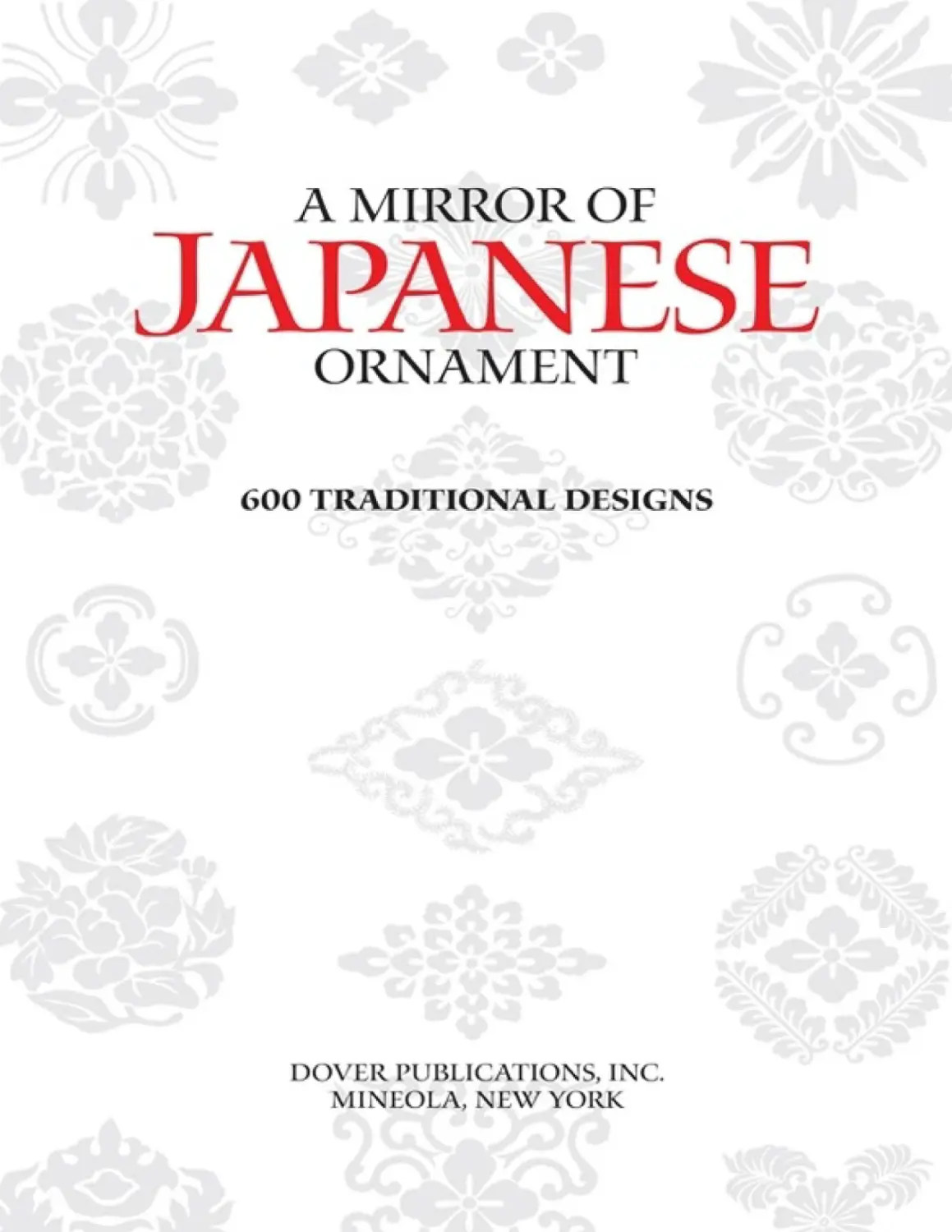
of trees, water and fossil fuels. The text of A Mirror of Japanese
Ornament: 600 Traditional Designs was printed on paper made
with 10% post-consumer waste, and the cover was printed on paper
made with 10% post-consumer waste. According to Environmental
Defense’s Paper Calculator, by using this innovative paper instead
of conventional papers, we achieved the following environmental
benefits:
Trees Saved: 10 • Air Emissions Eliminated: 872 pounds
Water Saved: 4,202 gallons • Solid Waste Eliminated: 255
pounds
For more information on our environmental practices, please visit
us online at www.doverpublications.com/green

Copyright
Copyright © 2010 by Dover Publications, Inc.
All rights reserved.
Bibliographical Note
A Mirror of Japanese Ornament: 600 Traditional Designs, first published by
Dover
Publications, Inc. in 2010, is a reprint of one hundred full-color plates from
the five-volume collection Nihon s shoku taikan, compiled by Kawanabe
Masao and published by Uns d , Taish , Kyoto, in 1915. The original Preface
by Masaki Naohiko and the plate notes by Kawanabe Masao have been
translated; short descriptive annotations have been added to Kawanabe’s text
and an Introduction has been provided for the Dover edition.
Library of Congress Cataloging-in-Publication Data
A mirror of Japanese ornament: 600 traditional designs.
p. cm.
“A Mirror of Japanese Ornament: 600 Traditional Designs, first published by
Dover Publications, Inc., in 2010, is a reprint of one hundred full-color plates
from the five-volume collection Nihon Seishoku Taikan, compiled and edited
by Kawanabe Masao and published by Uns d , Taish , Kyoto, in 1915.”
Includes bibliographical references.
9780486132723
1. Decoration and ornament—Japan—Themes, motives.
NK1484.A1M57 2010
745.40952—dc22
2010005598

Manufactured in the United States by Courier Corporation

47318X01
www.doverpublications.com

PREFA CE
Each and every surviving example of traditional art continues to exist because
of its excellence, and merits study with respectful inquisitiveness. I believe
there is a universal truth in the maxim “by exploring the old, one is able to
understand the new”1 This can apply equally to the study of art. Learning from
the past forms the basis of new research, which in turn is firmly rooted in the
understanding of traditional art. Such scholarship contributes to a greater
appreciation of the art objects themselves. Countless and diverse traditional
types of art have been collated and catalogued in publications with the aim of
learning from traditional arts and crafts. This also applies to decorative
patterns and design, which either have not been accurately reproduced, or are
presented simply as “reprinted” photographs. As a result, they rarely capture
the exquisite designs or the depth of color. The editor of Great Mirror of
Japan’s Decoration [reprinted here as A Mirror of Japanese Ornament: 600
Traditional Designs], Kawanabe Masao, has spent many years researching
design motifs and has enormous insight into the subject. He selected some 600
outstanding and notable examples of decorative patterns from each period,
dating from as early as the ancient Asuka period to the more recent Edo
[Tokugawa] period. One hundred superb color plates provide a sense of
immediacy in our viewing of the actual artworks. This outstanding compilation
offers a good historical overview and broadly covers the main decorative
motifs encountered in Japanese art. The plates are reproduced with meticulous
attention to color; they are organized in a novel fashion, distinguishing this
compendium from other publications and making it an extremely useful
reference book of unparalleled clarity. The tireless efforts that this book
represents, and its realization, are deserving of high praise. I firmly believe
that its publication will mark an important cultural shift for our country and
will undoubtedly prove a boon to the world of applied arts as well as the
manufacturing (product design) industry. Furthermore, this book will have
fully realized its aim, if it in any way serves to strengthen our country.
April 1915

Masaki Naohiko
President, Tokyo School of Fine Arts

Table of Contents

Title Page
Copyright Page
PREFACE
CHRONOLOGY - [periods covered in this volume]
INTRODUCTION
PLATE NOTES
SELECTED BIBLIOGRAPHY

CH RON OL OGY

[periods covered in this volume]
J mon c. 10,500–c. 300 BC
Yayoi c. 300 BC–AD 300
Kofun or Tomb c. 300–552
Asuka 552–645
Hakuh 645–710
Nara 710–794
Heian 794–1185
Kamakura 1185–1333
Nanbokucho 1333–1392
Muromachi 1392–1573
Azuchi-Momoyama 1573–1615
Edo 1615–1868
Meiji 1868–1912
Taishô 1912–1926

IN TRODUCTION
In his preface to the Nihon s shoku taikan (Great Mirror of Japan’s
Decoration), Masaki Naohiko (1862–1940), then head of the Tokyo School of
Fine Arts,2 praises this five-volume compilation as one worthy of merit, not
only for its richness and accuracy in illustration, but also as an invaluable tool
in the understanding of traditional art. A firm grounding in the art of the past,
he seems to imply, will inform the art of the future.
Little is known about the compiler of Great Mirror, Kawanabe Masao, a fact
lamented by author buchi Takemi in his introduction to the 1975 Japanese
reprint of the work. A native of Okayama Prefecture, Kawanabe graduated
from the design department of Tokyo School of Fine Arts in 1899, having
studied interior design. He is thought to have spent time in New York in the
1910s. It is not clear whether this was before or after the release of Great
Mirror in 1915.3 As a student of the Tokyo School of Fine Arts, it is quite
possible that Kawanabe knew the author of the preface, Masaki Naohiko, even
though Masaki was the head of the Tokyo School of Fine Arts from 1901 to
1932.4 Sadly, Kawanabe was unable to enjoy any long-term success from the
publication with his death in 1918, just three years after the release of Great
Mirror.
Kawanabe’s training at the Tokyo School of Fine Arts corresponded to a
period when Japanese “design” witnessed new developments, in the aftermath
of the country’s opening to extensive trade with the West from the midnineteenth century onwards and the resulting increased recognition of Japan on
the world stage. The growing international presence of Japanese art—in
particular, decorative arts and crafts—was greatly assisted by its inclusion in
overseas expositions, most notably, Paris (1867) and Vienna (1873). Crafts
became an “economic project for the promotion of international trade.” 5 The
government supported crafts and the development of design so as to augment
revenue in global trade, since Japanese handicrafts represented a substantial
portion of the country’s export. It reasoned that beautifully designed objects
would lead to further possibilities for export trade and exhibition. Even

foreigners working in Japan, like the American Ernest F. Fenollosa (1853–
1908), perhaps better known as an advocate of traditional Japanese fine art,
encouraged the improvement in design for the decorative arts.6 Such a stance
is also echoed in Masaki’s preface when he asserts that the publication of Great
Mirror “will mark an important cultural shift for our country and will
undoubtedly prove a boon to the world of applied arts as well as the
manufacturing (product design) industry.”
Therefore, at a national level, there was considerable effort directed towards
the development of zuan (a prototypical concept for “design”) for the purposes
of creating more attractive objects for the export trade.7 This, in turn, led to the
establishment of craft schools and zuanka, or departments of design, at trade
schools, universities, and manufacturing companies.8 One such early academic
“design” department was established at the Tokyo School of Fine Arts in 1896,
where Great Mirror’s compiler, Kawanabe Masao, was educated. He would
have been among the first graduates in this department in 1899.
buchi Takemi believes that Kawanabe compiled Great Mirror with a
designer ’s eye, and that as a resource for Japanese design its value was as
much as a reflection of a designer ’s understanding about the importance of
particular motifs as relates to a “design” aesthetic as it was an historical
lexicon of traditional Japanese design motifs.9 We have little notion of the
aesthetic considerations or criteria that led to Kawanabe’s selection—their
obvious beauty and historical significance aside—since he included no
introduction, and the captions to the plates are very brief. Whether the
publication was intended for foreign consumption is not entirely clear as the
caption texts are in Japanese, but it is clear that the overriding concern was on
the imagery, not the accompanying texts.
As a compendium of traditional design motifs, Great Mirror follows in the
tradition of pattern design books issued from the mid-seventeenth century
onwards known as hinagatabon, which contained kimono designs and were
intended mainly as a source-book for copying. These books assisted a client’s
selection of a garment, and many were commissioned by drapers or cloth
merchants. From the seventeenth to the nineteenth centuries, illustrated pattern
or design books of other fields and artistic genres were released, making them
an important resource for Japanese craftsmen. They depicted designs for
lacquerware, ceramics, textiles, sword-fittings, woodcarving, and netsuke, to
name a few. Even Japanese artists much celebrated in the West, such as the
woodblock-print designer Katsushika Hokusai (1760–1849), created

illustrations for such publications.10
Pattern design books continued to be developed into the Meiji era (1868–
1912) and the Taish period (1912–26) and were a significant aspect of colorprinted books from the 1890s until the mid-1930s. They encompassed the
tradition of source-books that had a practical application for manufacturing
like those in the hinagatabon tradition and to the category of which Masaki
Naohiko suggests that Great Mirror would have great influence. Another
feature of design books of this period is the “fine-art” book with lavish color
plates. At the forefront of contemporary and traditional design books (also
known as zuansh , or “design compendiums,” by this time) was the publisher
of Great Mirror, the Kyoto-based company Uns d .11 From its establishment
in 1891 until the 1930s, the company produced many woodblock-printed fineart and deluxe pattern and design books that are characterized by an extremely
high level of block-cutting and printing. They marketed their stock both in
Japan and abroad.12 Their publications of contemporary artists and designers
included the “Neo-Rinpa” artists Kamisaka Sekka (1866–1942) and his pupil
Furuya K rin (1875–1910), who was especially instrumental in the
development of Japanese “modern” design in the early twentieth century.13
Great Mirror is clearly a product of this vogue for beautifully crafted design
books, and similar traditional design books served as a complement to the
more “modern” designs issued by the Uns d books such as Sekka’s
Momoyogusa (Worlds of Things, 1909), or K rin’s K rin moy (K rin’s
Designs, 1907).14 While a product that could be appreciated on a purely
aesthetic level or as a sumptuous resource of decorative motifs, Great Mirror
also expresses pride in Japan’s own art historical past, not only as a validation
of its own rich artistic traditions but also in making this known on the
international stage. Masaki Naohiko’s preface—as well as the colophons in
Great Mirror, such as those prefacing volumes 2 and 3—ekiko sh kin (“unravel
the old/cultivate the new”) or k ko sh ki (“cherish the old/appreciate the
unusual”)—remind the reader that one must appreciate the old as the new is
explored. Such introspection is not surprising if we consider the climate in
Japan from the Meiji era onwards. With the government’s move towards
modernization and industrialization along Western lines at this time, society
and culture had been exposed to dramatic change. It was the government’s
stand, voiced in slogans like wakon y sai (“Japanese mind with Occidental
knowledge”), that this change could be effected through a synthesis of Japanese
thought and modernization.15 However, questions about the viability or

efficacy of such a stance—with some seeing modernization (Westernization) at
the cost of Japanese traditions—awakened in some quarters a nationalist
sentiment, with many looking to the past for guidance in the search for a
national identity.16 A staunch advocate of traditional arts, Masaki Naohiko’s
obvious pride in traditional art and design bubbles over in his concluding
words in the preface: “this book will have fully realized its aim, if it in any way
serves to strengthen our country.” 17

Comprising some 600 designs drawn from both secular and sacred objects
spanning the Asuka (552–645) to Edo (1615–1868) periods, the artistic
techniques represented by the designs in A Mirror of Japanese Ornament are
diverse, and the range of media broad, including metalwork, textiles, lacquer,
painting, and carved wood. Yet as a “mirror” of deign, A Mirror of Japanese
Ornament is neither exhaustive nor comprehensive in its art historical scope. It
does include designs from a number of objects that are today considered
significant national treasures, such as those on Plates 52 and 53, or from
complexes designated as UNESCO World Heritage sites, such as the Sh s in
(see Plates 12–19). But not included, for example, are designs from objects
pre-dating the Asuka period, namely from Japan’s pre-historic J mon (c.
10,500–c. 300 BC) and Yayoi (c. 300 BC–AD 300) periods to the ornamented
artifacts and mural paintings of the Kofun or Tomb period (c. 300–552).
Perhaps this omission can be explained by the fact that at the time of the
compilation the comparatively fewer objects of these eras were seen more as
archaeology than art history and may have held little interest for designers of
the period. Noteworthy, too, is the fact that Kawanabe does not include the
artistic developments in the Meiji era, when Japanese crafts, in particular, were
making great strides in the development of design. Nevertheless, buchi
suggests that Great Mirror is a testimony to Kawanabe’s pioneering spirit in
the introduction of traditional Japanese design to new fields. Whatever its
intent, however, design books such as A Mirror of Japanese Ornament are, to
borrow the words of the late Japanese book scholar Jack Hillier, objects that
can be appreciated as “an expensive gift in thoroughly good taste, admired as a
splendid product of the publishers.”18

PL ATE N OTES
The following catalogue reproduces the original text by Kawanabe Masao,
with short descriptive annotations added for a number of the Plates. In the 1975
reprint of Great Mirror of Japan’s Decoration, buchi Takemi remarked upon
the numerous discrepancies in the original, and these have been noted
wherever relevant. However, it is not the intent of this edition to verify each of
Kawanabe and buchi’s notations. All Japanese names appear in traditional
order—last name preceding first name—and all Japanese terms and names that
have entered into English usage appear in the anglicized form, unless in
original Japanese citations (e.g., Tokyo, not Tokyo). The original text was
divided into five sections, arranged chronologically, and introduced by
colophons by Japanese cognoscenti such as the Imperial Household minister,
Hijikata Hisamoto (Shinzan, 1833–1918) and the celebrated literati painter
Tomioka Tessai (1836–1924). [Translator ’s note]

Volume 1. Suiko [552–64 5] to Tenpy [729–74 9] eras 19
Calligraphic inscription: sh h (“the fragrance of many flowers”), dated
Spring 1915 and signed “the 83-year-old Shinzan” (Shinzan is the art name of
Hijikata Hisamoto)
Plate 1. (right to left, top to bottom): a–b. Designs from low-relief
(usunikubori) tile decorations from the time of Empress Suiko (two designs
across top); c. Designs from applied low-relief decoration on Buddhist halo
and canopy (tengai), H ry ji (three designs, second row right); d-f. Low-relief
design on halo for Buddhist statue, H ry ji (two designs, second row left;
third row); g. Painted sections from board placed under the eaves (noki-ita) of
a canopy (tengai), H ry ji; h-i. Applied open-worked designs, one section of a
Buddhist banner (kanj ban), H ry ji
Plate 2. Designs from metal fittings, Tamamushi (no) zushi, H ry ji (various
examples)

Plate 3. Designs from Buddhist gilt bronze altar fittings and implements, T
daiji (various examples)
Plate 4. Patterns from gilt-bronze banner(s), listed in the register of Imperial
treasures (gomotsu), formerly at H ry ji (nine examples)
Plate 5. Designs from halos (nimbus) of Buddhist statues, listed in the register
of Imperial treasures (gomotsu), formerly at H ry ji (four examples)
Plates 1–5 focus on design elements associated with Buddhism dating to the
Asuka period. Plates 1, 2, 4 and 5 illustrate design motifs found on tiles, halos
on Buddhist figures (k hai), canopies above Buddhist statues (tengai),
metalwork, and other Buddhist implements from the H ry ji. Located in
Ikaruga, Nara Prefecture, the oldest buildings of the temple, H ry ji, date to
between 670 and 711. Plate 3 has taken elements from the T daiji in Nara,
which was established in 752, and, like other temples, demonstrates the wealth
and power held by Buddhist clergy at that time.
Plate 1 depicts various floral and vine motifs (lotus, honeysuckle, etc.) on
objects at the H ry ji, including the halos of the famous triad of the Historical
Buddha and his two attendants, the Buddha of Healing, the canopy in the
temple’s Golden Hall (Kond ), as well as tiles and open-work banners (kanj
ban) made in fabric and covered with gilt bronze that were used in canopies.
Plate 2 shows stylized honeysuckle (nind ) and arabesque (karakusa, literally
“Chinese grass”; see Plates 20–21) designs from the Tamamushi (no) zushi, or
“Jewel Beetle Wing Shrine,” a portable shrine in the shape of a miniature
golden hall, at the H ry ji. The shrine is so-named because the bronze filigree
bands adorning the pedestal and architectural members were once inlaid with
the iridescent tamamushi beetle wings. The form of this wooden structure
offers valuable evidence regarding seventh-century architectural styles.
The designs in Plate 3 show diverse decorative elements, including
diamond-shaped floral, circular vine, and cloud motifs, while Plate 4 exhibits
honeysuckle patterns, among others, from objects such as open-work banners
or flags. Plate 5 shows sections from the halos that appear behind Buddhist
statues such as Kannon, the Bodhisattva of Mercy; the decoration on these
objects includes images of celestial beings in flight (asparas), Bodhisattvas,
and flame, honeysuckle and lotus motifs. The term gomotsu (also read
gyobutsu, or “emperor ’s or imperial property”) is a reference to objects listed
in the register of Imperial treasures (gomotsu daich ), perhaps the most

famous of which are those housed in the Sh s in storehouse at the T daiji
(see notes for Plates 12–19).
Plate 6. Designs from wall paintings (hekiga), H ry ji (various examples)
Plate 7. Designs from wall paintings (hekiga), H ry ji (various examples)
Plate 8. Selection of mitsuda-e designs from dais of Buddhist statues, H ry
ji20
The H ry ji suffered a devastating fire in 1949 that damaged much of the
Golden Hall (Kond ), including its murals. The publication of Great Mirror of
Japan’s Decoration in 1915, therefore, is a useful resource regarding some of
the mural design motifs. Plates 6 and 7 display various patterns, ranging from
repetitive geometric patterns to honeysuckle, lotus, “precious or auspicious
flowers” (h s ge; see notes for Plates 41–46), and pearl-like forms in circular
configurations (renjumon).
Plate 8 illustrates mitsuda-e (literally, “litharge painting”), a modern art
historical term for a type of painting that uses the natural mineral form of lead
oxide (mitsudas ) as a drying agent. To make mitsuda-e, powdered pigments
are mixed with an oil base and lead oxide. The technique is believed to have
been transmitted from China to Japan sometime in the seventh century and was
employed on wood and leather objects. It was relatively common in the Nara
period, since white painting, not possible at the time in lacquer painting, could
be produced with this technique.
Plate 9. (right to left, top to bottom): a–c. Mitsuda-e designs; d. Low-relief
(usunikubori) on Buddha dais, T sh daiji; e. Hairline engraving (kebori) on
silver objects, T daiji; f. Low-relief design on Buddha dais, T sh daiji; g–h.
Open-work metal ornamentation for Buddhist statues; i. Buddhist statue
designs, K fukuji
The Buddhist temples H ry ji, K fukuji, T daiji, and T sh daiji, whose
treasures serve as the inspiration for designs in the first two volumes of Great
Mirror of Japan’s Decoration, were included at various times in Japan’s history
as the “seven great” temples and were popular pilgrimage destinations. In the
1975 Japanese reprint of Great Mirror, buchi Takemi deleted the detailed

caption, substituting simply the notation “Designs of Chinese grasses
(karakusa)” (see notes for Plates 20–21 for an explanation of karakusa).
Plate 10. Design from mirror boxes/silver against a black ground, T daiji
(three examples)
This plate illustrates three designs from mirror boxes housed in the Sh s in at
the T daiji. The circular design in the upper left is most likely from the back
of a mirror with mother-of-pearl and amber inlay. The designs in the upper
right and the bottom illustrate the technique of silver heidatsu (or hy rraon),
for which thin metal sheets, such as those of gold or silver, are cut into
decorative shapes—here bird and floral motifs—and set into a base. The
surface is then covered with lacquer; the metal design is exposed when the
lacquer is polished or carved away in “hairline engraving.” Inside the edges of
the bottom-left design are three groups of eight-petalled floral motifs, with a
centrally placed peacock. It reportedly was part of the ornamentation on a box
used for an eight-sided mirror.
Plate 11. (top to bottom) Both listed in the register of Imperial treasures
(gomotsu), formerly at H ry ji: a. Design of the patterned weave “Shitenn ”
banner (cloth), formerly H ry ji; b. Designs illustrating animal hunt (from
ancient textiles)
Here “Shitenn ” refers to the “Four Guardian Kings,” the defenders of the
Buddha’s teaching, easily identified by their armored appearance. The images
here are from textiles showing hunting scenes in a circular cartouche, with
animals like Chinese lions (shishi) (top/bottom) and deer (top), and other
decorative motifs. Overall, the ornamentation is reminiscent of Persian art.
Plate 12. Textile designs, T daiji (four examples)
Plate 13. Textile designs, T daiji (five examples)
Plate 14. Textile designs, T daiji (four examples)
Plate 15. Textile designs from small banners, T daiji (six examples)21
Plate 16. Tenpy -period textile designs (three examples)

Plate 17. Listed in the register of Imperial treasures (gomotsu), Sh s in (top
to bottom): a. Carved
board clamped resist-dyed (ky kechi) designs; b. Wax resist-dyed (r kechi)
designs (two examples)
Plate 18. Wax resist-dyed (r kechi) designs (two examples)
Plate 19. Wax resistdyed (r kechi),22 listed in the register of Imperial
treasures (gomotsu), Sh s in (three examples) [These plates have been turned
horizontally]
The Sh s in is a raised-floor storehouse at the T daiji in Nara. Erected in the
Heian period, it contains hundreds of rare treasures dedicated to the temple by
Empress K my (701–760) following the death of Emperor Sh mu (701–
756). Among the collections of the Sh s in are a sizeable group of diverse
textile types such as brocades, gossamers, and plain silks, which display
decorative techniques ranging from embroidered to printed patterns. They are
an invaluable source in our understanding of Japanese Asuka- and Nara-period
textile history.
The decorative cycle on these textiles includes numerous motifs from the
natural world, as evinced in the examples here. Particularly elegant are Plates
17 to 19. They showcase designs executed with the resist-dye techniques ky
kechi and r kechi, which were initially imported from China but produced
domestically, it is believed, from the Nara period onwards. For r kechi, the
cloth is patterned with wax before dyeing; the wax is removed after the dye is
applied. For ky kechi, thin cloth was sandwiched between thick mirror-image
boards, then clamped and dyed.

Volume 2: Tenpy [729–74 9] to K nin [810–824 ] eras 23
Colophon: ekiko sh kin (“unravel the old/cultivate the new”), dated and signed
by the “great senile” Tessai Gaishi (Tomioka Tessai, 1836–1924)
Plate 20. (top and bottom): a. Carved wood with applied gold, halo for
Buddhist statue,24 T sh daiji, Nara; b. Low-relief (usunikubori) bronze, halo
of nenjibutsu of Kusunoki family Buddhist image, H ry ji
Plate 21. Designs for open-worked carved wood decoration on halo of
Buddhist image (ten examples)

Design elements in Plate 20a are taken from various Buddhist dais and altars at
the H ry ji and T sh daiji, respectively. They exhibit patterns such as
honeysuckle, arabesque (karakusa), lotus, vine, and h s ge (“precious or
auspicious flowers,” see notes for Plates 41–46) frequently seen in art from the
Asuka to Nara periods. The nenjibutsu in Plate 20b is a Buddhist image for
personal worship, in this case associated with the powerful Kusunoki family.
The dominant motif in both is the central lotus blossom. The T sh daiji was
founded around 759 as a private temple for the Chinese monk Jianzhen (Jp:
Ganjin).
The term karakusa (“Chinese grasses”), or arabesque, refers to exotic plant
motifs imported to Japan from China, even though many of the motifs are
thought to have originated from more distant lands, such as Central Asia,
Persia, and perhaps even Greece and Egypt. Karakusa does not refer to any
particular floral element and is typically a flower and leaf design linked by
continuous scrolling tendrils or vines. There are numerous variations: it can be
a combination of imaginary flowers and vines, or adapted to Japanese taste
with the use of known flowers such as peonies, grapevines, bamboo, and
chrysanthemums. Karakusa were used extensively in Japanese design.
Plate 22. Auspicious/sacred animal motifs, Tenpy to Fujiwara periods
(twelve examples)
Depicted in Plate 22 are sacred animals associated with Buddhist decoration,
such as the phoenix, dragon, flying horses and birds, auspicious birds, the
winged kary binga (see Plate 50), kirin (composite creature with a deer body
and tail of an ox), Chinese lions (shishi), and animals connected with the four
cardinal directions (see Plate 24) taken from objects such as those found at the
Sh s in and H ry ji (see notes for Plates 12–19 and 1–5, respectively).
Plate 23. Ancient mirrors, Sh s in (two examples)
Plate 24. (top to bottom) a. Ancient mirror, verso, twelve animals of the
zodiac; b. Designs of Chinese mythical animals connected with the four
cardinal directions on Buddhist dais, low-relief (usunikubori) metal fittings
The spectacular eight-lobed bronze mirror in Plate 23 (top) is ornately

decorated: the central zone of four mountains and seashore patterns surround a
knob symbolizing Mount H rai (Chinese: Mount Penglai; mythical mountain
of the Eight Chinese Immortals), with various figures, coiled dragons, and
phoenixes; the middle zone has patterns of floral scrolls with peacocks,
phoenixes, and birds; the outer zone contains the eight symbols of Chinese
divination at each cusp and a poem of eight five-character phrases. The central
design elements in Plate 24 are, along the top, the twelve animals of the zodiac
(right to left: tiger, ox, rat, snake, dragon, rabbit, monkey, sheep, horse, boar,
dog, and rooster) and the animals of the four cardinal directions. The latter are
the green/blue dragon of the East; the white tiger of the West; the red phoenix
of the South; and the black warrior (tortoise-like creature with head/tail
serpent) of the North. These are clearly recognizable in two zones in the
bottom image of Plate 23.
Plate 25. Views of sections of the top and side, mitsuda-e lacquer box, listed in
the register of Imperial treasures (gomotsu), Sh s in
For a definition of the technique of mitsuda-e, see note for Plate 8. The
dominant design elements on this black-lacquered wooden box in the Sh s in
are honeysuckle vines, phoenixes, and fire-spitting birds.
Plate 26. Ancient textiles, listed in the register of Imperial treasures (gomotsu),
Sh s in (two examples)
Plate 27. Designs from a small box, listed in the register of Imperial treasures
(gomotsu), Sh s in
Plate 28. Designs from small painted box, listed in the register of Imperial
treasures (gomotsu), Sh s in; (bottom), copy, Tokyo Imperial Museum25
In the 1975 Japanese reprint of Great Mirror, buchi Takemi notes that these
two design patterns are from small boxes in the Sh s in.26 Plate 27 illustrates
a technique known as kingindei, in which gold and silver powders are mixed
with glue to decorate an object. The cover (bottom image) and side (upper
image) include floral motifs; the central motif on the cover is surrounded by
eight birds and four butterflies. Plate 28 displays a stylized arrangement of red,
blue, and green floral and grass motifs; the Tokyo Imperial Museum
(Household Museum of Art) is the present-day Tokyo National Museum.

Plate 29. Designs for kin soundboard, Sh soin, T daiji (various examples)
Designs taken from section of the top, back, and sides of a lacquered sevenstringed kin zither, illustrating three figures drinking and playing music, birds,
phoenixes, floral motifs, clouds, and so forth in the heidatsu technique (see
note for Plate 10). This kin is thought to have been of Chinese manufacture.
Plate 30. Rosewood go board with pictorial representation, listed in the
register of Imperial treasures (gomotsu), Sh s in
Plate 31. (top to bottom) Both listed in the register of Imperial treasures
(gomotsu), Sh s in: a. Rosewood go board with pictorial representation (eight
examples); b. Silver (heidatsu) lidded container (g shi) and ivory tusk go
board pieces
The designs in Plates 30 and 31a are described in the original text as “wood
pictures” (mokuga), which used various inlaid materials to create decorative
details and ornamentation. In Plate 30, a board with open side panels, ivory has
been used to illustrate a hunting scene, camels, birds, and floral motifs
(karakusa); the red strip to the left illustrates the decorative base piece of the
board. Plate 31 depicts various details from the go board, including the
decoration on the small side drawers, interlocking motifs, and the stained
ivory go pieces (see notes for Plate 10 for an explanation on the technique of
heidatsu).
Plate 32. Red- and green-stained ivory foot-rules, listed in the register of
Imperial treasures (gomotsu), Sh s in (two examples)
Stained ivory foot-rules (approximately one foot in length) were presented
annually to the imperial court. Here, the decorated top, bottom, and side pieces
are illustrated. They were stained and carved with decorative patterns in the
bachiru technique, which involves the carving of design elements on a stained
ivory object and then tinting; some motifs are left in reserve in the white ivory.
Plate 33. Long sword (tachi) fittings, listed in the register of Imperial

treasures (gomotsu), Sh s in
This plate displays various parts of a decorative tachi sword, such as the
scabbard fittings, and tsuba, executed in an open-worked, gilt silver and lowrelief design of tendril scrolls, flower-shaped studs, and cloud and animal
motifs. Particularly striking are the inset beads of blue and green glass and
crystal (red paint under crystal inlay) on the body and ferrule of the scabbard.
Plate 34. Designs for Buddhist imagery, Sangatsud , T daiji (five examples)
Plate 35. Buddhist motifs, K fukuji (six examples)
The Sangatsud is a temple hall whose plan allows for circumambulation of a
statue or statues; the purpose of the circumambulation is to encourage
meditation on the Lotus Sutra (Hokeky ). The Sangatsud , or Hokked (mideighth century) at the T daiji in Nara is particularly celebrated. Decorations on
Buddhist images of this period were particularly rich, and, according to
buchi Takemi, the design motifs here are taken from the Buddhist statues of the
Sh kong jin (also Kong shu), the “Four Guardian Kings” (Shitenn ) of the T
daiji, and Ashura, one of the eight guardians of Buddha, at K fukuji.27 They
include Chinese floral motifs (karakusa; see notes for Plates 20–21) and a
combination of h s ge (“precious or auspicious flowers,” see notes for Plates
41–46).
Plate 36. Designs on a “Chinese chest” (karabitsu), T daiji
A lacquered karabitsu (Chinese chest) is used to store valuables, including
sutra scrolls. It can be made of plain wood or lacquered, as the example here.
The designs here, executed in the mitsuda-e technique (see note for Plate 8),
depict lions (perhaps karashishi, or “Chinese lions”) amidst cloud, vine, and
lotus motifs against a black lacquer ground.
Plate 37. (top to bottom) Multi-colored lotiforms for a k inza, T daiji
collection (four examples)
Plate 38. Kanshinji, Kawauchi (-Nagano, Osaka), lotiforms for the pedestal of
the principle Buddha image [Nyorin Kannon] worshipped at the temple (two
examples)

The caption for Plate 37 in the Great Mirror states that this is a k inza, a dais
for a tray used in burning incense before a Buddhist image. Lotiform petals are
affixed in alternating tiers to a base and, as here, decorated in various patterns
in a color scheme known as “rainbow coloring,” in which distinct bands of
color are placed adjacent to each other to give the impression of shading. The
design is so-named because of its resemblance to a rainbow. The Kanshinji is
an esoteric (Shingon sect) Buddhist temple located on Mount Hino, and the
petals on the pedestal on the ninth-century statue illustrate a h s ge pattern.
Plate 39. (top to bottom): a. Ceiling motifs, T sh daiji; b. H
(three examples)

d , By d in

See notes Plates 20–21 and 41–46 for notes on the T sh daiji and H
respectively.

d ,

Plate 40. (top to bottom): a. Textiles, T daiji (three examples); b. Ancient
embroidery (shish )
Volume 3. Fujiwara to Heishi Periods28
Colophon: k ko sh ki (“cherish the old/appreciate the unusual”), dated
February 1915 and signed (signature unreadable)
Plate 41. H d , By d in: a. (top) Selection of carved gilt wood with
“Chinese grass” (karakusa) designs; b. (bottom seven) Decoration for carved
wooden beams and metal fittings
Plate 42. Carved curved wooden tie beam (k ry ) with decoration in gold
appliqué, H d , By d in (four examples)
Plate 43. Designs on decorative lintel (nageshi), H
Plate 44. Designs on decorative lintel, H

d , By d in

d , By d in (two examples)

Plate 45. Frame and fascia board motifs from canopy structure (tengai), H
, By d in
Plate 46. Decoration on interior door jamb, H

d

d , By d in (two examples)

The H d is the central hall of the By d in monastery in Uji, Kyoto
Prefecture. It was originally constructed as a villa by the powerful Fujiwara
family, but was converted into a Buddhist temple in 1053. Viewed from above,
the H d resembles a phoenix with outstretched wings, thus its name
“Phoenix (h ) Hall” (d ). The ceiling of the hall is coffered with intricate
lattice work (see also Plates 39 and 48). The decorative elements in Plates 41
to 46 are dominated by the h s ge (“precious or auspicious flowers“), a
reference to a floral pattern that combines flowers such as the lotus, peony, and
others in a complex arrangement. It is frequently included as a variation of the
arabesque karakusa, or ”Chinese grasses“ (see notes for Plates 20–21). Motifs
in Plate 45 are recorded as from tengai, a type of canopy hung over Buddhist
statues; the eleventh-century example of the Amida Buddha at the H d is
particularly famous.
Plate 47. Metal fittings, Ch sonji (seven examples)
Plate 48. Examples of designs using raden, Ch sonji and H
(five examples)

d , By d in

The Ch sonji, located in Hiraizumi in southern Iwate Prefecture, is a
significant example of late Heian-period regional architecture. It was not
unusual for Heian-period temple halls to be opulently ornamented with
elaborate techniques and precious materials so as to create the sense of an
otherworldly paradise. The small Buddhist mausoleum and worship hall, the
Konjikid (“Gold-Colored Hall”), at Ch sonji, and the H d , were no
exception. Plate 47 features elaborate metal fittings and Plate 48 designs
executed with raden, a type of shell inlay technique—in particular, mother-of
pearl—in which the shells are ground to the desired thickness, inlaid or pasted
into a wood or lacquered surface and then polished. The overriding decorative
elements depicted are karakusa and h s ge (see notes for Plates 20–21 and
41–46, respectively).
Plate 49. Section of painted leather keman, T daiji
Plate 50. Section of open-worked metal keman, Ch sonji
A keman is a pendant disc used in architectural decoration; some scholars

believe that they originated as floral wreaths hung as Buddhist offerings. Plate
49 shows the frequently encountered motif of the period, the h s ge (see
Plates 41–46). This floral motif also appears on the gilt-bronze keman from
the Konjikid at the Ch sonji in Plate 50 along with a kary binga, a sacred
creature with the head of a bodhisattva, winged bird body, and a tail that
resembles a phoenix. The kary binga is believed to live in the paradise of the
Amida Buddha.
Plate 51. (top to bottom): a. Designs from the Kenda kokushi kesa (Buddhist
surplice) storage box, T ji (Ky gokuji); b. Mount Hiei sutra case29
The ornamentation in this plate is taken from a box for a kesa, a Buddhist
surplice (a) reportedly brought back from China by the Buddhist monk K kai
(774–835),30 and a sutra case (b). The compositions show auspicious motifs of
fish, turtles, birds in flight, and h s ge in gold and silver pigments; during the
earlier Heian period, design motifs from the continent were undergoing a
transition towards a more native aesthetic, as seen in the freely executed
compositions illustrated here.
Plate 52. Nishi Honganji (National Treasure), jigami (fan paper) from the
Anthology of Thirty-six Immortal Poets (Nishi Honganji [hon] sanj roku
ninkash ) (five examples)
Plate 53. Nishi Honganji (National Treasure), jigami (fan paper) from the
Anthology of Thirty-six Immortal Poets (Nishi Honganji [hon] sanj roku
ninkash ) (five examples)
Located in Kyoto, the Nishi Honganji is associated with the early twelfthcentury anthology of Japanese-style poetry (waka) known as the Anthology of
Thirty-six Immortal Poets. The lavishly decorated papers—painted with
gold/silver foil, or printed with mica—and calligraphy of this compendium
(some thirty-seven albums pre-dating the modern period) make it a significant
example of Heian design. (The selections in Great Mirror are illustrated
without the calligraphy.) The appellation “thirty-six immortal poets” (sanj
rokkasen) refers to the thirty-six noted poets of the seventh to tenth centuries
chosen by Fujiwara no Kint (966–1041).

Plate 54. Fittings for the Heike n ky scrolls, Itsukushima Jinja (ten examples)
Plate 55. Decorative (cover) designs for the “Belief and Understanding”
chapter (Shinge-hon) from the Heike n ky scrolls, Itsukushima Jinja (five
examples)
Plate 56. Decorative (cover) designs, Heike n ky scrolls, Itsukushima Jinja
(three examples)
Plate 57. Mikaeshi, Heike n ky scrolls, Itsukushima Jinja (two examples)
Plate 58. Mikaeshi, the “Bestowal of Prophecy” chapter (juki-hon) from the
Heike n ky scrolls, Itsukushima Jinja (two examples)
Plate 59. Decorative details from Heike n ky scrolls, Itsukushima Jinja (five
examples)
Plate 60. Decorative details from Heike n ky scrolls, Itsukushima Jinja (five
examples)
During the Heian period, aristocrats often had Buddhist sutras copied as
religious offerings. The thirty-three richly illustrated scrolls of the Lotus Sutra
(Hokeky ), which were commissioned by the Taira (Heike) clan and dedicated
to the principal deity of the shrine Itsukushima Jinja in 1164, are known as the
Heike Dedicatory Sutra (Heike n ky ). The scrolls are exquisitely mounted
and illustrated with rich pigments, silver, and gold. Plate 54 shows various
designs from the metal and crystal mount fittings (roller and end-piece knobs),
which are adorned with open-worked designs associated with Buddhism, such
as the child attendants and lotus (fourth from left) or dragon and the esoteric
Buddhist implement known as a “thunderbolt” (vajra; third from left). The
chapters illustrated in Plates 55 and 58 are the fourth and sixth chapters,
respectively, and depict lotus, floral, and arabesque patterns. The term mikaeshi
refers to an “endpaper” or “frontispiece,” which can be either paper or fabric.
It is said that the Shinto Itsukushima Jinja in Hiroshima was established in
the sixth century, even though its main building was first designed in the
twelfth century. It was the tutelary shrine of the powerful Taira (Heike) clan.

Volume 4: Kamakura [1185–1392] to Ashikaga
[Murom achi , 1392–15681 periods
Colophon: Momo sakuraliro to iro to no/yosooi walsumeramikuni no/kagami

narikeri (The blossom of spring/the myriad array/a mirror of the imperial
reign) Viscount Sugawara Ch gen
Plate 61. Ornamental designs, three-storied pagoda (Sanj -no-t ), K fukuji
(six designs)
The tutelary Buddhist temple of the powerful Fujiwara family, the K fukuji, is
located in Nara and dates to the seventh century. Its three-storied pagoda dates
much later, to the earlier twelfth century (see also Plate 82).
Plate 62. Metal sword fittings, Ise Jing
The refined ornamentation illustrated here are most likely for chokut , a type
of straight, single-edged sword that most probably had a ceremonial purpose
and was thus a symbol of imperial power. The plant motifs are principally
“Chinese grasses” (karakusa; see notes for Plates 20–21). The Ise Jing in Mie
Prefecture is one of the most significant early Shinto sites in Japan. Although
the exact date of its initial construction is unclear, some believe that the earliest
complex therein (the Inner Shrine) was built in the third century. The shrine is
dedicated to the sun goddess Amaterasu mikami, the legendary ancestor of
Japan’s imperial family.
Plate 63. (right to left, top to bottom): a. Design with bees; b. Patterns repeated
along diagonals, which can be read in interlocking groups of two, Kumano
Jinja; c. Design on the unstarched outer robe (n shi), from the Takayoshi Genji
(i.e., reference to early twelfth-century, Illustrated Handscrolls of the Tale of
Genji [Genji monogatari emaki]); d. Falling blossoms (on cotton); e. Imperial
ox carriage (on brocade), Daijing
Plate 64. Textile designs, from the shrine Hachimang , Kamakura (four
designs)
Plate 65. Designs for Bugaku theater hakama (a type of divided skirt) (two
designs)
The three plates shown here are examples of y soku mon, a general reference
to traditional motifs—initially influenced by Tang Chinese designs—which
were utilized by the imperial family for items employed in both public and

private functions. Such motifs appeared singly or in repeated patterns and were
employed for the decoration of diverse media, including textiles (brocades,
dyed fabrics, etc.), wood, gold, leather, and paper. Plates 63 and 64 illustrate y
soku mon appearing on objects that have come down through two Shinto
shrines (see also Plates 75–78).
Plate 66. Designs from the “Masako” maki-e cosmetic box, Mishima Taisha
collection. [The plate has been turned horizontally.]
Plate 67. Designs from the “Masako” maki-e cosmetic box, Mishima Taisha
collection. [The plate has been turned horizontally.]
These designs are from a scene of trees and geese illustrated on the c. midthirteenth century cosmetic box in the collection of the Mishima Taisha in
Shizuoka Prefecture.31 The Uns d caption lists this as the “Masako” cosmetic
box, a reference to H j Masako (1156–1225), the wife of the first shogun of
the Kamakura period, Minamoto no Yoritomo (1147–1199), and the donor of
this box to the shrine. The maki-e, or “sprinkled picture,” technique of
lacquerware decoration entails the scattering or sprinkling of adhesive metal
or colored powders, such as gold, silver, and tin, over soft lacquer.
Plate 68. (right column, top to bottom; left column, top to bottom) (all tanned
leather): a. Nail-shaped iris; b. Duckweed with leaves; c. Komon water plantain;
d. Facing mountain ferns; e. Duckweed and iris; f. Maple, deer, and iris; g.
Butterflies and birds; h. Iris, turtles, and cranes
Plate 69. (right column, top to bottom; left column, top to bottom) (all tanned
leather): a. Pattern with enclosing honeycomb-shaped borders; b. Pattern with
enclosing tortoiseshell borders; c. Dove and diamond shapes; d. Dragon amidst
waves; e. F d My ; f. Miscellaneous motif; g. Sacred gem (h ju)
Plate 70. (right to left, top to bottom) (all tanned leather): a. Komon “Chinese
lions” (in the style known as “Tenpy leather”); b. “Chinese lion” mask; c.
Sanskrit character and Chinese lion (in the style known as “Tenpy leather”); d.
Komon motifs with honeycomb-shaped patterns; e. Floral motifs; f. Six roundel
patterns with comma-shaped motifs; g. Waves and rabbits
The publication of hinagatabon (pattern books), picture books of designs used
to assist clients in the selection of kimono, became popular during the Edo
period (1615–1868). Pattern books also included designs for objects such as

lacquerware, ceramics and porcelains, textiles, sword-fittings, woodcarvings,
and netsuke. Many were produced by craftsmen, as well as designed by ukiyo-e
artists, and are important records for the study of kimono fashion. According
to buchi Takemi,32 the motifs here resemble such hinagatabon designs. A
few of the plates include the term komon (“small pattern”)—a reference to
repetitive design patterns—their production enabled by the introduction of
paper rather than wood stencils. The Japanese characters seen in the examples
above would not have been included on the original object.
Plate 71. Patterns taken from the Kasuga kenki [Kasuga gongen kenki emaki]
(six examples)
The Illustrated Miracles of the Kasuga Deity (Kasuga gongen kenki emaki) is
an illustrated handscroll completed by the painter Takashina Takakane (active
1309–1330) in the early fourteenth century. The twenty fascicles depict the
miracles of the Kasuga deity, the tutelary god of the Fujiwara clan worshipped
at the Kasuga Taisha (Kasuga Grand Shrine) in Nara. The shrine exercised
enormous political and cultural influence at this time, together with the K
fukuji, with which the shrine was united. Masaki Naohiko, the author of the
preface to Great Mirror of Japan’s Decoration, acted as a consultant in the
research of these scrolls in the Taish period.
Plate 72. Mid-Tokugawa period dyed patterns (eight examples)
Plate 73. Patterns from the pictorial biography of Priest Ippen (Ippen Sh nin)
and designs from the Kasuga kenki [Kasuga gongen kenki emaki] (six
examples)
Priest Sh nin, commonly known as Ippen Sh nin (1234–1289), founded the
Jish sect of Buddhism, which placed importance on the recitation of the name
of the Amida Buddha (nenbutsu). Ippen’s insistence on constant traveling and
the abandonment of family and possessions led to his nickname of the
“traveling saint.” The designs here are reportedly from the twelve illustrated
narrative handscrolls painted by the artist En‘i and other artists in 1299 that
depict Ippen’s journey around Japan. See notes for Plate 71 regarding the
Kasuga kenki.
Plate 74. From the Kamakura to Ashikaga (Muromachi) periods:33 textile

(clothing) designs from illustrated scrolls (emakimono) (nine examples)
Plate 75. Y soku mon, traditional design motifs (seventeen examples)
Plate 76. Y soku mon, traditional design motifs (twenty-four examples)
Plate 77. Y soku mon, traditional design motifs (six examples)
Plate 78. Y soku mon, traditional design motifs (six examples)
As in Plates 63 to 65 above, Plates 75 to 78 illustrate a few of the many
variations of y soku mon, a broad reference to traditional design motifs. Plate
76, for example, illustrates circular designs (maru-mon ) such as comma and
floral motifs; such designs were employed on textiles and family crests by all
classes of society. Plate 77 displays tasukimon, a design motif characterized by
crossed diagonal patterns that was used in textiles from early in Japan’s
history. The tatewaku pattern in Plate 78 consists of vertical flora and vine
patterns (e.g., clouds and chrysanthemums) positioned inside curvilinear lines
that create an hourglass effect.

Volume 5: The Era of Toyotomi Hideyoshi [1536–98] to
the Tokugawa [Edo] period [1615–1868] Pre face (s e e
above )
Plate 79. Chrysanthemum designs, surihaku technique, on Konparu-school N
robes34
The motifs used here represent the technique of surihaku (see notes to Plates
90–93), frequently used to decorate the robes of N theater actors.
Plate 80. Cherry-blossom motifs against a purple ground
The pattern here has most likely been executed using tsujigahana, a hybrid
stitch-resist technique in which designs in color are given hand-painted details
and, occasionally, details in embroidery.
Plate 81. Embroidery designs for waist belts (ateobi) on Konparu-school N
robes

Plate 82. Kobori Ensh , favorite designs of ranma open-work carvings
(twelve examples)
Plate 83. Decorative architectural carvings (eighteen examples)
Kobori Ensh (1579–1647) was an influential tea master, talented calligrapher
and poet, and garden designer. In Plate 82, compiler Kawanabe links him with
designs for ranma (transom), an architectural design element constructed
between lintels, as frames for sliding doors and ceilings, or between verandahs
and the interior of a building, under gate ridges, on fences or above entrances.
The decoration on ranma was diverse, including, as here, open-worked
designs of differing motifs. Plate 83 illustrates various carved wooden
architectural nosings (kibana), which found full expression from the
Muromachi to Edo periods; the creatures here include Chinese lions (shishi),
dragons, or tusked elephant-like beasts (z bana).
Plate 84. Two designs of the cloth used as mounts for waka death poems
(jisei) of the mistresses of Hidetsugu, Zuisenji
Plate 85. Two designs of the cloth used as mounts for waka death poems of the
mistresses of Hidetsugu, Zuisenji
Popular history tells us that following the death of warlord Toyotomi
Hideyoshi’s nephew, Toyotomi Hidetsugu (1568–1595), a number—by some
accounts thirty-four—of his mistresses met on the banks of the Kamo River in
Kyoto, where they gathered together their death poems (jisei) and used the
cloth from their robes as mounts. Hidetsugu’s mistresses were executed
following his ritual suicide. These poems are still housed in the temple of
Zuisenji in Kyoto.
Plate 86. a. Designs for corridor bracket/transom (ranma), Nikk T sh g
Plate 87. Corridor pillar designs, Nikk T sh gu
Plate 88. Corridor designs, Nikk T sh g (six examples)
Plate 89. Corridor designs, Nikk T sh g (six examples)
The Nikk T sh g is a Shinto shrine located in Tochigi Prefecture. Built in
1617 in dedication to the founder of the Tokugawa shogunate, Tokugawa

leyasu (1542–1616), the shrine is celebrated for its elaborate, ornate
architectural carvings, which depict creatures like the phoenix (Plate 86, left)
and arabesque/auspicious floral patterns (Plate 86, right).
Plate 90. Designs for N theater robes (n sh zoku), Maeda family (two
examples)
Plate 91. Designs for N theater robes (n sh zoku), Maeda family (two
examples)
Plate 92. Designs for N theater robes (n sh zoku), Maeda family (four
examples)
Plate 93. Designs for N theater robes (n sh zoku), Maeda family (four
examples)
These designs—principally plants and animals—illustrate techniques such as
surihaku (“rubbed metal foil”) found on N theater robes of the Maeda family.
For surihaku, a technique dating to Nara period, stencilled designs of gold or
silver foil are applied to cloth with paste. Gold or silver leaf is laid on this. The
Maeda family were wealthy daimyo in Kaga Province (present-day Ishikawa
Prefecture) and patrons of the N theater (see also Plates 79 and 81).
Plate 94. K ami Nagashige (Ch j ) X (1599–1651), furnishings (shelves),
“The First Song of Warbler,” top view
This design is taken from the wedding set, dating to 1639 and today in the
collection of the Tokugawa Art Museum, for Princess Chiyo, known as
Hatsune no ch do (“First Song of the Warbler Furnishings”). As seen here,
each item is decorated with designs inspired by the poem in Chapter 23 of the
eleventh-century tale of romance, The Tale of Genji (Genji monogatari): “The
old one’s gaze rests a long time on the seedling pine/Waiting to hear the song
of the first warbler.”35 Hatsune designs were popular for their auspicious
symbolism.
Plate 95. Various design elements from scrolls dating to around the Genroku
(1688–1704) and Ky h (1716–36) eras (six examples)
Plate 96. Garment designs from scrolls by Miyagawa Ch shun (1682–1754)
(eight examples)

Plate 97. Various designs for kosode (a robe with small sleeves) from scrolls
dating to around the Genroku [1688–1704] and Ky h [1716–36] eras (six
examples)
Plate 98. Designs from scrolls by Miyagawa Ch shun (seven examples)
Plate 99. Clothing designs from scrolls by Miyagawa Ch shun (eight
examples)
Miyagawa Ch shun (1682–1754) was the foremost ukiyo-e (“pictures of the
floating world”) painter in the first half of the eighteenth century, and he was
the progenitor of an artistic lineage that would become the influential
Katsukawa school of ukiyo-e artists. Ch shun produced many paintings of
single courtesans, and genre scenes, as well as scenes from the Kabuki and
puppet theaters. The designs are taken from his genre scrolls, similar to
examples today housed in institutions such as the Tokyo National Museum.
Plate 100. Textile designs from the mid-Tokugawa period (seven examples)

SEL ECTED BIBL IOGRA PH Y
Books
Allen, Jeanne. Designer’s Guide to Japanese Patterns. San Francisco:
Chronicle Books, 1984.
Hibi, Sadao and Niwa Motoji. Snow, Wave, Pine: Traditional Patterns in
Japanese Design. Tokyo: Kodansha International Ltd., 2001.
Hida, Toyojir and Yokomizu Hiroko. Meiji, Taish zuansh no kenky .
Kindai ni ikasareta Edo no dezain (The Research of Meiji and Taish Design
Books. Giving Life to the Pre-modern Age through Edo Design). Tokyo:
Kokusho Kank kai, 2004.
Hillier, Jack. The Art of the Japanese Book. 2 vols. London: Sotheby’s
Publications, 1987.
Kikuchi, Yuko. Japanese Modernisation and Mingei Theory: Cultural
Nationalism and Oriental Orientalism. London: RoutledgeCurzon, 2004.
Lillehoj, Elizabeth. Critical Perspectives On Classicism In Japanese Painting,
1600–1700. Honolulu: University of Hawai’i Press, 2004.
Marra, Michael F. (ed.). A History of Modern Japanese Aesthetics. Honolulu:
University of Hawai’i Press, 2001.
Mrázek, Jan and Morgan Pitelka. What’s the Use of Art?: Asian Visual and
Material Culture in Context. Honolulu: University of Hawai’i Press, 2007.

Noma, Seiroku. The Arts of Japan: Ancient and Medieval, vol. 1. Translated
and adapted by John Rosenfield. Tokyo/New York: Kodansha International, c.
1966/1978.
Noma, Seiroku. The Arts of Japan: Late Medieval to Modern, vol. 2. Translated
and adapted by Glenn T. Webb. Tokyo: Kodansha International, 2003.
buchi, Takemi. Nihon s shoku taikan shinhan (Great Mirror of Japan’s
Decoration: New Edition). 2 vols. Kyoto: Mitsumura Suiko Shoin, 1975.
Pollard, Moyra Clare. Master Potter of Meiji Japan: Makuzu K zan (1842–
1916) and his Workshop. New York: Oxford University Press, 2003.
Rathburn, William Jay (ed.). Beyond the Tanabata Bridge: Traditional Japanese
Textiles. London: Thames and Hudson in association with the Seattle Art
Museum, 1993.
Sadao, Tsuneko S. and Stephanie Wada. Discovering the Arts of Japan: A
Historical Overview. Tokyo/ New York/London: Kodansha International, 2003.
Shosoin Office (ed.). Treasures of the Shosoin. Tokyo: Asahi Shimbun
Publishing Co., 1965.
Yokoya, Kenichir . Zuanch in Kyoto: Textile Design Books for the Kimono
Trade. Stanford: Stanford University Libraries, 2007.
Web site
http://www.aisf.or.jp/~jaanus/

PLATE 1

PLATE 2

PLATE 3

PLATE 4

PLATE 5

PLATE 6

PLATE 7

PLATE 8

PLATE 9

PLATE 10

PLATE 11

PLATE 12

PLATE 13

PLATE 14

PLATE 15

PLATE 16

PLATE 17

PLATE 18

PLATE 19

PLATE 20

PLATE 21

PLATE 22

PLATE 23

PLATE 24

PLATE 25

PLATE 26

PLATE 27

PLATE 28

PLATE 29

PLATE 30

PLATE 31

PLATE 32

PLATE 33

PLATE 34

PLATE 35

PLATE 36

PLATE 37

PLATE 38

PLATE 39

PLATE 40

PLATE 41

PLATE 42

PLATE 43

PLATE 44

PLATE 45

PLATE 46

PLATE 47

PLATE 48

PLATE 49

PLATE 50

PLATE 51

PLATE 52

PLATE 53

PLATE 54

PLATE 55

PLATE 56

PLATE 57

PLATE 58

PLATE 59

PLATE 60

PLATE 61

PLATE 62

PLATE 63

PLATE 64

PLATE 65

PLATE 66

PLATE 67

PLATE 68

PLATE 69

PLATE 70

PLATE 71

PLATE 72

PLATE 73

PLATE 74

PLATE 75

PLATE 76

PLATE 77

PLATE 78

PLATE 79

PLATE 80

PLATE 81

PLATE 82

PLATE 83

PLATE 84

PLATE 85

PLATE 86

PLATE 87

PLATE 88

PLATE 89

PLATE 90

PLATE 91

PLATE 92

PLATE 93

PLATE 94

PLATE 95

PLATE 96

PLATE 97

PLATE 98

PLATE 99

PLATE 100

1 The equivalent expression is onko chishin (also read as “the discovery of
the old in the new”) which is referenced in other such design projects, most
notably the project (1876–1881) organized by the Japanese government’s
Bureau of Design to research Western design trends and incorporate them into
Japanese export designs. The designs issued by this team are collectively
known as the ‘Onchi catalogues’ (Onchi zuroku), the term onchi a reference to
the expression onko chishin. The designs were passed on to Japanese artists
and craftsmen who participated in international and domestic exhibitions, as
well as to later craft exporters. See Yamamori Yumiko, “Exploring the Old,
Understanding the New: The Tradition of Meiji Export Cabinets,” in James
Bennett and Amy Reigle Newland (eds.), The Golden Journey: Japanese Art
from Australian Collections. Adelaide: Art Gallery of South Australia, 2009, p.
234, and Moyra Clare Pollard, Master Potter of Meiji Japan: Makuzu K zan
(1842–1916) and his Workshop. New York: Oxford University Press, 2003, p.
100 (Google books online). [Translator ’s note]
2 In 1949, the Tokyo School of Fine Arts later merged with the Tokyo School
of Music (Toky Ongaku Gakk ) to become the Tokyo University of the Arts
(T ky Geijutsu Gakk ).
3 From explanatory notes by buchi Takemi in the reprinted Nihon s shoku
taikan shinhan (Great Mirror of Japan’s Decoration: New Edition). Kyoto:
Mitsumura Suiko Shoin, 1975, 2 vols., text volume, p. 7.
4 Masaki was abroad from 1899 to 1901, so may not have known Kawanabe
at this time.
5 For a more detailed discussion on this period and the crafts, Kikuchi Yuko,
Japanese Modernisation and Mingei Theory: Cultural Nationalism and
Oriental Orientalism. London: Routledge Curzon, 2004, pp. 84–85 (Google
books online).
6 Moyra Clare Pollard, Master Potter of Meiji Japan: Makuzu K zan (1842–
1916) and his Workshop. New York: Oxford University Press, 2003, p. 86
(Google books online).
7 N tomi Kaijir (1844–1918) is credited with creating the term “zuan” as
with the term “design” (dezain) used after WWII in Japan; see Kikuchi (2004),
p. 83.

8 Ibid., pp. 83–84, and Pollard (2003), p. 86.
9

buchi (1975), pp. 5–6.

10 Included among Hokusai’s pattern books, for example, were his Modern
Patterns for Combs (Imay kushi kiseru hinagata, 1823), and A Picture-book of
New Patterns for All Kinds of Trades (Sh soku ehon Katsushika shin hinagata,
1836), which was devoted largely to wooden architectural structures and
carvings.
11 It is operated today by the third-generation head Yamada Teiichi; Yamada
Naosabur was the first manager, followed by Yamada Enji. As listed in the
colophon of the 1915 edition, the store still operates from Kyoto’s Teramachi
Nij -minami, Kamigy Ward; it also has a branch in Tokyo.
12 They are known to have released catalogues in English, for example,
therefore catering to a foreign clientele. An equally significant consequence of
the Uns d productions was the continued employment of highly skilled
block-cutters and printers, thus keeping the tradition of the woodblock-printed
image buoyant.
13 See Yokoya Kenichir , Zuanch in Kyoto: Textile Design Books for the
Kimono Trade. Stanford: Stanford University Libraries, 2007.
14 A black-and-white precursor to Kawanabe’s work can be seen in
Narumikata by Odagiri Harue, a multi-volume compendium of designs based
on Japanese shrine and temple decoration; it was reprinted from the original
blocks as Narumikata zokuhen (Narumikata: The Sequel) by the Uns d in
around 1910.
15 Kikuchi (2004),p.76.
16 It is not the intent in this brief introduction to discuss the socio-political
circumstances of Japan at this time, which also would have an influence. For an
overview of the period, see Elise K. Tipton, Modern Japan: A Social and
Political History, Nissan Institute/Routledge Japanese Studies. London:
Routledge, 2002.
17 Masaki firmly believed in the superiority of Japanese national culture,
which may explain his somewhat nationalistic tone here; see also Aida Yuen

Wong, Parting the Mists: Discovering Japan and the Rise of National-Style
Painting in Modern China, Asian Interactions and Comparisons, published
jointly with the Association for Asian Studies/University of Hawai‘i Press,
2006, p. 84 (Google books online).
18 Jack Hillier, The Art of the Japanese Book. London: Sotheby’s
Publications, 2 vols./1987, vol. 2, pp. 975–986.
19 “Suiko era” is the archaic name used for the Asuka period (552–645); it is
taken from the name of Empress Suiko (reigned 592–628). The beginning of
the Tenpy era (710–94) marks the transfer of the capital from Fujiwara to
Nara (Heianky ); it ends with the move of the capital to Kyoto in 794. This
period is also referred to as the Late Nara.
20 Detailed as from the “Tamamushi (no) zushi, H ry ji” (see Plate 2 above)
in the 1975 reprint.
21 The term “small banners” has been deleted in the 1975 reprint.
22 Ky kechi and r kechi are both listed in the 1975 reprint.
23 Eras within the later Nara (710–94) and early Heian (794–897) periods.
24 The term “applied gold” or “gold appliqué” has been deleted in the 1975
reprint.
25 “Copy, Tokyo Imperial Museum” is deleted in the 1975 reprint.
26

buchi (1975), pp. 31–32.

27

buchi (1975), pp. 34–35.

28 A reference to the later ninth century to 1185, thus part of the Heian
period. The Fujiwara and the Taira (or Heishi) were two of the most powerful
families at that time.
29 The designation of Mount Hiei is deleted in the 1975 revision; perhaps, in
the original, compiler Kawanabe is referring to the famous eleventh-century
sutra case now in the collection of the Enryakuji.

30 See Jan Mrázek and Morgan Pitelka, What’s the Use of Art?: Asian Visual
and Material Culture in Context. Honolulu: University of Hawai‘i Press, 2007,
p. 161, for an explanation of the name Kenda kokushi kesa.
31 See Nakasato Toshikatsu, “Kamakura jidai shitsugei gih shiry I - ume
makie tebak , Mishima taisha z ” (Materials on the Techniques used in
Lacquer Craftsmanship in the Kamakura Period, Part I - The Cosmetics Box
with a Plum Blossom Pattern in makie, in the possession of the Mishima
Shrine), H zon kagaku, no. 25 (March 1986).
32

buchi (1975), p. 42.

33 Period designations have been deleted from the 1975 reprint.
34 The terms “Konparu,” one of the major schools of N theater, and “gold”
are deleted in the 1975 new edition.
35 Murasaki Shikibu, The Tale of Genji, translated by Edward G.
Seidensticker. New York, Alfred A. Knopf, 1992, p. 432.