/






Text
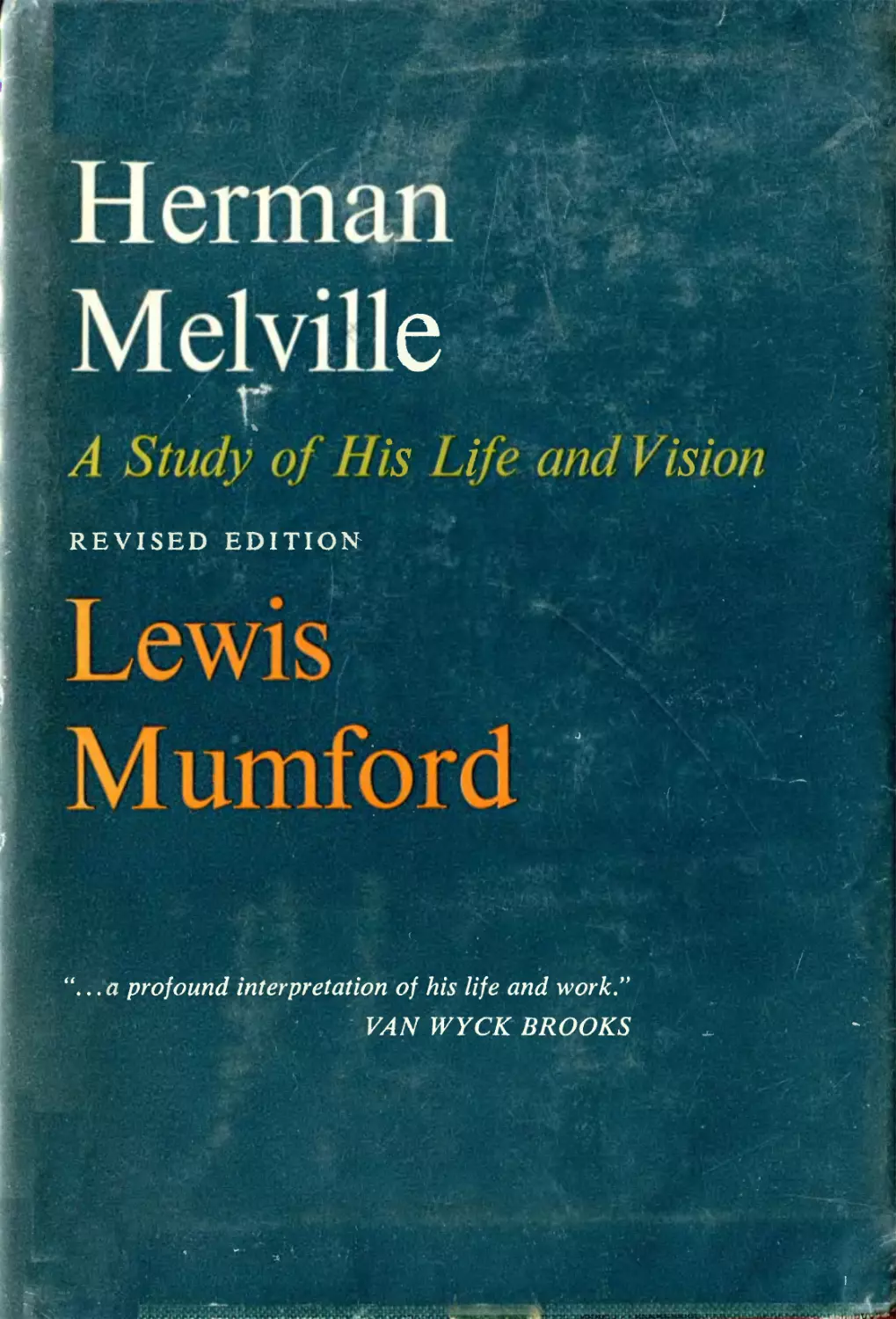
                    Herman
Melville
A Study of His Life and Vision
REVISED EDITION
Mumford
.a profound interpretation of his life and work."
VAN WYCK BROOKS
^шшишвшк^

Herman
Melville
A Study of His Life and Vision
REVISED EDITION
Lewis
Mumford
HARCOURT, BRACE & WORLD, INC.
NEW YORK
Щ

Copyright 1929, © 1956, 1962 by Lewis Mumford.
All rigftrrreVerved. No раГГЩ this book may be
reproduced in any form or by any mechanical means,
including mimeograph and tape recorder, without
permission in writing from the publisher,
:•* i
Library of Congress Catalog Card Number: 62-21847
Printed in the United States of America

"But, ah, ye Roses that have passed
Accounting me a weed."
Herman Melville:
THE AMERICAN ALOE
ON EXHIBITION

CONTENTS
PREFACE TO THE NEW EDITION ix
PROLOGUE xv
OLYMPIAN
Chapter One:
Chapter Two:
Chapter Three
Chapter Four:
Chapter Five:
BITTER MORNING
SEA-DRIFT
: TROPICAL SUMMER
AZZAGEDDI
THE TARTARUS OF AUTHORS
3
24
39
55
71
TITAN
Chapter Six: RED CLOVER 91
Chapter Seven: MOBY-DICK 107
Chapter Eight: AMOR, THREATENING 134
Chapter Nine: TIMONISM 153
PILGRIM
Chapter Ten: TROUBLED FOOTSTEPS 179
Chapter Eleven: ALARUMS AND RETREATS 202
Chapter Twelve: THE FLOWERING ALOE 227
INDEX
251

PREFACE TO THE NEW EDITION
When this study came out in 1929, only one full-length biography
of Herman Melville, that by Professor Raymond Weaver, had been
written, and only one extensive criticism of all Melville's works, that
by John Freeman in the English Men of Letters series, had yet been
published. But the tide of interest in Melville's work was rising again,
for a whole group of critics, including Viola Meynell and D. H.
Lawrence in England, and Frank Jewett Mather, Percy Boynton, and
Van Wyck Brooks in America, had begun to accord Melville his due
as a writer, especially as the author of Moby-Dick.
The immediate stimulus to this book came from Mr. John Farrar,
who sought to make it an early volume in a new series, the Murray Hill
Biographies, done in modest format. Even before this series got under
way, I had decided to write a more comprehensive study of Melville's
life and work, drawing more fully on his own writings for biographic
data than Weaver had done, and going more exhaustively into the
development of his mind and his art than Freeman had. My work was
to be in effect an enlargement, in terms of a single life, of the study
of "American Experience and Culture" I had opened in The Golden
Day. That purpose colored both the biographic interpretation and
the literary appraisal.
While I worked from the same unpublished documents that
Weaver had used, including typescripts he generously placed at my
disposal, and original manuscripts and letters Mrs. Eleanor Melville
Metcalf hospitably gave me access to, long before her collection was
deposited at Harvard, I was concerned with biographic data only in so
far as they threw a light on Melville's mind. And though my interpreta-
tions and evaluations differed from many of Professor Weaver's, giving
a quite different account of what he had called "the long quietus," I
somewhat uncritically assumed that he had uncovered most of Mel-
ville's remains. In point of fact, Weaver had made more than a brave
beginning. Not merely was he the first to scout a difficult, unmapped
terrain, but he brought back, in the Constable edition of Melville's
works (1924), various exotic fruits from what proved to be a new
Land of Promise.
ix

X PREFACE TO THE NEW EDITION
The disciplined army of scholars that moved into this biographic
territory after Weaver might never have ventured to take possession of
the land, had he not staked it out; and perhaps an even less biassed
judge than I might add that in the realm of Melville criticism, the
same could be said for my own contribution. But, as in military opera-
tions, scouts are expendable: the army of occupation that follows,
performing duties that demand complementary virtues of another
order, may even, in ignorance if not in malice, establish its head-
quarters above the 'unmarked graves' of the advance guard.
Since the 1920's, an immense amount of research has been done
on Melville's life, partly stimulated, no doubt, by the oversights and
omissions, to say nothing of outright errors, that both Weaver and
I had made, in our first hasty traverse of the obscure, half-blasted
wilderness of Melville's life. As a result of the unflagging industry
and vigilant detective work of a whole generation of devoted Melville
scholars, a multitude of new facts about both his voyages and his
family relations have been uncovered: many of his shipmates, for
example, including Dr. Long Ghost, have been identified as the real
people he reported them to be—as "Toby" had indeed proclaimed
himself soon after Typee was published.
In addition, a few fresh pieces of evidence of genuine importance
for the critical assessment of Melville's life and work have been
brought to light. Not the least result of this research has been to
disclose how much of the record of Melville's life was destroyed in a
series of deliberate holocausts, prompted partly by the tribal vanities
and fears of those members of the family who had custody of various
packets of Melville papers. These vandal acts have been redeemed, if
not repaired, through the pious efforts of his granddaughter, Eleanor
Melville Metcalf.
One of the most important contributions made by this wide
inquest into the surviving Melville documents has been to establish
certain discrepancies and contradictions in the account he gave of
his own early life in Typee, Redburn, and White-Jacket. Thus the
resurrected log of the Lucy Ann, the ship that rescued Melville from
the Typees, establishes that Melville's sojourn in .captivity lasted only
little over a month, not the four months indicated in the title; while
the log of the frigate United States, which took him home in 1844,
holds no record of any fall by Melville from the topmast off Cape
Hatteras. This omission would indicate negatively that Melville's
marvellous description of his plunge into the sea and his almost drown-
ing in his white jacket, which I treated as an actual event, is either
based on some earlier experience or, as seems more likely now, is a
sheer feat of imagination. I have now corrected this error by trans-
posing the passage to where it properly belongs, in the literary ap-
praisal of White-Jacket.
If such discoveries have lessened Melville's value as a witness in

PREFACE TO THE NEW EDITION XI
the veracious composition of his own biography, they happily raise
his rank as an original writer. But for a minute, day-by-day account
of his early rovings Melville cannot be trusted. This should hardly
occasion surprise, still less dismay. Because of Melville's natural
contempt for photographic reproduction, his sailor's gift for em-
broidering a good yarn to make a better one, and his free transposition
of confused impressions into orderly art, telescoping many similar
incidents into a symbolic whole, his autobiographic narratives manifestly
fall short of the requirements of a sworn witness in a court of law; and
by the same token they do not meet current American standards of
scholarship. In so far as I had relied upon Melville for details, without
further checking, my own work properly fell under the same critical
ban.
Against such scholarly standards, with their high-fidelity tech-
niques, Melville still has no need to appeal, nor have I any right.
But no one should too hastily conclude that the sundry errors of fact
in Melville's work—such as his lowering his actual age in Redburn,
to cover his lingering humiliation over his first post at sea—entirely
destroy the biographic value of his personal accounts; still less that
they turn the narratives of Typee, Omoo, or Redburn, as many of his
contemporaries so charitably suspected, into baseless fictions, like
Poe's Narrative of Arthur Gordon Pym, or worse, into deliberate
hoaxes. Certainly, Melville's dramatically shaded accounts must be
used more circumspectly than I had originally used them: that now
goes without saying. But they are still valid contributions to his
biography and in many places are the only firsthand evidence that
remains—not less significant, surely, because they throw more light
on his inner than his outer life. If further research has blurred the
early picture of Melville's life, the original colors have not been
greatly altered and the main outlines still hold. Were the facts other-
wise, there would be no excuse for republishing this work.
The writer who would do justice to Melville's career today
happily has at his disposal an immense body of material not readily
at hand in the twenties, though by now it seems likely that the most
gaping holes in the evidence will never be satisfactorily filled. Most of
the data, significant or trivial, relevant or irrelevant, have been pub-
lished, with exemplary generosity, in Mr. Jay Ley da's two volume
Melville Log (1951), and in Mrs. Metcalf's Herman Melville: Cycle
and Epicycle (1953). In addition, there has been much fine-combing
of sources by other able hands, particularly significant in disclosing
the books that Melville relied on or responded to, and the theological
background of his personal dilemmas, his religious philosophy, and his
ultimate faith. In this realm the work of Dr. Henry A. Murray has
been central to Melville scholarship, though so far largely limited, as
regards publication, to his monumental Introduction to Pierre.
Except for minor corrections I have not attempted in the present

Xii PREFACE TO THE NEW EDITION
edition to dip into this open treasure chest, though no one could
write a new biography of Melville without substantiating and hand-
somely enriching his work with these new findings. Only one book has,
I believe, made full use of all the biographic and critical material that
pertains to Melville—as far as it was possible to do this before the
Second World War broke out. This was the magistral study of
Melville's life and work done by a young French scholar, the late
Jean Simon: an exemplary achievement, classic in breadth and
balance, yet far richer in detail than any other single full-length study.
Unfortunately for him, the first edition of his book was all but wiped
out by German bombs in 1940, and unfortunately for us, no transla-
tion into English has yet been published.
In the matter of critical interpretation and assessment, the case
stands somewhat differently. If I have less to change here, it is be-
cause those who have labored most prosperously in this field have,
perhaps somewhat reluctantly, arrived at judgements similar to my
own: especially in doing justice to the literary work of Melville's last
forty years. My own earlier evaluations have, however, been called
in question by a new breed of critics, who have been hatching a
fashionable modern phoenix out of a deserted mare's nest. The latter
have established a new canon of judgement, whereby Melville's
Pierre becomes by its very incoherence and melodramatic violence
a prematurely modern, almost Joycean, masterpiece: Moby-Dick loses
its virtue as a multi-dimensioned but intelligible literary work in
order to become a subversive undercover attack upon Christianity, a
theory that makes mock of both the literary qualities of Moby-Dick
and the religious content of Clarel; while The Confidence Man and
Israel Potter have come by their very failings to take higher place than
White-Jacket. One of my minor regrets over publishing this study in its
original form is that this gives me no opportunity to register the ap-
preciations and depreciations that these critical reversals deserve.
As with the industrious exhumation of Melville's biographic
remains, one must nevertheless be grateful for much of the admirable
scholarly work that has been done: one may now say that Melville's
opus in all its breadth and depth has, for the first time, been adequately
taken in. Not the smallest expression of gratitude is that due to the
introductions to the Hendricks House edition of Melville's works,
now in course of publication. No one could hope to write soundly
about the meaning and value of Melville's writings without coping
vigorously with this massive body of scholarly criticism; for it has at
once broadened our view of Melville's background, illuminated remote
corners of his mind, and, as in the case of his poems, buttressed his
position as a writer; not least it has revealed the full significance of
Clarel.
Were this a new study I should feel obliged to take fully into
account—and gratefully embrace—such admirable critical studies as

PREFACE TO THE NEW EDITION ХШ
those of William Ellery Sedgwick, F. O. Matthiessen, and Jean Simon,
to mention uninvidiously only the dead. Similarly, I should add many
fresh insights of my own, prompted both by rereadings of Melville's
works—particularly Moby-Dick, Pierre, and Clarel—and the tragic ex-
perience that has brought our present generation so close to Melville's
desperation and despair. Yet the total effect of these many qualifica-
tions and amplifications would be, in the main, to confirm the critical
judgements I made a generation ago. In that area I would have much
to add, but little to emend.
As far as my general approach goes, I stand by my original treat-
ment of Melville in those very features that least comport with the
present style of academic biography and criticism. Just because every
aspect of Melville has by now been subjected to microscopic magnifica-
tion and ex-ray analysis, there remains perhaps a special place for
works that regard him with the naked eye, at a reasonable distance,
bringing out the main features and deliberately suppressing the pores
and the pockmarks. Not the least use of careful documentation is the
freedom it gives to abandon the methods that produce it, once the
results are taken into account. Otherwise the scholarly virtues of
patience, scrupulousness, exactitude, exhaustiveness would come at
too high a price. Without sufficient will to generalize and select,
present-day American scholars are perhaps too often tempted to bury
by an overload of minute analysis, meant chiefly to impress other
scholars working in the same territory, works that were once in
danger of being smothered by indifference.
Against the current ideal of literary scholarship, which leaves
little to the author and less to the reader, my book remains a tacit
protest. In view of such calamitous blunders in over-exactitude as the
now-unreadable Journals of Emerson, as lately re-edited, I make bold
to suggest that these ideals are in line for a severe re-appraisal. Like
high-fidelity zealots in sound reproduction, many scholars in this
generation make no distinction of value between music and noise; and
even cheerfully sacrifice music to noise if the latter can be more
accurately recorded and reproduced. Against such minds my revised
study may volunteer, as a scarred veteran, to join an open counter-
attack.
Perhaps the chief value that may be claimed for the present
book comes from the fact that, for all its shortcomings, it was the
product of an earlier period and a more direct approach to Melville's
work than is now possible. Hence I have not been unmindful that a work
a generation old now has, if preserved in its original form, a certain
status as a document, if only because the work shows how much could
nevertheless be said about Melville at that early and incomplete stage.
So though I have not hesitated to make sundry minor corrections, I
have made major changes only in two instances: in replacing my
lamentable misinterpretation of Ethan Brand with a more just ap-

Xiv PREFACE TO THE NEW EDITION
praisal of Melville's relations with Hawthorne—a passage I have placed
in brackets—and in deleting the original Epilogue, which contained
too many lapses of taste and judgement to admit of facile correction in
the spirit of the rest of the text. If any serious errors relating to dates
or events remain, they must count as oversights, not as an intentional
defiance of established authority.
Let the reader treat this book as a guidepost, or rather, a partly
effaced milestone, on the original narrow country lane of Melville
scholarship. That road has now turned into a six-lane motorway, busy
with traffic: dashing private cars, ponderous trucks, bus-loads of
tourists on guided tours. Those who like to linger on an old shadow-
dappled lane will not go so fast or get so far: but they will have the
freedom to collect their own thoughts, inhale fresh air, take in the
landscape, and pluck a few roadside flowers for themselves. Since I
have drawn freely on Melville's own words whenever they were
available, frequently without quotation marks, the voice that will ac-
company them on this solitary stroll will often be that of Herman
Melville. My task as a critic will have been well done, according to my
own lights, if henceforward they ask for no better guide than Melville
himself.
Lewis Mumford
AMENIA, NEW YORK
JUNE 1962

PROLOGUE
When Herman Melville died in 1891, the literary journal of the
day, The Critic, did not even know who he was. The editors rose
bravely to the occasion and copied a paragraph about him from a
compendium of American literature; and in the weeks that followed
they reprinted various commentaries on Melville and his work that
were carried in the correspondence columns of the New York news-
papers.
The older generation remembered that Herman Melville had
once been famous. He had adventured in the South Seas on a whaler;
he had lived among the cannibals; and in Typee and Omoo he had
made a romantic pastiche of his experiences. On these books Mr.
Melville's fame had been founded: it was a pity he had not done more
in this line; for his later books, obscure books, crowded books, books
that could be called neither fiction nor poetry nor philosophy nor
downright useful information, forfeited the interest of a public that
liked to take its pleasures methodically. Both the fame and the later
absence of recognition, Mr. Melville's commentators agreed, were
deserved. By his interest in Sir Thomas Browne and metaphysics, Mr.
Melville had carried his readers into a realm much too remote, and an
air too rarefied. A flirtation with a South Sea maiden, warm, brown,
palpable, was one thing: but the shark that glides white through the
sulphurous sea was quite another. In Moby-Dick, so criticism went,
Melville had become obscure: and this literary failure condemned him
to personal obscurity.
The writer about whom all these sage banalities were written
shares with Walt Whitman, I think, the distinction of being the
greatest imaginative writer that America has produced: his epic,
Moby-Dick, is one of the supreme poetic monuments of the English
language: and in depth of experience and religious insight there is
scarcely any one in the nineteenth century, with the exception of
Dostoyevsky, who can be placed beside him. To his contemporaries,
the greatness of Melville was an enigma: they valued him for those
lesser virtues in which he more closely resembled themselves. They
had no place, on their matter-of-fact plane, with its confident flat-
footed science, and its many odd and useful inventions, for the cross-
lights of Melville's imagination, for his oblique revelations, for his
habit of questioning the foundations upon which their vast super-
structure of comfort and complacency was erected. "What we want, sir,
XV

XVi PROLOGUE
is facts!"—and though Melville gave them facts, they resented his
white vision, because it froze the facts into a state that defied their easy
assimilation. When they charged Melville with obscurity, they did not
realize, perhaps, that sight demands not merely an object that can be
seen, but an eye that is capable of seeing; and it never occurred to
them, with all their doubts about Melville, that the defective vision
might be their own.
In a great degree, Herman Melville's life and work were one.
A biography of Melville implies criticism; and no final criticism of his
work is possible that does not bring to it an understanding of his per-
sonal development. The exotic elements in Melville's experience have
usually been overstressed; the fatality and completeness of his with-
drawal from the contemporary scene have been exaggerated; the
incidental rocks and rapids and whirlpools have diverted the critic's
attention from the flow of the stream itself. It is with Herman Mel-
ville's strength and energy on the spiritual plane that I shall chiefly
deal. He lives for us not because he painted South Sea rainbows, or
rectified abuses in authority in the United States Navy: he lives be-
cause he grappled with certain great dilemmas in man's spiritual life,
and in seeking to answer them, sounded bottom. He left the clothed
and carpeted world of convention, and faced the nakedness of life,
death, energy, evil, love, eternity: he drew back the cosy hangings of
Victorian parlours, and disclosed the black night outside, dimly lighted
with the lights of ancient stars. Had he been a romantic, he would have
lived a happy life, buttering his bread with feeble dreams, and swallow-
ing down his regrets with consolatory port: he who wishes to escape
the elemental stings of existence need only grasp the outstretched
hands of his contemporaries, accept the subterfuge goals they call
success in business or journalism, and shrink by means of a padded
physical apparatus from the thorny reality of human experience.
But Melville was a realist, in the sense that the great religious
teachers are realists. He saw that horsehair stuffing did not make the
universe kinder, and that the oblivion of drink did not make the thing
that was forgotten more palatable. His perplexities, his defiances, his
torments, his questions, even his failures, all have a meaning for us:
whether we renounce the world completely, affirm a future transcend-
ence in Heaven, or, like Walt Whitman, embrace its mingled good-and-
evilness, our choice cannot be called enlightened until it has faced the
gritty, unassimilable substratum Melville explored. Melville left a
happy and successful career behind him, and plunged into the cold
black depths of the spirit, the depths of the sunless ocean, the black-
ness of interstellar space; and though he proved that life could not
be lived under those conditions, he brought back into the petty
triumphs of the age the one element that it completely lacked: the
tragic sense of life: the sense that the highest human flight is sustained
over an unconquered and perhaps an unconquerable abyss.

Olympian

Chapter One: BITTER MORNING
The society into which Herman Melville was born was in the
fullest sense of the word a provincial one. His heritage and his work
united him with that society; and when its occupations were under-
mined and its customs effaced by the great tide of destruction that
marked the Civil War, he himself was intimately involved in its ruin.
By a provincial society I mean one that finds its sources and
motives within its own region, and that achieves a certain balance
and continuity by a restricted development. To understand Melville's
background, one must think back to a time when New York was only
one of a number of Atlantic ports that claimed the commerce of the
seas and the wealth that it brought: Salem was almost as important:
so were Boston and Baltimore and Charleston: it was little more than
the accident of a regular sailing packet line that made New York take
the lead in attracting population, that, and the opening of a direct
water-route into mid-America, via the Erie Canal, which was still a-
building in 1819, the year that Herman Melville was born.
The United States, except as an abstract political entity, scarcely
existed. There were eagles on the furniture: there were eagles on the
dollars: there were flags and martial birds on mirrors and bedspreads
and glass and china: but a good part of the community, certainly in the
older, more settled regions, was hardly yet political-minded, still less
conscious of a mystic relation with the other parts. During the War
of 1812 New England, threatened with economic ruin, was on the
point of breaking loose from the political union: and though the
national government coined money in quarter dollars, people still
referred to such coins as two shillings. If Rip van Winkle was sur-
prised at the changes that had taken place during his long nap, a
modern observer of that provincial society would be even more
astounded at the lack of them. Whitman, writing a whole generation
later, and loathing the notion of secession, still had a consciousness of
the individuality and independence of the separate states which the
strongest defender of states' rights never expressed after the Civil
War.
This provincial society had its own economic foundations, its own
locus, its own seat of authority: it differed in a marked way from that
which was developing on the frontier: the drama of one of Cooper's
3

4 HERMAN MELVILLE
best books, The Pioneers, is chiefly concerned with that contrast. The
frontier society was a flowing and moving one: the only thing that
united it was the common flag that waved over it and the Constitution,
to which its officers paid their superficial respect. Its members came
from anywhere, got a living anyhow, and pushed on, in an uneasy,
restless search for more fertile land, wilder creatures, greater distance
from their neighbours—or merely, from the habit of locomotion.
The pioneer phase was strenuous, hazardous, heroic; but once
the settlement was effected, once the town was founded and the
building-lots divided and the outlaws rounded up, it was unbearably
tame. The excitements of civilized life, the clash of ideas, the conflict
of cultures, the absorption of experience, did not occupy the pioneer:
even when he adopted the external habits of the red man, his weapons,
his tools, his maize and dried meat, he avoided the inner content of his
culture. In provincial society we are nearer to Europe, that is, nearer
to a settled life, to order, authority, tradition. In every colony there
was an historic mixture of nationalities and stocks, and that peculiar
to New York, English and Dutch, with a dash of French Huguenots,
had at last begun to bubble and ferment: presently a Whitman, a
Melville, came out of it.
In provincial society, the family was still a prime reality; and in
New York it was not less so, certainly, because of the fact that the
Dutch had founded great landed proprietorships, like those of the
Gansevoorts to whom Herman Melville belonged on his maternal side.
Two hundred years of inherited wealth create family pride and all the
futile snobberies of caste: they also create a firm sense of self-posses-
sion. Washington Irving, who was one of the conquering English,
might laugh at these Dutch burghers and patroons: but from their
manorial seats along the Hudson and the Mohawk, the Van Rensselaers
and the Schuylers and the Gansevoorts could view this mockery with
sleepy disdain. They had only to sit tight to be eminent; as the popula-
tion grew, the value of the land doubled and quadrupled, and in spite
of rent wars and the abolition of feudal privileges, the landed families
rose to the top like cream.
The Dutch throve in this expansive environment, on farms that
stretched from hilltop to hilltop, as they throve by intensive activity in
the lowlands by the Zuyder Zee: if their old canals were covered over
and filled up in New Amsterdam, they still had their commodious
stone or brick houses in the country; there was one such at Gansevoort,
where the Gansevoorts lived, not far from Saratoga. The fine arts did
not find many disciples among these great families: the Copleys,
Trumbulls, Stuarts, Peales had English names: but the crafts were
cultivated in great variety: the architecture was straightforward and in
minor matters, like the horizontal windows and the peculiar gambrel
roof, original: the landscape was well treated; and above all, there

BITTER MORNING 5
was food, wild pigeon and grouse and deer, well-fed beef and succulent
ducks and geese and great handsome cheeses. When Herman is a little
boy his mother will remember Uncle Peter Gansevoort, at Albany, with
a tub of five hundred pickled oysters.
"A thoroughly developed gentleman is always robust and healthy."
When Melville wrote these words he was thinking of the great gentle-
men between whose legs he had walked as a little boy, and particularly,
perhaps, of one he used to hear about, that grandest of old fellows,
General Peter Gansevoort, a mighty soldier during the Revolution and
a great figure among men. He had died but seven years before Melville
was born; many of his remains, including a portrait by Stuart, were
still visible; and his legend stayed on the tongues of those who had
known him. Six foot four he was, with an appetite and a digestion
fit to keep that colossal frame in motion. Now, among all the pleasures
of life, positive health—not mere freedom from disorder and disease-
is surely the first: living needs no extra justification when the blood
is clear and all the juices are flowing harmoniously. In Melville's youth
even a city lad could sail a boat, tramp into the country, shoot game,
experience the active, outdoor life which has always been the mainstay
of the aristocracy, and which doubtless explains its ability to conquer
and control the urban populace, habituated to the ledger, the bench,
the desk, and the foul air thereof. Melville had scarcely reached
maturity before some of these natural pleasures were curtailed in the
city of his birth, so that, to preserve them, William Cullen Bryant
launched the campaign to create Central Park.
"Too often," Melville wrote in 1852, "the American that him-
self makes a fortune, builds him a great metropolitan house, in the
most metropolitan street, of the most metropolitan town. Whereas, a
European of the same sort would thereupon migrate into the country.
That herein the European hath the better of it, no poet, no philosopher,
and no aristocrat will deny." Melville's ancestors had kept close to the
country: Grandfather Peter and Uncle Herman at Gansevoort, Uncle
Peter at Albany, little more than a country town, and Uncle Thomas
Melville on his farm, eastward in the Berkshires. Although Melville was
born in New York, he was nourished by the agricultural experience of
the back-country: when he idealized his early life in Pierre, he gave
his hero a twenty-mile ride or a ten-mile walk every day, a turn at
felling a hemlock in the forest, or boxing or fencing or boating. That
was something like a foundation, and it resembled Melville's own
background. When we come to a later period of Melville's life we will
not be tempted, if we remember these things, to overstress his doldrums
or his adolescent uncertainties: for we shall not forget that he became
a magnificently healthy animal—and healthy animals itch to use their
energies and test their muscles. Their very energy will, if frustrated,
magnify their despair.

6 HERMAN MELVILLE
2
Against the vigorous, fleshy life of the provincial countryside, the
immediate environment in which Melville was born must seem a little
petty and painful around the neck; and it was. Herman's father, Allan
Melville, was by trade an importer of French goods, and by every
evidence of physiognomy, notebook, and letter a trivial but not un-
cultivated man. The portrait of Allan as a young man that survives is
cruel in its exposure of Allan's simpering elegance: his lip is weak
and his eye has a vacuous leer. When one puts these qualities alongside
the careful pedanticism of his letters, one is left with a mixture of
slightly odious characteristics.
Allan was completely given to the outward amenities of life. He
valued name: he was not unconscious of this, perhaps, when he mar-
ried a Gansevoort, nor was he less so the year before Herman was
born, when he visited his titled Scotch cousins at the original Melville
seat. Deportment and modest behaviour were only less in Allan's eyes
than wifely name and beauty: when he married Maria he made sure,
remembering it may be a disturbing levity in Napoleonic France, which
he had known as a young man, that she saw eye to eye with him on
every point. He was the sort of man from whom one expects prudence
without imagination. He doubtless had passionate adventures before
he married, for he was thirty-two when that happened: but he was
circumspect in all things, and if the adventures left any tell-tale traces,
we have no better reason for thinking so than the fact that Melville
confronted his hero with such a crack in his father's image, in his
novel, Pierre. Such a man may do very well in business, as long as no
unforeseen circumstances occur: not doing the wrong thing will
suffice in many occupations for actually doing the right thing—and one
may be sure that Allan Melville had a sense of gentlemanly correct-
ness in all his dealings. Business was not yet a ruthless obsession: one
expected to retire from it into a more cultivated existence; indeed,
such an early withdrawal was the capital mark of success.
Maria Melville, born Gansevoort, seems to have been Allan's
counterpart in many ways: each carried the same tune in a different
register. Like Mrs. Glendinning, in Pierre, she was a noble creature,
but "formed chiefly for the gilded prosperities of life, bred and ex-
panded in all developments under the sole influence of hereditary
forms and world-usages." She was correct, formal, proud; she valued
a high station in life, to which her maiden name, at least, entitled her;
she valued good food, low voices, courteous servants, correct manners,
and even when left in indigence by her dead husband, she sought to
conform to the outward decencies, though the price of this was a
constant stream of proud, anguished begging letters to her affluent

BITTER MORNING 7
brothers. An only girl in a family of boys, preening herself with a
sense of her family's importance, does not profit by sufficient chasten-
ings of pride: Maria, unfortunately, was such a girl; and to the last
she wore her pride in station like a crest.
Maria had stooped a little to marry a mere trader like Allan,
although he, too, came of good English stock which sided with the
colonies in the Revolutionary War; still, she stooped; and she never
quite recovered from the painful crick in her back. She must have
attributed the misfortunes that followed in her middle age to this
original mistake; at all events, one cannot imagine a woman with such
traits as she left behind in the memory of her contemporaries, taking
any disaster to her station in life or her income with resignation or
becoming meekness. Christianity, for a Gansevoort, meant a prominent
pew in church, not an equal place in heaven; and to deprive her of the
world's goods was to deprive her of everything she valued.
Melville's father and his mother wore the fashionable false-faces;
but it took him a long time to discover this, because they were correct
and meritorious members of society, and it is difficult to believe that
the image of God can err, if it be repeated often enough. In the New
York of the early nineteenth century, Mr. and Mrs. Allan Melville
can be duplicated many times over. Their correctness, their pettiness,
their shallowness, were the correctness and shallowness of a venial
society whose pretensions to culture and civilization were, on the
whole, pretty thin. It was an agreeable society, make no doubt, and
Mr. and Mrs. Melville were just the sort of people to persuade one to
accept its conventions as the very acme of human desire. One visited:
one left one's card; one entertained at dinner; occasionally one went
to the theatre, or to one of those miscellaneous exhibitions of forgeries
and bad copies and minor masterpieces that served to introduce art
into America: one might even descend a little to that prodigious
educational spectacle, the Cosmorama, or Picture of the World, at
Scudder's Museum.
It was not London or Paris, of course. Allan had seen the paint-
ings in the Louvre and doubtless knew better than some of his con-
temporaries: but it was the outward activity of a great city, with none
of the inner effort that sustained it in Europe. No one in New York, up
to 1819, had dedicated himself to the creative life; and whether one is
conscious of it or not, a great poem, an original thought, an effective
piece of scientific investigation, subtly affect the spirit and tempo of a
place. New York was the counterfeit of a great metropolis, just as the
pictures it looked at were the counterfeits of great painting, just as the
exhibition of a Cosmorama was a counterfeit of a voyage around the
world. Pigs snouted in the gutters; the waterfront had become a jumble
of shipping; the old docks had begun to splinter up and decay; the
Collect Pond was being filled up to make real estate for the growing
city, and later a site for the Tombs; in the vacant fields on the outskirts

8 HERMAN MELVILLE
of the town, squatters settled in little hovels that reminded one of a
misery and want not yet wholly native to America; in short, over a
vast welter of miscellaneous activities there was only the most
transparent film of a civilized life.
As long as one remained on the surface one could manage one's
time agreeably; and the refined, fastidious people who constituted
Melville's social class were unaware of the fact that their provincial
shell was becoming more and more hollow, as the organism within it
died part by part and shrivelled up. The Erie Canal and the general
starvation and impoverishment of Europe after the Napoleonic wars
would draw vast masses of needy men across the Atlantic: the city
itself would lose its waterfronts and pleasances: the trees would make
way for cobblestones and hitching-posts: the area around its little
villages would be broken up into building lots, and it would have to
convert its Potter's Fields into parks in order to recapture a little
open space: by 1835, dingy-looking tenements, newly built, and ,
made-over "tenant houses," abandoned by the original merchants,
would spread around and engulf the neat provincial city. In the
twenties, from the overcrowded slums and the insanitary backyard
wells, fever came forth, year after year: a little later, a wave of cholera
caused almost a general exodus. Eventually, the noses of the respect-
able would detect the change and tilt upward in pained appreciation
of it; but that the ugliness and misery and disease were in any way
connected with the sources of their incomes, they would of course
indignantly have denied.
з
Allan Melville was not a rich man; but when Herman Melville
was born, on August 1, 1819, Allan Melville was doing well in a
modest way: the family lived at Number Six, Pearl Street, and Herman
was the second son and the third child of this agreeable union. When
Herman was a year old, Allan noted in a letter that he had hired a
cook and a nurse, and wanted only a waiter; and one may take for
granted, I think, that such a household already has its complement of
maids, linen, silver, sherry, port, brocades, and books.
To awake in a home surrounded by the decencies of life must
mollify an infant's indignation at having to enter the world at all; and
in Herman Melville's earliest years, nothing ever conveyed a sense of
danger or physical stress. In the even decorum of the days, meals ebbed
and flowed like the tides; the sheets were as white as the tops of wind-
whipt waves off the Battery; clothes sprang into existence out of the
sewing-room as naturally as feathers cover a robin's back: little boys
had handkerchiefs to blow their noses in and pillows to cuddle into
when they fell asleep in their cribs; in the obscure world that crowded

BITTER MORNING 9
around little Herman, there were convivial discussions between his
father and strange gentlemen in the library, when he might do no
more than linger in the shadows of the hall or hush his breath at a crack
in the partly opened door; there were visits to relatives and a few
select friends that were as sociable as a regimental inspection in the
army, when he might not get his pinafore mussed, nor bunk up against
the furniture, nor tease his older sister, nor rub shyly into his mother's
neatly disposed dress, visits with every one sitting upright, stiff, the
spine imitating the rigid line of the chairs, just blossoming elegant
"deportment."
On the whole, in spite of its high-chokered formalities, it was a
kind world that Melville found himself in: shallow men are not
obstacles to little boys, and as for Mrs. Melville, she had all the
affection for her children that natural instinct and the graces of
society prompted her to have, not a great deal, one suspects, for chil-
dren, like servants, are only subordinate ministers to the ego—and one
cannot take pride in satisfying society's minimal requirements. She
was, however, an intelligent and capable mother: all her eight children
grew to maturity, and that was no little feat, even for an upper-class
family, in the early nineteenth century. Herman must have been a
little starved of affection, I think; for in Pierre he gives his hero no
sisters or brothers, so that Pierre may absorb all his mother's warmth
for himself; and his hungry claims for sympathy and caresses were no
doubt put off by Mrs. Melville's aloof rectitude, her concern to keep
part of her energy and sweetness for her husband, and her manifest
partiality to the younger children, when they arrived. Herman stood
as in a cold room before an open fire: one side of him was toasted, and
another side was chilled. That chilliness remained; and in the parts of
his emotional frame that were affected, circulation was never quite
restored.
When Herman was five the family moved two miles uptown, to
a house in Bleecker Street which combined the advantages of town
and country. It was good for Herman that the change was made. He
had been ill and had not regained his health fully: he looked, his
father reported then, pale, thin, and dejected; but the new house had
a vacant lot where children could play; and not far away the farms
began to stretch on each side of the Albany turnpike: despite the
activity of the City Planning Commissioners in laying out rectangular
blocks over the hills and dales and streams and swamps and ponds of
the island, the farms themselves were retreating slowly. Life, for little
Herman, was no longer a matter of sitting and staring at the furniture:
he went to school: he found that c-a-t and d-o-g were a new way of
playing with a dog and a cat: when he was bored he could always
practise tricks on his brother Gansevoort, who was older and more
considerate and could not legitimately hit back.
Still, Herman did not thrive quite as well as he should have.

10 HERMAN MELVILLE
Winter drew a black curtain between him and all the pleasant things
one could see or find or do in the country: darkness fell much too
soon after school: November's rains confined him to the house and
March's snows and slush did the same: as the winter progressed his
checks would grow paler and his small blue eyes more wan. His
father shook his head doubtfully and grieved over little Herman's mel-
ancholy situation. As a result of these stops and gaps in his life
Herman "is backward in speech and somewhat slow in comprehension,
but"—so Allan reports to the Albany Gansevoorts, when Herman in the
summer of 1826 is sent to them on a visit—"you will find him, as far as
he understands men and things, both solid and profound and of a
docile and amiable disposition."
One is grateful to Allan for using such unusual words as "solid"
and "profound" to describe a child just turning seven: there must
have been something in Herman's attitude or attack that warranted
them: one cannot altogether lay those adjectives to pompous speech
or parental pride. Is one going back too far if one finds the beginnings
of Melville's reflective turn in these juvenile illnesses and confinements?
The periods of solitude in bed, the lassitude of recovery, the slow,
patient hours undistracted by physical activity, the rehearsing in the
mind of things done and things seen—these limitations make content
and docile little boys. John Ruskin amused himself, in an enforced
confinement without toys, by tracing minutely the patterns of the
parlour carpet: in such dull, quiet states is the beginning of a medita-
tive life.
A year later Herman was sent to visit his Uncle Thomas Melville
at Broadhall, near Pittsfield. Uncle Peter, at Albany, was still something
of a countryman: Uncle Thomas was a different sort, more fine, more
polished, with a touch of the old beau about him perhaps and no little
of the courtliness of aristocratic Paris: he had brought home a French
wife, and the undercurrent of French between the old fellow and his
spouse, when Herman was present and not supposed to understand,
must have teased him like a glimpse of a foreign port. Uncle Thomas
had nothing of the boor about him; his manners were mild and kindly,
"with a faded brocade of old French breeding" and a certain daintiness
of gesture, as when he would drop his rake and pause for a pinch of
snuff, that brought the reminder of a society less angular and im-
petuous than that which jostled little boys in the streets of Manhattan.
It was a little pathetic, too, to see this fine old gentleman handling a
rake or patiently feeding a cow: he was so manifestly cut out for
more urbane companionship.
In the galaxy of uncles and grandparents and aunts, the patrician
element was dominant: every one of them knew what it was to be
well bred and cultivated in the arts and able to command men. There
was Grandfather Thomas Melville at Boston, he whom Oliver Wendell
Holmes poked a little fun at in the trivial piece of verse called The

BITTER MORNING 11
Last Leaf: he had been a major, too: he had fought well in the Revolu-
tion, too: a dried-apple sort of man who had lost his juices and perhaps
his sweetness. Let the times change as they would, he kept his shape, and
to define it, he wore cocked hat and knee-breeches up to the day of his
death: the eighteenth century was good enough for him. Then there was
Uncle John de Wulf, who dropped in miraculously one day to see
Herman's father: an old man with hair as white as the pin-feathers
on a swan's breast, and face as red as a cranberry. He used to sail to a
place called Archangel, and, more marvellous still, he had crossed
Russia with Captain Langsdorff, starting from the Sea of Okhotsk in
Asia and going to St. Petersburg, drawn by large dogs in a sled. What a
hearty old fellow he was! His clothes almost had the smell of the far-
off places he had visited. Ever memorable was that June day when his
father and Uncle John took Herman over to Staten Island, and they
explored the ruin of a fort that had been hastily erected by Governor
Tompkins to defend the city against the British in 1812. Uncle John
was a mystery: the crumbling walls of the fort were a mystery: but the
sky above was as blue and benign as the blue eyes of Herman's mother,
and in the still air of noon, there was no sound but the twitter of
birds, and a great shout of delight and happiness in the little boy's
heart.
But Manhattan was always full of mysterious strangers and sun-
burnt men with a rolling walk and a sea-bag or a chest jauntily carried
on one shoulder. New York did this for Herman Melville: it taught
him to be discontented with New York. There was Liverpool: there
was London, Havre, Paris. The trim little packets down at the docks
went back and forth between Liverpool and New York as regularly as
clockwork, or very nearly: the swift ones could make the journey, with
a little luck, in fifteen or sixteen days, and the best record for a sailing
vessel was considerably under this: they took away wheat and furs and
passengers, and they brought back cloth from the Midlands and carpets
from Brussels and gloves from Paris and knives from Sheffield and
cheap gewgaws from Birmingham and china from Burslem, or even
from China itself—and more passengers.
One simply could not forget the wideness of the world in this
wide harbour, edged with green banks and feathery trees. Even some
of the furniture in the house had been made in Europe: Herman
looked at it again and again, wondering where the mahogany grew
and whether the workmen who made the furniture were still alive, and
what they might be doing with themselves now. His papa had been
a great traveller; in a score of years, as he methodically noted down,
he had travelled "by land 24,425 miles, by water 48,460 miles" and
had been 643 days at sea; and once Allan had lived two whole years in
Paris. Every stone, every mast, every stick of furniture, every print
had a message for Herman: Travel!
How the books and prints Allan had brought home fomented

12 HERMAN MELVILLE
Herman's dreams! There were prints of French men-of-war, of French
fishing boats, with "high French-like land in one corner and a gray
lighthouse surmounting it. The waves were toasted brown and the
whole picture looked mellow and old. Perhaps a piece of it would
taste good." On Saturdays, when school didn't keep, and the rain im-
prisoned the children in the house, Augusta and Gansevoort would
take out a French portfolio of coloured prints. More romance!
Versailles: grand drawing-rooms: fountains where writhing Tritons
spouted gleefully: rural scenes: shepherd boys and cottages: above all,
there was a picture of a great whale, as big as a ship, stuck full of
harpoons, and three boats sailing after it as fast as they could fly.
Then, too, there was a tall brown bookcase in the hall; behind its glass
doors one might see long rows of old books that had been printed
in Paris and London and Leipsic. There was the Spectator in six
volumes with "London" on the title page: there was a copy of
D'Alembert in the language Uncle Thomas used to speak to Tante
Marie.
Some day Herman would grow up too: he would see the world
and have stories to tell about it: he would confront these marvellous
pictures and find out how real they were. How snug Herman felt on
a winter evening by the old seacoal fire in Bleecker Street, when his
father would tell the children of monstrous waves at sea, waves
mountain-high and masts bending like twigs. Herman's stomach
curdled pleasantly at the thought of it, or the equally dizzy but in
some ways more marvellous thought of looking over London from the
ball of St. Paul's, and picking out the Monument and London Bridge
and Blackfriars and St. Dunstan's crown, and Southwark, where
Shakespeare used to act, across the Thames. One would risk waves as
high as mountains if one had some assurance of reaching eventually
this fine old land, full of cathedrals and churches that were built be-
fore Columbus sailed to America, and narrow, crooked streets without
sidewalks, and fields and woods that were as tidy as an American
garden. That would be Albany or Gansevoort, prodigiously magnified
by age and association. How hard to remember that little boys went
to school in Europe, too, and were punished if they didn't learn their
lessons. Did they study geography, grammar, writing, speaking, and
spelling there? Did they wear their shirt collars turned over and tied
with a black ribbon; and did their papas allow them to wear boots,
nice manly boots, instead of shoes? A long breath; a sense of choking
anticipation. The days pass so slowly. Herman will be quite old—he may
be twenty or twenty-five at this rate, before he goes there!
4
In 1828 Allan's position in society ballooned a little. He moved to
a house on Broadway, with a lot two hundred feet deep, and doubtless

BITTER MORNING 13
more commodious rooms, for the rent was almost double that of his
old quarters; but whether he was losing hold of his prudence or
miscalculating, or whether circumstances that lay beyond his view were
altering his position as an importer, one does not quite know. It is pos-
sible that, without being fully aware of his losses, he was shaken by
the financial crisis of 1826, or it may be that his importations became
inept, and the old lines were giving out. At all events, his business
became so bad that he moved to Albany in 1830, so that, perhaps, he
might take advantage of the Gansevoort connections. But he moved
too late. He became a bankrupt. In 1832, when Herman Melville was
only thirteen years old, his father gave up the struggle, became mentally
ill, and died.
One suspects from the look of Allan's portrait that he was a fair-
weather sailor and did not know what to do when the winds began
to blow adversely. He left his loving wife with eight children, and only
the family name to support them. No thanks to Allan that part of
the family name was Gansevoort; but although that name certainly was
an asset, and although Uncle Peter and his wife doubtless did all that
they felt was in their power to make things easier for the proud widow
and her orphans, the morals of bourgeois society are meant, like
Allan's character, for smooth sailing, and when hardship overtakes
one branch of the family there is usually no such general sharing round
among the surviving groups as there is among the poor, who know
shipwreck perpetually. Herman was going to the Albany Academy
when his father died; he probably knew only by hints and murmurs
and brooding faces that a calamity was approaching—and he suddenly
found himself a half-orphan, with only the dear mild image of his
father to comfort him.
This death before Herman had reached intellectual penetration
did Allan a kindness: he became "a shrine in the fresh-foliaged heart
of [his son] up to which he ascended by many tableted steps of
remembrance; and around which annually he . . . hung fresh wreaths
of a sweet holy affection. In the shrine stood the perfect marble form
of his departed father, without blemish, unclouded, snow-white, serene
. . . fond personification of perfect human goodness and virtue." But
this did Herman himself an ill turn, for instead of permitting the
august image of his father to experience the vicissitudes of the weather,
and ripen into the natural disillusion that greets a son when he finds his
deity one in flesh with himself, equally mortal, equally fallible—
instead of this, the image became fixed, and when Herman outgrew
his father, he did not simply leave him behind: he rose up and an-
nihilated him, revenging himself upon the actual Allan for the perfect
marble shadow he had carried in his heart. In the asperities of fortune,
Mrs. Melville, with a hard row of her own to hoe, may have fallen in
Herman's heart because she had to face comparison with the marble
portrait of his father: even the best of mothers, under such circum-

14 HERMAN MELVILLE
stances, would seem a little harsh and unkind, beside him who had
by his bankruptcy and his death escaped the dilemmas of both his
creditors and his family. At all events, Herman found himself at thirteen
in the midst of a hardhearted world; and the shock of that transposi-
tion left him weak. That early poverty and desolation scarred him to
the end: indeed its humiliations were to be repeated and magnified on
later occasions.
The aunts and uncles were kind, of course; but they had cares
and interests of their own; and it needed dire extremity to move them
to action. Herman's cousins continued to go to school: the cousins had
butter on their bread and cream on their porridge; but the Melvilles
must have known that sinking feeling that comes to a big family at
table when the eye takes in the bowl of stew or the little roast and the
nine plates that wait for it, and knows instantly that no thinning of
slices or spreading of gravy will make the portions large enough to
satisfy a healthy appetite. The summers in the country, the long, lazy
summers, were over: it was winter all the year round. Gansevoort,
dogged, patient, resourceful fellow that he was, opened a hat store on
Market Street, and as soon as Herman was fifteen, he got a job as
clerk in the New York State Bank, of which Uncle Peter was one of
the trustees: a year later, Herman shifted over to the hat store, where
Gansevoort now needed an extra clerk.
This was not the way, Herman doubtless felt, that one's ado-
lescence should open. The son of a gentleman can, it is true, remain
a gentleman, even when he adds figures or sells hats: in America,
thank Heaven, every trade is an honorable trade; but there is some-
thing wrong with a world that gives the young Gansevoorts all that
their hearts ask for, and that draws the Melvilles up sharply wherever
they turn. All Herman's ambitions, to go to college, to become an
orator like Patrick Henry, to become a great traveller, like Uncle
John or Papa, or to become a great general, like Grandfather Peter,
to live in Paris, like Uncle Thomas, to make the name of Melville
somehow glorious—all these dreams were like great bonfires suddenly
drenched by cold rain. He was as unambitious as a man of sixty. Such
careers do not begin in a hat shop. The stream of life had suddenly
stopped; its margins became stagnant; there was no way out; one
might add columns or sell hats forever. One's uncles and cousins
didn't care. One's friends only said they cared. Cold, bitter cold as
December, the world seemed to young Melville. Fifteen years later,
he still felt the bitterness and sting. He had only a lonely pride to
wrap around him; and the world, not seeing any money in the pockets
of that garment, smiled a little scornfully, and wondered whether it
might not be just as well to leave such wrappings off!
At sixteen a lad can do no more than earn his keep; there was
no question of Herman's helping to support the family, as Gansevoort
patiently did. Some one must have observed that things were not

BITTER MORNING 15
going well with Herman in the hat shop; or perhaps there were not
enough hats to be sold to make his presence necessary; in the summer
of 1836 he lived with his Uncle Thomas at Broadhall, helping in the
hay fields; and when autumn came he taught school—one needed
muscle rather than letters for teaching school in those days—in the
Sykes district, near by. He spent the winter in the shadow of Washing-
ton Mountain, and when spring came, and his pupils were needed in
the fields, he himself felt a desperate longing to see his mother and his
sisters again, and Gansevoort and young Allan and little Tom; so,
presently, he went back to Lansingburgh, a little river village just
outside of Albany, where his mother had moved. Scarcely had the
welcome worn off before he realized that his existence was a problem:
he was another mouth to feed! What was he going to do? Perhaps
Uncle Peter would get him another chance at the bank. Not that?
Well, what then? Gansevoort is doing bravely: Allan is already think-
ing of the law: every one must help.
Between the ages of sixteen and twenty-one young Melville felt
the world closing in on him. He had no answer to the major problem
of civilization, namely, how to get a living without losing all the other
things that make life joyful and significant. Herman's contemporaries,
with all their factories and mines and new-fangled machinery and
speeding ships, were perhaps as far from solving this problem as any
civilization has yet been: the only people who were contented with
the current solution were those whose narrow aims and limited per-
sonalities were completely fulfilled by the business routine itself. Her-
man was not of that cast, so he must invent an alternative. If he can-
not go to college, he must at least have that other advantage of an
education: the Grand Tour. He will be his own tutor, guide, philoso-
pher, and friend. Why should he not ship for a trip to Europe? He
would not merely earn his keep; but at the end of his voyage he might
have a little to spare. Europe itself was at least a goal, or the promise
of a goal. Now, almost twenty, he had become desperate.
Herman had not spent his early years in Manhattan for nothing.
He doubtless knew, up in the fresh waters of Albany, the nostalgia of
desiring just a whiff of salt-laden wind: when he looked at the little
glass ship in the square case that stood on the claw-footed Dutch table
in one corner of the sitting-room, that admirable ship, with masts,
yards, ropes, all of glass, and little glass sailors on the rigging, and
a glass figurehead, and glass captain smoking a glass cigar and looking
at the world with a glassy eye, all his desires somehow crystallized
into a sudden overwhelming passion to be on the sea, and to wake up
some early moonlit morning in a distant port, with dawn breaking
over strange roofs. His father's books reinforced his dreams; and he
was still bound by his father's heroic image and wanted to follow it,
ancient guidebook in hand, through the streets of Liverpool. That
would somehow establish a connection with those better and happier

16 HERMAN MELVILLE
times before bankruptcy, death, penurious circumstances, had cut
like flint through the soles of paper boots. In England, he might re-
capture his magnificent ambitions; or, if not that, he would at least
return to Lansingburgh with a badge of cosmopolitan distinction: his
sisters, Fanny, Helen, Kate, Augusta, would be proud of him; and
people might say when he passed: Do you know that Herman Mel-
ville has been to Europe? Yes, and he's only nineteen!
It sounded daring and adventurous; but there was a brackish
taste in the going. At the outset of the journey, on the boat to New
York, he did not have enough fare for the trip Mid had to brazen his
poverty out: his sole wealth was a fowling-piece his brother had given
him, to sell in New York for spending-money; with the gun and a
dollar and his brother's cast-off shooting-jacket, he set out to face
the world. He felt himself driven out into the desert, an infant Ishmael,
without a maternal Hagar to accompany him and give him comfort.
Riches and poverty stared at him at his very first venture alone beyond
the family nest: the jovial party in the saloon, gay, flushed over wine,
crackers, cheese, cigars—and himself on deck, collar up, outcast, facing
the rain! "Talk not of the bitterness of middle-age and after life,"
exclaimed Melville in Redburn, "a boy can feel all that, and much
more, when upon his young soul the mildew has fallen; and the fruit,
which with others is only blasted after ripeness, with him is nipped in
the first blossom and bud. And never again can such blights be made
good; they strike in too deep, and leave such a scar that the air of
Paradise might not erase it." In anticipation of Melville's later diffi-
culties this sentence should perhaps be underlined
Melville's downheartedness was deepened by contrast with the
natural expectations which he had formed in the balmier period of his
childhood, and which people somehow kept up, for form, to go with
the family name. His sisters told all inquiring friends that Herman
had gone abroad, as if just for his health and education with no ex-
pense spared; and when he applied for a place on ship, under the
tutelage of a young family friend, his friend's high talk about Mel-
ville's name and connections enabled the sly captain to withhold an
advance in pay—because the family would attend to that! The preten-
sions were shabby ones; they brought Herman nothing but an insuffi-
cient supply of clothes and an empty stomach in the day that elapsed
between his saying good-bye to his friend and leaving port. That was
the irony of having a proud name and a poor purse, of following in
his father's footsteps and sleeping in the forecastle instead of a
stateroom.
Thirty days on the water will take the wind out of these preten-
sions. Herman will forget that he is a Melville and a Gansevoort and
a pupil of the Albany Academy and a relative of a University Regent
and a general, and a reader of books, and a member of the Juvenile
Total Abstinence Association and the Anti-smoking Society; he will

BITTER MORNING 17
lose many of the little refinements of birth and breeding; but the loss
will not leave him destitute. In exchange, he will learn the ropes,
and find out what men are like in the rough.
5
The vessel he sailed on was the sailing packet, St. Lawrence,
called the Highlander in Redburn. Every ship is a little world, or
rather, a Noah's ark; but the vessel on which Melville worked his
way contained more than its share, perhaps, of the battered and un-
varnished furniture of human society, from the Captain himself,
sleek, bland, affable, cunning, a lap-dog in port and a mastiff at sea,
to Jackson, the depraved wreck of a man who, not through any
physical strength, but through a sort of Satanic energy, ruled the
forecastle.
The contrast between the sisterly society of Lansingburgh, clean
and very chaste, and the ugly, dirty, promiscuously vile company of
the forecastle was as acute as the difference between the feather-beds
of his home and the hard, bug-ridden planks on which he was forced
to sleep. A greenhorn in men, a greenhorn in work, Herman met face
to face the uncouth cruelty of men whose own hides had been black-
ened by hardship and mean living, and who flayed every new comer
until he was equally able to stand the misery and depression.
With the exception of Jackson, these men were not innately un-
kind: they had simply been brutalized. The Greenlander brought
Herman Jamaica rum the first time he was seasick, helping him to
recover and incidentally making him break his pledge of total ab-
stinence; and though they resented his nice language and his earnest
moralizings, which marked him off as a member of that inimical
social class out of which captains are hewn, they gradually learned
to tolerate him when they found that he was ready to work with a
will and tumble out of his bunk at call. But, at best, it was hard for
Melville to get the hang of the ship's ways: climbing aloft was terrify-
ing at first; and slushing down the masts and spars with old grease was
disgusting. He would have liked to chat with the Captain in a friendly
way and discuss his prospects in the world and what one might find
at Liverpool: surely, a gentleman would appreciate the plight of a
gentleman's son, and perhaps he would even cozen Herman with
something tasty to eat, as an offset to the hogwash and hard-tack of
the forecastle. Herman was a little surprised when he dolled himself
up for a sociable call to find the mate stamping with astonished
outrage when he discovered Herman's purpose in time to turn him
back. What a disillusion to find that there is an impassable gulf be-
tween skipper and crew, a gulf that even gentlemen's sons cannot
cross on any pretext!

18 HERMAN MELVILLE
There were few books on board: a dream-book and a copy of
the Wealth of Nations which his brother's friend had solicitously given
Herman for his self-improvement, on the eve of departure; but the
sailors, who had been to Gibraltar and Canton and Valparaiso and
Bombay, just as Herman might have ventured to Coenties Slip or
Hoboken, were a complete library of Voyages and Travels around
the World. The names they uttered in such a casual way were magical;
but the world they moved in was grim and formidable; a hand with
delirium tremens jumped overboard and drowned before the boat
was much beyond the Hook: shipwreck, mouldy bread, hard weather,
mutiny, did not sound so romantic if one had been in the thick of it;
and as for the sailors' fonder recollections, these stories were as taste-
less as duff. . . . Did the bar-girl in Hamburg have blue eyes or
black? What a nice time Max the Greenlander had had with the young
ladies in Stockholm! Who kept the Foul Anchor Tavern at Ports-
mouth at such and such a time? They had seen so much and taken in so
little, travelling with their bodies, not with their minds: they knew
chiefly the sameness of sailor's stews and purchased caresses, and to
them one city was like another and one girl was like another: the best
port was that which promised the fullest measure of cheap oblivion.
The ship itself was the strangest port of all. Pails were buckets:
pegs were plugs: floors were decks: "Yes, sir" was "Ay, ay, sir": in ad-
dition to all these new habits and ways, one must grasp new handles
for old ones. The ropes needed a dictionary in themselves: every knot
and reef had a name. The accent of this world was gruff: Herman had
never dreamed that a malign, cur-faced rascal like Jackson, who swore
he would swipe him off the rigging if Herman got in his way, could
exist in real life; nor could he have imagined the uncouthness of men
to whom life at its best was simply hard work, hard words, hard fare,
fornication, drunkenness and sleep. Herman was shocked: but the
sea gave him what the sailors did not: there were good moments when
the sails were hoisted to the breeze and the ship responded: every
mast and timber seemed to have a pulse in it, and as the ship picked
up speed, he felt a wild exulting in his own heart. "Then," says Mel-
ville, "I was first conscious of a wonderful thing in me, that responded
to all the wild commotion of the outer world, and went reeling on and
on with the planets in their orbits, and was lost in one delirious throb
at the center of the All. A wild bubbling and bursting at my heart,
as if a hidden spring gushed out there. . . . But how soon these rap-
tures abated, when after a brief idle interval, we were again set to
work, and I had a vile commission to clean out the chicken coops, and
make up the beds of the pigs in the long boats. Miserable dog's life is
this of the sea: commanded like a slave and set to work like an ass:
vulgar and brutal men lording it over me, as if I were an African in
Alabama."
What a contrast Herman Melville felt between the wholeness he

BITTER MORNING 19
felt within, in response to wind and sea and sky, and the crass de-
formities of the world outside, among cruel men, grasping men,
lecherous men, men sick and stunted in the soul, like the strayed seeds
that creep up through some cranny in the barnyard floor and become
livid spindly plants, unnourished by sunlight! It was a trial; but not
altogether a fruitless one. He had it in him to deal easily with life
aboard ship. Ill provided with clothes, a shrinking moleskin jacket
being his chief protection, his body was sound enough to furnish its
own warmth. "I frequently turned into my bunk soaking wet, and
turned out again piping hot and smoking like a roasted sirloin, and yet
was never the worse for it; for then I bore a charmed life of youth
and health, and was dangerproof to bodily ill." This testing and prim-
ing of his physical capacities was a great experience for Melville; and
though in the end he was to pay a heavy penalty for excessive ex-
posure, the confidence he achieved must have toned up his whole being.
Even dirty work and humiliation have, in retrospect, a power to
sustain a man: for if one has faced the worst indignities of life, if one
knows what it is to be poor and hungry and cold and friendless and
beset by hostile men, nothing that lies in store can really daunt one:
once one has touched the extremities of pain and misery, all the lesser
tribulations of life become small. Perhaps the best proof of this fact
is Melville's small concern for money or authority in later life, al-
though it was poverty that drove him to sea, and only a position of
power on ship would have lifted his lot. He never went after these
things, never sought to improve his condition by their aid; and though
in the end, he struggled for a living and got it dearly, he never sought
for more than a living: he did not seek compensation in wealth, ease,
luxury, power.
6
At last Melville and the Highlander reached port. His anxieties
were at rest for six weeks: he was even freed from the miserable pot-
scrapings of the black cook, for no fire could be lighted in the galleys
while the ship was at dock; and the whole crew dined at the Baltimore
Clipper. Liverpool at last: a guest in an English tavern!
"I examined the place attentively," writes Melville. "It was a
long, narrow little room, with one small arched window with red
curtains, looking out upon a smoky, untidy yard, bounded by a dingy
brick wall, the top of which was horrible with pieces of broken old
bottles, stuck into the mortar. A dull lamp swung overhead, placed
in a wooden ship suspended from the ceiling. The walls were covered
with a paper, representing an endless succession of vessels of all na-
tions, continually circumnavigating the apartment. By way of a pic-
torial mainsail to one of these ships, a map was hung against it. . . .

20 HERMAN MELVILLE
From the street came a confused uproar of ballad-singers, bawling
women, babies, and drunken sailors."—And this is England?
It is not by dreams that people are defrauded, so much as by mis-
placed pictures of reality. A dream represents an inner urge and move-
ment; presently it may work through to an objective manifestation; de-.
feated in one place, it attacks in another; and though its final form
may be far from the image originally projected, it does not disappoint
one like the comparison of an actuality with some previous description.
It was so with Melville in Liverpool: he eventually visited England
again and found its abbeys and its Lord Mayors' processions; but when
he followed his father's steps in Liverpool, down to Riddough's Hotel
where Allan had once stayed, he was completely defeated. The hotel
was gone, and the city that had seemed so great and magnificent in
the guidebook, a generation before, had been swallowed up by a
vaster town: the Pool itself, where ships once floated, had been filled
up; even the pretence of age was lacking, and mid the old shops and
warehouses of the waterfront, nothing seemed nearly so venerable as
the gable-pointed mansion of the Gansevoorts, whose bricks had been
brought from the Netherlands long before the Revolutionary War.
Disappointed, Melville nevertheless continued to explore the city.
He went aboard an Indian merchantman, built by Indian shipwrights
out of Oriental wood, manned by Malays, Burmese, and Cingalese: he
visited the floating chapel: he saw the German immigrants about to
depart for America: he was fascinated by the little salt droghers, with
broad bows painted black, and red sails: he even ventured out into
the countryside one fine morning, and got his first glimpse of the
English landscape and the English country people he had dreamed of.
These were the relatively bright lights in the picture: but there were
ugly spots, too: the villainous brothels and doss-houses, where murders
were venial sins and a stale putrid odour hung over every doorway:
there were the dock-wall beggars, full of sores, misery, and monstrous
deformations: worst of all, there was a narrow street, lined with cotton
warehouses, where the sunniest noon became twilight, and where, in
an open vault, communicating with deeper cellars, Melville came upon
a motionless figure of a woman, with a dead baby at her breast, and
two blue-skinned children clinging to her, slowly starving to death,
starving, dying, finally passing away with not a soul except Melville
to offer succour, despite his pleas with constables and watchmen,
until the stench of their dead bodies demanded their removal and
the application of quicklime to the spot where they had perished. A
fine, prosperous world! A great, progressive civilization!
Ironically, the city Melville had dreamt much about, London,
he saw only in a baffling nocturnal glimpse, behind the draperies of
a gambling-house, in the company of a new shipmate, a blade of good
family, who made friends with Melville and took a last opportunity,

BITTER MORNING 21
with Herman for companion, to retrieve his fortunes. The whole
journey to London brought nothing more than the tantalizing glimpses
one gets from a cab—not Westminster nor Whitehall nor Regent Street.
Mr. Weaver has cast doubts on this adventure in London: he regards
it as one of the few wide inventions Melville made in Redburn: but
to me its very vagueness and mysteriousness smells of reality. That an
unsophisticated boy should be as confused by a gambling-house as by
Aladdin's palace is quite natural: and if anything else were wanted
to show that the trip was real and the disappointment cutting, one
need but remember that Melville treated Israel Potter to a similar ex-
perience on his first visit to Paris, although there is no foundation in
Israel's story for his being confined to his room until the time comes
for departure.
The six weeks that confronted Melville with all these scenes and
people and apparitions were an essential part of his education. Indeed,
there is no better experience for a well-prepared lad than to be thrown
into a strange city, not too remote in habit and culture from his
original home, with long days for exploration, experience, meditation.
Melville regretted in later life that he had not encountered misery
and bad fortune by degrees; and very possibly, the shock of finding
himself suddenly in the midst of this bestiality, cruelty, degradation,
was too much for him: the inoculation with evil was almost as bad, it
may be, as the disease itself: it certainly must have cast a shadow on
his innocence, and it may even explain, in some degree, the inhibitions
and regressions of his own sexual life—since his first glimpse of sex
was in association with these filthy dives and their rotting inmates.
But, even with these allowances, such an education in men and
cities is better than the non-education given by textbooks and aca-
demic treatises and unrelated "knowledge." Between the Albany
Academy or the Harvard College of 1839 and Liverpool, the latter
had incomparably more to offer to a lad already sufficiently used to
books to make constant reference to them. If a whaling-ship proved
finally to be Melville's university, Liverpool was at least an admirable
preparatory school.
When the ship at last started home, it must have seemed to Mel-
ville that everything would be smooth sailing: but one of the new
crew was a dead man, shipped aboard by a crimp, the ship met head
winds and made no progress: malignant fever broke out in the steerage:
Jackson, with the yellow skin, the snaky eyes, the projecting bones, the
curse against goodness and beauty, died: and when the ship finally
got to port, with Melville still in sound health, the wily Captain even
buncoed him of his wages. Four months of this sort of thing was
quite enough. Melville returned to Lansingburgh. The next year he
lived among the civilities, and taught school, at Greenbush, now East
Albany.

22 HERMAN MELVILLE
7
Melville's growth was slow, and we have little evidence of what
took place within during the half dozen years before he went whaling
in the South Seas in 1841. School teaching must have given him
leisure, and one can infer from two prose pieces, written in 1839, and
published in the Democratic Press and Lansingburgh Advertiser, that
his dreams and broodings were turned, not to the wretchedness of his
adventure, but to the susceptibilities and urges of adolescence.
What do we know of Melville's early sexual life? In Pierre, Mel-
ville pictures a passionate attachment between his hero and one of his
boy-cousins, and describes how it undergoes the normal sublimation
through erotic transfer to a person of the opposite sex: Melville's sharp
observation here anticipated by many years the discoveries of the ana-
lytic psychologists. When, in Redburn, we find the youthful hero re-
membering the three red-cheeked maids who lived in the cottage where
he was given bread and milk, we cannot doubt that he made the usual
easy transition to a maturer state of sexuality. If we needed any further
evidence, these surviving clippings would be sufficient: he pictures
himself, beautiful as Apollo, "dressed in a style which would extort
admiration from a Brummel, belted round with self-esteem, and sally-
ing in dizzy triumph among the ladies—complimenting one, exchanging
repartee with another, tapping this one under the chin, and clasping
this one around the waist; and finally, winding up the operation by
kissing round the circle."
It was a grandiose dream: under the cover of a jocose style, he
tossed it off in public. "By my halidome, sir," he cries, "this same
village of Lansingburgh contains within its pretty limits as fair a set
of blushing damsels as one would wish to look upon on a dreamy
summer day." Young Melville courted by the wholesale; he made love
to the village; reluctantly, he narrowed down his vision to a paltry
three girls, and dwelt for a little while upon their seraphic beauty. It
was high-flown silliness; and the second Fragment from a Writing-
Desk, as these pieces were called, went even further, in the manner of
Thomas Moore and Edgar Рое, painting a mysterious houri whom he
followed to her lair. She was properly mournful and lost in melancholy
reverie—all young ladies, in Melville's day, arrayed themselves in a
mysterious sorrow, as an aphrodisiac, so that the tender hand of solace
might achieve in compassion what it dared not snatch by brasher
methods—and one leaves Herman, brain spinning and faculties gone,
kneeling before his Divinity.
This is a correct and roundabout way of announcing that he had
kissed a pretty hussy—or perhaps it is a covert expression of more
deeply pent-up desires; but one must remember that, when Melville

BITTER MORNING 23
was twenty, Emerson, discussing the sexual life of young men with
his literary acquaintances in England, declared that the majority of
young men in America were chaste before marriage; and whether he
was right or not about the majority—Whitman gives us a different
picture of city morals among more plebeian contemporaries—there is
little reason, in the general state of morals and opinion and social
censure, to doubt that Melville was abstinent sexually during his
nonage. When he wrote these pieces, woman was still a divinity to
him; and, like his sisters, like his mother, she was still unapproachable.
These Fragments from a Writing-Desk do not merely throw a
light upon Melville in an amorous mood; they also are full of hints
about his reading and his preparation for authorship.
The manner of these essays was perfervid and exaggerated; the
language was the high-flown journalese that Рое never entirely con-
quered in his short stories; and every word was turned before the
mirror, and powdered and ribboned, before being committed to the
air. He had nothing to write about except tenuous threads of dream,
or rather, his disguise of their warmer reality. Thoreau, at twenty, had
ideas that would not have done the man an injustice at forty; not so
Melville. Melville, like Whitman, resembled a deep well: he had to
pump all sorts of muddy water and stale slush to the surface before
the crystal liquid began to run. He was fortunate, however, in belong-
ing to a social class that had libraries: he alluded in these pieces to
Burton, Lord Chesterfield, Milton, Byron, Shakespeare, Scott, Cole-
ridge, and we have independent knowledge, through a letter written
to a Cooper Celebration Committee, that he had read widely at this
period in his best early American contemporary—whom he always
valued. These mooning days by the river, and these lone nights of
candlelight, were days and nights of preparation. His swollen lan-
guage, his simpering allusions to beauty, his self-consciousness, were
vices, but not unpromising ones: better all these flourishes, to begin
with, than a wooden mould and a more definite set of limitations.
There is nothing in print between these press clippings and Mel-
ville's first book, Typee; but from the great clarification of language,
and the abandonment of most of his weaknesses, it is plain that Mel-
ville must have had much practice, if not at writing, then at ample
conversation and oral story-telling. Though Melville dated his growth
from his twenty-fifth year, as he told Hawthorne, it actually began at
an earlier period: it was self-consciousness that came into existence
at twenty-five. The growth was well started with a "solid and profound"
boy of six; and at twenty, the down of intellectual manhood was
already thickening into a beard. Like Pierre, he was an omnivorous
and lynx-eyed reader. With all these qualities leafing and budding, we
shall not be surprised at an early blossom.

Chapter Two: SEA-DRIFT
In 1840, Richard Henry Dana published Two Years Before the
Mast. It was an account of a long voyage around the Horn, and vari-
ous experiences in the Spanish settlements of California where
American boats traded Yankee calico and trinkets for hides. Written
from the point of view of a sailor, Dana's story gave no picture of
unalloyed pleasure and adventure; but there was quite enough exotic
charm in the California picture to make a healthy, adventurous lad
forget about the floggings, the brutality, the heroic difficulties of round-
ing Cape Horn. One has no proof that Melville read Dana's book as
soon as it came out; but nine years later, he referred to the author as
"my friend Dana," and the chances are that Two Years Before the
Mast gave Melville just the fillip he needed to determine on a wider,
farther jaunt into the South Seas.
The wildness and misanthropy of Melville's joining a whaler in
the depth of winter, with the certainty of having to endure a long sea-
voyage, may easily be exaggerated: it would be a mistake, I think, to
apply to the boyish impulse, which he shared with a thousand other
mothers' sons, the dark words of the opening chapter of Moby-Dick:
"With a philosophical flourish Cato throws himself upon his sword;
I quietly take to the ship." In Moby-Dick Melville was supremely an
artist, with an eye constantly upon the dramatic values of his story;
and in the very first paragraph, no, in the first sentence, he establishes
the mood in which the whole book is written. Every bit of factual
material Melville uses there is bent to his purpose; and though Moby-
Dick is biographic of Melville at thirty-two, in the sense that it dis-
closes every nook and corner of his imagination—one must not make
the mistake of reading back from it into the Melville of twenty-one,
strapping, healthy, restless, impetuous, blind to his deepest impulses—
and desperately poor.
The only certainly objective part of his account of himself in
Moby-Dick is his announcement that he had little or no money in his
purse, and nothing particular to interest him on shore. Melville was
preparing himself for something; but he was not at all sure for what;
and in those distracted hours before the feet are set definitely upon
the road to maturity he chose the most obvious goal before him—that
24

SEA-DRIFT 25
of adventure in the more watery part of the world. He did not run
away from home: he was already disattached. He did not retreat from
hard "reality": his voyage to Liverpool had taught him what to expect
as a common seaman. In the light of Melville's earliest promptings and
suggestions, his father's trips, his uncle's arduous voyages, his own
infinite curiosities, stirred by the strange sails and sailors he had en-
countered in Liverpool, there is nothing mysterious in his mood or
his purpose. The "Invisible Police Officer of the Fates" knew more
about the reason for Melville's voyage than he himself did.
The whale, perhaps, had already seized Melville's imagination;
he hints as much in the first chapter of Moby-Dick; but one must
accept this hint circumspectly; for in Redburn Melville tells how dis-
appointed he was when he first saw whales from the Highlander. "Can
these be whales? Monstrous whales such as I had heard of! . . . It
was a bitter disappointment, from which one was long in recovering.
I lost all respect for whales! . . . From that day whales fell greatly
in my estimation." I suspect that the whale was important; but that
the distant voyage mattered even more. At all events, Melville, some
time in December, 1840, made his way to New Bedford, and on
January 3, 1841, he left land behind him.
New Bedford, a town of twelve thousand inhabitants, was already
the centre of the whaling industry, a port full of industry and piety,
great columned mansions set out on lawns, and benign elms, and
iron greyhounds guardedly couchant, and ship-chandler's shops and
dingy little nautical inns, and a rough waterfront that was not alto-
gether puritanic nor of New England. Spots and patches of that New
Bedford remain today: the great mansions on County Street are still
impressive: the iron greyhounds and deer are unabashed: even the
newer streets, except around the dingy factory-slums, are lined with
trees: the Seamen's Bethel is bright with new paint and elegant grain-
ing: the chowders and the fish dishes are above the average, especially
in the poorer restaurants: but around these patches stretch the dismal
shopping thoroughfares, and the dismaler factory districts where an
impoverished population, French-Canadian, Portuguese, Italian, minds
the looms of vast prison-factories, dumped by the laws of chance and
political economy over a lawless landscape of dingy wooden houses.
The whale has become a memory. The gold rush of 1849 resulted
in a vast secession of whaling-men, lured from the South Seas to the
gold-diggings, and the discovery of petroleum in 1859 introduced a
cheaper substitute for whale-oil, whilst the manufacture of spring
steel took the place of whalebone for corsets. The Confederate block-
ade under Simms and the sinking of the Stone Whaling Fleet in
Charleston Harbor, whose failure Melville was in due time mourn-
fully to celebrate, resulted in a large loss of tonnage; and, finally, the
manufacture of cotton for profit attracted capital more readily than
the uncertainties of the sea. All these things heaped together, and the

26 HERMAN MELVILLE
mechanical improvements of harpoons and harpoon guns and steam
vessels and launches, could not offset them.
Melville saw the whale's day of glory; and that day was soon
done. There is a real whaling-ship embedded in concrete at South
Dartmouth, and an admirable reproduction on half scale in the
Historical Society's museum; there are numerous prints and whaling
treatises in the New Bedford Library—Moby-Dick itself is bound in
whaleskin, first edition—and there is a tank labelled sperm oil on the
waterfront: in the museum collections there are models, log books,
trinkets, ornaments, scrimshaw work, tools, harpoons, Polynesian and
African loot, and names like Pease and Coffin still survive, in positions
more or less commanding, in New Bedford, and on Marthas Vineyard
and Nantucket. But there are no whaling-ships in New Bedford now:
the Norwegians maintain the trade; for the American masters of
Leviathan abandoned their calling in the years after the Civil War. The
whaler is to New Bedford what the Conestoga wagon is to Pittsburgh—
a romantic compensation for a dreary and untidy provincial life.
The vessel on which Melville shipped was the Acushnet of Fair-
haven, sailing from New Bedford. The master" was Valentine Pease;
but one must not look for Queequeg and Tashtego and the Parsee in
this ship: the motley crew of the Pequod was, perhaps, a possibility;
but the actual ship list shows twenty-one Americans, three Portuguese,
and one Englishman. For the first time, Herman Melville enters our
vision with a definable external appearance: forgetting the beard of
his later portraits, one is conscious of a small straight nose, high fore-
head, full, mobile, sensitive lips, and, most curious of all, diminutive
green-blue eyes, that, in this big head, below a shock of dark-brown
hair, have the canny, speculative look of the whale himself. His com-
plexion in the ship's list is given as dark—which may merely mean that
he was used to the outdoors and well tanned by the sun. His height, at
twenty-one, was five feet nine and a half inches.
This is the sober-hilarious lad who scanned the tablets in the
Seaman's Bethel and noted all the young men who had met their death
fighting weather and whales on remote seas: this is the young writer
who listened to the pedantic-looking Chaplain Mudge, and transformed
him, through later acquaintance with Father Taylor of Boston, into
Father Mapple in Moby-Dick: this is the secretive fellow who put
down his place of residence as Fairhaven, the little village across the
river where he had taken lodging. Does he sometimes look dour and
grim around the mouth? Perhaps; but he is as elastic as an india-rubber
ball, and he will bound back with a joke and a smile: and it will take
more than a little jouncing to break down that quizzical reserve.
We leave Herman Melville in New Bedford, and we do not
really pick him up again until he is in the South Seas, sailing towards
the line, one of a dissatisfied company on a harsh, uncomfortable ship,
under a brutal master. The ship stopped at Rio de Janeiro and at the

SEA-DRIFT 27
Galapagos Islands; and probably on the coast of Peru: there he
picked up sights and yarns that served him well in a later period; and
in spite of the bad food, the mean-spirited crew, and the inhuman
treatment of the sick, conditions about which every decent non-
professional writer, like Browne and Dana, justly complained, the
voyage had not been a lost one. For the man there are misfortunes,
bitter ones, laming ones. For the writer, who wishes to heighten his
consciousness of existence, to relive other men's lives, and to share
with them the deeper realities of their experience, there are no mis-
fortunes. Every disappointment, every trial, has its revelation. The
crew of the Acushnet was an ill-fated one: ten years later Melville
found out from one of them, Hubbard, what had become of them:
the record is one of desertion, suicide, murder, or a miserable death
from syphilis; and the ship itself foundered in the very year he wrote
Moby-Dick: but this catalogue of misfortunes does not exhaust the
matter.
Melville undoubtedly chafed at the monotonous routine and the
salt horse and hard-tack, varied though it might occasionally be in
the South Seas by bananas and breadfruit: in the meanwhile, how-
ever, he had jumped into boats and gone in pursuit of the whale: he
had helped to dismember its carcass: he had chopped up blubber and
watched the fire in the try-works: he had observed his shipmates
whittling and carving in wood and in whalebone all sorts of curious
tools, ornaments, and fetiches, work that was often done with a more
sure aesthetic touch than any of the contemporary arts could show in
America; for these whaling implements, particularly the jagging-
wheels, are worthy to have a place alongside the handsome coverlets
and the hooked rugs of the forties in a museum of American folk-arts.
Weaving mats, with the slow methodical motion of the weaver, his
thoughts would solidify into new patterns; or aloft, on lookout duty, in
the bland air of the tropics, he would gaze into his own mind, still,
gently heaving, fathomless, like the waters around him, and be lulled
into a feeling of oneness with the circumambient world, not with the
ship's crew or the captain, but that remoter world of infinite space
and unthinkable time which somehow, in these moments of solitude,
seemed so much nearer to him.
These thoughts have no images and are not framed in words;
Melville must wait long before, in any way, he can find word or fable
to express them; but though he himself, as observer, was no more
conscious of his growth than a child is conscious of the passage of
stars in the sky during the daytime, these were growing-days for him.
The routine of the ship was in itself a varied education: every sailor
was a bit of a musician and a weaver and an artist and a ropemaker
and a blacksmith and an athlete: thought, when it existed at all, had
the benefit of those manual exercises and bodily rhythms which, quite
literally, increase a man's grasp and range—a true gymnosophy.

28 HERMAN MELVILLE
"If by any possibility," Melville said in Moby-Dick, "there be
any as yet undiscovered thing in me; if I shall ever deserve any real
repute in that small but high hushed world which I might not reason-
ably be ambitious of; if hereafter I shall do anything that, upon the
whole, a man might rather have done than have left undone; if, at my
death, my executors or more properly my creditors find any precious
mss. in my desk, then here I prospectively ascribe all the honour
and the glory to whaling; for a whale ship was my Yale College and
my Harvard." Melville was not wide of the mark: these broad-
bottomed ships, slow, even sailers, cut off for six months at a time
from the distractions of any port, were in truth the best of universities
for a young man, still not out of adolescence, to retire into: they were
a sort of profane cloister. The regular routine, the monastic discipline,
yes, even the restricted diet, were all favourable to a vivid and pur-
posive inner life—all the more so because a lick of bad weather or a
sudden chase after the whale confronted Melville peremptorily with
the demands of reality, and broke the routine sufficiently to avoid the
torpor and complacent lassitude that dogs all restricted lives.
2
As the Acushnet approached the Marquesas in order to renew
water and to procure fresh food, Melville made plans to escape her.
Conditions were intolerable, and he had learned that there was no
definite terminus to the voyage: he had already endured a year and a
half, and he might have to hover somewhere between the tropics and
the poles, if the oil barrels did not fill up quickly enough, for three,
four, even five years. At twenty-two, he did not dare to squander so
much of his life: he had ties at home, and did not wish to be buried
in a floating coffin. Perhaps this tedious prospect determined Melville
as much as the inhuman treatment; perhaps the sight of Nukuheva
itself, its bold headlands, with the surf beating against the cliffs, its
deep inlets with thickly wooded valleys, separated by the bare spurs
of formidable mountains, made him ache for solid ground. There is a
form of homesickness one must call land-sickness, and perhaps Mel-
ville had it. Did the naked maidens who swam aboard when the ship
came to port make the scene seem doubly attractive to Melville and to
his companion, Toby? Was he pleasantly shocked and intoxicated by
those brown bodies, and stirred, as well as repelled, by the open
debauchery of the nights they spent aboard ship? Melville does not tell
us. The cruelty and the hardship and the tedium and the green jungle
and the abrupt mountains and the brown maidens doubtless all played
a part in the adventure and gave heat to it: at all events, Toby and
Melville made speedy use of their shore-leave, and set out to escape for
a while into the interior, till they could make away again on another

SEA-DRIFT 29
ship. Their plans miscarried. After dire hardship, sleeping in dank
ravines, leaping from tree-trunk to tree-top down gorges, they found
themselves in the valley of a dreaded tribe, the Typees, whose very
name meant eater of men.
Melville stayed among the Typees some four weeks, with a leg
that had become lamed and infected in making the escape. The people
he was thrown among were suspected of ferocity and cannibalism;
that is to say, like a good many savage tribes, they fought a species of
extravagant and ritualistic battle with their enemies, the Happars, and
retired from the fray usually fit enough in flesh and limb to fight an-
other time. As for the cannibalism, at the very end of his stay, Melville
had reason to think that one of their feasts was culminating in the
extreme delicacy of Long Pig; but up to that time he had an exemplary
vegetarian diet of breadfruit and cocoanut and various fine elaborations
of these staples; and but for the anxiety of losing Toby, who disap-
peared completely, after going in search of medical aid for Melville's
leg, and the further anxiety of not knowing whether he was being
treated as a distinguished visitor, entitled to the services of a young
man-servant, Kory-Когу, and royal attentions from Mehevi, the chief,
or whether he was being fattened for the sacrifice, like the god-
apparent among the Aztecs—but for these things all was serene.
If life were merely a matter of getting a living in the physical
sense, as Western Civilization had come largely to believe, then the
Typees were in a higher state of civilization than New York or Paris
or London had achieved. The Typees were a sort of perpetually en-
dowed leisure class; their food fell from the trees; their water flowed
at their feet; their garments, of pounded bark, tappa, were a sport to
make, and with less attention than they would have to give to a
fitting from a Bond Street tailor or dressmaker, they were made; their
days were torpid and free from care, like those of a rentier with gilt-
edge government bonds; and though they had ceremonial observances
and religious feasts and wars, the symbol never stood between them
and their physical life: they did not whine about their sins and cry
to God: even in their sexual life, there was rivalry without jealousy,
and marriage without physical fidelity: almost the only desire they
were accustomed to repress was the typical Western desire for a little
repression!
The first whaleman Melville had ever met, on his trip to Liverpool,
had raised a doubt about the value of civilized society. "And what's
the use of being snivelized," he used to say. "Snivelized chaps only
learns the way to take on 'bout life and snivel. You don't see any
Methodist chaps feelin' dreadful about their souls; you don't see any
damned beggars and pesky constables in Madagasky . . . Blast Amer-
iky, I say." Melville could appreciate this among the Typees. "There
were," he says, "none of those thousand sources of irritation that the
ingenuity of civilized man has created to mar his own felicity. There

30 HERMAN MELVILLE
were no foreclosures of mortgages, no protested notes, no bills payable,
no debts of honour in Typee; no unreasonable tailors and shoemakers,
perversely bent on being paid; no duns of any description; no assaults
and battery attorneys to foment discord, backing their clients into a
quarrel, and then knocking their heads together; no poor relations
everlastingly occupying the spare bed-chamber and diminishing the
elbow-room at the family table; no destitute widows with their chil-
dren starving on the cold charities of the world; no debtors' prisons;
no proud and hard-hearted nabobs in Typee; or, to sum up all in one
word—No Money! That 'root of all evil' was not to be found in the
valley. In this secluded abode of happiness there were no cross old
women, no cruel step-dames, no withered spinsters, no lovesick
maidens, no sour bachelors, no inattentive husbands, no melancholy
young men, no blubbering youngsters and no squalling brats. All was
mirth, fun, and high good humour. Blue devils, hypochondria, and
doleful dumps went and hid themselves among the nooks and cran-
nies of the rocks."
By this process of exclusion, Melville tells us much about his
experience and the effect it had on him. "Civilization," he discovered,
"does not engross all the virtues of humanity: she had not even her
full share of them. ... If truth and justice and the better principles
of our nature, cannot exist unless enforced by the statute-book, how
are we to account for the social condition of the Typees?" Small
wonder that Melville's contemporaries in the money-warrens of the
West thought that he was inventing these people out of whole cloth!
But it was not by the mere absence of ugly and harassing things that
the Valley of the Typees was flecked with sunlight and warm, rose-
violet shadows; there were positive pleasures as well; above all things,
there was beauty, the constant beauty of splendid forms, undisguised by
clothes, beauty so simple and statuesque that, in later years, it gave
Melville an immediate clue to Greek sculpture. Time stood still in
this Polynesian Eden. There were many happy afternoons; afternoons
that he spent in bathing with a parcel of brown river nymphs; after-
noons when, once he had got the taboo lifted, he paddled idly in a
canoe with Fayaway, a lovely girl in his household, who was his
constant companion; there were evenings spent watching the dancers
in the hula-hula grounds, swaying, arching, gliding, swimming, whirling
in an ecstasy of sensuous enjoyment that threatened to rob this "quiet,
sober-minded, modest young man" of all his studious inhibitions; and
there were days of contrast, spent with masculine gravity in the com-
pany of Mehevi and his attendant warriors, feasting heavily, with no
cloying reminder of the other sex. Life itself became the most beautiful
of rituals: its duties were games, its necessities were pastimes. Rivalry,
enmity, jealousy, hardship, violence were all transposed to the realm
of art, where, instead of defeating life, they added to its enjoyment.
True: these people were simple to the point of childishness: they

SEA-DRIFT 31
could become excited, young and greybeards alike, over a popgun that
Melville devised; but did not the Western World have its popguns,
too: did not the crowds on Broadway turn out for a fire or a soldiers'
parade with the same naive delight? It was true, too, that these islanders
had taboos, whose meaning Melville could never quite understand:
they seemed as capricious as the flight of a bat, and like that flight, were
determined doubtless by some imperceptible fact or belief that be-
longed to the insect order of rationality: but the taboos did not strike
many of the essential elements of life. A man might be taboo against
the assaults of his enemies and so might venture among them freely as
a messenger, like the good fellow who abetted Melville's final rescue,
or the canoe might be taboo against women using it—a comical male
reservation—but food and clothing were not made taboo to the destitute
by the laws of property, nor were men and women condemned to an
acrid chastity by sexual taboos which had also arisen very largely out
of laws and customs connected with the succession of property. There
was no theft where every one could help himself, and no vice where
virtue made such simple and rational demands.
Melville had a healthy capacity to adapt himself to a situation;
and he was not ill at ease, little though this life resembled the world of
the United Grand Junction Ebenezer Temperance Association, which
the missionaries were introducing with the help of biblical pocket-
handkerchiefs, pious exhortations, cheap Manchester rags, ugly be-
dizenments, and the sense of bitter sin that naturally accompanies the
horrors of venereal disease. Had it not been for the infection in his
leg, the uncertainty as to his eventual fate, and the plain desire of
some of his native friends to make a thorough Typee of him, by a
spirited application of tattooing, there is no telling how long he might
have stayed, or how thoroughly he might have been lulled into forget-
fulness of his Western connections.
In Mardi Melville pictured Hautia, the symbol of sensual oblivion,
as the constant beckoner of the hero; and Hautia must have pressed
him hard in Typee. Nevertheless, Yillah, who represented the spiritual
quest, had already stirred him up before he started on his voyage,
and in the end, Yillah must have reminded him of activities that found
no answering chord among his happy, kindly Typee captors. When
that ghastly devil with his tattooing implements made advances to him,
Melville felt his quintessential foreignness. People wore queer clothes
in Albany, perhaps, but thank heaven, they did not permanently dis-
colour the flesh. Fayaway was lovely to look at, lovely to court, and
perhaps lovelier to possess: but no man in full command of his
faculties ever looked forward to a lifetime of such possession as
sufficient reason for not committing suicide. Когу-Kory, his ugly man-
servant, was as faithful as Sancho Panza; King Mehevi was as gracious
as Francis I; one might even say a good word about tattooing and man-
eating: they were matters of taste, perhaps; but inevitably, Melville felt

32 HERMAN MELVILLE
a little out of it; and neither love-making nor bachelor companionship
could quite make up for his spiritual isolation.
The moment for escape at last came. Melville, sadly in need of
medical aid, hobbled down to the shore: a boatload of tabooed Kanakas
had come with presents of calico and a musket to ransom the captive.
The Typees were unwilling to part with Melville, and the boat was
about to pull off without him, when, in the midst of the clamour, he
broke away and threw himself into the arms of his rescuers, escaping
only after he himself had killed a ferocious old chief, hot in pursuit,
who in a happier and more apathetic day had been kind to him. Faya-
way and Hautia's bliss lay behind him; Fay away clutching a piece of
calico Melville had thrown her for consolation: Yillah lay an un-
fathomable distance beyond, and what stood between was a tor-
tured filthy life in a broken-down whaler, whose planks were rotting
and whose hold swarmed with cockroaches and rats. Many a time^
during the next two years, Melville must have regretted leaving
Fayaway's arms! Yes: and she must have regretted Melville, for a
little later an American traveller, Henry Augustus Wise, discovered a
brown maid from the valley of Typee, named Fayaway, working as
maid-of-all-work to the French commissary of the garrison at Nuku-
heva—a proper snivelized anti-climax to the unsullied tropical summer
of Melville's residence and courtship among the Typees.
3
A harsh captain is a bad fellow to sail under, but a weak captain
is worse. When Melville came to on the Julia—now identified as the
Lucy Ann—a barque, with a jaunty way of catching the wind, he found
himself under the orders of an uncertain cockney landsman from
Melbourne, with a crew of discontented scalawags, and a roving com-
mission to hunt whales or seals or pick up a living somehow on the
South Seas. Paper Jack, as the men called this landlubber of a captain,
signed him on for one cruise, with the stipulation that he be discharged
at the next port; and when Melville looked around him, he discovered
that between the slack disorder of the Little Jule and the tyranny of
the Acushnet he had little to choose.
The physician on board, Dr. Long Ghost, had parted company
with the captain and had made his bunk in the forecastle. The mate, a
hale, bullet-headed fellow with a kind heart and a heavy fist, John
Jermin by name, was always half-seas-over; the captain was one of
those watchful, ineffectual, capriciously determined men who achieved
the dignity of isolation and got the semblance of obedience by never
delivering an order through his own mouth. Without any success in
whaling, the ship remained at sea, lest by lying in harbour and re-

SEA-DRIFT 33
plenishing its provisions it might incidentally lose the whole crew by
desertion.
Melville was contemptuous of the captain, he admired the bluff,
bustling Jermin, and he fell in with the doctor, who was an educated
man, as naturally as one globule of mercury will coalesce with another
as soon as they touch. The doctor was a capital fellow to finish off
Melville's education and to while away the sleepy hours of the night:
"he had certainly at some time or other spent money, drunk Burgundy,
and associated with gentlemen. As for his learning, he quoted Virgil,
and talked of Hobbes of Malmesbury, besides repeating poetry by the
Canto, especially Hudibras. He was, moreover, a man who had seen
the world. In the easiest possible way he could refer to an amour he
had in Palermo, his lion-hunting before breakfast among the Caffres,
and the quality of the coffee he had drunk in Muscat." Such a man did
not merely bring authentic reports of books and conversations; he was
himself a picaresque library, and he who ran with him had much to
read. This was the sort of acquaintance Melville could never have
picked up in Albany, nor in New York: one first must become an
outcast before he can have the privilege of such company.
The captain became seriously ill; and he purposed to send his
men to sea under command of Jermin while he recuperated on shore.
Heartily sick of the voyage, the crew rebelled at the notion, and when
the ship lay off the harbour of Papeetee, they sent a round robin to the
English consul, stating their grievances and petitioning to be put
ashore. Wilson, the consul, would not hear of it: to cow them into
submission, he delivered them over to the French frigate, La Reine
Blanche, that lay in the harbour; and for five days and nights Melville
had a chance to live on a French man-of-war and to observe the
contrast between French customs and character, and the American
and English ways he was used to; but the imprisonment was only a
demonstration; and the ship returned so that Wilson might again utter
his ultimatum to the crew. The upshot of it was that the crew was put
inside the British jail, the Calabooza Beretanee, under the surveillance
of a huge, brown Polynesian dignitary; and after a few weeks of their
semi-confinement, the Julia went off without them; and they finally
found themselves at liberty among the miscellaneous riff-raff that
haunted the shores of these tropical islands.
During the next couple of months, Melville lived the life of a
rover, in the company of Dr. Long Ghost, visiting among the natives,
working for a brief period on a Polynesian farm, for a tall robust
Yankee born in the backwoods of Maine, and finally trying, unsuccess-
fully, to advance their fortunes in the court of Queen Pomaree. It was
a rambling, roving, thoroughly outlandish mode of life which must
have had the episodic and incredible quality of a dream: there was a
complete absence of pressure and direction; Melville drifted from one

34 HERMAN MELVILLE
islet in Imeeo to another as a leaf driven by chance breezes will drift
on the surface of a still pond. Thrown among the superficially con-
verted Christians of Tahiti, Melville observed no advance over the
untainted pagans of Typee; quite the contrary. "So far as mere tem-
poral felicity was concerned, the Tahitians are far worse off now than
formerly. Years ago brought to a stand, where all that is corrupt in
barbarism and civilization unite, to the exclusion of the virtues of
either state . . . they must here remain stationary until utterly
extinct."
Away from the purlieus of the Christian "mickonaree" Melville
enjoyed the lazy, savage life. The air was relaxing; but for a young
American, bred in Albany and Pittsfield, the danger was that he might
bless his braces, and damn his relaxes too opprobriously; so, on the
whole, one must count these months of rambling and laziness and
observation as good ones for Melville. Some of the dreamy, un-
expected quality of them went, no doubt, into the fantasy of Mardi
when he came to write it: Omoo, which records the actuality, and
Mardi, which utters the dream, are the morning and night of the
same day. Through it all, Melville kept his shape; he was still a quiz-
zical, modest, slightly sentimental, sober-minded young man: when he
beholds the beautiful wife of a sugar-planter, mounted gallantly on a
white pony, his emotions are touched by distant adoration and curiosity,
just as they might have been in Lansingburgh; and one suspects that
he plagued more than one incipient brown sweetheart with a far too
respectful and brotherly reserve. Five years later, Melville still remem-
bered how the sugar-planter's wife had captivated him: when he thinks
back to this trivial incident he sets it apart in a chapter; and he remem-
bers, too, the brown feminine mockery at his attempts to be senti-
mental. There is no likelihood that this young man will succumb to
Queen Hautia: he is always on guard. If he needs any advice at this
period it is that of Koheleth: Be not righteous over-much: why shouldst
thou destroy thyself?
4
Whether Melville judged better of his third whaling captain, the
Vineyarder, whom he finally fell in with, he does not tell: whether he
tired of whaling off the coast of Japan one does not know either. One
has a glimpse of him working as a clerk for four months in Honolulu,
the capital of the Sandwich Islands, among the fine dwelling-houses,
the hotels, the barber-shops, the offices, of the whites; and there one's
knowledge ends. By the summer of 1843 he had shipped aboard the
U.S. frigate, United States, upon its homeward voyage. The free, va-
grant, uncertain life of the rover was over: he was in the Navy now.
Melville had not done more than pick up a bare living, certainly, for

SEA-DRIFT 35
when he was in Callao, about to equip himself for the terrible exposure
of rounding the Horn, he could get no pea-jacket from the purser,
and apparently could not afford to purchase one on shore: so he
manufactured a white jacket for himself out of a white duck frock,
folded and padded, cold comfort enough in dry weather, and colder
comfort in wet, when the jacket was so absorbent his shipmates would
cruelly stand up against him, to "get rid of their own moisture.
Melville was as sick of adventure as Ulysses himself. When he
heard the words, "Up anchor! Man the capstan: we're homeward
bound," from the gruff boatswain, the words ran through his veins
like golden wine. Now the little daily current of anxiety was over:
there were a few new ropes to learn; but a strong, eager fellow, always
ready to bear a hand, always prompt to spring to his post, is pretty
sure of getting a good word from his immediate superiors, even
though it is not an audible one; and with the big ship's company, the
work itself was not so onerous but that there was time for long chats
and lengthier meditations, particularly if one belonged to the maintop.
Melville knew the value of height and seclusion to stimulate the in-
ward eye: climbing a high tower, he wrote in The Encantadas, is the
best way to see the country around one; and at sea, he would climb the
mast: that was his watch-tower and his cloister.
The Navy of Melville's day was not unlike the Navy of today:
these saurian institutions do not add to the quantity of brains in their
brain-pan, nor do they change the quality of their tissue: it was bound
up by red tape, precedent, a stupefying routine, and a set of regulations
designed to establish and maintain the authority of those marginal
officers who may have neither seamanship nor the gift of command. In
addition to the abuses that still exist in the Navy, some of which are
inevitable by the mere act of regimentation and by an existence that is
purposeless except in terms of slaughter and bellicose action, there
was in Melville's time the further iniquity of flogging. Melville's words
against this institution are in bold contrast to Dana's. Dana was one of
those cautious friends of a cause whose timid counsel is far harder to
dispose of than the practices of its enemies: he minced and com-
promised, and, dealing only with merchant sailors, still recommended
merely that flogging be mitigated. To Melville flogging was a degrada-
tion of humanity; if discipline could not be maintained without it,
discipline was degrading; if the navy of a free community could not
be maintained without it, navies were degrading: let us get rid of all
these things together.
Life on the man-of-war was difficult and capricious still. Through
the mere punctilio of an officer in charge, Melville was unable to give
his white jacket a coat of paint; and he suffered from terrible exposure
in the journey round the Horn; but after the comparative solitude of
his savage Polynesian existence, with just a stray soul for company,
the ship had something of the stir and variety of a metropolis: it con-

36 HERMAN MELVILLE
tained people like Nord, a man of mystery and romance, who, Melville
suspected sympathetically, had been bolted in the mill of adversity: and
there was Lemsford, the poet, who conceived platitudes in Dionysiac
ecstasy, and above all, there was Jack Chase, the captain of the main-
top, a simple, hearty, beautiful soul, who gave young Melville all a
father could have given him; and to whom Melville clung, at sea, and
later, in memory—a starved orphan, finding in Jovian Chase all that his
father's death, and his father's marble image, denied him.
The hours spent with Chase on the maintop were happy hours
indeed; and no less so were those that Melville spent with books,
Walpole's Letters and the Jew of Malta and Volpone, as well as earlier
books of travel and adventure, such as Morgan's History of Algiers,
and Knox's Captivity in Ceylon. Coming as they did, after a long
period of abstention and thirst, these books had a profound influence
upon Melville: and they give his literary pedigree. Through his expe-
rience of life, he broke away by necessity from the weak romantics of
his youth, and, seeking the nearest parallels to his own adventures and
meditations and visions, he found them in the Elizabethan dramatists
and the seventeenth-century travellers and literary philosophers. Mel-
ville's genius followed two separate lines of growth, which joined in
Moby-Dick: one of them was that of Marlowe and Webster, with their
untrammelled emotions, their stertorous vitality, and their keen trans-
position of dream into reality and of reality into dream—the other
was that of Knox's Captivity, direct, honest, well ballasted. Had not
these books been in the ship's library, Melville might have taken much
longer to find himself. Jack Chase himself added to Melville's literary
education: he could recite the Lusiad by heart, and Camoens made a
vivid impression on Melville. In two of his last poems he assumed
Camoens' personality.
"Mind you, White-Jacket," Jack Chase would say, "there are
many great men in the world besides commodores and captains. I've
that there, White-Jacket"—touching his forehead—"which under hap-
pier skies—perhaps in yon solitary star there, peeping down from those
clouds—might have made a Homer of me. But Fate is Fate, White-
Jacket; and we Homers who happen to be captains of the tops must
write our Odes in our hearts and publish them in our heads." Did
Melville smile at Chase's conceit, or was he already meditating his
own odes and epics? When he wrote Typee, he explained that the
incidents of it had been imprinted in his memory by being told over
and over again; and one can imagine a hundred places where Melville
might have found less incentive to literary activity than he found in
the library and the maintop of the U.S. frigate United States.
There were two events in the voyage, experiences involving deep
personal humiliation, that made a deep impression on Melville. One was
the time he was called to the mast and condemned to the scourge for
being absent from his post at general quarters, a post to which he had

SEA-DRIFT 37
never to his knowledge been assigned: in a panic of righteous anger,
he measured the distance between himself and the captain, and had the
blind impulse to rush him overboard, and end his own life, too, rather
than undergo the degradation of this punishment. By a miracle, he
was saved from this fate through the courageous intercession of a cor-
poral of the marines, who spoke up in his behalf and got the order
remitted. The other humiliation was the massacre of the beards, when,
by the capricious order of "Captain Claret," the autocrat of the United
States, even the oldest veteran, just completing his last voyage, was
ordered to shave his beard; and when he would not submit to it, was
flogged and put in irons. No one can feel the inner resentment oc-
casioned by such an order who has not been subject to a similar
indignity; on such occasions, the spirit boils in helpless rebellion. In
civilian life, only the poor and the outcast know this experience; but
in every large and regimented organization, military or commercial,
such affronts to human dignity and autonomy are commonplace; they
characterize the system, rather than the men who conduct it. Had
Captain Claret not, on the whole, been a lenient officer, Melville would
have had a hundred other occasions for this feeling. In gauging Mel-
ville's conduct at a later period, one must not forget these humiliations:
their effect was cumulative.
This voyage home completed young Melville's maturation. These
adventurous years had laid a new foundation for his life. To have
faced life and death, not as abstractions, but as concrete events, when
a sinew less of resolution would have meant his extinction, in a stove
boat off the coast of Japan, or at the hands of the pursuing Typees:
to have thrown himself among strange men, and to have kept his own
shape, always set apart a little by culture and breeding, but never
rebuffed for a feebleness or an unmanliness or inability to bear a hand:
to have felt the throb of a ship in a gale, sea-wracked but magnificent,
creaking, whining, wind-whistling, slapping into a trough of wave
or climbing dizzily on to a crest, and to feel a wilder, louder, more
victorious throb within: to have been attracted by the languors and
sensuous jollities of a savage life, but still more attracted by all that
civilization had left with him, in hints and promises, Homer and
Dante and Shakespeare and Cervantes: to have left home a boy, inno-
cent and unspoiled, and to have returned a man, toughened, bronzed,
firm-fibred, and full of mixed knowledge, yet still essentially innocent
and unspoiled—all this had happened to Melville. These had been
formative years. He had left America to seek adventures and he had
found them. Now he was ready to leave all that behind—leave the
South Seas languors, the whaleman's joys and hardships, and the man-
of-war's settled routine, to pursue adventure farther, but on a higher
plane.
There comes a time—it is the beginning of manhood or woman-
hood—when one realizes that adventure is as humdrum as routine un-

38 HERMAN MELVILLE
less one relates it to a central core which grows within and gives it
contour and significance. Raw experience is empty, just as empty in
the forecastle of a whaler as in the chamber of a countinghouse; it is
not what one does, but in a manifold sense, what one realizes, that
keeps existence from being vain and trivial. Mankind moves about in
worlds not realized: Wordsworth's phrase expresses a profound reality,
and Melville himself suggests a similar idea in Mardi, when the
philosopher points out that ages hence people may realize more keenly
what has happened today than our own contemporaries do. It is the
artist, the knower, the sayer, who realizes human experience, who
takes the raw lump of ore we find in nature, smelts it, refines it, assays
it, and stamps it into coins that can pass from hand to hand and make
every man who touches them the richer. "No man can live for an-
other" is a true doctrine as far as experience goes; but it is the opposite
of true in the life of realization; for into this fuller and more durable
apprehension of experience goes our whole social heritage, all the
forms and symbols that have aided human expression in the past, the
cumulative effect of many cultures and many different modes of life.
Those who absorb and reflect and meditate and relate, play an im-
portant part in the economy of society; and life is incomplete and
frustrate when that part is not performed.
Melville had travelled far and had experienced much; he had
run the gamut, or rather, the gauntlet of every sort of human expe-
rience except the normal and easy and domestic one promised him
by birth and parentage. He will never be a school teacher, a professor,
a ship captain, a lawyer, a political leader; however necessary these
occupations, there is nothing in Melville's training or temperament that
moves him in one of these directions. What is left? What is left is
something he has been silently preparing himself for all along: he
must become a writer. Though the society to which he returned,
unlike Jack Chase and other humble listeners to Melville's yarns,
regarded that function as a trivial one, compared to accomplishments
in a dissociated world of action, and by its contemptuous regard and
its dissociation, deprived it of sustenance and made much of it in fact
trivial, here is the occupation that will gain in a hundred ways by his
experiences.
Melville must have had more than a dim anticipation of this career
when he stepped ashore, at Boston, early in October, 1844 and threw
his white jacket into the Charles River, in a final gesture of severance
and release. Had he known where it would finally lead him he might
well have shrunk from following it further. His physical adventures
were to be welcomed as romantic myths, and his mental adventures
were to be denounced as blasphemies. In short, "the indefinite Navy
Commissioners, so far out of sight aloft," had a mission in store for
Melville that Hardy's ironic President of the Immortals might have
concocted in a sinister moment.

Chapter Three: TROPICAL SUMMER
In 1844, when Herman Melville landed in Boston, provincial
American society was in that state of uneasy transformation which
means either a vaster accomplishment or destruction; and in 1844 it
was still possible to think that the result would not be, fatally, destruc-
tion. The Mexican War loomed ahead, thanks partly to the itch of
Southern planters to extend the territory under cotton, abetted by the
belief of men like Seward that by a process of territorial aggrandize-
ment and conquest the conflict between Northern and Southern eco-
nomic interests could be diverted. The American state had already
acquired the desire to crown itself with glory and prestige by conquer-
ing one of its disordered neighbours—a process which mixed an ineffable
air of virtue with the proud consciousness that we had chosen an op-
ponent who could not possibly lick us.
Already something that aggravated the economic conflict had
appeared on the horizon, a breach between the several states over the
ancient metaphysical question of the one and the many, somewhat
confused by doubts as to whether free institutions could flourish along-
side an empire committed to slavery and expansion. These doubts
must have been even more confusing to a neutral observer, since cities
like Charleston and New Orleans, for all their slavery, were less
depressing and barbarous than such proud emporia as New York and
such dingy manufacturing hives as Philadelphia and Pittsburgh. There
was so much right and wrong on both sides of Mason and Dixon's line
that the question could only be decided by furious men of action, who
would decisively pound their fist into one side of the scale or the
other in order to make weight and register a conclusion.
If slavery showed a dark countenance, beautifully kalsomined by
the most solicitous Christian hypocrisy, industrialism showed a dingy
one. The little water-driven mill-wheel, which greatly lightened the
domestic labour of the early nineteenth-century farm, and which served
equally to operate the small mill or factory, had only a brief day of
social efficiency: by 1850, Melville could encounter a factory in the
Berkshire Hills, turning rags into paper, and call it a Tartarus of
Maids. Mechanical instruments, so far from diminishing the amount
of servile labour in the world, threatened to turn all industrial opera-
tions into a form of servitude: in this middle period, craftsmanship of
39

40 HERMAN MELVILLE
the hand decayed, and craftsmanship of the machine was subjugated
by the demand for the cheap, the shoddy, the ephemeral. The mills at
Lowell, which Dickens described with admiration in 1837, were al-
ready huge, and it was only by contrast with Bradford or Manchester
that they could be called tolerable. In the forties, the concentration
of coal and iron was slowly giving Pittsburgh a pre-eminence over the
old iron mines and furnaces scattered about the countryside in Con-
necticut, New York, and New Jersey. Railroads, first laid where capital
and immediate convenience dictated, were now joining along strategic
lines of communication, following coast and inland water routes: as
the stage-coach disappeared, and the inns ceased to get patronage, the
inner parts of the country became less accessible and, lacking rapid
transportation, gradually ran down: only the railroad areas prospered.
Was this a triumph or a debacle, this coming of industrialism, this
volcanic intrusion of new methods of living, new means of communica-
tion, new habits of work? When one thinks of the countrysides that
ran down, the forests that were wantonly destroyed, the soils that were
depleted, the towns that were jerry-built and burned and jerry-built
again, the public lands that were thrown into the laps of speculators,
the industrial population that was starved and depressed in dingy
cities, one sees that there is no easy answer to this question; and cer-
tainly none of the economists has ever been impartial enough as ac-
countant to tell whether the final result for civilization was a gain or a
loss, and if so, how much was gained and how much lost, and where
these things happened. But when Melville came back to America,
industrialism was treated as a value in itself: people encouraged it
as the patrons of the Renaissance encouraged art, not doubting that
the activity was a great one, and made for a higher civilization.
It is perhaps a little absurd to speak of such disparate things as
Attica and the North Atlantic states in the same breath: but these
regions, between 1820 and 1860, which coincided with Melville's tyrrth
and maturity, were in many respects in the same situation as Attica
between the birth of Socrates and the death of Plato. An old provincial
culture, closely bound to the land, was being overthrown by a new
order based upon trade and imperialistic enterprise and military ex-
peditions in support of the prestige of the state; and, at this moment
of dissolution, the spirit fulfilled itself in a sudden outburst which
expressed, in a new form, all that was valuable in the old culture, with
an additional energy, derived partly from the seething activities of the
new life that was inimical to it and already threatened it. The gap
between Sophocles and Menander was no greater than the gap between
Melville and Mark Twain: both these Americans roughed it and
travelled much and gave accounts of their adventures; but their feeling
and their vision belonged to different worlds.
In the America of the forties there was a sense of poignant ex-
pectation which was also a fulfilment. Emerson was giving his lectures

TROPICAL SUMMER 41
on The Times: Thoreau was making his experiment at Walden Pond:
warm spirits with thin and fantastic notions about the ideal life were
discussing Fourier, welcoming the writings of Cabet, trying by a single
gesture to regenerate the morals of society, to get an easier living,
reform the diet, and alter the institution of matrimony—absurd, rickety
people they were, no doubt, but Bronson Alcott's preference for the
sun-touched fruits and vegetables has turned out not to be so fantastic
in fact as it once sounded in theory; and if it is possible now to eat
food which does not lead inevitably to gout and indigestion, to wear
clothes that do not stifle and constrict the human body, and to think
candidly about institutions which were once too sacred for rational
thought, we owe these improvements not a little to the audacious
women who dared to wear trousers and the comically earnest men who
listened patiently to Dr. Graham's famous lecture on the benefits of
bran bread and squashes.
In 1844 this mixture in society of new and old, provincial and
metropolitan, free and servile, vital and mechanical, was still a turbid
one: the elements had not settled; contrast and comparison were dif-
ficult; and people stood for one or the other, chiefly by intuition, while
perhaps a good part of the population sought both: they wanted the
old privileges of birth and the new ones of opportunity, the old
stability and order, and all the new fields to conquer and the new posi-
tions to occupy. Melville belonged by temperament and historic in-
terest to the order that was passing, and not to the chaos and dissolu-
tion that was to come; still, in so far as he was aware of the change,
he accepted it and even took a little pleasure in it, as when he antici-
pated from the progress of invention that fifty years hence it would be
a commonplace for an American to spend the week-end in Honolulu.
2
Melville came back to this turbid spring freshet of a world, and
he found that his family, too, was in the process of growth and change.
Allan had become the business man of the family, a lawyer, with
offices in Wall Street; young Tom already wanted to become a sailor,
not just to see new places like Herman but to master the sea as a
profession; Gansevoort, who had struggled hard and become a little
wan and disappointed, had gone in for a political career, and, like
Henry Adams a little later, he went to join the American Legation in
London in 1845 as secretary. After a little visiting among his relatives
and with Chief Justice Lemuel Shaw of Massachusetts, an old friend
of the family with a marriageable daughter, Melville settled down for
a while in Lansingburgh: he had decided to write an account of his
adventures. The lack of any other opening and the promise of some
financial return were the external stimuli; but one cannot doubt that

42 HERMAN MELVILLE
there was also an inner need. This loquacious, introspective sailor, who
can so vividly hold an audience that, later, when he described for Mr.
and Mrs. Hawthorne an encounter in which he had used a club, they
searched the house on his departure to find the imaginary club he had
left behind—this young man had reached a stage where literary expres-
sion was inevitable, necessary—indeed, good for the health.
Up to the age of twenty-five Melville had knocked around the
world solely for the purpose of making the best of a bad job. At twenty-
five he discovered, in writing Typee, that he actually had made the
best of it: his roaming, wasted life was all to the good: its idlest
moments could be salvaged; for he had come into possession of some-
thing he had not deliberately set out to find, and twenty years of
sedentary labour at home would not have given him equal experiences
or equal leisure to reflect upon them. The wreckage of these Polynesian
years was more precious than any cargo he might have punctually
guarded in New York or Boston, at some purser's job like school-
teaching. The outcast came into his own; and the prodigal returned
with his own fatted calf to give him welcome!
Herman Melville's first book was a narrative of his Four Months
in the Marquesas among the Typees: its American title was Typee:
A Peep at Polynesian Life. It was at the opposite pole, at the other
end of the world, from another book that was being composed dur-
ing this period, Thoreau's Walden, but the similarities are no less
important than the contrasts. Typee is Melville's Walden, without the
philosophic reflection and without the premeditated purpose to test the
benefits of a more primitive life: Walden is Thoreau's Typee without
the physical derring-do and adventure.
Melville had found in the Marquesas the simplicity and directness
of livelihood that Thoreau sought nearer at hand; and as for Thoreau,
he treated the oak tree as if it were breadfruit, and was glad to find
sweet acorns fit to eat, because they diminished the number of enemies
in the 'universe. Both Melville and Thoreau had found out what it
meant to throw off the impedimenta of civilization; and though both
of them returned to the society of their own kind, they carried back to
everyday American life a little contempt. Life at the core was a much
simpler matter than the civilizee would admit: for civilization, which
creates enjoyable forms for human activity, also creates grotesque
ones, which grow up alongside the shapely forms and tend to supplant
them: the accumulation of capital comes to mean more than the
provision of food and shelter, and the regalia of the book of etiquette
means more than friendly intercourse. The Philistines that surrounded
Melville knew no more about the great forms of civilization, about the
art of Shakespeare or Rembrandt or the philosophy of Spinoza and
Goethe, than the naked savages: they were just as destitute in these
higher essentials, and, on top of these disabilities, they lacked the
savage's animal health, charm, and good nature. Melville did not set

TROPICAL SUMMER 43
out to test these things, as Thoreau did; but unconsciously, on the
mere weight of evidence, he came to the same conclusion.
Writing is not merely a process of explicating what one already
knows: it is also a matter of discovering what one is not aware of:
it brings to light the hidden loot in that storehouse which psychologists
call the Unconscious. In the very act of writing Typee, Melville must
have become aware of his specific equipment and his gifts as a writer;
for, though he had been able to make no notes of his adventures while
he was undergoing them, they had sorted themselves out and formed
a pattern of their own. In his first book, Melville went about his work
with a sure instinct. He read up every account of the South Seas he
could lay hands on, Captain Cook's voyages, missionary reports,
travellers' descriptions: he discovered, what some writers find out far
too late, that if one trusts to one's own experience alone, one gets
something less than one's own experience, while, if the background
is filled out and enriched, one's own contribution comes out more
copiously. This habit of reference became characteristic of Melville in
almost all his later works: Moby-Dick is full of citations, and even in
a series of short sketches, like The Encantadas, he mentions as author-
ities Cowley, The Buccaneer, 1684; Colnet, The Whaling Ground
Explorer, 1798, and Porter, The Post Captain, 1813.
It would have been hard to spoil such adventures as Melville's:
he could only have done it by a weak memory or a poor gift of
visualization, or, more fatal perhaps than these, a tendency to touch
every event with a sentimental gloss. Melville's Typee was free from
these sins. He trusted his eyes completely; he told what he saw. Did he
understand everything? By no means; the taboo was a mystery, the
religious observances obscure, the exact status of cannibalism hard to
define: in his very failure to interpret these data, he gave an account
which is still valuable to the anthropologists as a description of the
South Sea Islanders in an entirely primitive and untainted state. If
Melville had trusted his eyes less and his wits more he might perhaps
have disclosed facts which were sealed to him: he might also have
muddled and misinterpreted everything. The very limitations of
Melville's descriptions give one confidence in their authenticity: this is
not unvarnished truth, perhaps, because unvarnished truth with no
inaccuracies and distortions and running together of separate events is
impossible without a written record, promptly made; but it is still
truth.
Does one want a further guarantee of Melville's accuracy in
Typee? The answer is to be found in the rest of his work. While his
powers of invention were not small, it was only with difficulty that he
could escape the actual world and create a world sustained by his own
fantasy. He tried to do this in Mardi, and he was forced back upon
history and fact; by the time he reached the end of the book, he lost
his grip entirely and converted his fabulous Mardians into out-and-out

44 HERMAN MELVILLE
Europeans. He tried again in Pierre, and as we shall see, he fell back
upon the stereotyped figures of conventional melodrama: he succeeded
completely, in fact, only once, and he did this by an heroic effort, for
which he had to pay a severe physical penalty.
Like Defoe, Melville was closely chained to the document, the
fact, the experience; he could endow these things with imaginative
life, for all the other instruments of creative writing were at his com-
mand; but he was not given to inventive elaboration. Do we not per-
haps exaggerate the possibilities of the pure imagination? The recent
studies of Poe's and Coleridge's fantasies should warn us. Even in the
dream, where the imagination works without any obligation to be
understood or communicated, the most bizarre effects are a blowing up
into a vast bubble, through the mechanism of dream-work, of some
tiny drop of actual soapy water. Indeed, the highest imaginations, those
of an Aeschylus or a Shakespeare or a Goethe, work upon themes
already given in myth and history: they do not waste their energies upon
inventing the skeleton of plot and circumstance, but take whatever
lies at hand, cover it with flesh, breathe upon it, and give it life.
In Typee, then, Melville made no attempt to write a pure idyll,
compounded of butterfly wings and spider webs and rainbows. Fay away
was interesting to him; but so, on reflection, were the misdemeanours
of the missionaries in the Marquesas. The dangers of being eaten were
horrid: so were the brutalities that whaling captains inflicted on the
natives: so was the military overlordship of the French. Everything
was told in its place, as far as everything could be told to an already
Victorian public. The wonder is that Melville, in the first edition of
Typee, was as frank as he was: when Dickens' Oliver Twist was pub-
lished in America it was attacked for its immoral picture of Bill Sykes
and Nancy, by one of the shrinkingly pure American newspapers of the
time, which no doubt carried in the neighbouring columns advertise-
ments of quack doctors, books on "sexology," and patent medicines to
be used as abortifacients. Melville, who was fresh from four years of
travel, wrote with easy freedom and candour, forgetting that his
audience was Thackeray's, not Smollett's.
Typee belongs to the morning of the imagination—like Pickwick
Papers. It is direct, fresh, free from self-consciousness, like the healthy
youth who experienced these adventures and sat down to write about
them. That quality is precious and irretrievable. Dickens lived a whole
lifetime without again creating anything so sanative and comic as
Pickwick Papers; and though Melville fared farther and pondered
more deeply on life, this book and the one that followed, alone had
the full bloom of youth upon them. Such books are written without
a formula; their essential quality is almost beyond formulation. When
one has said youth one has said almost everything. Typee is a book to
make one go visiting tropical islands, a book to make one question the
well-arranged career, the carefully ironed routine, the dull inevitability

TROPICAL SUMMER 45
of the days one has chosen to lead. A scholarly boy reads Typee, and
engages a berth for himself on a ship bound for Madagascar; a young
architect reads the book and leaves his drawing-board for a trader's
post in the Marquesas, where he becomes a specialist in Polynesian
language and love; another young man reads Typee and decides to
bind his Fay away to him by the tie of marriage. One reads Typee,
and life suddenly shows a new vista. Adventure is possible: Eden is
real: life need not include timetables and bank accounts and exercises
in physical culture. And unlike romantic fantasies Typee is not itself
a narcotic, a form of escape: it suggests appropriate actions and deeds.
If one person becomes a philologist through reading.it, another takes
to anthropology; another buys himself a sailboat; and another sud-
denly decides to carry out some difficult course he had resolved on and
put aside again and again.
Like Pickwick Papers—but how differently!—Typee communicates
its own simple health and manly confidence: its keenness, its straight-
forwardness, its hearty appetite for life. It is written with that skill
which disarms skill, with the clarity beside which a more deliberate
artifice would be clumsy. The colour of such romantic episodes may be
artificially imitated: Kaloolah was such an imitation, and in a very
bad light one may not at once detect the difference: but there is no
imitating the down on the cheek and the clear eye—the stigmata of
unspotted youth. I do not underestimate the charm of his subject; but
Melville imparted to it his own candid and buoyant nature, watching
this strange delicious world with intent, water-blue eyes. The subject
was made for a young man to tell about—and happily the young man
appeared. It was matched to this adventurous young American as the
England of comfortable inns and Christmas jollity was matched to
young Dickens. Melville varied the formula of wishy-washy romance
by treating all romantic facts realistically, as he treated brutality and
danger, and both the romance and the hard adventures profited by it.
What a contrast Typee is to Robinson Crusoe! Defoe's prose was
a far richer instrument than that Melville used in Typee; but after the
first few chapters of Robinson Crusoe one's mind refuses to follow
that plaguy Philistine: nobody but a classical economist would pursue
his tedious moralizings and his adept contrivances on his desert island.
Defoe set out to teach a lesson, and before Crusoe has his last boat-
load of wares stowed away, long before he has re-established himself
in that middle estate in life from which he originally fled, we are asleep.
Melville sets out to teach us nothing: but at every step we follow
eagerly and find ourselves making notes, instituting comparisons, seeing
the world in fresh perspective. Typee is a magic mirror. In Typee we
grasp the secret of youth, and hold the world up to its clear surface:
for the first time, perhaps, we note its unhealthy complexion, its fat
paunch, its jaded smile, its fatuous anxieties, its lack of even animal
repose.

46 HERMAN MELVILLE
3
Typee, which was published in London by John Murray, in his
Colonial and Home Library, quickly won a name for itself as a piece of
picaresque fiction. The London Times could not believe that a common
American seaman could have the style of an educated literary man;
and even a friend of the family, Mr. Evert Duyckinck, could hint
politely that Melville had manufactured some of his adventures; Typee,
literally, seemed too good to be true. The only people who took Typee
for what it was were the missionary promoters: they damned the
whole account heartily as unfair to the missionaries, and a perversion
of Christian teaching, since this impudent and ribald young man
pictured evangelical zeal as making no particular improvement in
Polynesian morality, and since he even went out of his way to comment
sarcastically upon the missionaries in Honolulu, who published a
journal in which the doings of the "converted" king were recorded
with the unction of an official English court gazette.
Against the charge of untruth and the imputation of fiction, Mel-
ville had two answers. One was happily furnished by Richard Tobias
Greene, the Toby of Typee, a resident of Buffalo, who had in fact
escaped from the Marquesas without being able to effect Melville's
rescue, and who wrote to the Buffalo Commercial Advertiser, when
Typee was published, verifying Melville's story and asking Melville
to get in touch with him. Melville got from Toby an account of his
adventures, and embodied them in a sequel to Typee called The Story
of Toby. As for the missionaries, Melville's instinct in controversy
served him well: in his next book, he returned to the misdemeanours
of the pious and hit harder in the same place. He had observed that
all the eulogistic reports of the missionaries were written by the mis-
sionaries themselves: their zeal to propagate Christianity was not un-
mixed with their concern to get money which would further that fine
enterprise. Against these glowing reports of conversion and grace and
the introduction of shame and sin into the South Seas, Melville pitted
his own acrid memories. No animus against Christianity led him to do
this; for he had a strong initial bias in its favour: what spurred him
was mere honesty of record, and the desire to see the Polynesians left
alone in a happier state.
There is one further confirmation of Typee's verity: one cannot
neglect it, though it comes at third hand. M. Philarete Chasles, in his
Anglo-American Literature and Manners, translated and published in
New York in 1852, quotes a "well-informed American who reported
that a cousin of Melville had said: 'My cousin writes very well, except
when he reproduces exactly what he has felt. ... He could not
invent the scenes which he describes. Charmed by his improvised

TROPICAL SUMMER 47
reputation, he would be vexed, I think, to lose his reputation as an
inventor. The reappearance of his companion, Toby or Richard Greene,
a real personage, annoyed him to some degree. It made him descend
from the pedestal of romance to the level of mere narrator. For me,
who know Melville, his wild disposition, and the history of his youth—
who have actually read his rough notes, now in the hands of his father-
in-law, and who have talked twenty times with Richard Greene, his
fidus Achates, I laugh at the preoccupation of a public accustomed to
see a lie where no lie is.' "
A strain of malice lies in this description of Melville's own recep-
tion of praise as an inventor which does not altogether lessen one's
belief in its authenticity. In Redburn, Melville resented his cousins,
and in Pierre he made one of his hero's cousins play the part of a
callous betrayer of trust and friendship; one has reason to suspect a
little bitterness on Melville's side, and a little condescension and con-
cealed envy on the other. If the public's mistake made Melville find
more easily his path as an imaginative writer, let us thank the in-
credulous but forever gullible public: their mistake did him service.
4
The fuss that was raised over Typee was not merely on account
of its supposed lack of fidelity. It was also because it had displayed
loose and immoral scenes. If people could find looseness and immorality
in Melville's description of sexual customs in the South Seas, or in his
anecdote of the proud South Sea queen examining with naive pleasure
the tattooing on a French sailor, and, in all innocence, raising her
skirts so as to disclose her own to such a connoisseur of the art, or in
the incident of the beautiful yellow-haired wife of a missionary, who
was worshipped by the natives as a mysterious goddess until they
stripped her of her clothes and discovered that she was even as they
—if the public could feel a titillation of wickedness over these things,
it must have been in a state of pathological sensitiveness; and no doubt
it was, for the exposure of more than the lower part of the female ankle
in society was then the mark of a wicked and abandoned woman.
This did not make it any easier for a candid fellow like Melville;
and when a new edition was projected in America, the officious and
correct Mr. Duyckinck must have suggested, as adviser to Wiley and
Putnam, that a little judicious editing would reduce the offence and
increase Melville's audience. The young must be protected; the clergy
must be conciliated; just a little pruning here and there would give
the book a place on every library table. Melville should not have
listened to this nonsense; sooner or later a man with anything worth
saying must face the world of Pimminee and be prepared to stuff its
prejudices and its gentlemanly objections down its throat: if a young

48 HERMAN MELVILLE
author does not make this stand in his first book, he will increase his
difficulties with his fourth or fifth. But in 1846 Melville was still un-
certain of himself: a novice in his vocation, he was not aware of all
the snares that beset a man of letters: the pressure toward amiable
compliance with the all too amiable Mr. Duyckinck must have been
pretty stiff; all the more, perhaps, because a Duyckinck might almost
be a Gansevoort, and family pressure may have played a part, too. At
all events, he consented to let Typee be bowdlerized.
"The Revised (Expurgated?—odious word!) Edition of Typee*
ought to be duly announced—and as the matter (in one respect) is a
little delicate, I am happy that the literary tact of Mr. Duyckinck will
be exerted on this occasion." So Melville wrote in the middle of 1846
to Mr. Evert Duyckinck. He grimaced a little at the dose; but un-
fortunately swallowed it. The anecdote about Queen Pomaree went:
the anecdote about the missionary's wife went; and various other
passages were underscored by elimination. What Melville said about
the missionaries of the Dollar and the Cross is worth remembering, be-
fore Mr. Duyckinck runs his blue pencil through it:
"Look at Honolulu, the metropolis of the Sandwich Islands!—a
community of disinterested merchants, and devoted self-exiled heralds
of the Cross, located on the very spot that twenty years ago was
defiled by the presence of idolatry. What a subject for an eloquent
Bible-meeting orator! . . . But when these philanthropists send us
such glowing accounts of one-half of their labors, why does mod-
esty restrain them from publishing the other half of the good they
have wrought?—Not until I visited Honolulu was I aware of the fact
that the small remnant of the natives had been civilized into draught
horses and evangelized into beasts of burden. But so it is. They have
been literally broken into the traces and are harnessed to the vehicles
of their spiritual instructors like so many dumb brutes."
I would not say that this bowdlerization ruins the book, or that
it materially takes away from its value: that is not the point. Small and
"immaterial" suppressions may have no effect upon the literary value
of a work: but they cannot help having a subtly corrosive effect upon
the man who has created it. As A. E. once pointed out, in discussing
the matter of censorship, the spirit of the artist is a sensitive one, and in
many cases it works only with great difficulty. If its wings are clipped
by so much as a feather-tip, its capacity for flight may be ruined. It is
perhaps impossible to say how far Melville was harmed by Dr.
Duyckinck's tactful exertions, or by the hysterical denunciations that
prompted them. For objective evidence, we have only the fact that
sex, except in remote allusions to debauchery in Redburn or to sodomy
in White-Jacket, did not enter into any of Melville's stories, until it
suddenly erupted in 1852 in Pierre with the violence of long repression.
Mark Twain was burdened by a similar censorship; and he took refuge
in the flat obscenity of "1601." Melville's own development as a man

TROPICAL SUMMER 49
and a writer might have been a happier one, had not sex become in
his day a sanctimoniously concealed ritual, with no middle term be-
tween the licence of the brothel and the waxen purity of the home. The
censorship which operated on Melville's books bore equally on his
spirit: his libido turned back upon itself, and got lost for a time in the
mazes of an infantile life. To take sex easily, naturally, rationally, is to
subject it to the refining elements in life: to take it with a sense of
unholy attraction and holy repulsion is to dissociate it completely from
the normal influence of knowledge and convention and taste: in this
dissociated, fragmental state, sex rages irresponsibly like a bolt of
lightning in an open field: it may disappear into the ground, it may
shatter a tree, it may kill a human being.
Melville had carried back from the South Seas the simplicity of
an essentially chaste, but, we must suppose, not altogether inexpe-
rienced young man. This simplicity had something valuable in it for
Melville's contemporaries, just as his appreciation of savage society
must have warned them about the absurd extravagance of acquiring
dyspepsia and hard faces and an incapacity for the arts of living by
their concentration upon money-making—and the censorship of Typee
kept this part of Melville, I think, from maturing with reflection and
experience. Sex was taboo. That element in his growth knew no middle
state between greenness and blight. One part of life was locked for him
in a dark chamber; one part will die by asphyxiation.
5
Typee was a success, and Melville soon had the consciousness of
being an author. He could scarcely mention his book, in passing, with-
out pausing to realize how strange it sounded. All his dispersed inter-
ests and his random purposes were suddenly concentrated: his life had
the spiritual momentum that a genuine career gives it: he was no longer
an outcast Olympian, but one of the great circle, now treated by his
elders as an equal, respected, deferred to, genially slapped on the back,
welcomed when a group of literary men met for conversation: if an
English author came to America, as Thackeray did a little later, Mel-
ville was bound to be the most promising younger man in the circle
that dined him and gave him welcome.
In Pierre, Melville gives his hero's sensations at suddenly finding
himself quoted in the public press, and urged by various grave societies
to lecture before them—little gratuities of attention that afflicted him
with a sense of his own insignificance, no matter how inflated he might
seem to the world outside: and Pierre's humility was doubtless Mel-
ville's. He had grown a beard; but he did not need that symbol of years
and experience to wear his new honours easily: with his reading and
his miscellaneous adventure and the deep or brilliant conversation that

50 HERMAN MELVILLE
might unexpectedly escape from him, he must have been a ready com-
panion in any of the current literary circles: indeed, the difficulty was
that, in the particular group where he moved, it was hard to single out
any minds that came up to his level; for the Manhattan literati of
Melville's heyday were a slick and shallow parcel of journalists, with
a few scholars like the learned author of the Lives of the Presidents,
as makeweight.
Melville's quick entry into the literary world was partly furthered
by two men who once wielded power in American letters, Messrs.
George and Evert Duyckinck; George, a little thin and abstemious
and given to pious reflections, Evert, more full-blooded, shrewd,
worldly, an energetic hack who accumulated more than a modest
competence as an editor and a compiler of ostentatious books of
reference. They were busy little moles, these Duyckincks; one can
scarcely utter their names or recount their ephemeral glories without
smiling a little; but they gave Melville support and sympathy at a
time early enough for him to profit by it; and if Melville found Evert
Duyckinck worthy of his friendship there was something in the man's
geniality that merited it, and it is not for us to withhold what Melville
himself freely gave. Evert Duyckinck had, according to Richard
Lathers, one of the choicest libraries in the state: he was literary ad-
viser to Messrs. Wiley and Putnam, and after Charles Fenno Hoff-
man's brief editorship, he assumed charge of the Literary 'World.
Until the publication of Pierre, Mr. Duyckinck was intimately asso-
ciated with Melville's literary ventures. Melville trusted him the way
that a foreigner may trust a native as a guide to a strange country,
realizing only after many days that the man he has thrown himself in
with, whose company he has enjoyed, would be the most antipathetic
of companions if one met him on one's own ground. Duyckinck
helped Melville to find his depths; and when Melville had found them
the two men were, by that simple fact, cut off.
It is not difficult to see how this friendship matured and withered:
Duyckinck's life was devoted to those superficies that Melville dedi-
cated his whole energies to piercing and getting beyond. Lowell hit
Evert off in one of his Fables for Critics; it was not the least happy
of his arrows:
Good-day, Mr. Duyckinck, I am happy to meet
With a scholar so ripe and a critic so neat,
Who through Grub Street the soul of a gentleman carries.
What news from the suburb of London and Paris?
Walt Whitman met the Duyckinck brothers: he describes them
both as "gentlemanly men" and he could say no worse of any one.
"I do not know of any description that it would have pleased them
better to hear," added Whitman. "Both very clerical-looking—thin—

TROPICAL SUMMER 51
wanting in body: men of truly proper style, God help 'em!" But the
Duyckincks had a correct, bowing acquaintance with literature: they
represented culture, tradition, a knowledge of English grammar; and
for a good while they were not the least appreciative of Melville's
critics. If, when they published their Cyclopedia of American Litera-
ture, they gave fourteen pages to Longfellow and only three and a half
to Melville, they were but reflecting the judgment of gentlemanly men
for the next generation. More than thirty years later, Mr. Barrett
Wendell and Mr. George Woodberry had advanced no further on the
road to appreciation.
6
Melville's brother, Gansevoort, had procured an advance from
Murray on the English edition of Typee; and his new fame and finan-
cial success must have made Melville look forward to literature as the
source of a permanent livelihood. In that "maturer and larger interior
development" that was now taking place in Melville, pride of career
supplanted pride of race: it was himself, his own nature, his experi-
ences, his thoughts, that mattered, and not the size of his grandfather's
breeches or the length of that other lineage which perhaps joined him
with bonnie Jeanie Melville in the Scots ballad. His racial inheritance
had but added to his humiliation; by his own exertions and skill, he had
achieved his first triumph. He is now a proper child of the Revolution;
he knows, like Napoleon, that men make families quite as much as
families make men—and there is no ancestor so powerful as one's
earlier selves.
Melville promptly followed Typee with a sequel, "A Narrative of
Adventures in the South Seas" called Omoo, which signifies rover:
another autobiographic account. In the meanwhile, Gansevoort, who
had been the mainstay of the family while Melville was growing up
in Albany, had found nothing in the bleak streets and grimy house-
fronts of London to lessen his own depression; and he died. The early
struggle, which had left such a bitter taste with Herman, had even
more fatally taken the heart out of Gansevoort. From the last of his
letters home one has the feeling that he resigned from life, rather than
that he was suffering from any physical malady. "Selfishly speaking,"
he declared, "I have never valued life very much." The fibre loosened
in Gansevoort; the grip relaxed; he died. . . . There is no sign in
Omoo that Gansevoort's mental breakdown and death was immediately
a very profound event for Melville; and yet one suspects that his
sadness and hopelessness came in later years to mingle with Melville's
pain.
Omoo is a description of Melville's life from the day he escaped
the Typees to his signing up for another whaling voyage off the coast

52 HERMAN MELVILLE
of Japan: its contents I have already used in telling about his life dur-
ing that period. The narrative itself is done in the direct, vigorous,
rapid style of Typee: if anything, there is more humour in it, and Mel-
ville gave himself greater liberties in using the material and embroider-
ing it. Omoo is perhaps the most underrated of Melville's books. While
it solidified the reputation he had gained in Typee, the first book has
held first place, because of the unique people and customs Melville
dealt with there; whereas Omoo, which is a more raffish tale, and in
some respects superior in literary quality, has been treated as if it
were but the rinsings of the heady Typeean jug. This is far from being
true. The relatively unromantic, if outlandish, quality of these later
adventures, with the exception of the mutiny of the Julia's crew,
made him rely more heavily upon his own skill: and although the
main incidents are probably accurate, all the characters are focussed
with a slight distortion, through Melville's sense of the comic: Dr.
Long Ghost's adventures and peccadillos are filled out a little, and the
venial doctor of Papeetee was treated in such a fashion that the actual
character uttered a cry of belligerent protest when the book came to
his attention.
Melville's skill at character-drawing, of which his description of
Mehevi and Когу-Kory gave promise in Typee, became in Omoo more
firm. Here is a scene in which two minor characters, a land-lubber,
Rope Yarn, and an "affable-looking scamp"—Flash Jack—appear only
for a minute.
"Flash Jack crosses the forecastle, tin can in hand, and seats him-
self beside the land-lubber.
" 'Hard fare this, Ropey,' he begins; 'hard enough, too, for them
that's knowed better and lived in Lun'nun. I say now, Ropey, s'posing
you were back to Holborn this morning, what would you have for
breakfast, eh?'
" 'Have for breakfast!' cried Ropey, in a rapture. 'Don't speak
of it!'
" 'What ails the fellow?' here growled an old sea-bear, turning
around savagely.
" 'Oh, nothing, nothing,' said Jack; and then, leaning over to Rope
Yarn, he bade him go on, but speak lower.
" 'Well, then,' said he, in a smugged tone, his eyes lighting up
like two lanterns, 'well, then, I'd go to Mother Mill's that makes the
great muffins: I'd go there, you know, and cock my foot on the 'ob
and call for a noggin o' somethink to begin with.'
" 'And what then, Ropey?'
" 'What then, Flashy,' continued the poor victim, unconsciously
warming up to his theme; 'why then, I'd draw my chair up and call
for Betty, the gal wot tends to the customers. Betty, my dear, says I,
you looks charmin' this mornin'; give me a nice rasher of bacon and

TROPICAL SUMMER 53
h'eggs, Betty, my love; and I wants a pint of h'ale, and three nice hot
muffins and butter—and a slice of Cheshire; and Betty, I wants—'
" 'A shark steak and be hanged to you!' roared Black Dan with
an oath."
This quotation serves not merely to show how immediately and
vividly Melville can put before us a forecastle ragging. The passage
is interesting for another reason. Despite his admiration for Melville,
Robert Louis Stevenson gave rise to one of the parrot judgments about
Melville's work when he said: "At his christening some influential
fairy must have been neglected. 'He shall be able to see, he shall be
able to tell, he shall be able to charm,' said the fairy godmothers; 'but
he shall not be able to hear,* exclaimed the last." In this passage Ste-
venson was reproaching Melville for his inadequate rendering of the
Marquesan speech, a matter over which there is small cause for
wonder, since Melville's sojourn among the Typees was followed by
four years before he committed the names and words to paper. But
the actual fact is just the reverse of Stevenson's dictum: Melville had
a curiously accurate ear; and the little passage just quoted proves it.
Here, from an American writer, is perhaps the first clue to the existence
of modern cockney. One will not discover that speech in the pages of
Thomas Hood's Punch; one will not discover it in Pickwick Papers or
Oliver Twist; what one finds there, as Mr. Bernard Shaw has pointed
out, is an earlier urban dialect. In Omoo, on the contrary, Melville
gives us the modern forms: the ink ending for ing and the dropped
and added aitches. He was almost equally felicitous in rendering the
difficult Belfast brogue: his transliteration of haul into had is a test
of it; and only an accurate ear will thus catch the living tongue. Un-
like Ruskin, Melville was not a painter with I words, but a musician;
and in his maturity, his great passages have a musical structure of
their own. In a phrase like "a soft seething foamy lull" he uses the
sound of lull, rather than its sense, to convey his meaning; and among
the modern poets it is natural to find him turning, later in life, to
Shelley and to James Thomson.
Omoo was a rambling book: it had in a formal sense neither be-
ginning nor end; but it had something of the bright immediacy of a
sketchbook filled with graphic notes that might be worked into a
finished picture. There were no clouds over Melville when he wrote
Omoo; even its ugly parts were saturated with sunlight; beachcombing
left Melville a little brighter for being scoured by the sand. Smollett
fiad taught him all he needed to write this kind of work, Smollett and
Defoe. Omoo had the sharpness, the force, the exaggeration of char-
acter which the eighteenth century had in its satiric artists; and every
episode was carried off with a dry discretion. With the habit of long
verbal practice, Melville watched his listeners: he never overloaded
Omoo: he knew where to skip and where to elaborate: he is a writer

54 HERMAN MELVILLE
who knows that one wants everything in a travel book except the
tedium and fatigue of actuality. Throughout the narrative, one always
feels that Melville has more up his sleeve: one is prepared to believe
that he has a hundred Omoos in his bosom: perhaps he had, and at
all events it required talent to make us believe so. More and more, his
speech cleansed itself of affectations: the direct, vigorous lingo of the
sea, with all its Elizabethan locutions, was doubtless a sound influence
in this part of his development: of the young man who wrote the sub-
lime gibberish in the Lansingburgh newspaper, there is scarcely a
trace left. One measures such growth in feet, not in inches: in seven
years Melville had not merely renewed his physical body completely:
he had acquired an equally complete literary shape.
In every sense of the word, Omoo is a companion volume to
Typee. It is not merely that the milieu is still these wild, wooded,
mountainous, sun-drenched islands, with their attractive brown in-
habitants: it is not simply that as soon as Melville steps aboard a boat,
the deck begins to climb and fall under one's feet and the smell of
pitch and hemp rises to one's nostrils: it is not merely that this South
Sea Prospero, as Robert Buchanan called him, is a weaver of spells,
as full of happy mischief as a Polynesian maid and as seductive as
a tropical night. In Typee and Omoo, Melville had that superb
aplomb—formed by an athleticism, an inner poise, a dexterity of hand,
a sharpness of eye—which we call Greek because for a little while the
Attic peoples experienced it as a community; the attitude which Whit-
man valued as the sign and seal of the new American. Melville is ap-
preciative; he is humorous; but he is neither a professional funny man
nor a syrupy preserver of glamour. His aplomb never deserts him. He
is always in command, taiat trait is the key to his early literary suc-
cess; it explains the effortless accuracy of his descriptions. Such poise,
such aplomb, such confidence, rest on the nicest sort of spiritual and
physiological interplay: blood and muscle form a part of it as well as
mental serenity. We have seen this balance in our own day, embodied
in a young man who flew to Europe alone. The gesture surrounding this
act was the same precious essence that Typee and Omoo give us in
the form of art. I have called this quality youth; but it is what the
Athenians called virtue; and as soon as we depart from it we are
hoary with sin, and there is no health in us.

Chapter Four: AZZAGEDDI
In 1847 Herman Melville was twenty-eight years old. Omoo had
been finished at the end of the previous year; and, in the excitement
of finding himself established as an author and recognized as a man of
promise, he was casting about for a theme that would more fully
evoke his own proper powers. So far he had been living on his ma-
terial: it was time for his material to get a living from him. He found
the theme in Mardi, the vast allegorical romance of Mardi; but be-
fore he settled down to it, the friendship or the affection between him
and Judge Shaw's daughter, Elizabeth, deepened, and in August,
1847, they were married.
One can only dimly speculate upon what manner of girl Elizabeth
Shaw was. There is no reason to think that Melville drew her portrait
in Pierre, and the "wife" of the stories he wrote in the fifties is always
a conventional feminine foil. The letter she wrote to her mother dur-
ing the first week of her marriage was dutiful, girlish, commonplace;
and ten years later her letters were equally inexpressive and jejune.
Her freshness or her amiable temper or her capacity for devotion may
have attracted Herman; but more likely, he loved her because he
loved her; and there is no need or possibility of explaining that. Cer-
tainly, there was no intellectual parity between them, as there was
between Hawthorne and his linguistic blue-stocking, Sophia—and
Elizabeth had none of his ranting high spirits.
Melville probably worshipped Elizabeth at first, and idolized her
beyond all reason; for he loved romantically, and romantic courtship
is a heightened and extravagant season even for men of less imagina-
tion and hot impulse than Melville. He who wishes to keep that original
and etherealized image of his lady should run away from her: when he
breaks it, he will feel, Melville later declared, like Pluto snatching his
Proserpine, and once the image is broken every fragment will be a
reproach. It is the romanticized Circe, and not her victim, who under
the spell of marriage turns into an animal, not a swine, of course, but
a pea-fowl, grey-feathered and not gorgeous, or a hen, clucking over
her chicks and moving only within the limits of the farmyard, or a
dove, cooing a little plaintively, unable to awaken the proud strut of
the eager, following male, who has wooed once too often.
After an arduous honeymoon, by stage-coach and rail through
55

56 HERMAN MELVILLE
the mountains of New Hampshire and Vermont, on up through
Montreal, and back by Lake Champlain and the Champlain Canal, a
rough, jouncing, crowded, distracted sort of journey, and a brief
sojourn with Herman's mother at Lansingburgh, they settled down at
103 Fourth Avenue, New York, in company with Melville's brother
Allan and a swarm of sisters. Elizabeth Melville has left us a picture
of that household and her husband's daily routine; one cannot do
better than put it in her own words:
"We breakfast at 8 o'clock, then Herman goes to walk and I
fly up to put his room to rights, so that he can sit down to his desk
immediately on his return. Then I bid him good-bye, with many
charges to be an industrious boy and not upset the inkstand and then
flourish the duster, make the bed, etc., in my own room. Then I go
downstairs and read the papers a little while, and after that I am ready
to sit down to my work—whatever it may be—darning stockings—mak-
ing or mending for myself or Herman—at all events, I haven't seen
a day yet, without some sewing or other to do. If I have letters to
write, as is the case today, I usually do that first—but whatever I am
about I do not much more than get thoroughly engaged in it, than
ding-dong goes the bell for luncheon. This is half-past 12 o'clock—
by this time we must expect callers, and so must be dressed immedi-
ately after lunch. Then Herman insists upon taking a walk of an hour's
length at least. So unless I can have rain or snow for an excuse, I
usually sally out and make a pedestrian tour a mile or two down
Broadway. By the time I come home it is two o'clock and after, and
then I must make myself look as bewitchingly as possible to meet
Herman at dinner. ... At four we dine, and after dinner is over,
Herman and I come up to our room and enjoy a cosy chat for an
hour or so—or he reads me some of the chapters he has been writing
in the day. Then he goes down town for a walk, looks at the papers
in the reading room, etc., and returns about half past seven or eight.
Then my work or book is laid aside, and as he does not use his eyes
but very little by candlelight, I either read to him, or take a hand at
whist for his amusement, or he listens to our reading or conversation
as best pleases him. For we all collect in the parlour in the evening,
and one of us reads aloud for the benefit of the whole. Then we retire
very early—at 10 o'clock we all disperse."
Admirable Elizabeth! In your direct, simple way you have told us
everything we need to know. You are busy and happy: you have
adapted yourself, with the aid of such extra space as was once enjoyed
by all families of moderate means, to the clan of sisters and brothers
and cousins and aunts that make up the provincial family of the old
kind: you make it possible for Herman to economize all his energies,
and go ahead, with gentle resolution, not yet desperate with financial
anxiety, at his work. What a beautifully divided day it is: Herman

AZZAGEDDI 57
working behind closed doors, and you yourself, very cheerful and at-
tentive and industrious, cocking your ear occasionally for sounds of
restlessness. Then the little breaks: the sociability and—do you not
perhaps overestimate a lover's capacity for conversation?—the hour or
two of cosy chat. Already Herman's eyes must be saved, and you are
there to save them. True: he has devoted sisters, too; and they are
very nice in their way, all such a jolly, helpful, numerous family.
People are a little more punctilious here than they are in New England;
that is part of the European air which New York somehow preserves;
the men bow lower, make prettier compliments, and get drunk more
often. When you go to a dance without Herman, you are treated as
one of the sisters, and by virtue of your supposed maidenhood, you
are quite a belle again. Herman doesn't like dances and parties over-
much: the late hours and the late suppers take the edge off his writing
next morning: he finds it hard to begin and is a little cross and irritable.
But what difference does that make? You would give up all these
frivolities for such a shapely, manly, courteous, thoughtful man: if he
will stay by, the world may gaily pass.
You are not alone, Elizabeth Melville: Mrs. Darwin feels the
same way, too; so, with less satisfaction and complaisance, does Jane
Carlyle; so, presently, does Sophia Tolstoy. But such helpfulness and
affectionate sacrifice cannot last forever. Children will come; you
and your fine, high-spirited boy will see less and less of each other: you
will interrupt his deepest intimacy with concern for the baby's bottle.
You will wonder, when you are alone, whether you have any right to
thrust these burdens on his shoulders: you will feel that the world is
a little cruel, and your being joined to this lover who is so strange
and remote, this affectionate man who is also so exacting, is uneasy
bewilderment. ... I do not understand you, Elizabeth Melville?
Reflect again carefully: do not be afraid of your feelings: some of
them are still visible in the fading ink of old letters; and some of them
are in your heart, because you are a human being. If you do not
resent sharing Herman so much with his family, you are a greater
angel than you should be.
"How much," wrote Melville in Pierre, "that goes to make up
the deliciousness of a wife already lies in the sister." Do you some-
times feel, Elizabeth, that Herman has only added another sister to
the family; that Lizzie is now but a step away from Kate and Helen
and Augusta? It is not that he loves them too tenderly, but that he
worships you too much, or, in alternate fits, is far too indifferent and
puts you at a sisterly distance from him. Do you feel that he will never
get near enough to you, will never appreciate the you that is, although
he may be disappointed because of the you that is not? He accepts
you, of course, accepts you tenderly: you darn his stockings and sew
new tapes in his drawers when he breaks them: you put up patiently

58 HERMAN MELVILLE
with the languors and irritabilities that follow an intense morning at
the desk, and at times, you have the power to erase them and make
his eyes shine with triumph instead.
But this Herman is not the jovial boy who once played with
Fayaway: he has his turns of high spirits, but his humours are be-
coming a little obscure and beyond you, and his face shades a little
with disappointment when he notes that your plain, literal mind does
not follow his sallies. He is growing beyond you: in the very act of
writing Mardi, Elizabeth ceases to exist: the book is haunted by a
phantom called Yillah: a Yillah who will never mend socks or replace
broken tapes. Some day he will learn, perhaps, that women, like
whales, are objects of natural history; and when he is weary with
his wandering and his quests, he will not despise your tired arms: one
of the best and tenderest of his poems, The Return of the Sire de Nesle,
will be addressed to you. But before that happens, you have both a
long hard journey before you. Courage! The burden of writing these
books will not fall upon his shoulders alone.
2
The spring of 1848 was full of turbulence all over the world. In
Paris the red flag was raised, and in a froth of oratory men dreamed
and fought at the barricades and died. Germany seemed on the verge
of a republic, and the fragments of Italy made convulsive movements;
with these and many other events fomenting, chaos and disorder and
perhaps some glorious new society, based on universal suffrage and
national workshops and the commune, seemed about to be instituted.
One looks back with a tolerant smile to those days, days when a
formula seemed as powerful as a siege gun, when the ballot seemed by
itself a guarantee of order and justice in human affairs. The effect of
the French uprising was the pastry cook's Empire of Napoleon III;
the final result of the German revolution was the brutal, semi-feudal
industrialism of Germany after 1870. "I should not be surprised,"
said Melville's Redburn, "if there were more words than things in the
world"; and in 1848 there was surely far more Peace, Progress, Politi-
cal Perfection, Liberty, Fraternity, Equality, in the mouths and minds
of men, than there was in political society.
The contrasts and absurdities in all our institutions made 1848 a
great year for satirical observation, so long as the observer could re-
main far enough away from humanity to laugh at its errors rather
than weep, as Alexander Herzen did, over its sins, and over the dark
collapse of hope and ambition that followed. Melville, fortunately,
lived in America: its own 1848, namely, the Civil War, was just thirteen
years away; and the book which began in 1847 as an adventurous
idyll of the South Seas, poetically conceived with a remote allegorical

AZZAGEDDI 59
quest running through it, came to an end as a savage parody of the
whole economy of Western Civilization, and its lofty Christian pro-
fessions,
Just as Melville was finishing Mardi, this eventful spring, Eliza-
beth Melville conceived: and the summer months that followed were
devoted to final preparations for the book and the baby. Augusta
worked hard to copy Melville's manuscript for the press; and with
even greater zeal she conned the genealogical tables for a name for
the infant—having settled in her mind that it would be a boy. Her zeal
was justified. When in February, 1849, Herman Melville became a
father, Augusta's name for the child prevailed: it was Malcolm.
If Mardi throws any light upon Melville's personal relations at
all, I think one must acknowledge that the light is a happy one. The
true test of a writer's feelings is not what he says: it is the way in
which he says it. Mr. Chesterton once happily pointed out that in
Byron's most melancholy lines the spontaneous gallop and thud of
Byron's metre betrays his sanguine feelings; and I think one can say
much the same thing of Mardi. There are large sections of Mardi that
are written with a sort of sleepy ease; the words flow so languorously
from Melville's pen that he floats along with them and lets them carry
him where they will; the rhythm is not always subtle; the voice lacks
modulation and change of tempo: it lulls one like the even murmur
of the ocean at low tide on a beach. When lovers are conversing on
a summer's aftenoon, it does not occur to them that any one could call
such heavenly intimacy tedious: what they would like to prolong for
eternity one who did not share their mood would not tolerate for five
minutes. And it is so in Mardi. Melville is so happy that he does not
notice one cannot always share the emotion with him.
Whether the beginning of Mardi was set up in type before the
end was reached one cannot surely tell: Melville made this happen
to Pierre, and explained what a handicap this method of production
was to the writer, since it did not allow him to work over the earlier
parts and create a unity. If the slowness of hand-setting and the cus-
toms of the market made Melville actually do this, it would explain
a certain inconsequentialness in Mardi as due to external circumstances,
and not to Melville's inability to master his material and criticize his
workmanship. But certainly pressure and speed seem absent from
Mardi: a soft tropical breeze is all that carries the story on, and more
than once this drops to a dead calm. Financial difficulties were not yet
pressing in Melville's domicile when he began Mardi: no baby de-
manded care: no breach had opened between the writer and his audi-
ence: Elizabeth's approaching confinement doubtless renewed some
of the tender, pre-nuptial feeling. These are all fairly objective facts;
and if one doubt them, the repeated, even cadences of Mardi, as of a
sleeping bosom, slowly heaving and falling, have the value of cor-
roborative testimony.

60 HERMAN MELVILLE
3
Mardi has been forgotten while lesser books have flourished. Let
us see how much we have missed. It is not a perfect book; but it has
something in it that defies death; and that something is the presence
of Melville himself, now arriving at maturity, a traveller who has gone
to the ends of the earth, and has not left his head smugly at home—a
vehement, clear-witted, copious, steady-eyed, jocose, untamable man.
The poise and completeness of Typee is gone: much as we prize youth,
the cost of continuing that balance, without a fresh integration, is ar-
rested development; and Melville went on. Mardi has all the promise
of imperfection.
The story begins on the plane of fact. We are off! The courses
and topsails are set, and the Arcturion is sailing dead before an
equatorial breeze in search of the whale. Overwhelmed by the mo-
notony, the teller of the story escapes at night in a whaleboat, in the
company of a faithful, taciturn sailor of the old Norse breed, Jarl.
The sun shines; the bonetas and sharks swim around the boat; the
devil-fish undulate repulsively in the deeper waters below; or at night
the phosphorescence spreads across the surface, and the hand dropped
over the side ripples through fluent silver; they sail on and on, making
for distant islands, tormented by the lack of water and the unyielding
sun, and worse still, by a dead calm, when the grey firmament of sky
collapses into the grey firmament of water. When at long last they
encounter a sail, it turns out to be an apparently deserted brigantine:
they board it and find themselves, after creepy suspicions, in the com-
pany of a South Sea Islander and his wife, the sole survivors of a
Christian crew.
We are still on the plane of physical adventure: Annatoo is an
amusing termagant, and when Samoa, her husband, amputates his
own arm by the most primitive surgery and cautery, Melville might
still be merely describing curious South Sea customs, as in Omoo. In
a little space all this changes. The brigantine is lost, and the ship-
wrecked sailors, again in a whaleboat, come upon a South Sea priest,
with Seven Sons, who is carrying a white maiden with golden hair and
blue eyes, Yillah, to another island. The hero rescues Yillah from the
priest, and kills him to make good his escape. With Yillah's advent,
the atmosphere changes: a perfumed mist of unreality creeps over
the sea from Mardi itself.
Yillah's mind is a spider-web of myth, in which the butterfly of
her spirit has been caught: she has dim recollections of being born
in Amma and spirited away, as a child, to Oroolia, the Island of De-
lights, somewhere in the paradisial archipelago of the Polynesians.
The waters of Oroolia turned her olive skin to white and tinged her

AZZAGEDDI 61
hair with gold: she was transformed into the blossom of a vine, and
hung there in a trance, until the blossom was snapped from its stem
and borne away on the ocean, drifting to the island of Amma, where
it was taken over by the priest. The whaleboat floats on; the sea-fowls
fly above it; the fish dart and ripple and flash in the water: Yillah's
own dreams of her past fade into the sweet vision that had haunted
the hero's earliest thoughts. As love draws near, her divinity languishes:
"Love sometimes induced me to prop my failing divinity, though it
was I myself who had undermined it." The Yillah of dream dwarfs
into the Yillah of reality.
At last the voyagers reach the coast of Mardi, and, in the guise
of the Sun-God, Taji, the hero announces himself to an assemblage
of Mardian chiefs. His ruse is accepted; and for a brief while Taji
finds himself in Eden. The wide blue lagoon, the froth of breakers at
the reef, the milk-white smoke curling up from the volcanoes of
Mardi: the nights of starry entrancement, day dawning with Yillah,
breaking along the waking face, peeping out from her languid lids,
then shining in longer glances, till, like the sun, up comes the soul. All
beauty and beatitude Taji finds in Mardi. With Yillah for company,
he retires to a wooded islet, fringed with palm trees, watered by
brooks. Near by, in Odo, the kingdom of Media, is a harder world,
where helots toil at brutal tasks; but for a time Taji is happy with his
Yillah. It all ends. One day Taji finds her arbour vacant; she does not
return; the world becomes sour and empty; and Taji resolves to rove
through Mardi in search of Yillah.
With the disappearance of Yillah, the break from the actual be-
comes complete: Yillah is a phantom, and Taji follows Yillah, in the
company of Media, the king, Mohi or Braidbeard, the historian, Bab-
balanja, the philosopher, and Yoomy, the poet, through all the king-
doms and principalities of Mardi. Where has Yillah flown, and where
is the peace that she gave?
4
Had Melville closed Mardi at this point the book would, I think,
have been hailed with delight as another, a purer, Typee: he need
only have searched a little farther and finally recaptured Yillah, wiping
out the last trace of ethereality and converting her into a less primitive
Fayaway—the stolen daughter of a highly respectable missionary, per-
haps—to have delighted his contemporaries with the sweet concoction.
This was the Melville they knew and could understand. The language
of Typee had become freer and in a limited sense more poetical: but
that only accentuated the banquet of sunrises and sunsets and starry
nights and palm groves and maidens more luscious than Ingres'
odalisques, mixed with an occasional bite of tart adventure or terror—

62 HERMAN MELVILLE
almonds or olives—a banquet of unalloyed deliciousness after the tame
domestic lamplight and the corseted and petticoated heroines of Vic-
torian fiction, the Janes, the Doras, and even for that matter the
Beckys who were coming into fashion. The exotic has its glamour,
and somehow, those distant Polynesian maidens of Melville were a
little nearer, a little more thinkable in the flesh, than the Annabel Lees
of Рое, however near Adair and Oroolia might be to Aiden.
But Melville had grown. He started from the South Seas in order
to have familiar ground to spring from; he had no intention of merely
amusing his public with a less literal Omoo. Mardi is the world, and
Yillah is not a maiden but the spiritual life, who was brought to Mardi
and given a home there, but treacherously treated by the fates: the
priests took charge of her and sought to sacrifice her for their own
purposes. Taji slew the priest, and though the quest of Yillah is as
tormenting as the possession of her is peaceful and replete with happi-
ness, still, he would slay the priest again, if necessary, to bring her
back. Once Melville sets out on this quest, the South Seas of the Acush-
net and the Julia and Kory-Kory and Dr. Long Ghost vanish: these
tropical isles are a counterpart of the Western world, and in a thou-
sand wild metaphors and noble tropes, all the triumphs and follies
of our civilization parade again before the mind, clearer because of
the disguise, more immediate because they are so distant. Evil has
entered Melville's paradise; evil, that "chronic malady of the uni-
verse" which, "checked in one place, breaks forth in another," and the
knowledge of good and evil is the beginning of his own sad wisdom.
Now witness Melville as he becomes conscious of life and history
and the recesses of his own spirit. Not for nothing were those brooding
hours on the maintop; not for nothing those lonely walks through the
crowds of Broadway, smiles, sunshades, shop-fronts, dashing rigs, or,
returning in the evening from the reading-room, with the stale smell
of wine coming up from the wine-cellars, the prostitutes already
ogling in front of the blue and red witches' bowls in the apothecaries'
shops; not for nothing was it that he had exchanged calls with urbane
acquaintances of the family and succumbed to the customs of Pim-
minee, where the Tapparians, in lieu of brains, carry a drop or two
of attar of roses in the corner of their craniums, and are the victims
of two incurable maladies, stone in the heart and ossification of the
head—with all their fripperies, fopperies, finesses. But I am beginning
to anticipate Taji's Mardian discoveries. Let us retrace our steps and
survey this Mardi with Melville.
The isles of Mardi are easily recognized: Dominora, where King
Bello lives, is Great Britain: Vivenza is the United States: all the
historic states and empires are reduced, by translation into Mardian
terms, to something like their proper human proportions. Swift had
used this method once; and Melville employed it with little less effect,
particularly when he worked out the parallels carefully and retained

AZZAGEDDI 63
the South Sea atmosphere. In the guise of king, poet, philosopher,
Melville became a philosophic commentator, retelling the story of
Europe and Christianity and faith and doubt and religion and science,
exploring time, delivering himself through his dreams, disclosing, in
Babbalanja's demonic inner man, Azzageddi, his own ultimate percep-
tions. It is almost impossible to convey the vastness, the variety, the
genuine wealth of these pictures. I will only bring a sample or two of
his ore to the surface; the whole book is veined with it.
Time and Eternity come before Melville. "And that which long
endures must long have remained in the germ. And duration is not
of the future but of the past; and eternity is eternal; because it has
been; and though a strong new monument be builded today, it only is
lasting because its blocks are as old as the sun. It is not the Pyramids
that are ancient, but the eternal granite of which they are made;
which had been equally ancient though yet in the quarry. For to make
an eternity, we must build with eternities; whence the vanity of the
cry for anything alike durable and new, and the folly of the reproach
—your granite hath come from the old-fashioned hills." His copious
mind swarms to the idea; he throws fuel on it from a hundred sources.
"No fine firm fabric ever yet grew like a gourd. Nero's House of Gold
was not raised in a day; nor the Mexican House of the Sun; nor the
Alhambra, nor the Escurial; nor Titus' Amphitheatre; nor the Illinois
Mounds; nor Diana's great columns at Ephesus; nor Pompey's proud
Pillar; nor the Parthenon; nor the Altar of Belus; nor Stonehenge;
nor Solomon's Temple; nor Tadmore's Towers; nor Susa's bastions,
nor Persepolis and its pediments."
So he goes, sentence by sentence, till he has heaped into this
fiery furnace of death-defying things the grottos of Elephanta and
the Giants' Causeway and the Grampian Hills and a score of other
examples. And at last: "If time was when this great quarry of Assyrias
and Rome was not extent; then, time must have been when the whole
material universe lived in its Dark Ages; yea, when the ineffable
Silence, proceeding from its unimaginable remoteness, espied it as
an isle of the sea. And herein is no derogation. For the immeasurable
altitude is not heightened by the arches of Mahomet's heavens; and
were all space a vacuum, yet it would be a fulness, for to Himself his
own Universe is He. Thus deeper and deeper into Time's endless
tunnel does the winged soul, like a night-hawk, wend her wild way,
and finds eternities before and behind; and her last limit is her ever-
lasting beginning."
When Melville's French critics called Mardi Rabelaisian, and
when the English critics mentioned Sir Thomas Browne, one group
was thinking of these solemn, cadenced sentences, piling up phrases
swollen with sound like the great stops of an organ; while the other
referred to these prodigious catalogues and collocations. In Mardi
Melville keeps ideas in the air like a juggler's balls; the images pass

64 HERMAN MELVILLE
and repass, making in those agile hands a single pattern. Satire is only
one of the moods of Mardi: poetic reverie, as in the chapter on
Dreams, and philosophic reflection, thread their ways in and out of
these scattered islands of sense. Far more deeply and authentically
than the author of Eureka, Melville had anticipations of the drift of
modern science and philosophy. He accepts the notion of evolution,
which Chambers had popularized, saying, "Let us be content with the
theology in the grass and the flower, in seed-time and harvest." And
Babbalanja says: "I live while consciousness is not mine, while to all
appearances I am a clod. And may not this same state of being,
though but alternate with me, be continually that of many dumb, pas-
sive objects we so carelessly regard. Trust me, there are more things
alive than those that crawl, or fly, or swim. Think you, my lord, there
is no sensation in being a tree? feeling the sap in one's boughs, the
breeze in one's foliage? Think you it is nothing to be a world? one of
a herd, bison-like, wending its way across boundless meadows of ether?
In the sight of a fowl, that sees not our souls, what are our own
tokens of animation? That we move, make a noise, have organs, pulses,
and are compounded of fluids and solids. And all these are in this
Mardi as a unit."
After much exploration and much disappointment and much
wine and witty conversation to pass the time between, the travellers
come finally to Serenia, where the dictates of Alma—Christ—are em-
bodied in the polity. Here they find their quest come to an end, or
rather, it has lost all reason, "not because what we sought is found;
but that I now possess all which may be had of what I sought in
Mardi." Babbalanja tarries there, to grow wiser; he counsels Media
to return to Odo and transplant to it the amaranths and myrtles of
Serenia, letting no man weep that he may laugh, and no man toil too
hard that the king may be idle: "Abdicate thy throne but still retain
thy sceptre. None need a king, but many need a ruler." As for Taji, he
will never find Yillah: he may search further on the still unexplored
islands; but when all is seen he must "return, and find thy Yillah here."
On the travellers sail. Their canoe is followed by the three aveng-
ing brothers who have lurked in their wake all through the adventure,
bent upon taking Taji's life; whilst the three messengers of Hautia, the
enchantress queen, with the iris, the venus-саг, and a flower white as
alabaster, with forked and crimson stamens, trembling like flame,
bade the voyagers follow them to Hautia's bower. They follow, three
pilot-fish in advance, three ravenous sharks astern. In some wild way,
Hautia, queen of the senses, has made a captive of Yillah, and into
some one of her black-eyed maids the blue-eyed one has been trans-
formed. But Taji could not find Yillah: Hautia claims him, with wine
and flowers and love: she offers him all the treasures of the world,
Health, Wealth, Long Life, and the Last Hope of Man, if he will
take her hands and dive with her into the crystal grotto: she will make

AZZAGEDDI 65
it easy to forget Yillah: he will lose his past, and learn to love the
living, not the dead. In vain she pleads. "Better to me, oh Hautia, all
the bitterness of my buried dead, than all the sweets of life thou canst
bestow; even were it eternal."
All is over: the adventurers must go back to Serenia; they must
deliver Taji from Hautia, and save him from the avenging sons of the
priest, sin, conscience, remorse. Taji will not go. " 'And why put back?
Is a life of dying worth living o'er again? Let me, then, be the unre-
turning wanderer. The helm! By Oro, I will steel my fate. Mardi,
farewell!'
" 'Nay, Taji, commit not the last, last crime!' cried Yoomy.
" 'He's seized the helm! Eternity is in his eye! Yoomy, for our
lives we must now swim.' . . .
"Now I am my own soul's emperor; and my first act is abdication.
Hail, realm of shades! and turning my prow into the racing tide, which
seized me like a hand omnipotent, I darted through.
"Churned in foam, that outer ocean lashed the clouds; and
straight in my wake, headlong dashed a shallop, three fixed spectres
leaning o'er its prow; three arrows poising.
"And thus, pursuers and pursued flew on, over an endless sea."
5
Mardi is strong enough as a satire and a criticism of life to stand
a frank admission of its weaknesses; and I shall not try to conceal
them. The book starts out to be one thing; it presently becomes an-
other; and before Mardi is entirely explored it becomes a third: the
adventure, the strange scenes and personages, the philosophic reflec-
tion, the satire, all accrete together rather than form a single inter-
mingled whole. Taji, who begins as the hero and narrator, takes a
smaller and smaller part in the actual dialogue; presently the first
person becomes the third, and Taji emerges at the end out of the
shadow of silence. The reader who expected another Omoo was dis-
appointed once the first quarter of the story was over; the reader who
might have welcomed the dialogues, the political moralizings, the epi-
grams, was put off a little by the original sea-yarn.
This is not all. The satire at its best achieves its end by a delicate
parody of actuality, as in the scene where Melville takes off a session
of the United States Congress; but sometimes Melville's invention flags,
and he repeats actual history, with altered names, instead of distorting,
magnifying, transposing. Verbally, his touch is almost as uncertain: at
times he drops into obvious metres, only to rise into passages of prose
that have far greater claim to be set off as verse than any of Yoomy's
stanzas. The verses interspersed in these pages are worthy of the poet
laureate that Yoomy is supposed to be; and that is the best one can

66 HERMAN MELVILLE
say about them. When Taji sits down with the five-and-twenty kings,
the invocation to wine is about at the level of Peacock's drinking
songs: and the poorest of Yoomy's songs are poetry only by typo-
graphic courtesy. These are all faults; and not little ones; but what
means infinitely more is the fact that a brave, vigorous spirit presides
over Mardi, appraising all the evil and injustice and superstition and
ugliness in the world—as they masquerade under the guise of religion
and patriotism and economic prudence and political necessity. In
Mardi, one begins to feel Melville's range, and his depth.
In this satiric fantasy, Melville had not the sure touch he later
achieved in Moby-Dick: but for all that, his thoughts exploded in a
succession of great rockets and Roman candles and flag-bombs; and
the spectacle was a dazzling and beautiful one. Such wit, such humour,
such starry intelligence, such wide knowledge, such resolute diving,
were not known in American literature before; and they are rare
enough in any literature. Much though we value Melville's great
American contemporaries, he had something to give in Mardi that is
beyond their reach: we will search Emerson in vain for anything like
the Antiquarian's catalogue; we will run through Hawthorne's note-
books without finding anything like the description of authorship in
the chapter on Lombardo. The Literary World said that the public
would discover in the author of Mardi a capital essayist, at least, in
addition to the fascinating novelist and painter of sea-life, and find
that the author had "original powers of high order"—and the praise
was accurate and just.
Mardi performed a more important work for its author than it
did for its immediate readers: it disclosed to him the nature of his
own demon—that deeper other half whom Babbalanja called Azzageddi.
Melville's thoughts at this period paralleled each other in somewhat
unrelated layers. There was a Babbalanja who reflected the ideas of
his own time and country, who was a thoughtful Christian, a loyal
republican, a solid provincial, who met adversity with a jest or a wry
smile, who drank brandy with Mr. Duyckinck, and paid his respects
with genteel punctuality to all the Gansevoorts and Melvilles and
Shaws. This Melville never entirely disappeared. The pious man who
wanted to return to Serenia made a pilgrimage to the Holy Land: and
when the Civil War came, Melville accepted without question the
doctrine of a single, indivisible nation, as an unshakable postulate. In
this aspect of Melville there was something correct and limited, char-
acteristics whose chief advantage was that they kept him within speak-
ing distance of his contemporaries. In Mardi, however, Melville dis-
covered a deeper self: the unconscious Melville was not a man of his
time, and he often had intuitions which undermined or destroyed his
more commonplace convictions. This deeper Melville did not alto-
gether supplant the man of convention: they do not represent several
and successive phases of growth: but, as Melville suggested.in Moby-

AZZAGEDDI 67
Dick, they represented aspects of a cycle which one goes through
again and again, never reaching a terminus, because there is in a
proper sense no terminus, no ultimate point of rest, or resolution.
Now it is Melville as Azzageddi, the demon who captures and
speaks from within the man, who interests us. The pious Christian is
troubled by the problems of physical immortality; but Azzageddi says,
thinking how even the sublimest thoughts fade and are lost, "If the
fogs of some few years can make soul linked to matter naught, how
can the unhoused spirit hope to live when mildewed in the damps of
death." The sociable townsman continues to correspond with Mr.
Duyckinck and respect his judgment; but Azzageddi says: "All round
me, my fellow-men are new grafting their vines and dwelling in
flourishing arbors; while I am forever pruning mine, till it becomes
but a stump. Yet in this pruning I will persist; I will not add, I will
diminish; I will trim myself down to the standard of what is un-
changeably true. Day by day I drop off my redundancies; ere long
I shall have stripped my ribs; when I die, they will but bury my spine.
I may have come to the Penultimate . . . but where is the Ultimate?"
From Azzageddi's mouth the deepest perceptions of Melville's
spirit came forth first, in the form of jests and demonic laughter.
Azzageddi was free in the only unqualified sense of freedom: he was
irresponsible. Nothing will daunt him, no opposition to his conscious
habits, statements, prejudices, conventions will prevent him from de-
claring himself. He was Melville, shorn of everything that might make
him circumspect and limited, a skeleton facing the world with its ul-
timate grin. Azzageddi brought Melville to his supreme triumph in
Moby-Dick, and plunged him into temporary disaster in Pierre; for
he worked out of the bottomless parts of Melville's unconscious, and
when he was given free line, he might haul up anything out of those
depths—a chest of gold or a green corpse or a white whale. His ap-
pearance in Mardi was the first sign of Melville's maturity; and the
attempt of the world to castigate and repress Azzageddi was excellent
proof that Melville had found within himself something worth the
saying. Mardi was Melville's spiritual Omoo. It gave him the courage
to be an intellectual rover, and to scorn the easy domesticities in which
thought reposes, and snores.
"There are those who falter in the common tongue, because they
think in another; and these are accounted stutterers and stammerers,"
wrote Melville in Mardi. Melville was plainly aware of the fact that
he was now acquiring a new language, not a new set of weaknesses:
his inward eye was now keeping pace in its growth with his outward
one: he was at last achieving that genuine bi-focal vision wherein
"matter" and "spirit" united to give depth and perspective to the world
which only through joint effort do they effectually behold. Already, he
had eternity in his eye. The easy triumph was no longer for him. Clay
crumbled, marble chipped, wood rotted, granite eroded: all the com-

68 HERMAN MELVILLE
mon materials out of which monuments and civilizations are made
lie under the doom of a fatal metamorphosis: Melville sought a truth,
no matter how infinitely small in quantity and precious, which, like
radium, would undergo time and change and emanate energy without
losing perceptibly its bulk or its quality. It was useless to tell him that
there were no ultimate truths; that itself was perhaps the ultimate truth
which he sought. If Mardi were not ready for this search, he would
go it alone—and be the unreturning one. No grey shroud of ocean, with
threat of storm and sleet, would keep him from setting out for that
ultimate destination.
6
"Had I not written and published Mardi," wrote Melville to Mr.
Evert Duyckinck in 1849, "in all likelihood I would not be as wise as
I am now, or may be. For that thing was stabbed at (I do not say
through) and therefore I am the wiser for it."
The truth is that Mardi got a mixed reception; whereas except
for the missionaries and the unco guid his first two books had been
hailed and acclaimed with a heartiness that is rarely accorded to a
new author with no well-defined connections. Mardi was praised in
the Revue des Deux Mondes, and damned as a rubbishing parody in
Blackwood's; the Democratic Review said that it compared to Typee
and Omoo as a cartoon of Raphael to a seven-by-nine sketch of a
sylvan lake; but the Dublin University Magazine found it one of the
saddest, most melancholy, most deplorable and humiliating perver-
sions of genius of a high order in the English language. So it went,
hot and cold, huzzas and hisses.
A book that could evoke such different responses must either be
a highly original book or a many-sided one; and Mardi has, it seems to
me, both qualities. It was, there is reason to believe, the wealth, the
profusion, the diversity of ideas in Mardi that brought down on Mel-
ville the irritation of contemporary critics: instead of retiring into
after-dinner lethargy with Melville's smoking, calabash-drinking phi-
losopher and king and poet, they were stirred into unaccustomed
mental activity. They resented that: they resented above all the fact
that Melville played with ideas. One could not be sure whether he was
fooling with the ideas or fooling with the audience; besides, respectable
ideas should not be played with: there is a time and a place for every-
thing. In the South Seas one expects to fondle brown maidens: in a
library, one locks the door on maidens and wrestles with ideas. Their
lips were whetted for another Fayaway: she evaporated into Yillah:
and Yillah vanished, leaving only a gritty taste in the mouth, criticism,
criticism of Christianity, politics, morality, criticism of things that

AZZAGEDDI 69
gentlemen prefer to take, if at all, in medical capsules, not as food.
Am I wrong in thinking that Mardi has been damned for its
virtues? The idea is all the more plausible because for more than a
generation, during which Melville's work almost disappeared from
critical notice, Melville was reprobated, when he was noticed at all,
for becoming interested in abstruse philosophy and for writing ex-
travagantly. The burden of this criticism was that a writer of South
Sea romances had better leave Plato and Spinoza alone, and get his
opinion of the universe from professional purveyors, or rather, not be
troubled by such foreign interests. This attempt to keep Melville in
his place was absurd enough in itself; but it led to further stupidities,
far more deplorable in character.
"As early as 1848," wrote an historian of American literature in
1903, "the quasi-speculative romance entitled Mardi gave premonition
of aberration and of the eventual frustration of a promising career."
This criticism is nonsense, and libellous nonsense at that: the aberration
it refers to did not exist in Melville but in the historian himself. At
the very outset of his career, Melville found himself confronting a
similar opaqueness, blank as a wall, in his own contemporaries. One re-
members Macaulay's withering condescension over Plato and the
scholastic philosophers; and one realizes that any view of life which
did not immediately sanction the pragmatism of the nineteenth cen-
tury was bound to seem an aberration for those who regarded the
local values of the time as ultimates. Melville's "aberration" was his
great intellectual distinction: none of his contemporaries had such a
broad base in the fundamental activities of the time, and yet rose so
loftily above them. He did not rebel against his milieu; like Thoreau,
he reached outside it, and grew beyond it, taking out of the very en-
vironment from which he escaped the necessary materials for his own
development.
The scene is now set: the struggle in which Melville is to partici-
pate is defined. It is a struggle between a plastic, conventional self,
moulded in the fashion of his fellow citizens and fellow writers, and
a hard, defiant, adamantine self that springs out of his deepest con-
sciousness of life, and is ready to assault, not merely human conven-
tions, but the high gods themselves.
In a conflict between his career and his family duties, between
pot-boiling and his maturest literary aims, this drama externalizes
itself: it is present in the man, and it is present in his outward rela-
tionships. Let us make no mistake about it: Melville was not a writer of
romances: it was a mere accident of history that turned the world's
attention to him through the charm and tropical radiance of the
South Sea adventures. Herman Melville was a thinker, in the sense
that Dante was a thinker, who clothed his thoughts in poetic vision.
That thought and vision was one of the most important creations the

70 HERMAN MELVILLE
century produced. All honour, then, to the few critics who appreciated
Mardi when it appeared: for Melville had a greater work in store;
and it was out of the freedom and intellectual audacity acquired in
writing Mardi, out of the discovery of his Azzageddi, that he achieved
the strength to attack it.

Chapter Five: THE TARTARUS
OF AUTHORS
We return to Herman Melville's daily life. In January, 1849, Mrs.
Melville went up to Boston to live with her mother and await her
confinement. At the end of January the last proof-sheets of Mardi
were corrected; in the middle of February Malcolm was born. With
the coming of the baby, Melville must have felt a certain tightening
of responsibility. One knows too little about the economic conditions
under which Melville lived during the first years of his marriage, or
to what extent Melville's father-in-law, Chief Justice Lemuel Shaw,
may have carried a good part of the burden. But early in 1849 Melville
must have begun to write Redburn, which was by intention a potboiler;
and before Redburn was printed he wrote, with greater strength and
fuller powers, having probably recovered by that time from the strain
of writing Mardi, the masterful account of navy life in White-Jacket.
We now have a chance to watch Melville at work under every
disadvantage: the distraction of a household with a young baby, the
necessity to make a living, and to do this promptly, the handicap of
having to produce something on the level of his audience. If there are
flaws in the man, they should come out under these conditions. If he
has no sense of reality, he will not know how to meet them; if any-
thing has lurked under the surface of his life, it will rise, like dead
fish in poisoned water.
2
In Redburn, Melville went back to his youth and traced his feel-
ings about life and his experiences up to his eighteenth year. The
book is autobiography, with only the faintest disguises: Bleecker Street
becomes Greenwich Street, and the other changes are of similar order.
Following Mr. Weaver, I have relied upon Melville's account of him-
self in Redburn in giving a picture of his life in the earlier chapters;
for it roughly tallies with many other independently known facts,
except in making him younger.
For the first time in Melville's writings, the note of personal
disappointment and bitterness appeared. This mood matches his under-
linings in the large-print edition of Shakespeare he read in Boston in
71

72 HERMAN MELVILLE
February, soon after Malcolm's birth. He had, it is true, said in Mardi
that the highest happiness known to Mardians was the absence of
sorrow, and he had said also, as if to explain his hilarity, that woe is
more merry than mirth and only shallow sorrows brought tears. But
these observations were not peculiar or original; and they were
biographical only in the sense that all a man's thoughts are auto-
biographical—whether they arise out of his experience or his reading or
a passing mood conditioned by the state of his digestion. In Redburn,
Melville discloses to us a disappointed boy, who had hopes of educa-
tion, cultivation, gentility, and who resented the fate that tore these
things from his grasp and made him fight for a living in a fighting
world. "Claret for boys, port for men," he exclaimed in White-Jacket,
is a good rule for travel: Mrs. Glendinning uses the same phrase in
another application in Pierre: the words took hold of Melville. One
suspects that in his youth he had had an overdose of port, and had
participated in experiences that required a stronger stomach.
Now, for the first time, Melville is conscious of the black maggot
within him, deposited as a mere egg in his youth, and growing day
by day, nourished by his later disappointments, sorrows, frustrations.
Things have begun to go badly: he thinks back without difficulty to
times when they were even worse. The physical misery of those early
years, the patched clothes, the bad food, the rough treatment of the
sailors, the feeling of homelessness, the consciousness of being an
Ishmael—all these experiences tallied point by point with the world
outside, its cruelty, its misery, its sordidness and vice. These events
and sights poisoned life for Melville: he had not realized it at the time,
he had certainly not realized it while browsing through his father's
books in Lansingburgh, or tramping to school through the wide valleys
of the Berkshires or brooding over the calm Pacific seas—but the
poison had been slowly working in his bones. Life was not kind. All
its hints of kindness, its proffers, its affected politenesses were shams.
He had married a divine creature—and she was nearest him when she
mended his stockings. The books that he wrote fared best when they
revealed least of the author and his deepest thoughts. He wanted
something central and solid in life, a house, a family, a sense of con-
tinuity and security for his future work—and the baby was an expense,
the future was a blank, and instead of being able to plan another
Mardi, he must hastily improvise a salable article. "It is not with a
hollow purse as with a hollow balloon—for a hollow purse makes the
poet sink—witness 'Mardi.' "
"When a poor devil writes with duns all around him, and looking
over the back of his chair, and perching on his pen, and dancing in
his inkstand—like the Devils about St. Anthony—what can you expec;
of that poor devil? What but a beggarly Redburn?" So Melville wrote
to Mr. Duyckinck in December, 1849. Those were the words of a

THE TARTARUS OF AUTHORS 73
harassed man. Redburn, recalling the cruel memories of his youth, was
also the first bitter cry of his maturity.
\Уе must not, however, take Melville's disappointment at its face
value. On its level, Redburn is a sound, well-written book. Mr. John
Masefield has singled it out among Melville's books, after Moby-Dick;
Mr. Van Wyck Brooks has seconded his judgement: Mr. Robert Frost
would place it even higher: with this praise in mind, one cannot
dismiss Redburn as contemptuously as Melville himself did. At his
lowest stage of strength and confidence, he could not write anything
that did not have his signature on every page. The marks of haste in
Redburn are in its simplicity and its reliance upon memory: the
reflective and critical passages, which are so copious in Melville's
other books, scarcely appear in Redburn. He wrote about a boy's
consciousness of the world, with a boy's amazement at its cruelty and
hard-heartedness, even as he recalled a boy's confusion when he was
placed in the midst of a strange institution like a gambling-house,
something outside book, memory or dream. The captain of the ship
will not chat with Redburn: Redburn thinks him no gentleman! Red-
burn is summarily booted out of a Liverpool club when he intrudes:
these English, thinks Redburn, have no manners!
These reflections are just and true; but they are true and just by
the criterion of a boy's world, which has not yet learned the pragmatic
justification of lies, cheats, hypocrisies, and hard-heartedness. "Unless
ye be as little children, ye shall not enter the Kingdom of Heaven."
The kingdom of heaven is this naive world, where lies are lies, even if
they save one's face; where cruelty is cruelty, even if it be the custom
of the club. To treat human beings as human beings, and not as
counters, tools, conveniences, is one of the ultimate efforts of morality;
but half the practices of society are, from this point of view, definitely
immoral.
In Redburn, Melville found himself treated, not with respect to his
character and needs and spiritual wants: he found himself treated like
any other pauper: put to work and told to keep out of sight. He never
forgot that lesson; for, in more subtle and various ways, society kept
on dinning it into him. If, when he was a sailor-boy, he was not sup-
posed to converse freely with the captain, after he had written Typee
he was not supposed to hold conversations with Plato or Sir Thomas
Browne. But he was a man! Society denied it; a sailor, yes, a South
Sea adventurer, yes, that too: but a boy, a sailor, a South Sea ad-
venturer always, not a brooding, pondering, metaphysical, imaginative
man, whose further developments lay in seas unvisited by whalers or
Captain Cooks.
"We have had vast developments of parts of men," wrote Mel-
ville in Mardi, in words that anticipated Thoreau and Whitman, and
show his kinship with them, "not of any wholes. Before a full-developed

74 HERMAN MELVILLE
man, Mardi would fall down and worship." It was the consciousness
of being clipped, deformed, degraded, that made Melville bitter:
circumstances had done this to him as a boy, and now, with duns
standing over him, life was playing the same trick in his manhood.
Better be a full Polynesian, as large as a native can grow, than be the
deformed creature who accommodates himself to success in business
or letters.
But Redburn is not primarily a book written about a grievance:
it is a narrative of a boy's trip to sea, an honest narrative, with none
of the mildewed rainbows and lily-livered romanticism that usually
characterize such efforts. As so often happens with mere decent
veracity, Redburn, too, was denounced by one of its contemporary
critics as "outrageously improbable," and though the brutality, vice,
and misery it pictured wer,e certainly outrageous, there was nothing
at all improbable about it. The book, for all its boyish directness, has
the wry humour of the grown man, reflecting on his callowness, and
the characters it presents are surprisingly realized—surprisingly be-
cause one doubts if Melville spent much pains on them. When one
compares Redburn to a much more elaborate work, like Two Years
Before the Mast, one discovers at once where Melville's specific talents
lay. While Dana wrote directly and straightforwardly, he was not a
creator of character, and he had no gift of selection: in order to realize
the sea, he scatters tackle, blocks, mainsails, booms, compasses, bul-
warks, bulkheads on every page of the narrative: one is perptually
stumbling over some recondite nautical term which Dana had mastered,
and, like a true landsman, hastened to exhibit. Two Years Before the
Mast sounds like a Bluejacket's Manual.
Now, Melville, when he wrote Redburn, had seen far more of the
sea than Dana; and since it was impossible to work a sailing-ship with-
out naming every article of its gear and tackle, he knew the names and
uses of these things quite as well as Dana did. But in Melville's work
the lingo enters incidentally; and one encounters, not the physical ship
of the shipwright, but the ship in action, the ship that is part of the
sailor's consciousness—in brief, the living ship as contrasted with an
abstract compendium of names and relationships. The same is true of
the characters. Dana describes his shipmates accurately enough: Mel-
ville embodies them. The difference is the difference between a com-
monplace photograph and a significant portrait. One does not forget
Harry or Jackson or Captain Riga or the Negro cook: they live as
authentically, within their narrow compass, as Colonel Newcome or
Samuel Weller. That is art; and even in his minor passages, Melville
was an artist.
Redburn, in sum, showed only a portion of Melville; but he had
no reason to be ashamed of it, except for the reason that it fell short of
the higher standard he had now set himself, and the maturer art he was
now capable of creating. By 1850 twice as many copies of Redburn

THE TARTARUS OF AUTHORS 75
as of Mardi had been sold, a difference accounted for partly by the
difference in bulk and price, but even more, I think, by the preferences
of Melville's public. He had accomplished what he set out to do: he
had faced his immediate situation and improved it. That Melville was
forced to write such a potboiler was bad luck, and nothing to be proud
of: but that he met the situation squarely was a mark of his resolution
and balance. As long as Melville could fall back upon his adventurous
past, he had something to support him, something that was viable
in the marketplace. It was only when he had exhausted his accumulated
capital, and was forced to mine his ore and smelt it and cast it, all
under pressure of financial necessity, that he drew too heavily on his
resources. But we must not read back into these earlier years his later
difficulties. Redburn was a victory.
3
On the heels of Redburn came White-Jacket, or, the World in a
Man-of-War. White-Jacket was the sort of book that Melville could
hardly have attempted until he was sure of his capacities as a writer.
Although there is more than one adventurous passage in White-Jacket,
it is full of sober description and realistic criticism; and it depends for
its interest on Melville's own strength of character, his shrewd, quick
insight, and his easy, seamanlike way of taking the world, rather than
on the glamour of his adventures.
The young writer casts about for interesting materials; the ex-
perienced writer knows that no materials are uninteresting if they
are capable of being absorbed in the blood, and pumped through
all the organs and chambers of a man's being: the more command a
writer has of his own resources, the more confident is he of his ability
to turn any experience to account. White-Jacket shows, I think, a
greater art and control over the material than any of Melville's earlier
books: in Typee the art is gracefully unconscious: in White-Jacket it
is deliberate. Melville's personal distinction and his own peculiar
adventures were subsumed under the jacket itself: he announced the
theme in the first chapter, recurred to it from time to time, when he
sought to waterproof the jacket, when he rounded the Horn in it, when
he tried to dispose of it at auction, and finally when he was blinded
by it and lost his hold on the yard-arm. The white jacket gave the
narrative a unity without introducing the extraneous mechanism of a
plot: it also symbolized his position as a white sheep in the black flock
of a man-of-war. Omoo was more fitful and inconsecutive for lack of
such a thread; Mardi did not open, like White-Jacket, on the theme
with which it closed. Like Redburn, indeed, like all of Melville's works
until Clarel, White-Jacket was written under pressure; but by now
Melville knew his business. At thirty he had mastery: he could take

76 HERMAN MELVILLE
the dull routine of the man-of-war and make every part of it live, from
the maintop to the hold: he could take a hundred dispersed threads
and weave them into a solid pattern.
White-Jacket is a great portrait gallery. From the Commodore to
the rascally Master-at-arms, from Jack Chase of the maintop to Mad
Jack, the sea-going lieutenant, who, like Jermin, knew his business so
well he commanded Melville's deep respect, from Mr. Pert the
Midshipman to Surgeon Cuticle—Melville typified, and yet individual-
ized, every character. The Neversink is an old-fashioned frigate of the
line, now long out of date, and it is all warships, down to the latest
airplane carrier. Mad Jack is an actual person, perhaps, as has been
suggested, modelled on Farragut; and he is all the officers who
exercise command by knowledge and capacity, none the less liked for
being a strict disciplinarian. Surgeon Cuticle is a man; and he is all
professional men who become specialized by their skill into a brief-case
or a textbook or an operating knife. Melville, who had found that the
world was something of a man-of-war discovered also that a man-of-
war's crew was a pretty good representation of the world. "Wrecked
on a desert, a man of war's crew could quickly found an Alexandria
by themselves, and fill it with all the things which go to make up a
capital." Melville conveyed this feeling of richness and varied capacity:
every face was accentuated slightly in caricature, except Jack Chase's,
for Jack stood out among the officers and crew as the real captain, the
one complete, full-bodied man among them all, robust, bearded,
Jovian, ready in war or love or seamanship, singing Dibdin's ballads
or reciting Camoens' Lusiad with equal gusto. Jack Chase would have
pleased Whitman: indeed, they had the same large, sympathetic,
readily dramatized personalities.
In White-Jacket, Melville's power of invention appears only a few
times; but when it does, it is magnificent. The chapters on the Surgeon
of the Fleet and his operation show Melville's satire at its acutest: the
picture would do honour to the Hogarth Melville loved. One sees
Cuticle, the eminent man of science and surgery, languishing for three
years in a man-of-war without a single major operation. Fate at last
hands Cuticle a poor wretch who has broken his leg; and Cuticle
cannot ease his own itch to amputate. The consultation with the other
surgeons is handled with cruel fidelity: they are all against the opera-
tion; but Cuticle, with great presence, browbeats the junior surgeon
into an equivocation which his superior pounces upon as a sufficient
sanction for the operation. The grisly preparation and performance
is told with the grisliest humour; Melville went through every detail
of the butchery with a terrible levity, and an eye for the vanity, the
professional hypocrisy, the life-deadened routine which, rather than
humanity and understanding, so often decide the issues of life and
death. The operation was a triumph for science and Mr. Surgeon

THE TARTARUS OF AUTHORS 77
Cuticle: incidentally, it happened to be the death of the poor man who
was brought needlessly to the operating-table.
The satire is perfect; and it is perfect because, at the broadest
extreme of caricature, it does not lose sight of the pathetic reality
underneath. Melville did not waste breath dissecting the obvious im-
postors and charlatans; for all but the simple can escape them. It is the
man in command, the man we admire, respect, put all our confidence
in, that Melville so skilfully opened up. No one has done a better job
of it: Cuticle and his operation must be put alongside the best passages
in Moliere. If operations cannot now be performed in the Navy with-
out the consent of the principal party, Melville's account of their
professional abuse is perhaps responsible, in part, for the improvement.
Nor was this scene merely a lucky hit by Melville; the scene be-
tween the two sailmakers, sewing up the corpse, is equally strong and
equally endowed with imaginative life. In his earlier books, Melville
had defined his limits: they ranged between utmost fantasy and grossest
matter of fact: he could grub with Caliban or fly with Ariel, but when
he flew, his course was still a little erratic, and when he remained on
the ground, he was tied a little too close to actuality. In White-Jacket
his powers did not widen; but they gained firmness and control. He
could fly close to the ground, giving the commonplace the benefits
of his imagination, carrying the double theme, the theme of life itself
and naval experience, under the same figure; and when he cut loose,
he did not need to throw overboard the ballast of good sense before
he could reach the upper air. The prose of White-Jacket is an advance
on all his previous writing; it has a richness of texture, a variety of
rhythm, a decisiveness of phrase that his earlier work had only promised
and that Mardi itself had not quite fulfilled.
Melville's mature qualities as a prose writer came out at their
purest in his account of White-Jacket's fall from a yardarm into a
calm sea off the capes of Virginia. I cannot forbear quoting it; for
though Melville was unduly contemptuous of this work as a mere pot-
boiler, it already showed the command of sound and image and
rhythm that makes Moby-Dick the great work that it is.
With a bloody, blind film before my eyes, there was a still stranger
hum in my head, as if a hornet were there; and I thought to myself Great
God! this is death. Yet these thoughts were unmixed with alarm. Like
frostwork that flashes and shifts its scared hues in the sun, all my braided,
blended emotions were in themselves icy cold and calm. ... As I gushed
into the sea, a thunderboom sounded in my ear; my soul seemed flying
from my mouth. The feeling of death flooded over me with the billows,
the blow from the sea must have turned me, so that I sank almost feet
foremost through a soft, seething, foamy lull. Some current seemed hurry-
ing me away; in a trance, I yielded, and sank deeper down with a glide.
Purple and pathless was the deep calm around me, flecked by summer
lightnings in an azure afar. The horrible nausea was gone; the bloody,

78 HERMAN MELVILLE
blind film turned a pale green; I wondered whether I was yet dead, or
still dying. But of a sudden some fashionless form brushed my side—
some inert coiled fish of the sea; the thrill of being alive again tingled in
my nerves, and the strong shunning of death shocked me through. For one
instant an agonizing revulsion came over me as I found myself utterly
sinking. Next moment the force of my fall was expended; and there I
hung, vibrating in the mid-deep. . . . The Life-and-death poise soon
passed; and then I found myself slowly ascending, and caught a dim
glimmering of light. Quicker and quicker I mounted; till at last I bounded
up like a buoy and my whole head was bathed in the blessed air.
White-Jacket is a portrait gallery: but it is more than that: it is
one of the best all-round characterizations and criticisms of a power-
ful human institution that the century produced." Melville dealt with the
effect of regimentation, with the relation of superior to underling, with
the accidents and mischances and the ordinary routine of a man-of-
war's life, in such a fashion that he included other institutions as well:
the human truths and relationships would remain, though all the
navies of the world were scrapped next week. The malevolence of the
Articles of War, the essential degradation of the whole military process,
the hectoring, the arrogance of station (the quarter-deck face!), the
military necessity of converting all the variable human potentialities
into submissive mechanisms—that is, human defectives—are here once
and for all coolly observed and demonstrated. White-Jacket forms a
sort of illustrated supplement to Blake's keen and devastating epigrams
on war. The fact that flogging was abolished in the Navy as a result of
an agitation in Congress that followed directly upon White-Jacket's
publication, is a tribute to the moving truth of what Melville wrote:
his words on the sham republicanism of a country that fostered an
autocratic navy were a little too sharply aimed for even the military
overlords to dodge. Had Melville's picture been that of a mere
propagandist, I doubt if it would have taken such immediate effect: on
the contrary, it was that of a genuine critic, who portrayed the whole
truth in such a fashion as to make evasion of the unpleasant parts of
it almost impossible. He overreached his antagonists by knowing more
about their business than they themselves did: as when he used the
example of the British admiral, Collingwood, to show that capable
officers could govern the rowdiest crew without the lash. Apart from
Moby-Dick, White-Jacket is, I think, Melville's fullest achievement:
and it is the best reasoned and seasoned of all his factual narratives.
The charm of youth was gone, perhaps, but the manly grasp of
maturity had succeeded it—the manly grasp and the steady, unfalter-
ing eye.
Melville's appetite for facts, his voracious reading, his wide range
of experience, his philosophic brooding, at last had an imagination
capable of assimilating all these materials and using them to further
its own ends. Now was the time for a great leap, a leap which would

THE TARTARUS OF AUTHORS 79
gather all these powers together and focus them on an object of epic
dimensions, a Typee, a Mardi, a Redburn, a White-Jacket, all in one.
Melville gathered himself for the leap; but before he could make it,
he was forced to attend to more mundane affairs; and in October,
1849, he went over to England to arrange in person for the English
publication of Redburn and White-Jacket.
For a few months, we have the rare good luck to follow Melville
day by day, almost hour by hour. When, on October 11, 1849, he
stepped aboard the Southampton, a regular London liner, on a raw
noon, leaving behind his brother Allan and Mr. Duyckinck, who had
come to the docks, he began to keep a journal of his voyage. This
journal, a later one kept during his trip to the Near East, and a small
sheaf of letters, constitute with his books almost the only personally
authenticated material for Melville's biography. Let us take advantage
of this good fortune. The literal, unadorned journal, made up hastily
day by day, is the least impeachable sort of testimony, unless the
writer has an eye on posterity. One need harbour no such suspicions
about Melville's simple record.
4
(Enter Herman Melville, in a green overcoat, with polite man-
ners, and a wary reticence underneath his appearance of rank con-
viviality. He is just past thirty, and at times his grave demeanour and
abstracted look might pass him for forty; but there are other moments
when the fringe of brown beard seems only a mask, and one detects
beneath the thoughtful brow of the author and the anxious brow of the
husband and father an irrepressible boy. One wants a name for this
combination of outdoor strength and bookishness, this Bohemianism
and gentlehood, this mixture of the bronzed god himself and the plaster
cast, and, for lack of an epithet, one will have to call it Melvillian.)
What a queer business, this getting away. Yesterday one said a
passionate farewell to every one in the morning; but the winds were
unfavourable, and in the evening one was back again at home, feeling
almost as if one had accomplished the tour of Europe; the final fare-
well was made a little stale by repetition; one felt relief when the ship
was at last under way. For almost the first time, one travels as a pas-
senger, travels alone, in a room as big as one's own room at home. It
is good to be at sea again: one feels it more keenly among the land-
lubbers, who make anguished noises at the first choppy water beyond
the Narrows. In the morning, one is up early for the sunrise, and, since
the captain is friendly, one has the run of the ship. Fine to be up in
the rigging again! When a man is overboard one knows how to act
promptly: one raises a cry, drops overboard the tackle-fall of the
quarter boat, and when he fails to reach it, drops over the side one-

80 HERMAN MELVILLE
self to swing it toward him. Poor fellow: he sees it and does not grasp
it: he drowns with a demented smile on his face, when he might have
saved himself. The passengers say later he was insane. ... To work
a boat, to know how to keep it pointed on its course, or to throw out a
life-line, this sort of knowledge gives one back one's old confidence.
There's no gammon about the ocean; it knocks the false bottom right
off a pretender's keel.
The passengers prove better than one had dared hope: there is
Adler, a German philologist, who will talk to one till midnight about
fixed fate, free will, and foreknowledge absolute: his philosophy is
Coleridgian, a sort of friendly bridge between Kant and Hegel and
Schelling and Schlegel and one's own less conscious metaphysics, one's
hitherto dim doubts and intuitions. There is also a genteel sociable
youth named McCurdy, whose father is a New York merchant, and
there is a cousin of Bayard Taylor, the pedestrian traveller, all good
fellows over a bowl of punch. Taylor has a notion of going through
the Near East: down the Danube from Vienna to Constantinople-
Athens, Beyrut, Jerusalem, Cairo, Alexandria. That would be some-
thing neither Polynesia nor the Hudson Valley could give: marvellous,
if it were not for the strain on one's purse. Four hundred dollars at
least. Already, too—one isn't a week away from them—Lizzy and
Barney the baby begin to tug at one. No: one isn't free any more.
One is going to England to get a little ready cash from Bentley or
Murray or Moxon on White-Jacket: one can't dissipate that in travel.
One is tied: there is no getting away from that. One wants to travel
far, perhaps; but not with the same old lust and confidence: all paths
lead home again. Where's Lizzie now? Where dat old man? The nice
little beggar: those were the first connected words he uttered.
Ah, well: the vacant days, the rough days, the dozy sunlit days:
they all relieve the tension a little. Five years ago one scarcely knew
that Hegel existed: now one is on one's way to England—an author!
One of the ladies is reading a book by H. M.; she keeps on raising her
eyes to take one in, as if comparing the real man with the self-portrait.
People say: Are you the Mr. Melville—the man who lived among
the cannibals? A fine way to go down to posterity. . . . What a slack
lot of sheep a company of passengers is; one's sympathies are all with
the forecastle. There is the buxom Irish lady who sings, the gushy Miss
Wilbur who is so obviously marriageable and who talks of winning
souls to Christ, the Frenchmen with the bleak, sea-sick faces. When one
goes aloft to muse a little, they stand around and gape, as if one
were a performer in Barnum's museum. Already we are three weeks
from home. How quickly time flies when one day is like another. Dear
Lizzie: dear little Barney: where dat old man!
With a fresh wind and a clear sky and land near, the passengers
suddenly re-galvanize into life: faces appear that had been below
decks most of the sail. The food tastes better; one plays shuffleboard

THE TARTARUS OF AUTHORS 81
gaily, not dutifully; one reads Pickwick Papers and wonders about the
England that lies somewhere between one's father's journals, one's
own grim memories of Liverpool, and the warm, roast-beef, veal-pie,
ale-drinking, punch-sipping, toddy-smacking England of Dickens. At
last the cliffs of Portland, where the Portland stone comes from, bleak,
melancholy; then the run along the Isle of Wight, past the Needles, with
the ploughed fields neatly marked off, and the lower shore of Hamp-
shire with its low cliffs on the other side. Oh, to get ashore, to feel dry
land, to quit this endless, tedious tacking: to rush ashore at Portsmouth
and let the ship find London by itself! No: it can't be done: out in the
Channel and up to Dover now: one is restless and impatient. Up in the
morning in the dark at four, and into the cold cutter, which heads for
Deal, not Dover, to make a landing. Well: England at last! Ten years
ago, eleven to be exact, a poor boy, half orphan, teased and tormented
by foul-mouthed sailors, young, hopeful, innocent, a mere ship's
monkey—now, Herman Melville, traveller, novelist, romancer, author
of Peedee and Hullabaloo and Pog-Dog: the conquering hero, with
debts and duns at his back and a potboiler in his carpet-bag. Triumph
—and how raw the wind is at dawn!
Through the dark, narrow streets of Deal, the keen air faintly
reeking with the first kitchen-coals, then out into the country on foot
for a day's walk to Canterbury with Taylor and Adler. A castle and
a Roman fortification before one is two hours ashore! Deal: the
square mound of the Roman fort: somehow, these things mean more
than a hillful of arrow-heads: the men who built them worried about
God and Eternity: a thousand years does not separate one from them.
Canterbury is even better: the nave, the cloisters, the queer fine
thoughts one finds on some of the tombs. Yes: this is a little nearer
the England of one's dreams. Dinner at the Falstaff Inn, and in the
evening a provincial theatre, with a stage that might have been peopled
by Dickens, every actor more of a character than the character por-
trayed: an ineffably funny business all round.
Next day, by train in a third-class open carriage to London: cold
to one's marrow: cold and ravenous. When one arrives at London
Bridge one can think of nothing but a chop-house. While the chops
and the porter and the treacle pudding are digesting, one realizes that
this is England, old England, the dark, slightly grimy eating-stalls, the
red-cheeked, pert, coarse, kindly stupid waitress, the silent men eat-
ing methodically, piling their forks up like a hod with food, the
lawyers' clerks, shabby, rusty, genteel, the countrymen with leather
leggings and purple veins on their cheeks, the bagmen, voluble and
expansive for Englishmen, just one remove from the country pedlar, a
faint odour of musty paper and soot over one kind of Londoner, or of
ploughed fields and manure over the other: in short, England, London
—a society like that at Albany, bedded deep in dust, must, precedent,
and vast augmentations of gold. One is in it and out of it. The crowd

82 HERMAN MELVILLE
on the Strand stares at one's green overcoat: some one had ominously
warned one on the steamer that it would set one down for a crude
American. Colour is already a little old-fashioned in this drab, utili-
tarian England: this is the City of Dis: black coats, black hats, have
survival value in a sulphur-and-brimstone world: the damned need
protective colouration. One sinks down at last before a small fire in
a tall, draughty room in Craven Street, just off the Strand. One's
journal has been a blank these last three days, and one must catch up
with it. Travelling takes the ink out of one's pen as well as the cash
out of one's purse.
But time is limited and one must quickly set to work. Murray is
out of town; so is Bentley, the publisher; but Bentley will come up from
Brighton to suit one's convenience. In the meanwhile, one can drop in
for Mien's Promenade Concert at Drury Lane, see the pictures at the
National Gallery, prowl through Chancery Lane, or go down into
Cheapside to witness the surviving pomp and gilded fustian of the
Lord Mayor's show, exploring the Guildhall the next day, in the com-
pany of an affable functionary in the finance department whom one
picks up, by chance, in the street, to witness a bit of infernal charity,
worthy of Dis itself: a horde of beggars pours into the tawny-warm
twilight of the hall, with all its flags and banners and fine timbering,
to pick and grab at the remains of hams, fowls, pastries, left over from
the high-and-mightinesses of the previous day. A comical sight at first;
but on slight reflection, not comical: no, not comical. Thank heaven,
civilization has not gone quite that far in America.
The world that holds Lord Mayor's shows—and the starvation
and misery behind the show—also holds a busride, on a mellow autumn
Sunday, through Piccadilly, by Hyde Park and Kensington Gardens,
and then on, past red cottages and little taverns and open commons,
through Hammersmith, Chiswick, Kew, and across the Thames to
Richmond Hill, where, at the crest, overlooking a long stretch of
parkland, one can see the distant castle of Windsor in the mist beyond,
with the Thames itself flashing occasionally like a fish's back in the
sun, in the valley between. After that, one is ready for the sober
crimson of Hampton Court—the Van Dycks and the Titians and the
Rembrandts: this is what one means by a cultivated life. Must one
be harried, must one struggle over vain things, must one know so much
temporal bitterness, hardship, evil, in order to live? Not the Mar-
quesans: not the Olympians of England: they both live as the lilies,
planting themselves in a nourishing soil, drinking in the sun, growing,
forming pollen and fertilizing and becoming fertilized, flowering and
seeding. That is life, not the struggling, the harrying, the deprivation.
But tomorrow one must leave Rembrandt and Hampton Court far
behind: one must dicker for good terms and a fat advance with
Bentley.
The greyness of London comes over one: the glacial greyness of

THE TARTARUS OF AUTHORS 83
St. Paul's: the brown greyness of Bloomsbury: the smeary greyness
of the Strand: the dank blue greyness of the Temple. The choir chant-
ing in St. Paul's leaves one feeling wan and unhappy. What is Lizzie
doing? Where dat old man? If only they were here, or better, if one
could be with them for a little while, and come back to the quiet in-
wardness of one's days, warmed, refreshed, revivified. One could
absorb so much more, if one were settled and secure.
How near one feels to these English, these people who like good
solid food and ale and port, who have a manly straightness in their
dealings, merchants whose signature makes paper valuable, poets who
have created in words poems that atone for all the pictures that
remain unpainted and all the music that remains unsung in the English
soul: hearty, robust, gay, ready to turn a farce in Beaumont and
Fletcher or in a market Punch and Judy show, but grave, serious, at
bottom very deep: no one, not Dante, had struck more ruthlessly at
the sinister meanings of life than Shakespeare, no one had been more
relentless and sardonic than Swift or Hogarth—and yet with what
tenderness, what warm love of life, in Swift's letters to Stella or
Hogarth's portrait of the Shrimp-girl, as fresh as a newly opened
wild-flower. A country of sound men, buxom girls, beautiful tidy fields,
snug inns—and terrible revealers of life's immense blackness. How
intense the candle in those brave hands: how sullen and brooding the
grave shadows that swarm around it!
But that other England—one was very distant from it. The England
of wealth and station and reputation and family in the county sense,
with its arctic Oh? and its hard, oysterlike rudeness, a stupid England,
but influential in everything, governing its very enemies by choosing
the issues over which they would fight. The England that had kicked
an innocent youth out of a Liverpool club and would doubtless do
the same, with less provocation, to a distinguished American author
whose reputation was growing in France and Germany: the England
of hard-faced men who rolled the wheels of progress over usury and
penury as twin rails: the England that had impressed seamen, struck
down its continental rivals, enclosed the commons, introduced an in-
human system of industry, and defended privilege and empty title as
the very cornerstones of Civil Order—in short, the England of snobs
and flunkeys and a complacent, servile, self-righteous middle class-
New York, to be sure, without a hinterland that was still free and
unclaimed.
How trivial this other England essentially is. What a stupid lot at
Murray's party, and what a bore old Lockhart was, with his ghastly,
grinning, mincing way: such a moth-eaten Hon! Oh, conventionalism,
what a ninny thou art! How completely one felt out of it, how superior
one felt to these superiorities. Perhaps there was such a thing as real
aristocracy: one wonders if the Scotch Melvilles would show it, or
whether one might get a taste of the real thing at the Duke of Rutland's

84 HERMAN MELVILLE
own seat: but these fishy eyes, these stupid faces, this intellectual
torpor, do not reassure one. Blackwood's had printed a long ponderous
review of Redburn: that was a comical black mark against the reigning
Tory intellect, wasting good white paper on a book one knows one-
self to be trash, which one wrote to buy tobacco with. In a society
where the mask, the reputation, the hallmark count for so much, how
little any one is concerned with the substance beneath! One is a well-
known author: a success: ergo, Blackwood's takes Redburn seriously,
not fathoming how little it is worth serious criticism.
One meets the publishers one by one, Bentley, who did Mardi,
Murray, who published Typee and Omoo, Mr. Longmans, Mr. Chap-
man, Mr. Bonn, Mr. Moxon, who was Charles Lamb's crony; and
when one can't make the deal one had hoped for, one goes down the
line; but the answer is always the same: the copyright is unsatisfactory,
the work may be pirated in America; and they cannot risk two hun-
dred pounds on the rights for the first thousand copies. The prospects
are not too pleasant; but if the matter could be settled at once one
wouldn't have the excuse and the opportunity to visit the Dulwich
Gallery, remote from London, but full of splendid treasures; one
couldn't sit with the Greenwich pensioners at Greenwich; one couldn't
spend a Sunday morning, a little too conspicuous for comfort, at the
services in St. Bridget's; nor could one discuss metaphysics with Dr.
Adler at the Edinburgh Castle, dark-walled and like a beefsteak in
colour, where the ale was so mellow and the waiters so polite. One
absorbs a city by food and drink, as well as by sight and conversation:
the Mitre—Johnson's tavern—and the Cock and the Rainbow—Tenny-
son's haunts: the little French hotel in Soho where one has morning
coffee and a jelly omelette, or, to know the worst about life in London,
a cup of brackish coffee, a dirty roll, an unappetizing piece of bacon,
on a dank, foggy morning in a cheap eating-house: such depression of
taste, sight, sound, feeling adds a new circle to life's possible hells.
There are bright spots that serve for perpetual contrast: hours
spent over the bookstalls in Great Queen Street and Lincoln's Inn,
picking out folios of Ben Jonson, Beaumont and Fletcher, Thomas
Browne, coming, with a sudden recognition of kinship, upon De
Quincey's dreams of an Opium Eater, with passages so much like
one's best feats in Mardi; or a sumptuous dinner with Mr. Bates at
East Sheen, nine miles from Richmond, where one meets Lord Ash-
burton's nephew, and Baron This and Baroness That and Mr. Peabody
the Boston merchant, a warm old soul: where the glasses and the
silver are brilliant and the conversation ripples in reflection of it, or at
least seems to, as one intricate piece of French cookery gives place
to another, as white wine, champagne, hock, claret, port, and Madeira
follow in grand procession: Taji dined no better among the five-and-
twenty kings.
Yes: but then the melancholy of a day when one has spoken no

THE TARTARUS OF AUTHORS 85
more than "Good morning" to the slavey: when a frightful nightmare
fills with a turbid residue the commonplaces of the diurnal routine:
when one feels lonely and apart in the haunts that thrilled one most:
when one sits at night in a damp chamber, thinking back to poor
Gansevoort, who, two years before, three, was sitting in such a cham-
ber, in the midst of such a silence, withdrawn, homesick, alone. What
deep thoughts one seems on the brink of in that silence and solitude:
no wonder the Greeks made silence the vestibule of the mysteries.
But the weariness of this inward communion, too—oh, solitude, where
are thy charms! One's desires are fulfilled indeed: but always wryly,
never in the right proportion. . . .
While one waits around doggedly, hoping for more favourable
offers, one had better seize the opportunity and make a flying trip to
France: one never knows if one is coming this way again; and besides,
if one does that story of the revolutionary beggar, Potter, one ought to
be able to follow him on his French mission. Very well: by steamer
to Boulogne, then by rail to Paris. A lodging-house on the Rue de
Bussy, then a room at Mme. Capelle's on the Left Bank. This is
civilization: the Rue de Rivoli: the Place de la Concorde: the Tuileries:
the Sorbonne: these things have the imprint of logic and law. Chaos
and old time are somehow set at naught. The Louvre makes the Na-
tional Gallery itself seem a little provincial: Notre Dame, under repair,
is still a noble mass: there is a vivacity, an eagerness, an upright
peasant homeliness in the housewives in felt shoes, in the rosy-cheeked
market-women, that makes one feel a little nearer home. Courtesy
takes the place of servility here, innate courtesy; a market-woman may
have it as well as a duchess. The Hotel de Cluny, on the site of the old
Roman bath, is just such a house as one would like to live in, venerable,
spacious, solid; and the bookstalls by the Palais Royal, with their
Latin translations and their Voltaire and their Fenelon, give one a
sense of a nation bred to thought and expression, not merely sharp
and acquisitive, like the Yankees, although, obviously, they do not let
the sous go by. And yet—well, the devilish nonsense of this passport
business: the tapeworm of an ancient bureaucracy. What a disappoint-
ment to stand on line, once, twice, to get admission to Rachel in
Phedre, and be turned away. Rachel acting at the Palais Royal: Victor
Cousin lecturing at the Sorbonne—and somehow, one remains out of
it, unable to get sight of, much less to understand, these things. For
consolation one has eau de vie and a metaphysical talk with the
ubiquitous Dr. Adler.
One is a little downcast: but what did one expect? The truth is,
one's heart is not altogether in it: one wants Lizzie and Barney, now,
far more than one wants Rachel, Cousin, and the triumphs of culture
generally. Still: one will make one last try: by train to Brussels, that
venerable but obviously stodgy place, Paris minor, and then over into
Germany for a little trip on the Rhine to Cologne, an antiquated,

86 HERMAN MELVILLE
gable-ended town, with the crane still aloft in the unfinished tower of
the Cathedral, full of associations that go back as far as Charlemagne.
How concentrated history becomes in Europe: here Rubens was born
and Marie de Medicis died: much lore and history to interest a ponder-
ing man. Up the Rhine itself at night, between black cliffs and crags,
from Cologne to Coblentz. Metternich was born near this great fortress,
Ehrenbreitstein, but, more significant symbol than this, the finest
Rhenish wine-grapes are grown right under its guns. Does not that
stand for life itself? Our rarest triumphs and ecstasies are touched
with the shadow of ancient death. At d Jsk one finds oneself standing
in the place where the two rivers meet: opposite towers the fortress:
some four thousand miles away are Lizzie and America. Tomorrow,
the last lap begins: definitely one is homeward bound.
London itself seems halfway home, when one returns to the old
chamber overlooking the Thames. Back in London with a few presents,
a pair of gloves and shoes from Paris for Lizzie, a medallion one
bought from an old woman near the Arc de Triomphe, and a breast-pin
one bought in Cologne from a rascally shopwoman who cheated one,
cheated—and by a woman—and not even a pretty woman! If only one
could splurge a little on presents. No: one must be sensible: a trencher
and breadknife, as used of old at commons in New College: fine
thing. One for Mrs. Shaw, too. At last Mr. Bentley has come around
to one's terms; it was worth waiting for. Two hundred pounds sterling
on a note of hand for six months, on White-Jacket. If only Lizzie and
the Little One were here—thank heaven for good letters from Lizzie-
one might settle down to a little enjoyment. The Duke of Rutland has
sent one a courteous invitation to visit Belvoir Castle in January. Alas!
that is three weeks ahead. Can one put another three weeks between
one and home? If one does not go, one will miss a royal opportunity
to see the aristocracy under the best possible conditions: not merely an
interesting experience in itself, but—a prudent author mustn't forget
it—so much good material to be hoarded up for another book. If one
passes this up, Allan, shrewd fellow, will set one down for a ninny.
Ah! if only one could get over the three weeks: if the two images
at home would only down for that space of time. Another cigar: one
must weigh it over carefully. No: no: the visit to Leicester would be
very agreeable—at least very valuable—but the three weeks couldn't
be borne. It is bad enough to have to go back in a thirty-day boat to
save money, instead of dashing in on a twelve- or fifteen-day packet
steamer. That's settled: one goes. Yes: one goes. Now one can enjoy
a bright day, and an hour at the National Gallery looking at Rem-
brandt's Jew and the saints of Taddeo Gaddi and Guido's Murder of
the Innocents. One is going home. Things brighten. Davidson has
promised to discount Bentley's note at the banker's; one even begins
to enjoy old Bentley: he is a fine, frank, off-handed old gentleman,
opening up gradually, like all Englishmen, but as solid as oak once he

THE TARTARUS OF AUTHORS 87
is sure of you and of his own feelings. One begins to like these English:
they are not all masked and corseted in iron. There is Alfred Crowquill,
for example, Punch's funny man, whom one meets at Bentley's—a
good fellow, free and easy, and no damned nonsense. The Benchers
at the Temple Bar are men after one's own heart: a Paradise of
Bachelors, this! Well, one sails a week hence. Ironically, one leaves for
the old home just as one is beginning to feel settled in the new one!
One breakfasts for the last time at the old place; one says good-bye
to Bentley; one has one's last dinner at Morley's; one's first and last
glimpse of the Reform Club, a last good-bye to the somehow pleasantly
dingy room in Craven Street. Waterloo Station—Portsmouth—and one
steps, with Captain Fletcher, aboard the Independence, a small, an-
cient-looking wooden ship. In less than twenty-four hours we are past
Land's End.
Nothing happens between December 26, when one sets sail, and
January 30, when one gets sight of a pilot boat: nothing can possibly
happen outside that would compete with the memories, the stimuli,
the anticipations, the impetuous dreams, the regrets at visits forgotten
and experiences omitted, the whole inner tumult of this four months
away from home. Or rather, what happens most importantly now,
comes by way of books: De Quincey, Rousseau's Confessions, Ben
Jonson, Thomas Browne, The Castle of Otranto, Lamb's Essays, Hudi-
bras, Marlowe, Anastasius, Vathek, Goethe's autobiography. The ves-
sel is again one's cloister: but instead of a long, unconscious growth
it contains a vivid and conscious development: every day one is aware
of new shoots, ideas, emotions, feelings, insights, sprouting out of one:
why, before one had reached twenty-five one hardly had any growth
one could point to at all. And now. ... If one could not write books
one would burst. One is big with a book; it kicks at the walls of the
womb; it wakes one in the night with its anticipatory motions.
The low-lying hills of Staten Island at last. The clack and clamour
of Whitehall, Broadway. Lizzie. Barney no longer says, "Where dat
old man?" He has a dozen other things to talk about. Lizzie is busy
with the household, her mother, her mother-in-law, Sam, Father,
Uncle Peter, Allan, the sisters: she chatters on about all of them, and
about what baby did last week. She will never quite realize, perhaps,
what one has been through, how deep one's longing is, how strong
one's need for escape is, too. She loves one, yes, but not with that
gnawing intensity; she will never appreciate how lonely one has been.
Before a fortnight is over one wonders why one had ever been so
feverishly anxious to come back. Lizzie would have waited another
three weeks: an invitation from the Duke of Rutland is irretrievable.
No matter: spring is coming, and one must get down to work, and be
midwife to one's own progeny. What earthly shape will this embryo
take on?
(Exit Herman Melville, pondering his future.)

Titan

Chapter Six: RED CLOVER
It was time for Melville to begin work again. In February, 1850,
he owed his publisher, Harper, more than seven hundred dollars in
advances not covered by royalties. He did what he could to reduce the
scale of his living. In the spring, he left New York and went up to
Broadhall with his family, for the homestead that his Uncle Thomas
had alas! sold when he emigrated to Ohio, had now been converted
into an inn. His grandfather's old desk was still mildewing in the barn,
and Melville brought it to light, cleaned it up for his own use, and sat
down to it.
The Berkshires were "home" for Melville quite as much as Albany
or New York; perhaps more so, for he had a feeling for the open
country and its ways. By October he had found a near-by farmstead,
with a house that had been an inn during the eighteenth century, an
apple orchard on the south side, broad hay fields to the north, and
pasture rising back of the house to the west, which ended in a wood
lot on the summit of the hill. The countryside was well cultivated.
Maple trees lined the highroad on each side, the willows dropped
lazily over the banks of the Housatonic, and, on the poorer upland
soils, where the amaranth grew, the white threads of birch trees stood
out against the darker woods. Pittsfield, a village with metropolitan
pretensions, the capital of the Berkshires and the resort of palpable
celebrities, was only two miles or so away by a road that led down the
valley and across the river, past a sawmill, and through the parklike
streets of the village itself.
Judge Shaw advanced Melville funds on a friendly sort of mort-
gage to purchase Arrowhead; and Melville doubtless intended by
modest and spasmodic farming, with a vegetable garden, hay fields,
a wood lot, a cow, and a horse, to eke out the narrow income derived
from his books. For a man in prime health there was nothing in-
judicious in this arrangement: winter leaves a considerable amount of
free time from farm work, and, with only a few hundred dollars in
ready cash every year, Melville might have made a pretty good go
of it. But there were handicaps. He had a wife and child to support;
other children came presently, four in all; and Elizabeth Melville was
a duffer as a housekeeper: try as she would, she could not cook with-
out strain nor manage a servant; and her chief equipment for facing
91

92 HERMAN MELVILLE
the work and the winter was an admirable set of party dresses and
slippers. Melville's picked-up knowledge of cookery must have been
called upon for service during the first weeks they were definitely on
their own; and presently Mrs. Maria Melville and his sisters came to
join the household, in order to teach Elizabeth the rudiments of the
household arts. It was a humiliating experience for Elizabeth; but
there was no help for it: to the end of her days she did not like house-
keeping. His sister Kate, Melville later observed, inherited "the good old
Dutch talent for housekeeping"; and neither New England nor Eliza-
beth had the old Dutch gusto for this art. The house itself was com-
modious in rooms, but cramped in space, since it did not so much
exist in its own right, as it did as a sort of annex to the chimney, a
vast brick structure, with a circumference of forty-eight feet at the
base; the chimney was ample enough, but it swallowed wood on a
winter day as a whale swallows little boats: and the rooms that were
left were none too large.
On any realistic canvas, this new move, with all its unexpected
burdens, was a dubious one. But in 1850 Melville was at the top of
his energies: the impetus from Typee and Omoo had not been lost:
the reception in England had probably added to his confidence: and
when he looked around him, the American scene itself reinforced his
courage and his convictions, and gave him new strength.
2
In the spring of 1850, Nathaniel Hawthorne's Scarlet Letter ap-
peared, and Melville awoke to find that Hawthorne, whose books he
had hitherto kept away from, despite the praise of them he had heard,
was a kindred spirit. "A man of deep and noble nature has taken hold
of me in this seclusion," he exclaimed; "his wild, witch-voice rings
through me; or, in softer cadences, I seem to hear it in the songs of
the hillside birds that sing in the larch trees at my window." This
discovery must have added to Melville's refreshing sense of welcome
on coming back to America. Melville had perhaps begun to doubt
whether he could find an audience among his fellow countrymen; and
here, at last, was one man capable of understanding every part of him.
America and its promise were not a fraud: Hawthorne seemed a
deeper writer than any one who had gained the public's ear in England
as a novelist, or, for that matter, as a Victorian poet. When, this
summer, Melville came upon the Mosses from an Old Manse, which
had been published some years before, he realized he had lost much
by his aloofness from the Salem magician. He hastened to repair his
neglect; for he gave to the Literary World presently one of the best
appreciations of Hawthorne, and incidentally one of the keenest exposi-

RED CLOVER 93
tions of the situation of the creative writer in America, that Hawthorne
was in his own lifetime to get.
The "soft ravishments of the man spun me round about in a web
of dreams," Melville announced. In Hawthorne, humour and love
were developed in that high form called genius, and "no such man
can exist without also possessing, as the indispensable complement of
these, a great, deep intellect, which drops down into the universe like
a plummet."
Hawthorne, without all of Rembrandt's warmth, had this great
quality of Rembrandt: there were blacks in the midst of his sunlight,
as Melville had found there were blacks in the world. The blackness
fixed and fascinated Melville: it brought Hawthorne to the level of
Shakespeare, not in language and performance, perhaps, but in insight:
"those occasional flashings-forth of the intuitive truth in him; those
short, quick probings at the very axis of reality," the dark things
Shakespeare announced through his dark characters, Hamlet, Timon,
Lear, Iago, "these qualities, in spite of Hawthorne's quiet temperate-
ness, so different from Shakespeare's popularizing noise and show of
broad farce and blood-besmeared tragedy," brought him on the same
level. Melville had re-discovered Shakespeare less than two years
before: and that discovery, reserved happily for maturity, had con-
tributed decisively to his own rapid burgeoning: "Dolt and ass that I
am," he had exclaimed then, "I have lived more than twenty-nine
years, and until a few days ago, never made close acquaintance with
the divine William. Ah, he's full of sermons-on-the-mount, and gentle,
ay, almost as Jesus. I take such men to be inspired. I fancy this Mons.
Shakespeare in heaven ranks with Gabriel, Raphael, and Michael. And
if another Messiah ever comes he will be in Shakespeare's person."
... "I would to God," he wrote shortly after, "Shakespeare had lived
later and promenaded in Broadway. Not that I might have had the
pleasure of leaving my card for him at the Astor, or made merry with
him over a bowl of the fine Duyckinck punch; but that the marble
which all men wore on their souls in the Elizabethan day, might not
have intercepted Shakespeare's fine articulateness. Now I hold it a
verity that even Shakespeare was not a frank man to the uttermost.
And, indeed, [who] in this intolerant universe is, or can be? But the
Declaration of Independence makes a difference."
Shakespeare had prepared the way for Hawthorne in Melville's
mind. If what one could not quite get from the Shakespeare of the
printed page one might get directly from the shy man himself, what
great good fortune to find a similar person, alive and abroad in one's
own century! And if the Declaration of Independence did make a
difference, if the American had cut loose in more ways than one, and
could face life with a little less show and pretence and caste-spirit than
Europe had known, why, then one might really get to the bottom of the

94 HERMAN MELVILLE
matter with Hawthorne. That possibility piqued Melville. He risked
much in utterance himself; and he hoped that Hawthorne would
venture much in return. When they at last became friends, he contrived
a hundred different ways of assaulting Hawthorne's reserve: he stag-
gered up mountains, uncovered mounds of debris, jumped gaily off
into innumerable abysses, all to excite Hawthorne to some equivalent
disclosure. He did not know at the outset of his enthusiasm for
Hawthorne that nothing would ever shake that mountainous reserve,
that no leaps and sorties of his would stimulate Hawthorne to put one
foot before the other. But Hawthorne caused Melville to hope for
much; and that hope mingled with the plan of Moby-Dick, while he
was writing it.
What a difference there was between Hawthorne and the graceful
Washington Irving or the scholarly Longfellow, the men who had
heretofore stood before the world as the highest representatives of
American letters, urbane, elegant, sedulously following foreign models,
and avoiding all topics but smooth ones! Better to fail at times with
such originality as Hawthorne's than to succeed in the easy, bland,
gentlemanly way—knowing one's powers, because they are so small, and
keeping within them, because nothing beckons one to stir beyond.
Here, thought Melville, was a fellow spirit at last! Melville had
partly realized before that other men were working below the surface
of things in America; but the transcendentalists had put him off a little
by rallying around them the people who thought they were lifting them-
selves above material things by taking cold water rubs, on principle,
or by being dreadfully concerned over the items of their diet or the
cut of their clothes: whereas Melville felt that champagne and oysters
were the proper nourishment for the body, if one could get them, and
he believed that one was less devoted to the material life when one
accepted its daily routine than when one attempted to substitute plain
living for high thinking, and lost true simplicity, by making its at-
tainment such a complicated matter. Even Hawthorne at first seemed
to lack something. Hawthorne was wonderfully subtle, Melville wrote
to Mr. Duyckinck, and his deeper meanings are worthy of a Brahmin.
Still, there was something lacking—a good deal lacking to the plump
sphericality of the man. What was that? He doesn't patronize the
butcher—he needs roast beef, done raie.
Hawthorne became Melville's sole connection with the tran-
scendentalists, and it never developed into a very deep union. Melville
had listened to a lecture of Emerson's a year before and defended
Emerson from Mr. Duyckinck's censure: he respected this Plato who
spoke through his nose. If Emerson was a fool, Melville had rather be
a fool than a wise man, and if he owed much to Sir Thomas Browne,
well, no one was his own sire: the debt was a universal one. Emerson
at least dived; and Melville loved all men who dive. "Any fish can
swim near the surface; but it takes a great whale to go downstairs five

RED CLOVER 95
miles or more, and if he don't attain the bottom, why, all the lead in
Galena can't fashion the plummet that will." That justified Emerson:
but except as one diver with another, Melville felt no kinship with
him. "I do not oscillate in Emerson's rainbow, but prefer to hang
myself in mine own halter than to swing in any other man's swing."
It was the blandness, the sunniness, the mildness, the absence of curses,
shadows, shipwrecks in Emerson's philosophy that set Melville against
it: Emerson was the perpetual passenger who stayed below in bad
weather, trusting that the captain would take care of the ship: Melville
was the sailor who climbed aloft, and knew that the captain was some-
times drunk and that the best of ships might go down. "All hands save
ship! has startled dreamers."
Hawthorne, then, was a man to be grateful for: the smell of
young beeches and hemlocks was upon him, wrote Melville; the broad
prairies were in his soul; he had these qualities because he was an
American and deeply part of the scene; but, in addition, he had an eye
for the dankness and decay and for the inscrutable malevolence of the
universe: he was no sun-dial that recorded only the smiling hours of
life. If the country could nourish Hawthorne, and if Hawthorne could
produce The Scarlet Letter and the Mosses, well, what might not
Melville himself put forth? Though Hawthorne was a genius, perhaps,
like Shakespeare, he did not appear alone. "Shakespeare cannot be
regarded as in himself the concretion of all the genius of his time; nor
as so immeasurably beyond Marlowe, Webster, Ford, Beaumont,
Jonson, that these men can be said to share none of his power. Would
it, indeed, appear so unreasonable to suppose that this great fullness
and overflowing may be, or may be destined to be, shared by a plurality
of men of genius?"
The presence of an Emerson, a Hawthorne, gave all the more
reason for a Melville. So Melville must have felt in his bones; and he
was right. What he could not venture as a perception—for who can
see or measure his contemporaries?—was certainly true as prophecy:
in that flood of intellectual and imaginative power that I have else-
where called the Golden Day, Emerson, Whitman, Рое, Hawthorne,
Melville, Thoreau, were all carried along in the same current: each
reinforces and rounds out the others: and it is this corpus of writers,
rather than any single one, that forms what Hawthorne himself called
the Master Genius of America.
Melville did not suppose, when he wrote his encomium of
Hawthorne, that this same summer would bring the two men into con-
tact, that they would become neighbours, near enough to make oc-
casional visits by horseback or wagon, and that, despite his premoni-
tion that "on a personal interview no great author has ever come up to
the idea of his reader," he would find in Hawthorne, temporarily, that
comrade and friend for whom he had been looking. There was, it is

96 HERMAN MELVILLE
true, only half a generation between them; and this particular distance
makes intimacy difficult, unless the older man is willing to treat the
younger one as an assured equal. How Hawthorne himself felt about
the matter it is hard to tell: Melville realized that his own boisterous
democracy, which recognized the thief in the jail as the equal of Gen-
eral George Washington, might grate on Hawthorne a little, and that,
like an English Howard in the presence of a plebeian, Hawthorne's
intellectual aristocracy might shrink at this claim and this contact. But
Melville had no lack of faith in his own powers; he put forth the claim
to equality with easy and assured frankness; and unless he was un-
usually insensitive at this point, his letter would indicate that the older
man—they were actually fifteen years apart—accepted the relationship
on Melville's terms.
On August 5, 1850, Hawthorne noted in his American Notebook
that he drove from Lenox, near which he lived in a penurious red
farmhouse, to Stockbridge, where he found at the house of Fields,
the Boston publisher, Dr. Holmes, Mr. Duyckinck of New York, also
Mr. Cornelius Matthews and Herman Melville. They ascended the
Monument Mountain and the party was caught in a shower: according
to tradition, it was during that summer storm, under a shoulder of
rock where they had taken refuge, that these two stormy souls first
overcame their reticence and shyness, and ploughed through conver-
sation to a deeper intimacy. The New Yorkers called on Hawthorne
in the forenoon, two days later, and Hawthorne treated them to a
couple of bottles of Mr. Mansfield's champagne; and from that time
on Melville was a familiar visitor in the Hawthorne household. The
family called him Mr. Omoo; young Julian said that he loved Mr.
Melville as well as his Mamma and Papa and Una; Melville, who had
amused the Marquesans with an improvised popgun, was not likely
to fall down in intercourse with children—and he would sometimes
ride over in the evening with his great dog, and the children would
ride on the dog's back. Even Sophia Hawthorne was fascinated by
Melville: she, who adored her husband's dark, lustrous eyes, was
puzzled and a little disturbed by Melville's; and her tribute to Melville
is all the more notable when one remembers her adoring preoccupation
with her husband.
"I am not quite sure," she wrote, "that I do not think him a very
great man. ... A man with a true, warm heart, and a soul and an
intellect—with life to his finger-tips; earnest, sincere and reverent;
very tender and modest. He has very keen perceptive power; but
what astonishes me is, that his eyes are not large and deep. He seems
to me to see everything accurately; and how he can do so with his
small eyes, I cannot tell. They are not keen eyes, either, but quite un-
distinguished in any way. His nose is straight and handsome, his
mouth expressive of sensibility and emotion. He is tall and erect, with
an air free, brave and manly. When conversing, he is full of gesture

RED CLOVER 97
and force, and loses himself in his subject. There is no grace or polish.
Once in a while his animation gives place to a singularly quiet expres-
sion, out of these eyes to which I have objected; an indrawn, dim
look, but which at the same time makes you feel that he is at that
moment taking deepest note of what is before him. It is a strange,
lazy glance, but with a power in it quite unique. It does not seem to
penetrate through you, but to take you into itself."
The opportunity for real intercourse with Hawthorne, for talk
about Time and Eternity and ultimate things, smoking a fragrant cigar,
sipping brandy or cider, meant much to Melville; far more, no doubt,
than it did to Hawthorne. In Melville's growing spiritual loneliness, he
needed the affection of a sympathetic mind; and for a while he could
persuade himself that, even in Hawthorne's silences, he had this. Haw-
thorne's example as a novelist was a stimulus: it led Melville beyond
the easy shallows, where one could negligently wade, always within
easy calling distance of the shore; and his philosophical conversation,
or, still more, his apparently absorbed way of listening to philosophical
conversation, encouraged Melville to go further and deeper along
the passage he had begun to make a year before with Adler.
Each conversation opened new vistas: the night talks would often
be a prelude to next morning's letters, and in those letters, particularly
in those which remain from the period covered by Moby-Dick, Mel-
ville exposed the seamy depths of his own spirit. He had no reticences
before Hawthorne, and above all, no false modesty. Life was becom-
ing a long stage, with no inn in sight, and night coming, and the body
cold. But with Hawthorne for a fellow passenger, Melville was content
and could be happy. "I shall leave the world, I feel, with more satis-
faction for having come to know you. Knowing you persuades me
more than the Bible of our immortality." The hectic, desperate, ec-
static letters Melville wrote his friend during the short year and a half
that brought them together in the Berkshires give one a surer insight
into Melville's moods and aims than any other pages he ever wrote.
Had the neighbourly relations persisted, had Hawthorne's response
been wholly adequate, Melville might have weathered more buoyantly
the internal tempest that set in with Moby-Dick. But Hawthorne was
essentially as remote from Melville as he was from the old worthies
of the Customs House at Salem or the old sea-captains he had ex-
changed civilities with over a mug of ale. Though one could see day-
light and the blue sky from the bottom of Hawthorne's well, there
was not enough of it to share with any companion. If he was touched
by the homage of the younger man, he could not even at the end fully
reciprocate it.
Melville's relation with Hawthorne proved, despite Hawthorne's
quick sympathy, one of the tragedies of his life; and not a minor one.
[Melville had met Hawthorne, first in the spirit, then in person at a
critical moment in his life. He was avid, not just for intellectual com-

98 HERMAN MELVILLE
panionship, but for some sufficient human response to the deepest
truths of his own experience, truths that he felt Shakespeare had
sighted yet never tracked down to their dark hiding place, many base-
ments below the cheerfully-lighted structure of conventional life.
Melville, though he had no name for it, had in fact discovered the
"unconscious." Step by step, first in Mardi, he had stripped down his
own ego and thrown off the traditioned-armored superego, tearing
away moral pretensions, social hypocrisies, esthetic masks, till he
found himself facing the primal images and impulses that inhabit the
deepest strata of the psyche.
Here, in the unconscious, the writer might confront an infantile
sexuality that knows no difference between maid, sister, wife, mother,
drab; or be attacked by a ravening will-to-power, equally infantile,
that recognizes no bounds to its paranoid demands or its demoralized
modes of expression but would readily assault, torture, murder, an-
nihilate whatever opposes it—yes, is prepared to bring nations and con-
tinents to destruction and defy the sun itself, or God, if its powers and
claims are denied.
The exploration of this underground chamber of the soul fas-
cinated Melville, as the tortuous crawls and constant dangers of cave
exploration fascinate the speleologist. Exalted by his audacious prob-
ings, he came to feel that the revelations of this primal darkness were
the only true light, and that what he found in the unconscious was not
simply a basic reality (as it is) but the ultimate truth of human ex-
istence. Reading Hawthorne, Melville guessed that he, too, had broken
into the same secret chamber. Melville's rapturous sense of spiritual
kinship prompted him to dedicate Moby-Dick to Hawthorne; and
Hawthorne's generous, deeply perceptive response to the book, point-
ing out allegorical meanings that Melville himself had not been fully
conscious of at the time of writing, bred exultation in Melville: this
was the ultimate accolade.
Unfortunately, Melville's situation by the time the two men came
together was grave; for he was in peril of his life, stumbling confidently
but blindly through the treacherous caverns he had opened up. By
now his was such a need for guidance as only one who was a psycho-
analyst, a philosopher, and a father confessor, all in one, could have
satisfied—or, failing that, the succour of a superb woman with quali-
ties of intellectual companionship, sexual passion, and spiritual
audacity that his wife lacked, a woman who, through her own loving
surrender, would help him to link together in fruitful intercourse the
powerful unconscious forces that now threatened to maim him, and
the more conscious, life-promoting modes of human nurture and
culture, which he had too scornfully rejected. No such person was at
hand: no such relationship was possible.
Even had Hawthorne been a more yielding and outgoing man,

RED CLOVER 99
Melville demanded too much. What Melville asked for was something
more than the hearty give-and-take of friendship: he wanted a
Dionysian abandon, companionship in a kind of demonstrative
spiritual nakedness that was repugnant to Hawthorne's essential char-
acter. There is no reason to read homosexuality into Melville's demand:
apart from his desire to be assured that in his darkest explorations
he was not to remain forever alone, he hoped that he and Hawthorne
might form the core of a new intellectual aristocracy, not just a union
of two, but part of a worldwide chain of "God's outposts," committed
to follow truth to its ultimate boundaries, even if like Taji they proved
to be the Unreturning Ones.
"Let us speak," Melville wrote to Hawthorne on June 29, 1851,
"though we show all our faults and weaknesses, for it is a sign of
strength to be weak, to know it, and out with it, not in a set way and
ostentatiously, but incidentally, and without premeditation." Haw-
thorne could not respond to this call. In spite of a good marriage and
fond family relations, his habit of benevolent aloofness—what Sophia
Hawthorne called his "great, genial, comprehending silences"—had
become engrained, and in the end this remoteness opened a rift in
their sudden friendship. When Melville a little later rounded his Cape
Horn in a gale that almost swept him overboard, Hawthorne could not
come close enough to see him through that terrible voyage. As for the
gift of free entry into his soul, that was impossible, and Melville dared
not make the offer a second time.]
3
Some time in 1850, towards the close of summer, Herman Mel-
ville must have begun to write Moby-Dick; for the book, which is a
long one, was finished in the summer of 1851. . . . Back of the actual
writing went a considerable amount of preparation; and one does not
know how long before this the theme of the book had begun to root
itself in Melville's mind. The work itself shows that he had reached
out for every book on whaling he could lay hands on, practically every
book that had been written, and, in addition, he had made note of
every quotation and allusion to the whale he had met in his wide
miscellaneous reading. Scholarship as well as personal experience went
into this writing: one of the best modern writers upon whaling, Frank
Bullen, the author of the Cruise of the Cachalot, confesses he would
never have gone further with his own work had he known about the
wealth of information and detail that went into Moby-Dick before he
set out. Did Melville consciously save the greatest of his ocean experi-
ences for his maturity? Did he wait for Leviathan to develop in his
soul? Did he begin another White-Jacket or Typee, and become con-

100 HERMAN MELVILLE
scious, in the act of writing, of this deepening of his insight, this inte-
gration of his powers, and of the vast fable that was now at his com-
mand?
One cannot even make a reasonable conjecture about the matter.
All one knows are the actual conditions under which Moby-Dick was
written, the reactions of the writing itself upon Melville, and its final
result—the story of the White Whale.
Picture Melville in his new home, as he embarks upon the most
extensive of his spiritual voyages. The furniture has been removed to
his new house, the beds put up, the heavier articles shifted and re-
shifted, and, by a month's work outdoors, the woodpile has grown
and the hay been stowed into the hayloft. For the moment, all his re-
lations are well poised: Barney is through the period of teething: Eliza-
beth has help in her housework and the first tension of removal is
over; Mr. Duyckinck occasionally, with the most tactful sort of
generosity, sends up a case of champagne in a wicker cradle or a ^ne
bundle of cigars, or he suggests a review to be written. He even tries
to nourish Melville's reputation by abetting some one who is writing
about him in the papers and who wishes to publish a photograph of
the famous author: here alone Melville's pride rebuffs this rudimentary
effort at an art which has become a loathsome sore in our own time:
he refuses his picture. "The fact is," he explains, "almost everybody is
having his 'mug' engraved nowadays, so that this test of distinction is
getting to be reversed; and therefore, to see one's 'mug' in a magazine
is presumptive evidence that he's a nobody. ... I respectfully de-
cline to be oblivionated. . . ." But when a journeyman painter made
the rounds of the neighbourhood Melville sat for him—and the portrait,
which slightly resembles Allan's, remains a just punishment for his
vanity.
Below the edge of Melville's horizon is this new friend, Nathaniel
Hawthorne, and, as he raises his eyes from the desk in his second-
story chamber and looks through the single small window that faces
the north, he sees the wide valley sweeping across to successive ridges
of hills, dominated by Mt. Greylock—otherwise called, from the double
hump in the ridge, Saddleback. The red clover that incarnadined the
summer fields is gone; or rather, its colour has mounted to the crown
of the landscape; the maples are a still more glorious red. The spirits
caper in the autumn air; there are glowing Byzantine days when the
heavens reflect the hues of the October apples, when the sky is so ripe
and ruddy it seems there must be harvest home for the angels and that
Charles' Wain is heaped as high as Saddleback with autumn sheaves.
The sunrises and the sunsets glow side by side in the woods, and mo-
mentarily moult in the falling leaves. Neither the Rhine nor the Moselle
produces anything as heady as the landscape of the Berkshires in
autumn. Now is the time to begin. When Melville writes his first words,

RED CLOVER 101
"Call me Ishmael," he is writing out of his health and ecstasy: he him-
self is not an outcast, nor is his spirit drooping with the "hypos": his
first touch is a black one because his canvas demands it. He is about
to build up a vast pyramid of contrasts, between the whiteness of
external evil and the blackness of man's inner doom; and he faces this
drama with his full powers.
The apples are gathered; the autumn ploughing is done; Melville
is at work. The mood of creation is upon him: he is ready not for one
book but for fifty books: if Mr. Duyckinck would only send him
about fifty fast-writing youths with an easy style, not averse to polish-
ing their letters, he might set them all to work. "It is not so much the
paucity, as the superabundance of material that seems to incapacitate
modern authors," he had written that summer. In this autumn ferment,
Melville has scarcely enough time to think about his future books
separately; in lieu of using fifty youths, he must pack as much as
possible into one book. Melville scarcely breaks his way through a
chapter or two before he realizes that he has found his theme; and
the only question is how to quarry this marble, how to get it out.
"Youth," Melville said in another place, "must wholly quit, then, the
quarry for a while; and not only go forth and get tools to use in the
quarry, but must go and thoroughly discover architecture. Now the
quarry discoverer is long before the stone-cutter; and the stone-cutter
is long before the architect; and the architect is long before the temple;
for the temple is the crown of the world." His apprenticeship is at last
definitely over: he is at work on the temple itself—such a temple as
Dante, Shakespeare, Webster, Marlowe, Browne, might each in his
way have conceived and designed.
The days go by; the leaves fall; the candlelight comes early; the
mice creep into the cupboard and make nests for themselves in the
woodpile; the wide meadows become as bleak as a grey sea. In this
most inland scene, with only the Housatonic to connect him with the
watery world, Melville still dreams of the sea: his thought centres on
the sea, its creatures, its boats, its fish, its men, its deeper monsters,
Oh! for a dash of salt spray! he cries; and as substitute he draws upon
experience and memory for the savour. The days grow cold. Snow
hems in the roof and chimney of Arrowhead. Melville has a sea-feeling
all the more: when he looks out of his little window on rising, he feels
as if he were looking out of his port-hole in the midst of the Atlantic:
his room seems a ship's cabin, and nights when he wakes up and hears
the wind shrieking, he can almost fancy there is too much sail on the
house, and he had better go up on the roof and rig in the chimney. On
a winter morning he rises at eight, helps his horse to his hay and the
cow to her pumpkin, stands around to take in the grateful complacency
of the cow, she moves her jaws so mildly and with such sanctity; then,
with his own breakfast over, he goes to his workroom and lights the

102 HERMAN MELVILLE
fire, runs rapidly through the ms. and starts to work. At half past two
a knock comes. He does not answer. Again the knock and again: till
he rises from his writing, almost mechanically, and resumes the ex-
ternal round: feed for the horse and cow: then dinner: then he rigs
up his sleigh and goes off to the village for the mail, for supplies, for
a little friendly chaffer perhaps round the tavern bar. So one day fol-
lows another on the surface; but within, there is change and tumult:
Melville, like Ahab, finds a creature tearing at his vitals, and that
creature the thing he has created.
"How then with me, writing of this Leviathan? Unconsciously,
my chirography expands into placard capitals. Give me a condor's
quill! Give me Vesuvius' crater for an inkstand. Friends! hold my
arms! For in the mere act of penning my thoughts of this Leviathan,
they weary me, and make me faint with the outreaching comprehen-
siveness of sweep, as if to include the whole circle of the sciences, and
all the generations of whales, and men, and mastodons, past, present,
and to come, with all the revolving panoramas of empire on earth, and
throughout the whole universe, not excluding its suburbs. Such, and
so magnifying, is the virtue of a large and liberal theme! We expand
to its bulk. To produce a mighty volume you must choose a mighty
theme. No great and enduring volume can ever be written upon the
flea, though many there be who have tried it."
Such intensity of effort, so many hours of writing and reading,
are as exhausting as the direction of a battle: but there is no lying up
in winter quarters, no delegation of responsibility: the writer does not
live outside his book: the world, the familiar, homely world, becomes
a weak phantom, and his imagination is the body and blood of reality.
Taking a book off the brain, Melville exclaims while in the midst of
it, "is akin to the ticklish and dangerous business of taking an old
painting off a panel: you have to scrape off the whole brain in order
to get at it with due safety—and even then the painting may not be
worth the trouble." Well, Moby-Dick is worth the trouble; the very
writing of it becomes a powerful instrument in his own development:
what absorbs so much of his time and life is not the book alone, "but
the primitive elementalizing of the strange stuff, which in the act of
attempting the book, has upheaved and upgushed in his soul. Two
books are being writ; of which the world shall only see one, and that
the bungled one. The larger book, and the infinitely better, is for . . .
his own private shelf. That it is whose unfathomable cravings drink
his blood; the other only demands ink."
Melville knows he must not let up on this work; he flogs himself
to get his uttermost into it; the application ruins his eyesight. This
small aperture and northern light are bad for his eyes: no matter:
he writes with one eye closed and the other blinking. By December, in
the evening, he is exhausted: he spends the aftermath of the day in a
sort of physical trance: but already his mind is anticipating the de-

RED CLOVER 103
velopments of the next day, and he is up early, and goes back to his
task.
Spring comes; but it is no spring for Melville. He will not even
be bothered for dinner. Some days he sits at his desk till 4:30 without
writing a word; in the spring twilight, when the catkins of the maples
glow in the mild sunset and the bluebirds dart about the field like un-
fettered flowers, he at last comes out and creeps about like an owl. If
Melville ploughs and plants, he does it mechanically; his heart is not
in it; and he is not nourished by it. In the midst of his writing, his soul
reaches^ a pitch of exaltation, as it does defiantly in a terrible gale,
when the hand is firmly on the wheel, and the dangerous seas that
wash the decks do not loosen the hold: the letters that he writes to
Hawthorne then are prophetic, and deep, and full of proud mastery.
In building up his vast symbol of the whale, he strips the universe
down to his own ego; like Ahab himself, he says no to all the powers
and dominions that lie beyond it. Does not Hawthorne do as much?
"There is a certain tragic phase of humanity," he writes to Haw-
thorne, "which, in our opinion, was never more powerfully embodied
than by Hawthorne. ... He says No in thunder; but the Devil
himself cannot make him say yes. For all men who say yes, lie; and all
men who say No,—why, they are in the happy condition of judicious
unencumbered travellers in Europe; they cross the frontiers into
Eternity, with nothing but a carpet-bag,—that is to say, the Ego.
Whereas, those yes-gentry, they travel with heaps of baggage and
damn them! they will never get through the Custom House."
But the soft milky air of June gets the better of Melville's hu-
mours: every breath of the warm earth, the spicy perfume of wild
strawberries, the honeyed odour of the locust trees, the dank green
fragrance of ferns, the sight of buttercups making the fields sunny
even on dull days, or the daisies turning the high grass into the whitish
green colour of the ocean when the waves disperse on the beach, the
warm feeling of animal contentment that the sun itself pours into a
man—all these things renewed his energies and revived his spirits. Mel-
ville relaxed and refreshed himself in the sunlight, building an addi-
tion to the house, and ploughing and sowing, and watching the green
shoots rise. He does not doubt the reality of his black moments: for,
as he tells Hawthorne, in the boundless, trackless, but still glorious
wilderness of the universe, where he and Hawthorne are outposts, there
are savage Indians as well as mosquitoes; still, one does not go on
fighting them forever. As for the crotchety and overdoleful chimeras,
"the like of you and me, and some others, forming a chain of God's
outposts around the world, must be content to encounter now and
then, and fight them as best we can."
Melville goes down to New York to see the first part of Moby-
Dick through the press; but the oppressive, humid days in that
Babylonish brick-kiln, and the long delays of the printers, disgust him;

104 HERMAN MELVILLE
he comes back to the country, and purposes to end the book, if pos-
sible, reclining on the grass, or watching the clouds play on a summer
afternoon around old Greylock, from the newly built porch he has
added to the north side of the house, where the view lies. The tail of
Moby-Dick is not cooked yet; though the hell-fire in which the book
was broiled might not unreasonably have charred it before this. Mel-
ville's intention is sane enough, if only he had the leisure to cultivate
the calm, grass-growing mood; but no: he must keep on patching and
tinkering at his buildings: in July the hay waits for no author to finish
his chapter: there are a hundred chores to keep him away from his
book, still more from deep questions about the universe and its mean-
ing and evil and truth and all those aspects of reality that need a
Hawthorne for perfect communication. There is no help for it; he
must go back to New York to finish the book in a third-story room,
where there is no cow to milk, no horse to feed, no sister or wife or
mother to be a little hurt or concerned by his inattentiveness or moodi-
ness.
These last straining days in New York were not unlike, one might
guess, those that Pierre experienced: the book that was begun in
health and exuberance in the keen, riotous air of October in the
Berkshires was finished in exacerbation and depression and desolation
in the humid dog days of a dirty, unkempt city, days of unrelieved
sunlight, followed by afternoon thunderstorms that leave the air even
heavier than before, the pavements steaming, the waves of warm, un-
pleasant air, carrying slight odours of putrefaction, wafted upward
into even the third story.
"In the earlier progress of the book, he had found some relief in
making his regular evening walk through the greatest thoroughfares
of the city; and so the utter desolation of his soul might feel itself more
intensely against the bodies of the hurrying thousands. Then he began
to be sensible of more fancying stormy nights than pleasant ones; for
then the great thoroughfares were less thronged, and the innumerable
shop-awnings flapped and beat like schooners' broad sails in a gale,
and the shutters banged like lashed bulwarks; and the slates fell
hurtling like displaced ship's blocks from aloft. Stemming such tempers
through the deserted streets, Pierre felt a dark triumphant joy; that
while others had crawled in fear to their kennels, he alone defied the
storm-admiral, whose most vindictive pelting of hailstones—striking his
iron-framed fiery furnace of a body—melted into soft dew, and so,
harmlessly trickled off him. By-and-by, of such howling, pelting nights,
he began to bend his steps down the narrow side streets, in quest of
the more secluded and mysterious taprooms. There he would feel a
singular satisfaction, in sitting down all dripping in a chair, ordering
his half pint of ale before him, and drawing over his cap to protect
his eyes from the light, eye the varied faces of the social castaways,

RED CLOVER 105
who here had their haunts from bitterest midnights. But at last he
began to feel a distaste for even these; and now nothing but the utter
night-desolation of the obscurest warehousing lanes would content
him, or be at all sufferable to him."
"Dollars damn me," he wrote Hawthorne, "and the malicious devil
is forever grinning in upon me, holding the door ajar. My dear Sir,
a presentimer); is upon me.—I shall at last be worn out and perish,
like an old nutmeg-grater, grated to pieces by the constant attrition
of the wood, that is, the nutmeg. What I feel most moved to write,
that is banned,—it will not pay. Yet, altogether write the other way I
cannot. So the product is a final hash; and all my books are
botches. . . . But I was talking about the 'whale.' As the fishermen
say, 'he was in his flurry' when I left him some three weeks ago. I'm
going to take him up by his jaw, however, before long and finish him
up in some fashion or another. What's the use of elaborating what, in
its very essence, is so short-lived as a modern book? Though I wrote
the Gospels in this century, I should die in the gutter. What reputation
H. M. has is horrible. Think of it! To go down to posterity as the man
who lived among the cannibals. When I speak of posterity in reference
to myself, I only mean the babies who will probably be born in the
moment immediately ensuing upon my giving up the ghost. ... I
shall go down to them in all likelihood. ... I have come to regard
this matter of Fame as the most transparent of all vanities. I read
Solomon more and more, and every time see deeper and deeper and
unspeakable meanings in him. I did not think of Fame, a year ago, as
I do now. My development has all been within a few years past. I am
like one of those seeds taken out of the Egyptian pyramids which, after
being three thousand years a seed, and nothing but a seed, being planted
in English soil, it developed itself, grew to greenness, and then fell to
mould. So I. Until I was twenty-five, I had no development at all.
From my twenty-fifth year I date my life. Three weeks have scarcely
passed, at any time between then and now, that I have not unfolded
within myself. But I feel that I am now come to the utmost leaf of
the bulb, and that shortly the flower must fall to the mould."
If it was in a mood of confidence and creative delight that he
sounded his depths in Moby-Dick, it was in this other mood, chastened,
almost fearful, that his stripped ego rose to the surface after this
extreme plunge. He had looked into the abyss: he was dizzy, terrified,
appalled. His letters to Hawthorne have this mingled sense of awe and
exaltation: they are the mood of the last part of Moby-Dick. Mel-
ville's notes to Mr. Duyckinck are still jocular and robust; they might
be the words of the imperturbable Stub or the jaunty Flask: but that
is because Melville gave Mr. Duyckinck only a part of himself, the
polite, free-and-easy, effervescent side, meant for appreciative eating
and solicitous drinking, the side he doubtless turned to his family and

106 HERMAN MELVILLE
housemates, when weariness did not bury him from their sight—the
last people who could share or understand his quest, his insight, his
triumph.
There is no question of his wearing a mask: both sides of Mel-
ville are authentic, but the deeper part of him, which would under
happier circumstances have served as ballast and made him face the
waves more steadily, claimed too much of his inner space: he lost
buoyancy: the water crept above the waterline: the ship rode danger-
ously. Now, however, we are speaking of the consequences of Mel-
ville's writing Moby-Dick. The book itself was published in October,
1851 by Bentley, in England, entitled simply The Whale, and a little
later in the same year by Harper in New York.
Whether it was an angel or a devil that Melville had struggled
with this long year, he had wrestled magnificently, and the book was
done. Before we go further with Melville's life, we must discuss this
great fragment of it—the most important of Melville's books, and
surely one of the most important books of the century.

Chapter Seven: MOBY-DICK
Moby-Dick is a story of the sea, and the sea is life, "whose waters
of deep woe are brackish with the salt of human tears." Moby-Dick
is the story of the eternal Narcissus in man, gazing into all rivers and
oceans to grasp the unfathomable phantom of life—perishing in the
illusive waters. Moby-Dick is a portrait of the whale and a presentation
of the demonic energies in the universe that harass and frustrate and
extinguish the spirit of man. We must gather our own strength to-
gether if we are to penetrate Moby-Dick: no other fable, except per-
haps Dante's, demands that we open so many doors and turn so many
secret keys; for, finally, Moby-Dick is a labyrinth, and that labyrinth
is the universe.
Call me Ishmael, says the teller of the story. Ishmael is lured to a
whaling voyage by the overwhelming idea of the great whale himself
and of the forbidden seas in which he rolls his island bulk: when
Ishmael grows grim around the mouth and feels damp, drizzly Novem-
ber in his soul, he goes to sea. With his carpet-bag he sets out for New
Bedford, and takes refuge in the shaggy comfort of Spouter Inn. His
companion and bedfellow in the crowded inn is another Ishmael, a
cannibal named Queequeg, who brings into the atmosphere of chow-
ders and tarpaulins a wild odour from another continent of the soul.
His harpoon, his idol, his sharp filed teeth, the human head he carries
around in a bag, for sale, are for Ishmael hints of that horror in the
universe which he is quick to perceive and be social with, since it is
well to be on friendly terms with the inmates of the place one lodges in.
When Ishmael takes refuge from the driving sleet and mist, on a
Sunday morning, in the Whalemen's Chapel, he finds reminders of
luckless voyages on the memorial tablets around the hall, and Father
Mapple, who had been a sailor and harpooner in his youth, delivers a
sermon on Jonah! What a preacher, and what a sermon! After ascend-
ing to the pulpit by a rope ladder, hand over hand, Father Mapple
drags the ladder up after him, to signify his spiritual withdrawal from
all outward ties and connections; from that pulpit, shaped like a ship's
bow, he expounds the fable of Jonah, seeming, as he describes Jonah's
sea-storm, to be beaten by a storm himself, his deep chest heaving as
with a ground-swell, his tossed arms like the warring elements at work,
107

108 HERMAN MELVILLE
thunders rolling away from his swarthy brow and light leaping from
his eye.
Father Mapple's words and figures belong to the Bible; but their
meaning comes from that bottomless ocean of truth where Moby-Dick
plies back and forth. I must quote the words: one can give no proper
hint of this work, even in its smallest detail, without quoting the
language through which it is expressed: and this is particularly true of
Father Mapple's noble tongue.
"But oh! shipmates! on the starboard hand of every woe, there is
sure delight; and higher the top of that delight than the bottom of the
woe is deep. Is not the maintruck higher than the kelson is low? De-
light is to him—a far, far upward, and inward delight—who against the
proud gods and commodores of this earth, ever stands forth his in-
exorable self. Delight is to him whose strong arms yet support him,
when the ship of this base treacherous world goes down beneath him.
Delight is to him, who gives no quarter for the truth, and kills, burns,
and destroys all sin, though he pluck it out from under the robes of
Senators and Judges. Delight—top-gallant delight is to him, who ac-
knowledges no law or lord by the Lord his God, and is only patriot to
heaven. Delight is to him whom all the waves and billows of the seas
of the boisterous mob can never shake from this sure Keel of the
Ages. And eternal delight and deliciousness will be his, who coming
to lay him down, can say with his final breath!—О Father!—chiefly
known to me by Thy rod—mortal or immortal, here I die. I have
striven to be Thine, more than to be this world's or mine own. Yet
this is nothing; I leave eternity to Thee; for what is man that he
should live out the lifetime of his God?"
Humbly participating in Queequeg's heathenish rites, sharing con-
fidences with him, Ishmael pledges friendship with the cannibal: it is
the first and almost the last touch of affection until the climax of the
quest: a compact between two strays and outcasts! In Heaven, and
presumably in Hell, there is neither marrying nor giving in marriage;
nor are there all those little mollifications, an eloquent meal or a June
garden, which belong to the middle portion of life that has long been
domesticated. Once Moby-Dick gets under way, the fable itself be-
longs to Heaven and Hell—all its naturalism, all its accurate detail, are
polarized between these two extremes of being, so that everything which
would relieve men's exasperation or take the edge off their lonely de-
light, disappears, as the land disappears beyond the horizon's edge.
The reason for this is not obscure. In terms of Heaven and Hell this
comfortable, understandable, tolerable middle portion of existence—
that which we agree to call civilized—is the realm of complete illusion:
just as, in terms of immediate animal existence, Heaven and Hell are
illusions, and reality belongs to the realm of digestion, tropism, reflex
action, muscular movement, tactile and visual adjustments. Melville,
as we shall see, comprehended both aspects of existence: but he pro-

MOBY-DICK 109
jected them both on the plane of eternity: domestic life and all it
implies is seen through reversed glasses.
On the boat that takes Queequeg and Ishmael to Nantucket,
Queequeg performs a daring rescue in the water. The man he brings
up is a bumpkin whom he had punished just a little while before for
mimicking him: the punishment and the rescue are performed with
the indifferent magnanimity of a soft breeze followii^g a cold wreck
of tornado. There is the key in which the whole story is set. If we
forget it, we shall be disappointed at not finding some continued de-
velopment of these separate personalities, some further proofs of their
friendship and affection. But on the plane of Moby-Dick friendship is
a small thing, and heroism a small one, too: the hero is not Ishmael
who tells the story, nor Queequeg, who is one of the crew, nor even
Captain Ahab who commands the Pequod, on which the two finally
embark at Nantucket: the central figure is the whale, and the whale
stands for the inscrutable universe—mirrored darkly in the uncon-
scious.
The mystery of Captain Ahab and the voyage lies heavy before
the sails are set or the anchor lifted. In the dawn, when Ishmael goes
aboard, he dimly sees through the mist four or five figures running
toward the ship, who completely disappear by the time he gains the
decks: the mystery is more vexing because of a cracked old greybeard
on the wharf who mutters dreadful hints about Ahab and his voyage,
not enough to detain Ishmael, but enough to make him uncomfortable.
With a last blessing of the owners, the ship sets out on gbristmas Е>ду^
The captain remains inviolate in his cabin; and with the crew giving
three heavy-hearted cheers, the ship "blindly plunged like fate into
the lone Atlantic."
Exit the dry, tight, comfortable land: enter wind and weather
and sea and whale. We leave behind the landlord of the Spouter Inn
and Mrs. Hosea and the old owners, with their humorous mixture of
the Bible and worldly stratagem, and Charity, Captain Bildad's sister,
who places a choice copy of Watts' hymns in each seaman's berth:
these genre pictures in the manner of Teniers, with a dash of Hogarth
or Rowlandson, belong to the land and its ways, little ways. De-
liberately, Melville widens the frame of his canvas, and alters the
plan of his design: magnifying every figure into its ideal proportions.
He is about to picture this "mortally intolerable truth; that all deep
earnest thinking is but the intrepid effort of the soul to keep the open
independence of the sea; while the wild winds of heaven and earth
conspire to cast her on the treacherous, slavish shore. . . . Better is
it to perish in that howling infinite than be ingloriously dashed upon
the lee, even if that were safety."
Safety we leave behind: safety and the measures of daily life. The
sea is dangerous: the horizon has no bounds: and the fathom-line can
never reach the bottom, once land is far astern.

110 HERMAN MELVILLE
2
When the whale enters, the narrative for the first time pauses;
and, in the pause, one discovers that the story and the people are
secondary matters, while something more wide-scanning and far-
reaching comes into the fable. The whale is a symbol in the heart of
man; it has its own existence and value there: but the whale is also
a creature in natural history, and its shape, its bulk, habits, anatomical
characteristics, family relations, its place in politics, economics, history,
and human adventure, is a further part of that natural history. The
chapter on the whale, in which the various branches are listed under
a sort of bookseller's classification, into Folio, Octavo, and Duodecimo
whales, is an excellent example of Melville's way of assimilating and
revaluating knowledge, so that what was extraneous becomes intrinsic,
and what was a fact in the history of the whale becomes an element
in the myth that he is weaving.
A timid writer would have left these classifications and divisions
out: how on earth is one to make interesting reading out of a bare
catalogue? But Melville carries the load with Olympian levity: he in-
vents a fresh classification, unknown to Owen or Cuvier, and then,
with a final dash of apparent impatience, he leaves the system uncom-
pleted—even as the great Cathedral of Cologne was left, "with the
cranes still standing upon the top of the uncompleted tower." This
absurd, bookseller's classification, and this last touch of impatience are
not due to Melville's incompetence: the first tells us that all systems
of thought have in them something arbitrary and human, and the
zoologist's classification and system is no less so than the human foot,
as the standard of linear measurement. When one sees objects under
the figure of eternity, the scientist's divisions have the same limitations
as the bookseller's. In a century when only a few rare-minded mathe-
maticians were elaborating the theory that our existing geometry was
but one ^out of a number of possible systems, with different sets of
postulates, Melville was slyly demonstrating that all our thought has
this conventional basis. One may alter the convention, change the
point of approach, and create a different order, equally useful, equally
competent, equally true. When Melville stops abruptly without finish-
ing his own work, he points out to us that knowledge of all sorts be-
longs to an infinite series: there is no final stopping-place: and he
who thinks his system is complete has only demonstrated his own
limitations.
Although Melville plays with science, he utilizes all that it can
give him, and he never seriously departs from its findings except in
taking the fisherman's view that the whale is a fish, and not, as is
actually the case, an aquatic mammal. But the whale that science in-

MOBY-DICK 111
vestigates, the whale that is stranded on the beach, or whose skeleton
is suspended in mid-air in the Natural History Museum, is not, how-
ever thoroughly it may be dissected and articulated and labelled, the
whole whale, even for science; for a whale, like every other creature,
has a habitat, relations with other living creatures, and certain ways
of functioning, moving, mating, finding food; and there is a sense in
which one is as near to the scientific truth about a whale when one is
fighting the creature in an open boat, as when one is counting its
vertebrae, examining its tissues under a microscope, or comparing its
skull with other mammalian skulls. Melville gives a completer ac-
count of the whale than the anatomists': he approaches it with a
harpoon as well as a dissecting-knife: he observes its characteristic
reaction to stimuli as well as the organs by means of which these re-
actions are effected. On the other hand, the physical pursuit of the
whale is only a part of the story: the more one learns about such a
creature, the more widely do its relations ramify, not merely in its own
world, but in man's: and the higher the significance of the hunt
itself. These passages about the whale and the methods of whaling,
about its dignity and adventure, these comments upon the science of
cetology—all these things are not uncouth interruptions in the narra-
tive; they are profoundly part of it: the stream widens here, as the
Hudson widens at Tappan Zee, without losing its flow and purpose.
From now on the universal, symbolic aspect of the story, and its direct,
scientific, practical aspect move in and out like the threads of a com-
plicated pattern: one modifies the other, and is by turns figure and
background. The physical expanse of the book, its deliberateness of
movement, its slow undulations, are necessary, like the long swells
and the wide expanse of the ocean itself, to give a feeling of im-
mensity, immensity and power.
3
Who are the men summoned together for this voyage? The chief
mate, Starbuck, is a Quaker by descent, a "long earnest man, and
though born on an icy coast, seemed well adapted to endure hot lati-
tudes, his flesh being hard as a twice-baked biscuit." Starbuck is con-
scientious, prudent, inclined to respect outward portents and inward
presentiments: above all, the memory of his young Cape wife and child
bent the welded iron in his soul. Stubb, the second mate, is a different
man: "A happy-go-lucky; neither craven nor valiant, taking perils as
they came with an indifferent air; and while engaged in the most im-
minent crisis of the chase, toiling away, calm and collected as a
journeyman joiner engaged by the year." Beneath these two stands
little Flask, the third mate, a native of Tisbury, in Martha's Vineyard.
In his poor opinion, the whale was but a species of magnified mouse or

112 HERMAN MELVILLE
at least water-rat. If Starbuck is the prudent imaginative man, and
Stubb is the competent sensible matter-of-fact man, Flask is the happy
ignorant man, inclined to be waggish in the matter of whales.
Only slightly lower in rank than the mates stand the savage
harpooners: Queequeg, and Tashtego, a Gayhead Indian from the
Vineyard, and Daggoo, a gigantic, coal-black negro savage, with a
lion-like tread, moving about the deck in all the pomp of his six
feet five in his socks. "A white man standing before him seemed a
white flag come to beg truce of a fortress." As for the crew itself, they
were not merely islanders, usually; they were Isolatoes, each man liv-
ing on a separate continent of his own. Above them all towers Captain
Ahab. The first time he appears on deck, a foreboding shiver runs
over Ishmael. "Reality outran apprehension. ... He looked like a
man cut away from the stake, when the fire has overrunningly wasted
all the limbs without consuming them, or taking away one particle
from their compacted aged robustness." One of Ahab's legs has been
snapped off by a whale: he stands on a stump made of whale ivory,
with a crucifixion in his face, in all the nameless regal overbearing
dignity of some mighty woe. "A Khan of the plank and a king of the
sea and a great Lord of Leviathans was Ahab." In his presence, his
mates shrivel and crumple up, like a paper in a fire. Compared with
Ahab's titanic pride, their decent professional self-respect is nothing.
There is madness in that pride, the madness of a tormented soul.
What goads Ahab? What goads him is the memory of his en-
counter with that white whale, Moby-Dick, who, in malice or play
or accidental defence, had bitten off Ahab's leg and left him humili-
ated and crippled, for long months of days and weeks, stretched in
one hammock, his torn body and gashed soul bleeding into one an-
other, and so interfusing, making him mad. . . . "Ever since that
almost fatal encounter, Ahab had cherished a wild vindictiveness
against the whale, all the more fell for that in his frantic morbidness
he at last came to identify with him not only all his bodily woes but
all his intellectual and spiritual exasperations. The White Whale swam
before him as the monomaniac incarnation of all the malicious agen-
cies which some deep men feel eating in them, till they are left living
on with half a heart and half a lung. That intangible malignity which
has been from the beginning; to whose dominion even the modern
Christians ascribe one-half of the worlds; which the ancient Ophites
of the East reverence in their statue devil;—Ahab did not fall down
and worship it like them; but deliriously transferring its idea to the
abhorred white whale, he pitted himself, all mutilated, against it.
All that most maddens and torments; all that stirs up the lees of things;
all truth with malice in it; all that cracks the sinews and cakes the
brain; all the subtle demonism of life and thought; all evil, to crazy
Ahab, were visibly personified, and made practically assailable in
Moby-Dick. He piled up on the whale's white hump the sum of all

MOBY-DICK 113
the general rage and hate felt by his whole race from Adam down;
and then, as if his chest had been a mortar, he burst his hot heart's
shell upon it."
Ahab assembles his crew, and after working them up with a re-
minder of their common duties, to sing out, to lower away, to get a
dead whale or a stove boat, he nails a goldpiece to the main mast and
in a high, raised voice exclaims: "Who ever of ye raises me a white-
headed whale with a wrinkled brow and a crooked jaw . . . shall
have this gold ounce." Daggoo recognizes Moby-Dick. Ahab, surprised,
confesses his past humiliation and announces his purpose. "This is
what we have shipped for, men! to chase the white whale on both
sides of the land, and over all sides of the earth, till he spouts black
blood and rolls fin out!" The crew is seized with Captain Ahab's wild
purpose. Starbuck alone, prudent, thoughtful, pious, remonstrates
with his captain. " 'Vengeance on a dumb brute!' cries Starbuck, 'that
simply smote thee from blindest instinct! Madness! To be enraged
with a dumb thing, Captain Ahab, seems blasphemous.' " And Ahab
answers:
"All visible objects, man, are but as pasteboard masks. But in
each event—in the living act, the undoubted deed—there, some un-
known but still reasoning thing puts forth the mouldings of its features
from behind the unreasoning mask. If man will strike, strike through
the mask! How can the prisoner reach outside except by thrusting
through the wall? To me, the white whale is that wall, shoved near to
me. Sometimes I think there's naught beyond. But 'tis enough. He tasks
me; he heaps me; I see in him outrageous strength, with an inscrutable
malice sinewing it. That inscrutable thing is what I chiefly hate; and
be the white whale agent, or be the white whale principal, I will wreak
that hate upon him. Talk not to me of blasphemy, man: I'd strike the
sun if it insulted me. For could the sun do that, then could I the other;
since there is ever a sort of fair play herein, jealously presiding over
all creations. But not my master, man, is even that fair play. Who's
over me? Truth hath no confines."
Ahab pledges his crew; they drink and swear death to Moby-Dick.
Ahab withdraws to his cabin, to contemplate his own madness, mad-
dened: there he defies the great gods themselves, mere cricket players
and pugilists. "I will not say as schoolboys do to their bullies—Take
some one of your size: don't pommel me! No, ye've knocked me
down, and I am up again, but ye have run and hidden. Come forth
from behind your cotton bags! . . . Ahab's compliments to ye; come
and see if ye can swerve me." The crew, lightened by drink, burst into
revelry: they jig and frolic and dream about girls. Ishmael's shouts go
up with the rest: his oath had been welded to theirs; a wild mystical
feeling is in him: Ahab's quenchless feud seems his. With greedy ears
he learns the story of the monster against whom he and his shipmates
have taken the oath of Ahab's revenge.

114 HERMAN MELVILLE
4
And now comes Moby-Dick. In all the sperm whale fishery there
is no whale more prodigious in magnitude or malignity. All whales
are dangerous to hunt with harpoon and spear in a whale-boat; but
Moby-Dick multiplies the vicissitudes of the chase: he turns on his
pursuers, and again and again escapes them, with an apparently im-
mortal destiny, however accurately the harpoons may have been
planted in his side, and however strong the line that makes him fast.
A wrinkled forehead, a high white hump, and a streaked and marbled
body add to his formidable size: as sperm whales are more dangerous
than Right or Greenland whales, so Moby-Dick is more terrifying than
the usual sperm whale. The rumours about Moby-Dick raise to
enormous dimensions what was already great enough in actuality; but
the very whiteness of the whale adds something more.
While white, says Melville, has a hundred fine mythological allu-
sions, conveying some special virtue or perfection to the elephant of
Siam or the Imperial charger; while the white wampum of the red man
was the deepest pledge of honour, and the most august of religions had
made of it a symbol of divine spotlessness and power—for all these ac-
cumulated associations with whatever is sweet, and honourable, and
sublime, there yet lurks an elusive something in the innermost idea of
this hue which strikes more of a panic to the soul than that redness
which affrights in blood. The whiteness of the white shark, the white-
ness of the white squall in southern seas, the terror of white breakers
when a ship is skirting the coast—all these things gain an element of
bleak terror from their cold hue. White is the terrible, elemental truth:
all warmer hues and colours are but laid on from without: nature
paints like a harlot, and beneath these happy colours is the ghastly
white uniformity of the charnel-house. "Pondering all this, the palsied
universe lies before us like a leper; and like wilful travellers in Lap-
land, who refuse to wear coloured or colouring glasses upon their eyes,
so the wretched infidel gazes himself blind at the monumental white
shroud that wraps all the prospect around him. And of all these things,
the Albino whale was the symbol. Wonder ye then at the fiery hunt?"
5
Night and day Ahab's mind broods over Moby-Dick. In his cabin
he pores over his charts, endeavouring to follow the seasonal tracks
of Moby-Dick from one probable feeding-ground to another; but, as
he knows his crew have common daily appetites, and the permanent
constitution of the manufactured man is sordidness, although he may

MOBY-DICK 115
occasionally be fired into knight-errantry, on the first raising of a
whale, the Pequod goes in pursuit.
In his virgin encounter with the whale, under the "prudent" Star-
buck, Ishmael finds himself in a swamped boat, riding through the
night in the hope of being picked up in the morning; and on top of
the long vigil, the little whaleboat, lost in the mist, is run down by
the Pequod, and all the cold, drenched hands take to the water for
their lives. It is all in a day's work. When terror and anguish become
unbearable, what seems most momentous becomes part of a general
joke. This humour of desperation colours and effervesces through all
the bitter potions that the tale itself offers: it does not remove the
bitterness, but, as sweet and bitter may mingle in the same draught, it
offers a countertaste: and it keeps the most frenzied blackness from
having the unrelieved and inhuman quality of a maniac's delirium.
The men who'face death and danger most constantly, the sailor,
the miner, the soldier, the lonely pioneer, develop this shrug and grin
at the very moment of encountering death—and in the whale fishery,
these moments are plentiful. Little Pip, the negro, pops out of his boat
in fright, and is left behind in the heat of the chase, and, though
finally rescued, is turned into a blank idiot: Tashtego, ladling out the
fragrant sperm from the dead whale's head, falls into it, the entire
mass drops into the sea, and the Indian is rescued only by a feat of
almost obstetrical skill: any hour, one may drop from a lookout sta-
tion or get tangled in the whale-line itself, as the whale races with it,
and perish in the coils. But what of it? "All men live enveloped in
whale-lines. All are born with halters round their necks; but it is only
in the swift, subtle turns of death that mortals realize the silent, subtle,
ever-present perils of life. And if you be a philosopher, though seated
in the whale-boat, you would not at heart feel one whit more of terror
than though seated before your evening fire with a poker and not a
harpoon by your side."
As the pursuit of the whale goes on, as the Pequod encounters
the sperm whale and the right whale, and kills them, fastens them to
its side, and dismantles their corpses, getting sperm oil from one and
whalebone from the other, as they watch the spout of the whale from
the distance, or see, at midnight, an apparition of a spout, perhaps a
portent, perhaps jetting from the head of Moby-Dick himself: as they
sample the whale as food, as they render down its blubber into oil,
as they watch the sharks thrust their slithering upturned mouths at the
carcass, as they squeeze the lumps of cold, solidified fat back into
liquid; as all the events and preparations take place, the whale finally
emerges as a complete body. What the whale is to the whaleman and
what he is to the artist; what he is to the naturalist and what he is to
the merchant; and what he is in the chase—and in the museum—and
in human history—all these things come forth. There is not one method
of knowledge: every manifestation in human experience contributes

116 HERMAN MELVILLE
to the reality of the whale itself. No one lives to himself, or compre-
hends himself, except by establishing relationships with that which is
outside himself: man gives to the whale something that the creature
is incapable of giving back: his own needs, his own desires, his own
understanding.
Melville no more forgets the aesthetics of whaling than he forgets
the economics. He is a free spirit: he explores everything, embraces
everything, reports on everything. We must not confuse Moby-Dick
with the monomaniac captain who belongs to the fable: the book
itself has a hundred sides, and is the precise opposite of that narrow
quest. For immediate action, people forget many of these relations:
the artist or the scientist is just as narrow in his interests as Flask, just
as single-minded in his pursuit as Ahab. But Melville is neither Flask
nor Ahab nor artist nor scientist: he philosophizes out of a completer
experience and a more coherent consciousness than any of these partial
figures. The whale is no phantom symbol; and this stage is no paste-
board stage. If this is not the universe, the full universe, that Melville
embodies under these symbols, no one in our time has had inkling
of a fuller one. Moby-Dick is an imaginative synthesis; and every
aspect of reality belongs to it, one plane modifying the other and
creating the modelled whole.
6
The ship sails on: she meets other ships and the crews mingle in
a conversation or "gam." But Ahab restlessly drives on towards his
ultimate goal: to each captain his first question is—"Hast seen the
White Whale?"
Passing through the straits of Sunda, which divide Sumatra from
Java, the Pequod spies great semi-circles of whale-jets sparkling on the
horizon: she spreads sails after the Grand Armada; and presently,
the boats are in the midst of it: among sires and cows and calves, the
big and the little, spouting, playing, plunging, frantically mobbing the
whale-boat, a tumult of power and virile energy on the outskirts of
the Armada, but safe within the circle, calm and bliss, dalliance and
delight, calves milking their mothers, and amorous bulls warm-
bloodedly a-wenching. The boats, luckily, get out of this jam and tumult
without damage; but while they set their pennoned poles on many,
only one of the drugged whales is captured.. This is but one of a score
of scenes in Moby-Dick that remain in the memory like a personal
experience: one exclaims with Ishmael: I was one of that crew, I
pulled in that boat, I floundered around in those waters. A thousand
things happen in life with less vividness and impact than they make in
these printed pages: the Straits of Sunda are nearer than the neigh-
bouring street.

MOBY-DICK 117
Shortly after this encounter, the chase grows hotter: the Pequod
meets the Samuel Enderby of London, and the Samuel Enderby has
met Moby-Dick. Captain Ahab cannot contain himself: his gam with
the English captain ends abruptly, and, with the blood pounding in
his veins, he springs back to the ship—so precipitately that his ivory
leg is shattered and the carpenter must fit him with a new one. The
indignity increases Ahab's impatient pride: "Here I am," he exclaims,
"proud as a Greek god, and yet standing debtor to this blockhead for
a bone to stand on! Cursed be that mortal inter-debtedness which will
not do away with ledgers. I would be free as air; and I'm down in
the whole world's books."
Ahab causes a new harpoon head to be forged: he mans his own
boat with the mysterioi^s figures that had crept on the Pequod in the
twilight of the morning they left Nantucket, Orientals, led by a Parsee,
Fedallah. But at every move, Ahab stumbles on some new obstruc-
tion, or delay; and his words become more frenzied, while the effort
of his will leaves a white scar of terror wherever his lightnings momen-
tarily strike. When the Bachelor, homeward bound, full of oil, seeks
to detain the Pequod for a friendly parley, Ahab leaves it behind with
a curse.
Against the under-chorus of Stubb's common sense and Star-
buck's prudent humanity, Ahab's shrieks mount more wildly: he even
throws the quadrant overboard, to steer by compass, fathom-line, and
dead reckoning. In the last extremity of pursuit, in utter arrogance of
purpose, he thrusts aside the quadrant as the foolish toy and baby's
plaything of haughty admirals and commodores and captains: in the
final issue of life and death, science is impotent: it can but tell where
the ship is on the planet, but not where one drop of water or one grain
of sand will be tomorrow noon. Now the Pequod must ride out a
typhoon; and in the midst of the electric storm, three corposants,
tapers of white flame, appear on the three lightning-rods of the masts.
For Ahab, his purpose is only beating nearer its goal: instead of bow-
ing to the blind forces around him, the storm, the sea, the lightning,
the whale, his resolution is more deeply fortified. Note his words:
there are none more sudden and final with meaning in the whole book.
"Oh! thou clear spirit of clear fire, whom on these seas I as Persian
once did worship, till in the sacramental act so burned by thee, that to
this hour I bear the scar; I now know thee, thou clear spirit, and I now
know that thy right worship is defiance. To neither love nor reverence
will thou be kind; and e'en for hate thou canst but kill; and all are
killed. No fearless fool now fronts thee. I own thy speechless, place-
less power; but to the last gasp of my earthquake life will dispute its
unconditional, unintegral mastery in me. In the midst of the personi-
fied impersonal, a personality stands here. Though but a point at best;
whencesoe'er I came; wheresoe'er I go; yet while I earthly live, the
queenly personality lives in me, and feels her royal rights. But war

118 HERMAN MELVILLE
is pain, and hate is woe. Come in thy lowest form of love, and I will
kneel and kiss thee; but at thy highest, come as mere supernal power;
and though thou launchest navies of full-freighted worlds, there's
that in here that still remains indifferent. О thou clear spirit, of the fire
thou madest me, and like a true child of fire, I breathe it back to thee."
Everything conspires against Ahab's deed: the compass needle
goes wrong: the log and line, hitherto seldom used, snap off when
they are heaved: a man is lost overboard and the life-buoy that was
sent over after him springs a leak and goes down with him; finally,
another whaler, the Rachel, that has lost a boat's crew with the cap-
tain's son aboard, seeks to stay Ahab, so that the Pequod may help
in the search: Ahab refuses this call of humanity. One being alone
almost defeats Ahab, not Starbuck, who, rifle in hand, is tempted to
kill Ahab and end his crazy pursuit, but Pip, the little negro idiot,
whose devotion rises as the isolation of Ahab grows. Ahab flees from
him: his love, faith, devotion move him from his purpose as no dis-
asters or portents have hitherto moved him. "If thou speakest thus to
me much more, Ahab's purpose keels up in him," Ahab admonishes
himself. The boy is black, and an outcast. The black is an idiot, and
so doubly an outcast. From one as mad and isolated as himself, Ahab
receives love, a love deep as his own sense of pride and power, and
he is almost unmanned by it. "Spite of a million villains," says Ahab,
"this makes me a bigot in the fadeless fidelity of man." But love has
come too late: the chase goes on.
As Ahab nears Moby-Dick his old humanity comes back to him.
He sees his own wife and child in Starbuck's eye, regrets her perpetual
widowhood, and is lenient to Starbuck's own desire to return to his
hearth. No: more: Ahab sees his wasted years: the desolation of their
solitude: the slavery of a lonely command: the dry nourishment this
isolated soul has fed upon—forty years of waste and forty years of
folly since, as a lad of eighteen, on a mild sweet day, he struck his
first whale, a boy-harpooner of eighteen. How is it that in spite of all
this he pursues his purpose? What keeps him pushing and crowding
himself all the time, recklessly making himself ready to do what in
his own nature he had no desire to accomplish?
The mild day and the steel-blue sky and the smell of the wind,
as if the haymakers had been mowing grass on the slopes of the Andes
—this day is scarcely over before Ahab detects a whale in the wind;
and at next daybreak, Ahab himself raises the hump-like snow-head—
Moby-Dick. In the smoother ocean, Moby-Dick seems as mild as the
day, gliding with scarcely a ripple through the water, his wrenched,
hideous jaw beneath the surface. Becoming aware of the chase, he
sounds—only to return with open jaws beneath the bottom of Ahab's
boat, and, after playing with it as a cat with a mouse, he bites it in
twain. The Pequod sails on the whale and drives him off. Ahab and his
crew are rescued, Ahab with bloodshot blinded eyes, the white brine

MOBY-DICK 119
caking in his wrinkles, manly wails arising from some far inland
part of his being, as desolate as sounds from out ravines.
The second day comes, and the boats lower again. Moby-Dick
takes the initiative and plunges immediately towards the boats with
open jaws and lashing tail, warping and manoeuvring in such a fashion
that the harpoons thrust into him become tangled and the lines
shortened: again the whale dives, and again he rises, this time throw-
ing Ahab's boat topsy-turvy in the air. Ahab's ivory leg is snapped off;
but again he is rescued; and a third day opens. At noon, Ahab, keeping
lookout himself, and doubling on his tracks, sights the whale, making
towards him in the distanc}. Again the calm and beauty of the day
wake some old humanity in Ahab; but he is churned onward by his
purpose.
"Some men die at ebb-tide; some at low water; some at the full
of the flood;—I feel like a billow that's all one crested comb. I am old;
—shake hands with me, man," says Ahab to his first mate.
Their hands met; their eyes fastened; but Starbuck's manly tears
cannot restrain Ahab's order to lower away in pursuit, nor can the
sharks that crowd around the boat and snap maliciously at the oars,
nor can the hawk that tears at the red flag running on the main truck;
nothing diverts him. The whale sounds; when he rises, tormented by
a mass of harpoons and lines, it is as if a submerged iceberg rose sud-
denly to the surface, the waters flash like a heap of fountains, break in
a shower of flakes, and leave the circling surface creamed like new
milk round the marble trunk of the whale. Moby-Dick, churning his
tail among the boats, dashes in the bows of the mate's boat: Ahab, un-
scathed, orders them back to the ship, while he keeps to the hunt.
The whale, fagged or malicious, permits Ahab to catch up with him:
Ahab darts iron and curse into his flanks; but the line snaps loose, and
the whale turns upon the Pequod herself, and bears down on her, his
solid white buttress of a forehead meeting and shivering the planks.
The ship settles. Ahab, cut off from the ship, makes one last thiust at
the whale; the line spins out and runs foul, and Ahab, stooping to un-
snarl it, is caught round the neck and shot out of the boat, fulfilling
the prophecy of Fedallah, the ominous Parsee, who has been drowned
before him. The rest of the crew turns towards the Pequod; only its
masts remain above the water; and as it goes down, they are carried
in the suction. As its final spar settles in the water, a red arm and
hammer hover back upliftedly in the air, in the act of nailing the flag
faster to the subsiding spar. A sky-hawk, pecking at the flag, intercepts
the hammer with his wing; and in the death-grasp of Tashtego, the
pinioned bird of heaven, with shrieks, his form folded in Ahab's flag,
is dragged into the water: the boat would not sink to hell until she had
carried a living part of heaven with her, and helmeted herself with it.
"Now small fowls flew screaming over the yet yawning gulf; a
sullen white surf beat against its steep sides; then all collapsed, and

120 HERMAN MELVILLE
the great shroud of the sea rolled on as it rolled five thousand years
ago."
It is absurdly ineffectual to give a summary of Moby-Dick, or to
quote, dismembered, some of its great passages. Like the paintings in
the Ajanta caves, the beauty of Moby-Dick can be known only to
those who will make a pilgrimage to it, and stay within its dark con-
fines until what is darkness has become light, and one can make out,
with the help of an occasional torch, its grand design, its complicated
arabesque, the minute significance of its parts. No feeble pencil sketch
can convey a notion of Moby-Dick's extravagant beauty; but at the
same time, without a hint of its design and its manner of execution,
all subsequent commentary must seem flatulent and disproportionate.
For three-quarters of a century Moby-Dick has suffered at the hands
of the superficial critic: it has been condemned because to one man it
seemed confused, to another it was not a novel, to a third the char-
acters were not "real," and to a fourth it was merely a weird, mystical,
impossible tale of dubious veracity, an example of Bedlam literature,
while to a fifth, it was just a straightforward account of the whaling
industry, marred by a crazy captain and an adventitious plot. The final
answer to all these criticisms lies, of course, in the book itself: but the
foregoing outline will perhaps aid us a little in defining the qualities
and limits of Melville's vast epic.
Before we can take the measure of Moby-Dick we must, however,
throw aside our ordinary measuring-sticks: one does not measure
Saturn with the aid of an opera-glass and a dressmaker's tape. The
conventional critic has dismissed Moby-Dick because it is "not a
novel," or if it is a novel, its story is marred by all sorts of extraneous
material, history, natural history, philosophy, mythological excursions,
what not. This sort of criticism would belittle Moby-Dick by showing
that it does not respect canons of a much pettier nature than the work
itself, or because its colossal bulk cannot be caught in the herring-
net of the commonplace story or romance. Even Mr. John Freeman,
one of the most sympathetic interpreters of Melville, falls into this
error; for, while acknowledging the great qualities of Moby-Dick, he
refers to its "digressions and delays" as if they were in fact digressions
and delays; that is, as if the "action" in the common novelist's de-
velopment of plot carried the thread of the story. By the same criteria
the Iliad would not be a poem.
The matter is very easily put to rights if we simply abandon these
false categories altogether. Moby-Dick stands by itself as completely
as the Divine Comedy or the Odyssey stands by itself. Benedetto Croce
has correctly taught us that every work of art is indeed in this same

MOBY-DICK 121
position: that it is uniquely what it is, and cannot be understood except
in terms of its own purpose. If, for purely practical reasons, we ignore
this in dealing with the ruck of novels and stories, because their inner
purpose is so insignificant, we must respect it strictly when we con-
front a work that does not conspicuously conform to the established
canons; for, needless to say, an imaginative work of the first rank will
disclose itself through its differences aiid its departures, by what it
originates, rather than by what it is derived from or akin to. Had
Melville seriously sought in Moby-Dick to rival the work of Trollope
or Reade or Dickens, had he simply desired to amuse and edify the
great bourgeois public that consumed its three-decker novels as it
consumed its ten-course public dinners, and wanted no delay in the
service, no hitch in the round of food, drink, toasts, speeches, and
above all, no unaccustomed victuals on such occasions, then Moby-
Dick would have been a mistake and failure.
But one cannot count as a failure what was never an attempt.
Moby-Dick does not belong to this comfortable bourgeois world, any
more than horse-hair shirts or long fasts; it neither aids digestion nor
increases the sense of warm drowsy good nature that leads finally to
bed: and that is all there is to it.
The same criticism that disposes of the notion that Moby-Dick
is a bad novel, by admitting freely that it is not a novel at all, equally
disposes of its lack of verisimilitude. Although Melville was at first
challenged on his facts, such as the ramming of the Pequod by Moby-
Dick, events were just as kind to his reputation here as they were in
the case of Typee: for while Moby-Dick was on the press, news came
of the sinking of the whaler Ann Alexander by the ferocious attack
of a whale. No one of authority has attempted to quarrel with Mel-
ville's descriptions of the life and habits of whalemen and the whale:
the testimony of every observer is that Melville left very little for any
one else to say about the subject. This does not, however, dispose of
the charge; for those who are wisely captious of Melville here will
confine themselves to saying that no such crew ever existed, no such
words ever passed human mouth, and no such thoughts could enter
the mind of a Nantucketer, as entered Ahab's.
Again, one is tempted to grant the objection; for it makes no dif-
ference in the value of Moby-Dick as a work of art. In the realistic
convention, Moby-Dick would be a bad book: it happens that the
story is projected on more than one plane, and a good part of it
belongs to another, and equally valid, convention. Melville himself
was aware of the difference, and early in the book he calls upon the
Spirit of Equality, which has spread its royal mantle of humanity over
all his kind, to defend him against all mortal critics "if, then, to the
meanest mariners, and renegades, and castaways, I shall hereafter
ascribe high qualities, though dark; weave round them tragic graces; if
even the most mournful, perchance the most abased among them all

122 HERMAN MELVILLE
shall at times lift himself to the exalted mounts; if I shall touch that
workman's arm with some ethereal light; if I shall spread the rainbow
over his disastrous set of sun." Now, the convention in which Melville
cast this part of Moby-Dick was foreign to the nineteenth century;
obscure people, like Beddoes, alone essayed it: to create these idealized
figures called for such reserves of power that only minor poets, for the
most part, unconscious of their weaknesses, attempted the task.
The objections to Melville's use of this convention would be fair
enough if, like the minor poets, he had failed; but, through his success,
one sees that the limitations of naturalism are no closer to reality than
the limitations of poetic tragedy; and, on the contrary, Melville's
valiant use of this convention enabled him to present a much fuller
picture of reality than the purely external suggestions of current realism
would have permitted him to show. What we call realism is a limited
method of approaching reality: an external picture of a Cowperwood
or a Gantry may have as little human truth in it as a purely fanciful
description of an elf: and the artist who can draw upon more than one
convention is, at all events, free from the curious illusion, so common
in the nineteenth century, alike in philosophy, with its pragmatism,
in science, with its dogmatic materialism, and in imaginative writing,
with its realism, that this convention is not limited, and so far arbitrary,
but the very stuff and vitals of existence. The question to settle is not:
Did an Ahab ever sail from Nantucket? The question is: Do Ahab and
Stubb and Starbuck and Tashtego live within the sphere where we find
them? The answer is that they are tremendously alive; for they are
aspects of the spirit of man. At each utterance, one feels more keenly
their imaginative embodiment; so that by the time Ahab breaks into
his loftiest Titanisms, one accepts his molten language, as one accepts
his pride: they belong to the fibre and essence of the man. Ahab is a
reality in relation to Moby-Dick; and when Melville projects him, he
ceases to be incredible, because he is alive.
We need not concern ourselves particularly with those who look
upon Moby-Dick solely as a sort of World's Almanac or Gazetteer of
the Whaling Industry, unhappily marred by the highly seasoned entice-
ments of the narrative. This criticism is, indeed, but the other side of
the sort of objection I have disposed of; and it tells more about the
limitations of the reader than it does about the quality of Moby-Dick.
For the fact is that this book is a challenge and affront to all the habits
of mind that typically prevailed in the nineteenth century, and still
remain, almost unabated, among us: it comes out of a different world,
and presupposes, for its acceptance, a more integrated life and con-
sciousness than we have known or experienced, for the most part, these
last three centuries. Moby-Dick is not Victorian; it is not Elizabethan;
it is, rather, prophetic of another quality of life which Melville had
experienced and had a fuller vision of in his own time—a quality that
may again come into the world, when we seek to pass beyond the

MOBY-DICK 123
discordant specialisms that still hold and preoccupy so many of us. To
fathom this quality of Melville's experience and imagination, we must
look a little deeper into his myth and his manner of projecting it. What
is its meaning? And first, in what manner is that meaning conveyed to
us?
8
Moby-Dick is a poetic epic. Typographically, Moby-Dick con-
forms to prose, and there are long passages, whole chapters, which
are wholly in the mood of prose: but in spirit and in actual rhythm,
Moby-Dick again and again rises to polyphonic verse which resembles
passages of Webster's in that it can either be considered as broken
blank verse, or as cadenced prose. Mr. Percy Boynton has performed
the interesting experiment of transposing a paragraph in Pierre into
excellent free verse, so strong and subtle are Melville's rhythms; and
one might garner a whole book of verse from Moby-Dick. Melville,
in Moby-Dick, unconsciously respects Poe's canon that all true poetry
must be short in length, since the mood cannot be retained, unbroken
or undiminished, over lengthy passages, and if the form itself is pre-
served, the content nevertheless is prose. But while Рое himself used
this dictum as an excuse for writing only short lyrics, Melville sustained
the poetic mood through a long narrative by dropping frankly into
prose in the intervening while. As a result, he was under no necessity
of clipping the emotions or of bleaching the imaginative colours of
Moby-Dick: like a flying-boat, he rises from the water to the air and
returns to the water again without losing control over either medium.
His prose is prose: hard, sinewy, compact; and his poetry is poetry,
vivid, surging, volcanic, creating its own form in the very pattern of
the emotional state itself, soaring, towering, losing all respect for the
smaller conventions of veracity, when the inner triumph itself must be
announced. It is in the very rhythm of his language that Ahab's mood,
and all the devious symbols of Moby-Dick are sustained and made
credible: by no other method could the deeper half of the tale have
been written. In these poetic passages, the phrases are intensified,
stylicized, stripped of their habitual associations. If occasionally, as
with Shakespeare, the thought itself is borne down by the weight of
the gold that decorates it, this is only a similar proof of Melville's
immense fecundity of expression.
Both Рое and Hawthorne share some of Melville's power, and
both of them, with varying success, wrought ideality and actuality into
the same figure: but one has only to compare the best of their work
with Moby-Dick to see wherein Melville's great distinction lies. The
Scarlet Letter, The House of the Seven Gables, William Wilson, like
most other works of fiction, are melodic: a single instrument is suf-

124 HERMAN MELVILLE
ficient to carry the whole theme; whereas Moby-Dick is a symphony;
every resource of language and thought, fantasy, description, phi-
losophy, natural history, drama, broken rhythms, blank verse, imagery,
symbol, is utilized to sustain and expand the great theme. The con-
ception of Moby-Dick organically demands the expressive interrela-
tion, for a single total effect, of a hundred different pieces: even in
accessory matters, like the association of the Parsee, the fire-worshipper,
with the death of Ahab, the fire-defier, or in the makeup of the crew,
the officers white men, the harpooners the savage races, red, black,
brown, and the crew a mixed lot from the separate islands of the
earth, not a stroke is introduced that has not a meaning for the myth
as a whole. Although the savage harpooners get nearest the whale,
the savage universe, it is Ahab and the Parsee, the Westerner and the
Asiatic, who carry the pursuit to its ultimate end—while a single Amer-
ican survives to tell the tale!
Melville's instrumentation is unsurpassed in the writing of the
last century: one must go to a Beethoven or a Wagner for an exhibi-
tion of similar powers: one will not find it among the works of litera-
ture. Here are Webster's wild violin, Marlowe's cymbals, Browne's
sonorous bass viol, Swift's brass, Smollett's castanets, Shelley's flute,
brought together in a single orchestra, complementing each other in a
grand symphony. Melville achieved a similar synthesis in thought; and
that work has proved all the more credible because he achieved it in
language, too. Small wonder that those who were used to elegant
pianoforte solos or barrel-organ instrumentation, were deafened and
surprised and repulsed.
What is the meaning of Moby-Dick? There is not one meaning;
there are many; but in its simplest terms, Moby-Dick is, necessarily, a
story of the sea and its ways, as the Odyssey is a story of strange
adventure, and War and Peace a story of battles and domestic life.
The characters are heightened and slightly distorted: Melville's quiz-
zical comic sense, not unakin to Thoreau's, is steadily at work on
them, and only Ahab escapes: but they all have their recognizable
counterparts in the actual world. Without any prolonged investigation
one could still find a Starbuck on Nantucket or a Flask on Martha's
Vineyard—indeed, as Mr. Thomas Benton's portraits properly indicate,
queerer fish than they.
On this level, Moby-Dick brings together and focusses in a single
picture the long line of sketches and preliminary portraits Melville had
assembled in Typee, Omoo, Redburn, and White-Jacket. As a story of
the sea, Moby-Dick will always have a call for those who wish to
recapture the magic and terror and stress and calm delight of the sea
and its ships; and not less so because it seizes on a particular kind of
ship, the whaler, and a special occupation, whaling, at the moment
when they were about to pass out of existence, or rather, were being
transformed from a brutal but glorious battle into a methodical,

MOBY-DICK 125
somewhat banal industry. Melville had the singular fortune to pro-
nounce a valedictory on many ways of life and scenes that were be-
coming extinct. He lived among the South Sea Islanders when they
were still pretty much as Captain Cook found them, just before their
perversion and decimation by our exotic Western civilization. He
recorded life on a man-of-war half a generation before the sail gave
place to steam, wood to armour-plate, and grappling-irons to long-
range guns. He described life on a sailing-packet before steam had
increased the speed, the safety, and the pleasant monotony of trans-
atlantic travel: and finally, he recorded the last heroic days of whaling.
Moby-Dick would have value as first-hand testimony, even if it were
negligible as literature. If this were all, the book would still be im-
portant.
But Moby-Dick, admirable as it is as a narrative of maritime ad-
venture, is far more than that: it is, fundamentally, a parable on the
mystery of evil and the accidental malice of the universe. On one read-
ing, the white whale stands for the brute energies of existence, blind,
fatal, overpowering, while Ahab is the spirit of man, small and feeble,
but purposeful, that pits its puniness against this might, and its pur-
pose against the blank senselessness of power. The evil arises with the
good: the white whale grows up among the milder whales which are
caught and cut up and used: one hunts for the one—for a happy mar-
riage, livelihood, offspring, social companionship and cheer—and sud-
denly heaving its white bulk out of the calm sea, one comes upon the
other: illness, accident, treachery, jealousy, vengefulness, dull frustra-
tion. The South Sea savage did not know of the white whale: at least,
like death, it played but a casual part in his consciousness. It is dif-
ferent with the European: his life is a torment of white whales: the
Jobs, the Aeschyluses, the Dantes, the Shakespeares, pursue him and
grapple with him, as Ahab pursues his antagonist.
All our lesser literature, all our tales of Avalon or Heaven or
ultimate redemption, or, in a later day, the Future, is an evasion of
the white whale: it is a quest of that boyish beginning which we call
a happy ending. But the old Norse myth told that Asgard itself would
be consumed at last, and the very gods would be destroyed: the white
whale is the symbol of that persistent force of destruction, that mean-
ingless force, which now figures as the outpouring of a volcano or the
atmospheric disruption of a tornado or again as the mere aimless dis-
sipation of unused energy into an unavailable void—that spectacle
which so disheartened the learned Henry Adams. The whole tale of the
West, in mind and action, in the moral wrestlings of the Jews, in the
philosophy and art of the Greeks, in the organization and technique of
the Romans, in the precise skills and unceasing spiritual quests of the
modern man, is a tale of this effort to combat the whale—to ward off
his blows, to counteract his aimless thrusts, to create a purpose that
will offset the empty malice of Moby-Dick. Without such a purpose,

126 HERMAN MELVILLE
without the belief in such a purpose, life is neither bearable nor
significant: unless one is fortified by these central human energies and
aims, one tends to become absorbed in Moby-Dick himself, and, be-
coming a part of his being, can only maim, slay, butcher, like the
shark or the white whale or Alexander or Napoleon. If there is no
God, exclaims Dostoyevsky's hero, then we may commit murder:
and in the sense that God represents the totality of human value,
meaning, and transcendent possibility the conclusion is inevitable.
It is useless to reduce man's purposes to those of the id; he is a
figure in the whole web of life. Except for such kindness and loyalty
as the creatures man has domesticated show, there is, as far as one can
now see, no concern except in man himself over the ceaseless motions
and accidents that take place in nature. Love and chance, said Charles
Peirce, rule the universe: but that love is fitful, and although in the
very concept of chance, as both Peirce and Captain Ahab declare,
there is some rough notion of fair play, of fifty-fifty, of an even
break, that is small immediate consolation for the creature that may
lose not the game, but his life, by an unlucky throw of the dice.
Ahab has more humanity than the gods he defies: indeed, he has more
power, because he is conscious of the power he wields, and applies
it deliberately, whereas Moby-Dick's power only seems deliberate
because it cuts across the directed aims of Ahab himself. And in one
sense, Ahab achieves victory: he vanquishes in himself that which
would retreat from Moby-Dick and acquiesce in his insensate energies
and his brutal sway. His end is tragic: evil engulfs him. But in battling
against evil, with power instead of love, Ahab himself, in A. E.'s phrase,
becomes the image of the thing he hates: he has lost his humanity in
the very act of vindicating it. By physical defiance, by physical com-
bat, Ahab cannot rout and capture Moby-Dick: the odds are against
him; and if his defiance is noble, his final aim is confessedly mad.
Cultivation, order, art—these are the proper means by which man
displaces accident and subdues the vacant external powers in the uni-
verse: the way of growth is not to become more powerful but to
become more human.
Here is a hard lesson to learn: it is easier to wage war than to
conquer in oneself the tendency to be partial, vindictive, and unjust:
it is easier to demolish one's enemy than to pit oneself against him in
an intellectual combat which will disclose one's weaknesses and
provincialities. And that shapeless evil Ahab seeks to strike is the sum
of one's enemies. He does not bow down to it and accept it: therein
lie his heroism and virtue: but he fights it with its own weapons and
therein lies his madness. All the things that Ahab despises when he is
about to attack the whale, the love and loyalty of Pip, the memory of
his wife and child, the sextant of science, the inner sense of calm,
which makes all external struggle futile, are the very things that would
redeem him and make him victorious.

MOBY-DICK 127
Man's ultimate defence against the Universe, against evil and ac-
cident and malice, is not by any fictitious resolution of these things into
an Absolute which justifies them and utilizes them for its own ends:
this is specious comfort, and Voltaire's answer to Leibniz in Candide
seems to me a final one. Man's defence lies within himself, not within
the narrow, isolated ego, which may be overwhelmed, but in that social
self which we share with our fellows and which assures us that, what-
ever happens to our own carcasses and hides, good men will remain,
to carry on the work, to foster and protect the things we have rec-
ognized as excellent. To make that self more solid, one must advance
positive science, produce formative ideas, and embody ideal forms
in which all men may, to a greater or less degree, participate—in short
must create a realm which is independent of the insensate forces in
the universe—and cannot be lightly shaken by their onslaught. Mel-
ville's method, that of writing Moby-Dick, was correct: as correct as
Ahab's method, taken literally, that of fighting Moby-Dick, was fal-
lacious.
In the very creation of Moby-Dick, Melville conquered the white
whale that threatened him: instead of horror there was significance,
instead of aimless energy there was purpose, and instead of random
power there was meaningful life. The universe is inscrutable, un-
fathomable, overwhelming—like the white whale and his element. Art
in the broad sense of all humanizing effort is man's answer to this
condition: for it is the means by which he circumvents or postpones
his doom, transcends his creaturely limitations, and bravely meets his
tragic destiny.
9
Here, it seems to me, is the plainest interpretation of Melville's
fable, and the one he was partly conscious of in the writing of it. But
a great book is more a part of its milieu than either the writer or his
public knows; and there is more in Moby-Dick than the figure of man's
heroic defiance of brute energy, and evil, and the high gods.
In another sense, the whale stands for the practical life. Mankind
needs food and light and shelter, and, with a little daring and a little
patience, it gains these things from its environment: the whale that
we cut up, dissect, analyse, melt down, pour into casks, and distribute
in cities and households is the whale of industry and science. The era
of whaling which opened only in the late seventeenth century is timed
with the era of modern industry; and in the very year Melville wrote
Moby-Dick, 1851, industry and science were announcing their triumphs
in that great cock-crow of the Crystal Palace Exhibition in London.
Side by side with this purpose, which secures man's material existence,
is another set of purposes which, though they sometimes take advantage

I
128 HERMAN MELVILLE
of the means offered by the practical life, as Ahab takes advantage of
his sordid crew and ordinary whaling to carry out his private revenge,
run counter to the usual flow of our daily efforts. The white whale
cannot be met and captured by the usual means; more than that: to
fulfill man's own deeper purposes, the captains of the spirit must
oppose the prudence of Starbuck and the common sense of Stubb.
Material sustenance, home, comfort, though their pursuit occupy the
greater part of the daily round of humanity, are sometimes best
forgotten and set at naught: indeed, when nobler human purposes are
uppermost, they must be set at naught. He who steadily seeks to
preserve life and fortify it must be ready to give up his life at a
moment's notice when a fellow creature is in danger: he who would
provide others with daily bread must be prepared to go hungry if the
wheat that would nourish him is needed for the planting. All the
more does this hold in the affairs of the spirit. When the human spirit
expands itself to the uttermost, to confront the white whale and hew
meaning and form from the blank stone of experience, one must
reverse all the practical maxims: earth's folly, as Melville says, is
Heaven's wisdom, and earth's wisdom is Heaven's greatest disaster.
The crew of the vessel seek the ordinary whale: they are after
comfort and contentment and a greater share of the "lay"; but the
Ahabs seek danger and hardship and a lay that has no value in terms
of material sustenance and magnificence. And the paradox, the hard
paradox, is this: both purposes are essential: Ahab could not set out
at all without the aid of Peleg and Bildad and Charity and his
harpooners and sailors, and they, for their part, would never know any-
thing except sluggish routine were they not at times stirred up to great
efforts by purposes they do not easily understand or consciously accept.
Yet: there is an Ahab in every man, and the meanest member of the
crew can be awakened to the values that Ahab prizes: given a storm
and a stove boat, and the worst rascal on shipboard may be as magnifi-
cent as Odysseus. All men live most intensely when they are moulded
by such a purpose—or even, wanting that, by an enterprise that counter-
feits it. Art, religion, culture in general, all those intangible triumphs
of the spirit that are embodied in forms and symbols, all that spells
purpose as opposed to senseless energy, and significance as opposed to
routine—these efforts develop human life to its fullest, even when they
work contrary to the ordinary standards of the world.
There, it seems to me, is another meaning in Ahab's struggle with
Moby-Dick. He represents, not as in the first parable, an heroic
power that misconceives its mission and misapplies itself: here he
rather stands for human purpose in its highest expression. His pursuit
is "futile" because it wrecks the boat and brings home no oil and
causes material loss and extinguishes many human lives; but in another
sense, it is not futile at all, but is the only significant part of the voyage,
since oil is burned and ships eventually break up and men die and

MOBY-DICK 129
even the towers of proud cities crumble away as the buildings sink
beneath the sand or the jungle, while all that remains, all that per-
petuates the life and the struggle, are their forms and symbols, their
art, their literature, their science, as they have been incorporated in
the social heritage of man. That which is useful for the moment
eventually becomes useless; the mummy's food and drink shrivel away
or evaporate: but that which is "useless," the graven image or the tomb
itself, continues to nourish the spirit of man. Life, Life purposive, Life
formative, Life expressive, is more than living, as living itself is more
than the finding of a livelihood. There is no triumph so petty and
evanescent as that involved in capturing the ordinary whale: the nine-
teenth century made this triumph the end and object of all endeavour;
and it put the spirit in chains of comfort and material satisfaction,
which were heavier than fetters and harder to bear than the stake. By
the same token, there is no struggle so permanent and so humanly
satisfactory as Ahab's struggle with the white whale. In that defeat, in
that succession of defeats, is the only pledge of man's ultimate victory,
and the only final preventive of emptiness, boredom, and suicide.
Battles are lost, as Whitman cried, in the same spirit that they are
won. Some day the physical powers of man may be commensurate with
his utmost spirit, and he will meet Leviathan on even terms.
10
The epic and mythic quality of Moby-Dick has been misunder-
stood because those who examined the book have thought of the epic
in terms of Homer, and the myth itself in relation to some obvious
hero of antiquity, or some modern folk-hero, a Washington, a Boone,
raised to enormous dimensions. "The great mistake seems to be," as
Melville said in his essay on Hawthorne, "that even with those Amer-
icans who look forward to the coming of a great literary genius among
us, they somehow fancy he will come in the costume of Queen Eliz-
abeth's day; be a writer of dramas founded upon old English history
or the tales of Boccaccio. Whereas, great geniuses are parts of the
times, they themselves are the times and possess a corresponding
colouring."
Now, Moby-Dick was written in the best spirit of the nineteenth
century, and though it escaped most of the limitations of that period,
it escaped with its finest qualities intact. Heroes and gods in the old
sense, as Walt Whitman plainly saw, had had their day: they fitted into
a simpler scheme of life and thought, and a more credulous sort of
attitude; so far from representing the ultimate triumph of the human
imagination, from which the scientific mode of thought was not
merely a departure but a falling off, the old myths were but the
product of a juvenile fantasy. One might still use these figures, as Milton

130 HERMAN MELVILLE
used an Arcadian image to express the corruptions of the Established
Church; but they stood for a mode of consciousness and feeling remote
from our modern experience. Science did not, as has been foolishly
believed, destroy the myth-making power of man, or reduce all his
inner strivings to bleak impotence: this has been the accidental, tem-
porary effect of a one-sided science, serving, consciously or not, a
limited number of practical activities. What the scientific spirit has
actually done has been to exercise the imagination in finer ways than
the autistic wish—the wish of the infant possessed of the illusion of
power and domination—was able to express. Faraday's ability to con-
ceive the lines of force in a magnetic field was quite as great a triumph
as the ability to conceive fairies dancing in a ring: and, as Mr. A. N.
Whitehead has shown, the poets who sympathized with this new sort
of imagination, poets like Shelley, Wordsworth, Whitman, Melville, did
not feel themselves robbed of their specific powers, but rather found
them enlarged and refreshed.
One of the finest love-poems of the nineteenth century, Whitman's
Out of the Cradle Endlessly Rocking, is expressed in such an image
as Darwin or Audubon might have used, were the scientist as capable
of expressing his inner feelings as of noting "external" events: the poet
haunting the sea-shore and observing the mating of the birds, day after
day following their life, could scarcely have existed before the nine-
teenth century. In the seventeenth century, such a poet would have
remained in the garden and written about a literary ghost, Philomel,
and not about an actual pair of birds: in Pope's time, the poet would
have remained in the library and written about the birds on a lady's
fan. Almost all the important works of the nineteenth century were
cast in this mode and expressed this new imaginative range: they
respect the fact: they are replete with observation: they project an
ideal realm in and through, not over, the landscape of actuality. Notre
Dame might have been written by an historian, War and Peace by a
sociologist, The Idiot might have been created by a psychiatrist, and
Salammbo might have been the work of an archaeologist. I do not say
that these books were scientific by intention, or that they might be
replaced by a work of science without grave loss; far from it. I merely
point out that they are conceived in the same spirit; that they belong
to a similar plane of consciousness. Much as Melville was enriched by
the Elizabethan writers, there is that in Moby-Dick which separates him
completely from the poets of that day—and if one wants a word to
describe the element that makes the difference, one must call it briefly
science.
Now, this respect for fact, as opposed to irresponsible fantasy, did
not of course exist for the first time in the nineteenth century: Defoe
had this habit of mind in quite as great a measure as Melville: what is
important is that it was for the first time wedded—deliberately if not
completely—to the imagination. It no longer means a restriction, a

MOBY-DICK 131
dried-up quality, an incompleteness; it no longer deifies the empirical
and the practical at the expense of the ideal and the aesthetic: on the
contrary, these qualities are now completely fused together, as an ex-
pression of life's integrated totality. The symbolism again becomes
equal to the reality. Hercules no longer serves in this way: although
originally he was doubtless as full of immediate relationships as
whaling; and a more complex and diffuse symbol—like Kutuzov's army
in War and Peace—is necessary. Had Milton sought to tell this parable
of Melville's, he would probably have recast the story of Jonah and
the whale, making Jonah the hero; but in doing so he could not help
losing all the great imaginative parallels Melville is able to work out,
through using material hitherto untouched by previous myth or history.
For Ahab's hate and the pursuit of the whale is only one part of the
total symbol: the physiological character of the whale, its feeding, its
mating, its whole life, from whatever sources Melville drew the data,
is equally a part of it. Indeed, the symbol of Moby-Dick is complete
and rounded, expressive of our present relations to the universe, only
through the passages that orthodox criticism, exercised on lesser works
and more meagre traditions, regards as extraneous or unimportant!
Moby-Dick, then, is one of the first great mythologies to be
created in the modern world, created, that is, out of the stuff of that
world, its science, its exploration, its terrestrial daring, its concentra-
tion upon power and dominion over nature, and not out of ancient
symbols, Prometheus, Endymion, Orestes, or mediaeval folk-legends,
like Dr. Faustus. Moby-Dick lives imaginatively in the newly broken
soil of our own life: its symbols, unlike Blake's original but mysterious
figures, are direct and explicit: if the story is bedded in facts, the facts
themselves are not lost in the further interpretation. Moby-Dick thus
brings together the two dissevered halves of the modern world and the
modern self—its positive, practical, scientific, externalized self, bent
on conquest and knowledge, and its imaginative, ideal half, bent on the
transposition of conflict into art, and power into humanity. This resolu-
tion is achieved in Moby-Dick itself: it is as if a Shakespeare and a
Bacon, or, to use a more local metaphor, as if an Eakins and a Ryder,
had collaborated on a single work of art, with a heightening of their
several powers. The best handbook on whaling is also—I say this
scrupulously—the best tragic epic of modern times and one of the
fine poetic works of all time.
That is an achievement; and it is also a promise. Whitman went
as far in his best poems, particularly in the Song of Myself; and, with
quite another method, Tolstoy went as far in War and Peace, Dosto-
yevsky in the Brothers Karamazov; Hardy, less perfectly, approximated
it perhaps in The Dynasts; but no one went further. It is one of the
great peaks of the modern vision of life. "May God keep us," wrote
Blake, "from single vision and Newton's sleep." We now perhaps see
a little more clearly what Blake's enigmatic words mean. In Moby-

132 HERMAN MELVILLE
Dick Melville achieved the deep integrity of that double vision Which
sees with both eyes—the scientific eye of actuality, and the illumined
eye of imagination and dream.
и
I have dwelt for a little on some of the meanings of Moby-Dick;
but this does not exhaust the matter. Each man will read into Moby-
Dick the drama of his own experience and that of his contemporaries:
Mr. D. H. Lawrence sees in the conflict a battle between the blood-
consciousness of the white race and its own abstract intellect, which
attempts to hunt and slay it: Mr. Percy Boynton sees in the whale all
property and vested privilege, laming the spirit of man: Mr. Van
Wyck Brooks has found in the white whale an image like that of
Grendel in Beowulf, expressing the Northern consciousness of the hard
fight against the elements; while for the disciple of Jung, the white
whale is the symbol of the Unconscious, which torments man, and yet
is the source of all his proudest efforts.
Each age, one may predict, will find its own symbols in Moby-
Dick. Over that ocean the clouds will pass and change, and the ocean
itself will mirror back those changes from its own depths. All these
conscious interpretations, however, though they serve the book by
approaching its deeper purpose, do not, cannot, quite penetrate the
core of its reality. Moby-Dick has a meaning which cannot be derived
or dissociated from the work itself. Like every great work of art, it
summons up thoughts and feelings profounder than those to which it
gives overt expression. It introduces one, sometimes by simple, bald
means, to the depths of one's own experience. The book is not an
answer, but a clue that must be carried further and worked out. The
Sermon on the Mount has this quality. It does not solve all the dif-
ficult problems of morality, but it suggests a new point of view in
facing them: it leads one who is sufficiently moved to follow through
all the recesses of conduct which can be influenced by mildness, under-
standing, and love, but not otherwise. So with Moby-Dick: the book
itself is greater than the fable it embodies, it foreshadows more than it
actually reflects. In these pages there are colors beyond those of the
spectrum, hitherto unrecorded, though often present. These invisible
ultraviolet and infra-red lights affect us, penetrating deep tissues, even
if they do not register to the human eye. Through Melville's presenta-
tion of the demonic dark side of man, today so visible, he threw into
stark relief the true nature of the Divine. Though momentarily he had
sided with the Devil in this "wicked" fable, he would spend the rest
of his life, not justifying Ahab's or Pierre's nihilism, but seeking and
groping toward God. As a work of art, Moby-Dick is part of a new

MOBY-DICK 133
integration of thought, a widening of the fringe of consciousness, a
deepening of insight into life's ultimate mysteries.
The shadow cast by Moby-Dick throws into obscurity not merely
the sand-hills, but likewise some of the mountains, of the last three
centuries. Noting the extent of that shadow, one begins to suspect how
high the mountain itself is, and how great its bulk, how durable its
rock.

Chapter Eight: AMOR,
THREATENING
Moby-Dick was done. In the fall of 1851 it appeared, first in
England, then, a few weeks later, in America. Melville was exhausted,
exhausted and overwrought. In the prodigious orchestration of Moby-
Dick, Melville had drained his energies, and, participating in Ahab's
own pursuit and defiance, he had reached a point of spiritual exaspera-
tion which, like Ahab's illness after Moby-Dick had amputated him,
was increased by his lowered physical tone, by his weak eyes. Books
like this are written out of health and energy, but they do not leave
health and energy behind. On the contrary, the aftermath of such an
effort is irritation, debility, impotence.
Melville was worked up, in the writing of Moby-Dick, to the
highest pitch of effort; and he was harried, no doubt, by his ever-
present necessity to keep his public and add to his income. The spiritual
momentum remained, but the force behind it dwindled away. With
no time for recuperation, he plunged into his new work: an unwise
decision. Melville was not without his weaknesses, and they rose to
the surface in his new book, Pierre, or, The Ambiguities. Moby-Dick
had disintegrated him: by some interior electrolysis, its sanative salt
was broken up into its poisonous elements. In this disintegration, Pierre
rises at times as high as Moby-Dick, and sinks lower than any of Mel-
ville's other books. It contains passages that are the finest utterances
of his spirit; it also has passages that would scarcely honour Laura
Jean Libbey.
What caused this break-up? What value has Pierre in the sum of
Melville's work? Neither of these questions admits of a quick and
facile answer. One cannot dismiss the novel high-handedly as Melville's
contemporaries did; and since the relation of the personal life of the
artist to his art is still one of the major ambiguities in psychology, one
cannot give a decisive or confident answer to the first question.
2
Melville's situation at the time of writing Pierre might have upset
him even in a period of completer poise and more abundant health. He
had written a great book: of that he could not possibly have had any
134

AMOR, THREATENING 135
doubt. Minor writers may think their rhinestones are diamonds, but
rarely does a Shakespeare, a Swift, a Melville make the contrary
mistake: if he speak lightly of his own work, or affect to disregard it,
it is only for the reason that once he has reached the utmost depths of
consciousness and realizes that vast and myriad interior which can
;iever be fully reported, he begins to realize that diamonds, too, are
only another kind of rhinestone: they are mined too cheaply.
Melville knew that Moby-Dick was bound to be his chief title to
fame. In 1849 he had written to Mr. Duyckinck: "Would that a man
could do something and then say It is finished—not that one thing only,
but all others—that he has reached his uttermost and can never exceed
it." Melville had done this: he had mined and tunnelled through
every part of his experience to produce this book. "There is a sure,
though secret sign in some works," he wrote in 1850, "which proves
the culmination of the powers . . . that produced them," and he
recognized this secret sign in Moby-Dick: his letters to Hawthorne
announce it. Mid all the tribulations and vexations of his life, there
was, as in the heart of the whale Armada, a quiet place of calm and
inward peace; within that spot, he had no reason to doubt or be dis-
satisfied with his work.
Still, what a writer articulates is always, though his words stay in
a private diary, an effort at communication; the very nature of language
makes this inevitable. Melville was necessarily not without his curiosity
as to how the world would greet this magnificent product of his
maturity, the first book in which he was in full command of his powers.
And what was the world's answer?
The world's answer was no doubt what was to be expected; but
it was no less discouraging for this reason. The Literary World indeed
treated Moby-Dick with respect, and with as much understanding as
a purely bookish man, like Mr. Duyckinck, could be expected to show:
though he wasted most of the first review telling about the parallel
fate of the Ann Alexander, he made up for this adventitious journalism
by a second article which acknowledged Moby-Dick's manifold powers
and excellences. "An intellectual chowder of romance, philosophy,
natural history, fine writing, good feeling, bad sayings . . . over which,
in spite of all uncertainties, and in spite of the author himself, pre-
dominates his keen perceptive faculties, exhibited in vivid narration."
In the light of other contemporary reviews, this was fairly handsome.
The Dublin University Magazine, with steady opacity, said Moby-
Dick was quite as eccentric and monstrously extravagant in many of
its incidents as even Mardi, but was a valuable book because it con-
tained an unparalleled mass of information about the whale. As for
the Athenaeum, it righteously reminded Mr. Melville that he "has to
thank himself only if his horrors and his heroics are flung aside by the
general reader as so much trash"—criticism which reached a pinnacle
in the New Monthly Magazine, which described the style of Moby-

136 HERMAN MELVILLE
Dick as "maniacal—mad as a March hare—moving, gibbering, scream-
ing, like an incurable Bedlamite, reckless of keeper or strait-waist-
coat."
One need not go into all the forms under which the contemporary
critic disclosed his insensitiveness to great prose and his servile com-
pliance with the idola of the market; but one must note a singular
fact: from Fitz-James O'Brien's first criticism of Melville's work as a
whole in 1853 down to Mr. Vernon Parrington's commentary in 1927,
Moby-Dick, the keystone of Melville's work, has frequently been left
out of account. The book that triumphantly smothers all the con-
tradictory opinions about Melville—that he was a romantic, that he
could only portray external scenes, that he was a pure introvert, that
he was an adventurous ne'er-do-well, never happy or at home in a
settled community, that he was irresponsive to the life around him,
that he was a sheer realist who could only record what he had seen—the
book that makes these generalizations silly suffered something worse
than antagonistic criticism: it met with general neglect. It is only
since 1914 in America that this neglect has been even partly atoned
for.
Such obtuseness, such flat stupidity, such open venom must have
had a dismaying effect upon Melville. The writer begins to doubt the
possibility of literature in a world that so flagrantly misunderstands
or ignores its higher manifestations. Faced with such contemporaries,
the artist may retire within himself, as Ryder or Cezanne did; but it
will only be a miracle that will keep him from taking into his retire-
ment a deep contempt for the people around him. That contempt is
worse than isolation; it brings isolation without hope. "I write to please
myself," exclaimed Melville in one passage in Pierre. In that mood
of wilful defiance, a man may revolt from the good sense of his con-
temporaries as well as from their deficiencies. There was nothing in
the reception of Moby-Dick that would have lessened Melville's scorn,
or helped him to fortify himself against his own weaknesses. Quite the
contrary. Like Pierre himself he was to learn "and very bitterly learn,
that though the world worship mediocrity and commonplace, yet hath
it fire and sword for contemporary grandeur."
Moby-Dick was too much for them, was it? Well: it was a mere
pencilling of the ultimate blackness that was his to paint: if one were
going to tell the truth at all, one could go much further and be much
plainer. "Henceforth," proclaimed Pierre, "I will know nothing but
Truth; Glad Truth or Sad Truth; I will know what is, and do what
my deepest angel dictates." And again: "I am more frank with Pierre
than the best men are with themselves. I am all unguarded and
magnanimous with Pierre: therefore you see his weakness, and there-
fore only. In reserves, men build imposing characters; not in revela-
tions. He who shall be wholly honest, though nobler than Ethan Allen
that man shall stand in danger of the meanest mortal's scorn."

AMOR, THREATENING 137
It was in some such mood of defeat, foreboding, defiant candour,
that Pierre was conceived and written. Meanwhile, in November, 1851,
the Hawthorne family had moved away from the Berkshires and Mel-
ville settled to his work, in the spring of 1852, on the north porch that
faced Mt. Greylock, with an intense feeling of human isolation which
brought the mountain closer to him, as his only friend. The one pos-
sibility of a friendly, rapturous union of spirits was behind him: no
longer could he write to Hawthorne, as he had done just a few months
before: "Whence came you, Hawthorne? By what right do you drink
from my flagon of life? And when I put it to my lips—lo, they are
yours, and not mine. I feel that the Godhead is broken up like the
bread at the Supper, and that we are the pieces. Hence this infinite
fraternity of feeling." No: already that was over: dead. If the spirit
burned now, it burned as ice does to the human touch. It was not
altogether in irony, or in wild whimsy, that Melville dedicated his
next book, Pierre, to his one solitary and steadfast companion, Mt.
Greylock.
3
There is a sense in which Pierre is an abortive complement to
Moby-Dick. Moby-Dick, great fable that it is, contains a good part of
human life under one figure or another; but it does not contain every-
thing. I would claim much for it; I would claim much for Melville's
work as a whole; but there is still a great segment that remained un-
explored till Melville wrote Pierre, and that, to the end, he never
satisfactorily penetrated or freely brooded upon.
All Melville's books about the sea have the one anomaly and
defect of the sea from the central, human point of view: one-half of
the race, woman, is left out of it. Melville's world, all too literally, is
a man-of-war's world. Woman neither charms nor nurtures nor
threatens: she neither robs man of his strength nor rouses him to
heroic frenzy: she is not Circe: she is not Rosalind or Francesca or
even the Wife of Bath—she simply does not exist. When the Pequod
spreads sail, woman is left behind: she is the phantom of home for
Ahab and Starbuck. The whales dally in Moby-Dick and beget off-
spring; but all the trouble, beauty, madness, delight of human love,
all that vast range of experience from the mere touch of the flesh to
the most enduring spiritual loyalty, all that is absent. One looks for
some understanding of woman's lot and woman's life in Moby-Dick;
and one looks in vain. One looks for it again in Pierre, and one is
disappointed, although its ambiguities are concerned with nothing else.
With experience of woman in every relationship, sweetheart, wife,
mother, matron, he described her in only one aspect—that of the
remote and idealized mistress of romantic courtship. Mother, sister,

138 HERMAN MELVILLE
wife, sweetheart, all appeared to Melville's hero in this brief and
peculiar role.
There was, one is driven to believe, something in Herman Mel-
ville's life that caused him to dissociate woman from his account of
man's deepest experience. Mr. Waldo Frank has suggested, in general
social terms, that the quest of power, which has preoccupied Western
man since the Renaissance, has incapacitated him as a lover and kept
him from understanding woman and all her essential concerns. If that
is true, Melville pushed his aberration to a logical extremity; and he,
who captured to the full the poetry of the sea, became as bashful as a
boy when he beheld Venus, born of its foam, rising from the waters
he knew so well, the most unexpected of monsters, and the only
denizen of the sea he dared neither snare nor harpoon nor otherwise
dispose of, except by flight. . . .
4
The hero of Pierre is a young patrician, the heir of Saddle
Meadows; he has good looks, health, an historic ancestry, and a
warmly humanized environment. Handicapped in his own inheritance
as a youth, Melville bestowed on Pierre not only all the things he
possessed, such as the Gansevoort heritage, but all the things ill fortune
had denied him.
Pierre lives with his mother, a widow; she is proud, fine, and at
fifty still beautiful: he treats her beauty with the attention of a lover
who resents every man that approaches her: she is "sister" and he is
"brother" and there is more than familiar fondness in their touches.
Pierre is on the point of open betrothal to Lucy, a simple, dewy country
girl of good family. Is there to be jealousy between the mother and
Lucy; must he choose between them? No: something more difficult is
in store. At a village sewing-bee, to which he accompanies his mother,
a girl faints at the sight of Pierre. She seems a farmer's daughter and
her fainting is mysterious; the mystery becomes oppressive when Pierre
gets a secret summons from her. An interview with Isabel, the girl,
coming after a letter in which she reveals their kinship and claims his
protection, topples the whole Elysium of family relationships within
whose rainbow Pierre had lived. Isabel, a dark, lovely creature, brims
with obscure memories of an almost unintelligible past, memories that
wail through her like the sound of wind in the trees. By hint and
memory and inference, she had found that Pierre's father, who had
formed a union with a Frenchwoman, was her father—and this girl was
the sole fruit of the union—Pierre's half-sister. Isabel offers her or-
phaned self to her half-brother in complete trust; and he, not doubt-
ing the relationship, although hitherto his father had seemed to him
a flawless being, takes her to his bosom.

AMOR, THREATENING 139
In a night and a day Pierre faces all the perturbations that afflicted
Young Goodman Brown, in Hawthorne's story, when he discovered all
His respected elders, the personification of virtue and chastity, par-
ticipating in a witches' sabbath. Pierre contemplates his mother, to
see if there is any possible means of making her acknowledge the
relationship and rescue Isabel from the mean lot that is now hers, in a
family that is about to cast off its own daughter, Delly Ulver, be-
cause she has conceived a child out of wedlock. No help there! Pierre
discovers a worldly front of respectability hemming him round. His
mother's spiritual counsellor, the Reverend Mr. Falsgrave, shrinks from
answering the moral questions Pierre propounds to him; his mother
becomes more peremptorily and forbiddingly righteous. Suddenly,
Pierre discovers that the kindness and charity and sweetness of the
world is a poisonous mushroom, whose delicate shape is embedded in
the ordure of malice, pride, cold restraint, heartlessness.
If Mrs. Glendinning acts in this fashion over Delly Ulver's plight,
what sort of front would she place on Isabel's and that of Pierre's
father? Would she acknowledge her husband's error: would she take
to her bosom this Isabel? Even Pierre, bursting with hope, cannot hope
for this: his faith is shattered: he sees the cold rectitude of his mother,
and a resolution to stand against the world and its ways takes the
place of his original belief that those ways are amiable and meritorious
and virtuous. Pierre resolves to protect'Isabel: but how? To achieve
his aim, he conceives the device of living with her, in strict brotherly
aloofness, under the fiction of marriage. A gallant, quixotic espousal;
but not without its own deviousness and share of infirmity. Would he
have been so ready to espouse Isabel, asks Melville, had she been ugly
and crass instead of sombrely beautiful arid delicate? Would he have
been so warm in magnanimity if another kind of warmth had not lain
under the surface? Would he, one might add, have conceived this
stratagem of living with Isabel as husband and wife, had he not lived
with his mother as brother and sister?
Pierre does not dare to frame these questions. He is worked up
to a great pitch of nobility and sacrifice: highhandedly, he throws his
whole life into the scales and runs away with Isabel, taking Delly
under his protection, too, and trusting to time and his own explana-
tions to soften the action to Mrs. Glendinning and make it palatable.
Lucy, to whom he has plighted marriage, he ruthlessly sets behind
him; and, with a few coins in his purse, he makes his way to New
York, to carve out a career as a writer. Troubles swarm about him
like angry hornets, once he destroys the nest of respectability which
had kept them in order. The companion of his youth, a cousin who
had once been a rival for Lucy's hand, supposing Lucy to be his
bride, had generously placed his town house at Pierre's disposal. Now
he summarily withdraws his hospitality. The three outcasts reach New
York late at night to find their quarters deserted; Pierre, hunting up

140 HERMAN MELVILLE
his cousin, is cut dead when he confronts him. From the gutters of the
city, all its noisome human refuse taints the air: Pierre returns to the
town watchhouse, where he had left Delly and Isabel, to find them
shrinking before the profane curses and gestures of a band of drunken
prostitutes and their customers, rounded up in a raid.
This is but a foretaste of the trials that are to overwhelm Pierre
and Isabel. Pierre and his house-mates presently find themselves a
little flat in an old church building that has been remodelled into
offices and apartments, and is occupied by broken-down lawyers,
transcendentalists, vegetarians, faddists of one kind or another, each
encouraging the other's special lunacy in order to have a kindly recep-
tion for his own. In the midst of this extreme poverty and disorder,
Pierre, who has been a mild minor poet, a writer of aesthetic jingles
which "would offend no one," probes all the terrors of his new expe-
rience and its revelations, and out of it he writes a book, not unlike
Pierre, with an author for hero. The situation is impossible. Pierre has
no money: his mother freezes up completely in mortification, and
disowns him, keeping even that share of his estate which was meant
for Pierre: the misery and ambiguity of his situation increases when
Lucy, recovered from the first stupor of grief, flies for refuge to
Pierre, to beg a place as humble servitor, in Pierre's already crammed
and over-womaned household. Worst of all, the dark bottom of his
brotherly relation with Isabel becomes faintly apparent to Pierre him-
self: it is reflected in the shadow of jealousy that touches her reaction
to Lucy: such a feeling as Isabel might properly claim if she were
married to Pierre in actuality. Pierre has outlawed himself, and missed
happiness with Lucy, for a distracted passion which can have no out-
let in a more durable intimate relationship: in aiming at purest virtue,
with noble intent, he has committed a deed he cannot confront with-
out horror. His duty towards his father's memory and towards Isabel
has been the subtlest of masks for an urge that has its roots in his
own instinctive nature, not solely in the teachings of charity, honesty,
and justice.
Isabel herself has always been uncertainly conscious of this wild
passion: but in her ignorance of the world itself, she is aware of nothing
that runs contrary to the world. What had said yes to Pierre was not
a mere response to his charity; it had implied more. With these fierce
passages of self-revelation, Pierre finishes his own book, and his author,
Vivia, finishes his! In the notion that he was walking in the highway
of the loftiest morality, Pierre has only explored a blind alley, the
blindest of all human alleys. Farcical disappointments mingle with trag-
ic regrets: his publishers, on reading his masterpiece, denounce Pierre
as a rascally impostor: Lucy's brother and his cousin are outraged by
Pierre, and treat him as a seducer and a scoundrel: his mother dies in
an insane grief. In self-defence, Pierre arms himself, and, when at-
tacked with a whip by his virtuous cousin, Glen, Pierre empties two

AMOR, THREATENING 141
pistols into the defender of Lucy's honour and is taken to jail. Grief
after grief, horror after horror, ensue from Pierre's original act of
"virtue." When Lucy learns that Isabel is Pierre's half-sister, she
crumples in death. There is no issue to this passion for either Isabel or
Pierre but suicide. Pierre claims the vial of poison secreted in Isabel's
breast and kills himself. Isabel follows him, falling "upon Pierre's
heart" her long hair arboring "him in ebon vines." The scene is as
freely strewn with corpses as the fifth act of an Elizabethan tragedy.
But the pathos has become unbearable farce.
5
This story of Pierre, hard to accept in bald summary, is no less
difficult to accept in detail. The plot is forced: the situations are un-
developed: the dominant colours are as crude as the lithograph ad-
vertisements of a melodrama, although there are subordinate parts
which are as delicately graded as a landscape by Corot. There is no
passage between the various planes of action and mood, as there is in
Moby-Dick: Melville slips from the reflective mood of high tragedy
into the crude acts of the penny dreadful. Strangely, he does not mark
the difference.
For the moment, Melville had 4lost the power to fuse these
discordant elements, to reject what could not be fully absorbed: he
was at the mercy of his material. All that lives with a vital unity in
Moby-Dick has become a corpse in Pierre: there is life in the dead,
decomposing members, but it does not pertain to the body as a whole.
The fragments of Pierre are sometimes marvellous, as the broken leg
or arm of a great piece of sculpture may be: but the whole is lost.
From the moment the story opens to the fatal lines that bring it to a
close, one is in an atmosphere of unreality. I do not mean that the facts
are untrue to life; I mean that the work as a whole is untrue to the
imagination. One accepts Ahab as a demi-god: one cannot accept
Pierre as a human being, although Pierres are plentiful, while one
might dredge the five seas without bringing up the carcass of another
Ahab.
The style itself is witness to this psychal disruption, quite as much
as the fable. Pierre is quarried out of the same quarry as Moby-Dick;
but whereas there the texture is even and firm, here it is full of flaws
and intrusive granulations. Moby-Dick, to use another figure, slides
down a long runway before it plunges into its poetic passages: by the
time one reaches Ahab's great apostrophes, one is all prepared for the
immersion; one's imagination has reached the same pitch of intensity
and concentration, and nothing but the most rhythmic patterns will
satisfy the mood itself. The common prose in Moby-Dick is but an
interval for breathing: it sustains and carries forward the movement

142 HERMAN MELVILLE
of the more expressive passages; and as for the words themselves-, they
are the exact equivalent for the mood and purpose; distended though
the envelope may be, they rarely burst outside it.
In language, Pierre is just the opposite of this: from the first
pages, it is perfervid and poetical in a mawkish way. With the dis-
closure of the two lovers, Pierre and Lucy, in the opening chapter,
the style becomes a perfumed silk, taken from an Elizabethan cham-
ber romance: it sounds exactly like Melville's first effusion in the
Lansingburgh Advertiser: " Truly,' thought the youth, with a still gaze
of inexpressible fondness, 'truly the skies do ope: and this invoking
angel looks down. I would return these manifold good-mornings, Lucy,
did not that presume thou hadst lived through the night; and by
heaven, thou belongst to the regions of an infinite day!' " This is a fair
sample of what happens in Pierre whenever Melville approaches
romantic passion; his reflections were tied with the same ribbons and
furbelows, as in his description of love as "a volume bound in rose-
leaves, clasped with violets, and by the beaks of humming-birds printed
with peach juice on the leaves of lilies." In style, Melville had sud-
denly lost both taste and discretion. He opened on a note that could
not be carried through. Lovers may indeed once have used such silly
rhetoric, but it would take a more careful hand than Melville's to
persuade us that the rest of the world adopted these affectations:
when scene after scene is conducted in the same tone, the style be-
comes tedious, intolerable, ridiculous. It would be bad if the characters
were in the Renaissance costume of Daphnis and Chloe: it is even
worse in a novel that contains realistic caricatures of the slums of
New York and satiric commentaries upon the bizarre habits of the
transcendentalists. Occasionally, by some happy concentration of
emotion, Melville either drops these flabby phrases or permits the
reader to forget them, and there are passages which, when read as
poetry, are almost as fine as Whitman's verses. But these intervals of
good writing do not overcome the main impression; and the main
impression is of hectic and overwrought language. With the powerful
control he had over Moby-Dick, Melville could never have written in
the style that characterizes a large part of Pierre. In Pierre he was no
longer the cool rider of words, but the flayed and foaming horse,
running away.
There is still another unfortunate lapse in Pierre; and that is the
disproportion between stimulus and effect. When Pierre is first beheld
by Isabel, then completely a stranger to him, she shrieks and faints
away. Her own action was not perhaps improbable; but there is no
reason why Pierre, healthy, robust, ignorant, should be so profoundly
disturbed by this exhibition. The same is true of Pierre's heroic resolu-
tion to shield Isabel under the form of wedlock: it is a wild and
dangerous leap out of a much less pressing difficulty. When Pierre
finally comes to town, the disproportion is so broad it is grotesque,

AMOR, THREATENING 143
almost comical: his cousin's turning upon him and cutting him, be-
fore a group of strangers, with a frigid stare and a command to take
that fellow away, does not belong to anything but the pages of crude
melodrama. The turning against Pierre is not the subtle, devious series
of rebukes and frigidities he would actually receive: such an affront as
Melville pictures seems credible only in raw dream.
In Moby-Dick, Melville carefully prepared, a hundred pages in
advance, for the final effect: Mr. E. M. Forster has even suggested that
the emphasis upon "delight" in Father Mapple's sermon is related to
the encountering of a ship called the Delight just before the final
catastrophe. In Pierre all this subtle preparation is lacking: Melville's
impatience turned a genuine theme, the conflict of adolescent purity
of purpose with the apologetic compromises and sordid motives of the
world, into a crude melodrama. Melville was so immersed in the dilem-
ma of his hero that he did not observe how often he failed to satisfy the
demands of art, which require that the very incoherencies of life some-
how hang together and be acceptable to the mind.
Finally, Pierre's emotional reaction to Isabel is entirely out of
proportion to the fact that he has found a sister whose existence he
had never before suspected. For a young man, filially tied to his mother,
and by active courtship to Lucy, the entrance of another young woman
should not have had such a volcanic effect, since, under the most
ancient of social taboos, the relationship between them precludes
further intimacy. Kindness and fellow feeling might easily arise there:
but what Melville pictures is sudden and violent passion. "Fate," he
observes, "had separated the brother and sister, till to each they seemed
so not at all. Sisters shrink not from their brother's kisses. And Pierre
felt that never, never would he be able to embrace Isabel with the
mere brotherly embrace; while the thought of any other caress, which
took hold of any domesticness, was entirely vacant from his un-
contaminated soul, for it had never consciously intruded there. There-
fore, forever unsistered for him by the stroke of Fate, and ap-
parently for ever, and twice removed from the remotest possibility of
that love which had drawn him to his Lucy; yet still the object of the
ardentest and deepest emotions of his soul; therefore, to him, Isabel
soared out of the realm of mortalness and for him became transfigured
in the highest heaven of uncorrupted love."
The ambiguity that Melville finally brought his hero to confront
in Pierre is that this highest heaven is not necessarily a heaven at all:
such a transcendental displacement of earthly emotions and expe-
riences is not the way of "willing, waking love": it is the mood of
dream, and by continuous dissociation, it may eventually become the
mood of madness. The highest heaven of love does not come with such
romantic fixation upon an unapproachable deity: it comes rather with
diffusion, when all men are brothers, when all women are sisters, when
all children are just as dear as one's own issue. The fixation on a

144 HERMAN MELVILLE
remote figure or symbol is in fact just the opposite of this generous
suffusion of love, and of all love's corruptions it is possibly the most
dangerous. In the thirteenth century, the Queen of Heaven had such a
place, and her almost exclusive worship is perhaps as much a sign of
the breakup of the mediaeval synthesis as any more obvious emblem
of disintegration.
Man's roots are in the earth; and the effort to concentrate upon
an ideal experience, that seeks no nourishment through these roots,
may be quite as disastrous to spiritual growth as the failure to push
upwards and to rise above the physical bed in which these roots are
laid. In Pierre, Melville explored and followed such a fixation to its
conclusion: disintegration and suicide. Had this been Melville's purpose
in writing the book, Pierre might, in a decisive figure, have ended an
epoch—the epoch of the romantic hero; for he had probed that hero's
nobility and virtue and disclosed their deeper ambiguities, their con-
flicts, their irreconcilabilities. Pierre might have been a sort of satiric
anti-Werther. Unfortunately, this is just what it is not; for Melville
identified himself with Pierre and defended his immaturity. How this
came about we will inquire later; for we have not yet done justice to
Pierre as a work of art.
6
What did Melville consciously set himself to do when he wrote
Pierre? He sought, I think, to arrive at the same sort of psychological
truth that he had achieved, in metaphysics, in Moby-Dick. His subject
was, not the universe, but the ego; and again, not the obvious ego of
the superficial novelist, but those implicated and related layers of self
which reach from the outer appearances of physique and carriage
down to the recesses of the unconscious personality. "The novel will
find the way to our interiors, one day," he wrote in Pierre, "and will
not always be a novel of costume merely." Melville, to use his own
words, had dropped his angle into the well of his childhood, to find out
what fish might be there: before Mardi, he had sought for fish in the
outer world, where swim the golden perch and pickerel: but now
he had learned to dredge his unconscious, and to draw out of it, not the
white whale, but dark eyeless motives, desires, hopes for which there
had been no exit in his actual life. Men had been afraid to face the
cold white order of the universe, impassive and seemingly insensate;
they were even more reluctant to face their own bewrayed, unkempt
selves. Even Shakespeare, deep as he was, had had reserves: Melville
would set an example. "I shall follow the endless winding way,—the
flowing river in the cave of man; careless whither I be led, reckless
where I land."
Melville was not concerned to portray "real life," for the un-

■» AMOR, THREATENING 145
conscious is not for most people part of this reality: in a later book
he gave an explanation of his own literary method. He describes
readers after his own heart who read a novel as they might sit down
to a play, with much the same expectation and feeling. "They look
that fancy shall evoke scenes different from those of the same old
crowd round the Custom House counter, and the same old dishes on
the boarding house table, with characters unlike those of the same
old acquaintances they meet in the same old way every day in the same
old street. And as, in real life, the proprieties will not allow people to
set out themselves with that unreserve permitted to the stage, so in
books of fiction, they look not only for more entertainment, but, at
bottom, for more reality, than real life itself can show. Thus, though
they want novelty, they want nature, too; but nature unfettered,
exhilarated, in effect transformed. In this way of thinking, the people
in a fiction, like the people in a play, must dress as nobody exactly
dresses, talk as nobody exactly talks, act as nobody exactly acts. It is
with fiction as with religion: it should present another world, and yet
one to which we feel the tie."
For this conception of literary method, there is much to be said,
and had Pierre carried it out with plausibility and consistency it might
have made an even more important contribution to the art of the novel
than George Meredith and Henry James were to make. If Melville met
failure here, it was not because he had chosen a poor method, but
because he lacked adeptness in using it.
As concerns his psychological purpose, however, Pierre for all
its weaknesses will stand comparison with the pioneer works of its
period. Pierre is one of the first novels in which the self is treated as
anything but a unit, whose parts consist of the same material, with
the grain, as it were, running the same way. Pierre's double relation
towards his father's image and towards his mother's actual presence,
his mixed attitudes towards Lucy and Isabel, the conflict between his
latent interests and his actions and rationalizations, all these things are
presented with remarkable penetration: if there is slag at the entrance
of this mine, there is a vein of exceptionally rich ore running through
it. Pierre's identification of his mother's love with a supreme form of
egotism, Pierre being the mirror in which she beholds her own proud
grimace, is no less penetrating than Melville's account of the relation
between Pierre and his cousin, which runs from romantic love into
apathy and enmity. While the action of Pierre is full of harsh and
even absurd contrasts, the psychological mood is portrayed with infinite
refinement and with relentless surgical skill: Melville does not hold the
pulse of his characters: he ex-rays their very organs.
The supreme quality of Pierre is its candour. Like Pierre, the
more Melville wrote, "and the deeper and deeper that he dived, [he]
saw that everlasting elusiveness of Truth: the universal insincerity of
even the greatest and purest written thoughts. Like knavish cards, the

146 HERMAN MELVILLE
leaves of all great books were covertly packed." Melville did his best
to avoid playing a foul hand: he dealt his cards as they slipped from
the fingers of Fate, Chance, Necessity, Truth; and in this grave honesty
of his the greatest of thinkers seemed little better than fictioneers. "Plato,
Spinoza, and Goethe, and many more belong to this guild of self-im-
postors, with a preposterous rabble of muggletonian Scots and Yankees
whose vile brogue still the more bestreaks the stripedness of their
Greek or German Neoplatonic originals." Not exactly a kind criticism;
but, in Melville's exacerbated state, he went even further: not merely
did the "compensationists" or the "optimists" seem shallow: literature
itself was a hollow business, too. The ultimate, the final truth was inex-
pressible, and even the mere hinting of it was inadequate: the intensest
light of reason did not shed such blazonings upon the deeper truths in
man as the profoundest gloom. Utter darkness is the wise man's light;
silence his highest utterance. Catlike, one sees in the dark distinctly
objects that are erased by blatant sunshine; indeed, one calls to one's
aid senses and instincts that are dormant when one can move and see.
"Not to know Gloom and Grief," said Melville, in the midst of this
illumination, "is not to know aught that an heroic man should learn."
But if the gold of the transcendentalists was pewter and brass,
Melville was equally honest about his own treasures. "By vast pains we
mine into the pyramid; by horrible gaspings we come to the central
room; with joy we espy the sarcophagus; but we lift the lid—and nobody
is there!—appallingly vacant, as vast as the soul of man." One threw
away literature and philosophy, yes, language itself, only to find one-
self without visible support. One eliminated not merely the debris
and muck: one got rid of the miner, and the very purpose of his oc-
cupation. "In those hyperborean regions to which enthusiastic Truth
and Earnestness and Independence will invariably lead a mind fitted
by nature for profound and fearless thoughts all objects are seen in a
dubious uncertain and refracting light. Viewed through the rarefied
atmosphere, the most immemorially admitted maxims of men begin
to slide and fluctuate and finally become wholly inverted. . . . But
the example of many minds forever lost, like undiscoverable Arctic
explorers, amid those treacherous regions, warns us entirely away
from them and we learn that it is not for man to follow the trail of
truth too far, since by so doing he entirely loses the directing compass
of his mind, for, arrived at the Pole, to whose barrenness only it points,
there, the needle indifferently respects all points of the horizon alike."
The mind that had arrived at this truth was alas! already too dis-
oriented to heed it.
Within the heap of fragments in Pierre that mark the thrust and
power of Melville's mind, there is one fragment, fallen at random in
the mass, that remains embedded in the memory. It is the message of
the pamphlet that comes by accident into Pierre's hand when he is
making his escape to New York: in his overwrought state, the words

AMOR, THREATENING 147
have a peculiar significance for his own purposes; and they are re-
markable enough, in their enigmatic quality, to consider by them-
selves. The title of the pamphlet is Chronometricals and Horologicals:
in it the fictitious lecturer purports to set forth his own heretical
philosophy. The moral is embroidered in a single trope: the notion
that there are two kinds of time in the world, that which is established
at Greenwich and kept by chronometers, and that which prevails in
other longitudes, recorded by the local watches. It is a parallel of the
philosophic and practical aspects of life, or rather, of ideal and work-
ing morality; and I know no better exposure of the identity, yet
dualism, of thought and action, ideal and practice.
The philosophic or religious minds are always correcting their
watches by Greenwich time; and, by continuous observation of the
heavens, they are always trying to make Greenwich time itself more
correct. They know that the compromises and conveniences of society
are useful: but they also know that these things have no ultimate
reason for existence, and that one's employment of them must always
be modified by reference to a scale of values alongside which they are
false or meaningless. Shallow people never make such a correction:
they believe in "dress" or "family" or "prestige" or "success" as if
these were the vestments of eternity. Melville's error, at least Pierre's
error, was just the opposite of this: he did not see that watches and
local time are necessary, too, that there is no truth so cruelly meaning-
less as to give a person Greenwich time without telling him his longi-
tude and enabling him to make his correction: that way lies disaster,
confusion, shipwreck. A belief in ideal standards and values with no
via media is scarcely better than a superficial life with no standards or
insights at all.
The passage from the universal perception to the common life
is difficult to make: it is the point at which religions and philosophies
perpetually flounder. Melville saw this paradox; and he was plagued
and puzzled by it; he even attributes it to Plotinus Plinlimmon, the
leader of the transcendentalist sect, who drinks wine he forbids to his
disciples, and, following supernal ideas, seems to prize cigars and food
far more; Plinlimmon, whose non-benevolent stare seems to tell Pierre
that all that he does is done in vain; Plinlimmon, the very embodiment
of these ambiguities. Melville tended, with Pierre, to regard horologicals
as a dubious frailty instead of what it actually is—the way that Green-
wich time is universalized and incorporated in local practice. Human
ideals are, as Melville saw, like the points of the compass: one does
not seek "north" by going northward: one seeks to reach a humanly
important part of the earth, like Pekin or Paris; and ideals are the
means by which a life that more fully satisfies our human potentialities
can be lived.
To observe this paradox without falling into the role of Mr.
Worldly Wiseman is the essence of an active morality. Melville con-

148 HERMAN MELVILLE
fronted the paradox; but the point of it eluded him. He idealized ideals
as he idealized sexual passion: he wished both to remain for him in that
adolescent state in which they are pure, remote, untouchable—forgetting
that life is impossible in that sterile and clarified medium. Though
Melville had anatomized many human impulses and probed in many
sore and hidden places, one part of the personality remained sacred
to him in Pierre: the sanctum of adolescence. All the values in the
book are distorted, its very purpose is deflected, by Melville's un-
conscious assumption that the romantic purity of adolescence, the
purity that arises not through experience and fulfilment, that is,
through continuous purification, but through an ignorance and stagna-
tion within sealed vials—that this purity is central to all the other values.
That chronometer was correct enough at nineteen: at thirty-three it
was no longer accurate, for a single reason—it had stopped. That, we
shall see, was the chief ambiguity of Melville's personal life.
Melville was not alone in parading these fundamental ambiguities.
In the dissociation of society in America, the American writer was able
to examine all the premises and established truths which a European
ordinarily takes so much for granted that he is not aware of taking
them at all; and he could separate the essence of our human institu-
tions from their conventional overlayers. Emerson, in Uriel, gives
pithy expression to the same insidious ideas one finds in Pierre: but
in Melville's novel they are on every page. His mother's love for her
son is self-love and her admiration for him is vanity. His father's
rectitude leads to a cold marriage, where an unclerked love had
shown him a little radiant and a little finer at the core. Pierre's purest
love is a disguised incest; his nobility is a worldly crime—while a lack
of generous impulses would have led to wealth and honour. Melville's
whole life, indeed, had taught him these ambiguities: Jack Chase was
the real captain of the ship, not Captain Claret: the surgeon who am-
putated a living man, Surgeon Cuticle, with his glass eye, his false
teeth, his wig, was more dead than the flesh he carved into: the can-
nibals of the South Seas were civilized, and the civilization of the
New York slums was lower than cannibal gluttony: the missionary of
Christ inflicted servitude, and the chief goods introduced by the
trader were diseases: finally, the one civilization which thoroughly
disregards the precepts of Christian morality is that of the Western
world, which professes it.
These paradoxes were disturbing enough; but the fundamental
ones were even worse. "The uttermost ideal of moral perfection in
man is wide of the mark. The demi-gods trample on trash, and Virtue
and Vice are trash!" Vice might lead to virtue; virtue might beget vice:
the prostitute may teach purity and the holy man blasphemy! Where is
one left when Melville and Emerson are through? One is left amid a
debris of institutions and habits. Nothing is safe; nothing is secure: one
no longer looks for the outer label, or believes in it. If north be the

AMOR, THREATENING 149
direction of one's ideal, the virtuous captain may have to tack back
and forth from east to west in order to reach that destination: for no
chart or compass ever enabled a ship to steer blindly for its port with-
out paying close' attention to wind and weather.
Had Pierre, as an imaginative work, been a more sufficient
demonstration of these ambiguities, the book would have had a high
destiny. But although the ideas are clear enough, they remain a poten-
tiality in Pierre, since the story itself lacks integrity of form. The book
is a precious crystal smashed out of its natural geometrical shape.
Only by a chemical analysis of its elements do we discover what its
primal character might have been.
7
The failure of Pierre as a work of art gives us a certain licence to
deal with it as biography, all the more because Melville identified him-
self with the hero, giving him the initials and the Christian name of
his beloved grandfather, Peter Gansevoort, and attaching him to ob-
jects like the portrait of his father which correspond to family posses-
sions about whose existence there is no doubt. If, as a work of art,
Pierre was whole, we should have no good reason to suspect Mel-
ville's wholeness. It is the failure of Pierre as literature that draws our
attention to Melville's predicament as a man; for in this particular way,
he had not erred before. The young Melville who wrote Typee is not
in Pierre; instead, a much younger self is there, a self erotically im-
mature, expressing itself in unconscious incest fantasies, and capable of
extravagant rationalizations in its effort to sustain them. Pierre is not
a demonstration because it is a betrayal—and the person it betrays is
Melville. In Pierre, he was an Iago, driven by his own frustration to
betray the Othello who had been such a valiant captain in all his
previous battles.
The significant question for us is what event, or series of occur-
rences, caused a hiatus in Melville's emotional and sexual develop-
ment; and this question cannot be lightly answered by pointing to the
obvious symbols in Pierre—for a symbol describes a tendency, rather
than an objective event. We know that Melville's earliest associations
of sex had been with vice and sexual disease; and in a sensitive lad,
this introduction to the erotic life may place bit and bridle on his own
development. We know, too, that sexual relations in the United States
among respectable people in the fifties were in a starved and stunted
state: Stanley Hall, a boy in this very decade, recalled that he had
never witnessed the slightest passage of affection between his father
and his mother. It may be that Elizabeth, patient as a wife, was timid
and irresponsive as a lover: in short, there are a dozen possible cir-
cumstances occurring long after childhood, which may have con-

150 HERMAN MELVILLE
tributed to Melville's regression: and the incest-attachment, so far
from being the cause of this, may in Pierre only serve as its emotional
equivalent. Wherever sex is mentioned in other passages in Melville's
books, it is referred to in a mood of disillusion. In Clarel, for example,
he says:
May love's nice balance, finely slight,
Take tremor from fulfilled delight?
Can nature such a doom dispense
As, after ardor's tender glow,
To make the rapture more than pall
With evil secrets in the sense,
And guile whose bud is innocence-
Sweet blossom of the flower of gall?
And in one of the few passages in Moby-Dick where sex is referred to,
the Sicilian sailor implies that sexual joy is in swayings, touchings,
cozenings, and that when one tastes it directly, satiety comes. That, I
submit, is not the experience of a healthy and well-mated man, or of
a mature erotic state: to long for the pre-nuptial condition, to wish for
fixation in courtship, is the mark of an immature, or at least an in-
complete, attachment.
When one says that Melville longed for the pre-nuptial state one
does not merely imply that he found his sexual relations difficult or
unsatisfactory: this earlier condition meant something more: it meant
irresponsibility, freedom to roam, carelessness about health and daily
bread, the opportunity to do his work without foreboding and anxiety.
Sex had brought disillusion not merely because the first ardour and
glow had vanished suddenly with the first physical contact: it had
increased all his burdens and threatened to curtail that inner develop-
ment which he had come to prize above all things—even more than
the robust outer experience that had produced Typee. Sex meant mar-
riage; marriage meant a household and a tired wife and children and
debts. No wonder he retreated: no wonder his fantasy attached him
to a mother who could not surrender, to a half-sister who could not
bear children! The ardent impulse remained; he sought only to make
it innocuous to his own spiritual life.
In view of the terrific pressure upon Melville, one can sym-
pathize with his retreat; but one sees that, so far from aiding his
spiritual development, it halted a good part of it at a critical point:
for he did not carry over into his thought and his work the expe-
riences of a husband and a father and a happy lover. He does not
speak about these experiences as a mature man: he speaks as an
adolescent. At this point, his self did not grow and expand; rather, it
became ingrown and withdrawn; and the symbol of incest is perhaps
the symbol of this shrinkage, this defeat, and the ultimate blackness

AMOR, THREATENING 151
of mood that resulted from it. He associated his career with the deep
well of adolescent purity, instead of with the running stream of
maturity, turbid perhaps, but open to the sunlight, and swift. Doing
so, he blocked his own development instead of releasing it: towards
later experience he said No: No: and again No. For almost a decade
after this Melville's principal characters are tired, defeated, harassed,
tormented, lonely men; and to the end of his days children, the last
symbol of maturity, do not, directly or indirectly, enter his imaginative
life.
So closely were Melville's sexual impulses and his intellectual
career bound up that I am tempted to reverse the more obvious analysis
of Pierre, and to see in its sexual symbols the unconscious revelation
of his dilemmas as a writer. Lucy, then, may signify the naive writings
of his youth, which promised him happiness, and Isabel, the mysterious
child of a foreign mother, lost in an obscure youth, may stand for
that darker consciousness in himself that goads him to all'his most
heroic efforts, that goads him and baffles him, leaving him balked and
sterile, incapable of going further in literature, and yet unable to
retreat to the older and safer relations with Lucy—the Lucy of Typee
and Omoo. We must recall that in writing Moby-Dick Melville had
premonitions of his own final flowering and of his sudden falling into
mould; and if this prospect haunted him, the relationship with Isabel
would be a perfect symbol of it, since it showed him making an effort
to go on with his literary career, living under the form of marriage with
Isabel, but unable, through the very nature of their relationship, to
enjoy the fruits of marriage. In spite of his confidence in Moby-Dick,
a doubt might still lurk: suppose Isabel were an impostor! He had
given up everything for her: he had abandoned the prospects of a happy
literary career, such a career as his family, Elizabeth's family, all his
friends and relatives, and the reviewers and society generally would
approve of—abandoned it for a mad, chivalrous espousal of his inner
life. He had defied the world for this dark mysterious girl; and what
she was ready to give him in return the world regarded as an abomi-
nable sin. Very well: so much the worse for virtue, if virtue meant Mrs.
Glendinning's pride or Lucy's lovely shallowness. Melville was not
without hopes that success might join the unsanctified household, that
Lucy and Isabel might live side by side; but when the reviewers told
him, upon his publishing Mardi and Moby-Dick, that he had espoused
a girl of the streets and seduced a virtuous maiden, he saw that there
was no way out, except to slay them and take the consequences.
Pierre itself, then, was a blow, aimed at his family with their cold
pride, and at the critics, with their low standards, their failure to see
where Melville's true vocation lay, and their hearty recommendation
of "virtuous" courses that promised so little. Melville anticipated
defeat: Lucy dies of shock, and Pierre and Isabel make away with
themselves by poison: for he saw no way to go on with his deepest

152 HERMAN MELVILLE
self, and still continue obedient to the conventions of society and the
responsibilities of a married man. His failure to mature with his actual
marriage contributed, I think, to his failure to go further with his
spiritual union; but how much it contributed, and by what means the
injury was done, we can still only speculate. There is no doubt about
the final result. The mood of Pierre, the work of art, became the mood
of Herman Melville, the man, for almost a decade. Before another
year was over, he recovered his grip in writing, and his art became
whole and sufficient once more: but his life suffered, and his creative
potentialities were lamed: Pierre disclosed a lesion that never entirely
healed.
\

Chapter Nine: TIMONISM
We now draw near the Cape Horn of Melville's life; and I would
remind the reader of Melville's own prophetic words in White-Jacket:
"Sailor or landsman, there is some sort of Cape Horn for all. Boys!
beware of it; prepare for it in time. Graybeards! thank God it is passed.
And ye lucky livers, to whom, by some rare fatality, your Cape Horns
are as placid as Lake Lemans, flatter not yourselves that good luck is
judgment and discretion; for all the yolk in your eggs, you might have
foundered and gone down had the Spirit of the Cape said the word."
The evidence for this part of Melville's history is incomplete and
ambiguous: the testimony of his contemporaries is obscure, and what
has been handed on to living people has been stated in a fragmentary
way by witnesses whose limitations of knowledge and whose emo-
tional bias vitiate their judgment, and rob their testimony of any
pretence of impartiality. I do not overlook the value of family tradi-
tion in dealing with this part of Melville's life; but I prefer to use it
as I shall use Melville's own expression in literature, not as recording
objective events, but as indicating a certain tendency and direction.
The witness of Melville's own literary works is far more objective
evidence than more personal stories which can neither be substantiated
nor refuted. 'The data which life furnishes towards a true estimate of
any being," Melville himself reminds us, "are as insufficient to that
end as in geometry one side given would be to determine a triangle."
During this period the nearest one can come to truth is by avoiding the
grosser forms of error.
The last forty years of Melville's life have been thoroughly misin-
terpreted, for the reason that after Moby-Dick Melville ceased to be
a popular author. This period has been referred to as the long quietus,
and even such a just critic as Mr. Percy Boynton could say: "Pierre
was Melville's last real and audible word, and even Pierre was an
epilogue." Such a complete halt in a writer's life would indeed give
reason for grave suspicions; and popular rumour has filled up this
dismal gap with tales of Melville's insanity. That there is more than a
spark of fact beneath this suffocating cloud of conjecture, I am
prepared to show: but the spark was magnified into a bonfire by Mel-
ville's own contemporaries, absurdly, maliciously enlarged; and later
critics have even been obtuse enough to read back into Mardi sus-
153

154 HERMAN MELVILLE
picious signs of Melville's mental disruption. As a matter of fact,
Melville's silence was a very audible one; and what is usually looked
upon as the dark period of his intellectual quietus is in fact the bleak
period of his contemporaries' neglect. One cannot call silence the
reduced but steady output of short stories, novels, poems, which
marked the next forty years of Melville's life. Such literary productivity,
none of it of a low order emotionally or intellectually is not the sign
of a disordered mind: on the contrary, it affirms a basic equilibrium.
2
Let us separate the romantic overlay of rumour from the actual
facts, and see what is left of the silence and the mystery. The first
tangible bit of testimony as to Herman Melville's condition in the
year that followed the publication of Pierre is a note that Elizabeth
Melville left in her annotation of his papers: "We all felt anxious about
the strain on his health in the spring of 1853." By now the direct cause
of this strain should be fairly plain: Melville had exhausted himself in
writing Moby-Dick, and without waiting to recuperate, he had em-
barked upon another long work: the effort of writing two such books
in two successive years was a devastating one. In Pierre, Melville has
left more than one picture of his condition. Pierre, writing of his own
hero-author, Vivia, says: "Cast the eye in there on Vivia; tell me why
those four limbs should be clapt in a dismal jail,—day out, day in—
week out, week in—month out, month in—and himself a voluntary
jailer! Is this the end of philosophy? This the larger and spiritual life?
This your boasted empyrean? Is it for this man should grow wise, and
leave off his most excellent and calumniated folly?"
When one pushes the organism so hard, all its latent weaknesses
tend to come out. Presently, the long and terrible exposure he had
suffered rounding the Horn on his return from the South Seas, came
back to exact its physical penalty. As early as 1849, Melville alluded
to that experience and its aftermath; and in 1855 he suffered a severe
attack of rheumatism, and in June an attack of sciatica. Dr. Oliver
Wendell Holmes, his summer neighboor on the next farm at Pittsfield,
attended him, and it is a pity that he did not leave a record of the
case: one could have spared.a few autocratic conversations for this
precious evidence. These attacks continued to undermine Melville: in
1858, he was laid up with a severe attack of "crick in the back" at his
mother's home in Gansevoort. It is difficult, of course, to draw a line
between the physical and the psychical aspects of an organism; but
the tangible evidence of a drain on Melville's strength is sufficient to
justify us in calling these disabilities primarily physical ones. His
perfect health deserted him. He was to know pain, confinement, las-

timonism' 155
situde; and instead of tanned cheeks and hard muscles, pallor and
debility.
In any appraisal of his condition and his fate, this new element
of physical weakness must play a part; for Melville, like Whitman,
wrote out of his health, and just as the paralysis of Whitman, after
the Civil War, resulted in a certain curtailment of his creative effort,
without any sign of mental decay, so Melville was deprived of his im-
mense physical buoyancy and power. That power had counted for
much in his own work. "Real strength," he wrote in Moby-Dick, "never
impairs beauty or harmony, but often bestows it; and in everything
imposingly beautiful, strength has much to do with magic. ... As
devout Eckermann lifted the linen sheet away from the naked corpse
of Goethe, he was overwhelmed by the massive chest of the man, that
seemed a Roman triumphal arch. When Angelo paints even God the
Father in human form, mark what robustness is there. And whatever
they may reveal of the divine love in the Son, the soft, curled, hermaph-
roditical Italian pictures, in which his idea has been most successfully
embodied; these pictures, so destitute are they of all brawniness, hint
nothing of any power, but the mere negative feminine ones of sub-
mission and endurance. ..."
Melville did not easily submit and endure; but without health he
was a sliorn giant. His shortened breath would not sustain the long
periods of Moby-Dick, nor would his frame suffer that "downright
infatuation, and no less [which is] both unavoidable and indispensable
in any great deep book, or even any wholly unsuccessful attempt at a
great deep book."
Such an explanation is sound as far as it goes; but one must not
ignore the psychological accompaniments of this debility, or all the
spiritual obstacles that confronted Melville and made him doubly
anxious, strained, desperate. Chief among the external obstacles was
the chorus of disapproval that had greeted Moby-Dick and grew
louder and more universal with Pierre. One London paper denounced
it as an "unhealthy, mystic romance," the Literary World called it "an
eccentricity of the imagination," and Fitz-James O'Brien, writing in
Putnam's Monthly in February, 1853, fresh from a bout with Pierre,
described it in the following terms: "Thought staggers through each
page like one poisoned. Language is drunken and reeling. . . . Let
Mr. Melville stay his step in time. He totters on the edge of a precipice,
over which all his hard-earned fame may tumble with such another
weight as Pierre attached to it."
The worst of it was that the critics were not altogether wrong in
their judgment of Pierre alone: what was at fault was their failure to
see that the author of Moby-Dick could not be scolded like a child
who had mixed up his declensions: he was entitled to the critic's most
patient, sympathetic understanding. To pretend that such a mistake

156 HERMAN MELVILLE
might forfeit Melville's whole claim to recognition showed that neither
O'Brien nor any one else at the time realized what a strong claim
Melville had, or what a profound mark he had made on the literature
of the world. I have looked in vain through the collected works and
biographies of Emerson, Whitman, Thoreau, Lowell, Holmes, and
even Conway and Sanborn, to see if these writers recognized a fellow
in Melville, as Emerson had so generously done with Whitman: but
except for brief notes, brief reviews of Typee and Omoo by Whitman,
written in his Brooklyn Eagle days, a few diary jottings by Longfellow,
a comment in a chance letter by Lowell—exaggerated praise followed
by complete indifference to Melville's worth—there are few signs that
the contemporaries he might have respected even knew of his existence.
Melville stood alone, alone in a desert. "Who shall tell all the
thoughts and feelings of Pierre in that desolate and shivering room,
when at last the idea obtruded, that the wiser and profounder he
should grow, the more and more he lessened his chances for bread;
that could he now hurl his deep book out of the window, and fall on
some shallow nothing of a novel, composable in a month at longest,
then could he reasonably hope for appreciation and cash. But the
devouring profundities now opened upon him, consuming all his
vigor; would he, he could not now be entertainingly and profitably
shallow in some pellucid and merry romance." This conviction, borne
in on him perhaps while writing Moby-Dick, now haunted him when
Pierre met its disastrous reception. "The brightest success," he says
again in Pierre, "now seemed intolerable to him, since he so plainly
saw, that the brightest success could not be the sole offspring of Merit,
but of Merit for the one-thousandth part, and nine-hundred and ninety-
nine combining and dovetailing accidents for the rest. ... So be-
forehand he felt the unrevealable sting of receiving either plaudits or
censures, equally unsought for, and equally loathed ere given. So,
beforehand, he felt the pyramidical scorn of the genuine loftiness for
the whole infinitesimal company of critics. ... In that lonely little
closet of his, Pierre foretasted all that this world hath either of praise
or dispraise; and thus foretasting both goblets, anticipatingly hurled
them both in its teeth. All panegyric, all denunciation, all criticism of
any sort would come too late for Pierre."
Needless to say, Melville's pyramidical scorn did not disarm the
critics, nor did it, one suspects, counteract the effect of the salt that
they poured, with such fine antiseptic intentions, into his wounds. He
was greeted with the embarrassed shamefulness that sometimes appears
upon the faces of sophisticated people when a fresh young girl con-
fesses impulses or desires that her elders are forever discreetly hiding.
Melville had revealed too much. His contemporaries, with a feeling of
guilty repression, denied that any one had the right to take off his
clothes, and they equally denied that such harassed, crippled souls
could be found beneath the shapely costumes provided by society.

ti monism' 157
Nervous, these respectable people will be on the watch for any similar
performance; more than that, they will read back into Melville's earlier
books the same dangerous, unhealthy innocence and exposure.
On the whole, the critics agreed with an English writer whose
diatribe on the American psychological writers was reprinted, some-
what pointedly, in the Literary World for August 28, 1852. "It is a
melancholy sign for tfre prospects of a rising American literature that
some of its most hopeful professors should have, in recent works of
fiction, been evidently laying themselves out for that species of subtle
psychological romance, first introduced to the reading world by such
authors as Balzac and Sand. ... To pass from Scott and Dickens to
Sand and Balzac is like giving up the smiling landscape glowing in its
freshness and beauty, for the loathly atmosphere, the wretched sights
and smells of a dissecting room, or abandoning the busy street or the
pleasant social circle for charnels and catacombs. And yet this is what
Young America seems bent upon. Instead of sketching the really
representative men of their country—instead of conveying to us on
this side of the Atlantic a true idea of American society—society in
the great seaboard city or in the far west settlement—instead of present-
ing us with Stories racy of the soil and instinct with its vigorous and
aggressive theories, the misguided party in question selects some half
dozen morbid phases of mind, brings before us some three or four
intellectual cripples or moral monsters . . . and instead of laying
before us a wholesome story of natural character and motive, he lets
us into the secret turns and tidings of unhealthy and abnormal mental
power and promptings." >
No one saw even dimly then that these psychological novels and
short stories, William Wilson, The House of the Seven Gables, The
Scarlet Letter, Pierre, were signs of the broken American psyche,
alienated by its removal from the solid tissue of Europe, and seek-
ing, by further analysis, to establish a more primitive and elemen-
tary state, from which a new integration, at once more self-reveal-
ing and self-fulfilling, could emerge. These relentless psychologists
were far more deeply immersed in the American scene than any of
the writers who succeeded them in the next generation, however closely
Bret Harte and Howells and Mark Twain met the English prescription
for natural character and robust health. If anything could have in-
furiated Melville, it must have been the suggestion that he could write
in another fashion than he had done: "In tremendous extremes," he
said in Pierre, "human souls are like drowning men: well enough they
know they are in peril; well enough they know the causes of that
peril; nevertheless, the sea is the sea and these drowning men do
drown."
Baffled by his dilemmas, rebuffed by his contemporaries, harassed
by financial anxiety, curbed by ill health, kept from the solace of read-
ing by poor eyesight, made doubly desperate by the cold mysteries he

158 HERMAN MELVILLE
had explored—what was there to sustain Herman Melville and bring
him back to health? The divided tenderness of a wife who was still
bearing children, or the obtuse concern of a mother, a sister, or brother
—so far from relieving him, these things only quickened his exaspera-
tion and his sense of helplessness.
When harassed by external circumstances, one wants to attack
the universe: but, like Ahab, one finds that the universe will not present
itself in person: so one takes revenge on the first creature that crosses
one's path. Too likely it will be a creature one holds dear: the animus
is not directed against that one, but it strikes as if it were. An explosion:
a blow: a raised hand: an uncontrollable outburst of vituperation-
then drink, remorse, repentance, the ugly vanity of it all. The universe
is unharmed; one's own condition is unimproved: there is just one
more blight to stand in the way of amelioration.
Whatever the outward events that mark Melville's passage through
these frantic waters, there is no doubt of his inward state. In a word
he himself coined for Pierre, he became Timonized. In that awful
solitude within, the very touch of his fellow creatures became defile-
ment. "He could not bring himself to confront any face or house; a
plowed field, any sign of tillage, the rotted stump of a long-felled pine,
the slightest passing trace of man was uncongenial and repelling to
him. Likewise, in his own mind all remembrances and imaginings, that
had to do with the common and general humanity had become, for the
first time, in the most singular manner distasteful to him. Still, while
thus loathing all that was common in the two different worlds—that
without and that within—nevertheless, even in the most withdrawn and
subtlest region of his own essential spirit, Pierre could not now find
one single agreeable twig of thought whereon to perch his weary
soul." Plainly identifying Pierre with himself Melville betrayed fears
for his own mental health. His mind, it would seem, was oppressed
"with presentments of his own fate—his own hereditary liability to
madness."
There was Melville's own neurotic state, I believe, during and
after the writing of Pierre, in its uttermost anguish and desolation. His
family became apprehensive: his friends shrank away from him, even
Hawthorne, even the Duyckincks: and in his sensitive condition, small
indifferences became signs of enmity, heartlessness, and total aliena-
tion. In doubling this inner Cape Horn, Herman Melville may have
skirted the jagged rocks of an even deeper disruption: there were
moments, perhaps days and months, between 1852 and 1858 when the
outcome of his physical and mental condition may well have been in
doubt. But with utmost allowance for the horror and collapse of his
illness, it was of limited duration, and it could not have been a con-
tinuous state, since, throughout this period, he continued to write, to
write with clarity, with distinction, and without a visible touch of dis-

ti monism 159
order. Not the least of his literary achievements date from these years
of debilitation and infirmity.
The word insanity is far too loose—and too extreme—to be used
about Melville's mental illness, even during the limited period we are
considering. At the very end of his life, Melville wrote a passage
about insanity in his iiovel Billy Budd, which puts the biographer's
difficulty in touching this period with great point. "Who," he asks, "in
the rainbow can draw the line where the violet tint ends and the orange
tint begins? Distinctly, we see the difference of the colours, but where
exactly does the first one visibly enter into the other? So with sanity
and insanity. In pronounced cases there is no question about them.
But in some cases, in various degrees supposedly less pronounced, to
draw the line of demarcation few will undertake, though for a fee
some professional experts will. There is nothing nameable but that
some man will undertake to do for pay. In other words, there are
instances where it is next to impossible to determine whether a man is
sane, or beginning to be otherwise."
Melville realized from his own experience, perhaps, what few
people understood until Janet and Freud re-interpreted this whole series
of disorders, that the line between sanity and insanity is not a line at
all but a wide gradient band. Indeed, as early as 1849, in a letter to
Mr. Duyckinck written apropos the insanity of Charles Fenno Hoffman,
the first editor of The Literary World, Melville had said: "This going
mad of a friend or acquaintance comes straight home to every man
who feels his soul in him, which but few men do. For in all of us
lodges the same fuel to light the same fire. And he who has never
felt, momentarily, what madness is has but a mouthful of brains. What
sort of sensation permanent madness is may be very well imagined
just as we imagine how we felt when we were infants, though we can-
not recall it. In both conditions we are irresponsible and riot like gods
without fear of fate." There were moments in the fifties, as in the
writing of Pierre, when Melville rioted.
3
The relationship between insanity and art has been the subject
of much discussion; and it is important, in appraising Melville's life
and work during this period, that we should avoid the notion that
genius and insanity are one, or that the fantasies of the neurotic are
the equivalent of a work of art. The difference between insanity and
what we agree to call normal conduct is largely one of social utiliza-
tion: given a similar set of circumstances and stimuli, the distinction
between a neurotic reaction and a normal one consists largely in the
success a person has in conversion. Had Napoleon, for example, merely

160 HERMAN MELVILLE
dreamt about his conquests, magnifying them year by year as his
malady grew, he would have been quite properly confined to an
asylum, like so many other "emperors of the world," as soon as his
patent conduct conflicted with other people's activities. The fact that
his particular kind of paranoia was permitted at large was due to his
ability to convert it into the forms of contemporary social life, politics
and military activity, things which subjected his grandiose dreams to the
shock and jar of actuality.
The successful conversion of otherwise disordered impulses into
art signifies health and relative stability, whether the situation that
causes the conversion is morbid or not. Indeed, an effectual work of art
is not merely a counterpoise to psychal difficulties: it is actually an
indication that the artist, during the period of his creation, has had |ull
possession of himself. Insanity in many cases befalls those who can-
not make this transposition to art, and who, through inexpertness or
inarticulateness, produce therefore unusable fantasies—fantasies that
do not meet the impact of reality and have no outlet into a world
other men can share.
There is no mistaking the fantasy of the insane for the fantasy of
the artist: issuing from the same headwaters, perhaps, they empty
into different oceans. Had Melville remained mute during this period
or had his work fallen off we might suspect the worst: his superb
craftsmanship, in Bartleby, in The Encantadas, and in Benito Cereno,
is, on the contrary, an objective proof—and a reassuring one. The critics
and historians of literature who said that his work became "wilder
and wilder and more and more turgid in each successive book" after
Moby-Dick were either ignorant of his later work, or blind. Wildness
and turgidity are the precise opposite of the qualities one finds in these
stories and sketches, stories told with delicacy, with restraint, and with
great concentration. With the rumour of his insanity in mind, these
shallow scholars were quick to condemn Melville's work and so relieve
themselves of the embarassment of sympathetically understanding and
appraising it. We may confidently reverse their logic. With the achieved
beauty of Melville's work before us, we can isolate and reduce the
period of his mental exacerbation.
Melville's own blackness and spiritual desolation, his Timonism,
recalls that of Shakespeare himself, from whose play he had taken
the word. Their vision of life went through similar stages, and even
in their personal affairs some of the same anomalies arise, down to the
silent contempt with which Shakespeare apparently dismissed the
products of his imagination, not bothering to see that they reached the
world at all, still less that they did so in the exact form he had con-
ceived them. In both men, the feeling of a shattered faith and de-
spondency is expressed in the relationship of a young man, Hamlet or
Pierre, to a proud and worldly mother; in Pierre and Hamlet, an
unconscious incest-wish incapacitates the hero for marriage with the

TI MONISM 161
girl he has wooed; and the final result is doubt and deepest anguish,
culminating in the death of all involved. Alienated from society, a
furious contempt for mankind arises in these writers: Shakespeare
carries this contempt into Lear and Timon of Athens, even as Mel-
ville did into The Confidence Man: the contempt is mixed with im-
potence and self-distrust, and the art itself is marred by an uncontrol-
lable sense of outrage: "In Timon," as Dowden justly says, "we see one
way in which a man may make his response to the injuries of life; he
may turn upon the woaid in a fruitless and suicidal rage." Finally, when
each could go no further without outward violence, he recoiled upon
himself, and each in a final work expressed a reconciliation, Shake-
speare in The Tempest, separating the base, in the form of Caliban,
from the spiritual, in the form of Ariel, under the double mastery of a
science and virtue embodied in Prospero—a resolution which, we shall
come to se?, is not singularly different in meaning from Melville's
final work.
What caused this blackness in Shakespeare's life, what brought
him to the crisis recorded in Timon, surely the worst of his plays, we
can only speculate upon: but in Melville's life we are aware of tangible
reasons for his frustration, with roots that reach far back into child-
hood, his disappointed youth, the hardships of early poverty and
defeated expectations, his unfortunate experiences on his first sailing
voyage, his perpetual feeling of being an Ishmael, through poverty
among the gentlefolk at Albany, through intellectual superiority among
his shipmates, through spiritual hardihood among his contemporaries
in letters, through social isolation in his own neighbourhood, where
people looked upon him as cousin german to the cannibals. Melville had
witnessed this same Timonism in Jackson, and his words remind us
that "there seemed more woe than wickedness about the man; and
his wickedness seemed to spring from his woe; and for all his hideous-
ness, there was that in his eye at times, that was ineffably pitiable and
touching; and though there were raw moments when I almost hated
this Jackson, yet I have pitied no man as I have pitied him." Jackson
would enter into arguments to prove that there was nothing to be
believed, nothing to be loved, and nothing worth living for—and during
the period of his own Timonism, out of his abysmal woe, Melville felt
and wrote, at intervals, particularly in Pierre and in The Confidence
Man, the same way.
Of Melville's blackness there is no doubt. That this blackness
would ordinarily have led to crippling insanity there is little room for
doubt either. But, like Shakespeare and Goethe and many another
artist, Melville found a benign and not a baneful outlet for his energies;
and every evidence of Melville's work points to the restoration of his
poise and health, intermittently, in the decade we are writing of, more
steadily in the years that followed, yet never again exuberant.

162 HERMAN MELVILLE
4
Returning to 1853, the year that followed Pierre, we find Melville
in the midst of a series of disappointments: he was to learn the truth
of Hamlet's observation: misfortunes come not singly but in battalions.
Melville sought for a consular appointment in the South Seas, a place
where he was fitted by experience and sympathy to perform a decent
service, and perhaps, with relief from financial strain, recover a little
that joy in the flesh which he had once known, and find again in his
bosom the radiance of the landscape itself. Melville had no opportunity
to try this remedy. In spite of Richard H. Dana's intercession, Chief
Justice Shaw's efforts, and Allan's assiduous canvassing, and Haw-
thorne's friendly prompting, he did not get the post, nor did he get
a consulship at Antwerp, which for a moment seemed possible. This
was not the first nor the last of the disheartening rebuffs that Melville
met in his attempt to get a consular post that would provide a living
for his family.
To make matters worse, Harper, his publishers, lost the plates of
his novels and almost all the copies of his books in a fire that gutted
out their quarters. If there was something prophetic in the founder-
ing of the whaler Ann Alexander, and the total disappearance of the
old Pequod itself, as Melville was finishing Moby-Dick, there was
something equally uncanny in this conflagration. The very elements
played against him, as they played against Ahab. His books were put
out again by Harper, but perfunctorily: they had lost their original
momentum. None of Melville's subsequent books was to meet such
eager acceptance.
Another sign of Melville's weakened health and lessened energies
is the fact that during 1853 his entire writing seems to have consisted
only of two short stories, Cock-a-Doodle-Do and Bartleby the Scrivener,
both published in magazines towards the end of the year. Melville was
not at home in the narrow confines of the short story: he had scarcely
time to get under way before he was back again in port. The result
is that the best of his short stories are really short novels, while the
lesser ones, like The Lightning Rod Man, are little more than mediocre
anecdotes. I and My Chimney, The Appletree Table, The Paradise of
Bachelors, The Tartarus of Maids, are more in the nature of discursive
essays, "in character," than they are of tales: Melville was at his weakest
in deliberately symbolic tales, like Cock-a-Doodle-Do and The Bell-
Tower; indeed, the latter might be slipped into one of Hawthorne's
volumes, without apology, as a minor work of his youth. When in 1852
Melville equably handed to Hawthorne the circumstances of a story
he had gathered from a lawyer in New Bedford, he was so conscious
of treading on the master's ground that he relinquished his own right

TIMONISM 163
to exploit this particular plot. But except for the original impulse, his
best stories owe nothing to Hawthorne: Melville's symbolism is more
delicately and carefully concealed; and his moral, like Shakespeare's,
rests in the demonstration, not in the conclusion.
Bartleby the Scrivener is one of Melville's longer stories; and it
gains much by its juxtaposition of incongruous personalities. The story
is told by a comfortable, pursy old lawyer, with an office in Wall Street;
the lawyer and his copyists are hit off with a warm sense of caricature.
Into this office comes a pale, bleak creature, Bartleby, to serve as a
scrivener. He is qui^t and industrious; but he refuses to comply with
the routine of the office: he will not compare copy, even for the lawyer
himself; and yet there is something in this passive self-assertion and
this methodical self-obliteration which makes the lawyer humour
Bartleby. /With these qualities goes a mystery; and by accident, on a
Sunday at church-time, the lawyer discovers, on attempting to enter
his office, that Bartleby not only works for him but has quietly oc-
cupied his business premises, to eat and sleep there. In spite of this
gross irregularity, the lawyer keeps Bartleby, only to have the little man
quit work entirely. When the lawyer demands a reason, he answers:
I would prefer not to. When the lawyer asks him to move out, he
answers: I would prefer not to. There is no getting behind his silence,
his dead-wall reveries, his blank self-possession.
The effect of this passive resistance upon the lawyer is upsetting.
"My first emotions had been those of pure melancholy and sincerest
pity; but just in proportion as the forlornness of Bartleby grew and
grew to my imagination, did that same melancholy verge into fear, that
pity into repulsion. So true it is, and so terrible, too, that up to a cer-
tain point the thought or sight of misery enlists our best affections; but,
in certain special cases, beyond that point it does not. They err who
would assert that invariably this is due to the inherent selfishness of the
human heart: it rather proceeds from a certain hopelessness of remedy-
ing excessive and organic ill. To a sensitive being, pity is not seldom
pain. And when at last it is perceived that such pity cannot lead to
effectual succour, common sense bids the soul be rid of it. What I saw
that morning convinced me that the scrivener was the victim of in-
nate and incurable disorder. I might give alms to the body; but his
body did not pain him; it was his soul that suffered, and his soul I
could not reach."
The lawyer moves and Bartleby remains on the original premises;
but the new tenant is not so patient and he has Bartleby arrested. When
Bartleby finds himself in prison, he prefers not to eat. Being a kind
fellow, the old lawyer visits him, seeking to restore his confidence
and reawaken his manhood. "Nothing reproachful attaches to you
being here," he assures Bartleby. "And see, it is not so sad a place as
one might think. Look, there is the sky, and here is the grass." "I know
where I am," he replies.

164 HERMAN MELVILLE /
J* Bartleby is a good story in itself: it also affords us a glimpse of
Melville's own drift of mind in this miserable year: the point of the
story plainly indicates Melville's present dilemma. People would
admit him to their circle and give him bread and employment only if
he would abandon his inner purpose: to this his answer was—I would
prefer not to. By his persistence in minding his own spiritual affairs,
those who might have helped him on their own terms, like Allan or
his father-in-law or his Uncle Peter, inevitably became a little im-
patient; for in the end, they foresaw they would be obliged to throw
him off, and he would find himself in prison, not in the visible prison
for restraining criminals, but in the pervasive prison of dull routine
and meaningless activity. When that happened there would be no use
assuring him that he lived in a kindly world of blue sky and green
grass. "I know where I am!" **
^-— Whether or not Melville consciously projected his own intuition
/ of his fate, there is no doubt in my mind that, as early as 1853, he
/ was already formulating his answer. To those kind, pragmatic friends
I and relatives who suggested that he go into business and make a good
I living, or at least write the sort of books that the public would read—
f it amounts to pretty much the same thing—he kept on giving one
stereotyped and monotonous answer: I would prefer not to. The dead-
wall reverie would end in a resolution as blank and forbidding as the
wall that faced him: a bleak face, a tight wounded mouth, the little
I blue eyes more dim, remote, and obstinate than ever: I would prefer
not to!
During the next year, Melville settled down to a steadier round
of work, and one of the best of his narratives, a series of sketches
called The Encantadas, or Enchanted Isles, was published during 1854
under the pseudonym Salvator R. Tarnmoor. Three other sketches
followed; and finally, in July, 1854, he began to publish serially the
story of Israel Potter, the Revolutionary beggar, for which he had
gathered material in London five years before.
In The Encantadas Melville went back again to the ground
he had once ploughed so well. He had gone ashore on the Enchanted
Isles, the Galapagos, during the early part of his whaling voyage, and
now, in his own sable mood—a mood reflected in the very choice of his
pseudonym, Tarnmoor—the landscape of these islands corresponded to
his inner state; and his description of the scene is as fine as anything
in his earlier pages; if anything, there is more studious mastery. The
final sketch, the story of Hunilla, who had been left in solitude on one
of these islands, when her brother and her husband died, is poignant
and terrible, all the more so because of the dark bestiality of the visiting
crew, that Melville hints at, and then forgoes telling about, so moved
is he by its inhumanity.
"One knows not," Melville reflects here, "whether nature doth
not impose some secrecy upon him who has been privy to certain

TIMONISM 165
things. At least, it is to be doubted whether it is good to blazon such.
If some books are deemed most baneful and their sale forbid, how,
then, with deadlier facts, not dreams of doting men. Those whom books
will hurt will not be proof against events. Events, not books, should
be forbid; but in all things man sows upon the wind, which bloweth
where it listeth; for ill or good men cannot know. Often ill comes
from good, as good from the ill." He has returned to the ultimate
moral of Pierre; and it holds good of the tales of the Enchanted Isles:
out of its stark ugliness, he breathed beauty. With just as abhorrent an
insight into the cruelties of life as he had in Pierre, Melville here had
a firmer hand on himself: he ruefully confesses that "in nature, as in
law, it may be libellous to speak some truths." Within the dark rim of
the horizon, the words move, like swift white sails on grey waters. The
style is again accurate, pliant, subtle, bold; but it is never hectic nor
forced, nor does it smell from the mothballs of old costume chests.
There is not the faintest sign that his literary powers were falling off,
or his voice sinking to a whisper.
5
Israel Potter was a full-length novel, based upon a little memoir
of his life, printed for the sake of gathering up a few pennies, in
Providence in 1827. The fact that Melville could attempt a long work
again is a sign of somewhat restored health, and though the book
ranks far below Melville's best work, it differs from Redburn chiefly
in that while based upon a document, it relies even more heavily upon
Melville's own powers of invention. All the good things in Israel
Potter come from Melville, not from Potter: the original story provided
only the skeleton of events: Melville gives them a setting and a full
cast of characters.
Israel Potter is a country bumpkin who is kept by his parents from
marrying the girl he loves, goes on a surveying expedition into Vermont
and is defrauded of his earnings, ships to sea, returns to the farm,
fights gallantly at Bunker Hill, enlists in an American man-of-war, and
is captured by the British and taken to England. Escaping from his
guards, Israel flees into the countryside, making his way across England
by devious passages, until he finally comes upon a kindly English
baronet near Brentford, who gives him a job on his country estate.
Rumours that he is a spy dog him, so he is compelled to change his
situation and finally he achieves safety at Kew, as one of the king's gar-
deners. When work slacks off, Israel is again thrown on his resources,
and, while hiding, he makes the acquaintance of some secret friends
of America, among them, Home Tooke, the grammarian. These
friends equip him and send him on a secret mission to Dr. Franklin in
Paris, where he meets Paul Jones; and eventually Israel, by another

166 HERMAN MELVILLE
lucky chance, comes to serve on a privateer with Jones, and to par-
ticipate in the fight between the Serapis and the Bonhomme Richard.
The upshot of these vagrant ups and downs is a long period of toil in a
London brickworks, followed by marriage and residence in London.
Finally, in his old age, with his English wife dead, Israel returns with
his son to his native land, only to find the landmarks of his youth
gone, and a pension as a Revolutionary soldier denied him. In this
state, the original Israel wrote his book; and at this point of weariness,
disillusion, exhaustion, Melville left him.
Israel Potter has suffered, like all Melville's later books, from the
apathy of criticism, quite as much as from its own weaknesses. Mr.
Percy Boynton says of Israel Potter that "it was a perfunctory work,
not as interesting as the book it was based on," and while one hesitates
to differ with such an able critic, a close comparison of the book seems
to me to prove exactly the opposite. Not merely does Israel Potter
contain, as Mr. F. J. Mather, Jr., has remarked, one of the best ac-
counts of a sea-fight in history; not merely is its portrait of John Paul
Jones a far more illuminating study of that great shark of the seas than
Cooper's picture in The Pilot; but it is one of the few works of Amer-
ican fiction that deal with patriotic episodes in a generous, straight-
forward way. Melville took a crude, bald narrative and poured life
into it: he took a smudgy woodcut and made a living picture out of
it, building up the background, creating incident and character where
none had existed before, projecting every figure into the third dimen-
sion. The account of John Paul Jones occupies a single paragraph in
the original: in Melville's novel, Jones is the largest figure in the book,
and nearly runs away with the story. It is the same with Franklin. He
is a colourless figure in the original: Melville, with gentle mocking
penetration, puts before us the man in full length, with sly char-
acterizations of his paunch and his purse and his methodical parsimony.
Melville does so well with these characters that one wishes he had
created a whole historical portrait gallery. If any one fancies that
Melville's characters are merely romantic projections of his actual
self, here is a clear answer.
Melville's imaginative life, it is true, flowered only when there
was some soil in his own life that nourished it, and when that soil was
lacking he found himself forced, again like his Elizabethan exemplar,
to pick up the action and the fable in another work. As a writer, he was
deprived of the fruitful contacts and adventures he had enjoyed as
a common sailor: the inner life grew, but the outer life dwindled and
thinned out; and so he was thrown, when he had exhausted his original
adventures, upon second-hand experience. This drying up of his sources
was a great handicap to him; for while books helped to form and
crystallize experience, they were not substitutes for it. He transformed
the bald story of Israel Potter: but, had he wholly made it his own,
the central character would have been John Paul Jones, and in so far

TIM ON ISM 167
as he was dependent upon the original he was weak. Israel Potter is
many removes from Melville at his best; but it would be absurd to
throw it out of the Melville canon. It has some of the fine qualities
of his art, the mixture of tradition and fresh experience, the purifica-
tion and heightening of actuality, with a loss of realism and a gain
in reality: what it chiefly lacks is centrality. It is Melville manque-
hut still Melville. His poorest work was many degrees above medi-
ocrity.
6
In 1856, Melville gathered together some of the short stories he
had written during the previous three years, and published them as
The Piazza Tales. The sketch that gives the volume its title offers us a
further glimpse ol Melville's life at Arrowhead.
One pictures him seated on that piazza on an August morning,
with the meadow in front of him a little sear from the new-cropped
hay, a haze lying over the valley of the Housatonic, and the light
lavender hills billowing into Greylock's double ridge against the
horizon. The landscape brings a feeling of outward serenity, un-
broken by the faint happy screams of the children playing in the hay-
loft, or the muted hum of his wife or his sisters in the kitchen, prepar-
ing the scant and largely vegetarian meal. What a contrast with the
frayed knotty feeling within! Such warm and deeply balmy days
should bring peace; but no day, however balmy, can annul the
anxiety and weariness of the last five years, the incessant round of
writing, and, further plaguing him, instead of giving relief, the equally
endless round of the farm, wood to be chopped and sawed, hay to be
mowed and gathered, cows and horses to be fed, vegetables to be
planted and hoed, cabbage-worms to be fought ... oh! for a little
cocoanut and poee-poee! Emerson had discovered that he could not
tend his garden and his mind at the same time; and Melville, though
at first robust, doubtless found that two careers were a little too much
for a single man, exhausted, half spent. In a pinch, Melville could of
course apply to Elizabeth's father or to Allan for aid; and he did: but
he could not continually write out unredeemable notes for their benefit;
that was all right in a matter like the mortgage, where there was
security; but as a source of daily income, it was little better than out-
right beggary.
Melville's eyes would sweep over the valley to the hills beyond.
There, ah! there perhaps lay happiness! What charming fairy might
be living without relatives and grocers and publishers and promissory
notes to harry her, in that little cottage on the mountainside before
him? Some day he must find the road to that delectable retreat. . . .
He found it, and to his sorrow and disillusion, instead of an idyllic

168 HERMAN MELVILLE
bower, it was a weather-beaten old place, inhabited by a tired and
troubled girl, who dreams of the happiness that lies in a marble palace
in the distance below—Melville's own white house. No fairy maiden
she: no fairy prince he: but a sad girl and a tired, dutiful husband,
straining night and day for the few pennies that will shoe his chil-
dren's feet, replace their tattered home-made clothes, and put bread
and milk on the table. These five years, years that have enclosed his
highest powers, his consummate manhood, have not left Melville with
an eager taste for another fifty of the same pattern. Inevitably, he
sought escape; and in his mind, escape meant the sea. Almost any
slight change in atmosphere can bring the ocean back to him: the
ocean, where physical sustenance, hard-tack and salt rhinoceros, was
provided for one, where the hours were long and peaceful, and amid
storm and rigour and dangerous courses, there brooded, within, a deep
and unbreakable calm.
With a wry smile, Melville exchanges the topmast of reverie for the
piazza; but tranquillity does not follow. His very pen lives only when
it touches the sea; and when he gathers together these Piazza Tales, he
does not bother to include most of his land-stories. He is wise: none of
them has a tithe of the interest that Benito Cereno possesses. That story
marked the culmination of Melville's power as a short-story writer, as
Moby-Dick marked his triumph as an epic poet.
7
In Benito Cereno, published in Putnam's Monthly Magazine in
1855, Melville was again at home. It is such a tale as one might
hear, with good luck, during a gam in the South Seas or at a bar in
Callao; and Melville himself took it boldly from a book of voyages
by Captain Amasa Delano, published in 1916.
A black, ill-kempt ship, commanded by a young Spanish captain
and manned by negroes, is in distress, and calls upon Captain Amasa
Delano, a bluff, frank American skipper, for aid. Delano, coming
aboard with provisions and water, finds the captain almost down with a
fever, and by turns confidential and queerly reserved. The Spaniard
is attended by a black slave who almost smothers him with watchful
endearments; and he has the air of perpetually manoeuvring, in a way
that would seem sinister were his plight not so manifestly pathetic.
Delano is a little troubled at heart, but he is free from intellectual
suspicions. There is something wrong on the Spaniard's ship; but it is
hard for Delano to put his hand on it. Don Benito is in command: but
he seems helpless, and he tolerates ugly disorder even among the
black boys. Promising further aid, Delano finally leaves the vessel and
is about to pull for his own ship, still powerfully disturbed by the
Spanish captain's pain, trouble, fever, churlishness, courtesy—does it

TIMONISM 169
mean some treachery? With a wild leap, the Spaniard throws himself in
Delano's boat, followed by his faithful black, dagger in hand; and the
black aims his dagger, not at the Americans, but at his Spanish master.
When the American crew finally pulls to safety a harrowing story
comes out.
I will not spoil Benito Cereno for those who have not read it by
revealing its mystery; it is enough to point out that the interplay of
character, the cross-motives, the suspense, the central mystery, are all
admirably done: in contrast to some of Melville's more prosy sketches,
there is not a feeble touch in the whole narrative. The following passage,
which sets the key of the -whole story, reveals Melville's undiminished
ability as an artist:
"Everything was mute and calm; everything gray. The sea, though
undulated into long roads of swells, seemed fixed, and was sleeked at
the surface like waved lead that has cooled and set in the smelter's
mould. The sky seemed a gray surtout. Flights of troubled gray fowl,
kith and kin with flights of troubled gray vapors among which they
were mixed, skimmed low and fitfully over the waters, as swallows
over meadows before storms." As in The Encantadas, the writing
itself was distinguished: it had a special office of its own to perform,
and did not, as in Typee and Redburn, serve merely as carriage for
the story. One can mark Melville's literary powers in the complete
transformation of Delano's patent story: he adds a score of details to
heighten the mystery and deepen the sinister aspect of the scene; and
by sheer virtuosity he transfers the reader's sympathies to the Spanish
captain, who in the original story is far more cruel, barbarous, and
unprincipled than the forces he contends against. In order to effect
this change, Melville deliberately omits the last half of the story, in
which the Spanish captain ignobly turns upon his benefactor and seeks
to deprive him of the rights of salvage.
The moral of the original tale is that ingratitude, stirred by
cupidity, may follow the most generous act, and that American captains
had better beware of befriending too whole-heartedly a foreign vessel.
In Benito Cereno the point is that noble conduct and good will, like
that Don Benito felt when his whole inner impulse was to save Delano
and his crew, may seem sheer guile; and, further, that there is an
inscrutable evil that makes the passage of fine souls through the
world an endless Calvary. "Even the best men err, in judging the
conduct of one with the recesses of whose condition he is not ac-
quainted." The world is mortified for Don Benito by the remembrance
of the human treachery he has encountered: no later benefaction, no
radiance of sun and sky, can make him forget it.
Man should offset the malice and evil circumstance one finds in
the constitution of the universe: instead, he aggravates it. One does not
need to heighten the parallels between Benito Cereno's fate and Mel-
ville's own life to catch the semblance to his own dilemma and his

170 HERMAN MELVILLE
own bowed and wounded spirit. "Never," says one of the characters
in his next book, "has it been my lot to have been wronged, though
but in the smallest degree. Cheating, backbiting, superciliousness,
disdain, hard-heartedness, and all that brood, I know but by report.
Cold regards tossed over the sinister shoulder of a former friend,
ingratitude in a beneficiary, treachery in a confidant—such things may
be; but I must take somebody's word for it." The irony of that declara-
tion is obvious: Melville had met these things, and, like a splinter of
steel in the eye, they tormented him and during these harassed years
the memory of them, the anticipation of them, the helpless attempt to
guard against them or remove them, directed his whole life towards
this single point of exacerbation.
The mighty whale had aroused Melville's utmost powers: there
was that in man that steaded him manfully for such an encounter:
but, like Timon, the spectacle of fairweather friends and worldly
sycophants, turning away from him during his moment of greatest
need, unmanned him completely. Moby-Dick might slay one: but the
torments of black flies and gnats made life ignoble without bringing
death any nearer. Melville did not need to exaggerate these wrongs. It
was their very smallness, their unassailableness, that made him des-
perate.
8
The Confidence Man was written in 1856, and published in the
following spring, while Melville was abroad. It is by all odds the most
difficult book that confronts Melville's biographer; for it is a palimpsest,
and beneath its obvious legend, one may read indirect revelations of
Melville's own life. With Melville's actual life and predicament in
mind, there are passages in The Confidence Man one cannot read
without misgiving: the story of Charlemont, The Gentleman Madman,
for one, and the story of the Man in Weeds, wedded to a fiendish
woman, Goneril, who covers up her own lecherousness by attributing
insanity to her husband. Likewise somewhat mysterious is the story of
the Indian-hater, who had been injured in youth by Indians, and never
lost a chance to exterminate one. It is hard to fit these incidents into
the logic of the plot: and their existence becomes plausible only if one
believes—as family legend has reported—that Melville's own torments
and suspicions had, for a brief while, taken on a pathological char-
acter.
No one who approached The Confidence Man without preoc-
cupation or bias would, I think, impute such personal and neurotic
motives to the passages in question; but once the seed of suspicion is
sowed, as the misanthropic one-legged man demonstrates in an early
chapter, it spreads like the Canada thistle, and is almost as hard to

UNIONISM' 171
root out. The words suspicion and confidence, that recur in these
pages, increase one's suspicions and weaken one's confidence; in fact,
there is no end to the pathological allusions one may discover, if one
begins with the unfavourable hypothesis.
Failing positive independent evidence, it would be foolish to
build up a card-house of conjecture: enough to say that if Pierre partly
reveals the causes of Melville's state, it is in The Confidence Man,
if anywhere, that the psychologist will discover, probably, its im-
mediate outward manifestations. The problem, though tantalizing, is
not of paramount importance; for there is plenty of independent evi-
dence to show that by 1858 Melville had regained possession of him-
self, and that his further lifs* though full of hardship and difficulty,
had nothing in it that placed him outside the pale of family life and
friendship and decent social intercourse—although it may have been
dogged by memories and revulsions from an earlier period, and by
the continuation of evil suspicions in the minds of those to whom the
normal abstentions and irritations that attend productive literary effort
would themselves be an evidence of eccentricity, or something worse.
All this would account for his withdrawals and reserves.
9
In The Confidence Man Melville went back to the vein of satire
he had opened in Mardi. He was shrewd enough, however, to curb the
outward extravagance and the aesthetic vagaries of Mardi: the scene is
a Mississippi steamboat, the characters are the motley company one
might find on such a craft, and the story itself, so far from being
incoherent, remains almost monotonously within the frame that Mel-
ville set for it in the first chapter.
At St. Louis a deaf-mute in a cream-coloured suit, with flaxen
hair and a white fur hat, steps aboard the steamboat Fidele. He
circulates among the crowd with a slate on which he writes: Charity
thinketh no evil: suffereth long and is kind: endureth all things:
believeth all things: never faileth. The passengers look upon this
advertiser of St. Paul as a lunatic: that sign fills them with dubiety,
although the sign outside the barber-shop, no trust, seems to them an
obvious and natural one.
Here in a simple image is the moral Melville confronts and
elaborates in the rest of the book. This steamer, the Faithful, is the
world, with all possible varieties of the human animal on board,
natives and foreigners, men of business and men of pleasure, parlour
men and backwoods men, farm-hunters, fame-hunters, heiress-hunters,
buffalo-hunters, happiness-hunters, fine ladies in slippers and moc-
casined squaws, Quakers, soldiers, black, white, brown, and every
religion and degree of morality. One thing mars their professions and

172 HERMAN MELVILLE
plagues their lives: their suspicion. A wooden-legged man, apparently
once a customs-officer, most suspicious of functionaries, denounces a
cheery black beggar who has come among them, as an impostor: im-
mediately, almost every man on deck turns against the poor fellow.
Even a brawny Methodist minister, who first takes the black's part,
becomes infected: his confidence is gone. A sad demure man in weeds
of mourning makes his appearance: with great simplicity of purpose,
he insinuates himself into the confidence of a merchant, and gets ten
dollars from him. A little later a man in a grey coat and white tie
accosts his fellow passengers for contributions to a Widow and Orphan
Asylum recently founded among the Seminoles. When rebuffed as a
sharper, he asks his denouncer to be more charitable and throw off
suspicion.
The full title of the story is The Confidence Man: His Masquerade,
and one does not go so far without suspecting that the Confidence
Man is a protean character and that the mysterious appearance and
disappearance of the deaf-mute, the negro beggar, the man in mourn-
ing, or the turning up of a seller of quack medicine which cures by
establishing confidence, are merely his own mutations—or at least are
conducted by him. By a hundred shady device, he breaks down
suspicion, makes men charitable, gives them faith in one another: but
always when they are on the point of being completely disarmed, their
lurking baseness or suspicion will rise to the surface. The herb-doctor's
pain-dissuader is selling well until a passenger gives him the lie: "Some
pains cannot be eased but by producing insensibility, and cannot be
cured but by producing death." That hard truth destroys the whole
baseless fabric of confidence he had built up.
Worse doubts intervene. People buy herb remedies because they
think these medicines are natural, and what is natural is good. But
if man is vile, what about Nature? Is the cough one attempts to cure
not natural, and what of the cholera and the rattlesnake and the
deadly nightshade? The Missourian, who utters this doctrine, has no
more faith in humanity than he has in Nature: he is a bitter heretic,
even in politics. What is abolitionism but the expression of fellow
feeling of slave for slave? From Maine to Georgia the best breeds are
to be bought up for any price from a livelihood to a presidency.
"Machines for me!" exclaims the Missourian. So the characters pass,
talking, argufying, blasting charity, killing confidence, either un-
consciously or deliberately blackening the character of man, and prov-
ing the emptiness of all the sweet professions of civilization.
Two men become acquainted and hit up an intimacy over a
bottle of wine. One of them, Frank Goodman, a cosmopolitan philan-
thropist, reeking good-will, professes to be inflamed by his friend's
nobility of mind and his good opinion of his fellow men, and in a
sudden burst of confidence throws himself upon his high-minded
fellow: he admits he is in want of money and asks for a loan of fifty

TIMONISM 173
dollars. Charlie turns away in dudgeon. "Go to the Devil, sir. Beggar,
impostor!" Rising quickly from his seat and taking ten half-eagles from
his pocket, Frank lays them in a circle around Charlie: with the air
of a magician, he summons his friend to reappear. The practical
necromancy works. Ha! ha! it was all a joke, of course. Charlie had
humoured him. He had played his part to the life! ... On top of
this the philanthropist has an encounter with Mark Winsome, a mystic
philosopher, and his disciple, who state and practice the extreme op-
posite of philanthropy: his philosophy stands the test of truth: it con-
forms to the world and does not produce a character at odds with it!
This Winsome is no visionary: far from it: "Was not Seneca a usurer?
Bacon a courtier? and Swedenborg, though with one eye on the in-
visible, did he not keep the other on the main chance?" Winsome is
the original pragmatisi: a man of serviceable knowledge: the doctrines
he preaches will leaa neither to the mad-house nor the poor-house.
When Goodman poses to his disciple a situation like that he had just
tested, the disciple handles it with adroit coolness. The loan is not to
be thought of: friends do not help friends. If Frank turn beggar, then
Charlie for the honour of friendship will turn stranger.
The philanthropist has enough of this icy philosophy: he retreats
to the barber shop, his confidence in humanity unshaken. There he
arranges with the barber to take down the no trust sign, promising
to reimburse the man himself for any loss he may incur through his
confidence. Unfortunately, Goodman leaves the shop, after signing the
agreement, without paying for his own shave: and the barber, suddenly
restored to his senses, tears up the contract and replaces the sign.
Finally, Goodman comes to a comely old man, sitting in his berth,
reading the Bible by the dim cabin light. Here is a man who has com-
plete faith—yes, and the old man of faith equips himself with a cabin-
lock, a counterfeit detector, a money-belt, a life-preserver, and an
insurance policy!
It is not hard to see where all this leads, although the story itself
ends abruptly. The Confidence Man, in his masquerade, represents all
the sweetness and morality of the race, all that professes to see good
in the heart of evil, all the benign impulses to succour the poor and
heal the sick, all that would place friendliness and natural intimacy
above cold circumspection, that would make every alien soul a friend,
and would raise the needs of man above the safety of property. This
sweetness and morality had become for Melville the greatest of frauds.
The people who professed it were sharpers and quacks. Nature, life,
human institutions, did not encourage this fine morality: they contra-
dicted it. The Pharisee, tightening his purse and disclaiming respon-
sibility for his brother in distress, the old friend permitting the matter
of a loan to disrupt a friendship—these things, and a score like them,
shrivelled up the outward pretences of social man. Not faith and
charity, but no trust was the key to a prosperous and efficient life.

174 HERMAN MELVILLE
There was nothing wrong in the profession: love, faith, and charity
might make the worst of ills tolerable; but the miser clung to his
money, the merchant to his reputation, the good man to his im-
maculateness, and he who believed in the Word of God had more
faith in the insurance company and the life-preserver. No trust. Man's
soul was lead. Without money or reputation, it sank.
10
I cannot leave The Confidence Man without a word about its
incidental characteristics. One of the most important things about the
story is that it is unfinished. Melville took leave of The Confidence Man
before he had unmasked him: the meaning of the fable is left hanging
in the air: the plot, which has neither up nor down, preparation nor
climax, suddenly collapses—as if Melville were discouraged or a little
bored by his own contrivances, or dismissed the story to his con-
temporaries with a gesture of contempt, hopeless that they would read
it, or confident that, even if they did, they would not know the dif-
ference. The last words in the book are—"Something further may follow
of this Masquerade"—as if he were waiting for some breath of popular
response.
The fable of The Confidence Man is plain as far as it goes: there is
nothing obscure or difficult in the symbolism; but it has the abrupt and
scanty appearance of a Manx cat. In the individual sections, the writing
is always competent; and sometimes far more than that: but the story
moves as torpidly and sinuously as the muddy Mississippi itself, and
there are repetitions of movement, as when the hypothetical Frank
and Charlie go over the same ground as the original ones. Mr. Free-
man's notion that the story was written for the vain purpose of ex-
posing the hypocrisy and assertiveness of passengers on a steamboat is
a little beside the point, and his notion that the characters support
Dickens's worst charges in Martin Chuzzlewit is even more amusing;
nor is Mr. Mather any more accurate when he speaks of The Con-
fidence Man as "Middle Western character sketches." One might meet
queer, uncouth animals on a Mississippi steamer; doubtless one did;
but the queerness Melville satirized he had met in the slums of Liver-
pool and the drawing-rooms of New York.
When one regards The Confidence Man in its true light, not as a
novel, but as a companion volume to Gulliver's Travels, its whole
aspect changes: its turbid, tedious, meandering quality remains: but
there are rapids of dangerous and exhilarating satire, as in the humane
proposal, not yet wholly adopted, to organize the redemption of the
world on strict Wall Street principles by farming out the charity and
missionary work to the highest bidder, and forcing the inhabitants of
Africa and Asia to pay for their own redemption and the relief of

ti monism 175
their own poverty. The Confidence Man may be considered as Mel-
ville's own masquerade; his own bitter plea for support, money, con-
fidence. Indeed, a Mississippi steamboat whose passengers quote Zim-
mermann, Hume, Francis Bacon, Rabelais, Jeremiah, Jeremy Taylor,
Diogenes, and Timon could scarcely be anything but Melville's own
heavily laden soul, all its characters and incidents being part of that
, long soliloquy in which Melville struggled with a cankerous mood that
threatened to remove, not merely the clothes, but the epidermis, no,
the very bowels of his fellow creatures.
The passionate defiance was gone: a more' savage, relentless
humour took its place, a humour that stabbed and punctured with
intent to kill. Melville's aim remained good: there is more than one
passage like this description of a miser: "A lean old man, whose flesh
seemed salted codfish, dry as combustibles; a head like one whittled by
an idiot out of a knot; a flat, boney mouth, nipped between buzzard
nose and chin. . . . His eyes were closed, his cheek lay upon an old
white moleskin coat, rolled under his head, like a wizened apple upon
a grimy snowbank."
A book with so much of Melville's ingrained thought and cast
of mind cannot be dismissed as a "posthumous book," nor can it be
set to one side because it lacks the prosy human veracity of Life on the
Mississippi. The book is without doubt below the level of the great
eighteenth century satires; above all, it lacks the saving virtue of
brevity; but as an indictment of humanity, The Confidence Man is far
more deeply corrosive than anything in Bierce or Mark Twain. It is
hard to refute Melville's black words, difficult to find an antidote for
this spiritual nightshade. Melville's contemporaries did not try. They
applied to the book the same medicine that worked so well in life: they
agreed to forget it. Most of the sweetness and decorum of society rests
on an agreement to forget. The sewer and the garbage pile and the
slaughterhouse, the prison, the hospital, the slum, the asylum, the
battlefield, live and flourish behind that agreement. Sometimes, though
they are out of sight beyond the city's limits, their vile odours are
carried on the wind and mingle with the air of the drawing-room. The
guests shift a little uneasily in their chairs. The hostess speaks in a loud
intent voice: the guests respond with vivacious eagerness: the agree-
ment must be maintained. How that dress shimmers in the soft light!
What delicious perfume that bosom exhales! Is there any pleasant
sound or sight that riches cannot purchase? The hostess looks un-
comfortably at the window: the guests follow her eyes uneasily: the
maid closes the window, and, with a touch of finality, draws the cur-
tains again. A long breath of relief: the agreement triumphs: the
licence to forget!
Melville could not forget, and yet he could go no further with
these observations and memories. He recoiled from his experience into
a mournful humility. After The Confidence Man, these terrible blacks

176 HERMAN MELVILLE
softened into greys: the wound whitened into a scar: the eyes auto-
matically shut when the scene they beheld became too painful. When
one has found the worst that can be said against the world, one must
still live in it, and eventually Melville resigned himself, and lived. The
crack which began to open like the gaping earth in Moby-Dick, that
widened with an earthquake shudder in Pierre, became a foaming
abyss in The Confidence Man. As he was on the point of falling into
that abyss, Herman Melville withdrew, and the fissure closed—or seemed
to close.

Pilgrim

Chapter Ten: TROUBLED
FOOTSTEPS
By 1856 Herman Melville had, I think, reached the bottom of his
woe, and he was on the point of resignation—resigning his career, his
hope of livelihood and fame, the high place among his peers that his
genius entitled him to. His short stories during this period gave hints of
his gathering resolution; for he plays with his possible fate again and
again, as in the story of the fiddler, Hautboy, who had been a famous
prodigy in his youth, and who now, in obscurity, with genius and with-
out fame, was happier than a king. Jimmy Rose is another story of a
man who has fallen in the world and sinks into a genteel pauperism,
wherein all his old graces become pathetic dodges for filling a hungry
stomach. Contemplating this character) Melville became for the first
time downright sentimental: one feels tears of self-pity welling into
his eyes as he uttered the refrain: "Poor, poor Jimmy—God guard us
all—poor Jimmy Rose!" In his mid-thirties Melville was already an
old man.
Melville, at least, was too proud to put up a false front. He will
seek other consolations than as a defunct literary celebrity: the oc-
casional student, like Mr. Titus Munson Coan, who finds him in the
Berkshires, does not get a glimpse of the South Sea Melville he ad-
mires: instead, he must listen to Kant and Hegel and Plato and all the
contemporary mysteries. But won't you tell me something about the
cannibals: that was so interesting. Doubtless the dim Bartleby look
would come into Melville's eyes: "That reminds me of the eighth book
of Plato's Republic." Or perhaps, from a deeper chasm, would come
Bartleby's own reply: I would prefer not to.
Melville had begun to feel, with Pierre, "what all mature men,
who are Magians, sooner or later know, and more or less assuredly—
that not always in our actions are we our own factors." When Mel-
ville reached this point, his youth was over; and his manhood, which
had just begun, was over, too. From an experience so heavy and over-
whelming as Melville's, there was no alternative but retreat, and com-
plete submission. The Olympian had adventured, an innocent abroad
in the morning; the Titan had struggled, a wise, tormented, valiant man,
working and battling in the sweat and dust of noon: twilight had fallen
early, and in the gloom, he could neither adventure nor struggle: "The
power and dominion of the present world," as Mr. D. S. MacColl has
179

180 HERMAN MELVILLE
said in describing these three dominant figures of the spirit, "is a vanity
to him; the furious energy of retaliation against suffering a trivial folly,
because in his vast contempt and renunciation of this and of all life,
things visible or attainable, present or to come, the height and depth
of any other creature dwindle to nothingness and the least is equal to
the greatest." This is the mood of the Pilgrim: the mood of humility
and indifference to outward things. A product of defeat and frustra-
tion, this attitude is a last attempt to circumvent it. Buddhism and
Christianity represent this mood in the history of communities, racked
by war, pestilence, slavery, and sheer fatigue of living and its symbol
is the cloister, walled off from the distraction and struggle of the outer
world. Melville sought a cloister for his spirit. Unable to batter down
the indifference of his contemporaries, he endeavoured to erect within
himself a fortress that would keep them at bay.
2
Elizabeth Melville noted that bad health, following too close ap-
plication to work, made travel advisable in 1856: that is the outward
explanation of Melville's circumstances. Melville's father-in-law again
came forward with financial aid, and in October Herman Melville set
off on a journey to Constantinople and the Holy Land. He had con-
templated such a trip in 1849; and now, from a deeper consciousness
of his spiritual dilemma, he wished perhaps to prove the advice he had
given Taji in the last pages of Mardi—to return and find his Yillah in
Serenia. It was characteristic of Melville's habit of thought that he
should seek for Christ's kingdom in the territory that had known his
presence, instead of plying himself with books and spiritual inter-
mediaries: having come upon Moby-Dick on the adventurous voyages
of his youth, he was now, as a man of thirty-seven, hopeful to find
through another voyage a sufficient antagonist to this Satanic power,
with whom he could ally his own faltering, and almost routed, forces.
But it was not merely for peace that Melville set out. Beneath the
obvious and inevitable retreat was possibly the hope that the old
energies would come back again, that the old Titan would re-awake
and the old challenge stir again in his bosom—that, with some of his
domestic cares relieved or forgotten, the joy of battle would come
back to him, the relish for arduous days of creation. Hopes and fears
went with Herman Melville across the Atlantic: but unless we misread
his words completely, the fears were uppermost. Perhaps life held no
answer. It was possible "after all, that spite of bricks and shaven faces,
this world we live in is brimmed with wonders, and I and all mankind,
beneath our garbs of commonplaceness, conceal enigmas that the stars
themselves, and perhaps the highest seraphim, cannot resolve."

TROUBLED FOOTSTEPS 181
3
Again we come very close to the external round of Melville, for,
after sailing to Glasgow and making his way through Lancaster, he
arrived at Liverpool on November 8, 1856. There, at the White Bear,
he began a journal which he carried through the better part of his
trip. Like his earlier journal, it is chiefly a record of outward impres-
sions: meditation, the working of the inward eye, that eye which is
"the bliss of solitude," seems always to have followed much later. He
was a good traveller. Hawthorne, whom he hunted up in Liverpool,
describes him as making his long journeys with scarcely more than a
toothbrush for equipment: Melville still retained the sailor's knack of
stowing away a good deal in a small space, and doing without the
landsman's non-essentials; and, as Hawthorne notes, he always presented
the appearance of a well-groomed gentleman. More than this: he
struck up acquaintance easily, and at the outset he was tempted, upon
meeting an agreeable young Scot, to go east with him forthwith on the
same steamer. Melville was always keen to enjoy the contrasts and
suggestions of new customs* and he notes, for example, how the land-
lord in the ordinary of his Liverpool hotel acted as if he were presiding
over a private dinner party, all thought of mercenary ends banished,
although the wine he offered his guests would later be reckoned in the
bill.
Hawthorne, now American Consul at Liverpool, was staying at
Southport, a watering-place some twenty miles distant; and Melville
sought his old friend out there and stayed with him a few days. The
afternoon of his arrival, they walked together along the strand, these
two men, both, alas! aging quickly, though Hawthorne was only fifty-
two, and Melville was fifteen years younger. The beach was lonely; a
strong wind stirred panic in the long grass and occasionally swept the
loose sand in their faces; and Melville, a little weariedly, as if some-
how the matter must be settled, went back again to the things he used
to talk about with Hawthorne in the sunny Berkshire days, things as
bleak as the sea-coast itself, and as infinite as the sky: Time and Free-
will, and Eternity, and Faith! Melville cannot believe in Christianity
nor be comfortable with his doubts, torments, inner wounds. Haw-
thorne, as usual, was aloofly sympathetic: it was strange how Melville
persisted, had persisted ever since Hawthorne knew him and probably
long before, in wandering to and fro in these deserts. If Melville were
a religious man, he would be one of the most truly religious and
reverential, thinks Hawthorne to himself: for he has a high and noble
nature, and is better worth immortality than most of us.
Melville must have looked pleadingly at that grave, heavy-browed

182 HERMAN MELVILLE
face, with its domed forehead, which seemed to promise so much. Did
it have no answer for him? Did those intent eyes say to one, as
Plinlimmon's said to Pierre—Vain, vain are all your struggles and
endeavours? Except when Hawthorne wrote, how little did he ever
give in exchange! Did Melville feel that Hawthorne mutely under-
stood, and had no remedy: that the mind that had seen into Hester
Prynne's heart or Chillingworth's evil spirit had retreated, hopeless,
from his riled depths? If Melville did not feel that, still he needed a
confidant, and the wild screams of the gulls over the lonely sands may
have awakened to unpremeditated sudden declaration the wild loneli-
ness of his own heart. Melville might as well confess it to Hawthorne:
he had about made up his mind to be annihilated. There was no place
for him in America: his best and deepest work, his maturest convic-
tions, were lightly tossed aside by his contemporaries: they were in-
terested in whale oil at so much per gallon, not in the quest of Moby-
Dick; and they wanted stories that would tickle their vanity, like a
mirror, or make the blood course more pleasantly, like a glass of port
wine. Melville would not commit suicide: that was a weak way out:
but he might deliberately withdraw.
Perhaps Hawthorne looked doubly grave: it is doubtful if he
offered any word of countervailing encouragement; for he probably
did not have enough confidence in Melville's genius, much as he
respected his probity, to urge him to continue the fight. Besides, he
was a little embarrassed; despite his political influence, he had been
unable to get Melville the consular post that would have relieved him
so greatly; and he felt a little responsible for Melville's financial plight,
if not for his spiritual predicament—although his failure reflected
nothing upon his practical good-will, and there is no sign that Mel-
ville was even faintly reproachful. Perhaps, at bottom, Hawthorne felt
guilty because he could not offer back in friendship all Melville was
willing to give—and craved. Unrequited friendship is no easy state for
either party to bear.
Evening fell: the wind grew raw: the waters became steel-edged
at the horizon with a girder of black: the occasional lights in the town
increased the sense of solitude, as the two dark figures made their
way back to the huddled silhouette of houses. There was no true end
to this talk, but instead of that, the consolations of the table were
presently spread: stout to drink and fox-and-geese to eat. Julian had
grown into a fine lad; and Una was taller than her mother. The
food, the coal-fire, and the chatter of the children before bedtime gave
Melville, if only for a moment, something solid to go on, something
he could not find in Hawthorne's patient silences. Well, on the morrow,
Melville must say good-bye and go up to Liverpool with Hawthorne
to make inquiries about passage among the steamers. On a rainy night,
standing on a street corner in Liverpool, he took Hawthorne's hand
and said good-bye to him. Hawthorne was touched. He respected that

TROUBLED FOOTSTEPS 183
pale, brooding spirit, that restless, adventurous, still aimless traveller.
Casually, they shook hands: the night and the rain swallowed up Mel-
ville, and though Melville visited the consulate before sailing, in any
intimate sense, they never met again.
For Melville this was perhaps a last desperate essay at maintain-
ing their friendship; and in spite of Hawthorne's cordial greeting, the
meeting was hollow and it had come to nothing. Each had a secret
locked in his bosom; and, in a sense, each had lost the key. Yet there
was something fine and true between these two men—if only there had
not been the reserve and the distance between them, a reserve that
Melville's old rollicking ways and easy gipsy friendliness could not
break down. One can scarcely doubt that it was about Hawthorne
Melville wrote the following Monody, included in the sheaf of poems
issued just before Melville's death:
To have known him, to have loved him
After loneness long;
And then to be estranged in life,
And neither in the wrong;
And now for death to set his seal-
Ease me, a little ease, my song!
.»<
By wintry hills his hermit-mound
The sheeted snow-drifts drape,
And houseless there the snow-bird flits
Beneath the fir-trees' crape:
Glazed now with ice the cloistral vine
That hid the shyest grape.
The fatal cold that had struck this friendship, the only deep one
that had sprung up in Melville's life and attracted all the members of
his personality—if one omits the retrospective warmth of his feeling
for Jack Chase—this fatal cold did not lessen Melville's inner pangs
and his feeling of desolation.
4
On November eighteenth, Melville finally set sail, passing Cape St.
Vincent and Cape Trafalgar, entering the Straits of Gibraltar about
a week later, and skirting along the coast of Africa. Throughout this
journey, his eyes were keen and eager: when Gibraltar stands lit up
by the sun, and casts a shadow over the rest of the scene, he thinks of
England casting the rest of the world in shade; and when Algiers lies
before him, he remembers a passage in Don Quixote. As the boat sails
out, the town in the distance looks "like a sloping rock covered with

184 HERMAN MELVILLE
bird-lime." In Greece, the scene became fantastic and memorable: the
pantaloons and male petticoats, the embroidered jackets, the noble
faces and ferocious moustachios—it is the Greece of Edmond About—
and the town itself, dirty, grimly picturesque, with old men who look
like Pericles reduced to a charbonnier.
From Syra to Salonica: at daybreak Melville came on deck to
see Mt. Olympus, covered with snow, and Ossa and Pelion to the
south, with Mt. Atlas, rather conical, on the opposite shore. In port,
the same welter of picturesqueness, dirt, modern needs, ancient beauty.
The remains of a Roman triumphal arch across a street and the frag-
ments of a noble Greek edifice, three columns and part of a pediment,
used as a gateway and support to the outhouse of a Jew's abode. The
English resident comes aboard ship: he has that cockney confidence
in the rights and privileges of God's Englishman that makes the
English so comical and so efficient wherever they go. He tells Melville
he has been for a day's shooting in the Vale of Tempe. Ye Gods!
Whortleberrying on Olympus! The countryside: hot-houses and trellises.
The monastery where Melville was served with sweetmeats, fruit, and
coffee, under an ancient sycamore. Under all these little odd stimula-
tions, the palate becomes less jaded and the eyes are refreshed; the
spirit itself becomes eager.
When, finally, the ship sets out for Constantinople, Olympus shows
in the moonlight like a ship of white cloud. On deck, the rich Turkish
effendis, in their long, furred robes of yellow, attended by their
harems, securely guarded in tents, give Melville other things to think
about. Orientals have no hearth, no bed, and never blush! The women
are pretty; for the Mohammedan religion disdains the corset, along
with a good part of Western ethics and religion. These creatures are
lazy, gracious, voluptuous; in Constantinople Melville finds that women
with ugly faces are rare, and that every other window shows faces,
Jewish, Grecian, Armenian, which in America would be a cynosure in
a ballroom. Does Melville suspect that enjoyment of the rites of sex,
skill and wisdom in that enjoyment, have contributed by sexual selec-
tion and general good health to this beauty? No: this is one aspect of
life where, as we shall again see later, he observes the facts, but finds
no clues.
As the ship approaches Constantinople, the contrasts pile up: the
sail up the Hellespont is exhilarating, although spoiled a little by the
mists: at night, as the ship is lying by in a fog, he hears only the bells
of the neighbouring ships, and the sharp bark of the pariah dogs on
the shore. The passengers endure sea-sickness, discomfort, and damp
for two days. Melville turns to an old Turk and says: This is very bad.
The Turk answers: God's will is good, and smokes his pipe in cheerful
resignation. That is the East's answer to our Western fretfulness, to our
desire to discipline the elements and remove all the natural obstacles
to man's existence and happiness: but the East pays its price for it:

TROUBLED FOOTSTEPS 185
the beauties of Constantinople are shrouded in dank, ill-smelling streets
that are unmarked and unnamed and lead nowhere: the priests in the
Mosque of St. Sophia sell the precious mosaics as they fall to the
floor, not endeavouring to repair the scaling walls of that superb
interior: the bazaars are a wilderness of traffic. Melville loses himself
and is confounded and bewildered by the din, the barbaric confusion,
of the whole city. At night he does not dare to leave the hotel, for
fear of being assassinated for the sake of a watch or a ring. In short,
failing to struggle against God's will, the East puts up, in the same
easy spirit, with every species of human roguery: that is no answer to
the White Whale! Indeed, Melville scarcely dares walk the streets in
the daylight without keeping his hand on his purse: for no discover-
able reason whatever, he was followed about for two or three hours by
an infernal Greek and his confederates, whom he could neither in-
timidate nor elude. He began to feel nervous, remembering that the
fearful intent of Schiller's ghost scene hangs upon being followed in
Venice by an Armenian; and he was thankful when he finally escaped.
But the views! The scenes from the steamer up the Bosphorous to
Buykudesh: magnificent! the whole panorama is one pomp of art and
nature. Europe and Asia are here shown at their best: a gallery of
ports and harbours formed by the interchange of promontory and bay:
porpoises sport in the blue, and'-large flights of pigeons overhead go
through evolutions like those of armies, whilst ships anchor at the
foot of ravines, deep among green basins, where the only canvas one
would expect would be tents. No wonder the Czars have always
coveted the capital of the Sultans: no wonder the Russian, among his
firs, sighs for these myrtles, cedars, cypresses. The green minarets of
the cypress contrast with the gold minarets of the Mosque: so nature
and man, so death and life, intermingle, too. Kiosk and fountain, dark
trees and daisies tipped with crimson, stand out with the jewelled
clearness of a Persian miniature: one would think that these scenes
would melt away like some castle of confectionery if the elements
treated them rudely.
Nearer, Melville is in the atmosphere of the Arabian Nights: the
aspect of the first bridge, coming back, is like that of a Grand Fancy
Dress Ball: the air is an immense Persian rug: 1,500,000 men are the
actors in a vast and endless procession, pedlars, beggars, confectionery
sellers, malefactors chained together with iron necklaces and rings;
porters with immense burdens, military officers, ladies in yellow slip-
pers, black eunuchs followed by white servants, sherbet sellers, Geor-
gians, shepherds marching in sheep's clothing, sheep, droves of donkeys
followed by animated little boys poking them assiduously, boys with
Arabian Nights names, Yusef, Hassan, Hamet. But if it has the beauty
of some colossal London pantomime, it also has its defect: Melville
cannot step over the footlights. He sees these Turks, Armenians, Geor-
gians, Greeks: he would like to know them better: but for conversa-

186 HERMAN MELVILLE
tion he must turn to the captain or the English resident, or the fellow
tourist. He wearies of this spectatorial attitude, these long days when
he cannot talk to a sympathetic soul. Melville had got nearer to the
Typees by living among them than he did with these closer brethren.
After six days in Constantinople, he set off by steamer for Alexandria,
via Smyrna; for, though he makes what he can of these profane diver-
sions, the chief end of these travels is Terra Sancta itself.
The vessel stopped at Smyrna, and Melville had his first smell of
the nearer East: camel-dung drying against the walls of the houses, for
fuel, and the camel himself, the supercilious ambassador of this civiliza-
tion, with his neck out like a tortoise, and his tail like an eel, by which
the driver directed him, the swaying of the rider increasing with the
motion of the camel, as in the mast of a ship, the higher one climbs.
What a unique creature: he carries his neck like a clergyman in a
stiff cravat, his feathery forelegs, his long lank hind ones, and his
spongy hoofs, ploughing through the muddy lanes like four mops—
in short, a cross between an ostrich and a grasshopper! Melville was
thrilled by the curious appearance of strings of laden camels passing
through the narrow, crowded ways of the bazaar—and he learned that
these gorgeous Turkish clothes, many of them, were made of cotton
and silk imported into Lancashire and reproduced and sent back to the
native land, to the ruin of Turkish manufacturers, and the misery of
the Manchester operative, just as pure copper was sent to England, and
after being alloyed and cheapened was returned as unstamped coin to
Constantinople.
The ship steamed out of Smyrna and passed the bleak islands that
had once meant so much in history, Delos, flowery in fable, but
desolate at best and now quite sterile; and Patmos, another disenchant-
ing isle; and Timos, with its small hamlets and the little churches stick-
ing perkily out mid the low huts of the villages. Christmas Day Mel-
ville spent at Syra again: he mentions the captain's mild observance of
the feast in a glass of champagne; but he put in the notebook no
private or domestic memory. Perhaps he took to heart the advice he
had already framed in Pierre: "With a continent and an ocean be-
tween him and his wife—thus sundered from her by whatever impera-
tive cause for a long term of years:—the husband, if passionately de-
voted to her and by nature broodingly sensitive of soul were wise to
forget her till he embrace again."
Melville contrasted these bleak, desolate Aegean Islands with those
of the Polynesian archipelago: the former had lost their virginity,
whilst the latter were as fresh as at their first creation. Melville knew
that withered feeling. To look upon the yellow of Patmos, who would
believe that a god had been there; and, one may add, to look upon
the sear tint of Melville's soul, during the strained years that had just
passed, who would believe that a god had once reposed there, either?
At last the Alexandrian lighthouse came into view; and shortly

TROUBLED FOOTSTEPS' 187
after that Pompey's pillar, looking like a huge stick of candy that had
long been sucked. Melville made a quick excursion to Cairo; and spent
two nights there, wandering through the streets, where the houses
seemed a collection of old orchestras, organs, proscenium boxes, or
like masses of old grotesque furniture, lumbering a garret, and covered
with dust: the streets, so narrow, through the projection of the upper
storeys, that they seemed almost tunnels, made noon itself dim: in the
lonelier parts of the city many of the houses were uninhabited and had
a ghoulish look: but the city itself, for all these desolate houses and
stoved-in domes and rubbish-filled alleys, was alive with bargain and
chaffer and shouting camel drivers and whining blind men: desert and
verdure clashed together like splendour and squalor, like gloom and
gaiety: such violent chiaroscuro in all the senses bewildered one like
strong wine on an empty stomach.
The Pyramids completed the effect of this exploration. Together,
they made a magnificent, a terrible, an unforgettable day. From the
distance, the Pyramids jutted over the sand like purple mountains. To
ascend the great Pyramid, there were as many different routes as there
are for crossing the Alps: precipice on precipice, cliff on cliff. Nothing
in Nature but the sea gives such an idea of vastness; the very grass
that grows around the Pyramids does not touch them, as if in awe of
them. Exhausted a little with his climb, a pain in his chest, Melville
found the Arab guides tender: as he hurried on, for none but the
phlegmatic could scale this mound deliberately, the Arabs in their
white flowing robes might have been angels conducting him up to
heaven. One old man fainted halfway up and had to be brought down:
he essayed to go inside and fainted again: it was too much for him.
Well, it was almost too much for Melville: it was not the sense
of height but the sense of immensity that was stirred: with all other
architecture, however vast, the eye is gradually inured to the sense
of magnitude by passing from part to part: but here there was no
storey or stage: it was all or nothing, not height or breadth or length
or depth but unspeakable vastness, less like courses of masonry than
like strata of rocks, a long slope of crags and precipices. As with the
ocean, you learned as much of its vastness by the first glance as you
would in a month. The great Pyramid refused to be studied or ade-
quately comprehended. Nor had it lost by the tearing away of its
casing, though it had scaled enough stone to build a walled town; on
the contrary, when it presented a smooth plane it must have lost as
much in impressiveness as the ocean does when unfurrowed—a dead
calm of masonry. A feeling of awe and terror gradually came over
Melville: the Arabs were no longer angels, but seemed, in their soft,
imperturbable way, somehow malign. Stooping and doubling in the
interior, as in a coal shaft, Melville shuddered at the ancient Egyptians:
they had a mixture of the cunning and the awful. Moses learned his
lore from the Egyptians: the awful idea of Jehovah was born there.

188 HERMAN MELVILLE
They must needs have been terrible inventors, those ancient wise men:
as out of the crude forms of the natural earth they could evoke by
art the Pyramids, so, out of the dull elements of the insignificant
thoughts that are in all men, they could by analogous art rear the
trascendent conception of God. Indeed, the Egyptians had outwitted
mortality. The Pyramids were conceived out of an energy as mighty
as Nature's: naught but an earthquake or a geological revolution could
smother it up. That was something like an answer to the White Whale
—albeit such a distant answer. The pyramidical energy, as well as the
pyramidical scorn, were both lacking in Melville now, high though
they had towered in Moby-Dick.
Back in his high-ceilinged room of Shepherd's Hotel, with its
almost monkish barrenness, the Pyramids still loomed before Herman
Melville—something vast, indefinite, uncomfortable, and awful. Nothing
that he met in the holy ways of Jerusalem, on the Mount of Tempta-
tion or in the Garden of Gethsemane, compared with the powerful
impression left on him by the Pyramids. Did his instinct at last tell
him that power was necessary, but that power alone was not enough,
that Power and Love must work together, harmoniously married, as in
one of the oldest of mythic figures, before man's triumph is anything
but evanescent? The issue of power and love, knowledge and sympathy,
contrivance and imagination, is art; and the highest product of art is
not a painting, a statue, a book, a pyramid, but a human personality.
When power and love were divorced in the personality, love became
impotent, and power became malign and unlovely; then the personality
itself mouldered, mouldered into a Jackson, a Timon, an Ahab, a Maria
Glendinning, a Pierre, an Isabel. The Egyptians certainly had not
forgotten love; and the Nile itself, which spread greenness when its
floods receded, was the symbol of its benign fertility. Did some hint
of this touch Melville in Egypt or in Palestine? Apparently, yes; for in
Clarel we shall see the germs of a new feeling about life, and the
source of that feeling is love, a clear and unambiguous love.
5
What further impact the journey made upon Melville's mind, we
shall best gather when we come to consider Clarel and some of his
minor poems. The further events of his journey home via Italy, the
Netherlands, and England can well be condensed into scattered observa-
tions and epigrams that punctuate the account in his journals. Passing
Patmos, Melville was again afflicted with the great curse of modern
travel—scepticism. "Could no more realize that St. John had ever had
revelations here than when off Juan Fernandez could believe in
Robinson Crusoe according to Defoe." "Pompeii like any other town.

TROUBLED FOOTSTEPS' 189
Same old humanity. All the same whether one be dead or alive. Pompeii
comfortable sermon. Like Pompeii better than Paris." Pisa: "Campanile
like pine poised just ere snapping. You wait to hear crack. Like
Wordsworth's mooncloud, it will move all together if it move at all,
for Pillars all line with it." "Rome fell flat on me. Oppressing flat. . . .
Tiber a ditch, yellow as saffron. The whole landscape nothing inde-
pendent of association. St. Peter's looks small from tower of Capitol.
. . . Dome not so wonderful as St. Sophia's. . . . Went to Baths of
Caracalla. Wonderful. Massive. Ruins form as it were natural bridges
of thousands of arches. There are glades and thickets among the ruins
—high up.—Thought of Shelley. Truly, he got his inspiration here.
Corresponded with his drama and mind. Still majesty and desolate
grandeur." "Quirinal Palace. . . . The Gardens—a paradise without
the joy—freaks and caprices of endless wealth ... as stone is sculp-
tured into forms of foliage, so here foliage turned into forms of
sculpture." Florence: "Breughel's picture much pleased me. Not
pleased with the Venus de Medici, but very much astonished at the
Wrestlers, and charmed with Titian's Venus." "Rather be in Venice
on a rainy day than in any other capital on a fine one." London:
"Crystal Palace—digest of the universe. Vast toy. No substance. Such
appropriation of space as is made by a rail fence." Oxford: "It was
here I first confessed my gratitude for my motherland and could view
her with pride. Oxford to an American as well worth visiting as Paris,
though in a different way."
6
During this crowded journey, while Melville was in Italy, there
happened an event, obscure, mysterious, obliquely narrated, and pub-
lished only at the end of his life, which gives us a further clue to
Melville's character and experience. Knowing Melville's habits of com-
position, one is fairly sure that some objective fact lies beneath the
surface of the verse called After the Pleasure Party: all the more be-
cause he published the poem only after he had reached the serenity and
safety of old age. That these verses were not merely the product of
untethered imagination one suspects, too, because their theme, remorse
and bitter regret after renouncing a passionate experience, is under-
lined by the words of another poem, Madame Mirror:
What pangs after parties of pleasure,
What smiles but disclosures of pain!
This long poem, After the Pleasure Party, stands out with particular
boldness because it contains the only direct references to sexual passion

190 HERMAN MELVILLE
that one finds in Melville's entire work, except for haphazard and
unimportant incidents—or the plainly fictitious events in Pierre. It is a
faint and intricate clue; but one must not neglect it.
Melville pictures a paradisiac garden in Italy: the upland falling
behind the house, fragrant with jasmin and orange blossom, the white
marble of the house itself, gleaming between the lanes of austere trees,
the green terraces falling in gentle cataracts down to the starlit
Mediterranean Sea: a place of beauty and an hour of balm "after long
revery's discontent." The pilgrim, dusty with travel in barren lands,
revels in the sensuous peace: he is not so completely the pilgrim, so
thoroughly the hermit, that his heart is entirely his own: on the con-
trary, it is out of a desperate dryness and loneliness of soul that Mel-
ville is suddenly beset by such temptations as the hermits of the
Thebaid found in the desert. We have no image of the woman who
walked with Melville through these green walks, under the star-bright
sky: he himself tried, in the years that followed, to forget "the glade
wherein Fate spun Love's ambuscade," tempting him to flout pale years
of cloistral life and "flush himself in sensuous strife." We do not know
if it was she who repulsed him, as the shore repulses the hungry billows,
tired of the homeless deep, or whether it was a resistance within him-
self that wrecked and scattered the impulses that were driving him
toward the warm object of his desire: but we know that, flushed per-
haps by wine, and stirred by the fragrant spring night, sex asserted itself
again in Melville: the "dear desire through love to sway" came over
him, and when he found himself baffled, attempting to rule his passion
yet not able to reign, neither conquering the woman herself nor the
passion she had awakened, he was aware of a dreary shame of frustra-
tion. Blocked in his highest powers of thought, in his career as a writer,
Melville found himself equally defeated—and perhaps by the same
cluster of images—in that other citadel of personality. Bitterly he cries:
"And kept I long heaven's watch for this, contemning love, for this,
even this?"
There is the cry of the passionate man who in his marriage had
kept to the letter of his pledge, and yet found himself struggling against
its spirit—struggling and yet paralysed. The sudden opening of passion,
that had begun at lunch this day, as the guests of the house, like the
ladies and gentlemen in the prologue to the Decameron, had lain
about in groups on the grass, this passion, deepening in a secluded
glade under the Mediterranean night, had pulled Melville off his
lonely throne: in a dream he was a king, perhaps, a lonely king—an
idiot crowned with straw! That gust of passion had brought enlighten-
ment: the fires in him were banked, not dead: but it left him bereaved.
He shrank from its consequences. In this enlightenment he remem-
bered and magnified other incidents on his journey: the barefoot peas-
ant girl in Naples who had climbed up the hills near the wheels of
his carriage and had given him the sudden impulse to fire upon her

TROUBLED FOOTSTEPS 191
the petty hell within his own bosom. Hers was a wily innocence, and
one can only vaguely guess at Melville's memories when he exclaims:
"The cheat! On briars her buds were strung. ... To girls, strong
man's a novice weak." All this became part of his "sad rosary of
belittling pain."
Melville might seem to others, might in opaque moments seem
to himself, a pale, scholarly man, immersed solely in things of the
mind: but what a caricature that apparition was of the actual man! The
pallor did not mean he could not feel the sun when it shone upon him:
"the plain lone bramble thrills with Spring as much as vines that grapes
shall bring," and when this mood was uppermost, how gladly would
he throw his arms around some radiant ninny, the first glad, willing
girl he might meet, and buy the veriest wanton's rose—"would but my
bee therein repose." If only he could remake himself, or free himself
from this disturbance, this void tormenting urge, this feeling of dis-
unity, this being but half of a mismatched whole: surely, there was
some anarchic blunder, some rank cosmic jest, in the state that made
the single self incomplete and yet set all the odds against the possibility
that selves who matched should meet and mate.
This was part of Melville's disillusion. The hot impetus he had
felt in that fine Italian garden promised in ultimate reward no more
than his marriage, equally fervid and romantic at the start, had brought
him. And yet—and yet—perhaps this temporary impulse was an im-
pulse to act upon, whether it had any cosmic justification or not: the
turbulent heart and the rebel brain did not satisfy themselves so easily
with abstract reasons.
For Amor so resents a slight
And hers had been such haught disdain
He long may wreak his boyish spite,
And, boy like, little reck the pain.
When Melville leaves this scene of his thwarted renewal, and
comes to Rome, confronting its pagan statuary and its Christian
churches, he has half an impulse to gather all his doubts and dif-
ficulties together and make a sacrifice of them to the Church, in return
for the peace she gives: but something deeper in him, something
reflected in the mighty statuary and art of the Roman and the Greek,
prompts him to turn to Athene herself, who united power and peace,
far from the "sexual feud" that "clogs the aspirant's life." But no
outer institution or activity could share Melville's burden: at bottom,
he feels hopeless of either Church or of Art. Never, he says, passion
peace shall bring, nor art inanimate for long inspire. Ah, no! because
the sick man turns to these things as to a powerful medicine, to serve
as a specific, once and for all; whereas in health, they must be treated
as food, to be welcomed recurrently. Melville was sick; and he was

192 HERMAN MELVILLE
aware of it. "Nothing may help or heal while Amor, incensed* re-
members wrong."
For scope to give his vengeance play
Himself he'll blaspheme and betray.
Then for Urania, virgins everywhere,
О pray! Example take too, and have care.
These last lines were not given to Melville by his experience but
were the fruits of his ultimate reflection: and there was wisdom in
them. Sex is deep and central in every life, and the wrongs that are
committed against Amor, whether they are wrongs of abstention or
wrongs of satiety, whether they are the weakness of a love unpolarized,
or the weakness of a love whose validity is established solely in legal
documents and obligations, these wrongs may exact their revenge on
every phase of a man's activity. There is no formula for love, except
the tact and usage of lovers. Reserve, indifference, and abstention
destroy that tact: the lover loses his sense of occasion, and is impas-
sive where he should be quick, or tormented, as Melville was tormented
by the peasant girl, when he should be calm. The matter of loyalty
does not enter here; or rather, all these thoughts were disloyalties;
indeed, Melville was disloyal to the spirit of his marriage in a thou-
sand repugnances or indifferences that far more seriously undermined
his relations with Elizabeth than the most outright liaison would have
done, had it left Melville poised, collected, refreshed.
In this experience "After the Pleasure Party," Melville ap-
proached close to a central dilemma in his life: he approached it, but
he was paralysed, paralysed by the habit of self-control as other men
are thrust into helpless action by their lust. Melville's career, his
thought, his vision demanded a singleness of purpose: to attain this
singleness he was all eagerness, as he put it in Pierre, "to cast off the
most intense, beloved bond, as a hindrance to the attainment of
whatever transcendental object that usurper mood so tyrannically
suggests. Then the beloved bond seems to hold us to no essential good;
lifted to exalted mounts, we can dispense with all the vale; endearments
we spurn; kisses are blisters to us; and forsaking the palpitating forms
of mortal love, we emptily embrace the boundless and unbodied air.
We think we are not human; we become as immortal bachelors and
gods; but again, like the Greek gods themselves, prone we descend to
earth; glad to be uxorious once more; glad to hide these godlike heads
within the bosoms made of too-seducing clay."
This pilgrimage of Melville's, from that high talk with Hawthorne
on the bleak sands of Southport and those unspeakable thoughts that
welled up in him when he confronted the Pyramids, to the sting of a
passing peasant girl or the soft hints and caresses in the arboured walk

TROUBLED FOOTSTEPS 193
by the Mediterranean, had shown Melville the extremes of his own
being: alone with divinity, in solitude, he found himself reaching,
thirstily, eagerly, towards the all-too-seducing clay. For Melville, un-
like Plato, there was no happy union between these opposites: he had
no wise Diotima to teach him how the children of the flesh may lead
to that union with the sexually complementary other self out of which
the children of the spirit are born: nor did he realize that the lust
of the satisfied man is incomparably more cleansing to the spirit than
the tormented chastity of the unsatisfied one.
This was a misfortune for Melville. His salvation would have been
to recognize that he had reached the limits of his own lonely excursion:
that all a man can find as a solitary being, and value, and cleave to,
exploring in utter loneliness the trackless ways of the universe, he had
achieved in Moby-Dick: pride and power and the isolated untouched
self had nothing further to teach him, and there was no dominion
more sterile than that long reign. He must withdraw from this proud
isolation, not into the disguised pride and the equal isolation of
humility, but into participation with the life around him and into
what he had inherited from the past—not scorning Plato or Goethe be-
cause their unien had been fruitful, whilst his great immaculacy had
proved black and sterile.
In achieving his depths, Melville had missed the surface: he had
brought up fire and lava and ashes, from that deep volcano of his
being, but he had never in maturity properly explored the woods and
groves and gardens that give men peace and fruitful love—and it was
pride, a self-defeating pride, that urged him to return to those depths,
prizing "the clear intelligence alone" and disdaining a love that was
"linked and locked with a self impure." Partly, Melville overcame this
pride, and he mingled with his fellows and widened his explorations
in the region they had settled and cultivated: but these new aims did
not engross him as the pursuit of Moby-Dick had done. Had he been
able to surrender more easily to love, to his wife, to his family rela-
tions, at thirty-eight, he might have discovered, while his physical
powers were healing, that triumphant serenity and surety of purpose
which did not come to him until his old age had transmuted his
rejected passions and all-too-late made possible a fertile union with
reality.
Melville left his Italian garden, with chaos still struggling in his
soul. For slighting Amor he was for a while destined to know, not
inner peace, but the stab and poison of every chance arrow: in Venice,
floating on the canal in a "swoon of a noon and a trance of tide" like
calms far off Peru, he was to hear a lattice click and see between the
slats, mutely summoning him, the loveliest eyes of a girl. He who had
faced peril in nature and man, who had swum between the whale's
black flukes and the white shark's fin, and who had wandered in the
enemy's desert, New York, warily scanning the envy and slander that

194 HERMAN MELVILLE
followed him there, he who had faced these things cannot stand the
''basilisk look" of that girl: he bids his boatman throw off his drowsi-
ness and shoot quickly by. The wanderer discovers that sirens are real:
they do in fact lie in wait for a man, wooing him by the same deadly
muses. He runs from them—excusing his shame with the memory of
Ulysses, "brave, wise, and Venus' son," but the very fact that he im-
prisons this incident in verse and publishes it more than thirty years
after shows that he did not escape easily.
"There is no faith, and no stoicism, and no philosophy," Melville
wrote in Pierre, "that a mortal man can possibly evoke, which will
stand the final test in a real impassioned onset of Life and Passion
upon him. Then all the fair philosophy or Faith—phantoms that he
raised from the mist, slide away and disappear as ghosts at cock-crow.
For Faith and philosophy are air, but events are brass. Amidst his
gray philosophizings, Life breaks upon a man like a morning." With-
out conceiving Melville's philosophy as a phantom, one may still wish
that it had confronted and not so desperately fled from these enlighten-
ing assaults of life and passion. He needed no further share of restrained
and circumspect virtues: he needed the courage of life, the courage to
be glad with the morning sun, to breathe deeply the fragrance of the
air, to relax his limbs in the heat of noon, to feel again the dear inner
vigour of his manliness, that vigour which a man is conscious of only
in the presence of a woman who rouses him. Denying that vigour, he
found that the dawn was smothered in grey clouds, and the rose had
lost its fragrance, and the sun its power to heal.
Melville's journey helped him recover his interest in life and his
poise: it enabled him to carry on as a man: but, though he resumed
his work, that final confidence or desperation men need if they are to
undertake the great labour of creation was still insufficient. The mas-
culine attack, so bold, so deepseated in Mardi, White-Jacket, and
Moby-Dick, did not wholly come back—and if one asks the reason for
this one will find the answer, in part, "traced under an image of Amor
Threatening."
7
Melville returned home toward the middle of 1857. Meanwhile,
The Confidence Man, published by Sampson, Low and Company, and
not by his old publishers, Harper, had done little to improve his
fortunes. Indeed, its English edition was so small that it for long
remained unknown to the bibliographer; and in America the work,
though it received occasional praise, did not fare much better. Except
in the roughest political lampooning, satire did not penetrate the
leathery optimism and the cast-iron self-righteousness of ante-bellum
America; and if Melville wanted support and confidence, The Con-

TROUBLED FOOTSTEPS 195
fidence Man was the wrong way to go about it. One need not be sur-
prised that the sequel was never published, and in all likelihood, never
written.
Melville's deep inner desperation was lessened by his journey: for
though he had not been shattered with light on the road to Damascus,
faith flickered and smoked occasionally, like smouldering wood be-
fore it is ready to blaze. The shearing of his head, the donning of
sackcloth, the last ironic act of renunciation was still almost a decade
away. With new resolution, he made a succession of attempts to regain
the position he had once occupied.
The lecture lyceum gave him his first opportunity: the Civil War
was the second. Between 1857 and 1860 Melville joined the politicians
and the woman suffragists and the prohibitionists and the transcen-
dentalists and the Fourierists and the travellers from strange parts of
the world and distinguished foreigners, in the one corner of the
marketplace where they could all get a living: the public platform. It
was not an easy pill for him to swallow, for though he lectured on the
sculpture of the Vatican and the sights of Rome, he was known, hailed,
gapecl at still as the famous author of Peedee, Pog-Dog, and Hullabaloo
—the man who had lived among the cannibals. Well might he write in
Pierre: "Permanently to alleviate pain, we must first dart some added
pangs." He was brave enough about the whole business; in 1858 he
wrote: "I should be glad to lecture there [in Baltimore] or anywhere.
If they will pay expenses and give a reasonable fee, I am ready to
lecture in Labrador or on the Isle of Desolation off Patagonia."
Melville showed himself; he lectured; but he stooped no further.
Mid all the spellbinders and strutting celebrities of the period, with
their characteristic masks, sonorities, grimaces, this quiet man, with
the small, fine nose and the weary, whimsical smile, and an air of
patient earnestness, could have cut no very great figure to a public
that had never been used to the emphasis of under-statement. Indeed,
Melville's lecture fees tell as much: they averaged around fifty dollars
a lecture, and at this time Thoreau, with even a narrower reputation,
got as much for a reading. The lectures gave Melville an opportunity
to travel, and he must have welcomed this: he went as far afield as
Montreal and Milwaukee: but in all he gave less than thirty lectures.
One wonders about his audiences. Did Thoreau meet him at the station
in Concord or did Whitman listen to him in New York? Whom did he
fall in with on the Ohio river steamers? What did he make of the
emigrant New Englanders, Germans, merchants, farmers, roustabouts,
gamblers? Had his Mississippi buffoons touched them off, or did they
make his staunchest effects pallid? Did he identify himself with them,
share their aims, feel a thrill of anticipation at their destinies—or did
he foresee in them the final disruption of the America that had
nourished him?
That part of the record, apart from newspaper reports, is almost

196 HERMAN MELVILLE
a blank; but a newspaper report of one of the lectures, in the Boston
Journal, 1857, shows that Melville's shrewd eye was far from being
turned inward. Describing the statues in the Church of St. John
Lateran, he observes that "Socrates looks like an Irish comedian, Julius
Caesar so sensible and businesslike of aspect it might be taken for the
bust of a railroad president; Seneca with the visage of a pawnbroker;
Nero a fast young man, Plato with the locks and airs of an exquisite,
as if meditating the destinies of the world under the hands of a hair-
dresser." These comments prove, what all the minor documents of
Melville's life during this period show, that the jocular irrepressible
spirit—"bear with mine infirmity of jocularity," he exclaims to Duyck-
inck— the spirit who had written Omoo and White-Jacket, was not alto-
gether Timonized or defeated. His satire still worked obliquely, touch-
ing both his own countrymen and their pragmatic contemporaries, the
Romans. Nor did Melville conceal his feelings about the benefits of
mickonaree Christianity and "white civilization." In another lecture,
after quoting from a local English paper in one of the South Sea
Islands, which suggested the propriety of not having the native lan-
guage taught in the common schools, he threw down the sheet in plain
disgust, and announced to the audience, in allusion to the reputed
desire of the natives of Georges Island to be annexed to the United
States, that he was sorry to see it, since, as a friend of humanity, and
especially a friend of the South Sea Islanders, he would pray, and call
upon all Christians to pray with him, that the Polynesians might be
delivered from all foreign and contaminating influences.
During this period of lecturing, Melville began to write again,
with no hope of profit or fame, but for his own satisfaction; and,
anticipating Thomas Hardy's example, he turned to verse. If one can
date his first new essays in verse—for the poems in Mardi show that
there were early efforts—one must give the time as probably 1858, and
for a while only Elizabeth shared this secret with him. By 1860, before
he went for a voyage with his younger brother, now Captain Thomas
Melville, commander of the Boston clipper Meteor, his verses were
numerous enough to make a volume. The decision to make this voyage
came rather suddenly; and one finds Melville writing to Mr. Duyckinck,
mid the haste of departure, to see if he will undertake to advise with
Allan Melville as to a publisher, and in case of publication, be sure
that the printer's proof-reader is a careful man. Melville, the author of
nine books, still deferred to Mr. Duyckinck's professional experience;
and, on getting a favourable reply, he told Duyckinck that "it was
quite a wind from the field of old times."
From this correspondence with Evert Duyckinck—and an allusion
in a letter to George about Melville's own "winter and rough weather"
—one gathers that after Pierre there had been an estrangement, or at
least a prolonged silence: in 1856 the Duyckincks had recorded in their
Cyclopedia their conviction that Pierre was a false step, and only now,

TROUBLED FOOTSTEPS' 197
after eight years since Pierre's publication, was the breach healed. As
for Melville's mood in travel, he had this to say: "I anticipate as much
pleasure as, at the age of forty, one temperately can, on the voyage I
am going. I go under very happy auspices so far as the ship is con-
cerned. A noble ship and a nobler captain—and he my brother. We
have the breadth of those tropics before us, to sail over twice, and shall
round the world. Our first port is San Francisco, which we shall
probably make in 110 days. Thence we go to Manilla—and thence, I
hardly know where—I wish devoutly you were going along. I think
it would agree with you. The prime requisites for enjoyment on sea-
voyages, for passengers, is 1st health—2nd good-nature. Both first rate
things, but not universally to be found.—At sea a fellow comes out.
Salt water is like wine, in that respect." The good-bye and God bless
you, with which Melville closed this letter, showed a sort of solemn
warmth. In a lonely life, even an Evert Duyckinck might prove a
comrade. . . .
The book of poetry was never published in its original form. Mr.
Meade Minnigerode conjectures that the manuscript was that of Clarel;
but Melville's concern, in his memoranda for Allan, that each piece
should be printed on a page by itself, however small the piece, shows,
apart from anything else, that it could not have been Clarel; and when
Melville told his brother, two years later, that he had disposed of his
"doggerel" to a trunkmaker, who took the whole lot off his hands at
ten cents the pound, one must infer that he himself had become dis-
satisfied with the bulk of his early work, and destroyed most of it,
salvaging a few pieces, like the verse to the Captain of the Meteor,
for his later volumes. In the first flush of experiment, however, Mel-
ville's poetry pleased him: the form of verse gave compactness to his
thoughts, and the writing of it did not inflict that long continuous drain
on his vitality that the larger prose pieces called for. Melville would
pace the quarter-deck with his brother, reciting his verses in the moon-
light: the joy of creation, even minor creation, could still stir him up,
and no doubt the cadences of the moving ship, heaving, falling, rolling,
added to the pleasure of the words themselves.
At the end of three months, when they had reached California,
Melville had exhausted his supply of books and papers, probably, and
his brother's patience, and his own capacity for boredom: by that
time his health had doubtless improved again, and, urging him to
break the trip and quicken his return, his old longing for Elizabeth
may have come back with greater force. He was never quite happy in
her company, nor was he quite happy away from it. All the difficulties
of their domestic economy tended to make their relations prosaic and
commonplace, for one does not cook for and clean and clothe four
children without a considerable amount of unflinching prose; and
Elizabeth's incapacity for domestic duties and her irritations only made
matters worse. Yet Melville, as far as one can judge, felt not merely

198 HERMAN MELVILLE
affection for Elizabeth: on these long absences, passion would gather
within him again, like lightning in a heavy summer sky. He might
resent her obtuseness; he might be disappointed by her failure to
respond to his irresponsible hilarity; he might be sobered by the fact
that his love had been unfavourably conditioned by financial burdens
and a cramped household with a scanty larder; but for all that, he
clung to her and needed her. One must take account of this in noting
Melville's moods and moves and decisions in the decade after 1856.
Although Melville, unfortunately, felt repulsion in a tie that was so
plainly rooted in physical attachment, and longed for a heaven in
which there was the marriage of true minds without the "impurities"
and impediments of sex, although he distrusted the solace of physical
union, as he distrusted all beautiful things which hid the "truth" from
men's eyes, yet he found himself perpetually driven back to this wiser
folly; and, not turning easily to any other woman, he kept his faith
with Elizabeth.
The role was not an easy one for her to bear: make no mistake
about it. Such violence of anticipation and such quick satiety, such
tenderness and such easy disappointment, such self-absorption, and,
with it all, a certain sharp impatience and resentment of the daily
round, with its claims, ceremonies, civilities, annoyances—with all this
Elizabeth Melville was probably never to know such deep, enraptured
happiness in her marriage as Sophia Hawthorne, who had faced dire
poverty, too, had known. Elizabeth was proud of her man: she had
faith in him: but it was only in the closing years of their lives, when,
through bitter experience, she had acquired much, and he, through
bitter experience, had resigned much, that they were on a parity.
There is no doubt she encouraged him in his work, and, whether she
understood it or not, believed in it. While he was gone in 1860 she
assiduously looked after the placing of the manuscript, and would not
be put off by the publishers' flimsy excuses. Still, for all this sympathy
and loyalty, on both sides, one feels that strain, depression, tenseness,
must have too often marked the life of the Melville household, during
these shadowed years of poverty, ill health, dwindling fame.
If Mrs. Melville stood the strain of it, with all the toughness of
middle age to bear her up, the children did not fare so well. The
photograph of the Melville children, Malcolm ("Mackie"), Frances,
Elizabeth, and Stanwix, taken when the oldest was perhaps twelve or
thirteen—that is, during the early sixties—tells as much: they are a
little peaked and undernourished, and the eldest child's face is sullen,
dour. The racking poverty of his early youth had left an indelible im-
pression on Melville himself, and, in even more depressing circum-
stances, a worse image was left upon the minds of his growing children.
Melville, a man of originality and penetration in almost every other
department of life, was, one suspects, a commonplace father: he ex-
pected his children to be dutiful and submissive and not to annoy their

TROUBLED FOOTSTEPS 199
mother, and he would read them moral lectures on the whole duty of
children, fearful of their being corrupted by association and contact
with the age, but incapable of directing their impulses into forms of
growth except by desperate exhortation—the most blank and sterile of
all pedagogical methods. He wanted them to be noble and courageous
and honest and indifferent to money, and, dreading the effect of the
mean, bourgeois standards that surrounded them, he was too quick to
suspect the ignoble and the base, forgetting that growth is a happier
sign in childhood than the semblance of perfection. When his little
daughter Frances picked up the word "property" and aired it to her
family, Melville relentlessly teased her about it: if he handed her the
butter, he would hand it to Miss Property: if he met her on the stairs
he would mimic Miss Property: he tormented her for the sins of her
elders, forgetting the terrible sensitiveness of a child to dogging that
has such a bitter animus behind it. This incident will stand for others:
the jolly letters he would write home, with pictures and all manner
of funny printing, or the stories he would tell in a pleasant hour, did
not wipe out the acrid taste or lessen the distance between father and
children.
There was nothing to lighten the burden of these days: these chil-
dren were orphaned, even when their father sat among them. One
son ran away; Malcolm, in 1867, was found dead in his room, of a
rifle wound, under circumstances that left doubt as to whether accident
or suicide had cause the fatality; and one of his daughters would not
in her old age allow his name to be mentioned in her presence. . . .
The picture is not a happy one: but a man with high purposes does
not always leave behind earthly children to bless him. One remembers
how Milton's daughters cursed him before his face, and one realizes
that one can draw no valid conclusions from such conduct—except
this, that a man immersed in his inner vision is a difficult man to
live with, and if he does not renounce his family and its ties at the
outset of his quest, they may live to rise up against him before he is
ended with it. And who was to blame? Milton and Melville wanted
the warmth of domesticity: but their children had no part in the
bargain that gave them cold lodgings in the icy chambers of Heaven,
and shabby clothes and insufficient food and few opportunities for
pleasure on the earth. These children were of Melville's flesh, but not
of his mind: if he purchased a work of art, a print or a statue for ten
dollars, when there was scarcely bread enough to go round, who can
wonder at their black memories? If they did not understand the need
of a famished soul for art, their father had too quickly forgotten his own
humiliation when he went to sea in a discarded hunting-jacket. Cir-
cumstances drove Melville hard; but poverty alone does not make
such a breach between a parent and his children; and though one
must pity Melville in this extremity of misunderstanding, one cannot
but feel that he himself, contributed to it.

200 HERMAN MELVILLE
The death of Elizabeth's father in 1861 did not relieve the strain,
except by giving the family a clear title to Arrowhead; so, until 1866,
the background of Melville's life cannot be painted save in dark colours.
In spite of a personal interview with Charles Sumner in Washington in
1861, Melville was again turned down for a consular post; and two
years later Melville finally decided to leave the Berkshires. To this
end, he purchased a house at 104 East Twenty-sixth Street, in New
York, from his brother Allan, to whom he sold Arrowhead in part
payment. But misfortune persisted. In fetching some household goods
that had remained behind in Arrowhead, the rough farm wagon was
upset and he was thrown into the frozen ruts of the road. The injury
was so severe that Melville was forced to lie up for some weeks in a
near-by house, and in addition, to sap further his physical health, the
accident left him with a fear of carriage driving. So his troubles piled
up on him; and in the end, they grew so intolerable that the humour
of the whaleboat would return to him, and he would smile again. I
have painted in every sober and painful detail in the background; the
blacks, the dingy blues, the sear browns are the dominant colours: true:
but against this sordid groundwork one must not build up a blacker
foreground: on the contrary, there are occasional flashes of warm
colour or high light, and to leave them out would falsify the whole
picture.
There is a Micawber in all of us, not unfortunately. We may find
life disappointing without losing our taste for breaded veal cutlets and
stout. Overwhelmed by tragic experience, we may still laugh at a hun-
dred minor absurdities, as Melville no doubt laughed wryly when he
discovered that in 1865 a firm of Philadelphia publishers, who had
taken over the rights to Israel Potter, had brought it out under the
new title of The Refugee, without Melville's consent, and had set him
down as the author of two wholly imaginary books, The Two Cap-
tains and The Man of the World! Through all his ailments, one
infirmity helped to counteract them, the infirmity of jocularity. He
had one steady comfort and mainstay which only the blackest incidents
could erase for more than a brief period: he had a sense of humour.
More than that, with a little encouragement, he would burst into
positive high spirits. If one were not fully assured of this from a gen-
eral knowledge of Melville's character, the letter he wrote to his
brother Thomas in 1862 would make this point plain: "Yesterday I
received from Gansevoort your long and very entertaining letter to
Mamma from Pernambuco. Yes, it was very entertaining. Particularly
the account of that interesting young gentleman whom you stigmatise
for a jackass, simply because he improves his opportunities in the way
of sleeping, eating, and other commendable customs. That's the sort
of fellow, it seems to me, to get along with. For my part I love sleepy
fellows, and the more ignorant the better. Damn your wide-awake and
knowing chaps. As for sleepiness, it is one of the noblest qualities of

TROUBLED FOOTSTEPS 201
humanity. There is something sociable about it, too. Think of those
sensible and sociable millions of good fellows, all taking a long, friendly
snooze together, under the sod—no quarrels, no imaginary grievances,
no envies, heartburnings, & thinking how much better the other chap
is off—none of this: but all equally free-&-easy, they sleep away and
reel off their nine knots an hour, in perfect amity."
Or again, after his accident in 1862, in a letter to Samuel Shaw,
his brother-in-law, the same grave bantering appears: "... I begin
to indulge in the pleasing idea that my life must needs be of some
value. Probably I consume a certain amount of oxygen, which un-
consumed might create some disturbance in nature. Be that as it may,
I am going to try and stick to the conviction named above. Now I have
observed that such an idea, once well-bedded in a man, is a wonderful
conservator of health and almost a prophecy of long life. I once, like
other spoonies, cherished a loose sort of notion that I did not care to
live very long. But I will frankly own that I have now no serious, no
insuperable objections to a respectable longevity. I don't like the idea
of being left out night after night in a cold churchyard."
The humour and the sentiments both remind one of another black
writer, a later one, the author of A Shropshire Lad: without losing his
inner thoughts, Melville could nevertheless paraphrase them into a
happier vernacular. Meanwhile, a deeper blackness had settled over the
land, matching, patch for patch, wound for wound, scar for scar,
every ill in Melville's own body and soul. That darkness was the dark-
ness of the Civil War; and when it finally lifted, it disclosed a different
country, a different age, a different range of possibilities. The Civil
War was a dividing point in the life of the country, and a dividing
point in Melville's life. It widened the distance between Melville and
his younger contemporaries and it sealed, with finality, his own posi-
tion in society. The provincial culture was overwhelmed; and what
came to take its place was not a genuine culture, but a shoddy substi-
tute, mere fustian of the spirit. He looked around him after the worst
had happened; and his words must have been Bartleby's: I know
where I am. That very consciousness was enough to cut him off from
the new society.

Chapter Eleven: ALARUMS
AND RETREATS
Between the provincial society into which Herman Melville was
born and the America in which he found himself at the time of the
Civil War there was a vast difference. The Civil War may in one sense
be looked upon as an attempt to preserve the ideological framework of
the United States at a time when its institutions were in a state of
disruption, and all its typical ways of life were being transformed. In
that the Civil War preserved this framework, upholding the Constitu-
tion, confirming the union of the states, concentrating the powers of
government, it was successful: the union was saved. But the very act
of prosecuting the war confirmed the chaos and hastened the disrup-
tion, so that what was saved was not freedom and equality, the freedom
of voluntary association and local initiative, the equality of access to an
unlimited amount of utilizable land: what was left was just the op-
posite of these things, servility and inequality. Land and natural
resources, scattered broadcast during the Civil War under the Home-
stead Act, and under various acts to promote railroad building, were
turned into exacting monopolies; and the government itself became
the principal agent for establishing and extending privilege. In less than
half a generation Walt Whitman was forced to modify many of his
fondest hopes for America: for with all these new agents of exploita-
tion dominant, there was no longer any way of distinguishing the
American proletariat from that of Europe, except in their independent
manners—a relic of an equality that had once been real.
The disruption symbolized by the Civil War was expressed in a
hundred ways; and when one examines these manifestations carefully
they can all be characterized by a single figure: the failure to achieve
form. One sees the difference between provincial and industrial Amer-
ica in the political definition of their units: New England, for example,
is a natural region, like Brittany and Provence, with a mode of thought
and an institutional form based upon certain common geographic
features and cultural history; the new states and territories that were
founded beyond the Alleghenies had no form other than that expressed
by the arbitrary lines drawn by the surveyor: their content was simply
so many blank square miles. The older cities of the seaboard, with the
exception of Philadelphia, had a central nucleus which had grown out
of local needs and habits: the size of the blocks was determined by the
202

ALARUMS AND RETREATS 203
depth of the houses, the amount of garden space in the rear, the traffic
that would pass in the streets: in the new cities no customs and habits
played a part in the configuration of the city except those of realty
speculation. By 1850, St. Louis, Cincinnati, and Chicago had all for-
feited to the land-gambler sites originally set aside for civic centers. In
architecture, the failure to achieve form was equally conspicuous:
windows, doors, rooms, fagades, even apart from their grotesque efforts
at decoration, all became gawky and ill-proportioned.
The energies of the country went into purely quantitative achieve-
ments: their only formal equivalent was money. The production in
tons of iron, miles of steel rails, bushels of wheat, went up: cities in-
creased in size: but the iron was used for the preposterous fronts of
office buildings, the railroad served to deplete the hinterland, and the
cities in the East were dingy firetraps of wood or dingier prisons of
brick and brownstone. The war itself tore up and shot to pieces vast
quantities of iron and many miles of railroad, and sundry towns and
villages: but that was the true destination of all these quantitative
efforts even in peace: for industrialism produced only an occasional
genuine form, like the Eads Bridge, and for the most part its products
were fit only to be consumed hastily and replaced and destroyed again.
No wonder this civilization sweated day and night, without holi-
days, to produce its evanescent goods; while, in the Middle Ages, the
great cathedrals and town halls were erected, without labour-saving
machinery, in a rude agricultural society which spent a third of its
year in holidays devoted to prayer, meditation, or festival. Where there
is form and culture, there is true conservation of energy through the
arts: where there is only energy, without end or form, the mechanism
may be speeded up indefinitely without increasing anything except the
waste and lost motion. Southern society, in which a provincial system
of caste and culture held together, produced factories and slave bar-
racks, in Charleston, for example, that maintained, uncorrupted, the
forms of its classic past: but outside these aristocratic backwaters,
chaos was dominant—and even in the South, one feels, it was only
postponed.
In this sprawling, undisciplined America, a new type of char-
acter was uppermost. Melville described this new type when he touched
on Ethan Allen in Israel Potter: "Allen," he said, "seems to have been
a curious combination of a Hercules, a Joe Miller, a Bayard, and a
Tom Hyer. He was frank, bluff, companionable as a Pagan, convivial,
a Roman, hearty as a harvest. His spirit was essentially Western; and
herein is his peculiar Americanism; for the Western spirit is, or will yet
be (for no other can be) the true American." It was a sign of the
waning of provincial faith that before the war everybody was eagerly
looking for this individual, this type, who would serve as a symbol of
unity. Even Emerson and Thoreau looked wistfully toward the rough
fellows of the frontier to express what was common to all Americans.

204 HERMAN MELVILLE
A provincial culture glories in its differences: the power to mould
and express them is its unique quality: a Jefferson, a Franklin, an
Adams were not only as far apart as Virginia, Philadelphia, and Boston:
they were as far apart, in many ways, as London, Paris, and Weimar.
But in the period before the war, the frontier type, Jackson, Harrison,
Clay, Fremont, Lincoln, was put forward as the sum of all our pos-
sible Americas—albeit these figures were as far from the Swedes of
Minnesota or the Germans of Wisconsin as they were from the
Gansevoorts and the Randolphs. In a period of dissolution a false unity
seems preferable to no common bond at all; and in the uncertainty, the
disintegration, the dispersion of American society, under the vast
tides of immigration and the inexorable flow of the coal-and-iron
civilization, political Union became a compensatory symbol for all the
social and cultural fragmentation that existed.
The political and social results of the Civil War, as they have
worked out during the last two generations, have made us a little
sceptical of the sacred, unchallengeable shibboleths under which the
war itself was fought: we see that the prime issues of the great conflict
were silenced, rather than settled, by the decisive victory of the North.
Unfortunately, the South's political contentions, which were partly
valid, were vitiated by the issue of slavery. Mid all the decisive states-
manship displayed south of the Mason and Dixon line, no one was
firm enough or far-sighted enough, after Jefferson's time, to see that
the holding of human beings in bondage, without hope or means of
escape, was an untenable anachronism: even the Russian autocracy
recognized that. The French Revolution had made this particular form
of human degradation unpalatable; like incest or blood vengeance it
could not be related to a modern society. The burden of that institution,
indeed, belonged to the whole country: the great mistake of the South,
from 1830 onwards, was to assume as a divine necessity or benefit what
should have been shared with the rest of the country as an intolerable
evil—to be disposed of by some direct economic adjustment.
Melville had his misgivings about current political institutions; in
Mardi he pointed out that many of the boasted freedoms of America
were the product of free land and an uncrowded domain; and though
he was a republican, he recognized inequality, and had no hope of
doing away with those distinctions between man and man in a func-
tional capacity, which separate captain, mates, and crew. His own
outlook was emotionally patrician and aristocratic; but his years in the
forecastle had modified those feelings, and one needs some such com-
pound word as aristodemocracy to describe his dominant political
attitude. Melville may have had his moments of admiration for the
gracious ways of the South; but, quite properly, he regarded the United
States as a place where narrow tribalisms had been successfully
dropped, where the entire blood of Europe joined together from a
thousand sources, the country being not so much a nation in the old

ALARUMS AND R E T R E A T S 205
sense, as a world, a neighbourly world; and he doubtless looked upon
the Southern claim to independence as a return to tribalism and nar-
rowness.
Like most men of good will, Melville looked forward to a time
when the world itself would be federated into a whole, so that the
conflicts between peoples and tribes and communities, the inevitable
and salutary conflicts, would not take place on the physical plane-
where they are disastrous and prove nothing—but on the plane of
culture. With this in view, the breaking up of a federation is a mode of
political atavism: and the attempt reinforced Melville's natural re-
pugnance to slavery. Unfortunately, the maintenance of a union by
compulsive methods leads to an enthronement of the powers of the
central government, and a diminution of a regional independence; the
military strength of the central government and its impudence in serv-
ing special groups within the state, in turn become an obstacle to the
pacification of the world. Melville could scarcely anticipate this result;
but his philosophy had a place for the evil which dogs the steps of the
good, and when he said that America might turn out to be the Paul
Jones of nations, intrepid, unprincipled, reckless, predatory, with
boundless ambitions, civilized in externals but savage at heart, he may
partly have anticipated the outcome of that political supremacy he
expected the United States finally to attain. By the time the war
opened, a certain fatalism had established itself in Melville's mind
which made him lenient to the forces that seemed to him evil: they,
too, in their inscrutable way were obedient to another power.
Melville's attitude towards the Civil War was, in sum, just the
opposite of Hawthorne's; and if the men had been still in communica-
tion during this period, it would probably have opened a final breach
between them. For Hawthorne, New England was as large a piece of
earth as he had any affection for, and whatever happened next, he
asserted in the early days of the conflict, he rejoiced that the old Union
was smashed. "We never were one people, and never really had a
country since the Constitution was founded." There spoke the shrewd,
unshaken provincial. Hawthorne looked upon John Brown, moreover,
as a poisonous nuisance: for Melville he was a prophetic figure, whose
death made it impossible for the stabs of controversy to heal, whose
streaming beard was the very meteor of war.
One may sum up Melville's political character by saying that his
breeding and instincts were those of a provincial; his superficial beliefs
and attitudes were those of a political unionist; and during the Civil
War the latter were uppermost, but not wholly so. Well might Walt
Whitman describe the war itself, and the temper of the society that
ushered it in, by the word "convulsiveness." There was something
arcane and uncontrollable in these partisanships and antipathies: each
fragment was thrown about erratically, tangentially. It was war that
produced war; and when the active state at last came about, men

206 HERMAN MELVILLE
settled to it with a sigh of relief. The open conflict polarized these
fragments: it gave an appearance of high order to this chaos.
2
There is something paradoxical in the fact that Melville's concern
over slavery and his fervour for the union should have come into play
during a period when he had become indifferent to most of the nearest
issues of life and convinced that existence itself was a form of slavery.
But one must not forget the anomalous nature of war itself. In its
instrumentalities, war is a denial of life: but in mood and spirit war
partly achieves all the things a humane or religious mind cherishes:
selflessness, contempt for creature habits and animal comforts, non-
chalance in the face of death, a willingness to give up life cheerfully
for an ideal end. If it is a sin, war is an heroic sin; and who, exclaims
Melville in Pierre, does not feel more warmly to the Lord of Evil him-
self, than towards a petty shopkeeper, who daily practices all the
discreet and serviceable virtues? War is a malign, ambiguous fulfilment
of the things men permanently want in life—and in its first flush, men
forget its sordid accompaniments and its disastrous results, and re-
spond, not meanly, to its immediate stimulus.
There is no doubt that the prosecution of the war quickened
Melville and made him feel a purpose instead of the dull, fearful hollow
of an empty and respectable life. At forty-two, broken down in health,
unfit for active service, he watched these young men go forth in their
blue uniforms, with flushed faces and eager tread, a little enviously:
comradeship was a warm thing, even among the precious rapscallions
one might find in a whaler: it was an even deeper and warmer matter
among these young men who had shared sport together in their village,
or courted the same girl, or studied together under the same lamp at
college. These happy faces might be going to a picnic, to be pelted with
blossoms, not shrapnel:
Forever they slumber, young and fair,
The smile upon them as they died:
Their end attained, that end a height;
Life was to these a dream fulfilled
And death a starry night.
Unable to throw himself into battle, Melville followed the news-
paper accounts and the bulletins all the more closely. One pictures
him pacing the floor of his room at night, musing over Ball's Bluff or
Antietam: there is no sleep in him during these racking days. The last
footsteps of a straggler die away in the street: no sound comes through

ALARUMS AND RETREATS 207
the air except the distant hoot of a boat on the North River; and
Melville's mind plays back and forth across the days. Intermittently,
all the old glow would come back to him in these dark moments: he
would picture himself perhaps, borne by the tide of men at his back
over an earthworks, as he was borne in a whaleboat on the back of the
lashing whale. The reckless lift: the thrust: the yell of defiance: being
thrown down and struggling to rise again through a tangled drift of
legs and bodies: the shout of victory: the feeling of proud defiance:
the knowledge that death does not matter when one is at last, with all
one's senses quickened, face to face with it. The whaleman's joy: the
soldier's joy: the joy of hard living and easy dying!
The war, with its heroism and defeat, was the image of Melville's
own life; and, in the blackest night, the glow of its fires illumined his
face. The rigid order of warfare gave Melville the sense of a cosmic
purpose at work: in the working out of Dupont's Round Fight Melville
saw another significance in the struggle for the Union: it was not the
political bond that Melville's contemporaries alone wanted confirmed:
they desired that the Universe itself should hold together! Melville's
interpretation is, I think, an illusory one; but one cannot question the
deep need that it expressed.
In time and measure perfect moves
All art whose aim is sure;
Evolving rhyme and stars divine
Have rules and they endure.
Nor less the fleet that warred for Right
And warring so, prevailed,
In geometric beauty curved
And in an orbit sailed.
The Rebel at Port Royal felt
The Unity overawe
And rued the spell. A type was here
And victory of law.
But it was the happy fortune of youth that Melville, betrayed by
the disasters of middle age, returned to when he contemplated the war.
Who, he asked, can remain aloof that shares youth's ardour, uncooled
by the snows of wisdom or sordid gain? War made life again a great
spectacle and a great adventure: that defiance of the low limitations
upon which life depends, which Melville had expressed in Moby-
Dick, came back again. Vanished at last were the doubts, perturba-
tions, speculations, cynicisms, endless grey questionings. Ten years
before Melville might have been repelled by the evil and ugliness of

208 HERMAN MELVILLE
it: the maimed bodies, the cruelties, the infamous prison and concentra-
tion camps, the furtive squads of deserters, the hospital agonies, the
litany of unknown soldiers and nameless burial spots that Whitman
gravely remembered and recited. Now Melville was armed for the
evil and ugliness of it, and even for its futility:
No utter surprise can come to him
Who reaches Shakespeare's core;
That which we seek and shun is there-
Man's final lore.
Melville was possibly in New York in 1863, when the carnival
of looting and murder and general protest took place over the inflic-
tion of the draft. He pictures himself, oppressed by the sultry air,
climbing to the roof-top and looking over the hushed city: in the
distance, he hears the mixed surf of muffled sound, the roar of riot
and the dull glare of fires. The city was in the hands of the mob, and
that mob had sunk "whole aeons back into nature," vindictive, cruel,
irresponsible, blind, bloodthirsty. Melville heard the rumble of the
artillery which finally broke up the riot and exacted vengeance on the
mob; and, pondering this event, he was conscious of the grimy slur
upon the Republic's faith, a slur implied by the cause of the outbreak,
by the outbreak itself, and by the suppression of it. Where was now
the belief in life, liberty, and pursuit of happiness? Where now the
conviction that man is naturally good and—"more—is Nature's Roman,
never to be scourged"? For all his new enthusiasm, Melville's deeper
perceptions were never altogether out of sight:
Did the Fathers feel mistrust?
Can no final good be wrought?
Over and over, again and again
Must the fight for the Right be fought?
Were men but strong and wise,
Honest as Grant and calm,
War would be left to the red and black ants
And the happy world disarm.
Even the supremacy of the Union, Melville finally came to see,
might bring some other result than the purpose for which it was con-
ceived. In one of the prefatory poems in his Battle Pieces, the Conflict
of Convictions 1860-1861, Melville expressed his doubt: from the
allusion to the Iron Dome it is plain that the verse was written later,
when the Dome itself had been put into place on the Capitol at
Washington, by one of those happy accidents that sometimes give an
event its exact appropriate symbol.

ALARUMS AND RETREATS 209
Power unanointed may come—
Dominion (unsought by the free)
And the Iron Dome
Stronger for stress and strain
Fling her huge shadow athwart the main;
But the Founders' dream shall flee.
Age after age shall be
As age after age hath been,
(From man's changeless heart their way they win);
And death shall be busy with all who strive,
Death, with silent negative.
Yea and Nay,
Each hath his say;
But God he keeps the middle way.
None was by
When he spread the sky;
Wisdom is vain, and prophecy.
Though he was emotionally at one with the war, Melville's
thoughts were not entirely harmonized with his feelings: his ultimate
doubts crept into his most sanguine reactions to the conflict; and at
bottom, the things that quickened him were not the formal purposes
of the conflict but its vivid incidents—the flashing youths, the gallant
charge, the daring commander, the spirited horse that carried Sheridan
to battle. "Nothing can lift the heart of man like manhood in a fellow
man," he says. The Civil War satisfied this desperate need in his own
soul: but apart from its animal vigour and glory, even its solidest
purposes seemed infirm and fragile. He pictures an heroic soldier,
surviving the carnage, the Seven Days' Fight, the Wilderness, the field-
hospital, and Libby Prison—surviving it and reflecting on his expe-
rience: "Heaven! what truth to him!" He himself had already drained
the lees of adversity; the war had nothing to add there, except to make
his own experience that of a whole generation.
3
In the break of emotional tension caused by the fall of Richmond,
Melville wrote most of his verses on the Civil War. A few were
printed in the magazines during the first part of 1866, and later in the
year, Melville collected and published the whole volume of verse,
Battle Pieces and Other Aspects of the War; with a supplement,
gravely and well written, in which he counterbalanced any Unionist
fervour and elation he might have shown in the battle poems, by

210 HERMAN MELVILLE
discussing, with great sympathy and tact, the plight of the South' and
the psychological problems confronting the North, particularly, in
dealing with it.
One of the poems in the collection, Sheridan at Cedar Creek, was
long quoted as one of the memorable poems evoked by the war; but,
although Melville's verses on the war are the only serious contemporary j
rivals to Whitman's Drum-Taps, one cannot, with the most lenient eye,
put them in the same class. Melville rarely achieved form as a poet:
he was often very near to it, as we shall see when we examine his
poems about the sea and his travels: but although the sensitiveness,
the emotional tension, the rough powers of expression, in short, the
ingredients of poetry were there, he permitted himself to be con-
quered by the external form of line and stanza: his rhythms are
broken, not by their own inner development, but because they meet
a foreign object, and get shattered against it. These verses are such
jewelry as a sculptor might make. Melville's mallet and chisel and
sinew were of little use with a pitch block and a graving-tool.
Among these verses there are a few stanzas that give one a hint
of what Melville's potentialities as a poet were: his poem on John
Brown is one of them, and another occurs in a poem commemorative
of a naval victory—despite the weakness of the second line, it rings
like a bell.
But seldom the laurel wreath is seen
Unmixed with pensive pansies dark;
There's a light and a shadow on every man
Who at last attains his lifted mark-
Nursing through night the ethereal spark.
Elate he never can be;
He feels that spirit which had hailed his worth
Sleep in oblivion.—The shark
Glides white through the sulphurous sea.
It is no accident that this stanza utters Melville's deepest intuition of
life. Here image is symbol, and the symbol presents, without further
reflection or explanation, the idea in its totality: the shark glides white
through the sulphurous sea. There is something final in that. Melville
might hope: he might be stirred up: he might join hands with his
fellows: he might even achieve victory: all these things had happened
in the collective excitement of the Civil War; but in the end the ela-
tion and exaltation were doomed to pass away.
In the very act of achieving personal success, Melville had be-
come aware of something in the Constitution of the Universe that
fatally marred it: the shark glides white through the sulphurous sea.
His demon was not deceived. He lived in the midst of chaos, and this

ALARUMS AND RETREATS 211
Civil War, unified, regimented, ordered, inexorable as it seemed, was
chaos, too. Order springs from within, mixing with circumstance but
never carried away by it: in other words, order is art—and art was
the one thing lacking in the whole plan of life that had arisen to
dominate America. Raw power, raw experience, raw sensation, were
uppermost. White sharks swam everywhere: shark ate shark, and
greedily battened upon the refuse of the sinking boat. No use to fight
the White Whale, if the boat that holds human culture breaks up, and
the crew is killed, and only the sharks remain in the waters. I have
expanded Melville's symbol, perhaps; but one cannot magnify his
disillusion. As early as 1866 he noted in his Supplement that "for
them who are neither partisans nor enthusiasts, nor theorists, nor
cynics, there are some doubts not readily to be solved. And there are
fears. Why is not the cessation of war now at length attended with the
settled calm of peace?"
In his Supplement, Melville pleaded for generosity to the van-
quished, for a spirit of forbearance, for the sort of magnanimity that
the Union soldiers showed at Vicksburg, when they watched the
dejected Confederates file out without raising a shout of triumph. "Let
us pray," he concluded, "that the terrible historic tragedy of our time
may not have been enacted without instructing our whole beloved
country through terror and pity; and may fulfillment verify in the
end those expectations which kindle the bards of Progress and
Humanity." Melville was definitely not one of the bards of progress
and humanity; but in the loose sympathies of wartime, he had listened
to all their righteous self-praise and their flighty predictions; and
though he did not share their philosophy, he at least joined them in
their hopes, while there was still a possibility that they might be
pragmatically justified.
That weak optimism came to nothing. There was a treachery
that annulled these efforts—the treachery of the madness that resulted
in Lincoln's death: the vindictive virtue of the Abolitionists, who
inflicted military occupation and carpet-bag governments on their
fallen enemies: and that very tragic topsy-turvydom of war which
provides snug berths and comfortable fortunes to the profiteers and
speculators, and offers a sordid routine and a share in the general
bankruptcy to those who are unfortunate enough to escape a quick
and early death.
The Union had perhaps been worth dying for: but nobody could
confront the post-bellum scene, with its Vanderbilts and Jay Cookes
and Daniel Drews, without wondering seriously whether the Union was
worth living for. The heroes were dead: dead or incapacitated: in-
capacitated or tired. Those who had any fight left in them would fight
for Civil Service Reform, as Carl Schurz did, or if they had energy,
they would go into railroads, like Charles Francis Adams: it was no
accident that those who sought a career less in harmony with the ac-

212 HERMAN MELVILLE
cepted good works of industrialism—a Henry Hobbes Richardson, a
Mark Twain, a Henry Adams, a William James, a Stanley Hall—were
usually men who had by one chance or another lived during the war at
a considerable distance from the struggle, and who had missed, not
alone the fine heroism of that experience, but the terrible disillusion
and collapse that follows such efforts; and who, like Stanley Hall, were
moved to expiate their failure to risk death on the battlefield by living
a little more arduously and heroically on the plane of daily life. These
men might seek patiently to build up their careers; but those who had
been buoyed up by the great energies and expectations of provincial
America, in that Golden Day when they had grasped power and
material mastery without losing hold of culture and form—those
earlier writers and makers found themselves sinking helplessly out
of sight, battered wrecks, submerged by the tide of industry and
finance, whose waves rose higher and higher during the ten years that
followed the great storm. There were no quiet waters for these men;
or, if they found them, as Emerson did, as Whitman did, they lost the
power to go to sea again; and, instead of being beaten to pieces on
the treacherous coast, merely rotted at the wharf.
In 1866, at the age of forty-seven, Herman Melville, too, with-
drew from the war, defeated. That fine "scorn of life which earns life's
crown"—earns, but does not always win it—had left him with the
burdens, difficulties, grievances of a returning soldier. He had fought
a not less worthy fight; and now, once for all, he retreated. He did not
surrender; for he kept on writing to the end of his days; but he could
no more live on his writings than a veteran of the Grand Army could
exchange his medals and scars for honest bread. Melville was forced
to face this fact, after twenty years of writing and fifteen years of
continuous, desperate struggle. He had not given in quickly or
petulantly; and when he finally made this decision, one can detect in
it no sign of outraged vanity or reproach. He had gauged his position:
he knew the worst: he was prepared to meet it. Through the offices of
an old travelling companion, he found a place as inspector in the
Custom House of the Port of New York: a post he had described in
Redburn as "a most inglorious one; indeed, worse than driving geese
to water."
From this time on a sweetness and serenity began falteringly to
spread over the man. The dark torture of Pierre and The Confidence
Man might return in weak moments; there might be hours of stormy
egoism or blind inner defiance, and even recurring moments of pyra-
midical scorn. But in the main there was peace. This, too, he had
anticipated for himself in Isabel's words, almost half a generation be-
fore: "My spirit seeks different food from happiness; for I think I have
a suspicion of what it is. I have suffered wretchedness, but not be-
cause of the absence of happiness, and without praying for happiness,
I pray for peace—for motionlessness—for the feeling of myself, as of

ALARUMS AND RETREATS 213
some plant, absorbing life without seeking it, and existing without in-
dividual sensation." A Hindu sage might have sought this peace in the
forest: Melville, with quiet irony, sought it in the Custom House.
4
The decision was made; the door closed: Melville's troubles and
humiliations could carry him no lower. For the first time in ten years
Melville had the means, the energy, the relief from anxiety necessary
for the prosecution of a long work, and with indomitable spirit he set
to work again. Melville's retreat was not a withdrawal from his proper
self, but a withdrawal from the conditions that hampered its expression
—the taste of the public and the predilections of publishers, the
demand for warmed-over Peedee and Hullabaloo. "How live at all,"
he asks himself, "if once a fugitive from thy own nobler part, though
pain be portion inwrought with the grain," and in this sense he was
never a fugitive. Melville's next effort was a long narrative poem—the
original edition in two volumes numbers 571 pages and about 20,000
lines—based on his Pilgrimage in the Holy Land. In his Constantinople
notebook, he had originally set down a suggestion for Frescoes of
Travel by Three Brothers, Poet, Painter, and Scholar; and in the
intervening years the conception had grown and expanded into a
modern Canterbury pilgrimage of the harassed, the faithless, the doubt-
ing, the exiled. Clarel, this new work, was not published till 1876; but
the book itself was probably written shortly after the Civil War: the
heightened skill in verse, the reference to the Civil War in Part IV, the
fact that the £oem is all of a piece, and the testimony of Melville's
surviving daughter, all focus on this period; and Melville's own refer-
ence to the poem's having been long in existence before his uncle,
Mr. Peter Gansevoort, generously provided money for its publication,
enables one to associate the beginning of this mental pilgrimage with
his withdrawal into the Custom House.
Melville's short sojourn in Palestine had made a deep impression
on him: the notes that belonged to those weeks were full of observa-
tions. In Jerusalem he had encountered all sorts of queer people: an
old commercial man giving tracts to people whose language he did
not understand; a Philadelphian turned Jew, who had married a
Jewess; a fanatical American missionary going about Jerusalem with
an open Bible, looking forward to the opening asunder of Mount
Olivet and in the meanwhile preparing the highway for the procession
of the dead; a crazy American woman who had opened an agricultural
academy for the Jews without converting a single Jew to either agricul-
ture or Christianity. Deliberately he had saturated his mind with the
atmosphere of Jerusalem, "offering myself up," he noted, "as a passive
subject, and no unwilling one, to its weird impression," and always

214 HERMAN MELVILLE
rising at dawn and walking outside the city walls. In the afternoon he
would stand by the Shepherd's Gate, on the spot where Christ was
stoned, and "watch the shadows sliding, sled-like, down the hills of
Beretta and Zion into the valley of Jehoshaphat, then, after resting
awhile, creeping up the opposite side of Olivet, entering tomb after
tomb, and cave after cave."
The Christ-mood sometimes came over him; he felt in himself
the unrecognized god, or the goaded deity, the mystic scapegoat of an
inscrutable patriarchal presence; he too had climbed the way of
Calvary. But the Devil's ingenuity did not impress him: the Mount of
Temptation was only a black, arid mount overlooking the Dead Sea:
why did the foolish fiend think any one would value the rulership of 4
such an empire—and if it was only a vision, why take him up to the
Mount? But though every rock and road had an association, it was
the landscape of Palestine that overwhelmed him: the arid hills, the
smell of burning rubbish in Jerusalem, the melancholy olive tree, the
whitish mildew that pervaded whole tracts of landscape—bleached—
leprosy—encrustation of cakes—old cheese—bones of rocks—crunched,
gnawed, and mumbled—mere refuse and rubbish of creation, compar-
ing with ordinary regions as a skeleton with the living and rosy man.
"Is the desolation of the land," Melville asked himself, "the
result of the fatal embrace of the Deity? Hapless are the favourites of
Heaven!" Palestine had dissipated his romantic expectation; but it had
reciprocated all the aridness and emptiness of his spirit. In the ante-
diluvian port of Joppa, just before his departure, Joppa, which was
too ancient to have antiquities, he felt like Jonah himself, and only
strong self-control and grim defiance enabled him to keep cool and
patient. The Dead Sea had concentrated all these impressions: the
foam on the beach and pebbles had been like the slaver of a mad dog:
the water had been swarthy, bitter, and, carrying the bitter taste in
his mouth all day, he had felt the utter bitterness of life. "Bitter is it
to be poor and bitter to be reviled, and oh, bitter are these waters of
death, thought I."
All these sights and experiences formed the background of Clarel;
but the poem itself is far richer in detail than the notebooks: it is an
imaginative elaboration of his experiences, and not a reproduction of
them. The arid background, which reflected Melville's own feeling of
hopelessness in 1857, retreated: the foreground is thronged with
people who have independent lives and motives. All the major char-
ters, Clarel the student, Vine the wanderer, Rolfe, another uneasy
wanderer, Mortmain, the disillusioned Swedish revolutionary, and
Ungar, a Baltimore Catholic with a streak of Indian in him, all these
characters, it is true, centre like focussed rays in Melville's own being,
baffled by his perplexities, and arguing, like his own doubts, among
themselves. The spirit that pervades Clarel is sober, restrained, steady-
eyed: its failure as poetry is due, in part, to this very sobriety of

ALARUMS AND RETREATS 215
thought. The spirit of Matthew Arnold, not Chaucer, presides over this
pilgrimage.
5
The first part discloses Clarel, a student who has abandoned his
preparations for the ministry, in Jerusalem. He has come to lay his
inner questions at the gates of religion's own city, thinking to find from
an older race, the Jews, with a remoter history, some clue to the un-
settled and uneasy state in which he lives, and some path of develop-
ment which will lead again to wholeness. Behind the crumbling faith
of Rome and Luther is the crag of Sinai—adamant!
While exploring Jerusalem, Clarel makes the acquaintance of an
American, Nathan, who has become a convert to Judaism, and falls in
love with his daughter, Ruth. Nathan's Jewish wife and daughter,
though loyal to the faith, still long for some of the things America
had given them—and they do not altogether share the zeal of the
convert. Even in Jerusalem, the story swarms with characters: Mel-
ville tells the history of each chance acquaintance, as if by a thousand
examples from the lives of other men one might find an answer to
one's own. Most of these lives, though Melville gives them a foreign
birthplace, are touched by the reflected light of his own history. Thus
in Celio's story, one cannot help following Melville's own plight:
Fain had his brothers have him grace
Some civic honorable place:
And interest was there to win
Ample preferment: he as kin
Was loved, if but ill understood:
At heart they had his worldly good:
But he postponed and went his way
Unpledged, unhampered. . . .
Since love, arms, courts abjure—why then
Remaineth to me what? The pen?
Dead feather of ethereal life?
Nor efficacious much, save when
It makes some fallacy more rife.
My kin—I blame them not at heart-
Would have me act some routine part,
Subserving family, and dreams
Alien to me—illusive schemes.
Ruth's father is killed on his lonely farm by Arab raiders and
robbers, and Clarel is not permitted by Jewish custom to enter the
House of Mourning. Being cut off from his beloved, he decides to

216 HERMAN MELVILLE
ease his loneliness by joining a cavalcade, going across Palestine to
the Dead Sea, through the wilderness where John wandered, and back
again by Bethlehem. On the journey, we are deliberately reminded of
The Canterbury Pilgrims, and the robust, full-blooded, healthy, super-
ficial, English Broad Churchman, Derwent—the most completely em-
bodied character in the whole book—is described with a little of that
soft sweet malice Chaucer knew so well how to use.
Thought's last adopted style he showed;
Abreast kept with the age, the year
And each bright optimistic mind,
Nor lagged with Solomon in rear,
And Job, the furthermost behind-
Brisk marching in time's drum-corps van
Abreast with whistling Jonathan.
But these Pilgrims do not while away the hour with merry tales:
instead of being able to assume the faith, and take life pretty much as
it comes, as Chaucer's honest folk did, their faith is threatened and
disintegrated, and even life's happiness is a problem that must be
solved: it exacerbates them almost as much as their emptiness.
Chaucer's people eat, drink, joke, love, quarrel, cozen, cheat, hate,
envy: living in a world where these things exist, along with chivalry
and nobility and chastity, they are neither saddened nor puzzled, be-
cause the framework of that world is articulated, and each part of it
has its necessary place—even the sins. Among Melville's pilgrims, how-
ever, not even the virtues are safe: each man lives in a private world
that trembles and dissolves at every shock.
Contrast these pious atheists, these doubtful scholars, these sobered
revolutionaries, with the Mussulman, the orthodox Jew, the bland,
beef-fed English clergyman, or the Roman Catholic abbot. The latter
go through their daily ritual without question or loss of energy: their
orthodoxy is secure and they themselves are untroubled: wrapped in
an absorbing dream, their body is indifferent to the hard pallet on
which they lie. The mocking Jewish atheist is happy, too; as Spinoza,
blessed with a diviner illusion, was happy: but the question is: Can
a Clarel, a Rolfe, a Mortmain, in short, a Melville, acquire that sort
of serenity without cutting himself off from his very flesh and tissue?
Once one has broken out of the orthodoxy, one can no more go back to
it than a disturbed sleeper can resume the thread of a vanished dream,
no more than a grown man can go back to the games of his childhood.
There was once a time no doubt when he could call sand sugar and
stones bread: but now stones were stones, cold, flinty—no doubt about
that. "The pains lie among the pleasures," Melville noted while in
Palestine, "like sand in rice, not only bad in themselves, but spoiling
the good"; and this held of faith and doubt as well as pain and pleasure.

ALARUMS AND RETREATS 217
Melville's insight no longer shrivelled and blasted the very consti-
tution of man, as in The Confidence Man; but it pierced, perhaps,
even deeper. An indictment of humanity itself is a blank indictment
which turns the accuser into one of the principal defendants: one
suspects the morals of Juvenal and the kindliness of Swift, precisely
because they see so little of these qualities in the people about them.
In Clarel, Melville went through country after country, and institu-
tion after institution, as he had done in Mardi: here he points out a
weak joint, there a plaster-covered crack, or in another place a false
foundation. One cannot evade these specific criticisms. From the
atheist who jeers at Rome—"patcher of the rotten cloth, pickler of the
wing of the moth, toaster of bread stale in date"—to the reactionary
religionist who attacks Derwent's belief in a Christianity blandly
coupled with comfort and progress and toasted muffins and dividends,
all working together for the greater glory of Mammon, scarcely any
of the complacencies of Melville's age escaped: his chilly wind blew
the rotten roof off every house of refuge.
Blake paused at the wonder of life, which had with the same
breath created the tiger and the lamb: but Melville in a mordant line
said: "If true what priests avouch of Thee, the shark Thou madst, yet
claimst the dove." These lines show, I think, that the consolations of
transcendental religion were always far from Melville. The pragmatic
consolations of Progress were, alas! equally remote: Melville had
small use for those who heaved contempt on "rite and creed sublime"
and yet clung to their own rank fable, the "latest shame of time." In
the conflict between a crumbling theology and a cocky, over-confident
science, Melville could take neither side. Melville felt that the scantling
of the contemporary scientific outlook was no equivalent for the mas-
sive architecture of the ancient church; nor could he reassure himself,
when he found cold adverse rains beating down on his head, that the
scantling was a new and finer kind of architecture.
Yea, long as children feel affright
In darkness, men shall fear a God;
And long as daisies yield delight
Shall see His footprints in the sod.
Is't ignorance? This ignorant state
Science doth but elucidate,
Deepen, enlarge. . . .
Let fools count on faith's closing knell-
Time, God, are inexhaustible.
Melville was aware of the historic parallel to his own age; and he
knew what its outcome had been. Christ had followed Osiris: Jesus
had indeed come out of Egypt, as the legend said; and in the time of
Origen, when Roman society was in the same state of doubt, disrup-

218 HERMAN MELVILLE
tion, and despair as the Western world was in Clarel's day, a hew era
of resolution and faith was beginning to open. Doubt and all its
maladies in the moral life were no more final in society than they
were in the individual: "There is," Melville said, "no steady un-
retracing progress in this life; we do not advance through fixed grada-
tions, and at the last one pause:—through infancy's unconscious spell,
boyhood's thoughtless faith, adolescence' doubt (the common doom),
then skepticism, then disbelief, resting at last in manhood's pondering
repose of If. But once gone through, we trace the round again; and
are infants, boys, and men, and Ifs eternally." Like Matthew Arnold,
Melville was keenly aware of the transition; but, being an American,
he could not accept the mere sense of historic continuity, of a
favourable inertia, as a substitute for a new faith.
When one examines the mood of Clarel and the conclusions of
one of the pilgrims, Mortmain, the Swede, who had been a prophet of
the new order and a revolutionary, bent on carrying further the vast
abstract programme of the French Revolution, one becomes conscious
of the exceptional maturity of Melville's social observation. Melville
had reached by sober meditation what Herzen, for example, had
achieved only after a long kindergarten training in ideals and enthu-
siasms. Men like Herzen had avoided ultimate issues. They drugged
themselves with plot, conspiracy, oratory, propaganda, every form of
verbal busy work. They ended in total disillusion, without seeing that
they should not have reached this spiritual desert had they started out
with a less abstract and barrenly subjective view of their task. Now,
Melville, too, realized that the social revolution had already taken
on a millennial character by 1848: it was the new democratic equiva-
lent of the older scheme of salvation by faith, and men like Bakunin
and Louis Blanc and Friedrich Engels had found in it something that
knit their lives together and gave them significance, as the Civil War
did for Melville, as other-worldly religion did for the orthodox. With
this in mind, Melville's comments upon Mortmain's adventures are
all the more pregnant; for Mortmain came to doubt not so much his
purposes as his instruments:
. . . Wear and tear and jar
He met with coffee and cigar:
These kept awake the man and mood
And dream. That uncreated Good
He sought whose absence is the cause
Of creeds and Atheists, mobs and laws.
Precocities of heart outran
The immaturities of brain.
Along with each superior mind
The vain, foolhardy, worthless, blind,
With Judases, are nothing loath

ALARUMS AND RETREATS '219
To clasp pledged hands and take the oath
Of aim, the which, if just, demands
Strong hearts, brows deep, and priestly hands.
Wouldst meddle with the state? Well, mount
Thy guns; how many men dost count?
Besides, there's more that here belongs:
Be many questionable wrongs:
By yet more questionable war
Prophet of peace, these wouldst thou bar?
The world's not new, nor new thy plea.
Tho' even shouldst thou triumph, see:
Victorious right may wild redress:
No failure like a harsh success.
Yea, ponder well the historic page:
Of all who, fired with noble rage,
Have warred for right without reprieve.
The world is portioned out, believe:
The good have but a patch at best,
The wise their corner, for the rest-
Malice divides with ignorance.
Insight like this may be fatal to a weak man, or added poison to
a disappointed one: but when a man well bottomed takes it to his
bosom, he is no longer defenceless against his own impetuous hopes,
desires, wishes: he goes armed. Such wisdom does not nullify gen-
erous efforts: a Lenin may count his guns and men and still wage
revolution: he will not do this the worse for recognizing, as Lenin
grimly did, all the vain and foolish people who, along with the Judases,
divide place with those who have strong hands and deep brows. Life
is stultified by vacuous dreams, dreams of achievement without effort,
pleasure without satiety, art without discipline, or a better social order
without a moral and metaphysical conversion of the very people who
must bring it about. Besides these dreams, the most gritty reality is a
tonic. To acknowledge these realities, instead of seeking weak consola-
tions or empty reassurances, is the mark of a mature mind.
Melville had penetrated as far as Herzen the psychological prob-
lem of revolutionary betterment: but he was almost fifty years "be-
fore his time" in stating it. We can understand Melville's social scep-
ticism today, and we should not, perhaps, remain so long in the trough
of our own wave, apathetically waiting for a dictatorship or an earth-
quake or a war to rouse us and focus our energies once more, had we
been able to learn from Melville the necessary cost of our efforts. For

220 HERMAN MELVILLE
every act of the wise and the good is nullified by malice and ignorance,
unless the wise and the good learn to reckon these evils among the
conditions of their problem. Melville had faced human nature as a
whole: he was not blind to its inert or irrational elements; nor could
he accept "A Reasonable Constitution" that overlooked them.
What though Reason forged your scheme?
'Twas Reason dreamed the Utopia's dream:
Tis dream to think that Reason can
Govern the reasoning creature, man. J
Melville's scepticism did not flinch at even the securest parts of
the conceptual universe.
Canst feel elate
While all the depths of Being moan,
Though luminous on every hand,
The breadths of shallow knowledge more expand?
Much as the light-ship keeper pines
Mid shoals immense, where dreary shines
His lamp, we toss beneath the ray
Of Science's beacon. This to trim
Is now man's barren office.
But the tentative nature of science's triumphs, and the disintegra-
tion of the great religious unity which had heretofore provided an
intelligible framework, still left one possible avenue unexplored. Per-
haps salvation was to be found, as Andre Gide has suggested in his
study of Dostoyevsky, in the practice of the arts, such salvation as the
great minds of the Renaissance found amid similar disruption: Wren,
with his multitudinous buildings that housed an empty ecclesiasticism,
Leonardo and Michelangelo with the saints that had lost their ineffable
powers and taken on the forms of mighty men and women, Rembrandt
with those thousand enigmatic faces, gazing back, with questioning
eyes, into eyes that still question. Melville did not, I believe, fully
understand this solution or face its possibility: but he saw one side of
it, the advance of the mechanical arts, and there, with cold acumen,
he beheld no happy sequel: rather the contrary:
. . . Arts are tools;
But tools, they say, are to the strong:
Is Satan weak? Weak is the wrong?
No blessed augury overrules:
Your arts advance in faith's decay:
You are but drilling the new Hun

ALARUMS AND RETREATS 221
Whose growl even now can some dismay;
Vindictive in his heart of hearts,
He schools him in your mines and marts—
A skilled destroyer.
These lines were written in the time of the supremest Victorian
confidence. Herbert Spencer had demonstrated, he thought, by revamp-
ing Comte's generalization, that a military and feudal order, founded
upon a demonistic theology, was inevitably going to be replaced by an
industrial order, inimical to militarism, and founded upon science and
free contract. That the new arts of industrialism had themselves any
capacity for mischief was not hinted at by the dominant prophets of
the day: Ruskin's warnings were lonely ones, and he was contemp-
tuously thrust aside as a fanatical aesthete, who understood the stones
of Venice, perhaps, but not the steel of Sheffield. In the passage just
quoted, Melville went quite as far as Ruskin: industrialism, to him,
offered no certain pledge of happiness or welfare: it depended, rather,
upon who used these tools, and how.
The ruthless sweeping away of human values, the sacrifice of
the worker's welfare to profits, and of general well-being to a bleak
efficiency, and, finally, the sweeping away of all the decencies of life in
a bestial internecine warfare, aggravated by all the improvements in
the arts: Melville saw all these things, and perceived that a good part
of the routine of education, work, and patriotism could be called, not
least in the "advanced" countries, a drilling of the Hun. Walter
Rathenau, one of the great industrial leaders of the past generation,
came to the same conclusion at the end of the World War, and he
pictured its consequences: but Melville anticipated him there, as he
anticipated the disillusion of the social revolutionists. He saw that
unless human values were firmly established, the practice of the arts
was as blind and futile as the firing of a revolver into empty air: with
power and precision at command, the revolver hits nothing whatever—
but in its very aimlessness, it may destroy something precious, as the
blind projection of a concrete road by a half-witted road engineer
may destroy a row of elms in a New England village. Melville put
this thought, it is true, into the mouth of a religious zealot: but like
everything else in Clarel, it belonged to his own innermost mood.
Melville, it will be seen, did not in Clarel take refuge in any of
the cheap opiates of his time: his scepticisms are as inexorable, as
thoroughgoing, as they had been in the most devastating pages of The
Confidence Man; but, with all this dubiety, there is a difference in the
mood; and though Clarel pictures the thoughts of men unfrocked in
faith, and shows them wandering over many arid deserts and picking
their way through the broken streets of many ruined towns, something
solid, the beginnings of a new faith, kept Melville himself from slipping

222 HERMAN MELVILLE
into hopeless indifference or even more hopeless despair. Whether
Melville intentionally symbolized his dilemma in the fable I do not
know; and in the light of his deliberate subtlety in Moby-Dick one
cannot say positively that he did not: but the unconscious significance
of Clarel's love affair is perhaps worth speculating upon; for it affected
his attitude and his conclusion.
Clarel fell in love with a Jewish maid, as Melville had fallen in
love with ancient Jewish thought. Christianity was at times repugnant
to Melville, for the highest virtue had for him necessarily some of
the Greek or Hebraic element of power, and the epicene Christ of
mediaeval legend did not attract him; nor was he comforted by supernal
promises of an after-life. If Melville confesses that the truest of all
men was the Man of Sorrows, he added that "the truest of all books
is Solomon's, and Ecclesiastes is the fine hammered steel of woe."
In the period of his own discomposure, the black aphorisms of Solomon,
Koheleth, and Jesus-ben-Sirach, and the bitter plaints of Job, were
closer to him than anything else in literature. 'There is a wisdom that
is woe," Melville had found, "and there is a woe that is madness."
He had come to the first, and he had stood on the brink of madness:
looking in the Bible for comfort, Melville had found, in the greatest
of the Jewish writers, only a confirmation of his own fears and exaspera-
tions. "Oppression maketh a wise man mad." "Man is born to trouble
as the sparks fly upward." Such sayings deepened his sympathy with
Jewish culture; and, in the sense that they carried the same burden as
his own, they lessened his load. Ruth, Clarel's love, dies; and the
fulfilment that Clarel had hoped to find there, he must now find in
his own bosom, with only the memory of her spirit to comfort him.
6
Why then, with all these virtues of thought, is Clarel necessarily
Melville's most neglected book? The capital difficulty, I think, is
inherent in its very conception as a narrative poem: it is impossible to
carry through so many pages the quick sympathies and empathies that
it is in the nature of verse to give. Wordsworth probably had as much
skill in blank verse as any one since Shakespeare, and he was unable
to avoid long waste tracts in his lengthy philosophic and biographic
poems. Blake and Whitman, with a surer instinct, developed polyphonic
cadences for their long poems, and this is the only tolerable alternative,
I think, at least in English, to the immeasurable variety of prose itself.
Melville's eight-syllabled lines in Clarel are monotonous, vary the
rhyme scheme as he will; they are made even more tedious by the
stale poetic airs that accompanied it. Melville's aloofness and spiritual
independence, which cut him off from his own contemporaries, not

ALARUMS AND R E T R E A T S ' 223
merely saved him from their errors and superstitions: it also prevented
him from profiting by their genuine advances. With the exception of
Whitman and Emily Dickinson, scarcely any of Melville's American
contemporaries had participated in that great refreshment of poetic
language, by the fuller use of the vernacular, by discarding the
powdered wig of "poetic diction," and by the use of direct and simple
word order, that had been made possible by Wordsworth's propaganda
and example. In his lesser poems Emerson sinned in this respect
almost as much as the poetasters around him; and Poe's "tarns" and
Nycean barks of yore and his seraphim were typical of the exaggera-
tions and cliches that afflicted the American poets of his time.
In the verses of his later years, Melville largely escaped from this
fashionable prison; but in Clarel he was too frequently the victim of
his uncertain taste. He tags adjectives on to nouns to eke out the
line; he uses, all too frequently, words like fane and sward and rue
and twain and nigh, and, with unforgivable recurrence, he rhymes elf
and self; above all, not relying on his ear for more subtle quantities, he
fills out lines with redundant words or phrases—or clips them off. This
clumsiness in detail adds to the clumsiness of conception: what might
have been vivid prose became dull verse: what might have been good
Borrow became bad Rogers. Mid all this poetizing there remains, of
course, a little poetry: lines that lift out of the grey pages like a sudden
sea gull from the monotonous surface of the ocean; there are even
whole passages, in particular the Dirge that comes toward the end,
which are veritably moving. But although the materials for intense
feeling or vivid imagism are present, they are spoiled in the mixing.
All this acute observation of men, things, places, seems to clog Mel-
ville's spirit: when he achieves victory, it is a victory of thought: an
idea becomes pregnant and a dozen good lines are born. But the
detail over-rides the general impression, as the ingenuity of the Hindu
craftsman over-rides the total effect of his wood-carving: the move-
ment is slow: the aim is dispersed. There is a story and a climax in
Clarel; but we do not feel them in passage. We miss the poignance of
Ruth's death, by having forgotten her entirely.
It is unfortunate that Melville diverted into the ingenuities of a
foreign versification the energies that should have gone into mastery
of the theme itself. But matter and manner are always one; and be-
cause Melville did not find harmonious form for his intuitions, we are
deprived of a good part of them, and those that remain we must pick,
like precious shards, from the refuse heap of the poem. He was a true
poet; but formal verse was not his medium; and the relentless probity
of his mind, the keen reaching into the heart of a dilemma, lacked in
these lengthy verses an appropriate vehicle. Melville was wrong when
he thought that some of the aroma might have exhaled during the
years Clarel remained unpublished: the aroma had never been there.

224 HERMAN MELVILLE
7
It was a long, weary pilgrimage, this pilgrimage of Melville's, as
Clarel, for all its spiritual acuteness and moral dignity, is a long,
weary poem; but at the end of it, something crystallized within Him,
and without blunting his doubts or shutting off his conflict, at last
focussed them. Something happened to Melville in Palestine, or during
the years between, that was the equivalent of falling in love with a
Jewish maiden. Although Clarel returned from his pilgrimage to find
himself bereft, the experience of love had given him something: the
love that would have redeemed the universe for Captain Ahab and
kept him from his deadly contest with the whale, now was a pledge
of his own redemption for Melville. What the nature of that experience
was one does not know: one can only judge by its final effect; and in
the last pages of Clarel the whole weary strife of debate is suddenly
brought to a close, at the end of the lover's grief, in the epilogue with
its pledge and hope:
Then keep thy heart, though yet but ill-resigned—
Clarel, thy heart, the issues there but mind;
That like the crocus budding through the snow-
That like a swimmer rising from the deep-
That like a burning secret which doth go
Even from the bosom that would hoard and keep;
Emerge thou mayst from the last whelming sea,
And prove that death but routs life into victory.
The budding crocus, the rising swimmer, the bursting secret were
symbols of a new promise in Melville's own life: in the Epilogue one
sees the later Melville, who had approached, and was slowly finding
peace, rather than the unsettled, bitter man who wandered through
Palestine, and confronted the "caked depopulated hell" of barren
Judah. There was no verbal answer, no creed, no theology, no ortho-
doxy to comfort him and give a final meaning in exchange for his
present soreness and perplexity. God does not answer Job: he over-
awes and silences and converts him and suddenly showers him with
blessings: the relief is as mysterious as the oppression which makes a
wise man mad. So with Melville. An animal faith, the dumb belief in
all the immediate presentations of life—this animal faith, quickened
by love, knit together again. Creeds are, after all, only the suspicious
distortions of this dim, plasmal sense that bottoms all of us. When that
faith exists, life even in its humblest aspects is neither black nor ter-
rible, however heavy its disappointments. With faith, the re-awakening
to life each day becomes an occasion for wonder and gratitude. With-

ALARUMS AND RETREATS 225
out such faith, all that the world values is thin, and all that the heart
may contemplate is empty. There is no rational justification for this
animal faith; for it is part of the nature of man and perhaps of all
living things; it antedates the doubts and difficulties that would disturb
it and in the end triumphantly outlives them.
Again and again Melville confronted this problem; and much
though he admired the order and art they introduced, he could not
accept the solutions offered by Judaism, Mohammedanism, Buddhism,
or historic Christianity. In his preface to a poetic fragment, Rammon,
Melville puts the dilemma before a son of Solomon's old age, im-
moderately influenced by his father's despondent philosophy. "Vanity
of vanities—such is this life. As to a translated life in some world here-
after—far be that thought. A primary law binds the universe. The
worlds are like apples on the tree; in flavour and tint one apple per-
chance may somewhat differ from another, but all partake of the same
sap. One of the worlds we know. And what find we here? Much good,
a preponderance of good; that is, good it would be could it bi in-
nowed from the associate evil that taints it. But evil is no accident.
Like good it is an irremoveable element. Bale out your individual boat
if you can, but the sea remains the sea."
In his despair, Rammon is attracted to Buddhism by Prince Sid-
dartha's personality and by the fact that his high rank had not hardened
his heart to the lot of the mass of mankind, "nor in any wise intercepted
a just view of the immense spectacle of things." But Rammon is too
young to realize, with Melville, the fallacy of Buddha's very situation:
it did not occur to him to conjecture "that the more spiritual, wide-
seeing, conscientious and sympathetic the nature, so much the more
spiritually isolated, and isolation is the mother of illusion." Melville
was now on guard against this error: isolated, he had refused illusion,
the last comfort of isolation, and had abandoned all efforts to explain
away man's helplessness and ignorance, and his corporeal extinction:
he accepted this condition as a datum. And yet life went on! Far
better, this, than a new illusion; for it brought self-respect and a belief
in those forms of ideality which are within man's power to achieve or
experience. By skilfully managing his little boat, not by pronouncing
metaphysical incantations over the storm, man keeps afloat mid the
vast waters that threaten him. The boat may be swamped, perhaps;
but there is no other way! Life bottomed all formulas: art fended off
catastrophe—if life ebbed or art ceased to be effective, well, one had
faced reality and had respected necessity and one could meet the
end with ironic resignation: in effect, the most dogmatic and devout
could do no more.
At the end of Clarel, Melville found life, not good or bad,
malicious or forbearing, true or false. Something more important had
happened: he found it livable. In that mood the days that followed the
Civil War were spent, quiet, chastened, subdued, temperate days. . . .

226 HERMAN MELVILLE
8
One may figure Melville's career as a June evening—the sun J
glowing in the sky, the birds darting about the trees, chattering,
warbling, trilling, intensely active. The sky-gold turns to waves of
gilded pink: the pink to lavender: the lavender edges into purple: sud-
denly dark has come. The cheerful sounds cease. A belated bird or two
silently wings to his nest: there is blackness, and the hoarse croak of
distant frogs alone breaks the silence. In half an hour the scene
changes from the most brilliant activity and ecstasy to hushed pas-
siveness. Bats swoop silently in the air; a chill comes up from the
river: darkness is cool as well as silent. Is all over? Not yet. Presently
the fireflies make a warm firmament of the fields, and in the pale
rising of the moon, the earth itself takes on another glory. There are
fireflies and moonlight and the domestic chirp of crickets in the night
of Melville's life, its last quarter century—not silence and unrelieved
blackness. After the first collapse of day into night, nature stirs again:
there is movement and flickers of winging life. A little before the
clock tolls the hour of midnight and the day itself passes, a shower of
aerolites falls through the sky. . . . We have just seen the afterglow;
and we are now to witness the final brilliance of the night.

Chapter Twelve: THE FLOWERING
ALOE
The days pass and one day is like another: there is comfort in
monotony. The brick house in East Twenty-sixth Street, with its
muddy-yellow exterior and its brownstone trim, with its old mahogany
parlour furniture, its towering brown bookcases, its print of the Bay of
Naples hanging in the front hall, has a calm dark gravity which sets it
off from houses that make garish gestures of brightness or gaiety
within. When the sun hits the rear rooms there is warmth; when
geraniums and pansies appear in the yard below there is colour. Mel-
ville's house is a refuge from the city outside. Looking like every other
house in the row, it has still a quiet interior of its own, an interior, like
Herman Melville's, acquired before the debacle of the Civil War. The
brown wall-paper and the black iron bed in the wan north light of
Herman Melville's room almost alone indicate that a day has dawned
that is somewhat darker than a starless night.
The sixties have passed; the seventies have come. Heroism gives
way to complacency, and courage to chicane. Even General Grant
himself, type of resolute action, manly confidence, dogged devotion
while the war was on, becomes in Presidential office little more
scrupulous than the head of a foraging party: gambling and corrup-
tion take place before the eyes of the magnanimous man who had
been chivalrous to Lee and thoughtful of the conquered army. Is it any
wonder that New York itself, which had been invaded and seized by
people who had left Europe under stress and poverty, and were
thrown into its miserable tenements and sinister streets, this Salonica of
the Western world, was prey to a ring of politicians as remarkable for
their brazenness as for their peculations? On the edges of the city,
near the gas tanks, but sometimes spilling over into the respectable
sections, gangs line up on each side of the street and exchange bullets.
It is worth one's life to carry a gold watch through certain parts of
the East Side: Constantinople, twenty years before, was no happier
place for felons and assassins. What superb triumphs offset this
brutality, this degradation! In 1869, an elevated railroad is built; a
little later, a cable car is attached to a cable, and goes; the human
voice finds a means of travelling over an electro-magnetic circuit.
Man has stolen fire from heaven again, and is conquering the world
with it; but, stealing the fire, he has left the more valuable parts of
227

228 HERMAN MELVILLE
heaven behind. The voice that travels so far says the same banal
things. The railroad that shuttles men back and forth across the city
does not improve anything except the potentialities for speculation in
real estate.
Melville had foreseen all the sordid developments of "this dis-
honorable epoch" while they were still in the germ, thus fulfilling the
Chinese philosopher's notion of what a wise man is: he had viewed
the myriads playing pigmy parts, debased into equality, and "in glut
of all material arts" had predicted a civic barbarism, with man disen-
nobled and brutalized, "dead level of rank commonplace: an Anglo-
Saxon China"—the very Dark Ages of democracy. He had perceived
that the new democracy, fed by the smatterings of newspapers, and
moved by the war-cries of demagogues, was in reality as credulous and
foolish as the polity of the Middle Ages; perhaps more so, because it
had lost a decent and saving sense of its inferiority. What part could
Melville take in this world? How could he cope with the practical men
of his time, and "mix with tempers keen and narrow like a knife"? Or
how could he have any intellectual transactions with such good-hearted
but mushy-minded people as Edmund Clarence Stedman? His new
contemporaries were schoolboys. Howells had the optimism of a boom-
town newspaper or a stock prospectus: Lanier, who deserved better of
Fate, wrote a booster book about Florida for a railroad: and in the
decade when Melville published his own Pilgrimage in the Holy Land,
Mark Twain achieved affluence by producing Innocents Abroad.
Melville himself had hailed the spirit of the West as that which
truly reflected America; but when the spirit actually appeared, in the
form of a Mark Twain or a Bret Harte, he must have had his misgiv-
ings. At thirty, Melville had grappled with spiritual problems that
Mark Twain kept furtively locked in his bosom until his old age, and,
for fear of destroying his reputation, did not publish till after his death.
What did Mark Twain know of "a hell over which mere hell serves for
a heaven"? These new Americans were innocents at home as well as
abroad. Those who knew that darkness existed were afraid of it: they
said, whistling cheerfully, that Progress would do away with darkness
in a year or two: the arc-light would abolish the burglar: the long-
range gun would abolish war: the ocean cable would abolish interna-
tional misunderstanding: typewriters would relieve the difficulties of
authorship: divorce would do away with the maladjustments of the
married. Innocents indeed! Is one puzzled that Melville shrank from
the post-war generation?
Melville's home was a refuge, and his shanty of an office was a
refuge too. While the new parts of the city were exulting in the
ugliness of brownstone fronts, accentuated by perverse cornices and
mouldings, Twenty-sixth Street was still largely red brick, built a
little too late for charm, but early enough to possess iron balconies

THE FLOWERING ALOE 229
facing south, like London in the Regency. Every morning a grave,
firm, square-bearded man leaves Number 104 on the south side. A
little slow and reflective in gait, as if deliberately setting himself apart
in pace as well as inward gesture from the world about him, Melville
turns west toward Madison Square, passes through its green, and
follows Fifth Avenue, whose ranks of trees are just beginning to be
broken, down to Fourteenth Street, where already the brownstones,
though only a few years old, are being converted into fashionable
confectionery stores, bakeries, jewelry shops. He follows the broad
thoroughfare on foot or by horse-car, clear over to Hudson Street,
and then turns to the block below, where the Gansevoort Market and
the customs office lie, touching the river. These brown buildings, these
smug garish shops, these crass, dirty waterfront hotels, are too ugly to
attract his attention even if use and want did not quiet his interest. In
five years, ten years, twenty years, the changes are not very im-
portant: the horse-cars begin to give way to the elevated railway; the
tangle of traffic at Union Square is worse, and Broadway from Four-
teenth Street up becomes "Ladies Mill," the fashionable afternoon
thoroughfare for shopping: but on the whole the outer world does not
make any serious claims. The familiarity of everything is reassuring.
The name Gansevoort, on the market at the end of his walk, is a
touch of welcome. There is a Gansevoort Hotel on Little Twelfth
Street and West Street; but when Melville inquires what it stands for,
he finds that the hero of Fort Stanwix is now only a name. Well: names
remain! Gansevoort remains; perhaps Melville will remain, too.
Melville, as customs inspector, has one of the lowest political
positions open to patronage: he is an Ishmael among Ishmaels, and a
pariah among outcasts: impecunious bankers, broken-down sports,
bankrupt merchants, political nondescripts, people who were fit for
nothing elsewhere, in short, as R. H. Stoddard described it, "an
asylum for nonentities." The scene itself, though mean, brings Mel-
ville close to his element: the ships coming in, the odour of tar, hemp,
rotting wood, brine, the severe manly ways of the captains, the affable
circumspection of the pursers—they remind Melville of another day
and another fortune and another disguise. Best for him to do his
work, to shut his mouth, to get through the day patiently: like Rama,
the Hindu god, misplaced in human lot, discredited, abiding there in
outlawry. "May life and fable so agree?" Melville asked in Clarel, and
he knew the answer: they did. "There is more power and beauty in
the well-kept secret of one's self and one's thoughts," Maurice de
Guerin had written, "than in the display of a whole heaven that one
may have inside one." Melville underlined those words, and kept his
heaven facing inward.
The monotony brings quiet: the monotony brings peace. On
drizzly mornings, before the ships can drudge up the river through

230 HERMAN MELVILLE
the fog, there are hours of inward placidity. Melville peers through
the pall on the river outside and sees somewhat more poignantly into
his own position; perhaps the final lines of a poem come to him then:
Nor cringe if come the night:
Walk through the cloud to meet the pall,
Though light forsake thee, never fall
From fealty to light.
While he must serve his sentence in this prison, there is only one
thing to fear: a new Administration; shifting to a new post, learning
new faces, having once more to battle and struggle. Fortunately,
Melville has friends in the department, clever worldly fellows like
Stoddard: a word to him is passed along to the chief; the rumour of a
transfer is quieted. But his unwavering probity, in a job crawling with
corruption, earns him a promotion and a change. In 1885 Elizabeth
reports him serving as District Inspector—"all on the uptown piers
nearly to Harlem." All in all, this is as good as another Sailors' Snug
Harbor, over which his younger brother Tom now is governor. Yes, it
is good for a lifetime—if one may call these empty hours life.
Gansevoort Pier at one end: Lizzie and the two girls at the other.
The meagre evening dinner, indifferently cooked, the household gossip,
the strain of observing an emptiness at the table, of Mackie, who is
dead, and Stanwix, who has gone off: the sudden look of tenderness
on the worn face opposite, that stings yet sweetens everything. The
customs office is hell: this family circle is perhaps purgatory: it is
only when Melville withdraws to his room upstairs, and is by him-
self, that he can faintly re-enter the heaven that once surrounded him.
There, with his pictures, his books, his glass of brandy to seduce sleep,
the day ends in a solitude and a hush—tolerably. This is the daily
round; but there are better occasions. On a warm summer night Mel-
ville might loll on the canvas steamer-chair placed on the narrow iron
balcony, smoking his pipe, looking at the stars, gently holding Eliza-
beth's hand. Melville's passion is spent; but affection has deepened.
With the slow renewal of his organic faith, he can accept his wife more
fully and warmly, much more fully and warmly than when sex itself
was primarily a physical irritation that left him disappointed and
doubtful of the very basis of love, when he was tormented by passions
at once inexpressible and unreciprocable.
When one of Melville's daughters grows up and marries, and
Melville becomes a grandfather, he goes out to these children easily:
he bounces them on his knee, makes noises like wind whistling through
the rigging, sings a stave of an old chanty, walks with them in Central
Park. This is not the tense harassed man his own children bitterly
remembered from their youth: he is benign even when his thoughts

THE FLOWERING ALOE 231
are elsewhere, and occasionally downright jolly. His granddaughter
still remembers his queer, literary words and the wiry feel of his
beard: that bespeaks intimacy. There perhaps remains a shadow be-
tween Melville and his family: they do not see him as he is, but as he
is distorted by their own repulsions, their own bitterness: but when
Melville's son-in-law casts eyes on Melville for the first time, buying
a cigar in a hotel lobby in the White Mountains, there is something
in the old man's air, like that in the man Flammonde, that captivates
him and holds his attention: a distinguished man! In his family, he
will remain an exile. They do not understand his jocularity and his
occasional high spirits. They are offended by his inept sense of
humour. In the Berkshire days he had dubbed one of the village
gossips Miss Pecksniff and his mother had covered herself with
mortification by addressing the good lady by this title when she called.
One never could be quite sure about Herman Melville's jokes. His
notion of a jolly time was to cook up a mess of crabs and sit around
the table for a whole afternoon, picking at the flesh, drinking ale,
telling stories, and haranguing the world in general, as if his wife and
daughters and cousins were in the maintop of the Neversink. They
were bored by these jokes, and indifferent to Melville's high spirits.
If his daughters had not been reduced to dowdy dresses, if he had not
had the wicked habit of asking lagging suitors when it was bedtime
whether they preferred hominy or oatmeal for breakfast, if the family
did not all feel that the high spirits of a poor man were purchased too
cheaply, Melville might not have felt the hostile ring around him.
These outbursts would be paid for, perhaps, by depression and inner
exasperation: but they kept the too-even daily round from appalling
Melville like the breath of infinity.
The age was against Melville; and his family were the mirror of
the age: he knew that. They believed in work, in working and keening
up an appearance: in being respectable and tepid and unemotional
and industrious. Even the nicest of his relatives, like his cousin Kate
Gansevoort, with whom he maintained a desultory correspondence,
rather apologized for being a person of leisure. For them all, doing,
not being, was the main end of life. As if there were any merit in not
being a person of leisure! They talked of the dignity of work. Bosh.
True work is the necessity of humanity's earthly condition. The
dignity is in leisure. Besides, ninety-nine hundredths of all the work
done in the world is either foolish and unnecessary or harmful and
wicked. What people needed was not work: they needed values. To
recite poetry, to contemplate pictures, to write or to talk briskly or
to meditate and chew one's own thoughts, quietly, on the maintop-
work was good if it made these things possible, and bad if it blinded
one to them, or made them impossible. . . .

232 HERMAN MELVILLE
2
People try to break in on Melville's even round, they seek to
intrude on this cloistral quiet: they try in vain. Melville visits Pittsfield
again, when the Centenary Committee asks him to write a short biogra-
phy of his old Uncle Thomas for the Memorial Volume, and he has
occasional vacations at Arrowhead or in the White Mountains, or in
Albany or New Bedford, where one of his sisters lives: familiar places,
familiar people. A young man who has read Melville's books awakes
one morning on a wharf in New Bedford to find himself gazing at a
mild-eyed old man in a blue serge suit with whom he falls into
conversation: the nautical terms on the old man's tongue betray that
he knows the sea; and the young man, a composer, is delighted to
find that he is talking with his literary hero, Herman Melville.
Contacts like these, with chance acquaintances, Melville did not
repel; but those who sought him more deliberately were rebuffed. If
the visitor mentions Mr. Omoo a cloud of annoyance will pass over
Melville's face and perceptibly cool the surrounding air. Melville's
public would not have his best: well, he is proud and will not be ac-
cepted for the sake of the least. Such interest will heal no wounds.
Don't they realize Melville's contempt? Don't they feel who should be
the patron and who the patronized? Doubtless not. Resentment threat-
ened to flare up in Melville, perhaps, when he contemplated his literary
contemporaries; so he did not contemplate them. The New York
writers asked Melville to join the Authors' Club when they founded
it: he refused. Still assiduous, towards the end of his life they gave
Herman Melville a dinner of honour. A pleasant irony. Whom did
they honour, these fashionable journalists, these professional diners-
out, these men-about-literature? That dinner did not feed Herman
Melville, that admiration did not console him. Theirs was the outward
attentiveness of preoccupied neglect.
Melville breaks his own silence to hold out a hand of sympathy
to that honest, hearty Englishman, his junior, Mr. W. Clark Russell;
for Russell knows the sea, too, and though not a writer of equal rank,
is almost a fellow spirit: in his letter of thanks he mentions Moby-
Dick: a true mark of appreciation. These two writers dip flags to each
other, like passing ships; and when Melville, a few years later, in 1888,
publishes his Sea Poems, he dedicates them to this English novelist
of the sea. James Thomson is another kindred soul: all too well Mel-
ville knew the streets and alleys of his City of Dreadful Night. Mel-
ville corresponds for a few years, between 1884 and 1888, with Mr.
James Billson of Leicester, who was Thomson's friend; and writes
warm words of appreciation about Thomson's poems. "As to pes-
simism," Melville writes, and these words should be underlined, "as

THE FLOWERING ALOE 233
to pessimism, although neither pessimist nor optimist myself, neverthe-
less I relish it in the verse, if for nothing else than as a counterpoise
to the exorbitant hopefulness, juvenile and shallow, that makes such
a muster these days—at least in some quarters." Neither pessimist nor
optimist: of course: for there is a "light and a shadow on every man
who at last achieves his lifted mark." We shall see that mood engraved
in Melville's final verse.
Had contacts not been hard for Melville to make, he might have
had a try at Elihu Vedder, too. Vedder's picture of The Redeemed
Slave, shown at the Academy Exhibition of 1865, touched something in
Melville; and Vedder had gone on, apparently, a little apart from the
beaten track of veracious scenery and fictional illustration: he seemed
to know that there was more than one level of experience, that there
was, so to say, an immediate "beyond," grounded in the senses and
intuitions quite as much as the direct work of one's eye. Where had
he acquired this? In contrast to Vedder, there was another recluse
whom Melville may perchance have brushed by on Fourteenth Street,
more than once: a painter bred in New Bedford, loving the sea, too,
and painting its mystery: much nearer to Melville in his loneliness,
his visions, his love of Shakespeare, his reticences and withdrawals,
than any other soul in America: Albert Pinkham Ryder. Melville was
never to meet him, or as far as one knows, recognize his work. Not
finding him, Melville turned to Vedder, the lesser man, who at many
removes was a link between Melville and Blake.
Blake and Ryder were true fellow spirits: Russell and Vedder
were life's ironical substitutes; but, lacking knowledge of the spring,
Melville slaked his thirst at the tap. He dedicated his last book of
poems, Timoleon, to Vedder; and it is rather fortunate he died before
he read Vedder's complacent answer, an answer without the faintest
reference to Melville's own works. Vedder was not the man to respond
to Melville: he was born half a generation later, and that made a
great difference. Vedder had been attracted by Blake, and in his youth
he found that he, too, had the power of conjuring up visions, as thick
and sensible as the furniture he touched: but Vedder had deliberately
curbed his power because, as he explained, "while if cultivated it would
soon enable me to see as realities most delightful things ... the reac-
tion would be beyond my control and would inevitably follow and be
sure to create images of horror indescribable. A few experiences have
shown me that that way madness lies, and so, while I have rendered
my Heaven somewhat tame, at least my Hell remains quite endur-
able."
What a contrast, this timid "V," with Melville, who had let his
visions open, and had risked everything to follow them. His magnificent
hell was worth all the placid heavens, with their weak symbolisms, that
Vedder achieved. That Melville did not know Blake until 1874 at
earliest, was a real misfortune, but inevitable; like Melville, he was

234 HERMAN MELVILLE
not recovered until more than a generation after his death. Blake, had
Melville known him earlier, might have helped him cast off his paralys-
ing braces, Blake, who turned heaven upside down, showed that God
and the Devil had exchanged costumes, felt that energy was pure
delight, and had none of Melville's haunting reluctances over sex, but
delighted in his beautiful wife with the fresh naked energy of Adam's
self. But pictures and books were near to Melville during this period:
he collected and enjoyed prints and reproductions of pictures: he had
a reproduction of one of Rembrandt's self-portraits and The Woman
Taken in Adultery, and if he did not enjoy Blake's pictures, he re-
sponded to Blake's shadow, Flaxman. Melville's taste in landscape was
excellent: Claude and Turner were his masters, Turner as much as
anything, perhaps, for his sea-pictures, his ghostly headlands, his sun-
drenched fogs.
Melville reflected in his later writing on the nature of art; indeed,
in an unimportant set of verses called The Hostelry, he attempts, with
the aid of Hals, Lippi, Spagnoletto, Veronese, Carlo Dolci, Steen, and
Watteau, to define the nature of the picturesque. The verse is weak:
the ideas are obscure: but the selection of characters gives a further
light on Melville's tastes and interests. In a later verse, on the boors
in a picture by Teniers, we see how his wakeful brain "elaborating
pain" took comfort in the suggestion of the creature-brown warmth of
even the lesser realists; and one may safely say that there was nothing
fine in art that he was not capable of responding to. It was the ac-
cident of living in New York in the seventies and eighties that kept
Melville away from the painters who might have meant more to him,
El Greco, Delacroix, Goya, Daumier, Blake. These all might have had
a more intimate message for him; but, with his feeling for Rembrandt,
he was close to his own kind. In Holland, he had first noticed Rem-
brandt's shadows. Rembrandt's depth, his torment, and the warm
blood of humanity beneath it all—that was Melville's, too.
з
The years passed; the dun seventies gave way to the grey eighties;
and at last the prisoner was led out of his cell. In 1886, when Herman
Melville was sixty-seven, his wife received a legacy from her brother,
Lemuel Shaw, and the unremitting routine could at last be broken. The
succour that might have saved Melville some of his worst pangs and
difficulties at thirty-three, came reluctantly more than thirty years
later. He shook his wings, made one or two uncertain steps forward,
doubtful, after all these twenty years of regularity and servitude, if he
could venture flight. A few of these warming-up exercises remain: the
series of prose sketches on the Marquis de Grandvin, Jack Gentian,
Colonel J. Bunkum: they have the air of juvenile compositions, done

THE FLOWERING ALOE 235
just for practice. In a very little while his hand grew more schooled;
slowly, thoughtfully, he began work, revising older poems and writ-
ing new ones. John Marr and Other Sailors he printed privately, two
years after his liberation; and Timoleon he published, even more
privately, in 1891, the year of his death. In November, 1888, Melville
began Billy Budd, the only prose work of any consequence after The
Confidence Man: he started to revise it slowly in March, 1889, and
did not finish it until April, 1891.
In neither the poems nor the sketches was there the furious effort
of a pent-up man, desperately striving to finish something before his
death: for at no point had he abandoned literary effort. Bridegroom
Dick is dated 1876, the year Clarel was published. Melville worked
during these final years with the firm, methodical concentration of a
man taking up a thread where some purely external circumstance had
compelled him to lay it down. He valued these days: they were to be
the crown of his life, and to give him, at least, the inner satisfaction
of self-vindication. The hours were so precious that when an admirer,
Mr. Archibald MacMechan, one of the first to revive Melville's fame
in our own day (1914), asked for further light on Melville's works and
his point of view, Melville did not answer him, except to express his
thanks and to say that "though his vigour sensibly declines, what little
is left he husbands for certain matters as yet incomplete, and which
indeed may never be completed." These are the words of a man who
has had retirement forced on him; not those of one who has doubted
the office of literature, and has nothing to say.
Deliberately, Melville wrote his quiet coda: muted, a little lower
in key than his earlier work, these poems and Billy Budd contain the
earlier themes of his life, now transformed and resolved. Let us look
more closely at this final testament. Melville's life has a beginning, a
middle, and an end. The last twenty years, though tedious, solitary,
insulated, bitter with apples of Sodom, had not been lived in vain: the
verse is more skilled, the style more supple. The poems are crystals,
pure if not unflawed: here at last is that concentration, for the lack of
which Clarel does not live. The prison had left its pallor on the prisoner;
but it had not deprived him of the skill to use his liberty. Had he
written only this handful of verses, this brief novel, Melville would
still, like Stephen Crane, have left something of a mark on American
literature.
4
Melville's mind continually played over the sea. As Whitman felt
that Leaves of Grass must tally with the earth in its most common
and universal aspects, as he confronted all doubts and perturbations
with the miracle of a single blade of grass, so Melville perhaps felt

236 HERMAN MELVILLE
that his writing must tally with the sea—that every joy and hope and
lust of life must be able to face its terrible realities. Clarel is full of
images of the sea. The student, in his vaulted room in Jerusalem, look-
ing over the terraced roofs of the city, is "like some ship-boy at
masthead alone, watching the star-rise"; and Melville characterized
Vine's strength by saying that he had supplemented Plato with a
"daedal life in tents and boats." There are a hundred other allusions
and images. The sea was the source of Melville's strength, and even
when his daedal life was over, its profound imprint remained.
In the prose preface to John Marr, Melville explained that Man-
had left the sea, settled down in the prairie as a pioneer, had lost his
wife and child through fever, and remained a lonely soul, cut off by
his roving and cosmopolitan past from the farmer-folk, the land
animals, around him. In Bridegroom Dick, a longer poem, Melville
assumed the guise of an old man-of-war's man, seated by his wife,
sunning himself on an October day, balmy as spring, he with his pipe,
she with her tea. The old fellow's mind goes back over his cruises, his
ships, his shipmates: the whole round of the day, polishing the bin-
nacle, minding the helm, shooting the sun, announcing the time to the
quarter-deck at noon—and all his mess-mates and superiors, Old
Chuck-a-block, Commander All-a-Tanto, Orlop Bob, Rhyming Ned,
Top-gallant Harry and Jack Genteel: the old revels, the old bouts of
liquor, the old battles. The words are so salty the fish-bones almost
stick in one's throat; and in the very litany of names Melville achieves
poetry; even the crabbedness of his verse increases its effect.
In another verse, To Ned, Melville seems to address his old
comrade, Toby, recalling the rich isles they roved when they were
young, and predicting that the pleasure-hunter, wearying of routine
resorts, would at last discover the Marquesas and other authentic
Edens in the South Seas. This poem gives one pause. One wonders if
Melville's early disillusion with marriage and success was not, more
than one can ever definitely say, due to the fact that he had drunk
such a deep draught of beauty in the South Seas that life thereafter, in
the dusty, smoky, jangling air of America or Europe, was insipid and
brackish, downright repulsive in its shameless ugliness. No wife who
wore stays and petticoats and flannel nightgowns, and who was laden
with household cares, could be another Fayaway: no farm with a cow
and a horse and fences to repair could be another palm-grove. The
Marquesas had perhaps spoiled his taste for such dreary fare. So
delicious is this memory of the past, that Melville even marvels if
mortals may twice, here and hereafter, touch a paradise!
In the same spirit, in his later poems, he remembers the happy
port of Syra, full of juvenile fun, reminding him of days when trade
did not exist, and toil and stress were not overbearing, and life was
leisure, merriment, and peace. Melville never deceived himself by

THE FLOWERING ALOE 237
dismissing these things as mythical, or by magnifying the importance
of sanitation and sound currency. This feeling of animal delight had
redeemed him from his own torments; he knew it was one of the per-
manent blessings of life; and a civilization that knew nothing of it,
except through the depravity of complete drunkenness, was in a far
lower stage of barbarism than its most vigorous prophets had dared
to say. If there were no pleasurable excitements, there would be
murderous ones: if there were not dances there would be wars: and,
for lack of strong sensual graces, men would become hard, vengeful,
stupid, oppressive: in short, the very creatures they have now so
largely become!
Melville turned to Syra, or to Naples in the time of King Bomba,
not because he was unaware of poverty, rags, misery, but because
he knew there was sadness and misery in New York, too, without the
redeeming thoughtlessness and careless pleasure. "A fig for Bomba!
Life is fair squandered in superabundant leisure." That was an answer
Clarel had shrunk from accepting from Derwent: but it was not an
invalid one. The very virtues of Western civilization, its industry, its
thrift, its willingness to postpone present goods for future rewards,
tended to degrade life quite as much as its downright vices.
Melville's sea poems, however, were not all pieces of happy
reminiscence. The wreck of a victorious man-of-war, the deserted raft
with a signal flying, the disintegration of the figurehead Charles-and-
Emma by storm and weather, the mad plunge of a ship against an
iceberg: these are images of a different order. Melville did not be-
come weak and sentimental in his old age; but instead of letting the
dark background of the universe dominate the composition, he paints
in a warm foreground, as in a still-life of Chardin's, with some sensible,
kindly object to capture the interest and reflect the high lights. The
sea remains the sea, pitiless, echoless, indifferent to man's hopes and
dreams: but the man in Melville is himself again.
Healed of my hurt, I laud the inhuman Sea-
Yea, bless the Angels Four that there convene;
For healed I am ever by their pitiless breath
Distilled in wholesome dew named rosmarine.
One could tell from these poems, even if one lacked the con-
temporary testimony of a Pittsfield acquaintance, Mr. J. E. A. Smith,
that Melville, in these closing days, was no bitter, defeated old man.
Mr. Smith says that in 1885, on Melville's last visit to Pittsfield, he
"bore nothing of the appearance of a man disappointed in life, but
rather had an air of perfect contentment, and his conversation had
much of his jovial, let-the-world-go-as-it-will spirit. It would," as Mr.
Smith very justly continues, "be well nigh a climatic miracle if a brief

238 HERMAN MELVILLE
ride to Pittsfield and a few snuffs of Berkshire air should so restore
to society and its enjoyment a man who had just been the recluse and
almost misanthrope pictured by some of the New York newspaper
writers."
In his letter dedicating John Marr to Mr. Russell, Melville stresses
the quality of geniality, "the flower of life springing from some sense
of joy in it, more or less"; and, delicately, shyly, like a belated crocus,
this flower bloomed in Melville's last years. When he wished Russell
from his heart the most precious things he knew of in this world, health
and content, he wished him the first because he had once known it in
its miraculous fulness, and the second, I think, because he had at last
found it. When on a clear day Melville would wander through the
woody ravines and pastures near Fort George, or when he would take
a ferryboat ride down New York Bay, shifting from one side of the
boat to another, to take in every aspect of the harbour and every
new ship, the old keenness, the old zest, would return. If his life was
still that of the recluse—"I am an old fogy," he wrote in 1880, to ex-
cuse his staying at home—his mature feelings were far from Pierre's
or Timon's.
There is poetry in parts of John Marr, particularly in The Haglets,
not merely measured lines and rhymed endings. There is even more
poetry perhaps in Timoleon, and a deeper revelation of Melville's
inner convictions and strivings. The verses from which the volume
gets its title shoot parallels into Melville's own life: Timoleon rescued
Timophanes, but it is Timophanes who is his mother's pride. She
sees herself in him and looks, through him, to become an envied
dame of power, a social queen: Melville, who had once perhaps
wanted his mother's generous love, realized that his lack of worldly
success had stood in the way of it: a discovery he first announced when
he wrote Pierre. Exiled, Timoleon ceases to hate his fellow citizens;
but, cut off from common membership in the marketplace, in sever-
ance like a pale head found after battle apart from the trunk, he con-
fronts the gods, not finding the wrong in man, but taking his quarrel
to the Arch-Principals themselves. Has ideality no counterpart except
in man's mind? Are earnest natures but fatherless shadows? The edges
of Melville's old torment are here; and I should be inclined to date
the poem from an earlier period; but in other verses one discovers that
his resolution has completely knitted together. Under the title of The
Enthusiast, he places the words: Though He slay me, yet will I trust
in Him. It is a poem of brave defiance; and it tells so much about the
man that I must reproduce it.
Shall hearts that beat no base retreat
In Youth's magnanimous years-
Ignoble hold it, if discreet
When interest tames to fears;

THE FLOWERING ALOE 239
Shall spirits that worship light
Perfidious deem its sacred glow,
Recant and trudge where worldlings go,
Confirmed, and own them right?
Shall Time with creeping influence cold
Unnerve and cow? The heart
Pine for the heartless ones enthralled
With palterers of the mart?
Shall faith abjure her skies,
Or pale probation blench her down
To shrink from Truth, so still, so lone,
Mid loud gregarious lies?
Each burning boat in Caesar's rear
Flames—No return through me!
So put the torch to ties though dear,
If ties but tempters be.
Nor cringe if come the night:
Walk through the cloud to meet the pall,
Though light forsake thee, never fall
From fealty to light.
Melville did not see in post-bellum America, with its parvenus
pining for distinctions and dignities, its lawmakers "taking the law-
less one's fee," in all the sham and shuffle of those guilty days, any
pledge for a happier society. The Age of the Antonines was far be-
hind; and their return seemed equally distant. "Apollo's bust makes
lime for Mammon's tower." This man of integrity must fortify him-
self from within; and when the present offers him no foothold, he
must stand with Posterity or with the Ancients. This was the sort of
"adjustment" that Melville achieved; and it was the only kind, in his
position and day, that was worth working for. There is no notion
more delusive or unscientific, in the strict biological sense, than the
belief that a poet may make a happy "adjustment" to his circumstances
by turning bond-salesman, or the artist by becoming an advertising
expert. This course neglects the elementary fact that the relation be-
tween an organism and its environment is interacting and reciprocal:
the best sort of adjustment is that which tends to preserve life with
its highest values intact. The proper adjustment to a fire is not to
plunge into it; and the response of a poet to an unfavourable environ-
ment is not to commit suicide but to use the most economic means for
saving himself. Melville had done this—and he was saved.
"Happiness," Spinoza said, "consists in a man's being able to
maintain his own being." When Melville read this dictum in Mat-
thew Arnold's essay on Spinoza, in 1871, he marked the passage: it

240 HERMAN MELVILLE
described his own effort. In a more fruitful age, his being would have
been maintained in harmony with, not in opposition to, the com-
munity: but at all events his vital duty was to maintain it.
5
We come to Melville's last verses, those which he gathered in a
ms. called Weeds and Wildings. These poems remained unpublished
until Professor Raymond Weaver edited the first definitive edition of
his work in 1923.
These final poems have most of the qualities one cherishes in
Melville: his geniality, his humour, his lofty brooding, and that aloof
satiric eye beneath which his contemporaries shrivelled from the
grandeur of their reputations to the littleness of their deserts. In ad-
dition, another quality of Melville's personal life wells to the surface
and confirms all one's other intuitions: a deep affection for his wife,
and a warm sympathy. The "clover dedication to Winnefred" [sic]—
who was Lizzie—recalls the old times together at Arrowhead, when
the red clover had blushed through the fields about their house. They
had not exactly lived in clover during those years or the later ones:
ah, no! nor had they known anything of the four-leafed kind, except
once, as he reminded her each year, "on the early forenoon of the
fourth day of a certain bridal month, now four years more than four
times ten ago." Melville recalls how, after a morning walk in the
summer, he would return home with a handful of clover blossoms,
to put on the maplewood mantel in Lizzie's south-facing room: her
altar. "And in October most did I please myself in gathering them
from the moist-matted aftermath in an encircled little hollow nearby,
soon to be snowed upon. . . . And once—you remember it—having
culled them in a sunny little flurry of snow, winter's frolic skirmishes
in advance, the genial warmth of your chamber melted the fleecy
flakes into dewdrops rolling off from their ruddiness. Tears of the
happy,' you said. Well, and then whom but to thee, Madonna of the
Trefoil, should I now dedicate these Weeds and Wildings, thriftless
children of quite another and yet spontaneous aftergrowth, and bear-
ing indications, too apparent it may be, of that terminating season on
which the offerer verges. And for aught of the melting mood that my
verses may possibly betray, call to mind the dissolved snowflakes on
the ruddy oblation of old, and remember your Tears of the Happy.'"
There is a story of an acquaintance asking Melville for a copy
of one of his books, and Melville's answering that he did not have
a copy in the house. One has no reason to suspect "O.G.H.'s" veracity,
or that of Melville: but one would get a false impression of Melville
if one thought that this indicated he had forgotten his work, or its
worth, or his old ambitions. There are a dozen references to his literary

THE FLOWERING ALOE 241
fate, pointed, sardonic, in Weeds and Wildings. One of the most
obvious of these references is a poem entitled The American Aloe on
Exhibition. "It is a floral superstition," observed Melville in the little
introduction, "as every one knows, that this plant flowers only once
in a century. When in any instance the flowering is for decades delayed
beyond the normal period (eight or ten years at farthest) it is owing to
something retarding in the environment or soil."
Now, after one has made due allowances for the inner obstruc-
tions to Melville's further development in the critical period of
maturity, one realizes that Melville and Mr. Van Wyck Brooks are
right: for even had he continued at the level of Moby-Dick—as indeed
he did in Benito Cereno—there was something retarding in the Amer-
ican environment and soil, in the thirty years that followed the Civil
War. One cannot separate a man from his social environment: a
society lives in a man: a man is a creature in society: the inner world
is less private and the outer world less exclusively public than people
habitually and carelessly think. These very words, inner and outer,
individual and social, are merely conveniences of thought: there are
no actual lines and borders, except practical ones. Melville's triumph,
like that of his contemporaries in the Golden Day, was the last ex-
pression of a provincial society, and the first prophetic achievement
in a newer and deeper culture. His own disaster was an emblem of
the disintegration of that provincial society, and the blight of the new
culture, which though fully conceived in the mind, received neither
nourishment, warmth, nor protection from the narrow, mechanistic,
money-bent society that succeeded the provincial one. If the inner
world be not a phantasm, it must be united to an outer world that
nourishes it and supports it, even when it offers oppositions and
antinomies. This relationship had existed before the Civil War; and
when the external milieu became impoverished, it ceased to exist—and
the Aloe ceased to flower.
This poem admits no doubt of the fact that Melville was grimly
describing himself. People came to see the Century Plant on exhibition,
ten cents admission, but seldom more than two came at a time! This
was the homage that Melville met in his old age—and what comfort,
what tender comfort it was! What can the aged stem do? It moans:
At last, at last! but joy and pride,
What part have I with them?
Let be the dearth that kept me back
Now long from wreath decreed;
But, ah, ye Roses that have passed
Accounting me a weed!
When Melville touches on Captain Vere's eventual death, in

242 HERMAN MELVILLE
Billy Budd, he adds that this spirit, in spite of its philosophic austerity,
may yet have indulged the most secret of all passions, ambition, with-
out attaining the fulness of fame: and one cannot doubt that Melville
is disclosing his own secret. The more violent the pride, the deeper
the ambition, the more fiercely it guards itself. But look more closely
at Melville's humility: it towers like a mountain! Listen more intently
to his silence: it shouts like an army! He well knew, all the while,
how little the vain roses mattered that accounted him a weed; and
we, who look back upon Melville's ostensible contemporaries, Lowell,
Stedman, Stoddard, Aldrich, can scarcely help snaring his con-
temptuous smile. For these good gentlemen, in their most tolerant
mood, Walt Whitman was the Good Grey Poet, useful to be trotted
ceremoniously out on the platform, once a year, to recite his oration
on The Martyred President; and as for Melville—he was the queer
old fellow who had once lived among the cannibals. One can fancy
the superior droop of their lips when Robert Buchanan, an English
writer, told them that these two men were the supreme imaginative
writers America had produced.
Did Melville forget his books or think them paltry? The verses,
Immolated, are an even more direct answer.
Children of my happier prime
When one yet lived with me and threw
Her rainbow over life and time,
Even Hope, my bride, and mother to you!
O, nurtured in sweet pastoral air
And fed on flowers and light and dew
Of morning meadows—spare, ah, spare
Reproach; spare and upbraid me not
That, yielding scarce to reckless mood,
But jealous of your future lot,
I sealed you in a fate subdued,
Have I not saved you from the dread
Theft and ignoring which need be
The triumph of the insincere
Unanimous mediocrity?
Rest, therefore, free from all despite
Snugged in the arms of comfortable night.
In still another poem, called Thy Aim, Thy Aim? he questions
whether mid the dust and dearth and din he may by some deed prove
to be an exception, and he warns himself to beware of envy, for if
striving on he win the goal, he will get only a flower of reputation,
which is cut down in an hour; but if he survive that, he will still only
earn a funeral flower—the belated funeral flower of fame. Melville

THE FLOWERING ALOE 243
was spared the pillory of being praised as a travel-writer and a hu-
mourist, with Mark Twain, or coupled as a poet with Aldrich; and
in the bottom of his heart, there was an anticipation of his final
survival, not without a feeling of satisfaction. Having prepared his
own coffin, like Queequeg in Moby-Dick, he could even fancy the
flowers and wreaths that a later generation would place over it.
Funeral flowers, yes, but even funeral flowers may solace a man, if
he contemplates them before they are cut!
The relief from Melville's dull grind had come a little too late:
one must not flinch from that fact. He was conscious of his age and
his physical debility; and, so far from railing at youth, he would not,
"reduced to skimmed milk, slander the cream." Youth, he knew, was
immortal: " 'Tis the elderly only grow old." But age brought one
advantage: it taught him the wisdom of folly. When a spirit appears
and asks him where he would choose to dwell, in the Paradise of Fools
or in Wise Solomon's Hell, he does not pause to weigh the answer;
but, ironically, he reverses his belief in Moby-Dick and demands
the fool's paradise! From these sardonic snatches of Melville's verse
one gets some notion of what his conversation on daily topics, the
chicanes, briberies, corruptions, social follies and stupid observances of
his contemporaries must have been. Melville's wit was meant for
keen society: small wonder he created Jack Gentian to keep him
company.
In The Rose Garden, verses written during the first days of
Melville's release, one finds him asking himself whether he should
turn to verse or to prose. The question was an important one: he must
have known that his strength lay in prose, if only the theme were big
enough to enlist all his energies; but Melville delayed and dallied,
hesitating to commit himself to an impossible task. In his dilemma, he
consults a friend, asking him whether it is better to have a heap of
posies or a few drops of attar; and his friend tells him that his time
has gone by. To which Melville answers that, unfortunately, he had
come into his roses late; but first he wants to settle this little matter-
poetry or prose? Not being able to decide, he tried his hand at both.
His old eagerness was there; but something had happened. "Age, dull
tranquilliser, and arid years that filed before" had unfitted him for
flowers.
Here one feels the final pathos of Melville's position—the last
foul thrust of fate. In his maturity, he had been cheated of outer
sustenance, and when it finally came to him, he found himself cheated
of inner support. That brambly garden, that sour soil, needed energy
to bring it back into a state of cultivation, and energy, not the will
or the skill or the delight, was the one thing that Melville, at sixty-
seven, lacked. "My dear Sir," he had once exclaimed to Mr. Duyckinck,
"the two good things to be yet discovered are these—the art of

244 HERMAN MELVILLE
rejuvenating old age in men, and old-ageifying youth in books." He
had not altogether failed in the latter: but the first need was beyond
him.
But when energy fails, skill may partly make up for it; and there
is a simplicity and directness in these poems which shows greater
control of his medium: the annoying inversions are fewer, and among
the wildings of Melville's old age, there is still a rose or two left over
from a more cultivated garden. The poem that fittingly closes this Ms.
volume, The Lake, is one of the finest Melville wrote: it is a colloquy
between his own spirit and the spirit evoked by the Lake of Pontoosuce,
a long-beloved haunt of his. Melville here faces death and emptiness
of being, and he draws his faith from that spectacle in which the great
religions have found their sustenance, in the march of the seasons, the
rhythmic cycle of life, the ecstasy, the agony, the tragedy of the dying
god, and his annual resurrection and renewal.
"All dies! and not alone
The aspiring trees and men and grass;
The poets' forms of beauty pass,
And noblest deeds they are undone,
Even truth itself decays, and lo,
From truth's sad ashes pain and falsehood grow.
All dies!
The workman dies, and after him, the work;
Like to those pines whose graves I trace,
Statue and statuary fall upon their face:
In every amaranth the worm doth lurk,
Even stars, Chaldeans say, fade from the starry space,
Andes and Appalachee tell
Of havoc ere our Adam fell,
And present nature as a moss doth show
Of the ruins of the Nature of the Aeons long ago.
Dies, all dies!
The grass it dies, but in vernal pain
Up it springs and it lives again;
Over and over, again and again,
Who sighs that all dies!
Summer and winter and pleasure and pain,
And everything everywhere in God's reign,
They end and anon they begin again;
Wane and wax, wax and wane:
Over and over and over again,

THE FLOWERING ALOE 245
End, ever end, and begin again—
End, ever end, and forever, and ever begin again!"
She ceased and nearer slid, and hung
In dewy guise; then softlier sung:
"Since light and shade are equal set,
And all revolves, nor more ye know;
Ah, why should tears the pale cheek fret
For aught that waneth here below?
Let go, let go!"
With that, her warm lips thrilled me through,
She kissed me, while her chaplet cold
Its rootlets brushed against my brow,
With all their humid clinging mould,
She vanished, leaving fragrant breath
And warmth and chill of wedded life and death.
That peace and oneness with Nature, which Isabel had prayed
for, came at last to Melville in the closing years of his life. He had
renounced much; but he had gained much. What is life? the king in
Mardi had asked the philosopher; and the philosopher had said: That
question is more final than any answer. After much doubt, exacerba-
tion, searching, after a long thirsty pilgrimage through books and
lands, and not a little intercourse with men, Melville was back to the
view of his youth: he now accepted its finality. What power and
heroic defiance had not accomplished, love, which has its philosophic
equivalent in the desire to merge oneself with the universe and sur-
render to it, and accept its purposes, as one accepts the desires and
whims and aims of one's beloved—love had achieved this.
Was it an accident that Melville's warm attitude toward Elizabeth
coincided with this last warm acceptance of the universe? Melville sur-
rendered to his wife, and he surrendered to his rough old mother, the
earth, owning the primacy of that ceaseless urge which begets the
Ahabs and Babbalanjas and Medias and Jack Chases and Pierres and
Clarels, recognizing that intelligence, power, virtue, are not prime
movers themselves, but derivative mechanisms that transmit and
utilize the energy of life. If one spurn that energy and deny its sources,
one's dreams are futile and one's hopes empty: but when one accepts
life itself as the primary fact, then the dying year brings no grief, and
all that fades and decays is but a pledge of what shall again, one day,
live and flourish: the very universe itself, and space and time, are but
modes of being, no more eternal than the senses that react to them
and project upon them the forms that make them useful and significant
to man.
Whatever be the ultimate nature of things, the universe man
conceives is still held together at his own centre: its significance is
part and parcel of his own. And at the centre of that centre is a

246 HERMAN MELVILLE
fertilized ovum. Out of the egg comes not merely man but his world:
the mightiest constellation is but the ectoderm of man's original
plasm. There is a greater energy than Moby-Dick's. The seed that in
its growth pries open the rock has more power than the inert and
brutal elements that oppose it, and there is a seed in man whose
growth cannot be denied, a seed that binds him to all life, and causes
him to direct his energies, despite frustrations, despite warring ele-
ments in his own being, towards a fuller existence marked by love and
understanding. The ideality, which Melville could not find in a cold
"external" universe metaphysically separated from man—and falsely
so—is embodied in the common instincts of animals: it was when he
ceased to draw upon these sources that the world became black and
painful and hostile, and ideals seemed ghastly disembodiments. When
the roots of his animal nature were nourished once more, he leafed
again, as the trees leaf in Indian summer, and courage and faith re-
turned.
Melville had faced the colourless, unintegrated, primal world
that underlies and antedates that which we know through our senses,
our feelings, our experiences: he had touched the bare, unkind begin-
ning of things, that chaos which existed when darkness reigned over
the face of the waters, and only Moby-Dick had stirred in the deep:
he had beheld the white unrefracted truth which exists before it passes
through man's being and is broken up into the colours of art and
thought and custom and ritual and organized society. But Nature
"paints like a harlot," not without reason: she desires to attract the
passions of men, to attract and use them for her own end: life. Mel-
ville's consciousness of a more primal world made him see more ex-
haustively, I think, into the nature of existence than most of his con-
temporaries ventured to. But what he had discovered was bare-rock
truth, unweathered into soil, still less worked over by plants, insects,
moulds, and the tools of man: and it gave him nothing that his spirit
could feed on. At last he escaped from that bleak ultimate revelation,
and, participating in the ancient cycle of life, he found his own life
renewed once more.
6
Melville's last poems gain by comparison with his earlier work:
but his prose inevitably loses a little. One does not miss his lack of
energy in a quatrain; it is plain and perceptible even in a short novel.
One notes this falling off of Melville's prose in the sketches on the
Marquis de Grandvin: it comes out again in the little addition to Rip
van Winkle that he wrote. In his prime, writing about Hawthorne,
Melville had little use for the tepid quality of Irving's prose, so genteelly

THE FLOWERING ALOE 247
lymphatic; but now, in 1890, he went so far as to dedicate his ad-
dendum to the Happy Shade of Sunnyside.
The torrid tropical sunlight, the violent gold and purple of Mel-
ville's earlier prose had vanished: what was left was the mild pale
sunshine cast on the bronzed oak leaves of a winter landscape. These
graceful but diminished energies properly link Melville's spirit with
Irving's. The immediateness of the old narratives was gone. Billy
Budd, his final novel, is not a full-bodied story: there is statement,
commentary, illustration, just statement, wise commentary, apt illustra-
tion: what is lacking is an independent and living creation. The
epithets themselves lack body and colour: Billy Budd has nothing to
compare with the description of boiling whaleoil in Moby-Dick—"a
wild Hindoo odour, like the left wing of the Day of Judgement."
Billy Budd, which was dedicated to Jack Chase, wherever he
might be, alow or aloft, lacks the fecundity and energy of White-
Jacket: the story itself takes place on the sea, but the sea itself is
missing, and even the principal characters are not primarily men:
they are actors and symbols. The story gains something by this con-
centration, perhaps: it is stripped for action, and even Melville's
deliberate digressions do not halt it. Each of the characters has a
Platonic clarity of form. Captain the Honourable Edward Fairfax
Vere, "starry Vere," is a man of superior order: humane, reserved,
free from cant, fortified by an equal knowledge of men and books.
After the mutiny of the Nore, the time when this story takes place,
the command of a British naval vessel is no easy one: the officers are
tense and expectant, though outwardly indifferent: mutiny may break
out any minute among the "people." Billy Budd, a seaman taken over
by impressment from The Rights of Man, stands out from the rest of
the crew: one of Nature's innocents. A fine frame, yellow hair, an
open, almost girlish face, set him off with angelic beauty: and he is a
natural favourite among the crew: the Handsome Sailor of eighteenth
century balladry.
Without overt act, merely by being what he is, the personification
of strength, health, beauty, innocence, Budd incurs the enmity of
Claggart, the master-at-arms. Claggart, with a suspicious past at his
back but with soft humid ways and obsequious intelligence, has quickly
won promotion: he is now the evil agent of discipline, prowling over
the ship, watching for disorder—a sea-bag not stowed away, a sailor
evading work, or a hint of mutiny. It is as natural for Claggart to hate
goodness as it is for Budd to personify it: the evil in the man is ap-
parently causeless in any immediate sense, like the venom in a snake:
it simply is there. With a benign, ambiguous exterior, he secretly
contrives in small ways to make Billy's lot miserable; and when Billy,
perplexed, brings the matter before a trusty wizen-mouthed old sailor,
the old fellow tells "Baby Budd" that Claggart has it in for him. In

248 HERMAN MELVILLE
his simpleness, Budd cannot believe it. How could he?—for he had
given no offence. So Claggart plots more deeply against Budd; through
confederates in the crew, tale-bearers and spies, he tries to bribe Budd
into mutiny. Budd, not realizing the meaning of the suggestion when
it is made to him, still flushes with anger, like a fresh girl spattered by
an obscenity. Then Claggart goes further. He takes advantage of Budd
by wakening him from a sleep and getting him into a compromising
position before he is sufficiently awake to withdraw. Now Claggart
thinks he has Budd in his power. He appears before Captain Vere and
humbly submits his report of Budd's attempted treachery.
Captain Vere, being a firm man and a sound one, is not greatly
impressed by Claggart's tale: it looks too thin: but for the sake of
form and discipline, since the customs of the navy make it necessary
to employ such fellows as Claggart, he summons Budd to his own
cabin to confront the master-at-arms, instead of airing the matter by
a public inquiry. When Budd comes, Claggart repeats his lie to
Budd's face. This poor lad has only one physical blemish: in moments
of stress he stammers, and now, confronted by this sudden, horrifying
suspicion, he can for the moment give no answer. His mouth makes an
effort: no words come forth: the blood mounts up to his head. Cap-
tain Vere wisely attempts to soothe him: "There is no hurry, my boy,
take your time." These words have just the opposite effect to that
intended, for Billy, released by the captain's kindliness, but still mute,
can answer Claggarfs lie only with a cannon-blow from his fists.
Budd's first and only act of rebellion is fatal: Claggart is instantaneously
killed.
Vere has no belief whatever in Budd's guilt; but this act swiftly
alters the case. The perjurer has been struck dead by an angel of
God; but in this world, the angels must hang. A swift deck court-
martial is held in the captain's cabin, and Vere is caught by the dual
nature of his position. He is commander of the ship, a captain, a
disciplinarian, responsible for the safety of all aboard, committed by
the terms of his commission to the Articles of War and all that they
imply. As a man, with fatherly feelings towards this innocent boy, he
would be merciful: as commander, he acts against his innermost wishes
and urges his subordinates not to be swayed by motives of compas-
sion. His fellow officers reluctantly respect their superior's probity:
they sentence Billy Budd to be hanged for murder. Privately, as man
to man, as father to son, Vere announces the sentence to Budd. Justice
done, pity, magnanimity, stir Vere to the depths: the feelings of the
judge and the judged are transferred; for the burden now lies on
Captain Vere rather than on the victim; and Vere, in turn, is the
instrument of an institution. When the hemp is placed around Billy
Budd's neck, Billy turns to the quarter-deck and cries out: God bless
Captain Vere. He dies happily, in the first vapoury glory of the dawn
—dies, and becomes a legend among the sailors, and the spar from

THE FLOWERING ALOE 249
which he was hanged is followed through its vicissitudes, and ballads
are sung and tales are told about him.
Billy Budd is the story of three men in the British Navy: it is
also the story of the world, the spirit, and the devil. Melville left a
note, crossed out in the original manuscript, "Here ends a story not
unwarranted by what happens in this incongruous world of ours—
innocence and infirmity, spiritual depravity and fair respite." The
meaning is so obvious that one shrinks from underlining it. Good and
evil exist in the nature of things, each forever itself, each doomed to
war with the other. In the working out of human institutions, evil has
a place as well as the good: Vere is contemptuous of Claggart, but
cannot do without him: he loves Budd as a son and must condemn
him to the noose: justice dictates an act abhorrent to his nature, and
only his inner magnanimity keeps it from being revolting. These are
the fundamental ambiguities of life: so long as evil exists, the agents
that intercept it will also be evil, whilst we accept the world's condi-
tions: those universal articles of war on which our civilizations rest.
Rascality may be punished; but beauty and innocence will suffer in
that process far more. There is no comfort, in this perpetual Calvary,
to find a thief nailed on either side of the Cross. Melville had been
harried by these paradoxes in Pierre. At last he was reconciled. He
accepted the situation as a tragic necessity; and to meet that tragedy
bravely was to find peace, the ultimate peace of resignation, even in
an incongruous world. As Melville's own end approached, he cried
out with Billy Budd: God bless Captain Vere! In this final affirmation
Herman Melville died. September 28, 1891, was the date of the out-
ward event.

INDEX
Acushnet, ship list, 26
adjustment, fallacious interpreta-
tion of, 239
Adler, Dr., 80, 84
adolescent purity, 148
After the Pleasure Party, 189-190
Ahab, Captain, 109
Alcott, Bronson, 41
Alma, 64
ambiguities, Melville's experiences
of, 143; Emerson's expression of,
148
ambition, Melville's secret, 242
American Aloe on Exhibition, The,
241
American folk-arts, 27
American psyche, broken, 157
American society, in 1819, 3; in
1844, 39; economic conflict, 39;
question of one and many, 39;
slavery and industrialism, 39-40;
intrusion of new habits of living,
40; contrast of vital and mechan-
ical, provincial and metropolitan,
41; in 1850, 203; loss of form,
203; wastefulness of industrialism
in, 203
Anglo-American Literature and
Manners, 46-47
anticipation of modern science, Mel-
ville's, 64
Appletree Table, The, 162
Arrowhead, 91
Articles of War, 78, 248
arts, as means of salvation, 220-221
Attica, comparison with North At-
lantic states, 40
Azzageddi, Melville's demon, 66-67
Babbalanja, 61, 64, 66
Barney, 80, 100
Bartleby the Scrivener, 162-164
Battle Pieces and Other Aspects of
the War, 209-211
Beddoes, 122
Bell-Tower, 162
Benito Cereno, 168-169
Bentley, 82, 84
Beowulf, 132
Berkshires, 91
Billson, James, 232
Billy Budd, 235, 247-249
birth, 8
bitterness of life, 214
blackness, Melville's, 160-161
Blake, William, 233-234
Boynton, Percy, ix, 123, 132, 166
Bridegroom Dick, 235, 236
Broadhall, 91
Brooks, Van Wyck, ix, 73, 132
Bryant, William Cullen, 5
Bullen, Frank, 99
Camoens, 36
Captain Claret, 37
Captains, The Two, 200
Centenary Committee, 232
Chaplain Mudge, 26
charity, 171, 174
Chase, Jack, 36
Chasles, M. Philarete, 46
children, Melville's, plight of, 198;
fate of Malcolm and Stanwix, 199
Christianity, Melville's respect for,
66-67; his repugnance toward, 222
Chronometricals and Horologicals,
147
Civil War, the, a dividing point, 201;
attempt to preserve ideological
framework by, 202; symbolizes
250

INDEX ' 251
disruption, 203; described by
Whitman, 205
Oaggart, causeless evil in, 247-248
Clarel, 213-225
Coan, Titus Munson, 179
Cock-a-Doodle-Do, 162
Cologne, 85-86
Colonel J. Bunkum, 234
confidence, lack of, 171
Confidence Man, The, 170-176
Conflict of Convictions, 208-209
consular post, Melville's efforts to
secure, 162, 200
•contempt, Melville's, for contempo-
raries, 160
cousins, their condescension and
Melville's resentment, 47
Critic, The, xv
critics, their condemnation of Mardi,
68; misconception of Melville, 69
Crystal Palace Exhibition, 127
customs office, an asylum, 229
Daggoo, 112
Dana, Richard Henry, 24, 162
Dark Ages of democracy, 228
death, Herman Melville's, 249
Democratic Press and Lansingburgh
Advertiser, 22
De Quincey, 84
Derwent, 216
dilemma as writer, 151
Dominora, 62
Dowden, quoted, 161
Duke of Rutland, 86
Duyckinck, Evert, 46; expurgates
Typee, 48; introduces Melville to
literary world, 50; Lowell's char-
acterization of, 50; correspond-
ence with Melville, 196 ff.
Duyckinck, George, 50
Duyckincks, The, Whitman's opin-
ion of, 50-51
Edens, authentic, 236
Emerson, Lectures on the Times,
40-41; defended by Melville, 94-
95; absence of shadows in, 95
Encantadas, The, or Enchanted Isles,
164-165
England, first impression of, 19; re-
turn to, 79 ff.; depth and triviality
of, 83
Enthusiast, The, 238-239
eternity, 63
European observations, 188-189
evil, discovery of, 62, 169
fact, respect for in nineteenth-cen-
tury literature, 130; in Moby-Dick,
130-131
faith, animal, 224-225
fantasies, usable and unusable, 160
Father Mapple, 107-108
Father Taylor, prototype of Father
Mapple, 26
Fayaway, Melville's companion, 30,
32
Fiddler, The, 179
Flask, 111
flogging, Melville's influence on abo-
lition of, 78
Forster, E. M., 143
Fragments from a Writing Desk, 22-
23
Frank Waldo, 138
free verse, in Pierre, 123
Freeman, John, ix
Frost, Robert, 73
Gansevoort Hotel, 229
Gansevoort Market, 229
Gansevoorts, 4-5
Glendinning, Mrs., 139
Golden Day, The, 95
Goodman, Frank, 172-173
Grand Armada, 116
Greene, Richard Tobias, 46
Haglets, The, 238
Harper, 91, 162
Hautia, symbol of sensual bliss, 31;
in Mardi, 64-65; her attractiveness
in Typee, 131
Hawthorne, Nathaniel, first effect on
Melville, 92; likeness to Rem-
brandt, 93, to Shakespeare, 93;
first meeting with Melville, 96;
last meeting, 181-183
Hawthorne, Sophia, characterization
of Melville, 96-97
Herzen, Alexander, 58, 218

252 INDEX
hiatus, in Melville's emotional de-
velopment, 149; in his career, 201
Highlander, The, 17, 19
human values, sweeping away of,
221
humiliation, effect of, 18
humour, of desperation, 115; Mel-
ville's perpetual sense of, 200
I and My Chimney, 162
ideal life, fantastic notions of, 41
ideality, embodied in animal in-
stincts, 246
illness, Melville's, 154-155
imaginative synthesis, Moby-Dick as,
115-116
immolated, 242
industrialism, as end in itself, 40;
wastefulness of, 203; bleak effi-
ciency and blindness to humane
purpose, 221
inheritance, 234
Innocents Abroad, 228
insanity, looseness of term, 159;
biographer's difficulty, 159; Mel-
ville's interpretation of, 159; re-
lationship with art, 159-160
institutions, upheaval in 1848, 58;
savage parody of in Mardi, 65-66
instrumentation of Moby-Dick, 124
Irving, Washington, 94
Isabel, 138
Israel Potter, 164-167
Jack Gentian, 234
Jackson, 17; Melville pities, 161
Jehovah, birth of idea of, 187
Jewish literature, Melville's sympa-
thies with, 222
Jimmy Rose, 179
jocularity, infirmity of, 196, 200-201
John Brown, 205
John Marr, 236
jokes, family's indifference to, 231
journals, Melville's, to England and
the Continent, 79-87; to Constan-
tinople and the Holy Land, 181-
189
Jung, 132
Juvenile Total Abstinence Associa-
tion, 16
kinship with Thoreau, 73
Kory-Kory, manservant, 29
Lake of Pontoosuce, The, 244
Lawrence, D. H., ix, 132
leisure, Melville's high opinion of,
231
Lenin, 219
Leyda, Jay, xi
life, implication of ideal ends, 128;
as more than living, 129; stultifi-
cation in vacuous dreams, 219
life, naive joy in, 30; sinister mean-
ings of, 83; shadow of death on,
86
libellous criticism, 69
Lightning Rod Man, The, 162
literary method, Melville's concep-
tion, 145
Literary World, The, 50, 66, 135,
155
Lockhart, 85
Lombardo, 66
London, greyness of, 82-83; depres-
sion of, 84
Londoners, 82
Lucy, 13&
MacColl, D. S., 179-180
MacMechan, Archibald, 235
Man of the World, The, 200
Manhattan literati, 50
Mardi, characterization of, 59-70
Mark Twain, 228
Marquesas, 28-34
Marquis de Grandvm, 234
Masefield, John, 73
Mather, F. J., Jr., ix, 166
mechanical arts, menace of their per-
fection, 220-221
Media, 61
Mehevi, King of Typees, 29
Melville, Allan, brother of Herman,
41
Melville, Allan, father of Herman
Melville, characteristics, 6, 7;
knowledge of Europe, 7; marriage,
6; traveller, 11; death, 13
Melville, Elizabeth (Shaw), marries
Herman, 55; as housekeeper, 92;
strain of relationship with Her-

index' 253
man, 198; receives affectionate
dedication of Weeds and Wild-
ings, 240
Melville, Gansevoort, 14, 41, 51
Melville, Herman, his family, 4-7;
birth, 8; birthplace, 8-9; early
impressions, 9; starved of affec-
tion, 9; moved to Bleecker Street,
9; melancholy situation, 10; rela-
tives, 10-11; influence of Man-
hattan, 11; ambitions, 12; father's
death in 1832, 13; fixation of
father's image, 13; struggle for
existence, 14-15; Grand Tour, 15;
an infant Ishmael, 16; bitterness
of youth, 16; disappointment in
Liverpool, 19-20; exploration of
city, 20; first view of misery and
degradation, 20-21; essential edu-
cation, 21; return to Lansingburgh,
21; slow growth, 22; early sexual
life, 22-23; first literary effusions,
22-23; beginning of self-conscious-
ness, 23; preparation for litera-
ture, 23; attraction to sea, 24; de-
parture from New Bedford, 25;
leaves ship at Nukuheva, 28; lives
among Typees, 29-32; is rescued
by the Julia, 32; makes friends
with Dr. Long Ghost, 32; par-
ticipates in mutiny, 33; is confined
in British jail, 33; becomes a
rover, 33-34; enjoys idle life, 34;
works in Honolulu, 34; becomes
sick of adventure, 35; ships on
U. S. Frigate, United States, 34;
homeward bound, 35-38; discovers
abuses in Navy, 35; makes friends
with Jack Chase, 36; is influenced
in literary taste by ship's library,
36; is condemned to flogging, 36-
37; has impulse to assault Cap-
tain, 37; resents "massacre of
beards," 37; beginning of man-
hood, 37-38; lands at Boston, 38;
writes Typee, 42; habit of docu-
mentation, 43; accuracy, 43-44;
effect of censorship on, 48-49; suc-
cessful author, 49; writes Omoo,
51; marries Elizabeth Shaw, 55;
honeymoon, 56; daily routine, 56-
57; has weak eyes, 57; writes
Mardi, 59; tightening of domestic
responsibility, 71; necessity for
potboilers, 71; writes Redburn, 71;
writes White-Jacket, 75; goes to
Europe, 79; becomes acquainted
with English society, 81; steady
growth and development, 87; re-
turn to America, 87; moves to
Arrowhead, 87; meets Hawthorne,
96; correspondence with, 97 ff.;
friendship with, 97-99; appren-
ticeship over, 101; intensity of ef-
fort in Moby-Dick, 102; ruin of
eyesight, 102; feeling of desola-
tion, 104; is damned by dollars,
105; contempt of fame, 105; swift
development, 105; exaltation and
terror from Moby-Dick, 105-106;
situation after Moby-Dick, 134;
culmination of powers, 135; dis-
closure of weaknesses, 134; his
wilful defiance, 136; mood of de-
feat, 137; betrays himself in
Pierre, 149; terrific pressure leads
to retreat of, 150; dilemmas as
writer, 69, 151; anticipation of de-
feat, 151; failure to mature in
marriage, 152; draws near spirit-
ual Cape Horn, 153; alienation
from humanity, 156; scorn of
critics, 156; Timonism, 158; meets
successive misfortunes, 162; weak-
ened health, 162; writes Piazza
Tales, 167; Israel Potter, and The
Confidence Man, 164-176; recoils
from painful experience, 179; goes
on voyage to Holy Land, 180;
visits Hawthorne in England, 181;
discusses withdrawal from litera-
ture, 182; fails to renew friend-
ship, 183; sails for Near East, 183;
explores Constantinople, 184-185,
and Cairo, 187; has passionate en-
counter in Italy, 189-194; returns
home, 1857, 194; seeks to gain
living in lecture lyceum, 195; voy-
age to San Francisco in 1860, 196-
197; longing for Elizabeth, 197;
commonplaceness as father, 198-
199; sells Arrowhead, meets car-

254 INDEX
riage accident, moves to New
York, 200; interest in Civil War,
202-212; eventual disillusion, 210-
211; withdraws from literary
struggle, 212; gets inspectorship
in Customs House, 212; writes
Clarel, 213-214; is indifferent to
"recognition," 232; is released
from Customs House, 234; re-
sumes literary work and writes
Billy Budd, 235; publishes John
Marr, 236; publishes Timoleon,
238; writes Weeds and Wildings,
240-241; expresses warmth of
love for Elizabeth, 240; finds
peace, 245; expresses ultimate
resignation in Billy Budd, 249;
death, 249
Melville,'Malcolm, 59, 199
Melville, Maria, mother of Herman
Melville, comparison with Mrs.
Glendinning, 6
Melville, Stanwix, 198
Melville, Thomas, ambition to be-
come sailor, 41
men-about-literature, 232
Metcalf, Eleanor Melville, ix, x, xi
Meynell, Viola, ix
Milton, 129-130
Minnigerode, Meade, 197
misinterpretation of Melville, 153
missionaries, 46
Moby-Dick, writing of, 99-106; sum-
mary of, 107-120; criticism of,
120-133; symphonic quality, 124;
organic conception of, 124; its
meaning as story of sea, 124; as
parable of evil, 125; as tragedy of
man, 127; as contrast of practical
and ideal life, 128
modern vision of life, 131-132
Mohi, 61
Monody (to Hawthorne), 183
Mortmain, 214, 218
Murray, Henry A., xi
Murray, John, 46, 84
mythology, Moby-Dick as first mod-
ern, 131
Nathan, 215
nature, oneness with, 245; paints
like a harlot, 246
New York, in 1819, 7-8; after Civil
War, 227; its brutality, 227-228
New Bedford, centre of whaling in-
dustry, 25, 107
No Trust, 171
O'Brien, Fitz-James, 136, 155
Olympians, English, 82
Omoo, 51-54
orthodox illusions, Melville's rejec-
tion of, 225
Out of the Cradle Endlessly Rock-
ing, 130
Palestine, effect on Melville, 214
Paradise of Bachelors, 87, 162
paradox of morality, 147-148
Parrington, Vernon, 136
passion, reawakening in Italy, 190;
frustration, 190-194
peace, Melville's ultimate, 249
Pequod, The, 109
personal disappointment and bitter-
ness, 72; an Ishmael, 72
physical characteristics, Melville's,
79
physical weakness, 154-155
Piazza Tales, The, 167
pictures, Melville's favourite, 86,
236
Pierre, 134-149
Pilgrims, Melville's and Chaucer's,
216
Pip, 115
Pittsfield, 91, 232, 237
Plotinus Plinlimmon, 147
political institutions, Melville's mis-
givings over, 204
post-bellum America, 239
primal world, Melville's conscious-
ness of, 246
progress, its illusory nature, 217-218
prose-sketches, 234
provincial society, 3; its economic
foundations, 3; mixture of na-
tionalities, 4; reality of family, 4;
idealized in Pierre, 5; destruction,
202
psychological truth, in Pierre, 144

INDEX 255
Pyramids, the, effect on Melville,
187-188
Queequeg, 108-109, 112
Rama, 229
Rammon, 225
realism, xvi
recoil from black experience, 175-
176
JRedburn, 71-75
Refugee, The; 200
Rembrandt, 234
resignation, on point of, 179
retarding environment, 241
Return of the Sire de Nesle, 58
revolutionary betterment, psycho-
logical problem of, 219
Rip Van Winkle, Melville's addition
to, 246
Rolfe, 214
Rose Garden, The, 243
rumour of Melville's insanity, 153
Russell, W. Clark, 232, 238
Ruth, 215
Ryder, Albert Pinkham, 233
sailors, hard life, 17-18; monotony
of pleasures, 18
Salvator R. Tarnmoor, pseudonym
for H. M., 164
satire, perfection in White-Jacket,
77; in The Confidence Man, 174
science, Melville's utilization of, 110
Sea Poems, 232, 237
Seaman's Bethel, 26
Serenia, 64
Sermon on the Mount, 132
sexual feud, 191
Shakespeare, William, Melville's dis-
covery of in maturity, 93; Mes-
sianic likeness for Melville, 93
Shaw, Lemuel, inheritance left by,
234
Simon, Jean, xii, xiii
slavery, Melville's attitude towards,
205; Hawthorne's attitude, 205
Smith, J. E. A., testimony on Mel-
ville, 237
social observation, Melville's, 218-
219
society, immoral practices of, 73
Starbuck, 111
Stedman, Edmund Clarence, 228
Stoddard, R. H., 229
Stubb, 111
Surgeon Cuticle, his operation, 76-77
taboo, its caprices, 31; effect of sex-
ual, 49
Taji, 61-66
Tartarus of Maids, The, 39, 162
Tashtego, 112, 115
Thomson, James, 232
Thoreau, experiment at Walden, 41
Thy Aim, Thy Aim?, 242
Timoleon, 238
Timonism, 158, 160
Toby, 28, 46; story of, 47
transcendentalists, satire on, 146
travels, to Liverpool, 17; to London,
79; to Paris, 85; to Liverpool
(1856), 181; to Greece, 183; to
Constantinople, 184; to Cairo,
187; to Jerusalem, 188; through
Europe, 188; to California, 197
Turner, 234
Twenty-sixth Street, 104 East, 228-
229
Two Years Before the Mast, effect
on Melville, 24
Typee, 42-49
Typees, their cannibalism, 29; cus-
toms, 29; superiority to Western
Civilization, 29-30; their beauty,
30; pleasures of their life, 30-31;
Melville's escape from, 32
Ulver, Delly, 139
unconscious, discovery of the, 98
Ungar, 214
universe, acceptance of, 245; false
metaphysical separation of, 246
Vedder, Elihu, 233
Vere, Captain the Honorable Ed-
ward Fairfax, 247-248
versification, Melville's weakness in,
210, 222-223
vice and virtue, 148
Victorian confidence, 221
Vine, 214

256 INDEX
fivenza, 62
ivia, 140, 154
war, its anomalous nature, 206; its
arousal of Melville, 206-209; as
image of Melville's life, 207
Weaver, Raymond, ix, 240
Weeds and Wildings, 240
Wendell, Barrett, 51
whale, first effect on Melville, 25;
a New Bedford memory, 25-26; as
symbol, 110; as natural history,
110-111
whale ship, Melville's college, 28
whaling implements, 27
white, as symbol of elemental truth,
114
Whitehead, A. N., 130
White-Jacket, 75-79
White Whale, incarnation of mali-
cious agencies, 112; symbol of ex-
ternal universe, 113; Ahab's de-
fiance of, 113
Whitman, Walt, xv, 50, 156
woman, her absence in Melville's
work, 137
Woodberry, George, 51
work, dignity of, 231
Wulf, Uncle John de, 11
Yillah, 60-61; symbol of spiritual
quest, 31; beckons Melville, 32
Yoomy, 61
Young Goodman Brown, 139

HERMAN MELVILLE
by Lewis Mumford
In this new and revised edition of his great study of Herman
Melville's life and thought, Lewis Mumford, the distinguished
scholar and critic, relies primarily on Melville's own writings,
including his letters and notebooks, to reveal the art and
mind of one of America's greatest writers.
"As a critical biography, Mr. Mumford's study is admirable
in rhythm and balance and proportion; as an appraisal of the
disheartening era in which Melville laboured it attains bril-
liance by sheer keenness of perception."—Dial
", . . the image of a living man emerges. . . . Mr. Mumford's
is a 'true' and brilliant and eloquent biography."
RAYMOND WEAVER
"No amount of added information can blur the sharpness of
his perceptions, the profundity of his divinations."
—PERRY MILLER