/



Text
                    PHILLIPS ACADEMY

3 1867 00711 586

:

fj

j

^p

mmimm

«# # # #

# ###

#
#

#

#######

#

# PHILLIPS • ACADEMY

#

/I
♦
#

LIBRARY

#♦###

George H. Hewett
Memorial Fund

♦### ###

# OLIVER'UTNDELL'HOLMES

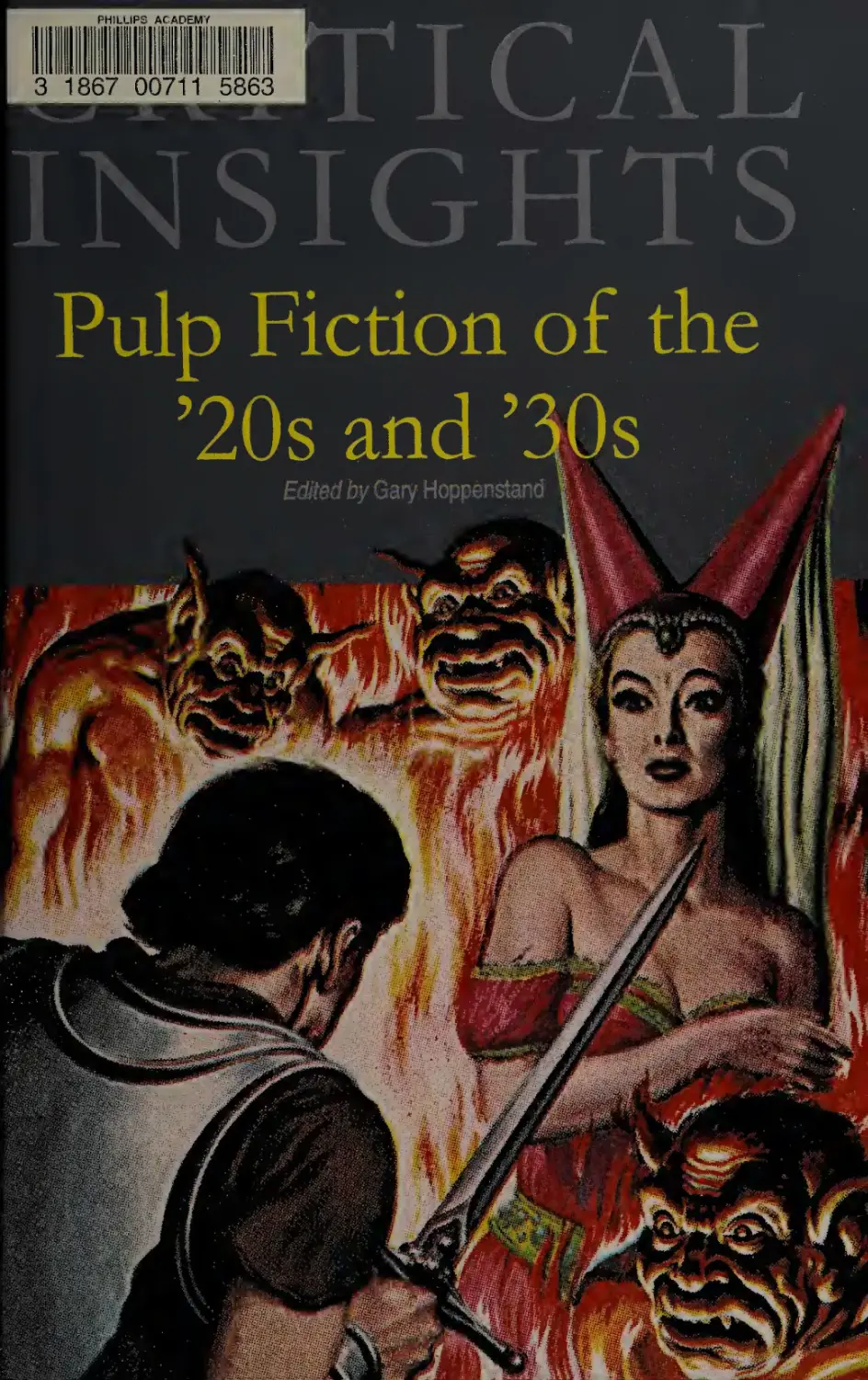
CRITICAL
INSIGHTS
Pulp Fiction of the
’20s and ’30s

CRITICAL
INSIGHTS
Pulp Fiction of the
’20s and ’30s

Editor
Gary Hoppenstand
Michigan State University

SALEM PRESS
A Division of EBSCO Publishing
Ipswich, Massachusetts

GREY HOUSE PUBLISHING

s

Cover Photo: CSA Images

Editor’s text © 2013 by Gary Hoppenstand
Copyright © 2013, by Salem Press, A Division of EBSCO Publishing, Inc.
All rights reserved. No part of this work may be used or reproduced in any man¬
ner whatsoever or transmitted in any form or by any means, electronic or me¬
chanical, including photocopy, recording, or any information storage and retrieval
system, without written permission from the copyright owner. For permissions
requests, contact proprietarypublishing@ebscohost.com.
Critical Insights: Pulp Fiction of the ’20s and ’30s, 2013, published by Grey
House Publishing, Inc., Amenia, NY, under exclusive license from EBSCO
Publishing, Inc.
The paper used in these volumes conforms to the American National Standard
for Permanence of Paper for Printed Library Materials, Z39.48-1992 (R1997).

00

Library of Congress Cataloging-in-Publication Data
Pulp fiction of the 1920s and 1930s / editor, Gary Hoppenstand, Michigan State
University.
pages cm. — (Critical Insights)
Includes bibliographical references and index.
ISBN 978-1-4298-3827-6 (hardcover)
1. Fantasy fiction, American—History and criticism. 2. Horror tales, American-History and criticism. 3. Pulp literature, American—History and criticism. 4. Weird
tales. I. Hoppenstand, Gary, editor of compilation.
PS228.F35P85 2013
813’.0876609-dc23
2013013716
ebook ISBN: 978-1-4298-3843-6

PRINTED IN THE UNITED STATES OF AMERICA

Contents_
About This Volume, Gary Hoppenstand
On Pulp Fiction and Weird Tales, Gary Hoppenstand

vii
xiii

Critical Readings
History, Horror, and Heroic Fantasy: Robert E. Howard and the
Creation of the Sword-and-Sorcery Subgenre, Jeffrey Shanks
Cthulhu’s Empire: H. P. Lovecraft’s Influence on His Contemporaries
and Successors, S. T. Joshi
The Last Musketeer: Clark Ashton Smith and the Weird Marriage of
Poetry and Pulp, Andrew J. Wilson
Nostalgia in H. P. Lovecraft, Daniel Muller
Visionary Star-Treader: The Speculative Writings of
Clark Ashton Smith, Richard Bleiler
Robert Bloch: O. Henry of Twentieth-Century
Pulp Magazines, Garyn G. Roberts
Love Is the Most Dangerous Thing: Gender and Genocide in
the Weird Fiction of C. L. Moore, Andrew J. Wilson
Henry Kuttner: Often-Overlooked Pillar of the Weird Tale and
the Pulpwood Magazine, Garyn G. Roberts
August Derleth: Odd Man In, Wythe Marschall
The Fantastic Pulp Fiction of Frank Belknap Long, Richard Bleiler
Seabury Quinn’s Jules de Grandin: The Supernatural Sleuth in
IFe/rJ
Gary Hoppenstand

3
19
36
52
66
84
94
109
128
148
166

Archived Material
Introduction
The Conan Series, David Hinckley
“The Dunwich Horror,” James V. Muhleman

Brian Stableford
Brian Stableford
Jirel ofJoiry, Anne K. Kaler
Hyperborea,

Zothique,

The Jules de Grandin Series, Robert Weinberg

181

182
187
192
196
200
204

V

Resources
Additional Works on Pulp Fiction
Bibliography
About the Editor
Contributors
Index

VI

215
219
223
225
227

Critical Insights

About This Volume_
Gary Hoppenstand
Much has been published over the past several decades about both the
pulp-magazine fiction of the 1920s and 1930s and Weird Tales, one of
the most famous and influential pulps to have been published during
this two-decade period. The difficulty of editing a volume that both
briefly outlines the height of the pulp-magazine era and specifically
examines an important title of this era was in deciding what to exclude,
rather than what to include.
My solution to the dilemma was to provide a timeline of popular fic¬
tion following the Industrial Revolution and leading up to the pulps. I
wanted to discuss the cultural and social dynamics of the invention and
evolution of popular fiction over a period of approximately 150 years
in both England and the United States, being sure to cover such topics
as social class, education, the rise of the city, and printing technology
as important elements of the discussion.
I also wanted to cover the historical sequence of working-class ven¬
ues for popular fiction that led to the creation of the pulp magazines in
general and Weird Tales specifically. It is important for the contempo¬
rary reader to understand that historical sequence and to realize that
publications such as Weird Tales did not spring fully grown onto the
newsstand without an extended lineage. Beginning with the story pa¬
pers and penny dreadfuls and leading up to the dime novels and early
decades of the pulps, each iteration of working-class popular fiction
was essential in leading to the conception of the next iteration. It is
important to understand that without the story papers and the attendant
development of mass printing technologies and distribution techniques
in the early years of the nineteenth century, there would have been no
dime novels in the second half of the century, because there would
have been no process in place for the mass production of mass-con¬
sumed fiction, which was what allowed the dime novels to thrive at a
cost of only a nickel or dime per issue. And without the dime novels
About This Volume

VII

and their establishment of central formulaic genres such as the western
and the detective story, the pulp magazines of the early twentieth cen¬
tury might have looked very different or might not have come into be¬
ing at all. It is also important to identify those mass-market venues that
followed the pulp magazines, such as the present-day paperback novel
and comic book, which were also greatly influenced by the pulps.
Within the context of the survey of popular fiction and the explicit
discussion of the pulp magazine, the editorial decision was made to
focus on one specific pulp title: Weird Tales. This volume could have
easily selected one of any number of major pulps for this discussion,
mclndmg Black Mask, Adventure, and even Argosy. Weird Tales and its
most important contributors were chosen because of that magazine’s
commanding, almost mythical stature in the history of twentieth-cen¬
tury fantasy and horror fiction; arguably, only Black Mask, with its
invention and development of hard-boiled detective fiction, equaled
Weird Tales in importance. It can be reasonably claimed that no other
pulp magazine was more important to the history of pulp fiction, or
to the temperament of contemporary science fiction and fantasy, than
Weird Tales.
Once the decision was made to feature a review of Weird Tales, the
next task was to decide how to discuss this pulp and its historical con¬
text in the book’s introduction. Because Weird Tales spanned such a
long period of time—some three decades during its initial publication
run—and because it published so many significant authors of fantasy,
horror, and science fiction, I decided to use the major editors of the
pulp as a centerpiece of the introduction. The subsequent collection
of essays presents a detailed analysis of the most significant contribu¬
tors to Weird Tales, along with an examination that helps to define the
unique identity of not only Weird Tales but also the pulp-magazine fic¬
tion market of the 1920s and 1930s.
We begin with Robert E. Howard and H. R Lovecraft, certainly the
two most famous authors to have emerged from the Weird Tales liter¬
ary circle. Robert E. Howard (January 22, 1906-June 11, 1936) was a

VIII

Critical Insights

prolific and multitalented writer of pulp fiction. Though perhaps best
known for his iconic character Conan the Barbarian, Howard published
a wide range of genre stories during his brief life, including westerns,
boxing stories, adventure stories, and horror stories. An important
member of the Lovecraft circle, which also included Clark Ashton
Smith and August Derleth, Howard’s greatest legacy as a Weird Tales
contributor was his creation of such classic sword-and-sorcery fanta¬
sy heroes as King Kull and Solomon Kane, two notable precursors to
Conan, who also was featured in Weird Tales. Jeffrey H. Shanks’s es¬
say explores Howard’s impact as a major writer of pulp-fiction horror
and heroic fantasy.
H. P. Lovecraft (August 20, 1890-March 15, 1937) is represented
by two essays in this volume, one by S. T. Joshi and the other by Daniel
Muller, which reflects his status as arguably the most important author
to have emerged from the Weird Tales circle. Lovecraft’s invention of
the Cthulhu Mythos cycle alone guarantees his place in the history of
the weird tale, and his exploration of dark fantasy themes in his work
ranks him as not only one of the greatest authors of horror fiction in
the early decades of the twentieth century but also one of the greatest
authors of modem American fiction.
Lovecraft’s colleague Clark Ashton Smith (January 13, 1893-August 14, 1961) has earned the distinction of having two essays in this
volume as well, contributions by Andrew J. Wilson and Richard Bleiler. Smith possessed a strong poetical bent in his writing, having pub¬
lished several volumes of poetry early in his literary career, and his
lyrical skill with language revealed itself in his prose, as demonstrated
by his ornate narratives of exotic fantasy settings such as Zothique,
Hyperborea, and Averoigne. He frequently utilized a highly elaborate
vocabulary in his fiction, and his sumptuous literary style was decid¬
edly unique among his Weird Tales peers. His storytelling was both
decadent and hypnotic, though perhaps for some readers his tales were
an acquired taste.

About This Volume

IX

Hugo and World Fantasy Award-winning writer Robert Bloch
(April 5, 1917-September 23, 1994) is best remembered today for his
novel Psycho (1959), which became the basis for the famous 1960 Al¬
fred Hitchcock film, but during the 1930s he was a young reader of
Weird Tales and a fan of Lovecraft. He became a contributor to Weird
Tales himself as a teenager, and much of his early weird fiction was
influenced by Lovecraft’s work. During his long and prolific career, the
best of Bloch’s suspense and horror fiction was distinguished by a wry,
macabre sense of humor and a masterful use of narrative jrony. Garyn
G. Roberts’s contribution on this important Weird Tales writer reveals
Bloch’s great storytelling ability.
The most famous woman writer to have been part of the Weird
Tales stable of contributors was Catherine Lucille Moore (January 24,
1911-April 4, 1987). She is today arguably best remembered for her
Northwest Smith science-fiction series and her Jirel of Joiry stories,
which featured one of the earliest female sword-and-sorcery protago¬
nists. Both of these popular series characters appeared in Weird Tales.
C. L. Moore’s weird fiction is notable for its deft plotting and highly
imagined concepts. She met fellow horror and science-fiction author
Henry Kuttner in 1936, married him in 1940, and in due course worked
collaboratively with him, publishing stories under various pseud¬
onyms, including Lewis Padgett. Andrew J. Wilson’s essay provides
an examination of this talented Weird Tales contributor.
Henry Kuttner (April 7, 1915-February 4, 1958), as noted in
Garyn G. Roberts’s essay, was one of the more underappreciated con¬
tributors to Weird Tales. He certainly was not any less talented for
this apparent lack of recognition. Like Smith, Howard, and Bloch,
Kuttner also was a contributor to the Lovecraftian Cthulhu Mythos
cycle. His story “The Graveyard Rats,” which initially appeared in
Weird Tales in 1936, went on to become one of the most frequent¬
ly reprinted stories from the pulp. It still retains its brilliant use of
suspense and claustrophobic terror. After meeting fellow writer and
soon-to-be wife C. L. Moore, much of his work in the 1940s and

X

Critical Insights

1950s was done in collaboration with her. Today, Kuttner’s fiction is
being rediscovered by a new generation of readers, thanks to a num¬
ber of recent collectible reprint editions that have been publishing
some of his best pulp work.
August Derleth (February 24, 1909-July 4, 1971) is best remem¬
bered today as editor and cofounder, along with Donald Wandrei,
of Arkham House. A small specialty press in Sauk City, Wisconsin,
Arkham House was initially devoted to preserving H. P. Lovecraft’s
weird fiction in hardcover but ultimately expanded its repertoire to
reprinting stories from a number of Weird Tales contributors, includ¬
ing Howard, Smith, and others. However, during his long career as a
writer, Derleth published a range of escapist fiction, from his Cthulhu
Mythos stories to his Solar Pons tales, which were a pastiche of Sir
Arthur Conan Doyle’s Sherlock Holmes stories. Some critics today see
Derleth’s body of work as being perhaps too derivative, but in addition
to writing for Weird Tales, he was also an accomplished regionalist
author and a fine poet as well. Wythe Marschall’s essay on Derleth
provides a discussion of this author, editor, and publisher.
Another important but lesser-known contributor to Weird Tales was
Frank Belknap Long (April 27, 1901-January 3, 1994). As Richard
Bleiler points out in his essay. Long was a skilled pulp-fiction writer.
He sold his first story to Weird Tales and was a solid contributor to that
magazine, though he eventually went on to publish science fiction in
such pulps as Astounding Science Fiction, Thrilling Wonder Stories,
and Startling Stories, as well as horror fiction and fantasy in the pulp
Unknown (later retitled Unknown Worlds). His serialized story The
Horror from the Hills, which first appeared in Weird Tales in 1931, is
possibly his most famous tale.
And last, but certainly not least, is Seabury Quinn (December 1889December 24, 1969). Though he is arguably the least known Weird
Tales contributor to today’s readers, during his long tenure writing for
the magazine, he was commonly regarded as its most popular author.
His Jules de Grandin series, which had a very long run in the pulp,

About This Volume

XI

was a successful combination of the detective story and the supernatu¬
ral tale. The de Grandin stories fell into the highly specialized literary
eategory of the supernatural sleuth, also called the occult detective or
the ghost hunter, which had been popularized in the late Victorian and
the Edwardian periods. Quinn perfected the telling of this type of sto¬
ry with his distinctive protagonist, Jules de Grandin, and Weird Tales
readers loved the result. The question remains, however, as to why the
most popular author of Weird Tales is so relatively unknown now. The
answer might reside in the faet that in his Jules de Grandip tales, Quinn
wrote to a fairly rigid formula that did not really change or evolve over
time, and thus his fiction does not hold up as well as the more inventive
efforts of Lovecraft or Howard.
The purpose of this volume is to expose the contemporary reader to
some of the best writers of one of the most famous pulp-fiction maga¬
zines of the 1920s and 1930s. Even though these authors published
weird fietion that paid modestly, the originality and power of their
storytelling ability transcended the crumbling pulpwood pages of the
physieal magazine itself. Beeause of their efforts, the spirit of Weird
Tales lives on today in much of our contemporary best-selling horror
and fantasy fiction, even as the memory of Weird Tales for many of
today’s readers has faded into the past. The era of the great pulps may
be long gone, but their literary heritage eontinues on.

XII

Critical Insights

On Pulp Fiction and Weird Tales.
Gary Hoppenstand
American pulp-magazine fiction was the fiction of the working class. It
developed at the dawn of the twentieth century and reached the height
of its popularity during the 1920s and 1930s. World War II and paper
shortages on the home front hastened the demise of the pulps, but the
final death blow came with the development of two new forms of nar¬
rative mass media: comic books and paperback books. The legacy of
the pulps, however, lived long past their fifty-odd years of existence, as
illustrated by the pulp magazine Weird Tales, which published the fic¬
tion of a number of writers who would go on to become literary icons
in popular genre fiction, including H. P. Lovecraft, the most important
author of dark fantasy, and Robert E. Howard, the creator of Conan the
Barbarian. The pulps and Weird Tales, however, did not spring into be¬
ing instantaneously. There existed an important chain of developments
in popular fiction that would eventually lead to the pulps.
The origins of pulp-magazine fiction and Weird Tales extend back
to the beginnings of the Industrial Revolution in western Europe and
America, which occurred sometime between the late eighteenth and
early nineteenth centuries. Prior to the beginning of the Industrial Rev¬
olution, the two main social classes were the elite class, a small per¬
centage of the population that included the nobility, major land owners,
and the clergy; and the peasant class, the vast majority of the popula¬
tion, who worked the landed estates of the elite. The middle class, such
as it was, consisted primarily of merchants and tradesnien. Forms of
entertainment tended to divide along the lines of these two principal
social classes. The small group of elites was the wealthy and educated
class and, as such, was able to purchase and read books for entertain¬
ment as well as for instruction, typically religious instruction from the
Bible. Because books were not mass produced but meticulously made
by hand, they were very rare and very expensive. Only the elites could
purchase them, and only the elites possessed the education to read
On Pulp Fiction and

Weird Tales

XIII

them. The peasant class had to rely on oral communication—^what is
now described as folklore, or the non-recorded traditions and expres¬
sions generated typically by an unlettered population—for instruction
and entertainment.
With the advent of the movable-type printing press, what had taken
many hours to produce—one handwritten, illuminated book—now
took a fraction of that time and cost in human labor, and thus books be¬
came less expensive to produce and own. Reading became accessible
to the growing middle class and even the newly educated peasant class.
It was with the invention of the steam-powered printing press during
the middle decades of the nineteenth century, however, that publish¬
ing became a mass medium, with books, magazines, and newspapers
cheap to produce and own and available to the broader working class.
And as the working class enjoyed better education during this period,
due in part to the need for minimal literacy in the workplace, a po¬
tential mass-market readership was created. Peasants moved in huge
numbers from farms to growing urban centers to find work in factories,
and dense population centers, critical to the distribution of print mate¬
rials, were established in western Europe and northeastern America.
The combination of new technology, a newly educated working class,
and growing urban populations thus led to the birth of mass-produced
and mass-consumed fiction in the early nineteenth century.
Media historian Tim DeForest notes that the earliest expressions of
popular fiction, which would eventually lead to dime novels and, later,
pulp-magazine fiction, were the story papers. DeForest states;
The early 1800s saw the emergence of story papers. These were fourto-eight-page tabloids with names like New York Ledger or Saturday
Night—newspapers that printed double-columns of fiction rather than
news. Published weekly, usually on Saturdays when people were finishing
their workweeks, the story papers soon gained enormous popularity, with
the most popular achieving a circulation of 400,000. (13)

XIV

Critical Insights

He goes on to claim that because the story papers qualified for less ex¬
pensive postal rates, this concession allowed them to become less ex¬
pensive to produce and purchase and thus more ubiquitous. However,
DeForest notes that as more and more story papers found publication,
they plagiarized other sources, including Charles Dickens, for their
material. The publishers of story papers would profit, if they could,
from not paying their authors, but eventually this practice would be
replaced by a modest payment per word for fiction that, according to
DeForest, would lead to the birth of the professional writer (13-14).
In England during the nineteenth century, as the industrialized
working classes earned more money and saw an increase in leisure
time, a new form of serialized popular fiction emerged called the
bloods or penny dreadfuls, the British equivalent of the story paper
(DeForest 14). Published in book or pamphlet form, rather than the
newspaper-tabloid size of the story papers, these penny dreadfuls em¬
braced lurid and sensational plots and stock characters and, as such,
were very popular with working-class juvenile readers. The most fa¬
mous example of the penny dreadful is arguably Varney the Vampire;
or, The Feast of Blood, by James Malcolm Rymer (although an equal
number of sources cite Thomas Peckett Prest as the author), published
serially for a penny a chapter between 1845 and 1847. Curt Herr’s
introduction to the massive 759-page reprint of the serialized novel
argues that Rymer’s (or Prest’s) Varney the Vampire “holds a unique
place in literary history and Victorian popular fiction,” in that while it
was thought to be the “worst book written in the nineteenth centuiy,”
it is also one of the most important works in the history of vampire fic¬
tion (9). The social and political elites of the period viewed this type of
fiction as trash, harmful to the morals of young audiences—hence the
term dreadful—but from another point of view, it can be argued that
the penny dreadful and similar cheap fiction helped to improve literacy
among a previously excluded readership. In a limited way, they also
engaged the imagination of the working-class young in a manner not
done previously with non-printed forms of narrative entertainment.

On Pulp Fiction and Weird Tales

XV

Succeeding the penny dreadful in America was the dime novel, pub¬
lished in either a pamphlet or a square-binding format. In his history
of major dime-novel and pulp-magazine publisher Street & Smith, en¬
titled The Fiction Factory; or, From Pulp Row to Quality Street (1955),
author Quentin Reynolds argues that despite the disdain of the cul¬
tural gatekeepers of soeiety, the dime novel would survive the critieism
and aetually thrive, making huge profits for both authors and publisher
(72). The term dime novel, aceording to Bill Brown, “originally re¬
ferred to poeket-sized, hundred-page books with woodeuf illustrations
on the paper covers but . . . came to designate any fiction selling be¬
tween five and twenty-five eents” (1). Daryl Jones presents his defini¬
tion of the dime novel in his 1978 study. The Dime Novel Western: “Al¬
though formats varied, the stories were nearly all alike. Generally, they
were 30,000 to 50,000 words of stirring action, inflated description,
and—since authors were paid to fill a predetermined format—padded
prose. They dealt with pirates, deteetives, highwaymen, bootblacks,
and soldiers. They concerned adventure, history, love, war, romance,
life in the city and life on the sea” (7). Like their predeeessors the sto¬
ry papers, dime noyels were printed on the cheapest pulpwood paper
stock available, and as a eonsequence, relatively few of the original
dime novels survive today. Dime novels, like the pulp magazines that
succeeded them, were also regarded by their readers as “disposable”
fietion, ephemeral publications that once read and enjoyed should be
thrown away.
Some media historians may claim that the origins of popular fic¬
tion as popular culture really began with Ann S. Stephens’s Malaeska,
the Indian Wife of the White Hunter (1860), a Beadle’s Dime Novels
reprint of a serialized novel originally published in 1839 in the Ladies
Companion magazine. If nothing else, the popularity of Stephens’s
dime novel helped to solidify the frontier story, earlier popularized by
James Fenimore Cooper’s Leatherstocking novels, in the vernacular of
the Ameriean literary imagination. Even though a number of different
popular-fiction genres appeared in dime novels, from 1860 to about

XVI

Critical Insights

1880, the frontier dime novel was the most widely published and read.
From 1880 to the turn of the twentieth century and the arrival of the
pulp-fiction magazine, the detective dime novel was the most popular,
perhaps reflecting a significant shift in American demographics from
the farmlands to the cities and a corresponding shift in readers’ inter¬
ests from stories about frontier adventure to ones about city crime and
detection.
War in America has always had a vital impact on the development
of US entertainment culture. Just as World War II would later expedite
the termination of the pulp magazine, the Civil War played a large role
in establishing the popularity of the dime novel. As soldiers on both
side of the conflict waited for combat, they had a great deal of free
time on their hands, and they often spent this time reading dime novels,
which were shipped in massive quantities to the front lines by railroad
boxcars. When the war was over, soldiers brought their love of cheap
popular fiction back home with them.
As the American economy transitioned into a manufacturing econo¬
my by the start of the twentieth century, working-class popular fiction
also transformed into a manufactured commodity. The mass-market
fiction publishers, including publishers of dime novels and pulp maga¬
zines, utilized a “fiction factory,” to borrow a phrase from Quentin
Reynolds, in the production of their publications. The fiction factory
began the publication process with the author and editor. The authors
wrote fiction similarly to how newspaper journalists wrote their stories;
frequently and on tight deadlines. The editors designed the concept of
the fiction to be written by their authors, including the tievelopment
of series characters that would attract readers and sustain serial pub¬
lications over time. After the authors and editors had produced fiction
that was ready for print, the next stage of the fiction factory included
the artists who created the illustrations that would accompany the sto¬
ries or appear on the cover of the publication. Next, typesetters set the
fiction for print, printers published the fiction, and, finally, distribu¬
tors marketed the fiction to readers through the local newsstand or by

On Pulp Fiction and

Weird Tales

XVII

popular subscription. The Action-factory process assisted in the rapid
production of publications and the reduction of publication costs, so
that working-class readers could afford the nickel or dime to purchase
the dime novel or pulp. The fiction factory also created an early market
for professional writers, authors who could make a living solely by
their prolific writing.
Tim DeForest argues that “by the time the 19th century rolled over
into the 20th, the dime novel was in decline. A change in postal regu¬
lations delivered the most devastating blow to the format” (26). But
as the dime-novel format ended, another began: the pulp magazine,
which continued the tradition of working-class popular fiction into the
twentieth century. Pulp magazine historian Tony Goodstone notes, “In
1896, publisher Frank Munsey, believing that a story was more impor¬
tant than the paper it was printed on, ehanged The Argosy from a boy’s
magazine to an all-fiction magazine with untrimmed, rough wood-pulp
pages and measuring approximately 7 by 10 inches and half-an-inch
thick. He had created the first ‘Pulp’” (ix). Ron Goulart adds in his
book Cheap Thrills: The Amazing! Thrilling! Astonishing! History
of Pulp Fiction (1972; updated 2007) that during the 1920s, the pulp
magazine had achieved a fairly standardized format in size and length
of each issue. “The average pulp eonsisted of 128 rough-edged pulpwood paper pages and had a cover of more expensive, coated stock,”
states Goulart. “The cover served as a package and an advertisement
and so it was both bright and provocative” (14).
Generally speaking, the early years of the pulps featured titles, such
as publisher Frank Munsey’s Argosy, that highlighted a wide array
of popular fiction genres, including romance, westerns, crime fiction,
adventure, science fiction, and fantasy. The idea behind pulps like Ar¬
gosy was to offer fiction that would appeal to all categories of readership: romance stories for women, crime and adventure fiction for men,
and science fiction and fantasy for adolescents. However, as more
pulp-magazine titles entered the market during the 1920s and com¬
petition for readers became fiercer, the pulps fractionalized, dividing

XVIII

Critical Insights

themselves into specific genres in order to comer a specific portion of
an audience. Thus, pulps featuring crime fiction (such as Black Mask,
first established by journalist H. L. Mencken in 1920) or science fic¬
tion (such as Amazing Stories, launched by Hugo Gemsback in 1926)
began to appear. Pulp-magazine publishers quickly realized that by
focusing their magazines on specific genres, they attracted a more
dedicated, albeit smaller, group of readers. By the 1930s, a vast array
of colorful titles was appearing on the newsstands, featuring all man¬
ner of genre-specific popular fiction. Multiple titles of crime-fiction
pulps, western pulps, and science-fiction pulps thus competed fiercely
with each other.
American pulp-magazine fiction achieved its greatest popularity
during the years between World War I and World War II. Especially
during the Great Depression in the 1930s, the pulps, along with ra¬
dio and motion pictures, ranked as one of America’s favorite forms of
entertainment. Pulp fiction, though often formulaic, provided muchneeded escapist reading for a nation enduring the hardship of the de¬
pression. By today’s standards, the vast majority of this fiction is dated
by uncomfortable stereotypes (such as the “yellow peril” Asian stereo¬
type), stock characters, and uneven writing. However, some of today’s
most respected authors got their start in the pulps, including Raymond
Chandler, Dashiell Hammett, Tennessee Williams, H. P. Lovecraft, and
Ray Bradbury, among others. It is safe to claim that pulp magazines—
through their influence on comics, paperbacks, and film adaptations—
were one of the most significant venues for popular fiction and the de¬
velopment of genre formulas in the history of American-tnass-market
entertainment.
World War II helped to facilitate the demise of the pulps. Paper short¬
ages caused by the war effort increased the cost of printing to the point
where pulp-magazine publishers’ marginal profit of pennies per issue
suffered. By the mid-1950s, the pulps were virtually dead, replaced by
the paperback novel, a new venue for publishing popular fiction that
emerged during the 1930s. The paperback book was popularized by

On Pulp Fiction and

Weird Tales

XIX

the publication of Armed Services Editions, paperbacks sponsored by
the US government during World War II. US soldiers fighting in the
European and Pacific theaters discovered that the paperbacks provided
to them by the government for the hours of idle time between battles
could fit conveniently in their backpacks. When the war ended and the
soldiers returned home, just as the Civil War soldiers had with their
dime novels nearly a century earlier, they brought their affection for
paperback books (and their copies) back with them. Ironically, much
of the early content of paperback novels came from reprinting popular
stories from the pulps. The comic book discovered its own popularity
before the war in the late 1930s as well, and in addition to the harm
caused to the pulp-magazine publishers by the burgeoning paperback
market, the great pulp-fiction heroes of the Great Depression, includ¬
ing Doc Savage and the Shadow, could not compete for the attention
of an adolescent readership with their colorful comic-book imitations,
such as Superman and Batman.
Even though hundreds of different pulp-fiction magazines appeared
in the 1920s and 1930s, only a handful of titles may be regarded as
exemplary, surviving the test of time and evolving literary tastes.
Among these classic pulps are Black Mask, which helped to create the
hard-boiled detective genre; Amazing Stories, which helped to estab¬
lish modem science fiction; Adventure and Argosy, which helped to
popularize the globe-trotting adventure story; and Weird Tales, which
featured fantasy and horror fiction. This volume will specifically ex¬
amine Weird Tales and its most famous contributors as examples of the
pulp-magazine fiction era.
It is typically acknowledged by critics and historians of American
pulp-fiction magazines that Weird Tales, published from March 1923
through September 1954, for a total run of 279 issues, was one of the
greatest pulp magazines of all time. Over the recent decades, several
attempts have been made to revive Weird Tales, but generally these
attempts have met with limited success or downright failure. Even
during its initial three-decade run. Weird Tales often found itself in a

XX

Critical Insights

precarious financial position. First, it was housed in Chicago rather
than New York, the mecca of pulp-fiction magazine publishing at the
time. In addition, it was more costly to purchase than many of its com¬
peting pulps, sometimes selling for as much as twenty-five cents an is¬
sue when many other pulp magazines were selling for a thin dime. By
today’s standards, a fifteen-cent difference may not appear to be that
much, but to a Great Depression readership, it meant that two pulpfiction magazines could be purchased for the price of one Weird Tales,
with a nickel left over for some store-bought candy.
Nevertheless, pulp-magazine historians recognize that Weird Tales
was one of the most important and influential of any of the myriad of
pulp-fiction magazines. It certainly was the longest-running fantasy/
horror pulp magazine of its time. Of the numerous contributors whose
stories it published during its initial three-decade run, many of whom
are forgotten today, a handful have achieved literary immortality, in¬
cluding H. P. Lovecraft, Clark Ashton Smith, and Robert E. Howard.
One way of examining the history of Weird Tales is by looking at
the magazine’s editors. According to pulp-fiction historian Robert
Weinberg, in 1922, publisher Jacob Clark Henneberger joined with
J. M. Lansinger to found Rural Publications, through which they sub¬
sequently launched Weird Tales in March 1923. Weinberg states that
Henneberger recruited Chicago writer Edwin Baird to edit the new
publication; he was assisted by Farnsworth Wright, a future editor of
Weird Tales, and Otis Adelbert Kline. Baird, who was bom in Chat¬
tanooga, Tennessee, was a writer for the Chicago Daily Journal and
the Chicago Evening American before his stint at Weird Idles. He paid
his best writers a rate of a penny per word, though most were paid
one-quarter to one-half of a cent per word for their fiction (3). Wein¬
berg notes, “The first issue of Weird Tales was ... 25 cents a copy, a
high price for a pulp fiction magazine. It was 192 pages long, 6” by
9” in size and subtitled ‘The Unique Magazine.’ It featured 24 stories.
The first issue featured one serial, by Otis Adelbert Kline, and it car¬
ried serials in nearly every issue up to 1940. There were no interior

On Pulp Fiction and

Weird Tales

XXI

illustrations” (3). The major pulps, including Weird Tales, often carried
serialized stories. Edwin Baird and his fellow editors knew the value of
these serials: they captured and kept a reader’s attention over a series
of issues, thus guaranteeing the sales of subsequent numbers as the
serial ran to completion. Pulp editors would often begin a new serial
in the same issue that another serial ended with the hope of bringing a
continuing readership to a particular title.
Due in part to its relatively expensive price, under Baird’s editorship
Weird Tales lost a considerable amount of money, falliqg into heavy
debt, and as a consequence Baird was terminated as editor after only
thirteen issues, according to author Lin Carter (35-37). H. P. Lovecraft
was offered the job initially following Baird’s firing but declined the
invitation. Notable Weird Tales contributor Robert Bloch claims in his
introduction to the volume Weird Tales: 32 Unearthed Terrors (1988)
that it was the “tender loving care” of Baird’s successor, Farnsworth
Wright, that kept the troubled pulp afloat. Bloch says of the magazine’s
ongoing financial difficulties:
Lacking critical approval, Weird Tales was constantly in critical condition.
Attempts to keep it alive involved an unending series of operations. There
were cuts in size and in payments to contributors, and, during the darkest
days, the cover price was slieed along with the number of issues per year.
New publishers offered temporary transfusions in times of acute financial
crisis, new editorial teams were called in for emergencies. But aside from
a few years in the mid-twenties, the patient needed around-the-clock nurs¬
ing. (xiv)
When Weird Tales publisher Henneberger replaced Baird with Farn¬
sworth Wright, the pulp entered a type of golden age, in spite of its
continuing financial difficulties. Wright, who wrote music reviews for
publication, also apparently knew how to identify good fiction, and he,
perhaps more than any other individual at the editorial helm of Weird
Tales, helped to craft the pulp magazine’s identity. Among his many

XXII

Critical Insights

accomplishments was the discovery of Tennessee Williams; Wright
published Williams’s first professional story (Haining 10).
Robert Weinberg adds that Wright was a “canny editor” who was
able to land good stories for Weird Tales, even from “unknown” au¬
thors who only published one story in their fantasy- and sciencefiction-writing careers. “Wright got stories from everywhere and ev¬
eryone,” Weinberg writes (5). Fantasy- and horror-fiction critic Peter
Haining goes on to say that “editor Farnsworth Wright occasionally
used out-and-out SF tales in {Weird Tales'] pages. Apart from items by
his established writers that fitted this category, he also published tales
by such now-familiar names as Isaac Asimov, Ray Cummings, Rob¬
ert Heinlein, David H. Keller, Murray Leinster, Frank Belknap Long,
A. Merritt, Fletcher Pratt, L. Sprague de Camp, Jack Williamson and
Donald Wandrei” (17).
Following the sale of Weird Tales to William J. Delaney in 1938,
Dorothy Mcllwraith was brought in to aid Wright with the magazine.
Mcllwraith was the editor of the successful pulp Short Stories, which
Delaney also owned. When Wright left Weird Tales in 1940 because
of economic and editorial difficulties with the magazine, Mcllwraith
began her tenure as editor. Robert Weinberg claims that “Dorothy Mc¬
llwraith was a capable pulp editor who was not adverse to spending
money to get quality material,” but even though she did the best job
she could with the pulp, its finest years had passed. Weinberg states
that through the 1940s, the page count of the magazine declined, along
with the overall quality of its fiction; when the magazine went to a
digest-sized forniat in September 1953, it was a final attempt to save
the title, which only lasted one more year before its demise (6).
World War II saw the beginning of the end for the pulp magazines
in general and for Weird Tales specifically. According to John Betan¬
court and Robert Weinberg, the 1940s “took its toll on weird fiction.
Fantasy declined in sales as the real world intruded with horrors far
worse than any imaginings” (xvii). However, following the war, the
decade remaining to Weird Tales witnessed the burgeoning careers of

On Pulp Fiction and Weird Tales

XXIII

such fantasy greats as Fritz Leiber and Ray Bradbury, who contributed
to the pulp when it was under Dorothy Mcllwraith’s editorship.
If imitation is a form of flattery, then Weird Tales was a highly flat¬
tered publication, as it had a number of pulp-magazine competitors
in the field of fantasy and horror fiction. Strange Stories (February
1939~February 1941), Strange Tales of Mystery and Terror (Septem¬
ber 1931-January 1933), zndi Fantastic Adventures (May 1939-March
1953) were listed among the better known of these pulps. Pulp-fiction
historian Stefan R. Dziemianowicz argues that
the demand for the emotional outlet and entertainment of Weird Tales of¬
fered its readers must have been great, for, in time, Weird Tales alone wasn’t
enough to satisfy everyone. Sensing that there was room for more than one
weird fiction magazine on the newsstands, a number of enterprising pub¬
lishers brought out their own titles in an attempt to capture a piece of the
market for fantasy and horror fiction established by Weird Tales, (xiv)
Weird Tales may have had its imitators, but none of its competitors
could equal its longevity, or perhaps its luck in avoiding discontinua¬
tion for so long.
The greater legacy of Weird Tales can be found in the different cate¬
gories of weird fiction that it helped to develop and popularize. A num¬
ber of popular genres created or refined by its more famous or popular
contributors, such as H. P. Lovecraft, Clark Ashton Smith, Robert E.
Howard, and Seabury Quinn, endure to this day as best-selling fiction.
H. P. Lovecraft and Clark Ashton Smith, for example, were masters of
dark fantasy, a type of horror fiction that evolved out of the destruction
and mayhem of World War I. Dark fantasy envisions a nihilistic world¬
view in which unknown alien powers lurk behind the fa9ade of human
reality, and the only way to survive is to ignore forbidden knowledge
altogether. In dark fantasy as practiced by Lovecraft, Smith, and their
imitators, knowledge of the unknown or forbidden is usually equated
with death and destruction for the protagonists.

XXIV

Critical Insights

The prolific and versatile Robert E. Howard established a number
of the literary conventions found in the type of heroic fantasy known
as sword-and-sorcery fiction. This subgenre of heroic fantasy com¬
bines rapid action and adventure with elements of fantasy and hor¬
ror. Brawny heroes or heroines skilled in swordplay combat magic
and monsters in fantastical settings or imaginary realms, with a nar¬
rative emphasis on the character’s confrontation with personal danger,
blended with cloak-and-dagger intrigue. Howard was a master of this
literary technique; his most successful and famous sword-and-sorcery
creation was Conan the Barbarian, who was one of Weird Tales' more
prominent series characters.
Seabuiy Quinn, often regarded as not being as talented or as inven¬
tive as Lovecraft, Smith, or Howard, was nonetheless the most popular
author to appear in the pages of Weird Tales, according to the readers’
polls of that period. Quinn was also one of the most prolific Weird
Tales authors. His Jules de Grandin tales feature a Hercule Poirot-like
French supernatural sleuth who combats all manner of unnatural crea¬
tures and uncanny monsters in the town of Harrisonville, New Jersey,
along with his Watson-like associate. Dr. Trowbridge. The popular de
Grandin stories, totaling over ninety stories published in Weird Tales
between 1925 and 1951, were written to a strict formula that was de¬
cidedly popular with readers. Quinn’s Jules de Grandin was a success¬
ful update and refashioning of earlier, pre-American pulp occult de¬
tective protagonists, such as William Hope Hodgson’s Camacki and
Algernon Blackwood’s Dr. John Silence.
Without Weird Tales, the popularization of dark fantasy^ sword-andsorcery fantasy, and the supernatural sleuth story, along with many
other categories of horror and fantasy, might not have ever happened.
Contemporary best-selling authors ranging from Stephen King to Jim
Butcher to George R. R. Martin owe a great deal to the legacy of Weird
Tales and its pioneering contributors.
In outlining the distinction between the pulps and the “slicks”—
magazines such as the Saturday Evening Post, Collier’s, and Redbook,

On Pulp Fiction and

Weird Tales

XXV

which appeared on American newsstands at approximately the same
time as the pulps and which were regarded as the more respectable and
middle-class of the two—Frank M. Robinson and Lawrence Davidson
state that “while the slicks didn’t ignore western, mystery, or adventure
stories, they could hardly afford to put all their fictional eggs in one
basket. It remained for the pulps to introduce titles devoted to a single
genre for those who loved stories of western sheriffs and outlaws or
tales about the cops and robbers who lived and died on the streets of
the big cities” (9). As the selection of articles in this cpllection will
demonstrate, one of the most notable of these single-genre pulp-fiction
magazines was Weird Tales. Today, the original pulps are crumbling
to dust because of the low quality of the pulpwood paper they were
printed on, but a number of their stories will remain in print and popu¬
lar as long as there are readers who enjoy a good scare or an escap¬
ist adventure with larger-than-life characters in fantastic and magical
realms located well beyond the mundane.

Works Cited
Betancourt, John, and Robert Weinberg. Introduction. Weird Tales: Seven Decades
of Terror. Ed. Betancourt and Weinberg. New York: Barnes, 1997. xv-xxi. Print.
Bloch, Robert. Introduction. Weird Tales: 32 Unearthed Terrors. Ed. Stefan R. Dziemianowicz, Robert Weinberg, and Martin H. Greenberg. New York: Bonanza,
1988. xiii-xv. Print.
Brown, Bill. “Reading the West: Cultural and Historical Background.” Reading the
West: An Anthology of Dime Westerns. Ed. Brown. Boston: Bedford, 1997. 1—40.
Print.
Carter, Lin. Lovecraft: A Look behind the “Cthulhu Mythos. ” New York: Ballantine,
1972. Print.
DePorest, Tim. Storytelling in the Pulps, Comics, and Radio: How Technology
Changed Popular Fiction in America. Jefferson: McParland, 2004. Print.
Dziemianowicz, Stefan R. Introduction. Rivals o/Weird Tales.- 30 Great Fantasy &
Horror Stories from the Weird Fiction Pulps. Ed. Robert Weinberg, Dziemianow¬
icz, and Martin H. Greenberg. New York: Bonanza, 1990. xiii-xx. Print.
Goodstone, Tony. “Nickel Heroes / Dime Novels.” The Pulps: Fifty Years of American
Pop Culture. Ed. Goodstone. New York: Chelsea, 1976. ix-xvi. Print.
Goulart, Ron. Cheap Thrills: The Amazing! Thrilling! Astonishing! History of Pulp
Fiction. Neshannock: Hermes, 2007. Print.

XXVI

Critical Insights

Haining, Peter. Introduction. Weird Tales: A Selection, in Facsimile, of the Best from
the World’s Most Famous Fantasy Magazine. Ed. Haining. New York: Carroll,
1990. 7-19. Print.
Herr, Curt. Introduction. Varney the Vampire; or, The Feast of Blood. By James Mal¬
colm R> mer. Ed. Herr. Crestline: Zittaw, 2008. 9-25. Print.
Jones, Dan. 1. The Dime Novel Western. Bowling Green: Bowling Green State U Popu¬
lar P, 1978. Print.
Reynolds, Quentin. The Fiction Factory; or. From Pulp Row to Quality Street. New
York: Random, 1955. Print.
Robinson, Prank M., and Lawrence Davidson. Pulp Culture: The Art of Fiction Mag¬
azines. Portland: Collectors, 2001. Print.
Weinberg, Robert. The Weird Tales Story. Berkeley Heights: Wildside, 1999. Print.

On Pulp Fiction and

Weird Tales

XXVII

*
Cit_

•frfi'-'’ ’.u

'ir\ . i.

•.il^^^.‘ ksy^aPH!

4tk v.Ai. i*> ;»t>

- ,.'•”* Iw^'iSw’;.''-, ^ ». 3ty «ci>4
(V .'j^VV' .^•flpi'^^%»«.^VfiWfi4^(|i,fll(*

■'it*? «WW'' V'

*

,,'Y^' -•

• ■ -6

'1
•

!•• .'-ill
1 wr- ^4i

i\ <

.,■»* «!''-

W^-. .• U4

.: r , '■'
<

I'-i ' -i:?

■» ■>.
If

1 ,‘ f »

I

n

*. ¥.

A

.J

•■1

**.
*:’•
tff
*

uv <v r

'ta^i&i

1

c:*.‘.y-

r V-1‘

•V it »'■* ■ rt
■

-. 7 ij,

•-

«Q»C;
t»^!ip

.7

»f n«rT :

Pi»pl

P^M;, ,. W»sr.i^

r .■
■'L

*M

' <■ »f'«

I

*,

j»:
i:^’t -f<y*,rmiivjl^

*»> ‘I* ,; • i
W .»■' -- .

■^■'•r\Hc-~
1*.-.',^ .»

'

•

. 'J

’>t% ■-

I

' ..' .r ;. . ..._
■■If f

..{ J*

I'V •
-V "

j<

I

►i' ■ •,.

• ., .1.

■ T,

.

'■‘'■4-tvJ.--

,

V-.-I4I •

«S', 4* t nr-cij; 1

J**- '

,

•, !
*'■■'#

'

■-'ii''' '-

*■■

,'L .,; .-vv »■ ’«*.

.; ' t
;> ". I ''QjHW

^ .iA| '■
r.
At:

V‘:i K..11

■

7.
;.-

>.

I

li^i

•V

f>4

*

J, it . V- -

CRITICAL
READINGS

History, Horror, and Heroic Fantasy:
Robert E. Howard and the Creation of the
Sword-and-Sorcery Subgenre_
Jeffrey Shanks

Introduction
Texas pulp writer Robert E. Howard is often referred to anecdotally as
the father of the sword-and-sorcery subgenre of fantasy.' His stories of
Conan the Cimmerian, Kull of Atlantis, Solomon Kane, and Bran Mak
Mom established the stmctural and stylistic template for this type of fic¬
tion, which combines elements from genres such as historical romance,
gothic horror, and swashbuckling adventure. While there are a few iso¬
lated works that could be considered earlier examples of sword-andsorceiy fiction, Howard’s stories from the 1920s and 1930s—^particu¬
larly the Conan series—^popularized the subgenre, helped to define its
characteristic traits, and influenced several generations of later fantasy
authors. This essay seeks to contextualize Howard’s sword-and-sorcery
fiction within its historical and cultural milieu, analyzing his literary
and intellectual influences and the biographical and economic factors
that led him to experiment with genre hybridity. It also seeks to define
the determining characteristics of Howard’s sword and sorcery and ex¬
plore his contributions to and influence upon the modem fantasy canon.
The establishment of a universally accepted definition of sword and
sorcery has always been an elusive goal, but certain characteristics are
generally recognized as essential to the subgenre. A sword-and-sorcery
story is usually a linear adventure story set in a preindustrial, pretechnological world^—often a completely fictional secondary world, but
not always—in which the protagonist or hero is set in opposition to
supernatural forces that must be overcome in order to achieve resolu¬
tion (Clute and Grant 915). Unlike in many traditional works of fantasy,
magic and the supernatural are often malevolent and dangerous and are
certainly untmstworthy, even when used by the protagonist (Suvin 228).
History, Horror, and Heroic Fantasy

3

N

Some critics include Howard’s style of sword and sorcery within the
broader category of heroic fantasy (de Camp; Carter; Suvin). Others
have noted stylistic and thematic differences that set it apart, arguing
that sword and sorcery is often darker and may feature morally am¬
biguous protagonists. Despite the historical or prehistorical setting of
most sword-and-sorcery fiction, there is often a modernist, cynical ap¬
proach to traditional societal values and institutions, and this is particu¬
larly apparent in Howard’s stories. A convincing argument has been
made that Howard’s gritty, realistic style has far more in,common with
hard-boiled Black Mask writers such as Dashiell Hammett than fanta¬
sists such as Lord Dunsany and William Morris (Knight 125). Howard
scholar Don Herron, writing under the pen name George Knight, ob¬
serves, “A literaiy form that previously had tended toward the whimsi¬
cal and sardonic in Howard found its first truly modem writer, a man
who gave the make-believe world of dragons and elves a sense of ex¬
istential despair, and made it as tough and viable as any other fiction of
the day” (132).

Howard's Early Career
Bom in 1906, Howard grew up in a mral Texas that was only just
beginning to lose its frontier nature. The son of a country doctor, How¬
ard moved often, traveling with his family from one oil-boom town
to another. As a boy, he was a voracious reader and was particularly
attracted to tales of adventure and imagination. He also seems to have
had an interest in writing from a very early age. A ten-year-old How¬
ard once told a neighbor that he would one day “write stories about
pirates and maybe cannibals” (Finn 51). An autodidact, he had little
fonnal education after high school, but he absorbed knowledge from
wherever he could acquire it and retained it with remarkable ability.
His interest in history, anthropology, mythology, and sociology would
have a great impact on his fiction throughout his career, as would
his fascination with the weird stories of Edgar Allan Poe, Ambrose
Bierce, Arthur Machen, Robert W. Chambers, and other Victorian and

4

Critical Insights

post-Victorian gothic writers. The speculative fiction of popular writ¬
ers such as H. Rider Haggard, Edgar Rice Burroughs, Abraham Mer¬
ritt, Arthur Conan Doyle, and Jack London was also a major influence
on Howard’s work.
In his teens, Howard discovered the pulp magazines and became an
avid reader of popular titles such as Adventure, Argosy, and All-Story
Weekly (Finn 69-1Q). It was in the pulps that Howard would receive
his first break as a young, aspiring writer and would eventually find a
comfortable niche as a successful author (Burke, “Short”). Although
he is best known for his sword-and-sorcery fiction, he wrote stories
in a number of genres, including historical adventure, western, horror,
boxing, hard-boiled detective, and even humor. He also became ad¬
ept at juxtaposing themes and tropes from different genres, and it was
this propensity for generic hybridization that led to the development of
sword and sorcery.
After several years of trying unsuccessfully to break into higher-end
pulps such as Adventure, Howard finally made his first sale, publish¬
ing a caveman story titled “Spear and Fang” in the July 1925 issue of
Weird Tales (Burke, “Short”). Launched in 1923, Weird Tales was the
first genre pulp to specialize in supernatural and fantastic fiction. Dur¬
ing its heyday in the 1920s and 1930s, under the editorship of Farn¬
sworth Wright and led by authors such as Howard, H. R Lovecraft,
Clark Ashton Smith, Seabury Quinn, C. L. Moore, Robert Bloch, and
others, the magazine gave birth to the modem American fantasy and
horror genres. While Howard would see his work published in a score
of different magazines. Weird Tales became his most reliable venue,
and it was in Weird Tales that his best-known works saw print from
1925 until his death in 1936.

The Birth of Sword and Sorcery
After selling several stories and poems of lycanthropes, lost races, and
ghost ships—standard fare for Weird Tales—Howard developed his
first breakthrough character: Solomon Kane, a grim Puritan adventurer

History, Horror, and Heroic Fantasy

5

who first appeared in “Red Shadows” in the August 1928 issue. Set
against the backdrop of Europe and Africa during the Elizabethan pe¬
riod, the seven Kane stories published in Howard’s lifetime feature
swashbuckling action reminiscent of that in the works of Alexandre
Dumas and Rafael Sabatini, as well as elements of the weird horror
of Chambers and Lovecraft and the adventure fantasy of Haggard and
Burroughs. The Solomon Kane stories introduced many of the ele¬
ments that would come to be associated with sword and sorcery, in¬
cluding a sword-wielding avenger who battles supernatural menaces
in exotic locales.
With his next successful character, Kull of Atlantis, Howard com¬
bined these elements into something greater than the sum of its parts.
“The Shadow Kingdom,” published in the August 1929 issue of Weird
Tales (though it was actually written before “Red Shadows”), is often
cited as the first true sword-and-sorcery tale in the most commonly ac¬
cepted sense of the term.^ Kull is a barbarian exile from a Stone Age
Atlantis who becomes the ruler of the civilized mainland kingdom
of Valusia and must defend his throne and his person from a race of
shape-shifting serpent-men that has secretly infiltrated his court. The
world of Kull, set one hundred thousand years in the past, is effectively
a secondary world despite its earthly setting. It features strange crea¬
tures, prehuman “races,” fictional kingdoms, and legendary lands such
as Atlantis, Lemuria, and Mu, all described with an internally consis¬
tent, if somewhat dreamlike, quality.
Howard first began writing “The Shadow Kingdom” in 1926, though
he abandoned it for a time. It has its roots in some of Howard’s earliest
stories and poems, which feature Cro-Magnon warriors in conflict with
Neanderthal “beast-men” and other early humans (“Spear and Fang” is
the one published example of these). Prehistoric adventure fiction was
a popular subgenre in the early twentieth century, and Howard scholar
Rusty Burke has noted that the caveman stories of Paul L. Anderson
that appeared in Argosy in the early 1920s were a major source of inspi¬
ration for Howard (Louinet, “Atlantean” 290-91). Other contemporary

6

Critical Insights

works with prehistoric and evolutionary themes that Howard almost
certainly would have read include The Lost World (1912) by Doyle,
The Land that Time Forgot (1918) by Burroughs, and Before Adam
(1906-7) by London.'^
Howard soon began incorporating into his prehistoric fiction the
ideas of Lewis Spence, a Scottish mythologist who argued that the CroMagnon people were immigrants from a Stone Age Atlantis (Louinet,
“Atlantean”). In early 1926, Howard submitted to Weird Tales a story
titled “Men of the Shadows,” which presented these alternative ideas
of prehistory as told by a Pictish shaman in Roman-occupied Britain.
Wright rejected it for not having enough of a “weird” element, but
Howard was beginning a process of prehistoric world building that
would become the subcreative infrastructure of his future sword-andsorcery tales. With his next stories, the unpublished “Exile of Atlan¬
tis” and then “The Shadow Kingdom,” he added the even more fanci¬
ful (but popular) theories of advanced antediluvian civilizations, lost
races, and sunken continents that were being proposed by individuals
such as James Churchward and the theosophist William Scott-Elliot
(Shanks 20-22); thus the world of Kull was bom.
After the acceptance of “The Shadow Kingdom,” Howard wrote
and submitted a number of Kull stories, though Wright only accepted
one of these, “The Mirrors of Tuzun Thune” (September 1929), for
publication. The stories have the trappings of medieval romance with
touches of “Oriental” fantasy; armored warriors, ancient wizards, fore¬
boding citadels, talking cats, and the like. But there is also a gothic am¬
bience to the pervasive, almost overwhelming, sense of Vast antiquity
of KulTs world that reminds the reader constantly of the insignificant,
fragile, and transient nature of mankind in the face of deep time.
In 1930, Howard resurrected a character he had created in his youth:
Bran Mak Mom, a king of the Piets in Roman Britain. Bran appears in
the unpublished “Men of the Shadows,” but he makes his print debut
in “Kings of the Night” {Weird Tales, November 1930), in which a Pic¬
tish shaman uses magic to transport Kull through time to Bran’s day.

History, Horror, and Heroic Fantasy

7

where the two kings join forces to defeat the Romans. Bran returns in
“Worms of the Earth” {Weird Tales, November 1932), a story consid¬
ered by many to be one of Howard’s best. In “Worms,” Bran makes an
unholy pact with a deformed race of underground creatures in order to
exact revenge on a Roman governor and his garrison.
Other sword-and-sorcery stories published around this time in¬
clude two involving eleventh-century Irish warrior Turlogh O’Brien,
“The Dark Man” {Weird Tales, December 1931) and “The Gods of
Bal-Sagoth” {Weird Tales, October 1931). In the first .of these, Tur¬
logh encounters remnants of the Piets, still worshiping an idol of their
long-dead hero-king Bran; in the second, he visits a small island rem¬
nant of Atlantis in the Atlantic. Other stories, including “Children of
the Night” {Weird Tales, April-May 1931) and “People of the Dark”
{Strange Tales, June 1932), tell of modern-day individuals who re¬
member their past lives as ancient warriors who fought against the
same subterranean race that Bran deals with in “Worms of the Earth.”
This theme of reincarnation figures heavily in the later James Al¬
lison stories, also sword and sorcery. Allison is a modern-day Texan
with a physical disability who is able to project his consciousness
back into various past lives in which he was a barbarian warrior. These
stories—only two of which, “The Valley of the Worm” {Weird Tales,
February 1934) and “The Garden of Fear” {Marvel Tales, July-August
1934), were published in Howard’s lifetime—were heavily influenced
by London’s novel The Star Rover (1915), a book Howard cited as one
of his favorites.^
These early sword-and-sorceiy stories are not traditional fantasy in
the sense the term was used in Howard’s day. They are primarily histor¬
ical adventures set in ancient and medieval milieus, with enough weird
and fantastic elements added to make them suitable for Weird Tales.
Even the Kull stories, ostensibly taking place in prehistoric times, are
aesthetically medieval. In fact, these early stories often owe more to
the tradition of Harold Lamb and Talbot Mundy, both of whom wrote
historical romances for Adventure and Argosy, than to the modem

8

Critical Insights

fantasists of the early twentieth century, such as Morris and E. R. Eddison. Howard even submitted “Red Shadows” to Argosy first, albeit
unsuccessfully, hoping that the more mainstream magazine would find
it suitable.® When it was rejected, he sent it on to PFeird Tales, where it
was naturally accepted.
This demonstrates a tactic that Howard intuited early on and contin¬
ued to use successfully throughout his career. By deliberately mixing
two or more genre tropes in a particular story, he could increase his
potential market for that story. For example, he might write a boxing
story with a ghost in it. He might then submit it to a boxing or sports
pulp, and if that failed, he could turn around and submit it to Weird
Tales or Ghost Stories. In the late 1920s, when Howard was still strug¬
gling to make a living as a full-time writer, and later during the Depres¬
sion, when the pulps were struggling, this tactic—^part of a strategy
he called “splashing the field”—helped him make important sales and
also allowed him to explore new genres without completely leaving
the comfort zone of more familiar ones (Finn 197). Since Weird Tales
was a reliable market for Howard, splashing the field generally meant
adding a weird or supernatural element to an otherwise nonfantastic
genre story, creating what are now known as hybrid genres. Some of
these attempts at generic hybridization, such as the sword-and-sorcery
and weird-western hybrid genres, would ultimately find market suc¬
cess and become true subgenres in their own right.

Conan the Cimmerian
In early 1932, Howard began developing a series for Weird Tales that
would take his blending of historical adventure and weird horror to a
new level of commercial success. With the barbarian warrior Conan
the Cimmerian, Howard returned to the theme of forgotten prehistor¬
ic civilizations that he had explored with Kull several years earlier.^
The Conan stories, however, are set not in the same dim antediluvian
epoch as Kull but in a later period some time prior to the dawn of
recorded history—a period Howard referred to as the Hyborian Age.

History, Horror, and Heroic Fantasy

9

The beginning of the first Conan story, “The Phoenix on the Sword”
{Weird Tales, December 1932), introduces the reader to this forgotten
age and its exotic locales and inhabitants:
Know, oh prince, that between the years when the oceans drank Atlantis
and the gleaming cities, and the years of the rise of the Sons of Aryas,
there was an Age undreamed of, when shining kingdoms lay spread across
the world like blue mantles beneath the stars—^Nemedia, Ophir, Brythunia, Hyperborea, Zamora with its dark-haired women and towers of spi¬
der-haunted mystery, Zingara with its chivalry, Koth that bordered on the
pastoral lands of Shem, Stygia with its shadow-guarded tombs, Hyrkania
whose riders wore steel and silk and gold. But the proudest kingdom of
the world was Aquilonia, reigning supreme in the dreaming west. Hither
came Conan, the Cimmerian, black-haired, sullen-eyed, sword in hand, a
thief, a reaver, a slayer, with gigantic melancholies and gigantic mirth, to
tread the jeweled thrones of the Earth under his sandalled feet. (Howard,
Coming of Conan 7)
Conan himself is in some sense a very modem antihero, described by
Howard as an amalgam of “various prize-fighters, gunmen, bootleg¬
gers, oil field bullies, gamblers, and honest workmen” he had known
(Burke, “Short”). In the stories, Conan is at times a thief, a mercenary,
a pirate, a bandit chief, a general, and ultimately a king. He is bmtal
and capable of great violence but is also clever and charismatic, and
he possesses a sense of barbaric honor that is often in contrast with the
decadent cormption of the civilized cultures through which he travels.
Placing the Hyborian Age before recorded history allowed Howard
to blend features from various time periods and cultures without regard
for historical accuracy. This also allowed Howard to write stories about
Conan that without a weird or supernatural element would have oth¬
erwise fit into a variety of historical fiction subgenres: cmsader tales,
pirate stories, medieval romances, Cossack adventures, and the like.
With the addition of weird elements—Lovecraftian creatures, undead

10

Critical Insights

sorcerers, lost prehuman races—^Howard found the perfect formula for
the sueeessful sword-and-sorcery tale, and the Conan stories became
one of Weird Tales' most popular series.
The last Conan story to see print in Howard’s lifetime, “Red Nails”
{Weird Tales, July-Oetober 1936), debuted on the newsstand the week
before Howard took his own life in 1936. His death, followed by Lovecraft’s less than a year later, brought an end to the golden age of Weird
Tales. For some time, Wright tried unsuccessfully to find a new series
that could replace the popular Conan stories, though other writers had
already begun to write in the same mode as Howard’s sword and sor¬
cery. One of the earliest was Smith, who began in 1931 to write a series
of sword-and-sorcery-style tales set in the legendary prehistoric land
of Hyperborea. Another was C. L. Moore, whose heroine Jirel of Joiry
debuted in Weird Tales in 1934. Her future husband, Henry Kuttner,
created the sword-and-sorcery hero Elak of Atlantis for Wright not
long after Howard’s death. Perhaps the most successful sword-andsorceiy series after Howard’s was the Fafhrd and the Grey Mouser
series by Fritz Leiber, which first appeared in John W. Campbell’s
Unknown magazine in 1939. Other notable sword-and-sorcery works
published over the next few deeades inelude L. Sprague de Camp and
Fletcher Pratt’s stories of Harold Shea, Jack Vance’s The Dying Earth
(1950), and Miehael Moorcock’s “anti-Conan” series about the sickly,
vampiric-sword-wielding Elric of Melnibone.
Although the Conan stories were reprinted in several hardback books
in the early 1950s, the series remained obscure to the general public, as
did heroic fantasy in general. Only after the success of J. R.iR,. Tolkien’s
Lord of the Rings (1954-55), eombined with the paperback boom of
the 1950s and 1960s, did heroic fantasy and sword and sorcery become
a part of mainstream popular culture. Beginning in 1966, the Conan
stories were reprinted in paperback with painted covers by the legend¬
ary artist Frank Frazetta, and they became instant bestsellers. A popular
Conan comic-book series in the 1970s and a 1982 film starring Ar¬
nold Schwarzenegger propelled both the character and the subgenre

History, Horror, and Heroic Fantasy

11

into the public consciousness. During this period, there was a glut of
sword-and-sorcery books, movies, comics, and cartoons, though many
of these works were derivative and of poor quality.
Interest in Howardian sword and sorcery waned by the mid-1980s,
and the high fantasy of Tolkien came to dominate the genre. In recent
years, however, there has been a renewed interest in the character of
Conan, prompting the production of a new comic-book series, an on¬
line video game, and a 2011 film. Writers such as James Enge and Joe
Abercrombie have revitalized sword-and-sorcery fiction, and it may be
that the once-influential subgenre will eventually return to a place of
prominence in the world of fantasy literature.

Sword-and-Sorcery Criticism
The first rudimentaiy efforts at approaching sword and sorceiy from a
critical perspective were undertaken in the late 1950s and early 1960s,
not by academics but by professional fantasy and science-fiction writ¬
ers such as de Camp, Leiber, Moorcock, Poul Anderson, and later Lin
Carter—all of whom wrote fiction that falls within the subgenre. Leiber
coined the term sword and sorcery in 1961, in response to Moorcock’s
call in the fan publication Amra to create a name for the type of fantasy
they were writing (Carter 66). Carter and de Camp in particular contrib¬
uted greatly to the visibility and awareness of the subgenre during this
period, editing several anthologies and completing a number of How¬
ard’s unfinished Conan and Kull stories for publication. With George
Scithers, de Camp coedited three volumes in the late 1960s and early
1970s that reprinted some of the more important essays from Amra.
Carter’s Imaginary Worlds (1973) and de Camp’s Literary Swords¬
men and Sorcerers (1976) were the first two serious attempts to con¬
textualize heroic fantasy, including sword and sorcery, within the larg¬
er realm of fantastic literature. Both Carter and de Camp place Howard
within the tradition of modem fantasists such as Morris, Lord Dunsany, Eddison, and James Branch Cabell. While these authors were
certainly the direct forebears of Tolkien and his descendants, however.

12

Critical Insights

Howard actually drew more from the historical-adventure pulps and
the weird-tale tradition.
In her 1978 guide to fantasy, Diana Waggoner more appropriate¬
ly places Howard’s Conan stories in the category of adventure fan¬
tasy, alongside the works of Doyle, Haggard, Merritt, and Burroughs,
though she fails to note the influence of historical and weird Action on
his work (47-48). The same year, Hans Alpers produced the first peerreviewed study of sword-and-sorcery fiction, though his article is less
insightful criticism than it is a superficial polemic against the subgenre,
which he generalizes as nothing more than a fascistic glorification of
violence (30—31). Alpers, who saw heroic fantasy (including sword
and sorcery) as merely “regressive SF” (20), defines the subgenre in
ex negative fashion, describing the ways in which it is not true sci¬
ence fiction rather than attempting to analyze it on its own terms. John
Clute and John Grant, writing two decades later in their popular fanta¬
sy encyclopedia, note that sword and sorcery had its origins partially in
the historical-adventure fiction of Dumas and Haggard (916) and that
Howard distilled elements from the speculative pulp fiction of Bur¬
roughs, Merritt, Mundy, and others into something quite new (418).
Specialized criticism of Howard’s work in particular began in 1984
with the publication of Herron’s anthology The Dark Barbarian, fol¬
lowed by the establishment of the journals Cromlech and The Dark
Man. Several other critical anthologies of essays on Howard by both
academics and independent scholars were published after the turn of
the millennium. With the growing interest in popular-culture studies
and multidisciplinary approaches, there are now a numbed of research
topics and methodologies available for exploring and understanding
Howard’s oeuvre and its place in the cultural canon.

Conciusion
Animportant difference between Howard’s sword and sorcery and more
traditional heroic fantasy is that in Howard’s stories, the supernatural
element is often portrayed as unnatural, intruding into the story world

History, Horror, and Heroic Fantasy

13

and threatening the existing paradigm. Howard’s protagonists may be
preternaturally strong or martially proficient, but they are not super¬
natural, and therefore they become an agent of the rational world pitted
against an irrational Other. Howard’s portrayal of the supernatural in
his sword-and-sorcery stories is akin to the “malevolent incursion” of
such forces into “empirical space” that critic Darko Suvin argues is the
defining characteristic of horror fantasy (227). When Howard’s sword
and sorcery is viewed as a conscious blending of weird horror with
historical adventure, this makes perfect sense.
Suvin, however, places the Conan stories within his heroic fanta¬
sy category alongside the work of Tolkien. One reason for this is that
Suvin makes no distinction between the original Conan stories written
by Howard in the 1930s and later pastiches written by other authors.
This is a common problem in Howard criticism that has its origins
in the work of de Camp and Carter in the 1960s and 1970s. While
they were very successful in promoting and marketing the character of
Conan and the sword-and-sorcery genre, de Camp and Carter also ed¬
ited Howard’s stories (sometimes quite heavily), completed unfinished
stories, changed npn-Conan stories into Conan stories, and wrote new
stories with the goal of “filling in gaps” in Conan’s career (de Camp,
“Conan’s Ghost”). Because they viewed the Conan stories as part of
the heroic-fantasy tradition and were trying to fit Howard into the same
literary lineage as Morris, Eddison, and Tolkien, many of the changes
and additions that they made to Howard’s stories were informed by
this outlook. They were followed by a number of authors, including
Robert Jordan, Harry Turtledove, and Andrew Offutt, who wrote new
Conan adventures, often self-consciously in the style of post-Tolkien
heroic fantasy. This has served to blur the distinction between How¬
ard’s original character and the modem understanding of “Conan the
Barbarian.” In fact, only in the twenty-first century did definitive un¬
altered texts of Howard’s principal sword-and-sorcery stories become
readily available for critical analysis. Suvin acknowledges the problem

14

Critical Insights

of making generalizations about the Conan stories written by different
authors at different times but then goes on to do exactly that (215).^
Howard’s sword and sorcery does not fit easily into any of Suvin’s
three types of fantasy. Rather, it exhibits certain characteristics of two
of them, horror fantasy and heroic fantasy, and perhaps more of the for¬
mer than the latter. In fact, a case could be made that Suvin’s “defining
parameter” for heroic fantasy—^that the story world is not our empiri¬
cal world but one to which supernatural or noncognitive forces are “a
formal and ideological addition” (226)—is not entirely applicable to
much of Howard’s sword and sorcery. This is certainly true of the Bran
Mak Mom and Turlogh O’Brien stories, which are set veiy much in
our own empirical world and in which the supernatural elements are a
“malevolent incursion” into that world. Were they not set in a pretechnological, preindustrial era, they would fit quite neatly into Suvin’s
definition of horror fantasy. Even the Hyborian Age of Conan, which
at first glance appears to be a typical example of a secondary world, is
not as nonempirical as it might seem. Elements in Conan’s world that
seem quite fantastic to the modem reader, such as lost continents, cata¬
clysmic geology, and devolution, would have been more plausible to
an early twentieth-century audience. Howard was making use of thencurrent (if sometimes fringe) ideas that were prevalent in anthropology,
geology, and sociology and was trying to create an alternative history
and prehistory that was viable and believable (Shanks 30-31).
The Hyborian Age is still technically a secondary world, but it tries
hard to convince the reader that it could be our primary world. Thus
when malevolent noncognitive forces are introduced, the^conflict this
creates provides the dramatic tension one finds in successful horror
fantasy. The resolution of that conflict, however—almost invariably
through the “decisive intervention of the hero” (Suvin 225)—is where
sword and sorcery comes closer to Suvin’s conception of heroic fantasy.
The defining characteristic of Howard’s sword and sorcery that sets it
apart from classical fantasy may therefore be said to be the resolution.

History, Horror, and Heroic Fantasy

15

through the agency of a heroic protagonist, of the conflict resulting from
irrational forces intruding upon the rational empirical world.
Today, Howard’s sword-and-sorcery Action and his most famous
character, Conan the Cimmerian, are seen as archetypal examples
of heroic fantasy. Howard is often paired with Tolkien as one of the
founding fathers of the genre. But in tracing the development of How¬
ard’s sword and sorcery, it becomes clear that classifying it as heroic
fantasy in the post-Tolkien sense of the term does not present a com¬
plete picture. Howard’s stories are primarily horror tale^ set in histori¬
cal milieus, but with the gritty action and exotic locales of the adven¬
ture pulps. His purpose in juxtaposing these different genre tropes was
partially practical and commercial and partially a product of his own
particular interests and tastes, and the result was clearly successful.
By bringing together these disparate elements and blending them in a
sometimes heterogeneous and sometimes more homogenous mixture,
he unintentionally created a new subgenre—sword and sorcery—^that
has had and continues to have a tremendous influence on fantasy lit¬
erature.

Notes
1.

The concept of Howard as the primogenitor of sword and sorcer} is common!}
found in both reference works and antholog}- introductions. Recent examples
include Anders and Strahan (xii), Drake (8), Kincaid (46), and Mendlesohn and
James (36).

2.

Or occasionally posttechnological, as in the Zothique stories of Clark Ashton
Smith and the Dying Earth stories of Jack Vance.

3.

Other popular candidates include Haggard’s Eric Brighteyes (1890), Dunsany’s
“The Fortress Unvanquishable, Save for Sacnoth” (1910) and “Hoard of the Gibbelins” (1912), and Merritt’s Ship of Ishtar (1924). Howard read works by all
three authors, and it is probable that he was influenced by some, if not all, of
these works (Burke, “Robert E. Howard Bookshelf’).

4.

A copy of The Lost World was in Howard’s library (Burke, “Bookshelf’). Patrice
Louinet has noted the obvious influence of The Land that Time Forgot on How¬
ard’s early stoiy “Isle of the Eons” (“Mysterious” 7-8). In his letters to friends
and in his semiautobiographical novel Post Oaks and Sand Roughs, Howard
makes it clear that Jack London was one of his favorite authors, and he owned a

16

Critical Insights

number of London’s books (Burke, “Bookshelf’). While there is no direct evi¬
dence that he read Before Adam, it seems probable that he would have.
5.

The Star Rover likely influenced the Conan stories as well. One chapter tells the
story' of a northern barbarian warrior who, like Conan, adventures in the civi¬
lized lands of the south. Additionally, several proper names from this and other
chapters of The Star Rover appear in Conan stories.

6.

Argosy did publish its share of speculative fiction, usually by established authors
such as Burroughs and MeiTitt, but it was primarily a venue for more mainstream
genres such as westerns and historical adventures.

7.

The first Conan story was actually a rewrite of an old, unsold Kull storj'. For
a detailed account of Howard’s development of the Conan series, see Louinet,
“Hyborian.”

8.

Alpers criticizes Howard for the perceived shortcomings of the Conan stories
but cites as an example a scene from the “The Curse of the Monolith” (29), a
Conan pastiche written by de Camp and Carter thirty'-two years after Howard’s
death.

Works Cited
Alpers, Hans Joachim. “Loincloth, Double-Ax, and Magic: ‘Heroic Fantasy’ and Re¬
lated Genres.” Science Fiction Studies 5.1 (1978): 19—32. Print.
Anders, Lou, and Jonathan Strahan. “Introduction: Check Your Dark Lord at the
Door.” Swords and Dark Magic: The New Sword and Sorcery. Ed. Anders and
Strahan. New York: Harper, 2010. xi-xviii. Print.
Burke, Rusty. “The Robert E. Howard Bookshelf” REHupa. Robert E. Howard Unit¬
ed Press Assoc., 1998. Web. 4 Feb. 2013.
_. “A Short Biography of Robert E. Howard.” Robert E. Howard Foundation. Rob¬
ert E. Howard Foundation, 2008. Web. 4 Feb. 2013.
Carter, Lin. Imaginary Worlds: The Art of Fantasy. New York: Ballantine, 1973. Print.
Clute, John, and John Grant, eds. The Encyclopedia of Fantasy. New York: St. Mar¬
tin’s, 1997. Print.
de Camp, L. Sprague. “Conan’s Ghost.” The Spell of Conan. Ed. de Camp. New York:
Penguin, 1980. 38^3. Print.
^
_. Literary Swordsmen and Sorcerers: The Makers of Heroic Fantasy. Sauk City:
Arkham, 1976. Print.
Drake, David. “Introduction: Story tellers: A Guided Ramble into Sword and Sorcery
Fiction.” The Sword and Sorcery Anthology. Ed. David G. Hartwell and Jacob
Weisman. San Francisco: Tachyon, 2012. 7-11. Print.
Finn, Mark. Blood and Thunder: The Life and Art of Robert E. Howard. Rev. ed.
Plano: Robert E. Howard Foundation, 2011. Print.
Howard, Robert E. The Coming of Conan the Cimmerian. Ed. Patrice Louinet. New
York: Del Rey, 2003. Print.
_. Kull: Exile of Atlantis. Ed. Patrice Louinet. New York: Del Rey, 2006. Print.

History, Horror, and Heroic Fantasy

17

Kincaid, Paul. “American Fantasy: 1820-1950.” The Cambridge Companion to
Fantasy Literature. Ed. Edward James and Farah Mendlesohn. Cambridge; Cam¬
bridge UP, 2012. 36-49. Print.
Knight, George [Don Herron]. “Robert E. Howard: Hard-Boiled Heroic Fantasist.”
The Dark Barbarian: The Writings of Robert E. Howard; A Critical Anthology.
Ed. Herron. Westport: Greenwood, 1984. 117-33. Print
Louinet, Patrice. “Atlantean Genesis.” Kull: Exile of Atlantis. By Robert E. Howard.
Ed. Eouinet. New York: Del Rey, 2006. 287-303. Print.
_. “Hyborian Genesis.” The Coming of Conan the Cimmerian. By Robert E. How¬
ard. Ed. Louinet. New York: Del Rey, 2003. 423—46. Print.
_. “The Mysterious Isle.” The Dark Man 3.1 (2006): 3-21. Print.
Mendlesohn, Farah, and Edward James. A Short History of Fantasy. fonAon: Middle¬
sex UP, 2009. Print.
Shanks, Jeffrey. “Hyborian Age Archaeology : Unearthing Anthropological and His¬
torical Eoundations.” Conan Meets the Academy: Multidisciplinary Essays on the
Enduring Barbarian. Ed. Jonas Prida. Jefferson: McFarland, 2012. 13-34. Print.
Suvin, Darko. “Considering the Sense of ‘Fantas} ’ or ‘Fantastic Fiction’: An Effu¬
sion.”
41.3 (2000): 209-47. Print.
Waggoner, Diana. The Hills of Faraway: A Guide to Fantasy. New York: Atheneum,
1978. Print.

18

Critical Insights

Cthulhu s Empire: H. P. Lovecraft's Influence on His
Contemporaries and Successors_
S. T. Joshi
The work of Howard Phillips Lovecraft has had an immense and al¬
most unprecedented influence upon much of the horror, supernatural,
and science fiction that came in its wake. A writer’s influence is not
necessarily correlated to his or her intrinsic literary merits—^the Sher¬
lock Holmes stories of Sir Arthur Conan Doyle have also had wide
influence on writers and on popular culture in general, but they remain
at best competent pieces of light entertainment— but Lovecraft’s influ¬
ence has advanced hand in hand with his recognition as the twentieth
century’s exemplar of what he termed weirdfiction, especially the “lit¬
erature of the cosmic” that he made uniquely his own.
This influence was, at least during and shortly after his lifetime, in¬
timately connected to his many personal ties with other writers, chiefly
by means of his voluminous correspondence. Lovecraft was one of the
most prolific letter writers in literary history, and his missives are dis¬
tinguished for both their content and their frequency; he was unfailing¬
ly kind and generous in lending advice and criticism to budding writ¬
ers, and many of these correspondents retained an unflagging devotion
to him even if they had never met him. The result was the formation,
during his lifetime, of a distinctive “Lovecraft circle,” chiefly among
some of the leading writers of the pulp magazine Weird Tales, who
seized upon elements of his evolving pseudomythology—^pow termed
the Cthulhu Mythos—and generated elaborations upon it in the form
of short stories, novellas, and full-length novels. This growing body of
weird writing then took on a life of its own, with Lovecraft’s relatively
few tales occupying only the central core of a literary phenomenon that
was much wider in scope.
Lovecraft’s own career as a fiction writer began very tentatively.
After writing a great many stories during his childhood, only a few of
which survive, he gave up fiction writing in 1908, around the time he
H. P. Lovecraft's Influence on His Contemporaries and Successors

19

dropped out of high school in Providence, Rhode Island. He spent the
next several years as a recluse but emerged to the extent of joining the
United Amateur Press Association (UAPA) in 1914 and the National
Amateur Press Association (NAPA) in 1917. His involvement with
these two groups put him in touch with numerous amateur writers, edi¬
tors, and publishers who remained lifelong friends. It was in the ama¬
teur press, in 1917, that Lovecraft resumed the writing of weird fiction;
and although his early contributions were not entirely well received by
an amateur public that, like the wider literary community, often did not
know how to appreciate nonrealistic writing, it was here that he gained
his earliest colleagues and disciples.
Among the first was the young Frank Belknap Long, who was still
a teenager when he joined the UAPA in 1920. Lovecraft quickly saw
in Long a fellow devotee of the weird and fantastic; it was, indeed.
Long who first directed Lovecraft’s attention to the great Welsh fan¬
tasist Arthur Machen, whose work was then enjoying renewed atten¬
tion through a series of reprints by Alfred A. Knopf. Machen emerged
as the third great influence on Lovecraft’s own tales, following Ed¬
gar Allan Poe, whom Lovecraft had read at the age of eight, and Lord
Dunsany, the Irish fantasist whose work another amateur writer, Alice
Hamlet, had brought to Lovecraft’s attention in 1919.
In 1922, Lovecraft wrote a fan letter of sorts to Clark Ashton Smith,
the California writer who had gained early celebrity with the publica¬
tion of a scintillating book of fantastic poetry. The Star-Treader and
Other Poems (1912). At this time. Smith had written little fiction, but
the correspondence that immediately flowered between these two men,
living on opposite sides of the United States, proved mutually ben¬
eficial. Smith continually asked to borrow manuscripts of Lovecraft’s
tales, and by 1925 he had begun to write his own. While it cannot be
said that these early tales were directly influenced by Lovecraft’s,
Smith’s inclination to write them was probably inspired in part by
Lovecraft’s example.

20

Critical Insights

Lovecrafit was one of the early writers published by Weird Tales
when it was founded in 1923, and he was even offered the editorship
of the magazine the next year, when it was in a somewhat precarious
financial shape. Lovecraft, in the process of moving to New York after
having married Sonia H. Greene, declined, probably wisely; the job
would have required him to move to Chicago, and he would have been
stranded there if the magazine had folded. Nevertheless, Lovecraft
continued to contribute voluminously to the magazine and to its new
editor, Farnsworth Wright.
By this time Lovecraft’s own work was growing in depth and sub¬
stance. In the early 1920s, he wrote a great many short tales of the
macabre, but aside from such gems as “The Outsider” (Weird Tales,
April 1926), written in 1921, and “The Rats in the Walls” (Weird Tales,
March 1924), written in 1923, they were generally conventional and
backward looking, harking back to the gothic tales of the eighteenth
and nineteenth centuries. His brief New York stay, although painful
to live through—his marriage to Sonia rapidly deteriorated, and he
soon found himself living alone in a situation of dire poverty—seemed
to deepen and broaden his fictional outlook. “The Shunned House”
(Weird Tales, October 1937), for example, which he wrote in 1924, is a
novelette that draws upon both New England history and advanced sci¬
ence in its depiction of a psychic vampire that has dwelt for centuries
in the cellar of an old house in Providence.
It was, however, Lovecraft’s ecstatic return to Providence in April
1926 that unleashed an outpouring of fiction unprecedented in both its
extent and its radical superiority to his earlier work. Over ffie next year
and a half, he wrote many of the tales for which he would come to be
known in literaiy history: “The Call of Cthulhu” (Weird Tales, February
1928), “Pickman’s Model” (Weird Tales, October 1927), The DreamQuest of Unknown Kadath (published posthumously in 1943), The Case
of Charles Dexter Ward (also published in 1943), and “The Colour out
of Space” (Amazing Stories, September 1927). The first of these stories
proposed the broad outlines of his pseudomythology, envisioning the

H. P. Lovecraffs Influence on His Contemporaries and Successors

21

coming to Earth in remote ages of an entire race of cosmic entities,
led by the octopoid Cthulhu, who is trapped in his stone city, R’lyeh,
at the bottom of the Pacific Ocean. An earthquake causes Cthulhu and
R’lyeh to emerge from the waters momentarily, but they fall back under
the waves. The tale is extraordinarily rich in its cosmic scope and its
suggestion that the human race is an insignificant mote in the immense
vortices of space and time.
Later stories such as “The Dunwich Horror” {Weird Tales, April
1929), “The Whisperer in Darkness” {Weird Tales, August 1931), At
the Mountains of Madness {Astounding Stories, February-April 1936),
The Shadow over Innsmouth (1936), “The Thing on the Doorstep”
{Weird Tales, January 1937), and The Shadow out of Time {Astounding
Stories, June 1936) vastly expand the scope and direction of the Cthul¬
hu Mythos, depicting a succession of other extraterrestrials (Azathoth,
Yog-Sothoth, Nyarlathotep, Shub-Niggurath, etc.) who are assumed
by their human worshippers to be gods but who in reality have not
the slightest interest in or concern for human affairs or the fate of the
human race. Human encounters with these alien creatures, whether in
the backwoods of New England or in such remote areas as Antarctica
or the Australian desert, are described with meticulous realism and in a
prose style of carefully controlled flamboyance.
It was Frank Belknap Long who took the initiative to write the first
Cthulhu Mythos pastiche. In “The Space-Eaters” {Weird Tales, July
1928), two characters bluntly named Frank and Howard encounter
creatures who have flown through space to eat human brains. The story
is frankly preposterous, and its attempts to duplicate Lovecraft’s cosmicism are weak and immature. Much better is Long’s “The Hounds
of Tindalos” {Weird Tales, March 1929), a highly innovative tale in
which the hounds of the title are envisioned as creatures who can move
through the angles of time and space. Long effectively uses advances
in contemporary astrophysics to depict entities who can somehow ma¬
nipulate the space-time continuum to their own advantage. Lovecraft

22

Critical Insights

was so taken with this story that he began dropping references to the
hounds of Tindalos in his own later narratives.
Long’s lengthiest fictional work adapting the Cthulhu Mythos is the
short novel The Horror from the Hills, published in two parts in Weird
Tales (January/February and March 1931). Long directly incorporated
into the narrative a long letter by Lovecraft describing a bizarre dream
he had had in 1927, in which he imagined that he had gone back in
time to Roman Spain and encountered bizarre “strange dark folk” (miri
nigri). The letter excerpt does not fit particularly well into the text,
which otherwise fashions a new Lovecraftian “god,” Chaugnar Faugn,
approximately in the shape of an elephant.
Clark Ashton Smith did much abler work in the Lovecraft vein, al¬
though in many senses it is misleading to refer to him as a disciple
or follower of Lovecraft. Although clearly influenced by Lovecraft’s
work. Smith believed that he was creating a parallel mythology of his
own in his tales, especially those that take place in the imaginary realm
of Hyperborea, in the remote past of the earth. It is in one such stoiy,
“The Tale of Satampra Zeiros” {Weird Tales, November 1931), that the
toad-god Tsathoggua was created. Again, Lovecraft was so delighted
with this invention that he frequently cited it in his own later tales, lead¬
ing many to believe that Lovecraft had invented the god. Smith’s tales
are not so much horrific as fantastic; much more so than Lovecraft,
Smith was influenced by the prose-poetic imaginary realms created by
Lord Dunsany, and many of his tales of Hyperborea seem echoes of the
stories in Dunsany’s The Book of Wonder (1912).
Just as Lovecraft created an entire library of imaginaty forbidden
books of occult lore that purportedly supply information about the gods
of the Cthulhu Mythos—chief among them being the Necronomicon of
the “mad Arab” Abdul Alhazred, written in the eighth century CE—so
did Smith begin the tradition of adding to this occult library, envision¬
ing a document entitled The Book of Eibon that supplied hints about
Tsathoggua. Several of Smith’s tales are narratives about the wizard

H. P. Lovecraffs Influence on His Contemporaries and Successors

23

Eibon, and one, “The Coming of the White Worm” {Stirring Science
Stories, April 1941), purports to be a chapter from that tome.
Smith, however, did not always succeed when writing direct pas¬
tiches of Lovecraft, since his manner of storytelling, emphasizing
fantastic landscape, was so antipodally different from Lovecraft’s rig¬
orous realism of setting. Accordingly, such a tale as “The Return of
the Sorcerer” {Strange Tales, September 1931), although seemingly
involving the Necronomicon, is merely a conventional tale of a revenant. Smith was much more successful when the Lovecraft influence
was only latent, as in “Ubbo-Sathla” {Weird Tales, July 1933), a spec¬
tacularly cosmic narrative of a man who goes back in time to the very
essence of the primal life principle.
Another contemporary, Robert E. Howard, came into contact with
Lovecraft in 1930. Over the next six years, the two engaged in a volu¬
minous and intense correspondence, chiefly philosophical in nature, in
which these two divergent thinkers argued about the relative merits of
barbarism and civilization, freedom and social order, and the rugged
frontier of the West as opposed to the settledness of the East Coast.
Howard, a native .Texan, held his own in these debates, which occa¬
sionally became acrimonious. But the two writers never lost their re¬
spect for each other’s work.
Howard, now best known for his tales of Conan the Cimmerian,
imitated Lovecraft in a handful of tales, bringing the vigor of his nar¬
rative drive to tales that Lovecraft would probably have told in a more
sedate and discursive manner. Chief among these is “The Black Stone”
{Weird Tales, September 1931), in which Howard created his own for¬
bidden book. Nameless Cults by one von Junzt—Lovecraft, with help
from others, later supplied a German title, Unaussprechlichen Kulten,
as well as von Junzt’s first name, Friedrich—and otherwise tells a com¬
pelling tale of a monolith in Hungary that depicts a hideous hybrid en¬
tity on its pinnacle. “The Fire of Asshurbanipal” {Weird Tales, Decem¬
ber 1936) successfully blends Howard’s action-adventure style with
Lovecraft’s brooding atmosphere.

24

Critical Insights

A somewhat younger contemporary, Donald Wandrei, who first got
in touch with Lovecraft in 1926, did some interesting work, chiefly
following the irmovative mingling of horror and science fiction that
characterized Lovecraft’s own final decade of writing. Lovecraft rec¬
ognized that Wandrei had the authentic sense of cosmicism, something
that he understood was “rarer than hen’s teeth” {Selected Letters 3:
196). One of Wandrei’s earliest tales was the spectacularly cosmic
“The Red Brain” {Weird Tales, October 1927), which tells apocalyp¬
tically of the end of the entire universe. This story is not specifically
Lovecraftian, but several other Wandrei tales of the 1930s emphati¬
cally are, such as “Something from Above” {Weird Tales, September
1930), which borrows a key element—a meteor landing on earth—
from “The Colour out of Space.”
But Wandrei’s most searching treatment of Lovecraftian elements
comes in the novel Dead Titans, Waken!, written in 1929-31 and pub¬
lished in a somewhat altered form as The Web of Easter Island (1948).
The great virtue of this novel is that it does not mention any actual
term—neither a god nor a place-name—from Lovecraft’s work, and
yet it is deeply infused with the Lovecraftian spirit. The notion of vari¬
ous bizarre events taking place all over the world, seemingly isolated
but perhaps insidiously linked, is taken from “The Call of Cthulhu,”
while the idea that what Wandrei calls the Titans are “the originators
of the human virus on earth” (Wandrei 134) is borrowed from At the
Mountains of Madness, where the claim is made that the extraterres¬
trial Old Ones created all earth life as “jest or mistake” (Lovecraft,
Fiction 739). The original version of the novel, which was published in
2012, may be somewhat superior to the later rewrite; both versions are
crude in spots, but the novel as a whole is a fundamentally serious aes¬
thetic effort in a way that, say. Long’s The Horror from the Hills is not.
In the 1930s, Lovecraft attracted a cadre of young devotees who,
through the burgeoning fan press, sought to become friends with
their revered mentor and write pastiches of his work. Several of these

H. P. Lovecraft's Influence on His Contemporaries and Successors

25

individuals became leading writers of weird, fantasy, and science fic¬
tion in the decades following Lovecraft’s death.
Our survey can begin with Robert Bloch, who later gained celeb¬
rity as the author of the horror/suspense novel Psycho (1959) but who
early in his career published numerous tales of lurid supematuralism in
Weird Tales, many of them under Lovecraft’s aegis. Bloch had gotten
in touch with Lovecraft in 1933, and their four-year correspondence—
and, particularly, the invaluable literary tutelage he received from the
older writer—^were things that Bloch never forgot. Lov.ecraft, indeed,
perennially warned Bloch away from excessive flamboyance in both
style and subject matter, recognizing that these flaws had afflicted his
own early writing. The lesson eventually paid off, and along the way
Bloch ended up adding his own title to the growing library of forbid¬
den books: Ludvig Prinn’s Mysteries of the Worm, for which Lovecraft
devised a suitably ponderous Latin title, De Vermis Mysteriis.
Bloch’s early Lovecraftian tales are not of much account, entertain¬
ing as they are as a guilty pleasure. At times it seems as if Bloch was
so steeped in Lovecraftian writing that some echoes of his mentor’s
work may well be unconscious. There is little need to rehearse the
quaint trilogy of stories that the two writers produced: Bloch’s “The
Shambler from the Stars” {Weird Tales, September 1935), in which a
character manifestly based on Lovecraft was killed off hideously, in¬
spiring Lovecraft’s own “The Haunter of the Dark” {Weird Tales, De¬
cember 1936), in which a character named Robert Blake is similarly
annihilated, followed years later by Bloch’s “The Shadow from the
Steeple” {Weird Tales, September 1950). Bloch seemed particularly
fascinated by the figure of Nyarlathotep, which in an early prose poem
Lovecraft declares to have emerged in Egypt, “out of the blackness
of twenty-seven centuries” {Fiction 121). Bloch accordingly produced
many tales of Egyptian horror in which that baleful shape-shifting en¬
tity lurks in the background.
A more serious treatment of Lovecraftian themes occurs in the later
story “Black Bargain” (Rb/rJ Tales, May 1942). In a tale written in the

26

Critical Insights

clipped, hard-boiled prose that we recognize from his later suspense
novels, Bloch effects an ingenious variation on the theme of psychic
transference, borrowing elements from Lovecraft’s “The Thing on the
Doorstep” but creating a tale that, in its understated power, is very
much his own.
Fritz Leiber was in touch with Lovecraft for only the last six months
of the latter’s life, but he too has testified that Lovecraft was “the chiefest influence on my literary development after Shakespeare” (qtd. in
Byfield 11). Leiber perhaps intended to place particular emphasis on
the word development, for in his early tales he draws frequently, but on
the whole indirectly, on Lovecraft’s themes and motifs. “The Sunken
Land” {Unknown Worlds, February 1942), for example, draws upon at
least four different Lovecraft stories for some elements of plot. Leiber
was particularly inspired by Lovecraft’s quasi-science-fictional tales
At the Mountains of Madness and The Shadow out of Time, and the
influence of these narratives is apparent in such tales as “Diary in the
Snow” (1947). Even Leiber’s celebrated novel Conjure Wife (1943),
about the existence of witchcraft in the modem world, may owe some¬
thing to Lovecraft’s “The Dreams in the Witch House” {Weird Tales,
July 1933).
Less successful in his Lovecraftian writing was Henry Kuttner, who
corresponded with Lovecraft for about a year before the latter’s death.
His pastiches of the Cthulhu Mythos are generally unimaginative and
implausible; even the most celebrated of them, “The Salem Horror”
{Weird Tales, May 1937), is a cmde imitation of “The Dreams in the
Witch House.” Lovecraft introduced Kuttner to his futurd^wife, C. L.
Moore, but although she exchanged many letters with Lovecraft over a
two-year period, there is little demonstrable influence of his work upon
her own.
I have delayed the discussion of August Derleth until now because,
although he came in touch with Lovecraft as early as 1926 and corre¬
sponded voluminously with him for a decade, his role in the preserva¬
tion of Lovecraft’s work and his development of the Cthulhu Mythos

H. P. Lovecraft's Influence on His Contemporaries and Successors

27

came largely after his mentor’s death. Derleth had, indeed, written
several pastiches during Lovecraft’s lifetime, including the first draft
of “The Return of Hastur” in 1931; Lovecraft read many of these and
commented charitably on them, even going to far as to say in a letter,
“I like to have others use my Azathoths & Nyarlathoteps—& in re¬
turn I shall use Klarkash-Ton’s [Clark Ashton Smith] Tsathoggua, your
monk Clithanus, & [Robert E.] Howard’s Bran” {Essential Solitude 1:
353; ital. in orig.). Derleth took this sentence as a kind of carte blanche
to elaborate upon the Cthulhu Mythos in his own fashion; but in doing
so he departed radically from Lovecraft’s own conceptions.
Derleth, a devout Roman Catholic, appeared unwilling to face the
chilling cosmic vision at the heart of Lovecraft’s fiction and worldview.
Accordingly, he revised the mythos so that the amoral “Old Ones”
(Azathoth, Yog-Sothoth, Cthulhu, Nyarlathotep, etc.) were deemed
“evil”; then, out of whole cloth, he devised a countervailing set of enti¬
ties, the Elder Gods, whose purpose was evidently to preserve mankind
from the Old Ones’ depredations. Strictly speaking, Derleth was within
his rights to take the mythos in whatever direction he wished; but he
was not within his, rights to attribute these conceptions to Lovecraft, as
he did in article after article, as well as in such monographs as H. P L.:
A Memoir (1945). As a result, what has come to be called the “Derleth
mythos” was assumed to be identical to Lovecraft’s own vision.
Derleth compounded his failings by writing a series of oxymoronic
so-called posthumous collaborations—stales elaborated from random
entries in Lovecraft’s commonplace book (a series of brief plot germs
and fragments of imagery that Lovecraft kept throughout his life and
used on occasion as the source of his own tales) and published deceit¬
fully as “By H. R Lovecraft and August Derleth.” The first of these,
the short novel The Lurker at the Threshold (1945), is based on only
twelve hundred words of actual Lovecraft prose; it begins well, but
it rapidly deteriorates into a naive good-versus-evil struggle between
the Old Ones and the Elder Gods. Other posthumous collaborations
have even less Lovecraft prose, and most have none at all. Derleth also

28

Critical Insights

wrote other Lovecraftian stories that he gathered in such volumes as
The Mask of Cthulhu (1958) and The Trail of Cthulhu (1962).
The chief flaw with Derleth’s work, above and beyond his perver¬
sions of Lovecraft’s pseudomythology, is that it is simply poor on an
abstractly aesthetic level. Characterization is wooden and stereotypi¬
cal, the plots are frequently repetitive and predictable, and Derleth’s
unwise attempts to imitate Lovecraft’s dense, richly textured prose
result in unwitting parodies of his mentor’s work. Paradoxical as it
may sound, Derleth did not have much of a feel for weird fiction, even
though he spent much of his life writing, editing, and publishing it, and
most of his non-Lovecraftian tales are conventional stories of ghosts
and revenants.
Where Derleth is to be commended is in his largely selfless promo¬
tion of Lovecraft’s work and reputation. When Lovecraft died in 1937,
he was revered in the small world of pulp fiction but a virtual nonentity
in the broader literary community, as no book of his tales had been
issued by a major publisher. Derleth attempted to interest in his own
publisher, Scribner, in a large volume of Lovecraft’s tales; but Scribner
demurred at the size of the volume, so Derleth quickly decided to pub¬
lish it himself. He and Donald Wandrei formed the small press Arkham
House, initially for the sole purpose of publishing Lovecraft’s work in
hardcover; Arkham House later issued work by other weird writers and
was for decades the most distinguished small press in the field.
But there are problematical aspects even to this work of Derleth’s.
He made dubious claims of owning the copyrights of Lovecraft’s texts
and even asserted that the Cthulhu Mythos was copyrightediDy Arkham
House. His editions of Lovecraft’s work are full of typographical and
textual errors, and it would be decades before they could be corrected.
And his relegation of Lovecraft to the small press actually hindered
Lovecraft’s acceptance by the broader literary world, a development
that occurred only after Derleth’s death.
The first few decades following Lovecraft’s death saw little de¬
velopment of the Cthulhu Mythos beyond Derleth and his immediate

H. P. Lovecraft's Influence on His Contemporaries and Successors

29

colleagues. Some very interesting work appeared in Weird Tales by
writers unconnected with Lovecraft. One notable item is “Far Below”
{Weird Tales, July 1939), by the obscure writer Robert Barbour John¬
son, a mesmerizing tale of the New York subways manifestly inspired
by “Pickman’s Model” but nonetheless a potent and original contribu¬
tion. C. Hall Thompson also wrote some striking mythos tales, notably
“Spawn of the Green Abyss” {Weird Tales, November 1946), which
interestingly mingles Lovecraftian cosmicism with domestic conflict.
But Derleth took offense at Thompson’s encroachmentdnto the Love¬
craftian domain and forced him to give up the writing of such pas¬
tiches.
Derleth, however, did unwittingly give a certain impetus to a more
searching treatment of Lovecraftian themes. In the mid-1960s, he came
in touch with the British philosopher Colin Wilson, who had written
harshly about Lovecraft in the treatise The Strength to Dream: Litera¬
ture and the Imagination (1961). Derleth apparently invited Wilson to
write his own Lovecraftian pastiche, and the latter complied with not
one but a trilogy of novels, beginning with The Mind Parasites (1967).
This stimulating novel of ideas uses Lovecraft as a springboard for the
exploration of the future intellectual development of the human race.
Even more centrally Lovecraftian is The Philosopher’s Stone (1969),
which depicts the millennia-old history of the Old Ones in an unforget¬
table fashion. The final volume in the loose trilogy. The Space Vam¬
pires (1976), is less specifically Lovecraftian but an entertaining read
nonetheless.
More vitally, Derleth nurtured the early work of the British writer
Ramsey Campbell, publishing his first volume. The Inhabitant of the
Lake and Less Welcome Tenants {\96 A), when Campbell was just eigh¬
teen. These teenage Lovecraftian pastiches are certainly crude enough,
but very soon thereafter Campbell began doing much more profound
work. Such tales as “Cold Print” (1969) and “The Franklyn Para¬
graphs” (1973) reveal an understanding of the essence of Lovecraft’s
vision—especially the notion of the forbidden book—^that would put

30

Critical Insights

writers of twice Campbell’s age to shame. Derleth accepted but did
not live to see the publication of Campbell’s second book, Demons
by Daylight (1973), which in many ways single-handedly ushered in
a new era of literate weird fiction, one that featured searching charac¬
terization, a bold confrontation of social and personal trauma, and an
originality in the manipulation of weird motifs that makes much super¬
natural fiction of the preceding centuries seem crude by comparison.
Derleth was less successful in his promotion of the British writer
Brian Lumley. Lumley wholeheartedly espoused the Derleth mythos,
and in a vast series of novels and tales expounded endless battles be¬
tween the Elder Gods and what he ludicrously called the CCD (Cthulhu Cycle Deities), all for the benefit of humankind. Lumley’s work
is crippled by slipshod writing; highly conventional scenarios; a pen¬
chant for such gimmicks of popular fiction as the cliffhanger, actionadventure plots, and crude, simple-minded prose; and, in general, a
lack of depth or intensity of vision.
It seemed to require Derleth’s death for the next phase of both Lovecraft scholarship and neo-Lovecraftian fiction writing to develop. It
was just at that time that a new generation of scholars began to look
more penetratingly into both Lovecraft’s fiction and the philosophical
vision—^mechanistic materialism, forthright atheism, and other ele¬
ments—^that underlay it. Such critics as Richard L. Tierney and Dirk
W. Mosig exposed the fallacies of the Derleth mythos and displayed
the epic grandeur of Lovecraft’s cosmicism for the first time.
Writers were not slow to take up the cause. The veteran Robert
Bloch, in the novel Strange Eons (1978), portrayed the ehiergence of
Nyarlathotep into the modem world as the harbinger for the destmction of the entire universe. Ramsey Campbell’s later novels, including
The Hungry Moon (1986), Midnight Sun (1990), and The Darkest Part
of the Woods (2002), are infused with a chilling cosmicism that much
of his earlier Lovecraftian work lacks.
Younger writers also came to the fore. T. E. D. Klein, in such tales as
“Black Man with a Horn” (published in Ramsey Campbell’s landmark

H. P. Lovecraft's Influence on His Contemporaries and Successors

31

anthology New Tales of the Cthulhu Mythos, 1980) and “Nadelman’s
God” (in his exemplary collection Dark Gods, 1985), depicts strange
creatures and races dwelling on the underside of human society, and
his novel The Ceremonies (1984) fuses elements from Lovecraft, Ar¬
thur Machen, and other weird writers into a complex tapestry of horror.
Still more dynamic was Thomas Ligotti, who emerged out of fandom
to publish Songs of a Dead Dreamer (1986) and other story collections
that draw upon Lovecraft’s ideas while at the same time reflecting an
intensely personal and unique vision of a world turned pto nightmare.
Writers of today now seem to have endless opportunities for pub¬
lishing neo-Lovecraftian work, given how many original anthologies
in recent years have been devoted to such writing. These range from
Stephen Jones’s Shadows over Innsmouth (1994) and Weird Shadows
over Innsmouth (2005) to Ellen Datlow’s Lovecraft Unbound (2009) to
S. T. Joshi’s ongoing Black Wings series (2010-). Such writers as Wil¬
liam Browning Spencer, Caitlin R. Kieman, Laird Barron, W. H. Pugmire, and Jonathan Thomas have drawn deeply upon Lovecraft’s work
for inspiration while at the same time remaining profoundly original in
their weird writings. Spencer’s scintillating novel Resume with Mon¬
sters (1995) is a kaleidoscopic fusion of Lovecraftian terror, social sat¬
ire, and an enthralling action-adventure scenario. Kieman, who moved
to Lovecraft’s Providence in the early years of the new millennium,
has written such novels as The Daughter of Hounds (2007), drawing
upon the ghouls that Lovecraft described in “Pickman’s Model” and
The Dream-Quest of Unknown Kadath, and The Red Tree (2009), set
in Lovecraft’s native state. Barron’s novel The Croning (2012) is in¬
fused with Lovecraftian elements. Jonathan Thomas’s The Color over
Occam (2012) uses “The Colour out of Space” as a springboard for a
searching portrayal of environmental degradation and political corrup¬
tion, and its climactic scene, in the sewers of Occam (the new name for
Lovecraft’s Arkham), is one of the most gripping scenes in contempo¬
rary weird fiction.

32

Critical Insights

An interesting development is the use of Lovecraft himself as a
literary character. Earlier depictions of Lovecraft as an eccentric re¬
cluse have given way to newer and more accurate information about
the man and writer, but his complex and perhaps contradictory person¬
ality—not to mention his iconic visage, now reproduced on T-shirts,
coffee mugs, and other paraphernalia—^has attracted the interest of
many fiction writers. Peter Cannon has written two engaging short
novels; Pulptime (1984), in which Lovecraft and his New York friends
engage in a case with the aged Sherlock Holmes, and The Lovecraft
Chronicles (2004), an alternate-history narrative in which Lovecraft
attains literary success and visits his beloved England. Richard A. Lupoff, in Lovecraft’s Book (1985), daringly probes Lovecraft’s racism
by depicting the Providence writer becoming momentarily involved
in a campaign to disseminate Nazi propaganda. An augmented version
appeared as Marblehead (2007). S. T. Joshi, in The Assaults of Chaos
(2013), takes Lovecraft to England, where he engages in a supernatural
adventure with such weird writers as Arthur Machen and Lord Dunsany.
Lovecraft’s influence on science fiction is a largely untouched
subject—surprisingly so, since many of his later tales of the Cthulhu
Mythos are largely within the rubric of science fiction and were pub¬
lished in such flagship periodicals as Amazing Stories and Astound¬
ing Stories. It would appear that some science-fiction writers of earlier
generations found Lovecraft’s lush prose, antipodal to the bare-bones
English of much early science fiction, not to their liking, and they also
took umbrage at his dark vision of a universe populated by liostile enti¬
ties, so different from the standard science-fiction view of the universe
as a platform for endless human exploration and development.
Typical of this attitude was John W. Campbell Jr., who in 1939 ex¬
plicitly noted, in describing what kind of writing he wished for his
new journal Unknown: “I do not want old-fashioned, 19th century
writing, the kind that has burdened fantasy readers steadily in Weird
Tales. ... I do not want the kind of stuff Lovecraft doted on. He was

H. P. Lovecraft's Influence on His Contemporaries and Successors

33

immensely liked—by the small clique that read Weird regularly. It still
wasn’t good writing” (qtd. in Dziemianowicz 14). It has been plausibly
maintained that Campbell’s novelette “Who Goes There?” {Astound¬
ing Science Fiction, August 1938) was a deliberate answer to At the
Mountains of Madness: in this Antarctic adventure, Campbell takes
care to pay far more attention to the human protagonists than to the
otherworldly threat facing them.
The case of Arthur C. Clarke is quite different. In his memoir, As¬
tounding Days (1989), he testifies to how much he enjoyed Lovecraft’s
two long tales in Astounding Stories, At the Mountains of Madness
and The Shadow out of Time. The latter tale in particular seems to have
inspired him. One key element of that tale is the notion that a group
of highly intelligent extraterrestrial entities, the Great Race, has per¬
fected the art of mind exchange over time and has thereby infiltrated
the minds of select human beings in all periods of human history, with
the dim implication that these human beings have thereby fostered dy¬
namic developments in the species. Clarke elaborates on these concep¬
tions in two of his novels. Childhood’s End (1953) and 2001: A Space
Odyssey {\96^), in a manner that leaves no doubt that Lovecraft was a
significant influence upon them.
Lovecraft’s influence on mainstream literature is also a topic de¬
serving much more detailed treatment. Although glancing allusions to
Lovecraft can be found in writers as diverse as Gore Vidal, S. J. Perelman, Paul Theroux, and Umberto Eco, it cannot be said that these pass¬
ing mentions constitute significant literary influence. Lovecrafi; was
so little known in his own time, and in the half century following his
death, that mainstream writers could be excused for not realizing that
such a writer even existed.
The well-read Thomas Pynchon may, however, be an exception.
J. L. Meikle has made an ingenious argument for the influence of “The
Call of Cthulhu” on The Crying of Lot 49 (1966). Meikle may be over¬
stating the case, as the novel does not read at all like Lovecraft, and the
parallels that Meikle has detected may be coincidental or tangential. A

34

Critical Insights

stronger case may be made in regard to Pynchon’s more recent novel
Against the Day (2006): one element of this sprawling, byzantine nov¬
el may owe something to At the Mountains of Madness.
Joyce Carol Oates should not be omitted. Her respect for Lovecraft
is of long standing, and she has not only edited a selection. Tales of
H. P. Lovecraft {\991), but written frequently about him in essays and
reviews. A significant body of Oates’s bountiful work is in the realm of
the gothic and the weird, and Lovecraft is a frequent source of inspira¬
tion in some of her short stories.
H. P. Lovecraft has become not only a recognized American au¬
thor—his canonization occurred no later than the publication of his
Tales (2005) in the Library of America—but an icon of popular cul¬
ture. His influence has extended well beyond literature and into the
realms of film, television, comic books, video and role-playing games,
and even the merchandising of toys. It is safe to say that writers of
many different stripes will continue to draw inspiration from his chill¬
ing but seductive vision of a cosmos in which human beings occupy a
minuscule and derisively transient place.

Works Cited
B^'field, Bruce. Witches of the Mind: A Critical Study of Fritz Leiber. West Warwick:
Necronomicon, 1991. Print.
Dziemianowicz, Stefan. The Annotated Guide to Unknown and Unknown Worlds.
Mercer Island: Starmont, 1991. Print.
Lovecraft, H. P. Essential Solitude: The Letters ofH. P. Lovecraft and August Derleth.
Ed. David E. Schultz and S. T. Joshi. 2 vols. New York: Hippocampu^/2008. Print.
_. The Fiction. New York: Barnes, 2008. Print.
_. Selected Letters. Ed. August Derleth, Donald Wandrei, and James Turner. 5 vols.
Sauk Cit\ : Arkham, 1965-76. Print.
Meikle, J. L. “Other Frequencies: The Parallel Worlds of Thomas Pynchon and H. P.
Lovecraft.” Modern Fiction Studies 27.2 (1981): 287-94. Print.
Wandrei, Donald. The Web of Easter Island. Sauk City: Arkham, 1948. Print.

H. P. Lovecraft's Influence on His Contemporaries and Successors

35

The Last Musketeer: Clark Ashton Smith and the
Weird Marriage of Poetry and Pulp_
Andrew J. Wilson

A crownless king who reigns alone,
I live within this ashen land,
Where winds rebuild from wandering sand
My columns and my crumbled throne.
(Clark Ashton Smith, “The Kingdom of Shadows”)
Author and editor L. Sprague de Camp dedicated his 1975 biography
of H. P. Lovecraft “to the memory of the Three Musketeers of Weird
Tales” (ix). He then named them in order: Robert E. Howard, the cre¬
ator of Conan the Barbarian; the subject of his book, of course; and,
last but by no means least, Clark Ashton Smith. If musketeers they
were, then the realm they served was weird fiction, and their battles
were fought to protect it from being conquered by the perceived en¬
emies of Lovecraft and his circle. Among the forces that they op¬
posed were, on the one hand, what they regarded as the shameful
commercialism of the pulp-fiction industry and, on the other, literary
modernism. As the old man of Providence explained in a 1930 letter
to Smith that, even in its spelling, characterized his position: “My
conception of phantasy, as a genuine art-form, is an extension rather
than a negation of reality. Ordinary tales about a castle ghost or oldfashioned werewolf are merely so much junk” (Lovecraft 213; ital.
in orig.).
Lovecraft was well aware that he was preaching to the converted.
Smith’s notebook of ideas, which was eventually published as The
Black Book of Clark Ashton Smith (1979), contains the following call
to arms:

36

Critical Insights

The weird tale is an adumbration or foreshadowing of man’s relation¬
ship—past, present, and future—to the unknown and infinite, and also an
implication of his mental and sensory evolution. Further insight into basic
mysteries is only possible through future development of higher faculties
than the known senses. Interest in the weird, unknown, and supernormal is
a signpost of such development and not merely a psychic residuum from
the age of superstition. {Planets 66)
In his essay “Clark Ashton Smith: ANote on the Aesthetics of Fantasy,”
Charles K. Wolfe suggests that as one of the preeminent American fan¬
tasy writers of the first half of the twentieth century, Smith understood
precisely what he was writing and was wholly conscious of his reasons
for doing so. Even if the majority of Smith’s peers regarded themselves
as entertainers rather than practitioners of a genuine art form, the socalled bard of Auburn was determined to be a serious writer. From the
start of his literary career. Smith believed that his work embodied a
coherent and well-rounded artistic principle:
It seems to me that the real validity and value of weird, imaginative litera¬
ture has never been sufficiently affirmed. In these days, when the burden
of critical so-called authority is cast almost wholly on the side of the socalled “realism,” it might be especially pertinent to point out one or two
considerations. Weird, fantastic writing, by its emphasis of the environing
cosmic wonder and mystery of things, may actually be truer to the spirit
of life than the work which merely concerns itself with literalities, as most
modem fiction does. {Planets 23)

^

Continuing his manifesto. Smith rejected what he saw as the lazy
idea that fantasy was trivial or escapist. Fie believed that it was what
he called “the grossly external and factitious realism” of the modern¬
ists that was superficial, and as we shall see, he had good reason to
regard this movement as an opposing force. Fantasy, he argued, al¬
lows writers to address the existential mysteries of life that science

Clark Ashton Smith and the Weird Marriage of Poetry and Pulp

37

and psychoanalysis cannot engage with: “In spite of those who would
limit literature to psychographs and genre studies, it will always afford
a fascinating and inexhaustible field for the human imagination” (23).
Bom in January 1893, on Friday the thirteenth, no less, Clark Ash¬
ton Smith lived for most of his life in or near Auburn, California, which
had been founded in the foothills of the Sierras during the gold msh.
His parents bought a forty-four-acre plot of land on a ridge above the
American River, and his father dug a well and built a small, four-room
cabin. Smith helped with some of the constmction and \Yould live there
for nearly half a century.
A childhood bout of scarlet fever seriously affeeted his health for
many years. Smith went to the local grammar school for eight years
and registered for entry into high school, but he did not attend because
of psychological problems, including what was probably social anxi¬
ety, a form of agoraphobia. Instead, with the approval of his parents,
he educated himself at home, reading an entire unabridged dictionary
(variously described as the Oxford Unabridged Dictionary or Web¬
ster ’s) and absorbing the etymological information about the origins of
the words. It has also been claimed by Alan Gulette, among others, that
he read the eomplete Encyclopcedia Britannica more than once.
Nevertheless, in a 1952 letter to L. Sprague de Camp, Smith stat¬
ed, “My real education began with the reading of Robinson Crusoe
(unabridged), Gulliver’s Travels, the fairy tales of Andersen and the
Countess d’Aulnoy, The Arabian Nights and (at the age of 13) Poe’s
Poems. Poe seems to have confirmed me in a more or less permanent
slant, which led later to Baudelaire and the French Romantic School.
Beckford’s Vathek, read at the age of 15, was another early influence”
(“Letter”). Having written fietion since the age of eleven. Smith had a
pair of short stories printed in the Overland Monthly in 1910, and two
more appeared in the Black Cat magazine the following year. Never¬
theless, he would dedicate the next fifteen years to poetry. After pub¬
lishing his verse in the local newspaper, the Auburn Journal, he was in¬
vited to read his work at a ladies’ poetry society. Smith’s social anxiety

38

Critical Insights

did not prevent him from attending the Auburn Monday Night Club,
where his performance was enthusiastically received. This led to his
introduction to leading bohemian poet George Sterling, who became
the younger man’s mentor. Sterling, like Smith, was influenced by Poe,
and his old-fashioned, profoundly romantic verse, typified by “A Wine
of Wizardry,” often dealt with horrific, cosmic and apocalyptic themes.
Their association led to the publication of Smith’s first collection
in 1912, when he was only eighteen years old. The Star-Treader and
Other Poems was an immediate sensation. Front-page reviews in the
San Francisco papers proclaimed Smith to be “the Keats of the Pacific
Coast.” Sterling’s own mentor, Ambrose Bierce, praised the poems,
and Smith made a strong impression on other, equally famous writers.
Don Herron has convincingly argued that the title poem was the inspi¬
ration for Jack London’s The Star Rover, a 1915 novel of interstellar
travel and reincarnation.
Illness and a mental breakdown meant that Smith took several years
to complete his next collection, but in 1918, the influential Book Club
of California issued Odes and Sonnets, which contained a prescient
introduction by Sterling that contrasted the book’s contents with the
work of the modernists: “Those devotees of austerity will find little to
appeal to them in the rich and spacious poems here presented. In faet,
an even partial use of the intelligence that is their one asset will cause
them to shrink from the stem conclusions involved in some of the pas¬
sages of this book—^to turn from its terrible vistas. Clark Ashton Smith
is unlikely to be afflicted with present-day popularity” (iii).
For better or worse. Sterling was right: in the aftermath of World
War I, neither his own work nor that of his protege were fashionable
any longer. Smith would have to self-publish his next two collections.
Ebony and Crystal (1922) and Sandalwood (1925). The decline of in¬
terest in his poetry would mean that he would have to work as a night
editor and columnist for the Auburn Journal in order to pay off the
printing costs that he had incurred. Nevertheless, these neglected pub¬
lications contain some of Smith’s finest work.

Clark Ashton Smith and the Weird Marriage of Poetry and Pulp

39

“The Hashish-Eater; or, The Apocalypse of Evil,” which was writ¬
ten in a concentrated burst in 1920 and included in Ebony and Crystal,
was described by H. P. Loveeraft as “the greatest imaginative orgy in
English literature” (qtd. in Smith, Black 137). One of Smith’s longest
poems, this decadent blank-verse epic, written in iambic pentameter,
is a nightmarishly sustained vision of cosmic vistas and transcendent
evil. Rejecting any semblance of the then-current modernist approach,
“The Hashish-Eater” is stubbornly old-fashioned in form, while para¬
doxically anticipating the psychedelie visions of the 1960s:
Bow down: I am the emperor of dreams;
I crown me with the million-coloured sun
Of secret worlds incredible, and take
Their trailing skies for vestment, when I soar.
Throned on the mounting zenith, and illume
The spaceward-flown horizons infinite. {Miscellaneous 203)
After focusing mainly on poetry during his twenties. Smith was
drawn back to fiction again. He had produced a small body of notable
prose poetry between 1913 and 1929, and this work sowed the seeds
of the next stage of his career. One of a series of vignettes published in
Ebony and Crystal, “The Eyes of Circe,” can be quoted in its entirety:
“Thine eyes are green and still as the lakes of the desert. They awake in
me the thirst for strange and bitter mysteries, the desire of secrets that
are deadly and sterile” {Nostalgia 5).
Influenced by Loveeraft, with whom he had begun a voluminous on¬
going correspondence three years previously that would continue until
Loveeraft’s death. Smith wrote his first true weird tale in 1925. After
being rejected by Weird Tales for being too much like a prose poem,
“The Abominations of Yondo” was published by the leading literary
journal the Overland Monthly in 1926, “evoking, I was told, many pro¬
tests from the readers,” as a gleeful Smith told L. Sprague de Camp in
his 1952 letter. The story is a remarkable piece of work that showcases

40

Critical Insights

Smith’s greatest strengths and evokes a macabre vision equal to that of
“The Hashish-Eater.” Abandoned by inquisitors, the nameless narra¬
tor finds himself in the desert of Yondo at the edge of the world. This
wasteland is composed of the dust of crumbling planets and the ashes
of dead stars. The rounded mountains rising from the plain are, in fact,
fallen asteroids, while meteorites have punched chasms in the surface.
Worse still, monstrous creatures from outer space and hellish netherworlds have invaded the desert. The narrator recounts a nightmarish
travelogue in which each grotesque he meets is followed by a more
terrible monstrosity. Ultimately, he can stand no more and flees Yondo,
racing back into the clutches of inquisitors, who have been waiting for
him all the time. The whole episode is revealed to be simply another in
their ongoing series of tortures.
The rejection of “The Abominations of Yondo” by Weird Tales edi¬
tor Farnsworth Wright was curiously followed by his acceptance of
three other prose poems and then the publication of “The Ninth Skel¬
eton.” This story was inspired by a camping trip to the Sierra Nevada
and the peculiar rock formations around Crater Lake. Significantly, the
expedition was made with Smith’s long-term friend Genevieve K. Sul¬
ly and her daughters. Around this time. Sully would encourage him to
write for the pulps in order to supplement his income, echoing earlier
encouragement from Lovecraft.
A number of factors would persuade Smith to listen to his friends.
His family had always been impoverished, and the ground that they
had bought proved to be poor farmland and useless for gold mining.
As he had begun to recover his health, Smith worked for ^ther farm¬
ers apart from his father, doing jobs such as fruit picking, wood cut¬
ting, and other forms of hard manual labour. These included mining,
although he disliked working underground. Happily, this work further
improved his health and built up his strength, but his aging parents
were ailing, and he needed to support them as well as himself
The burgeoning pulp-magazine markets promised Smith the pos¬
sibility of earning a living from his writing, as Lovecraft and Sully had

Clark Ashton Smith and the Weird Marriage of Poetry and Pulp

41

proposed. The one voice raised in opposition was that of his old friend
and mentor George Sterling, who had praised the imaginative vision
of “The Abominations of Yondo” but warned Smith not to waste his
talent on trifles in this way. However, Sterling committed suicide in the
year that the story was published, and Smith chose to go his own way.
Over a period of less than a decade. Smith wrote more than one
hundred stories, enough material to fill the five volumes of the com¬
plete retrospective of his weird fiction. The Collected Fantasies of
Clark Ashton Smith (2006-10). All his tales are united by his morbid
themes, ornate prose, and love of irony. Whether setting his stories in
the lost lands of Hyperborea and Poseidonis, the medieval France of
Averoigne, the far future of Zothique, or the far reaches of interstellar
space, he combined the morbidity of Edgar Allan Poe, the decadent
imagery of Charles Baudelaire, and the sly wit of James Branch Cabell.
Much of his fiction would be published in Weird Tales, which would
serve as a bastion against modernism for its Three Musketeers. It would
also help to launch the careers of many other writers, such as Robert
Bloch, Ray Bradbury, and, surprisingly, Tennessee Williams. For all
his quibbles over .the magazine’s rates of payment and the time it took
to receive his checks. Smith would earn far more from his pulp writ¬
ing than he had ever done for his poetry. Nevertheless, he regarded his
stories as uneven in quality and was often his own most serious critic.
These lines from his 1952 letter to de Camp are telling: “I write slowly
and painstakingly, with much recasting and revision. Much of my old
work strikes me as being hasty, over-verbose and sometimes hackish.”
Nevertheless, he rapidly established himself as one of the leading
contributors to Weird Tales with stories such as “The Monster of the
Prophecy,” which begins with “the disappearance of an unknown and
presumably minor poet” {Collected 1: 87). In this satire, a suicidal
young writer is transported to another planet by an alien scientist to
fulfill an ancient prophesy. Smith uses his descriptions of the halluci¬
natory landscape and architecture to emphasize the dreamlike rather
than science-fictional qualities of his narrative. The poet accedes to

42

Critical Insights

the alien’s plan to spark an insurgency, but he soon becomes the victim
of a counterrevolution. Smith saves his hero from the torture chamber
by striking down the poet’s inquisitors with a convenient meteorite,
the impact of which suggests that the alien gods have chosen no sides
after all. Finally, the hero makes his way to another part of the planet,
where he is welcomed by an empress. The two fall in love and live
happily ever after. The dream world has become a fairy tale, albeit a
particularly peculiar one that resembles a hybrid of Hans Christian An¬
dersen’s “The Ugly Duckling” and Edgar Rice Burroughs’s yi
ofMarsi\9\2).
While a casual reader might think that Farnsworth Wright could not
get enough of his new author. Smith often had to agree to cuts to or
revisions of his work. Some stories were submitted several times be¬
fore the mercurial editor decided they were right for Weird Tales. Un¬
derstandably, Smith began to contribute to other publications, such as
Wonder Stories and Strange Tales of Mystery and Terror, in the hope of
a quicker sale or a better word rate. One consequence of this was that
some of his best weird fiction did not appear in its natural home.
“The Return of the Sorcerer” is a full-blown horror story that taps
the vein of Lovecraft’s Cthulhu Mythos. Reclusive scholar John Carn¬
aby hires the unemployed narrator to translate the Necronomicon from
the original Arabic. The first passage he converts into English hints
at a mystery that Carnaby explains away as an infestation of rats: “It
is verily known by few, but is nevertheless an attestable fact, that the
will of a dead sorcerer hath power upon his own body and can raise it
up from the tomb and perform therewith whatever action'was unful¬
filled in life” {Collected 2: 148). In true Eovecraftian style, the narra¬
tor dismisses this as gibberish, but his occultist employer is shaken by
the words, and little wonder. Carnaby has murdered and dismembered
his brother, the appropriately named Helman, a sorcerer with greater
power than John ever had:

Clark Ashton Smith and the Weird Marriage of Poetry and Pulp

43

“It is more than a week—it is ten days since I did the deed. But Helman—
or some part of him—has returned every night. . . . God! his accursed
hands crawling on the floor! ... his feet, his arms, the segments of his legs,
climbing the stairs in some unmentionable way to haunt me! . . . Christ!
his awful, bloody torso lying in wait! ... I tell you, his hands have come
even by day to tap and fumble at my door... and I have stumbled over his
arms in the dark.” (153; ellipses in orig.)
As the narrator tries to leave, he witnesses the reassernbled corpse of
Helman come to complete his revenge on his brother—-and reclaim
his severed head. “The Return of the Sorcerer” derives as much of its
DNA from Poe as from Lovecraft, of course, but Smith’s black humor
and morbid relish are ever-present between the lines of his deadpan
narration.
Smith moved easily back to fantasy with his next tale, “The City of
the Singing Flame,” which is one of his most celebrated works. Indeed,
this was one of two tales—the other was “Master of the Asteroid,” also
by Smith—of which Ray Bradbury said in his introduction to A Ren¬
dezvous in Averoigne (19SS), “These stories more than any others I can
remember had everything to do with my decision, while in the seventh
grade, to become a writer” (ix).
In “The City of the Singing Flame,” fantasy writer Giles Angarth
discovers an interdimensional doorway in the Sierras. Once again, as
with “The Monster of the Prophecy” and “The Return of the Sorcerer,”
Smith’s narrator is loosely based on himself, in situation if not char¬
acter. The journey that beckons will take him behind the curtain of
consensus reality, through passing strangeness, and ultimately lead
to the kind of nihilistic revelation that characterizes “The HashishEater.” Magically transported to another world, Angarth follows a path
through an alien landscape that leads to a gigantic city. He finds his
way back to the portal and returns to Earth to record the events in his
journal, writing, “It has unsettled me more than any previous experi¬
ence in my whole life, and the world about me seems hardly any less

44

Critical Insights

improbable and nightmarish than the one I have penetrated in a fashion
so fortuitous” {Collected 2; 161). Returning to the other world, he sees
shining giants being drawn to the city by beautiful but unearthly music,
and although he wants to follow, he resists for a time. He finally enters
the city during his third expedition and witnesses a host of alien beings
from many other worlds drawn by the melody to a temple built around
the singing flame of the title. Having dampened the effects of the siren
song with cotton wool, he watches the creatures prostrate themselves
before the burning column before sacrificing themselves in its fires:
The music mounted with the flame; and I understood now its recurrent
ebb and flow. As I looked and listened, a mad thought was bom in my
mind—the thought of how marvellous and ecstatical it would be to run
forward and leap headlong into the singing fire. The music seemed to tell
me that I should find in that moment of flaring dissolution all the delight
and triumph, all the splendor and exaltation it had promised Ifom afar. It
besought me; it pleaded with tones of supernal melody; and despite the
wadding in my ears, the seduction was well-nigh irresistible. (166)

Angarth does resist the temptation, but only for a time. Life and litera¬
ture no longer hold any meaning for him. His last words are simply,
“Tomorrow I shall return to the city” (170).
What does this story mean? If it had been written as science fiction,
there would have to have been a rationale for the flame and the self¬
destructive devotion of its acolytes. Nor can it be classed as horror,
because Angarth is at pains to point out that however od9i the alien
creatures are, they are not threatening, and even the idea of immolation
becomes as attractive as the music. “The City of the Singing Flame”
must be regarded as pure fantasy, but of that troubling subset defined
as the weird tale. Ultimately in such stories, the dream trumps reality,
and perhaps the singing flame represents artistic inspiration itself. As
Smith was well aware, this could lead as often to destruction as to cre¬
ation, but it could never be denied.

Clark Ashton Smith and the Weird Marriage of Poetry and Pulp

45

Another celebrated story is “The Vaults of Yoh-Vombis,” which
S. T. Joshi selected for his Penguin Classics anthology American Su¬
pernatural Tales (2007) and praised as perhaps Smith’s best work in
prose. Set on Mars, it describes a disastrous archaeological expedition
to the apparently deserted ancient city of the title. The race that built
Yoh-Vombis is long extinct, mostly wiped out by the current rulers of
Mars and, according to legend, finished off by a mysterious epidemic.
In essence, “The Vaults of Yoh-Vombis” reworks the journey under¬
taken in “The City of the Singing Flame,” but instead of entering a
dream world, the narrator finds himself descending into a nightmare.
The doom that lies in wait is foreshadowed by scraps of legend and ap¬
parently irrational premonitions. For all its science-fictional trappings,
the tale is definitively weird in its execution—one that will ultimately
be a death sentence for its characters.
In the vaults, mosaics and hieroglyphs depict the ancient race and
hint at their ultimate fate:
In one of the cartouches, done in a far hastier style than the others, we
perceived two figures whose high, conical craniums were wrapped in what
seemed to be a sort of turban, which they were about to remove or adjust.
The artist seemed to have laid a peculiar emphasis on the odd gesture with
which the sinuous, four-jointed fingers were plucking at these head-dresses;
and the whole posture was unexplainably contorted. {Collected 3\ 86)
In the last catacomb, the expedition discovers a body:
Here, we came upon one of the strangest and most mystifying of our discov¬
eries—a mummified and incredibly desiccated figure, standing erect against
the wall. It was more than seven feet in height, of a brown, bituminous
color, and was wholly nude except for a sort of black cowl that covered the
upper head and drooped down at the sides in wrinkled folds. From the three
arms, and general contour, it was plainly one of the ancient Yorhis—^perhaps
the sole member of this race whose body had remained intact. (87)

46

Critical Insights

Having carefully built up atmosphere and suspense over nearly five
thousand words, all written in his most controlled prose, Smith deliv¬
ers a macabre payoff worthy of the Grand Guignol. The black cowl is
actually a sluglike creature, and it and its nest mates are still very much
alive. The parasites wrap themselves around their victims’ heads, eat¬
ing into the flesh, skull, and brain in order to assume control of their
prey. Only the narrator escapes from Yoh-Vombis, of course, and only
by using a knife to hack one of the creatures away from his head. But
like Angarth before him, he cannot resist the urge to return to the alien
city and embrace self-destruction.
Brian Stableford contends that Smith’s best and most characteristic
weird tales represent one of the finest bodies of work in the literature
of the fantastic. He argues that the work descends directly from that of
the French decadents and brings their deliberate exoticism to its natu¬
ral conclusion. However, it was not just the exoticism of decadence
that Smith adopted; it was their eroticism too, although stories such as
“The Witchcraft of Ulua” and “Mother of Toads” met with rejection or
censorship because of it. Still, as Stableford notes, “The fact that these
stories found any medium of publication must be regarded as astonish¬
ing” (880).
What is even more astounding is that Universal Pictures consid¬
ered adapting “The Colossus of Ylourgne” and “The Dark Eidolon.”
The idea of Smith’s visions of being filmed by the studio that had
brought Dracula (1931) and Frankenstein (1931) to the screen must
have seemed too good to be true. It was; a change of management con¬
demned the projects to development hell. Smith would nortive to see
his work on any kind of screen, although “The Return of the Sorcerer”
would eventually be adapted for television in 1972 as part of Rod Serling’s anthology series Night Gallery.
After 1937, Smith reduced his fiction production considerably when
the need to support anyone other than himself ended with the deaths of
his mother and then his father. Nevertheless, while he returned to poetry
and continued his other artistic interests (see Rickard), he continued to

Clark Ashton Smith and the Weird Marriage of Poetry and Pulp

47

write one or two stories a year for much of the rest of his life. As he told
de Camp in his letter of 1952, “I might add that out of my total fictional
output (probably around 110 completed stories) very little has remained
unsold, and this little is mediocre which, I fear, applies to some of the
published yams also.”
Nevertheless, he was to remain in print. With Out of Space and
Time, published in 1942, his fiction began to be issued in hardbound
collections from Arkham House, and individual stories would be regu¬
larly reprinted in the anthologies that were part of the paperback boom
of the 1950s. Smith’s poetry would also be reissued by Arkham during
this time.
Brian Stableford connects the decadence of “The Hashish-Eater”
and Smith’s final Zothique tales, in which the author presented some
of his best late work. “Morthylla” tells the story of a woman who pre¬
tends to be a lamia in order to satisfy her eccentric lover’s desires.
Even more significantly, he wrote The Dead Will Cuckold You, a blankverse play set in his dying, far-future Earth. Smith told de Camp that
this was “among [his] few unpublished masterpieces . . . which could
easily be turned into a prose yam of Zothique for Weird Tales.”
This closet drama, never intended for performance, perfectly mar¬
ries Smith’s fiction and poetry and stands as a valediction for both
strands of his career. A jealous king murders a wandering minstrel who
has innocently attracted the attention of his younger wife. He com¬
pounds his sins by exiling a sorcerer, even though, as the wizard tells
him, “I mean but this, that you the king have filled / More tombs than I
the outlawed necromancer / Have ever emptied” {Miscellaneous 187).
The sorcerer and his acolyte raise the corpse of the minstrel and order
the lich to seduce the queen, but her love restores the dead man’s soul.
The play ends with the thwarted king setting fire to his own palace.
Once again. Smith’s love of language, irony, and nihilism come to¬
gether seamlessly.
While it can well be argued that his contemporaries Lovecraft
and Howard were more influential, and indeed remain more popular.

48

Critical Insights

Smith’s work is the most finely crafted and literary of the trio. His
influence has been acknowledged by such writers as Jack Vance, Mi¬
chael Moorcock, and Gene Wolfe, and, like Ray Bradbury, Harlan El¬
lison has stated that Smith’s work influenced his decision to become a
writer. Smith’s lush style and flamboyant invention are undoubtedly an
acquired taste, but many critics now agree that his best work remains
fresh today.
The modernists may have won most of the battles during Smith’s
lifetime, but the rise of postmodernism suggests that a lasting truce
may ensure that Smith and his fellow Musketeers will not be seen as
fighting on the losing side of this literary war. In his introduction to The
Last Oblivion: Best Fantastic Poems of Clark Ashton Smith (2002),
S. T. Joshi writes;
That Clark Ashton Smith (1893-1961) is one of the premier American
poets of the twentieth century is an assertion that would evoke reactions
ranging from bemusement to scorn in the general literary and academic
community, but this has more to do with the tendencies—some might say
vagaries—of twentieth-century poetry than with any putative deficiencies
on Smith’s part. That the verbally complex and metrically strict poetry
of Smith is out of place amidst the deliberate obscurity of T. S. Eliot,
the deliberate prosaicism of William Carlos Williams, and the deliberate
looseness of the confessional poets is a truism; but it is equally a truism
that Smith draws upon, and thereby extends, the heritage of English and
American poetry—from Milton to Swinburne, from Shelley j;o George
Sterling—^thus linking himself with poetic history in a way that makes
his Modernist contemporaries and successors seem hollow and rootless.

After many years of romantic relationships with other men’s wives, in¬
cluding one prolonged affair that allegedly ended badly. Smith finally
married Carolyn Emily Jones Dorman in 1954, when he was sixty-one.
Having sold off most of the land around his cabin, he moved into his
wife’s home in Pacific Grove. A developer wanted to buy the remainder

Clark Ashton Smith and the Weird Marriage of Poetry and Pulp

49

of his property, but Smith declined the offer. Then the cabin was van¬
dalized and his parents’ ashes desecrated. Before he could remove all of
his property, his home of so many years was destroyed by arson, along
with many of his manuscripts. The distraught Smith acceded and sold
his land.
In his remaining years, he worked as a gardener, but his health was
growing worse and he produced little new work. Having suffered a
heart attack in 1951, he had a series of strokes and finally died in his
sleep in 1961. His wife buried his ashes in Auburn near the site of the
family property.
But we should let Smith himself have the last word, which is only
fitting for an author whose five volumes of Collected Fantasies begin
with The End of the Story and end with The Last Hieroglyph. From
“The Sorcerer Departs”:
I pass ... but in this lone and crumbling tower,
Builded against the burrowing seas of chaos,
My volumes and my philters shalt abide:
Poisons more dear than any mithridate.
And spells far sweeter than the speech of love ... {Black 31)

Works Cited
Bradbur}, Raj’. Introduction. A Rendezvous in Averoigne: Best Fantastic Tales of
Clark Ashton Smith. Sauk City: Arkham, 1988. ix-x. Print,
de Camp, L. Sprague. Lovecraft: A Biography. Garden City: Doubleday, 1975. Print.
Gullette, Alan. “Clark Ashton Smith: The Sorcerer of Auburn.” Alangullette.com.
Gullette, 27 July 1996. Web. 6 Feb. 2013.
Herron, Don. “Smith, Clark Ashton (1893-1961).” The Penguin Encyclopedia of
Horror and the Supernatural. Ed. Jack Sullivan. New York: Viking, 1986. 392-94.
Print.
Joshi, S. T. “Introduction to The Last Oblivion: Best Fantastic Poems of Clark Ashton
Smith." Stjoshi.org. Joshi, 2002. Web. 6 Feb. 2013.
Lovecraft, H. P. Lord of a Visible World: An Autobiography in Letters. Ed. S. T. Joshi
and David E. Schulz. Athens: Ohio UP, 2000. Print.

50

Critical insights

Rickard, Dennis. The Fantastic Art of Clark Ashton Smith. Baltimore: Mirage, 1973.
Print.
Smith, Clark Ashton. The Black Book of Clark Ashton Smith. Sauk City: Arkham,
1979. Print.
_. The Collected Fantasies of Clark Ashton Smith. Ed. Scott Connors and Ron Hilger. 5 vols. San Francisco: Night Shade, 2006-10. Print.
_. “Letter to L. Sprague de Camp from Clark Ashton Smith.” The Eldritch Dark.
Boyd Pearson, 26 Aug. 2006. Web. 6 Feb. 2013.
_. The Miscellaneous Writings of Clark Ashton Smith. Ed. Scott Connors and Ron
Hilger. San Francisco: Night Shade, 2011. Print.
_. Nostalgia of the Unknown: The Complete Prose Poetry of Clark Ashton Smith.
Ed. Marc Michaud, Susan Michaud, Steve Behrends, and S. T. Joshi. West War¬
wick: Necronomicon, 1988. Print.
_. Planets and Dimensions: Collected Essays of Clark Ashton Smith. Ed. Charles K.
Wolfe. Baltimore: Mirage, 1973. Print.
Stableford, Brian M. “Smith, Clark Ashton.” The Encyclopedia of Fantasy. Ed. John
Clute and John Grant. London: Orbit, 1997. 879-80. Print.
Sterling, George. Preface. Odes and Sonnets. San Francisco: Book Club of California,
1918. Print.
Wolfe, Charles K. “Clark Ashton Smith: A Note on the Aesthetics of Fantasy.” The
Freedom of Fantastic Things: Selected Criticism on Clark Ashton Smith. Ed. Scott
Connors. New York: Hippocampus, 2006. 195-99. Print.

y

Clark Ashton Smith and the Weird Marriage of Poetry and Pulp

51

Nostalgia in H. P. Lovecraft
Daniel Muller
Considering H. P. Lovecraft’s status as one the most prolific writers
of horror fiction, it seems odd to call his fiction nostalgic. The term
nostalgia implies images of peaceful places, of idyllic landscapes to
which people desire to return. The strange places Lovecraft’s protag¬
onists visit are hardly the material from which such nostalgia easily
emanates. But still, when Charles Ward explores the history of his an¬
cestor Joseph Curwen in The Case of Charles Dexter Ward (1943),
he acts out of a yearning to revisit a forgotten past, and even William
Dyer’s visit to the primeval city of the Old Ones in At the Mountains of
Madness (1936) is a return to a forgotten past as well as an exploration
of a newfound land.
Lovecraft’s fictitious confrontations with the forgotten past are
strongly ambivalent, tom as they are between the nostalgic yearning
of a self-professed antiquarian and the consequences of digging up a
past that threatens to destroy either the individual or the entire world.
Such is the threat-posed by antiquity that the only way out often seems
to be covering the past up again after its tme nature has been revealed.
Thus, many of Lovecraft’s stories are framed by a somewhat desperate
yearning for a lost state of innocence and a return to naivete. Perhaps
the most famous instance of this longing for naivete can be found in
the opening lines of “The Call of Cthulhu” (1928): “The most merciful
thing in the world, I think, is the inability of the human mind to cor¬
relate all its contents” (Lovecraft, Tales 167).
To assess the nostalgic impulses in Lovecraft’s work, I will move
in three steps. First, I will briefly describe his nonfiction and auto¬
biographical writing on the past and the traces of nostalgia implicit
therein. Necessarily, this will include a brief discussion of Lovecraft’s
literary heritage as well as his specific modernity. I will then move on
to assess his literary works in terms of nostalgia. Here, I will distin¬
guish between two groups of works: the narratives that are concerned
52

Critical Insights

with the ideas of “coming home” and “hereditary degeneration” (Faig
and Joshi 13), in which the protagonist returns to an ancestral home
to accept his inheritance, and the narratives in which this individual
perspective is transcended in favor of a return of a mythological past.

Nostalgia
Conceived in the seventeenth century in the dissertation of medical
doctor Johannes Hofer, the term nostalgia originally described an af¬
fliction that is psychological in origin but manifests itself in physical
symptoms. First observed in Swiss mercenaries serving in Italy, nos¬
talgia soon became a “well-established category in French nosographies.” The consequences of this condition were perceived as most
alarming: “According to Hofer, the disease primarily struck young
people forced from their homes, whose imaginative reconstruction of
these lost homes became so engrossing and overwhelming that the en¬
ergy needed by the body for normal functioning was diverted. The ef¬
fect was disruption to the organs, and finally death. The only sure cure
was a return home” (O’Sullivan 3).
The modem age is veiy much characterized by the loss of security
and the sense of community. This loss is an effect of the larger pro¬
cesses of urbanization and migration from rural areas into the cities.
Modem individuals find themselves even further removed from their
roots and the soil they emerged from than the Swiss soldiers, and they
are unable to “return home.” Thus it is hardly astonishing that fiction
has been conveying nostalgic impulses since early modem times. The
most outspoken movement of nostalgic predilections is ro^ianticism.
As a reaction against modernity and its intellectual driving force, rea¬
son, romanticism has been accused of being a reactionary movement
that is primarily preoccupied with subjective manifestations of diverse
kinds of return: to a more natural state of existence (such as in the writ¬
ing of Jean-Jacques Rousseau), to mral communities, and, last but not
least, to a conception of the Middle Ages in the gothic tradition. Out
of this romantic tradition emerged heroes of Lovecraft’s literary canon

Nostalgia in H. P. Lovecraft

53

such as Lord Byron and Edgar Allan Poe. It is this tradition that best
explains Lovecraft’s continuing effort to delve into, and later critically
examine, nostalgia and the things of the past. Isaiah Berlin’s The Roots
of Romanticism (1999) describes the nostalgic drive of romanticism in
a way that strongly foreshadows Lovecraft’s work:
The nostalgia is due to the fact that, since the infinite cannot be exhausted,
and since we are seeking to embrace it, nothing that we do will ever satisfy
us. When Novalis was asked where he thought he was tending, what his art
was about, he said “I’m always going home, always to my father’s house.”
This was in one sense a religious remark, but he also meant that all these
attempts at the exotic, the strange, the foreign, the odd, all these attempts to
emerge from the empirical framework of daily life, the writing of fantastic
stories with transformations and transmogrifications of a most peculiar kind,
attempts at writing down stories which are symbolic or allegorical or con¬
tain all kinds of mystical and veiled references, esoteric imagery of a most
peculiar kind which has preoccupied critics for years, are all attempts to go
back, to go home to what is pulling and drawing him, the famous infinite
Sehnsucht of the. romantics, the search for the blue flower, as Novalis called
it. The search for the blue flower is an attempt either to absorb the infinite
into myself, to make myself at one with it, or to dissolve myself into it. (104)
It is not hard to apply this attempt to summarize romantie subject
matter to Lovecraft’s writing, in which the exotic and strange feature
strongly and the extent of the construction of an esoteric parallel uni¬
verse is far more advanced than in any fantastical literature before
Tolkien (perhaps with the exception of the works of Lord Dunsany,
whom Lovecraft greatly admired).

Autobiography
The selection from The Roots of Romanticism also strongly resonates
with the childhood memories that Lovecraft conjures up in his autobio¬
graphical sketch “Some Notes on a Nonentity,” written in 1933:

54

Critical Insights

In the quiet hill streets of my native town, where fanlighted colonial
doorways, small-paned windows, and graceful Georgian steeples still
keep alive the glamour of the eighteenth century, I felt a magic then and
now hard to explain. Sunsets over the city’s outspread roofs, as seen from
vantage-points on the great hill, affected me with especial poignancy. Be¬
fore I knew it the eighteenth century had captured me more utterly than
ever the hero of Berkeley Square was captured; so that I used to spend
hours in the attic poring over . . . books banished from the library down¬
stairs and unconsciously absorbing the style of Pope and Dr. Johnson as
a natural mode of expression. This absorption was doubly strong because
of the ill-health which rendered school attendance rare and irregular. One
effect of it was to make me feel subtly out of place in the modem period,
and consequently to think of time as a mystical, portentous thing in which
all sorts of unexpected wonders might be discovered.
Nature, too, keenly touched my sense of the fantastic. My home was
not far from what was then the edge of the settled residence district, so
that I was just as used to the rolling fields, stone walls, giant elms, squat
farmhouses, and deep woods of rural New England as to the ancient urban
scene. This brooding, primitive landscape seemed to me to hold some vast
but unknown significance. {Lord 345-46; ital. in orig.)
While Lovecraft emphatically admits the affinity of his sentiments
with romanticism in this autobiographical sketch, he also exceeds this
genealogical line with his references to Alexander Pope and Samuel
Johnson. These references clarify that his “blue flower” is less the dif¬
fuse obscurity of romanticism and more the clarity and pfecision of
rationalist thought. His indebtedness to eighteenth-century thinking is
also articulated in his preference for aristocracy' over the excesses of
romanticism and plebeian socialism.^ While he strongly identifies with
the romantic feeling of displacement in modernity, he also mistrusts
notions of primitivism and is both fascinated by and fearful of nature,
including sexuality.

Nostalgia in H. P. Lovecraft

55

Lovecraft’s style in itself is a confession of his nostalgia for eigh¬
teenth-century prose; as S. T. Joshi argues, “Lovecraft’s style of writ¬
ing is very clearly not modem.... We have not the brisk, terse, casual,
and often simple style that typifies modem American, and, to a lesser
extent, modem English fiction; what we encounter instead is a soberly
emdite and precise style, a modernisation of a style in vogue two cen¬
turies ago” (21). In other words, Lovecraft was torn between a roman¬
tic sentimental heritage, which informed both the mode of his fiction,
especially the gothic tradition, and his feeling of displacement, and
genuinely modernist rationalism, skepticism, and a radical relativism
in terms of the status of mankind in the cosmic order. He was not only
a “literary Copernicus,” as fellow writer Fritz Leiber dubbed him, but
also a late romantic and, as has been repeatedly been reported, a tmly
old-fashioned gentleman (see Faig and Joshi 1).

Lovecraft's Fiction
The nostalgic impulses of Lovecraft are most explicit in his short novel
The Dream-Quest of Unknown Kadath (1943). In the novel, Randolph
Carter tries to return to the marvelous city of his dreams:
All golden and lovely it blazed in the sunset, with walls, temples, colon¬
nades, and arched bridges of veined marble, silver-basined fountains of
prismatic spray in broad squares and perfumed gardens, and wide streets
marching between delicate trees and blossom-laden ums and ivory statues
in gleaming rows; while on steep northward slopes climbed tiers of red
roofs and old peaked gables harbouring little lanes of grassy cobbles.
His long voyage ends with the insight that what he saw in his dreams
is not another place but another time: “It is not over unknown seas
but back over well-known years that your quest must go; back to the
bright strange things of infancy and the quick sun-drenched glimpses
of magic that old scenes brought to wide young eyes. For know you,
that your gold and marble city of wonder is only the sum of what you

56

Critical Insights

have seen and loved in youth.” This insight, presented in the context of
a fantastic (as opposed to weird) travel narrative, reveals Lovecraft’s
artistic attempts to come to terms with a longing for times past that has
already been described in the context of his nonfiction writing.
While The Dream-Quest is very much a journey toward the knowl¬
edge of the impossibility of return,^ Lovecraft’s horror tales are more
concerned with the attempt to enforce a return to the past and with the
consequences of this realized longing: “All his tales of hereditary de¬
generation ... include the idea that the past... cannot die, and can still
have a potent influence on the present and future” (Faig and Joshi 13).
In these works, Lovecraft addresses the ambivalent nature of nostalgic
yearning. Quite frequently, his protagonists share with him a love for
the ancient:
Charles Ward was an antiquarian from infancy, no doubt gaming his taste
from the venerable town around him, and from the relics of the past which
filled every comer of his parents’ old mansion. {The Case of Charles Dex¬
ter Ward', Tales 213)

Professor Angell was widely known as an authority on ancient inscrip¬
tions. (“The Call of Cthulhu”; Tales 168)

The old ledger was at length given wholly into the charge of Dr. Armitage,
both because of his peculiar interest in the Whateley matter, and because
of his wide linguistic learning and skill in the mystical formulae of antiq¬
uity and the Middle Ages. (“The Dunwich Horror”; Tales 398tf

I was celebrating my coming of age by a tour of New England—sightsee¬
ing, antiquarian, and genealogical—and had planned to go directly from
ancient Newburyport to Arkham, whence my mother’s family was de¬
rived. {The Shadow over Innsmouth; Tales 588)

Nostalgia in H. P. Lovecraft

57

The antiquarians in Lovecraft’s stories can be divided into two groups:
those who are confronted with the past because of their general anti¬
quarian interest and those who are more genealogically invested in the
past. While those in the first group can resemble the stock characters of
more traditional fantastic literature, as is the case with Dr. Armitage in
“The Dunwich Horror” (1929),"^ members of the latter group are more
interesting in that they eventually become part of the horrors they wit¬
ness. While the position of the antiquarian is distinct from the past he
investigates, the heir of ancient horrors uncovers not qnly the fearful
past but also traces and traits of that maligned past in himself. Identifi¬
cation with this ancestry ultimately leads to the dissolution of the self
and to madness.
Such is the fate of the narrator of “The Rats in the Walls” (1924),
who more out of idleness than out of antiquarian curiosity—“I resolved
to divert my remaining years with my new possession” {Tales 79)—re¬
establishes Exham Priory, the home of his forefathers. In the process,
he and a number of scientists explore the vast subterranean structures
of the medieval building. During the exploration, the narrator is forced
to face his true heritage and subsequently falls into a delirium in which
he quickly moves from denial of his origins—“No, no, I tell you, I am
not that daemon swineherd in the twilit grotto! . . . Who says I am a
de la Poer?” (95-96)—toward a full identification with his heritage:
“Curse you, Thornton, ITl teach you to faint at what my family do!”
(96). Just as the exploration leads the party to ever more ancient relics,
Selby falls back into ever more ancient modes of speech, culminating
in pure babble: “wolde ye swynke me thilke wys? . . . Magna Mater!
Magna Mater!. . . Atys . .. Dia ad aghaidh’s ad aodann . . . agus bas
dunach art! Dhonas ’s dholas ort, agus leat-sa!. . . Ungl. . . ungl. . .
rrrlh ... chchcK' (96). In the very short postscript, he admits that in his
decline, he even resorted to the cannibalism practiced by his predeces¬
sors.
The narrator’s downfall and subsequent incarceration in a mental
institution is among the more famous tropes in Lovecrafl’s fiction;

58

Critical Insights

compare the fate of the wrong Edward Derby in “The Thing on the
Doorstep” (1937). Other protagonists embrace their heritage even
more fully. Robert Olmstead, the narrator of The Shadow over Innsmouth (1936), after bringing about the destruction of the city of Innsmouth and Devil Reef, finds in himself traces of the Innsmouth people:
That morning the mirror definitely told me I had acquired the Innsmouth
look. . . . The tense extremes of horror are lessening, and I feel queerly
drawn toward the unknown sea-deeps instead of fearing them. I hear and
do strange things in sleep, and awake with a kind of exaltation instead of
terror. I do not believe I need to wait for the full change as most have wait¬
ed. If I did, my father would probably shut me up in a sanitarium as my
poor little cousin is shut up.... I shall plan my cousin’s escape from that
Canton madhouse, and together we shall go to marvel-shadowed Inns¬
mouth. We shall swim out to that brooding reef in the sea and dive down
through black abysses to Cyclopean and many-columned Y’ha-nthlei, and
in that lair of the Deep Ones we shall dwell amidst wonder and glory for
ever. {Tales 652-53)
Here, the identification with the horrific follows its full exposure,
thus creating a psychological “augmentation of the horror” (Joshi and
Schultz 240). A similar movement can be observed in “The Outsider”
(1926), which is also interesting because its dreamlike atmosphere re¬
calls the nostalgic tone of The Dream-Quest of Unknown Kadath:
To me there was nothing grotesque in the bones and skeletons ffiat strowed
some of the stone crypts deep down among the foundations. I fantasti¬
cally associated these things with every-day events, and thought them
more natural than the coloured pictures of living beings which I found in
many of the mouldy books. From such books I learned all that I know. No
teacher urged or guided me, and I do not recall hearing any human voice
in all those years—^not even my own; for although I had read of speech, I
had never thought to try to speak aloud. My aspect was a matter equally

Nostalgia in H. P. Lovecraft

59

unthought of, for there were no mirrors in the castle, and I merely regarded
myself by instinct as akin to the youthful figures I saw drawn and painted
in the books. I felt conscious of youth because I remembered so little.
{Tales 8-9)
The sentiment expressed at the end of the story reverberates with Lovecraft’s own feeling of displacement in modernity; “I am an outsider;
a stranger in this century and among those who are still men” (14).
Joshi and David E. Schultz argue, however, that “the autobiographical
implications of the story have perhaps been overstressed by critics”
(199). The narrator has ultimately shed his distinctive individuality
and rides “with the mocking and friendly ghouls on the night-wind”
{Tales 14); with the revelation of his true identity, the outsider’s melan¬
cholic yearning is rather suddenly replaced by affirmation of his non¬
humanity. A similar disappearance of nostalgic tones can be observed
in the closing paragraphs of The Shadow over Innsmouth and seems
to signal the ultimate loss of individuality—and of the narrator’s as¬
sociation with the author and his ideal reader. In this disassociation be¬
tween author/reader and narrator lies the reason for the psychological
augmentation of horror mentioned previously: the destruction of the
individual is even more complete because his defining characteristic,
his nostalgia, is removed. The nostalgic impulse cannot be satisfied
except by the loss of individuality and dissolution into an amorphous
community; interestingly, in the final paragraph of The Shadow over
Innsmouth, the “I” is replaced with the “we.”
To sum up, in the tales of hereditary degeneration, the individual is
ultimately destroyed by looking too intently into the past, much in the
same way that the titular being in “The Haunter of the Dark” (1936)
is conjured up from the depths by looking into the Shining Trapezohedron. Contrary to what eighteenth-century doctors believed, the only
cure—a return home—is impossible. There are two reasons for this.
The first point was made by German philosopher Immanuel Kant, who
argues in his Anthropology from a Pragmatic Point of View (1798)

60

Critical Insights

that “the homesickness of the Swiss . . . that seizes them when they
are transferred to other lands is the result of a longing for the places
where they enjoyed the very simple pleasures of life—aroused by the
recollection of images of the carefree life ... in their early years. For
later, after they visit these same places, they are greatly disappointed
in their expectations” (71; ital. in orig.). The place of nostalgia cannot
be found because it lies in the past. This argument is similar to Lovecraft’s conclusion in The Dream-Quest of Unknown Kadath. Implicit
in Kant’s argument, however, is a second point: as nostalgia emanates
from the imagination,^ the place of nostalgic yearning might very well
have never existed. The displacement of modernity, specifically, is so
massive that the content of its nostalgia is no more than a construction
of a past as it should have been.
The subjectivist rendering of nostalgia and its dire effects in the tales
of hereditary degeneration remains in keeping with the understanding
of Lovecraft’s work in relation to the romantic tradition. Edward S.
Casey argues that “since the Romantics, nostalgia has become increas¬
ingly personal. Or more exactly, it has gone inward and downward into
the human subject” (370). The loss of that internalized longing is the
(literal or figurative) death of the subject in Lovecraft’s stories.

Mythology and Nostalgia
While his more subjective stories stand in a direct line with their ro¬
mantic predecessors, Lovecraft’s emphasis shifts in his more explic¬
itly cosmological or mythological works from the dissolution of the
self toward a deconstruction of humankind’s role in the unil/erse. The
function of nostalgia changes as well. While it remains a defining char¬
acteristic of the protagonists’ humanity, it is not necessarily antiquar¬
ian and rather expresses itself as a (scientific, as in At the Mountains
of Madness and, though less distinctly, “The Call of Cthulhu”) desire
for knowledge. More importantly, the stories systematically construct
places of yearning.

Nostalgia in H. P. Lovecraft

61

“The Call of Cthulhu” comprises many of Lovecraft’s attempts to
construct a mythology and will serve here as point of entry. On the
exterior, it offers a mystery and significant exoticism in that mys¬
tery’s wake. In the story, the reader visits (if only in recollections) the
swamps of Louisiana, the depths of the Pacific Ocean, and northern¬
most Greenland. The exploration of the unknown connections between
the jigsaw pieces of the mystery is illustrated by the strange places
the story’s diverse protagonists visit. The story, however, goes beyond
the exoticism displayed, for example, in Robert E. Ho\yard’s Solomon
Kane stories, which are set in an African hinterland full of juju priests
and vampires. The function of the places is not purely aesthetic; rather,
the exotic locales lend a degree of plausibility to the story of an ancient
conspiracy. Their relative remoteness offers the possibility of discover¬
ing something ancient that has been lost in the better-known parts of
the world.
Importantly, Lovecraft constructs these mythological places with¬
in the real world.® According to the concept of weird fiction outlined
in his “Notes on Writing Weird Fiction,” “inconceivable events and
conditions have a special handicap to overcome, and this can be ac¬
complished only through the maintenance of a careful realism in every
phase of the story except that touching on the one given marvel” (115).
The return of Cthulhu into the world, albeit short, is that marvel, and
it realizes the nostalgic yearning in that it connects otherwise random
events. This is a metanarrative form of nostalgia that is implicit not in
the events or persons but in the relation between reader and text. As
in the subjective stories of homecoming and subsequent degeneration,
the narrator of “The Call of Cthulhu,” Francis Wayland Thurston, me¬
diates this nostalgia for mythology. His quest, however, is to uncover
an explanation for the seemingly unrelated events documented by his
great-uncle. While the resulting knowledge dooms (and eventually
kills) him, he is able to transmit the message of coherence and meaning
that mythology offers. This is a central part of the abiding impact of
Lovecraftian mythology on popular culture: Lovecraft’s crafting of a

62

Critical Insights

mythology allows contemporary readers to return to places of meaning
and interconneetedness that strongly appeal to them.
In his mythological writings, Lovecraft changes the emphasis from
the destructive power of subjective nostalgia to the construetive, if
equally regressive, power of nostalgia for meaning. This, however, is
strongly in line with modernism, which responds to the loss of origins
by replacing them with constructions of idiosyncratic utopias, that is,
the prospect of future places rather than past ones—“mak[ing] it new,”
as modernist writer Ezra Pound famously demanded.’
The coexistence in his work of the romantic form of subjective
yearning and the more abstract modem form of nostalgic longing
marks Lovecraft as a writer not quite at home in his time but not quite
as antimodem as has often been thought. His antiquarian perspective,
or historical awareness, helped him put even the emerging utopias of
the modem age into perspective; the mins of the city of the Old Ones
explored in At the Mountains of Madness are all that remains of a cul¬
ture that was “complex and probably socialistic” {Tales 544) and that
nevertheless fell into decadence and, ultimately, decay. What remains,
after Lovecraft, of the places that mankind wants to revisit are not the
places themselves but the desire for a place long gone in which every¬
thing made sense. It is no wonder, then, that many want to believe that
the Necronomicon really exists.

Notes
1.

“The cat is for the aristocrat—whether by birth or inclinations or*both—who
admires his fellow-aristocrats” (Lovecraft, “Cats and Dogs” 556).

2.

When he acknowledged socialism as a possible mode of social organization in
the early 1930s, it was a rather elitist version of socialism: “a tremendously
patrician ‘socialism,’ which dislodged neither his racism nor his social elitism”
(Mieville xix).

3.

The conclusion of The Dream-Quest could even be read as an argument toward
being content with what little there is left of the past in the present: “Randolph
Carter had indeed descended at last the wide marmoreal flights to his marvellous
city, for he was come again to the fair New England world that had wrought him.
So to the organ chords of morning’s myriad whistles, and dawn’s blaze thrown

Nostalgia in H. P. Lovecraft

63

dazzling through purple panes by the great gold dome of the State House on the
hill, Randolph Carter leaped shoutingly awake within his Boston room. Birds
sang in hidden gardens and the perfume of trellised vines came wistful from
arbours his grandfather had reared. Beauty and light glowed from classic mantel
and carven cornice and walls grotesquely figured.”
4.

Joshi and Schultz discuss the shortcomings of this heroic setup;
Although ver}’ popular with readers, the stoiy has been criticized for
being an obvious good-vs.-evil tale with Armitage representing the
forces of good and the Whateley family representing the forces of evil.
. . . Armitage is clearly modeled upon Marinus Bicknell Willett of The
Case of Charles Dexter Ward', he defeats the “villains” by incantations,
and he is susceptible to the same flaws—pomposity', arrogance, selfimportance—^that can be seen in Willett. (80-81)

5.

Edward S. Casey writes,
One of the most striking, and yet curiously confirming, things one
discovers in looking into the early history of concerted thought about
nostalgia is a decided refusal to identifS it as a mode of memory or a
form of preoccupation with the personal past. In fact, Johannes Hofer’s
1688 dissertation on nostalgia goes so far as to claim that nostalgia is
“symptomatic of an afflicted imagination,” not of a disturbed memory.
This may well seem an extraordinary claim in view of the natural pre¬
sumption that the most direct link between a nostalgic-homesick per¬
son and his or her homeland is through memory. Nevertheless, Hofer
insists that at the deepest level nostalgia is due to “the strength of the
imagination alone.” Supporting this surprising line of thought is none
other than Immanuel Kant, who in his Anthropology from a Pragmatic
Point of Vie-w classes nostalgia under imagination and more particu¬
larly under the heading of that kind of sensuous imagining that has to
do with “inventing affinities.” It does not matter that Kant disagrees
with Hofer regarding the cure for nostalgia: the return home recom¬
mended by Hofer is often in fact “very disappointing” because it is
so difficult to trace one’s youth in a place that now seems so “wholh'
transformed.” (366-67; ital. in orig.)

6.

This distinguishes the mythological stories from The Dream-Quest of Unknown
Kadath, in which the places of yearning are clearly framed as constructions of an
imaginative dreamer, as well as from J. R. R. Tolkien’s Middle Earth mytholog}'.

7.

But even in such radical modernist phrases remain traces of the nostalgic: the
slogan is, less famously, a quote from a Chinese bathtub of an emperor of the
Tang dynast}' (see Sun 100).

64

Critical Insights

Works Cited
Berlin, Isaiah. The Roots of Romanticism. Princeton: Princeton UP, 2001. Print.
Casey, Edward S. “The World of Nostalgia.” Man and World 20.4 (1987): 361-84.
Print.
Faig, Kenneth W., and S. T. Joshi. “H.P. Lovecraft: His Life and Work.” H. P. Lovecraft: Four Decades of Criticism. Ed. Joshi. Athens: Ohio UP, 1980. 1-19. Print.
Joshi, S. T. “Lovecraft Criticism: A Study.” FI. P. Lovecraft: Four Decades of Criti¬
cism. Ed. Joshi. Athens: Ohio UP, 1980. 20-26. Print.
Joshi, S. T., and David E. Schultz. An LI. P. Lovecraft Encyclopedia. New York: Hip¬
pocampus, 2001. Print.
Kant, Immanuel. Anthropology from a Pragmatic Point of View. Ed. Robert B. Loud¬
en and Manfred Kuehn. Cambridge: Cambridge UP, 2006. Print.
Lovecraft, H. P. “Cats and Dogs.” Miscellaneous Writings. Ed. S. T. Joshi. Sauk City:
Arkham, 1995. 545-57. Print.
_. Collected Essays. Ed. S. T. Joshi. 5 vols. New York: Hippocampus, 2004-6.
Print.
_. The Dream-Quest of Unknown Kadath. Beyond the Wall of Sleep. Sauk City:
Arkham, 1943. 76-134. The H. P. Lovecraft Archive. Ed. Donovan K. Loucks.
Web. 4 Feb. 2013.
_. Lord of a Visible World: An Autobiography in Letters. Ed. S. T. Joshi and David
E. Schultz. Athens: Ohio UP, 2000. Print.
_. “Notes on Writing Weird Fiction.” Miscellaneous Writings. Ed. S. T. Joshi. Sauk
City: Arkham, 1995. 113-16. Print.
_. Tales. New York: Lib. of Amer., 2005. Print.
Mieville, China. “Introduction.” At the Mountains of Madness. By H. P. Lovecraft.
New York: Modem Lib., 2005. xi-xxv. Print.
O’Sullivan, Lisa. “The Time and Place of Nostalgia: Re-situating a French Disease.”
Journal of the History of Medicine and Allied Sciences 67.4 (2012): 626-49. Print.
Sun, Hong. “Pound’s Quest for Confucian Ideals: The Chinese Historj' Cantos.” Ezra
Pound and China. Ed. Zhaoming Qian. Ann Arbor: U of Michigan P, 2003. 96119. Print.

Nostalgia in H. P. Lovecraft

65

Visionary Star-Treader: The Speculative Writings of
Clark Ashton Smith_
Richard Bleiler
More than fifty years after his death, Clark Ashton Smith remains a
vaguely controversial figure. There is no gainsaying that he was one
of the three most important writers to appear in the early Weird Tales,
the other two being Robert E. Howard and H. R Lovecraft, but Smith’s
importance is more than a little offset by his fitting so uneasily with
the others. Rather than either align himself with Lovecraft and affirm
the malignity of the universe and humanity’s precarious state within
it or write stories like Howard’s, in which superb physical specimens
overcome physical threats. Smith chose to write stories of nonexis¬
tent lands and decadent beings, polished contes cruels in which di¬
vine sadism, cruelty, and casual viciousness are the norm and personal
survival owes more to luck and the whims of those in power than to
one’s prowess with weapons. His vocabulary and style are ornate, fre¬
quently to the point of being baroque, and his works are consistently
disquieting, their-bizarre imagery often lingering long after the story
has concluded. Contemporary critics are fairly evenly divided in their
appraisals of Smith. Ron Goulart writes that “Smith set his stories in
imaginary lands and mythical kingdoms and was extremely fond of
gibberish in his titles” and that his “prose is circuitous stufT, strain¬
ing to be pretty” (176), while S. T. Joshi states bluntly that “if Smith
did any good work in prose, it is in the prose-poem, some of which
Lovecraft read and admired in Ebony and Crystar (281). On the other
hand, English critic Brian Stableford finds Smith exceptional: “Smith
is in some ways an esoteric writer—^the practitioner par excellence of
a particularly phantasmagorical romanticism. He reached out with his
imagination to realms beyond those that had previously been surveyed
or even glimpsed; in his work he often left behind not only the mun¬
dane world but also the established mythologies of the present and the
past” (“Clark Ashton Smith” 723).
66

Critical Insights

Clark Ashton Smith was bom January 13, 1893, in Long Valley,
California, the only child of Mary Frances Gaylord and Timeus Smith.
His mother was American and from Long Valley; his father was Eng¬
lish and, at the time of the birth, was working as a night clerk in a local
hotel. In 1902, Timeus Smith purchased scrub land on Indian Ridge,
near Auburn, and built a small house with no electricity or mnning
water. Smith’s parents ultimately grew old and died in their house, his
mother in 1935 and his father in 1937, and though he took occasional
trips. Smith lived there almost until his death. A man of paradoxical
and sometimes inconsistent behavior, he claimed repeatedly that he
loathed his desolate surroundings, but he was unable to change and
remained in them even when the opportunity to leave arose.
As a child. Smith attended grammar school but was apparently so
miserable that his parents chose to homeschool him. He continued
to educate himself; according to biographer L. Sprague de Camp,
“Smith’s method of self-education was to read an unabridged diction¬
ary through, word for word, studying not only the definitions of the
words but also their derivations from ancient languages. Having an
extraordinary eidetic memory, he seems to have retained most or all of
it. .. . The other main course in Smith’s self-education was to read the
Encyclopaedia Britannica through at least twice” (197-98). Later in
life Smith would acquire sufficient knowledge of French to be able to
translate the work of Charles Baudelaire; in addition, he had sufficient
knowledge of Spanish to compose poetry in that language.
The young Smith was greatly influenced by the adventure stories of
his time and also by such writers as Edgar Allan Poe, Ambrcfse Bierce,
and Robert W. Chambers, whose second book. The King in Yellow
(1895), remains a landmark work of horror. He began to write poetry
and in 1911 began a correspondence with California writer George
Sterling, whose poetry he admired; the two rapidly became friends,
and Sterling showed Smith’s poetry to an admiring Bierce. In 1912,
Smith vacationed with Sterling at Carmel, with the California bohe¬
mians, but although invited to return, he chose not to. Another friend

The Speculative Writings of Clark Ashton Smith

67

took Smith to San Francisco, where late in the year his first book, The
Star-Treader and Other Poems, was published.
Smith stated that he started writing prose in 1905, and in 1907, at
age fourteen, he began his first extended work. The Black Diamonds,
which ultimately grew to nearly ninety thousand words. He was to
work on it desultorily throughout his life, but it remained unpublished
until 2002, after scholars found it in his papers. An adventure story
set in seventeenth-eentury Baghdad (written as “Bagdad” in the story).
The Black Diamonds has few fantastic elements and is best considered
juvenilia; were Smith not the author, it is doubtful that it would ever
have been published.
The Overland Monthly, a small West Coast magazine, published
Smith’s first professional fiction, “The Malay Krise” (October 1910)
and “The Ghost of Mohammed Din” (November 1910). He soon
followed them with two stories in the Black Cat, a small East Coast
magazine: “The Mahout” (August 1911) and “The Raja and the Tiger”
(April 1912). “The Ghost of Mohammed Din” is a fantastic story set in
India in whieh a ghost reveals its murderers. The other three stories are
nonfantastie adventure stories.
From 1912 to 1929, Smith published relatively little fantastic fiction
and concentrated primarily on drawing and writing poetry. His verse
providing him with only marginal income. Smith supported his parents
and himself through hard physical labor, cutting wood, digging ditch¬
es, and picking fruit. Although the Book Club of California published
his next title. Odes and Sonnets (1918), Smith’s following two books
were only published beeause his miscellaneous joumalistie and edito¬
rial work gave him access to the presses of the Auburn Journal, his
local newspaper. He used the Auburn JournaVs presses to print Ebony
and Crystal: Poems in Verse and Prose (1922) and Sandalwood {1925)
and sold the resulting volumes through the mail, advertising them in
small magazines.
Like Lovecraft, Smith was a member of the United Amateur Press
Association, and the two began corresponding in 1922. Smith admired

68

Critical Insights

Lovecraft’s prose, stating in a letter to Sterling that “he writes in the
Poe-Bierce-Dunsany style, and his best things are astoundingly im¬
pressive” {Selected 67). Lovecraft returned the friendship and per¬
suaded the editor of Home Brew to commission eight illustrations for
Lovecraft’s story “The Lurking Fear” (1923); this became Smith’s first
professional art sale.
Smith resumed writing prose in 1929, with “The Last Incantation”
{Weird Tales, June 1930), and discovered that fiction paid better than
physical labor and poetry. Over the next six years, he wrote more than
one hundred stories, the majority of which were published in Weird
Tales, though a number appeared in the science-fiction pulp magazines,
where his ability to convey the alien and ineffable outweighed his in¬
ability to discuss technology and scientific developments. His first
collection of prose. The Double Shadow and Other Fantasies (1933),
collects six stories and was self-published. Although specialty presses
would publish his work for the rest of his life, mass-market editions of
Smith’s works did not appear until after his death.
The majority of Smith’s fantastic stories are set in one of five lo¬
cations: Averoigne, Hyperborea, Poseidonis, Zothique, and Mars. The
stories in these series can be approached in any order, for they are
only occasionally connected, linked, or internally referential. It should
be emphasized that Smith’s Mars has nothing in common with the
known planet save the name. Smith was nevertheless a conscientious
craftsman and spent time conceiving and differentiating his settings.
Zothique, for example, exists in the far future; Smith states in a late let¬
ter that it comprises “Asia Minor, Arabia, Persia, India, part^ of North¬
ern and eastern Africa, and much of the Indonesian archipelago. A new
Australia exists somewhere to the south. To the west, there are only a
few known islands, such as Naat, in which the black cannibals survive.
. . . The peoples are mainly of Aryan or Semitic descent, but there is a
negro kingdom (Hear) in the northwest” {Selected 374).
Some sixteen stories take place in Averoigne, a (fictional) province
in premodem France located somewhere between Tours and Moulins.

The Speculative Writings of Clark Ashton Smith

69

“The End of the Stoiy” {Weird Tales, May 1930) was the first of the
series to be published and is also one of the best. Taking place in 1798,
it is the narrative of young law student Christophe Morand, who is
trapped by night and storms and takes refuge in the abbey of Perigon.
He is treated well and shown the monastery’s library, which is de¬
scribed at loving length: “there were rolls of papyrus, of parchment, of
vellum; there were strange Byzantine or Coptic bibles; there were old
Arabic and Persian manuscripts with floriated or jewel-studded covers;
there were scores of incunabula from the first printing presses; there
were innumerable monkish copies of antique authors, bound in wood
or ivory, with rich illuminations and lettering that was often in itself
a work of art” {Collected 1: 23). Although the abbot, Hilaire, shows
Christophe literary treasures beyond reckoning, Christophe’s attention
focuses on a nondescript “closely written manuscript in old French,”
which Hilaire forbids Christophe to read. Christophe nevertheless re¬
turns and learns that it is the narrative of Gerard de Venteillon, who
discovered from a satyr that pagan ecstasies are still celebrated in his
neighborhood, in the Chateau des Faussesflammes. Christophe recog¬
nizes the description and, although cautioned against it, visits the ruins
of the chateau, descends into its vaults, and finds himself in a strange
land. Soon he meets Nycea, a beautiful serpent woman, and becomes
her lover, only to awaken to find Hilaire standing over them, clutching
a bottle of holy water. Nycea vanishes, and Christophe learns that she
is “a lamia, an ancient vampire, who maintains in these noisome vaults
her palace of beatific illusions” (33). Christophe goes on his way, but
his memories of Nycea linger: he will return to her.
“The End of the Story” is redolent with classical allusions, specifi¬
cally to the legend of Venus and Tannhauser, though Smith’s conclu¬
sion shows paganism clearly triumphant over Christianity (indeed, the
root of Christophe’s very name is to be taken ironically). The story may
have inspired some of the work of C. E. Moore, particularly “Shambleau” (1933) and “The Black God’s Kiss” (1934). Though they do not
appear to have met. Smith was quite taken with Moore’s work.

70

Critical Insights

Three additional Averoigne stories deserve mention. “The Beast of
Averoigne” {Weird Tales, May 1933) takes place in 1369, during the
appearance of a terrible red comet from Malebolge, and is the narrative
of sorcerer Luc de Chaudronnier. Something monstrous, brought by
the comet, is killing and savaging villagers; after it kills Sister Therese,
the beloved niece of Theophile, the abbot of Perigon, it falls to de
Chaudronnier to stop the scourge. This he does, and his solution not
only involves using evil to combat evil but also reveals that evil can
exist in unsuspected places.
The title of “The Holiness of Azederac” {Weird Tales, November
1933) is ironic, for Azederac is far from holy; as the story opens, he
is the subject of a special inquisition conducted by Brother Ambrose.
This inquisition is not unwarranted, for Azederac is “addicted to the
Black Arts”; he possesses a copy of the forbidden and blasphemous
Book of Eibon, which he has concealed among his books, replacing its
“former binding of aboriginal, sub-human skin with the sheep-leather
of a Christian missal” {Collected 3: 2). Brother Ambrose, however, has
located it, and in order to protect himself, Azederac arranges for Am¬
brose to be given a potion that transports him back to 475 CE. Brother
Ambrose would be sacrificed by the local druids but for the timely
arrival of the comely Moriamis, an enchantress in her own right who
is attracted to his youth and is no friend of Azederac. Moriamis has
access to the potion that will permit Brother Ambrose to return to his
own time (1175 CE) and confront Azederac, but as the story ends, she
is shown to possess ulterior motives; the story’s conclusion is as ironic
as its beginning.

^

“The Colossus of Ylourgne” {Weird Tales, June 1934) is notable for
its exuberantly grotesque and horrific central conceit. The sorcerer Nathaire vows revenge against the people of Vyones. His vengeance in¬
volves animating corpses, summoning them to him, and merging their
bodies into that of the colossus: “from the fresh bodies of the dead,
which otherwise would have rotted away in charnel foulness, my pu¬
pils and familiars are making for me, beneath my instruction, the giant

The Speculative Writings of Clark Ashton Smith

71

form whose skeleton you have beheld. My soul . . . will pass into this
colossal tenement through the working of certain spells of transmi¬
gration” {Collected 3: 271). This comes to pass, and it is up to young
Gaspard du Nord, a former pupil of Nathaire who has renounced his
master’s teachings, to stop the rampaging monster.
Elements of Lovecraft’s Cthulhu Mythos appear in Smith’s
Averoigne series—“The Holiness of Azederac” and “The Colossus
of Ylourgne” in particular reference Lovecraft’s creations—but the
stories set in Hyperborea are often considered Smithes most explic¬
itly Lovecraftian. Described in “The Muse of Hyperborea” {The Fan¬
tasy Fan, June 1934), Hyperborea is a generally icy place in which
the muse is invisible but audible, her whisper coming to him “like a
chill unearthly wind that is faint from traversing the gulfs between the
worlds. . . . And she speaks to me in a tongue I have never heard but
have always known; and she tells of deathly things and of things beau¬
tiful beyond the ecstatic desires of love” {Collected 4: 321). Hyper¬
borea is inhabited by the malign deity Tsathoggua—described in “The
Tale of SatampraZeiros” (ftfe/rc/ 7a/e5, November 1931)as “very squat
and pot-bellied, his head . . . more like that of a monstrous toad than
a deity, and his whole body . . . covered with an imitation of short fur,
giving somehow a vague suggestion of both the bat and the sloth” (1;
82)—^whose appearance generally curtails the lives of all who encoun¬
ter him.
Five of Smith’s Hyperborea stories deserve special mention. In
“The Tale of Satampra Zeiros,” Zeiros and his friend Tirouv Ompallios
are thieves who attempt to fill their empty pockets by stealing from
offerings left to the gods. Their first such undertaking, in the temple
of Tsathoggua, is also their last. “The Door to Saturn” {Strange Tales,
January 1932) is misleadingly titled, for Smith’s Saturn bears no rela¬
tionship to the actual planet. The story describes what happens after
Morghi, “the high priest of the goddess Yhoundeh,” attempts to ar¬
rest “the infamous heretic” Eibon {Collected 2: 1). The attempt fails
because Zhothaqquah, one of Eibon’s deities, has presented him with

72

Critical Insights

a panel that permits escape to Saturn; Morghi follows through the pan¬
el and encounters Eibon. Rather than eviscerate each other, the two
choose to work together, and they set out to deliver a message that
Eibon has been charged by the god Hziulquoigmnzhah (paternal uncle
to Zhothaqquah) to deliver. Though Smith was not by nature an overtly
humorous writer, “The Door to Saturn” is deliberately amusing, par¬
ticularly in its description of the horrible fates that befall the two men
after the message has been delivered.
Grisly humor can likewise be found in “The Weird of Avoosl Wuthoqquan” {Weird Tales, June 1932), “The Testament of Athammaus”
{Weird Tales, October 1932), and “The Seven Geases” {Weird Tales,
October 1934). The first story describes the unpleasant fate that befalls
“the richest and most avaricious moneylender in all Commoriom, and,
by that token, in the whole of Hyperborea” {Collected 3: 141). In the
second, Athammaus is the headsman of Commoriom, and his narrative
recounts how he must repeatedly execute the vicious criminal Knygathin Zhaum, who each time returns to life in a more virulent form.
“The Seven Geases” is a substantial work in which Smith permits
his cruel humor to be leavened with an equally cruel moral: one may
be impossibly brave and heroic and accomplish the impossible, but
time and chance bring down all. The story describes the fate that be¬
falls Ralibar Vooz, an arrogant nobleman who disturbs the mighty sor¬
cerer Ezdagor, who sets the first geas upon him: “you must cast aside
all your weapons and go unarmed into the dens of the Voormis; and
fighting bare-handed against the Voormis and against their females
and their young, you must win to that secret cave in the-^owels of
Voormithadreth, beyond the dens, wherein abides from eldermost eons
the god Tsathoggua” {Collected 5: 58). Vooz must then present himself
to Tsathoggua and say, “I am the blood-offering sent by the sorcerer
Ezdagor” (61). If Tsathoggua is hungry, Vooz will become its meal. As
it happens, Tsathoggua is not hungry, and it sends Vooz to another de¬
ity, who likewise rejects him and sends him forth under a geas. Again
and again, Vooz is rejected and must find and offer himself to a more

The Speculative Writings of Clark Ashton Smith

73

horrific deity, until at last he is sent to “the slimy gulf in which Abhoth,
father and mother of all cosmic uncleanness, eternally carries on Its re¬
pugnant fission.” Even Abhoth rejects Vooz, who is at last freed of his
geases, but as he returns home, he fails to notice that the web crossing
a chasm has been damaged; when he tries to cross, he is “precipitated
into that gulf which no had ever voluntarily tried to plumb” (68).
Atlantis was to Smith a dim, domed place, and his Poseidonis se¬
ries—Poseidonis being “the last isle of foundering Atlantis” {Collected
1: 247)—is a small cycle containing but three major stories, though
there are additionally several minor pieces, poems, and prose poems.
Poseidonis is introduced in “The Double Shadow” (1933). The ma¬
gician Pharpetron finds a tablet covered with indecipherable hiero¬
glyphs. Unable to translate it, he enlists the assistance of fellow magi¬
cian Avyctes, and they decide to send a ghost back in time to the land
of the serpent men, the tablet’s place of origin. With the assistance of
Oigos, an animated mummy, the two magicians perform the ceremony,
and though nothing initially occurs, a monstrous second shadow is
soon seen creeping up on Avyctes. He is powerless to escape it, as are
Pharpetron and Qigos.
If a moral can be extracted from “The Double Shadow,” it is that
meddling can have unforeseen consequences. This serves as the guid¬
ing moral of the other stories in the Poseidonis cycle. “The Last Incan¬
tation” focuses on the Atlantean wizard Malygris, who commands his
demon to bring him the phantom of his former sweetheart, Nylissa,
whom he would have wed had she not died. Malygris is initially ex¬
cited to be reunited with Nylissa, but he gradually realizes that she is
ordinary. He dismisses Nylissa’s shade and complains to the demon.
“It was indeed Nylissa whom you summoned and saw,” the demon
tells him. “Your necromancy was potent up to this point, but no nec¬
romantic spell could recall for you your own lost youth or the fervent
and guileless heart that loved Nylissa, or the ardent eyes that beheld
her then” {Collected 1: 20). Malygris has outgrown his early love, and
his lesson is bitter.

74

Critical Insights

Malygris returns in “The Death of Malygris” (Weird Tales, April
1934). He is supremely powerful in Poseidonis, but his enemy, the
arch-sorcerer Maranapion, notices that Malygris has not moved or
eaten in over a year and concludes that “Malygris is dead; but by vir¬
tue of his supremacy in evil and in art magical, he sits defying the
worm, still undecayed and incorrupt” (Collected 5: 15). Two rival sor¬
cerers attempt to burglarize Malygris’s chambers and discover that the
dead Malygris remains potent, but Maranapion and his cohorts prepare
spells that will cause Malygris’s body to decay. The spells cast, Ma¬
ranapion and his men visit Malygris, where Maranapion mockingly
addresses the corrupt corpse, only to receive the following response:
‘“Greeting, O Maranapion,’ replied a grave and terrible voice that is¬
sued from the maggot-eaten lips. ‘Indeed, I will grant thee a sign. Even
as I, in death, have rotted upon my seat from the foul sorcery ... so
thou and thy fellows . . . shall decay and putrefy wholly in an hour, by
the virtue of the curse that I put upon ye now’” (21). Within an hour,
Malygris’s enemies lie dead before him, and his familiar demon quits
the room. A dead wizard is sometimes more dangerous than a living
one; one interferes at one’s peril.
While the Poseidonis cycle is brief. Smith’s Zothique cycle com¬
prises more than twenty works. Located on Earth, Zothique is “the last
continent, beneath a dim sun and sad heavens where the stars come out
in terrible brightness before eventide” (Collected 3: 193). Zothique is
also, as its five major tales reveal, a largely unpleasant place. “The Isle
of the Torturers” (Weird Tales, March 1933) recounts the horrible fate
that befalls Fulbra, king of Yoros. Aplague known as the SilVer Death
destroys his people, but in Fulbra it is dormant, for he is protected by
a magical ring, “darker than ruddy gold or copper, and ... set with a
black and oblong gem, not known to terrestrial lapidaries, that gave
forth eternally a strong, aromatic perfume” (4: 64). Fulbra leaves his
devastated kingdom, and following a stormy sea voyage, he finds him¬
self on the Isle of Uccastrog, the vile inhabitants of which routinely
visit horrible tortures on those who come into their hands. Fulbra’s

The Speculative Writings of Clark Ashton Smith

75

tortures are terrible and include psychological torments, but at length
he tricks the torturers into removing his magical ring, rereleasing the
Silver Death.
In “The Charnel God” {Weird Tales, March 1934), young Phariom’s
wife, Elaith, lives in a cataleptic trance and is believed dead. The two
have been traveling, and in Zul-Bha-Sair, Phariom learns that all who
die or are dead are the property of Mordiggian, the god of Zul-Bha-Sair.
The priests of Mordiggian have taken Elaith, and Phariom must at¬
tempt to locate and rescue her before she is gone for him forever. There
is something approaching a happy ending in “The Charnel God,” but
it is practically alone among Smith’s stories in offering this. One may
reasonably suspect that Smith recognized that happiness was fleeting
and debatable and set out to test his readers with such stories as “The
Charnel God” and “Necromancy in Naat” {Weird Tales, July 1936),
the latter of which takes the idea of a happy conclusion and so attenu¬
ates it that an opposite interpretation may be true. The story is that
of Yadar, who is shipwrecked near the island of Naat. He is rescued
from drowning by an animated corpse—that of his beloved sweetheart,
Dalili. She is now the property of the necromancer Vacham, who lives
on Naat with his sons, Vokal and Uldulla. Vacham must sacrifice a liv¬
ing being in order to maintain his power, and Yadar is scheduled to be
sacrificed. Vokal and Uldulla, however, desire their father’s power and
offer Yadar a chance at life, which he takes. Vacham is decapitated, but
Vokal and Yadar die as well, and Yadar is resurrected to serve Uldulla.
When Uldulla at last commits suicide, the animated corpses of Yadar
and Dalili are reunited: “The quick despair that had racked him afore¬
time, and the long torments of desire and separation, were as things
faded and forgot; and he shared with Dalili a shadowy love and a dim
contentment” {Collected 5: 136). Is this a happy ending?
“The Dark Eidolon” {Weird Tales, January 1935) is a tale of revenge
and anger. The young beggar boy Narthos is trampled by Prince Zotulla
and vows to have vengeance. He studies with Thasaidon, the god of
evil, and returns as the terrifyingly potent magician Namirrha, intending

76

Critical Insights

to destroy Zotulla, who is now emperor. Thasaidon will not help him,
however, for there are other plans for Zotulla, and the angered Namirrha
summons help from other deities. Namirrha is victorious—but so too is
the enraged Thasaidon.
Unlike the other Zothique stories, “The Last Hieroglyph” {Weird
Tales, April 1935) seems almost an afterthought, for it is neither ques¬
tioning nor vicious; its focus is on the arrival of the inevitable. The
story, set initially in Zul-Bha-Sair,- concerns Nushain the astrologer,
whose divinations have told him that he must soon start on an unpre¬
meditated journey, assisted by his slave, Mouzda, and his dog, Ansarath. A mummy appears and tells him, “Prepare yourself, O Nushain,
for I am the first guide of that journey which was foretold to you by the
stars” {Collected 5: 109). The journey of Nushain, Mouzda, and Ansarath takes them through earth, water, and fire, until at last they pass
into a chamber in which sits a cowled and muffled figure “of colossal
proportions” (115). This being is Vergama, whose other name is Des¬
tiny. Vergama shows all their final fates: they are captured on the pages
of Vergama’s book, at which point Vergama turns the page. Such are
the inevitabilities of life and death in Zothique.
Smith’s Mars series consists of only four complete stories and an
incomplete fragment. In general. Mars was for Smith a place more
alien and horrific than the lively red planet described by such contem¬
poraries as Edgar Rice Burroughs. His Mars is an old world, dry and
harsh, inhabited by equally malign alien species and gods. The narra¬
tor of “The Vaults of Yoh-Vombis” {Weird Tales, May 1932) states, “I
have seen the hoary, sky-confronting walls of Machu Picchd amid the
desolate Andes; and the frozen, giant-builded battlements of Uogam
on the glacial tundras of the nightward hemisphere of Venus. But these
were as things of yesteryear compared to the [Martian] walls upon
which we gazed” {Collected 3: 81).
Nevertheless, the Mars of “Seedling of Mars” (originally pub¬
lished as “The Planet Entity” in Wonder Stories Quarterly, Fall 1931)
is largely routine, probably because the story’s plot was provided by

The Speculative Writings of Clark Ashton Smith

77

a collaborator, Canadian writer Ernest Milton Johnston. Set in 1947,
the narrative begins when a giant spaceship lands in the middle of
the football stadium in Berkeley, California. John Gaillard, assistant
astronomer at the Mount Wilson Observatory, is one of the scientists
who approach and enter the mysterious ship. It rapidly takes them to
Mars, where the humans discover that the fabled canals are the growths
of a plant that is highly intelligent and technologically advanced. It
communicates by telepathy, explaining that it controls free atoms (the
spaceship took it but a few hours to build) and that.it wants water
from Earth, for which it is willing to trade scientific and technological
data. When Gaillard explains that he cannot negotiate such a treaty,
the plant takes them back to Earth, where its offer divides humanity
and imperils Gaillard and his companions. The plant transports them
to safety on Venus and sends a seed to Earth that takes over the planet.
That Mars is the setting of “Seedling of Mars” is almost irrelevant;
in Johnston’s plot. Mars is merely a distant location. Such is not the
case with the Mars in “The Vaults of Yoh-Vombis” and “The Dweller
in the Gulf’ (originally published as “Dweller in Martian Depths” in
Wonder Stories, March 1933). The former is the narrative of the dying
Rodney Severn, who recounts “the singular and frightful happenings
that terminated [his team’s] research among the ruins of Yoh-Vombis”
on Mars {Collected 3: 80). The researchers are attaeked and destroyed
by a malign being emergent from a mummy found in the titular vaults.
Whether the story is science fiction or overt horror depends on one’s
definitions of each, but the terrible attack, reminiscent of the attack by
the “face-hugger” in the film Alien (1979), is vividly and terrifyingly
depicted.
“The Dweller in the Gulf’ begins poorly, using narrative tropes that
were cliched even in Smith’s day. Three hard-bitten Earthmen—Bell¬
man, Chivers, and Maspic—are prospecting for gold and enter a cave
to avoid a Martian sandstorm. They are mobbed by a local breed of
Martians, “blind white beings” against which their firearms are use¬
less, and are carried deep into the gulf {Collected 4: 100). There they

78

Critical Insights

find ragged, blind, elderly John Chalmers, a former archaeologist, who
explains the origins of the Martians and speaks of the titular Dweller,
whom the Martians worship. As the story becomes increasingly dream¬
like and horrific, a statue of the Dweller is shown to the Earthmen: “It
was carven of whitish gold, and it represented a humped animal with
a smooth and overhanging carapace from beneath which its head and
members issued in tortoise fashion. The head was venomously flat, tri¬
angular—and eyeless. From the drooping comers of the cmelly slitted
mouth, two long proboscides curved upward, hollow and cuplike at the
ends” (103). The Earthmen are overcome by fumes from the strange
metal, but Bellman resists and sees Chalmers tom to pieces and eaten.
He attempts to rescue his comrades, but the top of the pit is blocked by
the Dweller itself, a gigantic being. Bellman learns the purpose of the
proboscides as his companions are blinded, and he fails to escape their
approach.
In addition to the series previously discussed, six of Smith’s sci¬
ence-fiction stories deserve mention, for they are exceptional. Three of
these ask questions about the natures of time, space, and matter. “The
Eternal World” (Wonder Stories, March 1932) describes the fate of
California scientist Christopher Chandon, whose experiments put him
into a realm beyond time; he would perish but for the gigantic Eternal
Ones, whose actions and motivations are at best ambiguous. “Flight
into Super-Time” (Wonder Stories, August 1932) recounts the adven¬
tures of scientist Domitian Malgraff, who has successfully separated
time from space and whose cosmic peregrinations take him to a variety
of planets and expose him to a variety of intelligences. “Tlfe Dimen¬
sion of Chance” (Wonder Stories, November 1932) presents a world in
which everything is random, unique, and often hostile; it is adminis¬
tered by Masters, who mle by being able to forecast randomness.
Two of the stories describe artists and artistic experiences in fantas¬
tic terms, often using details from Smith’s life. “The Light from Be¬
yond” (Wonder Stories, April 1933) describes the visionary experienc¬
es of illustrator Dorian Wiermoth, who lives alone in his cabin in the

The Speculative Writings of Clark Ashton Smith

79

Sierras. He encounters aliens who cultivate a seed that absorbs Earth’s
energies, and he partakes of its fruit, experiencing mystical revelations
that lead him to understand the meaning of the universe. Alas, the drug
wears off, and he finds himself back home, his artistic ability gone. In
“The Visitors from Ml ok” {Wonder Stories, May 1933), artist Sarkis
meets aliens, the Mloki, and accepts an invitation to visit their home
planet, Mlok. It is utterly alien, and Sarkis collapses. The sympathetic
Mloki reconfigure his entire being to the point that Sarkis can com¬
prehend Mlok with new senses and by seeing new colgrs. When he is
returned to Earth, his perceptions are now attuned to Mlok, and Earth
is for him as alien as Mlok once was. He dies in torment. Both stories
share a similar subtext: to change is to risk destruction and death.
“Master of the Asteroid” {Wonder Stories, October 1932) begins
with the description of a small Martian society gone disastrously
wrong. Three men flee on a defective spaceship, and one, Beverly, is
left alive when it crashes on the asteroid Phocea. Aliens discover his
ship and turn it into a shrine, but a hostile mist kills them and passes
through Beverly’s window, killing him as well. Though perhaps in¬
spired by H. G. Wells’s “Jimmy Goggles and the God,” an adventure
story in which a deep-sea diver trapped in his diving suit is worshipped
by South Sea islanders, “Master of the Asteroid” remains moving.
Though increasingly popular in the pages of the pulp magazines, in
the late 1930s Smith effectively concluded his career as a writer of fic¬
tion. Several reasons have been advanced for this. First and foremost,
the death of his mother in 1935 and his father in 1937 freed him from
the necessity of having to earn an income to care for them. Next, the
1937 death of Lovecraft, with whom Smith had exchanged hundreds of
letters, affected him greatly. He wrote memorial verses for Lovecraft
and stated in a letter to fellow writer Donald Wandrei that “the man
was incomparable and in all ways extraordinary. There never was, and
never will be, anyone to take his place either in life or literature” (^elected 285). Though certainly not at loose ends, without the friendship.

80

Critical Insights

intellectual stimulus, and motivation provided by Lovecraft, Smith ap¬
parently felt little need to write fiction.
Finally, in conjunction with the above reasons, it should be men¬
tioned that Smith was always looking for ways to earn money and made
a conscious decision to change the direction of his artistic endeavors.
He had started carving and sculpting in 1934 and, on the strength of a
few sales, believed that his weird sculptures had lucrative potential.
His letters from the late 1930s are optimistic; in a letter dated Novem¬
ber 27, 1936, he writes cheerfully to Lovecraft to tell him that he was
hoping to mass-produce plaster casts of his sculptures as “novelties”
that he could sell for fifty cents. He adds, “Incidentally, I can have an
exhibition of sculptures at the Crocker Art Gallery in Sacramento after
the first of the year. According to the director, who came to see my
stuff some time ago, prices should range from $5.00 for the smallest
originals up to $50.00 for my largest piece” {Selected 277). Letters
to other correspondents reveal similar hopes, but although Smith sold
some pieces, large sales were not forthcoming. Letters from the 1940s
reveal that he desperately attempted to borrow money from friends,
ghostwrote fiction and sold plotlines to writers such as his friend
E. Hoffmann Price, and picked fruit in order to earn a living. Minimal
additional income was generated from the sale of his books, including
the complimentary copies of his works published by Arkham House.
In retrospect, his decision to stop writing and concentrate on sculpting
was almost certainly the wrong one, but one cannot fault him for fol¬
lowing his muse.
After suffering a heart attack in 1953, Smith married Cardlyn Jones
Dorman the following year. He had sold most of his property to a de¬
veloper, and after his house burned down in 1957, he sold the rest of
the land and moved to Dorman’s house in Pacific Grove. As de Camp
recounts, he had a number of minor strokes in his final years but was
working on a story at the time of his death on August 14, 1961. De
Camp notes poignantly that “the stoiy did not prove publishable”

(210).
The Speculative Writings of Clark Ashton Smith

81

In the years immediately following his death, Smith remained large¬
ly unknown and almost forgotten. The majority of his work had been
either self-published or published in small quantities by private press¬
es, of which August Derleth’s Wisconsin-based Arkham House was the
most notable. Even in the case of Arkham House, the largest press run
for one of Smith’s works amounted to 3,047 copies; the book. Genius
Loci and Other Tales (1948), took so long to sell out that later volumes
of Smith’s work were printed in smaller quantities. Nevertheless, in the
1970s, mass-market editions of his works began to be.published, and
Smith’s fiction gradually began to find an audience. Though he never
became as popular as his friends Lovecraft and Howard, he became
recognized as an original creative writer in his own right. (His poetry
tends to be discounted, in large part because the audience for poetry is
small indeed; his artwork is avidly collected, and his sculptures rou¬
tinely sell for more than Smith made in his entire writing career.) A full
and sympathetic biography has yet to be published, but Smith has start¬
ed to receive significant critical attention, and Donald Sidney-Fryer’s
accounts of Smith have done much to keep his memory alive and bring
his writing to a new generation. Finally, the advent of the internet has
helped maintain and spread Smith’s reputation, for much of his work
has lapsed into the public domain and has been made available online.
Smith is at last recognized for having a unique and powerful voice of
his own.

Works Cited
Ashley, Mike. “Evoking Wonder.” Lost Worlds 3 (2006): 29-31. MLA International
Bibliography. Web. 15 Aug. 2012.
Bleiler, Everett F. The Guide to Supernatural Fiction. Kent: Kent State LIP, 1983. Print.
Bleiler, Everett F., and Richard J. Bleiler. Science-Fiction: The Gernsback Years.
Kent: Kent State UP, 1998. Print.
Connors, Scott. “The ‘Face’ behind the Mask.” Lost Worlds 3 (2006): 14-18. MLA
International Bibliography. Web. 15 Aug. 2012.
de Camp, L. Sprague. “Sierran Shaman: Clark Ashton Smith.” Literary Swordsmen
and Sorcerers: The Makers of Heroic Fantasy. Sauk City: Arkham, 1976. 195214. Print.

82

Critical Insights

Goulart, Ron. Cheap Thrills: An Informal History of the Pulp Magazines. New Ro¬
chelle: Arlington, 1972. Print.
HeiTon, Don. “Worlds Lost within Worlds.” Lost Worlds 3 (2006): 23-25. MLA Inter¬
national Bibliography. Web. 15 Aug. 2012.
Jaffre}’, Sheldon. Horrors and Unpleasantries: A Bibliographical History and Col¬
lectors ’ Price Guide to Arkham House. Bowling Green: Bowling Green State U
Popular P, 1982. Print.
Joshi, S. T. H. P. Lovecraft: A Life. West Warwick: Necronomicon, 1996. Print.
Lovecraft, H. P. Supernatural Horror in Literature. Ed. Everett E. Bleiler. New York:
Dover, 1973. Print.
L} man, William Whittingham. “Clark Ashton Smith.” Lost Worlds 3 (2006): 9-14.
MLA International Bibliography. Web. 15 Aug. 2012.
Price, E. Hoffmann. “Clark Ashton Smith: A Memoir.” Tales of Science and Sorcery.
By Clark Ashton Smith. London: Panther, 1976. 3-17. Print.
Robillard, Douglas. “Clark Ashton Smith.” Supernatural Fiction Writers: Fantasy
and Horror. Ed. E. F. Bleiler. New York: Scribner’s, 1985. 875-81. Print.
Sidney-Fiy er, Donald. “Brave World Old and New: The Atlantis Theme in the Poetry
and Fiction of Clark Ashton Smith.” Lost Worlds 2 (2004): 11-30. MLA Interna¬
tional Bibliography. Web. 15 Aug. 2012.
_. Emperor of Dreams: A Clark Ashton Smith Bibliography. West Kingston: Grant,
1978. Print.
_. The Golden State Phantasticks: The California Romantics and Related Subjects.
Westchester: Phosphor Lantern, 2011. Print.
_. “O Amor Atque Realitas! Clark Ashton Smith’s First Adult Fiction.” The El¬
dritch Dark. Boyd Pearson, 31 Jan. 1998. Web. 4 Feb. 2013.
Smith, Clark Ashton. The Collected Eantasies of Clark Ashton Smith. Ed. Scott Con¬
nors and Ron Hilger. 5 vols. San Francisco: Night Shade, 2006-10. Print.
_. Selected Letters of Clark Ashton Smith. Ed. David E. Schultz and Scott Connors.
Sauk Cit\': Arkham, 2003. Print.
Stableford, Brian. “Clark Ashton Smith.” Science Fiction Writers. Ed. Everett F. Ble¬
iler. New York: Scribner’s, 1983. 723-28. Print.
_. “Outside the Human Aquarium: The Fantastic Imagination of Clark Ashton
Smith.” American Supernatural Fiction: From Edith Wharton to the Weird Tales
Writers. Ed. Douglas Robillard. New York: Garland, 1996. 229-52. MLA Interna¬
tional Bibliography. Web. 15 Aug. 2012.
>

The Speculative Writings of Clark Ashton Smith

83

Robert Bloch: 0. Henry of Twentieth-Century
Pulp Magazines__—
Garyn G. Roberts
Best remembered as the author of the novel Psycho (1959), which Al¬
fred Hitchcock made into the famous movie of the same title, Robert
Bloch was more importantly the author of hundreds of short stories,
novels, radio plays, movie screenplays, television dramas, media re¬
views, and social criticism. Since his passing, several*masters of the
short stoiy have been compared to William Sydney Porter, better
known as O. Henry; perhaps none is more worthy of the title of succes¬
sor to O. Henry than Robert Bloch. At a bare minimum, Robert Bloch
was the O. Henry of the pulp magazines.
A trademark of Robert Bloch tales is the twist ending. Bloch often
wrote his stories backwards, first developing the twist ending—often
based on some ingenious pun, set of puns, or manipulation of lan¬
guage—and then creating the story to precede the clever conclusion.
Particularly in the short-story format, this technique often justly earned
Bloch comparison to O. Henry. In fact, Robert Bloch often tempered
the horrors of his dark fantasy by using these clever literary gimmicks
combined with a macabre sense of humor. Even some of the author’s
novels and short-story collections incorporated this use of puns and
twists. Such was the case with the content of his novel Psycho and
the titles of many of his collections, including Tales in a Jugular Vein
(1965), Such Stuff as Screams Are Made 0/(1979), and Flowers from
the Moon and Other Lunacies (1998), among others.

Early Biography
Robert Albert Bloch was bom in the greater Chicago area to Raphael
Ray Bloch and Stella Loeb. Both of his parents were of German Jewish
heritage. The Bloch family moved to the Maywood area of Chicago
when young Robert was five years old. For the next several years, he
attended the Methodist Church there. Bloch related the tale that one
84

Critical Insights

night in 1925, the year the movie debuted, he went to a late-night
screening of Lon Chaney’s silent classic The Phantom of the Opera.
That same year, he saw the movie The Lost World, a Professor Chal¬
lenger adventure based on the legendary Arthur Conan Doyle series.
In 1929, the Bloch family moved north to Milwaukee. Robert’s fa¬
ther had lost his banking job during the early days of what would later
be deemed the Great Depression. Robert graduated from Lincoln High
School in 1932. It was during his high-school years that he met his
lifelong friend Harold Gauer, then the editor of the school’s literary
magazine. The Quill, Gauer was the one who first published Bloch.
This first publication was a horror stoiy called “The Thing.” Robert
Bloch’s writing career, which would span more than sixty years, was
under way.
About this time, Bloch discovered and devoured the then-Chicagobased pulp magazine Weird Tales. But his literary consumption was not
limited to what would be the most important dark fantasy and imagina¬
tion-based periodical of all time; the teenaged Bloch also read science
fiction, fantasy, adventure, and detective fiction pulps. He started con¬
tributing to and becoming involved with science-fiction fanzines and
fandom, and in 1935, he joined the Milwaukee Fictioneers, a writing
group that included Stanley G. Weinbaum, Ralph Milne Farley (pseud¬
onym for Roger Sherman Hoar), and Raymond A. Palmer.

Lovecraft Influence
As early as 1933, Robert Bloch began a correspondence with Howard
Phillips Lovecraft. Though subject to personal opinion, Lovecraft may
have been, during his day, the most important author of dark fantasy
since Edgar Allan Poe; interestingly, Bloch completed one of Poe’s
stories left incomplete at Poe’s death. Lovecraft was very supportive
of and kind to Bloch, and though they never met in person, the pair
kept up correspondence and a mutual admiration club until the time of
Lovecraft’s passing in 1937.

Robert Bloch: 0. Henry of Twentieth-Century Pulp Magazines

85

The story of Lovecraft and Bloch’s ongoing correspondence and
their tributes paid to each other in their stories, which they both pub¬
lished in Weird Tales, is really quite wonderful. Bloch appears as the
character Robert Blake in the Lovecraft story “The Haunter of the
Dark,” which appeared in Weird Tales in December 1936 with a dedi¬
cation to Robert Bloch—^the only time the master dedicated a story to
a single person.
About this time, Robert Bloch began relationships with other mem¬
bers of the so-called Lovecraft circle. Members included Clark Ashton
Smith and fellow Wisconsin resident August William Derleth, both of
whom were regular contributors to the pulps, including Weird Tales.
While Bloch had stories published as early as his early teens, his
first professionally published story was “The Feast in the Abbey,”
which appeared in the popular pulp magazine Weird Tales. “The Feast
in the Abbey” was actually Bloch’s second sale to Weird Tales, but it
was the first of his stories published in the magazine, appearing in the
January 1935 issue, which reached newsstands in November 1934.
“The Feast in the Abbey” is a macabre, dark gothic comedy that
engenders memories of Poe’s “The Fall of the House of Usher” (1839).
A man looking for his lost brother in a Black Forest-type setting comes
upon an abbey, a monastery where monks are sequestered to practice
their lifestyle and faith. Even in this early outing for Robert Bloch,
the twist ending is in place. This is a more than satisfactory debut for
Bloch in Weird Tales.

Weird Tales and Other Pulps
Between 1935 and 1952, Bloch had sixty-seven short stories, novel¬
las, and novelettes published in Weird Tales alone. In the 1930s and
1940s, he also had stories of various lengths and types published in a
range of other magazines, including but not limited to Amazing Sto¬
ries, Fantastic Adventures, Imaginative Tales, Strange Stories, Un¬
known Worlds, and Unusual Stories. “The Secret in the Observatory,”
a novella published in the August 1938 issue of Amazing Stories, was

86

Critical Insights

Robert Bloch’s first published science-fiction story. It was the cover
story of that issue.
Robert Bloch’s first hardcover book was his collection of short sto¬
ries, many from Weird Tales, published by August Derleth’s Arkham
House of Sauk City, Wisconsin. This collection was entitled The Open¬
er of the Way (1945). Many of the stories featured in this volume are
early stories from Weird Tales, and several are Lovecraftian Cthulhu
Mythos installments. Fifteen years later, Arkham House published
Bloch’s Pleasant Dreams: Nightmares by Robert Bloch (1960). More
short stories from Weird Tales and sundry other places appeared here,
and these show more of a distinctly and uniquely Robert Bloch style.
The back of the dust jacket notes that this is Bloch’s tenth book. A third
and final collection of Bloch’s stories, entitled Flowers from the Moon
and Other Lunacies, was published by Arkham House in 1998, posthu¬
mously for both Bloch and Derleth. This excellent collection includes
a range of previously uncollected weird fiction and a number of very
satisfying stories Bloch published in the pulps in the 1930s, 1940s, and
1950s under pseudonyms. All three Arkham House volumes are pillars
of imaginative fiction and are prized collectables. August Derleth also
reprinted Bloch’s short stories in various anthologies for both Arkham
House and elsewhere that showcased the work of a range of popular
dark-fantasy authors.
While Bloch had many successful and memorable stories published
between the 1930s and the 1950s, three of particular note are “The
Cheaters” {Weird Tales, November 1947), “Catnip” {Weird Tales,
March 1948), and “That Hell-Bound Train” {Magazine ofFdntasy and
Science Fiction, September 1958). Thematically a follower of Bloch’s
1947 novel The Scarf, “The Cheaters” is an episodic novella, or long
short story, that traces the movements of a pair of eyeglasses or spec¬
tacles through the lives of the people who possess them. The cheaters
provide their users with horrific and maddening insights into the su¬
pernatural and a darker world. Classic Bloch wordplay is in place, and
the interconnected episodes of the story lead to a satisfying conclusion.

Robert Bloch: 0. Henry of Twentieth-Century Pulp Magazines

87

“Catnip” is a nasty little story about a nasty not-so-little boy named
Ronnie Shires. Ronnie is a bully who torments an elderly female
neighbor. By accident, Ronnie sets the old lady’s home on fire with his
cigarette. Vengeance comes in the form of the old lady’s cat, and hence
the title of the story takes on significance as pun and black humor.
“That Hell-Bound Train” is a wonderful Faustian deal-with-thedevil-type story, though not exactly. Twists and turns and time travel
mark this story. First published in 1958, this story earned the Hugo
Award, science fiction’s prestigious fan award, for best short story in
1959.
Several dozen collections of Bloch’s short stories appeared between
and after the three Arkham House books. Too numerous to discuss in
detail here, these collections were sometimes retitled for their British
publications. There was much, much more. Never a man who made
the money of typical best-selling authors, Robert Bloch ground out his
living as a writer. By the 1950s, he was a regular contributor to Play¬
boy and Rogue, as well as other men’s magazines. For Playboy, Bloch
often contributed fiction; for Rogue, where he was a regular staff writer
for the magazine’s editor, his friend Harlan Ellison, he often served a
media critic. His fiction, including original works and pieces originally
published in Weird Tales, was often reprinted in leading men’s maga¬
zines of the day.

Radio
One of Bloch’s early Weird Tales was the now-legendary “Yours Truly,
Jack the Ripper” (July 1943), which has been repeatedly adapted for
radio, television and comic books. It appeared on story radio as an epi¬
sode of Stay Tuned for Terror.
In 1944, Robert Bloch was asked to write thirty-nine radio episodes
for a series entitled Stay Tuned for Terror. The series was advertised in
the pages of Weird Tales magazine. Many of the episodes were adapta¬
tions of the author’s Weird Tales stories. Sadly, none of these episodes
are known to exist today, making information about and installments

Critical Insights

of Stay Tuned for Terror some of the most mysterious and sought-after
pieces of radio-drama history ever.
Bloch’s “Almost Human,” a science-fiction tale, appeared as a radio
drama first on NBC’s Dimension X (May 13, 1950) and then later on
that same network’s

One (August 11, 1955).

Lefty Feep
As previously noted, many of Bloch’s stories incorporate elements of
comedy and dark comedy. This is part of their complexity and charm.
In fact, this same sense of humor serves as a safety valve for stories
that often deal with some pretty dark aspects of human nature.
Between 1942 and 1945, Robert Bloch published a series of Da¬
mon Runyon-esque stories in the pages of Fantastic Adventures pulp
magazine. These are fun misadventures of the bumbling title character.
Lefty Feep. Though they were a fan favorite, Bloch was said not to like
these stories and was hesitant about their reprinting. While one volume
of Lefty Feep stories was produced, the series has never been fully col¬
lected by one single publisher.

The Novels: 1948 to 1991
Beyond mastery of the short-story form, Robert Bloch was a talented
and successful novelist. Quite often it happens in literature that those
talented in the former are not so adept at the latter, and vice versa.
Consider the great Ray Bradbury. The best Bradbury novels were epi¬
sodic in nature, careful syntheses of short stories. Robert Bloch was
versatile at a variety of lengths. His novels illustrate this. ThS first was
The Scarf {\9A1), followed in 1954 by the paperback originals Spider¬
web, The Kidnapper, and The Will to Kill. All are fine thrillers, but the
best of the trio is probably The Kidnapper. Highly imitated in Stephen
King’s Blaze (2007)—a first publication of an early Richard Bachman
book, not one of King’s best outings as Bachman—The Kidnapper is
a story of a kidnapping gone so horribly wrong that the reader actu¬
ally becomes strangely sympathetic with the kidnapper’s plight. This

Robert Bloch: 0. Henry of Twentieth-Century Pulp Magazines

89

is similar to how we strangely and perversely (I believe) hope that
Norman Bates does not get caught in Psycho. It should be noted that
Stephen King owes a great deal of his influence and storylines to Rob¬
ert Bloch.
In 1958, the paperback novel Shooting Star appeared, followed by
the short novel This Crowded Earth {Amazing Stories, October 1958).
The former is a sort of Hollywood crime drama; the latter is science
fiction. Psycho debuted as a Simon Schuster Inner Sanctum Mystery
hardcover in 1959.
Other novels followed, including The Dead Beat (1960); Firebug
(1961); The Couch (1962); Terror (1962); Ladies Day / This Crowd¬
ed Earth (1968); The Star Stalker (1968), a Hollywood fantasy; The
Todd Dossier (1969), published under the pseudonym Collier Young,
a medical thriller that predicted the later writings of Robin Cook and
Michael Crichton; Sneak Preview (1971); It’s All in Your Mind (1971),
a reprint of “The Big Binge,” from Imaginative Tales, 1955; Night
World (1972); American Gothic (1974), a fictionalized account of the
infamous serial killer at the 1893 Chicago World’s Fair; the Lovecraft
pastiche Strange Eons (1978); There Is a Serpent in Eden (1979), reis¬
sued that same year as The Cunning', Psycho 7/(1982); Twilight Zone:
The Movie (1983); Night of the Ripper (1984); Lori (1989); Psycho
House (1990); The Jekyll Legacy (1991), cowritten with Andre Norton;
and others.

Psycho
Robert Bloch’s stories were the basis for several motion pictures, and
Bloch himself wrote several screenplays that were made into mov¬
ies. Accounts from various perspectives of how his novel Psycho was
made into the Alfred Hitchcock movie of the same name are detailed
in several book-length studies. It is important to remember that Bloch
cleared roughly $6,000 for the sale of his book to Hitchcock. He never
received any other payment for the movie rights and royalty, although
Hitchcock is said to have stated that Psycho came entirely from Robert

90

Critical Insights

Bloch’s novel. In 1960, following the release of the film, Robert Bloch
moved to Hollywood.

Television
Robert Bloch wrote and adapted stories for the new medium of televi¬
sion in the 1950s and 1960s. Some of his work appeared on Alfred
Hitchcock Presents (1955—62) and Boris Karloff’s television series
Thriller (1960—62). Bloch’s “The Cheaters” was made into a very en¬
tertaining, early, hour-long installment of Thriller.
Of his many television plays written and produced, his three epi¬
sodes for Gene Roddenberry’s original Star Trek series—“What Are
Little Girls Made Of?,” an insightful tale of cloning; “Catspaw,” a dark
fantasy with gothic trimmings and mysticism; and “Wolf in the Fold,”
a very interesting and convincing extension of the Jack the Ripper
saga—are some of Bloch’s most remembered.

Later Work: The Writers Writer
It is important to note that Robert Bloch was well versed in world and
literary history, and many of his writings showcase his vast knowledge
of these broad subject areas. Like Lovecraft, Robert Bloch achieved
much critical acclaim but comparatively little financial remuneration
during his lifetime. Robert Bloch taught others how to write. His sto¬
ries are wonderful cream-filled candies of a large Valentine’s Day gift
box. They are made of the best of chocolate. A Robert Bloch shortstory collection or novel is invariably a real treat. Though he was never
really bitter about how he was blatantly imitated and stolenTrom, he
quietly knew that Hitchcock and some of today’s next-generation au¬
thors owed him a great deal.
Like his friends and contemporaries Harlan Ellison and Philip Jose
Farmer, Robert Bloch was that rare synthesis of popular author and
writer’s writer. His books continue to go in and out of print quickly,
and they are instantly collectable. Numerous writers, including Ray

Robert Bloch: 0. Henry of Twentieth-Century Pulp Magazines

91

Bradbury and Stephen King, have acknowledged the profound influ¬
ence of Robert Bloch on their own styles.

The Autobiography
One of the best autobiographies of the twentieth century is Robert
Bloch’s Once around the Bloch: An Unauthorized Autobiography
(1993). This is an incredible history of dark fantasy, suspense, science
fiction, detective fiction, and the writing and publishing world. Filled
with humble humanity, gentle humor, and incredible .detail, this vol¬
ume is an amazing read. It really is the single definitive chronicle of the
life and works of Robert Bloch.
The idea of an “unauthorized autobiography” has been used several
times since Bloch’s memoirs, but it is doubtful if this subtitle was used
for an actual autobiography before Bloch. The title is typical Robert
Bloch, and the contents live up to the promise. Filled with reproduced
photographs and wonderful anecdotes, this is what a book is supposed
to be.
Details about Robert Bloch’s hundreds of short stories, thirty nov¬
els, and other various creative works are found in this autobiography.
While it is not practical to discuss each and every one of these pieces
here in this brief entry, Bloch’s autobiography, combined with the de¬
tailed and admirable bibliographic work of Bloch scholar Randall D.
Larson, provides a comprehensive overview of the writer’s life and
creative output.

The End: A Personal Remembrance of Robert Bloch
Though we never met in person, Mr. Bloch and I kept up a voracious
correspondence to the point that I think I can call him a friend. Particu¬
larly in the last months of his life, during the summer and fall of 1994,
Mr. Bloch (I had such a respect for the man that I could not call him
“Robert,” much less “Bob,” though he often signed his correspondence
with the latter) approached me and said that he wanted me to have
some unique materials from him that I could incorporate into future

92

Critical Insights

writing and maybe even a book about him sometime after his passing.
I was tremendously honored that he chose me for this privilege based
on my previous publications of biographic history.
In the late, hot months of the summer of 1994, he told me that he
was dying of cancer and that this cancer had metastasized to more than
one organ. We would need to work fast. I sent him a tape recorder that
summer so that he could just ramble, thinking it might be easier for
him. He tried the machine, but it did not work. The cancer was in his
esophagus, and he could not speak. But he kept writing.
Surgeons could beat some of the cancer, but not all of it. The doctors
and Mr. Bloch hoped he had until Christmas that year. He never made
it.
A week before he died, he sent me a postcard that said, “GoodBye.” Tears streamed down my face. I had just left a veiy disappoint¬
ing university position to start somewhere else; I was sore and bruised,
and this was a kick in the stomach I did not need. It is said that Bloch
was very upset when Lovecraft passed; maybe, in some small way, my
distraught was similar.
He told me that the physicians were giving him medication to make
him comfortable. He would be able to correspond no longer. Never
losing his humor and kindness, he signed that last brief postcard, “Oncologically yours.”
Less than a week later, he was gone. It was September 23, 1994.
I was very saddened and tremendously honored that he wanted to
share this information, including an introduction for a book, with me.
He sent photos from Hollywood, writings, answers to intervfew ques¬
tions, and more, and he had cleared all the rights for reprinting these
for me.
I am convinced that no twentieth-century writer was more loved
than Robert Bloch. Though underappreciated in his time, many of us
love him to this day. More than a veiy talented writer, Robert Bloch
was a good man and dear friend.

Robert Bloch: 0. Henry of Twentieth-Century Pulp Magazines

93

Love Is the Most Dangerous Thing: Gender and
Genocide in the Weird Fiction of C. L Moore_
Andrew J. Wilson

I saw pale kings, and princes too,
Pale warriors, death-pale were they all;
They cried—“La belle dame sans merci
Hath thee in thrall!”
(John Keats, “La Belle Dame sans Merci: A Ballad”)

So he stood, rigid as marble, as helplessly stony as any of Medusa’s vic¬
tims in ancient legends were, while the terrible pleasure of Shambleau
thrilled and shuddered through every fiber of him; through every atom of
his body and the intangible atoms of what men call the soul, through all
that was Smith the dreadful pleasure ran. (C. L. Moore, “Shambleau”)

A casual glance at any list of the major contributors to Weird Tales in
the 1920s and 1930s would suggest that, with the exception of regular
cover artist Margaret Brundage, this was an all-male preserve. In fact,
C. L. Moore, who made a spectacular debut with “Shambleau” in 1933,
was a talented young woman whose use of her initials in her byline dis¬
guised her gender. While some commentators have latterly suggested
that her themes and approach clearly indicated that she was female,
this did not oeeur to fellow Weird Tales contributor Henry Kuttner,
who wrote to her believing that she was a man. We can safely assume
that Moore was not offended by his mistaken assumption; they would
go on to collaborate, then meet, fall in love, and eventually marry.
After their wedding in 1940, the bulk of Moore’s career was defined
by her collaboration with her husband, a remarkable partnership that
published under many pseudonyms. While Kuttner specialized in plot
and pacing, Moore focused on character development and atmosphere,
94

Critical Insights

though she herself said that she found it difficult to tell which one of
them had contributed what to many of their stories.
Furthermore, some collaborations, such as the novel Fury, which
was originally published in 1947 under their Lawrence O’Donnell by¬
line, were later reprinted as written by Kuttner alone—even after his
death, when Moore would have undoubtedly been the one oversee¬
ing these editions. Perhaps she wanted to keep Kuttner’s name alive,
or she may have believed that it would sell more copies. Neverthe¬
less, Lawrence O’Donnell was for the most part Moore, and the sto¬
ries published under this name are characterized by her strengths. By
her own admission, she “didn’t use C. L. Moore [for their collabora¬
tions] except in very rare cases”; she explained, “I just didn’t feel these
were C. L. M. stories we were writing, but I could feel comfortable
as Lawrence O’D.” (qtd. in Gunn 191). Nevertheless, several Law¬
rence O’Donnell stories were later reprinted under her own name in
her collection Judgment Night, which was published by Gnome Press
in 1952, while Kuttner was still very much alive.
What is certain is that her own solo books also continued to appear
under her C. L. Moore byline, and the tales that she published in the
1930s were kept in print. Unlike the science-fiction and mystery stories
that she wrote with her husband in the 1940s and 1950s, the majority of
this early output consisted of her own unique brand of weird fiction. In
particular. Northwest Smith and Jirel of Joiry were the two series char¬
acters who defined Moore’s contributions to Weird Tales and allowed
her to subvert the conventions of the time. She brought a greater level
of emotional depth and sophistication to the genre while sfmultaneously undermining gender stereotypes. As Amelia Beamer has pointed
out, “Moore’s vivid, metaphorical writing helped raise pulp science
fiction standards for prose, characterization and mood” (230).
Catherine Lucille Moore was bom in Indianapolis, Indiana, in 1911.
She was an avid reader in her childhood, not least because she suf¬
fered from periods of ill health, and she later described herself as be¬
ing “reared on a diet of Greek mythology, Oz books and Edgar Rice

Gender and Genocide in the Weird Fiction of C. L. Moore

95

Burroughs” (qtd. in Moskowitz 306). Moore attended college, but she
was forced to drop out during the Great Depression and take a secre¬
tarial job at the Fletcher Trust Company, a local Indianapolis bank. By
her own account, she began to write her first story while doing typing
exercises at work. These assignments may even have been done in the
bank vault, if we are to believe author David Drake.
According to Moore,
This is where “Shambleau” began, halfway down a sheet of yellow paper
otherwise filled up with boring quick-brown-foxes, alphabets, and things
like “The White Knight is sliding down the poker. He balances very bad¬
ly,” to lighten the practice.
Midway down that yellow page I began fragments remembered from
sophomore English at the university. All the choices were made at ran¬
dom. Keats, Browning, Byron—^you name it. In the middle of this exercise
a line from a poem (by William Morris?) worked itself to the front and I
discovered myself typing something about a “red, running figure.” (“Foot¬
note” 365-66)
Northwest Smith, the protagonist of “Shambleau,” is an antihero,
a space-traveling outlaw whose adventures take place in a future in
which the solar system has been colonized by the human race. Never¬
theless, Moore stresses in her introduction to the story that humanity
has previously explored space in the distant past, and that many of
our myths are based on ancestral memories of what those prehistoric
astronauts found: “Man has conquered Space before, and out of that
conquest faint, faint echoes run still through a world that has forgot¬
ten the very fact of a civilization which must have been as mighty as
our own. There have been too many myths and legends for us to doubt
it” {Northwest 17). Northwest Smith’s descent from the gunslingers of
western stories is clear from his first appearance, when Moore tells us
that his name “is known and respected in every dive and wild outpost
on a dozen wild planets” (17). He has his back to a wall and his hand

96

Critical Insights

on the grip of his pistol; he is in a rough-and-ready frontier settlement,
and a howling mob is coming toward him.
But this roaring camp town is on Mars—Moore relished the para¬
dox of her hero having a compass point for his first name, a direction
that is, of course, meaningless in space—and the rabble are pursuing a
strange female figure wearing only a ragged leather dress and a tightly
bound turban. Smith intervenes, holding off the mob with his ray gun
and his sangfroid. When he asks what they want of the woman, he is
told, “She’s Shambleau, I tell you! Damn your hide, man, we never let
those things live!” (20). This means nothing to Smith, who tells the
gang of assorted Earthmen and aliens that the girl is his. Shockingly,
this is all it takes to disperse the mob, who disgustedly tell him to keep
her—as long as he keeps her out of sight.
In “An Autobiographical Sketch of C. L. Moore,” originally pub¬
lished in Fantasy Magazine in 1936, Moore describes her apprentice¬
ship as a writer:
Nothing used to daunt my infant ambition. I wrote about cowboys and
kings, Robin Hoods and Lancelots and Tarzans thinly disguised under
other names. This went on for years and years, until one rainy afternoon in
1931 when I succumbed to a lifelong temptation and bought a magazine
called Amazing Stories whose cover portrayed six-armed men m a battle
to the death. From that moment on I was a convert. A whole new field of
literature opened out before my admiring gaze, and the urge to imitate it
was irresistible, (qtd. in Moskowitz 306)

The dramatic setup for “Shambleau,” so redolent of pulp cowboy ad¬
ventures, gives way to something much richer and stranger. The dam¬
sel in distress has eyes like a cat and speaks only in broken English.
She may be female, but she is not human, and neither is she Martian.
Smith, too, is more complex than his two-dimensional tough-guy per¬
sona would suggest. He may earn his living by breaking the law, but he
follows his own moral code.

Gender and Genocide in the Weird Fiction of C. L. Moore

97

They return to the spaceman’s seedy lodgings, and from this point
on, “Shambleau” becomes a study in claustrophobic paranoia. While
Smith goes about his dubious business and waits for the return of Yarol,
his Venusian partner, the Shambleau stays in his room and refuses to
eat. As she sleeps on his floor. Smith is troubled by disturbing dreams
of snakelike tendrils that caress his throat, bringing both pleasure and
disgust. The waking interactions between the Earthman and the Sham¬
bleau are as fractured and difficult as the creature’s attempts to com¬
municate in English, but she promises to talk to her sayior in her own
tongue in due course.
Smith’s underlying complexity is characterized by his refusal to
share his bed with the Shambleau. Read in the censorious context of
the time, he is man enough to resist the temptation to sexually exploit
the strange creature he has adopted. The Shambleau, as it turns out,
has no such scruples. In Smith’s nightmares, the phallic things slither¬
ing over him unman him, but these hallucinatory fever dreams are his
unconscious mind warning him about an awful reality.
The Shambleau’s turban covers a Medusa-like horror, but in this
case, in place of snakes, she has a crown of worms. By the time Smith
realizes the truth, he has been ensnared in an addictive relationship
with the vampiric alien. And so Moore inverts the conventions of pulp
fiction: the apparent damsel in distress is actually la belle dame sans
merci, and Smith is in her thrall.
To readers of Weird Tales, this revelation would have echoed those
they were familiar with from the work of H. R Lovecraft and others:
the protagonist discovers the solution to an eldritch mystery too late
to do him any good. But there is another way to read this crisis: the
battle-scarred spaceman has been reduced by the Shambleau to the tra¬
ditionally female role of the helpless victim. Smith is only saved by the
intervention of his Venusian partner, Yarol, whose quick work with a
ray gun makes the problem literally disappear in a puff of smoke.

98

Critical Insights

Nevertheless, Smith’s addiction to the Shambleau’s psychic parasit¬
ism leads to one of the most poignant moments of the pulp era when
Yarol pleads with his partner:
“Smith, I’ve never asked your word on anything before, but I’ve—I’ve
earned the right to do it now, and I’m asking you to promise me one
thing.” . . .
“Go ahead. I’ll promise.”
“That if you ever should meet a Shambleau again—ever, anywhere—
you’ll draw your gun and bum it to hell the instant you realize what it is.
Will you promise me that?” .. .
“I’ll—^try,” he said. And his voice wavered. {Northwest 48)

It is little wonder that Smith’s voice wavers; the leathery and leatherclad space man has exchanged places with the traditional female vic¬
tim and is now being asked to participate in the destruction of the last
remnants of an entire species. According to Stefan Dziemianowicz,
“Smith’s introspection and fallibility give him a more human dimen¬
sion than his predecessors in heroic fantasy, and the depiction of his
sexual vulnerability represented a psychological maturity uncommon
in the field” (661). Furthermore, as Thomas A. Bredehoft has pointed
out, there is a compelling argument to be made that “Shambleau” may
be the original feminist science-fiction story.
The considerable impact of her debut launched Moore’s career.
Quite naturally, she followed it with three more stories featuring
Northwest Smith. “Black Thirst” and “Scarlet Dream” both feature
variations on the vampire theme, while “Dust of Gods” chronicles the
search for a dead god’s physical, if not mortal, remains.
Set on Venus, “Black Thirst” sees Smith once again try to help a
damsel in distress, but this time for a price. Vaudir is a Minga maid, one
of a group of women bred like racehorses for beauty, grace, and charm.
They are at the mercy of the Alendar, one of an ancient protoplasmic
race who assumes human form to feed parasitically on loveliness itself:

Gender and Genocide in the Weird Fiction of C. L. Moore

99

“Beauty is as tangible as blood, in a way. It is a separate, distinct force
that inhabits the bodies of men and women. You must have noticed the
vacuity that accompanies perfect beauty in so many women ... the
force so strong that it drives out all other forces and lives vampirishly
at the expense of intelligence and goodness and conscience and all
else” {Northwest 77; ellipsis in orig.). With Vaudir’s help. Smith de¬
stroys the Alendar, but the woman who asked for his help has been so
irreparably damaged by her master’s psychic attacks that she begs the
outlaw to destroy her with his ray gun in order to save.her soul. Smith
survives the ordeal, but he gains nothing but the hideous knowledge
that some ancient forces do not simply prey on humanity but farm it for
their sustenance. Lester del Rey praised “Black Thirst” for introducing
a new theme to science fiction: “a quality of beauty as a thing a man
must strive for, even when it is perverted to wrong ends” (2).
“Scarlet Dream” reworks the elements of “Black Thirst”, but this
time Smith is ensnared by a hypnotically patterned blanket of unknown
origin. The suggestions made in the earlier stories that he is transported
by the antagonists into dream worlds during his psychic enslavements
are made explicit now. Once again, he meets a female companion who
warns him of the danger, and yet again the woman is destroyed.
The formula that Moore had adopted becomes all too evident when
these stories are read chronologically in a compilation such as North¬
west of Earth: The Complete Northwest Smith (1954), but it is impor¬
tant to remember that this is not how the original readers of her work
would have encountered it in Weird Tales. Not only did months often
separate the publication of the Northwest Smith stories, but after “Dust
of Gods,” these were interspersed with tales about another, radically
different character, Jirel of Joiry.
“Black God’s Kiss” introduces the beautiful but ferocious Jirel,
a warlord—or, more properly, a warlady—in medieval France, who
was sword and sorcery’s first heroine. As capable a fighter as she is,
it is her indomitable will that is her greatest weapon. Redheaded and
yellow-eyed, she is not just a match for any man, she will challenge

100

Critical Insights

supernatural forces with extraordinary bravery. Perhaps that strength
comes from her literary DNA, which fuses both Northwest Smith and
the Shambleau.
When we first meet Jirel, her castle has been taken by Guillaume
the Conqueror. Moore conceals the identity of Joiry’s humiliated com¬
mander from both the reader and the rival warlord until Guillaume
gives his orders: “‘Unshell me this lobster,’ said Guillaume in his deep,
lazy voice. ‘We’ll see what sort of face the fellow has who gave us
such a battle. Off with his helmet, you’” {Black 21). Confronted by
Jirel, Guillaume demands a kiss and nearly has throat tom out by the
furious mistress of Joiry. Even though he knocks her unconscious and
throws her into one of her own dungeons, Jirel manages to escape.
However, rather than fleeing her castle, she descends into the super¬
natural netherworld concealed beneath Joiry in search of a weapon to
take back her fiefdom. Ignoring the pleas of her priest, she willingly
descends into hell to find the instmment of her revenge and just as will¬
ingly removes her cmcifix so that she can enter it.
Her exploration of the surreal underworld is akin a journey into her
own unconscious mind. The constellations overhead are unfamiliar,
and the gravitational pull of this environment is less than that of Earth,
allowing her to sail over the landscape as if she wears the seven-league
boots of folktales. A babbling brook prattles in what seems to be a real
language; beautiful blind women behave like frogs; and in a tower
built of light, she meets her own doppelganger.
Having avoided the traps set for her, Jirel find her way to a temple
housing a strange statue:

'*

She stared at it in silence, feeling a curious compulsion growing within
her, like a vague command from something outside herself. The image
was of some substance of nameless black, unlike the material which com¬
posed the building, for even in the dark she could see it clearly. It was a
semi-human figure, crouching forward with outthrust head, sexless and
strange. Its one central eye was closed as if in rapture, and its mouth was

Gender and Genocide in the Weird Fief on of C. L. Moore

101

pursed for a kiss. And though it was but an image and without even the
semblance of life, she felt unmistakably the presence of something alive in
the temple, something so alien and innominate that instinctively she drew
away. {Black 42)
Jirel kisses the statue and something enters her, going into “her very
soul” (43). The full horror of this hellish netherworld overcomes her,
and she longs to return home, even if it is into the arms of Guillaume.
She retraces her terrible journey, racing against an uijnatural sunrise.
That dawn might be nothing less than a dreadful and final self-aware¬
ness: “She was not sure if it was the light itself she so dreaded, or
what that light would reveal in the dark stretches she had traversed so
blindly—^what unknown horrors she had skirted in the night. But she
knew instinctively that if she valued her sanity she must be gone before
the light had risen over the land” (44-45).
Guillaume and his men are waiting for Jirel when she emerges from
the underworld. The exhausted woman holds her arms out to the con¬
queror, and he kisses her. Her trap springs shut as the black magic she
has carried back from the other world consumes Guillaume. The war¬
lord dies a horrible death, and worse still, his soul is claimed by the un¬
derworld. Even in her victory, Jirel realizes that she has lost something
too: “Suddenly and blindingly it came upon her what she had done.
She knew now why such heady violence had flooded her whenever
she thought of him—knew why the light-devil in her own form had
laughed so derisively—knew the price she must pay for taking a gift
from a demon. She knew that there was no light anywhere in the world,
now that Guillaume was gone” (50). This is an extraordinary climax
for a story of the period. The final revelation of JireTs journey to her
own personal hell and back is that she has killed the only man she
could love. Was this the unpalatable truth she feared seeing illuminated
in the cold light of the netherworld’s day? The paradox central to her
character is that she is drawn to men who are as ruthless as she is, that
she must kill the things she loves. As Suzy McKee Chamas writes in

102

Critical Insights

her introduction to the Black God’s Kiss collection (2007), “There’s
a statement here about the struggle for supremacy between men and
women even when—or especially when—great attraction draws them
together” (17).
“Black God’s Kiss” was followed by a direct sequel in the next edi¬
tion of Weird Tales that explores the consequences of JireTs actions. In
“Black God’s Shadow,” she is tortured by Guillaume’s damned soul
calling to her in her dreams, pleading for release from the dark god’s
torment. Jirel returns to the underworld, only to discover that it has
changed, perhaps reflecting the change in her own understanding of
herself. She flnds a grotesque statue on a hill, a parody of Guillaume,
and realizes that this represents his punishment: “So the very flneness
of him was a weapon to torture his soul, turned against him even as his
sins were turned” {Black 66). The jealous black god manifests itself,
but JireTs essential humanity lets her fend off its psychic assaults so
that she can help Guillaume’s soul find peace. In doing so, she also
redeems herself, completing the journey begun in “Black God’s Kiss,”
from enslavement to the conqueror and her own emotions to indepen¬
dence and redemption.
As Jennifer Jodell points out in her monograph “C. L. Moore: Sig¬
nificance to the Genre” (2011), “Catherine the Great” had established
herself as a leading contributor to Weird Tales in little more than a year,
with readers often voting her contributions as the best stories in issues
featuring such famous names as Robert E. Howard, Edmond Hamilton
and Clark Ashton Smith. Her own star status was confirmed in 1935,
when she was invited to write the first part of the round-robin story
“The Challenge from Beyond.” This multipart tale featured contribu¬
tions from A. Merritt, H. R Lovecraft, Robert E. Howard, and Frank
Belknap Long, but it was Moore who began the story.
By this time, she was also contributing stories like “The Bright Il¬
lusion” to the science-fiction magazine Astounding Stories, a market
that paid rather better than Weird Tales. Nevertheless, Moore contin¬
ued to keep up with her readers’ demands for more appearances from

Gender and Genocide in the Weird Fiction of C. L. Moore

103

Northwest Smith and Jirel of Joiry. This was almost undoubtedly a
necessity because, as Jodell points out, citing Moore, she was the only
source of financial support for her elderly parents.
The demands of both her family and her fans led to an increasing
dependence on formula in her Weird Tales output. Northwest Smith
stories such as “Juhli” and “The Cold Gray God” offer only variations
on themes that she had already definitively covered, a problem that also
affects the Jirel tale “The Dark Land,” whose antagonist is the demonic
spirit of Guillaume in all but name. In letters, Clark Ashton Smith and
H. P. Lovecraft both expressed their concern that Moore was becoming
more of a one-trick pony than the literary thoroughbred they hoped she
could be. Indeed, Lovecraft had earlier written of “Shambleau” that “it
has real atmosphere and tension—rare things amidst the pulp tradition
of brisk, cheerful, staccato prose and lifeless stock characters and im¬
ages” (qtd. in Jodell 8).
However, the pressure of making ends meet did not always compro¬
mise Moore’s work. “Jirel Meets Magic” is a notable continuation of
the adventures of Joiry’s mistress. While pursuing a wizard in a magi¬
cal world ruled by a sorceress, Jirel encounters portals to many other
realms, not least a sector of interstellar space being crossed by a starship. Just as Northwest Smith’s adventures had shaded into the super¬
natural, here Jirel meets, if only for an instant, science fiction. This is
a particularly poignant moment because, unlike Moore’s readers, the
warlady cannot comprehend what she is seeing.
In “Lost Paradise,” Smith and his partner Yarol come to the aid of a
Sele priest, a member of a mysterious race with a Secret so important
it is capitalized. Smith is transported to the moon’s ancient past by psy¬
chic transference, where he witnesses the last days of the Seles’ golden
age. As the astute reader will realize, their name is taken from Selene,
the mythological lunar goddess of the ancient Greeks; what is more,
the term Sele also phonically echoes the initials of the author’s byline.
Writing in a delicate style worthy of the great Irish fantasist Lord Dunsany, who was a significant influence on Lovecraft, Moore beautifully

104

Critical Insights

evokes the habitable world of the title while spinning a doomed love
story. Nevertheless, the biting nihilism underlying much of her work
eventually comes to the fore: Smith’s struggle to avoid becoming a
sacrificial victim leads to the destruction of lunar civilization. As the
Earthman’s consciousness returns to his own present, the Sele realizes
that their encounter was the paradoxical reason for the tragic fate of
his race: a time loop has tightened like a noose. The priest absolves
Smith of guilt, blaming himself for the disaster, but still tries to kill the
spaceman for discovering the awful truth behind the Secret. Luckily
for Smith, Yarol has his ray gun to hand, as always. In the end, more
than Jirel of Joiry or even the Shambleau, it was C. L. Moore who was
the real belle dame sans merci.
After four successful years, Moore both capped her achievements
and signaled a change in the way she would write. Her readers wanted
Northwest Smith and Jirel to meet, even though they were separated
by centuries and interplanetary distances. Moore chose to collaborate
with her future husband to satisfy these demands. In “The Quest of
the Starstone,” Jirel takes the magic object of the title by force from a
warlock called Franga. The enraged sorcerer needs a champion to get
it back and uses his supernatural powers to recruit Smith, who longs to
return to Earth. Franga’s scheme is doomed when and Jirel and Smith
join forces, of course. However, the story is atypical, being driven
more by plot than character and including more humorous touches
than Moore’s other work of this period. It is almost certain that these
changes were rung by Kuttner, but Moore, who was the more respected
author at the time, must have agreed with his approach. In fdfct, while
it is not among the very best of her material, it is unlikely that the story
would work at all without these modifications.
If “The Quest of the Starstone” signaled the new direction Moore
was about to take, she still had time to say goodbye to her characters.
Northwest Smith appears twice more, in “Werewoman” and the vale¬
dictory vignette “Song in a Minor Key,” the latter of which finally re¬
veals something of his origins. Jirel takes her last bow in “Hellsgarde,”

Gender and Genocide in the Weird Fiction of C. L. Moore

105

at least until Moore’s revelation in her afterword to The Best of C. L.
Moore (1975): “If you have read past Shambleau to Jirel, you will
probably have noticed what a close relationship the two women bear
to one another. They set the keynote for a lot of my own (incessant)
writing until I met and married Henry Kuttner. I realize now that, un¬
consciously, no doubt, both were versions of the self I’d like to have
been” (“Footnote” 367).
For the seventeen years of Moore’s marriage to Kuttner, which end¬
ed with his premature death in 1958, almost all her work was done in
collaboration with her husband. Nevertheless, she was to continue to
publish some material under her own name, and these stories, as well
as those published under the Lawrence O’Donnell pseudonym, con¬
tinued to explore the fundamental theme of her contributions to Weird
Tales. As she described it in her introduction to a reprint of Fury: “The
most treacherous thing in life is love.”
Her short novel Judgment Night features direct descendants of Jirel
and Smith. Juille is the proud heir to the interstellar dominion of the
Lyonese, but the ancient and godlike aliens who reside on the empire’s
capital world of.Ericon are fickle in their support of the younger races
they sponsor. And true to Moore’s romantic nihilism, Juille finds herself
drawn despite her best intentions to the leader of the younger challeng¬
ers for the empire, an amoral rogue with a touch of Northwest Smith.
Inevitably, as the humanoid races struggle for supremacy and whole
planets are destroyed, they are blinded to fundamental truths by their ad¬
diction to their emotions. The elder race’s judgment of humanity is harsh:
“Neither will win,” he told them. “Man has run his last course in our Gal¬
axy. There were those before him who ran theirs, too, and failed to profit
from it, and died. Now we weary of man. Oh, he may live out his failing
days on the other worlds. We plan no pogrom against mankind.” His voice
quivered for an instant with aloof amusement. “Man himself attends to
that. But here on Ericon, our own peculiar world, we are weary of man and
we want no more of him.” {Judgment 154)

106

Critical Insights

Once again, love proves to be the most dangerous thing. The strug¬
gle between the sexes has echoed the battle for control, and all is lost
in the process. A major contribution to the golden age of science fic¬
tion, Judgment Night also represents a refinement and culmination of
Moore’s weird fiction. Her flair for the uncanny would also serve her
well in later science-flction stories such as “The Code” and its obverse
“No Woman Bom,” in which men artificially create new forms of life
but, in assuming women’s natural role, discover to their cost the price
that has to be paid.
Kuttner’s early death ended Moore’s career in seience fiction and the
fantastic equally prematurely. Having finally completed her university
studies twenty years after matriculating, Moore would become a lecturer
who supplemented her income with television scriptwriting. She remar¬
ried and continued to support younger authors in the genre, but her heart
had gone out of writing in the field she had done so much to advance.
Moore’s profound influence on speculative fiction has been ac¬
knowledged, as Jodell notes, by female writers such as Leigh Brack¬
ett, Marion Zimmer Bradley, C. J. Cherryh, and Suzy McKee Chamas.
Furthermore, her combination of fatalistic romanticism and psycho¬
logical depth is also clearly an influence on male writers like Jack
Vance, Michael Moorcock, and Gene Wolfe, as argued by Brian M.
Stableford, John Clute, and Malcolm Edwards in The Encyclopedia of
Science Fiction. Moorcock openly acknowledges his debt, going so far
as to provide a deflnitive quote for recent editions of her work: “C. L.
Moore was a pure romantic whose fantasies remain some of the most
vivid and engaging of their kind.”
Although Moore’s work remained in print, a shadow as terrible as
the nightmarish forces she had written about in her Action was eventu¬
ally cast over her: she fell victim to Alzheimer’s disease, which finally
denied her the opportunity of receiving the first Grand Master award
of the Science Fiction Writers of America to be offered to a woman. If
only she could have known, she would have acknowledged this tragic
irony as worthy of her best work.

Gender and Genocide in the Weird Fiction of C. L. Moore

107

Works Cited
Beamer, Amelia. “Moore, C[atherine] L[ucille] (1911-1987).” Women in Science
Fiction and Fantasy. Ed. Robin Anne Reid. Vol. 2. Westport: Greenwood, 2009.
230-31. Print.
Bredehoft, Thomas A. “Origin Stories: Feminist Science Fiction and C. L. Moore’s
‘Shambleau.’” Science-Fiction Studies 24.3 (1997): 369-86. Print.
Chamas, Suzj’ McKee. “Where No Man Had Gone Before.” Introduction. Moore,
Black \\-20.
del Rev, Lester. “Fort\’ Years of C. L. Moore.” Introduction. The Best of C. L. Moore.
Ed. del Rev. New York: Ballantine, 1976. 1-6. Print.
Drake, David. Preface. “Shambleau.” By C. L. Moore. The World Turned Upside
Down. Ed. Drake, Jim Baen, and Eric Flint. Wake Forest: Baen, 2005. 471. Print.
Dziemianowicz, Stefan. “Moore, C(atherine) L(ucille).” The Encyclopedia of Fan¬
tasy. Ed. John Clute and John Grant. London: Orbit, 1997. 661-62. Print.
Gunn, James. “Heruy' Kuttner, C. L. Moore, Lewis Padgett et al.” Voices for the Fu¬
ture: Essays on Major Science Fiction Writers. Ed. Thomas D. Clareson. Vol. 1.
Bowling Green: Bowling Green U Popular P, 1976. 185-215. Print.
Jodell, Jennifer. “C. L. Moore: Significance to the Genre.” Royal Oak: Haffner, 2011.
Print.
Kuttner, Heniy . Fury. London: Gollancz, 2000. Print.
Moore, C. L. Black God’s Kiss. Seattle: Planet, 2007. Print.
_. “Footnote to ‘Shambleau’. .. and Others.” Afterword. The Best of C. L. Moore.
Ed. Lester del Rey. New York: Ballantine, 1976. 365-68. Print.
_. Judgment Night. Mohegan Lake: Red Jacket, 2004. Print.
_. Northwest of Earth: The Complete Northwest Smith. Seattle: Planet, 2007. Print.
Moore, C. L., A. Merritt, H. P. Lovecraft, Robert E. Howard, and Frank Belknap
Long. “The Challenge from Beyond.” West Warwick: Necronomicon, 1990. Print.
Moskowitz, Sam. Seekers of Tomorrow: Masters of Modern Science Fiction. Westport: Hyperion, 1974. Print.
Stableford, Brian M., John Clute, and Malcolm Edwards. “Moore, C. L.” SFE: The
Encyclopedia of Science Eiction. Gollancz, 3 Feb. 2013. Web. 6 Feb. 2013.

108

Critical Insights

Henry Kuttner: Often-Overlooked Pillar of the Weird
Tale and the Puipwood Magazine_
Garyn G. Roberts

Early Biography
Henry “Hank” Kuttner was bom April 7, 1915, in Los Angeles, Cali¬
fornia. His paternal grandparents were immigrants from Pmssia (many
of Kuttner’s early stories feature Germanic characters), and his ma¬
ternal grandparents were from Great Britain. Kuttner’s father died in
1920; as a young man, Kuttner lived with his mother and eventually
worked for his uncle Laurence D’Orsay’s literary agency in Los An¬
geles. Sam Moskowitz has claimed that Kuttner came from a Jewish
heritage {Strange Horizons 45). Kuttner had his first letters published
at the age of fourteen, in the September and November 1929 issues of
Hugo Gemsback’s^zr Wonder Stories.
Encouraged by Robert Bloch, Henry Kuttner began corresponding
with H. R Lovecraft in 1936, the year before Lovecraft died. The Febmary 1937 issue of Weird Tales featured a letter submitted by Henry
Kuttner that was published as “In Praise of H. P. Lovecraft,” just weeks
before the master’s death on March 15 of that year. Kuttner met Cath¬
erine Lucille Moore, who published as C. L. Moore, when they were
both members of the “Lovecraft circle,” a group of authors who corre¬
sponded with Lovecraft. Kuttner’s first collaboration with Moore was
“Quest of the Starstone,” published in Weird Tales in November 1937,
a heroic space opera that features Moore’s previously separate series
characters Northwest Smith and Jirel of Joiiy.
Henry Kuttner served in the US Army Medical Corps during World
War 11. Also during the war, Kuttner and Moore became two of John W.
Campbell Jr.’s regular writers for Astounding Science-Fiction. Camp¬
bell is said to have encouraged their collaborative work, and after their
marriage on June 7, 1940, almost all of Kuttner and Moore’s writing

Henry Kuttner: Often-Overlooked Pillar of the Weird Tale

109

was indeed collaborative. This partnership thrived until Kuttner’s
death in early 1958.
The individual and collective writings of Kuttner and Moore helped
define the golden age of science fiction in the 1940s and 1950s. The
pair wrote in a range of popular literary genres, including fantasy and
science fiction, and for television and motion pictures. In the 1950s,
Kuttner and Moore wrote several novels of crime, mystery, and detec¬
tive fiction, including The Brass Ring (1946), The Day He Died (1947),
Man Drowning (1952), The Murder of Ann Avery (1956), The Murder
of Eleanor Pope (1956), and Murder of a Mistress (1957). Murder of a
Wife (1958) appeared after Kuttner’s death and was either cowritten or
completed by Moore.
Henry Kuttner earned his bachelor of arts from the University of
Southern California in 1954 and was working on his master’s degree
thesis in clinical psychology when he died on February 4, 1958, of
heart disease. He had been ill for almost a decade. E. Hoffman Price
later reminisced, “Henry, I learned later, had done all the work for
his Master’s degree except for the writing of his thesis, and even that
was finished to>an approved final draft. He also accepted a position
in teaching English, two sessions of which he held before his sudden
death. Catherine took over Henry’s classes, which she conducted while
writing T.V. scripts and working for her Master’s degree.” An entry in
Price’s diaiy recounts Kuttner’s passing: “Diary, February 6, 1958: ‘In
memoriam, Henry Kuttner. Ed Hamilton’s letter, Feb. 4; funeral, Feb.
5. He had been taken sick at the office of T.V. producer at Warner’s,
Feb. 3, and died a dozen hours later. I poured a farewell libation to
Henry, and to our long ago fellowship.’ ... I did not discover Hank,
but I like to think that I was among the first to realize that he was worth
discovering” (265).
The general sense that one gets from reading accounts by those
close to Kuttner, including Moore, Price, Bloch, Ray Bradbury, and
Richard Matheson, is that he was a gentleman: refined, clean cut,
youthful, driven, kind, handsome, sometimes quiet, always sincere.

110

Critical Insights

and a dependable friend. In his autobiography, Robert Bloch writes,
“Hank Kuttner had dark, curly hair, a small moustache, and a large
talent” (95).
Henry Kuttner and Ray Bradbury shared at least one very important
similarity: both were driven individuals who strove to learn from the
masters. More than one account exists demonstrating how each author
doggedly followed his mentors to an extent bordering on obnoxious.
E. Hoffman Price recounts one episode of Kuttner’s tenacity. Kuttner
had wanted Price to introduce him to Clark Ashton Smith; Price recalls,
“Mid-September [1937], I heard from Henry. He [was] driving to the
Frisco area . . . and wondered whether I could guide [him] to Auburn
... to meet Clark Ashton Smith” (259). Price was facing deadlines for
two stories, and was not free to go to Auburn. Kuttner had brought his
own typewriter and offered to “transcribe the corrected draft” (260).
They left for Auburn the next day. Price continues, “Hank was good
company. In his quiet way, he had wit and sparkle.... From youngster
eager to meet established writers. Hank quickly blossomed out as a
very good fantasy writer, and lost little time in arriving as a profes¬
sional, expanding his line from weird stuff to include off trail thrillers
and suspense stories without supernatural angles” (260-61).
When Kuttner’s first professionally published story, “The Grave¬
yard Rats,” made the pages of the March 1936 issue of Weird Tales, the
Great Depression was more than six years underway. Fike most people
of those days, Kuttner grew up in a home with a very modest income.
In his case, the economic downturn was exacerbated by the fact that he
and his mother had lived for years without his father’s income.

Weird Tales, Thrilling Publications, and
Culture Publications
Stories that appeared in Weird Tales, which ran from March 1923 to
September 1954, were markedly more literate, artistic, fantastic, and
ethereal than other fantasy and horror pulps of the era. The “weird tale”
was a decided descendant of nineteenth-century dark fantasy, gothic.

Henry Kuttner; Often-Overlooked Pillar of the Weird Tale

111

and ghost-story traditions. It is not inappropriate to say that Weird Tales
installments from the 1920s through the 1940s are direct ancestors of
the television tales of Rod Serling’s The Twilight Zone (1959-64) and
Night Gallery (1970-73).
When Henry Kuttner’s “The Graveyard Rats” first appeared in the
pages of Weird Tales, four personalities defined the magazine. These
were the so-called Three Musketeers of Weird Tales—Lovecraft, Clark
Ashton Smith, and Robert Ervin Howard—and editor Farnsworth
Wright. During the 1930s and into the early 1940s, other authors
emerged as Weird Tales favorites, including Moore, Bloch, Bradbury,
Seabury Quinn, Edmond Hamilton, and Mary Elizabeth Counselman,
among others. Henry Kuttner was right in the middle of the mix. A
fan and scholar of each of the Three Musketeers, Kuttner was also a
friend and colleague of Hamilton, Moore, and Bloch and a mentor to
Bradbury.
Weird Tales struggled in 1923 and 1924 to survive. Financial and
other problems marked its early days. Over time, however. Weird Tales
emerged as the most important and best-revered fantasy periodical
ever published. Meanwhile, in the early 1920s, Black Mask mdigazinQ,
which first appeared in May 1920, was in its infancy and searching
for self-definition and success of its own. Over time, it emerged as
the most important and best-revered detective-fiction magazine ever
published.
A range of authors accounted for Black Mask's success in the later
1920s, including Carroll John Daly, Erie Stanley Gardner, and Ray¬
mond Chandler, but legendary magazine editor and World War I vet¬
eran Captain Joseph T. Shaw emphasized the writing of one author in
particular for other prospective Black Mask authors to emulate: Dashiell Hammett. Fairly or unfairly—unfairly, in the mind of Gardner—
Hammett came to represent the best this upscale pulp magazine had to
offer.
To an extent, Lovecraft was celebrated by Weird Tales and served
as a flagship author for the magazine, and by the 1930s, many authors

112

Critical Insights

wanting to appear in the pages of Weird Tales followed his lead. Such
was the case with Bloch and Kuttner. Lovecraft’s Cthulhu Mythos sto¬
ries were then a primary source of inspiration, and this group of loosely
connected stories of dark gods and the supernatural is still an inspira¬
tion for authors of dark fantasy many decades later. In his collection
of Henry Kuttner’s Cthulhu Mythos-inspired stories, The Book of lod
(1995), Robert M. Price identifies the following stories as Cthulhu
Mythos tales: “The Secret of Kralitz” {Weird Tales, October 1936),
“The Eater of Souls” {Weird Tales, January 1937), “The Salem Horror”
{Weird Tales, May 1937), “The Jest of Droom-Avista” {Weird Tales,
August 1937), “The Frog” {Strange Stories, February 1939), “The
Invaders” {Strange Stories, February 1939), “The Bells of Horror”
{Strange Stories, April 1939), “Hydra” {Weird Tales, April 1939), and
“The Hunt” {Strange Stories, June 1939). Several other Kuttner fanta¬
sies from the 1930s and 1940s also pay homage to Fovecraft’s work. In
addition, Kuttner’s affinity for Robert E. Howard’s heroic fantasy and
sword-and-sorcery fiction is more than obvious in his Flak of Atlantis
stories, published in Weird Tales', his Prince Raynor adventures, from
the pages of Strange Tales', and his Thunder Jim Wade series, from
Thrilling Adventures.
The pulp magazine Thrilling Mystery debuted in October 1935 in
response to the market success of so-called weird-menace titles Dime
Mystery, Terror Tales, Horror Stories, and The Spider, all published by
Harry Steeger’s Popular Publications, as well as lesser-known weirdmenace titles published by other companies. Feo Margulies was the
editor of Thrilling Mystery during this time, and it was for Margulies
and the formula he prescribed for the magazine that Kuttner wrote. By
the early 1940s, stories published in Thrilling Mystery were increas¬
ingly less sensational and followed a more traditional detective-fiction
formula; with the Winter 1945 issue, the pulp changed its title for the
first of three times to come, running as 2 Detective Mystery Novels
Magazine until Winter 1951.

Henry Kuttner: Often-Overlooked Pillar of the Weird Tale

113

Those who recognize Margulies’s name today are most likely sci¬
ence-fiction or fantasy fans who have a copy or two of the Marguliesedited issues of Weird Tales or his science-fiction anthologies in their
collections. The truth of the matter is that Leo Margulies had a long,
varied, and productive career in editing and publishing. After work¬
ing for Frank Munsey’s pulp magazines in the early 1930s, he moved
to Ned Pines’s Thrilling Publications, becoming editorial director of
Thrilling Wonder Stories in 1936. He would later serve as editor for
Captain Future, Fantastic Universe, Startling Stories, and Strange Sto¬
ries—all periodicals in which Kuttner had stories published—as well
as numerous others. Despite his early work, the material that Margulies
would later anthologize was either from later in his editorial career or
work that he had not originally handled at all—generally science fic¬
tion and fantasy, which was less controversial than the weird-menace
tales that were a hallmark of his early days at Thrilling Publications.
In his book The Shudder Pulps: A History of the Weird Menace
Magazines of the 1930s (1975), Robert Kenneth Jones writes,
Trade journals in those days carried statements by Margulies regarding
[Thrilling Mystery] on various occasions. Thus, he listed these specific
requirements at one point: material should center around (a) vampires,
witches, ghouls, werewolves; (b) strange cults, with demon-god figures;
(c) horrible monsters; (d) villains who use horror methods to drive their
victims mad.
Later, a more detailed explanation noted, “The woman interest is defi¬
nitely desirable in the novelette length, although not necessary in the short
story. . . . Effective are stories in which the weird trappings are employed
to scare people away from a locale ... so that the victimizer can obtain
gold, oil or other fortune.” Another acceptable plot, he said, was the theme
wherein a dying man or offended mystic curses the characters, the villain
then committing the crunes and blaming then on the power of the curse.
(26-27)

114

Critical Insights

Margulies also said, “Take one or more human beings who are likable
and understandable. Have him or them terrifically menaced by some
eerie force. Be sure that a great personal fear is engendered, that life,
limb and love are at stake and that the menace is someone unknown to
the hero, but that it is someone in the story against whom suspicion is
not at first directed” (qtd. in Jones 27).
Spicy Mystery was part of Culture Publications’ “Spicy” (and later
“Speed”) line, a weird-menace series masterminded by Harry Donenfeld. For Culture Publications, the term culture was a colloquial
term that meant some rather risque titles, including French Follies and
French Art Classics, purveyors of tales, photos, and illustrations of
scantily clad girls. Spicy was a euphemism for all those trademarks
of weird-menace stories: sensational sex and violence, with direct and
indirect references to the same, and some wild, almost humorously ri¬
diculous storylines. In addition to Spicy Mystery, the line also included
Spicy Detective, Spicy Western, and Spicy Adventure. Donenfeld had
many credits to his name, and ultimately he is best known today as
the original publisher of Detective Comics, now DC Comics, home of
Superman and Batman.
For the most part, when Henry Kuttner began writing for Donen¬
feld, he was doing work very similar to what he was already doing
for Leo Margulies and Thrilling Publications. Kuttner first appeared in
Spicy Mystery in January 1938 with the story “Messer Orsini’s Hands.”

The Stories
As others have said before, Henry Kuttner’s first major publication,
“The Graveyard Rats,” is at least a minor classic, certainly a fine and
proud debut for its author. In the tale’s first line, powerful dark-fantasy
conventions are invoked: “Old Masson, the caretaker of one of Sa¬
lem’s oldest and most neglected cemeteries, had a feud with the rats”
{Terror 1). Immediately we are pulled in as we are introduced to an old
man whose stereotype is as predictable and familiar and comfortable
(or uncomfortable) as can be. We can imagine this man: a descendant

Henry Kuttner: Often-Overlooked Pillar of the Weird Tale

115

of Old World immigrants, maybe Germanic, certainly European in ori¬
gin. Old Masson is probably a pariah in the community, a loner feared
by children and dismissed as eccentric by adults. He is unkempt and
physically dirty, and he may even have a hunch in his back. He is the
sort of ghoul one might find in a 1930s Universal horror movie; he may
even be a precursor to Old Man Warner in Shirley Jackson’s short story
“The Lottery” (1948).
Old Masson works and lurks around “one of Salem’s oldest and
most neglected cemeteries.” We are left to wonder wjiose moldering
corpses are interred in this old New England town, the name of which
is synonymous with witchcraft and madness. Are the remains of some
of the very town fathers who labeled, castigated, tortured, and killed
“witches” in the name of religion buried in the old dirt of this cem¬
etery? Probably none of the victims’ bodies can be found here, as their
remains would have been deemed unworthy of internment here.
Rats, those centuries-old horror conventions reminiscent of the
Black Plague, known for having vicious teeth and carrying fatal dis¬
eases, are Old Masson’s nemeses. These oversized monsters may be
the explanation for the “inexplicable disappearance of the former care¬
taker” {Terror 1). Just a dozen years before, H. P. Lovecraft had pub¬
lished “The Rats in the Walls” in the very same pulp magazine. Weird
Tales, that would showcase “The Graveyard Rats.”
The gothic tradition has rarely been better captured than in those
opening lines of Kuttner’s story. In the third paragraph, there are refer¬
ences to Cotton Mather, evil cults, and dark gabled house straight out
of Nathaniel Hawthorne. In contemporary days, we think of Robert
McCammon’s classic novel Speaks the Nightbird (2002).
As the horror story unfolds, we learn of grave robbing evocative
of fantasies by Mary Shelley and Edgar Allan Poe and Robert Lou¬
is Stevenson’s short story “The Body Snatcher.” And there is a rain,
“a slow, cold drizzle that for weeks had been descending from soggy
black clouds” {Terror 3). There is claustrophobia, the threat of being
buried alive, and all kinds of other phobias to be found both above and

116

Critical Insights

underground in the tunnels. And there is the convention, the motif, of
the increasingly aggressive rats.
All of this happened a dozen years or more before Bill Gaines adapt¬
ed the formula for his legendary and soon-to-be-nefarious EC Comics
company. Kuttner’s story concludes in a fashion later made famous by
EC Comics. The reader is also led to consider Ray Bradbury’s stories
“The Handler” (1947) and “Wake for the Eiving” (1947, later retitled
“The Coffin”). “The Graveyard Rats” appeared in a compromised form
in the 1996 movie Trilogy of Terror IT
In Seekers of Tomorrow: Masters of Modern Science Fiction {\966),
Sam Moskowitz writes, “In later years, Kuttner grew literally to hate
The Graveyard Rats. ... He regarded praise of the story as an insinu¬
ation that the decades had taught him nothing about the technique of
storytelling” (322). While in his formative years Kuttner imitated and
paid to tribute to the legacy of Lovecraft, he “did not really want to
become a minor-league Lovecraft” (Bradbury x).
“Bamboo Death,” Heniy Kuttner’s next published tale of terror, ap¬
peared in the June 1936 issue of Thrilling Mystery. This story is ca¬
pably executed weird menace and might have fit as well into a title
such as Thrilling Adventure. It foreshadows the work of contemporaiy
best-selling authors such as Clive Cussler, Douglas Preston, Lincoln
Child, James Rollins, and others. Several years ago, at a Windy City
Pulp and Paper Show in Chicago, Robert Weinberg, in a conversation
with me, defined weird-menace stories in one sentence: “These stories
are all about a quarrel over land, an inheritance or an estate, and the
crazy things evil story characters will do to gain control of tfiese for¬
tunes.” Such is the case with “Bamboo Death.” The story features the
old theme of an inherited estate, this time located in a remote region
of the Florida Everglades. There is a gothic element, as in Poe’s “The
Fall of the House of Usher” (1839) and Robert Bloch’s “A Feast in
the Abbey” (1935), when the young couple. Dean and Joan, approach
the mysterious, heavily vegetated estate. The wild and prolific flora
are reminiscent of story lines from Amazing Stories and other Hugo

Henry Kuttner: Often-Overlooked Pillar of the Weird Tale

117

Gemsback pulp magazines of “scientifiction” from the 1920s and early
1930s, as well as Frank R. Paul’s paintings for the eovers of said maga¬
zines. A giant lumbers through the story, there is a Phantom of the Op¬
era motif, and there is a twist ending to a fairly satisfying yam.
Henry Kuttner’s next contribution to Thrilling Mystery, “Satan
Rides Again” (September 1936), is what Clive Barker would call a
“cmel story,” as he described his own stories “The Midnight Meat
Train” (1984) and “Rawhead Rex” (1984) to me years ago. “Satan
Rides Again” is a gmesome tale that reminds the reader, to a point, of
H. G. Wells’s The Island Doctor Moreau (1896). In this story, “Satan”
is a hunchbacked dwarf who is deformed in more than physicality; he
is a sort of extreme pulp version of Hollywood’s Igor. The physiog¬
nomy of this tragic character is equated with evil. Rats and motifs from
The Phantom of the Opera are once again found in this piece, and the
stoiy ends with classical detective and locked-room mystery elements.
Kuttner himself would most certainly admit this is a gmesome and
cmel tale of formulaic weird menace.
“The Secret of Kralitz” (October 1936) finds Kuttner back in the
pages of Weird Tales. This gothic horror includes an ancient house re¬
plete with old family secrets and curses. A German man is once again
a central character. Ancient and cosmic fantasy traditions, as found
in the works of A. Merritt and H. P. Lovecraft, mark this outing. In
fact, Lovecraft’s section of archived material comprises six articles,
Yuggoth, and Yog-Sothoth are directly referenced. Very precise in his
wording, Kuttner evokes specific images with turns of phrase such as
“the saturnalia of horror” and “vaults below the castle” {Terror 49).
“The Secret of Kralitz” provides a nice juxtaposition to Kuttner’s
Thrilling Mystery stories, as it emphasizes supernatural horror over
monsters and gross-out fare.
“Power of the Snake” {Thrilling Mystery, November 1936) features
a Zuni cult, though who the villain is remains a mystery until the sto¬
ry’s conclusion. Again, a young couple is in peril and a twist ending
provides a satisfying finale for this tale. Now might be a good time to

118

Critical Insights

note that several of Henry Kuttner’s stories from the second half of
the 1930s are populated with period stereotypes. No one would right¬
fully defend these stereotypes today, and they should not be written
off. At the same time, such unfortunate cultural images were part of
those days. In other Kuttner stories, we see disparaging portrayals of
women, Asians (stereotyped in “yellow peril” fashion), and others. A
giant again figures into this tale, as do a couple of varieties of snakes.
There is a snake pit reminiscent of that encountered by Indiana Jones
in Raiders of the Lost Ark (1981). Treasure and real estate are also at
stake.
“Coffins for Six” {Thrilling Mystery, December 1936) is an ac¬
count of a psychotic, sadistic, deranged killer. This novelette is inter¬
spersed with elements of heroic fantasy a la Robert E. Howard, as well
as Kuttner’s own Elak of Atlantis and Prince Raynor tales. Insane re¬
venge is the motivation for the action in this story.
In “It Walks by Night” {Weird Tales, December 1936), Kuttner re¬
turns to themes of old family history, tombs that are “incredibly an¬
cient and weathered” {Terror 80), coffins, and rats. As in “Coffins for
Six,” there is again a German character. Certainly, in 1936, Germany
was a source of interest and scrutiny, as the world watched Adolf Hit¬
ler’s rise to power. Combined with Henry Kuttner’s German heritage,
the world presence of Germany at this time was, on some level, on
Kuttner’s mind.
“Daughter of the Dead” {Thrilling Mystery, December 1936) fea¬
tures “brooding Menace” on Eoon Mountain. There is a “worm-eaten,
rotten wooden slab that marked Bernhardt’s grave” {Terror 10^), and a
graveyard is the central setting for the horrors to come. Dark vestiges
of devil worship, vampirism, and rats are here, too.
In his introduction to The Book of lod, Robert M. Price writes,
“In a Weird Menace tale called ‘Terror in the House’ {Thrilling Mys¬
tery, January 1937), [Kuttner] makes it all explicit. The narrator sees
a painting a la Pickman [in the Eovecraft stoiy ‘Pickman’s Model’],
only the picture is entitled ‘The Hunt’ (sound familiar?) and ‘pictured

Henry Kuttner: Often-Overlooked Pillar of the Weird Tale

119

the Chhaya—^the “boneless ones” of The Secret Book of Dzyari’'' (x).
The picture-in-the-house motif, a la Lovecraft, Smith, Carl Jacobi, Serling’s Night Gallery, and countless others, is well done in this novel¬
ette, which reads as much like a weird tale as it does a weird-menace
installment.
“The Eater of Souls” {Weird Tales, January 1937) is very short story
of Lovecraftian cosmic supernatural, though it reads almost more like
a Clark Ashton Smith story. “The Faceless Fiend” {Thrilling Mystery,
January 1937), “The Dweller in the Tomb” {Thrilling Mystery, Febru¬
ary 1937—again with overtures to Lovecraft and Smith), “I, the Vam¬
pire” {Weird Tales, February 1937), and “Nightmare Woman” {Thrill¬
ing Mystery, March 1937) followed.
Then came “The Salem Horror” {Weird Tales, May 1937), in which
a cellar replete with rats, a “witch district,” “a toothless crone” {Ter¬
ror 220), and the legendary Abbie Prinn populate this town of historic
evil. Although a different type of character, the name of Abbie Prinn
conjures up images of Hester Prynne, central character of Nathaniel
Hawthorne’s The Scarlet Letter (1850). According to Robert M. Price,
Nyogtha (the Thing that should not be, the Black God of Madness), from
“The Salem Horror,” is the best known of the Kuttnerian Old Ones. He is
made “brother of the old ones” in Kuttner’s Necronomicon passage, just as
Cthulhu himself is made merely “their cousin” in Lovecraft’s Necronomi¬
con text in “The Dunwich Horror.” Nyogtha is said to burrow up from the
depths of the earth in answer to an occult summons. Kuttner’s Nyogtha
may have served as the inspiration for Brian Lumley’s Shudde-M’elle, the
Borrower Beneath [from Lumley’s novel The Burrowers Beneath, 1974],
But it is no less likely that Nyogtha was itself an assemblage of themes
borrowed from Nyarlathotep in [Lovecraft’s] “The Haunter of the Dark.”
Both are inky clouds of blasphemy which the protagonist, a visiting writer,
accidentally summons in an old building full of occult associations, (xii)

120

Critical Insights

Henry Kuttner crafted other Lovecraftian tales between 1937 and
1939. The deity lod makes an appearance in two stories, “The Invad¬
ers” and “The Hunt,” and is referred to in the latter as “the Hunter of
Souls” {Book of lod 168) and “the Shining Pursuer” (169). lod is, as
Robert M. Price writes, “a true Lovecraftian deity: ‘It was a blazing,
cosmic horror spawned by an outlaw universe, an abysmal, prehuman
entity drawn out of fathomless antiquity by elder magic. A great faceted
eye’protrudes from ‘membranous,’ ‘squamous, semi-transparent flesh’
from which extended ‘hideous, plant-like appendages’ which ‘writhed
blindly in the air, making hungry little sucking noises’” (xii). “Bells of
Horror” introduces the deity Zushakon or Zu-che-quon, whom Price
calls Kuttner’s “demon of darkness” (xii) and Kuttner’s titular Book
of lod calls the “Dark Silent One” {Book of lod 152): “He is the herald
and harbinger of eternal darkness and is scheduled to appear at the end
of the age, though foolish mortals may awaken him early if they can
conjure up exactly the deep tones that can rouse him. Again we seem
to have a twin of Nyarlathotep as the avatar of darkness in Lovecraft’s
‘The Haunter of the Dark’” (R. Price xii-xiii).
With the publication of “When the Earth Lived” {Thrilling Wonder
Stories, October 1937), Henry Kuttner diversified his writing schedule.
This story was Henry Kuttner’s foray into science fiction, or at least
science fantasy. This was a new direction for him, and the results are
really quite wonderful. “When the Earth Lived” is a tale of impend¬
ing apocalypse and is much like stories that appeared in Argosy in the
1920s. It is a very rewarding excursion into sociological and psycho¬
logical, instead of technology-based, speculative fiction.

'*

“The Bloodless Peril” was Kuttner’s second publication for Thrill¬
ing Wonder Stories (December 1937), and again this is a tale of apoca¬
lypse. Biological warfare is the catalyst for the apocalypse; racial pro¬
filing and genocide are the goals of the opposing “white and yellow
races from the entire globe” {Terror 363). This is a yellow-peril story
that hearkens back to nineteenth- and early twentieth-century storylines
based on broad stereotypes of Asiatic peoples, its theme reminding the

Henry Kuttner: Often-Overlooked Pillar of the Weird Tale

121

reader of M. P. Shiel’s novels The Yellow Danger (1898) and The Yel¬
low Wave (1905). The conflict and quest for worldwide domination is
also found in Floyd Gibbon’s The Red Napoleon (1929) and Emile C.
Tepperman’s then-ongoing Purple Invasion series, thirteen intercon¬
nected novels that ran in Popular Publications’ Operator #5 pulp maga¬
zine from April 1934 to December 1939.
Between 1938 and 1939, Henry Kuttner was publishing his early
tales of terror in Weird Tales, Thrilling Mystery, Thrilling Wonder Sto¬
ries, Spicy Mystery, Mystery Tales, Marvel Science Fiction, Astound¬
ing Science-Fiction, and Strange Stories. And there was more to come.

Pseudonyms and Collaborations
Over the course of his career, Henry Kuttner published stories under
a large number of pseudonyms, including but not limited to Paul Ed¬
monds, Noel Gardner, Keith Hammond, Walton Grey, Hudson Hast¬
ings, Kelvin Kent (an alias he used when collaborating with Arthur
K. Barnes), Michael Leigh, C. H. Liddell, K. H. Maepenn, Lawrence
O’Donnell, Lewis Padgett, Woodrow Wilson Smith, Charles Stoddard,
and Bertram W. Williams. He also wrote under some house names,
pseudonyms used by publishers for their authors. Most often these
pseudonyms were assigned to more than one author. House names cred¬
ited for Henry Kuttner’s work include Edward J. Beilin, Will Garth,
James Hall, Peter Horn, Robert O. Kenyon, and Scott Morgan. It is
hard to imagine that any other pulp-era author used more pseudonyms.
What this ultimately means is that there was, and remains, a great
deal of mystery regarding the author’s writing among his readership.
Combined with his short lifespan and his quiet nature, this proliflc use
of alternate bylines has contributed to Kuttner’s relative obscurity to¬
day. During his career, Kuttner’s individual talent and contributions
and mentorship were overshadowed by his use of pseudonyms.
Robert M. Price writes, “Henry Kuttner... was a friend of the young
Robert Bloch and, like him, a writer just starting out. Both shared the
same markets, including Weird Tales and Strange Stories'' (v). Robert

122

Critical Insights

Bloch wrote of Kuttner, “To him [in 1937] I was already a seasoned
veteran” (96). Bloch’s influence on Kuttner is noteworthy; according
to Price,
Several of Kuttner’s stories for Weird Tales and Strange Stories read
much like Bloch’s work of the same period, mixing snappy, crisp narra¬
tion (reminiscent of 1940’s movie scripts) with the horrors of medieval
diabolism—and a wry sense of the incongruity involved. Even in terms of
Mythos props, it is significant to note that Kuttner usually eschews Lovecraft’s already hackneyed A^ecrowown’co^, preferring instead Bloch’s Mys¬
teries of the Worm/De Vermis Mysteriis. And the name given to Kuttner’s

Keziah Mason clone in “The Salem Horror,” Abigail Prinn, is obviously a
salute to Bloch’s Flemish wizard Ludvig Prinn. (vii)
In addition, Kuttner’s work focused on the sociological aspects of science
fiction rather than the technological; the sociological (and psychological)
shows up right away even in his early work, and the reader can see how
Kuttner would have had affinities with both Bloch and Bradbuiy. Over
the course of his writing career, Henry Kuttner listed a number of au¬
thors beyond Lovecraft and Bloch as influences on his style and output.
Among these were A. E. van Vogt, Abraham Merritt, Thome Smith, John
Collier, Robert E. Howard, Katherine Anne Porter, and Eudora Welty.
Kuttner collaborated with a number of other authors, most famously
with his wife, C. L. Moore. Other coauthors included Bloch, Bradbury,
and Arthur K. Barnes. Ray Bradbury recalls.
Back in 1942 you will find my first horror story, published in the November
issue of Weird Tales. Its title is “The Candle,” and the last three hundred
words were written by Henry Kuttner. I had trouble with the story, sent it
to Hank, and he responded with a complete ending. It was good. I couldn’t
top it. I asked pennission to use it. Hank said yes. That ending, today, is the
only good part of that long-lost and deservedly well-buried story. It’s nice
to be able to say Henry Kuttner once collaborated with me. (xii)

Henry Kuttner: Often-Overlooked Pillar of the Weird Tale

123

Sam Moskowitz details another of Henry Kuttner’s professional rela¬
tionships, this one with famous magazine artist Virgil Finlay:
Kuttner, having conquered his personal terror regarding subways, visited
the Finlays during Easter, 1939, and brought with him Jim Mooney, an
aspiring West Coast artist who boasted the distinction of having sold one
illustration to Weird Tales, May 1937, for Henry’s story “The Salem Hor¬
ror.” Because it was Easter, Kuttner brought Beverly [Finlay] a stuffed
rabbit as a gift. ...
During one of [Finlay’s] hiatuses at The American Weekly, his friend
Henry Kuttner urged him to switch to science fiction, which was a growth
field. . . .
Of all the people he worked with in the fantasy field, Finlay was fond¬
est of Kuttner. Finlay was best man at a civil ceremony at which Henry
Kuttner married C. E. Moore, at the New York City Hall, the morning
of June 7, 1940, and his wife, Beverly, was the matron of honor. Finlay
paid the justice of the peace and bought the bride and groom breakfast.
{Strange Horizons 257-59)

Hank Kuttner was a mentor, an older brother, and an inspiration for a
number of authors. Among these were William S. Burroughs, Leigh
Brackett, Ray Bradbury, Richard Matheson, Marion Zimmer Bradley,
and Roger Zelazny. Ray Bradbury writes, “I very much doubt that my
‘Zero Hour,’ or for that matter ‘The Veldt,’ would ever have leaped out
of my typewriter if Kuttner’s imagination had not led the way” (x).
During his lifetime, Henry Kuttner’s writing was influenced by
friends and the writers who preceded him, as well as those who wrote
at the same time as him. This is what good writers do: they read and
study the literary and cultural traditions that have come before them
and those that are present at the time they themselves are writing. Con¬
versely, Kuttner coached, educated, and influenced a great number of
his peers and aspiring authors who followed him.

124

Critical Insights

While Kuttner’s most famous collaborations came with his wife,
Catherine Moore, and while they worked together for a short time prior
to their marriage in 1940, it is quite safe to say that they were both very
much individual talents in the 1930s. Much has been made of these au¬
thors’ collaborative works together, and some have advocated diamet¬
rically opposed viewpoints stating that this work was clearly Kuttner’s,
this one was clearly Moore’s, and so on. Some fans and theorists claim
that Moore was the more talented of the two; others have argued just
the opposite. Fans of C. L. Moore have much to celebrate, as she was,
aside from Leigh Brackett, the single most important woman scribe of
fantasy and science fiction in the first half of the twentieth century. She
lived almost three decades longer than Kuttner, and her unique and jus¬
tifiably proud status as a woman in a male-dominated industry makes
her exceptionally exciting. Add the fact that Kuttner was mild-man¬
nered, unassuming, and relied heavily on pseudonyms to differentiate
his prolific writing, and it is possible to see why some favor Moore’s
contribution to the team.
When it comes right down to it, however, none of this really mat¬
ters. Both were extraordinarily talented in their own ways, and both
were wonderful as part of closely knit team of about twenty years. The
bylines that they chose for their individual and collaborative works
were their decisions and, at least on some level, should be respected
on their face. L. Sprague de Camp, a friend of Moore and Kuttner’s,
claimed on more than one occasion that it was downright impossible
to distinguish between their individual contributions to any one story
without help from the authors themselves.
In reading the early stories of Hank Kuttner, we, readers of a twen¬
ty-first century he so uniquely imagined, get to witness the creation
and evolution of one of the most under-recognized authors in the his¬
tory of speculative fiction. Kuttner brought this experience and success
to a relationship where Moore already had her own unique experience
and success, and the result was that 1 + 1=3. The sum is greater than
the individual parts.

Henry Kuttner: Often-Overlooked Pillar of the Weird Tale

125

Robert M. Price writes, “Today it is sad but safe to say that just
about all of Kuttner’s exceedingly clever fiction is the property of liter¬
ary nostalgia-lovers and antiquarians” (v). The exceptions to Kuttner’s
relative obscurity are his Galloway Gallegher stories—^the adventures
of a wacky, oft-inebriated scientist, published under the pseudonym
Lewis Padgett—and his Hogben series, humorous stories featuring
alien hillbillies.
Ray Bradbury suggests that Kuttner was not as flamboyant as other
authors of his day but just as talented and that he rarely “sound[ed] his
own horn” (vii), adding that “his talent was peculiar and special” and
that “he was ... in his own mild way, manically creative. ... He was
a shy man who gazed at you and thought his private thoughts. . . . His
was not an ebullient and loud madness, as mine has been. Henry played
a muffled drum to his own tune and marched quietly and steadily after
his Muse” (vii-ix).
One of the major themes that emerges from almost all writing about
Henry Kuttner is that he is underappreciated—perhaps because of his
short life, perhaps because of his reliance on pseudonyms and his ex¬
tensive collaborations under such pseudonyms, and most certainly
because it is quite apparent that he was a kind, humble, unassuming
writer and person. He was a gentleman who wrote many well crafted,
sometimes intelligent and literary, always engaging and entertaining
stories.

Works Cited
Bloch, Robert. Once around the Bloch: An Unauthorized Autobiography. New York:
Doherty, 1993. Print.
Bradbuiy', Ray. “Heniy Kuttner: A Neglected Master.” Introduction. The Best of Hen¬
ry Kuttner. By Heniy Kuttner. New York: Ballantine, 1975. ix-xv. Print.
Jones, Robert Kenneth. The Shudder Pulps: A History of the Weird Menace Maga¬
zines of the 1930s. West Linn: FAX, 1975. Print.
Kuttner, Heniy. The Book of lod: The Eater of Souls and Other Tales. Ed. Robert M.
Price. Oakland: Chaosium, 1995. Print.
_. Terror in the House: The Early Kuttner, Volume One. Ed. Stephen Haffner. Royal
Oak: Haffner, 2010. Print.

126

Critical Insights

Kuttner, Henn', and C. L. Moore. Two-Handed Engine: The Selected Stories of Henry
Kuttner and C. L. Moore. Ed. David Curtis. Lakewood: Centipede, 2004. Print.
Moskowitz, Sam. Seekers of Tomorrow: Masters of Modern Science Fiction. Cleve¬
land: World, 1966. Print.
_. Strange Horizons: The Spectrum of Science Fiction. New York: Scribner’s, 1976.
Print.
Price, E. Hoffman. Book of the Dead: Friends of Yesteryear; Fictioneers & Others.
Ed. Peter Ruber. Sauk CiN: Arkham, 2001. Print.
Price, Robert M. “The Khut-N’hah Mythos.” Introduction. Kuttner, Book of lod vxiii.
Weinberg, Robert. The Weird Tales Story. West Linn: LAX, 1978. Print.
Wooley, John, and John Locke. “A Histoiy of the Thrilling Pulps.” Thrilling Detec¬
tive Heroes. Ed. Wooley and Locke. Silver Spring: Adventure, 2006. 8-36. Print.

A

Henry Kuttner: Often-Overlooked Pillar of the Weird Tale

127

August Derleth: Odd Man In
Wythe Marschall

Weird Tales and the Lovecraft Circle
In retrospect, any given artistic movement appears coherent, fated, and
organized by understandable motivations such as similar artists’ desire
for community. At the time, however, the story of a movement is often
less easy to follow. Such is the case with the literary genre of weird
fiction, which straddles the larger genres of science fiction and hor¬
ror, the registers of pulp and literary fiction, and the aesthetics of the
culturally reactionary (the antiquarian, the pseudointellectual) and the
future-oriented (the scientific, the cosmicist).
Weird fiction surged to prominence in the early twentieth century
in large part thanks to the magazine Weird Tales, its longtime editor
Farnsworth Wright, and the contributions of the Lovecraft circle—a
small but heterogeneous group of writers engaged with or borrowing
from the work of H. P. Lovecraft, including Clark Ashton Smith, R. H.
Barlow, Robert E. Howard, Henry Whitehead, Donald Wandrei, Frank
Belknap Long, Robert Bloch, Fritz Leiber Jr., and August Derleth.
Virtually all of the members of the Lovecraft circle were published
in Weird Tales—“the Unique Magazine”—and were popular among
fans of pulp science fiction and horror (Connors 57). That said, pub¬
lishers were not eager to publish even Lovecraft himself upon his death
in 1937, and the cirele may have faded into a footnote to pulp-fiction
history had not one of its most energetic members worked for decades
to make available and popularize the weird fiction of Lovecraft and his
collaborators.
August Derleth was not simply an enthusiastic publisher of his
friend’s cosmicist horror stories. He was a strong-willed, industrious
organizer. As extroverted as Lovecraft was shy, Derleth expanded upon
the scraps of Lovecraft’s unpublished work, publishing posthumous
“collaborations” between them that were largely of his own devising.
128

Critical Insights

He also published the eirele together in anthologies and systematized
the weird in ways never intended by Lovecraft.
A religious nature lover and prolific author of much nonweird fic¬
tion, Derleth was an unlikely champion of the genre and remains a
contentious figure among Lovecraft purists today. But Derleth saw in
Lovecraft-the-mythmaker a potential galaxy of fiction. Whatever he
may have done to soften the nihilistic tone of Lovecraft’s plots and
creatures, Derleth helped ensure that Lovecraft’s readership would
reach a necessary critical mass and that critical questions would be
applied to the works of Lovecraft and his circle, especially Smith, thus
building toward a general scholarship of weird fiction.

The Makings of a (Sometimes) Weird Writer
August William Derleth was bom in Sauk City, Wisconsin, on Febru¬
ary 24, 1909. He wrote continuously from the age of thirteen until his
death on July 4, 1971. Derleth’s early influences included detective fic¬
tion, the nature writing of Thornton Burgess, the Young Catholic Mes¬
senger magazine, Arthur Conan Doyle, and Sax Rohmer (the pseud¬

onym of Arthur Henry Sarsfield Ward—^the creator of Dr. Fu Manchu).
In 1925, Derleth sold his first story to Weird Tales, “Bat’s Belfry,” in¬
spired by Bram Stoker’s Dracula (1897). In 1926, Derleth began his
correspondence with Lovecraft, which would last until the older man’s
death in 1937.
Although Derleth focused on detective and supernatural tales from
the start, he never saw them as the limits of his passion or ability. At the
University of Wisconsin-Madison, he worked with writing partner Mark
Schorer, who would go on to become a noted critic, and under the tute¬
lage of novelist Helen Constance White. During this time, Derleth wrote
the first Solar Pons detective stories as well as the first parts of the realist
Sac Prairie Saga. The Solar Pons stories, pastiches of Doyle’s Sherlock
Holmes stories, would gamer him much acclaim by pulp readers. At the
same time, his realist fiction bolstered his mainstream audience, keeping
Derleth solvent and aiding his eventual foray into publishing.

August Derleth: Odd Man In

129

Three themes in Derleth’s life evident in this developmental period
may have affected his later relationship to Lovecraftian weird fiction:
what Derleth referred to as his milieu, the Sauk Prairie region of south¬
western Wisconsin; his Catholicism, which is perceived by critics as
having introduced mystical (nonmaterialist, noncosmicist) elements
into Lovecraftian weird fiction; and his love of nature.
Just as Lovecraft was ceaselessly inspired by the old New England
that he saw in parts of Providence, Rhode Island, and Boston, Mas¬
sachusetts, and especially in the smaller towns of the Massachusetts
backcountry, Derleth was inspired by the Midwest into which he was
bom, specifically the pristine forests and marshes along the Wiscon¬
sin River. Though Wisconsin remained a favored subject of Derleth’s
without ever directly intersecting his weird fiction, the state became
the physical center of Lovecraftian fiction from 1939 onward. In that
year, Derleth hired his father to build him a house on the ten-acre prop¬
erty he had just bought in Sauk City, dubbing the building Place of
Hawks—^the home of Arkham House. In addition to the hardcover
mns of Lovecraft’s stories. Place of Hawks housed Derleth’s personal
library, his massive collection of comic books, and his collection of
over forty of Smith’s “outre” mineral and fossil sculptures (Haefele
178-82). Derleth lived in this country home until his death in 1971.
Derleth’s Catholicism likewise was a constant feature of his life,
albeit one outwardly separate from his life as a writer. He himself
averred that he was a Catholic but not a Catholic writer, producing
only a few specifically religious works among dozens of pulp, real¬
ist, historical, and various other texts. Derleth listed his principal in¬
fluences as Henry David Thoreau, Ralph Waldo Emerson, Lovecraft,
and H. L. Mencken—none of whom were Catholic, the latter two of
whom were strict atheists (Derleth, “August Derleth”). That said, the
question of his religion is important in relation to his interpretation of
Lovecraft’s “Yog-Sothothery,” or loosely related statements about the
terrible alien beings that populate his fiction.

130

Critical Insights

Regardless of whether Derleth viewed his own religion’s mythos
and that of his beloved weird fiction as in conflict, many of his critics
have written of how the two came together to provide positivist, tran¬
scendental outs for what were, in Lovecraft’s and Smith’s works, in¬
exorable plummets into the abyss. In short, Derleth positioned a group
of “good” cosmic entities (the Elder Gods) against rebellious “evil”
cosmic entities such as Cthulhu, Hastur, Nyarlathotep, the supreme
Azathoth, and Yog-Sothoth (the Old Ones). Derleth also organized
these pseudogods into symmetric elemental groupings and even drew
comparisons between the Old Ones and Satan’s rebellious angels: “I
was indeed familiar with the Cthulhu Mythos, with its remarkable lore
in essence so similar to the Christian Mythos of the expulsion of Sathanus and his followers and their ever-ceaseless attempts to reconquer
heaven” {Trail of Cthulhu 179).
One early inclination that served Derleth’s lifelong devotion to weird
fiction, however, was his love of and respect for the natural world. In
Derleth’s Lovecraftian work, this leads to a divide between humans
and the environment that helps to fuel a sense of creeping dread. For
example, various passages in The Lurker at the Threshold (1945), one
his Lovecraft “collaborations,” attest to Derleth’s love and knowledge
of nature. In this work, he convincingly sketches boggy, rural New
England at its wildest, constantly reminding the reader of the sounds
made by the many species of frog and toad.
In addition to his passions and the content of his works, three struc¬
tural aspects of Derleth’s career as a writer had an impact on his rela¬
tionship with the weird: his limitless literary ambition, his general

Ca¬

tholicism (small c, meaning universal reach) regarding a wide variety
of genres, and his unbelievably prolific output and the market forces
that influenced it.
Derleth’s literaiy ambition, in contrast to Lovecraft’s, was bound¬
less, something Lovecraft sensed from their first letters onward.
Lovecraft approved, however, as he reveals in his letters: “Derleth
impressed me tremendously favourably from the moment I began to

August Derleth; Odd Man In

131

hear from him personally. I saw that he had a prodigious fund of activ¬
ity and reserve mental energy, and that it would only be a question of
time before he began to correlate it to real aesthetic advantage. There
was a bit of callow egotism also—but that was only to be expected”
(Lovecraft, Lord 252). This energy certainly fed Derleth’s exploration
of various genres, what may be called his general Catholicism toward
literature. In addition to a significant number of detective and weird
stories, Derleth wrote regional literature, history (mostly of Wiscon¬
sin), biography, young-adult fiction, a few Catholic vision books, and
introductions to collections of classic comics.
In order to cover such wide literary ground, Derleth learned to write
quickly, publishing work as frequently as possible. In the summer of
1931, after he had graduated from college, he and Schorer wrote a
pulp story every day. He eventually published work in Commonweal,
Story, the Yale Review, the New Republic, Poetry, Redbook, the New
Yorker, and many other journals. Derleth claimed that the need to write

so much, so frequently, in so many genres was economic. While some
critics see Derleth’s extreme prolificacy as a lifelong barrier to his
growth as a prose stylist, Derleth himself saw variety as the element
of his writing that kept him from growing bored with any one genre
(Derleth, “August Derleth”).

The Providence Connection: Derleth and Lovecraft
In some ways, it makes little sense that Derleth of all men would have
so befriended the reclusive and (literarily) single-minded Lovecraft
as to end up as his de facto literary executor. Their common passion
for obscure stories bound them together from the first letter Derleth
sent to the older man via Weird Tales—the first of dozens of letters
exchanged by them over the years (anthologized in the two-volume
Essential Solitude, 2008, edited by S. T. Joshi and David E. Schultz).

But Lovecraft’s circle also included writers who were closer to him in
sentiment, such as Long and Smith, as well as the much younger writer

132

Critical Insights

and anthropologist Barlow, who was appointed in Lovecraft’s will to
act as his literary executor.
In another sense, Derleth’s extreme literary energy and love of weird
fiction could not have failed to impress Lovecraft. Their letters cover a
wide literary territory, showing the depth of both men’s weird knowl¬
edge as well as betraying their ambitions and insecurities. Lovecraft
took Derleth under his wing from 1926 on, introducing him to other
members of the circle. While in college, Derleth, who was then serving
as editor of Mystic Magazine, wrote to Smith on Lovecraft’s sugges¬
tion. Derleth would continue to correspond with Smith until the latter’s
death in 1961 and with Smith’s widow thereafter (Haefele 167).
The Derleth letters most often examined by critics, however, are
those that concern his ideas regarding Lovecraft’s Cthulhu Mythos.
In several letters, Lovecraft encourages Derleth to interpret, augment,
or otherwise modify the “myth patterns” in his weird fiction as needed.
To Lovecraft, his “Yog-Sothotheiy”—named after a principal Lovecraftian antideity, Yog-Sothoth, the “All-in-One and One-in-All”—
was a means to an end; Lovecraft saw the invention of new “myth
patterns” as a way to affect his readers on an unconscious level, via
a mood of terrifying alienation and the actions of nonanthropocentric
cosmic forces (Lovecraft, Lord 258). Derleth, especially in “A Note
on the Cthulhu Mythos,” his appendix to The Trail of Cthulhu (1962),
worked Lovecraft’s beings into a more or less recognizable, regular
pantheon of gods and devils. But this process was not contentious dur¬
ing Lovecraft’s lifetime. Mostly, the two friends corresponded about
stories and publishing. Lovecraft even wrote Derleth into his stories
as the Comte d’Erlette, a dissolute French aristocrat and author of the
grimoire Cultes des Goules.
As the literary careers of the Lovecraft circle writers evolved, so
too did their friendships. Derleth always felt that Lovecraft and Smith
were the greatest weird writers, along with Whitehead. In fact, Love¬
craft was one of the five most popular Weird Tales writers, the others
being Seabury Quinn, Smith, Howard, and C. L. Moore (Connors 57).

August Derleth: Odd Man In

133

But through the 1930s, as Derleth enjoyed more success with his non¬
weird writings, especially the Solar Pons detective stories, Lovecraft’s
confidence faltered. His novella At the Mountains of Madness was re¬
jected by Farnsworth Wright of Weird Tales in 1931 due to length.
In communication with one another almost weekly, Derleth and
Lovecraft found their roles somewhat reversed as Derleth encour¬
aged his mentor to continuing sending stories to Weird Tales. In 1932,
Lovecraft composed “The Dreams in the Witch-House,” which Der¬
leth plainly disliked but still submitted to Weird Tales .when Lovecraft
would not. Weird Tales published “Dreams” the next summer. That
same year, Derleth sent Wright “The Shadow over Innsmouth,” which
Lovecraft considered subpar and unpublishable. Wright, like Derleth,
saw the stoiy as a masterpiece but refused to publish it, again citing
length.
These and other setbacks divided the fortunes of the two men. Love¬
craft died on March 15, 1937, after a painful battle against intestinal
cancer. Derleth received a letter from fellow Weird Tales writer Wandrei informing him of the death of the “old gentleman” of Providence.
Lovecraft’s death greatly disturbed Derleth and the entire circle.
Like Derleth, Smith and others immediately understood that the sto¬
ries Lovecraft had worked so hard to perfect were in danger of simply
fading away, becoming merely one-time hits in a relatively unimport¬
ant publication. Though Lovecraft had appointed Barlow his literary
executor, perhaps he had known that a cosmopolitan writer such as
Derleth—not yet thirty years old and straddling Weird Tales, the main¬
stream magazines, and the prestigious world of literary journals—
would have the best chance of keeping his stories in print.

Marketing the Void: Arkham House
French philosopher Michel Foucault labels as “transdiscursive” those
authors, such as Sigmund Freud and Karl Marx, whose major works
inspire not simple pastiche but new theoretical and artistic tradi¬
tions. Lovecraft-the-man was superseded shortly after his death by

134

Critical Insights

Lovecraft-the-mythmaker, the transdiscursive paragon of the weird
and specifically cosmicist horror genre. Cosmicist stories are those in
which the position of humans in the universe is problematized, put into
so wide a perspective that our actions seem particularly unimportant,
impermanent, and weak compared to the machinations of titanic, im¬
mortal beings.
Lovecraft’s cosmicist fiction—his philosophical and aesthetic take
on humanity’s unhappy irrelevance—needed ambassadors, literary
caretakers who truly believed in its dark but keenly sensitive, antipulp
aesthetic. Along with Barlow, who was nineteen years old at the time
of Lovecraft’s death, Derleth was one of these ambassadors, as was
his Arkham House cofounder, Wandrei. Lovecraft had introduced the
Minnesota-born Wandrei, with whom he had corresponded since 1926,
to Derleth, and the two had become good friends.
After Lovecraft’s death, Derleth exchanged letters with Wandrei,
Smith, and others regarding the republishing of Lovecraft’s Weird
Tales stories, his unpublished works, his letters, and other details,

including writings on the Cthulhu Mythos. Barlow donated most of
Lovecraft’s manuscripts to the John Hay Library of Brown University
and edited some of Lovecraft’s unpublished notes. But Wandrei and
Derleth wanted to see Lovecraft’s work made available in a high-qual¬
ity hardcover edition. Derleth proposed self-publishing it, betting that
enough readers would want such a book that he could at least make
his money back eventually. Thus, in 1939, after finding a total lack of
market interest in republishing Lovecraft’s stories as a collection and
seeing no legal barriers arising from Barlow or anyone else,'^erleth
and Wandrei formed Arkham House Publishers.
Arkham House—“devoted to the work of the late H. P. Lovecraft,
Lord Dunsany, Algernon Blackwood, A. E. Coppard, and others” (Der¬
leth, “August Derleth”)—was named after the fictional town in which
so many of Lovecraft’s stories were set, the home of Miskatonic Uni¬
versity (Derleth, Arkham iii). Incorporated on the eve of World War
II, in which Wandrei would serve, Arkham House had a single initial

August Derleth: Odd Man In

135

goal: to publish a Lovecraft omnibus collecting all of his major fiction,
with a joint introduction by Derleth and Wandrei. This volume came
to life as The Outsider and Others (1939), a 533-page tome with a title
by Lovecraft himself and a cover by Virgil Finlay, a noted pulp illustra¬
tor who had often worked for Weird Tales. The book sold slowly but
surely, building up Lovecraft’s popularity and the solidity of his genre
of cosmie horror with each year.
Derleth and Wandrei planned other publications of weird fiction, de¬
bating which was most important to print next. Possibilities included
collections by Smith and Whitehead, but they settled on a collection of
Derleth’s best weird tales, published in 1941 as Someone in the Dark.
(The same year, Derleth became literary editor of the Capital Times
in Madison, Wisconsin, a post he held for twenty years.) Derleth and
Wandrei’s third foray into the book market came one year later with
the publication of Smith’s Out of Space and Time (1942), again with a
joint introduction. This was soon followed by a second Lovecraft col¬
lection, Beyond the Wall of Sleep (1943), yet again jointly introduced.
By 1944, the first four books were beginning to sell out, and Derleth
and Wandrei were recouping their investments.
As wartime restrictions on publishing eased and Arkham House
grew, Derleth continued to operate the eompany out of Place of Hawks.
Arkham House went on to publish more notable books of supernatu¬
ral horror and science fiction, including more Lovecraft fiction. Lovecraft’s letters, his collection Marginalia (1944), Wandrei’s short-story
collection The Eye and the Finger (1944, featuring stories from Weird
Tales and sporting a eover by his brother, artist Howard Wandrei), Der¬
leth’s collection Something Near (1945, featuring stories from Weird
Tales), and books by many other writers. In its first ten years alone,
Arkham House published collections by Whitehead, Ray Bradbury,
Leiber, Blackwood, and familiar circle members such as Howard,
Bloch, and Long.
In addition to his work for Arkham House, Derleth edited the nowclassic fantasy and horror anthology Sleep No More, illustrated by

136

Critical Insights

Weird Tales artist Lee Brown Coye and published by Rinehart & Com¬
pany in 1944. Sleep No More features stories by Lovecraft and almost
every other great weird writer, and many of the stories it reprints first
appeared in Weird Tales. This would be the first of many such antholo¬
gies edited by Derleth; later collections include Who Knocks? (1946),
Over the Edge (1964), and Travellers by Night (1967).
In this way, by the end of World War II, Derleth had already carved
out a place for himself in the annals of literature as a critical champion
and indispensable marketer of the Lovecraft circle. Derleth’s editing of
Lovecraft’s Selected Letters, with Wandrei and James Turner, cement¬
ed the writer’s reputation, sparking decades of criticism that proved
kind not only to Lovecraft-the-cosmicist-mythmaker but also to Lovecraft-the-sensitive-prose-stylist. The Selected Letters, published in
five volumes beginning in 1965, shed a new light on Lovecraft and
his thought-world, lifting him out of the realms of pulp and placing
him—and, by extension, the more talented of his collaborators—into a
weird new niche of literary horror and non-human-centric philosophy.

Friendship after Death: The Lovecraft
'Xollaborations"
These changes in the reception of Lovecraft’s own works did not, how¬
ever, subsidize Derleth and Wandrei’s publishing adventures, which
often cost Derleth personally. For example, Smith, friend though he
was, was reluctant to write new stories, preferring to sculpt or sell his
own books by mail—books he bought at a discount from Derleth (Haefele 165-66). Falling back on his incredible speed and his lo^e of the
weird and making full use of his ability to publish his own work, Der¬
leth began producing posthumous Lovecraft “collaborations”—^new
stories that contained fragments by Lovecraft or were based on out¬
lines for stories left by Lovecraft in his commonplace book but were
almost entirely written by Derleth.
Perhaps it due to the Lovecraft name associated with them, or the few
actual Lovecraft sentences contained in them, but these “collaborations”

August Derleth: Odd Man In

137

number among Derleth’s principal works of fiction. The first, The
Lurker at the Threshold, is probably the most frequently read. Pub¬
lished in 1945, The Lurker is a novel in three parts, containing passages
by Lovecraft that are relatively straightforward, if short, compared to
those in the other collaborations: “Here Derleth has taken two separate
fragments by Lovecraft, totalling about 1200 words, and incorporated
them into a 45,000-word novel” (Joshi, H. P Lovecraft 639).
The third section is the most strikingly un-Lovecraftian, and it pro¬
vides the Derlethian template for writing cosmicist horror: Cthulhu,
Hastur, Nyarlathotep, or another recognizable Lovecraftian entity
threatens Earth; an academic who has been piecing together the mythpatterns of the Cthulhu Mythos painstakingly explains his plan to sub¬
vert or destroy the entity; and all goes according to plan. The feeling of
humanity’s smallness is thus turned inside out, and the godlike aliens
are shown to be vulnerable.
In The Lurker, Ambrose Dewart, a middle-aged English bachelor,
moves to rural Massachusetts to take up residence at his infamous
family’s ancestral property, which includes an ominous marsh, a mys¬
terious stone tower seemingly predating the arrival of Europeans in
North America, and a fine old house with a marvelous rose window
that looks out onto the tower. This combination of potentially horrific
and supernatural elements could be read as Lovecraftian but is handled
in such a way that the elements betray their patchwork creation: the
passages concerning the tower, the window, and an ancient book of
sorcery {Of Evill Sorceries Done in New-England of Daemons in No
Humane Shape) are partially Lovecraft’s (Lovecraft, “Fragments”).
The hero who defeats the titular lurker—Lovecraft’s own YogSothoth—is Miskatonic University anthropology professor Seneca
Lapham. Lapham becomes a model for future Derlethian heroes, who
share a hidden store of knowledge about the mythos, including the
weaknesses of immortal, star-hopping consciousnesses (weaknesses
often include dynamite).

138

Critical Insights

Derleth mines the mythos again in The Survivor and Others (1957),
another collaboration with Lovecraft, and in the Derleth-only collec¬
tion The Mask of Cthulhu (1958). He also packaged his so-called post¬
humous Lovecraft collaborations in various anthologies of weird sto¬
ries, including The Shuttered Room and Other Pieces (1959) and The
Dark Brotherhood and Other Pieces (1969). Finally, The Watchers out
of Time and Others {\91 A) serves as a best-of collection of the specious
collaborations.
Most of these collaborations were based on scant outlines left be¬
hind by Lovecraft. “The Fisherman of Falcon Point,” for example, was
“based on” a sentence so vague as to be meaningless: “Fisherman casts
his net into the sea by moonlight—^what he finds” (Joshi and Schultz
44). But it must be stressed that Lovecraft truly loved collaborating
and wrote to Derleth often about story ideas. Even Lovecraft scholar
S. T. Joshi, who has extensively noted Derleth’s overreachings, points
out that Lovecraft defended Derleth’s use of borrowed material in a let¬
ter to Wright: “I like to have others use my Azathoths & Nyarlathoteps”
(qtd. in H. P Lovecraft 638; ital. in orig.). The immediate problem
with Derleth’s collaborations is not their dilution of Lovecraft’s ideas,
though that too is arguable, but their claim to Lovecraft’s authorship.
One notable bright spot among the monotonous collaborations is
“The Lamp of Alhazred,” the last story of The Survivor (also collected
in The Watchers). Inspired by a 1936 letter from Lovecraft, the story
introduces Lovecraft as a character and is not only a successful tribute
to Derleth’s mentor but also a surprisingly graceful work of short fic¬
tion, utterly unconcerned with Lapham-style alien trouncing.

Mythos Wars: Weird Style and Substance
By the 1950s, Derleth was writing and teaching more than ever, and
his prospects as a literary writer had fallen even as he had cultivated
esteem as a publisher among readers of horror and science fiction. In
1953, he married Sandra Winters. They raised a boy and a girl, Walden
and April, only to divorce in 1962, with Derleth retaining custody of

August Derleth: Odd Man In

139

the children. Money was tight throughout the 1950s, and this may have
been one reason for Derleth’s continued publication of “new” works
with Lovecraft’s name or the word Cthulhu on the cover and marketing
of the mythos (and thus the majority of the Arkham House catalog) as
a whole.
In 1962, Derleth published The Trail of Cthulhu, collecting five of
his formulaic Cthulhu Mythos stories originally published in Weird
Tales between 1944 and 1952. (The magazine published Derleth’s
work until it went under in 1954; it has since been revived.) The hero
of the tales is Miskatonic University philosophy professor Laban
Shrewsbury, who supervises a team of nearly identical subheroes. This
time, the action is preemptive, with Shrewsbury leading an expedition
around the globe, to the stars and back, and across the first decades
of the twentieth century in order to blow up Cthulhu with a nuclear
weapon.
The defeat of the Other by a rational American hero using contem¬
porary weapons may have been in part a product of the 1950s and the
increased popularity of science fiction. Certainly, Derleth breaks with
the typical antiquarian style of the mythos stories and perhaps even
satirizes his own formulaic approach, giving the reader a chance to
root for the various subheroes as they help Shrewsbury accomplish
some great task, a task they know little about until the final scene in the
South Pacific. Derleth again inverts the classic Lovecraftian method
by withholding only information about the good, human agent in the
book, allowing the reader to learn much about the cosmic horrors.
Derleth’s Lovecraft collaborations and his distortion of the loose
Yog-Sothothery into the formal Cthulhu Mythos raise certain ques¬
tions. Who can use what from Lovecraft’s fiction? As a genre evolves
from one person’s vision into a recognizable, successful movement—
and anything successful almost begs to be imitated, distorted, and
diluted, at some point, by someone—^who can control the speed and
course of its evolution? Is such control desirable?

140

Critical Insights

Critics generally agree that Derleth crossed the line in attributing
works to Lovecraft that he did not create and also in further attribut¬
ing to him a general conception of the Cthulhu Mythos that he surely
would not have endorsed. A further divide between the master of the
weird and his protege-cum-publisher is Derleth’s almost manipulation
of Lovecraft’s very method as a weird writer. Lovecraft’s particular
cosmicist technique splits up the qualities of the horrific alien beings
and objects into a “cubist” mass of descriptors (Harman 24-27). If
Lovecraft’s cosmicism (his non-human-centric, truly universal real¬
ism) and “cubism” were his most recognizable innovations in genre
and style, respectively, Derleth seems to have employed the former but
not always the latter.
Derleth’s weird prose, like Lovecrafl’s, is reporterly—diy, scien¬
tific, and studded with references to real and fictional obscure books
and real threads of thought in then-current anthropology, geology, and
mythology. Derleth’s horror is cosmic. But Derleth, in his own descrip¬
tions of strange events and entities, does not limit himself to purpose¬
fully inconclusive reports; he goes on to have his heroes name every
extradimensional intruder and—even more at odds with Lovecraft’s
pseudomythology, which was itself cubist, at the level of big concepts
as well as specific spooky phenomena—situate each strange event and
entity within a larger system.
Thus, where Lovecraft may have only alluded to a professor who
knows something of a supernatural order that threatens the everyday
reality of humankind, Derleth introduces a superscholar (Shrewsbury,
Lapham) and a team of assistants. This problem of having mafiy keep¬
ers of information that is supposedly secret—and not only secret but
suspect, not to be believed except by madmen—is compounded by the
fact that Derleth’s protagonists and their assistants all share a basic
ability to roll with the spectral punches. Lovecraft’s characters are in
some respects lenses through which the reader might undergo some
outre experience. In Derleth’s mythos stories, no outre experience can
occur, since a confident, intellectual hero has already collated the facts

August Derleth: Odd Man In

141

and readied a counterattack. The point is not that Lovecraft was a bet¬
ter writer than Derleth but that Derleth wrote stories that differed from
Lovecraft’s in an essential manner, stylistically; even when they aptly
maintained a delirious cubism of supernatural parts, they lost the more
terrifying Lovecraftian sum.
Many critics have summed up these and other differences between
Derleth and his mentor, but Lovecraft himself perhaps said it best in a
letter to Frank Belknap Long, highlighting the use of his pseudomyths
at the level of poetry: “I really agree that Yog-Sothoth is a basically
immature conception. . . . The only permanently artistic use of YogSothothery, I think, is in symbolic or associative phantasy of the frankly
poetic type; in which fixed dream-patterns of the natural organism are
given an embodiment and crystallization” {Lord 257-58; ital. in orig.).
In the same letter, Lovecraft goes on to discuss Derleth, calling him a
“self-blinded earth gazer” (259). This is meant as a soft admonishment
for Long not to worry if Derleth misses some literary or philosophical
point, such as the subtle use of invented mythology. Derleth may have
been focused on the earth, but this focus served to keep Lovecraft and
his circle in print, reaching new readers, for decades. Where his focus
on system and symmetry may have hindered his artistry as a writer of
horror, it ultimately served to strengthen his artistry as a publisher.

Derleth beyond the Mythos: Other Writings
Derleth’s mythos stories aside, Arkham House continued to supply a
small but stable niche market with quality weird fiction. Along with
weird fiction, Arkham House published related criticism, poetry, let¬
ters, anthologies, and science fiction. The last genre became particular¬
ly popular, and Derleth edited two well-regarded anthologies. Strange
Ports of Call (1948) and The Other Side of the Moon (1949). Arkham
House also continued to support talented new weird writers, including
Brian Lumley and Lin Carter.
As time went on, Derleth was quick to remind Arkham House devo¬
tees that he was a writer, not a publisher, and that his initial plan had

142

Critical Insights

been merely to preserve the writings of Lovecraft. This project, how¬
ever, had slowly but definitely succeeded, perhaps more than Derleth
had originally calculated it could. Perhaps Derleth never envisioned
real literary success for cosmicist horror, nor that his own serious liter¬
ary efforts would gradually dwindle. In any event, Derleth continued
to run Arkham House until his death, continuously and controversially
defending his, Wandrei’s, and Barlow’s rights to the copyrighted Lovecraft stories.
In addition to his work as a publisher, Derleth never stopped writ¬
ing. In 1962, Arkham House published 100 Books by August Derleth,
an extensive autobibliography (which perhaps tells us something of
Derleth’s ambition for himself), as well as the weird-story collection
Lonesome Places. That collection’s first stoiy, “The Lonesome Place,”
ranks among Derleth’s best horror efforts and is certainly one of his
most subtle, relying on implication, the psychology of children, and an
unseen, imaginary beast rather than a definitive mythos monster.
The next year saw the publication of Derleth’s Mr. George and Oth¬
er Odd Persons under the pseudonym Stephen Grendon. These sto¬
ries had mostly been published in Weird Tales, and they also count
among Derleth’s best. Of similar quality are the stories, again mostly
reprints from Weird Tales, in the posthumously published Harrigan’s
File {1915).
The first story of Harrigan’s File, “Mcllvaine’s Star,” is particularly
moving and showcases Derleth’s talent for developing stories without
employing the methods of Lovecraftian horror. In the story, newspaper¬
man Tex Harrigan interviews a confused young man named Mbllvaine
who is renting the former apartment of a missing older amateur astrono¬
mer, also named Mcllvaine. The elder Mcllvaine believed he had made
contact with a kindly alien race. The reader knows ahead of the story’s
conclusion that the aliens’ promise of cellular regeneration has in fact
created the young man out of the old Mcllvaine, but this in no way
blunts the emotional impact of the young Mcllvaine’s unplaceable nos¬
talgia, recalling that of the titular ghoul in Lovecraft’s “The Outsider.”

August Derleth; Odd Man In

143

More books followed Mr. George and Harrigan’s File, including
the horror collection Dwellers in Darkness (1976). The Solar Pons
pastiches were collected again and again and were continued after his
death by English crime writer Basil Copper, who was edited and pub¬
lished by Derleth. The majority of Derleth’s work fell squarely into the
realm of pulp, written quickly to please a market, but just as Derleth
was more than a publisher, he was also more than a pulp writer. He also
penned biographies of Emerson and Thoreau, historical novels, histo¬
ries, numerous volumes of poetry, and introductions tp collections of
comics such as Buster Brown and Little Nemo in Slumberland.
Thus, following his death of a heart attack on July 4, 1971, obit¬
uaries remembered Derleth not only as an important weird writer,
editor, and publisher and a member of the Lovecraft circle but also
as an extremely prolific writer with a wide range of passions and an
uneven oeuvre. His books were still in print, and his company was
alive (though soon to be engrossed in a lawsuit with its former co¬
founder over the rights to the Lovecraft stories). Derleth’s papers and
his tremendous comic-book collection were donated to the Wisconsin
Historical Society. Time further distanced Derleth from the weird; in
1978, a fan from Connecticut traveled to Wisconsin to found the Au¬
gust Derleth Society, which emphasizes his nature writing and writing
about Wisconsin over his mythos stories.

The Revival of All Things Weird: Derleth's
Legacy Today
Later critical opinions of Derleth have mostly focused on his two para¬
doxical legacies. On the one hand, he saved Lovecraft, Smith, and who
knows how many others from possible or even probable obscurity. On
the other hand, his Lovecraft “collaborations” are at best well-intended
errors in judgment. The immediate reaction to the collaborations in¬
cluded criticism from Wandrei and others who knew him well.
A further charge is that regardless of the collaborations, Derleth’s
weird stories simply were not up to the level of his peers’ stories. Derleth

144

Critical Insights

forced the weird baekground material into a pseudo-Catholie or at least
a regular shape. Joshi, in his introduction to The Annotated H. P Lovecraft (1997), writes, “If the ‘Cthulhu Mythos’ can be said to be anything,
it is a series of plot devices . . . designed to facilitate Lovecraft’s cosmicism. The plot devices are indeed of some interest in themselves, but
they are subordinate to the philosophy behind them” (13). He goes on to
say that Derleth’s “rabid enthusiasm” for the Cthulhu Mythos “inspired
a legion of hacks to produce unwitting parodies of the writer they were
misguidedly attempting to honor” (21).
In many ways, Derleth did ruin the “joke” of Lovecraft—^the poetic
quality of his cosmicist horror—in the manner described by philoso¬
pher Graham Harman in Weird Realism (2012) as that of the pedant
(40): whereas Lovecraft’s protagonists admit ignorance concerning the
alien beings whose paths they cross, Derleth’s protagonists somehow
have notebooks full of information on these beings, translated to the
reader via page after page of shallow referenees to mythology, anthro¬
pology, and the coincidence-collecting of Charles Fort. While this all
may be true, it must also be said that in another way, Derleth was nec¬
essary to ruin Lovecraft. In ruining the original material thoroughly
enough, Derleth proves its worth, for, as Harman points out, the fact
that something can be made worse by parody implies that it is pretty
good to begin with (41). A truly awful piece of writing cannot be effec¬
tively parodied; its failures are self-evident. But a masterfully worked
stoiy or type of story, at the touch of a pedantic superfan, is rendered
into something new and particularly annoying—an uncanny doppelganger of itself.

’

Moreover, there is another, simpler, more purely positive aspect to
Derleth’s weird fiction: his superheroic scholars fight the Old Ones.
Though Lovecraft is associated with a nihilistie reading of the place of
humanity in the universe, Harman notes that humans fight back against
the Old Ones in no fewer than five of Loveeraft’s eight “great tales,”
with mixed but encouraging results (211). Perhaps Derleth was not far
off in giving his heroes the wherewithal to hoard secret knowledge and

August Derleth: Odd Man In

145

use it—in combination with the US military—^when absolutely neces¬
sary. Lovecraft scholar Robert Price has noted that Lovecraft himself
was moving in this direction, with the (anti)heroes of the later stories
more likely to escape their brushes with the seas of black infinity alive
(“Lovecraft-Derleth”). Thus, the contemporary popular and scholarly
reexaminations of Lovecraft and his circle benefit no writer more than
Derleth, dispelling the rumor that he was not a true card-carrying Weird
Tales writer and friend of the old gentleman of Providence.
Perhaps fittingly, in 2009, the Library of America, included Derleth’s story “The Panelled Room” in the anthology American Fantastic
Tales. The two-volume anthology features work not only by luminar¬
ies both romantic (Nathaniel Hawthorne, Edgar Allan Poe) and realist
(Herman Melville, Henry James) but also by the utterly weird, includ¬
ing Derleth’s trio of arch-cosmicist heroes—Whitehead, Smith, and,
of course, Lovecraft (Haefele 163). Here Derleth is certainly the odd
man, as he was in the pages of Weird Tales and at mass every weekend.
Never simply an imitator of his visionary friends, Derleth remains an
impressive writer in his own right and a complicated but essential con¬
tributor to the history of weird fiction.

Works Cited
Carter, Lin. “A Day in Derleth Country .” Crypt of Cthulhu 1.6 (1982): 13-16. The
Crypt of Cthulhu Archive. Web. 4 Feb. 2013.
Connors, Scott. “The Most Popular Writer in Weird Tales.'" Weird Fiction Review 1
(2010): 51-59. Print.
Derleth, August. Arkham House: The First 20 Years, 1939-1959. Sauk City: Arkham,
1959. Print.
_. “August Derleth: An Autobiography.” Arkham House. Arkham House, 2001.
Web. 4 Feb. 2013.
_. Mcllvaine’s Star. North Holh wood: Aegypan, 2011. Print.
_, ed. Strange Ports of Call. New York: Berkley, 1958. Print.
_. The Trail of Cthulhu. New York: Ballantine, 1962. Print.
Derleth, August, and H. P. Lovecraft. Essential Solitude: The Letters of H. P. Love¬
craft and August Derleth. Ed. S. T. Joshi and David E. Schultz. New York: Hip¬
pocampus, 2008. Print.
_. The Lurker at the Threshold. New York: Carroll, 2003. Print.

146

Critical Insights

Haefele, John D. “Far from Time; Clark Ashton Smith, August Derleth, and Arkham
House.” Weird Fiction Review 1 (2010): 154-89. Print.
Harman, Graham. Weird Realism: Lovecraft and Philosophy. Washington; Zero,
2012. Print.
Houellebecq, Michel. H. P. Lovecraft: Against the World, Against Life. San Francisco:
Believer, 2005. Print.
Joshi, S. T. LL. P. Lovecraft: A Life. West Warwick: Necronomicon, 1996. Print.
_. Introduction. Lovecraft, Annotated 1-21.
Joshi, S. T., and David E. Schultz. An H. P. Lovecraft Encyclopedia. Westport; Green¬
wood, 2001. Print.
Lovecraft, H. P. The Annotated H. P. Lovecraft. Ed. S. T. Joshi. New York: Dell, 1997.
Print.
_. “The Eragments at the Threshold.” Crypt of Cthulhu 1.6 (1982): 25-27. The
Crypt of Cthulhu Archive. Web. 4 Eeb. 2013.
_. Lord of a Visible World: An Autobiography in Letters. Ed. S. T. Joshi and David
E. Schultz. Athens: Ohio UP, 2000. Print.
Price, Robert M. “August Derleth: M}th-Maker.” Crypt of Cthulhu 1.6 (1982): 17-19.
The Crypt of Cthulhu Archive. Web. 4 Feb. 2013.
_. “Legacy of the Lurker.” Crypt of Cthulhu 1.6 (1982): 19-23. The Crypt of Cthul¬
hu Archive. Web. 4 Feb. 2013.
_. “The Lovecraft-Derleth Connection.” Crypt of Cthulhu 1.6 (1982): 3-7. The
Crypt of Cthulhu Archive. Web. 4 Feb. 2013.
_. “The Pseudo-Intellectual in Weird Fiction.” Crypt of Cthulhu 1.5 (1982): 33-34.
The Crypt of Cthulhu Archive. Web. 4 Feb. 2013.
_. “Seneca Lapham on Scientific Paradigm Revolution.” Crypt of Cthulhu 1.4
(1982): 25—26. The Crypt of Cthulhu Archive. Web. 4 Feb. 2013.
Smith, Clark Ashton. Clark Ashton Smith: Letters to H. P. Lovecraft. Ed. Steve Behrends. West Warwick: Necronomicon, 1987. Print.
Woodard, Ben. Slime Dynamics: Generation, Mutation, and the Creep of Life. Wash¬
ington: Zero, 2012. Print.

August Derleth: Odd Man In

147

The Fantastic Pulp Fiction of Frank Belknap Long_
Richard Bleiler
Although he was a professional writer for more than seventy years,
Frank Belknap Long pursued his career with two insurmountable
handicaps. First, though he began his professional career in the ear¬
ly 1920s, selling to pulp magazines such as Weird Tales, he failed to
progress as a writer, and he never succeeded in writing anything that
sold widely and brought him either recognition or economic security.
Unlike such friends and contemporaries as Hugh Cave, Nelson Bond,
E. Hoffmann Price, and Jack Williamson, Long was unable to change
with the times or develop as a writer. Too often his later works read
much like his earlier works, and though his stories strive to offer a
glimpse of the ineffable and occasionally convey an emotional sense
of the uncanny, they remain material horror, sketchily characterized
and often clumsily written and narrated. The majority of his stories
are mediocre as fiction, containing few depths and offering fewer sur¬
prises, and Long thus had the misfortune to live long enough to see all
of his creative writing go out of print. While his earlier works often
commanded impressive prices on the antiquarian market, this was not
money Long ever saw. Furthermore, although Long received a smat¬
tering of genre awards—^the First Fandom Hall of Fame Award (1977),
the World Fantasy Award for Life Achievement (1978), and the Bram
Stoker Award for Lifetime Achievement (1987)—^these accolades,
though neither empty nor meaningless, celebrated genre longevity and
did not translate into financial rewards.
Second, it was Long’s fate to know and be friendly with H. P. Lovecraft, one of the most influential twentieth-century writers of the fan¬
tastic. Lovecraft died impoverished and largely unknown outside of a
small writing coterie, but his posthumous fame grew almost exponen¬
tially. Thus, by the time of Long’s death in 1994, he was remembered
almost entirely as Lovecraft’s friend, the man Lovecraft’s numerous
letters refer to as Belknapius. Very few cared about Long as a person or
148

Critical Insights

as a writer of fiction; he was of interest only for what he could reveal
about Lovecraft. Long, who seems to have always been self-effacing,
perhaps morbidly so, appears to have accepted the situation with out¬
wardly good grace and a reasonable equanimity. Rather than rebel and
attempt to harm Lovecraft’s reputation, as anthologist Rufus Griswold
attempted to do to Edgar Allan Poe, and rather than ignore fans, pro¬
hibit reprints, and establish a new writing career, as did Lovecraft’s
friend E. Hoffmann Price, Long took the path of least resistance: he
sold his Lovecraft letters and memorabilia, wrote articles and a book
about his friendship with Lovecraft, and remained available and will¬
ing to give interviews and talk about the friendship. In the end, it was
largely this retailing of Lovecraft’s memory rather than his writing that
sustained Long during his meager and impoverished later years.
Despite some fan interest in his writing. Long is not likely to be
abruptly recognized and rediscovered as a forgotten literary force.
Nevertheless, it seems likely that his memory and name will periph¬
erally endure. Like James Boswell, friend and biographer of English
writer Samuel Johnson, Long was present when a literary giant was
making literary history and new literary canons were being created.
Long was not so interesting and vivid a personality as Boswell, but
geniuses and movements can only rarely choose their followers and
fellows.
Prank Belknap Long Jr. was bom in New York City on April 27,
1901, the son of Prank, a dentist, and May Doty. It is not known when
he began to claim 1903 as his year of birth or why, though Long may
have desired to appear as a literary prodigy or feared he mighf be sub¬
ject to some form of age discrimination. Certainly, early in life, he
made no attempt at concealing his birth date from Lovecraft, whose
early letters make numerous references to it.
Long’s ancestry was occasionally interesting, if not illustrious, and
he took some pleasure in its recounting. His maternal ancestor Edward
Doty came to America on the Mayflower and was said to have been
the first European to fight a duel on the American continent. A later

The Fantastic Pulp Fiction of Frank Belknap Long

149

relative of whom Long was also proud was his paternal grandfather
Charles, who assisted in the erection of the pedestal of the Statue of
Liberty.
Long’s childhood was apparently unremarkable. Though he claimed
not to have been a heavy reader of juvenile material, he was neverthe¬
less familiar with much of the literature available for children at the
time, particularly L. Frank Baum’s Oz books (1900-1920), Nathaniel
Hawthorne’s Twice-Told Tales (1837, 1842), and the fairy tales col¬
lected by the Brothers Grimm; he later stated that “some of those dark,
demoniac conjurations [in the Grimm stories], fanged and dripping
venom, haunt[ed him] still” {Early Long iC). He was also influenced by
the Collyer brothers, Ernest and Langley, mentally ill hoarders and re¬
cluses who lived near his family. Long graduated from De Witt Clinton
High School and enrolled in New York University, studying journal¬
ism for two years until a burst appendix hospitalized him and ended
his academic aspirations. He returned home to recuperate and never
returned to college to finish his degree.
At the time Long commenced his writing career, groups of ama¬
teur writers wer-e publishing their own magazines, and it was in these
that Long’s first attempts at creative writing appeared. An essay for
the Boys ’ World won first prize in a letter-writing contest, a prize that
led him to join the United Amateur Press Association and publish such
works as “Dr. Whitlock’s Price” (March 1920) and “The Eye above
the Mantle” (March 1921) in its official bulletin. United Amateur. The
former is the tale of a mad scientist working on rejuvenating the dead,
while the latter is an examination of humanity’s place in the universe
and its eventual extinction. Both stories convey a mood and are capa¬
bly told, and as scholar S. T. Joshi and others have asserted, the subject
matter of the former may well have influenced Lovecraft’s story “Her¬
bert West—Reanimator” {Home Brew, February-July 1922). Lovecraft, who was associated with the United Amateur Press Association
in various administrative capacities, wrote to Long to praise “Dr. Whit¬
lock’s Price,” and the two met for the first time in 1922. They rapidly

150

Critical Insights

became close, with Lovecraft rooming with the Longs whenever he
returned to New York City and going on vacation with them.
Long was an occasional writer of verse, and A Man from Genoa, his
first book and the first of his three poetry collections, was published in
1926. The second. The Goblin Tower (1935), was assembled by Lovecraft and a mutual friend, R. H. Barlow, though Lovecraft “took occa¬
sion to correct Long’s faulty metre in some of the poems” before pre¬
senting the book to Long as a gift (Joshi, H. R Lovecraft 595). Long’s
third poetry collection. In Mayan Splendor (1977), largely reprints the
contents of the first two.
Once Long decided to become a professional writer, it took two
years of effort before he made his first professional sale, during which
time his parents supported him. This first stoiy, “The Desert Lich,”
appeared in the Weird Tales in November 1924. During the next ten
years. Long would ultimately publish some thirty-five stories in Weird
Tales, a poorly paying pulp magazine that nevertheless published nu¬
merous significant writers of fantastic and supernatural fiction and had
a fiercely loyal and supportive readership. “The Desert Lich” is not
fantastic; set in the Middle East, it is the story of vengeance taken on
a man who has sold his unfaithful wife. In his later years. Long was
somewhat dismissive of this work, stating that he “failed to become
unduly excited about it” and “was more interested in the way the story
had been illustrated” {Early Long 1).
Long was more excited by his second story, “Death Waters” {Weird
Tales, December 1924), “a kind of adventure story with a tropical set¬
ting” that deliberately eschews what he perceived as Lovecraft’s style
and content {Early Long 1). Set on a boat off the coast of Honduras, it
describes a supernatural vengeance taken by an abused black man on
Byrne, the white man who abused him. An army of reptiles—“charnel
reptiles with green, flattened heads and glazed eyes . . . and legions
of homed lizards, with blistered black tongues, and little venomous
toads that hopped nervously about, and made odd, weird noises in their
throats”—appears and kills Byrne. Though badly bitten, the narrator

The Fantastic Pulp Fiction of Frank Belknap Long

151

remains alive, but he concludes his story by stating, “My soul is dead!”
(11). Long was pleasantly surprised to see that “Death Waters,” illus¬
trated by Andrew Brosnatch, was the cover story.
Long’s story “The Ocean Leech” {Weird Tales, January 1925) is
likewise an improvement. Perhaps inspired by the nautical horrors
of William Hope Hodgson, “The Ocean Leech” depicts a ship whose
crew is attacked and carried away, one at a time, by something that
combines monstrous elements of octopus and leech. The narrator man¬
ages to escape when a friend, Oscar, sets fire to the monster. Long’s
descriptions of the creature are vividly emotional, and the story is un¬
usual in that the narrator manages to find some sympathy for the crea¬
ture as it dies: “the creature was literally being burned alive, and in my
heart of hearts I pitied it!” {Early Long 20).
Four additional works deserve special mention. “The Man with a
Thousand Legs” {Weird Tales, August 1927) is a quasi-science-fiction
story in which a scientist’s experiments cause him to become mon¬
strous and grow additional legs, perhaps a thousand in all. Though the
story’s title reveals and unfortunately spoils what is meant to be re¬
vealed at the climax, the very bizarreness of the image is appealing.
“The Hounds of Tindalos” {Weird Tales, March 1929) is one of
Long’s best early stories, an imaginative cosmic tale of horror in which
experimenter Halpin Chalmers, assisted by drugs, sends his vision
back through time. He sees everything'': “All of the billions of lives
that preceded me on this planet are before me at this moment. I see
men of all ages, all races, all colors” {Early Long 54; ital. in orig.). By
straining further, Chalmers is able to see the very essence of time in its
angularities and curves, including weird beings that move through the
interstices of time and space but can only manifest themselves in the
angularities. These are the hounds of Tindalos, and they are more than
deadly; they have scented the intrusive Chalmers, and “they are lean
and athirst!” (57). Chalmers meets his inevitable fate.
“A Visitor from Egypt” {Weird Tales, September 1930) describes
a tall, very thin gentleman who visits a New England museum and

152

Critical Insights

speaks with the eurator, Mr. Buzzby. Identifying himself as Sir Rich¬
ard, a famous Egyptologist, he demonstrates a knowledge of the mu¬
seum’s exhibitions before they are announced and reveals an increas¬
ingly disturbing obsession with the practices and character of the god
Osiris. As the reader has no doubt guessed, Sir Richard is in fact Osiris,
incarnate and present to claim the bones of a follower; as he states
of Osiris before revealing his identity, “He is the Dark God. But he
treasures his own" {Early Long 67; ital. in orig.). Buzzby’s end is not
pleasant, but it is fitting. This story proved sufficiently popular that in
1931, writer Dashiell Hammett, then at the height of his fame, antholo¬
gized it in his popular and influential Creeps by Night collection.
The Horror from the Hills {Weird Tales, January-March 1931), in¬
spired by one of Lovecraft’s dreams, is one of Long’s lengthier works
and was later reprinted as a book. The story begins when young Al¬
gernon Harris, who has succeeded the late Halpin Chalmers as cura¬
tor of archaeology at the Manhattan Museum of Fine Arts, receives a
strange telephone call announcing the impending delivery of a package
containing a statue of the elephant-god of Tsang. The caller, Clark Ulman, tells Harris that he may study the package but must destroy its
contents, and the men who deliver the package reveal that Ulman is
masked. (Harris surmises that Ulman was injured during the course of
the expedition.) Shortly after, the masked Ulman arrives and describes
a horrifying expedition across the deserts of Tsang that concluded
when he deliriously confronted the statue, Chaugnar Faugn, and its
followers in a remote cave. His ravings convinced the priests of his
sincerity, and the worshipers of Chaugnar Faugn adopted Ulnfan as an
acol3Te. His tale complete, Ulman dies, his horribly disfigured body
decaying with abnormal rapidity.
The introduction of Harris and Ulman’s story accounts for the first
third of The Horror from the Hills. Although the story’s setting and
background are unconvincing and do not withstand scrutiny, and
the characterizations likewise fail to convince, the story is far from
Long’s worst work, and this first third is enjoyable. Furthermore,

The Fantastic Pulp Fiction of Frank Belknap Long

153

probably because Lovecraft’s dreams were remarkably detailed, Ulman’s account has a vivid weirdness to it. Unfortunately, the remain¬
der of the story does much to undermine and destroy the suspense and
atmosphere established at the beginning. In brief, Harris discovers
that, though apparently made of stone, Chaugnar Faugn is alive and
distressingly mobile. Roger Little, a retired detective and psychologi¬
cal criminal investigator, is consulted, and he reveals not only that he
has dreamed of Chaugnar Faugn but also that everything that has been
presented to the reader in the earlier sections must be reinterpreted.
The supernatural development is thus dismissed, the reasoning being
that because Chaugnar Faugn is dangerous but not omnipotent, he
cannot be a god. To resolve the situation. Little promptly constructs
a device that decreases entropic randomness, after which Chaugnar
Faugn is pursued and thrown back in time. The world has thus been
saved from hyperdimensional possession, and the story ends with this
unconvincing “rational” conclusion.
For all that the “science fictional” (i.e., rational) conclusion of The
Horror from the Hills is nothing more than scientific doubletalk and
fails on many levels to satisfy, the story cannot be completely dis¬
missed as a failure. It represents a conscious attempt on Long’s part
to diversify and write something other than weird fiction. The Great
Depression had destroyed the Long family’s savings, and Long’s in¬
come from his fiction sales did much to help support his parents. Nev¬
ertheless, as became evident in later years. Long was incompetent as a
businessman. He failed to keep track of his sales and the rights he was
conveying, and on at least one occasion he sold reprint rights to works
that were not only no longer under his ownership but also on the verge
of selling for more money to other publishers.
During the 1930s, notable work by Long appeared in Astounding
Stories, one of the newly established science-fiction magazines. Sever¬
al of these stories deserve mention, particularly the three that make up
the Mini-Men series: “The Last Men” (August 1934), “Green Glory”
(January 1935), and “The Great Cold” (February 1935). These stories

154

Critical Insights

are set in a world at least fifty million years in the future. Glaciers
and various disasters have nearly destroyed humans, but other forms of
sentient life have emerged, notably barnacles and insects such as ants
and bees.
In the world of “The Last Men,” humans are reared by insects and
are trained as servants; the two species communicate via telepathy. Hu¬
man life and emotions are largely meaningless to the insects, but they
collect beautiful humans in the manner of butterfly collectors. This
causes problems for Maljoc, the human protagonist: he has chosen a
beautiful woman as his mate, but an insect wants her for its collection.
Maljoc rebels against the insect tyranny, a rebellion that is ultimately
hopeless and futile but that nevertheless leads to feelings of reestab¬
lished manhood.
In “Green Glory,” there is perpetual war between the empires of the
bees and the ants; male humans live with and faithfully serve the latter,
who breed them in laboratories. The story focuses on Atasmas, a small
man selected by the ant queen for a fatal mission: his size permits him
to penetrate the beehives, where he will release toxic spores. Atasmas
has no particular fear of death—rather, like the other men, he fears
what are called night shapes—and he sets out to fulfill his mission. He
enters the beehives and receives a surprise, for he encounters a night
shape and gradually realizes that it is a woman of his species, the fear
of night shapes being an unconscious racial memory. Knowing that
death is certain, Atasmas opens the container and releases the toxic
spores. He and the woman are transformed into a giant green fungus—
the green gloiy—but at least they die in a loving embrace.
The gigantic barnacles of “The Great Cold” are great architects
and scientists and have bred a race of web-footed men to serve them,
though men in general are bigger and clumsier than women. The bar¬
nacles decide to reduce the size of the men, which disturbs young Clulan tremendously. Concurrently, one of the barnacles goes mad and
must be destroyed, a task that falls to Clulan, whose loyalty has not
hitherto been questioned. He is given a weapon that generates extreme

The Fantastic Pulp Fiction of Frank Belknap Long

155

cold, and when he turns it against his ostensible masters, the sea hu¬
mans rally to him. He releases the Great Cold, which instantly freezes
the oeeans and destroys all aquatic life; there is also the hint that it
has destroyed all land life. As in the first two stories in the series, the
ultimate themes of “The Great Cold” are those of personal sacrifiee
that permits humanity to progress and manhood emerging at great mo¬
ments of erisis.
Also notable is “The Blue Earthman” (Astounding Stories, April
1935), which combines an elaborate depiction of life on Earth about
ten million years in the future with elements of a race war and a Mar¬
tian invasion. In the world of “The Blue Earthman,” planetary orbits
have decayed to the point that Mereury and Venus have melted. Earth
has ceased to rotate and has two sides, one unbearably hot and the
other unbelievably cold; white Earthmen inhabit the former and blue
Earthmen the latter. The two groups are in perpetual conflict, though
they unite somewhat to fight the tubes with which the Martians are in¬
vading. The stoiy focuses on Kellkall, a white Earthman who operates
a small seacrafl from which he has attaeked blue Earthmen, though
he is now fighting the Martians. He and his mate, Loomono, destroy a
Martian tube, though Loomono dies during the battle. Kellkall awak¬
ens on a ship run by a renegade blue Earthman, one who hates the
white Earthmen but who nevertheless has restored Loomono to life to
serve him. The blue Earthman intends to torture Kellkall to death, but
Loomono is able to kill him and free Kellkall, though freedom and life
are impossible for them both.
Published in a raeially divided United States and on the eve of World
War II, “The Blue Earthman” can only be seen as a political story, a
metaphor and a plea for raeial harmony and increased cooperation, tol¬
eration, and cultural awareness among different groups of humans. It is
impossible to say what would have happened to Long had he eontinued
to write serious stories in this vein—would he eventually have been
aeeorded a reputation as a serious writer? Would this have led to bet¬
ter pay for his work?—but the questions are moot, for Long thereafter

156

Critical Insights

avoided overt political commentaries, narrowed his narrative focus,
and increasingly began to write works that are best considered dark
fantasy. Indeed, his best stories from the late 1930s and early 1940s are
fantasies originally published in the magazine Unknown, later retitled
Unknown Worlds.
According to Long, in late 1938 he sent a copy of his story “Dark
Vision” to Astounding, at that point the dominant science-fiction mag¬
azine. The magazine’s editor, noted writer John W. Campbell, called
Long to tell him that he was rejecting “Dark Vision” for Astounding,
for he “couldn’t possibly publish it . . . without getting hundreds of
protesting letters,” but wanted it for the newly established Unknown
(Long, Early Long 102-3). Long thus became a moderately regular
contributor to the magazine, which ceased publication in 1943 after
thirty-nine issues. Long’s ten stories published in Unknown are proba¬
bly his finest works; certainly they show him at the peak of his powers.
“Dark Vision” (March 1939) is told largely from the viewpoint of
Ronald Horn, who at the start of the story stumbles into a powerful
generator and is badly shocked. He is resuscitated and finds himself
with a peculiar and unpleasant gift; he has become telepathic, and the
thoughts he receives are generally extraordinarily vicious and at odds
with appearances. A grandmotherly woman is considering throwing
acid in the face of her husband’s secretary, a businessman is contem¬
plating killing his father, and Horn’s fiancee is not only unfaithful but
also potentially murderous. The plot fails to convince from the story’s
beginning—surely the unconscious Horn would be hospitalized rather
than roughly resuscitated and given a drink of whiskey befdre being
sent on his way—and equally unconvincing is the story’s overtly “psy¬
chological” resolution. Nevertheless, Horn’s plight is convincingly
presented, and as Long later reasonably argued, the Freudian conclu¬
sion dissatisfies only because later generations are familiar with the
works of Freud. In 1939, as Long explains, “there were many Ameri¬
cans for whom Freud was not anything like as universally known as he
is today” {Early Long 102; ital. in orig.).

The Fantastic Pulp Fiction of Frank Belknap Long

157

Outstanding among the ten stories published in Unknown is “John¬
ny on the Spot” (December 1939), and “Grab Bags Are Dangerous”
(June 1942) is almost as good. The former is a first-person narrative
with a hard-boiled tone that is different from Long’s usual style; in
it, the narrator describes himself as always being present at tragedies
and notes that in the end, he meets with almost everyone. The latter
recounts what happens to Ted Satterly when he purchases a sack to
hold presents for an appearance as Santa Claus at a children’s party.
His experiences with the sack, which seems to want him, become ex¬
traordinarily unpleasant, and Long recounts them with understated
conviction: “Close your eyes and put your hand on somebody’s face.
How does it feel? That’s the way it felt to Satterly, only soggier” {Early
Long 174). “Fisherman’s Luck” (July 1940) is nicely told, describing
the problematic things that Mason catches with his new fishing rod,
actually the staff of Hermes. “Step into My Garden” (August 1942)
also references classical mythology, as Ted Kendrick, returning from
a grueling business trip, discovers that the garden behind his house is
occupied by a dead gangster awaiting a bowl of fruit. Kendrick learns
that he is in the garden of Proserpine and that those who eat of the fruit
may never return to the land of the living.
During the 1940s, Long wrote for a variety of comic books, includ¬
ing the newly established Captain Marvel, Congo Bill, Green Lantern,
and Planet Comics, but he also continued to write prose. His first col¬
lection of fiction. The Hounds of Tindalos, was published in 1946 by
the noted specialty press Arkham House. Collecting many of Long’s
most noteworthy stories. The Hounds of Tindalos is perhaps the finest
collection of Long’s short fiction available.
Although its dust jacket claims it is a novel. Long’s second collec¬
tion of fiction, John Carstairs, Space Detective (1949), consists of six
linked stories, one of which is novella length and five of which were
first published in Thrilling Wonder Stories, a second-tier magazine.
Focusing on the titular Carstairs, a botanist at the Interplanetary Bo¬
tanical Gardens who specializes in alien plants and is assisted by his

158

Critical Insights

secretary, the lovely Vera Dorn, the stories are set in a world in which
interplanetary travel is routine and New York is covered with habit¬
able levels. The majority of the stories are crime stories of a sort in
which the crime generally centers on an exotic botanical specimen. In
“Plants Must Grow” {Thrilling Wonder Stories, October 1941), jewel
thieves have stolen the diamond plant. Uranian in origin, this plant
consumes carbon and excretes diamonds, and it is well protected by
lethal tendrils that, if the plant is jarred, whip onto the nearest object
and continue exploding until burnt out. Carstairs is tasked with finding
the missing plant, stopping it from consuming carbon in the form of
humans, and preventing it from growing or exploding.
“Plants Must Slay” {Thrilling Wonder Stories, April 1942) involves
an attempt on Carstairs’s life in which the weapon is the mobile Ganymedean stickle wyrt, a creature resembling the root of a mandrake.
Carstairs must determine who directed the weapon. “Wobblies in the
Moon” {Thrilling Wonder Stories, June 1943) is essentially a tradi¬
tional English mystery transposed to the moon: who killed vicious old
Gleason? The Chinese butler? The ungrateful and dissolute nephew?
The elderly relative? All assemble in a room while Carstairs presents
his solution. The novella. The Hollow World {Startling Stories, Sum¬
mer 1945), begins on the as-yet-unnamed twelfth planet, where the
Trans-Plutonian Exploring Expedition is attacked by a vicious ani¬
mated root. Following this, the action rapidly shifts to Earth, where
Carstairs receives a concerned call from beautiful Helen Hilary; upon
investigation, he discovers that his old friend Thomas Hilary has been
murdered.
On one level, the John Carstairs stories are remarkably silly works,
an assemblage of unconvincing pulp cliches. Though there are occa¬
sional strokes of imagination in the descriptions of the plants, the hu¬
man characterizations are at best serviceable and, unfortunately, too of¬
ten reflect racist and sexist attitudes that were cliches at the time Long
was writing: the Chinese butler in “Wobblies in the Moon” is described
as a “yellow man,” and his dialogue is “sing-songed” {John Carstairs

The Fantastic Pulp Fiction of Frank Belknap Long

159

124), while Dom is little more than an object to be rescued when nec¬
essary and to fall willingly into Carstairs’s arms at the conclusion. Fur¬
thermore, Long was incapable of presenting action or suspense, and
what are meant to be tense moments are hollow, unconvincing, and
presented as cliches. At the same time, the stories in John Carstairs,
Space Detective have a possible autobiographical importance, for
when stripped of their unconvincing science-fiction trappings, they
concern an attractive and multitalented man so caught up in his work
that he barely notices the charms of his secretary/assistant, who must
almost literally throw herself at him in order to get his attention. This
possible subtext deserves mention, for Long was still unmarried at the
time. He would marry late, in 1960. His wife, Lyda Arco, appears to
have developed a mental illness and was perhaps bipolar; she is said
to have received electroconvulsive therapy early in their relationship.
Nevertheless, she was supportive and believed in her husband’s ge¬
nius, and the marriage lasted until Long’s death. They had no children.
During the 1950s, many of the established pulp magazines collapsed
and went out of business. Though Long continued to write, his original
markets were disappearing, and he was unable to crack the more lucra¬
tive newer magazines such as Galaxy and the Magazine of Fantasy
and Science Fiction. In order to bolster his declining income, he took
a job as an assistant editor for Satellite Science Fiction, Short Stories,
and Mike Shayne Mystery Magazine', in addition, he worked as a copy
editor for Fantastic Universe. Presumably, much of Long’s writing
from this period consisted of improving and editing the efforts of oth¬
ers, but for all that he worked as a ghost writer, and for all that the pulp
magazines were vanishing as a market. Long nevertheless continued to
write creatively and published a number of paperback science-fiction
and fantasy novels during this period. Mars Is My Destination (1962)
is narrated in a hard-boiled style by Ralph Graham, who is charged by
the Colonization Board with preventing war between rival corpora¬
tions from erupting on Mars. He succeeds by issuing a terrifying ulti¬
matum: “You have just ten minutes to make up your mind. You either

160

Critical Insights

turn over all of the Combine’s nuclear weapons to the Board, break the
back of the Wendel police force by arresting all of its officers and plac¬
ing yourself under house arrest and order every Wendel employee to
cooperate with the Board—or Joseph Sherwood will vaporize the plant
with a thermonuclear bomb” (154). The dystopian novel It Was the
Day of the Robot {\963) begins when the Giant Computer, also called
the Big Brain, prevents protagonist John Tabor from marrying. Neither
is particularly convincing as a novel or as a work of imaginative sci¬
ence fiction. Indeed, the blurb on the back cover of Mars Is My Des¬
tination is almost apologetic, stating that “veteran author Frank Long
spins a fast suspense story in the classic tradition of ‘action’ sciencefiction—a stoiy of Tomorrow and a crisis in the advance into Space.”
In addition to the science-fiction novels mentioned. Long wrote sev¬
eral romantic gothic novels with weird overtones that were published
under the name Lyda Belknap Long. These are generally lesser works
even by Long’s standards, though some of the descriptions in To the
Dark Tower (1969) are vivid and convincing.
The 1970s saw the publication of three collections of Long’s more
notable short fiction and a collection reprinting some of his poetry. In
1972, Arkham House published The Rim of the Unknown, while Dou¬
bleday published The Early Long in 1975. Both collect Long’s earlier
work, but The Early Long is the more interesting volume, for while
it reprints many of the stories published in The Hounds of Tindalos,
it also provides extensive autobiographical commentary and, in some
cases, details stories’ origins and composition. The stories collected
in Night Fear (1979) are likewise reprints from the pulp ma|:azines,
including Unknown. The poetry collection In Mayan Splendor (1977),
also an Arkham House publication, reprints a number of the poems
first published in the now nearly unobtainable A Man from Genoa and
The Goblin Tower, as well as a number of new verses. Long was not
a terribly gifted poet, but he could convey emotion, wistfulness, and
a sense that the modem world has lost something, as in “Sonnet,” the
conclusion of which states:

The Fantastic Pulp Fiction of Frank Belknap Long

161

The world is lonely now without its gods;
We stand forlorn beneath the stars of heaven,
For unto us no new joy can be given,
And we must always bear the bitter rods
Of heat and frost and harsh necessity:
There are no wonders now on land or sea. {In Mayan Splendor 5)
In 1965, the first of what would eventually become five volumes of
Lovecraft’s letters was published by Arkham House. Jhe letters in the
first volume were written between 1911 and 1924 and are full of praise
for the young Long: Lovecraft repeatedly refers to him as a genius
in letters to other correspondents, and although Lovecraft was only
eleven years older, his lengthy letters to Long are written as though
Long were his beloved grandson. This attitude did not last, however,
and the letters published in the fourth volume in 1975, written between
1932 and 1934, reveal that Lovecraft’s opinions had shifted dramati¬
cally. It is painful to imagine what the elderly Long must have felt at
seeing his former friend and mentor criticize and denigrate his efforts.
In a letter to E..Hoffmann Price dated November 18, 1932, Lovecraft
first praises his friend August Derleth for his ability to create convinc¬
ing characterizations and then states, “But of course not everybody
can do that. I can’t—and recognising my limitations, I soft-pedal the
elaborate delineation of dissimilar characters. Long can’t either—and
not recognizing his limitations he reels off page after page of alleged
characterisation in which all the figures, from savants and demigods to
bootblacks and charwomen, think and feel and act and talk exactly like
little duplicate Belknaps!” {SelectedLetters 4: 114; ital. in orig.).
As the existence of a multivolume edition of Lovecraft’s letters
would indicate, by the 1970s Lovecraft had become generally recog¬
nized as an important literary figure. The early Arkham House editions
of Lovecraft’s work had become costly collector’s items, with individ¬
ual volumes selling for more than Lovecraft had made in years of writ¬
ing, and the widely available mass-market paperbacks editions were

162

Critical Insights

introducing new generations of readers to his body of work. Perhaps
out of a desire to cash in on his friendship with Lovecraft but more
probably simply to correct some of the egregious stories about Lovecraft that were in circulation, Long wrote an account of his friendship,
Howard Phillips Lovecraft: Dreamer on the Nightside (1975). On one
level, it is an unfortunate work, a weak and often repetitive account of
a friendship that fails to bring to life its subject. Despite this, it never¬
theless remains an affectionate and amiable reminiscence, and it left
Long in the position of being one of the few people who could answer
detailed questions about Lovecraft’s life and habits. In this mode, he
gave numerous interviews and appeared at numerous conventions of
fantastic fiction readers. He received a number of genre awards for his
lifetime accomplishments; however, affectionate though the tributes
were, the accolades were not accompanied by financial rewards.
Long had thus achieved a measure of recognition and vicarious suc¬
cess as Lovecraft’s friend, but what was not generally recognized was
that he and Lyda were impoverished and had no savings. He was not
earning any royalties, such new fiction as he could write was not sell¬
ing to lucrative markets, and he and Lyda lived in a dirty two-room
apartment. Accounts of his last days show him “borrowing” money
from fans to purchase food and necessities while Lyda ranted about
attention going to Stephen King that she felt should be accorded to
her husband. The last original work to be published during his lifetime
appeared in 1981. “Rehearsal Night,” a short story printed in an edi¬
tion of 250 signed copies, initially appears to be about the dark plays
written by the deceased Hemmings but soon becomes a roufine tale
of supernatural vengeance, its object being one Paul Frear, “a coldly
self-centered power broker, well past his first youth who could make
or break an actress with a gesture, or single caustic word” {Rehearsal
Night 1). Despite contemporary references, the story is oddly old-fash¬
ioned and fails to convince.
After a lengthy period of declining physical and mental health.
Long died in New York on January 2, 1994. He was initially buried in a

The Fantastic Pulp Fiction of Frank Belknap Long

163

cemetery for those unable to afford a private burial, but donations from
fans of Lovecraft and the sale of his meager possessions permitted his
body to be transferred to Woodlawn Cemetery in the Bronx and paid
for the erection of a monument. Lyda died later that year.
As of this writing, there is no significant critical interest in Long.
S. T. Joshi, Lovecraft’s most able champion, sympathetically mentions
Long in his monumental H. P Lovecraft: A Life (1996). Joshi like¬
wise discusses some of Long’s earlier work in The Evolution of the
Weird Tale (2004) and concludes this study by expressing the hope that
Long’s “short stories and his novels continue to come under further
scrutiny so that his legacy to the field can be properly assessed” (106).
This statement is not unreasonable, but at the same time, it seems more
likely that posterity has spoken and Long’s legacy has already been
properly assessed. He was doubtless an intelligent, amiable, and rea¬
sonably well-read man, and he was capable of engaging the brilliant
Lovecraft in meaningful conversation, but such qualities alone do not
guarantee success in literary endeavors. Like a great many writers.
Long showed early promise and failed to develop. He would be only
a name in crumbling magazines and some old anthologies but for a
fortunate friendship and a long life. That appears to be the legacy of
Frank Belknap Long.

Bibliography
Ashley, Mike. “Memories of Frank Belknap Long.” Pulp Vault 12/13 (1996): 9-16.
Print.
Cannon, Peter. Long Memories: Recollections of Frank Belknap Long. Stockport:
British Fantasy Soc., 1997. Print.
Daniels, Les. “Frank Belknap Long.” Supernatural Fiction Writers: Fantasy and
Horror. Ed. E. F. Bleiler. New York: Scribner’s, 1985. 869-74. Print.
Dziemianowicz, Stefan. “Frank Belknap Long.” St. James Guide to Horror, Ghost,
and Gothic Writers. Ed. David Pringle. Detroit: St. James, 1998. 370-72. Print.
Grimes, William. “Frank Belknap Long, an Author of Science Fiction, Is Dead at 90.”
New York Times. New York Times, 5 Jan. 1994. Web. 6 Feb. 2013.
Joshi, S. T. The Evolution of the Weird Tale. New York: Hippocampus, 2004. Print.
_. H. P. Lovecraft: A Life. West Warwick: Necronomicon, 1996. Print.

164

Critical Insights

Long, Frank Belknap. The Early Long. Garden Cit}': Doubleday, 1975. Print.
_. In Mayan Splendor. Sauk Cit}': Arkham, 1977. Print.
_. John Carstairs, Space Detective. New York: Fell, 1949. Print.
_. Mars Is My Destination. New York: P} ramid, 1962. Print
_. Rehearsal Night. Boston: Cat’s God, 1981. Print.
Lovecraft, H. P. Selected Letters. Ed. August Derleth and Donald Wandrei. 5 vols.
Sauk Cit} : Arkham, 1965-76. Print.
Ruber, Peter, ed. Arkham’s Masters of Horror: A 60th Anniversary Anthology Retro¬
spective of the First 30 Years of Arkham House. Sauk City: Arkham, 2000. Print.

The Fantastic Pulp Fiction of Frank Belknap Long

165

Seabury Quinn's Jules de Grandin: The Supernatural
Sleuth in Weird Tales__—
Gary Hoppenstand
When discussing the major contributors to Weird Tales over the course
of its initial run, Seabury Quinn’s name typically does not leap to the
top of the list. A number of other Weird Tales authors have eclipsed
Quinn in the contemporary memoiy of readers. Certainly H. P. Lovecraft and Robert E. Howard have enjoyed a successfirl rediscovery in
recent decades, their reputations firmly established among the elite of
the Weird Tales school. Clark Ashton Smith and Robert Bloch have
both also survived the obscurity of the yellowing and crumbling pulpwood pages. Even August Derleth, who some argue was little more
than a second-rate talent who wrote mere pastiches of better authors
such as Lovecraft, made a name for himself, especially with his edi¬
torial work for the now-legendary publisher Arkham House. But not
Seabury Quinn, who has still failed to gain a widespread readership
among a contemporary audience.
Ironically, during Quinn’s long career as a Weird Tales contributor,
he was frequently cited by readers’ polls as one of its most popular
writers. In his introduction to the 1976 paperback collection The Ad¬
ventures of Jules de Grandin, which reprints seven de Grandin stories
that originally appeared in Weird Tales in the 1920s, noted editor and
fantasy author Lin Carter proclaims, “The most popular Weird Tales
contributor of all time was a gentleman named Seabury Quinn. . . .
This can easily be demonstrated by a glance through the back files of
‘The Unique Magazine.’ Weird Tales conducted a reader election in
each issue, soliciting votes for the favorite story. The outcome of each
poll was reported an issue or two later. And Seabury Quinn consistent¬
ly took top honors” (9-10). As proof of his claim. Carter notes that in
the January 1936 issue of Weird Tales, the Quirm tale “A Rival from the
Grave” defeated one of C. L. Moore’s famous Jirel of Joiry adventures,
entitled “The Dark Land”; a serialization of the only novel-length
166

Critical insights

Conan novel ever published by Robert E. Howard, The Hour of the
Dragon-, and a reprint of H. R Lovecraft’s story “Dagon.” Carter adds
that Seabury Quinn’s de Grandin stories also frequently earned a eover
illustration in Weird Tales, a sure indication of the publisher’s recog¬
nition that a Jules de Grandin adventure typically sold well: “Quinn
stories invariably inspired the cover illustrations, issue after issue after
issue. In sorry contrast, no Lovecraft story was ever illustrated on the
cover of the magazine in which most of his best work appeared” (10).
From 1925 until 1951, Seabury Quinn published 93 Jules de Gran¬
din adventures in the pages of Weird Tales, part of a larger total of 159
stories and articles that established him as the most industrious writer
of the Weird Tales circle. The reason for both Quinn’s popularity dur¬
ing his run in Weird Tales and his relative obscurity with readers today
is basically the same: the predictability of the narrative formula that
Quinn employed, a formula that allowed him to dash off his de Gran¬
din tales at a rapid clip. Writing to a conventional formula enabled
Quinn to write faster, thus earning more money from the sale of his
fiction, while simultaneously fulfilling his readers’ fairly rigid expec¬
tations, but it also led to his eventual obscurity compared to his more
inventive Weird Tales peers, such as Lovecraft and Howard. As Jim
Rockhill explains, “No one has yet forgiven Seabury Quinn for being
more popular and earning more money that H. R Lovecraft, Robert E.
Howard or Clark Ashton Smith. For all the severity Lovecraft shows
the Jules de Grandin tales, he recognized Quinn as a ‘brilliant figure’
whose ‘literaiy ruin’ was brought about by the ‘effect of commerce
on the writer.’” Rockhill adds that many who sympathize wirfi Lovecraft’s negative assessment of the de Grandin stories perceive Seabury
Quinn as someone who writes at a “mediocre level,” the “worst kind
of hack” who is “mindful only of word count” (v). Of course, such
criticism as this could also be easily applied to any number of the finest
pulp-magazine fiction writers of the twentieth centuiy, including the
iconic hard-boiled detective-fiction writer Dashiell Hammett and the
brilliant fantasy and science-fiction author Ray Bradbury. Indeed, to

Seabury Quinn's Jules de Grandin

167

call Seabury Quinn nothing more than a pulp hack is to do his efforts
as a writer, and what his work ultimately meant to Weird Tales, a great
disservice.
Julius Schwartz and Mortimer Weisinger state that Quinn was bom
in Washington, DC, on January 1, 1889. He graduated from National
University in Washington with a degree in law. As Schwartz and Weis¬
inger note, “His folks wanted him to enter the clergy, but he wanted
to become a soldier. So they compromised and he became a lawyer”
(1). He attended the National University and subsequently became a
member of the District of Columbia Bar. When his father passed away,
Quinn found it necessary to leave the law profession and find immedi¬
ate employment due to his mother’s illness. He joined the legal staff of
the publication Casket, a trade journal for the funeral trade, and even¬
tually became its chief editor after it was renamed Casket & Sunnyside.
He later went on to edit several other trade journals, teach medical
jurispmdence, and write technical articles as well as pulp-magazine
fiction. Schwartz and Weisinger claim that Quinn was not a believer in
the supernatural, citing him as saying, “I don’t believe in all this ... but
wouldn’t it be hot if such things were” (4). Speaking of Quinn’s work
ethic and immense productivity in writing pulp fiction, his son, Sea¬
bury Quinn Jr., recalls, “I believe that sometimes the neighbors com¬
plained about the sound of my father’s typing late at night. He did type
until all hours. This never bothered mother nor me” (v).
Though best known today for his many Jules de Grandin stories
published in Weird Tales, Quinn wrote fiction for a number of other
publications, including Young’s Magazine, Real Detective Tales, Detec¬
tive Story Magazine, and Magic Carpet, among others. Schwartz and
Weisinger add that Quinn “never in all his writing career received a
rejection slip” (5). Quinn’s first published book. Roads, was issued by
Arkham House in 1948. Under its Mycroft & Moran imprint, Arkham
House also reprinted ten of the de Grandin stories in the 1966 collection
The Phantom Fighter. Following Quinn’s death on Christmas Eve in
1969, a six-volume reprint series of the de Grandin adventures, edited

168

Critical Insights

by Robert Weinberg, was issued in 1976 and 1977, while the entire
de Grandin canon was reprinted by the Battered Silicon Dispatch Box
in a three-volume set in 2001. Other posthumously published works
by Seabury Quinn include the novel Alien Flesh (1977), the collection
Night Creatures (2003), and Demons of the Night and Other Early Tales
(2009), as well as a variety of print-on-demand editions and e-reprints.
Probably the most perceptive and problematic assessment of
Quinn’s life and pulp-fiction writing comes from Peter Ruber and Jo¬
seph Wrzos, who state;
Mention the name Seabury Quinn to any old-time funeral director and the
eyes of recognition instantly light up. Mention it to serious collectors of
horror and weird fiction, and you’ll be told that he was one of the great¬
est and most prolific contributors to Weird Tales, the “Unique Magazine.”
Both of which reactions might also lead you to think that, in one form or
another, Seabury Quinn dealt with death and macabre all of his life. An
assumption, to some extent, you’d be quite right in making, (ix)

Respected anthologist and critic Peter Haining, in his introduction to a
reprint anthology of Weird Tales fiction, says of Quinn:
In hindsight, much that Quinn wrote was hack work, though readers loved
him and one wrote in 1933 that he was “the best writer since Poe.” Quinn
had a most appropriate job for a writer of weird fiction—he was the editor
of the trade journal for morticians called Casket & Sunny side—and said
in one issue of “The Eyrie” [a feature in Weird Tales] that he wrote in an
office “surrounded by little leering devils, and stuffed bats and pictures of
beautiful girls being dragged off by ape men.” (15)

In attempting to describe Seabury Quinn’s Jules de Grandin series, it
is safe to say that Quinn was mostly influenced by his predecessors’
efforts in both the detective story and the horror story, as well as where
these two categories of popular fiction intersected: the supernatural

Seabury Quinn's Jules de Grandin

169

sleuth story. By the time of the publication of Sir Arthur Conan Doyle’s
“The Adventure of the Final Problem” in the December 1893 issue of
the Strand Magazine—^the story in which Conan Doyle intended to
kill off his detective protagonist, Sherlock Holmes, during a fight at
Reichenbach Falls with his mortal adversary. Professor James Moriarty—^the detective story had arguably become overly conventional and
predictable. Popular fiction is organic and fluid, constantly searching
for new audiences and new ways to sell itself, so when it becomes too
orthodox (and thus boring to potential new readers), it will attempt to
meld its formulaic constructions by its authors, editors, and publish¬
ers into new structures. Sometimes these new narrative structures of¬
fer an inversion of formula conventions. In popular crime fiction, for
example, during the late Victorian and Edwardian periods in England,
France, and America, stories featuring rogues, thieves, or criminal
masterminds became a staple of the periodical-fiction and hardcoverbook markets. Super crooks such as E. W. Homung’s Raffles the am¬
ateur cracksman, Marcel Allain and Pierre Souvestre’s Fantomas, or
Sax Rohmer’s Fu Manchu became the main protagonists in stories in
which the detective hero who fought the super crook was a secondary,
frequently outmatched character.
In popular horror fiction, the melodramatic Victorian ghost stories
of writers such as Charles Dickens and Wilkie Collins began to be sup¬
planted in a narrow way by a new form of horror story that featured a
psychic doctor or occult detective as the central protagonist. This new
type of genre fiction subsequently blended the literary conventions of
the horror story with those of the detective story. The tales collected
in Joseph Sheridan Le Fanu’s In a Glass Darkly (1872), featuring the
psychic doctor Martin Hesselius, were some of the earliest examples
of the occult detective story, followed by Algernon Blackwood’s John
Silence stories, collected in the volume John Silence (1908). Though
this new type of occult detective fiction presented a rational detective
protagonist who employed rational explanations to explain or solve bi¬
zarre mysteries involving supernatural phenomena, the narratives were

170

Critical Insights

regarded as horror stories, ghost stories, or weird fiction rather than
detective fiction. An example of this distinction can be found in Bram
Stoker’s classic thriller Dracula (1897), in which the Count Dracula
of the plot is opposed in his nefarious designs by the occult detective
Professor Abraham Van Helsing. Stoker’s Dracula is not commonly
regarded as a detective novel, but it is often ranked as one of the finest
and most important gothic horror novels of the late nineteenth century.
Other supernatural sleuths eventually followed Martin Hesselius and
John Silence, including William Hope Hodgson’s Thomas Camacki,
the ghost finder; E. and H. Heron’s Flaxman Low; Sax Rohmer’s Mo¬
ris Klaw, the dream detective; Dion Fortune’s Dr. Taverner; and, of
course, Seabury Quinn’s eccentric Frenchman, Jules de Grandin.
The appeal for readers of the supernatural sleuth lay in the juxtapo¬
sition of the finer qualities of both classic detective fiction and horror
fiction. In the classic (or British) detective story, including the Sher¬
lock Holmes tales and many of the novels and short stories written
by Agatha Christie, the use of a recognizably predictable pattern of
narrative action in which a baffling crime is committed, a highly intel¬
ligent detective is summoned to solve the mystery, and the guilty party
is caught and brought to justice offers readers a sense of comfort and
security. The psychology of the classic detective story is to reassure
the reader that law and justice prevail in a world sometimes disrupted
by chaos and violence. The detective hero, in his or her various adven¬
tures, reestablishes the prevailing social order. The horror story, con¬
versely, is usually designed to elicit a sense of fright or apprehension
from readers by placing the main characters in the story in pdfil from
frightening situations or supernatural forces such as monsters, ghosts,
or monstrously behaving humans. The psychology of the horror story
is also intended to reassure the reader, perhaps via some type of ca¬
thartic experience, that all is well and good following the metaphoric
roller-coaster ride of being scared within a safe and controlled envi¬
ronment, such as reading in a comfortable armchair at home. Both the
classic detective stoiy and the horror story attempt to strike the same

Seabury Quinn's Jules de Grandin

171

responsive chord with their respective audiences. They just go about it
in different ways.
This seeming juxtaposition of the rational detective with the irra¬
tional horrors of the supernatural (or supranatural) is at the core of the
escapist appeal of Seabury Quinn’s Jules de Grandin stories. As Quinn
himself states in his brief preface to The Phantom Fighter, “If the sto¬
ries in this, the first collected sheaf of Jules de Grandin adventures,
serve to help the reader to forget some worry, some incident of the
workaday world, even for an hour or two, both Jules de Grandin and
I shall feel we have achieved an adequate excuse for being” (viii). In¬
terestingly, much of the rest of what Quinn says in his preface is either
slightly exaggerated or entirely incorrect. He claims, for example, to
have published almost three hundred de Grandin tales in Weird Tales,
when he actually published some ninety-three stories (which is never¬
theless still quite an accomplishment). Quinn also claims that when he
wrote the de Grandin adventures, he “never had a definite plot in mind
when commencing one of [de Grandin’s] memoirs” and “seldom . . .
ha[d] so much as a single well defined incident of the proposed story
thought out in advance” (vii). Such a claim is difficult to believe when
so much of the Jules de Grandin series was written to a readily appar¬
ent narrative frame that can be transferred easily to any number of the
stories.
Author and pulp-fiction historian Robert Weinberg disagrees with
this assessment. In his afterword to the 1976 paperback collection The
Adventures of Jules de Grandin, Weinberg claims, “Every narrative
was different. The de Grandin tales never followed some staid pulp
formula. One month the occult detective would battle a mad scientist.
The next might bring a ghost or a werewolf. The next, a diabolical
inventor. Not all of the stories were supernatural thrillers” (221). Wein¬
berg’s argument, though probably in the minority among the critics of
Quinn’s work, is certainly accurate to a point. Quinn was indeed very
inventive in his depiction of the monsters, creatures, and mad-scientist types that de Grandin and his associate. Dr. Trowbridge, would

172

Critical Insights

encounter during their long and distinguished careers as supernatural
sleuths. The plot structures of the de Grandin tales, however, were very
consistent and predictable, at times bordering on the cliche. Typically,
each story begins with Jules de Grandin and Dr. Trowbridge being pre¬
sented with a mystery or a horrible crime and deciding to investigate.
During their investigations, they both encounter some paranormal
menace or hideous creature that they subsequently defeat because of
de Grandin’s extraordinary knowledge of either the supernatural or un¬
natural scientific phenomena, which he employs in an act of gallant
heroism performed against the evil entity. Then, an often-significant
portion of the story is taken up with the conclusion, customarily in¬
volving de Grandin’s explanation to Trowbridge or the police (and the
reader, of course) of what has just occurred. Though many criticize
such predictability in Quinn’s writing, it might also be suggested that
this predictability gave readers at the time a type of emotional pleasure
and security in knowing that good would triumph over evil, that the
unknown could be known, that the frightening could be defeated, and
that the quaint, French supernatural sleuth would win the day in the
end. It was a pattern of action that the great Agatha Christie herself put
to good use in so many of her own best-selling detective novels.
Assessing the legacy of Seabury Quinn’s contributions to Weird
Tales, Robert A. W. Lowndes states, “Among the masterful tellers
of tales who appeared in the pulp magazines of the 20’s, 30’s, and
40’s, Seabury Grandin Quinn remains, for me, one of the finest” (9).
Lowndes identifies a distinction between the writer and the teller of
tales. The writer, he perceives, is someone who is constrained by the
practical demands of his craft—plotting, characterization, revision,
and so on—while the teller of tales is someone who entertains his read¬
er through the power of storytelling alone, without paying heed to the
literary process of writing itself. Lowndes argues that Quinn possessed
the qualities of the oral storytellers of bygone eras who entertained by
the power of their narration rather than by the cleverness of their more
artful (and artificial) literary talents. I would propose that Lowndes is

Seabury Quinn's Jules de Grandin

173

both correct and incorrect in his assessment of Quinn. Quinn was in¬
deed a teller of tales when it came to capturing and maintaining his
reader’s interest, but I would allege that this skill was not naturally
inherent but rather was a highly practiced and finely tuned ability de¬
signed specifically to attain a desired reaction (and attraction) from his
audience.
Jules de Grandin has been called the Sherlock Holmes of the fic¬
tional occult detectives. It is perhaps more accurate to interpret the
character as being influenced more by Agatha Christie’s famous detec¬
tive hero Hercule Poirot than by Holmes. Poirot, the French-speaking
Belgian detective, debuted in the 1920 novel The Mysterious Affair at
Styles, a mere half decade before Quinn’s de Grandin made his first ap¬
pearance in print. And in terms of mannerisms, patterns of speech, and
character description, de Grandin could be Poirot’s twin.
Quinn introduces the French occult detective in his initial adven¬
ture, “The Horror on the Links” (also titled “Terror on the Links” in
some reprints), originally published in the October 1925 issue of Weird
Tales and later reprinted in the 1976 Weinberg paperback collection
The Adventures^ of Jules de Grandin'.
The professor bowed stiffly from the hips in continental fashion, then ex¬
tended his hand with a friendly smile. He was a perfect example of the rare
French blond type, rather under medium height, but with a military erect¬
ness of carriage that made him seem several inches taller than he actually
was. His light blue eyes were small and exceedingly deep-set, and would
have been humorous had it not been for the curiously cold directness of
their gaze. With his blond mustache waxed at the ends in two perfectly
horizontal points and those twinkling, stock-taking eyes, he reminded me
of an alert tom-cat. Like a cat’s, too, was his lithe, noiseless step as he
crossed the room to shake hands. (20)
Dr. Trowbridge, the first-person narrator of the stories and de Grandin’s intrepid and faithful assistant in the duo’s ongoing battles against

174

Critical Insights

the forces of evil, is as bland as de Grandin is colorful. Just as Dr.
Watson serves as a contrast to the remarkable Sherlock Holmes in
the Conan Doyle detective stories, so, too, is Dr. Trowbridge clearly
intended to be the literary foil to the flamboyant French supernatural
sleuth. Dr. Trowbridge is envisioned by Quinn to be the everyman
American. He is basically a commonplace individual, designed to
emphasize and highlight the extraordinariness of de Grandin himself.
Though less than brilliant by de Grandin’s standards, Dr. Trowbridge is
also intended to represent the better qualities of an American character,
such as dependability and courage in difficult situations. He represents
the rational and at times skeptical nature in all of us when confronted
with the irrational and unexplainable. As the narrator of the de Grandin
tales, he serves as our metaphoric and objective eyes and ears in de
Grandin’s battle with monsters and events that cannot be realistically
explained, thus providing that important narrative quality of verisimili¬
tude for the reader and helping to make the unbelievable more believ¬
able. A Dr. Towbridge appeared in Quinn’s story “The Stone Image”
{The Thrill Book, May 1,1919), but when Quinn reused the character’s
name of the first de Grandin story, he modified its spelling a bit to Dr.
Trowbridge (“Seabury Quinn”).
Quinn eould be found using racial and gender stereotypes in his de
Grandin series, and he was also not above relying heavily on a stock,
two-dimensional supporting protagonist or two. Though these types of
characters may seem offensive or out of date to today’s readers, during
the decades that the de Grandin stories appeared in Weird Tales, they
were commonly accepted by the readers of pulp-fiction magazines.
Lin Carter notes that although de Grandin was first introduced as
“Professor de Grandin of the Paris police,” doing some unspecified
work in the town of Harrisonville, New Jersey, where Dr. Trowbridge
(the narrator of the story) “lives and works as an old-fashioned country
doctor” (12), eventually such particulars about de Grandin’s position
and purpose in the United States are glossed over as the series devel¬
ops. Professor de Grandin, in due course, becomes Dr. de Grandin,

Seabury Quinn's Jules de Grandin

175

and his professional occupation becomes less important than his call¬
ing as a phantom fighter. Lin Carter’s assessment that Harrisonville,
New Jersey, where de Grandin and Dr. Trowbridge operate in many of
their adventures, is “just about the most fiend-haunted, ghoul-ridden,
werewolf-plagued town this side of Arkham, Massachusetts” (12) is
as humorous as it is accurate. When taking the de Grandin series as
a whole, no other single location in the entire world features as many
powerful and malevolent entities as this otherwise seemingly innocu¬
ous New Jersey town. In his afterword to The Casebook of Jules de
Grandin (1976), Robert Weinberg clarifies the credibility-straining
nature of this particularly unique location by saying, “In most cases
Harrisonville was not the original home of the horrors battled by de
Grandin. Instead, the city and surrounding locale just offered an ideal
setting for such devilment to settle” (252). Nevertheless, Harrisonville
remains the most haunted town in all of weird fiction.
A quick review of a sampling of the titles of Quinn’s de Grandin ad¬
ventures from Weird Tales can offer the uninitiated reader a sense of the
weird and melodramatic qualities of the stories: “The Isle of Missing
Ships” (February 1926); “The Dead Hand” (May 1926); “The House
of Horror” (July 1926); “The Man Who Cast No Shadow” (March
1927); “The Curse of Everard Maundy” (July 1927); “The Serpent
Woman” (June 1928); “Restless Souls” (October 1928); “The Chapel
of Mystic Horror” (December 1928); “The Devil People” (February
1929); “The Corpse-Master” (July 1929); “The Wolf of St. Bonnot”
(December 1930); and the only de Grandin novel. The Devil’s Bride
(February-July 1932), to name but a few examples.
The importance of Seabury Quinn’s Jules de Grandin stories lies not
in the individual quality of a particular tale or the overall quality of
Quinn’s writing but rather in how the stories have influenced the de¬
velopment of today’s best-selling writers of urban fantasy, authors such
as Jim Butcher, Simon R. Green, and Laurell K. Hamilton. Jules de
Grandin is the spiritual father of the current slate of private-investigator
wizards, vampires, zombies, and other supernatural beings, including

176

Critical Insights

Butcher’s Harry Dresden, Green’s John Taylor, and Hamilton’s Anita
Blake, among numerous others. Quinn’s creative combination of supematural-horror-based motifs with detective protagonists particularly
suited to fight supernatural menaces has become a staple in much of
contemporary urban fantasy. The sometimes-graphic depiction of vi¬
olence and atroeity in his de Grandin tales also has influenced, to a
degree, the extreme dimensions of contemporary horror fiction liter¬
ary movements, such as the type of splatterpunk fiction as practiced by
Clive Barker in his groundbreaking Books of Blood collections. And
Quirm’s depiction of sex, including nudity, was quite modem for its
era, and thus very atypical for the vast majority of pulp magazines of
the time.
Today, Seabury Quirm may still rank among the least known of the
Weird Tales circle, but that relative inconspicuousness does not alter
the fact that during his long and illustrious career as a contributor, he
was a major voice in the development of fantasy and horror fiction in
the early twentieth century. If nothing else, his popularity during this
period as one of the elite writers of Weird Tales should guarantee his
standing as an important literary talent that deserves recognition, much
like his contemporary Agatha Christie deserves recognition as one of
the most important authors of classic detective fiction.

Works Cited
Carter, Lin. “A Sherlock of the Supernatural.” Introduction. The Adventures of Jules
de Grandin. By Seabuiy' Quinn. Ed. Robert Weinberg. New York: Pop. L^., 1976.
9-15. Print.
Haining, Peter. Introduction. Weird Tales: A Selection, in Facsimile, of the Best from
the World’s Most Famous Fantasy Magazine. Ed. Haining. New York: Carroll,
1990. 7-19. Print.
Lowndes, Robert A. W. “Teller of Tales.” Introduction. The Casebook of Jules de
Grandin. By Seabury Quinn. Ed. Robert Weinberg. New York: Pop. Lib., 1976.
9-13. Print.
Quinn, Seabuiy'. The Phantom Fighter. Sauk Cityu Mycroft, 1966. Print.
Quinn, Seabury', Jr. “My Father and 1.” The Complete Adventures ofJides de Grandin.
By Seabury' Quinn. Vol. 2. Shelburne: Battered Silicon Dispatch Box, 2001. v. Print.

Seabury Quinn's Jules de Grandin

177

Rockhill, Jim. “The Occult Delights of Jules de Grandin.” The Complete Adventures
of Jules de Grandin. By Seabuiy Quinn. Vol. 3. Shelburne: Battered Silicon Dis¬
patch Box, 2001. v-vii. Print.
Ruber, Peter, and Joseph Wrzos. Introduction. Night Creatures. By Seabuiy Quinn.
Ashcroft: Ash-Tree, 2003. ix-xiii. Print.
Schwartz, Julius, and Mortimer Weisinger. Seabury Quinn: Famous Creator of Jules
de Grandin. [West Warwick]: Necronomicon, [1977]. Print. F & SF Self-Portraits 2.
“Seabuiy Quinn: Author of Roads.” Red Jacket Press. Red Jacket Press, n.d. Web. 5
Mar. 2013.
Weinberg, Robert. Afterword. The Adventures of Jules de Grandin. By Seabuiy
Quinn. Ed. Weinberg. New York: Pop. Lib., 1976. 220-24. Print.
_. Afterword. The Casebook of Jules de Grandin. By Seabuiy Quinn. Ed. Wein¬
berg. New York: Pop. Lib., 1976. 249-52. Print.

178

Critical Insights

ARCHIVED
MATERIAL

I

«

r*r.fT’

^
ip.
■

v-.»

,

J

**a^,

<^Hti
♦ cati‘»Vi*<a * •'

•»!?. '-

tJ;,^

H

':

•
« ■*

‘ il ’

- -v

.

ft

'^S

4 «*»

a

fi^>'»'W?r*; *' . NSi^

•'>'

■

r
.’<».-

'

"■ =■'. '"' V*.

T%%1

ffbf!

_}

K>'

:

Introduction
This section of archived material comprises six articles culled from
a trio of Salem Press reference books—Survey of Modern Fantasy
Literature (1983), Magill’s Guide to Science Fiction & Fantasy Lit¬
erature (1996), and Masterplots 11: Short Story Series, revised edition
(2004)—^that have critically charted the most significant works of sci¬
ence fiction, fantasy, and horror. The works covered in this section be¬
long to the “big three” of Weird Tales—^Robert E. Howard, H. P. Lovecraft, and Clark Ashton Smith—as well as preeminent contributors
C. L. Moore and Seabury Quinn.
Included in this section of archived material are a plot summary
and analysis of Howard’s Conan stories, most of which were originally
published in Weird Tales between 1929 and 1936; a critical analysis of
one of Lovecraft’s most famous stories, “The Dunwich Horror,” which
was first published in the April 1929 issue of Weird Tales; critical over¬
views of two short-story collections from Smith, Zothique (1970) and
Hyperborea (1971), the bulk of which first appeared between the cov¬
ers of Weird Tales; critical analysis of five collected stories featuring
C. L. Moore’s heroine Jirel of Joiiy that first ran in Weird Tales be¬
tween 1934 and 1939; and a critical analysis of a collection of Seabury
Quinn’s Jules de Grandin stories, which ran for ninety-three adven¬
tures, from 1925 through 1951, in Weird Tales.
In reference-ready fashion, these articles all contain a quick-refer¬
ence section offering basic information such as the author’s name and
dates of birth and death, the type of work, where the stories take place,
and the date of first publication of the collections being analyzed or
summarized—^not, except in the case of “The Dunwich Horror,” the
first publication date of the individual stories. Contributors include
British scholar and well-known novelist Brian Stableford, noted pulpfiction historian Robert Weinberg, and author Anne K. Kaler.

Introduction

181

The Conan Series
David Hinckley
Author: Robert E. Howard (1906-1936)
First published: The Coming of Conan (Gnome Press, 1953); Conan
the Barbarian (Gnome Press, 1954); The Sword of Conan (Gnome
Press, 1952); King Conan (Gnome Press, 1953); Conan the Con¬
queror (Gnome Press, 1950; previously published as The Hour of
the Dragon, Weird Tales, 1935-36); and Tales of Conan (Gnome
Press, 1955)
Type of work: Stories
Locale: A fictional Earth

The Plot
Robert E. Howard wrote the Conan stories (arranged above in order of
internal chronology) as episodes from the life of the invincible barbar¬
ian hero. This Gnome Press collection includes all of Howard’s Conan
stories, commentary regarding Conan and his world, and two tales of
King Kull, another ancient barbarian king. Most of the stories were
originally published in Weird Tales between 1929 and 1936, except
those in the last book. Tales of Conan, which was compiled from previ¬
ously unpublished manuscripts. L. Sprague de Camp edited the entire
collection.
The Kull tales begin with The Coming of Conan. With his Pictish
friend Brule, Kull battles the uncanny serpent men. Kull is a mighty
barbarian warrior from Atlantis who has usurped the throne of the
kingdom of Valusia, and Brule is a guerrilla fighter and fantastical¬
ly skilled hunter. Conan is a fusion of these two characters. He is the
greatest swordsman of his age, with the strength, speed, and ferocity
of a beast of prey and senses so acute that he surpasses wild men and
animals in tracking and stalking.
After the Kull stories begin the adventures of Conan, set in the
prehistoric Hyborian Age. Although little is known of Conan’s early
182

Critical Insights

years, it is established that he was bom in the midst of a battle, liter¬
ally bred to war. At the sack of Venarium, an Aquilonian outpost in
Cimmeria destroyed by the barbarians, he acquired a curiosity about
the Hyborian civilizations. When he was about seventeen years old, he
began the wanderings that would make him legendary throughout the
world as a thief, mercenaiy, bandit chieftain, pirate captain, general,
and ultimately barbarian king of Aquilonia itself.
The most basic plot element is Conan’s heroic character. He em¬
bodies “natural” virtues such as independence, courage, indomitability, and a simple honesty about himself and his desires. He rejects the
“civilized hypocrisy” of legal abstractions, so he is often at odds with
the law. Although not given to wanton cmelty, he is vengeful and mer¬
ciless in his anger. This is counterbalanced by an unswerving loyalty
to deserving comrades and a loathing for bullies and other cowardly
types. Naturally curious and almost fearless, Conan enjoys the ad¬
venturous life and will brave any danger to help a woman in distress.
These personality traits—and his mighty sword arm—impel him from
adventure to adventure. His restless need for action will not allow him
to enjoy times of peace, even that for which he battles as king of Aq¬
uilonia.
Conan inevitably faces situations with impossible odds against his
success, but with heroic fortitude and tremendous luck he invariably
succeeds. Although he frequently begins an adventure out of selfish
motives, his actions always help defeat some monstrous evil. One
good example is the earliest Conan story, “The Tower of the Elephant”
(1933). Setting out to steal a fabulous gem, the Heart of the Elephant,
rumored to be kept in a mysterious tower, he braves natural and super¬
natural obstacles to attain his goal, only to voluntarily free a mysteri¬
ous being from another planet, Yag-Kosha, who wreaks awful magical
vengeance on the tower’s builder, the evil magician Yara. The jewel
that Conan sought is absorbed into the spell, and he flees while the
tower crashes to ruin behind him.

The Conan Series

183

In what many regard as the greatest Conan story, “Queen of the
Black Coast” (1934), the encounter with supernatural evil is again cen¬
tral. Fleeing the agents of civilized law, Conan forces passage aboard
an Argossean merchant ship bound for the northern coast of what
is now Africa. There, all but Conan are massacred by black pirates,
whose leader is a legendary white beauty, Belit. She falls in love with
Conan, and they roam the coast, pillaging and destroying, until Belit
elects to search for a prehuman ruin rumored to hold great treasure.
One member of the elder race that built the city remains, now de¬
volved into a diabolical, bat-winged ape creature. The thing craftily
separates Conan and some spearmen from Belit and the rest. Conan’s
men are killed when the fumes of the black lotus put Conan into an
enchanted slumber. He awakes from the spell to find Belit hanged from
the yardarm of her ship by a golden necklace from the hoard she had
intended to steal. As night falls, Conan awaits the demoniac being and
his were-hyena servants atop a pyramid at the center of the city. In a
terrific battle, he is saved at the last moment by the ghost of Belit, re¬
turning as she promised to save her lover. At dawn, Conan places the
treasure and her body in her ship, which he makes a funeral pyre. As
the flames blend with the rising sun, he vanishes into the jungle.
The hero’s encounter with the “unnatural” (evil) and his incredible
triumph is the archetypal pattern of all the Conan stories. Nearly infi¬
nite variations are possible within this simple matrix, as illustrated by
the above examples, as well as the abundance of heroic sword-andsorcery fantasy written since the Conan stories. Conan is the first true
sword-and-sorcery hero.

Analysis
Howard’s Conan stories constitute a new subgenre of heroic fantasy.
Fritz Leiber coined the term sword and sorcery to describe this hybrid,
which merged the naturalistic epic—of which the tales of Tarzan are
perhaps the best example—with elements of the fairy tale and the hor¬
ror story. Sword and sorcery assumes that the intimate connection of

184

Critical Insights

pretechnological peoples with their own mythic consciousness makes
them susceptible to dark supernatural influences, yet also attunes them
to their own heroic potential. Monsters are the genre’s embodiment of
the darkness within the human soul, but they are also symbols of what
lies outside the narrow confines of modem rationality. The world is
presented in terms of a stmggle between great forces, not of JudeoChristian good and evil but of natural law and unnatural chaos, and the
hero’s victories imply a larger order from which overcivilized (deca¬
dent) people have become estranged.
Another way to view this is that people’s lives lose the potential
for mythical significance through the sterile logic of technological ad¬
vancement. This romantic affirmation of the natural primitive, how¬
ever, is qualified by a darker undertone: Naturalistic fantasies treat ag¬
gression as more basic than communal behavior, more fundamental
even than maternal bonding. Socialized behavior is superimposed on
an instinctive survival/reproductive urge that is both competitive and
selfish. This is why Howard believed in the inevitable collapse of civi¬
lization: the purely animal is more natural and therefore stronger than
the civilized superego. It is natural to stmggle and slay for survival,
and unnatural to live in peace and prosper as a community. As a name¬
less forester puts it at the end of “Beyond the Black River” {Weird
Tales, 1936), “Civilization is unnatural; it is a whim of circumstance.
And barbarism will always triumph.”
Because of its fantastic removal from the constraints of everyday
reality, sword and sorcery became an effective medium for writers
who wished to test ultimate questions about the relationship of^values
to ideas of natural order, of dreams to reality, of nature to the super¬
natural, and of law to chaos. Howard’s own answers were equivocal:
he opposed reason to instinct, the latter of which he saw as more natu¬
ral, yet he respected artistic achievement, which he viewed as unat¬
tainable without civilization and the use of higher reason. He opposed
the “unnatural” repressive qualities of civilization by linking them
with degeneration and diabolism, while attributing similar qualities

The Conan Series

185

V

to primitive shamans. Although he clearly admired the heroic exploits
of his barbaric protagonist, he had Conan himself observe that he was
unable to create and was able only to destroy.
Sword and sorcery has provided a rich vein of popular fantasy liter¬
ature. Important authors in the genre include Lin Carter, L. Sprague de
Camp, John Jakes, Fritz Leiber, Michael Moorcock, Andrew J. Offutt,
Manly Wade Wellman, Karl Edward Wagner, and even female authors
such as Andre Norton and Marion Zimmer Bradley, who adapted the
anachronistic devices of the genre to their own ends...De Camp turned
unpublished stories by Howard into finished works as well as writing
some new Conan stories. Carter, Offutt, Robert Jordan, Steve Perry,
and Bjorn Nyberg also have written Conan stories. Howard’s origi¬
nal fusion of naturalistic and supernatural mythic themes in the Conan
stories played the definitive role in establishing a popular subgenre of
heroic fantasy.

Source
Magill’s Guide to Science Fiction & Fantasy Literature. Salem Press, 1996.

186

Critical Insights

"The Dunwich Horror"__
James V. Muhleman
Author: H. P. Lovecraft (1890-1937
First published: Weird Tales, April 1929
Type of work: Short story
Locale: Dunwich, Massachusetts

The Story
The birth of Wilbur Whateley in Dunwich is obviously an ominous
event. On the night he is bom, strange noises mmble through the hills,
all the dogs in the vicinity bark continuously, and a hideous screaming
is heard. In fact, the whole Whateley family is rather bizarre. Lavinia,
Wilbur’s mother, is a deformed, unattractive albino. Lavinia’s father.
Old Whateley, is feared by the local populace for his practice of black
magic. Wilbur’s father is completely unknown.
This ominous note continues as the child grows. Wilbur is described
as “goatish” in appearance, although he possesses the Whateley trade¬
mark of a chinless face. He can already walk at the age of seven months
and talks at eleven months. He is very particular about keeping his
body well covered with clothes, unlike the rest of the Whateleys. Every
May Eve and Halloween, the boy and his mother are seen going up to
the top of Sentinel Hill and apparently practicing weird rites, to the ac¬
companiment of bursts of flame and underground mmblings.
At the same time, the boy’s grandfather has been playing an active
part in his development. He teaches the boy ancient lore, incantations,
and formulas from the old books that he keeps. He continuously buys
cattle with a never-ending supply of ancient gold pieces, yet the size of
his herd never increases. He also feverishly rebuilds the second floor
of the house and constmcts a wooden ramp leading up to it from the
ground. The few visitors to the house are invariably disturbed by ex¬
tremely odd noises upstairs.

The Dunwich Horror'

187

After Old Whateley dies and his daughter disappears, there is a shift
of scene. Lovecraft affords the reader a view of Wilbur, now fourteen
years old and eight feet tall, resembling a huge, dark gargoyle, at the
library of Miskatonic University in Arkham, hurriedly copying some
missing formulas that he needs out of a rare book, the Necronomicon.
The alert librarian. Dr. Henry Armitage, reading the Latin text over
Wilbur’s shoulder, sees references to the Old Ones, beings who appar¬
ently are ready to “break through” and destroy the earth. He associates
this with the mysterious happenings in Dunwich and.the dim, hideous
aura of Wilbur, and he immediately refuses him further access to the
book.
There now occurs the first climax of the story, serving as a preview
of the real Dunwich horror, which the reader has yet to see. Wilbur is
desperate to get the formula he needs, although he seems fearful of be¬
ing away from the farm for too long for some reason. He finally breaks
into the library in an attempt to steal the book, but he is killed by the
watchdog. As he lies on the floor with his clothes tom away. Dr. Armit¬
age sees him as the monster he really is. Tentacles with red, sucking
mouths protmde from his stomach. Dr. Armitage and the reader realize
that, terrible as this is, something far worse waits in the farmhouse in
Dunwich.
In the final section of the narrative, the horror has already broken
loose. The Whateley farmhouse, which previously had all its inner par¬
titions removed by Wilbur so as to make one huge, two-story space,
has literally been blown apart by the monster, nourished by its steady
diet of cattle (the reason for Old Whateley’s ramp). It soon becomes
evident that the thing that has escaped is invisible, although its myri¬
ad footprints, resembling those of a herd of elephants, can be seen. A
reign of terror in the surrounding area has already begun, with houses
being flattened at night and people and cattle disappearing.
Dr. Armitage has exhaustively studied the Necronomicon, learning
more about the strange evil threatening the world, and has managed to
discover several formulas that might possibly defeat the present evil.

188

Critical Insights

He comes to Dunwich with two colleagues from the university, and he
hopes to get close enough to the monster for the formulas to have effect
when he recites them.
In the concluding scene, Dr. Armitage has tracked the monster to the
top of Sentinel Hill, on which is a circle of stones reminiscent of Stone¬
henge, along with a huge altar. This confirms his worst fears, for he
knows that the monster will try to communicate with the beings from
beyond. Dr. Armitage gets close enough and begins to recite the for¬
mula while his two helpers spray a powder that gives a brief glimpse of
the monster, causing the onlookers far down the hill to scream in terror.
As the monster cries out in a thunderous voice, it is obliterated by a
lightning bolt, and the situation is saved.
In the course of this final scene, two facts are revealed. The huge
monster, with its Whateley face barely discernible among the tentacles,
eyes, suckers, and feet, is evidently the twin brother of Wilbur, bom at
the same time as he; and the father of both Wilbur and the monster is
one of the mysterious beings from the otherworld.

Themes and Meanings
H. P. Lovecraft believed that the oldest and strongest fear of human¬
kind is fear of the unknown. This belief was an important force behind
his idea, gradually developed over many years, that the earth was once
inhabited by a race of beings from another world or dimension who
subsequently lost their hold on earth and are waiting to enter again.
This is the major theme in “The Dunwich Horror.”
This idea develops slowly as the story unfolds. Dr. Armitage real¬
izes that “unseen things not of earth—or at least not of tri-dimensional
earth—[rush] foetid and horrible through New England’s glens, and
[brood] obscenely on the mountaintops.” Old Whateley, on his death¬
bed, tells Wilbur that only the beings from beyond, the Old Ones who
want to come back, can make the monster multiply. The Necronomicon
relates that the Old Ones broke through long ago, and they shall break
through once again.

The Dunwich Horror'

189

Lovecraft was indebted to the English writer Arthur Machen for the
inspiration of this idea, but he carried the idea much further and in a
different direction. Although Machen’s otherworld is populated by a
mixture of little people and nature deities (sometimes fearful), Lovecraft’s otherworld, or dimension, is completely terrifying and threatens
the continued existence of this world. Lovecraft built up these ideas
into an entire body of myth known as the Cthulhu Mythos. The names
mentioned in the Necronomicon, such as Yog-Sothoth, Cthulhu, and
Kadath, are beings or places important in the myth.

.

An interesting and related idea in the story is the ominous feeling
imparted by great age. The beings from beyond are described as the
oldest things in or around Earth. Old Whateley is extremely aged, and
the rapid aging of Wilbur is emphasized. The entire village of Dunwich
is seen as old, decadent, and unsettling in appearance, and the stone
circles (where evil rites are practiced) are of great antiquity, going back
at least to Indian times.

Style and Technique
This is one of Lovecraft’s most tightly constructed stories, largely as
a result of his use of linking elements that give subtle clues and an¬
ticipate developments. The climactic scene in which the monster on
the hilltop cries out to its father is presaged by Old Whateley in the
beginning, when he tells the loungers at the general store that a child
of Lavinia’s would call for its father on Sentinel Hill. The constant
rebuilding and expansion of the farmhouse are clues to the existence
of the horror within and its growth. Smell is important, for the similar
odors of the upstairs room (where the monster is growing), Wilbur,
the top of Sentinel Hill, and the rampaging monster at the end serve to
provide clues to the identity of Wilbur. Even sound is utilized, for the
whippoorwills always cry in concert before a death.
Some of Lovecraft’s strategies are reminiscent of Edgar Allan
Poe—not surprising, as he once referred to Poe as his god of fiction.
These devices include the conscious use of archaisms and a tendency

190

Critical Insights

to use many adjectives. Dr. Armitage “seem[s] to sense the close pres¬
ence of some terrible part of the intruding horror, and to glimpse a
hellish advance in the black dominion of the ancient and once passive
nightmare.” This style, mannered and obtrusive in Lovecraft’s earlier
prose, is more successfully utilized for narrative effect in his later fic¬
tion, such as “The Dunwich Horror,” in which the story is related in
almost reportorial fashion.

Source
Masterplots II: Short Story Series, revised edition. Salem Press, 2004.

a'

The Dunwich Horror'

191

Brian Stableford
Author: Clark Ashton Smith (1893-1961)
First published: Ballantine Books, 1971
Type of work: Stories
Locale: Hyperborea

The Plot
In “The Tale of Satampra Zeiros” (1931), two thieves, unwisely un¬
daunted by the evil reputation of a certain ruined city, attempt to
plunder a shrine erected to the dark god Tsathoggua. The protagonist
escapes, though badly maimed, after seeing his companion horribly
killed.
In “The Door to Saturn” (1932), the priest Morghi pursues the sor¬
cerer Eibon through a doorway to another world. The two adversar¬
ies are forced to combine forces in order to survive in a wilderness of
wonders until they find a place to settle.
“The Testarfient of Athammaus” (1932) is the tale of a hapless
headsman appointed to execute a demoniac bandit. Every time his
head is struck off, the bandit miraculously rises from the dead, becom¬
ing gradually more monstrous. In the end, the bandit degenerates to the
point that further beheadings become impractical. In “Ubbo-Sathla”
(1933), a modem occultist finds a magic lens that unites him with the
personality of its wizard owner and allows him to share that owner’s
visionary quest to find the hideously repulsive mass of protoplasm that
is parent to all earthly life.
In “The Seven Geases” (1934), the vainglorious magistrate Ralibar
Vooz falls prey, while out hunting, to the wrath of the sorcerer Ezdagor.
Ezdagor places Vooz under a geas, which requires him to descend
further into the Tartarean realm to present himself as a blood offer¬
ing to Tsathoggua. Tsathoggua has no need of him and sends him

192

Critical Insights

deeper into the bowels of the earth. The pattern repeats as Vooz de¬
livers himself in turn to the web of the spider-god Atlach-Natha, the
palace of the “antehuman” sorcerer Haon-Dor, and the Cavern of the
Archetypes. Finally, he arrives in the slimy gulf of Abhoth, “father
and mother of all cosmic uncleanliness.” By this time, he is in a realm
so remote that his own ordered world is known only by ominous ru¬
mor, so Abhoth can think of no more awful place to send him than
home. The journey back is fraught with far too many dangers for it to
be made safely.
“The Weird of Avoosl Wuthoqquan” (1932), “The Ice-Demon”
(1933), and “The Coming of the White Worm” (1941) are all tales
whose leading characters are drawn by avarice to some ironically bi¬
zarre end. The Hyperborean series also includes the sentimental ex¬
tended prose poem “The White Sybil” (1935), the lackluster “The
Theft of the Thirty-Nine Girdles” (1958), and a group of prose poems
grouped under the heading “The World’s Rim,” including one extend¬
ed account of “The Abominations ofYondo” (1926).

Analysis
The balmy polar continent of Hyperborea, mentioned frequently in
Greek mythology, was the third setting that Clark Ashton Smith set out
to explore in some detail, following the imaginary French province of
Averoigne and the legendary continent of Atlantis. Being even more
remote in time than Atlantis—its obliterated civilizations flourished in
the Miocene era, according to the occultist in “Ubbo-Sathla”—Hyper¬
borea could more easily accommodate the kind of exotic land*scapes,
flora, and fauna that Smith earlier had attributed to the desert ofYondo
near the world’s rim.
Hyperborea retained one crucial limitation: by virtue of belonging
to the past rather than the future, it was subject to the destiny of giving
way to the mundane world of the present. For this reason, it would be
superseded by the far-future scenarios of Zothique when Smith wanted

Hyperborea

193

to push his vivid imagination to its most earnest limit, but it remained
the location of choice for his lightest and most playful tales.
The characterization of the monsters and evil deities in these sto¬
ries owes something to H. P. Lovecraft, to whose Cthulhu Mythos
the god Tsathoggua sometimes is attached and to whose eccentric li¬
brary of forbidden books Hyperborea contributed The Book of Eibon.
Smith’s handling of such material herein is, however, far more ironic
than Lovecraft’s ever was. Smith called these tales Hyperborean gro¬
tesques, and they are indeed exercises in calculated grotesquerie, with
a strong element of black comedy. The author’s perennial fondness for
tongue-twisting nomenclature is given its freest and most exuberant
rein in “The Door to Saturn” and “The Weird of Avoosl Wuthoqquan.”
The best of the Hyperborean tales, “The Testament of Athammaus”
and the magnificently bizarre “The Seven Geases,” are redolent with a
macabre sarcasm no other writer ever matched.
A theme that recurs in several of the stories is that of regression
from order to chaos. In “The Testament of Athammaus,” the sequence
of the bandit’s resurrections is from human being to a near-formless
mass of primordial slime, a state of being highly reminiscent of that
credited to the ultimate ancestor of all earthly life in “Ubbo-Sathla.” A
similar degenerative sequence is provided, with more elaborate stages,
in “The Seven Geases,” but the endpoint is the same: underlying all
other notions of identity is an utterly loathsome, slimy mess.
The revelation that the ultimate reality is both degrading and dis¬
gusting is another echo of Lovecraft, but Smith’s disgust at the con¬
cept of degradation is much less heartfelt than Lovecraft’s. Smith’s
imagination agrees with Lovecraft’s in reducing humankind to virtual
insignificance in a vast and hostile universe, but Smith’s vision is not
straightforwardly horrific; it is extraordinarily lush and marvelously
fecund. Smith’s imagined universe is by no means dismal; it is very
colorful and full of bizarre life.
Smith’s is a universe in which there are not merely more things than
are dreamed of in the dour Lovecraftian philosophy but more things

194

Critical Insights

than are dreamed of in any philosophy. That is what makes Smith a
uniquely precious writer.

Source
Magill’s Guide to Science Fiction & Fantasy Literature. Salem Press, 1996.

Hyperborea

195

Zothique.
Brian Stableford
Author: Clark Ashton Smith (1893-1961)
First published: Ballantine Books, 1970
Type of work: Stories
Locale: Zothique

The Plot
In “The Empire of the Necromancers” (1932), two magicians conjure
themselves an empire out of the dust of the ages and the corpses of
the ancient dead, but their despotic rule leads to bloody rebellion by
their subjects. The eponymous hero of “The Voyage of King Euvoran”
(1933) offends a necromancer and is punished by the loss of his re¬
markable crown, which is carried away by the fabulous bird whose
feathers topped it. Misled by an apparently favorable oracle, the king
goes in quest of his lost crown but finds instead a peculiarly apt humili¬
ation.
In “Xeethra’’ (1934), a goat-boy strays into the underworld of the
dark god Thasaidon, where he eats a magical fruit that makes him con¬
scious of a former existence as a king. He finds his kingdom desolate
and sells his soul in order to enter a dream in which its lost glory is
restored to him, agreeing to surrender it if ever he regrets his estate.
When Thasaidon contrives to seduce the all-important moment of re¬
gret, the anguish of his loss becomes his hell.
In “The Dark Eidolon” (1935), a necromancer defies his supernatu¬
ral protector in order to carry forward his vendetta against a king who
abused him in his youth. The story reaches its destructive climax in a
literal feast of horrors.
In “Necromancy in Naat” (1936), the sole survivor of a shipwreck, a
prince who has been searching for his lost love, is pressed into the ser¬
vice of a family of necromancers. He is reunited with the downed crew
of the ship and his similarly resurrected love. He joins a plot by which
196

Critical Insights

the two sons of the family hope to usurp their father, but it goes gruesomely wrong. The prince is killed, and the last necromancer commits
suicide, leaving the resurrected servants to find a “ghostly comfort” in
their liberation.
“The Isle of the Torturers” (1933) is an account of a sadistic orgy
whose victim eventually wins a Pyrrhic victory over his tormentors.
“The Witchcraft of Ulua” (1934) and “The Death of Ilalotha” (1937)
are intense erotic fantasies featuring malevolent femmes fatales. The
necrophilia of the latter tale is echoed in “The Charnel God” (1934),
in which a young man must save his cataleptic fiancee from the priests
of the dark god Mordiggian. The collection also contains “The Weaver
in the Vault” (1934), “The Tomb-Spawn” (1934), “The Last Hiero¬
glyph” (1935), “The Black Abbot of Puthuum” (1936), “The Garden of
Adompha” (1938), “The Master of the Crabs” (1948), and “Morthylla”
(1953).

Analysis
The name Zothique probably is derived from Arthur Rimbaud’s Al¬
bum dit “Zutique” (written c. 1872). Zutique, in turn, derives from the
French expletive zut!, which is approximately parallel to such Eng¬
lish expressions as “to hell with you!” The Zothique stories certainly
are hellish. They display, more clearly than any of his other works,
Clark Ashton Smith’s debt to the French decadent movement inspired
by Rimbaud and Charles Baudelaire. In fact, they represent one logi¬
cal terminus of the quest defined by Baudelaire in the anguished prose
poem in which the poet’s soul—echoing Edgar Allan Poe—demands
that it be taken “Anywhere out of the World” (1857).
Because Smith’s Hyperborean grotesques were set in the distant
past, the viewpoint of stories set there had to accept that the dominion
of chaos ultimately would be displaced by order. The world of “the last
continent” of Zothique, on the other hand, has no future. Science and
civilization are gone forever and utterly forgotten; everything that hap¬
pens is a mere prelude to humankind’s final annihilation. Consequently,

Zothique

197

Zothique became the setting in which Smith gave fullest expression to
his images of ultimate decadence.
A few of the Zothique stories do contain an element of irony, in
much the same vein as Smith’s tales of Hyperborea, the most notable
example being “The Voyage of King Euvoran.” The elegiac “Morthylla” plays host to a plaintive note of sentimentality, whereas “The
Isle of Torturers” may be reckoned one of Smith’s exercises in literary
pastiche by virtue of its echoes of Poe’s “Masque of the Red Death”
(1842) and the Comte de Villiers de I’lsle Adam’s .“The Torture of
Hope” (c. 1885). The majority of the Zothique stories, however, are
unrestrained melodramas replete with exotic violence and cruelty, set
in ornate surroundings reminiscent of the most extravagant paintings
of the French decadent artist Gustave Moreau.
The best tales of Zothique—which include “The Empire of the
Necromancers,” “The Witchcraft of Ulua,” “The Dark Eidolon,” “Xeethra,” and “Necromancy in Naat”—^possess an unparalleled dramatic
surge that carries them to their devastating conclusions. They are fre¬
quently erotic, but their eroticism is usually perverse and rarely finds
any fulfillment save for destruction. The sadistic and erotic elements in
the stories were sufficient to warrant some censorship by their initial
publishers. The full texts of “The Witchcraft of Ulua” and “Xeethra”
are restored in the Necronomicon Press series of the unexpurgated
Clark Ashton Smith (six volumes, 1987-88), but the original text of
“Necromancy in Naat” was lost.
The quasi-pomographic features of the most extravagant stories
represent a determined effort to confront and make manageable the
most disturbing products of the imagination. In these stories, the most
awful and terrifying creations of delirium and anxiety are submitted
to the command of a rigorous literary imagination. In stories of this
kind, the possibility of a happy ending is utterly out of the question;
they ought not to be considered as tragedies, or even as horror stories,
because no fate really can be considered tragic or horrific if it cannot
possibly be avoided. It is in the images of suffering—of death-in-life

198

Critical Insights

or hell-in-life—contained in “Xeethra” and “Necromancy in Naat”
that Smith reached the culmination of his trafficking with nightmares.
There is nothing in the vast spectrum of fantasy fiction to match these
tales in either their ambition or their execution.

Source
Magill’s Guide to Science Fiction & Fantasy Literature. Salem Press, 1996.

Zothique

199

dire I of dairy.
Anne K. Kaler
Author: C. L. Moore (1911-1987)
Pseudonym: Lawrence O’Donnell (joint pseudonym with Henry
Kuttner)
First published: Paperback Library, 1969
Type of work: Stories
Locale: France; mythical hell

The Plot
The five stories in Jirel of Joiry first appeared in Weird Tales between
1934 and 1939. “Quest of the Starstone” (1937), a story of Jirel not ap¬
pearing in this volume, is notable as the first collaboration between C.
L. Moore and Henry Kuttner, whom she married in 1940.
In “Black God’s Kiss” (1934), when the conquered Jirel is savage¬
ly kissed by Guillaume, she attempts to sever his jugular vein but is
cuffed into unconsciousness. After awakening in the dungeon of Joiry,
she escapes and finds her mentor. Father Gervase. She then attempts to
find the perfect weapon to avenge her insult by descending into a spiral
tunnel to a hellish land. Only after abandoning her crucifix can she see
the strange supernatural dimensions of this netherworld and journey
toward the statue of the black god, whose pursed lips inspire her to
punish Guillaume as he has ravaged her — with a kiss. When she gives
him the weighty kiss that both slays him and enslaves his soul, she re¬
alizes that she has killed the only man she will ever love.
The second story, “Black God’s Shadow” (1934), involves Jirel’s
pursuit of Guillaume’s soul to free it from the despair and freezing
half-life of the black god. Through the same hell, Jirel combats the
god’s coldness with the warmth of her anger and her love.
The third story, “Jirel Meets Magic” (1935), has Jirel invading an¬
other magical landscape to pursue the wizard Giraud to avenge Joiry’s
fallen men. In the enchanted land, she discovers a dying dryad, Irsla,
200

Critical Insights

whose life tree has been cut by the witch Jarisme. Jirel is given a crys¬
tal talisman to defeat Jarisme. She has three encounters with the witch,
one in which Jarisme appears as a vanishing purple-eyed cat reminis¬
cent of the Cheshire Cat. Jirel encounters a series of doors through
which she glimpses other worlds and other times. She sees her life
and the death of Guillaume replayed. Impelled by rage, Jirel snaps Jarisme’s spell to return home with Giraud clutching her ankles. After
defeating Giraud’s magic spell, she fulfills her vow-quest and kills him
as much for mocking her as for revenge.
In “The Dark Land” (1936), a wounded Jirel is snatched from
death by the demon Pav of Romne to be his bride. The ever-defiant
Jirel demands a chance to escape from the forced marriage and to find
the gateway back to her world. Instead she accosts the white witch,
who tells her that quenching the flame in Pav’s crown will defeat him.
Jirel’s rage fuels the blue flames that transform Pav back into the guid¬
ing force of the planet itself. In his defeat, however, he grants her life
and restores her to Joiry.
“Hellsgarde” (1939) has Jirel sent by the wicked Guy of Garlot to
obtain a box from a perilous castle ruled by Alaric, the hunter of un¬
death, and his tribe, who feast on the energy that violent ghosts pos¬
sess. Because Jirel has the unwitting power to summon forth the ma¬
levolent ghost Andred for the ghost eaters, she is given the box as a
gift, with the warning not to open it. She plans to give it to Guy as a
means of death.
A joint effort with Henry Kuttner resulted in “Quest of the Starstone” (1937). This story combines Jirel’s adventures with tliose of
Northwest Smith, the hero from another of Moore’s series.

Aiiatpis
Among early science-fiction heroes, Moore’s mythical female war¬
rior Jirel introduced the right-brain feminine fantasy element into the
left-brain masculine technology. Both warrior and woman, Jirel shows
that hate, revenge, violence, and repressed sexual passion are not male

Jirel of Joiry

201

prerogatives alone. The hellish landscapes through which Jirel pursues
her vow-quests allow the author to delve into the feminine subcon¬
scious and to dredge up both Jungian psychological archetypes and
Christian symbolism.
Jirel’s torments are both physical and psychological. The kiss that
Guillaume inflicts on her is symbolic of Jirel’s loss of integrity—a
rape. Her implacable revenge for this rape and other masculine of¬
fenses makes Jirel an early feminist model. Relying heavily on pop¬
ular-culture settings and characters such as Oz and Tarzan, Moore
constructs JireTs descent into the tunnel from Alice tumbling into her
rabbit hole, Dorothy being disoriented by the whirling tornado, and
Jane being swept into trees for Tarzan’s sexual passion.
Moore’s Christian symbolism mixes with Jungian archetypes:
women turn into frogs, demented horses scream women’s names, and
voices wail like lost souls in purgatory. In scenes from Hieronymus
Bosch’s hell or Dante’s Inferno, Jirel must atone for her sins because
her revenge on Guillaume was motivated as much by undeclared sexu¬
al attraction as by revenge.
The medieval mythical land suggests a Gallic rather than an English
setting with its French names — Gervase, Guillaume, Giraud, Giles,
and Guy—and Latinized French phrases. Although critics tentatively
place Jirel in the fifteenth century, the setting may not be as mythical
as critics suggest. The character of Jirel bears a strong resemblance to
the French warrior heroine Joan of Arc, who claimed to be inspired by
saints’ voices to lead the French army against the English. Like Jirel,
when Joan found herself the only woman surrounded completely by a
male court, church, and army, she adopted a soldier’s armor and cloth¬
ing. She was valiantly defended by her soldiers; was threatened with
rape, wounded in the shoulder, and imprisoned; and suffered a descent
to the netherworld of an unjust trial.
None of Moore’s later works have the same intensity of feminist
warrior arrogance, a fact that Moore herself attributes to growing ma¬
turity and that her critics attribute to her marriage to Henry Kuttner,

202

Critical Insights

a partnership that produced works under seventeen pseudonyms.
Moore’s later novella Judgment Night (1952) pits a female warrior
named Juille and her code of ethics against human love.

Source
Magill’s Guide to Science Fiction & Fantasy Literature. Salem Press, 1996.

Jire! of Joiry

203

The Jules de Grandin Series
Robert Weinberg
Author: Seabury Quinn (1889-1969)
First published: The Phantom Fighter (Mycroft & Moran, 1966);
The Adventures of Jules de Grandin (Popular Library, 1976);
The Casebook of Jules de Grandin (Popular Library, 1976); The
Skeleton Closet of Jules de Grandin (Popular Library, 1976); The
Devil’s Bride (Popular Library, 1976); The Hellfire Files of Jules de
Grandin (Popular Library, 1976); The Horror Chambers of Jules de
Grandin (Popular Library, 1977)
Type of work: Short stories and novellas
Locale: Harrisonville, New Jersey, and environs

Overview
The 1920s through the 1940s were transitional years for the horror and
ghost story in American literature. It was a time when the traditional
gothic menaces disappeared and new, modem terrors and fears sur¬
faced. The standard vampire and werewolf themes were no longer as
frightening in a world dominated by ever-increasing technology. In¬
stead, readers turned to the cosmic horrors of H. P. Lovecraft or the ur¬
ban menace of the city as delineated by Fritz Leiber and Robert Bloch.
In the field of the supernatural detective story, the Jules de Grandin ad¬
ventures by Seabury Quinn also marked a transition period, reflecting
both the old and the new; they served as an important bridge between
the old-fashioned ghost hunter armed with holy relics and the modem
psychic investigator using the latest in scientific equipment.
The Jules de Grandin stories ran for ninety-three adventures, from
1925 through 1951, in the pulp magazine Weird Tales, with the vast
majority of the stories ranging from ten thousand to fifteen thousand
words in length. Most of the tales were published between 1925 and
1939. Seven collections eventually appeared in book form, although
many of the novellas have never been reprinted. The author of the
204

Critical Insights

series, Seabury Quinn, taught both medical jurisprudence and mortuaiy law during his career and edited several trade journals, including
the mortician’s magazine Casket & Sunnyside.
In terms of reader popularity and financial success, Quinn was the
most popular author ever to write for Weird Tales. He was paid the top
rate offered by the magazine and published 145 stories as well as two
nonfiction series during the magazine’s 279-issue run. Quinn never
had a stoiy rejected by Weird Tales, and his Jules de Grandin stories
dominated the magazine for years. In 1930, for example, ten issues out
of twelve featured de Grandin stories as lead articles, and seven issues
carried illustrations for Quinn’s tales on the cover.
All of the traditional elements of the psychic detective story are
present in the de Grandin series. The hero, a ghost breaker named Jules
de Grandin, is a brilliant surgeon, a member of the French secret ser¬
vice, and a man with an astonishingly thorough knowledge of all things
supernatural. He is also a crack shot, an expert swordsman, and a mas¬
ter of hand-to-hand combat. His assistant is Dr. Samuel Trowbridge,
a portly, bald, and bewhiskered general practitioner, forever doubting
and constantly astonished, a perfect foil for de Grandin’s flashiness; he
is Dr. Watson without a wife. Cases are usually brought to de Grandin’s
attention by Detective Sergeant Tim Costello, a brawny, though not
very bright, Irish policeman who comes to the Frenchman for advice
whenever baffled by some inexplicable mystery. Costello is not above
helping de Grandin take the law into his own hands when he feels that
a fiend might otherwise escape his just penalty.
The stories are set in Harrisonville, New Jersey, a region th^ rivals
Arkham, Massachusetts, for the variety and number of mysteries and
monstrosities lurking in its streets. The stories are set in the years be¬
tween 1925 and 1951, and none of the major principals age or change
very much during the course of the series. None of the adventures are
dependent on any of the others, and any can be read separately without
loss of effect.

The Jules de Grandin Series

205

In the first de Grandin adventure, “Terror on the Links” (October
1925), the menace is a gorilla that changes into a man and then back
into a beast. Instead of the usual supernatural explanation for this phe¬
nomenon, however, the solution of the mystery hinges on a mad scien¬
tist who has discovered a serum that causes dreadful changes in human
development. De Grandin uses a rifle loaded with notched, soft-lead
bullets to kill the “terror.” Modem weapons are often used to combat
superhuman and supernatural menaces. Quinn’s refusal to be bound
by the trappings of the traditional ghost story is one*of the strongest
evidences of the transitional nature of his stories.
Nowhere is this attitude more clear than in “The Blood Flower,”
first published in Weird Tales in March 1927. De Grandin and Trow¬
bridge are called to the house of a young woman who has seemingly
gone mad; she howls in concert with the baying of a wolf and then dis¬
appears. Her evil Uncle Friedrich has obtained “blood flowers” from
Transylvania; when worn in the light of the full moon, they transform
the innocent girl and her evil uncle into werewolves. De Grandin saves
the girl through exorcism, cleansing her soul of evil, and kills her uncle
with a flurry of-pistol fire. When Trowbridge questions this nontraditional method of execution (no silver bullets are used), de Grandin re¬
plies pragmatically: “What did those old legend-mongers know of the
power of modem firearms? When I did shoot that wolfman, my friend,
I had something more powerful than superstition in my hand.”
“The Chapel of Mystic Horror” (December 1928) is a perfect com¬
panion piece to “The Blood Flower” in its presentation of a tradition¬
al source of terror that is confronted and defeated by technological
means. An ancient chapel, part of a Cyprian castle reconstmcted in
southern New Jersey as a millionaire’s home, turns out to be haunted.
The spirits of a group of satanic knights gain control of a young woman
and draw ectoplasm from her body in order to materialize themselves.
A seance gives the unholy order more power, and they kidnap a baby
for a blood sacrifice. De Grandin manages to defeat one of the lesser
spirits by the touch of a sprig of the Holy Thom of Glastonbury, but

206

Critical Insights

when he confronts the leader of the ghostly band, the specter laughs at
the holy relic and advances menacingly on the ghost breaker. Unafraid,
de Grandin waves a small container of radioactive salts in front of the
ghosts, destroying them. The reasoning behind this modem method
of exorcism is that ectoplasm is nothing more than vibrations in the
ether. Thus, the extremely powerful vibrations given off by the radium
destroy the fragile vibrations of ghosts and send them back into noth¬
ingness. The explanation is typical scientific double-talk, but it sounds
reasonable in the context of the story. When science opposes the super¬
natural, technology is triumphant.
The emergence of the modem ghost story from the gothic narra¬
tive and the formal English ghost story was not simply a result of the
abandonment of traditional elements of the supernatural. Along with
a willingness to reject traditional concepts involving the paranormal,
authors showed a receptiveness to new directions in basic story de¬
velopment. Sex, long present in the repressed undercurrents of many
supernatural stories, found its way openly into the modem narrative.
Madmen, always a staple of gothic writing, now became sexually fmstrated or twisted mental horrors who took their revenge on society. It
was in the de Grandin series that this blend of sex, psychology, and the
supernatural made one of its earliest appearances.
A monstrous revenge is the subject of “The House of Horror,” first
published in Weird Tales in July 1926. On a medical mission of mercy,
de Grandin and Trowbridge are forced by a storm to take refuge in
a sinister mansion far from the beaten path. Here they encounter the
mysterious Dr. John Marston. After a few typical gothic happenings
and mad laughter, Marston is killed by a falling tree as he engages in
some devilry. Before he dies, the madman tells the two doctors that his
“pets” are in the cellar. De Grandin and Trowbridge investigate and
find old clippings describing how the surgeon’s son committed suicide
over a broken engagement. Later clippings tell of mysterious disap¬
pearances of beautiful young girls, all bearing a striking resemblance
to the younger Marston’s fiancee.

The Jules de Grandin Series

207

Fearing the worst, the two stalwarts descend to the cellar. Marston’s
pets are the dreadfully mutilated girls he has kidnapped and imprisoned
over the years, starting with his son’s ex-fiancee. The mad surgeon has
removed their limbs, hideously destroyed their features, and placed
them in narrow cages, torturing them for years in a hellish existence
never imagined in the traditional ghost story. A worsening of the storm
destroys the house of horror and kills all of Marston’s victims before
de Grandin and Trowbridge have to make any decision about what to
do with them. This story is notable for the fact that it has no trace of the
supernatural or the supernormal; instead, its horror is derived directly
from the terrible but entirely human-directed events of the tale. In this
regard it foreshadows the modem tale of terror, which often revolves
around the same basic theme of man’s inhumanity to man.
The pulp magazines, despite notions to the contrary, featured little
eroticism and hardly any sex. Magazine editors, extremely sensitive
to the slightest chance of losing their second-class mailing permits be¬
cause of complaints about their magazines’ contents, served as their
own strictest censors. The de Grandin stories were among the rare ex¬
ceptions that not only featured some hints of sex but also contained de¬
scriptions of sexual aberrations. “The Poltergeist” (October 1927) con¬
tains several oblique references to lesbianism; “The House of Golden
Masks” (June 1929) is a fast-paced action story about white slavery;
and “The Jest of Warburg Tantavul” is one of the few stories from that
period to deal with the subject of incest.
Featured in the September 1934 issue of Weird Tales, “The Jest of
Warburg Tantavul” best illustrates all of the strengths and weaknesses
of the de Grandin series. The fairly complex plot has a typical pulp
madman, Warburg Tantavul, plotting revenge against his dead wife.
His two children, a boy and a girl, are reared as cousins, and no one
knows that they are actually siblings. Before Tantavul dies, he makes
sure that the two fall in love and will marry. He leaves a letter detail¬
ing their relationship, to be opened after the birth of their first child.
De Grandin discovers the plot when the ghost of the old man cannot

208

Critical Insights

be satisfied even with revenge and haunts the just-married couple. De
Grandin destroys the ghost by electrifying a wire grid where the ghost
manifests itself; then, becoming suspicious, he checks the contents of
the envelope and, on discovering the secret, substitutes a gift of money
for the letter. He reasons that, since both the couple and their new child
are happy and healthy, there is no reason for them ever to know of their
“crime.”
The story was amazing for its time, and particularly so because
it appeared not in a literary source but in a pulp publication. As late
as 1953, lines were cut from Ayn Rand’s Anthem (1938) when it was
published in a reprint magazine because the editor worried about postoffice reaction to several suggestive lines. Yet in 1934, with no fanfare
and without one reader protest, this story in which the hero condones
incest quietly appeared. “The Jest of Warburg Tantavul” is typical,
however, of Quirm’s humanistic approach to plot and characterization.
While many of his villains are typical one-dimensional pulp charac¬
ters, many of his protagonists are true to life and exhibit strong emo¬
tional actions and reactions. Quinn was one of the very few supernatu¬
ral-story writers for the pulps who wrote about modem characters and
conveyed real emotions in his stories.
Unfortunately, what Quinn could do and what he normally did were
two different things. In a letter to a fan, Robert Barlow, Quinn admit¬
ted that his stories were usually published in first-draft form. He stated
that he wrote his stories much like the legal briefs he had prepared in
college: he described the action in a formal outline, worked out his
characters, and then fleshed out the outline into the finished sfory. He
did not even bother to make carbon copies of his stories, instead send¬
ing the only copy to the editor.
The Jules de Grandin stories are usually well plotted, but unfortu¬
nately, de Grandin is often far ahead of both Trowbridge and the reader
in unraveling the threads of a complex mystery. The climax of many
stories comes two-thirds of the way through the plot, with the rest of the
narrative being de Grandin’s step-by-step explanation of the preceding

The Jules de Grandin Series

209

events. This exposition is often overly long and does not sustain reader
interest. Furthermore, too many of the stories have predictable, for¬
mulaic plots, and the writing is merely competent. Sometimes for the
sake of speed Quinn reused long passages or entire scenes from earlier
adventures, simply changing the names and facts to fit the tale at hand.
Readers of Weird Tales sometimes discovered this rewriting but never
seemed to mind. Quinn was not even above “borrowing” from other
authors. “Children of Ubasti” (December 1929), for example, shows
more than a passing knowledge of “Amina” (1907) by Edward Lucas
White. Nor did readers ever complain about the vigilante justice that
de Grandin administers in many of the stories. It is a rare occasion that
a villain ever stands before a judge in one of Quinn’s tales; de Grandin
serves as judge, jury, and executioner for both supernatural and natural
menaces.
The de Grandin adventures are pure pulp. They always have happy
endings and too often feature de Grandin as an all-purpose superman,
righting wrongs, defeating supernatural menaces with astonishing new
methods, and performing medical miracles beyond the scope of sci¬
ence. The prose is purple, the action melodramatic, and the plots often
dependent on coincidence. Yet with all of their faults, the de Gran¬
din stories were successful and sufficiently popular that anthologist
Philip Stong called de Grandin “the best-known supernatural detective
in weird fiction.” Two or three months without a de Grandin story in
Weird Tales in the 1930s was enough to fill the reader’s column with
complaints. While many of Quinn’s stories were pulp writing, with all
its associated faults, just as many were fresh, unusual, and entertain¬
ing. They all presented a humanistic view of the world and a faith in
modem science defeating ancient evil; and, perhaps most important,
they served as a major transition from the traditional to the modem
ghost story. While they are somewhat dated in style and content, the de
Grandin stories remain entertaining light reading.

210

Critical Insights

Works Cited
Johnson, Roger. “Sleuths and Spooks.” ytnr/wvt/ 7 (1979): 31-34. Print.
Sampson, Robert, “The Ver} Much So Clever Fellow.” Weird Tales Collector 5
(1979): 3-18. Print.
Weinberg, Robert. The Weird Tales Story. West Linn: FAX, 1977. Print.

Source
Survey of Modern Fantasy Literature, Vol. 2. Salem Press, 1983.

y

The Jules de Grandin Series

211

.-.;u.'•.'■■<,1 .-v
■

’

^ .*nK ' .III, ;

.

* • ■
--t-if,;.;.-^_.^ VJ“',"--it»*->'

U- '
• <>•

V

‘i

...•c,^

* •■?

►tvt

*;. * ^•'>*’

■

h'-1
Cl

.

•r ‘'...‘ .*'’■.*

tK-.'

nr ,iir^

.1

*

'Tf;w I . ■ -* ,,-*jii‘. ;,r4!1Ii T'
4ieM44i^
‘V
’^.r: ;r«’9ivMj&f
■

■'’•:fl\A

^i'

3i^kfc^9‘ ^

ii-'u s -‘' '.I
*I

« 9^ ' JM''

*f*.7
."ft •P'

vf4l*
**

A*.

*r • • '■•;•.rv
. --.i

.

M .ry9ifjtLtX> f ptffi ‘..

r

,=' ■ - ■

7

‘a *•»
t*VaU^Ui^.iv4'<Siig»* ♦

;♦

‘K ;

'

*

■'.

i|i'«iBg9

-wr
tl *

■■'■'■

P4’i

.* fQ * -

■

■ t?*'*

«•

•/.

■

..»*>

RESOURCES

Additional Works on Pulp Fiction
Robert Bloch
Psycho, 1959.
Blood Runs Cold, 1961.
Atoms and Evil, 1962.
Dragons and Nightmares, 1969.
Night-World, 1972.
American Gothic, 1974.
The Best of Robert Bloch, 1977.
The Night of the Ripper, 1984.
Psycho House, 1990.

August Derleth
Someone in the Dark, 1941.
Three Problems for Solar Pons, 1952.
The Mask of Cthulhu, 1958.
The Casebook of Solar Pons, 1965.
Colonel Markesan and Less Pleasant People, 1966.
The Adventure of the Unique Dickensians, 1968.
Mr. Fair lie’s Final Journey, 1968.
The Chronicles of Solar Pons, 1973.

Robert E. Howard
Skull-Face and Others, 1946.
The Coming of Conan, 1953.
The Dark Man and Others, 1963.
Almuric, 1964.
Bran Mak Morn, 1969.
KingKull, with Lin Carter, 1969.
The Iron Man and Other Tales of the Ring, 1976.
Pigeons from Hell, 1976.
Conan: The Hour of the Dragon, 1977.
Conan: The People of the Black Circle, 1977.
Conan: Red Nails, 1977.
Skull Face, 1978.
Solomon Kane, 1995.
The Savage Tales of Solomon Kane, 1998.
The Conquering Sword of Conan, 2005.

Additional Works on Pulp Fiction

215

Henry Kuttner

''

The Time Axis, 1948.
Mutant, 1953.
Robots Have No Tails, 1973.
The Best of Henry Kuttner, 1975.

Frank Belknap Long
The Hounds of Tindalos, 1946.
The Horror from the Hills, 1963.
The Dark Beasts, and Eight Other Stories from the Hounds of Tindalos, 1964.
Monster from Out of Time, 1970.
The Rim of the Unknown, 1972.
The Early Long, 1975.

H. P. Lovecraft
The Outsider and Others, 1939.
Dunwich Horror and Others, 1963.
At the Mountains of Madness and Other Novels, 1964.
The Case of Charles Dexter Ward, 1971.
The Doom That Came to Sarnath, 1971.
The Best of H. P. Lovecraft: Bloodcurdling Tales of Horror and the Macabre, 1982.
Dagon and Other Macabre Tales, 1987.
The Horror in the Museum and Other Revisions, 1989.
The Annotated H. P. Lovecraft, 1997.

C. L. Moore
Earth’s Last Citadel, 1943.
Doomsday Morning, 1957.
Judgment Night, 1965.
Jirel ofJoiry, 1969.
The Best of C. L. Moore, 1976.
Shambleau, 1976.
Northwest Smith, 1982.

Seabury Quinn
The Phantom Fighter, 1966.
The Adventures of Jules de Grandin, 1976.
The Casebook of Jules de Grandin, 1976.
The Devil’s Bride, 1976.
The Hellfire Files of Jules de Grandin, 1976.

216

Critical Insights

The Skeleton Closet of Jules de Grandin, 1976.
The Horror Chambers of Jules de Grandin, 1977.
Night Creatures, 2003.

Clark Ashton Smith
Out of Space and Time, 1942.
Lost Worlds, 1944.
The Abominations of Yondo, 1960.
Other Dimensions, 1970.
Zothique, 1970.
Hyperborea, 1971.
Poseidonis, 1973.
As It Is Written, 1982.

Additional Works on Pulp Fiction

217

."I- *>«** . ■»'' ^
•

f-T*' ■

i'jirfA 4
• ••'■'•4#"*^WA

4
dMikS *^>.1 )i*«0
" ■

-

.LWff iirjfltL'a r-■ ■,‘-' ,*t'^7

>4-'' itlo
wl

m

s^-1

.,* ^''* •■'ii"ji<*(r^ft #r
V-

. .r'* »^''»

'

-'t
‘(T'I''|*

Hin

u*4

.«*fi

'V

>>..

Bibliography_,_
Betancourt, John Gregor}-, ed. The Best o/Weird Tales. New York: Bai'nes, 1995.
Print.
Betancourt, John Gregor}’, and Robert Weinberg, eds. Weird Tales: Seven Decades of
Terror. New York: Barnes, 1997. Print.
Bleiler, Everett F. The Guide to Supernatural Fiction. Kent: Kent State UP, 1983.
Print.
Bleiler, Everett F., and Richard J. Bleiler. Science-Fiction: The Gernsback Years.
Kent: Kent State UP, 1998. Print.
Bloch, Robert. Once Around the Bloch: An Unauthorized Biography. New York: Tor,
1993. Print.
Brown, Bill, ed. Reading the West: An Anthology of Dime Westerns. Boston: Bedford,
1997. Print.
Burleson, Donald R. H. P. Lovecraft: A Critical Study. Westport: Greenwood, 1983.
Print.
Carter, Lin. Lovecraft: A Look behind the Cthulhu Mythos. New York: Ballantine,
1972. Print.
Clareson, Thomas D., ed. Voices for the Future: Essays on Major Science Fiction
Writers. Vol. 1. Bowling Green: Bowling Green U Popular P, 1976. Print,
de Camp, L. Sprague. Literary Swordsmen and Sorcerers: The Makers of Heroic Fan¬
tasy. Sauk Cit}’: Arkham, 1976. Print.
_. Lovecraft: A Biography. Garden City: Doubleday, 1975. Print.
_, ed. The Spell of Conan. New York: Penguin, 1980. Print.
DeForest, Tim. Storytelling in the Pulps, Comics, and Radio: How Technology
Changed Popular Fiction in America. Jefferson: McFarland, 2004. Print.
Derleth, August. Arkham House: The First 20 Years, 1939-1959. Sauk Cit}': Arkham,
1959. Print.
Dziemianowicz, Stefan. The Annotated Guide to Unknown and Unknown Worlds.
Mercer Island: Starmont, 1991. Print.
Dziemianowicz, Stefan R., Robert Weinberg, and Martin H. Greenberg, eds. Weird
Tales: 32 Unearthed Terrors. New York: Bonanza, 1988. Print.
Finn, Mark. Blood & Thunder: The Life & Art of Robert E. Howard. Austin: MonkeyBrain, 2006. Print.
Goodstone, Ton}’, ed. The Pulps: Fifty Years of American Popular Culture. New York:
Chelsea, 1976. Print.
Goulart, Ron. The Adventurous Decade: Comic Strips in the Thirties. Neshannock:
Hermes, 2005. Print.
_. Cheap Thrills: The Amazing! Thrilling! Astonishing! History of Pulp Fiction.
Neshannock: Hermes, 2007. Print.
Gruber, Frank. The Pulp Jungle. Los Angeles: Sherboume, 1967. Print.

Bibliography

219

Haining, Peter, ed. The Penny Dreadful; or, Strange, Horrid & Sensational Tales!
London: Gollancz, 1976. Print.
_, ed. Weird Tales: A Selection, in Facsimile, of the Best from the World's Most
Famous Fantasy Magazine. New York: Carroll, 1990. Print.
Harman, Graham. Weird Realism: Lovecraft and Philosophy. Washington: Zero,
2012. Print.
Hartwell, David G., and Jacob Weisman, eds. The Sword and Sorcery Anthology. San
Francisco: Tachyon, 2012. Print.
Houellebecq, Michel. H. P. Lovecraft: Against the World, Against Life. San Francisco:
Believer, 2005. Print.
Hulse, Ed, ed. The Best of Blood ‘n ’ Thunder: Selections from the Premier Journal of
Adventure, Mystery and Melodrama in American Popular Culture. Morris Plains:
Murania, 2011. Print.
Hutchison, Don. The Great Pulp Heroes. Buffalo: Mosaic, 1996. Print.
Jaffre\, Sheldon. Horrors and Unpleasantries: A Bibliographical History and Col¬
lectors’ Price Guide to Arkham House. Bowling Green: Bowling Green State U
Popular P, 1982. Print.
Jones, Daiy l. The Dime Novel Western. Bowling Green: Bowling Green State U Popu¬
lar P, 1978. Print.
Jones, Robert Kenneth. The Shudder Pulps: A History of the Weird Menace Maga¬
zines of the 1930s. West Linn: FAX, 1975. Print.
Joshi, S. T. The Evolution of the Weird Tale. New York: Hippocampus, 2004. Print.
_. H. P. Lovecraft: A Life. West Warwick: Necronomicon, 1996. Print.
_, ed. H. P. Lovecraft: Four Decades of Criticism. Athens: Ohio LIP, 1980. Print.
Joshi, S. T., and David E. Schultz. An H. P. Lovecraft Encyclopedia. New York: Hip¬
pocampus, 2001. Print.
Kemp, Earl, and Luis Ortiz, eds. Cult Magazines: A to Z; A Compendium of Culturally
Obsessive & Curiously Expressive Publications. New York: Nonstop, 2009. Print.
Locke, John, ed. Pulpwood Days, Volume One: Editors You Want to Know. Elkhom:
Off-Trail, 2007. Print.
Lord, Glenn, ed. The Last Celt: A Bio-Biography of Robert Ervin Howard. New York:
Berkle}’, 1976. Print.
Lovecraft, H. P. The Annotated H. P. Lovecraft. Ed. S. T. Joshi. New York: Dell, 1997.
Print.
_. Supernatural Horror in Literature. Ed. Everett F. Bleiler. New York: Dover,
1973. Print.
Miller, Stephen T., and William G. Contento, eds. The SF Magazine Index: Science
Fiction, Fantasy, and Weird Fiction (1890-2004). 8 vols. Shelburne: Battered Sili¬
con Dispatch Box, 2005. Print.
Moskowitz, Sam. Seekers of Tomorrow: Masters of Modern Science Fiction. Cleve¬
land: World, 1966. Print.

220

Critical Insights

_. Strange Horizons: The Spectrum of Science Fiction. New York: Scribner’s, 1976.
Print.
Price, E. Hoffman. Book of the Dead: Friends of Yesteryear; Fictioneers & Others.
Ed. Peter Ruber. Sauk Cit}-; Arkham, 200E Print.
Re} nolds, Quentin. The Fiction Factory; or, From Pulp Row to Quality Street. New
York: Random, 1955. Print.
Robinson, Frank M., and Lawrence Davidson. Pulp Culture: The Art of Fiction Mag¬
azines. Portland: Collectors, 1998, 2001.
Ruber, Peter, ed. Arkham’s Masters of Horror: A 60th Anniversary Anthology Retro¬
spective of the First 30 Years of Arkham House. Sauk CiN: Arkham, 2000. Print.
Sampson, Robert. Deadly Excitements: Shadows & Phantoms. Bowling Green: Bowl¬
ing Green State U Popular P, 1989. Print.
_. Glory Figures. Bowling Green: Bowling Green State U Popular P, 1983. Print.
Vol. 1 of Yesterday’s Faces: A Study of Series Characters in the Early Pulp Maga¬
zines. 6 vols. 1983-93.
Sidney-Fner, Donald, ed. Emperor of Dreams: A Clark Ashton Smith Bibliography.
West Kingston: Grant, 1978. Print.
Smith, Erin A. Hard-Boiled: Working-Class Readers and Pulp Magazines. Philadel¬
phia: Temple UP, 2000. Print.
Sumner, David E. The Magazine Century: American Magazines since 1900. New
York: Lang, 2010. Print.
Weinberg, Robert. The Weird Tales Story. Berkeley Heights: Wildside, 1999. Print.
Weinberg, Robert, Stefan R. Dziemianowicz, and Martin H. Greenberg, eds. Rivals
o/Weird Tales.' 30 Great Fantasy & Horror Stories from the Weird Fiction Pulps.
New York: Bonanza, 1990. Print.
Wilson, Alison M. August Derleth: A Bibliography. Metuchen: Scarecrow, 1983.
Print.
Wooley, John, and John Locke, eds. Thrilling Detective Heroes. Silver Spring: Ad¬
venture, 2006. Print.

Bibliography

221

,} ,, mur t 'v^ filV
= .■• ■ ■^' •>" • •
urMl •<M»r '■ »>> r-^P
• ■''■

"

’

.*?f* ,fw»yw

'-fl ■ ?«».'.

^ ■»■-

r

•

>>♦ * '- c.>s5w

s'-',.-''■■**'*

tba^r

■'’■

>

►' *
■■* ■i.',v*(;

fvtj'
VW-X'

' *■ '

’^rV

t<S<wnC ii y

Kiimr.

- ’ •-'i 'i? ■
'’MV
r^"fi .* r'i«
V-siiT *x-;i« ^r/.ta^'^A*«.■>♦ tov*-*'
‘ ^

-

*!<'«^4in4MknSl!^

v,%ft.-Im'<i

^
.J-.A'CSJfi^.>.«=a«ilV^«’

fi':^

j<v

<>3

'■

»^r. * _ t*>ni'>.3>5y..
S
^
■ j ; ,*v«'

« ^ ri,'

'

r

U»‘ '^-*.-AVs
'--

?*

,».

** ’

M’^ U>'''
‘.'^j

r ■•

. ■ .

-' - 1 -

■ Jr • Iliri -v i.
..

--, A-1

-~

^

f< 4«i

. ' F-• •*
.

foPPIti

i' i- '. '’*•

.'’•«,i\i<

.

:,)«s.v>'l
DC

I Vi^

,■

V ..

* ‘
*

M .'^ii/^
J ^
. ^ *‘ ..
• ^jbjrM

^

'J^^*' - »1i

:'i*>

■*

’

'•

- . -■

•. ♦

•.vjrw’

,.A., ,.;, _ ji^^, f,r^{

>• ■ '■■ tru

_

'■■ .-'^'U' , 'tirt

r •'K^r'-w-w '? h3*r .iiA t*.-! J >f.'.-.*.

..-.^

4^.'% 'V

^

V

- '

'

'

|*^<<tBi|jft'|lli,^ *2-«if.'-i%

.-

Ij

"j,'

’. •• . -1

ttViiii i\

*4, #%■

:> «'^<'•l^i*f^r>-.«f^;^i[(^, <4

<■- -^ -

» •

-'ii<.

.o:
o
(i«7 ' v^vv

T

^15
^

i

♦

I

4*'

„•

Itx
i>,

*

Ih

About the Editor
Gary Hoppenstand is a professor of English and the associate dean of undergraduate
academic affairs in the College of Arts and Letters at Michigan State University. He
has published fifteen books, seven scholarly reprint editions of classic novels for Sig¬
net Classics and Penguin Classics, and over fifty scholarly articles on a wide range of
topics, including popular culture studies, literaiy studies, and media studies. His early
work as editor of the periodical Midnight Sun was twice nominated for the World
Fantas>’ Award, one of the nation’s top literary awards, and his Popular Fiction: An
Anthology (1997) won the Popular Culture Association’s Ray and Pat Browne Na¬
tional Book Award for best reference work of the ) ear. As the series editor of the sixvolume Greenwood Encyclopedia of World Popular Culture (2007), he was again the
recipient of the Ray and Pat Browne Award for a reference work. He is a former area
chair, vice president, and president of the national Popular Culture Association, and
since 2002 he has served as the editor of the Journal of Popular Culture. He won the
top scholarly honor of the national Popular Culture Association, the Governing Board
Award, in 2008 (“for his contributions to popular culture studies and the Popular Cul¬
ture Association”). At Michigan State University, he has won the College of Arts and
Letters 2008 Paul Varg Award for Facult}' (“in recognition of outstanding teaching
and scholarly achievement”) and the university’s 2008 Distinguished Facult)' Award
(“in recognition of outstanding contributions to the intellectual development of the
University'”).

About the Editor

223

. ?a;ik3 *:.ii mo4k

*■*»•*•!
‘ *mfr <* '/• I -* .iajfl«#
‘ C^*'t * »
'-', '•'4a
f
(H^.'y •:
*i 'V^

j ^

^

^^VtSl

^.•: ri.'W >;’«

.: t- .-,,

'»?.
'

'

..• -*i*

•*

...

.-VV:. •

..

vrt*

. * .

jt) ',

ry« t •

- •

i '

(• ■

/

i~
•

>

,1.

-

SSA Q^I^

..

•'■
*

■ -1*-(' ■ T f
»^ . .. -nn< •
- ■-•

-VJ. »■ '■ V-’l !/Uf^. it>0ll Mflltl.

...-.luy j-> - i. »'
.T ..*

..t .. 4. i4’». V -

■ .?-!. .

•
f*

<'43^ M.V.4J

. . yiff>^' ni,M W*■'

•>'•■'■

M.-.i.

'

Jo wCfiii.'T V jtn^m

V‘»

- ■• Vv ’
'

A^it;f0

-.d. .i^.-'• ' ,J ,..• tO;: -:o<* r'^* -»

«e* sia,..-.*,

ftiWifwM vi» wlai^iO

->4*t iii>^-.*«;
■'. > ♦ t;,i.ik 1.

.....

^

rtd

.1 •>!

■"

yt •»
.*»*.

r^JT^
*>

.•;* . >«-'**3* :.4t>ip
//i4 rjhi^

_‘'K/ ,t
*

- -<>
■»-j ;

:^y,U^

, y'

*y ift

l.Tfc

'.Wy44Y ...fcji^

'rM •i.
■■■ ^ <. ■•htf'.d-

>z,'’-‘

.• *.'>*’i *'^'; •?' *
.
■ ' 1.
» ■A.-r. t,

'-m- r
j ft,

-■ * *»k»o ♦'i'.-i

f%prl«
>«i

.r-^'^.„ :,iuhi.|^
jf'

■ * , T*.v^.^sr- •**} ^.|.

^

V ■■ > •

>
«»<#,►:

*> I ^

J|

-■* "(I. .♦
'^'/o V>

/

juj

r

A

«*.

;

'.

' .,

■

^

1

‘-"J
f' '•

<v
:

4 •

•'

jf,
Jl 'a'
A

# tl

»

'

.V

•

.

•

•

Contributors
Gary Hoppenstand is a professor of English and the associate dean of undergradu¬
ate academic affairs in the College of Arts and Letters at Michigan State University.
He has published fifteen books, seven scholarly reprint editions of classic novels for
Signet Classics and Penguin Classics, and over fifiy’ scholarly articles on a wide range
of topics, including popular culture studies, literaiy studies, and media studies. He is a
former area chair, vice president, and president of the national Popular Culture Asso¬
ciation, and since 2002 he has served as the editor of the Journal of Popular Culture.
Jeffrey Shanks is an archaeologist with the National Park Service whose research
interests include the use of anthropological and sociological themes in early twentieth-centuiy popular culture, with a particular focus on pulp writers and speculative
fiction. In addition to his archaeological publications, he has authored a number of
popular and scholarly articles on Robert E. Howard, including recent essays in Conan
Meets the Academy (2013) and Undead in the West II {20\3). He currently serves as
co-chair of the Pulp Studies area for the Popular Culture Association/American Cul¬
ture Association National Conference.
S. T. Joshi is a widely published critic and editor and the author of The Weird Tale
(1990), The Modern Weird Tale (2001), I Am Providence: The Life and Times ofH. P.
Lovecraft (2010), and Unutterable Horror: A History of Supernatural Fiction (2012).
He has prepared annotated editions of the work of H. P. Lovecraft, Lord Dunsany,
Arthur Machen, Algernon Blackwood, and M. R. James for Penguin Classics and is
the editor of the Lovecraft Annual and the Weird Fiction Review.
Andrew J. Wilson is a writer, editor, and academic publisher. He graduated from
the University of Edinburgh as a master of arts with honors. His essays, interviews,
reviews, and obituaries have been published on both sides of the Atlantic, and his
short stories and poetiy have also appeared all over the world, sometimes in the most
unlikely places. His primary critical focus is on literature and film. With Neil William¬
son, he coedited Nova Scotia: New Scottish Speculative Fiction (2005),, a critically
acclaimed original anthology that was nominated for the World Lanta^' Award. His
essay “All Roads Lead to Hell: Harlan Ellison, Cormac McCarthy, and the Bitter End
of the American Dream” appeared in Critical Insights: Harlan Ellison (2012), edited
by Joseph Erancavilla.
Daniel Muller is a PhD student in the Department of English and American Studies
at Heinrich Heine University of Diisseldorf, Germany. Eor his dissertation project
on horror film between paranoia and trauma, he is interested mostly in the intersec¬
tions of popular culture and social psycholog}’. He is also interested in film and cul¬
tural theor}'. In his master’s thesis, he examined the status of utopian fiction in two

Contributors

225

contemporar>' American novels, T. C. Boyle’s Drop City (2003) and Toni Morrison’s
Paradise (1997).
Richard Bleiler is humanities librarian at the University of Connecticut. His books
include Reference and Research Guide to Mystery and Detective Fiction (2004). He
has edited the first volume in the series Political Future Fiction: Speculative and
Counter-Factual Politics in Edwardian Fiction (2013) and the volumes Science Fic¬
tion Writers (1999) and Supernatural Fiction Writers: Contemporary Fantasy and
Horror (2003). He also is an associate editor of The Greenwood Encyclopedia of Sci¬
ence Fiction and Fantasy: Themes, Works, and Wonders (2005) and contributed more
than twent}’ entries to Supernatural Literature of the World: An Encyclopedia (2005).
Garyn G. Roberts, PhD, is the author and editor of a range of books; essays, journal
articles, reference-book entries, and more. His specialties include fantasy and sci¬
ence fiction, crime and mysten’ fiction, and nineteenth- and twentieth-centuiy dime
novels and pulp magazines. A member of the Mysten' Writers of America, he was
an Edgar Award finalist in 1995 for Dick Tracy and American Culture (1993). His
recent publications include works on J. U. Giesy and J. B. Smith, Henn- Kuttner,
Heniy’ S. Whitehead, and James B. Hendnx, and his award-winning Prentice Hall
Anthology of Science Fiction and Fantasy (2000) is scheduled for new editions. He
is a college professor of English, literature, and American culture studies. Among the
pulp-magazine authors he knew personally and counted as friends were Robert Bloch
and Ra>' Bradbuiy.
Wythe Marschall writes and teaches about futurism, weird literature, and biotechnol¬
og}’. With artist Ethan Gould, he is the author of Suspicious Anatomy, an illustrated
book of fake neuroscience. As a curator at the Brooklyn art-science gallen’ Observatoty’, he curates art shows and lectures on retrofuturism, technological ecstas}’, the
neo-grotesque, and the para-academic. He teaches undergraduate literature at Brook¬
lyn College and has taught classes on biopunk fiction at the community’ laborator}’
Genspace. His stories and essays have appeared in McSweeney's Quarterly Concern
and elsewhere.

226

Critical Insights

Index
“Abominations of Yondo, The” (Smith),
40

“Colossus of Ylourgne, The” (Smith),
71

Arkham House, 29, 135-136, 142-143

Coming of Conan, The (Howard), 182

Averoigne stories (Smith), 69-72

Conan the Cimmerian (character), 10
Conan the Cimmerian stories (Howard),

Baird, Edwin, xxi

9-12, 15, 182-186

“Bamboo Death” (Kuttner), 117

cosmicism, 135, 141

“Beast of Averoigne, The” (Smith), 71

Cthulhu Mythos, 21-33, 113, 121, 131,

“Black Bargain” (Bloch), 26

133, 140-142, 190

Black Diamonds, The (Smith), 68
“Black God’s Kiss” (Moore), 100-103,

200
“Black God’s Shadow” (Moore), 103,

200

“Dark Eidolon, The” (Smith), 76, 196
dark fantas}’ fiction, xxiv
“Dark Land, The” (Moore), 201
“Dark Man, The” (Howard), 8

Black Mask (magazine), 112

“Dark Vision” (Long), 157

“Black Stone, The” (Howard), 24

Dead Titans, Wakent (Wandrei). See

“Black Thirsf ’ (Moore), 99

Web of Easter Island, The (Wandrei)

Bloch, Robert, 26-27, 84-93

Dead Will Cuckold You, The (Smith), 48

“Blood Flower, The” (Quinn), 206

“Death of Malygris, The” (Smith), 75

“Bloodless Peril, The” (Kuttner), 121

“Death Waters” (Long), 151

bloods. See penny dreadfuls

de Grandin, Jules (character), 174

“Blue Earthman, The” (Long), 156

Derleth, August, 27-31, 128-146

Bran Mak Mom stories (Howard), 7

Derleth mythos, 28, 131
“Desert Lich, The” (Long), 151

“Call of Cthulhu, The” (Lovecraft), 21,
62

detective fiction. See occult detective
fiction

Campbell, John W., 33

dime novels, .xvi-xvii

Campbell, Ramsey, 30

“Dimension of Chance, The” (Smith),

“Catnip” (Bloch), 88
“Chapel of Mystic Horror, The”
(Quinn), 206
“Charnel God, The” (Smith), 76
“Cheaters, The” (Bloch), 87
“City’ of the Singing Flame, The”
(Smith), 44-45
Civil War, xvii
Clarke, Arthur C., 34
“Coffins for Six” (Kuttner), 119

Index

79
“Door to Saturn, The” (Smith), 72, 192
“Double Shadow, The” (Smith), 74
Dream-Quest of Unknown Kadath, The
(Lovecraft), 56
“Dr. Whitlock’s Price” (Long), 150
“Dunwich Horror, The” (Lovecraft),
187-191
“Dweller in the Gulf, The” / “Dweller in
Martian Depths” (Smith), 78

227

“Empire of the Necromancers, The”
(Smith), 196

Hyperborea stories (Smith), 23, 72-74,
192-194

“End of the Stor\’, The” (Smith), 70
“Eternal World, The” (Smith), 79
“Eye above the Mantle, The” (Long),
150

Industrial Revolution, xiii-xiv
lod (deity), 121
“Isle of the Torturers, The” (Smith), 75

“Eyes of Circe, The” (Smith), 40

“It Walks by Night” (Kuttner), 119

“Feast in the Abbey, The” (Bloch), 86

James Allison stories (Howard), 8

“Fisherman’s Luck” (Long), 158

“Jest of Warburg Tantavul, The”

“Flight into Super-Time” (Smith), 79

(Quinn), 208-209
“Jirel Meets Magic” (Moore), 104, 200

genres, mixing of, 9

Jirel of Joiry (character), 100-103

“Gods of Bal-Sagoth, The” (Howard), 8

Jirel of Joity' stories (Moore), 100-103,

“Grab Bags Are Dangerous” (Long),
158
Grandin, Jules de (character). See de
Grandin, Jules (character)
“Graveyard Rats, The” (Kuttner),
115-117
“Great Cold, The” (Long), 155
“Green Glory'” (Long), 155
“Hashish-Eater; or. The Apocalypse of
Evil, The” (Smith), 40

200-203
Joan of Arc, 202
John Carstairs, Space Detective (Long),
158-160
“Johnny on the Spot” (Long), 158
Judgment Night (Moore), 106-107
Jules de Grandin stories (Quirm), xxv,
166-177, 204-210
Kidnapper, The (Bloch), 89
“Kings of the Night” (Howard), 7

“Hellsgarde” (Moore), 201

Klein, T. E. D., 31

hereditary' degeneration, 57-61

Kull of Atlantis stories (Howard), 6-8

heroic fantas}' vs. sword and sorcery,

Kuttner, Henry , 27, 94-95, 109-126

13-16
“Holiness of Azederac, The” (Smith), 71
Hollow World, The (Long), 159
Horror from the Hills, The (Long), 23,
153-154
“Horror on the Links, The” (Quinn). See
“Terror on the Links” (Quinn)
“Hounds of Tindalos, The” (Long), 22,
152
“House of Horror, The” (Quinn),
207-208

Laban Shrewsbury stories (Derleth),
140
“Lamp of Alhazred, The” (Derleth and
Lovecraft), 139
“Last Hieroglyph, The” (Smith), 77
“Last Incantation, The” (Smith), 74
“Last Men, The” (Long), 155
“Laughter of the Dead” (Kuttner), 119
Left}' Feep stories (Bloch), 89
Leiber, Fritz, 27

Howard, Robert E., xxv, 3-16, 24

“Light from Beyond, The” (Smith), 79

H) perborea (location), 72, 193

Ligotti, Thomas, 32

228

Critical Insights

Long, Frank Belknap, 20, 22-23,
148-164
“Lost Paradise” (Moore), 104—105
Lovecraft, H. R, xxiv, 19-35, 54—56, 68,
85, 132-134, 148, 162
Lovecraft circle, 19-20, 86, 109, 128,
132-137

paperback novels, xix
penny dreadfuls, xv
“Phoenix on the Sword, The” (Howard),

10
“Planet Entity, The” (Smith). See Seed¬
lings of Mars” (Smith)
“Plants Must Grow” (Long), 159

Lovecraft M}thos. See Cthulhu M\ thos

“Plants Must Slay” (Long), 159

Lumley, Brian, 31

Poseidonis stories (Smith), 74-75

Lurker at the Threshold, The (Derleth

“Power of the Snake” (Kuttner), 118

and Lovecraft), 28, 138

printing press, xiv
Psycho (Bloch), 90

Malaeska, the Indian Wife of the White
Hunter (Stephens), xvi

pulp magazines, xviii-xix
Pynchon, Thomas, 34

“Man with a Thousand Legs, The”
(Long), 152
Margulies, Leo, 113-115
Mars Is My Destination (Long), 160
Mars stories (Smith), 77-79
“Master of the Asteroid” (Smith), 80

“Queen of the Black Coast” (Howard),
184
“Quest of the Starstone, The” (Moore
and Kuttner), 105
Quinn, Seabury, xxv, 166-177

“Mcllvaine’s Star” (Derleth), 143
Mcllwraith, Dorothy, xxiii

“Rats in the Walls, The” (Lovecraft), 58

“Men of the Shadows” (Howard), 7

“Rehearsal Night” (Long), 163

“Monster of the Prophecy, The” (Smith),

“Return of the Sorcerer, The” (Smith),

42

43

Moore, C. L., 94-107, 109, 125

romanticism, 53

“Necromancy in Naat” (Smith), 76,

“Salem Horror, The” (Kuttner), 120

196

“Satan Rides Again” (Kuttner), 118

“Ninth Skeleton, The” (Smith), 41

“Scarlet Dream” (Moore), 100

Northwest Smith stories (Moore),

“Secret of Kralitz, The” (Kuttner), 118

96-100

“Seedling of Mars” (Smith), 77

nostalgia, 52-54, 61-63

“Seven Geases, The” (Smith), 73, 192

Nyarlathotep (deity), 26

“Shadow Kingdom, The” (Howard), 6
Shadow over Innsmouth, The (Love¬

Oates, Joyce Carol, 35

craft), 59

occult detective fiction, 170-172

“Shambleau” (Moore), 96-99

“Ocean Leech, The” (Long), 152

“Shunned House, The” (Lovecraft), 21

Once around the Bloch: An Unauthor¬

slicks, xxv

ized Autobiography (Bloch), 92
“Outsider, The” (Lovecraft), 59

Index

Smith, Clark Ashton, xxiv, 20, 23-24,
36-50, 66-82

229

Smith, Northwest (character), 96^99
Solar Pons stories (Derleth), 129, 144
Solomon Kane stories (Howard), 5
“Some Notes on a Nonentity” (Lovecraft), 54

Varney the Vampire; or, The Feast of
Blood (Rymer), xv
“Vaults of Yoh-Vombis, The” (Smith),
46-47, 78
“Visitor from Egy pt, A” (Long), 152

“Space-Eaters, The” (Long), 22

“Visitors from Mlok, The” (Smith), 80

Star-Treader and Other Poems, The

“Voyage of King Euvoran, The”

(Smith), 39

(Smith), 196

Stay Tuned for Terror (radio show), 88
“Step into My Garden” (Long), 158

Wandrei, Donald, 25

Sterling, George, 39, 42

Web of Easter Island, The (Wandrei), 25

stoiy papers, xiv

weird fiction, 62, 128

Strange Eons (Bloch), 31

“Weird of Avoosl Wuthoqquan, The”

sword-and-sorcer}’ fiction, xxv, 3-16,
184-186

*

(Smith), 73
Weird Tales (magazine), xx-xxv, 5, 21,
111-113

“Tale of Satampra Zeiros, The” (Smith),
72, 192

“When the Earth Lived” (Kuttner), 121
Wilson, Colin, 30

“Terror in the House” (Kuttner), 119

“Wobblies in the Moon” (Long), 159

“Terror on the Links” (Quinn), 174, 206

World War II, xix

“Testament of Athammaus, The”

“Worms of the Earth” (Howard), 8

(Smith), 73, 192

Wright, Eamsworth, xxii-xxiii

“That Hell-Bound Train” (Bloch), 88
“Tower of the Elephant, The” (Howard),

“Xeethra” (Smith), 196

183
Trail of Cthulhu, The (Derleth), 140

yellow peril, 121

Trowbridge, Dr. (Jules de Grandin
stories), 174
Tsathoggua (deity ), 23, 72
Turlogh O’Brien stories (Howard), 8

Zothique (location), 69, 197
Zothique stories (Smith), 75-77,
196-199
Zu-che-quon / Zushakon (deity ), 121

“Ubbo-Sathla” (Smith), 192

230

Critical Insights

I

0

t

{

P

r
f''

y

.•v *

H

p. ,

r
*>
r

w.

Activation Number: CT35R7W92LYD
Critical Insights: Pulp Fiction of the ‘20s and ‘30s
For Support Call: (800) 221-1592
www.literature.saleinpress.coni

Gary Hoppenstand is a professor of English and the associate dean of undergraduate academic affairs
in the College of Arts and Letters at Michigan State University. He has published fifteen books, seven
scholarly reprint editions of classic novels for Signet Classics and Penguin Classics, and over fifty
scholarly articles on a wide range of topics, including popular culture studies, literary studies, and
media studies. He is a former area chair, vice president, and president of the national Popular Culture
Association, and since 2002 he has served as the editor of the Journal of Popular Culture.
Among the essays in this volume:
“History, Horror, and Heroic Fantasy: Robert E. Howard and the Creation of the S<vord-and-Sorceiy
Subgenre” by Jeffrey Shanks
“Cthulhus Empire: H. P. Lovecrafts Influence on His Contemporaries and Succrasors” by S. T.
Joshi

•

“Love Is the Most Dangerous Thing: Gender and Genocide in the Weird Fiction of C. L. Moore”
by Andrew J. Wilson

SALEM PRESS
- PUBLISHED & DISTRIBUTED BY-

ISBN '!7a-l-MS^a-3fi27-b

GREY HOUSE PUBLISHING

Two University Plaza, Suite 310
Hackensack NJ 07601
Phone: 201-968-0500
Fax: 201-968-0511

9 781429 838276