/


Author: Murphy R. Smalzer W.R.
Tags: linguistics english english grammar english language
ISBN: 978-0-521-13334-0
Year: 2011
Similar
Text
                    Cambridge
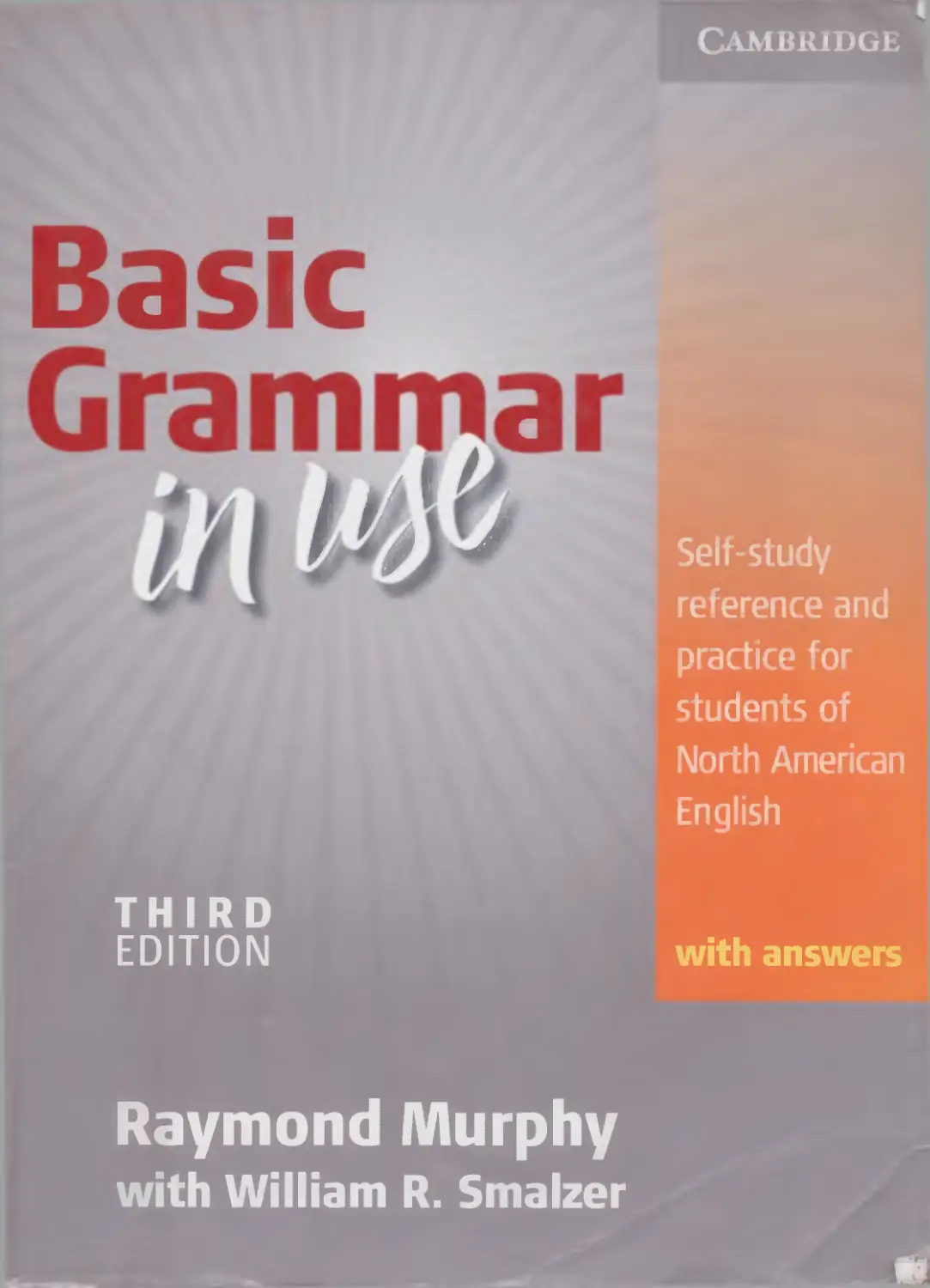
Basic
Raymond Murphy
with William R. Smalzer

Basic
Gram
THIRD
EDITION
Raymond Murphy
with William R. Smalzer
Self-study
reference and
practice for
students of
North American
English
with answers
Cambridge
UNIVERSITY PRESS	I

CAMBRIDGE UNIVERSITY PRESS
Cambridge, New York, Melbourne, Madrid, Cape Town, Singapore,
Sao Paulo, Delhi, Dubai, Tokyo
Cambridge University Press
32 Avenue of the Americas, New York. NY 10013-2473, USA
www.cambridge.org
© Cambridge University Press 2011
First published 1989
Third Edition 2011
Printed in Hong Kong, China, by Golden Cup Printing Company Limited
A catalog record for this publication is available from the British Library.
isbn 978-0-521-13334-0 Student’s Book with answers and CD-ROM
isbn 978-0-521-13353-1 Student’s Book with answers
isbn 978-0-521-13337-1 Student’s Book with CD-ROM
isbn 978-0-521-13330-2 Workbook with answers
Cambridge University Press has no responsibility for the persistence or
accuracy of URLs for external or third-party Internet Web sites referred to in
this publication, and does not guarantee that any content on such Web sites is,
or will remain, accurate or appropriate.
Book design and layout: Adventure House, NYC
Audio production: Richard LePage & Associates
Illustration credits: Carlos Castellanos, Richard Deverell, Travis Foster, Peter
Hoey, Randy Jones, Gillian Martin, Sandy Nichols, Roger Penwill, Lisa
Smith, Ian West, Simon Williams, and Tracy Wood

Contents
To the Student	viii
To the Teacher	x
Present
1 am/is/are
2 am/is/are (questions)
3 I am doing (present continuous)
4 are you doing? (present continuous questions)
5 I do/work/like, etc. (simple present)
6 I don’t. . . (simple present negative)
7 Do you . . . ? (simple present questions)
8 I am doing (present continuous) and I do (simple present)
9 I have . . . and I’ve got. . .
Past
10 was/were
11 worked/got/went, etc. (simple past)
12 I didn’t . . . Did you . . . ? (simple past negative and questions)
13 I was doing (past continuous)
14 I was doing (past continuous) and I did (simple past)
15 I used to . . .
Present perfect
16 Have you ever . . . ?
17 How long have you . . . ?
18 for since ago
19 I have done and I did (present perfect and simple past 1)
20 just, already, and yet (present perfect and simple past 2)
21 I’ve lost my key. I lost my key last week, (present perfect and simple past 3)
Passive
22 is done	was done	(passive	1)
23 is being done	has	been done	(passive 2)
Verb forms
24 be/have/do in present and past tenses	>
25 Regular and irregular verbs
Future
26 What are you doing tomorrow?
27 I’m going to . . .
28 will 1
29 will 2
If you are not sure which units you need to study, use the STUDY GUIDE on page 263.
i

Modals, imperatives, etc.
30 might
31 can and could
32 must
33 should
34 I have to . . .
35 Would you like . . . ? I’d like . . .
36 I’d rather . . .
37 Do this! Don’t do that! Let’s do this!
There and it
38 there is there are
39 there was/were there has/have been there will be
40 It...
Auxiliary verbs
41 I am, I don’t, etc.
42 You have? / Have you? / You are? / Are you?, etc.
43 too/either so am I / neither do I, etc.
44 isn’t, haven’t, don’t, etc. (negatives)
Questions
45 is it... ? have you . . . ? do they . . . ?, etc. (questions l)
46 Who saw you? Who did you see? (questions 2)
47 Who is she talking to? What is it like? (questions 3)
48 What. . . ? Which . . . ? How . . . ? (questions 4)
49 How long does it take . . . ?
50 Do you know where . . . ? I don’t know what. . ., etc.
Reported speech
51 She said that. . . He told me that. . .
-ing and to . . .	V
52 work/working go/going do/doing
53 to ... (I want to do) and -ing (I enjoy doing)
54 I want you to . . . I told you to . . .
55 1 went to the store to . . .
Go, get, do, make, and have
56 go to . . . go on ... go for ... go -ing
57 get
58 do and make
59 have
Pronouns and possessives
60 I/me he/him they/them, etc.
61 my/his/their, etc.
62 Whose is this? It’s mine/yours/hers, etc.
63 I/me/my/mine
iv If you are not sure which units you need to study, use the STUDY GUIDE on page 263.

64 myself/yourself/themselves, etc.
65 -’s (Kate’s camera / my brother’s car, etc.)
A and the
66 a/an ...
67 train(s) bus(es) (singular and plural)
68 a bottle / some water (countable/uncountable 1)
69 a cake / some cake / some cakes (countable/uncountable 2)
70 a/an and the
71 the . . .
72 go to work go home go to the movies
73 I like music I hate exams
74 the .. . (names of places)
Determiners and pronouns
75 this/that/these/those
76 one/ones
77 some and any
78 not + any no none
79 not + anybody/anyone/anything nobody/no one/nothing
80 somebody/anything/nowhere, etc.
81 every and all
82 all most some any no/none
83 both either neither
84 a lot much many
85 (a) little (a) few
Adjectives and adverbs
86 old/nice/interesting, etc. (adjectives)
87 quickly/badly/suddenly, etc. (adverbs)	.
88 old/older expensive / more expensive
89 older than . . . more expensive than . . .
90 not as ... as
91 the oldest the most expensive
92 enough
93 too
Word order
94 He speaks English very well, (word order 1)
95 always/usually/often, etc. (word order 2)
96 still yet already
97 Give me that book! Give it to me!
Conjunctions and clauses
98 and but or so because
99 When ...
100 If we go ...	If you see ..., etc.
101 If I had . . . If we went. . . , etc.
102 a person who ... a thing that/which . . . (relative clauses 1)
103 the people we met the hotel you stayed at (relative clauses 2)
If you are not sure which units you need to study, use the STUDY GUIDE on page 263.	v

Prepositions
104 at 8:00 on Monday in April
105 from... to until since for
106 before after during while
107 in	at	on	(places 1)
108 in	at	on	(places 2)
109 to	in	at	(places 3)
110 next to, between, under, etc.
111 up, over, through, etc.
112 on	at	by	with about
113 afraid of. . ., good at... , etc. of/at/for, etc. (prepositions + -ing)
114 listen to ..., look at..., etc. (verb + preposition)
Phrasal verbs
115 go in, fall off, run away, etc. (phrasal verbs l)
116 put on your shoes put your shoes on (phrasal verbs 2)
Appendix 1 Active and passive 235
Appendix 2 List of irregular verbs 236
Appendix 3 Irregular verbs in groups 237
Appendix 4 Short forms (he’s / I’d / don’t, etc.) 238
Appendix 5 Spelling 240
Appendix 6 Phrasal verbs (take off / give up, etc.) 242
Appendix 7 Phrasal verbs + object (put out a fire / try on clothes, etc.)
Additional Exercises 244
Study Guide 263
Answer Key to Exercises 276
Answer Key to Additional Exercises	303
Answer Key to Study Guide 306
Index 308
243
vi
If you are not sure which units you need to study, use the STUDY GUIDE on page 263.

To the Student
This is a grammar book for
beginning to low-intermediate
students of English. There are 116
units in the book, and each unit is
about a different point of English
grammar. There is a list of units at
the beginning of the book (Contents).
Do not study all the units in order
from beginning to end. It is better to
choose the units that you need to do.
For example, if you have a problem
with the present perfect (I have been,
he has done, etc.), study Units 16-21.
Use the Contents or the Index (at the
back of the book) to find the unit
(or units) that you need.
Contents
To the Student	viii
To the Teacher	x
Present
1 am/is/ate
2 am/is/are (questions)
3 I am doing (present continuous)
4 arc you doing? (present continuous questions)
5 1 do/work/like, etc. (simple present)
6 I don’t ... (simple present negative)
7 Do you . .. ? (simple present questions)
8 I am doing (present continuous) and I do (simple present)
9 1 have . . . and I’ve got. ..
Past
10 was/were
11 worked/got/wem, etc. (simple past)
12 I didn’t ... Did you . .. ? (simple past negative and questions)
13 I was doing (past continuous)
14 I was doing (past continuous) and 1 did (simple past)
I '• I Mt«d III
If you are not sure
which units you
need to study, use
the Study Guide
at the back of the
v tffv AM not soar amioi ****** it atOMt into* uamv
Mom • «•
m row AM NO! UMI WHICH KNIWM It HMHl ITUDV UIWTIS)

Each unit is two pages.
The information is on
the left-hand page and
the exercises are on
the right:
Information
Exercises
Study the left-hand page (information), and then
do the exercises on the right-hand page.
Use the Answer Key to check your answers.
The Answer Key is on pages 276-302.
Study the left-hand page again if necessary.
Answer Key to Exercises
Don’t forget the seven
Appendixes at the back
of the book (pages
235-243). These will
give you information
about active and passive
forms, irregular verbs,
short forms, spelling, and
phrasal verbs.
There are also Additional
Exercises at the back of the
book (pages 244-262).
There is a list of these
exercises on page 244.
APPENDIX 2
List of irregular verbs (see Unit 25)
APPENDIX 3
Irregular verbs in groups
CD-ROM
This book is sold with or without a
CD-ROM. On the CD-ROM, there are
more exercises on all the units, and these
are different from the exercises in the book.
There are also more than 600 test questions.
ix

To the Teacher
The most important features of this book are:
■ It is a grammar book. It does not deal with other aspects of the language.
■ It is for beginning to low-intermediate students of English. It does not
cover areas of grammar which are not normally taught at the beginning
to low-intermediate level.
■ It is a reference book with exercises. It is not a course book and is not
organized progressively.
■ It is addressed to learners and intended for self-study.
Organization of the book
There are 116 units in the book, each one focusing on a particular area of grammar.
The material is organized in grammatical categories, such as tenses, questions,
and articles. Units are not ordered according to difficulty, and should therefore be
selected and used in the order appropriate for the learner(s). The book should not
be worked through from beginning to end. The units are listed in the Contents, and
there is a comprehensive Index at the end of the book.
Each unit has the same format consisting of two facing pages. The grammar point is
presented and explained on the left-hand page and the corresponding exercises are
on the right. There are seven Appendixes (pages 235-243) dealing with active and
passive forms, irregular verbs, short forms (contractions), spelling, and phrasal verbs.
It might be useful for teachers to draw students’ attention to these.
At the back of the book there is a set of Additional Exercises (pages 244-262). These
exercises provide “mixed” practice bringing together grammar points from a
number of different units (especially those concerning verb forms). There are 35
exercises in this section, and there is a full list on page 244.
Also at the back of the book there is a Study Guide to help students decide which
units to study - see page 263.
Finally, there is an Answer Key (pages 276-302) for students to check their answers
to all the exercises in the book. An edition without the Study Guide and Answer Key
is available for teachers who would prefer it for their students.
Level
The book is for beginning learners, i.e., learners with very little English, but not for
complete beginners. It is intended mainly for beginning students who are beyond
the early stages of a beginners’ course. It could also be used by low-intermediate
learners whose grammar is weaker than other aspects of their English or who have
problems with particular areas of basic grammar.
The explanations are addressed to the beginning learner and are therefore as simple
and as short as possible. The vocabulary used in the examples and exercises has also
been restricted so that the book can be used at this level.
x

Using the book
The book can be used by students working alone (see To the Student) or as
supplementary course material. In either case the book can serve as a beginning
grammar book.
When used as course material, the book can be used for immediate consolidation
or for later revision or remedial work. It might be used by the whole class or by
individual students needing extra help and practice.
In some cases it may be desirable to use the left-hand pages (presentation and
explanation) in class, but it should be noted that these have been written for
individual study and reference. In most cases, it would probably be better for
teachers to present the grammar point in their preferred way with the exercises
being done for homework. The left-hand page is then available for later reference by
the student.
Some teachers may prefer to keep the book for revision and remedial work. In this
case, individual students or groups of students can be directed to the appropriate
units for self-study and practice.
CD-ROM
The book is sold with or without a CD-ROM. The CD-ROM contains further
exercises on all the units in the book, as well as a bank of more than 600 test
questions from which users can select to compile their own tests.
Basic Grammar in Use, Third Edition
This is a new edition of Basic Grammar in Use. The differences between this edition and the
second edition are:
■ The book has been redesigned with new color illustrations.
■ There is reorganization, so some units have different numbers from the
previous edition.
■ There are many (usually minor) revisions to the explanations, examples,
and exercises.
■ There are two new pages of Additional Exercises (pages 244-262).
■ There is a new CD-ROM with further exercises to accompany the book.

Basic
Gramma
iniffi

U N
1
1 T
A
B
am/is/are
I'm 22.
My name is Lisa.
I'm American. I'm from Chicago.
I'm a student.
My father is a doctor, and my
mother is a journalist.
I'm not married.
My favorite color is blue.
My favorite sports are
tennis and swimming.
I'm interested in art.
Positive
I
am
(I’m)
he
she
it
is
(he’s)
(she’s)
(it’s)
we
you
they
are
(we’re)
(you’re)
(they’re)
Negative
I
am not
(I’m not)
he
(he’s not
or
he isn’t)
she
is not
(she’s not
or
she isn’t)
it
(it’s not
or
it isn’t)
we
(we’re not
or
we aren’t)
you
are not
(you’re not
or
you aren’t)
they
(they’re not
or
they aren’t)
short forms
I’m cold. Can you close the window, please?
I’m 32 years old. My sister is 29.
Steve is sick. He’s in bed.
rj My brother is afraid of dogs.
:	It’s 10:00. You’re late again.
■ Ann and I are good friends.
:	Your keys are on the table.
■ I’m tired, but I’m not hungry.
Tom isn’t interested in politics. He’s interested in music.
■ Jane isn’t a teacher. She’s a student.
■ Those people aren’t Canadian. They’re Australian.
' It’s sunny today, but it isn’t warm.
shortjorms
I'm afraid of dogs.
that’s = that is there’s = there is here’s = here is
■ Thank you. That’s very nice of you.
■ Look! There’s Chris.
■ “Here’s your key.” “Thank you.”
2
am/is/are (questions) —»■ Unit 2 there is/are —► Unit 38 a/an —► Unit 66 short forms —*■ Appendix 4

Exercises
UNIT
1
1.1	Write the short form (she's / we aren't, etc.)
1. she is she's
2. they are
3. it is not
4. that is .
5. I am not
6. you are not
1.2	Write am, is, or are.
1. The weather /s nice today.
2. I	not rich.
3. This bag heavy.
4. These bags heavy.
1.3	Complete the sentences.
1.	Steve is sick. He's in bed.
5. Look! There
Carol.
 good tennis players.
at home. Her children at school.
6. My brother and I
7. Amy
8. I a taxi driver. My sister
a nurse.
thirsty.
2. I’m not hungry, but
3. Mr. Thomas is a very old man. _
4. These chairs aren’t beautiful, but
5. The weather is nice today.
6. “	late.”	“No,	I’m	not.	I’m	early!
comfortable.
warm and sunny.
7. Catherine isn’t at home.
8. “	your	coat.”
. at work.
‘Oh, thank you very much.”
1.4	Look at Lisa's sentences in 1A. Now write sentences about yourself.
1. (name?) My.
2. (from?) I
3. (age?) I —
4. (job?) I —
5.	(favorite color or colors?)
My.
6.	(interested in ... ?)
I
1.5	Write sentences for the pictures. Use:
afraid angry cold hot hungry
thirsty
1.	She's thirsty.	 3.	He	 5.
2. They	 4.		 6.
1.6 Write true sentences, positive or negative. Use is/isn't or are/aren't.
1. (it / hot today)	It	isn't hot today. OR It's hot today.
2. (it / windy today)	It
3. (my hands / cold)	My.
4. (Brazil / a very big country)
5. (diamonds / cheap)
6. (Toronto / in the United States)
Write true sentences, positive or negative. Use I'm / I'm not.
7. (tired)	I'm	tired.	OR	I'm	not	tired.
8. (hungry)	I
9. (a good swimmer)
10. (interested in politics)
— Additional exercise 1 (page 244)
3

UNIT
am/is/are (questions)
Positive
I
am
he
she
is
it
we
you
are
they
Question
am
I?
is
he?
she?
it?
i are
we?
you?
they?
What's your name?
David.
Are you married?
No, I'm single.
How old are you?
25.
Are you a student?
Yes, I am.
■	“Am I late?” “ No, you’re on time.”
■ “Is your mother at home?” “No, she’s out.”
■ “Are your parents at home?” “No, they’re out.”
■	“Is it cold in your room?” “Yes, a little.”
■	Your shoes are nice. Are they new?
We say:
■	Is she at home? / Is your mother at home?	(not Is at	home	your	mother?)
■	Are they new? / Are your shoes new? (not	Are new	your shoes?)
Where .. . ? / What. .. ? / Who . .. ? / How ... ? / Why .
■ Where is your mother? Is she at home?
■ “Where are you from?” “Canada.”
■ What color is your car?” “It’s red.”
■ “How old is Joe?” “He’s 24.”
■ “How are your parents?” “They’re fine.”
■ These postcards are nice. How much are they?
■ This hotel isn’t very good. Why is it so expensive?
what’s = what is who’s who is
What’s your phone number?
■ Where’s Lucy?
how’s = how is where’s = where is
e Who’s that man?
® How’s your father?
Short I
I
am.
he
she
is.
Yes,
it
we
you
are.
they
I’m
No,
he’s
she’s
it’s
not.
we’re
you’re
they’re
or
No,
he
she
it
isn’t.
we
you
they
aren’t.
“Are you tired?” “Yes, I am.”
“Are you hungry?” “No, I’m not, but I’m thirsty.”
“Is your friend Japanese?” “Yes, he is.”
“Are these your keys?” “Yes, they are.”
“That’s my seat.” “No, it isn’t.”
That's my seat.
No, it isn't.
4
am/is/are —► Unit 1 questions —* Unit 45 what/which/how —*■ Unit 48

Exercises
U N
2.1	Find the right answers for the questions.
1.
Where’s the camera?
a)
Toronto.
1.
2.
Is your car blue?
b)
No, I’m not.
2.
3.
Is Linda from London?
c)
Yes, you are.
3.
4.
Am I late?
d)
My sister.
4.
5.
Where’s Ann from?
e)
Black.
5.
6.
What color is your bag?
f)
No, it’s black.
6.
7.
Are you hungry?
g)
In your bag.
7.
8.
How is George?
b)
No, she’s American.
8.
9.
Who’s that woman?
0
Fine.
9.
2.2
Make questions with these words.
1.	(is / at home / your mother) /s your mother at home
(your parents / are / how) How are your parents
(interesting / is / your job)
(the stores / are / open today)
(from / where / you / are)
(interested in sports / you / are)
(is / near here / the post office) .
(at school / are / your children) _
(you / are / late / why)
2.3
Complete the questions. Use What... / Who ... I Where ... I How.
^
1.
2.
3.
4.
5.
6.
7.
Ho
w are
. your children?
_ the bus stop?
. your children?
. these oranges?
	your	favorite	sport?
the man in this photograph?
		your	new	shoes?
2 4 Write the questions.
1.
2.
3.
4.
5.
6.
7.
8.
9.
name?) What's your name?
Australian?)
how old?) _
a teacher?)
married?)
wife a lawyer?)
from?)
her name?)
how old?)
They’re fine.
At the end of the block.
Five, six, and ten.
$1.50 a pound.
Skiing.
That’s my father.
Black.
^ Paul
Paul.
No, I’m Canadian.
I’m 30.
No, I’m a lawyer.
Yes, I am.
No, she’s a teacher.
She’s from Mexico.
Ana.
She’s 27.
2.5	Write short answers {Yes, I am. / No, he isn't., etc.).
No. I'm not:
1. Are you married?
2. Are you thirsty? _
3. Is it cold today?
4. Are your hands cold?
5. Is it dark now?
6. Are you a teacher?
- *oa xional exercises 1-2 (pages 244-245)

I am doing (present continuous)
We're running.
She’s eating.
She isn’t reading.
It’s raining.
The sun isn’t shining.
They’re running.
They aren’t walking.
The present continuous is:
am/is/are + doing/eating/running/writing, etc.
I
am (not)
■
I’m working. I’m not watching TV.
he
■
Maria is reading a newspaper.
she
is (not)
■
She isn’t eating, (or She’s not eating.)
it
-ing
■
The phone is ringing.
we
■
We’re having dinner.
you
are (not)
■
You’re not listening to me. (or You aren’t listening
they
■
The children are doing their homework.
•)
Am/is/are + -ing = something is happening now:
I’m working
she’s wearing a hat
they’re playing baseball
I’m not watching television
past	now	future
■ Please be quiet. I’m working. (= I’m working now)
■ Look, there’s Sarah. She’s wearing a brown coat. (= she is wearing it now)
■ The weather is nice. It’s not raining.
■ “Where are the children?” “They’re playing in the park.”
■ (on the phone) We’re having dinner now. Can I call you later?
■ You can turn off the television. I’m not watching it.
For spelling, see Appendix 5.
come —► coming write —► writing dance —► dancing
run ->■ running sit —► sitting swim —► swimming
lie —► lying
am/is/are -*• Unit 1 are you doing? (questions) -► Unit 4 I am doing and I do -*• Unit 8
What are you doing tomorrow? —► Unit 26

Exercises
3.1	What are these people doing? Use these verbs to complete the sentences:
-eat have lie play sit wait
1. She's eating
2.
3.
apple
He
for a bus.
_ soccer.
They
3.2 Complete the sentences. Use these verbs:
build cook leave stand	stay
Please be quiet. I ‘m working .
“Where’s John?” “He’s in the kitchen. He
“You	on	my	foot.”
4.
5.
6.
swim
take
r-o-fk
1.
2.
3.
4.
5.
6.
7.
«
Look! Somebody
We’re here on vacation. We _
“Where’s Sue?” “She
They
I	now. Good-bye
. on the floor.
 breakfast.
on the table.
“Oh, I’m sorry.”
in the river.
	at	a	hotel	on	the	beach.
a shower.”
a new hotel downtown.
about Jane. Use She's -ing or She isn't -ing.
(have dinner) Jane isn't having dinner.
(watch television) She’s watching television.
(sit on the floor) She
(read a book)
(play the piano)
(laugh)
(wear a hat)
(write a letter)
3.3 Look at the picture. Write sentences
1.
2.
3.
4.
5.
6.
7.
8.
3.4	What's happening now? Write true sentences.
1. (I / wash / my hair)	I’m not washing	my	hair.
2. (it / snow)	Its snowing.	OR	It	isn t snowing.
3. (I / sit / on a chair)
- (I / eat)
5. (it / rain)
6. (I / study / English)
- (I / listen / to music)
8.	(the sun / shine)
(I / wear / shoes)
Kl (I read / a newspaper)

are you doing? (present continuous questions)
Positive
I
am
he
doing
she
is
working
it
going
we
staying,
you
they
are
etc.
Question
am
I
he
doing?
is
she
working?
it
going?
we
staying?,
are
you
they
etc.
What are you doing?
“Are you feeling OK?” “Yes, I’m fine, thanks.”
“Is it raining?” “Yes, take an umbrella.”
Why are you wearing a coat? It’s not cold.
“What’s Paul doing?” “He’s reading the	newspaper.”
“What are the children doing?” “They’re watching television.”
■	Look, there’s Emily! Where’s she going?
I	Who are you waiting for? Are you waiting for	Sue?
Study the word order:
is/are + subject + -ing
Where
Where
Is
Is
are
are
he
Paul
they
those people
working today?
working today? (not Is working Paul today?)
going?
going? (not Where are going those people?)
Short answers
I
am.
he
she
is.
Yes,
it
we
you
are.
they
I’m
No,
he’s
she’s
it’s
not.
we’re
you’re
they’re
or
“Are you leaving now?” “Yes, I am.”
“Is Paul working today?” “Yes, he is.”
“Is it raining?” “No, it isn’t.”
“Are your friends staying at a hotel?” “No, they aren’t. They’re staying with me.”
I am doing —► Unit 3 What are you doing tomorrow? —*■ Unit 26 questions —► Units 45-48

Exercises	u	N
4.1	Look at the pictures and write the questions.
4.2 Look at the pictures and complete the questions. Use:
cry eat go laugh look at read
4.3	Make questions with these words. Put the words in the right order.
1.
2.
3.
4.
5.
6.
7.
8.
is / working / Paul / today) /s Paul working today
what / the children / are / doing)
you / are / listening / to me)
What are the children doing
where / your friends / are / going)
are / watching / your parents / television)
what / Jessica / is / cooking)
why / you / are / looking / at me)
is / coming / the bus)
4.4	Write short answers (Yes, / am. / No, he isn't., etc.).
1.	Are you watching TV? No, I'm not.	4.	Is it raining? .
2. Are you wearing a watch? _
3. Are you eating something?
5. Are you sitting on the floor?
6. Are you feeling all right?
-» Additional exercise 3 (page 245)

I do/work/likef etc. (simple present)
We read a lot.
	I
They’re looking at their books.
They read a lot.
like ice cream.
He’s eating an ice cream cone.
He likes ice cream.
They read / he likes / I work, etc. = the simple present:
I/we/you/they
read
like
work
live
watch
do
have
he/she/it
reads
likes
works
lives
watches
does
has
Remember:
he works / she lives / it rains, etc.
■ I work in an office. My brother works in a bank. (not My brother work)
■ Lucy lives in Houston. Her parents live in Chicago.
■ It rains a lot in the winter.
I have -*■ he/she/it has:
■ John has lunch at home every day.
For spelling, see Appendix 5.
-es after -s	/ -sh / -ch:	pass ->■ passes	finish -*■ finishes
-y -► -ies:	study -*■ studies	try -► tries
also:	do -*■ does	go -*■ goes
watch -»■ watches
We use the simple present for things that are true in general, or for things that happen
sometimes or all the time:
■ I like big cities.
■ Your English is good. You speak very well.
■ Tim works very hard. He starts at 7:30 and finishes at 8:00 at night.
■ The earth goes around the sun.
■ We do a lot of different things in our free time.
■ It costs a lot of money to build a hospital.
Always/never/often/usually/sometimes + simple present
■ Sue always gets to work early. (not Sue gets always)
■ I never eat breakfast. (not I eat never)
■ We often sleep late on weekends.
■ Mark usually plays tennis on Sundays.
■ I sometimes walk to work, but not very often.
c
10
I don't. . . (negative) —* Unit 6 Do you . . . ? (questions) —*• Unit 7 I am doing and I do —► Unit 8
always/usually/often, etc. (word order) —► Unit 95

Exercises
U N
5.1 Write these verbs with -s or -es.
1.	(read) she	reads	3.	(fly)	it	 5.	(have)	she
2.	(think) he	 4.	(dance)	he	 6.	(finish)	it _
5.2 Complete the sentences about the people in the pictures. Use:
eat go live play play sleep
We love movies.
Tennis is my
favorite sport
1. He plays the piano.	4. 	tennis.
2.	They	in a very big house. 5. 	to	the movies a lot.
3. 	a	lot	of	fruit.	6. 	seven	hours	a	night.
5.3 Complete the sentences. Use:
boil	close	cost	cost like like meet	open speak	teach	wash
1.	Maria	speaks	four	languages.
2.	Banks	usually	at 9:00 in the morning.
3.	The art museum	at	5:00	in the afternoon.
4. Tina is a teacher. She	math	to	young children.
5. My job is very interesting. I	a	lot of people.
6. Peter’s car is always dirty. He never	it.
7. Food is expensive. It	a	lot	of	money.
8.	Shoes	are expensive. They	a	lot of money.
9. Water	at	100 degrees Celsius.
10.	Julia and I are good friends. I	her, and she	me.
5.4 Write sentences from these words. Use the right form of the verb (arrive or arrives, etc.).
1.	(always / early / Sue / arrive)	Sue	always arrives	early.
2.	(to the movies / never / I / go)
3.	(work / Martina / hard / always)
4. (like / chocolate / children / usually)
5. (Julia / parties / enjoy / always)
6. (often / people’s names / I / forget) _
7. (television / Tim / watch / never)
8. (usually / dinner / we / have / at 6:30)
9. (Jenny / always / nice clothes / wear) _
5.5	Write sentences about yourself. Use always/never/often/usually/sometimes.
1.	(watch TV in the evening) / usually watch TV in the evening.
(read in bed) I.
3. (get up before 7:00)
4. (go to work/school by bus)
5. (drink coffee in the morning)

I don't. . . (simple present negative)
The simple present negative is don’t/doesn’t + verb:
Coffee?	No,	thanks.	I	don't
drink coffee.
She doesn’t drink coffee.
I don't like my job
He doesn’t like his job.
Positive
I
we
you
they
work
like
do
have
he
she
it
works
likes
does
has
Negative
I
we
you
they
don’t
(do not)
work
like
do
have
he
she
it
doesn’t
(does not)
I drink coffee, but I don’t drink tea.
Sue drinks tea, but she doesn’t drink coffee.
You don’t work very hard.
We don’t watch television very often.
The weather is usually nice. It doesn’t rain very often.
Gary and Nicole don’t know many people.
Remember:
I/we/you/they don’t...	I don’t like football,
he/she/it	doesn’t...	He doesn’t like football.
I don’t like Fred, and Fred doesn’t like me. (not Fred don’t like)
■ My car doesn’t use much gas. (not My car don’t use)
Sometimes he is late, but it doesn’t happen very often.
We use don’t/doesn’t + base form (don’t like / doesn’t speak / doesn’t do, etc.):
■ I don’t like to wash the car. I don’t do it very often.
■ Sarah speaks Spanish, but she doesn’t speak Italian. (not doesn’t speaks)
■ Bill doesn’t do his job very well, (not Bill doesn’t his job)
■ Paula doesn’t usually have breakfast, (not doesn’t. . . has)
I do/work/like, etc. (simple present) —► Unit 5 Do you
? (simple present questions) —*■ Unit 7

Exercises
6.1
UNIT
Write the negative.
1. I play the piano very well.
2. Jane plays the piano very well.
3. They know my phone number.
4. We work very hard.
5. Mike has a car.
6. You do the same thing every day.
/ don t play the piano very well.
Jane _
They
6.2 Study the information and write sentences with like.
1. Bill and 'Rose like classical music.
Do you like ..
Carol.
I
classical music.
Bill and
Rose Carol You
2. Bill and Rose
Carol
1.
classical music?
yes
no
i
2.
boxing?
no
yes
3.
3.
horror movies?
yes
no
6.3 Write about yourself. Use:
I never ... or I... a lot
1.	(watch TV)
2.	(go to the theater)
3.	(ride a bicycle)
4.	(eat in restaurants)
5.	(travel by train)
or I don't. .
/ never watch TV. OR _
/ don't watch TV very often.
. very often.
/ watch TV a lot.
OR
6.4
Complete the sentences. All of them are negative. Use don't/doesn't + these verbs:
cost go know read- see use wear
I buy a newspaper every day, but sometimes I don t read it.
Paul has a car, but he
it very
often.
Paul and his friends like movies, but they
Amanda is married, but she	a	ring.
I	much	about politics. Pm not interested in it.
to the movie theater very often.
The Regent Hotel isn’t expensive. It.
7. Brian lives near us, but we
much to stay there.
him very often.
6.5 Put the verb into the correct form, positive or negative.
1.
2.
3.
4.
5.
6.
7.
8.
Margaret speaks four languages - English, Japanese, Arabic, and Spanish, (speak)
I don t like my job. It’s very boring, (like)
“Where’s Martin?” “I’m sorry. I	.”	(know)
Sue is a very quiet person. She	very	much, (talk)
Andy	a	lot	of	coffee.	It’s	his	favorite	drink,	(drink)
It’s not true! I
That’s a very beautiful picture. I.
Mark is a vegetarian. He
it! (believe)
it a lot. (like)
meat, (eat)
13

UNIT
Do you
(simple present questions)
We use do/does in simple present questions:
Positive
I
we
you
they
work
like
do
have
he
she
it
works
likes
does
has
Question
I
do
we
you
work?
they
like?
do?
he
have?
does
she
it
Study the word order:
do/does
+ subject +
infinitive
Do
you
work
on Sundays?
Do
your friends
live
near here?
Does
Chris
piay
tennis?
Where
do
your parents
live?
How often
do
you
wash
your hair?
What
does
this word
mean?
How much
does
it
cost
to fly to Puerto Rico?
Questions with always/usually/ever:
Do
you
always
have
breakfast?
Does
Chris
ever
call
you?
What
do
you
usually
do
on weekends?
What do you do? = What’s your job?
■ “What do you do?” “I work in a bank.”
Remember:
do I/we/you/they . . .
does he/she/it. . .
Do they like music?
Does he like music?
Short
answers
Yes,
I/we/you/they do.
No,
I/we/you/they don’t.
he/she/it does.
he/she/it doesn’t.
“Do you play tennis?” “No, I don’t.”
“Do your parents speak English?” “Yes, they do.”
“Does Gary work hard?” “Yes, he does.”
“Does your sister live in Vancouver?” “No, she doesn’t.”
14
I do/work/like, etc. —► Unit 5 I don't (negative) —*• Unit 6 questions —► Units 45-48

Exercises
u
N
7.1	Write questions with Do . . . ? and Does . . . ?
1.
2.
3.
4.
5.
6.
7.
8.
9.
I like chocolate. How about you? Do
I play tennis. How about you?	you	.
you
like chocolate
You live near here. How about Lucy?	Lucy	.
Tom plays tennis. How about his friends?
You speak English. How about your brother?
I do yoga every morning. How about you?
Sue often travels on business. How about Paul?
I want to be famous. How about you?
You work hard. How about Anna?
7.2	Make questions from these words + do/does. Put the words in the right order.
1.
2.
3.
4.
5.
6.
7.
8.
9.
10.
11.
12.
13.
14.
where / live / your parents) _
you / early / always / get up)
how often / TV / you / watch) _
you / want / what / for dinner)
like / you / football)
Where do your parents live
Do you always pet up early
your brother / like / football)
what / you / do / in your free time)
your sister / work / where)
to the movies / ever / you / go)
what / mean / this word)
often / snow / it / here)
go / usually / to bed / what time / you)
how much / to call Mexico / it / cost)
you / for breakfast / have / usually / what)
7.3	Complete the questions. Use these verbs:
-de- do enjoy get like start
teach work
1.
2.
3.
4.
5.
6.
7.
8.
What time
How.
And your husband. What.
What.
What do you do ?
	it?
 in the morning?
	on	Saturdays?
	to	work?
7
his job?
£
I work in a bookstore.
It’s OK.
At 9:00.
Sometimes.
Usually by bus.
He’s a teacher.
Science.
Yes, he loves it.
7.4	Write short answers (Yes, he does. / No, I don't., etc.).
1. Do you watch TV a lot? No, / don ’t.	 OR	Yss, / do.
2. Do you live in a big city?
3. Do you ever ride a bicycle?
4. Does it rain a lot where you live?
5. Do you play the piano?
—■ Additional exercises 4-7 (pages 245-246)

I am doing (present continuous) and
I do (s imple present)
Present continuous (I am doing) = now, at the time of speaking:
I’m doing
past	now
■ Please be quiet. I’m working. (not I work)
■ Tom is taking a shower at the moment. (not Tom takes)
■ Take an umbrella with you. It’s raining.
■ You can turn off the television. I’m not watching it.
■ Why are you under the table? What are you doing?
future
Simple present (I do) = in general, all the time, or sometimes:
I do
past
■ I work every day from 9:00 to 5:30.
■ Tom takes a shower every morning.
■ It rains a lot in the winter.
■ I don’t watch television very often.
■ What do you usually do on weekends?
now
future
We do not use these verbs in the present continuous (I am -ing):
like	love	want	know	understand	remember
prefer	hate	need	mean	believe	forget
depend
Use only the simple present with these verbs (I want / do you like?, etc.):
■ I’m tired. I want to go home. (not I’m wanting)
■ “Do you know that girl?” “Yes, but I don’t remember her name.”
■ I don’t understand. What do you mean?
Jack is watching television.
He is not playing the guitar.
But Jack has a guitar.
He plays it a lot, and he plays
Jack plays the guitar,
but he is not playing the guitar now.
Is he playing the guitar?	No, he isn’t.
Does he play the guitar?	Yes, he does.
(present continuous)
(simple present)
present continuous — Units 3-4 simple present —► Units 5-7 present for the future —*• Unit 26

Exercises
8.1	Answer the questions about the pictures.
U N
Does he take photographs?
Is he taking a photograph? _
What is he doing?
He s taking a bath.
Yes, he does.
No. he isn t.
Is she driving a bus? _
Does she drive a bus?
What is she doing?
Does he wash windows? _
Is he washing a window? .
What is he doing?
Are they teaching?
Do they teach?
What do they do?
We are teachers.
8.2 Complete the sentences with am/is/are or do/don't/does/doesn't.
1. Excuse me, do you speak English?
2. “Where’s Kate?” “I	  know.”
3. What’s so funny? Why	you	laughing?
4. “What	your	sister	do?” “She’s a dentist.”
5. It	raining.	I	want	to	go	out	in	the	rain.
6. “Where	you	come	from?” “Canada.”
7. How much	it	cost	to send a letter to Canada?
8.	Steve is a good tennis	player, but he	play	very often.
8.3 Put the verb in the present continuous (I am doing) or the simple present	(I	do).
1. Excuse me, do you speak (you / speak) English?
2. “Where’s Tom?”	He's taking (he / take) a shower.”
3.	/ don 't watch	(I / not / watch) television very often.
4.	Listen! Somebody	(sing)-
5. Sandra is tired.	(she	/	want)	to	go	home	now.
6. How often	(you	/	read)	a	newspaper?
7. “Excuse me, but	(you	/	sit)	in	my	seat.”	“Oh,	I’m sorry.”
8.	I’m sorry,  	(I	/	not / understand).	Can you speak more slowly?
9.	It’s late.	(I	/	go) home now.
(you / come) with me?
10.	What time	(your	father / finish) work	every day?
11. You can turn off the radio.	(I	/	not	/	listen) to it.
12. “Where’s Paul?” “In the kitchen.	(he	/	cook)	something.”
13. Martin	(not	/	usually	/	drive)	to	work. He
	(usually	/	walk).
14. Sue	(not	/	like)	coffee.	(she	/	prefer) tea.

UNIT
I have . . . and I've got. . .
You can say I have or I’ve got, he has or he’s got:
I
we
you
they
have
or
I
we
you
they
have got
(I’ve got)
(we’ve got)
(you’ve got)
(they’ve got)
he
he
(he’s got)
she
has
or
she
has got
(she’s got)
it
it
(it’s got)
short form
I have blue eyes, or I’ve got blue eyes.
Tim has two sisters, or Tim has got two sisters.
Our car has four doors, or Our car has got four doors.
Sarah isn’t feeling well. She has a headache, or She’s got a headache.
They like animals. They have a horse, three dogs, and six cats, or They’ve got a horse
I don’t have / I haven’t got, etc. (negative)
You can say:
I/we/you/they
don’t
have
he/she/it
doesn’t
or
I/we/you/they
haven’t
got
he/she/it
hasn’t
■ I have a bike, but I don’t have a car. or I’ve got a bike, but I haven’t got a car.
■ Mr. and Mrs. Harris don’t have any children, or ... haven’t got any children.
■ It’ s a nice house, but it doesn’t have a garage, or ... it hasn’t got a garage.
■ Mariko doesn’t have a job. or Mariko hasn’t got a job.
Do you have .. . ? / Have you got.. . ?, etc. (questions)
You can say:
do
I/we/you/they
does
he/she/it
have?
or
have
I/we/you/they
got?
has
he/she/it
■	Do you have a camera? or Have you got a camera?
■	Does	Helen have a car? or Has Helen got a car?
■	What	kind of car does she have? or What kind of car	has	she	got?
■	What	do you have in your bag? or What have you got	in	your bag?
Short
answers
“Do you have a camera?” “Yes, I do.” / “No, I don’t.” or
“Have you got a camera?” “Yes, I have.” / “No, I haven’t.”
“Does Anne have a car?” “Yes, she does.” / “No, she doesn’t.”
“Has Anne got a car?” “Yes, she has.” / “No, she hasn’t.”
or
had / didn't have (past) -* Units 11-12 have breakfast / have a headache, etc. —► Unit 59 some/any -* Unit 77
I've got a headache.

Exercises
Write the short form with got (we've got / he hasn't got, etc.).
UNIT
9.1
9.2
1. we have got.
2. he has got
we ve got 3. they have got _
	 	 4.	she	has not got.
5.
6.
it has got
I have not got.
Read the questions and answers. Then write sentences about Mark.
	I"-	.
1.
Have you got a car?
No- o
1.
2.
Have you got a computer?
Yes. LJ
2.
3.
Have you got a dog?
No. Mark
3.
4.
Have you got a cell phone?
No.
4.
5.
Have you got a watch?
Yes.
5.
6.
Have you got any brothers or
Yes, two brothers
6.
sisters?
and a sister.
He hasn t got a
car.
He
What about you? Write sentences with I've got or I haven't got.
7. (a computer)
8. (a dog)
9. (a bike)
10.	(brothers / sisters)
9.3
Write these sentences with have/has or don't have / doesn't have. The meaning is
the same.
They have two children.
1. They have got two children.
2. She hasn’t got a key.
3. He has got a new job.
4. They haven’t got much money.
5. Have you got an umbrella?
6. We have got a lot of work to do.
7. I haven’t got your phone number.
8. Has your father got a car?
9. How much money have we got?
She doesn t haye a key.
9.4	Complete the sentences with do, doesn't, don't, got, has, or have.
Sarah hasn’t got a car. She goes everywhere by bicycle.
They like animals. They have three dogs and two cats.
Charles isn’t happy. He	got	a	lot	of	problems.
They don’t read much. They	have	many books.
“What'
s wrong
?” “I’ve
“Where’s my pen?” “I don’t know. I don’t.
7.	Julia wants to go to the concert, but she
something in my eye.”
	it.”
	have	a	ticket.
9.5	Complete the sentences. Use have/has or don't have / doesn't have with:
a lot of friends four wheels a hcadae-he- six legs
afeigyard	much time a key
I’m not feeling well. I have a headache.
It’s a nice house, but it doesn t have a big yard.
Most cars
1.
2.
3.
4.
5.
6.
7.
Everybody likes Tom. He .
I can’t open the door. I
An insect
Hurry! We
— Additional exercises 5-7 (page 246)
19

was/were
last night
now
am/is (present) -*• was (past):
■ I am tired, (now)
■ Where is Kate? (now)
■ The weather is nice today.
are (present) -*• were (past):
■ You are late, (now)
■ They aren’t here, (now)
Now Robert is at work.
At midnight last night
he wasn’t at work.
He was in bed.
He was asleep.
I was tired last night.
Where was Kate yesterday?
The weather was nice last week.
You were late yesterday.
They weren’t here last Sunday.
Positive
I
he
she
it
was
we
you
they
were
Negative
I
he
she
it
was not
(wasn’t)
we
you
they
were not
(weren’t)
Question
was
I?
he?
she?
it?
were
we?
you?
they?
Last year Rachel was 22, so she is 23 now.
When I was a child, I was afraid of dogs.
We were hungry after the trip, but we weren’t tired.
The hotel was comfortable, but it wasn’t expensive.
Was the weather nice when you were on vacation?
Your shoes are nice. Were they expensive?
Why were you late this morning?
Short i
Yes,
I/he/she/it was.
No,
I/he/she/it wasn’t.
we/you/they were.
we/you/they weren’t.
“Were you late?” “No, I wasn’t.”
“Was Ted at work yesterday?” “Yes, he was.”
“Were Sue and Steve at the party?” “No, they weren’t.
20
am/is/are -<• Units 1-2 I was doing -*■ Unit 13

Exercises
10.1	Where were these people at 3:00 yesterday afternoon?
U N I
1. Chary was in
2. Jack and Kate _
3. Sue
bed.
4.
5.
6. And you? I.
10.2	Write ami is/are (present) or was/were (past).
1. Last year she was 22, so she is 23 now.
2. Today the weather	nice, but yesterday	it.
3. I	hungry.	Can	I	have	something	to	eat?
. very cold.
4. I feel fine this morning, but I
5. Where
 very tired last night.
you at 11:00 last Friday morning?
6.	Don’t buy those shoes.	They .
7.	I like your new jacket.
8.	This time last year I	in	Paris.
9.	“Where	the	children?”	“I	don’t know. They .
 very expensive.
it expensive?
here a few minutes ago.
10.3	Write was/were or wasn't/weren't.
1. We weren’t happy with the hotel. Our room was very small, and it wasn t clean.
2. Mark	at	work	last	week	because	he	sick.	He’s	better	now.
3. Yesterday	a	holiday,	so	the	banks	closed.	They’re	open	today.
4. “	Kate	and	Bill	at	the	party?”	“Kate	there,	but	Bill	.”
5. “Where are my keys?” “I don’t know. They .
not there now.”
6. You	at	home	last	night.	Where
. on the table, but they’re
. you r
10.4	Write questions from these words + was/were. Put the words in the right order.
1.
2.
3.
4.
5.
6.
- 1
(late / you / this morning / why?)
Whv were vou late this mornina? -
The traffic was bad.
(difficult / your exam?)
No, it was easy.
(last week / where / Sue and Chris?)
'r They were on vacation.
(your new camera / how much?)
' One bundled and twenty dollars.
(angry / you / yesterday / why?)
" Because you weie late.
(nice / the weather / last week?)
* Yes, it was beautiful.

UNIT
worked/got/went, etc. (simple past)
They	watch	television every night.
(simple present)
They watched television last night.
(simple past)
watched is the simple past:
I/we/you/they
he/she/it
watched
The simple past is often -ed (regular verbs). For example:
work —► worked dance —► danced
clean —► cleaned stay —► stayed
start -► started	need —► needed
■ I brush my teeth every morning. This morning I brushed my teeth.
■ Terry worked in a bank from 1996 to 2003.
■ Yesterday it rained all morning. It stopped at lunchtime.
■ We enjoyed the party last night. We danced a lot and talked to a lot of people. The
party ended at midnight.
For spelling, see Appendix 5.
try —► tried	study —► studied copy —► copied
stop —► stopped plan —► planned
Some verbs are irregular (= not regular). The simple past is not -ed. Here are some important
irregular verbs (see also Appendixes 2-3):
begin
—► began
fall
- fell
leave
—► left
sell
—► sold
break
broke
find
found
lose
lost
sit
sat
bring
brought
fly
flew
make
made
sleep
slept
build
built
forget
forgot
meet
met
speak
spoke
buy
bought
get
got
pay
paid
stand
stood
catch
caught
give
gave
put
put
take
took
come
came
g°
went
read
read (red)*
tell
told
do
did
have
had
ring
rang
think
thought
drink
drank
hear
heard
say
said
win
won
eat
ate
know
knew
see
saw
write
wrote
*pronounced “red”
■ I usually get up early, but this morning I got up at 9:30.
■ We did a lot of work yesterday.
■ Caroline went to the movies three times last week.
■ James came into the room, took off his coat, and sat down.
22
was/were —► Unit 10 I didn't / Did you . . . ? (negative and questions) —► Unit 12 ago —»■ Unit 18

Exercises
UNIT
11.1 Complete the sentences. Use a verb from the box.
brush die end enjoy happen open
1. I brushed my teeth three times yesterday.
2. It was hot in the room, so I	the	window.
3. The movie was very long. It	at	7:15 and _
4. When I was a child, I	to	be	a	doctor.
5. The accident	last	Sunday	afternoon.
rain
start
stay
want
at 10:00.
6. It’s a nice day today, but yesterday it
7. We	our	vacation	last	year.	We
8. Anna’s grandfather
. all day.
at a very nice place.
. when he was 90 years old.
11.2 Write the simple past of these verbs.
1. get got	 4.	pay
	 5.	visit
	 6.	buy
2. see.
3. play.
7. go —
8. think.
9. copy _
10. know.
11. put
12. speak.
11.3	Read about Lisa's trip to Mexico City. Put the verbs in the correct form.
Last Tuesday, Lisa (l) flew from Los Angeles to Mexico City. She
(2)
of coffee. At 7:15 she (4).
the airport. When she (6)
. up at 6:00 in the morning and (3).
. home and (5).
. there, she (7).
. a cup
_ to
  the
car, (8)
(10) —
. to the terminal, and (9).
. breakfast at an airport cafe and (11)
. in. Then she
		for
her flight. The plane (12)
. on time and (13).
. a taxi from
in Mexico City four hours later. Finally she (14).
the airport to her hotel downtown.
11.4 Write sentences about the past (yesterday / last week, etc.).
1. James always goes to work by car. Yesterday he went to work by car.
2. Rachel often loses her keys. She .
3.
4.
5.
6.
7.
8.
fly
get, have
leave, drive
get, park
walk, check
have, wait
depart, arrive
take
Kate meets her friends every night. She
I usually buy two newspapers every day. Yesterday I
We often go to the movies on weekends. Last Sunday we .
I eat an orange every day. Yesterday I.
. last week.
. last night.
Tom always takes a shower in the morning. This morning he .
Our friends often come to see us. They
. last Friday.
11.5 Write sentences about what you did yesterday.
1.	/	went to the theater.	 4.
2. 	 5.
3. 	 6.
- t onal exercise 10 (page 248)

UNIT
12
I didn't. . . Did you . . . ?
(simple past negative and questions)
We use did in simple past negatives and questions:
Base Form
play
start
watch
have
see
do
g°
Positive
I
played
we
started
you
watched
they
had
he
saw
she
did
it
went
Negative
I
play
we
start
you
they
he
did not
(didn’t)
watch
have
see
she
do
it
go
Question
I
play?
we
start?
you
watch?
did
they
have?
he
see?
she
do?
it
go?
Do/does (present) -*■ did (past):
■	I don’t watch television very often.
I didn’t watch television yesterday.
■	Does she go out often?
Did she go out last night?
We use did/didn’t + base form (watch/play/go, etc.):
I watched but I didn’t watch (not I didn’t watched)
they went did they go? (not did they went?)
he had he didn’t have
you did did you do?
■	I played tennis yesterday, but I didn’t win.
“Did you do your homework?” “No, I didn’t have time.”
■	We went to the movies, but we didn’t enjoy the film.
Study the word order in questions:
E
did + subject + base form
What
How
Where
Did
did
did
did
your sister
you
the accident
your parents
call
do
happen?
g°
you?
last night?
for vacation?
Short answers
Yes,
I/we/you/they ...
he/ she/it
No, "we/you/they
he/she/it
“Did you see Joe yesterday?” “No, I didn’t.”
“Did it rain on Sunday?” “Yes, it did.”
“Did Helen come to the party?” “No, she didn’t.”
“Did your parents have a good trip?” “Yes, they did.”
24
worked/got/went, etc. (simple past) —<• Unit 11

Exercises
U N I T |2
12.1 Complete these sentences with the verb in the negative.
1. I saw Barbara, but I didn't see Jane.
2. They worked on Monday, but they	on	Tuesday.
3. We went to the post office, but we	to	the bank.
4. She had a pen, but she	any	paper.
5. Jack did some work in the yard, but he	any	work	in	the	house.
12.2 Write questions with Did... ?
1. I watched TV last night. How about you?	Did you u/atch TV. last night
2. I enjoyed the party. How about you?
3. I had a nice vacation. How about you?
4. I finished work early. How about you?
5. I slept well last night. How about you?
12.3 What did you do yesterday? Write positive or negative sentences.
1. (watch TV)	/	watched	TV.	OR	/	didn	't	watch	TV.
2. (get up before 7:00) I
3. (take a shower)
4. (buy a magazine)
5. (eat meat)
6. (go to bed before 10:30)
12.4 Write B's questions. Use:
cost get to work go go to bed late happen have a nice time stay win
1. A: We went to Chicago last month.
R: Wh-re did you stay ?
5. A: We came home by taxi.
R: How much ?
A: With some friends.
A: Twenty dollars.
2. A: I was late for the meeting.
R: What time ?
6. A: I’m tired this morning.
R: ?
A: Half past nine.
A: No, but I didn’t sleep very well.
3. A: I played tennis this afternoon.
R: ?
7. A: We went to the beach yesterday.
R: ?
A: No, I lost.
A: Yes, it was great.
4. A: I had a nice vacation.
R: Good. Where ?
8. A: The window is broken.
R: How ?
A: To the mountains.
A: I don’t know.
12.5	Put the verb in the correct form - positive, negative, or question.
1. We went to the movies, but the film wasn’t very good. We didn 't enjoy it. (enjoy)
2. Tim	some	new	clothes yesterday - two shirts, a jacket, and a sweater, (buy)
3. "	yesterday?” “No, it was a nice day.” (rain)
4. We were tired, so we	long at the party, (stay)
5. It was very warm in the room, so I	a window, (open)
6. “Did you call Chris this morning?” “No, I	time.” (have)
7. “I cut my hand this morning.” “How	that?” (do)
8. “Why weren’t you at the meeting yesterday?” “I	about	it.” (know)
— ioditional exercises 10-13 (page 248)
25

UNIT
I was doing (past continuous)
4:00
now (6:00)
It is 6:00 now.
Paul is at home.
He is watching television.
At 4:00 he wasn’t at home.
He was at the gym.
He was swimming in the pool.
He wasn’t watching television.
he started
swimming
-► 4:15
Was/were + -ing is the past continuous:
Positive
I
he
she
it
was
doing
watching
playing
swimming
living,
etc.
we
you
they
were
Negative
I
he
she
it
was not
(wasn’t)
doing
watching
playing
swimming
living,
etc.
we
you
they
were not
(weren’t)
Question
was
I
he
she
it
doing?
watching?
playing?
swimming?
living?,
etc.
were
we
you
they
m What were you doing at 11:30 yesterday? Were you working?
■ “What did he say?” “I don’t know. I wasn’t listening.”
■ It was raining, so we didn’t go out.
■ In 2001 we were living in Japan.
■ Today she’s wearing a skirt, but yesterday she was wearing pants.
■ I woke up early yesterday. It was a beautiful morning. The sun was shining, and the
birds were singing.
Spelling (live —■- living / run — running / lie ->■ lying, etc.) — Appendix 5
Am/is/are + -ing (present) — was/were + -ing (past):
Past
Present
■ I’m working (now).
■ It isn’t raining (now).
■ What are you doing (now)?
I was working at 10:30 last night.
It wasn’t raining when we went out.
What were you doing at 3:00?
was/were —*• Unit 10 I was doing and I did (past continuous and simple past) —*■ Unit 14
he finished
swimming

Exercises
UNIT
13.1	Look at the pictures. Where were these people at 3:00 yesterday afternoon? And what
were they doing? Write two sentences for each picture.
w
ill
3. ffL)
4 @
m
Rachel
Jack Kate
Tim
Tracey
Mr. and Mrs. Hall
at home
at the supermarket
in his car
at the station
in the park
watch TV
buy food
drive
wait for a train
walk
1.	v - ihei was at:	Jh:,	wa	wa’chma	TV.
2. Jack and Kate
3. Tim
4.
5.
. They.
6.	And you? I.
13.2	Sarah did a lot of things yesterday. Look at the pictures and complete the sentences.
1.	At 8:45	:A.;-	-i	washing	her	car.
2. At 10:45 she
3. At 8:00
4. At 12:10
5. At 7:15.
6. At 9:30.
13.3	Complete the questions. Use was/were -ing. Use what/where/why if necessary.
1.
2.
3.
4.
5.
In Brazil.
I was asleep.
No, it was sunny.
Because she was late.
No, a T-shirt and jeans,
13.4	Look at the picture. You saw Joe in the street yesterday afternoon. What was he
doing? Write positive or negative sentences.
Hi. I’m going shopping,
A
'
1.
2.
3.
4.
5.
6.
7.
8.
wear / a jacket) He wasn’t wearing a jacket.
carry / a bag
go / to the dentist)
eat / an ice cream cone)
carry / an umbrella)
go / home)
wear / a hat)
ride / a bicvcle)
13
Joe
27

UNIT
14
B
I was doing (past continuous) and
I did (simple past)
Jack was reading
a book.
The phone rang. He stopped reading.
He answered the
phone.
What happened? The phone rang, (simple past)
What was Jack doing when the phone rang?
He was reading a book.
What did he do when the phone rang?
He stopped reading and answered the phone.
Jack began reading before the phone rang.
So when the phone rang, he was reading.
he began
reading
he was reading
(past continuous)
(simple past)
the phone
he stopped
reading
he answered the
phone
Simple past
■ A: What did you do yesterday morning?
B: We played tennis, (from 10:00 to 11:30)
Start
Finish
Past continuous
■ A: What were you doing at 10:30?
B: We were playing tennis.
Start
10:00
1
11:30
1
10:00
1
I
r
we played
completed action
1
J
\ \t / /
we were playing
unfinished action
■	Jack read a book yesterday.
(= from beginning to end)
■	Did you watch the basketball game on
television last night?
■	It didn’t rain while we were on vacation.
■	Jack was reading a book when the
phone rang.
■	Were you watching television when
I called you?
■	It wasn’t raining when I got up.
■ I started work at 9:00 and finished at 4:30. At 2:30 I was working.
■ It was raining when we went out. (= it started raining before we went out)
■ I saw Lucy and Steve this morning. They were waiting at the bus stop.
■ Kelly fell asleep while she was reading.
28
I did (simple past) —*■ Units 11-12 I was doing (past continuous) -► Unit 13 while -» Unit 106

Exercises
U N I
14.1 Look at the pictures. Put the verbs in the correct form, past continuous or simple past.
Lucy broke (break) her arm last week.
	(happen) when
	(paint) her
	(M)
3.
room. She
off the ladder.
The train.
(arrive)
at the station, and Paula
(get) off. Two friends of hers, Jon and Rachel.
	(wait)	to
meet her.
Yesterday Sue
down the street when she.
James. He.
. (walk)
(meet)
— (g°)
to the station to catch a train, and he
	(carry) a bag.
They	(stop)t0
talk for a few minutes.
14 2 Put the verb into the past continuous or simple past.
1. A: What were you doing (you / do) when the phone ranQ (ring)?
B: I was watching (watch) television.
2. A: Was Jane busy when you went to see her?
B: Yes, she	(study).
3. A: What time	(the	mail	/	arrive)	this	morning?
B: It	(come)	while	I	(have)	breakfast.
4. A: Was Tracey at work today?
B: No, she
5. A: How fast
B: I’m not sure, but I
6. A:
(stop) you?
(not / go) to work. She was sick,
(you / drive) when the police
(not / drive) very fast.
(your team / win) the baseball game yesterday?
B: No, the weather was very bad, so we
7. A: How
B: We
(not / play).
(you / break) the window?
and it.
8. A:
B: Yes, she
9. A: What _
(play) baseball. I
 (break) the window.
_ (you / see) Jenny last night?
		(wear)	a	very	nice	jacket.
(hit) the ball
(you / do) at 2:00 this morning?
B: I was asleep.
10. A: I
B: How
A: I
(lose) my key last night.
 (you / get) into your apartment?
(climb) in through a window.
- □ □ itional exercises 14-15 (pages 249-250)

UNIT
15
I used to ...
Dave a few years ago
I work in a factory.
I work in a supermarket.
I used to work in a factory.
Dave
Dave used to work in a factory. Now he works in a supermarket.
Dave used to work in a factory. = he worked in a factory before, but he doesn’t
work there now:
he used to work
he works
past
now
You can say I used to work . .. / she used to have . .. / they used to be ..., etc.
be
I/you/we/they
used to
work
he/she/it
have
play, etc.
When I was a child, I used to like chocolate.
I used to read a lot of books, but I don’t read
much these days.
Liz has short hair now, but it used to be very long.
They used to live on the same street as us,
so we used to see them a lot. But we don’t
see them very often these days.
Helen used to have a piano, but she sold it a few
years ago.
The negative is I didn’t use to ....
■ When I was a child, I didn’t use to like tomatoes.
The question is did you use to ... ?
■ Where did you use to live before you came here?
■
■
■
■
■
I used to have very long hair.
We use used to ... only for the past. You cannot say “I use to ...” for the present:
■ I used to play tennis. These days I play golf. (not I use to play golf)
■ We usually get up early. (not We use to get up early)

Exercises
15.1 Look at the pictures. Complete the sentences with used to .
U N I
Iona hair.
baseball.
. a taxi driver.
When I was younger...
I'm a hairdresser now.
rs "taxi"
A few years ago
We live in New York City now,
Our house in the
\country 20 years ago
country.
15.2 Karen works very hard and has very little free time. A few years
ago, things were different.
Do you play any sports? ■
Do you go out much? ■
Do you play a musical1
instrument?
Do you like to read? ■
Do you travel much? ■
►Yes, I swim every day,
and I play volleyball.
►Yes, three or four nights
a week.
►Yes, the guitar.
►Yes, I read a lot.
►Yes, I take two or three
trips a year.
Karen a few years ago
I work very hard
at my job. I don't
have any free time.
Karen now
5
Write sentences about Karen with used to ...
1. She used to swim every day.	 4.
2.
3.
She.
. volleyball. 5.
    6.
15.3 Complete these sentences. Use used to or the simple present (/ play / he lives, etc.).
1. I used to play tennis. I stopped playing a few years ago.
“Do you play any sports?” “Yes, I play basketball.”
“Do you have a car?” “No, I	one,	but	I	sold	it.”
George	a	waiter.	Now	he’s	the	manager	of	a	hotel.
“Do you go to work by car?” “Sometimes, but most days I	by	train.
2.
3.
4.
5.
6.
7.
8.
9.
10.
When I was a child, I never .
meat, but I eat it now.
_ TV every night.
Mary loves to watch TV. She
We	near	the airport, but we moved downtown a few years ago.
Normally I start work at 7:00, so I	up	very	early.
What games	you	when	you	were	a	child?
This is me 20 years ago.
I never wear glasses now.
6. This building
I A long rime ago

UNIT
16
Have you ever.
I
we
you
they
have (’ve)
have not (haven’t)
he
she
it
has (’s)
has not (hasn’t)
played
lived
visited
read
lost
been
flown
have
I
we
you
they
played?
lived?
visited?
read?
has
he
she
it
lost?
been?
flown?
regular verbs
irregular verbs
Regular verbs The past participle is -ed (the same as the simple past):
play -* I have played live -*■ I have lived visit -*• she has visited
Irregular verbs The past participle is not -ed.
Sometimes the past participle is the same as the simple past:
buy -*• I bought / I have bought have -<■ he had / he has had
Sometimes the past participle is different (see Appendixes 2-3).
break — I broke / I have broken see -*■ you saw / you have seen
We use the present perfect when we talk about a time from the past until now, for example,
a person’s life.
Have you ever been to Japan?
	time	from	the past until now
past	now
■ “Have you been to France?” “No, I haven’t.”
■ We’ve been to Canada, but we haven’t been to Alaska.
■ Mary is an interesting person. She has had many different jobs and has lived
in many places.
■ I’ve seen that woman before, but I can’t remember where.
■ How many times has Brazil won the World Cup?
■ “Have you read this book?” “Yes, I’ve read it twice.” (twice = two times)
Present perfect + ever (in questions) and never:
■ “Has Ann ever been to Australia?” “Yes, once.” (once = one time)
■ “Have you ever played golf?” “Yes, I play a lot.”
■ My sister has never traveled by plane.
■ I’ve never ridden a horse.
■ “Who is that man?” “I don’t know. I’ve never seen him before.”
present perfect — Units 17-18 present perfect and simple past —* Units 19-21 irregular verbs —* Appendixes 2-3
Have you been to Mexico City?
Yes, I have. Many times.
Have you ever been to Japan?
No, I've never been to Japan.
Have been / have driven / have played, etc. is the present perfect (have + past participle):

Exercises
U N I
16.1	You are asking Helen questions beginning with Have you ever... ?
Write the questions.
Helen
1.
(Montreal?)
Ha\/e vou
ever been to Montreal?
No, never.
2.
(play / golf?)
Have vou
ever plaved ao/f?
Yes, many times.
3.
(South Korea?)
Have
Yes, once.
4.
(lose / your passport?)
No, never.
5.
(fly / in a helicopter?)
Yes, a few times.
6.
(win / a race?)
No, never.
7.
(Peru?)
Yes, twice.
8.
(drive / a bus?)
No, never.
9.
(break / your leg?)
Yes, once.
16.2 Write sentences about Helen. (Look at her answers in Exercise 16.1.)
1. (Peru) She's been to Peru twice.
2. (South Korea) She
3. (win / a race)
4. (fly / in a helicopter)
Now write about yourself. How often have you done these things?
5. (New York) I
6. (play / tennis)
7. (drive / a truck)
8. (be / late for work or school)
16.3 Mary is 65 years old. She has had an interesting life. What has she done?
have	be	all over the world	a lot of interesting things
do	write	many different jobs	a lot of interesting people
travel	meet	10 books	married three times
1.	She has had many different jobs.
2. She
3 .
4.
5.
6.
16.4 Put the verbs in the present perfect.
1.	/ve seen	(I / see) that woman before, but I	can’t remember her name.
2.	“	Have you	ever played	(you / ever / play)	golf?” “Yes, I play golf a lot.”
3.	“	(you	/ ever / write) a poem?” “Yes, in high school.”
4.	“Does Emma	know Sam?”	“No,	(she / never / meet) him.”
5. Ann and Eli have lots of books, and	(they	/	read)	all	of	them.
6. 	(I	/	never	/ be) to Australia, but
(my brother / be) there twice.
7. Joy’s favorite movie is Howard and Belinda.	(she	/	see) it five
times, but	(I	/	never	/	see)	it.
8. 	(I	/	travel)	by plane, bus, and train. Someday, I want to take a
trip by boat.
— - dditional exercises 16,18 (pages 250-251)

UNIT
17
How long have you . . . ?
Jane is on vacation in Brazil.
She is there now.
She arrived in Brazil on Monday.
Today is Thursday.
How long has she been in Brazil?
since Monday.
She has been in Brazil
for three days.
Compare is and has been:
She has been in Brazil
She is in Brazil
now.
since Monday,
for three days.
is = present
has been = present perfect
Monday
now
Thursday
Compare:
Simple present
Dan and Kate are married.
Are you married?
Do you know Lisa?
I know Lisa.
Vera lives in Brasilia.
I have a car.
Present continuous
I’m studying German.
David is watching TV.
It’s raining.
for and since —*■ Units 18, 105
Present perfect (have been / have lived / have known, etc.)
They have been married for five years.
(not They are married for five years.)
How long have you been married?
(not How long are you married?)
How long have you known her?
(not How long do you know her?)
I’ve known her for a long time.
(not I know her for . . .)
How long has she lived in Brasilia?
She has lived there all her life.
How long have you had your car?
I’ve had it since April.
Present perfect continuous (have been + -ing)
How long have you been studying German?
(not How long are you studying German?)
I’ve been studying German for two years.
How long has he been watching TV?
He’s been (= He has been) watching TV since 5:00.
It’s been (= It has been) raining all day.

Exercises
17.1	Complete these sentences.
1.
Jane is in Brazil. She has been
there since Monday.
2.
I know Lisa. I have knou/n
her for a Ion? time.
3.
Sarah and Andy are married. They
married since 1999.
4.
Brian is sick. He
sick for the last few davs.
5.
We live on Main Street. We
there for a Ion? time.
6.
Catherine works in a bank. She
in a hank for five vears
7.
Alan has a headache. He
a headache since he got up
this morning.
8.
I’m studying English. I
English for six months.
17.2	Make questions with How long . .. ?
1.	Jane	is on vacation.
2. Scott and Judy are in Brazil.
3.	I	know	Amy.
4. Diana is studying Italian.
5. My brother lives in Seattle.
6.	I’m	a	teacher.
7.	It	is	raining.
Look at the pictures and complete the sentences with:
for 10 minutes	all day	all her life
for 10 years	since he was 20	since Sunday
1.
The v have been married for 10 vears.
2.
She
3.
Thev
4.
The sun
5.
She
6.
He
7.4 Which is right?
1.
Mark lives / has lived in Canada since April, (has lived is right)
2.
Tane and I are friends. I know / I’ve known her verv well.
3.
Tane and I are friends. I know / I’ve known her for a long time.
4.
A: Sorrv I’m late. How Ions are vou waiting / have vou been waiting?
B: Not long. Only five minutes.
5.
Martin works / has worked in a hotel now. He likes his job a lot.
6.
Ruth is reading the newspaper. She is reading / She has been reading it for two hours.
7.
“How long do vou live / have vou lived in this house?” “About 10 vears.”
8.
“Is that a new coat?” “No, I have / I’ve had this coat for a long time.”
9.
Tom is / has been in Seattle right now. He is / He has been there for the last three davs.
	sZ-
How Iona has she been on vacation
How long
How long	vou
— -aditional exercises 16-18 (pages 250-251)
35

UNIT
18
B
for since ago
For and since
We use for and since to say how long:
■ Jane is in Brazil. She has been there
We use for + a period of time
(three days / two years, etc.):
for three days,
since Monday.
for three days
Monday
Tuesday
Wednesday
past
now
for
three days
10 minutes
an hour
two hours
a week
four weeks
a month
six months
five years
a long time
Richard has been in Canada for six
months, (not since six months)
We’ve been waiting for two
hours. (not since two hours)
I’ve lived in Chicago for a long time.
We use since + the start of the period
(Monday / 9:00, etc.):
start oj
pe:
Monday
since Monday
past
now
since
Monday
Wednesday
9:00
12:30
July 4th
my birthday
January
I was 10 years old
1995
we arrived
Richard has been in Canada since
January. (= from January to now)
We’ve been waiting since 9:00.
(= from 9:00 to now)
I’ve lived in Chicago since I was 10
years old.
ago = before now:
■ Susan started her new job three weeks ago. (= three weeks before now)
■ “When did Tom leave?” “Ten minutes ago.” (= ten minutes before now)
■ I had dinner an hour ago.
■ Life was very different a hundred years ago.
We use ago with the past (started/did/had/was, etc.).
Compare ago and for:
■ When did Jane arrive in Brazil?
She arrived in Brazil three days ago.
■ How long has she been in Brazil?
She has been in Brazil for three days.
36
present perfect + for/since — Unit 17 from/until/since/for —► Unit 105 for and during ->■ Unit 106

Exercises
18.1	Write for or since.
1.
Jane has been in Brazil since Mondav.
2.
Jane has been in Brazil three days.
3.
My ann,t has lived in Australia
15 years.
4.
Jennifer is in her office. She has been there
7:00.
5.
Mexico has been an independent countrv
1821.
6.
The bus is late. We’ve been waiting
20 minutes.
7.
Nobody lives in those houses. Thev have been
emptv manv vears.
8.
Michael has heen sick a long time. He has been in the hospital October.
18.2 Answer these questions. Use ago.
1. When was the last time you ate?	Three	hours	ago.
2. When was the last time you were sick?
3. When was the last time you went to the movies?
4. When was the last time you were in a car?
5. When was the last time you went on vacation?
18.3 Complete the sentences. Use for or ago with these words.
1. Jane arrived in Brazil three days ago.
2. Jane has been in Brazil for three days.
3. Lynn and Mark have been married
4. Lynn and Mark got married
5. Dan arrived
6. I bought these shoes
7. Silvia has been studying English
8. Have you known Lisa
18.4 Complete the sentences with for or since.
1.
(Jane is in Brazil - she arrived there three days ago)
Jane has been in 3razil for three davs.
2.
3.
(Jack is here - he arrived on Tuesday)
Jack has
(It’s raining - it started an hour ago)
It’s been
4.
(I know Sue - I met her in 2002)
I’ve
5.
(Claire and Matthew are married - they got married six months ago)
Claire and Matthew have
6.
(Liz is studying medicine at the university - she started three years ago)
Liz has
7.
(David plays the piano - he started when he was seven years old)
David has
Is- 5 Write sentences about yourself. Begin your sentences with:
I’ve lived ... I’ve been  I’ve been studying ... I’ve known ... I’ve had ...
1.	I've lived in this town for three years.
3.
5.
▼
_	(three days)
_	(three days)
_	(20 years)
_	(20 years)
_	(an hour)
_	(a few days)
_	(six months)
?	(a long time)
o-rval exercises 16-18 (pages 250-251)
37

UNIT
19
I have done and I did
(present perfect and simple past 1)
He has washed his car.
(= his car is clean now)
He is washing his car.
His car is dirty.
They have gone out.
(= they are not at home now)
They are at home.
They are going out.
We use the present perfect for an action in the past with a result now:
■ I’ve lost my passport. (= I can’t find my passport now)
■ “Where’s Rebecca?” “She’s gone to bed.” (= she is in bed now)
■ We ’ve bought a new car. (= we have a new car now)
■ It’s Rachel’s birthday tomorrow, and I haven’t bought her a present.
(= I don’t have a present for her now)
■ “Bob is away on vacation.” “Oh, where has he gone?” (= where is he now?)
■ Have you met my brother, or should I introduce you?
■ I was a very slow typist in college, but I’ve gotten faster.
Usually you can also use the simple past (he washed / I lost, etc.) in these situations. So
you can say:
■ “Where’s your key?” “I’ve lost it.” or “I lost it.”
■ “Is Peter here?” “No, he’s gone home.” or “He went home.”
■ We’ ve bought a new car. or We bought a new car.
We use only the simple past (not the present perfect) with a finished time (yesterday,
last week, etc.).
■ I lost my key yesterday. (not I have lost)
■ We bought a new car last week. (not we have bought)
38
simple past —► Units 11-12 present perfect -► Units 16-18 present perfect and simple past —1- Units 20-21

Exercises	u	n	i
19.1	Look at the pictures. What has happened? Use the present perfect. Choose from:
go to bed wash her car stop raining close the door fall down take a shower
She has washed her car.
He
They
It
He
The
19.2	Rewrite the sentences that have underlined verbs. Use the present perfect.
1. Lee Ming isn’t here. He went home. He has gone home.
2. I don’t need to call them. I wrote them a letter.
3. Karen’s not coming to the party. She broke her arm.
4. My brother and his wife don’t live here any more. They moved to Seattle.
5. I made a big mistake.
6. I lost my wallet.
Did you see it anywhere?
7. Did you hear?
Mark got married.
Now rewrite these present perfect sentences in the simple past.
8. I’ve done the shopping. / did the shopping.
9. Brian has taken my bike again without asking.
10. Have you told your friends the good news?
11. We haven’t paid the electric bill
39

UNIT
20
just, already, and yet
(present perfect and simple past 2)
Just = a short time ago
We use just with the present perfect oi the simple past.
A: Are Diane and Paul here?
B: Yes, they’ve just arrived.
Yes, they just arrived.
A: Are you hungry?
B: No, I’ve just had dinner.
I just had dinner.
■ A: Is Tom here?
B: No, sorry, he’s just left.
He just left.
■
■
or
or
or
They have just arrived
Already = before you expected / before I expected
We use already with the present perfect or the simple past.
A: What time are Diane and Paul coming?
B: They’ve already arrived, or
They already arrived.
It’s only 9:00 and Anna has already gone to bed.
or ... Anna already went to bed.
(= before I expected)
A: Jon, this is Emma.
B: Yes, I know. We’ve already met. or
We already met.
Jon, this is Emma.
■
■
■
Yes, I know. We've
already met.
Yet = until now
Hi! Come in
yet in negative sentences
■ A: Are Diane and Paul here?
B: No, they haven’t arrived yet. or
. .. they didn’t arrive yet.
(but B expects Diane and Paul to arrive soon)
■ A: Does James know that you’re going away?
B: No, I haven’t told him yet. or
... I didn’t tell him yet.
(but B is going to tell him soon)
■ Silvia has bought a new dress, but she hasn’t
worn it yet. or ... she didn’t wear it yet.
yet in questions
■ A: Have Diane and Paul arrived yet? or
Did Diane and Paul arrive yet?
B: No, not yet. We’re still waiting for them.
■ A: Has Nicole started her new job yet? or
Did Nicole start her new job yet?
B: No, she’s starting next week.
■ A: This is my new dress.
B: Oh, it’s nice. Have you worn it yet? or
Did you wear it yet?
We use yet with the present perfect or the simple past. We use yet in negative sentences and
questions. Yet is usually at the end.
The film hasn't started yet.
Oh, it's nice. Have you
worn it yet?
This is my new dress.
40
present perfect —► Units 16-18 present perfect and simple past —► Units 19, 21 still, yet, and already —► Unit 96

Exercises
20.1 Write a sentence with just for each picture.
!• Hi, everybody!
U N I
20.2
1.
They ve just arrived.
3. Thev
2.
He
4. The race
Complete the sentences. Use already + present perfect.
1.
What time is Paul arriving?
Do your friends want to see the movie?
Don’t forget to call Tom.
When is Martin going to work?
Do you want to read the newspaper?
When does Sarah start her new job?
He's already arrived.
2.
No, thev
it.
3
I
4
He
s
I
6.
She
20.3	Rewrite these sentences. Use the present perfect.
1.	Did Sarah start her new job yet? Has Sarah started, her new job yet?
2. Did you tell your father about the accident yet?.
3. I just ate a big dinner, so I’m not hungry.
4. Jenny can watch TV because she already did her homework.
5. You can’t go to bed - you didn’t brush your teeth yet.
6. You can’t talk to Pete because he just went home.
7. Nicole just got out of the hospital, so she can’t go to work. _
Now rewrite these sentences in the simple past.
8.	Have you given the post office our new address yet?
Did you give the post office our new address yet?
9.
10.
11.
12.
The mail carrier hasn’t come yet.
I’ve just spoken to your sister..
Has Mario bought a new computer yet?
Ted and Alice haven’t told anyone they’re getting married yet.
13. We’ve already done our packing for our trip.
14. I’ve just swum a mile. I feel great!
20.4	Write questions with the present perfect and yet.
1.	Your friend has a new job. Perhaps she has started it. You ask her:
Have vou started your new Job yet?
2. Your friend has some new neighbors. Maybe he has met them. You ask him:
		vou
3. Your friend has to pay her phone bill. Perhaps she has paid it. You ask her:
4.	Tom was trying to sell his car. Maybe he has sold it. You ask a friend about Tom.
	I

I've lost my key. I lost my key last week.
(present perfect and simple past 3)
Sometimes you can use the present perfect (I have lost / he has gone, etc.) or the
simple past (I lost / he went, etc.).
■ “Is Peter here?” “No, he’s gone home.” or “No, he went home.”
But with a finished time (yesterday / last week, etc.), we use only the simple past (not the
present perfect).
simple past + finished time
yesterday.
yesterday
last week.
last week
We arrived
at 3:00.
six months ago
in 2002.
finished time
six months ago.
past	now
Do not use the present perfect (have arrived / have done / have been, etc.) with a
finished time:
■ I saw Paula yesterday. (not I have seen)
■ Where were you on Sunday afternoon? (not Where have you been)
■ We didn’t take a vacation last year. (not We haven’t taken)
■ “What did you do last night?” “I stayed at home.”
■ William Shakespeare lived from 1564 to 1616. He was a writer. He wrote many
plays and poems.
Use the simple past to ask When . . . ? or What time .. . ?
■ When did you buy your computer? (not When have you bought?)
■ What time did Andy go out? (not What time has Andy gone out?)
Compare:
Present perfect or simple past
■ I have lost my key. or I lost my key. (= I can’t find it now)
■ Ben has gone home, or Ben went home. (= he isn’t here now)
■ Have you had lunch? or Did you have lunch?
■ The letter hasn’t arrived yet. or The letter didn’t arrive yet.
Present perfect only
Simple past only
time until now
finished time
past
now
past
now
■
Have you ever been to Spain?
m
Did you go to Spain last year?
(— in your life, until now)
■
My friend is a writer. He has written
■
William Shakespeare (1564-1616)
many books.
wrote many plays and poems.
■
The letter hasn’t arrived yet.
■
The letter didn’t arrive yesterday.
■
We’ve lived in Boston for six years.
■
We lived in Chicago for six years,
(= we live there now)
but now we live in Boston.
present perfect -* Units 16-18 present perfect and simple past —► Units 19-20

Exercises
21.1 Complete the answers to the questions.
U N 1
1.
Have you had lunch?
Yes. / had it
an hour ago.
2.
Have you started your new job?
Yes. I
last week.
3.
Have your friends arrived?
Yes. thev
on Friday.
4.
Has Sarah gone out?
Yes,
at 5:00.
5.
Have you worn your new suit?
Yes.
V
yesterday.
21.2
Are these sentences OK? Correct the verbs that are wrong. (The verbs are underlined l
1. I’ve lost my key. I can’t find it.	OK
Have vou seen Kate yesterday?	Did	you	see
I’ve finished my work at 2:00.
I’m ready now. I’ve finished my work.
What time have vou finished your work?
Sue isn’t here. She’s gone out.
Steve’s grandmother has died two years ago.
Where have you been last night?
21.3 Put the verb in the present perfect or past.
1. My friend is a writer. He has written (write) many books.
We didn t take (not / take) a vacation last year.
I	(play)	tennis yesterday afternoon.
2.
3.
4.
5.
6.
7.
8.
9.
10.
What time .
	(you / go) to bed last night?
(you / ever / meet) a famous person?
	(not / be) very good yesterday.
	(visit)	many countries.
The weather
Kathy travels a lot. She .
I	(turn)	off	the light before leaving this morning.
I live in New York now, but I	(live)	in	Mexico	for	many	years.
“What’s Peru like? Is it beautiful?” “I don’t know. I	(not	/	be)	there.”
21.4 Put the verb in the present perfect or past.
1. A:	Have you ever been (you / ever / be) to Florida?
B: Yes, we went (go) there on vacation two years ago.
A: 	(you	/ have) a good time?
B: Yes, it	(be) great.
2.
A: What does your friend do?
B: She’s a painter. She
(win) many prizes for her paintings.
A:
B: Yes, I.
(you / see) any of her paintings?
 (see) some of her work last week.
3.
Rose works in a factory, but she
Five years ago she
(have) a lot of different jobs.
(be) a waitress in a restaurant. After that, she
(not / enjoy) it very much.
4. A: Do you know Martin’s sister?
(work) on a ranch, but she .
B: I
(never / speak) to her.
A: Yes. I
(see) her a few times, but I
	(you	/	ever / speak) to her?
(meet) her at a party last week. She’s very nice.
- -dditional exercises 19-23, 29-31 (pages 252-254, 257-259)

UNIT
22
is done was done (passive 1)
The passive is:
simple present
simple past
past participle
am/is/are
was/were
(not)
cleaned
done
invented
built
injured
taken, etc.
The past participle of regular verbs is -ed (cleaned/damaged, etc.).
For a list of irregular past participles (done/built/taken, etc.), see Appendixes 2-3.
■ Butter is made from milk.
■ Oranges are imported into Canada.
■ How often are these rooms cleaned?
■ I am never invited to parties.
■ This house was built 100 years ago.
■ These houses were built 100 years ago.
■ When was the telephone invented?
■ We weren’t invited to the party last week.
■ “Was anybody injured in the accident?”
“Yes, two people were taken to the hospital.”
Was/were born
■ I was born in Colombia in 1989. (not I am born)
■ “Where were you born?” “In Cairo.”
Passive + by
■ The telephone was invented by Alexander Graham Bell in 1876.
(= Alexander Graham Bell invented it)
■ I was bitten by a dog a few days ago.
■ Do you like these paintings? They were painted by a friend of mine.
+
The office is cleaned every day.
The office was cleaned yesterday.
Compare active and passive:
Somebody cleans the office every day. (active)
The office is cleaned every day.	(passive)
Somebody cleaned the office yesterday, (active)
The office was cleaned yesterday.	(passive)
44
is being done / has been done —► Unit 23 irregular verbs —► Unit 25, Appendixes 2-3 by —► Unit 112
active and passive —* Appendix 1

Exercises
U N I
22.1	Write sentences from these words. Some of the sentences are questions.
Sentences 1-7 are present.
1. (the office / clean / every day) The office is cleaned every day.
2. (these rooms / clean / every day?) Are these rooms cleaned every day?
3. (glass / make / from sand) Glass
4. (stamps / sell / in a post office)
5. (this word / not / use / very often)
6. (we / allow / to park here?)
7. (how / this word / pronounce?)
Sentences 8-15 are past.
8. (the office / clean / yesterday) The office was cleaned yesterday.
9. (the house / paint / last month) The house
10. (my phone / steal / a few days ago)
11. (three people / injure / in the accident) ,
12. (when / this bridge / build?)
13. (I / not / wake up / by the noise)
14. (how / these windows / break?)
15. (you / invite / to Jon’s party last week?)
22.2
22.3
These sentences are not correct. Correct them.
1.	This house buirf)100 years ago. This house was built 100 years ago.
2. Soccer plays in most countries of the world.
3. Why did the letter send to the wrong address?
4. A garage is a place where cars repair.
5. Where are you born?
6. How many languages are speaking in Switzerland?
7. Somebody broke into our house, but nothing stolen.
8. When was invented the bicycle?
Complete the sentences. Use the passive (present or past) of these verbs:
clean damage find give invite make make show steal
take
1.
2.
3.
4.
5.
6.
7.
8.
9.
The room is cleaned every day.
I saw an accident yesterday. Two people were taken to the hospital.
Paper	from	wood.
There was a fire at the hotel last week. Two of the rooms
“Where did you get this picture?” “It
Many British programs	on American television.
“Did Jim and Sue go to the wedding?” “No. They
“How old is this movie?” “It	in	1965.”
My car
to me by a friend of mine.”
on.
, but they didn’t go.”
last week, but the next day it.
by the police.
22.4	Where were they born?
1.	(Makoto / Tokyo)
2.	(Isabel / Sao Paulo)	Isabel.
3.	(her parents / Rio	de Janeiro) Her
4.	(you / ???)	I
5.	(your mother /
/'/\akoto was born in Tokyo.

UNIT
21
B
is being done has been done (passive 2)
Is/are being . . . (present continuous passive)
(passive)
■ My car is at the garage. It is being repaired. (= somebody is repairing it)
■ Some new houses are being built across from the park. (= somebody is
building them)
Compare the present continuous and simple present:
■ The office is being cleaned right now. (present continuous)
The office is cleaned every day. (simple present)
■ In the United States, football games are usually played on weekends, but no big
games are being played next weekend.
For the present continuous and simple present, see Units 8 and 26.
Has/have been . . . (present perfect passive)
before	now
U
Z1
T_]
WET
PAINT
Somebody has painted the door . (active)
The door has been painted. (passive)
■ My key has been stolen. (= somebody has stolen it)
■ My keys have been stolen. (= somebody has stolen them)
■ I’m not going to the party. I haven’t been invited. (= nobody has invited me)
■ Has this shirt been washed? (= has somebody washed it?)
Compare the present perfect and simple past:
■ The room isn’t dirty any more. It has been cleaned, (present pefect)
The room was cleaned yesterday, (simple past)
■ I can’t find my keys. I think they’ve been stolen, (present perfect)
My keys were stolen last week, (simple past)
For the present perfect and simple past, see Units 19-21.
46
is done / was done —► Unit 22 active and passive —* Appendix 1

Exercises
23.1	What's happening?
U N I
1. The car /s being repaired.
2. A bridge
3. The windows.
4. The grass
23 2 Look at the pictures. What is happening or what has happened? Use the present
continuous (/s/are being ...) or the present perfect (has/have been ...).
1.
2.
3.
4.
5.
6.
7.
8.
(the office / clean)
(the shirts / iron)
The office is being cleaned.
The shirts have been ironed.
(the window / break) The window .
(the roof / repair) The roof
(the car / damage)
(the houses / tear / down)
(the trees / cut / down)
(they / invite / to a party) _
23.3
Complete the sentences. (Study Unit 22 before you do this exercise.)
1. I can’t use my office right now. It is being painted (paint).
We didn’t go to the partv. We weren t invited (not / invite).
2.
3.
4.
5.
6.
7.
8.
9.
10.
The washing machine was broken, hut it’s OK now. It.
The washing machine
A factory is a place where things
How old are these houses? When
A:
(repair) yesterday afternoon.
	(make).
(they / build)?
(repair).
B: Yes, Steve is using it.
I’ve never seen these flowers before. What.
My sunglasses.
(the computer / use) at the moment?
		(thev / call)?
The bridge is closed. It.
(steal) at the beach yesterday.
(damage) last week, and it
(not / repair) yet.
- -dditional exercises 24-27 (pages 255-256)

UNIT
24
A
B
C
be/have/do in present and past tenses
Be (= am/is/are/was/were) + -ing (cleaning/working, etc.)
am/is/are + -ing
■
Please be quiet. I’m working.
(present continuous)
■
It isn’t raining right now.
—► Units 3-4 and 26
■
What are you doing tonight?
was/were + -ing
■
I was working when she arrived.
(past continuous)
■
It wasn’t raining, so we didn’t need an umbrella.
—► Unit 13
■
What were you doing at 3:00?
Be + past participle (cleaned/made/eaten, etc.)
■ I’m never invited to parties.
- Butter is made from milk.
■ These offices aren’t cleaned every day.
■ The office was cleaned yesterday.
■ These houses were built 100 years ago.
■ How was the window broken?
■ Where were you born?
am/is/are + past participle
(simple present passive)
-+ Unit 22
was/were + past participle
(simple past passive)
-► Unit 22
Have/has + past participle (cleaned/lost/eaten/been, etc.)
■ I’ve lived in this house for 10 years.
■ Tom has never ridden a horse.
■ Kate hasn’t been to South America.
■ Where have Paul and Nicole gone?
have/has + past participle
(present perfect)
-* Units 16-17, 19-21
Do/does/did + base form (clean/like/eat/go, etc.)
■ I like coffee, but I don’t like tea.
? Chris doesn’t go out very often.
What do you usually do on weekends?
ft Does Silvia live alone?
a I didn’t watch TV yesterday.
■ It didn’t rain last week.
si What time did Paul and Nicole go out?
do/does + base form
(simple present negative and
questions)
—*■ Units 6-7
did + base form
(simple past negative and
questions)
-► Unit 12
48
irregular verbs —► Unit 25, Appendixes 2-3

Exercises
UNIT
24
24.1	Write is/are or do/does.
1.	Do . you work at night?	6.
2. Where are they going?	7.
3. Why you looking at me? 8.
4.  Bill live near you?	9.
5.  you like to cook?	10.
 the sun shining?
What time the stores close?
 Maria working today?
What this word mean?
you feeling all right?
24.2	Write am not/isn't/aren't or don't/doesn't. All these sentences are negative.
1.	Tom doesn t work at night.
I’m very tired. I	want	to go out tonight.
I’m very tired. I	going	out tonight.
Gary	working	this	week.	He’s	on	vacation.
My parents are usually at home. They	go	out	very	often.
2.
3.
4.
5.
6.
7.
8.
Nicole has traveled a lot, but she
You can turn off the television. I
Liz has invited us to her party next week, but we .
speak any foreign languages,
watching it.
	going.
24.3	Write was/were/did/have/has.
1.
2.
3.
4.
5.
Where were your shoes made?
. you go out last night?
 you doing at 10:30?
your mother born?
What time
When
What _
Where
. Barbara gone home?
6.
7.
8.
9.
10. How long.
she
got
these houses built?
Why.
Steve arrived yet?
 you go home early?
	they	been	married?
24.4	Write is/are/was/were/have/has.
1.	Joe has lost his passport.
2.
3.
4.
5.
6.
7.
8.
9.
This bridge.
. built 10 years ago.
. you finished your work yet?
This town is always clean. The streets
Where	you	born?
I	just made some coffee. Would you like some?
cleaned every day.
Glass.
. made from sand.
This is a very old photograph. It
David	bought	a	new	car.
taken a long time ago.
24.5 Complete the sentences. Choose from the box and put the verb into the correct form.
damage	rain	enjoy	-go-	pronounce	eat
listen	use	open	go	understand
1.
2.
3.
4.
5.
6.
7.
8.
9.
10.
11.
raining
I’m going to take an umbrella with me. It’s.
Why are you so tired? Did you go to bed late last night?
Where are the chocolates? Have you	all	of	them?
How is your new job? Are you	it?
My car was badly	in	the	accident,	but	I	was	OK.
Chris has a car, but she doesn’t
Mary isn’t at home. She has
. it very often.
away for a few days.
I don’t	the	problem.	Can	you	explain	it	again?
Martin is in his room. He’s	to	music.
I don’t know how to say this word. How is it	?
How do you	this	window?	Can	you	show	me?
49

UNIT
25
B
Regular and irregular verbs
Regular verbs
The simple past and past participle of regular verbs is -ed:
clean —► cleaned live —► lived paint —► painted study —► studied
Simple past (—► Unit 11)
■ I cleaned my room yesterday.
■ Charlie studied engineering in college.
Past participle
have/has 4- past participle (present perfect —► Units 16-17, 19-21):
■ I have cleaned my room.
■ Tina has lived in Miami for 10 years.
be (is/are/were/has been, etc.) + past participle (passive —► Units 22-23):
■ These rooms are cleaned every day.
■ My car has been repaired.
Irregular verbs
The simple past and past participle of irregular verbs do not end in -ed:
simple past
past participle
Sometimes the simple past and past participle are the same. For example:
simple past
past participle
■ I made a cake yesterday, (simple past)
■ I have made some coffee, (past participle - present perfect)
■ Butter is made from milk, (past participle - present passive)
Sometimes the simple past and past participle are different. For example:
simple past
past participle
■ Somebody broke this window last night, (simple past)
■ Somebody has broken this window, (past participle - present perfect)
■ This window was broken last night, (past participle - past passive)
break
know
begin
go
broke
knew
began
went
broken
known
begun
gone
make
find
buy cut
made
found
bought cut
make
break
cut
made
broke
cut
made
broken
cut
50
irregular verbs —► Appendixes 2-3 spelling (regular verbs) —► Appendix 5

Exercises
U N I
25.1 Write the simple past / past participle of these verbs. (The simple past and past
participle are the same for all the verbs in this exercise.)
Write the
participle
1.
make
2.
cut
3.
say
4.
bring
5.
pay
Write the
1.
break
2.
begin
3.
eat
4.
drink
5.
drive
6.
speak
7.
write
made
cut
6. enjoy
7. buy
8. sit
9. leave
10. happen
11. hear
12. put
13. catch
14. watch
15. understand
25.2 Write the simple past and past participle of these verbs.
broke  broken
8.
come
9.
know
10.
take
11.
go
12.
give
13.
throw
14.
get
25.3
2.
3.
4.
5.
6.
7.
8.
9.
10.
11.
12.
13.
14.
15.
Put the verb in the right form.
1. I washed my hands because they were dirty, (wash)
Somebody has broken this window, (break)
I feel good. I	very	well	last	night,	(sleep)
	a	really good movie yesterday, (see)
We.
It_
I’ve.
Rosa’s bicycle was.
a lot while we were on vacation, (rain)
. my bag. (lose) Have you .
. last week, (steal)
it? (see)
I
Have you.
_ to bed early because I was tired, (go)
	your	work yet? (finish)
The shopping mall was	about	20	years	ago.	(build)
Anna	to	drive	when she was 16. (learn)
I’ve never	a	horse,	(ride)
Julia is a good friend of mine. I’ve	her	for	a	long	time,	(know)
Yesterday I	and	my	leg.	(fall	/	hurt)
My brother.
	in	the	Boston	Marathon	last	year.	Have	you	ever
in a marathon? (run / run)
2 5.4 Complete the sentences. Choose from the box and put the verb into the correct form,
drive
cost
speak
swim
fly
tell
make	meet	sell
think	wake up	win
1.
2.
3.
4.
5.
6.
7.
8.
9.
10.
11.
12.
I have made some coffee. Would you like some?
Have you	John	about	your	new	job?
We played basketball on Sunday. We didn’t play very well, but we
I know Gary, but I’ve never	his	wife.
We were	by	loud	music	in	the	middle of the night.
the game.
	to the other side.
 it was very good.”
. in the Philippines.
Stephanie jumped into the river and .
“Did you like the movie?” “Yes, I.
Many different languages are
Our vacation	a	lot	of	money	because	we	stayed	in	an expensive hotel.
Have you ever	a	very	fast	car?
All the tickets for the concert were	very	quickly.
A bird	in	through	the	open	window	while	we	were	having our dinner.

UNIT
26
A
B
What are you doing tomorrow?
They are playing tennis (now).
We use am/is/are + -ing (present continuous) for something happening now:
■ “Where are Sue and Amanda?” “They’re playing tennis in the park.”
■ Please be quiet. I’m working.
We also use am/is/are + -ing for the future (tomorrow / next week, etc.):
■ Andrew is playing tennis tomorrow.
■ I’m not working next week.
I am doing something tomorrow = I have arranged to do it,
I have a plan to do it:
■ Sophie is going to the dentist on Friday.
(= she has an appointment with the dentist)
■ We ’re having a party next weekend.
■ Are you meeting your friends tonight?
■ What are you doing tomorrow night?
■ I’m not going out tonight. I’m staying at home.
You can also say, “I’m going to do something.” (-* Unit 27).
Be careful! Do not use the simple present (I stay / do you go, etc.) to say what somebody has
arranged to do:
■ I’m staying at home this evening. (not I stay)
■ Are you going out tonight? (not Do you go)
■ Lisa isn’t coming to the party next week. (not Lisa doesn’t come)
But we use the simple present for schedules (buses, movies, classes, etc.):
■ The plane arrives in New York at 7:30 tomorrow morning.
■ What time does the movie end tonight?
Compare:
I'm going to a
He is playing tennis tomorrow.
Present continuous (usually for people)
I’m going to a concert tomorrow.
What time are you leaving?
Simple present (for schedules)
The concert starts at 7:30.
What time does your plane leave?
52
present continuous -* Units 3-4 simple present —*■ Units 5-7 I'm going to
-► Unit 27

Exercises
26.1	Look at the pictures. What are these people doing next Friday?
U N I
Richard
Rachel
1. Andrew is playing tennis on Friday.
2. Richard	to	the	movies.
3. Rachel
4.
5.
lunch with Ken.
26.2	Write questions. All the sentences are future.
1. (you / go / out / tonight?)	Are	you	going	out	tonight?
2. (you / work / next week?)
3. (what / you / do / tomorrow night?)
4. (what time / your friends / come?)
5. (when / Liz / go / on vacation?)
25 3 Write sentences about yourself. What are you doing in the next few days?
1.	I'm staying at home tonight.
2.
3.
4.
5.
6.
/m going to the theater on A\onday.
26.4	Put the verb in the present continuous (he is leaving, etc.) or simple present (the
train leaves, etc.).
1.
2.
3.
4.
5.
6.
7.
9.
10.
Are you going (you / go) out tonight?” “No, I’m too tired.”
We re going (we / go) to a concert tonight. It starts (it / start) at 7:30.
Listen to this!
A: My parents
B: Oh, that’s nice. Where .
(Karen / get) married next month!
_ (go) on vacation next week.
		(they	/	go)?
Silvia is taking an English course this semester. The course .
(end) on Friday.
There’s a party tomorrow night, but
(I / not / go).
come, too?.
A: How
(I / go) out with some friends tonight. Why don’t you
(we / meet) at John’s house at 8:00.
B: No, I can go by bus. The last bus.
(you / get) home after the party tomorrow? By taxi?
		(leave) at midnight.
A: Do you want to go to the movies tonight?
B: Yes, what time
A: What
B: 	(I	/	work).
_ (the movie / begin)?
(you / do) tomorrow afternoon?

UNIT
27
I'm going to .. .
I’m going to do something
I'm going to watch TV tonight.
morning
She is going to watch TV tonight.
We use am/is/are going to ... for the future:
I am
do ...
he/she/it is
(not) going to
drink ...
we/you/they are
watch ...
1
am
I
buy .. .?
is
he/she/it
going to
eat. . . ?
are
we/you/they
wear ... ?
I am going to do something = I have decided to do it, my intention is to do it:
I decided to do it
-► I’m going to do it
past	now
■ I’m going to buy some books tomorrow.
■ Sarah is going to sell her car.
■ I’m not going to have breakfast this morning. I’m not hungry.
■ What are you going to wear to the wedding next week?
■ “Your hands are dirty.” “Yes, I know. I’m going to wash them.”
■ Are you going to invite Martin to your party?
We also use the present continuous (I am doing) for the future, usually for
arrangements (—► Unit 26):
■ I am playing tennis with Julia tomorrow.
Something is going to happen
Something is going to happen = we can see
now that it is sure to happen:
■ Look at the sky! It’s going to rain.
(black clouds now —► rain)
■ Oh, no! It’s 9:00 and I’m not ready.
I’m going to be late.
(9:00 now and not ready —► late)
future
It's going to rain
present for the future —*■ Unit 26 will —*■ Units 28-29

Exercises	unit
27.1	What are these people saying?
27.2 Complete the sentences. Use going to + these verbs:
do eat give lie down	stay	walk wash watch wear
1.	My hands are dirty. I'm going to wash	them.
2. What are you going to wear to the party tonight?
3. It’s a nice day. I don’t want to take the bus. I	.
4. Steve is going to San Diego next week. He	with	some	friends.
5. I’m hungry. I	this	sandwich.
6.	It’s Sharon’s birthday next week. We	her a present.
7.	Sue says she’s feeling very tired. She	for an hour.
8. The president’s speech is on television tonight.	you	it?
9. What	Rachel	when	she	finishes	school?
27.3 Look at the pictures. What is going to happen?
1. It 's going to rain.
2. The shelf
3. The car
4. He
27.4	What are you going to do today or tomorrow? Write three sentences.
1. I’m
2.
3.
55

UNIT
will 1
Sarah goes to work every day. She is always
there from 8:30 until 4:30.
It is 11:00 now. Sarah is at work.
At 11:00 yesterday, she was at work.
At 11:00 tomorrow, she will be at work.
Sarah
will + base form (will be / will win /’will come, etc.):
be
I/we/you/they
will (’11)
win
he/she/it
will not (won’t)
eat
come, etc.
be?
will
I/we/you/they
win?
he/she/it
eat?
come?, etc.
’11 = will: I’ll (I will) / you’ll / she’ll, etc.
won’t = will not: I won’t (= I will not) / you won’t / she won’t, etc.
We use will for the future (tomorrow / next week, etc.):
■ Sue travels a lot. Today she is in Los Angeles. Tomorrow she’ll be in Mexico City.
Next week she’ll be in New York.
■ You can call me tonight. I’ll be at home.
■ Leave the old bread in the yard. The birds will eat it.
■ We’ll probably go out tonight.
■ Will you be at home tonight?
■ I won’t be here tomorrow. (= I will not be here)
■ Don’t drink coffee before you go to bed. You won’t sleep.
We often say I think .. . will... :
■ I think Kelly will pass her driver’s test.
■ I don’t think it will rain this afternoon.
■ Do you think the test will be difficult?
We do not use will for things we have already arranged or decided to do (—► Units 26-27):
■ We ’re going to the movies on Saturday. Do you want to come with us?
(not We will go)
■ I’m not working tomorrow. (not I won’t work)
■ Are you going to take your driver’s test tomorrow? (not Will you take)
56
What are you doing tomorrow? —► Unit 26 I'm going to . —► Unit 27 will 2 —>• Unit 29

Exercises
U N I
28.1
28.2	Where will you be? Write sentences about yourself. Use:
I'll be ... or I'll probably be ... or I don't know where	I'll	be.
1. (at 10:00 tomorrow) /// be at work. or III probably be	at	the	beach.
2. (one hour from now)
3. (at midnight tonight)
4. (at 3:00 tomorrow afternoon)
5. (two years from now)
23.3 Put in will ('II) or won't.
1. Don’t drink coffee before you go to bed. You won’t sleep.
2.	“Are you ready yet?” “Not yet. I	be	ready in five minutes.”
3. I’m going away for a few days. I’m leaving tonight, so I	be at
home tomorrow.
4. It	rain, so you don’t need to take an umbrella.
5.	A: I don’t feel very well tonight.
B: Well, go to bed early and you	feel	better in the morning.
6. It’s Bill’s birthday next Monday. He	be 25.
7. I’m sorry I was late this morning. It	happen again.
28.4	Write sentences with I think ... or / don't think ....
1.	(Kelly will pass the driver’s test) / think Kelly will pass the	driver's	test.
2.	(Kelly won’t pass the driver’s test) / don't think Kelly will pass	the driver's test.
3. (we’ll win the game)	I
4. (I won’t be here tomorrow)
5. (Sue will like her present)
6. (they won’t get married)
7. (you won’t like the movie)
28.5	Which is right? (Study Unit 26 before you do this exercise.)
1. We’ll go-/ We’re going to the theater tonight. We’ve got tickets. (We’regoing is right)
2. “What will vou do / are vou doing tomorrow night?” “Nothing. I’m free.”
3.	They’ll leave / They’re leaving tomorrow morning. Their train	is at	8:40.
4.	I’m sure your aunt will lend / is lending us some money.	She’s	very	rich.
5.	“Why are you putting on your coat?” “I’ll go / I’m going out.”
6.	Do you think Claire will call / is calling us tonight?
7. Steve can’t meet us on Saturday. He’ll work / He’s working.
8. Let’s fly to Miami instead of driving. It won’t take / isn’t taking as long.
9.	A: What are your plans for the weekend?
B: Some friends will come / are coming to stay with us.
CARACAS
Next week
BOGOTA
Tomorrow
RIO DE JANEIRO
Yesterday
SANTIAGO
Last week
Helen
BUENOS AIRES
Three days ago
wr
Helen is traveling in South America. Complete the
sentences with she was, she's, or she'll be.
1.
Yesterdav she was
in Rio de Janeiro.
2.
Tomorrow
in Bogota.
3.
Last week
in Santiago.
4.
Next week
in Caracas.
5.
Rivht now
in Lima.
6.
Three days ago
in Buenos Aires.
7.
At the end of her trip
very tired.

will 2
You can use I’ll... (I will) when you offer something or decide to do something:
■ “My suitcase is very heavy.” “I’ll carry it for you.”
■ “I’ll call you tomorrow, OK?” “OK, bye.”
We often say I think I’ll. . . / I don’t think I’ll. . . when we decide to do something:
■ I’m tired. I think I’ll go to bed early tonight.
■ It’s a nice day. I think I’ll sit outside.
■ It’s raining. I don’t think I’ll go out.
Do not use the simple present (I go /1 call, etc.) in sentences like these:
■ I’ll call you tomorrow, OK? (not I call you)
■ I think I’ll go to bed early. (not I go to bed)
Do not use I’ll... for something you decided before (-*■ Units 26-27):
■ I’m working tomorrow. (not I’ll work)
■ There’s a good program on TV tonight. I’m going to watch it. (not I’ll watch)
■ What are you doing this weekend? (not What will you do)
Shall I. . . ? Shall we . . . ?
Shall I answer the phone?	No,	that's	OK.	I'll	answer	it.
Shall I / Shall we . . . ? = Do you think this is a good thing to do? Do you think this is a
good idea?
■ It’s very warm in this room. Shall I open the window?
■ “Shall I call you tonight?” “OK.”
■ It’s a nice day. Shall we go for a walk?
■ What shall we have for dinner?
We use should in the same way.
■ “Should I call you tonight?” “OK.”
■ It’s a nice day. Should we go for a walk?
■ What should we have for dinner?
What are you doing tomorrow? -* Unit 26 I'm going to ... —► Unit 27 will 1 —► Unit 28 should -*■ Unit 33

Exercises
UNIT
29.1	Complete the sentences. Use I'll (I will) + these verbs:
carry do eat send show sit stay
1.
My suitcase is very heavy.
I’ll carry
it for you.
2.
Enjoy your vacation.
Thank you.
you a postcard.
3.
I don’t want this banana.
Well, I’m hungry.
it.
4.
Do you want a chair?
No, it’s OK.
on the floor.
5.
Did you call Jenny?
Oh no, I forgot.
it now.
6.
Are you coming with me?
No, I don’t think so.
here.
7.
How do you use this camera?
Give it to me and
vou.
29.2 Complete the sentences. Use I think I'll... or / don't think I'll. . . + these verbs:
buy buy -go- have play
1.	It’s cold today. / don t think I’ll go	out.
2. I’m hungry. I	something to eat.
3.	I feel very tired.	tennis.
4.	I like this hat.	it.
5.	This camera is too expensive.	it.
29.3 Which is right?
1.	I call / I’ll call you tomorrow, OK? (I’ll call is right)
2.	I haven’t done the shopping yet. I do / I’ll do it later.
3.	I like sports. I watch / I’ll watch a lot of sports on TV.
4.	I need some exercise. I think I go / I’ll go for a walk.
5.	Gerry is going to buy / will buy a new car. He told me	last	week.
6.	“This letter is for Rose.” “OK. I give / I’ll give / I’m	going to	give it to her.”
7.	A: Are you doing / Will vou do anything this evening?
B: Yes, I’m going / I’ll go out with some friends.
8.	I can’t go out with you tomorrow night. I work / I’m working / I’ll work.
9.	I like this hat. I think I buy / I’ll buy it.
:: 4 What does Anne say to Kathy? Find the right answers.
1.
It’s very warm in this room.
d
a)
If you want. Where should we go?
2.
This TV program isn’t very good.
b)
Yes, who shall we invite?
3.
Should we have a party?
c)
No, shall I go and get some?
4.
It’s dark in this room.
d)
Shall I open the window?
5.
Should I go to the store?
e)
Should I turn on the light?
6.
Shall we go out?
f)
OK, how many shall we buy?
7.
Shall I wait here?
g)
Should I turn it off?
8.
Do we have any bread?
h)
No, come with me.
9.
Should we get some lottery tickets?
h d
i)
No, it’s OK. I’ll go.
=nal exercises 28-31 (pages 256-259)
59

might
be
I/we/you/they
he/she/it
might (not)
g°
play
come, etc.
I might = it is possible that I will:
■ I might go to the movies tonight, but I’m not sure. (= it is possible that I will go)
■ A: When is Rebecca going to call you?
B: I don’t know. She might call this afternoon.
■ Take an umbrella with you. It might rain.
■ Buy a lottery ticket. You might be lucky. (= perhaps you will be lucky)
■ “Are you going out tonight?” “I might.” (= I might go out)
Study the difference:
■ I’m playing tennis tomorrow, (sure)
I might play tennis tomorrow, (possible)
■ Rebecca is going to call later, (sure)
Rebecca might call later, (possible)
I might not = it is possible that I will not:
■ I might not go to work tomorrow. (= it is possible that I will not go)
■ Sue might not come to the party. (= it is possible that she will not come)
May
You can use may in the same way. I may = I might:
■ I may go to the movies tonight. (= I might go)
■ Sue may not come to the party. (= Sue might not come)
May I... ? = Is it OK to ... ? / Can I... ?:
■ May I ask a question? (= is it OK to ask / can I ask?)
■ “May I sit here?” “Sure.”
He might go to Costa Rica.	It might rain.
(= it is possible that he will go to Costa Rica)	(= it is possible that it will rain)
might + base form (might go / might be / might rain, etc.):
Where are you going
for your vacation?
It might rain
I'm not sure.
I might go
to Costa Rica.
will —*■ Units 28-29 can —* Unit 31

Exercises
UNIT
30.1 Write sentences with might.
1. (it’s possible that I’ll go to the movies) / might go to the movies.
2. (it’s possible that I’ll see you tomorrow) I
3. (it’s possible that Sarah will forget to call)
4. (it’s possible that it will snow today)
5. (it’s possible that I’ll be late tonight)
Write sentences with might not.
6. (it’s possible that Mark will not be here next week)
7. (it’s possible that I won’t have time to go out)
30.2 Somebody is asking you about your plans. You have some ideas, but you are not sure.
Choose from the list and write sentences with f might.
fish Italy Monday a new car take a trip take a taxi
1.
Where are you going for your vacation?
I’m not sure. / miaht ao to Italv.
2.
What are you doing this weekend?
I don’t know. I
3.
When will you see Kate again?
I’m not sure.
4.
What are you going to have for dinner?
I don’t know.
5.
How are you going to get home tonight?
I’m not sure.
6.
I hear you won some money. What are
I haven’t decided yet.
you going to do with it?
y
30.3	You ask Bill questions about his plans for tomorrow. Sometimes he is sure, but usually
he is not sure.
i.
Are you playing tennis tomorrow?
Yes, in the afternoon.
2.
Are you going out tomorrow evening?
Possibly.
3.
Are you going to get up early?
Maybe.
4.
Are you working tomorrow?
No, I’m not.
5.
Will you be at home tomorrow morning?
Maybe.
6.
Are you going to watch television?
I might.
7.
Are you going out in the afternoon?
Yes, I am.
8.
Are you going shopping?
Perhaps. I’m not sure.
Bill
Now write about Bill. Use might where necessary.
1. He s playing tennis tomorrow afternoon.
2. _
3.
4.
5.
6.
7.
8.
He might go out tomorrow evening.
He.
-.4 Write three things that you might do tomorrow.
1.
2.
3.
61

can and could
He can play the piano.
can + base form (can do / can play / can come, etc.):
do
I/we/you/they
can
play
he/ she/it
can’t (cannot)
see
come, etc.
do?
can
I/we/you/they
play?
he/she/it
see?
come?, etc.
I can do something = I know how to do it, or it is possible for me to do it:
■ I can play the piano. My brother can play the piano, too.
■ Sarah can speak Italian, but she can’t speak Spanish.
■ “Can you swim?” “Yes, but I’m not a very good swimmer.”
■ “Can you change a twenty-dollar bill?” “I’m sorry, I can’t.”
■ I’m having a party next week, but Paul and Rachel can’t come.
For the past (yesterday / last week, etc.), we use could/couldn’t:
■ When I was young, I could run very fast.
■ Before Maria came to the United States, she couldn’t understand much English.
Now she can understand everything.
■ I was tired last night, but I couldn’t sleep.
■ I had a party last week, but Paul and Rachel couldn’t come.
Can you ... ? Could you ... ? Can I... ? Could I... ?
We use Can you ... ? or Could you ... ? when we ask people to do things:
■ Can you open the door, please? or Could you open the door, please?
■ Can you wait a minute, please? or Could you wait. . . ?
We use Can I have ... ? or Could I have ... ? to ask for something:
■ (in a store) Can I have change for a dollar, please? or Could I have . . . ?
Can I. . . ? or Could I. . . ? = is it OK to do something?:
■ Tom, can I borrow your umbrella? or Tom, could I borrow your umbrella?
■ (on the phone) Hello, can I speak to Gary, please? or ... could I speak ... ?
May I
? —► Unit 30

Exercises
UNIT
Can you do these things? Write sentences about yourself. Use I can or I can't.
7. I	 10.
8.
9.
11.
12.
312 Complete these sentences. Use can or can't + one of these verbs:
come find hear see speak
1. I’m sorry, but we can f come to your party next Saturday.
2. I like this hotel room. You	the	mountains	from	the	window.
	you.
3. You are speaking very quietly. I
4. Have you seen my suitcase? I
5. Catherine got the job because she
. it.
five languages.
313 Complete these sentences. Use can't or couldn't + one of these verbs:
decide	eat	find	go go sleep
1.	I was tired, but I	couldn t sleep .
2. I wasn’t hungry yesterday. I	my dinner.
3. Kate doesn’t know what to do. She	.
4. I wanted to speak to Martin yesterday, but I	him.
5.	James	to the concert next Saturday.	He has	to work.
6.	Paula	to the meeting last	week.	She	was	sick.
31.4	What do you say in these situations? Use can or could.
I. (open) :—
2. (pass) f
N 3.
(

J
	-A
63

UNIT
32
must
Tracey's not at
work today.
She must
She must be sick = I am sure she is sick; it is clear
Smith that she is sick.
must + base form (must be / must know, etc.):
I/we/you/they
he/she/it
must (not)
be
know
have
live, etc.
We use must when we believe that something is true.
■ You worked 10 hours today. You must be tired.
■ My brother has worked at your company for years. You must know him.
■ My friends have the same zip code as you. They must live near you.
■ (on the telephone) This isn’t the Smiths’? I’m sorry. I must have the wrong number.
We use must not when we believe that something is not true.
■ The phone rang eight times and Karen didn’t answer. She must not be at home.
■ Carlos takes the bus everywhere. He must not have a car.
■ The Silvas are always home on Fridays. They must not work then.
Must has another meaning. You must do something ■
to do it.
■
■
■
You must be careful with this knife.
It’s very sharp.
Workers must wear safety glasses
at this machine.
In the United States, you must be
18 to vote.
For the past (yesterday, last week, etc.), we
use had to . . . (not must).
’■ They were in a dangerous situation.
They had to be careful.
(not They must be careful.)
■ We had to wear safety glasses when
we visited the factory last week.
(not We must wear)
You must not do something = it is necessary
not to do it; it is the wrong thing to do.
■ Bicyclists must not ride on the sidewalk.
(= they must ride in the street)
■ You must not be late for school again!
: it is necessary
Workers
Must Wear
Safety
Glasses!
Must Not
Ride on the
Sidewalk
64
I have to . . . —* Unit 34

Exercises
UNIT
32.1 Complete the sentences. Use must be + these verbs:
for you good hungry in the kitchen tired	very happy
1. Silvia worked 10 hours today. She must be tired .
2. It’s evening, and you haven’t eaten anything all day. You	.
3. It’s the most popular restaurant in town, so the food	.
4. “I got the job.” “You did? You	.”
5. The phone’s ringing. I know it’s not for me. It	.
6. My keys aren’t in the living room, so they	.
32.2 Complete the sentences. Use must + these verbs:
drink have know- like work
1.	My brother has worked at your company for years. You must know	him.
2. Marilyn wears something blue every day. She	the	color blue.
3. The Hills have six children and three dogs. They	a big house.
4. Mrs. Lee bought three gallons of milk at the store. Her children
a lot of milk.
5. I know Mrs. Romo has a job, but she’s always home during the day. She
		at	night.
32 .3 Write must or must not.
1.	(on the telephone) This isn’t the Smiths’? I must have the wrong number.
2.	Carlos takes the bus everywhere. He must not have a car.
3. Brandon is very thin. He	eat	very	much.
4. I never see my neighbor in the morning. He	leave	for work very early.
5.	I always have to repeat things when I talk to Kelly. She	hear	very	well.
6. Jim wears the same clothes every day. He	have	many	clothes.
7. You have a cold and a fever? Poor thing! You	feel	awful.
3.2.4	Complete the sentences. Use must + these verbs:
-be- be get know	take wear
1. In most of the United States, you must be at least 16 to get a driver’s license.
2. For this job, you	both Spanish and German.
3. People in the front seat of a car	a	seat	belt.
4. High school students who want to go to college	good	grades.
5.	This highway is closed. Drivers	another	road.
6. A tennis player	very good to play professionally.
2 2 5 Write must, mustn't, or had to.
1.	We	mustn t	forget to send	Sam a birthday	card.
2.	We	had to	wear safety glasses when we	visited the factory.
3.	I	hurry or I’ll	be late.
4.	“Why were you	so late?” “I	wait	half an	hour for the bus.”
5.	Keep these	papers	in a safe place. You	lose them.
6.	Bicyclists	follow the same traffic rules	as drivers.
7.	We	forget to turn off the lights when	we leave.
8.	I don’t usually	work on Saturdays, but last Saturday I	work.
65

should
You shouldn't watch TV so much.
should + base form
(should do / should watch, etc.):
do
I/we/you/they	should	stop
he/she/it	shouldn’t	go
watch, etc.
You should do something = it is a good thing to do; it is the right thing to do:
■ Tom doesn’t study enough. He should study harder.
■ It’s a good movie. You should go and see it.
■ When you play tennis, you should always watch the ball.
Should I/we do something? = is it a good thing to do?
■ Should I invite Karen to dinner?
■ Should we make something special for dinner?
You shouldn’t do something = it is not a good thing to do (shouldn’t = should not):
■ Tom shouldn’t go to bed so late.
■ You watch TV all the time. You shouldn’t watch TV so much.
We often say I think . . . should . . . :
■ I think Lisa should buy some new clothes.
(= I think it is a good idea.)
■ It’s late. I think I should go home now.
■ A: Shall I buy this coat?
B: Yes, I think you should.
I don’t think ... should . .. :
■ I don’t think you should work so hard.
(= I don’t think it is a good idea.)
■ I don’t think we should go yet. It’s too early.
Do you think . . . should . . . ?:
■ Do you think I should buy this hat?
■ What time do you think we should go home?
Should is different from have to.
■ I should study tonight, but I think I’ll go to the movies.
■ I have to study tonight. I can’t go to the movies.
Another way to say should is ought to:
■ I ought to study tonight, but I think I’ll go to the movies. (— I should study)
■ I think Lisa ought to buy some new clothes. (= Lisa should buy)
shall/should —*■ Unit 29 must —► Unit 32 have to —*■ Unit 34

Exercises
UNIT
33.1 Complete the sentences. Use you should + these verbs:
eat go read visit watch wear
1. When you play tennis you should watch the ball.
2. It’s late, and you’re very tired.	to	bed.
3. 	plenty of fruit and vegetables.
4. If you have time,	the	Science	Museum.	It’s very interesting.
5. When you’re driving,	a	seat	belt.
6. It’s a very good book.	it.
33.2 Write about the people in the pictures. Use He/She shouldn't... so ... .
You watch TV
too much.
1. She shouldn t watch TV so much. 	3.	 hard.
2. He	.	4.
33.3 You are not sure what to do, so you ask a friend. Write questions with Do you think I
should .. . ?
1. You are in a store. You are trying on a jacket, (buy?)
You ask your friend:	Do vou think / should buy this jacket?
2. You can’t drive, (learn?)
You ask your friend: Do you think
3. You don’t like your job. (get another job?)
You ask your friend:
4. You are going to have a party, (invite Gary?)
You ask your friend:
33.4 Write sentences with I think . . . should... and I don't think . . . should ....
1. We have to get up early tomorrow, (go home now) / think we should go home now
2. That coat is too big for you. (buy it) / don t think you should buy it
3. You don’t need your car. (sell it)
4. Karen needs a change, (take a trip)
5. Sally and Dan are too young, (get married)
6. You’re still sick, (go to work)
7. James isn’t feeling well today, (go to the doctor)
8. The hotel is too expensive for us. (stay there)
i 3 5 What do you think? Write sentences with should.
1. I think everybody should learn another language.
2. I think everybody
3. I think
4. I don’t think
5. I think I
67

UNIT
34
A
B
C
I have to . . .
I have to do something = it is
necessary for me to do it; I am
obliged to do it.
I/we/you/they have *°
to work
he/she/it	has
to wear, etc.
■ I’ll be late for work tomorrow. I have to go to the dentist.
■ Jane starts work at 7:00, so she has to get up at 6:00.
■ You have to pass a test before you can get a driver’s license.
The past (yesterday / last week, etc.) is had to ... :
■ I was late for work yesterday. I had to go to the dentist.
■ We had to walk home last night. There were no buses.
In questions and negatives we use do/does (present) and did (past):
Present
do
I/we/you/they
have to ... ?
I/we/you/they
don’t
have to . . .
does
he/she/it
he/she/it
doesn’t
Past
did
I/we/you/they
he/she/it
have to ... ?
I/we/you/they
he/she/it
didn’t have to ...
■ What time do you have to go to the dentist tomorrow?
■ Does Jane have to work on Saturdays?
■ Why did they have to leave the party early?
I don’t have to (do something) = it is not necessary to do it:
■ I’m not working tomorrow, so I don’t have to get up early.
■ Mike doesn’t have to work very hard. He’s got an easy job.
■ We didn’t have to wait very long for the bus - it came in a few minutes.
must
You can also use must to say it is necessary to do something.
■ You must pass a test before you can get a driver’s license.
■ In many countries, men must do military service.
We use have to more often than must, especially in spoken English.
This is my medicine.
I have to take it
three times a day.
68
must —► Unit 32

Exercises
U N I
34.1	Complete the sentences. Use have to or has to + these verbs:
hit read speak take travel wear
1.
My eyes are not verv good. I have to wear
glasses.
2.
At the end of the course all the students
a test.
3.
Sarah is studying literature. She
a lot of books.
4.
Alberto doesn’t understand much English. You
verv slowlv to him.
5.
Kate is not at home much. She
a lot for her job.
6.
In tennis vou the hall over the net.
34.2	Complete the sentences. Use have to or had to + these verbs:
answer buy change go take wake walk
1. We had to walk home last night. There were no buses.
2. It’s late. I	now.	I’ll see you tomorrow.
3. I went to the store after work yesterday. I	some	food.
4. This train doesn’t go all the way downtown. You	at	First	Avenue.
5. We took a test yesterday. We	six questions out of ten.
6. I’m going to bed. I	up	early	tomorrow.
7. Amy and her cousin can’t go out with us tonight. They	care	of
Amy’s little brother.
34 3 Complete the questions. Some are present and some are past.
1.
I have to get up early tomorrow.
What time do vou have to aet up
?
2.
George had to wait a long time.
How long
?
3.
Liz has to go somewhere.
Where
?
4.
We had to pay a lot of money.
How much
?
5.
I have to do some work.
What exactly
?
6.
They had to leave early.
Why
?
7.
Paul has to go to Moscow.
When
•
?
✓
54 4 Write sentences with don't/doesn't/didn't have to ....
1.	Why are you going out? You don t have to go	out.
2.	Why is Sue waiting? She	.
3.	Why did you get up early? You	.
4.	Why is Paul working so hard? He	.
5.	Why do you want to leave now? We	.
6.	Why did they tell me something I already	know? They	.
34 5 Write some things that you (or your friends or family) have to do or had to do.
1. (every day) / have to drive 50 mites to work every day.
2. (every day)
3. (yesterday)
4. (tomorrow)
5. (last week)
6. (when I was younger)

UNIT
35
A
B
C
Would you like . .. ? I'd like ...
Would you like .. . ? = Do you want... ?
We use Would you like ... ? to offer things:
Would you like some coffee?
No, thank you.
A: Would you like a piece of candy?
B: Yes, thanks.
Which would you like, tea or coffee?
B: Tea, please.
We
use
■
A:
B:
■
A:
B:
■
A:
B:
We use Would you like to ... ? to invite somebody:
■ Would you like to go for a walk?
■ A: Would you like to have dinner with us on Sunday?
B: Yes, I’d love to. (= I would love to have dinner with you)
■ What would you like to do tonight?
I’d like ... is a polite way to say “I want.” (I’d like = I would like)
■ I’m thirsty. I’d like a drink.
■ (in a tourist office) I’d like some information about hotels, please.
■ I’m feeling tired. I’d like to stay home tonight.
Would you like ... ? and Do you like ... ?
Would you like ... ? / I’d like ...
Would you like
some coffee?
Yes, please.
Would you like some coffee? = Do you
want some coffee?
B A: Would you like to go to the
movies tonight?
(= do you want to go tonight?)
B: Yes, I’d love to.
■ I’d like an orange, please.
(= can I have an orange?)
■ What would you like to do next
weekend?
■ I like oranges, (in general)
■ What do you like to do on weekends?
like to do and like -ing —► Unit 53 I would do something if ... —>• Unit 101
Would you like
a piece of candy?
Do you like ... ? /1 like ...
Do you like coffee?
Yes, I do.
Would you like
some now?
No, thank you
Not now.
Do you like coffee? = Do you think coffee
is good?
■ A: Do you like to go to the movies?
(in general)
B: Yes, I go to the movies a lot.

Exercises
35.1 What are the people in the pictures saying? Use Would you like .. .7
3 5.2 What do you say to Sue in these situations? Use Would you like to ... ?
1. You want to go to the movies tonight. Perhaps Sue will go with you. (go)
You say:	Would	you	like to go to the movies tonight?
2. You want to play tennis tomorrow. Perhaps Sue will play, too. (play)
You say:
3. You have an extra ticket for a concert next week. Perhaps Sue will come, (come)
You say:
4. It’s raining and Sue is going out. She doesn’t have an umbrella, but you have one. (borrow)
You say:
3 5.3 Which is right?
1.	“Do	vou	like /	Would vou	like	a piece of candy?” “Yes, thanks.” (Would you	like is right)
2.	“Do	vou	like /	Would vou	like	bananas?” “Yes, I	love them.”
3.	“Do	vou	like /	Would vou	like	some ice cream?”	“No, thank you.”
4. “What do vou like / would you like to drink?” “A glass of water, please.”
5.	“Do	vou	like /	Would vou	like	to go out for a walk?” “Not now. Maybe later.”
6.	I like / I’d like	tomatoes, but I	don’t eat them very	often.
7. What time do vou like / would vou like to have dinner tonight?
8. “Do vou like / Would vou like something to eat?” “No, thanks. I’m not hungry.”
9. “Do vou like / Would you like your new job?” “Yes, I’m enjoying it.”
10. I’m tired. I like / I’d like to go to bed now.
11. “I like / I’d like a sandwich, please.” “Sure. What kind of sandwich?”
12. “What kind of music do vou like / would vou like?” “All kinds.”

UNIT
16
I'd rather. . .
No, thanks.
I'd rather sit
on the floor.
Ann likes to sit on the floor. She doesn’t
want to sit on a chair. So she says:
I’d rather sit on the floor. (= I would prefer
to sit on the floor.)
I’d rather ... = I would rather ...
I would rather do something = I would prefer to do something:
Positive
do
I’d rather
stay
(I would rather)
have
be
Negative
Question
do
I’d rather not
stay
(I would rather not)
have
be
do ... ?
would you rather
stay . . . ?
have . .. ?
be ... ?
I don’t really want to go out. I’d rather stay home. (= I’d prefer to stay home)
“Should we go now?” “No, not yet. I’d rather wait until later.”
I’d like to go now, but Tom would rather wait until later.
I don’t like to be late. I’d rather be early.
I’m feeling tired. I’d rather not go out tonight. (= I’d prefer not to go out)
Sue is feeling tired. She’d rather not go out tonight.
We’re not hungry. We’d rather not eat yet.
“Would you like to go out tonight?” “I’d rather not.” (= I’d rather not go out)
“Would you rather have milk or juice?” “Juice, please.”
Which would you rather do - go to the movies or watch a DVD at home?
We say “I’d ratner do something” (not to do something):
■ I’d rather sit on the floor. (not I’d rather to sit)
■ Sue would rather not go out. (not would rather not to go)
But we say “I’d prefer to do something”:
■ I’d prefer to sit on the floor.
■ Sue would prefer not to go out.
You can say “I’d rather... than ... ”:
■ I’d rather go out than stay home.
■ I’d rather have a dog than a cat.
■ We’d rather go to the movies than watch a DVD at home.
■ I’d rather be at home right now than here.
72

Exercises
36.1	Look at the pictures
A
1.
2.
Would you like
to sit here?
Don't you want
to watch TV?
3.
Would you like
some tea?
Well,.
\ coffee if you have some.
4.
Should we go
out now?
Inf
/lb—*-
<
until it stops raining.
J
! 5.2 Complete these questions. Use would you rather....
1. Do you want to go out, or would you rather stay home?
2. Should we have dinner now, or	later?
3. Would you like a glass of juice, or	water?
4. Do you want to go to the movies, or	TV?
5.	Should we call your brother tonight, or
3 Complete the sentences with a verb. Sometimes you need to.
1. I’d rather stay home tonight. I’d prefer not to go out.
2. Should we walk home, or would you rather
tomorrow morning?
a taxi?
3. Do you want me to come with you, or would you prefer .
4. Mary doesn’t want to go to college. She’d rather
alone?
a job.
5. “Can I help you with your suitcase?” “No, thank you. I’d rather
6. I’d rather not	him.	I’d	prefer	him	a	letter.
.4 Answer these questions about yourself. Use I'd rather... than.
1. Which would you prefer to be - a bus driver or an airplane pilot?
Id rather be a bus driver than an airplane pilot.
2. Which would you prefer to be - a journalist or a school teacher?
3. Where would you prefer to live - in a big city or a small town?
4. Which would you prefer to have - a small house or a big one?
it myself.”
5.	Which would you prefer to study - electronics or philosophy?
book.
and complete B's sentences. Use I'd rather....
B
/ No, thanks. Id rather sit	'N
"\ on the floor.	J
6. Which would you prefer to watch - a soccer game or a movie?

UNIT
17
Do this! Don't do that! Let's do this!
We use come/look/go/wait/do/be, etc. when we tell somebody to do something:
■ “Come here and look at this.” “What is it?”
■ I don’t want to talk to you. Go away!
■ I’m not ready yet. Please wait for me.
■ Please be quiet. I’m working.
also
■ Bye! Have a good trip! / Have a nice time! / Have a good flight! / Have fun!
(= I hope you have a good trip, etc.)
■ “Have some candy.” “Oh, thanks.”
(= would you like some candy?)
We use don’t. . . when we tell somebody not to do something:
■ Be careful! Don’t fall.
■ Please don’t go. Stay here with me.
■ Be here on time. Don’t be late.
Come in
Be careful! Don't fall
You can say Let’s . . . when you want people to do things with you. (let’s = let us)
■ It’s a nice day. Let’s go out.
(= you and I can go out)
■ Come on! Let’s dance.
(= you and I can dance)
■ Are you ready? Let’s go.
■ Let’s have fish for dinner tonight.
■ A: Should we go out tonight?
B: No, I’m tired. Let’s stay home.
The negative is Let’s not. . . :
■ It’s cold. Let’s not go out. Let’s stay home.
■ Let’s not have fish for dinner tonight. Let’s have chicken.
I I’m tired of arguing. Let’s not do it any more.
74
shall we. . ? ^* Unit 29

Exercises	u	N	1
37.1	Look at the pictures. What are the people saying? Some sentences are positive
(buy/come, etc.) and some are negative (don't buy / don't come, etc.). Use
these verbs:
be buy come drink drop forget have sit sleep smile
37.2	Complete the sentences. Use let's with:
-go for a swim go to a restaurant take the bus wait a little watch TV
1.	Would you like to play tennis?
2.	Do	you want to walk home?
3.	Shall	I	put	a	CD on?
4. Should we have dinner at home?
5.	Would	you	like	to	go	now?
. 7 3 Answer with No, don't... or No, let's not. ...
1.	Shall	I wait for you?
2.	Should	we go home now?
3.	Shall we go out?
4.	Do you want me to close the window?
5.	Should	I call you tonight?
6. Do you think we should wait for Andy?
7. Do you want me to turn on the light?
8.	Should	we take a taxi?
 /Z_
No. don t wait for me.
No. lets not go home yet.
St.
No. let's ao for a swim
No,
No.
No,
No,

UNIT
38
B
there is there are
There’s a train at 10:30. There are seven days in a week.
There’s a man on the roof.
There’s a big tree in the yard.
There’s nothing on TV tonight.
A: Do you have any money?
B: Yes, there’s some in my wallet.
A: Excuse me, is there a hotel near here?
B: Yes, there is. / No, there isn’t.
We can’t go skiing. There isn’t any snow.
There are some big trees in the yard.
There are a lot of accidents on this road.
A: Are there any restaurants near here?
B: Yes, there are. / No, there aren’t.
This restaurant is very quiet. There aren’t
many people here.
How many players are there on a soccer team?
There are 11 players on a soccer team.
Singular
there is ...
is there ... ?
there is not. . .
(there’s)
(there isn’t
or there’s not)
Plural
there are ...
are there... ?
there are not...
(there aren’t)
There is and it is
there is
There’s a book on the table.
(not It’s a book on the table.)
Compare:
■ “What’s that noise?” “It’s a train.” (It = that noise)
There’s a train at 10:30. It’s a fast train. (It = the 10:30 train)
■ There’s a lot of salt in this soup.
I don’t like this soup. It’s too salty. (It = this soup)
I like this book . It’s interesting,
(it = this book)
76
there was / were / has been, etc. —► Unit 39 it and there ->• Unit 40 some and any —*• Unit 77

Exercises
U N I
Springfield is a small town. Look at the information in the box and write sentences
about Springfield with There is/are or There isn't/aren't.
There isn’t a golf course.
1.
a golf course?
No
1.
2.
any restaurants?
Yes (a lot)
2.
3.
a hospital?
Yes
3. .
4.
a swimming pool?
No
4.
5.
any movie theaters?
Yes (two)
5.
6.
a university?
No
6.
7.
any big hotels?
No
7.
There are a lot of restauran ts.
1
a.2 Write sentences about your town (or a town that you know). Use There is/are or
There isn't/aren't.
1. There are a few restaurants.
2. Theres a big park.
3.
4.
5.
6.
l l 3	Write	there is / there isn't / is there or there are / there aren't /	are	there.
1. Springfield isn’t an old town. There aren t any old buildings.
2. Look!	a	photograph of your brother in the newspaper!
3. “Excuse me,	a bank near here?” “Yes, at the end of the block.”
4. 	five people in my family: my parents, my two sisters, and me.
5. “How many students	in the class?” “Twenty.”
6. The road is usually very quiet.	much traffic.
7. "	a bus from downtown to the airport?” “Yes, every 20 minutes.”
8. “	any problems?” “No, everything is OK.”
9. 	nowhere to sit down.	any	chairs.
To 4	Write	sentences with There are .... Choose from the boxes.
five	twenty-six	letters	days	September	the solar system
seven	thirty	players	days	the United States	a week
eight	fifty	planets	states	a basketball team	the English alphabet
1. There are seven days in a week.
2.
3.
4.
5.
6.
33 5 Write there's / is there or it's / is it.
1. “ There's a flight at 10:30.” “ Is it a nonstop flight?”
2. I’m not going to buy this shirt.	too expensive.
3. “What’s wrong?” “	something in my eye.”
4. 	a red car outside your house.	yours?
5. *	anything good on TV tonight?” “Yes,	a	movie at 8:00.”
6. “What’s that building?” “	a	school.”
7. ~		a restaurant in this hotel?” “No, I’m afraid not.”

there was/were there has/have been
there will be
There was / there were (past)
fk
TWins **»
1S:00
There is a train every hour.
The time now is 11:15.
There was a train at 11:00.
Compare:
there is/are (present)
there was/were (past)
■
There is a good nature program on
■
There was a good nature program on
TV tonight.
TV last night.
■
We are staying at a very big hotel.
■
We stayed at a very big hotel.
There are 1,250 rooms.
There were 1,250 rooms.
■
Are there any phone messages for me
■
Were there any phone messages for
this morning?
me yesterday?
■
I’m hungry, but there isn’t anything
■
I was hungry when I got home, but
to eat.
there wasn’t anything to eat.
There has been / there have been (present perfect)
■ Look! There’s been an accident.
(there’s been = there has been)
■ This road is very dangerous. There have
been many accidents on it.
Compare there was (past):
■ There was an accident last night.
(not There has been an accident last night.)
For simple past and present perfect, see Unit 21.
There will be
Do you think there will be a lot of people
at the party on Saturday?
The manager of the company is leaving, so
there will be a new manager soon.
I’m going out of town tomorrow. I’m
packing my things today because there
won’t be time tomorrow.
(there won’t be = there will not be)
was/were —* Unit 10 has/have been—► Units 16-17 will
there and it —* Units 38, 40 some and any —► Unit 77
Unit 28 there is/are ->■ Unit 38

Ill
xercises	unit	£9
5 1 Look at the two pictures. Now the room is empty, but what was in the room
ast week? Choose from the box and write sentences with There was ... or
There were ....
an armchair a carpet some flowers	a sofa
some books	a clock	three pictures a small table
There was a dock	on the wall near the window.
	on the floor.
	on the wall near the door.
	in the middle of the room.
	on the table.
	on the shelves.
	in the corner near the door.
	opposite the armchair.
3.
4.
5.
6.
7.
8.
9.
10.
Write there was / there wasn't / was there or there were / there weren't /
were there.
. I was hungry, but there wasn 't anything to eat.
Were there any phone messages for me yesterday?
I opened the envelope, but it was empty.	nothing	in	it.
“We stayed at a very nice hotel.” “Really?	a	swimming	pool?”
“Did you buy any cherries?” “No,	any	at the store.”
The wallet was empty.	any money in it.
“	many	people	at	the	meeting?”	“No,	very	few.”
We didn’t visit the museum.	enough	time.
I’m sorry I’m late..
Twenty years ago.
. a lot of traffic.
, many tourists here. Now there are a lot.
■ .3 Write there + is / are / was / were / has been / have been / will be.
There was a good program on TV last night.
	24 hours in a day.
	a party at work last Friday, but I didn’t go.
“Where can I buy a newspaper?” “	a drugstore at the end of the block.”
“Why are the police outside the bank?” “	a	robbery.”
1.
2.
3.
4.
5.
6.
7.
8.
9.
10.
When we got to the theater,.
When you arrive tomorrow,.
Ten years ago
. a long line outside,
somebody at the airport to meet you.
500 children in the school. Now
. more than a thousand.
Last week I went back to the town where I was born. It’s very different now.
		a	lot	of	changes.
I think everything will be OK. I don’t think	any	problems.
79

UNIT
40
A
B
It .
We use it for time/day/distance/weather:
time
What time is it?
It’s half past 10.
■ It’s late.
■ It’s time to go home.
day
What day is it?
It’s Thursday.
It’s March 16th.
It was my birthday yesterday.
■ It’s two miles from our house to downtown.
How far is it from New York to Los Angeles?
■ It’s a long way from here to the airport.
■ We can walk home. It isn’t far.
We use far in questions (is it far?) and negatives (it isn’t far).
In positive sentences, we use a long way (it’s a long way).
■ It’s raining. It isn’t raining. Is it snowing?
■ It rains a lot here. It didn’t rain yesterday.
Does it snow very often?
■ It’s warm/hot/cold/nice/cloudy/windy/sunny/clear/
dry /humid/foggy/dark, etc.
■ It’s a nice day today.
Compare it and there:
■ It rains a lot in the winter.
It’s very rainy in the winter.
There is a lot of rain in the winter.
■ It was very windy yesterday.
There was a strong wind yesterday.
It’s nice to ..., etc.
It’s
easy / difficult / impossible / dangerous / safe
expensive / interesting / nice / wonderful / terrible, etc.
to
■ It ’s nice to see you again.
■ It’s impossible to understand her.
■ It wasn’t easy to find your house.
Don’t forget it:
■ It’s raining again. (not Is raining again)
■ Is it true that you’re moving to Dallas? (not Is true that. . .)
80
there is -*• Units 38-39

Exercises	u	N	1
tCi.1 Write about the weather in the pictures. Use It's ....
1.	It 5 ramina 	 4.
	 5.
3 	 6.
AC 2 Write it is (it's) or is it.
1. What time is it ?
2. We have to go now.	very late.
3. 	true that Bill can fly a helicopter?
4. “What day	today?	Tuesday?”	“No,	Wednesday.”
5. 	10 kilometers from downtown	to the airport.
6. 	OK to call you at the office?
7. “Do you want to walk to the hotel?” “I don’t know. How far	?”
8. 	Lisa’s	birthday today. She’s 27.
9. I don’t believe it!	impossible.
AC 3	Write	questions with How far ... ?
1. (here / the station)	How	far	is	it	from	here to the station?
2. (the hotel / the beach)	How
3. (New York / Washington)
4. (your house / the airport)
AC 4	Write	it or there.
1. The weather isn’t so nice today. It’s cloudy.
2. There was a strong wind yesterday.
;. 	’s hot in this room. Open a window.
4. 	was a nice day yesterday.	was	warm	and	sunny.
5. 	was a storm last night. Did you hear it?
6. I was afraid because	was	very	dark.
7. 	’s often cold here, but	isn’t	much rain.
8. 	’s a long way from here to	the	nearest gas	station.
A3 5	Complete the sentences. Choose from	the	boxes.
easy	dangerous	work in this office	got up early
it’s difficult nice	to	visit different places go out alone
impossible	interesting	see you again	make friends
1.
If vou vo to bed late, its difficult to pet up ear/v in the morninv.
2.
Hello. Jane.
. How are you?
3.
. There is too much noise.
4.
Everybody is very nice at work.
5.
I like traveling.
6.
Some cities are not safe.
at night.

UNIT
I am, I don't, etc.
’m not tired
i am
She isn’t tired, but he is.
(he is = he is tired)
He likes tea, but she doesn’t.
(she doesn’t = she doesn’t like tea)
In these examples, it is not necessary to repeat some words (“he is tired.” “she doesn’t like tea”).
You can use these verbs in the same way:
am/is/are
■
I haven’t seen the movie, but my sister has. (= my sister has
was/were
■
A: Please help me.
have/has
B: I’m sorry. I can’t. (= I can’t help you)
do/does/did
■
A: Are you tired?
can
B: I was, but I’m not now. (= I was tired, but I’m not tired
will
■
A: Do you think Jane will call tonight?"
might
B: She might. (= she might call)
should
■
A: Are you going to study tonight?
B: I should, but I probably won’t. (= I should study, but
I probably won’t study)
You cannot use ’m/’s/’ve, etc. (shortforms) in this way. You must use am/is/have, etc.:
■ She isn’t tired, but he is. (not... but he’s)
But you can use isn’t / haven’t / won’t, etc. (negative short forms):
■ My sister has seen the movie, but I haven’t.
■ “Are you and Jane working tomorrow?” “I am, but Jane isn’t.”
You can use I am / I’m not, etc. after Yes and No:
■ “Are you tired?” “Yes, I am. / No, I’m not.”
■ “Will Bill be here tomorrow?” “Yes, he will. / No, he won’t.”
■ “Is there a bus to the airport?” “Yes, there is. / No, there isn’t.”
We use do/does for the simple present (see Units 6-7):
■ I don’t like hot weather, but Sue does. (= Sue likes hot weather)
■ Sue works hard, but I don’t. (= I don’t work hard)
■ “Do you enjoy your work?” “Yes, I do.”
We use did for the simple past (see Unit 12):
■ A: Did you and Chris like the movie?
■ B: I did, but Chris didn’t. (= I liked it, but Chris didn’t like it)
■ “I had a good time.” “I did, too.” (= I had a good time, too)
■ “Did it rain yesterday?” “No, it didn’t.”
82
You have? / Have you?, etc. —*■ Unit 42 so am I / neither do I, etc. —*■ Unit 43

rn
<ercises
M Complete these sentences. Use only one verb (is/have/can, etc.) each time.
1.	Kate wasn’t hungry, but we were	.	4.	I haven’t read the book, but Tom .
2.	I’m not married, but my brother	.	5.	Karen won’t be here, but Chris
3.	Bill can’t help you, but I	.	6.	You weren’t late, but I
UNIT
41
-* 2 Complete these sentences with a negative verb {isn't/haven't/can't, etc.).
1.	My sister can play the piano,	but I cant .	4.	Mark has been to China, but	I.
2.	Sam is working today, but I	.	5.	I’m ready to go, but Tom
3.	I was working, but my friends
6. I’ve seen the movie, but Kim .
Complete these sentences with do/does/did or don't/doesn't/didn't.
1.	I don’t like hot weather, but Sue does .
Sue likes hot weather, but I donf .
My mother wears glasses, but my father .
You don’t know Paul very well, but I
I didn’t enjoy the party, but my friends _
I don’t watch TV much, but Peter
Kate lives in Canada, but her parents
You had breakfast this morning, but I
4 Complete the sentences. Write about yourself and other people.
1.
2.
3.
4.
5.
I didn’t.
I like
I don’t _
I’m
go out last night, but my friends did.
, but.
., but.
I haven’t
~5 Put in a verb, positive or negative.
1.
2.
3.
4.
5.
6.
7.
8.
9.
10.
11.
was
earlier, but I’m not now.”
		yesterday.
“Are you tired?” “I
Steve is happy today, but he .
The stores aren’t open yet, but the post office
I don’t have a telescope, but I know somebody who
I would like to help you, but I’m sorry I	.
I don’t usually drive to work, but I	yesterday.
A: Have you ever been to Costa Rica?
B: No, but Sandra	.	She	went	there	on	vacation	last	year.
“Do you and Luke watch TV a lot?” “I	,	but	Luke	doesn’t.”
I’ve been invited to Sam’s wedding, but Kate
“Do you think Sarah will pass her driving test?”
“Are you going out tonight?” “I
“Yes, I’m sure she
I don’t know for sure.”
*V6 Answer these questions about yourself. Use Yes, I have. / No, I'm not., etc.
1. Are you Brazilian?
2. Do you have a car?
3. Do you feel OK?
4. Is it snowing?
5. Are you hungry?
6. Do you like classical music?
7. Will you be in Boston tomorrow?
8. Have you ever broken your arm?
9. Did you buy anything yesterday?
10.	Were you asleep at 3:00 a.m.?
No, I'm not.
83

UNIT
42
A
You have? Have you? You are? Are you?, etc
You can say you have? / it is? / he can’t?, etc. to show that you are interested or surprised:
■ “You’re late.” “I am? I’m sorry.”
■ “I was sick last week.” “You were? I didn’t know that.”
■ “It’s raining again.” “It is? It was sunny 10 minutes ago.”
■ “There’s a letter for you.” “There is? Where is it?”
■ “Bill can’t drive.” “He can’t? I didn’t know that.”
■ “I’m not hungry.” “You aren’t? I am.”
■ “Sue isn’t at work today.” “She isn’t? Is she sick?”
Use do/does for the simple present and did for the simple past:
■ “I speak four languages.” “You do? Which ones?”
■ “Tim doesn’t eat meat.” “He doesn’t? Does he eat fish?”
■ “Nicole got married last week.” “She did? Really?”
Tag questions
You can use have you? / is it? / can’t she?,
etc. at the end of a sentence.
These “mini questions” are tag questions.
Positive sentence —► Negative tag question
It’s a nice day,
Sally lives in Portland,
You closed the window,
Those shoes are nice,
Tom will be here soon,
isn’t it?
doesn’t she?
didn’t you?
aren’t they?
won’t he?
Yes, it’s perfect.
Yes, that’s right.
Yes, I think so.
Yes, very nice.
Yes, probably.
Negative sentence —► Positive tag question
That isn’t your car,
You haven’t met my mother,
Sally doesn’t go out much,
You won’t be late,
is it?
have you?
does she?
will you?
«
No, it’s my mother’s.
No, I haven’t.
No, she doesn’t.
No, I’m never late.
- '
I've bought a new car.	I'm	writing	a	book.
Oh, you have?
You are? What about?
don't like George.
84
I am, I don't, etc. —► Unit 41

L xeroses
UNIT
*2 1 Answer with You do? / She doesn't? / They did?, etc.
S7
1.
I speak four languages.
r
You do
? Which ones?
2.
I work in a bank.
? I work in a bank, too.
3.
I didn’t go to work yesterday.
? Were you sick?
4.
Jane doesn’t like me.
? Why not?
5.
You look tired.
? I feel fine.
6.
Kate called me last night.
? What did she say?
.2 Answer with You have? / You haven't? / She did? / She didn't?, etc.
1.
I’ve bought a new car.
You have
? What kind is it?
2.
Tim doesn’t eat meat.
He doesn t
? Does he eat fish?
3.
I’ve lost my key.
? When did you have it last?
4.
Sue can’t drive.
? She should learn.
5.
I was born in Italy.
? I didn’t know that.
6.
I didn’t sleep well last night.
? Was the bed uncomfortable?
7.
There’s a football game on TV tonight.
? Are you going to watch it?
8.
I’m not happy.
? Why not?
9.
I saw Paula last week.
? How is she?
10.
Maria works in a factory.
? What kind of factory?
11.
I won’t be here next week.
? Where will you be?
12.
The clock isn’t working.
? It was working yesterday.
3 Complete these sentences with a tag question (isn't it? / haven't you?, etc.).

1.
It’s a nice dav. isn ’t it ?
Yes, it’s beautiful.
2.
These flowers are nice, ?
Yes, what kind are they?
3.
Jane was at the partv. ?
Yes, but I didn’t speak to her.
4.
You’ve been to Chile. ?
Yes, many times.
5.
You speak Thai. ?
Yes, but not very well.
6.
Bill looks tired, ?
Yes, he works very hard.
7.
You’ll help me, ?
Yes, of course I will.
■C 4 Complete these sentences with a tag question, positive (is it? / do you?, etc.) or
negative (isn't it? / don't you?, etc.).
^
1.
You haven’t eaten yet. have vou ?
No, I’m not hungry.
2.
You aren’t tired, 7
No, I feel fine.
3.
T.isa is a verv nice person. ?
Yes, everybody likes her.
4.
You can plav the piano. ?
Yes, but I’m not very good.
5.
You don’t know Mike’s sister. ?
No, I’ve never met her.
6.
Sarah went to college. ?
Yes, she studied psychology.
7.
The movie wasn’t very good, ?
No, it was terrible.
8.
Anna lives near vou. ?
Yes, just a few blocks away.
9.
You won’t tell anvbody what I said, ?
No, of course not.

UNIT
43
too/either so am I / neither do I, etc.
Too and either
I'm happy.
I'm happy, too.
I'm not happy.
I'm not happy, either.
We use too and either at the end of a sentence.
We use too after a positive verb:
We use either after a negative verb:
C A: I’m happy.
■ A: I’m not happy.
B: I’m happy, too.
B: I’m not happy, either.
■ A: I liked the movie.
(not I’m not..., too.)
B: I liked it, too.
■ A: I can’t cook.
■ Jane is a doctor. Her husband is
B: I can’t, either. (not I can’t, too)
a doctor, too.
■ Bill doesn’t watch TV. He doesn’t read
newspapers, either.
so am I / neither do I, etc.
I'm happy.
So am I.
am/is/are ...
was/were ...
so
do/does...
did . . .
have/has...
neither
can. . .
will...
should ...
I'm not happy.
Neither am I.
so am 1 = 1 am, too
so have 1 = 1 have, too (etc.):
neither am I = I’m not, either
neither can 1 = 1 can’t, either (etc.):
■
A:
I’m working.
■
A: I haven’t been to China.
B:
So am I. (= I’m working, too)
B: Neither have I. (= I haven’t, either)
■
A:
I was late for work today.
■
A: Kate can’t cook.
B:
So was Sam. (= Sam was late, too)
B: Neither can Tom.
■
A:
I work in a bank.
(= Tom can’t, either)
B:
So do I.
■
A: I won’t (= will not) be here
■
A:
We went to the movies last night.
tomorrow.
B:
You did? So did we.
B: Neither will I.
U
A:
I’d like to go to Australia.
■
A: I never go to the movies.
B:
So would I.
B: Neither do I.
Remember: So am I (not So I am), Neither have I (not Neither I have).
86
I am, I don't, etc. —► Unit 41

Exercises
U N I
■13.1 Write too or either.
1.
I’m happy.
I’m happv. too .
2.
I’m not hungry.
I’m not hungry,
.......
3.
I’m going out.
I’m going out,
.
4.
It rained on Saturday.
It rained on Sunday,
.
5.
Jenny can’t drive a car.
She can’t ride a bicycle,
6.
I don’t like to go shopping.
I don’t like to go shopping,
7.
Linda’s mother is a teacher.
Her father is a teacher,
13 2 Answer with So ... I (So am I / So do I / So can I, etc.).
I went to bed late last night.
So did /
I’m thirsty.
I’ve already read this book.
I need a vacation.
I’ll be late tomorrow.
I was very tired this morning.
N -■
1.
2.
3.
4.
5.
Answer with Neither... I.
7.	I	can’t	go	to	the	party.
8. I didn’t call Alex last night.
9.	I haven’t eaten lunch yet.
10.	I’m not going out tonight.
11.	I don’t know what to do.
*3 3 You are talking to Maria. Write sentences about yourself. Where possible, use So
or Neither. . . I. Look at these examples carefully:
...I
I'm tired today.
You can answer:
/
I don't work hard. You can answer:
Neither do i
OR I'm not.
OR
/ do.
Maria
1.	I’m studying English.
2.	I can ride a bicycle.
3.	I’m	not	American.
4.	I	like	to	cook.
5.	I	don’t	like	cold	weather.
6.	I slept well last night.
7.	I’ve	never been to India.
8.	I	don’t use my phone much.
9.	I’m	going out tomorrow night.
10.	I	wasn’t sick last week.
11. I didn’t watch TV last night.
12.	I	go	to the movies a lot.
You

UNIT
44
A
B
isn't, haven't, don't, etc. (negatives)
■ I’m not tired.
■ It isn’t (or It’s not) raining.
■ They aren’t (or They’re not) here.
■ Brian wasn’t hungry.
■ The stores weren’t open.
■ I haven’t finished my work.
■ Sue hasn’t been to Mexico.
■ We won’t be here tomorrow.
■ George can’t drive.
■ I couldn’t sleep last night.
■ You shouldn’t work so hard.
■ I wouldn’t like to be an actor.
■ They must not have a car.
don’t / doesn’t / didn’t
Simple present negative
Simple past negative
Positive	Negative
I/we/you/they
he/she/it
do not (don’t)
does not (doesn’t)
I/they/he/she, etc.
did not (didn’t)
work/live/go, etc.
We use not (n’t) in negative sentences:
Positive Negative
am
am not (’m not)
is
is not (isn’t or’s not)
are
are not (aren’t or ’re not)
was
was not (wasn’t)
were
were not (weren’t)
have
have not (haven’t)
has
has not (hasn’t)
will
will not (won’t)
can
cannot (can’t)
could
could not (couldn’t)
should
should not (shouldn’t)
would
would not (wouldn’t)
must
must not
I want to go out.
They work hard.
Liz plays the guitar.
My father likes his job.
I got up early this morning.
They worked hard yesterday.
We played tennis.
Diane had dinner with us.
I don’t want to go out.
They don’t work hard.
Liz doesn’t play the guitar.
My father doesn’t like his job.
I didn’t get up early this morning.
They didn’t work hard yesterday.
We didn’t play tennis.
Diane didn’t have dinner with us.
Don’t. . .
Look! -►
Don’t look!
Wait for me. —►
Don’t wait for me.
Sometimes do is the main verb (don
t do / doesn’t do / didn’t do):
Do something! —►
Don’t do anything!
Sue does a lot on weekends. —►
Sue doesn’t do much on weekends.
I did what you said. —*■
I didn’t do what you said.
88
simple present negative —► Unit 6 simple past negative —*■ Unit 12 don't look / don't wait, etc. —* Unit 37
Why isn't/don't ...?—► Unit 45

Ixercises
UNIT
44
44.1 Make these sentences negative.
1. He’s gone out. He hasn 'f gone out.
2. They’re married.
3. I’ve had dinner.
4. It’s cold today. _
5. We’ll be late.
6. You should go..
4.2
Make these sentences negative. Use don't/doesn't/didn't.
1.	She saw me.	She didn t see me. 	4.	He lives here.
I like cheese.	 5.	Go away!
	 6.	I did the dishes.
2
44.3
3. They understood.
Make these sentences negative.
1. She can swim. She can > swim
2. They’ve arrived
3. I went to the bank.
4. He speaks Japanese.
5. We were angry.
6.
7.
8.
9.
10.
He’ll be happy.
Call me tonight.
It rained yesterday.
I could hear them..
I believe you.
hungry.’
u.4 Complete these sentences with a negative verb (isn't/haven't/don't, etc.).
They aren’t rich. They don t have much money.
“Would you like something to eat?” “No, thank you. I
I	find my glasses. Have you seen them?
Steve	use	e-mail	much.	He’d rather talk on the phone.
We can walk to the station from here. It	very far.
“Where’s Jane?” “I	know.	I	seen	her	today.”
1.
2.
3.
4.
5.
6.
7.
8.
9.
10.
11.
12.
13.
14.
fall!
Be careful!
We went to the movies last night. I
I’ve been to Japan many times, but I
Julia	be	here	tomorrow. She’ll be out of town.
“Who broke that window?” “Not me. I	do	it."
like the movie very much.
. been to South Korea.
We didn’t see what happened. We
Lisa bought a new coat a few days ago, but she
You	drive	so	fast.	It’s	dangerous.
looking at the time.
		worn it yet.
44.5	You ask Gary some questions. He answers "Yes" or "No." Write sentences
about Gary, positive or negative.
You
Are you married?
Do you live in Los Angeles?
Were you born in Los Angeles?
Do you like Los Angeles?
Would you like to live someplace else?
Can you drive?
Have you traveled abroad?
Do you read the newspaper?
Are you interested in politics?
Do you usually watch TV at night?
Did you watch TV last night?
Did you go out last night?
89

UNIT
is ft... ? have you ... ? do they . . . ?, etc.
(questions 1)
Positive you arc	You	are	eating.
Are you eating?	What	are	you	eating?
you
arc
arc
you
In questions, the first verb (is/are/have, etc.) is before the subject:
Postive
subject 4- verb
Question
verb + subject
I
am late.
-K
Am
I late?
That seat
is free.
—
Is
that seat free?
She
was angry.
Why was
she angry?
David
has gone.
->•
Where has
David gone?
You
have been to Japan.
-►
Have
you been to Japan?
They
will be here soon.
-►
When will
they be here?
Paula
can swim.
-►
Can
Paula swim?
B
Remember: the subject is after the first verb.
■ Where has David gone? (not Where has gone David?)
■ Are those people waiting for something? (not Are waiting ... ?)
■ When was the telephone invented? (not When was invented . .. ?)
do .. . ? / does ... ? / did . .. ?
Simple present questions
Simple past questions
do
I/we/you/they
does
he/she/it
work/live/go, etc. ... ?
did
I/they/he/she, etc.
Positive
Question
They work hard.
—
Do they work hard?
You watch television.
-►
How often do you watch television?
Chris has a car.
-►
Does Chris have a car?
She gets up early.
-
What time does she get up?
They worked hard.
—
Did they work hard?
You had dinner.
—►
What did you have for dinner?
She got up early.
-
What time did she get up?
c
Sometimes do is the main verb (do you do / did he do, etc.):
■ What do you usually do on weekends?
■ “What does your brother do?” “He works in a bank.”
■ “I broke my finger last week.” “How did you do that?” (not How did you that?)
Why isn’t.. . ? / Why don’t... ?, etc. (Why + negative):
■ Where’s John? Why isn’t he here? (not Why he isn’t here?)
■ Why can’t Paula come to the meeting tomorrow? (not Why Paula can’t... ?)
■ Why didn’t you call me last night?
90
simple present questions —► Unit 7 simple past questions —1• Unit 12 questions 2-3 —► Units 46-47
what/which/how —*■ Units 48-49

Exercises
U N I
Can you swim?
Does Jack work hard?
*5.1 Write questions.
1.	I	can swim.	(and	you?)
2.	I	work hard.	(and	Jack?)
3.	I	was late this morning,	(and you?)
4. I’ve seen that movie. (and Kate?)
5. I’ll be here tomorrow. (and you?)
6. I’m going out tonight. (and Paul?)
7. I like my job.	(and	you?)
8. I live near here.	(and	Nicole?)
9. I enjoyed the movie. (and you?)
10.	I	had a good vacation.	(and you?)
J5 2 You are talking to a friend about driving. Write the full questions.
You
1.
2.
3.
4.
5.
6.
(1
Yes, I do.
Yes, almost every day.
Yes, to go to work.
Not very much.
I think I am.
No, never.
*5 3 Make questions with these words. Put the words in the right order.
1.
2.
3.
4.
5.
6.
7.
8.
9.
10.
has / gone / where / David?) Where has David gone?
working / Rachel / is / today?) Is 'Rachel working today?
the children / what / are / doing?) What.
made / is / how / cheese?)
to the party / coming / is / your sister?)
you / the truth / tell / don’t / why?)
your guests / have / yet / arrived?)
leave / what time / your plane / does?) _
to work / Jenny / why / go / didn’t?)
(your car / in the accident / was / damaged?)
.4 Complete the questions.
1.
I want to go out.
Where do you want to go?
2.
Kate and Paul aren’t going to the party.
Whv aren t they going?
3.
I’m reading.
What
4.
Sue went to bed early.
What time
5.
My parents are going on vacation.
When
6.
I saw Tom a few days ago.
Where
7.
I can’t come to the party.
Why
8.
Tina has moved.
Where
9.
I need some money.
How much
10.
Angela doesn’t like me.
Whv
11.
It rains sometimes.
How often
12.
I did the shopping.
When

Who saw you? Who did you see?
(questions 2)
Paul
Sylvia saw Paul.
Who saw Paul?
Sylvia. (Sylvia saw him.)
Who did Sylvia see?
Paul. (She saw Paul.)
Sylvia saw Paul
Subject
Object
Somebody saw Paul.
Sylvia saw somebody.
Who saw Paul?
Sylvia. (Sylvia saw him.)
who is the subject
Paul is the object
Who did Sylvia see?
Paul. (She saw Paul.)
who is the object
Sylvia is the subject
In these questions, who/what is the subject:
■ Who lives in this house? (= somebody lives in it - who?)
(not Who does live?)
■ What happened? (= something happened - what?)
(not What did happen?)
■ What’s happening? (What’s = What is)
■ Who’s got my keys? (Who’s = Who has)
In these questions, who/what is the object:
■ Who did you meet yesterday? (= you met somebody - who?)
■ What did Paul say? (= Paul said something - what?)
■ Who are you calling?
■ What was Sylvia wearing?
Compare:
■ George likes oranges.
■ Jane won a new car.
Who likes oranges? - George.
What does George like? - Oranges.
Who won a new car? - Jane.
What did Jane win? - A new car.
Use who for people (somebody). Use what for things, ideas, etc. (something):
■ Who is your favorite singer?
■ What is your favorite song?
92
questions -*• Units 45, 47 what/which/how —*• Unit 48

exercises
±6.1 Make questions with who or what. In these questions, who/what is the subject.
1. Somebody broke the window.
2.	Something fell off the shelf.
3.	Somebody wants to see you.
4. Somebody took my umbrella.
5.	Something	made	me	sick.
6.	Somebody	is	coming.
6.2	Make questions with who or what (subject or object).
1.	I	bought	something.
2.	Somebody lives in this house.
3.	I	called somebody.
4. Something happened last night.
5.	Somebody knows the answer.
6.	Somebody	did	the dishes.
7.	Jane	did something.
8.	Something	woke me up.
9. Somebody saw the accident.
10.	I saw somebody.
11.	Somebody	has my pen.
12.	This word means something.
5.3	You want the missing information (XXXXX). Write questions with who or what.
1. I lost XXXXX yesterday, but fortunately
XXXXX found it and gave it back to me.
2. XXXXX called me last night. She wanted
XXXXX.
3. I needed some advice, so I asked XXXXX.
He said XXXXX.
4. I hear that XXXXX got married last week.
XXXXX told me.
5. I met XXXXX on my way home tonight.
She told me XXXXX.
6. Steve and I played tennis yesterday.
XXXXX won. After the game, we XXXXX.
7. It was my birthday last week and I got
some presents. XXXXX gave me a book,
and Catherine gave me XXXXX.
What did you lose?
Who found it?
Who .
What.
What did you buy ?
Who li\sss in this house?
93

UNIT
47
A
B
94
Who is she talking to? What is it like?
(questions 3)
Julia is talking to somebody.
Who is she talking to?
Julia
In questions beginning Who . . . ? / What. . . ? / Where . . . ? / Which . . . ?, prepositions
(to/from/with, etc.) usually go at the end:
■ “Where are you from?” “I’m from Thailand.”
■	“Jack was afraid.”	“What was he afraid of?”
■	“Who do these books belong to?” “They’re mine.”
■ “Tom’s father is in the hospital.” “Which hospital is he in?”
■	“Kate is going on	vacation.” “Who with?” / “Who	is	she going with?”
■	“Can we talk?”	“Sure. What do you want to talk about?”
What’s it like? / What are they like?, etc.
What’s it like? = What is it like?
What’s it like? = tell me
something about it - is it good or bad,
big or small, old or new, etc.?
When we
your new
■ A:
B:
A:
• A:
B:
m A:
B:
A:
A:
B:
say “What is it like?,” like is a preposition. It is not the verb like (Do you like
house?).
There’s a new restaurant near my house.
What’s it like? Is it good?
I don’t know. I haven’t eaten there yet.
What’s your new teacher like?
She’s very good. We learn a lot.
I met Nicole’s parents yesterday.
You did? What are they like?
They’re very nice.
Did you have a good vacation? What was the weather like?
It was great. It was sunny every day.
questions —► Units 45-46 what/which/how —► Unit 48 prepositions -*• Units 104-114

zeroises
U N I
You want the missing information (XXXXX). Write questions with who or what.
1.	The letter is from XXXXX.
2.	I’m	looking for a XXXXX.
3.	I went to the movies with XXXXX.
4.	The	movie	was about XXXXX.
5.	I	gave the money to XXXXX.
6. The book was written by XXXXX.
2 Write questions about the people in the pictures. Use these verbs + a preposition:
go listen look talk talk wait
I'm going to
a restaurant.
It was
very good.
Yes, very
interesting
1. Who is she talking	to?	 4.	What
2.	What	 5.	What
3.	Which restaurant	 6.	Which bus
3 Write questions with Which ... ?
1.	Tom’s father is in the hospital.
2.	We	stayed	at a hotel.
3.	Jack plays for a football team.
4.	I went to school in this town.
Which hospital is he in ?
		you
' 4 You want some information about another country. You ask somebody who has been
there. Ask questions with What is/are . . . like?
1. (the roads) What are the roads like?
2. (the food)
3. (the people)
4. (the weather)
?.5 Ask questions with What was/were ... like?
1. Your friend has just come back from a trip. Ask about the weather.
What was the weather tike?
2. Your friend has just come back from the movies. Ask about the movie.
3.	Your friend has just finished a computer course. Ask about the classes.
4.	Your friend has just come back from a business trip. Ask about the hotel.

UNIT
48
A
B
C
What. . . ? Which . . . ? How . . . ?
(questions 4)
What
+ noun (What color . . . ? / What kind . . . ?,
etc.)
■
What color is your car?
What color are your eyes?
■
What size is this shirt? ■
What nationality is she?
■
What time is it?
What day is it today?
■
What kind of job do you want? (or What type of job .. . ? / What sort of job
What
without a noun:
■
What’s your favorite color?
■
What do you want to do tonight?
Which + noun (things or people):
■ Which train did you catch - the 9:50 or the 10:30?
■ Which doctor did you see - Doctor Lopez, Doctor Gray, or Doctor Hill?
We use which without a noun for things, not people:
■ Which is bigger - Canada or Australia?
We use who for people (without a noun):
■ Who is taller - Joe or Gary? (not Which is taller?)
9
or
•>
or
•>
or
o
■
■
■
■
WHICH?
What or which?
We use which when we are thinking about a small number of possibilities (perhaps 2, 3, or 4):
■ We can go this way or that way.
Which way should we go?
■ There are four umbrellas here.
Which is yours?
What is more general:
■ What’s the capital of Argentina? (of all the cities in Argentina)
■ What kind of music do you like? (of all kinds of music)
Compare:
■ What color are his eyes? (not Which color?)
Which color do you prefer, pink or yellow?
■ What is the longest river in the world?
Which is the longest river - the Mississippi, the Amazon, or the Nile?
How ... ?
■ “How was the party last night?” “It was great.”
■ “How do you get to work?” “By bus.”
You can use how + adjective/adverb (how tall / how old / how often, etc.):
tall are you?” “I’m five feet 10.” (5 feet 10 inches or 1.78 meters)
big is the house?” “Not very big.”
old is your mother?” “She’s 45.”
“How
far is it from here to the airport?” “Ten miles.” (about 16 kilometers)
often do you use your car?” “Every day.”
long have they been married?” “Ten years.”
much was the taxi?” “Ten dollars.”
96
questions-<• Units 45-47 How long does it take ?-»Unit49 which one(s) —» Unit 76

Exercises
UNIT
«. 1
*<2
0.3
I 4
-8.5
Write
questions with What. . . ?
1.
This shirt is nice.
(size?)
(kind?)
What size is it?
2.
I want a job.
I have a new sweater,
got up early this morning.
I like music.
What kind of iob do vou want?
3.
4.	I
(color?) What
(time?)
get up?
5.
(type?)
(kind?)
6.
I want to buy a car.
Complete the questions. Use Which ... ?
Which	should	we	go?
Kendall Sq.
Cambridge
Storrow Dr.
THEATER 2
THEATER 1
goes downtown?
Write What/Which/Who.
1.
2.
3.
4.
5.
What is that man’s name?
Which . way should we go?
Left or right?
You can have tea or coffee.
	do you prefer?
“	day is it today?” “Friday.”
	is your favorite sport?
This is a nice office..
is yours?
. desk
6.
7.
8.
9.
10. A: I’ve got three cameras.
B: 	camera	do	you	use	most?
is more expensive, meat or fish?
is older, Liz or Steve?
kind of camera do you have?
Complete the questions with How + adjective or adverb (high/long, etc.).
1.
How hi ah
>
is Mount Everest?
Over 29,000 feet.
2.
is it to the station?
Almost two miles.
3.
is Helen?
She’s 26.
4.
do the buses run?
Every 10 minutes.
Seven feet.
5.
is the water in the pool?
6.
have you lived here?
Almost three years.
Write questions with How... ?
1.	Are you five feet nine? Five feet 10? Five feet 11?	.
Is this box one kilogram? Two? Three?	.
Are you 20 years old? 22? 25?	.
Did you spend $20? $30? $50?
Do you watch TV every day? Once a week? Never?
How tall are you/
6.	Is it 2,000 miles from New York to Los Angeles? 2,500? 3,000?

UNIT
49
A
98
How long does it take
How long does it take to get from . . . to . .
New York
7
■
, ?
How long does it take to get from New York
to Washington, D.C., by plane?
It takes an hour.
■ How long does it take to get from Los Angeles to New York by train?
■ It takes several days to get from Los Angeles to New York by train.
■ How long does it take to get from your house to the airport by car?
■ It takes ten minutes to get from my house to the airport by car.
How long does it take to do something?
does
How long
did
it take to ... ?
will
takes
a week
It
took
will take
a long time
three hours
to . . .
doesn’t
didn’t
take
long
won’t
How long does it take to cross the Atlantic by ship?
“I came by train.” “You did? How long did it take (to get here)?”
How long will it take to get from here to the hotel?
It takes a long time to learn a language.
It doesn’t take long to make an omelet.
It won’t take long to fix the computer.
Day 1	Day	2	Day	3
I started reading the book on Monday.
I finished it on Wednesday evening.
It took me three days to read it.
■ How long will it take me to learn to drive?
■ It takes Tom 20 minutes to get to work in the morning.
■ It took us an hour to do the shopping.
■ Did it take you a long time to find a job?
■ It will take me an hour to cook dinner.
takes
me
a week
It
took
Tom
a long time
to . . .
will take
them
three hours
How long does it take you to do something?
How long
does
did
will
it take
you
Tom
them

Exercises
40.1 Look at the pictures and write questions with How long ... ?
UNIT
1. How Iona does it take to get from ~Rio de Janeiro to Lima by plane?
2.
3.
4.
2 How long does it take to do these things? Write full sentences.
1. fly from your city/country to Los Angeles
It takes about // hours to fly from Seoul to Los Hnaeles.
2. fly from your city/country to Australia
3. become a doctor in your country
4. walk from your home to the nearest supermarket
5. get from your house to the nearest airport
f; 3 Write questions with How long did it take ... ?
1. (Jane found a job.)	How	long	did	it	take	her	to	find	a	job?
2. (I walked to the station.)	 you
3. (Tom painted the bathroom.)
4. (I learned to ski.)
5. (They repaired the computer.)
* 4 Read the situations and write sentences with It took ....
1. I read a book last week. I started reading it on Monday. I finished it three days later.
It took me three days to read the book.
2. We walked home last night. We left at 10:00, and we got home at 10:20.
3. I learned to drive last year. I had my first driving lesson in January. I passed my driving test
six months later.
4. Mark drove to Houston yesterday. He left home at 7:00 and got to Houston at 10:00.
5. Lisa began looking for a job a long time ago. She got a job last week.
6.	Write a sentence about yourself.

Do you know where . . . ?
I don't know what. . ., etc.
We say:	Where	is Paula?
but Do you know where Paula is ?
(not Do you know where is Paula?)
In the same way we say:
I know I , t» i •
where Paula is.
I don’t know I
Can you tell me where Paula is?
Compare:
Who are those people?	but
How old is Nicole?
What time is it?
Where can I go?
How much is this camera?
When are you leaving town?
Where have they gone?
What was Jenny wearing?
Do you know
Can you tell me
I know
I don’t know
I don’t remember
who those people are
how old Nicole is
what time it is
where I can go
how much this camera is
when you’re leaving town
where they have gone
what Jenny was wearing
Do you know
where Paula is?
Questions with do/does/did (simple present and simple past)
Where does he live| ?
but Do you know where he lives ? (not Do you know where does he live?)
Compare:
but
How do airplanes fly?
What does Jane want?
Why did she go home?
Where did I put the key?
Do you know
I don’t know
I don’t remember
I know
how airplanes fly
what Jane wants
why she went home
where I put the key
Questions beginning Is ... ? / Do .. . ? / Can etc. (yes/no questions)
Compare:
Is Jack at home?
Have they got a car?
but
Do you know
if
Jack is at home
they’ve got a car
•>
Can Brian swim?
or
Brian can swim
Do they live near here?
I don’t know
whether
they live near here
■
Did anybody see you?
anybody saw you
You can use if or whether in these sentences:
Do you know if they’ve got a car? or Do you know whether they’ve got a car?
■ I don’t know if anybody saw me. or I don’t know whether anybody saw me.

Exercises
U N I
3-C.1 Answer these questions with I don't know where/when/why. . ., etc.
1.
Have your friends gone home?
✓* /
fwherel /don't know where thevve aone.
2.
Is Sue in her office?
(where) I don’t know
3.
Is the building very old?
(how oldl
4.
Will Paul be here soon?
(when)
5.
Was he angry because I was late?
(whv)
6.
Has Donna lived here a long time?
fhow Ions')
Complete the sentences.
1.
(How do airplanes fly?)
Do von know how airplanes f/v
2.
(Where does Susan work?)
I don’t know
3.
(What did Peter say?)
Do vou remember
4.
(Why did he go home early?)
I don’t know
5.
(What time does the meeting begin?)
Do vou know
6.
(How did the accident happen?)
I don’t remember
30.3	Which is right?
1. Do you know what time is it / it is? (it is is right)
2. Why are vou / vou are leaving?
3.	I don’t know where are thev / thev	are	going.
4.	Can you tell me where is	the museum	/ the	museum is?
5. Where do vou want / you want to go for vacation?
6. Do you know what do elephants eat / elephants eat?
7. I don’t know how far is it / it is from the hotel to the station.
E0.4 Write questions with Do you know if... ?
1.	(Do they have a car?)	Do	vou know	if thev have	a car?
2. (Are they married?)	Do you know
3. (Does Sue know Bill?)
4. (Will Gary be here tomorrow?)
5. (Did he pass his exam?)
5 Write questions beginning Do you know . . . ?
1.	(What does Laura want?)	Do	vou know	what Laura	wants?
2. (Where is Paula?)	Do
3. (Is she working today?)
4. (What time does she start work?)
5. (Are the banks open tomorrow?)
6. (Where do Sarah and Tim live?)
7. (Did they go to Jane’s party?)
50.6 Use your own ideas to complete these sentences.
1. Do you know why the bus was late
2. Do you know what time
3. Excuse me, can you tell me where
4. I don’t know what
5. Do you know if
6. Do you know how much

UNIT
B
She said that... He told me that. . .
Last week you went to a party. A lot
of your friends were there. Here are
some things they said to you:
Diane
Sarah
Peter
Kate
Steve
I'm enjoying my job.
My father isn't
very happy.
We're going
to buy a house.
Tim
I have to leave early.
j
My sister has
gone to Australia.
I can't find a job.
I'll call you.
I don't like my job.
Rachel
Mike
Present
am
is
Past
was
are	—►	were
have
has
had
can -*• could
Today you meet Paul. You tell him
about the party. You tell Paul what
your friends said:
■ Diane said that she was
enjoying her new job.
■ She said that her father
wasn’t very happy.
■ Sarah and Tim said that they
were going to buy a house.
■ Peter said that he had to
leave early.
■ He said that his sister had
gone to Australia.
■ Kate said that she couldn’t
find a job.
will -» would ■ Steve said that he would
call me.
■ Rachel said that she didn’t
do
—» did
like her job.
My son doesn't
does
■
She said that her son didn’t
like school.
like school.
You look tired.
look
looked
■
Mike said that I looked tired.
I feel fine.
feel
etc.
- felt
etc.
■
I said that I felt fine.
say and tell
say (—► said)
■ He said that he was tired.
(not He said me)
■ What did she say to you?
(not say you)
We say he said to me, I said to Ann, etc.
but not “he said me,” “I said Ann.”
tell (—► told)
■ He told me that he was tired.
(not He told that)
■ What did she tell you?
(not tell to you)
We say he told me, I told Ann, etc.
but not “he told to me,” “I told to Ann,
You can say:
■ He said that he was tired, or He said he was tired. (without that)
■ Kate told me that she couldn’t find a job. or Kate told me she couldn’t find a job.
102
I told you to . . . —► Unit 54

Exercises	u	N	1
51.1	Read what these people say and write sentences with He/She/They said {that)....
2.
I've lost my watch.
He said he had lost his watch.
I'm very busy.
3.	I	can't	go	to	the	party.
4.	Ish# | have to go out.
5.
I'm learning Russian.
6.
o
I don't feel very well.
We'll be home late.
8.	ALm?’	I've just gotten back from vacation.
9.
10.
'm going to buy a new computer.
We don't have a key.
: 2 Use the pictures to complete the sentences.
1
7
1. I met Diane last week. She said she was enjoying her new job
2. Emily didn’t want anything to eat. She said
3. I wanted to borrow Mike’s ladder, but he said
4. Hannah was invited to the party, but she said
5. Sharon told me she didn’t want the picture. She said
6. Mark just left on vacation. He said
7. I was looking for Robert. Linda said
8. “Why did David stay at home?” “He said
9. “Has Mary gone out?” “I think so. She said
* i 3 Write say/said or tell/told.
1
He said he was tired.
7.
The woman
she was
2.
What did she
tell vou?
a reporter.
3
Anna
she didn’t like Peter.
8.
The woman
us she was
4.
Jack
me that vou were sick.
a reporter.
5.
Please don’t
Dan what
9.
They asked me
a lot of questions, but I
happened.
didn’t
them anvthing.
6.
Did Lucy
she would be late?
10.
They asked me
a lot of questions, but I
didn’t	anything.

UNIT
52
A
B
work/working go/going do/doing
Work/go/be, etc. (baseform)
We use the base form with will/can/must, etc.:
will
■
Anna will be here soon.
_w T Tn;*.c oft
shall
■
Shall I open the window?
—► units Zo
might
■
I might call you later.
-*• Unit 30
may
■
May I sit here?
can
■
I can’t meet you tomorrow.
-► Unit 31
could
■
Could you pass the salt, please?
must
■
It’s late. You must be tired.
-► Unit 32
should
■
You shouldn’t work so hard.
—► Unit 33
would
■
Would you like some coffee?
-► Unit 35
We use the base form with do/does/did:
Do you work?	—►	Units 6-7
They don’t work very hard.
Helen doesn’t know many people.
How much does it cost?
What time did the train leave?	—►	Unit 12
We didn’t sleep well.
to work / to go / to be, etc. (infinitive)
■ I’m going to play tennis tomorrow.
■ What are you going to do?
(I’m) going to . . .
(I) have to . . .
(I) want to . . .
(I) would like to .
(I) used to . . .
I have to go now.
Everybody has to eat.
Do you want to go out?
They don’t want to come with us.
I’d like to talk to you.
Would you like to go out?
Dave used to work in a factory.
Unit 27
Unit 34
Unit 53
Unit 35
Unit 15
working/going/playing, etc.
am/is/are + -ing
■
Please be quiet. I’m working.
-► Units 3-4, 8, 26
(present continuous)
■
Tom isn’t working today.
■
What time are you going out?
was/were + -ing
■
It was raining, so we didn’t go out.
—► Units 13-14
(past continuous)
■
What were you doing when the
phone rang?
104
verbs + to
and -ing (I want to do /1 enjoy doing) —*• Unit 53 go + -ing —> Unit 56

Exercises
U N I
52 1 Complete the sentences. Write:. . . call Paul or... to call Paul.
1.	I’ll call T^au!	.	6.	Do	you	have
7.	You should.
2. I’m going to call Paul
3. Can you	Paul?	8.	I	want
4. Shall I
5. I’d like
9. I might.
10. Could you
: 2_2 Complete the sentences with a verb from the box. Sometimes you need the base form
(work/go, etc.) and sometimes you need -ing (working/going, etc.).
do/doing	eat/eating	fly/flying	get/getting
go/going	listen/listening	sleep/sleeping	stay/staying
wait/waiting	watch/watching	wear/wearing	work/working
1. Please be quiet.	I’m working .
2.	I feel tired today. I didn’t	sleep very well last night.
3. What time do you usually	up	in	the	morning?
4. “Where are you	?”	“To the bank.”
5. Did you	television	last night?
6. Look at that plane! It’s	very	low.
7.	You can turn off the radio. I’m not	to	it.
8.	They didn’t	anything because they weren’t hungry.
9.	My friends were	for	me	when I arrived.
10. “Does Susan always	glasses?”	“No,	only for reading.”
11. “What are you	tonight?” “I’m	home.”
: 2 3 Put the verb in the correct form. Choose from:
the base form (work/go, etc.)	or
the infinitive (to work/to go, etc.) or
-ing (working/going, etc.)
1.	Should I	open	the window?	(open)
2.	It’s late. I	have	to	go	now.	(go)
3.	Amanda isn’t	working this week. She’s on vacation, (work)
4. I’m tired. I don’t want	out.	(go)
5. It might	,	so	take	an	umbrella	with	you.	(rain)
6. What time do you have	tomorrow morning? (leave)
7.	I’m sorry	I can’t	you.	(help)
8.	My brother is a student. He’s	physics,	(study)
9.	Would you like	on a trip around the world? (go)
10.	When you saw Maria, what was she	? (wear)
11. When you go to London, where are you going	?	(stay)
12.	“Where’s	Gary?”	“He’s	a bath.” (take)
13.	I used	a	car, but I sold it last year, (have)
14.	He spoke very quietly. I couldn’t	him.	(hear)
15. You don’t look well. I don’t think you should	to	work	today,	(go)
16.	I don’t know what he said. I wasn’t	to	him. (listen)
17. I’m sorry I’m late. I had	a phone call, (make)
18.	I want	a	doctor, (be) Medical students must	courses	in
biology and chemistry, (take)
19. May I please	your	phone? (use)

to ... (I want to do) and -ing (I enjoy doing)
verbs + to ... (I want to do)
want plan	decide
expect offer
promise refuse
hope
need
try
forget + to .
learn
. (to do / to work / to be, etc.)
What do you want to do tonight?
It’s not very late. We don’t need to go home yet.
Tina has decided to sell her car.
You forgot to turn off the light when you went out.
My brother is learning to drive.
I tried to read my book, but I was too tired.
verbs + -ing (I enjoy doing)
en^°d f °^h su8Sest + ~'inS (doing/working/being, etc.)
. i .	,	,	\	I	enjoy	dancing.
I enjoy dancing, [not enjoy to dance)
I don’t mind getting up early.
■ Has it stopped raining?
■ Sonia suggested going to the movies.
verbs + -ing or to . . .
like	love	start
prefer hate begin
continue + -ing (doing, etc.)
or
to ... (to do, etc.)
Do you like getting up early?	or Do you like to get up early?
I prefer traveling by car. or I prefer to travel by car.
Anna loves dancing, or Anna loves to dance.
I hate being late, or I hate to be late.
It started raining, or It started to rain.
would like to ..., etc.
would like would love	,	,	,	.	.	,	,
. . r	...	+ to ... (to do / to work / to be, etc.)
would prefer would hate
Julia would like to meet you.
I’d love to go to Australia. (I’d = I would)
“Would you like to sit down?” “No, I’d prefer to stand, thank you.”
I I like this city very much. I wouldn’t like to move.
I’d hate to lose my cell phone.
would like —*■ Unit 35 I want you to	—>■ Unit 54	go +-ing —*• Unit 56 preposition + -ing	—*	Unit 113

:xercises
53.1	Put the verb in the right form, to ... or -ing.
I enjoy dancing
What do you want.
tonight? (do)
Good-bye! I hope _
again soon, (see)
I learned
.. (dance)
to do
you
. when I was five
years old. (swim)
Have you finished
kitchen? (clean)
Where’s Anna? I need .
something, (ask)
Do you enjoy
countries? (visit)
. the
her
. other
8.
9.
10.
11.
12.
13.
14.
15.
UNIT
The weather was nice, so I suggested
	for a walk by the river, (go)
Where’s Bill? He promised
here on time, (be)
I’m not in a hurry. I don’t mind
		. (wait)
What have you decided	?	(do)
Gary was very angry and refused
	to me. (speak)
I’m tired. I want	to	bed.	(go)
I was very upset and started	.
(cry)
I’m trying	.	(work)	Please
stop	.	(talk)
53
22 2
1.
2.
3.
4.
5.
6.
7.
8.
9.
10.
Complete the sentences using to ... or -ing. Use these verbs:
-go- go help lose rain	read see	send	wait
“Have you ever been to Australia?” “No, but I’d love to go
Jane had a lot to do, so I offered	her.
I’m surprised that you’re here. I didn’t expect	you.
Nicole has a lot of books. She enjoys	.
This ring was my grandmother’s. I’d hate	it.
Don’t forget	us	a	postcard	when	you’re on vacation.
I’m not going out until it stops	.
What should we do this afternoon? Would you like
When I’m tired in the evening, I like
“Do you want to go now?” “No, I’d prefer
watch
to the beach?
television.
	a	few	minutes.”
S3 3 Complete the answers to the questions.
/7_
%
1.
2.
3.
4.
5.
6.
7.
Do you usually get up early?
Do you ever go to museums?
Would you like to go to a
museum now?
Do you write e-mails often?
Have you ever been to Rome?
Do you ever travel by train?
Do you want to walk home or
take a taxi?
to get up early
Yes, I like _
Yes, I love
No, I’m hungry. I’d prefer .
to a restaurant.
No, I don’t like
No, but I’d love
Yes, I enjoy
I don’t mind
. one day.
, but a
taxi would be quicker.
33 4 Complete these sentences. Write about yourself. Use to ... or -ing.
1.	I enjov	__
2. I don’t like
3. If it’s a nice day tomorrow, I’d like
4. When I’m on vacation, I like
5. I don’t mind
6. I wouldn’t like
. but.
- -: 3 t onal exercise 32 (page 260)
107
3
6

I want you to . . . I told you to
I want you to
The woman wants to leave.
The man doesn’t want the woman to leave.
He wants her to stay.
We say:
■ I want you to be happy. (not I want that you are happy)
■ They didn’t want anybody to know their secret.
■ Do you want me to lend you some money?
We use would like in the same way:
■ Would you like me to lend you some money?
We also use this structure (verb + somebody + to . . .) with:
verb +
somebody +
to...
ask
Sue
asked
a friend
to lend
her some money.
tell
I
told
you
to be
careful.
advise
What do you
advise
me
to do?
expect
I didn’t
expect
them
to be
here.
persuade
We
persuaded
Gary
to come
with us.
teach
I
am teaching
my brother
to swim.
I told you to .. . / I told you not to .. .
Jane	Me	Paul	Sue
-♦Jane told me to wait for her.	—*■	Paul told Sue not to wait for him.
make and let
After make and let, we do not use to:
■ He’s very funny. He makes me laugh. (not makes me to laugh)
■ At school our teacher made us work very hard.
■ Sue let me use her computer because mine wasn’t working. (not let me to use)
You can say Let’s . .. (= Let us) when you want people to do things with you:
■ Come on! Let’s dance.
■ “Do you want to go out tonight?” “No, I’m tired. Let’s stay home.”
Let's . . —• Unit 37 He told me that ...—<■ Unit 51
you
I want
somebody
to do something
Sarah
I'm leaving.

txercises
Si 1
U N I
Write sentences beginning I want you ...II don’t want you ... /
Do you want me ... ?
1. (you have to come with me) / want you to come with me.
2. (listen carefully) I want.
3. (please don’t be angry) I don’t _
4. (should I wait for you?) Do you
5. (don’t call me tonight)
6. (you should meet Sarah)
.2 Look at the pictures and complete the sentences.
5. I'm busy now.
Come back in
10 minutes.
Don't call
before 8:00.
Do you play the piano?
Yes, my mother
taught me
1. Come on I Let's
go to the movies!
It's a good movie.
2. Where's the station?
I'm sick.
4. Can you help me?
Brian you should go
to the doctor.
6. Can I use
your phone?
Turn left after
the bridge.
1. Dan persuaded me to go to the movies.
2. I wanted to get to the station. A woman told
3. Brian was sick. I advised
4. Linda had a lot of luggage. She asked
5. I was too busy to talk to Tom. I told
6. I wanted to make a phone call. Paul let
7. Sue is going to call me later. I told
8. Ann’s mother taught
54.3	Complete these sentences with the verbs in the list. Sometimes to is necessary (to go /
to wait, etc.); sometimes to is not necessary (go/wait, etc.).
arrive borrow get go leave
make
repeat tell think wait
1.
Please stay here. I don’t want you to lea\/e
yet.
2.
I didn’t hear what she said, so I asked her
it.
3.
“Should we bedn?” “No. let’s
a few minutes.”
4.
Are they already here? I expected them
much later.
5.
Kevin’s parents didn’t want him
married.
6.
I want to stay here. You can’t make me
with you.
7.
“Is that your bicycle?” “No, it’s John’s. He let me
it.”
8.
Rachel can’t come to the party. She told me .
you.
9.
Would you like somethin? to drink? Would vou like me some coffee?
10.
“Kate doesn’t like me.” “What makes you .
that?”

UNIT
I went to the store to . . .
Paula wanted some fruit, so
she went to the store.
Why did she go to the store?
To get some fruit.
She went to the store to get
some fruit.
to . . . (to get / to see, etc.) tells us why a person does something:
■ “Why are you going out?” “To get some bread.”
■ Amy went to the station to meet her friend.
■ Sue turned on the television to watch the news.
■ I’d like to go to Mexico to learn Spanish.
money/time to (do something):
■ We need some money to buy food.
■ I don’t have time to watch television.
to . .. and for . . .
to + verb
for + noun
(to get / to see, etc.)
(for
food / for a newspaper, etc.)
■ I went to the store to get some fruit.
■
I went to the store for some fruit.
(not for get)
■ They’re going to Brazil to see their
■
They’re going to Brazil for a vacation.
friends.
■ We need some money to buy food.
■
We need some money for food.
wait for . .. :
■ Please wait for me.
■ Are you waiting for the bus?
wait to (do something):
■ I’m waiting to talk to the manager.
■ Are you waiting to see the doctor?
wait for (somebody/something) to ... :
■ I can’t leave yet. I’m waiting for John to call.
■ Are you waiting for the mail to come?
I can't leave yet.
I'm waiting for
John to call.
110
go to . . . and go for. . . —» Unit 56 something to eat / nothing to do, etc. —<► Unit 80
enough + to/for ...—*■ Unit 92 too + to/for ...—*■ Unit 93

Exercises
S5-1 Write sentences beginning I went to ... . Choose from the boxes.
a coffee shop the drugstore	buy	some food	get some medicine
;hc post office the supermarket	get	some stamps	meet a friend
1.	/	went	to	the post office to get some stamps.
2. I went
3 .
4 .
5:.2 Complete the sentences. Choose from the box.
to get some fresh air to open this door	to read the newspaper
to see who it was	to wake him up	to watch the news
1. I turned on the television to watch the news
2. Alice sat down in an armchair
3. Do I need a key
4. I went for a walk by the river
5. I knocked on the door of David’s room
6. The doorbell rang, so I looked out of the window
5: .3 Use your own ideas to finish these sentences. Use fo .. . .
1. I went to the store to pet some fruit
2. I’m very busy. I don’t have time
3. I called Ann
4. I’m going out
5. I borrowed some money
5: 4 Write to or for.
1. I went to the store to get some bread.
2. We went to a restaurant	have dinner.
3. Robert wants to go to college	study	economics.
4. I’m going to Boston	an interview next week.
5. I’m going to Toronto	visit	some	friends	of	mine.
6. Do you have time	a	cup of coffee?
7. I got up late this morning. I didn’t have time	comb	my	hair.
8. Everybody needs money	live.
9. We didn’t have any money	a	taxi,	so	we	walked	home.
10. The office is very small. There’s only enough room	a	desk	and	chair.
11. A: Excuse me, are you waiting	use	the phone?
B: No, I’m waiting	somebody.
53.5	Complete these sentences. Choose from:
John / call it / to arrive	you / tell me	the movie / begin
1. I can’t go out yet. I’m waiting for John to call
2. I sat down in the movie theater and waited
3. We called an ambulance and waited
4. “Do you know what to do?” “No, I’m waiting

UNIT
56
A
B
C
go to
go on
go for. . . go -ing
go to
go to . .. (go to work / go to San Francisco / go to a concert, etc.)
What time do you usually go to work?
I’m going to China next week.
Jean didn’t want to go to the concert.
What time did you go to bed last night?
I went to the dentist yesterday.
go to sleep = start to sleep:
■ I was very tired and went to sleep quickly,
go home (without to)
■ I’m going home now. (not going to home)
■
■
■
■
■
go on
vacation
a trip
a tour
go on
an excursion
a cruise
strike
We’re going on vacation next week.
Children often go on school trips.
When we were in Egypt, we went on a tour of the Pyramids.
Workers at the airport have gone on strike.
(= they are refusing to work)
go for . ..
a walk
■
a run
■
go (somewhere) for
a swim
■
lunch
■
dinner, etc.
“Where’s Joan?” “She went for a walk.”
Do you go for a run every morning?
The water looks nice. I’m going for a swim.
Should we go out for dinner? I know a good restauran
go + -ing
We use go + -ing for many sports (swimming/skiing, etc.) and also shopping.
shopping
I go
swimming
he is going
fishing
we went
sailing
they have gone
skiing
she wants to go
jogging
running, etc.
Are you going shopping this afternoon?
It’s a nice day. Let’s go swimming.
(or Let’s go for a swim.)
Richard has a small boat, and he often goes sailing.
I went jogging before breakfast this morning.
I'm going skiing
112

Exercises
U N I
3a 1 Write to/on/for where necessary.
1. I’m going to China next week.
2. Richard often goes sailing, (no preposition)
3. Sue went	Mexico last year.
4. Would you like to go	the movies tonight?
5. Jack goes	jogging every morning.
6. I’m going out	a	walk.	Do	you	want	to	come?
7. I’m tired because I went	bed	very late last night.
8. Jim is going	a	trip	Turkey	next	week.
9. The weather was warm and the river was clean, so we went	a	swim.
10.	The taxi drivers went	strike when I was in New York.
11. I need some stamps, so I’m going	the	post	office.
12. It’s late. I have to go	home now.
13.	Would you like to go	a tour of the city?
14. Do you want to go out	dinner	this evening?
15.	My parents are going	a cruise this summer.
2 Use the pictures to complete the sentences. Use go!goes!going!went + -ing.
6. yesterday
2.	last Saturday 3. every day
4. next winter
Nicole
Peter
Richard
Diane
1. Richard has a boat. He often gogs sailing ,
2. Last Saturday Diane went	.
3.	Gary	every	day.
4. Nicole is going to Colorado next winter. She is	.
5. Peter is going out later. He has to	.
6.	Sarah	after	work yesterday.
:-5.3 Complete the sentences. Use the words in the box. Use to/on/for if necessary.
a swim	vacation	Hawaii	shopping	bed
a walk	home	riding	skiing	college
1.	The water looks nice. Let’s go for a	swim .
2. After finishing high school, Tina went	,	where	she studied
psychology.
3.	I’m going	now.	I have to buy	a	few things.
4. I was very tired last night. I went	early.
5. I wasn’t enjoying the party, so I went	early.
6. We live near the mountains. In winter we go	almost	every	weekend.
7. Richard has a horse. He goes	a	lot.
s. It’s a beautiful day! Would you like to go	in the park?
9.	A: Are you going	soon?
B: Yes, next month. We’re going	. We’ve never been there before.

UNIT
57
get
get a letter / get a job, etc. (get + noun) = receive/buy/find:
vou gat it
you don’t have something
you have it
■ “Did you get my postcard?” “Yes, I got it yesterday.” (= receive)
■ I like your sweater. Where did you get it? (= buy)
■	Is it difficult to get a job at the moment? (= find)
■	(on the phone) “Hello, can I speak to Lisa, please?” “Sure. I’ll	get her.”
get hungry / get cold / get tired, etc. (get + adjective) = become:
you get hungry
you’re not hungry	you	are	hungry
■ If you don’t eat, you get hungry.
■ Drink your coffee. It’s getting cold.
■	I’m sorry your mother is sick. I hope she gets better soon.
■	It was raining very hard. We didn’t have an umbrella, so we got	very	wet.
also get married	■	Nicole and Frank are getting married soon,
get dressed (= put your clothes on) ■ I got up and got dressed quickly,
get lost (= lose your way)	■	We didn’t have a map, so we got lost.
get to a place = arrive:
■ I usually get to work before 8:30. (= arrive at work)
■ We left Boston at 10:15 and got to Ottawa at 11:45.
get here/there (without to):
■ How did you get here? By bus?
get home (without to):
■ What time did you get home last night?
get to
get in/out/on/ofF
get in (a car)
get on
get off
(a bus / a train / a plane)
■ Kate got in the car and drove away. (You can also say: Kate got into the car and .. .)
■ A car stopped and a man got out. (but A man got out of the car.)
■ We got on the bus outside the hotel and got off at Church Street.
114
get to —► Unit 109 in/out/on/off —*• Units 111,115 get up—*■ Unit 115

Exercises
U N I
S7 1 Complete these sentences. Use get/gets and choose from the box.
another one	a doctor	a lot of rain	my postcard	the job
a good salary	a new computer	a ticket	some milk	your jacket
1.	Did you get my postcard ? I	sent it a week ago.
2.	Where did you	? It’s very nice.
3. Quick! This man is sick. We have to	.
4. I want to return this phone. It doesn’t work. Can I	,
please?
5.	Tom has an interview tomorrow. I	hope he	.
6. When you go out, can you	?
7. “Are you going to the concert?” “Yes, if I can	.”
8. Margaret has a well-paid job. She	.
9.	The weather is horrible here in winter. We	.
10.	I’m going to	.	The	one	I have is too slow.
P 2 Complete these sentences. Use getting + these words:
cold ■ dark late married ready
1.	Drink your coffee.	It’s getting cold .
2. Turn on the light. It’s	.
3. “I’m	next	week.”	“Really?	Congratulations!”
4. “Where’s Karen?” “She’s	to go out.”
5. It’s	.	It’s time to go home.
P 3 Complete the sentences. Use get/gets/got + these words:
angry better hungry lost married old wet
1. If you don’t eat, you get hungry .
2. Don’t go out in the rain. You’ll	.
3. My brother	last	year. His wife’s name is Sarah.
4.	Dan is always very	calm. He never	.
5.	We tried to find the hotel, but we	.
6. Everybody wants to stay young, but we all	.
7. Yesterday the weather wasn’t so good at first, but it
during the day.
17 4 Write sentences with I left.. . and got to ... .
1. home / 7:30-*■ work / 8:15
/ left home at 7:30 and got to work at 8:15.
2.	Toronto / 10:15 —►	New York / 12:00
I left Toronto at 10:15 and
3. the party / 11:15 -*• home / midnight
4. Write a sentence about yourself.
I left
37 5 Write got in / got out of / got on / got off.
1. Kate got in the car and drove away.
2. I	the	bus and walked to my house from the bus stop.
3. Lisa	the	car,	locked	the	doors,	and	went into a store.
4. I made a stupid mistake. I	the wrong train.

do and make
Do is a general word for actions:
■ What are you doing tonight? (not What are you making?)
■ “Shall I open the window?” “No, it’s OK. I’ll do it.”
■ Linda’s job is very boring. She does the same thing every day.
■ I did a lot of things yesterday.
What do you do? = What’s your job?:
■ “What do you do?” “I work in a bank.”
Make = produce/create. For example:
She’s making coffee. He has made a cake. They make toys.
It was made in China.
Compare do and make:
■ I did a lot yesterday. I cleaned my room, I wrote some letters, and I made a cake.
■ A: What do you do in your free time? Read? Play sports?
B: I make clothes. I make dresses and jackets. I also make toys for my children.
Expressions with do
homework
housework
(somebody) a favor
do
an exercise
(your) best
the laundry
the dishes
Have the children done their homework?
I hate doing housework, especially cleaning.
Barbara, could you do me a favor?
I have to do four exercises for homework tonight.
I did my best, but I didn’t win the race.
Tim usually does the laundry on Saturdays.
I cooked, so you should do the dishes.
Expressions with make
a mistake
■
I’m sorry, I made a mistake.
an appointment
■
I need to make an appointment to see the doctor.
make
a phone call
■
Excuse me, I have to make a phone call.
a list
■
Have you made a shopping list?
(a) noise
■
It’s late. Don’t make any noise.
a bed
■
Sometimes I forget to make my bed in the morning
We say make a movie but take a picture:
■ When was this movie made? but
When was this picture taken?
116
do/does/did (negatives and questions) -► Units 44-45 make somebody do something -*• Unit 54

xercises
U N I
3 1 Write make/making/made or do/doing/did/done.
1.	“Shall I open the	window?”	“No, that’s OK. I’ll	do it.”
2.	What did you	last	weekend? Did you leave town?
3. Do you know how to	bread?
4. Paper is	from wood.
5. Richard didn’t help me. He sat in an armchair and	nothing.
6. “What do you	?” “I’m a doctor.”
7.	I asked you to clean the	bathroom. Have you	it?
8.	“What do they	in	that factory?”	“Shoes.”
9. I’m	some coffee. Would you like some?
10. Why are you angry with me? I didn’t	anything	wrong.
11. “What are you	tomorrow afternoon?” “I’m working.”
I 2 What are these people doing?
1.	Hes making a cake.	 6.
2.	They	 7.
3.	He	 8.
4.		 9.
5.		 10.
3.3	Write make or do in the correct form.
1. I hate doing housework, especially cleaning.
2. Why do you always	the	same	mistake?
3. “Can you	me	a	favor?” “It depends what it is.”
4. “Have you	your	homework?”	“Not	yet.”
5. I need to see the dentist, but I haven’t	an	appointment.
6.	Joe	his best, but he didn’t pass his driver’s	test.
7.	I painted the door,	but I didn’t	it very well.
8. How many phone calls did you	yesterday?
9. When you’ve finished Exercise 1, you can	Exercise	2.
10. There’s something wrong with the car. The engine is	a	strange	noise.
11.	It was	a bad	mistake. It was the worst mistake I’ve ever	.
12.	Let’s	a list of all the things we have to	today.

UNIT
59
A
C
118
have
have and have got
I have (something) or I’ve got (something) = it is mine:
■ I have a new car. or I’ve got a new car.
■ Sue has long hair, or Sue has got long hair.
■ Do they have any children? or Have they got any children?
■ Tim doesn’t have a job. or Tim hasn’t got a job.
■ How much time do you have? or How much time have you got?
I have
I’ve got
a headache / a toothache / a pain (in my leg, etc.)
a cold / a cough / a sore throat / a fever / the flu, etc.
■ I have a headache, or I’ve got a headache.
■ Do you have a cold? or Have you got a cold?
The past is I had (without got) / I didn’t have / Did you have?, etc.:
■ When I first met Sue, she had short hair.
■ He didn’t have any money because he didn’t have a job.
■ Did you have enough time to do everything you wanted?
have breakfast / have a good time, etc.
In these expressions have = eat or drink. You can’t use “have got.”
■ "Where’s Liz?” “She’s having lunch.”
■ I don’t usually have breakfast.
■ I had three cups of coffee this morning.
■ “Have a cookie.” “Oh, thank you.”
We also use have (not have got) in these expressions:
■ We ’re having a party next week. Please con..
■ Enjoy your vacation. Have a good trip!
■ I’m having a bad day. Everything is going
wrong. I hope I have a better day tomorrow.
■ We have a 12-hour flight to Lima tomorrow
■ Mark had an accident on his first day in Rom
■ Boss, can we have a discussion about my pay:
■ Sandra has just had a baby. It’s a boy.
a party / a meeting
a nice time / a good trip / fun, etc.
a (nice) day / a (nice) weekend /
a (great) vacation
a (good) flight / a safe trip
a dream / an accident
an argument / a discussion
a baby
breakfast / lunch / dinner
a meal / a sandwich / (a) pizza, etc.
a cup of coffee / a glass of milk, etc.
something to eat/drink
Compare:
have got or have
■ I’ve got / I have three cups of coffee
for this office.
have (not have got)
I have coffee with my breakfast every morning.
(not I’ve got coffee every morning)
; A: Where’s Paul?
B: He’s on break. He’s having a cup of coffee.
(= he’s drinking it now)
I've got three
cups of coffee
for this office.
I'm on bree
I'm having
cup of CO4
I have / I've got —*■ Unit 9 I've (done) (present perfect) —► Units 16-17,19-20 I have to ... — Unit 34

Exercises
U N I
59.1 Write the correct form of have or have got.
I.
3.
4.
5.
6.
7.
8.
/ didn t have time to do the shopping yesterday.
Does Lisa have OR Has Lisa got a car?”
“No, she can’t drive.”
He can’t open the door.
	a	cold	last	week.	He’s	better	now.
. a key.
What’s wrong?
We wanted to go by taxi, but.
Liz is very busy.
. a headache?
. enough money.
. much free time.
. any problems when you were on vacation?
(I / not / have)
(Lisa / have?)
(he / not / have)
(Gary / have)
(you / have?)
(we / not / have)
(she / not / have)
(you / have?)
2 What are these people doing? Choose from the list:
an argument breakfast a cup of tea dinner	fun a party
1.	They 're having a party.	 4.	They
2. She	 5.
3. He	 6.
3 What do you say in these situations? Use have.
1. Barbara is going on vacation. What do you say to her before she goes?
Have a nice vacation!
2. You meet Claire at the airport. She has just gotten off her plane. Ask her about the flight.
Did you have a good flight?
3. Tim is going on a long trip. What do you say to him before he leaves?
4. It’s Monday morning. You are at work. Ask Paula about her weekend.
5. Paul has just come back from vacation. Ask him about his vacation.
6. Rachel is going out tonight. What do you say to her before she goes?
7. Sue’s little boy will be one year old next week. Is there going to be a birthday party? Ask her.
;9.4 Complete the sentences. Use have/had and choose from the list.
an accident	a glass of water	a baby
a bad dream	a party	something	to eat
1.	We had a party a few	weeks ago. We invited 50 people.
2. “Should we	?”	“No,	I’m	not	hungry.”
3. I was thirsty, so I	.
4. I	last night. It woke me up.
5. Tina is a very good driver. She has never
6.	Rachel is going	to	.	It will be her first child.

subject
object
I we
me us
you
you
he
him
subject
I
I know Tom.
Tom knows me.
object
me
we
We know Tom.
Tom knows us.
us
you
You know Tom.
Tom knows you.
you
he
He knows Tom.
Tom knows him.
him
she
She knows Tom.
Tom knows her.
her
they
They know Tom.
Tom knows them.
them
they
them
We use me/her/them, etc. (object) after a. preposition (for/to/with, etc.):
■ This letter isn’t for me. It’s for you.
■ Who is that woman? Why are you looking at her?
■ We ’re going to the movies. Do you want to come with us?
■ Sue and Kevin are going to the movies. Do you want to go with them?
■ “Where’s the newspaper?” “You’re sitting on it.”
give it/them to ... :
■ I want that book. Please give it to me.
■ Robert needs these books. Can you give them to him, please?
I/me he/him they/them, etc.
People
subject	it
object	it
■ I don’t want this book. You can have it.
■ I don’t want these books. You can have them.
4i Diane never drinks milk. She doesn’t like it.
■ I never go to parties. I don’t like them.
they
them
120
my/his/their, etc. —► Unit 61 Give me that book / Give it to me -*■ Unit 97

Exercises
U N I T 50
v: 1 Complete the sentences with him/her/them.
1.	I don’t know those girls. Do you know them ?
2.	I don’t know that man. Do you know	?
3.	I	don’t know those people. Do you know	?
4.	I	don’t know David’s wife. Do you know	?
5.	I	don’t know Mr. Stevens. Do you know	?
6.	I don’t know Sarah’s parents. Do you know	?
7.	I don’t know the woman in the black coat. Do you know	?
5*] 2 Complete the sentences. Use l/me/you/she/her, etc.
1.	I	want to see her, but she doesn’t want to see me .
2. They want to see me, but	don’t want to see	.
3. She wants to see him, but	doesn’t want to see	.
4. We want to see them, but	don’t want to see	.
5. He wants to see us, but	don’t	want	to	see	.
6. They want to see her, but	doesn’t want to see	.
7. I want to see them, but	don’t	want	to	see	.
8. You want to see her, but	doesn’t want to see	.
50.3	Write sentences beginning I like ..., I don't like .... or Do you like ... ?
1.
I don’t eat tomatoes. / don ’t like them .
2.
Georve is a very nice man. I like
3.
This jacket isn’t very nice. I don’t
4.
This is my new car. Do
?
5.
Mrs. Clark is not very friendlv. I
6.
These are my new shoes.
?
50 4 Complete the sentences. Use l/me/he/him, etc.
1. Who is that woman? Why are you looking at her ?
2. “Do you know that man?” “Yes, I work with
3. Where are the tickets? I can’t find	.
4. I can’t find my keys. Where are	?
5.	We’re going out. You can come with	.
6. I have a new computer. Do you want to see
7. Maria likes music.	plays	the	piano.
8. I don’t like dogs. I’m afraid of	.
9. I’m talking to you. Please listen to	.
10.	Where is Anna? I want to talk to	.
11. You can have these DVDs. I don’t want	.
12.	My brother has a new job, but	doesn’t	like	.
50.5	Complete the sentences.
1.	I need that book. Can you g/i/g it to	me	?
2. He wants the key. Can you give
3. She wants the keys. Can you	?
4. I want that letter. Can you	?
5. They want the money. Can you
6. We want the photos. Can you	?
. very much.
121

my/his/theirf etc.
my umbrella our umbrella your umbrella his umbrella her umbrella their umbrella
I	—►	my
we	-►	our
you	-►	your
he	—►	his
she	—►	her
they	—►	their
it	—►	its
We use my/your/his,
my hands	his n
our clothes	your
his/her/their
Donna
her car
(= Donna's car]
her husband
(= Donna’s
husband)
her children
(= Donna’s
children)
its and it’s
its	Hawaii is famous for its beaches.
it’s (= it is)	I like Hawaii. It’s a beautiful place. (= It is a beautiful place.)
£
Andy
his bicycle
his sister
%
his parents
Mr. and
Mrs. Lee
their
son
their daughter
their children
I
£
I like
my
house.
We like
our
house.
You like
your
house.
He likes
his
house.
She likes
her
house.
They like
their
house.
Hawaii (= it) is famous for its beaches.
etc. + noun:
ew car	her parents
best friend	their room
mine/yours, etc. —*■ Unit 62 l/me/my/mine —* Unit 63

xercises
U N I
Complete the sentences in the same way.
1. I’m going to wash my hands .
2.	She’s going to wash	hands.
3.	We’re going to	wash	.
Complete the sentences in the same way.
1. Re lives with his parents .
2.	They live with	parents.
3.	We	parents.
4.	Jane lives	.
4. He’s going to wash
5. They’re going to wash _
6. Are you going to wash .
5. I
6. John
7. Do you live
8. Most children.
. parents.
Look at the family tree, and complete the sentences with his/her/their.
1. I saw Sarah with her husband. Philip.
2.
3.
4.
5.
6.
7.
I saw Laura and Steve with	children.
I saw Steve with	wife, Laura.
I saw Gary with	brother, Tim.
I saw Laura with	brother, Tim.
I saw Sarah and Philip with	son, Tim.
I saw Laura with	parents.
I saw Beth and Robert with	parents.
Gary
Tim
Laura = Steve
Beth	Robert
1 4 Write my/our/your/his/her/their/its.
1. Do you like your job?
2. I know Mr. Watson, but I don’t know	wife.
3. Alice and Tom live in San Francisco.	son	lives in Mexico.
4. We’re going to have a party. We’re going to invite all	friends.
5. Anna is going out with	friends	tonight.
6. I like tennis. It’s	favorite	sport.
7. “Is that	car?”	“No, I don’t have a car.”
8. I want to call Maria. Do you know	phone	number?
9.	Do you think most people are happy with	jobs?
10.	I’m going to wash	hair before I	go out.
11. This is a beautiful tree.	leaves	are	a beautiful color.
12. John has a brother and a sister.	brother	is	25, and	sister	is	21.
1.5	Complete the sentences. Use my/his/their, etc. with these words:
coat homework house husband	Job-	key name
1.	Jim doesn’t like his job . It’s not very interesting.
2. I can’t get in. I don’t have	.
3. Sally is married.	works	in a bank.
4. Please take off	and	sit	down.
5. “What are the children doing?” “They’re doing	.”
6. “Do you know that man?” “Yes, but I don’t know	.”
7. We live on Main Street.	is	on the corner of Main and First.

UNIT
62
A
B
C
D
Whose is this? It's mine/yours/hersf etc.
I
-►
my
-
mine
we
-*
our
—►
ours
you
—►
your
—►
yours
he
-*•
his
-►
his
she
her
-*
hers
they
-
their
—»
theirs
It’s my money.
It’s mine.
It’s our money.
It’s ours.
It’s your money.
It’s yours.
It’s his money.
It’s his.
It’s her money.
It’s hers.
It’s their money.
It’s theirs.
We use my/your, etc. + noun (my hands / your book, etc.):
■ My hands are cold.
■ Is this your book?
■ Helen gave me her umbrella.
■ It’s their problem, not our problem.
We use mine/yours, etc. without a noun:
■ Is this book mine or yours? (= my book or your book)
■ I didn’t have an umbrella, so Helen gave me hers. (= her umbrella)
■ It’s their problem, not ours. (= not our problem)
■ We went in our car, and they went in theirs. (= their car)
You can use his with or without a noun:
■ “Is this his camera or hers?” “It’s his.”
A friend of mine / a friend of his / some friends of yours, etc.
■ I went to the movies with a friend of mine. (not a friend of me)
■ Tom was in the restaurant with a friend of his. (not a friend of him)
■ Are those people friends of yours? (not friends of you)
Whose ... ?
■ Whose book is this? (= Is it your book?
his book? my book?, etc.)
You can use whose with or without a noun:
Whose money is this?
Whose is this?
Whose shoes are these?
Whose are these?
J It’s mine.
| They’re John’s.
Whose book
is this?
mine
iSU £*Jo£ $
124
my/his/their, etc. —► Unit 61 l/me/my/mine —*• Unit 63 Kate's camera / my brother's car —*• Unit 65

Exercises
*2 1 Complete the sentences with mine/yours, etc.
1. It’s your money. It’s yours	.	5.	It’s their house. It’s
2.	It’s my bag. It’s	.	6.	They’re your books. They’re
3.	It’s our car. It’s	.	7.	They’re my glasses. They’re _
4.	They’re her shoes. They’re	.	8.	It’s his coat. It’s
C 2 Choose the right word.
1. It’s their/ theirs problem, not our /ours, (their and ours are right)
2. This is a nice camera. Is it vour/vours?
3. That’s not my/mine umbrella. My/Mine is black.
4. Whose books are these? Your/Yours or my/mine?
5. Catherine is going out with her/hers friends tonight.
6. My/Mine room is bigger than her/hers.
7. They’ve got two children, but I don’t know their/theirs names.
8. Can we use your washing machine? Our/Ours isn’t working.
Complete these sentences. Use friend(s) of mine/yours, etc.
1.	I went to the movies with a friend of mine
2. They went on vacation with some .
3. She’s going out with a
friends of theirs
4.
5.
6.
7.
We had dinner with some .
I played tennis with a
Tom is going to meet a
Do you know those people? Are they .
"' 4 Look at the pictures. What are the people saying?

UNIT
63
A
126
l/me/my/mine
I, etc.
(— Unit 60)
me, etc.
(--► Unit 60)
my, etc.
(—► Unit 61)
mine, etc.
(—► Unit 62)
IL
I know Tom.
Tom knows me.
It’s my car.
It’s mine.
$4
We know Tom.
Tom knows us.
It’s our car.
It’s ours.
J’s
/s
w
You know Tom.
Tom knows you.
It’s your car.
It’s yours.
A
He knows Tom.
Tom knows him.
It’s his car.
It’s his.
She knows Tom.
Tom knows her.
It’s her car.
It’s hers.
They know Tom.
Tom knows them.
It’s their car.
It’s theirs.
Study these examples:
■ “Do you know that man?” “Yes, I know him, but I can’t remember his name.”
■ She was very happy because we invited her to stay with us at our house.
■ A: Where are the children? Have you seen them?
B: Yes, they are playing with their friends in the park.
■ That’s my pen. Can you give it to me, please?
■ “Is this your hat?” “No, it’s yours.”
■ He didn’t have an umbrella, so she gave him hers. (= she gave her umbrella to him)
■ I’m going out with a friend of mine tonight. (not a friend of me)
myself/yourself, etc. —*■ Unit 64 Give me that book / Give it to me —*• Unit 97
I can see him, but
can't see me.

tu
xercises
S 1 Answer the questions in the same way.
U N I
Do you know that man? '
- —i
Yes, / know him. but / can't
remember his name .
Do you know that woman?
Yes, I know.
remember
. but I can’t
4.
Do you know me?
Yes, I
. but
names.
C 2 Complete the sentences in the same way.
1. We invited her to stay with us at our house .
2. He invited us to stay with	at	his	house.
3. They invited me to stay with
4. I invited them to stay
5. She invited us to stay
6. Did you invite him
. house.
. house.
. house.
house?
3 3 3 Complete the sentences in the same way.
my
my
1. I gave him .
2. I gave her _
3. He gave me his
4. We gave them
5. She gave him
6. You gave us
7. They gave you
_ address, and he aa\/e me his
. address, and she gave me
 address, and I gave
address, and they gave .
_ address, and he gave _
address, and we gave
 address, and you gave .
33.4	Write him/her/yours, etc.
1.	Where’s Amanda? Have you seen .
her
2.
3.
4.
5.
6.
7.
8.
9.
Where are my keys? Where did I put	?
This letter is for Bill. Can you give it to	?
We don’t see	neighbors	much.	They’re	not	at	home	very	often.
“I can’t find my pen. Can I use	?”	“Sure.”
We’re going to the movies. Why don’t you come with	?
Did your sister pass	driver’s	test?
Some people talk about.
.jobs all the time.
Last night I went out for dinner with a friend of.

myself/yourself/themselves, etc.
He’s looking at himself
I
—►
me
-»
myself
■
I looked at myself in the mirror.
he
—►
him
—►
himself
■
He cut himself with a knife.
she
—►
her
->■
herself
■
She fell off her bike, but she didn’t hurt herself
you
you
r yourself
■
Please help yourself (one person)
1 yourselves
■
Please help yourselves, (two or more people)
we
—►
us
—►
ourselves
■
We had a good vacation. We enjoyed ourselves.
they
—►
them
—
themselves
■
They had a nice time. They enjoyed themselves.
Compare:
me/him/them, etc.
She is looking at him .
different people
You never talk to me.
I didn’t pay for them.
I’m sorry. Did I hurt you?
myself/himself/themselves, etc.
i He is looking at himself .
the same person
Sometimes I talk to myself
They paid for themselves.
Be careful. Don’t hurt yourself.
by myself / by yourself, etc. = alone:
■ I went on vacation by myself (= I went alone)
■ “Was she with friends?” “No, she was by herself”
each other
■ Kate and Helen are good friends. They know each other well.
(= Kate knows Helen / Helen knows Kate)
■ Paul and I live near each other. (= he lives near me / I live near him)
Compare each other and -selves:
Tim and Sue looked at each other.
(= he looked at her, she looked at him)
Tim	Sue'
Tim and Sue looked at themselves.
(= he looked at himself, she looked
at herself)
They’re enjoying themselves.
me/him/them, etc. —► Unit 60

E e> cises
U N I
Complete the sentences with myself/yourself, etc.
He looked at himself in the mirror.
I’m not angry with you. I’m angry with
Karen had a good time in Brazil. She enjoyed
My friends had a good time in Brazil. They enjoyed _
I picked up a very hot plate and burned .
He never thinks about other people. He only thinks about.
I want to know more about you. Tell me about
Good-bye! Have a good trip and take care of
_. (one person)
(two people)
2 Write sentences with by myself / by yourself, etc.
1. I went on vacation alone.
2. When I saw him, he was alone.
3. Don’t go out alone.
4. I went to the movies alone.
5. My sister lives alone.
6. Many people live alone.
^3 Write sentences with each other.
/ went on vacation by myself.
When I saw him. he .
Don’t
I
My sister
Many people
1. I like her.
2.
I can't
see her.
I can't Z
. see himJ
They like each other They can’t.
call him
I call her
a lot.
They.
4.
I don’t
know him.
don’t
know him.
5.	I’m	sitting	next	to	him.
I'm sitting next to her.
M 4 Complete the sentences. Use:
each other or ourselves/yourselves/themselves or us/you/them
1. Paul and I live near each other .
2. Who are those people? Do you know them ?
3. You can help Tom, and Tom can help you. So you and Tom can help
4. There’s food in the kitchen. If you and Chris are hungry, you can help
5. We didn’t go to Linda’s party. She didn’t invite	.
6. When we go on vacation, we always enjoy	.
7. Mary and Jane went to school together, but they never see	now.
8. Diane and I are very good friends. We’ve known	for	a	long	time.
9. “Did you see Sam and Laura at the party?” “Yes, but I didn’t speak to
10.	Many people talk to	when	they’re	alone.

-'s (Kate's camera / my brother's car, etc.)
My camera
(her camera)
We normally use -’s for people:
■ I stayed at my sister’s house. (not the house of my sister)
■ Have you met Mr. Black’s wife? (not the wife of Mr. Black)
■ Are you going to James’s party?
■ Paul is a man’s name. Paula is a woman’s name.
You can use -’s without a noun after it:
■ Sophie’s hair is longer than Kate’s. (= Kate’s hair)
■ “Whose umbrella is this?” “It’s my mother’s.” (= my mother’s umbrella)
■ “Where were you last night?” “I was at Paul’s.” (= Paul’s house)
friend’s and friends’
My brother
my brother’s car	the	manager’s	office
(his car)	(his	or	her	office)
my friends’ house = two or more friends
(= their house)
We write ’ after
friends/students/parents, etc. (plural):
my parents’ car (two parents)
my friend’s house = one friend
(= his house or her house)
We write’s after
friend/student/mother, etc. (singular):
my mother’s car (one mother)
my father’s car (onefather)
We use of... for things, places, etc.:
■ Look at the roof of that building. (not that building’s roof)
■	We didn’t see the beginning of the movie.	(not the movie’s beginning)
■	What’s the name of this town?
■	Do you know the cause of the problem?
■	You can sit in the back of the car.
■ Madrid is the capital of Spain.
mine/yours, etc. —*■ Unit 62 whose ...?—► Unit 62 -'s (he's / Kate's, etc.) —► Appendix 4.5

.,.
;ercises	unit
' Look at the family tree. Complete the sentences about the people in the family.
1. Pedro is	-	s husband.
65
Blanca
Pedro
Alberto
Paul
Daniel
Blanca and Pedro are married.
They have a son, Alberto, and a daughter, Julia.
Julia is married to Paul.
Julia and Paul have a son, Daniel.
2. Julia is Daniel’s mother
3. Blanca is
. wife.
4. Alberto is Julia’s.
5. Alberto is
6. Julia is
. uncle.
. wife.
7. Blanca is Daniel’s.
8. Julia is Alberto’s _
9. Paul is
husband.
10. Paul is Daniel’s.
11. Daniel is
.nephew.
i 2 Look at the pictures and answer the questions. Use one word only.
Jane
2.
\
Whose is this? 3.
Alice s
Whose is this? 4.
2 Are these sentences OK? Change them where necessary.
1. I stayed at the house of my sister.
2. What is the name of this village?
3. Do you like the color of this coat?
4. Do you know the phone number of Simon?
5. The job of my brother is very interesting.
6. Write your name at the top of the page.
7. For me, morning is the best part of the day.
8. The favorite color of Paula is blue.
9. When is the birthday of your mother?
10. The house of my parents isn’t very big.
11. The walls of this house are very thin.
12. The car stopped at the end of the street.
13. Are you going to the party of Sylvia next week?
14. The manager of the hotel is not here right now.
my
sister 's house
OK
131

UNIT
66
A
B
a/an . ..
She’s waiting for a taxi.
It’s a beautiful day.
a ... = one thing or person:
■ Rachel works in a bank. (not in bank)
■ Can I ask a question? (not ask question)
■ I don’t have a computer.
■ There’s a woman at the bus stop.
an (not a) before a/e/i/o/u:
■ Do you want an apple or a banana?
■ I’m going to buy a hat and an umbrella.
■ There was an interesting program on TV last night.
also an hour (h is not pronounced: an hour)
but a university (pronounced yuniversity)
a European country (pronounced yuropean)
another (= an + other) is one word:
■ Can I have another cup of coffee?
He has a camera.
We use a/an ... when we say what a thing or a person is. For example:
■ The sun is a star.
■ Football is a game.
■ Dallas is a city in Texas.
■ A mouse is an animal. It’s a small animal.
■ Joe is a very nice person.
We use a/an ... for jobs, etc.:
■ A: What do you do?
B: I’m a dentist. (not I’m dentist)
■ “What does Mark do?” “He’s an engineer.”
■ Would you like to be a teacher?
■ Beethoven was a composer.
■ Picasso was a famous painter.
■ Are you a student?
m a dentist
132
a car / some money (countable/uncountable) —*■ Units 68-69 a/an and the —► Unit 70

m
xercises
i6.1 Write a or an.
1.	an	old book
2. 	window
3. 	horse
4.
5.
airport
new airport
organization
7.
8.
9.
56.2 What are these things? Choose from the box.
bird	flower
planet	river
1. A duck is a bird
2. A carrot is
3. Tennis is
4. A hammer is
5. Everest is
fruit
tool
game
vegetable
mountain
musical instrument
6. Saturn is
7. A banana is
8. The Amazon is
9. A rose is
10. A trumpet is
UNIT
university
hour
economic problem
66
66 3 What are their jobs? Choose from the box and complete the sentences.
architect
photographer
dentist
sales clerk
electrician
taxi driver
nurse
1. She's a dentist
2. He’s
3. She
4.
5.
6.
7.
8. And you? I’m
“5.4 Write sentences. Choose from the two boxes. Use a/an where necessary.
I want to ask you
Tom never wears
I can’t ride
My brother is
Rebecca works in
Jane wants to learn
Mike lives in
Tonight I’m going to
old house
party
office
hat
artist
question
foreign language
bicycle
1.	/	want	to	ask	you	a	question.
2.
3.
4.
5.
6.
7.
8.
133

UNIT
train(s) bus(es) (singular and plural)
The plural of a noun is usually -s:
plural (= two or more)
singular (= one) ■
a flower	■
a train	■
one week	■
a nice place	■
this student ■
Spelling (see Appendix 5):
some flowers
two trains
a few weeks
some nice places
these students
flower
some flowers
i -s / -sh / -ch / -x —► -es	bus —► buses	dish —► dishes
church —► churches	box —► boxes
also potato —► potatoes	tomato —► tomatoes
-y —► -ies baby —► babies
party -► parties
= but -ay / -ey / -oy —► -ys	day —► days	monkey	—►	monkeys
dictionary —► dictionaries
boy —► boys
-f / -fe -* -ves shelf —► shelves
knife —► knives
wife
wives
These things are plural in English:
scissors	glasses	pants	jeans	shorts	tights	pajamas
■ Do you wear glasses?
■ Where are the scissors? I need them.
You can also say a pair of scissors / a pair of pants / a pair of pajamas, etc.:
■ I need a new pair of jeans, or I need some new jeans, (not a new jeans)
Some plurals do not end in -s:
this man —► these men	one foot —► two feet	that sheep	—►	those sheep
a woman -*■ some women	a tooth —► all my teeth	a fish -► a	lot	of fish
a child —► many children	a mouse —► some mice
also a person -*■ two people	/ some people / a lot of people, etc.:
■ She’s a nice person.
but ■ They are nice people. (not nice persons)
I People is plural (= they), so we say people are / people have, etc.:
■ A lot of people speak English, (not speaks)
■ I like the people here. They are very friendly.
Police is plural:
■ The police want to talk to anybody who saw the accident, (not The police wants)
134

Exercises
UNIT
' 1 Write the plural.
1
flower
5.
umbrella
9.
family
foot
?
boat
6.
address
10.
3
woman
7.
knife
11.
holiday
potato
4.
citv
8.
sandwich
12.
57 2 Look at the pictures and complete the sentences.
1. There are a lot of sheep in the field. 4. Lucy has two	.
2. Gary is brushing his	.	5.	There	are	a	lot	of	in	the	river.
3. There are three	at	the bus stop. 6. The	are	falling	from	the	tree.
' 3 Are these sentences OK? Change the sentences where necessary.
1. I’m going to buy some flowers.	~
2. I need(anew jeans).	/	need a new pair of jeans.  OR
/ need some new jeans.
3. It’s a lovely park with a lot of beautiful tree.
4. There was a woman in the car with two mens.
5. Sheep eat grass.
6. David is married and has three childs.
7. Most of my friend are student.
8. He put on his pajama and went to bed.
9. We went fishing, but we didn’t catch many fish.
10. Do you know many persons in this town?
11. I like your pant. Where did you get it?
12. Montreal is usually full of tourist.
13. I don’t like mice. I’m afraid of them.
14. This scissor isn’t very sharp.
5 7.4 Which is right? Complete the sentences.
1. It’s a nice place. Many people go there on vacation.
2. Some people	always late.
3. The new city hall is not a very beautiful building. Most
people	like	it.
4. A lot of people	television	every day.
5.	Three people	injured	in the accident.
6.	How many people	in	that house?
7. 	the	police	know	the	cause	of	the	explosion?
8. The police	looking	for	the	stolen	car.
9. I need my glasses, but I can’t find	.
10.	I’m going to buy	new	jeans today.
go or goes?
is or are?
don’t or doesn’t?
watch or watches?
was or were?
live or lives?
Do or Does?
is or are?
it or them?
a or some?

a bottle / some water
(countable/uncountable 1)
A noun can be countable or uncountable.
Countable nouns
For example: (a) car (a) man (a) bottle (a) house (a) key (an) idea (an) accident
You can use one/two/three, etc. + countable nouns (you can count them):
one bottle	two	bottles	three	men
Countable nouns can be singular (= one) or plural (= two or more):
Singular
Plural
four houses
a car the car	my car, etc.
cars	two cars the cars some cars many cars, etc.
• I’ve got a car.
New cars are very expensive.
I There aren’t many cars in the parking lot.
You can’t use the singular (car/bottle/key, etc.) alone. You need a/an:
■ We can’t get into the house without a key. (not without key)
Uncountable nouns
For example: water air rice salt plastic money music tennis
&
money	music
You can’t say one/two/three, etc. + these things:	one	water	two	music
Uncountable nouns have only one form:
money the money my money some money much money, etc.
■ I have some money.
■ There isn’t much money in the box.
■ Money isn’t everything.
You can’t use a/an + uncountable nouns:	Xmoney	Xmusic	Xwater
But you can say a piece of... / a bottle of..., etc. + uncountable noun:
a bottle of water	a carton of milk	a bar of soap
a piece of cheese	a bottle of perfume	a piece of music
a bowl of rice	a cup of coffee	a	game of tennis
a/an —*■ Unit 66 countable/uncountable 2 —*■ Unit 69

Exercises
U N I
What are these things? Some are countable and some are uncountable. Write a/an if
necessary. The names of these things are:
bucket	egg	envelope	money	pitcher	salt
sand	spoon	toothbrush	toothpaste	wallet	water
5-3.2 Some of these sentences are OK, but some need a/an. Write a/an where necessary.
1.
2.
3.
4.
5.
6.
7.
8.
I don’t have watch, a watch
Do you like cheese? .
I never wear hat.
OK
Are you looking for job?
Kate doesn’t eat meat.
Kate eats apple every day. _
I’m going to party tonight..
Music is wonderful thing. _
9. Jamaica is island.
10. I don’t need key.
11. Everybody needs food.
12. I’ve got good idea.
13. Can you drive car?
14. Do you want cup of coffee?
15. I don’t like coffee without milk..
16. Don’t go out without coat.
58.3	What are these things? Write a ... of... for each picture. Use the words in the boxes.
bar bowl oarton
cup
loaf
glass jar
piece piece
1. a carton of milk
2.
bread honey milk
+ paper
tea
4.
5.
soap
water
soup
wood
7.
8.

UNIT
69
A
B
C
138
a cake / some cake / some cakes
(countable/uncountable 2)
a/an and some
a/an + singular countable nouns (car/apple/shoe, etc.):
■ I need a new car.
■ Would you like an apple?
some + plural countable nouns (cars/apples/shoes, etc.):
■ I need some new shoes.
■ Would you like some apples?
some + uncountable nouns (water/money /music, etc.):
■ I need some water.
■ Would you like some cheese?
(or Would you like a piece of cheese?)
Compare a and some:
■ Nicole bought a hat, some shoes, and some perfume.
■ I read a newspaper, made some ph one calls, and listened to some music.
an apple
HH
some cheese or
a piece of cheese
Many nouns arc sometimes countable and sometimes uncountable. For example:
some cakes	some	cake	or	a	piece	of	cake
Be careful with:
advice bread furniture hair information news weather work
These nouns are usually uncountable. So you can’t say a/an ... ( a bread, an advice ) and
they can’t be plural ( advices, furniture.,, etc.).
■ Can I talk to you? I need some advice. (not an advice)
■ I’m going to buy some bread. (not a bread)
■ They’ve got some very nice furniture in their house. (not furnitures)
■ Sylvia has very long hair. (not hairs)
■ I’d like some information about hotels in Mexico City. (not informations)
■ Listen! I’ve got some good news. (not a good news)
■ It’s nice weather today. (not a nice weather)
■ “Do you like your job?” “Yes, but it’s hard work.” (not a hard work)
We say a job (but not a work):
■ I’ve got a new job. (not a new work)
countable/uncountable 1 —*■ Unit 68 some and any -<• Unit 77
a cake
a chicken	some	chickens	some	chicken	or	a	piece	of	chicken
Compare a paper (= a newspaper) and some paper:
■ I want something to read. I’m going to buy a paper.
but ■ I want to make a shopping list. I need some paper / a piece of paper, (not a paper)

* ercises
k V iat did you buy? Use the pictures to write sentences (/ bought...).
TOOTHPASTE
1.	/ bought some perfume, a hat, and some shoes.
2. I bought
3.
4 .
2 Write sentences with Would you like a ... ? or Would you like some ... ?
1. Would you like some cheese	?	4.
2. Would you like	?	5.
3. Would	?	6.
3 Write a/an or some.
1. I read a book and listened to some music.
2. I need	money.	I want to buy	food.
3. We met	interesting people at the party.
4. I’m going to open	window	to	get	fresh	air.
5. Rachel didn’t eat much for lunch - only	apple	and	bread.
6. We live in	big	house. There’s	nice	yard	with	beautiful	trees.
7. I’m going to make a table. First I need	wood.
8. Listen to me carefully. I’m going to give you	advice.
9. I want to write a letter. I need	paper	and	pen.
59.4	Which is right?
1.	I’m going to buy some new shoe	/ shoes.	(shoes	is	right)
2.	Mark has brown eve / eves.
3.	Paula has short black hair / hairs.
4.	The tour guide gave us some information / informations about the city.
5. We’re going to buy some new chair / chairs.
6. We’re going to buy some new furniture / furnitures.
7. It’s hard to find a work / job these days.
8. We had wonderful weather / a wonderful weather when we were on vacation.

U N
B
a/an and the
a/ar>
the
Can you open
a window?
There are three windows here,
a window = window 1 or 2 or 3
I have a car.
(there are many cars and I have one)
Can I ask a question?
(there are many questions - can I ask one?)
Is there a hotel near here? (there are
many hotels - is there one near here?)
Paris is an interesting city, (there are
many interesting cities and Paris is one)
Lisa is a student.
(there are many students and Lisa is one)
There is only one window here -
the window.
I’m going to wash the car tomorrow.
(= my car)
Can you repeat the question, please?
(= the question that you asked)
We enjoyed our vacation. The hotel was
very nice. (= our hotel)
Paris is the capital of France.
(there is only one capital of France)
Lisa is the youngest student in her
class, (there is only one youngest
student in her class)
Compare a and the:
■ I bought a jacket and a shirt,. The jacketj was cheap, but the shirt was expensive
(= the jacket and the shirt that I bought)
We say the ... when it is clear which thing or person	we mean.	For example:
the door / the ceiling / the floor / the carpet /	the	light, etc.	(of a room)
the roof / the backyard / the kitchen / the bathroom, etc. (of a house)
the airport / the police station / the bus station / the mayor’s office, etc. (of a city)
■ “Where’s Tom?” “In the kitchen.”
(= the kitchen of this house or apartment)
■ Turn off the light and close the door.
(= the light and the door of the room)
■ Do you live far from the airport?
(= the airport of your town)
■ I’d like to speak to the manager, please.
(= the manager of this store, etc.)
Can you open
the window?
140
a/an —*■ Unit 66 the -*■ Units 71-74

Exercises
U N I
'0.1 Write a/an or the.
1.	We enjoyed our trip.	The hotel was very nice.
2.	“Can I ask a question?” “Sure. What do you	want to	know?”
3. You look very tired. You need	vacation.
4. “Where’s Tom?” “He’s in	kitchen.”
5. Eve is	interesting	person.	You should meet her.
6.	A: Excuse me, can you	tell me how to get to	post	office?
B: Yes, go straight and	then take	next left.
7. A: Let’s go and see	movie	tonight.
B: OK, that’s	good idea.
8. It’s	nice morning. Let’s go for	walk.
9. Amanda is	student.	When	she finishes school, she wants to be	journalist.
She lives with two friends in	apartment near	college where she is
studying.	apartment is small, but she likes it.
10.	Peter and Mary have two children,	boy	and	girl.	boy	is	seven
years old, and	girl is three. Peter works in	factory.	Mary	doesn’t	have
	job outside the home right now.
2 Complete the sentences. Use a or the + these words:
airport cup dictionary door floor picture
*: 3 These sentences are not correct. Put in a/an or the where necessary.
1. Don’t forget to ({urn off light)when you go out.	turn off the light
2. Enjoy your trip, and don’t forget to send me postcard.
3. What is name of this town?
4. Canada is very big country.
5. What is largest city in Canada?
6. I like this room, but I don’t like color of carpet.
7. “Are you OK?” “No, I’ve got headache.”
8. We live in old house near station.
9. What is name of director of movie we saw last night?

UNIT
71
A
B
C
the...
We use the when it is clear which thing or person we mean:
■ What is the name of this street? (there is only one name)
■ Who is the best player on your team? (there is only one best player)
■ Can you tell me the time, please? (= the time now)
■ My office is on the first floor. (= the first floor of the building)
Don’t forget the:
■ Do you live near the airport? (not near airport)
■ Excuse me, where is the nearest bank? (not where is nearest...)
the same
■ We live on the same street. (not on same street)
■ “Are these two books different?” “No, they’re the same.” (not they’re same)
We say:
the sun / the moon / the world / the sky / the ocean / the country
■ The sky is blue and the sun is shining.
■ Do you live in a city or in the country?
the police / the fire department / the army (of a city, country, etc.)
■ My brother is a soldier. He’s in the army.
■ What do you think of the police? Do they do a good job?
the top / the end / the middle / the left, etc.
■ Write your name at the top of the page.	the	left
■ My house is at the end of this block.
■ The table is in the middle of the room.
■ Do you drive on the right or on the left in your country?
(play) the piano / the guitar / the trumpet, etc. (musical instruments)
■ Paula is learning to play the piano.
the radio
■ I listen to the radio a lot.
the Internet
■ Do you use the Internet much?
the top
the rig^
the bottom
Mifl.'i'n** wnn)«|
a e I*
i
We do not use the with:
television/TV
■ I watch TV a lot.
■ What’s on television tonight?
but Can you turn off the television? (= the TV set)
breakfast/lunch/dinner
■ What did you have for breakfast? (not the breakfast)
■ Dinner is ready!
next/last + week/month/year/summer/Monday, etc.
■ I’m not working next week. (not the next week)
■ Did you take a vacation last summer? (not the last summer)
142
a/an and the —► Unit 70 the —► Units 72-74 the oldest / the most expensive, etc. —*■ Unit 91

<ercises
u n i t jy
1 Put in the where necessary. Write OK if the sentence is already correct.
1. What is name of this street?	the	name
2. What’s on television tonight?	OK
3. Our apartment is on second floor.
4. Would you like to go to moon?
5. What is best hotel in this town?
6. What time is lunch?
7. How far is it to football stadium?
8. We’re taking a trip at end of May.
9.	What are you doing next weekend?
10.	I didn’t like her first time I met her.
11. I’m going out after dinner.
12. Internet is a good place to get information.
13. My sister got married last month.
14. My dictionary is on top shelf on right.
15. We live in country about 10 miles from nearest town.
2 Complete the sentences. Use the same + these words:
age color problem street time
1.	I live on North Street, and you live on North	Street.	We live on the same street
2.	I arrived at 8:30, and you arrived at 8:30.	We	arrived	at
3. Jim is 25, and Sue is 25. Jim and Sue are
4. My shirt is dark blue, and so is my jacket. My shirt and jacket are
5. I have no money, and you have no money. We have
Look at the pictures and complete the sentences. Use the if necessary.
1. The sun	is	shining.	4.	He’s	watching	.
2. She’s playing	.	5.	They’re swimming in	.
3. They’re having	.	6.	Tim’s	name	is	at	of	the	list.
4 Complete these sentences. Choose from the list. Use the if necessary.
capital dinner-	lunch	middle name	police	sky television
1. We had dinner at a restaurant last night.
2. We stayed at a very nice hotel, but I don’t remember	.
3. 	is very clear tonight. You can see all the stars.
4. Sometimes there are some good programs on	late	at night.
5. 	stopped me because I was driving too fast.
6. Tokyo is	of Japan.
7.	“What did you have	for	?”	“A salad.”
8.	I woke up in	of the night.
143

UNIT
72
A
go to work go home go to the movies
She’s at work.	They’re	going	to	school.	He’s in bed.
We say:
(go) to work, (be) at work, start work, finish work
■ Bye! I’m going to work now. (not to the work)
■ I finish work at 5:00 every day.
(go) to school, (be) at school, start school, finish school, etc.
■ What did you learn at school today? (not at the school)
■ Some children don’t like school.
(go) to college, (be) in college
■ Helen wants to go to college when she finishes high school.
■ What did you study in college?
(go) to class, (be) in class
■ I can’t talk now. I have to go to class.
■ I’ll be in class until 5:00 today. I’ll call you when I get out.
(go) to prison/jail, (be) in prison/jail
■ Why is he in prison? What did he do?
(go) to church, (be) in/at church
■ David usually goes to church on Sundays.
(go) to bed, (be) in bed
■ I’m tired. I’m going to bed. (not to the bed)
■ “Where’s Jane?” “She’s in bed.”
(go) home, (be) (at) home, etc.
■ I’m tired. I’m going home, (not to home)
■ Are you going out tonight, or are you staying home? (or staying at home)
We say:
(go to) the movies / the theater / the bank / the post office / the hospital
the station /the airport
■ I never go to the theater, but I go to the movies a lot.
■ “Are you going to the bank?” “No, to the post office.”
■ The number 5 bus goes to the airport; the number 8 goes to
the train station.
(go to) the doctor, the dentist
■ You’re not well. Why don’t you go to the doctor?
■ I have to go to the dentist tomorrow.
144
the —*• Units 70-71, 73-74 in/at —<• Units 107-108 to/in/at —*■ Unit 109 (at) home —*■ Unit 109

r? 1
1. He’s in bed	. 3. She’s in	.	5.	They’re at
2. They’re at	. 4. She’s at	.	6.	He’s in
~2 2 Complete the sentences. Choose from the list. Use the if necessary.
bank bed church home post office	school	station
1. I need to get some money. I have to go to the bank .
2. David usually goes to church on Sundays.
3. In the United States, children start	at	the	age of five.
4. There were a lot of people at	waiting	for	the train.
5. I called you last night, but you weren’t at	.
6. I’m going to	now. Good night!
7. I’m going to	to get some stamps.
~2.3 Complete the sentences. Sometimes you need the.
1. If you want to catch a plane, you PQ to the airport
2. If you want to see a movie, you go to
3. If you are tired and you want to sleep, you
4. If you rob a bank and the police catch you, you
5. If you have a problem with your teeth, you
6. If you want to study after you finish high school, you
7. If you are badly injured in an accident, you
’2.4 Are these sentences OK? Correct the sentences where necessary.
1. We went (to movies)last night.	to the movies
2. I finish work at 5:00 every day.	OK
3. Lisa wasn’t feeling well yesterday, so she went to doctor.
4. I wasn’t feeling well this morning, so I stayed in bed.
5. Why is Angela always late for work?
6. “Where are your children?” “They’re at school.”
7. We have no money in bank.
8. When I was younger, I went to church every Sunday.
9. What time do you usually get home from work?
10. Sorry I couldn’t call you back earlier. I was in class.
11. “Where should we meet?” “At station.”
12. Kate takes her children to school every day.
13. Jim is sick. He’s in hospital.
14. Would you like to go to college?
15. Would you like to go to theater tonight?
xercises
2 .1 Where are these people? Complete the sentences. Sometimes you need the.
145

	 1
UNIT
75
A
B
I like music. I hate exams.
I hate exams.
Do not use the for general ideas:
■ I like music, especially classical music.
(not the music .. . the classical music)
■ We don’t eat meat very often. (not the meat)
■ Life is not possible without water.
(not The life . . . the water)
■ I hate exams. (not the exams)
■ Do you know where I can buy foreign newspapers?
■ I’m not very good at writing letters.
Do not use the for games and sports:
■ My favorite sports are tennis and skiing. (not the tennis . . . the skiing)
Do not use the for languages or school subjects (history/geography/physics/biology, etc.):
■ Do you think English is difficult? (not the English)
■ Tom’s brother is studying physics and chemistry.
flowers or the flowers?
Compare:
■ Flowers are beautiful.
(= flowers in general)
■ I don’t like cold weather.
(= cold weather in general)
■ We don’t eat fish very
often. (= fish in general)
■ Are you interested
in history?
(= history in general)
I love your garden.
The flowers are beautiful.
(= the flowers in your
garden)
The weather isn’t very
good today.
(= the weather today)
We had a great meal last
night. The fish was
excellent.
(= the fish we ate last
night)
Do you know much
about the history of
your country?
I don't like
cold weather .
I like music
The flowers
are beautiful,
146
the—-Units 70-72, 74

erases	unit
3 1 What do you think about these things?
big cities	chocolate	computer games dogs	exams
housework	jazz	museums	parties	tennis
Choose seven of these things	and write sentences with:
I like ...	I don’t like ... I love ... I hate	is/are	all	right
1.	/	hate	exams.	OR	/	like exams.	OR £xams are all right, (etc.)
2.
3.
4.
5.
6.
7.
8.
3.2	Are you interested in these things? Write sentences with:
I’m (very) interested in . . .	I know a lot about...	I don’t know much about. . .
I’m not interested in ...	I know a little about...	I don’t know anything about.
1.	(history) Tm very interested in history.
2. (politics) I.
3. (sports)
4. (art)
5. (astronomy) .
6. (economics)
3.3	Which is right?
1. My favorite sport is football / the football. (football is right)
2. I like this hotel. Rooms / The rooms are very nice. (The rooms is right)
3. Everybody needs friends / the friends.
4. Jane doesn’t go to parties / the parties very often.
5. I went shopping at the mall this morning. Stores / The stores were very crowded.
6. “Where’s milk / the milk?” “It’s in the fridge.”
7. I don’t like milk / the milk. I never drink it.
8. “Do you play any sports?” “Yes, I play basketball / the basketball.”
9. “What does your brother do?” “He sells computers / the computers.”
10. We went for a swim in the river. Water / The water was very cold.
11. I don’t like swimming in cold water / the cold water.
12. Excuse me, can you pass salt / the salt, please?
13. I like this town. I like people / the people here.
14. Vegetables / The vegetables are good for you.
15. Houses / The houses on this street are all the same.
16. I can’t sing this song. I don’t know words / the words.
17. I enjoy taking pictures / the pictures. It’s my hobby.
18. Do you want to see pictures / the pictures that I took when I was on vacation?
19. English / The English is used a lot in international business / the international business.
20. Money / The money doesn’t always bring happiness / the happiness.

UNIT
the . . . (names of places)
Places (continents, countries, states, islands, towns, etc.)
In general we do not use the with names of places:
■ Quebec is a province of Canada.
■ Bangkok is the capital of Thailand.
■ Hawaii is an island in the Pacific.
■ Peru is in South America.
But we use the in names with republic/states/kingdom:
the Dominican Republic
the Czech Republic
the United States of America (the USA)
the United Kingdom (the UK)
the -s (plural names)
We use the with plural names of countries/islands/mountains:
the Netherlands	the Hawaiian Islands
the Philippines	the Andes
Seas, rivers, etc.
We use the with names of oceans/seas/rivers/canals:
the Atlantic (Ocean)	the Mediterranean	(Sea)
the Nile (River)	the	Panama Canal
the Amazon
the Black (Sea)
Places in towns (streets, buildings, etc.)
In general we do not use the with names of streets, squares, etc.:
■ Kevin lives on Central Avenue.
■ Where is Main Street, please?
■ Times Square is in New York.
We do not use the with names of airports, stations, universities, and parks.
O’Hare International Airport	Harvard University
Pennsylvania Station	Yosemite (National Park)
But we use the with names of most hotels, museums, theaters, and monuments:
the Regent Hotel	the	National	Theater
the Metropolitan (Museum)	the Odeon (movie theater)
the Taj Mahal	the	Lincoln	Memorial
the . .. of...
We use the + names with . .. of..
the Museum of Modern Art
the Great Wall of China
the University of California
the Statue of Liberty
We say the north / the south / the east / the west (of...):
■ I’ve been to the north of Italy, but not to the south.
148
the —*■ Units 70-73

r<ercises
Answer these geography questions. Choose from the box. Use The if necessary.
UNIT
Q
0
74
0
1.
Cairo
is the capital of Egypt.
Alps
2.
The Atlantic
is between Africa and America.
Amazon
3.
is a country in northern Europe.
Andes
4.
is a river in South America.
Asia
5.
is the largest continent in the world.
Atlantic
6.
is the largest ocean.
Bahamas
7.
is a river in Europe.
Bangkok
8.
is a countrv in East Africa.
Cairo
9.
is between Canada and Mexico.
Jamaica
10.
are mountains in South America.
Kenya
11.
is the capital of Thailand.
Pacific
12.
are mountains in central Europe.
Red Sea
13.
is between Saudi Arabia and Africa.
Rhine
14.
is an island in the Caribbean.
Sweden
15.
are a group of islands near Florida.
United States
13.
14.
15.
16.
17.
18.
19.
20.
We went to see a playfet National Theate^i
Have you ever been to China?
Have you ever been to Philippines?
Have you ever been to south of France?
Can you tell me where Washington Monument is?
Can you tell me where Hollywood Boulevard is?
Can you tell me where Museum of Art is?
Europe is bigger than Australia.
Belgium is smaller than Netherlands.
Which river is longer - Mississippi or Nik?
Did you go to National Gallery when you were
in Washington?
We stayed at Park Hotel near Central Park.
How far is it from Times Square to
Kennedy Airport?
Rocky Mountains are in North America.
Texas is famous for oil and cowboys.
I hope to go to United Kingdom next year.
Mary comes from west of Ireland.
Alan is a student at University of Michigan.
Panama Canal joins Atlantic Ocean and
Pacific Ocean.
at the National Theater
1.2	Write the where necessary. If the sentence is already correct, write OK.
1. Kevin lives on Central Avenue.	OK
2.
3.
4.
5.
6.
7.
8.
9.
10.
11.
12.
— Additional exercises 33-34 (pages 261-262)
149

UNIT
this/that/these/those
this
these
o
A
this picture
(= this picture here)
these flowers
(= these flowers here)
that
those
O
/
A
We use this / that / these / those with a noun (this picture / those girls, etc.) or without a no.
This hotel is expensive, but it’s very nice.
“Who’s that girl?” “I don’t know.”
Do you like these shoes? I bought them last week.
Those apples look nice. Can I have one?
with a
noun
This is a nice hotel, but it’s very expensive.
“Excuse me, is this your bag?” “Oh yes, thank you.”
Who’s that? (= Who is that person?)
Which shoes do you like better - these or those?
without a noun
that = something that has happened:
■ “I’m sorry I forgot to call you.” “That’s all right.”
■ That was a really nice meal. Thank you very much.
that = what somebody has just said:
■ “You’re a teacher, aren’t you?” “Yes, that’s right.”
■ “Mark has a new job.” “He does? I didn’t know that.”
■ “I’m going on vacation next week.” “Oh, that’s nice.”
We use this is ... and is this ... ? on the telephone:
■ Hi Sarah, this is David.
(= the speaker)
■ Is this Sarah?
(= the other person)
We use this is ... to introduce people:
■ A: Brian, this is Chris.
B: Hello, Chris. Nice to meet you.
C: Hi.
Hi Sarah,
this is David.
Amanda
Brian
these (plural)
These flowers
are for you.
that (singular)
Do you like
that picture?
M J1
those (plural)
Who are
those people?
Do you like
this picture?
that picture
(= that picture there)
those people
(= those people there)
150
this one / that one —► Unit 76

Exercises	unit
i Complete the sentences. Use this/that/these/those + these words:
birds dishes house postcards seat shoes
Look at
Do you like
these shoes
3 Complete the sentences with this is or that's or that.
1. A: I’m sorry I’m late.
B:	' ■ ' ■ all right.
2. A: I can’t come to the party tomorrow.
B: Oh,	too bad. Why not?
3. (on the phone)
Sue: Hello, Jane.	Sue.
Jane: Oh, hi Sue. How are you?
4. A. You’re lazy.
B: 	not	true!
5. A: Beth plays the piano very well.
B: Does she? I didn’t know	,
6. Mark meets Paul’s sister, Helen.
Paul: Mark,	my	sister,	Helen.
Mark: Hi, Helen.
7. A: I’m sorry I was angry yesterday.
B: 	OK. Forget it!
8. A You’re a friend of Tim’s, aren’t you?
B: Yes,	right.
151

UNIT
76
one/ones
one (= a . . .)
These chocolates are good
Would you like one?
Would you like one ?
= Would you like a chocolate ?
one = a/an ... (a chocolate / an apple, etc.)
I need a pen. Do you have one? (one = a pen)
A: Is there a bank near here?
B: Yes, there’s one on the corner, (one = a bank)
one and ones
one (singular)
Which one
do you want?
Which one? = Which hat?
one = hat/car/girl, etc.
this one / that one
ones (plural)
Which ones
do you want? /
  r I
The white ones.
Which ones? = Which flowers?
ones = flowers/cars/girls, etc.
these/those (without ones)
■
Which car is yours? This one or
■
Which flowers do you want? These
that one? (= this car or that car)
or those? (usually not these ones or
those ones)
the
one...
the
ones .. .
■
A: Which hotel did you stay at?
■
A: Which books are yours?
B: The one near the airport.
B: The ones on the table.
■
I found this key. Is it the one you lost?
■
I found these keys. Are they the ones
you lost?
the
.. one
the
.. . ones
■
I don’t like the black coat, but I like
■
I don’t like the red shoes, but I like
the brown one.
the green ones.
c
Don’t buy that camera. Buy the
■
Don’t buy those apples. Buy the
other one.
other ones.
a/an . .. one
some ... ones
■
This cup is dirty. Can I have a
■
These cups are dirty. Can we have
clean one?
some clean ones?
c
That cookie was good. I’m going to
■
My shoes are very old. I’m going to
have another one.
buy some new ones.
which	Unit	48	another	—► Unit 66	this/that, etc. —*	Unit 75
152

xercises	u	N	1
5 1 A asks B some questions. Use the information in the box to write B's answers. Use one
(not a/an .. .) in the answers.
B doesn’t need a car	B	just had a cup of coffee
there’s a drugstore on First Avenue	B is going to get a bike
B doesn’t have a pert	B	doesn’t have an umbrella
1.	A: Can you lend me a pen?	B:	I’m sorry. /don't have one
Would you like to have a car? B: No, I don’t
Do you have a bike?	B:	No, but
Can you lend me an umbrella? B: I’m sorry, but
Would you like a cup of coffee? B: No, thank you.
Is there a drugstore near here? B: Yes,
1.
A:
2.
A:
3.
A:
4.
A:
5.
A:
6.
A:
Complete the sentences. Use a/an ... one. Use the words in the list.
better big clean different new old
1.	This cup is dirty. Can I have a dean one
I’m going to sell my car and buy .
3. That’s not a very good picture. This is
4. I want today’s newspaper. This is
5. This box is too small. I need
6.	Why do we always go to the same restaurant? Let’s go to .
.3 A is talking to B. Use the information to complete the conversations. Use one/ones.
1. A stayed at a hotel. It was near the airport.
A: We stayed at a hotel.
B: Which one ?
6. A is looking at a picture. It’s on the wall.
A: That’s an interesting picture.
B: ?
A: The one near the airport.
A:
2. A sees some shoes in a store ivindow.
They’re green.
A: I like those shoes.
R: Which ?
7. A sees a girl in a group of people. She’s tall
with long hair.
A: Do you know that girl?
B: ?
A: The
A:
3. A is looking at a house. It has a red door.
A: That’s a nice house.
B: ?
8. A is looking at some flowers in the garden.
They’re yellow.
A: Those flowers are beautiful.
B ?
A: with
A:
4. A is looking at some CDs. They’re on the
top shelf.
A: Are those your CDs?
B: ?
9. A is looking at a man in a restaurant. He
has a mustache and glasses.
A: Who’s that man?
B: ?
A:
A:
5. A is looking at a jacket in a store. It’s black.
A: Do you like that jacket?
B: ?
10. A took some pictures at the party last week.
A: Did I show you my pictures?
B: ?
A:
A:

UNIT
77
A
■■I
B
C
some and any

some and any without a noun
■ I didn’t take any pictures, but Jane took some. (= some pictures)
■ You can have some coffee, but I don’t want any. (= any coffee)
■ I just made some coffee. Would you like some? (= some coffee)
■ “Where’s your luggage?” “I don’t have any.” (= any luggage)
■ “Are there any cookies?” “Yes, there are some in the kitchen.” (= some cookies)
something / somebody (or someone)
■ She said something.
■ I saw somebody (or someone).
■ Would you like something to eat?
■ Somebody’s at the door.
anything / anybody (or anyone)
■ She didn’t say anything.
■ I didn’t see anybody (or anyone).
■ Are you doing anything tonight?
■ Where’s Sue? Has anybody seen her?
any and some in questions
In most questions (but not all) we use any (not some):
■ Is there any ice in the fridge?
■ Does he have any friends?
■ Do you need any help?
We normally use some (not any) when we offer things
(Would you like ...?):
■ A: Would you like some coffee?
B: Yes, please.
or when we ask for things (Can I have .. . ?, etc.):
■ A: Can I have some soup, please?
B: Yes. Help yourself.
■ A: Can you lend me some money?
B: Sure. How much do you need?
Do you have
any money?
Would you like
some coffee?
Use some in positive sentences:
■ I’m going to buy some clothes.
■ There’s some ice in the fridge.
■ We made some mistakes.
Use any in negative sentences:
■ I’m not going to buy any clothes.
■ There isn’t any milk in the fridge.
■ We didn’t make any mistakes.
any
I don't have
any money.
some
I have some
money.
154
a and some —1- Unit 69 somebody/anything, etc. —>■ Unit 80

r.
ercises
Write some or any.
1.
2,
3.
4.
5.
6.
7.
8.
9.
10.
11.
12.
U N I
I bought some cheese, but I didn’t buy any bread.
I’m going to the post office. I need	stamps.
There aren’t	gas	stations in this part of town.
Gary and Alice don’t have	children.
Do you have	brothers	or	sisters?
There are	beautiful	flowers in the garden.
good hotels in Miami?
  tea?” “Yes, please.”
Do you know
“Would you like _
When we were on vacation, we visited _
Don’t buy	rice.	We	don’t	need	.
. very interesting places.
I went out to buy
I’m thirsty. Can I have
oranges, but they didn’t have
  water, please?
at the store.
p 2 Complete the sentences. Use some or any + the words in the box.
air	batteries	friends	fruit	help
languages	milk	pictures	questions	shampoo
1.
2.
3.
4.
5.
6.
7.
8.
9.
I want to wash my hair. Is there any shampoo
The police want to talk to you. They want to ask you
I don’t have my camera, so I can’t take
Do you speak	foreign	.
Last night I went to a restaurant with
Can I have
of
mine.
This camera isn’t working. There aren’t
It’s hot in this office. I’m going out for
A: Would you like
B: No, thank you. I’ve had enough to eat.
in my coffee, please?
. in it.
. fresh.
10.	I can do this job alone. I don’t need .
3
Complete the sentences. Use some or any.
1. Jane didn’t take any pictures, but / took some .
2. “Where’s your luggage?” “	/	don	t have any .
“Do you need any money?” “No, thank you.
“Can you lend me some money?” “I’m sorry, but
(I / take)
” (I / not / have)
The tomatoes at the store didn’t look very good, so .
There were some nice oranges at the store, so
“How many phone calls did you make yesterday?”
 .” (I / have)
(I / not / have)
. (I / not / buy)
  . (I/buy)
(I / not / make)
’7.4 Write something/somebody or anything/anybody.
1.
2.
3.
4.
5.
6.
7.
8.
9.
10.
A woman stopped me and said .
“What’s wrong?” “There’s
Do you know
something , but I didn’t understand.
about politics?
. m my eye.
I went to the store, but I didn’t buy	.
	broke	the window. I don’t know who.
There isn’t	in	the	bag.	It’s	empty.
I’m looking for my keys. Has	seen	them?
Would you like .
I didn’t eat
to drink?
because I wasn’t hungry.
This is a secret. Please don’t tell.

UNIT
78
in the parking lot.
The parking lot is empty.
There aren’t any cars
There are no cars
How many cars are there in the parking lot?
None.
not (-n’t) + any
■	There aren’t any cars in the parking lot.
■	Tracey and Jeff don’t have any children.
■ You can have some coffee, but I don’t want any.
no + noun (no cars / no garage, etc.)
no ... = not any or not a
■ There are no cars in the parking lot. (= there aren’t any cars)
■ We have no coffee. (= we don’t have any coffee)
■ It’ s a nice house, but there’s no garage. (= there isn’t a garage)
We use no .. . especially after have/has and there is/are.
negative verb + any = positive verb + no
■	They don’t have any children, or They have no children.
(not They don’t have no children)
■	There isn’t any sugar in your coffee, or	There’s no	sugar in your coffee.
No and none
Use no + noun (no money / no children, etc.):
■ We have no money.
■ Everything was OK. There were no problems.
Use none alone (without a noun):
ft “How much money do you have?” “None.” (= no money)
■ “Were there any problems?” “No, none.” (= no problems)
None and no one
none = 0 (zero)
no one = nobody
None is an answer for How much? / How many? (things or people):
■	“How much money do you have?”	“None.” (= no money)
■	“How many people did you meet?”
No one is an answer for Who?:
■	“Who did you meet?” “No one.”	or
None.” (= no people)
“Nobody.”
156
negatives —► Unit 44 some and any —*• Unit 77 anybody/nobody/nothing, etc. —► Units 79-80

Exercises
U N I
'3.1 Write these sentences again with no.
1.	We don’t have any money.	We	have	no	money.
2. There aren’t any stores near here. There are .
3. Carla doesn’t have any free time.
4. There isn’t a light in this room.
Write these sentences again with any.
5. We have no money.	We	don	t	have	any	money.
6. There’s no milk in the fridge.
7. There are no buses today.
8. Tom has no brothers or sisters.
''3.2 Write no or any.
1.	There’s no sugar in your coffee.
2. My brother is married, but he doesn’t have	children.
3. Sue doesn’t speak	foreign languages.
4. I’m afraid there’s	coffee.	Would	you like some tea?
5. “Look at those birds!” “Birds? Where? I can’t see	birds.”
6. “Do you know where Jessica is?” “No, I have	idea.”
Write no, any, or none.
7. There aren’t	pictures	on	the	wall.
8.	The weather was cold, but there was	wind.
9. I wanted to buy some oranges, but they didn’t have	at	the	store.
10.	Everything was correct. There were	mistakes.
11.	“How much luggage do you have?” “	.”
12. “How much luggage do you have?” “I don’t have	 ”
^3.3 Complete the sentences. Use any or no + the words in the box.
air conditioning	answer	difference	friends	furniture
line	money	problems	questions
1. Everything was OK. There were no problems .
2. Jack and Emily would like to take a vacation, but they have	.
3. I’m not going to answer	.
4. He’s always alone. He has	.
5. There is	between	these	two machines. They’re exactly the same.
6. There wasn’t	in	the room. It was completely empty.
7. I tried to call you yesterday, but there was	.
8. The house is hot because there isn’t	.
9. There was	outside	the movie theater, so we didn’t have to
wait to get our tickets.
'*3.4 Write short answers (one or two words) to these questions. Use none
where necessary.
1. How many letters did you write yesterday? Two. OR d lot-  OR  None.,
2. How many sisters do you have?
3. How much coffee did you drink yesterday?
4. How many pictures have you taken today?
5. How many legs does a snake have?

not + anybody/anyone/anything
nobody/no one/nothing
not + anybody/anyone
nobody / no one
(for people)
There isn’t I anyl’od5' ] in .he
I anyone J
room.
anyone
■ There is I “°bodn in ,he
l no one J
■ A: Who is in the room?
B: Nobody. / No one.
-body and -one are the same:
anybody = anyone nobody = no one
room.
not + anybody/anyone
H I don’t know anybody
(or anyone) here.
nobody = not + anybody
no one = not + anyone
■ I’m lonely. I have nobody to talk to.
(= I don’t have anybody)
■ The house is empty. There is no one
in it. (= There isn’t anyone in it.)
not + anything
■ I can’t remember anything.
nothing = not + anything
■ She said nothing.
(= She didn’t say anything.)
■ There’s nothing to eat.
(= There isn’t anything to eat.)
You can use nobody / no one / nothing at the beginning of a sentence or alone
(to answer a question):
■ The house is empty. Nobody lives
there. (not Anybody lives there)
■ ‘Who did you speak to?” “No one.”
Nothing happened.
(not Anything happened)
“What did you say?” “Nothing.”
Remember:	negative verb + anybody / anyone / anything
positive verb + nobody / no one / nothing
■ He doesn’t know anything, (not He doesn’t know nothing)
■ Don’t tell anybody, (not Don’t tell nobody)
■ There is nothing to do in this town, (not There isn’t nothing)
some and any —*■ Unit 77 any and no —*■ Unit 78 somebody/anything/nowhere, etc. —* Unit 80

ercises
U N
79
Write these sentences again with nobody / no one or nothing.
1.	There isn’t anything in the bag.	There's	nothing	in	the	bag.
There isn’t anybody in the office. There’s
I don’t have anything to do.	I
There isn’t anything on TV.
There wasn’t anyone at home.
We didn’t find anything.
2
2 Write these sentences again with anybody/anyone or anything.
1. There’s nothing in the bag.
2. There was nobody on the bus.
3. I have nothing to read.
4. I have no one to help me.
5. She heard nothing.
6. We have nothing for dinner.
There isn t anything in the bag.
There wasn’t.
I Answer these questions with nobody / no one or nothing.
la. What did you say? Nothing.	 5a.	Who	knows the answer?
2a. Who saw you? Nobody.	 6a.	What	did you buy?
3a. What do you want?	 7a.	What	happened?
4a. Who did you meet?	 8a.	Who	was	late?
Now answer the same questions with full sentences.
Use nobody / no one / nothing or anybody/anyone!anything:
lb.
2b.
3b.
4b.
5b.
6b.
7b.
8b.
/ d/dn t
say an
Nobody saw me.
ything.
I don’t.
I
. the answer.
‘5 4 Complete the sentences. Use:
nobody I no one / nothing
or anybody/anyone/anything
1.
2.
3.
4.
5.
6.
7.
8.
9.
10.
11.
12.
13.
14.
an
That house is empty. Nobody lives there.
Jack has a bad memory. He can’t remember .
Be quiet! Don’t say	.
I didn’t know about the meeting.
“What did you have to eat?” “
I didn’t eat	.	I wasn’t hungry.
Helen was sitting alone. She wasn’t with
I’m sorry, I can’t help you. There’s
I don’t know	about	car engines.
The museum is free. It doesn’t cost
ything
_ told me.
. I wasn’t hungry.”
I can do.
. to go in.
I heard a knock at the door, but when I opened it, there was
Antonio spoke very fast. I didn’t understand	.
“What are you doing tonight?” “	.	Why?”
Helen is out of town.	knows	where	she	is.	She	didn’t	tell.
where she was going.
there.
159

UNIT
80
somebody/anything/nowhere, etc.
i—i
C
L
□
ro
m
m
Somebody (or Someone)
has broken the window.
somebody/someone
= a person, but we
don’t know who
She has got something in
her mouth.
something = a thing,
but we don’t know what
Tom lives somewhere near
Chicago.
somewhere = in/to
a place, but we don’t
know where
People (-body or -one)
somebody or someone
anybody or anyone
nobody or no one
There is somebody (or someone) at the door.
Is there anybody (or anyone) at the door?
There isn’t anybody (or anyone) at the door.
There is nobody (or no one) at the door.
-body and -one are the same: somebody = someone, nobody = no one, etc.
Things (-thing)
Places (-where)
somewhere
anywhere
nowhere
Lucy said something, but I didn’t understand what she said.
Are you doing anything this weekend?
I was angry, but I didn’t say anything.
“What did you say?” “Nothing.”
Ruth’s parents live somewhere in Southern California.
Did you go anywhere interesting on vacation?
I’m staying here. I’m not going anywhere.
I don’t like this town. There is nowhere to go.
something/anybody, etc. + adjective (big/cheap/interesting, etc.)
■ Did you meet anybody interesting at the party?
■ We always go to the same place. Let’s go somewhere different.
■ “What’s in that letter?” “It’s nothing important.”
something/anybody, etc. + to .. .
■ I’m hungry. I want something to eat. (= something that I can eat)
■ Tony doesn’t have anybody to talk to. (= anybody that he can talk to)
■ There is nowhere to go in this town. (= nowhere where people can go)
160
some and any —*■ Unit 77 any and no -» Unit 78 anybody/nothing, etc. —*■ Unit 79
everything/-body/-where —*■ Unit 81

srcises
U N I
Write somebody (or someone) / something / somewhere.
L
3.
4.
Lucy said.
I lost.
Sue and Tom went.
I’m going to call.
something
What did she say?
What did you lose?
Where did they go?
Who are you going to call?
Write nobody (or no one) / nothing / nowhere.
la.
2a.
3a.
4a.
What did you say?
Where are you going?
What do you want?
Who are you looking for?
Nothing.
Now answer the same questions with full sentences.
Use not + anybody/anything/anywhere.
lb.	/ d/dn t say anything.	 3b.
2b. I’m not	 4b.
3 Write somebody I anything I nowhere, etc.
1. It’s dark. I can’t see anything .
Tom lives somewhere near San Francisco.
Do you know	about	computers?
“Listen!” “What? I can’t hear	.”
2.
3.
4.
5.
6.
7.
8.
9.
10.
11.
12.
13.
14.
15.
“What are you doing here?”
We need to talk. There’s
“Did
“I’m waiting for.
see the accident?”
I want to tell you.
“No,
We weren’t hungry, so we didn’t eat
“What’s going to happen?” “I don’t know.
“Do you know	in	Tokyo?”
“What’s in that suitcase?” “
knows;
I’m looking for my glasses. I can’t find them
I don’t like cold weather. I want to live
Is there
“Yes, a few people.”
.. It’s empty.”
. warm.
Have you ever met.
interesting on television tonight?
		famous?
i3.4	Complete the sentences. Choose from the boxes.
something	anything	nothing	do	drink
something	anywhere	nowhere	park	read
somewhere	nowhere
eat
sit
go
stay
1.
2.
3.
4.
5.
6.
We don’t go out very much because there’s nowhere to go
There isn’t any food in the house. We don’t have
I’m bored. I have	.
“Why are you standing?”
“Would you like
“Because there isn’t.
“Yes, please - a glass of water.’
If you’re going downtown, take the bus. Don’t drive because there’s
7. I want
8. I need
. I’m going to buy a magazine,
in Seoul. Can you recommend a hotel?

every and all
Every
Every house on the street is the same
every house on the street =
all the houses on the street
We use every + singular noun (every house / every country, etc.):
■ Sarah has been to every country in Europe.
■ Every summer we take a vacation at the beach.
■ She looks different every time I see her.
Use a singular verb after every . . . :
■ Every house on the street is the same. (not are the same)
■ Every country has a national flag. (not have)
Compare every and all:
Every student in the class passed
the exam.
Every country has a national flag.
All the students in the class passed
the exam.
All countries have a national flag.
Every day and all day
every day = on all days:
How often ?
SUN + MON + TUE + WED + THUR + FRI + SAT
I
I
I I I I I
EVERY DAY
■ It rained every day last week.
■ Bill watches TV for about two hours
every night. (= on all nights)
also every morning/week/summer, etc.
all day = the complete day:
How long?
beginning
of the day
<	ALL	DAY
end of
the day
■ It rained all day yesterday.
■ On Monday, I watched TV all night.
(= the whole night)
also all morning/week/summer, etc.
Everybody (or everyone) / everything / everywhere
everybody or everyone
m
Everybody (or Everyone) needs friends.
(people)
(= all people need friends)
everything
»
Do you have everything you need?
(things)
(= all the things you need)
everywhere
m
I lost my watch. I’ve looked everywhere for it.
(places)
(= I’ve looked in all places)
Use a singular verb after everybody/everyone/everything:
■ Everybody has problems. (not Everybody have)
162
all —• Unit 82

<ercises
U N I T g|
I' 1 Complete the sentences. Use every + these words:
day room student time word
1. Every student in the class passed the exam.
2. My job is very boring.	is	the same.
3. Kate is a very good chess player. When we play, she wins
4. 	in	the	hotel has a TV.
5. “Did you understand what she said?” “Most of it, but not
I' 2 Complete the sentences with every day or all day.
1. Yesterday it rained all day .
2. I buy a newspaper	,	but	sometimes I don’t read it.
3. I’m not going out tomorrow. I’ll be at home	.
4. I usually drink about four cups of coffee	.
5. Paula was sick yesterday, so she stayed in bed	.
6. I’m tired now because I’ve been working hard	.
7. Last year we went to the beach for a week, and it rained
H .3 Write every or all.
1.
Bill watches TV for about two hours every night.
2.
Julia gets up at 6:30 morning.
3.
The weather was nice yesterday, so we sat outside .
afternoon.
4.
I’m leaving town on Mondav. I’ll be awav
week.
5.
“How often do you go skiing?” “ vear. Usuallv in March.”
6.
A: Were you at home at 10 yesterday?
B: Yes. I was at home morning. I went out after lunch.
7.
My sister loves new cars. She buys one
year.
8.
I saw Sam at the party, but he didn’t speak to me
night.
9.
We take a vacation for two or three weeks
summer.
i 1.4 Write everybody/everything/everywhere.
1. Everybody needs friends.
2. Chris knows	about	computers.
3. I like the people here.	is very friendly.
4. This is a nice hotel. It’s comfortable, and	is	very	clean.
5. Kevin never uses his car. He goes	on	his	motorcycle.
6. Let’s have dinner.	is	hungry.
7. Sue’s house is full of books. There are books	.
8. You are right.	you	say is true.
31.5 Complete the sentences. Use one word only each time.
1. Everybody has problems.
2. Are you ready yet? Everybody	waiting for you.
3. The house is empty. Everyone	gone out.
4. Gary is very popular. Everybody	him.
5. This town is completely different now. Everything	changed.
6. I got home very late last night. I came in quietly because everyone	asleep.
7. Everybody	mistakes!
8. A: 	everything	clear?	everybody	know	what	to	do?
B: Yes, we all understand.
163

all most some any no/none
Compare:
children/money/books, etc. (in general):
the children / the money / these books, etc:
■ Children like to play.
■
Where are the children?
(= children in general)
(= our children)
■ Money isn’t everything.
c
I want to buy a car, but I don’t have
(= money in general)
the money. (= the money for a car)
■ I enjoy reading books.
r
Have you read these books?
■ Everybody needs friends.
■
I often go out with my friends.
Most / most of..., some / some of..., etc.
all	most
most/some, etc. + noun
some
any
all
cities
most
-e£
children
some
books
any
money
no
■
■
■
■
■
Most children like to play.
(= children in general)
I don’t want any money.
Some books are better than others.
He has no friends.
All cities have the same problems.
(= cities in general)
Do not use of in these sentences:
■ Most people drive too fast.
(not Most of people)
■ Some birds can’t fly.
(not Some of birds)
most of/some of etc. + the/this/my,... etc
all
(of)
the ...
most
this/that...
some
of
these/those ...
any
my/your . . . , etc.
none
■
■
■
■
Most of the children at this school
are under 11 years old.
I don’t want any of this money.
Some of these books are very old.
None of my friends live near me.
You can say all the ... or all of the ...
(with or without of):
■ All the students in our class passed
the exam, (or All of the students ...)
■ Silvia has lived in Miami all her life.
(or... all of her life.)
All of it / most of them / none of us, etc.
You can have some of this cake, but not all of it.
■ A: Do you know those people?
B: Most of them, but not all of them.
Some of us are going out tonight. Why don’t you come with us?
I’ve got a lot of books, but I haven’t read any of them.
■ “How many of these books have you read?” “None of them.”
all
it
most
of
them
some
us
any
you
none
the . .. (children / the children, etc.) —*• Unit 73 some and any —*• Unit 77 no/none/any —*• Unit 78
all and every —*• Unit 81

: *ercises
U N I
Complete the sentences. Use the word in parentheses (some/most, etc.). Sometimes
you need of (some of I most of, etc.).
1.	Atosf children like to play, (most)
Some of this money is yours, (some)
	people never stop talking, (some)
	the stores downtown close at 6:00. (most)
You can change money in	banks,	(most)
I don’t like .
He’s lost
. the pictures in the living room, (any)
. his money, (all)
8.
9.
10.
11.
12.
13.
14.
15.
Do you know.
my friends are married, (none)
. the people in this picture? (any)
birds can fly. (most)
	the	movie,	but	I	didn’t	like	the	ending,	(most)
I enjoyed
	sports	are	very	dangerous,	(some)
We can’t find anywhere to stay.	the	hotels	are	full.
(all)
Try.
this cheese. It’s delicious, (some)
The weather was bad when we were on vacation. It rained.
the time, (most)
[2.2 Look at the pictures and answer the questions. Use:
all I most I some I none	+ of them I of it
■nmm
fMfffl
W
3.
t i
HHTM
^ii
tM
i 6’
fn
1 |!
mine. V
m b' « i K1
1. How many of the people are women?	Aiost	of	them.
2. How many of the boxes are on the table?
3. How many of the men are wearing hats?
4. How many of the windows are open?
5. How many of the people are standing?
6. How much of the money is Ben’s?
82.3 Are these sentences OK? Correct the sentences that are wrong.
1. (Most of childrenHike to play.	Alas/	children
2.
All the students failed the test.
3.
Some of people work too hard.
4.
Some of questions on the exam were very easy.
5.
I haven’t seen any of those people before.
6.
All of insects have six legs.
7.
Have you read all these books?
8.
Most of students in our class are very nice.
9.
Most of my friends are going to the party.
10.
I’m very tired this morning - I was awake most of night.

UNIT
83
A
B
C
both either neither
We use both/either/neither to talk about two things or people:
both
either
neither (not + either)
■ Rebecca has two children. Both are married, (both = the two children)
■ Would you like tea or coffee? You can have either, (either = tea or coffee)
■ A: Do you want to go to the movies or the theater?
B: Neither. I want to stay home, (neither = not the movies or the theater)
Compare either and neither:
“Either. It doesn’t matter.” (= tea or coffee)
■ “Would you like tea or coffee?”
“I don’t want either.” (not I don’t want neither)
“Neither.” (= not tea or coffee)
Both/either/neither + noun
both
either
neither
+ plural
+ singular
both
windows/books/children, etc.
either
neither
window/book/child, etc.
■ Last year I went to Miami and Seattle. I liked both cities very much.
■ First I worked in an office and later in a store. Neither job was very interesting.
■ There are two ways to get to the airport. You can go either way.
Both of. . . / either of. .. / neither of. . .
both
(of)
the . ..
either
neither
of
these/those . . .
my/your/Paul’s . .., etc.
I like both of
those pictures
■ Neither of my parents is Canadian.
■ I haven’t read either of these books.
You can say both of the/those/my ... or
both the/those/my . . . (with or without of):
■ I like both of those pictures, or I like both those pictures.
■ Both of Paul’s sisters are married, or Both Paul’s sisters are married
but	Neither of Paul’s sisters is married. (not Neither Paul’s sisters)
Both of them / neither of us
both
them
either
of
us
neither
you
Paul has got two sisters. Both of them are married.
Sue and I didn’t eat anything. Neither of us was hungry.
Who are those two people? I don’t know either of them.
166
I can't either / neither can I —*• Unit 43

Exercises
U N I
3.1 Write both/either/neither. Use of where necessary.
1. Last year I went to Miami and Seattle. I liked both cities very much.
2.	There were two pictures on the wall. I didn’t like	either of them.
3.	It was a good football game.	teams played well.
4. It wasn’t a good football game	team	played	well.
5. “Is your friend Canadian or American?” “	. She’s Australian.”
6. We went away for two days, but the weather was bad. It rained	days.
7. A: I bought two newspapers. Which one do you want?
B: 	.	It	doesn’t	matter	which	one.
8. I invited Donna and Mike to the party, but	them came.
9.	“Do you go to work by car or by bus?” “	. I always walk.”
10. “Which jacket do you prefer, this one or that one?” “I don’t like	them.”
11. “Do you work or are you a student?” “	. I work, and I’m a student, too.”
12.	Paula and I didn’t know the time because	us had a watch.
13. Helen has two sisters and a brother.	sisters are married.
14. Helen has two sisters and a brother. I know her brother, but I haven’t met
		her	sisters.
3 .2 Complete the sentences for the pictures. Use Both ... and Neither....
6.
ANSWER
\
7+8=13
7+8=16
1. Both cups are	empty.	4.	 beards.
2. 	are	open.	5.	 to	the	airport.
3. 	wearing	a	hat.	6.	 right.
3 3 A man and a woman answered some questions. Their answers were the same. Write
sentences with Both/Neither of them ....
pJ
1.
Are you married?
No
No	i
► 1.
2.
How old are you?
21
21 	5
- 2.
3.
Are you a student?
Yes
Yes	s
►3.
4.
Do you have a car?
No
No
4.
5.
Where do you live?
Boston
Boston
5.
6.
Do you like to cook?
Yes
Yes
6.
7.
Can you play the
piano?
No
No
7.
8.
Do you read the
newspaper?
Yes
Yes
8.
9.
Are you interested
in sports?
No
No
9.
Neither of them is married.
Both of them are 21.
	students.
	a	car.

UNIT
84
A
a lot much many
a lot of money
not much money
We use much + uncountable noun
(much food / much money, etc.):
■ Did you buy much food?
■ We don’t have much luggage.
■ How much money do you want?
■ A: Do you have any money?
B: I have some, but not much.
a lot ofbooks
not many books
We use many + plural noun
(many books / many people, etc.):
■ Did you buy many books?
■ We don’t know many people.
■ How many photos did you take?
■ A: Did you take any photos?
B: I took some, but not many.
We use a lot of + both types of noun:
■ We bought a lot of food.
■ Paula doesn’t have a lot of free time.
We say:
■ There is a lot of food/money/
water ... (singular verb)
■ We bought a lot of books.
■ Did they ask a lot of questions?
■ There are a lot of trees/shops/
people ... (plural verb)
■ A lot of people speak English.
(not speaks)
We use much in questions and negative sentences:
■ Do you drink much coffee?
■ I don’t drink much coffee.
But we do not often use much in positive sentences:
■ I drink a lot of coffee. (not I drink much coffee)
■ “Do you drink much coffee?” “Yes, a lot.” (not Yes, much)
We use many and a lot of in all types of sentences (positive/negative/question):
■	We	have many friends / a lot of friends.
■	We	don’t have many friends / a lot of friends.
■ Do you have many friends / a lot of friends?
You can use much and a lot without a noun:
■ Donna spoke to me, but she didn’t say much.
■	“Do you watch TV much?” “No, not much.”	(=	not	often)
■	We	like movies, so we go to the movies a lot. (not go	to	the movies much)
■ I don’t like him very much.
countable/uncountable —*■ Units 68-69

Exercises
U N I
** 1
Write much or many.
1. Did you buy much
2.
3.
4.
5.
6.
7.
8.
There aren’t
We don’t have
Were there
Did	students	fail	the	exam?
Paula doesn’t have	money.
I wasn’t hungry, so I didn’t eat.
food?
_ hotels in this town.
 gas. We need to stop and get some.
. people on the train?
I don’t know where Gary lives these days. I haven’t seen him for .
. years.
Write How much or How many.
9.		people are coming to the party?
10. 	milk should I get at the store?
11. 	bread did you buy?
12. 	players are there on a football team?
S-i 2 Complete the sentences. Use much or many with these words:
books countries luggage	people time	times
I don’t read very much. I don’t have many books .
Hurry up! We don’t have	.
Do you travel a lot? Have you been to
Tina hasn’t lived here very long, so she doesn’t know.
“Do you have	?”
I know Tokyo very well. I’ve been there
“No, only this bag.”
5-i 3 Complete the sentences. Use a lot of + these words:
accidents -books- fun interesting things
I like reading. I have . a lot of books
traffic
We enjoyed our visit to the museum. We saw .
This road is very dangerous. There are
We enjoyed our vacation. We had .
It took me a long time to drive here. There was.
.4
a lot of tea
In some of these sentences much is not natural. Change the sentences or write OK.
1.	Do you drink much coffee?	OK
I drink much tea.
It was a cold winter. We had much snow.
There wasn’t much snow last winter.
It costs much money to travel around the world.
This pen was cheap. It didn’t cost much.
Do you know much about computers?
“Do you have any luggage?” “Yes, much.”
She doesn t watch TV much.
M.5 Write sentences about these people. Use much and a lot.
1. Jim loves movies, (go to the movies)	/7g	goes	to	the	movies	a	lot.
2. Nicole thinks TV is boring, (watch TV)
3. Tina is a good tennis player, (play tennis)	She	.
4. Martin doesn’t like to drive, (use his car)	He	_
5. Paul spends most of the time at home, (go out)
6. Sue has been all over the world, (travel)

UNIT
85
(a) little (a) few
(a) little + uncountable noun:
(a)
(a)
(a)
(a)
little water
little time
little money
little soup
a little water
(a)
(a)
(a)
(a)
(a)
few
few
few
few
few
a few books
a little = some but not much
a few = some but not many
■
She didn’t eat anything, but she drank
■
Excuse me, I have to make a few
a little water.
phone calls.
■
I speak a little Spanish.
■
We’re going away for a few days.
(= some Spanish but not much)
■
I speak a few words of Spanish.
■
A: Can you speak Spanish?
■
A: Do you have any stamps?
B: A little.
B: Yes, a few. Do you want one?
Xlittle (without a) = almost no or almost
Xfew (without a) = almost no
nothing
■ There was little food in the fridge. It
■
There were few people in the theater.
was almost empty.
It was almost empty.
You can say very little:
You can say very few:
■ Dan is very thin because he eats very
■
Your English is very good. You make
little. (= almost nothing)
very few mistakes.
little and a little
A little is a positive idea:
■ They have a little money, so they’re not
poor. (= they have some money)
Little (or very little) is a negative idea:
■ They have (very) little money. They
are very poor. (= almost no money)
few and a few
A few is a positive idea:
■ I have a few friends, so I’m not
lonely. (= I have some friends)
Few (or very few) is a negative idea:
■ I’m sad and I’m lonely. I have (very)
few friends. (= almost no friends)
I have a little
money.
I have little
money.
I have a few
friends.
I have few
friends.
+ plural noun:
books
questions
people
days
170
countable/uncountable —<■ Units 68-69

:ercises
Answer the questions with a little or a few.
1.	“Do you have any money?” “Yes, a little
1 “Do you have any envelopes?” “Yes,
3.	“Do you want sugar in your coffee?” “Yes, _
UNIT
85
, please.”
4. “Did you take any pictures when you were on vacation?”
5. “Does your friend speak English?” “Yes,
“Yes,.
6.	“Are there any good restaurants in this town?” “Yes,.
Write a little or a few + these words:
chairs days fresh air friends milk Russian
Martin speaks Italian well. He lived in Italy for a few years
Can I have	in	my	coffee,	please?
times years
“When did Julia leave?” “
“Do you speak any foreign languages?” “I can speak.
“Are you going out alone?” “No, I’m going with
“Have you ever been to Mexico?” “Yes,
ago.
There wasn’t much furniture in the room - just a table and .
I’m going out for a walk. I need
Complete the sentences. Use very little or very few + these words:
coffee hotels mistakes people rain time work
Your English is very good. You make very few mistakes .
I drink	.	I	don’t	like	it.
The weather here is very dry in summer. There is
It’s difficult to find a place to stay in this town. There are
Hurry up. We’ve got	.
The town is very quiet at night.
go out.
Some people in the office are very lazy. They do
15.4	Write little / a little or few / a few.
1. There was little food in the fridge. It was almost empty.
2. “When did Sarah go out?” “	minutes ago.”
time to think about it.
3. I can’t decide now. I need
4. There was	traffic,	so	we	arrived	earlier than we expected.
5. The bus service isn’t very good at night - there are	buses	after	9:00.
6. “Would you like some soup?” “Yes,.
7. They sent us a map, so we had
., please.”
trouble finding their house.
35 5
Right or wrong? Change the sentences where necessary. Write OK if the sentence
is correct.
1. We’re going away(ror few days)next week.	for	a	few	days
2. Everybody needs little luck.
3. I can’t talk to you now - I’ve got few things to do.
4. I eat very little meat - I don’t like it very much.
5. Excuse me, can I ask you few questions?
6. There were little people on the bus - it was almost empty.
7. Martin is a very private person. Few people know him well.
2
3
171

UNIT
86
old/nice/interesting, etc. (adjectives)
Adjective + noun (nice day / blue eyes, etc.)
adjective + noun
It’s a nice
day today.
Laura has brown
eyes.
There’s a very old
church in this town.
Do you like Italian
food?
I don’t speak any foreign
languages.
There are some beautiful yellow
flowers in the garden.
Be (am/is/was, etc.) + adjective
■ The weather is nice today.
■ These flowers are very beautiful.
■ Are you cold? Should I close the window?
■ I’m hungry. Can I have something to eat?
■ The movie wasn’t very good. It was boring.
■ Please be quiet. I’m reading.
It smells good , '
1 yafw- It tastes good
You sound happy
— ^
The adjective is before the noun:
■ They live in a modern house. (not a house modern)
■ Have you met any famous people? (not people famous)
The ending of an adjective is always the same:
a different place different places (not differents)
■ You look tired.” “Yes, I feel tired.”
■ Gary told me about his new job. It sounds very interesting.
■ I’m not going to eat this fish. It doesn’t smell good.
Compare:
is
He
feels
tired.
looks
are
They
look
happy.
sound
is
It
smells
good.
tastes
172
get + adjective (get hungry/tired, etc.) —*■ Unit 57 something/anybody + adjective —► Unit 80

zeroises
i 1 Put the words in the right order.
1 (new / live in / house / they / a)
2. (like / jacket / I / that / green)
3. (music / like / do / classical / you?)
4. (had / wonderful / a / I / trip)
5. (went to / restaurant / a / Japanese / we)
UNIT
86
They live in
a new
house.
Do.
The words below are adjectives (dark/foreign, etc.) or nouns (air/job, etc.). Use an
adjective and a noun to complete each sentence.
air
clouds
dangerous foreign
dark	fresh
hot
job
1. Do you speak any foreign languages ?
2. Look at those
knife	long
languages sharp
 . It’s going to rain.
vacation
water
3. Sue works very hard, and she’s very tired. She needs a
4. You need	to make tea.
5. Can you open the window? We need some
6. I need a
. to cut these onions.
7.	Firefighting is a .
3 Write sentences for the pictures. Choose from the boxes.
feel(s)
look(s)
look(s)
smell(s)
sound(s)-
taste(s)
happy
new
nice
sick
surprised
terrible
‘ (You sound happv . )
2- 0. -)
3■ 0 ■)
4^ /
T/ B
C/CJ}'Vy j raU-w
■r
]/
W11 >
-
4- (you .)
^ C They )
6' Ot ■)
im
m vn
.4 A and B don't agree. Complete B's sentences. Use feel/look, etc.
A
_y7 B
i.
You look tired.
f do? T don’t feel tired
. (feel)
2.
This is a new coat.
It is? It doesn’t
. (look)
3.
I’m American.
You are? You
. (sound)
4.
You look cold.
Reallv? I
. (feel)
5.
These bags are heavy.
Thev are? Thev
. (look)
6.
That soup looks good.
Mavbe. but it
. (taste)
173

UNIT
87
quickly/badly/suddenly, etc. (adverbs)
Adverbs tell you how something happens or how somebody does something:
■ The train stopped suddenly.
■ I opened the door slowly.
■ Please listen carefully.
■ I understand you perfectly.
It’s raining heavil
Compare:
adjective
■	Sue is very quiet.
■	Be careful!
■	It was a bad game.
■	I felt nervous.
(= I was nervous)
adverb
■	Sue speaks very quietly. (not speaks very quiet)
■	Listen carefully! (not listen careful)
■	Our team played badly. (not played bad)
■	I waited nervously.
Hard fast late early
These words are adjectives and adverb
■	Sue’s job is very hard.
■	Ben is a fast runner.
■	The bus was late/early.
s:
■	Sue works very hard. (not hardly)
■	Ben can run fast.
■	I went to bed late/early.
Good (adjective) —► well (adverb)
■	Your English is very good.
■	It was a good game.
■	You speak English very well. (not very good)
■	Our team played well.
But well is also an adjective (= not sick, in good health):
■ “How are you?” “I’m very well, thank you. And you?”
adjectives —1• Unit 86
He ate his dinner very quickly.	Suddenly,	the	shelf fell down.
Quickly and suddenly are adverbs.
adjective + -ly —► adverb:
adjective	quick	bad	sudden	careful	heavy
adverb	quickly	badly	suddenly	carefully	heavily	etc.
For spelling, see Appendix 5.	easy —► easily	heavy —► heavily

• M
ercises	unit	gy
Look at the pictures and complete the sentences with these adverbs:
angrily badly dangerously fast heavily quietly
It’s raining heavily
1.
2. He sings very .
3. They came in .
4. She shouted at me
5. She can run very _
6. He was driving
2 Complete the sentences. Choose from the boxes.
come
explain
know
listen
sleep
think
win
work
carefully
carefully
clearly
easily
hard
quickly
well
well
1. I’m going to tell you something very important, so please listen carefully .
2. They	.	At the end of the day they’re always tired.
3. I’m tired this morning. I didn’t	last	night.
4. You play chess much better than me. When we play, you always
5. 	before	you answer the question.
6. I’ve met Alice a few times, but I don’t	her	very
7. Our teacher doesn’t
understand him.
8. Helen! I need your help.
things very.
. We never
Which is right?
1.	Don’t eat so quick / quickly. It’s not good for you. (quickly	is	right)
2.	Why are you angry / angrily? I didn’t do anything.
3.	Can you speak slow / slowly, please?
4.	Come on, Dave! Why are you always so slow / slowly?
5.	Bill is a very careful / carefully driver.
6. Jane is studying hard / hardly for her exams.
7. “Where’s Diane?” “She was here, but she left sudden / suddenly.”
8.	Please be quiet / quietly. I’m studying.
9. Some companies pay their workers very bad / badly.
10.	Those oranges look nice / nicely. Can I have one?
11.	I don’t remember much about the accident. Everything	happened	quick / quickly.
37.4	Write good or well.
1.	Your English is very .
Jackie did very
The party was very _
good . You speak it very well
on the quiz today.
. I enjoyed it a lot.
Martin has a difficult job, but he does it	.
How are your parents? Are they	?
Did you have a	vacation?	Was	the	weather	.
175

UNIT
old/older expensive / more expensive
I'm 92.
Mmm, mh	f$izo\	|$i7s
old
older
heavy
heavier
expensive
more expensive
Older / heavier / more expensive are comparative forms.
The comparative is -er (older) or more ... (more expensive).
Older/heavier, etc.
Short words (l syllable) —► -er:
old — ► older	slow —► slower
nice —► nicer	late —► later
cheap —► cheaper
big — ► bigger
For spelling, see Appendix 5. big —► bigger	hot —► hotter	thin -► thinner
Words ending in -y ■
easy —► easier
-ler:
heavy•
heavier
early —► earlier
■ Rome is old, but Athens is older. (not more old)
■ Is it cheaper to go by car or by train? (not more cheap)
■ Helen wants a bigger car.
■ This coat is OK, but I think the other one is nicer.
■ Don’t take the bus. It’s easier to take a taxi. (not more easy)
Far —► farther:
■ “How far is it to the station? A mile?” “No, it’s farther. About two miles/
More...
Long words (2/3/4 syllables) -
careful —► more careful
expensive -*• more expensive
more
polite —► more polite
interesting —► more interesting
You should be more careful.
I don’t like my job. I want to do something more interesting.
Is it more expensive to go by car or by train?
Good/well —► better	bad —► worse
■ The weather wasn’t very good yesterday, but it’s better today.
■ “Do you feel better today?” “No, I feel worse.”
■ Which is worse - a headache or a toothache?
176
older than
/ more expensive than —* Unit 89 the oldest / the most expensive —*■ Unit 91

T
88
S3.2	Write the comparative.
1. old	older
2. strong
3. happy
4. modern
5. important
.3 Write the opposite.
1. younger older
2. colder
3. cheaper
6. good
7. large
8. serious
9. pretty
10. crowded
4. better
5. nearer
6. easier
3.4
My job isn’t very interesting. I want to do something.
You’re not very tall. Your brother is
David doesn’t work very hard. I work :
My chair isn’t very comfortable. Yours is
Your idea isn’t very good. My idea is.
Complete the sentences. Use a comparative.
1. Helen’s car isn’t very big. She wants a bigger
2.
3.
4.
5.
6.
7.
8.
9.
10.
11.
12.
13.
14.
15.
16.
one.
more interesting
These flowers aren’t very nice. The blue ones are .
My suitcase isn’t very heavy. Your suitcase is
I’m not very interested in art. I’m
It isn’t very warm today. It was .
history.
These tomatoes don’t taste very good. The other ones tasted .
Peru isn’t very big. Brazil is
Los Angeles isn’t very beautiful. San Francisco is
This knife isn’t very sharp. Do you have a.
. yesterday.
oner
People today aren’t very polite. In the past they were .
The weather isn’t too bad today. Often it is much
Look at the pictures and write the comparative (older / more interesting, etc.),
■erous
expensive
4,000 m / 5,000 m
177

UNIT
older than
more expensive than . .
I'm taller than you.
Hotel Prices
[per room per night]
Capitol Hotel	$350
Grand Hotel	$130
Western Hotel $175
She’s taller than him.
The Capitol Hotel is more expensive than the Grand Hotel.
We use than after comparatives (older than . . . / more expensive than . . . , etc.):
■ Athens is older than Rome.
■ Are oranges more expensive than bananas?
■ It’s easier to take a taxi than to take the bus.
■ “How are you today?” “Not bad. Better than yesterday.”
■ The restaurant is more crowded than usual.
We usually say: than me / than him / than her / than us / than them.
You can say:
■ I can run faster than him. or I can run faster than he can.
■ You are a better singer than me. or You are a better singer than I am.
■ I got up earlier than her. or I got up earlier than she did.
More/less than ...
■ A: How much did your shoes cost? Fifty dollars?
B: No, more than that. (= more than $50)
■ The movie was very short - less than an hour.
■ They’ve got more money than they need.
■ You go out more than me.
60-
■50-
40-
MORE THAN 50
LESS THAN 50
A little older / much older, etc.
a little
much
bigger
older
better
more difficult
more expensive
than . . .
Box A is a little bigger than Box B.
Box C is much bigger than Box D.
Canada is much bigger than France.
Sue is a little older than Gary - she’s 25 and
he’s 24.
The hotel was much more expensive than
I expected.
You go out much more than me.
178
old —*■ older, expensive —*• more expensive —*■ Unit 88 not as ... as —► Unit 90

ercises
U N I
Write sentences about Liz and Ben. Use than.
Liz
Ben
1.
2.
3.
4.
5.
6.
1.
I’m 26.
1.
I’m 24.
2.
I’m not a very good swimmer.
2.
I’m a very good swimmer.
3.
I’m 5 feet 10 inches tall.
3.
I’m 5 feet 8 inches tall.
4.
I start work at 8:00.
4.
I start work at 8:30.
5.
I don’t work very hard.
5.
I work very hard.
6.
I don’t have much money.
6.
I have a lot of money.
7.
I’m a very good driver.
7.
I’m not a very good driver.
8.
I’m not very patient.
8.
I’m very patient.
9.
I’m not a very good dancer.
9.
I’m a good dancer.
10.
I’m very intelligent.
10.
I’m not very intelligent.
11.
I speak Spanish very well.
11.
I don’t speak Spanish very well.
12.
I don’t go to the movies very much.
12.
V
I go to the movies a lot.
Liz
is older than Ben .
7.
Liz is a
is a
Ben
Liz is
Liz starts.
Ben
Ben has _
better swimmer than Liz
. Ben
8. Ben .
9. Ben.
10. Liz _
11. Liz _
12. Ben.
2 Complete the sentences. Use than.
1.	He isn’t very tall. You’re taller than him
She isn’t very old. You’re .
OR taller than he is
2.
3.
4.
5.
6.
7.
8.
9.
10.
11.
I don’t work very hard. You work
He doesn’t watch TV very much. You .
I’m not a very good cook. You
We don’t know many people. You _
They don’t have much money. You .
I can’t run very fast. You can .
She hasn’t been here very long. You .
They didn’t get up very early. You
He wasn’t very surprised. You
3 Complete the sentences with a little or much + comparative (older/better, etc.).
1.	Emma is 18 months old. Gary is 16 months old.
Emma /s a little older than Lsarv
2.
3.
4.
5.
6.
Jack’s mother is 52. His father is 69.
Jack’s mother.
My camera cost $100. Yours cost $96.
My camera.
Yesterday I felt terrible. Today I feel OK.
I feel
Today the temperature is 12 degrees Celsius. Yesterday it was 10 degrees Celsius.
It’s
Sarah is an excellent volleyball player. I’m not very good.
Sarah

not as... as
Not as ... as
I'm 93.
I'm 96.
She’s old, but she’s not as
Rome is not as old as Athens. (= Athens is older)
The Grand Hotel isn’t as expensive as the Western. (= the Western is more
expensive)
I don’t play soccer as often as you. (= you play more often)
The weather is better than it was yesterday. It isn’t as cold. (= as cold as it was
yesterday)
Not as much as ... / not as many as ...
■ I don’t have as much money as you. (= you have more money)
■ I don’t know as many people as you. (= you know more people)
■ I don’t go out as much as you. (= you go out more)
Compare not as ... as and than:
Rome is not as old as Athens.
Athens is older than Rome. (not older as Rome)
Tennis isn’t as popular as soccer.
Soccer is more popular than tennis.
I don’t go out as much as you.
You go out more than me.
We usually say: as me / as him / as her, etc.
You can say:
■ She’s not as old as him. or She’s not as old as he is.
■ You don’t work as hard as me. or You don’t work as hard as I do.
We say the same as ... :
■ The weather today is the same as yesterday.
■ My hair is the same color as yours.
■ I arrived at the same time as Tim.
old as he is.
E
180
much/many -*■ Unit 84 older than .. . / more expensive than ...—*• Unit 89

Exercises
UNIT
1 Look at the pictures and write sentences about A, B, and C.
C
I'm 45. I'm 50. I’m 40.
B/'T'N C
6.
$4,000.	$3,000.
I don't work I work
very hard. very hard.
43 "iL H?
I work hard, but not too hard.
1. A is ' . :wr than C, but not as • n as 3
2. A is
3. C is
4. A is
5. B has
6. C works
B, but not.
_ A, but
, but
2 Write sentences with as .. .as .
1.	Athens is older than Rome.
2.	My room is bigger than yours.
3.	You got up earlier than me.
4.	We played better than them.
5.	I’ve been here longer than you.	You
6.	She’s more nervous than him.	He .
Rome isn t as old as Athens
Your room isn’t.
I didn’t
They
Write as or than.
1. Athens is older than Rome.
2. I don’t watch TV as much
3. You eat more	me.
5. Joe isn’t as intelligent.
. you.	6.	Belgium is smaller
7. Brazil isn’t as big
 he thinks.
. Switzerland.
4. I’m more tired today.
I was yesterday. 8. I can’t wait more .
_ Canada.
. an hour.
.4 Complete the sentences about Julia, Andy, and Laura. Use the same age /
the same street, etc.
I'm 22.
I live on Hill Street.
I got up at 7:15.
I don't have a car.
I'm 24.
I live on Baker Street.
I got up at 7:15.
My car is dark blue.
I'm 24.
I live on Hill Street.
I got up at 7:45.
I have a car. It's dark blue.
Julia
1.
(age)
2.
(street)
3.
(time)
4.
(color)
Andy
Andy is the same age as Laura
Laura
Julia got up.
Andy’s

UNIT
the oldest the most expensive
-I-**!
-
MOTEL PRICES IN
JAMESTOWN
[Per room per night]
Best West Motel	$135	Oak Tree Motel	$85
Sleep Inn	$105	Cozy Cabins	$60
Rainbow Motel	$95	Lake View Inn	$50
Box A is bigger than Box B.
Box A is bigger than all the other boxes.
Box A is the biggest box.
The Best West Motel is more expensive than
the Sleep Inn.
The Best West Motel is more expensive than al
the other motels in town.
The Best West Motel is the most expensive
motel in town.
Bigger / older / more expensive, etc. are comparative forms (—► Unit 88).
Biggest / oldest / most expensive, etc. are superlative forms.
The superlative form is -est (oldest) or most... (most expensive).
Short words (old/cheap/nice, etc.) —► the -est:
old -► the oldest	cheap —► the cheapest
but good —► the best	bad —► the worst
For spelling see Appendix 5.	big —► the biggest
nice —► the nicest
hot -► the hottest
Words ending in -y (easy/heavy, etc.)
easy —► the easiest	heavy	■
the -iest:
the heaviest
pretty -► the prettiest
Long words (careful/expensive/interesting, etc.) -
careful —► the most careful	interesting
the most... :
♦ the most interesting
We say the oldest... / the most expensive ..., etc. (with the):
■
The church is very old. It’s the oldest building in the town.
(= it is older than all the other buildings)
What is the longest river in the world?
Money is important, but it isn’t the most important thing in life.
Excuse me, where is the nearest bank?
You can use the oldest / the best / the most expensive, etc. without a noun:
■ Ken is a good player, but he isn’t the best on the team.
(the best = the best player)
You can use superlative + I’ve ever ... / you’ve ever . .., etc.:
■ The movie was very bad. I think it’s the worst movie I’ve ever seen.
■ What is the most unusual thing you’ve ever done?
182
present perfect + ever —► Unit 16 older / more expensive —*■ Units 88-89

ercises	u	n	i	t
i Write sentences with comparatives (older, etc.) and superlatives (the oldest, etc.).
big/small
(A/D)	Is bigger than	V.
(A)	is	the biggest.
(B)	-Z3	is	the smallest.
long/short
(C/A) C is	A.
(D)	D is
(B)	B is
young/old
(D/C) D
(C)	_
(B)	-
expensive/cheap
(D/A)
(C)
(A)
good/bad
(A/C)	_
(A)	_
(D)	_
2 Complete the sentences. Use a superlative (the oldest, etc.).
1.
This building is verv old. It’s the oldest buildina
in town.
2.
It was a very happy day. It was
of my life.
3.
It’s a very good movie. It’s
I’ve ever seen.
4.
She’s a very popular singer. She’s
in the countrv.
5.
It was a verv bad mistake. It was
I’ve ever made.
6.
It’s a very pretty city. It’s
I’ve ever seen.
7.
It was a verv cold day. It was
of the vear.
8.
He’s a very boring person. He’s
I’ve ever met.
3 Write sentences with a superlative (the longest, etc.). Choose from the boxes.
Sydney	Alaska	high	city	river	Africa	South America
Everest	the Nile	large	country	state	Australia	the world
Brazil	Jupiter	long	mountain	planet	the United States	the solar system
1. Sydney is the largest city in Australia.
2. Everest
3.
4.
IcITd
A.
B .
C.
D.
D
3.
I'm 23. I'm 19. I'm 24.
I’m 21
B-
D
4.
n
—^S25l ^-<$45
A  B
RESTAURANT A excellent
RESTAURANT B not bad
RESTAURANT C good bub not wonderful
RESTAURANT D awful
1.
5.

UNIT
92
A
C
D
enough
"d \r
I only have two dollars
not enough for a taxi.
He can’t reach the shelf.
He isn’t tall enough.
Enough + noun (enough money / enough people, etc.)
■ “Is there enough salt in the soup?” “Yes, it’s fine.”
■ We wanted to play football, but we didn’t have enough players.
■ Why don’t you buy a car? You’ve got enough money. (not money enough)
Enough without a noun
■ I’ve got some money, but not enough to buy a car.
(= I need more money to buy a car)
■ “Would you like some more to eat?” “No, thanks. I’ve had enough.”
■ You’re always at home. You don’t go out enough.
Adjective + enough (good enough / tall enough, etc.)
■ “Do you want to go swimming?” “No, it isn’t warm enough.” (not enough warm)
■ Can you hear the radio? Is it loud enough for you?
■ Don’t buy that coat. It’s nice, but it isn’t long enough. (= it’s too short)
Remember:
enough + noun but
enough money
enough time
enough people
We say:
• This sweater isn’t big enough for me.
I don’t have enough money for a new car.
I don’t have enough money to buy a new
car. (not for buy)
Is your English good enough to have a
conversation? (not for have)
There aren’t enough chairs for everybody
to sit down.
enough for somebody/something
enough to do something
enough for somebody/something
to do something
adjective + enough
tall enough
good enough
old enough
She isn’t going to take a taxi.
She doesn’t have enough money.
184
to and for	—*• Unit 55 too —►	Unit 93

Exercises	u	N
I i 1 Look at the pictures and complete the sentences. Use enough + these words:
chairs money paint wind
1. She doesn’t have enough money
2. There aren’t
3. She doesn’t have .
4. There isn’t
2 Look at the pictures and complete the sentences. Use these adjectives + enough:
big long strong tall
1. He _ isn t tall enough
2. The car
3. His legs aren’t.
4. He
Complete the sentences. Use enough with these words:
big eat loud old practice salt space
I “Is there enough salt in the soup?” “Yes, it’s fine.”
Can you hear the radio? Is it loud enough for you?
time
tired
He can quit school if he wants - he’s
When I visited New York last year, I didn’t have
the things I wanted to see.
This house isn’t	for	a	large	family.
to see all
Tina is very thin. She doesn’t
My office is very small. There isn’t
It’s late, but I don’t want to go to bed now. I’m not
Lisa isn’t a very good tennis player because she doesn’t.
£2.4 Complete the sentences. Use enough with these words:
enough money to buy
1. We don’t have _
2. This knife isn’t.
a new car.
The water wasn’t.
Do we have
3.
4.
5. We played well, but not.
6. I don’t have
(money / buy)
 tomatoes, (sharp / cut)
_ swimming, (warm / go)
. sandwiches? (bread / make)
. the game, (well / win)
the newspaper, (time / read)

UNIT
93
too
B
■
c
D
E
186
The
There is too much sugar in it.
Too + adjective / adverb (too big / too hard, etc.)
■ Can you turn the radio down?
It’s too loud. (= louder than I want)
■ I can’t work. I’m too tired.
■ I think you work too hard.
Too much / too many = more than you want, more than is good:
■ I don’t like the weather here. There is too much rain. (= more rain than is good)
■ Let’s go to another restaurant. There are too many people here.
■ Emily studies all the time. I think she studies too much.
■ Traffic is a problem in this town. There are too many cars.
Compare too and not enough:
The hat is too big for him.
• The radio is too loud. Can you turn it down, please?
There’s too much sugar in my coffee.
(= more sugar than I want)
I don’t feel very well. I ate too much.
The hat isn’t big enough for him. (= it’s too small)
r The radio isn’t loud enough. Can you turn it up, please:
There’s not enough sugar in my coffee.
(= I need more sugar)
You’re very thin. You don’t eat enough,
not big enough
too big
■ These shoes are too big for me.
■ It’s a small house - too small for a large farruJ|
■ I’m too tired to go out. (not for go out)
■ It’s too cold to sit outside.
■ She speaks too fast for me to understand.
to . . . and for. . . -► Unit 55 much/many —*■ Unit 84 enough —► Unit 92
We say:
too . . . for somebody/something
too ... to do something
too . .. for somebody to do something
shoes are too big for him.

zeroises	u	N
L1 Look at the pictures and complete the sentences. Use too + these words:
big crowded fast heavy loud low
1. The music is.
2. The box is
3. The net is
too loud
4.
5.
6.
She’s driving.
The ball is
The museum is .
2 Write too / too much / too many or enough.
1.
2.
3.
4.
5.
6.
7.
8.
9.
10.
11.
You’re always at home. You don’t go out enough
I don’t like the weather here. There’s too much
I can’t wait for them. I don’t have
There was nowhere to sit on the beach. There were
ram.
time.
people.
hard.
You’re always tired. I think you work
“Did you have	to	eat?” “Yes, thank you."
You drink	coffee.	It’s not good for you.
You don’t eat	vegetables. You should eat more of them.
I don’t like the weather here. It’s	cold.
Our team didn’t play well. We made	mistakes.
“Would you like some ice in your tea?” “Yes, but not	.
3 Complete the sentences. Use too or enough with these words-
1.
2.
3.
4.
5.
6.
7.
8.
9.
I couldn’t work. I was too tired
Can you turn the radio up, please? It.
I don’t want to walk home. It’s
Don’t buy anything in that store. It
isn t loud enough
You can’t put all your things in this bag. It.
I couldn’t do the exercise. It
Your work needs to be better. It
I can’t talk to you now. I
I thought the movie was boring. It.
4 Complete the sentences. Use too (+ adjective) + to ....
1.
2.
3.
4.
5.
(I’m not going out / cold)	It’s
(I’m not going to bed / early)	It’s
(they’re not getting married / young) They’re
(nobody goes out at night / dangerous)
It’s
too cold to go out
(don’t call Sue now / late)
It’s
(tired)
(loud)
(far)
(expensive)
(big)
(difficult)
(good)
(busy)
(long)
6.	(I didn’t say anything / surprised)
I was

UNIT
94
A
188
He speaks English very well,
(word order 1)
Verb + object
Sue reads a newspaper every day.
subject verb	object
The verb (reads) and the object (a newspaper) are
usually together. We say:
■ Sue reads a newspaper every day.
(not Sue reads every day a newspaper)
Sue (subject) a neivspaper (object)
verb + object
He speaks
English very well. (not He speaks very well English)
I like
Italian food very much. (not I like very much .. .)
Did you watch
television all night? (not Did you watch all night. ..)
Paul often wears
a black hat. (not Paul wears often . . .)
We invited
a lot of people to the party.
I opened
the door slowly.
Why do you always make
the same mistake?
I’m going to borrow
some money from the bank.
Where and when
We went to a party last night .
where? when?
Place (where?) is usually before time (when?). We say:
■ We went to a party last night. (not We went last night to a party)
place
(where?)
time
(when? how long? how often?)
Lisa walks
to work
every day.
(not. . . every day to work)
Will you be
at home
tonight?
(not. . . tonight at home)
I usually go
to bed
early.
(not.. . early to bed)
We arrived
at the airport
at 7:00.
They’ve lived
in the same house
for 20 years.
Joe’s father has been
in the hospital
since June.
word order in questions —*■ Units 45-47 always/usually/often, etc. —► Unit 95

U N I
5^ 1 Right or wrong? Correct the sentences that are wrong.
1. Did you watch (all night television)?	Did you watch television all night?
2. Sue reads a newspaper every day.	OK
3. I like very much this picture.
4. Tom started last week his new job.
5. I want to speak English fluently.
6. Jane bought for her friend a present.
7. I drink every day three cups of coffee.
8. Don’t eat your dinner too quickly!
9. I borrowed from my brother 50 dollars.
?^.2 Put the words in order.
1. (the door / opened / I / slowly)	/	opened	the door slowly.
2. (a new computer / I / last week / bought) I
3. (finished / Paul / quickly / his work)
4. (Emily / very well / French / doesn’t speak)
5. (a lot of shopping / did / I / yesterday)
6. (New York / do you know / well?)
7. (we / enjoyed / very much / the party)
8. (the problem / carefully / I / explained)
9. (we / at the airport / some friends / met)
10. (did you buy / in Canada / that jacket?)
11. (every day / do / the same thing / we)
12. (football / don’t like / very much / I)
&i,3	Put the words in order.
1. (to work / every day / walks / Lisa) Lisa walks to work every day.
2. (at the hotel / I / early / arrived) I
3. (goes / every year / to Puerto Rico / Julia) Julia
4. (we / since 2002 / here / have lived) We
5. (in Florida / Sue / in 1984 / was born)
Sue
6. (didn’t go / yesterday / Paul / to work)
Paul
7. (to a wedding / last weekend / went / Helen)
Helen
8. (I / in bed / this morning / my breakfast / had)
I
9. (in September / Barbara / to college / is going)
Barbara
10. (I / a beautiful bird / this morning / in the garden / saw)
I
11. (many times / have been / my parents / to Tokyo)
My
12. (my umbrella / I / last night / left / in the restaurant)
I
13. (to the movies / tomorrow night / are you going?)
Are
14. (the children / I / took / this morning / to school)
I

UNIT
95
always/usually/often, etc.
(word order 2)
These words (always/never, etc.) are with the verb in the middle of a sentence:
always	often	ever	rarely	also	already	all
usually	sometimes	never	seldom	just	still	both
■ My brother never speaks to me.
■ She’s always late.
■ Do you often go to restaurants?
■ I sometimes eat too much, (or Sometimes I eat too much.)
■ “Don’t forget to call Laura.” “I’ve already called her.”
■ I’ve got three sisters. They’re all married.
Always/never, etc. are before the verb:
verb
always
g°
often
play
never
have
etc.
etc.
I always drink coffee in the morning.
(not I drink always coffee)
Helen often goes to Chicago on business.
(not Helen goes often)
You sometimes look unhappy.
They usually have dinner at 7:00.
We rarely (or seldom) watch television.
Richard is a good swimmer. He also plays tennis and volleyball.
(not He plays also tennis)
I’ve got three sisters. They all live in the same city.
But always/never, etc. are after am/is/are/was/were:
I am always tired, (not I always am tired)
They are never at home during the day.
It is usually very cold here in the winter.
When I was a child, I was often late for school.
“Where’s Laura?” “She’s still in bed.”
I’ve got two brothers. They’re both doctors.
am
always
often
are
never
was
etc.
were
■
■
■
■
■
■
Always/never, etc. are between two verbs (have . .. been / can ... find, etc.):
verb 1
verb 2
will
can
do
etc.
always
often
never
etc.
go
find
remember
etc.
have
has
gone
been
etc.
I will always remember you.
It doesn’t often rain here.
Do you usually drive to work?
I can never find my keys.
Have you ever been to Egypt?
Did the phone just ring?
The children have all finished their homework.
190
always/never + simple present —► Unit 5 just/already + present perfect —*■ Unit 20 all —*■ Units 81-82
both —► Unit 83 still -<• Unit 96

zeroises	u	N	1
5 1 Read Paul's answers to the questions. Write sentences about Paul with often/never, etc.
I
1.
Do you ever play tennis?
Yes, often.
2.
Do you get up early?
Yes, always.
3.
Are you ever late for work?
No, never.
4.
Do you ever get angry?
Sometimes.
5.
Do you ever go swimming?
Rarely.
6.
Are you at home in the evenings?
Yes, usually.
Paul
Paul often plays tennis.
He.
He
.2 Write these sentences with never!always!usually, etc.
1. My brother speaks to me. (never)
2. Susan is polite, (always)
3. I finish work at 5:00. (usually)
4. Sarah has started a new job. (just)
5. I go to bed before midnight, (rarely)
6. The bus isn’t late, (usually)
7. I don’t eat fish, (often)
8. I will forget what you said, (never)
9. Have you lost your passport? (ever)
10. Do you work in the same place? (still)
11. They stay at the same hotel, (always)
12. Jane doesn’t work on Saturdays, (usually)
13. Is Tina here? (already)
14. What do you have for breakfast? (usually)
15. I can remember his name, (never)
Aly brother never speaks to me.
Susan
I
Sarah
Write sentences with also.
1. Do you play football? (basketball)
2.
3.
4.
5.
Yes. and I also play basketball
Do you speak Italian? (French)
Are you tired? (hungry)
Have you been to Mexico? (Guatemala)
Did you buy any clothes? (some books)
Yes, and I.
Yes, and _
Yes,
SA Write sentences with both and all.
I live in Lima.
I play soccer,
i'm a student.
I have a car.
I live in Lima.
I play soccer.
I'm a student.
I have a car.
£
They both live in Lima.
They.
 soccer.
students.
. cars.
I'm married.
I was born in Venezuela.
I live in Miami.
*
2. They.
They.
 married.
. Venezuela.
3
1.

U N
still yet already
Still
an hour ago
now
y / /
■mt.
V
v
/ -' 7
.—C<2
py / /' y /• ^
1
The rain
hasn’t stopped
/'///✓ /,
r ■ '
An hour ago it was raining.
It is still raining now.
still = something is the same as before:
■	I had a lot to eat, but I’m still hungry.	(= I was	hungry	before,	and I’m hungry now)
■	“Did you sell your car?” “No, I still	have it.”
■	“Do you still live in Los Angeles?” “No, I live	in San	Francisco	now.”
Yet
20 minutes ago
Bill will be here soon.
now
Where's Bill? He's very late
Twenty minutes ago they were
waiting for Bill.
They are still waiting for Bill.
Bill hasn’t come yet.
yet = until now
We use yet in negative sentences (He hasn’t come yet.) and in questions (Has he come yet?).
Yet is usually at the end of a sentence:
Where’s Emma?
B: She isn’t here yet. (= she will be here, but until now she hasn’t come)
A: What are you doing tonight?
B: I don’t know yet. (= I will know later, but I don’t know now)
A: Are you ready to go yet?
B: Not yet. In a minute. (= I will be ready, but I’m not ready now)
A: Have you decided what to do yet?
B: No, I’m still thinking about it.
Compare yet and still:
■ She hasn’t left yet. ■ She’s still here. (not she is yet here)
■ I haven’t finished my homework yet. = I’m still doing it.
■
A:
B:
■
A:
B:
■
A:
B:
■
A:
B:
Already = earlier than expected:
■ “What time is Joe coming?” “He’s already here.” (= earlier than we expected)
■ “I’m going to tell you what happened.” “That’s not necessary. I already know.”
■ Sarah isn’t coming to the movies with us. She has already seen the film.
192
already/yet + present perfect/simple past -*■ Unit 20 word order (still/already) -*■ Unit 95

: zeroises
U N I
1 You meet Tina. The last time you saw her was two years ago. You ask her some
questions with still.
Tina - two years ago
.	.	,,	1.	Do	you	still	play	the	piano?
1. I play the piano.	_	4.	I	m studying	^	*	*■
Japanese.	2.	Do	you
3. Are
2. I have an old car.	5.	I	go to the	4
movies a lot.	'
3. I'm a student.	6.	I	want	to	be	a	teacher.
2 Write three sentences for each situation. Look at the example carefully.
before	now
l§	More)	-	They were waiting for the bus.
(still) They are still waif ing.
(yet) The bus hasn t come yet.
2.
I'm looking for a job,
(before)
(still)
(yet)
He was
He
	yet.
3.
(before) She,
(still)
(yet)
asleep.
4.
(before) They.
(still)
(yet)
-6.3 Write questions with yet.
1. You and Sue are going out together. You are waiting for her to get ready. Maybe she is
ready now. You ask her:	Tire	you	ready	yet?
You are waiting for Helen to arrive. She wasn’t here 10 minutes ago. Maybe she is here now.
You ask somebody:	Helen
Anna had a blood test and is waiting for the results. Maybe she has gotten her results.
You ask her:	you
4. A few days ago you spoke to Tom. He wasn’t sure where to go for his vacation. Maybe he
has decided.
You ask him:
96.4 Complete the sentences. Use already.
1.
2.
3.
4.
5.
6.
What time is Joe coming?
He 's already here.
Do you and Joe want to see the movie?
No. we ve already seen
it.
I have to see Julia before she leaves.
It’s too late. She
.
Do you need a pen?
No, thanks. I
one.
Should I pay the bill?
No. that’s OK. I
.
Should I tell Paul about the meeting?
No. he
. I told him.

UNIT
97
A
B
C
D
194
Give me that book! Give it to me!
give lend pass send show
After these verbs (give/lend, etc.), there are
two possible structures:
give something to somebody
■ I gave the keys to Sarah.
give somebody something
■ I gave Sarah the keys.
Give something to somebody
something
to somebody
That’s my book. Give
These are Sue’s keys. Can you give
Can you give
I lent
Did you send
We’ve seen these pictures. You showed
it
them
these flowers
my car
a postcard
them
to me.
to her?
to your mother?
to a friend of mine,
to Kate?
to us yesterday.
Give somebody something
somebody
something
Give
Tom gave
I lent
How much money did you lend
I sent
Nicole showed
Can you pass
me
his mother
Joe
him?
you
us
me
that book. It’s mine,
some flowers,
some money.
an e-mail. Did you get it?
her vacation photos,
the salt, please?
You can also say “buy/get somebody something”:
■ I bought my mother some flowers. (= I bought some flowers for my mother.)
■ Can you get me a newspaper when you go out? (= get a newspaper for me)
You can say:
■ I gave the keys to Sarah.
and I gave Sarah the keys.
(but not I gave to Sarah the keys)
■ That’s my book. Can you give it to me?
and Can you give me that book?
(but not Can you give to me that book?)
We prefer the first structure (give something to somebody) with it or them:
■ I gave it to her. (not I gave her it)
■ Here are the keys. Give them to your father. (not Give your father them)
it/him/them, etc. —► Unit 60
Sarah

ercises
U N I
1
Write sentences beginning He gave ....
1. What did Mark do with the armchair?	He gave it to his brother.
2. What did he do with the tennis racket? He gave
3. What happened to the books?	He
4. What about the lamp?
5. What did he do with the pictures?
6. And the ladder?	 —
2 You gave presents to your friends. You decided to give them the things in the pictures.
Write a sentence for each person.
1.	/	gave	Paul	a	book.	 4.
2. I gave	 5.
3. I	 6.
.3 Write questions beginning Can you give me	..	.	? I Can	you pass me .. .7, etc.
1.	(you	want the salt)	(pass)	Can	you	pass	me	the salt?
2. (you need an umbrella)	(lend) Can you
3. (you want my address)	(giye) Can	your
4.	(you	need 20 dollars)	(lend)
5. (you want some information) (send)
6. (you want to see the letter) (show)
7.	(you	want some stamps)	(get)
Which is right?
1. I gave to Sarah the keys.-/ I gave Sarah the keys. (Igave Sarah the keys is right)
2. I’ll lend to vou some money if you want. / I’ll lend vou some money if you want.
3. Did you send the letter me? / Did you send the letter to me?
4. I want to buy for vou a present. / I want to buy vou a present.
5. Can you pass to me the sugar, please? / Can you pass me the sugar, please?
6. This is Lisa’s bag. Can you give it to her? / Can you give her it?
7. I showed to the police officer my driver’s license. /
I showed the police officer mv driver’s license.
Mark had some things that he didn't want. He gave them to different people.
   	"	-	*	neighbor
His brother His sister Gary

UNIT
98
and but or so because
and but or so because
We use these words (conjunctions) to join two sentences. They make one longer sentence from
two shorter sentences:
sentence A The car stopped. The driver got out. sentence B
The car stopped, and the driver got out.
B
And/but/or
sentence A
sentence B
We stayed at home
and
(we)* watched television.
My sister is married
and
(she)* lives in Houston.
He doesn’t like her,
and
she doesn’t like him.
I bought a newspaper,
but
I didn’t read it.
It’s a nice house,
but
it doesn’t have a garage.
Do you want to go out,
or
are you too tired?
*It is not necessary to
repeat “we” and “she.”
In lists, we use commas (,). We use and before the last two things:
■ I got home, had something to eat, sat down in an armchair, and fell asleep.
/ / /
■ Karen is at work, Sue has gone shopping, and Chris is playing football.
c
D
So (the result of something)
sentence A
sentence B
It was very hot, so
Joe plays a lot of sports, so
They don’t like to travel, so
I opened the window,
he’s very fit.
they haven’t been to many places.
Because (the reason for something)
sentence A
sentence B
I opened the window
Joe can’t come to the party
Lisa is hungry
because
because
because
it was very hot.
he’s leaving town.
she didn’t have breakfast.
E
Because is also possible at the beginning. We use a comma.
■ Because it was very hot, I opened the window.
In these examples there is more than one conjunction:
■ It was late and I was tired, so I went to bed.
■ I love New York, but I wouldn’t like to live there because it’s too big.
196
when/while/before, etc. —► Unit 99

E tercises
U N I
1 Write sentences. Choose from the boxes and use and/but/or.
I stayed at home.
I bought a newspaper.
I went to the window.
I wanted to call you.
I jumped into the river.
I usually drive to work.
Do you want me to come with you?
I didn’t have your number.
Should I wait here?
I didn’t read it.
I took the bus this morning.
I watched television.
I swam to the other side.
I looked out.
1.
2.
3.
4.
5.
6.
7.
/ stayed at home and watched television.
/ bought a newspaper, but / didn t read it.
-2 Look at the pictures and complete the sentences. Use and/but/so/because.
1.
It was verv hot. f a he opened the window.
7,
They couldn’t play tennis
3,
Thev went to the museum.
4
Bill wasn’t hungry,
Helen was late
6.
Sue said
_3 Write sentences about what you did yesterday. Use and/but, etc.
1. (and)	Last night / stayed at home and studied.
2. (because) / went to bed very early because / was tired.
3. (but)
4. (and)
5. (so)
6. (because)

UNIT
99
A
B
When . . .
When I went out, it was raining.
This sentence has two parts:
when I went out + it was raining
You can say:
■ When I went out, it was raining, or
It was raining when I went out.
We write a comma (,) if When ... is at the
beginning:
When you’re tired, don’t drive.
Don’t drive when you’re tired.
Helen was 25 when she got married.
When Helen got married, she was 25.
We do the same in sentences with before/while/after:
Always look both ways before you cross the street.
Before you cross the street, always look both ways.
While I was waiting for the bus, it began to rain.
It began to rain while I was waiting for the bus.
He never played football again after he broke his leg.
After he broke his leg, he never played football again.
When I am .. . / When I go ..., etc.
Next week Sarah is going to New York.
She has a friend, Lisa, who lives in New York,
but Lisa is also going away - to Mexico.
So they won’t see each other in New York.
Lisa will be in Mexico when Sarah is in
New York.
The time is future (next week) but we say:
. .. when Sarah is in New York.
(not when Sarah will be)
Sarah	Lisa
We use the present (I am /1 go, etc.) with a. future meaning after when:
■	When I get home tonight, I’m going to take a shower. (not When I will get	home)
■	I can’t talk to you now. I’ll talk to you later when I have more time.
We do the same after before/while/after/until:
■	Please close the window before you go out. (not before you will go)
■	Rachel is going to stay in our apartment while we are away, (not while we	will	be)
■	I’ll wait here until you come back. (not until you will come back)
I'll be in Mexico
when you're here.
198
if and when —*■ Unit 100 until —► Unit 105 before/while/after-*• Unit 106

ercises
U N I
1 Write sentences beginning with when. Choose from the boxes.
I went out
I’m tired
,„rl	I	called	her
When +	.	+
I go on vacation
the program ended
I got to the hotel
1. When / went out it was raining.
2.
3.
4.
5.
6.
2 Complete the sentences using the following:
somebody broke into the house	before they came here	when they heard the news
before they crossed the street	while they were away	they didn’t believe me
they went to live in France
1. They looked both ways before they crossed the street.
2. They were very surprised
3. After they got married,
4. Their house was damaged in a storm
5.	Where did they live	?
6. While we were asleep,
7.	When I told them what happened,
3 Which is right?
1.	I- stay-/ I’ll stay here until vou come / you’ll come back.	(I’ll stay	and you come	are right)
2.	I’m going to bed when I finish / I’ll finish my work.
3.	We must do something before it’s / it will be too late.
4.	Helen is moving away soon. I’m / I’ll be very sad when she leaves	/ she’ll	leave.
5. Don’t go out yet. Wait until the rain stops / will stop.
6. We come / We’ll come and visit you when we’re / we’ll be in Toronto again.
7. When I come / I’ll come to see you tomorrow, I bring / I’ll bring your DVDs.
8.	I’m going to Quebec next week. I hope to see some friends of mine while	I’m	/ I’ll be there.
9. “I need your address.” “OK, I give / I’ll give it to you before I go / I’ll go.”
10.	I’m not ready yet. I tell / I’ll tell you when I’m / I’ll be ready.
4 Use your own ideas to complete these sentences.
1.	Can you close the window before you go out	?
2.	What are you going to do when	?
3.	When I have enough money,	.
4.	I’ll wait for you while	.
5.	When I start my new job,	.
6.	Will you be here when	?
I turned off the TV
I always go to the same place
there were no rooms
it was raining
there was no answer
I like to watch TV

If we go . . . If you see . . ., etc.
If you see Ann tomorrow . .., etc.
After if we use the present (not will). We say if you see . . . (not if you will see):
■ If you see Ann tomorrow, can you ask her to call me?
■ If Pm late tonight, don’t wait for me. (not if I will be)
■ What should we do if it rains? (not if it will rain)
■ If I don’t feel well tomorrow, I’ll stay home.
If and when
If can be at the beginning of a sentence or in the middle:
If at the beginning
If we take the bus,	it will be cheaper.
If you don’t hurry,	you’ll miss the train.
If you’re hungry,	have something to eat.
If the phone rings,	can you answer it, please?
if in the middle
It will be cheaper	if we take the bus.
You’ll miss the train	if you don’t hurry.
I’m going to the concert	if I can get a ticket.
Is it OK	if I use your phone?
In conversation, we often use the if-part of the sentence alone:
■ “Are you going to the concert?” “Yes, if I can get a ticket.’
If we take the bus,	We'll get there more quickly
it will be cheaper.	if we take a taxi.
If I go out = it is possible that I will go out, but I’m not sure:
■ A: Are you going out later?
B: Maybe. If I go out, I’ll close the windows.
When I go out = I’m going out (for sure):
■ A: Are you going out later?
B: Yes, I am. When I go out, I’ll close the windows.
Compare when and if:
■ When I get home tonight, I’m going to take a shower.
■ If I’m late tonight, don’t wait for me. (not When I’m late)
■ We ’re going to play basketball if it doesn’t rain. (not when it doesn’t rain)
when —>■ Unit 99 if I had / if we went , etc. —> Unit 101

[erases
1 Write sentences beginning with if. Choose from the boxes.
UNIT
100
If+
1.
2.
3.
4.
5.
6.
7.
8.
you don’t hurry
you pass the driving test
you fail the driving test
you don’t want this magazine
you want those pictures
you’re busy now
you’re hungry
you need money
If vou don t hurry, you/I be late.
we can have lunch now
you can have them
I can lend you some
you’ll get your license
you’ll be late
I’ll throw it away
we can talk later
you can take it again
If you pass.
If
I Which is right?
1. If I’m / I’ll be late tonight, don’t wait for me. (I’m is right)
2. Will you call me if I give / I’ll give you my phone number?
3. If there is / will be a fire, the alarm will ring.
4. If I don’t see you tomorrow morning, I call / I’ll call you in the afternoon.
5. I’m / I’ll be surprised if Martin and Jane get / will get married.
6. Do you go / Will vou go to the party if thev invite / they’ll invite you?
*00.3 Use your own ideas to complete these sentences.
1.
2.
3.
4.
5.
6.
7.
8.
9.
I’m going to the concert if / can get a ticket.
If you don’t hurry, you'll miss the train.
I don’t want to disturb you if _
If you go to bed early tonight,.
Turn the television off if
Tina won’t pass her driving test if.
If I have time tomorrow,
We can go to the beach tomorrow if.
I’ll be surprised if
‘00.4 Write if or when.
1.
2.
3.
4.
5.
If
I’m late tonight, don’t wait for me.
I’m going shopping now.
I’m thinking of going to see Tim..
I come back, we can have lunch.
		I	go,	will	you	come with me?
Is it OK.
you don’t want to go out tonight, we can stay at home.
	I	close	the window?
	he	finishes,	he	wants	to	go	to	college.
Do you want to go on a picnic tomorrow	the	weather	is	good?
6. John is still in high school.
7.
8. We’re going to Mexico City next week. We’re going to look for a hotel
we get there. I don’t know what we’ll do	we	don’t find a room.
201

If I had ... If we went
etc.
Dan likes fast cars, but he doesn’t have one.
He doesn’t have enough money.
If he had the money, he would buy a fast car.
Usually had is past, but in this sentence had is
not past. If he had the money = if he had the
money now (but he doesn’t have it).
If I had the
money, ...
If
I
you
had/knew/lived/went (etc.) . ..,
didn’t have / didn’t know (etc.) . ..,
I
you
would(n’t)
buy...
be . ..
it
were ...,
it
have . . .
they, etc.
could .. .,
they, etc.
couid(n t)
go ..., etc.
You can say:
■	If he had the money, he would buy a car.
or	He would buy a car if he had the money.
I’d / she’d / they’d, etc. = I would / she would / they would, etc.:
■	I don’t know the answer. If I knew the answer, I’d tell you.
■	It’s raining, so we’re not going out. We’d get wet if we went out.
■	Jane lives in a city. She likes cities. She wouldn’t be happy if she lived	in the	country.
■	If you didn’t have a job, what would you do? (but you have a job)
■	I’m sorry I can’t help you. I’d help you if I could, (but I can’t)
■	If we had a car, we could travel more, (but we don’t have a car, so we	can’t	travel	much)
If (I) was/were . . .
You can say if I/he/she/it was or if I/he/she/it were:
It’s not a very nice place. I wouldn’t go there if I
were you. (or... if I was you)
It would be nice if the weather was better.
(or.. . if the weather were better)
What would Tom do if he were here?
(or.. . if he was here)
I wouldn't go out if I were
■
■
■
Compare:
if I have / if it is, etc.
■ I want to go and see Helen.
If I have time, I will go today.
(= maybe I’ll have time, so maybe
I’ll go)
■ I like that jacket.
I’ll buy it if it isn’t too expensive.
(= maybe it will not be too expensive)
■ I’ll help you if I can. (= maybe
I can help)
if I had / if it was, etc.
■ I want to go and see Helen.
If I had time, I would go today.
(= I don’t have time today, so I will
not go)
■ I like that jacket, but it’s very expensr
I’d buy it if it wasn’t so expensive.
(= it is expensive, so I’m not going
to buy it)
■ I’d help you if I could, but I can’t.
if we go / if I have / if I can, etc. —*■ Unit 100

ercises
UNIT
1 Complete the sentences.
1. I don’t know the answer. If I knew the answer, I’d tell you.
2. I have a car. I couldn’t travel very much if I didn 't have a car.
3. I don’t want to go out. If I	to go out, I’d go.
4. We don’t have a key. If we	a	key, we could get into the house.
5. I’m not hungry. I would have something to eat if I	hungry.
6. Sue enjoys her work. She wouldn’t do it if she	it.
7. He can’t speak any foreign languages. If he	speak	a	foreign
language, maybe he would get a better job.
8. You don’t try hard enough. If you	harder,	you would have
more success.
9. I have a lot to do today. If I	so much to do, we could go out.
.2 Put the verb in the correct form.
1. If he had the money, he would buy a fast car. (he / have)
2. Jane likes living in a city. She wouldn t be happy if she lived in the country.
(she / not / be)
3. If I wanted to learn Italian,	to Italy. (I / go)
4. I haven’t told Helen what happened. She’d be angry if	.
(she / know)
5. If	a map, I could show you where I live, (we / have)
6. What would you do if	a	lot of money? (you/win)
7. It’s not a very good hotel	there	if I were you. (I / not / stay)
8. If	closer to Miami, we would go there more often, (we / live)
9. I’m sorry you have to go now.	nice if you had more time, (it / be)
10. I’m not going to take the job. I’d take it if	better, (the salary / be)
11. I don’t know anything about cars. If my car broke down,	what	to
do. (I / not / know)
12. If you could change one thing in the world, what	?
(you / change)
3 Complete the sentences. Use the following (with the verb in the correct form):
we (have) a bigger house	it (be) a little cheaper I (watch) it
we (buy) a bigger house	every	day (be) the same I (be) bored
we (have) some pictures on the wall the air (be) cleaner
1.	I’d buy that jacket if it was a little cheaper
2. If there was a good movie on TV tonight,.
3. This room would be nicer if
4. If there wasn’t so much traffic,
5. Life would be boring if
6. If I had nothing to do,
7. We could invite all our friends to stay if _
8, If we had more money,
1A Complete the sentences. Use your own ideas.
1.	I’d be happier if / had less work
2. If I could go anywhere in the world,.
3. I wouldn’t be very happy if.
4. I’d buy	if	_
5. If I saw an accident in the street,
6. The world would be a better place if.

UNIT
102
A
a person who ... a thing that/which . . .
(relative clauses 1)
I met a woman. She can speak six languages.
   2 sentences —
she —* who
1 sentence
I met a woman who can speak six languages.
Jack was wearing a hat. It was too big for him.
	2	sentences
it -► that or which
1 sentence
Jack was wearing a hat that was too big for him
or
Jack was wearing a hat which was too big for him
Who is for people (not things):
A thief is a person
Do you know anybody
The man
The people
who steals things,
who can play the piano?
who called
who work in the office
didn’t give his name,
are very friendly.
That is for things or people:
An airplane is a machine
Emma lives in a house
The people
that flies.
that is 100 years old.
that work in the office
are very friendly.
You can use that for people, but who is more common.
Which is for things (nor people):
An airplane is a machine
Emma lives in a house
which flies, (not a machine who ...)
which is 100 years old.
Do not use which for people:
■ Do you remember the woman who played the piano at the party?
(not the woman which ...)
204
who and which in questions —*■ Units 46, 48 the people we met (relative clauses 2) —*■ Unit 103

ercises	unit
1 Choose from the boxes and write sentences: A ... is a person who .... Use a
dictionary if necessary.
a thief	a	dentist	doesn’t tell the truth	is sick in the	hospital
a butcher	a fool	takes care of your teeth	steals things
a musician	a genius	is very intelligent	does stupid things
a patient	a liar	plays a musical instrument	sells meat
1. A thief is q person who steals things.
2. A butcher is a person
3. A musician
4.
5.
6.
7.
8.
2 Make one sentence from two.
1.	(A man called. He didn’t give his name.)
The man who called didn 't give his name.
2. (A woman opened the door. She was wearing a yellow dress.)
The woman	a	yellow	dress.
3. (Some students took the test. Most of them passed.)
Most of the students
4. (A police officer stopped our car. He wasn’t very friendly.)
The
3 Write who or which.
1. I met a woman who can speak six languages.
2. What’s the name of the man	just	started	working	in	your office?
3. What’s the name of the river	flows	through	the	town?
4. Where is the picture	was	hanging	on	the	wall?
5. Do you know anybody	wants to buy a car?
6. You always ask questions	are	difficult	to	answer.
7. I have a friend	is	very	good at fixing cars.
8. I think everybody	went	to the party really enjoyed it.
9. Why does he always wear clothes	are	too	small	for	him?
\ Right or wrong? Correct the mistakes.
1. A thief is(a person which steals) things.	a person who steals
2. An airplane is a machine that flies.	OK
3. A coffee maker is a machine who makes coffee.
4. Have you seen the money that was on the table?
5. I don’t like people which never stop talking.
6. I know somebody that can help you.
7. I know somebody who works in that store.
8. Correct the sentences who are wrong.
9. My neighbor bought a car who cost $60,000.

UNIT
103
A
B
C
the people we met
the hotel you stayed at (relative clauses 2)
Kate
The man is carrying a bag.
It’s very heavy.
2 sentence.
The bag (that) he is carrying is very he aw
		1	sentence
Kate won some money.
What is she going to do with it?
2 sentena
What is Kate going to do with the mone;
(that) she won?
   i sentence	—
You can say:
■ The bag that he is carrying ... or The bag he is carrying ... (with or without that)
■ ... the money that Kate won? or ... the money Kate won?
You do not need that/who/which when it is the object:
subject verb object
The man
Kate
You
We
was carrying
won
wanted
met
a bag
some money
some books
some people
—► the bag (that) the man was carrying
—► the money (that) Kate won
—► the books (that) you wanted
—► the people (who) we met
■ Did you find the books you wanted? (or... the books that you wanted?)
■ The people we met were very friendly, (or The people who we met...)
■ Everything I said was true, (or Everything that I said ...)
We say:
■ The movie we saw was very good, (not The movie we saw it was...)
Sometimes there is a preposition (to/in/at, etc.) after the verb:
Eve is talking to a man,	“♦	Do you know the man Eve is talking to?
We stayed at a hotel.	The hotel we stayed at was near the station.
I told you about some books.	These are the books I told you about.
We say:
... the books I told you about, (not the books I told you about them)
You can say (a place) where ... :
■ The hotel where we stayed was near the station. (= The hotel we stayed at...)
You must use who/that/which when it is the subject (->■ Unit 102):
■ I met a woman who can speak six languages, (who is the subject)
■ Jack was wearing a hat that was too big for him. (that is the subject)
206
a person who , a thing that/which (relative clauses 1) —*■ Unit 102

Exercises
UNIT
KM Make one sentence from two.
1. (Helen took some pictures. Have you seen them?)
Have you seen the pictures Helen took?
2. (You gave me a pen. I’ve lost it.)
I’ve lost the
3. (Sue is wearing a jacket. I like it.)
I like the
4. (I gave you some flowers. Where are they?)
Where are the
5. (He told us a story. I didn’t believe it.)
I
6. (You bought some oranges. How much were they?)
How
IK2 2 Make one sentence from two.
1. (I was carrying a bag. It was very heavy.)
The baa / was carrying was very heavy.
2. (You cooked a meal. It was excellent.)
The
3. (I’m wearing shoes. They aren’t very comfortable.)
The shoes
4. (We invited some people to dinner. They didn’t come.)
The
'213 You ask your friend some questions. Complete the sentences.
1. Your friend stayed at a hotel. You ask:
What’s the name of the hotel you stayed at?
2. Your friend was talking to some people. You ask:
Who are the people
3. Your friend was looking for some keys. You ask:
Did you find the
4. Your friend is going to a party. You ask:
Where is the
5. Your friend was talking about a movie. You ask:
What’s the name of
6. Your friend is listening to some music. You ask:
What’s that
7 Your friend was waiting for an e-mail. You ask:
Did you get
•23 4 Complete the questions. Use where.
1. John stayed at a hotel. You ask him:
Did you like the hotel where you stayed
2. Sue had dinner in a restaurant. You ask her:
What’s the name of the restaurant
3. Sarah lives in a town. You ask her:
How big is the
4. Richard works in a factory. You ask him:
Where exactly is

UNIT
at 8:00 on Monday in April
At
8:00
■
I start work at 8:00 in the morning.
10:30
■
The banks close at 5:00.
at
midnight, etc.
night
■
I can’t sleep at night.
the end of. . .
■
I’m taking a trip at the end of October.
On
MONDAY
JUNE
6
(on)
Sunday(s) / Monday(s), etc.
April 25 / June 6, etc.
Monday morning / Tuesday afternoon / Friday night, etc.
New Year’s Day, etc.
You can say:
■	Bye! See you on Friday, or	See	you Friday, (with or without	on)
■	Do you work on Sundays?	or Do you work Sundays?
■	The concert is on November	20.	or The concert is November 20.
■	I’m leaving on Friday night,	or	I’m leaving Friday night.
We say on the weekend / on weekends (always with on).
■ They like to eat out on the weekend / on weekends.
In
APRIL
Su Mo Tu We Th Fr Sa
in
April/June, etc.
2009/1968, etc.
1
2
10
ii
12
13
14
IS
1C
the spring/summer/fall/wincer
the morning/afternoon/evening
zs
26
21
2«
29
30
I’m taking a trip in October.
Amy was born in 1988.
The park is beautiful in the fall.
Do you often go out in the evenii
We do not use at/on/in before:
this ... (this morning / this week, etc.)
every ... (every day / every week, etc.)
last... (last August / last week, etc.)
next. . . (next Monday / next week, etc.)
What are you doing this weekend?
We go on vacation every summer. Last
summer we went to Europe.
I’m leaving next Monday. (not on next Mor 1
In five minutes / in a few days / in six weeks / in two years, etc.
now
in five minutes
Hurry! The train leaves in five minutes.
(= it leaves five minutes from now)
Bye! I’ll see you in a few days.
(= a few days from now)
208
in/at/on (places) —* Units 107-108

ercises
UNIT
104
1 Write at or in.
Amy was born
I got up
3
4
5
6
8
9
10
m
1988.
	8:00	this	morning.
I like to get up early	the	morning.
I like to look at the stars	night.
My brother got married	May.
We often go to the beach	the	summer.
Let’s meet
The company started
I’ll send you the money .
The cafe is open
7:30 tomorrow night.
1989.
 the end of the month.
the evening. It closes.
midnight.
2 Write at/on/in.
1. on
June 6
7.
September 24
13.
Fridav morning
2. m
the evening
8.
Thursdav
14.
Saturdav night
3.
half past two
9.
11:45
15.
night
4.
Wednesday
10.
Christmas Day
16.
the end of the day
5.
1997
11.
noon
17.
the weekend
6.
September
12.
the morning
18.
the winter
.3 Which sentence is correct - A, B, or both of them?
1. I’m taking a trip in October.
2. Do you work Sundays?
3. I always feel tired at the evening.
4. I’m leaving next Saturday.
5. Tim started his new job on May 18.
6. Laura finished high school in 2002.
7. We meet on every Tuesday.
8. We don’t often go out in night.
9 I can’t meet you Thursday.
10. Lisa saw Sam Monday night.
11. I’m leaving in the end of this month.
12. Tim goes to the gym on Fridays.
B
I’m taking a trip on October.
Do you work on Sundays?
I always feel tired in the evening.
I’m leaving on next Saturday.
Tim started his new job May 18.
Laura finished high school 2002.
We meet every Tuesday.
We don’t often go out at night.
I can’t meet you on Thursday.
Lisa saw Sam on Monday night.
I’m leaving at the end of this month.
Tim goes to the gym Fridays.
A
both
.4 Write sentences with in ....
1. It’s 8:25 now. The train leaves at 8:30.
2. It’s Monday today. I’ll call you on Thursday.
3. Today is June 14. My exam is on June 28.
4. It’s 3:00 now. Tom will be here at 3:30.
The train leaves in five minutes.
I’ll
davs.
Mv
Tom
5 Write at/on/in if necessary. Sometimes the sentence is already complete, and no word
is necessary.
1.
2.
3.
4.
5.
6.
They like to eat out on weekends.
I’m going - next Friday, (already complete)
I always feel tired
Will you be at home .
We went to France _
Laura was born
. the evening.
 this evening?
_ last summer.
1994.
7.
8.
9.
10.
11.
12.
What are you doing the weekend?
I call Robert every Sunday.
Should we play tennis next Sunday?
I couldn’t go to the party last weekend.
I’m going out. I’ll be back	an hour.
I don’t often go out.
light.
209

UNIT
105
from ... to until since for
From .. . to . . .
■ We lived in Japan from 1996 to 2005.
■ I work from Monday to Friday.
You can also say from . . . until. .. :
■ We lived in Japan from 1996 until 2005.
from Monday to Friday
Monday
Fric:
Until...
Friday
until
December
3:00
I come back
They’re leaving town tomorrow.
They’ll be away until Friday.
I went to bed early, but I wasn’t tired.
I read a book until 3:00 a.m.
Wait here until I come back.
until Friday
Frida
You can also say till (= until):
■ Wait here till I come back.
Compare:
■ “How long will you be away?” “Until Monday.’
■ “When are you coming back?” “On Monday.”
since Monday
Monday
Since + a time in the past (to now)
We use since after the present perfect (have been / have done, etc.):
■ Joe is in the hospital. He has been
in the hospital since Monday.
(= from Monday to now)
■ Sue and Dave have been
married since 2002.
(= from 2002 to now)
■ It has been raining since I arrived.
Compare:
■ We lived in Japan from 1996 to 2005.
We lived in Japan until 2005.
■ Now we live in Denver. We came to Denver in 2005.
We have lived in Denver since 2005. (= from 2005 until now)
We use for (not since) + a period of time (three days / 10 years, etc.):
■ Joe has been in the hospital for three days. (not since three days)
For + a period of time
three days
■ Gary stayed with us for
for
10 years
three days.
five minutes
■ I’m going away for
a long time
a few weeks.
Sunday
for three days
Monday
Tm
They’ve been married for 10 years.
210
present perfect + for/since —*■ Units 17-18 present perfect (I have lived) and simple past (I lived) —*■ Unit 21

^erases
- 1 Read the information and complete the sentences. Use from .
Alex	Jin	Sook	Beth
UNIT
. to / until / since.
Adam
1 live in Japan now.
1 live in Australia now.
1 work in a restaurant
I'm a journalist now.
1 lived in Canada
1 lived in South Korea
now.
1 was a teacher
before.
before.
1 worked in a hotel before.
before.
1 came to Japan in
1 came to Australia
1 started work in the
1 started work as a
2003.
in 2007.
restaurant in 2005.
journalist in 2002.
1. (Alex / Canada / 1995 —► 2003)
2. (Alex / Canada / -► 2003)
3. (Alex / Japan / 2003 — ►)
4. (Jin Sook / South Korea —► 2007)
5. (Jin Sook / Australia / 2007 — ►)
6. (Beth / a hotel / 2002-2005)
7. (Beth / a restaurant / 2005 —►)
8. (Adam / a teacher / 1996-2002)
9. (Adam / a journalist / 2002 —►)
Alex lived -anc-a .ran: 1995 to 2003
Alex lived in Canada
Alex has lived in Japan .
Jin Sook lived in .
.2003
Jin Sook has lived in .
Beth worked
Beth has worked
Adam was a
Adam has been
. 2002
Now write sentences with for.
10. (Alex / Canada)
11. (Al ex / Japan)
12. 0m Sook / Australia)
13. (Beth / a hotel)
14. (Beth / restaurant)
15. (Adam / a teacher)
16. (Adam / a journalist)
/Vex lived in Canada for eight years
Alex has lived in Japan .
Jin Sook has
Beth worked
Beth
Adam
Adam
2 Write until/since/for.
1. Sue and Dave have been married .
2.
3.
4.
5.
6.
7.
8.
9.
10.
11.
12.
13.
14.
since 2002.
I was tired this morning. I stayed in bed	;	10:00.
We waited for Sue	half	an	hour,	but	she didn’t come.
“Did you just get here?” “No, I’ve been here	7:30.”
“How long did you stay at the party last night?” “	midnight.”
Dan and I are good friends. We have known each other	10	years.
I’m tired. I’m going to lie down	a	few minutes.
(in an airplane that’s landing) Please stay in your seats	the airplane reaches the gate.
This is my house. I’ve lived here	I	was	seven	years	old.
Jack is out of town. He’ll be away .
Next week I’m going to Chicago _
_ Wednesday.
. three days.
I usually finish work at 5:30, but sometimes I work .
“How long have you known Anna?”
6:00.
Where have you been? I’ve been waiting for you
. we were in high school.”
		20	minutes.

before after during while
Before, while, and after
Before, during, and after
before the movie	during the movie
■ Everybody feels nervous before a test.
■ I fell asleep during the movie.
■ We were tired after our visit to the museum.
after the movie
while we were playing	after	we	played
before we played
:	Don’t	forget	to	close	the	window before you go out.
I often fall asleep while I’m reading.
They watched TV after they did the dishes.
During, while, and for
We use during + noun (during the movie). We use while + verb (while I’m reading):
■ We didn’t speak during the meal.
but We didn’t speak while we were eating. (not during we were eating)
Use for (not during) + a period of time (three days / two hours / a year, etc.):
■ We played basketball for two hours. (not during two hours)
■ I lived in Florida for a year. (not during a year)
You can use before/after + -ing (before going / after eating, etc.):
■ I always have breakfast before going to work. (= before I go to work)
■ After doing the dishes, they watched TV. (= after they did)
Remember: We say before going (not before to go), after doing (not after to do), etc.:
■ Before eating the apple, I washed it carefully, (not before to eat)
■ I started work after reading the newspaper, (not after to read)
212
past continuous (I was -ing) —*■ Units 13-14 before/after/while/when —> Unit 99
for—* Unit 105 prepositions + -ing —► Unit 113

UNIT
^.1 Complete the sentences. Choose from the boxes.
after
before
during
while
lunch
the concert
the course
the end
the test-
the night
they went to Mexico
you’re waiting
1.
2.
3.
4.
5.
6.
7.
8.
before the test
Everybody was nervous.
I usually work four hours in the morning and another three hours
The movie was really boring. We left.
Anna went to night school to learn German. She learned a lot.
My aunt and uncle lived in Chicago
A: Somebody broke a window
B: No, I was asleep all the time.
Would you like to sit down
“Are you going home
. Did you hear anything?
“Yes, I have to get up early tomorrow.”
flf.l Write during/while/for.
1.
2.
3.
4.
5.
6.
7.
8.
9.
10.
We didn’t speak .
We didn’t speak.
Gary called .
while
during
I stayed in Rome
Sally didn’t read any newspapers.
The students looked very bored _
I fell out of bed
Last night I watched TV _
I don’t usually watch TV .
Do you ever watch TV
. we were eating.
_ the meal,
you were out.
  five days.
_ she was on vacation,
the class.
I was asleep.
	three hours.
	the day.
. you are having dinner?
3 Complete the sentences. Use -ing (doing, having, etc.).
1.
2.
3.
4.
5.
6.
After doing
the dishes, they watched TV.
		too	much	chocolate.
I felt sick after
I’m going to ask you a question. Think carefully before
I felt awful when I got up this morning. I felt better after
After	my work, I left the office and went home.
Before
it.
shower.
to a foreign country, you should try and learn a little of
the language.
• >6.4 Write sentences with before + -ing and after + -ing.
1.
2.
3.
4.
5.
They did the dishes. Then they watched TV.
After doing the dishes, they wotched TV.
John finished high school. Then he worked in a bookstore for two years.
John worked.
I read for a few minutes. Then I went to sleep.
Before
We walked for three hours. We were very tired.
After
Let’s have a cup of coffee. Then we’ll go out.
Let’s
+
a

in at on (places 1)
“Where’s David?” “In the kitchen. / In the garden. / In Seoul.”
What’s in that box / in that bag / in that closet?
Rachel works in a store / in a bank / in a factory.
I went for a swim in the river / in the pool / in the ocean.
Milan is in the north of Italy. Naples is in the south.
I live in a big city, but I’d like to live in the country.
At
There are some books on the shelf and some
There are a lot of apples on those trees.
Don’t sit on the grass. It’s wet.
There is a stamp on the envelope.
On a horse / on a bicycle / on a motorcycle:
■ Who is that man on the motorcycle?
pictures
at the bus stop
at the door
at the traffic light
at her desk
■ There’s somebody at the bus stop / at the door.
■ The car is waiting at the traffic light.
■ Jane is working at her desk.
at the top / at the bottom / at the end (of. . .):
■ Write your name at the top of the page.
■ My house is at the end of the street.
on a shelf
on a plate
on a balcony
on the floor,
etc.
at the top (of the pagel
at the bottom (of the page
on a wall
on the ceiliu;
on a door,
etc.
on the wall.
the top/the bottom, etc. —► Unit 71 at/on/in (time) —*■ Unit 104 in/at/on (places 2) —*■ Unit 108

E <ercises
UNIT
■ ’.1 Look at the pictures and answer the questions. Use in/at/on.
1. (the kitchen)
7.	(the balcony)
1.
2.
3.
4.
5.
6.
Where is he? In the kitchen.
Where are the shoes? _
Where is the pen?
Where is the clock?
Where is the bus?
Where are the horses? .
7. Where are they standing? .
8. Where is she swimming? _
9. Where is he standing?
10. Where is the spider?
11. Where is he sitting?
12. Where is she sitting?
2 Write in/at/on.
1.
2.
3.
4.
5.
6.
7.
8.
9.
10.
11.
12.
13.
14.
15.
Don’t sit on the grass. It’s wet.
What do you have	your	bag?
Look! There’s a man the roof. What’s he doing?
There are a lot of fish	this river.
Our house is number 45 - the number is the door.
“Is the post office near here?” “Yes, turn left	the	traffic	light.”
I have a small vegetable garden	the	backyard.
Prague.
 the top of the hill.
My sister lives
There’s a small park .
I think I heard the doorbell. There’s somebody
Munich is a large city	the south of Germany.
There’s a gas station	the end of the block.
It’s difficult to carry a lot of things	a bicycle.
the door.
I looked at the list of names. My name was
There is a mirror the wall
the bottom.
the living room.

UNIT
108
in at on (places 2)
In
in bed
in the hospital
in the sky
in the world
in a newspaper / in a book
in a photograph / in a picture
in a car / in a taxi
in the middle (of. . .)
“Where’s Kate?” “She’s in bed.”
David’s father is sick. He’s in the hospital.
■ I like to look at the stars in the sky at night.
• What’s the largest city in the world?
I read about the accident in the newspaper.
You look sad in this photograph.
Did you come here in your car?
There’s a big tree in the middle of the yard.
At
at work / at school
at the station / at the airport
at the post office / at the supermarket
at Jane’s (house) / at my sister’s (house) /
at the doctor’s / at the hairdresser’s, etc.
at a concert / at a party / at a football
game, etc.
“Where’s Kate?” “She’s at work.”
Do you want me to meet you at the statioi
I saw your brother at the post office todav
A: Where were you yesterday?
B: At my sister’s.
I saw Tom at the doctor’s.
There weren’t many people at the party.
You can say be/stay home or be/stay at home (with or without at).
■ Is Tom at home? or Is Tom home?
Often it is possible to use at or in for buildings (hotels, restaurants, etc.):
■ We stayed at a nice hotel, or We stayed in a nice hotel.
You can say at school or in school, but there is a difference.
She’s at school = she’s there now
■ “Where’s your sister? Is she home?” “No, she’s at school.”
She’s in school = she’s a student (in high school / college / medical school, etc.)
■ “Does your sister have a job?” “No, she’s still in school.”
On
D
V
fD
r
□
□
I
if
D
0
0'
a
O'
'0 L
on the second floor
on a bus / on a train / on a plane / on a ship
on the first floor (or ground floor), on the
second floor, etc.
on the way (to . . .) / on the way home
on a street
Did you come here on the bus?
The office is on the second floor.
(not in the second floor)
I met Ann on the way to work /
on the way home.
My brother lives on a nice street.
216
in/at/on (places 1) —* Unit 107 to/in/at—► Unit 109 on the left/right —*- Unit 110

ercises
E 1 Look at the pictures and answer the questions. Use in/at/on.
UNIT ]Qg
9. (work)
10. (a plane)
11. (a taxi)
12. (a wedding)
1. (the hospital)
3. (bed)
5. (the sky)
6. (a party)
7. (the doctor’s)
2. (the airport)
8. (the second floor)
AIRP0& T
1.	Where	is she? In	the hospital.	 7.	Where	is	Steve?
2.	Where	are they?	 8.	Where	is	the restaurant? .
3.	Where	is he?	 9.	Where	is	she?
4.	Where	are they?	 10.	Where	are	they?
5.	Where	are the stars?	 11.	Where	are	they?
6.	Where	are they?	 12.	Where	are	they?
=6 2 Write in/at/on.
1. “Where’s your sister? Is she home?” “No, she’s at school.”
2. There was a big table the middle of the room.
3. What is the longest river	the world?
4. Were there many people the concert last night?
5. Will you be home tomorrow afternoon?
6. Who is the man	this	picture?	Do	you	know	him?
7. “Is your son going to get married soon?” “No, he’s still	college.”
8. Gary is coming by bus. I’m going to meet him	the station.
9. Charlie is the hospital. He had an operation yesterday.
10. How many pages are there this book?
11. “Are you hungry after your trip?” “Yes, there was nothing to eat the pla
12. I’m sorry I’m late. My car broke down the way here.
13. “Is Tom here?” “No, he’s his brother’s.”
14. Don’t believe everything you read the newspaper!
15. I walked to work, but I came home	the bus.
16. A: (on the phone) Can I speak to Anne, please?
B: No, sorry. She’ll be the university until 5:00 today.
217

UNIT
109
to in at (places 3)
To
go/come/return/walk (etc.) to
In/at (-+• Units 106-107)
be / stay / do something (etc.) in . .
-to New York City
We’re going to New York on Sunday.
I want to go to Mexico next year.
We walked from my house to the mall.
What time do you go to bed?
■
■
■
■
The Statue of Liberty is in New York.
My brother lives in Mexico.
The best stores are in the mall.
I like to read in bed.
be / stay / do something (etc.) at. . .
Home
go/come/walk (etc.) home (without to)
■ I’m tired. I’m going home.
(not to home)
■ Did you walk home?
be/stay (at) home (with or without at)
■ I’m staying home tonight.
(or I’m staying at home.)
But: do something (work, watch TV, etc.)
at home
■ Dan doesn’t go to an office. He works
at home.
Arrive and get
arrive in a country or town (arrive in Mexico / arrive in Tokyo, etc.):
■ They arrived in Brazil last week, (not arrived to Brazil)
arrive at other places (arrive at	the station	/ arrive at	work, etc.):
■	What	time did you arrive	at the hotel?	(not arrive to the hotel)
get to (a place):
■	What	time did you get to	the hotel?
■	What	time did you get to	Tokyo?
get home / arrive home (no preposition):
■ I was tired when I got home, or I was tired when I arrived home.
The bus is going to the airport.
Karen didn’t go to work yesterday.
I went to a party last night.
We’d like you to come to our house.
The bus is at the airport.
Sarah wasn’t at work yesterday.
I met a lot of people at the party.
Helen stayed at her brother’s house.
218
been to —► Unit 16 get (to
)—1• Unit 57 in/atUnits 107-108

ercises
UNIT
Write to or in.
1. I like reading .
bed.
5. I was tired, so I stayed .
2. We’re going	Italy next month.
3. Sue is on vacation Mexico
right now.
4. I have to go	the bank today.
 bed.
What time do you usually go
Does this bus go	the	airport?
bed?
8. Would you like to live
another country?
2 Write to or at if necessary. Sometimes no preposition is necessary.
2. I’m tired. I’m going .
Tina is sick. She went.
1
2
3.
4.
5.
6.
7.
8.
9.
10.
Paula didn’t go to
. work yesterday.
 home, (already complete)
Would you like to come
“Is Liz	home?”	“No,	she	went
the doctor.
 a party on Saturday?
work.”
 the football game.
home early last night?
A boy jumped into the river and swam	the	other	side.
There were 20,000 people
Why did you go
There were a lot of people waiting .
We had dinner
 the bus stop.
restaurant, and then we went back
the hotel.
.3 Write to, at, or in if necessary. Sometimes no preposition is necessary.
1. Joe is coming tomorrow. I’m meeting him at the airport.
We’re going	a	concert	tomorrow	night.
I went	Chile	last	year.
How long did you stay	Chile?
2.
3.
4.
5.
6.
7.
8.
9.
10.
11.
12.
13.
14.
Next year we hope to go .
Do you want to go
Did you park your car
.Japan to visit some friends.
the movies tonight?
  the station?
After the accident, three people were taken
How often do you go	the	dentist?
“Is Sarah here?” “No, she’s	Helen’s.”
My house is	the	end of the block on the left.
I went	Maria’s	house, but she wasn’t
There were no taxis, so we had to walk _
“Who did you meet	the	party?”
the hospital.
home.
home.
“I didn’t go .
the party.”
.4 Write to, at, or in if necessary. Sometimes the sentence is already complete, and no
word is necessary.
4. When did you arrive	Dallas?
1. What time do you usually get
		work?
2. What time do you usually get
		home?
3. What time did you arrive
the party?
5. What time does the plane get
Paris?
6. We arrived	home	very	late.
:.5 Complete these sentences about yourself. Use to/ini at.
1.	At 3:00 this morning I was in bed
Yesterday I went.
2.
3.
4.
5.
6.
At 11:00 yesterday morning I was .
One day I’d like to go
I don’t like going .
At 9:00 last night I was
7.

UNIT
next to, between, under, etc.
Across from / in front of
Bruce
.Anne
Chris
Anne is sitting in front of Bruce.
Anne is sitting across from Chru
Chris is sitting across from Anne.
By (= next to)
Next to / between / in front of / in back of
rla
Alice is next to Bob. or Alice is beside Bob.
Bob is between Alice and Carla.
Don is in front of Bob.
Eric is in back of Bob.
Under
under the table	under	a	tree
also
Alice is on the left.
Carla is on the right.
Bob is in the middle (of the group).
Who is that man standing by the window?
Our house is by the ocean. (= next to the ocean)
If you feel cold, why don’t you sit by the fire?
by the window
The cat is under the table.
The girl is standing under a tree.
I’m wearing a jacket under my coa
Above and below
A
B
A is above the line.
(= higher than the line)
B is below the line.
(= lower than the line)
[nr
il
11
BiniiiMii
The pictures are
above the shelves
The shelves are
below the pictures
up/over/through, etc. —1- Unit 111 by —► Unit 112

ercises
1 Where are the people in the picture? Complete the sentences.
U N I T HQ
2 Look at the pictures and complete the sentences.
1.
2.
3.
4.
5.
6.
7.
8.
9.
Kevin is standing in back of Fred.
Fred is sitting	Emily.
Emily is sitting	Barbara.
Emily is sitting	Donna and Fred.
Donna is sitting	Emily.
Fred is sitting	Kevin.
Alan is standing	Donna.
Alan is standing	left.
Barbara is standing	middle.
Anna	Paul
Donna Emily Fred
1.
The cat is under
the table.
2.
There is a big tree
the house.
3.
The plane is flying
the clouds.
4.
She is standing
the piano.
5.
The movie theater is
the rip-ht.
6.
She’s sitting
the phone.
J Write sentences about the picture.
supermarket theater
s office1-*. I \
Mr-
SHOWINGi
bookstore
fountain
HI
bank
7. The calendar is	the	clock.
8. The cabinet is	the sink.
9. There are some shoes	the	bed.
10. The plant is	the piano.
11. Paul is sitting	Anna.
12. In Japan people drive	the	left.
1. (next to) The bank is next to the
bookstore.
2. (in front of) The	in	front	of
3. (across from)
4. (next to)
5. (above)
6. (between)
221

UNIT
upf over, through, etc.
to
I
Jane is going to France next week.
We walked from the hotel to the station.
A lot of English words come from Latin.
from
■
■
I
m
■
We jumped into the water.
A man came out of the house and got
into a car.
Why are you looking out of the window?
I took the old batteries out of the radio.
into (in)
We say put something in .. . (not usually into):
■ I put new batteries in the radio.
out of
on
-0
Don’t put your feet on the table.
Please take your feet off the table.
I’m going to hang some pictures on the wall.
Be careful! Don’t fall off your bicycle.
We got on the bus downtown.
off
\p !
We walked up the hill to the house.
Be careful! Don’t fall down the stairs.
down
UOWIl |
\ 1
over
■ The plane flew over the mountains.
■ I jumped over the wall into the garden.
■ Some people say it is unlucky to walk
under a ladder.
under
through
A bird flew into the room through a
window.
The old highway goes through the town.
The new road goes around the town.
The bus stop is just around the corner.
I walked around the town and took
some pictures.
around
around the tow c
I was walking along the road with my dog.
Let’s go for a walk along the river.
The dog swam across the river.
past
They walked past me without speaking.
A: Excuse me, how do I get to the hospital?
B: Go along this street, past the movie
theater, under the bridge, and the
hospital is on the left.
hospital
movie theater
bridge
222
get in/on, etc. —* Unit 57 in/on —*■ Units 107-108 to—'Unit 109 fall off / run away, etc.—* Unit 115

■ erases	unit	||j
1.1	Somebody asks you how to get to a place.	Excuse	me
You say which way to go. Look at the pictures	,	■	'	Go
where is
and write sentences beginning Go ..
JL
.2 Look at the pictures and complete the sentences.
1. The dog swam across the river. 6. Suddenly a car came	the corner.
2. A book fell	the shelf. 7. They drove	the town.
3. A plane flew	the town.	8. They got	the	train.
4. A woman got	the car. 9. The moon travels	the earth.
5. A girl ran	the	street. 10. They got	the	house	a	window.
.3 Complete the sentences. Use over/from/into, etc.
1.	I looked	the window and watched the people in	the	street.
2.	My house is	near	here.	It’s just	the corner.
3.	“Where’s my	phone?”	“You put it	your bag.”
4. How far is it	here	the	airport?
5.	We walked	the museum	for an hour and saw a lot of interesting things.
6. You can put your coat	the	back	of	the	chair.
7. In tennis, you have to hit the ball	the	net.
8. Silvia took a key	her	bag	and	opened	the	door.
223

UNIT
112
A
B
C
D
on at by with about
On
on vacation
■
on television
■
on the radio
■
on the phone
■
on fire
■
on time (= not late)
■
Jane isn’t at work this week. She’s on vacation.
We watched the news on television.
We listened to the news on the radio.
I spoke to Rachel on the phone last night.
The house is on fire! Call the fire department.
“Was the train late?” “No, it was on time.”
At
at (the age of) 21 / at 50 kilometers an hour / at 100 degrees, etc.:
■ Lisa got married at 21. (or. .. at the age of 21.)
■ A car uses more gas at 70 miles an hour than at 55.
■ Water boils at 100 degrees Celsius.
By
by car / by bus / by plane / by bike, etc.:
■ Do you like traveling by train?
■ Jane usually goes to work by bike.
but on foot:
■ You can’t get there by car. You have to
go on foot. (= you have to walk)
a book by.../ a painting by . . . / a piece
of music by ..., etc.:
■ Have you read any books by
Charles Dickens?
■ Who is that painting by? Picasso?
by after the passive (—*■ Unit 22):
■ I was bitten by a dog.
by bus
the title
by
the writer
With/Without
■ Did you stay at a hotel or with friends?
■ Wait for me. Please don’t go without me.
■ Do you like your coffee with or without milk?
■ I cut the paper with a pair of scissors.
a man with a beard / a woman with glasses, etc.:
■ Do you know that man with the beard?
■ I’d like to have a house with a big yard.
a man
with a beard
a woman
with glasst
About
talk/speak/think/hear/know about. .. :
■ Some people talk about their work all the time.
■ I don’t know much about cars.
a book / a question / a program / information (etc.) about. . . :
■ There was a program about volcanoes on TV last night. Did you see it?
224
by—» Units 22, 64, 110 at/on —* Units 104, 107-108 preposition + -ing —>• Unit 113

Exercises
UNIT
2 1 Complete the sentences. Use on + these words:
the phone the radio television	time vacation
1. We heard the news on the radio .
2. Please don’t be late. Try to get here	.
3. I won’t be here next week. I’m going	.
4. “Did you see Linda?” “No, but I talked to her	.”
5. “What’s	tonight?”	“Nothing	that	I	want	to	watch.”
2 2 Look at the pictures. Complete the sentences with at/by/with, etc.
with a pair of
1. I cut the paper .
scissors.
2. Last year they took a trip around the
world	boat.
 short hair?
3. Who is the woman
4. They are talking
5. The car is	fire.
6.
7.
8.
9.
10.
She’s listening to some music	Mozart.
The plane is flying	600	miles	an	hour.
They’re	vacation.
Do you know the man	sunglasses?
He’s reading a book	grammar
the weather.
. Vera P. Bull.
a coat.
It’s cold today. Don’t go out
Hamlet, Othello, and Macbeth are plays
Do you know anything	computers?
My grandmother died	the	age	of	98.
.3 Complete the sentences. Use at/by/with, etc.
1. In tennis, you hit the ball	a	racket.
2.
3.
4.
5.
6.
7.
8.
9.
10.
11.
12.
13.
14.
15.
16.
William Shakespeare.
How long does it take to go from New York to Los Angeles
I didn’t go to the football game, but I watched it
My house is the one	the	red	door	on	the	right.
television.
. plane?
. very high speeds.
These trains are very fast. They can travel
You can’t get there	car.	There’s no road.
Can you give me some information	hotels	in	this	town?
I was arrested	two	police	officers	and taken to the police station.
The buses here are very good. They’re almost always	time.
What would you like to drink
We traveled from Los Angeles to Seattle
The museum has some paintings
your meal?
train.
Frida Kahlo.

UNIT
in
B
afraid of ..., good at..., etc.
of/at/for, etc. (prepositions + -ing)
Afraid of.. . / good at, etc. (adjective + preposition)
He'P!	I'm	not	very	I'm	fed	up
afraid of. . .
■
Are you afraid of dogs?
angry/mad at somebody
■
Why are you mad at me? What did I do?
angry/mad about something
■
Are you angry about last night? (= something
that happened last night)
different from . . .
■
Lisa is very different from her sister.
fed up with . . .
■
I’m fed up with my job. I want to do something
different. (= I’ve had enough of my job)
full of...
■
The room was full of people.
good at. . .
■
Are you good at math?
bad at. . .
■
Tina is very bad at tennis.
interested in . . .
■
I’m not interested in sports.
married to ...
■
Sue is married to a dentist. (= her husband is
a dentist)
nice/kind of somebody to . ..
■
It was kind of you to help us. Thank you very much.
be nice/kind to somebody
■
David is very friendly. He’s always very nice to me.
sorry about a situation
■
I’m afraid I can’t help you. I’m sorry about that.
sorry for/about doing
■
I’m sorry for/about not calling you yesterday.
something
(or I’m sorry I didn’t call you)
be/feel sorry for somebody
■
I feel sorry for them. They are in a very difficult situac?
Of/at/for (etc.) + -ing
After a preposition (of/at/for, etc.), a verb ends in -ing:
I’m not very good at
telling
stories.
Are you fed up with
doing
the same thing every day?
I’m sorry for
not calling
you yesterday.
Thank you for
helping
me.
Mark is thinking of
buying
a new car.
Tom left without
saying
good-bye. (= he didn’t say good-bye)
After
doing
the housework, they went shopping.
226
before/after -ing —> Unit 106 think about/of —► Unit 114

ercises
: 1 Look at the pictures and complete the sentences with of/with/in, etc.
UNIT
6. Can I help you?
1. He’s afraid of dogs.
2. She’s interested
3. She’s married
soccer player.
science.
I speak Japanese,
Russian, Spanish..
4. She’s very good	languages.
5. He’s fed up	the	weather.
6. A: Can I help you?
B: Thanks, that’s very kind
you.
2 Complete the sentences with in/of/with, etc.
1.	I’m not interested in sports.
' I’m not very good	sports.
3. I like Sarah. She’s always very nice	me.
4. I ’m sorry	your broken window. It was an accident.
He’s very brave. He isn’t afraid	anything.
It was very nice	Jane	t°	let	us	stay in her apartment.
3
6
7
8
9
10
11
12
Life today is very different
Are you interested	politics?
I feel sorry	her,	but I can’t help her.
Chris was angry	what	happened.
These boxes are very heavy. They are full
What’s wrong? Are you mad	me?
life 50 years ago.
books.
3 Complete the sentences.
1. I’m not very good at telling stories, (good / tell)
2. I wanted to go to the movies, but Paula wasn’t _
(interested / go)
3.
4.
5.
6.
Sue isn’t very.
Let’s go! I’m _
I’m
up in the morning, (good / get)
(fed up / wait)
Sorry I’m late!.
you up in the middle of the night, (sorry / wake)
		.	(thank	you	/	wait)
.4 Complete the sentences. Use without -ing.
1.	(Tom left / he didn’t say good-bye) Tom /eft without say mg gooa-bye
(Sue walked past me / she didn’t speak)
Sue walked
3.
(don’t do anything / ask me first)
Don’t
4.	(I went out / I didn’t lock the door)
I
5 Write sentences about yourself.
1. (interested)
2. (afraid)
3. (not very good)
4. (not interested)
:	(fed up)
I'm interested in sports.
I’m
I’m not.

UNIT
114
A
B
listen to , look at..., etc.
(verb + preposition)
ask (somebody) for . . .
■
belong to . . .
■
happen to . . .
■
listen to . . .
■
look at. . .
■
■
■
look for . . .
■
■
speak/talk to somebody
■
about something
■
take care of. . .
■
■
thank somebody for . . .
■
think about . . .
■
or think of. . .
■
wait for . . .
■
write (to) . ..
■
A man stopped me and asked me for money.
Does this book belong to you? (= Is this
your book?)
I can’t find my pen. What’s happened to it?
Listen to this music. It’s great.
He’s looking at his watch.
Look at these flowers!
They’re beautiful.
Why are you looking at
me like that?
She’s lost her key.
She’s looking for it.
I’m looking for Sarah.
Have you seen her?
Did you talk to Paul about
the problem?
(on the phone) Can I speak to Chris, please?
When Pat is at work, a friend of hers takes
care of her children.
Don’t lose this book. Take care of it.
Thank you very much for your help.
He never thinks about (or of) other people.
Mark is thinking of (or about) buying a new
computer.
Wait for me. I’m almost ready.
I tried calling the company, but they didn’t
answer, so I wrote to them, (or I wrote them)
Call, e-mail, and text
call somebody, e-mail somebody, text somebody (no preposition)
■ I have to call my parents tonight. (not call to . . .)
■ A: Could you use your cell phone when you were in Europe?
B: No. My friends and family e-mailed me instead of calling.
■ Let Sam know where to meet us. E-mail or text him before he leaves work.
Depend
We say depend on . . . :
■ A: Do you like eating in restaurants?
B: Sometimes. It depends on the restaurant. (not it depends of)
You can say it depends what/where/how (etc.) with or without on:
■ A: Do you want to come out with us?
B: It depends where you’re going, or It depends on where you’re going.
228
wait —► Unit 55 preposition + -ing —► Unit 113

Ui
\ercises
- 1 Look at the pictures and complete the sentences with to/for/at, etc.
Jane
6
' Where’s Tom?
1. She’s looking at her watch.	4.	Paul is talking	Jane.
2. He’s listening	the	radio.	5. They’re looking	a	picture.
3. They’re waiting	a	taxi.	6. Sue is looking	Tom.
BM.2 Complete the sentences with a preposition (to/for/about, etc.) if necessary.
1.	Thank you very much for your help.
2. This isn’t my umbrella. It belongs	a friend of mine.
3. Who’s going to take care	your	dog	while you’re out of town?
4.	(on the phone) Can I speak	Steven	Davis, please?
5.	(on the phone) Thank you	calling.	Good-bye.
6.	Excuse me, I’m looking	Hill	Street.	Can you tell me where	it is?
7. We’re thinking	going	to	Australia next year.
8. We asked the waiter	tea,	but he brought us coffee.
9.	“Do you like to read books?”	“It depends	the book.”
10.	John was talking, but nobody	was listening	what	he was saying.
11. I want to take your picture. Please look	the	camera	and	smile.
12.	We waited	Karen	until	2:00, but she didn’t come.
13. What happened	Ella	last	night? Why didn’t she come to the party?
14. Don’t forget to call	your	mother tonight.
15.	He’s alone all day. He never talks	anybody.
16.	“How much does it cost to stay at this hotel?” “It depends	the	room.”
17.	It will be faster if you e-mail	me,	but you can also write	me
at this address.
18.	Catherine is thinking	changing	jobs.
19. I looked	the	newspaper,	but	I	didn’t	read	it	carefully.
20. When you’re sick, you need somebody to take care	you.
21.	Barry is looking	a	job.	He wants to work in a hotel.
22.	I don’t want everyone to hear my conversation with Jane. I’ll text	her.
"14.3 Answer these questions with It depends ....
1.	Do you want to go out with us?
2. Do you like to eat in restaurants?
3.	Do	you	enjoy	watching TV?
4.	Can you do something for me?
5. Are you leaving town this weekend?
6.	Can you lend me some money?

UNIT
115
230
go in, fall off, run away, etc.
(phrasal verbs 1)
A phrasal verb is a verb (go/look/be, etc.) + in/out/up/down, etc.
in
get in
■ Kate opened the door of the car and
got in. (= into the car)
■ I waited outside the store. I didn’t go in.
i£\
get on
The bus came, and I got on.
up
t
t
stand up
She stood up and left the room.
I usually get up early. (= get out of bed)
We looked up at the stars in the sky.
away or
off
■ The thief ran away, (or . . . ran off)
■ Emma got into the car and drove away,
(or. . . drove off)
be/go away (= in/to another place)
■ Tim has gone away for a few days.
over
move over
pull over
There was an empty seat, so he
moved over.
I was tired of driving and pulled over.
out
i
fi
look out
I went to the window and looked out.
A car stopped, and a woman got out.
(= out of the car)
off
Be careful! Don’t fall off
down
\
QPSli
fcL
The picture fell down.
Would you like to sit down?
Lie down on the floor.
Jail Jo
back
wmc *
■ Go away and don’t come back!
■ We went out for dinner and then went
back to our hotel.
be back
■ Tim is away. He’ll be back on Monda'.
around
o
Johr
%
turn around
■ Somebody shouted my name, so I
turned around.
■ We went for a long walk. After an hoc:
we turned around and went back.
get —► Unit 57 put on / take off, etc. (phrasal verbs 2) —► Unit 116 more phrasal verbs —*■ Appendix 6

<ercises	unit
r 1 Look at the pictures and complete the sentences. Use these verbs + in/out/up, etc.
got got looked looked rode sat turned went
1.	I went to the window and looked out .	5.	I said hello, and he
2.	The door was open, so we	.	6.	The bus stopped, and	she
3.	He heard a plane, so he	.	7.	There was a free seat,	so she .
4.	She got on her bike and	.	8.	A car stopped, and two men .
>5.2 Complete the sentences. Use out/away/back, etc.
1. “What happened to the picture on the wall?” “It fell down
2. Please don’t walk	.	I	have something to tell you.
3. Lisa heard a noise in back of her, so she turned	to	see what it was.
4. I’m going	now	to	do	some shopping. I’ll be	at 5:00.
5. I’m really tired. I’m going to lie	on the sofa.
6. I can’t see the movie screen. Would you please move	?
7. Mark is from Utah. He lives in Boston now, but he wants to go	to	Utah.
8. We don’t have a key to the house, so we can’t get	.
9. I was very tired this morning.	I couldn’t get	.
10.	A: “When are you going	?”
B: “On the fifth. And I’m coming	on	the	twenty-fourth.”
!5.3 Before you do this exercise, study the verbs	in	Appendix	6	(page	242). Complete the
sentences. Choose a verb from	the box + on/off/up,	etc.	If	necessary, put	the verb into
the correct form.
break get go	slow	take work	,	,	CC/ .	.	.
r	-	+ along/on/ott/up/down/over/out
fall	give hold speak wafec-	s	r
1. I went to sleep at 10:00 and woke up at 8:00 the next morning.
2. “It’s time to go.” “	a minute. I’m not ready yet.”
3. The train	and	finally	stopped.
4. I like flying, but I’m always nervous when the plane
5. Tony doesn’t see his sister much. They don’t	very	well.
6. It’s difficult to hear you. Can you	a	little?
7. This car isn’t very good. It has	many	times.
8. When babies try to walk, they sometimes	•
9. Ben isn’t in good shape because he doesn’t	at	the
gym anymore.
10. I tried to find a job, but I	.	It	was	impossible.
11. The fire alarm	,	and	everyone	had	to	leave	the	building.

UNIT
B
put on your shoes put your shoes on
(phrasal verbs 2)
Sometimes a phrasal verb (put on / take off etc.) has an object. For example:
verb	object
put on your coat
verb	object
take off your shoes
You can say:
put on your coat
or put your coat on
You can say:
take off your shoes
take your shoes off
or
But it/them (pronouns) always go before on/off etc.:
put it on (not put on it)
■ It was cold, so I put on my coat.
(or I put my coat on)
■ Here’s your coat. Put it on.
take them off (not take off them)
I’m going to take off my shoes.
(or take my shoes off)
Your shoes are dirty. Take them off
Some more phrasal verbs + object:
turn on / turn off (lights, machines, faucets, etc.):
■ It was dark, so I turned on the light.
(or I turned the light on)
■ I don’t want to watch this program.
You can turn it off.
pick up / put down:
■ Those are my keys on the floor. Can you
pick them up for me?
■ I stopped reading and put my book down,
(or put down my book)
bring back / take back / give hack / put back:
■ You can take my umbrella, but
please bring it back.
■ I took my new sweater back to
the store. It was too small for me.
■ I have Rachel’s keys. I have to
give them back to her.
■ I read the letter and then put it
back in the envelope.
232
go in / fall off, etc. (phrasal verbs 1) —*■ Unit 115 more phrasal verbs + object —► Appendix 7

xercises
’■S 1 Look at the pictures. What did these people do?
UNIT
1.	He	turned on	the light	.	4.	She
2.	She	.	5.	He
3.	He	.	6.	She
= 2 You can write these sentences in three different ways. Complete the table.
1.
2.
3.
4.
5.
6.
i 3 Complete the sentences. Use these verbs with it or them.
bring back pick up take back turn off turn en-
1. I wanted to watch something on television, so I turned it on
2. My new lamp doesn’t work. I’m going to
3. There were some gloves on the floor, so I
on the table.
4. When I finished working on the computer, I
5. Thank you for lending me these books. I won’t forget to
i 4 Before you do this exercise, study the verbs in Appendix 7 (page 243). Complete
the sentences using one of the following verbs. Sometimes you will also need to
use it/them/me.
fill out knock over	put out	tear down	try on
give up look up	show around	throw away	turn down
1. They tore a lot of houses down when they built the new road.
2.	That	music	is very loud.	Can you turn it down ?
3.	I	a	glass and broke it.
4.	“What does	this	word	mean?” “Here’s a dictionary. You can
5. I want to keep these magazines. Please don’t	.
6.	I	a	pair of shoes at the store,	but	I didn’t buy them.
7. I visited a school last week. One of the teachers	.
8. “Do you play the piano?” “No, I started to learn, but I	after a month.”
9. Somebody gave me a form and told me to	.
10.	Smoking isn’t allowed here. Please	your	cigarette	.
to the store,
and put them
I turned on the radio.
/ turned the radio on.
/ turned it on.
He put on his jacket.
He
He
She
She took her glasses off.
I picked up the phone.
They gave back the key.
We turned the lights off.

fPPENDIX 1
Active and passive
Present and past
Simple
present
Active
We make butter from milk.
Somebody cleans these rooms
every day.
People never invite me to
parties.
How do they make butter?
Passive
■	Butter is made from milk.
■	These rooms are cleaned
every day.
■	I am never invited to parties.
■	How is butter made?
Simple
past
Present
continuous
Somebody stole my car last
week.
Somebody stole my keys
yesterday.
They didn’t invite me to the
party.
When did they build these
houses?
They are building a new airport
at this time. (= it isn’t finished)
They are building some new
houses near the river.
My car was stolen last week.
My keys were stolen yesterday.
I wasn’t invited to the party.
When were these houses built?
A new airport is being built at
this time.
Some new houses are being
built near the river.
Past
: :ntinuous
Present
perfect
When I was here a few years
ago, they were building a new
airport. (= it wasn’t finished at
that time)
Look! They have painted
the door.
These shirts are clean.
Somebody has washed them.
Somebody has stolen my car.
When I was here a few years
ago, a new airport was being
built.
■	Look! The door has been
painted.
■	These shirts are clean. They
have been washed.
■	My car has been stolen.
Past
perfect
Tina said that somebody had
stolen her car.
Tina said that her car had been
stolen.
I Will / can / must / have to, etc.
Active
Somebody will clean the office tomorrow.
■ Somebody must clean the office at night.
I think they’ll invite you to the party.
They can’t repair my watch,
r You should wash this sweater by hand.
They are going to build a new airport.
:	Somebody has to wash these clothes.
They had to take the injured man to
the hospital.
Passive
The office will be cleaned tomorrow.
■ The office must be cleaned at night.
■ I think you’ll be invited to the party.
My watch can’t be repaired.
■ This sweater should be washed by hand.
A new airport is going to be built.
These clothes have to be washed.
■ The injured man had to be taken to
the hospital.
APPENDIX 1 235

APPENDIX 2
List of irregular verbs (see Unit 25)
Infinitive
Simple past
Past participle
be
was/were
been
beat
beat
beaten
become
became
become
begin
began
begun
bite
bit
bitten
blow
blew
blown
break
broke
broken
bring
brought
brought
build
built
built
buy
bought
bought
catch
caught
caught
choose
chose
chosen
come
came
come
cost
cost
cost
cut
cut
cut
do
did
done
draw
drew
drawn
drink
drank
drunk
drive
drove
driven
eat
ate
eaten
fall
fell
fallen
feel
felt
felt
fight
fought
fought
find
found
found
fly
flew
flown
forget
forgot
forgotten
get
got
gotten
give
gave
given
g°
went
gone
grow
grew
grown
hang
hung
hung
have
had
had
hear
heard
heard
hide
hid
hidden
hit
hit
hit
hold
held
held
hurt
hurt
hurt
keep
kept
kept
know
knew
known
leave
left
left
lend
lent
lent
let
let
let
Infinitive
Simple past
Past participle
lie
lay
lain
light
lit
lit
lose
lost
lost
make
made
made
mean
meant (ment)*
meant (ment
meet
met
met
pay
paid
paid
put
put
put
quit
quit
quit
read (reed)*
read (red)*
read (red)*
ride
rode
ridden
ring
rang
rung
rise
rose
risen
run
ran
run
say
said (sed)*
said (sed)*
see
saw
seen
sell
sold
sold
send
sent
sent
shine
shone
shone
shoot
shot
shot
show
showed
shown
shut
shut
shut
sing
sang
sung
sit
sat
sat
sleep
slept
slept
speak
spoke
spoken
spend
spent
spent
stand
stood
stood
steal
stole
stolen
swim
swam
swum
take
took
taken
teach
taught
taught
tear
tore
torn
tell
told
told
think
thought
thought
throw
threw
thrown
understand
understood
understood
wake
woke
woken
wear
wore
worn
win
won
won
write
wrote
written
* pronunciL^
236 APPENDIX 2

- 'PENDIX 3
Irregular verbs in groups
simple past and past participle are the same:
cost
—► cost
let
-►
let
cut
—► cut
put
—►
put
hit
hit
quit
-y
quit
hurt
—► hurt
shut
-*■
shut
lend
—► lent
lose
(
lost
send
—► sent
shoot
—y
shot
spend
—► spent
light
—►
lit
build
-► built
sit
—
sat
keep
—► kept
sleep
—► slept
feel
- felt
leave
—* left
meet
—► met
mean
—► meant (ment)*
bring
buy
fight
think
catch
teach
brought
bought
fought
thought
caught
taught
sell
-»
sold
tell
-
told
find
find
have
-*
had
hear
-*
heard (herd)
hold
held
read
—
read (red)
say
-*•
said (sed)
pay
-*
paid
make
—
made
stand
—*• stood
understand —*■ unders
*pronunciation
The
simple past and past participle are different:
1.
break
_*
broke
broken
choose
—►
chose
—y
chosen
speak
steal
—y
spoke
stole
—y
spoken
stolen
wake
woke
—
woken
2.
drive
drove
—y
driven
ride
-y
rode
-►
ridden
rise
—y
rose
-*•
risen
write
—*
wrote
—
written
beat
beat
beaten
bite
—►
bit
bitten
hide
-
hid
-
hidden
3.
eat
ate
eaten
fall
-►
fell
fallen
forget
-*•
forgot
-
forgotten
get
—
got
—y
gotten
give
-*
gave
—y
give
see
-y
saw
-y
seen
take
-
took
-
taken
4.
blow
blew
blown
grow
know
—►
—►
grew
knew
—►
—►
grown
known
throw
—►
threw
—►
thrown
fly
flew
-
flown
draw
-
drew
-
drawn
show
-
showed
-
shown
5.
begin
drink
—►
began
drank
—y
begun
drunk
swim
—y
swam
—
swum
ring
-
rang
-
rung
sing
-*■
sang
-*■
sung
run
—*
ran
-
run
6.
come
came
come
become
-*■
became
become
APPENDIX 3 237

APPENDIX 4
Short forms (he's / I'd / don't, etc.)
4.1 In spoken English we usually pronounce / am as one word. The short form {I'm) is
a way of writing this:
I am	—*■	I’m	■	I’m feeling tired this morning.
it is	—►	it’s	■	“Do you like this jacket?”	“Yes,	it’s	nice.”
they have	—►	they’ve, etc.	■	“Where are your friends?”	“They’ve gone home.”
When we write	short forms, we use ’ (an apostrophe):
IXm—I’m	heXs—► he’s	you^h^ve—►	you’ve	she>dll —► she’ll
4.2 We use these forms with l/he/she, etc.:
am
-*
’m
I’m
is
—►
’s
he’s
she’s
it’s
are
—►
’re
we’re
you’re
they’re
have
-*•
’ve
I’ve
we’ve
you’ve
they’ve
has
—►
’s
he’s
she’s
it’s
had
-*•
’d
I’d
he’d
she’d
we’d
you’d
they’d
will
—►
’11
I’ll
he’ll
she’ll
we’ll
you’ll
they’ll
would
—
’d
I’d
he’d
she’d
we’d
you’d
they’d
■ I’ve got some new shoes.
■ We’ll probably go out tonight.
■ It’s 10:00. You’re late again.
’s = is or has:
■ She’s going out tonight, (she’s going = she is going)
■ She’s gone out. (she’s gone = she has gone)
’d = would or had:
■ A: What would you like to eat?
B: I’d like a salad, please. (I’d like = I would like)
■ I told the police that I’d lost my passport. (I’d lost = I had lost)
Do not use ’m/’s/’d, etc. at the end of a sentence (see Unit 41):
■ “Are you tired?” “Yes, I am.” (not Yes, I’m.)
■ She isn’t tired, but he is. (not he’s)
4.3	We use short forms with l/you/he/she, etc., but you can use short forms
(especially 's) with other words, too:
■ Who’s your favorite singer? (= who is)
■ What’s the time? (= what is)
■ There’s a big tree in the yard. (= there is)
■ My sister’s working in London. (= my sister is working)
■ Paul’s gone out. (= Paul has gone out)
■ What color’s your car? (= What color is your car?)
238 APPENDIX 4

APPENDIX 4
Short forms (he's / I'd / don't, etc.)
*■ t Negative
short forms (see Unit 44):
isn’t
(= is not)
don’t (= do not)
can’t
(= cannot)
aren’t
(= are not)
doesn’t (= does not)
couldn’t
(= could not)
wasn’t
(= was not)
didn’t (= did not)
won’t
(= will not)
weren’t
(= were not)
wouldn’t
(= would not)
hasn’t
(= has not)
shouldn’t
(= should not)
haven’t
(= have not)
mustn’t
(= must not)
hadn’t
(= had not)
■ We went to her house, but she wasn’t at home.
■ “Where’s David?” “I don’t know. I haven’t seen him.”
■ You work all the time. You shouldn’t work so hard.
■ I won’t be here tomorrow. (= I will not)
*-5 's (apostrophe + s)
’s can mean different things:
(1) ’s = is or has (see section 4.2	of	this	appendix)
(2) let’s = let us (see Unit 37)
■ It’s a beautiful day. Let’s	go	outside.	(= Let us go outside.)
(3) Kate’s camera = her camera
my brother’s car = his car
the manager’s office = his/her office, etc.
(see Unit 65)
Compare:
■ Kate’s camera was very expensive. (Kate’s camera = her camera)
■ Kate’s a very good photographer. (Kate’s = Kate is)
■ Kate’s got a new camera. (Kate’s got = Kate has got)
APPENDIX 4 239

APPENDIX 5
Spelling
5.1	Words + -s and -es (birds/watches, etc.)
noun + s (plural) (see Unit 67)
bird —► birds	mistake —*■ mistakes
verb + s (he/she/it -s) (see Unit 5)
think —► thinks	live —► lives
but
+ es after -s / -sh / -ch / -x
bus —► buses
dish—► dishes
watch —► watches
box —► boxes
also
potato —► potatoes
do —► does
-f / -fe —► -ves
shelf -*■ shelves
pass -► passes
wash —► washes
teach —►teaches
tomato —► tomatoes
go —► goes
knife —► knives
hotel -► hotels
remember —*■ remembers
address —► addresses
finish —► finishes
sandwich —► sandwiches
but roof —► roofs
5.2	Words ending in -y (baby -► babies / study -► studied, etc.)
city —► cities
marry —► marries
marry -+■ married	copy —► copied
-y —► -les
study —► studies (not studys)
story —► stories
try ->■ tries
-y —► -ied (see Unit 11)
study —► studied (not studyed)
try —► tried
-y —► -ier / -iest (see Units 88, 91)
easy —► easier/easiest (not easyer/easyest)
happy -+■ happier/happiest
heavy —► heavier/heaviest
-y--ily (see Unit 87)
easy — ► easily (not easyly)
happy -► happily	heavy -*■ heavily
y does not change to i if the ending is -ay/-ey/-oy/-uy:
holiday —► holidays (not holidaies)
enjoy —► enjoys/enjoyed	stay —*• stay/stayed
but
say —► said	pay —►	paid (irregular verbs)
family —► families (not family,
baby —► babies
fly —► flies
lucky —► luckier/luckiest
funny —► funnier/funniest
lucky —► luckily
buy —► buys	key —► keys
240 APPENDIX 5

APPENDIX 5
oelling
■ing
Verbs that end in -e (make/write/drive, etc.) —►Xing
make —► making	write —► writing	come —► coming	dance —► dancing
Verbs that end in -ie — ► -ying:
lie —► lying	die —► dying	tie —► tying
stop -*• stopped, big -+• bigger, etc.
Vowels and consonants:
Vowel letters:	a e i o u
Consonant letters:	bcdfgklmnprstwy
Sometimes a word ends in a vowel + a consonant. For example: stop, big, get.
Before -ing/-ed/-er/-est, the consonant (p/g/t, etc.) becomes pp/gg/tt, etc.
For example:
V = vowel
C = consonant
V+C
stop
ST O P
P -*> PP
stopping
stopped
run
RUN
n —► nn
running
get
GET
t -* tt
getting
swim
SW I M
m —► mm
swimming
big
B I G
g "► gg
bigger
biggest
hot
HOT
t -► tt
hotter
hottest
thin
TH I N
n —► nn
thinner
thinnest
This does not happen:
(1) if the word ends in two consonant letters (C + C):
C+C
help
HE L P
helping helped
work
WO R K
working worked
fast
FA S T
faster fastest
(2) if the word ends in two
i vowel letters + a consonant letter (V +
v+v+c
need
NEED
needing
needed
wait
WAIT
waiting
waited
cheap
CH E A P
cheaper
cheapest
(3)	in longer words (two syllables or more) if the last part of the word is not stressed:
happen
visit
remember
but
prefer
begin
stress
HAP-pen
VIS-it
re-MEM-ber
happening/happened (not happenned)
visiting/visited
remembering/remembered
pre-FER
be-GIN
(stress at the end)
(stress at the end)
preferring/preferred
beginning
(4)	if the word ends in -y or -w. (At the end of words, y and w are not consonants.)
enjoy —► enjoying/enjoyed snow —► snowing/snowed few —► fewer/fewest
APPENDIX 5 241

APPENDIX 6
Phrasal verbs (take off / give up, etc.)
This is a list of some important phrasal verbs (see Unit 115).
take off
out	look out / watch out = be careful
■ Look out! There’s a car coming.
work out = exercise (to become stronger or more fit)
■ Sarah works out at the gym two or three times a week.
on	come on = be quick / hurry
■ Come on! Everybody is waiting for you.
go on = continue
■ I’m sorry I interrupted. Go on.
(= continue what you were saying)
■ How long will this hot weather go on?
keep on = continue (talking, etc.)
■ I asked them to be quiet, but they kept on talking.
hold on = ivait
■ Can you hold on a minute? (= can you wait?)
off	take off = leave the ground (for planes)
■ The plane took off 20 minutes late but arrived on time,
go off= explode (a bomb, etc.) or ring (an alarm, an alarm clock, etc.)
■ A bomb went off and caused a lot of damage.
■ A car alarm goes off if somebody tries to break into the car.
up	clean up = make neat or clean
■ After the party, it took two hours to clean up.
give up = stop trying
■ I know it’s difficult, but don’t give up. (= don’t stop trying)
grow up = become an adult
■ What does your son want to do when he grows up?
hurry up = do something more quickly
■ Hurry up! We don’t have much time.
speak up = speak more loudly
■ I can’t hear you. Can you speak up, please?
wake up = stop sleeping
■ I often wake up in the middle of the night.
down slow down = go more slowly
■ You’re driving too fast. Slow down!
break down = stop working (for cars, machines, etc.)
■ Sue was very late because her car broke down.
along get along = be together without problems
■ Sam doesn’t visit his parents often. He doesn’t
get along with his father.
over fall over = lose your balance
■ I fell over because my shoes were too big for me.
It
work
out
pCt Hold on
a minute._jl
‘(07
grow up
242 APPENDIX 6

L 'pendix7 Phrasal verbs + object
out out a fire / try on clothes, etc.)
SI
■■
a list of some important phrasal verbs + object (see Unit 116).
fill out a form = complete a form
■ Can you fill out this form, please?
put out a fire, a cigarette, etc.
■ The fire department arrived and put the fire out.
cross out a mistake, a word, etc.
■ If you make a mistake, cross it out.
put out	cross	out
try on clothes = put on clothes to see if they fit you
■ (in a store) Where can I try these pants on?
give up something = stop doing/having something
■ Sue gave up her job when her baby was born. (= she stopped working)
■ Tom’s doctor told him he had to give up smoking.
look up a word in a dictionary, etc.
■ I didn’t know the meaning of the word, so I looked it up in a dictionary.
turn up the TV, radio, music, heat, etc. = make it louder or warmer
■ Can you turn the radio up? I can’t hear it.
wake up somebody who is sleeping
■ I have to get up early tomorrow. Can you wake me up at 6:30?
a tear down a building = demolish it
■ They are going to tear down the school
and build a new one.
turn down the TV, radio, music, heat, etc. = make it
quieter or less warm
■ The music is too loud. Can you turn it down?
knock over a cup, a glass, a person, etc.
■ Be careful. Don’t knock your cup over.
tear down
iway	throw away garbage, things you don’t want
■ These apples are bad. Should I throw them away?
■ Don’t throw away that picture. I want it.
put something away = put it in the place where you usually keep it
■ After they finished playing, the children put their
toys away.
'^ck	pay somebody back = give hack money that you borrowed
Thank you for lending me the money. I’ll pay you
back next week.
iround	show somebody around = take somebody on a tour of a place
■ We visited a factory last week. The manager showed us around.
knock over f
APPENDIX 7 243

Additional Exercises
List of exercises:
1-2
am/is/are
Units 1-2
3
Present continuous
Units 3-4
4
Simple present
Units 5-7
5-7
Simple present, am/is/are and have (got)
Units 1-2, 5-7, 9
8-9
Present continuous and simple present
Units 3-8
10-13
was/were and simple past
Units 10-12
14
Simple past and past continuous
Units 11-14
15
Present and past
Units 3-14
16-18
Present perfect
Units 16-21
19-22
Present perfect and simple past
Units 19-21
23
Present, past, and present perfect
Units 3-21
24-27
Passive
Units 22-23, Appendix 1
28
Future
Units 26-29
29
Past, present, and future
Units 3-21, 26-29
30-31
Past, present, and future
Units 3-23, 26-29, 53, 55, 99, 106
32
-ing and to . ..
Units 52-56, 106, 113
33-34
a and the
Units 66, 70-74
35
Prepositions
Units 104-109, 112
amiisiare	Units	1-2
1 Write sentences for the pictures. Use the words in the boxes + is/isn't/are/aren't.
The windows
on the table
1.
Lisa
hungry
2.
Kate
asleep
3.
The children
open
4.
Gary
full
5.
The hooks
near the station
6.
The hotel
a doctor
7.
The bus
happy
8.
The windows are open.
Lisa isn t happy.
Kate
244 ADDITIONAL EXERCISES

Tiplete the sentences.
I 'Are you hungry?” “No, but Tm thirsty.”
~ , -/oiv are your parents?” “They’re fine.”
5 Anna at home?” “No,
at work.”
'	my	keys?” “On your desk.”
Yhere is Paul from?	American	or	Canadian?
	very	hot today. The temperature is 38 degrees Celsius.
'Are you a teacher?” “No,	a	student.”
your umbrella?” “Green.”
in the parking lot?
/here’s your car?
"These shoes are nice. How .
tired?” “No, I’m fine.”
‘Seventy-five dollars.”
esent continuous (I'm working /
a -e you working?, etc.)
.-v the words in parentheses to write sentences.
i Where are your parents?
They 're watching TV.
Paula is going out.
Where 's she going?
Where’s David?
B:
A:
B:
A:
B:
A:
_ No, they’re asleep.
A:
No, not any more.
. Where are Sue and Steve?
3:
.4;
B
Units 3-4
(they / watch / TV)
(where / she / go?)
(he / take / a shower)
(the children / play?)
(it / rain?)
(they / come / now)
(why / you / stand / here?)
(I / wait / for somebody)
mple present (I work / she doesn't work I
io you work?, etc.)
nplete the sentences. Use the simple present.
Sue always gets to work early.
We don't watch TV very often.
: How often do you wash your hair?
want to go to the movies, but.
I enjoy traveling, but.
What time
ly parents are usually at home at night.
	very often.
	work at 5:00.
?
	to	go.
to go out tonight?
near here?
a lot of people.
	very	much.
in the morning?
.4: What
B:
in a
hotel.
Units 5-7
(Sue / always / get)
(we / not / watch)
(you / wash)
(Sam / not / want)
(you / want)
(Helen / live)
(Sarah / know)
(I / not / travel)
(you / usually / get up)
(they / not / go out)
(Tom / always / leave)
(Julia / do)
(she / work)
ADDITIONAL EXERCISES 245

Simple present, amlislare and have (got) Units 1-2, 5-7, 9
5 Read the questions and Claire's answers. Then write sentences about Claire.
1.
Are you married?
No.
2.
Do you live in Houston?
Yes.
3.
Are you a student?
Yes.
4.
Do you have a car?
No.
5.
Do you go out a lot?
Yes.
6.
Do you have a lot of friends?
Yes.
7.
Do you like Houston?
No.
8.
Do you like to dance?
Yes.
9.
Are you interested in sports?
No.
Claire
1.
2.
3.
4.
5.
6.
7.
8.
9.
She isn t married.
She lives in Houston.
6 Complete the questions.
2.
What 's vour name ?
Brian.
married?
Yes, I am.
nS
Where ?
On State Street.
any children?
Yes, a daughter.
How ?
She’s three.
mt
7
I’m 29.
7
I work in a supermarket.
vourjob?
No, I hate it.
a car?
Yes, I do.
to work hv car?
No, I usually go by bus.
3.
Who is this man
in New York?
That’s my brother.
Michael.
\He’s a travel agent.
No, in Los Angele'
7 Write sentences from these words. All the sentences are present.
1.
2.
3.
4.
5.
6.
7.
8.
9.
10.
Sarah often / tennis)
my parents / a new car)
my shoes / dirty)
Sonia / 32 years old)
I / two sisters)
we often / TV at night)
Jane never / a hat)
my car / a flat tire)
these flowers / beautiful)
Mary / German very well)
Sarah often plays tennis.
Alv parents have a new car. OR
Alv parents have got a new car.
Aly shoes are dirty.
Sonia.
r
246 ADDITIONAL EXERCISES

esent continuous (I'm working) and	Units	3-8
Tiple present (I work)
I: "nplete the sentences.
Please be quiet.
I'm working
. (I/wo-k). :
Dc
(you/go)
to
'
the movies a lot?
(you/cook)’
\now. Good-bye!
(l/leave)\
	(it/rain)
Can I take this umbrella?
8- f Excuse me,
f 	(we/look)
\Jor the museum.
r
(l/not/watch) TV very much
D
What's this word?
(you/pronounce) it?
Which is right?
•‘Are you speaking-/ Do vou speak English?” “Yes, a little.” (Do you speak is right)
2 Sometimes we’re going / we go away on weekends.
It’s a nice day today. The sun is shining / shines.
- (You meet Kate in the street.) Hello, Kate. Where are you going / do vou go?
5.	How often are vou taking / do you take a vacation?
. Emily is a writer. She’s writing / She writes children’s books.
-. I’m never reading / I never read newspapers.
. “Where are Michael and Jane?” “They’re watching / Thev watch TV in the living room.”
9.	Helen is in her office. She’s talking / She talks to somebody.
. What time are you usually having / do you usually have dinner?
il.	John isn’t at home right now. He’s visiting / He visits some friends.
2.	“Would you like some coffee?” “No, thanks. I’m not drinking / I don’t drink coffee.”
ADDITIONAL EXERCISES 247

wasiwere and simple past (I worked I
did you work?, etc.)
10 Complete the sentences. Use one word only.
1. I got up early and took a shower.
2. Tom was tired last night, so he	to	bed	early.
3. I	this	pen on the floor. Is it yours?
4. Kate got married when she	23.
5. Helen is learning to drive. She
6. “I’ve got a new job.” “Yes, I know. David	me.”
7. “Where did you buy that book?” “It was a present. Jane	it	to	me;
8. We	hungry, so we had something to eat.
Did you enjoy the movie?” “Yes, I	it	was	very	good.”
Units 10-12
. her first lesson yesterday.
9.
10.
“Did Andy come to your party?” “No, we .
. him, but he didn’t come.”
11
Look at the questions and Kevin's answers. Write sentences about Kevin when he was
a child.
Kevin
Ik * 'v
When you were a child . . .
Were you tall?
No.
1.
Did you like school?
Yes.
2.
Were you good at sports?
Yes.
3.
Did you play basketball?
Yes.
4.
Did you work hard at school?
No.
5.
Did you have a lot of friends?
Yes.
6.
Did you have a bicycle?
No.
7.
Were you a quiet child?
No.
V J
8.
He wasn t tall.
He liked school.
He
12 Complete the questions
>ns
iL
1.
2.
3.
4.
5.
6.
7.
Did vou have
a nice vacation?
Where did vou ao
?
there?
the Bahamas?
?
good?
back?
k
Yes, it was great, thanks.
To the Bahamas.
Five days.
Yes, very much.
I have friends there, so I stayed with them.
Yes, it was warm and sunny.
Yesterday.
13 Put the verb in the right form (positive, negative, or question).
1.
2.
3.
4.
It was a good party. / enjoyed it. (I / enjoy)
“ Did you do the dishes?” (you / do) “No, / didn f have time." (I / have)
“Did you call Adam?” “No, I’m sorry,
I like your new watch. Where
5. I saw Lucy at the party, but
6. A:
B: Yes, I visited some friends of mine.
7. Paul wasn’t well yesterday, so
8. “Is Mary here?” “Yes,
9. Where
(I / forget)
 it? (you / get)
to her. (I / speak)
a nice weekend? (you / have)
to work, (he /g°)
10.	The restaurant wasn’t expensive.
	five	minutes ago.” (she / arrive
before he moved here? (Robert / live)
		very	much,	(the	meal	/	cost1
248 ADDITIONAL EXERCISES

Tiple past (/ worked) and past continuous	Units	11-14
J was working)
replete the sentences. Use the simple past or past continuous.
was raining (rain) when we
'ent (go) out.
When I arrived at the office, Jane and Paul
		(work)	at	their	desks.
The phone
Sue
(ring) when
(cook) dinner.
	(open)	the
nndow because it was hot.
(hear) a noise outside,
>o I	(look)	out	of	the
window.
Richard had a book in his hand, but he
	(not/read)	it.
He	(watch)	TV.
Tom	(look)
out of the window when the accident
  (happen).
Erin bought a magazine, but she
	(not/read)
it. She didn’t have time.
I	(finish)	lunch,
	(pay)	the	bill,
and	(leave)	the
restaurant.
Hi, Kate!
Kate
I	(see)	Kate this
morning. I	(walk)
along the street and she
		(wait)	for the bus.
ADDITIONAL EXERCISES 249

Present and past	Units 3-14
15 Complete the sentences. Use one of these forms:
simple present (I work/drive, etc.)	present continuous (I am working/driving, etc.)
simple past (I worked/drove, etc.)	past continuous (I was working/driving, etc.)
1. You can turn off the TV. I 'm not watching (not / watch) it.
2. Last night Jenny fell (fall) asleep while she was reading (read).
3. Listen! Somebody	(play) the piano.
4. “Do you have my key?” “No, I	(giye)	h back to you.”
5. David is very lazy. He	(not	/	like)	to	work	hard.
6. Where	(your parents / go) on vacation last year?
7. I	(see)	Diane yesterday. She	(drive)
her new car.
8. A: 	(you	/ watch) TV very much?
B: No, I don’t have a TV.
9. A: What	(you / do) at 6:00 last Sunday morning?
B: I was in bed asleep.
10. Andy isn’t at home very much. He	(go)	out a lot.
11. I	(try)	to	find a job right now. It’s very hard.
12. I’m tired this morning. I	(not	/	sleep)	very	well	last night.
Present perfect (I have done / she has been, etc.) Units 16-21
16 Look at the pictures and complete the sentences. Use the present perfect.
I don't know.
I ve never seen
. him before. J
' I'm looking for Julia.
More coffee?
2.
Is this a good book?
few minutes ago.
1.
Who's that man?
/ No, thanks.
V
enoughv
250 ADDITIONAL EXERCISES

to Chile?)
few years ago.
Do you know Alan?
Alan
Zomplete the sentences (1, 2, or 3 words).
Mark and Liz are married. They have been married for five years.
_ David has been watching TV since 5:00.
Martin is at work. He	at	work	since 8:30.
4 “Did you just arrive in Miami?” “No, I’ve been here	five days.”
I’ve known Helen	we	were	in	high school.
‘My brother lives in Los Angeles.” “Really? How long	there?”
' George has had the same job	20 years.
Some friends of ours are staying with us. They	here	since	Monday.
Complete the sentences. Write about yourself.
.. I’ve never ridden a horse.
2.	I’ve been to Montreal many times.
}. I’ve just
4.	I’ve
(once / twice / a few times / many times)
5 I haven’t	  yet.
6 I’ve never
~ I’ve	since
• I’ve	for		—
Since 2005.
The weather is terrible today. It
		all	day.
ADDITIONAL EXERCISES 251

Present perfect (/ have done, etc.) and	Units	19-21
simple past (/ did, etc.)
19 Present perfect or simple past? Complete the sentences (positive or negative).
1.
A:
B:
2.
A:
B:
3.
A:
B:
4.
A:
B:
5.
A:
B:
6.
A:
B:
7.
A:
B:
8.
A:
B:
9.
A:
B:
10.
A:
B:
11.
A:
B:
12.
A:
B:
20 Write
1.
A:
B;
2.
A:
B:
3.
A:
B:
4.
A:
B:
5.
A:
B:
6.
A:
B:
7.
A:
B:
8.
A:
B;
9.
A:
B;
it last week,
to bed late last night.
		it	three	times.
. My first day is next Monday,
is it?
	nice	yesterday.
ly?
	her	there.
'Jo. he	college two years ago.
s Silvia married?
B: Yes, she	married for five years.
the first president of the United States.
_ a pizza.
(live / there / since last Mav
	 	 (she	/	leave	/ at 4:00i
? (how many times / you / there?
	 	 (I	/	tired	/	all day
(it / on the table / last night
_ (I / eat / there a few times
? (what time / they / get / here"
252 ADDITIONAL EXERCISES

>ent perfect or simple past? Complete the sentences.
.4:	Have	you	been	to	France?
B: Yes, many times.
1: When	the	last	time?
B: Two years ago.
.4. Is this your car?
B: Yes, it is.	Is	this	your
.4: How long	it?
B: It’s new. I	it yesterday.
.4: Where do you live?
B: On Maple Street.
A: How long	there?
B: Five years. Before that
on Mill Road.
A: How long	on
Mill Road?
B: About three years.
A: What do you do?
B: I work in a store.
A: How long	there?
B: Nearly two years.
A: What	before	that?
B: I	a	taxi	driver.
Write sentences about yourself.
(yesterday morning) / was late for work yesterday morning.
2. (last night)
3. (yesterday afternoon)
■*. (. . . days ago)
5. (last week)
6. (last year)
What do i
you do? 1
Where do you live?
ADDITIONAL EXERCISES 253

Present, past, and present perfect	Units	3-21
23 Which is right?
1. “ /s dve ivork/n, / (C) ” “No, she’s on vacation.”
A Does Sue work? B Is working	Sue?	C Is Sue working?	D Does work Sue?
2.	“Where	?” “In Dallas.”
A lives your uncle	B	does your uncle live C your uncle lives	D	does	live	your uncle
3. I speak Italian, but	French.
A I no speak B I’m not speaking	C I	doesn’t speak D I don’t speak
4. “Where’s Tom?” “	a	shower at the moment.”
A He’s taking	B He take	C	He takes	D He has taken
5.	Why	angry	with me yesterday?
A were you B was you C you were	D have you been
6.	My favorite movie is Cleo’s Dream.	it	four times.
A I’m seeing B I see C I was seeing D I’ve seen
7. I	out	last	night.	I	was	too	tired.
A don’t go	B	didn’t went	C	didn’t go	D haven’t gone
8.	Liz is from Chicago. She	there all her life.
A is living B has lived C lives D lived
9.	My friend	for me when I arrived.
A waited B has waited C was waiting D has been waiting
10.	“How long	English?” “Six	months.”
A do you learn	B	are you	learning	C	you are learning	D have you been learning
11.	Joel is Canadian,	but	he lives in Peru.	He has been there	.
A for three years	B	since three years	C three years ago D	during three years
12.	“What time	?” “About an	hour ago.”
A has Lisa called B Lisa has called	C did Lisa call D is Lisa calling
13. What	when	you saw her?
A did Sue wear	B was Sue wearing C	has Sue worn D was wearing Sue
14.	“Can you drive?” “No,	a car, but I want to	learn.”
A I never drive B I’m never driving	C I’ve never driven D I was never driving
15.	I saw Helen at the station when I was going to work this morning, but she
		me.
A didn’t see B don’t see C hasn’t seen D didn’t saw
254 ADDITIONAL EXERCISES

assive	Units	22-23,	Appendix	1
C: nplete the sentences.
These houses were built (build) 20 years
/. Before that there was a movie theater
:rre, but the building
.amage) in a fire and had to
		(tear	down).
This bridge .
Now it
(build) in 1955.
(use) by
hundreds of people every day. The bridge
		(paint)	now.
fftVRBSRs
This street
'~reet. It used to
Hill Street, but the name .
change) a few years ago.
(call) Kennedy
		(call)
This is a bicycle factory. Bicycles.
	(make) here since 1961. It’s
the largest bicycle factory in the country.
Thousands of bicycles
(produce) here every year.
smplete the sentences.
We were invited (invite) to the party, but we didn’t go.
The museum is very popular. Every year it	(visit)	by	thousands	of people.
Many buildings	(damage) in the storm last week.
A new road is going to	(build)	next	year.
“Where’s your jacket?” “It	(clean).	It	will	be	ready	tomorrow.”
She’s famous now, but in a few years her name will	(forget).
“Are you happy with your washing machine?” “Not really. It
Milk should.
My bag.
 (repair) three times since we bought it.”
 (keep) in a fridge.
 (you / ever / bite) by a snake?
(steal) from my car yesterday afternoon.
Write a new sentence with the same meaning.
Somebody has stolen my keys.
2. Somebody stole my car last week.
3. Somebody wants you on the phone.
. Somebody has eaten all the bananas.
5. Somebody will repair the machine.
6. Somebody is watching us.
7. Somebody has to do the housework.
Alv keys have been stolen.
My car .
You
All the.
The
We
The
ADDITIONAL EXERCISES 255

27 Active or passive? Complete the sentences.
They ore building (build) a new airport now.
These shirts are clean now. They have been washed
“How did you fall?” “Somebody
“How did you fall?” “I
I can’t find my bag. Somebody
My watch is broken. It
Who
1.
2.
3.
4.
5.
6.
7.
8. When.
OR were washed (wash).
		(push)	me.”
9.	These shirts are clean now. They .
10. These shirts are clean now. I
11. The letter was for me, so why
12. The information will
(push).”
(take) it!
(repair) at the moment.
(invent) the camera?
_ (the camera / invent)?
(wash).
(wash) them.
(they / send) it to you?
(send) to you as soon as possible.
Future	Units 26-29
28 Which is the best alternative?
1. We re having (3) a party next Sunday. I hope you can come.
A We have B We’re having C We’ll have
2. Do you know about Karen?	her	job.	She	told	me	last week.
A She quits B She’s going to quit C She’ll	quit
3. There’s a program on TV that I want to watch.	in	five	minutes.
A It starts	B It’s starting C It will start
4. The weather is nice now, but I think	later.
A it rains	B it’s raining	C it will rain
5. “What	next	weekend?”	“Nothing.	I	have	no	plans.”
A do you do B are you doing C will you do
6. “When you see Tina, can you ask her to call me?” “OK,	her.”
A I ask B I’m going to ask	C I’ll ask
7. “What would you like to drink, tea or coffee?” “	tea, please.”
A I have B I’m going to have C I’ll have
8. Don’t take that newspaper away.	it.
A I read B I’m going to read C I’ll read
9. Rachel is sick, so	to	the	party	tomorrow	night.
A she doesn’t come B she isn’t coming C she won’t come
10. I want to meet Sarah at the station. What time	?
A does her train arrive B is her train going to	arrive C is her train arriving
11. “Will you be at home tomorrow night?” “No	.”
A I go out B I’m going out C I’ll go out
12. “	you	tomorrow?”	“Yes,	fine.”
A Do I call B Am I going to call C Shall I call
256 ADDITIONAL EXERCISES

3ast, present, and future
: -nplete the sentences.
Units 3-21, 26-29
B:
Did you go (you / go) out last night?
No,	(I	/	stay)	home.
What	(you	/	do)?
Yes,
What movie .
(I / watch) TV.
(you / go) out tomorrow night?
 (I / go) to the movies.
(you / see)?
(I / not / know)..
(I / not / decide) yet.
.4: Are you visiting here?
B: Yes, we are.
.4: How long
Are you
visiting here?
3:
.4: And how long
B: Until the end of next week.
A: And
B: Yes,
	(you	/	be)	here?
(we / arrive) yesterday.
		(you	/	stay)?
A: Oh,
(Karen / call) while you were out.
. (you / like) it here?
(we / have) a wonderful time.
(I / just / remember) -
A: No, but.
B: OK,
(she / always / call) when I’m not here.
(she / leave) a message?
 (she / want) you to call her back as soon as possible.
 (I / call) her now.
(you / know) her number?
 	(I	/	get)	it	for	you.
A: It’s in my address book.
A: 	(I / go) out with Chris and Steve tonight.
	(you / want) to come with us?
B: Yes, where	(you	/	g0)?
A: To the Italian restaurant on North Avenue.	(y°u	/	ever	/	eat)
there?
B: Yes,
5. A:
B:
when.
A: Well,.
 (I / be) there two or three times. In fact I
(go) there last night, but I’d love to go again!
(I / lose) my glasses again.
(you / see) them?	I
(you / wear) them
 (I / come) in.
 (I / not / wear)
them now, so where are they?
B:
A: No,.
(you / look) in the kitchen?
  (I / go) and look now.
ADDITIONAL EXERCISES 257

Past, present, and future Units 3-23, 26-29, 53, 55, 99, 106
30 Rachel is talking about her best friend, Carolyn. Put the verbs in the correct form.
Carolyn is my best friend. I remember very well the first time
(l)	(we	/	meet).	It	was	our	first	day at high
school, and (2)	(we	/	sit)	next	to each other in
the first class. (3)	(we	/	not	/	know) any other
students in our class, and so (4)	(we / become)
31
Rachel
friends. We found that (5).
(we / like) the
same things, especially music and sports, and so
(6 )	(we	/ spend) a lot of time together.
(7 )	(we	/ finish) school five years ago, but
(8 )	(we	/ meet) as often as we can. For the last
six months Carolyn (9)	(be)	in	Mexico	-	right
now (10)
assistant. (11)
next month, and when (12).
(13 )
(14 )
. (she / work) in a school as a teaching
 (she / come) back to the States
(she / come) back,
. (we / have) lots of things to talk about,
(it / be) really nice to see her again.
Nick and his friend Jon are from London. They are traveling around the world. Read the
e-mails between Nick and his parents, and put the verbs in the correct form.
© o ©	ri
Dear Mom and Dad,
We’re in Los Angeles, the first stop on our round-the-world
trip! (l) We arrived (we / arrive) here yesterday, and now
(2 )	(we / stay) at a hotel near the
airport. The flight was twelve hours, but
(3 )	(we / enjoy) it.
(4 )	(we / watch) some movies and
(5 )	(sleep) for a few hours, which is
unusual for me - usually (6)
(I / not / sleep) well on planes.
Today is a rest day for us and (7)
(we / not / do) anything special, but tomorrow
(8 )	(we	/ go) to Hollywood
(9 )	(see)	the movie studios.
(10 )	(we	/ not / decide) yet what
to do after Los Angeles. Jon (11)
(want) to drive up the coast to San Francisco, but I’d prefer
(12)	(go)	south	to	San	Diego.
I hope all is well with you - (13)
(I / send) you another e-mail next week.
Love,
Nick
k San Francisco
Pacific
Ocean
USA
^Los Angeles
# San Diego
MEXICO
 ■
258 ADDITIONAL EXERCISES

ear Nick,
"hanks for your e-mail. It’s good to hear that (14).
' vou / have) a good time. We’re fine - Ellie and Jo (15)
rudy) hard for their exams next month. Dad has been busy at work, and last week
16)	(he	/	have)	a	lot	of	important meetings. He’s a little
nred - I think (17)	(he	/	need) a good rest.
ieep in touch!
_ove,
•lorn
• month later . . .
Hi Mom and Dad,
18)
,19)
[20)
121)
eautiful there and (22).
before (23)
24 )
25 )
26 )
27)
message: now (28).
not Tuesday). (29),
(30)
31)
(we / be) in California for a month now.
(we / get) back to Los Angeles yesterday after
. (see) many wonderful places. I think the place
(I / like) most was Yosemite National Park - it’s
(we / go) cycling a lot. The day
	(we	/ leave), Jon
, (have) an accident on his bike. Luckily
(he / not / injure), but the bike
, (damage).
All the best to Ellie and Jo for
Love,
Nick
<—>
Hi Nick,
Have a good time in Hawaii! Ellie and Jo (32)
their exams yesterday - (33)
(34)	  (we	/	get)	the	results.
We’re all OK. Dad and I (35).
vacation next month. (36)
weeks - (37)
Take care!
Love,
Mom
	(finish)
(I / let) you know when
 (look) forward to our
(we / go) to Italy for two
(we / send) you an e-mail from there.
(we / change) our travel plans since my last
	(we	/	leave)	for	Hawaii on Monday
	(we	/	stay)	there	for a week before
(fly) to New Zealand.
(that / be) different, I’m sure!
their exams.
ADDITIONAL EXERCISES 259

-ing and to .. .
32 Which is correct?
1.	Don’t: forget to turn (D)
Units 52-56, 106, 113
off the light before you go out.
A turn B to turn C turning
2. It’s late. I should
A go B to go C going
3. I’m sorry, but I don’t have time
A for talking
now.
. to you now.
B to talk
C talking
4. Gary is always in the kitchen. He enjoys
A cook B to cook C cooking
5. We’ve decided
A go B to go C going
6. You’re making too much noise. Can you please stop
C shouting
. away for a few days.
A shout B to shout
7. Would you like
A come B to come C coming
8. That bag is too heavy for you. Let me
A help B to help C helping
9. There’s a swimming pool near my house. I go
A to swim B to swimming C swimming
10. Did you use a dictionary
A to translate B for translating
11. I’d love
to dinner on Sunday?
. you.
every day.
. the letter?
C for translate
_ a car like yours.
A have B to have C having
12. Could you
A help B to help
C helping
13. I don’t mind
A sit B to sit
14. Do you want
A that I help
me with this bag, please?
 here, but I’d prefer to sit by the window.
C sitting
. you?
B me to help C me helping
15. I usually read the newspaper before
A start B to start C starting
16. I wasn’t feeling very well, but the medicine made me
A feel B to feel C feeling
17. Shall I call the restaurant
A for reserve
. work.
better.
B for reserving
18. Tom looked at me without
A say B saying C to say
C to reserve
table?
anything.
260 ADDITIONAL EXERCISES

a and the
lomplete the sentences.
Units 66, 70-74
f Yes, there's some in
TMEtND
Shall we walk home?
What's the difference between those cars?
I'm interested in
Nothing, they're
ADDITIONAL EXERCISES 261

34 Write a/an or the if necessary. If a/an/the are not necessary, leave an empty space (-).
1. Who is the best player on your team?
2. I don’t watch	- TV very often.
3. “Is there o bank near here?” “Yes, at the end of this block.”
4. I can’t ride	horse.
5. 	sky	is very clear tonight.
6. Do you live here, or are you	tourist?
7. What did you have for	lunch?
8. Who was	first	president	of	United	States?
9. “What time is it?” “I don’t know. I don’t have	watch.”
10. I’m sorry, but I’ve forgotten your name. I can never remember	names.
11. What time is	next	train	to Boston?
12. Kate never sends	e-mails.	She	prefers	to	call	people.
13. “Where’s Sue?” “She’s in	backyard.”
14. Excuse me, I’m looking for	Majestic Hotel. Is it near here?
15. Gary was sick	last	week,	so he didn’t go	to	work.
16. Everest is	highest	mountain in	world.
17. I usually listen to	radio	while	I’m having	breakfast.
18. I like	sports. My favorite sport is	basketball.
19. Julia is	doctor.	Her	husband	is	art	teacher.
20. My apartment is on	second	floor. Turn left at	top	of	stairs,	and	it’s
on	right.
21. After	dinner, we watched	TV.
22. I’ve been to	northern	Mexico	but not to	south.
Prepositions	Units	104-109,	112
35 Write a preposition (in/for/by, etc.).
1. Helen is studying math in college.
2. What is the longest river	Europe?
3. Is there anything	TV	tonight?
4. We arrived	the	hotel	after	midnight.
5. “Where’s Mike?” “He’s	vacation.”
6. Tom hasn’t gotten up	yet. He’s still	bed.
7. Lisa is away. She’s been away	Monday.
8. The next meeting is	April	15.
9. We traveled across Canada	train.
10. There’s too much sugar	my	coffee.
11. Kevin lived in Las Vegas	six months.	He didn’t like it very much.
12. Were there a lot of people	the party?
13. I don’t know any of the people	this	photo.
14. The train was very slow.	It	stopped	every station.
15. I like this room. I like the pictures	the walls.
16. “Did you paint that picture?” “No, it was given to me	a friend of mine.”
17. I’m going away	a	few	days.	I’ll be back	Thursday.
18. Silvia has gone	Italy.	She’s	Milan right now.
19. Emma quit school	sixteen	and got a job	a	bookstore.
262 ADDITIONAL EXERCISES

tudy Guide
’ guide will help you decide which units you need to study.
.. sentence can be completed using one or more of the alternatives (A, B, C, etc.). You
e to decide which alternative (A, B, C, etc.) is right. SOMETIMES MORE THAN ONE
.TERNATIVE IS CORRECT.
au don’t know or if you are not sure which alternatives are correct, study the unit(s) in the
■ on the right. You will find the correct sentence in the unit.
ere is an Answer Key to this Study Guide on page 306.
<P YOU ARE NOT SURE WHICH ANSWER IS RIGHT, STUDY UNIT(S)
resent
1.1		. Can you close the window, please?
A I cold B I’m cold C I have cold D It has cold
1.2 Tom.
. in politics.
A isn’t interested
D doesn’t interest
1.3
B not interested C doesn’t interested
. ?” “No, she’s out.”
A Is at home your mother	B Does your mother at home
C Is your mother at home	D Are your mother at home
1.4 These postcards are nice.
A How much are they?	B How many are they?
C How much they are?	D How much is they?
1.5 Look, there’s Sarah.	a brown coat.
A She wearing B She has wearing C She is wearing
D She’s wearing
1.6 You can turn off the television.	it.
A I’m not watch
D I don’t watching
1.7 “	today?”	“Yes, he is.’
B I’m not watching C I not watching
A Is working Paul B Is work Paul
D Is Paul working
1.8	Look, there’s Emily!
C Is Paul work
A Where she is going? B Where she go?
D Where she going?
1.9	The earth	around	the	sun.
A going B go C goes D does go E is go
1.10	We
C Where’s she going?
C goes
_ late on weekends.
A often sleep B sleep often C often sleeping
1.11	We	television very often.
A not watch
E watch not
B doesn’t watch C don’t watch
D are often sleep
D don’t watching
STUDY GUIDE 263

IF YOU ARE NOT SURE WHICH ANSWER IS RIGHT, STUDY UNIT(S)
1.12
A Do you work
D Do you working
1.13 I don’t understand this sentence. What
A mean this word	B	means this word
D does this word mean	E this word means
on Sundays?” “No, not usually.”
B Are you work C Does you work
E Work you
?
C does mean this word
1.14 Please be quiet.
A I working. B I work. C I’m working. D I’m work.
1.15 Tom
A takes
B taking
1.16 What
A do you usually
D do you usually do
1.17 Sarah isn’t feeling well.
A She have B She have got
1.18 Mr. and Mrs. Harris
A don’t have
E hasn’t got
 a shower every morning.
C is taking D take
 on weekends?
B are you usually doing
E you do usually
	a	headache.
D She’s got
C are you usually do
C She has
. any children.
B doesn’t have C no have D haven’t got
Past
2.1 The weather
A is nice B was nice
E had nice
2.2 Why.
A you was B did you
2.3 Terry.
A work
2.4 Caroline
A go B went
I
B working
	last	week.
C were nice D nice
late this morning?
C was you D you were E were you
in a bank from 2001 to 2008.
C works D worked E was work
	to	the	movies	three times last week.
C goes D got E was
2.5
	television yesterday.
A didn’t watch B didn’t watched C wasn’t watched
D don’t watch
2.6 “How
E didn’t watching
	?”	“I don’t know. I didn’t see it.”
B did happen the accident
D did the accident happen
A happened the accident
C does the accident happen
E the accident happened
2.7 What	at	11:30	yesterday?
A were you doing B was you doing C you were doing
D were you do
E you was doing
7, 24
7, 24
8, 24
8
7, 8. 24
9, 59
9, 59
10
10
11
11
12, 24
12
13
264 STUDY GUIDE

= YOU ARE NOT SURE WHICH ANSWER IS RIGHT, STUDY UNIT(S)
2.8 Jack was reading a book when the phone
A ringing B ring C rang D was ringing
2.9 I saw Lucy and Steve this morning. They
A waiting	B waited C were waiting D was waiting
E were waited
E was ring
  at the bus stop.
2.10 Dave.
A working
E used to work
	in	a	factory.	Now	he	works	in	a	supermarket.
B works C work D use to work
Resent perfect
3.1 “Where’s Rebecca?” “
A She is gone B She has gone
E She’s gone
	to	bed.”
C She goes D She have gone
3.2 “Are Diane and Paul here?” “No, they
A don’t arrive yet	B	have	already	arrived
D haven’t arrived yet
3.3 My sister	by	plane.
C haven’t already arrived
B has never traveled
E have never traveled
C is never traveled
A has never travel
D has never been traveled
3.4 	that	woman before, but I can’t remember where.
A I see B I seen C I’ve saw D I’ve seen E I’ve seeing
3.5 “How long	married?”	“Since 1998.”
A you are	B you have been	C has you been D	are you
E have you been
3.6 “Do you know Lisa?” “Yes,	her	for	a	long	time.”
A I knew	B I’ve known C I know	D I am knowing
3.7 Richard has been in Canada
A for six months	B since six months	C six months ago
D in six months
3.8 “When did Tom leave?” ”
A For ten minutes B Since ten minutes C Ten minutes ago
D In ten minutes
3.9 We
A don’t take
E didn’t took
3.10 Where
	a	vacation last year.
B haven’t taken C hasn’t taken
D didn’t take
A you were
E were you
	on	Sunday afternoon? I couldn’t find you.
B you have been C was you D have you been
14
14
15
19
20
16,
24
16,
24
17
17
18,
105
18
21
21
STUDY GUIDE 265

IF YOU ARE NOT SURE WHICH ANSWER IS RIGHT, STUDY UNIT(S)
Passive
4.1 This house	100	years	ago.	rt'W't	1
A is built B is building C was building D was built E built
4.2	We	to the party last week.
A	didn’t invite	B	didn’t invited	C	weren’t invited
D	wasn’t invited	E	haven’t been invited
4.3 “Where	born?” “In Cairo.”
A you are B you were	C was you	D	are	you	E	were you
4.4	My car is at the garage.	It	.
A	is being repaired	B is repairing	C	have	been repaired
D	repaired	E repairs
4.5 I can’t find my keys. I think	.
A they’ve been stolen	B	they are stolen	C	they’ve stolen
D they’re being stolen
Verb forms
5.1 It
.. so we didn’t need an umbrella.
A wasn’t rained B wasn’t rain C didn’t raining D wasn’t raining
5.2	Somebody	this	window.
A has broke B has broken
C has breaked D has break
Future
6.1	Andrew.
. tennis tomorrow.
6.2
A is playing B play C plays D is play
		out	tonight?
A Are you going B Are you go C Do you go D Go you
E Do you going
6.3 “What time is the concert tonight?” “It	at 7:30.”
A is start B is starting C starts D start E starting
6.4 What	to the wedding next week?
A are you wearing	B are you going to wear	C do you wear
D you are going to wear
6.5 I think Kelly	her	driver’s	test.
6.6
6.7
6.8
A passes B will pass C will be pass D will passing
	to	the movies on Saturday. Do you want to come
with us?
A We go B We’ll go C We’re going D We will going
“	you	tomorrow,	OK?” “OK, bye.”
A I call B I calling C I’m calling	D I’ll call
There’s a good program on TV tonight..
A I watch B I’ll watch C I’m going to watch D I’ll watching
6.9	It’s a nice day.	for a walk?
A Do we go B Shall we go C Should we go D We go
E Go we
26, 28
27, 29
266 STUDY GUIDE

F YOU ARE NOT SURE WHICH ANSWER IS RIGHT, STUDY UNIT(S)
'odals
, imperative, etc.
7.1
to the movies tonight, but I’m not sure.
A I’ll go B I’m going C I may go D I might go
30
7.2
here?” “Sure.”
A Can I sit B Do I sit C May I sit D Can I to sit
30,
31
7.3
I’m havinp a partv next week, but Paul and Rachel .
A can’t come B can’t to come C can’t coming D couldn’t come
31
7.4
Before Maria came to the United States, she understand
much English.
A can B can’t C not D couldn’t E doesn’t
31
7.5
We walk home last nipht. There were no buses.
A have to B had to C must D must to E must have
32,
34
7.6
You worked 10 hours todav. You tired.
A must B can C must be D can be E must to be
32
7.7
It’s a pood movie. You po and see it.
A should to B ought to C ought D should E have
33
7.8
What time po to the dentist tomorrow?
A you must B you have to C have you to D do you have to
34
7.9
We wait verv lonp for the bus - it came in a few minutes.
A don’t have to B hadn’t to C didn’t have to D didn’t had to
E mustn’t
34
7.10
“ some coffee?” “No. thank vou.”
A Are you liking B You like C Would you like D Do you like
35
7.11
I don’t reallv want to po out. home.
A I rather stay B I’d rather stay C I’d rather to stay
D I’d prefer to stay
36
7.12
Please . Stav here with me.
A don’t go B you no go C go not D you don’t go
37
7.13 It’s a nice dav. out.
A Let’s to go B Let’s go C Let’s going D We go
There and it
37
8.1
Excuse me. a hotel near here?
A has there B is there C there is D is it
38
8.2
a lot of accidents on this road. It’s verv dangerous.
A Have B It has C There have D They are E There are
38
8.3
I was hunprv when I pot home, hut anvthinp to eat.
A there wasn’t B there weren’t C it wasn’t D there hasn’t been
39
8.4
two miles from our house to downtown.
A It’s B It has C There is D There are
40
8.5
true that vou’re moving to Dallas?
A Is there B Is it C Is D Are you
40
STUDY GUIDE 267

IF YOU ARE NOT SURE WHICH ANSWER IS RIGHT, STUDY UNIT(S)
Auxiliary verbs
9.1 I haven’t seen the movie, but my sister
A does B is C has seen D has E hasn’t
9.2 I don’t like hot weather, but Sue	.
A does B doesn’t C do D does like E likes
9.3 “Nicole got married last week.” “	?	Really?”
A Got she B She got C She did D She has
9.4 You haven’t met my mother,	?
A haven’t you B have you C did you D you have
E you haven’t
9.5 Bill doesn’t watch TV. He doesn’t read newspapers,
A too B either C neither D never
9.6 “I’d like to go to Australia.” “	"
A So do I	B	So am I C So would I D Neither do I
E So I would
9.7	Sue	much	on weekends.
A don’t B doesn’t C don’t do D doesn’t do
Questions
10.1 “When	?”	“I’m not sure. More than 100 years ago.”
A did the telephone invent	B has the telephone invented
C was invented the telephone	D was the telephone invented
E the telephone was invented
10.2 “I broke my finger last week.” “How	that?”
A did you B you did C you did do D did you do
10.3	Why	me last night? I was waiting for you to call.
A didn’t you call B you not call	C	you don’t call D you didn’t call
10.4 “Who	in	this house?” “I don’t know.”
A lives B does live C does lives D living
10.5 What	when	you told him the story?
A said Paul B did Paul say C Paul said D did Paul said
10.6 “Tom’s father is in the hospital.” “	”
A In which hospital he is?	B	In which hospital he is in?
C Which hospital he is in?	D	Which hospital is he in?
10.7	Did you have a good vacation?
A How was the weather like?	B What was the weather like?
C What the weather was like?	D Was the weather like?
10.8 	taller - Joe or Gary?
A Who is B What is C Which is	D Who has
10.9	There are four umbrellas here.	is yours?
A What B Who C Which	D	How E Which one
41
41
42
42
43
43
44
45
45
45
46
46
47
47
48
48, 76
268 STUDY GUIDE

YOU ARE NOT SURE WHICH ANSWER IS RIGHT, STUDY UNIT(S)
J.10 How long	to cross the Atlantic by ship?
A is it B does it need C does it take D does it want
10.11
10.12
I don’t remember what	at	the party.
A Jenny was wearing	B was wearing Jenny C was Jenny wearing
“Do you know	?”	“Yes,	I	think so.”
A if Jack is at home	B isjackathome C whether Jack is at home
D that Jack is at home
rported speech
11.1	i saw Steve a week ago. He said that.
. me, but he didn’t.
B he calls C he’ll call D he’s going to call
A he call
E he would call
11.2	“Why did Tim go to bed so early?” “He
A said he was tired	B	said	that	he	was	tired
D told me he was tired	E told that he was tired
C said me he was tired
**rtg and to ...
12.1 You shouldn’t
A working B work
12.2 It’s late. I
	so	hard.
C to work D worked
. now.
C have to going
	her	car.
D have to go
A must to go B have go
12.3	Tina has decided
A sell B	to sell	C	selling D to selling
12.4	I don’t mind	early.
A get up	B to get up	C getting up	D to getting up
12.5 Do you like	early?
A get up	B to get up	C getting up	D to getting up
12.6	Do you want	you	some money?
A me lend	B	me	lending C me to lend	D that I lend
12.7 He’s very funny. He makes	.
A me laugh B me laughing
12.8 Paula went to the store
A for get
B for to get
Go, get, do, make, and have
13.1	The water looks nice. I’m going
C me to laugh D that I laugh
	some	fruit.
C for getting D to get
E get
A for a swim	B on a swim	C to swimming
13.2	I’m sorry your	mother is sick.	I hope she
A has B makes C gets D goes
13.3 Kate	the car and drove away.
A went into	B went in C	got in D	got into
13.4	“Shall I open the window?”	“No,	it’s OK. I’ll
A do B make C get D open
D swimming
  better soon.
. it.
STUDY GUIDE 269

IF YOU ARE NOT SURE WHICH ANSWER IS RIGHT, STUDY UNIT(S)
13.5 I’m sorry, I	a mistake.
A	did B	made	C	got	D had
13.6 	enough	time to do everything you wanted?
A	Have you	B	Had you	C Do you have D Did you have
Pronouns and possessives
14.1 I don’t want this book. You can have
A it B them C her D him
14.2 Sue and Kevin are going to the movies. Do you want to go with
  ?
A her B	they	C them D	him
14.3	I know Donna, but I	don’t know	husband.
A	their B	his	C	she	D her
14.4 Hawaii is famous for	beaches.
A his B its C it’s D their
14.5 I didn’t have an umbrella, so Helen gave me	.
A her B	hers	C her umbrella	D she’s
14.6	I went to the	movies	with a friend of	.
A mine B my C me D I E myself
14.7	We had a good vacation. We enjoyed.
A us B our C ours D ourself E ourselves
14.8 Kate and Helen are good friends. They know	well.
A each other B them C themselves	D theirselves
14.9 Have you met	?
A the wife of Mr. Black	B	Mr. Black wife	C	the	wife	Mr.	Black
D Mr. Black’s wife	E	the Mr. Black’s wife
14.10	Have you seen	?
A the car of my parents B my parent’s car C my parents’ car
D my parents car
A and the
15.1	I’m going to buy.
A hat and umbrella	B	a hat and a umbrella
C a hat and an umbrella	D an hat and an umbrella
15.2	“What do you do?” “	.”
A I dentist B I’m a dentist C I’m dentist D I do dentist
15.3	I’m going shopping. I need	.
A some new jeans B a new jeans C a new pair of jeans
D a new pair jeans
15.4 I like the people here.	very	friendly.
A She is B They are C They is D It is E He is
15.5 We can’t get into the house without	.
A some key B a key C key
58
59
60,
63
60,
63
61.
63
61
62,
63
62,
63
64
64
65
65
66,
68
66
67
67
68
270 STUDY GUIDE

YOU ARE NOT SURE WHICH ANSWER IS RIGHT, STUDY UNIT(S)
Id.6 I’d like	about	hotels in Mexico City.
A some information B some informations C an information
15.7 We enjoyed our vacation	was	very	nice.
A Hotel B A hotel C An hotel D The hotel
1j.8 The table
is m.
A middle of room
C the middle of the room
15.9 What did you have for
A the breakfast B breakfast
B middle of the room
D the middle of room
C a breakfast
10 I finish.
. at 5:00 every day.
A the work B work C a work
Id.11 I’m tired. I’m going	.
A in bed B in the bed C to a bed D to the bed
E to bed
15.12 We don’t eat.
A the meat
15.13
. very often.
B some meat C a meat
 is in New York.
A The Times Square B Times Square
5.14	My friends are staying at
A the Regent Hotel B Regent Hotel
terminers and pronouns
16.1	“I’m going on vacation next week.”	“Oh,
A it’s B this is C that’s
16.2	“Is there a bank near here?” “Yes, there’s
D meat
. nice.
. on
the corner.”
A some
B it C one
D a one
16.3 This cup is dirty. Can I have	?
A clean one B a clean one C clean D a clean
16.4	I’m going	shopping. I’m	going to	buy
A any	B some
16.5	“Where’s	your luggage?”	“I don’t have
A one	B some	C	any
16.6 Tracey and Jeff	.
A have no children	B	don’t	have no children
. clothes.
i6.7
16.
C don’t have any children D have any children
“How much money do you have?” “
A No	B No one C Any	D None
There is	in	the room. It’s empty.
A anybody B nobody C anyone D no one
16.9 “What did you say?” “	."
A Nothing B Nobody C Anything D Anybody
69
70,
71
71
71
72
72
73
74
74
75
76
76
77
77
78,
79
78
79,
80
79,
80
STUDY GUIDE 271

IF YOU ARE NOT SURE WHICH ANSWER IS RIGHT, STUDY UNIT(S)
16.10 I’m hungry. I want
A something for eat
16.11 It rained
B something to eat
		last	week.
A all day
16.12
16.13
B all days C every days
	friends.
B Everybody needs
A Everybody need
D Everyone needs
	children	like to play.
A Most B The most C Most of
C something for eating
D every day
C Everyone need
D The most of
16.14	Ilike
	those pictures.
A both B both of C either D either of
16.15 I haven’t read	these	books.
A neither B neither of C either D either of
16.16 Do you have	friends?
A a lot of	B much	C many	D much of	E many of
16.17 We like movies, so we go to the movies	.
A a lot of	B much	C many	D a lot
16.18 There were	people	in the theater.	It was almost empty.
A a little B few C little D a few of
16.19	They have.
A a little
B a few
Adjectives and adverbs
17.1	I don’t speak any
	money,	so	they’re	not poor.
C few D little E little of
A foreign languages B languages foreign
17.2 He ate his dinner very	.
A quick B quicker C quickly
17.3 You speak English very
A good B fluent C well
17.4 Helen wants
C languages foreigns
D slow
A a more big car B a car more big	C a car bigger D	a bigger car
17.5 “Do you feel better today?” “No, I feel	.”
A good B worse C more bad D more worse
17.6 Athens is older	Rome.
A as B than C that D of
17.7 I can run faster	.
A than him B that he can C than he can D as he can E as he
17.8 Tennis isn’t
A popular as
	soccer.
B popular than C as popular than
D so popular that E as popular as
272 STUDY GUIDE

F YOU ARE NOT SURE WHICH ANSWER IS RIGHT, STUDY UNIT(S)
17.9	The weather today is the same	yesterday.
A as B that	C than	D like
17.10 The Best West Motel is	in town.
A the more expensive motel	B the most expensive motel
C the motel most expensive	D the motel the more expensive
E the motel more expensive
17.11 The movie was very bad. I think it’s the	movie I’ve
ever seen.
A worse B baddest C most bad D worst E more worse
17.12 Why don’t you buy a car? You’ve got	.
A enough money B money enough C enough of money
17.13 Is your English	a	conversation?
A enough good to	have B good enough for have	C enough good for
D good enough to have
17.14	I’m	out.
A too tired for go	B	too much tired for going	C too tired to go
D too much tired to go
Word order
18.1 Sue is interested in the news. She	.
A reads every day a newspaper	B reads a newspaper every day
C every day reads a newspaper
18.2 	coffee in the morning.
A I drink always B Always I drink C I always drink
18.3 	during the day.
A	They are at home never	B	They are never at home
C	They never are at home	D	Never they are at home
18.4 “Where’s Emma?” “She	.”
A isn’t here yet B isn’t here already C isn’t here still
18.5 I locked the door, and I gave	.
A	Sarah the keys B to	Sarah the keys C the keys Sarah
D the keys to Sarah
Conjunctions and clauses
19.1	I can’t talk	to you now. I’ll talk to you later when
more time.
A I’ll have B I had C I have D I ’m going to have
19.2 	late tonight, don’t wait for me.
A If I’m	B If I’ll be C	When I’m D	When I’ll be
19.3	I don’t know the answer. If I	the answer, I’d tell you.
A know	B would know	C have known	D knew
19.4 I like that jacket.	it	if	it	wasn’t so expensive.
A I buy B I’ll buy C I bought D I’d bought E I’d buy
90
91
91
92
92
93
94
95
95
96
97
99
100
101
101
STUDY GUIDE

IF YOU ARE NOT SURE WHICH ANSWER IS RIGHT, STUDY UNIT(S)
19.5 Emma lives in a house
A who B that C which D it
. is 100 years old.
E what
19.6	The people	work in the	office are very friendly.
A who B	that C they	D which	E what
19.7 Did you find the books	?
A who you wanted	B that you wanted	C what you wanted
D you wanted	E	you	wanted it
19.8 I met	can	speak	six	languages.
A a woman who B a woman which C a woman D a woman she
Prepositions
20.1	Bye! See you	.
A Friday B at Friday	C in Friday D on Friday
20.2 Hurry! The train leaves	five minutes.
A at B on C from D after E in
20.3 “How long will you be away?” “	Monday.”
A On B To C Until
D Till E Since
20.4 We played basketball yesterday. We played _
A in B for C since D during
20.5 I always have breakfast before .
. two hours.
. to work.
A I go B go C to go D going
20.6 Write your name	the	top	of	the	page.
A at
B on C in
D to
20.7 There are a lot of apples
A at	B	on	C in	D to
20.8 What’s the largest city
A at	B	on	C in	D of
. those trees.
. the world?
20.9 The office is
A at B on
C in D to
. the second floor.
20.10 I met a lot of people
A on B to C in
20.11 I want to go
A at B on
, the party.
D at
. Mexico next year.
C in D to
20.12 What time did you arrive.
A at B on C in
. the hotel?
D to
20.13 “Where is Don in this picture?” “Don is
A at front of B in the front of C in front of
. Bob.”
D in front from
20.14 I jumped.
the wall into the garden.
A on B through C across D over E above
20.15 Jane isn’t at work this week. She’s	vacation.
A on B in C for D to E at
274 STUDY GUIDE

F YOU ARE NOT SURE WHICH ANSWER IS RIGHT, STUDY UNIT(S)
2J.16
Do you like traveling
?
A with train B
with the train C in train D on train
E by train
20.17
I’m not very good
telling stories.
A on B with
C at D in E for
20.18
Tom left without
good-bve.
A say B saying
C to say D that he said
20.19
I have to call
tonight.
A with my parents
B to my parents C at my parents D my parents
20.20
“Do you like eating in restaurants?” “Sometimes. It depends
the restaurant.”
A in B at C
of D on E over
rasal verbs
21.1
A car stopped and a woman got .
A off B down
C out D out of
21.2
It was cold, so I
.
A put on my coat
B put my coat on C put the coat on me
D put me the coat on
21.3
I have Rachel’s kevs. I have to to her.
A give back B give them back C give back them D give it back
112
113
113
114
114
115
116
116
STUDY GUIDE 275

Answer Key to Exercises
9.	I’m/I am a good swimmer.
or I’m not / I am not a good
swimmer.
10.	I’m / I am interested in
politics, or I’m not / I am
not interested in politics.
UNIT 1
1.1
2. they’re
3. it isn’t / it’s not
4. that’s
5. I’m not
6. you aren’t / you’re not
1.2
2.	’m/am	6.	are
3.	is	7.	is . .. are
4.	are	8.	’m/am ... is
5. ’s/is
1.3
2. I’m- / I am
3. He’s / He is
4. they’re / they are
5. It’s / It is
6. You’re / You are
7. She’s / She is
8. Here’s / Here is
1.4
Example answers:
1. My name is Robert.
2. I’m from Brazil.
3. I’m 25.
4. I’m a cook.
5. My favorite colors are black
and white.
6. I’m interested in plants.
1.5
2. They’re / They are cold.
3. He’s / He is hot.
4. He’s / He is afraid.
5. They’re / They are hungry.
6. She’s / She is angry.
1.6
2. It’s/ It is windy today.
or It isn’t/it’s not windy
today.
3. My hands are cold, or
My hands aren’t / are
not cold.
4. Brazil is a very big country.
5. Diamonds aren’t / are not
cheap.
6. Toronto isn’t / is not in the
United States.
8.	I’m/I am hungry, or I’m
not / I am not hungry.
UNIT 2
2.1
2.
f
6.
e
3.
h
7.
b
4.
c
8.
i
5.
a
9.
d
2.2
3. Is your job interesting?
4. Are the stores open today?
5. Where are you from?
6. Are you interested in sports?
7. Is the post office near here?
8. Are your children at school?
9. Why are you late?
2.3
2. Where’s / Where is
3. How old are
4. How much are
5. What’s / What is
6. Who’s/Who is
7. What color are
2.4
2. Are you Australian?
3. How old are you?
4. Are you a teacher?
5. Are you married?
6. Is your wife a lawyer?
7. Where’s/Where is she from?
8. What’s/What is her name?
9. How old is she?
2.5
2. Yes, I am. or No, I’m not.
3. Yes, it is. or No, it isn’t. /
No, it’s not.
4. Yes, they are. or No, they
aren’t. / No, they’re not.
5. Yes, it is. or No, it isn’t. /
No, it’s not.
6. Yes, I am. or No, I’m not.
UNIT 3
3.1
2. ’s/is waiting
3. ’re/are playing
4. He’s/He is lying
5. They’re/They are having
6. She’s/She is sitting
3.2
2. ’s/is cooking
3. ’re/are standing
4. ’s/is swimming
5. ’re/are staying
6. ’s/is taking
7. ’re/are building
8. ’m/am leaving
3.3
3. She’s/She is sitting on
the floor.
4. She isn’t/She’s not reading
a book.
5. She isn’t/She’s not playing
the piano.
6. She’s/She is laughing.
7. She’s/She is wearing a hat.
8. She isn’t/She’s not writing
a letter.
3.4
3. I’m sitting on a chair, or
I’m not sitting on a chair.
4. I’m eating, or I’m not
eating.
5. It’s raining, or It isn’t
raining. / It’s not raining.
6. I’m studying English.
7. I’m listening to music, or
I’m not listening to rq,usic.
8. The sun is shining, or
The sun isn’t shining.
9. I’m wearing shoes, or
I’m not wearing shoes.
10.	I’m not reading a newspap:
UNIT 4
4.1
2. Are you leaving now?
3. Is it raining?
4. Are you enjoying the mov::
5. Is that clock working?
6. Are you waiting for a bus?
4.2
2. Where is she going?
3. What are you eating?
4. Why are you crying?
5. What are they looking at?
6. Why is he laughing?
276 ANSWER KEY TO EXERCISES

Are you listening to me?
- Where are your friends
going?
■ Are your parents watching
television?
; What is Jessica cooking?
' Why are you looking at me?
• Is the bus coming?
- 1
1	Yes,	I am.	or	No, I’m	not.
Yes,	I am.	or	No, I’m	not.
- Yes, it is. or No, it isn’t. /
No, it’s not.
i	Yes,	I am.	or	No, I’m	not.
-	Yes,	I am.	or	No, I’m	not.
-•JIT 5
I thinks
flies
dances
2
1 live
She eats
- He plays
S 3
- open
closes
teaches
meet
washes
4
1. I never go to the movies.
■ Martina always works hard.
-. Children usually like
chocolate.
:. Julia always enjoys parties.
. I often forget people’s
names.
”. Tim never watches
television.
■. We usually have dinner
at 6:30.
. Jenny always wears nice
clothes.
5.5
Example answers:
2. I sometimes read in bed.
3. I often get up before 7:00.
4. I never go to work by bus.
5. I always drink coffee in
the morning.
UNIT 6
6.1
2. Jane doesn’t play the piano
very well.
3. They don’t know my phone
number.
4. We don’t work very hard.
5. Mike doesn’t have a car.
6. You don’t do the same thing
every day.
6.2
1. Carol doesn’t like classical
music.
I like (or I don’t like) classical
music.
2. Bill and Rose don’t like
boxing.
Carol likes boxing.
I like (or I don’t like) boxing.
3. Bill and Rose like horror
movies.
Carol doesn’t like horror
movies.
I like (or I don’t like) horror
movies.
6.3
Example answers:
2. I never go to the theater.
3. I don’t ride a bicycle very
often.
4. I never eat in restaurants.
5. I travel by train a lot.
6.4
2. doesn’t use
3. don’t go
4. doesn’t wear
5. don’t know
6. doesn’t cost
7. don’t see
6.5
3. don’t know
4. doesn’t talk
5. drinks
6. don’t believe
7. like
8. doesn’t eat
UNIT 7
7.1
2. Do you play tennis?
3. Does Lucy live near here?
4. Do Tom’s friends play tennis? /
Do they play tennis?
5. Does your brother speak
English? / Does he speak
English?
6. Do you do yoga every
morning?
7. Does Paul often travel on
business? / Does he often
travel on business?
8. Do you want to be famous?
9. Does Anna work hard? /
Does she work hard?
7.2
3. How often do you watch TV?
4. What do you want for dinner?
5. Do you like football?
6. Does your brother like
football?
7. What do you do in your
free time?
8. Where does your sister work?
9. Do you ever go to the movies?
10. What does this word mean?
11. Does it often snow here?
12. What time do you usually go
to bed?
13. How much does it cost to
call Mexico?
14. What do you usually have
for breakfast?
7.3
2. Do you enjoy / Do you like
3. do you start
4. Do you work
5. do you get
6. does he do
7. does he teach
8. Does he enjoy / Does he like
7.4
2. Yes,	I do.	or	No,	I don’t.
3. Yes,	I do.	or	No,	I don’t.
4. Yes, it does, or No, it
doesn’t.
5. Yes,	I do.	or	No,	I don’t.
UNIT 8
8.1
2. No, she isn’t.
Yes, she does.
She’s playing the piano.
3. Yes, he does.
Yes, he is.
He’s washing a window.
4. No, they aren’t.
Yes, they do.
They teach.
5. has
6. finishes
5. They go
6. He sleeps
7.
costs
8.
cost
9.
boils
10.
like .
ANSWER KEY TO EXERCISES 277

8.2
2. don’t
3. are
4. does
5. ’s/is. .. don’t
8.3
4. ’s / is singing
5. She wants
6. do you read
7. you’re / you are sitting
8. I don’t / I do not understand
9. I’m / I am going . .. Are you
coming
10. does your father finish
11. I’m not / I am not listening
12. He’s / He is cooking
13. doesn’t usually drive . . .
usually walks
14. doesn’t like .. . She prefers
UNIT 9
9.1
2. he’s got
3. they’ve got
4. she hasn’t got
5. it’s got
6. I haven’t got
9.2
2. He’s got a computer, or
He has a computer.
3. He hasn’t got a dog. or
He doesn’t have a dog.
4. He hasn’t got a cell phone, or
He doesn’t have a cell phone.
5. He’s got a watch, or He has
a watch.
6. He’s got two brothers and
a sister, or He has two
brothers and a sister.
7. I’ve got a computer. / I have a
computer, or I haven’t got
a computer. / I don’t have a
computer.
8. I’ve got a dog. / I have a dog.
or I haven’t got a dog. / I
don’t have a dog.
9. I’ve got a bike. / I have a bike.
or I haven’t got a bike. / I
don’t have a bike.
10. (Example answer) I’ve got a
brother and a sister.
9.3
3. He has a new job.
4. They don’t have much money.
5. Do you have an umbrella?
6. We have a lot of work to do.
7. I don’t have your phone
number.
8. Does your father have a car?
9. How much money do we
have?
9.4
3.
has
4.
don’t
5.
got
6.
have
7.
doesn’t
9.5
3.
have four wheels.
4.
has a lot of friends.
5.
don’t have a key.
6.
has six legs.
7.
don’t have much time.
UNIT 10
10.1
2. Jack and Kate were at the
movies.
3. Sue was at the station.
4. Mr. and Mrs. Hall were in/at
a restaurant.
5. Ben was at the beach.
6. (Example answer) I was at
work.
10.2
2. is .. . was
3. ’m/am
4. was
5. were
10.3
2. wasn’t. . . was
3. was . . . were
4. “Were Kate and Bill at the
party?” “Kate was there,
but Bill wasn’t.” or “Kate
wasn’t there, but Bill was.”
5.
were
6.
weren’t. .. were
10.4
2.
Was your exam difficult?
3.
Where were Sue and Chris
last week?
4.
How much was your new
camera?
5.
Why were you angry
yesterday?
6.
Was the weather nice last
week?
6. do
7. does
8. doesn’t
6. ’re/are
7. Was
8. was
9. are ... were
UNIT 11
11.
1
2.
opened
3.
started .
..ended
4.
wanted
5.
happened
6.
rained
7.
enjoyed
... stayed
8.
died
11.2
2.
saw
8. thought
3.
played
9. copied
4.
paid
10. knew
5.
visited
11. put
6.
bought
12. spoke
7.
went
11.3
2.
got
9. checked
3.
had
10. had
4.
left
11. waited
5.
drove
12. departed
6.
got
13. arrived
7.
parked
14. took
8.
walked
11.4
2.
lost her keys
3.
met her friends
4.
bought
two newspapers.
5.
went to the movies.
6.
ate an orange.
7.
took a shower.
8.
came (to see us)
11
.5
Example answers:
2. I got up late yesterday.
3. I met some friends at
lunchtime.
4. I went to the supermarket.
5. I called a lot of people.
6. I lost my keys.
UNIT 12
12.1
2. didn’t work	4. didn’t
3. didn’t go	5.	didn’t	c
12.2
2. Did you enjoy the party?
3. Did you have a nice vacati: :
4. Did you finish work early'
5. Did you sleep well last nig-'
278 ANSWER KEY TO EXERCISES

*: 3
I got up before 7:00. or
I didn’t get up before 7:00.
I took a shower, or
I didn’t take a shower.
I bought a magazine, or
I didn’t buy a magazine.
I ate meat, or
I didn’t eat meat.
I went to bed before 10:30. or
I didn’t go to bed before 10:30.
•2,4
- did you get to work
Did you win
- did you go
: did it cost
Did you go to bed late
' Did you have a nice time
■ did it happen / did that happen
•2.5
bought
Did it rain
didn’t stay
opened
■ NIT 13
3.1
2 Jack and Kate were at the
supermarket. They were
buying food.
Tim was in his car. He was
driving.
- Tracey was at the station. She
was waiting for a train.
Mr. and Mrs. Hall were in the
park. They were walking.
<Example answer) I was at a
cafe. I was having coffee with
some friends.
•3.2
. she was playing tennis
she was reading a/the
newspaper
- she was cooking (lunch)
she was having/eating breakfast
she was cleaning the kitchen
3.3
What were you doing
Was it raining
- Why was Sue driving
: Was Tim wearing
*3.4
2 He was carrying a bag.
3 He wasn’t going to the dentist.
4. He was eating an ice cream
cone.
5. He wasn’t carrying an
umbrella.
6. He wasn’t going home.
7. He was wearing a hat.
8. He wasn’t riding a bicycle.
UNIT 14
14.1
1. happened . . . was painting
. . . fell
2. arrived . . . got. . . were
waiting
3. was walking . . . met. . .
was going . . . was carrying
. . . stopped
14.2
2. was studying
3. did the mail arrive ... came ...
was having
4. didn’t go
5. were you driving . . .
stopped . . . wasn’t driving
6. Did your team win . . .
didn’t play
7. did you break . . . were
playing . . . hit. . . broke
8. Did you see . . . was wearing
9. were you doing
10.	lost... did you get. .. climbed
UNIT 15
15.1
2. He used to play baseball.
3. She used to be a taxi driver.
4. They used to live in the
country.
5. He used to wear glasses.
6. This building used to be
a hotel.
15.2
2. She used to play volleyball.
3.-6.
She used to go out three or
four nights a week. / She used
to go out a lot.
She used to play a musical
instrument. / She used to play
the guitar.
She used to read a lot. / She
used to like to read.
She used to take two or three
trips a year. / She used to
travel a lot.
15.
3
3.
used to have
4.
used to be
5.
go/commute
6.
used to eat
7.
watches
8.
used to live
9.
get
10.
did you use to play
UNIT 16
16.1
3. Have you ever been to South
Korea?
4. Have you ever lost your
passport?
5. Have you ever flown in a
helicopter?
6. Have you ever won a race?
7. Have you ever been to Peru?
8. Have you ever driven a bus?
9. Have you ever broken your
leg?
16.2
Helen:
2. She’s/She has been to South
Korea once.
3. She’s/She has never won a
race.
4. She’s/She has flown in a
helicopter a few times.
You (example answers):
5. I’ve/I have never been to
New York.
6. I’ve/I have played tennis
many times.
7. I’ve/I have never driven a
truck.
8. I’ve/I have been late for
work a few times.
16.3
2-6.
She’s/She has done a lot of
interesting things.
She’s/She has traveled all
over the world, or She’s/
She has been all over the
world.
She’s/She has been married
three times.
She’s/She has written 10
books.
She’s/She has met a lot of
interesting people.
6. didn’t have
7. did you do
8. didn’t know
ANSWER KEY TO EXERCISES 279

16.4
3. Have you ever written
4. She’s/She has never met
5. they’ve/they have read
6. I’ve/I have never been . . . my
brother has been
7. She’s/She has seen . . . I’ve /
I have never seen
8. I’ve/I have traveled
UNIT 17
17.1
3. have been
4. has been
5. have lived / have been living
6. has worked / has been
working
7. has had
8. have been studying
17.2
2. How long have they been
there? or ... been in
Brazil?
3. How long have you known
her? or ... known Amy?
4. How long has she been
studying Italian?
5. How long has he lived in
Seattle? / How long has he
been living . . . ?
6. How long have you been a
teacher?
7. How long has it been raining?
17.3
2. She has lived in South Korea
all her life.
3. They have been on vacation
since Sunday.
4. The sun has been shining
all day.
5. She has been waiting for
10 minutes.
6. He has had a beard since he
was 20.
17.4
2. I know
3. I’ve known
4. have you been waiting
5. works
6. She has been reading
7. have you lived
8. I’ve had
9. is . . . He has been
UNIT 18
18.1
3. for	6.	for
4. since	7.	for
5. since	8.	for	. . . since
18.2
Example answers:
2. A year ago.
3. A few weeks ago.
4. Two hours ago.
5. Six months ago.
18.3
3. for 20 years.
4. 20 years ago.
5. an hour ago.
6. a few days ago.
7. for six months.
8. for a long time
18.4
2. Jack has been here since
Tuesday.
3. It’s been raining for an hour.
4. I’ve known Sue since 2002.
5. Claire and Matthew have
been married for six months.
6. Liz has been studying
medicine (at the university)
for three years.
7. David has played / David has
been playing the piano since
he was seven years old.
18.5
Example answers:
1. I’ve lived in . . . all my life.
2. I’ve been to New York three
times.
3. I’ve been studying English for
six months.
4. I’ve known Chris for a long
time.
5. I’ve had a headache since I got
up this morning.
UNIT 19
19.1
2. He has/He’s closed the door.
3. They have/They’ve gone
to bed.
4. It has/it’s stopped raining.
5. He has/He’s taken a shower.
6. The picture has fallen down.
19.2
2. I’ve written them a letter.
3. She’s broken her arm.
4. They’ve moved to Seattle.
5. I’ve made a big mistake.
6. I’ve lost my wallet. . . . Have
you seen it anywhere?
7. Have you heard? Mark has
gotten married.
9.	Brian took my bike again
without asking.
10. Did you tell your friends the
good news?
11. We didn’t pay the electric b;
UNIT 20
20.1
2. He’s/He has just gotten up.
3. They’ve/They have just
bought a car.
4. The race has just started.
20.2
2. No, they’ve / they have
already seen it.
3. I’ve / I have already called
him.
4. He’s / He has already left
gone to work.
5. I’ve / I have already read it
6. She’s / She has already
started (it).
20.3
2. Have you told your father
about the accident yet?
3. I’ve / I have just eaten a bit
dinner, so I’m not hungry.
4. Jenny can watch TV becau>
she’s / she has already done
her homework.
5. You can’t go to bed - you
haven’t brushed your teeth ■
6. You can’t talk to Pete bee;
he’s / he has just gone hom
7. Nicole has just gotten out
the hospital, so she can’t g
to work.
9.	The mail carrier didn’t
come yet.
10. I just spoke to your sister.
11. Did Mario buy a new
computer yet?
12. Ted and Alice didn’t tell
anyone they’re getting
married yet.
13. We already did our packin.
for our trip.
14. I just swam a mile.
280 ANSWER KEY TO EXERCISES

4
- Have you met your new
neighbors yet?
Have you paid your phone
bill yet?
- Has Tom/he sold his car yet?
21
: 1
Z I started (it)
they arrived
- she went out
I wore it
(12
I finished
- OK
7 did you finish
OK
(Steve’s grandmother) died
Where were you / Where did
you go
3
played
- did you go
Have you ever met
■ wasn’t
" ’s/has visited
. turned
lived
haven’t been
21.4
. Did you have
was
Z has won
Have you seen
saw
3 has had . . . was . . . worked .. .
didn’t enjoy
- ’ve/have seen . . . ’ve/have
never spoken . .. Have you
ever spoken
met
UNIT 22
22.1
Glass is made from sand.
4. Stamps are sold in a post office.
5. This word isn’t used very
often.
6. Are we allowed to park here?
7. How is this word pronounced?
9. The house was painted
last month.
10. My phone was stolen a few
days ago.
11.
Three people were injured in
the accident.
12.
When was this bridge built?
13. I wasn’t woken up by the noise.
14.
How were these windows
broken?
15. Were you invited to Jon’s
party last week?
22.2
2.
Soccer is played in most. . .
3.
Why was the letter sent
to ... ?
4.
. . . where cars are repaired.
5.
Where were you born?
6.
How many languages are
spoken ... ?
7.
. . . but nothing was stolen.
8.
When was the bicycle
invented?
22.3
3.
is made
4.
were damaged
5.
was given
6.
are shown
7.
were invited
8.
was made
9.
was stolen . . . was found
22.4
2.
Isabel was born in Sao Paulo.
3.
Her parents were born in Rio
de Janeiro.
4.
I was born in . . .
5.
My mother was born in . . .
UNIT 23
23.1
2.
A bridge is being built.
3.
The windows are being
cleaned/washed.
4.
The grass is being cut.
23.2
3.
The window has been
broken.
4.
The roof is being repaired.
5.
The car has been damaged.
6.
The houses are being
torn down.
7.
The trees have been cut down.
8.
They have been invited to
a party.
23.3
3.
has been repaired / was
repaired
4.
was repaired
5. are made
6. were they built
7. Is the computer being used
(or Is anybody using the
computer)
8.	are they called
9.	were stolen
10. was damaged . . . hasn’t been
repaired
UNIT 24
24.1
3.
are
7. do
4.
Does
8. Is
5.
Do
9. does
6.
Is
10. Are
24.2
2.
don’t
3.
’m/am not
4.
isn’t
5.
don’t
6.
doesn’t
7.
’m/am not
8.
aren’t / ’re not
24.3
2.
Did
7. were
3.
were
8. Has
4.
was
9. did
5.
Has
10. have
6.
did
24.4
2.
was
6. ’ve/have
3.
Have
7. is
4.
are
8. was
5.
were
9. has
24.5
3.
eaten
8. understand
4.
enjoying
9. listening
5.
damaged
10. pronounced
6.
use
11. open
7.
gone
UNIT 25
25.1
3.
said
10. happened
4.
brought
11. heard
5.
paid
12. put
6.
enjoyed
13. caught
7.
bought
14. watched
8.
sat
15. understood
9.
left
ANSWER KEY TO EXERCISES 281

25.2
2.
began
begun
3.
ate
eaten
4.
drank
drunk
5.
drove
driven
6.
spoke
spoken
7.
wrote
written
8.
came
come
9.
knew
known
10.
took
taken
11.
went
gone
12.
gave
given
13. threw
thrown
14.
got
gotten
25.3
3.
slept
10. built
4.
saw
11. learned
5.
rained
12. ridden
6.
lost.. . seen 13. known
7.
stolen
14. fell . . . hurt
8.
went
15. ran . . . run
9.
finished
25.4
2.
told
8. spoken
3.
won
9. cost
4.
met
10. driven
5.
woken up 11. sold
6.
swam
12. flew
7. thought
UNIT 26
26.1
2.
Richard is going to the movies.
3.
Rachel is
meeting Dave.
4. Karen is having lunch
with Ken
5.
Tom and Sue are going to
a party.
26.2
2.
Are you working next week?
3.
What are
you doing
tomorrow night?
4. What time are your friends
coming?
5.	When is Liz going on vacation?
26.3
Example answers:
3. I’m going away this weekend.
4. I’m playing basketball
tomorrow.
5. I’m meeting a friend tonight.
6. I’m going to the movies on
Thursday night.
282 ANSWER KEY TO EXERCISES
26.4
3. Karen is getting
4. are going . . . are they going
5. ends
6. I’m not going
7. I’m going . . . We’re meeting
8. are you getting . . . leaves
9. does the movie begin
10.	are you doing . . . I’m working
UNIT 27
27.1
2. I’m going to take a bath.
3. I’m going to buy a car.
4. We’re going to play soccer.
27.2
3. ’m/am going to walk
4. ’s/is going to stay
5. ’m/am going to eat
6. ’re/are going to give
7. ’s/is going to lie down
8. Are .. . going to watch
9. is . . . going to do
27.3
2. The shelf is going to fall
(down).
3. The car is going to turn (left).
4. He’s / He is going to kick
the ball.
27.4
Example answers:
1. I’m going to call Maria tonight.
2. I’m going to get up early
tomorrow.
3. I’m going to buy some shoes
tomorrow.
UNIT 28
28.1
2. she’ll be 5. she’s
3. she was 6. she was
4. she’ll be 7. she’ll be
28.2
Example answers:
2. I’ll be at home.
3. I’ll probably be in bed.
4. I’ll be at work.
5. I don’t know where I’ll be
28.3
2. ’ll/will	5.	’ll/will
3. won’t	6.	’ll/will
4. won’t	7.	won’t
28.4
3. I think we’ll win the game.
4. I don’t think I’ll be here
tomorrow.
5. I think Sue will like her
present.
6. I don’t think they’ll get marrietL
7. I don’t think you’ll like the
movie.
28.5
2. are you doing
3. They’re leaving
4. will lend
5. I’m going
6. will call
7. He’s working
8. won’t take
9. are coming
UNIT 29
29.1
2.	I’ll send	5.	I’ll do
3.	I’ll eat	6.	I’ll stay
4.	I’ll sit	7.	I’ll	show
29.2
2. I think I’ll have
3. I don’t think I’ll play
4. I think I’ll buy
5. I don’t think I’ll buy
29.3
2. I’ll do
3. I watch
4. I’ll go
5. is going to buy
6. I’ll give
7. Are you doing . . . I’m going
8. I’m working
9.
I’ll
buy
29
.4
2.
g
6.
a
3.
b
7.
h
4.
e
8.
c
5
i
9.
f
UNIT 30
30.1
2. I might see you tomorrow.
3. Sarah might forget to call.
4. It might snow today.
5. I might be late tonight.
6. Mark might not be here
next week.
7. I might not have time to go ..

3: 2
I might take a trip,
i might see her on Monday.
I might have fish.
I might take a taxi.
I might buy/get a new car.
3
He might get up early.
- He isn’t/He’s not working
tomorrow.
: He might be at home
tomorrow morning.
He might watch television.
' He’s going out in the
afternoon.
He might go shopping.
.4
nple answers:
I might read a newspaper.
I might go out with some
friends at night.
I might have an egg for
breakfast.
.NIT 31
31.1
3 Can you ski?
Can you play chess?
Can you run 10 kilometers?
: Can you drive (a car)?
Can you ride (a horse)?
mple answers:
' I can/can’t swim.
■ I can/can’t ski.
- I can/can’t play chess.
I can/can’t run 10
kilometers.
1. I can/can’t drive (a car).
2. I can/can’t ride (a horse).
31.2
can see	4
. can’t hear	5
31.3
2.	couldn’t eat
-. can’t decide
■ couldn’t find
5.	can’t go
couldn’t go
31.4
2. Can/Could you pass the salt
(please)?
3. Can/Could you turn down
the radio (please)?
4. Can/Could I have your phone
number (please)?
5. Can/Could I look at your
newspaper (please)? or
Can/Could I have a look at
your newspaper (please)?
6. Can/Could I use your pen
(please)?
UNIT 32
32.1
2. must be hungry
3. must be good
4. must be very happy
5. must be for you
6. must be in the kitchen
32.2
2. must like
3. must have
4. must drink
5. must work
32.3
3. must not
4. must
5. must not
6. must not
7. must
32.4
2. must know
3. must wear
4. must get
5. must take
6. must be
32.5
3. must
4. had to
5. mustn’t
6. must
7. mustn’t
8. had to
UNIT 33
33.1
2. You should go
3. You should eat
4. you should visit
5. you should wear
6. You should read
33.2
2. He shouldn’t eat so much.
3. She shouldn’t work so hard.
4. He shouldn’t drive so fast.
33.3
2. Do you think I should learn
(to drive)?
3. Do you think I should get
another job?
4. Do you think I should invite
Gary (to the party)?
33.4
3. I think you should sell it.
4. I think she should take a trip.
5. I don’t think they should get
married.
6. I don’t think you should go to
work.
7. I think he should go to the
doctor.
8. I don’t think we should stay
there.
33.5
Example answers:
2. I think everybody should have
enough food.
3. I think people should drive
more carefully.
4. I don’t think the police should
carry guns.
5. I think I should get more
exercise.
UNIT 34
34.1
2.
have to take
3.
has to read
4.
have to speak
5.
has to travel
6.
have to hit
34.2
2.
have to go
3.
had to buy
4.
have to change
5.
had to answer
6.
have to wake
7.
have to take
34.3
2.
did he have to wait
3.
does she have to go
4.
did you have to pay
5.
do you have to do
6.
did they have to leave early
7.
does he have to go to Moscow
34.4
2.
doesn’t have to wait.
3. didn’t have to get up early.
4.
doesn’t have to work (so) hard.
. can’t find
. can speak
ANSWER KEY TO EXERCISES 283

5. don’t have to leave now.
6. didn’t have to tell me
something I already know
34.5
Example answers:
2. I have to go to work every day.
3. I had to go to the dentist
yesterday.
4. I have to go shopping
tomorrow.
5. I had to take the bus to work
last week.
6. I had to go to bed at 9:00
when I was younger.
UNIT 35
35.1
2. Would you like an apple?
3. Would you like some coffee? /
... a cup of coffee?
4. Would you like some cheese? /
... a piece of cheese?
5. Would you like a sandwich?
6. Would you like some cake? /
... a piece of cake?
35.2
2. Would you like to play tennis
tomorrow?
3. Would you like to come to a
concert next week?
4. Would you like to borrow my
umbrella?
35.3
2. Do you like
3. Would you like
4. would you like
5. Would you like
6. I like
7. would you like
8. Would you like
9. Do you like
10. I’d like
11. I’d like
12. do you like
UNIT 36
36.1
2. ’d rather read (would rather
read)
3. I’d rather have (I would rather
have)
4. I’d rather wait (I would rather
wait)
36.2
2. would you rather have/eat
dinner
3. would you rather have
4. would you rather watch
5. would you rather call him
36.3
2. take
3. to go
4. get/have/find
5. carry/do
6. see / call / talk to / speak
to ... to send / to write
36.4
2. I’d/I would rather be a
journalist / a school teacher.
3. I’d/I would rather live in a
big city / in a small town.
4. I’d/I would rather have a
small house / a big house.
5. I’d/I would rather study
electronics/philosophy.
6. I’d/I would rather watch a
soccer game / a movie.
UNIT 37
37.
1
3.
Don’t buy
4.
Smile
5.
Don’t sit
6.
Have
7.
Don’t forget
8.
Sleep
9.
Be . . . Don’t drop
37.
2
2.
let’s take the bus
3.
let’s watch TV
4.
let’s go to a restaurant
5.
let’s wait a little
37.
,3
3.
No, let’s not go out.
4.
No, don’t close the window.
5.
No, don’t call me (tonight).
6.
No, let’s not wait for Andy.
7.
No, don’t turn on the light.
8.
No, let’s not take a taxi.
UNIT 38
38.
.1
3.
There’s / There is a hospital.
4.
There isn’t a swimming pool.
5.
There are two movie theaters.
6.
There isn’t a university.
7.
There aren’t any big hotels.
38.2
Example answers:
3. There is a university in . . .
4. There are a lot of big shops.
5. There isn’t an airport.
6. There aren’t many factories.
38.3
2.
There’s/There is
3.
is there
4.
There are
5.
are there
6.
There isn’t
7.
Is there
8.
Are there
9.
There’s / There is . . . There
aren’t
38.4
2,
-6.
There are eight planets in t’
solar system.
There are five players on a
basketball team.
There are twenty-six letters
in the English alphabet.
There are thirty days in
September.
There are fifty states in the
United States.
38.5
2. It’s
3. There’s
4. There’s ... Is it
5. Is there . . . there’s
6. It’s
7. Is there
NIT 39
39.1
2. There was a carpet
3. There were three pictures
4. There was a small table
5. There were some flowers
6. There were some books
7. There was an armchair
8. There was a sofa
39.2
3. There was
4. Was there
5. there weren’t
6. There wasn’t
7. Were there
8. There wasn’t
9. There was
10.	there weren’t
284 ANSWER KEY TO EXERCISES

5.3
I There are
There was
- There’s/There is
: There’s been/There has been
or There was
there was
' there will be
• there were . . . there are
- There have been
there will be or there are
UNIT 40
•0.1
5 It’s cold.
It’s windy.
- It’s sunny/clear, or
It’s a nice day.
It's snowing.
■ It’s cloudy.
0.2
I It’s / It is
}. Is it
is it . . . it’s / it is
: It’s / It is
-, Is it
is it
■ It’s / It is
- It’s / It is
•0.3
2. How far is it from the hotel to
the beach?
3. How far is it from New York
to Washington?
- How far is it from your house
to the airport?
40.4
3.	It	6.	it
4.	It... It	7.	It. .	. there
5.	There	8.	It
40.5
2. It’s nice to see you again
3. It’s impossible to work in this
office
It’s easy to make friends
5. It’s interesting to visit
different places
6. It’s dangerous to go out alone
UNIT 41
41.1
2. is	5.	will
3. can	6. was
4. has
41.
2
2.
’m not
5.
isn’t
3.
weren’t
6.
hasn’t
4.
haven’t
41.
3
3.
doesn’t
6.
does
4.
do
7.
don’t
5.
did
8.
didn’t
41.
,4
Example answers
2.
I like sports, but my sister
doesn’t.
3.
I don’t eat meat, but Jenny does.
4.
I’m American,
but my
husband isr
ft.
5.
I haven’t been
to Japan, but
Jenny has.
41,
.5
2.
wasn’t
7.
has
3.
is
8.
do
4.
does
9.
hasn’t
5.
can’t 10.
will
6.
did 11.
might
41,
.6
2.
Yes, I do.
or
No, I don’t.
3.
Yes, I do.
or
No, I don’t.
4.
Yes, it is. <
or
No, it isn’t.
5.
Yes, I am.
or
No, I’m not.
6.
Yes, I do.
or
No, I don’t.
7.
Yes, I will.
or No, I won’t.
8.
Yes, I have.
or No, I haven’t.
9.
Yes, I did.
or
No, I didn’t.
10.
Yes, I was.
or
• No, I wasn’t.
UNIT 42
42,
.1
2.
You do?
5. I do?
3.
You didn’t?
6. She did?
4.
She doesn’t?
42
.2
3.
You have?
8. You aren’t?
4.
She can’t?
9. You did?
5.
You were?
10. She does?
6.
You didn’t?
11. You won’t?
7.
There is?
12. It isn’t?
42,
.3
2.
aren’t they
5. don’t you
3.
wasn’t she
6. doesn’t he
4.
haven’t you
7. won’t you
42,
,4
2.
are you
6.
didn’t she
3.
isn’t she
7.
was it
4.
can’t you
8.
doesn’t she
5.
do you
9.
will you
UNIT 43
43.1
2. either
3. too
4. too
43.
2
2.
So am I.
3.
So have I.
4.
So do I.
5.
So will I.
6.
So was I.
7.
Neither can I.
8.
Neither did I.
9.
Neither have I,
10.
Neither am I.
11.
Neither do I.
43.
3
1.
So am I.
2.
So can I. or
I can’t.
3.
Neither am I.
or I am.
4.
So do I. or I
don’t.
5.
Neither do I.
or I do.
6.
So did I. or
I didn’t.
7.
Neither have I,
. or I have.
8.
Neither do I.
or I do.
9.
So am I. or 1
I’m not.
10.
Neither was I.
or I was.
11.
Neither did I.
or I did.
12.
So do I. or I
don’t.
UNIT 44
44.1
2.
They aren’t / They’re not
married.
3.
I haven’t had dinner.
4.
It isn’t cold today.
5.
We won’t be late.
6.
You shouldn’t go.
44.2
2.
I don’t like cheese.
3.
They didn’t understand.
4.
He doesn’t live here.
5.
Don’t go away!
6.
I didn’t do the dishes.
5.
either
6.
either
7.
too
ANSWER KEY TO EXERCISES 285

44.3
2.
They haven’t arrived.
3.
I didn’t go to the bank.
4.
He doesn’t speak Japanese.
5.
We weren’t angry.
6.
He won’t be happy.
7.
Don’t call me tonight.
8.
It didn’t rain yesterday.
9.
I couldn’t hear them.
10.
I don’t believe you.
44.4
2.
’m not / am not
3.
can’t
4.
doesn’t
5.
isn’t /’s not
6.
don’t. . . haven’t
7.
Don’t
8.
didn’t
9.
haven’t
10.
won’t
11.
didn’t
12.
weren’t
13.
hasn’t
14.
shouldn’t
44.5
3.
He wasn’t born in Los Angeles.
4.
He doesn’t like Los Angeles.
5.
He’d like to live someplace else.
6.
He can drive.
7.
He hasn’t traveled abroad.
8.
He doesn’t read the newspaper.
9.
He isn’t interested in politics.
10.
He usually watches TV at
night.
11.
He didn’t watch TV last night.
12.
He went out last night.
UNIT 45
45.1
3.
Were you late this morning?
4.
Has Kate seen that movie?
5.
Will you be here tomorrow?
6.
Is Paul going out tonight?
7.
Do you like your job?
8.
Does Nicole live near here?
9.
Did you enjoy the movie?
10.
Did you have a good vacation?
45.2
2.
Do you use it a lot?
3.
Did you use it yesterday?
4.
Do you enjoy driving?
5.
Are you a good driver?
6.
Have you ever had an accident?
45.3
3. What are the children doing?
4. How is cheese made?
5. Is your sister coming to the
party?
6. Why don’t you tell the truth?
7. Have your guests arrived yet?
8. What time does your plane
leave?
9. Why didn’t Jenny go to work?
10.	Was your car damaged in the
accident?
45.4
3. What are you reading?
4. What time did she go to bed?
5. When are they going (on
vacation)?
6. Where did you see him?
7. Why can’t you come (to the
party)?
8. Where has she moved?
9. How much (money) do
you need?
10. Why doesn’t she like you?
11. How often does it rain?
12. When did you do it? / . . . the
shopping?
UNIT 46
46.1
2. What fell off the shelf?
3. Who wants to see me?
4. Who took your umbrella? /
Who took it?
5. What made you sick?
6. Who is / Who’s coming?
46.2
3. Who did you call?
4. What happened last night?
5. Who knows the answer?
6. Who did the dishes?
7. What did Jane do? / What
did she do?
8. What woke you up?
9. Who saw the accident?
10. Who did you see?
11. Who has your pen? / Who
has it?
12. What does this word mean? /
What does it mean?
46.3
2. Who called you? What did
she want?
3. Who did you ask? What did
he say?
4.	Who got married? Who told
you?
5.	Who did you meet? What dia
she tell you?
6.	Who won? What did you do
(after the game)?
7.	Who gave you a/the book?
What did Catherine give you:
UNIT 47
47.1
2.
What are you looking for?
3.
Who did you go to the movie-
with?
4.
What/Who was the movie
about?
5.
Who did you give the mone'
to?
6.
Who was the book written bv:
47.2
2.
What are they looking at?
3.
Which restaurant is he goine
to?
4.
What are they talking about;
5.
What is she listening to?
6.
Which bus are they waiting
for?
47.3
2.
Which hotel did you stay at?
3.
Which team does he belong
to / play for?
4.
Which school did you go to?
47.4
2.
What is the food like?
3.
What are the people like?
4.
What is the weather like?
47.5
2.
What was the movie like?
3.
What were the classes like?
4.
What was the hotel like?
UNIT 48
48.1
3.
What color is it?
4.
What time did you get up?
5.
What type of music do you
like?
6.
What kind of car do you wa-
(to buy)?
48.2
2.
Which coat
3.
Which movie/tilm
4.
Which bus
286 ANSWER KEY TO EXERCISES

-^3.3
Which
7.
Which
- What
8.
Who
What
9.
What
Which
10.
Which
■13.4
I.	How far
How old
How often
How deep
How long
13.5
1. How heavy is this box?
How old are you?
1 How much did you spend?
How often do you watch TV?
How far is it from New York
to Los Angeles?
JNIT 49
-3.1
? How long does it take to get
trom Houston to Mexico City
by car?
How long does it take to
get from Tokyo to Kyoto
by train?
- How long does it take to get
trom Kennedy Airport to
Manhattan by bus?
’9.2
imple answers:
2 It takes ... hours to fly from ...
to Australia.
3.	It takes . . . years to become a
doctor in ....
-. It takes ... to walk from
my home to the nearest
supermarket.
'. It takes ... to get from my
house to the nearest airport.
19.3
2. How long did it take you to
walk to the station?
How long did it take him to
paint the bathroom?
-. How long did it take you to
learn to ski?
; How long did it take them to
repair the computer?
-9.4
2.	It took us 20 minutes to walk
home. / ... to get home.
. It took me six months to learn
to drive.
4. It took Mark/him three hours
to drive to Houston. / ... to
get to Houston.
5. It took Lisa/her a long time
to find ajob. / ... to get a job.
6. It took me . . . to ...
UNIT 50
50.1
2. I don’t know
3. I don’t know
4. I don’t know
here.
5. I don’t know
angry.
6. I don’t know
lived here.
50.2
2. where Susan works
3. what Peter said
4. why he went home early
5. what time the meeting
begins
6. how the accident happened
50.3
2. are you
3. they are
4. the museum is
5. do you want
6. elephants eat
7. it is
50.4
2. Do you know if/whether they
are married?
3. Do you know if/whether Sue
knows Bill?
4. Do you know if/whether
Gary will be here tomorrow?
5. Do you know if/whether he
passed his exam?
50.5
2. Do you know where Paula is?
3. Do you know if/whether she
is working today? / ... she’s
working today?
4. Do you know what time she
starts work?
5. Do you know if/whether the
banks are open tomorrow?
6. Do you know where Sarah
and Tim live?
7. Do you know if/whether they
went to Jane’s party?
50.6
Example answers:
2. Do you know what time the
bus leaves?
3. Excuse me, can you tell me
where the station is?
4. I don’t know what I’m going
to do tonight.
5. Do you know if there’s a
restaurant near here?
6. Do you know how much it
costs to rent a car?
UNIT 51
51.1
2. She said (that) she was very
busy.
3. She said (that) she couldn’t go
to the party.
4. He said (that) he had to
go out.
5. He said (that) he was learning
Russian.
6. She said (that) she didn’t feel
very well.
7. They said (that) they would be
home late. / .. . they’d be . . .
8. She said (that) she had just
gotten back from vacation. /
... she’d just gotten back . . .
9. She said (that) she was going
to buy a new computer.
10.	They said (that) they didn’t
have a key.
51.2
2. She said (that) she wasn’t
hungry.
3. He said (that) he needed it.
4. She said (that) she didn’t want
to go.
5. She said (that) I could have it.
6. He said (that) he would send
me a postcard. / .. . he’d
send ...
7. Linda said (that) he had gone
home. / . . . he’d gone home.
8. He said (that) he wanted to
watch TV.
9. She said (that) she was going
to the movies.
51.3
3.
said
7.
said
4.
told
8.
told
5.
tell
9.
tell
6.
say
10.
say
where she is.
how old it is.
when he’ll be
why he was
how long she has
ANSWER KEY TO EXERCISES 287

UNIT 52
52.
1
3.
call
4.
call Paul
5.
to call Paul
6.
to call Paul
7.
call Paul
8.
to call Paul
9.
call Paul
10.
call Paul
52.2
3.
get
4.
going
5.
watch
6.
flying
7.
listening
8.
eat
9.
waiting
10.
wear
11.
doing . . . staying
52.3
4.
to go
12. taking
5.
rain
13. to have
6.
to leave
14. hear
7.
help
15. go
8.
studying
16. listening
9.
to go
17. to make
10.
wearing
18. to be . .. take
11.
to stay
19. use
UNIT 53
53.
,1
3.
to see
4.
to swim
5.
cleaning
6.
to ask
7.
visiting
8.
going
9.
to be
10.
waiting
11.
to do
12.
to speak
13.
to go
14.
crying / to
cry
15.
to work . . .
talking
53.2
2.
to help
3.
to see
4.
reading
5.
to lose
6.
to send
7.
raining
8.
to go
9. watching / to watch
10.	to wait
53.3
2. going / to go to museums
3. to go
4. writing / to write e-mails
5. to go (there)
6. traveling by train
7. walking
53.4
Example answers:
1. I enjoy cooking.
2. I don’t like driving / to drive.
3. If it’s a nice day tomorrow, I’d
like to have a picnic by the lake.
4. When I’m on vacation, I like
to do very little.
5. I don’t mind traveling alone,
but I prefer to travel with
somebody.
6. I wouldn’t like to live in a
big city.
UNIT 54
54.1
2. I want you to listen carefully.
3. I don’t want you to be angry.
4. Do you want me to wait for
you?
5. I don’t want you to call me
tonight.
6. I want you to meet Sarah.
54.2
2. A woman told me to turn left
after the bridge.
3. I advised him to go to the
doctor.
4. She asked me to help her.
5. I told him to come back in 10
minutes.
6. Paul let me use his phone.
7. I told her not to call before 8:00.
8. Ann’s mother taught her to
play the piano.
54.3
2. to repeat
3. wait
4. to arrive
5. to get
6. go
7. borrow
8. to tell
9. to make (or to get)
10. think
UNIT 55
55.1
2.-4.
I went to a coffee shop to
meet a friend.
I went to the drugstore to get
some medicine.
I went to the supermarket to
buy some food.
55.2
2. to read the newspaper
3. to open this door
4. to get some fresh air
5. to wake him up
6. to see who it was
55.3
Example answers:
2. to talk to you now
3. to tell her about the party
4. to do some shopping
5. to buy a car
55
.4
2.
to
7.
to
3.
to
8.
to
4.
for
9.
for
5.
to
10.
for
6.
for
11.
to . . . for
55.5
2. for the movie to begin
3. for it to arrive
4. for you to tell me
UNIT 56
56.1
3. to
4. to
5. - (no preposition)
6. for
7. to
8. on ... to
9. for
10. on
11. to
12. - (nopreposition)
13. on
14. for
15. on
56.2
2. went fishing
3. goes swimming
4. going skiing
5. go shopping
6. went jogging/running
288 ANSWER KEY TO EXERCISES

56.3
2 to college
shopping
to bed
? home
skiing
riding
■. for a walk
on vacation ... to Hawaii
JNIT 57
57.1
2 get your jacket
.. get a doctor
- get another one
5.	gets the job
. get some milk
get a ticket
gets a good salary
get a lot of rain
get a, new computer
57.2
j getting dark
getting married
- getting ready
5.	getting late
57.3
get wet
got married
gets angry
got lost
get old
got better
57.4
2.	got to New York at 12:00.
I left the party at 11:15 and
got home at midnight.
(Example answer) I left home at
8:30 and got to the airport at
10:00.
3.
4.
57.5
2. got off
3. got out of
4. got on
UNIT 58
58.1
2. do
7.
done
3. make
8.
make
4. made
9.
making
5. did
10.
do
6. do
11.
doing
58
3
2.
make
3.
do
4.
done
5.
made
6.
did
7.
do
58.2
2. They’re/They are doing
(their) homework.
3. He’s/He is doing the
shopping or He is
shopping.
4. They’re/They are doing
(their) laundry.
5. She’s/She is making a phone
call.
6. He’s/He is making the/his
bed.
7. She’s/She is doing/washing
the dishes.
8. He’s/He is making a
(shopping) list.
9. They’re/They are making
a movie.
10.	He’s/He is taking a picture/
photograph.
8. make
9. do
10. making
11. made
12. make ... do
UNIT 59
59.1
3. He doesn’t have / He hasn’t got
4. Gary had
5. Do you have / Have you got
6. we didn’t have
7. She doesn’t have / She hasn’t
got
8. Did you have
59.2
2. She’s/She is having a cup
of tea.
3. He’s/He is having breakfast.
4. They’re/They are having fun.
5. They’re/They are having
dinner.
6. They’re having an argument.
59.3
3. Have a good/great trip!
4. Did you have a nice/good
weekend?
5. Did you have a nice/good
vacation?
6. Have a great/good time! or
Have fun!
7. Are you going to have a
(birthday) party?
59.4
2. have something to eat
3. had a glass of water
4. had a bad dream
5. had an accident
6. have a baby
UNIT 60
60.
1
2.
him
5.
him
3.
them
6.
them
4.
her
7.
her
60.
2
2.
I ... them
6. she .
3.
he .. .
. her
7. they
4.
they .
. . us
8. she .
5.
we . .
. him
60.
,3
2.
him
3.
like it
4.
you like it
5.
don’t
like her
6.
Do you like
them?
60.
.4
2.
him
8.
them
3.
them
9.
me
4.
they
10.
. her
5.
us
11.
them
6.
it
12
. he ... it
7.
She
. them
.. you
60.5
2. Can you give it to him?
3. Can you give them to her?
4. Can you give it to me?
5. Can you give it to them?
6. Can you give them to us?
UNIT 61
61.1
2. her
3. our hands
4. his hands
5. their hands
6. your hands
61.2
2. They live with their parents.
3. We live with our parents.
4. Jane lives with her parents.
5. I live with my parents.
6. John lives with his parents.
7. Do you live with your parents?
8. Most children live with their
parents.
ANSWER KEY TO EXERCISES 289

61,
.3
2.
their
6.
their
3.
his
7.
her
4.
his
8.
their
5.
her
61,
.4
2.
his
8.
her
3.
Their
9.
their
4.
our
10.
my
5.
her
11.
Its
6.
my
12,
. His . . . his
7.
your
61
.5
2.
my key
3.
Her husband
4.
your coat
5.
their homework
6.
his name
7.
Our house
UNIT 62
62
.1
2.
mine
6.
yours
3.
ours
7.
mine
4.
hers
8.
his
5.
theirs
62
.2
2.
yours
3. my . . . Mine
4. Yours . . . mine
5. her
6. My . . . hers
7. their
8. Ours
62.3
3. friend of hers
4. friends of ours
5. friend of mine
6. friend of his
7. friends of yours
62.4
2. Whose camera is this?
It’s hers.
3. Whose gloves are these?
They’re mine.
4. Whose hat is this?
It’s his.
5. Whose money is this?
It’s yours.
6. Whose books are these?
They’re ours.
UNIT 63
63.1
2. Yes, I know her, but I can’t
remember her name.
3. Yes, I know them, but I can’t
remember their names.
4. Yes, I know you, but I can’t
remember your name.
63.2
2. He invited us to stay with
him at his house.
3. They invited me to stay with
them at their house.
4. I invited them to stay with
me at my house.
5. She invited us to stay with
her at her house.
6. Did you invite him to stay
with you at your house?
63.3
2. I gave her my address, and she
gave me hers.
3. He gave me his address, and I
gave him mine.
4. We gave them our address,
and they gave us theirs.
5. She gave him her address, and
he gave her his.
6. You gave us your address,
and we gave you ours.
7. They gave you their address,
and you gave them yours.
63.4
2. them
3. him
4. our
5. yours
6. us
7. her
8. their
9. mine
UNIT 64
64.1
2.	myself	6.	himself
3.	herself	7.	yourself
4.	themselves	8.	yourselves
5. myself
64.2
2. When I saw him, he was by
himself.
3. Don’t go out by yourself.
4. I went to the movies by
myself.
5. My sister lives by herself.
6. Many people live by
themselves.
64.3
2. They can’t see each other.
3. They call each other a lot.
4. They don’t know each other.
5. They’re / They are sitting
next to each other.
6. They gave each other presents
a present.
64.4
3. each other	7.	each other
4. yourselves	8.	each other
5. us	9.	them
6. ourselves	10.	themselve?
UNIT 65
65.1
3. Blanca is Pedro’s wife.
4. Alberto is Julia’s brother.
5. Alberto is Daniel’s uncle.
6. Julia is Paul’s wife.
7. Blanca is Daniel’s
grandmother.
8. Julia is Alberto’s sister.
9. Paul is Julia’s husband.
10. Paul is Daniel’s father.
11. Daniel is Alberto’s nephev
65.2
2. Andy’s	5. Diane’s
3. Dave’s	6. Alice’s
4. Jane’s
65.3
3. OK
4. Simon’s phone number
5. My brother’s job
6. OK
7. OK
8. Paula’s favorite color
9. your mother’s birthday
10. My parents’ house
11. OK
12. OK
13. Sylvia’s party
14. OK
UNIT 66
66.
1
2.
a
5.
a
8. an
3.
a
6.
an
9. an
4.
an
7.
a
290 ANSWER KEY TO EXERCISES

66.2
■>
a vegetable
»
a game
-,
a tool
5.
a mountain
•.
a planet
a fruit
-
a river
9.
a flower
10.
a musical instrument
66.3
2.
He’s a sales clerk.
3.
She’s an architect.
4.
He’s a taxi driver.
5.
He’s an electrician.
6.
She’s a photographer.
7.
She’s a nurse.
8.
I’m a/an . . .
66
4
2.
-8.
Tom never wears a hat.
I can’t ride a bicycle.
My brother is an artist.
Rebecca works in an
office.
Jane wants to learn a
foreign language.
Mike lives in an old
house.
Tonight I’m going to
a party.
UNIT 67
67.1
2.
boats
3.
women
4.
cities
5.
umbrellas
6.
addresses
7.
knives
8.
sandwiches
9.
families
10.
feet
11.
holidays
12.
potatoes
67.2
2.
teeth
3.
people
4.
children
5.
fish
6.
leaves
67.3
3. ... with a lot of beautiful trees.
4. .. . with two men.
5. OK
6. .. . three children.
7. Most of my friends are
students.
8. He put on his pajamas ...
9. OK
10. Do you know many people ...
11. I like your pants. Where did
you get them?
12. ... full of tourists.
13. OK
14. These scissors aren’t. . .
67.4
2.
are
7.
Do
3.
don’t
8.
are
4.
watch
9.
them
5.
were
10.
some
6.
live
UNIT 68
<T>
00
1
3.
a pitcher
4.
water
5.
toothpaste
6.
a toothbrush
7.
an egg
8.
money
9.
a wallet
10.
sand
11.
a bucket
12.
an envelope
<71
00
2
3.
... a hat.
4.
. . . ajob?
5.
OK
6.
... an apple . . .
7.
... a party . . .
8.
... a wonderful thing.
9.
... an island.
10.
... a key.
11.
OK
12.
... a good idea.
13.
... a car?
14.
... a cup of coffee?
15.
OK
16.
... a coat.
68
3
2.
a piece of wood
3.
a glass of water
4.
a bar of soap
5. a cup ot tea
6. a piece of paper
7. a bowl of soup
8. a loaf of bread
9. ajar of honey
UNIT 69
69.1
2. I bought a newspaper (or a
paper), some flowers (or a
bunch of flowers), and a pen.
3. I bought some stamps, some
postcards, and some bread
(or a loaf of bread).
4. I bought some toothpaste,
some soap (or a bar of soap),
and a comb.
69.2
2. Would you like some coffee?
(or ... a cup of coffee?)
3. Would you like some
cookies? (or ... a cookie?)
4. Would you like some bread?
(or ... a piece of bread? / a
slice of bread?)
5. Would you like a sandwich?
6. Would you like some cake?
(or ... a piece of cake? / a
slice of cake?)
69.3
2.
some . . . some
3.
some
4.
a . . . some
5.
an . . . some
6.
a . . . a . . . some
7.
some
8.
some
9.
some ... a
69.
,4
2.
eyes
3.
hair
4.
information
5.
chairs
6.
furniture
7.
job
8.
wonderful weather
UNIT 70
70.
1
3.
a
4.
the
5.
an
6.
the . . . the
7.
a ... a
8.
a ... a
ANSWER KEY TO EXERCISES 291

9.
... a student. . . a journalist
... an apartment near the
college . . . The apartment
is . . .
10.
. . . two children, a boy and a
girl. The boy is seven years
old, and the girl is three . . .
in a factory . . . doesn’t have a
job . . .
70.2
2.
the airport
3.
a cup
4.
a nice picture
5.
the dictionary
6.
the floor
70.3
2.
. . . send me a postcard.
3.
What is the name of. . .
4.
... a very big country.
5.
What is the largest. . .
6.
. . . the color of the carpet.
7.
... a headache.
8.
... an old house near the
station.
9.
. . . the name of the director
of the movie . . .
UNIT 71
71.
.1
3.
. . . the second floor.
4.
. . . the moon?
5.
. . . the best hotel in this town?
6.
OK
7.
. . . the football stadium.
8.
. . . the end of May.
9.
OK
10.
. . . the first time I met her.
11.
OK
12.
The Internet is a good place
to get information.
13.
OK
14.
... on the top shelf on the
right.
15.
... in the country about 10
miles from the nearest town.
5.
the ocean
6.
the bottom
71
.4
2.
the name
3.
The sky
4.
television
5.
The police
6.
the capital
7.
lunch
8.
the middle
UNIT 72
72.1
2.
the movies
3.
the hospital
4.
the airport
5.
home
6. jail/prison
72.2
3.
school
4.
the station
5.
home
6.
bed
7.
the post office
72.3
2.
the movies
3.
go to bed
4.
go to jail/prison
5.
go to the dentist
6.
go to college
7.
go to the hospital / are taken
to the hospital
72.4
3. the doctor
4. OK
5. OK
6. OK
7. the bank
8. OK
9. OK
10. OK
11. the station
12. OK
4. I love big cities.
5. Tennis is all right.
6. I love chocolate.
7. I don’t like computer games.
8. I hate parties.
73.2
Example answers:
2. I’m not interested in politics.
3. I know a lot about sports.
4. I don’t know much about art.
5. I don’t know anything about
astronomy.
6. I know a little about economics
73.3
3. friends
4. parties
5. The stores
6. the milk
7. milk
8. basketball
9. computers
10. The water
11. cold water
12. the salt
13. the people
14. Vegetables
15. The houses
16. the words
17. pictures
18. the pictures
19. English . . . international
business
20. Money . . . happiness
UNIT 74
74.1
3. Sweden
4. The Amazon
5. Asia
6. The Pacific
7. The Rhine
8. Kenya
9. The United States
10. The Andes
11. Bangkok
12. The Alps
13. The Red Sea
14. Jamaica
15. The Bahamas
74.2
3. OK
4. the Philippines
5. the south of France
71.2
2. the same time
3. the same age
4. the same color
5. the same problem
71.3
2. the guitar
3. breakfast
4. television/TV
13. the hospital
14. OK
15. the theater
UNIT 73
73.1
Example answers:
2. I don’t like dogs.
3. I hate museums.
292 ANSWER KEY TO EXERCISES

6. the Washington Monument
7. OK
8. the Museum of Art
9. OK
10. Belgium is smaller than the
Netherlands.
11. the Mississippi. . . the Nile
12. the National Gallery
13. the Park Hotel near Central
Park
14. OK
15. The Rocky Mountains are in
North America.
16. OK
17. the United Kingdom
18. the west of Ireland
19. the University of Michigan
20. The Panama Canal joins
the Atlantic Ocean and the
Pacific Ocean.
UNIT 75
75.1
2. that house
3. these postcards
4. those birds
5. this seat
6. These plates
75.2
2. Is that your umbrella?
3. Is this your book?
4. Are those your books?
5. Is that your bicycle/bike?
6. Are these your keys?
7. Are those your keys?
8. Is this your watch?
9. Are those your glasses?
10.	Are these your gloves?
75.3
2. that’s 6. this is
3. This is 7. That’s
4. That’s 8. that’s
5. that
UNIT 76
76.1
2. I don’t need one
3. I’m going to get one
4. I don’t have one
5. Ijusthadone
6. there’s one on First Avenue
76.2
2. a new one
3. a better one
4. an old one
5. a big one
6. a different one
76.3
2. Which ones?
The green ones.
3. Which one?
The one with a/the red door.
4. Which ones?
The ones on the top shelf.
5. Which one?
The black one.
6. Which one?
The one on the wall.
7. Which one?
The tall one with long hair.
8. Which ones?
The yellow ones.
9. Which one?
The one with a/the mustache
and glasses.
10.	Which ones?
The ones I took at the party
last week.
UNIT 77
77.1
2. some
3. any
4. any
5. any
6. some
7. any
8. some
9. some
10. any . . . any
11. some . . . any
12. some
77.2
2. some questions
3. any pictures
4. any foreign languages
5. some friends
6. some milk
7. any batteries
8. some fresh air
9. some fruit
10. any help
77.3
3. I’ve got some / I have some
4. I don’t have any
5. I didn’t buy any
6. I bought some
7. I didn’t make any
77.4
2. something
3. anything
4. anything
5. Somebody/Someone
6. anything
7. anybody/anyone
8. something
9. anything
10.	anybody/anyone
UNIT 78
78.1
2. There are no stores near here.
3. Carla has no free time.
4. There is no light in this room.
6. There isn’t any milk in the
fridge.
7. There aren’t any buses today.
8. Tom doesn’t have any
brothers or sisters.
78.2
2. any	8.	no
3. any	9.	any
4. no	10.	no
5. any	11.	None
6. no	12.	any
7. any
78.3
2. no money
3. any questions
4. no friends
5. no difference
6. any furniture
7. no answer
8. any air conditioning
9. no line
78.4
Example answers:
2. Three.
3. Two cups.
4. None.
5. None.
UNIT 79
79.1
2. There’s nobody in the office.
3. I have nothing to do.
4. There’s nothing on TV.
5. There was no one at home.
6. We found nothing.
ANSWER KEY TO EXERCISES 293

79.2
2. There wasn’t anybody on
the bus.
3. I don’t have anything to read.
4. I don’t have anyone to
help me.
5. She didn’t hear anything.
6. We don’t have anything
for dinner.
79.3
3a. Nothing.
4a. Nobody./No one.
5a. Nobody./No one.
6a. Nothing.
7a. Nothing.
8a. Nobody./No one.
3b. I don’t want anything.
4b. I didn’t meet anybody/
anyone.
5b. Nobody/No one knows the
answer.
6b. I didn’t buy anything.
7b. Nothing happened.
8b. Nobody/No one was late.
79.4
3. anything
4. Nobody/No one
5. Nothing
6. anything
7. anybody/anyone
8. nothing
9. anything
10. anything
11. nobody / no one
12. anything
13. Nothing
14. Nobody/No one ... anybody/
anyone
UNIT 80
80.1
2. something
3. somewhere
4. somebody/someone
80.2
2a. Nowhere.
3a. Nothing.
4a. Nobody./No one.
2b. I’m not going anywhere.
3b. I don’t want anything.
4b. I’m not looking for anybody/
anyone.
80.3
3. anything
4. anything
5. somebody/someone
6. something
7. anybody/anyone . .. nobody/
no one
8. anything
9. Nobody/No one
10. anybody/anyone
11. Nothing
12. anywhere
13. somewhere
14. anything
15. anybody/anyone
80.4
2. anything to eat
3. nothing to do
4. anywhere to sit
5. something to drink
6. nowhere to park
7. something to read
8. somewhere to stay
UNIT 81
81.1
2. Every day
3. every time
4. Every room
5. every word
5. all day
6. all day
7. every day
81.2
2. every day
3. all day
4. every day
81.3
2. every
3. all
4. all
5. Every
81.4
2. everything
3. Everybody/Everyone
4. everything
5. everywhere
6. Everybody/Everyone
7. everywhere
8. Everything
6.
all
7.
every
8.
all
9.
every
81.5
2. is
3. has
4. likes
5. has or is
6. was
7. makes
8. Is . . . Does
UNIT 82
82.1
3. Some	10.	Most
4. Most of	11.	most of
5. most	12.	Some
6. any of	13.	All or
7. all or all of	All of
8. None of	14-	some
9. any of	15.	most of
82.2
2. All of them.
3. Some of them.
4. None of them.
5. Most of them.
6. None of it.
82.3
3. Some people ...
4. Some of the questions ... or
Some questions . . .
5. OK
6. All insects . ..
7. OK (or. . . all of these books)
Most of the students ... or
Most students ...
OK
. . . most of the night
8.
9.
10.
UNIT 83
83.1
3. Both
4. Neither
5. Neither
6. both
7. Either
8. neither of
9. Neither
10. either of
11. Both
12. neither of
13. Both
14. either of
83.2
2. Both windows are open.
3. Neither man is wearing a
hat. or Neither of them is
wearing . . .
4. Both men have (got) beards.
or Both of them have . ..
5. Both buses go to the airporr
or ... are going to the
airport.
6. Neither answer is right.
83.3
3. Both of them are students.
4. Neither of them has a car.
5. Both of them live in
Boston.
6. Both of them like to cook.
294 ANSWER KEY TO EXERCISES

7. Neither of them can play
the piano.
8. Both of them read the
newspaper.
9. Neither of them is interested
in sports.
UNIT 84
84.1
2.
many 8. many
3.
much 9. How many
4.
many 10. How much
5.
many 11. How much
6.
much 12. How many
7.
much
84.2
2.
much time
3.
many countries
4. many people
5. much luggage
6.
many times
84.3
2.
a lot of interesting things
3.
a lot of accidents
4.
a lot of fun
5.
a lot of traffic
84.4
3.
a lot of snow
4.
OK
5.
a lot of money
6.
OK
7.
OK
8.
a lot
84.5
3.
She plays tennis a lot.
4.
He doesn’t use his car much.
(or... a lot.)
5.
He doesn’t go out much.
(or... a lot.)
6.
She travels a lot.
UNIT 85
85.1
2.
a few
3.
a little
4.
a few
5.
a little
6.
a few
85.2
2.
a little milk
3.
A few days
4.
a little Russian
5. a few friends
6. a few times
7. a few chairs
8. a little fresh air
85.3
2. very little coffee
3. very little rain
4. very few hotels
5. very little time
6. Very few people
7. very little work
85.4
2. A few	5.	few
3. a little	6.	a little
4. little	7.	little
85.5
2. ... a little luck
3. ... a few things
4. OK
5. ... a few questions
6. .. . few people
7. OK
UNIT 86
86.1
2. I like that green jacket.
3. Do you like classical music?
4. I had a wonderful trip.
5. We went to a Japanese
restaurant.
86.2
2. dark clouds
3. long vacation
4. hot water
5. fresh air
6. sharp knife
7. dangerous job
86.3
2. It looks new.
3. I feel sick.
4. You look surprised.
5. They smell nice.
6. It tastes terrible.
86.4
2. It doesn’t look new.
3. You don’t sound American.
4. I don’t feel cold.
5. They don’t look heavy.
6. Maybe, but it doesn’t taste
good.
UNIT 87
87.1
2. badly	5.	fast
3. quietly	6. dangerously
4. angrily
87.2
2. work hard
3. sleep well
4. win easily
5. Think carefully
6. know her very well
7. explain things clearly/well
8. Come quickly
87.3
2. angry
3. slowly
4. slow
5. careful
6. hard
7. suddenly
87.4
2. well	5. well
3. good	6. good .	. . good
4. well
UNIT 88
88.1
2. bigger
3. slower
4. more expensive
5. higher
6. more dangerous
88.2
2. stronger
3. happier
4. more modern
5. more important
6. better
7. larger
8. more serious
9. prettier
10.	more crowded
88.3
2. hotter/warmer
3. more expensive
4. worse
5. farther
6. more difficult or harder
8. quiet
9. badly
10. nice (See
Unit 86C.)
11. quickly
ANSWER KEY TO EXERCISES 295

88.4
3.
taller
4.
harder
5.
more comfortable
6.
better
7.
nicer
8.
heavier
9.
more interested
10.
warmer
11.
better
12.
bigger
13.
more beautiful
14.
sharper
15.
more polite
16.
worse
UNIT 89
89.1
3. Liz is taller than Ben.
4. Liz starts work earlier
than Ben.
5. Ben works harder than Liz.
6. Ben has more money than
Liz.
7. Liz is a better driver than
Ben.
8. Ben is more patient than Liz.
9. Ben is a better dancer than
Liz. / Ben dances better than
Liz.
10. Liz is more intelligent than
Ben.
11. Liz speaks Spanish better
than Ben. / Liz speaks better
Spanish than Ben. / Liz’s
Spanish is better than Ben’s.
12. Ben goes to the movies more
than Liz. / .. . more often
than Liz.
89.2
2. You’re older than her. /
. . . than she is.
3. You work harder than me. /
.. . than I do.
4. You watch TV more than
him. / .. . than he does.
5. You’re a better cook than me. /
... than I am. or You cook
better than me. / ... than I do.
6. You know more people than
us. / . . . than we do.
7. You have more money than
them. / .. . than they do.
8. You can run faster than me. /
... than I can.
9.	You’ve been here longer than
her. / .. . than she has.
10. You got up earlier than them. /
... than they did.
11. You were more surprised than
him. / . . . than he was.
89.3
2. Jack’s mother is much
younger than his father.
3. My camera cost a little more
than yours. / ... than your
camera, or My camera was a
little more expensive than ...
4. I feel much better today than
yesterday. / . .. than I did
yesterday. / ... than I felt
yesterday.
5. It’s a little warmer today than
yesterday. / . .. than it was
yesterday.
6. Sarah is a much better
volleyball player than me /
.. . than I am. or Sarah is
much better at volleyball than
me / ... than I am. or
Sarah plays volleyball much
better than me / . . . than I do.
UNIT 90
90.
1
2.
A is longer than B, but not as
long as C.
3.
C is heavier than A, but not as
heavy as B.
4.
A is older than C, but not as
old as B.
5.
B has more money than C, but
not as much as A. or
.. . but less (money) than A.
6.
C works harder than A, but
not as hard as B.
90.
2
2.
Your room isn’t as big as
mine. / ... as my room.
3.
I didn’t get up as early as you. /
... as you did.
4.
They didn’t play as well as us. /
... as we did.
5.
You haven’t been here as long
as me. / ... as I have.
6.
He isn’t as nervous as her. /
... as she is.
90.3
2.
as
6.
than
3.
than
7.
as
4.
than
8.
than
5.
as
90.4
2. Julia lives on the same street
as Laura.
3. Julia got up at the same time
as Andy.
4. Andy’s car is the same color
as Laura’s.
UNIT 91
91.1
2. C is longer than A.
D is the longest.
B is the shortest.
3. D is younger than C.
C is the oldest.
B is the youngest.
4. D is more expensive than A.
C is the most expensive.
A is the cheapest.
5. A is better than C.
A is the best.
D is the worst.
91.2
2. the happiest day
3. the best movie
4. the most popular singer
5. the worst mistake
6. the prettiest city
7. the coldest day
8. the most boring person
91.3
2. Everest is the highest
mountain in the world.
3.-6.
Brazil is the largest country
South America.
Alaska is the largest state in
the United States.
The Nile is the longest river
in Africa. / ... in the world.
Jupiter is the largest planet in
the solar system.
UNIT 92
92.1
2. enough chairs
3. enough paint
4. enough wind
92.2
2. The car isn’t big enough.
3. His legs aren’t long enough.
4. He isn’t strong enough.
296 ANSWER KEY TO EXERCISES

92.3
3. old enough
4. enough time
5. big enough
6. eat enough
7. enough space
8. tired enough
9. practice enough
92.4
2. sharp enough to cut
3. warm enough to go
4. enough bread to make
5. well enough to win
6. enough time to read
UNIT 93
93.1
2. too heavy
3. too low
4. too fast
5. too big
6. too crowded
93.2
3. enough
4. too many
5. too
6. enough
7. too much
8. enough
9. too
10. too many
11. too much
93.3
3. It’s too far.
4. It’s too expensive.
5. It isn’t/it’s not big enough.
6. It was too difficult.
7. It isn’t/it’s not good enough.
8. I’m too busy.
9. It was too long.
93.4
2. It’s too early to go to bed.
3. They’re too young to get
married.
4. It’s too dangerous to go out
at night.
5. It’s too late to call Sue (now).
6. I was too surprised to say
anything.
UNIT 94
94.1
3. I like this picture very much.
4. Tom started his new job last
week.
5. OK
6. Jane bought a present for her
friend, or Jane bought her
friend a present.
7. I drink three cups of coffee
every day.
8. OK
9. I borrowed 50 dollars from
my brother.
94.2
2. I bought a new computer
last week.
3. Paul finished his work
quickly.
4. Emily doesn’t speak French
very well.
5. I did a lot of shopping
yesterday.
6. Do you know New York well?
7. We enjoyed the party very
much.
8. I explained the problem
carefully.
9. We met some friends at the
airport.
10. Did you buy that jacket in
Canada?
11. We do the same thing every
day.
12. I don’t like football very much.
94.3
2. I arrived at the hotel early.
3. Julia goes to Puerto Rico
every year.
4. We have lived here s ice 2002.
5. Sue was born in Florida in
1984.
6. Paul didn’t go to work
yesterday.
7. Helen went to a wedding last
weekend.
8. I had my breakfast in bed this
morning.
9. Barbara is going to college in
September.
10. I saw a beautiful bird in the
garden this morning.
11. My parents have been to
Tokyo many times.
12. I left my umbrella in the
restaurant last night.
13. Are you going to the movies
tomorrow night?
14. I took the children to school
this morning.
UNIT 95
95.1
2. He always gets up early.
3. He’s/He is never late for work.
4. He sometimes gets angry.
5. He rarely goes swimming.
6. He’s/He is usually at home in
the evenings.
95.2
2. Susan is always polite.
3. I usually finish work at 5:00.
4. Sarah has just started a new job.
5. I rarely go to bed before
midnight.
6. The bus isn’t usually late.
7. I don’t often eat fish.
8. I will never forget what you
said.
9. Have you ever lost your
passport?
10. Do you still work in the same
place?
11. They always stay at the same
hotel.
12. Jane doesn’t usually work on
Saturdays.
13. Is Tina already here?
14. What do you usually have for
breakfast?
15. I can never remember his
name.
95.3
2. Yes, and I also speak French.
3. Yes, and I’m also hungry.
4. Yes, and I’ve also been to
Guatemala.
5. Yes, and I also bought some
books.
95.4
1. They both play soccer.
They’re / They are both
students.
They’ve both got cars. / They
both have cars.
2. They’re / They are all
married.
They were all born in
Venezuela.
They all live in Miami.
ANSWER KEY TO EXERCISES 297

UNIT 96
96.1
2. Do you still have an old car?
3. Are you still a student?
4. Are you still studying
Japanese?
5. Do you still go to the movies
a lot?
6. Do you still want to be a
teacher?
96.2
2. He was looking for a job.
He’s/He is still looking (for
a j°b).
He hasn’t found a job yet.
3. She was asleep.
She’s / She is still asleep.
She hasn’t woken up yet. /
She isn’t awake yet. or
She hasn’t gotten up yet. /
She isn’t up yet.
4. They were having dinner. /
They were eating (dinner).
They’re / They are still
having dinner. / . . . still
eating (dinner).
They haven’t finished (dinner)
yet. / They haven’t finished
eating (dinner) yet.
96.3
2. Is Helen here yet? or Has
Helen arrived/come yet?
3. Have you gotten the results of
your blood test yet? /
Have you received the . . . /
Do you have the . ..
4. Have you decided where to go
(for vacation) yet? / Do you
know where you’re going (for
vacation) yet?
96.4
3. She’s/She has already gone/
left.
4. I already have one. / I’ve
already got one.
5. I’ve/I have already paid it.
or I already paid it.
6. No, he already knows.
UNIT 97
97.1
2. He gave it to Gary.
3. He gave them to Sarah.
4. He gave it to his sister.
5. He gave them to Robert.
6. He gave it to a neighbor.
97.2
2. I gave Joanna a plant.
3. I gave Richard a tie.
4. I gave Emma some chocolates /
a box of chocolates.
5. I gave Rachel some flowers /
a bouquet of flowers.
6. I gave Kevin a pen.
97.3
2. Can you lend me an
umbrella?
3. Can you give me your
address?
4. Can you lend me 20 dollars?
5. Can you send me some
information?
6. Can you show me the letter?
7. Can you get me some
stamps?
97.4
2. lend you some money
3. send the letter to me
4. buy you a present
5. pass me the sugar
6. give it to her
7. showed the police officer my
driver’s license
UNIT 98
98.1
3.-7.
I went to the window and (I)
looked out.
I wanted to call you, but I didn’t
have your number.
I jumped into the river and (I)
swam to the other side.
I usually drive to work, but
I went by bus this morning.
Do you want me to come with
you, or should I wait here?
98.2
Example answers:
2. because it was raining. /
because the weather was bad.
3. but it was closed.
4. so he didn’t eat anything. /
so he didn’t want anything
to eat.
5. because there was a lot of
traffic. / because the traffic
was bad.
6. good-bye, got into her car,
and drove off/away.
98.3
Example answers:
3. I went to the movies, but the
movie wasn’t very good.
4. I went to a coffee shop and
met some friends of mine.
5. There was a movie on
television, so I watched it.
6. I got up in the middle of
the night because I
couldn’t sleep.
UNIT 99
99.1
2.
When I’m tired, I like to
watch TV.
3.
When I called her, there was
no answer.
4.
When I go on vacation, I
always go to the same place.
5.
When the program ended, I
turned off the TV.
6.
When I got to the hotel, there
were no rooms.
99.2
2.
when they heard the news.
3. they went to live in France.
4. while they were away.
5. before they came here
6. somebody broke into the house
7. they didn’t believe me.
99.3
2.
I finish
3.
it’s
4.
I’ll be . . . she leaves
5.
stops
6.
We’ll come . . . we’re
7.
I come . . . I’ll bring
8.
I’m
9.
I’ll give ... I go
10.
I’ll tell. . . I’m
99.
A
Example answers:
2.
you finish your work
3.
I’m going to buy a motorcycle
4.
you get ready
5.
I won’t have much free time
6.
I come back
UNIT 100
100.1
2. If you pass the driving test,
you’ll get your license.
3. If you fail the driving test,
you can take it again.
298 ANSWER KEY TO EXERCISES

4. If you don’t want this
magazine, I’ll throw it away.
5. If you want those pictures,
you can have them.
6. If you’re busy now, we can
talk later.
7. If you’re hungry, we can have
lunch now.
8. If you need money, I can lend
you some.
100.2
2. I give
3. is
4. I’ll call
5. I’ll be . . . get
6. Will you go . .. they invite
100.3
Example answers:
3. .. . you’re busy.
4. .. . you’ll feel better in the
morning.
5. . .. you’re not watching it.
6. ... she doesn’t practice.
7. . .. I’ll go and see Chris.
8. . .. the weather is good.
9. ... it rains today.
100.4
2. When
3. If
4. If
5. if
6. When
7. if
8. when ... if
UNIT 101
101.1
3. wanted
4. had
5. were/was
6. didn’t enjoy
7. could
8. tried
9. didn’t have
101.2
3. I’d go / I would go
4. she knew
5. we had
6. you won
7. I wouldn’t stay
8. we lived
9. It would be
10. the salary was/were
11.
I wouldn’t know
12.
would you change
101.3
2.
I’d watch it / I would watch it
3.
we had some pictures on
the wall
4.
the air would be cleaner
5.
every day was/were the same
6.
I’d be bored / I would be
bored
7.
we had a bigger house / we
bought a bigger house
8.
we would/could buy a bigger
house
101.4
Example answers:
2.
I’d go to Antarctica
3.
I didn’t have any friends
4.
I’d buy a house if I had
enough money.
5.
I’d try and help
6.
there were no guns
UNIT 102
102.1
2.
A butcher is a person who
sells meat.
3.
A musician is a person who
plays a musical instrument.
4.
A patient is a person who is
sick in the hospital.
5.
A dentist is a person who
takes care of your teeth.
6.
A fool is a person who does
stupid things.
7.
A genius is a person who is
very intelligent.
8.
A liar is a person who doesn’t
tell the truth.
102.2
2. The woman who opened
the door was wearing a yellow
dress.
3. Most of the students who
took the test passed (it).
4. The police officer who
stopped our car wasn’t very
friendly.
102.3
2.
who
6.
which
3.
which
7.
who
4.
which
8.
who
5.
who
9.
which
That is also correct in all these
sentences.
102.4
3.
... a machine that/which
makes coffee.
4.
OK (which is also correct)
5.
.. . people who/that never
stop talking.
6.
OK (who is also correct)
7.
OK (that is also correct)
8.
. . . the sentences that/which
are wrong.
9.
... a car that/which cost
$60,000.
UNIT 103
103.1
2. I’ve lost the pen you gave me.
3. I like the jacket Sue is
wearing.
4. Where are the flowers I
gave you?
5. I didn’t believe the story he
told us.
6. How much were the oranges
you bought?
103.2
2. The meal you cooked was
excellent.
3. The shoes I’m wearing aren’t
very comfortable.
4. The people we invited to
dinner didn’t come.
103.3
2. Who are the people you were
talking to?
3. Did you find the keys you
were looking for?
4. Where is the party you’re
going to?
5. What’s the name of the movie
you were talking about?
6. What’s that music you’re
listening to?
7. Did you get the e-mail you
were waiting for?
103.4
2. What’s the name of the
restaurant where you had
dinner?
3. How big is the town where
you live?
4. Where exactly is the factory
where you work?
ANSWER KEY TO EXERCISES 299

UNIT 104
104.1
2. at
7. at
3. in
8. in
4. at
9. at
5. in
10. in ... at
6. in
104.2
3. at
11. at
4. on
12. in
5. in
13. on
6. in
14. on
7. on
15. at
8. on
16. at
9. at
17. on
10. on
18. in
104.3
3. B
8. B
4. A
9. both
5. both
10. both
6. A
11. B
7. B
12. both
104.4
2. I’ll call you in three days.
3. My exam is in two weeks. /
... in 14 days.
4. Tom will be here in half an
hour. / ... in 30 minutes.
104.5
3.	in
4. - (already complete)
5. - (already complete)
6. in
7. on
8. - (already complete)
9. - (already complete)
10. - (already complete)
11. in
12. at
UNIT 105
105.1
2. Alex lived in Canada until
2003.
3. Alex has lived in Japan since
2003.
4. Jin Sook lived in South Korea
until 2007.
5. Jin Sook has lived in Australia
since 2007.
6. Beth worked in a hotel from
2002 to 2005.
7. Beth has worked in a
restaurant since 2005.
8. Adam was a teacher from
1996 to 2002.
9. Adam has been a journalist
since 2002.
11. Alex has lived in Japan for
  years.
12. Jin Sook has lived in Australia
for years.
13. Beth worked in a hotel for
three years.
14. Beth has worked in a
restaurant for years.
15. Adam was a teacher for six
years.
16. Adam has been a journalist
for years.
105.2
2.	until	9. since
3.	for	10. until
4.	since	11. for
5.	Until	12. until
6.	for	13.	Since
7.	for	14.	for
8. until
UNIT 106
106.1
2. after lunch
3. before the end
4. during the course
5. before they went to Mexico
6. during the night
7. while you’re waiting
8. after the concert
106.2
3. while
4. for
5. while
6. during
7. while
8. for
9. during
10.	while
106.3
2. eating
3. answering
4. taking
5. finishing/doing
6. going/traveling
106.4
2. John worked in a bookstore
for two years after finishing
high school.
3. Before going to sleep, I read
for a few minutes.
4. After walking for three hours,
we were very tired.
5. Let’s have a cup of coffee
before going out.
UNIT 107
107.1
2. In the box.
3. On the box.
4. On the wall.
5. At the bus stop.
6. In the field.
7. On the balcony.
8. In the pool.
9. At the window.
10. On the ceiling.
11. On the table.
12. At the table.
107.2
2. in
3. on
4. in
5. on
6. at
7. in
8. in
9. at
10. at
11. in
12. at
13. on
14. at
15. on the wall in the living room
UNIT 108
108.1
2. At the airport.
3. In bed.
4. On a ship.
5. In the sky.
6. At a party.
7. At the doctor’s.
8. On the second floor.
9. At work.
10. On a plane.
11. In a taxi.
12. At a wedding.
300 ANSWER KEY TO EXERCISES

108.2
2.
in
10.
in
3.
in
11.
on
4.
at
12.
on
5.
at
13.
at
6.
in
14.
in
7.
in
15.
on
8.
at
16.
at
9.
in
UNIT 109
109.1
2.
to
6.
to
3.
in
7.
to
4.
to
8.
in
5.
in
109.2
3.
to
4.
to
5.
(at)
home
... to work
6.
at
7.
- (already i
complete)
8.
to
9.
at
10. at a restaurant... to the hotel
109.3
2. to
3. to
4. in
5. to
6. to
7. at
8. to
9. to
10. at
11. at
12. to Maria’s house .. . (at) home
13. - (already complete)
14. meet at the party ... go to
the party
109.4
1. to
2. - (already complete)
3. at
4. in
5. to
6. - (already complete)
109.5
Example answers:
2. to work
3. at work
4. to Alaska
5. to parties
6. at a friend’s house
UNIT 110
110.1
2. next to / by
3. in front of
4. between
5. next to / by
6. in front of
7. behind
8. on the
9. in the
110.2
2. behind
3. above
4. in front of
5. on
6. by / next to
7. below / under
8. above
9. under
10. by / next to
11. across from
12. on
110.3
2. The fountain is in front of the
theater.
3. The bank/bookstore is across
from the theater, or Paul’s
office is across from the
theater, or The theater is
across from . . .
4. The bank/supermarket is next
to the bookstore, or The
bookstore is next to the . . .
5. Paul’s office is above the
bookstore.
6. The bookstore is between the
bank and the supermarket.
UNIT 111
111.1
2. Go under the bridge.
3. Go up the hill.
4. Go down the steps.
5. Go along this street.
6. Go into the hotel.
7. Go past the hotel.
8. Go out of the hotel.
9. Go over the bridge.
10.	Go through the park.
111.2
2. off
3. over
4. out of
5. across
6. around
7. through
8. on
9. around
10.	into the house through
a window
111.3
1. out of
2. around
3. in
4. from here to the airport
5. around
6. on/over
7. over
8. out of
UNIT 112
112.1
2.
on time
3.
on vacation
4.
on the phone
5.
on television
112.2
2.
by
3.
with
4.
about
5.
on
6.
by
7.
at
8.
on
9.
with
10.
about grammar by
Vera P. Bull
112.3
1.
with
9.
at
2.
without
10.
by
3.
by
11.
about
4.
about
12.
by
5.
at
13.
on
6.
by
14.
with
7.
on
15.
by
8.
with
16.
by
UNIT 113
113.1
2.	in
3.	to
ANSWER KEY TO EXERCISES 301

4. at
7. of/about
5. with
8. for
6. of
9. on
10. to
113.2
2. at
11. at
3. to
12. for
4. about
13. to
5. of
14. - (already complete)
6. of
15. to
7. from
16. on
8. in
17. - (already complete)
9. for
18. of/about
10. about
19. at
11. of
20. of
12. at
21. for
22. - (already complete)
113.3
2. interested in going
3. good at getting
4. fed up with waiting
5. sorry for/about waking
6. Thank you for waiting.
113.4
2. Sue walked past me without
speaking.
3. Don’t do anything without
asking me first.
4. I went out without locking
the door.
113.5
Example answers:
2. I’m afraid of the dark.
3. I’m not very good at drawing.
4. I’m not interested in cars.
5. I’m fed up with living here.
UNIT 114
114.1
4. going out. .
2. to
5. down
3. for
6. over
4. to
7. back
5. at
8. in
6. for
9. up
10. going away .
114.2
2. to
115.3
3. of
2. Hold on
4. to
3. slowed down
5. for
4. takes off
6. for
5. get along
114.3
Example answers:
3. It depends on the program.
4. It depends (on) what it is.
5. It depends on the weather.
6. It depends (on) how much
you want.
UNIT 115
115.1
2. went in
3. looked up
4. rode off/away
5. turned around
6. got off
7. sat down
8. got out
115.2
2. away
3. around
. be back
6. speak up
7. broken down
8. fall over / fall down
9. work out
10. gave up
11. went off
UNIT 116
116.1
2. She took off her hat. or She
took her hat off.
3. He put down his bag. or
He put his bag down.
4. She picked up the magazine.
or She picked the
magazine up.
5. He put on his sunglasses, or
He put his sunglasses on.
6. She turned off the faucet, or
She turned the faucet off.
116.2
2. He put his jacket on.
He put it on.
3. She took off her glasses.
She took them off.
4. I picked the phone up.
I picked it up.
5. They gave the key back.
They gave it back.
6. We turned off the lights.
We turned them off.
116.3
2. take it back
3. picked them up
4. turned it off
5. bring them back
116.4
3.	knocked over
look it up
throw them away
tried on
showed me around
4.
5.
6.
7.
8.
9.
gave up
fill it out
10.	put your cigarette out
302 ANSWER KEY TO EXERCISES

Answer Key to Additional Exercises
(see page 244)
1
3.
Kate is a doctor.
4.
The children are asleep.
5.
Gary isn’t hungry.
6.
The books aren’t on the table.
7.
The hotel is near the station.
8.
The bus isn’t full.
2
3.
she’s / she is
4.
Where are
5.
Is he
6.
It’s / It is
7.
I’m / I am or No, I’m not.
I’m a student.
8.
What color is
9.
Is it
10.
Are you
11.
How much are they?
3
3.
He’s / He is taking a shower.
4.
Are the children playing?
5.
Is it raining?
6.
They’re / They are coming
now.
7.
Why are you standing here?
I’m / I am waiting for
somebody.
4
4.
Sam doesn’t want
5.
Do you want
6.
Does Helen live
7.
Sarah knows
8.
I don’t travel
9.
do you usually get up
10.
They don’t go out
11.
Tom always leaves
12.
does Julia do . . . She works
5
3. She’s / She is a student.
4. She doesn’t have a car.
5. She goes out a lot.
6. She has / She’s got a lot
of friends.
7. She doesn’t like Houston.
8. She likes to dance.
9. She isn’t / She’s not interested
in sports.
6
1. Are you married?
Where do you live?
Do you have any children?
How old is she?
2. How old are you?
What do you do? / Where do
you work? / What’s your job?
Do you like/enjoy your job?
Do you have a car?
Do you (usually) go to work
by car?
3. What’s his name?
What does he do? / What’s
his job?
Does he live/work in
New York?
 7
4. Sonia is 32 years old.
5. I have / I’ve got two sisters.
6. We often watch TV at night.
7. Jane never wears a hat.
8. My	car has a	flat	tire,	or
My	car’s got	/ has got a flat
tire.
9. These flowers are beautiful.
10.	Mary speaks German very
well.
 8
3. are you cooking
4. plays
5. I’m	leaving
6. It’s	raining
7. I don’t watch
8. we’re looking
9. do you pronounce
9
2. we go
3. shining
4. are you going
5. do you take
6. She writes
7. I never read
8. They’re watching
9. She’s talking
10. do you usually have
11. He’s visiting
12. I don’t drink
10
2.
went
3.
found
4.
was
5.
had/took
6.
told
7.
gave
8.
were
9.
thought
10.
invited/asked
11
3.
He was good at sports.
4.
He played basketball.
5.
He didn’t work hard at school.
6.
He had a lot of friends.
7.
He didn’t have a bicycle.
8.
He wasn’t a quiet child.
12
3.
How long were you there? /
How long did you stay there?
4.
Did you like/enjoy the
Bahamas?
5.
Where did you stay?
6.
Was the weather good?
7.
When did you get/come
back?
13
3.
I forgot
4.
did you get
5.
I didn’t speak
6.
Did you have
7.
he didn’t go
8.
she arrived
9.
did Robert live
10.
The meal didn’t cost
14
2.
were working
3.
opened
4.
rang . . . was cooking
5.
heard . . . looked
6.
was looking . . . happened
7.
wasn’t reading . . . was
watching
8.
didn’t read
9.
finished . . . paid . . . left
10.
saw . . . was walking . . . was
waiting
ANSWER KEY TO ADDITIONAL EXERCISES 303

1 5
3. is playing
4. gave
5. doesn’t like
6. did your parents go
7. saw .. . was driving
8. Do you watch
9. were you doing
10. goes
11. ’m/am trying
12. didn’t sleep
1 6
2. I haven’t read it.
3. Have you seen her?
4. I’ve / I have had enough.
5. Have you (ever) been to
Chile?
6. How long have you lived
here? or ... have you been
living here?
7. we’ve / we have known each
other for years.
8. It’s / It has been raining all
day. or It has rained all day.
or It has been horrible/bad
all day.
1 7
3. ’s/has been
4. for
5. since
6. has he lived / has he been
7. for
8. ’ve/have been
1 8
Example answers:
3. I’ve just started this exercise.
4. I’ve met Julia a few times.
5. I haven’t had dinner yet.
6. I’ve never been to Australia.
7. I’ve lived here since I was
born.
8. I’ve lived here for three years.
19
3. bought/got
4. went
5. ’ve/have seen or saw it...
6. haven’t started (it)
7. was
8. didn’t see
9. finished or graduated from
10.	’s/has been
11. was
12.
’ve/have never made
20
3.
He’s/He has lived there since
last May. or He’s been
living .. .
4.
she left at 4:00.
5.
How many times have you
been there?
6.
I’ve / have been tired all day.
7.
It was on the table last night.
8.
I’ve eaten there a few times.
9.
What time did they get here?
21
1. When was the last time? or
When did you go the last
time? or When were you
there the last time?
2. How long have you had it?
I bought/got it yesterday.
3. How long have you lived
there / have you been there /
have you been living there?
Before that we lived on
Mill Road.
How long did you live on
Mill Road?
4. How long have you worked
there / have you been
working there?
What did you do before that?
I was a taxi driver, or I
worked as a taxi driver.
22
Example answers:
2. I didn’t go out last night.
3. I was at work yesterday
afternoon.
4. I went to a party a few days
ago.
5. It was my birthday last week.
6. I went to South America last
year.
23
2.
B
9.
C
3.
D
10.
D
4.
A
11.
A
5.
A
12.
C
6.
D
13.
B
7.
C
14.
C
8.
B
15.
A
2 4
1. was damaged ... be torn
down
2. was built... is used ... is
being painted
3. is called ... be called ... was
changed
4. have been made . . . are
produced
2 5
2. is visited
3. were damaged
4. be built
5. is being cleaned
6. be forgotten
7. has been repaired
8. be kept
9. Have you ever been bitten
10.	was stolen
2 6
2. My car was stolen last week.
3. You’re / You are wanted on
the phone.
4. All the bananas have been
eaten.
5. The machine will be repaired.
6. We’re / We are being
watched.
7. The housework has to be
done.
2 7
3. pushed
4. was pushed
5. has taken or took
6. is being repaired
7. invented
8. was the camera invented
9. have been washed or were
washed
10. I’ve / I have washed them.
or I washed them.
11. did they send
12. be sent
28
2.
B
8.
B
3.
A
9.
B
4.
C
10.
A
5.
B
11.
B
6.
C
12.
C
7.
C
304 ANSWER KEY TO ADDITIONAL EXERCISES

29
1. B: I stayed
A: did you do
B: I watched
A: Are you going
B: I’m going
A: are you going to see
B: I don’t know. I haven’t
decided
2. A: have you been
B: We arrived
A: are you staying / are you
going to stay
A: do you like
B: we’re having
3. A: I’ve just remembered / I
just remembered - Karen
called
B: She always calls or She’s
always calling . . . Did she
leave
A: she wants
B: I’ll call. . . Do you know
A: I’ll get
4. A: I’m going . . . Do you want
B: are you going
A: Have you ever eaten
B: I’ve been ... I went
5. A: I’ve lost / I lost. . . Have
you seen
B: You were wearing . . .
I came
A: I’m not wearing
B: Have you looked / Did
you look
A: I’ll go
30
1.
we met
2.
we sat / we were sitting
3.
We didn’t know
4.
we became
5.
we liked
6.
we spent
7.
We finished
8.
we meet
9.
has been
10.
she’s working
11.
She’s coming
12.
she comes
13.
we’ll have / we’re going to
have
14.
It will be
31
2.
we’re staying
3.
we enjoyed
4.
We watched
5.
slept
6.
I don’t sleep
7.
we’re not doing / we’re not
going to do
8.
we’re going
9.
to see
10.
We haven’t decided
11.
wants
12.
to go
13.
I’ll send
14.
you’re having
15.
are studying / have been
studying
16.
he had
17.
he needs
18.
We’ve been
19.
We got
20.
seeing
21.
I liked
22.
we went
23.
we left
24.
had
25.
he wasn’t injured
26.
was damaged
27.
We’ve changed / We changed
28.
we’re leaving
29.
We’re staying / We’re going
to stay / We’ll stay
30.
flying
31.
That will be / That’s going
to be
32.
finished
33.
I’ll let
34.
we get
35.
are looking
36.
We’re going
37.
we’ll send
32
2.
A 11. B
3.
B 12. A
4.
C 13. C
5.
B 14. B
6.
C 15. C
7.
B 16. A
8.
A 17. C
9.
C 18. B
10
A
3 3
2. a car
3. the fridge
4. a teacher
5. school
6. the movies
7. a taxi
8. the piano
9. computers
10.	the same
3 4
4. a horse
5. The sky
6. a tourist
7. for lunch (-)
8. the first president of the
United States
9. a watch
10. remember names (-)
11. the next train
12. sends e-mails (-)
13. the backyard
14. the Majestic Hotel
15. sick last week (-)••• to
work (-)
16. the highest mountain in
the world
17. to the radio . . . having
breakfast (-)
18. like sports (-)... is
basketball (-)
19. a doctor ... an art teacher
20. the second floor . .. the top
of the stairs ... on the right
21. After dinner (-)... watched
TV(-)
22. northern Mexico (-)■•• the
south
35
2.
in
11.
for
3.
on
12.
at
4.
at
13.
in
5.
on
14.
at
6.
in
15.
on
7.
since
16.
by
8.
on
17.
for.
.. on
9.
by
18.
to . .
. in
10.
in
19.
at . .
. in
ANSWER KEY TO ADDITIONAL EXERCISES 305

Answer Key to Study Guide
(see page 263)
Present
1.1
B
1.2
A
1.3
C
1.4
A
1.5
C, D
1.6
B
1.7
D
1.8
C
1.9
C
1.10
A
1.11
C
1.12
A
1.13
D
1.14
C
1.15
A
1.16
D
1.17
C, D
1.18
A, D
Past
2.1
B
2.2
E
2.3
D
2.4
B
2.5
A
2.6
D
2.7
A
2.8
C
2.9
C
2.10	E
Present perfect
3.1
B, E
3.2
D
3.3
B
3.4
D
3.5
E
3.6
B
3.7
A
3.8
C
3.9
D
3.10
E
Passive
4.1 D
4.2 C
4.3 E
4.4 A
4.5 A
Verb forms
5.1 D
5.2 B
Future
6.1 A
6.2 A
6.3 C
6.4 A, B
6.5 B
6.6 C
6.7 D
6.8 C
6.9 B, C
Modals, imperative, etc.
7.1 C, D
7.2 A, C
7.3 A
7.4 D
7.5 B
7.6 C
7.7 B, D
7.8 D
7.9 C
7.10 C
7.11 B, D
7.12 A
7.13 B
There and it
8.1 B
8.2 E
8.3 A
8.4 A
8.5 B
Auxiliary verbs
9.1 D
9.2 A
9.3 C
9.4 B
9.5 B
9.6 C
9.7 D
Questions
10.1 D
10.2 D
10.3 A
10.4 A
10.5 B
10.6 D
10.7 B
10.8 A
10.9 C, E
10.10 C
10.11 A
10.12 A, C
Reported speech
11.1 E
11.2 A, B, D
-ing and to . . ■
12.1 B
12.2 D
12.3 B
12.4 C
12.5 B, C
12.6 C
12.7 A
12.8 D
Go, get, do, make, and have
13.1 A, D
13.2 C
13.3 C, D
13.4 A, D
13.5 B
13.6 D
Pronouns and possessives
14.1 A
14.2 C
14.3 D
14.4 B
14.5 B, C
14.6 A
14.7 E
14.8 A
14.9 D
14.10 C
A and the
15.1 C
15.2 B
15.3 A, C
15.4 B
15.5 B
15.6 A
15.7 D
15.8 C
306 ANSWER KEY TO STUDY GUIDE

15.9 B
17.5 B
20.6 A
15.10 B
17.6 B
20.7 B
15.11 E
17.7 A, C
20.8 C
15.12 D
17.8 E
20.9 B
15.13 B
17.9 A
20.10 D
15.14 A
17.10 B
20.11 D
17.11 D
20.12 A
Determiners and
17.12 A
20.13 C
pronouns
17.13 D
20.14 D
16.1 C
17.14 C
20.15 A
16.2 C
20.16 E
16.3 B
Word order
20.17 C
16.4 B
18.1 B
20.18 B
16.5 C
18.2 C
20.19 D
16.6 A, C
18.3 B
20.20 D
16.7 D
18.4 A
16.8 B, D
18.5 A, D
Phrasal verbs
16.9 A
21.1 C
16.10 B
Conjunctions and
21.2 A, B
16.11 D
clauses
21.3 B
16.12 B, D
19.1 C
16.13 A
19.2 A
16.14 A, B
19.3 D
16.15 D
19.4 E
16.16 A, C
19.5 B, C
16.17 D
19.6 A, B
16.18 B
19.7 B, D
16.19 A
19.8 A
Adjectives and
Prepositions
adverbs
20.1 A, D
17.1 A
20.2 E
17.2 C
20.3 C, D
17.3 C
20.4 B
17.4 D
20.5 A, D
ANSWER KEY TO STUDY GUIDE 307

Index
The numbers are unit numbers (not page numbers).
a/an 66
a and some 68-69
a/an and the 70
about 112E
above 110E
across 111
across from 110B
active and passive Appendix 1
adjectives 86
get + adjective (get tired, etc.) 57B
possessive adjectives (my/your/her,
etc.) 61, 63
something/anybody, etc. + adjective
80C
adjectives and adverbs (quick/quickly)
87
comparatives (older/ more expensive)
88-90
superlatives (the oldest / the most
expensive) 91
adjectives + preposition (afraid of,
etc.) 113A
adverbs 87
word order (always/usually/often, etc.)
95
advise (advise somebody to ...)	54B
afraid (of) 113A
after 99, 106
ago 18B
all
all and every, etc. 81
all (of) 82
word order 95
along 111
already 96C
already + present perfect or simple
past 20B
word order 95
also (word order) 95
always
always + simple present 5C
word order 95
am/is/are 1-2
am/is/are -ing (present continuous)
3-4, 24A, 26, 52C
there is / there are 38
an see a
and 98
angry (at/with/about) 113A
another 66B
any
any and some 77
not + any 78
any and no 78
any (of) 82
anybody/anyone/anything
77D, 79-80
anywhere 80
apostrophe (I’m, it’s, etc.)
Appendix 4
apostrophe ’s (my brother’s car) 65
are see am/is/are
aound 111
turn around / show around (phrasal
verbs) 115-116, Appendix 7
arrive 109C
articles (a/an/the) 66-74
a/an 66, 68-69
a/an and the 70
the 71-74
as (not as . .. as) 90
ask
ask somebody to . . .	54B
ask somebody for. . .	114A
at
at 8:00/ at ntgl „, etc. 104
at the bus stop / at work, etc. 107-108
at and to 109
at the age oj . . .	112B
auxiliary verbs 24, 41-43
away
run away / throw away, etc. (phrasal
verbs) 115-116, Appendix 7
back
come back /give back, etc. (phrasal
verbs) 115-116, Appendix 7
in back of 110A
base form 52
be (base form of am/is/are)
am/is/are 1 -2
am/is/are + -ing (present continuous)
3-4, 24A, 26, 52C
was/were 10
was/were + -ing (past continuous)
13, 24A, 52C
have/has been (present perfect)
16-17
passive 22-23, Appendix 1
will be 28
because 98
been
have/has been (present
perfect) 16-17
been and gone 21A
there has/have been 39B
before 99, 106
begin (begin to ... or begin -ing) 53C
belong (to) 114A
below 110E
best 91B
better 88D
between 110A
born 22C
both 83
word order 95
but 98
by 112C
by after the passive
(I was bitten by a dog.) 22D
by myself / by yourself, etc. 64C
by(=nextfo) 110C
call 114B
can/can’t 31
comparative (older / more expensive,
etc.) 88-90
conditional (if. . .)
if I do... 100
if I did ... 101
conjunctions 98-101
and/but/or/so/because 98
when/before/while/after/ until 99
if 100-101
continue (continue to ... or continue
-ing) 53C
contractions (short forms - I’m, it’s,
you’ve, etc.) Appendix 4
could/couldn’t 31C-D
countable and uncountable nouns
68-69
depend (on) 114C
did
didn’t in negatives 12, 24D, 41C,
44B,52A
did in questions 12, 24D, 41C,
45B, 52A
different (from) 113A
direct speech and reported speech
51
do and make 58
don’t/doesn’t in negatives 6, 24D,
41C, 44B, 52A
do/does in questions 7, 24D, 41C,
45B, 52A
don’t go / don’t fall, etc. (imperative)
34B	'	'
down 111
sit down / put down, etc. (phrasal
verbs) 115-116, Appendix 6-7
during 106
308 INDEX

each other 64D
either
either and too 43A
either (of) 83
embedded questions (Do you know
what... ?, etc.) 50
e-mail 114B
end (at the end of) 104B, 107B
enjoy
enjoy -ing 53B
enjoy myself/yourself etc. 64A
enough 92
enough and too 93D
ever
Have you ever... ? 16
superlative + ever 91E
word order 95
every 81
everybody/everyone/everything/
everywhere 81C
expect 53A, 54B
far
How far is it? 40A, 48D
far farther 88B
fast 87C
fed up (with) 113A
few / a few 85
finish (finish -ing) 53B
for
for 10 minutes /for three years, etc.
18, 105D
for and to ... 55B
go for a walk, etc. 56C
for and during 106C
from 105A, 111
front (in front of) 110A-B
full (of) 113A
farther 88B
future 26-29
I'm working tomomw. (present
continuous) 26
The concert starts at 7:30. (simple
present) 26C
(I’m) going to (do something) 27
will 28-29
shall 29C
future after when/before/while, etc.
99B
future after if 100B
geographical names with and
without the 1A
gerund see -ing
get 57
get to (a place) S7C, 109C
get on / get up, etc. (phrasal
verbs) 115, Appendix 6
give
give something to somebody /give
somebody something 97
give up /give back, etc. (phrasal verbs)
116, Appendix 6-7
go 56
go -ing (go swimming, etc.) 56D
go home /go to work /go to the movies
72
go in /go back, etc. (phrasal verbs)
115
going to (I’m going to do something) 2/1
gone and been 21A
good
good and well 87D
good at 113A
got
past of get 11C, 57
have/has got 9, 59A
don’t have/haven’t got 9B
had
past of have 11C
had to 34B
He said he had (done something)
51, Appendix 1.1
happen (to) 114A
hard 87C
has see have
hate 53C-D
have 9, 59
don’t have / haven’t got 9B
have and short answers 9D
have got / has got 9, 59A
have done / have been, etc. (present
perfect) 16-19,24C
have to 34
have a nice time / have fun, etc. 34A
there has/have been 39B
have breakfast / have a good time, etc.
59B
her 60-61, 63
hers 62-63
herself 64
him 60, 63
himself 64
his 61-63
home 56A, 72A, 109B
get home 57C, 109C
how 48
How long have you ... ? (present
perfect) 17
how big? / how old? / how far?, etc.
48D
How long does it take? 49
how much? / how many? 84A
I/you/he/she, etc. (personal
pronouns) 60, 63
if 100-101
if we go / if you see, etc. 100
if and when 100C
if I had / if we went 101
Do you know if... ? 50C
imperative (do this / don’t do that, etc.)
34
in
in five minutes / in three years, etc.
104E
in April / in the summer, etc. 104
in a room / in the hospital, etc.
107-108
in and to 109
in back of 110A
in front of 110A-B
put something in 111
go in /fill in, etc. (phrasal verbs)
115-116, Appendix 7
infinitive
adjective + infinitive (it’s easy to ...)
40B
infinitive (do/see, etc.) 52
infinitive and -ing (do/doing, etc.)
52-53
I want to go, etc. 52B, 53
I went to the store to buy...	55
infinitive and for... 55B
something to eat / nowhere to go, etc.
80D
-ing (doing/playing/going, etc.)
am/is/are + -ing (present continuous)
3-4, 24A, 26, 52C
was/were + -ing (past continuous)
13, 24A, 52C
-ing and infinitive (do/doing, etc.)
52-53
verbs + -ing (enjoy -ing, etc.) 53B-C
go -ing (go swimming, etc.) 56D
prepositions + -ing 106D, 113B
interested (in) 113A
into 111
irregular verbs 11C, 2 5B,
Appendix 2-3
is see am/is/are
it 40, 60B
it is and there is 38B, 40A
it’s and its 61C
its 61
just
just + present perfect or simple past
20 A
word order 95
kind (kind to somebody / kind of
somebody) 113 A
know (Do you know where... ’I 50
The numbers are unit numbers (not page numbers).
INDEX 309

learn (learn to .. .)	53A
left (on the left) 110A
lend (lend something to somebody) 97
less 89C
let 54D
let’s (let’s go / let’s dance, etc.)
37C, 54D
like (What is it like?) 47B
like (verb)
would like 35, 53D, 54A
do you like? and would you like? 35C
like to ... or like -ing 53C
listen (to) 114A
little / a little 85
(a little older/bigger, etc.) 89D
look
look + adjective (look tired, etc.) 86C
look at/for/after 114A
lot (a lot of. . .) 84
love 53C-D
make 58
make somebody do something 54D
make and do 58
many
many and much 84
not as many (as) 90B
too many 93C
married
married to 113 A
get married 57B
may 30D
me/you/him, etc. (personal
pronouns) 60, 63
middle (in the middle of) 108A, 110A
might 30
mind (I don’t mind -ing) 53B
mine/yours/hers, etc. (possessive
pronouns) 62-63
modal verbs (will/can/might, etc.)
28-35, 52A
more 88C, 89
most
most (of) 82
the most expensive / the most
difficult, etc. 91
much
much and many 84
much bigger / much more expensive
89D
not as much (as) 90B
too much 93C
must 32
my/your/his, etc. (possessive
adjectives) 61, 63
myself/yourself etc. (reflexive
pronouns) 64
need
need to . . . 53A
negatives 44
negative questions 45C
no and none 78
not + any 78-79
neither
Neither am I / Neither do I, etc. 43B
neither (of) 83
never
never + simple present 5C
never + present perfect 16
word order 95
next to 110A
nice (nice to somebody / nice of somebody)
113 A
no (no money / no friends, etc.)
78A-B, 82A
nobody/no one/nothing 79-80
no one and none 78C
none 78B-C, 82B-C
nouns (countable and uncountable)
68-69
nowhere 80
of
the roof of the building, etc. 65C
the ... of. .. 74E
off 111
get off / turn off, etc. (phrasal verbs)
115-116, Appendix 6
offer (to do something) 53A
often
often + simple present 5C
word order 95
on
on Monday / on April 25, etc. 104
on the table / on the wall 107-108
on the left/right 110A
on vacation / on television, etc. 112A
go on (vacation/ a trip, etc.) 56B
get on /put on, etc. (phrasal verbs)
115-116, Appendix 6-7
one/ones 76
or 98B
ought to 33F
our 61, 63
ours 62-63
ourselves 64
out
out of 111
go out /put out, etc. (phrasal verbs)
115-116, Appendix 6-7
over 111
climb over / knock over (phrasal verbs)
115-116, Appendix 6-7
pair (a pair of. ..) 67B
passive 22-23, 24B, Appendix 1
simple present (is done) and simple
past (was done) 22
present continuous (is being done) and
present perfect (has been done) 23
will/can/must (etc.) be done
Appendix 1.2
past (Go past the movie theater...) Ill
past continuous (was/were + -ing)
13-14, 24A, 52C
past continuous (I was doing) and
simple past (I did) 14
past continuous passive,
Appendix 1.1
past participle (cleaned/done/seen, etc.)
25A
present perfect (Iwe played)
16, 19, 24C
passive (the room was cleaned)
22-23, 24B, Appendix 1
regular (cleaned) and irregular (seen)
25B, Appendix 2-3
past perfect
He said he had (done something) 51
active and passive Appendix 1.1
past simple see simple past
people 67C-D
personal pronouns (I/me/you, etc.)
60, 63
persuade (persuade somebody to ..,)
54B
phrasal verbs (get up /put on, etc.)
115-116, Appendix 6-7
plural (cup cups / man men, etc.) 67
police (plural) 67D
possessive adjectives
(my/your/his, etc.) 61, 63
possessive pronouns
(mine/yours/his, etc.) 62-63
prefer 36B, 53C-D
prepositions 104-114
at/on/in (time) 104
for/since 18, 105
until 105A-B
before/after/during/while 106
in/at/on (places) 107-108
to/in/at (places) 109
on 104, 107-108, 110A, 112A
at 104, 107-109, 112B
under/between/next to, etc. (position)
110
up/over/through, etc. (movement)
111
by 110C, 112C
with/without 112D, 113B
about 112E
prepositions + -ing (in -ing / without
-ing, etc.) 106D, 113B
adjective + prepositions (afraid of,
etc.) 113 A
310 INDEX The numbers are unit numbers (not page numbers).

verb + preposition (listen to / wait for,
etc.) 114
prepositions at the end (Who is she
talking to?) 47
prepositions in relative clauses (the
man she is talking to) 103B
present continuous (am/is/are + -ing)
' 3-4, 24A, 52C
negative (I’m not -ing) 3
questions (are you -ing?) 4
present continuous (I am doing) and
simple present (I do) 8
present continuous passive 23A,
Appendix 1.1
present continuous for the future
(What are you doing tomorrow?) 26
present perfect (I have done) 16-17,
19-21, 24C
present perfect + just 20A
present perfect + already 20B
present perfect + yet 20C, 96B
Have you ever... ? 16
gone and been 21A
How long have you . .. ?	17
present perfect + for/since 17-18
present perfect continuous (I have
been -ing) 17B
present perfect (I have done) and
simple past (I did) 19
present perfect passive
23B, Appendix 1.1
regular and irregular verbs
16, 25, Appendix 2-3
present simple see simple present
promise (promise to . ..)	53A
pronouns
personal pronouns (I/me/you, etc.)
60, 63
possessive pronouns (mine/yours, etc.)
62-63
reflexive pronouns (myself/yourself,
etc.) 64
one/ones 76
relative pronouns (who/which/that)
102-103
put
put something in ... Ill
put on / put out, etc (phrasal
verbs) 116, Appei dix 7
questions 45-48
am/is/are . .. ? 2
do/does ... ? (simple present) 7, 45B
did. .. ? (simple past) 12, 45B
Why don’t... ? / Why isn’t. ..?, etc.
45C
Who saw you? / Who did you see? 45
preposition at the end (Who is she
talking to?) 47
What / Which / How . . . ? 48
How long does it take? 49
Do you know where .. . ? (embedded
questions) 50
reply questions (Have you? / Are you?,
etc.) 42A
tag questions (. . . do you? /. .. isn’t it?,
etc.) 42B
rather
I’d rather/Wouldyou rather? 36
I’d rather go out than ..., etc. 36C
reflexive pronouns (myself/yourself
etc.) 64
regular and irregular verbs
11, 25, Appendix 2-3
relative clauses 102-103
relative pronouns (who/which/that)
102-103
reply questions (Have you? / Are you?)
42A
reported speech
He said that.. . / He told me that, ..
51
He told me to . ..	54C
right (on the right) 110A
’s (apostrophe’s)	65, Appendix 4.5
same 71B, 90E
say/said
He said that.. . (reported speech) 51
say and tell 51B
shall 29C
short answers (do/don’t have/ haven’t,
does/doesn’t, etc.) 9D
short forms (I’m / it’s /you’ve, etc.)
Appendix 4
should 33
simple past (did/cleaned/saw, etc.)
11-12
negative (didn’t...) 12, 44B
questions (did .. .?) 12, 45B
was/were 10
regular (cleaned) and irregular verbs
(saw) 11C, Appendix 2-3
simple past + ago 18B
simple past + already 20B
simple past (I did) and present perfect
(I have done) 19
simple past (I did) and past
continuous (I was doing) 14
simple past + just 20A
simple past passive (the room was
cleaned) 22, 24B, Appendix 1.1
simple past + yet 20C
if + simple past (if I had / if we
went) 101
simple present (I work / she works,
etc.) 5-7,24D
negative (don’t/doesn’t) 6, 43B
questions (do/does ...?) 1, 44B
simple present + always/usually/never,
etc. 5C
simple present (I do) and present
continuous (I am doing) 8
simple present passive (the room is
cleaned) 22, 24B, Appendix 1.1
simple present for the future
(The concert starts at 7:30.) 26C
simple present after when/while, etc.
98B
simple present after if 99B
since 18A, 105C
singular and plural (flower - >-fowers)
67
so
so am I / so do I, etc. 43B
I was tired, so I went to bed. 98
some
some and a/an 68-69
some and any 11
some (of) 82
somebody/someone/something/
somewhere 77, 80
sometimes
sometimes + simple present 5C
word order 95
sorry (sorry about and sorry for) 113A
speak (to) 114A
spelling Appendix 5
start (start to .. . and start -ing) 53C
still 96
word order 95
stop (stop -ing) 53B
suggest (suggest -ing) 53B
superlative (the biggest i m.M
expensive, etc.) 91
tag questions 42B
take (How long does it take?) 49
talk (to) 114A
tell/told
He told me that...	51
tell and say 51B
Can you tell me where .. .? 50A
He told me to .. .	54B
tenses
active and passive Appendix 1.1
present continuous (I am doing) 3-4,
24A, 26, 52C
simple present (I do) 5-7, 24D, 26C
simple past (I did) 11-12, 14, 19-21,
24D
past continuous (I was doing) 13-14,
24A, 52C
present perfect (I have done) 16-21,
24C
be/have/do in present and past tenses
24
text 114B
than 89-90
The numbers are unit numbers (not page numbers).
INDEX 311

that 75
He said that... (reported speech)
51C
that and this 75
a thing that... (relative clauses) 102
the 70-74
the and a/an 70
the same 71B
the sun / the sky, etc. 71C
the movies / the theater / the bank, etc.
72B
flowers / the flowers 73
the in names of places 74
the biggest / the most expensive, etc. 91
their 61, 63
theirs 62,63
them 60, 63
themselves 64
there
there is/are 38
there was/were 39A
there has/have been 39B
there will be 39C
there is and it is 38B
these 75
think (think about / think of) 114A
this 75
those 75
through 111
till (= until) 105B
to
time 105A
places 109, 111
go to ... 56A, 109A
get to... 57C, 109C
infinitive (to go / to be, etc.) 52
verb + to 53A, 53C
too 93
too and either 43A
turn (turn around / turn on, etc.)
(phrasal verbs) 115-116, Appendix 7
uncountable nouns
(salt/water/music, etc.) 68-69
under 110D, 111
until 99B, 105A-B
up 111
get up /pick up, etc. (phrasal verbs)
115-116, Appendix 6-7
us 60, 63
used (I used to . ..)	15
usually
usually + simple present 5C
word order 95
verbs
present tenses 1-9,24,26
past tenses 10-15, 19, 24
present perfect 16-21, 24
passive 22-23, Appendix 1
regular and irregular verbs 25,
Appendix 2-3
future 26-29
modal verbs (will/can/should, etc.)
28-35, 52A
negatives 44
questions 45-48
reported speech 51
verbs + -ing 53
verbs + to'...	52-54
verbs + preposition (look at / speak
to, etc.) 114
phrasal verbs (get up /put on, etc.)
115-116, Appendix 6-7
wait (for) 55C, 114A
want
want to .. . 53A
want somebody to ...	54A
was/were 10
was/were + -ing (past continuous)
13, 24A, 52C
was/were done (passive) 22, 24B
there was/were 39A
if I was/were ...	101B
well 87D
were see was
what
What... ? and Who ... ? 45C
What. .. like? 47B
What...? 48
What...? and Which ...? 48C
when 99
when and if 100C
whether 50C
which
Which ...? 48
Which... ?and What...? 48C
Which one/ones? 76B
a thing which . .. (relative clauses)
102
while 99, 106
who
Who ...? 45
a person who ... (relative clauses)
102
whose (Whose is this?) 62D
will 28-29
will and shall 29C
won’t 28 A
there will be 39C
with/without 112D
with/without + -ing 113B
won’t (= will not) 28A
word order
quesions 45-47
prese. \t continuous questions 4B
simple present questions 7B
simple past questions 12D
passive 22-23
Do you know where ... ? (embedded
questions) 50
verb + object 94 A
place and time 94B
always/usually/often, etc. 95
after give/lend/send, etc. 97
worse 88D
worst 91B
would
I’d like / would you like? 35
I’d rather/would you rather? 36
would like/love, etc. 53D
He would buy a car if he had the money.
101
write (to) 114A
yet 96
yet + present perfect or simple past
20C
you 60,63
your 61, 63
yours 62-63
yourself/yourselves 64
312 INDEX The numbers are unit numbers (not page numbers).

Well known for its simple, clear explanations and two-page format,
Basic Grammar in Use is a unique combination of grammar
reference and practice for students of North American English.
It is an excellent resource for use as a classroom text or for
students who are studying on their own.
This new full-color edition is updated and also includes:
• a study guide to help students pinpoint exactly which grammar
points they need
• more Additional Exercises in the back of the book to give students
extra opportunities to consolidate what they have learned
• a complete answer key
Also in the series
A version without an answer key is also available.
Evaluation Test A new evaluation test helps students assess
which units from Basic Grammar in Use to review for more practice.
The test is available online in an interactive format or as a PDF.
www.cambridge.org/elt/bgiu/test
Basic Grammar in Use is available in the following formats:
With Answers With CD-ROM
978-0-521-13353-1
Basic Grammar in Use
m
978-0-521-13334-0
Basic Grammar in Use
■
•
978-0-521-13337-1
Basic Grammar in Use
•
Beginner to Low Intermediate
Also of interest
CAMBRIDGE
Academic
Content /
Dictionary /
978-0-521-69196-3