/


Text
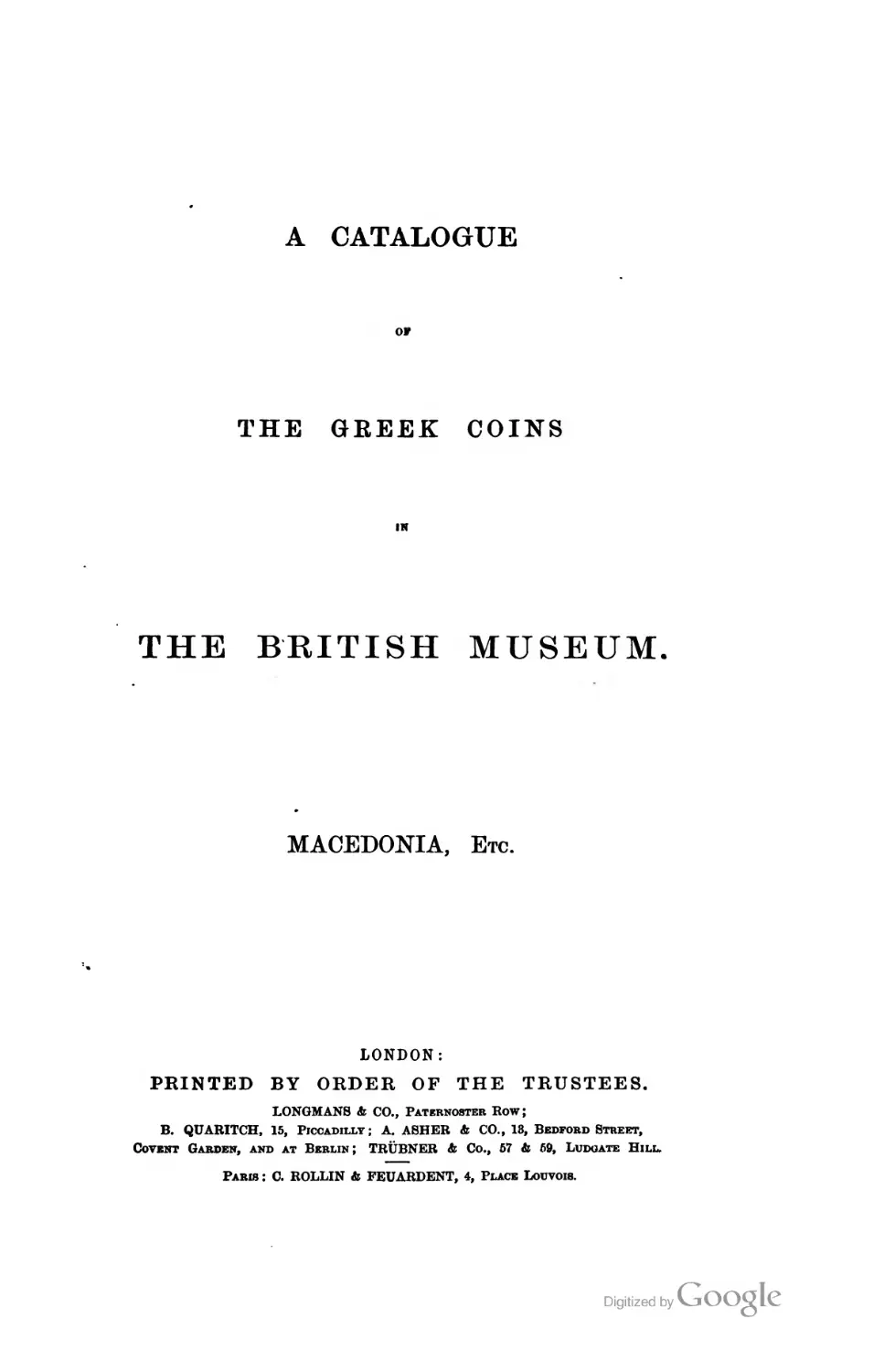
                    A CATALOGUE
OF
THE GREEK COINS
IN
THE BRITISH MUSEUM.
MACEDONIA, Etc.
LONDON:
PRINTED BY ORDER OF THE TRUSTEES.
LONGMANS & CO., Paternoster Row;
B. QUARITCH, 15, Piccadilly; A. ASHER & CO., 18, Bedford Street,
Covent Garden, and at Berlin; TRUBNER & Co., 57 & 59, Ludgate Hill.
Paris : C. ROLLIN & FEU ARDENT, 4, Place Louvois.
Digitized by v.ooQte
CATALOGUE OF GREEK COINS.
jij I uJJ
MACEDONIA, Etc.
BY BARCLAY V. HEAD.
EDITED BY
REGINALD STUART POOLE,
CORRESPONDENT OF THE INSTITUTE OF FRANCE.
WITH MAP.
LONDON:
PRINTED BY ORDER OF THE TRUSTEES.
1879.
Digitized by LnOOQte
PREFACE
This volume of the Catalogue of Greek Coins contains the money of
the Paeonian Kings, of the cities of Macedonia, of the independent
Thraco-Macedonian tribes, and of the Kings of Macedon who pre-
ceded Philip П. The coins of the later Kings from Philip П. to
Perseus will be necessarily included in a separate volume.
In accordance with Eckhel’s system, the coins of Macedonia in
genere have been placed before the coins of the cities, which latter
are in the usual alphabetical order. The alphabetical arrangement
is, however, repeated in the portion comprising the coins of the
Thraco-Macedonian tribes.
In the Introduction which has been prefixed to the Catalogue the
history of the coinage of Macedon is traced from its commencement
among the tribes of the Pangaean district in the sixth century b.o.
down to the time of Philip II., historical and numismatic notes upon
the coins of the various towns being added. In this Introduction an
attempt has been made to treat the subject at once historically and
geographically; the alphabetical arrangement followed in the Catalogue
has consequently been here abandoned wherever the requirements of
the case seemed to call for a more scientific classification. Thus, for
instance, in the Introduction, the Greek cities of the Chalcidice, &c.,
and the cities of Macedon Proper, are treated as distinct groups, and
the coins of Macedon as a Roman Province, which in the Catalogue
stand first, are placed in the Introduction in their historical order at
the end of the series.
Digitized by LnOOQte
PREFACE.
П
To facilitate reference to this Introduction, marginal headings have
been added.
In the Catalogue the metal of each coin and its size is stated in
inches and tenths. The weight in English grains is given of all gold
and silver coins. Tables for converting grains into grammes, and
indies into millimetres, as well as into the measures of Mionnet’s
scale, are placed at the end of the volume (pp. 198 sqq.)
The work has been written by Mr. Barclay V. Head, and I have
carefully revised it, comparing every coin with the corresponding
description.
REGINALD STUART POOLE.
Digitized by LnOOQte
CONTENTS
PAGE
Preface..............................................  .	.	. v
Introduction.......................................................xiii
§ 1.	The Pangaean District.
Thracian gold stater. Earliest silver staters. Orrescii,
Zaeelii, . . . naei, silver-coining tribes. Neapolis.
Parallel coinages of Neapolis and Thasoa. Change of the
standard, both at Neapolis and Thasos. Eion, early
electrum hecte and small silver coins attributed to . xiii
§ 2.	Extension of the Babylonic Standard towards the West.
Lete, Therma, Aegae, Ichnae, &c.
The coinage of Lete derived from that of the Pangaean
district. Coins of Therma ? of the Babyionic Standard.
Do. of Aegae. Do. of Ichnae..............................xviii
§ 3.	The Valley of the Lower Strymon.
Origin of the Greeco-Asiatic Standard in Macedon. The
Bisaltae. Mosses probably king of the Bisaltae. The
Edoni. Getas, king of the Edoni. The Odomanti. Der-
ronikos and Dokimos, kings of the Odomanti ?	.	. xxi
§ 4.	The Central District.
Therma. Coins of Therma ? of the Attic Standard.
Do. of the Grseco-Asiatic Standard .... xxv
Digitized by Google
contents.
viii
РЛВВ
§ 5.	The Greek Cities of (a) Chalcidice, and (0) the Parts
ABOUT THE StEYMON.
(a) Chalcidice. Orthagoria or Stageira, Аглае, Acan-
thus, Sane, Uranopolis, Terone, Sermyle, Olynthus, The
Chalcidian League, Aphytis, Scione, Mende, Potidaea,
Cassandrea, Eurydicea, The Bottiaeans of Chalcidice,
Dicaea, Aeneia .......	. xxix
(0) The Parts about the Strymon. Cerdylimn, Amphi-
polis, Tragilus or Traelinm. Daton, a district. City of
Baton, founded by CaHistratus at Crenides. Thasan
coins issued there: taken by Philip and called Philippi . xlii
§ 6. Kings of Macedos (Alexander L to Perdiccas HL), and the
Independent Kings of Paeonia.
Alexander L, B.c. 498-454; Perdiccas IL, B.c. 454-413 ;
Archelaus L, B.C. 413-399. The standard of the Macedonian
coins regulated by that of the coinage of Abdera. Kings
of Macedon, b.c. 399-389; Amyntas HL, b.c. 389-383,
and 381-389; Kings of Macedon, b.c. 369-359	. xlvii
Independent Kings of P^eonia. B.c. 359-286	Б
§ Г. Coens of Macedonia in genere, and of Cities. Autonomous
and Imperial.
Silver and copper coinage. b.c. 158-146. Coins of Mar^.
donia as a Boman Ptvvince, after b.c. 146. Coins of the
Impertal Period Amphaxinis, b.c. 158-146. Beroea,
The Bocmaeans of Kmathia». Viunx. Bdessa. Heraelea Sin-
taca, MeishemK PfcUa. PWna^ ТЬф>Ыопк*а	Ш
РЛВЖЕА.
Kings-
Емккеше
Пбгзо»
X tti ЬтТеоп-
Digitized by Tooele
CONTENTS.
IX
MACEDONIA-
Hl ♦
Macedonia in genere.. Before B.C. 144»	.	.	7
Macedonia as a Roman Province, After u.r. H6	Id
Gaius Publilius, Quaestor ....	17
L. Fulcinius, Quaestor	.	.19
Aesillas, Quaestor .....	19
Sura, Legatus pro Quaestoro	99
Macedonia in genere, Imperial Time»	99
Cities, Ac.
Acanthus..........................  39
Aegae or Edessa..........  .	3;
Aeneia .......	41
Amphaxitis.............	4^
Amphipolis......................... 43
Aphytis .......	v|
Arnae ........	9v>
Beroea .......	9^
Bottiaei Chalcidices .....	93
Bottiaei Emathiao	......	94
Cassandrea......................... 95
Cerdylium ?.	.	.	.	.	.	,	99
Chalcidice ........	99
Dicaea.................... .	<9
Dium ..........	70
Eion ?.............................7’Э
Eurydicea .........	75
Ichnae ..........	79
Lete................................79
Mende ..........	80
Neapolis (Datendn)..................83
Olynthus............................86
Orthagoria [Stageira]...............88
Ъ
Digitized by LnOOQte
X
CONTENTS.
MACEDONIA.—Cities, &c. ^continued).	PAGE
Pella		89
Philippi .........	96
Potidaea .........	99
Pydna 		101
Scione ..........	102
Stobi .	.	...	103
Terone ..........	106
Thessalonica	  .	108
Traelium [Tragilus] .......	130
Uranopolis			133
Uncertain Towns		135
THRACO-MACEDONIAN TRIBES. Bisaltae 		140
Mosses, King of the Bisaltae	.....	143
Edoni, Getas, King of the		144
Orrescii 			145
. . . NAEI 		148
Zaeelii		149
Uncertain Thraco-Macedonian Tribes ....	150
Derronikos ? King .......	150
Dokimos ? King ........	151
KINGS OF MACEDONIA. Alexander I.		156 '
Perdiccas II.	......	162
Arch elans I		163
Aeropus (Archelaus II.) ......	167
Amyntas II ?	168
Pausanias 			169
Amyntas III. ........	171
Perdiccas III. ........	175
Digitized by LiOOQlC
CONTENTS.
xi
INDEXES.
I. Geographical.................................................177
II.	Types..............................................179
III.	Remarkable Symbols................................189
IV.	A. Kings or Dynasts...............................192
IV	. в. Magistrates’ Names on Autonomous Coins .	193
V.	Roman Magistrates’ Names...........................194
VI.	Engravers’ Names ......	195
VII.	Remarkable Inscriptions and Legends .	.	.	196
Table of the relative Weights of English Grains and French
Grammes.................................................198
Table for converting English Inches into Millimetres and
the Measures of Mionnet’s Scale.........................200
Digitized by LnOOQte
COINAGE OF MACEDONIA, Etc.
INTRODUCTION.
§ 1. The Pangaean District.
The Mountain ranges between the Strymon and the Nestos, together
with the intervening valleys and plain, now called the plain of Drama,
drained by the river Angites and its tributaries, were, from the earliest
times of which we possess any record, the home of fierce Thracian
tribes, miners, who worked the rich veins of gold and silver with
which the mountains, especially the Pangaean range, abounded. On
the summit of Mount Pangaeum itself was the religious centre of the
whole district, the famous oracle of the Thracian Bacchus, whose
orgiastic rites were perhaps introduced in primitive times from
Phrygia, whence also the tribes of the Pangaean district must have
originally received the Babyionic silver standard, according to which
their earliest dealings in that metal were regulated.
It is not surprising that among tribes whose one staple of trade
was gold and silver, a currency should have been adopted as soon as
the idea reached their shores, which we may suppose it to have done
early in the sixth century b.c. from the parts of Asia Minor at that
time under the dominion of the Lydian king, Alyattes.
Thracian gold
stater of the Pan-
gaean district.
Accordingly we find a Thracian gold stater of the
Pangaean district which is without an inscription,
but similar in type to the coins of the Orrescii, &c.,
identical in weight with the gold staters of the north-western district
Digitized by CtOoqic
xiv
INTRODUCTION.
of Asia Minor of the time of Alyattes.1 The earliest Pangaean
silver money in like manner follows the same
Earliest silver	47
staters of the Pan- Babyionic silver standard as the coins of Croesus,
gaean district.	fypes on the other hand are purely Thracian,
the favourite subject for representation being a Centaur carrying off a
Nymph.
The Pangaean region with its port Neapolis and the Greek
island of Thasos, may, therefore, be looked upon as the starting
point of a coinage which gradually spread in a westerly direction,
probably by a route almost identical with that which the Romans
of later days called the Via Egnatia, to Lete, Therma,1 2 Ichnae,
Aegae, and thence, perhaps, even into the plain of the Haliacmon,
to which district, and not to Thrace, the coin of the Tynteni8
should perhaps be attributed, on account of its resemblance to the
coin of Ichnae, p. 76, no. 1.
The Orrescii, the Zaeelii, and the . . . naei, are the names,
Orrescii, Zaeelii,
... naei, silver-
coining tribes of
the Pangaean
range.
hitherto discovered, of the silver-coining tribes of
the Pangaean district. These peoples are not
mentioned in history, and are only known to us by
their money.
*They possessed, by way of the pass across Mount
Symbolon and the port of Neapolis (now Kavala), a direct communi-
cation with the opposite island of Thasos and the Aegaean, and by
the land-route already mentioned, which was afterwards followed by
the army of Xerxes, an easy means of commercial intercourse with
the Macedonian valleys. In this way alone can we account for the
extension of the Babyionic Standard over so large an extent of
country.
1 Num. Chron. N.S. Vol. XV. PL X. 11.
volume containing the money of electrum.
2 Zeit. f. Num. Vol. III. Pl. II. 3.
This coin will be catalogued in the
5 Zeit. f. Num. 1. c.
Digitized by LnOOQte
THE PANGAEAN DISTRICT.
XV
There w6re two towns called Neapolis on the northern shores of the
Aegaean, one in the peninsula of Pallene, near Mende,
Neapolis.
the other, the modern Kavala, opposite Thasos, in the
bay at the foot of Mount Pangaeum, commercially a place of great
importance, from its position at the only point where the great
military high-road through Thrace touches the sea, thus placing it in
communication at the same time with the interior, and, by sea, with
Greece.1
This is the town to which the plentiful coins reading NEOP must
be attributed. They cannot possibly be of the Mendaean Neapolis,
for all the early coins of the Chalcidian district are of Attic weight,
while these are of the same Babyionic Standard as the coins of the
Pangaean tribes of the interior and of Thasos.
Whether Neapolis was a colony of Athens or a dependency of
Daton,1 2 a continental settlement of the Thasians, has been disputed ;
the probability, however, is that it was originally a Thasian settle-
ment, and subsequently tributary to Athens, and in great part occu-
pied by Athenians, who took up their abode there for the purpose of
deriving profit from the rich mines of Mount Pangaeum.
The type of the coins of Neapolis, the Gorgon-head, is, however,
no evidence of Athenian origin, for it is now all but certain that the
coins of this type commonly assigned to Athens are in reality coins of
Eretria in Euboea.
Parallel coinages
of Neapolis and
Thasos.
The coinage of Neapolis commences probably
before b.c. 500, continuing in an unbroken series
down to the time of Philip. In fabric there is a
striking similarity to the coins of Thasos (cf. Cat. Gr. Coins,
Thrace, pp. 216 sqq.), noticeable both in the obverses and in the
incuse reverses of the earlier coins, and continuing down to the
1 Heuzey, Mission Archeologique de Macedoine, p. 12.
2 Strab. VII. Fragm. 36.
Digitized by
Google
xvi
INTRODUCTION.
time when the two places cease to coin money. The early coins of
both follow the Babyionic Standard of the mainland, which, afterwards,
develops a tendency to merge into the Attic. (Cf. the staters of Thasos,
1. c. nos. 29—31, and the drachm of Neapolis, no. 8. It is remark-
able that both this last coin and the Thasian stater, no. 29, have the
same letter A on the obverse. As the two coins are clearly con-
temporary, this may probably indicate a very close connection between
the two mints, which may have been both, for a time, under one
and the same magistrate.)
In the Athenian tribute-lists1 this Neapolis is distinguished from
other towns of the same name by the addition of тгар 'Avrurdpav,
and is assessed constantly at 1,000 drachms.
About b.c. 411, as nearly as we are able to judge, owing perhaps
to the change in the political constitution of the island, the coinage
of Thasos is entirely renewed, both as to type, standard, and
fabric.2 A similar change takes place in the coin-
The Gorgoneion, it is true,
remains the type of the obverse, but on the reverse
appears the head of a goddess who can be no
other than Nike. On the larger coins, she wears a wreath of
olive, on the smaller her hair is twisted up into a knot behind the
head. The worship of Nike, as Heuzey has shown,3 is clearly due
to the Athenian settlers who associated her with Athena, who, under
the name Parthenos, was the goddess especially revered at Neapolis,
where there was a temple erected to her, called, as at Athens, the
Parthenon, as we know from an inscription published by Heuzey.4
After Neapolis Elon was perhaps the most important
port on these coasts, as may be gathered from Herodotus,5
who says that Xerxes started thence for Asia on his return after his
Alteration of the
standard both at of Neapolis.
Neapolis and Tha-
808.
1 Kohler, Der Delisch-Attische Bund. p. 178.
3 L. c. p. 24.	4 L. c. p. 21.
2 Cat Gr. C., Thrace, p. 219.
• Lib. VII. 107, VIII. 118.
Digitized by LnOOQte
THE PANGAEAN DISTRICT.
XV ii
Early electrum
hecte and small
silver coins attri-
buted to Eton.
defeat at Salamis, and that he left behind him the Persian Boges as
governor of the town. The obstinate resistance of the latter against
Cimon circ. 470, and his tragical end, are among the few incidents
which Thucydides mentions during the interval between b.c. 477
and 466. “Eion,” says Grote,1 “was for Athens the first stepping-
stone towards the important settlement of Amphipolis.”
The attribution to Elon of the series of small silver coins having
for type one or two swans, generally accompanied by a lizard
(pp. 71-74), cannot be considered as certain. Mionnet2 gives them
to Heraclea Sintica: Cousinery* 8 to Eion, Thasos, or Amphipolis,
according as the letters H, 0, or A occur upon them. Borrell*
agrees with this conjecture.
Dr. J. Friedlaender has lately published8 an electrum hecte of the
same type weighing 40 grains, now in the Berlin Museum. This
shews that the place of mintage was a member of the monetary
league which issued such hectae, and almost certainly a seaport.
Taking into consideration, therefore, not only the early style but
also the Babyionic Standard of all these little silver
coins, it may be affirmed that they precede in date
the foundation of Amphipolis, and, as they have
been generally found in its neighbourhood, the
probability is that they were issued at Eion, a place which after
437 became secondary to Amphipolis, after which it is not likely
to have had a separate mint.
1 Ch. XLV.	s Suppl. IIL 78.
8 Voyage dans la Macedoine, Vol. II. p. 166.
« Num. Chron. Vol. III. p. 138.	6 Zeit. f. Num. Vol VI. p. 8.
c
Digitized by Google
xviii	INTRODUCTION.
§ 2. Extension of the Babylonic Standard towards the West.
Lete, Therma, Aegae, Ichnae, &c.
The exact site of Lete has hitherto been a matter of some uncer-
tainty, but is now fixed by a long and important inscription1 which
has lately been discovered at the village of A’ivati (the Khaiv£t of
Leake).1 2 Lete therefore stood at the issue of the glen leading
through the Dysoron ridge of mountains, which overlooked the
plain of Therma at a distance of from two to four hours’ journey
northwards from that place, according as the distance is calculated
by the traveller descending or ascending. The inscription in ques-
tion was set up in b.c. 117 by the Senate and people of Lete in
honour of M. Annius, Quaestor of Sextus Pompeius, Praetor of the
Province, for having repulsed the combined forces of the Gauls and
Maedi, and relieved the district threatened by those barbarians.
Leake’s conjecture as to the site of Lete,3 which he places farther
east, north of Lake Bolbe, is thus proved to have been erroneous.
The rich coinage of a town so little known to history as Lete may
be accounted for by the fact that, there were silver mines, if not
near Lete itself, in any case at a distance of only about 80 miles
from it, which, as Herodotus tells us,4 yielded to Alexander I.
of Macedon, at a later period, as much as a talent of silver daily.
The most direct route from these silver mines, as well as from the
Pangaean district, into Macedon, at the time concerning which
Herodotus was writing, lay through the pass of Mount Dysoron
where Lete was situate.
1 Archives des Missions Scientifiques et Litteraires. S6r. III. Tom. III.
pp. 276 sqq.
2 Northern Greece, Vol III. 234.
8 L. c. 462, and Map at end of Vol. HI.	4 Lib. V. 17.
Digitized by LiOOQlC
EXTENSION OF -THE BABYLON1C STANDARD.
xix
The coinage of
Lete derived from
that of the Pan-
gaean district.
It is thus evident that the Baby Ionic Standard of the coins of
Lete is derived from the Pangaean district, although
they probably obtained their silver from the moun-
tains nearer at hand.
When Alexander I. took possession of all this
region he appears to have monopolized the right of striking money,
for the coins of Lete are all of the archaic period, none being
in appearance later than about B.c. 480, while many are certainly
anterior to 500.*
' This- coinage is remarkable as illustrating the cultus of the rude
inhabitants of the mountain ranges to the north of the Chalcidic
peninsula. It is closely allied, both in style, fabric, and weight, to
that of the Orrescii and the other tribes who possessed the mines of
Pangaeum, which was the original seat of the worship of the wild
forces of nature, symbolized by the orgiastic rites of the Thracian
Bacchus and his following, Centaurs, Satyrs, Maenads, &c., which
afterwards spread over Greece.
The letter or symbol © on no. 16 may be compared with the same
mark on a coin attributed to Aegae (p. 37, no. 3), and on another
without inscription, already referred to,1 bearing the types of the
coin of Ichnae. This symbol has, by some, been taken for 0,
and the coins which bear it attributed to Therma, an opinion
which is not too hastily to be cast aside, as it is to be inferred
that Therma must have coined money, and none is known which
bears its name.
Coins of Therma ?
of the Babyionic
Standard.
Hence it does not seem intrinsically improbable
that these coins, which bear the types of the money
of cities within easy reach of Therma, together with
the letter© (if it be a 0), may have been issued at Therma. The
1 Zeit. f. Num. III. Taf. II.
Digitized by Google
XX
INTRODUCTION.
question of the other coinages attributable to Therina will be noticed
later (pp. xxv. sqq., infra)»
None of the coins attributed to Aegae are probably much earlier
than the accession of Alexander I., b.o. 498. The type of
6gae’ the kneeling he-goat recalls the Earanos myth, and is at
once the badge of the royal house of Macedon, and the type parlant of
their citadel Aegae or Edessa. The staters of the goat series generally
bear letters in the field, as Д perhaps for Edessa, and ЛА, АЛТ0,1
for Alexander. It is said, indeed, .that there is or Vas a coin in the
collection of Baron Tecco which has Alexander’s name entire. The
The coinage of
Aegae, on the Ba-
byionic Standard.
Its derivation.
standard of this coinage is the Babyionic, which,
as has been remarked above, must have found its
way into the highlands of Macedon by way of the
Lydias valley from Lete and Therma, whither it can
only have been conveyed by the land-route through the passes of
the Dysoron range, from its starting point in the Pangaean mining
district.
When Alexander I. acquired the Bisaltian district with its silver
mines, circ. 480, he changed both the type and the standard of the
Macedonian coinage, adopting that which was already in use among
the Bisaltae. The coins of Aegae with goat-types are therefore all
probably anterior to b.c. 480.
Ichnae, in Lower Macedonia, lay between the Axius and the Lydias,
not far from Pella. Herodotus2 mentions it as one of the
Ichnae.
towns of the district in which the army of Xerxes halted
before advancing southwards into Greece. The type of the unique
coin (p. 76),8 a Macedonian warrior holding a prancing horse by the
bridle, is found also on other coins of the same Babyionic Standard,
one of which bears tho inscription TVNTENON, and another the
1 Prokesch-Obten Inedita, 1859.	3 Lib. VII. 123.
3 See also Bompois, in Num. Chron. N.S. Vol. XIV. p. 178.
Digitized by LnOOQte
EXTENSION OK THE BABYLONIC STANDARD.
xxi
letter or symbol
Coinage of Ich-
nae, Ac. Pangaean
both in type and
standard.
0.1 The earliest occurrence of the type is on
coins of the Orrescii (p. 146). All these, except
the last mentioned, have a wheel on the reverse,
and belong to the low-lying district about the head
of the Thermaic Gulf. The date to be assigned to
them is the earlier part of the fifth century b.c., probably before
480, when Alexander I. first struck money in his own name on
the Grseco-Asiatic Standard, which then, for the most part, super-
seded the local currencies regulated by the Babylonic Standard of
the valleys of the Haliacmon and the Lydias—Tynteni, Ichnae,
Aegae, &c.
§ 3. The Valley of the Lower Strymon.
Side by side with the Babylonic Standard, which, originating (in
Europe) among the tribes of the Pangaean range, spread westwards
as far as the plains of Lower Macedon, other influences were at work,
• which ultimately resulted in a change of standard throughout the
Macedonian kingdom.
Abdera, by far the most important city on the coasts of Thrace,
had received from Teos a coinage totally different in style, fabric, and
standard from that of Thasos and the Pangaean district. By way of
the valleys of the Nestos and the Strymon, the
large flat coins of Abdera, weighing about 455
grains (octadrachms, of the Graeco-Asiatic Stan-
dard), found their way among the tribes called the
Bisaltae and the Edoni.
The first of these, a powerful people, probably of Pelasgian origin,
Origin of the
Greco - Asiatic
Standard in Mace-
don.
1 Zeit. f. Num. Vol. III. Taf. II.
Digitized by LnOOQte
ххп
INTRODUCTION.
occupied the tract of land west of the Strymon including the
.	metalliferous, mountains which separate the valley of
the Strymon from the territory called Mygdonia; the
Crestonians, to the west of the above-mentioned range, having
become amalgamated with the Bisaltae, under a Thracian ruler,
before the Persian wars?
The coins of the Bisaltae, when inscribed, offer certain epigraphical
peculiarities, such as C and < for B, besides the ordinary form of the
letter, h and L for A, which are worthy of note. When uninscribed,
it is difficult or impossible to distinguish them .from uninscribed
coins of Alexander I. of Macedon, who, after the retreat of the
Persians, acquired the whole Bisaltian territory as far as the Strymon,
with its rich silver mines, and adopted the types of the Bisaltian
coinage for his own money.
As the coins bearing the inscription MOSSEQ are identical in
„ v v, type with the coins of the Bisaltae, it is reasonable
Mosses, probably .	-
a king of the ' to suppose this ruler to have been a Bisaltian king,
Bisaltae.	p^^y^ immediately preceded Alexander I.
He may, in fact, have been the very king of whom Herodotus2 relates
that he put out the eyes of his six sons to punish them for joining
the army of Xerxes. Some of his coins approximate in weight to
drachms of the Attic Standard.
The Edoni, a Thracian people, were in early times driven from the
plains north of the Chalcidice across the valley of the
The Edoni.
Strymon, by the rising power of the Macedonian king-
dom. They then took up their abode to the east of Lake Cercinitis,
on the Lower Strymon, where the town of Myrcinus became their
chief centre, and remained so, except during the brief interval when
Histiaeus of Miletus held it (circ. 513), down to the year b.c. 424,8
when it was declared free by Brasidas.
1	Herod. VIII. 116.
2	L. с. .
3	Thucyd. IV. 107.
Digitized by LnOOQte
THE VALLEY OF THE STRYM0N.	XYlii
The Coins which bear the name of Getas, King of the Edoni, are
octadrachms of the Graeco-Asiatic Standard, and as
the^onf^ °f ^еУ (tbe only two known), were both found in the
Tigris, we may presume that they were conveyed
there by the Persians, to whom the Edoni had been tributary. The
type of these coins is a man guiding a yoke of oxen. From the
Edoni, therefore, it is probable that their neighbours, the Orrescii,
derived the type of their Graeco-Asiatic octadrachms (pp. 145 sq.,
nos. 1 and 2), which correspond in no respect with the ordinary
Babyionic staters of the same people, already noticed. .
The Odomanti were a tribe inhabiting the present plain of Serres,
to the east of the Strymon, separated from the
The Odomanti.
territory of the Edoni by the river Angites. Hero-
dotus1 says that they were not subdued by Megabazus, and that
when Xerxes marched through the Pangaean district, the Odomanti
were among the tribes who worked the gold and silver mines of that
mountain.2 M. Desdevizes du Ddsert8 identifies the Odomanti with
the Bessi, who possessed the oracle of Bacchus on Mount Pangaeum.
M. Bompois4 was the first to attribute to this people the following
series of Coins, of which the British Museum now possesses two
specimens:—
. .	‘	(a) Inscribed. .
1.	Obv. ОЯЯЭД Man holding caduceus, guiding a yoke of
oxen r., attached to a wheel (plough ?).
Rev. Quadripartite incuse square.
Wt. 625 grs.
[Cab. de France. Rev. Arch. 1866, Pl. I. 6.J
1 V. 16.	3 VII. 112.
3 Geogr. ancienne de la Macedoine, p. 83.
4 Revue Archeologique, 1866,
Digitized by VnOOQte
xxiv
INTRODUCTION-
2.	Obv. AEPPONIKO^ Yoke of oxen dragging a wheel
(plough ?) 1.; in front, a large pellet surrounded by
dots, above, another pellet surrounded by a linear
circle.
jRev. Similar to no 1.
Wt. 533 grs.
[Cab. de France. Mus. de Luynes. Rev. Arch. 1866, Pl. I. 5.]
3.	Obv. ОЧЧЭ A Bearded man holding whip, in chariot with
archaic wheel drawn by two oxen r.
Rev. Similar.
Wt. 596*3 grs.
[Cab. de France. Rev. Arch. 1866, Pl. II. 2.]
4.	Brit. Mus. Described in Cat. infra, p. 151, no. 2.
(f) Uninscribed.
5.	Brit. Mus. Described in Cat. infra, p. 150, no. 1.
6.	Obv.) Similar to p. 150, no. 1, but no flowers between the
Rev.) legs of the triquetra on the rev.
[Once in the Coll, of Mr. Cumberbatch.—Newton, Travels in the Levant,
Vol. II. p. 24, no. 1J
} Similar, but no flower under the oxen.
Wt. 530 grs.
[Cab. de France. Mus. de Luynes. Rev. Arch. 1866, PL П. 4.]
8. Obv. Similar, but rosette in place of helmet, and beneath
Rev. J oxen a wing ?
[Christchurch Library, Oxford. Newton, 1. c. no. 2.]
9. Obv. Similar to no. 5.
Rev, Female head in crested helmet.
Wt. 536 grs.
[ColL of M. Gilet, late French Consul at Salonica. Newton, 1. c. no. 3.]
Digitized by
Google
THE VALLEY OF THE STRYMON.
XXV
The Derronikos of the above inscribed coins was probably one of
_	„	_ the kings of the Odomanti, as may also have been
nerronixot ana
Dokimos! kings the Doki ... of the series p. 151, nos. 1-5, which
of the Odomanti!	reverse a helmet identical with that
which is seen above the oxen on the larger coins.
The whole of this coinage follows the same Graeco-Asiatic Stan-
dard as the coins of Getas, King of the Edoni, and it probably
belongs to the same period.
It is worthy of note that the sides of the chariot on some of the
best preserved specimens appear to be made of wicker work. Per-
haps this may serve to illustrate what Homer1 means by the epithet
НИгХекгос as applied to a chariot. The wheels of the chariots on
these coins are also of a peculiar type, found elsewhere only on
certain coins of Etruria (Cat. Gr. C., Italy, pp. 12, 17). Hence
M. Bompois* conjectures that the two peoples may have originally
belonged to one and the same stock.* 3
§ 4. The Central District.
It is to this district, east of the Axius and north of Chalcidice, that
the coins classed as uncertain, pp. 135 sqq., nos. 1-13, belong. They
were, I believe, all found at or near Salonica, but whether they were
all struck at Therma it is not possible to affirm with certainty,
although it seems by no means improbable. The central position of
Therma threw it of necessity into communication, both by
Therma.
sea and land, with various cities and tribes using money
struck according to various standards, Babyionic, Attic, and Grceco-
1 II. XXIII. 335.	’ Rev. Arch. I860.
3 The affinity in race between the Etruscans and the Pelasgi of Thrace
(cf. Thucyd. IV. 109) is discussed by A. S. Murray in the Cmitemyorwry /Ыю,
Oct. 1875, p. 720; and in the Encycl. Brit., 9th edition, s. v. Etruria.
also Millingen, in Trs. R. S. L., ii. p. 86, as to the frequent occurrence of names
ending in cricoi both in Italy and in Thrace.
d
Digitized by
Google
xxvi
INTRODUCTION.
Asiatic. It is, therefore, not unlikely that coins of all three stand-
ards may have been issued at Therma, though, perhaps, not simul-
taneously ; Although among the Orrescii (p. 146) two standards, the
Babylonic And the Graeco-Asiatic, appear to have been actually in use
at one and the same time.
The original settlement of Therma was due either to Corinth,
Eretria, or Chaicis.1 It owed its name to the warms springs withili
the precincts of the city.2 At the time of the Persian wars it was
already an independent town of some importance, but at a subsequent
period, precisely when it is impossible to say, it became subject to
the kings of Macedon.
Any coins, therefore, which are to be assigned to Therma must
belong to the earliest period, while the city was as yet unsubjected to
the yoke .of the Macedonian monarchs.
Some such pieces, classed to Aegae and Lete (pp. 11 and 78), having
the letter ? 0 upon them, have been already noticed (p. xix.), but the
question whether Therma may not also have coined money with
types of its own—whether, in fact, some of the coins classed among
the uncertain may not belong to Therma—remains to be considered.
Whatever the origin of Therma, Corinthian or Euboean, its first
coinage would probably be regulated according to the Euboic-Attic
weight. This may be assumed from the analogy furnished by the
coinages of the cities of Chalcidice. Nevertheless, it is with hesita-
„ .	. tion that I would venture to attribute to Therma a
Coins of Therma I
on the Attic Stan- very rare tetradrachm weighing 261’2 grs. (p. 135,
*****	no. 1), and of a fabric resembling that of the coins
of Lete, but of finer and more careful execution. In short, the art ap-
pears to be archaic Greek rather than Thraco-Macedonian. The type,
two women (or nymphs ?) carrying water in a two-handled vase, is
peculiarly suggestive of the springs from which Therma took its name.
________. -___ J ___________________________________
1 Tafel, De Thessalonica, p. 7.	3 Tafel, 1. c. p. 13.
Digitized by
Google
THE CENTRAL DISTRICT.
xxvii
No. 2 (p. 186) > is опё of the most remarkable coins in the whole
ancient Macedonian series. It appears also to be of. the Attic
Standard, but it has lost some ten or more grains in weight.
Who or what the winged running figure may be intended to
represent—Hermes, a Wind-god, or possibly one of the Cabiri, who
are sometimes winged1—it would be hazardous to assert.
The provenance of the coin, no less than the style and the
symbol О held by the figure, all point to the neighbourhood of
Therma, perhaps to Therma itself.
Another series of early coins, also classed among the uncertain
of Macedon (p. 138), may also, perhaps, be assigned to Therma,
but they belong to a period somewhat later. Both in weight, fabric,
„ .	• and type, they are entirely different from the coins
on the Graeco-Asia- above described, but nevertheless it is possible
tic standard. that mfty ^ejong Therma. The Grseco-
Asiatic Standard was, as we have seen, adopted by Alexander I. of
Macedon, when he possessed himself of the Bisaltian silver mines
(circ. b.c. 480). Supposing Therma to have been at this time still
outside the limits of the kingdom of Macedon, although of necessity
from its position in close commercial intercourse with the interior,
nothing is more probable than that a corresponding change of
standard may have been effected in its coinage as had been brought
about by Alexander in the royal coinage of Macedon. Thus the
Grseco-Asiatic Standard may have taken the place of the older
Euboic and Babyionic weights at Therma, just as in Macedon Proper
it supplanted the original Babyionic Standard.
Simultaneously with this change in the weight of the coins a
corresponding change in their fabric is noticeable. The more
ancient globular and somewhat lumpy coin is, on this hypothesis,
1 Concerning the worship of a single Cahirus at Thessalonica, see F. Lenor-
mant in Daremberg’s Die. des Antiq. s. v. Cabirus.
Digitized by LnOOQte
xxviii
INTRODUCTION.
replaced here, as elsewhere, by coins more flat and of larger dimen-
sions (cf. p. 135, no. 1, with nos. 3 sqq.1)
And now as to the type. The Pegasus, which is characteristic
of the series of coins in question, is also not inapplicable to
Therma, supposing that city to have been a colony of Corinth,
and to have maintained a lively remembrance of its origin and
friendly relations with the mother-city, as was generally (but with
the notable exception of Corcyra) the case with the colonies of
Corinth.
On the other hypothesis, that Therma was not a colony of Corinth,
the presence of Pegasus on its coins might, perhaps, be accounted
for in another way. The Greeks, from the earliest times, connected
the idea of Щуастос with iriiyat, springs, and fabled him to have
been born beside the springs of Okeanos.
IJuyatroc 17ПГОС
p.lv lirwvvjULOv от ap ’Qkeovov irepi wijyac
ytvO\—Hesiod. Theog. 281.
He is also said to have produced the fountain Hippocrene by striking
the ground with his hoof. Thus the type of Pegasos might be
symbolical of the spring of Therma.
Nos. 14-16 were also found at Salonica, but there is nothing to
lead us to suppose that they were struck there. No. 14 is extremely
archaic in style, and may be attributed conjecturally to Potidaea.
Nos. 15 and 16 are of more recent style, and belong, perhaps, to
the reign of Perdiccas П. (cf. p. 161, nos. 26-29).
In brief, therefore, the coins which I think may (of course only
conjecturally) be attributed to Therma are the following:—
1 For a similar change of fabric, cf. the coins of Aegae, of the Babyionic
Standard, with those which Alexander I. struck after 480, probably also at
Aegae, p. 37 and p. 156.
Digitized by
Google
THE CENTRAL DISTRICT.
xxix
(L) Before b.c. 480.
(a) Attic Standard.—Tetradrachm, type, Two nymphs
carrying amphora (p. 185, no. 1),
Didrachm, type, Winged figure (Cabi*
rus ? p. 186, no. 2).
(/j) Babylonic Standard.—Staters, types of Lete (p. 78,
no. 16), Ichnae (Zeit. f. Num. III. Pl. II. no, 8),
and Aegae (p. 87, no. 8), with symbol or letter © in
field.
(ii.) After b.c. 480 ?
(y) Grseco-Asiatic Standard.—Coins with Pegasus types
(p. 186, nos. 8-18).
§ 5. The Greek Cities of (a) Chalcidice and (/3) the Parts
about the Strymon.
(a) Chalcidice.
Commencing with the eastern shores of the promontory of Chal-
cidice, and taking the towns in order from east to west as they, stand
upon the map, the first town we come to of which
Orthagoria or we ^ауе cojns Orthagoria, which Eckhel,1 on the
Stageira.
authority of a fragment of the Geographi Minores,2
identifies with Stageira on the Strymonic Gulf. Pliny, on the other
hand (IV. 11, 18) says that Ortagurea was an ancient name of
Maronea.
Stageira, while tributary to Athens, was assessed at 1,000
drachmae,2 but if it struck money under the name of Stageira, none
is now known. The coins reading OPOAFOPEXIN are not of an
1 Vol. IL p. 73.	2 Vol. IV. p. 42, ed. Hudson.
3 Corpus Inscriptionum Atticarum, ed. Kirchhoff, Vol. I p. 231.
Digitized by
Google
XXX
INTRODUCTION).
early period, as is clear from their style.. In.weight, also, >they
correspond with the coins of the kings of Macedon from the time
of Archelaus to that of Perdiccas III., 413-359, as well as with
the contemporary coins of Abdera and Matonea;1 which two im-
portant cities were probably the first to change the standard of their
coinage from Grseco-Asiatic to Persic, their example being soon
followed by Archelaus of Macedon. For the commercial reasons
Which brought about this remarkable change in the weight of these
Thracian and Macedonian coinages, see Brandis, p. 223.
Amae is supposed by Leake2 to be the same as the place called
Kalarna by Stephanus. It was situate, about a day’s
Amae.
march sopth of Aulon and Bromiscus. The only known
coins of this place are of the time of the Chalcidian Confederacy,
of which it was doubtless a member.
The earliest coins of Acanthus are, in all probability, anterior to
b.c. 500. The peculiar manner of representing the
Acanthus.
lion’s skin (no. 1) by means of small dots or pellets
is characteristic of very early work. The tetrobol (no. 8) is a coin
also of the earliest period. The Attic Standard of these coins is
not necessarily to be ascribed to the influence of Athens. It occurs
at the following places, all situate in the Chalcidic peninsula:
Acanthus, Terone, Sermyle, Olynthus, Scione, Mende, Potidaea,
Dicaea, and Aeneia, colonies for the most part from Euboea (Chaicis
and Eretria) and Corinth, the only exceptions being Acanthus, which
was a colony of Andros, and Scione which called itself Achaean,
and traced its origin to warriors returning from Troy. The term
Euboic may, therefore, be appropriately used to designate this coin
standard, and is in some respects preferable to the term Attic, The
latter has, however, been retained in the Catalogue, as it is generally
better understood.
1 Cat. Gr. Coins, Thrace, p. 72 and 125.	2 Northern Greece, Vol. III. 170.
Digitized by
Google
CHALClDtCE.
/ХХХ1
' Some' of these cities, the coinage of which, at the time of the
expedition of Xerxes, was, as we havO seen, regulated according
Ло the Euboic Standard, subsequently, when they came under
the dominion of Athens, ceased to coin money, and others, such
as Acanthus, .Terone, Olynthus, and Aeneia, exchanged, probably
about the time of Brasidas, the Attic Standard for the Graeco-
Asiatic.
. This change of standard is accompanied at Acanthus by a marked
change of style (see p.. 34, no. 22), and by the. frequent addition of
the name of a'Magistrate.
The smaller coins of this period (nos; 29-39) have been attributed
to various cities, but the. letters AKAN visible, though almost
obliterated, on the reverse of nb. 39, are .strong evidence of their
being all. coins of Acanthus.
- The issue of large silver money at Acanthus probably came to an
end about the time when Olynthus began to strike money in large
quantities in the name of the' Chalcidian. League, circ. b.c. 392-379.
Only a few small coins of Acanthus, also bearing Chalcidian types,;
Obv. Head of Apollo, Rev* Lyre, are known.
The copper coinage Of this city was not of long duration. . The
principal type occurring Upon it is a wheel, which tenders it probable
that some of the uncertain silver Money (p. 154, nos. 15-21) bear-;
ing this type may also have been struck atfAcapthus, though at an
earlier period.	•	\	.
There were two towns in Chalcidice called Sane, one, a colony of
Andros, on the isthmus which unites the peninsula of
Athos to the mainland, the other in Pallene. To the latter
no coins have ever been attributed, but to the former M. F. Lenor-
mant (Rev. Num., 1864, p. 174), and with him M. Bompbis, ascribe,
a curious tetradrachm in the French Collection, having on the obverse
a female head of archaic style, wearing a diadem of pearls, and on
the reverse an incuse square divided into four parts. At the, back of
Digitized by
Google
xxxii
TNTRoDUCTlON.
the head M. Lenormant secs fugitive letter" which he reads MAN
(EAN). The piece is very thin, much spread, and slightly concave on
the reverse. As, however, the weight (214 grs.) .s not according to
the Attic Standard, as it undoubtedly would be were the coin of a
Chalcidic city, it is impossible for me to accept M. Lenormaut’s
attribution. M. Chubouillet likewise informs me that neither he
nor any of his colleagues has ever been able to discern the letters
MAN., and that in his judgment the piece is certainly unhiscribed.
The form M for E is, moreover, not found in these parts.
I rannpolis, according to some critics, occupied the site of the
above-mentioned Sanfc. on the Singitic Gulf.
Uranopolis.
Others, however, with perhaps greater probability,
place it on Mount Mhos itself, and identify it with Acroathon.1 It
is mentioned only by Pliny2 and Athenacus,8 the hitter of whom
informs us that it was founded by Alcxarchns, the brother of Cas-
sander, and that he invented a new dialect for the use of the citizens,
which he employed even in his ofliiial communications with other
states. Athenacus'* * quotes one of his letters written in this strange
argon to the magistrates of Cassandrea. Among the. new' words
which Athcnaeus cites as having been coined by Alexarcbus is
ир-уарц* for cpnyjn;. The inscriptions on the. coins, OYPANIA.QN
and OYPANIAQN ПОЛЕПХ instead of OYPANOnOAITHN,
arc- very remarkable, and may be due to the influence of Alexarcbus.
The weight-standard of the coins of tin’s city is extraordinary;
the silver stater iu the Berlin Museum weighing 209 grains, and the
coneepoudiug drachm in the British Museum 107’4 grains.
The occurrence of the Grieco-Asiatic Standard in Macedon after
Alexander the Great is unprecedented, and may also be duo to Alex-
nn-hus. The coin-types of Ггапоропа, Aphrodite Urania and the
1 Muller, Num. d’Alex, le Gwind, p. 140.
• Ш. 20.
a IV. 17.
* L. c.
Digitized by
CHALC1DICE.
xxxiii
heavenly bodies, seem to point, as Friedlaender has remarked,1 to
a town placed on an eminence.
Terone or Torone, on the Sithonian peninsula, was one of the
most flourishing of the Chalcidian colonies.
Terone.	...
Its earliest coins are of the Attic Standard, no. 1 being
restruck on a contemporary coin of Acanthus. During the expedi-
tion of Xerxes it was one of the towns which furnished ships and
men to the Persian armament,2 and some of the silver money of this
city also found its way into the military chests of the Great King,
for the remarkable coin reading £ was discovered in Egypt
together with two other Macedonian coins of the same early period
(pp. 141, no. 8, and 151, no. 2). These coins could hardly have got
to Egypt except in the train of a Persian army.
The letters H on p. 107, no. 3, however they may be
explained, cannot affect the attribution of the coin to Terone.
Whether the H is in this case an aspirate, and whether it is
possible for an aspirate to take the place of a T, etymologists must
determine. The coin may be compared with the one engraved in
Mionnet, Suppl. III. Pl. VIII. 6.
During the period of the Athenian Supremacy, Terone does not
appear to have struck any larger denomination than the tetrobol, but
that it was an important town may be inferred from the amount of
tribute which it paid to Athens, viz., from 6 to 12 talents annually.
The coins of this period are nos. 7 and 8.
In b.c. 424, Terone opened its gates to Brasidas, but in 422 it
was recovered for Athens by Cleon. As at Acanthus and some other
cities, so also at Terone, about this time the Attic Standard is
exchanged for the Graeco-Asiatic, to which nos. 9 and 10 belong.
Both these coins, judging by their style, are previous to about 420,
after which time Terone does not appear to have coined money.
1 K. Munzkabinet, p. 111.	2 Herod. VII. 122.
'	e
Digitized by
Google
xxxiv
INTRODUCTION.
In common with the greater number of the Chalcidian cities,
Terone was subsequently a member of the Olynthian Confederacy,
after which it was once again brought under the dominion of Athens
by Timotheus, and finally, about b.c. 358, conquered by Philip.
To Sermyle, at the head of the Toronaic or Sermylic Gulf, no
coins were attributed until the Berlin Museum recently
Sermyle.
acquired a remarkable tetradrachm of this city, having on
the obverse <EPMVAIKON and a naked horseman galloping to r.;
in his raised right hand he holds a spear, and beneath his horse is a
hound running to r. On the reverse is a quadripartite incuse square.
The weight is 260 grs.1 The date assigned to it by Dr. J. Fried-
laender is about the year b.c. 500.
Olynthus, at the head of the Toronaic Gulf, between the two penin-
sulas of Pallene and Sithonia, originally colonized from
Olynthus.
Chalcis in Euboea, subsequently, about the time of the
Persian wars, fell into the hands of a Bottiaean force. They, how-
ever, only occupied it for a time, for in b.c. 479, Artabazus, on his
return from*the Hellespont, after the retreat of Xerxes, besieged
them and put them to death on the banks of the neighbouring lagoon
or marsh called Bolyca,2 3 delivering up the city again to the Chalci-
dians under Critobulus of Terone.
The coinage of Olynthus begins at an early date, probably as early
as about b.c. 500, if the tetradrachm attributed by me to it in the
Numismatic Chronicle* be accepted as in reality a coin of Olynthus.
The next in order of date is the tetradrachm p. 85, no. 1. On both,
the obverse-type is a quadriga ; the reverse of the second as well as
of all the smaller archaic coins of Olynthus being a flying eagle,
adopted probably from the coinage of the mother-city Chalcis.4
The quadriga on the Olynthian coins may perhaps be also a develop-
1 Zeit. f. Num. 1878, p. 235.	2 Herod. VIII. 127; Athen. VIII. c. 3.
3 N.S. Vol. XVIII. p. 85.	4 Zeit. f. Num. 1876, p. 217.
Digitized by
Google
CHALCID1CE.
XXXV
ment of the idea symbolized by the wheel which marks the obverse of
all the early coins of Chaicis in Euboea. Both the wheel and the
quadriga are recognized agonistic types/ and perhaps contain an
allusion to an Olympian victory gained by some citizen in very early
times. The horse standing beside a column (meta), p. 87, no. 3, is
also agonistic.
Olynthus, while tributary to Athens, was rated at 2 talents,1 2 which
is considerably less than the sum paid by its near neighbour Potidaea,
viz., 6 to 15 talents. But after b.c. 433, a great accession, both of
population and territory, was made to Olynthus by Perdiccas II.
of Macedon, who persuaded the Chalcidians of the neighbouring
small towns to concentrate at Olynthus, thus laying the foundation
of the famous Chalcidian Confederacy. They then, at the instigation
of Perdiccas, revolted from Athens, but, by one of the articles of the
Peace of Nicias, b.c. 421, it was agreed upon that they should be
again restored to Athens, retaining, however, their autonomy on con-
dition of paying tribute to Athens according to the assessment of
Aristides?
The coins of Olynthus follow the Attic Standard down to the time
of the formation of the Chalcidian League, b.c. 392. The standard
then adopted was the Graeco-Asiatic. The coins
The Chalcidian of ^.g c|agg jlave inscriptiOn XAAKIAEQN
League.
only, always on the reverse, with the exception of
p. 87, no. 5, which has, in addition, the name of Olynthus on the
obverse.
The coinage of the Chalcidian Confederacy, b.c. 392-379, under
the leadership of Olynthus, is, after that of Amphipolis, most
valuable for the history of Greek art in the north.
1 R. S. Poole, in Transactions of R. S. L., N.S. Vol. X. Pt. 3.
2 Corp. Inscr. Att p. 230.	3 Grote, Hist. Gr. Chap. LIV.
Digitized by
Google
XXXVI
INTRODUCTION.
The heads of Apollo on some, both of the gold and silver coins,
are of extreme beauty.
Although the League received a severe blow in b.c. 379, when
the Lacedaemonians sent an army against Olynthus, and succeeded,
after several campaigns, in reducing the city to submission, never-
theless there is no evidence that the coinage ceased altogether in
379. The differences in style and fabric exhibited by the coinage of
the Chalcidians lead us, on the contrary, to suppose that it may
have been continued even down to the time of Philip.
The gold coinage of the Olynthian League may, indeed, have
suggested to Philip the far more extensive currency in the same
metal, instituted by him and issued from all the principal cities of
his empire.
The Chalcidian gold currency is regulated by the Attic Stan-
dard ; the coin cited by Brandis, pp. 535 and 206, in the Florence
Museum, as weighing 175 grains, or 9*29 grammes, weighs
in reality, according to Cavaliere G. Campani, the Director
of the Boyal Galleries at Florence, 8е6 grammes, or 133 grains
English.
Aphytis, on the east coast of the peninsula of Pallene, was
celebrated for its worship of Zeus Ammon.1 Xenophon2
Aphytis.	,	_ w w	э
says: Афьтшы cl ti/ulwhv Ap.p.wva ovSlv	ri ot
' Ащмлпны Aiflvwv.
Nos. 1-3 are of the period of fine <irt which preceded the time
of Philip П. Of the previous period, before the year 424, while
it was enrolled among the tributaries of Athens, no coins are
known.
According to the Athenian Tribute-lists,3 Aphytis was rated,
between 454 and 447, at 3 talents, from 446-440 at 1 talent, after
which it was again rated at 3 talents as before.
1 Plutarch, Lys. XX. 2 Lacon. XVIII. 3 Corp. Inscr. Att. p. 229.
Digitized by
Google
CHALCIDICE.
xxxvii
Nos. 4 and 5 are given to the period of Roman domination solely
on account of their style.
Scione, on the south coast of Pallene, within a short distance of
Mende, was one of the numerous towns which, having
Scione.
lost all record of their true origin, fell back upon the
heroic myths or the Homeric poems, and, as already mentioned,
ascribed their foundation to some Achaean hero returning from
Troy. The probability, however, is that Scione, like the other
cities of the Chalcidice, was of Euboean origin. We find it
tributary to Athens with the rest, and paying, between 454 and 450,
6 talents jointly with the people of the neighbouring Therambus.
In 434 the tribute is fixed at 15 talents, in 433 it is only 4 talents,
after which it is again raised to 9 talents.1 In b.c. 424 it revolted
from Athens, but in 422 it was taken by storm, and, after the
destruction of its inhabitants, handed over by Athens to the
Plataeans.
The silver coins of this city follow the Attic Standard; the
youthful head on no. 1 is difficult to identify, but appears to be
that of Hermes.
No. 2, although placed under Scione because it bears the inscrip-
tion which I can only read Л/ О1Я J, is, in type and fabric, entirely
different from the other coins of that city, and far more nearly
resembles the money of Acanthus than what we should expect
to meet with on the other side of the Chalcidian peninsula.
It is probable that the copper coin no. 3 was not struck before
421.
Mende, an ancient colony of Eretria in Euboea, was situate on
the south-western side of Cape Poseidion in Pallene. Its
coinage commences early, and, as a matter of course,
follows the Euboic, or Attic Standard. Like the other cities of
1 Corp. Inecr. Att. p. 230.
Digitized by
Google
xxxviii
INTRODUCTION.
Chalcidice, it was tributary to Athens during the period between
452 and 424, and was rated at first at 8 talents, then at 15, then at
5, and finally again at 8.1 In 424 it went over to Brasidas,2 3 but was
soon after recovered for Athens by Nicias and Nicostratus.8
About b.c. 858—356 all the towns on the Thermaic Gulf, including,
without doubt, Mende, were taken from Athens by Philip, and
handed over by him to Olynthus, which thus obtained the mastery
over the whole isthmus of Pallene; but just ten years after this
time, in 346, Olynthus itself, together with all the Chalcidic cities,
thirty-two in number, were captured and in great part ruined by
the Macedonian conqueror.
Whether the coinage of Mende ceased in 356 or 846 there is no
evidence to show.
The Dionysiac types of the coins of this city contain, as we
might expect, an allusion to the famous Mendaean wine.
It is, perhaps, worthy of note that during Period III. (p. 82),
b.c. 400—846 ? the weight of the coins of Mende falls from about
89 grains to 85. This may possibly be due to the transfer of
Mende from Athens to Olynthus, the coinage of which place at this
period follows the Grseco-Asiatic Standard; but too much impor-
tance must not Ъе attached to slight differences in the weight of a
few silver coins, our grounds for induction being in the present
instance insufficient.
Potidaea, on the Thermaic Gulf, at the narrowest point of the
isthmus which connects the peninsula of Pallene with
Potidaea.
Chalcidice, begins to coin money early in the fifth
century b.c., if not before 500. Poseidon Hippios wielding his
trident, the type of the obverse of nos. 1-6, is perhaps a copy of
the sacred image of Poseidon which Herodotus4 mentions as stand-
1 Corp. Inscr. Att. p. 230.	2 Thucyd. IV. 123,129 sq.
3 L. c. 130.	4 VIH. 129.
Digitized by
Google
CHALCIDICE.
xxxix
ing in front of the city, iv tQ irpoa<rrdy. The female head on
nos. 2-10, wearing a very peculiar spiked headdress, has been con-
jectured by Millingen1 to be that of Pallene, the daughter of
Sithonus and Anchiroe, from whom the peninsula is said to have
taken its name.
The coins of Potidaea, as a colony of Corinth, naturally follow the
same Euboic Standard as the coins of the other cities of Chalcidice.
While tributary to Athens, Potidaea was rated at 6 talents, but
shortly before the revolt in b.c. 432, its tribute is set down at 15
talents. With the celebrated blockade of the city, b.c. 432-429,
the coinage comes to an end.
On the site of the old town, Potidaea, at the neck of the isthmus of
Pallene, Cassander founded and named after himself the
Cassandrea.
city of Cassandrea, which soon surpassed in power all
the other cities of Macedon,2 but no coins are known to have been
struck in its name before the time of Augustus. Borrell, however,
has shewn3 that there is very strong evidence that
Ewydicea°r a time was ca^e^ ^or a time Eurydicea, probably in
honour of Eurydice, the daughter of Lysimachus,
and the wife of Antipater, second son of Cassander, who disputed
the throne of Macedon with his younger brother Alexander, and
with Demetrius Poliorcetes, b.c. 298-294. Leake, on the other
hand,4 while he identifies Eurydicea with Cassandrea, believes it to
have been so named after Eurydice, sister of Cassander, wife of
Ptolemy Soter, and mother of Ptolemy Ceraunus, who reigned for a
short time in Macedon b.c. 280. The supposition that Cassandrea
and Eurydicea are one and the same town rests upon a passage of
Polyaenus,5 who says that that city had been enfranchised by a
Queen Eurydice.
1 Sylloge, p. 48.	2 Diod. XIX. 52.	* Num. Chron. III. p. 135.
« Num. Hell. p. 53.	6 VI. 7.
Digitized by
Google
xl
INTRODUCTION.
As at Aphytis, its near neighbour, Zeus Ammon was the deity
chiefly revered at Cassandrea. Augustus planted a Roman colony
there : hence the Latin inscriptions on the coins.
The Bottiaeans, expelled at an early date from their own land by
the kings of Macedon, settled in the neighbourhood
. Bottiaeans ojynfljQg jn the Chalcidic peninsula. The chief
town of this new district of Bottice appears to have
been Spartolus. Like the rest of the Chalcidian towns, it paid
tribute to Athens, being rated at 2 talents until b.c. 439, in which
year the tribute was raised to 8 talents 500 drachms.1 The people
are called in the tribute-lists indifferently Borndioi and 2тгартu>Xioi.
The rare silver coin (p. 63, no. 1) of the Grseco-Asiatic Standard
(cf. another specimen in the collection of Dr. Imhoof-Blumer, weigh-
ing 36 grains) was probably struck between b.c. 424 and 392. Had
it been earlier the weight would have been Attic. The copper coins
with the same inscription BOTTIAIX1N, and with the head of
Apollo on the obverse and the lyre upon the reverse, are contem-
porary with the coins of the Chalcidian League.
Dicaea in Macedon, the colony of Eretria, is not to be confounded
with the city of the same name in Thrace, not far from
Abdera, the coins of which have been described in the
Catalogue of Greek Coins, Thrace, p. 115. The site of the Mace-
donian Dicaea is a matter of some uncertainty. Koehler1 2 places it
in Pieria, in the neighbourhood of Methone. Pliny3 enumerates it
after Therma, and before Pydna, Derra, and Scione. On the other
hand, Kiepert places it on the opposite side of the Thermaic Gulf,
between Gigonus and Spartolus, in Chalcidice.
The numismatic evidence appears to be in favour of Kiepert’s posi-
tion. The coin, p. 70, no. 1, is a tetrobol of the Attic Standard,
Dicaea.
1 Corp. Inscr. Att. p. 229.
2 Urkunden des Delisch-Attischen Bundes, p. 175.
3 H. N. IV. 17.
Digitized by Google
CHALCIDICE.
xli
which was prevalent during the greater part of the fifth century,
in Chalcidice, cf. the earliest coins of Acanthus, Terone, Sermyle,
Olynthus, Scione, Mende, Potidaea, and Aeneia, whereas on the
opposite coast, in Pieria, at the same period, no silver coins were
issued excepting in the name of, or with the types peculiar to, the
kings of Macedon, and these all follow the Grseco-Asiatic Standard
(see pp. 156-163). We also know that the colonizing energy of
the Euboean cities, Chaicis and Eretria, had been directed chiefly
towards the peninsula called after Chaicis, and that all the towns of
Chalcidice subsequently became tributary to Athens. Now, the name
of this Dicaea, or Dicaeopolis, occurs in the tribute-lists no less than
twelve times between the years b.c. 454 and 425, where it is rated at
first at 4 talents, and later at only I.1
On the opposite coast, two cities only, Methone and Aeson, are
specified as tributaries of Athens.2
The type of the Dicaean coins is borrowed from that of the mother-
city Eretria.
On the distinction between the coins of Dicaea, the colony of
Eretria, and Dicaea, in Thrace, see an article by M. J. P. Six in the
Num. Chron. N.S. Vol. XV. p. 97.
Of this city Dr. J. Friedlaender has recently pub-
Aeneia.
lished3 and engraved one of the most remarkable Greek
coins which have come down to us. It may be thus described:—
Obv. AIN EA? Aeneas carrying on his shoulders Anchises,
advancing to r., preceded by his wife Creusa, carrying on
her shoulders Ascanius. Aeneas is fully armed, and
Creusa clad like the female figures on the coins of Lete.
Behind Aeneas 0 : border of dots.
Rev. Quadripartite incuse square. Size 1*1. Wt. 264 grs.
The archaic style of this piece shews it to be of the sixth cen-
1 Corp. Inscr. Att. Vol. I. p. 230.	2 See the Map in Corp. Inscr. Att. Vol. I.
3 Monatsbericht der Konigl. Akad. der Wissenschaften, 1878.
f
Digitized by
Google
xlii	INTRODUCTION.
tury b.c. Dr. Friedlaender would ascribe it to the earlier half of that
century; but, be this as it may, we may safely say it is before b.c. 500.
The small silver coins with the head of Aeneas have been
given by some numismatists to a supposed Dynast of that name;
but as some of them are of archaic, while others are of more
recent style, there can be no doubt that they also belong to the
city of Aeneia, on the Thermaic Gulf. The reverse inscription,—
AINEAZ, does not refer to the head of Aeneas on the obverse,
but is certainly the name in the genitive singular of the city where
Aeneas was reverenced as oekist. Another silver coin of Aeneia,
in the collection of Dr. Imhoof-Blumer, has on the obverse a head of
Pallas, and on the reverse a standing bull with head turned back,
as on the coins of Sybaris, together with the inscription, in minute
characters, AINEA[€]. On the copper coins of a later style, Aeneas,
or perhaps Ascanius, is represented wearing the Phrygian cap.
Respecting the Aeneas-myths of this district of Chalcidice, see Otto
Abel, Makedonien vor Konig Philip, p. 37, and Dr. J. Friedlaender’s
paper already cited.
(/?) The Parts about the Strymon.
Proceeding in an easterly direction from Chalcidice by the Egna-
tian Way, which skirts for a short distance the shores of the
Strymonic Gulf, and then turns northwards, leaving the Pangaean
range on the right, the first place we come to to which coins have
been attributed is Cerdylium, built on a height over-
У looking the right bank of the Strymon, nearly opposite
Eion, the port of Amphipolis. According to Thucydides,1 it was a
place strategically of great importance, although there is no reason
to suppose that it was more than a mere village. M. Bompois2
1 Lib. V. passim.	2 Rev. Num. N.S. VIII. 84.
Digitized by LnOOQte
THE PARTS ABOUT THE STRYMON.
xliii
attributes to this place the little copper coin on p. 66. The
attribution cannot, however, be looked upon as absolutely proved,
but may be accepted provisionally.
Amphipolis, founded in b.c. 437 by the Athenians, was seized
by Brasidas in b.c. 424, and from this time until
Amphipolis.
358, when Philip took it by assault, it remained
practically a free city. The silver coinage, if we may judge not
only from style but from the standard of weight which it follows
(not Attic, but Grseco-Asiatic), cannot well have commenced before
b.c. 424, and is therefore restricted to a period of about 67 years,
during which the coins of Amphipolis, as works of art, excel those
of any other city of Northern Greece. The copper coins nos. 11-18
belong to the same period. The racing-torch on the reverse of all
these coins refers to the torch-races held in honour of the goddess
Artemis Tauropolos, or Brauronia, who was especially revered at
Amphipolis.1
On the coins of the Roman period (nos. 55 sqq.) this goddess is
represented sometimes like Europa, riding on a bull, and sometimes
standing with a shield at her side, wearing the modius on her head,
and holding in one hand a long torch and in the other a branch
(nos. 91 sqq.).
Although no coins appear to have been issued by the people of
Amphipolis in their own name between b.c. 358 and 168, never-
theless, during the whole of the intervening period the Amphipolitan
mint continued active, its mark being of very frequent occurrence
on the royal coinage of Macedon from the time of Philip down to
that of Perseus.
Not many indications of date are afforded by the debased autono-
mous copper coins of Amphipolis between b.c. 168 and the time of
Augustus. Many of the types are, however, identical with those
1 Diod. XVIII. 4; Livy, XL1V. 44; Anthol. VII. 705.
Digitized by
Google
xliv
INTRODUCTION.
of the copper money reading MAKEAONX1N, though clearly of a
later date: cf. the head of Poseidon, B. Club, p. 46, nos. 22 sqq.9
with p. 14, nos. 51 sqq.; the head of Perseus or Roma, B. Oak-
wreath, p. 46, no. 21, with coins of G. Publilius and L. Fulcinius,
pp. 18, 19; the head of the river-god Strymon, B. Trident, p. 47,
nos. 32 sqq.9 with p. 12, nos. 40-45; and the head of Dionysos,
B. Goat, p. 48, nos. 40 sqq., with p. 11, nos. 32 sqq.
The heads of Apollo with the hair in formal curls (nos. 50 and 51)
seem to be closely imitated from the obverse types of Roman denarii
struck in b.c. 88 by L. PISO FRVGI., and the coin with the head
of Janus (no. 56) is an As identical on the obverse with the Roman
As of the same period.
Tragilus, at the foot of the eastern extremity of the Pangaean
range, and about ten miles west of Philippi, is the
Tragilus, or town	cojng reading TPAI and TPAIAION
were issued.1 The small silver pieces of the Gneco-
Asiatic Standard (p. 130, nos. 1-5) date from about the middle of
the fifth century, and bear a strong resemblance to the coins reading
TPIH, which are attributed to an uncertain city of Thrace.1 2 3 On
the other hand, the copper coins with the wheel-type, though,
perhaps, also before b.c. 400, are later in date, the series with the
rose on the reverse continuing down to the time of Philip, and
ceasing about 358, when the coinage of Philippi commences.
In regard to this type Heuzey has pointed out’ that the roses of
Mount Pangaeum were famous in antiquity.4 They were called
екатоутафиХХа, from the number of their petals, and were, perhaps,
originally not unconnected with the worship of the Thracian Bacchus,
around whose sanctuary, on the Pangaean Mountain, they were
1 Eckhel, II. 81; Leake, Northern Greece, III. 228.
2 Cat. Gr. C., Thrace, p. 181.
3 Mission Archeologique de Macedoine, p. 158
4 Theophr. Hist. Plant. VI. 6; Pliny, Hist. Nat. XXI. 10.
Digitized by
Google
THE PARTS ABOUT THE STRYMON.
xlv
probably cultivated. This theory as to the connection of the rose
with the worship of the Thracian Bacchus is strengthened by the
occurrence of a flower which may be accepted as a rose, as an
adjunct symbol on many of the archaic silver coins of the moun-
tain tribes of Thrace (cf. Orrescii, p. 145, no. 1; . . . naei,
p. 148, no. 1; Derronikos ? p. 150, no. 1, and Newton, Travels in
the Levant, Vol. II. p. 24, nos. 1 and 3; also Dokimos ? p. 152,
nos. 3-5), among whom Bacchus was especially honoured. Tragilus
or Traelium we may, therefore, suppose to have been in early times
the Thracian village where the famous Pangaean roses were chiefly
cultivated; and that the culture of these roses lasted until a com-
paratively late period may be inferred from the thoroughly Greek
style of the copper coinage with the rose-type.
It seems, therefore, likely that Greeks from Amphipolis may have
settled at Tragilus before b.c. 400, either expelling or becoming
amalgamated with the Thracian inhabitants who had issued
small silver coinage of the earlier period.
As early as, or even earlier than, the sixth century b.c.,
Thasians possessed a mining settlement on
mainland of Thrace called Daton. This colony
the
the
the
Daton, a district
in Thrace belong-
ing to the Tha- has been shewn by Heuzey1 to have been a district
sians.
extending inland as far as the springs called
Crenides, and having Antisara and Neapolis for ports. In the next
century the Thasians were unable to hold their continental posses-
sions, which consequently fell into the hands of the Thracian tribes
of the Pangaean range, with the exception of the
two ports, which maintained their independence
against the barbarians. But in b.c. 361-360 the
Athenian orator Callistratus refounded the colony
Crenides, with the assistance of a number of
City of Daton,
founded by Callis-
tratus at Cren-
ides.
of Baton at
1 L. c. p. 62.
Digitized by LnOOQte
xlvi
INTRODUCTION.
Thasian coins is-
sued there.
Thasians. This new mining settlement was, therefore, says Heuzey,1
“ athenienne par son premier fondateur et par le petit groupe
d’aventuriers qui forma le premier noyau de la colonie, thasienne
par le gros de sa population primitive.”
The gpld coins issued from this revived colony with the inscription
OAZION HPEIPO1 2 are identical in type with
the first coins struck after the place fell into the
hands of Philip, who renamed it after himself,
Philippi.3 This was in b.c. 858. The gold, silver, and copper coins
of Philippi with the head of young Herakles,
Tripod, are all clearly contemporaneous and
belong to the first years after its foundation ; for,
before the end of Philip’s reign, it seems to have been deprived of
its right of striking money in its own name. Its mint-mark, how-
ever, the tripod, is frequent on the coins of Philip and his suc-
cessors.
From the fall of the Macedonian kingdom until the time of
Augustus, it would seem that there was no mint at Philippi; but
after the great battle there the right of coinage was granted to the
veterans of the Praetorian cohort (p. 98, no. 23) whom Augustus
settled there. The figures of Augustus and Julius between two
altars (nos. 24-26) are probably copied from statues which stood in
this position. The altars are mentioned by Suetonius,4 and by Dion
Cassius,6 who says that they had been set up by Antonius for
sacrifice after the Battle of Philippi.
1 L. c. p. 65.	2 Mion. Tom. I. 433.
3 A copper coin of Crenides, Obv. Head of young Herakles; Rev. Bow and
Club, is described in Cat. Gr. C., Thrace, p. 226.
4 Tib. 14.	5 LIV. 9.
Digitized by Google
KINGS OF MACEDON.
xlvii
§ 6. The Kings of Macedon.
Macedon were
Alexander I.
B.C. 498-454.
(Alexander I.to Perdiccas HL, and the Independent Kings of Paeonia.)
Returning to Macedonia, properly so called, it will be convenient to
treat in the first place of the coins of the kings down to the time of
Philip II., together with those of Paeonia, and then to take the
money of Macedonia in genere, with that of the towns not already
discussed, in alphabetical order.
About the time of the expedition of Xerxes the boundaries of
extended in every direction. “Alexander,” says
E. Curtius,1 allowed Persia to make his kingdom
great, in order thereafter to maintain it in this
greatness by his own strength.” The conquest of
the Bisaltae about this time, b.c. 480, marks an epoch in the numis-
matic history of Macedon. The mines which had hitherto been
worked by this tribe, and from the produce of which they had issued
octadrachms on the Graeco-Asiatic Standard, fell into the hands of
Alexander, and are said to have yielded him a talent of silver daily.
This new influx of money, and the opening up of a new commercial
route from Macedon to the Greek towns of the Thracian coast by
way of the valley of the Strymon, doubtless brought about the
remarkable change of standard and type which now took place in
the Macedonian currency. Alexander simply adopts the Bisaltian
coinage, merely substituting his own name for that of the Bisaltae,
and thus, abandoning the Babyionic Standard, brings the Macedonian
royal coinage into harmony with the Graeco-Asiatic system in use at
this time all along the Thracian coast, Chalcidice, the Pangaean
region, and Thasos alone excepted.
1 History of Greece, Book VII. Chap. I.
Digitized by CiOOQlC
xlviii
INTRODUCTION.
Probably, too, about the same time, Alexander removed his capital
from Aegae to Pydna, on the sea-coast, thus introducing Macedon
into the group of Mediterranean states, and bringing it into direct
collision with the knot of Hellenic towns which virtually separated
his kingdom into two halves.1
The coins attributed in the following Catalogue to the time of
Perdiccas II. are for the most part uninscribed.
Perdiccas П. jjence ft impossible to draw the line between his
coinage and that of his predecessor. The close
resemblance of the inscribed specimens (pp. 162 sq., nos. 1—3), to
certain coins of Archelaus I. (p. 164, nos. 6-12), is sufficient evidence
for assigning them to Perdiccas II. rather than to Perdiccas III.
The facts that during the first seventeen years of his reign Per-
diccas was only master of the western half of his kingdom, and
that during the remainder of his life he was almost continuously
engaged in warfare, may serve to explain how it is that so few coins
have come down to us from his forty-one years’ reign.
Archelaus
Archelaus I.
B.C. 413-399.
I., the successor of Perdiccas, reigned only fourteen
years; but these fourteen years were years of peace
and internal development. The removal of the court
to Pella, the new city founded by him on the banks of
the Lake Borboros on the Lydias, the construction of great roads
throughout his dominions, and the encouragement which he bestowed
upon the fine arts, mark out his reign as the period during which
Macedon became Hellenized, as far as the institutions and habits of
the people permitted.
His coins are, in regard to the duration of his reign, as numerous
as those of his predecessor are rare.
The coinage of the important city of Abdera, which from the
earliest times down to the reign of Philip II. was the great centre of
1 E. Curtius, Griech. Gesch. В. VII. Chap. I.
Digitized by Google
КП№£ ОГ WACEBuX.
хБх
The Standard at
the Maoedaaiaa
regal coiii rege-
lated by that off tha
coinage of Abdera.
commercial activity in the north, continues to regulate the standard
of the Macedonian currency. The silver staters of Abdera and
Maronea gradually fall in weight from about 230
to about 170 grains, and the same thing is notice-
able in the coinage of the kings of Macedon.1 The
coins of Thasos, Neapolis, and the Chalcidic cities
remain, however, as in the reign of Alexander I.,
unaffected by this change in the standard of the coins of Abdera,
Maronea, and Macedon, or appear to be influenced rather in another
direction, for the cities of Chalcidice at the time of the expedition of
Brasidas almost universally abandon the Attic for the Graco- Asiatic
Standard, and at the very time when the kings of Macedon and the
people of Abdera, Ac., were exchanging the Graco-Asiatic for the
Persic Standard, Thasos abandoned the Perso-Babylonic and adopted
the Graeco-Asiatic. The causes of these changes are hard to
explain, hut the facts are, nevertheless, not without interest, as they
tend to define the courses of trade.
Some of the smaller coins of Archelaus have for their reverse-type
the fore-part or the head of a wolf. May this be in allusion to the
worship of Apollo Avatoc which the royal family of Macedon, as
Temenids from Argos, may have brought with them ’?
Under Archelaus copper money is first known in Macedon.
The kings of Macedon, during the ten years which followed the
death of Archelaus, were Orestes, son of Archelaus,
B.C. S99-3C9.
b.c. 399-396; Attopusof Lyncestis, his guardian,
called Archelaus IL, 396-392; Amyntas П., an illegitimate son of
Archelaus I.,b.c. 392-390; and Pausanias, son of Aeropus, 390-389.’
Of Orestes no coins are known; those of Aeropus call for no
comment except that, contrary to what might be expected, they bear
1 Brandis, p. 146.
z A. v. Gutechmid, Die Makedoniscbe Anagraphe, p. 107.
9
Digitized by LnOOQte
1
INTRODUCTION.
his own name and not that of Archelaus, which he adopted when he
seized the throne.1
No. 1, p. 168, has been here attributed to Amyntas II., as it is
identical in type with the coins both of his father, Archelaus I., and
of his successor, Pausanias; but both this silver piece and the three
copper coins which follow might perhaps, with almost equal proba-
bility, be given to Amyntas III.
The silver staters which bear the name of Amyntas are of three
classes:—
Amyntas HI., (i.) with head of Apollo, R. Horse ;
B.C. 389-383, and	r
381-369.	(ii-) with head of bearded Herakles, R. Horse;
(iii.) with Horseman, R. Lion.
Of these the first has been here attributed to Amyntas II., for
the reasons stated above. That the two other classes belong to
Amyntas III. there can be little doubt. Now the reign of Amyntas,
being broken by the usurpation of Argaeus IL, b.c. 383-881, maybe
conveniently divided into two periods of 6 and 12 years respectively.
The staters here assigned to the first period have the same reverse-
type, enclosed in an incuse square, as is seen on the coins of
Archelaus, Amyntas II. ? and Pausanias, while those given to the
second period have on one side a lion, exactly similar to the lion on
the copper coins of Perdiccas III., 365-359: the obverse-type of
these pieces, a horseman wielding a lance, may also be compared
with the coins of Alexander of Pherae, b.c. 369.
. The copper coins of Amyntas are likewise separable into two
principal classes, one of which, by the head of bearded Herakles,
attaches itself to the staters of the first period, and the qther by
•the. reverse-type, an eagle devouring a serpent, to the coins of
Pydna, struck during the short period when it was a member of
the Chalcidian League, circ. 383-379.
1 v. Gutschmid’ 1. c. note 12.	:'
Digitized by
Google
KINGS OF MACEDON AND PAEONIA.
li
B.C. 869-359.
During the next ten years the kings of Macedon were Alexander Л.
(b.c. 369-368), Ptolemaeus (368-365), and Per-
diccas III. (365-359). Of Alexander II., the
eldest son of Amyntas, and of his successor Ptolemaeus, no coins
have come down to us. Of Perdiccas 1П., however, the second son
of Amyntas, coins are known both in silver and copper: the stater
is of extreme rarity, but the copper coins are not uncommon.
The death of Perdiccas was followed by a period of confusion,
during which the Paeonians rose and shook off the yoke of the
royal house of Macedon. The independent kings of Paeonia
т	between b.c. 359 and 286 are as follows :
of Paeonia, B.C. 359- Lykkeios, b.c. 359—340-; Patraos, 340-315 ;
and Audoleon, 315-286. The dates here
assigned to the kings of Paeonia are those given conjecturally by
M. J. P. Six.1 The only two fixed points are b.c. 359 for the
death of Agis, the predecessor of Lykkeios,2 and 286 for that of
Audoleon, when Lysimachus seized upon his throne.3 4
* A fragment of an inscription found some years ago on the
Acropolis at Athens, and published in the Ephemeris Archaeological
mentions a treaty of alliance concluded in b.c. 356 between the
Athenians and Ketriporis of Thrace, Lyppeios of Paeonia, and
Grabos of Hlyricum. That this Lyppeios is identical with the
Lykkeios of the coins there can be no doubt whatever.5 The coins
of Ketriporis were described in the Catalogue of the Coins of
Thrace, p. 204. In another Athenian Inscription published in the
Bulletino dell’ Inst, di Corr. Arch. 1833, p. 153, Audoleon, King of
the Paeonians, is called a son of Patraos.
1 Num. Chron. N.S. Vol. XV. p. 25.	2 Diod. Sic. XVI. 4.
3 Polyaen. Stratag. IV. 12, 3; Rangabe, Ant. HelL II. Nos. 446-7.
4 N.S. 1874, pp. 451-454, Pl. 67.	5 Num. Chron. 1. c.
Digitized by Google
lii
INTRODUCTION.
§ 7. Coins of Macedonia in genere, and of Cities, Autonomous
and Imperial.
The coins of the Macedonian Empire, from ther time of Philip П.
to the fall of the Antigonids under Perseus in b.c. 168, will be
catalogued in the series of the volumes describing the great regal
coinages, but the remaining coins of Macedon, autonomous and
imperial, remain to be discussed.
From the defeat of Perseus at Pydna down to Imperial times the
coinage of Macedonia falls into two principal classes, (a) the coins
of the four Regions struck before b.c. 146, and (/3) the coins of
Macedonia as a Roman Province struck after that date. The coins
of class (a) consist of tetradrachms of the first and second, and
copper coins of the fourth Region (pp. 7, 8). The date of these is,
of course, certain, as the right of coining silver money was only
e..	. n conceded by the Senate in b.c. 158,1 and the
Coinage, B.C. 158- four confederations were finally dissolved in
b.c. 146. The period during which the smaller
silver and copper coins were issued (pp. 9-15) is more difficult to
fix; but as they seem to be intermediate between the coins of
Perseus and those which bear the names of Roman magistrates,
they have been here treated as contemporary with the coins of the
Regions.
The small silver money is of three types (pp. 9, 10), which may
be distinctive of the capitals of the first, second, and third Regions,
Amphipolis, Thessalonica, and Pella, those with Macedonian shield
and Prow (nos. 17-22) being identical in type with the triobols
(p. 64) struck certainly in Bottiaea, and probably at Pella, the chief
1 Mommsen, ed. Blacas, Vol. III. p. 281. •
Digitized by LnOOQte
MACEDONIA IN GENERE.	liii
city of that district, while those with the helmet on the reverse
(p. 9, nos. 11-16) bear monograms which connect them with the
copper money struck at Amphipolis (pp. 11, 12, nos. 82-45),
and perhaps also at Thessalonica. The head of Strymon, on
nos. 40-45, is a type peculiar to coins of Amphipolis, the most
prevalent monogram, on nos. 82-39, being resolvable either
into АМФ1 (Amphipolis) or АМФА (Amphaxitis), of which dis-
trict Thessalonica was the capital.
The coins issued after Macedonia became a Roman Province
_ .	.	(b.c. 146) bear, with one or two exceptions, the
as a Boman Province name of the Roman Governor or his Legate,
after B.C. 146.	The onjy tetradrachm which is not thus desig-
nated as having been struck under Roman rule (p. 16, no. 66)
is, however, identical in style with those bearing the Latin
inscription LEG, and is therefore certainly of about the same
period.1
Among the most noteworthy coins of Macedonia in genere not in
the British Museum are the following:—
(i.) A tetradrachm of the first Region, of which two specimens
are known, one of which is preserved in the Museum at
Naples, the other in that at Berlin.
Obv. Head of Zeus, wearing wreath of oak-leaves.
Rev. MAKEAONHN ПРЯТНЕ Artemis Tauropolos
holding in either hand a flaming torch, seated upon a
bull galloping to left.1 2
1 M. Bompois, Examen Chron. des Mon. frapp, par la Communaute des
Mac., Paris 1876, proposes an entirely different arrangement of the coins of
Macedonia in genere ; which, however, it has been thought unadvisable to adopt
in the present Catalogue. His arguments deserve a careful study.
2 Bompois, 1. c. Pl. III. 1.
Digitized by LnOOQte
liv	INTRODUCTION.
;	(ii.) A 'copper coin of the fourth Region :—
c Obv. Head of Pallas to right.
’	' Rev. MAKEAONHN TETAPTHZ. The Dioscuri gal-
• loping to right.1 >
(iii.) A tetradrachm of the Roman Province, now in the French
Collection:—
Obv. Head of Alexander, as on the coins with the name
Aesillas (p. 19) beneath, CAE PR.
Rev. Similar to coins of Aesillas/
. This Cae ..... Pr(aetor) was probably the predecessor of Sentius
Saturninus as Praetor of Macedon, Aesillas being the Quaestor of
Cae . . . ., and Sura the Legatus pro Quaestore of Saturninus.8
(iv.) A tetradrachm of Aesillas, also in the Cabinet de France,4
has the letters <51 in front of the head. These have
been explained by J. Friedlaender5 as marks of value,
designating the tetradrachm as equal in value to 16
Roman sestertii.
: The coins struck in Macedon under the Empire, but not bearing
the name of the Emperor in whose reign they
Coins of the Im- were |88иед have been placed before those with
penal Period.	x	-
the Emperors’ names, and arranged as far as pos-
sible in chronological order. The small pieces of gold and silver,
nos. 92-97, are probably not coins, but merely phalerae of the same
class and period as the splendid gold medallions discovered some
years ago at Tarsus.6
1 Bompois, 1. c. Pl. III. 6.	2 Bompois, 1. c. Pl. V. 5.
3	Lenormant (F.), La Monnaie dans 1’Antiquite, Vol. II. p. 144.
4	Bompois, 1. c. Pl. V. 2.	5 Zeit. f. Num. III. 180.
6	Longperier, Rev. Num. 1868, pp. 309-336.
Digitized by LnOOQte
AMPHAXITIS.
Iv
The date €OC = 275, occurring on several of the copper* coins
with the head of Alexander the Great, is proved by a coin of
Philippus Senior,1 which bears the same date, to refer to the aera of
Augustus, b.c. 30. A large majority of this class of copper clearly
belongs to the same period, viz., to the time of Gordian III. and
the Philips.
Amphaxitis,
B.C. 158-146.
Amphaxitis was the district which extended in a
northerly direction from Thessalonica up the valle^
of the Lower Axius.
A tetradrachm reading MAKEAONI1N АМФАЕИ1М,1 2 having
on the reverse a Macedonian shield adorned in the centre with a
wheel-like object with crescent-shaped rays,* and on the reverse a
club surrounded by a wreath of oak-leaves, is preserved in the
Bibliotheque Nationale at Paris. It is of the same period as the
copper coins with AM4>AHII1N only, and contemporary with the
Regional money issued B;C. 158-146. The monograms on p. 42;
no. 3, occur also on coins reading MAKEAONI1N, p. 11, where;
as has been remarked above, the monogram may be taken as
standing either for АМФ1 (Amphipolis) or АМФА (Amphaxitis).
The coins struck for the district of Amphaxitis must have been
issued from the mint of Thessalonica, the chief city. ?
Beroea, on the eastern slopes of Mount Bermius, and about three
miles distant from the river Haliacmon, can hardly have
been a place of much importance until a late period, for
no coins are known of it except copper of the Imperial time with
the head of Alexander the Great, of the same class as, and contem-
porary with, those of Macedonia in genere reading KOI NON
MAKEAONAN (pp. 22 sqq.) Mionnet8 publishes a specimen with
the date €OC = a.d. 245-6.
Beroea.
1 Mion. Snppl. III. p. 14, No. 94.
2 Rev. Num. 1866, Pl. X. 14.
3 Tom. I. 469.
Digitized by Google
Ivi
INTRODUCTION.
The Bottiaeans
of Emathia.
Philip V. restored to their ancient territory, between the mouths
of the Htdiacmon nn-l ihe Echedorus, a portion of
the Bottiaean people who had for so long been
exiled from their country. Their ancient rights
in the Emathian district seem to have boon maintained by the
Romans; for all the coins., both of silver and copper, which read
BOTTEATQN or MAKEAONHN 'g [ВОТ] are of the period
of the Roman Dominion after b.c. 168. The chief town of the
Bottiaean district was Pella, and here in all likelihood the coins
reading BOTTEATflN were issued, tho feeding bull on nos. 5
and G being a type which occurs frequently on tho copper coins of
Pella of the same date.1
There were two cities called Diuni in Macedon, one in Pieria,
near the southern frontier of the Macedonian kingdom.
Dium.	.	....
and one in the peninsula of Akte, on the Singitic Gulf,
not far from Sane and the canal of Xerxes. To which of these two
tho copper coin (p. TO, no. 1) is to be attributed is at first sight
doubtful. I am, however, inclined to assign it to the more impor-
tant of the two cities, viz., Dium in Pieria.
The coin is, if we may judge by style, earlier than the time of
Philip II., for the head of Herakles on the obverse seems to he
imitated from the copper money of Amyntas III. struck at Pella, or
from that of the neighbouring city of Pydna, both of which can only
have circulated in Macedon Proper. We may therefore suppose it
to have been contemporary with them, and to have been struck at
Dium during the period when the maritime cities of Lower Macedonia
depended upon Olynthus, to which they had been handed over by
Amyntas, the father of Philip, soon after his accession to the
throne of Macedon, he being unable to defend them against the
1 On the numismatics of the Bottiaeans, see Bompois, Num. Chron. N.S.
Vol. XIV. pp. 218-28.
Digitized
DIUM.
Ivii
warlike barbarians of the interior, Thracian and Illyrian, whose
invasions were becoming more frequent and formidable. This was,
indeed, the only time during which Dium could have possessed the
right of coining money in its own name. “ Amyntas (says Mr.
Grote ’) having only acquired the sceptre a few months before,
by assassinating his predecessor, and having little hold on the
people, was not only unable to repel them (the barbarians), but
found himself obliged to evacuate Pella, and even to retire from
Macedonia altogether. Despairing of his position, he made over
to the Olynthians a large portion of the neighbouring territory
—Lower Macedonia, or the coast and cities around the Thermaic
Gulf.” These Macedonian cities, unlike the Greek towns of Chal-
cidice, had hitherto been subject to the kings of Macedon.
Now, however, they became free members of the Olynthian
Confederacy, and obtained autonomous institutions like their Chal-
cidian allies.2
This copper piece of Dium may accordingly be assigned to the
period between b.c. 392 and 379, the only time during which the
city could possibly have been in the enjoyment of free institutions,
as a member of the Olynthian League; for in 379, after the reduc-
tion of Olynthus by Agesipolis, all the cities of Pieria which had
been bestowed by Amyntas upon the Olynthians were restored to
him by the Lacedaemonians, and again, on their incorporation into
his dominions, lost the autonomy which they had enjoyed for a brief
interval.
No other coins of Dium are known until Imperial times, when,
having become a Roman colony, it made use on its money of the
Latin language.
To this city Mr. Borrell attributed the two coins here classed
as uncertain of Macedonia (p; 139), which bear the names of
1 Hist. Gr. Ch. LXXVI.	’ Xen. Hell. V. 2, 12.
h
Digitized by
Google
Iviii
INTRODUCTION.
M.FICTORIVS (or PICTORIVS) and M.SEPTVMIVS IIVIR[I]
QVINQ[VENNALES].
No. 2, p. 71, if it be of the same Dium, was perhaps struck
during the joint reign of Balbinus and M. Clodius Pupienus; the
legend of the reverse is almost certainly BALBINA CLAVDIANA
(for CLOD I AN A), whence it might be inferred that Dium at this
time called itself Colonia Diensis Balbina Claudiana, instead of
Colonia Julia Diensis. As the obverse of the coin bears a plough,
this strange title may indicate a recolonization, or a suppiementum to
the older colony.
Of Edessa none but Imperial coins are known (see
Edessa.
Eckhel, Vol. II. p. 71. But see also Aegae, supra, p. xx.)
To Heraclea Sintica various coins have been attributed (notably
those placed in this Catalogue under Eion), but
Heraclea Sintica.,
none with certainty. In the Zeitschrift fur
Numismatik, Bd. VI. p. 237, however, Dr. J. Friedlaender has
recently published and engraved a small copper coin of the Imperial
Period, having on the obverse [HPA]KAEWTWN and a Macedonian
shield, and on the reverse EniETPYMONI.
Of Methone in Pieria, on the Thermaic Gulf, only three copper
coins are, as far as I am aware, at present known. The
Methone.	these is in the Museum at Athens, and was
published by M. A. Postolacca (Annali dell’ Institute di Corr. Arch.
1866, p. 330, and engraved in the Monumenti ined. Vol. VIII.
Pl. XXXII. 2). The second was published by M. Soutzo (Rev. Num.
1869, Pl. VI. 4). These two have on the obverse a female head
very similar to that on the coins of Pydna (p. 101, no. 4), and on
the reverse MEOI2 and a lion, holding in his jaws a broken
spear, as on coins of Perdiccas III., p. 175. The third is in the
collection of M. Margaritis (see Cat, of his Collection, Paris,
1874, p. 9, no. 12). This coin is said to be restruck over a
coin of Aphytis? having on the obverse a head of Zeus Ammon,
Digitized by
Google
PELLA.	11Х
and on the reverse an eagle with spread wings, and the inscrip-
tion ME0O.
The coinage of Methone must all be anterior to its siege by
Philip, in b.c. 354.
Of Pella there are no coins known until after the Roman
Conquest. But when it is borne in mind that the towns of
Pella.
Macedon Proper were not, like the free cities of Greece, the
political and religious centres of the land, and that under the kings
they never possessed autonomous institutions, it will cease to surprise
us that Pella, which from the time of Archelaus appears to have
been the chosen royal residence, has left so few remains of the prae-
Roman period. Not a single coin or inscription has come down to
us to record the fact that the citizens of Pella ever enjoyed the rights
of municipal self-government while under Macedonian rale. At
the time of the Persian wars Ichnae and Pella were the two chief
cities of Bottiaea.1 The situation of the latter, accessible from the sea
by means of the river Lydias, and the marsh or lake called Borboros,
was perhaps the chief inducement to Archelaus, the great organizer
of the Macedonian kingdom, to fix his residence there rather than at
the ancient capital, Aegae.
During the troubles which ensued upon the assassination of that
monarch, Pella, together with the other cities of the maritime district
of Macedonia, was ceded by Amyntas to the Olynthians, in whose
hands it remained until 379. During this period we may presume
that it enjoyed free institutions, and coins may be expected similar to
those of Pydna and Dium, but none are at present known which we
can assign to so early a date.
Under the subsequent kings, from the time of Philip to the down-
fall of the Macedonian kingdom under Perseus, Pella was one of the
most important mints in Macedon, and the badge of several of the
*
1 Herod. VII. 123.
Digitized by v.ooQte
lx
INTRODUCTION.
Macedonian monarchs, Athena Alkis in fighting attitude, is probably
taken from some famous statue of this goddess in her temple at
Pella,1 for this is one of the distinctive types of the copper coins
of Pella while under Roman rule.
At Pella, too, as the chief town of Bottiaea and of the third Region
of Macedonia, it may be assumed, as already said, that the silver and
copper money with the inscription BOTTEATHN, or simply TJ
(pp. 13, 18, 64), was issued, these coins preceding in date those
which bear the inscription ПЕЛАНЕ, but neither the one series nor
the other being antecedent to b.c. 168.
The autonomous copper coins of the period from b.c. 168 till
Imperial times, hardly admit of a strict chronological classification.
With the exception of the type of Athena Alkis, above mentioned,
there are but few types worthy of notice. Among these, however,
must be mentioned the feeding ox, in allusion to the old name
Bouvo/юсЛ The head of Pan on the obverse of the coins which have
Athena Alkis on the reverse, points to a special worship of this deity,
illustrated also by the seated Pan which continues the principal coin-
type down to the end of the series of the Imperial coins under
Philippus Junior.
On the Imperial coins Pella, having been constituted a colony, is
called Colonia Julia Augusta, the legends being, as usual, in the Latin
language.
Pydna was originally a Greek city, established at a remote period
on the Macedonian coast for the purpose of trading with
the interior.* 3 But in very early times it fell into the hands
of the kings of Macedon, and was the first town which they possessed
on the seaboard.4
In 432, during the revolt of Potidaea, Pydna was blockaded, but
1 Livy, XLIL 51.
3 Heuzey, Le Mont Olympe, p. 165.
2 Eckhel, II. 74.
4 Heuzey, 1. c.
Digitized by Google
PYDNA.
Ixi
not taken, by the Athenians. Soon after this it revolted from
Macedon, but in 411 Archelaus recovered it and transferred the
inhabitants from the coast to a short distance inland, though after his
death they seem to have returned to their ancient homes,
Amyntas, the successor of Archelaus, as has been already re-
marked under Pella and Dium, found himself compelled to hand
over the maritime district of Macedon to the Olynthians, who held it
until 379, when it was restored to Amyntas by the Lacedaemonians.
During this period the people of Pydna must have issued the coins
(p. 101, nos. 1-3) which are exact copies of the contemporary copper
coins of Amyntas, but which, had the city been subject to him, it
would certainly never have been permitted to strike.
Another interval of Macedonian rule follows during which there
are again no coins, but from about 364 to 358 the city was subject to
Athens : probably it was one of the towns on the Macedonian coast
captured by Timotheus. During this short period of six years,
Pydna again struck money, the reverse type of which, the owl,
betrays Athenian influence. One of these coins (no. 6) is restruck
on a coin of Amyntas—a valuable indication of date.
That the people of Pydna enjoyed free institutions under the
Athenian rule may be inferred, not only from the above-mentioned
coins, but from the feeling they manifested at the prospect of being
again given up to the kings of Macedon, ov yap iflovXovro elvai vrro
TOV Ф/Хппгоу.1
As there are no coins of Pydna subsequent to its betrayal to
Philip its history need not be followed further.
M. Heuzey has proved1 2 that the site commonly assigned
to Stobi by the geographers is erroneous, by his discovery,
in the year 1861, both of the enceinte and of numerous remains
1 Theopomp. Fragm. 189.
2 Mission Archeologique de Maced, pp. 331 sqq., and note p. 458.
Digitized by
Google
Ixii
INTRODUCTION.
of the ancient town at the confluence of the rivers Axius and Erigon.
This goes far to explain the exceptional importance of Stobi, not only
as a commercial hut as a military centre, commanding the ancient
road from the Aegaean Sea to the Danube.1
Stobi, under the kings, was an outpost against the Paeonian
tribes. In the division of Macedonia under Aemilius Paulus it
was included in the third Region, of which Pella was the capital, and
subsequently municipal rights were conferred upon it. Eckhel2
publishes an autonomous coin reading STOBENSIVM only, but
nearly all the Imperial coins have MVNICIPIVM STOBENSIVM.
The types are not for the most part remarkable; the figure of Nike,
which occurs very frequently, is often of a pantheistic character
(no. 9); but by far the most interesting of the Imperial coins is
no. 18, of Geta, the reverse of which has the figure of the City as an
Amazon between two Nymphs, each holding an urn, from which
water flows, a type in itself sufficient to determine the site of the
city at the junction of two streams, of which the two Nymphs
represent the sources.
Of Thessalonica no coins are to be expected under Macedonian
rule,3 but its mint-mark, according to M. Muller,4
Thessalonica.
occurs frequently on the coins of the kings. After
b.c. 168, Thessalonica was made by the Romans the chief town of
the second Region, and silver coins were issued there reading
MAKEAONI2N AEYTEPAE (p. 8, no. 9). The silver and copper
money reading AM<t>A3*IHN (p. 42), and MAKEAONHN
АМФАЖ1ЯИ,5 must also have been issued at Thessalonica, as
the capital of the district called Amphaxitis. So too, in all proba-
bility, were the coins of Aesillas and Sura (pp. 19-20). None of
the above-mentioned coins, however, bear the name of the city.
1 Heuzey, 1. c. p. 338.
3 But see above, under Therma.
5 Rev. Num. 1866, Pl. IX. 14.
2 Vol. II. 77.
4 Num. d’Alex, le Grand, p. 145.
Digitized by Google
THESSALONICA.
Ixiii
Of the time of the Roman dominion, both before and during the
Empire, the copper coins of Thessalonica are extremely common.
Several of the types which occur at Amphipolis and Pella are
again met with here. On one of these, Obv. Head of Dionysos,
Rev. Goat, above the name of the city is the inscription ДКА1Л
(p. 110, no. 10), probably for D. CAEL[IVS], who may be identical
with the CAE PR[AETOR] mentioned above, p. liv. The fabric
of the series of coins having the figure of a Cabirus upon them is
that of the Imperial period. In honour of this Cabirus games
were celebrated at Thessalonica called Ка/Зырш, Ка/ЗеГрш Пи0ш,
and Ка/Зесрш iirivutia? These are illustrated by the types of
nos. 92, 99 sqq., and 126, 133 sqq., where a Cabirus is carried by
Nike or Apollo.
Eckhel2 states that Thessalonica was not a colony until the
reign of Valerian. The inscription of no. 140, OEEEAAONIfKH]
KOAI1[NIA] МНТРОП[ОЛ1Е] A NEQKO[POE], proves it to
have been already constituted a colony in the time of Trajan Decius.
BARCLAY V. HEAD.
1 Eckhel, II. 78.
2 II. 80.
Digitized by LnOOQte
PAEONIA.
No.
Wt.
Metal.
Size.
Obverse.
Reverse.
KINGS.
SILVER.
Aeginetic (or debased Graeco-Asiatic P) Standard.
LYKKEIOS.
198-0
Ж -95
b.c. 359-сггс. 340.
Head of Apollo r., laur.: bor- AYKKEI °Y Herakles
der of dots.	naked 1., contending with
lion; behind him, strong
bow and quiver with strap;
on lion’s mane,. P.
[Bank Collection.]
2 1964 Ж -95
| Similar.
Similar.
в
Digitized by LnOOQte
2
KINGS OF PAEONIA.
No.
3
1
2
3
4
5
6
7
8
Wt.
48*
1985
192*
188-2
196*
196-
197*4
195-
187*
Metal.
Size.
Ж *55 Similar.
Obverse.
Reverse.
AYKKE Lion running r. ;
IOY beneath him,
crescent.
PATRAOS.
b.c. circ. 340-315.
Head of Apollo with short
hair r., laur.: border of
dots.
PA T PAOY Armed
horseman prancing r., spear-
ing a prostrate soldier, who
defends himself with a spear
and a Macedonian shield;
beneath horse, thunderbolt,
behind, POY.
Ж *95 Similar.
Ж *85 Similar.
Ж *95 Similar.
Ж1- Similar.
Ж *95 Similar.
Ж *95 Similar.
TPAOY Similar type;
beneath horse, thunderbolt;
in field 1., bunch of grapes.
PA TPAOY Similar type;
beneath horse, club.
YOA4T АП Similar type;
behind horse, bell.
P ATP A Similar.
P ATPA°Y Similar type;
in field 1., |^.
P A T4AOY Similar
type.
ПАТ PA °Y Similar.
Digitized by
Google
PAEONIA.
3
No.	Wt.	Metal. Size.	Obverse.	Reverse., •
9	201-5	Ж -9	Similar. [Bank C(	П OA P TAY (sic.) Similar. Election.]
10	197*6	Al -9	Similar.	P	ЛЛ (sic.) Similar.
11	179*	All-	Similar.	1 1П Y (sic.) Simi- lar type ; behind horse,
12	45-5	Ж -55	Head of Apollo r., wearing tainia.	ПАТРА Fore-part of run- ning wild boar r.
13	454	Ж -55	Similar.	P ATPA°Y	Similar; be- neath, 30.
14	47-7	Al *6	Head of Apollo r., laur.: bor- der of dots.	PATP. Similar type; be- neath, bunch of grapes.
15	49-	Ж -65	Similar.	. A . . AOY Similar.
16	333	Ж -6	Head of Apollo r., laur.	PATPAO Y Eagle with closed wings standing r.; behind,
17 l	33’1 1	Ж -55	Similar.	| Similar.
Digitized by
Google
4
KINGS OF PAEONIA.
No.	Wt.	Metal. Size.	Obverse.	Reverse.
AUDOLEON.
b.c. circ. 315-286.
Class I. Aeginetic (or debased Graeco-Asiatic P) Standard.
Before B.c. circ. 306.
1
199*
ЖГ
Head of Pallas with, loose
hair, three-quarter face to-
wards 1., wearing necklace
and three-crested helmet.
YAQAE ONT OS Bri.
died horse trotting r.;
beneath, caduceus upright:
border of dots.
2
190*
At
•95
Head of Pallas with hair in
two curls, three-quarter face
towards 1., wearing ear-
rings, necklace, and three-
crested helmet: border of
dots.
AYAX1AE*NT<E Horse
with loose bridle trotting
r.; beneath, T : border of
dots.
3
193'4
'95
Head of Pallas with hair in
two curls, three-quarter face
towards 1., wearing necklace
and three-crested helmet:
border of dots.
AYAXIAEON T>Z Simi-
lar type; beneath, caduceus:
border of dots.
Ж
И
4
Ж
191*6
•95
Head of Pallas with hair in
two curls, three-quarter face
towards r., wearing necklace
and three-crested helmet:
border of dots.
AYAXIAE •NT» S Free
horse trotting r.; beneath,
X: border of dots.
Digitized by
Google
PAEONIA.
5
No.	Wt.	Metal. Size.	Obverse.	Reverse.
5	1899	Ж -9	Same. (Same die.)	AYAflAE* N	Simi- lar.
6	1921	Ж -9	Same. (Same die.)	AYAflAE*N T*Z Simi- lar.
7	194-7	Ж -9	Similar. [Bank C(	Same inscr. Horse trotting r. with rein hanging loose; above, star. Election.]
8	1918	Ж *9	Head of Pallas with hair in two curls, three-quarter face towards r., wearing necklace and three-crested helmet bound with wreath of laurel or olive: border of dots.	Same inscr. Type similar to No. 4.
9	96-	Ж *7	Head of Pallas r., wearing crested Corinthian helmet: border of dots.	AYAQAE*N T*Z Bridled horse trotting r.; beneath horse’s fore-leg, 2^ : border of dots.
10	47-	Al -55	Head of Pallas, full-face, wear- ing three-crested helmet: border of dots. [This coin	AYAQAE	T«Z Bri- died horse trotting r. : border of dots. is pierced.]
11	42*	Ж 6	Similar.	Similar.
12	43-2	Ж -55	Similar head, three-quarter face towards 1.: border of dots.	AYAX1AE*NT •£ Simi- lar.
13 1	43-6	А1 -6	Similar.	AYAXIAE* NT •£ Free horse trotting r.; beneath, 2^ • border of dots.
Digitized by LnOOQte
6
KINGS OF PAEONIA.
No.	Wt.	Metal. -Size.	Obverse.	Reverse.
14	46-2	Ж 55	Similar.	AYAXIAE-N T-Z Simi. lar.
			[Bank Collection.]
15	442	Ж -55	Similar.	AYAQAE» NTZ (sic.) Similar; beneath horse’s fore-leg.
16	45'8	Ж -55	Similar; head larger.	AYAQAE» NT Horse with loose bridle trotting r.; beneath,
17	30-8	Ж -5	Head of Pallas, three-quarter face towards r., wearing three-crested helmet: bor- der of dots.	AYAX2AE»NT*Z Fore- part of galloping free horse r.; beneath, : border of dots.
18	308	Ж -5	Similar head, towards 1.: border of dots.	AYAJQAE* NT*S Simi- lar.
			Class II. Attic Standard.
			After b.c. circ. 306.
19	259'3	Ж -95	Head of young Herakles r., wearing lion’s skin: border of dots.	AYAnAE*NT[>Z]	Zeus BAZIAEDZ	aeto- phoros, wearing himation over knees, seated 1. on throne without back, rest- ing with 1. on sceptre; in field L, X : border of dots.
				4
				O'	. i
			Note.—For Barbarous imitations of the silver staters of Philip II. of Macedon, with the name of Audoleon, see Gaulish Series.
					1
Digitized by <jOOQle
MACEDONIA.
No.	Wt.	Metal. Size.	Obverse.	Reverse.
MACEDONIA IN GENERE.
1
2614
A1115
SILVER.
b.c. 158-146.
Right of coinage conceded by the Senate b.c. 158.
Ed. Blacas, Vol. III., p. 281.]
First Region. [Capital, Amphipolis.]
Macedonian shield, in the
centre of which a bust of
Artemis Tauropolos r.,
draped and wearing earring
and stephnn» ; at her shoul-
der, bow and quiver.
[Mommsen.
makeaonhn
ПРЯТНЕ
$ : the whole
wreath of oak-leaves, out-
side which, on the left, a
thunderbolt.
Club r.;
above,
within a
2
2591
Al 12
Similar; no earring.
Similar; above, A-
3
255'7
Al 1-3
Similar.
Similar; above, Af ; beneath,
4
262'
All-25 Similar.
Similar; above, ЬР ; beneath,
N . [thunderbolt winged.]
5
262
Al 1'25
Similar.
Similar.

Digitized by Google
8
MACEDONIA.
No.	Wt	Metal. Size.	Obverse.	Reverse.
6	263-	Ж1-2	Similar.	Similar; above, ; beneath, T. lYf.
7	2574	Ж1-2£	Similar. (A palm branch incised in the fi	Similar; above, $p ; beneath, Ъ ItE eld below the upper monogram.)
8	261*5	JR 1-3	Similar. Second Region. [Ся	Similar; above, ; beneath, Rp R ipital, Thessalonica.]
9	258*	Ж1-2	Similar. > VS) Fourth Region. [C COPP	MAKEAONXIN AEYTEPAZ Sumlar; above,	; beneath, apital, Pelagonia.] ER.
10		Ж -85	' lead of Zeus r., laur.	MAKEAONIIN Q. .. TETAPTHZ Similar; above, HE; beneath, /У<(. vLvswvMgAi
i
Digitized by Google
MACEDONIA.
9
No.	Wt.	Metal. Size.	Obverse.	Reverse.
			CONTEMPORARY SMALL CURRENCY. SILVER. b.c. circ, 158-146.
11	35*	Al *6	Kg Club r., the whole in the centre of a Mace- donian shield.	Macedonian helmet with cheek-pieces L, in field 1., St and ; r. Д1, and tri- dent 1.
12	37*2	Al *55	Similar.	Similar type; in field 1., and i; r., and thunder- bolt.
13	36*3	Al *55	Similar.	Similar type; in field L, M ? and i ; r.,	and tripod.
14	37*6	Al *55	Similar.	Similar.
15	32'7	Al -55	Similar. [Bank Cc	Similar type; in field L, Д and ; r., (£ and star. Election.]
16	35*8	Al *6	Similar.	Macedonian helmet with cheek-pieces, and neck-piece bent upwards.
17	33*	Al *6	Macedonian shield, in the centre of which a wheel - like ornament with six crescent-shaped rays.	MAKE	Prow r., between AONiJN the two lines of the inscription.
18	32*6	Al *55	Similar.	Similar. c
Digitized by LnOOQte
10
.MACEDONIA.
No.	Wt.	Metal. Size.	Obverse.	Reverse.
19	345	Ж -55	Similar, the central ornament with four rays only.	Similar; above, star.
20	35’3	Ж -5	Similar, the central ornament with six rays.	Similar; in field г., ЛЛ.
21	32-	Ж *55	Similar.	Similar; in field г., П.
22	33-	Ж -55	Similar.	Similar; in field r., P.
23	33-5	Ж -6	Head of Mainad r., wearing earring, necklace, and wreath of vine-leaves and grapes.	MAKE	Beneath inscr., Ao NUN	prow r.
24	37’7	Ж *6	Similar.	MAKE Between the two AO NUN lines of the inscr., prow r.
25	334	Ж *55	Similar.	Similar; above, star.
26	37'2	Ж *5	Similar.	Similar; no symbol; in field r., M.
27	35*6	Ж *55	Similar.	Similar; in field г., П.	I
28	32'9	Ж *55	Similar.	Similar; in field r., P|.
29	361	-6	Similar.	Similar; in field r., P. ।
30	28'8	Ж -55 Plated.	Similar.	| Similar; in field г., 7X.	j
Digitized by LnOOQte
MACEDONIA.
Il
No.
Wt.
Metal.
Size.
Obverse.
Reverse.
31
32
33
34
35
36
37
27 8
At *55
Plated.
^105
-8
Ж *8
•85
2E
A3
•7
8
Similar.
Similar [ for A in inscr.] ;
in field r., letter.
COPPER.
B.c. circ. 168-146.
Series with 4 = АМФ1 Amphipolis ?
Head of young Dionysos r.,
with band across forehead,
and wreath of ivy.
Similar.
Similar.
Similar.
Similar.
Head of Apollo r., laur.
MAK E Goat standing
AON UN r. ; above,
i, ET \ behind, ; in
front, 7^.
Similar; above, ±,fl ; in
front,
Similar; above, uncertain
mon. ? and fit,; in front,
Similar; above, К ? E"1; in
front, ; beneath, "Jc ?
Similar; above, (?) ; in front,
3 and ; in ex., Г.
MAKE Tripod with hol-
AONI1N mos, surmounted
by three sprays of laurel;
in
Digitized by
Google
12
MACEDONIA.
No.	Wt.	Metal Size.	Obverse.	Reverse.
38		Ж *8	Similar.	Similar.
39		Ж -65	Macedonian shield, in the cen- tre of which	[MAKE].	Macedonian helmet with cheek-pieces 1.; in field r.? A-
[Bank Collection.]
Amphipolis ? Various monograms.
40
Head of young river-god,
Strymon, r., with short
horns and crowned with
reeds.
MAKE Ornamented tri-
AoNUN dent r., above
and below which ГР.
N<.
2E ’8
[Double-struck.]
41
42
43
44
45
Ж 85 Similar.
Similar.
Ж -8	Similar.	Similar.
Ж -8	Similar.	Similar.
Ж 7	Similar.	Similar.
Ж -8	Similar.	Similar.
33> BQ MQ 35 5?
Digitized by LnOOQte
MACEDONIA.
13
No. Wt
Metal.
Size.
Obverse.
Reverse.
Series with = ВОТ Bottiaea ?
Probably struck at Pella.
JS -8
Bust of Pan r., with short
horns, and wearing the ne-
hris tied round his neck;
at his shoulder, pedum.
Two goats kneeling r.; above,
"B; the whole in oak-
wreath.
•9
Head of young Herakles r.,
wearing lion’s skin : border
of dots.
MA KE Naked youth rid-
AoNUN ing r., placing
a wreath upon his horse’s
head; in front, "E and
star.
2E
•85
Head of Zeus r., wearing oak-
wreath : border of dots.
MA KE
Ao NAN
beneath, "B.
Winged thun-
derbolt 1. ;
2E
•85
Head of Zeus r., laur.: border
of dots.
MA KE Similar type;
AON UN beneath,
and crescent.
zE
•85
Similar.
Similar; beneath, "g and star.
Digitized by LnOOQte
14
MACEDONIA.
No. Wt.
Metal.
Size.
Obverse.
Reverse.
51
Ж *85
52
53
54
55
*95
jE -9
2E *85
2E *95
Uncertain Mints.
Head of Poseidon r., wearing
tainia.
Similar.
Similar.
Head of Apollo r., laur.
Head of Seilenos, facing,
wearing ivy-wreath: bor-
der of dots.
MAKE
AoNflN
/SJ"; the
wreath.
Club r.; above,
pp ; beneath,
whole in oak-
Same.inscr. and type ; above,
H3: the whole in oak-
wreath.
Same inscr. and type ; above,
Й > beneath, J ? the
whole in oak-wreath.
MAKE
До NUN
strung bow; r.,

D
MAKE
AONUN
within an
wreath.
ivy-
Digitized by V.OOQLe
MACEDONIA.
15
No.	Wt.	Metal. She.	Obverse.	Reverse.
56		*85 Similar.	Similar.
		[This and the previous coin are restruck upon pieces of another type, having an oak-wreath on the reverse.]
57		Ж *85 Similar.	Similar.
58		2E *9 Similar.	Similar.
59		Without 1 2E *85 Head of Zeus r., laur.: border of dots.	nscription. Eagle with closed wings,. standing r. on thunderbolt, his head turned back; in field 1.,	; r., FP-


60		jE *85 Similar.	Similar type; in field 1., M; r., FP-
61		2E *8 Similar.	Similar type; in field 1., ear of corn; r., FT*
62		2E *9 Similar.	Similar type; in field 1.,	; r-, FT-
63		2E *6 Similar.	Eagle with closed wings, standing r. on thunderbolt; in field 1., racing-torch; r., FT.
64		2E *65 Similar.	Similar; in field 1., Д; r., FT.
65		2E *65 Similar.	Similar; in field r., FT; 1., Nl.
		[This coin is restruck on a coin kings, having on the obverse helmet.]	of one of the later Macedonian a Macedonian shield; rev., crested
65a		Ж *45 Similar. [Bank C<	Thunderbolt; in field 1., 0 ? r., FT. Election.]
Digitized by
Google
16
MACEDONIA.
No.	Wt.	Metal. Size.	Obverse.	Reverse.
MACEDONIA A ROMAN PROVINCE.
-
silver.
66 257Ф
.11 12
Macedonian shield, in the I
centre of which a bust of
Artemis Taurop’los r., laur.,
draped, and wearing ste-
phane and earring; at her
shoulder, Ixm and quiver.
MAKE Club г ; above
AONUN which, Al : the
whole within a wreath of
-jCaVeR and .icO::-
POTIN.
67
Pot :95
Head of Poseidon r., wearing
tainia; at his shoulder,
trident.
MAKE Chib r.; leneath,
AONRN Ы ffl = the
whole within wreath of
oak-leaves.
<>8
.EP"'o Similar.
copper ?
| Similar
[The above two coins have serrated edges!
Digitized by
Google
MACEDONIA.
17
wt.
Metal.
Size.
Obverse.
Reverse.
SILVER.
258-7
Ж 1*2 Macedonian shield, in the
centre of which a bust of
Artemis Tanropolos r.,
draped and wearing Ste-
phane and earring; at her
shonlder, bow and quiver.
MAKEAoNAN Club Г.;
above which, LEG and a
hand holding an olive-
branch 1.; beneath, faint
traces of a harpa, 1.: the
whole within a wreath of
oak-leaves and acorns.
Similar.
247-7

Sameinscrs.; similar type; no
harpa; beneath, (double-
struck).
COPPER.
GAIUS PUBLILIUS, QUAESTOR.
2E -85
Head of Poseidon r., wearing
tainia.
MAKEAoNAN
TAMloY ГАЮУ
ПОПЛ1Л1ОУ
within a wreath
leaves.
Club
r.: the
whole
of oak-
Digitized by LnOOQte
18
No.
72
73
74
75
76
77
78
I
MACEDONIA.
Wt.
Metal. Size.	Obverse.	Reverse.
Head of Roma (or hero Per-
seus ?) r., wearing winged
helmet terminating at the
top in the head of a griffin :
border of dots.
Same inscr. within wreath of
oak-leaves.
1-
-85
Similar.
I
Similar (helmet varied).
Similar.
Similar.
Struck at Amphipolis ?
Head of young Dionysos r.,
wearing band across fore-
head and wreath of ivy.
TAMI o[Y]
ГАЮУ
П ОПЛ1Л IOY
Goat stand-
ing r.; in
front,
Struck in Bottiaea, probably at Pella ?
Ж	•8	Head of Pallas r., wearing crested Athenian helmet, adorned with a griffin and the foreparts of horses, as on contemporary Athenian tetradrachms.	TAIOY TAMIOY beneath,	Bull feeding r.; above,	;
ж	•75	Similar.	Similar.
|ЛП	•75	Similar.	Similar.
Digitized by
Google
MACEDONIA.
19
•2438
254-5
256-3
254-
Metal.
Size.
7E -85
AS -8
Al11
Al1-35
All-2
Al 12
Obverse.
Reverse.
L. FULCINIUS, QUAESTOR.
Head of Roma (or hero Per-
sons ?) r., wearing winged
helmet terminating at the
top in the head of a griffin :
border of dots.
MAKEAoNilN
TAMIOY
AEYKloY
♦oAKINNloY
[Bank Collection.]
же
Similar.
Within
wreath
of oak-
leaves.
MAKEAONUN
TAMIOY AEYKloY
♦OAKINNloY
Within a wreath of oak-
leaves ; above the inscr., "J.
Before b.c. circ. 89.
AESILLAS, QUAESTOR.
MAKEAoNKIN
Alexander the Great r.,
with flowing hair and
’Ammon’s horn; behind,
Head of
behind,
AES ILLAS Club down-
П wards, be-
tween money-chest (fiscus)
on the left, and subsellium
on the right: the whole
within a laurel-wreath.
Similar.
Similar.
Similar.
Similar.
Similar.
Similar; above wreath, A-
Digitized by
Google
20
MACEDONIA.
No. Wt.
Metal.
Size.
Obverse.	Reverse.
2497
Al 1-25
57’5
Al 75
SURA, LEGATUS PRO QUAESTORE.
[Note.—Bruttius Sura was Legatus of Sentius Saturninus, Pro-
consul in Macedonia, b.c. 89-87.]
248*
Al Г25
MAKEAoNilN Head of
Alexander the Great r.,
with flowing hair and
Ammon’s horn ; behind, O.
SVVRA • LEG Club down-
PRo Q_ wards, be-
tween money-chest (fiscus)
on the left, and subsellium
on the right; the whole
within a laurel- wreath.
Early Imperial Times.
AD *65
Nike advancing r., holding MAKEAONX2N
wreath and palm.
between
two dotted circles; in the
centre, a Macedonian shield.
Digitized by CiOOQlC
MACEDONIA.
21
No.	Wt.	Metal. Size.	Obverse.	Reverse.
89
jE -6
Similar type, 1.
Similar.
90
jE *6
Similar.
Similar,
91
92
93
94
95
42*2
29*
18-
262
jE *6
N
N

Ж
•65
•4
•35
•5
Similar.
MAKEAON&N Similar
type, but the shield in the
centre encircled by an oak-
wreath instead of a circle
of dots.
of Caracalla or Sev. Alexander ?
GOLD.
Head of Alexander the Great АЛЕХА
1., diademed.
NAPoY Lio11 adTOndn8 r-
[Bank Collection.]
No inscr.
Head of Alexander the Great
r., diademed.
Bust of Alexander as young
Herakles r., laur., wearing
lion’s skin round neck.
АЛЕНА
APoY
SILVER.
Head of Alexander as young АЛЕНА
Herakles r., wearing lion’s NAPoY
skin.
Lion advancing 1.
Lion advancing r.
Lion advancing r.
Digitized by
Google
22
MACEDONIA.
No.	Wt.	Metal. Size.	Obverse.	Reverse.
96	147	Ж -5	Similar.	No inscr. Lion advancing 1.
97	16’2	Ж *45	Head of Alexander the Great r., diademed.	AA€	Lion advanc- HANAPofY] ing r.
			COPPER.
			[The following are attributed by JEckhel (II, p. Ill) to the time of Caracalla, but the majority of them опте probably later.]
98		Ж Г	AA€ZANAPOV Head of Alexander as young Herakles r., wearing lion’s skin.
			Rev. KOINONMAKGAONANOMONOIA* Female figure (Macedonia ?) turreted, seated 1. on throne, holding in extended r. small statue of Emperor ? and in 1. sceptre.
99		Ж Г	Similar.
			Rev. KOI NON M AK€AON£1N Cista mystica with NGQ"	open lid; from it a serpent issues r.
100		Ж1*	Similar.
			Rev. KOINON [MA] K€AON nN - N€il Alexander on horseback galloping 1., about to spear a lion beneath him; in his 1. he holds two spare javelins.
101		Ж105	Similar.
			Rev. KOI NON M AONX1N В N€U Similar.
			[Bank Collection.]
102		ЖГ	Similar.
			Rev. KOINON MAK€AON£1NN €П Alexander on horseback galloping r., about to spear a lion which crouches 1. beneath his horse.
103		Ж1*	Similar.
			Rev. KOINON MAK€AON£1NGQ (sic.) Alexander on horseback galloping r., holding spear upright; beneath horse, star.
Digitized by LnOOQte
MACEDONIA.
23
No.	Metal. Size.	Obverse—Reverse.
104	2ЕГ	Similar. Rev. KOINON MAK€AON£1 NN€Q Similar (spear couched).
105	.El-05	Similar. Rev. KOINONMA K€AON £1NBN€ Similar. [Bank Collection.]
106		Similar. Rev. KOIMAK€AONHNBN€ П KO Similar.
107	J®1-	Similar. Rev. KOI NO NMA K€AON£1NN€ Alexander on horse prancing r. [Bank Collection.]
108	jEl-	AA6HANAP OV Head of Alexander as young Herakles r., in lion’s skin; beneath, thunderbolt. Rev. KOI NON MAK€AONANN€nB Alexander r., naked but for chlamys which flies behind him, taming Bukephalos, who rears before him, 1.
109	JEll	AA€HANAPOV Bust of Alexander as young Herakles r., in lion’s skin. Rev. KOINONMAK€ AONilN BN€ Similar.
110	ЛПГ05	Same inscr. Head of Alexander as young Herakles r., in lion’s skin. Rev. KOINON MA KgAQNHN Two pentastyle (etc.) temples seen in front. BN€
111	Ж1*	Similar. Rev. KOINONMAK€AONilNBN€ Table with lions’ feet; upon it, two agonistic urns, containing each a palm; beneath, €OC« (year 275)= a.d. 245-6.
112		Similar. Rev. KOINONMAKCAONilNB’NGQ Lion advancing r.; above, club, 1.; over which, €OC" (year 275) =a.d. 245-6.
Digitized by
Google
24
MACEDONIA.
No.	Metal. Size.	Obverse—Reverse.
113	АЗ Г	AA€ZAN APOV Head of Alexander the Great r., diademed.
		Rev. KOINONMAK€AON£1NN €П Pallas Nikephoros seated 1., holding in 1. arm spear; behind her, shield.
114	АЗГ1	Similar.
		Rev. KOIN ONMAK6AONX1N Similartype. N€H
115	Ж1*	Similar.
		Rev. KOINONMAK€ AONANN Similar type; behind Pallas, star.
116	Ж Г	Similar.
		Rev. KOINONMAK €AONAN BN Similar type; no symbol. [Nike holds wreath towards Pallas.]
117	All-	Similar.
	-	Rev. MAK€AONflNN€ -^|on ajyancing r,; above, club, 1. KOI NON
118	All-	AA€ZANAP^f Similar. Rev. KOINONMAKEAONnNNGIh Similar.
119	А1Г15	AA6ZANAPOV Similar.
		Rev. KOINON MAK€AON£1N Cista mystica with open N€£l	lid; from it a serpent
		issues r.
120	ЖГ	Similar.
		Rev. KOINONMAK€AOMANH€A • (sic.) Alexander on horseback galloping r., holding javelin.
121	А1Г05	Similar. Rev. К OINONMAK€AONn-N'B'N€ Similar.
122	All’	Similar.
		Rev. KOINON MAK€AON£1N-B-N€OK Similar; r. arm raised with javelin.
123	All*	Similar.
	-	Rev. KOINON MAK6AONAN В N€£1KO Similar type; beneath, star.
Digitized by
Google
MACEDONIA.
25.
No.	Metal. Size.	0 bverse —Reverse.
124	2ЕГ	Similar.
		Rev. KOINON MAK€AONX1N BN€ Alexander on horse prancing r.; beneath, star.
125	JE1'	Similar.
		Rev. KOI NON MA	BN€£l The Emperor in military attire, standing facing, head r., resting with r. on inverted spear, and holding in 1. parazonium.
126	JET	AA€HAN aPOV Similar. Bev. KOINONMA K€AONilNBN€ Similar.
127	ЯГ	AA€ZANAPOV Similar.
		Rev. KOI MA K6AONX1N Two tetrastyle temples, seen BN€	in front; between them, a column, upon which a statue of the Emperor, resting on *	spear and holding parazonium.
128	2E *9	AA€ZA N APOV Bust of Alexander the Great r., diademed, wearing cuirass and chlamys. Rev. KOINON
		мд ^wo ^exastyle temples, seen in front. BN€
129	Ж *95	AA€ ZANAPOV Head of Alexander the Great, r., diademed.
		Rev.	KOI NONMA Q. K6AONHN Simllar‘ BN€
130	Ж11	AA6ZANAPO V Similar.
		Rev. KOINONMIA rpwo tetrastyle temples, fronting inwards at right angles to one another.
131	2ЕГ	AA6ZANAPOV Similar.
		Rev. KOINONMAK€AON<QNBN€ Table with lions’feet; upon it two agonistic vases, each containing a palm.
132	ЛЗГ	Similar.
		Rev. Similar; in field r., a star.
E
Digitized by LnOOQte
26
MACEDONIA.
No.	Metal. Size.	Obverse—Reverse.
133	Ж1-	Similar. Rev. Similar; star beneath table.
134	^1-	Similar. Rev. KOINON MAK€AO№2NBN €ЯКОР Similar type, varied; beneath table, amphora.
135	.Ell	AAGHAN APO V Head of Alexander the Great r., diademed. Rev. KOINONMAK€ AONXIN BN€ Alexander r., £1 naked, but for chlamys which flies behind him, taming Bukephalos, who rears 1.
136	Ж1*	AA€ZANAPOV Head of Alexander the Great 1., diademed; beneath, thunderbolt. Rev. KOI NON MAK€AON£1NN€£1[B] Similar type.
137	^Eb	AA€ ZANAP^ Bust of Alexander the Great r., diademed, wearing cuirass. Rev. KOINONMAK€AONHNBN€£1. Alexander on horse, trotting r.; in ex., €OC (year 275) = a.d. 245-6.
138	2E105	AAGZANA	Head of Alexander the Great r., wearing crested Athenian helmet, adorned with griffin running r. Rev. KOINONMAK6	£1 The Emperor in military attire standing facing, head r., resting on inverted spear, and holding parazonium.
13£	> Ж 1’05	( AA€ZANAPOV Similar. Rev.	NONMAK€AONX1N	Alexander on horse galloping r.; he holds javelin in r. [Bank Collection.]
14(	).E11	Similar. Rev.	ONMAK€AON£1NBN€HKO Alexander on horse trotting r.
141	jEI*	Similar (tooled). Rev. KOINONMAK€AONHNN€£1K Alexander on horse galloping r. (tooled).
Digitized by
Google
MACEDONIA.
27
No	Metal. Size.	Obverse—Reverse.
142	1 Ж1‘Of	Similar. Rev. KOINONMAKEAONH NEQ Lion advancing r.; above, club 1.
143	4® '8	AAEHAN ДР	OV Similar type. Rev. KOINON MAK6AONX2N Bow in case and club; between the bow-case and club, BN€£1.
144	1 2E -8 1 1	AAEHANAPOV Similar. Rev. KOINONMA K€AONAN-BN€> Bow, quiver, and club. Imperial Coinage. Claudius.
145 i i	Ж -95	TbKAAYAlOE KAIEAP Head of Claudius 1., bare. Rev. EEBAETOE* MAKEAONX1N in a circle, within which a Macedonian shield. Nero.
146	Ж1*	NEPUN KAIEAP Head of Nero 1., bare. Rev. Similar.
147	jE1T5	Similar. Rev	NX1N	The Emperor in military attire, standing 1., holding wreath in extended r., and resting with 1. on inverted spear; in field r., a Macedonian shield. Vespasianus.
148	Ж11	AYTOKPATilP-KAIEAPOYEEFlAEIANOE Head of Ves- pasianus 1., laur. Rev. MAKE AO	Similar.
149	ТЕ -9	AYTOKPATXIPOYEEIIAE Similar. Rev. EEBAETOE^MAKEAONXIN in a circle, within which a Macedonian shield.
Digitized by
Google
28
MACEDONIA.
No.	Metal. Size.	Obverse—Reverse.
		Domitianus.
150	Ж1’	AYTKAIEAP-Д OMITIANOE:EEB- Head of Domitia- nus r., laur. Rev. KOINON MA KEAON&N The Emperor in mili- tary attire, standing 1., holding wreath in extended r., and resting with 1. on spear; in field r., a Macedonian shield. Hadrianns.
151	ЖГ	KAICAP	АД PI AN ОС Head of Hadrianns r., laur. Rev. KOINON MAKEAONAN Thunderbolt, with two wings. [Bank Collection.]
152	Ж '85	KAIEAP	АД PI A NOE Similar type. Rev. KO 1 NON MAKEAON £1N in a circle, within which a Macedonian shield.
153	Ж -85	AP	AAPIANOC Similar. Rev. KOINON MAKEAONnN'b Similar. Antoninus Pius.
154	Ж Г	KAICAP ANTWN6INOC Head of Antoninus r., laur. Rev. KOI NO - . .	KEAONUN Thunderbolt, with two wings.
155	Ж1-05	KAICAP	ANT£1N€INOC Bust of Antoninus r., laur., wearing cuirass and paludamentum. Rev. KOI NON MA	KE AON U) N	Thunderbolt, with four wings. M. Aurelius.
156 i	Ж105	KAICAPAN TWNINOC Head of M. Aurelius r., laur. Rev. KOINONMA KEAONWN Similar type.
Digitized by LnOOQte
MACEDONIA.
29
No.	Metal. Size.	Obverse—Reverse.
		Caracalla.
157	^1-	AVKM AV	P ANT	Bust of Caracalla r., laur., wearing cuirass and paludamentum.	• Rev. KOI NON MAK €AO№N Zeus naked, standing 1., hold- ing thunderbolt and resting on sceptre; over 1. arm, chlamys ; at his feet, eagle. Gordianus Pius.
158	Ж105	AV M'ANTXITOPAIANOC Bust of Gordianus r., radiate, wearing cuirass and paludamentum. Rev. KOINONMAK€AONnNN€nKOPn Table with ’B*	lions’ feet, upon which two agonistic vases, each containing a palm; beneath the table an amphora.
Digitized by
Google
CITIES.
No. Wt.
Metal.
Size.
Obverse.
Reverse.
I
ACANTHUS.	।
I. Attic Standard.
Before b.c. tire. 500.
268’
All-05
Lion 1., on the back of a bull
r., fastening upon him with
teeth and claws; the skin
of the lion covered with
pellets ; in ex., a floral
ornament (acanthus ?) :
border of dots.
Quadripartite incuse square.
Digitized by LnOOQte
ACANTHUS.
31
No. Wt.
Metal.
Size.
Obverse.
Reverse.
b.c. circ. 500-424.
2 258 5 A1115
Lion r., on the back of a bull j Quadripartite incuse square.
1., fastening upon him with:
teeth and claws: border of
dots.	|
262-5
Al 115
Similar type ; bull’s head
raised and turned back;
above, 0; in ex., floral
ornament (acanthus ?) :
border of dots.
Similar.
260-9
261-1
5
Al 105 Similar; bull’s head not Similar,
turned back.
Al 1’2 Similar type; above, scallop Similar,
shell: border of dots.
Digitized by Tooele
82
MACEDONIA.
No.	Wt.	Metal. Size.	Obverse.	Reverse.'
6 2533 Ж 1’2
Lion г. springing upon bull 1.,
whom he seizes with teeth
and claws; above, ivy-leaf:
border of dots.
AKA/VOIO/V around the
border of an incuse square,
within which, a quadripar-
tite linear square.
7 40-8 Al *6
Fore-part of bull kneeling 1.
on one knee and looking
back; above, floral orna-
ment (acanthus ?) : border
of dots.
Quadripartite incuse square.
8 40*2 Ж -6
Similar.
Fore-part of lion devouring
prey r.; skin covered with
pellets as on No. 1: border
of dots.
9
41-8
At -55
Fore-part of lion devouring
prey 1.; in ex., floral orna-
ment (acanthus ?) : border
of dots.
Quadripartite incuse square.
[Банк Collection.]
Digitized by LnOOQte
ACANTHUS.
33
No.	Wt.	Metal. Size.	Obverse.	Reverse.
10	341	Ж '55	Fore-part of lion devouring prey r.; above, floral orna- ment (acanthus ?) : border of dots.	Similar.
11	35’9	Ж *55	Similar.	Similar.
12	291	Ж *55	Similar.	Similar.
13	36’3	Ж *55	Similar, but above, 0.	Similar.
14	33’8	Ж '55	Similar; above, floral orna- ment (acanthus P).	Quadripartite incuse square, the surface granulated.
15	19*9	Ж *45	Head of Pallas r. (of archaic style), wearing circular ear- ring, necklace, and crested Athenian helmet.	Quadripartite incuse square.
				.(ЕШ \ЕШ
16	191	Ж '45	Similar.	Similar.
17	18'2	Ж '55	Head of Pallas r. (less archaic in style), wearing crested Athenian helmet.	Quadripartite incuse square.
18	17*6	Ж *45	Similar.	Similar.
19	14*1	Ж *45	Head of Pallas r. (of fine style), wearing crested Athenian helmet.	A К A • in the four quarters of a quadripartite incuse square.
20	20'	Ж *45	Similar.	A К A N in the four quarters of a quadripartite incuse square.
E
Digitized by LnOOQte
34
MACEDONIA.
Wt.
Metal.
Size.
Ж 4
Obverse.
Reverse.
2231
All-05
2181
2169
2203
Alt
All-
All*
Head and neck of lion facing
(of archaic style) : border
of dots.
Quadripartite incuse square.
II. Graeco-Asiatic Standard.
After b.c. 424.
Lion r. springing upon bull AKA/VOIO/V around the
1., which he seizes with
teeth and claws; beneath
bull, EVK : border of dots.
border of an incuse square,
within which a quadripar-
tite linear square.
Similar type; above lion,
(no exergual line) : border
of dots.
AKANOION around
the border of an incuse
square, within which a quad-
ripartite linear square, each
quarter containing a raised
granulated surface.
[Bank Collection.]
Similar; no inscr.; in ex.,! Similar,
dolphin 1.
Similar; in ex., АЛЕНЕК. 1 Similar.
Digitized by ViOOQte
ACANTHUS.
35
No.	Wt.	Metal. Size.	Obverse.	Reverse.
26	216’4	ЖГ	Similar; in ex., AAE3ElO£.	Similar.
27	218-3	Ж105	Similar.	Similar.
28	219’5	Ж1-	Lion r. springing upon bull 1., whose head is facing: bor- der of dots.	AKAN0ION written on a broad raised band around the border of an in- cuse square, within which a quadripartite linear square, each quarter containing a raised granulated surface.
29	40-	Ж *65	Fore-part of bull kneeling 1. on one knee, his head turned back: border of dots.	Shallow quadripartite incuse square.
30	372	Ж -6	Similar; above bull, olive- wreath, untied. [Bank Cc	Similar. Election.]
31	35-2	Ж -6	Similar; above bull, bell- shaped flower (acanthus ?).	Similar.
32	341	Ж -6	Similar.	Similar.
33	35-3	Ж -6	Similar; above bull, •fi. [Bank C<	Similar. Election.]
34	35-5	Ж -6	Similar; above bull,	and 1 olive-spray.	|	Similar.
35	34’4	Ж -6	Similar; above bull, olive- spray and PO. [Bank Cc	Similar. Election.]
36	36-	Ж 55	Similar; above bull, A.	| Similar. [Bank Collection.]
Digitized by LnOOQte
36
MACEDONIA.
No.	Wt.	Metal. Size.		Obverse.	Л Reverse. 1 •'
37	323	Al	•6	Similar ; above bull, EY.	Similar (double-struck).
38	36-5	Al	•6	Similar; above bull, P E.	Similar.
39	231	Al	•55	Similar; above bull, A.	A К A N in the four quar- ters of a shallow quadripar- tite incuse square.
				b.c. circ. 392—379, or later.
				Contemporary with the Coinage of the Chalcidian League.
40	9-5	Al	•3	Head of Apollo r., laur.	А К A N 0 1 О N on three sides of an incuse square, within which a lyre of seven strings.
				[Bank Collection.]
41	95	At	•4	Similar.	| Similar.
				COPPER.
				b.c. circ. 400 or later.
42		AD	•65	Head of Pallas r., wearing crested Athenian helmet: border of dots.	A К in the four quarters AN of a wheel.
				[Bank Collection.]
43		^E	•6	Similar: plain border.	Similar.
44		AS	•55	Similar type 1.: border of dots.	Similar.
45		AS	•55	Similar.	Similar.
Digitized by LnOOQte
AEGAE OR EDESSA.
37
No.	Wt.	Metal. Size.	Obverse.	Reverse. ♦
46		AS *45	Head of Pallas r., wearing crested Athenian helmet: border of dots.	A К in the four quarters AN	of a linear square.
47		AS -5	Similar type 1.: border of dots.	Similar.
48		AS -5	Similar.	A К Simiiar< N A
49		AS -45	Head of Pallas 1., wearing crested Athenian helmet, on which, Skylla.	JS Similar. A N
			AEGAE OR* EDESSA.
			SILVER.
			Babylonic Standard.
			b.c. circ, 500-480.
		«	Struck by Alexander I. of Macedon, before his acquisition of the Bisaltian silver mines.
1	146’3	All-	Goat kneeling r. on one knee and looking back; above, Д : border of dots.	Quadripartite incuse square.
				( oo\ \DPу
2	140-4	Ж -9	Similar; above, ЛА.	|	Similar.
			[Bank Collection.]
3	139-3	Ж -9	Similar; above, 0.	| Similar.
			[Bank Collection.]
Digitized by LnOOQte
38
MACEDONIA.
No.	Wt.	Metal. Size.	Obverse.	Reverse.
4	149	Ж -45	Similar type ; above, О.	| Similar.
5	14-2	Ж -45	Similar.	| Similar.
6	16’6	Ж ’45	Similar ;. above and in front, a pellet.	Similar.
7	15’4	Ж -45	Similar.	Similar.
8	14’8	Ж ’45	Similar.	Similar.
9	153	Ж -35	Goat kneeling r. on one knee.	Quadripartite incuse square.
10	13’8	Ж -35	Similar type; goat wears col- lar; above back, two pel- lets.	Similar.
11	131	Ж ’35	Similar.	Similar. •
12	12-8	Ж -35	Similar: border of dots.	Similar.
13	12*3	Ж -35	Similar. [Nos. 10 and 11 wen	Similar. э found at Salonica.]
14	15*	Ж -45	Goat kneeling r. on one knee.	Incuse square, within which bridled horse’s head r.
15	137	.Ж, *4	Similar.	Similar.
Digitized by V.OOQ1C
EDESSA.
39
No.	Metal. Size.	Obverse —Reverse.
	•	Imperial Coinage. COPPER. Augustus.
16	2E1-	KAIZAP ZEBAZTOZ Head of Augustus r., laur. Rev. EA^Z^ wifhin a laurel-wreath; above, 0.
17	2E *85	Similar. Rev. Similar. Tiberius and Livia.
18	2E -75	TIKAIZAPZEBAZ TOZ Head of Tiberius r., laur. Rev. EAEZZAinNZEBAZTH Head of Livia r.
19	iE *85	Similar. Rev. Similar. Julia Domna.
20	.El-	IOVAIAAO MNACEB Bust of Domna r., draped. Rev. EAEC CEQN Roma Nikephoros seated 1. on cuirass, shield behind her, at her side a goat 1.; behind her, a female figure (Edessa ?), turreted, and holding sceptre, crowns her. Caracalla.
21	JS1-	MAVP ANTX2NINO Bust of Caracalla r., laur., wearing cuirass and paludamentum. Rev. EAECC EilN Similar type.
22	2E -95	К M-AVP’ANTXININOC Bust of Caracalla r., laur. Rev. EAECCAIX1N Similar type (no shield behind Roma) ; female figure not turreted.
23	2E -95	AVTM AVPANTQNINOC CEB Head of Caracalla r., laur. Rev. Same inscr. Similar type, but female figure is turreted, and holds cornucopia instead of sceptre.
Digitized by
Google
40
MACEDONIA.
No.	Metal. Size.	Obverse—Reverse.
		Julia Paula.
24	2E -95	IOVAIA FlAVAAAVr Bust of Julia Paula r., draped. Bev. Same inscr. Similar type, but the female figure not tur- reted, and holding sceptre. Gordianus Pius.
25	2® 1-05	AVTKMATXlNIOCrOPAIANOC (sic.) Bust of Gordianus r., laur., wearing cuirass and paludamentum. Rev. €Д€ [CCA] 1 X2N Similar type, without goat; female figure turreted, and holding cornucopias.
26	Ж -95	AV’K-M’AN'Tn'rOPAIANOC (sic.) Bust of Gordianus r., radiate, wearing cuirass and paludamentum. Rev. €Д€ CCAIX2N Similar type, but Roma seated on shield* [Bank Collection.]
27	Ж1-	AV' К'M ’ AN ’ ГОРД 1ANOC Bust of Gordianus r., laur., wear- ing cuirass and paludamentum. Rev. €Д€СС CQN Similar type, but female figure holds sceptre. Philippus Senior.
28	Ж I-	AV’K‘MA"IOVAI’<blAinnOC Bust of Philippus Sen. r., radiate, wearing cuirass and paludamentum. Rev. €Д€С CAI X2N Similar type, but Roma seated on throne, behind which, cuirass. The female figure holds cornucopias ; beneath, OMONOI A.
Digitized by
Google
AENEIA.
41
No.	Wt.	Metal. Size.	Obverse.	Reverse.
AENEIA.
SILVER.
Attic Standard.
. b.c. circ, 500-424.
*
39-3 Ж 55 Head of Aeneas r. as oikist Quadripartite incuse square,
(of archaic style), bearded, I
and with hair in formal'
curls, wearing crested |
Corinthian helmet: border
of dots.
[Double-struck.]
2
18*7 Ж ’45 Similar type.	| Similar.
[This coin has a large hole in it, and has lost weight.]
Graeco-Asiatic Standard.
After b.c. 424.
34 9 Ж 6
Head of Aeneas 1. as oikist A I N E A ? written round
(of fine style), with slight1
beard, wearing crested hel-
met : border of dots.
the border of an incuse
square, in the centre of
which a quadripartite
square slightly raised.
34-9 Ж 6
Similar.
| Similar.
G
Digitized by LnOOQte
42
MACEDONIA.
5
2
3
4
No. Wt.
Metal. Size.	Obverse.	Reverse.
2E -6
2®!’
2® -85
ЛЗ -85
2® -85
COPPER.
Before Philip II.
Head of Aeneas r. as oikist, AIN El AT
bearded, wearing Phrygian .
cap.
AMPHAXITIS.
COPPER.
Bull butting r.
After b.c. 168.
Head of young Herakles г., АМФА Club r. : the whole
wearing lion’s skin.
HIHN in	oak-wreath;
beneath,
Similar.
Similar.
Similar.
Similar; beneath,
Same inscr. Similar type ;
above, E1 ; beneath, "p,
4 : the whole in oak-
wreath.
Same inscr. Similar type, 1.;
beneath, P : the whole in
oak-wreath.
[Bank Collection.]
Digitized by kaOOQle
AMPHIPOLIS.
43
No.	Wt.	Metal. Size.	Obverse.	Reverse.
AMPHIPOLIS.
в.с. 424-358.
Graeco-Asiatic Standard.
SILVER.
1 220*5 ЛИ-
Head of Apollo, three-quarter
face towards r., laur.; in
field r., the fore-part of a
lion or dog 1., farther fore-
paw raised: border of dots.
AM<l>iroAIT£QN written
round a raised frame, with-
in which, a torch; in field
r., A; the whole in an in-
cuse square.
2
217-3 Ж -95
Similar; no symbol.
। Same inscr. and type; in field
I r., tripod.
[Bank Collection.]
Digitized by LaOOQle
44
MACEDONIA.
No. Wt.
Metal.
Size.
Obverse.
Reverse.
4 220*5
5	208-7
6	2148
7	55-6
8 36*
9
Same inscr. and type; in field
1., cicada.
Ж -95	Head of Apollo, three-quarter face towards 1., laur.; in field L, crab: border of dots.	Same inscr. and type; no symbol.
Ж -95	Similar; no symbol.	Similar.
Ж -95	Similar.	Similar.
Ж -55	Similar; head towards r.	| Similar.
Al *55 Similar ; head towards 1.
25-9 Ж -5
Similar ; head towards r.
A M around torch, with-
ф I	in a laurel-wreath;
the whole in an incuse
square.
AM<MroAlTEnN written
round a raised frame, within
which a torch: the whole in
an incuse square.
Digitized by LnOOQte
AMPHIPOLIS.
45
No.	Wt.	Metal. Size.	Obverse.	Reverse.
1 10	8-4	[ж -35 1	Head of Apollo r., wearing tainia: border of dots.	А ЛЛ Dolphin r., down- 1 Ф	wards, within a
linear square enclosed in
an incuse square.
COPPER.
Before Philip IL
I А ЛЛ Torch; the whole
I ♦ I in linear square.
12
13
14
15
16
Ж *5	Head of Apollo r., wearing tainia.	Similar.
Ж 45	Similar.	Same inscr.; similar type.
jE 45	Similar.	A M _ .. । ф bimuar.
zE 45	Similar.	Similar.
	[Bank Collection.]
jE 4	Similar.	|	| Similar.
Digitized by LnOOQte
46
MACEDONIA.
No.
17
18
19
20
21
22
23
24
25
Wt.
Metal. Size.	Obverse.	Reverse.
Ж 65	Head of Apollo L, laur.	А ЛЛ Torch; the whole Ф 1	in linear square.
2E *45	Head of Apollo 1., wearing tainia.	A M Q. । ф Similar type.
	After b.c. 168.
2E *75	Head of young Herakles r., i wearing lion’s skin: border of dots.	АМФ1 ПО Centaur pranc- AITflN	ing r., hurl- ing stone with r. and holding branch over 1. shoulder; beneath, W and ear of corn-(nearly effaced).

	маСССДг	uScy
Ж *8	Similar.	IАМФ1П O	Similar; no 1 AITIIN monogram.
2E *75	Head of Roma (or hero Per- seus ?) r., wearing winged helmet, terminating at the top in the head of a griffin: border of dots.	АМФ1ГО within a wreath AITX2N	of oak-leaves.
zE -8	Head of Poseidon r., wearing tainia: border of dots.	АМФ1ГО Club r.; the AITX2N	whole within a wreath of oak-leaves.
*75	Similar.	Similar; above, P.
M *65	Similar.	Similar; above, M; beneath, ft.
JE *75	Similar.	Similar.
Digitized by Google
AMPHIPOLIS.
47
No.	Wt.	Metal. Size.	Obverse.		Reverse.
26		JE *8	Similar.		Similar; above, ; beneath, f.
27		-75	Similar.		Similar; above, |¥]; beneath, plough 1. and УГ»
28		Ж 65	Similar.		Similar; above, ; beneath, torch 1. and ЧФк; outside wreath on 1., palm-branch.
		•
29		Ж -75	Similar.		Similar; above, ЕЕ /У*; be- neath, ; outside wreath on 1., thunderbolt. e
30		Ж -8	Similar.		Similar.
31		№ *6	Head of young river-god, Strymon, r., with short horns, crowned with reeds : border of dots.		АМФ1ПО	Dolphin	r. ; AITHN	above,	|^| ; beneath, plough 1. and УГ • the whole within a wreath of oak-leaves.

32		Ж *6	Similar.		Same inscr.; trident r. • above, |^|; beneath, plough,
33		Ж -6	Similar.		Same inscr. and type; above, EE ; beneath, plough, 1.
34		Ж *6	Similar.		АМФ1 Trident r. ; above, ПОЛ1 Б. —
Digitized by LnOOQte
48
MACEDONIA.
No.	Wt.	Metal. Size.	Obverse.	Reverse.
35		Ж ’75	Head of Artemis Tauropolos r., wearing stephane; at her shoulder, how and quiver.	АМФ1ГО	__	_ AITQN Bxdl hutong r-
36		Ж -85	Similar.	АМФ 1ПО Two goats Л 1ТЯ N	contend- ing, on their hind legs, face to face.
37		zE -85	Similar.	АМФ 1Г[о] Q. n Al TO N	Similar.
38		JE *8	Similar.	Same inscr. and type; in field 1., A; r., E1.
39		Ж 85	Similar.	Similar, but in field, (£, Ffl.
40		2E -75	Head of young Dionysos r., wearing wreath of ivy and band across forehead: bor- der of dots.	АМФ1ПО G-oat standing AITX2N	r.: border of dots.
41		JS -75	Similar.	АМФ1ПО G. ., AEITON Sumlar-

42		Ж -7	Similar.	Similar; beneath goat, |^.
43		ЛВ -75	Similar.	Similar.
44		Ж -75	Head of Medusa, facing, winged, and surrounded by snakes : border of dots.	АЛЛФ1П[О] Pallas Ni. A El	TX2N	kephoros standing 1.; behind her, spear and shield.	|
45		2E *85	Similar.	Similar.	J
Digitized by LnOOQte
AMPHIPOLIS.
49
No.	Wt.	Metal. Size.		Obverse.	Reverse.
46		Ж	•8	Head of Poseidon r., wearing tainia: border of dots.	АМФ1П[О] Horse trotting AITftN	r.
47		Ж	•8	Similar.	АМФ1Р O Same type; in field r., 2,; beneath, 0.
48		Ж	•65	Similar.	Similar.
49		л:	•65	Similar.	Similar.
50		ж	•65	Head of Apollo r., bound with tainia; hair in formal curls: border of dots.	АМФ1ПО	, AITflN Ear of corn-
51		ж	•6	Similar. (JKO	Similar.
52		ж	•75	Head of Artemis -г., wearing stephane : border of dots.	АМФ1П© Ear of com r.; AITflN	above, H; be- neath, /Ь-
53			•6	Similar.	Similar.
54		ж	•65	Similar.	АМФ1[П] Q. ., OAIT£1[N] Similar-
55		zEll		Bnst of Artemis Tanropolos r.; at her shoulder, bow and quiver: double border of dots.	АМФ1ПО AElTflN Arte- mis Tanropolos with inflated veil, riding on bull galloping r.: border of dots.
и
Digitized by
Google
50
MACEDONIA.
No. Wt.
Metal.
Size.
Obverse.
Reverse.
As.
Period of the Semuncial Reduction after b.c. 88.
Head of Janus, laur.; above,
I: border of dots.
[АМФ1] Two Centaurs
DOAITHN prancing,
back to back; they wear
chlamydes.
Early Imperial Time ?
57
58
59
60
Ж -8
2® -85
2® *7
Ж -65
Bust of Artemis Tauropolos
r., wearing stephane ; at
her shoulder, bow and
quiver: border of dots.
AM<binoAEIT[nN] Arte-
mis Tauropolos with inflated
veil, riding on bull galloping
r.: border of dots.
Similar.
Similar.
Similar.
Similar.
AM Ф1ПО1ДТ Я (sic.)
Similar type 1.
[Bank Collection.]
АМФ1П о Bull gallop-
IT	ing r.
Digitized by kjOOQle
AMPHIPOLIS.
51
No.	Wt.	Metal. Size.	Obverse.	Reverse.
61		.ZE ’65	Head of Zeus 1., laur.: border of dots.	АМФ1	AN Eagle with spread wings, standing towards 1. on thunderbolt and looking back : border of dots.
62		-7	Head of Zeus r., laur.; be- hind, sceptre : border of dots.	АМФ1ПОЛЕ1ТПМ Eagle with spread wings standing r. on thunderbolt, looking back: border of dots.
63		-7	АМФ1ПО T£1N Head of bearded Herakles r., lion’s skin tied round neck: bor- der of dots.	Pallas Nikephoros standing 1.; behind her, shield and spear; border of dots.
64	I	ZE ’55	ITOA€ITU) Eagle with spread wings standing towards 1. on thunderbolt, looking back.	Nike advancing 1., holding wreath and palm: border of dots.
65		.ZE *7	Head of Pallas r., wearing crested helmet: border of dots.	АМФ1ПОАГГПМ Eagle with spread wings standing towards 1. on thunderbolt, looking back: border of • dots.
			[Bank Collection.]
66		-65	Similar.	Similar.
67		.ZE *6	Similar type 1.	А МФ1ПОЛ €ITWN Similar.
68		ZE -55	Bust of Pallas r., wearing crested helmet: border of dots.	АМФ1ПОЛЕ1ТП N Eagle with closed wings standing r. on thunderbolt, looking back : border of dots.
69		ZE -5	Similar head. Similar.	AM П ОЛЕ1ТП. Eagle with closed wings standing r.: border of dots.
70		ZE *5		A1TX1N	advancing r. •
Digitized by knOOQte
52
MACEDONIA.
No. Wt.
; Metal.
• Size. '
i
Obverse.
Reverse.
2E *55 AM+I ПОА1Т N Horse AM0inOAITO[N] Club
trotting 1.	Jr.: border of dots.
I
72;
Later Imperial Time ?
АМФ1
i bead (The City), veiled and
turreted, r.: border of dots.
Г1ОЛ1? Female
АМФ1П OA€IT£1N Mili-
tary figure standing L,
resting on spear : border of
dots.
73
Ж *9
Imperial Coinage.
Augustus.
KAIZAP 0EOY YIO€ Head of Augustus r., bare.
Rev. AM^inOAEITXlN Artemis Tauropolos with in-
flated veil, riding on bull galloping r.
7
74
75 1
i
76
7? i
85 OEOZKAIZAPZE BAZTOZ Similar.
Rev. Similar.
2E *8 0EKAIZAPZEBAZ TOZ Head of Augustus r., radiate.
Rev. AM<MnOAITXlN Similar.
*9 ZEBAZTOY Head of Augustus r., bare.
JoPAZAM {sic.)
Rev. Similar type; beneath bull, AH MO
Ж *95 АМФ1ПО Bust of Artemis Tauropolos r., wearing stephane;
AEITX1N at her shoulder, bow and quiver.
Rev. KAI ZAP The Emperor, his r. raised, 1. holding
EEBAETOE scroll, standing 1. on suggestum;
behind him, prsefect crowning him: “ adlocutio.”
Digitized by LnOOQte
AMPHIPOLIS.
53
No.	Metal. Size.	’	Obverse—Reverse.
78	Lb -95	KAICAP C€BACTOC Military figure advancing 1., holding in r. spear resting on the ground, and in 1. parazonium. Rev. AM Ф1Г1О A€l TU)N Female figure (the City) tur- reted, seated 1. on throne, holding in extended r. patera. Livia.
79	Ж -85	IOVAIAZEBA Head of Livia r., veiled, wearing stephane. Rev. АМФ1ПОА1ТПМ Artemis Tanropolos with inflated veil, riding on hull galloping r. Tiberius.
80	JS -8	TIKAIZAPZE BAZTOZ Head of Tiberius r., bare. Rev. AM4>inOAITXlN Artemis Tanropolos with inflated veil, riding on bull galloping r. KAI in countermark.
81	2E -8	TIKAIZAPZEBA ZTOZ Similar. Rev. Similar. (No countermark.)
82	-9	Similar; type 1. Rev. Similar.
83	-8	Similar. Rev. Similar. [Bank Collection.] Caligula.
84	Ж -8	KAI<APrEPMANIKO<0EOZZE	Z	Caligula on horseback trotting r., his r. raised; beneath horse, Г1. Rev. АМФ1Г1 OAITX1 N Similar. [Bank Collection.]
85	Ж *8	KAIZAP TEPMANIKOZ 0EOZZEBAZTOZ Similar; no letters beneath horse. Rev. АМФ1ПОА .... Similar.
86	Ж -85	KAIZAPr EPMANIK . . . 	 Caligula	on horseback galloping r., his r. raised. Rev. АМФ1ПО Al TUN Similar.
Digitized by
Google
54
MACEDONIA.
No.	Metal. Size.	Obverse—Reverse.
87	ZE 6	АМФ1ПОЛ Bearded head r., diademed. Rev. Г KAI ZAP TEPMAN The Emperor on horseback r., . his r. raised. * Claudius.
88	ZE -9	Tl KA AYA 1	OZZEBAZ Statue of Emperor in military attire, standing 1., his r. raised, 1. holding aquila. Rev. АМФ1ПОЛ1 TX1N Artemis Tauropolos with inflated veil, riding on bull galloping 1.
89	Ж -85	Similar. Rev. Similar. Nero.
90	Ж *85	NEPWN-KAAY 	 P Similar type. Rev. АМФ1ПОЛ IT Similar. Domitianus.
91	ZE "9	AYTOKPATXIPAOMITIANO Head of Domitianus r., laur. Rev. АМФ1П OAITX1N Artemis Tauropolos standing 1., wearing modius, and holding long torch in r. and branch in 1.; beside her a shield.
92 1	ZB -85	Similar. Rev. Similar.
1 93	-8	Similar. Rev. Similar.
94 i	ZE -75	AYT KAICAP AOMITIANOC Similar. Rev. Similar.
95	-75	Similar. Rev. Similar.
Digitized by
Google
AMPHIPOLIS.
55
No.	Metal. Size.	Obverse—Reverse.
		Domitia.
96	ZE 1*	AOMITIA AYrOYCGLV (sic.) Bust of Domitia r., wearing stephane. Rev. АМФ1ПО Al TUN Female figure (the City) turreted, seated 1. on throne, holding patera.
97' i	Ж -95	AOMITIA AYTOYCCTA (sic.) Similar. Rev. Similar. Trajanus.
98	Ж *8	AYTOKPA TWPTPAIANOC Statue of Emperor standing 1., his r. raised, 1. holding aquila. Rev. АМФ1ПОА €1 T U) N Artemis Tauropolos with inflated veil, seated on bull galloping r. Hadrianus.
99	Ж *8	KAICAP AAPIANOC Head of Hadrianus r., bare. Rev. АМФ1ПО A €1 TU) N Similar.
100	Ж *85	Same inscr. Head of Hadrianus r., laur. Rev. АМФ1 OA6ITWN Artemis Tauropolos standing 1., wearing modius and holding long torch in r., and resting with 1. on shield.
101	Ж -95 1	АД PIANOC Military figure advancing 1., hold- ing in r. spear, which rests on the ground, and in 1. parazonium. Rev. АМФ 1ПОА	N Female figure (the City) turreted, seated 1. on throne, holding patera.
102Ж *8 1		A API AN ОС KAI	Statue of Emperor in military attire, standing 1.; his r. raised, 1. holding aquila. • Rev. АМФ1 Artemis Tauropolos standing L, wearing modius, holding long torch in r. and resting with 1. on shield. [Bank Collection.]
Digitized by knOOQle
66
MACEDONIA.
No.	MetaL Size.	Obverse—Reverse.
		Sabina.
103	Ж11	CABEINA CEBACTH Bust of Sabina 1., wearing stephane; in front, a crescent containing a pellet. Bev. АМФ1ПО AEITWN Female figure (the City) turreted, seated 1. on throne, holding patera. [Bank Collection.] M. Aurelius.
104	jE 7	OVHPOC KAICAP Head of M. Aurelius r., bare. Rev. АМФ1П	ITX1N Artemis Tanropolos standing 1., wear- ing modius ; she holds long torch in r., and rests with 1. on shield.
105	jE -8	Similar. Rev. АМФ1П OAEITWN Artemis Tanropolos standing 1., wearing modius ; she holds long torch in r. and branch in 1.
106	jE *65	Similar. Rev. АМФ^ IIIOAITQN Similar. *
107	Ж -7	. . KAIMAVPHAANTilNEINO Head of M. Aurelius r., laur. Rev. АМФ1П OAEITX1N Similar.
108	Ж -85	AYT KMAYPAN* THNEINOC C€B Similar. Rev. АМФ 1	TUN Female figure (the City), veiled and turreted, seated 1. on throne, sacrificing with patera at thymiaterion placed before her; on 1. arm cornucopise.
109	Ж *95	AYTKAIM ANTHN6INOC Head of M. Aurelius r., bare. Rev. - . Ф1ПО AGITQN Similar?
110	jE -9	AVTKAICMAVPHAOVHPOC Head of M. Aurelius r., bare. Rev. АМФ1ПО AEITQN Female figure (the City), veiled and turreted, seated 1. on throne, holding patera in ex- tended r. and the end of her peplos in 1.
Digitized by
Google
AMPHIPOLIS.
57
No.	Metal. Size.	Obverse—Reverse.
Ill	ZE -85	AVT • К - M • A VP Head of M. Aurelius r., laur. Rev.	РОЛ €ITWN Similar figure not veiled. Faustina Junior.
112	-75	ФАУСТ! N V СЕВАСГН (sic.) Bust of Faustina r. Rev. АМФ1 l"IOA€ITQN Artemis Tauropolos riding on hull galloping r.; she holds in 1. how, and with r. draws an arrow from quiver at her shoulder.
113	ZE -7	Same. (Same die.) Rev. AM Ф1П	UN Siinilar. L. Verus.
114	ZE Г	AVKAIAAV PHOVHPO Bust of L. Verus r., bareheaded, wearing cuirass and paludamentum. Rev. АМФ1ПО A€ITQN Female figure (the City) seated 1., turreted; she holds patera in extended r. Commodus.
115	2E1-	AVTО К A VKO M О ДОСКА 1С A P Bust of young Commodus r., wearing cuirass and paludamentum; head bare. Rev. Similar. [Bank Collection.]
116	Ж1*	AVT K M AV4 KOMMAOCANTilhEI (sic.) Head of Commodus r., laur. Rev. АМФ1ПОЛ €ITU)N Similar.
117	-9	Same. (Same die.) Rev. АМФ1ПОЛ6 1 TU)N Same type; in field r., crescent and star.
118	Ж *9	AVTOKMAV P KOMMANTilN N Head of Commodus r., laur. Rev. АМФ1ПО	Same type; in ex., fish 1.
i
Digitized by LnOOQte
58
MACEDONIA.
No.	Metal. Size.	Obverse—Reverse.
119	-95	AVTOKMAVPKO M ANTWN6INON Bust of Coinmodus r., laur., wearing cuirass. Rev. АМФ1ПО A€IT U)N Similar type; beneath throne, crescent and star.
120	-75	К MAVKOMMOA OCANTWNEINOC Bust of Commodus r., laur., wearing cuirass and paludamentum. Rev. AM Ф 1ПОЛ1Т WN Artemis Tauropolos riding on bull galloping r.; she holds bow ? in 1., and with r. draws an arrow from quiver at her shoulder.
121	2E -7	Same. (Same die.) Rev. АМФ1ПО AITWN Artemis Tauropolos standing 1., wearing modius; she holds long torch in r. and branch in 1. Sept. Severus.
122	Ж -85	AVTK C6BIPOC (sic.) Bust of Sept. Severus r., laur., wear- ing cuirass and paludamentum. Rev. АМФ1ПО A€ITQN Female figure (the City) seated 1., turreted; she holds patera in r.
123	2E -85	АУКЛС6П C6VHPOC Similar. Rev. АМФ1ПО AGITflN Similar.
124	Ж *9	АКЛ<€ПТ C€VHPOC Similar. Rev. Similar.
125	-9	Л'С€П С6ВНЮОП Similar. Rev. АМФ 1ПО A€ITflN Similar.
126	Ж -9	Л С€ПТ С€ ОН>ОС-П€Р-А VP Head of Sept. Severus r., laur. Rev. АМФ 1ПО A€ITWN Similar; beneath throne, star ? Julia Domna.
127	лЕ -85	IOVAIA AVrOVCT Bust of Julia Domna r. Rev. AM Ф1П OA6ITI1N Similar; beneath throne, O.
Digitized by CtOoqIc
AMPHIPOLIS.
59
No.	Metal. Size.	Obverse—Reverse.
		Caracalla.
128	2E ’85	AVTK ANTQN€INOC Bust of Caracalla r., laur., wear- ing cuirass and paludamentum. Rev. АМФ1ПО A€ITHN Similar. Geta.
129	2E *75	Г€ТА CKAIC Bust of Geta r., head hare, wearing cuirass and paludamentum. Rev. AM Ф1 ПОЛ61Т Artemis Tanropolos with inflated veil, riding on bull galloping r. Macrinus.
130	*85	AV MOI1€C€V MAKPINOC Bust of Macrinus r., laur., wearing cuirass. Rev. АМФ1ПО A€IT£1N Female figure (the City) seated 1., turreted, holding patera. [Bank Collection.] Elagabalus.
131	zE *85	AV*K-MAVP ANTilNINOCC Bust of Elagabalus r., laur., wearing cuirass and paludamentum. Rev. АМФ1ПО AITX2N Female figure (the City) seated 1., turreted; she holds patera; before her, a lighted altar; in ex., fish 1. Julia Msesa.
132	Ж -8	IOVMA ICAAVrOV Bust of Julia Msesa r., draped. Rev. АМФ1ПОЛ €IT£2N Similar. Severus Alexander.
133	.Е -9	AVKMAC€AA€ZANAPOC Bust of Severus Alexander r., laur., wearing cuirass and paludamentum.
		Rev. АМФ1ПО Л61ТПИ Female figure (the City) seated 1., turreted, holding patera; in ex., fish 1.
Digitized by
Google
60
MACEDONIA.
No	Metal. Size.	Obverse—Reverse.
1&	*9	AVTKMAVPC€VAA€HANAP Similar. Rev. АМФ1ПОА €1 TUN Similar.
1Ш	*8	AVTKMAVP-C€VAA	C Similar. Rev. Similar. Julia Mamsea. л
13(	>JS -8£	1 AMAM€A	Bust of Julia Mamsea r., draped, wearing stephane. Rev. АМФ1ПО A €IT£1N Female figure (the City) seated 1, turreted; she holds patera and sceptre; in ex., fish 1. Valerianus Senior.
137	^1-	AVTKAinO'AIOVAA€PIANCE Bust of Valerianus r., radiate, wearing paludamentum. Rev. АМФ1 ПО AGITQN Female figure (the City) seated 1., turreted; she holds in r. a small statue of Artemis Tauropolos, standing facing, with long torch and branch, as on nos. 91-95; in ex., fish 1.
138	2Е1-05	Same. (Same die.) Rev. Similar.
139	Ж Г05	ПОЛ1 OVAA6PIANOC Similar.. Rev. АМФ1 П OA€ITQN Similar. Gallienus.
140	Ж1-05	AVTKAinOA[l]K€rNrAAAHNOC (sic.) Bust of Gallienus r., radiate, wearing paludamentum. Rev. АМФ1П ОЛ €1 TUN Similar.
Digitized by LOOQIe
2
3
4
5
APHYTI8.
61
Wt.
Metal.
Obverse.
Reverse.
•65
APHYTIS.
COPPER.
Before Philip IL
Head of Zeus Ammon, three-
quarter face towards 1.
АФУ TAI ilN
tharos: plain border.
JE ’75 Similar: border of dots.
Ж '65 Head of Zeus Ammon r.
Similar.
АФ Y Two birds billing;
between them, astragalos.
[The birds are apparently
doves, but see no. 5.]
After b.c. 168.
Ж '85 Head of Zeus Ammon г. АФУ TAI Eagle r., with
closed wings.
2E *6 Similar.	А Ф Y Two eagles face
to face, with closed wings.
[Bank Collection.]
Digitized by LnOOQte
62
MACEDONIA.
No.	Wt.	Metal. Size.	Obverse.	Reverse.
		«	ARNAE.	i l
			Time of the Chalcidian League, B.C. 392-379 or later.
			SILVEB.
			Graeco-Asiatic Standard.
1	77	Ж -35	Head of Apollo r., laur.	q а т д/ by™-
			©
			BEROEA.
			Time of Got dianus III. or Philippus I. ?
			COPPEB.
1	i	.E I’ 1	AA€HAN APO[Y] Head of Alexander the Great 1., dia- demed. Bev. KOI NON [MAK€AONHN]B"N€HK Alex- ander, helmeted, on horseback, galloping r., with couched javelin ; beneath horse B€POI€X1N.
Digitized by LnOOQle
BOTTIAEI.
63
No.
Wt.	Metal. Size.	Obverse.	Reverse.
BOTTIAEI CHALCIDICES.
Before B.c. circ. 400.
SILVER.
Asiatic Standard.
1
2
3
4
32*2
•6
Head of Demeter ? r., wearing |[BOTT]I[A] I HN
Fore-part of bull r., r. fore-
leg bent: the whole in an
incuse square.
Stephanos bound with corn:
border of dots.
Ж
Ж
2E
•55
Time of the Chalcidian League, B.C. 392-379 or later.
COPPER.
Head of Apollo r., laur. | В О T TIA MIN Lyre.
•6
Similar.
•45
IВ о т TIAI nN Simi-
I lar.
Head of Artemis r., wearing I Similar,
stephane : border of dots. |
Digitized by LnOOQle
64
MACEDONIA.
No. Wt.
Metal.
Size.
Obverse.
Reverse.
BOTTIAEI EMATHIAE.
After b.c. 168.
SILVER.
Attic Standard.
245
Ж -55
Macedonian shield, in the IBOTTEATON on a prow r.
centre of which a wheel-like
ornament with five crescent-
shaped rays.
23*3	Ж -5	Similar.
26*3	Ж -5	Similar.
28*	Ж «5	Similar.
Ж -85
Similar; above, tripod.
Similar; no symbol; beneath,
OE
Similar; above, M.
COPPER.
Head of Pallas r., wearing BoTTE
crested Athenian helmet.
ATHN Bul1 feedinS r-
2
3
4
5
6
Ж -9
©ovirg

Similar.	| Similar.
[For coins probably struck in Bottiaea with the mon. "J only, see
pp. 13, and 18.]
Digitized by Google
CASSANDREA.
65
No.	Wt.	Metal. Size.	Obverse.	Reverse.
			CASSANDREA.
			(See also Potidaea and Eurydicea.)
			COPPER.
			Period of Boman Dominion.
1	•	-6	Vexillum between two signa, the vexillnm inscribed	CAS S AN within a laurel-wreath. DRE
2		jE *55	Bridled horse r.; behind him, a palm-branch.	CASS ....	.	. л м П ‘within a laurel- wreath.
			Imperial Coinage.
			Clandins.
3		Ж *8	TICLACAESAV GGERMPMTRPPP Head of Claudius r., laur.
			Rev. COLIVLAVQ CA55ANDR Head of Zeus Ammon r.
4		Ж *85	TICLACAE5AR AVQ QERMPMTRPPP Head of Claudius 1., laur.
			Rev. Similar; countermarked, ZVG.
			Vespasianus.
5		2ЕГ05	IMPCAE5'VE5PA5IANAVG Head of Vespasianus r., laur.
			Rev. COLIVLAVQ CASSANDRENS Head of Zeus Ammon 1.
			Domitianus.
6		iE -85	IMP CAES DOMITAVGGERM Head of Domitianus r., laur.
			Rev. COLIVLAVGCA55ANDRENS Head of Zeus Ammon 1.
к
Digitized by LnOOQte
66
MACEDONIA.
U	Wt	MetaL
Ko- WL	Size.
Obverse.
Reverse.
Caracalla.
MAVRAN TONINV5 Head of Caracalla r., laur.,
beardless.
Bev. IVLCO AYG CAS Poseidon naked, standing r.,
resting his 1. foot on prow r.; he holds trident and
dolphin.
CERDYLIUM?
b.c. circ. 400-350.
COPPER.
Ж '45 Female head
sphendone.
i
wearing
E Two-handled vase,
К P calathus ? beneath
which, grain of corn.
1
2
132'4 Ar
132 6 A
CHALCIDICE.
Time of the Chalcidian League, B.c. 392-379 and later.
GOLD.
Attic Standard.
•65 Head of Apollo 1., laur.	X A A KI Д EX1N Lyre.
'65 Head of Apollo r., laur.	Same inscr. and type ; be-
neath, ЕП1ЕУДЯР1ДА.
Digitized by LnOOQte
. CHALCIDICE.
67
No. Wt.
Metal.
Site.
Obverse.
Reverse.
SILVER.
Graeco-Asiatic Standard.
2222
Ж -95
Head of Apollo 1., laur.
| X A A KIA
223-3
220-2
219-7
222-8
Ж1-
Ж1-
Ж -9
Ж1-
Similartype r.: border of dots.
Similar; head 1.
Head of Apollo r., laur.
Head of Apollo 1., laur.
Similar.
Similar.
(In inscr., И.) Similar.
X A AKIA EHN Simi-
lar type; above lyre, tripod.
220’4
Ж -9
Head of Apollo r., laur.
ХАЛ KIA ET1N Lyre,
across upper part of which,
in small characters,
E П1П OAYH EN
Digitized by LnOOQte
68
MACEDONIA.
No.	Wt.	Metal. Size.	Obverse.	Reverse.
9	223-7	Ж -85	Similar.	Similar; ЕП1 П© AY^EN
10	2167	Ж1*	Similar.	Similar; beneath lyre, ЕГ1АР1€ГПМо£
11	220-3	Ж -9	Similar.	Similar; above, KPA ; below, [Е]П1АЕКЛНПЮДПРо.
12	222-8	Ж -9	Similar.	Same inscr. and type; above, ЕП IAP XIA AM o.
			[Bank Collection.]
13	38-	Ж -6	Head of Apollo r., lanr.: bor-1X A A KIA EQN Lyre: der of dots.	I the whole in incuse square. [Bank Collection.]
14	36-8	Ж -55	Similar; behind, A.	Similar.
15	33-4	Ж -55	Similar; type 1.; behind, A.	Similar.
16	36-6	Ж -6	Similar.	X A A KIA E nN Lyre: the whole in linear square, enclosed in incuse square.
17	36-5	Ж -55	Similar; type r.	X A A KIA EHN Lyre.
18	36-8	Ж -6	Similar.	Similar.
19	36-5	Ж -55	Similar; type 1.; beneath, X.	Similar; on right side of lyre, A.
20	36-5	Ж *6	Similar; no letter. [Bank C<	Similar; no letter. Election.]
21	33-9	Ж -5	Same. (Same die.)	Same.
22	36-	Ж -45	Head of Apollo r., laur.	Similar.
23	35-7	Ж -5	Similar.	Similar.
24	359	Ж «5	Similar.	X . A AKIA EnN Lyre; above, tripod.
Digitized by
Google
CHALCIDICE.
69
No.	Wt	Metal. Size.	Obverse.	Reverse.
25	35*	Ж -45	Similar.	[X] A [A] KIA EQN Lyre; below, EnioAYMnio.
26	51	JR *25	Head of Apollo r., laur.: bor- der of dots.	IX ЛАХ Tripod.
27	4*9	Ж -25	Similar.	X АЛК 1Д Similar.
28	47	Ж -25	Similar; type 1.	ХАЛ KI Similar.
			COPPER.
29		Ж 6	Head of Apollo r., laur.	ХАЛ KIA EnN Lyre; beneath which, palm-branch.
30		Ж -6	Similar.	Similar.
31		Ж *65	Head of Apollo 1., laur.	Similar.
		•	[Bank Collection.]
32		Л] -45	Similar type, r.	XAAKI ДЕЯМ Tripod.
33		Ж -45	Similar type: plain border.	Similar.
			Note.—The above series of coins was probably struck at Olynthus as chief city of the Cbalcidian League. See also Olynthus.
Digitized by LnOOQte
70
MACEDONIA.
No.	Wt	Metal. Size.	Obverse.	Reverse.
I
DICAEA.
Fifth Century b.c.
SILVER.
Attic Standard.
38’3 ж *6
Cow (Io ?) r., scratching her- Shallow incuse square, divided
self, as on the coins of irregularly by broad bands
Eretria : border of dots.
[Bank Collection.]
DIUM.
Time of Amyntas III. and the Olynthian league ?
COPPER.
-55	Head of young Herakles r.,	Д 1 A T n N Club
	wearing lion’s skin.	downwards, on right of
		which, bun,ch of grapes
		with leaf.
Digitized by
Google
DIUM.
7i
No.	Wt.	Metal. Size.	Obverse.	Reverse.
			As a Roman Colony; Imperial Time.
2		?E *6	COL DIEN5I5 Plough, r. Imperial Tibe	BA .... . CLAYDIANA Artemis running r., fitting arrow to bow; over shoulder quiver. ' Coinage. rius.
3		*85	Tl'CAESAR'DIVI AVG[FAVGVST]VS Head of Tiberius r., bare. Rev. COLONIA IVL DIENSIS D D Female figure, veiled, seated r., holding patera and sceptre. Julia Sosemias.
4		-95	IVLSV EMISAVG (sic.) Bust of Julia Sosemias r., draped, wearing stephane. Rev. COL IVLD IENSIS Pallas standing 1., holding D	.. D	patera and resting on spear; on either side of her, a serpent, 1. Julia Mamsea.
5 •		ЛИ-05	IVLIAMA MAEAAVG Bust of Mamaea r., draped, wearing stephane. Rev. Same inscr. (Q Q in inscr.) Zeus standing 1., hold- ing patera and resting on sceptre ; at his feet, eagle. [Bank Collection.] Maximus.
6		тЕ -95	C IVL VER MAXI MVS CAES Bust of Maximus r., wear- inging paludamentum; head bare. Rev. COL IVL D IENSIS Q. ., + p	p	Similar type. Salonina.
7		Ж -85	SALON 1 NAAVG"	Bust of Salonina r., within a crescent, draped, wearing stephane. Rev. COL •   DI > - •  - Pallas standing 1., holding D	D	patera and resting on spear; on either side of her, a serpent, 1.
Digitized by CtOoqIc
72
MACEDONIA.
No.	Wt.	Metal. Size.	Obverse.	Reverse.
			EDESSA, see AEGAE. EION ? Thick fabric—Before B.c. circ. 500. SILVER. Babyionic Standard P (i) With letter O.
1	481	Ж -55	Two swans, r. and 1.; one holding an eel ? in his bill; between the swans, O.	Incuse square, divided dia- gonally.
2	20-6	Ж -4	Swan standing r. on one leg, with head turned back; above, lizard 1.; in field, 0 O.	Incuse square, quartered.
3	17*4	Ж *4	Similar.	| Similar.
Digitized by LnOOQte
EION ?
73
No.	Wt.	Metal. Size.	Obverse. i	Reverse.
4	9’9	Ж -3	(ii) Witl Two swans breast to breast,	ь letter A. Incuse square, divided dia-
5	159	Ж '35	heads turned back; between them, A. (iii) Witl Swan r., with head turned	gonally. lout letter. Incuse square, divided dia- i
6	13*6	Ж *35	back. Swan r., with head turned back ; above, lizard 1. Swan r., with head turned back; above, lizard ? Swan standing r. on one leg,	gonally.	! Incuse square, divided dia-
7	6'8	Ж *25		gonally. Incuse square, divided dia-
8	15'5	Ж -4		gonally. Incuse square, quartered.
9	13*3	Ж '45	with head turned back; above, ivy-leaf. Thin fabric— (i) With Swan r., head turned back;	ifth Century B.c. letter K. Incuse square, quartered.
10	11'8	Ж *45	above, lizard 1.; beneath, A : border of dots. Similar.	| Similar.
Digitized by LiOOQlC
74
MACEDONIA.
No.	Wt.	Metal. Size.		Obverse.	Reverse.
				(ii) With letter H.
11	14*2	Ж	•45	Similar, but beneath, H.	Similar.
12	13’8	Ж	•45	Similar.	Similar.
13	136	Ж	•45	Similar, but H in front.	Similar.
14	13*	Ж	•45	Similar, but H beneath breast.	Similar.
15	6-5	Ж	•35	Two swans side by side r.; above, ivy-leaf and H : bor- der of dots.	Similar.
				1 (iii) With letter O.
16	15*3	Ж	•45	Swan standing r. on one leg, with head turned back; above, lizard 1.; beneath, 0.	Similar.
17	153	Ж	•45	Similar.	Similar.
18	14-2	Ж	•45	Similar.	Similar.	1 1
19	12’5	ж	•45	Similar : border of dots.	Similar.
				। (iv) With letter N.
20	121	ж	•45	Swan r. with head turned back; above, lizard 1.; be- neath, Л/ : border of dots.	Incuse square, quartered. I
Digitized by LnOOQte
EURYDICEA.
75
No. Wt.
Metal, i
Size.
Obverse.
Reverse.
(v) Without letter.
21	12T	Ж	*45	Similar; no letter.	Similar.
22	119	JR	•45	Similar.	Similar.
EURYDICEA.
Probably a temporary name of Cassandrea.
Vide Borrell, Num. Chron. III. 135.
COPPER.
b.c. circ. 298-294 ?
•65
Head of Eurydice, wife of I [E]YPYAIKEQN Tripod,
Antipater, veiled, r. | upon which, laurel-wreath.
2
3
*65 Similar.
A3 *5 Similar.
Similar.
Similar.
Digitized by
Google
76
MACEDONIA.
No.	Wt.	Metal. Size.	Obverse.	Reverse.
ICHNAE.
SILVER.
Babyionic Standard.
b.c. circ, 500-480.
1
142-
JR *8
ИО А [И] X I Warrior
wearing crested helmet,
cuirass, and greaves, hold-
ing by the bridle a horse
prancing 1.: border of dots.
Wheel of four spokes.
LETE.
SILVER.
Babyionic Standard,
(a) LUMPY FABRIC.
Before b.c. 500.
1
152-6 Ж -75
Naked ithyphallic satyr with
horse’s feet, r., seizing by
the wrist a nymph 1., clad
in long chiton; the hair of
both figures indicated by
dots : in field, six pellets.
Incuse square, diagonally
divided into four parts.
Digitized by
Google
LETE.
77
Wt.
Metal.
Size.
Obverse.
Reverse.
2 154*2 Ж -75 Similar.
Similar.
3 14Г2 Ж *75 Similar.
Similar square, again divided
at right angles.
। No.
6
146-6
148-
1521
Ж -75
Ж -8
Ж -75
Similar type, but satyr
caresses nymph with his 1.,
holding her wrist with r.;
in field, three pellets.
Similar.
Similar.
Incuse square, diagonally
divided into four parts.
Similar.
Similar.
135-4 Ж -85
Plated
Similar.
| Similar.
8 1461 Ж
Naked ithyphalii<’ satyr with
horse’s feet and tail, which
he holds with his r., ad-
vancing r with extended
hand towards nymph 1., clad
in kntf chiton, who raises
her r. and b lds-wreath in
1.; between the figures, a
pellet.
Incuse square, diagonally
divided into four parts.
9
135-6 Ж
*75 Similar.
Similar.
Digitized by Tooele
78
MACEDONIA.
No.	Wt.	Metal. Size.
10	77-	Ж -55
11	601	Ж -55
12	191	Ж -35
13	18-7	Ж -35
14	181	Ж -35
15	15*	Ж -35
16	146-4	Ж -85
17	153*3	Ж -9
18	151-4	Ж -9
Obverse.
Naked ithyphallic satyr with
horse’s feet r., seizing by
the wrist a nymph 1., clad
in long chiton.
Similar.
Reverse.
Incuse square.
[Bank Collection.]
| Similar.
Naked satyr squatting r.; in Incuse square,
the field, three pellets.
Similar.
Similar.
Similar (no pellets visible).
Similar.
Naked satyr kneeling r. on I Incuse square, quartered,
one knee, veretrum tenens. |
(/9) FLAT FABRIC.
b.c. circ. 500-480.
Naked ithyphallic satyr with
horse’s feet r., seizing by
the wrist a nymph 1. and
caressing her with 1.; the
figures larger than on
series (a); above, 0, and
on either side, a pellet.
Similar, but above and on
either side, a pellet.
Similar, but nymph holds
wreath in r.
Incuse square, diagonally
divided into four parts.
Similar.
Similar.
Digitized by VjOoqlc
LETE.
?9
No.
19
20
21
22
23
24
25
26
27
28
Wt.
1541
1516
150*1
148-3
151
1441
Metal.
Size.
Ж -9
16-5
16-5
13-7
Obverse.	Reverse.
NOIAT[3]A in small cha-
racters. Naked ithyphallic
satyr with horse’s feet r.,
seizing by the wrist a nymph
1. and caressing her with 1.;
around, three pellets (two
visible).
Quadripartite incuse square.
Ж -85
Ж
Ж
Ж
Ж
Ж
Ж
Ж
Ж
•9
’85
•85
•85
•45
•45
Same. (Same die.)
Same. (Same die.)
No inscr.
pellets).
45
•45
Same. (Same die.)
Similar.
Similar (three I Similar.
Same. (Same die.)	Same. (Same die.)
Similar (two pellets visible). Similar.
Naked satyr with horse’s feet
and tail, squatting r.; in
field, two pellets.
Similar.
Similar.
Similar, but
rhy ton ?
Incuse square, diagonally
divided into four parts.
Similar.
Similar.
satyr holds Similar.
[Bank Collection.]
Digitized by LnOOQte
80
MACEDONIA.
No.	Wt.	Metal. Size.	Obverse.	Reverse.
29	16-	Ж *45	Naked satyr with horse’s feet and tail, kneeling r. on one knee, veretrum tenens.	Quadripartite incuse square. ©
30	187	Ж -45	Similar.	Similar.
31	18*5	Ж ‘45	Similar.	Similar.
32	17*	Ж *45	Similar.	Similar.
33	171	Ж -45	Similar.	Similar.
34	14*	Ж -45	Similar.	Similar.
35	135	Ж -4	Similar.	Similar.
36	13-3	Ж -4	Similar. MET* SIL Attic S' Period L, b.c.	Similar. ГОЕ.	* VER. tandard. circ. 500-450.
1	263-5	Ж -95	Ass 1.; on his hack, crow, r., ab ano asini pascens; in background, traces of a vine ?	Incuse square, containing five deep triangular depressions.
Digitized by LnOOQte
MENDE.
81
No.	Wt.	Metal. Size.	Obverse.	Reverse.
2	41-	Ж -6	Ass 1.	Similar.
[Bank Collection.]
3
4 7 Ж *35 Ass’s head 1.: border of dots.
| Incuse square, quartered.
Period II., B.C. circ. 450-400.
4 260- Ж 1*2
Seilenos reclining 1. on back
of ass r.; he holds kantharos
in r.; in front of ass, a vine,
on which a crow, seated r.;
beneath ass, dog r. : border
of dots.
M E N Д A I О N Vine
with five bunches of grapes;
the whole in shallow incuse
square.
[Bank Collection.]
Digitized by V.OOQ1C
82
MACEDONIA.
No.	Wt.	Metal. Size.	Obverse.	Reverse.
37*2 At *6
Seilenos naked r., behind ass,
pulling him back by the
ears : border of dots.
МЕЛ' Д A I О
Crow r. : the whole
an incuse square.
[Broken coin.]
[Bank Collection.]
36-9 Al
Similar (less vigorous).
ME[^] ДА1 О A'
Similar.
6*3	Al -35	Fore-part of ass r.: border of 1 Kantharos	in	an incuse
		dots.	1 square.
[Bank Collection.]

Period III., B.C. circ. 400-346 P
8
39-
*55
Seilenos reclining 1. on back
of ass r.; he holds kantha-
ros in r.; beneath ass, ЛЛ :
border of dots.
MEN Д A IH Am.
phora: the whole in linear
square, surrounded by a
fringe of lines.
[Bank Collection.}
Digitized by
Google
NEAPOLIS.
83
No.	Wt.	Metal. Size.	Obverse.	Reverse.
9	35*3	Ж -5	Similar type ; beneath ass, cicada: plain border.	Same inscr. and type; the whole in linear square, con- tained in incuse square.
10	35-	Ж -55	Similar type and border j be- neath ass, astragalos ; in front, grain of corn.	Similar.
			oh
			COPPER.
			B.c. circ. 400-346 ?
11		Ж 65	Head of young Dionysos r., wearing wreath of ivy.	[M] E /V A A Am- phora ; on either side, a branch of ivy.
12		Ж *6	Similar.	ЛЛ ENA Two amphora ; on either side, a branch of ivy.
13		Ж *4	Similar.	ЛЛ E N Amphora.
			NEAPOLIS (DATENON).
			SILVEB.
			Before B.c. circ. 500. Babylonic Standard.
1	147'	Ж 75	Gorgon’s head.	Incuse square, diagonally divided.

Digitized by LnOOQte
84
MACEDONIA.
No.	Wt.	Metal. Size.	Obverse.	Reverse.
2
3
4
б
6
7
8
9
10
11
12
13
		в.с. circ. 500-411.
150*7	Ж -75	Similar.	Incuse square, quartered.
150-7	Ж -75	Similar.	Similar
1507	Ж -75	Similar.	Similar.
148-	Ж -7	Similar.	Similar.
		[Bank Collection.]
147-	Ж -8	Similar.	| Similar.


140*5	Ж -8	Similar.	| Similar.
		-
65-	Ж *7	Similar. (Above, on left side, 1	। Similar.
		A.)	1
			( PR 1

54-5	Ж -7	Similar. (No letter.)	Similar.
53-7	Ж -6	Similar.	Similar.
53-1	Ж *65	Similar.	Similar.
17-4	Ж -35	Similar.	Similar.
15-3	Ж -35	Similar.	Similar.
		[Bank Collection.]
Digitized by LnOOQte
NEAPOLIS.
85
No.	Wt.	Metal. Size.	Obverse.	Reverse.
14	58-	Ж *65	Graeco- Asiat в.С. circ. Gorgon’s head.	ic Standard. 411-350. N [E] Head of Nike r., P [O] wearing olive- wreath ; hair twisted np be- hind. Similar.
15	561	Ж *6	Similar.
16	55*5	Ж *6	Similar.	Similar.
17	298	Ж *6	Gorgon’s head.	N E Head of Nike r.; P О	hair bound with cord, and twisted np behind. Similar.
18	298	Ж *6	Similar.
19	281	Ж *6	Similar.	Similar.
20	27'5	Ж *5	Similar.	Similar.
21	26'6	Ж *55	Similar.	Similar.
22	25*	Ж *6	Similar.	Similar.
23	28*	Ж *55	Similar.	Similar.
24	28*	Ж *5	Similar.	Similar.
25	29*6	Ж *55	Similar.	NEOP Similar.
26	291	Ж *6	Similar.	Similar.
Digitized by LnOOQte
86
MACEDONIA.
No.	Wt.	Metal. Size.	Obverse.	Reverse.
27	29*	Ж -6	Similar.	Similar.
28	26’3	Ж -55	Similar.	Similar.	•
29	291	Ж -55 Plated	Similar. [Barbarox	Similar. is fabric.]
30 31	29*5 25-3	' ю ip	p ЙИ Sj	Similar. Similar.	N E П П Similar. Similar.
			. COPPER.
			b.c. circ. 411-350.
32		zE *4	Gorgon’s head.	NE[O]n Head of Nike r., bound with cord; behind, uncertain symbol.
33		Ж -45	Similar.	Similar, behind, bird, 1.
34		Ж -4	Similar.	Similar, behind, rose.
36		Ж -45	Similar.	NEO Similar; behind, caduceus.
			OLYNTHUS.
			SILVER.
			Fifth Century B.C.
			Attic Standard.
1	255-6	Ж 11	Quadriga r., driven by male charioteer, holding whip in r. and reins in 1. ; horses advancing slowly; in field above, a large pellet.	Incuse square, divided dia- gonally into four parts ; in the midst, another incuse square, containing an eagle flying.


			МШУ


Digitized by LnOOQte
OLYNTHUS.
87
No.	Wt.	Metal. Size.	Obverse.	Reverse.
2
3
4
5
36-
36-
203
35-
Ж
Ж
Ж
Ж
•6
•6
•45
•6
Free horse with loose rein,
prancing r.
О Л V /V Eagle
flying upwards, holding a
serpent in his beak r. and
talons: the whole in an
incuse square.
Horse standing r., attached
by bridle to a column of
the Ionic order (meta).
Fore-part of prancing bridled
horse 1.: border of dots.
Similar.
Eagle flying upwards, hold-
ing a serpent in his beak
1. and talons: the whole in
an incuse square.
[Bank Collection.]
Time of the Chalcidian League, B.c. 392-379 or later.
t Graeco-Asiatic Standard.
О A Y N 0 [I] Head X А Л К I A E Я N
of Apollo, r., laur.: border
of dots.
Lyre: the whole in an incuse
square.
Digitized by
Google
88
MACEDONIA.
No.	Wt.	Metal. Size.		Obverse.	Reverse.
				ORTHAGORIA [STAGEIRA]. b.c. circ. 400-350. w SILVER. Persic Standard.
1	160'4	JR	*9	Head of Artemis r., wearing earring and necklace; at her shoulder, quiver: bor- der of dots. Йь/* £ J	О P О А Г О Helmet with PEHN	cheek-pieces, facing, surmounted by star; beneath, Ц": border of dots. (жяО
2	155'2	JR	*9	Similar.	| Similar. [Bank Collection.]
3	158'4	JR	*85	Similar.	Similar.
: 4	147*3	JR	*85	Similar.	Similar.
5	40'2	Ж	'6	Head of Artemis, three- quarter face towards -1., wearing earrings and neck- lace; at her r. shoulder, quiver: border of dots.	О P 0 А Г О Helmet with PEHN	cheek-pieces, facing, surmounted by star: border of dots.
Digitized by LiOOQlC
ORTHAGORIA.
89
No.	Wt	Metal. Size.	Obverse.	Reverse.
			COPTER.		•
6		-5	Head of Apollo r., laur.	Similar.
7		JE -5	Similar head, wearing tainia.	Similar.
			[Bank Collection.]
8		-45	Head of Apollo ? r.: border 1 of dots.	Similar..
			[Bank Collection.]
	•		PELLA.		•
			COPPER.
			After b.c. 168.
1		2® -85	Bust of Pallas r., wearing aegis and crested Athenian helmet, adorned with a grif- fin and fore-parts of horses, as on contemporary Athen- ian tetradrachms: border of dots.	ПЕЛАНЕ (in ex.) Biga r., driven by Nike; horses prancing; above, star; be- neath, stalk of barley.
			[Bank Collection.]
2		Ж -8	Similar type.	| Similar.	•
			'i J	1 il 1

N
Digitized by bOOQlC
90
MACEDONIA.
No.	Wt.	Metal. Size.	Obverse.	Reverse.
3		-8	Head of Roma (or hero Per- seus r.), wearing winged helmet, terminating at the top in head of griffin: bor- der of dots.	ПЕЛАНЕ; above, [fa; be- neath,	: the whole in oak-wreath.
4s		-85	Similar. [Bank Cc	Similar; but mon. above, Election.]
5	•	JS -9	Bust of Pan r., with pointed ear and short horn, and wearing nebris tied round his neck; at his shoulder, pedum: border of dots.	ПЕЛ Athena Alkis r.; in ЛНЕ field 1„	r.,/Me.
6		jE *8	Similar.	| Similar, but uncert, mon., and [Bank Collection.]
7		2E -75	Similar.	Similar, but uncert, mon., and R.
8		iE -75	Similar.	Similar, but both mons. uncert
9		Ж 75	Similar.	Similar; uncert. mon. in field 1.; no mon. in field r.
10		2E -75	Head of Poseidon r., wearing tainia : border of dots.	П ЕЛ Bull standing r.; be- AHZ neath,	in front,
Digitized by LnOOQte
PELLA.
91
No.	Wt.	Metal. Size.		Obverse.		Reverse.
11		Ж	•7	Head of Apollo r., laur.: der of dots.	bor-	ПЕЛАНЕ Lyre; infield r., УАКФ
12		Ж	•75	Similar.		Similar.
13		Ж	•65	Head of Apollo r., laur.: der of dots.	bor-	ПЕЛ Tripod with cover and AHZ holmos.
14		Ж	•6	Similar.		Similar.
15		Ж	•5	Similar.		Similar.
16		Ж	•7	Head of Pallas r., wearing crested Athenian helmet, adorned with griffin and fore-parts of horses, as on contemporary Athenian te- tradrachms : border of dots.		ПЕЛ Bull feeding r.; be- AHZ neath, plough r.
17		Ж	•85	Similar.		Similar, but beneath [o|; in field г., ДВ- ?
18		Ж	•8	Similar.		Similar.
19		Ж	•8	Similar.		Similar, but	and uncert, mon.
20		Ж	•7	Similar.		Similar, but /SI and
21		Ж	•75	Similar.		Similar, but and X® •
22		Ж	•75	Similar.		Similar, but beneath, ЛР; and above,
23		Ж	•8	Similar.		Similar, but M* and uncert, mon.
24		JE	•75	Similar.		Similar, but /£ and
25		Ж	•8	Similar.		Similar, but fpf and "£|(.
26		Ж	•7	Similar.		Similar, but and FP»
Digitized by LnOOQte
92
MACEDONIA.
No.	Wt.	Metal. Size.	Obverse.	Reverse.
27		j® -7	Similar.	Similar, but К and uncert, mon.
28		2® *65	Similar.	Similar, but an<i no mOT1-
			[Bank Collection.]
29		Ж -7	Head of Demeter, facing, veiled: border of dots.	AMT Bull feeding r.; be- neath, and stalk of barley.
30		Я -8	Head of Pallas r., wearing crested helmet: border of dots.	Trident upwards; in field r., aplustre, and beneath, uncert, mono- grams.
			Time of M. Antonins.
			B.C. circ. 40.
31		2® Г15	ПЕДАНТ Female head r. (Octavia ?),hair rolled: bor- der of dots.	nEAAAIXIN Nike advanc- ing 1., carrying wreath and palm : border of dots.
32		jsi-03	ПЕЛЛ Al UN Similar type.	лUV within laurel-wreath: border of dots.
Digitized by k^ooQte
. PELLA.
93
No.	Metal. Size.	Obverse—Reverse.
		Imperial Coinage. Hadrianus.
33	iEl-	[IM]PCAESARTRAHADRIANVSAVGCOSPP Head of Hadrianus r., laur.; paludamentum on 1. shoulder. Rev. COL*IVL-AV G'PELL Pan, naked, seated 1. on rock; his r. arm raised to his head, 1. resting on syrinx. if w
34	JE -8	• Similar. Rev. Similar.
35	AS *75	Similar. Rev. Similar. M. Aurelius.
36	-95	Inscr. defaced. Head of M. Aurelius r., laur. Rev. Similar.
37	JE -75	ANTON IN V SIMPERTOR (stc.) Bust of M. Aurelius r., wearing paludamentum. Rev. Similar. [Bank Collection.]
Digitized by LiOOQlC
94
MACEDONIA.
No.	Metal Size.	Obverse—Reverse.
38	2E -8	Caracalla. MAVR	ANTON IN VS AV Bust of Caracalla r., laur..
39	^1-	wearing cuirass and paludamentum. Rev. [COL IVL]A VGPEL[L]A Similar type. Julia Mamaea. IVLIA’MAMAEA'AV[G] Bust of Julia Mamaea r., draped,
40	JS1-05	wearing stephane. Bev. COLIVLAV 9 PEL[LA] Pan, naked, seated 1. on rock; his r. raised to his head; he holds in 1. pedum; in field 1., syrinx. [Bank Collection.] Maximinns. IMPCCIVLV ERMAXIMINVS Bust of Maximinus r., laur.,
41	JE1-05	wearing cuirass. Rev. COLIVLA VG PELLA Similartype. Maximus. CIVLVER' MAXIMVS CA€S Bust of Maximus r., bareheaded,
42	.E -95	wearing cuirass and paludamentum. Rev. Same inscr. Female figure (the City), turreted, seated 1. on throne; she raises her r. to her face. Gordianus III., Pius. IMP C MANT GORDIAN VS Bust of Gordianus r., laur.,
		wearing cuirass and paludamentum. Rev. COL 1VLA V § P€LLA Pan, naked, seated 1. on rock; r. arm raised to his head, 1. resting on syrinx.
Digitized by
Google
PELLA.
95
No.	Metal. Size.	Obverse —Reverse.
43	& -95	Same inscr. Head of Gordianus r., laur. Rev. [COL]IVLA V A G PEL L (sic,) Pan,naked, seated 1., on rock, his r. raised to his head; he holds in 1. pedum; in field 1., syrinx.
44	-95	IMPCMANTGORDIANVSAVG Bust of Gordianus r., radi- ate, wearing cuirass and paludamentum. Rev. COLIVL AVGPELLA Pan, naked, seated 1. on rock; his r. raised to his head; he holds in his 1. pedum, and rests with 1. elbow on syrinx.
45	jEI-	1M PCM AN	T GORD IAN VS	Bust of Gordianus r., radiate, wearing cuirass. Rev. COLIVLA VG PEL[LA] Similar.
46	JS *95	IMPGORD 1 ANVSPF’AG (sic,) Bust of Gordianus r., radiate, wearing cuirass and paludamentum. Rev. COLIVL AVGPILLA (sic,) Pan, naked, seated as above, holding in 1. pedum; in field 1., syrinx.
47	2E ’95	Same. (Same die.) Rev. COLIVLA VGPELLA Similar. Philippus Senior.
48	Д31-	IMPCA€M IVFILIPPVS Bust of Philippus r., radiate, wear- ing ouirass and paludamentum. Rev. COLIVLA V 9 P€LLA Female figure (the City), tur- reted, seated 1. on throne; she raises her r. hand to her face.
		[Bank Collection.]
Digitized by Tooele
96
MACEDONIA.
No.	Wt	Metal. Size.	Obverse.	Reverse.
PHILIPPI.
Time of Philip IT.
GOLD.
Attic Standard.
1
133-
AT 7
Head of young Herakles r.,
wearing lion’s skin, not tied
under chin.
♦lAinnilN Tripod with
fillet hanging from the
handles; above, a branch
of laurel; in field r., a
Phrygian cap 1.
2
1327
A -65
Similar, lion’s skin tied under
chin.
Ф1Л1П PUN Tripod; in field
r., horse’s head r.
3
132*4
A -65
Similar. .
Similar; in field r., stag’s
head r.
SILVER.
Grseco-Asiatic Standard.
4
477
Ж *6
Head of young Herakles r.,
wearing lion’s skin, not tied
under chin.
♦lAinnilN Tripod with
fillet hanging from the
handles ; above, a branch
of laurel; in field r., strung
bow.
Digitized by
Google
PHILIPPI.
97
No.	Wt.	Metal. Size.	Obverse.	Reverse.
5	23-8	Ж *5	Similar»	Similar.
6	241	Ж *5	Similar.	Similar; but in field, barley- corn.
7	239	Ж *55	Similar. COP]	Similar. РЕК.
8		Ж -7	Head of young Herakles r., wearing lion’s skin.	Ф1Л1ППХ1[М] Tripod; in field 1., club, above which barleycorn.
9		Ж -65	Similar.	Similar; in field r., ear of corn.
10		Ж -7	Similar.	Similar; in field 1., K, below which, ear of corn; r., H.
11		Ж *7	Similar.	Similar; in field 1. pi below which ear of com.
12		Ж 7	Similar.	Similar; in field r., bunch of grapes, below which 1П.
13		Ж *7	Similar.	Similar; above tripod, palm; in field 1., bunch of grapes.
14		Ж ’75	Similar.	Similar; no symbols.
15		Ж -65	Similar head 1.	Similar ; in field 1., club, above which barleycorn.
16		Ж *65	Similar.	Similar ; in field 1., ear of com and ЛЛ.
17		Ж -7	Similar.	Similar; in field 1., bow in case.
18		Ж -65	Similar.	Similar; in field 1., racing- torch.
19		Ж 7	Similar.	Similar; in field 1., wreath.

Digitized by
Google
98
MACEDONIA.
No.	Wt.	Metal. Size.	Obverse.	Reverse.
20		Ж -65	Similar.	Similar; above tripod, branch of laurel; in field 1, Qi
21		Ж *65	Similar.	Similar; in field L, data ? t
22		Ж *4	Similar head r.	Ф1Л1 PPI1N Similar type-
			Imperial Coinage.
			Augustus.
23		Ж 75	VIC AVG Statue of Nike 1., on cippus; she holds wreath*; and palm.
			Rev. COHOR PRAE PHIL Three military standards.
			Claudius.
24		Ж11	TICLAVDIVSCAESAR-AVG-PM-TR-P-IMP Head of Claudius 1., hare.
			Rev. COLA VG [IVL] PHILIP Statues of Augustus
			and Julius standing 1.	., , uivvo . on cippus inscribed	дVA
			Augustus, wearing cuirass, raises his r. and holds parazonium in 1. : behind, Julius, naked to waist, places a wreath upon the head of Augustus : on either side the cippus, an altar.
25		Ж1-05	Similar.
			Rev. COLAV G IVL PHILIP Similar.
26		Ж 11	Similar.
			Rev. COLAVG IVL PHILIP Similar.
Digitized by
Google
POTIDAEA.
99
Metal.
Sise.
Obverse.
Reverse.
Domitianus.
2E -95
CAESAR AVG F DOMITIANCOS III Head of Domi-'
tianus 1., bare.
Rev. [COL AVG] IVL PHILIPP Similar type.
POTIDAEA.
b.c. circ. 500.
SILVEB.
Attic Standard.
1 271*2
Ж105
P Poseidon Hippios, naked, Incuse square divided diago-
on horseback r.; he holds nally into four parts,
trident and reins; beneath
horse, star: border of dots.
nally into four parts.
Digitized by C.OOQ1C
100
MACEDONIA,
„	^r,	Metal. No. Wt. gize	Obverse.	Reverse.
b.c. circ, 500-429.
2 4Г6 Ж *7 ПО Similar type.	Female head r., of archaic style, with long hair, wear- ing spiked head-dress, covered with dots, and neck- lace : the whole in linear square enclosed in incuse square.
•’....

3 41* Ж *6 П Similar. 4 441 Ж *55 П Similar type; beneath horse, star. 5 42 2 Ж *6 No inscr. Similar type and symbol.	Similar. Similar. Similar (no linear square).
[Bank Collection.]
6 39- Ж *5 Similar type 1.; beneath horse, 1 star.	|	Similar.
[Bank Collection.]
7 20*4 Ж *4 Naked horseman r.; horse trot- ting. 8 19*2 Ж *4 Similar. 9 21* Ж *4 P Naked horseman r., on fore-part of prancing horse. 10 20* Ж -4 Similar.	T P V (?) Female head r., of archaic style, wearing spiked head-dress: the whole in incuse square. No inscr. Similar. Female head r., of archaic stvle, with long hair: the whole in incuse square. Similar.
Digitized by Google
PYDNA.
101
Metal.
Size.
Obverse.
Reverse.
PYDNA.
COPPER.
Time of Amyntas III. and the Olynfhian League.
Head of young Herakles r.,
wearing lion’s skin: border
of dots.
PYANAIHN Eagle with
closed wings r., devouring
serpent, which he holds with
his talons.
2
3
JE 65 Similar.
Aj *65 Similar.
Similar.
[nYA]HAinN Similar.
Under Athens, B.c. circ. 364-358.
Ж -65
Female head r., wearing ear- |PYA[N] Alil/V Owlr.,
ring and necklace; hair in standing on olive-branch,
sphendone.	I
Digitized by k^ooQte
102
MACEDONIA.
No.	Wt.	Metal. Size.	Obverse.	Reverse.
5		Ж *65	Similar.	Similar.
6		Ж -65	Similar.	П Y AH Al Similar type L
[Restruck on coin of Amyntas: previous ihscr. AMYNTA still
legible on obv.J
scione:
silver.
Before b.c. 421.
Attic Standard.
1 42-5 Ж
Young male head r; (Her-
mes ?), bound with tainia
tied in front.
О I >| J Corinthian hel-
met without crest r.: the
whole in incuse square.
[Bank Collection.]
2 367 Ж
N	О | >1 ? Fore-part
of lion r., head turned back;
in front, pellet: border of
dots.
Quadripartite shallow incuse
square, in the centre of
which five pellets.
[It is very doubtful whether this coin be of Scione: in fabric it
resembles rather the coins of Acanthus.]
Digitized by
Google
SCIONE.
103
No.
Wt.
Metal.
Size.
Obverse.
Reverse.
COPPER.
JE -8
Young mule head r. (Her-I^KIXI Corinthian
mes ?)t bpu^d with tainia. | without crest r.
helmtt
[Bank Collection.]
STOBI.
Imperial Coinage.
COPPER.
Titus and Domitianus.
JS -9
1
TITVSIMP DOMCAES Heads face to face of Titus
r., laur., and of Domitianus 1., bare.
Rev. ЛА V N S T О В Tetrastyle temple; in the midst,
between the columns, a pellet.
*95
Trajanus.
[IJMPCAENERVATRAIANAVGQERMPM .
Head of Trajanus r., laur.
Rev. MVNI CIPIST [OBEN] SIVM Tetrastyle
temple, within which statue, at feet of which^ hwL
Digitized by
Google
104
MACEDONIA.
No.	I Metal. 1 Size.	Obverse—Reverse.
a	-85	GERMPMTRPCOS Similar.	4 Rev.	CIPIS TOB EN SIVM Similar temple; the pediment adorned with round shield.
4	-85	CAESNERVATRAIAN-AVGGERM Similar. Rev.	ST OB EN SIVM Similar. Sept. Severus.
। <	2ЕГ15	1M PLEPS	S EVER VS	Bust of Sept. Severus r., laur., wearing cuirass and paludamentum. Rev. MVNIC	STOBENS Nike advancing 1., carrying wreath and palm.
i 1	-95	IMC SE	SEVERV Similar. Rev. MVNICIPI VMSTOBEN Nike advancing r., carrying wreath and palm; in field r., star. [Bank Collection.] Julia Domna.
7	JE11	IVLIA AVQVSTA Bust of Julia Domna r., draped. Rev. MVNICIP STOB	Nike advancing 1., carrying wreath and palm.
8 1 1 1	Ж -95	AVGVSTAIVLIA Similar. Rev. MVNICIPI S TOBEN Nike advancing 1., carrying wreath and palm; at her feet, wheel.
9	-95	AVGVS TAIVLIA .Similar. Rev. MVNICI STOBEN Winged female figure standing r., holding in r. long torch round which serpent twines, and in 1. cornucopiae.
Digitized by
Google
STOBI.
105
Metal. Size.	Obverse—Reverse.
	Caracalla.
JE *9	MAVRE L ANTONI NVS Head of Caracalla r., laur. Rev. MVNICIP [S] TOBENS Nike advancing r., carry- ing wreath and palm.
Ж *95	M AVREL ANTONI Similar. Rev. MVNICI STOBE Similar.
-9	ANTONINVS PIVSAVGV Similar. Rev. MVNIC S T OBEN Similar.
Ж -9	IMCMAVR ANTONINVS Similar. Rev. MVNICIP STOBEN Nike advancing r., carrying
	wreath and palm; at her feet, wheel.
-95	Same inscr. Bust of Caracalla r., laur., wearing cuirass. Rev. MVN ICI STOB	Similar type 1.
Ж -95	AVGMAVR ANTONINVS Head of Caracalla r., laur. Rev. MVNIC STOBE N Nike advancing 1., carrying wreath and palm.
№ *9	ANTON 1 NVS PIVSAVGV Similar. Rev. MVNICI STOB Similar.
ZE -95	AVGMAV ANTONINV IV (sic.) Similar. Rev. MVNIC STOB Nike advancing 1.^ v
Digitized by LnOOQte
106
MACEDONIA.
No.	Wt.	Metal. Size.	Obverse.	Reverse. 	1
			1 i Geta.
18		Ж115	SEPTGETA CAES PONT Bust of Geta r., wearing cuirass and paludamentum; head bare. Rev. MV NIC P STOBENS The city as an Ama- zon, standing facing, holding in extended r. Nike ? and resting with 1. on spear; on either side of her a reclining nymph holding an urn (nymphs of the Axius and the Erigon).
19		Ж 1'15	P SEPTI GETAC Similar. Rev. MVN STOB Nike advancing 1., holding wreath and palm ; in field 1., crescent.
TERONE.
SILVER.
b.c. circ. 500-4*80.
Attic Standard.
1 256'4* Ж 1'2
2 262*3 Л1 12
Amphora; a bunch of grapes Quadripartite shallow incuse
hanging from each handle : square,
border of dots.
[Bank Collection.]
[Restruck on tetradrachm of Acanthus, similar to no. 3, p. 31.]
Amphora, on which bunch of Similar; pellet in centre of |
grapes : border of dots. square.
Digitized by
Google
TERONE.
107
No. Wt.
Metal.
Size.
Obverse.
Reverse.
3 268- Ж 1*1
Amphora, on which three
bunches of grapes; in field
: border of dots.
Similar; no pellet.
[Bank Collection.]
[This coin was found in Egypt, where it may have been conveyed
by the Persians ]
33* At '5 Oenochoe 1.: border of dots. 35 3 At 6 Similar. 38 2 At *6 Similar.	Quadripartite shallow incuse square. Similar. Similar.
b.c. circ. 480-424 ? 34* At -6 T	E	Oenochoe 1.: bor- I Quadripartite shallow incuse der of dots.	1 square ; surface granulated.
8 33*9 At *6 Similar.
| Similar.
Digitized by C.OOQ1C
108
MACEDONIA.
No.	Wt.	Metal. Size.	Obverse.	Reverse.
9	369	Ж -55	B.C. circ. Graeco-Asiat Satyr 1., with one leg doubled	424-400. ic Standard. T E Goat r.: the whole
10	6’9	Al -3	under him, . raising to his mouth an oenochoe, as if to drink from it: border of dots. T E Oenochoe 1.	|	in incuse square. Goat’s head r., in incuse square.
1		A3 65	THESSJ COP! After в Head of Apollo r., laur.	LLON1CA. ?ER. .c. 168. 0ЕХХАЛО Tripod with
2		A3 *9	[Bank C< Head of Roma (or Hero Per-	N 1 К H E	holmos, sur- mounted by three sprays of laurel; in field r. 'p"; 1. yi. Election]. OEZZAAO Above	in-
			seus), r., wearing winged helmet, terminating at the top in the head of a griffin : border of dots. [Bank C	NIKEI2N	scr., ft: all within wreath of oak-leaves. • ollection ]
Digitized by CtOoqic
THESSALONICA.
109
No.	Wt	Metal. Size.	Obverse.	Reverse.
3		ЛЗ -85	Head of young Dionysos r., wearing wreath of ivy. I i	0EZZAAO Bunch of Nl KHZ	grapes; in field 1.,	r«, FA : all in wreath of ivy.

4		2E *85	Bust of Hermes r., laur.; at his shoulder, caduceus.	0EZZAAO Pan naked 1., N 1 К H Z	his r. raised to his head ; goat-skin hang- ing from 1. arm; in field 1.,
5		2Б ’85	Similar.	Similar.
6		ZE -75 I	Head of young Herakles r., wearing lion’s skin: border of dots.	0EZZAAO NIK EnN Club 1.; above, XfE
			[Bank Collection.]
7		2E 9 1 i	Head of Zeus ? r., laur.: bor- der of dots.	OE	Z Two goats con- Z дд О	tending on к» । g ।	their	hind IN 1 IS M 2.	legs. between them a star.
8		2E -75	Bearded head r. : border of dots.	Similar. (No symbol.)
9		JE *7 1 1	Similar.	[S]E Z Z A A ON I K HZ Similar type; in field r., star.
1			\
Digitized by
no
MACEDONIA.
No.	Wt.	Metal. Size.	Obverse.	Reverse.
10		Ж ’8	Head of young Dionysos г., wearing wreath of ivy; band across forehead : border of dots.	0EZZA AO	Goat N IKH Z	standing r.; above, AKAI A; behind, X-
11		Ж -8	Similar.	О E Z Z A AO	Similar NIK H Z	type; in front,
12		Ж -8	Similar.	О EZZA AO	Similar Nl KH Z	type; above, Al; in front, 2^-
13		Ж '85	Similar.	OEZZAA О Similar Nl KH Z	type; above, pf.
14		Ж 8	Similar.	0EZZA	AO	Similar Nl KH Z	type; above, ^4; in front, TV.
15		Ж -7	Similar.	OEZZ A	Similar A ONIK H[Z]	type; behind* uncert. mon.
16		Ж -8	Similar.	OEZZ A AO	Similar Nl KH Z	typejin front, M» beneath, plough 1.
17		Ж *75	Head of young Dionysos r., * wearing wreath of ivy : bor- der of dots.	eEZZAA[O] n + A л NIKI 1^* Goat stand- ing r.
18		Ж 75	Similar.	Similar.
19		Ж *85	Head of Pallas r., wearing crested Athenian helmet, ornamented with fore-parts of horses, as on contempo- rary Athenian tetradrachms.	0ЕЕЕАЛО n n . NIKHZ Dull feeding r.
Digitized by
THESSALONICA.
Ill
No.	Wt.	Metal. Size.		Obverse.	Reverse.
20			•7	Similar.	Similar.
21		Ж	•7	Similar.	Similar.
22		Ж	•8	Head of Poseidon r., wearing tainia; at his shoulder, tri- dent : border of dots.	OEEE A „	, , лл\н	Prowr.: border AONI	of dots.
23		Ж	•75	Similar; behind, E.	0EZZA Q. AONI SimJar-
21		ж	•65	Head of Artemis r., wearing' stephane : border of dots. | 1 i	[O]EZZAA „ .	, NIKEI2[N] L J hind which, strung bow; above,
25		ж	6	Similar.	Similar; above, PjC.
26		ж	•6	Similar.	Same inscr. Similar type.
27		ж	•8	Head of Zeus r., laur.; at his shoulder, sceptre.	[O]EZZA Bull galloping [AONI]KHZ r.; beneath, and
28		ж	•75	Similar.	Similar; beneath bull, 7^, R , and ЛХ-
29		ж	•65	Head of Zeus r., laur. : border of dots.	OE^AA	Eagle with closed wings standing r. on thunderbolt: border of dots.
30		ж	85	। Head of Zeus r., laur.: border I of dots. 1 1	[OE]EEAAO Eagle with N 1 К H E	with open wings standing r. on thun- derbolt.
31		ж	•8	। Similar.	Similar.

Digitized by V.OOQLC
112
MACEDONIA.
No.	Wt.	Metal. Size.	Obverse.	Reverse.
			Period of the Semuncial Reduction, after b.c. 88. Asses.
32	223-	2ЕГ05	Head of Janus, laur.; above, 1: border of dots. [Bank C	OEZ ZA The Dioscuri on horseback prancing, back to back; above the head of each, star; in ex., ear of corn. ollection.l
33	191’	Ж *95	Similar.	Same inscr. Similar type.
34	169*	.Ж *95	Similar.	0EZZAAO Two Centaurs N1 KHZ	prancing, back to back, holding each a branch; they wear chla- mydes.
35	149*	-9	Similar.	Similar.
36	112-	jE -7	Similar.	Similar.
37	72-	.E *65	Similar.	Similar.
38	64*	JB -7	Similar.	Similar.
39	52*	-65	Similar.	No inscr. Similar.
40		& -75	Head of Pallas r., wearing crested Corinthian helmet: border of dots.	OEZZA AO Free horse NIKHZ	galloping r.; beneath, caduceus.
41		JB *8	Similar.	Same inscr. Similar type; above horse, star.
42 i		Ж -75	Similar.	Same inscr. Similar type; above,	; beneath horse, palm-branch.
Digitized by LiOOQlC
THESSALONICA.
113
No.	Wt.	Metal. Size.	Obverse.	Reverse.
i
43
44
Imperial Time.
JB -8	OMONOIA Head of Li-	OEE
	via ? or Concordia r., veiled: border of dots.	EAAON	Free horse gallop- ing r.: border
		РЯМ	of dots.
Ж *75	Similar.	Similar.
45
46
jE '65	Nike 1. on globe; she holds wreath and palm; in field 1., crescent: border of dots.	gee ЕАЛО NIKE UN	within oak-wreath: border of dots.
2E -6	Similar type to r.; in field r.,	©EC
	crescent: border of dots.	САЛО NIKE	Similar.
		WN
47
I
i
1 i
I ’
i
I
I
48
•85 G€CCAAO NIK€WN
Bust of the City r., turreted:
border of dots.
•85
O€C[CAAONI] K£QN
Head of the City r., tur-
reted : border of dots.
KAB€I РОС Kabeiros
standing I., holding rhyton
and hammer : border of
dots.
KA B€ I РОС	Similar.
Digitized by LnOOQte
114
MACEDONIA.
No. Wt. | М.е^‘	Obverse.	Reverse.	|
49	Ж *9 0ЕССАЛО Bust of the NIKEQN	City r., turreted: border of dots. 50	*85 0EZZA AON 1 KE within oak- £1N	wreath: bor-' der of dots.	1	KABI РОС Similar. i KABEI POZ Similar.
[Bank Collection.]
51	0ЕССАЛО Bust of the NIKH	City r., veiled and turreted : bor- der of dots. 52	Ж 85 0ECCA AONIKH Sim- ilar. 53	75 eeCCAAO NEIKH Sim- ilar. 54	ж 75 0ЕССАЛО NIKH Sim- ilar.	KABI PO C Similar KABEI РОС Similar. KA В EIPOC	Similar. KABEI РОС Similar; ; behind Kabeiros, anvil.
55	Ж *75 OECCA AONIKH Sim- ilar. 56	JE 7 OEEZAAO NEIKH Sim- ilar. 57	лп 75 0ЕССАЛО NEIKH Sim- ilar type. i	0EC . . САЛО Wlthln laurel- NIKE wreath: border of dots. Similar. 0ECCA AONI Similar. IKEXIN
Digitized by LaOOQte
THESSALONICA.
115
T ♦ Metal.
h0-| Size.
О bverse —Reverse.
Imperial Coinage.
Julius Caesar and Augustus.
58
•85
0EOE Head of Julius Caesar r., laur.
Rev. G EZEA A ON I KEQN	Head of Augustus r., bare.
59
•85 Similar.
Rev.
AON I KEQN Similar.
60
•8
GEOC
Head of Julius Caesar r., bare.
Rev. 0ECCAAONI KEQN Similar.
61
•85
Similar.
Rev. GE	«. ;1
CEBACTOY Similar
M. Antonins, Octavianus, and Octavia ?
62
Ж11
0EZEANONIKEQN  EAEY0EPI [AX] Female bust r. (Oc-
tavia or Libertas); behind, E.
Rev. M "ANT*AVT	Г KAI AYT Nike advancing L, carry-
ing wreath and palm.
63	1-2
Similar ; in front, E.
Rev. Similar.
64
-95
AFQNOOEEIA Similar head r.
Rev. ANT
KAI wlthm a laurel-wreath.
65
jE *95
Similar.
i Rev. Similar.
Digitized by
Google
116
MACEDONIA.
No.	Metal. Size.	Obverse—Reverse.
66	Ж -96	ATXINOOE ZIA Similar. Rev. Similar. Augustus.
67	Ж *9	KAIZAP	ZEBAZTOZ Head of Augustus 1., laur. Rev. OEZZAAO	,	,, N1КFQN	within a laurel-wreath.
68	2E -8	Similar. Rev. Similar.
69	^E -85	KAIZAP ZEBAZTOZ Similar head r. Rev. Similar. [Bank Collection.]
70	^3 -85	Similar. Rev. OEZZAAO q. NEIKEQN Sumlar-
71	-75	KAIZAPZEB AZTOZ Similar. Rev. OEZZ A AON IK Similar; above inscr., star. EnN
72	Ж *65	KAIZAP	Similar. Rev. OEZZA AONI Similar. KEHN Gaius Caesar and Augustus.
73	JB *9	rAIOZZEBAZTOYYIOZ Head of Gaius r., bare. Rev. OEZZA AON	IK EnN	Head of Augustus r., laur.
Digitized by
Google
THESSALONICA.
117
No.	Metal. Size.	Obverse—Reverse.
1		Tiberius and Augustus.
74 t ! 1 1	Ж *85	Т1ВЕРЮЕ KAIEAP Head of Tiberius r., bare. Rev. 0EEEАЛО	NIKEQN Head of Augustus r., laur. Tiberius and Livia.
1 75 Ж -85 1		Tl • KAIEAP-EE BAETOE Head of Tiberius r., laur. Rev. OEEEAAONI KEQNEEBAE[TH] Head of Livia r.
76	2E -85	Similar (head bare). Rev. Same inscr. Demeter r., carrying in each hand a torch ; she stands in a car drawn by two serpents.
77	*85	Tl’KAIEAP Head of Tiberius r., laur. Rev. OEEEAAONIKE QN EEBAET[H] Bust of Livia r., wearing stephane, and veiled.
78	-95	Similar. Rev. Similar.
79	jE *9	Tl’KAIEAP Head of Tiberius 1., laur. Rev. Similar. Antonia.
80	Ie -6 । !	ANTQNI A Head of Antonia r. Rev. 0ЕЕЕАЛО Nl KEQN Bridled horse galloping r.
Digitized by
Google
118
MACEDONIA.
No.	Metal. Size.	1 Obverse—Reverse.	1 ।
81	JE -9	i । Claudius and Britannicus. Tl KAAYAIOCKAICAPCGBA Head of Claudius 1., bare.
82	Ж -9	Rev. BPETANNIKOC-OECCAAONIK Head of Britannicus 1., bare: the whole within a laurel-wreath: uncertain counter-mark. Titus and Domitianus. TIT[ON]AYTOKPAAOMET KAIZAPA Heads, face to
83	JS -9	face, of Titus and Domitianus. Rev. OE3E3EA AON IKE	Above inscr., an eagle with closed wings, holding branch in claws; the whole in laurel-wreath. Similar.
84	.ЛЗ *85	Rev. Similar, but oak-wreath ? Trajanus. KAICAP TPAIANOC Head of Trajanus r., radiate.
		Rev. OEC САЛО Above inscr., eagle with spread wings : the whole NIKE	in laurel-wreath : countermark, head, r. AN
Digitized by LnOOQte
THESSALONICA.
119
No.	Metal. Size.	Obverse—Reverse.
		Marciana.
85 i	Ж -7	MAP KIA Bust of Marciana r. Rev. OEZZAAO NIKEQN Nike on globe, advancing holding wreath and palm. M. Aurelius.
86	Ж -8	MAYANTHNEIN	Bust of M. Aurelius r., wearing cuirass and paludamentum, head bare. Rev. OECC AAONI within laurel-wreath. K6HN Commodus.
87 |	Ж11	AYTOKPA AOY AYPH KOMOAON Bust of Commodus r., beardless, and with bare head; he wears cuirass and paluda- mentum. Rev. [OECCAAONI] K€flN Nike advancing r., carrying wreath and palm.
88	Bil. i-	AYTKMAYPKOM MANTflNEINON Bust of Commodus r., bearded, laur., wearing cuirass and paludamentum. Rev. OECC A AO	NEIKGQN Similar type; in field r., crescent. I
Digitized by UooqIc
120
MACEDONIA.
No.	Metal. Size.	Obverse—Reverse.
89		Sept. Severus. AVKAC€(1 С€УНРОСП€ Bust of Sept. Severus r., laur
90	JET	wearing cuirass and paludamentum. Rev. O€CCAA	ONIK6HN Nike advancing 1., holdin wreath and palm. Similar. (Shoulders bare.)
91	Ж 1*05	Rev. O€CCAAO NIKGHN Similar. Julia Domna. IOVAIA AVrOVCTA Bust of Julia Domna r., draped.
92		Rev. 0€CCAA ONIK€ £1 N Nike advancing 1., hold ing wreath and palm. IOVAIA AOMNAC€ Similar.
93	jEII	Rev. O€CCAAONI	K€£1N Nike advancing 1., holding Kabeiros and palm. Similar.
94	2E -95	Rev. 0€CCAAON	IK€£1N Nike advancing r., carrying trophy. Similar.
		Rev. 0GCCAAO Nl K€£1N Distyle temple, within whicl Kabeiros facing, head 1. ; he holds rhyton and hammer.
Digitized by LiOOQlC
THr.SSALONII
121
Na	Metal. Site.	Oh v erne— Reveree. 		।
95	д не	Cararalla.	1 AVKMAVPAN TUNeiNOC Bust of Caracalla । , laur.,
	ак	wearing cuirass and paludamentum. Rev. 0€CCAAO NlKEfl N Nike, advancing 1., holding wreath and palm. AVTK “M’ AVP* ANTHNINOC Similar.
97	.El-	Rev. 06ССАЛ О NIK6I1N Similar. AVKM AVP	ANTHNINOC Similar.
98	jfi -9S	Rev. 0€CCA ЛО NIK€[n]N Similar. -AV’K M’AVP' ANTnNINOC Hrnd of Caracalla r.. lam.
99	.El-	Rev. 0€CCAAO NlKCflN Nike, standing L, holding wreath ? and palm. AVT’K*Mf AVP*ANTI1NINOC Bust of Caracalla r., radmt<
1	1	wearing cuirass. Rot. 0GCCAAONI KGQN Nike, advancing 1., holding Kabeiros and palm.
1(X>	.E -9	[Bank CollectioiiJ AVK*M“AVP' ANTIININO Bust of Caracalla r., lanr.,
101	.E 9	w earing cniius.s and paludanientnm. Rev. 0€CCAAONIK€HN К al adros, Standing facing, head 1., t-lncl in chiton and himation; hr li- lds rhyb»n and hammer; on either aide of him, an anvil w ith horn-shaped projec- tion. AVKMAVP ANTnNINOC Head of Caracalla r., radiate.
Rev. 0€CCAA[O] NIKCHN Distyle temple, within wThirh
Kalnin-> facing, head L; he holds rhyton and hammer.
Digitized by LnOOQte
122
MACEDONIA.
I „ I Metal. |
'No. o.
I Size.
Obverse—Reverse.
|102 iE -75'
'AVTKMAVP ANTUNI[NO]C Bust of Caracalla r., laur. ?.
wearing cuirass and paludamentum.	I
Rev. К AB €IPOC Kabeiros, standing facing, head 1., clad I
in chiton and himation; he holds rhyton and hammer.
Elagabalus.
103
Ж *95
ANTI1NINOC Bust of Elagabalus r., laur.,
wearing cuirass and paludamentum.
Rev. 0€CCAAO NIK6I2N Nike, standing 1., holding
Kabeiros and palm.
Julia Paula.
I
,104 Ж
•95 IOVAIА	ПА\/ЛА AVP Bust of Julia Paula r., draped.
i
105; лЕ
।
i
i
l
l
Rev. O€CCAAON IKGQN Nike, advancing 1., holding
Kabeiros and palm.
•95 Similar.
Rev. Similar.
Julia Aquilia Severa.
106 Ж Г
107 2E1-
I
i
IOVAI AAKVAIAC€BH[PAC]€ Bust of Aquilia Severa r.,
draped, wearing stephane.
Rev. O€[CCAAONI] KEQN Nike, advancing 1., holding
Kabeiros ? and palm.
IOVA AKVAIA C€BHPAC€ Similar.	I
Rev. О6ССАЛО NIK6X2N Nike, standing facing, holding
agalma (Kabeiros ?) and palm.
[This coin is tooled.]
Digitized by k^ooQte
THESSALONICA.
123
Ino.	Metal. Size.	Obverse—Reverse.
108	’^31-05	Julia Mamaea. IOVAIA МАМ€ААУГ Bust of Julia Mamaea r., wearing
109	2ЕГ	stephane, and draped. Rev. 0 € CCAAON IKEJQN Nike, advancing L, holding Kabeiros and palm. Severus Alexander. AVK’M'AV'CC- AA€3EANAPOC Bust of Sev. Alexander
110	Ж *95	r., laur., wearing cuirass and paludamentum. Rev. 0 ECCAAONEI KEX1N Nike, advancing L, holding Kabeiros and palm. IMPCMAVRSEVALEXANDER-AV Similar.
111	^31*05	Rev. 0€CCA[A]ONIK€ilN Similar. Maximinus. AVKHOVOVH MAHIMEINOC Bust of Maximinus r.,
112:	jE -95	laur., wearing cuirass and paludamentum. Rev. 0СССАЛО N€IK€I1N Kabeiros, facing, head 1., clad in chiton and himation: he holds rhyton and hammer; before him a lighted altar; behind him an anvil, with horn-shaped projection. VH MA3EIMINOC Similar.
113	Я1*	Rev. 0€CCA AO N EIKEilN Nike, advancing 1., hold- ing Kabeiros and palm. AVKHOVOVH MAH 1 M€lNOC Similar.
j	!	Rev. 0€CCAA[O] N EIKAIIIN Similar.
Digitized by
Google
124
MACEDONIA.
No.	Metal. Size.	Obverse—Reverse.
114	Ж 1’1	Similar. Rev. 0€CCA AO N 61КА1НИ Nike, standing facing, hole ing Kabeiros and palm. Maximus.
115	ТЕ *95	Г IOVAOVHP MAHIMOC K€ Bust of Maximus r., wearin paludamentum, head bare. Rev. 0 € ССАЛО Nl KGflN Nike, advancing r., hole ing wreath and palm. Gordianus III. Pius.
116	2ЕГ	AVKMANT rOPAIANOC Bust of Gordianus r., laur w earing cuirass and paludamentum. Rev. 0€ C CAAONI KGX1N Nike, advancing 1., holdin Kabeiros and palm.
117	2ЕГ05	Similar. Rev. 0€ C CAAON IKGX1N Similar.
118	ЖГ	AVTKMANTX1NIOC TOPAIANOC Bust of Gordianus r radiate, wearing cuirass and paludamentum. Rev. 0GCCAAONIKH NGHKOPOC Bust of the City r turreted.
119 1	1 jzEl-	AVK-M'ANTfl-rOPAIANOC Bust of Gordianus, r. laur wearing cuirass and paludamentum. Rev. 0€CCAAON€I К GXlNNGflK Nike, advancing 1 holding five balls and palm.
Digitized by LnOOQte
THESSALONICA.
125
No.	Metal. Size.	Obverse—Reverse.
120	ЖГ	AVT К’М’АМТД'ГОРД! ANOC Bust of Gordianus r.. radiate, wearing cuirass and paludamentum. Rev. 0€CCAAON€IK€X2NN€ T . , , .	, ,	, ПКОР	Tetrastyle temple, placed cor- nerwise.
121	Ж -95	KMANTQNIOC ГОРД	Bust of Gordianus r., laur., wearing cuirass and paludamentum. Rev. e€CCAAONI K€nNN€O<O PUN Distyle temple, within which Kabeiros 1., holding rhyton and hammer; before and behind him an uncertain object.
122	ЖГ	AVTKMANTNIOCrOPAIANOC (sic.) Bust of Gordianus r., laur., wearing cuirass and paludamentum. Rev. 0€CCAAON€IK€I1NNEQK Kabeiros, facing, head 1., clad in chiton and himation ; he holds rhyton and hammer; before him a lighted altar.
123	ЖГ	AVKMANT TOPAIANOC Similar. Rev. 0€CCAA ONIK[€£2] Similar type; in front, lighted altar; behind, anvil with horn-shaped projection.
124	ЖГ	AVKMAN[T FOP]AIANOC Bust of Gordianus r., radiate, wearing cuirass and paludamentum. Rev. O€CCAAONIK€£lNhEI2K Similar.
125	Ж1*	AVTKMAP ANT FOPAIANOC Similar. Rev. 0€CCAA [ONIK]€ilN	A n	, ...	. I1V0IA	Apollo, naked, holding in r. laurel-branch, standing 1. in front of column, on the top of which, lyre, upon which he rests 1. elbow ; around column twines serpent; in front of Apollo five balls and agonistic urn containing palm; behind him strung bow.
126	2ЕГ	AVTKMANTflNIOCrOPAIANOC Bust of Gordianus r., laur., wearing cuirass and paludamentum. Rev. 0€CCAAONI К EQNN€I1KOP A	л OV0 IA	AP°110’. standing 1., hold- ing Kabeiros and strung bow. [Bank Collection.]
Digitized by
Google
126	MACEDONIA.
No.	Metal. Size.	Obverse—Reverse.
127	лЕГ	AVTKMANTn TOPAIANOC Bust of Gordianus r., radiate, wearing cuirass. Rev. eeCCAAO N€ IK€I2NN€I2	Similar.
128	Ж 1*05	AVK-M-ANTI2«rOPAIANOC Bust of Gordianus r., laur., wearing cuirass and paludamentum. Rev. 0€CCAAON€IK€X2NN€X2KOP Agonistic urn in- scribed I1[V0]IA, containing palm.
129	Ж1-	AVTKMANTN IOC TOPAIANOC (sic.) Similar. Rev. 0€CCAAONIK€£1N KOPX1N Similar type, but П V .	... above and below urn. eiA
130	Ж -9	AVKMANTHNIOC ГОРД1АМОС Bust of Gordianus r., ra- diate, wearing cuirass. Rev. [в] €CC АЛОN1K€£2N N €ПК Tripod, on which, cushion ? OPHN	surmounted by five balls; to 1. of tripod agonistic urn, to r. amphora, each con- taining palm.
131	2E -95	AVTKMANTI2 rOPAIANOC Bust of Gordianus r., radiate, wearing paludamentum. Rev. 0€CCAAON€IK€nNN ... П	V	Tripod, on which five halls. 1 0	A Tranquillina.
132	JS1-	CABIN1A TPAN KVAAIN AAVr Bust of Tranquillina r., draped. Rev. 0€CCAAONIK€X2NN€X2K Nike, standing 1., holding in r. laurel-branch downwards, and in 1. palm; at her feet five balls and agonistic urn containing palm ; in ex I1V0IA.
Digitized by LnOOQte
THESSALONICA.
127
_T Metal. No-| Size.		Obverse—Reverse.
		Philippus Senior.
133	Ж1-	AVKMIOV Ф1Л1ППОС Bust of Philippus r., laur., wearing cuirass and paludamentum. Rev. 0€CCAAONIK €£!NnV0IA Apollo, naked, stand- ing 1., holding Kabeiros and laurel-branch; before him a table, on which an agonistic urn containing palm.
134	Ж -95	AVKMIOVAIОС Ф1Л1ППОС Bust of Philippus r., laur., wearing cuirass and paludamentum. Rev. 0€CCAAONIK€XlN!\EiinV0IA Apollo, naked, holding in r. Kabeiros, standing 1. in front of column, on the top of which, lyre, which he holds with 1.; around column twines serpent; in front of Apollo tripod, on which five balls.
135	Ж -95	АУК-МА-ЮУА1-Ф1А1ППОС Similar. iRev. 0€CCAAON 1 K€£1N * ЬЕЯ Nike, standing 1., holding in r. laurel-branch downwards, and in 1. palm; at her feet five balls and agonistic urn containing palm; in ex., ПУО1А.
136	Ж1-	;AVKM	1ППОС Bust of Philippus r., radiate, wearing cuirass and paludamentum. Rev. ©eCCA	N N€HKO П	V	Tetrastyle temple, 0IAAI	placed cornerwise. -B-
137	Ж1- 1	AVKMAIOVAI Ф1Л1ППОС Bust of Philippus r., laur., wear- ing cuirass and paludamentum. Rev. 0€CCAAONIK€X2N N€fl П	V	Agonistic urn containing 0IAAI	palm and five balls. -B-
Digitized by
Google
128	MACEDONIA.
No.	Metal. Size.	Obverse—Reverse.
	i	i Otacilia Severa. '
138	JSl-	i OTAKIAIA C6BHPAAV	Bust of Otacilia Severa r. Rev. e€CCAAONI K€I2N-N€I2 Nike, advancing 1., hold- ing Kabeiros and palm. 1 1 Philippas Junior.	j 1
139	ЛЗГ	1 ОУЛ1ОС'Ф1Л1ППОС K€ Bust of Philippas Junior* r., radiate, wearing cuirass and paludamentum. Rev. ©€CCAAONIK€nNN[€nKOPnN] Tripod, on which five balls and palm. [Bank Collection.] Trajanus Decius.
140	Ж 1’2	• AVTOKAIC'KVIN - TPAIANOCA€KIOC Bust of Trajanus Decius r., radiate, wearing cuirass and paludamentum. Rev. [e€CCA]AONI KH KOA XIMHTPOITA’NGQKO Four agonistic urns, each containing two palms.	| 1 Gallienus.	1
141	ЛЗМ	AVTKnOA[IEr]rAAAHNOC Bust of Gallienus r., radiate, wearing cuirass and paludamentum.	i Rev. ©€CCAAONIKHMHTP KOABN€ Apollo Kithar-1 oedus, standing facing, head ]., holding plectrum and lyre which is placed on the top of a column.
Digitized by LnOOQte
THESSALONICA.
129
No.	Metal. Size.	Obverse —Reverse.
142	Ж -85	♦ Salonina. CAAQNINA AVr Bust of Salonina r., rising from a crescent.
143	zE -85	Rev. 06CCAAONIK €X2 N BN€ Nike, standing 1., hold- ing Kabeiros and palm. • Similar.
		Rev. 06ССАЛО NIKHBN6 Distyle temple, within which Kabeiros, facing, head 1.; he holds in r. rhyton, and in 1. hammer; in front, lighted altar; behind, anvil with horn- shaped projection.
		%
Digitized by Google
130
MACEDONIA.
No.
Wt.
Metal.
Size.
Obverse.
Reverse.
TRAELIUM.
b.c. circ, 450-400.
• SILVER.
Graeco-Asiatic Standard.
2
3
4
5
5 6 Al *3
5’5 Al -4
4’9 Al 25
Ear of corn : border of dots.
Similar.
Similar.
Al ’25 Bunch of
dots.
grapes:
Al ’25 Similar.
T К in the four quarters
I A of an incuse sqnaro.
V I
q т
т p
I A
Similar.
Similar.
border of IT a-
I । д Similar.
[Bank Collection.]
IP A Q.
-j- । Similar.
[Bank Collection.]
Digitized by VaOOQte
TRAELIUM.
131
No.	Wt.	Metal. Size.	Obverse.		Reverse.
				COPPER.
				Before b.c. circ, 400.
6		ж -6	Head of Hermes petasos.	r., wearing	T P । д in the four quarters of the field of the coin, the dividing lines meeting in a small circle in the centre.
7		;2E *6	Similar.		Similar.
8		1 Д} -4	Head of Hermes petasos.	1., wearing	T P in the four quarters A 1	of the field.
9		Ж -35	Head of Hermes petasos.	r., wearing	T	P c. .. “	д	Similar.
10		Ж -35	Simijar.		Similar.
				b.c. circ.	400-350.
11		Ж -65	Head of Hermes petasos.	r., wearing |	T PAIAI О N Rose; in field r., crescent.
	1				V ©Zz
I	1 1				।
Digitized by knOOQie
132
MACEDONIA.
No.	Wt.	Metal, j Size.	Obveree.	|	Reverse.	1
12		2E -65	Similar.	!	Similar.	, 1
13		Ж -65	Similar.	Same inscr., similar type; in 1
				field r., bunch of grapes. 1
14		Ж *65	Similar.	Similar; but in field r., ear of 1
				corn.	J I
15		JE -6	Similar.	Similar. *	i 1
16		Ж -55	Similar.	Similar; but in field r.,| 1
				thunderbolt.	' 1
17		Ж -65	Similar.	TPAIAIO N Similar type; 1
				no symbol.	1
18		Ж *6	Similar.	Similar.	1
19		Ж *65	Head of Hermes 1., wearing	T PAIA ION Sinn. I
			petasos.	lar type; in field r., ivy-leaf. 1
	I 1		[Bank Collection.]
Digitized by LnOOQte
URAN0P0LIS.
133
No.	Wt.	Metal. Size.	Obverse.	Reverse.
URANOPOLIS.
Time of Cassander.
SILVER.
Graeco-Asiatic Standard.
1074
Ж -8
The sun as a globe encircled
by rays: border of dots.
OYPANIAQ[N] Aphrodite
Urania, clad in long chiton
and peplos fastened on r.
shoulder, seated, facing, on
globe ; on her head a spike
surmounted by a star; she
holds in r. long sceptre,
ending above in circle (of
the universe ?), from which
hang two fillets; in field 1.,
a pyramidal object sur-
mounted by star.
Digitized by LnOOQte
134
MACEDONIA.
| No. Wt.
Metal.
Size.
Obverse.
Reverse.
COPPER.
2
The sun as a star of
rays: border of dots.
eight OYPANIAQN
ПОЛЕНЕ
no symbol.
Similar
type;
3
4
5
7R *6 Similar.
Ж ’65 Similar.

•5
Similar.
Similar.
The sun and moon, (a star of Similar,
eight rays within crescent) :
border of dots.
Digitized by
Google
UNCERTAIN TOWNS.
135
No. Wt.
Metal.
Size.
Obverse.
Reverse.
UNCERTAIN TOWNS.
SILVER.
Attic Standard.
b.c. circ. 500-480.
1 261*2
Ж *9
Two female figures face to
face, their hair represented
by dots, each wearing tainia,
earring, and long chiton,
supporting between them
an amphora.
Quadripartite incuse square.
Digitized by V.OOQ1C
136
MACEDONIA.
No.	Wt.	Metal. Size.	Obverse.	Reverse.
2	1148	Ж -8	Figure kneeling r. on one knee (or running); hair, represented by dots, falling* in long plait over shoulder; 1. arm raised, and holding 0 ; around waist, belt, to which is attached a pair of spread wings, and from which hangs a short skirt; on feet, winged taiaria; in front, a flower r.: border of dots.	Quadripartite incuse square. । i
[Bank Collection.]
4 •
[This coin was procured by Mr. BorreU at SalonicaP, to the
neighbourhood of which town he attributed it.]
Graeco-Asiatic Standard.
3 209-8 Ж11
Pegasos walking r.
Shallow incuse square, in the
centre of which a deeper
incuse square, apparently
divided diagonally.
Digitized by
Google
UNCERTAIN TOWNS.
137
wt.
Metal.
Size.
Obverse.
Reverse.
4 197’8 At11
Pegasos walking 1.
Quadripartite shallow incuse
square.
[This coin was procured at Salonica.]
i
142-
Plated
At 1-05
Similar type : border of dots. | Similar.
[This coin has been broken.]
6 207-
At
•95
Pegasos galloping r.; beneath, I Quadripartite incuse square,
hound running r.	I
[From Salonica.]
i
[Bank Collection.]
I
Digitized by LnOOQte
138
MACEDONIA.
No.
7
8
9
10
11
12
13
14
15
Wt.
Meta’.
Size.
Obverse.
Reverse.
405
Al 55
Fore-part of galloping Pegasos
r.; around, four pellets.
Quadripartite incuse square.
[Found at Salonica.]
35-3 Al *55 Similar type; above, floral
ornament, as on coins of
Acanthus.
33’ Al *55 Similar.
Similar.
Similar.
5-8
5*8
47
Al 35 Similar type : border of dots.
Al *35 Similar.
Al *35 Similar.
Similar.
Similar.
Similar.
6*
Al -3
Similar type 1.: border of dots. | Similar.
46 4! Al 65
Naked bearded horseman r.;
his r. raised as if to strike;
horse prancing.
Quadripartite incuse square.
[Found at Salonica.]
35* ;Al *6
Naked bearded horseman r.,
carrying javelin ? in r.; horse
prancing : border of dots.
Quadripartite incuse square.
[Found at Salonica.]
Digitized by
Googl
UNCERTAIN TOWNS.
139
No	Wt.	Metal. Size.	Obverse.	Reverse.
16	32-4	Ж *6	Similar. [Found at [Bank C(	Similar. Salonica.] Election.]
			Time of Augustus ?
17		JE *75	PA CI S Head of Livia ? or Julia ? as Pax, r., wear- ing olive-wreath: border of dots. [Bank C(	• Fl CTOR 1 Founder of ' SEPTVM Colony driv- 11VIR QVI N ing yoke of oxen r.: border of dots. Election.]
18		JE -7	MFICTORIVSM-SEP TVMIVSIIVIRQVI Bird’s-eye view of city of hexagonal form, having two gates and six towers: bor- der of dots. [Bank Cc [These two coins were procured at different	M-FICTORIVS M. SEP TVMIVS IIVIR QVINQ Amazonian shield. Election.] by Mr. Borrell from Salonica i periods.] ।
Digitized by
Google
140
MACEDONIA.
No.	Wt.	Metal. Size.	Obverse.	Reverse.
THRACO-MACEDONIAN TRIBES.
BISALTAE.
SILVER.
Graeco-Asiatic Standard.
b.c. circ. 500.
1
4349
Ж ГЗ
Naked warrior, wearing kausia
and carrying two spears,
standing r., on the farther
side of a bridled horse r.:
border of dots.
Quadripartite shallow incuse
square.
2
4229
Ж ГЗ
Similar.
С КАГ T I
ХЛДЯ Surular-
Digitized by LiOOQlC
BISALTAE.
141
No.	Wt.	Metal. Size.	Obverse.	Reverse.
<KEL
396*3
Ж1-4
Similar.
Quadripartite shallow incuse
square, in the centre of
which, a smaller incuse
square.
[Bank Collection.]
[Found in Egypt with coin of Terone, p. 107, no. 3, and coin of
Derronikos P p. 151, no. 2.]
4
5
612
Ж -75
68-5
No inscr. Similar.
Similar, varied.
Quadripartite incuse square.
Similar.
Ж *75
Digitized by
Google
142
MACEDONIA.
No. Wt.
Metal.
Size.
201’9
Al
•95
383
ft
•6
37-9
11*6
•55
*4
Reverse.
Obverse.
Similar.
Similar.
Similar.
I Similar.
| Similar.
Armed horseman wearing chla-
mys and kausia, and carry-
ing two-spears, riding r.:
border of dots.
Similar.
Similar.
6
7
8
9
Ж
Ж
[Some of the above uninscribed coins may have been struck by
Alexander I. of Macedon.]
X
Digitized by VjOoqIc
MOSSES.
143
No.
Wt.
Metal.
Size.
Obverse.
Reverse.
MOSSES.
KING OF THE BISALTAE?
b.c. circ, 500-480.
SILVER.
Graeco-Asiatic Standard P
63 4 At
Warrior, wearing kausia and
short chlamys, carrying two
spears, standing r., on the
farther side of a bridled
horse r.
written round
an incuse square, in the
centre of which a raised
quadripartite square.
2
3
42*3 211
52-3 At
•6
•65
Similar type; behind warrior, I ЛЛ О £
ivy-leaf.	|
Similar; no symbol.
? E П Similar.
| ЛА О ? ? E П Similar.
4
5
6
523	At *6	Similar.	Similar.
57*5	At -65	Similar type : border of dots.	M OSS ЕП Similar.
57*6	At *65	Similar.	M US SEO Similar.
Digitized by
144
MACEDONIA.
No. Wt.
Metal.
Size.
Obverse.
Reverse.
EDONI.
GETAS, KING OF THE EDONI.
b.c. circ. 500.
SILVER.
Graeco-Asiatic Standard.
427’8 Al 13
Naked man r., wearing kausia, Г ETA В A? IAEQCH ДЛ
between two oxen r.: border A/A/V written round
of dots.	incuse square, within whi
a raised quadripartite squa
2
417’8
All-35
Similar, varied.
irETASHAONEONBA
I ^lAEV? Similar.
[The above two coins were found in the Tigris in 1818 ]
Digitized by
Google
0RRESC1I.
145
No.	Wt.	Metal. Size.	Obverse.	Reverse.
ORRESCII.
Before B.C. tire. 500.
SILVER.
(a) Graeco-Asiatic Standard.
1
440*3 .ЛИ *35
OltR £ J KIO\A
Naked man, wearing kausia
and carrying two spears,
between two oxen r.; in
field r., flower: border of
dots.
Quadripartite shallow incuse
square.
[Bank Collection.]
Digitized by LnOOQte
146
MACEDONIA.
I
No.
Wt.
4341
Metal. I
Size. I
Ail-25
Obverse.
Reverse.
OPPH ? К IO\A Sim.
ilar type (man bearded) ; no
symbol: border of dots.
Similar.
(3) Babyionic Standard.
(i.) LUMPY FABRIC.
3 152’9
Ж -85
ППН?К1О\Л Man wearing
short chiton with belt, and
kausia, holding by the bridle
a horse prancing r.
Incuse square divided diago-
nally into four parts.
4 1497
Ж -75
QRHSKIOV Similar.
| Quadripartite incuse square.
[Bank Collection.]
Digitized by v.ooQte
ORRESCII.
147
No.	Wt.	Metal. Size.	Obverse.	Reverse.
5	1578	Al 75	\A Q 1 >1 $ H Я Q Centaur	Quadripartite incuse square.
6	1551	Al -8	kneeling r. on one knee, carrying in his arms a nymph clad in long chiton; the hair of both figures long, and indicated by dots. Similar, but beneath Centaur,	Similar.
7	1453	Al -75	pellet. Similar.	Similar.
8	1443	Al -75	Similar.	Similar.
9	140-	Al *85	(it) FLAT B.C. circ. No inscr. Similar type : bor-1	FABRIC. 500-480. Similar.
			der of dots.
Digitized by CiOOQlC
148
MACEDONIA.
No. Wt.
1
1417
Metal.
Size.
Ж 75
Obverse.
. . NAEI.
SILVER.
Babyionic Standard.
LUMPY FABRIC.
Before b.c. circ. 500.
fllAXA . . . Centaur kneel-
ing r. on one knee, carrying
in his arms n nymph clad
in L>ng chiton; the hair of
both figures long, and indi-
cated by dots ; between fore-
Centaur a flower
springs from the
legs of
(rose ?)
ground.
Reverse.
Quadripartite incuse square.
[Bank Collection.]
Digitized by LjOOQte
ZAEELII.
149
No.	Wt.	Metal. Size.	Obverse.	Reverse.
ZAEELII.
SILVER.
Babyionic Standard.
FLAT FABRIC.
Circ, B.c. 500-480.
1 141-3 Ж -9
TAIEAEQ/V Centaur as
above, carrying nymph; in
field above, a pellet.
Quadripartite incuse square.
Digitized by CiOOQle
150
MACEDONIA.
No.	Wt.	Metal. Size.
Obverse.
Reverse.
UNCERTAIN THRACO-MACEDONIAN KING
(DERRONIKOS ?)
SILVER.
Graeco-Asiatic Standard.
b.c. circ. 500 ?
1 6244 Л1Г5
Man, bearded, wearing kausia
and long garment with short
sleeves, seated in high-
backed chariot г., with
wicker sides and wheel of ar-
chaic form (cf. p. 154, no.
15), drawn by two oxen (one
only seen); he holds whip
in raised r.; in field above,
crested helmet r.; beneath
oxen a flower (rose ?) springs
from the ground : border of
dots.
Triquetra of legs, with win)
at the ankles; in the ii
tervals a floral omamei
somewhat resembling tl
acanthus of architecture.
I Found at Ishtib.]
Digitized by v>ooQte
UNCERTAIN THRACO-MACEDONIAN KING (DERRONIKOS ?).
151
Sfo.	Wt.	Metal. Size.	Obverse.	Reverse.
2	495-	Ж 1’35	A Al Al (?) Similar, but very barbarous; no flower beneath oxen.	Shallow incuse square, within which double linear square, containing Pegasos walk- ing r.
[Bank Collection.]
[This coin was found in Egypt with coin of Terone (p. 107, no. 3)
and coin of the Bisaltae (p. 141, no. 3). It appears to have
lost nearly 100 grs. in weight.]
UNCERTAIN THRACO-MACEDONIAN KING
(DOKIMOS ?)
SILVER.
Graeco-Asiatic Standard.
B.C. circ, 500.
38*5
1ХОД Bull kneeling 1. on
one knee and looking back:
border of dots.
Shallow incuse depression,
within which crested hel-
met r.
.ZR \
Digitized by
Google
152
MACEDONIA.
No.	Wt.	Metal. Size.	Obverse.	Reverse.	1 i|
to	329	Al *7	AOKI Similar type r.	il Similar.	'1 il
3	37*4	Al -7	No inscr. Similar type; in field above, star of four rays (or flower ?)	Similar.	1 j i 1
4	34*7	Al -75	Similar, but above bull, flower	11 Similar.	|  -	1
5	30-3	Al -65	Similar.	Similar.	|
Thraco-Macedonian Uncertain.
b.c. circ. 500-480.
SILVER.
Various standards (Babyionic, Attic, and Graeco-Asiatic.)
72*4 Al
•75
Bull kneeling r. on one knee
and looking back; above,
dolphin r.: border of dots.
Quadripartite incuse square.
173
Al -5
Bull kneeling r. on one knee ;
above, dolphin r.: border of
dots.
Similar.
Digitized by LnOOQte
THRACO-MACEDONIAN UNCERTAIN.
153
No.	Wt.	Metal. Size.	Obverse.	Reverse.
3	13’5	Ж *45	Лк кИ [ОРРН, ОГ АКАИ ?] Similar; по symbol.	Similar.
			[Bank Collection.]
4	14*7	Ж *45	Bull kneeling r. on one knee: border of dots.	Similar.
5	10-5	JR *4	Similar type.	Similar.
6	14’6	Ж *5	Bull kneeling 1. on one knee : border of dots.	Similar.
7	105	Ж *4	Similar.	Similar.
8	6*8	Ж *4	Head of bull r.: border of dots.	| Similar.
				I EE J
9	6*5	Ж *3	Similar.	Similar.
10	5*6	ж -з	Similar.	Similar.
11	5*6	Ж *35	Fore-part of bull r.	Similar.
12	5*8	Ж *3	Head of bull r. : border of dots.	Similar.
13	4*4	Ж *3	Similar.	Similar.
14	3*3	Ж *2	Similar.	Similar.
			[Bank Collection.]

Digitized by LnOOQte
154
MACEDONIA.
No. Wt.
Metal.
Size.
Obverse.
Reverse.
15 60- Al 7
Bull kneeling r. on one knee
and looking back: border
of dots.
Shallow incuse square, witim
which, wheel of peculiar form,
having spindle-shaped axle-
beam crossed by two trans-
verse bars slightly curved
(cf. 150, 151, nos. 1 & 2;
also Coins of Etruria, Cat
Gr. Coins, Italy, pp. 12,17).
16 14*9 Al *4 Similar; above, pellet.
| Similar.
17 14 9 Al *4 Bull kneeling r. on one knee: I Similar,
border of dots.
18 621 Al *6 Bull kneeling r. on one knee Shallow incuse square, withi
and looking back.	which wheel of four spoke
19 19’8 Al *45 Bull kneeling r. on one knee Incuse square, within whic
and looking back ; above, wheel of four spokes,
shell (scallop) : border of
dots.	1
Digitized by Tooele
THRACO-MACEDONIAN UNCERTAIN.
155
No.	Wt. j	Metal Size.	Obverse.	Reverse.
20	177	Al -45	Similar.	| Similar.
21
157 Al *45 <.ITR ? Similar type.
Similar.
[The wheel being a type which occurs on copper coins of Acanthus,
some of the above-described coins may have been struck by
that city.]
Digitized by Tooele
KINGS OF MACEDON
No.
Wt.
Metal. |
Size. I
Obverse.
Reverse.
1 447 r 1; 1 •
ALEXANDER I.
b.c. 498-454.
в lb VER.
-A'iatic Standard.
5	"/Л r <	itiou by Alexander of the Bitaltian rile?
• obw, B.c. rirc. 480 (с/. Coin» of the BieaUae).
Warrior, wearing kausia and АЛЕЭЕАМДРО writtei
ehhimye, carry ing t wo вреагн,] round a «hallow incu*
standing r., on the farther equare. within which
eide of a bridled horse r. : niued quadripartite line*
border of dots.	square.
Bank Collection ]
2 442'5 К13
Similar.
| Similar.
Digitized by LaOOQte
ALEXANDER I.
157
No.
3
4
•5
6
7
8
9
10
11
12
13
Wt.	Metal. Size.	Obverse.	Reverse.
400*2	At 1-25	Similar.	| Similar. [Bank Collection.]
66-	Al -65	Similar type.	|	| Similar.
344 At *55 Free horse advancing r.: bor- Quadripartite incuse square,
der of dots.
31* At *5 Horse advancing r.; bridle Similar.
hanging loose.
152	Al *5	Free horse advancing r.: bor- der of dots.	I Similar.
		[Bank Collection.]
13-7	At -5	Similar.	Similar.
12-	At -45	Similar.	Similar.
16’6	At -4	Similar; above, A.	Similar.
155	At -35	Similar type; above, ivy-leaf.	Similar.
12-2	At -4	Similar.	Similar.
Digitized by Google
158
KINGS OF MACKDONIX.
5V •.<	ОЬтегк.	Bercne.
11	87 K ‘4 Similar; above, floral orna- Similar
ment.
15	8'2 .K '35 Young1 male head r., wearing Similar
kausia: border of dote.
i
।
i
'Some of the above uninscribed coins may have been issued by the
Bisaltae before b.c. circ. 480. For coins struck by Alexander
before b.c. circ. 480, see Aegae.]
TIME OF ALEXANDER I. AND PERDICCAS II.
1 192- Л1Г1
SILVER.
Graeco-Asiatic Standard.
Horseman advancing 1., carry- Incuse square, within which
mg two spears: border of linear square containing
dots-	goat’s head r.; behind, ca-
duceus.
Digitized by LnOOQte
ALEXANDER I. AND PERDICCAS II.
159
No.	Wt.	Metal. Size.	Obverse.	I Reverse.	!
2	1906	All*	Horseman advancing r., wear- kausia and : chlamys, and carrying two spears.	Incuse square, within which linear square containing fore-part of goat r., One knee bent.	!
[Bank Collection.]
3
4
33’6 Ж -55
Free horse advancing r. (of
barbarous work): border of
dots.
Incuse square, within which
linear square containing
crested helmet 1.
29 8 At -55
Similar.
Similar.
5
6
7
8
9
30-9	Al -65	Similar.	|	Similar; helmet r.
			—			—
302	At *55	Similar (of good work).	Similar.
29-	At *55	Similar.	Similar.
25-8	Al *55	Similar.	Similar (linear square double).
24’9	At -5	Similar.	Similar.
Digitized by knOOQte
160
KINGS OF MACEDONIA.
No.	Wt.	Metal. Size.	Obverse.	il Reverse.	!
10	32*8	Ж *55	Similar; onexergual line, A.	Similar.	j
11	31*5	Ж -55	Similar; above, A.	Similar.	|
12	27*8	Ж *55	Similar.	Similar.
13	31*9	Ж -55	Similar; above, H.	Similar.
14	286	Ж -55	Free horse prancing r.; be- neath, H : border of dots.	Similar.
15	308	Ж -55	Free horse advancing r.: bor- der of dots.	Incuse square, within which bisected linear square, across which caduceus.
16
Head and fore-legs of prancing
horse 1.: border of dots.
Incuse square, within which
linear square containing
crested helmet r.
17	153	Al -45	Similar type r.; beneath, Y : I Similar, border of dots.
			[Bank Collection.]
			- -- — --
Digitized by
Google
ALEXANDER 1. AND PERDICCAS II.
161
No.	Wt.	Metal. Size.	Obverse.	Reverse.
18	36’5	Ж ’6	Horseman г., wearing kansia, and carrying two spears (barbarons work) : border of dots.	Shallow incnse sqnare, within which fore-part of lion r.
			[Bank Collection.]
19	36-2	Ж ’6	Similar.	Similar.
20	32*7	Ж *6	Horseman r., wearing kansia and chlamys, and carrying two spears; beneath, flower growing: border of dots.	Incnse sqnare, within which fore-part of lion 1.
				О


21	42*3	Ж *55	Similar; no symbol.	Similar; fore-part of lion r.
22	343	Ж *55	Similar.	Similar.
23	32’6	Ж -55	Similar.	Similar.
24	37’3	Ж -6	Similar.	Similar; above lion, cadncens.
25	35’7	Ж ’6	Similar; beneath horse, dog r.	Similar.
26	35’6	Ж ’6о	Similar; horse prancing ; be- neath, flower growing: bor- der of dots.	Incuse sqnare, within which fore-part of lion r.
27	34’6	Ж -55	Similar; bnt beneath, П.	Similar.
28	35*	А< -6	Similar ; no symbol or letter.	Similar.
29	34’7	Ж *6	Similar.	Similar; above lion, cadncens.
Digitized by LnOOQte
162
KINGS OF MACEDONIA.
i
No.: Wt.
। Metal.
| Size.
Obvers-.
Reverse.
PERDICCAS II.
b.c. 454-413.
8ILVEK.
Graeco-Asiatic Standard.
307
At *55 Free horse prancing r.
П E PAI К Incus
square, within which doubl
linear square containin'
crested helmet r.
[Bank Collection.]
2
10*
At -35
Horse standing r., attached by I [P] E P Incuse sqi
bridle to a ring.	I which fore-part <
juare,withi
part of lion r.
Digitized by
Google
PERDICCAS II.
163
No. Wt.
Metal.
Size.
Obverse.
Reverse.
119	Ж -35	Head of bearded Herakles r.,	П EP Incuse square, within
		wearing lion’s skin.	which club and strung bow.
ARCHELAUS I.
b.c. 413-399.
SILVER.
Persic Standard.
157 5	Ж 95	Horseman prancing 1., wearing	A PX EA A O Incuse
		kansia and chlamys, and	square, within which linear
		armed with two spears:	square containing fore-part
		plain border.	of goat r. kneeling on one knee and looking back.
Digitized by
Google
164
EINGS OF MACEDONIA.
No. Wt.
Metal.
Size.
Obverse.
Reverse.
3
161-
Ж
•9
Young male head r. (Apollo ?)
wearing tainia: border of
dots.
4
154*
Ж
•9
Similar.
АРХЕ A A О Incuse square,
within which linear square
containing horse walking
his rein trailing on the.
ground.	:
АРХЕ AAO Similar. 1
5
148 9
Ж
•95
6
26’
Ж *5
KE
Similar.
| АРХЕ AA O Similar.
Free horse walking r.: plain [A]PXEA A
border.	f----
к О Shallow'
incuse square, within whicb
double linear square con-
taining crested helmet 1.
7	311	At *55	Free horse prancing 1.: plain border.	Similar.
8	28’6	Ж ’6	Similar.	Similar.
Digitized by LnOOQte
ARCHELAUS I.
165
No.
Wt.
.Metal.
Size.
Obverse.
'	Reverse.
i
।
9
1 I
2b5	55 Similar
APX E A Incuse square,
within which linear square
containing eagle 1., with
spread wings, looking kick.
10
14*3
Al *4
Head of bearded Herakles r., APX Fore-part of wolf r.,
wearing lion’s skin.	Г
devouring prey ; above, club
[Bank Collection.]
5’6 IA1 *3
Head of young Herakles r., APX Wolfs head r.; be-
wearing lion’s skin.
E neath, dub r.: the
whole in incuse square.
Digitized by CiOOQlC
166
KINGS OF MACEDONIA.
No.	Wt.	Metal. Size.	Obverse.	Reverse.
Similar.
12
47
Al -3
A P Lion’s head 1.; above,
club 1.: the whole in incuee
square.
13
2E
•7
СОРРЕВ.
Head of young Herakles r., APXEAA[O] Club r.
wearing lion’s skin : border
of dots.
and
strung bow.
quiver.

Digitized by Google
ARCHELAUS II.
167
No.
Wt.
Metal.
Size.
Obverse.
Reverse.
1
2
2B -5
Ж 5
AEROPUS = ARCHELAUS IL
b.c. 396-392.
COPPER.
Young male head r., wearing AEPO PO Free horse walk-
kausia.	ing r.
Similar.	AEPo Fore-part of lion r., in
incuse square.
3
jE -5
Similar; behind, pellet.
AEPo p Fore-part of lion
r., gnawing bone, in incuse
square.
Digitized by <r.ooQte
168
KINGS OF MACEDONIA.
No.	Wt.	Metal. Size.
1	160*2	Al -9
2		JE *4
Obverse.
AMYNTAS IL?
b.c. 392-390.
SILVER.
Persic Standard.
Young male head r. (Apollo ?)
bound with tainia: border
of dots.
Reverse.
AMY ИТ A ta
square, within which linear
square containing hone
walking r., his rein trail*
ing on ground.
[Tooled on obverse.]
COPPER.
Head of Pan r., with short IAMYNTA Fore - part of
horns.	I wolf r., gnawing bone.
Digitized by
Google
PAUSANIAS.
169
Metal.
Size.
No.
Obverse.
Reverse.
3
Ж
•5
Young male head r., bare.
A M YNTA Helmet without
crest r.
[Bank Collection.]
Ж
•5
Similar.
| Similar.
PAUSANIAS.
b.c. 390-389.
SILVER.
Persic Standard.
160-
Ж
•85
Young male head r. (Apollo ?)
wearing tainia.
PAY? ANIA Incuse square,
within which linear square
containing free horse stand-
ing r.; on his hind-quarter,
caduceus.
Digitized by v.ooQte
170
KINGS OF MACEDONIA.
1	i ’ ' ।
No.	' Wt.
2	118*3 Plated
3 ।	148’5
Al *85
Al 75
I Metal.
i Size.
Similar.
Similar.
Obverse.
Reverse.
PAY ?AN IA Similar,
but no caducous.
[Bank Collection.]
| Similar.
COPPER.
4
5
6
7
Ж	•65	Young male head r. (Apollo ?), wearing tainia.
Ж	•6	Similar.
Ж	•55	Similar.
Al !	•45	Similar.
Similar.
PAY?
PAY?
AN [I] A
P[A]Y
?ANIA
F ore-part of lion r.
Fore-part of lion r,
head facing.
A N I Similar.
Digitized by <3OOQte
AMYNTAS III.
171
No.	Wt.	Metal. Size.	Obverse.	Reverse.
I
I
AMYNTAS III.
First reign ? b.c. 389-383.
silver.
Persic Standard.
1 143 At
•8 Head of bearded Herakles r.,
wearing lion’s skin.
2	141*4	At
3	138-5	At
4	137- Plated	At
•85 Similar.
’85 Similar : border of dots.
*85 Similar type.
AMYN TA Incnse square,
within which linear square
containing free horse stand-
ing r.
AMY NTA Similar.
Similar.
Similar.
5 21*2 At ’5
Head of young Herakles r., | [A]MYN TA Eagle stand-
wearing lion’s skin: border ing 1. with closed wings,
of dots.	looking back : the whole in
linear square.
Digitized by
Google
172
No.
6
Wt.
19*2
7
8
9
10
11
12
13
20*3
17*4
AE *6
Ж *55
Ж *45
।
I
i
I Metal.
I Size.
Al *5
Al *45
Al *4
Head of bearded Herakles r.,
wearing lion’s skin.
Similar.
Similar.
i
AE *45 Similar.
Head of young Herakles r.,
wearing lion’s skin.
AMYN ГТ] A Fore-partj of boar r., with one leg bent;, above, club r.	i
AMYN T A	1 Similar.
TA	Similar. '
AMY
AM
Similar.
Y N
AT
Similar
type.
Digitized by
Google
AMYNTAS III.
173
No. Wt.
Metal.
Size.
Obverse.
Reverse.
AMYNTAS III.
Second reign ? b.c. 381-369.
SILVER
Persic Standard.
14 161 5 Ж
•9
Horseman wearing kansia and
chiton, with chlamys, pranc-
ing r.; in nplifted r. he holds
javelin; cadncens on horse’s
hind-qnarter: border of dots.
AMYNT[A] Lion standing
Ly holding in his jaws the
broken shaft of a javelin,
the point of which has
pierced his r. foot.
[Bank Collection.]
15 160 2 Ж
•85
Similar (traces of cadncens). | Similar.
16 152’3 Ж
Similar (no cadncens).
| Similar; within linear sqnare.
[Bank Collection.]
Digitized by LnOOQte
174
KINGS OF MACEDONIA.
Wt
I
i
।
i
17
i
i
I
I
i
I
I
I
J
20 I
21
22
23
Metal.
Size.
Obverse.
Reverse.
I
COPPEE.
-Ж 6 .Head of young Herakles r., A MY NT A Eagle r. wi
• wearing lion’s skin: border | closed wings devouring s
. of dots.	I pent, which he holds w
I	I his talons.
JE *6 Similar.
JE ’65' Similar.
।
JE *6 .Similar.
i
JE *6 I Similar.
I
jE *6 .Similar.
JE -4 Similar.
I
Similar.
Similar.
Similar.
Similar.
Similar.
|[A]MY NTA Strung1
I and club, crossed.
Digitized by
Google
PERDICCAS III.
175
tfo.	Wt.	Metal. She.	Obverse.	Reverse.
1 i	158*9	At *9	PERDICC b.c. 36 811Л Persic S Head of young Herakles r. (with slight whiskers), wear- ing lion’s skin: border of dots. [Bank C<	IAS. III. >5-359. fER. Standard. PEP AIK KA Freehorse trotting r.; beneath, club r. Election.]
COPPER.
2
2E *8
Head of young Herakles г., ПЕРА1К Lion r., holding
wearing lion’s skin: border *'л • ' •
of dots.
KA i
broken javelin.
in his jaws a
Digitized by
Google
176
KINGS OF MACEDONIA.
No.	Wt ! Metal- wt- | Sue.			'	Obverse.		|	Reverse.	1
3		№	•8	Similar.		Similar.	1
4		Ж	•65 Similar.			Similar.	]
5		ж	•7	Similar.		Similar (a restruck coin).
6		ж	•7	Similar.		Similar (a restruck coin).
7		ж	•65	Similar.		Similar (a restruck coin).
i 8 1 1 i ।		ж 1 1 ! । i ।	•6	Similar.	-	ПЕРД1 KKA Eagle stand- 1- with closed wings looking back.
Digitized by
Google
INDEX I
GEOGRAPHICAL.
A.	E.
Acanthus, 30 sqq. Acanthus ?, 155. Aegae, 37. Aeneia, 41. Amphaxitis, 42. Amphipolis, 7, 11 sq.f 18, 43. Aphytis, 61. Arnae, 62.	Edessa, 37. Edoni, 144. Eion, 72. Eurydicaea, 75. Г. Ichnae, 76.
B.	L.
Beroea, 62. Bisaltae, 140. Bottiaei Chalcidices, 63. Bottiaei Emathiae, 13, 18, 64.	Lete, 76. M.
C.	Macedonia in genere, 7 sqq. Macedonia Prima, 7.
Cassandrea, 65. Cerdylium ?. 66. Chalcidice, 66.	Macedonia Secunda, 8. Macedonia Quarta, 8. Macedonia, Boman Province, 16. Mende, 80.
D.	N.
Dicaea, 70. Dium, 70.	Neapolis (Datenon), 83. A A
Digitized by LnOOQte
178
INDEX I.
0.	Stobi, 103.
Olynthus, 86. Orrescii, 145. Orthagoria, 88.	T. Terone, 106. Thessalonica, 8, 108.
P.	Thraco-Macedonian Tribes, 140, 152.
Paeonia, 1. Pelagonia, 8.	Traelinm [Tragilus], 130.
Pella, 13,18, 89.
Philippi, 96. Potidaea, 99. Pydna, 101.	U. Uncertain towns, 135. Uranopolis, 133.
S.	Z.
Scione, 102. Stageira, 88.	Zaeelii, 149.
Digitized by ViOOQlC
INDEX II
TYPES.
A.
Adlocutio.—Amphipolis, 52.
Aeneas, Head of, wearing Corin-
thian helmet.—Aeneia, 41.
Aeneas, wearing Phrygian cap.—
Aeneia, 42.
Alexander the Great, taming Bu-
cephalus.—Mac. in genere, 23,
26 ; on horseback, Mac. in
gen., 22 sqq.; Beroea, 62; spear-
ing lion, Mac. in gen., 22.
Alexander the Great, Head of.—
Mac. in gen., 19 sqq.; 25 sqq.;
Beroea, 62.
Alexander the Great as young
Herakles, Head of.—Mac. in
gen., 21 sqq.
Alexander, Severus, Head of.—
Amphipolis, 59; Thessalonica,
123.
Amazonian ‘shield. — Uncertain
towns, 139.
Ammon, Head of.—Aphytis, 61;
Cassandrea, 65.
Amphora.—Mende, 82 sq.; Terone,
106 sq.
Amphora beneath table.—Mac. in
gen., 26, 29.
Amphorae, Two.—Mende, 83.
Antonia, Head of.—Thessalonica,
117.
Antoninus Pius, Head of.—Mac. in
gen., 28.
Aphrodite Urania seated on globe.
—Uranopolis, 133 sq.
Apollo, beside column.—Thessalo-
nica, 125, 127.
Apollo, beside agonistic table.—
Thessalonica, 127.
Apollo holding Kabeiros.—Thessa-
lonica, 125, 127.
Apollo Kitharoedos.—Thessalonica,
128.
Apollo, Head of.—Paeonia, Lyk-
keios, 1, 2; Patraos, 2, 3;
Mao. in gen., 11, 14; Acan-
thus, 36; Amphipolis, 43 sqq.,
49; Amae, 62; Bottiaei Chal-
cidices, 63 ; Chalcidice, 66
; Olynthus, 87; Orthagoria,
89; Pella, 91; Thessalonica,
108.
Apollo?, Head of.—Archelaus I.,
164; Amyntas IL, 168; Pau-
sanias, 169 sq.
Aquilia Severa, Head of.—Thessa-
lonica, 122.
Digitized by
Google
INDEX II.
180
Artemis, Head of.—Amphipolis,
49; Bottiaei Chalcidices, 63;
Orthagoria, 88; Thessalonica,
111.
Artemis running.—Dium, 71.
Artemis Tauropolos, standing.--
Amphipolis, 54 sqq.; 58.
Artemis Tauropolos riding on hull.
—Amphipolis, 49, 50, 52 sqq.;
57 sq.; 59.
Artemis Tauropolos, Head of.—
Mac. in gen., 7 sq.; 16, 17;
Amphipolis, 48, sqq. 52.
Artemis Tauropolos, statue of, held
by City of Amphipolis.—Am-
phipolis, 60.
Ass, Mende.—80 sqq.
Ass, Fore-part of.—Mende, 82.
Ass, Head of.—Mende, 81.
Athena Alkis.—Pella, 90.
Augustus, Head of.—Edessa, 39;
Amphipolis, 52; Thessalonica,
115 sqq.
Augustus, Statue of.—Philippi, 98.
Aurelius, M., Head of.—Mac. in
gen., 28 ; Amphipolis, 56 ;
Pella, 93; Thessalonica, 119.
Axios, liver, Nymph of.—Stobi,
106.
B.
Biga of Nike.—Pella, 89.
Birds, Two, billing.—Aphytis, 61.
Boar, Fore-part of.—Paeonia, Pa-
traos, 3; Amyntas III., 172.
Bow and quiver.-----Thessalonica,
111.
Bow, quiver, and club.—Mac. in
gen., 27 ; Archelaus I., 166.
Bow and club.—Perdiccas II., 163.
Bow and club crossed.—Amyntas
III., 174.
Bow in case, and club.—Mac. in
gen., 27.
Britannicus, Head of.—Thessalon-
ica, 118.
Bull standing.—Pella, 90.
Bull feeding.—Mac. in gen., 18;
Bottiaei Emathiae, 64; Pella,
91, 92 ; Thessalonica, 110.
Bull kneeling.—Dokimos, 151 sq.;
Thraco - Macedonian Uncer-
tain, 152 sqq.
Bull walking.—Amphipolis, 51.
Bull galloping.—Amphipolis, 50 ;
Thessalonica, 111.
Bull butting.—Aeneia, 42; Amphi-
polis, 48.
Bull, Fore-part of.—Acanthus, 32,
35; Bottiaei Chalcidices, 63;
Thraco - Macedonian Uncer-
tain, 153.
Bull, Head of.---Thraco-Macedo-
nian Uncertain, 153.
C.
Cadncens.—Alexander I. or Per-
diccas II., 160.
Caesar, Julius, Head of.—Thessa-
lonica, 115.
Calathus.—Cerdylium ? 66.
Caligula, Head of.—Amphipolis,
53.
Caracalla, Head of.—Mac. in gen.,
29; Edessa, 39; Amphipolis,
59; Cassandrea, 66; Pella, 94;
Stobi, 105 ; Thessalonica, 121.
Centaur.—Amphipolis, 46.
Digitized by VjOoqIc
TYPES.
181
Centaur carrying nymph.-----Or-
rescii, 147 ; ... naei, 148;
Zaeelii, 149.
Centaurs, Two.—Amphipolis, 50 ;
Thessalonica, 112.
Chariot with wicker sides.—Derro-
nikos ?, 150.
Charioteer driving ox-car.—Derro-
nikos?, 150.
Cista mystica.—Mac. in gen., 22,
24.
City seated.--Amphipolis, 53, 55
sqq.; Pella, 94 sq.
City seated, sacrificing.—Amphipo-
lis, 56.
City holding statue of Artemis
Tanropolos.—Amphipolis, 60.
City as Amazon, holding Nike ?—
Stobi, 106.
City, walled, View of.—Uncertain
towns, 139.
City, Head of.—Amphipolis, 52 ;
Thessalonica, 113, sq.; 124.
Claudius, Head of.—Mac. in gen.,
27; Cassandrea, 65; Philippi,
98; Thessalonica, 118.
Claudius, Statue of.-Amphipolis,
54.
Club.—Amphipolis, 52 ; Dium, 70 ;
Thessalonica, 109.
Club in oak-wreath.—Mac. in gen.,
7 sq.; 14, 16, 17; Amphaxi-
tis, 42 ; Amphipolis, 46 sq.
Club on Macedonian shield.—Mac.
in gen., 9.
Club, fiscus, and subsellium in
laurel-wreath.—Mac. in gen.,
19 sq.
Club and Bow.—Perdiccas II., 163.
Club and Bow crossed.—Amyntas
III., 174.
Club and Bow in case.—Mac. in
gen., 27.
Club, Quiver, and Bow.—Mac. in
gen., 27 ; Archelaus I., 166.
Colony, Founder of, driving oxen.
—Uncertain town, 139.
Commodus, Head of.—Amphipolis,
57 sq.; Thessalonica, 119.
Concordia, Head of Livia ? as.—
Thessalonica, 113.
Corn, Ear of.—Amphipolis, 46, 49;
Traelium, 130.
Cow.—Dicaea, 70.
Crow.—Mende, 82.
Crow on back of Ass.—Mende, 80.
Crow on vine.—Mende, 81.
D.
Decius, Head of.-----Thessalonica,
128.
Demeter in car of serpents.—Thes-
salonica, 117.
Demeter, Head of, veiled.—Pella,
92.
Demeter ? Head of.------Bottiaea
Chalcidices, 63.
Dionysos, young, Head of.—Mac.
in gen., 11, 18; Amphipolis,
48 ; Mende, 83; Thessalonica,
109 sq.
Dioscuri on horseback.—Thessalon-
ica, 112.
Dog and Ass of Seilenos.—Mende,
81.
Dog and Pegasos.--------Uncertain
town, 137.
Dolphin.—Amphipolis,. 45.
Domitia, Head of.—Amphipolis, 55.
Domitianus, Head of.----Mac. in
gen., 28; Amphipolis, 54;
Cassandrea, 65 ; Philippi, 99.
Digitized by LnOOQte
182
INDEX II.
Domitianus and Titus, Heads of.—
Stobi, 103 ; Thessalonica, 118.
Domna, Julia, Head of.—Edessa,
39; Amphipolis, 58; Stobi,
104; Thessalonica, 120.
E.
Eagle, wings closed.----Paeonia,
Patraos, 3 ; Mac. in gen., 15;
Aphytis, 61; Amyntas III.,
171 sq.; Perdiccas III., 176.
Eagle, wings closed, on branch.—
Thessalonica, 118; on thunder-
bolt.—Amphipolis, 51; Thessa-
lonica, 111.
Eagle, wings spread.—Thessalonica,
118; Archelaus I., 165; on
thunderbolt.—Amphipolis, 51;
Thessalonica, 111.
Eagle flying.—Olynthus, 86 sq.
Eagle, flying, holding serpent in
beak.—Olynthus, 87.
Eagle devouring serpent.—Pydna,
101; Amyntas III., 174.
Eagle at feet of Zeus.—Mac. in
gen., 29.
Eagles, Two, face to face.—Aphytis,
61.
Elagabalus, Head of.—Amphipolis,
59; Thessalonica, 122.
Emperor standing.—Mac. in gen.,
25 sqq.; crowned by Praefect.
—Amphipolis, 52.
Emperor on horseback.—Amphi-
polis, 53 sq.
Emperor, Statue of.—Amphipolis,
55; on column between two
temples.—Mac. in gen., 25.
Erigon, river, Nymph of.—Stobi.
106.
Eurydice, wife of Antipater, Head
of.—Eurydicea, 75.
F.
Female figure, veiled^ seated, hold-
ing patera and sceptre.—Dium,
71.
Female figure, winged (pantheis-
tic).—Stobi, 104.
Female figures, Two, supporting
amphora.-------Uncertain town,
135.
Female head, wearing sphendone.—
Cerdylium ?, 66; Pydna, 101.
Female head in spiked headdress.—
Potidaea, 100.
Fiscus, club, and subsellium.—Mac.
in gen., 19 sq.
Faustina Junior, Head of.—Amphi-
polis, 57.
G.
Gaius Caesar, Head of.—Thessalon-
ica, 116.
Gallienus, Head of.—Amphipolis,
60; Thessalonica, 128.
Geta, Head of.—Amphipolis, 59;
Stobi, 106.
Goat, standing.—Mac. in gen., 11,
18 ; Amphipolis, 48 ; Terone,
108; Thessalonica, 110.
Goat kneeling on one knee.—Aegae,
37 sq.
Goat, Fore-part of.—Alexander I.
or Perdiccas II., 159; Arche-
laus I., 163.
Digitized by LiOOQlC
TYPES.
183
Goat’s head.—Terone, 108; Alex-
ander I. or Perdiccas II., 158.
Goats, Two, kneeling.----Mac. in
gen., 13.
Goats, Two, fighting.—Amphipolis,
48; Thessalonica, 109.
Gordianus III., Pius, Head of.—
Mac. in gen., 29; Edessa, 40 ;
Pella, 94 sq. ; Thessalonica,
124 sqq.
Gorgon-Head.—Neapolis, 83 sqq.
Grapes.—Thessalonica, 109; Trae-
lium, 130.
H.
Hadrianns, Head of.—Mac. in gen.,
28; Amphipolis, 55 ; Pella,
93.
Helmet, crested-—Dokimos ? 151
sq.; Alexander I. or Perdiccas
II., 159 sq.; Perdiccas II., 162;
Archelaus I., 164.
Helmet, without crest.—Amyntas
II., 169.
Helmet, Corinthian.—Scione, 102
sq.
Helmet, Macedonian.—Mac. in gen.,
9, 12.
Helmet, surmounted by star.—Or-
thagoria, 88.
Herakles, contending with lion.—
Paeonia, Lykkeios, 1.
Herakles, young, Head of.—Pae-
onia, Audoleon, 6; Mac. in gen.,
13 ; Amphaxitis, 42 ; Amphi-
polis, 46 ; Dium, 70; Philippi,
96 sq.; Potidaea, 101; Thes-
salonica, 109; Archelaus I.,
165 sq.; Amyntas III., 171 sq.,
174; Perdiccas III., 175.
Herakles, bearded, Head of.—Am-
phipolis, 51 ; Perdiccas II.,
163; Archelaus I., 164 sq.;
Ariiyntas HI., 171 sq.
Hermes, Head of.—Thessalonica,
109 ; Traelium, 131 sq.
Hermes ? Head of.—Scione, 102 sq.
Horse.—Paeonia, Audoleon, 4 sqq.;
Amphipolis, 49, 52; Cassan-
drea, 65; Olynthus, 87 ; Thes-
salonica, 112 sq., 117; Alex-
ander I., 157; Alexander I. or
Perdiccas II., 159 sq.; Per-
diccas II., 162 ; Archelaus I.,
164 sq.; Aeropus, 167; Amyn-
tas II., 168; Pausanias, 169;
Amyntas III., 171 ; Perdiccas
III., 175.
Horse, tied to column.—Olynthus,
87.
Horse, tied to ring.—Perdiccas II.,
162.
Horse, Fore-part of.—Paeonia, Au-
doleon, 6; Olynthus, 87; Alex-
ander I. or Perdiccas II., 160.
Horse, Head of.—Aegae, 38.
Horseman.—Bisaltae, 142; Alex-
ander I. or Perdiccas II., 158
sq., 161; Perdiccas II., 163.
Horseman, naked.----Potidaea, 99
sq.; Uncertain Town, 138.
Horseman, naked, crowning horse.
—Mac. in gen., 13.
Horseman, armed, spearing pros-
trate soldier.------Paeonia, Pa-
traos, 2.
Horseman wielding javelin.-----
Amyntas HL, 173.
Horseman on fore-part of horse.—
Potidaea, 100.
Digitized by
Google
INDEX II.
184
I.
Incuse square.—Acanthus,30 sqq.’,
Aegae, 37 sq.; Aeneia, 41; Am-
phipolis, 43 sqq.; Chalcidice,
68; Dicaea, 70; Eion, 72 sqq.;
Lete, 76 sqq.; Mende, 80 sqq.;
Neapolis, 83 sq.; Olynthus, 86
sq.; Potidaea, 99; Scione, 102;
Terone, 106 sq. ; Traelium,
130 ; Uncertain Towns, 135
sqq.; Bisaltae, 140 sqq.; Mos-
ses, 143; Edoni, 144 ; Or-
rescii, 145 sqq.; ... naei,
148 ; Zaeelii, 149 ; Thraco-
Macedonian Uncertain, 152
sqq.; Alexander I., 156 sqq.
Inscription round incuse square.—
Acanthus, 32, 34 sqq.; Aeneia,
41; Amphipolis, 43 sq.
Inscription in incuse square.—
Acanthus, 33, 36.
Inscription in four quarters of
linear square.—Acanthus, 37.
Inscription in four quarters of
wheel.—Acanthus, 36.
Inscription in laurel-wreath. —
Edessa, 39; Cassandrea, 65.
Io ? as Cow.—Dicaea, 70.
Ivy, Branches of, enclosing am-
phorae.—Mende, 83.
J.
Janus, Head of.—Amphipolis, 50;
Thessalonica, 112.
Julia? Head of, as Pax.—Uncer-
tain Town, 139.
Julius Caesar, Statue of .—Philippi,
98.
K.
Kabeiros.—Thessalonica, 113 sqq.,
121.
Kantharos.—Aphytis, 61; Mende,
82.
L.
Libertas, Head of Octavia as.—
Thessalonica, 115.
Lion.—Mac. in gen., 21, 23 sq., 27.
Lion running.—Paeonia, Lykkeios,
2.
Lion seizing bull.—Acanthus, 30
№
Lion gnawing javelin.—Amyntas
III., 173; Perdiccas III., 175.
Lion, Fore-part of.—Scione ?, 102;
Alexander I. or Perdiccas II., '
161; Perdiccas II., 162; Ae-
ropus, 167; Pausanias, 170.
Lion, Fore-part of, devouring prey.
—Acanthus, 32 sq.; Aeropus,
167.
Lion, Head and neck of, facing.—
Acanthus, 34.
Lion, Head of.—Archelaus L, 166.
Livia, Head of.—Edessa, 39; Am-
phipolis, 53; Thessalonica, 117.
Livia? Head of, as Pax.—Uncer-
tain Town, 139.
Lyre.—Mac. in gen., 14; Acan-
thus, 36; Amae, 62; Bottiaei
Chalcidices, 63; Chalcidice, 66
5 Olynthus, 87 ; Pella, 91.
M.
Macedonia ? as seated female figure.
—Mac. in gen., 22.
Digitized by LnOOQte
TYPES.
185
Macrinus, Head of.—Amphipolis,
59.
Maesa Julia, Head of.—Amphipo-
lis, 59.
Mainad, Head of.—Mac. in gen., 10.
Male head, bare.—Amyntas II., 169.
Male head, wearing kausia.—Alex.
I., 158; Aeropus, 167.
Mamaea J., Head of.—Amphipolis,
60; Dium, 71; Pella, 94;
Thessalonica, 123.
Man driving oxen.—Edoni, 144.
Man holding prancing horse.—
Ichnae, 76 ; Orrescii, 146.
Marciana, Head of.—Thessalonica,
119.
Maximinus, Head of.—Pella, 94 ;
Thessalonica, 123.
Maximus, Head of.-----Dium, 71;
Pella, 94; Thessalonica, 124.
Medusa, Head of.—Amphipolis, 48.
Military figure.—Amphipolis, 52,
53, 55.
Nike, Head of.—Neapolis, 85 sq.
Nike, Statue of.—Philippi, 98.
Nymph and Satyr.—Lete, 76 sqq.
Nymph carried off by Centaur.—
Orrescii, 147.
Nymphs of rivers.—Stobi, 106.
O.
Octavia or Libertas, Head of.—
Thessalonica, 115.
Octavia ? Head of.—Pella, 92.
Oenochoe.—Terone, 107.
Oekist, Aeneas as, Head of.—Aeneia,
41 sq.
Otacilia Severa, Head of.—Thes-
salonica, 128.
Owl on olive-branch.—Pydna, 101.
Ox-car.—Derronikos ? 150 sq.
Ox-driver.—Edoni, 144; Orrescii,
145 sq.
N.
Nero, Head of.—Mac. in gen., 27.
Nero, Statue of.—Amphipolis, 54.
Nike.—Mac. in gen., 20; Amphi-
polis, 51 ; Pella, 92; Stobi,
104 sqq.; Thessalonica, 115,
119 sqq.
Nike carrying trophy.—Stobi, 105;
Thessalonica, 120.
Nike on globe.—Thessalonica, 113,
119.
Nike, Agonistic.----Thessalonica,
126 sq.—holding balls.—Thes-
salonica, 124.
Nike, holding Kabeiros.—Thessa-
lonica, 120 sqq.
P.
Pallas, standing.—Dium, 71.
Pallas, Head of, wearing crested
helmet.—Paeonia, Audoleon, 4
sqq. ; Amphipolis, 51 ; Pella,
92.
Pallas, Head of, wearing Athenian
helmet.-------Mac. in gen., 18 ;
Acanthus, 33, 36 sq.; Bottiaei
Emathiae, 64; Pella, 89, 91;
Thessalonica, 110.
Pallas, Head of, wearing’ Corin-
thian helmet.—Paeonia, Audo-
leon, 5 ; Thessalonica, 112.
Pallas Nikephoros.—Mac. in gen.,
24; Amphipolis, 48, 51.
Digitized by LnOOQte
186
ItfDEX II.
Pan.—Thessalonica, 109.
Pan seated on rock.—Pella, 93 sqq.
Pan, Head of.—Mac. in gen., 13;
Pella, 90; Amyntas IL, 168.
Paula, Julia, Head of.—Edessa, 40;
.Thessalonica, 122.
Pax, Head of Livia or Julia, as.—
Uncertain Town, 139.
Pegasos.---Uncertain Towns, 136
sq.; Derronikos? 151.
Pegasos and Dog.------Uncertain
Town, 137.
Pegasos, Fore-part of.—Uncertain
Town, 138.
Perseus r Head of. {See Roma.)
Philippus Senior, Head of.—Edessa,
40 ; Pella, 95; Thessalonica,
127.
Philippus Junior, Head of.—Thes-
salonica, 128.
Plough.—Dium, 71.
Poseidon, standing.---Cassandrea,
66.
Poseidon Hippios.—Potidaea, 99.
Poseidon, Head of.—Mac. in gen.,
14, 16, 17; Amphipolis, 46,
49; Pella, 90; Thessalonica,
111.
Prow.—Mac. in gen., 9 sq.; Bot-
tiaei Emathiae, 64; Thessalo-
nica, 111.
Q.
Quadriga.—Olynthus, 86.
Quiver and Bow.-----Thessalonica,
111.
Quiver, Bow, and Club.----Mac. in
gen., 27; Archelaus L, 166.
B.
River-god, Head of. {See Stry-
mon.)
Roma Nikephoros, crowned by
Edessa ?—Edessa, 39 sq.
Roma (or hero Perseus ?) Head of.
—Mac. in gen., 18 sq.; Amphi-
polis, 46; Pella, 90; Thessa-
lonica, 108.
Rose.—Traelium, 131 sq.
S.
Sabina, Head of.—Amphipolis, 56.
Salonina, Head of.--Dium, 71;
Thessalonica, 129.
Satyr and Nymph.—Lete, 76 sqq.
Satyr holding rhyton.—Lete, 79.
Satyr holding veretrum.—Lete, 78,
80.
Satyr squatting.—Lete, 78 sq.
Satyr raising oenochoe to his
mouth.—Terone, 108.
Seilenos, Head of.--Mac. in gen.,
14.
Seilenos reclining on Ass.—Mende,
81 sqq.
Seilenos holding Ass.—Mende, 82.
Serpent issuing from cista mystica.
—Mac. in gen., 22, 24.
Severus Alexander. {See Alex-
ander, Severus.)
Severus, Septimius, Head of.---
Amphipolis, 58; Stobi, 104';
Thessalonica, 120.
Shield, Amazonian.--Uncertain
Town, 139.
Shield, Macedonian.—Mac. in gen.,
7 sq., 9, 12,16, 17, 20, 27 sq.;
Bottiaei Emathiae, 64.
Digitized by
Google
. TYPES.
187
Signa, Two,—Cassandrea, 65; Phi-
lippi, 98.
Soaemias, Julia, Head of.—Dium,
71.
Strymon, Head of.----Mac. in gen.,
12; Amphipolis, 47.
Snbsellium, club, and fiscns.—Mac
in gen., 19 sq.
Sun, as globe.—Uranopolis, 133.
Sun, as star of eight rays.-Ura-
nopolis, 134.
Sun and Moon as star and crescent.
—Uranopolis, 134.
Swan.—Eidn, 72 sqq.
Swans, Two.—Eion, 72 sqq.
T.
Table, Agonistic.—Mac. in gen., 23,
25.
Temple, Tetrastyle.---Stobi, 103 ;
Thessalonica, 125, 127.
Temple of Kabeiros.—Thessalonica,
120 sq.; 125 sqq.
Temples, Two.-----Mac. in gen., 23,
25.
Thunderbolt, Winged.------Mac. in
gen., 13, 28.
Tiberius, Head of.----Edessa, 39;
Amphipolis, 53 ; Dium, 71 ;
Thessalonica, 117.
Titus and Domitianus, Heads of.—
Stobi, 103 ; Thessalonica, 118.
Torch, Racing-----Amphipolis, 43
m-
Trajanus, Head of.----Stobi, 1-03;
Thessalonica, 118.
Tranquillina, Head of.—Thessalo-
nica, 126.
Trident.---Mac. in gen., 12; Am-
phipolis, 47; Pella, 92.
Tripod.----Chalcidice, 69 ; Eury-
dicea, 75 ; Philippi, 96 sq.;
Thessalonica, 126, 128.
Tripod with holmos.—Mac. in gen.,
11, 12; Pella, 91 ; Thessalo-
nica, 108.
Triquetra of legs.---Derronikos ?
150.
U.
Um, Agonistic.—Mac. in gen., 23;
Thessalonica, 126 sq.
Ums, agonistic, Four.-----Thessalo-
nica, 128.
V.
Valerianus Senior, Head of.—Am-
phipolis, 60.
Vase, Two-handled.—Cerdylium ?
66.
Verus, Lucius, Head of.--Amphi-
polis, 57.
Vespasianus, Head of.----Mac. in
gen., 27 ; Cassandrea, 65.
Vexillum, Cassandrea, 65.
Vine.—Mende, 80, 81.
Warrior holding horse.--Ichnae,
76 ;—standing beside horse.—
Bisaltae, 140 ; Mosses, 143 ;
Alexander I., 156 sq.
Digitized by LnOOQte
188
INDEX IT.
Wheel.—Acanthus, 36.
Wheel, Archaic.—Thraco-Macedo-
nian Uncertain, 154.
Wheel of four spokes.—Ichnae, 76;
Thraco - Macedonian Uncer-
tain, 154 sq.
Wheel-like ornament with crescent-
shaped rays.—Mac. in gen., 9
sq.; Bottiaei Emathiae, 64.
Winged male figure.---Uncertain
Town, 136.
Wolf, Fore-part of, devouring prey.
—Archelaus I., 165; Amyntas
II., 168.
Wolf, Head of.—Archelaus I., 165.
Wreath, Ivy-.--Mac. in gen., 14;
Thessalonica, 109.
Wreath, Laurel-.—Mac. in gen., 19
sq.; Edessa, 39 ; Cassandrea,
65; Pella, 92; Thessalonica,
114 sqq., 119.
Wreath, Laurel-, enclosing torch.—
Amphipolis, 44.
Wreath, Laurel-, on tripod.—Ewy.
dicea, 75.
Wreath, Oak-.—Mac. in gen., 7 ty,
13 sq., 16 sqq., 21 ; Amphax-
itis, 42; Amphipolis, 46 sq\
Pella, 90; Thessalonica, 108,
113 sq.
Z.
Zeus standing.—Mac. in gen., 29;
Dium, 71.
Zeus, Head of.---Mac. in gen., §
15; Amphipolis, 51.
Zeus, Head of, wearing oak-wreath
—Mac. in gen., 13.
Zeus ? Head of.-----Thessalonica
109, 111.
Zeus Aetophoros, seated.—Paeonia.
Audoleon, 6.
Digitized by
Google
INDEX III.
REMARKABLE SYMBOLS.
• A.
Acanthus flower?----Acanthus, 30
Anvil.—Thessalonica, 114 sqq.
Aplustre.—Pella, 92.
Astragalos.—Mende, 83.
/
B.
Barley, Stalk of.—(See Corn, Ear
of).
Barleycorn.---Cerdylium ?	66;
Mende, 83 ; Philippi, 97.
Bell.—Paeonia, Patraos, 2.
Bird.—Neapolis, 86.
Bow.—Mac. in gen., 14; Philippi,
96.
Bow in case.—Philippi, 97.
C.
Caduceus.—Paeonia, Audoleon, 4;
Neapolis, 86; Thessalonica,
112; Alexander I. or Perdic-
cas П., 158, 161; Pausanias,
169 ; Amyntas III., 173.
Cicada.—Amphipolis, 44; Mende,
83.
Cista ?—Philippi, 98.
Club.—Paeonia, Patraos, 2 ; Mac.
in gen., 27; Philippi, 97
Archelaus L, 165; Amyntas
Ш., 172; Perdiccas III., 175.
Corn, Ear of.—Mac. in gen., 15;
Pella, 89, 92; Philippi, 97;
Thessalonica, 112; Traelium,
132.
Corn, Grain of.—(See Barleycorn).
Crab.—Amphipolis, 44.
Crescent.—Paeonia, Lykkeios, 2 ;
Mac. in gen., 13; Stobi, 106 ;
Thessalonica, 113, 119; Trae-
lium, 131.
Crescent and Star.—Amphipolis,
57 sq.
D.
Dog.—Alexander I. or Perdiccas
II., 161.
Dolphin.—Acanthus, 34; Thraco-
Macedonian Uncertain, 152.
F.
Fish.—Amphipolis, 57, 59 sq.
Digitized by LnOOQte
190	INDEX
Floral Ornament.-----Uncertain
Towns, 138; Derronikos ? 150;
Alexander I., 158. •
Flower.---Dokimos ? 152 ; Alex-
ander I. or Perdiccas II., 161.
G.
Grapes.—Paeonia, Patraos, 2
Dium, 70; Philippi, 97; Trae-
lium, 132.
H.
Hand holding olive-branch.—Mac.
in gen., 17.
Harpa.—Mac. in gen., 17.
Helmet, Crested.----Derronikos ?
150 Sq.
Horse, Head of.—Philippi, 96.
I.
Ivy-leaf.—Acanthus, 32; Eion, 73
sq.; Traelium, 132; Mosses,
143; Alexander I., 157.
L.
Laurel-branch.—Philippi, 96, 98.
Lizard,—Eion, 72 sqq.
O.
Olive, Spray of.—Acanthus, 35.
in.	I
P.
Palm.----Amphipolis, 47; Cassan-
drea, 65; Chalcidice, 69; Phi-
lippi, 97; Thessalonica, 112.
Pattern, Archaic (svastica ?).—
Acanthus, 35.
Pellets.—Alexander I. or Perdiccas
IL, 160.
Phrygian Cap.—Philippi, 96.
Plough.--Amphipolis, 47 ; Pella,
91; Thessalonica, 110.
Pyramidal object surmounted by
star.—Uranopolis, 133.
Q.
Quiver with strap.—Paeonia, Lyk-
keios, 1.
R.
Rose.—Neapolis, 86.
Rose ?--- . . . naei, 148; Derro-
nikos? 150.
S.
Shell, Scallop.--Acanthus, 31;
Thraco - Macedonian Uncer-
tain, 154.
Shield, Macedonian.—Mac. in gen.,
28.
Stag, Head of.—Philippi, 96.
Star.—Paeonia, Audoleon, 5; Mac.
in gen., 9, sq., 13, 22, 24, sqq.;
Amphipolis, 58; Pella, 89;
Potidaea, 99 sq.; Stobi, 104;
Thessalonica, 109, 112, 116.
Digitized by LnOOQte
REMARKABLE SYMBOLS.
191
Star and Crescent.--Amphipolis,
57 sq.
Star, or Flower.—Dokimos ? 152.
Syrinx.—Pella, 94 sq.
T.
Thunderbolt.—Paeonia, Patraos, 2;
Mac. in gen., 7 sq., 9, 23, 26;
Amphipolis, 47 ; Traelium,
132.
Torch, Racing.—Mac. in gen., 15;
Amphipolis, 47; Philippi, 97.
Trident.—Mac. in gen., 9.
Tripod.---Mac. in gen., 9; Amphi-
polis, 43; Bottiaei Emathiae,
64; Chalcidice, 67 sq.
W.
Wheel at feet of Nike.----Stobi,
104 sq.
Wreath.—Philippi, 97.
Wreath, Olive-.—Acanthus, 35.
Digitized by LnOOQte
INDEX IV. A
KINGS.
A.
Aeropus = Archelaus IL, 167.
Amyntas II., 168.
Amyntas III., 171.
Alexander I., 37,156.
Archelaus I., 163.
Archelaus IL, 167.
Audoleon, 4 sqq.
D.
Derronikos ? 150.
Dokimos ? 151.
G.
Getas, 144.
L.
Lykkeios, 1 sq.
M.
Mosses, 143. .
P.
Patraos, 2 sq.
Pausanias, 169.
Perdiccas IL, 162.
Perdiccas III., 175.
Digitized by LnOOQte
INDEX IV. В
MAGISTRATES’ NAMES ON AUTONOMOUS COINS.
AAEHIZ, Acanthus, 34. AAEHIOZ, Acanthus, 35. APIZTX2NOZ, Chalcidice, 68. АРХ1ДАМО, Chalcidice, 68. АХКЛНПЮДЯРО, Chalcidice, 68.	KPA, Chalcidice, 68. o. OAYMPIO, Chalcidice, 69.
E.	П.
EYAjQPIAA, Chalcidice, 66. EYK, Acanthus, 34.	nOAYHEN, Chalcidice, 67. nOY, Paeonia, Patraos, 2.

Digitized by
Google
INDEX V
ROMAN MAGISTRATES’ NAMES.
A.	L.
AESILLAS Q[VAESTOR], Mac. in gen., 19 sq.	LEYKIOY 4>OAKINNIOY TAMIOY, Mac. in gen., 19.
M.FICTORIVS IIVIR QVINQ
[VENNALIS], Uncertain
Town, 139.	s.
Q.	M. SEPTVMIVS IIVIR QVINQ[VENNALIS], Un-
TAIOY nonAIAlOY TA MIOY, Mac. in gen., 17 sq. TAIOY TAMIOY, Mac. in gen., 18.	certain Town, 139. SWRA LEG[ATVS], PRO Q[VAESTORE] Mac. in gen., 20.
Digitized by v.ooQte
INDEX VI
ENGRAVERS’ NAMES.
On the coins published in this volume there are no certain Engravers’
names.
Digitized by LnOOQte
INDEX VII.
REMARKABLE INSCRIPTIONS AND LEGENDS.
A.
AFilNOOEZIA, Thessalonica,
115.
AINEAZ, Aeneia, 41.
c
COHOR[S] PRAE[TORIA]
PHIL[IPPENSIS], Phi-
lippi, 98.
COL[ONIA] DIENSIS BA[L
BINA]CLAVDIANA, Dium,
71.
A, D.
AH MO, Amphipolis, Augustus,
52.
AKA I A, Thessalonica, 110.
D MAKEAONON, Mac. in gen.,
14.
IIVIR[I]QVINQ[VENNALES],
Uncertain Town, 139.
E
EAEYOEPIAZ, Thessalonica, 11 '
H.
H E, Terone, 107.
К
KABEIPOZ, Thessalonica, 113
sqq., 122.
KOINON MAKEAONON,
Mac. in gen., 28.
KOINON MAKEAONON
NEQKOPHN, Mac. in gen.,
22 sqq.
KOINON MAKEAONUN В
NEQKOPHN, Mac. in gen.,
23 sqq.; Beroea, 62.
KOINON MAKEAONX1N
OMONOIA, Mac. in gen.,
22.
Digitized by <r.ooQle
REMABKABLE INSCRIPTIONS AND LEGENDS.
197
L.
LEG[ATVS], Mac. in gen., 17.
LEG[ATVS] PRO Q[VAES
TORE], Mac. in gen., 20.
N.
NEQKOPOT, Thessalonica, 124.
NEHKOPXIN, Mac. in gen., 22
sqq.; Thessalonica, 125 sqq.
NEQKOPX1N В., or B. NEU
KOPUN, Mac. in gen., 23
m-
O.
OMONOI A, Mac. in gen., 22 sqq.;
Edessa, 40.
OMONOIA OEEEAAON[I
КЕП1Ч] PXlMfAIXlN],
Thessalonica, 113.
£АКФ (= ОУАКФ?), Pella, 91.
OYPANIAQN, Uranopolis, 133.
OYPANIAHN ПОАЕПЕ, Ura-
nopolis, 134.
П, P.
PACIS, Uncertain Towns, 139.
I1Y0IA, Thessalonica, 125 sqq.
nYOIAAl B., Thessalonica, 127.
Q.
Q[VAESTOR], Mac. in gen., 19.
TF?V? Potidaea, 100.
Digitized by V.OOQ1C
( 198 )
TABLE
or THE
RELATIVE WEIGHTS OF
ENGLISH GRAINS AND FRENCH GRAMMES
кСкОЭОЭООСЛСйСлЭСЛООСлЗОЭГОЮГОЮЬОЮЮЮЬОЮН-1 НН1 Н Н Н Н1 Н‘ Н-‘ I—‘
оёЖ*<Г0?Сл^0СЮН^О?О00^105Сл^00Ь0Н^ОС000^Г05а<!^ФЭЬ0Н^ОС000^Г<^Сл^С0Ю1-^
Grains.
Grammes.	Grains.	Grammes.	Grains.	Grammes.	Grains.	Gramms. 1
•064	41	2-656	81	5-248	121	7-840
•129	42	2-720	82	5’312	122	7-905
•194	43	2-785	83	5-378	123	7-970
•259	44	2-850	84	5-442	124	8-035
•324	45	2-915	85	5-508	125	8-100
•388	46	2-980	86	5-572	126	8-164
•453	47	3-045	87	5-637	127	8-229
•518	48	3110	88	5-702	128	8-294
•583	49	8-175	89	5-767	129	8-359
•648	50	3-240	90	5-832	130	8'424
•712	51	3-304	91	5-896	131	8-488
•777	52	3-368	92	5-961	132	8-553
•842	53	3-434	93	6-026	133	8-618
•907	54	3-498	94	6-091	134	8-682
•972	55	3-564	95	6-156	135	8-747
1036	56	3-628	96	6-220	136	8-812
1101	57	3-693	97	6-285	137	8-877
1166	58	3-758	98	6-350	138	8-942
1-231	59	3-823	99	6-415	139	9-007
1-296	60	3-888	100	6-480	140	9-072
1-360	61	3-952	101	6-544	141	9136
1-425	62	4-017	102	6-609	142	9-200
1-490	63	4-082	103	6-674	143	9-265
1-555	64	4-146	104	6-739	144	9-330
1-620	65	4-211	105	6-804	145	9-895
1-684	66	4-276	106	6-868	146	9-460
1-749	67	4-341	107	6-933	147	9-525
1-814	68	4-406	108	6-998	148	9-590
1-879	69	4-471	109	7063	149	9-655
1-944	70	4-536	110	7-128	150	9-720
2-008	71	4-600	111	7-192	151	9-784
2073	72	4-665	112	7-257	152	9-848
2138	73	4-729	113	7-322	158	9-914
2-202	74	4-794	114	7-387	154	9-978
2-267	75	4-859	115	7-452	155	10044
2-332	76	4-924	116	7-516	156	10-108
2-397	77	4-989	117	7-581	157	10178
2-462	78	5-054	118	7-646	158	10-238
2-527	79	5119	119	7-711	159	10-303
2-592	80	5-184	120	7-776	160	10-368
Digitized by
Google
( 199 )
TABLE
OP тик
RELATIVE WEIGHTS OF
ENGLISH GRAINS AND FRENCH GRAMMES.
Grains.	Grammes.	Grains.	Grammes ।	Grains.	Grammes.	Grains.	Grammea.
161	10-432	201	13 024	241	15-616	290	s ОС г-ч
162	10-497	202	13-089	242	15*680	300	19-44
163	10-562	203	13-154	243	15*715	310	20-08
164	10-626	204	13*219	241	15-81Q	320	20-73
165	10-691	205	13-284	245	15*875	330	21-38
166	10*756	206	13*348	246	15-940	340	22*02
167	10-821	207	13413	217	16*005	350	2267
168	10 886	208	13’4/8	248	16-070	360	23-32
169	10*951	209	18-543	249	16*135	370	23-97
170	11-016	210	13 608	250	16-200	380	24*62
171	11*080	211	13-672	2-jI	LG-264	390	25 27
172	11145	212	13*737	2‘>2	16’328	400	25-92
173	11 209	213	13*802	253	16*394	410	26*56
174	11*274.	214	13’867	254	16 458	420	27*20
175	11 339	215	13*932	255	16 524	430	27*85
176	11404	216	13-996	256	16:588	410	28*50
177	11-469	217	14-061	257	16*653	450	29-15
178	11*534	218	14*126	258	16-718	460	29*80
179	11*599	219	14*191	259	16*783	470	30*45
180	11-664	220	1 4*256	260	16848 1	480	31 10
181	11-728	221	14-320	261	16-912	490	31*75
182	11792	222	14*385 ।	262	16-977	500	32*40
183	11-858	223	14450	263	17*042	510	33-U4
184	11*922	224	11*515	264	17-106	520	33*68
185	11*1'88	225	14*580	265	17*171	53o	3-434
186	12*052	226	14644	266	17-236	5-10	34-98
187	12*117	l,'27	11*709	267	17*3ol	550	35-64
188	12*182	228	14-771	268	L *366	560	36*28
189	12 247	229	11 839	269	17*431	570	86*93
190	12312	230	14*904	270	17*496	580	37*58
191	12*376	231	14-968 1	271	17-560	59g	38-23
192	12*411	232	15*033	272	17-625	600	38-88
193	12*506	233	15 098 ।	273	17*689	700	45-36
194	12 571	234	15162	274	17-754	800	51-84
195	12 636	235	15-227	275	17-819	900	58’32
196	12 700	236	15-292 1	276	17 884	1000	64*80
197	12 765	237	15-357	277	17-949	2000	129-60
198	12*830	238	15-422	278	18 014	3000	194*40
199	1’2*895	239	15’4^7	279	18-079	4000	259-20
200	12*9'io	240	15-552	280	18-144	5U0U	324*00
Digitized by Google
( 200 )
TABLE
FOB
CONVERTING ENGLISH INCHES INTO MILLIMETRE?
AKD THE
MEASURES OF MIONNET’S SCALE.
Woodfall & ELinder, Printers, Milford Lane, Strand, London, W.C.
Digitized by
Google