/
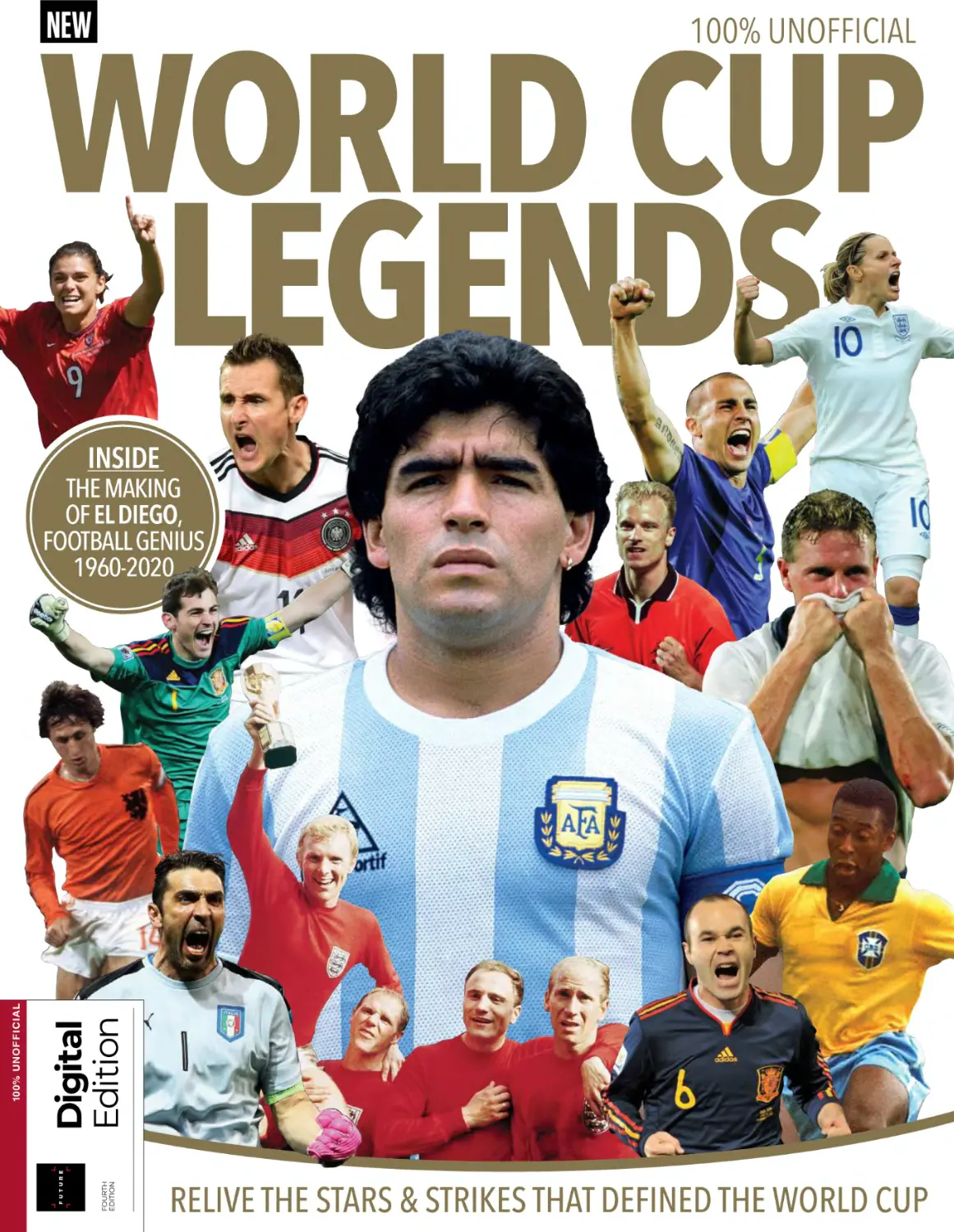


Tags: magazine magazine world cup legends
Year: 2021

Text
                    NEW

100% UNOFFICIAL

WORLD CUP
LEGENDS
INSIDE

FOURTH
EDITION

Digital
Edition

100% UNOFFICIAL

THE MAKING
OF EL DIEGO,
FOOTBALL GENIUS
1960-2020

RELIVE THE STARS & STRIKES THAT DEFINED THE WORLD CUP

WORLD CUP
LEGENDS
Once every four years, the greatest players and teams
from around the globe come together in a celebration
of the beautiful game. Packed with colour, excitement,
passion and drama, the World Cup has the world glued
to their televisions as the biggest names in football
dazzle and wow on the ultimate stage. From Pelé and
Maradona to Ronaldo and Moore, some of the most
iconic names in the history of football are synonymous
with the World Cup.
In this book you’ll find a host of fascinating features on
the aforementioned legends, as well as the Magnificent
Magyars of the 1950s and the best side never to win
the World Cup – the Cruyff-inspired Dutch team of the
1970s. We also bring you the 50 greatest players to
grace the tournament and take you on a journey back
through some of the World Cup’s most memorable
moments – both good and bad. Enjoy!

WORLD CUP
LEGENDS
Future PLC Quay House, The Ambury, Bath, BA1 1UA

Editorial
Editors Dan Peel & Charles Ginger
Designers Perry Wardell-Wicks & Thomas Parrett
Compiled By Drew Sleep
Senior Art Editor Andy Downes
Head of Art & Design Greg Whitaker
Editorial Director Jon White
Cover images
Getty Images
Photography
All copyrights and trademarks are recognised and respected
Advertising
Media packs are available on request
Commercial Director Clare Dove
International
Head of Print Licensing Rachel Shaw
licensing@futurenet.com
www.futurecontenthub.com
Circulation
Head of Newstrade Tim Mathers
Production
Head of Production Mark Constance
Production Project Manager Matthew Eglinton
Advertising Production Manager Joanne Crosby
Digital Editions Controller Jason Hudson
Production Managers Keely Miller, Nola Cokely,
Vivienne Calvert, Fran Twentyman
Printed by William Gibbons, 26 Planetary Road,
Willenhall, West Midlands, WV13 3XT
Distributed by Marketforce, 5 Churchill Place, Canary Wharf, London, E14 5HU
www.marketforce.co.uk Tel: 0203 787 9001
This book is 100% unofficial and unaffiliated with FIFA or the FIFA World Cup

World Cup Legends Fourth Edition (SBZ4127)
© 2021 Future Publishing Limited
We are committed to only using magazine paper which is derived from responsibly managed,
certified forestry and chlorine-free manufacture. The paper in this bookazine was sourced
and produced from sustainable managed forests, conforming to strict environmental and
socioeconomic standards. The paper holds full FSC or PEFC certification and accreditation.
All contents © 2021 Future Publishing Limited or published under licence. All rights reserved.
No part of this magazine may be used, stored, transmitted or reproduced in any way without
the prior written permission of the publisher. Future Publishing Limited (company number
2008885) is registered in England and Wales. Registered office: Quay House, The Ambury,
Bath BA1 1UA. All information contained in this publication is for information only and is, as far
as we are aware, correct at the time of going to press. Future cannot accept any responsibility
for errors or inaccuracies in such information. You are advised to contact manufacturers and
retailers directly with regard to the price of products/services referred to in this publication. Apps
and websites mentioned in this publication are not under our control. We are not responsible for
their contents or any other changes or updates to them. This magazine is fully independent and
not affiliated in any way with the companies mentioned herein.

Future plc is a public
company quoted on the
London Stock Exchange
(symbol: FUTR)
www.futureplc.com

Chief executive Zillah Byng-Thorne
Non-executive chairman Richard Huntingford
Chief financial officer Penny Ladkin-Brand
Tel +44 (0)1225 442 244

CONTENTS
50 MARACANAZO

8

50 GREATEST
WORLD CUP
PLAYERS

The story of Brazil’s devastating defeat
in the 1950 World Cup final

54 TOP 10:
GOALKEEPERS
Ten of the best goalkeepers to have
graced the world stage

We look back at 50 of the best players to
grace world football’s biggest stage

The story of the best side to never lift
football’s most prestigious prize

The rags-to-riches tale of the World Cup’s
most iconic star

94 ABBY WAMBACH

34 TOP 10: SCORERS

48 EUSÉBIO NETS FOUR
One of the all-time greats stakes his
claim as a World Cup legend

The story of the two finals that defined
Zinedine Zidane’s international career

90 TOTAL FOOTBALL
AND THE BIRTH OF
THE MODERN GAME

26 PELÉ

Relive England’s famous victory as told
by those who were there

80 ZIDANE

A bitter rivalry spills over to showcase
football at its worst

Uruguay etch their name in history as
the inaugural World Cup’s winners

36 LEGENDS OF THE
’66 WORLD CUP

Meet some of the most iconic and
groundbreaking managers to win
football’s ultimate prize

88 RIJKAARD VS VÖLLER

24 THE FIRST
CHAMPIONS

We take a look at some of the World
Cup’s leading goalscorers

72 10 LEGENDARY
WORLD CUP COACHES

56

MARTA
The rise of Brazil’s silky superstar from
playing without shoes to the global stage

60 TWO ICONS
SWAP SHIRTS
Brazil’s Pelé and England’s Bobby Moore
swap shirts in a famous show of respect

62 MARADONA
From the glory of 1986 to the shame
of 1994, we explore the highs and lows of
the Argentinian hero’s World Cup career

Known for her aerial prowess, USA’s record
breaker was the complete forward

98 TOP 10: WORLD
CUP GOALS
A selection of the World Cup’s most
memorable strikes and scorers

100 THE MAGNIFICENT
MAGYARS
Charting the rise and fall of football’s first
revolutionary force

“MARADONA WAS AT
HIS PEAK FOR THE 1986
WORLD CUP IN MEXICO”

WORLD CUP LEGENDS

130 SUÁREZ SEES RED

© Jamie Smed license CC BY 2.0

Football’s arch villain is sent off
for a game-saving handball

“ZIDANE SAW RED
AND PAVED THE
WAY FOR ITALY”

132
STEPH HOUGHTON
England’s combative skipper offers last-ditch
tackles, long-range strikes and leadership

136 TOP 10: WORLD
CUP UPSETS
We look back at ten of the biggest
World Cup shocks

138 SPAIN’S TIKI-TAKA
REVOLUTION
The story of Spain’s 2010 World Cup
winners and how they changed the way
the game was played forever

112 TOP 10: WORLD
CUP KITS
The World Cup’s most vibrant, memorable
and iconic kits

114 FRANZ BECKENBAUER
The footballer nicknamed ‘Der Kaiser’
leads West Germany to glory in 1974

The Dutch master scores one of the
World Cup’s greatest goals

106

RONALDO
After a nightmare in 1998, Ronaldo was
Brazil’s hero just four years later

142 TOP 10: FUTURE
LEGENDS

We try to predict the next generation
122 TOP 10: THE LOWEST
of World Cup legends
POINTS IN WORLD
144 KILLING THE DREAM
CUP HISTORY
Ten of the most controversial
moments in the tournament’s history

Germany send Brazil crashing out of the
World Cup with a 7-1 thrashing

© Getty Images

120 BERGKAMP’S
BRILLIANCE

7

WORLD CUP LEGENDS

50

GREATEST WORLD
CUP PLAYERS

Hundreds of players have appeared at the World Cup since it began way back in 1930,
but over the past 21 tournaments some have stood out more than others

O

ne of the most exciting
things about the World
Cup is seeing some
of the globe’s very best
footballers strut their stuff
on the biggest stage of all.
It’s a joy to watch footballers in
their prime perform to the best
of their ability, and while the
most skilful teams don’t always
win, talent generally finds a
way to shine.

8

To that end, we have players
with sublime skill, and others
who are so solid in defence
that almost nothing will get
past them. If anything, it’s a
disappointment that we didn’t
get to see all of the greats; had
George Best, Alfredo Di Stéfano,
George Weah and Ryan Giggs
played in the tournament, for
instance, they would certainly
have made the list.

But that’s not to say our
top 50 is in any way anaemic;
chances are any one of these
players would make it into
any team the world has ever
assembled, club or country.
All have shown brilliance or
made their mark on the World
Cup in ways that will always
stick in the mind, and as such,
we present them here in no
particular order.

50 GREATEST WORLD CUP PLAYERS

LIONEL MESSI

01

The feat of winning the World Cup has so far
eluded Messi and his nemesis, Portugal’s Cristiano
Ronaldo. But Messi has arguably earned his place here by
virtue of being the finest player during the 2014 tournament
in Brazil. He was on the losing team in the final, but bagged
four man-of-the-match awards and won the Golden Ball.
Arguably the modern
game’s greatest player,
Messi is yet to win a
World Cup

CARLOS ALBERTO TORRES

02

Regarded as one of football’s finest defenders, Carlos Alberto
missed out in 1966 but captained Brazil in the final of the 1970
World Cup. A pass by Pelé in the 86th minute gifted him the golden
opportunity to hammer home the fourth and final goal against Italy. It’s still
considered one of the best goals ever scored in the tournament.

ROBERTO CARLOS

03

A mainstay of the Brazilian team
going into three World Cups,
Carlos’s skill at left-back helped his team
reach the final in 1998. But while they
lost against France 3-0, the number six
emerged victorious four years later. All in all,
he ended up playing an impressive 17 World
Cup matches.

ROGER
MILLA

PAUL
BREITNER

04

05

Roger Milla retired
from international
football in 1987, having
made his first World Cup
appearance for Cameroon
five years earlier. But he
came out of retirement
aged 38 in 1990, scoring
four World Cup goals and
enthralling fans with his
corner flag dance. He played
again in 1994, becoming the
oldest goalscorer at 42 when
he put one past Russia.

Breitner made 14
appearances for West
Germany and scored four goals
over two tournaments. None
of these were more important
than the 25th minute penalty to
equalise against the Netherlands
in Munich in 1974, paving the
way for eventual victory and West
Germany’s second World Cup. He
also scored in the final of 1982, but
on this occasion ended up on the
losing side, as Italy defeated West
Germany 3-1.
9

WORLD CUP LEGENDS

Lev Yashin

LiLian
thuraM

06

It’s no surprise to
see Soviet Union
goalkeeper Yashin appear on
the official 2018 Russia World
Cup poster. His dominance
between the sticks saw him
shout instructions at his
defence and collect crosses off
the line in a manner that was
unique at the time. He ended up
playing 12 times in four World
Cups, keeping four clean sheets.

07

The defender only scored
twice for France, but
what important goals they were.
Finding his team 1-0 down against
Croatia in the 1998 semi-final, he
equalised within a minute before
bagging the winner in the 70th
minute. He went on to become a
world champion, adding a European
Championship two years later.

KarL-heinz
ruMMenigge

08

Although Rummenigge lost
two finals – in 1982 and 1986
– the winger was impressive
in both tournaments. He scored a
hat-trick against Chile in the 1982
group stages, and grabbed a goal
in the 1986 final as West Germany
attempted to get back into the game
against Argentina. He scored nine
World Cup goals in 19 appearances.

giusePPe
Meazza

09
Rummenigge
scored 45 goals in
95 appearances
for West Germany

10

The Italian national team,
blessed with prolific goalscorer
Meazza’s talents, won two consecutive
World Cups. Nicknamed ‘Il Genio’ (‘The
Genius’), he scored the only goal against
Spain in the 1934 quarter final en route to
victory (subsequently being named the
tournament’s best player), and he captained
Italy to a 4-2 win over Hungary in 1938.

50 GREATEST WORLD CUP PLAYERS

gOrDOn
banKs

OLiver
Kahn

10

11

As one of the best
goalkeepers to
grace a football field,
Banks played in every
game for England
during the 1966
World Cup. Emerging
victorious, he would
prepare for games by
chewing gum, spitting
on his hands and
smoothing them over. He
could then lick his palms
to make them sticky
as opposition players
headed his way.

Even
though
Kahn was named
in the Germany
World Cup
squads in both
1994 and 1998,
he only became
the first-choice
goalkeeper in
2002. By keeping
five clean sheets
and only letting in three goals (two in the final
against Brazil), he was awarded the Golden Ball
– the only goalkeeper ever to have achieved this
feat to date.

Mia haMM

12

Hailed as the first female football
superstar, Mia Hamm spear-headed a
formidable USA team that won it all. Having
made her debut at just 15, Hamm went on to
score 158 goals (a record when she retired in
2004) over 276 appearances that saw her win
two of the four World Cups she competed in
(the 1991 and 1999 editions respectively) as well
as Olympic gold in 1996 and 2004.

Hamm scored in every
World Cup she played in

11

WORLD CUP LEGENDS

gianLuigi
buFFOn

Baresi was one of
the greatest defenders
in world football

13

With 175 caps, goalkeeper Buffon
has not only played more games
for Italy than any other footballer; he has
appeared in five World Cup tournaments
(1998, 2002, 2006, 2010 and 2014,
playing in the latter four). His finest was
the winning year of 2006, setting a record
for conceding just two goals in seven
matches with five clean sheets.

DanieL
PassareLLa

14

Passarella is considered to be
Argentina’s greatest defender, but
he could also score lots of goals. Calm and
collected, he captained the 1978 winning
team and, although he missed the
tournament due to illness, he was named for
1986, making him the only Argentinian to be
in both of the country’s winning squads.

FranCO baresi

15

Defender Baresi won the 1982 tournament with Italy, and while he came third in
1990, he was named in the FIFA World Cup All-Star Team. He became captain in
1994, but despite missing a penalty in a final Brazil won, simply being there was surprising
considering that he underwent surgery to his knee just three weeks before.

12

50 GREATEST WORLD CUP PLAYERS

MirOsLav
KLOse

Klose holds the
record for the most
goals scored at World
Cup finals

16

When striker Klose retired
from international football
on 11 August 2014, he did so a very
happy player. After all, just months
before, Germany had won the World
Cup for the first time since 1990.
Klose had also scored in the 7-1
drubbing of Brazil in the semi-final,
which saw him become the World
Cup’s all-time top scorer with 16
goals, just edging Ronaldo. That was
his record-breaking fourth World
Cup semi, and the goal (in addition
to the one he scored against Ghana)
put clear daylight between him
and Gerd Müller as Klose became
Germany’s top goalscorer.

FerenC PusKás

Zidane was France’s hero
in the 1998 final, but was
dramatically sent off in the
2006 final against Italy

17

Hungary’s influential captain Puskás
was easily the best player in the 1954
World Cup. He was also part of one of the
greatest sides the tournament has ever seen.
As a talented inside left, this stocky player
would practise his ball skills by juggling
with a tennis ball, and his amazing shooting
prowess was on display in the very first game.
He scored two of the nine goals against South
Korea, and helped Hungary to the final. But
despite Puskás opening the scoring, they were
beaten 3-2 by West Germany. Still, the man
they called the Galloping Major due to his role
in Hungary’s army epitomised the ‘Mighty
Magyars, and his thunderous left foot will
never be forgotten.

zineDine ziDane

18

Zidane won the World Cup with France in 1998, and he was certainly no bit-part
player. He scored twice in the 3-0 final defeat of Brazil in front of a home crowd at the
Parc des Princes in Paris, and while they were his only goals, it added the World Cup to one
of the most enviable honours lists in football. What set him apart was his composure with
the ball and his knack of being able to pierce defences at the right moment. His passing was
impeccable and his passing and dribbling crisp. The World Cup victory saw his face projected
on the Arc de Triomphe.
13

hOMare saWa

19

Having exploded onto the international scene
at 15 years of age with four goals on her debut,
Homare Sawa enjoyed a glittering 22-year career with
the Japanese national team . Competing in an incredible
six World Cup finals (1995, 1999, 2003, 2007, 2011 and 2015),
the diminutive midfielder enjoyed her crowning moment
during the 2011 tournament in Germany. Scoring four
goals en route to the final, she netted a crucial extra-time
equaliser to draw Japan level at 2-2 with the USA in the final
(one of 83 goals scored in 205 appearances) before watching
her teammates complete the comeback with a 3-1 victory
on penalties. Sawa won the Golden Ball and Boot awards to
round off a stunning personal campaign.

Franz
beCKenbauer

20

Pelé was full of praise for
Beckenbauer, famed for his
stylish defending and ability as captain
of West Germany. He influenced the
nation both on and off the pitch as his
country secured the World Cup in 1974,
and winning the World Cup in 1990
as manager.

garY LineKer

21

Lineker knew
how to find the
net. As England’s most
successful World Cup
striker with ten goals
to his name, his clinical
approach to the game saw him shoot six
past opponents in the 1986 tournament
(winning him the Golden Boot) and grab a
further four in 1990. Three of those goals
came in a blistering first-half hat-trick
against Poland in the final group game
of 1986, and it only cemented the
reputation of a player known not only as
‘Mister Nice Guy’, but as a footballer with
pace and an uncanny ability to find space
in front of goal.

14

Zoff made his
Italy debut in 1968
and went on win 112
caps for his country

DinO zOFF

22

Zoff was aged 40 and 133 days when he lifted the World Cup trophy for Italy on 11
July 1982 against West Germany – the oldest player to win the tournament. As Italy’s
first-choice goalkeeper and captain during that summer, he kept two clean sheets and made
a jaw-dropping reaction save in the second round against Brazil, ensuring his team preserved
their 3-2 lead and progressed. Zoff was named in the All-Star team, and he was heralded as 1982’s
best goalkeeper. He also appeared in the previous three World Cups, keeping three clean sheets
in 1978 as Italy came fourth.

50 GREATEST WORLD CUP PLAYERS

rObertO
baggiO
rOnaLDinhO

23

Starring alongside Ronaldo and
Rivaldo, Ronaldinho was part
of a fearsome trinity that seemed
almost destined to win Brazil the
World Cup in 2002. His curling free
kick from 40 yards in the quarter-final
saw England’s David Seaman floundering
as the ball floated into the top-left
corner of the goal. But he will also be
remembered for the joy he seemed to get
from football and the freedom he appeared
to have with the ball at his feet. Able to
instantly change pace and pass without a
glance, he back-passed and step-overed his
way to glory.

Cannavaro was one
of a long line of world–
class Italian defenders

24

In the USA in 1994, Baggio
had the tournament of his
life, and it earned him the Silver
Ball as the second best player. The
forward was undoubtedly Italy’s top
dog, scoring five goals and helping his
country reach the final. This, however,
is when Baggio’s shine dimmed. After
a 0-0 draw with Brazil after extra time,
the game went to penalties. Baggio
needed to score to keep Italy in with
a chance, but he put the decisive kick
high over the bar and into the crowd,
leaving him distraught and Brazil
champions. Even so, he also scored
in the 1990 and 1998 tournaments,
making him the only Italian to bag
goals in three World Cup tournaments.

FabiO
CannavarO

25

As captain, acclaimed defender
Cannavaro led Italy to
victory in the 2006 World Cup final,
impressing fans by providing an almost
impenetrable solidness at the back
(Italy let in just two goals during the
tournament). His strength, positional
sense, awareness and timing earned
him the nickname ‘Il Muro di Berlino’
(‘the Berlin Wall’) and this highly athletic
player, who was as good in the air as
he was on the ground, even went on to
become the FIFA World Player of the
Year; the first defender to win the award.
All in all, this tenacious player made 18
appearances over four World Cups.

15

WORLD CUP LEGENDS

rivaLDO

26

Think of
Rivaldo, and you
immediately conjure up
images of his bending
free kicks, tricky
feints and intricate
dribbling. You may also
think about that match against Turkey
in 2002 when the ball hit his arm and
he fell to the floor clutching his face –
earning opponent Hakan Ünsal a red
card. Cheating aside, there is no doubting
Rivaldo’s skill, and it ultimately helped
earn him and his Brazil team a World Cup
victory that year.

MariO zagaLLO

27

Winning the World
Cup twice as a player
(in 1958 and 1962) is always
a triumph, but doing so
twice as a manager and
assistant manager is
something else. To that end, left-winger
Zagallo is about as ingrained in Brazil’s
success over the years as anyone could be,
and he deserves the accolades he receives,
even though some said he was fortunate
to be playing. On the pitch, he was wellknown for his runs from deep and his
versatility. He also displayed tenacity and a
never-say-die spirit. Favouring tireless hard
work as well as style, he scored in that 1958
5-2 defeat of Sweden.

JOhan
neesKens

28

The Dutchman was a fantastic
tackler and a dead ball specialist.
He took part in two World Cup campaigns,
with the Netherlands cruelly losing out in
the finals of both 1974 and 1978.

16

Hurst made his name
with a hat-trick in the
1966 World Cup final
against West Germany

geOFF hurst

29

Hurst had only debuted for England against West Germany on 23 February 1966 –
just months before the World Cup began – and he only gained a place in England’s
starting World Cup line-up in the quarter-final against Argentina after Jimmy Greaves
became injured. He scored in that game and went on to set up a goal for Bobby Charlton in the
semis, and impressed manager Alf Ramsey so much that he was given a place in the final. Hurst
repaid the faith by cancelling out Helmut Haller’s opening goal, but the game ultimately went
into extra time. Hurst struck twice more to win the day.

MariO KeMPes

30

Argentina’s explosive attacker scored two
against the Netherlands in the 1978 World Cup
final, which not only eased them to victory, but saw
him end the tournament as both the top goalscorer
(with six) and the best player. Those who watched him
play would agree that his shot was devastating, and his
calmness under pressure most noticeable. Yet he was
also far from unassuming, playing with panache and
becoming instantly noticeable for his personal style as
well as his fast, on-pitch touches. For Argentinians he
was a national hero, although the country crashed out
in the second round of 1982 – a tournament that saw the
introduction of Diego Maradona.

50 GREATEST WORLD CUP PLAYERS
Smith rounding the
keeper before slotting
home was a common
sight during her career

ziCO

31

Referred to as the ‘white Pelé’, Zico
was a creative attacking midfielder
whose eye for goal and technical skill
were put to particularly good use in
1982. His goals helped Brazil win against
Scotland, New Zealand and Argentina, so
it was a shame for him that his country did
not progress further than the second round.
In some ways it was a disappointment
perhaps only matched by his goal in the
opening match of the 1978 World Cup being
ruled out. Still, such was his worth, Brazil
worked hard to get him fit after a serious
knee injury in 1986. In that tournament, he
came on as a second-half substitute in the
quarter-final against France. Unfortunately,
he missed a penalty, and Brazil crashed
out to France. There was no faulting his
prodigious work ethic, however.

KeLLY sMith

32

Often described as one of the best players of her generation, Kelly Smith would
have debuted for England at just 16 had it not been for her school exams.
Recognised as “lethally quick” and “bountifully gifted”, Smith would go on to play a starring
role for both her clubs (which included the Boston Breakers and of course Arsenal) and
country. Prolific on both the domestic and international scene, Kelly scored 46 goals for
England in 117 appearances, slotting home her first England goal in just her second game.
Despite being plagued by injuries throughout her career, Smith competed in both the
2007 and 2011 World Cups, scoring four times (against Japan and Argentina respectively)
in the group stages in 2007 as England reached the quarter-finals. Frustratingly for Smith
she couldn’t find the net in 2011, but she remained a key part of the England setup until her
retirement in 2015 and is still to this day the Three Lionesses’ all-time top scorer.

gerD MüLLer

33

Nicknamed ‘Bomber der Nation’ – or
‘the Nation’s Bomber’ – West German
striker Müller scored 14 goals in the two
World Cups in which he appeared (1970
and 1974). He quickly became an icon
for winning the 1974 World Cup with a
decisive goal in the 43rd minute against the
Netherlands. Just as memorable was his
winning goal in the quarter-final of 1970
against then-world champions England, who
were 2-0 up after 49 minutes. West Germany
fought back to draw level before Müller struck
the winner in extra time.
He would startle opponents with a rapid
burst of pace over a short distance, and would
throw his short body into the air above taller
players to accurately head a ball. Many an
opposing footballer could only watch as he
turned tightly with great balance, yet he was
also humble and reserved even in victory.
17

WORLD CUP LEGENDS

Gazza bursts into tears
as England are beaten
by West Germany in the
1990 semi-final

CaFu

34

His country’s most capped
footballer with 142 appearances,
and it’s easy to see why. An amazing
full-back, Cafu could burst down the right
side of the pitch, essentially becoming an
attacking right-winger. When Jorginho was
injured in the 1994 final, manager Carlos
Alberto Parreira had no worries putting
Cafu in to replace him, even though he’d
only made two appearances as a sub prior.
By the time 1998 rolled around, Cafu was
a firmly established international. Brazil
were beaten in the final, but they had better
luck in 2002 when, as captain, Cafu led
them to a 2-0 victory over Germany. During
that tournament he was relentless, firing
past opponents en route to the trophy.

garrinCha

35

Manuel
Francisco
dos Santos, to give
his full name, won
the World Cup twice
– in 1958 and 1962 –
but it was the later
tournament that
made his name.
He stepped in for the injured Pelé and
rose to the occasion, so much so that he
was named the best player in 1962 and
became joint top goalscorer.
Garrincha’s strength was his strong
control of the ball, amazing dribbling and
powerful shooting. He was especially good
with free kicks and corners, and he’d relish
toying with opponents, not being afraid to
show them up by displaying his talent to
the max.

18

PauL gasCOigne

36

Most remember Gascoigne – or Gazza – for the semi-final in 1990 when he earned
himself a yellow card for a foul on West Germany’s Thomas Berthold and promptly
broke down in tears knowing that he’d be unable to play in the final. In the event, England
didn’t make it that far, but the memory sticks, as does the feeling that such a great talent should
have graced more than six games at a solitary World Cup.
Why? Simply because Gazza was one of England’s great talents. A flawed creative genius, he
played as an attacking midfielder and his passing accuracy was superb, as was his protective
skills on the ball, not to mention his great pace and strength. It’s really unfortunate that his
off-field activities clouded a great talent, but for many England fans he helped define 1990. If it
wasn’t for his assist to Mark Wright to get the winner against Egypt, England may never have got
out of the group stage.

50 GREATEST WORLD CUP PLAYERS

PaOLO rOssi

37

Rossi’s preparation for the 1982 World Cup had
been far from ideal. He had just returned from
a two-year ban for his involvement in the 1980 betting
scandal, Totonero, which found many Italian football
players guilty of match-fixing, and he had only been on
the pitch for three games.
Manager Enzo Bearzot wanted him, however, and
so the number 20 started in the opening stalemate
against Poland. He came into his own during the second
stage, scoring a hat-trick against Brazil. He then got two
against Poland in the semis and opened the scoring in
the final as Italy beat West Germany 3-1.
All was forgiven (although Rossi always denied being
involved in match-fixing), and Bearzot’s decision to
choose and then stick with him paid off handsomely.
But then Rossi was always intelligent, agile and prolific, and what he lacked in strength he
made up for with incisive finishing and positional sense. His six goals in 1982 earned him the
Golden Boot.

MiCheL PLatini

38

The French side of the
1980s was strong, and
this was in great part down
to the attacking midfielder
Platini. The team had learned
their lessons from 1978 when
they were knocked out at
the group stage. Although they only scraped
through the groups in 1982, Platini got on the
scoresheet against Kuwait and scored again
against West Germany in the semis, eventually
losing on penalties.
Platini was known to be one of the finest
passers of the ball. He was also a prolific
goalscorer, and he went on to lead France
through the 1986 groups, before scoring
against Italy in the round of 16 and Brazil in
the quarters, a game they won on penalties.

Charlton was a key part
of Alf Ramsey’s World
Cup-winning team in 1966

bObbY CharLtOn

39

With his trademark combover blowing in the
wind and his name famous the world over,
the Busby Babe who survived the Munich air crash
in 1958 and established himself in Matt Busby’s
Manchester United was a key player for England
during the three tournaments in which he was
selected (he didn’t kick a ball in 1958, but starred in
1962, 1966 and 1970).
Of those, 1966 was the most memorable for obvious
reasons. He opened the scoring against Mexico in the
group stage, and got two against Portugal in the semis.
Most of all, though, crowds loved his thunderbolt
shooting, which he could perform with either foot, and
they adored his simple yet confident dribbling and the
passionate elegance with which he played. As arguably
the most gifted English football player in the team, he
carried himself with a sense of gentlemanliness, earning
the respect of both his fellow players and rivals.

19

WORLD CUP LEGENDS

Eusébio wowed
the crowds during
the 1966 World Cup
in England

Christine
sinCLair

41

Born in British Columbia in
1983, Christine Sinclair seemed
destined for a career in football from the
very start. With her father and an uncle
having both played professionally, Sinclair
began kicking a ball at four, and just 12
years later she made her debut for Canada.
An unerringly accurate striker, Sinclair
is known for her diligent work rate and
ability to bring teammates into play.
Blessed with a vision that enables her
to see opportunities before they appear,
Sinclair has to date featured in four World
Cups, scoring nine goals in 17 games to
contribute to an incredible international
total of 180 goals in 280 matches, a record
that has seen her nominated for the World
Player of the Year award seven times.

JairzinhO

42

eusébiO

40

England may have won the World Cup in 1966, but Eusébio won hearts across the
world. Playing for Portugal, he was awarded the Golden Boot for his nine goals while
showcasing superb dribbling skills, athleticism and speed.
Famed for his right foot and nicknamed ‘the Black Panther’, 1966 turned out to be Eusébio’s
only World Cup, and he certainly made the most of it. When Portugal fell behind by three goals
against North Korea, he fought hard to score in the 27th, 43rd, 56th and 59th minutes, putting
his country ahead before José Augusto de Almeida grabbed the fifth.
There was an uneasy feeling that he would do the same to England in the semi-final when he
got a penalty in the 82nd minute to make it 2-1. He didn’t. Instead, Portugal got knocked out, but
Eusébio opened the scoring in a 2-1 defeat of the Soviet Union to give Portugal their best-ever
placing of third.

20

So many Brazilian
players from 1970
deserve to be named
footballing icons, but
none of them scored
in every match that
summer – except for
Jairzinho, that is. He
scored against Czechoslovakia, England
and Romania in the group stages, grabbed
the final goal against Peru in the quarters,
helped Brazil to a 3-1 win in the semis, and
popped up in the 71st minute of the
final against Italy. He could have had
two against England, if not for a crucial
interception by Bobby Moore.
Jairzinho’s performances earned the
forward the nickname ‘The Hurricane’, and
crowds rarely failed to gasp when he got up
speed and pumped a lethal shot into the
net. What’s more, his success came despite
him breaking his right leg twice.

Xavi

43

In more recent times, few players
have stood out as much as Xavi. The
midfielder appeared on the World Cup stage
as a substitute against Paraguay in 2002, but
his opportunities were limited. Not so in 2006
where he was soon showing how well he could
find space and accurately pass to his teammates.
As you’d expect, 2010 was his big year. Spain
had really got it together (after the opening
defeat at least) and Xavi played an integral role,
enjoying a 91 per cent passing success rate. Xavi
was named man of the match in the semi-final
and he worked incredibly well with Andrés
Iniesta throughout the tournament, eventually
getting himself listed in the World Cup All-Star
Team. Spain lifted the trophy that summer but
failed to get out of the group stage four years
later, which only went to show just how well
they and Xavi had seized their chance.

Xavi was instrumental
to the Spanish team
that won the World Cup
in 2010

rOMáriO

44

Romário’s first World Cup in 1990 was a bit of
disappointment, but then he had just recovered
from a broken leg, and he wasn’t fully fit. He only played
for 65 minutes during that tournament before coming off for
Müller in the match against Scotland. Far more impressive
was 1994, however, when Romário made the World Cup
his own.
A falling out with coach Carlos Alberto Parreira almost
meant Romário didn’t go to the USA that year. Only a furore
back home saw him recalled to help get Brazil through a
knife-edge qualifier. It was a wise decision, and one Parreira
would never regret. As USA ‘94 got underway, Romário
scored five goals and led Brazil to a fourth World Cup,
displaying impressive ball control and an effectiveness at
cutting past defenders. His skills rightfully earned him the
Golden Ball for being the best player of the tournament.
21

WORLD CUP LEGENDS

Just FOntaine

45

Fontaine set a
high standard
when he lit up the
World Cup of 1958,
scoring a mammoth
13 goals – a record that
stands to this day.
Making it even more
remarkable is the fact it was achieved over
six matches, so he was off to a flying start
before the group stage was out.
He continued his streak into the quarterfinals with two goals against Northern
Ireland. But although he scored against
France in the semis, they were knocked
out by Brazil, so Fontaine’s efforts only
saw his team earn third place. As a striker,
however, there were few of equal, which
makes it all the more sad that he never
played another World Cup – injury forced
him to retire in 1962.

Maradona’s goal against
England in 1986 is one of the
best in World Cup history

PeLé

46

Edson
Arantes do
Nascimento is, to
many minds, the
greatest footballer
to grace the World
Cup. Playing in
four tournaments,
he made his debut
in 1958 aged 17, and he competed in 1962,
1966 and, most notably, in 1970.
A prolific goalscorer, he had lightning
pace and immense poise. He played with
grace and could accurately shoot with great
power on both feet. Unlike some talents, he
worked with his teammates rather than as
an individual. He was stylish and efficient:
goalkeepers had little chance when he
rolled up to take a penalty.
It is no surprise, then, that he holds
the record for the most World Cup wins.
His first tournament saw him score one
against Wales in the quarter finals, three
versus France in the semis and two in
the final against Sweden. While he was
injured for most of 1962 and persistently
fouled through 1966, he accepted a call-up
in 1970, playing six games and scoring six
goals. Pelé really was the complete player.

22

DiegO MaraDOna

47

Ask any England fan to name a famous moment in World Cup football, and a good
number will point to the quarter-final against Argentina in 1986. Having displayed
his incredible brilliance, he found himself heading towards goal, slipping past England’s Glenn
Hoddle with ease. His pass hit the foot of England’s Steve Hodge, sending it towards the penalty
area, at which point Maradona pounced – and hit it with his outside left hand. It thereafter
became known as the ‘Hand of God’, but Argentina’s captain Maradona was more than just
that moment.
When Maradona had the ball, crowds would lick their lips with anticipation. With his physical
strength, close ball control and jaw-dropping dribbling skills, he was able to score five goals in
1986 and make five further assists. In doing so, he helped Argentina win the tournament that
year before putting in another glorious set of displays four years later when he was named Italia
’90’s third best player. So while he marred his reputation by being sent home in 1994 for testing
positive for ephedrine, there was a sense that his job was done, and his legendary status secured,
making his nickname ‘El Pibe de Oro’ (‘The Golden Boy’) very apt.

50 GREATEST WORLD CUP PLAYERS

bObbY MOOre

50
rOnaLDO

48

With 15 goals over 19 matches,
Ronaldo was, until 2014, the World
Cup’s top goalscorer. But while he has since
been pipped by Miroslav Klose, he will always
be one of the greatest icons of the tournament.
He first appeared in 1998, when he scored
four and was named the best player as Brazil
were pipped by France. It set Brazil up nicely
for 2002, however, when they won courtesy of
two Ronaldo goals against Germany.
Yet that doesn’t actually tell the full story.
Prior to the 2002 finals, he had been out of
the game for 15 months after rupturing the
cruciate ligament in his right knee. That
caused him to miss every Brazilian qualifier,
so to come back in the tournament and
perform so well was remarkable.
In his prime, he was one of the deadliest
strikers football has seen.

Even if West Ham’s centre-half had not captained England to glory in 1966, he
would still have proved his worth with a stunning display in that tournament, as
well as those which preceded and followed in 1962 and 1970. But it will be 1966 that he will
always be remembered for.
He didn’t score (he only ever got two goals for England and they were both in friendlies) but
it was his floating cross that helped Geoff Hurst get the opener in the final, and his long pass
which secured the infamous final Hurst goal that signalled it was all over.
What Moore lacked in pace and aerial ability, he made up for with his football brain, and he
was widely seen to be the best defender of all time. Alf Ramsey didn’t hesitate in making him
captain even though he was aged just 22 years and 47 days. Moore repaid that faith in spades
while becoming known as a gentleman of the game.
Skilled at free-kicks and frequently creating chances for Hurst, he was at his best on the
big occasion, and people were so confident in his talent that Ron Greenwood, manager of
West Ham, believed in 1965 that Moore would be reason for an England victory since he had
planned so well for the win.

England captain
Bobby Moore lifts the
World Cup in 1966

JOhan CruYFF
The Netherlands
did not win the
World Cup in 1974, yet
pundits will tell you
that the Dutch team
was the more skilful
and entertaining, and
one of the main reasons
for that was Johan Cruyff.
If you could pinpoint a highlight, it would
perhaps be the famous Cruyff turn of 1974
when he looked to be kicking the ball forward,
but instead scooped it backwards. It allowed
him to turn tightly on the spot and head off in
the opposite direction, leaving Sweden’s Jan
Olsen dumbfounded.
Such magic was also evident in the final.
The penalty in the second minute, during
which Cruyff barked orders and orchestrated
a move that led to him being knocked to the
ground and a goal scored. It was just a shame
he retired from international football in 1977,
fearing kidnap in Argentina.

© Getty Images

49

23

WORLD CUP LEGENDS

24

The FiRsT champiOns

MOMENTS

30 JULY 1930

THE FIRST
CHAMPIONS
uruguay etch their name in history as
the inaugural World cup’s winners

E

very story has a beginning, and the
story of the world’s greatest sporting
spectacle begins in 1930. That is the
year in which the first World Cup was
held in Uruguay, chosen as the hosts to
coincide with the nation’s celebration of the
centenary of its first constitution.
The final was contested by Uruguay
and Argentina in the Estadio Centenario,
constructed especially for the tournament.

Uruguay struck first, scoring in the 12th
minute, but Argentina fought back and went
into the break leading 2-1.
In the second half, Uruguay took control
again, scoring three goals and running out
4-2 winners. They became the first team
to lift the famous Jules Rimet trophy, and
etched their name in football history. The
next day was declared a national holiday to
celebrate the success.

Uruguay’s glorious moment is not only
significant for its people, but for football
fans across generations. The success of
that first tournament ensured the World
Cup continued, treating us to all the
exciting moments, awe-inspiring players,
shock defeats and wonderful goals we’ve
witnessed over the years. Without the
success of the first tournament, the World
Cup wouldn’t be what it is today.

25

47

26

PELÉ

PELÉ:
THE GREATEST
The rags-to-riches tale of the World Cup’s most iconic star

S

Pelé lifts the Jules
Rimet trophy after
Brazil beat Italy in
the 1970 final

tardom can flash like a supernova, fading
into the darkness of obscurity as quickly
as it erupts. Only the greatest of stars
to have graced football’s grandest stage shine
with the enduring brightness that assures their
status as legends. In that elite group, there is
one that burns brighter than any other: the
North Star of the World Cup, Pelé.
Pelé’s legend is a testament both to his own
incredible talent and the power of the World
Cup. He played most of his club football for
Santos in his native Brazil. In an age where it
wasn’t possible for fans to watch live football
from all over the world and find clips of the
next young talent on YouTube, it may as
well have been on Mars as far as most of
the world was concerned. It was the World
Cup that gave Pelé the platform on which to
showcase his ability to a global audience – his
blend of athleticism and technique, artistry
and end product, intelligence, desire and
supreme dribbling skill. That is why his story
is so intimately intertwined with the history
of the tournament. The World Cup trophy
is the treasure he claimed to complete his
archetypal rise from rags to riches: the tale of
an impoverished young kid who became a
national hero and sporting icon through his
exploits. It is the tournament that made him –
and with his supreme talent, he helped make
the tournament.
Pelé made his World Cup debut in
Sweden in 1958. At only 17 years old, he
was the youngest player ever to play in the
tournament. He was already a star in his native
Brazil, having finished the 1957 season as
the league’s top scorer at only 16 years of age
while playing for Santos, but now he had the
chance to do something even more special.
Pelé, like the rest of his countrymen, had not
forgotten the national trauma known as ‘the
Maracanazo’, or ‘Maracanã Blow’. The name
refers to Brazil’s shock defeat to Uruguay in the
final game of the 1950 World Cup, held on its
own soil in a Maracanã Stadium packed with

27

WORlD CuP leGeNDS

PRAISE FROM PEERS
Johan Cruyff, Barcelona
and Holland star:

“PELÉ WAS
THE ONLY
FOOTBALLER
WHO SURPASSED
THE BOUNDARIES
OF LOGIC”

Just Fontaine, French
striker and top scorer
in the 1958 World Cup:

“WHEN I SAW PELÉ
PLAY, IT MADE ME
FEEL I SHOULD
HANG UP MY
BOOTS”

Ferenc Puskás,
Real Madrid and
Hungary legend:

“THE GREATEST
PLAYER IN HISTORY
WAS DI STEFANO. I
REFUSE TO CLASSIFY
PELÉ AS A PLAYER. HE
WAS ABOVE THAT”

Bobby Moore, 1966
World Cup-winning
England captain:

“PELÉ WAS THE
MOST COMPLETE
PLAYER I’VE EVER
SEEN, HE HAD
EVERYTHING”

Michel Platini,
France legend and
Ballon d’Or winner:

“THERE’S PELÉ
THE MAN, AND
THEN PELÉ THE
PLAYER. AND TO
PLAY LIKE PELÉ IS
TO PLAY LIKE GOD”

28

200,000 people. Pelé screamed at a picture of
Jesus in his father’s room after the fateful final,
asking why Brazil was being punished and
telling the image of Christ that if he had been
there, Brazil would have won. In Sweden, he
had the chance to make good on this pledge.
Pelé arrived at the tournament with a knee
injury, and didn’t play in Brazil’s first two
games, a 3-0 victory over Austria and a 0-0
draw with England. He made his debut in his
team’s third group game against the USSR,
impressing in a performance that included an
assist for Vavá in a 2-0 win. Brazil moved on
to the knockout stage, and it was here that the
young Pelé began writing his legend in the
lines drawn with his brilliant feet.
Midway through the second half in their
quarter-final against Wales, and Pelé, standing
on the penalty spot, received a headed ball
on his chest with his back to goal. With a deft
flick and turn, he left his marker floundering
and poked the ball into the net. It was the only
goal of the game, taking the team into a semifinal clash with France.
The France team of 1958 had some prolific
talents of its own in the legendary Just
Fontaine and Roger Piantoni. Indeed, both
bagged a goal apiece – Fontaine in the first
half and Piantoni in the second. This wasn’t
enough, however, to prevent the French from
being swept away by an electric Brazil that

netted five goals. Pelé led the charge, scoring
in the 52nd, 64th and 75th minutes to become
the youngest ever player to get a hat-trick in
World Cup history.
In the final, Brazil came up against Sweden.
That Brazil would win was far from a foregone
conclusion: not only were Sweden the host
nation, but no World Cup up to that point
had been won by a nation outside its own
continent. Sweden took the lead in the fourth
minute through Nils Liedholm, but Brazil
responded quickly, Vavá netting an equaliser
– then another – to take Brazil into the break
leading 2-1. In the 55th minute, Pelé broke
yet another record, becoming the youngest
scorer in a World Cup final as he netted
one of the tournament’s greatest ever goals.
Waiting in the box, Pelé held off his marker
as he jumped to meet a cross, twisting in the
air to direct the ball towards the penalty spot
with his chest. Another defender came out to
close him down, but Pelé lifted the ball over
his head, watched the ball drop from the sky
and volleyed it powerfully into the bottom
corner. Mário Zagallo followed up on Pelé’s
wonder goal to earn Brazil a 4-1 lead, before
Simonsson pulled one back to give the hosts
a slither of hope. It wasn’t to be, however,
as Pelé sealed the victory in stoppage time
with a looping header that left the onrushing
keeper stranded. The whistle blew, and he

PELÉ

Opposition players
at the 1966 World Cup
in England decided that
the best way to stop Pelé
was to kick him

broke down in tears of joy. The pain of the
Maracanazo had been dulled, if not entirely
healed. Brazil lifted its first World Cup trophy.
The 1958 World Cup triumph was a
defining moment for both Pelé and Brazil. This
victory helped establish Brazil as a
global footballing superpower, and vindicated
the nation’s belief in a stylish brand of football
that it wanted the world to admire. Indeed,
the popular picture that now exists of what
this great footballing nation represents –
beautiful football, swashbuckling attacking,
inspirational individual talent and international
glory – started here. Pelé, at only 17, played
an important part in that, making himself a
star in the process. It was mind-boggling to
see such a complete player at such a young
age. He possessed pace, power, precise passing,
vision, flair, a high work rate, anticipation,
and an ability to finish. He had the whole
world at his feet.
Yet Pelé’s international career was not to
continue in storybook fashion. When the 1962
World Cup in Chile rolled around, Brazil’s star
seemed primed to lead the team on to more
glory. He started in apt fashion, creating one
and scoring another after a mazy run where
he beat four players in a 2-0 win over Mexico.
In the next game against Czechoslovakia,
however, Pelé was injured, keeping him out
of the rest of the tournament. Fortunately,

Pelé was injured in
Brazil’s second game of
the 1962 World Cup and
wouldn’t feature again in
the tournament

29

Pelé (top) celebrates
with his teammates
during Brazil’s 4-1 win
over Italy in the 1970
world cup final

PELÉ FACTS& FIGuReS
YOUNGEST WORlD
CuP WINNeR

IS Pelé DAY AT SANTOS –
AFTeR THe DATe Pelé SCOReD
HIS

MOST SuCCeSSFul
leAGue GOAlSCOReR
WITH

1000TH GOAL

1281
GOALS
IN

30

19
NOVeMBeR

SCOReD HIS FIRST PROFeSSIONAl
GOAl ON HIS leAGue DeBuT AT
15 YeARS OlD

ONlY

3

1363

TO WIN

GAMES

WORLD CUPS

PlAYeR

JOINT FIFA PlAYeR OF
THe CeNTuRY WITH
DIEGO MARADONA

PELÉ

Pelé and gerson both
scored in the 1970 final,
with Brazil becoming
the first team to win the
world cup three times

that Brazil side was hardly starved for talent,
and Pelé’s teammates took up the slack, in
particular a fellow footballing genius by the
name of Garrincha. Brazil went on to triumph
without Pelé, defeating Czechoslovakia 3-1 in
the final.
Pelé’s reputation was not diminished despite
his absence for much of the 1962 tournament,
and he was still the world’s most famous talent
when he came to England to play in the 1966
World Cup. But again, Pelé suffered from injury
problems in a tournament where opposition
players had evidently decided to kick him
out of the game. He scored one goal in the
opening match, missed the second through
injury, and returned in the final game of the
group stages, where he ended up limping
around the pitch as he watched his team fall
3-1 to Portugal.
The 1966 failure left a bitter taste in the
mouths of Brazil fans and Pelé himself. He
vowed he would never play for Brazil in a
World Cup again, frustrated by the deliberate
fouling he had been subject to and the injuries
he’d suffered as a result. Eventually, however,
Pelé was persuaded to return to play in the
1970 World Cup in Mexico. We’re grateful he
did, because the team that he became part
of was to go down in history as perhaps the
greatest World Cup side of all time.

“BRAZIL’S SUPREME ATTACKING TALENT
CAME UP AGAINST A MAGNIFICENT
DEFENCE, PELÉ AGAINST BOBBY MOORE”
The side that went to Mexico in 1970 was
phenomenally talented. The standout player in
defence was the great Carlos Alberto, fittingly
for a Brazil team, because of his rampaging
attacking talent. In central midfield, the
cultured Gerson was there to pull the strings
alongside the tireless Clodoaldo. On the
left was the graceful Rivelino, credited with
innovating the flip flap, and on the opposite
flank another of Brazil’s many all-time greats,
the dynamic Jairzinho. He complemented
Rivelino’s tendency to sit deep with a direct,
pacey approach and eye for goal. Partnering
Pelé was Tostão, a player with skill, vision, and
most importantly for his partnership with Pelé,
the intelligence to interchange with his star
teammate, dropping deep when necessary and
pushing forwards to make space in the hole
for Pelé when appropriate.
This gifted team went one down to
Czechoslovakia in the 11th minute of their
first game of the group stages. A Rivelino goal
brought them in level at the break, and Brazil

exploded in the second half to swat their
opponents out of their way. Pelé struck first to
give Brazil the lead and Jairzinho followed up
with a double to finish the game.
Brazil’s next match was against the world
champions: England. Only one goal was scored
in the game, but it was a classic nonetheless.
Brazil’s supreme attacking talent came up
against a magnificent defence, Pelé leading his
compatriots against a defiant Bobby Moore,
who time after time would break up Brazil’s
attacks. Pelé could draw out the best of his
opponents, it would seem. Indeed, he did
just that when Gordon Banks stopped Pelé
opening the scoring with a stop dubbed the
‘save of the century’. Carlos Alberto played a
cutting pass from deep, allowing Jairzinho to
get behind the England defence. He made it
to the byline and crossed to Pelé, who headed
powerfully towards the bottom corner. It
looked as if the header was already beyond
Banks as he reached behind him and tipped
the ball up over the bar.

31

WORlD CuP leGeNDS

But Pelé and Brazil were not to be denied.
They kept coming, and in the 59th minute,
broke England’s resolve. Tostão danced into
the edge of the England box and lifted the ball
into the middle. Pelé killed it dead with a deft
touch, then shifted it outside into the path of
Jairzinho to power home into the top corner.
Brazil’s final group game was against
Romania. They rested a couple of stars,
shifting Gerson and Rivelino to the bench,
but Pelé remained, and would again have a
key role to play. He opened the scoring after
19 minutes with an inswinging free kick, and
added another in the 67th minute in a 3-2
victory that took Brazil into the quarter-finals.
Brazil ploughed through their opposition
in the knockout stages. First to fall were Peru,
Pelé assisting a goal for Tostão in a 4-2 win.
Pelé created another in Brazil’s next match,
a semi-final against Uruguay that they won
3-1, and where one of Pelé’s most famous
moments took place. As Pelé raced to meet
a through ball, Uruguay’s goalkeeper rushed
out to try and snuff out the attack. Just as
Pelé and the ball met the keeper at the edge
of the box, Pelé feinted as if he was going to
collect the ball and try to round the keeper.
Instead, he left the ball untouched, passing
the bamboozled keeper on one side, the ball
on the other. Pelé over-rotated after collecting
the ball at a wide angle and sent his shot
wide of the far post, but the moment is still
remembered as a great illustration of Pelé’s
footballing brilliance, despite the miss.
The final of the 1970 World Cup took place
at the Azteca Stadium in Mexico City. Brazil
met their antithesis, an Italy side known for its
‘Catenaccio’, or ‘door-bolt’, defensive system.
It was a game that, perhaps more than any
other, would cement Pelé’s legend. Fittingly,
it was Pelé who opened the scoring in the
18th minute with a powerful header, the
diminutive figure rising high in the air to beat
his taller marker. Italy found a way back into
the game through Boninsegna on 37 minutes,
exploiting a loose pass at the back. It stayed 1-1
going into half-time. Gerson took Brazil back
into the lead with a powerful long-range drive
in the 66th minute, and was again involved
for Brazil’s third, sending a long ball floating
into the opposition box. Pelé was there to
meet the pass with the perfect cushioned
header sent back across goal into the path
of an onrushing Jairzinho to give Brazil a 3-1
lead. Brazil then signed off with a goal that
epitomised the flowing attacking football that
had made this 1970 team such a pleasure to
watch. It was the perfect final flourish to cap

32

off a phenomenal tournament, and a goal that
was truly worthy of a World Cup final. Indeed,
it would go down in history as one of the
greatest team goals ever scored.
The move started after Brazil won the ball
deep in their own half. After an exchange
of passes, the ball ended up with Clodoaldo
at the base of midfield. He danced his way
past four Italian players to the delight of the
crowd, and then laid the ball off to Rivelino on
the left side of the pitch at the halfway line.
Rivelino played the ball forward to Jairzinho,
who had drifted over from the right flank.
Pelé later said that this was a deliberate ploy –
Italy were employing a man-marking system,
so Jairzinho would periodically drift over to
pull Italy left back Giacinto Facchetti out of
position, opening a space on the right they
called ‘the avenue’. After receiving Rivelino’s
pass, Jairzinho cut inside and laid the ball off
to Pelé in the middle off the pitch. He paused
for a moment, holding the ball up while he
waited for the right moment to release it. Then
he nonchalantly slid the ball out onto the right,
into ‘the avenue’ Jairzinho vacated and ran
into the path of an onrushing Carlos Alberto.
Alberto crowned the move by smashing the
ball low into the far corner. The final ended
4-1. Attack beat defence. Beauty triumphed
over austerity.
The 1970 trophy was Brazil’s third, making
them the most successful team in World
Cup history. They cemented their status as
a premier football nation, and did it with the
characteristic style that made ‘Brazilian’ a
byword for skill, technique and flair. Pelé was
recognised as the star of that unbelievably
talented team, and awarded the Golden Ball
for player of the tournament. It was Pelé’s last
World Cup, and the perfect end for his special
relationship with the competition.
The beautiful football with which the 1970
Brazil team wowed the world should give us
cause to remember that the legend of Pelé
should not overshadow the talents of his
teammates. Players like the great Garrincha,
who played alongside Pelé in 1958 and led his
nation to World Cup glory in 1962 in Pelé’s
absence. Or the phenomenal Jairzinho, who
scored in every game of the 1970 tournament.
Yet, while recognising their greatness, it is
telling that even among all that gifted talent,
Pelé’s teammates and rivals revered him as the
best. He is the most complete player football
has ever seen, and he is unquestionably
the World Cup’s greatest icon. He gave the
tournament some of its greatest moments and,
in return, it gave him his.

The 1970 World
Cup-winning Brazil team
would go down as one of
the greatest in history

BREAKING NEW FRONTIERS
Pelé is credited as a pioneer in
helping to grow football in the US. He
originally retired from club football after
the 1974 season, though he would continue to
make the odd appearance for Santos.
In 1975, Pelé officially came out of
retirement to join the New York Cosmos.
This was not Pelé at his peak, but he was still
enough of a star to bring a lot of public interest
to the young North American Soccer League,
the precursor to Major League Soccer. The

club’s increased profile led them to move from
a sparse pitch that the club’s groundsman
spray-painted green to hide the lack of grass
for Pelé’s debut on TV in the Yankee Stadium.
By Pelé’s final season in 1977, the Cosmos
averaged crowds of around 40,000,
which was by far the biggest in the league.
In that year, Pelé, alongside new signing
Carlos Alberto and Germany legend Franz
Beckenbauer, led the Cosmos to the
NASL championship.

33

WORLD CUP LEGENDS

X

Gabriel batistuta

TOP 10:
SCORERS

Aside from being a legendary player for
Fiorentina, a club he represented from
1991 to 2000, Batistuta was – until Lionel Messi
surpassed him – Argentina’s all-time top scorer. He
played in three World Cups, in 1994, 1998 and 2002,
scoring 10 goals in 12 matches – a hugely impressive
0.83 goals per game.

they shoot, and they really
do score. Here we take a
look at the World Cup’s alltime leading goalscorers

Gary lineker
Lineker made his England debut aged 23
years and 176 days in 1984, the same season
he scored 22 goals at Leicester City. He scored a
hat-trick in his first World Cup tournament match
against Poland on 11 June 1986, and he was joint third
top scorer at Italia ’90. Of his 48 goals for England
throughout his career, 10 were at the World Cup.

Helmut raHn
The most important of Rahn’s 10 goals in
10 World Cup tournament matches came
against Hungary in 1954 – the one that sealed
World Cup glory for West Germany. He also helped
his country to the semi-finals in the 1958 World Cup,
a tournament that saw him become joint second
goalscorer with Pelé on six goals.

X

JürGen klinsmann
Klinsmann was a constant fixture during the
1990s, with appearances at the 1990, 1994
and 1998 World Cups – first for West Germany,
and then for the unified German team. He scored
in each tournament, getting 11 goals in total. He also
picked up a World Cup winners’ medal in 1990, and
went on to manage Germany to third place in 2006.

ann kristin aarØnes
Norway’s World Cup triumph in 1995
wouldn’t have been possible without the
lethal Aarønes. Playing in all six of Norway’s games,
she netted a matching number of goals, including the
winner in a tight semi-final against the USA. Aarønes
went on to compete in her second World Cup in 1999,
scoring four to take her tally to ten goals in 11 games.

34

X

TOP 10: SCORERS

X

Pelé
Pelé played in four World Cups: 1958, 1962,
1966 and 1970. But what is perhaps most
incredible is that he won all but one of them (1966),
making him the only player to have lifted the World
Cup three times. He scored 12 goals in 14 matches –
remarkably, six of those goals in 1970 after he initially
refused to take part.

X
Just FOntaine
Fontaine played in just one tournament:
1958. But what a time he had, sticking a
staggering 13 goals in the back of the net despite
playing just six games. That tally of 2.17 goals per game
is pipped only by Sándor Kocsis (on 2.20) and yet, like
Kocsis’ Hungary, it still wasn’t enough for France to win
the tournament.

birGit PrinZ

X

X

Two-time World Cup winner Prinz was as
happy finishing flowing team moves with
a poacher’s finish as she was scoring acrobatic
volleys. In 24 World Cup matches across four
tournaments Prinz scored 14 goals, including a
stunning scissor kick against Argentina in 2003 and
the first of Germany’s two goals in the 2007 final.

rOnalDO
The Brazilian took part in four tournaments
in 1994, 1998, 2002 and 2006. He scored four
in 1998, the year Brazil came runners-up to France,
and he doubled that tally in 2002, scoring twice in the
final. This not only got him a well-earned World Cup
winners’ medal, it cemented the Golden Boot award,
and won him man of the match too.

X

X

Klose competed in 2002, 2006, 2010 and
2014. But although his five goals in that first
tournament helped get Germany to the final, they lost
to Brazil. There was further misery when they came
third twice in a row. How thrilled he must have been to
finally lift the World Cup in 2014 – in which he scored
just two of his record-breaking 16 goals.

© Getty Images

mirOslaV klOse

35

WORLD CUP LEGENDS

LEGENDS OF THE
’66 WORLD CUP
It’s 1966 and all that: relive the iconic extra-time victory that
brought football back home, as told by those who were there

W

ithin hours, London’s Evening
Standard had hit the streets.
‘Champions of the World’, ran the
headline. “A dream come true. England have
won the World Cup,” it began. The following
day, the Sunday newspapers also picked up
the news, inevitably splashing it across their
front pages: ‘Golden Boys!’ the Sunday Mirror
proclaimed, before adding a chirpy note to
the world’s bankers: “Britain’s reserves went
up yesterday by one valuable gold cup.” There
was no doubt this would be a day to savour
for decades to come.
On 30 July 1966, 96,924 people packed into
Wembley Stadium and 32.3 million British
viewers tuned in on their televisions to watch
England take on West Germany in the World
Cup final. Today, the names of the England
players who took part that day can be reeled
off one by one like old friends. But back then –
despite Alf Ramsey declaring, “we will win the
World Cup” when appointed England manager
in 1962 – not many fans really believed they
could do it.
“I don’t think England supporters expect
England to win anything and there was
certainly that same feeling even back then,”
says West Ham fan John James, who attended
the final in 1966. And yet Ramsey stuck to his
word. He had formally taken charge on 1 May
1963, and promptly began to do things his
way. The lack of control over team selections
suffered by the previous manager, Walter
Winterbottom, was not for him. Ramsey
made his own choices, and whether that was
naming Bobby Moore as England captain at
just 22 years old, or playing without wingers
in the face of disbelief, he stood by every
decision he made.
As hosts, England automatically qualified
for the 1966 FIFA World Cup, along with
defending champions Brazil. That left 14

36

LEGENDS OF THE ’66 WORLD CUP

Bobby Moore lifts
the Jules Rimet trophy
aloft in one of the most
enduring images in
English sporting history

37

WORLD CUP LEGENDS

other places which were taken by Argentina,
Bulgaria, Chile, France, Hungary, Italy, North
Korea, Mexico, Portugal, Spain, Switzerland,
Uruguay, the Soviet Union and West Germany.
All of England’s games were held at Wembley
and, while the team started slowly with a 0-0
draw against Uruguay, they then went on a
sensational run of victories that took them
straight to the final.
The night before the big day, Ramsey
– with a nagging sense that the occasion
could overwhelm his men – tried to help the
players relax. Without fanfare, they went to
watch Those Magnificent Men in Their Flying
Machines at a local cinema. “Alf loved going
to the pictures so we all strolled down to the
picture house,” recalls winger Terry Paine,
who had just achieved promotion to the
First Division with Southampton and played
against Mexico in the second game. “And
you know what? Not one photo was taken or
autograph was asked. Can you imagine that
today? You wouldn’t get within 100 metres of

anybody but that was a remarkable feature of
football in those days.”
It wasn’t the first time Ramsey had tried to
relieve anxieties among the squad. You could
say it had become a speciality of his. After
that group stage draw, he took the players to
Pinewood Studios. “We mixed with stars such
as Sean Connery and went on the set of the
James Bond film,” says Paine. “That was extra
special and it got us over the disappointment.”
Ramsey treated the international side as
if it were a club team. He adopted similar
principles to those that had seen him turn
Ipswich Town into league champions at the
first time of asking. The team became closeknit and fostered a feeling of togetherness
that would serve them well on the pitch.
On the eve of the final against West
Germany, most of the talk concerned striker
Jimmy Greaves and whether or not he would
play in place of Geoff Hurst. For most of the
tournament Greaves had partnered Roger
Hunt up front, but an injury granted Hurst a

“I GOT TO THE DOOR OF THE DRESSING
ROOM JUST AS BOBBY ARRIVED CARRYING
THE GLEAMING JULES RIMET TROPHY”
Norman Giller, sports historian

The leather ball used
in the 1966 World Cup
final, originally claimed
by West Germany’s
Helmut Haller

38

LEGEND OF
MANAGEMENT:
SIR ALF RAMSEY
What Alf Ramsey lacked in pace
and height, he more than made
up for with an uncanny knack
for ensuring he was in the right part
of the pitch at the right time. He made
his professional debut on 26 October
1946 in a second division game for
Southampton against Plymouth Argyle
and proved himself to be an intelligent
right-back. But after 96 appearances for
the club, scoring eight goals, he left for
Tottenham Hotspur and won the first
division in 1951.
When his playing days were over,
Ramsey went on to manage Ipswich
Town in the Third Division (South) in
1955, leading them to promotion as
champions. He won the first division with
the club in 1961-62, an incredible success
that led to him managing England. After
winning the World Cup in 1966, he
took England to third place in the UEFA
European Championship in 1968 but
quarter-final defeats at the 1970 World
Cup and 1972 Euros, coupled with failure
to qualify for the 1974 World Cup were
disappointments that saw him sacked
by the FA.

Ramsey was inducted as a manager into the English
Football Hall of Fame in 2002 and again as a player
in 2010

LEGENDS
LEGENDS OFWORLD
THE ’66CUP
WORLD
CUP

George Cohen and Jack
Charlton in action during the
1966 World Cup final

place in the team for the quarter-final. Hurst
scored the only goal in that game and went
on to provide an assist for Bobby Charlton in
the semi. Unwilling to change a winning side,
Ramsey decided to overlook Greaves for what
would have been the biggest game of his life.
“Being a West Ham fan, I was pleased that
Hurst was going to be involved in the final,”
says James. “The atmosphere for the games
had also begun to change for the better. It had
been quiet in the earlier rounds. For the final,
there was a fabulous atmosphere. There were
lots of Germans in the stadium – we were
surprised at how many – but they were well
outnumbered. It was something to behold.”
Back then, the fans didn’t wear replica kits.
They just weren’t available to buy. Neither
did they fly the flag of St George, preferring
the Union Flag instead. The supporters also
turned up with their England rosettes proudly
pinned to their clothes, swinging their rattles
and making a tremendous noise. “It was very
different to the guys with their drums and
trumpets today,” says Arsenal fan Roy O’Neil,
who recalls buying his ticket from an agency
at the Barbican in London for five times its
face value, and ending up in a neutral zone
of the stadium surrounded by Italian fans.
“I remember the game being the first time I
had heard the clapping routine which is still

used today; the one that ends in the shout
“England”. It was unique at the time.”
The game got underway at 3pm. England
versus West Germany; Bobby Charlton pitted
against Franz Beckenbauer; Bobby Moore
marking the first victory in winning the coin
toss and electing to kick off. The crowd were
in high spirits and then, in the 12th minute,
Helmut Haller cut the atmosphere completely
dead. A cross from Sigfried Held was knocked
from the head of Ray Wilson to his feet,
allowing the German to fire a low cross-shot
to Gordon Banks’ right: 1-0 to West Germany.
Just six minutes later, however, Moore sent
a free kick flying over the German defence,
into space created by Hurst. With a glancing
header, he equalised.

England were playing tremendously well.
“As a Liverpool fan, I was impressed with
Hunt up front, or Sir Roger Hunt as he has
always been known at Anfield,” enthuses Dr
Rogan Taylor, director of the Football Industry
Group at the University of Liverpool. Hunt
fired directly at the German goalkeeper Hans
Tilkowski but just couldn’t quite get it past.
“The team were all playing their part and no
one was letting the side down,” says O’Neil.
But the crowd started to quieten as
the minutes ticked away. “The fans didn’t
do much to lift the team at this point, I
remember that quite starkly,” says Manchester
United fan John Toye. “But they began
cheering again once Martin Peters scored to
put England ahead again.” It was the 78th

AFRICA PULLS OUT
Unfortunately, there were no sporting legends from Africa in the World Cup of
1966. Every team in the continent decided to pull out of the qualifiers in protest at
the teams which topped the African zone having to play-off against European or Asian
opposition for their place in the finals.
The feeling was that Africa should be offered a direct route for qualification, and the boycott
led to the rules being changed for the 1970 tournament. One consequence of this action was
that North Korea took part in the World Cup for the first time in 1966, which caused problems
at home: the country wasn’t recognised by the UK, and so it was almost refused entry. Today,
six of the 32 finalists are taken from Africa.

39

WORLD CUP LEGENDS

“BOBBY MOORE WAS ONE OF THE GREATEST
DEFENDERS THERE HAS BEEN … HE DIDN’T
HAVE PACE BUT HIS SOCCER BRAIN WAS
SECOND TO NONE”
Terry Paine, 1966 World Cup winner
minute and Peters shot from close range,
having initially hit Horst-Dieter Höttges from a
Hurst attempt.
With five minutes to go, the players who
hadn’t been selected to play in the team
that day had assembled on the touchline on
the orders of Ramsey and they were fully
anticipating a win. They were all part of the
team, Ramsey had told them, and so they
must be supportive of those on the pitch.
They waited for the referee to blow his whistle
and then – drama.
In the 89th minute, moments after a
narrowly wide shot by Charlton had England
fans groaning, Wolfgang Weber shot towards
the England goal. It crossed the line and
the crowd went completely silent. “What a
gut-wrencher at the stroke of full time,” says

James. It was 2-2 and that meant only one
thing: an agonising extra 30 minutes. “No way
did we think the team would win in extra
time. The team was dejected but Alf came out,
waved his finger and gave them a lecture.” It
seemed to do the trick.
The rest of the squad remained in situ for
the duration of that half and, unlike James,
Paine was confident. “I still believe Gordon
Banks was the greatest goalkeeper the world
has seen, he was a superstar,” he says. “Bobby
Moore was one of the best defenders there
has ever been – he didn’t have pace but his
soccer brain was second to none. Ray Wilson
could match Brazil’s Garrincha for pace and
Nobby Stiles was of the old school and did
a great job. Martin Peters was an intelligent
guy coming in from the left-hand side. Bobby

OTHER STATS

TOP 6 GOALSCORERS
EUSéBIO
(PoRTUGAl)

GOALS SCORED
DURING TOURNAMENT

FRANz BECKENBAUER
(WEST GERMAny)

40

TOURNAmENT
47 gOAlSCORERS

2 OWN
GOALS

11

5
ENglAND
gAmES WON

1

ENGLAND
GAME
DRAWN

WEmBlEy
CAPACITY
98,600
WHiTE CiTy STAdiUM
(lONDON) –
76,567
VIllA PARK
(BIRmINgHAm) – 52,000

gOAlS SCORED
By ENglAND

FERENC BENE
(HUnGARy)

VAlERIy PORKUjAN
(SoviET Union)

ENGLAND’S STADIA

89

HElmUT HAllER
(WEST GERMAny)

gEOFF HURST
(EnGlAnd)

Charlton speaks for himself. And young Alan
Ball, the best one-touch player in the world.
Then we had Geoff Hurst alongside the hardworking Roger Hunt.”
Ball crossed to Hurst in the 101st minute
and Hurst smashed the ball on the underside
of the crossbar, causing it to bounce down
on to the line and be cleared. But did it go
in? Referee Gottfried Dienst consulted his
linesman Tofiq Bahramov. “I remember him
running over to this day,” says Paine. “The
Russian linesman said something which
sounded like it would be ‘yes’. The goal was
given and from our point of view it was in.”
The West Germans tried to rally but
England were on a high. Some supporters ran
on to the pitch and at home, viewers listened
to a distracted Lancastrian BBC commentator
named Kenneth Wolstenholme utter the
infamous words: “Some people are on the
pitch! They think it’s all over!” Hurst blasted
into the net and the crowd went wild. “It is
now!” England had won the World Cup.
All across the country, people jumped in
celebration. “I was only ten and watched it in
our front room on our old battered black-andwhite set while my mum went shopping,” says
Manchester United fan John Horne. “After the
game, I went outside and repeatedly smashed

3
GOALS
CONCEDED
BY ENGLAND

0

ENglAND
gAmES
lOST

GoodiSon PARk
(lIVERPOOl) – 50,151
OlD TRAFFORD
(mANCHESTER) – 58,000
HillSBoRoUGH
(SHEFFIElD) – 42,730
ROKER PARK
(SUNDERlAND) – 40,310
AyESoME PARk
(mIDDlESBROUgH) – 40,000

WORLD CUP LEGENDS

A beaming Queen
Elizabeth presents Moore
with the World Cup trophy
following the game

the ball against our coal shed wall for the next
three hours, imitating Geoff Hurst’s winning
goal.” The result meant so much to so many
people and enthusiasm for football soared
among the population.
As Haller sneaked away with the match
ball, whipping it from under Hurst’s nose as
he celebrated his hat-trick, the celebrations
continued in the dressing room. “I got to the
door of the England dressing room just as
Bobby arrived carrying the gleaming, real
Jules Rimet trophy”, says sports historian and
former Daily Express chief football reporter
Norman Giller, who recalled the entire day in
a comprehensive book called July 30 1966:

Football’s Longest Day. “All the England players
were in a state of exhaustion as they pushed
their way down the tunnel, yet Bobby looked
immaculate without a bead of sweat.”
Giller went to hug the captain in
congratulation of the feat but Alf Ramsey
appeared, irked by the disputed goal, and the
journalist knew it was time to leave. Ramsey’s
spirit quickly lifted but the players were still in
disbelief. “Will somebody pinch me,” George
Cohen was heard as saying. “Am I dreaming?”
He wasn’t. The players went to a reception at
The Royal Garden in Kensington but the fans
weren’t ready to give up celebrating. As they
got wind the players were at the luxury five-

star hotel, they gathered outside, cheering as
their new heroes appeared on the balcony.
The excitement lasted for weeks. Frank
Wood, a reporter on the Bolton Evening
News, recalled fans wanted to pay tribute to
England’s newest footballing legends. “There
was one guy who twice walked the Pennine
Way who suggested that all the stiles along
the 250-mile route should be known as
‘Nobbies’”. That didn’t happen but it didn’t
matter. The players had secured their place
in history; the most successful England side
of all time. “To win a World Cup, you need at
least five world-class players,” says Paine. “We
probably had more than that.” Result.

LOSING THE WORLD CUP
Although England achieved success
in 1966, they actually managed to
lose the World Cup – in the most
literal sense. The trophy was stolen on
the afternoon of 20 march 1966 from the
methodist Central Hall in Westminster
where it had been put on display. It led to a
nationwide hunt and much embarrassment

for the FA but it also heralded another
sporting legend: Pickles, a black-and-white
collie, who sniffed out the jules Rimet Trophy
seven days later wrapped in a newspaper in a
hedge in london.
“It was all over the news because there
was this mystery element to it”, recalls
screenwriter michael Chaplin, who based

the TV drama, Pickles: The Dog Who Won
the World Cup, on the story in 2006. “It was
almost like a classic Ealing comedy – this
ridiculous event whereby this iconic piece
of silverware was taken and no one knew
who did it. I thought it was charming; a
British caper which lent itself well to an
entertaining film.”

41

WORLD CUP LEGENDS

ROAD TO THE FINAL
After a stuttering start, England were rampant en route to the World Cup final

ENGLAND 0 – 0 URUGUAY
11 JULY, ATTENDANCE: 87,148

England were
continually
frustrated during
their opening game

If there was any optimism that England would win the
World Cup, it faded during this lacklustre opening game
in which they came up against a disciplined Uruguay side
that was so defensive-minded England failed to score for
the first time at Wembley since 1945. For their efforts,
Uruguay were booed from the field by frustrated England
fans but their players celebrated as if they had been
victorious because they sensed a draw against one of the
favourites would help them through to the next round. As
it happened, England had only a handful of goalscoring
chances, with Jimmy Greaves having the majority of them,
but their build-up play was uninspired and lacking pace
and they left the field looking exhausted.

ENGLAND 2 – 0 MEXICO
16 JULY, ATTENDANCE: 92,570

Nobby Stiles’ tough
tackling against
France didn’t go over
well with FIFA

The game against Mexico reignited the confidence of
both the England team and the crowd. It also marked the
tournament debuts of Terry Paine, who replaced Manchester
United’s John Connelly, and Martin Peters, who came in for
the injured Alan Ball. England left the pitch winners thanks
to goals in either half by Bobby Charlton, with a thunderous
25-yard shot, and Roger Hunt, who finished tidily from close
range. The win – along with Mexico’s previous draw with
France – all but ended their opposition’s hope of progression
and got England on their way.

ENGLAND 2 – 0 FRANCE
20 JULY, ATTENDANCE: 98,270
This game belonged largely to Roger Hunt, primarily
because he scored both England’s goals in their 2-0 win. In
doing so, he ensured England would progress, but perhaps
just as remarkable was Gordon Banks’ third clean-sheet of
the tournament. Nobby Stiles got himself into some bother
following a vicious tackle which led to calls by FIFA officials
for him to be dropped. Ramsey refused but he couldn’t
ignore a larger problem: one of the biggest star players,
Jimmy Greaves, was injured and had to be sidelined. It
would turn out to be his last game of the tournament.

42

“A VICIOUS TACKLE BY STILES LED TO
CALLS BY FIFA OFFICIALS FOR HIM TO
BE DROPPED”

LEGENDS OFWORLD
THE ’66CUP
WORLD
CUP
LEGENDS

ENGLAND 1 – 0 ARGENTINA
23 JULY, ATTENDANCE: 90,584
In Argentina this game has since been referred to as ‘el
robo del siglo’, or ‘the theft of the century’ because the
goal – by Geoff Hurst, who was brought in for the injured
Jimmy Greaves – was deemed by them to be offside. It
also saw the Argentinian captain, Antonio Rattin, sent
off for a second caution, incidents that began to cause
bad blood between the two sides. It wasn’t a particularly
violent match, but Rattin refused to leave the field, holding
the game up by ten minutes. As he left, he grabbed the
corner flag – bearing the Union Jack – and screwed it up.
Argentina held on admirably but Hurst’s 78th-minute
header was timely and decisive, taking England through.

ENGLAND 2 – 1 PORTUGAL
26 JULY, ATTENDANCE: 94,493
Eusébio was renowned as one of the world’s best players
and he ended the tournament as the top scorer with
nine goals. It was against him and his Portugal team that
England faced their fiercest test, not only letting in their
first goal of the tournament but being as mesmerised
by the finesse of the Portuguese attack as the watching
crowd. Even so, it was England who scored first; Bobby
Charlton getting the goals in the 30th and 80th minute
with Eusébio only responding in the 82nd minute,
making for a tense finale to the match. It was a true test
for England’s defence, though, and also a good lesson in
sportsmanship. There was an admirable air of grace in the
behaviour of the Portugal players throughout.

Moore and Stiles
embrace after England’s
hard-fought semi-final
victory over Portugal

THE GERMAN ROUTE
The West Germans played their games
at Hillsborough in Sheffield and villa
Park in Birmingham, starting in the
best way possible with a 5-0 thumping of
Switzerland before a crowd of 36,127. They
were then held to a scoreless draw against
Argentina but recovered their attacking
prowess by putting two past Spain in a 2-1
victory that saw them advance straight to the
quarter-finals.
Their opponents were Uruguay and while
the South Americans had played a frustrating
game against England with an eight-man
defence, they proved more susceptible to the
german onslaught. West germany fired four
goals past them without reply in a thrilling
game at Roker Park in Sunderland. much of

that was to do with two Uruguayans being sent
off, however. For that ‘crime’, it was the home
nation who got it in the neck: the referee was
from the UK and this only heightened antiBritish feelings among the South Americans.
It didn’t help matters that a german defender,
Karl-Heinz Schnellinger, had clawed the ball
from the top corner of his goal using his hand
to prevent Uruguay from scoring early on and
had suffered no penalty for having done so.
West germany went on to face the Soviet
Union in the semi-final at Everton’s goodison
Park and won 2-1. Helmut Haller and Franz
Beckenbauer got the goals for the german
side while Valeriy Porkujan pulled one back
in the final two minutes to make for a more
respectable scoreline.

43

WORLD CUP LEGENDS

THE GOAL THAT NEVER WAS?
For more than 50 years, England’s third goal in the final has proved controversial,
with doubt cast over whether the ball crossed the line after it hit the crossbar and
bounced down. While the goal stood following consultation between the referee and
the linesman, the germans have always believed it should have been ruled out.
In 2010, it appeared scorer Sir geoff Hurst himself thought the same. He told a press
conference to promote sponsorship of the Football Conference, “I have to admit that the ball
didn’t cross the line”. But it later emerged it was an April Fool’s joke, much to everyone’s relief.
Thankfully, in 2016 Sky Sports used the EA Sports Performance system to prove once and
for all that it did cross the line. Or maybe not. BIlD Sports of germany continued to dispute the
claim and there have been tests which show the opposite is true. A decision set to go into extra
time itself, perhaps.

Stiles collects the
1 nobby
ball centrally and sprays a
pass out to the right wing

44

LEGENDS OF THE ’66 WORLD CUP

ball is
6 The
cleared but Roger Hunt
wheels away in celebration.
After a lengthy pause, the
referee signals a goal

5
Hurst lets rip a
powerful shot that
beats Tilkowski and
bounces down off
the crossbar

cross finds Geoff Hurst in
4 Ball’s
the German box. The striker turns
sharply past defender Willi Schulz
and on to his right foot

beats
3 Ball
German
defender Horstdieter Höttges
and fires a cross
towards the
centre of the
penalty area

pass is collected
2 Stiles’
by the diminutive
Alan Ball, who races
towards the byline

45

WORLD CUP LEGENDS

gordon BanKs
Arguably England’s greatest ever goalkeeper, Gordon Banks recalls
that fateful day in 1966 in this exclusive interview
The 1966 World Cup started well from your
perspective, but did you sense it could be
an uphill battle from then on?
When we drew 0-0, I thought, “Wow, we have
our hands full here now. We have really got to
do something”. But I think there was tension
in that first match and we didn’t play like I
knew we could play. It was only when we
won the next match and then got through the
group stage that we realised we stood a bit of
a chance. We were undefeated and we weren’t
conceding goals and we felt teams would
be saying, “Oh crikey, they are hard to score
against.” That was good.

gordon BanKs
Capped 73 times for England,
Gordon Banks is regarded as one
of the greatest goalkeepers of
all time. He starred in every one of his
country’s matches en route to the World
Cup final victory in 1966 and kept a clean
sheet in every game until the semi-final
against Portugal. He was also an FA Cup
finalist in 1961 and 1963 for leicester City
and a winner of the league Cup in 1964
with the Foxes and Stoke City in 1972. He
sadly passed away in February 2019, but
he will forever be remembered for his
heroics on the pitch and his kind, warm
demeanour off it.

Having four cup finals under your belt, you
were no stranger to Wembley, were you?
We also played England friendlies at Wembley
and it did give me a little bit of confidence to go
out and do my job. There’s not much difference
between playing in a [domestic] cup final and a
World Cup final – you just need to go out there,
do the best you can and hope everything goes
your way.
Is it true that Alf Ramsey managed the
England national team as if they were a
club side?
He made it that way, definitely. He also made
sure that if he told you something you had to
do it or you were out. Oh yes, he was pretty
strong in that sense. But the information that
he got over to the players was fantastic. He
would give you the strength and the weakness
of the opposition. He might come over to me
and say ‘go and watch this centre forward, he’s
got a great left foot and if it’s on that side he can
really wallop it so be prepared because he will
definitely do it’. He was a terrific manager, and
something really special.

“THERE WAS A BIG FURORE ABOUT GEOFF’S
GOAL THAT HIT THE BAR [BUT] ROGER HUNT
WAS RIGHT. IT WAS A GOAL”
46

Were you nervous during the run-up to
the final?
Well, we tried to do what we would normally
do for a friendly match but when four or five
us decided to walk from Hendon Hall hotel
into the village, people recognised us and they
were coming over and wishing us the best of
luck, which showed how important this game
was. There was also a large crowd outside the
hotel where the bus was waiting and when
we got on the bus, everyone was clapping and
cheering – that brought a lot of tension. I mean,
I know it was the same route that we always
took when we played international games at
Wembley but all of that meant it was very quiet
on the bus.
Was there a point when you thought, this is
it: there is a real chance that you could be
making history?
When the noise went in the dressing room to
tell us that it was time to go into the tunnel,
then wow, that was when it really hit home.
We saw the Germans alongside us and shook
their hands but walking down that tunnel was
really nerve-wracking. The tension was very
high. But after we sang the national anthem,
tossed the coin and I ran to the goal to have
one or two practice shots lined up against me,
the referee blew his whistle and that’s when
the tension disappeared. We just concentrated
on doing our jobs. We wanted to give it 90
minutes as best we could.
Germany put one past you very early
in the game. What was your feeling at
that point?
Well, to be honest with you – and I’m not
being critical because he’s a great player and
he did well for the team – but I’m pretty sure if
Big Jack [Charlton] had not been standing in
front of me, I would have saved the shot. But
I couldn’t see. He was just inside the six yard
box. I don’t know what he was doing and I’m
not the kind of guy to give people rollickings
or things like that but anyway, yes. It never put
our heads down, though. We just realised we
had to carry on and get a goal back.

LEGENDS OF THE ’66 WORLD CUP

Was there a real strength of mind among
the players – a will to win?
We were all concentrating on what we were
doing. I was also watching and hoping we
would get an equalising goal, which we did –
and then we went in front.

Alf say, “Get up, chin up, we don’t want to make
it look as if we’re tired”. He was trying to get
something over on them and he wanted to get
their players to think, “They must be very fit,
they don’t want to sit down”. That was typical
of Alf. Something like that might just help.

Which players stood out during the game?
You’ve always got players who stand out
for their clubs and for England, like Bobby
Charlton and Bobby Moore. They stood out
tremendously. Alan Ball was voted by players
as the best that day because of the amount of
effort he put in and the way he kept possession
and so on. He had a super day. But I think the
rest of the lads were just class players and we
played as a team, if you understand. We didn’t
play as individuals. Bobby Charlton, who
could hit a ball fabulously with both feet, if
he couldn’t get a shot in, he wouldn’t try for a
shot and waste it, he would keep possession
and make a pass. So there were these terrific
players and you couldn’t really say anything
wrong about them to be honest.

Did the players react well to that?
We looked at each other and thought that
was a good idea. And then he said “Come on,
you’ve won this once, you have to get out there
and win it again”. That was all he said really.
He knew we were playing quite well and well
enough to get that result.

How did you feel when Germany got that
second goal to equalise right at the death?
Well, nobody mentions this and I can’t believe
it but if you watch that goal again, you will see
me and Bobby Moore chasing the referee for
a few yards. They’d got a free kick which was
about 25 or 30 yards outside of the box on my
right-hand side and they came down to the
edge of the box to about 25 yards and took
a short free kick. They then started to run in
towards my goal and the ball came right across,
into their paths. One of the players, Karl-Heinz
Schnellinger, was running and the ball was just
behind him. I don’t think he did it deliberately
but it hit his arm, which is a foul – had it not hit
his arm, it would have gone right across and off
for a throw on the other side for us. But it rolled
right into the path of the guy [Wolfgang Weber]
who got the equaliser. I tried to block it but he
took it well over my body and he knocked it in.
It should have been a free kick for us.

Extra time was dramatic, wasn’t it?
Oh yes. And while there was a big furore about
Geoff’s goal that hit the bar, the thing that
always stands out in my mind is that Roger
Hunt, who was standing nearest when the ball
came down and saw it, didn’t go to head it. The
goalkeeper made the dive and he was on the
floor and you would have thought Roger would
have made sure but he didn’t because he saw
it go over the line and thought they would give
a goal. I like the thing I saw on Sky Sports this
year [in 2016] which showed the ball was just
over the line. That shows Roger Hunt was right.
It was a goal.
Geoff Hurst secured the game with a hattrick. What do you remember of that goal?
I was like all the defenders, shouting at Bobby
Moore to whack the ball up the field. “Get rid of
it!” Bobby saw Geoff running on his own and
he popped the ball right into his path. Of course

the Germans had been attacking in numbers
so they had very few people back there. So
Geoff made this run and scored but I will never
forget him saying, “I just wanted to thump it.
It wouldn’t have worried me if it had gone way
over the bar because it would have taken a lot
of time to get the ball back.” He knew there was
not long to play but the ball went into the top
corner. And that was it. It was all over.
Could you relax then?
Yes. I could see the people walking from the
stand and going home. They knew it was the
end and I knew that would be it then. But I
just couldn’t believe it. West Germany were a
terrific side and they had some great players
who could play some very good football.
Running around with that trophy on our
ground with our supporters was fantastic.
Bobby Moore let each one of us have a little
run with it and we would wave it to the crowd.
But when we came round to the German
supporters – and this is true – they were all
clapping us and I thought, wow, that is really
something nice and different.
Was that unusual?
Oh yes, crikey. Very rarely did fans clap the
opposing team, so that was really nice. But our
fans were fantastic too. I remember we were
close to finishing our meal at the hotel after
the game and Alf came over and said, “come
on you lads, we have to go out on this balcony.
There’s a crowd out there.” The fans were
clapping and roaring and the police had to
close the road. It was incredible; a great day.

Banks and his England
teammates attempt to keep
out a West German attack

That forced the game into extra time; is
that where Alf Ramsey came into his own?
Alf – a great manager – was something special,
I tell you. He really was. Both teams had been
running and working hard in that 90 minutes
and both managers were on the pitch. I was
farthest away but as I got close, I could see the
German players sitting on the pitch and three
or four of our lads doing the same. I then heard

47

WORLD CUP LEGENDS

48

eusébiO nets FOuR

MOMENTS

23 JULY 1966

EUSÉBIO NETS FOUR
W

henever the conversation about
the greatest footballers of all time
comes up, it’s only a matter of time
before someone mentions Eusébio. His
performance in the 1966 World Cup is one
example of why. The Portugal striker was
already a star coming into the tournament,
having won the Ballon d’Or in 1965, and he
would continue to show his pedigree while
visiting the shores of host nation England.
The Black Panther was on
characteristically lethal form, netting three

One of the all-time greats stakes his
claim as a World cup legend
goals for Portugal in the group stages to
help them to wins over Hungary, Bulgaria
and Brazil. In his team’s quarter-final against
North Korea, however, he really stepped up
to the plate. Portugal looked like they were
going to get knocked out of the tournament
by underdogs North Korea after going 3-0
down within 25 minutes. Instead, Eusébio
dragged them out of trouble, netting
four consecutive goals in a phenomenal
performance and leading his team to a
5-3 victory.

For two of his goals, Eusébio used his
pace to latch onto balls played into the box,
and finished emphatically, one of which was
a particularly tasty effort placed perfectly
in the top corner. Either side of his third
goal were two converted penalties, both put
away confidently and comfortably. Eusébio
would add to his four-goal haul in Portugal’s
next game when he scored against England.
However, they lost that game 2-1, and
were eliminated. Eusébio finished as the
tournament’s top scorer with nine goals.

49

WORLD CuP LEGENDS

MARACANAZO:
A ‘NATIONAL CATASTROPHE’ FOR BRAZIL
Before winning five World Cups Brazil suffered a trauma it can neither forget nor truly confront

E

verywhere has its irremediable national
catastrophe, something like a Hiroshima.
Our catastrophe, our Hiroshima, was the
defeat by Uruguay in 1950.”
This insight into the Brazilian national
psyche offered by the late Nelson Rodrigues,
one of the country’s most distinguished
playwrights, is a useful one for non-Brazilians.

50

How does one explain what was seen
immediately after the Seleção’s humiliating
7-1 defeat to Germany in the semi-final of
the 2014 World Cup? If it had happened to
England at Wembley, or to the French at the
Stade de France, you might expect stunned
silence and perhaps even some booing. But
on 8 July 2014, the Mineirão stadium in Belo

Horizonte was the picture of collective grief.
Television cameras captured images of fans
weeping in the stands, eyes skyward, while
the men in yellow jerseys sank to their knees.
The first thing to understand is that
Brazilians had been through it already, before
the world had ever heard of Neymar, Ronaldo
or even Pelé.

MARACANAZO

Brazil were heavy favourites for the
tournament of 1950, the first World Cup in
12 years due to war in Europe. Not only did
Brazil boast some of the world’s best attackers,
but they were also the hosts.
The home team played all but one of its
matches at the new Maracanã stadium, which
had been specially built for the tournament.
Construction had been hit with severe delays,
meaning matches kicked off as work was still
being done to the new hulking monolith.
According to contemporary reports,
concrete rained from its roof during a 21-gun
salute in the opening ceremony. Nonetheless,
the Maracanã was looked upon with immense
pride in Brazil, a country which strove to
challenge Europe’s sporting hegemony. It was
a politically important moment for Brazil too.

The government of the day, led by President
Eurico Gaspar Dutra, believed that a home
World Cup win would unite the population
behind his often tumultuous regime and
portray the rapidly industrialising country as a
new world power.
Although they had never won a World
Cup before, Brazilians were confident of
their footballing pedigree and were unafraid
of hype. The new footballing philosophy,
distinct from those of European nations and
neighbouring Argentina and Uruguay, was also
beginning to take form.
Later termed 'jogo bonito', the style
emphasised free-scoring attacking play and
eschewed the more underhanded – and
perhaps nasty – elements of traditional South
American football. They had won the previous

The Brazil team of 1950
lines up before their World
Cup clash with Mexico,
which they won 4-0

“FOR US BRAZILIANS,
IT WAS A MARK THAT
STAYED, WHICH NO
ONE CAN ERASE”
CARLOS ALBERTO
year’s South American Championship, the
precursor to the Copa América, at a canter,
scoring almost six goals a game.
The Seleção duly raced through
qualification for the 1950 World Cup’s second
phase. Scoring eight goals and conceding
just two in three matches, Brazil topped
their opening group, which also featured
Yugoslavia, Switzerland and Mexico.
Although the format of the World Cup
has been changed countless times over the
decades, the 1950 tournament remains the
only one for which the winners were not
decided by a final knockout match. Rather, the
destination of the Jules Rimet trophy would
come down to a round robin between group
winners Brazil, Sweden, Spain and Uruguay.
Buoyed by their encouraging early
tournament performances, the home side
raised their level by several gears for the
final group stage. Sweden and Spain were
dispatched 7-1 and 6-1 respectively, with
forwards Ademir and Chico running riot.
The final group match was to be played
against Uruguay, who had already beaten
Sweden but were held to a 2-2 draw by Spain.
Brazil knew a draw at the Maracanã would see

Moacir Barbosa, the
Brazilian goalkeeper,
carried the blame for the
defeat for the rest of his life

51

WORLD CuP LEGENDS

Uruguay’s victorious side
of 1950 won their country’s
second World Cup following
the triumph on home soil
in 1930

THE MAN WHO DIED TWICE
In the aftermath of the Maracanazo
defeat it was Brazil’s three black
players – Moacir Barbosa and
defenders Bigode and Juvenal – who took
the majority of the flak.
Despite being considered one of the world’s
greatest goalkeepers, Barbosa was made to
suffer more than anyone else.
Roundly blamed by fans and journalists for
an error that allowed Alcides Ghiggia to score
Uruguay’s winner, he would play only once
again for his country.
When the Maracanã installed new goalposts
in the 1960s the old wooden ones were given
to Barbosa. His decision to burn them did

52

little to exorcise his demons; his reputation as
Brazil’s bogey man haunted him for the rest of
his life.
Barbosa once recalled that in 1970, the
year in which the country won its third World
Cup, he noticed a mother point him out in the
street, telling her child that he was “the man
who made all of Brazil cry”.
Barbosa was even reportedly barred from
visiting a national team training camp near Rio
de Janeiro in 1993 ahead of a World Cup year.
Administrators apparently feared he would
bring the players bad luck.
Speaking to a journalist shortly before his
death in 2000, Barbosa said, “In Brazil, the

most you get for any crime is 30 years. For
50 years I’ve been paying for a crime I did not
commit. Even a criminal when he has paid
his debt is forgiven. But I have never been
forgiven. I am not guilty. There were 11 of us.”

MARACANAZO

An emotional
Brazil fan
reacts to the
7-1 defeat
by Germany
during the 2014
World Cup

them crowned world champions. According to
estimates, just under 200,000 fans – or about
a tenth of the population of Rio de Janeiro
– piled into the ground to witness Brazil’s
presumed coronation.
Such was the local confidence that a
samba band stood pitch-side throughout the
Uruguay match, ready to play a new song –
Brazil the Winners – on the full-time whistle.
A number of local newspapers, assuming
nothing would go wrong, even began calling
the side the ‘Champions of the World’, while
Rimet, the then-FIFA President for whom the
World Cup trophy was named, prepared a
congratulatory speech in Portuguese.
Incredibly, 22 gold medals, each one
inscribed with the names of each Brazilian
squad member, had reportedly already been

made, while the mayor of Rio de Janeiro
delivered a rousing pre-match speech in
which he “already saluted the team as victors”.
Alcides Ghiggia, Uruguay’s star winger, later
said, “It was a fantastic atmosphere. Their
supporters were jumping with joy as if they’d
already won the World Cup.
“Everyone was saying they’d thrash us three
or four nil. I tried not to look at the crowd and
just to get on with the match.”
Brazil began more brightly than their
southern neighbours, imposing themselves on
the match and creating a number of chances.
Although the first half ended 0-0, the home
side found themselves a goal up just two
minutes into the second period.
However, their lead only lasted until the
66th minute, Ghiggia getting the best of his

marker to find a yard of space before whipping
in a fierce delivery that was steered home
by Juan Alberto Schiaffino. Uruguay had
equalised, and they soon found themselves on
the front foot.
With just over ten minutes remaining, the
diminutive Ghiggia picked up the ball once
more and hurtled down the wing and into the
Brazilian penalty area. He shaped to cross, as
he had done countless times that afternoon.
Preparing to meet the delivery, Moacir Barbosa,
the Brazilian goalkeeper, moved a fraction
towards the centre of his goal, leaving a crack
of space open between himself and his near
post. Ghiggia spotted the chance and rifled a
low right-footed shot into the net via the post.
He would later comment that, “Three people
have silenced the Maracanã – Frank Sinatra, the
Pope and me.”
With Brazil unable to find an equaliser
Uruguay were crowned World Cup champions
for the second time. Despair swept the ground
like wildfire. Tales later emerged of a number
of distraught fans spontaneously taking their
own lives by leaping from the stands.
Arthur Nemesio, a Brazilian fan who
attended the match, described the scene to
The Guardian in 2014,: “There were a lot of
people crying. A lot of men, women, boys, girls
crying. It was the saddest day in the history of
Brazilian football.”
It’s hard to overstate the collective impact of
the 1950 World Cup on Brazil. Five subsequent
World Cup wins have failed to expunge
the memory of the match, forever known
as Maracanazo, and it is commonplace for
Brazilians to refuse to discuss it openly.
Carlos Alberto, a Brazilian World Cup winner
in 1970, once said that the failure to win on
home soil will always haunt his country.
“We had the chance to win,” he said. “It’s
always important to win at home, like England
won in 1966, like Germany won in 1974, like
Argentina won in 1978. For us Brazilians, it was
a mark that stayed, which no one can erase.”
Yet out of the misery a new steeliness was
born in Brazilian football, as were the Seleção’s
iconic canary-yellow jerseys. The white strips
the team had worn in defeat to Uruguay would
never be seen again after 1953.
Pelé later said one of his earliest
memories were of his father’s tears after the
Maracanazo. “My father told me that you have
to win the World Cup for Brazil,” he said. In
Sweden eight years later, aged just 17, he would
do just that.

53

WORLD CUP LEGENDS

TOP 10:
KEEPERS
it’s not often that
goalkeepers are the
hero – so often they find
themselves the villain –
so here’s 10 of the very
best to have graced the
world stage

X
HOPE SOLO
A runner-up in 2011, Solo went one better
in 2015 as the USA clinched their third
title. Conceding only three goals during the entire
tournament, Solo made critical saves in a 3-1 win over
Australia and distracted Germany’s Célia Šašić to such
an extent that she missed her semi-final spot kick.

JOSé CHiLavErt
Goalkeepers have a reputation for being
frustrated outfield players, and Chilavert
could not be caged. None of his eight international
goals came at a World Cup, but he was the first keeper
to take a direct free-kick at the competition, almost
scoring against Bulgaria.

X

NaDiNE aNGErEr
Of all the keepers to play in a World Cup,
Angerer boasts the best record. Winning the
tournament in 2003 without playing a minute, her
time to shine came four years later. This time not
missing a minute of the action, Angerer didn’t concede
a single goal (a record of 540 minutes) and saved a
Marta penalty in the final as Germany won 2-0.

FabiEN bartHEz
Laurent Blanc used to kiss his goalkeeper’s
bald head for good luck before every game –
and in 1998 it seemed to work. His five clean sheets
helped France to a famous home victory, and his 10
shutouts in 17 appearances are a World Cup record,
shared with Peter Shilton.

DiNO zOFF
At 40, Zoff was the oldest man to win the
World Cup when he captained Italy to glory
in 1982. Despite his age, his reflexes left nothing to
be desired: his late save from Oscar in a quarter-final
against Brazil was one of the greats.

54

X

TOP 10: KEEPERS

X

LEv YaSHiN
Not many men can claim to have
revolutionised the position of goalkeeper,
but ‘The Black Spider’ was among the first to
marshal his defence rather than merely block the
ball. He also played in four World Cups for the Soviet
Union and won the Ballon d’Or in 1963.

GiaNLUiGi bUFFON

X

‘Gigi’ seems to embody everything that
is great about the World Cup. A fiercely
proud Italian, he is the most capped player in his
country’s history, and in 2006 topped the world
while conceding no goals from open play and being
chosen as goalkeeper of the tournament, then the
Yashin Award.

iKEr CaSiLLaS

X

The Casillas home has quite the trophy
cabinet, but among five Spanish league titles,
three Champions Leagues and two European
Championships, one medal has pride of place: the
2010 World Cup winners’ medal. Not only that, but
he was the man to lift the trophy as captain.

X

GOrDON baNKS
Apart from winning the 1966 World Cup,
Banks is also responsible for one of the
greatest saves in the tournament’s history. In a
game that would decide Group 3, Brazil legend Pelé
nodded the ball downwards towards the bottom
corner of the goal, only to be stunned when Banks
leapt across to divert it behind for a corner.

X

OLivEr KaHN

© Getty Images

X

No goalkeeper had ever won the Golden
Ball before Kahn’s triumph in 2002. Twice
Kahn brilliantly denied Robbie Keane in a group stage
clash and in the last-16 fixture against Paraguay, Kahn
produced at least one and perhaps two world-class
saves in a 1-0 win. And in the final, the imperious
Ronaldo might have had four had it not been for Kahn.

55

WORLD CUP LEGENDS

56

MARTA

MARTA:
THE GREATEST OF ALL TIME
A footballing warrior who travelled
hundreds of miles in pursuit of her dream

M

Marta went from
playing in the streets
against boys without
shoes to starring on the
world stage

arta Vieira de Silva grew up being told
that she wasn’t normal. Neighbours
in the small town of Dois Riachos in
Brazil where she was raised would tell her
mother that girls didn’t play football, and they
would do all they could to discourage her. It
was a struggle that she would reflect upon
in 2017 in a lengthy open note called Letter
to My Younger Self. The fact that the world
knows her simply as Marta, however, tells its
own story.
In truth, Marta is not normal. Far from it.
Rather, this creative centre-forward is very
special indeed. Dubbed ‘Pele in a skirt’ – a
nickname often seized upon by the media
but one that actually jars since she needs
no comparison – Marta is arguably the most
talented female footballer to have ever graced
a pitch. She was named FIFA World Player of
the Year five consecutive times between 2006
and 2010. In 2018, she won it for a sixth time,
aged 32.
In many ways she is testament to the fact
that great talent will, eventually, find a way of
reaching the top through sheer perseverance,
self-recognition and an innate belief. Having
grown up playing football from the age of
seven, competing against boys in the streets
and using folded up plastic bags as a ball if
there wasn't a proper one around, no one
could have blamed her if she had given up.
The fact she didn't and instead raised her
game, even though it often led to resentment
against her, is truly admirable. But then
Brazil's treatment of the women's game as a
whole had historically been harsh.
Even though ten women's football clubs
had been flourishing in Rio de Janeiro in 1940,
the then Brazilian president Getúlio Vargas
allowed a decree to be drafted the following
year that ensured women “will not be

allowed to practice sports incompatible with
the conditions of their nature”. It ended up
banning women's football until 1979, and the
gender stereotypes that it helped to spawn
continued apace.
Yet Marta, who was born on 19 February
1986, pushed against the ongoing prejudice.
She gained a place on a five-aside indoor
team and got over the controversy of an
opponent team’s coach declaring he'd pull his
side from a regional cup tournament if Marta
played. Aged 14, she was discovered by the
Brazilian coach Helena Pacheco and, following
a spell in the youth team for Centro Sportivo
Alagoano, a team based in the city of Maceió,
she moved to Vasco de Gama football club
in Rio de Janeiro in 2000. It took a three-day
bus journey to get there, but her professional
career had begun, and she secured 16
appearances and four goals over two seasons.
Marta's skill with the ball was evident. Her
dribbling skills were perfect and suitably
inspired by the style of football Brazil has
become infamous for over many decades.
Meanwhile, her fast pace, ability to think
quickly and outwit opponents were also
emerging. A lack of funding for Vasco
de Gama's women's team led to it being
disbanded, but she continued her career at
Santa Cruz Futebol Clube and, perhaps most
notably, she excelled in the 2002 FIFA U-19
Women's World Championship.
Standout games included a 4-0 drubbing of
France by Brazil on 21 August, during which
she scored a hat-trick. She then netted twice
in a 4-3 quarter-final win over Australia before
scoring again in a 1-1 semi-final draw against
Canada. While Brazil ultimately finished fourth
overall having suffered two penalty shoot-out
defeats, Marta had made a major breakthrough
on the world stage despite being only 16 years

57

WORLD CUP LEGENDS

WARM WELCOME FOR A HERO
To make it as a footballer, Marta had to leave
Dois Riachos, the tiny city to the west of the
Brazilian state of Alagoas. Yet Dois Riachos
did not entirely leave her. While she went around the
world showcasing her speedy dribbling skills, strong left
foot and penchant for creating chances for teammates,
people back home were taking their most famous star
to their hearts, despite the negativity of those around
her growing up.
Indeed, in Marta's Letter to My Younger Self, she
writes of going back to her place of birth after winning
the FIFA World Player of the Year award for the first

old. As a consequence she went to the 2003
Pan American Games and helped Brazil win
Gold, scoring twice in the group stages and
twice in the semi-final against Argentina. More
than that, however, she was called up to the
Brazil squad for the 2003 Women's World Cup.
Marta was 17 yet unfazed by the attention
she was getting. She ended up filling in for
the acclaimed but injured attacking midfielder
Sissi. Wearing the number 10 shirt, she coolly
scored a penalty in the 14th minute of her
first game against South Korea, which the
Brazilians won 3-0. Awarded player of the
match, she then went on to score against
Norway in a 4-1 victory and netted another
penalty in the 2-1 quarter-final defeat to
Sweden on 1 October before a crowd of 25,103
at the Gillette Stadium in Foxboro, US. Her
reputation as a playmaker was blossoming,
and she not only played in a manner beyond
her years but drove her team's performance
by laying on great balls and dictating the
run of the game. Little wonder Umeå IK of
Sweden snapped her up in 2004.
Marta played for Umeå IK for four glorious
seasons, making 103 appearances and scoring
a magnificent 111 goals. During that spell she
won the UEFA Women's Cup, the league four
times and the Swedish Cup once. But, as well
as taking part in the Pan American Games
of 2007 (scoring two penalties to assist in
beating the US 5-0 to take gold), she also
made a second World Cup appearance.
Taking place in China, this World Cup
almost belonged to Marta, who was by now
truly getting into her stride. Aged just 21, she
scored twice in the opening match against
New Zealand and twice against China in 5-0
and 4-0 victories respectively. She also slotted
home a penalty in a 3-2 win over Australia
and two in the semi-final against the United

58

time in 2006, and she tells her 14-year-old self to expect
“crowds of people welcoming you home”.
“Everyone wants to see the hometown hero who’s
come back,” she adds. “They'll even drive you around in
a fire truck. You won't be rejected anymore. The same
people who said you were odd, that you couldn't play
– that you shouldn't play – will be applauding as you go
by.” Such admiration continues today, with fans queuing
for photographs with her whenever they're able to seize
an opportunity. As one of the most recognisable stars of
the game today, the widespread adoration for Marta is
sure to continue for some time yet.

States. All of this earned Marta the Golden
Shoe for her seven goals, and the Golden
Ball for being best player of the tournament,
only for Germany to lift the World Cup.
Even crueller was her missed penalty in that
game, Germany's goalkeeper Nadine Angerer
deflecting her potentially equalising shot wide.
Still, her star was on the rise, and a couple
of years after that tournament Marta made
a Hollywood-esque move to the US, signing
for the Women's Professional Soccer club Los
Angeles Sol, a deal that marked the league's
inaugural season. She made 19 appearances
and scored ten goals for the club before
showing her stamina by going on loan to

Fans grab photos on their
phones during the men's football
final at the 2016 Olympic Games
in Rio de Janeiro

Santos during the US off-season for three
months (scoring in the finals of the Copa
Libertadores de Fútbol Femenino and the
Copa do Brasil de Futebol Feminino, winning
both titles). Sol then closed in January 2010
and Marta went to play for FC Gold Pride, a
club in Santa Clare, California. There she won
the WPS Championship.
Although Marta would then briefly return
to Santos before moving to Western New York
Flash in 2011 (the latter providing another
WPS Championship), all eyes were on what
she could do at the FIFA Women's World Cup
that year. Again, Marta performed well and
victories against Australia, Equatorial Guinea

“SHE COOLLY SCORED A PENALTY IN
THE 14TH MINUTE OF HER FIRST GAME
AGAINST SOUTH KOREA”

Servet Uzunlar and
Tameka Butt of Australia
attempt to close Marta
down in the 2011 FIFA
Women's World Cup

MARTA

and Norway (against who she scored two)
proved relatively easy.
Unfortunately, Brazil came unstuck in the
quarter-finals against the United States despite
Marta scoring twice, once from the penalty
spot. She scored another from the spot when
the game went to extra time and ended in
a shoot-out. Yet while the US ultimately
progressed at Brazil's expense, Marta at least
finished with the Silver Boot and a welldeserved place in the tournament's All-Star
Team. What perhaps proved more jarring
were the loud boos from opponent fans. Her
talent was clearly inspiring jealousy once
more. Not that it unduly affected her.
In 2012 she signed for Tyresö FF in
Sweden on a salary of $400,000 per season
and won another league title. She then went
on to sign for Swedish rivals FC Rosengård in
2014, winning the league twice more, along
with the Svenska Supercupen. Such was her
unwavering fitness, agility and undoubted
skill that she found herself in the squad for
the next World Cup, her fourth.
In that tournament Brazil beat South Korea
2-0 in the opening game, Marta's penalty
becoming a record 15th World Cup goal.
Sadly for her it was the only one she’d score
as Brazil crashed out in the quarter-finals.

Once again the world had been denied
the sight of a great talent plying her trade on
the greatest of stages. Instead fans were left
to reflect on the past – of that time in 2007,
perhaps, when she got past a defender with
a back heel, spiralled around another and
smashed the ball into the net. Even Neymar
had called Marta the best in the world in
2015, but defeat there means Marta has still
never won a World Cup (although she does
have three Copa América Femeninas from
2003, 2010 and 2018 to her name).
As such you can bet that she'll be going
all out for success in 2019. Her last main
domestic trophy was for FC Rosengård in
2015 (she also won the one-off Svenska
Supercupen in 2016) so she'll certainly be
hungry for more. What's more, she's still
producing the goods for Orlando Pride (she
won Best Female at the Best FIFA Football
Awards in 2018, after all), and you can bet
your bottom dollar that she'll seek to be a
match winner and an inspiration once again.
The fact she has been able to go on for so
long is testament to her dedication to fitness
and her ability. The World Cup will always be
poorer without her, so many will hope she'll
bow out in the most fitting of ways – unless,
of course, she makes it to 2023.

An extremely gifted
dribbler, Marta has often
proved too much to handle
for opponents

© Getty Images

Simply the best: Marta was
named the world's best female
footballer by FIFA in 2018 at a
ceremony hosted at the Royal
Festival Hall in London

59

WORLD CUP LEGENDS

60

TWO IcOns sWap shIRTs

MOMENTS

7 JUNE 1970

TWO ICONS SWAP
SHIRTS
Brazil’s pelé and england’s Bobby Moore
swap shirts in a famous show of respect

T

he 1970 World Cup was host to one
of the competition’s finest games,
a match between the World Cup
holders at the time, England, and arguably
the greatest World Cup side ever fielded,
the 1970 Brazil team. The game’s close also
provided us with one of the World Cup’s
most iconic images, when Brazil legend
Pelé swapped shirts with England captain
Bobby Moore.
The match itself was closely fought,
Gordon Banks’ most famous save denying

Pelé a goal when he flicked his header up
over the bar, and England squandering
several good chances. One of the key
features of the game was the battle between
the incredible attacking talent of Brazil –
the likes of Jairzinho, Rivelino, Gerson and
Pelé – and England’s defence, led by Bobby
Moore. The former came out on top, with
Brazil getting a 1-0 victory.
After the final whistle, Pelé and Moore
embraced, swapping shirts in a sign of
mutual respect. The two clearly admired

each other’s talents – indeed, Pelé would
later call Moore the best defender he ever
faced – and the gesture was intended to
acknowledge how good they each knew
the other was after a competitive match.
The warm smiles they both wore as they
conversed led to the moment being praised
as an example to follow as to the spirit in
which the game should be played: two
rivals who had given everything they had
engaging with sportsmanship, dignity
and friendship.

61

WORLD CUP LEGENDS

DIEGO
MARADONA:
ARGENTINA’S GOLDEN BOY
Genius, saviour, cheat: Maradona has been called
many things by many men, but he remains ‘El Diego’

I

t would be quite possible, although not
entirely plausible, to devote the entirety of
this ode to El Diego to that one goal. No, not
that goal, the other one. The second one. The
decade-defining 11 seconds of brilliance that
left the England team strewn across the field
of the Azteca in the hot sun, wondering what
they had to do to stop the little Argentinian.
The truth was that they weren’t the first, they
wouldn’t be the last, and few would ever find
a solution.
Having taken his first professional bow
as a 14 year old, it certainly did not take
the national team long to recognise Diego
Maradona’s talents. He made his senior
debut in 1977 at the age of 16, the youngest
Argentinian international ever.
However, probably wisely given his later
predilections for distraction, manager César
Luis Menotti (known as ‘El Flaco’ – ‘the slim
one’) did not pick him for the 1978 home
World Cup because he felt he was too young.
It didn’t seem to hinder his side, who lifted
the trophy after beating the Netherlands in
the final.
When Maradona did make it to football’s
biggest show, he was a world away from the
teenager whom El Flaco had left out.
But Barcelona pounced just before the rest
of the world could see what Maradona was
about. In 1982, he was sold for a world-record
fee of nearly double what Boca had paid for
him just 12 months previously. Perhaps if
Barça had waited, they might have put their
cheque book away again.
With Argentina playing their first game of
Spain ’82 at the Camp Nou against Belgium,

the stage was quite perfectly set for the
Argentinian to make good the disappointment
of missing out in 1978 and simultaneously
win over his new fans in Catalonia. He
came within inches of a fairytale moment,
a second-half free kick hitting the crossbar,
but otherwise Argentina were stodgy and
disappointing, going down 1-0. Maradona was
greeted with a level of on-field aggression
bordering on out-and-out violence.
The squad was uncomfortably tense,
inside and out. Plenty of the experienced
1978 champions had been retained beyond
usefulness and it had not gone unnoticed:
Minotti was slammed in the Argentinian
press for remaining loyal to older players
and deploying the younger Maradona in a
deeper role. They even questioned whether
the Falklands conflict, which officially only
ended the day after the defeat to Belgium,
was affecting the players. (Maradona recalled
that the Argentinian media had been largely
censored with regards to the war and that
when the team reached Spain, they read that
they were very much losing a conflict they
had been told they were winning.)
But better news was to follow for the
Buenos Aires press – on the pitch at least.
Maradona was virtuosic in the second match
against Hungary, scoring his first two World
Cup goals. That 4-1 win was followed by a 2-0
victory over El Salvador and in the second
group stage, they returned to Catalonia.
But there was no redemption for Maradona,
whom Italy defender Claudio Gentile
repeatedly hacked down in a 2-1 win. The
referee appeared unconcerned and even

“MARADONA WAS GREETED WITH A LEVEL
OF ON-FIELD AGGRESSION BORDERING ON
OUT-AND-OUT VIOLENCE”
62

Maradona triumphantly
holds the trophy after
the 1986 World Cup final
between Argentina and
West Germany

DIEGO MARADONA

63

WORLD CUP LEGENDS

Maradona would see red
against Brazil in 1982, with
Argentina crashing out in
the second round

booked Maradona, who was fouled a record
23 times in the game, for dissent. “Football
is not for ballerinas,” said the typically hardnosed Gentile after the game.
Having already lost two of four games, the
champions’ clash with the imperious Brazil
side was something of a foregone conclusion.
Even the manner of it could be written ahead
of time. And Maradona, full of four years of

frustration at his own national side and three
weeks of being kicked up and down the
pitches of Spain, was unable to contain his
frustration any longer. With Argentina trailing
3-0, Maradona aimed a kick at the ball and
Brazilian midfielder Batista, who had just
caught Argentina’s Juan Barbas in the head
with his studs. Maradona was promptly sent
off. It was an unfair and ignominious end to

“WHEN ARGENTINA CAME TO THE 1986
WORLD CUP IN MEXICO, THE 25-YEAR-OLD
MARADONA WAS WELL AND TRULY PEAKING”

his first World Cup. His new city booed him
off the pitch. The disappointment only served
to inspire Maradona to make his mark on the
next tournament four years later.
Given that he had utterly failed to win
over any Barça fans with his World Cup
performances and perhaps even turned
some against him, it is unsurprising that
his two-year spell with the famous club
was something of a struggle. Despite his
38 goals in 58 appearances, Maradona fell
out with a number of senior figures at the
club, contracted hepatitis, suffered a horrific
ankle break that “sounded just like a piece of
wood splitting” and developed a serious and
persistent cocaine habit.
In the summer of 1984, Maradona broke
the world transfer record again and headed
to Napoli where, if he was not already
developing a God complex, he would find
ample ammunition. He was greeted by 75,000
adoring fans at the famous Stadio San Paolo.
They immediately stripped club legend
Giuseppe Bruscolotti of the captain’s armband
and gave it to Maradona. And when Argentina
came to the 1986 World Cup in Mexico, the 25
year old was well and truly peaking.
Qualification had gone well. Maradona had
scored three times and he had been made
captain by manager Carlos Bilardo, a man
whom he would come to call a mentor before
a 2010 falling out.
The group draw pitted them against Italy,
who had contributed to their downfall four
years previously. After being publicly nullified
by the violence of the 1982 World Cup,
Maradona’s growth in reputation had only
served to ensure that teams would redouble

THE HAND OF GOD
Maradona had started the move
with typical flair in midfield before
Jorge Valdano miscontrolled his pass,
only for Steve Hodge to help the ball on its
way towards goal. Maradona did the rest,
punching the ball past England goalkeeper
Peter Shilton with what Tunisian referee Ali
Bin Nasser believed to be his head. It became
an iconic moment.
Nasser’s decision to allow Maradona’s
punched effort in the 1986 World Cup quarterfinal haunted him for the rest of his career. He
never refereed at a finals again and his efforts
to blame linesman Bogdan Dochev turned

64

into a slanging match, with each accusing the
other. Maradona meanwhile, he later revealed,
was hissing at his teammates to celebrate,
because manager Carlos Bilardo had warned
them not to celebrate any goals to save
energy in the hot Mexican sun – but Maradona
was worried that the unusual behaviour might
alert the referee to the foul play.
In the post-match press conference,
Maradona cheekily said the goal had been
scored by the head of Maradona and “the
hand of God”, coining the phrase by which the
controversial strike would become known.
It intensified what was an already fierce

footballing rivalry and Argentina seemed to
relish the pain the controversy inflicted.

DIEGO MARADONA

After missing out on
Argentina’s 1978 World
Cup victory, Maradona
finally got his hands on the
ultimate prize in 1986

65

WORLD CUP LEGENDS

Following wins over Greece and Nigeria
in the 1994 World Cup, Maradona was
banned from the tournament after testing
positive for ephedrine

their efforts to injure him. Just as Pelé had
been in 1966, Maradona was a marked man.
He would go on to draw more fouls at that
World Cup than any other player in history.
In the opening game of the tournament
against South Korea, Maradona found himself
tripped, kicked, pushed and even punched
around the pitch. One player even managed
to get his studs through Maradona’s socks and
bandaged legs to draw blood. Undeterred, and
more used to the treatment after two years in
the Italian league with Napoli, Maradona did
not kick back. The South Koreans were beaten
3-1, with Maradona providing assists for all
three goals.
Next came Italy, who did enough to take an
early lead from the spot, only for Maradona

66

to get on the scoresheet for the first time
in the tournament, beating the keeper with
a perfectly placed volley. The points were
split and Argentina’s 2-0 win over Bulgaria –
Maradona only had a hand in one of the goals
this time – was enough to send them through
at the top of Group A. And once they had
beaten South American neighbours Uruguay
1-0, in which FIFA had warned Uruguay
about potential trouble in the game and duly
quashed much of the physicality against
Maradona for 90 minutes at least, they were
pitted against England.
That game has had more written about
it than perhaps any other. Four years after
the Falklands War, this was the rematch that
Argentina wanted with a rival they already

had plenty of reasons to hate. But it is a
testament to the quality of what followed that
it can be remembered overwhelmingly for
footballing reasons.
Generous commentators would call
England’s defence ‘resolute’ or ‘single-minded’,
others would favour ‘heavy-handed’. Terry
Fenwick was immediately booked for an
ugly foul on Maradona that seemed to set
a standard for the game, and the Argentine
star created a number of good chances that
forced Peter Shilton into action. The warning
signs were there and six minutes after the
break, he skipped past four England players
before Steve Hodge inadvertently chipped
the ball towards his own goalkeeper, only for
Maradona to punch the ball past him and into

DIEGO MARADONA

“MARADONA BEAT FOUR ENGLAND PLAYERS
BEFORE SCORING ONE OF THE GREATEST
GOALS IN WORLD CUP HISTORY”
the net. The referee thought it was a header.
His was the only opinion that mattered.
While his first goal may have been
controversial, his second was unforgettable.
Four minutes after the first, in the space of
11 seconds, Maradona slalomed past Peter
Reid, Terry Fenwick and Terry Butcher before
beating Shilton with a feint and scoring one of
the greatest goals in World Cup history.
For Argentina, that game was bigger than
winning the World Cup. It was about avenging
‘Las Malvinas’ and sinking the English World
Cup warship. For many fans, the rest of 1986
is a blur of Maradona skills. He gained more
personal redemption for 1982 in the semifinals, scoring two exquisite goals to reach
the final. Once there, it looked as though
Argentina would be able to seal victory
without Maradona adding too much. West
Germany’s Lothar Matthäus was his shadow
and while the odd pass and flick helped
Argentina to a 2-0 lead, Maradona wasn’t as
integral as in previous rounds.
But in seven second-half minutes, the West
Germans fought back to level the game and
pushed on for a winner, desperate to avoid
extra time in gruelling conditions. However,
that allowed Maradona all the space he
needed. Six minutes from time, with the
Germans overextended in attack, he split the
defence with a delicate pass and set Jorge

Burruchaga free. Minutes later, Maradona was
lifting the Jules Rimet Trophy and the Golden
Ball, both richly deserved.
The only thing harder than winning the
World Cup is retaining it. But in 1990, it looked
as though Argentina might be about to do just
that. By now, Maradona had led Napoli to two
Serie A titles, a Coppa Italia and a UEFA Cup
– but his off-field behaviour, particularly drug
use, had never improved, although he had not
yet failed a substance test.
Italy were the hosts, a country who had
kicked Maradona out of the tournament eight
years ago. But, for an already injury-ravaged
Argentina squad, things started disastrously.
They scraped through the group stages after
a shock loss to Cameroon and were pitted
against Brazil in the second round. With
Maradona carrying an injury, another kicking
ensued at the hands of their South American
rivals. However he was still able, in the dying
minutes, to produce a moment of quality,
running through the Brazilian midfield before
putting Claudio Caniggia through on goal.
Maradona’s roller coaster World Cup
continued in a shootout in the quarter-final:
after failing to score against a Yugoslavian
team who had ten men for 100 minutes, his
tame shot was saved only for his teammates
to spare his blushes and put them through.
The semi-final against Italy went to penalties

MARADONA: THE MANAGER
It does not always ring true that the
best players make the best managers.
In fact, it often seems to be the
opposite. Certainly, Maradona’s lifestyle did
not appear to be a natural fit with the job.
His most prominent spell as a manger came
from 2008 to 2010, when he took over the
national side in Argentina – despite having
not worked as a manager since that ill-fated
mid-’90s spell. Unsurprisingly, it would prove a
turbulent time.
His fourth game in charge saw Argentina
equal their record defeat, a 6-1 loss to Bolivia
that left them staring down the barrel of failing

to qualify for the 2010 World Cup. But he
rallied a side bursting with attacking talent –
Sergio Agüero, Lionel Messi and Juan Román
Riquelme were joint top-scorers for the side
– to seal qualification… and promptly told the
media to “suck it and keep sucking it” on live
TV. A two-month ban and hefty fine followed.
The World Cup itself went swimmingly,
with four straight wins before they were
thrashed 4-0 by Germany in the quarterfinals. Maradona wanted to stay on, but was
eventually sacked and accused national team
director Carlos Bilardo of betraying him as a
parting shot.

67

WORLD CUP LEGENDS

“MARADONA SOBBED HIS WAY THROUGH
THE PRESENTATION CEREMONIES, A MAN
WHOSE TALENT HAD BEGUN TO WANE”
too, but in front of his home Napoli crowd,
Maradona stepped up to take the fourth
spot kick, a carbon copy of his last except
that it beat Walter Zenga and Argentina went
through to the final where the mighty West
Germany waited.
The Germans had lost two finals in a row,
and with Maradona limping and Argentina
stuttering, they would rarely get a better
chance to make amends.
There was an acceptance in the media
that at 29 years old, living as he did and with
the injuries he had been through, Maradona
was unlikely to play another World Cup.
Already, his body was not the one that had
led Argentina to victory in 1986. But those
looking for a glorious exit to underline his
place in the World Cup hall of fame were left
sadly wanting that night in Rome.
It was known as one of the dirtiest finals in
World Cup history, and would only be eclipsed
in 2010 by the Battle of Johannesburg.

Maradona had admitted beforehand that they,
with four players suspended and he himself
walking wounded, would need a miracle to
turn over the Germans, and in truth it never
looked likely. And it was rendered nigh-on
impossible when substitute Pedro Monzón
was sent off just after the hour mark. Andreas
Brehme’s 85th-minute penalty and Gustavo
Dezotti’s second yellow card only served to
fulfil the inevitability of the result and absolve
West Germany for the sins of two previous
final defeats.
Maradona sobbed his way through the
presentation ceremonies, a broken man
whose mighty talent had begun to wane,
crying for himself as much as anyone else.
But that was not to be the end of his World
Cup story, although his 1994 appearance
would be best forgotten. He had left Napoli
under the cloud of a 15-month drugs ban – his
cocaine habit had finally been caught out –
and a one-year spell back with Carlos Bilardo

MARADONA FACTS & FIGURES

312
590

GOALS SCORED IN
PROFESSIONAL GAMES
ACROSS THREE COUNTRIES
GOALS SCORED IN 91
INTERNATIONALS FOR

34 ARGENTINA

23
16
16
MOST APPEARANCES
AS CAPTAIN AT A
WORLD CUP

GOLDEN BALL
FIRST PLAYER EVER TO WIN THE
GOLDEN BALL AT UNDER-20 AND
SENIOR WORLD CUP – LIONEL
MESSI IS THE ONLY ONE SINCE

68

FOULED MORE TIMES
THAN ANY ONE
PLAYER IN A WORLD
CUP MATCH (23
TIMES VS ITALY AT
SPAIN ’82) AND IN
ONE WORLD CUP (53
TIMES AT MEXICO ’86)

21
STARTED 21
CONSECUTIVE
MATCHES FOR
ARGENTINA AT
FOUR WORLD CUPS

24
BROKE THE WORLD
TRANSFER RECORD TWICE
BEFORE THE AGE OF 24

DIEGO MARADONA

Maradona scores one
of the greatest goals
in World Cup history
against England in 1986

at Sevilla did not work out. His weight was
ballooning, his behaviour more out of control
and he had barely played for Argentina. But a
new-look Argentina team, without Maradona,
had ended up in a World Cup play-off against
Australia just to qualify for USA ’94 and the
country begged for him to be picked. El Diego
was happy to answer their prayers. He played
little part in a 2-1 aggregate win, an Alex Tobin
own goal proving the winner in Buenos Aires.
But the pressure proved too much.
In February, he pulled out of the squad.

However, he soon changed his mind and was
handed the captaincy for the tournament. In
the opening game, Maradona scored a goal
filled with emotion. After a quick passing
move with Greece already well beaten at 2-0
down, Maradona hammered the ball into the
top corner. The image of him running towards
the camera, eyes rolling back in his head and
body convulsing maniacally, is one of the
abiding memories of the World Cup.
After a win in the next game against
Nigeria, Maradona left the field with a nurse

escorting him to the drug-testing facility.
That was how one of the World Cup’s most
talented and most flawed stars left the field
for the last time.
He tested positive, although not for cocaine
– for ephedrine, which he claimed had been
in a power drink, the label of which he had
not read. FIFA did not buy the excuse and
sent him home. Argentina crashed out in the
second round against Romania. Maradona
was deemed a disgrace. He would play just 31
more games of football.

69

WORLD CUP LEGENDS

Maradona raises his hands to the
heavens from a box at the Saint Petersburg
Stadium prior to Argentina’s Group D clash
with Nigeria during the 2018 World Cup

For a footballing genius forever haunted by
demons and weighed down by a burden of
expectation no mortal could shoulder forever,
it was a fittingly tragic end to a playing career
that transcended what had previously been
thought possible.
With his boots finally hung up, and a brief
but unsuccessful first spell in management
behind him, Maradona remained in the grip
of the one constant in his life: cocaine. In
2000 he collapsed in Uruguay as a result
of hypertension and an irregular heartbeat
caused by his addiction. Narrowly avoiding
death, Maradona would move to Cuba in
2002 in a bid to finally kick the habit that was
destroying him. Yet despite eventually freeing
himself of drugs, health problems were never
far away. Neither was the spotlight.
In 2005 Maradona hosted the first episode
of a talk show titled The Night of the No. 10,
interviewing his long-time friend and rival
Pelé. High-profile figures including Fidel
Castro and Mike Tyson would follow, each
playing second fiddle to Argentina’s favourite
son, who inevitably proved to be a ratings
sensation. But despite his success in the world
of media, the pull of Maradona’s one true love
proved irresistible, and in 2008 he returned to
management as head coach of the Argentina
national team (see boxout on page 67).
Following a mixed World Cup campaign
in South Africa in 2010 that had initially
promised much but ended in a 4-0
hammering at the hands of a rampant
Germany, Maradona found himself cast out

70

after the Argentinian Football Association
reneged on the offer of a contract extension.
Spells managing five different clubs in the
UAE, Argentina and Mexico followed, but
the incredible success Maradona enjoyed as
a player never transferred to the dugout. In
2019 he took charge of Gimnasia de La Plata,
a team located in Buenos Aires Province. It
would prove to be his last.
On 25 November 2020, Diego Armando
Maradona, the rebellious magician who had lit
up the world with a ball at his feet, died at the
age of just 60 in his home in the Argentine
capital, a heart attack robbing him of life and
the world of an icon.
Maradona bamboozles
the Belgium defence
during the 1982 World Cup,
at which he scored twice

DIEGO MARADONA

“SPELLS MANAGING FIVE CLUBS FOLLOWED,
BUT THE SUCCESS HE ENJOYED AS A PLAYER
NEVER TRANSFERRED TO THE DUGOUT”
Tributes poured in from every corner of
the footballing community and beyond for a
man many consider to have been the greatest
player to ever grace a pitch. Among those to
pay their respects was Pelé. “I have lost a dear
friend, and the world has lost a legend. One
day, I hope we will play football together in
the sky.”
It is often the fate of those who change
the world to be taken before their time, and
Maradona, the rambunctious pioneer who
escaped the slum to conquer the world, had

seemed exhausted by life for some time.
And yet he always had a ready smile for
everyone he met, be they an awed fan or a
fellow professional. For he was, above all else,
a man of the people. His people. After all, the
most beautiful thing about Maradona, aside
from his god-like ability, was that he wore his
flaws with pride. No one has ever so perfectly
illustrated what it is to be without equal and
yet simultaneously just like everyone else. It
is this trait, above all else, that makes the boy
from Buenos Aires immortal.

REMEMBERING DIEGO
Whether you loved him or
loathed him, one thing you
could never do was ignore
Diego Armando Maradona.
There are many things
you can say about El Diego,
but his ability with a football at his feet will
always be the most important. He was the
greatest player of his era and arguably the
best player of any era.
He lit up the 1980s with his breathtaking
skill and ability and reached unbelievable
highs on an international level with Argentina
and at club level first with Barcelona and then
at Napoli.
He single-handedly drove Argentina to
World Cup glory in Mexico in 1986, and if
there were ever to be a 90 minutes that
defined Maradona’s career it would be the
quarter-final at the Azteca Stadium against
the old enemy of England.
In between the 51st and 55th minute
Maradona showed the two sides of his game
and personality, firstly when he made up for
the height advantage England goalkeeper
Peter Shilton had over him by punching
the ball into the net before running off to
celebrate as if he had scored with his head – a
goal he later called ‘the Hand of God’.
Then minutes later he received the ball
in his own half from Hector Enrique and
proceeded to go on a 60-yard run past Peter
Beardsley, Peter Reid, Terry Butcher (twice)
and Terry Fenwick before slotting the ball past
Shilton in what is regarded as the greatest
individual goal ever scored. Two goals
remembered for very different reasons.
Maradona again scored twice in the semifinal win over Belgium before going on to
lift the World Cup after Argentina beat West
Germany 3-2 in the final.
If what he did with Argentina made him a
football great, then his achievements with
Napoli made him immortal.
He guided the unfancied Neapolitan side
to two Scudettos and a UEFA Cup during the
late 80s and early 90s – a feat that has never
been matched.
Yes, his career, and life, were blighted by
cocaine, cheating and craziness, and yes,
Pelé may have scored more goals and Lionel
Messi won more trophies, but when you saw
Diego Maradona with the ball at his feet then
nothing else mattered. He was a genius.
Images: Getty Images

Napoli fans mourn
the passing of a man
they hailed as a god

James Andrew
Editor, FourFourTwo

71

WORLD CUP LEGENDS

MANAGING GREAT
EXPECTATIONS:

10

LEGENDARY
WORLD CUP
COACHES
There have been 20 World Cup-winning managers, but which of those stand out the most?

C

oaching an international football team
is rather different to managing a club
side. For starters, those at the helm are
unable to plug any gaps in their squad by
splashing the cash. There is also far less time
to iron out problems on the training pitch or
in regular fixtures.
Indeed, with international management,
there is a greater reliance on organisation and
trust. It’s important to manage egos and plan
for the long term while bearing in mind that
any disappointments can linger for months
between matches. At the same time, coaches
have the weight of expectation of their entire
country on their shoulders. No wonder
such jobs are widely seen as the toughest
in football.
Yet, if carried out with success, they can
lead to great prestige. Winning the English
First Division title with Ipswich Town, just a

72

year after gaining promotion from the second
tier, was a tremendous achievement, for
instance. Yet manager Alf Ramsey is more
fondly remembered for winning the World
Cup with England in 1966.
At the same time, the very best managers
in the club game can have the shine taken
off them at international level, no matter how
fleetingly. Alex Ferguson managed Scotland
to the 1986 World Cup following the death of
Jock Stein, but his team ended up bottom of
Group E with defeats against Denmark and
West Germany, and a draw against Uruguay.
Nobody said it was easy.
It’s with this in mind that we look at the
ten most legendary coaches in World Cup
history, and it wasn’t easy boiling them down.
Sepp Herberger, for instance, masterminded
West Germany’s World Cup win in 1954, with
his side defeating the runaway favourites

Hungary 3-2. Juan López Fontana won the cup
for Uruguay on Brazilian soil.
But what we have here are ten coaches
who have made a huge impression on the
tournament for the numerous reasons that
we go on to explain. Ever since Alberto
Suppici won the inaugural competition in
1930 with Uruguay, the eyes of the world
have been upon men such as these, with only
one of our top ten coaches now looked upon
more with disdain than the respect that he
undoubtedly deserves.
That, however, is football, and the measure
of expectation. Just as every England manager
feels duty-bound to bring the World Cup back
to the country that invented football, so past
triumphs and the club achievements of the
world’s greatest players add an extra layer
of burden for the managers. It’s a funny old
game, after all.

TOP WORLD CUP COACHES

VITTORIO POZZO
THE ONLY COACH TO WIN TWICE

A

lthough Vittorio Pozzo managed
Italy for 19 years over three spells
between 1912 and 1948, the man known
as ‘Il Vecchio Maestro’ – ‘the Old Master’
– ensured his legendary status in the midto-late 1930s.
Having created the Metodo tactical
formation – a 2-3-2-3, dubbed the W-W
because of the shape it formed on the pitch –
he led the Azzuri to World Cup victory twice,
in 1934 and 1938. In doing so he became the
first and only manager to lift the trophy twice.
As if to show just how great he was as a
manager, he supplemented that by steering
his team to Olympic gold in Berlin in 1936 –
a victory that supporters of Italian dictator
Benito Mussolini claimed was vindication of
the fascist system’s superiority.
But Pozzo had actually fallen in love with
football in socialist-leaning Manchester,
where he had studied at the turn of the 20th
century. He was inspired by Manchester
United’s centre-half Charlie Roberts, who he
regarded as the best player in the world.
Indeed, it is understood that Roberts
influenced the style that Pozzo went on to
adopt. He placed a greater reliance on the
inside forwards rather than the centre-half,
and this unleashed Internazionale’s Giuseppe
Meazza and Juventus’s Giovanni Ferrari, both
of whom – along with Eraldo Monzeglio – are
the only Italians to have won two World Cups.
Although Italy did not compete in the first
World Cup in 1930, his team lifted the Central
European International Cup that year.
He also controversially brought South
American-born Italian nationals into the team,
pointing to their role in the Italian army as
justification. At the 1934 World Cup in Italy,
they beat the USA 7-1 in the first round,
overcame Spain 1-0 in a quarter-final replay
and saw off Austria in the semi-final, beating
Czechoslovakia 2-1 after extra time in the final.
Thanks to his dedication and
determination, however, Pozzo sought to
improve the team for 1938 in France, building
it around Meazza and Ferrari. They beat
Norway 2-1 in their opening match, before
knocking out the hosts in the quarter-final 3-1.
They then defeated Brazil in the semis and
put four past Hungary in the final, conceding
two to become victors once again.
73

WORLD CUP LEGENDS

FRANZ BECKENBAUER

Vicente del
Bosque took Spain
to the 2010 and
2014 World Cups

THE MAN THEY CALL ‘DER KAISER’

A

s a player, Franz Beckenbauer
captained West Germany to World Cup
glory in 1974. He also led Bayern Munich to
three European Cups and earned himself the
nickname ‘Der Kaiser’ – ‘The Emperor’. His
stock kept rising after he stopped playing.
Appointed the team supervisor of West
Germany in 1984 because he lacked a
coaching qualification, he nevertheless took
his unfancied team to the World Cup final
in 1986. And while they ended up on the
losing side against a Diego Maradona-inspired
Argentina (beaten 3-2 in front of 114,600
people in the Estadio Azteca, Mexico City),
the experience proved invaluable for the
next tournament.

In 1990, assistant Berti
Vogts said Beckenbauer
had only been a “proper
coach” for two years,
but it didn’t prevent him
winning the World Cup

After coming a comfortable second in the
qualifiers, they found themselves at Italia
’90, topping Group D before beating the
Netherlands, Czechoslovakia and England to
reach the final. Once again their opponents
were Argentina, but this time they had Jurgen
Klinsmann, Lothar Matthäus and Rudi Völler.
Beckenbauer, who had also shown his
natural leadership qualities in 1974 and
stopped that team from falling apart, used
his immense tactical insight and tight,
organised footballing discipline to thwart
their opponents, winning 1-0. In doing so,
he became only the second man after Mário
Zagallo of Brazil to win the World Cup both as
a player and manager.

VICENTE DEL
BOSQUE
A GENTLE WINNER

B

y the time Vicente del Bosque took
the reins of Spain in 2008, the
nation’s football team had won the UEFA
European Championship with a team that
included Andrés Iniesta, Xavi Hernández,
Sergio Ramos and David Silva. Their style
and structure was already ingrained, but del
Bosque was not afraid of making changes in a
bid to evolve the team.
Spain were the favourites to win the
tournament, yet they lost their opening
match against Switzerland. Rather than
change the game plan, del Bosque stood
firm and put faith in his players, dealing with
the situation with a trademark calmness. By
building the team around Sergio Busquets
and Xabi Alonso and retaining the short
passing and movement of the tiki-taka style
of play, they progressed to the final, beating
England, Argentina and Germany on the way.
Del Bosque then looked at the devastating
potential of the Netherlands and sought to
make good use of Jesus Navas’ speed on the
right wing. The game was forced into extra
time, but Iniesta scored in the 116th minute to
hand victory to Spain. He then led the team
to further European Championship glory two
years later.

74

TOP WORLD CUP COACHES

Even though Bilardo
won the World Cup in
1986, some called for
him to resign over his
method of play

CARLOS BILARDO
DOC WITH A CURE FOR FAILURE

W

hile it’s fair to say that the 1986 World
Cup will be forever associated with
Diego Maradona, Argentina’s victory was
actually down to the tactics of the coach,
Carlos Bilardo. He successfully introduced
the 3-5-2 formation – the first time it had been
used in a major tournament – and in doing
so promoted the virtues of a pragmatic game
played to win rather than entertain.
Bilardo was an unusual coach, not least
because he was also a trained gynaecologist.
Obsessed with tactics and deeply
superstitious, he followed his playing career
with management spells at Estudiantes,
Deportivo Cali and San Lorenzo. He coached
the Colombian national team before being
appointed Argentina’s coach in 1983, and
arrived with a reputation for anti-football.
But he was also a grafter, meticulously
preparing for games. He nurtured Maradona,
appointing him captain, then switched from
4-4-2 to 3-5-2 soon after the 1986 World Cup got
underway. This freed Maradona and allowed
Jorge Burruchaga and Jorge Valdano to attack,
while forcing the rest of the team to remain
solid and well-practised.
It wasn’t pretty, but it worked. Argentina
dispatched England in the quarters, beat
Belgium and won 3-2 against West Germany.

HELMUT SCHÖN
VETERAN OF FOUR WORLD CUPS

H

Schön won 16 of
his 25 World Cup
matches, drawing five
and losing just four

elmut Schön was born in Dresden in
1915, a city that found itself part of
Soviet-occupied East Germany after the
World War II. Political interference prompted
him to flee to the West in 1950, and it was
there that he became a true legend.
Schön was appointed manager of West
Germany in November 1964. It was Schön’s
team that faced England in the World Cup
final of 1966, forcing the game into extra time,
only to suffer the blow of a double-strike by
Geoff Hurst to lose 4-2 at Wembley Stadium.
He exacted revenge in the World Cup
quarter-final of 1970. Defeat to Italy in
the semis, however, saw West Germany
console themselves with a third-place

finish. Yet in 1972, West Germany became
European champions.
There was a sense that Schön would
eventually crack the World Cup, and
so it came in 1974 with West Germany
hosting. Building the team around captain
Beckenbauer, they topped the table in the
second round and faced the Netherlands in
the final, running out 2-1 winners.
He then took West Germany to the final
of the European Championship two years
later. Yet they were beaten by Czechoslovakia
on penalties and, while they qualified as
champions for the 1978 World Cup, they lost
out in the quarters. It didn’t stop him being
Germany’s most successful national coach.
75

WORLD CUP LEGENDS

“THE MOVE FROM A
HIGHLY ORGANISED
DEFENCE TO SOMETHING
APPROACHING
TOTAL FOOTBALL
WAS A SUCCESS”

Italy’s 1986
campaign was not
as successful as
1982, but Bearzot
left his job, having
coached Italy for a
record 104 games

76

TOP WORLD CUP COACHES

ENZO BEARZOT
THE MAN WHO BROKE ITALY’S 44-YEAR DROUGHT

Mário Zagallo adopted a
loose starting XI in 1970
that made use of Brazil’s
finest players

A

lthough Enzo Bearzot only had a single cap for Italy as a player, he was
determined to make his mark as a manager when he became the joint head
coach of his country alongside Fulvio Bernardini in 1975. He soon took over
entirely and led the team to three World Cups in 1978, 1982 and 1986, transforming the
side from one that prioritised cynical and brutal defending to a group of players that
flourished in attack.
In his first tournament, Italy came a respectable fourth and Bearzot, who had been
an assistant to Ferruccio Valcareggi four years earlier, was praised for his team’s flexible
and exciting play. He took the same sense of adventure to the 1982 tournament,
although three poorly played draws in Group 1 drew criticism from supporters and saw
him impose a media blackout.
The ‘silenzio stampa’, however, turned out to be a masterstroke. By shielding his
players from the press, he worked purely on encouraging the team. They began to
play well, beating Argentina and Brazil, knocking out Poland in the semis and seeing
off West Germany 3-1 in the final – a first World Cup win since 1938. The move from
a highly organised defence to something approaching total football was deemed a
success, as was his decision to recall Paolo Rossi after a two-year ban for match fixing.
Rossi repaid him with a top-scoring six goals.

MÁRIO
ZAGALLO
THE EVER-PRESENT BRAZILIAN

M

ário Zagallo owned the number 10
shirt that Pelé wore in the first half of
the 1970 World Cup final. He put it up for
auction in 2007, but it always held a special
memory for him, not least because 1970
was the tournament in which Brazil trod an
unbeaten path to a 4-1 victory against Italy.
While Zagallo had only been appointed three
months earlier, he had just overseen a team
that, arguably, was the best to ever grace a
World Cup pitch.
But then Zagallo was no stranger to the
tournament. He had won the World Cup
as a player in 1958 and 1962, which meant,
1966 aside, he’d had a phenomenal run. For
1970, he had switched attacking midfielder
Rivellino to the left wing, allowing midfielder
Gérson a place and he restored goalkeeper
Félix Miélli Venerando. It showed that his
tactics were astute, and that his attention to
detail was equally acute.
Zagallo still had his clipboard in his hand
when he was celebrating Brazil’s victory. But
what is perhaps just as remarkable is that he
led Brazil in more World Cups. A lacklustre
1974 saw the team finish in fourth place (he
quit shortly after), while in 1998 in France,
he took them all the way to the final, where
the hosts beat them 3-0. He was also made
caretaker of Brazil in 2002 and coordinator
between 2003 and 2006.

77

WORLD CUP LEGENDS

VICENTE FEOLA

Feola kickstarted
Brazil’s phenomenal
success of five World Cup
victories back in 1958

THE CONTROVERSIAL WINNER

I

t is perhaps unfair that many Brazilians
view Vicente Feola with a tinge of
bitterness, focusing less on their country’s
first World Cup title in 1958 and more on
their disastrous performance in 1966.
For while he did chalk up just one victory in
England (a 2-0 win against Bulgaria), he had
the foresight of introducing Pelé – then aged
just 17 – in 1958. He scored against Wales in
the quarters, put three past France in the
semis and two past Sweden in the final.
Winning that latter game 5-2 showed how
strong Brazil were.

Even so, the stockily built Feola had a
reputation for being a little too laid back, and
stories emerged of him sleeping on the bench
and letting senior players take too much
control. He also had a large coaching team
consisting of a doctor, fitness coach, team
supervisor, psychologist and even a dentist –
a novelty at the time. Yet players have since
affirmed that Feola was indeed making the
decisions, and that he got them enjoying an
expansive game. His groundwork paved the
way for a second success in 1962, although he
was too ill to oversee that one himself.

JOACHIM LÖW
HIS WINNING TEAM HUMBLED
BRAZIL ON HOME SOIL

O

Joachim Löw’s Germany
entered the 2018 World
Cup as champions and
won all ten of their
qualifying matches

78

f all of the managers listed here,
Joachim Löw is the only one currently
coaching a national team. Having made
his way into coaching when he broke his
shin bone as a player aged 22, he eventually
became Germany’s manager in 2006, giving
him the chance of putting a lifetime of
studying the game into good effect at the
highest of levels.
Prior to that, Löw had short spells at clubs
such as VfB Stuttgart, Fenerbahçe and Tirol
Innsbruck. But his initial partnership as
assistant coach to Jürgen Klinsmann had
seen Germany come third in 2006. Löw
repeated that effort in 2010 before finally
bagging Germany’s fourth World Cup in 2014,
beating Argentina 1-0 and inflicting Brazil’s
worst World Cup defeat (7-1) in the semis
before their home crowd, highlighting their
confidence and aggression.
As such, Löw is a modern-day legend.
His side lifted the FIFA Confederations
Cup for the first time in 2017, and they
reached the semi-finals of the European
Championship the year before. It has meant
Germany entered the 2018 World Cup as joint
favourites with Brazil, with pundits retaining a
faith in Löw’s tactical purity and a philosophy
that puts the type of player at his disposal
above the quality of the footballer.

TOP WORLD
WORLD CUP
CUP COACHES
LEGENDS

Ramsey’s decision to play a
tight, direct midfield in a 4-4-2
formation ensured England were
dubbed the wingless wonders

ALF RAMSEY
THE MANAGER WHO BROUGHT FOOTBALL HOME

W

hen Alf Ramsey was appointed
manager of England on the back of
enormous success with Ipswich Town
– a team he led from the Third Division
to champions of the First Division in
the space of seven whirlwind years – he
made a bold declaration: “We will win
the World Cup.”
It was a statement that fans couldn’t quite
believe that day in October 1962. But it was
clear that he wanted to do things his own
way. His predecessor, Walter Winterbottom,
did not have control over team selections,
but that was not Ramsey’s style. Indeed, he
named Bobby Moore as captain even though
the player was just 22 years and 47 days old.
Ramsey didn’t start well. His first match
was a preliminary round qualifier for the
European Nations Cup on 27 February 1963,

which England lost 5-2. But England had
qualified for the World Cup in 1966 as hosts
and Ramsey was keen to capitalise on that
home advantage, even though on paper it
was clear England were not the best team in
the tournament.
He sought to calm his players, even
allowing them to watch Those Magnificent
Men In Their Flying Machines at a local
cinema the day before the first game. He
treated the side like a club team, and sought
to make it as close-knit as possible. This
ensured the whole was greater than the sum
of its parts and, despite a 0-0 draw with
Uruguay, England went all the way.
In doing so, Ramsey proved he was
unafraid of making difficult decisions. Striker
Jimmy Greaves was injured in the group
stage, for instance, allowing Geoff Hurst to

take his place in the quarter-final. When
Greaves recovered and the press pondered
whether he would play in the final, Ramsey
stuck with Hurst. It paid off, as Hurst scored
a hat-trick to sink West Germany 4-2.
Unfortunately, the momentum did not
continue. Ramsey took England to third
place in the UEFA European Championship
in 1968, but his teams suffered quarter-final
defeats at the 1970 World Cup and
1972 Euros. He also failed to qualify for
the 1974 World Cup. Yet that 1966 victory
for England – which was, in many ways,
won against the odds despite Ramsey’s
optimism – has been enough to make him
a true legend for his country. His tactical
approach, strictness and demands for high
performance won out, and the victory will
always be remembered.
79

WORLD CUP LEGENDS

ZINEDINE
ZIDANE:
A TALE OF TWO FINALS
Zidane went from hero to zero between 1998 and 2006,
highlighting a supreme talent mixed with a fiery temperament

I

t was 18 June 1998, and France were
playing Saudi Arabia in their second game
of the first round of the World Cup. They
were comfortably 2-0 up thanks to goals by
Thierry Henry and David Trezeguet, and
Zinedine Zidane was in typically fine form.
He was enjoying his second ever World Cup
tournament match following the game against
South Africa six days before. On that occasion,
he received a yellow card in the 75th minute
for pulling at Quinton Fortune. This time,
however, he would literally see red.
In the 71st minute, Zidane was tackled by
the Saudi defender Fuad Amin, who fell to

80

the floor in a tangle of legs. Rather than walk
away, Zidane brought his foot down hard on
his opponent’s body, and the referee, Arturo
Brizio Carter, had no hesitation in reaching
for his pocket. It was only good fortune
for Zidane that France continued to power
forward with ten men and bag two more goals
to make it 4-0.
As subsequent footage shows, a frustrated
Zidane rubbed his face in contemplation as he
sat alone in the dressing room. He knew what
could so easily have happened following that
moment of madness. But had he learned his
lesson? France certainly hoped so.

During those first two games, Zidane had
displayed the sublime skills that were to
become his trademark. He had spun 180
degrees out of a challenge against Saudi
Arabia, for instance, to flick a pass to Bixente
Lizarazu that ended at the feet of Henry for
the opener. It had also been his corner that
allowed Christophe Dugarry to open France’s
account against South Africa. But then it was
always abundantly clear that Zidane was an
exceptional talent playing in a superb French
team. Yet that temper. That temper!
To understand where it may have come
from, it’s worth delving into Zidane’s past.

ZINEDINE ZIDANE

Zidane heads France
into the lead against
Brazil during the 1998
World Cup final

Born in Marseille, France, on 23 June 1972 to
parents of Algerian descent, Zidane had spent
much of his youth kicking a ball around the
tower blocks of the bleak modernist council
estate in Marseille’s tough La Castellane
neighbourhood, where many first and secondgeneration immigrants resided to form a
close-knit, life-affirming community.
He’d ended up joining a local football
club called US Saint-Henri at the age of ten
years old before signing for SO Septèmes-lesVallons a year later. Duly selected to attend
a footballing institute run by the French
Football Federation, he was then spotted by

AS Cannes in 1986, turning professional three
years later. He remained with the club until
1992, when he joined Bordeaux – a great move
that saw them win the Intertoto Cup in 1995,
but finish runners-up against Bayern Munich
in the 1996 UEFA Cup Final, losing 5-1 over
two legs.
By then, however, Zidane had already
decided to move to Juventus, where he went
on to help the team win two league titles, a
Supercoppa Italiana, a UEFA Super Cup and
an Intercontinental Cup. All of that prepared
him well for the 1998 World Cup, and he had
clearly shown what he could do. There were

sharp glimpses of his internal vision, precise
control and immense drive. He also showed
an ability to run forward with extraordinary
pace, and he was already well on his way to
becoming the most complete footballer of his
generation, even at that early stage.
Indeed, pundits and fans were constantly
amazed that he could find space out of
nothing and inspire confidence in those
around him simply by being there. They
were mesmerised by his mastering of the
Marseille Turn, a specialised dribbling skill
also employed by Maradona that would see
him drag his strong foot back, spin his body

81

WORLD CUP LEGENDS

THE GOLDEN BALL
Prior to the 2006 World Cup final in Berlin,
Zinedine Zidane was awarded the prestigious
Golden Ball, which is handed out to the best
player of the tournament. The then-34 year old had
topped a poll of journalists covering the World Cup
that summer and, having taken their pick from a list
of players collated by the FIFA technical committee,
the media gave Zidane 2,012 points – a tally which
just edged him ahead of Fabio Cannavaro of Italy, who
received 1,977 points. It was way more than the 715
points given to Andrea Pirlo, also of Italy.

and then drag his weaker foot backwards,
befuddling opponents.
So to have Zidane out for the next two
games in 1998 courtesy of that red card took
some of the wind out of France’s sails. They
may well have triumphed over Denmark and
Paraguay without him (they beat Denmark
2-1 and Paraguay 1-0) but, in that latter game
at least, they embarrassingly flapped and
floundered at times. France needed a sudden
death goal against Paraguay courtesy of
Laurent Blanc to send them into the quarters.
This, however, allowed Zidane to return to the
tournament and seize his chance.
Perhaps eager not to put another foot
wrong, he was actually relatively subdued in
the subsequent stalemate quarter-final against
Italy, even though he scored the first penalty
in the shootout to help France through 4-3.
He wasn’t his true pioneering self against
Croatia in the semis either but, again, France’s
overall strength saw them through with a
2-1 win. The victory put France into the final
against Brazil, and there was no doubt that
France needed Zidane to be at his best. All he
needed to do was keep his fiery temperament
under control, and everyone knew he would
be hugely effective.
So it came: 12 July 1998. The French
supporters were heaping much pressure on
Zidane's shoulders, their usual enthusiastic
shouts of “Zidane” bouncing off the roof of
the magnificent Stade de France. By this

What is most likely to have swung it for Zidane –
who was not only lacklustre in the opening two group
matches, but sent off in the final – were his blistering
performances against Spain, Brazil and Portugal in
the knock-out rounds. He’d been named man of the
match against Brazil, during which he assisted Thierry
Henry’s deciding goal. Meanwhile, his penalty against
Portugal had put France into the final. For Zidane, who
was retiring at the end of the tournament, winning this
prestigious accolade was an opportunity for glory amid
controversy and disappointment.

stage, ‘Zizoumania’ – as the press called it in
reference to Zidane’s nickname, Zizou – was in
full flow. The French supporters were hopeful
that the team could finally lift the trophy for
the first time following the disappointments
of 1958, 1982 and 1986, when the country
failed to get past the semis.
To get this far had not been without effort
and sacrifice. To keep the team focused, they
had been staying in hotels far away from their
families and this had led them to think only
of their single objective: to lift the golden
trophy in Paris and become champions of
the world. Nerves had begun to jangle as the
team stood before the 75,000-strong crowd,
but when the whistle blew, Les Bleus showed
their intent. Almost immediately, Zidane
was displaying his intricate passing and
incandescent skills, his confidence raised and
a sense of victory already apparent.
If there was any hint that the level of
passionate support had weighed heavy on the
team and that the demands on the players
were high, the players looked determined not
to show it. Some pundits had suggested that
the immense expectation in France is what
had caused Zidane to explode with such force
during that game against the Saudis.
One thing’s for sure, however: Zidane’s
temperament improved after he returned, and
it was evident in this match. It was his chance
to stand alongside the greats of the World
Cup, from Pelé to Platini, Cruyff to Maradona

“ZIDANE WAS DISPLAYING HIS INTRICATE
PASSING AND INCANDESCENT SKILLS, A
SENSE OF VICTORY ALREADY APPARENT”
82

– not that Zidane, a man of uncharacteristic
humility, would have welcomed the
comparisons in reality
Indeed, Zidane was always aware of his
roots and, having worked hard, any victory
would be entirely earned. He just had to
keep the temper and the street-toughness he
learned in the 'ghetto' under strict control. The
good news was that he was seemingly more
relaxed than he had been at the start of the
tournament, when his teammates noticed he
was more stretched and demanding.
Easing matters for Zidane was the fact that
he wasn’t actually the talking point as the
game got underway; Brazil’s Ronaldo was.
About 70 minutes before the kick-off, the
footballing press had become rather giddy
when they noticed that the man widely
considered to be the greatest player at the
tournament was not on the team sheet.
Journalists spent 40 minutes looking for
answers, only to be handed a replacement
sheet with Ronaldo in place of Edmundo.
An odd state of affairs, it only later became
apparent that the striker had suffered a
terrible fit while sleeping earlier in the day.
Some who witnessed it thought he was dying.
The episode was put down to pressure,
which had been too much for the 21 year old.
Zidane would have understood. But just as
Ronaldo appeared lost and a mere shadow
of the player everyone knew him to be, so
Zidane put on a masterclass. It therefore
became an intriguing final between a country
that had won the World Cup four times – the
last just four years earlier in 1994 – and a team
that seemed to embody the world. That’s
because France was made up of players with
roots in Africa, South America, the Caribbean,
Armenia and the Basque country. It was so

WORLD CUP LEGENDS

Zidane in action during
the 1998 World Cup
final between Brazil and
France. France would
defeat Brazil 3-0

83

WORLD CUP LEGENDS

Zidane takes on
Brazilian captain
Dunga in the 1998
World Cup final

84

ZINEDINE ZIDANE

WHAT DID MATERAZZI SAY?
When Zinedine Zidane was sent off
in the final of the 2006 World Cup,
it was clear that the Italian defender
Marco Materazzi had said something to
him. Quite what, however, was the subject
of speculation that was only properly cleared
up a year later when Materazzi revealed the
actual words.
It appears Zidane had reacted to having his
shirt pulled by Materazzi and told him: “If you
want my shirt I will give it to you afterwards.”
Materazzi revealed to the magazine TV
Sorrisi e Canzoni that he then replied to the
French star: “I prefer the whore that is your
sister.” This caused Zidane to retaliate.
But does Zidane regret it? Maybe. He
admitted to the French sports television
programme Téléfoot in 2017 that he was
ashamed of what happened that day. “I
am not proud of this gesture – for all these
young people, all these coaches, all these

volunteers who make football a different
thing,” he told them.
Yet, when asked in 2010 if he would say
sorry to Materazzi, he was unequivocal. “I’d
rather die,” he answered, explaining: “If I say
‘sorry’, I would also be admitting that what
he himself did was normal. And for me it was
not normal.”

diverse that Jean-Marie Le Pen, leader of the
far-right Front National party, called them
“unworthy” to represent France – a disgraceful
label and slur against the side that is only
likely to have spurred them on further.
And so it was that Zidane had his moment,
making entertaining runs that culminated in
him scoring two first-half goals: one in the
27th minute when he headed a corner from
Emmanuel Petit past goalkeeper Cláudio
Taffarel and the other on 45, again from a
corner. As the second half got underway, it
was becoming ever more clear that Zidane
would be man of the match, but France didn’t
make it easy for themselves.
Marcel Desailly, who was at the heart of the
French defence, got a yellow card in the 48th
minute and another in the 68th, which led to
him being sent off. Down to ten men, it was
ripe for a Brazilian comeback but France – and
Zidane – remained strong, particularly in their
defensive performance and their collective
decision to continue to push forward.
Then, in the 90th minute, Emmanuel Petit
got on the end of a pass from Patrick Vieira
and the game was over. France had won 3-0
and Zidane had become a national hero, his
face later projected onto the Arc de Triomphe,
complete with the phrase “Zizou on t’aime”
(“Zizou, we love you”). In achieving such an
upset against the previous tournament’s
champions, Zidane – who was indeed man of
the match – had helped turn France on to the
delights of international football after years
of apathy. The celebrations continued on the
Champs-Élysées long into the night.
Zidane’s stock had risen hugely. The
following season, he won the Intertoto Cup
with Juventus and France picked up the
European Championship in 2000. A year
later, Zidane signed a four-year deal with Real
Madrid worth a then-record £46 million. He
was 29 years old, and his immediate goal was
to steer the club to a ninth European Cup.
Zidane-mania was felt on the streets of Madrid
and he picked up the Supercopa de España
almost immediately.
By the end of that season, he’d added the
Champions League, but internationally, things
were less rosy. A thigh injury stopped him
from playing in France’s opening games in
the 2002 World Cup and by the time he came
back, in the third group match, it was largely
too late and he couldn’t prevent his country
from being eliminated. Still, back with Madrid,
he ended up winning La Liga in the 2002-03

85

WORLD CUP LEGENDS

Mexican referee Arturo
Brizio Carter sends off
Zidane for stamping on
the Saudi captain Fuad
Amin in 1998

season, while picking up the UEFA Super Cup,
Intercontinental Cup and another Supercopa
de España. It was some haul in such a small
space of time, and Zidane soon found himself
preparing for another World Cup.
Germany 2006 was set to be Zidane’s
last. He’d already announced that he would
retire a year earlier, but he was persuaded to
give his all for one more World Cup. Some
saw him as France’s great hope and not
just in a footballing sense. Politically, it was
hoped he could deflect attention from high
unemployment and other such problems back
home. To that degree, the pressure was upon

86

him yet again, although the external factors
were now wider than football itself, and it
could be argued that it was too much for him
to take on.
In reality, very few people thought France
could win the World Cup this time around,
but Zidane vowed to himself to go out with
a bang. It’s just a shame that it wasn’t quite
the bang he would have hoped for, as history
would bear out.
Just as in the 1998 World Cup, Zidane
picked up a yellow card in his opening game
against Switzerland, this time in the 72nd
minute, which was three short of the previous

occasion. France drew 0-0 and went on
to play South Korea, hoping to turn things
around. Instead, they drew 1-1 and Zidane
got yet another caution in the 85th minute.
It meant he missed the 2-0 victory over
Togo that saw France scrape through to the
knockout stage, but in a bid to get the players
motivated, he told them: “We live together, we
will die together”. Things began to get better
after that.
France thumped three past Spain to win
3-1 in the Round of 16, with Zidane getting a
yellow card in the 91st minute before scoring
60 seconds later. Supporters were overjoyed

ZIDANE FACTS & FIGURES

2

3

GOALS SCORED IN
WORLD CUP FINAL
MATCHES

108

GAMES PLAYED AT
2002 WORLD CUP

1

OVERALL NUMBER
OF APPEARANCES
FOR FRANCE

that the Frenchman seemed to have found his
rhythm and he was cajoling his teammates to
victory, conjuring images of 1998. Zidane did
the same against Brazil in the quarter-finals,
which France won 1-0, and his penalty in the
33rd minute of the semi-final against Portugal
put his country through to the final.
And so it was that on 9 July 2006, Zidane
would play his last game for France before
a crowd of 69,000 at the Olympiastadion in
Berlin against Italy. Zidane got a penalty in the
seventh minute but Materazzi equalised. The
game went into extra time and then Zidane
seemingly exploded, with ten minutes to go

MATCHES PLAYED
IN WORLD CUPS

NUMBER OF RED
CARDS RECEIVED
IN WORLD CUP
MATCHES

before the whistle blew for penalties. He well
and truly lost his head.
After nearly heading France to victory only
to see Italy’s goalkeeper Gianluigi Buffon take
hold, he got involved in an altercation with
Materazzi. It had originally been thought that
Materazzi had insulted Zidane’s mother, but
the defender later admitted it was his sister.
Either way, it riled Zidane, who initially walked
past the player before deciding to turn and
walk back to him. With his head down, he
butted Materazzi in the chest, prompting him
to fall theatrically to the floor. Zidane got a red
card and France lost the game on penalties.

12

2

NUMBER OF APPEARANCES
IN THE FIFA ALL-STAR TEAM

(1998, 2006)

Even today, it’s a moment that cannot be
forgotten – an inglorious ending to an iconic
playing career. Pundits believed it may have
caused France to lose what would have been
their second World Cup title, and Zidane has
never argued that it was undeserved. In fact,
he has since said his sending off was “a very
good thing” because he could not have lived
with France becoming world champions if he
had stayed on the pitch after what he'd done.
It was a noble response from a stunning,
albeit flawed, player whose passion for the
game could never be questioned. But how
different the story could have been.

87

WORLD CUP LEGENDS

88

RijkaaRD vs vöLLeR

MOMENTS

24 JUNE 1990

RIJKAARD VS
VÖLLER
a bitter rivalry spills over to showcase football at its worst

I

t may surprise England fans to hear that
the Germans do not consider them rivals.
Aside from the fact that they almost
always beat England when it matters, for
them, the most important feud is with their
neighbours, the Netherlands. That rivalry
has led to some explosive encounters over
the years, including an infamous incident at
the 1990 World Cup during the first round
of the knockout stage.
It all started when the Netherlands’
Frank Rijkaard was booked for a foul on

Germany’s Rudi Völler. Rijkaard felt that
Völler had deliberately left a leg dangling to
win himself the foul and he wasn’t pleased,
to say the least. Depending on your point
of view, Rijkaard may or may not have had
a point, but regardless, that did not excuse
what he did next. As the two jogged away,
Rijkaard sent a glob of spit into the back of
Völler’s hair. Words were exchanged and
Völler was booked.
From the resulting free kick sent into
the box, Völler handballed and then went

to ground after colliding with the keeper,
despite what looked like a genuine attempt
to avoid contact. Rijkaard saw it another
way, interpreting the handball and his going
to ground as more deliberate cheating.
His temper flared again as he ran over to
Völler and tried to yank him up by the ear,
before stamping on his foot. The referee
had had enough and showed both players
red. It’s exactly what we don’t want to see
in a World Cup match, but it’s a famous
moment nonetheless.

89

WORLD CUP LEGENDS

TOTAL FOOTBALL
AND THE BIRTH OF
THE MODERN GAME
Although they came up short, the 1974 Netherlands side is remembered as one of the very best

W

hich World Cup side is the greatest
of them all?
Clearly, a string of wins against
the world’s best teams is a prerequisite for
any candidate, as is an exciting, aesthetically
pleasing style of football. The same goes for a
healthy smattering of star names, and a classic
kit always helps.
What about sides who never actually won
the World Cup? Can they be considered too?
Devotees of the Netherlands side of the 1974
World Cup would likely say so.
In coach Rinus Michels and captain Johan
Cruyff the Oranje of the 1970s were served
by two giants of world football. The team will
also be remembered for their swaggering,
often breathtaking, performances in West

90

Germany over the course of the summer of
1974. They won all but one of six matches in
the first two group stages, scoring 14 times
and conceding just once.
Argentina, a technically gifted side who
went on to win the World Cup four years later,
were swatted aside 4-0 in a ruthless display.
Then it was the turn of Brazil, winners
of three of the previous four tournaments.
Unable to deal with the constant swarm
of orange jerseys, the Seleção could count
themselves lucky not to have been beaten by
a greater margin than 2-0.
Results aside, what made the 1974
Netherlands team exceptional was a set of
bold, new tactics. The origins of Total Football,
or totaalvoetbal in Dutch, can be traced as far

back as Matthias Sindelar’s Austrian national
team of the 1930s, through River Plate’s La
Máquina a decade later, and Ferenc Puskás’s
Hungary of the 1950s. It really took off under
Michels at Ajax from 1965 onwards, though.
Given that Total Football is most
commonly associated with the free-scoring
Ajax and Dutch national sides of the
1970s, as well as Barcelona from the late
1980s onwards, its underlying premise is
surprisingly a defensive one. That is, if the
opponent does not have the ball, he cannot
score. The idea is to make the pitch as small
as possible when out of possession. This is
done by pushing the defensive line up the
pitch to set an aggressive offside trap, while
your own attackers press the opponent deep
in his own half.
For the Dutch team, this meant quick
transitions from a 4-3-3 to a 3-4-3, with
the sweeper pushing into midfield, as the
situation dictated. As such, the system
required players to become adept at playing
in more than just one position – a largely alien
concept in the 1970s.
Michels’ Ajax had used Total Football to
devastating effect in the early 1970s, winning
four Eredivisie titles, three KNVB Cups and
a European Cup, before he exported it to
Barcelona. But before the age of satellite TV
and online football streaming, it had been
witnessed by very few outside Amsterdam
and Catalonia.
The watching world was stunned by what
the Netherlands were doing, as the World
Cup was beamed across the world. Their
game differed from that of their opponents so

TOTAL FOOTBALL

Johan Cruyff under
pressure from a West
German defender in the
1974 World Cup final

91

WORLD CUP LEGENDS

radically, they may as well have been playing
an entirely new sport.
Footage from the tournament – available
at the click of a button these days – is quite a
sight. In match after match, gangs of orange
shirts streamed across the pitch in what
seemed to be counter-intuitive patterns.
Instead of closing down passing lanes,
Michels’ men chased after individual
opponents, while six or more defenders would
sprint in unison towards the halfway line to
leave dawdling opponents stranded offside.
While tactical change in football is largely
evolutionary rather than revolutionary, it is
not reductive to argue that the sport’s history
can be divided in two by the 1974 World Cup;
football before Cruyff and after Cruyff, such
has been Total Football’s far-reaching and
enduring impact. Its fingerprints can be found
everywhere in the modern game.
“As a small boy,” Arrigo Sacchi, the legendary
Milan manager, once said, “I was in love with
Honvéd, then Real Madrid, then Brazil, all the
great sides. But it was Holland in the 1970s
that really took my breath away. It was a

Like the 1974 team, the Dutch
side of 1978 would also come
up short in the World Cup final –
this time against Argentina

92

mystery to me. The television was too small; I
felt like I need to see the whole pitch fully to
understand what they were doing and fully to
appreciate it.”
Today, tactical flexibility and off-the-ball
movement are so prevalent that almost
all top-level European club sides can be
considered exponents of Total Football.
Leaving Ajax for Barcelona, as Michels had
done, Cruyff’s ideas later became enmeshed
in the footballing DNA of what became the
modern era’s pre-eminent team. The tactical
approach of the Spanish national sides that
won three consecutive major tournaments
can also be traced back to Total Football.
Pep Guardiola, the then-Barcelona manager,
who had played under Cruyff, once remarked:

“Cruyff built the cathedral. Our job is to
maintain and renovate it.”
If a team’s greatness is at least partly
measured by its wider impact on its sport, the
1974 Dutch team can be said to have played
some of the most important football of the
20th century.
Of course, football is much more than
Xs and Os on a blackboard. The legendary
Oranje team was also touched by technical
genius and scintillating link-up play between
Cruyff and forwards Johnny Rep and
Rob Rensenbrink.
Cute passes, often with the outside of the
boot, were employed to great effect, while
emboldened attackers introduced tricks and
flicks to their game.

“IT WAS HOLLAND IN THE 1970S THAT
REALLY TOOK MY BREATH AWAY. IT WAS A
MYSTERY TO ME” ARRIGO SACCHI

TOTAL FOOTBALL

The Cruyff turn, in which a player
shapes to pass before dragging the ball
back behind his standing leg and wheeling
away, was debuted during the Netherlands’
match against Sweden in the 1974 World
Cup. Within weeks, players across the
world were attempting to imitate the nowfamous technique.
The Dutch went into the final against a
Franz Beckenbauer-led West Germany as
hot favourites, despite playing in front of a
partisan crowd in Munich’s Olympiastadion.
There was also an inevitable whiff of
tension around the ground. It was just three
decades removed from the Nazi invasion
of the Netherlands, the event that has

fuelled a decades-long rivalry between the
two nations.
The away side made the best possible start;
Johan Neeskens converted from the penalty
spot after just two minutes following a rash
challenge on Cruyff by Uli Hoeneß.
However, as the match wore on, the
Germans began to grow into it. It soon
became apparent that they had worked
with a plan to neutralise the Dutch tactics.
Right-back Berti Vogts was charged with
dealing with the threat of Cruyff and marking
the Netherlands’ star players out of the game,
while Beckenbauer, Hoeneß and Wolfgang
Overath flooded the midfield and took charge
of the game.

Paul Breitner levelled the scores from
the spot midway through the first half,
and Gerd Müller added a second on the
stroke of half time. Stifled for the first time
in the tournament, Michels’ men failed to
find another goal, and West Germany were
crowned world champions.
They may not have lifted the trophy but the
men in orange jerseys nevertheless remain
one of the most important football teams ever
assembled. Few would argue their status as
the greatest team never to win the World Cup.
“Maybe we were the real winners in the
end,” Cruyff mused, teasingly in 2014, two
years before his death. “I think the world
remembers our team more.”

THE ARCHITECT OF MODERN FOOTBALL
As almost every team in Europe’s
top leagues practises a form of Total
Football, it's clear why it is considered
the world’s most successful philosophy.
Tiki-taka, an evolution of Total Football,
underpinned the two pre-eminent sides of
the modern era – Pep Guardiola’s Barcelona
and the Spanish team that won three major
tournaments between 2008 and 2012.
It is no exaggeration to argue that Johan
Cruyff, who played for Barcelona between
1973 and 1978, and then managed the side
from 1988 until 1996, introduced many of
the methods that helped it transform into the
world’s biggest club.
By 1990, Barça had won ten league titles and
no European Cups in its history. Since then, it

has collected 14 league titles and all five of its
European Cups. Much of that is down to the
club’s enduring footballing philosophy, firmly
rooted in Total Football, which remains in place
even as managers come and go.
The system’s success is also evident when
one considers that managers with hugely
differing styles – from Arsène Wenger to
Ronald Koeman to Marcelo Bielsa – equally
consider themselves disciples of Cruyff and
Rinus Michels.
Of course, we mustn't forget there are a
number of modern sides whose football more
closely resembles Catenaccio, a defensive
strategy characterised by nullifying an
opponent’s strengths, which was particularly
popular in the 1960s.

But even José Mourinho and Diego Simeone,
whose teams have been known to defend
very deep at times, ask their players to be able
to seamlessly switch positions and rapidly
transition from defence to attack – hallmarks of
Total Football.

93

WORLD cuP LEGENDS

ABBY
WAMBACH:
THE USA’S SELFLESS SUPERSTAR
For all the broken records and individual brilliance,
Abby Wambach was the ultimate team player

B

eing a female footballer is tough. Until
the recent rise of the European domestic
leagues, female footballers were judged
solely on their performances in just two
quadrennial tournaments – the World Cup
and the Olympics. One of the pitfalls of this
system is that someone like Abby Wambach –
the face of US women’s football for a decade –
might easily have fallen short of her potential.
Of course, what it means to live up to one’s
potential can be a thorny issue. But even
with her two Olympic gold medals and 184
international goals – an all-time record for
all players, male and female – until the 2015
World Cup there was an undeniably large
hole in her résumé. Although Wambach did
eventually close her career with a World Cup
win, she enjoyed only a supporting role in the
USA’s triumph.
With her 35-year-old body failing her
and her ability to impact games on the
wane, Wambach was limited to substitute
appearances in each of the final three games
of the tournament. But while the sportswriters
in attendance may have longed to write the
story of a trademark Wambach diving header
winning it in the 89th minute, there was an
equally compelling storyline to be found.
For that July day in 2015 when the USA
clinched the World Cup crown for a third
time was a case study in what made her
great – namely, her selfless desire to do
anything to help the team win. As she came
onto the pitch Carli Lloyd – the player of the
tournament and the scorer of a hat-trick in the
final – handed her the armband. “She’s tried
to do it a few times before and I immediately

declined like, ‘No, it’s no big deal,’” Wambach
said. “But this time she kind of insisted. To be
honest, I was just glad we were winning.
“This whole team, it’s totally a 23-player
roster, even the players who didn’t make the
cut – our whole staff. I can’t believe it; we’re
finally able to call ourselves world champions.
“I’m so thankful we stuck together as a
team. I’m just so happy for this team, because
every player on this team deserves this… This
is a championship for everyone.”
Born in Rochester, New York, to Pete and
Judy Wambach, Abby was the youngest of
seven siblings – a childhood dynamic she has
credited for both her toughness and humility.
“I think I was bred to do what I do now,” she
said in an interview with Yahoo.
“I learned how to compete. My brothers and
sisters always played with me on the same
level and they never let me win until I was
better than them and deserved it.
“Being in such a big family makes you
humble. You might have a certain skill or
talent but there is always someone who is
better at something than you.”
Wambach’s combination of talent and
tenacity – which would serve her so well
throughout her career – was acknowledged at
an early age. As a teenager she was regularly
listed as one of the country’s finest prospects,
travelling to Beijing in 1997 as a member
of the first ever US youth soccer team to
compete in China.
Although her high school career ended in
a heart-breaking loss in the New York State
Championships, she helped the University
of Florida Gators to their first national

“SHE WAS ALWAYS THINKING ABOUT THE
TEAM, ABOUT HOW TO MAKE US THE BEST.
SHE JUST DIDN’T DO NEGATIVITY”
94

Wambach and long-time
USWNT teammate Christie
Pearce lift the World Cup
trophy in 2015

© Getty Images

ABBY WAMBAcH

95

© Nicki Dugan Pogue license CC BY-SA 2.0

WORLD cuP LEGENDS

By kissing then-wife Sarah
Huffman after winning the
World Cup, Wambach makes
LGBT history

championship title as the best first-year player
in the Southeastern Conference (SEC) then
followed this up with SEC player of the year
awards in her final two college seasons.
Although she signed professional contracts
with a host of domestic clubs, Wambach
played the bulk of her football between 2001
and 2015 for the national side, making 256
competitive appearances.
With her 5ft 11in frame and overwhelming
physicality, she was never the subtlest of
strikers, but her capabilities as a battering
ram often disguised a sophisticated positional
sense that enabled her to pop up in exactly
the right place at the right time too frequently
to be dismissed as a fluke. Yet although her

heading was her most obvious weapon –
roughly a third of her 184 international goals
were scored with her head – Wambach was far
from a one-dimensional striker.
For those who were never fortunate
enough to see her play, the most helpful
comparison to a male player – particularly
when it comes to her fearless and instinctive
approach – would be to someone like Ruud
van Nistelrooy or Harry Kane.
“Everyone knows she was a genius
at heading the ball,” said Christie Pearce
(formerly Rampone), her US national
teammate for 14 years. “Any ball in the air,
she was getting there first. She was so good
at setting the defender way before the play

began. Once Abby was in the box, it was
Christmas for her.
“But Abby’s ‘it’ factor was her focus. She had
a laser-like focus about finding the ball and
getting to it at the right time. I’ve never seen
anything like it.”
Success came early in Wambach’s career as
one of the stars of the gold medal-winning US
side at the 2004 Olympics. The 24-year-old
scored four goals, including an extra-time
winner against Brazil in the final – a ten-yard
header from a corner in the 112th minute of a
gruelling contest.
It was followed by another five goals
at the 2007 World Cup – a campaign that
ended with a third-placed finish after a 4-0
pummelling by a Marta-inspired Brazil team
in the semi-final.
A year later, her quest for a second
consecutive Olympic title ended before it
began when her leg was snapped like a twig
in the final warm-up match before the team
flew out to Beijing. Going in for a 50-50 ball
against Brazil’s Andréia Rosa, Wambach’s shin
thumped into her opponent, a collision that
sent her flying through the air.
Pearce would later tell the Players’ Tribune
that, as Wambach sped towards the hospital,
her thoughts were already on her teammates’
chances rather than her broken bones.
“With Abby, there were no tears. No grimacing.
She wasn’t even out of breath,” she said.
“‘I just broke my (tibia and fibula),’ Abby
said, matter-of-factly. She looked up at me
with a weird mix of intensity and calm.
“The first call she made in the ambulance
was to a player — also a forward — who hadn’t
made the roster at training camp a few weeks

THE GOAL HEARD AROUND THE WORLD

96

Wambach threw her head straight into the
mess of bodies. As it flew past the Brazilians
the world, as the goal, gaped before her. From
the tightest of angles the forward managed to
squeeze it just inside the right-hand post.
Wambach wheeled away, eyes bulging, as
the stadium erupted in disbelief. It was the
quintessential goal of the fearless leader. The
USA went on to win on penalties, sending
them on their way to the semi-finals, where
Wambach scored again in a 3-1 victory against
France. Sadly for the USA they would lose by
the finest of margins in the final having led
through a Wambach strike. Although it ended
in defeat, the heroic campaign of 2011 will

always remain synonymous with Wambach’s
legend. Of her record 184 international goals,
this was by far the most iconic.

The American equalises
in the dying seconds of
a legendary World Cup
quarter-final against Brazil

© Getty Images

Abby Wambach’s place in the
pantheon of US soccer history was
sealed when she saved her country
from quarter-final elimination by Brazil at
the 2011 World Cup.
Trailing 2-1 in the 122nd and final minute
of extra time, all seemed lost for team USA.
As winger Megan Rapinoe surged forward
from halfway, Wambach took up her position
at the back post as part of a routine the pair
had rehearsed hundreds of times. Rapinoe
whipped a cross into the box. This was it – one
last chance. The ball hung for an eternity.
Goalkeeper Andréia and centre-half
Daiane Rodrigues came flying towards her as

ABBY WAMBAcH

© Getty Images

Wambach (front) takes
a selfie with members
of the US team and
President Barack Obama

Aged 24, Wambach
takes the ball past Greece’s
Sophia Smith during the
2004 Olympics

before. “‘I’m hurt,’ she told the player. ‘Start
training. We need you to fill my spot’.
“That was Abby; even at the worst times,
she was always thinking about the game,
thinking about the team, thinking about how
to make us the best we could be. With Abby,
there was never a ‘Poor me’ philosophy. She
just didn’t do negativity.”
Even more World Cup heartbreak would
follow in 2011 with defeat by penalties at the
hands of Japan in the final following a thrilling
game that had ended 2-2. But the run to the
final provided Wambach with the defining
moment of her career; the last-gasp equaliser
against Brazil in the quarter-final. The iconic
goal, a flying, back-post header in a mid-air
melee with two opponents, was seen as
emblematic of Wambach’s football ethos. It is
frequently cited as one of the best-ever World
Cup goals.
Wambach’s World Cup heartbreak was
avenged with yet another Olympic gold in
2012, won on the hallowed turf of Wembley
Stadium during a year in which she was at the

peak of her powers, notching 27 goals in 32
international matches and winning the FIFA
Women’s World Player of the Year award for
the only time in her career.
It indeed would have been a tragedy if
Wambach, after Marta probably the finest
player of her generation, had missed out on
World Cup glory. If you needed any further
proof of its importance, her own admission
that she would have traded each of her
international goals for a win in Canada in 2015
would seem to put it beyond doubt, telling
the BBC before the tournament that “there
would be nothing like winning a World Cup”.
Her dream did indeed come true, and while
Wambach only played a minor role in the 5-2
final win, she was rightly given the honour
of lifting the trophy alongside her long-time
teammate Pearce.
The look of sheer joy on her face suggested
that for all the silverware and solo brilliance of
her 14-year stint at the top, winning the World
Cup with her teammates was all that ever
really mattered.

97

WORLD CUP LEGENDS
CARLI LLOYD vs
JApAn, 2015

TOP 10:
GOALS
You can be the worst striker in
history, but score at a world Cup
and you’re instantly transformed
into a national hero

For sheer audacity, Lloyd’s
strike in the 2015 final is
unrivalled. With the USA 3-0 up
(Lloyd having scored a brace), the USA
captain received the ball in the centre
circle. Spotting Japan’s Kaihori off her
line, Lloyd sent an arching lob over the
stricken keeper to make it 4-0.

CARLOs ALbeRtO vs
ItALY, 1970
In the 1970 final against Italy, Brazil were
already 3-1 up when they dribbled out
of their own half. Jairzinho found Pelé, a man
determined to make a comeback after his 1966
injury, who laid the ball off for Carlos Alberto to
thump home perhaps the greatest final goal ever.

X
estebAn CAmbIAssO vs seRbIA
AnD mOntenegRO, 2006
Argentina manager José Pékerman’s philosophy
was that consideration in possession, not frantic
desperation, would always prevail. Never was that more
obvious than when in a single minute, Argentina strung
together 25 passes before Cambiasso scored from 12 yards out.
The ultimate team goal.

X
eusébIO vs bRAzIL, 1966
Some goals echo more for their significance and the
players involved than their overall skill. Eusébio,
known as the Black Panther, scored nine goals for Portugal
at England ’66. None resonated more than a half-volley,
his second, to seal a 3-1 win over Brazil, knocking out the
defending champions.

peLé vs sweDen, 1958
Brazil were behind after just four minutes of
the final, but a Vavá double put them ahead
before half time. Then Pelé produced a moment of
magic, flicking the ball back over his defender’s head
to volley home from 15 yards and all but end the
game as a contest.

98

X

TOP 10: GOALS
RObIn vAn peRsIe
vs spAIn, 2014
The opening game of Group B in 2014 was
a re-run of the 2010 final, in which Andrés
Iniesta had broken Dutch hearts. The Netherlands
got revenge in Brazil with a 5-1 win, but it was Robin
van Persie’s salmon-like leap and header from the edge
of the box that lives long in the memory.

mICHAeL Owen
vs ARgentInA, 1998

X

X

The 1998 second-round clash between England and
Argentina will be best remembered for Diego Simeone
getting David Beckham sent off and David Batty’s penalty
miss. But 18-year-old Michael Owen had already produced a
memorable moment, beating José Chamot and Roberto Ayala in a
run from the halfway line to score and give England a 2-1 lead.

sIpHIwe tsHAbALALA vs
meXICO, 2010

X

The 2010 World Cup was destined to be a special
one – the very first in Africa. And while the first
half of the opening game of the tournament – South
Africa vs Mexico – tested the eardrums with its vuvuzela
volume, the second saw Siphiwe Tshabalala emphatically
hammer home the first goal ever scored at an African
World Cup. Bafana Bafana had announced themselves.

X

mARIe HAmmARstRÖm
vs FRAnCe, 2011
Third place play-offs often conjure up special moments
as players can express themselves without the burden of
pressure, and the 2011 edition didn’t disappoint. With Sweden
and France drawing 1-1 as the clock ticked past 80 minutes, France
headed a corner clear of their penalty area. It fell to Hammarström,
who deftly lifted the ball over Eugenie Le Sommer before sidestepping a defender and rifling a left-foot drive into the top corner.

X

mARADOnA vs engLAnD, 1986
England were still reeling. Manager Bobby Robson was still
remonstrating with anyone who would listen. Captain Peter Shilton
had hardly stopped slapping his arm in protestation at referee Ali Ben Nasser’s
decision not to blow up. Commentator Barry Davies had only just begun to
ascertain that Maradona might have punched – and not headed – the first goal
of England’s quarter-final against Argentina. But four minutes after the ‘Hand
of God’ had struck, Glenn Hoddle gave the ball away and it was moved to
Maradona, some 60 yards from goal. He jinked past Peter Beardsley, turned
away from Peter Reid, beat Terry Butcher with sheer speed before utterly
bamboozling Terry Fenwick and ghosting past Peter Shilton to score. It took
him 11 seconds to score the greatest goal of the tournament.

© Getty Images

X

99

WORLD Cup LegeNDS

THE MAGNIFICENT
MAGYARS
Charting the rise and fall of football’s first revolutionary force

B

efore Klopp’s Gegenpress, Spain’s
Tiki-taka, Cruyff’s Total Football and
Italy’s Catenaccio, there was Hungary’s
Golden Team. The Magnificent Magyars
dominated world football in the 1950s with
a revolutionary approach that would change
the game forever. They may not be so well
remembered as football’s other great tactical
innovators, but they were no less influential
and deserve to be revered as one of the
greatest forces the game has ever seen.
Between 1950 and 1956 Hungary racked
up an incredible record, winning 42 games,
drawing 7 and losing only one, wowing the
globe in the 1954 World Cup, where they
scored 27 goals in only 5 games. What made
them such a formidable force? A large share
of the credit must go to the team’s innovative
coach, Gusztáv Sebes.
When Sebes took charge of Hungary,
football’s dominant system was the WM
formation, or 3-2-2-3. Sebes took a new
approach, implementing a 2-3-3-2. It included
a revolutionary innovation: the introduction
of the deep-lying centre forward. In an era
where defenders were wedded to the idea of
man-marking, this could play havoc with the
opposition, who would often follow the player
into midfield and be drawn out of position.
Sebes also implemented a philosophy
that was the precursor to Total Football. He
wanted his players to be comfortable playing
in all positions, ensuring that the side could
attack and defend as a unit and that players
had the tactical flexibility to be able to
interchange with teammates.
Of course, to play in such a style requires a
group of talented players, and Hungary were
blessed on that front. The team were led by
one of the greatest of all time, Ferenc Puskás,
who would go on to have a storied career at
Real Madrid and who scored an amazing 84

100

goals in 85 internationals for Hungary. His
strike partner wasn’t bad either. Sándor Kocsis
had a better than a goal a game average,
netting 75 goals in 68 appearances for his
nation. Behind that prolific duo was more
great talent: the man tasked with filling the
deep-lying forward role pioneered by Sebes,
Nándor Hidegkuti, and skilful left-winger
Zoltán Czibor. Josef Bozsik was another key
figure. He would sit deep, using his creativity
and technique to play in the attacking talent
ahead of him.
If this crop of talent wasn’t groundbreaking
enough, they also had the ‘Black Panther’,
Gyula Grosics. Grosics is credited with being
the first sweeper-keeper, pushing up to help
mop up attacks and allow his teammates to
push deeper into the opponent’s half.
Hungary’s pioneering group of footballing
geniuses set off on a phenomenal run.
They went into the 1952 Olympic Games
on a two-year unbeaten streak, sweeping
defending champions Sweden aside in a 6-0
win and defeating Yugoslavia in the final to
claim Olympic gold. The team followed up
in 1953 by winning the Central European
International Cup.
As the 1954 World Cup drew near,
Hungary’s growing profile led to them
being invited to play in a famous match
that provided the perfect illustration of how
far ahead they were of other teams: a 1953
friendly against England dubbed the ‘Match of
the Century’.
England displayed a supreme arrogance
coming into the game. Though Hungary
were ranked number one in the world, the
English football establishment and media felt
sure that they would squash these European
upstarts. After all, England invented football.
Add to that the fact that the game was being
played at Wembley, where England had only

THe MAgNIFICeNT MAgYARS

Hungary legend Ferenc
Puskás scores against
England in a 7-1 friendly
win in 1954

101

WORLD Cup LegeNDS

“THE TEAM WERE LED BY ONE OF THE
GREATEST OF ALL TIME, FERENC PUSKÁS”
been defeated once, and it seemed certain
that this eagerly anticipated spectacle would
go in their favour.
It didn’t. England were dismantled by
Hungary in front of their home fans, losing
6-3 in a defeat that shook English football to
the core. England were baffled by Hungary’s
tactical approach, sent into disarray by their
fluid positional interchanging. This was
exacerbated by the tendency of England’s
players to base their decisions on who to
mark on the numbers their opponents were
wearing, rather than the space they were
occupying on the pitch. England centre-half

Harry Johnston, for example, was accustomed
to marking the opposition’s centre-forward,
the number nine. However, it was Hidegkuti,
Sebes’ deep-lying forward, who was wearing
that number. Johnston was completely
bamboozled by Hidegkuti’s approach, unsure
as to whether he should be sticking with his
man and therefore be drawn out of position,
or stay where he was and give Hidegkuti the
licence to roam free. In short, England were
stuck in the past and, confronted by the
future, had no idea what to do.
A matter of weeks before the 1954 World
Cup in Switzerland, Hungary reinforced their

The 1954 World Cup final was held
in the Wankdorf Stadium and watched
by a crowd of 62,000

THE DEMISE OF THE GOLDEN TEAM
The end of the Magnificent
Magyars was precipitated by
political events at home.
Budapest Honvéd, for whom most of the
national team played, were in Spain playing
in the European Cup when revolution
erupted in Hungary in 1956. The team
brought their families out of Hungary and
went on a money-raising world tour rather
than returning home.
Eventually, some went back, but several
key players refused. Kocsis and Czibor, for

102

example, went to play for Barcelona, where
both had successful careers. Hungary’s star
player, Ferenc Puskás, also went to Spain,
where he played for Real Madrid for eight
seasons, scoring 156 goals in 180 La Liga
games. He won La Liga five times in a row
between 1961 and 1965, the Spanish Cup
once and three European Cups.
With their key players living in exile,
the Golden Team was broken apart. In
Hungary’s next World Cup in 1958 they
were eliminated in the group stage.

status as the world’s best team in a rematch,
thrashing England 7-1. Unbeaten since 1950
and with those two hefty wins under their
belt, they were the upcoming tournament’s
clear favourites.
The 1954 tournament had a unique format.
There were four groups of four teams, each
with two seeded teams and two unseeded
teams. Rather than the round-robin format
we are used to, seeded teams would only play
unseeded teams, meaning there were only
four matches in each group.
Hungary were drawn in group two, along
with West Germany, Turkey and South
Korea. In their first game, Hungary wiped
the floor with South Korea, beating them 9-0
thanks to a hat-trick from Kocsis, braces from
Puskás and Palotás and goals from Lantos
and Czibor. Their second game was against
West Germany, who took the risk of fielding
a weakened side. They paid for it, losing 8-3.
Kocsis was again on form, scoring four, Puskás
and Tóth both grabbed a goal and Hidegkuti
nabbed two. The defeat didn’t end up being
too costly for Germany, who qualified for
the knockout stages after beating Turkey in
a play-off. Hungary, however, had to go into
their quarter-final without their star player,
Puskás, who was injured in the match.
Hungary met Brazil in the quarter-final.
Given that the two teams had a reputation for
playing attractive, attacking football – Hungary
on their part having already netted 17 goals in
two games – the game was expected to be a
spectacle. In a sense it was, but not in the way
people had anticipated. The infamous match
would go down as one of the most violent
ever played, earning it the moniker the ‘Battle
of Berne’.
Despite heavy rain and a slippery pitch,
Hungary continued their impressive attacking
form early on. In the fourth minute Hidegkuti
came out on top in a goalmouth scramble
to put Hungary in front. They quickly struck
again, Kocsis scoring a header to put them
2-0 up with only eight minutes gone. Both
teams started to commit niggly fouls; though
the rain continued to hammer down, the
temperature of the game was rising. One of
those fouls resulted in a penalty for Brazil,
which they scored, shifting the momentum in
their favour for the rest of the half.
Things really got out of hand in the second
half when Hungary were awarded a penalty
and Brazilian journalists and officials flooded
the pitch in protest. Hungary’s Lantos scored

THe MAgNIFICeNT MAgYARS

West Germany’s Max
Morlock scores his
country’s first goal in the
1954 World Cup final

103

WORLD Cup LegeNDS

Hungary and
Brazil do battle in
their notoriously
violent World Cup
quarter-final clash

104

THe MAgNIFICeNT MAgYARS

the penalty, but the incident further fuelled an
already ill-tempered game. Six minutes later
Brazil’s Nilton Santos put a nasty challenge
in on Bozsik. The pair traded punches before
being dismissed by the referee.
The reckless tackles and bad blood
continued as the match degenerated into a
maelstrom of incessant fouling and cynical
tactics. In among the chaos Brazil pulled
one back to bring the score to 3-2. However,
all hopes of levelling the match were
extinguished with 11 minutes remaining when
Brazil had Humberto sent off for a horror
tackle on Lóránt. Hungary’s Kocsis then struck
again in the 88th minute to give Hungary a
4-2 win.
At the final whistle players and officials
became embroiled in an almighty brawl that
started on the pitch and continued into the
dressing rooms to bring a violent game to a
violent conclusion.
Hungary’s semi-final match would be
against defending champions Uruguay.
Uruguay had never lost a World Cup match,
having won both the tournaments in which
they appeared. Hungary went up against this
formidable opponent with their star man
Puskás still missing. Even so, they took an
early lead in the 13th minute through Czibor, a
lead they managed to hold until half time.
Within two minutes of the restart Hungary
struck again, this time through Hidegkuti.
Uruguay didn’t give up though. Instead they
played their part in making it a thrilling
contest, relentlessly attacking the Hungarian
defence. Their persistence paid off in the 75th
minute when Hohberg found the net, a feat
he would repeat in 86th minute to draw the
game level at 2-2.
The match went into extra time, where
Hungary’s superior fitness saw them take

control again. Kocsis struck twice to send
Hungary through with another 4-2 win,
dealing Uruguay their first World Cup loss in
an exciting match that can stake a claim as
one of the finest in the tournament’s history.
Hungary would meet West Germany in the
final, with the result seeming like a forgone
conclusion. Hungary hadn’t been defeated
for four years and had just vanquished
the current world champions in the semifinal. Their opponents were not even full
professionals, having to work second jobs
to get by. Add to that the fact that Hungary
had already beaten West Germany 8-3 in the
group stages and it seemed certain that the

“THE INFAMOUS
MATCH WOULD GO
DOWN AS ONE OF
THE MOST VIOLENT
EVER PLAYED”
Magnificent Magyars would claim the World
Cup glory they so obviously deserved.
Despite having not recovered from his
injury, Puskás came back into the fold for the
final. The decision paid dividends when he
bagged the opening goal after six minutes.
Czibor followed up only two minutes later,
capitalising on a poor backpass. The final was
following the script.
However, West Germany quickly struck
back. Max Morlock netted from close range
in the tenth minute and Rahn scored from
a corner in the 19th. Hungary again took the
initiative after the equaliser but couldn’t find
the net and went into the break level.

Hungary kept on attacking after the restart,
but a combination of profligacy on their part
and sensational goalkeeping on the part
of Germany’s Turek left them frustrated.
Germany’s keeper stopped a couple of shots
from Puskás and tipped a Kocsis header onto
the bar. His compatriot, Kohlmeyer, twice
cleared the ball off the line. Then, with six
minutes to go, Germany struck.
A high ball into the Hungary box was
cleared but dropped to Rahn, who dummied
a pass to his centre-forward, ducked into the
penalty box and powered a low shot into
Hungary’s net. The match ended 3-2 to West
Germany. Hungary’s phenomenal run was
over and the defeat would go down in history
as one of football’s biggest upsets, a match
known as the ‘Miracle of Berne’.
There were several controversies in the
wake of the loss. Some felt Hungary should
have been awarded a free kick for a foul
on goalkeeper Grosics in the build up to
Germany’s second goal; Puskás had a goal
disallowed in the final minutes of the game;
and Kocsis was denied a penalty. There were
also allegations about the West Germany side
taking performance-enhancing drugs. What
made the defeat most painful of all, however,
is how much of an aberration it would prove
to be. Between its emergence in 1950 and its
breaking apart in 1956, this was the only game
Hungary’s Golden Team lost.
Hungary would never get the World Cup
win they deserved. With the coming of the
Hungarian Revolution in 1956 the Golden
Team were broken up, and the nation would
never again reach the same footballing
heights. Even so, we should still celebrate the
legacy of the team’s revolutionary approach to
the beautiful game and the legend of its truly
incredible players.

HUNGARY FACTS & FIguReS
91%
WIN RATIO FROM
JUNE 1950 – FEB 1956

ACHIeVeD THe JOINT
BIggeST WORLD Cup
VICTORY WITH THeIR 9-0
DeFeAT OF SOuTH KOReA

27
MOST gOALS
IN A WORLD Cup
TOuRNAMeNT

MOST CONSeCuTIVe
gAMeS SCORINg AT
LeAST ONe gOAL

73

STRIKeR
SÁNDOR KOCSIS WAS
THe FIRST pLAYeR TO
SCORe TWO
HAT-TRICKS IN A
WORLD Cup

2
105

WORLD cuP LEGENDS

RONALDO
HOW ‘O FENÔMENO’ WENT FROM
WORLD CUP ZERO TO HERO
Ronaldo never felt worse than after the 1998 final.
Four years later, he would have turned it all around

T

here is a period of football with which
Ronaldo will always be synonymous. In
the late 1990s and early 2000s, he was
named FIFA World Player of the Year three
times. Twice he picked up the Ballon d’Or.
One achievement will always rank above the
rest, though: his redemptive and emotional
World Cup victory in 2002, when he finally
helped Brazil back to the top of world football.
However, to fully understand the gravity
and enormity of that peak, you must first
comprehend the depth of his trough.
Ronaldo had been present at the 1994
World Cup, bookended by two penalty misses:
Diana Ross’s in the opening ceremony and
Roberto Baggio’s in the final shootout. The
latter had handed Dunga’s Brazil their fourth
global crown, and Ronaldo had been one of
those sprinting onto the field in celebration.
But the 17-year-old Cruzeiro striker only
featured as an unused substitute in the
tournament, and probably felt like he was
gatecrashing the victory party. By the time
France ’98 swung around four years later, he
had become the poster boy for Brazil’s title
defence, and carried the hopes of a nation.
The expectation on a Seleção going into any
World Cup cannot be overstated. When Brazil
were beaten by Uruguay in a home 1950
World Cup final, three fans present died from
heart attacks and one even took his own life.
The yellow and green shirts they wear now
were only adopted after they abandoned the
white ones they had worn on that day. The
defeat was a national tragedy. It is still spoken
about in hushed, embarrassed voices.
That is the weight that was being born on
Ronaldo’s 21-year-old shoulders. Now, there
was little doubting that in footballing terms,
they were more than broad enough to bear
them. He had already netted 25 times for his

106

RONALDO

Ronaldo ended the
2002 World Cup as top
scorer with eight goals

107

WORLD cuP LEGENDS

country, and perhaps most impressively 19 of
those came outside Brazil. He had moved to
PSV Eindhoven after the 1994 World Cup, and
after 54 goals in 57 games, been snapped up
by Barcelona. It hadn’t been plain sailing – he
broke the world transfer record for the second
time in a year when contract talks broke
down at Barça – but he had settled in well at
Inter Milan, and become the best player in the
world, as his 1997 Ballon d’Or and FIFA World
Player of the Year awards showed.
But he had experienced nothing like
being the poster boy for a World Cup. A Cup
Winners’ Cup final with Barcelona would
pale into insignificance. Even the $180
million sponsorship deal he signed with Nike
could not match it. The Brazilian team were
overflowing with talent and experience, the
likes of Roberto Carlos and Rivaldo coming
close to challenging Ronaldo for global
honours, while Dunga, Cafu and goalkeeper
Cláudio Taffarel had all appeared in the 1994
final. But Ronaldo was the jewel in the crown.
Everything revolved around him.
The tournament began well for Brazil
and for Ronaldo. The Inter striker was his
uncontainable self against Scotland, and
Ronaldo scored his first World Cup goal in a
3-0 win over Morocco that guaranteed Brazil’s
top spot in the group. There followed a blip.
For the second time in 12 months, Brazil were
beaten by Norway, who scored twice in the
last seven minutes to put themselves into
the second round. “We lost at the right time,”
Brazil boss Mário Zagallo said. More crucially,
they were through to face Chile, whom
they had beaten 4-0 a little over 12 months
previous, with Ronaldo scoring twice. History

nearly repeated itself as Ronaldo scored a
penalty that he had won, and added a second
18 minutes from time to seal a 4-1 win.
The wins started to flow: a hard-fought
3-2 win over Denmark, a shootout victory
over the Netherlands, and soon Brazil had
fulfilled the minimum requirement of their
tournament by reaching the final. Anything
less would have been an abject failure.
Ronaldo’s form was stunning, with four
goals and many more moments of magic.
There was a chested one-two pass to
Cafu against Norway that you’d accuse of
showboating if someone did it in five-a-side.
There were two more moments, almost
carbon-copies of each other, against Denmark
and Scotland, where he got the ball out
wide of the penalty area with his back to the
goal, and the defender assumed he had the
situation under control. The ball ended up in
the six-yard box inside five seconds.
So more than ever, Ronaldo was pivotal to
Brazil’s hopes in the final against hosts France,
who had in their ranks the only player who
could compare to him: Zinedine Zidane.
On the day of the final, an evening kick-off,
the Brazilian players went for a customary
sleep after lunch. Before Ronaldo’s head
had even touched the pillow, his roommate,
Roberto Carlos, started screaming. 21-yearold Ronaldo was having a fit, frothing at
the mouth and convulsing wildly. “I was
unconscious for three, four minutes,”
Ronaldo admitted, years later. “Nobody
knows [why]. When you’re there, you breathe
the competition, everything is about the
competition, you cannot disconnect from the
competition. It’s a lot of pressure.”

ONE WORLD CUP TOO FAR
For a man who has scored more
goals at a World Cup than all bar
one man – his 15 is only beaten by
Miroslav Klose’s tally of 16 – the 2006
World Cup in Germany was in some ways
a bizarre way for Ronaldo to bow out.
Although he was only just approaching
30, the twilight of his career was clearly
upon him. The knee injuries from which he
had remarkably recovered in 2002 would
not go away, and neither would his everexpanding waistline.
In their final group game, Ronaldo
showed flashes of his old self, with a no-

108

look pass that nearly set up the opener,
a headed equaliser and a booming finish
from the edge of the box to seal a 4-1 win
over Japan. Against Ghana in the last 16
too, he beat the goalkeeper with a vintage
stepover – but it was to be his last goal at a
World Cup.
When Brazil faced France in the quarterfinals, he was off the pace and lacklustre,
only finally testing goalkeeper Fabien
Barthez in stoppage time after a sub-par 90
minutes. Overweight and underperforming,
it was the last time we would see Ronaldo
at the very highest level.

RONALDO

“ROBERTO CARLOS
HAD STARTED
SCREAMING AND
RONALDO WAS
FROTHING AT
THE MOUTH”

Ronaldo was on top of his
game throughout the 2002
World Cup, scoring in every
game apart from the quarterfinal against England

109

WORLD cuP LEGENDS

Ronaldo’s illness in the
1998 final was seen as a
national injustice in Brazil
and the beaten finalists were
warmly welcomed home

“IN A FRONT THREE WITH RIVALDO AND
RONALDINHO, RONALDO TERRORISED
DEFENCES IN 2002”
After the fit, Ronaldo slept soundly, but
when he awoke, he was taken to hospital
while the rest of the players, all of whom
had been disturbed by the shouting and
screaming, headed to the stadium, their
minds firmly on Ronaldo – and not France.
Just 40 minutes before kick-off, Ronaldo
was hastily added to the team-sheet and he
was back to fulfil his destiny. The players
later admitted their concerns about whether
he was fully fit, and if his performance was
anything to go by, he wasn’t. Ronaldo lacked
the precision and flair that had characterised

110

his tournament, and while defending was not
his forte, his allowing Zidane to ghost into
the area and head home was indicative of a
mental state far from focused.
In the wake of the 3-0 defeat and
mysterious goings-on of the afternoon, Brazil
launched a full-scale inquiry. Players, coaches
and doctors all gave evidence, but the lack
of explanation for the fit sparked conspiracy
theories galore. Some claimed he had reacted
badly to a pain injection to deal with an
ongoing knee problem; others that Nike had
pressured Brazil to let him play despite not

being fit to do so. Only one thing was certain:
Ronaldo was flying home without a World
Cup winners’ medal and would have to wait
four long years to right the wrongs.
Fast forward that intervening period, and
Brazil could hardly have found themselves in
a more contrasting situation to the one that
preceded the 1998 World Cup. ‘O Fenômeno’ –
the Italian press coined the nickname and the
Brazilians adopted it – tore a knee ligament in
April 2000. It had taken the best part of two
years to get over it – he did not play a single
game for Inter in the 2000-01 season. Without
him, Brazil’s qualifying campaign had been
uninspiring, losing more than two matches in
the competition for the first time ever; six out
of 18 in all.
Ronaldo did score once ahead of the
tournament, a strike in a friendly against
Malaysia being his first goal for Brazil in two
and a half years.

RONALDO

his head in an effort to deflect attention from
the problem, had seemingly faded. Now all
they had to do was beat Germany in the final.
But now Brazil also had to take on the
nerves and the pressure. Everything that was
true four years ago was true now: a nation
expected. Hours before the final, unable to
ignore the fact that four years ago his world
had been turned upside down, Ronaldo was
starting to feel nervous again.
“After lunch everyone went for a sleep and
to do their stuff,” he explained. “I was looking
for people to talk to – I didn’t want to go to
sleep! I found Dida, the goalkeeper, and he
talked to me the whole time until we left for
the stadium. I was very scared.”
You wouldn’t have known it. Lining up
before the anthems, Ronaldo and Ronaldinho
can be seen laughing with each other,
apparently not out of nerves but genuine
enjoyment of the moment. When the football
started, their interplay was brilliant. Twice
before half-time, they combined to leave
Ronaldo one-on-one with Oliver Kahn, but
neither time could he beat the keeper. After
a third gilt-edged opportunity was blocked,

he shook his head with a look that said, ‘it’s
happening again’.
After the break, the balance started to shift,
and the German front two of Miroslav Klose
and Oliver Neuville came closer to breaking
the deadlock. Ronaldo’s body language grew
worse, but his striker’s instinct never left him.
After winning the ball back in the opposition
half, he followed up Rivaldo’s shot and scored
a poacher’s goal when Kahn spilled it.
If that goal was fortunate, the second was
pure quality. Rivaldo dummied over a pass
from Kléberson, and Ronaldo’s finish was
pinpoint accurate. His eighth goal of the World
Cup came 11 minutes from time – Germany
could not respond. Manager Luiz Felipe
Scolari took him off in the last minute so he
could receive a mighty standing ovation.
And when the final whistle sounded, where
four years ago he had stood lost and alone
with the weight of expectation too much
for his young shoulders, the flag of Brazil
adorned them this time, and his smile was
overwhelmingly one of relief. The greatest
footballer in the world had won the greatest
trophy – and justice had been done.

RONALDO FAcTS & FIGuRES

But he did not even need time to grow
into his new knee and new, larger body. Even
after so long out, he was no less potent. He
scored in every group game, terrorising China,
Costa Rica and Turkey, along with Rivaldo and
Ronaldinho in a formidable front three.
Just like the 1998 final, Brazil’s entire World
Cup preparation had been focused around
a Ronaldo injury, only this time, it had all
come together. The stars seemed, finally, to
be aligning. Even England, whose golden
generation appeared to be delivering a return
to the big time their country had so longed
for, fell foul of a sliced Ronaldinho free-kick
that freakishly beat David Seaman and
secured a semi-final berth against Turkey.
There was an element of fortune about that
win, too; Ronaldo’s shot somehow evading
Rüştü Reçber in the Turkish goal, despite its
apparent lack of power. The groin injury that
had caused him, he claims, to shave part of

SEcOND-HIGHEST
ScORER IN WORLD

FIFTH
FOREIGNER
TO ScORE 100
GOALS FOR
REAL MADRID

CBF

cuP HISTORY WITH

15 GOALS
TWICE BROKE
WORLD TRANSFER REcORD
BEFORE HIS 21ST BIRTHDAY

FCB

62
98

INTERNATIONAL

GOALS IN

APPEARANcES

47
GOALS IN ONE SEASON
FOR BARcELONA

ONLY BRAZILIAN TO WIN

TWO BALLON D’ORS
111

WORLD CUP LEGENDS

TOP 10:
KITS

USA, 1994
Almost everyone hated the garish away kit
the USA team wore on home soil at the 1994
World Cup, at least at first. Who, after all, would
want a denim-style football shirt? However, it grew
on people and that blue-and-white jersey is now
something of a cult classic.

the most vibrant, memorable, and
iconic kits sported by the legends
and minnows on the world’s
greatest stage

ItAly, 1978
We had to include one of the kits worn by
the team nicknamed after the colour it
wears, the Azzurri. This classic version from 1978
doesn’t overcomplicate things. All you need is that
rich blue, a simple badge with the green, white and
red of the Italian flag and some white shorts.

X
DenmArk, 1986
Denmark made their World Cup debut with
a striking kit design, half thin, red-and-white
stripes and half a block of white. With the chevrons
on the sleeves, the black collar and red shorts, there’s
quite a lot going on, but it works.

X

CroAtIA, 1998
Croatia put in a surprisingly impressive showing
at their first World Cup in 1998, finishing third, in
no small part thanks to the goals of their prolific striker,
Davor Šuker. Their striking chequered red-and-white kit is
one of the most memorable in the competition’s history.

ArgentInA, 1986
Wearing this classic iteration of the blueand-white striped Argentina jersey, Diego
Maradona would lead his country to World Cup
glory, defeating West Germany 3-2 in the final. The
brilliant yellow of the badge contrasts nicely with the
muted blue and white of the shirt.

112

X

TOP 10: KITS
ZAIre, 1974

X

The Zaire team of 1974 were not good. They
were beaten 9-0 by Yugoslavia in the group
stage and finished bottom with 0 points. Had they
got further, this fantastic shirt would surely be better
remembered. With a picture of a leopard attacking a
football emblazoned on the front, we think it’s one of
the coolest kits in football history.

X

englAnD, 1966

White may be England’s traditional colour when it
comes to its football kits, but its most iconic shirt is
easily the red one that the team wore in the 1966 World Cup
final. Everybody knows that famous image of Bobby Moore lifting
the Jules Rimet Trophy high in that very kit. It is proof that the
simple ones are sometimes the best: a plain red shirt with the
three lions badge on the chest.

netHerlAnDS, 1978

X

The famous kit of the Netherlands national
team and the accompanying wall of orange
their supporters bring to any tournament they are
involved in is one of the great sights of the World
Cup. We’ve picked out the kit that the team wore on
their way to defeat to Argentina in the 1978 World
Cup final, with its chunky black badge and sleeve
stripes to accompany the classic colour.

X

WeSt germAny, 1990
It’s no coincidence that some of the World
Cup’s most iconic kits are worn by its most
successful teams. Adding to the traditional plain
white of previous kits, West Germany’s 1990 version
received an injection of colour with these cool angular
stripes in the red, yellow and black of the German
flag. It was the last kit worn before reunification
brought East and West Germany together.

X

BrAZIl, 1982

X

Is there a more iconic shirt in football than the vibrant yellow worn by
the World Cup’s most successful nation? We think not. Brazil’s stylish kits
have become synonymous with the sumptuous football its teams have delighted
us with, and the supreme talent of the incredible players that have worn it over
the ages. Indeed, we could have filled this list with beautiful Brazil kits, but
we’ve decided to top it with the best of all. The 1982 World Cup was not Brazil’s
most successful – it had an unusual two-group format, with Brazil eliminated in
the second group phase – but they still treated us to some amazing football, led
by legends Zico and Sócrates. The tournament also gave us a stunner of a kit.
Brazil’s classic yellow shirt was set off by green trim on the sleeves and collar and
complemented by those brilliant blue shorts and white socks.

113

WORLD CUP LEGENDS

Franz Beckenbauer holds
the new World Cup trophy
aloft in 1974 as West Germany
become champions for the
second time

114

FRAnZ BecKenBAueR

FRANZ
BECKENBAUER
THE ORIGINAL BECKS
The footballer nicknamed ‘Der Kaiser’ led West germany
to glory in 1974 in more ways than one

I

n the summer of 1974, West Germany
manager Helmut Schön – the man who
had led the team in two previous World
Cup campaigns – was clearly at his wit's end.
Before him in the heavily guarded training
camp in rural Malente was a bunch of players
bored out of their minds, fed up with constant
supervision, and in open dispute over the
bonus payments they should receive if they
won the World Cup.
It was that latter point that upset Schön the
most. He believed playing for West Germany
was an honour, and he was so angry that he
even threatened to replace the lot of them
with a bunch of reserves. Luckily for the
team's star names, it didn't come to that and
West Germany went on to lift the trophy.
But this apparent miracle was less to do with
Schön's mastermind tactics and more to do
with the growing influence and talent of one
player. Indeed, there is no doubt that 1974 was
Franz Beckenbauer’s year.
Beckenbauer was West Germany’s
pioneering defender, and 1974 should always
have been his golden chance to shine. The
country was hosting the tournament that
summer, and it was felt that having a home
advantage would ease them over the line just
as it had done in previous years for Uruguay,
Italy and England. By that point, the Germans
had established a fierce footballing reputation.

Yet the issues they faced pre-tournament
threatened to knock their status as one of the
strong favourites.
Still, West Germany and Beckenbauer had
learned much over the previous eight years.
The defender’s calm and composed style of
play had been very much in evidence at the
1966 World Cup. There, football fans saw his
preference to play the ball on the ground,
while glimpsing his equal strength when
dealing with balls in the air. He was also a
tough tackler, taking games by the scruff
of the neck when need be, his passion for
victory more than evident.
Certainly, his stature and undoubted
skill were why opposing teams would
do all they could to nullify him. England
midfielder Bobby Charlton spent the 1966
final following him around the pitch at
Wembley on what would be a disappointing
day for Beckenbauer both personally and as a
team (England recorded their famous World
Cup-winning victory). Rather than become
despondent, however, Beckenbauer went on
to revolutionise the game.
Arguably the greatest contribution that
Beckenbauer went on to make was singlehandedly cementing the role of the attacking
sweeper, or the libero as it was also known.
He believed his club team, Bayern Munich,
was too cavalier and he strove to be more

efficient. His role would see him ‘sweeping
up’ the ball if an opponent managed to
breach the defensive line, and it ensured his
play was more fluid. In one fell swoop, he’d
transformed a traditional defensive position
and become an attacking defender. Such skills
proved vital in the World Cup.
The first time anyone saw this at a
tournament was in 1970, when West Germany
started well, winning their three group
matches thanks to a tremendous display by
striker Gerd Müller. They went on to exact
revenge against England by beating the
champions 3-2 after extra time, but they came
unstuck against Italy 4-3, again after extra
time, in the semis, eventually making do with
third place.
Nevertheless, West Germany had become
feared. With Beckenbauer appointed
captain, they went into the 1972 European
Championship in Belgium along with just
three other teams: Belgium, the Soviet Union
and Hungary. West Germany won not only
their two games but the tournament. It was
good practice for 1974, but it also came on
the back of a lengthy period of domestic
success for Beckenbauer, who had excelled
throughout his footballing life.
Born in post-war Munich in 1945,
Beckenbauer had joined SC München von
1906 aged nine. Five years later, when it

115

WORLD cup LegenDs

BECKENBAUER FAcTs & FIguRes
HIs WIn peRcenTAge
As MAnAgeR OF
WesT geRMAnY WAs

14 INTERNATIONAL
GOALS

cOMpeTeD
In 3 FIFA
WORLD cup
TOuRnAMenTs

became apparent his club was struggling to
finance the youth team, he signed for Bayern
Munich and made his debut on 6 June 1964
against Stuttgarter Kickers. He went on to
establish himself in a strong 1960s side and
arguably became Germany’s first footballing
‘pop star’, the original Becks so to speak. The
trophies also just kept coming.
First was the German Cup in 1966, followed
by the European Cup Winners’ Cup in 1967.
There was another German Cup win in 1968,
the year he was made captain of Bayern
and crowned ‘Der Kaiser’ by the Süddeutsche
Zeitung newspaper. He repaid the faith being
put in him during the 1968-69 season, when
he helped his team to their first Bundesliga.
With 18 wins, ten draws and six losses, Bayern
Munich’s 46 points put them eight ahead of
second-place Alemannia Aachen.
Success continued. In 1974, Bayern Munich
had completed the continental double,
winning the Bundesliga by a point over
Borussia Mönchengladbach and the European
Cup in a replay against Atlético Madrid. That
was Beckenbauer’s fourth league victory and
he had also won the German Cup four times
by this point. As a major footballing world star
and the most important player in the West
German team, he also had an agent, a string
of adverts behind him and even a hit song. He
was at the pinnacle of his career.
Unfortunately for both Beckenbauer and
West Germany, however, there was another
team receiving plaudits for their talent and
play. The Dutch team of 1974 were openly
compared to The Beatles thanks to their
penchant for playing Total Football and
the sheer number of stars in their squad,
chief among them Johan Cruyff. Just as
with Beckenbauer, there was a worldwide

116

103
AppeARAnces FOR
WEST GERMANY

WOn THe WORLD cup TWIce

ONCE AS A PLAYER

51.52 %

ONCE AS A MANAGER

fascination with Cruyff. Maarten de Vos made
a film about his life called Number 14 and
he’d won the Ballon d’Or two years running
– actually pipping Beckenbauer (the 1972
winner) in 1974.
As such, there was something of a
competitive edge between the two players,
but Beckenbauer had developed a real knack
for being able to proactively read the game. If
he lost the ball, he would be able to reactively
win it back, no matter who had it. His spatial
awareness was also second to none, and his
decision-making was impeccable.
All of these skills would stand him in good
stead for the weeks that lay ahead of him in

“THERE IS NO
DOUBT THAT
1974 WAS FRANZ
BECKENBAUER’S
YEAR”
1974. And so it was that the West Germans
beat Chile 1-0 in the opening match before
81,100 fans at the Olympiastadion in West
Berlin, and smashed three past Australia at
the Volksparkstadion in Hamburg four days
later. It wasn’t a great performance, however,
and Beckenbauer even spat towards the
crowd when he was criticised for giving the
ball away. “I’m so sorry,” he said afterwards,
as fans and the press expressed concern that
the pre-tournament turmoil was affecting the
team’s performances on the pitch.
The problem came to a head in a match
against a team so very close to home: East

Germany. The German Democratic Republic,
as it was formally known, had never qualified
for the World Cup before, and it was the
first time the two countries had met in a
professional match since the division of 1949.
It was always going to be a troublesome game,
politically if nothing else, given the ongoing
Cold War. But while West Germany’s quality
should have outshone their communist
neighbours, it just didn’t work out that way.
In truth, the game had little impact on
either team’s progression to the next round.
Earlier that same day – 22 June 1974 –
Australia had drawn against Chile, so neither
German team were in danger of being
knocked out. With political tensions high on
both sides of the Berlin Wall, however, all eyes
were on both sets of players. Schön certainly
felt the pressure.
But then there was much to fear. Most
of the East German side was made up of
FC Magdeburg players – a team that had
beaten AC Milan 2-0 in the European Cup
Winners’ Cup that year. So while the West
Germans were, at heart, Bayern Munich,
there was some relief that the frustrating
first half proved inconclusive. It wasn’t to
last. East German Jürgen Sparwasser got on
the end of a long-ball that soared over the
head of a pointing Beckenbauer, sped past
three fumbling West German defenders and
smashed it into the back of the net. East
Germany won 1-0 and topped the group.
Schön was flattened to the point where he
wouldn’t even speak, and the mood became
as depressing as the miserable wet weather
that had descended upon the country for this
tournament. But it proved surprisingly pivotal
for Beckenbauer, who virtually held his boss’s
hand throughout the rest of the tournament,

FRAnZ BecKenBAueR

Franz Beckenbauer scored
twice against Switzerland
in his first World Cup
tournament match for West
Germany in 1966

Despite England’s best
efforts, West Germany beat
them 3-2 in the 1970 World
Cup quarter-final

117

WORLD CUP LEGENDS

West Germany captain
Franz Beckenbauer clatters
into the Dutchman Johan
Neeskens in the 1974 World
Cup final

118

FRAnZ BecKenBAueR

“THE TROPHY WAS
HIS AT THE THIRD
TIME OF ASKING”

becoming greatly influential. Players would go
to him for guidance and they’d urge him to
persuade Schön to change his tactics.
Coming second in their group actually
worked well for West Germany, since they
ended up in a relatively straightforward
second group stage. West Germany beat
Yugoslavia 2-0, Sweden 4-2 and Poland 1-0
and topped the group, while East Germany
struggled against the Netherlands, Argentina
and Brazil. Even so, none of the West German
performances had really blown the supporters
away. In fact, they were unimpressed by the
negative approach. To make matters worse,
it was very obvious that Schön was having a
difficult time, mentally. Beckenbauer attended
subsequent press conferences with him
and spoke about the tactics and the games.
Schön sought Beckenbauer’s input and took
his ideas on board. Uli Hoeneß was dropped
to the bench for the Yugoslavia match on
Beckenbauer’s suggestion.
As can be imagined, it was a highly unusual
state of affairs. Meanwhile, the Netherlands –
who stormed through both groups with five
victories and just one draw – were impressing
everyone with a noticeable swagger on and
off the pitch. The two camps were like chalk
and cheese but, as Beckenbauer told the
German weekly news magazine Der Spiegel in
2006, “We took a long time in 1974 to find our
feet.” Even so, he maintains it was a good side.
The fact they ended up in the final against the
Netherlands was mighty proof of that.
At stake was the new FIFA World Cup
trophy. The Jules Rimet had been retained

by Brazil in 1970, and both sides were eager
to kickstart the new era. Johan Neeskens
smashed home a penalty for the Netherlands
after just two minutes and the crowd at the
Olympiastadion, Munich, could have been
forgiven for thinking West Germany would be
overrun. But no. Paul Breitner equalised on 25
minutes for West Germany and Gerd Müller
scored in the 43rd minute. Johan Cruyff was
booked for arguing with the referee at half
time and West Germany held firm.
No matter how hard the Netherlands
pressed Beckenbauer, the German’s passing
remained perfect and he opened up space
for his teammates. He was so effective that
the Dutch ripped up their pre-planned tactics
and sought to minimise Beckenbauer’s
effectiveness on the ball with strong
defending. They let him play in his own half
but looked to stop him in theirs, but the
deep defending went against everything the
Dutch appeared to stand for. The final became
synonymous with Beckenbauer instead and
the trophy was his at the third time of asking.
What’s more, it was in the city of his birth.
Beckenbauer retired from international
football three years later, in 1977. During that
time, he won the European Cup with Bayern
Munich two more times and supplemented
that with the Intercontinental Cup in 1976.
West Germany lost the final of the European
Championship in 1976, but Beckenbauer was
not only the German Footballer of the Year
that year but also the winner once again of
the prestigious Ballon d’Or. His legendary
status was confirmed.

BECKENBAUER: THE CHAMPION MANAGER
After leaving Bayern Munich
in 1977 – the year he retired
from international football –
Beckenbauer went on to play for the New
York Cosmos. He then returned to compete
in the Bundesliga with Hamburger SV (for
whom he won the title) and had one last
spell in the Big Apple before hanging up his
football boots.
But of all his roles in the wake of that
1974 World Cup, the one that sticks in
everyone's mind is that of manager of the
West Germany team. He was handed the
managerial reins of his country in 1984, and
his impact was certainly swift.

He took West Germany to the 1986 World
Cup final, losing only to an Argentina side
packing the skills of Diego Maradona. He
then went straight to the final in 1990 and,
on Italian soil, revenged the previous result
by managing his side to a World Cup victory
courtesy of an 85th-minute penalty by
Andreas Brehme. Even then, having tasted
World Cup success both as a player and a
manager, his involvement with the greatest
tournament on in the world didn’t end.
He headed the successful bid by Germany
to organise the FIFA World Cup in 2006.
Unfortunately for him, Germany could only
manage third place on that occasion.

119

WORLD CUP LEGENDS

MOMENTS

4 JULY 1998

BERGKAMP’S
BRILLIANCE
The Dutch master scores one of the
World Cup’s greatest goals

D

ennis Bergkamp has scored no
shortage of sensational goals in his
career. One of his best was on the
global stage that is the World Cup, scored
against Argentina in a 1998 quarter-final.
Not only was it a fantastic goal in and
of itself, but it was scored in the 90th
minute to break a 1-1 deadlock and send
the Netherlands into the next round at the
expense of Argentina. That made an already
special goal just a little more special.

120

The goal is exemplary of Bergkamp’s
supreme technical skill and footballing
intelligence. His first task was to control
a raking pass sent from deep inside the
Dutch half by Frank de Boer. Stretching
for the ball with his right foot while on the
run, Bergkamp somehow managed to kill
the ball dead. His next task was to beat the
defender running alongside him. Bergkamp
quickly followed up on his first touch with
a delicate flick that brought the ball back

inside as he checked his run, taking the
defender who had been chasing him out
by using his own momentum against him.
Bergkamp’s third task was to finish. He
did it perfectly, stroking the ball with the
outside of his foot to send it bending into
the far corner. Those three precise touches
won the game for the Netherlands and
ensured that Bergkamp’s name will always
be mentioned in the discussion about the
greatest World Cup goals.

BeRgKAMp’s BRILLIAnCe

121

WORLD cup LEGENDS

TOP 10:
THE LOWEST
POINTS IN
WORLD CUP
HISTORY
From fascist dictators to organised crime, the beautiful
game has seldom shied away from controversy

P

art of the World Cup’s enduring
appeal is its colourful – if at times
controversial – history.
From Benito Mussolini’s intervention
as Italy’s unofficial kit man in 1938 to the
influence of Argentina’s ruling military junta
on the 1978 tournament, it’s clear to see
that this showcase event of the world’s
favourite game has been viewed as a PR
event for some.
However, the tournament’s most shameful
moments aren’t reserved for politicians.
Within the space of a decade the World
Cup has also been the arena in which we
have seen mortals like Diego Maradona and
Zinedine Zidane rise to god-like status only to
be brought back to Earth with a thud.
With eternal glory up for grabs it’s surprising
that we don’t see more players, coaches and
administrators behaving dishonourably.
Certainly, the integrity of the game has been
called into question on numerous occasions
over the course of the tournament’s history,
most notably in 1962, 1978 and 2002.

122

Beyond such relatively unimportant
escapades the World Cup has also brought
us moments of true horror, such as the
cold-hearted murder of Colombian captain
Andrés Escobar, who was gunned down for
something as senseless as an own goal.
A low point for people of one country might
be another’s zenith. Most England fans would
tell you the greatest injustice ever done at
a World Cup was Maradona’s ‘Hand of God’
goal in 1986. For Argentinians, however, it is
something of a point of pride. Some see it as
indicative of a style of football rooted in their
cultural identity.
Maradona once said, “I like English football.
It’s just that people go on about the World
Cup in 1986 and then I’m seen as the real bad
boy. Everybody in Argentina can remember
the ‘Hand of God’ in the 1986 World Cup.
Now, in my country, the ‘Hand of God’ has
brought us an Argentinian pope.”
Join us as we explore some of the most
controversial moments and lowest points in
World Cup history.

WORLD cup LOW pOINTS

Italian defender Sandro
Salvadore is restrained by
Chilean police after the
violent clashes

THE BLOODIEST MATCH IN HISTORY
A GAME OF BRuTALITY OVER BEAuTY

A

flying kick to the face, a knockout
punch and a player being dragged
off the pitch by police were just three
of the more memorable moments of
the group stage meeting between
Italy and hosts Chile during the World
Cup of 1962. Commonly referred to
as the ‘Battle of Santiago’, it was
perhaps the most violent game of
football ever played.
David Coleman, the BBC’s man in Chile
that year, introduced the highlights package
to British viewers by describing it as “the
most stupid, appalling, disgusting and
disgraceful exhibition of football possibly in
the history of the game”.
It’s perhaps worth noting that this was
just the bloodiest contest in a particularly
violent World Cup. Four players had been
sent off in the eight games played at that

point, while three legs had been broken and
an ankle fractured.
To add to the pre-match tension, the
Italians knew it was a game they had to
win in front of an Estadio Nacional packed
to the rafters. Diplomatic relations between
the two countries had also been frayed by
a cabal of Italian journalists who disparaged
the city of Santiago and Chilean women.
One wrote of Chile’s capital that “the
phones don’t work, taxis are as rare as
faithful husbands, a cable to Europe costs
an arm and a leg and a letter takes five days
to turn up”. The reporters involved were
soon forced to flee the country.
Ken Aston, the English referee, blew for
the first foul after just 12 seconds. Only 12
minutes had gone when the first player
to be sent off, Giorgio Ferrini, received his
marching orders. Leonel Sánchez, Chile’s

star player and the son of a professional
boxer, then further fanned the flames
when he broke the nose of Italy’s captain,
Humberto Maschio, with a ferocious left
hook. Inexplicably, Sánchez was not sent
off. He then goaded Italian right-half Mario
David into retaliating with a flying kick to
the head. David was instantly dismissed.
With a two-man advantage, Chile went
ahead through a 73rd minute Jaime
Ramírez header and then added a late
second through Jorge Toro.
Perhaps spurred on by what he saw that
day, Aston would later become the first
man to propose the yellow card as a signal
to unruly players of the thin ice they trod.
While Italy were eliminated the hosts
progressed from the group with West
Germany, making it to the semi-final. They
were beaten by eventual champions Brazil.

123

WORLD cup LEGENDS

Gianluca Zambrotta
and Cristiano Zanetti
plead with referee
Byron Moreno during
their match against
South Korea

QUESTIONS ASKED AS SOUTH KOREA PROGRESS
THE 2002 WORLD cup WAS A THOROuGHLY ENTERTAINING (AND TROuBLING) TOuRNAMENT

H

eld in Japan and South Korea, it was
the first World Cup to take place in
Asia. It was also littered with sparkling
football – especially from the wonderfully
gifted Brazilian trio of Ronaldo, Rivaldo and
Ronaldinho – and enjoyed its share of upsets.
The one serious blemish, however, was
what many saw as favourable refereeing
for the South Koreans. Few of the country’s
most die-hard supporters would have
expected their team to progress from a group

124

containing Poland, Portugal and the USA,
much less make it to the semi-final.
The Italian press have long viewed their
team’s round of 16 match with South Korea
with suspicion, largely due to a surprising
number of fouls committed by the hosts that
went unpunished.
The game’s referee, Ecuadorian Byron
Moreno, raised eyebrows in awarding the
home side a controversial penalty, which
was saved, before showing Francesco Totti

a second yellow for diving, despite being a
good 40 yards from the action.
Many bemoaned the refereeing in South
Korea’s following match too. Two perfectly
valid goals scored by Spain were ruled out
before Guus Hiddink’s South Korea prevailed
5-3 on penalties.
However, their luck didn’t last much longer.
South Korea were eventually beaten 1-0 by
Germany in the semi-final thanks to a 75thminute goal from Michael Ballack.

WORLD cup LEGENDS

MARADONA’S WORLD CUP
DOPING SHAME

France captain
Patrice Evra sits
on a bus in South
Africa in the wake
of a team strike

THE BIGGER THEY ARE, THE HARDER THEY FALL

A

s fabled in Argentina and southern
Italy for his on-pitch heroics as he
was for his off-field debauchery, Diego
Maradona was undoubtedly the most
spellbinding footballer of the 1980s.
After a few years in the wilderness with
Sevilla and Newell’s Old Boys following a
15-month ban for taking cocaine, the 1994
World Cup in the United States was supposed
to be 33-year-old Maradona’s comeback.
The first two matches, against Greece and
Nigeria, yielded two wins for the Argentinians
and a goal for their talisman. A sharp onetouch passing move on the edge of Greece’s
box was finished with a fizzing left-footed
shot into the top corner. Maradona was back.
But hours before the final round-robin
match, which Argentina would lose 2-0 to
Bulgaria, it was announced that Maradona
had failed a test for five variants of ephedrine.
The banned substance, if taken in large

enough quantities, can be used to boost
energy. In his autobiography, Maradona
argued that the test result was due to his
personal trainer giving him a power drink.
Nevertheless, the violation spelled the end of
his international career.

REVOLuTION IN THE RANKS

I
Diego Maradona reacts after his side score against Greece
in their opening match of the 1994 World Cup

WEST GERMANY AND
AUSTRIA MAKE A DEAL?
AN uNSpOKEN AGREEMENT SENT BOTH THROuGH

I

n German they call it the
Nichtangriffspakt von Gijón, or the nonaggression pact of Gijón. Algerians, who
missed out on the latter stages of Spain’s
1982 World Cup as a result of it, call it the
Anschluss, in reference to Nazi Germany’s
annexation of Austria in 1938.
In their final group game, neighbours West
Germany and Austria knew that if the former

West Germany lost 2-1 against Algeria in their opening game of
the 1982 World Cup but qualified for the next round with Austria

FRENCH TEAM
ON STRIKE IN
SOUTH AFRICA

won by fewer than three goals, both would
progress to the final 12.
Centre-forward Horst Hrubesch found the
net for West Germany in the tenth minute
with a keenly taken prod at the near post for
what should have been the opening salvo of a
great contest. Instead, both sides backed off.
Tackles were few and far between, as were
attempts to move the ball into a scoring
position. Allegations that a formal discussion
between the sides took place have been
rejected out of hand. It is more likely West
Germany and Austria came to the conclusion
independently of each other, although, as New
York Times reporter George Vecsey said, this
would be impossible to prove.
Boos rang out across the stadium, but the
teams were undeterred. The match finished
1-0 and West Germany ultimately made it to
the final, where justice saw them lose 3-1.

t’s unclear whether the France squad
expected much sympathy when they
decided to go on strike at the 2010 World
Cup in South Africa.
Incredulous that Nicolas Anelka was
being sent home for verbally abusing coach
Raymond Domenech, the players refused to
train two matches into the tournament.
Resigning in disgust team director Jean-Louis
Valentin described it as “a sickening scandal”.
Long-standing resentments over team
selection had been brewing for a while,
but the catalyst was an argument between
captain Patrice Evra and fitness coach Robert
Duverne. The entire squad then retreated to
their bus, where they drew the curtains and
met with Domenech.
In France there was widespread outrage;
the squad was admonished by the press
and their own government. They were also
called to an emergency meeting with Sports
Minister Roselyne Bachelot, who reportedly
moved some of the younger squad members
to tears.
After losing their final match 2-1 against
South Africa and finishing bottom of their
group, the team was made to face the
indignity of flying economy back to France.
In the wake of the scandal Anelka
was banned from playing for France
for 18 matches, effectively ending his
international career. Evra, Franck Ribéry
and Jérémy Toulalan were also identified
by the Fédération Française de Football as
troublemakers, and each received bans.
125

WORLD cup LEGENDS

THE RISE OF
ITALIAN FASCISM
AS A RuLE OF THuMB, IT’S uSuALLY A GOOD IDEA
TO KEEp FOOTBALL AND pOLITIcS SEpARATE

W

hile we all love Sócrates and the
Lilian Thuram type, more often
than not mixing politics and football
ends in a rather public disaster.
The Italian team of 1938, on the orders
of dictator Benito Mussolini, managed
to offend their French hosts when they
lined up for their quarter-final match
wearing black shirts – a symbol of the
Italian paramilitary.
With tensions brewing across Western
Europe (World War II was little more than
a year away) it is easy to see why it went
down poorly with the overwhelmingly
anti-fascist French crowd.

126

Things soured even further when
the Italians – who were supposed to
wear white – raised their arms in a prematch fascist salute, as they had done
throughout the tournament so far.
Of the reception they received before
their game against Norway, coach Vittorio
Pozzo said, “We were met with a solemn
and deafening barrage of whistles, insults
and remarks. And we raised our hands
again, to confirm we had no fear. Having
won the battle of intimidation, we played.”
The Italians would go on to win the
tournament, retaining their trophy, which
they would hold onto for 12 years.

“IN HINDSIGHT, WE
SHOULD NEVER HAVE
PLAYED THAT WORLD
CUP. BUT I DIDN’T
REALISE. MOST OF
US DIDN’T”

WORLD cup LOW pOINTS

THE WORLD CUP
THAT ARGENTINA
TRIED TO FORGET
A TRIuMpH SEEN AS A TRAGEDY

A

Daniel Passarella
holding the World
Cup trophy aloft
after Argentina beat
the Netherlands 3-1

rgentina’s triumph in the 1986 World Cup is
the stuff of folklore and is still celebrated to
this day. But its other win, as the host in 1978, is
seen as one of football’s most shameful chapters.
Two years earlier a right-wing junta, headed by
General Jorge Rafael Videla, rose to power. It combined
the far-reaching persecution of political opponents
with state terrorism. Many of the thousands who died
under the regime were ‘disappeared’; kidnapped and
jailed without trial or record. Executions and torture
were commonplace.
The tournament was seized upon by the authorities
as an opportunity to rally popular support. It has been
speculated that matches were fixed, doping was rife
and players – both Argentinian and non-Argentinian –
were intimidated.
In his book Death or Glory, Jon Spurling writes that
Argentina striker Leopoldo Luque received a chilling
warning from the regime after his side’s tight 2-1 win
over Hungary. With Italy and France also drawn in
Group 1, he was told it was a “group of death, as far as
you are concerned”.
Luque, who scored four goals during the
tournament, later said, “In hindsight, we should never
have played that World Cup. With what I know now, I
can’t say I’m proud of my victory. But I didn’t realise;
most of us didn’t. We just played football.”
From the final game of the second group stage
Argentina needed to beat Peru by at least four goals to
progress to the final at the expense of Brazil. Although
it has never been proved, most onlookers today
believe the governments of each country colluded to
ensure Argentina’s passage to the next round.
After trailing 2-0 at half-time, the Peruvians seemed
to drop their level of resistance, conceding four more.
In 2012, Peruvian senator Genaro Ledesma, who
was an opposition leader in 1978, alleged that the
match was thrown as part of an agreement that saw
13 Peruvian political prisoners sent to Argentina to
be tortured. Others have claimed that Peru instead
received a large shipment of grain.
Decades later a caller to a French radio station
claimed that the Argentinian players, having been
given such a large quantity of amphetamines, could be
heard screaming from their changing room after one of
their matches.
The final against the Netherlands was a classic.
Mario Kempes, the tournament’s top scorer, scored the
first and another in extra time as the hosts won 3-1.
The tournament, however, is best forgotten.
127

WORLD cup LEGENDS

A SICKENING BLOW CASTS A SHADOW
A RuSH OF BLOOD TO ScHuMAcHER’S HEAD NEARLY cOST BATTISTON HIS

I

t was cowardice,” West German
goalkeeper Harald Schumacher
admitted in 2016. “Secretly, I feared (Patrick)
Battiston was seriously injured, possibly lying
in a coma.”
Football fans are not accustomed to seeing
dangerous play go unpunished, nor are they
used to players being knocked out cold. But
in Seville on the night of 8 July 1982, that’s
exactly what they witnessed.
With the game poised at 1-1 on the hour
mark, Battiston, who had been on the field for
just ten minutes, found himself running on
to a defence-splitting pass by Michel Platini.
At the edge of the box he nudged the ball
towards goal. It rolled wide.
The onrushing Schumacher, however, only
had eyes for the Frenchman. Clattering into

him at full pace, he knocked Battiston out
cold. He lost two teeth, cracked three ribs and
fractured a vertebrae.
To the annoyance of the French,
Schumacher escaped even a booking. It
soured the atmosphere and cast a shadow
over what otherwise would have been one of
the great World Cup matches.
Such was the animosity felt towards the
goalkeeper in France that a newspaper poll
found him to be France’s greatest enemy –
after Hitler.
With the game ending all square at 3-3 in
extra time, penalties were required. The West
Germans managed to hold their nerve and
win the shootout, with Schumacher saving
two penalties. However, they were felled by
Italy in the final, losing 3-1.

Zinedine Zidane
sends Italy’s Marco
Materazzi sprawling
with a headbutt to
the chest

A TRAGIC END TO
ZIDANE’S CAREER

Accompanied by Michel Platini, Patrick Battiston is carried off
the pitch in the 1982 World Cup semi-final

IN A FLASH ZIZOu TARNISHED A GLITTERING LEGAcY

S

ay what you will about football – at
least it’s unpredictable.
Who could have imagined that one of the
most elegant and accomplished careers in
the history of the sport would end in a World
Cup final with a moment of madness?
With the world watching, Zinedine Zidane
allowed the Italian defender Marco Materazzi
to wind him up enough to violently shove
his head into the centre-back’s chest, sending
him crashing to the turf during extra time.
The French skipper was sent off, paving the
way for Italy to win the 2006 World Cup in
Germany after a penalty shootout.

128

We may never know exactly what
Materazzi said to Zidane, although he has
since admitted it concerned Zidane’s sister
in some way. The Frenchman himself has
admitted regret but also steadfastly refused
to apologise, saying that it would “admit that
what (Materazzi) himself did was normal.
And for me it was not normal.”
The world did not get the fairytale ending
to the 2006 World Cup it wanted. Rather
than riding off into the sunset with the
famous trophy in his arms, Zidane was forced
to trudge past it on his way to the changing
rooms for an early shower.

WORLD cup LOW pOINTS

Colombian fans display a
banner of Andrés Escobar
during the 1998 World Cup in
Montpellier, France

THE WORLD CUP’S GREATEST TRAGEDY
AN INNOcENT MISTAKE cOST cOLOMBIA GLORY AND A YOuNG MAN HIS LIFE

T

he story of Andrés Escobar, which
ended with the 27-year-old captain of
Colombia dying at the wheel of his car
with six bullets in his back, is a tragic and
complicated one.
Although never confirmed, it is suspected
he was murdered in retaliation for scoring
an own goal that helped to eliminate his side
from the group stages of the 1994 World Cup.
In the years leading up to the tournament
the sport had enjoyed something of a
renaissance in the country, fuelled by the
cartels. Drug lord Pablo Escobar, who was
no relation of Andrés, owned the high-flying
Atlético Nacional and paid domestic talent
enough to keep them in Colombia.
With a team full of homegrown stars,
including Andrés Escobar and René Higuita,
the Medellín side won the 1989 Copa
Libertadores on penalties having overturned
a 2-0 first-leg defeat. Pablo Escobar, to many

a Robin Hood folk hero, even nurtured talent
by building football pitches throughout
the country’s slums. However, after the
kingpin’s death in December 1993 chaos
and confusion reigned as warring factions
wrestled for control of the region. It was a
dangerous time.
If not a pre-tournament favourite,
Colombia were certainly tipped as a side
to watch in the USA in 1994. They breezed
through their qualifying group, conceding
just two goals and humiliating Argentina 5-0
in Buenos Aires. Pelé even remarked that
Colombia were “the best team”, adding that
“it doesn’t mean they are going to win it, but
they will be one of the four semi-finalists.”
Sadly for Francisco Maturana’s team the
pressure soon began to weigh heavily on
their shoulders, and they meekly lost their
opening game 3-1 to Romania. Worse was to
come in the following match against hosts

USA, when Colombia suffered the cruellest
of mishaps.
A low ball into the box from midfielder
John Harkes was met by the outstretched
leg of Andrés Escobar. It was a necessary
intervention but the ball rolled agonisingly
past a wrong-footed Óscar Córdoba in goal.
The 2-1 defeat confirmed their exit.
Shortly after returning home to Colombia,
Andrés Escobar visited a Medellín bar where
an argument broke out. Around 45 minutes
later he was dead, having been shot six times
in the back. One witness heard someone say,
“Thanks for the own goal.”
The football player’s death has been linked
to a number of cartel figures, although the
only person to serve time for his killing was
Humberto Castro Muñoz. He did 11 years of
a 43-year sentence after confessing to the
crime, one that serves as a reminder that
football is, after all, just a game.
129

WORLD CUP LEGENDS

MOMENTS

2 JULY 2010

SUÁREZ SEES RED
Football’s arch villain is sent off
for saving on the line

L

uis Suárez is a controversial player. Few
deny his talents and the fans of the
teams he plays for tend to love him,
but his numerous misdemeanours have
made him an unpopular figure in the wider
football world. There has been biting, diving
and alleged racial abuse, but the incident
for which he is arguably most famous is his
hand ball in the 2010 World Cup quarterfinal contested by Uruguay and Ghana.
A hard-fought 1-1 draw meant the two
teams had to go into extra time. Deep into

130

the additional period, Ghana’s Adiyiah sent
a header towards goal that had beaten
the keeper. Suárez saved it on the line,
blatantly using his hands to prevent a
certain goal, and the referee showed him
red. The incident probably would have
been forgotten had Gyan not clattered the
ensuing penalty off the crossbar, sparking
celebrations from Suárez on the sidelines.
Uruguay managed to hold on for penalties,
where they won, knocking Ghana out of
the tournament.

Footballers cheat all the time, but
a combination of the blatant nature
of Suárez’s handball, his ostentatious
celebrations, the fact that he had helped
eliminate the only African team left in the
first African tournament, and the lack of
remorse he expressed about the incident –
he later called it the save of the tournament
and bragged that Maradona’s ‘Hand of God’
now belonged to him – rubbed people up
the wrong way. Suárez will never lose the
label of ‘cheat’ thanks to this infamous act.

suáReZ sees ReD

131

WORLD Cup LeGeNDS

STEPH
HOUGHTON:
ENGLAND’S FEARLESS SKIPPER
From injury heartbreak to a World Cup semi-final

132

boys and prove her worth as a key motivating
factor, even at the age of four. Although she
was sporty in all areas and played some
cricket, according to Houghton football was
always the sport she wanted to pursue.
Her talent was obvious and Sunderland’s
Centre of Excellence picked her up at the
age of ten. When she made her debut for
Sunderland Women’s FC at just 14 football had
become the top participation sport for girls
and women in England. Houghton had arrived
at exactly the right time.
That unlikely calmness in front of goal
at Wembley years later came from her
experiences when she first broke into the

senior game. Like so many talented players,
Houghton started her career playing up front.
Her heroes growing up were always more
active at that end of the pitch; David Beckham
and Kevin Phillips were who she told her
parents she wanted to be, natural picks given
the era she grew up in and the lack of female
role models in football. That was despite more
than a million tickets being sold for the 1999
Women’s World Cup in the US. Somehow,
the women’s game was still struggling for
commercial support. It needed a superstar.
Houghton was ready, but fate was not.
When 24-year-old Houghton stunned Brazil
at Wembley she had already been through

“ALL OF A SUDDEN FOOTBALL VERY MUCH
WAS FOR GIRLS, AND HOUGHTON BECAME A
NATIONAL STAR”

Traditional superpower
USA have been challenged
by Houghton’s England for
global supremacy

© joshjdss license CC BY 2.0

S

teph Houghton probably would not sell
herself as an out-and-out goalscorer.
A versatile defender of whom former
England coach Hope Powell once said, “She
can play in defence, midfield, up front; it
wouldn't surprise me if she could play in goal”,
her record of 12 goals in 103 appearances for
England to date is hardly prolific. It is still
Houghton’s three Olympic strikes in a Team
GB shirt that stand out from the rest – they
sent shockwaves throughout the English
footballing landscape. Yet there is a sense that
Houghton is waiting to make a similar impact
at football’s biggest tournament.
Before she was ever made England captain,
Houghton had Wembley rocking with a goal
against Brazil, showing a striker’s touch to
round the goalkeeper and find the back of the
net in just the second minute of Great Britain’s
Group E clash with the team in the famous
gold shirts. It would turn out to be the winner,
and the 70,584 people who witnessed it that
day in north London are unlikely to forget it.
Team GB ended up crashing out in the
quarter-finals – a very English trait sadly – to
bronze medallists Canada, but the seeds had
already been sown. All of a sudden football
very much was for girls, and Houghton
became a national star.
Such acclaim for a female footballer was
completely unthinkable in England’s glory
days. When Bobby Moore lifted the World
Cup in 1966 women’s football was still banned
and had been since 1921, when the thousands
of fans coming to watch Dick, Kerr Ladies FC
scared the FA blazers into stamping it out
with a ban that stood until 1971.
By the time Houghton was born on 23 April
1988 the FA had invited the Women’s Football
Association to affiliate on the same basis as
the men’s county associations. It was the first
step towards a level playing field.
Growing up in County Durham, Houghton
played football in the playground as often as
she could, citing her determination to beat the

Steph Houghton
has won 103 caps for
England since making
her debut in 2007

© EL Loko license CC BY 4.0

STepH HOuGHTON

133

© Jamie Smed license CC BY 2.0

WORLD Cup LeGeNDS

Houghton started life as
a striker but has become a
fearsome yet calm defender

enough heartbreak for a whole career. She
missed the 2007 World Cup after breaking
her leg tripping over a hurdle in training, an
accident that prevented her from becoming
the youngest player in the squad. Then, after
working her way back into the national setup,
she suffered an ACL injury in her knee that
ruled her out of the Euros two years later.
Injuries are less common in the women’s
game, but the occurrence of ACL injuries, often
attributed to the generally wider hips that place
different pressures on the knee joint, is between
two- and six-times higher – the cruciate
ligament injury is an occupational hazard.
Having been called up for the 2011 World
Cup, Houghton only managed 39 minutes as
England were knocked out in the quarter-finals
on penalties, an all too familiar fate. She was
now playing for Arsenal, the dominant force
in English women’s football, but they were still
only dreaming of the kinds of crowds that Dick,
Kerr Ladies had been pulling back in the 1920s.

134

The Olympics was exactly the boost the game
needed, coming off the back of the inaugural
season of the Women’s Super League, which
was won by Arsenal. Interest was growing and
the next World Cup would surely be crucial.
Top men’s clubs were starting to realise this
too. The WSL started as one division of eight
teams with no relegation. By 2014 there were
18 teams competing in the top two tiers of
women’s football in England, and the richest
club in the world, Manchester City, had
woken up to the competition.
They set about assembling the best side
money could buy, and Houghton was high on
their list of targets. Not many players could
at that point boast of more than 100 league
games at the top level, and Houghton headed
north to join Jill Scott, Karen Bardsley and
Toni Duggan in a formidable line-up. The
Gunners could hardly begrudge her departure
having helped them to back-to-back WSL
titles, two WSL Cup wins and two FA Cups.

Newly installed as England captain too,
Houghton left to create an even greater legacy
at the Academy Stadium.
By coincidence the move appeared to lift
the curse on Houghton’s major tournaments
in an English shirt. Of course, the Olympic
achievements were significant, but as England
captain there was pressure weighing on her to
perform at the 2015 World Cup. The draw had
not helped them either, with 2011 and Euro
2013 conquerors France alongside them in the
group stages. It proved a tough tournament
opener as coach Mark Sampson named rightback Lucy Bronze as a left midfielder, a sign of
their defensive approach. It was unsuccessful,
a long-range Eugenie Le Sommer strike
proving decisive in a game where the Three
Lionesses managed just one shot on target.
England would surely not adopt such a
negative approach in their next two matches,
and so it proved, although it was not always
plain sailing. It took 70 minutes for Fran Kirby

© Candlemasbear license CC BY-SA 3.0

STepH HOuGHTON

Houghton first won major
silverware with Arsenal before
moving to Manchester City

DICK, KERR LADIES: WOMEN’S
FOOTBALL’S FIRST SUPERSTARS
Dick, Kerr Ladies was a team born
from a munitions factory in Preston
during WWI who made their debut
on Christmas Day 1917. Three years after
soldiers had allegedly met to play football
on the Somme, 10,000 turned up to watch
the workers from Dick, Kerr & Co Ltd take on
Coulthards Foundry at Deepdale.
They became celebrities, playing two
games a week all year round, drawing
53,000 to their Boxing Day 1920 match at
Goodison Park and were probably
seen by close to a million people
overall. But their star burned too
bright for the footballing authorities,
who claimed they were worried
about the health risk posed to
females playing the game as well as
the dangerously large crowds they

were attracting. On 5 December 1921 the FA
banned women’s football at any ground in
their jurisdiction.
The team was not deterred, promising to
play ‘on ploughed fields’ if they had to and
touring Canada and the United States – the
former banned them as soon as they arrived
– winning three and drawing three of nine
games against men’s teams. The team finally
folded in 1965, sadly six years before the
reinstatement of women’s football in England.

Dick, Kerr Ladies were the
most popular team in England
until the FA banned them

to settle England nerves and help them on
their way to a 2-1 win over Mexico. The Three
Lionesses then matched this scoreline in their
final Group F game against Colombia, a result
that saw them finish second to France in the
table and thereby qualify for the Round of 16.
The only disappointment for England was the
concession of injury-time goals in both games,
meaning that Houghton’s defence was still
waiting to secure a clean sheet.
England’s wait for a defensive shut out
would prove a long one, but it was not one
without success, a third consecutive 2-1 win
knocking Norway out and securing England’s
passage to the quarter-finals, an achievement
secured thanks to another Houghton goal
and a standout performance from her City
team-mate Bardsley. Sampson’s charges then
repeated the trick again, defeating hosts
Canada 2-1 to march into the semi-finals. It
was a coming of age game for Houghton as
England, with just 35 per cent possession,
showed staggering mettle in front of a partisan
54,000-strong crowd. The captain was player
of the match for her performance as England
hung on to the lead in a disjointed second half.
It put Sampson’s side into an elite group of
England teams, along with those of 1966 and
1990 as the only ones to have reached the last
four of a World Cup. Until the dying seconds
of England’s semi-final against Japan it seemed
as though they could go further thanks to
a penalty earned by Houghton, but Laura
Bassett’s freakish own goal in stoppage time
sent Japan through in their place. Houghton’s
centre-back partner was inconsolable after
the final whistle, but there wasn’t time for
lamenting what could have been, for just three
days later Houghton and Basset were lining up
to face Germany in the bronze medal match.
The English defence was imperious in a
1-0 extra-time win, Houghton making key
interventions all over the pitch. In all the
celebratory England photos she and Bassett
are not far from each other. The two leaders –
the England captain insists her partner is the
commander of the defensive line – have both
suffered World Cup heartbreak of different
kinds and are ready to win together and, if
necessary, lose together. For Bassett, now in her
mid-thirties, the twilight of her career beckons,
and her 2015 bronze medal might be all she
can savour at the end of it all. The same may
not be true for Houghton, who has unfinished
business at the World Cup. France 2019 may
offer her one last shot at international glory.

135

WORLD CUP LEGENDS
East GErmany 1 WEst
GErmany 0, 1974

TOP 10:
UPSETS
reckon a team is a sure-fire
winner? don’t bet on it: football
can be a funny old game, as these
shock results have proved

Packed with footballing
superstars and with the World
Cup tournament played on their own
home turf, West Germany were clear
favourites in Hamburg against an East
Germany side made up of relatively
unknown part-timers. Jürgen
Sparwasser scored the only goal in the
77th minute, and the 1,500 East German
fans allowed to travel went crazy.

X
BulGaria 2 GErmany 1, 1994
It was no surprise that mighty Germany
– the defending champions who were
representing a unified country for the first time
since 1938 – would reach the quarter-finals in
1994. But nobody expected rank outsiders Bulgaria
to score two goals in two minutes with just 15
minutes to go.

PEru 3 scotland 1, 1978
Scotland were Britain’s only representatives
at the World Cup in Argentina in 1978, and
such was the hype around their participation, a
stamp was even produced declaring their World
Cup win. It was never released. They fell to a shock
3-1 opening defeat against Peru and were ultimately
knocked out at the group stage.

sPain 0 nortHErn irEland 1, 1982
Northern Ireland had qualified for the World Cup
for the first time since 1958, and they were playing
against the host nation and early favourites, Spain. But
even though Mal Donaghy was sent off, leaving Northern
Ireland with just ten men for the final 30 minutes, Gerry
Armstrong’s goal was enough to secure victory.

sEnEGal 1 FrancE 0, 2002

X
136

Defending champions France had a real
stinker of a tournament in 2002, failing to
score a single goal and finding themselves bottom
of Group A. Former French colony Senegal got the
ball of misery rolling in the opening game – their first
ever in a World Cup – as Papa Bouba Diop netted from
two yards out.

X

TOP 10: UPSETS
nortH KorEa 1 italy 0, 1966
With the Korean War still fresh in many minds,
North Korea’s participation in 1966 was almost
scuppered by the British government’s reluctance to
grant the team visas. But after a bit of to-ing and froing, the secretive side were allowed entry and, thanks
to right-winger Pak Doo-ik, they promptly knocked
one of the favourites, Italy, out of the tournament.

arGEntina 0 camEroon 1, 1990

X

X

A Cameroon side largely made up of journeymen from
the French lower divisions found themselves up against
champions Argentina in the first game of Italia ’90. The
underdogs went in hard, earning themselves two red cards but
successfully neutralising Argentina’s star man Diego Maradona.
With François Omam-Biyik’s 67th minute strike, Cameroon
bagged the game’s only goal and proved the better side.

usa 1 EnGland 0, 1950

X

To highlight the gulf between these two
sides, the amateur and semi-professional
USA team included a postman, a funeral director
and a mill-worker. England, meanwhile, had
been dubbed the ‘Kings of Football’. Yet when the
Americans took the lead in the first half, thanks to a
goal by Joe Gaetjens in the 38th minute, they held
firm. Much-fancied England were humiliated.

BraZil 1 uruGuay 2, 1950

X

Thanks to the way the 1950 World Cup
was structured (the top teams from four
groups entered a league-based final round),
Brazil only needed a draw with Uruguay to win,
having thrashed Sweden and Spain 7-1 and 6-1
respectively. But although Friaça scored first for
Brazil, Juan Alberto Schiaffino and Alcides Ghiggia
pooped the party. Uruguay won the tournament.

X
WEst GErmany 3 HunGary 2, 1954

X

Back in 1954, Hungary were known as the Mighty Magyars and
between 1950 and 1956, they had suffered just one defeat: this
match. Known for their ‘Total Football’, they had actually smashed West
Germany 8-3 just 14 days earlier in their Group Two match on 20 June 1954.
But here the two sides were meeting in the final on 4 July and everybody
had written the Germans off. Certainly, in the first eight minutes of the game,
Hungary successfully proved their might. Led by Ferenc Puskás, who was
named the 1954 tournament’s best player, they were quickly 2-0 up. But then
West Germany hit back in the 10th, 18th and 84th minutes and jaws dropped
around the world. The game became known as the Miracle of Berne, while the
Hungarian Revolution of 1956 saw a once-great team sadly ripped apart.

137

WORLD cup LeGeNDS

SPAIN’S TIKI-TAKA
REVOLUTION
Spain winning on a global stage changed the way the game was played forever

W

e’ve all been there. You’re about to
get on a long flight and there’s one
group of guys who think it’s hilarious
to have a few too many drinks beforehand,
and start doing the conga up and down
the aisle even before you’ve taken off. For a
couple of hundred people on the way back
from South Africa in 2010, that was the case
with 23 young Spanish men. The difference
was that they had just won the World Cup. So
they were cut a little slack.
The story of that triumph in South Africa
goes back years, and features perennial
disappointment for a country steeped in

138

football history. Two of the world’s greatest
teams reside in Spain, with Real Madrid and
Barcelona featuring as key players in the story
of the game, but on the world stage, Spain had
been an extra in the modern era.
After finishing fourth in 1950, they had
failed to qualify for four of the next six
editions and would not make the knockout
stages until 1986 – a run that included
winning just one game at their home
competition in 1982.
“This cup, this triumph is for all of you,
and for the whole Spanish football factory,”
Spain coach Vicente del Bosque bellowed

to a massive crowd in central Madrid – even
though at the heart of this most Spanish
victory, there was a Dutchman at Barcelona to
thank for its inception.
Johan Cruyff is recognised as one of the
greatest players of all time, but it was his
eight-year spell as Barcelona manager that left
its most permanent mark on the footballing
world in the 2010 World Cup.
He engendered his philosophy of
possession football and constantly being
available for a pass throughout Barcelona
and it stuck, so that when Spaniards Xavi
and Andrés Iniesta graduated from La Masia,

SpAIN’S TIKI-TAKA ReVOLuTION

David Villa and
Sergio Ramos lift the
trophy as the Spain
team celebrate victory
at the 2010 World Cup

“THIS CUP, THIS
TRIUMPH IS FOR ALL
OF YOU, AND FOR
THE WHOLE SPANISH
FOOTBALL FACTORY”
And yet within one game, they were in
tatters. Their midfield, despite overflowing
with talent, could not find a way past
Switzerland’s Diego Benaglio, and seven
minutes into the second half, Manchester City
reject Gelson Fernandes scored one of the
great scrappy goals after it pinballed off two
Spanish defenders and Iker Casillas.
Spain had 22 shots on goal, a stat they
nearly matched in their second group game
against Honduras – but on that occasion, their
19 efforts did at least herald two goals, even
if profligacy was a running theme. David Villa
grabbed them both.
“He has scored whenever he wants,” Del
Bosque would say ahead of the semi-final.
That wasn’t quite true. He should have scored
at least four against Honduras, missing from
the spot. Perfection was still a distance away.
The final group game had plenty riding on
it, with the runner-up in Group H facing Brazil
in the second round. It was a keen sword of
Damocles to hang over a game between two
sides who knew each other well, and Marcelo
Bielsa’s Chile seemed unlikely to roll over
without a fight.
But for once, luck was on Spain’s side. A
goalkeeping blunder and a controversial red
card for Chile's Marco Estrada helped them
secure a 2-1 win, and Spain were through.

the famous Barça academy, they were fully
fledged disciples of the Cruyff way. They
had seen his Dream Team win the league
four times in a row and wanted to take that
success to the biggest stage in the world.
For Xavi, 2010 was his third bite of the
cherry; Iniesta, his second. Barça’s 2009
Champions League victory with Cruyff
apostle Guardiola in charge and Xavi, Iniesta,
Gerard Piqué, Carles Puyol, Víctor Valdés and
Sergio Busquets all starting the final was a
good sign. The 2008 European Championship
win and a 35-match unbeaten run that ended
in 2009 were very good signs.

139

WORLD cup LeGeNDS

It set up their sternest test yet: a clash with
Cristiano Ronaldo’s Portugal. And the goal that
put the Real Madrid star out was Barcelona
through and through. Iniesta played a delicate
pass between two defenders into Xavi’s feet,
who flicked the ball off the outside of his foot
into the path of Villa who, with an hour gone,
produced a familiar and decisive finish.
The same scoreline – 1-0 Spain, Villa – saw
them dispatch Paraguay to move into the last
four. On paper, Spain weren’t vintage; Villa’s
winner coming seven minutes from the end.
They were winning while not thrashing sides,
but one flash of brilliance every 90 minutes
was proving enough. Just.
It is not the sort of form in which you want
to find yourselves against World Cup semifinal regulars Germany. They had put four

past England and Argentina in the previous
rounds and were the exciting team of the
tournament. But Spain just kept winning 1-0,
doing so for the third time in a row to reach a
first-ever final.
The fact was that Spain were keeping the
ball so much that sides were left with precious
little opportunity to score for themselves.
Against Germany, Spain had 61 per cent
possession. Against Paraguay, 62. In defeat to
Switzerland, it was 67. It was the BarcelonaCruyff training in action: be available, want
the ball, keep the ball. No one passed the
ball more than Xavi, Xabi Alonso and Sergio
Busquets in the 2010 World Cup. If you have
the ball, the other team can’t score.
And had Spain’s finishing been even a little
better, the story of the 2010 World Cup might

Xabi Alonso of
Spain (left) is fouled
by Nigel de Jong of
the Netherlands

140

have been an even more dominant one. The
1-0 wins on paper may appear meagre, but in
fact, Spain’s quality was so high that a narrow
win was the floor rather than the ceiling of
their performance.
But it required an immense level of quality
from every player to do so, and attacking
players who could unpick defences from
settled positions, where disciplined defenders
would not be pulled around.
It seemed fitting that a style based so much
around playing the perfect game of football –
where the winning side would keep the ball
at all times – would come up against one that
was ultimately pragmatic in the final.
Just as José Mourinho’s Inter Milan midfield
of Esteban Cambiasso and Thiago Motta had
won the Champions League that year, so the
Netherlands had Mark van Bommel and Nigel
de Jong.
The Dutch side tried to impose themselves
physically on the relatively diminutive
Spaniards. One of the abiding memories of the
final was de Jong kicking Alonso in the chest,
but failing to be shown the red card. English
referee Howard Webb regards that game, in
which he was forced to show 14 yellow cards
and one red, as one of the toughest of his life.
Soccer City and its 84,490 fans were in the
end treated, as they often had been by Spain,
to just one moment of real quality. And it
was fitting that it was Iniesta who produced
it. Found by fellow La Masia graduate Cesc
Fàbregas in the box, he hit a bouncing ball
into the far corner with just four minutes
of extra time remaining. Spain were spared
penalties, their enemy before and during the
2010 World Cup, and history beckoned them
with open arms.

WORLD cup LeGeNDS

David Villa of Spain
misses a goal–scoring
chance as goalkeeper
Maarten Stekelenburg
of the Netherlands
dives to save

JOHAN CRUYFF, THE FATHER OF TIKI-TAKA
As a player at Barcelona, Cruyff won La Liga,
the Ballon d’Or and was the Golden Ball winner
of 1974. But it is as a coach that the Spaniards of
the 21st century came to know his name so prominently.
“Nothing in football would be possible without the
arrival and the unequalled charisma and talent of Johan
Cruyff,” Pep Guardiola has said.
When Cruyff took over as Barcelona boss, already a
league winner there as a player, they had finished sixth
in the league the year before and won La Liga just once
in 15 years. It is a testament to his success that he left
eight years later having championed Spain four times
and Europe once.

But equally, his revolution was not an instant or an
obvious one. “I’m never afraid of making mistakes and I
tried to bring that idea to the pitch,” Cruyff said.
“I told players not to be afraid: ‘If you have an idea,
good: try it. And if it goes wrong, don’t worry.’”
His ideology was a simple one: that football should
be studied, analysed and played in an innovative
and attacking way, with every player on the field
contributing to keeping the ball. No player at the club,
top to bottom, was exempt from his revolution.
“If we want things to change, we must change history,”
he said on his arrival as manager. He would shape the
future too, at Barcelona and all over Spain.

141

TOP 10:
FUTURE
LEGENDS

MALLORY PUGH
At just 20 years of age, Mallory Pugh
represents the future of the women’s USA
team. Since her debut in 2016 at just 17 Pugh has
netted 15 goals in 50 games, helping the USA to win
the 2016 SheBelieves Cup. If the USA are to defend
their crown in France this summer Pugh’s goalscoring prowess will be vital.

Who are the next generation of
World cup legends? We try to
predict the future

MARcO AsensiO
With his ability to score goals from
midfield and create chances for his
teammates, Real Madrid’s Marco Asensio is
Spanish football’s great hope for the future.
He and club mate Isco are seen by many in
Spain as long-term successors to Andrés Iniesta
and Xavi, the linchpins of Spain’s 2010 World Cupwinning team.

X
LeROY sAné
With such a wealth of talent at their disposal, Sané is
yet to truly establish himself for the German national
team despite playing a starring role for Manchester City as
they stormed to the Premier League title in 2017-18.
He made his international debut for Germany in 2015
against France but was surprisingly dropped for the 2018
World Cup. Germany sorely missed him.

X

YOURi tieLeMAns
Another product of Belgium’s golden generation,
creative midfielder Tielemans is considered one of
the hottest prospects in world football.
He began his career at Anderlecht, winning two league
titles before moving to Monaco. Now on loan at Leicester
City, he made his Belgium debut in 2016 and played four
times at the 2018 World Cup as Belgium finished third.

PAULO dYbALA
Dybala has formed a formidable partnership
with compatriot Gonzalo Higuaín for Italian
giants Juventus, but he’s yet to make his mark for the
Argentinian national side.
With Lionel Messi coming to the end of his illustrious
career, could Dybala go one better than his countryman and
win Argentina their first World Cup since 1986?

142

X

TOP 10: FUTURE LEGENDS
MARcUs RAsHFORd
Rashford was selected in England’s Euro 2016 squad
less than four months after making his debut for his
club side, Manchester United.
In the lead-up to the tournament he became the youngest
Englishman to score on his international debut after finding
the net against Australia. Making two appearances in a
disappointing Euros campaign, he only featured briefly at the
2018 World Cup. Even so, he looks set for a bright future.

tiMO WeRneR

X

X

With the World Cup’s all-time leading goalscorer Miroslav Klose
retiring after the 2014 World Cup, Werner has big boots to fill for
Germany, something the RB Leipzig striker is capable of doing.
Linked with a string of top European clubs, Werner has been in prolific
form since joining the Bundesliga side in 2016 and scored seven goals in
his first 12 appearances for Germany. Can he surpass his countryman? Only
time will tell, but if Germany are to put last summer’s World Cup nightmare
behind them they will need Werner to continue his fine form.

AsisAt OsHOALA

X

Nicknamed ‘Seedorf’ after the AC Milan legend,
Oshoala is rapidly building her own legacy.
The top goalscorer and best player at the 2014 U-20
Women’s World Cup, Oshoala was called up to the 2015
World Cup in Canada. Unfazed by the prospect of taking
on the best in the game, the former Arsenal striker scored
in a 3-3 draw with Sweden. She’ll be hoping to guide the
Super Falcons beyond their best finish of the quarterfinals at this summer’s World Cup in France.

X

niKitA PARRis

X

With 11 goals in 31 England games, 25-year-old Parris is already a
firmly established international.
Formerly of Everton, Parris has averaged almost a goal a game for Manchester
City since signing for the Sky Blues in 2016, a record that has resulted in regular
England call-ups. Parris helped Phil Neville’s Lionesses to win the SheBelieves
Cup in March 2019, scoring in a 2-2 draw against the USA. However, her eyes will
no doubt be on the far bigger prize of World Cup glory in France in July in what
will be her first senior World Cup. England will need her to take her shooting
boots if they are to go better than their 2015 semi-final finish.

X

In Brazil they have high hopes for Gabriel Jesus. “He’s the new Ronaldo,” claimed
Daniel Alves in 2017. “They have similar qualities, a similar drive. He’s going to be
one of the greats.” Could Jesus really be the second coming of ‘O Fenômeno’?
After making his name at Palmeiras in Brazil, the striker moved to England in 2017 to
join Pep Guardiola’s revolution at Manchester City, becoming one of the shining lights in
world football in the process. He soon became a vital part of the team, taking the starting
place of prolific Argentinian striker and the club’s all-time leading scorer Sergio Agüero and
helping Manchester City win the Premier League in 2017-18.
His international debut for Brazil came in September 2016, with Jesus scoring twice in a
3-0 win over Ecuador. Since then he’s been a regular fixture in the side. Whether his name
will be as synonymous with the World Cup as Ronaldo, however, remains to be seen.

© Getty Images

GAbRieL JesUs

143

WORLD CUP LEGENDS

144

KiLLing The DReam

MOMENTS

8 JULY 2014

KILLING THE DREAM
germany send Brazil crashing out of the
World cup with a 7-1 thrashing

B

razil weren’t in an ideal state coming
into their semi-final match against
Germany in the 2014 World Cup. Their
star player, Neymar, had been injured in
the previous game against Colombia and
captain Thiago Silva was suspended. Still,
Brazil were going into the match undefeated
and were playing on home soil. It was
expected to be a close game.
What followed was a humiliation dubbed
the Mineirazo, a reference to Brazil’s
shock defeat in the 1950 World Cup final,

also played on home soil, known as the
Maracanazo. Brazil were a mess and were
comfortably dismantled by a German team,
who would go on to win the tournament.
Müller struck first, converting from a
corner after he was allowed to go unmarked
in the box. Then, in an incredible six
minutes, Brazil collapsed as Germany netted
four goals to destroy their World Cup hopes.
Klose scored in the 23rd minute to take his
total World Cup tally to 16, overtaking the
all-time top-scorer record held by Brazil’s

Ronaldo. Kroos then drilled one in with his
left from the edge of the box in the 24th
minute and slotted a tap-in home in the
26th. Khedira popped up to give Germany a
5-0 lead in the 29th minute that they took
into the half-time break. Schürrle came on
in the second half to net another two, the
second a thunderous strike into the near top
corner. Brazil could only grab a consolation
in the 90th minute through Oscar to bring
an embarrassing, but entertaining, 7-1 defeat
to a close.

145

THE BEST FEATURES, INTERVIEWS & EXCLUSIVES
FROM THE WORLD’S GREATEST FOOTBALL MAG
Celebrate the 100 greatest players of the Premier League era, discover how Gabriel
Batistuta became one of the most feared strikers in world football, chart Jack Grealish’s
remarkable rise to become Manchester City’s £100 million man, and much more

ON SALE

NOW

Ordering is easy. Go online at:
Or get it from selected supermarkets & newsagents

WORLD CUP
LEGENDS
RELIVE THE STARS & STRIKES THAT HAVE DEFINED THE WORLD CUP
THROUGH FASCINATING FEATURES AND STUNNING IMAGERY

50 GREATEST PLAYERS
Discover the best players to
grace the World Cup finals

THE HEROES OF 1966
Explore the story of England’s
World Cup winners

PELÉ

9021

Uncover the rags-to-riches
tale of football’s biggest star

HOLLAND 1974
9000

The best side never to
win the World Cup?