/



Text
                    The New Album • CD/LP/Digital
“Archangel Hill stands testament to a music third act
every bit as engaging as anything that went before”
++++ MOJO
“England’s greatest living folk singer”
Album of the Month UNCUT

OUT NOW

“You pick up little dynamite, I’ll pick up little gun/And together we’re gonna go out tonight and make that highway run”

A
LA
EW
CK
TH
SA
S•
BB
Y
ATH
EX
• FLE
T•D
ET FOXES• SYD BARRET

RO

N

DR
UG
S•

AN
HO

AN •
NI • PJ
HARVEY • BOB DYL

T
AT
W
LIE
AR
CH

S

•F
RE
D

N
E IL
•

PRE
TEN
D

ERS • CODEINE • JIM & EI
•
KO

JO

NI

AUGUST
2023

•B

HE
TC
MI

LL
•

E
SI
RU
UX
FU
IO
TAKE 315
SW
•S
AIN
N
E
E
WR
GST
IGHT
• BLUR • BRUCE SPRIN

I

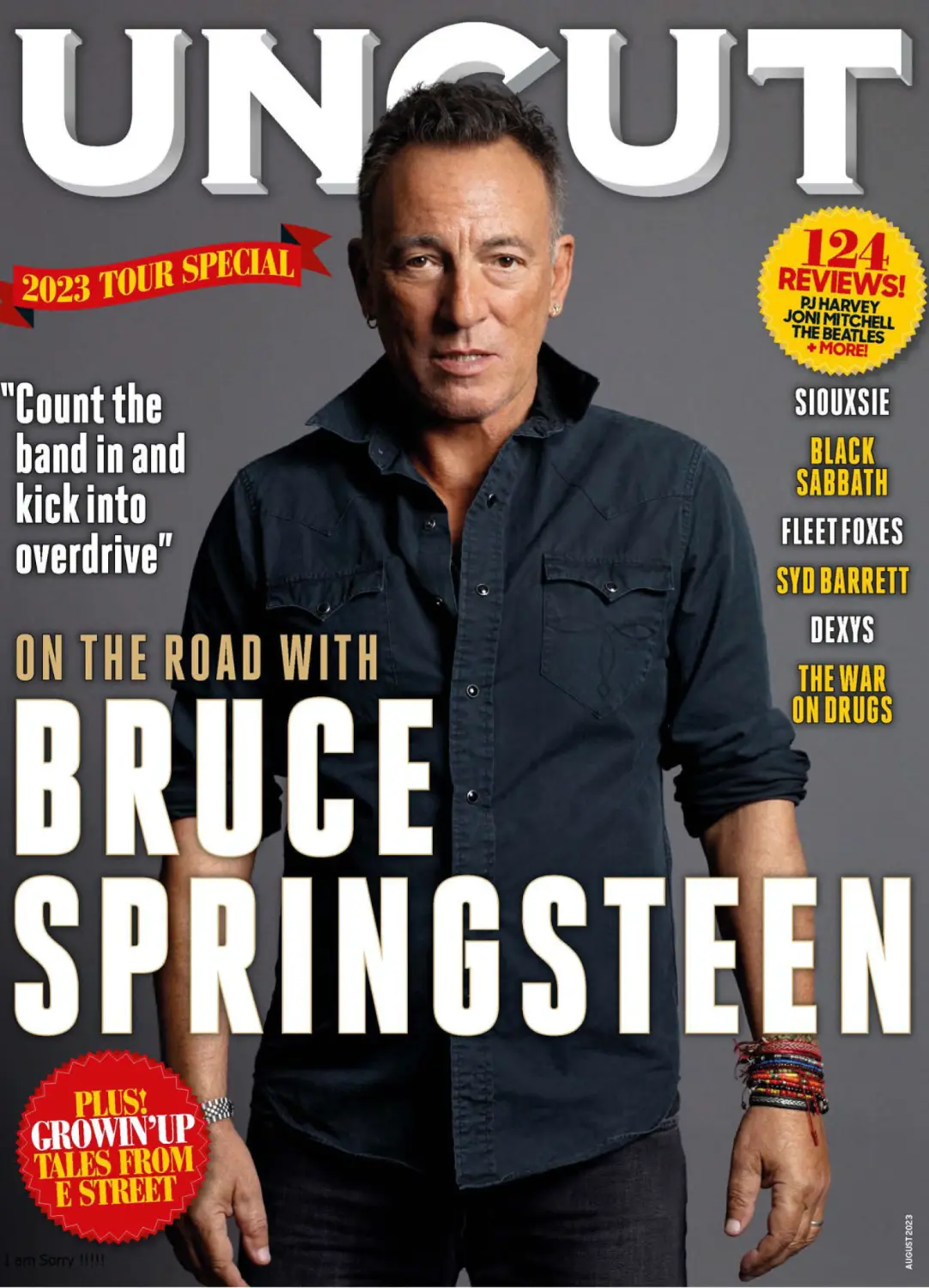
PROMISE you it’s not entirely deliberate, but this month feels like
something of a live special. We have two artists returning to the live
arena after extended hiatuses – Bruce Springsteen after six years
and Siouxsie Sioux after a decade – and another, The War On Drugs,
making a triumphant return visit to the UK, while Blur have also
kicked off a return to active service after an extended layoff. These are all
genuinely exciting for a number of reasons, but they also represent a
shared, indefatigable quality – that even after Covid and ticketing
issues, or in Siouxsie’s case a kind of semi-retirement, our heroes can still
surprise us with their resilience and ability to share communal moments.
Stephen Deusner’s excellent report from the American heartlands, as he
steps aboard the Springsteen Express, captures the E Street Band in full
flight – a powerful sermon from what Marilyn Kales, from St Paul,
Minnesota, describes as “the church of rock’n’roll. Nobody works like he
does. Nobody.”
Elsewhere, Stephen Troussé digs deep into Siouxsie’s catalogue as she
prepares to play in the UK for the first time since 2013’s performance at
Meltdown. I have vivid memories of that show – Siouxsie in a white

On the cover:
Bruce Springsteen
by Camera Press/
Bryan Adams
(newsstand)
David Gahr/
Getty Images
(subscribers)

catsuit, in a whirl of scything arms, stomping round the stage as she
played the Banshees’ glorious Kaleidoscope album in full.
Anyway, there’s a lot more in this issue, of course, including new
interviews with Geezer Butler (MOHAIRS!), Dexys (THAI YOGA!), Fleet
Foxes (BOOKS!), Jim O’Rourke and Eiko Ishibashi (OCTOPUS SALAD!).
There’s also terrific pieces on Fred Neil and War, the latest missives
from PJ Harvey, Joni Mitchell and Julie Byrne, plus Anohni, Codeine,
Syd Barrett and, of course, a free, 15-track CD showcasing the best of the
month’s new music.
As we went to press, we heard the sad news of Tina Turner’s passing.
Fortunately, we managed to turn round a tribute, which you can read
on page 4. It capped a particularly busy month for us here
at Uncut – and huge thanks for going above and beyond to
John, Marc, Mick, Michael, Mike, Tom, Sam and Phil.
See you next month.
Michael Bonner, Editor. Follow me on Twitter @michaelbonner

CONTENTS

4 Instant Karma!

58 Dexys

88 Bruce Springsteen

Tina Turner, Blur, Steely Dan, Siouxsie Sioux
Top 20, Ffa Coffi Pawb, Nico Paulo

Trauma and triumph with Kevin Rowland
as the Celtic soul brothers return

Uncut joins The Boss and band on tour in the
Midwest after a six-year hiatus. Plus: a look
back at the year it all began: 1973

14 Adam Granduciel

64 War

An Audience With…

The Making Of “The World Is A Ghetto”

100 Lives Mdou Moctar, Pretenders

18 New Albums

68 Fred Neil

104 Films The Damned Don’t Cry

Including: PJ Harvey, Joni Mitchell, Grian
Chatten, Dexys, Queens Of The Stone Age,
The Clientele, Julie Byrne, Sam Burton

The enigmatic life and times of a Bob Dylan
mentor turned dolphin protector

107 DVD, Blu-ray and TV

40 The Archive
Including: Codeine, Charlie Watts,
Gal Costa, Mike Cooper, Pet Shop Boys,
Vivian Stanshall, Frank Zappa

52 Black Sabbath
How Geezer Butler, former trainee
accountant, became the bassist/lyricist for
one of the all-time great heavy rock bands

74 Jim O’Rourke &

Syd Barrett and Pink Floyd

Eiko Ishibashi

109 Books

We meet the partners and collaborators in
Italy to talk bold new musical ventures

Paul McCartney, Bee Gees, Nick Drake

80 Anohni Album By Album
82 Fleet Foxes
Robin Pecknold recalls the stories behind
some of the band’s best-loved songs

SUBSCRIBE TO UNCUT
AND SAVE UP TO 25%!

110 Not Fade Away Obituaries
112 Letters… Plus the Uncut crossword
114 My Life In Music
Rufus Wainwright

SUBS
OFFER!

SUBSCRIBE ONLINE AT SHOP.KELSEY.CO.UK/UCP823
Or call 01959 543747* and quote ref: UCP823
*Hotline open: Monday to Friday 8.30am – 5.30pm. Calls charged at your standard network rate

AUGUST 2023 • UNCUT •3

THIS MONTH’S REVELATIONS FROM THE WORLD OF UNCUT
FEATURING... Blur | Siouxsie | Steely Dan | Gruff Rhys | Nico Paulo

“She was
unstoppable”
TINA TURNER | 1939–2023

JACK ROBINSON/HULTON ARCHIVE/GETTY IMAGES; MICHAEL OCHS ARCHIVES/GETTY IMAGES

All hail the Queen of Rock’n’Roll: an
explosive singer who kept on burning
HE sheer volume of tributes that followed Tina Turner’s
passing on May 24, aged 83, was matched by their
emotional weight, an emphatic testament to a dynamic
and inspirational figure. The most telling accolades
came from the female artists she influenced. Debbie
Harry described herself as “a benefactor of the energy,
creativity and talents of Tina Turner. A woman who
started in rural Nutbush, TN cotton fields and worked her way to the very
top.” Beyoncé, another lifelong devotee, thanked Turner for “all the ways
you have paved the way… You are the epitome of passion and power.”
Turner’s achievements were the product of both extraordinary talent
and unsinkable self-belief. Having started out in Ike Turner’s Kings Of
Rhythm, the 20-year-old Anna Mae Bullock was renamed Tina Turner for
1960’s million-selling “A Fool In Love”. She became Ike’s sixth wife in
1962, their relationship extending to the Ike and Tina Turner Revue,
driven by Tina’s powerhouse R&B vocals and exhilarating stage
presence. She was a pioneer, too. At the height of the Civil Rights
movement, she played to desegregated audiences in the South, while
regular appearances on Shindig! and American Bandstand helped
establish the profile of black women on American TV.
In 1966, a year before Turner became the first woman to grace the cover
of Rolling Stone, Phil Spector centred her voice in his cavernous wall of
sound for “River Deep – Mountain High”. Alongside other signal
recordings – be it “Proud Mary”’s rollicking funk makeover, the semiautobiographical “Nutbush City Limits” or her 1975 version of “Whole
Lotta Love”, which swapped strutting machismo for sensuous femininity
– this was Turner at her soulful and simmering best.
All this was achieved while mired in an increasingly violent marriage,
Turner finally fleeing from Ike’s appalling abuse in 1976. After several
years of industry apathy, her ’80s
resurgence was a triumph of will.
Recording,
1984’s platinum-selling Private
circa 1969
Dancer introduced her to a
new generation, her sudden
superstardom measured in recordshattering tours and, in 1993, the
award-winning biopic What’s Love
Got To Do With It. As Barack Obama
noted, “She was unstoppable. And
she was unapologetically herself –
speaking and singing her truth
through joy and pain, triumph
and tragedy.”
ROB HUGHES
4 • UNCUT • AUGUST 2023

“The epitome
of passion
and power”:
Tina Turner
in New York,
November
25, 1969
AUGUST 2023 • UNCUT •5

It really did happen:
400 lucky Blur fans
go ape at Colchester
Arts Centre, May 19,
2023

This is ’ello!
PHOEBE FOX; REUBEN BASTIENNE-LEWIS

Blur debut songs from
their new album at
fevered comeback
show in Colchester

400 fans lucky enough to gain entry, Blur
opened with the brand-new “St Charles
Square”, a chunk of melodic post-Pixies
art-rock with a wolf-howl chorus. As
Albarn explained during a pre-gig press
conference in Colchester Castle, this was
the song that made him realise that the
music he was writing on the last Gorillaz
’M sorry it took us so long,”
tour would make for a revelatory new Blur
said Damon Albarn,
album. While 2015’s The Magic Whip felt a
apologising for a 35-year
little thrown together, here the band
delay in playing their
spoke of their forthcoming ninth record
hometown. But better late
The Ballad Of Darren – named after
than never, Britpop’s prodigal sons chose
Albarn’s long-term bodyguard Darren
the tiny Colchester Arts Centre to launch
“Smoggy” Evans – as a unifying and
their latest comeback, ahead of their two
validatory achievement. “That’s how
Wembley Stadium shows in July.
you become a band again,” said Albarn.
With excitement peaking amongst the
“You make music that’s new
and true to where we are as
human beings.”
That sense of renewed
vigour was evident on
stage, where early
showings for the
heady charge of
“Popscene” and
“Chemical World” –
and a surprise live
Blur back in the
debut for Modern Life
studio, working
Is Rubbish favourite
on The Ballad Of
Darren, 2023
“Villa Rosie” – proved

“I

this to be a reunion of little selfindulgence and zero half-measures.
With a rampaging Albarn showering
the crowd with water, Alex James
cheerfully smoking through nonchalant
basslines and Graham Coxon beaming,
“Can I sing one?” before “Coffee + TV”,
they seemed as raggedly energised as the
jubilant crowd. Yet with one eye on their
Wembley dates, the band were equally
aware of their anthemic capabilities,
casually juxtaposing the profound
(“Out Of Time”, “To The End”, “This Is
A Low”) with the demented (“Advert”,
“Song 2”, “Parklife”).
“I want to see you bounce, you fucking
old cunts!” yelled Albarn, returning for an
encore in which rousing new single “The
Narcissist” took pride of place alongside
“Girls & Boys”, “Tender” and “For
Tomorrow”. They finished with “The
Universal”, a song
suggesting that
Blur were always
playing the long
game. Amid
the rush of ’90s
nostalgia, they
are still making
things happen.
MARK BEAUMONT

SETLIST
1 St Charles
Square
2 There’s No
Other Way
3 Popscene
4 Trouble In
The Message
Centre
5 Chemical
World
6 Badhead
7 Beetlebum
8 Trimm Trabb
9 Villa Rosie
10 Coffee + TV
11 Out Of Time
12 End Of A
Century
13 Parklife
14 To The End
15 Oily Water
16 Advert
17 Song 2
18 This Is A Low
ENCORE
19 Girls & Boys
20 The Narcissist
21 Tender
22 For Tomorrow
23 The Universal

Back in bloom:
Donald Fagen and
Walter Becker

Pencil logic
This is the day of the expanding Dan!
A colourful new book responds to
burgeoning Steely Dan-ia

I

N Quantum Criminals,
writer Alex Pappademas
and artist Joan LeMay
excavate the deep mysteries
and myths of the Steely Dan
extended universe. It’s not a
straightforward band biog,
though you’re likely to learn
a new detail about the band
on virtually every page.
Instead, it’s a rich examination
of the Dan’s legacy, with
Pappademas’s keen and witty
insight complemented beautifully
by LeMay’s portraits of “the
ramblers, wild gamblers, and other
sole survivors” – both real and
fictional – who populate the Steely
Dan saga. From guitarist Jeff
‘Skunk’ Baxter to “Deacon Blues”’
Expanding Man, the book offers
Dan-iacs a fresh and revealing
look at what Pappademas calls
“a cult band whose catalogue,
paradoxically, includes at least
a dozen enduring radio hits”.
The timing couldn’t be better.

“Becker and Fagen
are kind of like
spiritual dads”
ALEX PAPPADEMAS

The Major Dude and
Bernard Purdie

Steely Dan
are having
a “moment”,
the subject of
countless internet
memes. Pariahs in
the alternative rock
era, millennials and
zoomers now proclaim
their love for the band
unabashedly. So why are
this band formed more
than 50 years ago seemingly
more relevant than ever? “I think

the cynicism of Steely Dan maybe
doesn’t feel as poisonous and
acrid as it once did,” reckons
Pappademas. “It feels sensible!
These are dark and strange
and cynical times, and there’s
something about these songs that
just sounds right. Younger
generations are responding to
that. They’re chasing a certain
idea of the past that Steely Dan
represents, some version of
adulthood that they can live.
Becker and Fagen are kind of
like spiritual dads.”
The duo’s impeccable
jadedness is indisputable. But
one of the more surprising
aspects of Quantum Criminals is
how downright human many of
their lyrical subjects come across.
LeMay’s colourful, perceptive
illustrations play a big part
here, with many of her
subjects gazing out at
the reader in striking
fashion. “I wanted
them to have a
whole lot of
humanity,” she
says. “A lot of
them ended up
being funny,
but it wasn’t
outright mocking. I
don’t think the songs
are doing that.”
Pappademas agrees.
“As I worked on the book,
something that came out was
this weird empathy that exists in the
band,” he says. “It’s veiled in irony,

Babylon Sisters
and (below)
Bodhisattva

but I think they have a lot of
compassion for these delusional
people caught up in dreams of
making it or imprisoned by their
bad past decisions. Not in ‘Haitian
Divorce,’ though. That one is
just cruel…”
TYLER WILCOX

Quantum
Criminals is out
now, published
by University
Of Texas Press

AUGUST 2023 • UNCUT •7

Spellbound!
As Siouxsie Sioux returns to the
fray, we salute her influential
post-punk reign in 20 songs

F
FIN COSTELLO/REDFERNS

ROM inauspicious
beginnings, as a
scratch band of SEX shop
denizens blagging their
way onto the stage of the
100 Club for Malcolm McLaren’s
1976 punk festival, Siouxsie And
The Banshees blazed a trail through
the ’80s and beyond with one of the
great post-punk discographies.
Goth? Shoegaze? Trip-hop? They
pretty much invented all that,
while Siouxsie herself redefined
what a frontwoman could be.
As she embarks on her first proper
tour since 2008, we celebrate
her insurgent hits and seminal
deep cuts.

“METAL
POSTCARD”
(John Peel Session,
1977)
Despite Siouxsie’s facile declaration
that she was “more into high camp

than death camps”, her penchant
for swastikas cast a disturbing
shadow over early Banshees gigs.
Debuted on their first session
for John Peel, and dedicated to
Dadaist and anti-fascist artist
John Heartfield, “Metal Postcard”
hinted at a sophistication beyond
their punk peers.

“SUBURBAN
RELAPSE”
(The Scream, 1978)
If the lead single
had emphasised the Banshees’
pop chops, it was a gateway
to the hard stuff of their debut
album, The Scream: an
uncompromising caterwaul
of dismay. Most striking was
“Suburban Relapse”, anatomising
domestic violence like X-Ray Spex,
but with John McKay’s guitars
emulating Bernard Herrmann’s
strings to take the song into
Psycho territory.

“HONG KONG
GARDEN”

“PLAYGROUND
TWIST”

(1978)

(1979)

Finally signed to Polydor
in 1978, the Banshees recorded their
debut single with Steve Lillywhite
after initial sessions with Bruce
Albertine went awry. The result
was this striking (if naive) comment
on British colonialism and the
immigrant experience, the angular
guitars topped with a bubblegum
orientalist xylophone riff. It was the
first post-punk single to reach the
Top 10.

“If Ingmar Bergman
produced records, they might
sound like this,” proclaimed the
NME on the release of the Banshees’
third single in June 1979. Somehow
breaching the Top 30, “Playground
Twist” is the first intimation of the
band’s dawning, darkling
psychedelia, like a bad-trip
version of Jefferson Airplane’s
“White Rabbit”.

“SPELLBOUND”
(1981)
Arguably the Banshees’
finest single, a furious
soulstorm conjured by John
McGeoch’s sublime 12-string guitar
and Budgie’s booming drums.
Though it failed to crack the
Top 20 when released as a single
in May 1981, thanks to its use
in the finale of Stranger Things
Season 4, it’s also now their
most-streamed song.

“NIGHT SHIFT”
(Juju, 1981)
Though its parent
album Juju is in many
ways the rock upon which the
church of goth was founded,
the tenebrous “Night Shift”,
inspired by Peter Sutcliffe’s
murderous trail through the
red-light districts of late-’70s
Yorkshire and Lancashire, is
profoundly darker and more
disturbing than anything that
emerged from the Batcave.

“SLOWDIVE”

“ICON”

(1982)

(Join Hands, 1979)
Join Hands, the Banshees’ second
album, was originally intended to
have a creepily distorted image
from a communion card on the
cover. The religious overtones
spooked Polydor, but were
nevertheless abundant on “Icon”,
with its images of self-mutilation,
the stop-start Wire dynamics giving
way to a more complex tumult.

“CHRISTINE”
(1980)

Darkling
psychedelia:
Siouxsie Sioux
in 1979

McGeoch. It was quickly bettered
by “Christine”, McGeoch’s cascades
of acoustic wonder providing the
soundtrack to Siouxsie’s voyage
into the kaleidoscope of the
schizophrenic psyche, and
the beginning of the band’s
imperial phase.

Following the departure
of John McKay and
Kenny Morris mid-tour in 1979,
prospects for the Banshees seemed
dim, but their defiant intransigence
somehow produced the uncanny
“Happy House”, aided by the

1982’s A Kiss In The
Dreamhouse, a direct
influence on the nascent Cocteau
Twins, is shoegazing’s ground zero.
But ironically the song that named
one of that genre’s most languorous
leading lights is the album’s most
crazed, upbeat moment.

“MELT!”
(1982)
On …Dreamhouse,
all the Banshees’
intimate, psychological horror
exploded into a peerless, glittering
neo-psychedelia, abetted by
Mike Hedges’ production and
strings recorded at Abbey Road.
“Melt!” is its sumptuous pinnacle,
like John Barry collaborating with
Gustav Klimt.

THE CREATURES
“MISS THE GIRL”
(1983)
Conceived out of their growing
romantic relationship, Siouxsie and
Budgie first formed The Creatures in
1981 during a break in the recording
of Juju. But their finest hour is Feast,
an infatuated fever dream conjured
up in Hawaii, combining exotica
and JG Ballard. This eerie marimba
lullaby, the album’s only single,
reached No 21 in April 1983.

“TATTOO”
(B-side, 1983)
The Banshees’ version
of “Dear Prudence”
became the band’s biggest British
single, only kept off the No 1 spot by
the combined forces of Culture Club
and Tracey Ullman. But it’s B-side
“Tattoo” that proved the stealth
hit, its claustrophobic mood and
insistent rhythm influencing the
likes of Tricky, who covered the song
on his Nearly God album in 1996.

“DAZZLE”
(1984)
The Bunnymen laid
down the gauntlet with
the swooning, orchestral Ocean
Rain, but the Banshees rose to the
challenge with “Dazzle”, the
imperious opening track of their
sixth LP, Hyaena. It was recorded
with the London Symphony
Orchestra, “Skating bullets on angel
dust/In a dead sea of fluid mercury”.

(1984)
Hinting at the surreal
anthropological adventures that
had begun on …Dreamhouse, this
single was the Banshees’ first to be
co-written with Robert Smith and
features one of Budgie’s most
astonishing rhythms.

“TRUST IN ME”
(Through The Looking
Glass, 1987)
Covers album Through
The Looking Glass felt like a band
straining to get back in touch with
the seedy, freaky, futuristic glamour
of Iggy, Roxy, Bowie and Sparks that
had sustained them as bored kids in
early-’70s suburbia. However, the

highlight was this sublime cover of
Kaa the snake’s song from Disney’s
Jungle Book.

Stephen Hague, it combined a 909
beat from Schoolly D with the spirit
of Hollywood Babylon to create a
track that felt both up-to-the-minute
and timeless, presaging the
transglobal avant-dance of Björk.

Anima Animus took the band’s early
experiments in rhythm and voice to
the electronic dancefloor – notably
on the lead single, “2nd Floor”,
which sounded like Underworld
descending into the abyss.

“PEEK-A-BOO”

“THE DOUBLE
LIFE”

SIOUXSIE
“INTO A SWAN”

(1988)

(The Rapture, 1995)

(Mantaray, 2007)

The Banshees brilliantly reinvented
themselves with 1988’s Peepshow,
which refitted their slinky,
transgressive soundworld
to the era of Prince and Madonna,
somehow coming out sounding
both more pop and more
transgressive than either.

The height of Britpop
was not a congenial time to be a
Banshee, and the group’s final
album The Rapture was a lacklustre
affair. But this eerie spoken-word
track – looking back at centuries
of “sin and aftermath” – proved to
be a fitting swansong.

“KISS THEM
FOR ME”

THE CREATURES
“2ND FLOOR”

(1991)

(1999)

The Banshees repeated
the comeback trick with “Kiss Them
For Me”. With the help of producer

The first Creatures LP to
be conceived as a statement in itself
rather than an interim side project,

Siouxsie’s belated solo
debut Mantaray felt like a victory
lap, acknowledging her influence
on acolytes from Curve to Björk,
Suede to Goldfrapp. The lead
single was typically commanding,
channelling the spirit of T.Rex for a
new millennium. STEPHEN TROUSSÉ
Siouxsie plays Wolverhampton
Civic Hall, June 21; Tynemouth
Priory And Castle, July 7; Latitude
festival, July 23; Kelvingrove
Bandstand, Glasgow, July 25;
Troxy, London, Sept 6 & 7
AUGUST 2023 • UNCUT •9

DAVID TONGE/GETTY IMAGES

“SWIMMING HORSES”

Shepherd’s
Bush, London,
September
1992

Gruff Rhys
(far right) with
Ffa Coffi Pawb
in 1992

A QUICK ONE
What was it you
wanted? In shops – and
available at Uncut.
co.uk/single – on
June 15 is our fully
updated, 148-page,
Shadow Kingdomembracing, Bootleg
Series- wallowing
Deluxe Ultimate Music
Guide to Bob Dylan. Every
Dylan album reviewed
in depth, alongside
Bob’s key meetings
with the UK music press.
Contains multitudes!…

From power drills to powerpop: Gruff Rhys
revisits his pre-SFA band, Ffa Coffi Pawb

ROLANT DAFIS

I

F the Super Furry Animals
seemed to spring fully formed into
the Britpop fray circa late ’95, it’s
probably because their members all
served long apprenticeships in other
bands. Before SFA, frontman Gruff
Rhys and drummer Dafydd Ieuan
were in Ffa Coffi Pawb, who evolved
from “making experimental noise
jams and selling homemade
cassettes out of a carrier bag” to their
harmony-rich third album Hei Vidal!,
which is now being made available
for the first time since 1992.
Rhys and guitarist Rhodri Puw
(later of Gorky’s Zygotic Mynci)
formed Ffa Coffi Pawb as 16-year-olds
in Bethesda, inspired by John Peel,
Flying Nun records and Welshlanguage legends Datblygu. A certain
irreverence was evident from the
outset: Ffa Coffi Pawb translates
literally as ‘Everybody’s Coffee
Beans’ but say it out loud and it’s
much ruder. “I suppose the name of
the band was a stunt,” considers
Rhys, “in that we got banned from
radio and TV.” Gigs would often
consist of “just one song, ‘Sister Ray’style. We’d have electric drills, to drill

Before we was
Furry: Dafydd
Ieuan and
Gruff Rhys

England, while hitting a wall at
home. “We’d been playing around
Wales for seven years and we felt we’d
run out of road,” says Rhys, of their
our guitars. We couldn’t find a singer,
dissolution in 1993. “We’d play the
so I ended up singing by default.”
same towns to the same people, so it
Anglesey-based producer Gorwel
was a mutual thing between us and
Owen bought one of those homemade the audience. It was like, ‘That’s
cassettes. “I then saw them live a
enough of that, then!’”
couple of times at a small pub in
Rhys and Ieuan moved to Cardiff,
Caernarfon. They sounded very
teaming up with ex-members of U
influenced by Jesus And Mary Chain,
Thant to form Super Furry Animals,
with lots of feedback, but in the
whose early records – co-produced by
context of some great melodic songs.”
Owen – are clearly an extension of
With Owen’s encouragement, Ffa
the overdriven glam-pop sound first
Coffi Pawb used the studio to
explored on Hei Vidal! Rhys remains
experiment, stirring in elements of
particularly proud of “Dilyn Fy
techno and psychedelia
Nhrwyn” – a kind of
before eventually
personal manifesto
alighting on the joyful
which translates as
stomp of Hei Vidal! “We
“Follow My Nose” –
were going through an
and the breezy Bolan
obsession with glam and
fantasy of “Lluchia Dy
powerpop,” explains
Fflachlwch Drosda i”.
Rhys. “Our elders were
“That lyric is like,
from the post-punk
‘Throw your flashdust
GRUFF RHYS
generation and we were
over me’,” he explains.
rebelling by singing
“It’s on the basis that
close harmonies.”
the world has failed, and all we can
“Helping to make that record
hope for is for dumb pop to save us
changed my outlook on recording,”
from hell. I’m happy with the lyrics
adds Owen. “I have a clear memory of
and how they subvert some of the
faffing about adjusting the reverb on
poppiness. I have no idea if that
the drums, trying to decide on
transcends to an [English] listener
whether it sounded better at 4.6.
because it’s in Welsh, but it’s a
and 4.7. Daf leant over and put it
melodic record and a curiosity of
near 10, which was the correct
the time. Personally it brings back
setting of course.”
positive memories – the joy of feeling
As vibrant as the
your way around
album sounds now,
making records.”
the London-centric
SAM RICHARDS
music industry of the
early 1990s had little
Ffa Coffi Pawb’s Hei
interest in bands
Vidal! is reissued by
singing in Welsh. Ffa
Ara Deg on July 28;
Coffi Pawb only ever
their other two
played three times in
albums follow soon

“We were
rebelling by
singing close
harmonies”

Squaring The Circle,
Anton Corbijn’s featurelength documentary
about legendary sleeve
designers Hipgnosis, is
coming to cinemas and
on-demand services
from July 14 (via a
premiere at Sundance
London on July 7). The
new trailer features
pithy recollections
from Pink Floyd, Paul
McCartney, Peter
Gabriel and Robert Plant:
“They’re hucksters!”…

The Coral are set to
return on Sept 8 with
not one but two new
LPs: Sea Of Mirrors
is their 11th album
proper, co-produced
by The High Llamas’
Sean O’Hagan and also
featuring Cillian Murphy
and The Sundowners;
while Holy Joe’s Coral
Island Medicine Show is
a “postscript” to 2021’s
acclaimed Coral Island,
narrated by Ian Skelly’s
grandad, aka The Great
Muriarty, and with a
guest appearance from
John Simm…
Le Guess Who? festival
has just unveiled a
typically cool and
eclectic lineup.
Stereolab, João Donato,
Jonny Greenwood
& Dudu Tassa, Nala
Sinephro, James Holden
and Bombino will all be
heading to Utrecht on
Nov 9–12, where Black
Midi will also perform the
songs of The Beatles…

“I’m still
discovering it
all”: graphic
artist turned
songwriter
Nico Paulo

UNCUT PLAYLIST
On the stereo this month...

BONNIE ‘PRINCE’ BILLY
Keeping Secrets Will
Destroy You DOMINO

“Everyone dies in the end/
So there’s nothing to hide…”
Difficult truths joyously sung,
with Louisville neighbour Dane Waters
on empathetic harmonies.

DOT ALLISON

Consciousology SONIC CATHEDRAL
Infusing the dewy folk-pop of 2021’s
Heart-Shaped Scars with the swooning
comedown grandeur of prime One Dove,
aided by Hannah Peel and Ride’s Andy Bell.

I’M
NEW
HERE

Nico Paulo

childhood home in St John’s,
where Paulo quickly found
community in the island capital’s
flourishing creative scene.
“I feel closer to myself here than I am anywhere
HAVEN’T yet had my Joni Mitchell
else,” says Paulo. “I’m very easily distracted, and
phase,” admits Nico Paulo, which for a
in Toronto there are so many things trying to grab
singer-songwriter born in Canada might
your attention. Ultimately I feel more connected
be considered close to sacrilege. But Paulo’s
to this place: being by the sea, the slower pace of
parents are Portuguese and they returned to
life and having more space to be outside.”
Europe when she was two; instead, the
Her self-titled debut album was recorded in
lusophone sounds of Tropicália – Gal Costa in
similarly idyllic circumstances, in a lakeside
particular – were the first to make a lasting
cabin on Nova Scotia’s South Shore with
impression. “I don’t come from a musical
Baker and percussionist Joshua Van Tassel
background. I’m still discovering it all.”
co-producing. Fellow St John’s musicians came
Paulo grew up in a small town an hour outside
down to contribute: clarinetist Mary Beth
Lisbon, and while she sang in church choirs and
Waldram, singer Steve Maloney, and Baker’s
school musicals it was something she only ever
Hey Rosetta! bandmate Adam Hogan on guitar.
saw as a hobby, opting instead to study graphic
design. It wasn’t until 2014, when she moved back Kyle Cunjak, head of Paulo’s label Forward Music
Group, added bass parts during a three-day
to Toronto in search of a graduate internship, that
recording session.
she picked up a guitar for the first time, turning
“The cabin wasn’t planned,” Paulo reveals.
to songwriting as a way to deal with the “culture
“Josh Van Tassel was setting up a studio in
shock” of her new surroundings.
Lunenburg, Nova Scotia, but a couple of things
“I have dual citizenship but I felt this tension
he needed wouldn’t arrive in time. As the date
when I arrived in Canada, like I didn’t belong
of the session approached, he suggested turning
here,” she explains. “I didn’t grow up speaking
a family member’s cabin into a studio instead.
English, and I was living in this big North
We only used it as a recording space,
American city – I felt a little lonely. In
so I was staying with some friends
a way it was a blessing, because
I’M YOUR FAN
who also lived in the South Shore,
I got to spend a lot of time by
and their little daughter. It really
myself, with music, and I began to
was magical.”
understand that this passion that I
Pairing lyrics inspired by love,
have for it was not just a hobby. I do
dreams and the passage of time with
have something that I want to say.”
warm instrumentation and rhythms
Paulo left her design job to begin
subtly influenced by those Tropicália
making music full time in 2018,
records, the final album sounds both
releasing her debut EP “Wave Call” in
“Nico Paulo
comforting and timeless. “I feel like
early 2020 ahead of a short European
has a timeless
I’m very young as a songwriter, so
tour with collaborator and thenelegance to her
a lot of the writing that I’ve done is
romantic partner Tim Baker, the
voice that is
a conversation that I’m having with
former frontman of Newfoundland
both gentle and
myself,” says Paulo. “It feels almost
indie-rockers Hey Rosetta!. During
spellbinding”
like therapy, like a meditation.”
lockdown in Toronto later that year,
Charles Spearin,
the pair decided to relocate to Baker’s
Do Make Say Think LISA-MARIE FERLA

Magical, Tropicália-tinged indie-folk
from Newfoundland via Portugal

MATT HORSEMAN; HARMONY GERBER/GETTY IMAGES

“I

KIERAN HEBDEN
& WILLIAM TYLER

“Darkness, Darkness” PSYCHIC HOTLINE
There have been many versions of
The Youngbloods’ haunting folk-rock
touchstone down the years, but this
slow-burning sampladelic soul groover
might just be the best.

GUNN-TRUSCINSKINACE

Glass Band THREE LOBED RECORDINGS
The Gunn-Truscinski Duo
become a trio with the addition
of fellow traveller Bill Nace (of
Body/Head). Elemental jams ensue.

ÉROL JOSUÉ Pèlerinaj VILLAGE HUT
The director of Haiti’s National Bureau
of Ethnology – and ordained Vodou
priest – combines traditional chants with
electronic pop and jazz to highlight his
country’s unique culture.

MARGO CILKER

“Lowland Trail” FLUFF & GRAVY
“Got hills to climb/In my own sweet
time…” First single from the West Coast
country queen’s second album already
sounds like a much-hollered standard.

DANIEL O’SULLIVAN

Rosarium HOUSE OF MYTHOLOGY
Fresh from enabling Lifetones’ live return,
the unsung hero of the British leftfield
returns with this ornate chamber-pop
treasure, featuring poems recited by his
daughter Ivy.

RICARDO DIAS GOMES
Muito Sol HIVE MIND

Dreamy, quizzical samba from Caetano
Veloso’s one-time bassist, gradually
subsumed by electronic drones and
punk-jazz noise.

JOHN COLTRANE WITH
ERIC DOLPHY
“Impressions” IMPULSE!

Trane keeps on riding! This
previously unheard take is from
Evenings At The Village Gate,
a newly unearthed 1961 live recording
of his short-lived quintet with Dolphy.

OSEES

“Intercepted Message” IN THE RED
On which John Dwyer profitably circles
back to early-2000s synth-punk. Safe to
say he wasn’t impressed by the recent
coronation hoo-hah: “It keeps you dumb”…
AUGUST 2023 • UNCUT •11

Now
Playing
15 tracks of the month’s best new music
1 EIKO ISHIBASHI

Drive My Car

Uncut heads to Bologna to meet
Ishibashi and Jim O’Rourke on
page 74, so we begin this month’s
CD with a piece from the former’s
superb Drive My Car soundtrack.
Here, lounge and bossa nova
meet melancholic strings within
airy production.

2 CORY HANSON

Wings

Let’s gloss over the title of the
Wand mainman’s latest album,
Western Cum, and enjoy hardrocking tracks such as this. As with
his usual band, there’s a definite
early Radiohead feel and Hanson’s
guitar work is as sublime here as
that comparison suggests.

Dexys

and memory, Byrne explores
strings, piano and synths to weave
a powerful spell.

second, is her best yet. Recorded
with Woods’ Jarvis Taveniere in the
producer’s seat, it pairs the
songwriter’s honeyed hymns to
crisp, timeless Americana.

12 MOLLY TUTTLE &
GOLDEN HIGHWAY

Next Rodeo

6 BROWN SPIRITS

Ode To Dorothy

This Melbourne crew have been
around a while in various bands,
but it’s all come together on their
latest LP Solitary Transmissions.
Driven by a funky krautrock
groove, the instrumental “Ode
To Dorothy” journeys into jazzier,
spacier worlds.

This Is
The Kit

CEDRIC OBERLIN; BRUNO MURARI; ANOHNI WITH NOMI RUIZ © REBIS MUSIC 2023; TONJE THILESEN

3 THIS IS THE KIT

Stuck In A Room

Careful Of Your Keepers is the new
album from Kate Stables’ collective.
Produced by Gruff Rhys, tracks like
“Stuck In A Room” showcase their
polyrhythmic gallop and Stables’
ever-engrossing lyrics.

4 THE CLIENTELE

Dying In May

Once a chamber-pop group, this
London band have spent the last
decade and change branching out.
This track from new album I Am Not
There Anymore is still a surprise,
though – a circling, string-drenched
workout with a dancehall beat.
Reviewed at length on page 32.

5 ANNA ST LOUIS

Into The Deep

A friend and cohort of Kevin Morby,
St Louis’ new album In The Air, her
12 • UNCUT • JUNE 2023

Anohni

funk lines and grainy vibrant
production to instrumentals such
as this cut.

JOHNSONS

The Feminine Divine is the first
album of new material from Kevin
Rowland and co in over a decade,
a celebration of everything female.
A horn-led northern soul stomp, it’s
exactly what one might hope their
return would be. Check out our
feature on page 58.

Anohni Hegarty leaves behind the
electronics of 2016’s Hopelessness in
favour of lush, tender soul on her
new LP, My Back Was A Bridge For
You To Cross. There are echoes of I
Am A Bird Now, but a new gospelinfused confidence too.

8 DEER TICK

If She Could Only See Me Now
John McCauley’s lot are on top form
with the new Emotional Contracts
album, their debut for ATO,
produced by Dave Fridmann. He
gives McCauley’s boisterous bluesrock a warm grittiness, and the
results are undeniable.

9 TONY ALLEN &

ADRIAN YOUNGE
No End

A posthumous set on the Jazz Is
Dead label, JID018 is a superlative
showcase of the late drummer’s
mastery and invention. Younge is
a fitting foil for Allen, adding dirty

13 SAM BURTON

I Don't Blame You

10 ANOHNI AND THE

7 DEXYS

I’m Going To Get Free

As Tuttle sings here, this isn’t her
first rodeo, yet new album City Of
Gold is an effective slice of her
bluegrass-infused songwriting,
bolstered by fine performances by
her Golden Highway group. It’s our
Americana Album Of The Month
on page 28.

It Must Change

11 JULIE BYRNE

Moonless

Byrne’s new album, the longawaited The Greater Wings, is
reviewed at length on page 35, and
here’s an example of its broken,
yearning charms. Dealing with grief
Julie
Byrne

Have a look at our lengthy review
of Burton’s Dear Departed LP on
page 39 while you check out this
future transmission from a parallel
past. Like, say, Weyes Blood, Burton
harnesses musical history but
speaks to today.

14 NAOMI YANG

Boxing And The City
Best known for her work in Damon
& Naomi and Galaxie 500, Yang has
now directed a documentary about
an East Boston boxing gym, Never
Be A Punching Bag For Nobody,
and – naturally – provided the
soundtrack. Here’s a tranquil
electronic highlight, melodic and
atmospheric in equal measure.

15 JIM O’ROURKE

A Man's Mind Will Play Tricks
On Him (Edit)
We finish close to where we started
this month, with a piece from the
Japan-based musician’s new Hands
That Bind soundtrack. Driven by a
jazzy pulse, it drifts off into a
dreamlike state – head to page 74 to
read our six-page feature.

“Expansive... intense... a balance between The Clash,
Mission Of Burma and Slint” 8/10 UNCUT

CD/LP/DIGITAL - OUT NOW

Adam Granduciel:
about to “rock as
hard as possible”
around Europe

“No-one’s hair is allowed
to be longer than mine.
We do a monthly
measurement”
14 • UNCUT • AUGUST 2023

AN AUDIENCE WITH...

I think adding Eliza Hardy Jones to
The War On Drugs was a stroke of
pure genius. Why did you decide to
add a new member to your already
super-talented set of musicians?
Dave Powers, via email

The War On Drugs chief
talks new material, hair
waivers, ruptured discs
and shooting the breeze
with Mick and Bruce
Interview by SAM RICHARDS

“Just a joy”: Eliza
Hardy Jones with
the WOD at Gold
Pacific Studios on
October 20, 2022

The War On
Drugs in 2021:
“a big touring
band, this
machine”

Great question, Dave Powers!
Well, I had wanted to add
somebody for a couple of years,
especially because there was
a lot more backing vocals
than before. The six of us were
obviously a great unit, but with
the new material, everybody
was doing acrobatics. We’ve
all known Eliza for a long time
because she’s been part of the
scene in Philly forever. I also
wanted to get out of the boys
club a little bit. I asked her if she
wanted to come out and rehearse
with us and within the first 10
minutes I was like, ‘This is great.’

Our voices work really well together
and she brought way more to the table
than I even thought: she has this whole
approach with singing through an effects
box, and she’s turned into a really great
guitar player. She’s been a great addition
to our band musically and also within the
framework of the organisation. She’s just a
joy, you know?

In the early days, you were the only
member of The War On Drugs with
long hair. Now they (almost) all have
long hair. Did you crack the whip?
Cathy Jones, Didsbury, Manchester
Oh, definitely. But they had to sign a
waiver: no-one’s hair is allowed to be
longer than mine. We do a monthly
measurement.

You’ve played Halifax, Nova Scotia,
and now you’re set to play Halifax,
England. Is this the first time The War
On Drugs have played the same city
on two different continents? What
will the band do to celebrate?
Dan H, via email
Probably the closest we get to that would
be taking the ferry to Dover [Kent] and the
band staying at my parents’ house in Dover
[Massachusetts].
When we played
in Halifax, Nova
Scotia, it was a
special night a
couple summers
ago. A lot of the Live
Drugs record is from
that show. And so
perhaps we will
include some of the
Halifax, UK, stuff in
our next live record.
I bet that’s gonna
sound incredible
because the sound
will be bouncing
around those
AUGUST 2023 • UNCUT •15

SHAWN BRACKBILL; TIMOTHY NORRIS/GETTY IMAGES FOR THE RECORDING ACADEMY

ORGET your vaulted
ceilings and your £800k
Neve consoles. Adam
Granduciel is happier
recording in his own
humble warehouse space
in Burbank, north of LA.
“I will argue that I have built maybe the
greatest studio in the world!” he laughs.
“I swear to God, it’s really dialled in right
now. When you have your own place,
everything is set up the way you want. It’s
not like a pro studio, it’s right near the
airport. But luckily the planes take off
in the other direction.”
At the moment, he’s there most
days with his engineer, laying down
initial ideas for what will become
the new War On Drugs album on his
beloved two-inch tape machine,
“trying to make something a little
bit more homemade and direct”. He
even references lo-fi heroes Guided
By Voices. “But in six months, I’ll
probably have a year booked at Real
World Studios and be flying guys in
from all over the world! Who knows?
It’s all about the songs. You can
record a song 50 different ways and I
think it’s just finding the thread that
connects all of them together.”
Granduciel is about to take a break
from the studio to tour some of Europe’s
most picturesque outdoor venues with
his Drugs buddies, a jaunt he hopes will
only fuel the creative process. “I think
everyone wants to go out and rock as hard
as possible: see some of our friends, play
some great shows, come back with new
songs, new ideas, new approaches. It’s
really exciting.”

I forget who said it – maybe
Rick Rubin – but basically he
was like, people spend their
whole life trying to emulate
the first thing they loved. I was
wearing out the CD, for sure.

Would you ever consider
making an album with
Kurt Vile in the future?
Nick Lander, via Twitter

Granduciel in
his home studio,
Philadelphia, 2014;
(inset) he and his
brother’s early buys

old walls [of The Piece Hall]. We played a
courtyard like that in Spain once and it
was maybe the best-sounding show ever.

Your music is deeply emotional for
many listeners – it brings some people
to tears. Is this intentional and does it
have a similar effect on you?
Jack Baker, via email
It’s not intentional, you’re just trying to
get to the essence of some sort of idea
that you feel within you. And the hope is,
whatever’s inside of you that you’re trying
to express and put a song to, someone out
there will feel similar. I think that’s one of
the most beautiful things, when people
respond to the music in the ways that
they do. For me, there’s no right or wrong
thing a song is about. Everything is open
to interpretation and we filter art through
our own experience. I mean, why do
people look at Rothko or Picasso paintings
and break down? We look to art for some
guidance or solace. So the greatest gift
that someone could give me would be that
connection they have to our songs.

PIETER M. VAN HATTEM; ADAM WALLACAVAGE; JORGEN ANGEL/REDFERNS

Would love to know the story behind
“Pain”… Tanner Heron, via Twitter
I basically had a ruptured disc, but I didn’t
do anything about it for a year or so. I was
in excruciating pain for months on end –
it would be really hard for me to stand
up for more than 10 minutes at a time.
It informed a lot of the imagery in that
song because there’s a line in there about
having a broken back. I was so consumed
with this physical pain, it was all I could
really think about. So I knew that that
song was going to be about the journey of
living with something that’s keeping you
from being who you want to be, or going
where you want to go. I’ve been blessed,
because I had surgery to fix it. In fact the
cover photo of A Deeper Understanding,
I’m actually wearing a back brace under
my denim jacket.

What was it like to remix a Rolling
Stones/Jimmy Page song [“Scarlet”,
from the Goats Head Soup boxset]?
Kevin Porter, Nailsea
16 • UNCUT • AUGUST 2023

“I really want to do
something different than
the last two records I’ve
made – something simpler,
more direct”
Ah man, that was one of the coolest
things ever. I had a lot of fun sitting
down in my basement [isolating] Jimmy
Page’s guitar and running it through
some of my gear. Dave [Hartley, WOD
bassist] put an amazing bassline on it.
I was like, ‘Dave, you got to play bass
on this because the liner notes will
say: Page/Jagger/Richards/
Hartley!’ So then I turned it
in to some email address and
they write back: ‘Mick has a
few notes.’ I was like, ‘Wait,
what? I didn’t know this was
going up to the top!’ So a week
later I’m chatting with Mick
on the phone, and it was
surreal. He’s so tuned in – I
feel like I learned more about
music in those 10 minutes
than talking with anybody.
There was a rumour about
that song that it was Ginger Baker
on drums. I mentioned to Mick
that I felt guilty using a Linn
drum over his drums, but it turns
out it wasn’t Ginger Baker, so we
had a laugh about that.

What was the first LP that you
bought with your own money,
and where did you get it?
Mr Halfspeed, via Twitter
Phil Collins’ …But Seriously on CD. On the
same day, my older brother bought Skid
Row, so that’s where we were at in 1989.
I loved that song “I Wish It Would Rain
Down” – and “Another Day In Paradise”,
both of which heavily feature the DX7
keyboard, which is a sound I use a lot.

When we met each other 20
years ago, I didn’t really have a lot
of music friends – and I’d definitely
never met anybody like Kurt. So
when we started jamming for fun
on my couch, he gave me so much
confidence just by being so open
about how he liked playing with
me. We’d end up hanging out with
each other multiple times a week,
just to play guitar. So I would say
the time that we spent together
making records, between 2005 and 2011
or whatever, was definitely the most
significant period of my musical life. I
don’t really know if we’d make a record
again, because we’ve done a lot of stuff
together. I wouldn’t rule it out for any
reason of course, but it’s more like I feel like
the stuff that we’ve already done together
is enough for my lifetime.

What does Bruce Springsteen
think about you naming your son
after him? Kay Leporis, via email
Well, he wasn’t really directly named
after Bruce Springsteen, but it’s
impossible not to acknowledge that
we’d obviously thought about it. It’s
funny to tell someone, ‘Oh, my kid’s
name’s the same as yours.’ But he’s
growing into his name really well. So
now he [Springsteen] gets a kick out of
it. When we write each other, he’s like,
‘How’s my little Bruce?’

Significant:
Kurt Vile

Do you put any limits on The War
On Drugs’ future in terms of musical
style? Andreu Arribas, via email
No. And I sometimes wonder how to kind
of reconcile that with having a big touring
band, this machine. Right now, I really
want to do something different than the
last two records I’ve made – something
simpler, more direct. I don’t want to
spend two years looking at a computer
screen. Having my own studio now, I
want to get back to a way of working
that I used to be obsessed with: trial
and error, fast and loose. Whatever we
end up with on record, we’ll find a way
to transfer it onto our big stage with
our big sound. But I do think it’s
important to make the record you
want to make and then figure out
the other side.

Scarlet:
Jimmy
Page

The War On Drugs play Brighton
Centre (June 17), The Eden
Project, Cornwall (18), OVO
Hydro, Glasgow (20), The Piece
Hall, Halifax (21) and Trinity
College, Dublin (27)

CARGO COLLECTIVE

BRIGID MAE POWER

THALA

STILL CORNERS

ADAM GREEN

DREAM FROM THE DEEP WELL

IN THEORY DEPRESSION (EP)

FRIENDS OF MINE
(20TH ANNIVERSARY)

FIRE RECORDS LP / CD

FIRE RECORDS 12” EP

STRANGE PLEASURES
(10 YEAR ANNIVERSARY RE-ISSUE)

The new album from celebrated Irish singer songwriter.
A unique marriage of traditional stylings & very modern
melodies; a breath-taking soundtrack which underpins
her striking vocals. This is Brigid Mae Power’s most
complete album yet. “Extraordinary” Sunday Times

Deeply personal explorations of the self in vivid, ‘90s
revival indie-rock. From the dazzling soundscapes of
Mazzy Star to the bittersweet pop of Juliana Hatfield.
In Theory Depression explores shimmering shoegaze,
cinematic melodies & bittersweet alternative pop.

WRECKING LIGHT LP / CD

CAPITANE RECORDS 2LP / 2CD

Special reissue of classic dream pop album STRANGE
PLEASURES, including ‘The Trip’ with over 200 million
streams, which captured people’s hearts & inspired a
virtual community of like-minded fans around the world.

A double LP, with a second disc of outtakes, B-sides,
and live versions. This deluxe edition is a window into an
essential part of our recent past as well as a testament
to an artist who has stood the test of time.

NIGHT BEATS

CURRENT AFFAIRS

CHAIN OF FLOWERS

BEING DEAD

RAJAN

OFF THE TONGUE

NEVER ENDING SPACE

WHEN HORSES WOULD RUN

FUZZ CLUB LP / CD

TOUGH LOVE LP / CD

ALTER LP / CD

BAYONET RECORDS LP / CD

Landing somewhere between Spaghetti Western film
score and psych-pop opus, by way of Anatolian funk,
R&B and soul, ‘Rajan’ is the career-defining new Night
Beats album from Danny Lee Blackwell

Following 2019’s singles collection Object & Subject, Off
the Tongue is the debut full-length for Current Affairs.
Their music straddles new-wave pop & gothic post-punk
in the way that you should expect a Glasgow-Berlin band
to do so: with grit & panache.

Welsh unit Chain Of Flowers return with their sophomore
full-length. 10 shimmering tracks that traverse the
greatest reaches of early indie, post punk and new
wave.

It’s psychedelic cowgirl garage rock best friends from
Austin, TX--celebrate Being Dead today and every day
with only the hits.

WYE OAK

CABLE TIES

CURRENT JOYS

MICHAEL JAMES TAPSCOTT

EVERY DAY LIKE THE LAST:
COLLECTED SINGLES 2019 – 2023

ALL HER PLANS

WILD HEART

THE BEASTS OF HISTORY

MERGE RECORDS LP / CD

CURRENT JOYS LP

ROYAL OAKIE CD

“A perfect marriage of self-awareness in the world and
rock for the sake of rawk” —Rolling Stone

Limited LP, first time pressed to vinyl, with hand screen
printed cover. Remastered for vinyl. Cover hand drawn
by Current Joys. Also available the albums “B-Sides,
Rarities and Demos” & “Me Oh My Mirror”.

Michael James Tapscott pulls from outsider americana
to create a captivating collection of country-folk songs
full of doomed anti-heroes and beautiful losers, calling
to mind Lee Hazlewood & Bobbie Gentry.

MERGE RECORDS LP / CD
A new collection of music from Wye Oak featuring three
previously unreleased songs, available for the first time
ever on vinyl.

STRANGE PILGRIM

MIKE COOPER

BAND OF HOLY JOY

RUSSIAN CIRCLES

STRANGE PILGRIM

LIFE AND DEATH IN PARADISE
+ MILAN LIVE ACOUSTIC 2018

FATED BEAUTIFUL MISTAKES

STATION
(15TH ANNIVERSARY RE-ISSUE)

ROYAL OAKIE CD
Drawing on themes of dislocation and existentialism,
Strange Pilgrim is an exploration of life in an increasingly
unfamiliar world, featuring poetic imagery coupled with
folk-rock, dream-pop, and shoegaze sounds.

CARGO

COLLECTIVE:

AN

PARADISE OF BACHELORS LP / 2CD
First-ever reissue of Mike Cooper’s final songwriter
record from 1974, a suite of gloaming glam-rock anthems
performed with a South African spiritual jazz trio featuring
Louis Moholo,

AMALGAMATION

OF

RECORD

SHOPS

TINY GLOBAL PRODUCTIONS LP / CD
“And take psychedelics in my own time . . .”
Arch-romanticists Band Of Holy Joy return with a brilliant new
album of stirring epics and necessary escape tactics.

AND

LABELS

DEDICATED

TO

SARGENT HOUSE LP
15th anniversary re-issue of Russian Circles’ critically
acclaimed sophomore album. LP in gatefold Sleeve w/
printed inner & poster.

BRINGING

YOU

NEW

MUSIC

IRELAND: DUBLIN - SPINDIZZY / KILKENNY - ROLLER COASTER SCOTLAND: DUNDEE - ASSAI / EDINBURGH - ASSAI / EDINBURGH - THORNE RECORDS / GLASGOW - LOVE MUSIC / GLASGOW - MONORAIL WALES: ABERYSTWYTH - ANDY’S RECORDS / CARDIFF - SPILLERS /
NEWPORT - DIVERSE / SWANSEA - DERRICKS NORTH- WEST: BARROW-IN-FURNESS - TNT RECORDS / LIVERPOOL - 81 RENSHAW LTD / LIVERPOOL - PROBE / MANCHESTER - PICCADILLY RECORDS / NANTWICH - APPLESTUMP RECORDS LTD / PRESTON - ACTION RECORDS
NORTH-EAST: BINGLEY - FIVE RISE / HARROGATE - P & C MUSIC / HEADINGLEY - VINYL WHISTLE / HUDDERSFIELD - VINYL TAP / LEEDS - CRASH LEEDS - JUMBO RECORDS / NEWCASTLE - J G WINDOWS / NEWCASTLE - BEATDOWN / NEWCASTLE - REFLEX / SHEFFIELD - BEAR
TREE / SHEFFIELD - RECORD COLLECTOR / SHEFFIELD - SPINNING DISCS / STOCKTON ON TEES - SOUND IT OUT MIDLANDS: CAMBRIDGE - LOST IN VINYL / CAMBRIDGE - RELEVANT / COVENTRY - JUST DROPPED IN / LEAMINGTON SPA - SEISMIC / LEIGHTON BUZZARD - BLACK
CIRCLE / LETCHWORTH - DAVID’S MUSIC / LICHFIELD - STYLUS RECORDS LTD / LOUTH - OFF THE BEATEN TRACK / NOTTINGHAM - ROUGH TRADE / OXFORD - TRUCK STORE / OXON - STRUMMER ROOM RECORDS / WITNEY - RAPTURE SOUTH: BEXHILL ON SEA - MUSIC’S NOT
DEAD / BLANDFORD FORUM - REVOLUTION ROCKS / BRIGHTON - RESIDENT / BURY ST.EDMUNDS - VINYL HUNTER / GODALMING - RECORD CORNER / LEIGH-ON-SEA - FIVES / LONDON - BANQUET GRAVITY / LONDON - CASBAH / LONDON - FLASHBACK / LONDON - ROUGH TRADE
EAST / LONDON - ROUGH TRADE TALBOT RD / LONDON - SISTER RAY / LUTON - VINYL REVELATIONS / NORWICH - SOUNDCLASH / NORWICH / VENUS VINYL / ROMSEY - HUNDRED / SOUTHAMPTON - VINILO / SOUTHSEA - PIE & VINYL / SOUTHEND ON SEA - SOUTH RECORDS / ST
ALBANS - EMPIRE RECORDS / WATFORD - PARADE VIBES / WIMBORNE - SQUARE RECORDS / WHITSTABLE - GATEFIELD SOUNDS / WINCHESTER - ELEPHANT RECORDS SOUTH WEST: BOURNEMOUTH - VINILO / BRISTOL - ROUGH TRADE / CHELTENHAM - BADLANDS / FALMOUTH
- JAM FROME - RAVES FROM THE GRAVE / MARLBOROUGH - SOUND KNOWLEDGE / TOTNES - DRIFT MAILORDER AND INTERNET ONLY STORES: BLEEP.COM / BOOMKAT.COM / NORMANRECORDS.COM / PEBBLE RECORDS CO.UK / REVEALRECORDS.CO.UK / RECORDSTORE.CO.UK

17 HEATHMAN’S ROAD, LONDON SW6 4TJ - CARGORECORDS.CO.UK - INFO@CARGORECORDS.CO.UK

“Are you Elvis? Are you God? Jesus sent to win my trust?”

NEW ALBUMS
AUGUST 2023
TAKE 315

1 JONI MITCHELL (P22)
2 QUEENS OF THE STONE AGE (P30)
3 JULIE BYRNE (P35)
4 SAM BURTON (P39)

THE UNCUT GUIDE TO THIS MONTH’S KEY RELEASES

PJ HARVEY
I Inside The Old Year Dying
PARTISAN

Hark! The unsettling sound of a Dorset childhood. By Alastair McKay

STEVE GULLICK

finished recordings. Sometimes it works
HEN PJ Harvey
ALBUM
the other way. When Harvey’s records have
announced
OF THE
tended towards the febrile, the demos betray
the release of
MONTH an intimacy that is less performative. They
I Inside The
feel closer to the source.
Old Year Dying,
9/10
Most importantly, there is Orlam, a book
her sense of relief
which does its best to defy description, being
was palpable. The
pitched somewhere between a poem and a
seven-year gap from Harvey’s last record, The Hope
narrative, the jumbled bones of a screenplay, or the
Six Demolition Project, was due to a number of factors.
half-remembered details of a dream which recurs
One of them was a matter of will. She felt distant from
in subtly different form every night before sinking
music. The new album was difficult to make, she said,
back into the unconscious, its meaning lingering
“and took time to find its strongest form”.
in menace and confusion. To add to the sense of
That said, Harvey has not been idle these past few
bewilderment, the verses are written in the dialect of
years. Now that her musical creativity is burning
old Dorset. Even in English, the meaning seems less
again, it’s worth taking a moment to examine the
important than the mood, which seems to do with the
route the singer has taken on the road to this obliquely
marshy land adjoining childhood, adolescence and
powerful album. There has been film and television
that brutal state, maturity. Orlam is gothic and lyrical,
soundtrack work, for All About Eve, Bad Sisters and
rural and biblical, its verses
The Virtues, on which Harvey
pregnant with maggoty slugs,
explored atmospheres, putting
swollen badgers and horny
her music at the service of
culvers. There is dark humour,
the image, adding blusher to
and temporal dislocation.
the bruises of other people’s
The word “orgasm” is slanged
stories. There has been a
into a “Jim’ll Fix It”. There
fair bit of self-examination.
is a mention of Cluedo (a
Harvey’s back catalogue has
playful board game about
been reissued, and in demo
murder), and the sweet
form too, a process which
innuendo of “fingers of Fudge”,
invites speculation about
which requires no further
the recording process itself.
speculation.
The demos often have an
In that book and on this
immediacy, a raw power,
record, Elvis stalks the land,
which is diminished in the
18 • UNCUT • AUGUST 2023

Polly Jean:
eerie poems
narrated by a
lamb’s eyeball

AUGUST 2023 • UNCUT •19

PJ: painlessly
shedding her
sound once again

that of a dying soldier, a girl’s first love,
a Christ-figure (the “dark-haired Lord”).
He is also clearly the actual Elvis, as is
evidenced by the occasional choruses
of “Love Me Tender”, a song which
pillaged its melody from the sentimental
ballad “Aura Lee”, sung around campfires
in the American Civil War. (Soldier, Elvis
– Harvey has considered all the layers.)
The poem “Lwonesome Tonight” (aka
“Lonesome Tonight”) references both the
Presley song and John 13:34, as it records
the un-girling of a girl, a loss of innocence
signalled by a satchel full of “Pepsi fizz”
and – the King’s favourite – peanut butter
and banana sandwiches. The song is quite
lovely, a magical mystery in which a girl
– naive or ready, it wouldn’t do to judge
– approaches her shepherd expectantly,
trilling, “Are you Elvis?/Are you God?/
Jesus sent to win my trust?” Perhaps the
synth is a sign that all is not perfect. It
coils beneath the tune, a detuned radio
signalling distress.
On her last two albums, Let England
Shake (2011) and The Hope Six Demolition
Project (2016), Harvey turned towards
commentary. The recording of Hope
Six was devolved to a theatrical project,

Paterson writes. “Few, though, will have
anticipated so minimalist a turn into quite
so eerie a landscape.”
The words in Orlam were written
as poems, not songs, though Harvey
expressed a hope that they might emerge
in another form; a strange film, perhaps,
or a theatre piece. She didn’t rule out
music. And here they are, more or less,
murmured and tra-lah’d over a musical
soundtrack which contrives to blend the
folky innocence of the Moomins with –
at the parched extremes – the alarm
and discord of Hildur Guðnadóttir’s
Chernobyl soundtrack.
The influence of trusted collaborators
John Parish and Flood is vital. This time
around, Harvey all but abolished the
demo-ing phase, recording stray thoughts
into a phone and trusting instead in the
collaborative process. Echoing the process
of Hope Six, the studio was arranged
for live playing, with tunes emerging
from spontaneous performance. This
gave Harvey the freedom to explore the
possibilities of her voice. She sings with
the confidence that every insinuation
will be heard, even when the words are
unfamiliar. On the opening “Prayer At

The Gate”, she sounds both pained and
distracted: her voice rises to an almost
religious pitch, as the tune hums like an
electrical substation. “Autumn Term”
has an almost comical falsetto, and the
noise of children playing is spliced into
the song’s witchy spell. The singing
is bell-like on “The Nether-Edge”, a
digression into superstition and darkness
which sounds like a playground chant,
yet contrives to wave at both Hamlet and
Joan Of Arc, while weaving a spell about
“femboys” and a “not-girl” being “zwealed” on the stake.
You can probably decode zweal-ed,
but the riddles in the lyrics are further
explained in the sleeve notes. Many of the
meanings are as implied. The “poserrod” of a horny devil or a goaty God is,
as you might surmise, “a devil’s penis,
abnormally large”. “Chalky” is “ghostly”.
Less predictably, “bedraggled angels”
are wet sheep, and “Elvis” – it says here –
is “all-wise”.
What does it mean to sound this ancient,
this strange? Well, it’s to Harvey’s great
credit that this fever dream never appears
forced, and the experiment of shedding
most of her signature sound is painlessly
achieved. Elvis might intrude, sounding
like Zooropa-era Bono, in the middle of
“August”, but that is a feint. These days, PJ
Harvey don’t play no rock’n’roll. There is
only a ghostly scratching at the bedpost of
the Beefheart blues, most notably on the
closing “A Noiseless Noise”.
Impressively, the density of Orlam is
made more accessible by its re-enactment
as a suite of songs. It’s not necessary
– perhaps it is not even possible – to
understand that the narrator of the poems
is a lamb’s eyeball, because the music
has its own strange energy, a thunderless
storm of electricity showering ripe
insinuations. The weirdness is intense,
but channelled, and the surprises arrive in
a way that threatens, but fails to obliterate,
the innocent fearfulness of childhood.
Strangeness abounds. The strangeness
of wondering.
Hark! I Inside The Old Year Dying is a
singular thing. For all its disguises, all the
tree-tears and twiddicks, it might be PJ
Harvey’s most autobiographical record.

SLEEVE NOTES
1 Prayer At The
Gate
2 Autumn Term
3 Lwonesome
Tonight
4 Seem An I
5 The Nether-Edge
6 I Inside The Old
Year Dying
7 All Souls
8 A Child’s
Question, August
9 I Inside The Old
I Dying
10 August
11 A Child’s
Question, July
12 A Noiseless
Noise
Produced by:
PJ Harvey, John
Parish & Flood
Recorded at:
Battery Studios,
London
Personnel: PJ
Harvey (vocals,
Rhodes, piano,
bass, guitar, bass
clarinet), John
Parish (drums,
synth, vocals,
guitar, Rhodes,
trombone,
percussion, bass,
Variophon),
Mark “Flood” Ellis
(effects pedal
drone, synth,
sonic disturbance,
loops), Adam
Bartlett (field
recording samples,
loops, bass
keyboard), Ben
Whishaw, Colin
Morgan (backing
vocals)

HOW TO BUY...

HARVEY’S CREAM

STEVE GULLICK

On the road to I Inside… – three vital Parish/Flood collaborations
To Bring You My Love

White Chalk

Let England Shake

ISLAND, 1995

ISLAND, 2007

ISLAND, 2011

After the unbridled ferocity of
her first two albums, Harvey
switched gears, employing
Flood as producer and bringing
in John Parish and Bad Seed Mick Harvey to
populate a gothic landscape which lost none
of the ferocity, but understood the power of
restraint. The title track, a swampy blues with
biblical undertones, is a masterpiece of mood
and menace. 9/10
20 • UNCUT • AUGUST 2023

Flood and Parish are joined by
Eric Drew Feldman and the
Dirty Three’s Jim White in an
abrupt change of style, as
Harvey opts to play piano and sing quietly, near
the top of her register. The mood is haunted
and austere, closer to folk than blues. On the
atmospheric “Grow Grow Grow”, she captures
a mood of bruised innocence which blends
myth and fairytale. 8/10

Harvey’s vocal style became
that of a playful narrator in this
Mercury Prize-winning set
recorded in a Dorset church
with Parish, Flood and Harvey. Viewed as an
anti-war album, the power of the songs came
from the skilful way Harvey inhabited the
subject, blending an interest in First World War
poets with the horror of recent conflicts.
9/10

NEW ALBUMS

You’ve talked
previously about
how the songs
develop from
Polly’s demos –
was this the same?
Or was the
music created in
the studio?

Q&A
Flood: “We were
trying to coax her
into a place where
she wasn’t ‘PJ Harvey’
but she was Polly”
Polly has been busier with poetry
than music over the last few
years – how did that influence
her approach?
As all of the songs are actually poems
that she’s spent the last eight years
writing, I would say this has been
absolutely central to the concept of the
whole record. It brings into strong focus
whether a lyric is a poem or whether
a poem can be a lyric. The lyrics come
directly from the poems in Dorset, so
they sometimes sound strange. That’s
the beauty of it – there’s emotion there.
People don’t need to sing in English –
you can create an emotion from any
words, sounds or language – look at
Sigur Rós.

Did Polly explain what she
wanted to achieve with
the songs?
Yes, she wanted to hear something that
she’d never heard before.

Is Polly a collaborative writer,
or does she have definite ideas
about what she wants?

“There’s an
unspoken trust”:
Harvey in the studio

This was a little bit
different. But at the core
she had ideas of how
she wanted everything
to feel and sound. She had ideas for
everything – it had been through a
couple of other filters, so by the time it
arrived in the studio we had to break
the mould. We wanted to try areas we
hadn’t tried before, using her manifesto
as a blueprint but not as something to
stick to. Polly had written the songs, but
it’s about collaboration and how other
people react.

Can you describe the creative
relationship between yourself,
Polly and John? What do each
of you bring?
For me, it’s probably one of the great
experiences of being a human being. So
much has happened over the 30 years
since we first met and worked together
that we almost don’t need to speak,
because each of us moves forwards,
backwards, sideways, keeps the ego in
the box, starts to play guitar, laughs a lot,
or falls asleep and it doesn’t really matter

“This was the first time
I’d heard her singing
the way she did on
this record” FLOOD

what it is, there’s an energy, unspoken
trust, belief and respect in each other to
make something great.

As a producer, do you have to risk
upsetting the artist sometimes?
I would never upset the artist, but I will
challenge them just as much as they
challenge me. It’s an intense emotional
communication. When you’re working
with people with whom you have so
much experience and respect, you don’t
need to say anything. It’s a learning
experience and it’s wondrous. I can’t
play any instruments but I can say things
like “that’s amazing”, and that’s as
important as saying, “I don’t really know,
it sounds like something we did before.”
Those can both be challenging, boring or
predictable, but it helps. I listen to these
songs continually and it reminds me of
one of the best months in Willesden I’ve
ever had, full of joy. I know that’s hard to
believe in Willesden in January.

Polly has suggested it was a
difficult album to make and took
time to find its strongest form –
what’s your recollection?
I wonder whether Polly’s description of
it being a difficult album to make was
the entire process from gestation of the
original poem to walking out years later
with the finished article, because the
actual month we spent in Willesden
was beautiful, and we laughed, and yes
it took a little bit of time to find its feet.
There’s not a tap at the back of the room
which you turn on and creative genius
flows out, you have to work at it.

Polly has said you told her to
sing like she was older on
“Prayer At The Gate”? What
was your thinking?
I don’t remember saying that. The
voice is so important and has to be the
messenger of the soul of the person
singing, and because I’ve worked with
Polly so much I’ve got a very intimate
relationship with the way her voice
is. This was the first time I’d heard her
singing the way she did on this record.
We were trying to coax her into a place
where she wasn’t ‘PJ Harvey’ but she was
Polly, and it became a mission. The more
the session went on, the more relaxed
she became. Sometimes Polly would
just be singing the song by herself in the
corner and I would press record and that
could end up being a lot of the final take.
Her voice is just amazing. It still makes
the hairs on the back of my neck go up
when I listen to her singing next to me.
“Prayer At The Gate”, that last section is
just incredible. Even at 10am it will make
me cry… It’s a feeling, it’s beautiful, it’s
honest, so to capture another facet of
Polly’s communication is amazing and
fascinating. There was a definite feeling
that it was something we’d never heard
from her before.
INTERVIEW: ALASTAIR McKAY
AUGUST 2023 • UNCUT •21

STEVE GULLICK

Both. Historically Polly
has been extremely
opinionated and very
strong in desiring to
accomplish a lot of
her original ideas.
However, she is
also somebody who
collaborates. When she
comes into the studio
she always engages
with everybody.
It’s unspoken and
so creative because
everybody has
something to bring to
the table. It’s become
more like a benevolent
dictatorship. The
inception is Polly, but
the manufacturer of the
inceptive idea is most
definitely the collective.

Star power: Joni
Mitchell and
Brandi Carlile at
Newport, 2022

JONI MITCHELL
At Newport
RHINO

7/10

NINA WESTERVELT

A triumphant return last year marked the
singer’s first live show in two decades.
By Graeme Thomson
T’S hard to evaluate a miracle
using standard critical criteria. Joni
Mitchell’s return to the stage at the
Newport Folk Festival last July was
an event as triumphant as it was
wholly unlikely, following her
long (and continuing) struggle
back to health in the wake of a brain
aneurysm in 2015.
The show preserved and presented here
was intended as a public recreation of
the Joni Jams, the informal, good-timey,
therapeutic evenings of music and laughter
22 • UNCUT • AUGUST 2023

which Mitchell has hosted with a bunch
of musician friends in recent years. Chief
among the Jammers is Brandi Carlile,
who was the prime mover and shaker in
setting up this event. The Newport concert
was billed as Brandi Carlile & Friends, not
simply in order to preserve the surprise but
because, as fellow Joni Jammers Jess Wolfe
& Holly Laessig from Lucius told Uncut last
year, nobody was quite sure until the final
moments whether
Mitchell would
do it or not.
The palpable
sense of
anticipation and
release makes for a
stirring opening to
the record. Carlile’s
warm and teasing
introduction –
“How are we going
to have a Joni Jam
without our queen?
[Prolonged pause]

We’re not!” – unleashes a joyful clamour
from the audience, as the dawning
realisation sweeps over those lucky souls
in attendance that the woman herself is in
the building. “Mitchell emerged from the
side of the stage, swaying smoothly, in fine
summer-style with beret and sunglasses,”
writes Cameron Crowe in the liner notes.
“Her good-natured mood instantly set
the tone.”
Given the extraordinary context, then,
normal rules don’t quite apply to this
release. Mitchell’s first live performance in
two decades, and her first at Newport since
1969, makes for an album that is more
historical document than conventional
concert recording. It is, variously, an act of
love, a therapy session, a reclamation and
an honouring. The headline artist is not
always audible on all of the 11 tracks, but
her presence throughout is indelible.
What we get is a loose ensemble
performance, a long way from Mitchell’s
intricate solo ruminations of the late
’60s and early 1970s, the jazz-flecked

NEW ALBUMS
SLEEVE NOTES

An act of love, a
therapy session,
a reclamation
and an
honouring

LA Express adventures of the mid-’70s,
the later synth-pop years and dusky
orchestral manoeuvres. Mitchell slides
into the passenger seat alongside a cast
of artists which includes Carlile, Marcus
Mumford, Dawes’ Taylor Goldsmith,
Wynonna Judd, Blake Mills, Allison
Russell, Shooter Jennings and Celisse
Henderson. Two songs from the full live
set have been omitted from the album.
There’s no room for the warm-hearted
covers of “Why Do Fools Fall In Love”
and “Love Potion No 9”, while the
running order has been tinkered with,
presumably to make the set feel more
coherent in album form.
It’s fair to say that Mitchell rarely does
the heavy lifting here. Her role onstage
is a fluid one: muse-goddess, North
Star, shredder, comic foil and sometime
singer. There’s no shortage of quality
to go around. The playing by her fellow
artists is stellar and the backing vocals,
in particular, ooze class. Carlile does a
particularly nice job as a Joni manqué on a

rollicking “Carey”, and although “A Case
Of You”, sung as a duet with Mumford,
flirts with cocktail schmaltz, Mitchell’s
laugh at the end redeems it. “Help Me”,
sung by Celisse, is less convincing.
Arranged into a ponderous and slightly
overwrought plod, it lands a long way from
its slinky origins.
Amid all this affectionate sparring,
Mitchell moves in and out of focus in
sprightly and sometimes unexpected
fashion. A spare guitar-and-vocals
“Amelia”, sung by Goldsmith and shading
into Bill Frisell territory, comes prologued
with a chat between Mitchell and Carlile
about the road trip which inspired Hejira.
There are other scene-stealing cameos:
her comical baritone at the end of a breezy
“Big Yellow Taxi”; throwing out thrillingly
discordant electric guitar lines on an
instrumental version of “Just Like This
Train”; jumping in with a growled “mean
old daddy” at the finale to “Carey”; adding
counterpoint to a lilting “Come In From
The Cold”, sung winningly by Goldsmith,
on which her Canadian accent sounds
particularly and poignantly pronounced.
And then, on the relatively rare
occasions when Mitchell does deign to
take centre stage, she nails it. Performed to
piano and low strings, “Both Sides Now”
is impossibly touching, several shades
deeper still than the moving reinvention
she made of the song in the early 2000s.
“Something’s lost but something’s gained,
in living every day”, she sings in a low,
smoky register, still full of nuance and
guile, and it feels like a moment of some
significance has been marked.
Gershwin’s “Summertime” is simply
gorgeous, featuring rolling blues piano,
stinging electric guitar lines, and a
bravura singing performance which
proves beyond doubt that Mitchell’s
vocal prowess has merely shifted into
new areas rather than diminished.
Underlining that point again, she
dovetails wonderfully with Carlile on
“Shine” and takes control of the closing
“The Circle Game”, leading the singalong.
When she dissolves into giggles at the
end – “So fun!” – you’re reminded of the
high-pitched cackle dubbed on to the
conclusion of the original recording of
“Big Yellow Taxi”. That studio-spliced
burst of levity always sounded a little
contrived. Now, when Mitchell laughs –
and she laughs a lot here – it feels earned,
and true.

1 Introduction By
Brandi Carlile
2 Big Yellow Taxi
3 A Case Of You
4 Amelia
5 Both Sides Now
6 Just Like This
Train
7 Summertime
8 Carey
9 Help Me
10 Come In From
The Cold
11 Shine
12 The Circle
Game
Produced by:
Brandi Carlile,
with Joni Mitchell
Recorded:
Newport Folk
Festival, July 24,
2022
Personnel: Joni
Mitchell (vocals,
guitar on “Just
Like This Train”),
Brandi Carlile
(vocals), Tim
Hanseroth
(guitar, dulcimer,
backing vocals),
Jess Wolfe &
Holly Laessig
(featured vocals
on “Big Yellow
Taxi”, backing
vocals), Taylor
Goldsmith (guitar,
featured vocals
on “Come In
From The Cold” &
“Amelia”, backing
vocals), Celisse
(guitar, featured
vocals on “Help
Me”, backing
vocals), Ben
Lusher (piano),
Blake Mills (guitar,
backing vocals),
Marcus Mumford
(percussion,
featured vocals
on “A Case Of
You”, backing
vocals), Josh
Neumann
(cello), Allison
Russell (clarinet,
backing vocals),
Rick Whitfield
(guitar, backing
vocals), Matt
Chamberlain
(additional
percussion),
Wynonna Judd,
Shooter Jennings,
Kyleen King
(group vocals),
Sista Strings

AtoZ
This month…
P24
P25
P28
P32
P35
P36
P38
P39

GRIAN CHATTEN
BAND OF HOLY JOY
DEXYS
THE CLIENTELE
NILS LOFGREN
JULIE BYRNE
THIS IS THE KIT
SAM BURTON

TONY ALLEN &
ADRIAN YOUNGE
JID018

JAZZ IS DEAD RECORDS

7/10
Posthumous release from the
legendary Nigerian drummer
In August 2018,
around 18 months
before his death,
Afrobeat titan Tony
Allen entered an
LA studio with
producer/multi-instrumentalist
Adrian Younge to record a series of
jam sessions. “Give me something
that you think is really hard for me
to follow,” instructs Younge at
one point; Allen responds with a
particularly lopsided Afrobeat groove
that mutates into a track called “No
Beginning”, completed by Younge’s
syncopated bassline and some
woozy, beautifully arranged horns.
Elsewhere, Younge (multitasking
on wonderfully filthy, distorted
keyboards and wah-wah-heavy
guitars) and his horn octet create some
fine pastiches of Fela Kuti’s Egypt 80
band around Allen’s beats. JOHN LEWIS

ANOHNI AND THE
JOHNSONS

My Back Was A Bridge For
You To Cross
ROUGH TRADE

9/10
The English émigré’s first album in
eight years is worth the wait
Moving away from the
politicised avant-pop
of Hopelessness and
back towards the
intimate gestures
of I Am A Bird Now,
Anohni’s anguish and determination
to forge a better world remains keenly
felt from the album’s very first line
(“It must change…”). If pop-soul
songwriter Jimmy Hogarth initially
seems like a surprise choice of foil, the
arrangements are classy but not overtly
slick, allowing room for the occasional
noisy incursion. Hogarth’s warm
electric guitar tone sets the mood,
nodding to both Coney Island Baby
and the kind of stripped-back gospel
recently compiled on The Time For
Peace Is Now. A stunning record.
SAM RICHARDS
AUGUST 2023 • UNCUT •23

NEW ALBUMS

GRIAN
CHATTEN

Chaos For The Fly
PARTISAN

8/10
Fontaines DC frontman
confronts personal demons
on impressive solo debut.
By Peter Watts
OVER the course of
three increasingly
accomplished albums
with Fontaines DC,
Grian Chatten has
emerged as one of
the more distinctive
vocalists of his generation. His voice has
been described as a “blunt instrument”,
and the way Chatten powerfully wraps
his strong Irish accent around Fontaines’
muscular music is arresting and
uplifting. But on Chaos For The Fly, his
debut solo record, Chatten is a different
man, adopting a more restrained vocal
approach as he delivers intense lyrics
about betrayal, pain, jealousy and failure.
The first song came to Chatten in a flash
as he mooched around his hometown of
Skerries towards the end of lockdown.
“The whole arrangement of ‘Bob’s Casino’
came to me more or less fully formed,”
he says. “I didn’t want to insult the
intelligence, or the ability of everybody
else in the band by asking that they
play 100 per cent what I had written, so
I decided to do it myself.” Working with
Fontaines’ producer Dan Carey, the pair
recorded a solo album during a twoweek break in touring using only one of
Chatten’s usual bandmates – drummer
Tom Coll. Additional support came from
Hinako Omari on keys, Violeta Vicci’s
strings, trumpet by Freddy Wordsworth
and Georgie Jesson on backing vocals.
Otherwise everything is played by Chatten
and Carey.
24 • UNCUT • AUGUST 2023

SLEEVE NOTES
1 The Score
2 Last Time
Every Time
Forever
3 Fairlies
4 Bob’s Casino
5 All Of The
People
6 East Coast Bed
7 Salt Throwers
Off A Truck
8 I Am So Far
9 Season For
Pain
Produced by:
Grian Chatten
and Dan Carey
Recorded at: Mr
Dans, Streatham
Personnel: Grian
Chatten (vocals,
guitars, bass,
harmonica,
xylophone,
tambourine,
synth), Dan
Carey (guitar,
bass guitar,
modular synth,
synth, drum
machines,
swarmatron,
Wurlitzer),
Violeta Vicci
(strings, violin),
Hinako Omori
(synths, piano,
clavioline),
Freddy
Wordsworth
(trumpet),
Georgie Jesson
(backing
vocals), Tom Coll
(drums)

The pair dominate the album’s excellent
centrepiece, “All Of The People”. Carey’s
solemn, gospel-like piano chords provide
the backing as Chatten intones bitterly
against his enemies, throwing down
insults like a rapper. “You think that you
know me, you’re below me… Did you know
that I hated your show?” On a Fontaines DC
album these would be bellowed, but here
the voice is dangerously gentle, as Chatten
adopts a soulful croon that emphasises
his contempt. “People are scum, I will say it
again”, he sings. “Don’t let anyone tell you
that, they wanna be your friend”.
Chatten says “All Of The People” is
the “most misanthropic thing I’ve ever
written”, and while it’s not entirely typical
of the themes of Chaos For The Fly, nor is
it completely unusual. Although things
are now “grand”, he tells Uncut that when
he wrote the album he was going through
“tough patches… my personal life was in
tatters and I didn’t feel like I had anyone
to turn to. That loneliness gave way to a
lot of bitterness, alongside scepticism,
cynicism, judgement and paranoia.” The
album explores themes of “addiction,
isolation and depression” – personal
misery that he didn’t want or feel able to
share with his bandmates.
It produces cynical lines like “kindness is
a trick to turn you strange” on the rockabilly

whirl of “Fairlies”. On “Last Time Every
Time Forever” – one of the few songs that
features Chatten belting out a Fontainesstyle lead vocal – he delivers a warning,
“You can take from me/But you won’t be
taking long”. The mood’s maintained right
through to the closing “Season For Pain”,
with Chatten’s voice a poisoned rapier
wrapped in silk. “This is no season for
loving… this is the season for pain”.
It’s all rather Vauxhall & I-era Morrissey
– and on the sparkling “Salt Throwers
Of The Truck”, Chatten produces a
line that could have come from Hatful
Of Hollow: “Oh where will ya take me
for dinner and sex?/The romance of
somewhere where trains go direct?” That
resonance is compounded by the fact
Chatten plays a great jangly lead guitar,
which combines with a folky fiddle to
tell a story of dreaming in New York. The
promised land of America also gets a
mention in “Fairlies”, a song about the
possibility of escape with allusions to
addition, which ends in a demented,
buzzing whirlwind.
More often, Chatten sings to an
unsettling electronic backing track,
with a drum machine driving songs
like “East Coast Bed” and “The Score”
and underpinning guitar-centric tunes
such as “Last Time Every Time Forever”.
Texture comes from additional elements:
the lonesome harmonica on “I Am So
Far” or Jesson’s spectral chorus. The
most unusual backdrop comes on one of
the album’s best songs, “Bob’s Casino”,
which moves with a fabulous brassy
swing as Chatten hits his lowest
vocal range, channelling The
Handsome Family.
That’s the song that set this whole
process in motion on a windswept
promenade just outside Dublin. On Chaos
For The Fly, Chatten is able to chase down
a succession of personal demons, while
broadening his emotional, musical and
vocal range. It’s an experience that one
imagines will only deepen and enrich
the music he produces alone and with
Fontaines DC.

Q&A
Grian Chatten: “It’s
how I felt in the moment”
How was it to work
without the band ?
The main advantage is that
it’s been incredibly quick. It’s
usually quick when we make
things as Fontaines, but [for
this record] we’ve not really
had to check in on anyone,
there’s been no chance of
anything being compromised
by democracy and there’s
never been too many cooks in
the kitchen – not that we have
that problem too badly in the
band – but the speed at which
you can write and produce
as a solo artist is really nice.
The disadvantage is that it’s

fucking lonely, and I laugh an
awful lot less when I’m on my
own than I do when I’m with
the lads.

It sounds like you
needed to exorcise
some demons for “All
Of The People” – did
it work?
It did work, yeah. About
a month passed and the
individual in that song had
already started to feel like a
snapshot of someone else.
I was almost embarrassed
by the lyrics when I wrote it; it
was so crudely misanthropic,
there’s a line in it which says
“people are scum”, and I
thought it might have been

a bit too much, but I decided
that it was valid because it’s
how I felt in the moment.

What do you think
you’ll bring to the next
Fontaines LP from the
experience of making
a solo record?
This album has cleared the
pathways a little bit, in terms
of what I’ll be taking into the
next Fontaines record. We
already know what the next
record is going to sound like,
more or less, I can’t say too
much about it, but it won’t
be very similar to Chaos For
The Fly, and that’s partially
because of Chaos For The Fly.
INTERVIEW: PETER WATTS

Fated Beautiful Mistakes

KYLE BATES &
LULA ASPLUND

TINY GLOBAL PRODUCTIONS

A Matinee

8/10

WHITENED SEPULCHRE

Still manic, magic and majestic, the
eternal romantics stagger on
Four decades on from
their self-released
debut cassette, Johny
Brown’s perpetually
undervalued, proudly
indie collective
continue to chronicle troubled souls
and kitchen sink drama. Always
captivating, his distinctive vocals
lurch from a distraught warble to
a strangulated wail, “composed of
many humours”, as he sings on “New
York Romantic”, and “vulnerable
to pernicious tumours”. His band,
meanwhile, welcome Terry Edwards,
who blows up a storm on that same
Sea Power-esque tune, while the
incredulously starry-eyed “Our Flighty
Season In The Dirty Sun” is full of
cheerful shalalas and “City People”
apes Bowie’s “Heroes” on a shoestring
budget.
WYNDHAM WALLACE

CATERINA BARBIERI
Myuthafoo

7/10
Lovely, unpredictable debut from
Mills College graduates
This first
collaboration between
Bates (of Drowse)
and Asplund is a
curious confection.
“Brocken Spectre”
begins in elegant, droney territory,
not entirely dissimilar to recent music
from folks like Sarah Davachi, but
Bates and Asplund are less patient,
perhaps, building the track into a
rattling mantra that recalls the kind
of DIY minimalism of Richard Youngs
and Simon Wickham-Smith. “Visitor”
sets reels of fuzzed-out, blurry tones
against euphonious glockenspiel,
before it resolves into an intimate,
late-night song, their whispered voices
sighing over an aching acoustic guitar
– it reminds, a little, of Grouper, or ’90s
indie-folk like John Davis. JON DALE

BDRMM

I Don’t Know
ROCK ACTION

BENEFITS
Nails INVADA
8/10
Ferocious electro-punk poets rage
against the obscene
A howling gale-force
blast of political
polemic, caustic
humour, richly
poetic language
and weapons-grade
swearing, Teesside electro-noise
speed-punks Benefits sound like
Sleaford Mods on steroids. Railing
against his Brexit-voting neighbours,
flag-shagging fascists, poverty and
inequality and “ancient racist sitcoms”,
ranting frontman Kingsley Hall spews
howling disgust over pulverising
hardcore rackets like “Marlboro
Hundreds” and the surprisingly
funky “Shit Britain”. But behind these
ferocious diatribes lie tender emotions
and subtle depths, from brooding
electro-sermon “Mindset” to the
sublime angry-sad elegy to English
decline, “Council Rust”. Endorsed by
famous fans including Steve Albini,
Geoff Barrow and Sleaford Mods
themselves, these 21st-century agitpunks have made a bracingly extreme
but exhilarating debut.

8/10

STEPHEN DALTON

Italian synthesist doubles up
Catarina Barbieri’s
2019 album Ecstatic
Computation is one
of the most striking
electronic sets in
recent memory, an
alien panoply of Bach-like fugues
and creamy modular melody. She
took a more abstract turn for last
year’s follow-up Spirit Exit but here,
happily, unveils a sister to EC, tracks
recorded at the same time and in
the same spirit of mischievous
experimentation. There’s a sense
these weren’t quite good enough for
the main event – alternate versions –
but even off-cuts “Memory Leak” and
“Math Of You” swirl and swoon with
a euphoric giddiness that comes with
discovering new zones of pleasure.

Strong second album from young
Yorkshire shoegazers
Three years after
their excellent
debut Bedroom,
Hull’s bdrmm have
expanded their
sound, retaining that
youthful energy and combining it with
ambition and impressive marshalling
of dynamics that creates a strangely
serene album. The band play with
the atmosphere and guitar effects of
shoegaze/dreampop but also draw
on dance and pop. “Pulling Stitches”
is one of the heavier numbers, but
the highlights are the gargantuan,
streamlined beauty of “We Fall Apart”
and “Hidden Cinema”, with melodies
and arrangements that glide through
a sea of synths and guitars with the
grace of an art deco ocean liner.

SAM BLASUCCI

PIERS MARTIN

PETER WATTS

LIGHT YEARS

8/10

Off My Stars
INNOVATIVE LEISURE

7/10
Mapache country-rocker tries on
some new hats
When Mapache’s
Sam Blasucci started
writing on piano
instead of guitar, it
sent him off in a new
direction. A spell
soaking up the culture in New Orleans
has loosened his playing while honing
his songcraft: Off My Stars’ refined
AM rock is full of genuine yearning,
but enlivened by jazzy flourishes,
soulful brass, keen harmonies, Latin
percussion and a generous serving of
left-hand boogie. It’s all dispatched
with a louche confidence that allows
Blasucci to pass off The Cranberries’

bdrmm: dance/
dreampop
beachcombers

Bonny Doon:
indie-pop
sincerity

“Linger” as an American standard;
an attempt to do the same for Dido’s
“Thank You” is less successful.
SAM RICHARDS

BONNY DOON

Let There Be Music
ANTI –

7/10
Belated but joyous third album
from American trio
Since 2018’s
Longwave, singersongwriters Bill
Lennox and Bobby
Colombo and
drummer Jake
Kmiecik have been working as the
backing band to Katie Crutchfield’s
Waxahatchee, resulting in a fiveyear wait for this amiably gentle
but uplifting follow-up. Crutchfield
returns the compliment by singing
backing harmonies on the trio’s
understated indie-pop anthems that
hymn the mundane pleasures of life.
Think of, say, the Beach Boys’ “Sloop
John B” crossed with Van’s “Brown
Eyed Girl” and you’ll get the mood.
“Let there be kindness, let there be
fun”, they sing on the title track. The
simplicity and sincerity may be out of
step with our disjointed times but are
all the more welcome for that.
NIGEL WILLIAMSON

THE BOO RADLEYS
Eight
BOOSTR

6/10
More midlife Merseypop
musings from the reformed
avant-rock mavericks
First disbanding
in 1999, avant-rock
psych-pop explorers
The Boo Radleys
reformed in 2021,
albeit without former
primary songwriter Martin Carr.
Accounts differ over whether Simon
“Sice” Rowbottom, Tim Brown and
Rob Cieka invited Carr to rejoin, but
the sky-scraping jazz-rock alchemy of
their Giant Steps heyday is glaringly
absent from their recent earthbound
material. Eight is a solid, well-crafted
effort firmly rooted in the band’s more
conventionally melodic side, from
the multi-tracked Beatlish harmonies
of “The Seeker” to the thrusting
powerpop jangler “How Was I To
Know”. Even so, after two decades
dormant, it is hard to begrudge
the Boos this sunny, mellifluous
midlife comeback.
STEPHEN DALTON
AUGUST 2023 • UNCUT •25

KATHERINE CANTWELL ; ANDI KERR

BAND OF HOLY JOY

NEW ALBUMS
do their thing with minimum fuss,
and then quietly recede. Many
songwriters would do well to learn
from such a simple, elegant example.
JON DALE

BRUCE COCKBURN
O Sun O Moon
TRUE NORTH

7/10

Creep Show:
squelch-funk
on the cards

TONY BUCK

Environmental Studies
ROOM40

7/10
Sprawling, dense solo work by The
Necks’ pulsing heartbeat
As one-third of
Australian jazz
outfit The Necks,
percussionist Tony
Buck has mastered
the art of steely focus
and incredible patience; their lengthy
performances often feel as though they
are perpetually receding from view,
particularly on their finer moments,
like 2001’s Aether. But Buck’s musical
remit is rewardingly wide, and on
Environmental Studies he overloads
the sonic diorama, an ongoing, almost
two-hour tussle between chiming
guitar chords, ghostly electronics and
fearsomely complex percussion. It’s
tangled, knotted, yet oddly hypnotic,
and the patience it asks of its listener
actually isn’t that far removed from
The Necks. An ever-changing same.
JON DALE

CABLE TIES
All Her Plans
MERGE

CHRIS BETHELL

7/10
Emotionally raw third album
from female-fronted Melbourne
guitar three-piece
The personal is
always political
for Melbourne DIY
scene stalwarts trio
Cable Ties, who
couch spiky feminist
26 • UNCUT • AUGUST 2023

Canadian folk-singer fixture draws
on nearly 80 years of perspective
It’s more than half
a century since
Bruce Cockburn’s
eponymous
debut; even then
he sounded like
a singer-songwriter who would get
more interesting as he got older.
Gently rollicking opening track
“On A Roll” admits that “time takes
its toll”, but hedges, accurately, “in
my soul, I’m on a roll”. The closer, wry
blues number “When You Arrive”,
ponders the end of the road, Cockburn
reassuring himself “you ought to
make another mile or two”. There is a
rueful, rough-hewn tone throughout,
evocative of recent releases by the
similarly venerable Willie Nelson
and Chip Taylor – artists with
nothing to prove, proving it again.
ANDREW MUELLER

JACK COOPER
and anti-capitalist messages in
ragged, punky, bouncy indie-rock.
Singer Jenny McKechnie can sound
bludgeoning and overly literal, as on
“Silos”, a rage against the harsh and
counterproductive state treatment
of drug addicts. But the trio’s third
album is elevated by tender, intimate
songs rooted in lived experience.
Wistful folk-rock strummer “Mum’s
Caravan” is a heart-tugging standout, while “Too Late” drenches
mental health concerns in doomy
post-punk sonics and “Time For You”
marries soppy romantic sentiments
to alluringly wonky guitars and
deadpan Australian humour.
Hardly groundbreaking, but
bursting with charm.
STEPHEN DALTON

CINDY

Why Not Now?
TOUGH LOVE

8/10
San Fran psych-pop, softly sung,
and quietly near-perfect
For the fourth
album of her group
Cindy, Karina Gill,
with keyboardist
Aaron Diko, called
on friends from the
San Francisco indie-pop crew, such
as members of April Magazine and
Telephone Numbers, to record 10
new songs. Things don’t stray too far
from Gill’s usual template – quiet,
murmured observations, noted over
the simplest of Galaxie 500-esque
guitar strums – but there’s no need;
Gill’s a plain-spoken poet of everyday
life. The songs appear out of nowhere,

Arrival

ASTRAL SPIRITS

8/10
Inspired contemporary classical
from Modern Nature leader
Over the past
decade, Jack Cooper
has whittled his
compositions back to
core; you can hear this
in the way Modern
Nature have slowed and reduced their
music across their output. Arrival
feels like a hugely significant next
step for Cooper. Deftly performed by a
trio featuring members of Apartment
House, it’s a bracingly minimal,
emotionally resonant piece for cello,
piano and clarinet. Its patient tracing
of single notes recalls the poetic
asceticism of the Wandelweiser group
of composers like Jürg Frey and EvaMaria Houben; you can hear Magnus
Granberg’s cyclically structured
compositions for Skogen in here, too.
JON DALE

BETHANY COSENTINO
Natural Disaster
CONCORD

6/10
Deceptively upbeat pop from Best
Coast songwriter
After announcing the
“indefinite hiatus” of
bratty surf-pop duo
Best Coast, Bethany
Cosentino turned
to producer Butch
Walker to bring her first solo album
to life. Natural Disaster drenches the
poptimism of Liz Phair’s much-

maligned 2003 self-titled album in
the sunlight of Cosentino’s native Los
Angeles – while, as the title suggests,
drawing on less palatable lyrical
themes of climate apocalypse, political
helplessness and personal reflection.
The production – vibrant but gritty,
reminiscent of Walker’s work with
the likes of P!nk and Avril Lavigne –
spotlights Cosentino’s powerful voice
like never before; and while lyrics like
“this is the hottest summer I can ever
remember ’cause the world is on fire”
leave little to the imagination, the final
product is hard to dislike.
LISA-MARIE FERLA

CREEP SHOW
Yawning Abyss
BELLA UNION

8/10
Joyous electro-pop mischief from
John Grant and the Wrangler posse
Finding a rare
window between
day-job projects,
retro-futurist synthpop supergroup
Creep Show
reconvene to mighty effect here,
displaying more coherence and
chemistry than they did on their
sprawling 2018 debut. Billed as a
deceptively playful response to bleak
times, Yawning Abyss is bookended
by two versions of the achingly
romantic, Kraftwerk-infused technoballad “The Bellows”. Stephen “Mal”
Mallinder’s acid-tipped Cabs humour,
much in evidence on the delirious
squelch-funk toe-tapper “Yahtzee!”,
provides perfect counterpoint to
Grant’s subversively silky torchsinger croon. Both make inspired
use of voice-mangling studio effects,
while Ben “Benge” Edwards and Phil
Winter provide a lush backdrop of
vintage analogue throbs, shimmering
trip-hop textures and jittery beatbox
chatter. Infectious.
STEPHEN DALTON

ANGELO DE AUGUSTINE
Toil And Trouble
ASTHMATIC KITTY

8/10
Southern Californian’s fourth finds
refuge from contemporary madness
“Oh, my mother, I’ve
got nothing left”,
Angelo De Augustine
laments, considering
his earthly options on
“I Don’t Want to Live,
I Don’t Want to Die” before – happily –
putting “syringe and spoonful” aside.
Instead he conjures an alternative,
gentler musical world using
unconventional instrumentation –
rare synths, a celeste, an aquarion
(a glass marimba) – even as he
catalogues his varied fears. There are
mass shootings on opener “Home
Town”, UFO abductions on “The
Ballad Of Betty And Barney Hill”,
loneliness on “D.W.O.M.M.”, even
suicide (again) on “Naked Blade”, but
his songs’ unruffled, hushed intimacy
is an effective tonic. WYNDHAM WALLACE

NEW ALBUMS

AMERICANA
Album of the month

MOLLY TUTTLE &
GOLDEN HIGHWAY
City Of Gold
NONESUCH

8/10
Sparkling fourth from Nashville-based Californian
MOLLY TUTTLE is fast
becoming modern bluegrass’s
most prominent asset. A
remarkable flatpicker, she
recently landed a Grammy
for 2022’s Crooked Tree,
alongside a nomination for best new artist,
plus another album-of-the-year gong at the
International Folk Music Awards. It isn’t just
dazzling instrumental prowess at work here.
The Berklee-educated Tuttle may be seeped in
traditional string-band music, but hers is very
much a singer-songwriterly approach, her work
with Golden Highway suggesting a natural
successor to Alison Krauss & Union Station.
Co-produced with Jerry Douglas, City Of Gold
renews her creative partnership with Old Crow
Medicine Show’s Ketch Secor (the pair wrote
most of Crooked Tree together) and cuts a dash
from the off. Dramatic 19th-century tale “El
Dorado”, inspired by a field trip to a Californian
gold rush site as a kid, burns with flashing
intensity, peopled with barely sane prospectors
– Redwood Bill, Bad Luck Dave, John The
Rover and the like – who gather to “quell the

fever in their souls”. It’s a terrific showcase for
the four-piece Golden Highway, particularly
fiddler Bronwyn Keith-Hynes and banjoist
Kyle Tuttle.
Fast-flying bluegrass also powers “San
Joaquin”, a drug-smuggling yarn whose
protagonist trains it into town “bringing in some
Humboldt green”, dreaming of a bumper payday
by the end of the line. Rich in vivid detail, it feels
like Tuttle’s own “Copperhead Road”. The song
later finds an unlikely companion in “Alice In
The Bluegrass”, which relocates Carroll’s trippy
narrative to rural Kentucky.
Other moments are more poignant. “Yosemite”
is a mid-tempo ballad, with guest vocalist Dave
Matthews, charting the last days of a failing
marriage, the couple journeying to the national
park in one final act of salvation. But “all that
remains is the gas in the tank/The tread on the
tires and what’s left in the bank”. There are other
choice narratives too – the dark “Goodbye
Mary”; “When My Race Is Run”’s study in
reflection; hard-knocks metaphor “Next Rodeo”
– all expertly tied together by Tuttle’s rare gift
for nuance and colour. ROB HUGHES

CHELSEA ROCHELLE

AMERICANA ROUND-UP
PUTTING aside her recent collaborations
with partner Francesco Turrisi, Rhiannon
Giddens’ first solo album in six years
arrives in mid-August. You’re The One
NONESUCH is rooted in folk music, but filtered
through her own uniquely diverse interests,
with contributions from Turrisi, multiinstrumentalist Dirk Powell, bassist Jason
Sypher, Congolese guitarist Niwel Tsumbu
and producer Jack Splash’s band. Special
guest is Jason Isbell. Expect to hear conga,
Cajun and piano accordions, guitars, a
Western string section and Miami horns. “I
hope that people just hear American music,”
says Giddens. “Blues, jazz, Cajun, country,
gospel, and rock - it’s all there. I like to be
where it meets organically.” On a more
traditional tip, supergroup-of-sorts East
Nash Grass issue Last Chance To Win
28 • UNCUT • AUGUST 2023

that same week. The bluegrass
sextet, comprising award-winning players
like Jeff Picker (Ricky Skaggs, Sarah Jarosz),
Harry Clark (The Dan Tyminski Band) and
ace fiddler Maddie Denton, have been
forging a fearsome reputation around
Nashville these past few years, with
residencies at Dee’s Country Cocktail
Lounge and other hangouts. And late
August also welcomes the return of
Turnpike Troubadours. Produced by
Shooter Jennings and partly recorded at
Muscle Shoals’ Fame studio, A Cat In The
Rain BOSSIER CITY/THIRTY TIGERS is their first effort
since a self-imposed hiatus four years ago.
The Oklahoma Red Dirt pioneers promise
“a refreshed perspective on the authentic
songwriting and signature foot-stomping
sound” that made their name. ROB HUGHES
MOUNTAIN FEVER

DEER TICK

Emotional Contracts
ATO

8/10
Irish-American Rhode Islanders amp
it up on infectious eighth
Initially an outlet for
singer-guitarist John
McCauley, Deer Tick
have matured into an
engagingly unpretentious
unit that has persevered
for nearly two decades without being
embraced like some of their indie-rock
peers. For Emotional Contracts, these
outliers smartly enlisted esteemed alt.rock
producer Dave Fridmann (The Flaming
Lips, MGMT), who illuminates their looselimbed, self-assured character on kickass
Stones-y opener “If I Try to Leave” and the
cowbell-powered “Forgiving Ties”, with its
hooky Harrisonian central riff. Thereafter,
they move seamlessly from rollicking,
harmonised countrified rock (“Grey
Matter”, “Once In A Lifetime”) to poignant
balladry (“My Ship”) before climaxing
the LP with the mesmerising nine-minute
excursion “The Real Thing”, a canopy of
ringing guitar chords overhanging the
track. Score one for the scrappy underdogs.
BUD SCOPPA

DEXYS

The Feminine Divine
100%

9/10
Soulful celebrations of womanhood
Kevin Rowland describes
Dexys’ first album of
new material in 11 years
as “an education and
unlearning” of concepts of
masculinity, a song cycle
on which he examines his past attitudes to
women. Consequently, there are apologies
aplenty in “It’s Alright Kevin” (fresh lyrics
to the melody of 2003 single “Manhood”),
“Coming Home” and the title track (“We
controlled, we bullied and blamed it all on
you”), often in the duologue conversational
style of Don’t Stand Me Down. Musically,
the group confidently flits between low-key
funk, lush symphonic Philly soul and the
more punchy post-Motown dance grooves
of Chairmen Of The Board, the constant
being Rowland’s powerfully assured vocal
delivery of his mea culpa confessionals.
TERRY STAUNTON

DIVIDE AND DISSOLVE
Systemic
INVADA

8/10
Politically charged duo expand their
instrumental doom-metal horizons
Armour-plating a
powerful decolonising
message in super-heavy
instrumental jazz-metal,
Takiaya Reed and Sylvie
Nehill follow their
acclaimed 2020 breakthrough album
Gas Lit with this more expansive sequel.
Systemic broadens the duo’s low-frequency
maelstrom to include more avant-classical
and electronic elements, creating fertile,
fissile collisions between lyrical chamberfolk melody and thunderous sonic

STEPHEN DALTON

OLOF DREIJER &
MOUNT SIMS
Souvenir RABID
6/10
Steel drum invention from The Knife’s
production maestro
Olof Dreijer has kept
a low profile since
the dissolution of
The Knife, but he’s
hardly been idle. For
the past 10 years,
he and collaborator Mount Sims
have been quietly experimenting
with the steel drum, an instrument
typically associated with Caribbean
carnival music. Souvenir places it
in a rather different setting, the pair
exploring the steel drum’s timbral and
textural properties. “Liten Karin” is a
transformation of a Swedish folk song
recalling something of The Knife’s
haunted-house electro, while “Hybrid
Fruit” is an exercise in shimmering
minimalism. If some of Souvenir feels a
little preparatory, it at least leaves you
anticipating what’s to come.
LOUIS PATTISON

DRONEROOM

Rusted Lung RAMBLE
8/10
Doom Americana from Kentucky
It’s not only cleanly
reverberating
guitars that roam the
spacious wilds and
deserted highways of
ambient Americana.
Blake Conley, presently of Louisville,
Kentucky, has been out here a while
in different formations, and the music
on this solo electric guitar record
sounds toughened by the experience.
On the 10-minute opener “Blood
Goes Warm”, his guitar growls amid
thorny tremolo, bringing to mind
Sunn o))) on horseback, while on
“The Distance From Myself”, the

troubling atmosphere makes time
appear to run backwards. The epic
“Rustic Lung” occasionally lightens
the glowering mood, but it ultimately
makes it sound as if Conley isn’t so
much riding off into the sunset as
being condemned to stalk the earth.
JOHN ROBINSON

GREG FOAT & GIGI MASIN
Dolphin STRUT
7/10
Balearic jazz titans’ tender
tête-à-tête
Not so much a
meeting of minds as a
melting of moods, this
scented collaboration
between Isle Of Wight
pianist Greg Foat and
Venetian chill-out colossus Gigi Masin
drifts agreeably around their mutual
comfort zone, a safe space with healing
properties. Aided by Moses Boyd
on drums and bassist Tom Herbert,
Dolphin’s easy-going charm lies in the
harmonious union of Foat’s expressive
playing and Masin’s washes of sound
as they gently nuzzle each other on
the likes of “Your Move” and “Love
Theme”. Tempting though it is to label
this new age spa muzak, it’s better to
just go with the flow.
PIERS MARTIN

FOO FIGHTERS
But Here We Are
ROSWELL/COLUMBIA

8/10
Dave Grohl redeems loss with
rock, again
The question here
is how to live with
Taylor Hawkins’
death, and the answer
is the Foos album
closest to Nirvana:
from the raw, cleansing rock fury of
“Rescued”, propelled by Who-like
windmilling guitars, to the massively
defiant title track, whose surging
flood of sound is led by Grohl’s grated,
gravel howl, shredding obstacles and
maybe himself. This could be a lost
’90s classic, with acoustic ballad “The
Glass” a bittersweet cousin to Buffalo
Tom. “The Teacher”’s 10-minute
psychedelic grunge suite sees guitars
buzz and slash, burrowing from a past
with Hawkins into the future. “Rest”
ends with Grohl meeting his friend in
a dream “in the warm Virginia sun”.
NICK HASTED

Foo Fighters:
slash and burn

Cory
Hanson:
bangers
galore

HALF JAPANESE
Jump Into
Love
FIRE

7/10
“Possibly” 20th album from
art-pop veterans
Jad Fair must rival
Robert Pollard for
the title of hardestworking man in indie.
He self-released
more than a dozen
solo albums during the pandemic
– hundreds of songs released like
dandelion seeds into the air, almost
regardless of who might hear them.
Jump Into Love, by contrast, is
the first proper Half Japanese
album since 2020. It’s more fully
formed than his solo work but
gathers the same sense of melody
and arhythmic quirk on a series of
Zappa-esque jazz-infused avant-pop
songs, interspersed by the sunshine
burst of lo-fi boppers like “We Are
Giants”, “Zombie World” and
“Shining Sun”.
PETER WATTS

CORY HANSON
Western Cum

BEN HOWARD
Is It? ISLAND
8/10
Folk-pop minstrel transforms crisis
into beautiful, adventurous music
After years of
platinum-selling
success as a fairly
straight indie-folk
troubadour, Ben
Howard has taken
a commendably experimental Bon
Iver-style detour recently. Building
on the jazzy electro-scapes of his
Aaron Dessner-produced 2021 album
Collections From The Whiteout, he
pushes the studio envelope much
further here. Inspired by two ministrokes the singer suffered in 2022,
these gloriously scrambled avant-pop
songs are loaded with glitches
and loops, radiant guitar ripples
and treated vocals. His airy voice
channelling Arthur Russell’s celestial
sighs, Howard playfully recalls
suffering the strokes on the dreamy
title track, and even recreates their
language-mangling effects on the
deliciously wonky “Total Eclipse”.
Pure musical alchemy. STEPHEN DALTON

THE IRONSIDES

DRAG CITY

Changing Light COLEMINE

9/10

8/10

Fab loud/quiet third solo album
from Wand frontman
Hanson follows
2021’s cosmic
Americana LP Pale
Horse Rider with
the unfortunately
titled Western Cum,
a solo album that showcases two
sides of his musical personality,
with one side of extreme, screaming
guitars giving way to a slightly
more intimate but no less exciting
second half. That doesn’t mean
Hanson abandons the pyrotechnics
entirely. Even the album’s quieter
moments often build to a shuddering
climax, with Hanson ably assisted
by a full four-piece band. Just about
every song’s a banger, but pay
particular attention to the jagged
metal shredding of “Persuasion
Architect”; then contrast with
the outstanding country rocker
“Twins”.

Sounds orchestral: epic easy-funk
from California soul brothers
Swooning strings
and slinking,
cinematic soul – you
know the score,
right? But really, this
is an astonishing
debut,sounding like it was recorded
in 1971, in some valve-powered
studio favoured by Morricone orJohn
Schroeder, under the guidance of
Norman Whitfield.Here, brothers
Max and Joe Ramey plot asmoothrolling car-journey in sound, where
European influences (“Ligurian
Dream”, “Violet Vanished”) freewheel
into big sky Americana (“West
Wind”). Associatesof psych-soul
supremos The Monophonics, the
Rameys draw ontalent including
arranger Louis Robert King and the
bestBay Area soul, jazz and classical
sessioneers.The result is a lush,
widescreen instrumentaladventure.

PETER WATTS

MARK BENTLEY
AUGUST 2023 • UNCUT •29

ASAL SHAHINDOUST; DANNY CLINCH

carnage on strand-out tracks like
“Blood Quantum” and “Indignation”.
As on Gas Lit, poet-activist Minori
Sanchiz-Fung makes a striking cameo,
hymning resistance by colonised
peoples over eerily clanging drones
on “Kingdom Of Fear”. Divide And
Dissolve address their black and
indigenous heritage through an
emphatically opaque high-art lens,
but the result is consistently thrilling
and uncompromising music.

QOTSA:
putting on a
brave font

QUEENS OF
THE STONE
AGE

In Times New Roman…
MATADOR

9/10

ANDREAS NEUMANN

Josh Homme’s personal demons
are exorcised in vintage QOTSA
style. By Tom Pinnock
JOSH HOMME is at his best
when he’s on the ropes.
Helpfully, at least for fans
of Queens Of The Stone
Age, that seems to be often.
The group’s early success,
culminating in their third
album, 2003’s Songs For The Deaf, came out of
the splintering of Kyuss and then of Screaming
Trees, for whom Homme played live guitar in
the Dust era; a certain fluidity in the lineup also
complicated preparations for 2005’s Lullabies
To Paralyze, especially the sacking of wild-card
bassist Nick Oliveri the previous year.
The spectres of trauma and bad behaviour have
continued to linger: …Like Clockwork, released
in 2013 and seen by many as the band’s greatest
record, was inspired by a horrific health scare and
long recuperation, apparently the consequences
of overwork and substance abuse. 2017’s Villains
was a little more fancy-free, however. Buoyed
by the success of its predecessor (No 1 in the US,
No 2 in the UK), Homme enlisted Mark Ronson
to produce a taut, machine-tooled dance-rock
record that only sometimes worked. While normal
30 • UNCUT • AUGUST 2023

strings, then slams brutally back in.
service has resumed
SLEEVE NOTES Crucially, though, these moments never
since then, however
feel awkward – the envelope is rarely
– with the guitarist
1 Obscenery
2 Paper Machete pushed too far, but that only means the
experiencing a truly
3 Negative Space message is delivered more effectively.
horrific divorce, an
4 Time & Place
The music was recorded almost two
ensuing custody
5 Made To Parade
years ago at Homme’s own Pink Duck
battle and the
6 Carnavoyeur
studio in Burbank, Los Angeles, but
deaths of some of
7 What The
the lyrics came way after. These are the
those closest to him,
Peephole Say
most personal, crushing words Queens
including Mark
8 Sicily
have ever put to tape, but – surely no
Lanegan – it’s given
9 Emotion
coincidence for a songwriter always
him a new lease of
Sickness
10 Straight Jacket happy to show a sense of humour –
life, something to
Fitting
every other line and title is packed
rage against
with puns, double-meanings and
on the band’s
Produced by:
punchlines. “Emotional amputees with
eighth album.
Josh Homme
phantom pains from missing limbos of
The final part of
Recorded at: Pink
life”, he hollers on “Obscenery”, while
a trilogy united
Duck, Burbank;
“Emotion Sickness” calls for a lover to
by cover art from
Shangri-La,
“check the price/Alibi buy by the slice”.
Boneface, In Times
Malibu
Like many Queens songs, these are
New Roman…
Personnel: Josh
Homme (guitars, mostly admonishments – and it’s not
is in many ways
vocals), Troy Van
hard to imagine who they’re directed
an outlier. If
Leeuwen (guitars, at – but here Homme takes his diss
…Like Clockwork
keys, backing
tracks to a new height. “I realise you’re
and Villains was
vocals), Dean
like a bummed cigarette”, he coos on
about pushing the
Fertita (keys,
“Time & Place”. “Suicide in slow motion/
boundaries with
guitar, backing
You’re such a drag/All that’s left is a
piano ballads, bigvocals), Michael
decent butt/Your promises are smoke…”
name production,
Shuman (bass,
Elsewhere, his tough-talking adversary
synths and an Elton
backing vocals),
Jon Theodore
is “face to face… a coward/Sharp as
John cameo, the
(drums)
a paper machete”. Writing about his
result was that they
problems seems to have helped, though,
didn’t always feel like Queens albums.
with Homme finding a new peace on
In Times New Roman…, in contrast,
“Carnavoyeur”: “There’s nothing l can do/Accept,
strips all that back – no guests, no messing
enjoy the view”.
around – to create a potent, heavy distillation of
This Queens lineup has been stable for a decade
everything the group have done.
(three-fifths of the group have been around
There are many call-backs to their past, but they
since at least 2007) and as a result they’re a fiery,
feel fresh and vital, as if Homme, battling against
tight unit, whether raging at speed on “What
adversity, has taken refuge in the band’s essence.
The Peephole Say” or lumbering with tectonic
So “Paper Machete” struts like Lullabies...’ “Little
heaviness on “Straight Jacket Fitting”. They allow
Sister”, and even shares its stripped-back, pitchHomme to bring some of his best guitar game,
shifted solo; the droning “Sicily”, drenched in
too: he’s always been one of the most original
Middle Eastern strings, lopes heavily like Songs
players in rock, and his solos on “Paper Machete”,
For The Deaf’s “God Is In The Radio”; the stiff
“Sicily” and “Time & Place” are all unique yet
Bowie funk of “Time & Place” recalls the robotic
unmistakably his.
Era Vulgaris; even the hidden acoustic reprise
While Homme’s “old world melts like a candle,
of “Obscenery” recalls Songs For The Deaf’s
a flickering out” on the seven-minute closer
mariachi-folk bonus track “Mosquito Song”.
“Straight Jacket Fitting”, the band’s Boneface
Elsewhere there are subtle departures, such
trilogy has ended on much firmer ground, with
as the West Coast soft-rock chorus of “Emotion
a record that’s defiantly, quintessentially
Sickness”, with its twin slide-guitar lines and a
Queens. These are hard times, not least for Josh
chorus of Hommes crooning, “Baby don’t care for
Homme, but beaten and broken, he’s given us
me/Had to let her go”; or on “Obscenery”, when
one of his best.
its Iggy-esque groove fades out to orchestral

Q&A
Josh Homme “You can

start The Wizard Of Oz now”
So you see this album as the
final part of a trilogy?

I do. Lullabies… and Era Vulgaris
were like trying to find the open
window to enter the next phase,
and it felt that …Like Clockwork
was [that]. Now this is the brutal
truth of them all. That means you
can start The Wizard Of Oz right
now, and they should link up.

It feels like you’ve taken
what you learned from the
last two – what works – onto
this record...

I always look for cycles of three,
like I already had this Rated R
concept when the first record was
going down. The first record is
stamping your ground for where
you’re starting, the second one
is the experiment and the third is
encapsulating all you’ve learned.
People have gone through so
much in the last four years, and I
too have gone through so much.
The music was recorded about
two years ago, I just wasn’t ready
to sing it. I needed to be whole to
finish, and it took me a while to do
that. [When I was ready] it was
one of those moments, like, ‘I know
who I are right now.’

There are some full-on
moments, such as the
compression at the end of
“Carnavoyeur”…
This record seems very of its time
– it’s tonally brutal and there’s no
mucking about. Straight away,
wilful stupidity right off the drop.
That compression is the most
you can do without digital static.
I’ve been thinking this since
the first record: what if you put
on a record, and at the end it
destroyed your stereo? That would
be… unforgettable. It would be
impossibly dangerous art forever.
I would do that.
INTERVIEW: TOM PINNOCK

SLEEVE NOTES

Enchanted
knights: Alasdair
MacLean (right)
and The Clientele

THE CLIENTELE
I Am Not There Anymore
MERGE

9/10

ANDY WILLSHER

MacLean and co venture onwards. By Jason Anderson
THE CLIENTELE’S
eighth album, I Am
Not There Anymore is
the band’s first since
entering their fourth
decade. There are a
variety of ways for a
group to make it to this milestone, though
one is much easier than others. This triedand-true method is to maintain the artistic
identity established at the zenith of one’s
popularity, thereby ensuring fans get
what they always have and reaffirming
the rightness of their continued loyalty.
This route may be especially prevalent
with artists closely identified with
a particular orthodoxy, such as the
chamber-pop sound that The Clientele
emerged with, a style where a high degree
of conservatism – little deviation from
the sacred writ of Bacharach, Wilson and
Hazlewood – is often expected.
Yet embracing more dramatic changes
may sometimes be vital to the matter
of survival. Carried off with the same
unfussy yet exacting manner that
distinguished the London band’s early
chamber-pop marvels collected for
their 2000 debut Suburban Light, the
shifts undergone during The Clientele’s
latter chapters have been surprising
and remarkable. After putting his group
on hiatus in 2011 to try his hand at
more summery sounds alongside Lupe
Núñez-Fernández in the duo Amor De
Diás, Alasdair MacLean divined a new
approach to The Clientele by incorporating
fresh elements like the santur, a
hammered dulcimer whose chiming
sound is fundamental to Indian and
Iranian classical music. A return to form
that actually represented a considerable
expansion of said form, 2017’s Music For
The Age Of Miracles boasted a richer sonic
palette than any of its predecessors. At
the same time, there was no loss of the
intimacy that MacLean achieved in his
impressionistic lyrics about loves lost,
32 • UNCUT • AUGUST 2023

memories revisited and lives quietly
coming untethered.
Now comes further departures from
convention. MacLean and his longtime
bandmates James Hornsey and Mark Keen
began work on I Am Not There Anymore in
2019 and continued through the pandemic.
Even as the project began, MacLean found
himself revisiting a particularly vivid
period in his personal history, a prescient
development given the ways that the
lockdowns dislodged so many of us from
the present. To accompany these images
and impressions from the summer of 1997
– many of them centred on the passing of
MacLean’s mother – the band built up a
series of gorgeously plaintive musical
settings and more elliptical soundscapes
like none they’d fashioned before.
Stretching over eight eventful minutes, the
album’s opener “Fables Of The Silverlink”
demonstrates the sometimes tumultuous
results, with its dramatic, undulating
strings, bursts of hectic percussion, more
conventionally mellifluous passages
and MacLean’s oscillation between

1 Fables Of The
Silverlink
2 Radial B
3 Garden Eye
Mantra
4 Segue 4 (iv)
5 Lady Grey
6 Dying In May
7 Conjuring
Summer In
8 Radial C
(Nocturne For
Three Trees)
9 Blue Over Blue
10 Radial E
11 Claire’s Not Real
12 My Childhood
13 Chalk Flowers
14 Radial H
15 Hey Siobhan
16 Stems Of Anise
17 Through The
Roses
18 I Dreamed Of
You, Maria
19 The Village Is
Always On Fire
Recorded at: Bark,
Snap And Klank
Studios, London
Personnel: Alasdair
MacLean (vocals,
guitars, tapes,
beats, bouzouki,
Mellotron, organ),
James Hornsey
(bass, piano),
Mark Keen (drums,
percussion, piano,
celesta), Daniel
Evans (extra drums
on “Blue Over
Blue”), Sarah Field
(trumpet), Dave
Oxley (horn), Ruth
Elder (violin), Non
Peters (violin),
Stella Page (viola),
Sebastian Millett
(cello)

haunting deathbed reportage and
more mundane observations
(“Somebody’s mowing the lawn”).
While the group’s belated embrace of
digital music software and sampling is a
big reason for the huge variety of elements
– contemporary classical, post-bop jazz,
hauntological electronica – within these
songs, the band also evince an eagerness
to discover just how much they can tinker
with what they do without allowing it
to fall to pieces. MacLean credits Miles
Davis’s On The Corner with the drive to
fill the songs with sometimes off-putting
details. Yet the resilience of his flair for
shimmering melodies can seem heroic,
shining through songs as experimental as
the orch-dub oddity “Garden Eye Mantra”
and “Dying In May”, a grief-soaked
lamentation whose disorienting shards of
discordance and maddening loops place
it in the nightmare realm of latter-day
Scott Walker. Just as unnerving is “My
Childhood”, a spoken-word piece whose
disorienting effects are intensified by its
quivering, Bartók-like strings.
Somehow the overall disposition of I Am
Not There Anymore is brighter than it ought
to be, the impact of its darkest moments
softened by the short piano instrumentals
that often follow them and the more
enchanting likes of “Lady Grey”. “Blue
Over Blue” is a featherlight wonder whose
synthesis of sunshine pop, dreamy IDM
and rumbles of distortion evokes the Left
Banke as remixed by Boards Of Canada.
Loyal listeners who may pine for the
stately folk-pop glories that filled Bonfires
Of The Heath will be satisfied with “Chalk
Flowers” and “Through The Roses”. They
may also feel reassured that the point of
this exercise is not to abandon everything
that’s been so special about The Clientele.
It’s to find new means of inducing a feeling
of being loosened from the here and now, or
as MacLean sings in “Lady Grey”, “a feeling
that I am everywhere but only here with
you”. And through his efforts to convey a
profound experience of loss in a long-gone
summer, these songs offer an uncommonly
generous wealth of grace and beauty.

Q&A
Alasdair MacLean:

“Turns out there’s a thing
called sampling…”
This is only The Clientele’s
second full-length album
since 2009 – do you think your
songs benefit from a longer
germination period?
Doing nothing is 99 per cent of the
battle. The songs are actually done
very quickly. Once there’s an idea for
a song, it’s recorded immediately.
The arrangements and production
are what take the time. But not time
spent fiddling around – it’s time doing
nothing, just waiting for the right
counter-melody or idea to arrive.

Memories of the summer of
1997 are the basis for many

songs here – what drew you
back there?
It was the summer my mother died. I’d
just moved to London from Hampshire.
This wonderful writer, Nick
Papadimitriou, once told me I should
“map out” the spaces I’m from – the M4
motorway, the army woods around
Aldershot and so on – because noone else would. But it struck me that I
couldn’t because none of the spaces I
write about there exist for me outside
of my memory. They become unreal
after summer 1997 – a door closes.

Why the urge to expand The
Clientele’s sound?
I used to dream about how to bring
in dissonance or flamenco rhythms
or dub echo or something into what
we were doing. But I had no idea how

to. Turns out there’s a thing called
sampling… It’s possible to make, for
example, a field recording of the wind,
and then get the computer to assign
musical notes to the frequencies on
the recording. You can then get a
real-life string quartet to play those
frequencies, which is what we did on
“My Childhood”. A lot of these songs
began as field recordings rather
than guitar
patterns. I
love how it
roots them in a
sense of place,
to get to the
same place
by a new path.
INTERVIEW:
JASON
ANDERSON

MacLean: M4
memories

NEW ALBUMS

REVELATIONS

JIM

Love Makes Magic
VICIOUS CHARM

8/10

KHANATE

To Be Cruel SOUTHERN LORD
8/10
Doom tyrants dramatically
break a 14-year silence
These days Stephen
O’Malley is quite
the polymath,
flitting between his
main group – drone
behemoths Sunn
O))) – and a range of other rock, improv
and art projects. Largely forgotten is his
’00s group Khanate, which is why To Be
Cruel feels like such a welcome shock to
the system. Khanate share Sunn O)))’s
taste for crushing heaviness and glacial
tempos, but forsakes voluminous
drones for atmospherics befitting of a
torture chamber. Guitars shriek, drums
pound. Trapped within is vocalist Alan
Dubin. One of metal’s great dramatists,
his appalled howl on “Like A Poisoned
Dog” suggests a man on which terrible
things are being exacted. Yet Khanate’s
skill is turning such horror into
moments of terrible triumph.
LOUIS PATTISON

KING GIZZARD & THE
LIZARD WIZARD

PetroDragonic Apocalypse
KGLW

7/10
Boggling 24th from the shapeshifting Aussie sextet
Despite releasing
eight LPs last year, KG
are already offloading
one more in order
to crack on with its
(almost finished)
follow-up. Subtitled Or, Dawn Of
Eternal Night: An Annihilation Of Planet
Earth And The Beginning Of Merciless
Damnation, it’s a(nother) concept
album about humankind and Earth
but “also about witches and dragons

STEPHEN DALTON

MATT LAJOIE

On Garudan Wing
FLOWER ROOM

8/10

LYR
Simon Armitage “I’m in my favourite band!”
S rock’n’roll the new
poetry? Not according
to poet laureate Simon
Armitage, who is about to
release The Ultraviolet Age, his
second album of spoken-word
avant-folk ambitronica with
Land Yacht Regatta. “They’re
separate art forms that
occasionally overlap,”
Armitage says. “New poetry
is the new poetry.”
A collaboration between
Armitage, Richard Walters and
Patrick Pearson, LYR is more
than just a poetry project.
Their exquisitely arranged
audioscapes have depth,
range and dreamy beauty.
Radiohead are “a touchstone
for all of us”, explains Walters.
“We love Rozi Plain, This Is The
Kit, Talk Talk and the Blue Nile.”

I

Despite the geographically
scattered trio’s diverse ages
and backgrounds, they share
similar musical influences. “But
I think we create something
that doesn’t magpie too
much,” says Pearson.
LYR stress they are not a
“yacht rock” band. “We’ve got
a yacht in our name, but I don’t
think any of us has ever worn
deck shoes or hoisted the
mainsail,” Armitage argues.
With plans for an autumn tour
and more albums, it seems the
Yorkshire-born poet is finally
living his well-documented
“rock star fantasist” dream.
“I’ve only played at it before,
this feels... true,” he muses. “I feel
lucky because in many ways
I’m in my favourite band! It was
worth the wait.” STEPHEN DALTON

and shit”. A thrash-metal onslaught
of intricate duelling guitars, ferocious
riffing and relentlessly pummelling
drums, it takes up where 2019’s Infest
The Rats’ Nest left off, though was
pieced together from improv jams.
Unsurprisingly, KG don’t play it
straight down Slayer/Megadeth lines,
spiking “Motor Spirit” with doom
psych and adding techno prog to the
nine-minute “Flamethrower”.

Hermeto Pascoal is audible on the
flute-led, rhythmically burbling “So
So So”, and “Flying Cat” features
(synthesised) steel pans, “The
Takedown” is more Flying Lotus,
while “Gecko Sound” suggests Four
Tet in a rainforest waterfall. Entirely
irresistible. SHARON O’CONNELL

SHARON O’CONNELL

8/10

JOHN CARROLL KIRBY

Expansive second volume from
poet laureate’s post-rock trio
Simon Armitage’s
collaboration with
Richard Walters
and Patrick Pearson
has evolved into
something much
more lyrically and musically
engaging than a weekend hobby
band. Blending spoken-word verse
with more conventionally melodic
vocals over post-rock, ambient and
electronic arrangements, the trio’s
second album is impressively rich
both sonically and emotionally,
from Radiohead-style avant-folk
laments like “The Song Thrush And
The Mountain Ash” to the haunting
dreamscape “The Bitter End”, which
memorialises a mysterious real-life

Blowout STONES THROW
8/10

In-demand West Coast soul-jazz
groover’s eighth
After his work with
Eddie Chacon on
the terrific Sundown
comes JCK’s own new
set, inspired by a trip
to Costa Rica that
saw him jamming with local calypso
musicians in the evenings. Rather
than a wholesale import, Blowout is
a feeding of broader Latin American
styles through a warm, electronic
soul-jazz filter that’s previously pulled
Solange, Steve Lacy and Laraaji into
his seductively warped and slightly
exotic orbit. Though the influence of

LYR

The Ultraviolet Age EMI NORTH

Prolific New Englander’s latest
instrumental excursion
If you were lucky
enough to see Matt
LaJoie’s Herbcraft, the
trio’s stratospheric
motorik is probably
still ringing in your
ears. LaJoie’s solo work is far more
patient and considered. The tonal
blueprint of his music is as old as the
hills, but the wide-eyed enthusiasm
with which he colours it lifts it into
unchartered skies. “Brushstroke”
evokes a similar mist to the wonderful
Popol Vuh and shimmers like
Richard Thompson’s soundtrack to
Grizzly Man. Until Werner Herzog
comes calling, LaJoie seems content
soundtracking his own life amongst
the dense forests and beautiful vistas
of his beloved New Hampshire.
JACK MILNER

LANTERNS ON THE LAKE
Versions Of Us
BELLA UNION

7/10
Philip Selway helps save the
Newcastle Mercury-nominees’ fifth
When personal
problems junked
a first attempt
at following the
Mercury-nominated
Spook The Herd
(2020), and original drummer
Oli Ketteringham couldn’t go on,
Philip Selway fruitfully stepped in.
Motherhood, meanwhile, convinced
singer-songwriter Hazel Wilde to
embrace optimism in an often bleak
era, reflected in newly authoritative
vocals. Paul Gregory provides another
muscular mix and guitar pulses
that lift “Last Transmission”, a glam
anthem which collapses into twinkling
synth stardust. The drama can recall
Florence + The Machine more than
their dream-pop origins, but the mood
– lacerating self-doubt becoming
decay-defying euphoria – is Lanterns
On The Lake’s own. NICK HASTED
King
Gizzard:
here be
dragons

AUGUST 2023 • UNCUT •33

KATIE SILVESTER

Dance-music veteran makes
virgin voyage into yacht-ready
SoCal smooth
What with the album’s
sun-kissed bounty
of laidback folk-pop
and shimmering
yacht-rock, little of
Love Makes Magic is
immediately suggestive of the music
Jim Baron made in his many years
in the UK dance-music faves Crazy P
or in his guise of Ron Basejam. That
said, the sinuous grooves that course
through “The Ballad Of San Marino”
and “Oxygen” make the connection
more plausible. Baron’s well-honed
sense of rhythm and flow proves to be
equally palpable within Love Makes
Magic’s intoxicating aesthetic, which
is best epitomised by the title track’s
fusion of synth-disco shimmer and
dreamy, harmony-rich Laurel Canyon
beatitude. Clearly, the Gary Wright
revival starts here. JASON ANDERSON

aviation disaster. Armitage’s deadpan
northern wit is also a strong selling
point, sounding like John Cooper
Clarke’s wry Yorkshire cousin on the
Trump-bashing “Presidentially Yours”
and the agreeably stompy rock-star
impersonator yarn “Lazarus”.

AEG Presents by arrangement with Solo

BILLY IDOL STEVE JONES

TONY JAMES

20
23

PAUL COOK

PLUS SPECIAL GUEST

Monday 10 July
THE CIVIC AT THE HALLS
WOLVERHAMPTON
Tuesday 11 July
O2 APOLLO MANCHESTER
TICKETS AT:
AEGPRESENTS.CO.UK / AXS.COM / TICKETMASTER.CO.UK

THURSDAY 22 JUNE 2023

THE CIVIC AT THE HALLS
WOLVERHAMPTON
AEGPRESENTS.CO.UK | AXS.COM | TICKETMASTER.CO.UK | ALLSPARKS.COM
AEG PRESENTS IN ASSOCIATION WITH 13 ARTISTS

A E G P R E S E N T S I N A S S O C I AT I O N W I T H W M E

Thursday 29th June

London
Eventim Apollo

Friday 30th June

Wolverhampton
The Civic @ the Halls

SOL

T
D OU

SOL

SOL

T
D OU

T
D OU

AEGPRESENTS.CO.UK / AXS.COM / ticketmaster.co.uk
AEG PRESENTS IN ASSOCIATION WITH CAA

AEGPRESENTS.CO.UK | AXS.COM | JOHNNYMARR.COM

NEW ALBUMS
LONNIE LISTON SMITH, ALI
SHAHEED MUHAMMAD
& ADRIAN YOUNGE
8/10

LITTLE DRAGON

Slugs Of Love NINJA TUNE
7/10
Gothenburgers’ seventh opts for
mellow, with guests
This quartet won
over many with
2011’s Ritual Union,
a terrific balance of
electronic soul-pop,
future R&B and
dreamy digital funk, at its heart the
alluringly melancholic voice of Yukimi
Nagano. Subsequently, though, they
seemed to stall, until a label switch
reinvigorated 2020’s New Me, Same
Us. Now, more changes – reducing
their songs’ complexity, shelving the
disco vs downbeat dichotomy and
generally kicking back, as with the
cooing “Gold”, which echoes earlynoughties R&B-pop and the Daisy-Age
hip-hop that informs “Tumbling Dice”.
In a single sitting it can tend toward
the soporific, but there’s unforced
sweetness in this groovy drifting off.
SHARON O’CONNELL

LORELLE MEETS THE
OBSOLETE
Datura

SONIC CATHEDRAL

ASH DYE; MYRNA SUAREZ

8/10
Psych duo take a turn towards
the darker, dancier side
Mexican duo Lorelle
Meets The Obsolete
have always drawn
on the darker side
of psychedelia but
usually leavened by
moments of lightness and clear sense
of melody. This bewitching Spacemen
3-esque sixth album, mixed by Jace
Lasek of The Besnard Lakes, draws
almost entirely on relentless, grinding
beats and twitching melodies scarcely
softened by Lorena Quintanilla’s often
34 • UNCUT • AUGUST 2023

MYSTIC 100’S

REPUBLIC

LISTENING HOUSE

8/10

8/10

Ah, but ain’t that America?
Mellencamp surveys a
country in ruins
On his 25th studio
album John
Mellencamp settles
into his seventies
with an ornery
eloquence, holding
forth on gun control, human rights,
cigarettes, lovers, Greek mythology
and his own impending mortality. His
packs-a-day rasp makes him sound
like a Hoosier Tom Waits on the defiant
opener “Hey God” (“If you’re still there,
would you please come down?”) and
the fractured gospel song “Amen”.
Working with his usual crew of expert
players at his studio in rural Indiana,
he crafts a spiky Americana palette
that underscores the intense outrage
in these songs but also the undying
humanity that still drives him.

Trip anthems from revived West
Coast dudes
It’s been a decade
since Milk Music
blazed out of Olympia,
Washington, with
debut LP Cruise Your
Illusion, a perfectly
pitched update of Dinosaur Jr guitar
scuzz. More by design than accident,
the quartet dodged buzz-band status,
and after six years of silence they
return with a new name and a tweaked
sound. Inspired by the group’s LSD
use, On A Micro Diet sprawls over four
sides of vinyl, taking in craggy Crazy
Horse jamming (“Windowpane”) and
lysergic Grateful Dead worship (“Jerry
Garcia/Is a dear, dear friend of mine”,
sings Alex Coxen on “Message From
Lonnie”). It’s bold, blissful and, at 73
minutes in length, big enough to lose
yourself in. LOUIS PATTISON

Orpheus Descending

JID017 JAZZ IS DEAD

Veteran jazz pianist recreates the
Astral Travelling vibe with LA duo
These JID sessions
see producer/multiinstrumentalist
duo Adrian Younge
and Ali Shaheed
Muhammad working
with their favourite jazz veterans to
recreate the kind of music they made
in the early 1970s. This session follows
that pattern: Younge and Muhammad
multi-task on guitars, bass, saxes and
keyboards, building up the mood
of old Lonnie Liston Smith albums
like Cosmic Funk, while Liston Smith
himself sprays modal jazz riffs and
soulful melodies on an acoustic
piano. “Love Brings Happiness” and
“Cosmic Changes” borrow from the
mood of Liston Smith’s 1975 dancefloor
classic “Expansions”, with Loren
Oden providing suitably androgynous
vocals. JOHN LEWIS

JOHN MELLENCAMP

John
Mellencamp:
outraged

claustrophobic vocals. Tracks like
“Dinamo” fuse dance, dub and postpunk with apocalyptic power, “Ave En
Reversa” offers headbanging techno,
while the galloping wobble of “Golpe
Blanco” applies the approach of a
punk thrasher to early-’90s dance like
a Central American Prodigy.
PETER WATTS

NILS LOFGREN
Mountains

CATTLE TRACK ROAD

6/10
E Street stalwart overloads 20th
studio LP with gratuitous gloss
Nils Lofgren gets a
little help from friends
on his latest LP. He
rages over Ringo
Starr’s pugnacious
drumming on the
Jan 6-inspired “Ain’t The Truth
Enough”, while his Strat dances
around Andy Newmark’s stickwork
on the confessional “Only Ticket Out”
and mood piece “Dream Killer”. But
too often Lofgren, who co-produced
with his wife Amy, abandons the
dry, spare sound of his ’70s albums
in favour of ’80s-like slickness and
massive chorales. He buries David
Crosby’s supporting vocal on the
autobiographical “I Remember Her
Name”, in contrast to “Nothin’s
Easy”, graced by Neil Young’s
subtle harmonies and drawing its
emotiveness from understatement.
Had Lofgren trusted his considerable
gifts to carry these earnest songs,
Mountains would’ve been a more
satisfying album. BUD SCOPPA

GIA MARGARET
Romantic Piano
JAGJAGUWAR

8/10
Dreamy piano interludes on
Chicagoan’s third
Prior to the release
of her 2019 debut,
There’s Always
Glimmer, Gia Margaret
was sometimes
referred to as a folk
singer. That was always fanciful,
but the loss of her voice propelled
Margaret towards largely instrumental
music. This album, her third, is a
gentle wash of Satie-like piano,
coupled with birdsong and incidental
voices. Margaret’s melodies are often
submerged, but her approach is not
entirely ambient. “La Langue De
L’amitié” has a fluttering electronic
heartbeat beneath the piano, and
when Margaret elects to sing on “City
Song”, her voice flickers between a
whisper and a dream. ALASTAIR MCKAY

STEPHEN DEUSNER

PAT METHENY

On A Micro Diet

JIM O’ROURKE

Dream Box

Hands That Bind
(Original Soundtrack)

BMG MODERN RECORDINGS

DRAG CITY

7/10

9/10

Prolific jazz legend’s unearthed
one-off recordings
Metheny has little
or no memory of
recording these nine
instrumental tracks,
which he recently
rediscovered in a file
of unreleased material from different
times over recent years. All are solo
pieces for what he calls “quiet guitar”
and were only ever played once,
starting with a harmonic electric
guitar motif over which he doubletracked an improvised melody. That he
could essay such gorgeous tunes, play
them so exquisitely and then promptly
forget about them says much about a
restless creativity that has seen him
record more than 50 albums since his
1976 solo debut. If Segovia had gone
electric, one could imagine the results
might have sounded something like
this. NIGEL WILLIAMSON

Japan-based auteur’s shapeshifting prairie-gothic score
As Drag City’s Rian
Murphy points out in
our feature (page 74),
Jim O’Rourke’s latest
soundtrack seems to
be able to change its
very nature: in Kyle Armstrong’s film,
it adds to the ominous and disquieting
air, but on record it’s a calming, beatific
experience. Across two 19-minute
suites, O’Rourke beautifully combines
his love of dissonance and drones
with his passion for organic ’70s ECM
jazz, but the results, especially on
the steady, cymbal-driven “A Man’s
Mind Will Play Tricks On Him”,
are astonishingly welcoming and
accessible. Hands That Bind might
be joining his beloved singersongwriter albums on the label, but
it can certainly hold its own.

Gia Margaret:
Satie-like
piano pieces

TOM PINNOCK

NEW ALBUMS

SLEEVE NOTES
1 The Greater
Wings
2 Portrait Of A
Clear Day
3 Moonless
4 Summer Glass
5 Summer’s End
6 Lightning
Comes Up From
The Ground
7 Flare
8 Conversation Is
A Flowstate
9 Hope’s Return
10 Death Is The
Diamond

JULIE BYRNE
The Greater Wings
GHOSTLY INTERNATIONAL

9/10
Buffalo native’s rhapsodic, sonically expanded third,
with a tragic sting in its tail. By Sharon O’Connell
Malick in Byrne’s ravishing quietude, with
its tilting at the mystical.
She’s moved quite some distance from
her debut album, 2014’s Rooms With Walls
And Windows. It combined two earlier
cassette releases and is largely a set of
sparse, spellbinding acoustic folk in which
her voice shifts between angelic purity
and a bluesy, soulful ache. However, two
instrumentals point at what’s to come –
the brief, soughing “Piano Music”, with its
unexpected jags of distortion, and “Piano
Music For Lucy”, a sorrowful organ piece
with an astral bent. Not Even Happiness
upped the ante by putting synth flesh on
lean song structures and adding lustre
without severing Byrne’s folk roots,
though it’s Dylan’s freewheeling ’60s
spirit that occasionally blows through,
alongside Judee Sill’s. She’s never been in
thrall to past songforms, but The Greater
Wings repositions Byrne in the genre-less
present, in the way that My Woman and
Are We There did for Angel Olsen and
Sharon Van Etten respectively.

Produced by:
Eric Littmann,
Alex Somers,
Jake Falby
Recorded at:
apartments in
Chicago, NYC
and LA; Spillway
Sound, Catskill
Mountains, NY
Personnel: Julie
Byrne (guitar,
vocals, piano), Eric
Littmann (synths,
piano), Jake Falby
(violin, synths,
bowed guitar),
Marilu Donovan
(harp), Alex
Somers (synth,
bowed guitar),
Jefre CantuLedesma (synth),
Eli Crews (upright
bass on “Lightning
Comes Up From
The Ground”)

Q&A
Julie Byrne: “I live with
my grief…"

In the run-up to the new LP,
what were your thoughts? It
wasn’t preconceived – at my best, I try
to be with the process and not too far
ahead of it.

How did you find the strength
to finish the record? I’m not
through grief, I live with my grief. But
grief is more to me than sorrow – it’s

collaboration, it’s love, it’s doing my
best to convey what Eric stood for. It’s
mystic and impossible to describe. It
is important to me that our work is not
defined by our losses. The Greater
Wings is a memorial to our joy, our
determination, our loyalty and the
experiences we shared that were
timeless and life-affirming.

How are your aloneness
and creativity connected?

What prompted you to amend
some of the lyrics? It was my way

I’m more introverted by nature
and I do restore in solitude. Just
as much, I restore in meaningful
company and by making things with
the people I love. I’m collaborative by
nature and my work is deeply tied to
my relationships; The Greater Wings
is of, and often about, relationship.
The songs themselves come from
that synergy.

of holding vigil.

INTERVIEW: SHARON O’CONNELL
AUGUST 2023 • UNCUT •35

TONJE THILESEN

“I WAS made for the
green/Made to be
alone”, sang Julie
Byrne on 2017’s
“Follow My Voice”. A
startling declaration
from her second
album Not Even Happiness, it nails the
motifs that continue to shape her songs.
Aloneness and its non-identical twin,
loneliness, are feelings Byrne, an only
child, has turned this way and that in
examination of her largely itinerant
life. “The green” is the natural world,
which she describes in rapturous yet
unfussy poeticism, as you might expect
of someone who studied for a degree in
environmental science and worked for
a time as a ranger in Central Park.
Those themes run through The Greater
Wings, too, though their value has shifted:
nature is every bit as vividly present but
the locales often stand in for feelings, and
while solitude still sits deep in the bones
of Byrne’s new songs, they’re warmed by
connectivity’s richness. Here are profound
expressions of timeless love, nostalgic
memories of relationships past, reflections
on fulfilment, grief, desire, belonging and
habitual non-belonging. Accordingly,
Byrne has expanded her sound palette:
alongside finger-picked guitar and voice
are a harp, strings, piano and analogue
synths, which bear the songs aloft, despite
their weighty emotions. There are no
drums or percussion; any earthing is
done by vocals and guitar. Linda Perhacs,
Weyes Blood, Grouper and Mark Hollis
are kindred spirits, but a visual reference
is more apt: there’s something of Terrence

The album was written between 2018
and 2022, during the singer’s time in New
York, LA, Chicago and Albuquerque,
with residencies in Portugal, Thailand
and Morocco also playing a part. The
recording was similarly nomadic, with
the earliest sessions held in returning
producer Eric Littmann’s Chicago home
studio, the last in upstate New York. The
sudden death of Littmann, who also plays
synth and piano, in June 2021 meant the
album remained untouched until January
the following year, when Byrne and two
of her players reconvened in the Catskills
with Alex Somers as producer. Some lyrics
were changed following the tragedy, but
only one song post-dates it – “Death Is
The Diamond”, the lustrous closer. Its
bookend is the title track, a sensual ripple
of acoustic fingerpicking around which
synths gently swell and recede, while
Byrne’s voice blossoms in charcoal-soft
tones: “Distant galaxies move/I’m not here
for nothing”, she declares, later noting in
metaphysical wonder, “I feel it, the tilt of
the planet, panorama of the valley”.
There’s intimacy alongside this lyrical
expansiveness: the divine, slow-mo
“Moonless”, with its almost mystical,
Weyes Blood-ish richness, revisits a night
in an old hotel and suggests that love is
never lost, rather temporarily displaced
until “pools of a moment widen through
the air”, enabling reconnection to the
source. “Summer Glass” is in glorious
contrast, vaporous synths and a trilling
motif the foil for Byrne’s cooing. It
swells tantalisingly on the brink, but
instead segues into the brief, Budd-like
“Summer’s End”.
“Lightning Comes Up From The
Ground” delivers a slow-mo, surprising
likeness of The Lotus Eaters’ “The
First Picture Of You”, while the gentle,
sustained gush of “Conversation Is A
Flowstate” suggests a meeting of Blueera Joni and William Basinski. “Hope’s
Return” soars skyward, sensual and
celebratory, a symphony of plush synths
roaring gently behind, before “Death Is
The Diamond”. A soft-burnished tribute
to Littmann with just piano and voice, it’s
necessarily sorrowful but flares like a new
beginning, rather than a burnout. “Does
my voice echo forward?” Byrne wonders,
as she makes something like peace with
her cataclysmic loss in a neutral universe.
Emphatically, yes.

fatalistic musings – “In My Defences”’
“All will soon mean nothing again”,
“Conversation Soon”’s “All the ways to
die/It’s hard to choose” – are leavened
by capacious production and loving
sentiments, plus a dry wit evident in
“The Mist”’s whispered chant of “USA,
USA”. WYNDHAM WALLACE
Riders Of
The Canyon:
sumptuous
melodies

SON VOLT

Day Of The Doug
TRANSMIT SOUND

8/10

ELIADES OCHOA
Guajiro

WORLD CIRCUIT

8/10
Cuba’s keeper of the flame still
burning bright
A quarter of a century
ago, Ochoa was the
Buena Vista Club’s
young gun, a mere
50-year-old stripling
among the timeworn Havana pensioners. Now he’s
the surviving grand old hombre of
traditional Cuban acoustic music.
Never previously much of a songwriter,
on Guajiro – it loosely translates as
cowboy – he’s finally ready to tells his
own tales of a life well lived. Singing
in Spanish in a deep baritone over the
ringing tones of his tres guitar, the
Cuban rhythms sway as enticingly as
you’d want, with extra texture provided
by a sparkling duet with Joan As Police
Woman and the mean blues harp of
Charlie Musselwhite. NIGEL WILLIAMSON

Admirable though
Arthur Jeffe’s urge
is to conserve father
Simon’s legacy, his
sixth album with
his own orchestra
finds itself caught between emulating
the original’s enviable qualities
and overhauling its almost fourdecade old habits. Fortunately, the
amiable, polyrhythmic “In Re Budd”
and sprightly, folkish “Goldfinch
Yodel” stick convincingly to familiar
templates, while subtly Morriconeesque strings invigorate “Welcome
To London” and mallet instruments
add intriguing textural detail to
“Temporary Shelter From The Storm”.
Unfortunately, “Galahad”, while
pretty, feels destined for uplifting
corporate videos and the maudlin
“No One Really Leaves” lacks vital
gravity, indicative of an intermittent,
frustrating treading of water.
WYNDHAM WALLACE

POZI

Smiling Pools PRAH

PALEHOUND

Keep Your Eye On The Bat
POLYVINYL

DAVID GIMENEZ; CHRISTOPHER GOOD

8/10
Self-discovery sounds good on
Boston rockers' fourth
El Kempner of
Palehound has been
going through it
since the trio’s last
album in 2019: “I’ve
become the person
I’d wanna punch in the face if they ever
treated you this way”, the songwriterguitarist confesses on “My Evil”,
over barely-there guitar noodling.
A writer of self-professed “journal
rock”, Kempner’s lyrics are visceral
and specific – a cat fleeing from the
scene of a noisy breakup, a seduction
gone wrong in a too-tight corset – but,
as paired with the band’s economic
instrumentation, never self-indulgent.
Gutsy garage rocker “The Clutch”
and the fizzy title track offer sprightly
catharsis, while the lo-fi “U Want It
U Got It”, recorded by Kempner with
multi-instrumentalist Larz Brogan at
home, takes the project to its inevitably
chaotic conclusion. LISA-MARIE FERLA

PENGUIN CAFE

Rain Before Seven...
ERASED TAPES

6/10
Recently refurbished Café’s menu
risks becoming stale
36 • UNCUT • AUGUST 2023

8/10
Britpop meets post-punk with
a baroque touch
The second album of
London post-punks
Pozi (bassist Tom
Jones, drummer Toby
Burroughs, violinist
Rosa Brook) is
crystalline kraut-pop, 12 sharply bright
songs that explore the monotony and
malevolence of modern life without
losing sight of its pleasures. The
elastic dream-punk of “Through The
Door” calls up Blonde Redhead; “M6
Toll” is an eerie reflection on getting
lost that makes great use of the fact
that all three members contribute
vocals. Brook’s violin is particularly
fantastic, infusing the music’s Britpop
sensibilities with baroque punk à la
Raincoats. You won’t even notice that
there’s no guitar. ANA GAVRILOVSKA

RALFE BAND

Achilles Was a Hound Dog
TALITRES

7/10
First new songs in a decade
from Oxford’s Oly
In recent years
we’ve had a solo
instrumental record
and a live album with
a classical ensemble
from Oly Ralfe, but
this is his first set of new songs with his

regular band since 2013’s Son Be Wise.
You can feel the enthusiasm to get
back to the rockface on the playfully
surreal “Pale Fire”, the jaunty strut
of “Sirens” and the sheer abandon
of the rockabilly-lite “Howl”. But
there’s nuance here, too, in dreamily
cinematic songs such as “More Than
Enough” and the Syd Barrett-like
psych of “A Thousand Miles Away”,
on which Ralfe’s Lou Reed-like
baritone duets enticingly with the
haunting voice of Emma Faulkner.
NIGEL WILLIAMSON

RIDERS OF THE CANYON
Riders Of The Canyon
GREAT CANYON

9/10
Spanish-Irish partnership reaps
rich folk-rock rewards
After several solo
albums of startling
cosmic Americana,
Catalonian singersongwriter Joana
Serrat here unveils
a collaborative side-project featuring
fellow Catalans Roger Usart and Victor
Partido and Irish singer-songwriter
Mathew McDaid. It’s sublime. Serrat’s
typically windswept “Master Of
My Lonely Time” is an immediate
stand-out, fuelled by Joey McClellan’s
rocket-booster guitar. Elsewhere,
there are echoes of The Byrds, Neil
Young, REM. Sumptuous melodies
and starburst harmonies abound
on the pounding “Downtown” and
the shimmering mysteries of the title
track. The stunning “Wild River”
builds elegantly from classic Neil
Young country rock into full-blown
gospel, another striking highlight of
a wonderful album. ALLAN JONES

THE SAXOPHONES
TO BE A CLOUD
FULL TIME HOBBY

7/10
Californian couple confront
life and death
“This is going to be a
weird record,” Alexi
Erenkov observes
as he and Alison
Alderdice conclude
their third album with
“Desert Flower”’s typical languor.
Really, though, it’s not, no more than
if Angelo Badalamenti’s Twin Peaks
score had dropped the spooky for
the dreamy. Inspired by their second
child and Zen master’s Thich Nat
Hanh’s writings on mortality, its

Son Volt toast Doug Sahm on their
liveliest record in years
First with his band
The Sir Douglas
Quintet and later as
a solo artist, Doug
Sahm pioneered
a witty strain of
danceable country rock that smuggled
British Invasion sounds deep into the
Lone Star State. He found a fan in Jay
Farrar, who covered “Give Back The
Keys To My Heart” with Sahm on
Uncle Tupelo’s Anodyne. Exactly 30
years later, Farrar expands that one
song into 11 for Son Volt’s rousing
tribute. The band navigates these
genuine Texas cosmic grooves
with bar-band verve, while Farrar
eloquently channels his hero’s
desert-boho cadence on the lusty
“Dynamite Woman” and the dizzy
“Juan Mendoza”. STEPHEN DEUSNER

ANNA ST LOUIS
In The Air
WOODSIST

9/10
Gorgeous country from New Yorkbased songwriter
St Louis’s second
record is a beautiful
LA country album
produced by Woods’
Jarvis Taveniere with
contributions from
Jess Williamson as well as members
of Spoon and Cut Worms. Oliver Hill
provided string arrangements for
Kevin Morby and here creates a similar
woozy, warm vibe. Morby is a good
touchstone for St Louis, who often
sings just behind the beat, adding her
beautiful, lazily smoked voice to short,
contemplative and perfectly formed
songs that celebrate the moment.
There’s quiet optimism and sparkling
melody here – best expressed on
“Better Days” and the glittering
“Phone” – which recalls the best of
Woods themselves. PETER WATTS

Anna St
Louis: a
woozy
and warm
vibe

FROM THE MAKERS OF

“A dance with time”

KING
CRIMSON
THEIR INFLUENCES.
THEIR ALBUMS.
THEIR LIFE IN MUSIC.
ON SALE NOW AT
SHOP.KELSEY.CO.UK/UNCUT

LLOYD COLE
ON PAIN
ONE OF THE MOST ARTICULATE SINGER-SONGWRITERS
RETURNS WITH A NEW STUDIO ALBUM.
“On Pain is the sound of a man just getting started. Beautiful and special.” - 4,5/5 Classic Pop
“A gorgeous reverie. His 40-year career still has legs.” - 4/5 Mojo
“Balletically mesmerizing. He has become more of what he always was.” - 8/10 Uncut

1LP (180g, black) | CD Digipak

P R E - O R D E R AVA I L A B L E N O W
www.lloydcole.com | www.ear-music.net

NEW ALBUMS

REVELATIONS

WATER FROM YOUR
EYES
Everyone’s Crushed
MATADOR

7/10

THIS IS THE KIT
Kate Stables on the comforting influence of "chugalong"
e’s possibly the most
thoughtful and
observant person I’ve
ever worked with,” says This Is
The Kit’s Kate Stables of Gruff
Rhys, producer of their new
album. “He has a brilliant
approach to play and
exploration and is also really
respectful to everyone in the
room and what they have to
say and play. Plus I love the
music he makes, his voice and
live shows a lot and had a
feeling he’d be a great person
to spend a couple of weeks in
the studio with and seek
musical guidance from. And
he very much was.”
As is usual for Stables, the
lyrics on Careful Of Your
Keepers keep it poetically

“H

SHARON O’CONNELL

THIS IS THE KIT

M WARD

ROUGH TRADE

ANTI

8/10

6/10

Warmth and a little wildness on
Kate Stables and co's sixth
It’s telling that one of
TITK’s first notable
appearances was
on Sunday Best’s
Folk Off compilation,
where they kept
company with Sufjan Stevens and
Animal Collective as well as Vashti
Bunyan and Vetiver. However loosely
the folk tag hung on them in 2006, it’s
now almost torn from its string. With
Gruff Rhys as producer, their sixth
sees the band hitting a peak of airy,
classic modernism, marked by elegant
polyphony, smart dynamics and Kate
Stables’ thoughtful lyrics, which use
everyday language with great poetic
flair. Picking highlights is tough,
though the strongly rhythmic “Take
You To Sleep” (featuring Alabaster
dePlume on sax) and the Talk Talk-ish
title track shine especially bright.

Twelfth solo album from
adventurous American folkie
If Matthew Ward’s
approach is bold
in its eclecticism,
it has also become
reassuringly
familiar in its
recurring motifs. He once reinvented
Bowie’s “Let’s Dance” and here he
bravely slows down “I Can’t Give
Everything Away” from Blackstar
and gives it a bossa nova feel. On
2006’s Post-War he covered Daniel
Johnson’s “To Go Home”. Here it’s
his “Story Of An Artist”, delivered
with a disarming simplicity.
With contributions from regular
collaborators Jim James and Neko
Case, the other eight songs are
striking originals, ranging from the
good-natured rocker “New Kerrang”
to the ethereal folk of “Too Young To
Die” via the bluesy “Mr Dixon”.

SHARON O’CONNELL

NIGEL WILLIAMSON

Careful Of Your Keepers

CEDRIC OBERLIN

opaque for her investigations
of emotions and human
behaviour. She admits they’re a
search for clarity: “Songwriting
is how I find out about and learn
things, so there are always
questions in there. It is a difficult
album, though. Difficult
questions – not necessarily
always happy ones.”
Bearing that in mind, where
does the wholly comforting
feel of a song like “Inside/
Outside” come from? “I’m quite
a ‘chug head’ and last year I
was enjoying playing along
and listening to ‘It’s Not Too
Beautiful’ by The Beta Band.
I’ve also been listening to ‘JM’
by Snaarj. Amazing track – and
very chugalong-influencing.”

38 • UNCUT • AUGUST 2023

Supernatural Thing

New York duo’s cryptic art-rock
After four low-key
albums of sprawling
histrionics, impish
New York pair Water
From Your Eyes are on
their best behaviour
for this Matador debut, setting out
their stall with mannered glitch-pop
and sardonic art-rock, both usually
entangled. Rachel Brown (vocals)
and Nate Amos (electronics) like to
confound and amuse – “Everyone’s
Crushed” shreds a promising ESG
groove to ribbons, while “Buy My
Product” rides it out in style – yet
there’s an intuitive gracefulness to
their compositions, however wayward.
Noisy feedback curls around “Open”,
while Brown sings, “When did it
start to loop?/I traced what I erased”
over the drone of “14”’s strings.
PIERS MARTIN

THE WATSON TWINS
Holler

BLOODSHOT

9/10
The Watsons go full country, with
sensational results
From their emergence
as collaborators on
Jenny Lewis’s 2006
Americana classic
Rabbit Fur Coat it
has seemed like
making an unabashed country
record would be the obvious thing
for Leigh and Chandra Watson to do.
Possibly for that reason, they never
quite have – until now. Holler is a lusty
embrace of their destiny, the best
thing they’ve ever done, and one
of the best things anybody will do
this year. The Watsons’ unearthly
sibling harmonies decorate a batch of
exquisite countrypolitan confections,
most notably “Honky Tonk Heart”,
which has the piano to prove it, the
barfly’s lament “The Palace”, and a
sumptuous reupholstering of their
early anthem “Southern Manners”.
ANDREW MUELLER

WAVE TEMPLES
Panama Shift
NOT NOT FUN

9/10
Boards Of Florida. Enigmatic beauty
from watery electronic musician
As in Instagram
timeline, so in music
– Wave Temples
specialises in watery
reflections of the mind
and spirit. A succinct
but complex record featuring a cover
image of a Japanese anthropologist
Yosihiko H Shinoto, this latest release
by the Floridian artist is alive with
natural sounds, soft electronics and
sad keyboard melodies that appear
to have been washed up, faded but

intact, inside a bottle on Eno’s faraway
beach. Built around field recordings
both real and synthesised, and
delighting in enigma (see: “Splendid
Macaw And The Rotan Initiate”), the
soundworld here is reminiscent of
Boards Of Canada, the music drawing
you in only for the mystery to deepen.
JOHN ROBINSON

THE WEDDING PRESENT
24 Songs: The Album
CLUE

7/10
A year in the life of the singlesminded indie mainstays
Having released
a new two-track
seven-inch single
every month
throughout 2022,
repeating a similar
exercise from 30 years previously,
David Gedge’s enduring troubadours
now make the whole kit and caboodle
available in one package. It doesn’t
particularly represent any creative
arc, but there are many illustrations
of why the group’s ramshackle indie
guitar stylings continue to charm.
The awkward odes to romance
(“I Am Not Going To Fall In Love
With You”, “That Would Only Happen
In A Movie”) are vintage Weddoes,
and the lo-fi art-rock of “Kerplunk!”
warrants special mention, as does
the crunchy cover of Magazine’s
“Song From Under The Floorboards”.
TERRY STAUNTON

NAOMI YANG

Never be A Punching Bag
For Nobody
BANDCAMP

8/10
Ex-Galaxie 500 polymath makes
belated solo bow
Considering how
prolific Naomi Yang
is, it comes as some
surprise that this is
her debut solo album.
A soundtrack to
her documentary of the same name,
there’s a tone present here that runs
through Galaxie 500 and Damon &
Naomi to her work as a director. The
film itself is a beautiful portrait of a
Boston boxing gym and the bygone
era that’s still vividly alive within its
walls. As a separate piece, the music
evokes a similar haze to Brian Eno’s
collaboration with Harmonia, but
combined with the film, Yang has
created an essential American poem.
JACK MILNER

Naomi
Yang:
pugilistic
poetry

NEW ALBUMS
Nostalgic
innovator:
Sam Burton

Dear Departed
PARTISAN

8/10
The LA-based songwriter’s
second album is haunted by
the past but offers prospects
for the years ahead. By
Wyndham Wallace
THERE’S always been
a fine line between
the nostalgic and
the timeless. Both
acknowledge the
past, of course, but
one depends upon
former glories to justify its present, while
the other’s historical ties are a mere
bedrock for its future. The line’s becoming
ever finer, too, as pop continues to eat
itself. Contrived familiarity, after all, is
a comforting illusion, and if recent legal
cases – like the Marvin Gaye estate’s
against Ed Sheeran – have exposed the
form’s structural limitations, advancing
technology has also allowed easier
appropriation of production techniques.
Not that the nostalgic is purely
worthless, nor that to innovate is the
only ambition of value. Indeed, these
qualities can be mutually beneficial, and
Sam Burton’s second album – barring
two cassettes, recorded in his bathroom
for Chthonic Records – embraces each,
largely successfully. Produced by
Jonathan Wilson at his Topanga Canyon
studio, it conjures up earthy aromas of
a bygone Laurel Canyon and soft rock’s
subsequent, slick sophistication; indeed,
there are moments that might suit
Mapache Records’ marvellous new One
Mile From Heaven compilation of privately
pressed 1970s songwriters. Its polish,

1 Pale Blue Night
2 I Don’t Blame You
3 Long Way
Around
4 Coming Down
On Me
5 Empty Handed
6 Maria
7 I Go To Sleep
8 Looking Back
Again
9 My Love
10 A Place To Stay
Produced by:
Jonathan Wilson
Recorded at:
Fivestar Studios, LA
Personnel:
Sam Burton
(vocals, guitar),
Drew Erikson
(piano, Rhodes,
Hammond organ,
vibraphone, bells,
Wurlitzer, solina,
clavinet, string
arrangements),
Grant Milliken
(piano,
vibraphone,
Hammond organ,
bells), Jake Blanton
(bass), Omar
Velasco (nylon
guitar), Jonathan
Wilson (drums,
percussion),
Cornelia Mur
(background
vocals), Ny Oh
(background
vocals), Hayley
Hostetter
(background
vocals), Andrew
Bullbrook (violin),
Wynton Grant
(violin), Thomas
Lea (viola), Zach
Dellinger (viola),
Jacob Braun
(cello), Evgeny
Tonkha (cello)

though, is distinctively contemporary,
in the manner of Wilson’s work with
Angel Olsen and Father John Misty, not to
mention his own releases.
Admittedly, Wilson’s simply tweaked the
style of 2020’s Jarvis Taveniere-produced
I Can Go With You, opening up Burton’s
horizons from the poolside terrace to the
mountains beyond. In this, he’s much
aided by keyboardist Drew Erikson, whose
gracious yet never ostentatious string
arrangements elevate multiple tunes.
Sometimes redolent of Glenn Campbell’s
work with Jimmy Webb, they shimmer
over the starry-eyed “Maria” and weep
beneath “Looking Back Again”’s wings,
while “I Don’t Blame You” is introduced
like Robert Kirby does on Nick Drake’s
Bryter Layter.
Still, the more one listens, the more one
recognises that Burton’s a step removed
from such esteemed forerunners. It’s
true that at times, as on “I Don’t Blame
You”’s highest notes, his faintly tremulous
vocals are like a restrained Tim Buckley,
and there are also moments when he
exhibits a reedy air of John Lennon, while
his songs move at the lugubrious pace of
Neil Young’s After The Goldrush. Yet this
wistful fug is ambiguous, with Wilson’s
production inventive in its disorientating

Q&A
Sam Burton opens up
his “inner world”
You wrote a lot of this
album while living and
working on a farm in
northern California.
What was that like?
We had to prepare the soil,
take out all the weeds. A lot
of it was just loading dirt to
different parts of the area
– real grunt work! But it was
very meditative and I found it
was really nice for creativity.
You’d see the redwoods,
you’d see green grass, the
moon was huge in the sky
and the stars were so clear.
That really influenced me

a lot. I wasn’t writing about
nature per se, but it was
definitely opening up my
inner world.

The title, Dear
Departed, suggests
some kind of elegy…
A lot of my songs are about
leaving, so I liked it because
it works in two ways. I was
feeling a little bit of grief
around that time, so it is a
death, but it’s also something
dear to you that is gone.
When something is cracked
and opens and then is reborn
again – those tend to be the
moments that I find a little
piece of something.

Do you ever hanker to
work with a band?
For me, it’s really hard to write
collaboratively. When you’re
saying something that feels
risky, other people’s input
can corrupt that so quickly,
especially if you’re looking for
consensus. It’s just too fragile
a thing. Hopefully it could
grow on people and become
like a world you can enter.
Because it’s not immediate –
I don’t find any of these songs,
even the most approachable
ones, to be that immediate.
God, if I could write happy,
catchy music, I’d do that all
day. I’d sell more records, for
sure! INTERVIEW: SAM RICHARDS
AUGUST 2023 • UNCUT •39

JACOB BOLL

SAM
BURTON

SLEEVE NOTES

artifice, like a cowboy crying into a
martini. Something’s off, in a mysterious
but appealing fashion. One’s thus as likely
to contemplate these icons as the Beck
of 2002’s Sea Change, the Bill Callahan
of 2009’s Sometimes I Wish I Were An
Eagle, the Sylvie of last year’s Sylvie, not
to mention the Weyes Blood of And In The
Darkness, Hearts Aglow.
Naturally, to avoid accusations of
overexploiting nostalgic instincts, Burton
needs to deliver memorable songs.
Natalie Mering, whose UK tour he recently
opened, leaned into Karen Carpenter to
bring Weyes Blood to a bigger audience.
Burton, on the other hand, appears
content to amble at a leisurely, sometimes
forlorn pace, trusting his melodies to
bed in over the time that Wilson’s muted
but refined production invites. Indeed,
few tunes break the 100bpm barrier, and
two – “I Don’t Blame You”, which calls
upon Townes Van Zandt’s tenderness,
and the drowsy “I Go To Sleep” – are
gentle waltzes. Fortunately, though it can
sometimes take a moment to differentiate
one track from another, such lethargy
suits him: having wallowed in opener
“Pale Blue Night”’s lush melancholy, he
revels in the breezy “Empty Handed”
and saunters carefree through the classy
“Coming Down On Me”, noting on “Long
Way Around” that “I could linger on behind
and get there still”.
That these songs weren’t born of LA,
where Burton lived for several years
until late 2020, and to which he’s since
returned, is likely significant. Instead,
they emerged while he travelled back to
childhood roots in Salt Lake City, then
on to rural northern California, where
he worked on his grandmother’s farm.
Consequently, they’re less the reiteration
of a sound whose history once surrounded
him than a reimagining, crafted at a
distance, enabled afterwards by Wilson.
If nowadays almost everything sounds
like something, what ultimately matters is
whether this serves a purpose. For Burton,
using the past to shape Dear Departed
insists we pay attention in the present, and
that’s the least these songs deserve.

“What does the word vacancy mean, when you don’t expect anything”

REISSUES | COMPS | BOXSETS | LOST RECORDINGS

CODEINE
Frigid Stars/“Barely Real” EP/The White Birch
NUMERO GROUP

LAURA LARSON

Slowcore pioneers’ landmark releases smoulder anew.
By Jack Milner
bearing their influence would go on
HEN music is
REISSUE
to be labelled ‘slowcore’; like many
slowed down
OF THE
hastily imagined labels, it’s admirably
and the space
MONTH
succinct but ultimately reductive. For
between notes
8/10,8/10,
one, drummer Chris Brokaw is dismissive
is stretched out,
9/10
about the influence of hardcore on Codeine:
it stands to reason
“We had experience listening to and playing
our brains are more
some hardcore in earlier bands, but I don’t think
efficient at interpreting the soundwaves that our
hardcore has a lot of bearing on Codeine.” But perhaps
ears then process into electrical activity.
it’s fair to say that without the DIY culture
Our relationship with the individual
that arose around hardcore, and the
notes, the words and the rhythms, can
elevation of ideas over virtuosity, then
become something more profound.
innovative bands such as Lungfish,
That’s one theory anyway, and Codeine’s
Tortoise and Codeine couldn’t have
music goes a long way towards proving
existed. Either way, Immerwahr, John
the hypothesis.
Engle and Brokaw have always seemed
The group began somewhere between
comfortable with their legacy, secure
New York City and Oberlin, Ohio, in
in the knowledge they have more in
the late 1980s, arriving fully formed
common with the expansive ambition of
into an independent music landscape
My Bloody Valentine or even Talk Talk
that had been sculpted by hardcore.
than the dreary imagery that ‘slowcore’ or
Although closely associated with the
‘sadcore’ conjure up.
Louisville scene that birthed Slint, it
Earlier this year Codeine announced
could be argued that Codeine have more
shows in support of their lost album
in common with their adopted home of
Dessau, which they recorded in 1992 but
New York City; albeit the New York of No
released just last year via Numero Group.
Wave, The Velvet Underground and La
The shows will also be preceded by these
Monte Young. From the get-go, they were
three reissues, Frigid Stars, “Barely Real”
a group unshackled from the restraints
(EP), and The White Birch, the first time
of commercial ambition. This was
the records will be available on single
expansive music, cerebral, ambitious
vinyl since they were originally released.
and blessed with Stephen Immerwahr’s
Codeine’s output over the course of
beautifully restrained melodies.
their career was remarkably consistent,
Codeine and the bands that emerged
40 • UNCUT • AUGUST 2023

Codeine in
1990: (l–r)
Chris Brokaw,
Stephen
Immerwahr,
John Engle

AUGUST 2023• UNCUT •41

SLEEVE NOTES

Glacial
tempos:
(l–r) Engle,
Immerwahr
and Brokaw

and so Frigid Stars, their debut for Germany’s
Glitterhouse label, is the blueprint for everything
that followed. It’s a wonderfully accomplished
debut and a slow-burning classic, categorised
by jarring silences, impossibly dense noise and
expansive grandeur. The tempos border on
glacial, but this has the effect of opening up the
music to the point where the particles are visible.
Stephen Immerwahr’s lyrics have a deadpan
humour and the phrasing has a composure
more associated with jazz. These feel like torch
songs, and yet “D” is as melodically engaging
as anything their more commercially viable
contemporaries were releasing.
In 1991, amid glowing reviews for the initial run
of Frigid Stars, Codeine signed to Sub Pop and,
with inflated expectations, accepted an invite
from David Grubbs (then of Gastr Del Sol) and
fellow Oberlin College alumni John McEntire
(Tortoise) to open for their band, Bastro.
Travelling extensively for the first time and
gaining momentum as a live group, the band
returned to the US ready to record a follow-up to
Frigid Stars. Over the course of a few months and
several slightly fragmented recording sessions
later, a lack of cohesiveness to the songs led to
a decision to turn them into an EP (Dessau also
began life here). The “Barely Real” EP, their first
release on Sub Pop, bore all the hallmarks of
Frigid Stars but elaborated on several different
directions which all could have been pursued.
Codeine’s unique signature – the considered
phrasing, the long silences and the melodic
intricacy – was there but it pointed towards
several influences and similarities that perhaps
weren’t immediately apparent on Frigid Stars;
namely PIL, The Fall and Erik Satie.

the first time, Codeine was a full-time
occupation for the three members, and
Frigid Stars
after two successful tours opening for
Side A
The Flaming Lips and Mazzy Star, the
1D
band were on the crest of a wave. If
2 Gravel Bed
Frigid Stars was the blueprint, then The
3 Pickup Song
White Birch is the finished masterpiece.
4 New Year’s
Any tentativeness that could’ve been
Side B
5 Second Chance levelled at the band previously had
been worked through, resulting in
6 Cave-In
7 Cigarette
a soundscape that was both more
Machine
idiosyncratic yet expansive. The same
8 Old Things
economy was present; the frozen
pauses, the monolithic chords and the
Barely Real
magic approach to dynamics, but they
Side A
were filtered through a very laconic
1 Realize
sense of confidence. Immerwahr’s
2 Jr
lyrics, always blessed with a romantic
In the spring 1993 issue of New York
3 Barely Real
nihilism, were now something even
City’s The Village Voice, you could
Side B
4 Hard To Find
more meaningful, and confidently
have found this advert: “DRUMMER
5 W.
walked a tightrope of melancholy.
NEEDED. CODEINE seeks drummer for
6 Promise Of Love “What does the word vacancy mean,
slow, taut, melodic music. Steadiness
when you don’t expect anything?” he
more important than fills.” In the
The White Birch
sings on “Sea”. “It’s not necessarily
wake of successful tours of the US and
Side A
depressed,” says Immerwahr, “but it
Europe, they had found themselves
1 Sea
certainly is a little bit resigned. In terms
without their spine when drummer
2 Loss Leader
of themes of what the lyrics were – yes,
Chris Brokaw chose to depart to tour
3 Vacancy
it was anger. But one way to deal with
with his band Come and focus on
4 Kitchen Light
5 Washed Up
anger is to turn the thermometer down
writing the Matador band’s follow-up
Side B
so you’re freezing it, containing it by
to their debut, Eleven. Auditions for
6 Tom
turning down everything else – whether
Codeine were apparently painful,
7 Ides
that’s emotions, edges or tempos.”
with as many as 20 percussionists
8 Wird
It seems fitting that Codeine have
coming and going, most of whom
9 Smoking Room
quietly become one of the most
struggled to find the patience and
influential bands of the ’90s. These
composure required to play as slow as
reissues come at a time when many of
Immerwahr and John Engle required.
the bands they directly influenced or performed
The last drummer to audition was Doug Scharin.
with, such as Duster and Mazzy Star, are having a
Engle, frustrated with the long, drawn-out
resurgence via the digital word-of-mouth avenue
audition process, describes Scharin’s arrival as
of TikTok. A new generation of teenagers seem to
a revelation: “I couldn’t believe how powerfully
be finding solace in the cold
he was playing the
cinematic soundscapes
drums. Not heavy
and melancholic
handed, but just the
romanticism. Codeine,
gravitas he brought
forever content to
to it, how much he
carve their own path,
physically put into the
have always seemed
drums. Two songs in,
refreshingly immune to
I thought the kit was
hype or trends, and it’s
going to explode.”
that quiet confidence
Revitalised,
and courage in their
Immerwahr, Engle and
convictions that
Scharin relocated to
colour every second
Louisville to rehearse
of these records.
the new album. For

HOW TO BUY...

NEW PRESCRIPTION

Three more ‘slowcore’ masterpieces that followed Codeine

DUSTER

THE FOR CARNATION

LOW

UP, 1998

TOUCH AND GO, 2000

KRANKY, 2001

DANIEL BERGERON

Stratosphere
Taking cues from Pavement’s
Slanted And Enchanted and of
course Codeine’s Frigid Stars,
Duster are more popular than ever thanks to the
mysteries of Spotify and TikTok’s algorithms.
Why this music resonates so much nowadays is
for the AI gods, but a more deserved resurgence
is difficult to think of.
8/10
42 • UNCUT • AUGUST 2023

The For Carnation

If Slint had anything as bold
as a frontman, it was Brian
McMahan. This took
Spiderland’s broodier elements and used them
as foundations for music that was even more
spacious and detailed. The delicately poised
“Grace Beneath The Pines” from the preceding
“Promised Works” EP is McMahan’s finest hour.
9/10

Things We Lost In The Fire
Low’s music spans almost 30
years, their constant evolution
countered by the golden thread
of Mimi Parker and Alan Sparhawk’s melded
voices. Picking a stand-out from a career of
such consistent innovation is impossible, but
Things We Lost In The Fire is as good as any, and
as good as anything.
10/10

ARCHIVE
the Jacobites and in These Immortal
Souls. We all agreed on Joy Division,
though I think my obsessive listening
to them was several years before
Codeine. I think the Swans were a kind
of touchstone, though I didn’t listen to
them much. I was listening a lot to Chet
Baker and Nick Cave, but I don’t know
if that had any bearing on anything. I
had recently quit drinking and the world
felt very new and different, and that
probably coloured how I approached the
music or how I was able to approach the
music, trying new things.

The title of Frigid Stars comes
from a Mark E Smith lyric.
What was your relationship
with The Fall?

Q&A

Codeine seemed to arrive fully
formed – your music had a
remarkably consistent tone and
mood. How did that overarching
sound evolve when you were
developing Frigid Stars?
We were deliberate about paring the
songs down, and also distilling the
group of songs that would make up our
repertoire. This included jettisoning
a few songs early on that felt
outside of what we were focusing
on. I think, too, that even Frigid
Stars can be divided into two
distinct halves – sides one
and two – that were recorded a
few months apart. At least on
a personal level, I felt like my
drumming was more focused
and concise on side two. To that
end I’d say we were learning as we
went along; but we worked hard
and argued a lot about what
elements were important to
what we wanted to achieve.

’Core values:
Brokaw (right)
back with the
reunited Codeine
in February 2023

with how best to perform these two
songs live, in 2023, and feel like I’m still
refining that. So those are interesting
and continuing challenges. The only
other thing I’d say is, as a fan of Steve’s
songwriting, I’d love to hear more from
him. If he’s done writing songs, I’m
totally satisfied with what he did – but
I get curious and I guess greedy.

The slowcore tag obviously
makes sense in that your music
is very considered and you
emerged from the DIY culture
that surrounded hardcore. How
does that tag sit with

The first album was recorded on tape
on an eight-track machine in our
friend Mike’s basement in Brooklyn.
Having a palette of eight tracks (four
for drums, two for John’s clean guitar
and my distorted guitar, one for bass,
one for vocals) was really helpful, a
clear guide for us. Doing it in someone’s
home instead of a studio I think made
the process much easier, more relaxed
(unlike, say, all our subsequent
experiences in “real studios”).

Aside from the bands that you’re
most associated with like Low or
Bitch Magnet, who else do you
feel an affinity to?
We definitely felt an affection and
kinship with Slint. Frigid Stars and
Spiderland came out around the
same time, and a lot of people at the
time lumped them together as being
something like a new vanguard... I
think Spiderland is a masterpiece, so I’m
happy for any sort of link or comparison
there. I think the two bands shared
some forms of rigour, delicacy, focus.
I haven’t been impressed with much
of the slowcore that followed in our
wake. Too much of it seemed content
to just be soft and miserable, too much
complacency, not enough struggle. Just
too fucking easy.

When you revisit this
music, do you ever feel
like there’s more to
explore in it, a particular
song or avenue that
excites you?
There are two songs that I
have, more and more lately,
been intrigued with: the first is
“Median”, which I think was
the last song Steve wrote for
the band. This was after I left, and they
recorded it with Doug for a Peel session,
and it’s on the 2012 boxset, and it’s only
grown more haunting and interesting to
me over the years and I’m not sure why.
The other is “Castle”, one of our very
first songs, and the one I think we all
still consider our most confrontational
when we play it live. I’m sort of obsessed

How were these albums
recorded, and how do you
think that influenced the
finished pieces?

“As a fan of Steve’s
songwrting, I’d love
to hear more from
him. I get curious”

What aspects of touring in 2023
excite you?
The same as usual: seeing old friends,
exploring cool places, interesting foods,
record shopping... reinhabiting Codeine
music, which is exciting. I get to spend
time with John and Steve, which I’m
always happy about. INTERVIEW: JACK MILNER
AUGUST 2023 • UNCUT •43

RODDY BOGAWA

Chris Brokaw: “We
were learning as
we went along”

We all love The Fall! Massive respect.
John once told me that their version
of “Smile” from the Speed Trials
compilation [1989] was the greatest
piece of music ever recorded. The Fall
had a language we all really enjoyed
and agreed on.

ARCHIVE

Loose stone: behind
the kit with the
Charlie Watts
Orchestra in Chicago,
June 20, 1987

CHARLIE WATTS
Anthology
BMG

8/10

PAUL NATKIN/GETTY IMAGES

The late Stone’s lone forays collected, with
new material unearthed. By John Lewis
HARLIE WATTS wasn’t
the first Stone to go solo
– that honour goes to Bill
Wyman in 1975. But, two
years later, in an event
that seems to have gone
largely unrecorded in
Stones folklore, Watts found himself in
front of 200 punters at the Swindon Arts
Centre, playing blues and jazz standards
with a band featuring the local boogiewoogie pianist and singer Bob Hall. “This
is a one-off thing,” Watts told the Swindon
Advertiser at the time. “I have never really
played with this sort of band before,
although I used to play with bluesmen like
Alexis Korner in the early days.”
It was, in hindsight, something of a clue
for how Watts’ solo career would develop.
Previously unreleased, three tracks from
44 • UNCUT • AUGUST 2023

that Swindon session form the climax
of this mammoth overview of Watts’
extracurricular work. He’s joined by old
friends: Ian Stewart, the hidden sixth
Stone, is on piano, while the bassist Dave
Green, a childhood friend and neighbour
from the Wembley prefabs where Watts
was raised, is on bass (as he is on most
of Watts’ jazz releases over the next four
decades). It’s a fascinating session – a
waystation between the rock’n’roll of
his day job and the big-band swing that
Watts loved. There’s a rumbling Louis
Jordan-style version of John Lee Hooker’s
“Rockhouse Boogie”, with a three-piece
horn section; a rather daft 12-bar blues
sung by Bob Hall; and an impromptu
piece of jumpblues written by
the trumpeter
Colin Smith called
“Swindon Swing”
(one that Watts also
recorded on a tour
of Europe with a
band called Rocket
88, featuring a few
members of this
Swindon lineup).
A commitment
to the Stones’
touring and

recording schedule prevented Watts
from making more music like this. But
in 1985, with Mick Jagger promoting his
debut solo album She’s The Boss, Watts
took advantage of a furlough to form the
Charlie Watts Orchestra. He enlisted one
of his heroes, the Charlie Parker-inspired
British alto saxophonist Peter King, to
assemble a 30-piece big band that blended
well-established London beboppers (the
likes of Stan Tracey, Bobby Wellins and
Alan Skidmore) with more experimental
veterans (Evan Parker, Harry Beckett,
Dave Defries) and the cream of young
London players (Courtney Pine, Annie
Whitehead, Ted Emmett, Steve Sidwell,
Gail Thompson). The extracts from
their 1986 debut album Live At Fulham
Town Hall are wonderfully chaotic and
rambunctious recordings. The two tracks
that open the album, the Benny Goodman
band favourites “Stompin’ At The Savoy”
and “Flying Home”, start as hard-driving
big-band swingers, edge into jump-jive
territory, and eventually morph into
Mingus-style orchestral freakouts. Watts
isn’t the only drummer here – he’s flanked
by the free-jazzer John Stevens and the
old-school bebop veteran Bill Eyden – but
the drums are very low in the mix: Watts is
happy to just stoke the fire.
In 1960, while working as a graphic

ARCHIVE

SLEEVE NOTES
CD 1
1 Stompin’ At
The Savoy
2 Flying Home
3 Practising,
Practising,
Just Great
4 Relaxing At
Camarillo
5 Blackbird –
White Chicks
6 Cool Blues
7 You Go To
My Head
8 If I Should
Lose You
9 My Ship
10 Long Ago
(And Far Away)
11 Good Morning
Heartache
12 Never Let
Me Go
CD 2
1 Roy Haynes
2 Airto
3 Roll ’Em Charlie
4 What’s New
5 Tin Tin Deo
6 Sunset And The
Mockingbird
7 Take The “A”
Train
8 Rockhouse
Boogie
(Previously
Unreleased)
9 Ain’t Nobody
Minding Your
Store (Previously
Unreleased)
10 Swindon
Swing (Previously
Unreleased)

designer, Watts created a scrappy self-made
picture book called Ode To A High Flying
Bird, with his cartoons and handwritten
text telling the story of Charlie Parker
(“a tribute, from one Charlie to another”).
London’s Beat Publications cashed in by
publishing it in 1965, but it wasn’t until
1991 that Watts turned this offering into
a musical project. From One Charlie is
represented here by five tracks, all recorded
with a tight Parker-style quintet: Watts,
Green and King are joined by pianist
Brian Lemon and the prodigious teenage
trumpeter Gerard Presencer.
There are two Parker covers – a
Watts sax: at
sinuous blues called “Relaxing
Ronnie Scott’s.
At Camarillo” (the most cheerful
Birmingham,
October 28,
song about being confined to a
1991
mental institution you’ll ever
hear) and “Bluebird” (another
blues, with a dazzling Presencer
playing the Miles Davis role). But
it’s Peter King who dominates the
show, writing all the other tracks
on the album in the Bird style,
including “Practising, Practising,
Just Great” (which starts with
a three-minute alto solo), the
languid blues “Going, Going,
Going, Gone”, and the uptempo
“Blackbird, White Chicks”.
Also recorded in 1991 – with

Watts taking advantage of another
Stones furlough – is a live set from
Ronnie Scott’s short-lived Birmingham
franchise. A Tribute To Charlie Parker
With Strings sees the quintet joined by a
string sextet (who play some sensational,
angular harmonies) and New Yorker
Bernard Fowler. Fowler is best known as
a backing singer for the Stones as well as
artists as diverse as Herbie Hancock, Gil
Scott Heron, Sly & Robbie and Ryuichi
Sakamoto, but he makes a remarkable,
soulful jazz frontman, his androgynous
tone stealing the show on versions of
“Lover Man” and “If I Should Lose You”.
Watts’ most experimental album by
far is his 2000 collaboration with Jim
Keltner, an electro-acoustic project
where all nine tracks were dedicated to
the pair’s drumming heroes. It’s
represented by two tracks here – the
heavily synthesised digi-funk of “Roy
Haynes” and the dreamy Brazilian samba
“Airto”, featuring the multi-tracked voices
and keyboards of Emmanuel Sourdeix
and Philippe Chauveau.
There is yet another Watts lineup
featured here, from 2004’s Watts At
Scott’s, with Watts and King assembling a
10-piece with another fine cross-section of
the UK jazz scene, including avant-gardist
Evan Parker, Loose Tuber Julian Arguelles
and vibraphonist Anthony Kerr. Portugal’s
Luis Jardim, a mainstay of the London
session scene at the time, assists on
percussion, helping Watts to move in an
Afro-Cuban direction on Dizzy Gillespie’s
Cubop standard “Tin Tin Deo”, and
adding fire to a couple of Duke Ellington
favourites. As ever, Watts does nothing
flashy – he’s content to listen carefully,
play what’s needed, swing hard and make
his extraordinary band sound as good as
they can be.

AtoZ
This month…
P45
P46
P46
P48
P50
P50
P51

BIBIO
BOB DYLAN
GRANDADDY
CHARLIE MINGUS
PET SHOP BOYS
SOFT MACHINE
VIVIAN STANSHALL

HEIDI BERRY

Firefly/Below The Waves
(reissues, 1987/’89) GLASS MODERN

7/10, 9/10
A folk-rock introduction, followed by
a lost treasure of modern song
Across the late ’80s
and ’90s, Heidi
Berry recorded five
albums for British
independent labels
Creation and 4AD.
It’s a slender but profound body of
work, yet to receive its due. Born in the
USA, raised in Boston, she relocated
to London in 1973; falling in with
the Creation crowd in the mid-’80s,
she recorded Firefly and Below The
Waves. Firefly is a lovely folk-rock
mini-album, six gorgeous, autumnal
songs, played starkly with Martin
Duffy, then of Felt, and members of
The Weather Prophets, as her backing
band. But Below The Waves is Berry’s
first masterpiece. The ‘rock’ element of
folk-rock has fallen away here, and the
performances are chimeric and deeply
moving. These 10 songs, mournful,
elegiac and quietly generous, inhabit
similar territory to songwriters like Tim
Hardin or the McGarrigle sisters, while
Berry’s voice recalls the unpretentious
plaint of June Tabor. It’s near perfect.
JON DALE

BIBIO

Vignetting The Compost
(reissue, 2009)
WARP

7/10
Warp star’s early cuddly psych-folk
Bibio is one of
Warp’s most popular
streaming artists so it
makes sense to bring
his early outings for
Mush – the Vignetting
The Compost LP and “Ovals And
Emerald” EP – into the fold. Released
on vinyl for the first time, you can hear
Stephen Wilkinson getting his house
in order with a series of fragrant
psych-folk nuggets, hazy in mood
and rough around the edges. Like
Broadcast and Boards Of Canada,
he blends childlike reverie with his
immediate environment, conjuring
twilight pastorals “The Clothesline
And The Silver Birch” and “Weekend
Wildfire” which seem to evaporate into
the ether. PIERS MARTIN
AUGUST 2023 • UNCUT •45

PETER ROBINSON/MIRRORPIX/GETTY IMAGES

“This is a one-off
thing,” Watts told the
Swindon Advertiser

ARCHIVE
MARSHALL CRENSHAW

BOB DYLAN

7/10

COLUMBIA/LEGACY

Field Day (reissue, 1983) YEP ROC

40th-anniversary reissue of opinionsplitting minor power-pop classic
Hopes were high for
Field Day. Crenshaw’s
eponymous 1982
debut had spawned
the irrestible
hit “Someday,
Someway”, and created an idea of
Crenshaw as a sort of radio-friendly
college rock Elvis Costello. Possibly
for this reason, Steve Lillywhite was
drafted as producer for the follow-up,
to burnish Crenshaw’s new wave
credentials. This prompted an amount
of purse-lipped muttering from people
weirdly aghast that a clearly gifted
writer of modern pop songs should
want to work with the producer of
(among others) XTC, the Psychedelic
Furs and U2. These objections were, as
this remastered edition demonstrates,
risible. Lillywhite helped locate a
proper balance between Crenshaw’s
epic melodies and self-deprecating
lyrics, and songs as accomplished
as “One Day Without You”, “Monday
Morning Rock” and “Our Town” ended
up evoking the spectre of a one-man
American Squeeze.
Extras: 8/10. Photos, interview and
sleevenotes by Crenshaw, plus six
previously unreleased tracks – three
alternate versions, one unfinished
track, and two covers (Hank Mizell’s
“Jungle Rock”, a live take on Doc
Pomus/Mort Shuman’s “Little Sister”).
ANDREW MUELLER

DAFT PUNK

Random Access Memories:
10th Anniversary Edition
COLUMBIA

CHUGRAD MCANDREWS

8/10
French duo’s coup de grâce, now with
bonus disc and spatial audio mix
For their final
trick, these expert
plunderers chose
instead to recreate
the sonic opulence
of the big-studio era
from scratch, at the estimated cost
of a million dollars. With disco OGs
Nile Rodgers and Georgio Moroder on
board for maximum authenticity, this
impeccable tribute went far beyond
mere pastiche, Daft Punk’s trademark
Vocoder-ed melodies programmed
for maximum poignancy. Despite
the inclusion of perennial moodlifter “Get Lucky”, Random Access
Memories didn’t scale the euphoric
peaks of their previous albums; but
they can enjoy their digital afterlives
safe in the knowledge that nobody is
likely to attempt anything quite this
extravagant again.
Extras: 7/10. Among the outtakes
is the previously unheard “Infinity
Repeating”, sung with uncommon
grace by the usually offhand Julian
Casablancas. And for artists as
guarded as Daft Punk, “The Writing
Of ‘Fragments Of Time’” is a rare peek
behind the curtain. SAM RICHARDS
46 • UNCUT • AUGUST 2023

Shadow Kingdom
8/10
Remote screening of gems from first
three decades of Bob’s career
Quite a few people
felt cheated when
they saw Shadow
Kingdom: The Early
Songs Of Bob Dylan,
the 50-minute show
streamed by Veeps.com in July 2021.
Assuming they had bought tickets
for a remote screening of Dylan’s first
public performance since before the
pandemic, they were disappointed
when it turned out to be a prepackaged
film of a mimed performance to
pre-recorded tracks. Fewer, however,
disputed the quality of the music.
Dylan’s definition of his “early songs”
turned out to be anything from the
first 30 years of his career, and he had
devised new and satisfying ways to
present 13 of them. The musicians who
mimed along with the singer were
not those who had actually played
on the tracks. Dylan had assembled
a special group for these recordings,
a small drummerless ensemble of
experienced individuals capable of
settling into the desired synthesis of
the many styles he’s explored over the
years. Every song was approached
from a new angle, each one carefully
considered. Here “When I Paint My
Masterpiece” has a lovely jug-band
lurch, “I’ll Be Your Baby Tonight”
sounds as if was always destined to
be mated with the taut riff from Roy
Head’s “Treat Her Right”, and “Queen
Jane Approximately”, hung against a
latticework of accordion and fingerpicked guitars, is almost unbearably
tender. “Tombstone Blues” and “It’s All
Over Now, Baby Blue” bear the most
obvious influence of Rough And Rowdy
Ways, with slow swells of accordion,
acoustic guitars and bowed string bass
underlining the carefully articulated
front-and-centre vocal. “What Was It
You Wanted”, the youngest of the 13
songs, gets a similar reconsideration.

Bob Dylan:
lockdown
sessions

Adding new depth to the words of a
man reaching back into his life and
groping for meaning in a series of
questions seemingly addressed
to his god, it becomes the set’s
quiet show-stopper. RICHARD WILLIAMS

GRANDADDY

Sumday: The Cassette
Demos DANGERBIRDS

Cassette
boys:
Grandaddy

8/10
Early versions of Sumday classics
to celebrate 20th anniversary
Grandaddy’s third LP,
Sumday, added some
commercial success to
the critical acclaim of
The Sophtware Slump
by moderating the
experimentation a little and focusing
on Jason Lytle’s melodic and lyrical
gifts. The Cassette Demos – released
online and on vinyl in June at the same
time as a remastered reissue of Sumday
– contains an early run-through of the
album, with the Lips-like songs already
fully formed, if lacking a little polish.
Often more rugged and ragged than
the final offerings, there are surprising
moments, such as the tender take of
“The Go In The Go-For-It” on piano, a
wild, wordless “Stray Dog…” and an
alternative version of “The Saddest
Vacant Lot In All The World”. These
demos will be released in September
on the 4LP box Sumday Twunny, which
includes the remastered original album
on 2LPs and Excess Baggage, an album
of rarities and B-sides. PETER WATTS

LITTLE FEAT

Sailin’ Shoes/Dixie Chicken
(reissues, 1972/’73)
RHINO

9/10, 9/10
Watershed albums two and three
purposefully expanded
Little Feat’s jazzfusion chops might
have sounded
more muso on later
albums, but there’s
no doubting that this

pair of 1972/73 releases found Lowell
George’s songwriting at an absolute
peak. Sailin’ Shoes was inexplicably a
flop, despite the genius of songs such
as “Willin’”, “Easy To Slip” and the title
track, which led to the reconfigured
and expanded lineup that gave Dixie
Chicken a funkier feel on the likes of
“Fat Man In The Bath Tub” and the title
track, while “Roll Um Easy” remains
one of George’s all-time most heartstopping moments.
Extras: 8/10. Unreleased studio
outtakes and demos, and two complete
unreleased live shows, one recorded in
LA in 1971 and a second from a show in
Boston in early 1973 (same content on
vinyl and CD). Neither of the live discs
quite matches 1977’s majestic, hornenhanced Waiting For Columbus but
are glorious enough to wish you had
been there. NIGELWILLIAMSON

RAMUNTCHO MATTA
Ramuntcho Matta

(reissue, 1985) WEWANTSOUNDS

8/10
Avant-funk French classic brings
NYC experimentalism to Paris
You may not know
the name Ramuntcho
Matta but if you like
eclectic music and art
you almost certainly
know some of the
French producer’s collaborators:
Don Cherry, Brion Gysin and Laurie
Anderson, among others. With
associations such as these, it’s clear
that Matta comes by his experimental
charm honestly. Time spent in the
NYC downtown scene of the late ’70s
allowed him to absorb a variety of
influences that make themselves
present on his self-titled album, now
considered a French avant-funk classic
and bridge between NYC and Paris.
Originally created to soundtrack the
1984 contemporary dance show VIA
by choreographer Régine Chopinot,
its many short songs do indeed feel
like set pieces, arty offbeat movements
interspersed with dancefloor funk and
music that occupies the same electrozone as Jon Hassell, particularly
the electronic futurism of the three
different songs called “Zoique”. The
oddly winsome mix of no-wave style,
funk groove and ambient textures
elevates this music to its own strangely
wonderful sphere.
Extras: 7/10. Remastered for vinyl
from the masters, with a four-page
booklet including an interview with
Ramuntcho and an insert featuring
Marc Caro’s original poster for the
VIA show. ANA GAVRILOVSKA

GAL
COSTA

Índia (reissue, 1973)
MR BONGO

9/10
Tropicália legend’s defining
release. By Jon Dale

SLEEVE NOTES

Insouciant
cool: Gal
Costa in 1973

1 Ìndia
2 Milho Verde
3 Presente
Cotidiano
4 Volta
5 Relance
6 Da Maior
Importância
7 Passarinho
8 Pontos De Luz
9 Desafinado

unexpectedly, as an incessant rhythm
and ire of the military leadership, who
ploughs through; Costa’s abrupt chants
censored the sleeve. The content of the
and squeals deliver the declamatory lyrics
album was no less unflinching, though
with ferocity. “Da Maior Importãncia” (“Of
with the help of arranger Arthur Verocai
Produced by:
Major Importance”) is stripped back, a
and musical director Gilberto Gil, Costa
Guilherme Araujo
sly, halting guitar motif circling through
formulated a sound that embraced the
Arranged by:
the song as Costa sings bewitchingly – it’s
experimentation of her earlier albums
Rogério Duprat
reminiscent, a little, of the deconstructed
but framed this within a more
Recording
songs of fellow Tropicálista Tom Zé.
‘naturalistic’ setting.
Supervisor: Edu
Every song here has the capacity to
Costa’s song choices throughout Índia
Mello e Souza
startle, from the blasted percussion and
are instructive, with her preternatural ear
Personnel:
Dominguinhos
voice that pockmark Portuguese folk
for a great, appropriate melody allowing
(accordion), Luiz
song “Milho Verde” (“Green Corn”), to
everything here to sit beautifully within
Alves (acoustic
the jazz-infused piano-and-voice duo on
her range. The opening title track, written
bass), Rogério
samba composer Lupicínio Rodrigues’s
by José Asunción Flores and Manuel
Duprat, Roberto
“Volta” (“Return”). “Passarinho” (“Bird”),
Ortiz Guerrero, a composer and poet,
Silva (drums),
written by Tuzé De Abreu, whose 2018
respectively, from neighbouring country
Toninho Horta
album Contraduzindo is a late-period
Paraguay, is unabashedly lush. A truly
(electric guitar),
masterpiece, feels almost Cubist in design,
great writer, Flores is widely recognised
Roberto Menescal
at first, with its jutting, fragmented riff,
as the inventor of the Guarania genre, a
(guitar), Gilberto
Gil (guitar, 12-string though this resolves to some of Toninho
music centred around the Paraguayan
guitar), Tenório Jr
Horta’s most sensitive guitar-playing, while
harp, its unique sound mobilised to help
(organ), Wagner
Costa carries the song’s sleek melody with
tell the stories of the Paraguayan people.
Tiso (organ), Chacal
sensuality, the corners of the notes blurring
Costa’s interpretation of Flores’ song
(percussion), Chico
together as they slip from her mouth.
builds from a version with lyrics by
Batera (percussion,
At first glance, Costa’s run of albums
Brazilian singer and actor José Fortuna.
effects)
across the ’70s have her walking a tightrope
Building in intensity through its five
between countercultural exploration
minutes, “Índia” has Costa catching the
and respect for tradition. Perhaps that’s
arc of Flores’s melodic developments
too simplistic a reading of what’s going on in this
beautifully, the orchestral arrangement full of drama,
stippling each verse with lush texture, while brass and multi-faceted, fascinating music, though. One thing
Costa seemed to share with the likes of Veloso was
flute punctuate throughout. It’s a complex, dazzling
a constant desire to unearth the radical potential
arrangement, and Costa pulls off the yearning in the
of music that may have settled into complacent
melody perfectly.
conservatism. It’s no surprise, then, that Costa signs
The beating heart of Índia, though, is two songs
off Índia with Antonio Carlos Jobim’s bossa nova
by Veloso. “Relance” (“Glance”) is one of the most
standard “Desafinado” (“Off-Key”). It’s a knowing
startling grooves here, Dominghuinhos’s accordion
way to wrap up an album that reinvigorates the many
huffing a repeating, see-sawing phrase through the
pasts of Brazilian song by letting it all hang out.
entire song, the bass and guitar colouring the song
AUGUST 2023 • UNCUT •47

GILBERT TOURTE/GAMMA-RAPHO VIA GETTY IMAGES

IN the mid-’70s,
in opposition to
the repressive fist
of the military
junta, the Brazilian
counterculture
flouris hed, finding
their métier in resistance through
dropping out and turning on. The return
of two exiled musicians and legends,
Gilberto Gil and Caetano Veloso, had
something to do with it; Veloso’s long
hair and feyness was a defiant finger to
conservative sensibilities, for example.
But there was more going on here, with
ragtag assemblages of ‘curtição’ and
‘desbunde’ (trip-outs and dropouts),
artists, filmmakers and musicians,
all gathering to get free on the beaches
of Ipanema, a neighbourhood in Rio
de Janeiro.
The figurehead for all this activity was
Tropicálista singer and icon, the late Gal
Costa. With her air of insouciant cool and
her history as a popular avant-gardist and
provocateur, she was in the right place at
the right time, and her status was assured
when the local countercultural mavens
named a stretch of the beach dunes of
Ipanema ‘Monte da Gal’ in tribute. “Gal
was the queen of this scene,” Veloso wrote
in his autobiography, Tropical Truth,
describing the “slip of beach” that Costa
frequented as “an area where a pile of sand
had been dredged up from the bottom
of the ocean for the construction of a
‘submarine emissary’.”
It all paints a picture of a roughshod
idyll under pressure, the ‘desbunde’
blowing off the broader oppressions of
Brazilian culture. Within that climate,
Costa – whose music merged Brazilian
popular music with rock, psychedelia and
electronics – recorded Índia, one of her
greatest albums. A hymn and testament
to the liberatory powers of popular music,
its reflections on Brazilian society and
politics were coded and cloaked in the
gorgeous melancholy and rutting grooves
of these nine songs, whose melodies
soared thanks to one of the singer’s most
compelling performances.
Costa was not one for understatement,
as the cover images of Índia attest, the
upfront sensuality of the front cover’s
bikini shot balanced out by a back
cover where Costa posed, near-naked,
in an indigenous Brazilian outfit.
Unsurprisingly, it drew the attention

ARCHIVE

REDISCOVERED

BRIAN MAY & FRIENDS
Star Fleet EMI

Uncovering the underrated and overlooked

5/10
1983 EP is dragged out into a beautifully
packaged 2CD boxset
In 1983, the Queen guitarist
saw that his young son was
obsessed with a Japanese sci-fi
TV series called Star Fleet. As a
treat to his son, May assembled
the likes of Eddie Van Halen, Jeff
Beck’s bassist Phil Chen and Queen keyboard
player Fred Mandel to play a flashy metal cover
of the bombastic theme tune (written by Paul
Bliss). The result was a three-track mini-album,
featuring that theme (complete with May’s
falsetto vocals and some tight ly harmonised
guitar licks) and two lengthy blues tracks. That
28-minute EP from 40 years ago has now been
stretched into a two-disc boxset, complete
with endless versions of the title track, radio
interviews and a ton of jam sessions in the style
of John Mayall’s Bluesbreakers. It’s thin stuff,
though there is a certain musicianly pleasure in
hearing Van Halen and May jamming together,
while guitar nerds will be fascinated to hear
the evolution of EVH’s solos over multiple
takes, reminiscent of his approach on Michael
Jackson’s “Beat It”. JOHN LEWIS

Improv
disciple:
Cooper
in 2018

MIKE COOPER

CHARLES MINGUS

Life And Death In Paradise (reissue, 1974)

Changes: The Complete 1970s
Atlantic Studio Recordings ATLANTIC

PARADISE OF BACHELORS

8/10

8/10

VAJK DUDAS

Final ‘singer-songwriter’ opus from quasi-folk adventurer
IN recent times, the cult of
Mike Cooper has been partly
rescued from neglect by
Paradise Of Bachelors, whose
diligent reissue campaign
has brought fresh perspective
to three essential albums from the early ’70s.
Trout Steel, Places I Know and The Machine Gun
Co – the latter a full band effort – all served to
spotlight a deeply experimental kinship to folk
music, the singer-guitarist detouring into avantjazz and free improv.
Cooper’s musical journey had begun in the
clubs of his native Reading during the ’60s folk
boom. He supposedly passed up the chance to
join a fledgling Rolling Stones (pre-Brian Jones)
in favour of pursuing a solo career, crossing
paths and occasionally sharing bills with the
likes of Michael Chapman and Bert Jansch. By
1974, however, after the demise of the Machine
Gun Co group, little success and a dearth of live
gigs, Cooper left for Andalusia, where he spent
his days painting swimming pools and hanging
out in beachside bars.
The return to music was initiated by producer
Tony Hall, who invited him to record for his new
Fresh Air label. Cooper brought in a free-jazz trio
– Harry Miller, Louis Moholo and Mike
Osborne – alongside a handful of other
trusted friends, including Terry Clarke
on second guitar. The ensuing Life And
Death In Paradise is dominated by two
mini-epics. “Black Night Crash” is 12
minutes of longform abrasion, Cooper’s
choppy acoustic guitar and vocal rhythm
(not dissimilar to Chapman) matched by
Osborne’s bleating alto sax. The lyrics
offer a cynical view of ’70s hipsterism,
in all its “stacks and black sequins…
rock’n’roll muzak”. This thematic motif
of disillusionment also seeps into the
relatively brisk “Rocket Summer” and
48 • UNCUT • AUGUST 2023

the driving, piano-led “Critical Incidents”. “It
was denim streets that got me beat/But my guitar
it still sang like silver”, affirms Cooper, buckled
yet unbroken.
His commitment to starting afresh is
underlined by the title track, the album’s other
lengthy highlight. Here Cooper basks in his
newfound idyll, somewhere beneath the trees.
As the song morphs into a lovely country-blues
slide (“Beads On A String”), his contentment
seems complete, the song’s passage eased by
sunshine and sweet orange wine.
Alas, Life And Death In Paradise suffered a
worse fate than its predecessors. Ignored on
release, its lack of success was compounded by
the dissolution of both Fresh Air and Cooper’s
marriage. His response was to lick his wounds in
Europe, eventually re-emerging, years later, as
a radical disciple of the new improv movement.
But that’s a whole other story.
Extras: 7/10. Bonus disc Milan Live Acoustic 2018,
a hitherto unheard solo set of deconstructed
singer-guitar work, using lap steel resonator,
Crackle Box and field recording samples.
Standout: extended country-blues meditation
“Peach Trees”.
ROB HUGHES

Eight-album boxset disinters jazz genius’s
neglected last act
The motor neurone disease
which paralysed and silenced
Mingus before his 1979 death
overshadows his last decade.
But the five albums prior to
his 1977 diagnosis, though
mellower than his riotous ’50s and ’60s, offer
much elegiac, limpid brilliance. Two stand out.
On Changes One (1975), “Duke Ellington’s Sound
Of Love” slows the heartbeat with the warm,
deep beauty of Mingus’s tribute to his recently
deceased hero. During his own heartfelt bass
solo, time, an elastic, skidding quality through
much of this boxset, seems to fall backwards.
Cumbia & Jazz Fusion (1978) is the other great
surprise. Commissioned to soundtrack an
Italian-Colombian drugs trade movie, Todo
Modo, the title track sets a Cumbia folk tune
over restless conga percussion, and a Mingusrasped, ghetto nursery rhyme (“Mama’s little
baby like…African gold mines! Freedom now!”).
“Music From ‘Todo Modo’”’s semi-Italian
brass is sombre, then swaggering. This
last album before sickness struck meets its
tremendous ambition.
Extras: 7/10. Booklet with photos and new
research, and inessential outtakes. NICK HASTED

OPTIKI MOUSIKI

Tomos II (reissue, 1994) HEAT CRIMES
Starting
afresh:
Mike
Cooper

8/10
Unearthed ethno-mysticism from
’90s Greece
As the 1990s dawned, a
generation of DIY post-punk
experimentalists like Zoviet
France and Vox Populi! were
tiring of noisy provocations and
tentatively beginning to explore
the world outside of their bedrooms. One such
figure was Costis Drygianakis, a Greek musician
who recorded as Optiki Mousiki (“Optical

ACADEMY EVENTS & LIVE NATION BY ARRANGEMENT WITH ITB PRESENT

FRI 30 JUNE

by arrangement with circle sky presents

MANCHESTER BAND ON THE WALL
SAT 01 JULY

LIVERPOOL O2 ACADEMY+
SUN 02 JULY

YORK THE CRESCENT
FRI 07 JULY

BIRMINGHAM O2 ACADEMY2*
SAT 08 JULY

SUN 2 JULY

OXFORD O2 ACADEMY2*

LONDON
O2 S H E P H E R D ’ S B U S H E M P I R E

SUN 09 JULY

BRISTOL O2 ACADEMY*
MON 10 JULY

MON 3 JULY

BIRMINGHAM
O2 I N S T I T U T E

EXETER THE PHOENIX
THU 13 JULY

BRIGHTON CONCORDE 2

TUE 11 JULY

FRI 14 JULY

BOURNEMOUTH
O2 A C A D E M Y

BEDFORD ESQUIRES

plus special guests

EDGAR JONES & THE MOONLIGHTERS+
EDGAR SUMMERTYME JONES*

BILLYGIBBONS.COM

SAT 15 JULY

LONDON THE GARAGE

by arrangement with THE MAGNIFICENT AGENCY presents

SATURDAY
22nd JULY 2023
EXTRA DATE ADDED
DUE TO PHENOMENAL
DEMAND

SUNDAY
23rd JULY 2023

O2 SHEPHERD’S
BUSH EMPIRE
LONDON
IVE
EXCLUS

UOKWS

COLD WAr CLASSICS VOL.2
PLUS SPECIAL GUESTS

NOVEMBER 2023

SH

AN ACADEMY EVENTS PRESENTATION
BY ARRANGEMENT WITH EAT MUSIC

SAT 11 / LIVERPOOL O2 ACADEMY
FRI 24 / BIRMINGHAM O2 ACADEMY2
SAT 25 / MANCHESTER O2 RITZ

DECEMBER 2023

WED 06 / BOURNEMOUTH O2 ACADEMY
FRI 08 / BRISTOL O2 ACADEMY
SAT 09 / LONDON O2 FORUM KENTISH TOWN

ALABAMA3.CO.UK
ACADEMY EVENTS BY ARRANGEMENT WITH EAT MUSIC PRESENTS
in association with ABBIE CARTER OF HAL CARTER ORGANISATION presents

PLUS SPECIAL GUESTS

CELEBRATING 50 YEARS OF
CUM ON FEEL THE NOIZE
& MERRY XMAS EVERYBODY
PLUS SPECIAL GUESTS

WEDNESDAY 26 JULY 2023
O2 ACADEMY ISLINGTON, LONDON

DAVEHILLSLADE.COM

DECEMBER 2023

SUN 03
NEWCASTLE O2 CITY HALL
TUE 05
GRIMSBY DOCKS ACADEMY
FRI 08
EGHAM ROYAL HOLLOWAY
STUDENTS UNION
FRI 15
LEICESTER O2 ACADEMY
SAT 16
SHEFFIELD FOUNDRY
MON 18
CARDIFF TRAMSHED
TUE 19
SOUTHAMPTON ENGINE ROOMS
THU 21
MARGATE DREAMLAND
FRI 22
OXFORD O2 ACADEMY
SAT 23
BIRMINGHAM O2 ACADEMY2

DECEMBER 2023

Payin’ Respect To The Man In Black
Saturday 16th September
SHEFFIELD O2 Academy2
Friday 13th October
BIRMINGHAM O2 Academy3
Friday 20th October
LONDON O2 Academy2 Islington
Saturday 21st october
LIVERPOOL O2 Academy2
CASHBANDLONDON.CO.UK

With
Full
Live
Band

SAT 02
LONDON
O2 ACADEMY ISLINGTON
SAT 09
BIRMINGHAM
O2 ACADEMY2
SUN 10
MANCHESTER
O2 RITZ
THU 14
BRISTOL
O2 ACADEMY
FRI 15
SHEFFIELD
O2 ACADEMY2
SAT 16
LIVERPOOL
O2 ACADEMY2

ARCHIVE

THE SPECIALIST

Musics”). On his second album under the
name, released in 1994, Drygianakis gathered
a small band of collaborators and, using a
mixing desk and Akai S-1000 sampler, set to
work on a new sound flowing together acoustic
instrumentation, simmering electronics and
religious song. Tomos II consists of four richly
layered soundscapes imbued with a haunting,
numinous quality. Fiddles saw out sorrowful
laments, cicadas chirrup and hand drums
beat the rhythm of a camel lolloping across
a sand dune. In places it recalls the Fourth
World compositions of Jon Hassell, in others a
sweltering Mediterranean spin on Talk Talk’s
Spirit Of Eden. Little heard in its heyday, its
reissue is long overdue. LOUIS PATTISON

PET SHOP BOYS

Smash: The Singles 1985–2020
PARLOPHONE

9/10

PAN AFRIKAN
PEOPLES ARKESTRA
60 Years
THE VILLAGE

8/10

SAMANTHA LEE MARK WEBER

A fanfare for a utopian music that pushed back against racism
AN Arkestra is a thought
experiment in music. A vessel
afloat on the floodwaters
of ignorance, searching for
new land. The music the
crew make to while away the
endless voyage is free, unbound by territorial
regulations, a power stronger than itself. The
great Sun Ra invented the word, even the idea.
Pianist Horace Tapscott took it up for himself in
the early ’60s. In contrast to Sun Ra’s massive
discography, this free jazz collective formed in
South Central LA in 1961 ploughed the swell for
many years and went largely undocumented.
60 Years redresses that balance with an
album’s worth of archive material – including
DIY home recordings – whose sometimes subpar audio quality is more than compensated for
by the stupendous energy and collective will
of the musicians.
Tapscott – a previous member of Lionel
Hampton’s big band – was the original Noah of
this Ark. Along for the ride were saxophonists
Arthur Blythe, Jimmy Woods, Guido Sinclair,
trombonist Lester Robertson, double bassist
David Bryant and drummer Bill Madison. 1961
was the year Ornette Coleman released the
epochal album bearing the title Free Jazz, which
crystallised and gave a name to a loose tendency,
as well as hoisting an action-painted flag to rally
round. Tapscott’s Pan Afrikan Peoples were
among the very first to read the signs right: a
fanfare for a utopian music that could stir up
all the brewing impulses towards Civil Rights,
grassroots activism and liberation theology.
The collection covers six decades of pushing
back against racist oppression by celebrating
diversity and strength in numbers. The
group soon rose to 18 members and, thanks
to a regular weekend slot at the South Park
bandstand, became the centre of a growing
50 • UNCUT • AUGUST 2023

community. They performed a scream-up on
a flatbed in the middle of the 1965 Watts riots
and ended the ’60s under police surveillance
thank to their close ties with the Black Panthers.
The group acted as a weathervane for different
streams of the ’70s and after, with cosmic jazz,
funk and electric jazz breezing through the
music like a sirocco.
As for the music, it’s committed to these
freedom principles to the extent that opener “The
Golden Pearl” is named for old Gram Pearl, a
matriarch of the Tapscott family; while “Little A’s
Chant” was taped at an LA high-school concert.
These recordings, right up to “Dem Folks” from
2019, reflect Pan
Afrikan Peoples’
anti-commercial, proHorace
Tapscott,
creativity agenda by
South Park,
being presented as an
1974
informal scrapbook
of sounds caught
on Walkmans and
portable recorders.
The lineups change
over the years but
the spirit and energy
of the music is as
same-yet-different as
successive waves of
the ocean. ROB YOUNG

PAPA live
at the IUCC
in LA

Complete collection of singles by the UK’s
biggest-selling pop duo
This is far from the first Pet
Shop Boys comp – and while
every home should have
one, surely by now pretty
much every British home
already does. Nevertheless,
this 55-track monument does what it was
doubtless intended to do: demonstrates that
PSB are without peer as exponents of the pop
single. The chronological arrangement of
the collection does rather demonstrate that
there was only one way to travel from such
pinnacles as “West End Girls” and “Love
Comes Quickly”. It is hard to dispute that the
’80s were the Boys’ best decade, the ’90s their
second best, and so on. However, recent-ish
cuts like “The Pop Kids” and “I Don’t Wanna”
suggest that this deep well of wry melancholy
is not yet entirely tapped.
Extras: 7/10. Available as a 3CD or 6LP set,
plus limited editions in white vinyl and
cassette, or a 3CD/2-Blu-ray edition which also
includes the videos. ANDREW MUELLER

SOFT MACHINE

The Dutch Lesson CUNEFORM
7/10
Archival session from the fusion Softs
Fifty years before he was
composing for the Coronation
and becoming a viral
sensation, Karl Jenkins was
helping lead Soft Machine
into the future. No longer the
wistful pysch-jazzers of the Robert Wyatt era,
the band were now a moustachioed British
fusion band setting out in the wake of Bitches
Brew. The Dutch Lesson, recorded in the
Netherlands in October 1973 and leaning into
material from their Six album of that year, is for
the most part an enjoyably mellow affair. Mike
Ratledge dials back the “angry wasp” setting
on his keyboard, and the band get into the
flow of lovely extended Mahavishnu grooves
like Jenkins’ “The Soft Weed Factor” and
Ratledge’s funky “Gesolreut” from the studio
and live LPs of Six respectively. It’s a no-frills
vérité recording of an hour and three quarters,
and gives a documentary impression of the
dynamic experience of the band in flight.
“Chloe And The Pirates” encompasses all the
band’s seasons – gently grooving, pointedly
virtuosic, barely there – in one day. “Hazard
Profile”, meanwhile, looks a few years ahead
to 1975, the Bundles album, and Karl Jenkins’
ascent to captaincy of the band. JOHN ROBINSON

ARCHIVE
synths of “La Perra Vida”, all the time
laced with growling, chattering vocals.
Like all Analog Africa releases, the
sleevenotes are filled with fascinating
details and vintage artwork. JOHN LEWIS
Raising a
smile: Vivian
Stanshall

VIVIAN STANSHALL

Rawlinson’s End/Dog Howl
In Tune MADFISH
8/10, 6/10
Bonzo Dog man’s lost tapes
In the years before
his death in 1995,
Stanshall was
preparing a follow-up
to 1978’s Sir Henry At
Rawlinson End, based
on subsequent episodes of his surreal,
spoken-word masterpiece recorded for
John Peel’s shows. Finally the tapes,
which miraculously survived the fire
which killed him, have been edited
into a hilarious finale to the saga and
it’s a joy to hear those fruity tones again
updating us on the eccentric goings-on
at Sir Henry’s crumbling country
estate. At the same time Stanshall was
also working on a rock album to follow
1981’s Teddy Boys Don’t Knit and the
11 tracks on Dog Howl are taken from
60 or so finished or nearly completed
recordings. With a supporting cast that
includes Jack Bruce and Neil Innes, it
ranges from the honking blues of the
title track to the melodically wistful
“No Time Like The Future”, all sung in
that unique Bonzos voice that never
fails to raise a smile. NIGEL WILLIAMSON

VARIOUS ARTISTS

Ecuatoriana: El Universo
Paralelo De Polibio Mayorga
1969–1981 ANALOG AFRICA
8/10
Latin dancehall with a synth twist
This wonderfully odd
compilation is based
around the work of
Polibio Mayorga,
an Ecuadorian
keyboard player
who sounds like a one-man hybrid of
Liberace, Martin Denny and the BBC
Radiophonic Workshop. His music
took the ancestral rhythms of Ecuador
– the huaynito, the pasillo, the albazo
– but sees him multitracking himself
on Moogs, Mellotrons, accordions,
Hammond organs and even Vocoders
over the top, his complicated keyboard
solos married to tight horn and
woodwind arrangements. Imagine an
old episode of Come Dancing spiked
with insane sound effects and astral
synths. On “Muñequita Blanca” a
Latin-American waltz is accompanied
by squelchy Perrey & Kingsley synths;
“Culebrita Dormida” is a pulsating
tune in 6/8 featuring squeaky organ
and space-age guitar flourishes. The
tracks seem to get more demented as
the record progresses: the waltzing
cowboy gallop of “Don Alfoncito”, the
ska-tinged Moog moods of “Cumbia
Totorana”; the wobbly, pitch-shifting

VARIOUS ARTISTS

Richard Sen Presents Dream
The Dream: UK Techno, House
And Breakbeat 1990-1994
RANSOM NOTE

Happy Land: A Compendium
Of Electronic Music From The
British Isles 1992-1996
ABOVE BOARD PROJECTS

8/10 , 7/10
Obscure 1990s British rave
Of these two comps
focusing on the fringes
of the UK’s flourishing
underground dance
scene of the early ’90s,
evergreen selector
Richard Sen’s 10-track
Dream The Dream
offers a delicious
synopsis of the
saucer-eyed goings-on
during this fertile
period when rogue producers tried all
manner of ways to express themselves.
Sen DJ’d at the time and witnessed the
damage caused by the likes of Biff’um
Baff’um Boys’ “Bombing” and Epoch
90’s “VLSI Heaven (Zone Mix)” – lush,
breakbeat-powered hi-NRG chuggers
that could’ve been made yesterday;
indeed, the whole comp flows like
a killer DJ set. Happy Land treads
barefoot over similar ground, taking
in 15 tracks that touch on the more
utopian aspects of early electronica,
techno and house, including tracks
by Aphex Twin (as Bradley Strider),
Ultramarine, Cabaret Voltaire and
Herbert. With a wider remit, the focus
shifts to key examples of certain styles,
which lacks the coherence of Sen’s
more personal selection. PIERS MARTIN

VARIOUS ARTISTS

Jesus People Music, Volume
2: The Reckoning AQUARIUM DRUNKARD
7/10
A new collection of weird, wild songs
by ’70s Jesus freaks
“All Across The
Nation” by the Ohiobased All Saved Freak
Band opens with a
lumbering Sabbath
rhythm section, then
adds some wailing guitars and a singer
raging about the apocalypse. The song
would fit nicely on a playlist between
Zeppelin and Purple, except the Freak
Band were all devout Christians – part
of a wave of hippies who found God
but kept rocking anyway. The second
instalment in Aquarium Drunkard’s
Jesus People Music series explores this
seemingly contradictory marriage of
the secular and the sacred, collecting
eight heavy, bluesy, psych songs about
salvation and damnation. On Our
Generation’s “Hello Friends”, an Age
of Aquarius choir harmonises over a
hallucinogenic organ riff, while the

Lancashire outfit Candida Pax brings
a prog-folk sensibility to “Darkness”.
There’s a weirdly charming homemade
quality to the music, which reinforces
the impression that these artists were
working very far from both the pop
and church mainstreams.
Extras: 7/10. New liner notes byJason
P Woodbury. STEPHEN DEUSNER

THE WEST COAST POP
ART EXPERIMENTAL BAND
A Door Inside Your Mind
GRAPEFRUIT

7/10
Oddballs’ complete Reprise
recordings, 1966-68
Their story reads like
a sub-narrative in
Once Upon A Time
In Hollywood: Bob
Markley, the adopted
son of an oil tycoon,
who’s set on a music career despite
minimal instrumental skills, meets
a band called Laughing Wind, who
agree to let him join on condition he
bankrolls them. He becomes their
singer/ranter/co-songwriter and the
group becomes TWCPAEB, whose
music is as odd and (later) downright
disturbing as anything LA’s late-’60s
psych-rock scene produced. Their
three Reprise LPs – Part One, Volume
2 (Breaking Through) and Volume 3: A
Child’s Guide To Good And Evil, in both
stereo and mono versions – chart the
band’s evolution from Byrds-inclined
folk rockers covering Van Dyke Parks
and Zappa to radicals recording 1:46
mins of complete silence. Newcomers
might want to start with the broadspectrum Volume 2… which shifts from
New Age-edged funk to Monkees-ish
melancholia, with bagpipes.
Extras: 7/10. Bonus disc of alternative
mixes and outtakes, 40-page booklet.
SHARON O’CONNELL

FRANK ZAPPA

Funky Nothingness UMR
7/10
Previously unreleased follow-up to
the celebrated Hot Rats
These unissued
sessions were largely
recorded in early
1970, just after 1969’s
Hot Rats, with a
stripped-down

GREAT
SAVINGS

COMING NEXT
MONTH...
EXT time, Beverly Glennreturns with
N Copeland
The Ones Ahead, his first
new album in almost 20 years,
Bonnie “Prince” Billy is back with
Keeping Secrets Will Destroy
You and Dot Allison unveils
Consciousology. There’s also
PiL’s End Of World, Hiss Golden
Messenger’s Jump For Joy,
Osees’ Intercepted Message,
Rhiannon Giddens’ You’re The
One and more. Archivally
speaking, we’ll be taking a look
at Evenings At The Village Gate,
a previously unheard set from
John Coltrane & Eric Dolphy,
reissues from Nick Lowe, protoSuper Furries Ffa Coffi Pawb,
Elephant Six gang Elf Power, and
much more.
TOM.PINNOCK@UNCUT.CO.UK

band featuring Don “Sugarcane”
Harris on violin, vocals and organ
and Zappa regular Ian Underwood on
pianos, sax and guitar. Two covers of
1954 songs – the 12-bar blues “Work
With Me Annie” and the bubblegum
pop of “Love Will Make Your
Mind Go Wild” (sung by Harris) –
are a nod to earlier Mothers Of
Invention output, as is the title
track (an acoustic country blues from
a 1967 session). But otherwise the
material here moves in the jazzier
vein of Zappa’s early-’70s LPs. These
include three lengthy, quite different
versions of “Chunga’s Revenge”,
based around some epic modal jazz
solos, two prog-funk workouts called
“Twinkle Tits” (featuring harmonies
on fiddle, sax and electric guitar)
and three tracks entitled “Tommy/
Vincent Duo”, where Zappa duels
with the newly recruited British
drummer Aynsley Dunbar. The
musicianship, as you’d expect, is
impeccable throughout.
JOHN LEWIS

SUBSCRIBE
TO UNCUT
AND SAVE UP
TO 25%!

SUBSCRIBE ONLINE AT
SHOP.KELSEY.CO.UK/UCP823
Or call 01959 543747*
and quote ref: UCP823
*Hotline open: Monday to Friday 8.30am – 5.30pm.
Calls charged at your standard network rate
For full terms and conditions visit shop.kelsey.co.uk/terms

AUGUST 2023 • UNCUT •51

GEEZER BUTLER

In his new memoir, Into The Void, GEEZER BUTLER examines
how a grammar-school boy and former trainee accountant became
the bassist and lyricist for an all-time great heavy rock band like
BLACK SABBATH. Uncut joins him to hear tales of mohairs and football
violence, police interrogations and the Rick Rubin method. “I really
believed in Satan,” he tells John Robinson. “I really got involved in it.
Suddenly bad things started happening.”

IAN DICKSON/REDFERNS; ROSS HALFIN

Photo by IAN DICKSON

ERHAPS not surprisingly for a member
of Black Sabbath, the forthcoming
memoir by Geezer Butler has prompted
a little controversy. As he has looked
back on his life, the 73-year-old born in
Birmingham as Terence Michael Joseph
Butler has been reminded of good times –
great success with Black Sabbath, for whose pivotal
early albums he wrote the lyrics; finding true love and
the consolations of family life – but also less good ones.
Geezer’s struggles with the depression that led him to
write “Paranoid” in a time when doctors were often illinformed on matters of mental health are both troubling,
and startlingly contemporary.
The past is also filled with greyer
areas. Black Sabbath’s commercial
success in the early 1970s made
them a great deal of money – but
their inexperience was exploited
by their management, a situation
which tied them up in contractual
problems, disputes over lost
earnings, heavy taxation and
legal wrangling for the latter
half of the decade. Geezer was
keen to give more than a flavour
of the situation, but his publishers
were understandably cautious
unless he had documentary

52 • UNCUT • AUGUST 2023

evidence to back up his claims. “There was about
50 pages from my original script which I had to scrap,”
says Geezer, still sounding a bit disappointed, down
the line from his American home. “I said, ‘You’ve got to take
me word for it, I didn’t have a cameraman following me
round.’ But if I couldn’t prove something then I had to
leave it out. It left out a lot of who I am, about the band and
how I grew up. Things that you can’t mention these days.
Very frustrating.”
Like Ozzy Osbourne and guitarist Tony Iommi, Geezer
grew up in Birmingham’s Aston district – although they
didn’t know each other properly until they began playing
music together semi-professionally. There is fighting,
football and awful luck in the
Black Sabbath tale – Tony Iommi
lost the tips of two fingers in an
accident on his last day working
in a sheet metal factory, at age 17
– but Geezer’s telling of the story
begins in a vibrant community
with a strong family life at the
heart of it. The most academically
gifted in his own family, Geezer
had two ways ahead open up
nearly simultaneously. One when
he gained a place at grammar
school. One when he had a
revelatory experience listening
to the radio.

Hair apparent:
Geezer Butler
with Black
Sabbath at the
Rainbow Theatre,
London, March
16, 1973

AUGUST 2023 • UNCUT •53

A young Geezer,
Victoria Road,
Aston, circa 1955

ELLEN POPPINGA - K & K/REDFERNS; TRINITY MIRROR/MIRRORPIX/ALAMY STOCK PHOTO

What were your earliest musical
influences? My brothers had Elvis and Eddie
Cochran, which I liked. My sister had Cliff
Richard. I liked it – but it didn’t blow my mind.
Because there was no radio station in England
playing pop music, you had to listen to Radio
Luxembourg for anything that wasn’t depressing,
and one night I heard “Love Me Do”. I thought
what the hell is this? It
just did something to me,
it was like, “I’ve got my
music.” My brothers have
got theirs, my sisters have
got theirs, but now I’ve
got mine. I would listen to
Radio Luxembourg every
night – just to hear The
Beatles. It’s what made me
want to play. When I
found out that The Beatles
weren’t American, that
they were from 100 miles
away in Liverpool, I was
like, “WHAT?” People from
Birmingham are allowed
Dandy in the
underworld: at
to do this, to play guitar.
the Festival of the

Bass instinct: in
first band The
Rums, Erdington,
Birmingham, 1965

look like?’ Then I realised
he’d been to San Francisco
and come back with all
this… love stuff.

Your book makes it
sound like you took
your life in your hands
if you had long hair.
Football hooliganism had
started. I had to stop going
to the Villa because even
though you had your Villa
scarf on, skinheads
would beat the hell out of
you. If they couldn’t fight
Flower Children,
Woburn Abbey, 1967
What gigs did you go to
the away fans, you’d end
see? I used to go to Middle
up being chased. You
Earth in Covent Garden,
couldn’t watch football
which was the looniest place in England.
on TV, so I had to give up my main thing in life,
Everybody in there was on acid. There were
which was the Villa. There was talk about
people… God knows what they were looking at.
National Service coming back again: the Cold
One time there was a guy hanging, choking,
War. Australia and New Zealand had been
from the rafters, until someone saw what was
dragged into the Vietnam war and we thought we
happening and they managed to get him down.
were going to be next. You had to live life one day
There was this couple completely sprayed in
at a time and try and enjoy yourself.
silver, dancing to Captain Beefheart. It was nuts!
It was an all-nighter. I remember after Covent
You weren’t tempted to compromise,
Garden I went to the King’s Road, where there was though? I refused to cut my hair – the closest
a great record shop with records by Cream. I
I got was slicking it back
bought them and went back to Birmingham.
with Brylcreem, which
was the worst thing for
What was the Birmingham scene like?
a longhaired hippy
London was a lot more hip than Birmingham.
because Brylcreem was
We had a place called The Penthouse in
what your dad used to
Birmingham: Robert Plant was there every week
use. When I went for my
with the Band Of Joy; there was Jethro Tull before
seventh job interview,
they were called Jethro Tull. The Band Of Joy were
doing that got me the
brilliant with Planty, you just knew he was going
job. Growing my hair
to be a massive star in the future. Not so much the
was my total identity at
rest of them, though they were good. His voice
the time. My brothers
was just incredible, like nothing you’d ever heard
had been through the
before. The way he used to dress, his appearance
Teddy boy stuff. My
and everything. You knew he was going to be
dad still had his 1930s
massive. Steve Winwood had left Spencer Davis
hairstyle. Growing my
and had started Traffic. I went to this guitar shop
hair was my thing.
in Birmingham and he was in there with his
There weren’t a lot of
kaftan and bells and I thought, ‘What does he
other people with hair
54 • UNCUT • AUGUST 2023

like that. I remember seeing my sister in the street
with one of her friends and she completely
ignored me. I remember Ozzy telling me he had
the same thing but with his mum. She refused to
acknowledge him when he was out in the street.
Ozzy wasn’t a rocker to start with, was he?
He was what we used to call a mohair – there was
hippies, mohairs and rockers. He used to go to a
club called Midnight City in Birmingham where
all the mods and skinheads and mohairs used to
go. The Penthouse was where the hippies and
rockers used to go. Rockers, the greasers as we
called them back then, they were on the side of
the hippies – and we were both against the
skinheads, mohairs and mods.
Your book disentangles the formation of
Earth/Black Sabbath very well. My first band
became Rare Breed – and Ozzy joined Rare Breed.
Tony and Bill were in a band called Mythology –
we used to see them around but I don’t think I
ever saw them play. They had a residency up in
Carlisle. They were up there most of the time.
They came to one of Rare Breed’s gigs at The
Penthouse and we talked about what sort of
music we were into – it was almost destiny that
we’d meet up and form a band together.

Geezer on stage
with Earth at the
Star-Club, 1969

Your first manager
Jim Simpson recalls
Black Sabbath
having business
meetings every
Wednesday. Yeah,
but they didn’t amount
to much. We were
horrendously ripped off,
because we didn’t know
what we were doing.
We were crap on the
business side of it. The
publishing contract Jim
Simpson got us was so
bad, I couldn’t even
show it to my dad. I was
underage at the time, so
I forged his signature.

GEEZER BUTLER

You named Black Sabbath. I kept going on
about calling the band Black Sabbath, but It
wasn’t until we found out there was another band
called Earth and we had to come up with a
different name. I brought it up at a meeting.
We had the song, and I called it “Black
Sabbath” because I always liked the sound
of those words, ever since the film came out.
Since it was kind of an evil-sounding song, I
said let’s call it that. It doesn’t even mention
those words in the song.
You split the songwriting credits. Some
people might think it could have just
been Iommi/Butler… But it wasn’t like
that. Each one of us brought something
different to the songs. Usually Tony came up
with the main riff, but we all put our bits
into it. It never came to any kind of discussion
– without Bill’s drumming it wouldn’t have
sounded the same, or without my bass
playing, without Tony, or without Ozzy. So

the best way to do
it was to divide it
by four. None of us
had any money
or anything.

Black Sabbath played quaintsounding places: Wigton Town
Hall. Lower Hesket Village Hall…
It was hard to get gigs when we first
started, but Tony and Bill had been up
there with Mythology and established a
fanbase. We used to phone round. Tony
lived in this sweet shop on Park Lane in
Aston down the road from my house – I
used to get my sweets from there. He was the only
one with a telephone, because his mum needed it
for her orders. So we used to phone round all
these agencies and try and get gigs, but no-one
was interested. Tony said, “Let’s call the woman
up in Carlisle who used to book Mythology.”
That’s why we
always ended
up around
that region in
youth clubs
and places

The dawn of
doom: the
eponymous
debut album and
its inverted
crucifix, 1970

Black Sabbath,
1969: (l–r) Tony
Iommi, Ozzy
Osbourne, Geezer
Butler and Bill Ward

like that. It was just good
places to go and play.
The kids were our fanbase
and went and bought our
first album.

Tony Iommi’s mum sounds like an
important figure for Black Sabbath. She
loaned us the money to buy a van, and probably
never got the money back. The van that Tony and
Bill had was completely clapped out, we used to
push it more than drive it. It had a hole in the
passenger side floor and a sofa in the back to sit
on. We used to put all the gear behind the sofa.
But it became so clapped out, Tony’s mum gave
us the money to buy a new Transit. Tony was an
only child and she used to give him whatever
he wanted. She doted on him. Whatever Tony
wanted she’d go out of his way to help him. She
stuck by him when the tips of his fingers were cut
off. I didn’t know him then, didn’t know anything
about it until we joined the band together. He
used to spend ages finding the right glue. He used
to melt Fairy Liquid bottles to mould on his
fingers, which must have really hurt, and glue
leather over the top of them. And that’s how he
used to play. She encouraged him to keep playing
the guitar. She was very supportive of the
band, whereas my parents and Ozzy’s
parents didn’t have a clue what was going
on – they thought we were just wasting our
time. She just wanted Tony to be happy.
She’d pay for whatever he wanted.
What was it like getting a copy of your
first album? It was at Jim Simpson’s
house, the week before the album came out.
He went, “Here you are, here’s your album.”
It was a gatefold and I opened it up and
AUGUST 2023 • UNCUT •55

PICTORIAL PRESS LTD/ALAMY STOCK PHOTO; LMPC VIA GETTY IMAGES

Then later on I couldn’t
prove it wasn’t my dad’s
signature. We signed our
publishing away for
peanuts. All you want to
do is do your own music
and hopefully get a
record contract. You don’t
think about the business
side of it much. We
thought as long as we get
our music on an album so
we could show our parents
we weren’t wasting our
lives. We were just happy
to get a record deal.

“IT WAS
ALMOST
DESTINY
THAT WE’D
MEET”

GEEZER BUTLER
saw the inverted crucifix and said, “Oh no.
My dad’s going to kill me.” I was petrified that
my dad would see it. “Mother of God, what the
hell’s that?” He was okay about it once it got
in the charts. Up until then he thought I was an
idiot, because I’d left my accountancy job,
which he never really forgave me for. It wasn’t
until it got in the charts that he realised I was
doing the right thing.

Hell for leather:
Butler and the
Sabs at Madison
Square Garden,
December 6, 1976

The famous Ozzy phrase is “The nearest
Black Sabbath got to black magic was a box
of chocolates”. But you were a bit more into
all that, weren’t you? I was seriously into it. I
used to have all these black magic books. I’d only
read Dennis Wheatley, who had all these books
like The Devil Rides Out and all that. Used to
watch all the horror flicks. I was brought up such
a strict Catholic that I really believed in
Satan. I really got involved in it and
suddenly bad things started happening.
My aunt and uncle who used to live next
door to us, they suddenly died out of
nowhere. My depression got worse
and worse – and I attributed it to that,
because I was getting into all the black
magic stuff. It scared the hell out of me.
Then I went off it. Which is how the song
“Black Sabbath” came about – a warning
against getting into that kind of stuff.

FIN COSTELLO/REDFERNS

Your mental health is a
feature of the book, which
might surprise some
people. People didn’t
understand. You’d go to the
doctor and he’d say, “Go and
have a couple of pints” or, “Go
and walk the dog.” I thought,
‘Well, that’s not going to help
me.’ Nobody talked about it
and nobody understood it. I
just thought in the end it was
a normal thing to be depressed
and I started cutting myself to
get relief. One day I cut myself
so deeply that I couldn’t stop the blood. People
used to think I was really moody, but it was when
the depression hit me I couldn’t get out of it, I
couldn’t talk to people. People used to think I was
miserable. Then I wrote the song “Paranoid”
which is all about mental health stuff and it
wasn’t until ages after that that I went to the
doctor and they gave me pills. I had a mental
breakdown, went to a doctor in America and he
put me on Prozac. After about six weeks on that
the depression started lifting. I’ve been on
various antidepressants ever since.
A weird byproduct of your depression
was that Paranoid became a big success.
I enjoyed the success of the album, absolutely.
People would say you’ve got all this money
coming in, you’ve got a No 1 album, what
have you got to be depressed about? It’s like a
disease – there’s nothing you can do about it,
no matter how much money you’ve got or how
happy you are with your job. When you’re in it
you don’t think you’re going to get out of it. I’d
go into this big black hole. And once you’re in it
you can’t remember what normal life was like.
56 • UNCUT • AUGUST 2023

People used to think if you
were depressed, that you
were antisocial, miserable.
It doesn’t get much better than “Fairies
Wear Boots” on that album. We got into a
scrap in Weston-super-Mare, these skinheads
came to get us – and back then to call someone
a “fairy” was not a very nice thing, so Ozzy
came up with “Fairies Wear Boots” because
of those skinheads.
Master Of Reality became an influential
album for stoners. We were well into the old
ganja back then. We could afford better strains,
like Red Leb and all that stuff. We were always
smoking dope, all the time. I went over to Ireland
before we did Master Of
Reality, it was the time of all
the Troubles. I was waiting for
the plane and these detectives
came over. I was like, “Oh no,
they know I’ve got a big lump
of hash in my pocket.” They
took me into this room and
gave me an interrogation:
“Were you here on this date,
do you know this person?”
They thought I was in the

IRA. I convinced them I wasn’t, that I didn’t know
the people they were talking about, but all I was
concerned about was the hash. If I got a drug
conviction that would have been the end of my
career. You couldn’t go to America or anywhere
else. I was so relieved it was just about the IRA!
You went to America to record Vol 4.
The tax was 92 per cent in England, so to be able
to prove how much we spent making a record and
all this kind of thing to the Inland Revenue was
like pulling teeth, so we thought the only way to
do it was to move to America. We moved into
[eccentric millionaire businessman of Foxcatcher
fame, 1938–2010] John du Pont’s house in
Bel Air. [second manager] Patrick Meehan was
a friend of his. God knows what they got up to
together. I think he regretted
it: we used to have hosepipe
fights inside the house, it
was madness.
Were drugs informing
your behaviour? You could
say that. When we discovered
the old charlie. I always
remember the guy coming
up to the house with this
washing-powder box and

“IT WAS PRETTY
GRUESOME...”

Shiner the times:
Tony Iommi
recording
Paranoid, 1970

Sabbath guitarist Tony Iommi
remembers the pre-Paranoid
punch-up in Weston-super-Mare

T

ONY IOMMI: I don’t know if you’ve seen
any photos of that session where we’re
all sat around in the studio, but I’ve got this
black eye. In them days it was the long-haired
ones and the skinheads – and we were in a big
fight. We were in some seaside resort, I can’t
remember where, and Geezer came out to
make a phone call at the call box. He was talking
to our manager at that time about how we were
going to get paid. He got surrounded by all these
skinheads in the phone box. He managed to get
away and come back inside and he said, “I’ve
just got surrounded by all these lunatics wanting
to beat us up.” So of course we thought, ‘All
right then.’ We grabbed a mic stand and Ozzy
grabbed a hammer and went outside. It was a
right old bloodbath. It got very violent; skinheads
used to wear these big boots and kick you
in the head. We had a good go. It was pretty
gruesome. They’re taking photos for the album
and there’s me with a big shiner!

An interesting part of your book is that Ozzy
comes over as a musician. He was brilliant.
He was great at coming out with melody lines
straight away – whatever he came out with, we
never changed it. We’d never say, “That’s crap,
can you sing it a different way?” He was smack
on, every time. Things like the original “Black
Sabbath” song, that’s really hard to sing over. I’d
think, ‘How did he come up with that?’
When the original lineup got back together

Production overlord:
with Rick Rubin at
The Whisky A Go Go,
West Hollywood,
November 11, 2011

to record, it doesn’t sound you were a big
fan of the Rick Rubin method. I’d heard
different things. AC/DC couldn’t stand what he
was doing. Soundgarden didn’t like what he did.
But Metallica liked it. Soundgarden
hated what he did. To us, he kept
on saying, “If you do a Sabbath
album with the original
four, make me your first
call for producing.” He
was desperate to produce
Sabbath for some
reason, so we thought,
‘Great.’ We went to his
house in Malibu and
he played us the first
Sabbath album and said,
“This is not metal. Think
back to this.” We were like
“Eh?” I got it in the end, but how
can you rethink 40 years of music?

“Yeah, that’s good,” or “No, you don’t want to do
that.” We’d say, “Why?” And he’d say, “It’s too
metal.” We got up to 15 songs and he said, “OK,
what else have you got?” We said, “Rick, we’ve
got 15 songs, we’ve been doing it for two
years now. Let’s do the bloody
album!” So we went to his
studio and he’d just lie on the
couch. I think he made one
suggestion the whole time.
The only thing I thought
he was good at was
dealing with Ozzy, but
even Ozzy got sick of it
in the end, after singing
the ninth version of
something. He’d make Tony
play through 1968 amps. Tony
would say to him, “It’s not going
to sound any different.” But the
record company loved that he was
involved because it was great for publicity.

“THE
COPS
THOUGHT
I WAS IN
THE IRA”

How did it go? We got to Ozzy’s studio to write
and Rick would occasionally come in and say,

How do you feel about Black Sabbath now?
You never know when it’s going to end. What
happened to Ronnie James Dio shocked me – one
day he was singing on stage, the next he’s got
stage four cancer. It really brought it all home that
you’re not going to be here forever – just try and
enjoy life as much as you can. There’s no point
worrying. We were four blokes from Aston who
weren’t given a chance; it
was a miracle that we all
lived round the corner
from each other and were
all into the same kind of
music. It seemed kind
of… destined for us.
Into The Void: From Birth
To Black Sabbath - And
Beyond by Geezer Butler
is published on June 8
by Harper NonFiction
AUGUST 2023 • UNCUT •57

CHRIS WALTER/PHOTOFEATURES.COM; LESTER COHEN/WIREIMAGE

we thought, ‘What the hell’s he brought a box of
Persil for?’ He tipped it out on to the table and it
was cocaine. We’d had the occasional toot before,
but not of that quality. Before we were strictly
smoking dope but that was when we really got
into it. The cocaine helped because it kept us
going for a lot longer and made us experiment
more. Because we were all in the same house, if
you had an idea you could get it together and
write it. It was great for socialising as a band, but
the crap we used to talk… I used to wake up in the
morning and go, “Oh no, did I really say that?”

DEXYS

After a seven-year absence, KEVIN ROWLAND is
back with a new DEXYS album, The Feminine Divine.
Over vegetarian sausages, chips and beans in his local
café, the original Celtic Soul Brother goes deep on
the trauma and triumph behind this latest, striking
chapter in his ongoing spiritual saga. “It’s so easy to
be restricted by people’s perceptions of you,” he tells
Nick Hasted. “It’s no good, if you want to be free, as
an artist and move forward.”
Photo by BRUNO MURARI

ELLICCI’S is an East London
institution. Dating from
1900, this family-run café
is an old-school, Art Deco
hold-out amidst the nearby
hipster joints. One regular
customer attests to its status
as a local cultural treasure: “It’s a valuable place,”
says Kevin Rowland as he takes a seat at one of
the Formica tables. Today Rowland is as welldressed as ever – in a light-grey, checked soft cap,
high turn-up blue jeans, blue-striped white
Breton jersey, “fine-meshed”, he advises, “to keep
out the rain”, and white shoes. Kevin Rowland in
2023 is surprisingly buoyant. There’s no evidence
of the tense, isolated figure who struggled to deal
with Dexys Midnight Runners’ success during the
mid-’80s and his own cocaine addiction in the
1990s. He’s relaxed, friendly even, as he passes
the salt and brown sauce to the diners sharing our
table and greets the arrival of a plate stacked high
with vegetarian sausages, chips and beans with
genuine relish. “I’m never going to eat all that!
That’s lovely, mate. Bless you!” According to
Pellici’s staff, the secret to Rowland’s stomach lies
in the sausages: “When you think they’re cooked,
cook ’em again, and again. And then they might
be cooked…”
This is how Rowland makes records, too, from
58 • UNCUT • AUGUST 2023

the marathon sessions for 1985’s masterpiece
Don’t Stand Me Down to the two years of
painstaking demos for their last album, Let The
Record Show: Dexys Do Irish And Country Soul
(2016). Seven years on from Let The Record
Show…, The Feminine Divine is finally ready,
offering a typically ambitious brew of blissed-out
soul, bedroom funk and tragicomic dialogues,
this time focused around his evolving
masculinity and attitude to women. Combining
revised versions of songs first written during the
’90s with a new song-suite, it’s yet another fresh
start for Rowland.
Rowland has, it transpires, been through
radical changes in his time away. In 2017, he
began quietly visiting Thailand for long periods
to restore his physical and mental health. In the
process, he found a life away from music. Until
recently, he had no plans to return to this
visionary vocation, which has given him such
torture and triumph along the way. “On one of
those Thai courses somebody said, ‘What do you
for a living?’,” he recalls. “So I said, ‘I write and
perform music.’ They said, ‘Oh, well when you’ve
done all this, you can come back to it in a new
way.’ I got annoyed and said, ‘No, I don’t want to
do music.’ Because I felt that my identity was so
tied up in it. Like that was all I could do. I wanted
to say, ‘I’m not just that. I can do more.’”

Kevin Rowland in
March 2023: “I
started thinking,
I wouldn’t mind doing
some music now”
AUGUST 2023 • UNCUT •59

DEXYS
But Rowland’s old life
wasn’t done with him yet.
2020’s acclaimed reissue
of My Beauty (1999) was
followed in 2022 by TooRye-Ay, As It Should Have
Sounded, which brought past
and present into mutually
beneficial focus. “I didn’t
have anything in mind for The
Feminine Divine, there wasn’t a plan,”
he insists. “But the starting point
was Too-Rye-Ay. I was excited about
that reissue. I had lots of ideas, and
started thinking, ‘I wouldn’t mind
doing some music now.’ I hadn’t felt
like that at all for years.”

SANDRA VIJANDI

W

HEN Uncut met
Rowland in 2016,
he was deeply
committed to Let The Record Show:
Dexys Do Irish And Country Soul. A
deeply personal project drawing
on his Irish heritage, he spent three
years working on the album. But
there was no money to tour and it
became the latest, lost Dexys
record. That New Year’s Eve,
Rowland’s mother died. Feeling like
his life was a “façade”, he wanted
out. “I found myself stepping away,”
he says. “I was happy with the
record, generally. But it was the business. I found
it hard dealing with a big label. I had to get away.”
“In 2017, Kevin took us out for dinner,” says
Dexys’ keyboardist Mike Timothy. “He told us he

The modern Dexys
lineup takes shape
(l-r): Sean Read,
Kevin Rowland,
Michael Timothy,
Jim Paterson
60 • UNCUT • AUGUST 2023

wanted to do something
different and was taking a
break. I totally understood.”
Rowland’s right-hand man
on the record, saxophonistvocalist Sean Read, blames
the hiatus on Rowland’s work
methods. “It’s a
draining process,”
he says. “Kevin puts
mind, body and soul
into it, it takes over
his whole life. After
doing One Day I’m
Going To Soar [2012]
then Let The Record
Show like that,
unsurprisingly he was
a bit burnt out, maybe
disillusioned. At one
point he was thinking
of moving to LA and
getting into acting.”
Rowland knew to his
cost the perils of not
taking a break. “I didn’t
want it to burn me out,
like it did previously,” he
explains. “I didn’t have
any awareness of that in
the ’80s. But after Don’t
Stand Me Down, I was
completely burnt out
and found cocaine, because I was so flat.”
This time Rowland spent much of 2017 and 2018
in Thailand, leaving the demands of his band
and the wider industry behind. “I went there for

several five and six-week periods and at one point
for a couple of months,” he says. “Big periods.
It wasn’t just going to Thailand and lying on a
beach. There were courses that I wanted to go
on. I had various teachers of body work – getting
into your body more, and how the body and mind
are connected.” Rowland developed a spartan,
educative regime. “I’d usually stay over at one or
two institutes. I would get up and do an hour’s
yoga or something, some meditation, go to a
class, have lunch, maybe have a treatment. It was
a shock to the system, to begin with. Because I’d
not been focusing on anything like that. It had
just been work since 2009, leading up to One Day
I’m Going To Soar.”
As Rowland’s studies continued, he also felt
liberated by his relative anonymity among his
fellow searchers. “I liked being around young
people from different parts of the world who
didn’t know anything about me,” he says. “I never
volunteered anything. I just was vague, if they
asked. Depending on who was around, they
thought I was a businessman. Or they’d say, ‘Ah,
you’re an artist,’ because of the way I dressed. I
looked a bit different. A Breton T-shirt, as opposed
to a normal T-shirt. Jeans, but with a big belt –
some kind of look, not too much.”
For the first time since forming Dexys Midnight
Runners in 1978, Rowland found he could escape
his identity as a musician – and start to think
about who Kevin Rowland really was. “When I
went to rehab, when I first stopped taking cocaine
in 1993, I tried then,” he remembers. “I was with
30 guys and pretty much all of them knew Dexys’
stuff. I hated it. I wanted to be the same as
everybody else and I felt that separated me. At
that time, I wished that had never happened, with

“THE
SOUL OF
DEXYS”
Big Jim endures

K

Dexys. Was Thailand when I finally found that clean
slate? It was the first time, yeah. That freedom was
great. That’s a big part of what gave me the new
perspective that I’ve got. It opened me up. I started to
look at things differently.”
Roland’s spirituality reawakened and changed in
Thailand, too. “Before it might have just been in a
Western way,” he explains. “Not Christian, because
I’m not Christian, but I believe in some kind of higher
power, definitely. But what I was doing in Thailand
was opening the body to being connected to all of that,
rather than just praying, and expecting that power to
do something. Actually doing things myself, so I could
better connect. It’s a universal power.”
A final, crucial component of The Feminine Divine
came when one of his
teachers called the women
in a class “goddesses”.
Bridling at the extravagant
term at first, Rowland soon
found it chiming with longheld concerns. “I started to
think about the word
‘goddess’. I realised that my
approach and thoughts on
women had been skewiff.”
On his return to London,
Rowland initially made
good on his escape from
music. “I found one or two other things to do.
Somebody approached me to do a clothing label and
we worked on that in 2018 and 2019. But it didn’t feel
right in the end. I still couldn’t see myself wanting
to do music again, I didn’t have any energy or
enthusiasm for it. I just felt not good in myself. I
thought, ‘There’s got to be something else.’ After
working on Too-Rye-Ay again, I suddenly found I
would like to do music. I think that was because of my
work in Thailand.”
“I wasn’t sure we were ever going to make another
record,” admits Read. “So it was great when he came
back and decided it was what he was going to do.” He
places the spark for Dexys’ return slightly earlier than
Too-Rye-Ay. “I think Tim Burgess’s 2020 Twitter
Listening Parties with the first three Dexys albums
during lockdown made Kevin realise the strength of
feeling there still was for the band. That’s when things
started to accelerate.”

A

S work on The Feminine Divine began, found
himself Rowland looking back for inspiration.
“I knew I had some really good, old songs,” he
says. “I worked on them, so they fitted how I felt. Then
I wrote some more, with a different approach than I
would have done if I’d just carried on, and not taken
that time off.”
The new album starts with four songs written in
the early ’90s with Dexys mainstay Big Jim Paterson.
“We were going through a hard time just before we got
sober, so it’s a blur,” says Paterson. “But we were still
a good team, it was still a buzz. Kevin’s changed the
lyrics quite a lot since then, anyway. He probably kept
updating them on the quiet, because that’s what he
does. His mind never gives up.”
Album opener “The One
That Loves You” has the
airy bliss of a HollandDozier-Holland Supremes
production, floating on
ecstatic brass and sugarsweet harmonies. It finds
the Rowland of 30 years
ago demonstrating the
controlling nature of his
love, as he threatens a
perceived rival: “I would
like to demonstrate my Black
Irish chivalry…”
“‘The One That Loves You’ was written in ’91, I think,
in between coke binges,” says Rowland. “We never
wrote when we were high, we couldn’t. But I always
knew it was a good song. That first song on the album
is real macho bullshit, because it wasn’t how I really
felt deep inside. I was just putting on that front. I was
so embroiled in it, I didn’t even know it was a front.
That was my stance then. I wrote that hand on heart.
Now I’m somewhere else completely.”
He follows this with “It’s Alright Kevin (Manhood
2023)” which reveals a considered and more reflective
position: “Well, this is what I really think…” In typically
dramatic Dexys fashion, the song becomes confession
and absolution for a man who, beneath his macho mask,
“was waking up in fear… I’ve tried so hard to be a man…”
“That was written last year, though the original was
written in the ’90s,” Rowland says. The songs that
Rowland began at his lowest ebb are, it transpires,
more nakedly emotional and autobiographical than

“I wasn’t sure
we’d make
another
record”
SEAN READ

“We’re like
brothers”:
Big Jim
Paterson
in 2021

We’re like brothers, really. I try never to
disturb him when he’s busy, because
he gives 100 per cent. But I keep an
eye on him from a distance. I wish I was
doing the new tour, but my wife’s ill and
I’m her carer. Maybe the next one. I’ll be
there in spirit. I remember when I left
in 1982, just before ‘Come On Eileen’
came out, I saw them at Shaftesbury
Theatre and I just cried the whole
show. I couldn’t take it, seeing the band
up there without me.”
Paterson considers what the soul
of Dexys consists of. “It’s love,” he
concludes. “A love for the band, for
Kevin, for every other member that’s
ever been in Dexys. It’s a way of life.
It’s not just trying to be successful and
attract girls, it’s none of that. It’s giving
yourself 100 per cent to people who
want to come and hear what you’ve
got to say. It’s a calling, and it never
leaves you. I’ve already said to him, ‘If
you do another album, I’d better be on
it.’ Because I’m not going to stop now.”
AUGUST 2023 • UNCUT •61

SANDRA VIJANDI; DEAN CHALKLEY

Vocal presence:
rehearsing (with Pete
Williams) for dates
after One Day I’m
Going To Soar

EVIN Rowland apart,
trombonist Big Jim Paterson
is the only constant across all
six Dexys albums, having answered
Melody Maker’s ad to join a “new
wave soul band” back in 1978.
“Whatever we do has got to always
have Jim involved in some way,”
says Rowland. “He gets it totally, so
deeply. He really is my soul brother,
and without that it’s not the same.
He’s also a brilliant musician in that
he’s music college-trained, so he can
notate anything in a moment and
communicate it to a session player.
He’s the soul of Dexys.”
“I can’t get a much better compliment
than that,” Paterson says, talking to
Uncut from his Aberdeen home. “It’s an
incredible thing to say. I love the man so
much that I’m starting to get emotional.

DEXYS

BRIAN COOKE/REDFERNS

Folk hero: Kevin
with the Too-RyeAy lineup, 1982

on Dexys’ first three albums.
“Oh, I think so,” Rowland
says. They make his old life
sound like he was often in
survival mode. “It wasn’t
really living,” he says.
“Just existing.”
The second half of The
Feminine Divine finds
Rowland interrogating
the concept of the
‘goddess’. Though this
perspective arose from
Thai meditations, the
songs’ concerns with the
masculine and feminine
go right back to “I’ll Show
You” on Too-Rye-Ay, where
he sings, “If you see a man
crying, hold his hand, he’s
my friend”, and “This Is
What She’s Like” from Don’t Stand Me Down. But
most of all, The Feminine Divine connects back to
My Beauty. After the reception it received in 1999
– when Rowland was ridiculed for wearing a
dress and stockings on an album cover – it’s
taken a quarter-century for him to investigate his
femininity again. In publicity photos for The
Feminine Divine, Rowland is pictured wearing a
skirt while songs such as “My Submission” give
free rein to his sexual expression.
“Totally,” he says. “I was getting in touch with
my femininity with My Beauty, too. Because
when I got clean from drugs in late ’93, after two
years of turmoil, I started to get a sense of who I
really was. That’s why I wished, at the time of
My Beauty, that I didn’t have any past. I wasn’t
thinking about how a Dexys audience would take
it, I just completely opened myself up. It was a
summer’s day like today, I was wearing sandals. I
thought, ‘I’ll just paint my toenails.’ Then I had a
kilt made, and a dress. But after the reaction
to that, I grew a beard and started wearing
62 • UNCUT • AUGUST 2023

Stocking trade: in the
video for “Concrete
And Clay”, from
My Beauty, 1999

hobnailed boots, to protect
myself. I think it was all the
preparation I did in Thailand
that made me think again,
‘Hang on…’, and gave me the
courage to write about the
things I have. It’s so
important. Because it’s so
easy to be restricted by
people’s perceptions of you. It’s
no good, if you want to be free, as
an artist and move forward.”
At this point, another diner – a
middle-aged teacher sitting
across from our table – leans
over to tell him how much his
new song, “I’m Going To Be
Free”, means to her. “It’s so hard
to live,” she says. “But that

“People
think Dexys
is just me. It
never was”
KEVIN ROWLAND

song’s encouraging you to keep
living, and live a long time. It gives me
a lift, when I’m feeling down.”
Rowland is touched and agrees to
makes sure she’ll get into a show on
Dexys’ upcoming tour. Meanwhile,
Pellicci’s begins to fill up with the
lunchtime crowd.
“Shall we go round the corner?”
he says.

I

N a small park behind Bethnal Green Road,
Rowland sits down on a bench and reflects
further on the state of Dexys in 2023. “It’s very
much a band this time,” he says. “A lot of people
think that Dexys is Kevin Rowland, but it isn’t and
it never was. I’m definitely the main part of it,
but I rely a lot on people. I always make the final
picks, but I’ll ask their opinions. Sometimes I just
know, no matter what they say. But I don’t know
everything. So I need other people.”
Unlike One Day I’m Going To Soar and Let The
Record Show, which were taped live with the
whole band, The Feminine Divine was begun in
lockdown in 2021, and recorded long-distance,
changing Dexys’ dynamic. “The ideas we were
having were more electronic anyway,” Rowland
says. Dexys’ usual producer Pete Schwier got
session musician-producer Toby Chapman to play
and sequence most of the music, bar vocals and
Paterson and Read’s brass. Having worked with
Rowland since Don’t Stand Me Down, Schwier
believes the change did him good. “He gets very
worked up about his vocals in the studio,” says
Schwier. “He hurts himself almost. But he wasn’t
stressed this time, because we weren’t going into
the studio, and I think he really enjoyed it.”
“On the last two albums, I knew every hi-hat
pattern that the drummer was playing,” says
Rowland. “We rehearsed and rehearsed. I’d take
the tapes home, then phone the musicians. That
drained me, actually. It was just too much. But
with some songs this time, the musical ideas
came from Mike
[Timothy] fully
formed.”
“Kevin’s more
relaxed, and not so
micro-managing,”
agrees Timothy.
“We’d done some
writing before,
around 2016. To be
totally honest, I

found it a bit painful. Then when he sent an email
in 2021 saying, ‘Listen, guys, I’m writing again,
have you got any ideas?’, I said, ‘I have, but it’s not
really Dexys.’ He said, ‘It doesn’t matter. Have you
got anything funky and sexy?’ What I thought
was appropriate for Dexys had changed…”
The long-distance nature of the sessions meant
than even Rowland’s motorbike accident in July
2022, which scuppered that year’s Too-Rye-Ay tour,
barely slowed their progress. Read saw Rowland
more than most during this time. “Me and Kevin
live quite close,” he says. “All through lockdown
we’d go walking on Hackney Marshes and talk
about stuff, when we weren’t allowed do anything
else. He is a man more at peace with himself. He’s
sharing a lot more responsibility with the band and
production team and it’s done him a power of
good. He’s worked out how to still achieve the
perfection he’s looking for, without putting himself
through the grinder. Music does consume him still.
But he’s learnt not to let it overwhelm him.”
Timothy first met Rowland during his late-’80s
nadir. He’s moved by the man he knows now. “I
first bumped into him in Willesden Green WH
Smiths, and he was so fucking edgy. Then he
came to the same meditation centre as me in the
early ’90s. He’d obviously been in a state and was
trying to get back on the right track. When I
started with Dexys in 2013, he could still be edgy.
If you said the wrong thing, or he didn’t quite get
it, he would pull you up. But he’s done a lot of work
on himself, he’s trying to untangle the mess from
the past. He’s mellowing. I’ve been really touched
by his trust and openness on this latest record. It’s
been lovely to work with him.”
Big Jim Paterson has known
Rowland longer than
anyone else in Dexys
and is equally
impressed with how
he’s changed. “In
the early days,
Kevin had to be this

Kevin Rowland
today: “He’s
given in to his
emotional side”

side and forgotten about all the business crap.”
At its heart, The Feminine Divine is about a man
much like Kevin Rowland changing. “I’m sorry”, he
says on the title track and singer Maddie Read
Clarke replies, “You should be.” When Rowland
looks back at pop star Kevin and cocaine addict
Kevin, what does he think? Do they need forgiving?
“I think he was a completely different person,”
he says. “He could only do what he could do, with
the information he had. He probably does need
forgiving. I’ve done a lot of amends, through my
recovery programme, to ex-partners and
all that. We’re all good friends now. Have
the relationships with women on this
record been worked through in real life,
then? Definitely. It’s not just fantasy.”
Now My Beauty and Too-Rye-Ay are as
he wishes them to be, other old wounds
are healing, too. Everything in Rowland’s
past seems in its place now, ready for him
HE Feminine Divine frequently employs a
technique which characterises Dexys on
to move on. “I think so, yeah,” he says,
record and stage, especially since Don’t
sounding calm and quiet. “The musical
Stand Me Down, with spoken-word dialogues
past, certainly.”
used to dramatise a song’s themes or narrative
This is the third time I’ve met Rowland
conflicts. It’s a rarity these days, but as Rowland
over a 20-year period and, as his modern
tells Uncut, on the records he grew up with, it was
Dexys crew agree, he’s currently at his
all the rage.
“On soul records, there was always loads of
mellowest. “That’s good,” he smiles.
talking,” he says, tracing its lineage. “Often a
“There’ve got to be some bonuses from
baritone like Barry White would come in, like Sean
getting older! I do still get very stressed
Read does on the new album’s ‘My Goddess
and anxious. But I feel generally in a
Is’. The Chi-lites’ ‘Have You Seen Her?’ is a great
better place than I’ve ever been.”
example of how it works, first with speech. ‘One
For today at least, all the old tensions
year ago today, I was happy as a lark’, Rowland
recites from memory in an American accent.
are gone. As Uncut leaves Kevin
‘Now I got to the movies, maybe to a park/I take
Rowland, he leans back on his parka seat on the same old bench/And sit and watch
bench, eyes closed, drinking in the
the children play/Tomorrow’s their future/But
warm spring sunshine.
for me, it’s just another day…’ And then, [sings]
“O-oh!”, the music comes in. Elvis did it, too. It’s a
The Feminine Divine is released on
no-brainer to me. I love it. I don’t know why other
people don’t talk on their records.”
July 28 by 100% Records

angry young man, and his drive and vision are the
reason Dexys were successful,” he says. “He
sacrificed himself. He didn’t enjoy it because he
was the bandleader, songwriter, arranger and
businessman. He’s had to say, ‘I can’t do
this any more,’ and now he can enjoy it.
He’s definitely more thoughtful and
spiritual. He’s allowing himself to get
more into his music and what the
lyrics mean, and his own soul,
almost. He’s given in to his emotional

LET THEM
ALL TALK

Dexys’ soul- powered chat

Speak like
a Chi-Lite:
Rowland’s
role models

AUGUST 2023 • UNCUT •63

BRUNO MURARI; MICHAEL OCHS ARCHIVES/GETTY IMAGES

T

GIJSBERT HANEKROOT/REDFERNS; DEBRA L ROTHENBERG/GETTY IMAGES;
SCOTT DUDELSON/GETTY IMAGES; PAUL ARCHULETA/GETTY IMAGES

by War
A casual on-the-road observation inspires an anthemic, genre-defying
1972 hit. “Categories are for librarians!” they tell Graeme Thomson

L

EROY “Lonnie” Jordan is
outlining the War manifesto.
“Our choice of weapon was
our instruments, shooting
out rhythm, melody and
harmony,” says the band’s singer and
keyboardist. “That was our motto. We
were called War, but we were all about
keeping the peace.”
Formed from a melding of south-LA soul
band The Creators, which morphed into
Nightshift before becoming War in 1969
with the addition of former Animals singer
Eric Burdon on vocals, the multi-racial
collective blended funk, rock, R&B, psych
and jazz into a heady form of progressive

soul. Following the departure of Burdon
in 1971 after two records together, War
continued to greater success. The title
track of their third album, released late in
1972, was one of a run of ’70s hits which
included “Slippin’ Into Darkness”, “The
Cisco Kid” and “Low Rider”.
A song of recognition of human frailty
and aspiration across class, race and
social divides, “The World Is A Ghetto”
runs on a cool, mid-paced groove,
placing horns, wah-wah and intricate
vocal harmonies to the fore. The single
radio edit cut the track to a little under
four minutes, but it’s the full-length
album version that truly astounds.

KEY PLAYERS

LeRoy “Lonnie”
Jordan
Keyboards,
vocals, co-writer

Lee Oskar
harmonica,
vocals, co-writer

Harold Ray Brown
drums, vocals,
co-writer

War in Hilversum, the
Netherlands, 1976: (l-r)
Harold Ray Brown, BB
Dickerson, Howard E
Scott,Charles Miller, LeRoy
Jordan, Lee Oskar and
Thomas ‘Papa Dee’ Allen
64 • UNCUT • AUGUST 2023

A touch over 10 minutes long, featuring
an extended intro, Charles Miller’s
breathtaking saxophone solo, a third
verse and an extended coda, it captures
the seven-piece at their most unfettered
and extemporaneous. “We were a jam
band,” says harmonica legend Lee Oskar.
“When we appeared on TV shows, we
were one of those bands they’d have to
fade out half way through the song…”
The story of War is tinged with sadness.
Miller was murdered in a botched
robbery in 1980, while the man whose
initial ideas inspired “The World Is A
Ghetto”, percussionist Papa Dee Allen,
died on stage in 1988 from a brain
haemorrhage. The track’s lead singer, BB
Dickerson, passed in 2021. There has also
been a schism in the ranks. Resurrecting
War in the 1990s from a period of hiatus,
Lonnie Jordan and producer/Svengali
Jerry Goldstein retained the rights to the
name following a court battle. Jordan
continues to perform as War with a new
lineup, while Oskar, drummer Harold
Ray Brown and guitarist Howard Scott
keep the music alive in the Lowrider
Band. The spirit and potency of the music
they made together remains undimmed,
exemplified by this epic hymn to
universal empathy. “It’s a song that will
never get old,” says Brown. “That’s what
is so amazing about it.”
HAROLD RAY BROWN: We were one of
the first black bands playing up on Sunset
Strip. We were used to the inner city. I got
caught up in the Watts riots, I was all along
with that.
LONNIE JORDAN: Mentally, we were all
in a street state of mind. Basically, that’s
what our music is: universal street music
LEE OSKAR: We were a jam band, man!

In the early days of Eric Burdon and
War, he would tell me what songs
he wanted to work on. I would drive
down to Long Beach and tell the
band, then somebody would say,
“Sit down, be quiet, just play!” We
stood for playing in the moment.
Thank God, Eric was responsible
for allowing us to do that, because
that’s what he does too. After Eric the
process was the same, because we
were always jamming. We all played
the way we wanted to play and that
became the sound. We would never
rehearse things, we would just jam
things. We’d evolve on stage, too.
JORDAN: At that particular
time, two of us lived in Compton,
including me. Two of us lived in Long
Beach, others were around southern
California. For The World Is A Ghetto,
we had our recording truck unit
brought down to Long Beach from
the office, because if we didn’t have
a really good machine to record,
everything would have been lost.
Someone had to be there to record it.
Chris Huston was our engineer for a
long time – he was a great engineer,
out of Liverpool, he worked with Led
Zeppelin. We were at our rehearsal
building in Long Beach, it was the
summer and a lot of the local kids
were running round. They were

“Papa Dee Allen came up with the
hook line – and the concept was
shared among everybody”
LONNIE JORDAN
excited by the big recording truck.
There was music coming out and
they were all curious. They would
gather round as we were making
music – watching, listening,
learning. It was like summer school
for them, we were teaching them
something. We would take a break
and walk down to the liquorice store,
which had ice cream and candy, and
the kids would follow us and ask us
questions. By the way, one of those
kids was Snoop Dogg!
BROWN: We would go from South
Los Angeles – Compton, Long
Beach – to the upper-class places
like Malibu. Everywhere we went,
we would see the same problems:
the toilet would back up; the fancy
car would have a flat tyre. One day,
me and Papa Dee Allen were on
Highway 10, driving back to Paloma,
and Papa Dee started talking about,
“The world is a ghetto.” He started

talking about all these things
taking place and how they affected
different people. I remember him
saying, “Big money, big problems.
Little money, little problems. No
money, problems, problems…” He
was the one who inspired it.
JORDAN: At the time, Papa Dee was
writing a book called Ghetto Man
and we were trying to create music to
that concept. We started creating the
music every day at rehearsals, just
having fun. We would play around
with it and then let it go. We would
just jam all day, and then we would
go back to it and see if we could
remember it, and if we did, then
obviously it was a good song or idea.
OSKAR: Papa Dee Allen was the one
who came in the hook line – “the
world is a ghetto!” – and the concept
was shared among everybody. Any
of us could bring in anything at any
time. If it connected, we would jam

on it and see where it took us.
BROWN: We were writing about the
situation that was going on here in
America at the time.
JORDAN: Were we inspired by
Curtis Mayfield, Marvin Gaye and
Isaac Hayes? Sort of, and sort of
not! Curtis was on another level.
He just downright talked about
the details of the street, the drug
scene, the hooker scene, all that.
We didn’t want to go political too
deeply – we just made people aware
of their surroundings with grooves
and messages; that we all live in
the same world, under the same air.
That was our concept, we didn’t talk
about the drugs and the pimps.
OSKAR: I was the art director for
the album cover. The idea was that
you could be anywhere and have
the same problems – you could
drive a Rolls-Royce and still have
a flat tyre. We all live in the same
world and we’re going to affect each
other, even though we might live
in a nice neighbourhood or a bad
neighbourhood. It doesn’t matter.
You can’t be invisible to everything
else. That’s what its message is
about. Other bands were talking
about their love affairs!
BROWN: It was multi-cultural,
because everyone was dealing
AUGUST 2023 • UNCUT •65

Preparing for battle:
(l–r) Oskar, Dickerson
and Miller warm up
before a show in Atlanta,
Georgia, August 1975

“That’s why it was such a big
hit, because it related to all
people, not just one group”
HAROLD RAY BROWN
with this stuff. I believe that was why
it was such a big hit, because it related
to people, all nationalities, not just one
group of people. Everyone has a dream in
their minds and hearts, they are chasing
their dreams and getting past all these
problems that they have. It’s important
that you focus on your dreams and not
someone else’s dreams. That has always
been our music.
OSKAR: We considered ourselves a
band who created music for the whole
world. We happened to be in southern
California, but we were loyal to the world,
not one particular neighbourhood. But we
weren’t a political band, or intellectually
discussing these things. We were more
street than anything.
JORDAN: With “The World Is A Ghetto”,
we started adding to it in Long Beach,
working on the instrumentation and on
an arrangement of the song. We did not
have any idea of what it was or where it
was going other than the idea of: ghetto
man. As we were toying around with it
we started singing ideas and it started
developing. Finally, we took it into a real
studio and from there we started writing
the lyrics. BB Dickerson sang the lead.

FACT FILE
Written by: War.
Recorded: Crystal
Industries, Los
Angeles, 1972
Produced by:
Jerry Goldstein
Released:
United Artists,
October 1972
Charts: (US) 7;
(UK) –
Personnel:
BB Dickerson
(bass and lead
vocals), Lee Oskar
(harmonica and
vocals), Leroy
“Lonnie” Jordan
(keyboard and
vocals), Harold
Ray Brown (drums
and vocals),
Charles Miller
(saxophone and
vocals), Howard
Scott (guitar and
vocals), Papa Dee
Allen, percussion
and vocals

BROWN: We cut The World Is A Ghetto
album up in Hollywood, on Vine, at
Crystal Recording Studio. The best
crooner in the band, who sung the title
track, was BB Dickerson.
OSKAR: A lot of things marinated in
the studio. We could never play the
same way twice. If we were to play
something on a TV show, we would jam
it. At the technical run through, we’d
be 10 minutes into it and the producer
would stand there waving at us, because
they had to go to commercials and they
needed exact times and we would get
upset. We would have to go into the green
room and listen to our own record and
remember how the single went!
JORDAN: The majority of “The World Is
A Ghetto” was recorded live. We jammed
the instrumental first, [producer] Jerry
Goldstein edited it down to the song that
we could put the lyrics and vocals on.
I started coordinating the background
vocals. Jerry and I worked hand in hand
coordinating the music. Then we all
got together at the studio board and
contributed our own concept of the lyrics,

throwing ideas on the table. It was fun. By
the way, that whole album was recorded in
less than one month. That’s called living
in the studio!
BROWN: War was very unique. All the
musicians contributed. We all brought
different things. That’s what made our
songs so valuable, somebody might put
a little word or thought here or there.
Musically, we would jam and do a blend
of all the various ideas that were popular.
Lee Oskar was a perfect blend with Charles
Miller. Charles knew how to blend together
with Lee, and those melodies he would
come up with. On “The World Is A Ghetto”
the music goes into a very melodic,
mellow thing, then it goes into that upbeat
cadence – de-deh-duh! – bringing you
out of the negative and into the positive.
Saying: no matter how tough things are,
you can overcome.
OSKAR: I always look forward to playing
“The World Is A Ghetto” and I love
playing the solo. Charles Miller was my
mentor. Since Charles left, I took over the
solo on harmonica and it has evolved,
like everything we play. You jam it and
something triggers, and we all go in that
direction. In the Lowrider Band, Lance
Ellis is a great sax player, and my solo
leads into his solo, so we have a harmonica
and a sax solo.
BROWN: It’s one of our number-one songs.
It was very specific and right to the point.
JORDAN: The four-minute single edit
didn’t bother me at all. We had to get
radio play somehow, although the longer
version was also played on some of the FM
stations. Jerry made sure he got the best
out of both versions. I was just happy to
hear our music on the radio.
OSKAR: The World Is A Ghetto album was
No 1 on the charts. Pop, jazz and R&B radio
formats all played the title track. It broke
down those barriers. “The Cisco Kid”
was the same thing. Categories are
for librarians!
JORDAN: There has never been a
category for our music, which is probably
why we have never won any awards.
We’re all over the place! And that’s a good
thing. I’m totally honoured that the song
has been covered and sampled by people
like George Benson and the Geto Boys.
Wow! It proves that people really did
like the music, because I always thought
our music was just a little bit too different
for people. But we’re still playing and
selling out shows. I always say, our award
is our fans.
WAR The Remixes EP is available on
Avenue/Rhino Records

TOM HILL/GETTY

TIME LINE
1962 Howard Scott and
Harold Ray Brown form
The Creators in Long
Beach, California
Mid-’60s Having added
more members, The
Creators release several
66 • UNCUT • AUGUST 2023

singles on Dore Records
1968 The Creators
become Nightshift
1969 Eric Burdon spots
Nightshift in an LA club
and they begin playing
and recording together

as Eric Burdon & War
1971 Burdon leaves and
War continue to perform
and record as a collective
Summer 1972 They start
work on The World Is A
Ghetto in their Long

Beach rehearsal space,
and record the album at
Crystal Industries in
Hollywood
February 2, 1973 “The
World Is A Ghetto”peaks
at No 7 in the US

1990s Jordan reforms
War with a new lineup.
The remaining surviving
original members form
the Lowrider Band to play
their versions of the
band’s catalogue

FRED NEIL

MICHAEL OCHS ARCHIVES/GETTY IMAGES

An expert fingerpicker and Brill Building
dropout who mentored Bob Dylan and David
Crosby and wrote a global hit – before giving
it all up to save the dolphins. Rob Hughes
explores the enigmatic life and times of
FRED NEIL. “He didn’t know how to cope
with the shit of the world.”
T’S the spring of 1965 and Fred Neil is recording his first solo album, Bleecker &
MacDougal, at Elektra in midtown Manhattan. He and the studio’s in-house
engineer Paul Rothchild are at loggerheads. The singer-songwriter can’t settle
into the recording process, much to Rothchild’s exasperation. Neil’s solution is
to suddenly take flight. “Fred stormed out of the sessions,” recalls guitarist
Peter Childs. “There was a lot of friction. He had the greatest natural talent, but
he was an extremely sensitive soul. So in order to work with Fred, you had to
learn to love him.”
This isn’t the first time it’s happened either. “Fred’s relationship with the
studio was very much a push-me, pull-you kind of thing,” adds John
Sebastian, later of The Lovin’ Spoonful, who played harmonica on the album.
“I could see him tighten up whenever we got into position. Paul Rothchild was aware
of Fred’s difficulties in recording, but he also knew of his enormous talent. Let’s be
candid here. There were fabulous songwriters and insightful protest singers in
Greenwich Village. But there was no-one like Fred.”
Before the Bleecker & MacDougal sessions were through, Neil had quit another two
or three times, only to be coaxed back by his supporting cast. These capricious
tendencies, magnified in a studio setting, were responsible for a disappointingly slim
body of recorded work. Yet it was outweighed by the sheer quality of Neil’s songs and
their effect on those who heard them. Ostensibly a folk singer, Neil reached deep into
gospel, soul, blues and jazz, blessed with a fathomless baritone and a unique sense of
syncopated rhythm on 12-string guitar. He laid his emotions bare through song –
introspective, damaged, often intensely personal.
“Fred was a very sophisticated musician,” says Judy Collins, another New York City
peer. “A lot of people loved him. When Bob Dylan got to the Village, he was told that
he had to get to know him, because Fred Neil was very, very important. Dylan became
a big fan and I think he sought him out a lot.”
Writing in Chronicles Volume 1, Dylan described how he came under his wing at the
Café Wha?, where Neil co-hosted hootenannies in early 1961. “He was the emperor of
the place,” wrote Dylan. “You couldn’t touch him. Everything revolved around him…
He played a big dreadnought guitar, lot of percussion in his playing… a one-man
band, a kick-in-the-head singing voice.”
68 • UNCUT • AUGUST 2023

At a crossroads : Neil
in Greenwich Village
during the cover
shoot for his debut
solo album, 1965
AUGUST 2023 • UNCUT •69

FRED W. MCDARRAH/MUUS COLLECTION VIA GETTY IMAGES

Neil at Café
Wha? with “big
fan” Bob Dylan
and Karen
Dalton, 1961

Others who fell under Neil’s influence, either
in the Village or beyond, included Tim Buckley,
David Crosby, Stephen Stills, Linda Ronstadt,
Richie Havens, Karen Dalton and Paul Kantner.
Crosby, Stills & Nash even recorded Neil’s
“Everybody’s Talkin’” during sessions for their
debut LP, although it didn’t make the final cut.
“Everybody’s Talkin’” became ubiquitous in the
summer of 1969, when Harry Nilsson’s version
was used as the theme song of John Schlesinger’s
Midnight Cowboy. A huge global hit that’s since
spawned around a hundred other covers,
royalties from “Everybody’s Talkin’” afforded
Neil the chance to slip further from the spotlight.
Within two years, he withdrew from the music
world almost completely. He spent the remainder
of his life in relative seclusion, devoting the
greater portion of it to the welfare and
conservation of dolphins in Southern Florida.
As Neil himself put it to Hit Parader in 1966, in
the sole interview he gave during his lifetime:
“A guy can only take it for so long, then he has to
get away.”
“I think he was shy of anything that smacked
of real involvement with the music business,”
says Collins. “He wasn’t at all ambitious to go
places; he was a soul who needed something
that was different. His fascination and devotion
to the dolphin cause was his guiding light. He
was a hidden treasure in a lot of ways, a really
mysterious guy.”
HERE wasn’t a whole lot of straightforward
in Fred Neil’s life. Born in 1936 in Cleveland,
but raised in St Petersburg, Florida, his was a
peripatetic childhood. His parents separated
when Neil was just nine, his father returning
home to Ohio. Neil consoled himself with music,
70 • UNCUT • AUGUST 2023

devouring jukebox favourites by
Hank Williams and Jimmie
Rodgers while learning the
rudiments of guitar. By his
teens he was singing and
playing at Unitarian church.
He enlisted in the navy at 17,
returning home two years
later, in 1955, married to
Leilani Michaels; they were
together less than a year.
Against this backdrop, his
musical endeavours really began.
Now also in thrall to rock’n’roll,
Neil played regularly at local
dances and beach bars,
along with the occasional
radio spot. A rousing
performance at St
Petersburg’s Million
Dollar Pier drew the
attention of manager Fred
Strauss, who brought Neil
to New York in the autumn of
1957. His debut 45, “You Ain’t
Treatin’ Me Right”, landed
in October.
This was the first of six
rockabilly-ish singles that
Neil released on various
labels over the next four
years. All of them flopped,
though the interim threw
up a different kind of
opportunity. In 1958, Neil
secured a $40-a-week deal
with Southern Music, as a
songwriter, housed on the

top floor of the Brill Building.
“One day Fred and I took
a taxi over there,” recalls
friend and sometime road
manager Joe Stevens, later
a photographer for NME.
“He had his guitar in its
case. Fred’s mission was
to present his latest songs,
scribbled on bits of paper
he pulled from the case. He
played and sang some of the
new stuff. The songs he partly
sold were ‘That’s The Bag I’m In’ and
‘Blues On The Ceiling’. They gave
Freddie a cheque, we left, and
in the elevator he introduced
me to Carole King and Leiber
and Stoller.”
His Brill Building tenure
included co-writes for Buddy
Holly (“Come Back Baby”)
and Roy Orbison (“Candy
Man”), while extracurricular
work involved sessions for
producer Nick Venet and
guitar duties on Bobby
Darin’s “Dream Lover”.
Neil’s reputation grew. He
became a figurehead for
the swarms of aspiring
folkies who gravitated to
Greenwich Village in the
early ’60s. “Everybody will
tell you that Fred was their
mentor or their idol,” says
Peter Childs, who met him
around the same time. “Yet

“HIS VOICE
FILLED UP
EVERY
CORNER
OF THE
ROOM”

he didn’t try to be any of that. That’s just what
happened when you were Fred Neil.”
By disposition, Neil felt uncomfortable with
all the attention. The formal Brill Building
experience had also left a bitter taste. “Fred didn’t
want to even admit that he’d ever done that,” says
Childs. “He was extreme in his rejection of the
business, and I think the Brill Building was as
good a symbol of that as anything.”
When he wasn’t MC’ing and performing at the
Café Wha? – site of a famous photo, from July ’61,
of Fred, Karen Dalton and a harmonica-blowing
Dylan – Neil could be found gigging around the
Village with good friend Dino Valenti. Their
raucous shows would sometimes involve leading
the audience out of the rear door and back around
through the front, without dropping a beat. “His
stage shows in Greenwich Village were fabulous,”
says Stevens. “He’d mastered the art beautifully.”
“Around 1961 or ’62, the four main groupie
attractors in the Village were Fred Neil, Dino
Valenti, Hugh Romney – who later became Wavy
Gravy – and Lenny Bruce,” says Peter Stampfel of
The Holy Modal Rounders. “I wasn’t really aware
much of Fred from a musical standpoint, but I
knew he was considered hot shit by the women.
And that he was one of the go-to performers at the
time. Then by ’63 I finally heard him. That killer
voice, he was terrific. I heard ‘Badi-Da’ and
thought it was a fucking masterpiece.”
Neil had attempted to record a debut album
for Columbia in 1962, only for his mistrust of
the studio environment – with its attendant
pressures – to kick in. He kept either disappearing
or not showing up at all. The sessions were
aborted soon enough.

The consensus was that
Neil needed someone
alongside him. Enter folk
singer Vince Martin, with
whom he first jammed at the
Third Side coffeehouse that
winter. The pair hit it off,
performing around town as
Martin & Neil. A residency at
the Gaslight Café, in October
’63, resulted in an offer to
record for Elektra. The
sessions began a few weeks
later, but by then Neil had
already found something
else: a means of escape.
OCONUT Grove was
just a wonderful
place to live,”
says Peter Childs.
“Especially in the early ’60s,
before everybody discovered
it. For Fred, one of the great
things about it was that
his fellow souls would
congregate there. The Grove
drew itself to Fred as much
as the other way around.”
About 1,200 miles south
of Greenwich Village, near
the southern tip of Florida,
Coconut Grove proved an
ideal getaway for Neil. He’d
been introduced to it by Vince
Martin, who’d relocated there

from New York in 1960.
“There was already a scene
there,” says musician Peter
Lee Neff, whose authoritative
That’s The Bag I’m In
TEAR DOWN
remains the only biography
THE WALLS
of Fred Neil. “It was
(ELEKTRA, 1964)
Jointly billed with
Greenwich Village South, but
fellow folkie Vince
with a different vibe. It was
Martin, Neil’s agile guitar-playing
laidback, which suited Fred.
and gift for harmony are much in
Plus he loved the beach, he
evidence. The album highlight is
loved the bay, he loved
Neil’s existential “Wild Child In A
sailing. It was the complete
World Of Trouble”.
opposite of New York.”
BLEECKER &
A folk disciple, the teenage
MACDOUGAL
Neff regularly saw Neil play
(ELEKTRA, 1965)
the Grove’s Gaslight South
Neil’s first solo album is
in the early ’60s. “The first
a richly intense delight,
time you heard Fred Neil,
from forlorn folk-blues ballads to
spirited movers like “Candy Man”,
your jaw just dropped,”
originally written for Roy Orbison.
he continues. “His voice
As with its predecessor, John
filled up every corner of
Sebastian and Felix Pappalardi are
the room and actually
among the backup.
made your chest vibrate. He
wasn’t like your typical folk
FRED NEIL
(CAPITOL, 1966)
singer. He was doing his
Arguably his greatest
own songs, not traditional
moment, featuring
ballads. No bullshit.”
definitive takes of “The
Neil’s presence drew other
Dolphins” and “Everybody’s Talkin’”,
musicians to the Grove,
plus the aching “Badi-Da” and a
including the young David
vivacious “Cocaine Blues” (both
with Canned Heat’s Al ‘Blind Owl’
Crosby, still a couple of years
Wilson on harmonica).
away from The Byrds. He’d
followed Neil’s trail from
SESSIONS
New York by Greyhound bus,
(CAPITOL, 1968)
armed only with a guitar
Producer Nick Venet
and a box of clothes. “He
frames Neil in simple
acoustic surroundings
taught me a sizeable chunk
(studio hands include Dylan ally
of what music was about,”
Bruce Langhorne) to spotlight his
Crosby later recalled. “He
exquisite vocal phrasing, at its best
was a hero to me.”
on the epic “Look Over Yonder”.
Neil was alternating
between Coconut Grove
OTHER SIDE
OF THIS LIFE
and Greenwich Village by
(CAPITOL, 1971)
the time Tear Down The
Partly captured live in
Walls was issued in 1964. It
Woodstock, backed
was a sterling showcase for
by guitarist Monte Dunn, Neil is in
his remarkable powers. The
fine form, particularly on “Roll On
duo’s 12-string guitars and
Rosie”. Side two raids the studio
vaults, with Gram Parsons on “Ya
supple rhythms suggested
Don’t Miss Your Water”.
a more progressive direction
for folk music, while Neil’s
THE MANY
low, soulful vocals found
SIDES OF
contrast in Martin’s higher
FRED NEIL
tones. The traditional
(COLLECTORS’
CHOICE, 1998)
songs were handled ably
A handy one-stop, spread over two
enough, but the keepers
CDs, containing the three Capitol
were undoubtedly Neil’s
albums plus extras. Among the
own compositions.
unreleased cuts are “Long Black
“I was just crazy about
Veil” and the gorgeous “December’s
the song ‘Tear Down The
Dream”, written by John Braheny.
Walls’,” says Judy Collins.
“It had that kind of
rebellious and democratic feel that I loved. I
ended up recording it for my fourth album, at New
York Town Hall [1964’s The Judy Collins Concert].
I remember feeling very excited about it, because
it was just the thing we needed at the time.”
With musical
A rallying cry for freedom and equality, “Tear
partner Vince
Down The Walls” was something of an anomaly
Martin in New
York, 1965
for Fred Neil. He was no protest singer, his songs
AUGUST 2023 • UNCUT •71

JOE STEVENS

FRED NEIL

MICHAEL OCHS ARCHIVES/GETTY IMAGES

FRED NEIL
more concerned with expressing his interior life.
The doleful “Wild Child In A World Of Trouble”
was emblematic. “He sang of being a lost child in
a world of pain,” says Childs. “Fred didn’t know
how to cope with the shit of the world, but he was
just extremely sensitive to it. He was a glowing
golden soul. I remember Fred plucking at my
sleeve one time and saying, ‘Y’know, what if
Gabriel’s horn is the echo of the Word?’”
Neil’s response to his predicament was to
self-medicate. Grass and speed were his
preferences during his early Village days,
before graduating to morphine and heroin
later. Pete Stampfel recalls planning to record
together at one point. “I was really looking
forward to it,” he says. “But Fred had shot up
so much heroin that basically he nodded out in
the studio and couldn’t be woken up.”
“Fred was a non-coper, that’s why he took
drugs,” says Childs. “Some people talked about
him as a junkie, but that wasn’t Fred. He was not
a drug addict. But for one thing he couldn’t say
no when a friend came in with something. For
another, he was always running away from the
difficulties of life.”
HE sleeve of Bleecker & MacDougal found
Fred Neil at a crossroads. Braced from the
nighttime cold in a sheepskin coat, a guitar
case under one arm, he has his back to the
neon and bustle of Greenwich Village, his body
tilted towards the edge of the shot, his face set in
a wintry grimace. It’s as if he can’t exit the frame
“Wondering which
way to go”: Neil at
the junction of
Bleecker St and
MacDougal, 1965

72 • UNCUT • AUGUST 2023

quickly enough. There were
further clues inside. The
opening lines come from
the title track: “I was
standing on the corner/
Of the Bleecker and
MacDougal/Wondering
which way to go/I’ve got a
woman down in Coconut
Grove/And you know she love
me so/I wanna go home”.
Elsewhere, Neil sings of
being stuck in the big city,
unsure of where he’s going
next, dreaming of sailing
boats and the Gulf of
Mexico. In the meantime,
he fears he’ll never get out
of this crazy blues alive.

For all its fits and starts, Bleecker &
MacDougal was a sublime solo debut, studded
with folk-blues gems that rank amongst Neil’s
finest work: “Blues On The Ceiling”, “Little
Bit Of Rain”, “Country Boy”, “Other Side To
This Life”. Even the sole traditional tune, the
irresolute “The Water Is Wide”, felt like a Fred
Neil spiritual. “He had a background with folk
music, but also the full white gospel church
setting,” says John Sebastian. “All of these
inflections that came with that. It was just how
he learned to sing.” For Neil, he was simply
running with natural instinct: “I still don’t
know exactly where I’m going myself.
I’m following the music, trying to
write it as I see it, whatever it is.”
Neil was by then primarily
based in Coconut Grove, often
appearing at the Gaslight
South when he wasn’t off
sailing in Biscayne Bay.
Original producer Nick Venet
persuaded him to venture out
to Los Angeles in the autumn of
1966, intent on recording him for
Capitol. Venet’s approach
was in marked contrast
to that of predecessor
Paul Rothchild.
“Nick really loved him, he
knew how to handle Fred,”
says Childs, who remained
part of Neil’s studio set-up.
“He’d get him to bring in his
friends, turn the lights
down low, light a big
bundle of incense and stick
it in the corner. Then turn
on the tape recorder and
leave it running.”
Fred Neil, a fuller folk-rock hybrid,
was another masterpiece, highlighted
by two of his most enduring creations:
“The Dolphins” and “Everybody’s
Talkin’”. The former, an elliptical
beauty later covered by Tim Buckley,
who attended the sessions, sought to
equate a wider search for peace with
Neil’s own disquietude. It was, too, an
oblique reference to his frequent visits
to the Miami Seaquarium, where he
became fascinated by Kathy, the star
of TV’s Flipper.
Marine biologist and underwater
stuntman Ric O’Barry trained the
dolphins for NBC’s popular series,
befriending Neil in the process. “Fred
loved hanging out with the dolphins,”
he says. “He had the patience of a
saint. He’d stay there by the edge of
the tank for hours on end, playing
his guitar. He was always trying to
communicate with them.” Adds
Sebastian: “Fred would take this
perfectly good 12-string guitar, strike
it and then lay it down on the top of the
water, because the dolphins would
come right up to it. They were so
curious, and that just delighted him.”
By contrast, Neil seemed less
enamoured with his music career.

“HE SANG
OF BEING
A LOST
CHILD IN
A WORLD
OF PAIN”

Neither Bleecker & MacDougal nor Fred Neil made
much impression on a commercial level, partly
because of his reluctance to tour or promote his
own product. Another album with Venet, 1968’s
Sessions, was a languorous set of jazz-folk songs
recorded mostly in first takes. But another round
of dismal sales figures left Capitol wondering just
what to do with their mercurial charge.
They resolved to compile 1971’s The Other Side
Of This Life. Side one was cut live at The Purple
Elephant in Woodstock, where Neil had moved
with his fourth wife, Judy, a couple of years earlier.
The second side, assembled without Venet’s
permission, comprised outtakes from the Capitol
vaults. It was an inglorious end to Fred Neil as a
recording artist. By then though, he seemed
beyond caring.
N 1970, Neil, Ric O’Barry and Stephen Stills
resolved to end dolphin captivity in America
by setting up a non-profit organisation, the
Dolphin Project. The idea came to the trio while
they were out sailing on Biscayne Bay. Benefit
shows were organised at the Coconut Grove
Playhouse and elsewhere, with Neil as bait.
“Fred would call somebody – Jerry Jeff Walker,
Stephen Stills, David Crosby, Richie Havens,
John Sebastian – and they would all make their
pilgrimage to Coconut Grove,” says O’Barry.
“People really wanted to perform with Fred and it
would sell out in one day without even advertising.
We would’ve died on the vine if it wasn’t for the
music. Fred was the heart and soul of it all.”
Neil all but retired from live performance in the
’70s, save for those shows. “I remember being
backstage with him at The Last Waltz, with my
guitar in my hand,” says Childs. “The Band and
I were begging Fred to come out and perform. He
knew The Band well, because they’d both been
neighbours in Woodstock, but he just wouldn’t do
it. Fred did not particularly enjoy performing.”
There were odd exceptions though. In 1975, Neil
pitched up at the Montreux Jazz Festival, backed
by Childs, Sebastian and bassist Harvey Brooks.
Two years later the same band, augmented by
pianist Richard Bell, appeared at a three-day Save
The Whales benefit in Tokyo. It was Neil’s last

official performance.
Sebastian believes the
Montreux show, especially,
was spectacular: “It was
recorded, but has never been
released, unfortunately. I
believe it to be the best
representation of Fred
doing a live set. He’d lost
none of his power.”
To honour a deal with
Columbia, Neil re-entered
the studio in late 1977,
cutting a bunch of covers
with O’Barry as producer.
CBS were unimpressed
with the results though
(provisionally titled ‘Walk
On Water’) and bankrolled
new sessions backed by jazzfunksters Stuff. They still
didn’t like the album, finally
giving up on Neil for good.
Clean from drugs for some
time, Neil kept a low profile
around Coconut Grove
during the ’80s. He made an
impromptu appearance at
a local Buzzy Linhart gig,
but left for Texas before the
decade was out, distraught
after witnessing a car
accident in which his
girlfriend died. Increasingly
withdrawn, Neil lived in
Corpus Christi, then headed
to the Pacific Northwest in
the ’90s, settling in the
modest coastal city of
Newport, Oregon.
He seemed intent on
disappearing altogether.
“What he was fleeing from
I don’t know,” says Childs.
“It was like he had mafia
after him or something. But
it was all tied in with his

Fred’s favourite version
F you want to know who Fred
Neil is, just listen to the lyrics
of ‘Everybody’s Talkin’”, says
his close friend Ric O’Barry. “I’m
going where the sun keeps shining…
Going where the weather suits my
clothes’. He’s not making up some
contrived song, it’s really him.” Neil’s
disillusion with the music business,
alongside his search for escape, is
pressed deep into the grooves of his
most famous song.
Initially released on 1967’s Fred
Neil, “Everybody’s Talkin’” took
on a whole other life when Harry
Nilsson’s version soundtracked
John Schlesinger’s Oscar-winning
Midnight Cowboy two years later. It
earned Nilsson a Grammy and sold
over a million copies.
The scores of artists who covered
“Everybody’s Talkin’” included Willie
Nelson, Stevie Wonder, CSN, Bill
Withers, Neil Diamond, Emmylou
Harris, Bobby Womack and Glen
Campbell. But Neil had his own
favourite. “One time, Fred and I
were driving over the Seven Mile
Bridge, heading to Miami, and he
told me about how he and this other
kid went to see Louis Armstrong
as teenagers,” explains O’Barry.
“Fred was a huge Satchmo fan.
Suddenly, he whipped out this CD
in the car and it’s Satchmo singing
‘Everybody's Talkin’’. Fred was just
so honoured by that.”

Louis
Armstrong,
1970

reluctance to be on stage,
out there in the open and
exposed. In any other
profession, people might
say it was pathological.”
He might well have
stayed put, had O’Barry
not requested his return to
Florida to help out at the
Sugarloaf Dolphin Sanctuary
in 1996. Neil spent his final
years in a two-storey house
on Summerland Key,
keeping up a couple of
aliases: ‘Buddy Smith’ or,
more simply, ‘Rick’. “We
were in the process of
rehabilitating some rescued
dolphins and releasing them
back into the wild,” says
O’Barry. “So Fred was very
involved in that, gutting
fish and mopping floors,
doing all the things that
everybody else did.”
Neil died of skin cancer
in July 2001, aged 65. He
remained an enigma
until the last, his songs
better known for their
interpretations by others
rather than the man himself.
But the music is still there to
be discovered. And that
emotive, one-of-a-kind voice.
“I’ve had two women tell
me they had babies to Fred’s
songs,” says Childs. “There
was always a spiritual reality
being expressed. There’s
something about that
magnificent voice that
makes you feel that, no
matter how fucked up the
world is, everything’s going
to turn out all right. For me,
that’s Fred’s legacy.”
AUGUST 2023 • UNCUT •73

ANDREW PUTLER/REDFERNS; GETTY IMAGES

Making a rare live
appearance at the
1975 Montreux
Jazz Festival

As a singer-songwriter, sonic mischief-maker and
sometime member of Sonic Youth, JIM O’ROURKE has
made a career out of multi-tasking. His latest role?
Film soundtracks. Over octopus salad and meloncello
in rain-lashed Italy, O’Rourke and EIKO ISHIBASHI, his
partner and sometime collaborator, tell Tom Pinnock
how yakitori bars in Shinjuku, UK crime dramas and
Genesis have helped steer their unique takes on
experimental music in bold new directions. “There’s a
professional world of music,” says O’Rourke. “And I don’t
want to have anything to do with that…”
Photo by MATHIEU AMALRIC

OLOGNA’S Festa dei Lavoratori,
the Workers Day so passionately
celebrated in Italy’s most socialist
city, is quite literally a washout.
Revellers and curious tourists should
be packing out the Piazza Maggiore
this time of the evening, loitering
around the bars and the Fontana di
Nettuno, but only a solitary roadsweeping van waits in front of the
Basilica di San Petronio. On a grand
stage in the square, the Bolognese soft-rock band
Bertolli gamely perform to a dwindling huddle of
umbrellas as the torrential rain pours down.
It’s a dramatic setting for the final performance
of Jim O’Rourke and Eiko Ishibashi’s debut
European tour as a duo. These dates – taking place
in Paris, Dublin, Bern and a handful of Italian
cities – are also O’Rourke’s first performances
outside Japan for almost 20 years. Since leaving
Sonic Youth in 2005 and throwing himself
headlong into life in Japan, he’s barely left the
country, leading a hermetic, if prolific, existence.
“I really loved the idea that I moved to Japan and
never played outside it again,” says O’Rourke, as
he and partner Ishibashi hide from the rain in a
restaurant. “I wanted to protect that idea. But now
at least I can replace it with ‘He only played in
Italy and Japan…’ That I can live with.”
Uncut has come to the capital of EmiliaRomagna to catch this lesser-spotted
74 • UNCUT • AUGUST 2023

performance from O’Rourke, that rare musician
who seems to have mastered songwriting – as
on 1998’s Eureka or 2001’s Insignificance –
production (for the likes of Wilco, Smog, Stereolab
and Beth Orton) and the avant-garde (his
collaborators have included Oren Ambarchi, John
Fahey, Loren Connors and Merzbow). Yet we’re
also here to discuss his first new Drag City release
since 2015, the soundtrack to Kyle Armstrong’s
Canadian prairie-gothic opus Hands That Bind.
“It’s always great to have something new from
Jim,” says Drag City’s Rian Murphy. “We like Kyle
Armstrong, and all of his work – Hands That Bind
is kind of like a Coen Brothers film, but without all
that cutesy bullshit… Add the O’Rourkian tones
and hear them sensually envelop Armstrong’s
uniquely pensive visions.”
Eiko Ishibashi, too, has a lot to talk about, from
her various solo albums on Drag City and Black
Truffle to her award-winning soundtrack to
Ryusuke Hamaguchi’s Drive My Car, and her
follow-up for the director’s next project.
“The film itself was so great,” says Ishibashi of
Drive My Car. “I was so happy to work together
with Hamaguchi. I don’t really think it’s my music,
though, more music I made for the film. It was
overseas where the soundtrack was popular –
even the film was not popular in Japan. So [greater
fame] is very abstract for me.”
Over two days in this near-submerged Bologna,
we also hear about the pair’s life in rural Japan

Meeting of minds:
Jim O’Rourke and
Eiko Ishibashi

AUGUST 2023 • UNCUT •75

JIM O’ROURKE & EIKO ISHIBASHI

The “free vacation
band”: Ishibashi and
O’Rourke in Tokyo

and why this may be the last time O’Rourke ever
goes on tour.
“I did it for 25 years non-stop,” he says, adjusting
his continually loosening frog-print scarf. “I don’t
like that way of life. I can’t get any work done. I’m in
touch with people like Lee [Ranaldo], Jeff [Tweedy]
and Glenn [Kotche], but they’re all on the road. I’m
sitting in a room in the countryside every day.”

E

ARLIER on, O’Rourke found
himself heading back to
Bologna airport in search
of luggage lost during their
flight from Dublin. The
bag is full of Ishibashi’s
musical equipment
and, as O’Rourke puts
it, “no luggage, no
show”. But they’re
reunited with the case,
so the pair are in good
spirits when they tuck into
octopus salad and a deluxe
pizza margarita.
“This tour happened because we
were invited to play at the [experimental
institution] GRM in Paris,” O’Rourke explains.
“We figured it was going to pay for us to eat for
a week in Italy.”
“But the flights from Japan to Paris were very
expensive, so we were going to lose money,” adds
Ishibashi. “I had a show in Dublin last year and
the promoters were very good people, so we let
them know we were going to Europe and they
booked us. Then we got some Italian shows…”
The pair have made music together for years,
but their work as a duo only began recently when

Tatsuhisa Yamamoto, drummer in their trio
Kafka’s Ibiki, wasn’t able to make a gig. That
night they improvised as a duo, with Ishibashi
processing her flute through pedals and laptop
and O’Rourke working purely with his computer.
“In Japan, this duo doubles as a way to get a free
vacation,” he says. “We’ll play someplace, then we
don’t have to pay to go there and sometimes we
don’t have to pay to even eat. So this is the
free vacation band. We’ll play where
the food is good, which is why
most of these shows have
been in Italy.”
They met around 14
years ago, while
O’Rourke was working
on a tribute album,
2010’s All Kinds Of
People: Love Burt
Bacharach, which he put
together not long after
moving to Japan, “basically
to get my visa… I decided I
needed a keyboard player for
my own band, and I needed
someone who could play organ and
flute for this Bacharach concert, and Tatsuhisa
[Yamamoto] suggested Eiko. After that, Eiko
asked me to produce her [2011] record Carapace.”
Ishibashi had started out on classical piano,
before beginning to explore stranger music at
around 14: “I could hear interesting music on the
radio regardless of genre. I’d record it on tape, ask
the man at the record rental store to tell me the
name of the artist and rent the record.” Some of
the albums she discovered in her youth were by
a Chicago musician named Jim O’Rourke. “I knew

“WE’LL
PLAY
WHERE THE
FOOD IS
GOOD”

HIRAKAWA HIRAYASU

JIM O’ROURKE

76 • UNCUT • AUGUST 2023

his records since I was in high school, and I was
just a fan of his music. It was strange meeting him
for the first time, but I was so happy to know that
one of his favourite artists is Albert Marcoeur,
also one of my favourites.”
After playing together, they often found
themselves frequenting the same yakitori bar in
a Shinjuku backstreet nicknamed ‘Piss Alley’. It
was there, where the music-obsessed owner
would play his favourite records after hours and
let others play theirs, that the pair bonded.
“I went there every day the first two years I
moved to Tokyo,” says O’Rourke. “It was like a
private music club after hours. But the guy who
ran the place didn’t like Genesis,” he adds,
disbelievingly, and Ishibashi looks similarly
baffled, “so we didn’t really listen to much
Genesis. We tried very hard to get him to listen…”
After the postmodern chamber-rock of 2015’s
Simple Songs, they left Tokyo together, and now
live in the mountainous interior of Honshu. It was
a resort area for Tokyo residents, but since the
economic bubble burst it’s quiet, just the two of
them, the deer, foxes and monkeys.
“Moving out of Tokyo probably had a lot to do
with us doing stuff as a duo,” says O’Rourke. “It’s
beautiful where we are, very much like the south
of Ireland. It’s so cheap we actually have two
separate houses. One’s just a studio, then the
other is a house on the ground floor and
everything above is Eiko’s studio.
“There’s a larger studio owned by a dentist
nearby, which we use to record large groups. It’s
like those communes they had in Germany, like
Amon Düül, but without the hippies. We record,
then everyone goes off to the hot springs.”
The pair have a firm routine: each evening, after

T

The strange afterlife of
the duo’s floral installation

L

AST year, in their garden back in
Japan, a camera was set up on a
patch of earth sewn with seeds,
and the picture beamed around the
world to the Flowers In 20th And 21st
Century Art exhibition in Dortmund.
“I said, ‘Well, you’re gonna have to
have an eight or 12-hour delay,’” says
O’Rourke, “because it’s night in Japan
when your gallery in Germany is open.
And they were like, ‘No, it’s gotta be
live.’ They asked us to set up these
complicated LED lights, so for four or
five months we had this one tiny area
of our garden that was totally overlit.
After a few months, everything else
in the garden was fine, but this one
flower that was supposed to be a
worldwide sensation wasn’t coming
out. Finally we figured it out – of
course, it’s been daylight continuously
for this flower for four months!”
Accompanying the installation was
a long piece of music that the pair
made out of material from their live
shows, field recordings and other bits
of collage; it’s just appeared as an
album, Lifetime Of A Flower, on the
Week-End label.
“So that’s the only record of the
whole thing! To us it was very funny
and appropriate that the flower never
came out in the four or five months of
this exhibition.”

TOM PINNOCK

That Bind is a step up, though, in every way.
“I feel so fortunate,” the director explains.
“Jim is one of my favourite artists living or
dead, so the fact I’ve worked with him three
times now is remarkable. As well as Jim’s
Steamroom stuff, Tony Conrad’s ‘Four
Violins’ was heavy on my mind. It’s almost
brutal, but also really serene and sublime: all
the things I wanted the score to be.”
“It was mostly made on the computer,”
O’Rourke says of the soundtrack. “I think the
only thing that’s actually acoustic on there is
the double bass, the cymbal and the
vibraphone. There’s a few things that actually
didn’t end up in the film that are on the
record, which I guess happens a lot. Kyle
really wanted us to release it as a soundtrack.
Once I knew I could have a picture of Bruce
Dern in the gatefold, that’s a reason alone to
put out a record: I love Bruce Dern!”
“Jim’s really gifted when it comes to editing
music in film,” says Armstrong. “He’s a genius
On stage at
Bologna’s
when it comes to putting things together, just
Teatro San
like he did with Wilco’s Yankee Hotel Foxtrot,
Leonardo,
May 2, 2023
reassembling that into this gorgeous palette
of textures and storytelling. So I’d love to see
long days in their studios, O’Rourke sticks on an
what he’d do if he edited or directed a movie.”
episode of the original Law And Order from his
Though O’Rourke admits he’d happily “quit music
“240-DVD boxset” and starts cooking. “I just use it
and become a film editor” if he could, there are no
for timing for cooking. I know once the body is
plans to turn his hand to the silver screen; besides, he
discovered, and Briscoe says some
and Ishibashi have plans to make
pun about the corpse, then it’s
a ‘proper’ duo album in the next
like, ‘OK, we’re two minutes in.’”
few months. “Playing a show and
They’re so keen on the show that
listening to a record are two
Ishibashi’s 2022 LP For McCoy was
different things,” he says. “So I’m
even named after the main
doing lots of editing of our live
character. After dinner, they might
recordings just to see if they work
watch a film, or a comedy like
as a listening experience. Whether
Nathan Barley, which O’Rourke is
we re-record it all the way from the
translating into Japanese for
bottom up, I don’t know, but that’s
Ishibashi, or even a British drama.
gonna happen this year.”
“I like UK countryside crime,”
One person who’ll surely be
Ishibashi says. “Broadchurch…
listening is Jeff Tweedy, a fan
Happy Valley… yeah! I love it.”
since the mid-’90s. After
becoming obsessed with 1997’s Bad Timing, he
HE limoncello and meloncello have been brought
enlisted O’Rourke to mix Wilco’s Yankee Hotel Foxtrot
out and talk turns to films. For such a dedicated
and produce A Ghost Is Born, and collaborated with
cineaste, naturally O’Rourke’s striped shirt and frog
him in the group Loose Fur. “I don’t remember a time
scarf conceal a T-shirt emblazoned with the title of
working with Jim where I’ve felt anything less than
William Friedkin’s out-there thriller Sorcerer. “It’s so
love for, and from, him,” he says. “That’s along with
good, it’s ridiculous,” he says, buttoning his shirt back
up. “It’s perfect!”
Scene but not
He's recorded soundtracks before, but the score for
heard: a still from
Hands That Bind
Hands That Bind is his first that’s getting a full release,
[Bruce Dern , left]
and on Drag City, no less. It’s certainly deserving of
that honour; 38 minutes long (the perfect LP length,
according to its creator), it flows from immersive
drones to jazzy ECM-like textures, sometimes
tranquil, other times ominous. “I can’t escape that
ECM thing,” he says, “it’s part of my DNA.”
“When the music’s heard in the film, it works to serve
the story, which is a very dark one,” says Drag City’s
Rian Murphy. “The pieces have a malleability that
allows them to intensify the stressful feelings in the
film. [But] when you’re listening to the record on its
own, it conjures broader emotions.”
Armstrong and O’Rourke have collaborated before,
on a 2012 short about the Northern Lights narrated by
Will Oldham, Magnetic Reconnection, and on 2018’s
stark, eerie family drama Until First Light, which
featured some masterful string arrangements. Hands

JIM O’ROURKE & EIKO ISHIBASHI
appreciation that I get to be friends with and work
with such a rare bird. A true genius.”

T

HE morning of their two performances in
Bologna brings another day of rain. Uncut
meets O’Rourke and Ishibashi for coffee, with
water drumming on the café’s canopy like a field
recording from one of their sets.
“We like the rain,” says Ishibashi, her shiny
black mac zipped up to her throat. “We’re used to
it in the mountains.”
Although she’s released music for well over a
decade now, the last few years have seen a wider
appreciation for Ishibashi’s work, especially her
acclaimed Drive My Car soundtrack, which
picked up the Best Original Music award at
March’s Asian Film Awards and Discovery Of
The Year at last October’s World
Soundtrack Awards.
“It’s best when the music
doesn’t stick out of the film,”
she says, “when it’s part
of the fabric of the film.
So releasing it as a
soundtrack, I don’t
really think it’s
something I made, it’s
more like a souvenir of
something I did.”
When they return
home, they’re planning to
continue work on Ishibashi’s
next song record for Drag City,
for which they’ve already recorded
four tracks with a science fiction theme,
and on her soundtrack for Hamaguchi’s next film.
“This one’s different, the music’s more involved
than the last film so it’s a lot of work. He’s editing
the film now, but I haven’t done all my music – I
did some before, some while filming, then now
he’s editing it, it’s changed, so there’s a third
part… It’s a bit more complicated than the last
one! I want to use many strings, I think.”
During her acceptance speech at the World
Soundtrack Awards, Ishibashi paid tribute to
O’Rourke, saying she’d have given up
music long ago if not for him.
“I felt uncomfortable in the
experimental music scene in
Japan,” she says today. “They
thought of me as a singersongwriter or something. I’ve
never understood why people
have to cut things into genres.
Jim was someone who didn’t
approach things that way, so
I felt very comfortable around
him. In Japan it’s difficult to
survive as a musician. I don’t
think I’m so talented, so I felt many times I
wanted to quit. But there was nothing else I felt
I could really do.”
“Eiko has a clear musical conception all her
own,” says Murphy. “Both her improvisations
and her pop songs seem very distinct, but not
distant, from Jim’s style, yet they integrate
seamlessly. Her music is so solidly grounded that
it makes their collaborations flowing and equal,
with no hesitation or fear of contradiction.”
But what of O’Rourke’s own song records – will
there ever be another? He’s done all that, he says,

“WHEN
HE PLAYS
LIVE HE’S
LIKE A ROCK
STAR”

with Simple Songs a
bookend on that era;
from the artwork, with
the artist turning his
back on the listener and
then disappearing
completely, down to the fact
that many of its songs complete
stories begun on previous albums.
“All the dead people on the earlier records have
found peace or damnation, whichever they were
doomed to. As for a ‘rock tour’, if you’d seen me
doing one of those shows, you’d know it would
never happen again. I can’t be up front like that,
and those songs are really hard to play and sing.
The way the lines are delivered, there has to be a
certain amount of detachment for it to work. I
can’t do that live because I’m terrified and barely
getting through it. You can see how angry the
songs are when they’re done
live and I don’t want that on
the surface. It just screws it.”
Do you ever think you
might just be a bit too much
of a perfectionist?
“I’m not, I’m really not!”
he protests. “This is gonna

HIRAKAWA HIRAYASU

EIKO ISHIBASHI

78 • UNCUT • AUGUST 2023

A scene
from Drive
My Car

In Japan
with Eiko,
2023

sound pretentious, I don’t mean it to, but I’m a
conceptual perfectionist. Not about the playing –
I mean, there’s mistakes all over those records,
and that’s OK. The context and the tone are
everything to me.”
“Your image is very precise,” says Ishibashi. “If
you realise you can’t do [what you want], then you
don’t want to.” She turns to Uncut. “I like to play
his songs live. It’s a lot of fun and challenging and
it’s good for the audience too. When he plays live
he’s like a rock star – it’s nice to see him like that.”
Ultimately, of course, O’Rourke will do exactly
what he wants. “To my detriment,” he laughs.
“Jim’s a born performer,” says Murphy, “but
also was truly born an iconoclast. This makes not
only his music unique, but also his presence
every time he comes in the room, or the Zoom.
He’s always got a lot of weird shit going through
his mind and it comes out in funny, productive
and compelling ways.”
Talking of ‘weird shit’, O’Rourke says he’s
noticed that Eureka seems to have gained
popularity again with younger people; but he
claims they seem morally outraged by the cover,
a Mimiyo Tomozawa painting of a naked middleaged man holding a stuffed rabbit to his crotch.
“Some of them put black bars on it online!” he

DOMESTIC
CHORDS
A selection of Jim and Eiko’s
finest work
JIM O’ROURKE

EUREKA DRAG CITY, 1999
O’Rourke’s first album of songs is a
wry, sideways look at the lush pop
of the ’60s and ’70s, dissected and put back into
new shapes.

JIM O’ROURKE

INSIGNIFICANCE
DRAG CITY, 2001
His ‘rock’ album, created with
help from Jeff Tweedy and Glenn Kotche, is
enthralling and hilarious in its misanthropy.

SONIC YOUTH

SONIC NURSE GEFFEN, 2004
“That way of life
is just not for
me”: Jim in Sonic
Youth, 2004

says. “But if you don’t understand the cover of
Eureka, you don’t understand the record. It does
seem like the sense of humour has changed,
because sometimes I watch things made by
younger people, and I just don’t understand
what’s funny.”
He pauses to take a drag on his cigarette.
“‘Old man!’”

N

IGHT falls, wetly, outside the Teatro San
Leonardo. Inside this ancient church, now
an intimate performance
space, under a vaulted
ceiling bathed in blue and
coral light, Ishibashi – still
in her mac – and O’Rourke
conjure up almost an hour
of pulsating drones and
flickering glitches, and even
break into a Berlin School
beat near the end. After an
abstract encore, they pack
up their equipment and chat
to fans, most of whom are
likely to be seeing O’Rourke
live for the first time, and quite possibly the last.
“London had a lot of me,” he says, when Uncut
asks if he’d consider a return to the UK. “The last
time I played solo in England must have been
1997 with Loren Connors. I remember a lot of
people in the audience were yelling, and one
guy kept going, ‘Get on with it, get on with it.’
He climbed up on stage with a beer bottle, and I
took my guitar off and knocked the guy off the
stage with it!”
“I played the London Jazz Festival in November
at King’s Place,” says Ishibashi. “It was big! I
played a Drive My Car set with a young sax player,
Kei Matsumaru. I enjoyed it, but I don’t
recommend it for Jim…”
“That wasn’t the life for me,” he says, recalling
those long Sonic Youth tours. “On the bus there
was always a back lounge with a TV and a DVD
player and I would claim it. So if we weren’t
playing, I was in there watching movies.

Someone would say, ‘Time to play,’ and I’d pause
the movie, go play, and then go right back on the
bus and un-pause the movie. I enjoyed the actual
work, but that way of life is just not for me.”
“I loved that period of Sonic Youth,” recalls
Lee Ranaldo, perhaps the band member most
simpatico with O’Rourke. “[2004’s] Sonic Nurse
was maybe the culmination of our work with
him. Jim joining just seemed like the most natural
thing in the world. He was so capable – I kinda
felt like we were adding our Eno to the band.”
After they return to Japan the
next morning both of them are
looking forward to returning
to their routine – “No matter
what kind of work I do,”
explains Ishibashi, “I always
want to record, research and
study in my own studio. If I
don’t do that, I don’t think any
activity will be of much use.”
“Jim’s devoid of ego and
pretension,” says Kyle
Armstrong. “Where so much of
his humour comes from is from
trying to demystify this culture of the artist as
some special person who does this special thing.
He instead chooses to just be a guy that does
stuff, and doesn’t get hung up on, ‘Is it an
emotional expression of my soul?’”
Though perhaps touring isn’t for O’Rourke, he’s
enjoyed the free vacation band’s latest trip; just
maybe, in some form or another, they’ll return.
“I can imagine coming here for a month or two,”
says Ishibashi. “I love Italy.”
O’Rourke’s frog scarf has come undone again,
so he tucks it back around itself.
“If some rich person came to us,” he says,
“and was like, ‘I have an apartment in Bologna,
go ahead and use it’, we’d come. There’s a
professional world of music, though, and I don’t
want to have anything to do with that…”
Hands That Bind (Original Soundtrack) is out
on Drag City on July 7

A peak for late-period SY, this
progressive, noisy epic has
O’Rourke’s fingerprints all over it.

WILCO

A GHOST IS BORN
NONESUCH, 2004
O’Rourke got to live out his fantasies
of being a big-shot ’70s record producer on
Wilco’s expensive fifth LP. Here, classic rock and
folk melt into motorik beats and drones.

JIM O’ROURKE

SIMPLE SONGS DRAG CITY, 2015
Probably his final singer-songwriter
album, this is a fine way to go out and
features some stand-out piano from Ishibashi.

EIKO ISHIBASHI

THE DREAM MY BONES
DREAM DRAG CITY, 2018
Eiko’s been releasing albums since
2006, but her most recent album of songs,
produced by O’Rourke, is her finest yet. “This
might be her masterwork,” reckons Drag City’s
Rian Murphy.

JIM O’ROURKE

TO MAGNETIZE MONEY
AND CATCH A ROVING EYE
SONORIS, 2019
Four hours of labyrinthine, dreamlike drones, this
CD set is one of Kyle Armstrong’s favourites: “It’s
special, elevated somehow, refined and subtle.”

EIKO ISHIBASHI
DRIVE MY CAR

NEWHERE MUSIC, 2021
A tranquil, fascinating soundtrack,
with Ishibashi mixing breezy, melancholic
themes with more experimental, but never
alienating, moments. In many ways, it’s her
own Eureka.

EIKO ISHIBASHI/JIM
O’ROURKE

LIFETIME OF A FLOWER
WEEK-END, 2023
Though the actual flower never grew, this
installation soundtrack is an engrossing, always
surprising collage of the pair’s live work so far.

JIM O’ROURKE

HANDS THAT BIND (ORIGINAL
SOUNDTRACK) DRAG CITY, 2023
This jazzy, strangely accessible
soundtrack is one of O’Rourke’s deepest efforts:
ambient in mood, its drones are accentuated by
double bass, piano and vibraphone.
AUGUST 2023 • UNCUT •79

Anohni
Works of beauty and emotion: “I’d been
writing songs since I was 10…”

“S

OMETHING characterises my work over and over again,”
says Anohni. “There’s often an eight to 10-year gestation
period between composition and release.” That unhurried
arc between thought and expression might not apply to her
crackling new album, the spontaneous soul stylings of My
Back Was A Bridge For You, but over 25 years releasing music, the Britishborn, New York-formed transgender artist has very carefully curated a body
of work of extreme beauty, vulnerability and unsparing emotion. Born in
Chichester, replanted to the Netherlands and then California, she moved to
New York in the early ’90s to study experimental theatre. There, as part of
the avant-garde collective Blacklips, she started singing songs to backing
tracks in nightclubs before forming the ensemble The Johnsons. Since then,
fostering close associations with the likes of Lou Reed, Björk and Rufus
Wainwright, Anohni has proved to be one of the most consistently rewarding
and surprising artists of the age. Here, for Uncut, she ruminates on her six
studio albums to date. GRAEME THOMSON

ANTONY AND
THE JOHNSONS
ANTONY AND
THE JOHNSONS

DON FELIX CERVANTES

DURTRO, 2000

Anohni hones her creativity through
the 1990s in the downtown New
York art-music scene, leading to her
dazzling baroque-pop debut
In 1997, I
received a
grant for a
performance
piece I’d done in
a theatre in New
York. I used that
money to record my first record.
David Tibet at Durtro got hold of my
demo and released it. It was really,
really exciting. I’d been writing
songs since I was 10, but I really
didn’t work with another musician
until I was 27, except for a couple of
punk bands as a teenager. I’d never
done a concert at that point, but I’d
sometimes perform two or three
songs in a nightclub, which was
where I first started performing
songs like “Rapture”, “Cripple And
The Starfish” and “Deeper Than
Love”. I mostly wrote these songs
between 1991 and 1994; they went
through several iterations. I
approached drummer Tahrah
Cohen, a good friend of mine, and
she really started to map out the
songs with me for live performance
involving other musicians. We
did our first concert in 1997 at The
Kitchen and it developed a life of its
own. The Johnsons was modelled,
verbatim, on Marc & The Mambas
80 • UNCUT • AUGUST 2023

in terms of the
instrumental assembly.
I had no idea what I was
doing in the studio! We
recorded it almost like a
theatrical performance.

ANTONY AND
THE JOHNSONS
I AM A BIRD
NOW
ROUGH TRADE, 2005

Featuring Lou Reed,
Boy George, Rufus
Wainwright and
Devendra Banhart,
Anohni’s second
UNCUT
album wins the Mercury
CLASSIC record in the studio, I
wanted to make something
Prize and establishes her
some intimate and seductive.
as a major force. “Hope
A lot of the songs were written
There’s Someone” and “I Fell In
between 1994 and 1997. I’d
Love With A Dead Boy” become
developed them with The Johnsons.
totemic tracks
The last song I wrote for the record
Lou had started coming to my
was “Hope There’s Someone”,
concerts and I started touring with
which was one of two songs – the
him and appearing on his records.
other was “…Dead Boy” – I felt were
His endless, tireless advocacy really
too intimate for public release, and
made a huge difference, because
those were the two songs that
initially no-one wanted this album,
probably made the most impact!
even with Lou and all those people
A bunch of happy accidents led to
performing on it. Every label passed
that record sounding the way it
on it, then Rough Trade looked at it
sounded. Devendra had been
a second time after Sanctuary asked
working with an amazing engineer
them to reconsider. Sanctuary had
named Doug Henderson. I’d
just acquired half of Rough Trade
recorded the album in about 10
and Lou was signing to Sanctuary,
different studios, three different
so it almost became a condition of
times; Doug sewed it together and
Lou signing that Rough Trade
processed it in such a way that it felt
reconsider. The record was really
cohesive. Then something crazy
influenced by Cat Power’s Covers
happened. Itgot the Mercury Prize.
and Devendra’s first record. I was
That changed everything.
trying to learn more about how to

In New York
City, 2003

ANTONY AND
THE JOHNSONS
THE CRYING LIGHT
ROUGH TRADE, 2009

Featuring orchestral arrangements
by Nico Mulhy, Anohni tackles
ecological issues and queer identity
in a sumptuous suite
It was, again,
a record that
I recorded over
a long period of
time in many
different
environments
and studios. I really collected that
record. I had a fastidious, exhaustive
process of layers that were strained
out, selectively. First, I went into
Out Studios in Brooklyn with Bryce
Goggin. Then Nico Mulhy started
to show up in the downtown NYC
scene. I’d started to get offers to work
with orchestras and symphonies,
I think just because I’d made this
gesture with a smaller ensemble.
Nico was the one really trying to
forge this connection between new
classical music and indie music in
the early 2000s and I was probably
one of the first people from popular
music he collaborated with. We did
a concert with the symphony in the
Brooklyn Academy of Music and
after that I asked him if he would
work with me, because he had this
deep and interesting knowledge of
voicing for symphony that I could

Anohni
in 2023

Spots of love:
at Bronx Zoo
orphanage,
2016

never have articulated. That became
another important layer of these two
records. String players Julia [Kent]
and Max [Moston] were also making
arrangements that were central to
the music. It was a collaboration of
so many people.

ANTONY AND
THE JOHNSONS
SWANLIGHTS ROUGH TRADE, 2010
Mostly recorded at the same time as
The Crying Light, part of a wider art
project which included an art book
For the most
part, the tracks
were pastoral,
string songs.
Swanlights
marked my
conclusion with
that. The ensemble I’d been playing
with dispersed as everyone started
to pursue solo careers. Everyone
grew tired of touring and I started
performing with symphonies.
That was in the next phase of my
performance life, which ended up
being documented on the Cut The
World live record. It still astonishes
me that “Cripple And The Starfish”
or “Rapture” had so many different
iterations, from a keyboard track for
four-track cassette to a chamber
song with The Johnsons to a song
with the London Symphony
Orchestra. That journey was a
creative unfolding – the songs were

almost like seeds, germinating in
these different ways over 15 years. It
was really exciting, beautiful and
unexpected. The show I did at Radio
City Music Hall [in January 2012] was
the culmination of a certain idea I
had about what was possible in that
vein. After that, I wound down in a
lot of ways. I could have kept going
on with it, but I didn’t want to.

ANOHNI
HOPELESSNESS
ROUGH TRADE, 2016

Her debut as ANOHNI brings
a harder electronic approach,
lyrically unsparing, working
in collaboration with Hudson
Mohawke and Daniel Lopatin
Pastoral music
felt irrelevant to
me by 2014. It
just felt too
interior. It
wasn’t an
appropriate
response to what was happening in
the world around me. I became more
preoccupied with what I could do
with this unique platform I’ve been
afforded as a transgender person,
and as a fiercely environmentally
minded person. It was a cultural
accident that I’d gotten through the
door and I resigned myself to the
task of trying to put some alternative
information into the news feed. I
wanted the work to become much

more explicit. I thought about that
a lot when I reached out to Hudson
Mohawke to do an electronic record.
It was nice to throw off the burden
of micromanaging the sonic
landscape. Tracks like “Don’t Bug
Me” came readymade. Hudson came
from a different tradition of making
tracks for singers who’d add a top
line. He sent me a bunch of leftovers
he’d sent to Rihanna and all those
people, which they didn’t want. I
was like, “I’ll just take them all!” To
me, they were gold. Then Daniel cast
a different colour over Hudson’s
arrangements, which was central.
I collapsed it all together and added
my own layers and melodies, but 80
per cent were co-compositions. It
was really liberating for me.

ANOHNI AND
THE JOHNSONS
MY BACK WAS A BRIDGE
FOR YOU TO CROSS
ROUGH TRADE, 2023

Her first album in seven years is a
homage to classic soul, written and
produced with Jimmy Hogarth (Amy
Winehouse, Duffy) and performed
with in-the-room spontaneity
I had reached
out to Jeanette
Lee and Geoff
Travis at Rough
Trade and
asked if they
had an idea

about someone to produce a more
soul-based record with me. They
recommended Jimmy Hogarth. It
was very spontaneous – the songs
were written in the space, almost all
of them, with a couple of exceptions,
but we wrote them together. I really
wanted to retire the piano; it brings
all sorts of different associations.
Also, I really wanted to do something
that talked more plainly about where
my singing comes from. I’d learned
to sing by listening to white English
singers who’d learned to sing from
black soul singers: Alison Moyet,
Annie Lennox and Boy George;
George was the central one. There
was a tear in his voice, a sob that
was transcendental. I followed that
feeling, moving to America and
stumbling on Nina Simone’s
catalogue at a time when she was
invisible in the culture. I remember
seeing her perform at Carnegie Hall
in 1991, and it was only half full.
Clinging to the bars of the cheapest
seat, just crying the whole concert.
I really wanted to address that
feeling on this album, to open the
door to me to be able to name it.
It was the least laborious, most
pleasurable experience I’d ever
had making a record – and the
most spontaneous.
My Back Was A Bridge For You is
released by Rough Trade and
Secretly Canadian on July 7
AUGUST 2023 • UNCUT •81

ALICE O’MALLEY; ANOHNI WITH NOMI RUIZ ©REBIS MUSIC 2023

“I wanted to do
something that talked
more plainly about
where my singing
comes from”

FLEET FOXES

The summer solstice beckons, and with a lyric book
imminent, what better time for ROBIN PECKNOLD
to recall the stories behind some of FLEET FOXES
best-loved songs? “Things felt like very high stakes
for a very long time,” he tells Michael Bonner
Photo by SHERVIN LAINEZ

T is May 3 and Robin Pecknold is busy
explaining one of his favourite cosmic
conjunctions. “Our song, ‘Third Of May’,
touched on some synchronicities. The third
of May means a few things in Fleet Foxes’
world – it’s the birthday of both Skyler
Skjelset [Pecknold’s right-hand man in Fleet
Foxes] and Josh Tillman [who played drums
for the band in his pre-Father John Misty
guise], and it’s the day the Helplessness
Blues album was released. Then there’s
the Goya painting, The Third Of May. I re-downloaded
Instagram to wish Skye a happy birthday today, then a
bunch of people posted ‘Happy Fleet Foxes Day!’ So today
is Fleet Foxes Day and tomorrow is Star Wars Day.”
You may suspect that such connections are deeply
satisfying for Pecknold – a crossword obsessive whose
rapturous hymnals often detour into classical allusions,
logophilia and rich, esoteric detail – but he won’t be out
celebrating today’s harmonious alignments. He is still
recovering from a debilitating bout of ill-health that struck
him shortly before the recent Spring Recital – aka the
surprise comeback concert for Joanna Newsom that
Pecknold helped mastermind – and has stubbornly
lingered since. “I got sick a week before the Joanna show
with strep throat,” he explains. “I made it through that
show with DayQuil and Sudafed. I got Covid a couple days
after, then the strep came back worse. We were maybe
having to cancel that show, which would have been scary
because we spent so long planning it.”
Illness aside, Spring Recital was “kind of psychedelic”,
82 • UNCUT • AUGUST 2023

says Pecknold. “To hear Joanna play her first new songs in
eight years was crazy. The venue felt like a crucible, with
everyone tuned in to what she was doing in the most
beautiful way. It’s one of those times where you’re surprised
that experiences like that are even possible, it’s like
accessing some part of your brain that never gets turned on.
Then to play ‘Hejira’ with my dad on bass and [Grizzly Bear’s]
Dan Rossen on guitar, it was incredibly meaningful.”
In conversation about his own work, Pecknold is equally
enthusiastic, if at times chronically self-aware – “I’m so in
my head,” he admits. In his mid-teens, housebound with
spring and summer allergies, Pecknold spent a lot of time
indoors, reading fantasy books and making up his own
worlds. Evidence of that period lingers on in Fleet Foxes
songs – especially, their inward, self-contained qualities.
Consequently, for Pecknold the songs on the Fleet Foxes’
four albums so far are more than just a body of work, they’re
part of his DNA. “The experience of doing this band has been
my life for almost 20 years,” he says. “There’s no separation.”
This month, 55 of his lyrics are published in the UK by
Faber, with annotations by Pecknold himself. Some of these
are deliberately funny – on “White Winter Hymnal” he
writes, “To any choir directors reading this: Thanks for
including ‘White Winter Hymnal’ in your songbook. It’s
not about decapitation.” Others, meanwhile, offer a
window into the intense period between their debut and
Helplessness Blues; on “I’m Losing Myself” he makes it
clear, “I was feeling very in-over-my-head.”
The book, he says, is about taking stock, looking back at
the lyrics and truffling out arcs and patterns in his songs.
“The bucolic naivety of the first album and then the

Robin Pecknold:
the success has
been a head fuck
the whole time”

AUGUST 2023 • UNCUT •83

FLEET FOXES
unexpected success of that record,
touring it and trying to make a
follow-up informed the bare-faced
angst of Helplessness Blues. After
the protracted break, Crack-Up
was this veiled and heavy thing,
musically and lyrically, then Shore
was a recapitulation of all of the
three previous records, to some
degree. At least, that’s the
CliffsNotes version I thought about
when reading them back…”

Joanna Newsom
is surprise opener
at Fleet Foxes’
“Spring Recital”
at the Belasco, LA,
March 22, 2023

How did the book come about?
Aside from doing the albums, I’m
not very good at planning other
things. The publisher, Tin House
in Portland, came to us and said,
“Hey, we were thinking it could be
cool to do a lyric book with notes
for Fleet Foxes.” It seemed like a
cool idea, fun to look back through
all the songs and write notes to
explain some stuff that’s maybe
more encoded or correct things
that are poorly explained online.
It’s also some heavy merch to
carry around on tour.

POONEH GHANA; HAYLEY MADDEN/REDFERNS

How did you approach the
annotations? I read the lyrics
back – this was last year – and I’d
remember the studio where this
song was recorded, or where I
was when I was working on those
lyrics, or the person
I had coffee with the day
I went to the studio to
work on that song. Even
sense memories and stuff
were coming up for me –
more so than thinking
about the language in
the lyrics. They weren’t
written to be displayed. So
much of songwriting is
about the music and
delivering the lyric and
the range that you’re singing in and what
vowels feel good. All those kind of supra-textual
considerations, I guess.
Once a song is on paper in a book like this,
it’s pinned down. It changes shape. Yeah. At
that Joanna Newsom show, one of her new songs
was about motherhood and the last line was, “I’m
not alone/I’ve brought my daughter”. Everyone
couldn’t help but cry or get teared up by the way
she delivered that line. It’s a simple sentence in
the context of the song and what she was
speaking about and
how it resolved what
she’d been speaking
about, but it was this
nuclear bomb of
emotion. One thing
that’s always drawn
me to songs is how
much power they can
imbue into simple
sentiments. After

shows, people have asked me,
“Hey, can you write some of
your lyrics on my back, I’m
gonna get it tattooed.” It’s a
very privileged position to be
able to write something, put
music to it and make it so
much more powerful than it would
be just flatly stated.
Have you done that much?
Written the lyrics on someone’s
back and they’ve gone off and
had it tattooed over?
Yeah, a couple of times…
You – and Joanna – are
now at a point where
you can handle the emotional
impact your songs often have on
listeners. But back in 2008 or so,
how did it feel to let that first
batch of songs out into the public
domain? The experience with that
Elliott
first record, especially in the UK, was
Smith,
1998
super formative – everything that’s
happened in my life since then has
been in relation to that, to some
degree or another. You mention 2008, I was
thinking about that
before we started
speaking. It was a
pre-streaming era. I
remember reading
magazines like Uncut
or looking on Napster
for rare music or
unknown albums that
you could only get on
vinyl. I remember it

“MAYBE I’LL
LIKE THAT
MUSIC MORE
SOME DAY!”

84 • UNCUT • AUGUST 2023

was a thrill to smuggle strange words or strange
influences into songs – like diving for pearls or
something. Diving for Pearls Before Swine! There’s
maybe some song titles or strange words that had
a feeling of rarity to them, that I used to get lit up
by. That’s still somewhat the case, but poststreaming there’s so much access to everything.
The songs from the very first, self-titled EP
like “She Got Dressed” and “In The Hot Hot
Rays” aren’t included in the book. What are
your thoughts on those songs now? Maybe
I’ll like that music more some day! When I read
something recently about
Elliott Smith’s high school
band, it reminded me that he
tried to bury that stuff.
Artists, myself included,
want to get going in their
teen years, but make some
dumb stuff before they
eventually figure out what
they really want to do.
There are earlier, solo
songs, though, aren’t
there? How do they fit in?
I made three or four EPs
when I was a teenager that were more in line with
the first album. They used some of the tunings
from Hejira and messed around with vocal
harmonies, or I played the dulcimer, or I was
really into Hail To The Thief and made some weird
mathy guitar thing on the acoustic. So doing more
indie music with the band was the departure –
then for the Fleet Foxes album and the “Sun
Giant” EP, we folded everything back in.
“Mykonos” was a key early Fleet Foxes song.
In the book, you reveal there were a bunch

FLEET FOXES
friends and they ask me what I
do, I say, “I have this band
called Fleet Foxes.” Usually
their reactions are, “Oh, sweet, I
really liked this song or that
song.” That’s so great, it means
a lot. It’s not like it’s a burden
that I carry into certain
relationships or conversations.
I’m at peace with what we’ve
done and I’m proud of it. In the
past, I had to think something was
terrible in order to try and make
it better – ‘Oh, I can do so much
better than that. So, you know,
gotta work harder.’

Misty memories:
Fleet Foxes with
Josh Tillman
(second left), 2008

In your notes on “Innocent Son”, we get a
glimpse of your life in Seattle at that time:
“It was as close as I’ve come to some
bohemian ideal, seeing shows every night,
interfacing with other musicians, playing in
bands and exploring our city with wide
eyes.” Tell us a bit more about that. I worked
at Bimbos, a burrito place where a lot of other
musicians worked. It was attached to this bar
called the Cha Cha. They were anchors of the
alternative music community in town at that
time. I lived maybe seven blocks away, was
paying $300 a month to live in my own
apartment, which was insane. Every venue was
in walking distance. There was Chop Suey, The
Crocodile, Neumos – it was such a great place to
be a young musician at the time. Sub Pop was
close at hand, they were always sniffing around
for what people were doing. I remember, I could
show up and try a couple of songs before a friend’s
show. That was the energy in Seattle. It felt like
every day was an adventure. The neighbourhood
was beautiful, it was a very spacious place to be. It
wasn’t like we were in the suburbs, but there was
a lot of room, a lot of fresh air.
Did you have a plan? Like a five-year plan?

You write about the “failings”
You tell me. Were you
of “Your Protector” and
ambitious? Yeah, I was
“Meadowlark” and how that
incredibly driven. I stated
fed into Helplessness Blues:
explicitly to my parents: “OK, I’m
“I didn’t want to just throw
not gonna go to college, because
words together any more.
we can’t afford it right now. I
I wanted to say something.”
know exactly what I want to do
Can you expand on that? It was
and what I want to improve at and
one of those things where all I
I want to get good at writing
could focus on is the negative
songs and there’s this whole
side. That was going to be my
ecosystem in this city to support
motivation. I tried to make sure
it. I can work at this place. So
that the lyrics to Helplessness Blues
instead of a thesis when I am 22, I
were excellent and honest and
will deliver to you guys a really
revealing and had some ingenuity
good album.” The first Fleet
to them. Because I was like, ‘The
Foxes album was finished
lyrics on that first album
when I was 21. So I got it in
aren’t as good as the music.’
ahead of time and under
I was privileging what’s
budget! I remember talking
bad and what needed to be
to Skye or Casey after the
fixed. I’m not necessarily
first album was done and
working in that mindset any
saying, “Let’s find a label to
more. But it was intense!
put this out and then move
Robin’s songwriting class
on to the next one.” That’s
Writing about “I’m
NE reason the book
not what happened at all.
Losing Myself”, you
happened was because
The success of the first
make it clear, “I was
I taught a songwriting
album exceeded every
feeling very in-over-myworkshop with this group called
expectation and that
head.” That stuff is still
School Of Song. It was all over Zoom.
This was last January and February
changed everything. In
present for me. Some of
– before the tour started. I had the
some ways, it interrupted
those experiences are still
best time putting the lesson plans
my plan to keep things low
there in a way that feels like
and the homework stuff together.
and productive.
I’m maybe a bit stunted.
It was such a fun experience to be

FLEET
MUSIC

O

Is everything you do
somehow in the shadow
of or a reaction to the
first record? It’s a funny
thing. I’m super lucky
because if I meet new

thinking about music in that way,
talking about chord progressions
and contrary motion and how
the bass relates to the vocal and
melodic symmetry. All things that
you don’t often talk about, and how
engaged the other songwriters in the
workshop were.
I approach my own songwriting
in the same way now as I ever have.
Writing is a physical thing to me. I
only write lyrics while singing. They
have to be tied to how they come
out of my throat, how it feels to sing
them. I almost always write sitting
down, making sounds, finding words,
building from there – it’s a backand-forth, reciprocal process while
singing and writing. Even writing on a
guitar is really physical, because it’s
about making new hand shapes that
you haven’t made before. I try to be
in touch with some kind of spirituality
around the process, too.

How do you mean? I don’t
know. I just don’t feel totally
past some of that stuff. It’s
many years ago now.
How did you cope with
all these existential
problems? As you say
in the book, “…the
anxieties of the onset of
adulthood, the paradox
of measuring oneself
against parents who
came of age in a
completely different
social and political era”.
Also… staggering
success! How did you get
through it? I never got into
substances or anything.
AUGUST 2023 • UNCUT •85

DAVID BELISLE

of “ill-considered early versions” of
“Mykonos” – “solo acoustic, neo-soul,
heartland rock, and Pacific Northwest indie
versions”. What would a neo-soul Fleet
Foxes have sounded like? For a long time,
“Mykonos” was a soul song – it still has that ’60s
backbeat to it. But it was big piano chords moving
around without the harmonies and the acoustic
stuff. It lacked the extra layers of interesting
context. But once the first album was done, I
thought, ‘Right, maybe ‘Mykonos’ can sound more
like that.’ So we recorded it on the “Sun Giant” EP.

FLEET FOXES
I smoke cigarettes. I remember being quite
anxious during all that. I don’t think that
I did cope. I think it fundamentally
changed me forever and I’m still changed.
I don’t know if that counts as coping. I’m
not the same person at all. I feel less…
Things felt like very high stakes for a very
long time. The stakes don’t feel so high
now, things feel less weighty or there’s a
little more grace around everything. The
success of the first record gave me a real
perfectionist streak. The clock has run
out on that, to some degree. Just by the
passing of time, because it’s been 15 years.
When we interviewed you around
the time of Crack-Up, you told us,
“In some ways I was trying to become
a different age or a different person
making this record, like I was trying
to be the person I always
wanted to be.” Can you
explain a bit more about
that? I’m kind of back in that
phase now – of letting some
time pass before… I’m working
on a ton of music right now, but
it’s not clear to me which of that
stuff will want to be elaborated
on. You know, album five
is kind of weird. In the
teleology of rock music, do
you know of any Album
Fives that really matter that
much? Joshua Tree is the
fifth U2 album, which I
found encouraging.
Between The Buttons…
Houses Of The Holy…
That means your
Aftermath and Physical
Graffiti are just round the corner. That’s
a thing, for sure.

TIM MOSENFELDER/GETTY IMAGES

You said that Crack-Up is your favourite
Fleet Foxes album. Is that to do with the
emotional stresses you went through, as
much as the quality of the songwriting?
I worked so hard on Crack-Up for years, in various
different ways. I wish it were like a little less
reserved and a little more open, so that it wasn’t
like something you’d think,
‘Oh, I admire that one but it
doesn’t always connect with
me emotionally.’ But at
different points in your career,
you’ve had different paths you
can go down and that was what
felt cool at that time.
What would have been the
alternative? There’s always
art versus commerce. The
tension of what happened
with the first album was like,
“Okay, does that mean I
need to behave in a certain
way, or because it was so
successful, we must stay at
the level Coldplay or The
86 • UNCUT • AUGUST 2023

Having “a good time…
finally!” on the Shore
tour at the Greek
Theatre, Berkeley,
July 10, 2022

Killers? Are we that kind of
band?’ The success has been a
head fuck the whole time. I’ve
gotten a kick out of doing the
opposite of what was expected
of me sometimes, to both to my
benefit and to my detriment.
Do you have any examples?
I got my first job when I was 14.
I loved working, more than I liked
going to school. Even just starting
a band, instead of going to college,
felt like I was making a contrarian
choice. So Crack-Up, I really love it

“YOU KNOW,
ALBUM FIVE
IS KIND OF
WEIRD”
for what it is. I’m not sure that it
was maybe the best career
move, but that’s OK.
Shore is something
different again. After CrackUp, it was a relief to work on
stuff that was simpler. The way
one’s attention works on Shore
is really clean. So there were
experiential triumphs in there
that were fun to work on. But it’s
like, if you just made a two-and-ahalf-minute song that went well,
maybe it sounds fun to make a
10-minute song, and if you make a
10-minute song that’s all crazy and
has so many elements, maybe the

next thing you want to do is make a weird
stadium-rock song. But people aren’t always just
fully invested in the timeline of a band, so most
music is listened to without the context of why it
was made, or why it was fun to work on. I don’t
know. I sometimes lose track of that a little bit.
Do you ever overthink your relationship to
your music..? Oh, my God. That’s all I do!
What’s the most fun you’ve had in the band?
The Shore tour. There hasn’t really been that much
touring even in the last like decade, ultimately
because of Covid and the big break before CrackUp. If you go back to 2013 there’s been three years
of touring in that 10-year stretch or something.
Crack-Up, it was great to be playing shows again,
but those are really hard songs to play live. The
Shore tour, the energy was so good. Everyone was
playing so well, we were so locked in with each
other, the energy backstage. Because of Covid it
was just like, ‘This is so stressful that we just have
to make it fun.’ So we rented swimming pools and
movie theatres on our days off, got everyone funny
outfits, just fuck it, have a good time… finally!
Do you still recognise the younger version
of Robin Pecknold, who wrote those early
lyrics? Yeah. It’s distant enough that I can think,
‘That kid, he was doing his best.’ That’s kind of
sweet. I’m honoured that they wanted the book to
exist. It would be a cool thing to maybe read along
while listening to the records – almost like a
director’s commentary while the record’s playing.
I’ve been having the best time working on songs
the last few months. There’s still so much… The
times change, your voice changes, you find new
things to explore, there’s weird new instruments
to try. I still want to make good, new music.
What advice would you give him?
Oh… just fucking relax.
Wading In Waist-High Water: The Lyrics Of
Fleet Foxes is now available from Faber Books

ben folds
+ lau noah

what matters most uk tour
november 2023
wed 8

bath forum
thurs 9

brighton dome
fri 10

birmingham
symphony hall
sun 12

oxford
new theatre
mon 13

london royal
albert hall
wed 15

gateshead sage
thurs 16

york grand
opera house
fri 17

manchester
o2 apollo
sat 18

edinburgh
usher hall
book at

serious.org.uk/benfolds

the new album ‘what matters
most’ available in june 2023
benfolds.com
& FRIENDS IN ASSOCIATION WITH WASSERMAN PRESENTS

BRUCE SPRINGSTEEN

After a six-year hiatus, BRUCE SPRINGSTEEN AND THE E STREET
BAND are finally back on tour. Unbowed by Covid, ticket pricing
controversies and, it seems, even the passing of time, they are
playing shows that are among the most intense of their storied
career. Uncut joins them in the American Midwest to marvel
at the remarkable durability of the E Street Band and their
indefatigable frontman. “Every show is unique,” hears Stephen
Deusner. “It’s prove it all night and prove it every night.”
Additional reporting by Annie Zaleski
Photo by KEVIN MAZUR

PLUS! FROM

ASBURY PAERTK
TO E STRE D

KEVIN MAZUR/GETTY IMAGES

1973 REVISOITNE
BEGINS
PAGE 96

88 • UNCUT • AUGUST 2023

Standing tall:
at UBS Arena
in Elmont,
New York,
April 11, 2023

AUGUST 2023 • UNCUT •89

BRUCE SPRINGSTEEN
“It’s the church
of rock’n”roll”:
miking up the
congregation,
2023

DANNY CLINCH

OOD evening, Deeeeeetroit!” Bruce Springsteen shouts
at the top of his lungs, drawing out that excited greeting
but barely even piercing the roar of “Bruuuuuuce!”
that greets his entrance to the Little Caesars Arena.
Strapping a guitar across his shoulder, he counts off
“uh-one anna two…” before the E Street Band explode
into “No Surrender”, a 40-year-old song about the
promises we make to ourselves in our younger days.
They play with focused energy and age-defying
bravado, and for nearly an hour Springsteen doesn’t
address or even acknowledge the audience of 20,000.
Instead, he’s all business, running one of the finest
rock’n’roll bands through their paces and barely
allowing any daylight between the end of one song and
the start of the next.
This is Springsteen in 2023, and it’s a slightly different
version of the man than we got even six years ago when
he last toured with the E Street Band. Rather than
choose songs out of the air, he’s playing a similar setlist
every night, with only a few changes between cities.
Instead of telling stories between songs, he’s cut down
the stage banter to only a few remarks. They’re playing
roughly the same number of songs, but while
the sets are shorter – clocking in at just under three
hours – they’re even more intense than usual.
“In 2023, he’s still the greatest performer rock’n’roll has
90 • UNCUT • AUGUST 2023

ever produced, period,” says Steve Earle. “The way he
writes, he connects with so many different kinds of
people – but especially whole generations of Americans
that were promised something only to see it slip away.
He sees that and has a lot of respect for his audience. He
needs them. It’s an amazing thing to watch him break
down that wall between them. Every time I see him,
I walk away from it with something I’ll probably steal.”
The last chords of “No Surrender” are barely fading
when Springsteen counts off the new song “Ghosts”, an
upbeat number from 2020’s Letter To You, which was an
ode to bandmates past and present. It’s a chance to show
off the E Street Band: the rhythm section of drummer
Max Weinberg, bassist Garry Tallent and percussionist
Anthony Almonte click effortlessly into place, while
Soozie Tyrell at stage left adds swirls of violin and
Stevie Van Zandt at stage right strikes poses with his
guitar, his signature headscarf in place. Standing near
Bruce is Nils Lofgren in black cap and sharp sideburns,
his guitar reinforcing the song’s central riff.On a riser,
Roy Bittan pounds out piano chords to add grandeur and
drama, and the song hits its climax when Jake Clemons,
nephew of the Big Man himself, steps to the lip of the
stage with his sax. “Ghosts” may not elicit the same
uproar and excitement as older songs, but for a few
moments it sounds like they’ve been playing it together

Backseat driver:
promoting 2022’s
covers album
Only The Strong
Survive

Camaro in front of the
Carousel Building in Asbury
Park, which was used for the
tour announcements.
In Florida, Clinch had
something more immediate
in mind. “I wanted to get the
moment when he’s about to
get on stage after six years of
not being able to play with the
band. There’s this stairway
that he climbs to get to the
stage, that’s where I wanted to shoot him. He’s got
his guitar in hand, and he’s hit by this spotlight,
and it’s really beautiful.”
Clinch captured a couple
of quick shots before
Springsteen walked up onto
the stage, to the deafening
roar of the crowd. “The next
day, I’m looking through my
photos and I hit the first one.
Shit, he blinked in that one.
I go to the next one, and he
blinked in that one too. And
the one after that. It took me
a moment to realise he
wasn’t blinking. He just had
his eyes closed. He was just
standing there taking it all in, trying to be in the
moment. There’s a real joy before he and the band
hit the stage. He’s just so excited to go out there,
and his energy trickles down to the whole band.”
Despite the changes in the show, the band’s
excitement is obvious on this tour. They pull out
all the trusty hits on the encore: “Rosalita (Come
Out Tonight)”, “Born To Run”, “Thunder Road”,
usually ending with “Tenth Avenue Freeze Out”.
While that scripted quality has rankled some
hardcore fans who’d rather see Springsteen craft
setlists extemporaneously, “every show is
unique”, says drummer Max Weinberg. “Every
show we give 100 per cent because it might be the
first time somebody is seeing us. It’s prove it all
night and prove it every night.”
Springsteen does tweak the show slightly,
adding one or two new songs each night,
including some rarities. In Austin, Houston, and
Oklahoma City, the band performed “If I Were

“THERE’S A JOY
BEFORE THE
BAND HITS
THE STAGE”
DANNY CLINCH

N

ine months after
announcing the
tour last summer,
Springsteen kicked
off the first date in Tampa
on February 1. He’d
played a few shows here
and there and made a
handful of appearances
since the E Street Band’s
last tour in 2017, but this
was the launch of a world
tour and Danny Clinch
wanted to be there.
He’s been shooting
Springsteen since 1999,
and even captured the
image of The Boss and his

AUGUST 2023 • UNCUT •91

DANNY CLINCH

for decades: “Count the band in, then kick into
overdrive”, Springsteen sings. “By the end of the
set, we leave no-one alive”.
Coinciding with the 50th anniversary of his first
two albums – Greetings From Asbury Park, NJ and
The Wild, The Innnocent & The E Street Shuffle –
this is Springsteen’s first tour with the E Street
Band since 2017, after Covid scuttled two planned
sets of dates in 2020 and
2021. The virus
threatens this current
tour as well. A handful
of dates have already
been postponed, with
Van Zandt, Tyrell and
Clemons missing
shows. By the time the
North American leg
ends in New Jersey in
mid-April, both
Springsteen and his wife
will be sick too.
This means it’s their
first chance to road test
“Ghosts” and “Last Man
Standing” and other

tracks from 2020’s Letter
To You, to see how they sit
alongside deep cuts and
fan favourites.
This is, as a result, a more
poignant show than he
delivered on tours past, one
that balances the joy and
promise of songs like
“Rosalita (Come Out
Tonight)” and “She’s The
One” with the grief of “Last
Man Standing” and even “Night Shift”, the
Commodores cover from last year’s Only The
Strong Survive. “It’s the church of rock’n’roll, and
he always delivers a great
sermon,” exclaims Marilyn
Kales, a long-time fan from
St Paul, Minnesota, who
estimates she’s seen
Springsteen more than 40
times – including four stops
on this tour. “It’s a much
more static setlist than ever
before, and it’s more
arranged, too. He’s
conducting the horns and
the E Street Band like never
before. Nobody works like
he does. Nobody.”

DANNY CLINCH; KEVIN MAZUR/GETTY IMAGES FOR ISTAR

Legend and
lensman: with
photographer
Danny Clinch
in 2018

The Priest” for the first time since 1972. Here in
Detroit, they add “Johnny 99” to the setlist, which
they’ve only played sporadically. It’s a revved-up
interpretation of the Nebraska tune, with the E
Street Horns injecting a little R&B verve into the
hardluck story of a blue-collar labourer forced
into a life of crime. After Weinberg’s cowbell
breakdown – “Detroit, before we continue,”
Springsteen shouts, “I think we need a little
more…” – the horns line up at the lip of the stage
like a New Orleans second line band. Both the
song and the performance sound like they were
specifically calibrated to this particular stop in
this particular city, which has seen its automobile
manufacturers close down, its blue-collar
workers struggle to find work, and its population
dwindle to a fraction of its former glory.
One fan in particular finds some comfort in
these static setlists. “There’s a ritual to his songs,”
says Craig Finn, frontman for The Hold Steady,
who caught the Easter Sunday stop in Long Island.
“The lapsed Catholic in me loves that we’re going

Group therapy:
back with the
E Street Band in
January 2023
92 • UNCUT • AUGUST 2023

through these things, we’re listening to
these songs again. For instance, they turn
all the lights on for ‘Born To Run’. For those
of us who’ve seen him a bunch, it’s not like
we haven’t seen that every time. But it still
brings a thrill and a comfort to me. I love
the songs, obviously, and I love the
performances, and I love the ritual, but
maybe my favourite thing about seeing
Springsteen is turning around and taking in
who all is in the arena. I get very emotionally
moved by all the different generations,
parents and kids and even grandkids. You
can see a lot of people
who’ve spent their lives
with his music.”
Shooting Springsteen on
stage has given Clinch a
close look at Springsteen’s
relationship with his fans.
“Their interactions are really
beautiful. He really loves to
get down into the crowd. He’s
making eye contact with
people. He’s pointing at
them. He understands the
value of that to his fans.
People are just dumbfounded when he hands them
a pick or a harmonica. You can see it in their faces.”

“I grew up in eastern Massachusetts, which is
very similar to Springsteen’s New Jersey. There
used to be a place on Revere Beach Parkway, an
amusement park that fell into disarray. It always
reminded me of the Jersey boardwalks. A lot of
the things he sings about are things I’ve gone
through. I didn’t have the same problems with my
father, but my father worked in a machine factory.
He lost his job when they moved the factory out of
state. So I hear a lot of my own life in these songs.”
That’s the draw of Springsteen, who sets the
dreams of everyday Americans to music, yet this
tour has out-priced many of the people who might
populate his songs. When
tickets went on sale last
autumn, TicketMaster sold
them via its dynamic pricing
model, which was supposed
to gauge prices based on
demand. In reality,
customers reported
exorbitant fees that
sometimes exceeded the cost
of the ticket itself. For many
artists, it might be a minor
gripe, but for Springsteen it
was different: he’s supposed
to be a man of the people, someone who
understands the struggles of everyday Americans
in places like Detroit and Mahwah, New Jersey.
Springsteen didn’t set those prices, of course,
but he didn’t do anything about them either. He
made no statement against TicketMaster (unlike
Robert Smith, who took the ticketing giant to task
over unduly high fees for The Cure’s American
tour). He made no apology to fans, many of whom
declined to spring for pricey tickets. He didn’t

“THERE’S A
RITUAL TO HIS
SONGS. I GET
EMOTIONAL”
CRAIG FINN

F

OR most fans, a Springsteen show is a means
of keeping in touch with their younger selves
and a chance to reflect on how they’ve lived
with his music their entire lives. “His songs
reflect on how I grew up,” says Jeff Fioravanti,
a painter who flew in from Lynn, Massachusetts,
to meet friends from Chicago and New Mexico.

Sax appeal:
with Clarence
Clemons on
tour in 1978

FROM THE VAULTS

In 2014, The Boss set up the
Bruce Springsteen Archives to
release official bootlegs – a boon
for obsessive fans. Here are five
essential instalments:
THE AGORA,
CLEVELAND, OHIO
(1978)
who caught her first show in Cleveland. “He’s a
very wealthy man who built himself writing about
steel mills and failed dreams and getting out of
your hometown. I get that. But he’s also Bruce
Springsteen the poet and the writer and the person
I’ve wanted to see my whole life. You have to hold
different realities in your head separate from one
another and be OK with that.”

T

HE sharp focus on the shows on this tour
perhaps reflects the lessons he learned
during Springsteen On Broadway. Alone on
stage, with just a guitar, harmonica and
piano, he stuck closely not just to a setlist, but to
a script based on excerpts from his memoir. It was
purposefully, necessarily the same every night.
While many rock acts have turned their songs
into elaborate jukebox musicals, this one-man
show allowed him to refashion his catalogue into
an intimate theatrical autobiography. During the
year-long run, he grew more comfortable with
routine and recast his own mythology night after
night, which taught him the value of using his
setlist to tell a larger, more
thoughtful story.
“As a performer his bona
fides are undeniable by
now, and the athleticism
of his performances is
amazing,” says Patterson
Hood, who covers “State
Trooper” and “Adam
Raised A Cain” with
the Drive-By Truckers.
“How does he still do that
at his age? But what I love
most is when he talks
Lone star:
during 2017’s
and tells stories. It can be
Springsteen
a beautiful emotional
On Broadway
residency
experience. He can

After a lengthy legal battle
sidelined him for three years,
Springsteen had to prove
himself all over again on the Darkness Tour. This
Cleveland show is the E Street Band at their
most driven. 8/10

NASSAU COLISEUM,
UNIONDALE, NEW
YORK (1980)
The tour behind The River is
legendary for hours-long sets.
Springsteen runs through
nearly 40 songs, including Wilson Pickett
and CCR covers, and his energy barely flags.
9/10

BRENDAN BYRNE
ARENA, EAST
RUTHERFORD, NEW
YORK (1984)
At the height of his popularity
Springsteen played a 10-night
stand at the Meadowlands. The setlists barely
changed from one night to the next, but each
tells a slightly different story about Reagan’s
America. 9/10

THE CHRISTIC
SHOWS (1990)
Springsteen played two quiet
acoustic sets during this 1990
benefit concert. Caught
between the public figure and
the private man, he sounds like he’s putting
himself back together again, song by song.
8/10

TD BANKNORTH
GARDEN, BOSTON,
MASSACHUSETTS
(2007)

Keyboardist Danny Federici’s
final show in November 2007
testifies to his mighty contribution to the E Street
Band, especially on “Devil’s Arcade”. He died six
months later. 7/10
AUGUST 2023 • UNCUT •93

RICHARD E. AARON/REDFERNS; ROB DEMARTIN

respond when the fan publication Backstreets
announced it was closing its operations after
more than 40 years. “A key reason something as
gonzo as Backstreets has been able to exist, and
for so long – since 1980 – is that it has consistently
sprung from a place of genuine passion, rooted in
a heartfelt belief in the man and his music,” editor
Chris Phillips wrote in an editorial. “Whatever
the eventual asking price at showtime and
whether an individual buyer finds it fair, we
simply realised that we would not be able to cover
this tour with the drive and sense of purpose with
which we’ve operated continuously since 1980…
That determination came with a quickening
sense that we’d reached the end of an era.”
Fans in Detroit admitted the controversy was
troubling, but it evidently didn’t deter them from
buying tickets. “I’ve seen him every time he’s
been here with the E Street Band, since I’ve been
in high school probably,” says Ben Ploch, who
lives in nearby Dearborn, Michigan, and is
getting ready to retire from his IT job. “I saw him
at the Palace, I saw him at Cobo, I saw him at the
old Joe Louis Arena before
they tore it down. I think
I spent $20 on my first
Springsteen ticket, and
this one cost me over $100
for behind the stage. But
there’s nobody who does
what he does, especially
at his age. So anytime he
comes to town, I’m not
afraid to go out and buy
a ticket, even if I come
down by myself.”
“I’m able to hold both
realities about Bruce
Springsteen,” says Valerie
Lindak, a longtime fan

BRUCE SPRINGSTEEN
Nobody’s fool:
make a room of 20,000 people feel
at Madison
Square
like your living room. That’s a gift,
Garden, NYC,
and nobody has put that gift to better
April 1, 2023
use than him. That’s my favourite
part of what he does.”
The story Springsteen is telling in
2023 is one about growing older,
about clinging to the glory days of
youth even while you still plan for the
future. For several years now
Springsteen has been taking stock of
his long career, with the Broadway
show of course, but also with his
2016 memoir and a series of boxsets
commemorating landmark albums.
Letter To You might have been his
first album of new songs with the
E Street Band in nearly a decade, but
those new songs grappled with death
and departure.
Even as he casts a backward glance
over his life, Springsteen seems more
eager than ever to explore new
sounds and different facets of his
persona, to indulge his musical
obsessions even if – especially if –
they take him further from the
E Street sound. He has made
adventurous forays into ’60s pop on
2019’s Western Stars, soundtracking
his character studies with
grand Aaron Copland
orchestrations that evoked
the American West. Last year
he styled himself as a soul
man on Only The Strong
very high standards, and I
Survive, featuring covers of
imagine he has dozens of
R&B hits by Jerry Butler,
albums in the can of all sorts
William Bell and Motown
of music. I don’t know that for
songwriter Frank Wilson.
sure, but it feels true.”
He’s reportedly nearly
HE sign reads, “I came
completed a second volume of
from South America
similar interpretations.
to hear ‘Bobby Jean’.”
Earlier in his career,
A fan is holding it high
Springsteen kept some of
over his head in the pit near
those obsessions under
the stage, his arms straining
wraps, as though reluctant
to put his request in the
to undermine his everyman
sights of his hero. It’s after
persona. But that only
the Detroit show, and the E
makes talk of a new boxset
Street Band have rolled into
all the more intriguing. He’s
Cleveland. Returning to the
been dropping hints that
stage for their encore,
later this year he’ll release
Springsteen spots the sign.
a massive compilation of
How can you turn that
five unreleased albums he
down? He leads the band
recorded in the late 1980s
through that track from
and early 1990s. This is
Born In The USA, which
generally regarded as his
sounds wistful, even solemn – with a more
least productive era – with only three studio
intense ache at its core. Rather than disrupting
albums, a single-disc greatest hits (that omitted
the story he’s been telling tonight, “Bobby Jean”
way too many of his greatest hits) and the Tracks
adds a new dimension: it’s about the people we
boxset before finally reuniting with the E Street
love but leave behind as we make our way
Band. This new collection potentially redefines
through life. As the final chords resonate
that decade, recasting Springsteen as a secret
around Rocket Mortgage FieldHouse,
studio auteur. While some of these songs feature
Springsteen counts off “Thunder Road”
a full band, he concocted most of them alone in
and gets the band back on track.
his garage studio, tinkering with drum loops
Cleveland may factor into Springsteen’s career
and synthesisers.
even more than Detroit. It’s an easier haul from
“God knows how many hundreds of records
Jersey, so he played this industrial centre – home
that Bruce has in the vaults,” says Nils Lofgren.
to Alan Freed, who coined the term “rock’n’roll”,
“He’s as prolific a writer as I have ever seen, with

“WHAT I LOVE
MOST IS WHEN
HE TELLS
STORIES”

SACHA LECCA/ROLLING STONE VIA GETTY IMAGES

PATTERSON HOOD

94 • UNCUT • AUGUST 2023

T

and later to the Rock & Roll Hall of Fame Museum
– frequently in the early days. And the city gave
him a boost when a local DJ named Kid Leo
started spinning tunes from his first records on
the radio. In the mid-1980s, Springsteen wrote
“Light Of Day” for a film shot here, and in the
1990s he commemorated the weight of Ohio’s
industrial past with “Youngstown”.
Tonight he plays neither of those songs. Instead,
he does “Pay Me My Money Down” from We Shall
Overcome: The Seeger Sessions, with the E Street
Horns running to the lip of the stage and
punctuating the song with brassy chords. The
horns liven up another song unique to tonight’s
setlist, “Atlantic City”, which nearly made Valerie
Lindak fall out of her seat. Preparing for her first
show, she perused previous setlists from this
tour, but she didn’t think she’d get to hear one of
her favourite songs. “My friend and I both started
freaking out,” she exclaims. “He wasn’t trying to
talk about young guy stuff. He’s focusing on, I’m
in the last quarter of my life. What do I do with all
of this? I thought that was an unexpected theme
of the show.”
Springsteen balances that perspective with a
youthful energy. Fans in both Detroit and
Cleveland marvelled that a 73-year-old man is
still running around the stage, singing
passionately, playing guitar, conducting a band
– all without a break. During “Tenth Avenue
Freeze-Out” he runs through the crowd to a
podium in the middle of the arena, in defiance
of the Covid protocols that had once prevented
him from touring (and nearly derailed this
tour). He shakes hands, throws out guitar picks,
points the mic at the crowd singing along, and

“I

Bruce Springsteen plays Birmingham
Villa Park on June 16 and BST Hyde Park
on July 6 and July 8

Nils Lofgren:
“I don’t have a
lot of patience
in the studio”

“MUSIC IS MAGIC”
E Street guitarist Nils Lofgren talks
about Mountains, his moving
new studio album

decided to make a record. Whatever comes out, I’ll
just share it with people.” The bluesy Mountains, his
first album of all-new originals in a decade, sounds
lively and engaged, by turns angry at the state of the
world and ecstatic over the state of his marriage.
“I don’t have a lot of patience in the studio, so I
waited until I had the entire album written before I
started recording,” he explains. “If I sing live to a piano,
I can get an emotional vocal, then it becomes exciting
to fill in the blanks and experiment with different
colours.” Often that meant matching the right song
with the right musician: Ringo Starr, E Street vocalist
Cindy Mizelle, jazz bassist Ron Carter, among others.
His wife Amy Lofgren, who co-produced, inspired
two new songs. “I Remember Her Name” is a sweet
story-song about how they met at a show in the ’70s,
then reconnected nearly 30 years later. “I thought it
would be a great one for David Crosby, and of course
he sang beautifully on it. I’m sad that he didn’t live to
hear the album, but I did send him a rough mix of the
song. He did get to hear it before he died in January.”
For the gentle love song “Nothing’s Easy”, Lofgren
reached out to Neil Young. “He brought that haunting,
gentle soul that he has. I remember meeting him
when I was 17 or 18, and I did piano sessions for After
The Gold Rush, even though I wasn’t a pro piano
player. I learned so much from him about keeping
things immediate, not fixing the rough edges.”
Lofgren applied that philosophy to Mountains,
which lends a sense of spontaneity to these songs
– especially his cover of the Springsteen deep cut
“Back In Your Arms”. “When we would play that song
live, we slowed it way down, like a Percy Sledge
ballad, and he would do a long rap at the beginning:
‘Guys, you’ve done your girl wrong! You gotta get
down on your knees!’” Lofgren speeds it up and
adds the mighty Howard University Gospel Choir.
“I don’t really have a great R&B voice like Bruce does,
so I wanted to get them to sing it with me. There’s
so much youth and joy in their singing. It’s a good
reminder that music is magic. Every day, billions of
people turn to music, and it heals and unites them.”
Mountains is released by Wienerworld on July 28
AUGUST 2023 • UNCUT •95

CARL SCHULTZ

the only time he flubs a line is when
he stops to sign the cast of a kid with
a broken arm.
For many fans in the
audience, this tour is
both a victory lap and
possibly their last
chance to see
Springsteen, whether
it’s their first or 40th
show. He may still
possess boundless
energy, but he’s reaching
an age when most artists
start slowing or at least
quietening down. The
question hangs in the air of the
arena: how much longer can
he keep this up? “He’s the
greatest poet of rock’n’roll,”
says John Greven, a fan who
drove up from Akron, Ohio.
“There are so many lines that
make me think, that make me
cry. There are so many lines
that are what a lot of people feel.” Greven has
been attending Springsteen shows for 40 years,
ever since he spent his college book money on
tickets to the Born In The USA tour back in 1984.
“I didn’t have books for the first half of the
semester, but it was worth it. Now the guy’s 73
years old. The fact that he’s out here doing this
at all is amazing. Tonight might be my last time
to see him. I hate to say that. I hate to feel that.
But these guys are all getting older. Maybe it’ll
be my last time, but I hope not.”

SAW him in Newark on the last
show in North America,” says Steve
Earle.” He did ‘Jersey Girl’, which
was the only time he’s played it on
tour. We missed ‘Johnny 99’, but I could see
making the same decision. The audience
was going to give more of a fuck about
‘Jersey Girl’. It was one of his best I’ve seen –
and I’ve caught nearly every tour since The
Wild, The Innocent & The E Street Shuffle. I
saw him after the show and told him, I don’t
know what you didn’t play. He said that’s
what it’s all about. It’s rock’n’roll. It’s
playing hard and trying not to disappoint.
Trying to hit all the stuff. Because somebody
somewhere identifies with every single
fucking song that he’s ever written.”
In Detroit and Cleveland and Newark, after
they storm through some of his most beloved
songs – “Born To Run”, “Glory Days”, “Rosalita”
– one by one the E Street Band take their last
bows. The E Street Horns wave their goodbyes.
The backing vocalists blow their final kisses
to the crowd. Only Springsteen remains on
stage, with an acoustic guitar and a lone
spotlight. He does nothing to set up his final
song: “I’ll See You In My
Dreams” speaks for itself.
A standout on Letter
To You, it’s a quiet
rumination on loss
and absence that
silences the crowd.
“I got your guitar here
by the bed, all your
favourite records and
all the books that you
read”, he sings. In Detroit,
when he gets to the line,
“Death is not the end”, a fan
somewhere in the auditorium
shouts, “Thank you!”
It’s a quiet yet powerful finale
to a big rock show, and one that
shows just how much life has gone
by since Springsteen first sent his
greetings from Asbury Park, NJ.
Over the last 50 years he’s written
old songs about youth and
big dreams and he’s written
new songs about ageing and
loss, and he throws them all
together on the stage and
finds new corners to explore
in even his most familiar
hits. It’s not a show about
defying age but embracing it.
The power of this current
tour, even with its hiccups, is
how Springsteen embodies
both the hopes of youth and the ruminations of
age. “All I do know is as we age the weight of
our unsorted baggage becomes heavier… much
heavier,” he wrote in Born To Run. “With each
passing year, the price of our refusal to do that
sorting rises higher and higher.” During these
shows Springsteen is doing the sorting.

BRUCE SPRINGSTEEN

MICHAEL OCHS ARCHIVES/GETTY IMAGES; TAYLOR HILL/GETTY IMAGES

1973 was a critical year for Bruce Springsteen.
Bookended by his first two albums, it found the
Boss pushing to move beyond local boardwalk hero
to major touring act. Here, his early collaborators
recall how tough it was, being a saint in the city…
AVID Sancious was standing off to
the side of the stage, watching his
boss perform solo, when he had an
epiphany. “After our set was over,
he would occasionally come back
out and play a song called ‘For
You’,” says the one-time
keyboardist for the Bruce
Springsteen Band. “On the record
it’s got the whole band and
everything. It’s very cool. But he’d
do an acoustic piano version of it,
while we’re just hanging out to
the side of the stage.”
Along with the rest of the
audience, Sancious was mesmerised.
“I used to watch him and watch the crowd
very closely. The way he held everyone’s
attention with that song – I could just tell
that this guy was going all the way. At
some point everybody’s going to know
about him. And that’s exactly what
happened. It was such a magnetic,
energised thing. Bruce became the master
of connecting with his audience.”
The early 1970s were a period of great creative
growth for Springsteen, who graduated from
boardwalk hero to major-label touring act to,
famously, the future of rock’n’roll. From the
beginning he had supreme confidence in himself
and his songs, but exactly what kind of artist did
he want to be? Did he want to be a folkie regaling
his audiences with rambling stories and acoustic
song-poems? Or did he want to be a rock’n’roller

play a set together. At one point we did
have to tell him not to talk quite so much.
People wanted to hear the songs.”
Springsteen wrote a few of the songs on
his debut while lying in a hammock in
Spitz’s cramped Greenwich Village
apartment, where he would often crash
when he was in the city. He worked them
out in small clubs around the Mid-Atlantic,
but his crew had scattered, with Sancious
and bassist Garry Tallent moving down
to
Richmond and Stevie Van Zandt
Less chat,
reportedly edged out by the label. That left
please:
Springsteen
Springsteen and drummer Vini Lopez to do
the “natural
most of the recording at 914 Sound Studios
storyteller”
in Blauvelt, New York, about an hour’s drive
north of Manhattan and about two hours
leading his road-tested band through winding
from Springsteen’s apartment in Long
arrangements of word-dense compositions?
Branch, New Jersey. It wasn’t conveniently
Already he was being hailed as the New Dylan
located, but it was cheap, especially if they
by none other than John Hammond Sr, the
worked after hours.
legendary producer who’d signed Pete Seeger,
“It was just me and him, basically,” says Lopez.
Leonard Cohen, and the actual Bob Dylan to
“Bruce played bass on a lot of stuff, and he played
Columbia Records. But Springsteen loved the
a lot of piano, too. The other guys came in later on.
sound of an electric guitar, the beat of a tight
We ragtagged it, and the songs embellished
rhythm section, and the catharsis of a solid
themselves as different players came in. We could
rock anthem. In 1973 – a year
do that because everybody knew their stuff. We’d
bookended by his first and
rehearsed it and knew all the songs.” Van Zandt
second albums – he figured
doesn’t appear on the album at all, probably
out how to be both.
because of label politics, but Springsteen did
When Springsteen took the stage
bring in a saxophone player named Clarence
at small clubs along the Jersey
Clemons for a few songs.
Shore and up into New York City,
In fact, Springsteen had to fight to get any of
he’d play two very different sets,
his bandmates on the record. Columbia had
one acoustic and one electric.
tried to convince him to use session players.
“He’d do a half-hour of what I
“They wanted him to do the album with their
called music and stand-up
musicians,” says Lopez. “But he told them,
comedy,” says Bob Spitz, who
‘No, we’re gonna do it ourselves.’ He knew the
worked as an assistant to
direction he wanted to go in. If you’ve already got
Springsteen’s first manager
a band that knows all the songs, why would you
The Boss back in
Asbury Park with
Mike Appel. “He was a natural
hire a new band? It didn’t make sense. It was an
original keys
storyteller, and he had people
early sign of the big family that the E Street Band
player David
Sancious, 2017
rolling in the aisles. Then he’d say,
would become.”

96 • UNCUT • AUGUST 2023

S

PRINGSTEEN kept tinkering with the album
even after test pressings had been sent out to
radio stations. When Columbia Records
president Clive Davis complained that he
didn’t hear a hit, Springsteen dutifully wrote
two new songs. That proved fortuitous, as both
“Blinded By The Light” (which became the
album opener) and “Spirit In The Night”
became signature tunes for the young artist.
Their addition bumped a few other tracks off
the album, including a 10-minute historical epic
called “Visitation At Fort Horn”. “It was a long,
dreary, half-sung, half-spoken song that he’d
written during his Dylan phase,” says Spitz.
“I think it was right to cut it. It very easily could
have been a very different debut album.”
Greetings From Asbury Park, NJ finally hit stores
in January 1973, to excited reviews and ho-hum
sales. With the backing of a record label, the band
gradually started playing larger venues. “Back in

our Steel Mill days,” says
Lopez, referring to
Springsteen’s previous
band, “we only went places
because we knew that
people would put us up. We
always had a place to stay.
We never got hotels.
Couldn’t afford them. After
Mike started managing
Bruce, we were always
staying in hotels. We were
on the road a lot.”
Gradually the rooms got
bigger, the roadtrips longer.
“We went from playing bars
to playing universities and
theatres,” says Sancious. “We started making
trips to the Midwest. Eventually we got out to
Texas. People started showing up for our shows,

and they were enthusiastic.
That was the beginning of the
really long concerts. We used
to play way past regular
stage time. The more you
do that kind of thing, the
better you get at it.”
Flying, however, was
out – and not just because
they couldn’t afford it. The
previous year Columbia
had flown the band out
to San Francisco for the
CBS Records Company
Convention – one of the
rare instances when they
didn’t travel by ground.
“The flight back home was really turbulent,”
says Sancious. “Everybody was pretty nervous,
white-knuckle-gripping their seats. After we

“BRUCE
PLAYED BASS
ON A LOT
OF STUFF”
VINI LOPEZ

AUGUST 2023 • UNCUT •97

MICHAEL OCHS ARCHIVES/GETTY IMAGES

Beginning to play
“really long
concerts”: Bruce
backstage, 1973

ART MAILLET

Bruce in ’73:
touring hard,
not smart

got back on the ground, there was a decision
made that the band doesn’t fly.”
Instead they raced down the highway in a pickup truck and a station wagon, zigzagging from city
to city. Springsteen understood that he had to get
himself and his band out in front of people; they
had to win over fans venue by venue. “We toured
hard, but we didn’t really tour smart,” says Spitz,
who often rode along with the band. “We would
drive from Boston one night out to Champaign,
Illinois, the next night, then to Virginia Beach the
next night, up to Philadelphia, then back out to
Champaign. We needed the money to keep the
band on the road and that was the way we could
get bookings. The guys was always ragged and
exhausted, and the cars were full of Fritos, empty
soda cans, Oreos, and McDonald’s wrappers.”
That year Springsteen took opening gigs with
Lou Reed, Sha Na Na and The Beach Boys. In
March, he opened for Stevie Wonder at Kutztown
University, just outside Philadelphia, and in June

Springsteen
fronting “the
meanest,
slickest, most
beautiful
rock’n’roll band”
98 • UNCUT • AUGUST 2023

he opened for Chicago in Binghamton, New
York. Those two experiences in particular
taught Springsteen a valuable lesson.
“Nobody listened to them when they opened
those shows,” says Spitz. “Everybody was
walking around and talking while he was on
stage. Nobody paid attention. He got so
depressed about it. He told us he didn’t want to
do that again and he didn’t want to put anyone
else through that ordeal of opening for him.”
To this day Springsteen doesn’t tour with an
opener – which only leaves The E Street band
more time for their three- and four-hour sets.

I

N May the band headed
back up to 914 Sound to
work on their second
album. These sessions
were easier, partly because
they’d already worked the
songs out on the road and
partly because all the
band members were
present in one place.
Clemons had become a
more integral part of the
group, which rounded out
the band’s boardwalk sound. “When Clarence
joined the band, everything started to click,” says
Spitz. “It becomes the meanest, slickest, most
beautiful rock’n’roll band and Bruce really hit his
groove on stage.”
Roommates on the road, Clemons and Lopez
became inseparable. “We used to get in trouble
on the road because we’d go down to the hotel
restaurant, order the surf-and-turf, then charge it

to somebody else’s room,” says Lopez. “I had this
big army tent, and we set it up outside the studio
in Blauvelt so we didn’t have to make the two-hour
commute back and forth to New Jersey. We called
it the Original Temple of Soul. It worked out well.
There was a diner nearby where we could eat and
The Neville Brothers played just down the street.”
Inside the studio, Lopez had a very different
kind of tent. “When we did ‘New York City
Serenade’, Richard Blackwell played the congas,
but they’d get to a certain part of the song and the
timing just wasn’t right. So they set me up in a
drum booth with a conga to keep time, and they
covered me with baffle rugs
so the sound wouldn’t
bleed. They set it up so I had
a little room with an airhole
so I could breathe. But the
sound did bleed, either
through the hole or through
someone’s headphones. If
you listen to the quiet part
at the beginning of that
song, you can hear me
under all those rugs just
tapping out the rhythm
before Richard comes in.”
After Greetings…, the band were more confident
during these sessions, which allowed them to
experiment a little more. “We had ‘Rosalita’ just
wired from being out on the road,” says Lopez.
“But when we got in the studio, Bruce said, ‘Wait
a minute, I hear something different in there. Let’s
try it like this.’ So we went back in and recorded it
again and again until we got what he heard. The
song changed a lot as we went along.”

“WE WEREN’T
FRUSTRATED
BY THE
ALBUM SALES”
BOB SPITZ

Start of a “big
family”: Bruce with
the nascent E Street
Band, Long Branch,
New Jersey, 1972

the big city. But he was on thin ice
at Columbia. Both of his allies,
Davis and Hammond, had left the
label, while a particularly bad
performance at that year’s CBS
Records Company Convention had
alienated the new executives. “The
O’Jays had come out and did ‘Love
Train’, then Edgar Winter came on
and did ‘Frankenstein’,” says Spitz.

TONIGHT: BRUCE SPRINGSTEIN!
Ed Gallucci recalls being the first photographer
to shoot the Boss back in 1972

c
a
d

d

travelling faster and faster.
We called it the Bruce Springsteen
Express. I never once thought he
wasn’t going to break wide open.”
As the year drew to a close,
Springsteen was already thinking
ahead to his third album. In
October, he’d woken from a dream
somewhere on tour in Tennessee
and jotted a phrase down in his
notebook: born to run.

“O

NE day I got a call from
my editor, Peter Knobler
at Crawdaddy, asking
me if I wanted to shoot
this young kid who writes these
amazing lyrics. I didn’t know who
he was talking about, but Peter
said he’s going to be the next Bob
Dylan. The next Bob Dylan? There
is no next Bob Dylan. There’s just
Dylan. I was a huge Dylan fan,
obviously, so I was curious. I went
down to this club on Bleecker
Street, and the sign out front read,
‘Tonight: Bruce Springstein’! I
thought I was going to be shooting
a nice Jewish kid from New
Jersey. The lighting in there was
terrible, but I did manage to get
some good shots of Springsteen.
“So I went down to New Jersey
where he and the band were
rehearsing. First, we go to Bruce’s
apartment in Bradley Beach. It’s
a tiny, one-bedroom apartment
– a walk-up in the back of this old
house. Bruce is there with his dog
and his girlfriend, Diane Lozito. He
was maybe three years younger
than me, so I felt like he was just
a kid. But he was very nice, very
accommodating.
“When I shoot, I try to fade into
the background. I don’t want
to get in the way. I just want to
get some good shots. Bruce is
cool. He’s ignoring me, talking to
Peter. And he starts playing some
songs. I wish I had thought to pay
closer attention, because I can’t

remember what he played. I shot
him for about two hours that day.
“A few days later I went back to
New Jersey. He was rehearsing
in this really cool old house in
Long Branch. It had this huge
wraparound porch, and they had
set up in this room that had big
windows. The light was great! I
did a portrait of Springsteen with
two band members on either side
of him, which they used in Bruce
Springsteen: A Photographic
Journey at the Grammy Museum.
I had other photos from those
shoots in the Western Stars film and
in the documentary Clive Davis:
The Soundtrack Of Our Lives.
“Nobody was shooting him but
me back then. The only people
who even knew who he was were
from Asbury Park. At that time,
you got $15 for every photograph
you published. I spent three days
shooting this guy and made $150
altogether. But I didn’t even send
him any pictures. When I shot
Muhammad Ali, I sent him pictures.
When I shot Woody Allen, I sent
him pictures. But it just didn’t dawn
on me to send Bruce any pictures,
maybe because I didn’t really get
to listen to his music when I wasn’t
taking pictures of him.
“Who knows, maybe I could have
been his go-to photographer. But
it did pay off later on in life. I ended
up donating 40 photographs from
those sessions to the Springsteen
Archive at Monmouth University.”
AUGUST 2023 • UNCUT •99

© ED GALLUCCI 2023

Here was the birth
of the E Street Band,
commemorated in
the title of the
new album, part
borrowed from a
1959 Audie Murphy
western called
The Wild And The
Innocent, about
mountain trappers
who find trouble in

MDOU
MOCTAR

Electric Ballroom, London, May 15

JOSH TURNER

Tuareg guitar hero out-freaks Hendrix
with a barrage of sizzling new material
written songs but are apparently
N recent decades, we’ve
all works in progress; the band are
taken the electric guitar
currently working on a new album,
for granted. This is a
and part of their writing process
weird, advanced piece of
is workshopping ideas live to see
technology that hardly
where they go. Where there are
anyone on Earth had seen
until the late 1950s. There are gaps in the chanted lyrics, they
are filled out by some quite
stories of Hank Marvin owning the
exploratory improvisations.
first Fender Stratocaster in England
Moctar has described his Tuareg
and other budding guitarists
rhythms – similar to those used by
travelling to his Finsbury Park flat
like-minded ‘desert blues’ acts such
from all over London to gaze at it in
as Tinariwen, Songhoy Blues and
wonder, like they were viewing a
Bombino – as an attempt to replicate
relic of the True Cross.
“the footsteps of a camel”. In
Mdou Moctar, who built his
musicological terms, this clippetyfirst guitar from broom handles
cloppety, slightly sluggish beat
and bicycle brake cables in his
is created by laying a 4/4 rhythm
native Niger, still plays his Fender
over a 6/8 one. Watching Moctar’s
Strat like it’s an exotic, freakish
band live gives you an insight
machine. Before each song, he
into how this is achieved. Often,
stares at his instrument with awe
bassist Mikey Coltun
and wonderment. He
and rhythm guitarist
strokes the strings and
SETLIST
Ahmoudou Madassane
obsessively fiddles
1 Untitled
(both wearing shiny
with the tuning pegs.
2 Untitled
green desert robes
He undoes and then
3 Untitled
and a white “shesh”
replaces the capo on
4 Chismimten
scarf) are playing in
the third fret, like a
5 Tahatazed
6/8, while Moctar (all
fidgety engineering
6 Untitled
in white) shreds in
student, while the rest
7 Untitled
4/4. Unlike Tinariwen,
of his band prepare for
ENCORE
Moctar doesn’t have
the next song, tapping
8 Afrique Victime
multiple percussionists
out the root notes,
to handle the complex,
rattling the cymbals
interlocking beats. It
expectantly. Then, after
means that one kit drummer, the
about a minute of hesitant foreplay,
remarkable Souleymane Ibrahim,
Moctar suddenly springs into life,
is tasked with playing several
transforming from a nerdy David
rhythms at once, like some kind of
Byrne into a swaggering Jimmy Page
polyrhythmic octopus; Tony Allen
while his band roar into action.
crossed with Bill Ward and Everett
And the racket they make is quite
Morton from The Beat.
extraordinary. Moctar shreds
Ibrahim has transformed Moctar’s
as if he’s inventing heavy metal
sound since he joined the band
for the first time. This is African
in 2019, and he is on fire tonight.
blues mixed with high-intensity
On the galloping “Chismiten”, the
riffing, Morse Code bleeps and
most obvious ‘waltz’ here, Ibrahim
experimental freakouts. Each song
seems to be playing one continual
slowly and imperceptibly gathers
solo for six minutes, increasing the
speed until the band are performing
pace with every bar, while Moctar
at an insane pace.
They play two tracks from Moctar’s enters Eddie Van Halen territory. On
another jam, Ibrahim bashes out a
most recent album, 2021’s Afrique
Bo Diddley beat; on others he leaps
Victime, one from 2019’s Ilana; The
gleefully between Afrobeat and
Creator, and a host of untitled jams,
thrash metal. Sometimes he sounds
some of which sound like fully
100 • UNCUT • AUGUST 2023

Gathering
speed: Mikey
Coltun and
Ahmoudou
Madassane

like he’s playing a particularly
complicated Buddy Rich solo – but
backwards, upside-down and at
double speed, and getting faster all
the time. A slow-burning, 10-minute
version of “Tahatazed” starts with
Moctar’s “Layla”-like guitar riff and
acquires a vaguely reggaeton pulse
before morphing into Sabbath-style
sludge rock, with Moctar getting the
crowd to clap along. It’s even more
thrilling than any of the versions
that he’s committed to disc.
Moctar’s voice is mixed quite
low for this date – it’s only when

he goes into the upper range of his
vocal register that he really starts to
soar over the heavy metal thunder.
He makes just one speech to the
crowd, calling out for international
justice (“in Africa, in Ukraine,
everywhere”) and says he won’t
continue playing until everybody
holds up their smartphones and puts
the torches on. He then launches into
a furious piece of proggy math-rock,
filled with power chords. When he
returns for his encore to play the
title track of his 2021 album Afrique
Victime – like early Queen fronted

L IVE

by Thurston Moore – it’s a superb
climax. Jimi Hendrix is a common
reference point, and it’s certainly
a valid comparison, but Moctar’s
playing is often weirder, freakier
and more discordant than even
Hendrix – think Keith Levene
meets Derek Bailey.
Tonight’s show attracts a
surprisingly young audience, and
not just from the French expats
who often turn up to African gigs in
London. Maybe it’s because, unlike
his fellow Tuareg rockers, Moctar
doesn’t look like an Old Testament

This is African blues mixed
with high-intensity riffing
and experimental freakouts
prophet, but a handsome young pop
star – Drake, recast as a Bollywood
actor, perhaps. Maybe it’s the Jack
White connection (Moctar recorded
a Blue Stage Sessions album in
Detroit for Third Man Records), or his

cult remake of Prince’s movie Purple
Rain (an idiosyncratic, low-budget
Tamasheq movie called Akounak
Tedalat Taha Tazoughai, which ends
with Moctar’s character winning a
battle-of-the-bands competition).

Maybe it’s because this show was
very much marketed as a ‘rock’
gig, rather than a ‘world music’
one (the music played between
the bands is largely metal, while
the support act, Helm, is a slightly
insane sound collage artist whose
grinding electronica sounds like
a rectal probe carried out by a
Roswell alien). But maybe it’s just
because a new generation wants to
look afresh at the electric guitar as
the crazy, exotic, sacred instrument
it’s capable of being.
JOHN LEWIS
AUGUST 2023 • UNCUT •101

JOSH TURNER

Mdou Moctar:
scarves,
shredding
and complex
rhythms

Golden Hynde:
the Pretenders
mainstay in Hove
with drummer Kris
Sonne and James
Walbourne

PRETENDERS
The Old Market, Hove, May 12
Chrissie’s crew live
up to the title of their
new album

LORNE THOMSON/REDFERNS

“I

-I-I-I-I’m one of those faces”,
Chrissie Hynde sings on
“Domestic Silence”, from
the Pretenders’ imminent
12th album, Relentless.
She holds a pose for a second and there is
that face, as chiselled and changeless as
Mount Rushmore: dark hair sprouting like
’70s Keith, straight fringe hanging over
makeup-hooded eyes, razor cheekbones
and mouth at a challenging tilt.
Hynde takes Relentless’s title to mean
“showing no abatement of intensity”,
and this 50-minute hit-and-run set at
Brighton’s The Great Escape festival
digs deep into the band’s catalogue,
demonstrating a consistent purpose and
attitude forged by Hynde’s character,
and embodied by her voice’s cocky
thrust and vulnerable ache.
This is the start of the Pretenders’ second
run of club-sized gigs in 2023, allowing for
more open-ended sets, and they open with
a brace from Relentless. Hynde’s current
right-hand man and co-writer James
Walbourne conjures fuzzy stormclouds
of punk guitar on “Losing My Sense Of
Taste”. They slow down for “A Love”,
Hynde’s latest account of an addictive,
doomed affair. “I’m scared of taking stock”,
she admits. “I’m not scared of your dark

102 • UNCUT • AUGUST 2023

eyes”. “The Adultress” reaches back to
Pretenders II for a sultrier confession,
Hynde’s chanteuse poise shredded by
staccato chimes. Hynde grins as her and
Walbourne’s guitars just about make a
hairpin curve together before the snappy,
“You Really Got Me”-quoting coda.
On “Downtown (Akron)”, she rattles out
lines about a hot day in her hometown with
screwball speed and noir steaminess, her
voice playing off Walbourne’s now offhand
guitar. “The Buzz”, from 2020’s Hate For
Sale, similarly combines Hynde’s languid,
dissatisfied ache with glam-rock squalls
as she leans into the mic, declaring, “I
can’t get no relief”. The gig’s velocity is
ceaseless, the Pretenders’ past and
present hurtling down the same track.
“Biker”, from 1999’s ¡Viva El Amor!,
shows the band’s verities as well as
anything tonight. It’s a slow, stately
rock’n’roll song dedicated to another
“dangerous lover… wild and free”, melodic
and rooted in the ’70s, but muscularly
built to last. Hynde’s singing is steady and
clear, the atmosphere smoky, the beat
four-square.

SETLIST
1 Losing My Sense
Of Taste
2 A Love
3 Turf Accountant
Daddy
4 The Adultress
5 Downtown
(Akron)
6 The Buzz
7 Domestic
Silence
8 Biker
9 Don’t Cut Your
Hair
10 Back On The
Chain Gang
11 Stop Your
Sobbing
12 Cuban Slide
13 Don’t Get Me
Wrong

Hynde’s singing is
steady and clear, the
atmosphere smoky

Hynde finally breaks off to apologise
to someone in the crowd for a run-in
earlier in the day. “We’re not doing any
hits,” she then explains. “Because it’s
not really the place for it. Is it?” Suddenly,
she swings into a seemingly impromptu
“Back On The Chain Gang” anyway,
harmonies and choruses gloriously
climbing. “How does it feel?” she wonders,
channelling Dylan, “When I see what
they’ve done to you…”
“OK, what do you wanna hear?” she
asks, and picks debut single “Stop
Your Sobbing”. “Stobbit, stobbit,
oh-oh…” she gasps, pounding out the
punched-up Kinks ballad’s words.
“Better now?” she teases.
“Cuban Slide” is dug from the depths
of 1981’s “Extended Play”, its Bo Diddley
beat and Latin cantina vibe ending
when Walbourne’s buzzsaw guitar takes
a final Bo dive. The song is a Hynde/
Honeyman-Scott co-write, and these early
tunes are always played in part to honour
the enduring place of the late James
Honeyman-Scott and Pete Farndon in the
Pretenders’ music. Having also played
with Ray Davies, Walbourne not only
plugs into punk, but shares the original
band’s Kinksian language, frequently
referenced tonight.
Long past The Great Escape’s cut-off
time, the Pretenders rattle through “Don’t
Get Me Wrong” before the curtain falls.
Hynde caresses the words, “Thinking
about the fireworks/That go off when you
smile”, and Walbourne finds one more
ringing solo. “Don’t get me wrong/If I come
and go, like fashion”, sings Hynde. Instead
the Pretenders have stayed right where
they are, still mining rock fundamentals
of romance, rebellion, crafted thrills and
sensual confession. NICK HASTED

SUBSCRIBE TO
UNCUT AND SAVE
SPECIAL UP TO 25%!
OFFER!

O NEVER MISS AN ISSUE
O DELIVERED DIRECT

TO YOUR HOME
O FREE CD
EVERY MONTH

SUBSCRIBE ONLINE AT
SHOP.KELSEY.CO.UK/UCP823
Or call 01959 543747* and quote ref: UCP823
*HOTLINE OPEN: MONDAY TO FRIDAY 8.30AM – 5.30PM. CALLS CHARGED AT YOUR STANDARD NETWORK RATE
Terms and conditions: Direct Debit offer is available to UK subscribers only. You will pay £28.99 every six months. Savings based on the standard cover price of £6.50 for one year.
Offer ends 30 September 2023. Your subscription will start with the next available issue and you will receive 12 issues in a year. Prices correct at time of print and subject to change. For full terms and conditions
visit shop.kelsey.co.uk/terms. If you decide to cancel your subscription we will put a stop to any further payments being taken and will send the remaining issues that you have already paid for.
Data protection: We take great care in handling your personal details and these will only ever be used as set out in our privacy policy which can be viewed at shop.kelsey.co.uk/privacy-policy

A Moroccan morality
tale; folk horror in
the Forest of Dean;
Mr Oizo goes splatter;
a Dublin send-off…
HE DAMNED DON’T CRY
This may be the perfect
noir title. It was coined in
1939 by screenwriter Harry
Hervey for a melodramatic
Southern potboiler, was
nabbed in 1950 for an
unrelated hardboiled Joan Crawford vehicle,
was the title of the last hit single for Visage in
1982 and was pastiched by Jim Jarmusch in
his 2019 zomcom, The Dead Don’t Die.
In 2023 it’s the title of British-Moroccan
director Fyzal Boulifa’s second feature. His
2019 debut, Lynn + Lucy, was a baleful tale
of girlhood friendship curdling on an Essex
council estate, and the new film is a similarly
pitiless account of mutual dependency
turning to self-destruction. This time the
setting is Tangier, where sex-worker mum
Fatima-Zahra and her teenage son Selim
wind up, penniless and despondent,
after being robbed, beaten up and then
abandoned by their family.
Both live on their wits and with their
bodies. With her taste for makeup and
fancy jewellery, Fatima-Zahra strikes up an
unlikely romance with a devoutly Muslim
bus driver, while Selim catches the eye of
a French ex-pat setting up a swish riad in
the Medina. Briefly things seem to be
looking up for the luckless pair, but their
entwined dependency and resentment
leads them to sabotage each other at the
merest glimmer of hope.
It’s an absorbing, compelling drama, but
not even the scintillating lens of Leos Carax
collaborator Caroline Champetier, roving
from the desert dust through the heat haze
of the markets to lush penthouse gardens,
can find much affection in these desperate
lives. Boulifa, who won a Cannes award for
his short films, is clearly a singular, serious
talent, shaping up to be Leicester’s answer
to Bresson, but his films can sometimes
feel like sermons on the vanity of faithless
existence. A dash of some of that Joan

Selfsabotaging:
Aicha
Tebbae and
Abdellah El
Hajjouji in
The Damned
Don’t Cry

Crawford melodrama might be the missing
ingredient that takes him to the next level.
LA SYNDICALISTE Back in the ’80s,
The Comic Strip imagined a ludicrously
sensationalised Hollywood treatment of
the 1984 miners strike starring Al Pacino as
Arthur Scargill. That might be in the back
of your mind when you hear that Isabel
Huppert has been cast as Maureen Kearney,
the CFDT union rep and whistleblower at the
French nuclear agency Areva.
But La Syndicaliste is an altogether worthier
affair. It tells of how in 2012, Kearney revealed
French government plans to sell off nuclear
reactors to China, risking her members’ jobs,
and how she was subsequently threatened,
robbed and horrifically assaulted by people
who may well have been corporate and/or
government goons.
The film begins with a graphic depiction of
Kearney’s hideous assault, which is a hard
dramatic act to follow. But the serial abuse
that she receives at the hands of the French
state is almost as bad, as a series of police
and judiciary question her sanity and infer

that she fabricated the whole thing. Huppert
is remarkable as Kearney, struggling to
retain her sanity and clear her name in the
face of astonishing violence, but such is
her sheer star-power wattage, the larger
political intrigues of the story tend to take
a back seat. Nevertheless, La Syndicaliste
is a relentlessly compelling tale of stubborn
bravery in the face of state power.
INLAND Following his turn as “Rooster”
Byron in Jez Butterworth’s play Jerusalem,
Mark Rylance seems to have cornered the
market as the twinkling, raucous spirit of
that olde wyrd England. He reprises this role
as a wry mentor in Fridtjof Ryder’s surreal
feature debut about an earnest young man
(Rory Alexander) released from a mental
institution and returning to his childhood
home in Gloucester, on the edge of the Forest
of Dean, where he’s haunted by his lost
mother, a Romany woman who apparently
abandoned him to return to a wandering life
with the travellers.
References to green men and faerie queens
are ladled on, suggesting that we might have

REVIEWED THIS MONTH
THE DAMNED
DON’T CRY

LA
SYNDICALISTE

Directed by
Fyzal Boulifa
Starring
Abdellah El
Hajjouji, Aicha
Tebbae,
Antoine
Reinartz
Opens July 7
Cert To be
confirmed

Directed by
Jean-Paul
Salomé
Starring Isabelle
Huppert,
Grégory
Gadebois,
François-Xavier
Demaison
Opens June 30
Cert 15

8/10

7/10

104 • UNCUT • AUGUST 2023

INLAND
Directed by
Fridtjof Ryder
Starring Rory
Alexander,
Mark Rylance,
Kathryn
Hunter
Opens June 16
Cert 15

7/10

SMOKING
CAUSES
COUGHING
Directed by
Quentin
Dupieux
Starring Gilles
Lellouche,
Vincent
Lacoste, Anaïs
Demoustier
Opens July 7
Cert 15

7/10

SUNLIGHT
Directed by
Claire Dix
Starring Barry
Ward, Liam
Carney,
Maureen
Beattie
Opens June 16
Cert To be
confirmed

8/10

superhero team loosely styled after the Power
Rangers, who use the deadly powers of cigarettes
to combat various shonkily costumed reptilian
foes. Their boss, a putrid puppet rat drooling green
ooze, detects a waning esprit de corps, so sends
them on a country retreat, where they amuse
themselves telling each other the most horrifying
stories they know.
What follows is a kind of existentialist splatter
movie take on Tales From The Crypt, featuring
lovingly depicted screwdriver stabbings,
parasol impalements and people merrily fed into
mechanical grape pulpers. The result is a little
like a gallic take on Peter Jackson’s Bad Taste, and
Smoking… may yet follow that film into the canon of
late-night stoner classics.

reached peak folk horror, but Ryder does approach
something genuinely uncanny in a dark, Lynchian
after-hours club, where the town’s labourers sit in
awe of marble statues of dryads. It’s a film that’s
carried on mood, atmosphere and sound design
rather than plot, but marks Ryder as a British
director to watch out for.
SMOKING CAUSES COUGHING Quentin
Dupieux may still be best known to UK audiences
as Mr Oizo, the man behind 1999 puppet-house
chart-topper “Flat Beat”, but he has been building
a career in France as a director of distinctively
absurdist horror films, including 2009’s Rubber,
about a car tyre that develops psychokinetic
powers and proceeds on a killing spree.
Smoking Causes Coughing might be his oddest
offering yet. It follows Tobacco Force, a French

SUNLIGHT Following an earnest young man
and his mentor through a day wandering the
streets of Dublin amid mythological overtones, on
paper Sunlight might sound like one more Joycean
odyssey. But despite dealing with some very heavy
issues (heroin addiction, terminal illness, assisted
dying), Sunlight somehow turns out to be
a winningly blithe and upbeat feelgood flick.
Barry Ward is reformed junkie Leon – a kind
of happy-go-lucky Dolphin’s Barn cousin of
Trainspotting’s Spud – who’s determined that his
12-step mentor (the terminally ill Iver, played by
the mighty Liam Carney) gets the send-off he
deserves. Horrified at the prospect of his guru
ending it all with his head inside a plastic bag, he
pulls out all the stops to give him a rumbustious
final tour of Dublin, a funeral fit for a Viking
chieftain and a touchingly ramshackle song in
tribute. It’s not shy about pushing the Bontempi
heartstrings, but Sunlight is a little charmer of
a debut. STEPHEN TROUSSÉ
Viking for a day:
Barry Ward
(left) in Sunlight

ALSO OUT...
GREATEST DAYS
RELEASED 16 JUNE
The Take That jukebox musical
comes to the big screen with
Aisling Bea and Alice Lowe starring
as teenage friends reconvening,
25 years after the greatest concert
of their lives.

THE FLASH
RELEASED 16 JUNE
DC belatedly enters the
multiverse as Ezra Miller uses
his super speed to travel back in
time to save his mother, but
inadvertently becomes trapped
in an alternate reality along with
General Zod (Michael Shannon),
Batman (Michael Keaton) and
Supergirl (Sasha Calle).

Asteroid
City

ASTEROID CITY
RELEASED 23 JUNE
Wes Anderson returns with his
latest immaculate 1950s
moodboard, the tale of a Junior
Stargazer convention that goes
mysteriously awry, with his
customary players joined by
Scarlett Johansson, Tom Hanks,
Willem Dafoe and Steve Carell.

THE SUPER-8 YEARS
RELEASED 23 JUNE
Nobel prize-winning author Annie
Ernaux pores over her recently
recovered 1970s home movies to
divine a secret history of postwar
family life, feminism and loss in this
winning film essay.

INDIANA JONES AND
THE DIAL OF DESTINY
RELEASED 28 JUNE
James Mangold takes over in the
director’s chair, while Harrison Ford
pulls on the old fedora, as the
octogenarian Indy gets back in the
saddle to foil Nazis who have
embedded themselves in the US
moonshot programme. Phoebe
Waller-Bridge brings the screwball
as Indy’s grifting goddaughter.

Indiana
Jones...

©2022 POP. 87 PRODUCTIONS LLC; ©2022 LUCASFILM LTD. & TM. ALL RIGHTS RESERVED.

Briefly things
seem to be
looking up for
the luckless pair

FROM THE MAKERS OF

ON SALE NOW AT
SHOP.KELSEY.CO.UK/UNCUT

Let’s try it
another
way: the
Floyd in 1967

HAVE YOU GOT IT YET? THE STORY
OF SYD BARRETT & PINK FLOYD
8/10
Precious recollections make for a candid doc. By Michael Bonner
ONE of the first
voices you hear in
Roddy Bogawa and
Storm Thorgerson’s
documentary is Syd
Barrett himself.
Taken from a 1968
interview, Barrett
discusses returning to the visual arts
after his recent “break” from Pink
Floyd. “If I want to say nothing, or
if I want to act in an extraordinary
way, then I feel that is justified,” he
says in his meticulous, if slightly
stoned, BBC English tones. You
could argue that he had already
acted “in an extraordinary way”,
as the leading light of Britain’s
psychedelic underground. Now
free of the pressures of commercial
expectation, bright new possibilities
presented themselves. But after two
scruffy, endearing solo albums,
Barrett chose instead “to say
nothing”, absenting himself in the
early ’70s until his death in 2006.
While Have You Got It Yet? reminds
us of Barrett’s many gifts, in doing so
it also inevitably underscores what

– and who – got lost along the way.
“You couldn’t over-emphasise his
importance,” says Nick Mason. “He
was a creative genius.”
In this context, Barrett’s
upbringing in 1950s Cambridge,
among well-off academic families
with bohemian tastes, provides
favourable material from which
to investigate his early promise.
We hear from many of Barrett’s
peers and school friends – of
which Thorgerson was one – who
remember a tall, handsome youth
with good hair, so endowed that
he even “smelled nice”. As fellow
Cantabrigian Andrew Rawlinson
sees it, “Everything he turned
to worked. The girls worked.
The painting worked. The music
worked. The friendships worked.”
In 1964, Barrett moved from a
secure ecosystem in Cambridge into
another, slightly less secure one in
London, to study art at Camberwell
College of Arts; many of his friends
moved, too. Before long he was in
a band with Roger Waters, Nick
Mason, Rick Wright and Bob Klose;

eventually he was earning £200 a
week with The Pink Floyd and art
took a back seat to his blossoming
music career.
Appealing as Gilmour’s assertion
is that “Life was just too easy for
him”, as it progresses, Have
You Got It Yet? becomes a more
subtle cautionary tale than anyone
might have expected. This takes
place at the affluent end of the
counterculture, as Syd’s wider circle
of friends head out from their flats in
South Kensington to the increasingly
popular acid-soaked rave-ups in

Storm
Thorgerson’s
involvement
opened a lot
of doors

the capital. “We thought we were
moving in this wonderful direction
to Utopia,” says Peter WynneWilson, Floyd’s former lighting
engineer. “We were fully engaged in
the hip dream – and it was a dream.
We had spiritual heights in our
sights. And Syd, too.” As is often the
way with gilded youth, everything
seemed so effortless – until such
time as it wasn’t. In footage, we
see Barrett in the studio turning
the dials on his Binson Echorec,
interviewed alongside Waters on
BBC2’s The Look Of The Week or on
stage with the Floyd during their
technicolour peak. But the pressures
on Barrett became considerable.
Co-manager Andrew King recalls the
Floyd’s three-week stint performing
“See Emily Play” on Top Of The Pops:
“By the third week, we couldn’t find
him anywhere…”
While this is a film about Syd, it’s
also a film about Storm Thorgerson,
who began the project with Bogawa
in 2011 and died from cancer in 2013,
before he could complete it. As much
as Thorgerson is mining his old
school friends for tales of Syd, there
is a valedictory quality here, too.
“This whole story depends upon
the memories of people of our age,”
acknowledges Roger Waters. At least
five of the film’s talking heads have
died since their interviews took place.
Thorgerson’s involvement
opened a lot of doors – along with
Gilmour, Mason and Waters, there
are interviews with Barrett’s sister
Rosemary, a string of his former
flames, chums and admirers
including Pete Townshend, Graham
Coxon and Tom Stoppard. But
while the vibe often feels like old
friends reminiscing – “Jenny dear,
tell me how you first met Syd” – the
results are rather more candid and
satisfying than you might otherwise
expect. “We probably did as much
as we could, but we were all very
young,” says Gilmour. “I regret
that I never went up to his house in
Cambridge – in the ’80s, ’90s, ’00s.
But none of us did.”
Have You Got It Yet? is part of a
modest flurry of Barrett activity,
along with the launch of an official
Youtube channel and a BBC Radio 4
drama, The Ballad Of Syd & Morgan,
about a fictional meeting between
Barrett and EM Forster. Landing
during Dark Side Of The Moon’s
50th anniversary year, these act as
a welcome reminder of the fragile
visionary who set the Floyd on
their interstellar path. “Syd defined
the whole of that moment in the
’60s,” says Townshend in Bogawa
and Thorgerson’s documentary.
“The colour, the vivacity of it. The
psychedelic freedom.”
Essential, then, for lovers
everywhere of gingerbread men,
terrapins and mice called Gerald.
AUGUST 2023 • UNCUT •107

COLIN PRIME © JILL FURMANOVSKY ARCHIVE

SOUND&V I S I ON

records and CDs
collections of vinyl
ity
al
qu
L
AL
g
in
w
in vie
l to you.
We are interested
Ireland. We’ll trave
d
an
UK
e
th
ut
ho
ANYWHERE throug
of our specialists
e to talk with one
lik
ld
ou
w
u
yo
if
e
Machin
Contact The Sound
wing appointment.
or to arrange a vie

d Shop
Independent Recor
d
he
is
bl
ta
Es
t
es
Reading’s Long
second-han
d selling new and
an
g
yin
bu
in
ts
lis
Specia
across all genres.

hine.uk.com
info@thesoundmac
07786 078 361
0118 957 5075

thesoundmachine.u

d CDs
d vinyl records an

ading,
24 Harris Arcade, Re
Berkshire RG1 1DN

k.com

Selfie-reflection: snaps
from McCartney’s Eyes
Of The Storm, including
Ringo (below left) and
John and George

REVIEWED
THIS MONTH

1964: EYES OF
THE STORM
PAUL McCARTNEY
ALLEN LANE, £60

10/10

slips out of focus as he takes a picture of
Paul. America is Wonderland. “It was all
worth capturing,” McCartney writes, “as
you didn’t know how long it would last.”

BEE GEES:
CHILDREN OF
THE WORLD
BOB STANLEY
NINE EIGHT, £22

8/10

NICK DRAKE:
THE LIFE
RICHARD MORTON
JACK
JOHN MURRAY, £30

9/10

IN Bee Gees: Children Of The World,
Bob Stanley argues persuasively that the
Gibb brothers remain underrated, despite
rivalling the success of The Beatles in the
late 1960s, defining disco and outshining
Abba in the 1970s, and returning in the
1990s as pop elder statesmen to produce
several Top 5 hits. It’s an extraordinary
story in which the band’s outsider status
is a constant. Thanks to a father who was
expert at not paying the rent, the Gibbs,
says Barry, “were that family in the
middle of the night with the suitcases”.
They moved from the Isle Of Man to
Australia, where they became, according
to Maurice, “a dirty version of The
Osmonds”, working their way through
various shades of pop identity. Their early
single, “Wine And Women”, contains the
traits that, Stanley argues, came to define
their sound: “The universal but almost
nonsensical lyrics, the overarching
melancholy, the feel and atmosphere
of a collar turned up against the rain.”
The thrilling moment when Barry sings
falsetto (“like a laser”) on “Stayin’ Alive”
is given appropriate significance, but

Stanley also illuminates the obscure
corners of the Bee Gees’ catalogue and
establishes them as an experimental
group with an unnatural knack for
commercial reinvention.
IN his forensic biography Nick Drake:
The Life, written with the blessing of
the singer’s sister Gabrielle, Richard
Morton Jack suggests that the song “Fruit
Tree” is a meditation on art “and the
cold comfort of posthumous renown”.
The irony lingers, even though Gabrielle
argues that the song is about poets such
as Keats, Shelley and Byron, while Drake’s
producer Joe Boyd points to Buddy Holly.
Morton Jack resists the temptation to
romanticise Drake’s life, characterising
the singer as a self-contained figure whose
music was influenced as much by the
songwriting efforts of his mother as it
was by more obvious figures such as
Donovan and Dylan.
Drake was always quiet. His first
interview, in Jackie, noted that “his is a
very private world”. Drake’s subsequent
withdrawal and decline is rendered
in painful detail by friends and family
who heard the cries for help – Pink Moon
was “the voice of a man teetering on the
edge”, says Richard Thompson – but were
powerless to intervene. ALASTAIR McKAY
AUGUST 2023 • UNCUT •109

PAUL McCARTNEY

IR Paul McCartney is
typically modest about
the photographs in 1964:
Eyes Of The Storm, which
catalogue a vital three
months in the life of The
Beatles as they travel from
Liverpool to London to Paris and over
the ocean to New York, Washington and
Miami. “Somewhere in the back of my
mind,” he writes, “I always knew I had
taken some pictures.”
Happily, the photos he took on his
Pentax SLR were squirrelled away in
an archive, and have now been buffed
for an exhibition at London’s National
Portrait Gallery. Although some are little
more than snapshots – there are many
shots of swimming pools in Miami – even
these offer a glimpse of The Beatles at
the moment when their lives, and pop
culture, were exploding. All of the images
capture fame from the other side of the
barricade, and there is a clear progression
from the grainy uncertainty of Liverpool,
through the New Wave confidence of
Paris, onwards and upwards over the
Atlantic. America was delighted to
welcome The Beatles. The band were
equally thrilled to arrive, says Sir Paul,
in “the land where, at least in our minds,
music’s future was being born”.
The year 1964 was the culmination
of a dream, but that made it no less
strange when it happened. “We were
strangely at the centre of this global
sensation,” McCartney writes, deadpan.
The chaos of Beatlemania – the
unscripted pandemonium – is the storm
McCartney alludes to in the title, but
he is democratic in his attribution. The
eyes are his, of course, and he has an
unrivalled viewpoint, but many of the
photographs are of cameras and faces
pointing directly at him. One of them is
the Slovak photojournalist Dezo Hoffman,
who became a friend and offered tips,
encouraging Paul to avoid using a flash.
The great Harry Benson is pictured too,
looking dapper and faintly suspicious.
The Beatles obligingly delivered daily
pictures for him, including a famous
pillow fight in their Paris hotel.
There is a sense of innocence to the
images. The grain of nostalgia is strong.
What does McCartney see? There are
plentiful candids of The Beatles, of course.
John Lennon is pictured (unusually) in his
black horn-rims; McCartney tries a selfie
in the mirror, smoking a cigarette; Ringo
is pensive; George wears two glittering top
hats. Jane Asher peers through her fringe,
and McCartney also shares the view from
the back of the Ashers’ house in Wimpole
Street, a geometric arrangement of
staircases and chimney stacks. The earlier
shots catch a whiff of the Britain that is
about to be left behind, where The Beatles
shared bills with Cilla Black and The
Vernons Girls. A smiling Brian Epstein

Not Fade Away

Rourke with
The Smiths at
Hammersmith
Palais, London,
March 12, 1984

Fondly remembered this month…

ANDY ROURKE
The Smiths’ ingenious bassist
19642023

“T

PETE STILL/REDFERNS; 4IMAGENS/GETTY IMAGES; JORGEN ANGEL/REDFERNS

HE bass sound in The Smiths
came about from me trying
to overcompensate,” Andy
Rourke once explained to
Bass Guitar. “Because there
was only me and Johnny, in the early days, we
both played overtime to make the biggest sound
possible.” The seeds of The Smiths were nurtured
in Rourke and Marr’s Manchester schooldays.
Having first met in 1975 aged 11, the two aspiring
guitarists would jam together on lunch breaks,
their musical bond eventually reinforced in a
series of local funk bands, among them Freak
Party. The latter, crucially, saw Rourke switch
to bass.
Replacing The Smiths’ original bassist Dale
Hibbert in late 1982, Rourke brought melodic
invention and a supple groove to the band.
Stanley Clarke and James Jamerson were among
his touchstones, their influence palpable on
many of his finest moments, perhaps most
persuasively on “Barbarism Begins At Home”, in
which Rourke plays slap bass with a pick. He was

RITA LEE
Os Mutantes singer and
Brazilian icon
19472023
“We were light years ahead of
everyone else,” Rita Lee once told
The New York Times, referring to Os
Mutantes, the trailblazing Brazilian
band who melded traditional samba
and bossa nova with psychedelia
and the avant-garde. Leading
figures in the Tropicália movement,
a countercultural response to
Brazil’s military dictatorship, Os
Mutantes issued five albums with
Lee between 1968-72, after which the
outspoken singer and percussionist
Rita
Lee,
1988

fabulously versatile
and adventurous, from
the majestic cyclical
figure of “The Queen
Is Dead” to “Rusholme
Ruffians”’ playful
rockabilly, from “This
Charming Man”’s
bouncing chords to
the rolling complexity
of “The Headmaster
Ritual”, a personal
favourite of his.
When The Smiths
split in 1987, Rourke
appeared on
Morrissey’s early solo
work, before lending
his talents to Sinéad
O’Connor’s I Do Not Want What I Haven’t Got and
Pretenders’ The Last Of The Independents. He
went on to tour with Badly Drawn Boy and Ian
Brown, an association that extended to the latter’s
The World Is Yours in 2007. That same year, Rourke
formed Freebass with Peter Hook and Brown’s
ex-Stone Roses bandmate Mani, who admitted to
Uncut that “I was in complete awe of Andy… He
was a definite inspiration.”

consolidated her solo career. Backed
by Tutti Frutti, 1975’s Fruto Proibido
sold an unprecedented 200,000
copies in Brazil, leading to Lee being
toasted as the ‘Queen Of Rock’.

PETE BROWN
Cream lyricist and Piblokto
frontman
19402023
Pete Brown’s intended writing
partner in Cream was Ginger Baker,
but he soon found Jack Bruce to
be a more fruitful collaborator.
Among their most celebrated works
were “I Feel Free”, “White Room”
and “Sunshine Of Your Love” (the
Pete
Brown
with
Piblokto,
1970

Rourke’s last stage appearance was with
Marr at Madison Square Garden in September
2022. “It was on those Smiths records that Andy
reinvented what it is to be a bass guitar player,”
wrote Marr in tribute. Meanwhile, Morrissey
posted: “He will never die as long as his music
is heard. He didn’t ever know his own power,
and nothing that he played had been played by
someone else.”

latter also involving Eric Clapton).
Brown had come to prominence
as a beat poet in collectives like
New Departures and The First Real
Poetry Band. Post-Cream, he led
jazzy prog outfits such as Piblokto,
while his lyrical association with
Bruce lasted until 2014’s Silver Rails.
He’d recently completed a new solo
effort, Shadow Club, out in October.

LINDA LEWIS
British folk-soul dynamo
19502023
The full range of Linda Lewis’s fiveoctave voice was apparent on 1971
debut Say No More, before she juggled
a solo career with backing duties for
Cat Stevens (Catch Bull At Four), David
Bowie (Aladdin Sane) and others.
Her biggest hits were 1973’s “RockA-Doodle-Doo” and a disco-driven
version of “It’s In His Kiss” that
cracked the UK Top 10 in 1975.

JOHN GIBLIN
Kate Bush bassist
19522023
The Scottish bass player backed
many big names over his career, from
Paul McCartney and Eric Clapton to
Peter Gabriel and Scott Walker. But
his most frequent collaborator was
Kate Bush, starting with 1980’s Never

For Ever and most recently taking
part in 2014’s Before The Dawn
shows. Giblin also joined Simple
Minds for three albums, beginning
with 1985’s Once Upon A Time.

FRANCIS MONKMAN
Curved Air composer
19492023
Royal Academy-trained Monkman
co-founded Curved Air with Darryl
Way in 1970. Handling lead guitar
and keyboards as well as much of the
prog outfit’s songwriting, Monkman
was a key element of their first three
albums. He went on to fulfil a similar
role in rock/classical fusionists Sky,
as well as composing the soundtrack
to 1980’s The Long Good Friday.

ALGY WARD
Saints/Damned bassist
19592023
Ward replaced Kym Bradshaw in The
Saints just ahead of 1977 single “This
Perfect Day”, remaining for the
following year’s Eternally Yours and
Prehistoric Sounds. He then joined
The Damned for 1979’s Machine Gun
Etiquette, co-writing the bulk of the
songs and helping the band scope
out a broader sound. Influenced by
Motörhead, Ward went on to front
NWOBHM trio, Tank.

GORDON LIGHTFOOT
ORDON Lightfoot’s
songs tended to explore
themes of longing, loss
and nostalgia, often
drawn from personal
experience, yet carried an emotional
weight that gave them universal
appeal. Rooted in folk music, he
was adored by contemporaries and
subsequent generations alike, from
Neil Young, John Prine and Kris
Kristofferson to Steve Earle and Ron
Sexsmith. Fellow Canadian Robbie
Robertson called him “a national
treasure”, while Bob Dylan cited
Lightfoot as a mentor.
He started out on Toronto’s early
’60s coffeehouse scene, having
returned home after studying
composition at Westlake College
in Los Angeles. Among his peers

were Ian and Sylvia Tyson, whose
version of “Early Morning Rain”
(later covered by Dylan, Elvis and
Paul Weller) topped the Canadian
charts in 1965. Lightfoot played
the Newport Folk Festival that
summer and signed with Albert
Grossman ahead of 1966 debut,
Lightfoot!, which included “Ribbon
Of Darkness”, a major country hit for
Marty Robbins.
Lightfoot issued albums at a
steady pace over the next few years,
though it wasn’t until he switched
to Warners/Reprise in 1970 that he
found international success. “If You
Could Read My Mind”, written in
the aftermath of his painful divorce,
made the Billboard Top 5 and the UK
Top 30. Other classics followed, from
the pining “Sundown” to “Carefree
Highway” and the poignant “The
Wreck Of The Edmund Fitzgerald”,
based on the fatal sinking of a ship
on Lake Superior.

Lightfoot continued to record
until 2020, remaining popular
in his homeland. The subject of
several recent tribute albums, he
received arguably the ultimate

accolade: “I can’t think of any
Gordon Lightfoot song I don’t like,”
Bob Dylan once said. “Everytime I
hear a song of his, it’s like I wish it
would last forever.”

CHRIS STRACHWITZ

ROB LAAKSO

JOHNNY FEAN

RICHARD LANDIS

Arhoolie Records founder

Violators mainstay

Horslips guitarist 19512023

Nashville producer

19312023

19792023

19462023

In 1960, German émigré Chris
Strachwitz set up Arhoolie Records
as a way of recording and archiving
American roots music that fell way
beyond the mainstream, beginning
with Mance Lipscomb’s Texas
Sharecropper And Songster. His other
charges included Elizabeth Cotten,
Lightnin’ Hopkins, Mississippi Fred
McDowell and Big Mama Thornton,
while Big Joe Turner and Lowell
Fulson were among those whose
works he reissued.

Multi-instrumentalist Rob Laakso
played guitar for Boston shoegazers
Swirlies and Mice Parade prior to
appearing on Kurt Vile’s God Is
Saying This To You... in 2009.
Three years later, following Adam
Granduciel’s departure, Laakso
became a permanent member of
Vile’s band The Violators. In 2022
he released a self-titled solo EP as
Raw Bell.

A master of guitar, banjo and
mandolin as a teenager in County
Clare, Johnny Fean passed through
the bands Sweet Street and Jeremiah
Henry before joining Horslips at the
dawn of the ’70s. The band’s blend
of prog, driving rock and traditional
Irish music owed much to Fean’s
guitar dexterity over the decade.

SEÁN KEANE

CHAS NEWBY

Chieftains fiddler

Briefly a Beatle

19462023

19412023

LESTER STERLING

Vintage rocker

Hailed by Irish President Michael
Higgins for his unique virtuosity
and skill, fiddle player Keane was
an integral part of The Chieftains
for decades, spanning 1969’s The
Chieftains 2 and 2012’s Voice Of Ages,
which featured collaborations with
Bon Iver and The Decemberists.
Keane also cut three solo albums.

When Stuart Sutcliffe decided to
remain in Hamburg following The
Beatles’ first trip, 19-year-old Chas
Newby – formerly a bandmate of
Pete Best’s in The Black Jacks – filled
in on bass for four Liverpool gigs, at
the turn of 1960-61.

19382023

G

WEE WILLIE
HARRIS

Skatalites original

19332023

19362023

The flamboyant, pink-haired Wee
Willie Harris became known as
Britain’s ‘wild man of rock’n’roll’
when he began performing
around Soho in the late ’50s.
Harris’s debut single, 1957’s
“Rockin’ At The Two I’s”, was
followed by a number of recordings
for Decca, Anton, HMV and
Parlophone. Ian Dury namechecked
him on 1979’s “Reasons To Be
Cheerful, Part 3”.

Initially a session player in Jamaica
from the late ’50s onwards,
saxophonist Lester Sterling cofounded The Skatalites in 1963.
They disbanded two years later, a
period that spanned hits like “Guns
Of Navarone” and backing duties
for Prince Buster and Bob Marley,
only to reform the following decade.
Sterling made his solo debut with
1969’s Bangarang.

JON POVEY
Pretty Things keyboardist

BILLY ‘THE KID’
EMERSON

19422023

“Red Hot” rock’n’roller

Jon Povey’s entry into The Pretty
Things coincided with the band’s
shift from R&B to something
altogether more psychedelic.
Previously the drummer with Bern
Elliott & The Fenmen, Povey took
over keyboard duties and backing
vocals, at his best on 1968 rock opera
SF Sorrow and 1974’s glam-ish Silk
Torpedo. His on-off tenure with the
band lasted until 2007.

19252023
Previously singer with Ike Turner’s
Kings Of Rhythm, pianist Billy
‘The Kid’ Emerson signed to Sun
Records in 1954, debuting with
“No Teasing Around”. The following
year’s “Red Hot” became a
rockabilly standard thanks to
Billy Lee Riley’s cover, while Elvis
Presley later cut Emerson’s “When
It Rains It Pours”.

Songs of
experience:
Gordon
Lightfoot
circa 1971

STUART SLATER
Mojos frontman 19452023
The lead singer and pianist, aka Stu
James, fronted Merseybeat combo
The Mojos. The band scored three
Top 30 hits in 1964, the biggest being
“Everything’s Alright”, later covered
by Bowie on 1973’s Pin Ups. Slater
eventually became an A&R man at
Chrysalis, working with Spandau
Ballet, The Proclaimers and others.

CLAUDE GRAY
The Tall Texan 19322023
The statuesque Gray rose to fame
when “Family Bible”, bought for
$100 from struggling songwriter
Willie Nelson, made the country
charts in 1960. His other major hits
include “I’ll Just Have A Cup Of
Coffee”, later covered by Bob Marley.

Pianist Richard Landis recorded
with Spencer Davis and was briefly
a solo artist in the early ’70s, but was
best known as producer of countryrocker Juice Newton, whose 1981
breakthrough Juice included hits
“Angel In The Morning” and “Queen
Of Hearts”.

JACK WILKINS
Buddy Rich guitarist
19442023
New York jazz guitarist and vibes
player Jack Wilkins made his
debut as bandleader with 1973’s
Mainstream, which so impressed
Buddy Rich that he enlisted him
for his septet. Wilkins made three
albums with Rich and also worked
with Chet Baker and Earl Hines.

BERNT ROSENGREN
Swedish jazzer
19372023
Tenor sax player Rosengren led
his own hard bop outfits from 1960
onwards, receiving acclaim for such
works as Improvisations (1969) and
Notes From Underground (1974),
while also collaborating with Lester
Bowie, Don Cherry and Doug Raney.
ROB HUGHES
AUGUST 2023 • UNCUT •111

MICHAEL OCHS ARCHIVES/GETTY IMAGES

Canadian songwriting
great

Email letters@uncut.co.uk.
Or tweet us at twitter.com/uncutmagazine
MADE HIS MARK
I was both surprised and somewhat
saddened to come across your obit
on Mark Stewart [Take 314].
The Pop Group were a highly
individual outfit, and I was
fortunate to catch them live a couple
of times. Firstly, a double-header
with This Heat back in the day at the
Place Theatre, Euston, and boy, you
couldn’t wish for a more unique
approach to sonics than these two
outfits provided. Secondly, a few
years ago at the tiny club Sticky
Mike’s Frog Bar (now defunct) in
Brighton, where they played a
storming set that to my ears,
was superior even to my initial
experience of them. Mark Stewart
was on fine form and a commanding
presence, full of bonhomie and still
genuinely passionate about the
sounds being created by the band,
firing on all six. Two years younger
than myself, it seems quite strange
that he is no longer with us; a
genuine one-off who always stood
by the courage of his convictions, he
will be missed by those of us who
recognised his talent and fervour.
Pete Moore, Brighton

readers of my vintage will now be
scouring the cover for their own
claim to fame!
John Huisman, Perth, Australia
Great stuff, John. Keep ’em
coming, folks!

Commanding
presence: the late
Mark Stewart of
The Pop Group,
Bristol, 1983

LIFE AFFIRMING
Like many of your readers, I’ve been
subscribing to your fab mag for the
best part of 20 years and am so
grateful for the music you've
signposted my way. I’m just looking
at Susanna Hoffs’ My Life in Music
(Take 314), which includes Joni’s
Blue and Bob’s Highway 61 Revisited
that I’m sure I’ve seen plenty of
times before on this backpage
feature. It got me wondering: have

TAKING THE MICK?
First up, congratulations on the
feature on The National – and
that wonderful CD [Take 313]. The
inclusion of a selection of their side
projects highlights the vast diversity
of talent there is in this band and
re-energises my fandom.
Now, that track by Royal Green.
Are you able to tell me who is
sampled? The first sounds like
Mick Jagger, the second from some
German 1950s film.
Yours curiously, Rob Morris
Thanks for the kind words about
Laura Barton’s cover feature –
and the CD, which was quite an
undertaking. Yep, that is Jagger for
sure on “Breaking The River”. [MB]

DAVID CORIO/REDFERNS

ACE FACE
In 1972, at the tender age of just 13,
I somehow convinced my parents to
let me go to the Led Zeppelin concert
at Melbourne’s Kooyong stadium,
accompanied by my best mate John
and (slightly) older sister Jeane.
Travelling by train, we arrived nice
and early and lined up at a side gate
that opened moments before the
main entrance. There was no set
seating and in the rush we managed
to find a spot in front of the stage,
about six rows back. This being my
112 • UNCUT • AUGUST 2023

first concert, and it being Led
Zeppelin, I was totally blown away
and couldn’t hear properly for a
least a fortnight afterwards!
A couple of weeks later the local
Planet magazine appeared with a
review of the concert, with a twopage photo spread taken of the
audience from the rear of stage,
accompanied by “We’ll be back
in a couple of years – when you get
your screws together” attributed to
Robert Plant. I scoured the photo
and you can imagine my delight
when I recognised my face amongst
the crowd. Fifty-one years later I still
have that magazine, although it’s
getting a little yellowed with age.
A few years back I thought I’d try
and track down the photographer
and perhaps get a good print, but

unfortunately all my leads led
nowhere, the photographer
apparently having sold the
negatives to an ‘unknown collector’
in the UK, who I was later informed
was in fact one Jimmy Page. I did
get one response, from someone
going by the moniker ‘Zep Head’ on
a blog site: “How cool that the photo
is used on the cover of the deluxe
version of IV.” Needless to say I
tracked down a copy, and while it
wasn’t the exact image from the
magazine, my face is still clearly
visible (well, to me at least). I’ve told
this story to anyone prepared to
listen; how many can claim to have
their photo on the cover of a Led Zep
album? Admittedly the several
thousand that were at the concert,
and I imagine a few Aussie

you thought of compiling a list
of the Top 8 that have been chosen
by most artists over the years?
Mark Almond, Canterbury
Good question, Mark. Phil, our
picture editor, has diligently been
keeping a track of all the albums
chosen for My Life In Music, so we
can oblige:
1: Joni Mitchell – Blue
2: The Beatles – Sgt Pepper
3: The Jimi Hendrix Experience –
Are You Experienced
4: Marvin Gaye – What’s
Going On
5: Dylan – The Freewheelin’
Bob Dylan
6: Dylan – Blonde On Blonde
7: The Beatles – The Beatles
8: Miles Davis – Kind Of Blue

AI SILVER LINING
I realise that you will accuse me
of being way behind the times,
but while doodling on YouTube
yesterday, I came across the first
music I had heard that has been
created by AI – that being a version
of “Badge” by Cream, but with Paul
McCartney on vocals. I initially
thought it was some undiscovered
outtake from 1969 until I noticed the
name responsible – AI McBeat.

CROSSWORD
One LP copy of Grian Chatten’s Chaos For The Fly

During the past 24 hours, I have
come across many more AI creations
on YouTube.
How about doing an article on this
and inviting people to give opinions
on this technology (pro or anti) and
also what AI-generated stuff people
have found?
Andy Wrobel, via email
Nick Cave had some fairly strong
views on AI recently, Andy. For my
own part, AI McBeat sounds a bit
like a musical fan fiction – a place
where ‘Paul McCartney’ can sing
The White Stripes “We’re Going To
Be Friends”. What do our other
readers think..?

1

2

3

4

5

6

AUGUST 2023
8

9

10

12

16

11

13

17

18

21

14

I SHALL BE RELEASED
Sorry guys, but for once Uncut
(and even more surprisingly, Bud
Scoppa) gets it wrong. In the review
of Stephen Stills’ Live At Berkeley,
1971 album in Uncut 313 Bud refers
to David Crosby joining Stills on the
“then-unreleased ‘The Lee Shore’.”
The track featured on the CSNY
double live album Four Way Street,
released a good three months before
the Stills show. Very rare, an error in
Uncut, I know – keep up the good
work!! Rob Byron, Newcastle

PARKING FINE
I hate being a pedant in correcting
a previous contributor from Wales
[DC Kneath; Feedback Take 314]. I
think he mixed up his Park/Parkes.
Van Dyke Parkes may have indeed
been a talented musician but
the artist who designed those
magnificent Little Feat album
covers as well as other great work
was the late Martin Muller aka
Neon Park. No relation.
JC Boyd, via email

15

19

20

22

23
24

IN NEED OF CPR
Thanks for you Croz article. I was
lucky enough to see him play live
once with CSN. Although your piece
covered a lot of ground, I thought
it was a shame that you didn’t
mention CPR, the group that, as
Crosby himself acknowledged,
helped him survive after his 1994
liver transplant. Their eponymous
debut album has some of his best
songs on it, including “Somehow
She Knew”, which, in my opinion,
is not only his best, but one of the
finest, most moving songs ever
written, particularly given the
backstory of Christine Hinton’s
death in 1969. A pity that he didn’t
have time to reconcile with Stills,
Nash and Young before he died, but
I get the impression that he, like
fellow carouser John Martyn, knew
he’d lived a full life, and blazed a
trail for others to follow.
Andy Northall, via email

7

25

29

26

30

27

28

31

HOW TO ENTER
The letters in the shaded squares form an anagram of a song by Bruce Springsteen. When
you’ve worked out what it is, email your answer to: competitions@uncut.co.uk. The first
correct entry picked at random will win a prize. Closing date: Wednesday, July 12, 2023.
This competition is only open to European residents.

EDITOR Michael Bonner
EDITOR (ONE-SHOTS) John Robinson
ART EDITOR Marc Jones
REVIEWS EDITOR Tom Pinnock
CONTRIBUTING EDITOR Sam Richards
SENIOR DESIGNER Michael Chapman
PRODUCTION EDITOR Mick Meikleham
SENIOR SUB EDITOR Mike Johnson
PICTURE EDITOR Phil King
EDITOR AT LARGE Allan Jones
CONTRIBUTORS Jason Anderson, Laura

Barton, Mark Beaumont, Mark Bentley,
Leonie Cooper, Jon Dale, Stephen Dalton,
Stephen Deusner, Lisa-Marie Ferla, Ana
Gavrilovska, Michael Hann, Nick Hasted,
Rob Hughes, Trevor Hungerford, John
Lewis, April Long, Damien Love, Emily
Mackay, Alastair McKay, Piers Martin, Rob
Mitchum, Paul Moody, Andrew Mueller,
Sharon O’Connell, Michael Odell, Erin
Osmon, Pete Paphides, Louis Pattison,
Jonathan Romney, Bud Scoppa, Johnny
Sharp, Dave Simpson, Neil Spencer, Terry
Staunton, Graeme Thomson, Luke Torn,
Stephen Troussé, Jaan Uhelszki, Wyndham
Wallace, Peter Watts, Richard Williams,
Nigel Williamson, Tyler Wilcox, Damon
Wise, Rob Young
COVER PHOTOGRAPH: Camera Press/Bryan
Adams (newsstand cover); David Gahr/
Getty Images (subscribers’ cover)
THANKS TO: Lora Findlay (design), Johnny
Sharp (subbing)
TEXT AND COVERS PRINTED BY

Gibbons UK Ltd

PRODUCTION & OPERATIONS

CLUES ACROSS

CLUES DOWN

PUBLISHING PRODUCTION MANAGER

1+8A We’re getting loads of requests to
play an oldie by The Rolling Stones.
Tough, I’m playing something else instead
(3-4-6-3-4-3-4)
8 (See 1 across)
9 Identify a single by Paul McCartney
(4-3)
11 Keith _______, originally keyboardist
with The Nice (7)
12 Tommy ___, went “Dizzy” with ’60s
chart-topper (3)
13 The ____, saw this Big Country album
coming (4)
14+23A Welsh band whose only hit was
“They Shoot Horses, Don’t They” (6-4)
16 Band with 2021 album Flying Dream 1 (5)
19+6D Jethro Tull album building a dense,
solid sound (5-2-1-5)
20 Show arranged to include album by U2
(3)
21 Head west to include strange gigs with
Pete from Saint Etienne (5)
22 The ____ Of March, US band with a ’60s
“Vehicle” (4)
23 (See 14 across)
25 “I would rather be anywhere else but here
today”, 1979 (7-4)
27 Some of The Wonder Stuff at the end of
the ketchup (3)
29 Name an album by Pearl Jam. Give up?
(5)
30 Their albums include White Music and
Black Sea (3)
31 Vocalist who got to the point of feeling
“Hot Hot Hot” (5)

2 David Bowie album seen from the cover (7)
3 Soho act turns out an album for The Band
(7)
4 The Adult ___, formed by Brix Smith
while a member of The Fall (3)
5 “And when he died, all he left us was
_____”, from The Temptations’ “Papa Was
A Rolling Stone” (5)
6 (See 19 across)
7 “Drawn by the undertow, my life is out of
control”, 1991 (3-4)
8 (See 21 down)
10 Circle exits wrongly positioned at the
“Gay Bar” (8-3)
14 Primal Scream number made them
bigger than the Stones (5)
15 (See 18 down)
17 Albums by both Angel Olsen and Tom
Waits that brought them fame (3-4)
18+15D ’80s No 1 with opening line
“Sometimes you’re better off dead” (4-3-5)
20 Magazine album Magic, Murder And The
_______, with single release “About The
_______” (7)
21+8D Folk singer whose 1940 album Dust
Bowl Ballads is considered to be the first
concept album (5-7)
24 “I’ve waited for a thousand years for you
to come and blow me out of my mind”, 2005
(4)
26 Electronic group coming out of Brockley
making a Journey To The Centre Of Brixton
(1-1-1)
28 Tracy ___, was bassist for The Birthday
Party, The Saints and the Bad Seeds (3)

DISTRIBUTED BY Marketforce (UK) Ltd,

ANSWERS: TAKE 313
ACROSS

1+2D A Momentary Lapse
Of Reason, 9 Carnage,
11 Heart, 12 Harm, 13+10A
Blue Weekend, 16+26D
Weyes Blood, 17 Ian Paice,
20 Atom Bomb, 24 Enya,
25+28D Pablo Honey,

27 Oh, 29 Oh No, 30
Veronica, 31 Own, 32 Zone,
33 Soldier, 34 Eddy

Spray, 18 Paranoid, 19 I’m
On Fire, 21 Broonzy, 22
Moon, 24+7D Elvis Presley

DOWN

HIDDEN ANSWER

1 Alcoholic, 3 Elastica,
4 The The, 5 Reward,
6 Lees, 8+23A Endless
Rooms, 14 Swim, 15 Sea

“Start A War”
XWORD COMPILED BY:

TrevorHungerford

Craig Broadbridge
5 Churchill Place, Canary Wharf,
London E14 5HU

CLIENT SERVICES
GLOBAL LEAD, COMMERCIAL &
PARTNERSHIPS Paul Ward

advertise@uncut.co.uk
MANAGER, COMMERCIAL & PARTNERSHIPS

Natalie Fern Davies

NME NETWORKS
CHIEF EXECUTIVE OFFICER Meng Ru Kuok
CHIEF OPERATING & COMMERCIAL OFFICER

Holly Bishop
MANAGING EDITOR Jeremy Abbott
ART DIRECTOR Simon Freeborough
PRODUCTION EDITOR Eustance Huang
REGIONAL EDITOR (APAC) Karen Gwee
HEAD OF MARKETING Benedict Ransley
SENIOR MANAGER, OPERATIONS &
EMPLOYEE ENGAGEMENT Amy Fletcher
CONTENT PRODUCTION ASSOCIATE

Billy Chua

A Caldecott Music Group Company
Uncut Magazine ISSN 1368-072 USPS 18588 is
published monthly by NME Networks Media
Limited, Griffin House, 135 High Street, Crawley,
West Sussex, RH10 1DQ, United Kingdom
Airfreight and mailing in the USA by agent
named World Container INC 150-15, 183rd St,
Jamaica, NY 11413, USA
Periodicals Postage Paid at Brooklyn, NY 11256
POSTMASTER: Send address changes to Uncut,
Air Business Ltd, c/o World Container INC 150-15,
183rd St, Jamaica, NY 11413, USA
All content copyright NME Networks Media
Limited 2023, all rights reserved. While we make
every effort to ensure that the factual content of
UNCUT Magazine is correct, we cannot take any
responsibility nor be held accountable for any
factual errors printed. No part of this publication
may be reproduced, stored in a retrieval system or
resold without the prior consent of NME Networks
Media Limited. UNCUT Magazine recognises all
copyrights contained within this issue. Where
possible, we acknowledge the copyright.
NME Networks is a part of Caldecott Music Group
AUGUST 2023 • UNCUT •113

Rufus Wainwright
The singer and composer reveals the records underpinning
his folkocracy: “I wanted to tap into that purity of sound”
KATE & ANNA
McGARRIGLE

Kate & Anna McGarrigle
WARNER BROS, 1976

My mother’s first album. So obviously I discovered
it because I was born! But it really is considered one
of the classic records of that era, the ’70s. There’s
certain schools of thought which put that record up there with Abbey Road
and Exile On Main St – it has a similar iconic vibe. The more I listen to it now,
the more I’m really impressed by the quality of the sound, the way it was
recorded, the economy of the production that Joe Boyd achieved. And of
course my mother’s voice with her sister Anna singing, it’s just so beautiful.
It’s a very auspicious item to have in the family pantheon.

EURYTHMICS

Sweet Dreams (Are Made of This)
RCA, 1983

Once I heard that album, I was completely
transfixed and altered into a sentient being.
And whether it was the songs on the record,
or listening to Annie Lennox’s vocals and her
incredible ability… but also the cover of the album was very affecting.
The androgynous presentation awoke in me all of the mysteries of puberty
that were right around the corner. So that was great! One time when
I was in Los Angeles as a kid, I saw Annie Lennox at a restaurant and
she looked like she did on the record cover. That to me was like meeting
a god – or at least seeing a god at a distance.

Live In Europe TRIP, 1972
That’s always been a very important record for me.
She sings some Jacques Brel, she sings some Gibb
brothers, all these great songs. When I discovered
Nina Simone in general, it was the main beacon
in terms of what I wanted to do, which was to be a
piano-based singer-songwriter who could interpret my passion for classical
music and transform it into more of a pop sound. So she was really my idol.
And then with the whole live thing, I was struck by how important it was
to be able to do it in front of an audience. She does a thrilling rendition of
“…Life” from the musical Hair that I would blast when I was really stoned
and just think the world was promise.

BJÖRK

Debut ONE LITTLE INDIAN, 1993
When that came out, I was an older teenager.
I started going out to bars and clubs and
experimenting with drugs and stuff. All of a
sudden I felt very connected to my generation
and very impressed by what was going on in the
mainstream, which I wasn’t really before. I mean, I appreciate Nirvana
now, but at the time I didn’t really get it. So it was really when Björk put out
Debut that I was re-engaged with what was happening at the time. I recently
got to hang out with Björk in Iceland at one of my shows. It was really one
of the great thrills of my life, and I hope to work with her in the future – on
anything, frankly.

GIUSEPPE VERDI

THE EVERLY BROTHERS

EMI, 1971

CADENCE, 1958

Don Carlo

When I got into opera, I was about 13. At that time
a lot of gay men were dying of AIDS and I ended
up with all these old opera records. And there
was this sort of transfer of knowledge from that
beleaguered group of people to my young mind. Don Carlos is considered
one of Verdi’s deepest works, and I just got completely lost in the drama and
also the historical weight of both the music and the subject matter. It’s about
Spain around the time of the Inquisition – and certainly living in Canada,
the freezing cold north, it really whet my appetite to travel the world. It’s
also one of the all-time great father/son stories, which I related to a lot.

LOUDON WAINWRIGHT III
I’m Alright ROUNDER, 1985
INTERVIEW: SAM RICHARDS. PHOTO:MIRANDA PENN TURIN

NINA SIMONE

Speaking of fathers and sons… Around the same
time as I got into opera, my dad put out this record.
It has “One Man Guy” on it, and a bunch of other
great songs, but it’s very sparse. It’s mostly him
and the guitar – it was part of his lonely London
period. He was touring and travelling a lot and I didn’t see him very much,
so this record helped me understand who he was. My father has always
communicated with his loved ones through song, for better or for worse.
And even though occasionally it can be a little traumatic, at least he’s
reaching out, you know? It’s about trying to figure out the state of things
and get to a better place.

Songs Our Daddy Taught Us

On my new record, I sing a cover of a folk song,
a murder ballad, called “Down In The Willow
Garden”. And that’s because there’s this amazing
album that we grew up with at home called Songs
Our Daddy Taught Us, which is this wonderful record of The Everly Brothers
singing folk songs that they learned as children. They’re often quite violent
and dark, very moody. That album was so fundamental in my upbringing.
I adore The Everly Brothers’ hit songs, the more rock’n’roll stuff they did,
but there’s something so timeless about their renditions of these classic
tunes. I wanted to tap into that purity of sound.

GLÜME

Main Character ITALIANS DO IT BETTER, 2023
It’s important to champion new works, so I want
to bring in a record that just came out that I’ve
been listening to a lot. It’s by my friend Glüme
and I sing on the title track with her. I’m always
really honoured and excited to sing on a record,
and some of them have turned out to be great. But this one particularly
struck me: it was just so unusual and it really captures this LA/Hollywood
environment that my husband and I live in. I’ve loved driving through the
city listening to the whole album, and it’s become the soundtrack of my life
recently. Glüme is like a more gothic, edgier Lana Del Rey – she’s just this
strange, wonderful creation.

Rufus Wainwright’s Folkocracy is out now on BMG; he plays Cambridge Folk Festival on July 29
114 • UNCUT • AUGUST 2023

Iconic images curated by Uncut,
completely refreshed for 2023.

Presents

THE
COLLECTION

Including Bruce Springsteen
Siouxsie Sioux, Black Sabbath
and Blur
Limited edition prints, individually
numbered, hand printed and framed to
order, from £59/$89 unframed or
£89/$149 framed.

Visit www.SonicEditions.com/Uncut

Q

U

E
S

E
T

N
O

T H E

S
N

O
E

N E W
J U N E

F
A

T
G

A L B U M
1 6

E

H

E