/
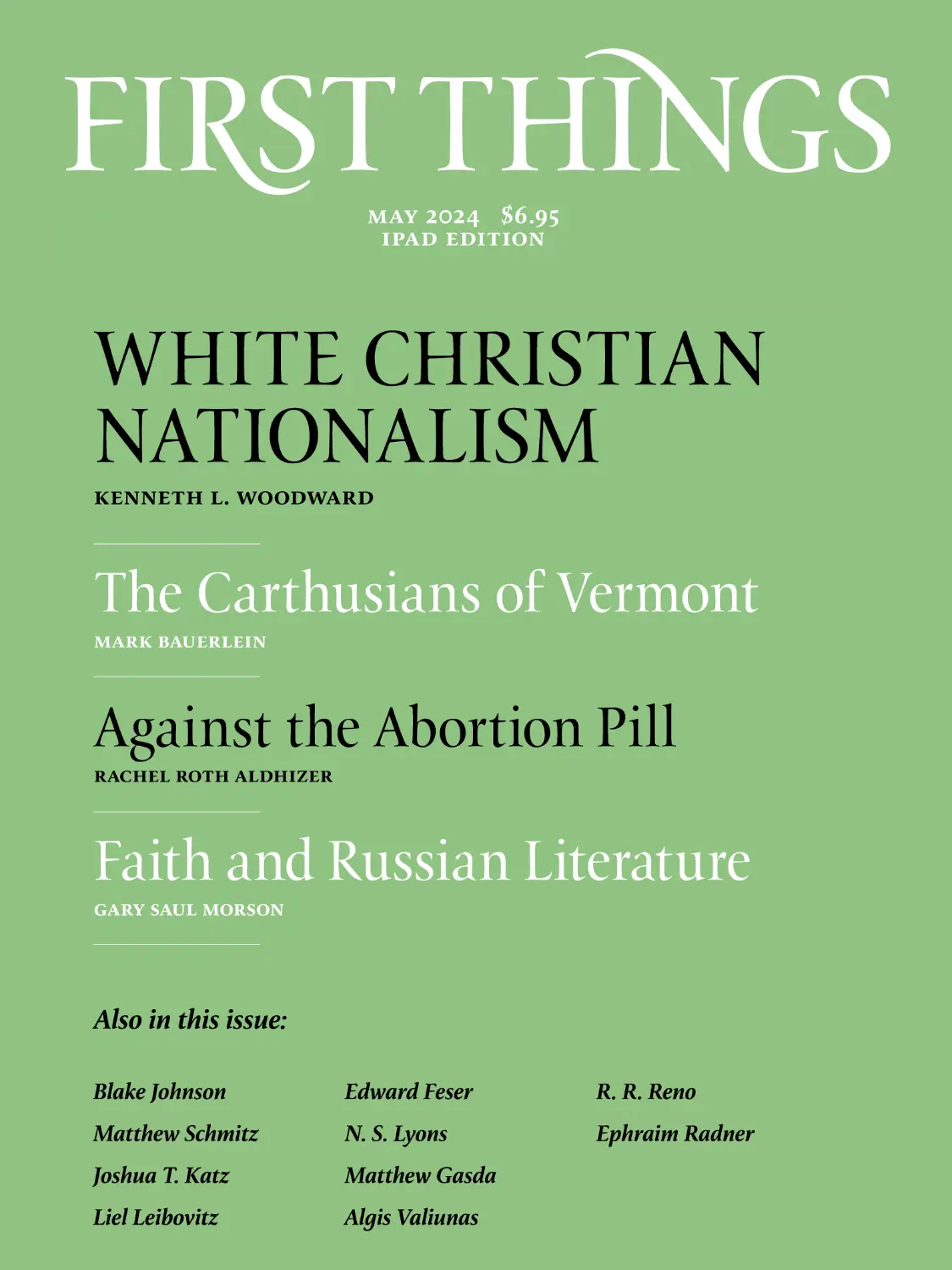






Text
may 2024 $6.95
ipad edition
WHITE CHRISTIAN
NATIONALISM
kenneth l. woodward
The Carthusians of Vermont
mark bauerlein
Against the Abortion Pill
rachel roth aldhizer
Faith and Russian Literature
gary saul morson
Also in this issue:
Blake Johnson
Edward Feser
R. R. Reno
Matthew Schmitz
N. S. Lyons
Ephraim Radner
Joshua T. Katz
Matthew Gasda
Liel Leibovitz
Algis Valiunas
BRiLLiANT WiSDOM & INSPiRATiON
FROM POPE BENEDiCT XVI
◆ GOD IS
EVER NEW
With this concise anthology
of Benedict XVI’s lessons
on the Christian life—on
faith, hope, love, joy, holiness, and freedom—readers
find themselves walking side
by side with a great spiritual father. He knew how
to bring heart, mind, and
feeling in concert with one
another—a fruitful model of
how we can bring the great
power of the Gospel to the
world.
These crystallized excerpts
are drawn from lectures, homilies, and documents across the
course of Benedict’s papacy. Each grants a glimpse of a God who
is full of surprises, never dull. Benedict speaks not in the voice
of an academic theologian but of a pastor, a companion on
the journey. Let his poetic insights accompany you daily: in
prayer, in adoration, in study, and in love.
GENH . . . Sewn Hardcover, $19.95
“The perfect book for the busy Christian who wants deep spiritual enrichment in bite-sized doses. Benedict’s thought engages both
the intellect and the soul.”
—Jennifer Fulwiler, Author, Something Other Than God
“A masterpiece! Beautifully crafted vignettes reflecting a lifetime
of wisdom and insights by Benedict XVI on life, love, faith and
freedom.” —Deacon Harold Burke-Sivers, Author, Building a
Civilization of Love
◆ HE GAVE US
SO MUCH
Cardinal Robert Sarah traces the
profound spiritual contours of Benedict
XVI's life and thought, revealing a man
on fire with love for God and neighbor. Though a brilliant theologian, he
was no professor in an ivory tower, but
a shepherd and pastor with a father’s
heart. For him, prayer, meditation, and
communion with Christ stand at the
vibrant center of all Christian existence.
◆ THE TRUE
EUROPE
This is Benedict XVI's last
and heartfelt call for
Europe to rediscover and
reaffirm its true origin and
identity that have made
it great and a model of
beauty and humanity. It
is not about imposing the
truths of faith as the foundation of Europe, but about
making a thorough choice,
recognizing that it is more
natural and just to live "as
if God existed" than "as if
there were no God."
Just as Pope John XXIII called on the great nations of Europe
and the West to avoid a devastating nuclear war, today Benedict
XVI addresses for the last time all of Europe and the West so that,
by rediscovering their own soul, they can save themselves and
the world from self-destruction.
JRS24P . . . Sewn Softcover, $19.95
"The ecological movement has recognized the limit of what can be
done, it has discovered that ‘nature’ sets a limit for us that we cannot
ignore with impunity. Unfortunately, the ‘ecology of man’ has not yet
become concrete. Man also has a ‘nature’ that is given to him; and
denying or violating it leads to destruction." — Benedict XVI
◆ WHAT IS
CHRISTIANITY?
This final work of Benedict XVI takes
up an array of themes close to his heart:
the Christian faith’s relationship with
other religions, especially Judaism and
Islam; the theology and reform of the
liturgy; the priesthood; the saints; the
Eucharist; the travesty of abuse; the
beauty of nature; Italian and German
culture; and much more.
WCSTH . . . Sewn Hardcover, $24.95
“I have treasured every word written by this man.
These last words are among his greatest!”
— Scott Hahn, Author, Rome Sweet Home
HGUSMH . . . Sewn Hardcover, $24.95
www.ignatius.com
P.O. Box 1339, Ft. Collins, CO 80522
(800) 651-1531
march 2022 – number 321
may 2024 – number 343
letters
letters
opinions
opinions
3
Union and Absolution, Scapegoat Olympics, etc.
The Faithful Peripheries, Marriage and Divorce, etc.
9 Tradismatic Trentecostalism by Clement J. Harrold
Priestesses
byJames
BlakeFetter
Johnson
11 Mere
Worthy
of Life by
Vance, Religious
Populist
13 JD
Remembering
Orchestra
HallbybyMatthew
TimothySchmitz
Jacobson
To Catch a Plagiarist by Joshua T. Katz
l ei bov i tz at l a rge
16 Have No Fear
by Loud
Liel Leibovitz
l e i bov i tz at l a rge
Be
by Liel Leibovitz
e s s a y s 19 On the Threshold: Part II
by Patricia
Snow
essays
The
Myth of
White Christian Nationalism
by Kenneth L. Woodward
27 The Imagined Citadel
by Matthew
Rose of Vermont
The
Carthusians
by Mark Bauerlein
35 On Overruling Roe
by Hadley
Arkes the Abortion Pill
The
Case Against
by Rachel Roth Aldhizer
41 Priestly Poverty
by Timothy
J. CusickLiterature
Faith
and Russian
Gary Saul Morson
r e v i e w s 45 by
The Failure of Natural Theology by Jeffrey D. Johnson
reviewed by Edward Feser
r eviews
The Development of Dogma by Guy Mansini, O.S.B.
48 Rescuing Socrates by Roosevelt Montás
reviewed by Edward Feser
reviewed by Joseph Epstein
Pagan America by John Daniel Davidson
51 The River War by Winston Spencer Churchill
reviewed by N. S. Lyons
reviewed by Algis Valiunas
The Crisis of Narration by Byung-Chul Han
53 The Undercommons
reviewed by Matthew Gasda
by Stefano Harney and Fred Moten
Lawrence
of Arabia by Ranulph Fiennes
reviewed by Joseph M. Keegin
by Algis
Valiunas
56 reviewed
Reopening
Muslim
Minds by Mustafa Akyol
Briefly
Noted
reviewed by Gabriel Said Reynolds
59 The Summer of Theory by Philipp Felsch
the pu bl ic squa r e
Hitler’s
Coming
by R. R. Reno
reviewedSecond
by Mark
Bauerlein
60 Briefly Noted
t h e b a c k pa g e
Coming and Going by Ephraim Radner
the pu bl ic squa r e
poetry
t h e b a c k pa g e
poetry
63
72
Spendthrift Theology by R. R. Reno
Richard Tillinghast, Paul Mariani
The Table by Ephraim Radner
Matthew T. Warnez (p. 8)
First Things (ISSN #1047-5141) is published ten times a year for $45 by the Institute on Religion and Public Life, 9 East 40th Street, Tenth
Floor, New York, NY 10016. Periodicals postage paid at New York, NY, and additional mailing offices. POSTMASTER: Send address changes to
First Things, P.O. Box 8509, Big Sandy, TX 75755. Newsstand distribution by Comag Marketing Inc., 1955 Lake Park Drive, Suite 400, Smyrna,
GA 30080. Copyright © 2022 by First Things. All rights reserved. Produced in the U.S.A. www.firstthings.com
First Things (ISSN #1047-5141) is published ten times a year for $60 by the Institute on Religion and Public Life, 9 East 40th Street, Tenth Floor,
New York, NY 10016. Periodicals postage paid at New York, NY, and additional mailing offices. POSTMASTER: Send address changes to First
Things, P.O. Box 8509, Big Sandy, TX 75755. Newsstand distribution by Comag Marketing Inc., 1955 Lake Park Drive, Suite 400, Smyrna, GA 30080.
Copyright © 2024 by First Things. All rights reserved. Produced in the U.S.A. www.firstthings.com
PROFOUND INSIGHTS ON THE
MYSTERIES OF SUFFERING & DEATH
◆ SUFFERING
NOW AND
AT THE HOUR
OF OUR DEATH
◆
This unique book addresses
important common issues
and moral questions people
face when they or loved
ones experience serious or
end-stage illnesses. These
questions often arise due to advances in medical technology: "What medical procedures are
morally required, and what procedures are optional"? "Is providing food and water to a patient an optional medical treatment, or is it basic care necessary for all human beings”?
"What roles do issues like 'conscience,' 'quality of life,' 'pain,'
or 'financial burden' to a patient or his family play in end-oflife decision making"?
In this thorough work, Pro-life attorneys Nik Nikas and
Bruce Green respond to these and many more common
questions, guiding you to reach solid moral answers in a clear,
concise question-and-answer format in light of the Catholic
Church's teaching from Holy Scripture and Sacred Tradition.
NHDP . . . Sewn Softcover, $18.95
“Sooner or later every family will need this book. End of life questions are gut-wrenching. This book provides convenient access to
the collected wisdom of history’s deepest thinkers on these topics.”
—Ronald Rychlak, Professor of Law, University of Mississippi
“A practical, compassionate primer to help readers make informed,
moral decisions at one of the most difficult times faced by families
or caregivers.” —Wesley J. Smith, Author, Culture of Death
“A well-organized, practical resource, and a clear and concise
summary of the Church’s moral tradition surrounding end-of-life
decision-making.”
— Stephen Doran, MD, Neurosurgeon, author, and bioethicist
◆ LIFE-GIVING
WOUNDS
Daniel and Bethany Meola provide a
compassionate, spiritually rich, and
psychologically sound guidebook for
healing for adult children of divorce or
separation, following the footsteps of
the only true healer: Jesus Christ.
What Every
Catholic Should
Know
Just as Job was tried, all of
us are tested by suffering. It
comes to us in many different forms: grief about the past,
pain in the present, and sadness
about what might have been.
The personal dimension of suffering means that it marks
our experience and, in some ways, makes us who we are.
Mark Giszack shows how coping with suffering as
Christians includes certain spiritual practices that lead
us to surrender our lives more fully to the Lord. By offering
our suffering as a spiritual sacrifice, joined intentionally
to the suffering of Christ through prayer, we engage with
the most profound Christian teaching about suffering:
that it is redemptive. Suffering can transform us to be
like God.
SFWCKP . . . Sewn Softcover, $16.95
“A very helpful companion as we struggle to understand the mystery of suffering. It will help you live a more joyful and fruitful life."
— Charles Chaput, O.F.M., Cap.,
Archbishop Emeritus, Philadelphia
"A perfect book for those wrestling with the problem of why God
allows good people to suffer. Giszczak tackles the tough questions
with compassion, clarity, wit, and deep Catholic faith."
—Mary Healy, Author,
Healing: Bringing God’s Mercy to the World
“A richly rewarding book that combines humble, straightforward
honesty with a transformative practical vision!”
—Matthew Levering, Chair of Theology, Mundelein Seminary
◆ TO DIE WELL
Dr. Stephen Doran draws from his vast
experience as a neurosurgeon, bioethicist,
and permanent deacon to present the
Catholic perspective on the art of dying
well, focusing on the moral and spiritual
issues surrounding death.
TDWP . . . Sewn Softcover, $17.95
LGWP . . . Sewn Softcover, $18.95
www.ignatius.com
P.O. Box 1339, Ft. Collins, CO 80522
(800) 651-1531
May 2024
first things
LETTERS
The Faithful Peripheries
Most of us that grew up in the peripheries don’t buy the central premise of this pontificate of making the Church less European. I agree with R. R. Reno’s assertions in “Rome’s Concordat”
(March 2024) that this pontificate sounds like a focus group at
the World Economic Forum or a DEI department at Harvard.
We also see this pontificate as attempting to be highly transformative of our beliefs in the peripheries. For example, for
any Latin American person, La Virgen de Guadalupe or La
Virgen Morena was a devotion that combined our cultural
roots with our religious sensibilities. It never replaced prayer
and contemplation. We always acknowledged the role of women in the Church. I grew up in a rural town in the Caribbean,
and our parish priest always said: The prayers of the women
religious sustain us. Catholic women ran Catholic hospitals,
schools, and other charitable organizations. The current pontificate has embraced the Western feminist view of women.
3
4
Letters
Number 343
I didn’t find it surprising that the peripheries sharply rejected
Fiducia Supplicans while the childless, wealthy nations like Germany, Austria, and Switzerland embraced it. Fiducia Supplicans
attempted to address a first world problem that the peripheries
couldn’t care less about. It will continue to be sharply rejected
because the Holy Spirit cannot be misled.
Ysais Martinez
columbus, ohio
Marriage and Divorce
Scott Yenor’s “Compulsory Feminism” (March 2024)
was great. With manly courage, he tipped one of the most
sacred cows of our age: the anti-sex-discrimination regime.
I think he should go even further. There’s a case for sex discrimination, the kind that is rooted in the created order, not
just social “roles.” Indeed, our very existence is predicated on
the unity-in-distinction (discrimen) between the sexes. Conception, pregnancy, and birth all discriminate. And since we
need to be raised, not just born, we need a whole culture of
life marked by the way we came to be in the first place.
We need a common life
between non-exchangeable
letters
persons who cannot live
We welcome letters to the e
ditor. Letwithout each other, not a
ters appear two issues after the article
homogenized one between
to which they are responding. Letters under three hundred words are
persons who can. On the aspreferred, and they may be edited for
sumption that no one sex is
length and clarity.
superior to the other, society
Letters responding to a
rticles pubshould promote (just) sex
lished in this issue should be received
by May 6 for publication in the August/
discrimination. It ought to
September issue. Please send them to
want mothers to be in close
ft@firstthings.com.
physical proximity to their
May 2024
first things
young children—for at least three years—and fathers to do
what mothers cannot. In short, it ought to want children to
be raised by mothers and fathers.
The anti-sex-discrimination regime discriminates unjustly against actual mothers, fathers, and children, and it shows
unjust partiality to an abstract counterfactual: functionally
equivalent, sexless “parents” and “caregivers.”
By tracing sex discrimination back to the created order—and
to the Creator himself, who is a Unity-in-Distinction—we can
get beyond the Tocquevillian need to balance the sexual constitution with the spirit of freedom. That constitution makes
us free in the first place.
Margaret Harper McCarthy
john paul ii institute
washington, d.c.
It is surprising that Scott Yenor does not mention the impact of divorce laws in his article. There was a dramatic jump
upward in divorce rates at the beginning of the 1970s. Women whose husbands walked out were faced with the prospect
of raising large families on the minimum wage. I remember
that time well. Divorce laws were not particularly favorable
to women in many places. One reaction was for mothers to
teach their daughters never to put themselves in such a vulnerable position. This kicked off the spiral of demands for more
pay and more opportunities in education and the workplace.
Arguably, the pendulum has now swung too far, and men are
disadvantaged by divorce laws. Why work to become a marriageable man if marriage is now such a risky proposition, especially in an era of relaxed sexual norms? The solutions Scott
Yenor suggests are needed, but the problem of divorce is an
elephant in the room left unaddressed.
Stacie Beck
landenberg, pennsylvania
5
6
Letters
Number 343
Scott Yenor replies:
Often analysts document the social disaster that proceeds from the decline of family life, but then prescribe smallball solutions like ending marriage penalties or tweaking
welfare programs as the only public policy choices. The beginning of wisdom is this: If problems are grave, solutions must
be somewhat commensurate. However, thinking too boldly
risks political oblivion. Merely howling at the moon does not
reshape public opinion. The time for bold thought in defense
of the family must precede bold action. Margaret McCarthy
and Stacie Beck join me in thinking through how to manifest
enduring, fruitful man–woman marriages, here and now.
My article focuses on how our anti-sex-discrimination constitution misshapes relations between the sexes. McCarthy
wants to see a defense of a discriminating sexual constitution that reconciles the interests of men and women toward
A publication of the Institute on Religion and Public Life
editor: R. R. Reno
senior editors: Dan Hitchens, Julia Yost
deputy editor: Ramona Tausz
junior fellows: Jacob Adams, Claire Giuntini
editor at l arge: James Nuechterlein
consulting editor: Francis X. Maier
managing editor: Lauren Wilson Geist
associate editors: Veronica Clarke,
Justin Lee
contributing editors: Mark Bauerlein,
Shalom Carmy, Carl R. Trueman
poetry editor: Micah Mattix
institute board:
Colin Moran (Chairman), Frederic H. Clark, Elizabeth C. Corey, James Hankins, Russell Hittinger,
David Novak, James N. Perry Jr., Bruce R. Shaw, Larry A. Smith, George Weigel, Robert Louis Wilken
founding editor: Richard John Neuhaus (1936–2009)
editorial office: 9 East 40th Street, Tenth Floor, New York, NY 10016 (212) 627-1985
ft@firstthings.com
advertising office: 129 Phelps Avenue, Suite 312, Rockford, IL 61108 (815) 398-8569
firstthingsadsales@pma-inc.net
subscription office: P.O. Box 8509, Big Sandy, TX 75755 (877) 905-9920
www.firstthings.com/customer_service
May 2024
first things
achieving the common goods of marriage. A discriminating
sexual constitution would be more consistent with the demands of nature and with the Trinitarian cosmological order. A society that broadly expects men and women to do
different things within the family—and where men and
women want complementarity—is indispensable to reviving
marriage and family life. Such a society would also be more
Christian. Efforts to reconcile the anti-sex-discrimination
regime with God’s natural order are sophistic. I am happy to
clear the underbrush while McCarthy describes a new sexual
constitution with sex discrimination near its heart.
Divorce reform would be difficult to pull off politically,
but Beck insists that stable family life, where the interests
of men and women are secured, demands an end to no-fault
divorce. True enough. Unfortunately, the push for at-will divorce presupposes the feminist push to free women from
marriage. Tackling divorce requires also looking at how that
push emerged in our laws.
Not Just War
Richard Cassleman’s essay “Undermining Just War”
(March 2024), argues that capital punishment and just war are
so closely related that to deny the legitimacy of the death penalty is also to reject the just war tradition. U
nfortunately, the
analogy is not sound.
Capital punishment and just war are two different kinds
of acts, even though both must be authorized by legitimate
civil authority. Even if we grant that some civil authority—
the judge—rightly has the capacity to sentence a criminal to
death, we should note two things. First, the accused can only
be sentenced once he is tried and found guilty of a capital
7
8
Letters
Number 343
crime. Second, the intention of the act of execution is not to
render the convicted person harmless; it is, uniquely among
civil actions, to make someone dead.
By contrast, neither of these points applies to war. In particular, the death of individual enemy combatants is not the
intention of military action, even though we may behave as if
it were. The intention, as distinct from the immediate object
of action, is to suppress their unjust project and to secure a just
remedy for the harm their nation has done. A sign of this is
that the laws of war prohibit killing an enemy combatant once
he has been rendered harmless; to do so would be a war crime.
We do not fire on pilots who have ejected from their aircraft.
The real analogy here is not with the death penalty but with
the domestic use of lethal force by the police in situations
where the lives of others are threatened.
If we grasp this point we can see that even if we were to repudiate capital punishment, the just war tradition would be
unaffected.
Robert G. Kennedy
university of st. thomas
saint paul, minnesota
I appreciated Richard Cassleman’s attempt to clarify
church teachings on just war and capital punishment. I respectfully disagree with some of the theory he articulated.
For example, Cassleman wrote that “Vladimir Putin could
declare a unilateral ceasefire and the Ukrainian forces would
have to stand down.” To begin with, the phrase “stand down”
literally means to relax after a period of tension or readiness,
which sounds ridiculous when applied to a state’s armed
forces.
Yet if Vladimir Putin did declare a ceasefire and the Russian soldiers laid aside arms, it would be incumbent upon the
May 2024
first things
Ukrainian command to refrain from destroying the enemy
in this state, “just as a man defending his home must refrain
from killing if the intruder puts down his weapon.” Some of
the most barbaric incidents in military history arose when an
enemy ignored these conventions of war.
I also disagree with the common interpretation of Romans
13:4. Cassleman gives ammunition to my belief that the authority of the state to take action against criminals and the
authority to defend itself stem from different principles when
he writes that the state “has natural jurisdiction over its own
citizens, whereas greater ambiguity surrounds the question of
external jurisdiction among countries.” The state has the right
to judicate its own cases, but it does not have the authority
not delegated to it by another state to interfere with its processes. Furthermore, a foreign state does not disobey a state’s
laws when it invades. Instead, if it is in transgression of a law,
it is a law of the community of states. When the apostle to
the Gentiles writes “Let everyone be subject to the g
overning
authorities . . . for rulers do not bear the sword in vain,” he
speaks of a nation’s authority over its subjects.
Cassleman is correct that capital punishment is not defense;
instead it is punishment. The difference between punishment and defense is clear. Similarly, Austria had no authority
to punish Serbia. Ukraine, however, does have the right to
defend itself. When the Holy Father seems to destroy capital
punishment, it does not damage the foundations of just war.
Isaac Misner-Elias
benton, maine
Richard Cassleman c
learly sets out the reasons that
so many Catholics feel perplexed that the just war theory has
received such stiff scrutiny of late.
I would suggest that the New Testament itself undermines the just war theory. Jesus rejects violence in the most
9
10
Letters
Number 343
thoroughgoing terms, and he never qualifies his views with
exceptions for just wars or even for self-defense (Matt. 5:21–22,
38–45; Luke 6). Cassleman relies too heavily on the traditional
understanding of Romans 13:1–7 to support his case that “St.
Paul authorizes the political sovereign to use the power of the
sword to avenge wrongdoing.”
Although the passage has been interpreted in such ways in
the past, we are witnessing what Dei Verbum called the Church’s
ability to mature in its judgments on the Scriptures. Concerning Romans 13, Paul had just reaffirmed Jesus’s teaching
on v
iolence in the verses immediately preceding the chapter
(Rom. 12:12–21). It would be surprising if Paul thought he could
boldly reverse the Lord’s pronouncements as if to say, “Love
your enemies, unless the state tells you to wage war on them.”
Mark Nanos suggests that the term “governing authorities”
refers to synagogue officials who administer the Temple tax.
To treat the passage as if every political governing authority is instituted by God requires the reader to make so many
unstated background assumptions that it strains credulity.
Paul’s reference to the sword (machairan) in Romans 13:4 indicates a ceremonial small sword symbolizing the authority of a
synagogue official to impose his will. The passage has nothing
to do with just war.
Pope Francis is helping the Church mature, which should
involve a reassessment of the Scriptural foundations for just
war.
Gerald J. Bednar
euclid, ohio
Richard Cassleman replies:
Like Professor Kennedy, I am exceedingly grateful we
do not shoot pilots after ejection. There are several problems that result if we say all killing in war is unintentional.
Unintentionality implies that all killing in war is defensive,
May 2024
first things
but clearly much of wartime killing is offensive in nature.
Therefore, it seems you must either suggest there’s such a thing
as unintentional offensive killing, or you must deny that killing is offensive by appealing to a broader notion of defense at
the state level. The first case appears to be contradictory. The
second option might logically get you to wartime killing, but
the same appeal could then be made for capital punishment,
rendering what was forbidden on an individual level (killing
offensively) permissible. In this sense, it is not the executioner
that kills the criminal (as if he himself wanted the criminal
dead), but the sovereign. The intention of the state is multifold: defensive, retributive, and deterrent. This is similar to
just war’s broad intention of suppression of unjust action.
The difficulties brought up by Mr. Misner-Elias can be better discussed using the Hamas example. Hamas isn’t surrendering but is merely returning to its own territory under its
own jurisdiction. Israeli soldiers are forbidden from entering
Gaza because they have no jurisdiction there. Akin to my
intruder analogy, Israel can only defend itself when in the
process of being attacked. Outside this circumstance, the intrusion into Hamas’s territory and the subsequent offensive
killing cannot be justified by individual self-defense. Israel
needs a legitimate authority (with jurisdiction), or it is acting
immorally.
I appreciate the countering view on Scripture from Fr. Bednar,
but I am still hard-pressed to believeRomans 13 has nothing
to do with killing. St. Paul specifically says that the authority
does not bear the sword in vain (eikē), as if the sword were only
ceremonial and never used. This sword is used to “avenge” and
involves “wrath.” The same word for sword (machairan) is used
to describe Peter’s sword that cut off the servant’s ear, and
it was used in Acts to describe Paul’s guard who very nearly
killed himself. Shields are for defending; swords are for killing.
11
12
Letters
Number 343
In John 19:10–11, Pilate tells Jesus that he has the authority to
crucify Jesus. It’s notable that Jesus does not revoke Pilate’s
authority to execute; he seems to confirm that authority by
saying “You would have no authority over me unless it had
been given you from above.” Thank you to all who took the
time to respond with critiques.
Left-Brain Machines
Iain McGilchrist’s piece (“Resist the Machine Apocalypse,” March 2024) admirably illustrates the promise, limitations, and perils of the “machines” that threaten to make
Newsletter
Subscribe to our free
weekly newsletter to
receive links to new
articles from First
things. You can also
opt to receive the weekly
Sunday Spotlight, with
two classic articles
on a different theme
every week, and event
notification for lectures
and retreats hosted by
First things. Sign-up at
www.firstthings.com/
newsletter
May 2024
first things
permanent the triumph of the left over the right hemisphere
of our brains. I admire that he ignored the temptation to give
“left” and “right” political meanings.
Most resonant of all was his warning that left-brain machines may excel at turning data into decisions, but when
these decisions involve people, much of what makes us human is at risk of being eclipsed. I thought immediately of the
typically sarcastic lyrics of Donald Fagen’s song “I.G.Y.” (short
for International Geophysical Year), which seem increasingly
prescient: “Just machine to make big decisions / Programmed
by fellas with compassion and vision / We’ll be clean when
their work is done / We’ll be eternally free, yes and eternally
young . . .”
William G. Kussmaul III
media, pennsylvania
Lonely Men
Hikers on the Tomales Point Trail in California often spy
a large herd of bull tule elk lounging on the soft grass. These
are the ones who lost the stag fight and will spend the rest of
their lives hanging with their bros, lonely together.
I thought of these loser elk when reading “The Anti-Family
Right” (March 2024) by Matthew Schmitz. I would put the
online human equivalents of these elk neither on the right
nor the left. They should go where they probably dwell: the
basement.
The internet has given misogynists a voice and meeting
place, but they have always been with us. These men ought
to be put in the bigger context of deadbeat boys who aren’t
excelling because they don’t have the virtues necessary to be
successful. They represent a family problem that is difficult to
solve through public policy.
13
14
Letters
Number 343
Lonely men are less of a threatening political factor when
compared to the anti-natalist forces in the world, which are
insidious, well-organized, and well-funded. They aggressively
corrupt the youth at all ages.
Organizations like the American Family Project are working
at the federal level to make things easier for families across
the country, but such efforts require the foundation of sturdy
family life.
Strong, virtuous, and pious parents are needed to face the headwinds of the culture. Fathers with the fortitude to forbid their
sons playing video games, instilling in them the courage to face
the future. Mothers loving enough to demand their daughters
dress and behave modestly in accord with their dignity.
There are enough examples of this happening that we should
remain hopeful for the future. If we are faithful, then the
world will once again belong to those whose great-grandparents were fruitful and multiplied.
Tom McDonough
washington, d.c.
Selfish Pride
If my own household had been more stable, I might still be
able to grab my old copy of “Our Bodies, Ourselves” from my
1970s student days. I am certain its contents would appear tame
and trivial next to the policies and interventions described in
Kerri Christopher’s “Our Bodies, Our Anger” (March 2024).
Evil, like fermentation, grows in an exponential way that
leaves this aging feminist reeling.
I see no inaccuracies in Christopher’s wild ride through our
current “women’s health” morass. What I wonder is when will
we stop playing the well-researched game with humanity’s
spiritual adversary. When confronting such a grim adversary,
May 2024
first things
prayer in the name of Jesus Christ must still be part of the answer. Our enemy, with his evil inventions and strategies, can
be—indeed, already has been—defeated.
It was the word “ourselves” in the original title that gave it
all away. We have to root out selfish pride, and prayer is an essential part of that process. Otherwise new policies designed
to alleviate our present dilemma will fall on deaf ears.
Patrice Harrison-Inglis
chico, california
15
EDUCATION
WITHOUT
INDOCTR INATION
Ralston College is a new university that
rejects the tired status quo of higher
education. It is radical in the truest sense,
committed to close and rigorous study of the Humanities: intensive
immersion in ancient and modern languages unlocks the most
inspiring texts and ideas written in the western world. With two
months of study in Greece, and eight months in gorgeous Savannah,
we tackle these works with linguistic precision, historical integrity,
and an appreciation of beauty. The hard work of real learning, through
dialogue and debate, shapes the truly active and courageous mind.
If you want to read many of the greatest texts ever written directly
and intensely, in fellowship with those who actually care, and in their
original language, come join the community at Ralston College.
Here real intellectual integrity and humility are still possible.
We also teach boxing.
Now accepting applications.
Full scholarships available.
Ralston.ac/humanities-ma
Untitled-1 1
3/5/24 6:28 PM
May 2024
first things
OPI N IONS
Mere Priestesses
by Blake Johnson
C
ontroversy surrounds the disinvitation of Fr. C
alvin
Robinson from the closing panel of the Mere Anglicanism conference held in Charleston, South
Carolina, in January. Asked to lecture on the topic
“Critical Theories Are Antithetical to the Gospel,”
Robinson argued during the main session that the spread of critical theory in the church was inevitable given the church’s acceptance of feminism, with women’s ordination being a decisive
concession: Confuse men’s and women’s roles, and it’s hard to resist liberalism tout court. The sponsoring bishop and conference
organizers found Robinson’s presentation “inexcusably provocative, and completely lacking in charity,” especially toward the
female clergy in attendance, and so barred him from the closing
panel discussion.
Blake Johnson is rector of Church of the Holy Cross in Crozet,
Virginia.
17
18
Opinions
Number 343
The conference’s title, a nod to C. S. Lewis’s Mere Christianity,
implies that participants hold in common the essentials of Anglican belief. The conference is advertised as a venue in which
difficult topics facing the Church can be thoughtfully engaged.
Accordingly, Robinson was candid: “The priestess issue is directly related to the trans issue. If a man can become a woman, and a
woman can become a man, why can’t a woman become a priest
and a man become a mother?” Though this question may strike
supporters of women’s ordination as unnecessarily provocative, the same type of argument was made by the conference’s
patron saint more than seventy-five years ago. Robinson and
Lewis both articulate the position of mere Christianity against
the fashionable theologies of their times. They state what was
the consensus position of the Great Tradition, East and West,
before critical theory infected Protestantism.
Decades before the practice of ordaining women to the priesthood was introduced in the Anglican Communion (and the
traditional position became grounds for cancellation), Lewis
pondered what such an innovation might mean in his 1948
essay “Priestesses in the Church.” Even the term “priestesses”
in his title and body will strike some proponents of women’s
ordination as offensive. Lewis, however, does not intend to
offend (“I have every respect for those who wish women to
be priestesses”), but rather to offer a serious challenge to a
revolutionary proposal that would represent “an almost wanton degree of imprudence,” not to mention a divisive break
with universal tradition. To admit women to the priesthood,
Lewis intuited, would involve “something even d
eeper” than a
change in church order. Today, with women’s ordination normalized in the Anglican Communion, have Lewis’s concerns
about that “something even deeper” been vindicated?
May 2024
first things
L
ewis concedes that the push for women’s ordination follows a certain logic: Women are just as capable as men
in many professions and in the sort of piety often held
to be required of a pastor. Would it not simply be prejudice
and stubborn traditionalism to keep women from the priestly office? Much of the case for women’s ordination assumes
that misogyny is the only impediment. Lewis writes that “the
opposers . . . can produce at first nothing but an inarticulate
distaste . . . which they themselves find it hard to analyse.” For
these detractors, the sight of a woman in clericals would trigger the same visceral reaction as the sight of a man dressed as
a woman. This gut response might be mere bigotry, or it might
betray a proper intuition.
What if the innovation of ordaining women to the priesthood changes not just a practice of church order but the
nature of the Church itself? Lewis imagines the would-be
reformer continuing his project to make the Church thoroughly gender-neutral, praying not the Our Father but the
Our Mother (though today it must surely be the Our Parent),
or insisting that Christ’s masculinity and the gendered symbolism of Christ and his Church are not theologically significant. The same sort of gender-bending, Lewis contends,
would be involved in the claim that men and women are interchangeable in the priesthood. Recent d
evelopments bear
him out. At a time when one-third of active clergy and the
majority of ordinands in the Church of England are women,
the Archbishop of York worries that the opening of the Our
Father is problematic, and the Church of England considers
alternatives to masculine pronouns for God.
Lewis’s argument would have been more powerful had he
observed that the priest represents not God in general but
the Incarnate Son, the Bridegroom, the Head of the Church.
Pope Paul VI later made similar arguments concerning the
19
20
Opinions
Number 343
symbolic significance of sexual difference, in the course of
which he explained that the priest operates in persona Christi
capitis (in the person of Christ, the head). What Lewis grasped
intuitively, and Paul VI articulated explicitly, is that masculine imagery is not a thing indifferent when it comes to the
priesthood and its sacramental representation.
Lewis, eager to bolster the imagination in a disenchanted
world, believed that a gender-neutral movement in the Church
would be “based on a shallow view of imagery.” Though the
being of God is not male, God has chosen to reveal himself
with masculine imagery: He did not become a generic human,
but took up humanity as a male. To d
eny the significance of
this fact is to embrace another religion:
Without drawing upon religion, we know from our poetical experience that image and apprehension cleave closer together than
common sense is here prepared to admit; that a child who has
been taught to pray to a Mother in Heaven would have a religious
life radically different from that of a Christian child. And as image and apprehension are in an organic unity, so, for a Christian,
are human body and human soul.
Image and apprehension work on a precognitive level, do not
depend on logical argumentation, and yet are equally important in our spiritual and moral formation.
If language conveys “image and apprehension,” then surely
sexed human bodies do so as well. If God has seen fit to instruct us to pray to him as Father, then that masculine and
symbolic language is fundamental to how we understand
him; if God has seen fit to become a male human being, then
it matters that Jesus is male; if Christ saw fit to choose only
men to represent him in apostolic ministry, then the masculine nature of ordained ministry carries a necessary meaning.
May 2024
first things
F
or Lewis, we live in a sacramental universe, and the mysteries of male and female are signs of something more,
and “symbolize to us the hidden things of God.” Gender
neutrality in the priesthood and marriage changes the story
those vocations tell. And who are we to change this story?
Neutering humanity goes hand in hand with an attempt to
desacralize the world God made, to impose our own meaning upon it. It rejects the givenness of God’s symbolic world,
in which sexual difference tells a divine story of bride and
groom. It is this cosmic story, Lewis insists, that God has
written in revelation, revealed in nature, and inscribed in our
sexually differentiated bodies. Women and men may be interchangeable in various domains for the accomplishment of certain tasks, but in the Church (as in marriage) we are on sacred
ground, where sexual difference is divinely meaningful, “not
merely as facts of nature but as the live and awful shadows of
realities utterly beyond our control.” To embrace this order of
reality is to join the “great dance” God has orchestrated. This
great dance is expressed through sexual difference, not least
when the priest by his maleness represents Christ the Groom
at the altar in the nuptial feast of Holy Communion.
The image of a great dance frames Lewis’s essay on p
riestesses.
He opens with a line from Pride and Prejudice, in which Caroline
Bingley expresses distaste for balls and suggests that they would
be “more rational if conversation instead of dancing made the
order of the day.” Her brother replies, “Much more rational, my
dear C
aroline, I dare say . . . but it would not be near so much
like a ball.” Lewis’s essay is an accidental prophecy of a church
that has become much more rational but less like a great dance.
Calvin Robinson has taken up Lewis’s case to address an Anglicanism that welcomes what L
ewis feared. Elevating, not erasing,
the sacramental nature of the priesthood and the theological
meaning of sexual difference will enable us to dance in
better sequence with Christ and his Church.
21
May 2024
first things
JD Vance, Religious Populist
by Matthew Schmitz
F
or at least a generation, the phrase “religious right”
has evoked a style of politics marked by h
ortatory
rhetoric, foreign-policy interventionism, and support for the free movement of people and goods.
This version of Christian politics reached its zenith
during the George W. Bush administration, when a glut of
books warned that theocracy was impending in America.
In the event, things worked out differently. Not only did
the Bush-era Christian right fail to take over America; in 2016
it lost control of its own party. Donald Trump won the Republican nomination, and then the presidency, with a way
of speaking that was more impish than moralizing. He made
no pretense of being committed to Christian sexual morality.
And he challenged his party’s assumptions on immigration,
trade, and foreign policy.
Something important has changed in the way religious Americans approach politics. Free trade and open borders are out;
economic moderation and immigration restriction are in. Along
with a shift in policy, there has been a shift in tone, reflecting a
growing sense of alienation. To understand the reasons for this
transformation, I sat down with JD Vance, the young senator
from Ohio and author of the bestselling memoir Hillbilly Elegy,
in his senate office. He is perhaps the most eloquent champion
of a new Christian approach to politics—one that is less conventionally conservative, and more populist.
Vance’s populism has two major influences. One is the commonsense outlook of his Mamaw, a central figure in his memoir. She wasn’t a liberal, but she was turned off by what she
Matthew Schmitz is a founder and editor of Compact.
22
23
Opinions
Number 343
saw as the preachiness and narrowness of the religious right.
“When the moral majority was more powerful, my Mamaw
had a certain scorn for it,” Vance says. The other is his understanding of Christian politics. “When we think about Christian conservatism, we think of sanctity of marriage, sanctity
of life,” he tells me. “Of course these things are important
and I certainly believe the Church’s teachings on all of these
things. And yet, there’s an entire Christian moral and economic worldview that is completely cut out of modern American
politics, and I think it’s important to try to bring that back.”
V
ance found an echo of his Mamaw’s outlook, and a
reflection of his own experience, in Catholic social
teaching. Growing up without a father in the house
convinced Vance of the importance of marriage, a principle
religious conservatives have always insisted upon. But he
noticed that those same conservatives were overlooking some
of the factors that contribute to broken families. “I saw a lot
of marriages fall apart,” Vance says. “It wasn’t always because
of financial reasons, but that was a big part of it. So if you
believe in the sanctity of marriage, one of the things you want
is families that are more stable financially.”
Vance extends this emphasis on stability to other areas of
economic and social life. “The core Christian insight into politics is that life is inherently dignified and valuable,” he says.
“If you actually believe that, you want certain legal protections
for the most vulnerable people in your society, but you also
want to ensure that workers get a fair wage when they do a
fair job. You want to make sure that people don’t have their
town poisoned because they happen to live next to a railway
line”—a reference to the rail disaster in East Palestine, Ohio.
Since his election, Vance has sought to translate his populist
vision into legislative reality. While staking out uncompromising stances on issues such as immigration and aid to Ukraine
May 2024
first things
(he opposes both), he has surprised some observers with his
eagerness to collaborate with colleagues with whom he otherwise disagrees. He has sponsored a rail safety bill with Sherrod
Brown, limits on bank executive compensation with E
lizabeth
Warren, and the elimination of corporate-merger tax breaks
with Sheldon Whitehouse—all Democrats.
S
tanding behind these policy questions, on which Christians may in good faith disagree, is an issue facing religious Americans of all kinds. Writing in 1987, a Lutheran
pastor named R ichard John Neuhaus announced the arrival
of “the Catholic moment.” Prominent voices inside and outside the Church had long questioned whether it was possible
to be a faithful Catholic and a loyal American. Though he
acknowledged certain abiding tensions, Neuhaus denied that
there was any necessary contradiction between the two allegiances. More than that, he insisted that the Catholic Church
had the opportunity and obligation to accept “its rightful
role in the culture-forming task of constructing a religiously
informed public philosophy for the American experiment in
ordered liberty.”
Is that “culture-forming” i nfluence still possible today—for
Catholics, and for religious Americans generally? America
is secularizing and so, some people believe, is the American
right, which once claimed to stand for faith and family.
Religious conservative leaders were among Trump’s most
outspoken opponents in 2016—and a small but loud band of
anti-Christian social-media users were among his most outspoken supporters. Some observers concluded that Trump’s
rise demonstrated that the right was exchanging its religiously
inflected outlook for a crueler, narrower ideology. In February
2016, New York Times columnist Ross Douthat wrote: “If you
dislike the religious right, wait till you meet the post-religious
right.” His words captured a widely shared assumption that
24
25
Opinions
Number 343
the rise of Donald Trump signaled not only the death of the
religious right, but the birth of an irreligious right animated
by white racial grievance.
I
t is clear now that this assumption was wrong. The old
religious right may have suffered a fatal blow in 2016. But
what succeeded it was not a post-religious racialist party,
as some feared and others hoped. On the contrary: Donald
Trump attracted higher rates of support from minorities than
had the previous Republican nominee, Mitt Romney. As the
Republican pollster Patrick Ruffini has noted, between 2012
and 2020, Hispanic support for the GOP increased by 19 points,
African-American support by 11, and Asian-American support
by 5. Since Trump’s emergence, the parties have become less—
not more—racially polarized.
Meanwhile, religiosity has become a more powerful predictor of voting habits. Evangelicals, Catholics, and black Protestants all supported Trump at higher rates in 2020 than in 2016,
even as Trump’s support fell among atheists and agnostics.
Pundits who once warned that Trump’s GOP was preparing to
establish white supremacy now are more likely to denounce
its ambitions as “Christian nationalist.” Whatever else one
makes of this charge, it implies an acknowledgment that a
post-religious right has failed to materialize.
If religious conservatism is dead, then religious populism
has emerged in its place. There are important continuities,
but religious populism is more pronounced in its mistrust of
elites, less concerned with observing their n
iceties, and more
eager to challenge their p
riorities as expressed in A
merica’s
foreign policy commitments, trade agreements, and approach
to immigration.
May 2024
first things
N
o one represents this shift better than Vance. His current elevated status, no less than his humble beginnings, gives him a unique window into America’s class
divides. Since arriving in the Senate, Vance has become only
more convinced that America’s elites are not to be trusted.
“They’re actively scornful of the people who made me who I
am,” he tells me. “My family and my friends and my community are very, very aware of this. They are very aware of the
fact that even their own representatives don’t actually like
them very much.”
In Vance’s telling, this attitude isn’t confined to one political party. It informs a bipartisan consensus on some of the
most important questions of American policy. “Just a couple
of weeks ago . . . somebody said something to the effect of,
‘How could our base possibly know what’s necessary to engage
in foreign affairs, or what’s at stake with the Russia–Ukraine
conflict?’”
Vance suggests that this disdain for the democratic competence of Americans is closely tied to contempt for their religious views. “You hear this person on MSNBC claim that a
view that came from the deist Thomas Jefferson’s Declaration
of Independence—that our rights came from God—is Christian nationalism. It’s sort of absurd.”
He believes that America remains more religious than people
acknowledge—it’s the elites who have changed. “If you look at
one measure of religious participation, just church membership
in 1980 versus 2023 versus 1840, the country is not substantially less religious today . . . than it was 150 years ago.” Yet there is
a profound obstacle facing anyone who aspires to be unapologetically both Christian and American. It is the conviction,
shared by many of our elites and increasingly endorsed by the
government, that anyone who dissents from progressive ideas
on gender and sexuality is an enemy not only of progress but of
the United States. Underlying this belief is an identification of
26
27
Opinions
Number 343
America with the ideals represented by the Progress Pride flag.
Vance’s religious populism stands in opposition to a simply
creedal conception of the United States. “We have to recognize
that America is not just a principle. It is a group of people. It’s
a history. It’s a culture. And yeah, part of that story is that people can come and assimilate,” Vance says. “But if your attitude
is that . . . the only thing you need to become an American
is to believe that with a little bit of hormonal therapy a man
can become a woman, then you’re making it so that massive
numbers of your own country either need to be re-educated,
or need to be cast out of the political community.”
Vance says that the identification of the American project with
progressive ideals is “a recipe for colonizing your own people.”
When American leaders justify foreign conflicts in the name of
LGBTQ rights (as has happened with the war in Ukraine), they
are articulating a casus belli against much of their own population. The result is “militaristic adventurism overseas, war with
your own people at home.”
Religious populism was not magically conjured by Trump.
It has come to the fore because religious believers are increasingly excluded from important institutions. It is a response to
social and legal developments championed by progressives and
endorsed by America’s leading institutions. Justice Samuel Alito
acknowledged these forces in February when he observed that
a decision to exclude potential jurors who objected to samesex marriage from a court case involving a lesbian woman
“exemplifies the danger that I anticipated in Obergefell v. Hodges,
. . . namely, that Americans who do not hide their adherence to
traditional religious beliefs about homosexual conduct will be
‘labeled as bigots and treated as such’ by the government.”
So long as religious believers are disfavored for their beliefs
by important American institutions, they will skew anti-
institutional and populist. They will seek to challenge the
May 2024
first things
elite and its orthodoxies. Of course, certain religious groups
in America—notably Catholics and Jews—have a long history
of exclusion. But now a similar situation is faced by traditional believers of all kinds, including Protestants. If they want
to exercise the duties of citizenship rather than withdrawing
from politics altogether, they will need to look to leaders like JD Vance.
28
May 2024
first things
To Catch a Plagiarist
by Joshua T. Katz
T
he plagiarism wars have begun. Claudine Gay is
out as president of Harvard, in large part because
of conduct that the Harvard Corporation and Gay
herself refuse to describe with the p-word, and the
coming months will probably be painful for quite
a few people who write for a living.
As a result of outrage on both left and right (the former
often seems intent on bringing down established universities and other institutions from the inside, the latter from
the outside), we can be certain that a number of scholars,
journalists, speechwriters, and pundits—men, women, black,
white, young, old, Democratic, Republican—will be hit with
credible charges of plagiarism. Although few cases are likely
to be as remarkable in their bang-for-the-buck as Gay’s, m
any
writers are wondering whether the inadvertent omission of
a quotation mark decades ago will pop up in an AI search
and destroy a career. In an article for The Atlantic, Ian Bogost
describes the unnerving process of checking his own work
himself, and I would not be surprised if someone, somewhere, were right now busily uploading into a plagiarism bot
everything I’ve published on Homer, Old Irish, and the dismal state of higher education. (If you are doing this, I hope
you’ll take the time actually to read the work.)
So, how do you catch a plagiarist? Of course there is plagiarism software, which computer s cience departments have
been successfully using for years to detect programming assignments that students have copied from others, sometimes
with light modifications. These days, both teachers and editors
Joshua T. Katz is senior fellow at the American Enterprise Institute.
29
30
Opinions
Number 343
of scholarly journals are increasingly putting work written
in a natural language—in short, e ssays—through plagiarism
detection programs. The expansion of AI in everyday life will
normalize such efforts.
But there are also old-fashioned methods of detecting plagiarism, and we should not abandon them. For one thing,
software applied to work that was definitely composed by
flesh-and-blood people still yields “false-positives”—putative
instances of plagiarism that a ren’t—through which a human
must laboriously comb. Furthermore, such software does not
yet appear to be especially good at reliably determining what
was written by man and what by machine.
T
wo decades ago, before text-matching software was
widely available, I served on a Princeton student–faculty
committee that investigated dozens of cases of suspected plagiarism by undergraduates, many of them in essays for
classes in the humanities and social sciences on such topics as
the War of 1812, To the Lighthouse, and the Japanese economy.
I was struck by just how easy it often was to spot instances
of plagiarism, even before I had seen the copied text. The
giveaways fell—and, I expect, still fall—into three categories:
inconsistent typography, inconsistent punctuation, and broader stylistic i nconsistencies.
First, inconsistent typography. It was astonishing to me how
frequently students submitted work in which a sentence or
paragraph was formatted differently from the rest of the paper. In such cases, a quick search would usually reveal that just
those words had been copied and pasted from some online
source. An essay written in twelve-point type would suddenly have a sentence in eleven-point type. Or, out of nowhere,
words would appear in dark gray Calibri rather than in Times
New Roman and standard black. The spacing between lines
in one section would be subtly different from the spacing
May 2024
first things
everywhere else. In one memorable instance, quotation marks
and apostrophes in an essay were “curly”—except in the plagiarized sections, where they were “straight.”
Second, inconsistent punctuation. Some students regularly
use the Oxford comma; others don’t. Unfortunately, increasingly many students have no conception of consistency, which
is bad news but not a matter of plagiarism. However, for those
who do, when one striking sentence has an Oxford comma
and no other sentence with the form “X, Y(,) and Z” does, experience shows that something will turn up when that sentence
is googled. I can say similar things about the use of lowercase
or capital letters after a colon and any employment at all of
the semicolon.
Finally, there are things that just don’t make stylistic sense.
In an essay on World War II written by an American, you don’t
expect to find instances of the locution “the Second World
War”—unless they’re between quotation marks because
they’ve been taken from a properly credited source. You a lso
don’t expect to find, as I once did, a sentence beginning with
the word “Whilst” but including the word “honor”—because
the American student, copying the sentence from a British
publication, knew enough to change “honour” to “honor” but
not enough to change the c onjunction.
Some readers may view these last paragraphs as quaint, and
at some level they are. But even in the age of automated plagiarism detectors, these old-fashioned methods have their use:
On occasion, a plagiarist claims not to have deliberately copied
but rather to have internalized another’s language and accidentally reproduced it. This must indeed sometimes happen.
With certain typographical and stylistic inconsistencies, however, anyone can tell at once that that’s not the case.
31
32
Opinions
T
Number 343
his brings me to a larger question: What is plagiarism?
Two issues deserve attention. One, to which I will return, is whether we should learn to speak differently of different kinds of plagiarism, more or less as the law
distinguishes among first-, s econd-, third-, and fourth-degree
criminal offenses.
The other concerns AI. No one should forget that in the
months before the shake-up at Harvard, academic dishonesty
was already on everyone’s mind because of ChatGPT. More
people in the United States googled “plagiarism” in the last
week of April and first week of May 2023 than in the first two
weeks of December, when Gay’s plagiarism was exposed. According to a poll conducted by the online magazine Intelligent,
within weeks of the debut of ChatGPT, “30% of college students ha[d already] used ChatGPT on written homework.”
Reliable statistics are hard to come by, in part because there
are so many other AI-powered tools (for instance, Claude and
Grok), but it is hard to imagine that the percentage has not
been rising in the 2023–24 academic year.
Figuring out how to sustain academic integrity in an environment more and more dominated by AI—which, of course,
also powers p
lagiarism-detection s oftware—needs to be a top
priority for administrators and teachers at all educational levels. We must decide whether what might be called conventional plagiarism is fundamentally the same as using AI to do
what is supposed to be one’s own work. I admit that I don’t
yet know what exactly I think but point readers to an essay in
The Atlantic by Matteo Wong (I will assume he wrote it himself) titled “What if We Held ChatGPT to the Same Standard
as Claudine Gay?” Noting that AI depends on copyrighted
materials, Wong concludes that “the technology [is] guilty of
mind-boggling levels of plagiarism.” Maybe so. But it is not
obvious that for an individual to steal another person’s work
May 2024
first things
(the Latin word plagiarius means “kidnapper”) is the same sort
of offense as passing off as one’s own the work of an anonymous bot.
Another important question is how plagiarism should be punished. Does intent matter? What about magnitude? How should
we assess the differences between copying one or two short
sentences and copying one or two long paragraphs? Between
copying a paragraph for one essay and copying dozens of paragraphs for dozens of essays?
I believe it is wrong to suspend undergraduates for comparatively minor academic infractions—and I feel more strongly
about this than I did when I sat on that committee at P
rinceton.
Anyone who disagrees with me on this point should at least
recognize that it is hypocritical of universities like Harvard
and Princeton to punish students harshly while downplaying
the plagiaristic behavior of senior faculty. As Aaron Sibarium
has pointed out, when she was dean of the Faculty of Arts and
Sciences, Claudine Gay “watered down [Harvard’s] policy on research misconduct” so that faculty—but not students—“could be
sanctioned only if they plagiarized ‘knowingly, intentionally,
or recklessly.’” I am not deaf to arguments in favor of this sort
of change for everyone, faculty and students alike. But if Gay’s
record of verbal theft doesn’t count as “reckless,” we are redefining that term as well as “plagiarism.”
And one more question: What kind of offense is plagiarism?
In January, the philosopher Kathleen Stock wrote an article
titled “Plagiarism is not a Sin,” harshly condemning plagiaristic practice but arguing that “[t]he infringement is intellectual
not moral.” To my eyes, it is both.
S
imply put, plagiarism is theft. Yes, there is some truth
to Stock’s assertion that “[w]ords are public property
anyway. It’s not like you are stealing possessions from
people”: Because intellectual property is not considered a
33
34
Opinions
Number 343
possession, the law treats it differently from personal property; additionally, although I am not terribly sympathetic to
them, there are philosophical objections to the very idea that
intellectual property deserves robust protection. But words do
matter. Consider how assiduously the Harvard Corporation
and Claudine Gay worked to avoid the p-word: They spoke
instead of “inadequate citation,” “duplicative language without appropriate attribution,” and “material [that] duplicated
other scholars’ language, without proper attribution.” In this
case, one particular word, “plagiarism,” mattered so much that
they were willing to defy their English Sprachgefühl in order
to avoid it.
It is telling that Harvard’s euphemisms compound the ugliness of plagiarism with the ugliness of deliberately obscurant
bureaucratese. The bigger problem here is that we—parents,
teachers, journalists, administrators, the wider public—often
fail to model good linguistic practice, especially when it comes
to inculcating in children an appreciation for the beauty and
power of words. A proper education involves reading widely,
admiring good sentences and scoffing at bad ones, writing
draft after draft of one’s own compositions, and generally attending to how rhetoric shapes argument and narrative.
There are very few occasions—terse emergency instructions
present one—when one person’s language should be interchangeable with another’s. You may or may not like my style,
but for better or for worse, it is mine. If I suddenly began to
sound like someone else, or produced what the technology
writer Anna Wiener has dubbed “garbage language,” I hope that
those who know me would notice. To judge by the dreck that
so many people churn out, in some cases even duplicate, no one
has taught them about style (the word is related to “stylus,” with
both going back to Latin stilus, “spiked writing instrument”) or
pointed out to them that (as I put it last year in the New Criterion)
May 2024
first things
“[t]he sentences I write don’t sound as good in your mouth”—
or on your page—“for much the same reason that your shirt
doesn’t quite fit on me.”
Language reflects reality imperfectly, but it’s by far the best
medium we have to express what is, as well as what was and
what might yet be. Simply put, we are logocentric creatures.
Style matters because it shows our interlocutors that we take
our—and their—verbal expressions seriously. And for many
of us, an appreciation of words is ultimately an appreciation
of logos, of the Word.
If you believe, with John, that the Word is God, then to abuse
it is a sin. But certain kinds of linguistic abuse can be a moral
failure even for nonbelievers, who should strive to employ
words faithfully, even though they do not have faith. Now and
again, all of us do violence to and, maybe, also with language.
We curse, prevaricate, belittle, and engage in sophistry. And
sometimes we may, intentionally or not, take someone else’s
phrase or thought as our own.
What we need now are honest discussions of issues that are
colliding in new and forceful ways: of how to instill a love of
language in the young; of when, if ever, language (or its absence: silence) may be called violence; of the future of authorship and personal style in the age of AI; and of what plagiarism
is, how it should be punished, and how those who transgress
may redeem themselves.
Language is a gift, whether or not you hold it to be divine. Language deserves to be appreciated, c ultivated, and delighted
in. It is high time that we recommit ourselves to logos.
35
May 2024
first things
L E I BOV I TZ AT L A RGE
by liel leibovitz
Be Loud
RICCARDO VECCHIO
T
he central commandment found in American etiquette Torah is this old chestnut: Never discuss
religion or politics. Do so, and you run the risk of
offending those who hold different views. This is
a grave sin, because polite society, after all, is an
ideal predicated on the polite fiction that people are fragile,
quarrels are corrosive, and conflict is best avoided at all costs.
For a long time, Americans, hallelujah, have ignored this
fusty and prudish desire to avoid conflict at all costs, at least
when it comes to religion. In 2016 the Pew Research Center
asked how many people would avoid discussing their faith
with folks they knew held very different beliefs: Only 27 percent of respondents said they’d keep quiet rather than risk an
argument. Sadly, the spirit of forthrightness has waned. By
36
37
Leibovitz
Number 343
2019, that number had gone up to 33 percent, and when the
latest survey was released earlier this year, 41 percent of those
asked said they’d prefer to keep mum.
In this trend we glimpse the darkening of American public
life. You hardly need specialized knowledge or advanced degrees to understand why the number of people who are disinclined to talk about God with their fellow Americans has more
than doubled over the course of the decade. All you need to
do is go to the movies. Rob Reiner, the Hollywood eminence
who gave us such beloved classics as The Princess Bride and This
Is Spinal Tap, is now peddling God and Country, a documentary
that portrays vast swaths of believing Americans as one hood
and robe away from full-blown klansmanship. He treats their
faith as a thin veneer for white supremacy, a benighted ideology that the film labels “Christian Nationalism.” Or you can
leaf through a Ms. magazine and learn that it was “Christian
Nationalism” that robbed American women of their reproductive rights and ushered in the new Dark Ages. The same
specter haunts the halls of our most esteemed philanthropic
institutions as well, which is why the Henry Luce Foundation
recently awarded a major university a sizable grant to research
and resist—you guessed it—“Christian Nationalism.”
J
ust what is Christian Nationalism? Its detractors—like the
beaver, the banker, the barrister, and the other heroes of
Lewis Carroll’s The Hunting of the Snark, who set out to capture a creature they’ve never seen, can’t describe, and aren’t
sure even exists—rarely bother with definitions. They are convinced that the term defines itself: To be a Christian is to be a
nationalist, a misogynist, a bigot, a creep—all of which is to
say, a Christian won’t be a secular progressive, which amounts
to the gravest moral failure.
Is it any wonder that Americans, the majority of whom
still identify as Christian, aren’t too keen on talking openly
May 2024
first things
about their faith? Who wants to be put into the basket of
deplorables?
But religious believers should talk openly, and the more ardent our faith, the more vocal we should be. We should talk
about our faith as often and as loudly and as proudly as we
can. Why? Two good reasons come to mind.
First, speaking candidly about faith is key to building
long-lasting coalitions based not on transient and transactional allyship but on real friendship that can only thrive when
we’re being honest with each other. Aristotle said that true
friendship requires agreement about the highest good. How
can we find true friends if we’re hiding our true beliefs?
I’ve endured two decades’ worth of interfaith breakfasts for
Christians and Jews. Very little has been on the menu save for
warmed-over platitudes, nothing of real substance. That’s because the organizers, well-meaning as they might have been,
wanted to make sure no one would bring up any disagreements
about, say, God’s actual designs for man that could injure the
pleasantly numbing sensation you get from mouthing slogans
like “Judeo-Christian values.” Why make things awkward by
mentioning that some of us believe, truly and wholeheartedly,
in Jesus Christ as the promised Messiah, while some of us decidedly do not? Better, went the logic, to stick to nondescript,
nondenominational, non-confrontational, and non-inspiring
prayer. All of this was done in the hope that a lasting sense of
kinship would somehow bloom.
It rarely does, because vagueness makes for arid soil.
We don’t need to be “nice” all the time. I recently had the
privilege of partaking in an interfaith group facilitated by this
marvelous magazine, one that allowed for theological headbutting. The experience was thrilling, and I realized how powerful and moving it can be for men and women of different
religious traditions to come together and joyfully talk about
their beliefs—not only those they held in common but, more
38
39
Leibovitz
Number 343
crucially, those they did not.
Hearing my Catholic and Protestant friends talk passionately
and unreservedly about what they truly believed about God’s
salvific plan didn’t make me fear that a new Torquemada was
about to storm in, interrupt our lunch, and send me off in
chains. Hearing Christians say very strange things about Jesus
fulfilling the sacrificial laws pertaining to Temple worship
(from where I sit, it seems a bit of a stretch) didn’t make me
nervous or uncomfortable. Instead, it accelerated my own passion for my own Jewish practice. And truth be told, the frank
reports of their Christian beliefs made me feel much closer to
my Gentile friends. I was struck by the fact that they were so
kind and trusting as to open their hearts without reservation
in the hope that I’ll understand them and then do the same.
That’s the royal road to deep friendship. And we’re not g
oing to
have these heart-opening, soul-engaging conversations with
each other unless we speak up about our faith.
B
ut there’s a second, even greater reason why we should be
vocal about our beliefs. Andrés Manuel López O
brador
put it clearly. When speaking about the fentanyl crisis
north of his border, Mexico’s populist president had fiery words
for his American neighbors. After denying the well-documented
fact that Mexican cartels were manufacturing the deadly drug,
López Obrador offered up a reason why so many Americans,
citizens of the world’s most thriving and admired nation, flock
to opioids to dull their pain: “There is a lot of disintegration of
families, there is a lot of individualism, there is a lack of love,
of brotherhood, of hugs and embraces.” To paraphrase a famous
Jewish teacher, instead of hectoring our neighbors to the south,
those of us up north need to deal with the beam in our own eye.
Amen, Selah. Opioid overdoses are aptly referred to as deaths
of despair, and despair can’t be fixed by science or by the government. Despair calls for hope, a rare resource produced in
May 2024
first things
the hearts of those who believe that life has some purpose beyond mere existence. Put bluntly, if we want to help our fellow
Americans curb their addictions to fentanyl and Facebook and
the filth peddled by pornographic websites, we need to offer
them a vision of a life rich with love and gratitude and meaning, a life of answering to a higher authority, a life dedicated
to a higher calling.
We need to stop using the faint, anemic language of our therapeutic culture or the cold technocratic jargon that ices out anything fiery. What our age desperately needs is for religious folks
like us to speak about the highest truths with the same urgency of feeling that sweeps over us as we kneel during Mass, or
sways us when we pray the Shmoneh Esreh, the central element
of Judaism’s thrice-daily prayers. We should obey the old adage
taught to cub reporters on day one of journalism school: Show it,
don’t tell it. When we meet someone who does not share our religious convictions, we shouldn’t just tell them what we believe;
we should bear witness, as the Christians like to say, showing
them how happy our faith makes us, how content, and how
thankful for our families and our friends and all that we’ve got.
There’s no other way to cure our sick culture. This is a major
battle, and it won’t be won in the Supreme Court or in the ballot
box. It’ll be won in the supermarket or the elementary school
parking lot, in the bleachers watching a Little League game or in
the park on a lazy afternoon. It’ll be won by people who buck
the “play nice, say nothing” trend and commit to wearing their
faith on their sleeve, shining their light for all to see.
This is America. We’re a perpetually teenaged nation, one
big junior high cafeteria, and everyone wants to sit with the
kids who look like they’re having the most fun. So this is my
assignment: We need to take all the energy we generate in our
houses of worship and around our breakfast tables and use it
to rock and roll America back on track. The key to ushering in this new great awakening is to be very, very loud.
40
First Things is pleased to announce
the establishment of an annual
Poetry
Pr ize
to be awarded to
a for m ally accomplished
poem of up to fort y lines
The winner will be presented with a
Poems must be previously unpublished
prize of $2,000. A runner-up will receive
and not under consideration elsewhere.
$1,000. Both poems will be published
Each entrant may submit up to two
in First Things.
poems using the online form.
Submit at FirstThings.com/PoetryPr ize
Submissions must be received by June 30, 2024. Winners will be announced in August.
May 2024
first things
THE MYTH OF
WHITE CHRISTIAN
NATIONALISM
Kenneth L. Woodward
I
n his first speech as Speaker of the U.S.
House of Representatives, Mike Johnson sounded like a preacher in a pulpit:
“I believe that Scripture, the Bible, is
very clear that God is the one who raises
up those in authority,” he began. “He raised up
each of you, all of us. And I believe that God has
ordained and allowed each one of us to be brought
here for this specific moment and this time.”
It was the kind of public piety and Baptist
Bible-speak that folks in Johnson’s scarlet-red
Kenneth L. Woodward is the former religion editor at Newsweek.
42
43
The Myth of White Christian Nationalism
Number 343
Louisiana district like to hear from those they send to Congress. It was also inclusive of the Jews, Muslims, and nonbelievers in the chamber. But it wasn’t interpreted that way.
A chorus line of publications, including the New York Times,
Washington Post, Time, and Salon, registered alarm: House Republicans had elected a white Christian nationalist to a post
just two chairs removed from the presidency. The money quote
in the Times came from p
ollster Robert P. Jones, who labeled
Johnson “the embodiment of white Christian nationalism in a
tailored suit”—suggesting, not so subtly, that white Christian
nationalists belong in white T-shirts and red MAGA hats.
Given a chance on Fox News to defend himself, Johnson said
that his politics were to be found in the Bible and that he had
never heard the term “Christian nationalist.” I believe him.
To be sure, Johnson is a Trumpist and outspoken election
denier. That’s not my brand of politics, nor do I think God is
as hands-on in American politics as Johnson assumes he is.
But according to a 2022 survey by the Pew Research Center, 54
percent of Americans have never heard of Christian nationalism either. And of the 45 percent who have heard at least a
little about it, only 5 percent viewed the label favorably.
“White Christian nationalism” entered the political lexicon
around 2015 as part of an effort to explain why white evangelical Protestants were drawn to Donald Trump, a thrice-married
womanizer who is ignorant of the Bible and says he has no
reason to ask God’s forgiveness. Since then, hunter-gatherers
in the polling industry have sought to identify and quantify white Christian nationalists through surveys. Beltway
journalists have ventured into the wilds of small-town America to profile—and often revile—living, breathing WCNs. And
a number of academics, some of them raised in fundamentalist homes, have labored to locate white Christian nationalism
within the wellsprings of the American character.
May 2024
first things
Foremost among the latter is Jones, who, in addition to being founder and former CEO of the Public Religion Research
Institute (PRRI), writes books, based in part on his surveys
and spiced with slices of autobiography, decrying the effects
of white Christian supremacy. He has won the Grawemeyer Award, which in the past went to such eminent scholars
as the theologian Jürgen Moltmann and carries a $100,000
prize. The Brookings Institution, a respected left-of-center
think tank, has partnered with Jones in identifying the
WCNs among us.
J
ones’s Baptist roots go generations deep in Southern soil,
back to times when there were more Baptists in some towns
than there were people—times when Southern Baptists rejected “evangelical” as a Yankee word. He declared himself for
Jesus at the strikingly early age of six, and as a teenager he
was often at his church five days a week. He graduated from
a small Baptist college in Mississippi and then studied for the
ministry at Southwestern Baptist Theological Seminary. Only
there, he writes, did he learn that slavery was the main issue
that had led to the creation of the Southern Baptist Convention, and not until he was a PhD student at Emory University
did he learn the extent to which the church had endorsed Jim
Crow and abetted the brutality inflicted on southern blacks.
“The scales,” he writes, “fell from my eyes.”
Indeed, Jones’s books can best be described as three variations on a line from “Amazing Grace”: “Was blind, but now
I see.” In The End of White Christian America (2016), he heralded the cultural and demographic decline of white American
Protestants, which was decades-old news, and provided his
own journalistic gloss on why and how it happened. The
book’s novelty is his invention of White Christian America
as the social imaginary that illuminates 150 years of American
history.
44
45
The Myth of White Christian Nationalism
Number 343
As the title suggests, White Too Long (2020) is essentially hortatory, a pulpit performance between the covers of a book. The
subject is “white supremacy” as the linchpin of White Christian America, but also as the wind propelling the political ascendancy of Donald Trump. This time Jones widens his range
to include glances at the tensions between black Catholics and
white parishes, but the material he uses is old, derivative, and
superficially sourced.
Throughout all his books, Jones champions diversity and
inclusion, but only of the familiar race-and-gender kind. He
entirely overlooks a side of the American story that historians
have long recognized: the significance of white ethnic minorities and of the trials of assimilation that immigrants from all
over Europe experienced in the nineteenth century and the
first half of the twentieth. And he appears not to realize that
the Catholic Church in this country was multicultural long
before the most recent tide of Hispanic immigrants.
But my fundamental problem with Jones as a retailer of recent social history is that his basic narrative remains a simplistic and mostly regional story of oppressors and oppressed.
I was a civil rights reporter in the mid-1960s, and Jones knows
nothing of how the movement disproportionately affected
low-income ethnic whites in cities like Boston, Chicago, and
Omaha. It was their neighborhoods that were to be i ntegrated,
not those of suburban white liberals; it was their children who
were to be bused for the sake of school integration, their homes
that were subject to blockbusting by ruthless white realtors.
Nowhere in Jones’s books do we hear of the urban riots that
devastated the inner cities of Newark, Detroit, and Los Angeles.
Nor, for that matter, do we hear of the white Southern Baptist
clergy—few in number, to be sure—I met in Mississippi who
risked their lives to maintain pastoral links with black Baptist
congregations.
May 2024
first things
In his most recent book, The Hidden Roots of White Supremacy
and the Path to a Shared American Future (2023), Jones enlarges
the category of the oppressed to include indigenous Americans. He also enlarges the category of oppressors to include a
couple of fifteenth-century popes. The connection he makes
is the “Doctrine of Discovery,” a subject that, he complains,
he never encountered during a decade of graduate studies.
“But its absence from the historical canon of predominantly
white academic institutions,” he assures us, “is testimony to
its continued cultural power.” His teachers were blind, but
now he sees.
Except he gets the story wrong. The so-called Doctrine of
Discovery was first formulated by Chief Justice John Marshall
in 1823 in a case involving the right to purchase western lands
from Native American tribes. Marshall’s formulation looked
back to assorted practices, never uniform or agreed upon, by
which European powers had claimed sovereignty over lands
they “discovered” during the two centuries of exploration.
Marshall himself later rejected the doctrine when he saw it
being used to justify moving Native American tribes west of
the Mississippi.
J
ones argues that in a series of decrees in the late fifteenth
century, a few popes gave European rulers “unequivocal
theological and moral justification” for exploiting lands
and indigenous populations, from Christopher Columbus forward. He claims that these decrees “elevated what had been accepted practice into official church doctrine and international
law.” Jones is glossing—badly—arguments advanced by some
scholars of indigenous America, but none of the conclusions
he draws are true.
First, the decrees he cites never were church doctrine; they
were the first in a series of specific directives to the Catholic
crowns of Spain and Portugal, giving those nations the right
46
47
The Myth of White Christian Nationalism
Number 343
to spread the faith and use it to civilize native populations.
They were supported by some Catholic theologians but vigorously challenged by others for, among other things, justifying
torture and war to force conversions. In 1537 Pope Paul III replaced the old decrees with his own directives recognizing the
natural rights of indigenous peoples—including their right to
receive the faith freely and without coercion. Few explorers
heeded the pope’s words.
Second, there was no international Law of Discovery before
Chief Justice Marshall’s decision of 1823. The Protestant crowns
of England certainly did not look to the papacy for moral guidance or approval. Moreover, the crowns, the explorers, and
the church all had different agendas. Even among the British
settlers, relationships with indigenous tribes were different in
Massachusetts Bay than in the Virginia colony. Nothing about
this complex history is “unequivocal.”
Jones is fueled by moral indignation, which is admirable
when warranted. But his work suffers under the evangelist’s
need to condemn and convert. So, with less intensity, do those
social scientists, and their amen corner in the media, who insist that white Christian nationalism is a fundamental threat
to American democracy. Is it?
A
ctually, the first question has to be, “What is it?” And
the only reliable answer is, “Depends on whom you
ask.”
In their 2020 book, Taking America Back for God: Christian Nationalism in the United States, sociologists Samuel Perry and Andrew
Whitehead offer this oft-repeated definition: “a cultural framework that blurs distinctions between Christian identity and
American identity, viewing the two as closely related and seeking to enhance and preserve their union.”
Simple enough. But in their Time essay on Johnson’s House
election, Christian nationalism metastasizes from a theoretical
May 2024
first things
concept to be tested into a litany of liberal mortal sins. Christian nationalists, the authors argued, are Americans who favor
“patriarchy, heterosexual marriage, and pronatalism.” They also harbor “a desire for strong leaders who through the threat
of violence, or actual violence, defend the preferred social arrangements and hierarchies.” That would be Trump. And, of
course, they are nearly always white and prone to racism: For
Christian Nationalists, “the ideal American is generally understood to be a natural-born Anglo Protestant.”
In The Flag and the Cross (2022) Perry and Yale sociologist Philip
Gorski provide a different, almost anthropological definition.
There we learn that white Christian nationalists hold “beliefs
that . . . reflect a desire to restore and privilege the myths, values, identity, and authority of a particular ethnocultural tribe.
These beliefs add up to a political vision that privileges the
tribe. And they seek to put other tribes in their proper place.”
In an interview with New York Magazine, Gorski stressed the
narrative element. White Christian nationalists, he argued,
are bound together by “an underlying narrative” about themselves, one that honors a “holy trinity” of freedom, order, and
violence: “which means a kind of libertarian freedom for people like us—‘us’ being, above all, straight, white, native-born
Christian men—order for everybody else, which means racial
and gender order above all else, and that kind of righteous
violence directed against anybody who violates that order.”
One could cite other definitions, other narratives, but the
point is obvious. White Christian nationalism is a social
construction the meaning of which depends on who is doing the constructing. Not at all obvious is what same-sex
marriage, patriarchy, and encouraging couples to have children (pronatalism) have to do with being white or Christian or nationalist. Even the term is questionable: I think
what Whitehead, Perry, and Gorski are trying capture is
48
49
The Myth of White Christian Nationalism
Number 343
white Christian nativism, which at least has a traceable social history.
H
ow many Americans are white Christian nationalists?
Again, it depends on whom you ask. White Christian
nationalism is not an identity you can assert; it’s an
identity that’s applied to you. You can, however, audition
for membership simply by assessing the following six statements, which provided the data base for Whitehead and
Perry’s work.
The federal government should: “declare the United States a
Christian nation,” “advocate Christian values,” “enforce strict
separation of church and state,” “allow the display of religious
symbols in public spaces,” and “allow prayer in public schools.”
And a final statement: “The success of the United States is part
of God’s plan.”
Based on responses to these statements, the authors calculated that 51.9 percent of Americans are either full or partial supporters of Christian nationalism. But if you find, as a
number of social scientists have, that the statements are too
ambiguous to yield precise interpretations, you may doubt—as
I do—that the responses tell us anything reliable about what
Christian nationalism is or how it might explain political and
social behavior.
For example, believing that the government should promote Christian values like justice, honesty, truthfulness, and
charity—virtues shared by people of other faiths and people
of no faith—hardly makes a respondent a “nationalist” or even
a Christian. Again, all sorts of people support the display of
religious symbols in public parks, even in New York City. Are
they incipient WCNs? And what is the meaning of “strict” separation of church and state? How can any of these questions
unearth Americans who support what the authors see as an
implicit theocratic threat to the country?
May 2024
first things
In February 2023, Jones’s polling firm, PRRI, together with
the Brookings Institution, issued a study with this no-bonesabout-it title: “A Christian Nation? Understanding the Threat of
Christian Nationalism to American Democracy and Culture.”
Based on responses to a set of five slightly different statements,
the survey found that 10 percent “overwhelmingly either agree
or completely agree” with all five, and the majority of another
19 percent “mostly” or “completely” agree—a conflation that
allowed some media headlines to announce that nearly three
in ten Americans support white C
hristian nationalism.
Three in ten was considerably less than Whitehead and Perry’s
claim of 51.9 percent. But as with their survey, the point was to
ferret out Christian nationalists and pin the label on them.
This motive was evident from the headline Jones put on the
PRRI press release: “Two Thirds of White Evangelicals, Most Republicans Sympathetic to Christian Nationalism.” Thus, when
Johnson became Speaker of the House last fall, Jones could
point to homegrown data in charging that the Republican Party is “the party of white Christian nationalism.”
Unlike PRRI, the Pew Research Center does not undertake
advocacy polling. But in 2018, midway through the Trump
presidency, Pew released a survey of American religion using
a new typology that divided respondents into seven categories, from highly religious to wholly secular. One of these,
“God-and-Country Believers,” came close to coinciding with
the elusive cohort “Christian nationalists.” These Americans,
12 percent of the adult population, “hold many traditional religious beliefs and tilt right on social and political issues.” They
are also much more likely than other Americans “to see immigrants as a threat.” But whereas PRRI reported that the more
often respondents attend church, the more likely they were
to be white Christian nationalists, Pew found the opposite.
God and Country believers were less likely to attend church
50
51
The Myth of White Christian Nationalism
Number 343
than the “Sunday Stalwarts,” the 17 percent of Americans Pew
found to be the most religiously active.
T
he fundamental flaw in all these surveys is the presumption that religion is a leading factor in determining how
Americans vote. This at a time when church attendance is
plummeting amid a general hollowing-out of American Christianity! The more persuasive argument is the reverse: that our
politics shape our religion. As political scientist Lilliana M
ason
wrote in Uncivil Agreement: How Politics Became Our Identity
(2018), politics has absorbed and recast all other identities: “A
single vote can now indicate a person’s partisan preferences as
well as his or her religion, race, ethnicity, gender, neighborhood,
and favorite grocery store.” Not to mention which television
programs the person watches, and whether he or she drives an
electric or a gasoline-powered car.
We know from past presidential elections that the majority
of white Catholics end up supporting the eventual winner, regardless of party. Indeed, in 2004 most of them voted against
John Kerry, the first Catholic presidential nominee since John
F. Kennedy in 1960. Why should we presume that white evangelical Protestants—the category thought to be most closely
aligned with white Christian nationalism—are not affected
by factors such as income, education, and geography when
they enter the polling booth?
For example, the United States is a nation of high-school
graduates: Only 37 percent of Americans over the age of
twenty-five have four-year college degrees, and evangelicals
are more likely than other white Christians to have no more
than a high school diploma. That fact affects income. When
Trump won the presidency, one-third of white evangelicals
were earning less than $30,000 a year—the poverty line for a
family of four—and a majority were earning less than $50,000.
Trump’s MAGA message promised more jobs and better pay.
May 2024
first things
Geography matters. The majority of white Americans who
identify as evangelicals live in red states, or in red districts of
purple states. Most of them reliably vote Republican and did so
for Bush, McCain, and Romney. In 2016 they voted for Trump,
but so did a majority of white mainline Protestants. White
non-Hispanic Catholics chose Trump over Hillary Clinton, 64
to 31 percent.
In sum, “white Christian nationalist” is an inherently political concept. But so is the concept on which it depends: “white
evangelical Protestant.” As sociologist Robert W
uthnow has
pointed out, the category “Born Again” was added to opinion polls chiefly as “a crude indication of the likelihood that
someone [who so self-identifies] will vote Republican” or hold
conservative views on issues such as abortion and same-sex
marriage. Because polls offer only a few religious labels with
which to identify, those picking “evangelical” may be Florida
Pentecostals, Texas Baptists, California Quakers, Minnesota Lutherans, Iowa Mennonites, or Fairfax County E
piscopalians—
groups that share no theological or ecclesiastical connections.
W
hat links all the books and articles and angst about
white Christian nationalism is their political
present-mindedness, a trait exacerbated by the prospect of another Trump presidency. Surveys give us snapshots,
not storylines. The lack of historical perspective—indeed, the
absence of references to acknowledged experts in American
history—in the works I’ve cited is appalling.
The relationship between Christianity and American nationalism has a long history, against which any new iteration must be understood. That history is replete with efforts
by Protestants to connect the American experiment in ordered liberty to some higher purpose, plan, or Planner. For
the Puritans of Plymouth Rock that higher purpose was to
establish God’s new Promised Land. Later it was to establish
52
53
The Myth of White Christian Nationalism
Number 343
a righteous—read P
rotestant—empire by (in Lincoln’s tempered phrase) an “almost chosen people.” In the Cold War
era, when the spread of Communism was the nation’s main
concern, both liberals and conservatives advanced their political agendas by appealing to yet other forms of Christian
nationalism. And so, in the biblical idiom of freedom and
justice, did Martin Luther King Jr.
The political mobilization of southern fundamentalists and
evangelicals in 1978 by conservative Republican strategists was
a classic example of how politics shapes American religion
rather than the reverse. Franklin D. Roosevelt did much the
same in drawing Catholics into his New Deal coalition. But
the religious landscape in the first quarter of the twenty-first
century is very different.
The role of religion in public life is much diminished. Religious
beliefs and behavior are more personal, therapeutic, and fluid;
and belonging—as indicated by steep declines in church attendance—is fading as a manifestation of religious commitment.
Yes, those who take religion seriously—that is, those who exhibit high levels of religious belonging, behavior, and belief—
tend to vote Republican. But they make up only about 17 percent
of the population, according to various studies. They are far
less numerous than the 28 percent who, according to political
scientist David Campbell and his colleagues, identify as “Secularists”—meaning people who are not simply nonreligious,
but adamant and active in opposing the presence of religion
in the public square. The Secularists alone outnumber, by almost three to one, the 10 percent or so who have been labeled
white Christian nationalists. And they overwhelmingly vote
for Democrats.
Despite the vagueness of the term “white Christian nationalism” and the difficulty of identifying its adherents, we are
certain to hear a great deal more about the threat it poses to
May 2024
first things
American democracy as the election cycle churns on. In the
rancid state of American politics, voters are moved more by
fear and loathing of the other party than by commitment to
their own. Trump’s politics thrives on these emotions. But
what will we hear of the Secularists, who are more numerous,
wealthier, much better educated, and more politically active
than those who have been labeled WCNs? What we will
hear is the sound of silence.
54
May 2024
first things
THE CARTHUSIANS
OF VERMONT
Mark Bauerlein
I
n a hollow just north of Bennington,
Vermont, near the New York state line,
nineteen monks at the Charterhouse of
the Transfiguration live and die in seclusion. It’s the only Carthusian site in
North America, a remote spot in the shadow of
Mt. Equinox, highest peak in the Taconic Range.
In 2005 the documentary Into Great Silence gave
secular audiences a reverent look at the Grande
Chartreuse in France, the “Mother House” of
the Carthusians, and particularly the regimen
of solitude and prayer, which struck viewers
Mark Bauerlein is contributing editor at First Things.
55
56
The Carthusians of Vermont
Number 343
around the world as blissful, sweet, and wholly otherworldly.
Here in New England it’s the same. There are no signs or markers pointing the way there. A bumpy side road passes a small
reservoir, turns a corner, and the monastery appears, blank
and quiet. The compound spreads across two acres behind an
entrance crowned by a twenty-foot cement cross on a hill beside the gate. A ten-foot wall of monochromatic gray stone
surrounds the buildings and gardens. The cemetery inside has
a row of eight plain wooden crosses with no names or dates.
Sixty years ago, Joseph Davidson, an industrial chemist at
Union Carbide, and his wife d
onated the eleven square miles
that they owned to a group of Carthusians who’d settled in
the area fifteen years earlier. Legend has it that one day an
unknown hunter shot the Davidson’s dog on Equinox property, leading the couple to turn the land into a No Trespassing zone by giving it to the monks, though when the tale
came up in conversation with three residents of the Charterhouse during my visit in late November, they only smiled. A
Connecticut architect was hired, a spot halfway down the
mountain in a cleared field was chosen, plans drawn, giant
slabs of Vermont granite delivered, and construction finished
a few years later.
The only cars passing by these days are those heading up Skyline Drive to the top of the mountain, where an observation
center offers views in all directions of hills and valleys with
few signs of habitation. Once in a while members of a monk’s
family turn left halfway up the mountain, drive another half
mile, and park beside a small structure outside the monastery
walls where they may visit a son or brother who has joined
the order and committed to silence. Such visits may happen
only a few days per year. St. Bruno, who founded the Carthusians in 1084, was clear about the eremitic way; the Statutes
of the order insist on isolation and silence. At all times, they
May 2024
first things
say, monks must “diligently keep themselves strangers to all
worldly news.” They cite the model of Jacob, who didn’t see
God face to face until he had sent his retinue forward and
walked alone. Moses, Elijah, and John the Baptist also sought
solitude, while the prophet Jeremiah advised: “It is good for
a man to await the salvation of God in silence.” Jesus was led
by the Spirit into the desert for forty days, making him, the
Statutes continue, “the first exemplar of our Carthusian life.”
Pope Benedict himself a sserted in a 2011 homily delivered in
Serra San Bruno, the monastery where St. Bruno died in 1101,
“by withdrawing into silence and solitude, human beings, so
to speak, ‘expose’ themselves to reality in their nakedness . . .
in order to experience instead Fullness, the presence of God.”
T
he Carthusians own the road to the summit. An outside
management team hired by the monastery charges cars
$25 to enter, which thousands do, especially in the fall
when leaves are turning. Like the twenty-one other Charterhouses around the world, the Transfiguration house has to
sustain itself. Only at the Mother House is the famed Chartreuse liqueur made and sold (130 Alpine herbs and flowers
go into the four-hundred-year-old recipe, which is known by
only two monks at any given time). In Vermont, the Carthusians allow a local firm to tap ten thousand maple trees at an
annual charge. They also sell excess electricity produced by a
small dam on the property, donating another portion of its
output to a school nearby.
It is, indeed, silent here—no traffic noise, no voices in the
hallway. Snow blankets the mountainsides today. The only
sound I hear outside the room during our first interview,
which lasts three hours, is a bell at the end calling us to Vespers. While we speak in a reception parlor just inside the gate,
the rest of the fathers are in their cells praying. The Carthusian brothers may have work assignments at that hour of the
57
58
The Carthusians of Vermont
Number 343
day—cooking, cleaning, repairing—but they finish them in
silence, then return to pray in their own cells.
My hosts take me to a cell, pointing out an e mpty cabinet
installed in the wall to the right of the portal before we go
inside. The door to the cabinet is open, and I can see that in
the back of the space is a matching door. It’s a delivery system.
A meal is brought to the cell in a wooden box. It is set inside
the cabinet, the outer door is shut, a buzzer is pressed, and the
monk within opens the back door and draws out his food so
that no human contact occurs. Everything else he needs is already there: a cot, woodstove, oratory, and a shelf that holds
Scripture, the Statutes, and books of the monk’s choice taken
from the monastery’s library, which offers theology, history,
philosophy, literature, art, tales of the Desert Fathers and the
saints, reflections on monasticism (I spotted an entire shelf of
Thomas Merton), and lots of “Carthusiana.” The monk may
take notes on his reading, but keeping a journal of his life
in solitude requires permission. He may share his theological
thoughts with others only during a walk the monks take every
Monday. Otherwise, the Statutes prohibit all conversation apart
from brief exchanges about pressing practical matters. Inside
the cell, reading aloud is e ncouraged—not his own words, but
the words of Scripture, and not too loud, either. Firewood is
stored in a room below, which each monk must cut and chop
himself. A door leads to a private garden attached to the cell,
with a fruit tree and vegetables tended by the occupant, and
more ten-foot walls separating it from other gardens.
Each cell is one monk’s “desert.” That’s what they call it. It’s
cut off from the world and from the rest of the monastery so
that it may do its work on the inhabitant. “Go, sit in your cell,
and your cell will teach you everything,” Desert Father A
bbot
Moses told novices who came to the Egyptian desert in the
fourth century. The Statutes require monks to let themselves
May 2024
first things
“be molded by it.” The space we tour is spare and vacant save
for utensils for eating and a dozen books: Anchor B
ible commentaries, the Statutes, three volumes of Cardinal Newman,
and Christopher Dawson’s The Making of Europe. The monk
remains inside his cell nineteen hours a day, leaving only
for daily Mass and prayers in the church, a common meal in
the refectory once a week, and the Monday walk with others
for two hours. Over time, the dwelling space acquires in the
monk’s mind a being and character of its own, an evolving
one. Dom André Poisson, Prior of the Grande Chartreuse a
generation ago, declared the cell “an extraordinarily efficacious instrument . . . the vehicle of grace, so long as we give
ourselves up to it.”
T
he cell has two “countenances,” the monks in Vermont
tell me: the Tender Mother and the Harsh Teacher.
When a “retreatant” arrives for an initial trial, a honeymoon phase begins. The retreatant has been accepted after
undergoing a physical and psychological appraisal done by a
professional sympathetic to the ways of the order. Only genuine candidates for vocational discernment are admitted; the
Carthusians do not run de-stressing furloughs for wound-up
professionals. One of the fathers tells me that an implicit question hangs in the air: “Are you prepared to be useless?” (A habit
and hair shirt are given only at the later novice stage.) When he
steps inside and the door shuts, every secular thing he wished
to flee is gone—other people, too, which may have been the
worst part of life outside, or at least the most distracting. If it
is escape from the world that has motivated him to enter, the
cell answers with a resounding silence, and he relaxes. The
Tender Mother gives protection and comfort.
Hours pass, days and weeks, relief deepens, but a change is
inevitable. The routine is set: Matins at midnight, go to sleep
at 2:00, rise at 6:30 for mental prayer, Mass in the church an
59
60
The Carthusians of Vermont
Number 343
hour later, free time in cell till dinner at noon, prayer and
wood chopping in the afternoon, more solitude until Vespers
at 5:00 in the chapel, return to cell for bread and drink, then
examination of conscience before sleep at 8:15. Day after day
of silence. He’s never experienced anything like it before. After
a month his previous life has dimmed. The things he sought
to escape have been escaped; the past means less and less; he
has a new life whose dimensions are 12’ x 12’. Nothing changes
from one day to the next. The walls are solid, the view from
his window fixed, the routine steady. He can’t keep saying, “I
love it here—so peaceful—no phones ringing, no bills to pay
or pesky neighbors . . .” That’s old news. The cell emerges as its
own place, not the world’s contrary. The bare walls and endless quiet become tedious and void. Waiting for food is irritating. He can’t share the experience with anyone who’s known
him before. No family, no friends to call. A faithful Christian
shouldn’t feel lonely, but the cell forces it.
The Harsh Teacher takes over. The room that was at first a
haven now seems desolate and comfortless. What to do for
three hours? He keeps praying, but the void persists; the offices
seem repetitive and without effect. No one’s listening. God is
far away. It does no good for him to despise the world—the
world’s out of the picture. He’s stuck with his sole self, led “to
the end of his being,” as one of the fathers put it in our discussions during my visit. The accidents of his existence have
fallen away; the interior life is all that’s left. He’s gone out of
the world and into himself, a dimmer place. Fond memories
are of no help, communication with loved ones forbidden.
Perhaps he once believed that following the path of the Desert Fathers would be an ennobling romance. Now he knows
the dreary truth. There is nothing to distract him from a life’s
regrets and disappointments—and, most of all, from his sin.
The usual diversions are over. He’s in the desert. It feels like a
May 2024
first things
compelled march, without warmth and calm. But this is the
path that the cell, the Teacher, has laid out from the start. In
the words of His Eminence Robert Cardinal Sarah, delivered
a few years back at the Grande Chartreuse, the solitary monk
is on “the quest for a God Who Reveals Himself in the depths
of our being.” Until that journey ends, seventh-century ascetic
Isaac of Nineveh observes, “our soul is suffocating: it is in a
full storm.”
S
ilence is a confrontation with dismal realities within
us.” So says the current p
rior in Vermont, Fr. Lorenzo
Maria, who heard the call to monasticism long ago on
the other side of the world. There is no abbot here, as with the
Benedictines, only priors, who are elected by fellow residents
and remain “first among equals.” Monks proceed through defined stages (retreatant, postulant, novitiate, and so on). It’s a
ten-year process marked by periodic votes on the candidate,
done the old-fashioned way by passing a wooden container
around the room for each father and brother to drop a white
or black ball into the center compartment. It is one of the sadder tasks of Father Prior that sometimes he must tell a monk,
“You must go.” Forty years ago, he was a graduate student in
philosophy in the Philippines, born to a wealthy family whose
every child had his own servant. Manual labor and ascetic
practices were foreign to him. One year a priest invited him
to Christmas Midnight Mass. In a packed house that night, an
unexpected feeling came over him as he knelt with the rest,
shut his eyes, and prayed. “I became lost,” he told me, insensible to everything but his reverie. When he came out of it,
everyone was gone, the space dark and silent. The word “Trappist” echoed in his mind. A friend told him about the order
and paid for travel to the closest Trappist monastery, where a
sublime peace came over him the moment he entered, though
he soon left for the more eremitic life of the Carthusians.
61
62
The Carthusians of Vermont
Number 343
When I mention the terrible solitude of the cell, Father Prior
corrects me. “Oh, the Devil is very smart,” he remarks with a
mischievous glance, though I can tell he means it. The other
two monks in the room, Brother Mary James and Dom Johan,
nod in agreement. Satan’s in the cell, too, sparking the imagination of the idle monk with horrors that will never come
about and small temptations that seem harmless. The latter
tactic is subtler than the temptations of Jesus in the wilderness
or the demons who battered St. Anthony in his tomb, but just
as threatening. “The journey is long, the way dry and barren,”
Dom Johan adds, quoting the Statutes. Struggle is a natural
part of life in the cell. Father Prior likes a maxim of the Desert Fathers: “We rise and fall, we rise and fall . . .” As assistant
novice master in the Charterhouse, Dom Johan is near to the
younger ones in discernment, and no doubt has witnessed
much suffering up close. The Carthusians compare the most
grievous spiritual agonies in the cell to the worst moment in
the Passion: “My God, my God, why have you forsaken me?”
I gained the impression that a person incapable of that depth
of despair might not be judged by the monks a likely candidate. Carthusians at prayer have an unspoken premise: “Lord,
help my unbelief.” At the end of Mass, they lie on the ground
for five minutes, humble and prostrate, mindful that God is
great and “I am nothing.” At Vespers, the three Psalms we sang
during my visit were penitential (at other times, I am told, celebratory Psalms are sung). Father Prior puts it this way: “Faith
is like being in the dark and feeling for the wall.” I’m not surprised when he and Br. Mary James recall some who came to
the Charterhouse with due intentions but didn’t last. One arrived by taxi, without luggage, of course, entered the building,
approached his cell, then stopped, turned around, and sped
back to the same taxi, never to return. Another stayed one
night, then departed the next morning, though the fathers
May 2024
first things
urged him to give it another day. Father Prior doesn’t regret
their departure: “God has other plans for them.” I can’t help
wondering if those who left so suddenly sensed the dark night
of the soul that would soon descend, and they couldn’t bear
the thought of it. Or perhaps they passed the cemetery, spotted the bare crosses, and saw themselves dead without a trace,
no sign they’d ever made any mark on this world.
The cemetery is like the architecture, austere and rough. It
evokes the desert. When the architect of the monastery offered
to smooth the granite slabs and cover the scars of stonecutting, the monks declined, preferring the unpolished look. The
crosses on the graves couldn’t be simpler; all are exactly the
same. A cement cross just like the one outside the gate stands
in the center. When a monk dies, the community conducts
two days of prayer before burial. The monk is sewn tightly in
his habit and laid directly in the ground and covered up. No
coffin. When we stepped outside to examine the row of graves,
Father Prior pointed to the last one on the right and stated that
it contained two bodies, one monk plus that monk’s confessor.
When the second died two weeks after the first, the fathers
thought it a fitting and lovely outcome to open the grave, set
them beside one another, and close it until the Second Coming
would release them together. If, far from the Charterhouse, a
monk’s parent or sibling is dying, he may not leave to join the
family. Not even a phone call is allowed, only a letter in which
the monk promises to pray for the sufferers.
I
t seems a cold existence—until you’ve stayed and met the
people. In the late November chill I spent the hour of Mass
in scarf and overcoat and shivered, while they kneeled and
sang with no socks on their feet, only sandals like those of
the Desert Fathers. They stride into church in single file with
heads down, no greetings. Bare walls, frosty air, dusky winter
light, and “great silence” envelop them all day, bread and drink
63
64
The Carthusians of Vermont
Number 343
their only nourishment at night for much of the year. Why,
then, are they so convivial and tender with me, an interviewer
with no monastic impulse? During my visit, their transition
from sober penitent at Mass to amiable tour guide, cordial
food-server, and mentorly conversationalist was a snap. They
provided coffee, bread and cheese, and brownies, related life
stories, answered with pleasure every question, explained the
rules of the order as if they were a soothing nine-hundredyear bond with St. Bruno, and sent me home with two rosaries
made by Carthusians in Spain, a bottle of Chartreuse, and a
loaf of home-baked bread.
I hope I don’t sound sentimental when I say that the very
presence of Father Prior, Br. Mary James, Dom Johan, and Fr.
Mary Joseph, who joined us on the second day, spread ease and
patience the moment they entered. To be in their company was
an instant repose. As they spoke of the workings of Satan and
dark corners of the heart, their inner gratitude didn’t flag one
bit. One longed to share it. Carthusians, they told me, insist
on fidelity to the Magisterium, no change in the essentials, but
this firmness seemed a restful security in our time of frenzied
impermanence. They noted changes in church language, such
as “Blessed is the man who fears the Lord” becoming “Blessed
are they who fear the Lord,” and decided, “No, not for us, we’ll
stay with the old way”—which I heard as trusty force against
the modern melting of foundations that is so often miscast as
progress. Our first conversation, which lasted all afternoon,
felt like thirty minutes.
These men have passed through dark nights of the cell and
emerged with an infectious love of God. All seems well here.
The anguished novice back in his quarters, lonely and shaky,
stuck on himself, is right where he should be—for the moment.
His journey has started. God still exists, but He is far away. The
silence conveys God’s absence better than any nihilistic word
May 2024
first things
uttered by Nietzsche. “My God, my God,” the monk repeats,
until the cell changes his mind, subdues the worldly ego, and
out of that submission he begins to recognize that God is with
him. Everyone has “an instinctive refusal of humility,” says
Dom André, and the cell overcomes it. It confronts the monk
with his sin, his vanity, too. The journey into the self is not
a mode of self-realization, not a self-development. One isn’t
out to acquire strength and surety of that kind, of becoming
“comfortable with who you are.” The world promises that, the
cell doesn’t. The empty hours and confining walls leave the
monk with a truth that the world he left behind never communicated. As Father Prior put it, “I cannot move one more
inch without God.”
The humbling has to happen. Without it, he can’t absorb the
full teaching—“The journey is long . . .” The impulse of every
ego, of every fallen will, is to humanize God, to make him
relatable. A desperate self frames God as a reassuring p
ower:
Jesus calming the waters. We shun the voice in the whirlwind
thundering at Job. The cell blocks that effort to blunt God’s
sovereign majesty. It tells him, “The god you summon isn’t the
real God, for what you desire is something that props you up,
that makes Him but another being in the world, supreme, yes,
but brought down to your measure.” Questions pile up in the
hours of silence. Do you really think that your few years on
earth are comparable to something that falls outside of time?
Can you know God as you would another person? Are you
proud enough to say that you would’ve stayed awake while
Peter and the others fell asleep? The solitary who admits his
dependence doesn’t ask God to stay close and empower him.
He accepts, instead, a terrifying fact: the absolute otherness of
the Lord. By proclaiming his nothingness, the monk is able to
receive God’s eternal dominion. His faith has been purified of
human projections. What he thought was God’s abandonment
65
66
The Carthusians of Vermont
Number 343
is really His transcendence. The presumption that God is absent from the cell was a misinterpretation of our finitude
paired with His infinitude. The Being who created the heavens
and the earth must appear to all creatures great and small as
forever beyond and above, of course! The Wholly Other hasn’t
forsaken you; he awaits your love.
W
hile in Vermont, I visited old friends who live an
hour south of the Charterhouse of the Transfiguration. When I spoke of my experience in that withdrawn yet joyful place, they asked, “What do they do?”
“They pray,” I replied.
“That’s all?”
“Pretty much.”
My friends weren’t critical of the monks. They were rather
respectful, in fact. But the solitary, prayer-centered life puzzled
them. They’re not alone. To dwell in silence, denying pleasures
and dodging current events, strikes other modern minds I’ve
met as a gloomy enclosure. What, they wonder, does prayer
accomplish? Why choose solitude, silence, and the discipline
of the Statutes over the fun and freedom of the outside? It
doesn’t occur to them that unleashed desire, the gospel of our
liberated age, can mean a loss of freedom, or that immersion in
media can become a mode of ignorance. Merton once wrote,
“He will perhaps understand the history of his age better if
he knows less of what takes up space on the front page of the
newspapers. He will have a different, and perhaps more accurate, perspective.” He was right.
The Carthusians I met on the slopes of Mt. Equinox wouldn’t
bother to quibble with those who doubt the utility of their
way of life. They’d likely say, “What better way to live than
by loving God with all your heart?” There is no higher happiness. When I mentioned to the monks the secular assumption of the uselessness of prayer, they referred straight off to
May 2024
first things
the uselessness of the Crucifixion. To give all and get nothing in return, to seek no worldly reward yet feed the hungry
souls of those who can’t make the sacrifice—that’s a model.
The nuns of the Charterhouse of Notre Dame believe that “in
our prayer we intercede for all and give thanks.” Dom Johan
asserted, “If I pray for someone, that person is not alone.” He
answers email queries sent to the Charterhouse, and a ttaches
to every response a note that he will pray for the inquirer.
As head of the monastery, Father Prior sometimes has to travel to other sites, including the Mother House. He recounts to
me strangers approaching him, clasping his hands, and thanking him for praying for him and her and everyone else. The
Charterhouse receives 5,500 Mass requests a year, and more
than sixty serious applications from those interested in joining. (Transfiguration can take only one new retreatant per
month.) Those requesting a Mass know that a solitary’s prayer
does have consequences, though the Mass takes place a thousand miles away in a modest chapel lit only by candles, a place
the petitioners have never seen. Into Great Silence won several
awards including the Special Jury Prize at the Sundance Festival in good part because the contemplative image of monks
at prayer impressed even the pagans of the independent movie scene. Charterhouses around the world received a flood of
inquiries from people captivated by the film, prompting the
Mother House to warn priors against accepting retreatants
over-influenced by the movie version of things, however respectful the filmmaker.
S
o it was when I expressed my enthusiasm during the
snowy visit last November. I urged the monks to double
the fee for the maple trees and to open a few more charterhouses in the United States. They said nothing, only smiled
once again. Growth is a worldly ambition. Father Prior tells a
story of a monk dying not long ago at another charterhouse.
67
68
The Carthusians of Vermont
Number 343
After a few days it became clear that his body was not corrupting. A miracle was happening. Days passed, the monks
prayed and marveled at God’s work. They proceeded with the
funeral, however, and lay the body in the grave, whereupon
the prior faced downward and asked the deceased in a gentle
voice, please, to allow decomposition to begin. They did not
want word of a miracle to circulate and turn the charterhouse
into a pilgrimage site.
Their only ambition is to grow in love of God. Many Carthusians were martyred in the 1530s in England when Henry
VIII seized the monasteries. In 1793 mobs in France trashed the
churches and killed hundreds of priests and nuns, and again
in Italy in 1944 Carthusians suffered when the Charterhouse
of Farneta hid Jews and Italian refugees from the SS before
a band of Nazis tricked their way inside the walls, collected
the hidden ones for transport to camps, and beat and shot
the monks. But the Carthusians don’t broadcast their sacrifice. They pray, that’s all, and their prayers serve the highest
good, which is, in the words of St. John Paul II (speaking of the
order), to be the “untiring sentinel of the coming Kingdom”
and to “make visible the Savior’s presence and action in the
world.” The monk who stays in his cell and prays for a parent
in a hospital room far away provides the very best form of
consolation. The Carthusian nuns in Benifaçà in Spain believe
that “our hidden life is fertile for the world.” Seclusion is not
rejection. “We, too, even though we abstain from exterior activity,” the Statutes say, “exercise nevertheless an apostolate of
a very high order.”
Silence and solitude bring joy and composure. The voices of
the monks are resonant. Here is a happiness that the world rarely allows, the riches of poverty, the fullness of withdrawal, the
opening of a humble heart to the magnitude of God. The coldness I felt in my first impression was in me, not in them. By the
May 2024
first things
end of my stay, the gray walls and dark corridors had lost their
austerity and become rich in spirit. Perhaps it is idolatry to discern in each face I see at the Charterhouse of the Transfiguration a small transfiguration, but I do. I thought of saying at the
end, “May I stay?” But the way of the Carthusians is beyond my
capacities. And had I made that request out loud, I’m sure
a kindly, sublime smile would have been the reply.
69
70
Poetry
Number 343
Th e G a r de n e r
The past is a foreign country; they do things differently there.
—L. P. Hartley
W
hile drums pounded and cymbals
Drove men mad and bronze siege cannon
Pulverized walls built to last till the day
Of judgment, Fatih Mehmet—Shadow and Spirit of God
Among men, Monarch of the Terrestrial Orb,
Lord and Master of the Three Worlds—
Commanded for music to be played in his tent,
Had Herodotus read to him in Greek by candlelight,
The poems of Rumī and Hafez recited in Persian.
His hobby, his leisure, his relaxation, this Lord
Of Two Continents and Two Seas, was gardening.
Finding one day that one of his prized cucumbers
Was missing from the vine, and suspecting his head gardener,
He seized the man, drew from his belt a dagger
Ornamented with rubies, and ripped the man’s belly open.
Chunks of cucumber, half-digested, tumbled out
Mixed with the dark blood of the gardener’s entrails.
Students of human nature, help me take this in.
—Richard Tillinghast
After
Liberalism
A C O N V E R S AT I O N W I T H
Patrick Deneen
WHEN
WHERE
Wed, May 15, 2024
7:30–9:30pm
Athenaeum Center
Chicago, IL
register at F I RST TH I N GS .CO M/CH I CAG O
May 2024
first things
THE CASE AGAINST
THE ABORTION PILL
Rachel Roth Aldhizer
H
er e is how I buried the
body of my fifth child: I
took myself to the emergency room because I was
in labor and bleeding. The
baby on the ultrasound screen lay still in the
curve of my belly, its heart silent. Fetal demise resulting from spontaneous abortion,
the medical term for miscarriage. The room
was quiet as I delivered the baby. At first I was
afraid to hold my child, who fit the length of
Rachel Roth Aldhizer writes from North Carolina.
72
73
The Case Against the Abortion Pill
Number 343
my hand, its clavicles and ribs delicate as strands of hair. Then
I saw the face, and the features were perfect. I marveled. My
baby was soft, its bones not yet hardened, and still warm from
the heat of my body. In my grief, I was granted a glimpse into
secret places. I am made, and I make. I was no longer afraid.
The room went black as I lost consciousness, hemorrhaging. I
awoke breathing through an oxygen mask, surrounded by concerned nurses. I avoided emergency surgery because my physician manually extracted the retained placenta lodged in my
cervix, a common complication of late-term miscarriages, and
gave me a shot to stop the bleeding.
When I left the hospital, I signed a form stating that I was
transporting human remains in the small cardboard box they
gave me. Inside, the baby rested on a pillow. Some older ladies
had knitted hats and booties to remember miscarried babies,
and I kept the gift for my other children, aged six, four, two,
and ten months. Escorted in a wheelchair from the hospital’s
antepartum unit, I was told to keep the form with me in case
our vehicle was searched by police on our way home.
I opened the box one last time and looked at the child. Then
my husband buried our baby in the corner of the garden. I sat,
too weak to walk more than a few steps. Fetal demise as a result
of spontaneous abortion—spontaneous as opposed to induced.
I had been in the hospital, closely monitored for complications. The nurses made sure to call it a baby. They told me
they were sorry.
My baby has a grave. Where are the babies dead from induced
abortions? Do their mothers bury their bodies?
A
bortion advocates tell us that abortion is safe. By becoming legal, so the story goes, hidden violence is
made safe, and it must be protected because without
abortion access, women will die. The majority of abortions
in the United States are now medical as opposed to surgical,
May 2024
first things
induced with the controversial medication mifepristone. The
FDA claims this process is safe, with an extremely low complication rate.
But there is another story: one in which a child dies and a
woman’s body becomes collateral damage in the culture war.
This is a story in which a woman is nearly three times more
likely to die in the year following an abortion than in the year
following a live birth.
In this story, medical abortions induce an unnatural process, one in which up to 20 percent of women experience a
complication—four times the complication rate of surgical
abortion. The medical abortion process is designed to hide
adverse events and discourage patient follow-up. Women seeking abortion receive lower standards of care than do women
suffering miscarriage, despite advocates’ claims that miscarriage and chemical abortion are the same physiological processes with an identical treatment regimen. This story starts
with mifepristone and the dubious history of its development
and approval.
This story is being told before the Supreme Court in the case
of U.S. Food and Drug Administration v. Alliance for Hippocratic
Medicine.
M
edical abortion begins with a woman seeking a prescription for mifepristone and misoprostol, which
together constitute the medical abortion regimen.
Mifepristone blocks progesterone, the critical pregnancy hormone. Denied progesterone, which causes the nourishing
uterine lining to grow, the baby dies. Misoprostol, taken after
mifepristone has done its work, is a prostaglandin used off-
label to produce uterine cramping and expel the fetal tissue.
Medical abortion occurs at home, with no oversight once the
woman has received her prescription from an abortion provider. Mifepristone was developed to turn a public event, surgical
74
75
The Case Against the Abortion Pill
Number 343
abortion, into a private, self-administered one that could be
confused with miscarriage. One young woman who participated in the original clinical trials for mifepristone told the Wall
Street Journal, “At home it was just a private, personal thing . . .
much better than waiting around in some doctor’s office.”
Originally called RU-486, mifepristone was developed in the
1980s by Étienne-Émile Baulieu, a French doctor working with
the Swiss pharmaceutical company Roussel-Uclaf, a s ubsidiary
of the German drug manufacturer Hoechst. The drug was
controversial from the start. Hoechst was a member of the
interwar pharmaceutical conglomerate IG Farben, infamous
for developing Zyklon B, the gas used to exterminate prisoners
in Nazi death camps. During a shareholders meeting, Baulieu
recounts, anti-abortion protesters shouted, “You are turning
the uterus into a crematory oven!”
In his 1991 book The “Abortion Pill”, Baulieu theorizes that “fertility control is at the heart of the human condition.” Baulieu
saw mifepristone as a solution to “a demographic crisis that
overwhelms us all.” He recounts that in the 1980s, the World
Health Organization became enamored with his invention and
offered “not only to endorse the pill but also pay for testing.”
Roussel-Uclaf collaborated with WHO to perform trials in developing countries and provide mifepristone to “third-world
public health services” at “a reduced price.” Today, these drugs
flow into the developing world through a variety of NGOs.
Baulieu saw mifepristone as a tool, not only for thinning the
herd in the developing world, but also for culling “mutants,”
the “deformed,” and the “diseased.” When mifepristone was
approved for use in China in 1988, Baulieu writes that he was
thrilled that his drug would be distributed “in a nation that
constituted one quarter of humanity.”
In 1994 Roussel-Uclaf donated the U.S. rights to mifepristone to the Population Council, a group committed to limiting
May 2024
first things
births in both the developing and the industrialized world.
The single U.S. study on mifepristone prior to FDA approval was funded by the Population Council. Though the study
found that mifepristone successfully terminated pregnancies
92 percent of the time when combined with misoprostol at less
than forty-nine days gestation, it also found that failure rates
increased with gestational age. For example, by a gestational age of fifty-seven days, the failure rate rose to 27 percent,
necessitating further interventions to complete the abortion.
The Population Council sponsored the New Drug Application
for mifepristone before transferring the license to Danco Laboratories, a notoriously secretive company created by the Population Council to produce and distribute the drug. Danco
received early funding from Warren Buffett and George Soros,
among other population control enthusiasts.
I
n 2000, the FDA approved mifepristone for use in the
United States, relying on Subpart H of the Code of Federal
Regulations, created during the AIDS epidemic to accelerate approval of drugs that treat “serious or life-threatening
illnesses.” In order to fast-track approval, the FDA classified
pregnancy as a life-threatening illness, with abortion as a cure.
It should come as no surprise that a majority of the Reproductive Health Drugs Advisory Committee, responsible for vetting
mifepristone, had public pro-abortion affiliations, including
the committee’s chair, Ezra Davidson, a member of Planned
Parenthood’s advisory board.
A 2008 report by the Government Accountability Office
(GAO) explains that approving mifepristone under Subpart H
allowed the FDA to circumvent standard safeguards, moving
the drug to market before “measures of effectiveness” from
clinical trials were available. The Charlotte Lozier Institute
reports that the FDA typically requires “two randomized,
blinded, placebo-controlled t rials demonstrating significant
76
77
The Case Against the Abortion Pill
Number 343
efficacy and minimal risks” to approve a pharmaceutical;
mifepristone, however, was approved on the basis of a “single
published trial that was non-blinded, non-randomized, and
utilized only a historical, non-concurrent control.” The FDA
also waived the requirement that mifepristone undergo a separate pediatric approval process in order to be used in women
and girls under eighteen.
According to the GAO report, Danco and the Population
Council promised the FDA they would perform two safety
studies post-market. When they later reneged on their commitment, the FDA decided that post-market studies were
unnecessary, despite their being required for drugs approved
under Subpart H.
The FDA paid unusual deference to mifepristone’s sponsor,
accepting the Population Council’s argument that requiring
prescribers to perform follow-up procedures, such as surgery to resolve incomplete abortions, was unnecessary because “incomplete miscarriages were routinely handled by
referring patients to outside providers with specialized surgical or emergency care training.” But an induced abortion is
not a miscarriage.
Medical abortion needed to masquerade as miscarriage in
order to bury complications that would threaten confidence
in mifepristone’s safety. This cover-up was only possible if
the breakdown of the patient–provider relationship—enacted
through the requirement that nonprescriber physicians manage
abortion complications—was baked into the drug’s approval.
A
ccording to the FDA, a woman need not confirm the
date of her last menstrual period in order receive a prescription for mifepristone and misoprostol. Nor is an
ultrasound required to determine the baby’s gestational age or
to rule out an ectopic pregnancy. The woman does not need
an in-office visit to ingest mifepristone, nor must she take
May 2024
first things
misoprostol under supervision. No final ultrasound exam is
performed to confirm that all the tissue has passed, which
is the only way to ensure that retained tissue doesn’t cause a
life-threatening septic infection. A woman can obtain these
drugs out of state and carry them back to her state, where
abortion may be illegal. She can obtain a prescription through
a telehealth appointment and have the drugs mailed to her,
regardless of the legality of abortion in her state.
The system encourages women obtaining medical abortions
to seek emergency care rather than follow up with their prescribers if they experience complications. (The name-brand
version of mifepristone, Mifeprex, has a patient agreement
form that presumes women are unlikely to be treated for complications by their prescribers and vaguely instructs women
seeking care to head to the ER rather than the clinic.) Abortion providers are not required to have admitting privileges at
local hospitals. Some women are encouraged to hide the fact
that they’ve taken drugs to induce an abortion. Franz Theard,
one of the most prolific abortionists in the U.S., admitted to
the Washington Post that he instructs women “to go to your
favorite hospital and blame the cramps on—tell them you’re
having a miscarriage . . . just don’t tell them about the pill. I
recommend that you don’t. They’ll treat you like you killed
Jesus or something.”
In most cases, a woman’s abortion complications will be
miscoded as miscarriage complications, a consequence of either ignorance or intentional concealment on the part of the
ER. Miscoding has resulted in a “large underrepresentation”
of the true complication rate, according to a study by the
Charlotte Lozier Institute (now retracted by Sage Journals in
a bid to manipulate SCOTUS’s deliberations). A woman who
hides her use of mifepristone significantly increases her risk
for hospitalization.
78
79
The Case Against the Abortion Pill
Number 343
Emergency rooms are not required to record the identity of
the provider who prescribed the drug regimen, or even the
fact that the patient took the drugs. Women suffering complications from medical abortion average three ER visits before getting the care they need: surgery to remove retained
tissue. Their abortions are recorded as miscarriages, and the
women are lost to follow-up. The system is designed to disrupt
continuity of care in order to conceal the dangers of taking
mifepristone.
M
iscarriage itself can be far from safe, as I discovered
firsthand. The likelihood of adverse events such as
hemorrhaging, tissue retainment, and infection increases with gestational age. Around 20 percent of miscarriages
require surgical intervention to remove retained tissue. This is
comparable to the adverse event rate for medical abortion we
see in data from Europe, long considered more reliable than
U.S. abortion data. If abortion advocates took seriously their
claim that miscarriage and medical abortion are essentially
interchangeable, they would acknowledge the potentially
high rate of adverse events with the use of chemical abortion drugs. Yet the FDA’s actions surrounding the approval of
mifepristone and the continuous, systematic erosion of safety
protocols around medical abortion demonstrate an intent to
manufacture a low adverse event rate.
U.S. studies that conclude that medical abortion is safe are
“frequently subject to design limitations such as the exclusion
of an incomplete abortion as a complication.” You read that
correctly: The most common complication from medical abortion procedures, incomplete abortion, is often excluded from
studies purporting to determine complication rates of medical abortion. Such bald manipulation of data occurs in popular reporting as well. For example, in an analysis of abortion
data, the New York Times does not count needing surgery to
May 2024
first things
complete a medical abortion as an adverse event.
Abortion advocates manufacture an extremely low complication rate by defining away the problem: They tell women that
pain and bleeding severe enough to warrant a visit to the ER
are normal, or that needing surgery to complete a failed abortion is typical. The FDA does not require providers to report
mifepristone complications unless the patient dies—burying
evidence of complications as a matter of policy. Reporting of
all other adverse events related to chemical abortion is completely voluntary. The FDA regulations conceal from women
the true risks of medical abortion.
I
spoke to an attending physician at an emergency room
to learn how medical abortion complications are triaged.
He told me that he was trained to treat medical abortion
and miscarriage as interchangeable. Even if a woman tells him
she has ingested medical abortion drugs, he does not chart it.
He was taught that the genesis of the event is irrelevant to the
care he provides.
Another physician explained that it is common practice not
to record medical abortion drugs on patients’ charts, lest the
patients face stigma. Another physician seconded this, telling
me that when treating a woman for complications of an abortion, he doesn’t record her use of chemical abortion drugs because he wasn’t the prescriber and, he insisted, the fact has no
impact on his triage care. But according to Mike Seibel, a malpractice attorney who represents women harmed by abortion
complications, failure to record a patient’s medication use is
not protected by HIPAA and can even be grounds for revoking
a medical license. And for good reason.
Ingrid Skop, an ob-gyn and physician-researcher at the
Charlotte Lozier Institute, explained to me why it is critical
for providers to distinguish between miscarriage and abortion, and to record an accurate medical history. “If a woman
80
81
The Case Against the Abortion Pill
Number 343
presents to the ER with pain and bleeding, and acts like she’s
miscarrying,” Dr. Skop told me, “the doctor assumes expectant
management, treats her for pain, and sends her home to pass
tissue naturally, telling her to follow up with her ob-gyn.” If
the woman has attempted an abortion, however, “she is seeking emergency care because she most likely hasn’t passed the
tissue, and she should be evaluated for surgical intervention.
She’s already experiencing a complication.” Failure to distinguish between medical abortion and miscarriage puts women’s lives at risk.
S
ince the original approval of mifepristone in 2000, the
FDA has made the chemical abortion regimen increasingly available. In 2016 it degraded Risk Evaluation and
Mitigation Strategy (REMS) protocols, and it reaffirmed this
decision in 2021. Mifepristone became available by telehealth,
the prescriber pool was expanded to include non-physicians,
and the gestational age cutoff was lengthened from seven
weeks to ten. Prescribers are no longer required to maintain
admitting privileges at local hospitals or “to report infections,
hemorrhages, ectopic pregnancies, or hospitalizations.”
Neither the FDA nor mifepristone manufacturer Danco
felt they were “legally bound” to conduct trials to ensure the
safety of these new standards. In an interview with the Wall
Street Journal, a Danco spokeswoman claimed that the company “doesn’t have the resources to do the clinical trials.” The
FDA and Danco had relied on trials conducted by activist-
researchers to justify their sweeping changes to the drug’s use
in 2016.
The FDA flouted basic medical ethics in order to secure a
political end. Guidelines for mifepristone use establish a standard of care well below what obtains for women receiving
any other form of medical treatment. This is unconscionable,
May 2024
first things
and the gravity is compounded by the risks associated with
abortion more broadly. Compared to women who deliver their
children, women who abort are more than twice as likely to
die of any cause within two years, according to a systematic
review of record linkage studies of pregnancy-related mortality. The same review found that women who abort are at
significantly elevated risk of suicide and substance abuse, and
that a woman’s risk of premature death rises with each abortion she procures.
D
anco stipulates use of mifepristone only until ten
weeks of gestation and has distanced itself from off-
label use of the drug. “Physicians are free to prescribe
FDA-approved drugs as they wish,” a representative told the
Los Angeles Times. “Danco uses only the FDA-approved regimen in its labeling and promotional materials and does not
promote any other r egimens.”
Yet abortion providers act without fear of repercussion,
knowing that they have political cover, and they prescribe
untested drug regimens that amount to “medical experimentation,” according to malpractice attorney Seibel. He frequently
sees cases in which women have been prescribed mifepristone
near the end of the second trimester, well after the FDA’s tenweek gestational age limit. The Atlantic reports that “women
are using these pills even later in pregnancy” and encourages
the United States to imitate the developing world, where mifepristone is routinely administered even in the third trimester
in countries where abortion is illegal. According to data from
Finland, the risk of requiring surgery to complete a medical
abortion rises to 39 percent in the second trimester.
Seibel represented the family of Keisha Atkins, a young woman who died after a botched abortion turned septic. “Keisha was
prescribed mifepristone along with a lethal injection to end
the life of her second-trimester fetus,” he told me. Her death
82
83
The Case Against the Abortion Pill
Number 343
certificate states her cause of death was “natural”—pulmonary
embolism from pregnancy. But death from an abortion complication is not natural. Seibel suspects that the University of
New Mexico Health Sciences Center’s medical examiner falsified the cause of death in order to protect the university hospital, which had referred Atkins to a late-term abortion provider.
The University of New Mexico Health Sciences Center and the
abortion provider settled with the family.
Holly Patterson died in 2003, also from a septic abortion
complication. Holly is one of four California women who the
FDA admits died as a result of mifepristone use between 2003
and 2005. The Planned Parenthood facility that administered
mifepristone and misoprostol to Peterson did so off-label, instructing her to insert the drugs vaginally instead of orally,
and at a lower dose than the FDA recommended at the time.
In 2022, Alyona Dixon arrived at a Nevada emergency room
with pain and bleeding, having obtained a medical abortion
at Planned Parenthood days earlier. According to the lawsuit
her family filed, Alyona was released from the emergency room
without a pelvic exam or consultation with an ob-gyn, despite
the ER physician’s noting that she had a high white blood cell
count and that an ultrasound had revealed retained products of
conception. The next night, she returned to the ER with a septic
infection. Her heart stopped while she was being intubated.
A complication need not be fatal to warrant evaluation of a
drug’s safety. But accurate safety evaluations of mifepristone
cannot be made if triage care for complications is systematically cordoned off from the originating event and prescriber,
or if the reporting of complications from mifepristone use is
voluntary, or if there is no patient follow-up.
I asked the emergency room physician whether he would consider filling out an adverse drug event report for mifepristone if
a woman came in with a complication from a medical abortion.
May 2024
first things
He laughed. “I have never filled out an adverse drug event report, for any drug, ever,” he said. “I don’t know a single physician who’s ever reported an event from a drug.”
T
he physician plaintiffs in U.S. Food and Drug Administration v. Alliance for Hippocratic Medicine allege that the use
of mifepristone combined with misoprostol is not a safe
means of inducing self-managed abortions and has harmed
not only their practices—by diverting time and resources to
the treatment of dangerous complications, degrading their
care of other patients—but also their c onsciences. They claim
that the FDA should never have approved mifepristone and
was wrong to relax standards for its use without the support
of safety data. The FDA has consistently refused to review
contradicting safety claims on mifepristone since the initial
approval, the plaintiffs allege, and even delayed a response
to petitions filed by p
laintiffs for six thousand days, thereby
“stonewalling judicial review.”
In the spring of 2023, a federal judge in Texas ruled to invalidate the FDA’s original approval of mifepristone in 2000, a ruling the FDA appealed. The appeal transferred the case to the
Fifth Circuit Court, which ruled to keep mifepristone on the
market but reinstate safety protocols that existed prior to 2016.
The FDA then petitioned the Supreme Court to intervene. The
Court’s decision on this case is expected in June, marking the
first time it will rule on abortion since the Dobbs decision.
The FDA contends in its petition that the physician plaintiffs
do not have standing to bring this suit, arguing that the physicians cannot claim that “being presented with a patient in need
of care” qualifies as an injury, since a physician’s “chosen profession is treating patients in an emergency setting.” The FDA
claims that instances of the treatment of abortion complications by nonprescriber physicians are “isolated examples.” But
this is false. The FDA’s mifepristone regulations assumed from
84
85
The Case Against the Abortion Pill
Number 343
the outset that nonprescriber physicians would bear the burden
of treating complications. Just in the past few weeks, my own
ob-gyn and the emergency room physician I interviewed have
treated women for complications of incomplete chemical abortions—managing adverse effects from a pharmaceutical they
did not prescribe, to complete a process they believe violates the
Hippocratic Oath.
Those determined to make medical abortion readily available have intensified their pressure on the normal process
of s cientific review. During the writing of this essay, three
peer-reviewed studies on the dangers of medical abortion
published by physician-researchers at the Charlotte Lozier Institute were retracted by Sage Journals. (Evidence from these
studies has been included in this article.) Sage raised objections
to the studies, which the authors refuted. Most concerning is
Sage’s assertion that the authors’ “affiliations with pro-life institutes” present irreconcilable “conflicts of interest.” Whereas Charlotte Lozier scholars are excluded for their political,
moral, or religious commitments, pro-abortion researchers are
allowed to promote or even perform abortions, often for professional and financial gain, without challenge.
P
ro-life advocates should hope that the Supreme Court
at minimum rules to reinstate the safety constraints
for mifepristone that were removed in 2016. Those constraints required, among other things: a physician visit to rule
out ectopic pregnancy and confirm that gestational age does
not exceed forty-nine days, a second physician’s visit for the
administration of misoprostol, and a third visit to confirm
passage of tissue. Mifepristone should not be made available
through telehealth or mailed across state lines.
If the Supreme Court fails to hold the FDA accountable for
first approving mifepristone and then eroding safety protocols as a matter of policy, abortion providers should be sued
May 2024
first things
across the nation for continuing to prescribe the drug in ways
that flout what few FDA guidelines exist.
Women should be encouraged to sue prescribers for malpractice over complications from mifepristone use. As Seibel reminded me, abortion has to be fought on the street: “It would
be nice to head right through the front door on this issue and
win, but there is an option to hit abortion providers where it
hurts now.” His suit against Curtis Boyd, the notorious lateterm abortionist who performed the abortion that killed
Keisha Atkins, did just that. Boyd no longer performs abortions past twenty-four weeks in New Mexico. Seibel suspects
that Boyd’s insurance has threatened to drop him if he performs third-trimester abortions.
States should introduce legislation requiring that “informed
consent” specify that women have the right to sue abortion
providers for complications related to mifepristone. This measure would lay the groundwork for women to sue not only
abortion providers, but also the drug’s manufacturer. State legislators should also ensure that triaging physicians face serious
consequences for failing to record a patient’s use of chemical
abortion pills, up to and including the loss of their licenses.
It can be challenging to convince women to sue abortion providers who have caused them pain and suffering. Seibel told me
that for a typical medical malpractice suit, a client meets with
him just once and then decides to file. But for women harmed
by abortion, “they typically talk to me seven to eight times before deciding to file.” Skop explained their reluctance: “I’ve asked
women why they won’t pursue a lawsuit or complaint against
the abortion provider who harmed them. They will usually respond by saying, ‘This is what I deserve for the choice I made.’”
I
started to bleed over Christmas. I was newly pregnant, and
I was miscarrying for the second time in three months.
This pregnancy had never developed. There was no fetus,
86
87
The Case Against the Abortion Pill
Number 343
just tissue in the trophoblastic stage and an empty gestational
sac—an abembryonic pregnancy.
I delivered the gestational sac alone at home. My pain and
bleeding were manageable. I could make out the chorionic
villi, hundreds of tiny, featherlike fingers that reached from
the gestational sac to embed in the uterine lining and receive
nourishment. I witnessed what had been knit together in my
womb. My body produces remarkable things. The gestational
sac was beautiful. I was devastated.
Though I avoided hospitalization, I had four separate physician visits, three with ultrasound. I have the personal cell
number of my ob-gyn, and he checked in with me frequently
during the process. Someone cared, not only about the
baby I lost, but about me.
May 2024
first things
I n Se a rch of a Ps a l m
to Si ng i n Da r k Ti m e s
In principio erat Verbum
W
hat shall I say, Lord, now that the words
keep stumbling, tumbling like loose marbles
across the table then down onto the floor,
bouncing and scattering this way and that?
What shall I say as one after one
each sound, each syllable, each sibilant
calls out before fading away? Two sisters
lost now to cancer, a bullet taking
an old friend away. Another friend falls
to the floor and, in an instant, like that,
cracks a wrist, then a rib. Another old
friend I’ve known for fifty years now lies
in his bed, unable to get up while he puts
on that smile of his, as we try to understand
what has happened to him . . . and why.
What can I say? Or, better, what is there to say?
De profundis clamavi ad te, Domine.
Out of the depths I cry out to you, Lord.
Oh yes, I know you know my thoughts long
before I utter them, sputtering sounds stuttering
as they spit out each sound. Still, what words
could do justice, dear friend, in the face of it all?
What can one say without sounds? What words
Could ever suffice, Lord? Only You know the Word.
—Paul Mariani
88
May 2024
first things
FAITH AND
RUSSIAN LITER ATURE
Gary Saul Morson
R
ussi a ns ta k e positions to
the extreme. As a result, Russian intellectual history shows
us where ideas may lead—and
in Russia’s case, really did. The
English prided themselves on moderation
and suspicion of radical abstractions, but Russians regarded anything short of ultimate
positions as cowardice or, at least, as uncharacteristic of Russians. Restraint, compromise,
Gary Saul Morson is the Lawrence B. Dumas Professor of the Arts
and Humanities at Northwestern University.
89
90
Faith and Russian Literature
Number 343
prudence—these were for Westerners. Dostoevsky observed
that if a European t heory fascinated Russians, they discovered
a “Russian aspect” that utterly transformed it. Specifically, Russian intellectuals took European ideas as springboards for radical
action. Their extreme conclusions were “drawn only in Russia,”
Dostoevsky said with a mix of alarm and admiration. “In Europe
. . . the possibility of these conclusions is not even suspected.”
It is no wonder, then, that Russia invented the system we
have come to call totalitarianism and that its greatest writers explored totalitarianism and its antecedents. Russia is also
where modern terrorism, the focus of Dostoevsky’s novel The
Possessed, began. Dostoevsky also invented the prison camp
novel with Notes from the House of the Dead. In the early Soviet
period, Eugene Zamyatin wrote the first dystopian novel.
Among the words we get from Russian are populism and intelligentsia, which in Russia meant not intellectuals as a class but
adherents of a specific revolutionary ideology. That ideology
varied, but it always included some form of anarchism or socialism. Above all, an intelligent (member of the intelligentsia)
had to be an atheist and an uncompromising materialist. As
Dostoevsky observed, Russians do not become atheists; they
believe fervently in atheism.
Russians dwell in abstractions and aren’t very good at producing actual things (apart from weapons), which is one reason
their economy always lags behind. Think for a moment: Do you
ever buy anything marked “Made in Russia”? Even Stolichnaya
is distilled in Latvia now. The intelligentsia adopted materialism, but it was materialism as an idea, not actual material objects, that enchanted them.
Whatever philosophy they might adopt, Russia’s intelligents
would claim that it solved all complex questions of ethics,
meaning, politics, and social life at a stroke. Theories attracted followers most strongly when they totally abolished
May 2024
first things
uncertainty and doubt. Call such thinkers “certaintists.” In her
memoirs, the terrorist Vera Figner recalls that as a girl, she lost
all respect for her father when he answered one of her questions with “I don’t know.”
The great Russian writers professed the opposite of such certainty. God’s world is too intricate and mysterious for people
to understand perfectly, they believed. Whereas intelligents
proclaimed the simplicity of things, Tolstoy, Dostoevsky, and
Chekhov revealed their complexity. They were people of wonder who deepened our understanding of questions without
providing final answers. They despised the radical intelligentsia. In 1909 the influential critic Mikhail Gershenzon famously observed that the surest gauge of the greatness of a Russian
writer was the degree of his hatred for the intelligentsia.
Events in the following epoch proved the great Russian
writers all too right. In 1917 Bolshevik intelligents seized power and put their ideas into practice. No longer did writers
have to speculate as to the consequences of fanatical ideology; those consequences—mass executions, labor camps,
ruthlessly enforced ideological uniformity—were all around
them. Some writers, from either conviction or cowardice,
adhered to official prescriptions. Continuing the tradition of
the pre-revolutionary radical intelligentsia, they composed
ideologically conformist and a esthetically worthless works.
Others, who identified with Dostoevsky, Tolstoy, Chekhov,
and all those who cherished intellectual freedom, refused
to conform. They composed their literary masterpieces in
secret (“wrote for the drawer”) or smuggled them abroad.
Ultimate questions were asked in ultimate conditions. The
poet Osip Mandelstam died on the way to the Gulag. Isaac
Babel was shot. Many writers disappeared. The lucky ones
found themselves in exile. Witnessing murder and cruelty on
a hitherto unimaginable scale, they naturally thought: So this
91
92
Faith and Russian Literature
Number 343
is where atheism and materialism lead! And isn’t that a good
reason to embrace faith? One still astonishing fact about militantly atheist Soviet culture is that three of its greatest literary
masterpieces—by Pasternak, Bulgakov, and S
olzhenitsyn—
were avowedly Christian, and a fourth, Life and Fate by the
Jewish writer Vasily Grossman, was equally spiritual.
N
o complex of ideas fascinated the pre-revolutionary
intelligentsia as much as the scientistic combination
of atheism, materialism, and determinism. From the
start, the key question was where morality came from, if there
was nothing but natural laws. “If there is no God, all is permitted”: This formula of what materialism entails—voiced by
Raskolnikov in Crime and Punishment and Ivan in The Brothers
Karamazov—became proverbial. If there is no absolute right
and wrong, and if all moral norms are mere conventions,
then there is no limit to what people are morally permitted
to do—and once they fully grasp this conclusion, there is no
limit to what they will do. Cruelty is sure to become boundless,
Dostoevsky’s characters predict, and events proved them right.
Raskolnikov finds human cruelty so unbearable that he
cannot accept that people live with it. “Man grows used to
everything, the scoundrel,” he declares. We usually think of
adaptability as a virtue, but for Raskolnikov it demonstrates
a dull moral sense.
To escape his horror at immorality, Raskolnikov entertains
complete amorality, as if he could assure himself that he need
not worry about evil because it is only a social construct. “And
what if I am wrong?,” he asks himself. “What if man is not really
a s coundrel? . . . Then all the rest is prejudice, simply artificial
terrors, and there are no barriers and it’s all as it should be”—
because there is no ought, only is.
Think of it this way: If I drop a pencil, it falls at 9.8 meters
per second squared. Is that moral or immoral? The question
May 2024
first things
makes no sense, but if people are only more complex material
objects, then to ask about their morality makes no more sense.
Your liver is healthy or unhealthy, not moral or i mmoral. Everything is as it is, and that’s all.
As a student of natural science, Ivan Karamazov accepts this
argument intellectually, but it repulses him because he is so
sensitive to human suffering, especially that of children. He
has collected cases of sadistic child abuse—they were all real—
and, his scientism notwithstanding, he cannot refuse to condemn child abuse morally. He cannot live with this conflict,
which is still very much with us. Eventually, it drives him mad.
Raskolnikov and Ivan are reacting to the dominant ideology
of the day, as voiced by its most influential radical, Nikolai
Chernyshevsky. Chernyshevsky’s utopian novel What Is to Be
Done? was the most widely known literary work of the pre-
revolutionary era, something resembling a B
ible (or, as was
often said, a Qur’an) for the atheist intelligents. One professor remembered that he had never met a young person who
had not read it, or who did not at least claim to have read it.
Lenin himself affirmed that it had made him a revolutionary.
Chernyshevsky, like the hero of his novel, maintained that everything people do is actually accomplished by natural and social laws acting through them, so that our experience of choice
is an illusion. Crime is caused not by criminals but by the social environment, and so, Chernyshevsky a rgued, “one ought
not to blame people for anything at any cost.” These and similar exculpations found an appreciative audience. Dostoevsky,
who was also one of the world’s greatest crime reporters, was
appalled when on this basis juries really did acquit terrorists
and child abusers.
Not just free will, but objective morality, too, was judged illusory. Moral norms, the argument went, simply reflect the needs
of those in power—another argument that is still with us—and
93
94
Faith and Russian Literature
Number 343
are relative to social conditions. When Dmitri K
aramazov hears
this scientistic axiom from the intelligent Rakitin, he cannot
sleep. Rakitin also voices the opinions of neurophysiologist
Ivan Sechenov, including the conclusion that everything is motivated and carried out not by us as moral agents, but by neurons, by “reflexes of the brain” (the title of Sechenov’s book).
And so, Sechenov famously concluded, what we call a “soul” is
“the [mere] product of the functioning of the brain.”
I
n longstanding Russian fashion, Bolsheviks drew the ultimate conclusions. They entirely rejected the idea of human
dignity—neurons have no more dignity than acids—as well
as what Trotsky sneeringly called “the sanctity of human life.”
Although “bourgeois” thinkers claim that there is an objective
morality, Lenin explained, there is only the morality of one
or another class. Bolsheviks, he asserted, reject “any morality
based on extra-human or extra-class concepts . . . there is no
such thing as a morality that stands outside human society;
that is a fraud.” Other radicals maintained that it is acceptable
to kill people if you have to, but Lenin found even this position too humanitarian. He called it “moralizing vomit.” The
qualifier “if you have to” concedes the sanctity of human life.
If you care about human life at all, Lenin and Trotsky held,
you are a religious believer. Or at least a Kantian, which in the
last analysis amounts to the same thing.
Murder was not only permitted but morally compulsory
if it served the interests of the Party, which constituted the
only (not just the highest) moral standard. The same was true
of slavery. From the start, Lenin and Trotsky had no qualms
about advocating an economy based on forced labor—Trotsky
forthrightly called it slavery—since, as he explained, there was
no alternative to the market except coercion.
Thus, if a Bolshevik official wanted to avoid charges of covert religion, it paid to be cruel. When Stalin demanded mass
May 2024
first things
arrests by quota, local officials prudently asked to arrest still
more. God help those who didn’t. “When we are reproached
with cruelty,” Lenin declared, “we wonder how people can
forget the most elementary Marxism.” The prosecutor N
ikolai
Krylenko observed that in the regime’s early days, when surrounded by enemies, the Bolsheviks mistakenly showed not
unnecessary cruelty, but “unnecessary leniency and unnecessary softheartedness.”
As a character in Vasily Grossman’s novel Forever Flowing observes, Soviet ethics was based on a reverse categorical imperative: Always use people not as ends but as means. And a reverse
golden rule, too: Always treat class enemies as you would not
want to be treated. I know of no other country in which schoolchildren were taught that compassion and pity are vices. After
all, such feelings might lead one to spare a class enemy!
If one enters into this kind of thinking, the answer to a problem that has perplexed historians becomes clear. What sense
did it make to arrest millions of innocent people? Why send
a scientist in whose education enormous resources have been
invested to Siberia to dig frozen earth? And why employ countless interrogators to extract by torture obviously false confessions, which no one would ever know about, when you could
easily just shoot people? Why arrest not just opponents, but
the most loyal people as well? That was something they did
not do in Nazi Germany. In Stalin’s Russia, the secret police
was constantly arresting its own members! And why, when war
was o
bviously on the horizon, purge almost 90 percent of the
top army and naval officers? There is something preposterous
about Soviet behavior, which has puzzled historians.
I
think historians have been asking the wrong questions.
In the USSR, it was not cruelty and violence that required
an explanation, but leniency and kindness. Cruelty was
the default. One needed a reason not to torture.
95
96
Faith and Russian Literature
Number 343
Tsarist Russia was considered Europe’s most repressive country, but it seemed like a paradise compared to the Soviet Union.
As Solzhenitsyn memorably observed,
If the intellectuals in Chekhov’s plays who spent all their time
guessing what would happen in twenty, thirty, or forty years
had been told that in forty years interrogation by torture would
be practiced in Russia; that prisoners would have their skulls
squeezed within iron rings; that a human being would be lowered into an acid bath; that they would be trussed up naked to be
bitten by ants and bedbugs; that a ramrod heated over a primus
stove would be thrust up their anal canal (“the secret brand”);
that a man’s genitals would be slowly crushed beneath the toe of a
jackboot; and that, in the luckiest possible circumstances, prisoners would be tortured by being kept from sleeping for a week, by
thirst, and by being beaten to a bloody pulp, not one of Chekhov’s
plays would have gotten to its end because all the heroes would
have gone off to insane asylums.
The theory that wrongdoers are not responsible for their
crimes might sound humane, but it turned out to be the very
opposite. If no one is guilty, no one is innocent, and the only
standard for state action is expediency. Why not punish people who are likely to commit crimes? Why wait until they
do so? Such reasoning entailed a rresting “class enemies,”
and class, like race for the Nazis, was a heritable trait, so
that the grandchildren of bourgeois or aristocrats or kulaks
were automatically class enemies, no matter their own condition. Nationality could also qualify people for preemptive
punishment. At different times, entire ethnic groups were
deported as potential enemies, particularly if—like Koreans
and Poles—they might have loyalty to people abroad.
In 1918 the secret police leader M. I. Latsis instructed revolutionary tribunals dispensing summary justice: “Do not seek
May 2024
first things
in your accusations proof of whether the prisoner rebelled
against the Soviets with guns or by word. First you must ask
him to what class he belongs, what his social origin is. . . .
These answers must determine the fate of the accused. That is
the meaning of the Red Terror.” In other words, Soviet criminal procedure investigated and punished potential crimes. Accordingly, one crime was “Suspicion of Espionage”—espionage
itself was treated under a different article of the code—and,
taking this reasoning one step further, “Contacts Leading to
Suspicion of Espionage” was also a crime! As Krylenko explained, “we protect ourselves not only against the past but
also against the future.”
If someone was arrested, “protecting against the future” entailed arresting his friends and relatives. The infamous Order
00486 specified that wives “of traitors of the motherland” were
to receive a sentence of five to eight years. And, according to
Soviet logic, if a wife was also accused of a crime—such as
“non-denunciation” of her husband—she could get a harsher
punishment. She could even be accused of “non-denunciation”
of an ex-husband, whom she had divorced decades ago. There
was even a special camp for wives of traitors to the motherland. Their children of fifteen years or older were automatically potential offenders, individuals who might contemplate
revenge, and so they, too, were sent to labor colonies.
T
he word “conscience” disappeared from Soviet discourse and was replaced with “consciousness,” meaning
the class consciousness that recognized morality as one
thing only: whatever served the interests of the Party (a doctrine known as partiinost’ or “Party-mindedness”). In her memoirs, Evgeniya Ginzburg recounts how an interrogator tried
to persuade her to denounce others who, he said, had already
denounced her. When she answered, “That’s between them
and their consciences,” the interrogator demanded: “What are
97
98
Faith and Russian Literature
Number 343
you, a Gospel Christian or something?” When she answered,
“Just honest,” he gave her a lecture on the Marxist-Leninist
view of ethics, according to which “honest” means “useful
to the —Party.” As a good Leninist herself—she questioned
only Stalin—Ginzburg had to agree. Nadezhda Mandelstam
recalled that “kindness” was regarded as old-fashioned, and its
proponents were considered as extinct as the mammoth.
Is it any wonder, then, that once the implications of
materialism and atheism became clear, some writers came to
profess absolute morality, the soul, individual responsibility,
Christian virtues, and even belief in God? Even those who remained atheists, like Ginzburg, could not help noticing that
Communists who found themselves in prison were the first
to betray others. After all, if there is no non-class morality,
why not? As Varlam Shalamov noted in his Kolyma Tales—
Kolyma was where the worst camps of the frozen north were
located—in camp “the intellectual becomes a coward and his
own brain provides a justification for his own actions. He can
persuade himself of anything, attach himself to either side
in a quarrel,” as interest dictates. The people least likely to behave this way, Ginzburg concedes, were believers. What kind
of believers they were, or to which religion they belonged,
did not seem to matter so long as they believed in God.
When Ginzburg fell into despair, she recalls, she was comforted by a woman she describes as “a fanatical Seventh-Day
Adventist,” a German woman who showed “extraordinary human kindness” and the pity rejected by Marxist-Leninist ethics. The German believer quoted from the Book of Job, and
“this broke the spell.” Ginzburg “fell to sobbing in the arms
of this strange woman, from a world unknown to me. She
stroked my hair and said, again and again in German, ‘God
protects the fatherless. God is on their side.’”
Like other memoirists, Ginzburg was impressed that some
May 2024
first things
believers simply would not do what was wrong. She recounts
how, in one frozen Gulag labor camp, some semi-literate believers refused to work on Easter. They were made to stand barefoot
on the ice as other prisoners watched. They kept on praying
together. “I don’t recall how long the torture, physical for the
believers, moral for us, lasted,” Ginzburg explained, but the rest
could not help asking themselves: “Was this fanaticism, or fortitude in defense of the rights of conscience? Were we to admire
them or regard them as mad? And most troubling of all, should
we have had the courage to act as they did?”
When the children of arrested parents wandered the streets,
educated people were too afraid to take them in, but old ladies
from the countryside did so out of sheer compassion. Was
there an inverse relationship, then, between sophistication
and basic decency? (I might as well say that, in my own experience, there is.)
Solzhenitsyn concurred: No one behaved worse when arrested than prominent, educated Bolsheviks. The victims of the
Bolsheviks never behaved “so despicably as the leading Bolsheviks when the lightning struck them. If you study in detail
the whole history of the arrests and trials of 1936–38 [the Great
Purges],” Solzhenitsyn maintained, “the principal revulsion you
feel is not against Stalin and his accomplices, but against the
humiliatingly repulsive defendants—nausea at their spiritual
baseness after their former pride and implacability.”
Solzhenitsyn knew that for a well-educated person to become truly decent, he must overcome what high culture regards as sophisticated—in Russia and, he later discovered, in
Europe and America, too. That isn’t true always and everywhere; sophistication and decency aren’t necessarily in an inverse relation. Sometimes one finds no relation between them
at all. (I think that’s as good as it gets.)
99
10 0
Faith and Russian Literature
O
Number 343
ne of the three great Christian prose works I mentioned is Solzhenitsyn’s novel In the First Circle, the
title an obvious allusion to Dante’s Divine Comedy. It
tells the story of Innokenty Volodin, a highly placed communist official who leads a life of luxury utterly unimaginable
to average Russians. Volodin has thoroughly absorbed the regime’s prime ethical command: It is the result that counts. All
that matters is the Party’s success. He adapts this philosophy
to his private life, where it is just as simple: All that matters
is his own pleasure. As he sometimes says, he is a thoroughgoing Epicurean. But when he finds himself under arrest, his
philosophy seems unspeakably shallow. “It was all very well
philosophizing under shady boughs,” but in the face of Soviet interrogation, “the great materialist’s worldview seemed
like the prattle of a child.” Volodin had always agreed with
Epicurus that “our inner feelings of satisfaction and dissatisfaction are the highest criteria of good and evil,” but now
he can’t help asking: Stalin loved killing people, so should
he have regarded it as good? Volodin thinks: “How wise it all
seems when you read these philosophies as a free person!”
But now good and evil seem to him not relative but absolute.
The novel’s hero, Gleb Nerzhin, an imprisoned scientist, argues with his friend and fellow prisoner Rubin about these
questions. Rubin is a Marxist and, despite his imprisonment,
a supporter of the regime. When Nerzhin argues for objective
goodness and “the inviolability of the person,” Rubin asks how
he could accept such “class-conditioned ideas!” Nerzhin counters that “justice is never relative . . . it is the cornerstone, the
foundation of the universe.”
Nerzhin recognizes that if, as Marx and Engels insisted, “being determines consciousness,” including ideas of good and
evil, then “there is no need to spell ‘good’ and ‘evil’ with capital letters.” To the contrary, the artist Kondrashov answers,
May 2024
first things
“Every man is born with a sort of inner essence . . . his essential self. No ‘being’ . . . can determine him.” What’s more, that
self carries “an image of perfection, which is never dim and
sometimes stands out with remarkable clarity! And reminds
him of his chivalrous duty!” Don’t laugh at such a medieval
concept, he continues. In the Middle Ages there was no gas
chamber, no Gulag.
Kondrashov has sketched a picture showing “the moment any
man may experience when he first catches sight of the image
of perfection”—in this case, “the moment when P
arsifal first
caught sight of the . . . castle of the Holy Grail.” Parsifal stands
in rapt wonder at the radiance suffusing the sky, emanating
“perhaps from the sun, perhaps from a still purer source, concealed by the castle. . . . Rising to a needle point in mid-heaven
at the top of the picture, hazy and indistinct . . . yet discernible
in all the details of its unearthly perfection, ringed in a bluegray aureole by the invisible supersun, stood the castle of the
Holy Grail.”
Would any Western writer today include such a passage, one
celebrating a medieval image of holiness? Would any Westerner conclude a novel with a series of mostly Christian poems, as Pasternak did in Doctor Zhivago? One poem, “Star of
the Nativity,” represents the moment when that star appeared,
in much the same spirit as Kondrashov’s picture. Suddenly a
miracle happens and eternity is present. The wise men stare
in wonder:
And all the things that were to come after
Sprang up in the distance as a strange prevision:
All the thoughts of the ages, all the dreams, all the worlds,
All the future of galleries and museums,
All the pranks of goblins, all the works of the workers of miracles,
All the yule trees on earth, all the dreams of small children,
101
102
Faith and Russian Literature
Number 343
All the warm glow of tremulous candles, all chains,
All the magnificence of brightly hued tinsel. . . .
The frosty night was like a fairy-tale . . .
Through the same countryside, over the same highway
Some angels walked among the throng of mortals.
Their incorporeality made them invisible
Yet each step they took left the imprint of a foot.
These words about incorporeality come from the land of militant materialism. There is more than the physical world, after
all. Though we cannot see the immaterial, it leaves its imprint,
like the footprints of an angel.
S
olzhenitsyn’s greatest a chievement, The Gulag Archipelago:
An Experiment in Literary Investigation, is more than a brilliant account of everything concerned with Soviet arrest,
interrogation, transport of prisoners, forced labor at fifty degrees below zero, hunger that lasts for years, and death after dehumanization. It is also an account of the author’s own journey
to faith. When it begins he is a Soviet officer who, even when
arrested, imagines himself superior to the orderly who arrests
him. Gradually, amid the suffering he endures and witnesses,
his Soviet worldview dissolves.
The crucial moment, I think, comes when he encounters the
Jew Boris Gammerov. Newspapers have just published a prayer
offered by President Roosevelt, and Solzhenitsyn, following
the official line, says that, of course, it is hypocritical. A trembling Gammerov replies vehemently: “Why do you not admit
the possibility that a political leader might sincerely believe in
God?” Stunned at such a comment, especially from someone
born after the Revolution, “I merely asked him: ‘Do you believe
in God?’” Solzhenitsyn recalls that he could have given the
May 2024
first things
prescribed answer to Gammerov’s question, “but right then it
dawned upon me that I had not spoken out of conviction but
because the idea [that all forms of prayer are either naive or
cynical] had been planted in me from outside.”
Dostoevsky also described this phenomenon, common among
intellectuals: They absorb a series of prescribed beliefs and,
over the years, take them for granted. But those beliefs, to use
Dostoevsky’s word, resemble a “uniform.” In ages of prescribed
opinion, and in contexts where one never hears anything else,
this phenomenon becomes almost universal. I think of this passage frequently when speaking with my colleagues and students.
I want to ask: Do you r eally believe what you are saying? Hasn’t
something been planted from outside? When did you consider counter-arguments? Are you even willing to hear them? But
those very questions cannot be heard by intellectuals whose personal identities are bound up with the dogmas they’ve embraced.
Once Solzhenitsyn realized that he did not believe what he
was about to say, he began re-evaluating his other beliefs. Eventually he arrived at his Castle of the Holy Grail. He was not the
only one. Russia’s most recent winner of the Nobel Prize for
Literature, Svetlana Alexievich, had the uncanny ability to get
people to voice thoughts and feelings that they had suppressed
and didn’t even know they had. From these confessions she assembled her innovative and moving books. In The Unwomanly
Face of War, she uncovers women’s experience of World War II.
A female anti-aircraft gunner during the Nazi invasion reflects
on the people she killed: “I left for the front a materialist. An
atheist. I left as a good Soviet schoolgirl, who had been well
taught. And there . . . There I began to pray.” She continues
to pray because she cannot forget that she killed people. Not
class enemies, not Germans, but people. Soviet ethics notwithstanding, she recognizes that she has a conscience. She reflects,
“I’m old now, I pray for my soul. I told my daughter that when
103
10 4
Faith and Russian Literature
Number 343
I die she should take all my medals and decorations, not to a
museum, but to a church.”
S
olzhenitsyn came to realize that there is a key moment in every Gulag prisoner’s life, the moment of
choosing. Do you resolve to “survive at any price,”
even if it means doing in o
thers? You would if you followed the great dictum of Soviet ethics, which says that
only the material result counts. Or do you cherish something higher than self? “This is the great fork of camp life.
From this point the roads go to the right and to the left. . . .
If you go the right—you lose your life, and if you go to the
left—you lose your conscience.”
If you choose conscience, as Solzhenitsyn did, you realize
that “it is not the result that counts—but the spirit.” You discover that imprisonment has transformed you in unexpected
ways. Instead of judging people readily, you recognize your
own weakness, and can therefore understand the weakness of
others. “Your soul, which formerly was dry, now ripens from
suffering.” In slavery you learn for the first time what genuine
friendship is. You recognize that though you were arrested
falsely, you are guilty of many other things. You grasp that
“the meaning of earthly existence lies not . . . in prospering,
but in the development of the soul.”
Solzhenitsyn realized that he had not understood his life.
He had mistaken evil for good and the meaningless for the
meaningful. He also recognized something about evil that I
wish more educated people today would learn:
In the intoxication of youthful successes I had felt myself to be
infallible, and I was therefore cruel . . . In my most evil moments
I was convinced that I was doing good, and I was well supplied
with systematic arguments. And it was only when I lay there on
rotting prison straw that I sensed within myself the first stirrings
May 2024
first things
of good. Gradually it was disclosed to me that the line between
good and evil passes not through states, nor between classes, nor
between political parties [nor between groups of any sort]—but
right through every human heart.
This is what religion teaches and what revolutions deny. Without prison, Solzhenitsyn realizes, he would not have learned
all this, and so “I say without hesitation: ‘Bless you, prison, for
having been in my life!’”
People who do evil things almost always think they are doing
good. As I tell my students, they do not resemble Spider-Man
villains who rub their hands with glee as they dedicate themselves to evil. Some ideology has persuaded them that mutilating women and torturing babies is virtuous. They imagine
the line between good and evil passes between themselves and
others, whereas it passes through every human heart, including their own.
In prison Solzhenitsyn wrote a poem about his conversion,
which concludes:
I look behind me with a grateful tremor
Upon the life I have lived.
Not with good judgment nor with desire
Are its twists and turns illumined.
But with the even glow of the Higher Meaning
Which became apparent to me only later on.
And now with measuring cup returned to me,
Scooping up the living water,
God of the Universe! I believe again!
Though I renounced You, You were with me!
The tradition continues. “The fact is that I am a Christian,”
the late Alexei Navalny explained. “I was once quite a militant
105
106
Faith and Russian Literature
Number 343
atheist myself . . . But now I am a believer, and that helps me a
lot in my activities.” Westerners wonder where Navalny found
the spiritual fortitude to endure a Russian “punishment cell”
and even joke about it, or why, having been poisoned, he
returned to Russia, where he was sure to be arrested. These
questions make sense if one views life as all about oneself,
as so many Westerners do today, but Navalny learned, as
Solzhenitsyn, Natan Sharansky, and many others did, that it
is the God of the Universe who gives us the living water to
nourish our souls. And it is our soul, not our life, that
matters most.
May 2024
first things
R EV I EWS
Boundaries of Belief
by Edward Feser
the development of dogma: a systematic
account
by Guy Mansini, O.S.B.
catholic university of america, 192 pages,
$29.95
T
he development of doctrine is a notion more
frequently invoked than understood. When, as is
too often done, a novelty or even a reversal of
traditional Christian teaching is proposed as a
“development,” the term is being abused. Indeed,
it is being deployed to denote precisely the opposite of what
the Church’s greatest theorists of dogmatic development, SS.
Vincent of Lérins and John Henry Newman, had in mind.
Doctrine develops when hitherto unforeseen implications
of the deposit of faith are drawn out of it. It is corrupted
Edward Feser is professor of philosophy at Pasadena City College.
107
108
Reviews
Number 343
when that deposit is contradicted or new teaching is spun
out of whole cloth. If what I know at first is that all men are
mortal and that Socrates is a man, an inference to the effect
that Socrates is mortal would be a development. S
omehow
to infer instead that Socrates is immortal or that roses are red
would be something else entirely.
Catholics speak of “the mind of the Church” because the
Church is a kind of corporate person. That a true development
is always consistent with the past reflects the fact that hers is
a logical mind. It also reflects her nature as an organism that
grows as other living things do, yet, unlike them, is divinely
preserved from deformation. C
hesterton once wrote:
When we talk of a child being well-developed, we mean that he
has grown bigger and stronger with his own strength; not that
he is padded with borrowed pillows or walks on stilts to make him
look taller. When we say that a puppy develops into a dog, we do
not mean that his growth is a gradual compromise with a cat; we
mean that he becomes more doggy and not less.
Were the Church to teach in a way that contradicts the deposit of faith, she would be like a puppy that degenerates
May 2024
first things
into a catlike monstrosity. Were she to teach sheer novelties,
she would be like a child whose stilts and padding present as
growth what is not growth at all. To be sure, the Church’s pastors may err in isolated cases when speaking in a non-definitive
way. But in the consistent teaching of centuries and in acts of
the extraordinary magisterium (ex cathedra papal pronouncements and conciliar definitions), she is preserved from doctrinal corruption.
The main way in which corruptions of doctrine masquerade
as developments is by claiming descent from some particular part of Scripture or tradition while ignoring other relevant parts. This is in fact the literal meaning of “heresy”—the
hairesis or “choosing” of some aspect of the deposit of faith
in a manner that distorts it by separating it from the rest of
that deposit. Hence, one heretic might appeal to the unity of
the divine nature in trying to justify denying the distinctness of the three divine Persons. Another might appeal to
the distinctness of the Persons in trying to justify denying
the unity of the divine nature. Trinitarian orthodoxy avoids
these heresies (modalism and polytheism, respectively) by
adhering simultaneously to both divine unity and the distinctness of the Persons.
In recent theology, some have appealed to Christian mercy
to justify rejecting the doctrine of hell, or to argue that capital punishment is intrinsically or of its very nature wrong
(as distinct from the weaker claim that it is wrong when
unnecessary for maintaining public order). These heresies essentially “choose” divine mercy at the expense of divine justice,
yielding a distorted conception of the former. And they clearly
contradict Scripture and tradition. By the criteria of Newman
and Vincent of Lérins, they manifestly count as c orruptions
rather than developments of doctrine.
109
1 10
Reviews
T
Number 343
his much gives us merely the basics of the theology of doctrinal development. That these basics are often poorly understood today would suffice to justify
a book-length treatment. Naturally, a deeper study would be
even more useful. The publication of Fr. Guy Mansini’s The
Development of Dogma is thus a most welcome event. It is not
only a salutary correction of the usual errors, but a penetrating exploration of the neglected historical, theological, and
philosophical roots of the notion of doctrinal development.
Learned, systematic, and written with admirable lucidity, it
will benefit not only Catholic theologians and churchmen, but
also Protestants and Eastern Orthodox who often misunderstand the Church’s claims in this area.
Mansini begins by setting out the key constituents of the
notion of development. Doctrinal development presupposes a
creed, in the sense of a body of beliefs comprising divinely revealed propositions that correspond to objective reality, rather
than merely expressing subjective religious experience. This
creed is one insofar as its components are not a hodgepodge,
but unified by logical connections and conceptual overlap. It
is also many insofar as this unified body of doctrine contains
multiple aspects, implications, applications, and so forth. Development entails the passage of time between the formulation
of the one creed and the gradual working-out of its ramifications. But it also crucially involves rational continuity rather
than mere temporal succession. And this extrapolation from
the creed yields not only new conclusions but greater clarity
of the creed itself. Having established these themes, the book
sets out to examine each of them in depth.
A crucial part of this task involves clarifying the other key
term referred to in the book’s title, namely dogma. A dogma is
a definitive and binding formulation by the magisterium of
the Church of some truth known through divine revelation.
May 2024
first things
Mansini argues that dogma is essentially the invention of the
Council of Nicaea. That is not to deny that something like
dogma existed before then (such as the teaching about what
constitutes the canon of Scripture). But what would become
the characteristic notes of dogma—the encapsulation of revealed truth in a precise and sometimes novel technical vocabulary, formally defined by ecclesiastical authority—came
to the fore with this council, which condemned the Arian
heresy and established Trinitarian orthodoxy.
The council’s term homoousios, “of the same substance,” is
a famous example of a technical term introduced in order
to sharpen the boundaries of correct belief. As Mansini explains, the reason this linguistic novelty amounts to a true
development rather than a doctrinal novelty is that it follows
logically from what was already present in the deposit of
faith. And here, Mansini notes, we begin to see the indispensable role that both logical inference and philosophy—
especially m
etaphysics—have played and must always play
in the development of doctrine. For it required metaphysical
analysis to work out the precise content and implications of
notions like “substance” and “person,” and logical precision
to determine that a seemingly close-enough compromise
term like homoiousios (“of s imilar substance”) would undermine rather than preserve orthodoxy.
H
owever, not all philosophical ideas are equally
conducive to true development. In recent decades,
some have rejected a “propositional” conception of divine revelation in favor of the notion that revelation is a kind
of “personal encounter,” as if these concepts were mutually
exclusive. One problem with this view, as Mansini points
out, is that a personal encounter with Christ itself entails the
revelation of propositions, since what we know about Christ
and from him are truths that are unintelligible unless put
111
112
Reviews
Number 343
in propositional form. Another problem is that overemphasis on the believer’s personal encounter with God tends to
result in revelation’s being regarded as ongoing even now,
an idea that conflicts with the Church’s perennial teaching
that public revelation is closed, the deposit of faith having
been “once for all delivered” (Jude 3). As St. Vincent of Lérins
summed up the constraints: “Do not say new things but say
old things newly.”
Without neglecting the insights he thinks can be drawn
from nouvelle théologie writers such as Yves Congar,
Mansini is unapologetically old-fashioned in upholding
an Aristotelian-Thomistic epistemology and metaphysics
as essential to understanding dogma and its development.
Revelation, for this school of thought, builds on—without
smothering—the h
uman intellect’s natural capacity to grasp
mind-independent truth and human language’s capacity to
convey it. Mansini effectively argues against both the historicist denial of the possibility of attaining such truth and
a fideism that supposes such attainment possible only by
way of a miracle (putting faith in place of reason rather than
working with reason). Along the way, he provides a philosophically subtle but clear and accessible account of the nature of cognition and language.
As Mansini points out, even where mundane realities are
concerned, words function to make absent things present
to the mind by virtue of the concepts and propositions they
evoke. Thus can we contemplate whales even when we are
miles from the ocean, and know that Caesar was assassinated
on the Ides of March despite this event’s having occurred in
the distant past. Supernatural realities would be even more
inaccessible if we lacked such intellectual and linguistic capacities. As Mansini notes, we could not know God if we
lacked words like “all” and “not,” since to know what God
is entails knowing that he is not any of the things of our
May 2024
first things
experience, yet is the cause of all of them. No gesture could
convey even these simple concepts, since we cannot gesture
at all things or point to what is not. They are abstractions,
which only the intellect can grasp and only words can express. And they illustrate the incoherence of any attempt to
make sense of revelation in non-propositional terms.
N
atur ally, Newm an’s influential account of
doctrinal development receives much attention in
Mansini’s book. On the one hand, that account emphasizes features of the history of dogma, such as c ontinuity and
logical progression. On the other hand, Newman’s analysis
does not entail that future developments are strictly predictable from the past. The reasons are twofold. First, the course
doctrinal development takes is affected by personalities and
historical circumstances and events that are highly contingent.
Things could have gone in different directions, even if not in
directions that would bind the Church to error. Second, development is ultimately a result of the action of the Church, and
the Church, again, is a kind of corporate person. As such, she is
free, just as persons in general are, and her actions accordingly
are not rigidly determined. Furthermore, as Mansini illustrates
with several case studies, sometimes the justification of a doctrinal development is a matter not of strict demonstration but
rather of more informal and p
robabilistic modes of reasoning. (Mary’s immaculate conception and bodily assumption
are among Mansini’s examples.)
Mansini notes that Newman’s conception of development,
though it reflects how the Church has understood herself
historically, has been challenged in recent theology. Mansini
counts the Catholic theologian Walter Kasper and the
non-Catholic David Bentley Hart among those who would
reorient doctrinal development toward the future rather
than tying it unalterably to the past. On their view, a true
113
1 14
Reviews
Number 343
development is one that gets us closer to some envisaged eschaton, without necessarily conforming to traditional teaching. Indeed, it may require correction of past teaching.
The problem with this view of development is that it fatally undermines the idea that Christian doctrine is grounded
in divine revelation. For the future, needless to say, has not
happened yet. Hence the theologian can hardly appeal to it to
provide an objective foundation for his claims. Nor can he appeal even to whatever part of past teaching he thinks aims us
toward the eschaton, since he would already need to have some
idea of the eschaton in order to judge that that past teaching
is oriented to it. In effect, whatever such a theologian teaches
is at best a personal opinion about what should be revealed in
the future, not a claim about what has in fact been, or will in
fact be, revealed. Theology is thereby sunk in subjectivism.
T
his brings me to the main area where, it seems to
me, Mansini’s treatment of his subject, though excellent, could use supplementation. He argues that Scripture and tradition on the one hand, and later magisterial and
dogmatic formulations on the other, are a package deal. We
cannot properly understand the former apart from the latter.
So far, so good. But the claim needs qualification. It is not, and
cannot be, the case that Scripture and tradition are entirely
unintelligible apart from later magisterial and dogmatic formulations. For one thing, even people who are ignorant of or
reject the formulations have some understanding of Scripture
and tradition, however imperfect and incomplete. For example, that the world is created by God, that God instituted a
covenant with Israel through Moses, that Christ is the Son
of God, and so on, are all knowable from Scripture even to
someone who doesn’t know about or doesn’t agree with what
the Church has said about the correct understanding and implications of these claims.
May 2024
first things
For another thing, to make Scripture and tradition entirely unintelligible apart from later dogmatic and magisterial
formulations would throw into doubt the claim that dogma
and magisterium always build on, and never contradict or
add sheer novelties to, Scripture and tradition. Suppose the
Church were to teach that Christ is not really divine after
all, or that there is a fourth divine Person in the Godhead.
Naturally, critics would say that the first claim contradicts
Scripture and tradition, and that the second has no grounding in Scripture and tradition but is made up out of whole
cloth. Suppose the Church said in response that if it seems
that way, this just shows that people have for millennia been
misunderstanding Scripture and tradition.
Needless to say, this would render meaningless the Church’s
claim to teach in conformity with Scripture and tradition.
Any departure from Scripture and tradition could magically
be rendered “traditional” by an insistence that, appearances
notwithstanding, it can’t really be a departure if the Church
teaches it. (In logic, this move is called the “No true Scotsman
fallacy,” the tactic of defining away inconvenient evidence by
arbitrary stipulative definition. It is illustrated in the following
dialogue: “No true Scotsman would play James Bond!” “What
about Sean Connery?” “Well, if he played James Bond, he must
not r eally be a Scotsman after all!”)
It seems to me that Mansini could say more about exactly
how to draw the line between what can be understood about
Scripture and tradition apart from later dogmatic and magisterial formulations, and what strictly requires the latter. But no
book can do everything, and Mansini’s already accomplishes a
great deal. It will promote deeper and more systematic thinking about the nature of doctrinal development, something
that is now needed perhaps more urgently than ever.
1 15
May 2024
first things
Dark Enchantment
by N. S. Lyons
pagan america: the decline of
christianity and the dark age to come
by John Daniel Davidson
regnery, 256 pages, $29.99
I
n December 2023, Michael Cassidy, a Navy veteran
and devout Christian, encountered an obscene statue
of B
aphomet erected by the Satanic Temple inside the
Iowa Statehouse. He tore it down. For this act of what he
described as spontaneous “Christian civil d
isobedience,”
he was quickly charged with committing a felony hate crime.
It’s notable that he was charged with anything at all. When
a wave of mass iconoclasm swept the United States in 2020,
with hundreds of monuments honoring civil and religious figures from Thomas J efferson to St. Junípero Serra destroyed by
mobs of “social justice” activists, many of whom filmed themselves in the act, few incidents were investigated, let alone
prosecuted. In the rare instances in which someone has since
been charged—for instance, the case of Maeve Nota, a trans-
identifying man who vandalized a church with anti-Catholic
graffiti, attacked a statue of the Virgin Mary, and assaulted a
church employee—the Department of Justice has intervened
to offer sweetheart plea agreements with no jail time. No such
leniency has been granted in Cassidy’s case.
This discrepancy should not surprise us; it is a sign of the
times. As John Daniel Davidson compellingly argues in Pagan
N. S. Lyons is author of The Upheaval on Substack.
1 16
117
Reviews
Number 343
America, the nature of the American state has fundamentally
changed. After decades of decline and retreat, Christianity is
no longer a dominant force in American society but the faith
of an increasingly marginalized minority. The civilizational
consequences of crossing this momentous but largely unrecognized tipping point have only just begun to materialize.
Even as adherence to orthodox Christian belief waned and a
secular liberal culture became the default mode of life in the
West, religious moral assumptions long continued to be considered axiomatic. Some even regarded them as universally
inherent to humanity, a framework on which a progressively
more atheistic culture would construct an ever more peaceful,
just, and enlightened society. But this is not what happened.
Instead, like Wile E. Coyote, we made it past the edge of the
cliff only to witness the return of moral gravity. Instead of a
humanistic atheism, Davidson argues, something different—
something ancient—filled the void left by Christianity. Paganism has made a comeback.
This doesn’t mean that kids have started making sacrifices
to Zeus and Thor (though interest in Wicca and other modern forms of playacting at witchcraft has surged, especially
among young women). Rather, as Louise Perry has explained
in these pages (“We Are Repaganizing,” October 2023), paganism is better thought of as mankind’s default outlook on the
world. The pagan worships the immanent, including worldly
gods and worldly things, and so what he ultimately comes to
worship above all else is power: power in the world and over
it. In Perry’s words: “To put it crudely, most cultures look at
the powerful and the wealthy and assume that they must be
doing something right to have attained such might. The poor
are poor because of some failing of their own, whether in
this life or the last.” It was Christianity’s “topsy-turvy attitude
toward weakness and strength” that made it so revolutionary—and so anthropologically odd. So now, as societies revert
May 2024
first things
to the pagan mean, moral beliefs we mistakenly thought were
unshakably foundational, such as that every person possesses
inherent human dignity, or thatunwanted babies shouldn’t be
abandoned to die, are being upended in favor of the old ways.
Thus we end up with growing public support in the West for
policies such as state-facilitated euthanasia.
D
avidson’s most important contribution in Pagan
America is to explain how repaganization can be expected to change the character of the American state,
alongside society more broadly. Until now, America has been
governed largely by the tenets of political liberalism. But as
Davidson points out, liberalism always relied on “a source
of vitality that does not originate from it and that it cannot
replenish”: the Christian faith. And as the nation repaganizes,
“we will revert to an older form of civilization, one in which
power alone matters and the weak and the vulnerable count for
nothing”—neither in spirit nor in law. “As Christianity fades in
America,” Davidson warns, “so too will our system of government, our civil society, and all our rights and freedoms.” The
state will no longer allow the principle of individual rights or
1 18
1 19
Reviews
Number 343
conscience to override its desires, and it will not hesitate to use
force to get its way, even if that means violating previously sacred norms by, say, threatening to break up the families of those
who refuse to submit.
The pagan state, on this view, will not pretend to maintain
any sort of liberal neutrality. Instead, D
avidson argues, “We
will have a public or state morality, just as Rome had, which
will be quite separate from whatever religion one happens to
profess.” What will this state morality consist of? D
avidson
believes we can already see it being instantiated everywhere:
a solipsistic focus on self-expression, s elf-empowerment, and
pride; a radical emphasis of unabridged individual autonomy
and liberation from all customs, taboos, and constraints, including all duties and relational ties; an extreme aversion to
boundaries and limits on desire, and the self-creation not only
of all aspects of personal identity, but of the body, nature, and
reality itself; and ultimately an undiluted worship of the self
and the will to power, hidden behind a mask of empathy, tolerance, and the language of the therapeutic. Under this regime
the strictest of commandments will be that it is forbidden to
forbid anything.
Davidson observes that this state-enforced morality reflects
the occultist Aleister Crowley’s old dictum, “Do what thou
wilt shall be the whole of the law.” As Mary Harrington has
put it elsewhere, it is becoming hard to resist “the startling
conclusion that post-Christian America is an increasingly
Satanist regime.”
Davidson predicts that life under this regime will be characterized by oppression and coercive violence, and that this
“violence will be official—carried out by government bureaucrats, police, health care workers, NGOs, public schools, and
Big Tech.” Those who refuse to render the expected moral
sacrifices to Caesar are likely to come under intense pressure to
May 2024
1 20
first things
conform, hounded not only by the state but by all the aligned
institutions of American society. They can expect life to become very difficult: their bank accounts closed, their ability
to travel restricted, their access to education and employment
limited. The threat of arrest and prosecution for “extremism”
and other vague crimes will loom constantly. Such an environment of totalitarian coercion should be expected because,
in addition to delineating loyalty, the doctrines of official
ideologies always serve as a means of coordination and mobilization across the disparate elements of a regime. By permeating every level of the many institutions of the American
managerial apparatus and determining the thoughts and behavior of their members, from journalists to judges, the new
pagan public morality will become integral to the function
Conversations with
Mark
Bauerlein
firstthings.com/podcast
Apple Podcasts
Soundcloud
Google Play
1 21
Reviews
Number 343
of the system as a whole. In other words, we will live under a
pagan integralist state.
Davidson, for his part, does not shy away from accepting the
inevitability of this future. “America as we know it will come
to an end,” he writes. “Instead of free citizens in a republic, we
will be slaves in a pagan empire.” Only the wealthy and powerful will do what they will, while the rest suffer what they must.
“What awaits us on the other side of Christendom,” he declares,
“is a pagan dark age.” And “in the second decade of the twenty-
first century,” he writes, “we can say with some confidence that
this dark age has begun.”
I
t is for me always a bit of an odd experience to read someone who is even more pessimistic than I am. I get an eerie
tingling sensation, an unwelcome and unsettling suspicion that things aren’t as bad as all that. In this case something
nagged at me as I reread Davidson’s thesis. Something seemed
not quite right . . . Ah, there it was: “Nothing is true, everything is permitted.” This is the slogan he repeats many times
throughout the book to encapsulate the core proposition of
paganism, ancient and modern.
This, it strikes me, is wrong. The pagan of the ancient world
may have held a moral worldview alien to ours, but he was no
nihilist. Quite the opposite. For the pagan, immanence was indeed his lived reality. And that meant that everything around
him—every tree, every blade of grass, every gust of wind—
was suffused with spirit and enchanted with meaning and
symbol. Everything had soul. The divine was alive and present all around him, for good or ill. Every swooping hawk and
every moving star could be an omen of fear or favor, a story
revealing a glimpse into the workings of fate and the drama
of the gods. Everything might be true, anything was possible.
But not everything was permitted. The world for the pagan—
as it remains for many tribal peoples today—was rife with
May 2024
first things
taboos and solemn duties. Guests must be protected and treated with complete sanctity under a strict code of propriety,
lest one attract the wrath of the gods. Sacred ground must
be maintained in absolute purity. The best sacrifices must be
offered to honor and placate the ancestral dead, or to ensure
the continued right working of the universe. The flame of the
sacred hearth must be tended at all times, the proper rites continuously performed. A Roman wife must be carried across
the threshold of her new household with great care that she
never touch the boundary, for her transit was not only between families but across divine realms.
Our dim and pallid modernist world could not be more different from the pagan’s. Here all has been reduced to mere
matter, moved about by the collision of atoms. There is no
meaning in the wind. There are no spirits in the trees nor stories in the stars. We can no longer see them. Nor for most of
us does God seem, as the early Christians felt deeply, to permeate each breath and every stone of creation with his energy,
present at once in all things and beyond all things. Ours is a
profane, mechanistic world—a dead world, in which the vast
majority of us have, perhaps literally, lost the ability to perceive that it is still alive. Instead, in our drab materialism, most
of us live in a kind of self-imposed virtual reality, obsessed
with predictability and technocratic control.
Only in such a meaningless world can the proposition
“nothing is true, everything is permitted” make any sense
to its inhabitants. It is not, then, the slogan of paganism,
but something else entirely: the w
orldview of materialist
modernity, produced by the centuries of metaphysical drift
that first pushed God out of the world and then pushed the
Western mind deeper and deeper into cold rationalism—and
from thence into the great disenchantment of the Enlightenment, then on to the unprecedented murderousness of the
1 22
123
Reviews
Number 343
twentieth century’s utopian revolutionary theories, then the
bleak relativistic nihilism of the present. Though Davidson
does include a chapter on the rise of materialism, overall his
book glosses over this nearly thousand-year devolution. Instead the narrative largely reverts to a simple binary: There
was a pagan world; Christianity triumphed over it but never
dealt it a mortal blow; now we are sliding from Christendom
back into paganism.
Is this really what is happening? C. S. Lewis, for one, was always skeptical of such claims. He wrote that he found it “hard
to have patience with those . . . who warn us that we are ‘relapsing into Paganism.’” The whole notion relied, he said, on
the “false idea” that secularized former Christians could return
“by the same door” through which they’d entered the present.
In reality, this is impossible because to a post-Christian materialist the pagan world of symbol and spirit remains wholly
unintelligible. “A post-Christian man is not a Pagan; you might
as well think that a married woman recovers her virginity by
divorce. The post-Christian is cut off from the Christian past
and therefore doubly from the Pagan past.” In fact, he pointed
out, “Christians and Pagans had much more in common with
each other than either has with a post-Christian. The gap between those who worship different gods is not so wide as that
between those who worship and those who do not.”
S
o who is right? Are we repaganizing or not? Perhaps
both are right, in a way. Lewis is probably correct that what
we’ve seen so far can’t quite be described as a straightforward return to paganism. But something is now happening:
Amid our broader civilizational turmoil, the zeitgeist does seem
to be shifting dramatically, shaking off the remnants of tepid, Christian-influenced secular liberalism in favor of something new, inchoate, and potentially very dark. So far it is not
Christian. But—and this is I believe by far the more important
May 2024
1 24
first things
point—neither is it the soulless materialism that Lewis feared
had already conquered the world, severing us from the past and
from the divine.
What we seem to be seeing is a broad and accelerating reaction against and rejection of the materialist framework of
Enlightenment modernity. It is now observable throughout
Western culture and politics. The young would-be feminists
flocking to “WitchTok” for advice on how to conjure love and
manifest success are hardly atheists. Neither are the young
men of the right who, if not crowding back into traditionalist churches, grope for a spirituality of strength, vitality, and
meaning among the aesthetic ruins of ancient warrior cults.
These are people searching for the sacred, even if they don’t
know where to look. In fact, sometime during the last decade,
Wake Up with
the First Things
Coffee Mug
FirsT Things Pairs
Perfectly with
Hot Beverages
www.firstthings.com/store
To order by phone
please call
1-877-905-9920
1 25
Reviews
Number 343
the atheist movement seems to have quietly died off as a cultural force.
What is happening? Citing a recent wave of religious conversions by formerly atheistic public intellectuals, Jordan
Peterson has argued that we are experiencing the beginning of
a “Counter-Enlightenment.” The centuries-old Enlightenment
consensus, including the idea that the materialist-rationalists’
“dead facts” could serve as a guide to existence, has, he believes,
turned out to be badly wrong, and now an epochal reckoning
is building. (As for his own contribution, Peterson said he’s
now writing a book that aims—he remarks offhandedly—
to “demolish the atheistic argument permanently.”) I think
he is right: The whole edifice of modernity is in crisis. But
this should be a cause for Christian hope, not panic. In fact,
it seems possible that our time may witness a transition not
into D
avidson’s new “pagan dark age,” but out of what Lewis
called the true dark age of modern materialism.
More than a hundred years before Peterson, the German
historian Oswald Spengler predicted that, beginning sometime
in the twenty-first century, “a last spiritual crisis” would shake
a declining West and lead to a resurgence of religiosity, a long
era of renewed piety that he dubbed a “Second Religiousness.”
Spengler based this prediction on his reading of the life cycles
of many major civilizations, all of which had, in his telling,
been brought low by an “age of theory,” in which a hubris of materialist rationalism crystallized into self-induced mechanistic
madness, decadence, and civilizational decay. In time, however,
this epoch always came to an end, as “the possibilities of physics
as a critical mode of world-understanding are exhausted, and
the hunger for metaphysics presents itself afresh.”
“For us, too,” writes Spengler, “let there be no mistake about
it—the age of theory is drawing to its end. . . . In its place is
developing even now the seed of a new resigned piety, sprung
May 2024
first things
from tortured conscience and spiritual hunger.” But first
civilization would be swept, as in every historical case, by a
temporary period of bizarre superstitions and syncretic cults:
Everywhere it is just a toying with myths that no one really believes, a tasting of cults that it is hoped might fill the inner void.
The real belief is always the belief in atoms and numbers, but it
requires this highbrow hocus-pocus to make it bearable in the
long run. Materialism is shallow and honest, mock-religion shallow and dishonest. But the fact that the latter is possible at all
foreshadows a new and genuine spirit of seeking that declares
itself, first quietly, but soon emphatically and openly, in the civilized waking-consciousness.
In the end, what “starts with Rationalism’s fading out in
helplessness” concludes “as if a mist cleared off the land and
revealed the old forms” of that “first, genuine, young religiousness” that once drove the civilization to cultural greatness. Spengler was predicting a sweeping re-Christianization
of the West.
C
ould this really happen? I do not know. What I am
confident of is that, before Christianity could e ver flourish again, the iron cage of materialism would indeed
need to be broken and the world re-enchanted, filled again
with an immanence of spirit. It is the materialist w
orldview—
not pagan foes—that has for centuries smothered and subverted Christian faith and passion.
But with the veil of materialism lifted, could we expect
that paganism, too, might have a chance to flourish again, as
Davidson predicts? That the West might face a “dark enchantment” as much as a return to the light? Yes, I think so. The
deadening effect of materialism has undermined paganism
no less than Christianity. Freed from its grip, we may all be
off to the races.
1 26
1 27
Reviews
Number 343
In that case I’d say: Do not be afraid. This situation would
be familiar terrain for the Church. After all, it was precisely in the pagan world, amid its simultaneous suffering and
enchantment, that the Christian faith spread like wildfire.
There is no reason it should not do so again. Even in the
worst case, if Christianity finds itself badly persecuted, as in
Davidson’s pagan America, persecution may ultimately give it
new strength—as it so often has.
So perhaps the rise of a little paganism is a necessary development for renewal—a cause for hope, not despair. It may end
up merely preparing the way, as it did before. At least I find
a wry poetry in the idea that, should we face a great relapse
into paganism, the Enemy may have inadvertently planted the
seeds of a greater Christian triumph. God does seem to
have a strange habit of winning that way.
May 2024
first things
Phono Sapiens
by Matthew Gasda
the crisis of narration
by Byung-Chul Han
polity, 100 pages, $16.95
M
y friend J, a computer programmer, once
convinced his former roommate—also a
programmer—to watch the Japanese art
film Asako I & II, about a woman who falls
in love with two identical-looking but different men. J’s roommate sat p
atiently through this intricate,
two-hour meditation on identity before complaining that
the film could have been much shorter: say, five to ten minutes. He could have saved even more time by reading a plot
summary in bullet-point form. That would have been far
more efficient.
This story, which J told me over lunch when I said I was writing this review, is also a parable. We are either J, the humanist
programmer, or we are the ex-roommate, the rationalist who
doesn’t see the point in J’s humanism—in his engagement with
gradual, digressive, and lyrical unfoldings. The roommate just
wanted information, conveyed in useful packets.
This split—and perhaps existential choice—between information and narrative animates the p
hilosopher Byung-Chul Han’s
new book-length essay The Crisis of Narration. According to Han,
narratives—formally constructed stories, rich with allusion
and suggestion, open to interpretation by the community—are
Matthew Gasda writes from New York City.
1 28
1 29
Reviews
Number 343
disappearing as Homo sapiens t ransforms into what he calls
Phono sapiens.
Han’s prime example of a master narrator is Herodotus. The
Greek historian could “forgo explanation,” trusting in the power of a few key images to convey history’s complexity and tragedy. His audience knew what it meant when a city was sacked,
or a general sent into exile. Thus Herodotus’s storytelling made
sense of the past and pointed to the future. Narrative, Han argues, brings together discrete moments of experience, both
personal and collective, so that we feel that it’s all heading
towards something, is for something. Stories can bind together
families, tribes, and civilizations.
By contrast, Han looks around at the present and sees disintegration. People who grew up with phones—and even many older people who didn’t—can’t read a novel anymore, sit through a
film without looking at their phones, sit through a TV show without pausing it to check their emails, finish an article online—in
short, can’t really do anything without multitasking. There’s no
moment of rapture in reading the first page of a book because
May 2024
first things
the mind no longer expects to reach the end. The old tools of
storytelling are obsolete; distraction supersedes even entertainment, let alone art. And because we can’t narrate our lives, “we
can’t construct narratives connected to our own inner truth.”
Truth simply falls out of the human vocabulary, replaced by big
data: charts, memes, viral clips. Phono sapiens is “lost” in a “forest
of information,” without passion or purpose.
He also lacks consolation. Whereas narratives have a “wondrous and mysterious” quality, there is something frantic about
the data pouring out of our screens: charts and infographics,
advertisements and commercials. Our information society
lives in an “age of heightened mental tension”: constantly stimulated, constantly expecting surprise, constantly fragmented.
Phono sapiens may become terrified of climate change, political extremism, or microplastics; he may compulsively bet on
stocks and games; he may be addicted to dating apps; or all of
the above. In any case, he is stuck in an information loop without the possibility of closure.
I
f we take Han’s argument seriously, and I think we should,
its implications for our common life are very grave. A society structured around pure information, around d
ata,
will struggle to access the traditional meaning inscribed in
acts such as marriage, child-rearing, community service, and
churchgoing. All of these come to be perceived as inefficient
or pointless. The same could be said of cooking dinner for
friends, attending a sporting event without wagering on the
outcome, or writing a thank-you note.
But, one may object, isn’t the world full of narratives? Don’t
people turn to their phones in search of Instagram stories?
Aren’t politicians always trying to construct a compelling “narrative”? Not so: “The more we talk about narration or narrative,”
Han cautions us, “the more we’re alienated from it.” The stream
of pseudo-narratives one finds on TikTok, Instagram, or X are
1 30
1 31
Reviews
Number 343
replacement calories for a narrative-starved hive mind. Han
calls this development “the inflation of narrative,” a term that
applies to much of the media landscape. UFOs, pandemics, popstar romances, global wars: All, in different ways, are discursive
simulacra of the complex, allegorical, future-oriented, rich, and
humanizing narratives that Han locates, however vaguely, in
the past.
Han’s diagnosis is partly a spiritual one. Most contemporary people, he suggests, don’t experience the time between
birth and death in a natural, primal way—especially if they
no longer believe in stories of salvation, whether pagan or
Christian. Instead they must anxiously distract themselves
from death. According to Han, the busyness and noisiness
of digital life and the internet is the eerie sound emitted by
the narrative vacuum: a void that expresses itself “in a lack
of meaning and orientation.”
H
an finds the smartphone age overwhelming. So do
I. And yet as powerful as Han’s brief book is, he is perhaps too pessimistic about our ability to regain our
spiritual thirst. In my own work, writing and directing plays
in New York City, I have found that narrative and the demand
for narrative are still alive. A good dramatic scene, written and
performed at just the right pitch of subtlety and pathos, may
still speak for itself; there is indeed something “wondrous and
mysterious” in those moments in which something small can
stand for something big, something close to universal.
I’ve come to understand that theater, in our time, isn’t a genre
of entertainment. It is, for me at least, a refuge and a place of
consolation: a castle at the edge of the desert in the late empire
of the human soul. What theater is for me, and philosophy is for
Han, any number of things could be for any number of people:
cinema, prayer, a long walk, a night in front of the fireplace,
with the phone on airplane mode (or even, dare I say, off).
May 2024
first things
Homo sapiens has reason to hope, then, that Phono sapiens is
just a very modern version of the Neanderthal: a competitor species that will not live to tell its own story.
CUSTOMER SERVICE
www.firstthings.com/customer-service
>
>
>
>
Check your account status
> Renew your subscription
Activate your digital access
> Give a gift subscription
Change your address
> Email customer service
Make a payment
> Purchase back issues
> Report a missing or damaged issue
1 32
May 2024
first things
Arabian Knight
by Algis Valiunas
lawrence of arabia: my journey in search
of t. e. lawrence
by Ranulph Fiennes
pegasus books, 352 pages, $32
I
n the liter ature of the First World War, full of
the horrors of trench warfare that ravaged a generation even for the victorious Allies, a single heroic
leader stands apart from the mass-murdering generals and clueless politicians who were responsible for
the slaughter. Whereas their corroded names are mostly forgotten, his remains vital, legendary, the name of a modern
crusader who fought for the freedom and self-rule of a Muslim people when most white men would have preferred its
subjugation for their own imperial purposes. T. E. Lawrence
(1888–1935)—Lawrence of Arabia, as the world came to know
him—may validly be called the generalissimo of the Arab
Revolt against the flyblown but still oppressive Ottoman
Empire. Diminutive (topping out at 5 foot 5 and at fighting
weight sometimes under a hundred pounds) but indomitable, this Oxford history graduate and archaeologist thrust
himself into the leadership of desert guerrilla forces despite
having no experience of combat; what he knew of war came
exclusively from books and a Cairo office job in British intelligence. He mastered the practicum on the run and in a
terrific hurry.
Algis Valiunas is a fellow of the Ethics and Public Policy Center.
133
134
Reviews
Number 343
Lawrence’s account of his part in the war, Seven Pillars of Wisdom, is subtitled A Triumph—a word suggesting a singular departure from the best-known memoirs, novels, and poetry of
soldiers caught up in the carnage and catastrophe. Yet Lawrence’s story is not as simple as the subtitle suggests. He learned
the lessons that familiarity with atrocity teaches—on his own
suffering body and in his own contribution to the inescapable
cruelty of men grown adept in killing. He came out of the war
much different from the man who had gone in. His experience
of savagery, on both the receiving and the giving ends, can be
said to have unmanned him. Wielding the power of life and
death became abhorrent to him.
Yet he could not stop others from admiring or even revering him. The remarkable poet Robert Graves, the formidable
military historian Basil Liddell Hart, and the grasping carnival
barker Lowell Thomas wrote early and praiseful biographies,
heavy on the war stories. The Harvard psychiatrist John E.
Mack, in A Prince of Our Disorder (1976), probed more deeply
than his predecessors into the psychic malformations (as doctors for the cure of souls habitually do) that had produced
May 2024
first things
awrence’s youthful craving for glory and later scorn for it.
L
Jeremy Wilson, the Lawrence specialist who wrote his authorized biography in 1989, believed he had solved “the biographical riddles” that earlier biographers could not quite crack, but
room remained for future questioners. And now Sir Ranulph
Fiennes, sometime desert warrior in the Lawrence mold, adventurer extraordinaire, and author of some twenty books,
has joined the list of biographers allured by this enigmatic,
tortured, and astonishing man.
F
iennes interleaves his narrative of Lawrence’s career with reminiscences of his own stint in the 1960s
as leader of a platoon of native Muslim soldiers fighting for the Sultan of Oman against pitiless Marxist insurgents. Like L
awrence, Fiennes knows the peculiar pleasures
of living in constant danger of sudden violent death, and he
understands just how serious a business killing is. And like
Lawrence, Fiennes was attracted to the pursuit of military glory and honor by a sense of familial obligation. Fiennes’s father
had been killed before his son was born, fighting with the
Royal Scots Greys in the Second World War, and it had always
been Fiennes’s ambition to enlist in the regiment and do his
father proud. Lawrence was the product of an illicit union between an Irish baronet named Chapman and the governess of
Chapman’s c hildren, Sarah Junner. Chapman abandoned his
original family to run off with Junner and live under an assumed name; Fiennes the b
iographer surmises that Lawrence
was goaded by his mother to atone for this tarnished legacy
with feats of valor and renown.
Lawrence was ten years old when he figured out that his parents were unmarried and he and his brothers officially bastards;
his mother always singled him out for special exhortation as
the wonder child who would make their disgrace come clean
in the end. “This insistence that Lawrence could redeem the
1 35
1 36
Reviews
Number 343
family, and restore them to their rightful status, coincided
with his obsession with the Crusades and medieval legends.”
As F
iennes notes, Lawrence told his biographer L
iddell Hart
“that he had studied war when he was younger because he was
filled with the idea of freeing a people, while his ambition had
been ‘to be a general and knighted by the time he was thirty.’”
Private Lawrence spent the first two years of the Great War
mostly drawing maps and figuring out enemy positions. His
evident intellect and his knowledge of Arabic and of Middle
Eastern politics and mores caught the attention of a superior
officer, Ronald Storrs of the British Agency in Cairo, whom
he accompanied on a mission to meet with Arab leaders: the
sons of Sherif Hussein ibn Ali—emir of Mecca, ruler of the
Hejaz, that part of the Arabian peninsula on the coast and in
the hinterland of the Red Sea and extending as far east as the
holy cities of M
edina and Mecca—the future king, Abdulla, and
thirty-one-year-old Feisal, the magnifico L
awrence would call
“the man whom I had come to Arabia to seek.” Now a temporary second lieutenant, the stripling military genius tossed off
a 17,000-word report, convincing the brass that a few British advisers and some explosives and modern weapons would suffice
to help make the Arab cause a winning proposition. In short
order, arrayed in the splendid white robes with gold trim that
were Feisal’s gift to him, Lawrence was riding a camel into war
with F
eisal and his 10,000 men on the way north from Medina.
Their objective was Damascus, eight hundred miles away, and
the next two years would be spent reaching it. Lawrence soon
became the brains of the operation and the de facto general on
the ground. Usually operating in small bands, striking suddenly
from out of nowhere, blasting the Turks’ invaluable Medina–
Damascus railway into uselessness (Lawrence became an adept
demolitions man), the force advanced in parallel with the British army led by Gen.Edmund Allenby, and reached their prize
May 2024
first things
on October 1, 1918, little more than a month before the war’s
end. By then Lawrence was a colonel and a knighted Companion of the Order of the Bath.
Lawrence was impelled into battle by the highest political
ideals, and stung into heroism by the need to prove himself
an exceptional military mind and a noble chivalric warrior.
Throughout his campaigns, he carried with him Thomas
Malory’s fifteenth-century Le Morte d’Arthur, telling of the legendary king and his Knights of the Round Table. He seemed to
have a shot at glory and the chance to take it in a just cause.
D
isillusion with the romance of war, and with
the virtue of the Allied powers, stunned Lawrence.
The ends for which the Arabs were fighting, under
Lawrence’s direction, proved at odds with the plans of his
British superiors, who had to satisfy the even more demanding French. When Lawrence learned of the secret Sykes–Picot
Agreement, which would apportion Arab lands among the
imperial Allies at war’s end, he was thunderstruck. As he continued to lead his men with the promise of freedom on the
horizon, the lie he was compelled to live with gnawed into his
soul. He loathed himself for his duplicity.
His self-loathing intensified as he plunged deeper and deeper into bloodshed. The first man he killed was one of his own,
Hamed the Moor, who had slain a comrade in arms of the Ageyl
tribe. This intramural murder was a capital crime in every A
rab’s
eyes, but if in reprisal an Ageyl were allowed to execute the
murderer, or to kill another Moor in Hamed’s place, it would
start a blood feud with no end in sight.
Lawrence decided he had to do the job. Fiennes recounts the
“horrifying ordeal” with terse vividness, like Lawrence’s own
in Seven Pillars. The first shot, to the chest, left Hamed writhing in torment on the ground. “In a panic, Lawrence shot him
1 37
1 38
Reviews
Number 343
again, but his hand was shaking so violently that the bullet
hit Hamed’s wrist, leading to yet more howls of agony. . . .
Taking no chances, he approached Hamed, put the muzzle of
his pistol to his neck, and pulled the trigger.” That this killing
appeared to be Lawrence’s unavoidable duty did not ease his
anguish. This was not the war he had imagined for himself.
He would go on to endure unimaginable pain. On clandestine reconnaissance in the city of Deraa, trying to pass himself off as a Circassian peasant, he was captured by Turks,
whose commanding officer, a bey of malevolent perversity, apparently recognized him; he was brutally beaten and
raped, and just managed to get away. This savagery would
haunt him for the rest of his life.
Digital
access
Print subscriptions in
clude access to the digital
version of current issues
on Firstt hings.com
and unlimited access to
our online issue archives
for the duration of your
subscription.
www.firstthings.com/issue
May 2024
first things
Fiennes follows Mack in finding here the source of L
awrence’s
uncharacteristic command, in one of the last engagements of
the war, to take no prisoners: He was avenging his savaging at
Turkish hands. But there was another provocation: The fleeing Turks had left their mark on the Syrian village of Tafas,
butchering men, women, and children, their corpses “set out
in accord with an obscene taste,” with a truly unspeakable
outrage inflicted on a pregnant woman. In response, Lawrence
declared, “The best of you brings me the most Turkish dead!”
His men lived up to the spirit of his order. The massacre at his
command left him feeling more unclean than his own violation by the enemy.
This brutally acquired self-knowledge rendered him incapable of ever again commanding men in the field, or for that
matter of taking anything but a subservient role in his military career. He wanted to be, and did his best to become, anonymous, a mere cog in the machine, to use his own metaphor.
Any hint of a wish to rise in the world was unforgivable glory-
seeking, to be despised and shunned.
M
en of action, captains who lead their soldiers into
battle and political men who hurl entire nations into
war, often make a sort of devil’s bargain to maneuver
their way around perhaps the most vexing of spiritual questions: the problem of evil. The need to understand why the
world is as it is, why human existence should be plagued, not
only with noisome insects and venomous reptiles and lethal
microbes and murderous earthquakes and childhood cancers,
but also with mortal hatreds among peoples and terrible manmade wounds and the untimely deaths of the bravest and best
in unthinkable multitudes, roils the minds of philosophers,
some theologians, and probably most ordinary persons; but it
fails to trouble unduly those who rush into the fight, bent on
winning the distinction that crowns the strongest, the most
1 39
140
Reviews
Number 343
audacious, the victorious. They do not ask why God so made
the world, whether he might be indifferent or incapable or
cruel, or whether he conceived Creation in perfect wisdom and
goodness and will justly condemn those who blatantly violate
his fifth commandment. Brooding over his own bloody hands
or the questionable justice of his cause can disable a military
officer or a statesman.
Psychically robust men are propelled into action by an inborn enthusiasm. They are acting as their natures dictate,
with blithe innocence, the ebullience and gay abandon of animal spirits; they cannot help that they are not like most other men, and usually they are sure that they are far superior. If
they have spiritual or intellectual misgivings about the profession of legal manslaughter, they can summon the sangfroid to keep them under wraps. Better not to ask themselves
what contribution they are making to the sum of h
umanity’s
pain. Perhaps that was how Lawrence began. But what makes
him a figure of such pathos is that, over time, he was driven
to dwell on the suffering he had caused, to a degree unbearable for a soldier. The conviction that he had betrayed his
ideals and was complicit in evil darkened his mind for a very
long time.
Of course, there are also morally unexceptionable reasons
why some men choose the warlike life. The literature on just
war is time-honored, voluminous, and still taken more or
less seriously by the world’s democracies. So men may fight
righteously to alleviate human suffering, sometimes for their
own country’s freedom or another’s, or perhaps to avert mass
misfortune more terrible than war, such as totalitarian slavery. Lawrence went to war wanting the glory and honor of
the great name he undertook to earn, but that was not all he
wanted. He also acted under the influence of political motives
he considered unimpeachable. Although the imperial powers
May 2024
first things
at that time, especially the French, took a very dim view of
surrendering their Arab colonies to their longtime colonial
subjects, Lawrence believed that justice required an immense
political transformation: The Europeans must acknowledge
that their era of world mastery was finished and that a new,
more equitable order was ascendant.
He became indispensable to the cause of Arab freedom and
sovereignty, not only as military leader, but also as a postwar
political advocate, both at the Versailles Conference of 1919—
where, to his disgust, the imperial powers prevailed—and as
Colonial Secretary Winston Churchill’s trusted adviser in 1921,
when the Arabs were granted the coveted dominion they had
claimed in the field.
W
hat Lawrence saw as his greatest achievement—
his role in eroding the empires of the European
powers—might today seem a dubious proposition
at best. The Arab nations he helped to found have not exactly
thrived. Their rulers care little for the lives of their subjects,
and they are more belligerent and oppressive than their sometime oppressors. The arc of history doesn’t always bend toward
justice, though history is often seriously bent.
As for Lawrence’s personal ambitions, their fulfillment in
honor and renown proved repellent to him. The responsibility
that command bestowed on him for the fates of other men
was more than he could bear. Leadership rightly belonged to
healthier specimens, men gifted with a useful insensibility.
He used his top-brass military connections to secure a place
under a changed name in the Royal Air Force as a common
airman: first a mechanic, later a clerk, by all means strictly a
menial. Three months after he retired in 1935, he crashed his
motorcycle on a country road while avoiding two boys on bicycles and died six days afterward. Not unlike his father, he
141
142
Reviews
Number 343
had done his best to start his life over with a new name (trying
on John Hume Ross before settling on Thomas Edward Shaw).
His headstone was nevertheless engraved “T. E. Lawrence.”
The blazing honorific he ached to be rid of, Lawrence of
Arabia, he could never escape.
BRIEFLY
NOTED
contemporary music and spirituality
edited by Robert Sholl and Sander
van Maas
routledge, 364 pages, $170
T
here was a time when the Church shaped Western
high art, particularly art music, as distinct from folk
or pop music. That era has been over for centuries, yet
the impetus for composers to engage with spirituality has endured. There has been no shortage of scholars in recent decades endeavoring to describe the affinity between secular art
music and religion, most typically Western Christianity. But
few treat this interdisciplinary topic without shortchanging
one of the respective disciplines of music, theology, and philosophy, each of which has become its own hyper-specialized
pursuit. Re-engaging these disciplines on a serious level involves serious scholars doing serious work. Contemporary Music
and Spirituality is a unique example of such interdisciplinary
collaboration.
May 2024
first things
The volume is a collection of essays by fifteen leading scholars, in which each analyzes modern composers and their music
in light of their philosophical, theological, liberal arts, and psychological contexts. Their essays discuss the music of György
Ligeti, Karlheinz Stockhausen, Olivier Messiaen, A rvo Pärt,
and so on with the writings of Augustine, Aquinas, Carl Jung,
Pierre Teilhard de Chardin, Roger Scruton, Charles Taylor, and
many others.
This book is recondite; experts in any one of the attending d
isciplines—music, theology, or philosophy—might
struggle to understand the other topics, since each is handled with great technical fullness. In several instances, the
authors seem to have mistaken obfuscation for insight (and
one author seems to have forgone editing altogether). But
its u
nflinching commitment to interdisciplinary work is
precisely the book’s principal strength. Perhaps the greatest
contribution is the editors’ introduction, which, building on
their previous excellent writings on the topic, elucidates the
current state of the problem by adequately addressing the
connection between contemporary art music and the sacred.
While this book is not for non-specialists, it is a welcome
contribution for those specialists who wish to address this
topic, a topic so often treated glibly or neglected altogether.
Such work is a necessary first step in moving this discussion,
God willing, back into the Church.
—Kevin O’Brien
143
14 4
Reviews
Number 343
burning man: the trials of d. h. lawrence
by Frances Wilson
farrar, straus and giroux,
512 pages, $35
I
n this useful and colorful biography, Frances Wilson
guides the reader on a whirlwind tour, modeled after D
ante’s
Divine Comedy, of the dramatic and conflagratory life of D.
H. Lawrence. Since several notable biographies of Lawrence,
written mostly by his (often former) friends, already existed at
the time of Wilson’s writing, she follows a hitherto untrodden
course, examining Lawrence through the lens of his “deep cuts”
like Aaron’s Rod, Kangaroo, and The Plumed Serpent, forgoing his
much-discussed household names. The man her examination
reveals is in many ways an absurdity, who alternates periodically between vitriolic bitterness and contemplative sweetness.
The literary figures he meets along the way are also absurd,
and include, to mention only three, a decadent pederastic travel
writer, a wheedling deserter from the French Foreign Legion,
and a washed-out New England dilettante enamored of a syphilitic Pueblo Indian. All of these are either mesmerized or offended (usually both, beginning with the former and ending
in the latter) by Lawrence as he circumnavigates the literary
globe. Wilson’s account is detailed but never tedious, revealing
the people behind the literature in all their contradictions.
Though on the whole I enjoyed this book, I wish that Wilson
had more thoroughly reviewed the events toward the end of
Lawrence’s life. For instance, I had no idea that Lawrence was
friends with Aldous Huxley before I read Wilson’s book. I would
have enjoyed her detailed account of their friendship, even
though, as she notes, numerous biographers have already examined it. For people more familiar with the history of literature
May 2024
first things
in the twentieth century than I am, I expect that Wilson’s style
would have breathed new life into those often-recounted events.
I recommend this book both to the expert in Lawrence’s life
looking for a fresh, lively take on the material, and to the newcomer seeking the man behind the literary firebrand.
—James Paul Rogers
145
May 2024
first things
T H E PU BL IC SQUA R E
by r. r. reno
Hitler’s Second Coming
RICCARDO VECCHIO
I
t was surreal. President Biden began his State of the
Union speech by invoking the Nazi threat. More than
eighty years ago, Biden reminded us, Franklin Roosevelt
rallied the nation, as “Hitler was on the march,” and “freedom and democracy were under assault.” Today, the president warned, the fascist enemy rampages anew, not only on
the world stage, but in America herself. This time the tyrant is
Putin, while the dagger at the “throat of American democracy”
is insurrection. “What makes our moment rare,” Biden intoned,
“is that freedom and democracy are under attack—both at home
and overseas at the very same time.”
On their face, Biden’s claims are wildly irresponsible. He implies that Donald Trump and his supporters are not mere political opponents, but Hitlerian foes and traitors. With rhetoric
146
147
The Public Square
Number 343
like that coming from a sitting president as he speaks to the
nation, it’s no wonder that our politics is bitterly divisive and
our society polarized. What is the greater threat to democracy: a ragtag mob in the Capitol, or a major political party that
defines political opposition as treason?
The allure of this way of talking seems irresistible to liberal elites, even as it damages the body politic. Hitler, fascism,
Nazism: There’s rarely an issue of The Atlantic or a week of
editorials in the New York Times that doesn’t mine the 1930s
for analogies. It’s as if we were living a collective version of
the film Groundhog Day. It’s always 1939.
At this late date, the resort to Hitler suggests a decadent political culture, a case of arrested development. The Civil War had
concluded less than seventy years before Herbert Hoover ran
for reelection in 1932. Yet neither he nor his opponent, Franklin
Roosevelt, regularly used that conflict to frame the choice that
faced the nation. Jefferson Davis was not deemed the specter
haunting the American people. Hitler’s body was consumed
by flames in his bunker in Berlin nearly eighty years ago, and
yet he still lives in our political imaginations as an ever-present
threat. Biden was a toddler in 1945, unconscious of world events
when Hitler died. Yet he and his speechwriters make ready appeal, confident that listeners will find H
itler and his misdoings
salient to our times.
R
enaud Camus is a mauvais garçon in the French literary scene. He’s not afraid to speak inconvenient truths
and expose the self-deceptions of the establishment.
He has meditated on the phrase “the second career of Adolf
Hitler.” The dictator’s first career, which played out in Germany during the years of the Third Reich, ended in death and
defeat. In the 1960s, H
itler attained a second life, this time as
the incarnation of evil. His name was deployed “as an absolute
May 2024
first things
weapon of language, as its supreme fulmination, the atomic
bomb of maledictions.” Dread of Hitler’s return exercised an
almost totalitarian power, “a dread,” Camus notes, “that proved
a tremendously effective mode of presence for this consummate dictator.” The West threw itself into anti-racism and anti-
colonialism as sacred projects. Longstanding authorities and
traditional forms of life were held in suspicion, interrogated
for signs of latent fascism. Patriarchy, homophobia, and the
rest became further forms of Hitlerian abomination. The work
is ongoing. “Europe is like a patient who has suffered from a
terrible cancer—Hitlerism—and who is endlessly operated on
and reoperated on by terrifically thorough, if perhaps not always very professional, surgeons.” The mildest symptoms trigger the most extreme procedures.
Pierre Manent has dubbed this establishment extremism the
“fanaticism of the center.” We see it in action today. The populace manifests discontent. Polling shows hostility toward mass
migration. Populist politicians enjoy support. Against this threat,
the establishment turns to Hitler, the peril with which to bludgeon those who object to elite governance. Vladimir Putin invades Ukraine, and the second coming of Hitler plays a role here
as well. He ensures that anyone who urges negotiation and compromise will be denounced as a naive appeaser or treacherous
quisling. One must not sup with the devil!
I lack Camus’s literary élan. In Return of the Strong Gods, I offer
a more pedestrian explanation for Hitler’s continuing relevance
to contemporary political and cultural affairs. The bloody years
from 1914 to 1945 were a civilizational catastrophe for the West.
As the victors, American liberals blamed the war on the “closed
society,” the social form that prized solidarity and obeyed authority. The designated remedy was an “open society” that
encouraged “open minds.” The title of Karl Popper’s influential book framed the agenda: The Open Society and Its Enemies.
The tacit violence of Popper’s title (elaborated at length in his
148
149
The Public Square
Number 343
relentless attack on Plato, which amounts to a denunciation of
nearly the entire philosophical tradition of the West) indicates
the imperial, indeed paradoxically totalitarian, ambitions of the
open-society consensus. Its Manichean logic recapitulates National Socialism, simply inverting the latter’s ambitions. The
future of the West requires defeating internal enemies, excising
cancerous growths—otherwise, Hitler might return.
The men and women who promoted the o
pen-society consensus after World War II were generally moderate. But from
the outset, the consensus had a utopian character: to create
a world in which another Hitler would be impossible. And
like all utopian projects, this one lost touch with reality over
time. We cannot in fact organize our lives around the ideal of the “open mind.” And we certainly cannot sustain an
actually existing society if we treat “openness” as the highest good. Political correctness and cancel culture grew out
of open-society liberalism. They are punitive strategies and
disciplinary regimes that protect the open-society consensus
from reality-based criticism. Concerned about social cohesion
in our era of mass migration? You’re a racist. Sympathetic to
populist politicians? You’re a fascist.
Biden’s uses of these maledictions are ham-handed. He never
does with a scalpel what he can do with a machete. The opening
of his State of the Union is more than tiresome, though—it’s
troubling. The year is 2024, not 1939. We face very significant
challenges—rampant mental illness, declines in marriage and
fertility, mass migration, runaway environmental ideologies,
deindustrialization, global instability, and more—and we can’t
address them until we let go of Adolf Hitler. Indeed, some
of those problems fester because of our fixation on him. A
culture that puts the memory of Nazism at the center of its
self-understanding is almost certain to slide toward nihilism.
It’s time to bring Hitler’s second career to an end.
May 2024
first things
Winds of Change are Blowing
T
he Holy Spirit is at work in Finland. As in other
Nordic countries, church membership in Finland has
plummeted in recent decades. But fifteen-to-twentynine-year-old men are bucking the trend. Only 5 percent of
men in that age group attended church monthly in 2011. In
2019 participation rose to 12 percent. Self-reported regular
prayer shows a similar increase among young men, as does
belief in God. In 2011, 16 percent of young men said they
prayed at least once a week; in 2019 the rate jumped to 26
percent. Belief in God leaped from 19 percent to 43 percent
over the same eight-year period. Survey data show no increase of religiosity among women, whose monthly church
attendance was lower than that of men in 2011 (3 percent) and
remained low in 2019 (4 percent).
One should be cautious about interpreting trends, especially
in faraway countries. But the uptick in Gen Z religiosity in Finland, especially among males, mirrors phenomena I observe
in America.
There’s a great deal of discontent among the young. It’s apparent in woke radicalism, which traffics in condemnations
of nearly all of Western culture (settler colonialism, systemic
racism, patriarchy, and other sins). The widespread use of antidepressants and other medications suggests a glum dissatisfaction with the way things are going. A veto of the status
quo is not limited to those who are depressed and despairing, or to those who lean left. As many commentators have
pointed out, a growing number of Gen Z folks, especially
males, lurk in the shadowy world of dissident right extremism. In those circles, the conversation is far more hostile to
conventional attitudes and mainstream politics than is the
subsidized radicalism you find in the local university’s black
studies and womanist programs.
150
151
The Public Square
Number 343
I sympathize with the alienation. America is a rich country,
far richer than when I was coming of age. But life is lousy
for young people. If your parents are rich and ambitious on
your behalf, you’ll be fed into the spiritual meat grinder of
meritocratic competition at school, travel teams in sports, and
endless activities aiming at enrichment. If your parents are
middle-class, they’re likely to be divorced. You probably attend public schools, which are run in accord with therapeutic
principles that ask very little of you. Meanwhile, the smartphone colonizes your mind. If you have the misfortune to
be poor, your parents won’t have married, mom will be on
her third live-in boyfriend, and some of your friends will
have drowned in the ocean of cheap fentanyl. As for love and
romance, the dating game is almost entirely dysfunctional
across all social classes. The country’s political culture isn’t
healthy, either; it has been poisoned by sanctimonious Baby
Boomers. Institutions are not trustworthy; employment is nakedly transactional.
I
n view of the pervasive sense of betrayal, I’m surprised
that so few young people are radicalized. Most cynically
conform, vaguely satisfied with the material consolations
our system offers. Dining out! Travel! But if a recent university
graduate or thoughtful young pipe fitter has a spirited nature
and refuses to conform, the traditional avenues of progressive
rebellion do not appeal. They have become just as professionalized as the professions. Barack Obama’s career indicates that
the job of “community organizer” is now part of the grueling
process of résumé-building. Today, the landscape on the left is
confined and constricted; open spaces and unimpeded vistas
are on the “right.”
I put scare quotes around “right” because I do not want to be
misunderstood. In the United States, political conservatism has
roots in classical liberalism. As a consequence, it emphasizes
May 2024
first things
freedom, especially free markets. But this is an American anomaly. In the larger context of the modern West, the party of authority occupies the right, while the party of liberation occupies
the left.
In previous columns, I’ve mentioned Samuel Taylor Coleridge’s
sketch of modern politics. He characterizes it as a contest
(fruitful in his reckoning) between the Party of Permanency
and the Party of Change. In this dialectic, the Party of Permanency is not animated by a witless “fear of change,” as so
many progressives like to think, nor is it mired in a pathological “rigidity,” as the pope often says. Rather, those on the right
recognize that obedience can be an engine of transcendence.
When we submit to legitimate authority, we’re drawn outside
ourselves to serve something higher than our self-interest.
This ecstatic dynamic, this “going out” of ourselves, is a necessary condition for nobility of soul.
As I detail in Return of the Strong Gods, the open-society consensus and small-minded, debunking gestures of “critical
thinking” have stripped our society of legitimate authority.
God is treated as an oppressive illusion. The nation is a racist
conspiracy with origins in settler colonialism. Marriage has
been redefined beyond recognition. Not even nature herself
is permitted to issue her gentle commands concerning what
it means to be born as male or female. As a consequence, we
are abandoned to our unruly desires, now liberated, while at
the same time enslaved to a technocratic regime of utility-
maximization. Neither path leads to self-possession, which
can be attained only in and through obedience to something
higher than oneself.
Woke activism has great appeal because it serves as a seemingly noble cause. Fight racism! Defend transgender rights!
Save the planet! From the River to the Sea! But as I note above,
this option suffers from its success. A smart young person
152
153
The Public Square
Number 343
recognizes that fully funded activism (the kind that helps
you gain admission to Ivy League schools) hardly counts as
an adventure of the soul. Moreover, the woke agenda and other progressive programs are political. Transforming society is
not the same as the interior drama of love and devotion. As
a consequence, when the desire to live for something other
than oneself awakens in a young person, given the cultural
and political realities of our time, he’s likely to turn rightward
and seek what I call the “strong gods.”
Most people follow the herd. Progressivism is sure to maintain its hegemony, at least in the short and medium term. But
the old adventures of liberation have become clichés. Allen
Ginsberg got establishment accolades before he died, and that
was a generation ago. T
oday the thrill of danger, visions of heroic self-sacrifice, and the romance of transcendence are to be
found in the burning embers of authority. Jordan P
eterson’s
remarkable ascent a few years ago was a harbinger; the popularity of the Latin Mass among young Catholics is a sign.
Young men in Finland and elsewhere are not going to church
in order to “turn back the clock.” Students are not reading Ernst
Jünger and Carl Schmitt and entertaining integralist and postliberal theories because they “fear change.” They want to stoke
their metaphysical imaginations and find their way out of the
spiritual poverty of the late-modern West. However much I
fear the false prophets and excesses of passion that are sure to
come, I share their hopes and ambitions.
Second Thoughts
I
t makes for arresting reading. Nobel prize–winning
economist Angus Deaton has been a practicing economist
for fifty years. In a recent column for the Chronicle of Higher
Education, he explains that he has changed his mind about a
May 2024
first things
number of important matters, among them the following:
Our emphasis on the virtues of free, competitive markets and
exogenous technical change can distract us from the importance
of power in setting prices and wages, in choosing the direction of
technical change, and in influencing politics to change the rules of
the game. Without an analysis of power, it is hard to understand
inequality or much else in modern capitalism.
Put simply, there’s more to economics than economics. Without considerations of political economy, an economist cannot
give an accurate account of actually existing economies.
“We often equate well-being to money or consumption,
missing much of what matters to people. In current economic thinking, individuals matter much more than relationships between people in families or in communities.” In other
words, never trust an economist who hasn’t read Aristotle and
Augustine. He operates with an impoverished account of the
motives that drive us: our interests, desires, and aspirations.
An impoverished, “economistic” anthropology gives rise to
theoretically elegant explanations that turn out to be true only
in narrowly circumscribed situations, while the big picture remains obscure, or even distorted by efforts to shoehorn complex realities into narrow economic frameworks. As Deaton
confesses, “Historians, who understand about contingency and
about multiple and multidirectional causality, often do a better job than economists of identifying important mechanisms
that are plausible, interesting, and worth thinking about, even
if they do not meet the inferential standards of contemporary
applied economics.” As John Henry Newman noted, only small
truths can be proven; consequential matters must be weighed
and judged, an art improved by the acquisition of general
knowledge. The best economists are able to think in more than
economic terms. Witness Albert Hirschman and Karl Polanyi.
154
155
The Public Square
Number 343
D
eaton puts forward some specific reconsiderations. They concern the neoliberal consensus that has
reigned supreme for the last fifty years. Deaton’s second thoughts are explosive.
In the past, Deaton regarded labor unions as a drag on economic efficiency and thought their demise a net gain for society. Now he thinks otherwise.
Unions once raised wages for members and nonmembers, they were
an important part of social capital in many places, and they brought
political power to working people. . . . Their decline is contributing to
the falling wage share [of firm profits], to the widening gap between
executives and workers, to community destruction, and to rising
populism.
Might it be the case that in our particular moment in history
we would be well served by legislation that encourages private
sector unions? For everything there is a season.
Deaton has second thoughts, too, about one of the pillars
of globalist thinking. “I am much more skeptical of the benefits of free trade to American workers and”—here comes the
bombshell—“am even skeptical of the claim, which I and others have made in the past, that globalization was responsible
for the vast reduction of global poverty over the past 30 years.”
He speculates that India and China would have experienced
rapid growth without the American-designed global system of
free trade. Then comes a mea culpa: “I had also seriously underthought my ethical judgments about trade-offs between domestic and foreign workers.” All of us, including green-eyeshade
economists, have obligations to our fellow citizens. A generic
love of humanity sounds high-minded, but it is not.
What about immigration? Deaton has changed his mind on
this topic as well. “I used to subscribe to the near consensus
among economists that immigration to the US was a good
May 2024
first things
thing, with great benefits to the migrants and little or no cost
to domestic low-skilled workers. I no longer think so.” He observes that economic inequality was high during the Gilded
Age, when few limits were placed on immigration; it fell as
restrictions were imposed, then rose again when they were
lifted, beginning with the 1965 Immigration and Nationality
Act. Like globalization, open borders come at a significant cost
to the most vulnerable Americans.
Late in his life, Augustine dictated his second thoughts, his
Retractationes, which are detailed and extensive. Deaton’s reconsiderations are short. But they are consequential. One hopes that
many others who constructed and justified the economic consensus of the last fifty years will have the courage to do the same.
Religion in Public Life
P
olarization has become a watchword. But a recent
Pew survey of the role of religion in public life (“8 in
10 Americans Say Religion is Losing Influence in Public
Life”) indicates that Americans agree about at least one thing:
Religion is, indeed, losing influence. It does not matter whether you are Christian or atheist, a Protestant or None, Democrat
or Republican: A super-majority of those surveyed (80 percent)
say that the social influence of religion is waning. Public discourse in America is being secularized.
The Pew researchers are delicate. They use the term “religion.”
But in view of American reality, “religion” means Christianity. True, the term “Judeo-Christian” gained popularity in the
1950s, but it was adopted as an inclusive gesture, not a sociological observation. There can be no dispute that C
hristianity,
especially Protestantism, has shaped American society. It is
this legacy of influence over America’s laws, mores, and sentiments that is waning, as we all recognize.
156
157
The Public Square
Number 343
What are we to make of the recession of Christianity from
public life? Here, a great divide opens up. Those who identify as Christian are overwhelmingly likely to regard the trend
as a bad one. Those who are not Christian hold the opposite
view. They see Christianity’s diminished influence as a good
development.
Readers will not be surprised to learn that the divide is a partisan one. Sixty-eight percent of Republicans (and those leaning
Republican) regret religion’s declining influence, while only 33
percent of Democrats (and those leaning Democrat) do so. The
divide is also generational. Younger respondents are far more
likely to cheer Christianity’s decline than are older respondents.
The two sides don’t just disagree; they fear each other. The Pew
researchers formulate a pointed contrast. One category, conservative Christians, combines those who identify as Christian
with those who describe themselves as politically conservative.
The other category, the secular liberals, combines the religiously unaffiliated with the politically liberal. Among conservative
Christians, 73 percent say that secular liberals are too active and
too influential in public affairs, especially in debates about public schools. Eighty-eight percent of secular liberals say the same
thing about conservative Christians.
In the Pew survey, 27 percent of respondents fall into the
conservative Christian category. That’s more than one quarter
of all American adults. By contrast, only 12 percent are secular
liberals. But as James Davison Hunter, Aaron Renn, and many
others have noted, numbers do not translate into influence.
Secular liberals may represent only one-eighth of the country, but they control our influential, mainstream institutions.
Secular liberals determine what counts as “responsible” and
what must be dismissed as “extremist.” For this reason, we live
in what Renn calls a “Negative World,” one in which the most
powerful people in society regard Christianity as an unfortunate legacy that must be suppressed.
May 2024
first things
The Pew survey also asked respondents about Christian nationalism. Pew reports that more than half of them have never
heard of Christian nationalism. This group includes 60 percent
of those who identify as Christian. Additionally, in the Christian cohort, o
nly 5 percent report having heard “a great deal”
about the topic. Put simply, Christians are not talking about
Christian nationalism. The religious unaffiliated were more
likely than C
hristians to have heard of Christian nationalism,
and they were twice as likely to have heard “a great deal” about
it (10 percent as compared to 5 percent). These r esults v
indicate
Kenneth Woodward’s assessment in this issue (“The Myth of
White Christian Nationalism”): The ruckus over Christian nationalism has been astroturfed by the left. This made-up controversy keeps liberals in a state of frenzied anxiety about a
looming theocratic takeover.
Persons, Not Property
L
ast month I noted the Alabama Supreme Court ruling
in a case about the destruction of e mbryos. The embryos had been created by a fertility clinic. Some were
implanted in women who had contracted with the IVF clinic. Others were frozen and stored for future use. In December 2020 a patient at the hospital where the clinic is located
gained access to the storage unit, put his hand in, and grabbed
some embryos, which were thereby destroyed. Three couples
whose embryos were involved filed a civil lawsuit to collect
damages, arguing that the IVF clinic had been negligent in
failing to protect the stored embryos. They made their argument under Alabama’s Wrongful Death of a Minor Act,
which Alabama’s high court determined to apply in this case.
Uproar ensued. Progressives pounced on the ruling and
broadcasted to the public that it represented an assault on the
158
159
The Public Square
Number 343
practice of IVF. Careful legal scholars have pointed out that the
ruling is narrow. It concerns how to characterize the interests
of couples who have engaged the services of fertility clinics.
Are we to say that the embryos are the property of the couple?
At first glance, pro-abortion zealots would seem happy to answer in the affirmative. But perhaps not, for such a judgment
brings back unhappy memories of a time in American history
when human beings of a certain race were treated as property.
Consider what the Alabama court had to adjudicate. The couples who litigated had had successful pregnancies by means
of IVF. But imagine that one of the women had been hit by
a drunk driver during her first month of pregnancy and suffered an injury that caused her to lose her child. She would
be able to litigate for damages under the Wrongful Death of
a Minor Act. Are we to suppose, therefore, that the frozen
embryos awaiting implantation are ontologically different
from the implanted embryos, so much so that the embryos
are “property” until such time as an adult decides to “use” him
or her?
Although I regard the practice of IVF as wrong, I have sympathy for those who employ modern science in this way. The
burden of infertility can be great. And I have pity, because
men and women who engage in the artificial production of
embryos are flirting with morally grievous matters. As the Alabama case brought to the fore, either the “products” of IVF
are property or they are persons. To call the surplus embryos
“property” indicates that IVF creates human life so as to manipulate and use it to suit the desires of adults. To allow that
frozen embryos are persons forces us to confront the reality of
IVF, which some experts say currently has one million persons
on ice in the United States.
At the test of the first atomic bomb, J. Robert O
ppenheimer
recalled a line from the Bhagavad Gita: “Now I am become
Death, the Destroyer of Worlds.” We are on the cusp of a very
May 2024
first things
different but equally daunting scientific revolution in reproductive technology. IVF and its Faustian manipulation of life
are but the first act. Where is the Union of Concerned Scientists when we need them?
WHILE WE’RE AT IT
Schoolchildren are being taught to diagram sentences:
Authoritarianism is on the march. New Yorker writer Emma
Green’s assessment isn’t so dire. But in her recent essay, “Have
the Liberal Arts Gone Conservative?,” she notes a decidedly
right-wing tilt in the classical school movement. High school
students in New York public schools read Michelle Obama’s
memoir, while classical school kids read Aristotle and Dante.
Critics are quick to deride classical education as the province of
rich white folks. But in recent years, classical charter schools
have opened in places like the South Bronx, with non-white
parents clamoring for seats for their children. The assistant superintendent of a group of classical charter middle schools there
expressed an old-school goal: “We’re building students that are
not just going to be academic robots but moms and dads someday.” I can hear the outcries coming from faculty lounges:
Patriarchy! Neo-fascism! Progressives are not wrong to worry.
As Green observes, “In classical schools, inclusion isn’t necessarily the highest virtue.” That’s what happens when educators
make truth-seeking the highest virtue.
An amusing meme from social media: “Am I really a Nazi
fascist extremist or am I just a normal person from 15 years
ago?”
160
161
While We’re At It
Number 343
David Rieff writes in his Substack column, Desire and Fate:
Huxley thought that people would need to be provided with the
pharmacological equivalent of bread and circuses. But social media is a far more addictive compound for through it we have succeeded in accomplishing the seemingly impossible in the annals
of enslavement . . . : becoming our own bread and circuses.
The progressive commissars at Valparaiso University offered something interesting during Holy Week:
The Office of Diversity, Equity, and Inclusion, and the Office of
Multicultural Programs, would like to celebrate Women’s History Month with all self-identified women, and non-binary people
who are significantly female-identified at Valparaiso University.
We invite you to take a break in your day and join us in a relaxing
activity during this special month.
On Wednesday, March 27, 2024, we will be having two massage
therapists available on campus to provide free chair massages to
all faculty and staff. This is a great opportunity to relieve some
stress, recharge your energy, and show some appreciation for all
the hard work you do.
“Significantly female-identified”? Sanity seems in short supply at
Valpo—but rest assured, “snacks will be provided.”
On March 8, Irish voters rejected an elite-driven effort to
amend the Irish Constitution. The proposed changes would
have brought Ireland more completely into the Rainbow
Reich. One change would have defined family as resting on
“durable relationships”—in effect, cohabiting couples or, for
that matter, any configuration. (The mainstream media have
been fascinated by polyamory of late.) The other amendment
would have replaced reference to a mother’s duties in the
May 2024
first things
home with a more generic clause about care provided by family members. The vote was not close. Sixty-seven percent voted against adding “durable relationships”; 73 percent voted
against striking the term “mother.”
Ireland’s political and cultural leaders were shocked by the
outcome. Polling had suggested support for the changes. As it
turned out, voters were hiding their true sentiments, which is
not surprising, given the atmosphere of intimidation that silences and shames anyone who dissents from the Rainbow
agenda. Before the vote, Irish Taoiseach Leo Varadkar (who has
since stepped down as his party’s leader) said that a vote against
the changes would be a “step backwards” and urged Ireland to
put aside “very old-fashioned language” about women. Apparently, “mother” is a word that’s on the wrong side of history.
I’ve long thought Portugal a vivid example of the decline that haunts the West. In the mid-1970s, a revolution
overturned the decades-long rule of a civilian dictatorship,
after which the leftist government renounced Portugal’s colonies. The country joined the European Union in 1986 and
adopted the Euro in 1999. Now it is a vassal state in the European system, and few questions of economic or cultural consequence are d
ecided in Lisbon. Brussels calls the shots. It’s
quite remarkable: Portugal went from empire to colony in
one generation. Apparently, Portuguese young people are unhappy. In early March, as the Irish were giving the Rainbow
Gauleiters a black eye, their votes c atapulted Chega, a new
national conservative party, to a strong third place finish in
Portugal’s national elections.
A pithy (and true) observation from Fr. Robert Imbelli on
the effects of liberal theology: No wrath + no sin + no Cross +
no Christ = Nones.
162
16 3
While We’re At It
Number 343
Fr. Imbelli is riffing on a famous line from H. R ichard
Niebuhr about theological liberalism: “A God without wrath
brought men without sin into a kingdom without judgment
through the ministrations of a Christ without a Cross.”
Against the notion that pivoting toward an “inclusive” approach to homosexuality involves only a limited modification
of Christian morality, Larry Chapp argues that it implicates
the Church in a profound change in theological anthropology,
one oriented toward idolatry. Writing on his Substack, What
We Need Now:
In other words, the entire LGBTQ movement is a counter religion,
which accounts for why it is held with a deep religious fervor and
why it is always accompanied by a deep loathing for the traditional Christian construal of the sacramental anthropology of the
sex act. The rainbow flag is, therefore, much more than a mere
symbol of sexual diversity but is also the central icon of a new
religion.
Darel Paul writing in Compact magazine:
President Biden and Vice President Kamala Harris are counting
on these under-30 (mostly) childless voters—especially women—
to return them to office in November. This demographic contributes the shock troops of the Permanent Sexual Revolution. A clear
majority of American women under 30 (61 percent) now identify
as feminists, and pluralities of them say they are “not interested
in dating” (43 percent) and that abortion should be legal “under
any circumstances” (48 percent). No surprise, then, that Biden
threatened the US Supreme Court in his recent State of the Union
address with “the power of women.” Or that Harris visited a Minnesota abortion clinic this month, becoming the first sitting veep
ever to do so.
May 2024
first things
In his Back Page column last month (“Boundless Prayer”),
Ephraim Radner commended the anchoring place of prayer,
which is broad enough to have room for every aspect of our
lives, good and ill. He cited Psalm 118:9. A careful reader wrote,
observing that Radner surely meant Psalm 18:19: “He brought
me forth into a broad place; he delivered me, because he
delighted in me.” Radner confirms that, yes, the correction is
correct.
In March we asked readers to support our planned redesign
of firstthings.com. I’m delighted to report that as I write we have
raised $49,691. Many thanks to our generous readership. Y’all
are the best!
To the end of improving all aspects of digital publication,
we’ve hired Miguel Caranti to serve in a new position: systems
architect. We’ve already benefited immensely from his dedication to our mission and his e xpertise.
The annual Chicago Conversation will take place on the
evening of May 15. I’ll sit down with Patrick Deneen to talk
about liberalism, postliberalism, and the future of America’s
political culture. Deneen’s most recent book, Regime Change:
Toward a Postliberal Future, outlines a program for restoring solidarity and renewing the American project in the twenty-first
century. There will be plenty to talk about. You can register
online at firstthings.com/events.
The 2024 First Things Intellectual Retreat will be held in
New York City, beginning with a dinner and evening lecture
on Friday, August 9, and ending on the evening of Saturday,
August 10. Participants complete assigned readings in advance,
and Saturday is devoted to small-group discussion. Our topic
164
165
While We’re At It
Number 343
this summer: Faith and Civic Responsibility. Register online
at firstthings.com/events.
Jon Fennell of Boise, Idaho, would like to form a ROFTers
group. Become a founding member! Email jonmfennell@aol.
com to join.
Daniel Pyke of Oakland, California, would like to start a
ROFTers group in the East Bay. You can get in touch with him
at dpyke16@gmail.com.
Books
Videos
Past Issues
Merchandise
Check it out.
F I R ST T H I N G S . CO M / STO R E
May 2024
first things
T H E B AC K PAGE
by ephraim radner
Coming and Going
RICCARDO VECCHIO
D
isappearance is usually felt as something
bad. When things disappear, we sense the pull
of death, the call of the dust, the loss of the palpable good. I have recently been moving house
after many years in one place, with all its accumulations. Things, often intimate things, are left behind, given away, sent to the trash, a landfill that sometimes feels like
the biblical valley from which the smoke of smoldering fires
rises, and in which the worm turns. Regret wells up. Christians are encouraged to use this regret for self-knowledge: Life
is transient, memento mori, read your Ecclesiastes and ponder
heavenly things.
All this is surely right. But I wonder if disappearance can
be more than sorrow or sorrow’s purgative tool. Disappearing
167
168
The Back Page
Number 343
things, disappearing people, the very reality of something that
was but no longer is: Perhaps this can act as something positive, a very encounter with God.
I heard a famous paleontologist comment on how “sad” it is
that so many living things disappeared from the earth in the
Late Devonian extinction more than 300 million years ago.
Seventy percent of living species vanished; no one knows why.
This was one of several great pre-dinosaur extinctions. Others
followed. It is “sad” that we shall never see, know, touch, or
smell the occupants of a profligately exuberant biosphere now
gone. Perhaps the generations following Noah, having heard
the story, also felt sad. At best there remains a faint echo in
the soil, the fading tracery of a vast unknown tract of reality
that once was. The paleontologist’s comment implied there
was no agent overseeing this outstretched series of extinct
phenomena, no providential hand able to make things worse
or better, let alone hold them together. Only human sadness
presides, a seeming self-moving force, impotent in its regrets.
Unless, that is, one believes in God as the Creator of all that is
and has been. Then everything becomes complicated, but also
strangely hopeful.
C
omplicated: Annihilation became a theological
problem in early modernity, picking up concerns from
the antique world of Epicureans and Stoics. Theologians
such as Calvin and Luther had long worried about the nature of
the soul after death, but then came shocking debates about the
final fate of the wicked. Philosophers such as Hobbes, Locke,
and a host of others favored the complete and utter disappearance of the reprobate. In our day, “annihilationist” views of
the fate of the wicked have spread beyond the liberal sphere to
evangelicals. (Even John Stott tentatively approved.) For those
sticking with scriptural texts that clearly speak to the eternal
torment of evildoers, the withdrawal of being (annihilation)
May 2024
first things
seems to satisfy the conflicted heart of those who would both
see evil destroyed and God do so without sadistic exhilaration.
The driving issue in modern debates over whether things
can disappear “absolutely” has revolved around the divine
justice of everlasting torment in hell. If a good God needs
to punish the wicked—not everyone agrees about this anymore, though many Christians still do—it would be better
for him to destroy them utterly, to “annihilate” them, than
to condemn them to eternal pain. Voltaire is a good example
of conflicting intuitions in this debate. In the end, he opted
against annihilation in favor of a theistic universalism: God
will make all things, and people, good. Voltaire’s convictions
gained steam among Christians in s ubsequent centuries.
But Christianity is itself fading, along with Voltaire’s
vague, benevolent theism. Probably more widespread today is the Epicurean drift of the paleontologist: a godless
and disappearing cosmos, where our lives are small blips on
a screen of otherwise indistinct and untextured blankness.
Still, the agony of loss—of moving house or of epochal dissolutions—persists. To lose something that once was! So, we
might wonder, do the saved in heaven remember those among
the lost, even those who, as annihilationists believe, no longer are? The unbelieving parent, the reprobate child—are they
vanished from the minds of the elect? Or are the memories
of the redeemed cleansed, such that, as the tears are wiped
from their eyes, so, too, is the aching imprint of every love’s
disappearance erased? Whatever the creature’s link to the lost
may be, surely God must know, and always know, what he
once made and then unmade. The medieval theologian John
Wycliffe used this assertion to deny annihilation of anything
created. God cannot erase his own “ideas,” from which all that
is created arises in the first place. Which is to say, God can never “forget completely.” Or can he? If not actual a nnihilation—
gone without a trace—perhaps God remembers to forget, or
169
1 70
The Back Page
Number 343
forgets to remember. “I will remember their sins no more,” he
assures Israel (Jer. 31:34). What a cauldron!
H
opeful: What a treasury! There is a bottomless fund
of coming and going in God’s imagination, as it were.
To swim within it is to encounter the very depths of
the waters from which he formed the world. Is not fecundity
implied by disappearance? If creation is ex nihilo, then the nihil
that creeps around God’s making of things—God’s immensely
rich “nothing”—is somehow creative itself. The nothingness
out of which the creature arises is bound up with the doing of
God. In its own way, the empty darkness of nonbeing is brilliant, flashing. Disappearance throbs with energy.
Barth’s das Nichtige is one of the Swiss theologian’s most
disputed concepts. Just translating the word is hard: “Void”?
“Nothingness”? “Futility”? The term was meant, somehow, to
point to this paradox of the fruitful, disclosing void. Barth attempted to limit the discussion of evil to its exclusive overcoming in Christ. The very notion of something contrary to God’s
creative agency, he argued, has no independent metaphysical
substance and emerges only because of Christ’s victory over
it. We can speak of “evil” only as a shadow of God’s triumph.
Barth’s approach was supposed to keep prying minds from
speculating overmuch, directing them toward God’s positive
work. As Charles Venn Pilcher’s hymn “King of Love” puts it:
“King of mercy, thou hast saved us from the haunting sense
of loss.” No longer “haunting,” we “sense” loss simply because
of God’s removal of its burden. Our aching emptiness forms
the foil for Jesus’s great redemption.
This could be taken grimly, I realize. A “trail of nothingness”
hovers about the hem of God’s passage through the world of
things. It is as if God’s work must necessarily carry a dark side to
it, a train of sorrow that follows creation. (Ivan Illich may have
entertained this thought with his view of the “anti-Christ” as
May 2024
first things
the Savior’s fellow traveler across time.) Every “thing” involves
its own seeping away of substance. The ex nihilo haunts the
finitude at the heart of our being that, almost despite God,
amplifies the echoes of our hollowness.
But disappearance is not absolute nothingness. It always carries with it a trace of being, for what has disappeared once was.
That is why I think that, in a deep sense, Wycliffe was right:
Annihilation makes no sense. All that is and then disappears
evokes a sense not only of loss, but also of astonishment that
there is something at all—that it is in God’s power to make
and unmake. The coming and going of the world is ever God’s,
and it springs from the depths of his creative goodness. It is
thus ever comprehended by his holy and loving being, however mysterious.
This view of God’s hand in all things is not really a theodicy, because it cannot pacify felt regrets, even intellectually.
That’s just as well. The philosopher Bernard Williams wrote a
celebrated essay on the “tedium of immortality”: an afterlife
where everything is balanced out, smoothed over, and hums
along happily. Williams’s essay is full of jejune sarcasm, but
nonetheless points to a truth. Unresolved theodicies that acknowledge u
ncertain redemptions and terrifying torments
are richer, thicker, more fascinating, and scintillating. Hence,
movies about heaven never work. By contrast, Jurassic Park is
no masterpiece, but it still takes us into the dream world of
Devonian-like disappearance with all the vigor of the looming
forces of dissolution that really do stand beside, beyond, and
within our actual lives. But let these realities hang upon the
creative grace of God.
Let us consider our lives as given out of nothing—and taken
from us without regard to our projects and petitions. Within this strange confection lies the untamable reality of our
Maker. Hence, I am not an annihilationist. Rather, I am a disappearantist. I believe that we should fear God’s judgment
171
172
The Back Page
Number 343
profoundly and seek God’s life with our whole being. As we
do so, let us tremble with the mixture of joy and unraveling
astonishment before the God who has let being be, and who
will order being according to his exhaustive creative reach,
which extends even to the fleshly form of the one who said,
“A little while, and ye shall not see me: and again, a little
while, and ye shall see me, because I go to the Father” (John
16:16). Jesus’s departure, his disappearance, is revelatory.
It shows us the way: “Let us go hence” (John 14:31).
The Academy of Philosophy and
Letters presents:
Return to the Real: Hope and Moral Restoration in Work,
Play, and Politics
C.J. Howard
Patrick Deneen
Col. Douglas Macgregor
College Park Marriott
3501 University Blvd E
Hyattsville, MD 20783
June 6-8, 2024
Members: $275
Non-Members: $320
Register at: https://philosophyandletters.org/registration
Keynote Speakers:
C.J. Howard is principal architect at C.J. Howard Architecture LLC. He is a registered architect who has
spent more than two decades practicing in the Washington, D.C. region. He has extensive experience
working for firms nationally known for their commitment to, and expertise in, classical and traditional
design.
Patrick Deneen is the David A. Potenziani Memorial Chair in Constitutional Studies and Professor of
Political Science at the University of Notre Dame. He is author of Why Liberalism Failed (2018) and
Regime Change: Toward a Postliberal Future (Penguin, 2023).
Col. Douglas Macgregor USA (Ret.) is a decorated combat veteran with a PhD in international
relations from the University of Virginia. He is the author of five books and is the executive vice president
of Burke-Macgregor Group LLC, a defense and foreign policy consulting firm in Northern Virginia.