/


Text
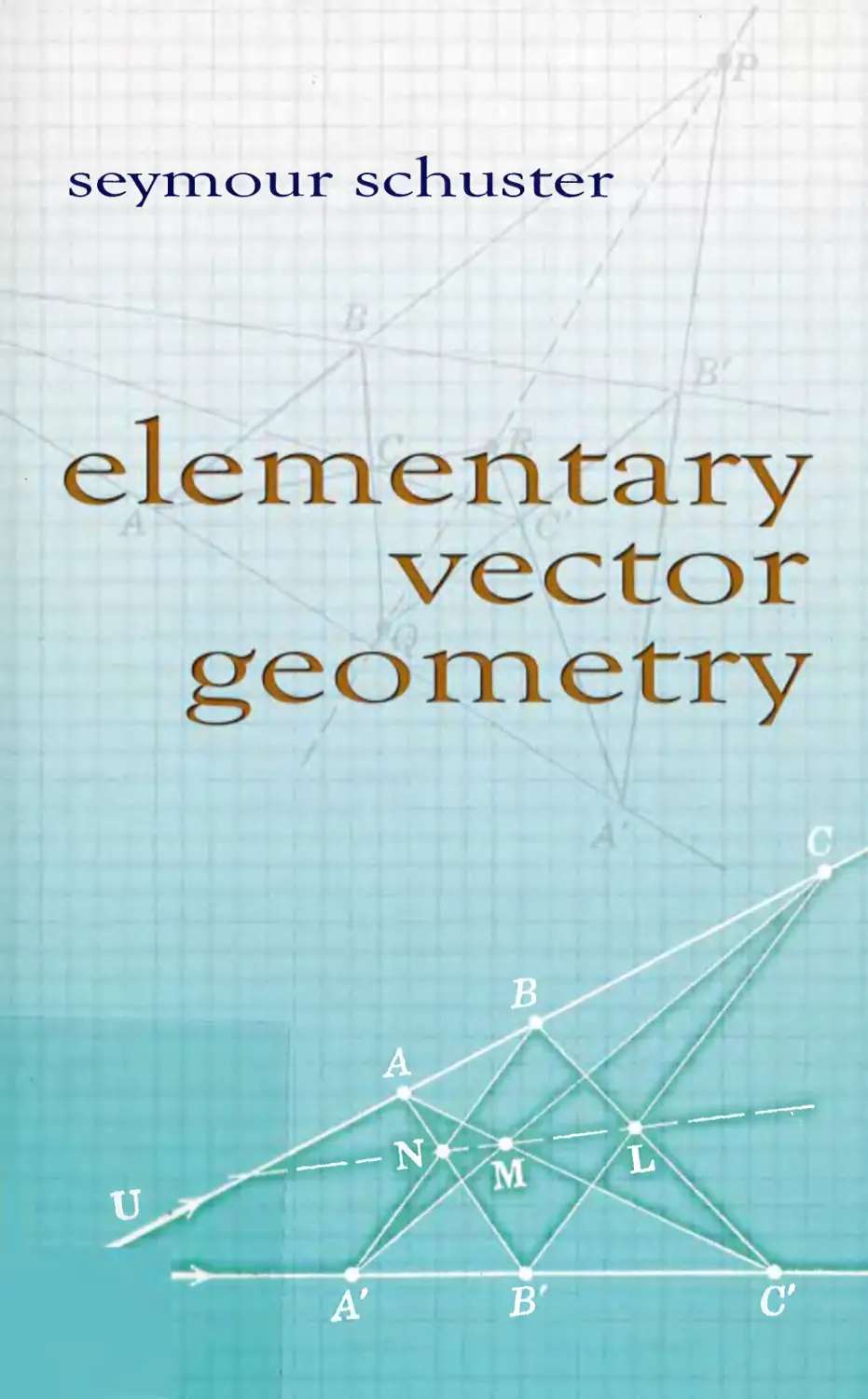
seymour schuster
A
- --- N
---
u
A'
B
----
-L
B
-........-- '\..
-
c'
ELEMENTARY
VECTOR GEOMETRY
SEYMOUR SCHUSTER
DOVER PUBLICATIONS, INC.
Mineola, New York
Bibliographical Note
This Dover edition, first published in 2008, is an unabridged republication of
the work originally published by John Wiley & Sons, Inc., New York, in 1962.
Library of Congress Cataloging-in-Publication Data
Schuster, Seymour.
Elementary vector geometry / Seymour Schuster. - Dover ed.
p. em.
Originally published: New York: John Wiley & Sons, Inc., 1962.
Includes index.
ISBN-13: 978-0-486-46672-9
ISBN-lO: 0-486-46672-8
1. Vector analysis. 2. Geometry. I. Title.
QA433.S38 2008
515' .63-dc22
2007050541
Manufactured in the United States of America
Dover Publications, Inc., 31 East 2nd Street, Mineola, N. Y. 11501
to my parents
preface
This short work is the outgrowth of lectures that were
presented at a National Science Foundation Institute
held at Carletol1 College ill the summer of 1959. The
lectures were to serve the purpose of "enriching" the
backgrounds of geon1etry teachers. However, the
pattern of events in mathematics education indicates
that the material covered is no longer enrichment
material but, rather, essential knowledge for every
teacher.
It was just a few years ago that linear algebra' was a
course for beginning graduate students and vector analy-
sis was typically taken as an upper class course by
mathematics, physics, and engineering students. The
last decade has brought revolution in undergraduate
mathematics education, and today the knowledge of
vectors is acquired at a much earlier stage. Indeed, it is
quite usual for college freshmen to study vectors and
matrices, particularly as applied to geometry. Further-
more, the studies and recommendatio11s made by the
v
VI
PREFACE
Commission on Mathematics, the School M thematics
Study Group, and the Committee on the Undergraduate
Program in Mathematics all point in the direction of
getting some of these c011cepts into the high school
curriculum. I have 1011g felt that vector techniques
should and ,viII find their way into the high school
curriculum-perhaps not as an integral part of the mathe-
matical training of all students but, at the very least, as
work to excite and challenge superior students.
On a very elementary level, this textbook deals pri-
marily with the development of vector algebra as a
mathematical tool in geometry. The aim is to gain a
greater insight into the theorems by attempting vector
proofs and analytic proofs in contrast to the synthetic
proofs, a knowledge of which the reader brings as a
prerequisite. The elements of vector algebra are devel-
oped slowly-more so than in any of the standard works
on vectors. Simple geometric explanations, as well as
numerous illustrations, are used. Beyond this, some
analytic geometry (in two and three dimensions) is
developed as a natural outgrowth of the vector treatment.
In addition, the vector approach is used to assist in other
areas of elementary mathematics: algebra, trigonometry
(plane and spherical), and higher geometry. In short,
vectors have been employed whenever it was felt that
they would aid in gaining insight and/or in facilitating
computations and proofs. I have tried to develop very
little machinery but to go a long way with this small
amount. Accordingly, the reader will. find himself
dealing with such topics as linear inequalities, convexity,
linear programming, involutes, and projective theorems.
As for prerequisites, they are not listed formally
because I do not claim to have given a logical (axiomatic)
development of geometry. Loosely speaki11g, I have
assumed that the reader is familiar \vith the definitions
and concepts of Ellclidean geometry and with the bare
PREFACE
VII
essentials of trigonometry. For example, the notions of
angle, parallelism, and area are assumed. It is further
assumed that the reader knows the definitions of the
sine, cosine, and tangent functions (in the naive sense,
as ratios of the sides of a right triangle). In regard to
resliits from geometry and trigonometry, I haye indeed
taken very little for granted. Samples of. geometric
information that are called upon are: formulas for the
area of a parallelogram and volume of a parallelopiped
the fact that two points determine a unique line, and the
result that opposite sides of a parallelogram are equal.
In Chapter 3 I use the)aw of cosines for motivatio11, but
the reader who has not seen it before will be consoled by
a proof given shortly thereafter.
It is entirely possible to give a vector development of
Euclidean geometry from "scratch." In fact, some
people believe that a first course in geometry should
begin with vectors. Others believe that the coordinate
method should be given at the olltset, and still others
have faith in a combinatio11 of approaches. The
coordinate development, in various forms, has recently
been adopted by several of the current groups interested
in rewriting the high school mathematics curriculum.
For the reader interested in seeing how a strict vector
approach would do the job, I strongly recomme11d the
excellent paper "Geometric Vector Analysis and the
Concept of Vector Space" by Professor Walter Prenowitz.
This fine exposition constitutes one of the chapters of the
Twenty- Third Yearboolc of the National Council of
Teachers of l\lathematics.
Sincere thanks and appreciation are due to the teachers
who came to Carleton i11 the SlImmer of 1959 in the hope
of comfortably learning mathematics in cool Minnesota
but who, instead, labored al1d perspired under the strains
of vector geometry and the 96 % humidity. For reading
the n1a11uscript and for their valuable suggestiol1S I am
VIII
PREFACE
especially grateful to Mr. Saul Birnbaum of the New
Lincoln School in New York City, Professor Roy Dubisch
of the University of Washington, Professor J. M. Sachs
of the Chicago Technical College, and my Carleton
colleague, Professor William B. Houston, Jr. Also,
special thanks go to Professor Dick Wick Hall, who
courageously used the text in mimeograph form at a
National Science Foundation Institute in the Sllmmer of
1961. This experience enabled Professor Hall to con-
tribute substantially by pointing out ID.y errors ill judg-
ment and typography.
SEYMOUR SCHUSTER
N orthfield, Minnesota
January, 1962
contents
Chapter 1 ELEMENTARY OPERATIONS
1
1. Introduction. 2. Definition of vector. 3.
Fundamental properties · 4. Linear combinations
of vectors. 5. Auxiliary point technique. 6.
Uniqueness of representations.
Chapter VECTORS IN COORDINATE SYSTEMS 40
7. Rectangular systems and orientation. 8.
Basis vectors and applications · 9. The complex
plane.
Chapter 3 INNER PRODUCTS
60
10. Definition. 11. Properties of inner product ·
12. Components. 13. Inner product formulas.
14. Work.
IX
x
CONTENTS
Chapter 4. ANALYTIC GEOMETRY
15. Our point of view · 16. The straight line · 17.
A,nalytic geometry of the line continued. 18.
Distance from a point to a line. 19. Analytic
method of proof. 20. Circles. 21. Spheres. 22.
Planes · 23. Det rmining a plane by points on it ·
24. Distance from a point to a plane · 25. The
straight line in three dimensions · 26. Angle be-
tween two lines · 27. Intersection of a line with a
plane · 28. Angle between a line and a plane.
Chapter 5 CROSS PRODUCTS
29. Cross products. 30. Triple scalar product.
31. Distance from a point to a plane · 32. Dis-
tance between two lines. 33. Triple cross
products.
Chapter 6 TRIGONOMETRY
34. Plane trigonometry .,35. Spherical
trigonometry.
Cl apter 7 MORE GEOMETRY
36. Loci defined by inequalitjes. 37. A few
booby traps. 38. Segments and convexity. 39.
Linear programming. 40. Theorems arising in
more general geometries. 41. Applications of
parametric equations to locus problems. 42.
Rigid motions.
APPENDIX
ANSWERS
INDEX
76
135
151
160
204
fJ06
11
elem.entary
operations
1. INTRODUCTION
The history of the development of mathematical ideas
indicates that abstract concepts arise generally from roots
in some "practical" problem. Arithmetic stemmed from
problems of counting, geometry arose from problems of
surveying land in Egypt, and calculus developed princi-
pally from the efforts to solve the problems of motion.
Mathematics, however, goes quite beyond the point of
solving merely the problems that initiate the particular
study, for mathematics is concerned with building a
deductive science that is general and abstract, that may
have a wide range of application. By a deductive science
we mean, briefly, a logical development that begins with
a basic framework consisting of a set of assumptions
(called axioms or postulates) and a set of terms used in
stating the assumptions. All the logical consequences
of the assumptions are then the theorems of the deductive
science, which is concerned with abstractions or idealiza-
1
2
ELEMENTARY VECTOR GEOMETRY
tions of concepts from the original problem rather than
with the original problem itself. For example, the study
of geometry is based on a set of assumptions that deal
essentially with lines and POil1tS rather than with fences
and fenceposts. Line is an abstract concept; it is an
idealization of the fence, and it admits to all sorts of
other interpretations: a ray. of light, the edge of a board,
the path of a molecule under some circumstances,
and a host of still others. Thus geometry, with its
origins in surveying, finds application in a variety of
problems.
The pure mathematician, however, goes on-and far
beyond. Because once he begins a mathematical study,
he is free to exercise his imagination by making logical
deductiollS (proving theorems) and developing theories
that are qllite apart from the realities of the motivating
problem. li"'or the mathematician there is a reality
within his deductive science. Again drawing from geo-
metry for illustration, we can point to the developments
of fOllr dimensional geometry-even n-dimensional
geometry-in spite of the fact that our physical world is
three dimel1sional, or to the invention of non-Euclidean
geometries, that contradict Euclid's Parallel Postulate
(which, for over 2000 years, was accepted as absolute
mathematical truth). Such creations by mathematicians
were consequences of strong imagination and quite
beyond the consideration of any elementary problem in
the physical world.
Vector analysis is also a subject that has its roots
in physical problems. It was developed primarily to
handle problems in physics, initially problems in me-
chanics but, later, problems in various other branches of
physical science. Developments of th nineteenth and
twentieth centuries have resulted in the abstract concept
of a vector and, consequently, in a wide range of interpre-
tations of this abstract concept. The result is that vec-
ELEMENTA.RY OPERATIONS
3
tors now play a prominent role in a variety of studies,
to name just a few: physical chemistry, fluid-flow theory,
electro-magnetic theory, economics, psychology, and
electrocardiography.
Geometry books are aI,vays filled with illustrations in
spite of the fact that point, line, and circle are abstract
concepts that do 110t exist in physical reality and in spite
of the fact that beginning students are apprised of the
abstract nature of the subject at the very beginning of
their course. The reason is quite simple. Abstract
reasoning is difficult; students therefore need-or are at
least assisted by-the help of some real model (or inter-
pretation) of the abstract concepts. Consequently, a
small dot marked with a sharp pencil is a convenient
model for the concept of point, and a sharp pencil drawn
along the edge of a ruler leaves a n1ark that is used as a
model for the concept of line. Such pencil marks are a
great convenience for beginl1ers until they get to feel at
home in the subject and begin to feel that there is a
reality in geometry itself. Later in their mathematical
studies students encounter other abstract concepts, but
by this time they can, and do, use geometric models to
assist them in still more abstract reasoning. This
pattern of development is precisely what occurs in the
study of vectors. Although the concept of vector can
be made abstract, a geometric model (directed line seg-
ment) is the crutch that assists the beginner in develop-
ing steady legs in the field that is new to him.
It is the author's view that steady legs in abstract
vector algebra are developed slowly and that reasoning
in the model (now geometry) for some extended period
should be done preliminary to engaging in the abstract
study. Therefore this entire textbook co cerns itself
with a geometric study of vectors (i.e., the application of
vectors to geometry), in contrast to the general abstract
study of vectors. Let us begin.
4
ELEMENTARY VECTOR GEOMETRY
2. DEFINITION OF VECTOR
Earlier we pointed out that the idea of vector came
originally from physics. Therefore, let us consider-
from the physicist's point of view-the statement of the
television announcer who, before giving his final "Good
night," states, "The temperature is 110W 37° and the wind
is' 12 miles per hour in a northeasterly direction." In
this simple weather announcement we observe examples
of two distinctly different types of quantities in the sense
that the first (temperature) requires only a single num-
ber-with units, of course-for its description, whereas
the second quantity (wind velocity) requires two facts,
magnitude and dire-ction. These examples are typical of
the quantities encountered in elementary physics.
Hence, the following simple classification is made:
quantities that possess only magnitude are singled out and
called scalars, whereas quantities that possess both magni-
tude and direction are called vectors.
In addition to temperature, examples of scalar quanti-
ties are mass, length, area, and volume; and, in addition
to velocity, examples of vectors are force, acceleration,
a11d electrical intensity.
Just as the mathematician desires a geometric model
for his general concepts, so does the physicist. For
geometry-to the trained physicist-also has a reality
by means of which he can "visualize" and be aided in his
reasoning. A convenient geometric model for a vector
is a directed line segment (/) because this possesses
both magnitude (length) and direction, simultaneously.
This model, which suits the needs of physicists, is also
quite satisfactory for our purposes, for it is our aim to
study geometry (by mearlS of vectors). Hence, for our
mathematical development, we make the following for-
mal definition.
Definition. A vector is a directed line segment. W e shall
use boldface type to indicate a vector. The symbol1AI
ELEMENTARY OPERATIONS
5
Q
Terminus
or
endpoint
p
Origi n
.0
c
(a)
(b)
FIGURE 1
will be used to designate the length of vector A. In the
event that the vector we speak of is the directed segment
PQ, we emphasize its vector nature by writi11g PQ,
P being the origin and Q being the terminus or endpoint
of PQ (see Figure 1a). Another useful convention when
--7
referring to several vectors OB, OC, and OD with a
common origin 0 is to call these vectors B, C, and D,
respectively. That is, if a discussion is concerned with
several vectors emanating from a single point, we may
designate them merely by their individual endpoints
(see Figure 1b).
A vector of length one is called a unit vector. The
notion of a vector of zero length (with any direction),
although apparently peculiar, is actually a great con-
venience. We refer to such a vector as the zero vector
and shall point to its usefulness from time to time. The
notation for the zero vector is o. The direction of the
zero vector is discussed further in Secti011 4.
Scalars, being merely magnitudes, will be real-num-
bered quantities. (In more advanced mathematics
scalars may be elements of the complex numbers; indeed,
they may be from any number field. Our needs, how-
6
ELEMENTARY VECTOR GEOMETRY
ever, do not require such generality and will therefore be
satisfied by restricting scalars to the real numbers.)
They are designated by lower-case Latin letters: a, b, c,
or by numerals.
3. FUNDAMENTAL PROPERTmS
Our desire is to build an algebra of vectors, and to this
end we must first present a criterion for calling two vec-
tors equal.
Definition. Two vectors A and B are called equal (written
A = B) if and only if I the following three conditions hold:
(i) A is parallel to B;2
(ii) A and B possess the same sense of direction; and
(ill) IAt = \BI, i.e., the length of A equals the length of B.
It cannot be emphasized too strongly that vectors may
be equal even if they do not possess the same position in
space. As a matter of fact, our definition indicates that
a vector A may be relocated provided that we move it
rigidly to a position parallel to its original position and
that we do not change its length or sense of direction
(see Figure 2a). It may therefore be relocated in a posi-
tion with its origin anywhere in space that we choose.
When vectors are given this freedom, they are termed
free.
1 The phrase "if and only if" points up the fact that the defini-
tion is actually a double implication, or logical equivalence. That
is, (a) If A = B, then conditions (i), (ii) , and (iii) hold; and
(b) If conditions (i), (ii), and (iii) hold, then A = B.
2 We use the word parallel in the more general sense to mean
"parallel or on the same line." Although this usage is not given
in high school geometry, it is quite common in analytic geometry,
where two lines possessing equal slopes are called parallel (see
Section 16). Thus a line is parallel to itself, and a vector is equal
to itself. The latter would not be tru if we didn't use "parallel"
in this generalized sense. Figure 2b exhibits two equal vectors
on the same line.
ELEMENTARY OPERATIONS
Y y
Y
(a)
7
"
"
,
"
,
"-
"
,
"
(b)
'\
,
,
FIGURE 2
In the study of geometry this liberty to make displace-
ments of vectors is highly advantageous. In the applica-
tions of vectors to other sciences this freedom is not
always granted, for it is necessary to restrict vectors to
some degree. For example, in the mechanics of rigid
bodies it is often required that a vector be confined to a
line; that is, it may be moved rigidly but only in the line
it lay originally. This line is referred to as its line of
action. In Figure 3a we show three vectors, F, G, and
H, which represent three forces of the same magnitude,
acting on parallel lines and haviIlg the same sense of
/
/
/
/
/
z/
(a)
(b)
FIGURE 3
8
ELEMENTARY VECTOR GEOMETRY
(a)
(b)
FIGURE 4
direction. They would therefore be equal according to
our definition. F represents a pulling force at the center
of the bar and G represents a pushing force at the center
of the bar. F and G would have the same mechanical
effect and are therefore considered mechanically equal.
However, H applied at the end of the bar would effect a
turning motion, which is quite different from the effect of
F = G. Thus H is not equal to the other forces. In
such studies it would be natural to insist that two forces
having different lines of action be unequal. This justifies
the stipulation in the theory of mechanics of rigid bodies,
of permitting a vector to be displaced only along its line
of action.
If the field of application were the theory of elasticity,
then it would be necessary to restrict (force) vectors still
more. Figure 3b shows two forces J and K, both of the
same magnitude and directed along the same line of
action, acting on a soft plasticlike material. K has the
effect of stretching the mass, whereas J has the effect of
compressing it. This illustration indicates why, in the
theory of elasticity, two vectors applied at different
ELEMENTARY OPERATIONS
9
points are not considered equal. In this field a vector is
restricted to its original position; there is no freedom to
displace it. Such vectors are called bound.
We state, with emphasis, once again: all vectors in
this book are free, in accordance with our definition of
equality.
Addition. Let A and B be any two vectors (Figure 4a).
We can select a location for vector B so that its origin is
placed at the terminus of A. Now we construct a third
vector, called A + B, whose origin coincides with the
origin of A and whose terminus coincides with the ter-
minus of B.
The construction (Figure 4b) of B + A clearly indi-
cates that B + A = A + B, for both are the same diago-
nal of the same parallelogram, and they possess the same
sense of direction. Hence we have the following result.
Theorem 1. (i) Addition of vectors is commutative;
that is A + B = B + A.
(ii) Addition of vectors is associative; that is
(A + B) + C = A + (B + C).
Part (ii) of the theorem is easily established by using
the definition of addition. Figure 5 illustrates the proof.
Co>
Co
B+C
A
A
FIGURE 6
10
ELEMENTARY VECTOR GEOMETRY
However, the reader is advised to phrase the proof as a
logical deduction from elementary geometry independent
of a figure.
EXERCISE
1. Give an elementary geometry proof of the theorem: If equal
vectors are added to equal vectors, the sums are equal vectors.
As indicated in Section 1, the notion of a vector arose, his-
toricallYr from an attempt to characterize physical quantities,
notably force. It is interesting to note that the little-known,
but nonetheless excellent, Dutch scientist, Simon Stevin
(1548-1620), experimented with two forces in an effort to
replace the two by a single one, called the resultant. He dis-
covered that the resultant was actually the force represented
by the diagonal of a parallelogram, of which the sides repre-
sented the two original forces (Figure 6). This led to his
formulation of the principles of addition of forces, which he
used extensively in developing a complete theory of equilib-
rium-the beginning of modern statics. (It is for this reason
that the parallelograms of Figure 6 are sometimes referred to
as parallelograms of forces.) Among the many other accom-
plishments of Stevin are his: (1) work on hydrostatics, which
laid plans for the reclamation of the below-sea-Ievel land of
Force Fl
Force Fl
Force Fl
FIGURE 6
ELEMENTARY OPERATIONS
11
Holland, and (2) development of decimal notation for numbers
with the consequent methods for computation. He was the
first to give a systematic treatment of decimals. (See the
chapter entitled "Stevin on Decimal Fractions" in A Source
Book in Mathematics, by D. E. Smith, or A History oj Mathe-
matics, by J. F. Scott, 1960.)
Thus our definition of vector addition is consistent with the
desires of the physicist who is interested in applying the tech-
niques of vector analysis to his problems. (The student of
applied science should constantly maintain a critical attitude
toward the mathematical definitions, taking care to see whether
or not they accurateiy reflect given physical situations.)
Before continuing, it should be mentioned that Galileo (1564-
1642), quite independently, came to the same conclusion as did
Simon Stevin. Thus two scientists discovered how vectors
"should" add, approximately two centuries prior to the inven-
tion of vector algebra and vector analysis in the nineteenth
century.
Our definition of addition can now be extended to find
the sum of n vectors: Al + A 2 + A g + · · · + An.
Of course, this can be done by grouping pairs (note part
(ii) of Theorem 1) and applying the definition repeatedly.
However, the geometric process might be described
simply as follows: move A 2 so that its origin is at the
terminus of AI; move Aa so that its origin is at the
terminus of A 2 ; continue this process until An is placed
with its origin at the terminus of An-I. The sum Al +
A 2 + A g + · · · + An is then the vector whose origin
coincides with the origin of Al and whose terminus coin-
cides with the terminus of An.
What would be the sum of the vectors that form a
closed polygon with arrows taking us all the way around?
(Try to find the answer before reading on.) Consider,
for example, A + B + C + D + E + F 'of Figure 7.
This is the vector whose origin coincides with the origin
of A and whose terminus coincides with the terminus of
F after the vectors are placed "origin to terminus" as
12
ELEMENTARY VECTOR GEOMETRY
FIGURE 7
described above. Hence the origil1 and terminus of the
sum vector are the same point, al1d the vector is of zero
length. We then write
A + B + C + D + E + F = o.
This argument holds for a polygon of n sides, so the
answer to our query is: The zero vector.
Multiplication of a vector by a scalar. In arithmetic it is
convenient to introduce multiplication as an extension
of addition. For example, 3 X 4 may be thought of
4 + 4 + 4. Similarly, we can-at least to begin with-
x
rt,
FIGURE 8
ELEMENTARY OPERATIONS
13
think of multiplying a vector by a scalar as an extension
of vector addition. An illustration (Figure 8) might be
that 2A should represent A +. A. From our definition
of addition, we know vector A + A is actually a vector
parallel to A and having the same sense of direction as A;
however, the length of A + A is twice the length of A.
Therefore, if 2A = A + A, the result of multiplying A by
the scalar 2 is a vector parallel to A having the same sense
of direction as A but with twice the length of A.
Before proceeding to the general case of multiplying a
vector by a scalar, let us consider the question of what
would be appropriate f r a definition of -A. A reasona-
ble demand might be that A + (-A) = 0; so let us,
for the moment, stipulate this and see where it takes us.
In general, if A + X = 0, we know that (a) X must be
parallel to A, (b) IAI = \xl, and (c) X must have a sense
of direction opposite to that of A (Figure 9). Thus-A
should have precisely the properties a, b, and c men-
tioned in the previous sentence. (Alternatively, if
A + X = 0, then A followed by X can be thought of as
a closed polygon in which the origin of X is at the ter-
minus of A.) Consequently, our definition should (and
will) stipulate that multiplying by a negative scalar has
the effect of changing the sense of direction of a vector.
We are now ready to present a definition for the multi-
plication of a vector by a scalar.
FIGURE 9
14
ELEMENTARY VECTOR GEOMETRY
;1A
FIGURE 10
Definition. 3 nA is a vector parallel to A with magnitude In \
times the magnitude of A. In symbols, InAI = Inl iAI.
Further, if n > 0, nA is defined to have the same sense of
direction as A; and if n < 0, nA is defined to have a sense
of direction opposite to that of A; finally, if n = 0, nA is
defined to be the zero vector (which follows from the first
sentence of our definition). Figure 10 illtlstrates the def-
init.ion for n = 3, n = -3, and n = i-.
Theorem 2. If m and n are scalars, then
(i) m(nA) = (mn)A.
(ii) (m + n)A = mA + nA.
(iii) meA + B) = mA + mB.
To illustrate, consider m = 5 and n = - 2. Then
nA = - 2A, a vector twice the length of A btlt directed
3 The sy-mbol Inl refers to the absolute value of n, which is defined
as follows: If n > 0, then Inl = n; and if n < 0, then Inl = -n.
rfhe definition asserts that the absolute value of a number is
always non-negative; e.g., 131 = 3, 1-31 = 3, and 101 = O. We
shall need the fact that \mnl = Imllnl, the truth of which should
he clear from the definition.
ELEMENTARY OPERATIONS
15
oppositely to A. (i) states:
5( -2A) = (5)( -2)A = -lOA.
(ii) states: (5 + (-2))A = 5A + (-2)A or
3A = 5A + (- 2)A.
(iii) states: 5(A + B) = 5A + 5B.
Proof. (i) By examining the length of the left mem-
ber of (i), our definition of multiplication of a vector by
a scalar yields
1 m(nA) I = ImllnAI = ImllnllAI = ImnllAl
= I (mn)AI. (1)
Equation 1 proves that the vectors of (i) are equal in
length. That they are parallel follows from the fact
that both are multiplies of A. The reader is left to check
that the directions have the same sense. (Hint. Use
the definition of nA..)
(ii) If m + n = 0, both sides of (ii) represent vectors
that point in the same direction s A. If m + n < 0,
both sides of (ii) represent vectors that point in the direc-
tion opposite to that of A. The comparison of their
lengths is left to the reader. (Hint. Use the definition
of nA.)
(iii) Let us suppose that A and Bare nOllparallel and
nonzero. We consider the triangle PQR, which defines
-? -?
A + B (see Figure 11), by having A = PQ, B = QR,
--7
then P R = A + B . We construct triangle P' Q' R' ,
-? -?
where mA = P'Q', mB = Q'R', then P'R' = mA + mB.
SincemAilAandmBilB.triangle PQR is similar to tri-
-?
angle P'Q'R'. Thus P'R' is meA + B), and we have the
result that meA + B) = mA + mB.
The reader should consider two questions cOllcerning
the proof of (iii). The first is: What of the direction of
16
ELEMENTARY VECTOR GEOMETRY
p
A
mA
p'
FIGURE 11
m.(A + B) as compared to that of mA + mB? The
proof explicitly concerned itself, with the lengths and
parallelism of the two vectors, but it did not discuss sense
of direction. The second question is: Does the proof
break down if A\.IB?
NOTE. Since part (i) of Theorem 2 states that a
change of parenthesis is legitimate, we now know there
would be no confusion if we eliminate the parenthesis
entirely and write mnA. For example,
3(2A) = (3 · 2)A = 3 · 2A = 6A.
Subtraction. As il1 elementary arithmetic, where sub-
traction is an operation that is the inverse of addition,
we define subtraction of vectors as the inverse of' vector
addition. More precisely, if a is a real number, we write
a - a = a + (-a) = O. This equation expresses the
fact that subtractioll is defined in terms of addition and
that subtraction is the inverse of addition. Mathe-
maticians say that the realilumber -a is the inverse of
a relative to the operation of additioll or simply that - a
is the additive inverse of a (similarly, a is the additive
inverse of -a). We carry these ideas over to vectors in
defining subtraction.
Definition. A - B = A + (-B) where -B is written
to mean -lB.
ELEMENTARY OPERATIONS
17
Geometrically the operation of subtraction can take
any of the forms preeented in Figure 12. Note that the
diagonal A of the parallelogram is equal to the sum
B + (A - B) and also to the sum (A - B) + B. Such
algebraic checking is advised for the beginner who is
having difficulty in finding the correct orientation for the
difference vector A-B. With these few tools of addi-
tion and subtraction we can begin applying vectors to
elementary geometry.
EXAMPLE 1. We shall use our vector operations to work an
elementary exercise, one equivalent to the theorem which states
that the diagonals of a _parallelogram bisect each other. Let
0, B, and C be three points not on one line. Call M the mid-
point of segment BC (see Figure 13a). We shall prove that
--+ --+--+
OM = (OB + OC). In accordance with the convention dis-
--7
cussed on page 5, we shall write B = OB, C = OC and M = OM.
Then
M = B + BM
and M = C - MC = C - BM (since Bill = MC).
B
B
-B
FIGURE 12
18
ELEMENTARY VECTOR GEOMETRY
B
B
D
o
o
c
c
(a)
(b)
FIGURE 13
Adding, we get
or
2M=B+C
M = (B + C).
If we consider our figure to be part of a parallelogram OBDC
(Figure 13b), then the result states that the line joining vertex
o to the midpoint of diagonal BC is one half the diagonal OD,
for IODI = \B + CI. In equivalent (and more usual) language
we may conclude that the diagonals of a parallelogram bisect
each other.
EXAMPLE 2. Prove that the line joining the midpoints of
any t\VO sides of a triangle is parallel to the third and equal to
one half of it.
In triangle PQR (see Figure 14) let 111 and N be midpoints
of PQ and PR, respectively. Call
A = PN = NR, B = PkI = J.lfQ, C = MN, and D = QR.
Then .C = A - Band C + A - D - B = o.
(Note that these equations follow from summing vectors about
triangle MNP and quadrilateral JfNRQ, respectively.)
Adding vector D to both sides of the last equation, we get
C + A - B = D.
Since C = A - B, we have 2C = D, which (by the definition
of equality of vectors) proves simultaneously thatNM\lRQ and
that the segment NM equals one half of the base RQ.
ELEMENTARY OPERATIONS
19
p
R:
FIGURE 14
EXERCISES
1. Establish the easily remembered SHORTCUT LEMMA:
AB + BC = AC. (This lemma has also been appropriately
named the Bypass Lemma by Professor D. W. Hall.)
2. Reproduce Figure 15 on another sheet. Then construct
and label the vectors C - A, B - C, B + C, and -B - C.
3. Show that PQ + TlS = 2MN, where P, Q, R, and S are
four arbitrarily chosen points and where f and N are the
FIGURE 15
20
ELEMENTARY. VECTOR GEOMETRY
midpoints of PR and QS, respectively. (Hint. Sum the
vectors around the polygon NMRS and NMPQ.)
4. Draw triangle ABC, with P the midpoint of A.B, Q the mid-
point of BC, and R the midpoint of CA. If X is any point,
show that XA + XB + XC = XP + X Q + XR.
5. A sailboat is acted upon by the wind and current. The
wind velocity is 8 mph E and the current velocity is 5 mph N.
Compute the magnitude .of the resulting force and give a
geometric construction that shows the direction of the resultant.
6. Using the fact that the sum of the forces. (vectors) acting
on a body in equilibrium is the zero vector, solve the following
problem.
A weight of 100 lb hangs by a wire and is pushed by a hori-
zontal force until the wire makes an angle of 1r/4 (or 45°)
with the vertical. Find the magnitude of the horizontal force
and the tension in the wire.
7. Show that the midpoints of consecutive sides of a quadri-
lateral are vertices of a parallelogram.
8. If A, B, C, and D are any four points (not necessarily in a
plane), prove that AB + AD + CB + CD = 4PQ where P
and Q are the midpoints of A.C and BD. (How does this
relate to Exercise 2?)
9. Using the definition of subtraction, the commutative and
associative properties of addition, show that the sums B +
(A - B) and (A - B) + B, do actually reduce to equal A.
10. Establish the uniqueness of 0, thus justifying the termi-
nology: the zero vector. (Hint. Consider the possibility of a
vector 0' that has the properties of O. Then prove that
0' = 0.)
4. LINEAR COMBINATIONS OF VECTORS
Now that we have learned to add and subtract vectors,
and also to multiply vectors by scalars, we can combine
these operations to generate new vectors and to enrich
our algebra of vectors. For example, if we are given A
ELEMENTARY OPERATIONS
21
and B, we can perform our various operations to get
A + B, A - B, 2A - 3B, 5A + 6B, etc. Such com-
binations of A and B are called linear combinations of
A and B. The set of aillillear combinations of A and B
could be written {xA + yB Ix and y real}. 4 The defil1i-
tion of linear combinations is now extended in the fol-
lowing way: If AI, A 2 , A 3 , . . . , An are n vectors and
Xl, X2, X3, . . . ,X n are n scalars, the vector
xiA I + X2 A 2 + X3 A g + · · · + xnAn
is said to be a linear combination of AI, A 2 , A 3 , . . . ,An.
The present section is devoted to the study of linear
combinatiolls of certain sets of vectors, and the ideas
contained herein are perhaps the most difficult in the
el1tire book. Thus we shall proceed slowly. The reader
is cautioned to study the definitions and to take them
literally!
We Iloted earlier that the equation A + X = 0 implies
that X = -A, that is, X is the vector obtained by mul-
tiplying A by -1. Since X can be derived from A, we
could, in a sense, say that X is depe11dent upon A; or,
conversely, that A is dependent UpOll X. Similarly, if
,ve began with A + 3Y = 0, we could write
Y = --lA
A = - 3Y.
and
Thus Y is shown to depel1d 011 A and A to depel1d on
Y. It might be preferable to state simply that A a11d
Yare dependent. It is almost trivial to observe that
such dependency would be impossible to sho,v if the scalar
coefficients of A and Y were both zero. Hellce we exclude
this case from consideratiol1 in making the following
definItion.
4 The synlbolism { I }, borrowed from set theory, is useful in
defining sets in the following "ray: {zIS(z)} represents the set of all
z satisfying the condition or sentence S (z) .
22
ELEMENTARY VECTOR GEOMETRY
Definition. Two vectors A and B are called linearly
dependent if and only if there exists two scalars a and b,
not both zero, so that aA + bB = o.
Remark: The student should recognize the fact that
definitions of words are statements of logical equivalence
(see footnote 1, page 6); i.e., both the statement and its
converse hold. Using our present definition to illustrate
this explicitly, we would say that the definition states:
(1) A and B being linearly dependent implies that
there exist scalars a and b, not both of them zero, so that
aA + bB = 0; and (2) if a relation aA + bB = 0 holds,
with not both a and b equal to zero (i.e., at least one being
nonzero), then A and B are linearly dependent.
Algebraically our definition is equivalent to saying that
two vectors are linearly dependent if and only if (see
footnote 1 for explanation of the phrase "if and only if")
one of them is a scalar multiple of the other (show this!).
A geometric interpretation would be the following: Two
vectors are linearly dependent if and only if they are
parallel. The reader can verify these interpretations
formally by constructing a general argument of the form
that preceded our definition. One fine point, however,
must be mentioned; this concerns the presence of 0 as
one of the vectors under consideratio11. First, we note
that 0 and any vector A are linearly dependent, for
10 + OA = 0, which is the defining condition for 0 and
A to be linearly depe11de11t (1 is the required nonzero
scalar). Our geometric i11terpretation would say that
o is parallel to A, where A may be any vector. This may
appear strange to the beginning student of vectors; how-
ever, it is a matter of great convenience to retain the con-
vention that the zero vector is parallel to every vector!
Instead of regarding the zero vector as having no direc-
tion (as would appeal to some), we regard 0 as having
any direction. Vectors specify magnitude and direction,
so we choose to say that 0 has any or all directio11s simul-
ELEMENTARY OPERATIONS
23
taneously. Of course, the zero vector is the only vector
with such a property, for any other vector (line segment
of nonzero length) has a u11ique direction. Later, when
we work with perpendicular vectors, we shall have occa-
sion to regard the zero vector as perpendicular to every
vector. Again, this is consistent with the idea that the
zero vector has any direction.
In the event that two vectors are not linearly depend-
ent, we call them linearly independent. Summarizing,
we say that:
(1) A pair of vectors, of which one is a zero vector, is a
linearly dependent set of vectors.
(2) A pair of parallel nonzero vectors is a linearly
dependent set.
(3) A pair of nonzero, nonparallel vectors is a linearly
independent set.
Confining our attention merely to pairs of vectors
would contradict the generalizing spirit of mathematics
and, fllrthermore, would leave us with a rather meager
theory of linear dependence. We therefore proceed to
extend Ollr notions with the following definition.
Definition. A set AI, A 2 , . . . , An of n vectors is called
linearly dependent if there exist a set of scalars Xl, X2, . . . ,
X n , so that
xlAI + X2 A 2 + · · · + XnAn = 0,
where not all the x's are zero (i.e. when at least one does not
equal zero). If, on the other hand, the equation
xlAl + X2 A 2 + · · · + xnAn = 0
implies that Xl = X2 = · · . = X n = 0, . then the set
AI, A 2 , . . . , An is said to be linearly independent. For
example, if three vectors, AB, CD, and EF, are given,
one of the following cases must occur: (a) It is possible
24
ELEMENTARY VECTOR GEOMETRY
to find three scalars a, b, and c, not all zero, such that
aAB + bC D + cEF = o.
(*)
(b) It is not possible to find three such scalars. In
case (a) the three vectors are said to be linearly depend-
ent. In case (b) they are said to be linearly independent.
In both cases (*) will hold if a = 0, b = 0, and c = o.
The jump from two vectors to n vectors may be rather
steep, so we shall provide an intermediate step ill the form
of a geometric theorem.
Theorem 3. If A and B are linearly independent, then
any third vector C; which is parallel to (or in) the plane
determined by A and B, can be expressed as a linear com-
bination of A and B.
Proof. It should be recalled that vectors may be
arranged so that they possess a common origin, that is,
we are dealing with free vectors. Therefore, even when
the segments representing A, B, and C might be in space,
they can be moved to positions in the same plane (see
Figure 16). For A and B with a common origin deter-
mille a pla11e; alld C (being parallel to this plane) may
then be displaced so that it is actually in the plalle of
A and B.
'B
B
A
)
A
FIGURE 16
ELEMENTARY OPERATIONS
25
A
A
I A
A /x >o and y>O
(b)
I C
I
yBI B
I xA
----
/ 0
oX < 0 and y > a
(a)
FIGURE 17
Now, if C is a nOllzero vector, there is a parallelogram
with diagonal C alld '\vith edges along A and B. An
explicit constructioll of this parallelogram is given in
Figure 17 and call be described as follows: Call 0 the
common origin of the vectors A, B, and C, and call A,
B, and C the respective endpoints of the three vectors.
Construct a line £ through C parallel to B, alld call D
the intersection of £ with the line of actiol1 of A (when the
origin of A is 0). Then OD, being parallel to A, is some
multiple of A; let us say OD = xA. l "urthermore, DC,
being parallel to B, is some multiple of B; let us say
DC = yB. Then
C = xA + yB,
(2)
which shows C to be a linear combination of A and B.
In the event that C is the zero vector, the theorem is
trivially true, for
o = OA + OB,
(3)
and our proof is complete.
To associate more strollgly the idea of Theorem 3 '\vith
the concept of lillear dependence, we state the
Corollary. Any three vectors in the same plane. are
linearly depertdent.
26
ELEMENTARY VECTOR GEOMETRY
Proof. Equati<?ns 2 and 3 imply that there exist
scalars Xl, X2, Xg, (not all zero), so that
xlA + X2 B + xgC = O.
For, when C 0, at least one of X and y in (2) is non-
zero. When C = 0, we can set Xg equal to any real
number, say Xg = 1, and Xl = X2 = o.
EXAMPLE 3. We shall use the concept of linear combination
to achieve another view of Example 1. Suppose we wish to
prove that the diagonals of a parallelogram bisect each other.
Let the parallelogram be OA.BC (see Figure 18), with P the
intersection of the diagonals. Again, using the convention of
writing P = OP, A = OA, and B = OB, we have P = mB
"'hd
= meA + C) and PA n(A - C), where m and n are scalars
to be determined. Since A = P + P A, we may write
A = meA + C) + n(A - C),
and grouping the A-terms and C-terms gives
(m + n - l)A + (m - n)C = o.
Because A and C are linearly independent, their scalar coeffi.-
cients in the last equation must both be zero. Hence
m + n = 1 and m - n = o.
Thus m = n = , which proves that P bisects both diagonals
simultaneously.
B
o
FIGURE 18
ELEMENTARY OPERATIONS
27
Continuing with the development on linear combina-
tions of vectors in the plane, we next establish an impor-
tant theorem that serves as a very strong instrument for
work with geometric problems.
Theorem 4. Let A, Band C be located 80 that they have
a common origin O. Then:
(i) If C has its endpoint on the line joining the end-
points of A and B,
C = lA + mB, where l + m = 1.
(ii) Conversely, if C has a representation in the form
C = lA + mB, where l + m = 1,
C has its endpoint on the line joining the end-
points of A and B.
Before proceeding with the proof, the reader should
observe that the theorem is concerned with three vectors
in the same plane (often called coplanar vectors), and if
A . and B are nonzero and nonparallel, then every vector
in the plane of A and B (C being one such) is a linear
combination of A and B, by Theorem 3. However, the
theorem singles out particular linear combinations by
means of a condition on the scalar coefficients.
For the converse point of view, we would state (and
the reader should verify) that any linear combination of
two linearly independent vectors, A and B, is equal to a
vector in the plane of A and B when the two are situated
to possess a common origin. Once again, the theorem
states that certain of these li ar combinations have
interesting geometric implications.
Proof: (i) Here we have as our hypothesis the fact
that A, B, and C all emanate from the same point 0,
and that C has its endpoint on the line joining the end-
points of A and B. We follow the convention of calling
28
ELEMENTARY 'VECTOR GEOMETRY
o
FIGURE 19
A, B, and e the endpoints of A, B, and C, respectively
(see Figure 19).
Let e divide segment BA in the ratio l:m, where
l + m = 1. (The reader should convince himself that
a given ratio can always be transformed lgebraically
so that the two parts sum to Ullity.) TheIl
C = B + Be = B + lBA = B + leA - B)
= lA + (1 - l)B.
Thus C = lA + mB.
(ii) For the converse, our hypothesis states that A, B,
and C emanate from the same point and C = lA + mB,
where l + m = 1. We must show that C has its end-
point on the line jOillillg the endpoints of A and B.
Now C = lA + mB = lA + (1 - l)B;
or C = B + leA - B).
A geometric examination of this last equation com-
pletes the proof, for the equation states that e may be
reached by traveling from 0 to B, and then along line BA.
ELEMENTARY OPERATIONS
29
EXERCISES
1. What happens if A or B is the zero vector?
2. What are land m if C = A?
3. What can be stated regarding the location of C if
(a) both land m are positive?
(b) l is negative?
(c) 1 = O?
4. Give constructions for cases where
(a) l = m = ;
(b) 1 = ! and m = j;
(c) l = i and m = -i.
5. (a) If the ratio of division is 2:3 = l:m,
find land m so that 1 + m = 1.
(b) Do the same for the ratio 4: 3.
(c) Do the same for the ratio 5: -3.
EXAMPLE 4. Theorem 4 reduces Example. 1 (p. 17) to a
triviality. For, let 0, B, and C be three points not on one line,
with M the midpoint of BC (see Figure 20). Then JJI divides
BC in the ratio I: I( =i-: ), and Theorem 4 allows us to write
M = i-B + i-C.
o
c
FIGURE 20
30
ELEMENTARY VECTOR GEOMETRY
A
c
FIGURE 21
5. AUXILIARY POINT TECHNIQUE
The introduction of an auxiliary point to play the role
of common origin for several vectors under consideration
often facilitates the use of Theorem 4. The following
three examples are devoted to an exploration of this
technique.
EXAMPLE 5. We shall now provide a new approach to the
problem of Example 2. Although more difficult perhaps, the
new approach may be instructive.
Let triangle ABC be given, with jJ{ and N midpoints of
sides AB and AC, respectively. Let 0 be a point in general
position (not coinciding with any of the already named points
or lines). Applying Theorem 4 to the three vectors A, C, and
N that emanate from 0 (see Figure 21), we get
N = A + C;
and similarly,
M = A + B .
Since we desire to compare MN with BC, we must examine
vector N - M. Thus
N - M = C - B = (C - B),
which proves both desired results: that N - M (= ]jfN) IS
parallel to C - B (= BC) and that MN = BC.
ELEMENTARY OPERATIONS
31
EXAMPLE 6. We shall once again prove that the diagonals
of a parallelogram bisect each other, but this time by using
the auxiliary point technique, Theorem 4,. and still another
tool that has heretofore been unemployed.
Let the parallelogram be ABCD, calling P the intersection
of the diagonals. Furthermore, let 0 be a point in general
position (see Figure 22). Once again, according to our con-
vention, we write
A = OA, B = OB, C = OC, D = OD, and P = OPe
Establishing our hypothesis in vector language, we write
AD = BC or
D - A = C - B.
(4)
Before proceeding further, let us pause to discuss the approach.
We are interested in finding the precise ratio in whichP divides
AC and also the ratio in which P divides BD. Thus, if we can
get a representation of P, say
P = nA + mC, where n + m = 1,
then we would know, by Theorem 4, that
IPCI: IAPI = n:m.
(Note how the coefficients in the statement of Theorem 4 are
related to the vectors in Figure 19.) Consequently, we seek
P as a linear combination of A and C so that the sum of the
A
c
o
FIGURE 22
32
ELEMENTARY VECTOR GEOMETRY
coefficients be unity. _1\ fu ther observation, which is the basis
for the new tool we promised, is that P has two possible repre-
sentations as a linear combination of two vectors emanating
from 0; namely, there must be n, m, r, and 8 so that
where
P = nA + mC = rB + sD,
n + m = 1 and r + s = 1.
(5)
If we can succeed in producing these relations so that n, m, r,
and 8 are determined, we will have achieved our end.
OUf first step toward (5) is to add A + B to both members
of (4), getting
B + D = A + C.
(6)
Since the sum of coefficients on each side of equation (6) is 2,
we divide both members by 2, obtaining
B + D = A + tC.
(7)
Both members of (7) comply with the conditions of Theorem
4. Thus the left member represents a vector emanating from
0, and whose endpoint must be on BD; and the right member
represents a vector emanating from 0, and whose endpoint
is on AC. Therefore the vector (on each side) must be OP,
for P is the only point on both BD and AC. ....L\.pplying Theorem
4 once again, we conclude that P divides both BD and AC in
the ratio : , which is the desired result.
EXAMPLE 7. Employing the same techniques, we attempt
to prove the familiar result: The medians of a triangle meet in
a point two-thirds the way from a vertex to the opposite side.
Let triangle ABC have M and N midpoints of sides BC and
AC, respectively (see Figure 23). Call P the intersection of
medians AM and BN, and let 0 be a point in general position.
Applying Theorem 4 to the fact that M is the midpoint of BC,
we have
OM = M. = tB + C.
Similarly, N being the midpoint of AC yields
(8)
ON = N = tA + tC.
(9)
Attempting to achieve P as a linear combination of A and M,
and also as a linear combination of Band N, \ve subtract (9)
ELEMENTARY OPERATIONS
from (8) to eliminate C:
M - N - I B - l A
- 2"" 2"".
Then, adding A + N to both members, we get
iA + M = B + N. (10)
33
The sum of the coefficients on each side of (10) is , so we
multiply both members by i. Thus
l A + 2 M - IB + 2N
T -g- - -g- .
The left member of (11) represents a vector whose origin is
o and whose endpoint is on AM, and the right member of
(11) represents a vector whose origin is 0 and whose endpoint
is on BN. But the left and right members of (11) are different
representations of the same vector. This forces us to conclude
that this vector is P, that is,
(11)
P = j-A + iM = j-B + iN. (12)
Equation 12 tells us that P divides AM in the ratio i:j-.
(Notice once again how the coefficients in the equation allow
us to deduce that lAP!: IPMI = !BPI: !PN! = t:t.
Query: Why is it now clear that all three medians intersect
in a point?
Remark. In the examples presented, the point 0
of common origin of the vectors ,vas always selected in
A
B
M
c
FIGURE 23
34
ELEMENTARY VECTOR GEOMETRY
general position. This is, of course, not necessary.
Moreover, placing the point of common origin in some
special, judiciously chosell position often leads to con-
siderable simplification. Exercises 1, 2, and 3, which
follow, have been provided to illustrate this point.
EXERCISES
1. Carry out Example 5 when point A is the point of emanation
of the several vectors in the proof.
2. Do the same for Example 6.
3. Do the same for Example 7.
4. Prove that the midpoints of consecutive sides of a quadri-
lateral are vertices of a parallelogram by making use of Theorem
4 (compare with Exercise 7 on p. 20).
5. Given triangle ABC with N on AB and ilf on AC, such that
MN is parallel to BC, prove that AN:NB = AM:MC. What
is the relationship between the fractions AN If>!B and NM/BC?
6. Prove that the line joining a vertex of a parallelogram to
the midpoint of an opposite side trisects the diagonal crossed
by it.
7. Generalization of 6. Let ABCD be a parallelogram wit.h
P on AD such that AP = (l/n)AD. Prove that BP inter-
sects diagonal AC in a point Q, whose distance from A is
[l/(n + l)]AC.
8. (a) Prove the analogue of Theorem 3, namely: If A, B,
and C are three nonzero, noncoplanar (cannot be placed in one
plane) vectors, any vector in space can be expressed as a
linear combination of A, B, and C. (Hint. A parallelepiped
is the space analogue of the parallelogram in Theorem 3.)
(b) Using the result of part a, prove that any four vectors
in space form a linearly dependent set.
6. UNIQUENESS OF REPRESENTATIONS
The importance of Theorem 3 lies in the statement that
any vector in a plane call be expressed as a linear com-
bi11ation of two given linearly independent vectors in
ELEMENTARY OPERATIONS
35
that plane. The question we now pose is: Is such a
representation unique? More precisely, let A and B be
the given linearly independent vectors and C some arbi-
trarily chosen vector in the plane of A and B. Then, by
Theorem 3, we know that there exist scalars m and n so
that
C = mA + nB.
(13)
But is it possible that there is another representation,
perhaps different from (13), of C as a linear combination
of A and B?
Suppose, then, that there are scalars rand s so that
Then
and
C = rA + sB.
mA + nB = rA + sB
(m - r)A + (n - s)B = O.
(14)
However, A and B being linearly independent implies
that m - r = 0 and n - s = 0; hence, m = rand n = s.
Thus (14) is precisely the same represelltation of C as is
(13). As a result, we say that the representation of C as a
linear combination of A and B is unique.
Similarly, we could prove the general statement that
the representation of a vector as a linear combination of
linearly independent vectors is unique. Suppose
C = alAI + a2 A 2 + · · · + anAn = blAl + b 2 1\2
+ · · · + bnAn,
where {AI, A 2 , . . . ,An} 5 is a linearly independent set
of vectors. Then
(al - bl)A I + (a2 - b 2 )A 2 + · · · + (an - bn)An = O.
Again, the linear indepelldence of the A's mplies that
al = b l , a2 = b 2 , . . ., and an = b n . The reader
5 Again, the brace symbolism represents a set, with a listing or
roster of the elements of the set.
36
ELEMENTARY VECTOR GEOMETRY
should check the geometric construction in Theorem 3 to
observe the uniqueness of the representation of C as a
linear combination of A and B.
We now employ these facts to attack some problems of
geometry.
EXAMPLE 8. We return once more to the parallelogram
problem in order to prove that the diagonals bisect each other.
Referring to Figure 24, we write
PT = meA + B).
(15)
We can achieve another representation of PT by considering
it as one side of triangle PQT, that is, PT = PQ + QT.
But since QT is part of diagonal QS, we may write QT =
nQS = nCB - A). Thus
PT = A + neB - A).
From (15) and (16) we conclude that
(16)
PT = mA + mB = (1 - n)A + nB.
Since A and B are linearly independent, the representation of
PT as a linear combination of A and B Inust be unique. That
R
FIGURE 24
ELEMENTARY OPERATIONS
37
.
IS,
m=1-n
and
m = n,
which imply that m = n = , proving the desired result.
The reader should compare this approach with that of
Example 3 to see how closely allied they are (as are the
concepts of linear independence and uniqueness of
representation).
EXAMPLE 9. We turn to the median problem, using the
new approach. Referring to Figure 23 again, we note that
AP is a part of median AM, so we write AP = mAM. Simi-
larly, PN = nBN. We seek to determine rn and n.
AP = mAM = m( AB + AC).
(17)
AB and AC constitute a pair of linearly independent vectors.
If we succeed in finding another representation of AP as a
linear combination of AB and AC, we may then employ our
new technique. To this end we write
---4
AP =, AN + NP
= AC - nBN
= tAC - n(tBA + tBC)
n n
= AC - 2 BA - 2 (AC - AB).
Finally,
I-n
AP = 2 AC + nAB.
Comparing (17) with (18) gives
(18)
m m 1-n
"2 AB + 2" AC = nAB + 2 AC,
which-because of the uniqueness of representation-allows
38
ELEMENTARY VECTOR GEOMETRY
us to state that
m
-=n
2
and
m 1- n
- =
2 2
The solution to this pair of linear equations is
2
m=-
3
and
1
n =-.
3
The reader should observe that there was a persistent
effort to get two representations of AP as a linear com-
bination of the two specific vectors AB and A C. A usual
difficulty encountered by the beginning student revolves
around the problem of getting the "right" relationships.
He knows that he will often get two independent relation-
ships by summing vectors around two different polygons,
e.g. ,
AP = AB + BP
and
AP = AN + NP.
But where to go from here? If he bears in mind the
---?
general aim to get different representations of AP (for
instance) as a linear combination of the same set of
linearly independent vectors, he may employ the technique
of equating coefficients.
EXERCISES
1. Prove that the medians of a triangle meet in a point by
the method of Example 9, but now by getting different repre...
sentations of NP.
2. Re-do Exercises 6 and 7 on page 34, making use of the
method of Example 9.
3. Show that the line join.ing the midpoints of a median to a
vertex of a triangle trisects the side opposite the vertex.
4. Given quadrilateral ABCD, with the condition that BD
bisects AC, call F the intersection of AB and CD; call G the
intersection of AD and Be. Prove that AC is parallel to FG.
ELEMENTARY OPERATIONS
39
(This is a difficult problem, so we provide the following hint.
Let DG = xDA and DF = yDC. Note that DB =.uDA +
uDC. Then call CG = mBG and express BG as a linear com-
bination of DA and DC, in two different ways, to determine
x in terms of u. Follow a similar procedure to determine y
.
in terms of u. Finally, if you express GF as a linear combina-
tion of DA and DC, you will have the desired result.)
5. Prove the following Theorem: Let the points B' and A'
divide the sides CA and CB of triangle ABC in the ratios
n: (1 - n) and m: (1 - m). Let the point P be chosen so
that A'CB'P is a parallelogram with AC' and CB' as two of
its sides. Call D the intersection of CP and AB. Then D
divides AB in the ratio m: n. (How would you choose nand
m to be sure that CD would bisect angle C?)
vectors in
coordinate
systems
'1. RECTANGULAR SYSTEMS AND ORIENTATION
The reader is undoubtedly familiar with rectangular
coordinate systems in the plane, where two perpendicular
lines are chosen as axes. One is called the x-axis, the
other the y-axis, and their point of intersection the
origin. A positive direction is chosen arbitrarily on each
axis, and the customary correspondence is made between
points of each axis and the real numbers, where the
positive real numbers are on that side of the origin
arbitrarily designated as the positive part of the axis (see
Figure 25). The standard convention (by no means
binding) is to have the horizontal axis called the x-axis,
with its positive side to the right of the origin o. The
vertical axis is then the y-axis, with its positive side
above the origin (see Figure 25b). Now, consider any
point P in the. plane. From P we drop perpendiculars
to the axes. Call P x a11d P y the feet of these per-
40
VECTORS IN COORDINATE SYSTEMS
41
y
y
Py P (x, y)
----1 t
I y
(-3,2) . . (3,2) I
I
x
x 0 X
P%
(a)
(b)
FIGURE 26
pendiculars on the x- and y-axes, respectively. The real
number associated with P x on the x-axis is called the
x-coordinate (or abscissa) of P and the real number associ-
ated with Py on the y-axis is called the y-coordinate (or
ordinate) of P. P is then designated by a11 ordered pair
(x, y) of real numbers: the abscissa occupying the first
position in the pair and the ordinate occupying the second
position. If the point P is on the x-axis, we give it a
y-coordinate of 0; and if P is on the y-axis, we give it
an x-coordinate of o. Thus the origin 0 has coordinates
. (0, 0). This method of associating pairs of real numbers
with points has the advantage of associating exactly one
pair with each point, and exactly one point of the plane
with each ordered pair of real numbers.
Rectangular coordi11ate systems in space follow the
same general pattern as do such systems in the plane.
Three mutually perpendicular (intersecting) lines are
selected as axes: the x-axis, the y-axis, and the z-axis,
with the point of intersection of the three axes being
called the origin. Again, a positive direction is chosen
42
ELEMENTARY' VECTOR GEOMETRY
arbitrarily on each axis, and the usual correspondence is
made between the points of each axis and the real num-
bers. The zero point on each axis is taken at the origin,
and the positive real numbers are on that side of the
origin which has been designated as the positive side of
the axis.
Following the same pattern of development as in the
plane, we consider any point P in space. From P we
drop perpendiculars to the axes, and we call P x, P y and
P z the feet of these perpendiculars on the x-, y-, and
z-axes, respectively (see Figure 26a). The real number
associated with P x on the x-axis is called the x-coordi11ate
of P; the real number associated with Py on the y-axis
becomes the y-coordinate of P; and the real number
associated with P z on the z-axis becomes the z-coordinate
of P. If P is on any of the axes, not all the perpendicu-
lars may be drawn. Thus we state further that if P is
on the x-axis, its y-coordinate and its x-coordinate are
both zero. Similarly, if P is on the y-axis, its x- and
z-coordinates are both zero. Finally, the coordinates
of the origin are all zero.
It is quite convenient to visualize P (when P is not on
an axis) at the corner of a rectangular solid, with the
origin 0 at the opposite corner, as shown in Figure 26b.
This may suggest to the reader other approaches he
might prefer in finding the coordinates of P, or in locating
P if its coordinates are given. For example, suppose we
know the coordinates of P. We can then locate P by
finding the point on the x-axis that corresponds to its
x-coordinate, then moving parallel to the y-axis a dis-
tance that corresponds to the y-coordinate of P, and then
parallel to the z-axis a distance that corresponds to the
z-coordina te of P.
When we designate a point by its coordinates in space,
the order of the triple of numbers follows the alphabetic
order, that is: (x, y, z). We stated that, in dealing with
plane coordinates, it is customary to take the x-axis as
VECTORS IN COORDINATE SYSTEMS
43
z
z
y
/
y
A
x
x
(a)
(b)
FIGURE 26
horizontal, etc. In space, the convention is to have the
positive z-axis pointing upward and the xy-plane hori-
zontal. It is also customary to have one positive axis
pointing toward us and the other pointing to our right.
However, which axis points toward us and which to our
right seriously influences our vector development.
Consequently, before we finally decide on the orientation
of the axes, it would be well to explain the notions of
right-handed and left-handed triples of vectors.
Let {A, B, C} be an ordered set of three linearly inde-
pende11t vectors (which can always be considered as
emanating from the same point 0). Since the vectors
are linearly independent, they do not all lie in one plane.
Moreover, no two are on the same or parallel lines. Thus
the first a11d second vectors, A and B, form an a11gle
(J (0 < 8 < r).l Remember! It's the order of first,
1 Here, and throughout the entire book, angle measurement is in
terms of radians. The use of degrees is due to an. unfortunate
historical accident and serves to confuse students, especially when
they reach the study of trigonometric functions in calculus.
Because radian measure serves the mathematician in good stead
throughout the whole field of mathematics, we prefer to propa-
gandize by making exclusive use of it.
44
ELEMENTARY VECTOR GEOMETRY
c
o
{A, B, C} right-handed triple
(a)
0\
\
\
\
\
C
{A, B, C} left-handed triple
(b)
FIGURE 27
second, tllird il1 the triple that counts. Now, consider
an observer statio11ed on the side of the plane of A and B
that allows him to walk from a point on A through the
angle 8 to a point on B, with his outstretched right arm
always pointing away from 0 (see Figure 27). That is,
he walks about, keeping point 0 always on his left. If
the observer's head is on the same side of the plane of
VECTORS IN COORDINATE SYSTEMS
45
A
FIGURE 28
A and B as the vector C, we say {A, B, C} is a right-
ha'nded or positive triple. It should be clear, then, that
{B, C, Ai and {C, A, B} are also right-handed triples,
whereas {B, A, C}, {A, C, B} and {C, B, A} are left-
handed or negative triples. If you think of the vectors as
seats at a circular table, all clockwise readings (starti11g
{A,B, C} right-handed
{A,B, C} left-handed
(a)
(b)'
FIGURE 29
(a) ()rdinary screw goes in. (b) Ordinary screw comes out..
46
ELEMENTARY VECTOR GEOMETRY
at any letter) yield triples of the same orientation and all
counterclockwise readings yield triples of the opposite
orientations. This situation is described succinctly by
stating that a cyclic permutation of the vectors of a triple
does not change its orientation as a left-handed or right-
handed triple, as the case may be.
A useful mnemonic is found by studying a screw.
Think of the first two vectors of the triple as being
on the head of an ordinary (right-handed) screw. Turn
the first vector into the second through the angle less
than 1r. If this has the effect of driving the screw in
the general direction of the third vector, we say the
triple is right-handed.
8. BASIS VECTORS AND APPLICATIONS
Let i, j, and k be three unit vectors in the respective
positive x-, y-, and z-directions. We take {i, j, k}
to be a positive triple, and this establishes the right-
handedness of tbe (x, y, z)-coordinate system. That is,
if three vectors in the positive x-, y-, and z-directions form
a right-handed triple, we call the (x, y, z)-coordinate
system right-handed; otherwise we say it is left-handed
(see Figure 30.).
Since i, j, and k are linearly independent, we know
(by Exercise 8, p. 34) that any vector in space can be
expressed as a linear combination of them. In par-
ticular, let P = OP where 0 = (0, 0, 0) and P = (x, y, z);
then P = xi + yj + zk. P is referred to as the position
vector of point P (see Figure 30c).
We wish to extend our algebra of vectors so that we
may work with the vectors i, j, and k. To explore
addition, subtraction, and multiplication by scalars in
this form, let
and
A = a1i + a2i + a3 k
B = b1i + b 2 j + bgk.
VECTORS IN COORDINATE SYSTEMS 47
z z
k
j
:y
:y
:JC
(a)
x
(x,y, z)-system
right-handed
(b)
{i,j,k} right-handed
z
y
x
(c)
FIGURE 30
Then by Theorem 1,
A + B = (al + b1)i + (a2 + b2)j + (a3 + b 3 )k,
and by Theorem 2 (iii)
mA = mali + ma.2j + ma3k,
and
mA + nB = (mal + nb1)i + (ma2 + nb 2 )j
+ (ma3 + nb 3 )k.
48
ELEMENTARY VECTOR GEOMETRY
We see, therefore, that sums, scalar multiples, and, in
general, linear com1?inations of vectors expressed in terms
of i, j, and k can also be expressed as linear combinations
of vectors i, j, and k. That is, every vector in space
can be expressed as a linear combination of these three
unit vectors. Mathematicians describe this situation by
saying the vectQrs i, j, and k span or generate the space
under consideration. Furthermore, the set of vectors
{i, j, k} is said to serve as a basis for the space. A basis
is a linearly independent set that generates the space. The
need for a basis to generate the space is quite clear, but
what is the purpose of the stipulation of linear inde-
pendence? The "answer lies in the desire to have a vector
expressed in a unique manner relative to a given basis,
that is (in our present discussion), if
A = a1i + a2j + agk = c1i + C2j + cgk,
we may conclude, as we did earlier, that
al = CI, a2 = C2, a3 = Cg.
Suppose, on the other hand, that we used a linearly
dependellt set {i, j, k, h} to generate the space. Then
any vector V could be written in the form
v = vIi + v2j + vgk + V4 h .
(19)
rfhe li11ear dependence of the set {i, j, k, h} implies the
existence of scalars CI, C2, C3, and C4 (not all zero) such that
cli + C2j + cgk + C4 h = o.
(20)
Addi11g (19) alld (20) yields
V = (VI + cl)i + (V2 + C2)j + (V3 + cg)k + (V4 + c4)h.
Thus, if h 0, we have demonstrated the existen:ce of
distinct representations for V as a linear combination of
i, j, k, and h. Actually there are an infinite number of
VECTORS IN COORDINATE SYSTEMS 49
such representations, which can be demonstrated by
multiplying (20) by an arbitrary scalar before adding it
to (19).
Remark. The reader has no doubt observed that we
have avoided any reference to the plane as being two
dimensional and space being three dimensional. Our
reasoning is in accordal1ce with the thinking of mathe-
maticians who deal with so-called "vector spaces."
They do not choose to assume any knowledge of the C011-
cept of dimension. They see it as naturally related to
other concepts involving vectors. In fact, they define
the dimensiol1 of a space-and do so in one of two com-
pletely equivalent ways:
(1) The dimension of a space is taken as the number of
vectors in a basis for the space. (Of course, this number
is shown to be independent of the choice of the basis.)
(2) The dimension of a space is the maximum number
of linearly independent vectors in the space.
Consequently, we see that the line would be one dimen-
sional. Theorem 3 and its corollary imply that the plane
is two dimensional. Finally, Exercise 8 on p. 34 estab-
lishes the three-dimensional character of what we have
called "space." The foregoing discussion, which notes
that i, j, and k are linearly independent, and that adding
any other vector to this set of three would result in a
linearly dependent set, further establishes that "space"
is three dimensional.
EXAMPLE 10. Let points be given as follows: 0 = (0, 0, 0),
A = (1, 3, 4), B = (1, 5, 2), C = (-2, 1, 6), D = (-2, 5, -2),
and E = (0, 2, -2).
(1) The position vector of point A is given by A. = i + 3j +
4k and the position vector of point E is E = 2j - 2k.
(2) How should we write the vector AB? Noting Figure
31, we see that AB = B - A. Hence we write
50
ELEMENTARY VECTOR GEOMETRY
AB =. (i + 5j + 2k) - (i + 3j + 4k)
= (1 - l)i + (5 - 3)j + (2 - 4)k
= 2j - 2k = E.
(3) How do \ve write a vector emanating from 0, pointing
toward C but half the length of C ? We seek! OC. This is
merely
C = i( -2i + j + 6k)
C = -i + ij + 3k.
(4) How do we write a vector from 0 to the midpoint of
segment BC? Calling it! the midpoint of segment BC, we
employ Theorem 4 to ,,,,rite
OM = M = iOB + OC (21)
= (i + 5j + 2k) + ( - 2i + j + 6k)
= - i + 3j + 4k.
Observing that M is the position vector of M, we can state the
coordinates of the midpoint of BC: M = (-t, 3, 4). This
z
y
x
FIGURE 31
VECTORS IN COORDINATE SYSTEMS
51
c
o
D
FIGURE 32
procedure can be generalized to find the midpoint of any seg-
ment. Call
PI = (Xl, YI, Zl) and P2 = (X2, Y2, Z2).
Then, if ill is the midpoint of P I P 2 , we can write
0111 = OPI + OP2 = (OPI + OP2)
= [(xli + Ylj + zlk) + (x 2 i + Y2j + z 2 k)]
= (Xl + x2)i + l(YI + Y2)j + (Zl + z2)k.
Thus the midpoint is
M = ( Xl + X2 YI + Y2 Zl + Z2 ) .
2 ' 2 ' 2
(5) What are the coordinates of the point of intersection
of the medians of triangle BCD? Referring to Figure 32, we
seek the coordinates of P. Recalling that P divides DM in
the ratio 2: 1, and using Theorem 4 once again, we write
OP = jOM + -lODe Employing equation 21, we have OP =
f( OB + lOC) + iOD,
or
OP = (t)OB + (t)OC + (i)OD.
(22)
52
ELEMENTARY VECTOR GEOMETRY
Consequently,
OP = (j.)(i + 5j + 2k) + (j.)( -2i + j + 6k)
+ (j.)( -2i + 5j - 2k).
Then P = (-1, 11/3, 2). It is hardly necessary to state that
these methods are valid no matter what the relative positions
of the points are. That is, even if 0, B, C, and D are in one
plane, the formula (22) still holds true.
EXAMPLE 11. Prove that the (radial) vectors drawn from
the center of a regular polygon to its vertices sum to the zero
vector.
The reader should-before reading the next paragraph-
attempt a solution to this problem when the polygon is a
triangle, square, and pentagon. He may choose to set the
polygon within a coordinate system and perhaps, if necessary,
resort to some help from trigonometry or elementary geometry.
Before proceeding, the reader should give some thought to
the original problem, which does not specify any particular
regular polygon but concerns the general case.
Consider the origin of a two-dimensional coordinate system
to be at the center of the regular polygon of n sides (see Figure
33) . Let S be the sum of the radial vectors. If S is not the
zero vector, it has a unique inclination of a radius with respect
to the x-axis. Rotate the polygon 21r/n radians about the
origin. The sum vector S is now inclined a + 21r/n radians
to the x-axis. Since the rotated figure has precisely the same
y
y
x
%
FIGURE 33
VECTORS IN COORDINATE SYSTEMS
53
appearance on the coordinate system as the unrotated one, the
new sum 8' of the radial vectors must again be inclined a
radians to the x-axis. Thus we have two vectors Sand 8'
inclined differently while both represent the single sum in
question. Since we know that the sum vector in unique, i.e.,
S = S', the only compatible solution is the vector 8 = 5' = O.
It should be emphasized that it was the symmetry of
the regular polygon that enabled us to construct this
proof. The student of natural science should always be
on the lookout for such intrinsic properties that may help
to simplify the physical as well as the geometric con-
siderations of his problems. Scientists encounter-and
make use of-symmetry in such diverse fields as geome-
try, algebra, botany, zoology, electrical circuit theory,
mechanics, and optics. The reader who wishes to k110W
more about the prominent role played by symmetry in
art and science is referred to the fascinating lectures of
Hermann Weyl, which are contai11ed i11 his book, Sym-
metry, Princeton University Press. A portion of Weyl's
book ,is reproduced in The World of Mathematics by
James R. Newman.
EXERCISES
1. (a) Locate on a sheet of graph paper the points A =
(6,4,10), B = (-6,4, -10), C = (4, -6, -10), and D =
(0, 10, 4).
(b) Write the position vectors A, B, C, and D in terms of the
Ii, j, k} -basis.
(c) Find the sum A + B + C + D graphically, and check
this against the computation in the Ii, j, k}-system.
(d) Compute A - B, D - C, BD, and AC.
(e) Find the midpoint of segnlent AB.
(f) Find the coordinates of the point X that divides segment
AB in the ratio 2: -1. ' .
(g) Find the coordinates of the point Y so that B is the mid-
point of segment AY. .
(h) Find the median point of the triangle ABD.
54
ELEMENTARY VECTOR GEOMETRY
2. Let A = 2i - 4j, B = -i - 2j, C = i + j + 3k, and
D = 2i - 3j + k.
(a) Determine 2A as a linear combination of i, j, and k..
(b) Determine -3B as a linear combination of i, j, and k.
(c) Determine 3B - 2A as a linear combination of i, j, and k.
(d) Find A + B - C as a linear combination of i, j, and k.
(e) Is {A, B, C} a linearly dependent set?
(f) Is {A, B, C, D} a linearly dependent set?
(g) Let OAXC be a parallelogram, with 0 = (0, 0, 0), A =
(2, -4, 0), and C = (1, 1, 3). Find the fourth vertex. (Hint:
How is the sum of two vectors related to a paralielogram?)
3. Do the position vectors A, B, and C of Exercise 1 form a
linearly dependent set?
4. Let A = i - j, B = i + j, and C = j - k.
(a) Is {A, B, C} a linearly dependent set?
(b) Express the vector V = 2i + 4j - k as a linear cOlnbina-
tion of A, B, and C.
5. (a) Prove that the sum of the eight vectors from the center
of a cube to the vertices is the zero vector. Do this by assign-
ing coordinates to the vertices, writing the eight vectors
explicitly, and then summing.
(b) Let be a regular dodecahedron (12 faces) and sits
circumscribed spllere. Prove that the sum of the vectors from
the center of S to the vertices of is the zero vector. How
many such radial vectors are there ? (You might look this
up in a solid geometry text.)
9. THE COMPLEX PLANE
A two-dimensio11al space that naturally admits to
analysis il1 terms of vectors is the complex plal1e, which
may be familiar to the reader from his studies in algebra
and trigonometry. 111 order to see the complex plane
from the vector point of view, consider a rectangular
coordinate system with a basis consisting of two unit
vectors: 1 and i. 1 is taken il1 the positive x-directiol1 arId
i il1 the positive y-direction (see Figure 34). The unit
vector i is actually the imaginary Ul1it i = VI - 1.
VECTORS IN COORDINATE SYSTEMS
Y
55
i
1
o
%
FIGURE 34
That is, the role of basis vector i (of Section 8) is now
played by 1, and the role of j is now played by i.
Old
i
New
- 1
- i
.
J
If P = (x, y), the vector OP = xl + yi, or, more
simply, the vector OP may be thought of as the complex
number x + iy. Thus every complex number is actually
a vector il1 the plane. If scalars are taken to be real
numbers, the multiplication of vectors by scalars cor-
responds precisely to multiplication of complex numbers
by real numbers (see Exercise 2, page 57). Is it also
true that vector addition corresponds to addition of com-
plex numbers? To answer this question we consider two
complex numbers: CI = Xl + iYI and C2 = X2 + iY2,
their related vectors being Cl = xII + y1i and C2 =
56
ELEMENTARY VECTOR GEOMETRY
y
(Xl + X2,Yl + Y2)
- -----------1
r C2 I i
Yl + Y2 I I
I I
"1------ __.J
I Cl:
o
Xl + X2
X2 >1
X
FIGURE 36
X21 + Y 2 i. Addition of complex numbers allows us to
say
CI + C2 = (Xl + X2) + i(Yl + Y2);
and addition of vectors permits us to write
Cl + C2 = (Xl + x2)1 + (Yl + Y2)i.
Thus we see that Cl + C2 corresponds to the vector
Cl + C2.
EXAMPLE 12. Considering Example 11 in the light of
this vector approach to the complex plane, we can reach an
extremely simple and elegant solution.
Let the regular polygon be centered at the origin, with one
of its radial vectors lying on the x-axis. Figure 36 illustrates
the approach for the pentagon. If the radial vectors are
chosen of unit length, we know from algebra that the n vectors,
as complex numbers, are simply the solutions of the equation
VECTORS IN COORDINATE SYSTEMS
57
x n = 1. But the sum of the roots of this equation is zero,
for the coefficient of the Xn-l term is zero. This completes
the proof.
EXERCISES
1. Sketch the vectors representing the complex numbers 2 - i
and 3 + 2i. Give a construction for their addition and sub-
traction, and compare this geometric view of the operations
with the algebraic.
2. Exhibit the following scalar multiples of 2 - i:
2(2 - i), j(2 - i), (2 - i), -(2 - i), -2(2 - i).
What geometric fact can one deduce about the set of (real)
scalar multiples of a complex number?
Remark on Length and Absolute Value. From our
brief discussion of complex numbers as vectors we can
gain some insight regarding the symbolism I \, which is
used to denote the absolute value of a real or complex
y
x
FIGURE 36
58
ELEMENTARY VECTOR GEOMETRY
number as well as the length of a vector. The two
notions, absolute value and length, are actually inter-
related, or, more accurately stated, the notion of absolute
value is a special case of the length of a vector. This is the
basis for the same choice of symbolism.
The absolute value or modulus of a co mplex n umber
a + bi, written la + biL is defined as V a 2 + b 2 . But
if we view the complex number as a vector in the complex
plane (see Figure 37), then the length of V = al + bi
can be determined by the Pythag orean theorem
lal + bit = V a 2 + b 2 = fa + bil.
In the event that we are dealing with real numbers, we
may treat them as a subset R if of the complex numbers.
That is,
R# = {a + bit b = O}.
Thus the length of r = al + Oi is Irl = v? = lal.
In both cases we see that the absolute value of a number
iy
a + bi
b
x
FIGURE 37
VECTORS IN COORDINATE SYSTEMS
59
-2
>
, , I I I I 1'1'1 I I
-6 -5 -4 -3 -2 -1 0 1 2 3 4 5 6
131=3=131
1-21=2=1-21
< 3
::.-
FIGURE 38
is merely the length of the vector associated with that
number. One may also consider the real numbers as
constituting a one-dimensional space, Le., as a line (see
Figure 38), with the same result: absolute value of the
real number equals length of the vector.
From this geometric view of absolute value one can see
the plausibility of the following properties of absolute
value:
(i) I al = 1- al > 0
(ii) la + bl < lal + Ibl
(iii) lal - \b( < \a + bl
(iv) \lal - Ibll < \a - bl.
EXERCISE
1. Considering a and b to be complex numbers, give geometric
interpretations of the algebraic properties (i) through (iv)
above.
"
.
Inner
products
10. DEFINITION
In this chapter we begin to introduce quantitative
aspects into our vector algebra. Of particular interest
are the notions of distance and angle. In order to see
how best to introduce such concepts, it might be advisa-
ble to have a look at them in the framework of coordinate
geometry.
Since the plane is more easily dealt with than three
dimensions, we let A = (aI, a2) and B = (b l , b 2 ) be
points in the (x, y)-plane (Figure 39). The distance d,
between A and B, \vhich w denote IABI, can be found
(by the Pythagorean theorem) from the formula
or
d 2 = (al - b l )2 + (a2 - b 2 )2,
d = vi (al - b 1 )2 + (a2 - b 2 )2.
(23)
(23a)
Note that it makes no difference whether A or B
is considered first, for d is also equal to
60
INNER PRODUCTS
61
V (b 1 - al)2 + (b 2 - a2)2.
Expanding (23) results in
d 2 = a1 2 + a2 2 + b 1 2 + b 2 2 - 2(a l b 1 + a 2 b 2 ). (24)
If we introduce--for convenience in the present dis-
cussion-the notation A *B = alb l + a2b2, we can rewrite
(24) as
IABI2 = A *A + B*B - 2A *B. (25)
Hence we have distance between two points described
completely in terms of the symbol * (al1d, of course, +
and -).
Turning to angle measurement, we examine Figure 39a,
seeking an expression for the angle (J. By the law of
cosines we write
IABI2 = IOAI2 + IOBI2 - 21oAIIoBI cos (J;
y
x
tal - bII
B --------,F
I
lI a 2 - b21
I
A
(4)
(b)
FIGURE 39
N ate. In (b) above, it is possible that a - b is positive, nega-
tive, or zero. We therefore designate the distance (non-negative)
between A and F (also B and F) by absolute value in order to
assure the non-negative ch aracter of distance. Consequently
(23a) can be written d = Vial - bll 2 + la2 - b21 2 .
62
ELEMENTARY VECTOR GEOMETRY
or, using our * notation,
IABI2 = A * A + B*B - 2 V A * A v' B*B cos 8. (26)
Upon subtracting (26) from (25) and simplifying, we
find
A*B
cos 8 = ,
V A*A VB*B
(27)
so we see that angles can also be expressed in terms of the
* notation.
Drawing motivation from this discussion-primarily
from (27)-we start afresh with vectors (not restricted to
two dimensions) and define the inner product of A and B
as
A · B = IAIIBI cos 8,
(28)
where 8 is the angle between the two vectors when they
are arranged to emanate from the same point. Accord-
ingly, the notions of distaIlce (length) and angle are both
incorporated in our definition of inner product. Note
that it is immaterial whether 8, - 8, or 2r - 8 is chosen,
for cos 8 = cos ( - 8) = cos (2r - 8). (See Figure 40.)
Because of the notation employed, the inner product
is also called the dot product. Still another name is the
FIGURE 40
INNER PRODUCTS
63
scalar product, for this method of "multiplying" two
vectors yields a scalar (examine equations 28). All
these terminologies enjoy popularity in mathematics
and physics textbooks, so we shall employ them all in
order that the reader may feel at home with anyone.
Two immediate corollaries to the defillitioll are
A · B = B · A (commutativity of dot product)
and A · A = IAI2 (since cos 0 = 1).
If A is perpendicular to B, A. B = o. (Why?)
However, if A · B = 0, there are three possibilities:
(1) A = 0,
(2) B = 0,
(3) A is perpendicular to B.
If we agree that the zero vector is perpendicular to every
vector (see page 22 for justification of this convention),
we can combine these conclusions in a single statement:
Theorem 5. If A is perpendicular to B, then A · B = ();
and conversely, if A · B = 0, then A is perpendicular to B.
Word of Caution. Many beginning students have
difficulty in believing that vectors in space are perpel1-
dicular if they do 110t intersect. It must therefore be
emphasized once again that the definition of equality of
vectors permits us to move a free vector as long as it is
kept parallel to its original position; this enables us to
think of any two vectors as intersecting. It is the sin-
cere hope of the author that the reader has long since
understood this point and hence is thoroughly bored with
the word of caution.
11. PROPERTIES OF INNER PRODUCT
An examination of Figure 41 leads to an interesting
geometric interpretation of the inner product. From
64
ELEMENTARY VECTOR GEOMETRY
B
o
c
A
FIGURE 41
triangle OCB we see that cos () = : I or
loci = lOBI cos (J.
Since OB = Band OC is the "vector projectioll" of
B on A, we write
projection of BOll A = IBI cos 8,1 (29)
which smacks of the inner product A. B. In fact,
multiplying by IAI results ill the right member of (29)
becoming A.B. That is,
IAI (projection of B on A) = lAllBI cos 8 = A · B, (30)
which gives us a geolnetric association with the inner
product concept.
Before proceeding, we must clarify the ideas contained
in (30). The reader may feel-and rightly so-that per-
haps too much has been iIlferred from a rather special
picture. We therefore provide the following definition.
1 Note that (29) gives the projection of one vector upon another
as a scalar, which may be positive, negative, or zero.
INNER PRODUCTS
65
Definition. By the projection of B on A, written pr AB,
we mean the orthogonal projection of B on the line of actio"n
of A. The pr AB is obtained by dropping perpendiculars
from the origin and endpoint of B to the line of act .on of A
(see Figure 42). The distance between the feet of these
perp ndiculars is the magnitude of the pr AB. If the angle (J
between A and B (when A and B are arranged to emanate
from the same point) is acute, then prAB is positive; if (J
is obtuse then pr AB is negative.
N ow that the notion of projecting one vector upon
another has been made precise, we restate (30) as
Theorem 6. A. B = (prBA)IB\ = (prAB)\A\.
The completion of the proof is left as an exercise for
the reader.
From this result we prove that the inner product is
distributive with respect to addition, which we state as
Theorem 7. A. (B + C) = A. B + A. C.
- rv A )
\ /
y
prA B> 0
y
prA B < 0
I
I
I
I
I
I
I
-CL__
/
A
< II
\
I
I
I
_ _ -..t:L _
\
y
prA B> 0
I
I
I
ri A > __
I
I
I
_J:J__
/
y
prA B> 0
FIGURE 42
66
ELEMENTARY VECTOR GEOMETRY
I
I
I I
A I I
11._____b...____
prA B prAC
I
I
I
I
I
I
___-1_____
'----v----/'--v---'
prA (B -I: C) pr A B
A
\.
v
prA(B + C)
J
\
pr A C < 0
1
FIGURE 43
Proof. (See Figure 43.)
A · (B + C)
= prA(B + C)IAI (by Theorem 6)
= (prAB + prA C) IAI (justify!)
= (prAB)IAI + (prAC)IAI
= A · B + A · C (by using Theorem 6 once again).
Corollary .
(A + B) · (C + D) = A · C + A · D + B · C + B.D.
Proof. By Theorem 7 we write
(A + B) · (C + D) = (A + B) · C + (A + B) · D,
and leave the remainder of the proof for the reader.
EXAMPLE 13. vVe prove by vector methods that the per-
pendicular bisectors of a triangle meet in a point.
Because vectors may be "moved," we adopt what may seem
to be a strange approach. The reader should become familiar
with it, for such an approach is extre ely useful when several
lines meeting ill a point must be sho\\yn.
Let the triangle be ABC, with the perpendicular bisectors
of AB and BC meeting in point 0 (see Figure 44). Let M, N,
and P be the midpoints of sides AB, BC, and AC, respectively.
1"he approach. \ve adopt is to show that OP is actually per-
pendicular to A C.
67
INNER PRODUC.TS
We begin by stating the hypothesis in vector language.
OM. AB = 0 (by Theorem 5, for OM ..L AB). (31)
Rewriting (31), using the fact that M is the midpoint of AB,
we get.
(}A + j-B) · (B - A) = 0,
which, expanded according to the corollary of Theorem 7,
becomes
i B · B - iA · A = o.
Hence A. A = B · B, which expresses the fact that the
length of A equals the length of B. We leave it to the reader
to show in a similar manrier that
B · B = C · c.
-+
Now what must be shown is that OP is perpendicular to AC,
which expressed vectorially is
P · (C - A) = o.
We therefore expand p. (C - A), using relations from our
hypothesis in the hopes of showing this dot product to be
A
M
(a)
c
B
B
(b)
FIGURE 44
68 ELEMENTARY VECTOR GEOMETRY
zero. Thus
P · (C - A) = ( A + !C) · (C - A)
:c: C · C - tA · A.
Thus P · (C - A) :c: 0 (for A · A = C · C),
from which we conclude the desired result.
This example illustrates once again the fact that a
judicious selection of the point from which the several
vectors'are considered to emanate often leads to a simple
solution to an otherwise difficult problem.
12. COMPONENTS
In the study of mechanics it is frequently useful-
and often necessary-to consider a single vector as the
sum or resultant of two other vectors. For example, in
pushing a lawn mower (see Figure 45a), the force F
is exerted along the bar of the mower, but the questions
asked in physics are: What is the force Fh that contributes
Fh
(a)
(b)
FIGURE 45
INNER PRODUCTS
69
to the horizontal motion of the mower? And, what
force Fv is "wasted" by being applied vertically down-
ward? These questions are answered by considering F
as the sum of Fn and Fv (Figure 45b). Fh is called the
horizontal component of F, and Fv is called the vertical
component of F. 1'he problem of determining the
components is a problem in dot products as is easily
seen by noting that the magnitude of a component is
the magnitude of the projection of F. For example,
IFhl = IFllcos 81, and this relation can easily be trans-
formed into a dot product by making use of a un t vector
U along the horizontal. Then IFni = IF · ul, and we
may further write
F n = (F. U) U
(32)
The unit vector U serves as a "gimmick" in two capaci-
ties. First, to assist us in writing the magnitude of a
component in the language of dot product; and second,
it enables us to write Fh explicitly as a vector because
U itself, in (32), imparts a direction to the right member
while it does not distort the magnitude. 2
EXAMPLE 14. In plotting \tvind forces on plane graph paper
(Figure 46) it is found that the ,vind force, at present, is vector
F = 3i + 4j (i and j are basis vectors in the xy-plane). We
shall express, in terms of scalar products: (1) the magnitude
of F; (2) the component of F in the direction of the x-axis;
(3) the component of F along the y-axis; and (4) the component
of F along vect or A = -i + 5j.
(1) IFI = yF. F =- Y (3i + 4j) · (3i + 4j)
(2) Fx = (F. i)i = [(3i + 4j) · i]i
2 Some authors prefer to define components as scalars rather
than as vectors. This is purely a matter of taste,. which is ofteI;l
colored by pragmatic considerations. Readers of mathematicai
literature would do well to heed the advice given to Alice by
Humpty Dumpty: "When I use a word, it means just what I
choose it to mean-neither more nor less."
70 ELEMENTARY VECTOR GEOMETRY
(3) Fy = (F. j)j = [(3i + 4j) · jJj
(4) The unit vector along A is 11 1 , Thus the component
of F that we seek is
( A ) A A A
F.. = F " 'AI IAI = (F" A) IAI2 = (F" A) A" A
= «3i + 4j) " (-i + 5j)) (-i + :( i + 5j) "
13. INNER PRODUCT FORMULAS
The form of the answers in Example 14 is qllite cumber-
some and of such a nature that it is difficult for anyone to
gain any insight from the answers. We therefore turn
y
x
-3
-4
-5
FIGURE 46
INNER PRODUCTS
71
attention to simplifying those expressiollS that involve
the inner product of vectors ill terms of their rectangular
components (in the directions of the rectangular axes).
We shall take advantage of the fact that vectors in space
are generally no more difficult to handle than vectors in
a pla e. Thus our computations will deal directly with
vectors in three dimensions, admitting the possibility of
i, j, and k components.
First, we note the fact that the length of the basis
vectors is one implies V i. i =. V j · j = Vk. k = 1.
Hence
i · i = j · j = k · k = 1.
Secondly, we observe that
i · j = j · k = k · i = 0,
(33)
(34)
which follows from the mutual perpendicularity of i, j,
and k. Now, let
A = ali + a2j + a3 k
and
B = b1i + b.Gj + b 3 k.
Then, makillg use of Theorem 7 (and its corollary),
(33) and (34), we compute as follows:
A · B = (ali + a2j + a3 k ) · (b1i + b 2 j + b 3 k)
= a1i · b1i + a1i · b 2 j + a1i · b3 k
+ a2j · b1i + a2j · b 2 j + a2j · b3 k
+ a3 k · b1i + a3 k · b 2 j + a3 k · b 3 k
= a1i · b1i + azj · b 2 j + a3 k · b 3 k.
Finally, we have a -Simple formula for the inner product
of two vectors:
A · B = a1b 1 + a 2 b 2 + a3b3-
(35)
The length of A ca n ll0 \V be found by the formula
IAI = V A · A = Va12 + a2 2 + a3 2 . (36)
72
ELEMENTARY VECTOR GEOMETRY
From the definition of A · B, (35) and (36), we solve for
cosine of the angle between A and B, getting
a1b 1 + a 2 b 2 + a 3 b 3
cos 8 = · (37)
Y a 1 2 + a2 2 + a3 2 Y b 1 2 + b 2 2 + b 3 2
(Note that (35) and (36) are precisely the formulas
used in our heuristic reasoning on pages 60-62, where we
were informally exploring a method for introducing quan-
titative aspects into our vector algebra.)
EXAMPLE 15. We return to Example 14 to make explicit
computations of the answers given there in unsimplified form.
(1) IF\ = y 3 · 3"+ 4 .4 = 5
(2) F z = [(3 . 1) + (4 · O)]i = 3i.
(3) F y = [(3 # 0) + (4 . 1)]j = 4j.
-i + 5j
(4) Fa = (3(-1) + 4, 5) (-1)(-1) + 5.5
= ( -i + 5j).
We now ask the question: What is the angle a between F
and A of Example 14?
Using (37), we V\Trite
F.A
cos ex =
yF · F Y A · A
-3 + 20
5y 26
(3i + 4j) · (-i + 5j)
y3 .3 + 4 .4 Y (-1)( -1) + 5 · 5
17
5 y 26 '
or
17 V26
cos ex = 130 .
If we were interested in a precise value for a in terms of degrees
or radians, it would now be a simple matter to find ex by con-
sulting a table for the values of the cosine function.
INNER PRODUCTS
73
p \
v
prSF
J
s
Q
FIGURE 47
14. WORK
The work done in applying a force of magnitude f
through a distance 8 is defined by physicists to be the
product fs. Thus work is done if and only if motion
occurs. Furthermore, it s ould be emphasized that
only that force which produces the motion is used to com-
pute the work done. If we have a force vector F applied
to an object (see Figure 47) with the effect of moving the
object along a straight line from P to Q, the force used to
compute the work done is that of the component of F
(along PQ). That is, calling S = PQ,
W = (prsF)ISI.
(38)
(We write (38) in terms of the projection of F to allow
the possibility of work being negative. Although
negative work may sound strange to the uninitiated,
the concept is one of great practical vallIe to the physicist
and engineer, who need it for an adequate mathematical
formulation of the fundamental laws of mechanics and
electricity. )
But formula (38) can be rewritten
W = IFI cos 8\sl;
or, finally,
W=F.S
,
74
ELEMENTARY VECTOR GEOMETRY
which expresses the idea that dot product can be viewed
as work done by one vector in the direction of the other;
or perhaps the reader might prefer to view work as a
physical interpretation of the dot product.
EXERCISES
1. Using the approach of Example 13, prove that the medians
of a triangle meet in a point. That is, let A11f and BN be
two medians of triangle ABC, and call P their point of inter-
section; then show that the extension of CP actually bisects
side AB.
2. Let ABC be a right triangle with hypotenuse BC, and D
on BC be the foot of the perpendicular from A. Consider
one force of magnitude -.: acting in the direction of .iE,
IABI
and another of magnitude acting in the direction AG.
IAcl
Prove that the resultant is a force of magnitude acting
IADI
in the direction of AD. (Hint. Use components.)
3. Find a vector perpendicular to V = 2i - 3j and whose
length is four times the length of V.
4. The coordinates of two points are (3, 1, 2) and (2, -2, 4).
Find the cosine of the angle between the vectors joining the
origin to these points.
5. Prove that the sum of the squares of the diagonals of a
parallelogram is equal to the sum of the squares of the sides.
6. Prove that the sum of the squares of the sides of any (not
necessarily plane) quadrilateral exceeds the sum of the squares
of the diagonals by four times the square of the line segment
that joins the midpoints of the diagonals. .
7. By means of dot products prove that an angle inscribed in a
semicircle is a right angle. (If AB is a diameter, 0 the center,
INNER PRODUCTS
75
--+ --+
and P any point on the circle, then OB = - OA. Evaluate
--+ --+
the dot product AP · BP.)
8. Prove that the altitudes of a triangle meet in a point.
(Hint. Use the approach of Example 13, and rely heavily on
Theorem 5.)
9. Prove that if two circles intersect, the line joining their
centers is perpendicular to the line joining their points of
in tersection.
10. Let
A = 2i - 3j + 4k
B = - 2i + j - k.
(a) Find A-B.
(b) Find prB A and prA "B.
(e) Find the component of A along B.
(d) Find the work done by force vector A in moving a par-
ticle from the origin to (2, 0, 0) along the x-axis.
(e) Find the work done by A in moving a particle from the
origin to (1, 2, -1).
11. Let F be the sum of n forces F 1 , F 2 , . . . , Fn, all acting
at the point O. Then
W=F-S=F l .S+F 2 .S+... +Fn-S. (Why?)
In addition, if F results in n consecutive displacements repre-
sented by 8 1 , 8 2 , . . . , Sn, then
F · 8 = F · 8 1 + F · 8 2 + · · · + F · 8n. (Why?)
analytic
geometry
15. OUR POINT OF VIEW
The reader should note that the definitions of addition,
subtraction, and inner product of vectors were not made in
terms of -coordinates. At the outset we treated ve.ctors in
a coordinate-free fashion. (When such is the case, it is
often stated that the concepts are "independent of a
coordinate system.") And yet, manyapplications-par-
ticularly to geometry-were possible. As we proceeded
in our development, new techniques were employed; it is
in this light that one should view coordinate systems.
That is, coordinate systems should be looked UpOll as
'another instrument rather than as allother branch of
mathematical study. The philosophy that the author is
suggesting takes the following form.
The branch of mathematics that we call geometry
deals with, among other things, the properties of lines,
planes, circles, and spheres. The solutions to problems
in this field may be reached by various approaches,
76
ANALYTIC GEOMETRY
77
some being more natural or stronger than others-
depending on the problem at hand. The first approach
learned is usually the synthetic method, which has
some approximation to that exhibited in Euclid's Ele-
ments. The present work is devoted to a study of the
vector and analytic approach. Hence given a geometric
problem, one could give it a vector interpretation, or one
could impose a coordinate system on the problem and use
analytic techniques. Of course, any combination of the
three methods is also possible.
In summary, coordinate systems should not be viewed as
intrinsic to geometry but., rather, as another (very powerful)
mathematical tool with which one attacks geometric problems.
Combining our notions of vectors-particularly those
of the scalar product-with those of coordinate sys-
tems, we shall develop some of the elements of analytic
geometry.
16. THE STRAIGHT LINE
We begin with the problem of finding the equatioll of a
straight line in the plane. More precisely, if P = (x, y)
is an arbitrary point on a givel1 line £, we seek a mathe-
matical relation that distinguishes P = (x, y) from those
points in the plane that are not 011 £.
There are, of course, many ways to specify a unique
line. We begin by specifying two points P1(XI, Yl) and
P 2 (X2, Y2),1 and seek the equation of the line determined
by these points. The aim is to arrive at an equation in
terms of the coordinates of the specified points.
Since P, PI, and P 2 are all one line (see Figure 48),
we may employ Theorem 4 to write
--+--+
OP = (1 - t)OP l + tOP 2 -
1 This appears to be the most natural way to specify a unique
line. It was, in fact, included as Euclid's first axiom, which,
freely translated, states that one and only one line can be drawn
joining two points.
78
ELEMENTARY VECTOR GEOMETRY
y
(a)
y
x
%
(b)
FIGURE 48
Or, in accordance with our convention of designating
vectors with a common origin by their endpoints alone,
we rewrite this equation in terms of the position vectors
of the points
P = (1 - t)P 1 + tP 2 .
(39)
Equation 39 is often referred to as a vector equation of
line PIP 2. As t takes on different real number values,
we get different vectors for P. For example, if t = j-,
P = (1 - j-)P 1 + j-P 2 = P l + j-P 2
is the position vector of the midpoint of segment Pt P 2.
The auxiliary variable t is called a parameter and (39)
is also referred to as a parametric (vector) representation
of line £.
Rewriting (39) in terms of the basis vectors, we have
xi + yj = (1 - t)x1i + (1 - t)Ylj + tX2 i + tY2j
= [Xl + t(X2 - xI)]i + [YI + t(Y2 - YI)]j.
However, the representation of a vector in terms of basis
ANALYTIC GEOMETRY
79
vectors is unique. Therefore
{ X = Xl + t(X2 - Xl)
Y = YI + t(Y2 - Yl)
are the parametric equations of line £ in analytic or
coordinate (in contrast to vector) form.
EXAMPLE 16. Find parametric representations of (a) the
x-axis and (b) the line joining (3, 1) and (-2, 3).
(a) The reader knows, of course, that the equation of the
x-axis is y = 0, but we shall now attempt to verify that this
is the case by using (40). Taking two points, say (0, 0) and
(0, 1), on the x-axis, we write
(40)
{ X = 0 + t(1 - 0)
y = 0 + t(O - 0).
Thus the parametric equations of the x-axis are
{ X = t
Y = O.
No matter what the value of t, the y-coordinate is always zero.
Therefore y = 0 is a sufficient description of the line.
(b) Calling PI = (3, 1) and P 2 = (-2, 3), and applying
( 40), yields
{ X = 3 + t( - 2 - 3)
y = 1 + t(3 - 1).
In simplified form:
x = 3 - 5t
Y = 1 + 2t.
If, instead, we had begun with PI = (-2,3)andP2 = (3,1),
(40) would yield:
{ X = - 2 + 5t
Y = 3 - 2t,
a different parametric representation of the same line. Thus
we see that the parametric repre8entation of a line i8 not unique.
80
ELEMENTARY VECTOR GEOMETRY
It depends on the choice of points used to derive the parametric
equations.
In many instances it is desirable to eliminate the
parameter and to write a line in some form without an
auxiliary variable. In order to accomplish such elimina-
tion we rewrite (40) as
x - Xl = t(X2 - Xl)
Y - YI = t(Y2 - YI).
and divide the second equation by the first, getting
Y - YI Y2 - YI
- ,
X - Xl X2 - Xl
(41)
which is the equation of the line,2 in terms of the coordi-
nates of PI and P 2 alone. For this reason (41) is called
the two-point form for the equation of a line. This form
states that the ratio of the difference in the y-coordinates
to the difference of the x-coordinates (taken in the same
order) of any two points on the line is the same, namely
Y2 - YI (see Fl . gure 49). N t th t th I t t
o e a is is equiva en 0
X2 - Xl
the stateme11t that all the triangles in Figure 49 are
similar. It should also be noted that this ratio, Y2 - YI ,
X2 - Xl
is precisely the ratio of the coefficients of t in the para-
metric form of the line. Thus at least one feature of the
parametric form is independent of the points used to
2 Strictly speaking, (41) is not the equation of the line, for it is
not satisfied by (Xl, Yl). The equation satisfied by all points of
the line is Y - Yl = Y2 - Yl (x - Xl), while (41) describes this
X2 - Xl
line with the point (Xl, Yl) deleted. We choose to use (41), in
spite of the slight inaccuracy, because of its easily remembered
symmetric form.
ANALYTIC GEOMETRY
81
y
Y2 - Yl
X-Xl
X2 - Xl
:>1
o
X
FIGURE 49
derive the equations. (See Example 16b where 2 5 is
the ratio of the coefficients of t.)
S . h · Y2 - Yl · · .. h I b .
Ince t e ratIo IS SO IntrInSIC to tea ge ralC
X2 - Xl
representation of the line, we discuss it further in the
light of it being the tangent of the angle labeled a in
Figure 49. We proceed by first giving angle a a name,
the angle of inclination of line £. The angle of inclination
of a line is the angle formed by the given line and the
positive x-axis. That is, a is measured counterclockwise
from the positive side of the x-axis to the portion of line
£ that lies above the x-axis. If £ is parallel to the
x-axis, we say that the angle of inclination of £ is zero.
The tangent of the angle of inclination is termed the
slope of the line. Thus
Y2 - YI
slope of £ = tan a = · (42)
X2 - Xl
82
ELEMENTARY VECTOR GEOMETRY
Consequently, (42) states the formula for the slope of
a line in terms of two given points; and (41) says, in
effect, that any two points used in the computation
yield the very same slope.
A difficulty occurs when X2 - Xl = 0; then the division
that produced (41) is not legitimate, for dividing by
zero is undefined in arithmetic. Analyzing this case
separately (see Figure 50), we see that the line must be
vertical in order that Xl = X2. The angle of il1clination
is 1r /2. The reader is undoubtedly familiar with the
fact that the tangent of 1r/2 is undefined; i.e. there is no
real number that equals tan 1r/2. Thus vertical lines
have no slopes; the concept is merely undefined for such
lines. However, if a 1r/2 and 0 < a < 1r, then
tan a is defined, hence vertical lines are the only ones that
have no slope.
Y
(Xl, Y2)
(Xl, Y1)
x
X=X1
FIGURE 60
ANALYTIC GEOMETRY
83
The equation of the vertical line under discussion is
x = Xl which, if confusing to the reader, should be
thought of as stating: for every value of Y, X is always
equal to Xl. V erticallines all have the form
X = constal1t;
and the reader can easily show that horizontal lines all
have the form
y = constant.
Continuing our analysis of the equation of the straight
line, we solve equatio11 41 for y:
Y2 - Yl + Y2 - Yl +
Y = X Xl YI.
X2 - Xl X2 - Xl
Simplifying this expression by making the replacements
Y2 - Yl
m=
X2 - Xl
and
Y2 - Yl
b = Xl + YI,
X2 - Xl
we get
y=mx+b
(43)
as the equation of the line. Note that m, the coefficient
of x, is the slope of the line. Is there a geometric inter-
pretation of the constant b? The answer is easily deter-
mined by observing the Y = b when x = o. Thus the
point (0, b) is on the line. This is the point at which the
line (43) crosses or intercepts the y-axis, and it 'is there-
fore called the y-intercept. Equation 43 is termed the
slope-intercept form for the equation of a line, for, from
this equation we can immediately read off the slope m
and the y-intercept, (0, b) of the line.
EXAMPLE 17. We return to the line (of the last example)
determined by PI = (3, 1) and P 2 = (-2, 3) and ask several
pertinent questions regarding it.
(1) What is its equation in two-point form?
84
By (41) we have
ELEMENTARY VECTOR GEOMETRY
y - 1
x-3
3 - 1
-2 - 3
or
y - 1
x-3
2
- ---
5
( Observe that its slope is 5 2 .)
(2) What is the equation of the line in slope-intercept fornl?
Solving for y, we get y = - x + 15 1 - , so that m = - and
b = 11
5 ·
(3) We graph the line (Figure 51). A simple procedure that
applies the slope-intercept form is first to locate the y-intercept
(0, 15 1 ) as one point of the graph. Then, making use of the
slope idea, we proceed five units to the right and two units
downward to locate a second point of the graph.
(4) What is the x-intercept?
In the process of answering this rather simple question we
shall digress a bit and reflect on the nature of "the equation of
the line." Logically, the equation y = - ; x + 15 1 - is a sen-
tence, which is true for only certain choices of x and y. That
is, some ordered pairs (x, y) render the sentence true; these
pairs are the coordinates of points that are said to lie on the
line y = - x + 15 1 - . All the ordered pairs that render the
statement false represent points not on the line y = - x + 15 1 - .
We therefore check to see \vhether a given point, say (3, 1),
y
x
FIGURE 61
ANALYTIC GEOMETRY
85
is on the line by substituting the coordinates in the sentence
and determining whether the sentence is rendered true. Here
we have 1 = - (3) + 15 ' which is true. Hence (3, 1) is
actually on the line.
In the language of set theory it would be said that a line is
a set of points that, expressed analytically, is a set of ordered
pairs. Thus a line £, whose slope is m and whose y-intercept
is (0, b), is defined by the statement:
£ = {(x, y)ly = mx + b}.
The line in Example 17 is then the following set:
{(x, y)ly = - x + 151_ }.
Continuing the line of reasoning, we consider the problem
of finding the point of intersection of two lines, £1 and £2,
where
£1: y = m1 x + b 1
£2: y = m2x + b 2 .
(44)
The point of intersection (there is, at most, one unless £1 = £2)
is the ordered pair rendering both statements £1 and £2 true,
simultaneously.3 That is, we seek the ordered pair that sat-
isfies both equations simultaneously. Finding the pair, if it
exists, is then a matter of elementary algebra-solving for the
solution to a set of two simultaneous linear equations.
Thus finding the x-intercept of our line is the problem of
solving for the solution of the pair of equations:
y = - x + J5
y = 0 (x axis).
The x-intercept is therefore C¥-, 0).
3 The use of the symbols £1 and £2 to mean both lines and sen-
tences in one paragraph might be frowned upon by some logicians,
but this economy of sYlnbols should not cause the reader any
confusion. In the rigorous axiomatic treatment. of analytic
geometry a straight line may be defined as a set whose defining
sentence is of the form ax + by + c = 0 (see equation (49)).
This definition includes vertical lines as well as those that have
slope defined.
8'6.
ELEMENTARY VECTOR GEOMETRY
A Euclidean theorem states: If two lines are cut by a
transversal so that a pair of corresponding angles are
equal, the two lines are parallel; and conversely, if two
parallel lines are cut by a transversal, corresponding
angles are equal. Applying this to our treatment of
analytic geometry, we may say that two lines are parallel
if and only if they possess the same angle of inclination.
For nonverticallines, it may be stated that two lines are
parallel if and only if they have the same slope.
EXAMPLE 18. To find the equation of the line parallel to
y = - x + 1;- and passing through (10, -2).
Since the line we seek must have slope m = - , we may
\vrite it in the form
y = - ; x + b,
(45)
,vith b remaining to be determined. In accordance with the
foregoing discussion, the substitution of (10, -2) in (45)
should render it true. Thus -2 = - (10) + b. Conse-
quently, b = 2, and the equation is completely determined:
y = - x + 2. (For another approach, see (equation 46) in
Exercise 8 below.)
EXERCISES
1. Derive the equation of the line determined by (5, 4) and
(3, 1) in:
(a) the vector form as expressed in (39);
(b) Parametric form;
(c) two-point form.
2. (a) What is the slope of the line determined in Exercise I?
(b) What are its x- and y-intercepts?
3. Derive the equation of the line:
(a) through (-5, 4) and having y-intercept -5; that is,
through (0, -5).
(b) whose slope is 2 and x-intercept is. -3.
(c) parallel to 2x - y = 3 and through (1, 1).
4. What is the point of intersection of the line whose equation
is 2x - 3y = 12 and the line whose equation is 2x - 5y = 121
ANALYTIC GEOMETRY
87
5. Sketch (a) 2x - 3y = 12.
(b) 2x - 5y = 12.
(c) 3y + 7 = o.
(d) y - 2x = 1.
( e) y = 4.
(f) x = ?r.
(g) { X = 2 - 2t
Y = -1 + t
(h) {: _ t.
6. (a) Find the point of intersection of the medians of the
triangle determined by A = (-2, 1), B = (5, -2), and C =
(3, - 2). (Don't use the equations of the medians!)
(b) What is the equation of the median emanating from B?
(c) Find the equation of the interior angle bisector at A.
(Hint. A vector emanating from A, which bisects angle A,
is V = AB + AC .
IABI IACI
7. (a) Find the equation of the line with an inclination of
r/6 and passing through (1, -2).
(b) What is the equation of the line through (1, -2) whose
slope is undefined?
(c) What is the equation of the line through (1, -2) whose
slope is zero?
8. (a) The equation for the line through (Xl, Yl), with slope
m, is given by
Y - Yl
- = m. (point-slope form)
x - Xl
(46)
Justify (46). (See footnote 2, page 80.)
(b) The equation for the line with x-intercept of (0, a) and
y-intercept of (0, b) is given by
X + Y = 1. (intercept-form)
a b
(47)
Justify (47).
88
ELEMENTARY VECTOR GEOMETRY
9. Booby traps:
(a) Sketch x + y = x + y.
(b) Sketch { X = 1
y = t.
(c) Find an equation for a line whose inclination is 1r/2 and
. whose x-intercept is o.
17. ANALYTIC GEOMETRY OF THE LINE CONTINUED
Returning to the use of vectors, we pose the question:
What is the equation of the line £ through the fixed
point Po = (xo, Yo) and perpendicular to the vector
N = ai + bj?
If P = (x, y) "is the general point of the line £ (see
---?
Figure 52), we know that PoP 1.. N or pop. N = o.
Therefore
or
[(x - xo)i + (y - yo)j] · (ai + bj) = 0
a(x - xo) + bey - Yo) = 0, (48)
which is the equation of line £. We can rewrite (48) as
ax + by - (axo + byo) = 0
y
%
FIGURE 52
ANALYTIC GEOMETRY
89
or, more simply, as
ax + by + c = 0,
where c = - (axo + byo), (49)
which is the general equation for a straight line in the (x, y)-
plane. Equation 49 can be solved for y (provided
b 0), in which case we will have the line in slope-
intercept form. In the event that b = 0, (49) yields the
vertical line x = -cia (a and b cannot both be zero, for
then (49) would become the trivial sentence 0 = 0, which
is true for all points in the plane). Thus (49) includes
all possible straight lines, vertical and nonvertical.
If the concept of slope is carried over to vectors, we
find that the slope of N'is bla (if a 0) and the slope of
(49), which can be found from its slope-intercept form
y = -(alb)x - cia, is -alb. We therefore conclude
that:
two lines (neither of them vertical) are perpendicular if
and only if their slopes are negative reciprocals of one
another.
That is, if m1 is the slope of line £1, and m2 the slope of
line £2,
£1 .1 £2
if and only if
1
ml=
--.
mt)
4J
(It should be observed that there are two parts to this
result but only one has been justified here. The reader
should therefore complete the justification.)
If £1 .1 £2 and £1 is vertical (no slope), then £2 must
be horizo11t.al, i.e., m'], = O.
EXAMPLE 19. Find the equation of the line through (2, -1)
and perpendicular to the vector 3i - 4j.
Following the scheme of reasoning that climaxed with (48),
\ve write
or
[(x - 2)i + (y - (-l))j]. (3i - 4j) = 0;
3(x - 2) - 4(11 + 1) = 0,
90
ELEMENTARY VECTOR GEOMETRY
which, simplified and put in the form of (49), reads:
3x - 4y - 10 = O.
EXAMPLE 20. Find the equation of the line through (2, -1)
and perpendicular to 3x - 4y - 10 = o.
Writing the given line in slope-intercept form
Y _ 3,.. _ 5
- 4 N 2'
we see that its slope is I. Therefore the slope of the desired
line is -1 /: = -t. (Check this with slope of N in Example
19.) Therefore, by using the point-slope form (46), the line
we seek can be written
y - (-1). 4
= --,
x-2 3
EXERCISES
1. If a line £ is given by ax + by + c = 0, find an expression
for a vector N perpendicular to £, in terms of the coefficients
in the equation of £.
2. Find the equation of the line perpendicular to 2x - y - 1 =
o and through the origin.
3. Find the equation of the perpendicular bisector of the seg-
ment joining (1, -3) and (3, 5).
4. Find two vectors of unit length perpendicular to 2x - y - 1
= O.
or
4x - 3y - 5 = O.
18. DISTANCE FROM A POINT TO A LINE
The problem of determining the (minimum) distance
between a point Po = (xo, Yo) and a line
£:ax + by + c = 0
is easily handled by vectors. We shall actually derive
a formula for this distance, but it is the author's sug-
gestion that the reader not memorize this formula. One
of the stro'ng advantages of thinking in terms of vectors-
as opposed to pure analytics-is that fewer formulas
need to be remembered. A thorough familiarity with the
ANALYTIC GEOMETRY
91
Po
£
FIGURE 53
basic vector tools often enables one to solve problems by
following a basic pattern of reasoning from first prin-
ciples-just as easily as applying a complicated formula.
The present problem is a case ill point.
Let P = (x, y) be a general point on £. Then the
minimum distance d from Po to £ could be thought of
as the magnitude of the projection of PPo 011 the per-
pendicular PF to £ (see Figure 53). Thlls the dot prod-
uct will serve as an aid to finding d. Using the result of
the last section, we write a vector perpendicular to £ ag
N = ai + bj. Applying Theorem 6, we have
t.PPo. NI
d = IprNPPol = INI
[ ( ) . ( ) e J a.i + bj
- x - Xo 1 + y - Yo J e _ /
V a 2 + b 2
_ taxo + byo - ax - byl .
- vi a 2 + b 2
92
ELEMENTARY VECTOR GEOMETRY
But, - ax - by = c, so we finally have
d = laxo + byo + c\ ,
Va 2 + b 2
which is a formula for the distance d in terms of the
coordinates of the given point Po and the constants in
the given line £.
EXAMPLE 21. Find the distance from Po = (1, 3) to the
line £: y = jx - 1.
Although formula (50) for the distance has been derived in
this very section, we shall illustrate the point of the suggestion
made above by abandoning the use of (50) in favor of working
from first principles.
We begin by writing £ in the form x - 2y - 2 = 0, so
that a vector perpendicular to £ can immediately be written
as i - 2j. In the computation used in arriving at d, the
reader doubtlessly observed that we were forced to divide by
INI, which meant that we were actually computing the pro-
jection by projecting on the unit vector I:' " It might, there-
fore, be more convenient if we convert the perpendicular vector
(50)
y
J\(l,3)
1
£
%
-2 -1 0
FIGURE 64
ANALYTIC GEOMETRY
93
to a unit vector at the outset of our present computation.
Such a unit vector is
U = i - 2j .
o
The distance d is then the magnitude of the projection of
-+
PoP I on U, where PI is any point on £. A rather simple
choice for PI is the y-intercept of £, namely (0, -1). Hence,
-+
d = IP I. UI = I (pru PoPI)IUII = Ipru PoP II
_ [(0 - l)i + (-1 _ 3)j] . i - 2j
o
_ (-i _ 4j) . i - 2j _ 1-1 + 81
o 0
= 7 V5 .
5
Any other choice of PI, say PI = (2, 0), should give the same
result:
d=
[(2 - l)i + (0 _ 3)j] . i - 2j
o
70
5
1+6
o
Even a general point PI = (Xl, YI) of £ would yield the explicit
computation:
d = [(Xl - l)i + (Yl - 3)j] . i j I
IXI - 2YI + 51
V 5
But, since (Xl, YI) is on £, we know that Xl - 2YI" = 2. There-
fore
d = !2 + 51 = = 7 0 .
o 0 5
94
ELEMENTARY VECTOR GEOMETRY
. - i + 2j .
Suppose we had begun With U = V5 as the umt
vector perpendicular to £. Then the sign of the pro-
jection would be changed; but since we are taking the
magnitude, or absolute value of the projection, the value
for d would be the same as in our previous computations.
As soon as the method of projection is grasped, the
computations can be made simply and directly, without
any reference to a formula. However, a thorough under-
standing of. vector thinking comes only with the practice
of such thinking. And it is precisely to promote such
practice that exercises are included. Be sure to do a
good share of them!
EXERCISES
1. Find the distance from (1, 2) to x - 2y = 5.
2. Find the distance from (1, -2) to x - 2y = 5.
3. Find the distance from (1, -2) to -x + 2y + 5 = O.
4. Find the magnitude of the projection of the segment AB
on the line x - 2y = 5, where A = (1, 1) and B = (2, -1).
5. Find the magnitude of the projection of segment AB on the
vector 3i - 4j where A and B are the same as in 4.
19. ANALYTIC METHOD OF PROOF
In accordance with the philosophy described in Section
15, we shall now illustrate the application of analytic
methods to proving results of geometry. The spirit of
these illustrations will be to divorce our work from the
ideas of synthetic geometry (e.g., congruence, similarity)
in favor of working with coordinates, slope, and other
notions that are analytic in character.
EXAMPLE 22. Prove that the line joining the midpoints of
two sides of a triangle is parallel to the third side and equal to
one half of it.
Again, in accordance with the philosophy put forth in Sec-
tion 15, we view this as a geometry problem and impose a
ANALYTIC GEOMETRY
95
y
B(b, C)
0(0,0)
%
A (a, 0)
FIGURE 66
coordinate system upon it. vVe therefore impose the coordi-
nate system in such a manner as to facilitate our work. For
example, we may choose the origin as one vertex of the tri-
angle and the x-axis to be along one side of the triangle (see
Figure 55). If we do this, and if we desire our proof to hold
for all triangles, there is no further choice available. Calling
the triangle OAB, we assign coordinates as follows:
o = (0, 0), A = (a, 0), B = (b, c).
Next, we compute the coordinates of M, the midpoint of AB,
and N, the midpoint of OB, by means of the formula derived
in Example lOde
M = ( a b , )
and
N = ( C ) .
2' 2
c/2 - c/2 .
The slope of MN = bj2 _ (a + b)/2 = 0, whIch proves that
M N is parallel to 0 A.
96
ELEMENTARY VECTOR GEOMETRY
As for the second part of the result, we compute the length
of segment MN.
IMNI = (; - r + ( - a ; b Y = 2 = 1;1 ,
which shows that 11IINI = IAOI.
EXAMPLE 23. Prove that the diagonals of a parallelogram
bisect each other.
Again we elect to place the coordinate axes in a convenient
position. Let the parallelogram be OABC, where 0 = (0, 0),
A = (a, 0), and C = (b, c), as noted in Figure 56. If we ascribe
coordinates, say (d, e), to point B, we find that d and e are
dependent on the coordinates chosen for the other three ver-
tices of the paralleiogram. That is, the condition that the
figure is a parallelogram, namely, that its opposite sides are
parallel, forces certain coordinates upon B.
Since CB is parallel to OA, the slope of CB is zero; that is,
(e - c)/(d - b) = 0, which implies that e = c. And, since
OC is parallel to AB, (c - O)/(b - 0) = (c - O)/(d - a); or
d = a + b. Thus, B = (a + b, c).
Now that we have imposed the parallelogram condition, we
are free to attack our problem-finding the mid-points of the
diagonals. The midpoint of OB = «a + b)/2, c/2) and the
midpoint of AC = «a + b)/2, c/2), which establishes the result.
y
C(b,c) B(d,e) = (a+b,c)
x
0(0,0)
A (a, 0)
FIGURE 66
ANALYTIC GEOMETRY
97
y
B(b, C)
0(0,0)
M( ,O)
A (a, 0)
%
FIGURE 67
EXAMPLE 24. Prove analytically that the medians of a tri-
angle meet in a point.
Let the triangle be OAB, as sho,vn in Figure 57, where
o = (0, 0), A = (a, 0) and B = (b, c). CaHill the midpoint
of OA, N the midpoint of AB, and Q the midpoint of OB.
( a ) ( a + b C ) ( b C )
Then M = 2' 0, N = 2 ' 2 and Q = 2' 2 .
The equations of the median lines are found to be:
c
ON: y = a+b x
BM: y = b _ a/2) (x - ;)
or
2cx ac
y = -
2b-a 2b-a
AQ c/2
: y = b/2 _ a (x - a)
or
c
11 = b _ 2a (x - a).
For the point of intersection of ON and B]1,l, ,ve solve the first
t\VO equations as a simultaneous pair, getting
a+b
x=
3
and
c
y = -.
3
98
ELEMENTARY VECTOR GEOMETRY
For the point of intersection of ON and AQ, we solve the
first and third equations simultaneously, arriving at the same
point «a + b)/3, c/3). Thus, the medians of triangle OAB
all meet at «a + b)/3, cj3).
For the purposes of further illustration, we use the
vector approach to check the coordinates of the point P
of intersection of the medians. Referring to Example
lOe, the position vector of P is written
P = }-O + }-A + lB
= }(Oi + OJ) + -i(ai) + }(bi + cj)
= j(a + b)i + ; j
Thus P = (a + b)j3, cj3), which checks with the above
com pu ta tion.
It seems clear that the median problem is more easily
handled by use of vectors than by pure analytics.
EXERCISES
1. Prove: In any triangle the sum of the squares of the medians
is equal to three-fourths the sum of the squares of the three
sides.
2. Prove: The sum of the squares of two sides of a triangle is
equal to one-half the square of the third side, increased by
twice the square of the median on that side.
3. Prove: The sum of the squares of the four sides of a paral-
lelogram is equal to the sum of the squares of the diagonals.
(Compare with vector proof.)
4. Prove: The sum of the squares of the four sides of any
quadrilateral is equal to the sum of the squares of the diagonals
increased by four times the square of the line joining the mid-
points of the diagonals.
5. Prove analytically:
(a) the median of a trapezoid.is parallel to the bases;
(b) the lines joining the midpoints of the sides of a quad-
rilateral form a parallelogram;
ANALYTIC GEO.METRY
99
(c) in any quadrilateral, the segments joining the midpoints
of opposite sides intersect in a point that is the midpoint
of the segment joining the midpoints of the diagonals.
6. If line £1 has a slope of m1 and an angle of inclination 8 1 ,
and if line £2 has a slope of m2 and angle of inclination 8 2 ,
use the formula for tan (8 2 - (J1) to determine tan (J, where (J
is the' angle between £1 and £2 (measuring counterclockwise
from £1 to £2). See Figure 58.
7. Discuss the difficulty of using the result of Exercise 6 when
the lines £1 and £2 are perpendicular.
8. Find the angles of the triangles
(a) (5, 0), (8, 4), (-4, 13).
(b) (2, 6), (6, 0), (-3; 8).
9. The slopes of two lines are given as -2 and 3. Find the
slopes of the lines that bisect the angles between them.
10. If 0 = (0, 0), A = (V3, 1), and B = (2 V3, 1), find the
equation of the line bisecting angle AOB.
y
£2
£1
%
FIGURE 68
100
ELEMENTARY VECTOR GEOMETRY
11. If £1 is given by a1X + b 1 y + C1 = 0 and £2 is given by
alX + b1y + Cl = 0, we define a linear combination of £1 and
£2 as an equation of the form
m(alx + b1Y + C1) + n(a2x + b2Y + C2) = 0 (51)
(a) Why is the l cus described by a linear combination
of two lines also a line, if m and n are not both zero?
(b) If P is the point of intersection of £1 and £2, prove
that any linear combination of £1 and £2 also passes through
P; and conversely, every line through P is a linear combination
of £1 and £2. The consequence of this result is that the set
of all lines through P, often called the pencil of lines with vertex
P, can be written y the single equation 51, where m and n
range over all the real numbers (excluding the case m = n = 0).
(c) If £1 is parallel to £2, prove that any linear combina-
tion of them is also parallel to each of £1 and £2. In this case
(51) represents the set of all lines parallel to £1 (or £2), often
called a pencil of parallel lines .
12. Using the results of Exercise 11, find the line through the
point of intersection of x - 2y = 3 and 4x - 2y = 15, and
passing through the origin, without finding the point of inter-
section of the given lines. (Be sure to follow (51) carefully!)
13. (a) Write an equation that represents the pencil of lines
through (1, -2).
(b) Write an equation that represents the pencil of lines
\vith inclination 7r /6.
14. (a) Find the line through the point of intersection of the
lines whose equations are x - 2y + 4 = 0 and 2x + 3y - 3 =
0, and through the point (0, ).
(b) Find the line through the point of intersection of the
lines whose equations are 3x + 2y + 8 = 0 and x + 8y + 7 =
0, and through the point ( ; , 0).
15. By using the results of Exercise 11, prove the n1edians of a
triangle meet in a point.
20. CIRCLES
Let Po = (xo, Yo) be the center of a circle of radius r
and P = (x, y) a general point of the circle (see Figure
ANALYTIC GEOMETRY
Y
101
x
FIGURE 59
59). Then the vector equation of the circle is easily
found by imposing the condition that IPopl = r. Uti-
lizing the position vectors of the points, we write the vec-
tor equation of the circle as
Ip - Pol = Ir (52)
or V (P - Po) · (P - Po) = r. To get the analytic
form, we rewrite (52) as
I(x - xo)i + (y - yo)jl = r
or
Vex - XO)2 + (y - YO)2 = r.
Finally, by squaring both members, we get
(x - XO)2 + (y - YO)2 = r 2
(53)
as the equation of the circle whose center is (xo, Yo) and
whose radius is r.
102
ELEMENTARY VECTOR GEOMETRY
Concerning the equ tion of the circle, it should be
noted that: (1) It is quadratic in x and y; and (2) it has
the coefficients of x 2 and y2 both equal (to unity),
when in the form (5 ).
Expanding (53), we get
x 2 - 2xox + X02 + y2 - 2yoY + yo2 = r 2 .
By grouping the constant terms and designating coeffi-
cients of the variables by a single letter, we may write this
equation in the form
x 2 + y2 - Ax + By + C = 0, (54)
which is, of course, the equation of a circle but of such a
nature as to obscure its essential characteristics, namely,
the radius and center of the circle.
We pose two questions, which can be answered simul-
taneously. (1) Does every equation of the form (54)
represent a circle? (2) If it does represent a circle, how
can we find the center and radius?
The answers to both questions depend on whether we
can write (54) in the form of (53). We attempt to
accomplish this by completing the squares in the paren-
theses of the expression
(x 2 + Ax) + (y2 + By) = -C.
In.order to do so we add A 2/4 and B 2 /4 to both members:
( A 2 ) ( B2 ) A 2 B 2
x 2 + Ax +""4 + y2 + By +"4 =""4 + 4 - c
or
( A ) 2 ( B ) 2 A 2 B 2
x+- + y+- =-+--C
2 2 4 4 '
which is in the form of (53), enabling us to say that the
center of the circle is (- A/2, - B /2) and the radius is
ANALYTIC GEOMETRY
.103
V A 2/4 + B2/4 - C. The one difficulty that has been
overlooked is the question of whether this square root is
real or imaginary. If A 2/4 + B 2 /4 - C < 0, no real
circle exists. For example, x 2 + y2 = -1 cannot repre-
sent a real locus. However, if A 2/4 + B 2 /4 - C > 0,
we do have a real circle; and if this expression equals zero,
the circle degenerates to a point.
EXAMPLE 25. Examine the locus 3x 2 + 3y2 - 6x + 9y + 2
_ 0
- .
Since the coefficients of x 2 and y2 are equal, we may rewrite
the equation with these coefficients equal to unity:
2
x 2 + y2 - 2x + 3y + 3 = o.
Completing the squares, we get
( 9 ) 9 2
(x 2 - 2x + 1) + y2 + 3y + - = 1 + - - -,
443
( 3 ) 2 31
(x - 1)2 + y + - =-.
2 12
or
Hence, the locus is a circle whose center is (1, -j) and whose
radius is r = 03.
If we consider a circle of radius r centered at the origin
(as in Figure 60), the position vector
P = xi + yj
can be written in terms of its angle of inclination 8:
P = r cos 8i + r sin 8j.
We therefore conclude that
{ X = r cos 8
y=rsin8
(55)
104
ELEMENTARY VECTOR GEOMETRY
Y
x
FIGURE 60
are the parametric equations of the given circle where 8 is
the parameter.
The single equation of the form (53) or (54) that repre-
sents a circle of radius r, centered at the origin, may be
recovered from (55) by squaring alld adding as follows:
x 2 = r 2 cos 2 8
y2 = r 2 sin 2 8,
from which we deduce that
x 2 + y2 = r 2 (cos 2 8 + sin 2 8).
But cos 2 8 + sin 2 8 = 1. Thus
x 2 + y2 = r2
is the equation of the specified circle.
ANALYTIC GEOMETRY
105
EXERCISES
1. Write the equation of the circle with
(a) center (0, 1) and radius 2;
(b) center (0, -1) and radius 2;
(c) center (-2, 3) and radius 3.
2. Find the equation of the circle
(a) \vith center at (2, -1) and passing through the origin;
(b) passing through (1, -1), (2, 0), and (0, 3);
(c) having x-intercept 8, y-intercept -12 and passing
through the origin.
3. Find the centers and radii of circles having the following
equations:
(a) x 2 + y2 - 16x + 12y = 0;
(b) 2x2 - 2 y 2 = 9x;
(c) x 2 + y2 - lOx + 7y + 9 = 0;
(d) 3x 2 + 3y2 + 8x - 4y + 15 = O.
4. Find the points of intersection and the equation of the line
that contributes the common chord to the circles whose equa-
tions are
(a) x 2 + y2 + 8y = 64
x 2 + y2 - 6x = 16;
(b) x 2 + y2 + 4x - 25 = 0
x 2 + y2 - 8y + 3 = o. (Hint. What is the algebraic
meaning of the interesection of loci?)
5. Carry through the following vector approach to determine
the equation of the line tangent to a given circle at a given
point.
Let the circle X be centered at C = (xo, Yo) and let Q =
(a, b) be a point of X. Call P = (x, y) the general point of the
line gJ, which is tangent to X at (a, b). Using the fact that
the radius vector CQ is perpendicular to QP, prove that line
gJ is represented by the equation
(xo - a)(x - a) + (Yo - b)(y - b) =. o.
6. Verify the equation for gJ given in Exercise 5 by using the
point-slope equation of the line and the fact that a radius is
perpendicular to the tangent line at the point of contact.
106
ELEMENTARY VECTOR GEOMETRY
7. Find the equation of the line tangent to
(a) x 2 + y2 + lOx = 60 at (4,2);
(b) x 2 + y2 - 12y = 36 at (6,0);
(c) x = 2 cos 8 }
at CV2, V2);
y=2sin8
(d) x = 2 cos 8 }
at CV2, -V2).
y=2sin8
8. Prove that the parametric equations of a circle with center
at (xo, Yo) and radius r is
{ X = Xo + r cos 8
y = Yo + r sin 8.
9. Find a parametric representation of the equation of the
circle
(a) with center ( -1, 2) and radius 5;
(b) 3x 2 + 3y2 - 6x + 9y - 2 = O.
10. Find the points of intersection of the loci whose equations
are
(a) x 2 + y2 - 2x - 2y + 1 = 0 and x + y = 1;
(b) x 2 + y2 - 2x - 2y + 1 = 0 and x 2 + y2 = 1
21. SPHERES
The three-dimensional analogue of the circle is the
sphere, which may be defined as the locus of points that
are equidistant from a fixed point. This definition is
easily recognized to be precisely that of the circle if the
discussion is restricted to a plane. Actually, the very
same definition carries over to four-dimensional, five-
dimensional, and n-dimensional spheres (sometimes
called hyperspheres).
Confining our discussion to three dimensions, we call
Po = (xo, Yo, zo) the fixed point (center), P(x, y, z) the
general point of the sphere, and r the constant distance
(radius of the sphere) between Po and P (see Figure 61).
ANALYTIC GEOMETRY
107
2
.y
s
FIGURE 61
Then the vector equation of the sphere, in terms of the
position vectors of Po and P, is
Ip - pol = r
or
V(P-Po).(P-Po) =r,
precisely the same as (52), "\vhich is the vector equation of
the circle. In coordinate form we have
I(x - xo)i + (y - yo)j + (z - zo)kl = r,
or
Vex - XO)2 + (y - YO)2 + (z - ZO)2 = r.
Finally, by squaring both members of this last equation,
we get
(x - XO)2 + (y --.:. YO)2 + (z - ZO)2 = r 2
as tl1e equatio11 of the sphere whose center is
Po = (xo, Yo, zo)
and ,vhose radius is r.
108
ELEMENTARY VECTOR GEOMETRY
The problem of arriving at a general form for the equa-
tion of a sphere (similar to that of (54)) and of converting
equations to that form would be quite repetitious of the
discussion in Section 20 on circles. We therefore relegate
the details of such a discussion as an exercise for the
reader while we now turn attention to other matters
relating to the sphere.
The unit sphere or sphere of unit radius, whose center is
at the origin, has the equation
x 2 + y2 + Z2 = 1.
(56)
We shall analyze the components of the position vector
P=xi+yj+zk
of point P on the unit sphere, shown in Figure 62a.
If a is the angle that P makes with the x-axis, (3 the
angle that P makes with the y-axis, and "I the angle that
P makes with the z-axis,
P · i = Ipllil cos a = COS a
and
P · i = (xi + yj + zk) · i = x.
Therefore x = COS a; similarly, y = cos (3 and z = cos "I.
Hence P = cos ai + cos (3j + cos 'Y k .
Every vector V (see Figure 62b) in three dimensions is
parallel to the position vector of a point P on the unit
sphere, so that the direction of V is completely specified
by the allgles a,. (3, and "I associated with the vector P.
For this reason we call the angles ex, f3, and "I the direction
angles of V (and also of P), and cas a, COS (3, and cos "I
the direction cosines of V (alld of P).
Since Ip! 2 = p · P = 1, the direction cosines of every
vector satisfy the relation
cos 2 a + cos 2 {J + cos 2 'Y = 1. (57)
ANALYTIC GEOMETRY
109
z
y
z
x
y
(a)
x
(b)
FIGURE 62
Suppose V = li + mj + nk. Then the unit vector to
which V is parallel is
V li + mj + nk
Ivl = VZ 2 + m 2 + n 2 "
Thus
1
cos a = ,
V l2 + m 2 + n 2
m
cos 13 ::::a: ,
V Z 2 +"m 2 + n 2
(58)
n
and COB 'Y = V 2 2 '
Z2 + m + n
110
ELEMENTARY VECTOR GEOMETRY
from which we see that l:m:n = cos a:COS (3:cos 'Y;
that is, the numbers l, m, n are proportional to the direc-
tion cosines. It is for this reason that l, m, n, are
called direction numbers of V. We speak of the ordered
set {l, m, n} as a set of direction numbers. Since the
direction of tV = tli + tmj + tnk(t 0) is the same as
that of V (tV is parallel to V), we also call {tl, tm, tn}
(where t 0) a set of direction numbers for V. If
some triple of numbers is a set of direction numbers for a
given vector, any nonzero multiple of the triple is also a
set of direction numbers for the vector, for both triples
designate the sa e direction (with the pOBsibility of
opposite sense) and both triples satisfy the condition of
being proportional to the direction cosines. 4
EXAMPLE 26. Let V = 2i - 3j + 6k.
(a) We give three equivalent sets of direction numbers for V.
From the given representation of V we see immediately that
{2, - 3, 6} form a set of direction numbers. Two other sets
of direction numbers can be found by allowing t to take on two
distinct values in the ordered triple {2t, - 3t, 6t} ; e.g., t = -1
yields {-2, 3, - 6} and t = 2 yields {4, -6, 12}.
(b) Find the direction cosines of V.
Making use of (58), we write
2 2 -3
cosa = = -, cos{3 =-,
V 22 + (-3)2 + 6 2 7 7
It should be noted that the unit vector
6
cos 'Y = -.
7
!.V = i - J . + k
7 7 7 7'
from which the direction cosines can be read off directly, has
4 In some developments, it may be advantageous to have a
set of direction numbers for a vector V actually impart information
about the sense of V. If this were the case, we would impose the
restriction t > 0; for if t < 0, then {tl, tm, tn} .would imply a sense
opposite to the original triple {l, m, n}. However, our develop-
ment of direction numbers is principally for applications to lines,
which, in contrast to vectors, have no sense. Thus, we make the
simple restriction that t o.
ANALYTIC GEOMETRY 111
the same sense of direction as V. However,
-1.V = - i + J . - k
7777'
although oppositely sensed, is also a unit vector and therefore
also yields a set of direction cosines {- , , - } for the vec-
tor V.
EXERCISES
1. Find a set of direction cosines for the position vector of
the points
(a) (4, 3, 5),
(b) (3, -4, 12),
(c) (0, 0, 1),
(d) (0, 2, 0).
2. Using the method of Example 25, find the center and radius
of the spheres whose equations are
(a) 4x 2 + 4y2 + 4z 2 = 8y,
(b) x 2 + y2 + z2 + 4x - 6y = 3.
3. Find the equation of the sphere with
(a) center at (1, -1, 0) and radius 2,
(b) center at (-1,2, -3) and radius V 2,
(c) center at the origin and radius 12.
4. Find two sets of direction numbers and two sets of direction
cosines for the vector
(a) V = 3i + j - k.
(b) V = 2i - j + k.
22. PLANES
The second locus, or surface, that we discuss is the
plane, which in some respects is analogous to the line in
two dimensions. Although we have several equivalent
choices for a definition, our needs of the momellt will best
be served by the following:
Definition. If Po is a fixed point and N a fixed vector, the
--7
locus of points P so that PoP is perpendicular to N is
called a plane. (In Figure 63, we picture N positioned
so that its origin at Po.)
112
ELEMENTARY VECTOR GEOMETRY
FIGURE 63
An immediate consequence of the definition is that Po
--7
itself is on the plane, for if P = Po, then PoP is the zero
vector that is perpendicular to N (see Theorem 5).
Writing the definition in vector language in terms of
position vectors, we have
(P - Po) · N = 0,
(59)
the vector equation of the plane through Po and perpendicu-
lar to N.
In order to derive an al1alytic expression for the plane,
we follow the usual procedure of calling the variable
POillt of the plane P = (x, y, z). The fixed elements
will be Po = (xo, Yo, zo) al1d N = ai + bj + ck. Then
(59) becomes
[(x - xo)i + (y - yo)j + (z - zo)k] · (ai + bj + ck) = o.
Expanding yields
a(x - xo) + bey - Yo) + c(z - zo) = 0, (60)
which is the analytic equation of the plane through (x.o,
Yo, zo) and perpendicular to the vector whose direction
numbers are specified by {a, b, c}. The analogous
character of the equations of the plane and the lil1e is
ANALYTIC GEOMETRY
113
easily seen by comparing (60) with (48). Furthermore,
(60) may be written
ax + by + cz + d = 0, (61)
where d = - (axo + byo + cZo), which is the counterpart
of (49), and which clearly shows that the equation of a
plane is linear in all three variables. Finally, it should
be noted that the coefficients of the variables in both
equations 49 and 61 are related to the perpendicular
vectors N.
EXAMPLE 27. (a) What are the equations of the coordinate
planes?
The xy-plane can be described as the plane perpendicular
to k and passing through the origin. Therefore, its equation
is found by simplifying [(x - O)i + (y - O)j + (z - O)k] · k =
O. The result is z = O. Similarly, the reader can show that
z
z=zO
(XO, YO, zo) ·
y
x
FIGURE 64
114
ELEMENTARY VECTOR GEOMETRY
the equation for the yz-plane is x = 0, and the equation for
xz-plane is y = o.
(b) What are the equations of planes parallel to the coordi-
nate planes?
We fix our attention on a plane parallel to the xy-plane and
passing through (xo, Yo, zo), as shown in Figure 64. Then,
following the same reasoning as in part (a), we arrive at z = zo,
which states that for all choices of x and y, the z-coordinate
of a point on the plane is equal to Zo.
EXAMPLE 28. vVe shall discuss several questions relating
to the plane whose equation is
2x + y - 2z - 2 = O.
(a) To find a unit vector perpendicular to the given plane.
A vector perpendicular to the plane can immediately be
written, by using the coefficients of the variables (see (60) or
(61)), as
2i + j - 2k.
Two unit vectors perpendicular to the plane are then
2i+j-2k
+ .
- 3
(b) What are the intercepts of the given locus? That is,
what are the points at which the plane intersects the coordinate
axes?
x-intercept. Since every point of the x-axis must have its
y- and z-coordinates equal to zero, we solve for the x-coordinate
of the Intercept by placing y = z = 0 in the given equation
of the plane. This gives 2x - 2 = 0 or x = 1. Thus the
x-intercept is (1, 0, 0).
The reader can carry through the computation to verify
that (0, 2, 0) and (0, 0, -1) are the other two intercepts.
(c) What are the traces of the plane whose equation is
2x + y - 2z - 2 = 0, in the coordinate planes? We define
the trace of a locus oC in a plane II to be the points of oC that lie
in II, or simply the intersection of oC and II.
If we ask specifically for the trace in the xy-plane, we are
asking for the locus satisfying the simultaneous equations
{ 2X + y - 2z - 2 = 0
z = 0 (xy-plane) .
ANALYTIC GEOMETRY
115
z
> y
Trace in yz-plane
x
FIGURE 66
Thus, we would sketch the graph of 2x + y - 2 = 0 in the
xy-plane (z = 0) to see the trace in that plane. Again, the
reader can verify that the other traces are obtained by graphing
x - z - 1 = 0 and y - 2z - 2 = 0 in the xz-plane and yz-
plane, respectively. Graphs of the traces in the coordinate
plane are quite helpful in sketching a three-dimensional locus
(see Figure 65).
23. DETERMINING A PLANE BY POINTS ON IT
How many points are actually necessary to determine
a plane? Geometric intuition indicates that three points
would be necessary and sufficient, but can this fact be
shown algebraically?
If the four constants a, b, c, and d are known, the
equation of the plane ax + by + cz + d = 0 is com-
pletely determined. This suggests that fOllr, rather than
three, conditions are necessary. However, our intuition
did not lead us astray, for one of the four constants can
be chosen to be unity. Not all of a, b, and c are zero,
so ,ve can divide through by one of them, say a 0,
116
and get
ELEMENTARY VECTOR GEOMETRY
b c d
x + - y + - Z + - = o.
a a a
(62)
Making the substitution (3 = bfa, 'Y = cja, and 0 = dja,
(62) becomes
x + {3y + 'YZ + 0 = 0,
from which we see that there are essel1tially three con-
stants to determine. In practice, it may turn out that
a = 0, in which case the division just performed was
illegal. If this be the case, then we could choose one of the
other numbers as a divisor until we hit upon a legitimate
division (see Example 30).
EXAMPLE 29. Find the plane through (1, 2, 3), (1, -1, 0),
and (2, -3, -4).
Assuming d = 1, we solve for a, b, and c in the equation
ax + by + cz + 1 = o.
(63)
By imposing the condition that (1, 2, 3) renders (63) true, we
get
a + 2b + 3c + 1 = 0;
that (1, -1, 0) renders (63) true yields
a - b + 1 = 0;
and that (2, -3, 4) renders (63) true yields
2a 3b - 4c + 1 = O.
We can reduce this system of three equations in three unknowns
to two equations in two unknowns most easily by using the
second equation, which is already devoid of c, and then elimi-
nating c from the first and third. To this end, we multiply
the first by 4 and the tl1ird by 3, getting
4a + 8b + 12c + 4 = 0
6a - 9b - 12c + 3 = O.
....\ddition yields
lOa - b + 7 = 0,
ANALYTIC GEOMETRY
which, together with a - b + 1 = 0, implies that
117
2
a = --
3
and
1
b =-.
3
Substituting these values into the original equations gives
c = -t. Therefore the desired line is -ix + ty - tz + 1 =
0, or more simply stated,
2x - y + z = 3.
EXAMPLE 30. Find the plane through (0, 1, 2), (1, -1, -2),
and (2, 2, 4).
Imposing the three points on equation 63 yields the system
b+2c+l=0
a-b-2c+l =0
2a + 2b + 4c + 1 = o.
Adding the first two equations gives a + 2 = 0 or a = -2.
However, adding twice the second equation to the third gives
4a + 3 = 0 or a = - , an inconsistency. So we must dis-
card the assumption that d o. Instead, let us assume that
a r!= 0; particularly that a = 1. Then we seek b, c, d in
x + by + cz + d = O.
(64)
Imposing the three given points on relation (64), we get the
system
b+2c+d=0
I-b-c+d=O
2 + 2b + 4c + d = o.
Adding the first two equations of (65) gives 1 + 2d = 0 or
d = -t; but adding twice the second to the third gives
4 + 3d = 0 or d = -t, which is another inconsistency. So we
discard the assumption that a r!= 0, upon which the form (64)
was based. We now try b 0, and use the form of the equa-
tion with b = 1
(65)
ax + y + cz + d = o.
(66)
Once again we impose the given points, this time on (66),
getting the system
1+2c+d=0
a-1-2c+d=0
2a + 2 + 4c + d = o.
(67)
118
ELEMENTARY VECTOR GEOMETRY
Adding the first two equations of (67) gives
a + 2d = 0,
and adding twice the second to the third yields
(68)
4a + 3d = O.
(69)
Equations 68 and 69 now form a system of two equations in
two unknowns, the solution of which is a = d = o. Substi-
tuting back in (67) permits us to find that c = - . Therefore
we put these values in (66) and find the desired plane to be
y - z = 0
or
2y - z = O.
(Actually, the computation could have been simplified some-
what if we had set d = 0 after the appearance of the first
inconsistency and then set a = 0 after the second inconsistency.
However, this might have been jumping too far and too fast for
an illustration.)
These cumbersome methods of finding the equation of
a plane through three given points will be superseded
by a far more simple and elegant vector approach in the
next chapter.
24. DISTANCE FROM A POINT TO A PLANE
The problem of determining the distance from a given
point Po = (xo, Yo, zo) to a given plane
ax + by + cz + d = 0
is handled in precisely the same manner as was the earlier
problem of finding the distance from a point to a line in
the plane.
Call 8 the distance from Po to the given plane, and let
P = (x,y,z) be an arbitrary point of
ax + by + cz + d = 0
--7
(see Figure 66). Then 8 = \prNPopI, where N is a
vector perpendicular to the plane. Let us-as before-
ANALYTIC GEOMETRY
119
Po
FIGURE 66
use a unit vector for N. Then
ai + bj + ck
N= ·
V a 2 + b 2 + c 2
To determine the desired projection we resort to inner
product
--7
IPop · Nt = IprNPoP( = 8.
Then
8 = [(x - xo)i + (y - yo)j
( )k] ai + bj + ck
+ z - Zo ·
V a 2 + b 2 + c 2
ax - axo + by - byo + cz - CZo
-
V a 2 + b 2 + c 2
But ax + by + cz = - d. Therefore,
I-axo - byo - cZo - dl taxo + byo + cZo + dl
8 - - ·
- v' a 2 + br + c 2 - V a 2 + b 2 + c 2
120 ELEMENTARY VECTOR GEOMETRY
EXAMPLE 31. We find the distance from Po = (1, -2, -3)
to the plane whose equation is
x - 2y - 2z + 1 = O.
Conforming to our policy of minimal memorization, we ignore
the formula derived above and instead reason from first
principles.
Since we seek the projection of PoP on the perpendicular,
where P is any point of the given plane, we shall find some
particular P on x - 2y - 2z + 1 = 0, with which to work.
One choice for P that would result in simple computation can
be found by letting y = z = o. Then, x = -1 and P =
( -1, 0, 0).
Therefore
8 = IprN PoPl
- [(-1 - l)i + (0 - (-2))j + (0 - (-3))k]
i - 2j - 2k
.
V 1 2 + 2 2 + 2 2
1-2 - 4 - 61 12
- ---- 4
- 3 -3-.
EXERCISES
1. Sketch the following planes, determining their intercepts
and traces in the coordinate planes:
(a) x + 2y - z = 3;
(b) x - z = 3;
(c) 2x - y + 2z + 9 = 0;
(d) y = -3.
2. Find the equation of the plane
(a) through (1, 1, 1), (3, -2, 1), and (2, -4, 3);
(b) parallel to -x + 2y - z = 5 and through (1, -1,0);
(c) perpendicular to 2i - j - k and th ough the origin;
(d) perpendicular to 2x + 3y - 6z = 12, through the origin
and (2, 1, -4).
(e) through (-5, 0, 8) and perpendicular to a vector whose
direction numbers are given by the set {4, -3, 12}.
ANALYTIC GEOMETRY
121
z
ce
y
FIGURE 67
3. Find the distance from (3, 0, -2) to
(a) 3x + 4y - 12z = 52,
(b) 2x - y + 2z + 81 = 0,
(c) 4x - 3y = 100.
25. THE STRAIGHT LINE IN THREE DIMENSIONS
Our discussion of the straight line in space shall follow
the same pattern as the discussion of the line when our
attention was confined to the plane. We therefore begin
by specifying a line £ by two of its points PI = (Xl, YI, Zl)
and seek an analytic representation of £.
Let P = (x, y, z) represent the general point of £.
Applying Theorem 4 to the position vectors of the three
collinear points (see Figure 67), we may write the vector
equation of £ as
P = (1 - t)P I + tP 2 .
(70)
122
ELEMENTARY VECTOR GEOMETRY
In terms of the basis vectors, (70) becomes
xi + yj + zk = (1 - t)xli + (1 - t)Ylj
+ (1 - t)zlk + txli + tY2j + tZ2k
= [Xl + t(X2 - xI)]i + [YI + t(Y2 - YI)]j
+ [Zl + t(Z2 - zl)]k.
Therefore
x = Xl + t(X2 - Xl)
Y = YI + t(Y2 - YI)
Z = Zl + t(Z2 - Zl).
(71)
is the parametric representation of line £ in analytic form.
Elimina tion of the parameter t can be accomplished
in a manner analogous to that in the discussion of the
line in the plane. We solve for t in the parametric
form, getting
X - Xl Y - YI Z - Zl
= = = t.
X2 - Xl Y2 - YI Z2 - Zl
Thus we may write the equation of £ devoid of t as
Y - YI Z - Zl
- - ,
X2 - Xl Y2 - YI Z2 - Zl
which may be called the two-point form of the line in
three dimensions.
The reader will observe that (72), which describes a
locus in terms of coordinates a11d no auxiliary variable,
is not a single equation. It actually consists of three
equations, of which two are sufficient to deduce the third:
X - Xl
(72)
X - Xl Y - YI X - Xl Z - Zl
- , - ,
X2 - Xl Y2 - YI X2 - Xl Z2 - Zl
and Y - YI . Z - Zl (73)
-
Y2 - YI Z2 - Zl
It may appear strange that more than one equatio is
necessary to describe a locus, but a moment's reflection
ANALYTIC GEOMETRY
123
makes it appear quite reasonable. For when we con-
sidered two simultaneous linear equations in plane
analytic geometry, we stated that they defined a point,
the point of intersection of two lines (if such existed).
Each of the equations in (73) is linear and therefore
defin s a plane. Two of these considered simultaneously
consist of the locus common to the two, namely, a line.
That is, the intersection of two planes is a line. Each
plane in (73) is parallel to one of the coordinate axes,
but such special planes need not be the only ones used
to define a line. In fact, any two simultaneous linear
equations
{ a1x + b 1 y + CIZ + d 1 = 0
a2 X + b 2 y + C2 Z + d 2 = 0
(74)
define a line unless the equations represent parallel
planes. We shall have more to say later on such repre-
sentations of lines.
The vector P I P 2 that is parallel to (or along) line £ is
P 1 P 2 = (X2 - x1)i + (Y2 - Yl)j + (Z2 - zl)k and there-
fore has a set of direction numbers {X2 - Xl, Y2 - Yl,
Z2 - Zl}. If the concept of di,.ection numbers is applied
to lines (see Figure 68), we see that the denominators in
the two-point form (72) are precisely the direction num-
bers of the line. Given a set of direction numbers for £,
direction cosines for the line can be found by equations
58.
Let £1 be a line with direction l1l1mbers {ll, m1, nl}
and £2 a line with direction 11l1mbers {l2, m2, n2}. £1 is
parallel to £2 if and only if vectors VI = lli + m1j + n1 k
and V 2 = l2i + m2j + n2 are parallel. .This latter
condition is satisfied if and only if V 1 is a (nonzero)
multiple of V 2, say
V 1 = tV 2,
124
ELEMENTARY VECTOR GEOMETRY
z
Pl(Xl,Y1,Zl)
,£
Y
x
FIGURE 68
in which case II = tl2, ml = tm2, and n1 = tn2 or
II m1 n1
_-_ -_e
- -
l2 m2 n2
(75)
Hence a necessary and sufficient condition for lines £1
and £2 to be parallel is that their direction numbers be
proportional.
26. ANGLE BETWEEN TWO LINES
The angle between two lines is defi11ed as the angle
between two vectors, one parallel to each of the given
lines. As a consequence of this definition, we may speak
of the angle between two lines even if the lines do not
intersect.
Considering the lines £1 and £2 as .specified earlier,
we shall derive a formula for the cosine of the angle (J
between £1 and £2 in terms of the direction numbers of
the lines.
ANALYTIC GEOMETRY
125
The angle (J is the angle between V I and V 2, where
V I = lli + mIj + n1k and V 2 = l2 i + m2j + n2k. Using
scalar products, we have
V I .V 2
COB 0 = Iv 1 1lv 2 1
VI · V2
= ,
VV I · VI V' V 2 · V 2
or
lIl2 + mlm2 + nIn2
COB (J = · (76)
Vl I 2 + mI 2 + nI 2 V 1 2 2 + m2 2 + n2 2
If the given direction numbers are direction cosines
as well, (76) simplifies to become
cos (J = cos al cos a2 + COS {3I COS {32
+ COS 'Y I COS 'Y 2. (77)
As a corollary, we may conclude that the two lines are
z
£1
, .
VI
y
x
FIGURE 69
126
ELEMENTARY VECTOR GEOMETRY
perpendicular if and only if
lll2 + mlm2 + nln2 = o.
(78)
EXAMPLE 32. Find the equation on the line £ joining
PI = (2, -1,3) tOP 2 = (1,0, -5).
(a) Parametric Form. From (71) ' le have
{ X = 2 + (1 - 2)t
£: y=-l+(O-(-l))t
z = 3 + (-5 - 3)t.
Simplifying yields
{ X=2-t
£: y = -1 + t
z = 3 - 8t.
We see that {-I, 1, 8} is a set of direction numbers for £.
A t f d .. .. { 1 1 8 }
se 0 lrectlon COSInes IS - _ /_' _ I-=' _ /- ·
V 66 V 66 V 66
(b) Two-point form. By means of (72)' we have
x-2 y+1.
-
-1 1.
z-3
-
-8
EXAMPLE 33 a . 1 . 01 X - 1. y + 3 fi d ( )
· 1 ven Ine d...J: 2 = _ 1 = z, n a
a parametric representation of £'; (b) the cosine of the angle (J
between £' and line oC of Example 32.
x-I y+3
( a ) We set = = z = t
2 -1 '
which can be restated as a parametric representation of £'
x=I+2t
y = -3 - t
z = t.
ANALYTIC GEOMETRY
127
(b) A set of direction numbers for £' is { 2, -1, I} . We
therefore apply (76), which gives
O -1(2)+1(-1)+8.1
cos =
Y(-1)2 + 1 2 + 8 2 y2 2 + (-1)2 + 1 2
5
.
6Y ll
EXAMPLE 34. Find the line £" parallel to £ (of Example 32)
and passing through (1,'0, -2).
Since £" is parallel to £, £" is of the form x = t l = Y YI
= Z zt, where (Xl, YI, Zl) is a point of £". But (1, 0, -2)
is given as a point of £". Therefore the equations of the line
x-I z+2
are =y=
-1 8
Thus far we have ignored the possibility of one of the
direction numbers being zero, in which case the two-
point form (72) could not apply because of the illegality
of division by zero. Before proceeding with the algebraic
problem involved, let us determine the geometric mean-
ing of, say, the first direction number being zero. This
would mean that cos a = 0, which implies a = 1r/2.
The line in question wo1ild therefore be perpendicular to
the x-axis; or equivalently stated, the line would be
parallel to (or actually in) the yz-plane. In summary, a
line with a set of direction numbers {O, m, n} is parallel
to the yz-plane. Similarly, the reader can show that a
line with a set of direction numbers {I, 0, n} is parallel
to the xz-pla11e; and a line with a set of direction numbers
{I, m, O} is parallel to the xy-plane. If two of the direc-
tion numbers are zero, then the line is parallel to one of
the axes.
EXAMPLE 35. Find equations of the line through (1, 2, -1)
and (3, 2, -2).
A set of direction numbers is easily found to be {2, 0, -1}, so
that the two-point form (72) cannot be used. However, a
128
ELEMENTARY VECTOR GEOMETRY
parametric form of the line can be written
x=I+2t
y=2
z = -1 - t.
Elimination of the parameter yields
{ X-l = Z+l
2 -1
y = 2,
which is a nonparametric form of the line and is as close as
we may come to writing the two-point form. It is easy to see
from both these representations that y = 2 no matter what the
values of x and z are. That is, the line must be in the plane
y = 2 and is, therefore, parallel to the xz-plane.
EXAMPLE 36. Find the equations for the line through
(1, -1,2), with direction numbers given by the set to, 4, OJ.
An equivalent set of direction numbers is to, 1, O}; indeed,
to, m, O} (when m 0) is an equivalent set of direction num-
bers. We may thus write a parametric form as:
x = 1
y = -1 + t
z = 2.
Actually, the equation y = -1 + t is quite superfluous, for
the line is completely determined as the intersection of the
planes x = 1 and z = 2. The y-coordinate may take on any
value, which is what may happen in the foregoing parametric
form of the line.
We now return to the representation of a line as the inter-
section of two planes (see equation 74). This idea has, of
course, been employed throughout; for instance, in Example
35, (79) is the equation of a line in terms of two planes through
it. Let us examine a more general case.
EXAMPLE 37. Given a line £ whose algebraic representation
.
IS
2x + 3y - z = 1
x - y + z = 2,
ANALYTIC GEOMETRY
129
we shall exhibit a method finding other forms for the equations
of aC.
Eliminating z by adding the two equations gives
3x + 2y = 3.
Eliminating x from the given equations yields
5y - 3z = -3.
Solving for y in each of these allows us to write
3x-3 3z-3
=y=
-2 5
which may now be put in the form (72) by dividing numerator
and denominator of the first and third members by 3:
x-I z-1
-(2/3) = y = 5/3.
(80)
Therefore a set of direction numbers is { -i, 1, i}.
By setting
x-I z-1
-(2/3) = y = 5/3 = t,
we arrive at a parametric representation of the line
x = 1 - it
I Y = t
z = 1 + it.
EXERCISES
1. Find the equations, in two-point form, of the lines deter-
mined as follows:
(a) through (-4, 1, -2) and parallel to z-axis;
(b) through (-4,1, -2) and (5,3, -1);
(c) through (-4, 1, -2) and (3, 1, 2);
(d) through (3, 2, - 5) and perpendicular to 3x - 2y - 6z
= 1;
(e) through (3, 2, -5) and having cos a = and cos {3 =
(two possibilities);
(f) through (-4, 1, -2) and having direction numbers
3, 4, 12;
(g) parallel to 5i - 4j + 6k and through the origin.
130
ELEMENTARY VECTOR GEOMETRY
2. Find parametric representations of the lines in Exercise 1.
3. Let AB, AC, and AD be three edges of a cube. Prove that
plane through D and the line joining the midpoints of AB and
AC is tangent to the sphere inscribed in the cube.
4. (a) Find a set of direction numbers for the line
{ X - 3y + 7 = 0
x - 2z - 4 = o.
(b) Find a parametric representation for the line of part (a).
5. (a) Find equations of the form (72) that represent
3x - 2y - 6z = -9
x+4y-8z=-16.
(b) Find a parametric representation of the line of part (a).
6. Prove that the following are vertices of a right triangle:
(a) (0, 7, 6), (-2, 1, 3), (6, 4, 8);
(b) (0, -2,4), (-3, -4, -2), (2,4,1).
7. Three vertices of a parallelogram ill order are (4, 3, 5),
(0, 6, 0), and (-8, 1, 4). Find the fourth vertex.
8. Find the direction cosines of a line perpendicular, simul-
taneously, to
x-I y-l z-l x Y z
- - and -----.
- - - -
2 3 6 3 4 12
9. Find the cosine of the angles made by the two lines of
Exercise 8.
27. INTERSECTION OF A LINE WITH A PLANE
Since a line may be represented by the equations of
two planes through it, the point of intersection (if there
is one) of the line with a plane may be found by solving
the three linear equations simultaneously. However, we
illustrate another method for solving this problem by
utilizing the parametric representation of the line.
AN AL YTIC GEOMETRY
131
EXAMPLE 38. Find the point of intersection of the line
{ 2x + 3y - z = 1
£:
x-y+z=2
and the plane
II: x + 2y - 2z = -3.
Solving these three linear equations simultaneously yields
(j-, 1, I) as the point of intersection. However, for the alter-
native approach, we use the parametric form of £:
x=l-jt
y=t
.z = 1 + -it,
which was found in Example 37.
Substituting these equations in the equation of plane II gives
(1 - it) + 2t - 2(1 + it) = -3, the solution of which will
give the value of the parameter t, which yields the point of £
that is also on II (see Figure 70). This value is t = 1. Thus,
the point we seek is given by x = j-, y = 1, z = -i.
y
%
FIGURE 70
132
ELEMENTARY VECTOR GEOMETRY
28. ANGLE BETWEEN A LINE AND A PLANE
How can we extend our understanding of the angle of
intersection of a pair of lines to define the concept of the
angle between a line and a plane? If £ is the line and II
the plane, there are an infinity of lines £11" in the plane II
that might conceivably be used to find an angle between
£ and II (see Figure 71). Since such an infinity of choices
for the angle between a line and a plane is undesirable,
the one usually selected as the angle of intersection
between £ and II is the minimum angle {3 of the infinity
formed by £ and the lines £11'. However, such a defini-
tion renders the problem of finding {3 extremely difficult-
indeed, impossible at this point. We therefore turn to
the more convenient definition: The angle {3 between
line £ and plane II is defined to be the complement of the
angle between £ and a line m perpendicular to II.
EXAMPLE 39. Find the angle of intersection between the
line £ and the plane II of Example 38.
A vector parallel to £ is L = -fi + j + j-k. A vector per-
pendicular to plane II is N = i + 2j - 2k. Thus the comple-
ffi,
FIGURE 71
ANALYTIC GEOMETRY
ment of (j may be'found by dot products
133
cos ( r _ (3 ) = \-2/3 + 2 - O/3\ = 2_ ,
2 09/9 y9 y39
which is equivalent to sin (j = 2/09.
EXERCISES
1. In the computation of Example 39, we were careful to take
the absolute value of the numerator in the determination of
COB (; - (3). Why?
This indicates that our definition of {3 has a slight short-
coming, which the reader should eliminate by a small modifica-
tion of the definition.
2. Find a general formula for the sin {3, where {3 is the angle
formed by a line meeting a plane.
3. Using two different methods, find the coordinates of the
point of intersection of line, with a representation
x-3
2
y+2
-1
z-3
3
and the plane whose equation is 3x + 2y - z = 5.
4. Find the angle between the line and plane given in Exercise
3 above.
5. Find the point of intersection and the angle of intersection
of the line and plane whose equations are
x+3
2
y+3
3
z+3
6
and
lOx + 2y - l1z = 3.
6. (a) Give a suitable definition for the angle between two
planes.
134
ELEMENTARY" VECTOR GEOMETRY
(b) Find a general formula for the angle between two planes,
whose equations are
and
alx + b1y + CIZ + d 1 = 0
a2X + b 2 y + C2 Z + d 2 = o.
(Hint. Use two vectors, each perpendicular to one of the given
planes. )
(c) Find the angle made by the intersection of the planes
whose equations are 2x + 2y + z = 1 and 2x + 10y - llz = 3.
(d) Find the angle between the two planes whose equations
are x - 4y + 8z = 2 and 2x + y - 2z = 18.
7. Show that the line given by
{ X - 3y + 7 = 0
x - 2z = 4,
(a) is parallel to the plane whose equation is 3x - 6y - 2z
= 0,
(b) lies in the plane whose equation is 12x + 4y + 6z = 1.
8. Apply fundamental vector techniques to the following
problems.
(a) Find the angle between the diagonal of a cube and one
of its edges.
(b) Find the angle between the diagonal of a cube and a
diagonal of one of its faces.
(c) Find the angle between the diagonal of a cube and one
of its faces.
cross
products
29. CROSS PRODUCTS
As we have seen, the inner product of two vectors yields
a scalar quantity, hence the synonym scalar product.
In the present section we introduce another kind of
multiplication of vectors, which leads to (1) a vector
quantity and (2) a relation involving the si11e of the angle
between two vectors (as opposed to the appearance of
the cosine in dot products). Since, by now, the reader
has gained some security in dealing with vectors, we take
the liberty of a longer excursion through the algebra of
cross products before illustrating the theory.
Definition of cross product. Let A and B be any two
vectors, and call 8 the smaller angle between them.
Then the cross product of A and B, denoted A X B, is a
vector
IAIIBI sin 8 U,
(81)
where U is a unit vector perpendicular to the plane of
135
136
ELEMENTARY VECTOR GEOMETRY
AxB
U B
A
B
U A
BxA
FIGURE 72
A and B, and pointed in such direction as to make
{A, B, U} a right-handed triple. That is, if the observer
who walks from the terminus of A to the terminus of
B through the angle 0 (when the two vectors both
emanate from a single point 0) always has 0 to his left,
then he is always standing upright parallel to U, with his
" pward direction" being precisely the direction of U.
Thus, {A, B, A X B} form a right-handed triple if none of
the three vectors are the zero vector, for A X B (if non-
null) points in the same direction as U. This assertion
follows from the fact that the coefficient of U in (81) can-
not be negative because 0 < sin 0 < 1 when 0 < 0 < 1r,
and lengths of vectors are non-negative scalars.
Because the cross product results in a vector quantity,
it is often termed the vector product. We shall continue
our earlier policy of utilizing both names so that the
reader will become familiar with all the standard-and
equally popular-terminologies.
An immediate corollary of the definition is that the
vector product defines a noncommutative multiplication.
CROSS PRODUCTS
137
In fact, we have the
Theorem 8. A X B = - B X A.
This result follows quite simply from the observation
that B X A has the same magnitude as A X B but points
in the opposite direction (see Figure 72).
Query: Suppose the word "smaller" were left out of
the definition of vector product. Would the resulting
definition be equivalent to the original one?
Attempting to gain further physical or geometric
insight into the notion of cross product, we observe that
A is parallel to B implies A X B = 0; (82)
for if A and B are parallel, then 0 = 0 and sin (J = o.
(Is the converse of (82) true?) A geometric interpreta-
tion of the magnitude of the cross product is given by
Theorem 9. The area of the parallelogram generated by
vectors A and B is equal to IA X B \.
Proof. (See Figure 73.) The area of the paral-
lelogram generated by A and B is equal to
IAlh = IAIIBI sinO = IA X BI.
30. TRIPLE SCALAR PRODUCT
The product A. B X C is called the triple scalar
product of A, B, and C.
N.B. (1) Although parentheses might appear neces-
sary-at least to assist the beginner-to indicate which
operatioll (the "cross" or the "dot") is performed first,
it should be noted that such parelltheses would be com-
h
)
A
r\
hl
)
A
FIGURE 73
138
ELEMENTARY VECTOR GEOMETRY
I
I
I
-----------------
//B
/
"
" C
FIGURE 74
pletely superfluous, for there is only one possible logical
order for the two operations. "Cross" must precede
"dot"; otherwise we would have a scalar crossed with a
vector, which has no meaning for us.
(2) The product A X B · C also yields a scalar quan-
tity and thus is also called the triple scalar product of
A, B, and C (in that order). Calling both quantities,
A · B X C and A X B · C, the triple scalar product would
be reasonable and warranted only if they were always
equal-and so they are, as we shall soon see.
Theorem 10. The magnitude of A · B X C represents the
volume V of the parallelepiped generated by the vectors
A, B, and C.
Proof. (See Figure 74.)
IB X ci = area of base (Theorem 9)
and IAI cos a = + altitude of parallelepiped.
Therefore + V = IAIIB X CI cos a, which states that
V = IA. B xci.
The reader should investigate the question of sign by
answering the following question: What kind of orienta-
tion of A, B, and C leads to a positive triple scalar prod-
uct? What kind to a l1egative triple scalar product?
CROSS PRODUCTS 139
In which case does the triple scalar product equal V
and in which case does it equal - V?
Corollary. A. B X C = A X B.C.
Proof. Since both triple scalar products represent
the same volume, and since the sign depends only on the
orien ation of the triple {A, B, C}, the two products
must be equal.
-Our final result on the algebra of vector products is
embodied in the following theorem.
Theorem 11. The vector product is distributive with
respect to addition. That is,
(i) A X (B + C) = A X B + A X C, and
(ii) (A + B) X C = A X C + B X C.
Proof of (i). Let
D = A X (B + C) - A X B - A X C.
Our proof will be completed if we can show that D is
necessarily the zero vector.
We take the scalar product of D with an arbitrary
vector V.
v · D = V · [A X (B + C) - A X B - A X C]
= V · A X (B + C) - V · A X B - V · A X C
(Theorem 7)
= V X A · (B + C) - V X A · B - V X A · C
(Corollary to Theorem 10).
Now, using the distributivity of dot product! on the
first term of the right member, we get
V.D =VXA.B+VXA.C -VXA.B
- V X A · C.
Hence
v · D = O.
(83)
140
ELEMENTARY VECTOR GEOMETRY
Recalling that V is arbitrary, we see then that (83)
states that the vector D is perpendicular to any vector.
Consequently, D = 0 and we have
A X (B + C) = A X B + A X C.
Part (ii) is left as an exercise, for it follows readily
from (i) and Theorem 8.
Weare now in possession of sufficient tools to develop
a formula for the cross product of two vectors that are
represented in terms of our {i, j, k}-basis. First, we
note that
i X i = j X j = k X k = O. (84)
Applying the definition (81), we further see that
i X j = k, j X k = i, and k X i = j, (85)
and imposing Theorem 8 on the relations of (85) yields
j X i = -k, k X j = -i, and i X k = -j. (86)
Now let
A = a1i + a2j + ask
Then
A X B = (a1i + a2j + ask) X (b1i + b 2 j + bsk)
= (a1i + a2j + ask) X b1i
+ (a1i + a2j + ask) X b 2 j
+ (a1i + a2j + ask) X b 3 k
and
B = b1i + b 2 j + bsk.
= a1i X b1i + a2j X b1i + ask X b1i
+ a1i X b 2 j + a2j X b 2 j + ask X b 2 j
+ a1i X bsk + a2j X bsk + ask X bsk.
By using (84), (85), and (86), we simplify this expansion
to obtain
A X B = (a2bS - a S b 2 )i + (aSb l - a1bs)j
+ (a 1 b 2 - a 2 b 1 )k. (87)
CROSS PRODUCTS
141
The reader who is familiar with determinants will be
pleased to see how convenient it is to express the formula
for A X B in the language of determinants. 1 Equation
(87) states
A. X B = i a2 a3 -j al a3 +k al a2
b 2 b 3 b 1 b 3 b 1 b 2
or, more simply
. . k
1 J
AXB= al a2 a3 . (88)
b i b 2 b 3
EXAMPLE 40. Our first illustration of the use of cross
products will be to apply this concept to the problem of Exam-
ple 28, namely, that of finding a vector perpendicular to the
plane whose equation is 2x + y - 2z - 2 = O.
Since the cross product of two vectors is a vector perpen-
dicular to the plane of the given two, we need only determine
two vectors in the plane 2x + y - 2z - 2 = 0 and take their
cross product. We therefore select three points, arbitrarily
in the given plane: A = (0, 0, -1), B = (0, 2, 0), C = (1, 0, 0).
Then AB = 2j + k and AC = i + k.
Hence
i j k
AB X AC = 0 2 1 = 2i + j - 2k
101
is a vector perpendicular to the plane of A, B, and C. (It is
reassuring to note that this answer agrees with the one found
in our first solution to this problem).
Although the area of a triangle is a simple theoretical
problem, it is quite often a cumbersome task to compute
an area by the usual formulas when given the coordinates
of the vertices. We exhibit the power of vector products
in attacking such a problem as
1 For the reader who is unfamiliar with determinants, \ve have a
brief word of assistance in the appendix.
142
ELEMENTARY VECTOR GEOMETRY
A
FIGURE 75
EXAMPLE 41. Let the vertices of a triangle be given by
A = (1, -5, 2), B = (-2, 3, -1), and C = (5, 0, 2).
---7 ---7
Then AB = 3i + 8j - 3k and AC 4i + 5j.
---7 ---7 i j k
AB X AC = -3 8 -3 = 15i - 12j + 17k.
4 5 0
---7 ---7
Since lAB X ACI equals the area of the parallelogram (see
Figure 75), three of whose vertices are A, B, and C, the area K
---7 ---7
of the shaded triangle we desire is precisely IAB X ACI.
Therefore
K = i-115i - 12j + 17kl = i V 658 .
In our earlier work we solved, by analytic methods,
the problem of determining the equation of a plane
through three given points. The vector approach to
this problem is demonstrated in the next example.
EXAMPLE 42. Find the plane through A = (1, 2,3),
B = (1, -1, 0), and C = (2, -3, -4). (The analytic solu-
tion to this problem was given in Example 29.) The vector
---7 ---7
AB X AC is perpendicular to the desired plane and is there-
fore perpendicular to every vector in the desired plane (see
CROSS PRODUCTS
143
Figure 76). Hence P = (x, y, z) is a general point in the plane
if and only if BP. AB X AC = o.
Writing this condition explicitly gives
[(x - l)i + (y + l)j + zk] · (-3j - 3k) X (i - 5j - 7k) = o.
In terms of determinants, this relation becomes
x-I y+1
o -3
1 -5
z
-3 = O.
,
-7
or, expanding by means of the formulas for cross product and
dot product, we get -2x + y - z + 3 = 0 as the equation
of the plane determined by A, B, and C.
31. DISTANCE FROM A POINT TO A PLANE
The distance from a point to a plane was found by pro-
jecting on a unit perpendicular to the plane. But now
this procedure may be facilitated, for by means of cross
products, the unit perpendicular to a plane may be found
directly from three points of the plane without any need
for determining the equation of the plane.
EXAMPLE 43. Let a plane be determined by the points
A = (-3,0,1), B = (-1,1, -1), and C = (2,1, i); and let
P = (1, - 2, - 3) . We shall determine the distance d from
Po to the plane of A, B, and C. (The reader is referred to
Example 31, which is the present problem in disguise).
AB x AC
A
P(x,y,z)
B
FIGURE 76
144
ELEMENTARY VECTOR GEOMETRY
AB X AC
i ---- D
d ---:-\
1 ;:\\
B
FIGURE 77
A vector perpendicular to the given plane may be found by
taking the cross product AB X AC (see Figure 77, which
symbolizes the geometry)
i j k
AB X AC = 2 1 0 = ji - 3j - 3k = 3(ti - j - k).
5 1
Then a unit perpendicular is
N= ABXAC = .!i-j-k =!(i-2.-2k)
lAB X ACI v i + 1 + 1 3 ]
(Compare with Example 31.)
d = IprN PoBI = IPoB. NI
= 1(-2i + 3j + 2k) --l(i - 2j - 2k)1 = t(2 + 6 + 4)
= 4.
32. DISTANCE BETWEEN TWO LINES
We now direct attention to one of the nastiest problems
of elementary analytic geometry, namely, the problem of
CROSS PRODUCTS
145
finding the distance between two nonintersecting lines of
space. We refer to this as a nasty problem because, if
pure analytic geometry is the means of analysis, the
beginning student is usually plagued by the problem of
visualization that is required to "see" the derivation of
the fQrmula, and then he is plagued by another compli-
cated formula to memorize. Once again, the vector
approach assists with both difficulties.
If two lines £1 and £2 are given, the minimum distance
d between them is the distance between £1 and £2 along
the mutual perpendicular (QR in Figure 78). Thus, if
we call A and B points of £1 and £2, respectively,
d = IprQRABI.
(Readers who have difficulty understanding this point
are encouraged to check back on the definition of pro-
jection.) The procedure for computing d is given in the
following example.
EXAMPLE 44. Let £1 = AC, where A = (2, -1, 3) and
C = (1, 0, -5); and let £2 = BD, where B = (1, 3, 0) and
D = (3, -4, 1). We shall determine the distance between
£1 and £2.
FIGURE 78
146
ELEMENTARY VECTOR GEOMETRY
A vector that is simultaneously perpendicular to £1 and £2 is
i j
N = AC X BD = -1 1
2 -7
k
- 8 = 55i - 15j + 5k.
1
Then
---7
d = \prlf ABI =
N
ABo 1N !
_ I(-i + 4j - 3k). 5(11i - 3j +'k)1
- 5 v'121 + 9 + 1
1-11 -.12 - 3\ 26
v' 131 = v' 131 .
EXERCISES
1. Evaluate the following
(a) i X (j + k),
(b) (i + j) X k,
(c) (i + j + k) X (i + j + k),
(d) (2i - 3j + k) X (2j - k),
(e) (-i + 2j + 4k) X (i + 2j + 4k).
2. Using the fact that a parallelepiped can be sliced into six
tetrahedra of equal volume, determine a formula for the volume
of a tetrahedron, the four vertices of which are A = (aI, a2 aa),
B = (b l , b 2 , b a ), C = (CI, C2, ca), and D = (d l , d 2 , d a ).
3. Find the volume of a regular pyramid whose base is a square
of side a and whose height is h. (A pyramid is called regular
when its base is a regular polygon and when the altitude from
the apex meets the base in its center.)
4. Prove that the answer to Exercise 3 is unchanged if the sec-
ond condition of "regular" is omitted. That is, a change in
the position of the apex does not alter the volume of the pyra-
mid as long as the apex remains at a fixed height h above the
base.
5. Determine the equation of the line .£ through Po = (xo, Yo, zo)
and parallel to V = li + mj + nk by observing that PoP X V
= 0, where P = (x, y, z) is any point of cC.
CROSS PRODUCTS
147
6. (a) If P = (x, y, z) is an arbitrary point of plane ABC,
---?
justify the equation AP. AB X AC = 0 as being a vector
equation of the plane. (See Example 42.)
(b) Using the method of part (a), q.erive the equation of the
plane determined by A = (1, 0, 0), B = (0, 1, 0), and C =
(0, 0, ).
7. Using the methods of this chapter, determine a vector
formula for the distance from the origin to plane ABC.
8. Let U and V be parallel to plane III, while Wand Yare
parallel to plane II 2 . Under the further assumption that
III 1. 11 2 , prove (U X V) · (W X Y) = o.
9. Find the distance between
(a) x = 1 - 2t, Y = t, z = -t
and x = t, Y = 1 - 2t, z = - t.
x-I Y
(b) = - = z + 1
2 2
x y+2
and - = = z.
2 -1
(c) line AB and line CD, where A = (0, 1, 2), B = (1, -1,
4), C = (0, 2, 0), and D ;= (-1, 2, 2).
10. If C is perpendicular to the plane of A and B, prove that
(A X B) · (C X D) = O.
11. Find a set of direction numbers for the line of intersection
of the planes whose equations are alX + bly + CIZ + dl = 0
and a2X + b 2 y + C2Z + d 2 = 0, by a direct application of
cross products.
33. TRIPLE CROSS PRODUCTS
For the application of vector algebra to more complex
problems of geometry and, particularly, to the develop-
ment of trigonometry-as the reader will see in the next
chapter-we shall find "it useful to expand cross products
of three and more vectors.
148
ELEMENTARY VECTOR GEOMETRY
We begin by obtaining an expansion for the triple
vector product A X (B X C). Unfortunately, there is
no simple and well-motivated development for su.ch a
formula. A summary of the efforts of several mathe-
maticians who have contributed to various simplifica-
tions of the problem appears in a short paper, "On the
Vector Triple Product," by Murrey S. Klamkin (Ameri-
can Mathematical Monthly, December 1954). We adopt
an approach, the virtue of which is simplicity.
If we are given the three vectors A, B, and C, we con-
sider the three emanating from a point 0, which is taken
to be the origin of a rectangular coordinate system. We
impose the coordinate system in the following way (see
Figure 79) :
(i) the x-axis is taken along B;
(ii) the y-axis is taken in the plane of Band C;
(iii) the z-axis is taken so that the xyz-coordinate
system, with {i, j, k} as a basis, is right-handed.
It follows from (i) that B = b1i, and from (ii) that
C = c1i + C2j. Since A is free from any stipulation, it
C = cli + C
FIGURE 79
CROSS PRODUCTS 149
must be written A = ali + a2j + a3k. Then
. .
1 J
B X C = b l 0
k
o = blC2k,
CI C2 0
and
i j k
A X (B X C) = al Q.2
o 0
Q.: = a2blC2i - alb1c2j. (89)
b 1 c2
We observe that A X (B X C) must be perpendicular o
B X C, that is, A X (B X C) is perpendicular to the
coordinate vector k. Thus the triple cross product,
A X (B X C), must be in the plane. of Band C. Hence,
it must be a linear combination of Band C. We there-
fore simplify (89) by factoring the right member so that
it is exhibited as a linear combination of Band C. Thus
A X (B X C) = (alcl + a2 c 2)b l i - a l b 1 (c l i + C2j).
Finally, \ve have
A X (B X C) = (A. C)B - (A · B)C, (90)
an expansion of the triple cross product in elementary
tern1S.
By using Theorem 8 and (90), the reader ca11 easily
sho,v that the triple cross product (A X B) X C has the
expanSIon
(A X B) X C = (A. C)B - (B · C)A.
EXAMPLE 45. Given A = 2i - 3j + k, B = i - j, and
C = -4i + k, ,ve compute A X (B X C) and (A X B) X C.
A X (B X C) = (A. C)B - (A. B)C
= (-8 - 3)(i - j) - (2 + 3)(-4i + k)
= - IIi + IIj + 20i - 5k
= 9i + lIj - 5k
(A X B) X C = (A. C)B - (B · C)A
= -IIi + IIj - (-4)(2i - 3j + k)
= - 3i - j + 4k.
150
ELEMENTARY VECTOR GEOMETRY
EXERCISES
1. Verify that (A X B) X C = (A. C)B - (B · C)A.
2. If A, B, and C are given as in Example 45, compute
(B X C) X A and B X (C X A).
3. Prove the identities:
(A X B) X (C X D) = (A X B · D)C - (A X B · C)D (91)
and
(A X B) · (C X D) = (A. C)(B · D) - (A. D)(B · C) (92)
4. By making use of (91), show that (A X B) X (A X C) =
(A · B X C)A.
5. Prove Lagrange's identity:
(a 2 b s - a S b2)2 + (aSb l - a 1 b s )2 + (a 1 b 2 - a 2 b 1 )2
= (a1 2 + a2 2 + as 2 )(b 1 2 + b 2 2 + b S 2 ) - (a1b 1 + a 2 b 2 + a s b s )2.
(Hint. Use (92), which is, indeed, sometimes referred to as
the Generalized Identity of Lagrange.)
6. If A, B, C, and D are coplanar" prove that
(A X B) X (C X D) = o.
trigonometry
This short chapter is devoted to illustrating the
application of vector notions to the development of
standard formulas of plane and spherical trigonometry.
We shall see that spherical trigonometry, particularly,
admits to a simple analysis in terms of vectors.
34. PLANE TRIGONOMETRY
Law of cosines. Consider the triangle of Figure 80,
where IAI = a, IBI = b, and lei = c. It is clear that
C = B - A,
.
gIves
e · e = (B - A) · (B - A)
c 2 = a 2 + b 2 - 2A · B.
and that
When we expand the last dot product, we get the familiar
law of cosines
c 2 = a 2 + b 2 - 2ab cos I'
(93)
Law of sines. Here we seek a relation involving the
151
152
ELEMENTARY VECTOR GEOMETRY
FIGURE 80
sides of the triangle of Figure 80, and the sines of its
angles. We therefore employ the cross product
c X C = C X (B - A),
which implies
o = C X B - C X A,
or
C X A = C X B.
(94)
Equating the magnitudes of left and right members of
(94) yields
ca sin {3 = cb sin a,
which is equivalent to the law of sines
a b
sin a sin {3
By repeated application, or simply by the symmetry of
the variables, we have the complete relationship
c
b
c
(95)
-. '
SIn 'Y
.
sIn a
sin
TRIGONOMETRY
153
which states that the sides of a triangle are proportional
to the sines of their respective opposite angles.
Sum and difference formulas. The usual treatment of
sum and difference formulas in high school textbooks
requires somewhat messy geometric arguments that
are fU:fther complicated by the need to consider sev-
eral cases, depending on the quadrants in which the
angles lie. Once again matters are greatly simplified
by vectors, by means of which all cases are treated
simultaneously.
Let Q and R be points on the unit circle (i.e., on a circle
of radius one centered at the origin) as shown in Figure
81, so that
Then,
Q = cos {3i + sin {3j
R = cos ai + sin aj.
Q · R = IQIIRI cos (a - (3).
:y
R
x
FIGURE 81
154
ELEMENTARY VECTOR GEOMETRY
Hence
cos (a - (3) = COS a COS {3 + sin a sin {3. (96)
Once again, referring to Figure 81, we may write
Q X R = IQ11RI sin (a .- (3)k = sin (a - (3)k.
In terms of coordinates this cross product becomes
i j k
cos {3 sin {3 0 = (sin a cos {3 - sin {3 cos a)k.
cos a sin a 0
Thus. sin (a - (3)k = (sin a cos {3 - sin {3 cos a)k,
which implies .
sin (a - (3) = sin a cos {3 - sin {3 cos a. (97)
EXERCISES
1. Using (96) and (97), deduce formulas for cos (a + (3),
sin (a + (3), cos 2a, sin 2a.
2. By using vector methods, derive direc.tly the same formulas
as requested in Exercise 1.
3. Observe what happens if {3 - a is chosen for the expansions
(96) and (97). Is the result consistent with the facts cos 8 =
cos ( - 0) and sin 8 = - sin ( - 8) for all angles 8?
Area. The familiar formula for the area K of the
triangle of Figure 80 in terms of two sides and the
included angle is an immediate consequence of cross
products, for
K = \A X B\ = \A\ \Bl sin "I.
Hence
K = lab sin 'Y.
Since a triangle is completely determined by its three
sides, its area must therefore be completely expressible in
terms of the sides. We shall now apply vector products
to the determination of such a formula.
TRIGONOMETRY
155
Consider once more the triangle of Figure 80. Its
area K may be written K = ilA X BI, which implies
2K = 1A X BI.
Using the scalar product to express the length of A X B,
we have
4K 2 = IA X B\2 = (A X B) · (A X B)
= (A. A)(B · B) - (A. B)2 (by (92))
= a 2 b 2 -. (A . B)2
= (ab - A · B)(ab + A · B). (98)
But, in the derivation f the law of cosines, we found that
a 2 + b 2 - c 2
A.B = ,
2
and substituting ill (98) gives
( a2 + b 2 - c 2 ) ( a2 + b 2 - c 2 )
4K 2 = ab - ab + ·
2 2
Simplifying, we get
4K 2 = (2ab - a 2 - b 2 + c 2 )(2ab + a 2 + b 2 - c 2 )
= ( -a + b + c) (a - b + c) (a + b - c) (a + b + c).
Calling t = a + b + c, we make the substitutions
t - 2a = - a + b + c, t - 2b = a - b + c, and
t - 2c = a + b - c.
Thus
4K 2 = (t - 2a)(t - 2b)(t - 2c)t,
(99)
and we observe that a greater simplification would have
resulted if we were clever enough to introduce a varia-
ble half that of t. Because, if 28 = t, that is,
8 = i(a + b + c),
then
4K 2 = (28 - 2a)(28 - 2b)(28 - 2c)28.
156
ELEMENTARY VECTOR GEOMETRY
A
FIGURE 82
Hence
K 2 = S(S - a)(s - b)(s - c),
and we arrive at Hero's Formul a for the area of a triangle
K = v s(s - a)(s - b)(s - c), where s = j-(a + b + c).
A theorem in Euclidean geometry states that the
area of a rhombus is equal to one-half the product of its
diagonals. Before giving a simple proof of this theorem,
we first prove a preliminary result: The diagonals of a
rhombus are perpendicular.
Let the sides of the rhombus be designated by A and
B, as shown in Figure 82. Since all sides of a rhombus
are equal, we have IAI = IBI. To determine the per-
pendicularity of the diagonals, we take the inner product
(A + B) · (A - B) = IAI2 - IBI2 = 0,
which shows the diagonal A + B to be perpendicular to
the diagonal A-B.
Now, the area K of the rhombus is. given by
K = 21i-(A + B) X leA - B)I,
the quantity inside the absolute value signs being twice
TRIGONOMETRY 157
the area of the shaded region in Figure 82. Then
K = i-ICA + B) X (A - B)( = i-IA + BIIA - B( sin 1r .
2
Hence K = IA + B(IA - B(, which is the desired result.
35. SPHERICAL TRIGONOMETRY
We wish to derive the basic relations involving the
sides. and angles of a spherical triangle. We therefore
consider A, B, and C as points on a unit sphere whose
center is O. Call a, {3, and 'Y the great circle arcs 2 that
form the sides of the spherical triangle ABC; a being
opposite A, {3 being opposite B, and "I opposite C. Since
the sphere is of unit radius, the arcs a, {3, and "I are also
the radian measures of the central angles formed by
Band C, A an C, and A and B, respectively. We further
stipulate that a, {3, and 'Y be less than 1r.
Amassing all the given information in terms of the
vectors emanating from the center 0 of the sphere, we
have A · B = cos "I, B · C = cos a, and A · C = cos {3.
As we saw earlier, the angle between two planes is
determined most easily by finding the angle between
perpendiculars to the planes. Thus the interior angle A
between plalle OAB and plane OAC is the same as the
allgle between A X B and A X C. Since by equation 92
(A X B) · (A X C) = B · C - (A. B) (A · C) (100)
sin "I sin {3 cos A = cos a - cOS'Y cos {3, (101)
2 A great circle on a sphere is the intersection of the sphere with
a plane through the center of the sphere. Meridian circles on the
globe are all great circles, but parallels of latitude (other than the
equator) are not great circles. Great circles are the so-called
shortest distance paths on the surface of a sphere. Thus, if A
and B are two points of a sphere, the shortest path, lying on the
sphere that joins A to B is along the arc of the unique (unless A
and B are antipodal, or diametrically opposite, points) great
circle that passes through A and B. Finally, we see that the
sides of a spherical triangle are great circle arcs.
158
ELEMENTARY VECTOR GEOMETRY
FIGURE 83
which is often termed the law of cosines for spherical
triangles.
EXERCISE
The perpendicular vectors to two planes may intersect in an
angle equal or supplementary to the angle between the given
planes. Verify, by considering the direction of the perpendicu-
lars, that the angle determined by the scalar product (100) of
A X B and A X C does, in fact, yield angle A and not the
supplement of A.
We shall now derive the law of sines for spherical
triangles by first considering the expansion
(A X B) X (A X C) = (A X B · C)A. (102)
(See equation 91 or Exercise 4 of Section 33.)
Taking the magnitudes of both members of (102), we
get
IA X BIIA X ci sin A = IA X BI.lcos 01,
TRIGONOMETRY 159
where 0 is the angle between A X Band C. Thus, we
have
IA X cl sin A = Icos OJ,
which is equivalent to
sin ,8 sin A = I cos 01.
(103)
Now, evaluating the magnitudes of both members of
the expression
(B X A) X (B X C) = - (A X B · C)B
(see (91))
yields
IB X A((B X ci sin B = IA X BllCllcos of,
which is equivalent to
IB X cl sin B = Icos 81.
Simplifying, and rewriting in terms of the angles of the
triangle, we have
sin a sin B = Icos 01 (104)
From (103) and (104) we deduce
sin a sin B = sin,8 sin A,
which is the law of sines for spherical triangles. Again,
by an interchange of letters, we may write the complete
law of sines in the more usual form
.
SIn a
sin A
sin ,8
-
sin B
.
SIn 'Y
-
sin C
more geometry
We devote this chapter to a potpourri of geometric
considerations.
36. LOCI DEFINED BY INEQUALITIES
In our earlier work with lines, planes, and spheres, we
discussed loci that were defined by algebraic (and vector)
equations. It has no doubt occurred to the reader that
relations other than equality may be utilized to specify
the conditions defining a locus. For example, if P is the
position vector of a point in three-dimensional space,
then Ipl < r defines a locus that consists of a sphere of
radius r and all points interior to the sphere, whereas
I pi > r defines the locus that consists of the sphere and all
points exterior to it. Analytically, these two relations
would be expressed
x 2 + y2 + Z2 < r and x 2 + y2 + Z2 > r,
respectively. Further examples of loci so defined follow.
EXAMPLE 46. yv e sketch the locus defined by
-2x - 2 < y < x + 1.
160
MORE GEOMETRY 161
y .\\\ \
I
£1
\
.'
Iv 1
I
i \II
r- 1 0 1 ,- x
(a)
y £2 y
2 2
1
1
x 1 1 x
0 0
(b) (c)
FIGURE 84
We consider, first, that y < x + 1. The equation y = x + 1
represents the familiar straight line, which is sketched in
Figure 84a). Since y is larger than or equal to x + 1, the
desired locus consists of points above the line as well as on the
line itself (see Figure 84a).
The locus - 2x + 2 < y, by similar reasoning, consists of
the points below (but not including) the line y = -2x + 2.
162
ELEMENTARY VECTOR GEOMETRY
(See Figure 84b. We have used a broken line to indicate that
£2 is not included in the locus.)
The original problem imposes the two inequalities simul-
taneously, so the final solution may be found by combining
the two sketches to determine the region of the plane that
satisfies both inequalities simultaneously. This region is
shaded in Figure 84c. The desired locus includes the darkened
lower left portion of line £1 but does not include any point of
£2. The latter is indicated by the fact that the £2-portion of
the boundary is drawn as a broken line.
EXERCISES
1. Sketch the regions defined by the relations
(a) x > 0 and y < o.
(b) x < y < 1.
(c) -2 < x < y.
(d) 4x - 1 < 2y < x + 2.
2. What is the shape of the region 1 < Ipl < 2 if
(a) the vector P is a plane position vector?
(b) the vector P is a position vector in three dimensions?
3. Let 0 be the origin of a rectangular coordinate system and
P, Q any points in three dimensions such that lopi = 2 and
-4
IPQI = 1. What is the locus of Q?
4. Express analytically the fact that the points (x, y)
(a) lie inside an annular region whose inner radius is 2 and
outer radius is 3 (take the center at (0,0));
(b) lie inside triangle ABC, where A = (1, 0), B = (1, 2),
and C = (0, 1).
5. Confining attention to the x-axis, give a geometric inter-
pretation of the points (x, 0) such that
(a) x - a = b;
(b) x - a < b. (Assume b > 0 in both parts.)
6. What is the locus of points (x, y) such that
(a) x < I?
(b) x = y?
(c) x < y?
(d) 2xl < I y - II?
MORE GEOMETRY
163
(For assistance with Exercises 5 and 6, the reader is referred
to Section 37 c.)
37. A FEW BOOBY TRAPS
(a) How shall we sketch the plane locus defined by
the equation
x + y = x + y?
At first glance it appears to be a straight line because the
appearance of the equation is linear. But look once
again! By grouping like terms, that is, by subtracting
x + y from both members, we get
0=0.
(105)
If you suggest that there is no locus, you are wrong! Let
us consider the problem in the light of primary question:
What ordered pairs (x, y) satisfy the relation? Clearly,
any ordered pair may be substituted in (105), and the
statement remains true. It is an identity, true for every
choice of values for the variables. Consequently, the
graph consists of the entire xy-plane.
(b) What is the locus of the parametric eqllations
x = cos 2 t
Y = sin 2 t,
in which t ranges over all the real numbers?
Adding the two equations yields x + y = 1, which is
the straight line in Figure 85a. But this cannot be the
locus, for there is no value of t that yields x = 2 or
x = - 1 ! The slip-up occurred when we blithely
ignored the fact that cos 2 t alld sin 2 t are non-negative.
The locus (see Figure 85b) is, therefore, the segment of
x + y = 1, with the further restrictions x > 0 and
y > 0, for the given parametric equations place such
restriction on x and y.
164
ELEMENTARY VECTOR GEOMETRY
y
y
1
x
o
1
%
(a)
(b)
FIGURE 85
(c) What is the graph of the relation
Ix - It < 2?
In order to gain geometric insight into this relation,
we begin with an algebraic analysis. For which x is
it true that Ix - 11 = 2? The reader may approach this
question in several ways:
(i) U sing the definition of absolute value, he reasons
that x-I = 2 or x-I = -2, which results in x = 3
or x = -1.
(ii) Or, he may be aware of the fact that lal = Ibl if
and only if a 2 = b 2 , in which case he reduces the problem
to the solution of the polynomial equation
(x - 1)2 = 4,
which again yields x = 3 or x = -1. In either case we
become aware of the fact that Ix - 11 ...:..- 2 states that the
point x (on the axis) is at a distance of two units from
point 1. In general, the quantity Ix - al symbolizes
the distance between x and a. Thus it is reasoned that
MORE GEOMETRY
165
2
A.
2
A.
X
\
L-
3
x
r
-'
-1
I
o
,r
I
1
I
2
FIGURE 86
the locus I x-II < 2 is the segment between x = - 1
and x = 3, including the endpoints. The bobby trap
arises when the reader overlooks the question, "What is
the dimension in which the problem has been stated?"
Hence if our discussion is of the plane, we seek the
set of all (x, y) such that Ix - 11 < 2. The answer now
is that -1 < x < 3,1 and y may be any real number,
which implies a locus consisting not only of the segment
on the x axis but also of the entire strip between and
including the lines x = -1 and x = 3 (see Figure 87).
)'
I ,
"':I Y
/,
/
I ....
-2 -1 3 ".
I'
//, i%:'l
x
FIGURE 87
1 In terms of set theory, we seek {(x, y) Ilx - 11 < 2}, which is
the sanle set as {(x, y)ll < x < 3}.
166
ELEMENTARY VECTOR GEOMETRY
(d) What is the graph of
(x + y) (x - y) = O?
(106)
Again we resort to the fundamental question: What
ordered pairs (x, y) render the given relation true? We
note that (106) is true if and only if
x+y=O
or
x-y=O
(107)
that is, if and only if y = -x or y = x. Thus, the locus
satisfying the given relation is a pair of lines through the
origin. If point (x, y) is on either one of these lines, the
relation is satisfied. (Observe that this is quite different
from b th relations being satisfied simultaneously; then
we would have had an "and" between the equations in
(107) and the locus would be the point of intersection of
the two lines in the figure.)
y
x
FIGURE 88
MORE GEOMETRY
167
The language of set theory helps to clarify matters of
this sort. Since the locus is defined with an "or," we
must have the union of two sets. Therefore the locus
may be written as the set
s= {(x,y)ly=x}U{(x,y)ly = -x}.
This description of the locus illustrates the simplicity
and clarity that often result from an elementary applica-
tion of the ideas of set theory.
38. SEGMENTS AND CONVEXITY
Theorem 4 provided us with a necessary and sufficient
condition for a vector to have its endpoint on a line. We
now turn to confining the vector endpoint to a specific
segment.
Let A and B be two points and C some point of the
segment AB. This situation can be described by stating
-4 -4
that BC = tBA, where 0 < t < 1.
In the language of position vectors relative to some
fixed point 0, we write
C = B + teA - B),
C = tA + (1 - t)B.
o < t < 1.
(108)
Thus the segment AB consists of all points that can be rep-
resented by position vectors of the form tA + (1 - t)B,
where 0 < t < 1. The endpoints occur when t = 0
and t = 1. That is,
segment AB = {pIp = tA + (1 - t)B}.
Definition. A set is called convex if and only if it con-
tains the entire line segment that joins any. two points
of the set. That is, a set S is said to be convex if, given
any two points A and B of S, the segment AB is entirely
contained in £.
168 ELEMENTARY VECTOR GEOMETRY
EXAMPLE 47. We prove that the points of a sphere and its
interior form a convex set.
Let the sphere of radius r be centered at the origin, and let
A and B be any two points of the set. Then,
IAI < r
and
IBI < r.
We must show that any point of the segment AB is also a
distance of less than or equal to r from the origin. The series
of inequalities
ItA + (1 - t)BI < ItAr + 1(1 - t)BI
= tlAI + (1 - t)IBI < tr + (1 - t)r = r
establishes the desired result.
EXAMPLE 48. We continue the consequences of our ability
to write segments in vector language by finding an algebraic
condition that a point lie interior to, or on the boundary of, a
triangle.
Let A, B, and C be three distinct points not on one line.
We assume, for the purposes of illustration, that a triangle (see
Figure 89) consists of the points of all the segments CD,
where D may be any point of segment AB. Again, using
c
A
B
FIGURE 89
MORE GEOMETRY
169
position vectors to represent points under consideration, V\Te
represent any point D of segment AB by the equation
D = tA + (1 - t)B,
where 0 < t < 1.
Thus, if X is any point of the triangle, there is some D so that
X is on the segment CD, and we may write
x = mC + (1 - m)D,
where 0 < m < 1.
Then
x = mC + (1 - m)[tA + (1 - t)B]
= (1 - m)tA + (1 - m)(1 - t)B + mC.
Noting that (1 - m)t + (1 - m)(1 - t) + m = 1, we draw
the
Conclusion. If X is ariy point of the interior or boundary
of triangle ABC, there are scalars r, s, and t so that X = rA +
{ r + s + t = 1,
. . 0 < r < 1,
sB + tC, In whIch 0 < s < 1,
o < t < 1.
EXERCISES
1. Justify each step of the series of inequalities in Example 47.
2. Graph the loci
(a) x 2 --- y2 = 0
(b) (x 2 + y2 - 1)(x 2 + y2 - 2) = 0
(c) (x + 2y + 1)( -x + y + 2) = 0
3. Prove that all spheres-not only those centered at the origin
-are convex.
4. Represent the points of a tetrahedron and of a square in a
manner similar to the one exhibited in Example 48.
5. What condition on the coefficients of A, B, and C would
guarantee that a point would be on the boundary of triangle
ABC?
6. State and prove the converse of the conclusion of Example
48.
7. One might expect that the relation between X, A, B, and C
of Example 48 would depend somehow on the location of the
auxiliary point (the origin of the position vectors). However,
170
ELEMENTARY VECTOR GEOMETRY
the result of the example indicates otherwise. Can you explain
why the relation between the four vectors is independent of
the auxiliary point? (Hint. Consider the meaning of r + 8 +
t = 1.)
8. What modification, if any, should be made to the result of
Example 48 when the position vectors all emanate from A?
That is, when A = o.
9. Let triangle ABC be defined by its vertices as follows:
A = (1, 0), B = (1, 1), and C = (0, 1)
(a) Find the median point M (point of intersection of the
medians), and write its position vector in the form
M = rA + 8B + tC.
(b) Let r = j-, "8 =!, and t = t. Check the result of
Example 46 by locating the point associated with these values
of the coefficients.
(c) Find the point of i tersection of the altitudes of ABC,
and determine whether it is inside, outside, or on the boundary
of the triangle.
10. Let tetrahedron ABCD be defined by its vertices as follows:
A = (0, 0, 0), B = (1, 0, 0), C = (0, 1, 0) and
D = (0, 0, 1).
(a) Write an expression, stipulating necessary conditions,
for point X to be on the face ABC of the tetrahedron.
(b) Do likewise for X to be on the face BCD.
(c) How would you guarantee that X be inside (not on the
boundary) of the given tetrahedron?
39. LINEAR PROGRAMMING
Consider the following problem. 2
A hospital is concerned with minimizing the cost of its
meat (beef and pork) diet. The average hospital diet
2 This problem was suggested by a Jack Spratt problem in
"Linear Programming Problems for First-Year Algebra" by
Donovan Lichtenberg and Marilyn Zweng, published in The
Mathematics Teacher, March 1960. This fine article is recom-
mended to the reader who is interested in the details of a successful
experience in the teaching of linear programming to high school
students.
MORE GEOMET:ay
171
requires 2 pounds of lean meat and 1.5 pounds of fat
meat per person per week. The beef, which costs $1.00
pe pound is 0.2 fat and 0.8 lean. The pork, which costs
$.75 per pound is 0.6 fat and 0.4 lean. If the hospital
has 200 patients on this diet, and if it cannot purchase
more than 900 pounds of meat per week because of
refrigerator space, find out how many pounds of beef
and how many pounds of pork should be purchased so
that the cost is at a minimum.
This problem is typical of the elementary problems of
linear programming. The word linear is used because
the relations involving the variables will be linear rela-
tions as we shall soon see. The word programming
stems from the fact that we are trying to determine a
program for optimum operations. Here the hospital
seeks a program (for the purchasing of meats) which is
optimum in the sense that it would satisfy the needs of
the hospital while minimizing the cost.
Let's extract the pertinent data from the hospital
problem. Let
B = pounds of beef to purchase each week, and
P = pounds of pork to purchase each week.
I t is clear that
B > O
and
P > o.
(a)
The restriction of refrigerator space tells us that
B + P < 900.
(b)
The rest of the given data can be summarized in the
table
Fat Lean Cost jIb
Beef 0.2 0.8 $1 .00
,.,' "'. Pork 0.6 0.4 0.75
172
ELEMENTARY VECTOR GEOMETRY
Since a total.of 200 · 2 = 400 pounds of lean meat is
required, we see that
0.8B + JP > 400;
(c)
and since a total of 200 · 1.5 = 300 pounds of fat meat
is required, we have
0.2B + 0.6P > 300.
(d)
Finally, we write an expression for the cost C(in dollars)
of the purchase
. C(B, P) = B + :P .
(e)
In accordance with the earlier prediction, all the rela-
tions involving Band P are linear relations. The
inequalities (a) - (d) place restrictions on Band P.
Our problem, then, is to select the ordered pair (B, P)
that yields a minimum value for C(B, P), provided
(a)-(d) hold. Thus we turn our attention to finding,
graphically, the set R of ordered pairs (B, P) that satisfy
the given restrictions. This set is
R = {(B, p)IB > 0, P > 0, B + P < 900,
2B + P > 1000, B + 3P > 1500}.
The set R is the darkest region shown in Figure 90. We
have thus narrowed the choice of ordered pairs to those
of the triangle R, but we still have an infinite number of
choices-certainly too many for a trial and error pro-
cedure unless we were willing to settle for an approximate
answer. Fortunately, however, there is a theorem to
assist us in narrowing the search considerably.
Theorem 12. Let f be a linear function whose domain
of definition is a convex polygon. The minimum value
of f(x, y) is attained at a vertex of the polygon. (The
MORE GEOMETRY
P
173
1000
500
1000
1500
B
(0,0)
FIGURE 90
word "maximum" may be substituted for "minimum,"
without disturbing the validity of the theorem.)
Returning to the original problem, we determine the
vertices of R as: S = (100,800), T = (600,300), and
U = (300,400). Applying Theorem 12, which has
narrowed our search to the points S, T, and U, we
evaluate
C(100,800) = 1 · 100 + 3 · 800 = $700
4
C(600,300) = 1 · 600 + · 300 = $825
3
C(300,400) = 1 · 300 + 4 · 400 = $600,
giving the conclusion that 300 pounds of beef and 400
pounds of pork make up the optimum purchasing pro-
'.gram for the hospital.
174
ELEMENTARY VECTOR GEOMETRY
Proof of Theorem 12. Let the value of the linear 3
function at P = (x, y) be given by
f(x, y) = ax + by + c.
We first consider the values of f(x, y) when P is con-
.fined to the segment P 1 P 2 , where PI = (Xl, YI) and
P 2 (X2, Y2). We show that, under this restriction, the
maximum and minimum values of f(x, y) are attained at
the end-points of the segment.
In Section 38 we leari1ed that if P = (x, y) belongs to
the segment P I P 2 , then
X = lXI + (1 - l)X2 = X2 + l(XI - X2),
y = lYl + (1 - l)Y2 = Y2 + l(Yl - Y2),
in which 0 < l < 1. Then the value of f at P is
j(x, y) = a[x2 + l(XI - X2)] + b[Y2 + l(Yl - Y2)] + c
= aX2 + bY2 + l(axi. - aX2 + bYl - bY2) + c
= (ax2 + bY2 + c) + l[(axi + bYI + c)
- (ax2 + bY2 + c)]
= f(X2, Y2) + l[f(XI YI) - f(X2, Y2)].
Hence f(x, y) ranges between f(Xl, YI) and f(X2, Y2) as
o < l < 1. The extreme (maximum and minimum)
values of the function are attained at the endpoints of
the segment.
Query. What happens if f(Xl, YI) = f(X2, Y2)? Ex-
amine the proof to see if your answer is substantianted.
The remainder of the proof for Theorem 12 is left as
an exercise for the reader, with the hint that the defini-
tions of polygon and convexity are essential.
3 Strictly speaking, this function is linear.if and only if c = o.
Since the term "linear" is often used in a loose manner to include
expressions of the form ax + by + c, when c F- 0, we have chosen
to exhibit a proof of Theorem 12 for such a loose interpretation
of "linear."
MORE GEOMETRY
175
ADDITIONAL EXERCISE
Make the following replacements in the statement of Theorem
12:
"polyhedron" for "polygon," and
"f(x, y, z)" for" f(x, y)."
Prove the resulting statement.
EXAMPLE 49. A moving van company charges 25 cents per
pound for moving furniture from N ew York to San Francisco
and 15 cents per pound for moving crates on the same cross-
country trip. If at least one quarter of each load is furniture
and at least one quarter of each load consists of crates, find
the minimum and maximum cost per pound for a load.
Let F = that fraction of a load that is furniture,
C = that fraction of a load that consists of crates.
Then
1 3
-<F<-,
4- -4
1 3
-<C<-.
4- -4
and
Furthermore, since a load consists entirely of furniture and
crates, we have the additional relation
F + C = 1.
These three relations define a segment, as shown in Figure 91.
Our problem reduces to a consideration of cost on a one-dimen-
sional set, a segment whose endpoints are (-1-, : ) and (i, ).
The cost K(F, C) is given by the relation K(F, C) = .25F +
.15C.
( 1 3 ) ( 1 ) ( 3 ) 0.70
K 4 ' 4 = 0.25 4 + 0.15 4 = 4 = 0.175
( 3 1 ) ( 3 ) ( 1 ) 0.90
K 4 ' 4 = 0.25 4 + 0.15 4 = 4 0.225.
Hence, the minimum cost for a load would be 17 cents per
pound, while the maximum would be 22! cents per pound.
176
ELEMENTARY VECTOR GEOMETRY
c
1
(i,t)
3
4"
1
'2
1
4" (f,t)
(0,0) 1 1 3 1 F
4 '2 4
FIGURE 91
EXAMPLE 50. A sporting goods company makes baseball
bats and softball bats, which are processed first by a lathe
that cuts the wood to size and then by a finishing machine that
paints, dries, polishes, and labels the bats. The lathe oper-
ates 6 minutes to produce a baseball bat and 3 minutes to
produce a softball bat. The finishing machine operates for
3 minutes on a bat, no matter which kind. However, because
of loading and maintenance problems, the lathe can operate
only 4 hours per day and the finishing machine can operate
only 3 hours per day. If the profit on a baseball bat is $1.00
and the profit on a softball bat 75 cents, and if the company
can sell all the bats it makes, find how many of each kind it
should produce daily in order to realize maximum profit.
Although there seems to be a mass of detail, the problem can
be summarized easily in the following manner. Let
b = the number of baseball bats produced daily,
8 = the number of softball bats produced daily.
The restriction (4 · 60 minutes per day) on the lathe operation
gl ves
6b + 38 < 240 or 2b + 8 < 80.
(a)
MORE GEOMETRY
177
The restriction (3. 60 minutes per day) on the finishing
machine gives
3b + 38 < 180
We know also that
or
b + 8 < 60.
(b)
b > o.
8 > o.
The profit PCb, 8) per day would be
PCb, 8) = b + :8 .
(c)
(d)
(e)
Thus all the data are summarized in terms of inequalities
(a)-(d) and the relation (e). We seek to maximize PCb, 8) on
the convex polygon det rmined by the restrictions (a)-(d).
The polygon is exhibited in Figure 92. The vertices of the
polygon are
o = (0, 0), A = (40, 0), B = (20, 40), and C = (0, 60).
Evaluating the profit at these four points shows that a
maximum would be achieved by the production of softball
bats only.
s
80
40 . B
0(0,0) 20
60
80
b
20
FIGURE 92
178 ELEMENTARY VECTOR GEOMETRY
EXAMPLE 51. A chocolate manufacturing concern makes
milk chocolate, semisweet chocolate, and bitter chocolate.
It can produce 500 pounds per day, but demand for the various
types is such that the maximum amounts that can be sold are
as follows
milk-400 pounds per day
semisweet-300 pounds per day
bitter-200 pounds per day.
If the profit is 80 cents per pound for bitter, 75 cents per pound
for semi-sweet, and 60 cents per pound for milk chocolate,
determine the program for production that would maximize
the profit.
Although this problem could be handled by only two vari-
ables, we shall treat it as a three-dimensional problem for pur-
poses of illustration. Let
m = pounds of milk chocolate produced per day
8 = pounds of semisweet chocolate produced per day
b = pounds of bitter chocolate produced per day.
Then
m+8+b < 500
0 < m < 400
o < 8 < 300
o < b < 200.
(a)
(b)
(c)
(d)
The profit function P is defined by the relation P(m, 8, b) =
m + : 8 + b (in dollars).
The graph of restrictions (a)-(d) is shown in Figure 93.
An algebraic solution for the vertices of the polyhedron shows
A = (400,0,100), B = (400,0,0), C = (400,100,0),
D = (200, 300, 0), E = (0, 300, 200), F = (0, 0, 200),
and G = (300, 0, 200).
We may conclude that the concern would achieve a maximum
profit by producing only two types or one type of chocolate.
The latter alternative is excluded because producing less than
500 pounds would always result in a loss. We may therefore
conclude that two kinds of chocolate should be manufactured.
So the search is confined to an investigation of the profit at
MORE GEOMETRY
179
b
E
t I
400 500
:> 8
m
FIGURE 93
points A, C, D, E, and G-the points of a plane represented by
m + 8 + b = 500.
The computation of profit at these vertices is left as an exer-
cise for the reader.
EXERCISES
1. (a) Carry out Example 51 as a two variable problem.
(b) Carry out Example 51 with the restriction that the
maximum amount of bitter chocolate that can be sold is 100
pounds per day.
2. Find the minimum and maximum values of I(x, y) = 2x +
4y - 1 on the set defined by the inequalities
- 2x + 3y < 6
x+y < 2
x + 2y > 3.
180
ELEMENTARY VECTOR GEOMETRY
3. The delivery trucks owned by an oil company have a
capacity of 1000 gallons. On each trip a truck must carry at
least 400 gallons of regular gasoline, at least 200 gallons of
high test gasoline, and, at most, 300 gallons of white gasoline.
If the profit per gallon is 3 cents for regular, 4 cents for high
test, and 5 cents for white gas, find the program for loading
the trucks that would yield a maximum profit. (This can be
done with only two variables.)
4. Assume the trucks in Exercise 3 are all loaded to capacity.
What kind of loading would yield the least profit?
5. A mountain climbing party wishes to purchase A-rations
and B-rations for an expedition. The food values and costs
per unit are classified as follows:
A B
Units of carbohydrate 1 3
Units of protein 3 4
Units of fat 3 1
Cost $2 $1
The minimum requirements are 10 carbohydrate units, 18
protein units, and 6 fat units. Find the minimum cost diet
satisfying the requirements of the mountain climbers.
(Observe that the convex region is not a closed polygon
in this case. How do you know that you have the minimum?)
40. THEOREMS ARISING IN MORE
GENERAL GEOMETRIES
The study of projective geometry deals with some of
the same entities discussed in Euclidean geometry,
namely points, li11es, and planes. However, projective
geometry discards the notions of distance and angle
measurements, and focuses attention on incidence prop-
erties: points lying on ines, lines passing through points,
intersections of various sorts, and so forth. For ele-
mentary discussions of projective geometry, the reader is
referred to Chapter IV of What is Mathematics? by
MORE GEOMETRY
181
Courant and Robbins, and to the Real Proiective Plane
by H. S. M. Coxeter. We shall look into two of the
principal results of this field of study: the theorems of
Desargues and Pappus.
Desargues' theorem. If two triangles have corresponding
vertic s joined by concurrent lines, then the intersections of
correspond ng sides are collinear (see Figure 94).
The reader should observe that the theorem is devoid
of metric concepts. It is concerned with neither lengths
of sides nor with the size of the angles of the triangle.
One of the axioms of projective geometry states that
every two lines intersect, that is, parallelism is ruled out.
Consequently, the intersections referred to in Desargues'
theorem, namely points P, Q, and R, must exist in pro-
jective geometry. But, if we consider the hypothesis of
Desargues' theorem in Euclidean geometry, parallelism
may interfere with the existence of P, Q, and R. We
therefore precede the generalized projective version of
s
FIGURE 94
182
ELEMENTARY. VECTOR GEOMETRY
o
/
/
/
/
/
/
./
/
A'
B'
FIGURE 96
Desargues' theorem with a special case that arIses 111
Euclidean geometry.
Theorem D. Let ABC and A'B'C' be two triangles with
AB parallel to A' B' and BC parallel to B'G' while lines
AA', BB', and CC' meet in O. Then AC is parallel to
A' C' .
In terms of our standard use of position vectors
emanating from 0, we have the following collinearities:
0, C, and G'; 0, A, and A'; 0, B, and B'. These imply
respectively: A = rA', B = sB' and C. = tC'. And AB
parallel to A' B' implies B - A = l(B' - A'). But
B - A = sB' - rA'. Hence, r = s = l. Similarly,
C - B = m(C' - B') = tC' - sB',
MORE GEOMETRY
183
which implies 8 = t = m.
have l = m = r = s = t.
Combinillg these results, we
Now,
C - A = tC' - rA' = r(C' - A'),
which states that AG is parallel to A'G', the result we
set out to prove. (Note that the given triangles mayor
may not be in the same plane. The vector proof is valid
in both cases.)
Under the assumption that every two lines meet, we
present a vector proof of general form of Desargues'
theorem.
As in Figure 94, let, the two triangles be ABC and
A'B'G' with the corresponding vertices joined by con-
current lines meeting at S. Call P, Q, and R the inter-
sections of corresponding sides, as follows:
P the intersection of AB and A' B'
Q the intersection of BC and B'G', and
R the intersection of CA and C' A'.
Again we use position vectors emanating from some
point 0 (which does not appear in the figure).
The fact that S is collinear with every pair of cor-
responding vertices allows us to write
S = rA + (1 - r)A' = sB + (1 - s)B'
= tC + (1 - t)C'.
This triple equality implies the following three relations:
rA - sB = (1 - s)B' - (1 - r)A'
sB - tC = (1 - t)C' - (1 - s)B'
tC - rA = (1 - r)A' - (1 - t)C'.
Noting that the sum of the coefficients of left and right
members in each of these three equations is equal, we
184
ELEMENTARY VECTOR GEOMETRY
have the opportunity to use Theorem 4, by dividing and
having the sum of the coefficients equal to 1.
r A _ 8 B = 1 - 8 B' _ 1 - r A'. (109)
r-s r-s r-s r-s
8 B _ t C = 1 - t C' _ 1 - 8 B'. (110)
s-t s-t s-t s-t
t r
C-
t-r t-r
A = 1 - r A' _ 1 - t C'.
t-r t-r
(111)
Each member of (109) represents a vector emanating
from 0, with its . endpoint on A' B' and on AB, simul-
taneously. This vector is P. That is,
p=
r
s
A- B
r - s
r - s
or (r - s)P = rA - sB. (112)
Similar reasoning with (110) and (111) yields
(s - t)Q = sB - tC (113)
and
(t - r)R = tC - rA.
Finally, (112), (113), and (114) give us
(r - s)P = - (s - t)Q - (t - r)R,
p = t - 8 Q + r - t R,
r-s r-s
(114)
or
which establishes the collinearity of P, Q, and R, for
the coefficients t - sir - sand r - tlr - s sum to
unity.
EXERCISE
What justification is there in performing tIle divisions by
r - 8, 8 - t, and t - r to obtain (109), (110), and (Ill)?
What would be implied by any of these denominators being
zero?
MORE GEOMET.RY
185
Pappus' theorem. Pappus of Alexandria (3rd century
A.D.) was the last of the remarkable Greek mathema-
ticians of antiquity. Among his original contributions is
a theorem that can be stated as a pure incidence theorem,
devoid of metric concepts, and therefore falling into the
categ9ry of projective theorems.
If alternate vertices of a plane hexagon lie on two lines,
the three pairs of opposite sides meet in three collinear points.
We may restate the theorem in specific terms as
follows:
If A, B, G are distinct points of line £1 and A', B', C'
are distinct points of another line £2, the three points of
intersection of the pairs of lines AB' and A' B, and BC'
and B'G, GA', and G' A are collinear.
Before proceeding with the proof, we point out once
again that every two lines are assumed to intersect in
projective geometry. If one considers Pappus' theorem
in the strict realm of Euclidean geometry, one must con-
sider special cases where parallelism may arise and inter-
fere with the existence of certain intersections (see
Exercise 4, page 191).
Proof of Pappus' Theorem. Referring to Figure 96,
we call U a unit vector along £1 and V a unit vector
FIGURE 96
186 ELEMENTARY'VECTOR GEOMETRY
along £2. Thus we may write
A = aU, B = bU,
C = eU
,
and
A' = a'V B' = b'V C' = e'V.
, ,
Since L is collinear with Band 0', we may invoke
Theorem 4 to write
L = lB + (1 - l)C' = lbU + (1 - l)e'V.
And since L is also collinear with B' and C, we may also
write
L = XC + (1 - X)B' = XeU + (1 - X)b'V.
These two representations imply
lb=Xe
(1 - l)e' = (1 - X)b',
which solving for l and X, yields
b'e - ee'
l=
bb' - ee'
and
bb' - be'
X= ·
bb' - ee'
Thus
be(b' - e') b' e' (b - e)
L = bb' , U + bb' , V.
- ce - ee
Similarly, it can be shown that
ae(e' - a') a'e'(e - a)
M = U + V,
ee' - aa' ee' - aa'
and
ab(a' - b') a'b'(a - b)
N = , bb' U + , bb' V.
aa - aa -
To determine whether L, M, and N are collinear, we
seek r, 8, and t, such that
rL + 8M + tN = O.
MORE GEOMETRY
187
(What other algebraic relation must r, 8, and t satisfy
before we may conclude collinearity?)
Perseverance with elementary algebra yields the
solution
r = aa'(bb' - ee'), s = bb'(ec' - aa'),
t = ee'(aa' - bb'),
from which we do conclude that L, M, and N are col-
linear. (Now, do we know that r, 8, and t are not all
zero ?)
The theorem we have just proved possesses mathe-
matical significance far' beyond any dreams that Pappus
could have had back in the third century. Approxi-
mately one hundred years ago a method of building up
number systems from geometry was first discovered by a
German mathematician, Karl G. C. von Staudt. Since
that time much creative work has been done on the
foundations of geometry and its interrelationship with
the algebraic structure of number systems that can be
built up from geometry. One of the great achievements
of this study is a remarkable theorem, first proved by
David Hilbert (1862-1943) around the turn of the
century, which states:
A number system related to a geometry satisfies the
law a. b = b · a if and only if Pappus' theorem is
valid in the geometry. (The "dot" here stands for
multiplication.)
The geometry we have been working with is Euclidean,
and the number system for our analytic geometry is the
real number system, in which multiplication is commuta-
tive, that is, a · b = b · a. Thus we were able to prove
Pappus' theorem; and, conversely, if we had developed a
number system with the aid of Pappus' theorem, its
multiplication would necessarily be commutative.
188
ELEMENTARY VECTOR GEOMETRY
Since it is hardly possible to enter into a detailed dis-
cussion of the foundations of geometry in this short work,
we shall have to content ourselves by closing with the
remark that it is a rich subject, which hfts resulted in the
discovery of many strange number systems as well as
geometries. There are geometries for which the coor-
dinate number system has 1 + 1 2; in fact, where
1 + 1 = O. There are geometries in which neither
Pappus' theorem nor Desargues' theorem holds true.
And stranger yet is the fact that such geometries and
their accompanying number systems have fou11d a wide
variety of applicat ons in fields as diverse as the design of
agricultural and other experiments, military logistics,
psychology, and the study of mathematical machines.
The theorem of Menelaus. Menelaus of Alexandria,
who wrote a treatise on spheres and actually made some
discoveries in spherical trigonometry in the 1st century
A.D., is also noted for having discovered an interesting
theorem concerning transversals.
If a transversal cuts the sides AB, BC, and CA of
triangle ABC in the points L, M, and N, respectively,
AL BM CN
LB . MC . NA = -1, (115)
where all segments referred to are directed segments.
Conversely, if points L, M, and N are on the respec-
tive sides AB, BC, and CA or triangle ABC, and
AL BM CN
_e_e_ -
LB MC NA
-1
,
then L, ]f, and N are collinear.
We shall prove only the first part of the theorem, leav-
ing the converse as an exercise for the reader.
MORE GEOMETRY
189
A
B
M
FIGURE 97
Consider all position vectors of points emanating from
point A, and
L divides AB in the ratio l: 1 - l
M divides BC in the ratio m: 1 - m
N divides AC in the ratio n: 1 - n.
These conditio11s state
AL BM CN
_e_e_ -
LB ]lifC N A
l m
l-ll-m
1 - n
n
Then
L = lB, N = nC, and BM = mBC = m(C - B).
(116)
(Figure 97 illlistrates the case where l < 1, n < 1, and
m > 1.) Tllerefore M - B = mC - 11 B a11d
M = (1 - m)B + mC.
( 117)
Now, since L, It.1, alld N are collinear, we know that there
exists a real number r such that
M = rL + (1 - r)N.
(118)
190
ELEMENTARY VECTOR GEOMETRY
From (116), (117), and (118), we deduce
Hence
(1 - m)B + mC = rlB + (1 - r)nC.
m = (1 - r)n and rl = 1 - m,
h . h · I l 1 - m
w IC Imp y = -
r
1 - (1 - r)n
.
r
Weare now in a position to examine the product of
the three ratios in terms of rand n alone:
1 - (1 - r)n
l m I-n r
. -
1 - l 1- m n I- I - (1 - r)n
r
(1 - r)n I-n
1 - (1 - r)n n
1 - (1 - r)n
-
r - 1 + (1 - r)n
(1 - r)n I-n
1 - (1 - r)n n
(1 - r)(l - n) -1
- -
(r - 1)(1 - n) ,
which is the result we wished to prove.
EXERCISES
1. Prove the converse of the Menelaus theorem.
Hint: M = aL + bN for some scalars a and b. Prove that
l m I-n
a + b = 1, by using the relation 1 _ l. 1 m . n = -1.
(You might try to eliminate one of the scalars, say l, by first
solving for it in terms of m and n.)
MORE GEOMETRY
A
191
"
"
"
"
"
"
,
"C
A'
"
,
,
,
,
"
" C'
B
B'
FIGURE 98
2. Prove the special Euclidean case of Desargues' theorem,
which reads: Let ABC and A'B'C' be two triangles with AB
parallel to A'B', and BC parallel to B'C' while lines AA',
BB', and CC' are parallel. Then AC must be parallel to
A'C' (see Figure 98).
3. Prove the following special case of Pappus' theorem. If
two sets of three points A, B, C and A', B', C' on two coplanar
lines £ and £', respectively, are so related that the lines AA',
BB', CC' meet in a point, the points of intersection of the pairs
of lines AB' and BA', BC' and CB', CA', and AC' are collinear
with the point of intersection of £ and £'.
4. Prove by vector methods the following special Euclidean
case of Pappus' theorem: If A, B, C are distinct points of line
£ and A', B', C' are distinct points of £' such that AB' is
parallel to BC' and A'B is parallel to B'C, then AA' must be
parallel to CC'.
Why is this a special case of Pappus' theorem?
41. APPLICATIONS OF PARAMETRIC
EQUATIONS TO LOCUS PROBLEMS
The cycloid. Consider a wheel set on a line and per-
mitted to roll without slippage. An interesti11g problem,
192
ELEMENTARY VECTOR GEOMETRY
FIGURE 99
and one whose results are applicable to certain engineer-
ing problems, is the following: What is the locus of a fixed
point P on the rim as the wheel rolls along the line? (See
Figure 99.)
To simplify matters we allow the line to be the x-axis
and let P begin at the origin of the coordinate system.
We call C the center and r the radius of the wheel. The
parameter 8 is used to denote the angle through which the
radius CP has rotated. Referring to Figure 100, the
y
o M(x,O)
F
x
FIGURE 100
MORE GEOMET.RY
193
......-...
horizontal distance OF is equal to the arc FP, by the
assumption that the wheel does not slip; and from
......-...
trigonometry we know that FP = r8, where 8 is measured
in radians. Thus OF = r8. We shall use this important
fact in determining the x- alld y-coordinates of P.
x = OF - MF = r8 - PQ.
But from triangle PCQ we see that
. PQ PQ
SIn 8 = - = -.
PC r
Thus, PQ = r sin 8, and the x-coordinate of P is
x = r8 - r sin 8 = r(8 - sin 8).
Again, referring to Figure 100, we note that
Hence
y = MP = FQ = CF - QC = r - QCj
C Q = CP cos 8 = r cos 8.
y = r - r cos 8 = r(l - cos 8),
but
and we have
{ X = r(8 - Sill 8)
Y = r(l - cos 8)
as the parametric representation of the desired locus,
which is called a cycloid.
Involutes. We shall confine our attention to involutes
of circles, for these curves are easily treated without the
use of calculus. The more general theory is part of the
field of differential geometry alld requires-as the name
suggests-differential calculllS as its instrument of
analysis.
Consider a string (of a mathematical or ideal sort, with
zero thickness) to be tightly wound about a circular post,
194
ELEMENTARY VECTOR GEOMETRY
Y
x
(a)
(b)
FIGURE 101
and call P the endpoint of the string. The involute of a
circle is the curve described by point P as the string is
unwound while being held taut (see Figure 101).
We shall now derive parametric equations for the
involute, using the fact that the portion of the string
already unwound is tangential to the circle (because it is
being held taut).
Let the circle of radius r be centered at the origin, and
suppose the initial position of P to be at A = (r, 0) on
the x-axis. We arbitrarily choose the unwinding to take
place in a counter-clockwise direction, calling the
unwound portion of the string PT, where OT is a radius
making an angle 8 with the horizontal radius OA.
Referring to triangle TGP in Figure 101b, we observe
that angle GTP is equal to 8, which allows us to write
GP = TP sin 8
and
GT = .TP cos 8. (119)
Since the unwound string TP is equal in length to the
......-... ......-...
arc AT, we have TP = AT = r8, which permits us to
MORE GEOMETRY
195
rewrite (119) in the form
GP = r8 sin 8 and GT = r8 cos 8.
We- are now ready to determine expressions for the
coordinates of P in terms of the parameter 8.
x = OF + GP = r cos 8 + r8 sin 8 = r(cos 8 + 8 sin 8),
and y = FT - GT = r sin 8 - r.8 cos 8
= resin 8 - 8 cos 8).
Thus a parametric representation of the involute of the
circle is .
{ X = r(cos 8 + 8 sin 8)
y = resin 8 - 8 cos 8).
(120)
Vector methods are often of assistance in determining
loci of the type just considered. We therefore attempt
a derivation of (120) from the vector point of view in the
hope that it may be instructive to the reader.
The position vector OP = xi + yj
= OT + TP
= r cos 8i + r sin 8j + TP.
We call TP = ai + bj and determine a and b.
ITPI = Va 2 + b 2 = r8,
(121)
and TP · OT = ar cos 8 + br sin 8 ::c O.
Since r r!= 0, we may divide by r, getting
or
a cos 8 + b sin 8 = 0
a = -b tan (J.
196
ELEMENTARY VECTOR GEOMETRY
Substituting this va lue for a in (1 21) yields
V b 2 tan 2 8 + b 2 = r8
or b sec 8 = r8,
which implies b = r8 cos 8
and a = -r8 sin 8.
Thus TP = -r8 sin 8i + r8 cos 8j.
We are now equipped to return to the problem of getting
an explicit formulation for OPe
OP = r cos 8i + r sin 8j - r8 sin 8i + r cos 8j
= r(cos 8 - 8 sin 8)i + resin 8 + 8 cos 8)j.
Therefore
{ X = r(cos 8 - 8 sin 8)
y = resin 8 + 8 cos 8),
which differs from the parametric form (120)! Why?
See Exercise 1 below.
(122)
EXERCISES
1. The parametric representation (122) is in error, for some
careless algebra was put forth in the argument. Find the
error and give a valid vector-type derivation of the involute
of a circle.
2. (a) A wheel of radius r rolls along a line without slipping.
Find the locus described by a point P on a spoke of the wheel,
where P is at a distance a from the center of the wheel. This
curve is known as a trochoid or prolate cycloid (see Figure l02a).
(b) What is the locus if a > r, as is the ase when P is on
the rim or flange of a locomotive wheel (see figure l02b).
This curve is called a curate cycloid. (Observe that a descrip-
tion of this locus shows that some part of a locomotive is mov-
ing backward, no matter how fast the train is moving forward!)
MORE GEOMETRY
197
(a)
(b)
FIGURE 102
42. RIGID MOTIONS
Euclid's theory of congruence is predicated on the
ability to move a figure from one position to another
without disturbing its metric properties (e.g. length of
edges, size of angles). Such motions are generally
termed rigid motions and consist of two types or com-
binations of these two types. The first, called trans-
lation, refers to displacing a figure B= by allo,ving a fixed
vector T to act on each point of the given figure B=.
That is, if P is a point of B=, the point P is translated
to Q, where
OQ = OP + T. (See Figure 103.)
1'he second type of rigid motion is the rotation, in which a
figure is rotated about a fixed point in the plane. Figure
104 shows an ellipse and a triangle rotated simultaneously
about the center of the ellipse.
We shall obtain analytic expressions for these rigid
motions.
Suppose it is desired that the point (h, k) be nl0ved by
translation to the origin of the (x, y)-coordillate system.
To keep matters straight we designate the. new coordi-
Ilates of a point with primes. Thus
translation
(h, k) ) (h', k') = (0, 0),
198
ELEMENTARY VECTOR GEOMETRY
Y
x
Q
FIGURE 103
which, in terms of the definition, states that the trans-
lation vector T has the effect
Hence
hi + kj + T = O.
T = -hi - kj.
In general, the point (x, y) moves to point (x', y'), and
y
y
x
x
FIGURE 104
MORE GEOMETRY
199
their relationship follows from the equation
Thus
xi + yj + T = x'i + y'j,
(x - h)i + (y - k)j = x'i + yj.
{ X'=X-h
y'=y-k
or
are the equations of translation.
In order to discover the equations describing a rotation
about the origin of the coordinate system, let P = (x, y)
rotate clockwise through the angle 8 to its new position
p' = (x', y'). For purposes of our analysis, let a be the
angle that the position vector P makes with the positive
x-axis (see Figure 105). Then
x = p · i = Ipl cos a = Ip/l cos a
(since Ipl = 'p/l) (123)
y = P · j = Ipl sin a = Ip/l sin a,
y
P(x,y)
P'(x',y')
x
FIGURE 105
200
ELEMENTARY.VECTOR GEOMETRY
and
X' = P' · i = Ip/t cos(a - (J) = \p/\ COS a COS (J (124)
+ \p/l sin a sin (J
y' = P' · j = Ip/l sill(a - (J) = \p/l sin a cos (J
- Ip/l cos a sin 8.
Imposing equations (123) in the right members of (124),
we arrive at
{ X' = x cos (J + y sin (J
y' = - x sin (J + y cos (J,
(125)
which analytically describes the rotation stipulated
above.
EXERCISE
Rotations are usually described by a pair of equations that
follow from (125) by solving for x and y. (a) Carry out this
algebraic procedure. (b) Derive these equations directly by
vector methods analogous to those used to determine (125).
EXAMPLE 52. Take the circle (x - 1)2 + (y + 2)2 = 4.
We discuss the translation of the circle so that its new center
is at the origin.
The given circle is centered at (1, -2). The point (1, -2)
becomes the origin under the translation
{ X' = x-I
y' = y + 2.
Thus, the translated circle is X'2 + y'2 = 4. Observe that
the algebraic transformation did not affect the radius, which is,
after all, the circle's metric property that was to remain
unal tered.
EXAMPLE 53. If the points of the plane are rotated 7r/6 (or
30°) clock\vise, what will be the new location of the point
(1, -2)'?
MORE GEOMETRY
The equations of the rotation through ?r/6 are:
201
-v -
3 1
x' = x - + y -
2 2
1 13
y' = -x- + y
2 2
Therefore
X' = V3 - 1 = approximately -0.13
2
1 /-
y' = - 2 - v .3 = approximately -2.24,
which states that
rotation
(1, -2) ) (-0.13, -2.24).
thru ?r 16
EXERCISES
1. Find the coordinates of the point (2, -3) if the translation
moves the origin to
(a) (4, 5); (b) (-3, 3); (c) (-5, 4).
2. Find the coordinates of
(a) (2, 4); (b) (-3, 6); (c) (-2, 0)
when the axes are rotated counterclockwise through the angle
· 4
arcsm '5.
3. Do the same as Exercise 2 when the axes are rotated counter-
clockwise through the angle ?r 1 4.
4. Show that the equation x 2 + y2 = r 2 is unchanged by any
rotation of the axes.
5. A cylindrical surface is generated by a line moving in such
a way as to be always parallel to its original position. If, as
the generating line moves, it remains perpendic lar to a fixed
plane and traces out a circle in the fixed plane, the cylinder is
termed right circular.
(a) Provide a reasonable definition for the radius of a right
circular cylinder.
202
ELEMENTARY VECTOR GEOMETRY
(b) By analogy-perhaps loose-with the cone, define axis
for a right circular cylinder. (See the first of the Miscellaneous
Exercises that follow.)
(c) Find, by vector methods, the equation of the right
circular cylinder that cuts the xz-plane in the eircle (x - 1)2 +
(z + 1)2 = 1 and whose axis is parallel to the y-axis.
6. Let Po = (xo, Yo, zo) be the center of a sphere that has
PI = (Xl, YI, Zl) as one of its points. Using vector techniques,
prove that
(x - XO)(XI - XO) + (y - YO)(YI - Yo) + (z - ZO)(ZI.- ZO) =0
is the equation of the plane tangent to the sphere at Pl.
MISCELLANEOUS' GEOMETRIC EXERCISES
1. If a line X varies in such a way that it always intersects a
fixed line cC in a fixed point V at an angle j-a( < 1r/2), then X
is said to generate a right circular cone with axis cC, vertex V,
and vertex angle a (see Figure 106).
Prove by vector methods that the right circular cone, with
vertex at the origin, axis the z-axis, and vertex angle 21r/3,
is represented by the equation X2 + y2 - 3z 2 = o.
.£
FIGURE 106
MORE GEOMETRY
203
(Hint. Let P be the position vector of P = (x, y, z) on the cone.
Then p. k = (pI cos ?r/3 is the vector equation of the cone.)
2. Find the equation that represents the cone whose axis is
the x-axis, vertex is at the origin, and vertex angle is ?r 12.
3. Find the equation that represents the cone, whose axis is
the z-axis, vertex is at (0, 0, 2), and vertex angle is 2?r/3.
4. Given points A, B, and R in space, find a formula for the
distance d from R to line AB.
(Hint. If AR and AB make an angle 8, then d = IARl sin 8;
but sin 8 may be determined from AR X AB.)
Observe that (i) the equation of line AB is never needed;
and (ii) interchanging the'roles of A and B yields a check.
5. Prove, by vector methods, that the area of a triangle formed
by joining the midpoint of one of the nonparallel sides of a
trapezoid to the endpoints of the opposite side is half that of
the trapezoid.
6. Prove by vector methods: If a straight line is equally
inclined to three coplanar lines, it is perpendicular to their
plane.
7. Prove: The sum of the squares of the edges of any tetra-
hedron is equal to four times the sum of the squares of joins
of the midpoints of opposite edges.
8. Find the angle between two nonintersecting edges of a
regular tetrahedron.
appendix-
expansion
of
determinants
For the reader \vho is unfamiliar with the theory of
determinants, we provide a brief description of the
method of determinant expansion. This discussion does
not attempt to communicate mathematical insight into
theory but merely provides a mnemollic device for deal-
ing with cross products by means of a compact notation.
The two by two determinant, written : :: repre-
sents a quantity according to the following expansion:
al a2 .
b b = a 1 b 2 - a2b 1 .
1 2
The three by three determinant is expanded as fo110v,"s:
204
APPENDIX-EXPANSION OF DETERMINANTS
205
al a2 ag b 2 b g b 1 b g
b l b 2 b g = al - a2
Cl C2 Cg C2 Cg Cl Cg
+ ag b 1 b 2 = a 1 b 2 C 3 - a 1 b 3 C 2 - a 2 b 1 c3
Cl C2
+ a2 b gCl + aab 1 C 2 - aab 2 Cl.
(Observe that interchanging the second and third rows
leads to al1 expression which is the negative of the one we
have computed. This is the algebraic equivalent of
A X B = -B X A.)
There are various pproaches to expanding deter-
minants, and there are several devices by which one
recalls the expansion. However, the reader who is not
familiar with determinants would be wise to stick to the
particular expansion of cross products in this volume.
In accordance with the given expansion, we view the
cross product
(ali + a2j + aa k ) X (bli + b 2 j + bak)
as equal to
i j k \
= i \ a2 a3 _ j al a3 + k al a2
al a2 aa b 2 b a b l b g b i b 2
b 1 b 2 b a
- (a2 b 3 - a3 b 2)i + (agb l - a1ba)j
+ (a 1 b 2 - a2 b l)k.
answers
SECTION 3
4. .y 89 . 6. 100 0.
SECTION 4
2 '3 4 3 5-3
6. (a) l = "5' m = 5. (b) l = "7' m = 7. . (c) l = 2' m = 2.
SECTION 6
6. They are equal.
SECTION 8
1. (b) A = 6i + 4j + 10k, B = -6i + 4j - 10k,
C = 4i - 6j - 10k, D = 10j + 4k. (c) 4i + 12j - 6k.
(d) A - B = 12i + 20k, BD = 6i + 6j + 14k.
(f) (-18, 4, -30). (g) (-18, 4, -30).
2. (a) 4i - 8j. (b) 3i + 6j. (c) -7i + 2j. (e) Yes. (f) Yes.
158
(g) (2, -3, 3). 3. No.4. (a) No. (b) V = 3 A + 3 B + 3 C.
SECTION 14
3 4 ( . · - 4 ( . . ) 4 .y2i 0 ( )
· /- 31 + 2J) or /- 31 + 2J. · 7 · 1. a-II.
13 13
206
ANSWERS
207
(b) -11 V6 and -11 V29 . (c) ;; (2i + j - k).
6 29 29
(d) 4 units. 11. Because the dot product is distributive.
SECTION 16
1. (a) ? = (1 - t)(5i +4j) +t(3i +j). (b) x = 5 - 2t,
-5 33 33
y = 4 + 5t. (c) 5x + 2y = 33. 2. (a) _ 2 . (b) -, -.
5 2
3. (a) 9x + 5y + 25 = o. (b) y = 2x + 6. (c) 2x - y = 1.
4. (6, 0). 6. (a) (2, -1) (b) x + 3y + 1 = o.
(c) x = -2 + (7 V 34 + 5v'58)t, y = 1 - 3(V 34 + V 58 )t.
7. (a) 3y = V3 x - (6 + V3). (b) x = 1. (c) y = -2.
9. (c) x = o.
SECTION 17
1. N = ai + bj. 2. (a) x + 2y = o. 3. x + 4y = 6.
4 VS ( . . )
. + 5 21 - J .
SECTION 18
8 11
1. 0 . 2. O. 3. O. 4. o. 6. 5""
SECTION 19
m2 - ml 25 9 1r
6. tan 8 = · 8. (a) arc tan -, arc tan -,-.
1 + mlm2 9 25 2
5V3 +9V2
9. -7 + V 50. 10. y = . 9 x. 12. x - 8y = O.
V3
13. (a) m(x - 1) + n(y - 2) = o. (b) y = 3 x + b.
14. (a) 5x + 4y - 2 = O. (b) 7x - 32y - 3 = O.
SECTION 20
1. (a) x 2 + (y - 1)2 = 4. (b) x 2 + (y + 1)2 = 4.
(c) (x + 2)2 + (y - 3)2 = 9. 2. (a) (x - 2)2 + (y + 1)2 = 5.
18
(b) 5x 2 + 5y2 - x - : y - 5 = o.
(c) x 2 + y2 - 8x + 12y = o. 3. (a) (8, -6).
208 ELEMENTARY VECTOR GEOMETRY
( 4 2 ) V65
10. (d) - 3' 3' 3 · 4. (a) 3x + 4y = 24.
7. (a) 9z + 2y = 40. (c) y = -x + 2 V2.
9. (a) x = -1 + 5 COB 8, Y = 2 + 5 COB 8.
_/- 31.../-
(b) x = 1 + V 141 9, Y = - 2 + 6 V 141 8.
10. (a) (1, 0) and (0, 1). (b) (1, 0) and (0, 1).
SECTION 21
431
1. (a) _ /_' _ /_ "'" j_. (c) 0, 0, 1. (d) 0, 1, O.
5V2 5V2 5V2
2. (a) (0, 1,0), 1. 3. (a) (x - 1)2 + (y + 1)2 + Z2 = 4.
(c) x 2 + y2 + z2 = 144.
4. (a) 3, 1, -1 and 3m, m, -m (m ;:C 0).
SECTION 24
2. (a) 6x + 4y + 7z = 17. (c) 2x - y - z = O.
19 88
(e) 4z - 3y + 12z = 76. 3. (a) -. (c)-.
. 13 5
SECTION 26
1. (a) Two-point form is non-existent in this case. The line is
given by x = -4, y = 1. (c) Again, two-point form is non-
. ... b x+4 z+2 d
eXIStent. LIne IS gIven y - an y = 1.
3+4 2+2
x-3 y-2 2+5 x-3 y-2 z+5
(e) = = and = =
3 - 2 2 - 10 -5 + 9 3 - 2 2 - 10 -5 + 1
x-O y-O z-O
(g) 5 - 0 = -4 _ 0 = 6 _ O . 2. (b) x = -4 + 9t,
y = 1 + 2t, Z = -2 + t. (c) x = 3 + 3t, 1i = 2 - 2t,
z = -5 - 6t. (f) x = -4 + 3t, y = 1 + 4t, Z == -2 + 12t.
34 . 39
4. (a) 6, 2, :1. 6. (b) x = - 7" + 20t, Y = - 14 + 18t,
-12 6 1
z = t. 7. (-12,4, -1). 8. _ /_ _ /_ _ /-
V 181' V 181' V 181.
ANSWERS
209
SECTION 28
1r
1. In order to have 2 - (3 be first quadrant angle.
( 33 69 39 ) . 8
3. (9, -5, 12). 6. - 10 ' - 20 ' - 20 ' SIn (3 = 21 .
13
6. (a) Use vectors normal to the planes. (c) cos 9 = _ .
V45
1 . 1
8. (a) cos 9 = V3 ' (c) 8m fJ = V3
SECTION 32
1. (a) k - j. (c) O. (e) -8j - 4k. 2. Use triple scalar product.
AB X AC
6. (b) x + y + z = 1. 7. d = A - . 9. (a) o.
lAB X Acl
2
(c) 3. 11. blC2 - b2 C l, a2Cl - alC2, alb2 + a2bl-
SECTION 33
2. -13i - 7j + 5k. 6. A X Band C X D are parallel. Hence
their cross product is the zero vector.
SECTION 36
2. (a) Annular region centered at origin (including the bounding
circles. (b) Spherical shell including the bounding spheres.
3. A torus (doughnut) whose circular cross-section has a radius of
one. 4. (a) 4 < x 2 + y2 < 9.
(b) 0 < x < 1 and 1 - x < y < x + 1.
SECTION 38
4. If ABCD is a tetrahedron or a square then X = TlA + T2 B +
TaC + T4D, with 0 < Ti < 1 and Tl + T2 + Ta + T4 = 1.
6. At least one coefficient equals zero. 9. (a) ( , ).
M = j-A + iB + -lC. (b) (1, 1).
10. (a) X = TlA + T2B + TaC, with 0 < Ti < 1
and Tl + T2 + Ta = 1. (c) Insist that 0 < Ti < 1.
210
ELEMENTARY VECTOR GEOMETRY
SECTION 39
1. (a) Note that m + 8 + b = 500 for maximum profit.
(b) 100 milk, 300 semi-sweet, 100 bitter.
2. max = 7, min = 5. 3. 400 gal regular, 300 gal high test,
300 gal white. 4. 800 gal regular, 200 gal high test.
6. i A-ration, 4 B-ration.
SECTION 41
2. (a) x = r8 - a sin 8, y = r - a cos 8.
(b) x = r8 - a sin 8, y = r - a cos 8.
SECTION 42
1. (a) (6, 2). (c) (:-3, 1). 2. (a) e51 , } (c) ( 5 6. 5 8}
6. (c) (x - 1)2 + (z + 1)2 = 1.
MISCELLANEOUS EXERCISES
2. x 2 = y2 + z2. 3. 3(z - 2)2 = x 2 + y2.
4. d = \AR X ARI . 8 .
IABI · 2
Absolute value, 14, 57-9
Addition of vectors, 9, 11-13
Altitudes, 75
Auxiliary point technique 30
Axioms, 1 '
Basis, 46-9
Bisectors, perpendicular, 66-7
Bound vector, 9
Bypass lemma, 19
Circle, 100 fi.
Commutativity, 9, 63, 187
Complex plane, 54-9
Components, 68-70, 73
Cone, 202
Convexity, 167-9
Coordinate-free methods, 76
Coplanar vectors, 27, 34
Courant, R., 181
Coxeter, H. S. M., 181
Cross product, 135 ff.
triple, 147-50
index
Curate cycloid, 196
Cycloid, 191-3
Curate, 196
Prolate, 196
Cylinder, 201
Deductive science, 1
Dependence, 21 fi.
Desargues'theorem, 181 fI., 188,
191
Determinants, 141, appendix
Dimension, 49
Direction angles, 108
Direction cosines, 108-10, 125
Direction numbers, 110-1,123-5
Distance, 60-1
Distributivity, 65, 139
Division of segments, 27-9, 34
Dodecahedron, 54
Dot product, 62 fi.'
Equilibrium, 10, 20
211
212
Force, 7-8, 10, 20, 73
Free vector, 6-7, 9
Galileo, 11
Generates (= spans), 48
Great circle, 157
Hall, D. W., 19
Hero's formula, 156
Hilbert, David, 187
"If and only if", 6
Incidence, 180, 185
Inclination, angle of, 81
Inner product, 60 fi.
Intercept form, 87
Inverse, additive, 16
Involute, 193-6
Klamkin, Murray S., 148
Lagrange, identity of, 150
Law of cosines, 150, 158
Law of sines, 150-1, 158-9
Left-handed triple, 43 fi.
Lichtenberg, Donovan, 170
Line of action, 7-8
Linear programming, 170 fi.
Length, 57-9
Linear combination, 20-21, 35
Linear dependence, 21 fi.
Mechanics, 7-8, 10, 68-9, 73
Menelaus theorem, 188-90
Model, 3
Multiplication by scalar, 12 fI.
Negative triple, 43 ff.
Newman, J. R., 53
Ordered set, 43
Orientation, 40 ff.
Pappus' theorem, 185, 188, 191
Parallelism, 86
INDEX
Parallel postulate, 2
Parameter, 78
Parametric representation, 78-
80, 122, 146, 191
Pencil of lines, 100
Perpendicularity, 63, 89
Planes, 111 ff.
Point-slope form 87
Position vector, 46, 49
Positive triple, 43 fi.
Postulate, parallel, 2
Postulates, 1
Programming, linear, 170 fi.
Projection, 64-6
Projective geometry, 180 fi.
Prolate cycloid, 196
Pyramid, 146
Radial vectors, 52-4, 56
Radians, 43
Resultant, 10, 20
Rhombus, 156-7
Right-handed triple, 43 fi.
Rigid motions, 197-201
Robbins, H., 181
Rotation, 197, 199-201
Scalar, 4-5
Scalar, product, 63 fI.
triple, 137-43
Segment division, 27-9, 34
Set theory, 21, 35, 85, 165, 167
Shortcut lemma, 19
Slope, 81
Slope-intercept form, 83
Space, 49
Span, 48
Sphere, 106 fi.
unit, 108-10
Statics, 10
Staudt, K. G. C. von, 187
Stevin, Simon, 10, 11
Straight line, 77 fi., 121 fi.
INDEX
Subtraction," 16-17
Symmetry, 53
Terminus (= endpoint), 5, 9
Traces, 114-15
Translation, 197-9
Triple cross product, 147-50
Triple scalar product, 137-43
Trochoid, 196
Two-point form, 80, 126
Union, 167
Uniqueness of representation,
34 ff.
Unit sphere, 108
Unit vector, 5
Vector(s), addition of, 9, 11-13
bound, 9
definition of, 4
direction of, 4, 6,..13
213
Vec.tor(s), equality of, 6, 10
free, 6-7, 9
line of action of, 7-8
linear combinations of, 20 ff.,
35
linear dependence of, 21 £f.
magnitude of, 4, 6
multiplication by scalar, 12 ff.
origin of, 6
radial, 52-3
subtraction of, 7, 16
sum of, 9
unit, 5
zero, 5, 12, 14, 22
Vector product, 136 fi.
Vector product, triple, 147-50
Weyl, Hermann, 53
Work, 73
Zero vector, 5, 12, 14, 22
Zweng, Marilyn, 170
seymour schLlster
Dealing primarily with the development of vector algebra as a mathe-
matical tool in geometry, this elementary text features applications to
trigonometry, both plane and spherical, and algebra. Appropriate for high
school students and college undergraduates, it offers greater insights into
theorems by employing vector and analytic proofs, rather than synthetic
proofs.
Starting with an overview of elementary operations, the text defines vec-
tors, explores their fundamental properties and linear combinations, and
discusses auxiliary point technique and uniqueness of representations.
Subsequent chapters examine vectors In coordinate systems, properties
and formulas of inner products, and elements of analytic geometry-the
straight line, analytic methods of proof, and circles, spheres, and planes.
The text concludes with surveys of cross products, plane and spherical
trigonometry, and additional geometric concepts, including segments
and convexity and linear programming. ExercIses appear throughout the
book, with solutions at the end.
Dover (2008) republication of the edition published-by John Wiley & Sons,
Inc., New York, 1962. 224pp. 53/8 x 81f2. Paperbound
also available
A VECTOR SPACE APPROACH TO GEOMETRY, Melvin Hausner. 416pp. 53/8 x 81f2.
0-486-40452-8
VECTOR METHODS ApPLIED TO DIFFERENTIAL GEOMETRY, MECHANICS, AND
POTENTIAL THEORY, D. E. Rutherford. 144pp. 53/8 x 8 1 12.0-486-43903-8
For current price information write to Dover Publications, or log on to
www.doverpublications.com and
see every Dover book in print. $12.95 lJSA
()
o
<:
ro
.,
0..
(1)
(J)
.
0-
C:-
ISBN-13:978-0-486-46672-9
ISBN-10:0-486-46672-8
I I 5 1 2 9 . .,
9 780486 466729
PRINTED IN THE U.S.A.