/
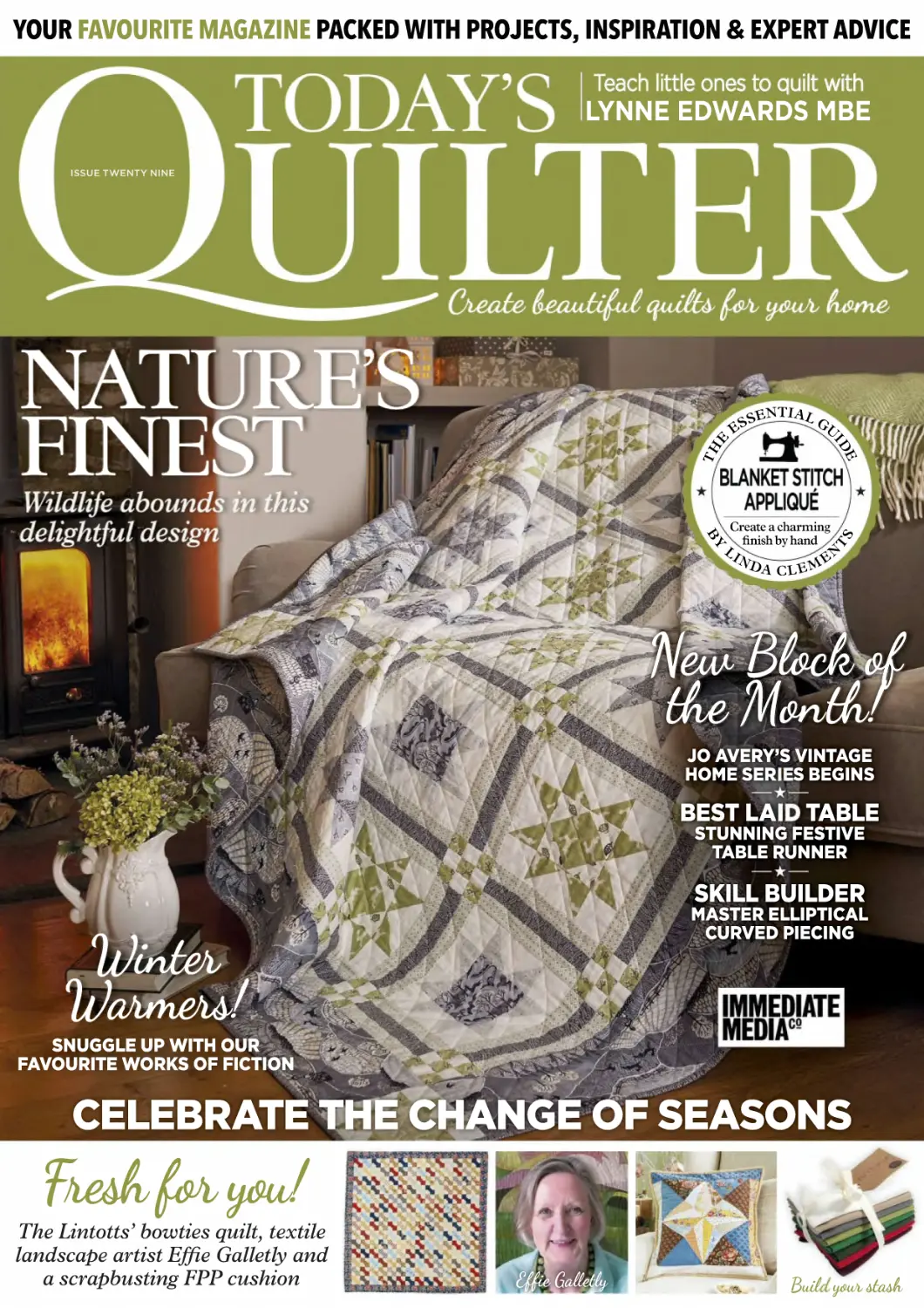


Tags: magazine magazine today's quilter
Year: 2017


Text
                    YOUR FAVOURITE MAGAZINE PACKED WITH PROJECTS, INSPIRATION & EXPERT ADVICE
Teach little ones to quilt with

LYNNE EDWARDS MBE
ISSUE TWENTY NINE

LI

ND

A CL E M

S

BY

Create a charming
finish by hand

T

TH

E

T
SEN I A L G
U
ES
E
ID

NATURE’S
FINEST

EN

1HZ %ORFN RI
ëH 0RQë
JO AVERY’S VINTAGE
HOME SER S BEGINS

BEST LA

TABLE

STUNNING FESTIVE
TABLE RUNNER

SKILL BUILDER

MASTER ELLIPTICAL
CURVED PIECING

:LQWHU
:DUPHUV

SNUGGLE UP WITH OUR
FAVOURITE WORKS OF FICTION

CELEBRATE THE CHANGE OF SEASONS

)éHVKIè\RX
The Lintotts’ bowties quilt, textile
landscape artist Effie Galletly and
a scrapbusting FPP cushion

(IàH*DçHWO\

%XLO \RXU VWDVK

with the

Memory Craft 6700P

METICULOUSLY BUILT AND
VIGOROUS BY NATURE, A TRUE
DESCENDANT OF ITS LEGENDARY ANCESTORS
This all metal flatbed machine is playful, powerful, spacious,
streamlined and steadfast, even at high speeds of up to 1200SPM.
Supplied with a professional grade high performance foot and easy change straight
stitch needleplate. The MC6700P has many user friendly features, with beautiful
9mm wide decorative stitches to impress even the most demanding stitchers!

The world’s leading sewing machine manufacturer

Meet the team
Commissioning Editor Jenny Fox-Proverbs
Art Editor Robin Coomber
Deputy Editor Fiona Smith
Features Editor Jane Rae
Technical Editor Laura Pritchard
Digital Editor Zoe Williams
Technical Consultant Linda Clements
Group Senior Editor Julie Taylor

Contributors
Lynne Edwards MBE • Jo Avery • Lynne Goldsworthy
• Anne Williams • Alison Glass • Jessica Bobrowski • Pam &
Nicky Lintott • Kerry Green • Nicola Dodd • Tina Prior
• Katriel Costello • Annelise Brant • Louise Stevens
Photography Immediate Media Photo Studio
unless otherwise stated.

Write to us
Today’s Quilter, Immediate Media, Tower House,
Fairfax Street, Bristol, BS1 3BN
or email: todaysquilter@immediate.co.uk

ADVERTISING

Call: 0117 300 8206
Senior Advertising Manager Penny Stokes
Client Partnership Manager Beckie Pring
Senior Sales Executive Tiffany Jackson

MARKETING AND CIRCULATION
Newstrade Marketing Manager Janine Smith
Export Marketing Manager Rebecca Richer
Direct Marketing Executive Lily Nguyen

PRODUCTION

Production Coordinator Lizzie Ayre
Production Manager Rose Griffiths/Louisa Molter
Production Director Sarah Powell

WELCOME!
I’m so glad you’ve joined us for this exciting issue of Today’s Quilter where we
begin a new Block of the Month with Jo Avery. Jo took inspiration from her
favourite homewares to create The Vintage Home series. As with so many
things in life, it begins with a pot of tea (Earl Grey for me, please!). I’ve
always been mesmerised by the fluid lines and textures in Effie Galletly’s
landscape masterpieces, so it’s a pleasure to feature Effie’s work this month.
I challenge you not to find inspiration after reading Anne Williams’ feature!
If you fancy a book at bedtime but don’t want to put away your quilting, check
out Jane Rae’s picks of her favourite fabric-related fiction. Meanwhile on the
TV, Sewing Quarter not only has a special 20% discount just for you (see
page 52) but they will also have kits to accompany projects in this issue by
Alison Glass, Lynne Goldsworthy and the fabric from Sally Ablett’s design
(oh – did I not mention Sally’s exclusive project as part of our sumptuous
free supplement with The Quilters’ Guild?).
This really is a spectacular issue – happy quilting!

LICENSING

Director of International Licensing & Syndication Tim Hudson

PUBLISHING

Publisher (Sewing Portfolio) Liz Taylor
liz.taylor@immediate.co.uk
Chief Executive Officer Tom Bureau
Managing Director, Bristol Andy Marshall
Printed and bound by William Gibbons
Distributed in the UK by Frontline

BUYING
Paul Torre • Karen Flannigan • Corinne Mellerup

SUBSCRIPTIONS

Jenny Fox-Proverbs Commissioning Editor

PS We love to hear from you - keep in touch online, by email or by post.
Todaysquilter

Call 03330 162 154† or subscribe online at
buysubscriptions.com

Todaysquilter

Todaysquilter

Todaysquilter

www.todaysquilter.com

†Calls from landlines will cost up to 9p per minute. Call charges from mobile phones will cost between
3p and 55p per minute but are included in free call packages.

In this issue we’re delighted to feature…
Immediate Media Company Bristol Limited (company number
05715415) is registered in England and Wales. The registered
office of Immediate Media Company Bristol Limited is at Vineyard
House, 44 Brook Green, London W6 7BT. All information
contained in this magazine is for information only and is, as far as
we are aware, correct at the time of going to press. Immediate
Media Company Bristol Limited cannot accept any responsibility
for errors or inaccuracies in such information. Readers are advised
to contact manufacturers and retailers directly with regard to the
price of products/services referred to in this magazine. If you
submit unsolicited material to us, you automatically grant
Immediate Media Company Bristol Limited a licence to publish
your submission in whole or in part in all editions of the magazine,
including licensed editions worldwide and in any physical or digital
format throughout the world. Any material you submit is sent at
your risk. Although every care is taken, neither Immediate Media
Company Bristol Limited nor its employees agents or
subcontractors shall be liable for loss or damage.
Immediate Media Company Limited is
working to ensure that all of its paper is
sourced from well-managed forests. This
magazine can be recycled, for use in
newspapers and packaging. Please remove any gifts, samples or
wrapping and dispose of it at your local collection point.

Alison Glass

Effie Galletly

Nicola Dodd

QUILTING THE BLUES

MEET THE ARTIST

TRANSFORM THE TABLE

Alison’s colour-saturated
fabrics are always stashworthy, so we asked her to
show us what she can do with
her latest hues (page 36).

You can almost feel the
bracing Scottish air as you
admire Effie’s fabric
landscapes – make the
journey with us on page 70.

Turn to page 55 where
Nicola serves up the perfect
table runner and placemats
to grace your table this
Christmas – enjoy!

36

43

22

Fabric foundation
piecing cushion

Take a walk in the countryside
with Lynne Goldsworthy’s
serene quilt in greens and greys

WORKSHOPS

07 INSPIRED BY… Getting cosy

20 SHOW & TELL
Catch up on news from Today’s
Quilter readers and see their makes

18 DIARY DATES

GREAT READS
49 WINTER WARMERS
A round-up of the best in quilt fiction
70 MEET THE ARTIST
Discover Effie Galletly’s unique and
mesmerising textile landscapes
DON’T MISS AN ISSUE!
Make sure you receive every issue of Today’s Quilter
delivered direct to your home address. Turn to
page 34 for great subscription offers.

Vote for your
favourite designers
and brands in The
British Craft Awards!
Turn to page 54 to
find out more

HAPPENING NOW
13 FRESH PICKS

98 THE SLEEP QUILT
One novelist and a charity’s collaboration

WWW.FACEBOOK.COM/TODAYSQUILTER

4

Master the
art of making
beautiful curves

WWW.TWITTER.COM/TODAYSQUILTER

31 FROM THE DESK OF
LYNNE EDWARDS MBE
Pearls of wisdom for passing on
precious quilty skills to little ones
61 ESSENTIAL GUIDE
This issue, get to grips with the joys
of blanket stitch appliqué with expert
Linda Clements’ help
79 BLOCK OF THE MONTH
It has begun! Jo Avery’s new block
of the month series is here!

WWW.INSTAGRAM.COM/TODAYSQUILTER

BY

55

79

Get festive with our
seasonal table runner

LI

ND

61
A CL E M

S

Enjoy Pam &
Nicky Lintott’s
charming one
block project

T

E
TH

E
ID

75

T
SEN I A L G
S
U
E

EN

Put the kettle on with Jo Avery’s
new block of the month series

13

Exciting
quilt news
and hot new
buys for you

70

Meet quilt artist
Effie Galletly

PROJECTS

PLUS

22 GOING INTO THE WOODS
Show off precious fabrics in this
nature-inspired quilt

03 WELCOME
Jenny chats about what’s in the issue

36 MERIDIAN QUILT
Make Alison Glass’ stunning
design in bright colours
43 WINTER LIGHT CUSHION
A delightful play on a classic block
55 FESTIVE TABLE LINEN
Dress your table in its finest this
Christmas with our pretty linen set
MEASUREMENTS NOTE
Either metric or imperial measurements (sometimes
both) are included in each project, as per the designer’s
preference. Converting measurements could interfere
with cutting accuracy. Follow the same units of
measurement throughout; do not mix metric and
imperial. Read the instructions all the way through
before cutting any fabric. Always make a test block
before embarking on a large project.

75 BEAUTIFUL BOWTIES
Create a simple but charming bowtie
shape from a traditional quilt block

12 YOUR GIFTS
Enjoy your 2-in-1 binding tool* plus
The Quilters’ Guild supplement
34 SUBSCRIPTION OFFERS
Try our free trial of our digital
subscription!
87 TEMPLATES For the projects
94 DIRECTORY
Quilting suppliers at your fingertips
99 NEXT ISSUE
A special preview of issue 30

WWW.PINTEREST.COM/TODAYSQUILTER

WWW.TODAYSQUILTER.COM

*FREE BINDING TOOL GIFT WITH PRINT EDITION ONLY
5

Poorly-lit studios
have met
Brilliant
QuiltMaster
their match.
Lighting System
™

(throat & needle
lighting)

NEW
FEATURE

#18

Meet your
M
y match with the

The new 20" longarm from Handi Quilter featuress pinpoint needle
laser, independently-adjustable handlebars (that convert to
micro-handles), QuiltMaster™ servo-controlled sttitch regulation
and a new frame with two loading options. Read more about these
and 20 other features at HandiQuilter.com/Amara or see your
local, authorized HQ retailer.

HandiQuilter.com/Amara

INSPIRED BY…
Getting cosy

Enjoy the
aesthetic of
winter from the
warmth of your
sewing room

THE DESIGNER

PHOTOGRAPHS: EDYTA SITAR

EDYTA SITAR
Edyta’s newest blue
and white collection,
Blue Sky, is available at
www.sewingquarter.com

Join us at www.todaysquilter.com

Otherwise known by the moniker Laundry Basket Quilts, talented designer Edyta
Sitar has created myriad fabric collections for Moda and Andover Fabrics, and has
countless beautiful pieced and appliquéd patterns under her belt. Celebrated for
mixing batiks with traditional prints into her scrappy yet elegant style, Edyta also
knows how to keep it simple, which is why she’s designed five classic blue and white
themed collections, including the stunning Blue Sky. www.laundrybasketquilts.com

7

I N S P I R E D BY l

get t i n g c osy

PHOTOGRAPHS: CAROLINE ARBER / CICO BOOKS

Cosy up your
home with
the spirit of
Scandinavia

THE BOOK

SCANDI CHRISTMAS

Scandi Christmas by
Christiane Bellstedt
Myers, published by
CICO Books, £12.99.
Photography by
Caroline Arber ©
CICO Books

8

There’s still time to prepare for Christmas, and this book by Christiane Bellstedt
Myers is the perfect go-to for quick projects. It is packed full of the loveliest decorating
and gifting ideas using all manner of crafts, from sewing and baking to papercraft and
more. Natural materials and classic colour palettes combine into homespun designs
inspired by Scandinavian traditions. Our favourites include the Pine Cone characters
made with treasured fabric scraps and a sweet vintage bobbin wreath.

Join us at www.todaysquilter.com

I N S P I R E D BY l

get t i n g c osy

Warm up
inky blues
with shades of
raspberry, plum
and cocoa

PHOTOGRAPHS: AMY BUTLER

TH E FA B R I C

Download the free
pattern for the ‘You
Complete Me’ quilt
(above) at www.
freespiritfabrics.com. To
see more Amy Butler
fabrics go to www.
amybutlerdesign.com

Join us at www.todaysquilter.com

SOUL MATE

In Amy Butler’s own words “Soul Mate is a sweet reflection on love and the perfect
co-creation that happens when synergy and beauty meet.” This cotton poplin
collection’s feature print is of two peacock lovers – a light-hearted representation of
Amy and her husband, David, and is bathed in vibrant shades including her signature
blues. Amy is a dab hand at combining colour and prints and Soul Mate does this
beautifully with its intricate florals and crisp geometrics – a quilter’s dream.

9

I N S P I R E D BY l

get t i n g c osy

Set the table
with special
artisan
ceramics and
linens

THE SHOP

PHOTOGRAPHS: ALSO HOME

ALSO HOME

Create a cosy dining room
with garment washed linens
such as this blush tablecloth,
£59 www.alsohome.com

10

This online store is a delight for the senses. A carefully curated collection of
handcrafted homewares with textures such as washed linen, velvet, wood grain,
glazed ceramics and seagrass, Also Home has everything you need to create a
cosy and richly-layered interior. We love the pared back feel of the artisan
materials in neutral colours, which makes them both timeless and sophisticated,
adding a sense of occasion to the every day. www.alsohome.com

Join us at www.todaysquilter.com

The pond comes alive
in the spring and continues into
summer. The geese and cranes
DUH Á\LQJ RYHUKHDG SUHSDULQJ IRU
a gentle landing on the water.
/LO\ SDGV FDSWXUH WKH VXQ PDNLQJ
for a warm place for frogs to sing
their songs. After a long, cold
winter, it’s our favorite time of
\HDU :LWK UDQJHV RI SXUSOHV DQG
blues, Summer Pond is the perfect
collection to start dreaming of
the summer months. Yardage,
pre-cuts, and patterns will be
DYDLODEOHWKLV-DQXDU\

pattern by Antler Quilt Design
AQD 0101 Skipped Stones Size: 40” x 40”

© 2017 moda fabrics • all rights reserved

Two Gifts

CREATE A FUTURE
HEIRLOOM!
LET US
KNOW!
Drop us a line
– an email,
letter, tweet
or Facebook
post – letting
us know about
your quilting.
Whether it’s
a new project,
treasured
heirloom,
favourite
fabric or
imaginative
mood board,
we’d love
to see what
you’ve been
up to and hear
your stories!

CLICK
HERE FOR
YOUR FREE
SUPPLEMENT!
2-IN-1BINDINGTOOL*
The last thing on the list to finish any quilt is
binding. After all the hard work you’ve put into
the quilt top, you want the binding to be perfect,
and that’s where this handy tool comes in. See
how to use it at www.todaysquilter.com

AFTER THE SUCCESS of The Quilters’ Guild’s first
fabric collection, Elizabeth’s Dowry, we were delighted
to hear earlier this year that they were planning a second
collection. Revealed at The Festival of Quilts, Devon
County lived up to all the excitement it had been
causing. So of course we were thrilled to work with
The Guild again to show you more of this new
adventure. This time, however, we thought we’d delve
a bit deeper, looking behind the scenes at the family
and people who not only inspired the fabric collection,
which was designed by the talented Karen Styles, but
also the team working hard to make The Quilters’
Guild such a wonderful organisation. Besides
preserving history in their fantastic quilt collection,
an important part of The Guild is also education,
sharing their wealth of knowledge and resources with
the quilting world. And if that isn’t something to
celebrate, then I don’t know what is!

*FREE BINDING TOOL GIFT WITH PRINT EDITION ONLY

Beautifully finish your stunning Devon County quilt from The
Quilters’ Guild supplement with our handy binding tool

We’ve also included the 2-in-1 binding tool. You’ll
bind like a pro and create perfectly mitred corners. This
handy tool is easy to use, simply follow the steps below:
Q Attach your binding, leaving 8in tails at each end and a
12½in gap between the ends. Choose the corner slot
matching the width of your binding to mark where to
stop stitching in each corner for perfectly mitred corners.
Q Place the short flat edge under the binding on one side
so it touches the end of the line of stitches (Edge A
aligned with the quilt edge) and mark on the line.
Q Unfold the binding and line up the mark on the tool
with the line. Trim the end of the binding.
Q Rotate the tool so Edge B is aligned with the quilt
edge and mark the other binding tail in the same way.
Unfold the binding and line up the mark line on the
ruler with the drawn line. Trim the end of the binding.
Q Align the two ends right sides together and sew with a
¼in seam.

WRITE TO US Today’s Quilter, Immediate Media, Tower House, Fairfax Street, Bristol, BS1 3BN. EMAIL: todaysquilter@immediate.co.uk

Todaysquilter

12

Todaysquilter

Todaysquilter

Todaysquilter

Join us at www.todaysquilter.com

$çëHODWHVWTXLOWLQJQHZV

FRESH PICKS
The magic word this month is collaboration as we bring you news
of a group quilt, stunning teapots and a challenge with a twist

V I S I T O R S ’ C H O I C E AT
F E S T I V A L O F Q U I LT S

Chinoiserie is inspired by Chinese and Asian
decorative arts

Free to Roam
Every year we wait with baited
breath to see what the Visitors’
Choice of their favourite
quilt will be at the Festival of
Quilts. This year’s winner was
a showstopper and we were
thrilled to find out more from
its maker, Donna Goymer.
“The Quilters’ Guild
challenge theme was ‘Free’ and
this led me to think about the
natural world and protection
of our animals. The inspiration
behind my quilt was to depict
the freedom of our world.
An elephant in its natural
habitat, free from hunters
and poaching, its strength,
beauty and gentleness were
demonstrated in the fabrics I
chose.” Donna used a variety of
techniques including appliqué,
pleating, felting, free-motion
quilting and embroidery. Her
elephant’s magnificent trunk
is constructed from tweed and
batik and she added texture
through felted yarns and fibres.
“This quilt is the first time
I have exhibited anything.
I chose the Festival of Quilts
due to the support, advice and
encouragement from the staff
of The Cosy Cabin in Risby,
and from my sewing friends.
I was bowled over to see my
quilt on display and this alone
was a massive achievement. I’d
recommend it to anyone. To
hear later on that I had won the
Visitors’ Choice award left me
speechless. To win this award
means the world to me.”

Join us at www.todaysquilter.com

NEW FROM MICHAEL MILLER

FABRIC
FIND
A great addition to your stash, the new Chinoiserie collection from Michael Miller Fabrics
includes geometric prints in seven colours. For an elegant to ch, just add the beautiful
border design of exotic birds in floral trees. Fussy cut your fa e feathered friends to make
your quilt blocks really pop. www.michaelmillerfabrics.com

13

FRESH PICKS l

q u i l t i ng n e ws

SHOW-STOPPE RS

READ ALL ABOUT IT

PUSHING BOUNDARIES

Fussy Cutting

It’s always inspiring to see the range of
techniques used by textile artists. This
year’s Signature VIII gallery by zero3 at the
Festival of Quilts showcased the differing
styles in a very harmonious way and, as well
as piecing and quilting, featured surface
design techniques including screen and
photo printing, hand stitch, stencilling,
discharge dye removal and re-dyeing,
exposed seams, wax resist and Shibori.
“Exhibiting groups need to push
boundaries if they are to keep the public
interested in their work. Since our last
exhibition in 2012 our work has evolved

and we have taken in new members enabling
the group to maintain its momentum, while
encouraging each artist to move forward
with their own visual language,” said
member Janet Atherton.
This diverse group of textile artists –
named zero3 because it was formed in 2003
– is very proactive and aims to exhibit every
two years in different parts of the country,
as well as branching out into Europe. In
2018, they’ll be at The Menier Gallery in
London SE1 and you can keep up to date
with their future exhibitions by visiting
www.zero3textileartists.com

Fussy Cutters Club
– A Boot Camp for
Mastering Fabric
Play
Angie Wilson, aka GnomeAngel,
shows us how to cut fabrics
thoughtfully to inject humour,
boldness and style into your
quilts. Try your hand at 14 fun,
unique projects for both beginners
and seasoned quilters. “I delight
in cutting fabrics with intent –
using prints and patterns to inject
humour, boldness and interest in
my work,” said Angie.
£23.99

www.searchpress.com

Audrey Critchley’s Circles in the Air

SWEET MOTIFS

The Fussy Cut
Sampler – 48 Quilt
Blocks from Your
Favourite Fabric

Playtime
Looking for some fussy cutting inspiration? We love these
delightful new fabric ranges from Michael Miller and Riley Blake
– they’d make great quilts for children. www.eqsuk.com

FLIGHT SCHOOL
from Michael Miller.
Just the ticket for
little explorer’s
and adventurer’s
bedrooms.

14

DEAR DIARY
This charming
fabric is from Riley
Blake Design’s
newest designer,
Minki Kim.

TWINKLE FAIRIES
from Michael Miller.
A fairy themed
collection with a
lovely print that
is just perfect for
fussy cutting.

Nichole Ramirez &
Elisabeth Woo
If fussy cutting is your favourite
part of quilting, this book is for
you. Learn to work with a limited
palette or alternatively an eclectic
scrappy one, and discover how
to incorporate improvisational
piecing to fussy cut even the
smallest parts of your fave designs.
Compare their blocks (and their
samplers!) side by side and get
inspired to use the fabrics you love
to create your own sampler blocks.
The possibilities are endless!
£19.99

www.searchpress.com

Join us at www.todaysquilter.com

FRESH PICKS l

q u i l t i ng n e ws

G R E AT G I F T !

id

r
le
ab be
ail em
Av ov
N

m

SOMETHING’S
BREWING
David Birch and the team at The
London Pottery Company have been
hard at work developing their bespoke
range of filter teapots featuring six
beautiful Kaffe Fassett designs. David
is the designer and originator of the
oval filter teapot, and news of this
exciting collaboration hit social media
earlier this year. “It has taken much
longer than we anticipated, and I would
like to take this opportunity to thank
supporters for their interest in the
teapot, and their patience waiting for its
arrival out there in the marketplace,”
said David Birch. We don’t know about
you but this might just be at the top of
our Christmas wish list. The new Kaffe
Fassett Oval Teapot costs £40 plus
p&p. Order from london-pottery.co.uk

The Kaffe
Fassett Oval
Filter Teapot

DO U B LE AC T

Marbled Glass Head Pins
These high quality pins are sharp and strong
and have pretty marbled glass heads. What’s
even more impressive is you can also relax
about using the iron around them as they
won’t melt. Each assortment pack includes
a variety of colours of pins. Each pack
contains 20 pins, size: 0.5x36mm, £7.15.

Create a Pincushion Set
The perfect partner to these pins is the
Create a Pincushion Set from Clover. Make
it using your favourite fabric or with your
own embroidery or patchwork. The holder
is available for £7.10 in ivory or brown and
full instructions and template are supplied.
Clover products are available nationwide
from all good craft, sewing and hobby
shops. For stockist information, contact
Clover mail: clover@stockistenquiries.co.uk

Join us at www.todaysquilter.com

15

FRESH PICKS l

q u i l t i ng n e ws

F AT Q U A R T E R B U N D L E S

Seasonal Stash
It’s not too late to grab a fat
quarter bundle from Sew
Easy to add to your Christmas
quilts and gifts. Go for the
Christmas bundle containing
eight fat quarters in traditional
Christmas colours for £10.70
or this five piece bundle in
assorted red designs, which
makes a handy mixer for
Christmas projects, £15.74.
For stockist information, email
groves@stockistenquiries.co.uk

Individual blocks highlight aspects of Nottinghamshire’s rich history
including a Pilgrim Family (top left), Scrooby Church (home village
of William Brewster) (top right), Newark Castle (centre left), a
Pilgrim Hat stitched by young quilters (centre right) and the mighty
River Trent (below)

C O L L A B O R AT I O N

PILGRIM FATHERS’ QUILT
To celebrate the 400th anniversary of the Mayflower and
the journey of the Pilgrim Fathers to a new life in America,
Radio Nottingham broadcast a series to reclaim the story
as a Nottinghamshire tale. William Brewster, who was an
elder and one of the main leaders, came from the village
of Scrooby in north Nottinghamshire.
Radio Nottingham approached The Quilters’ Guild
to see if Nottinghamshire quilters would like to make
a quilt which would be taken as a gift to the people in
Plymouth, Massachusetts. A small committee was formed
to coordinate the project and local quilt groups were

16

invited to take part. The quilt was planned, the colour
palette chosen and fabrics distributed to quilters. The quilt
took seven months to complete and involved 40 quilters.
It is comprised of 32 blocks depicting Nottinghamshire’s
history spanning 400 years, as far back as when the ancient
tanneries were found in the caves to the development of
the MRI scanner in the 19th century, tracking the winding
River Trent to the famous lions in Market Square.
“Nottinghamshire has a very rich history which we are
proud of and want to share with the world,” said Mike
Bettison, Editor of BBC Radio Nottingham.

Join us at www.todaysquilter.com

FRESH PICKS l

q u i l t i ng n e ws

Q U I LT I N G W I T H A T W I S T !

THE TWIDDLING
& FIDDLING QUILT
CHALLENGE 2018
Grosvenor Shows has announced a fun new
challenge for the forthcoming year, which involves
fabric manipulation. As some of you might
have guessed by the theme, it’s sponsored by
Jennie Rayment, who is an expert twiddler and
fiddler; Jennie’s books are a fantastic resource
and participants can use any fabric manipulation
techniques they wish. Entries must measure no
more than 1m x 1m and must consist of three layers
and 50% or more of the quilt surface should be
constructed from some form of fabric manipulation.
There are some great prizes to be won:
Q 1st prize kindly sponsored by Jennie Rayment:
Win a £50 voucher for Lady Sew & Sew and one
of each of Jennie’s six books.
Q 2nd prize kindly sponsored by Jennie Rayment:
A selection of three of Jennie’s ‘Twiddling &
Fiddling’ books and a DVD.
Q 3rd prize kindly sponsored by Jennie Rayment:
One of Jennie’s ‘Twiddling & Fiddling’ books
and a DVD.
All entries will be displayed
and judged at the National
Quilt Championships
at Sandown Park and
will then go on tour
to the autumn quilt
shows (subject to space
availability). The closing
date for entry forms is
24th March 2018. Visit
www.grosvenorshows.co.uk
for more details or email
grosvenorshows@btconnect.
com

V A R I E G AT E D T H R E A D S

T WO I N ON E !

Selection Box

Snip Snip

It’s often a challenge to choose just
the right coloured thread, especially
when working with printed or woven
fabrics in multi-tonal weaves and prints.
Gütermann creativ offers the perfect
solution with the new variegated thread
pack. This luscious selection in the
colours of autumn and winter includes
seven colour tones: yellow, light brown,
dark brown, red, purple, blue and green
and costs £10.40. Visit www.facebook.com/
Guetermann.creativ.uk; for stockist info
contact Gütermann@stockistenquiries.co.uk

Designed to reduce hand and wrist
fatigue, these Sew Easy Thread Snips are
spring-loaded for a smooth, easy action.
There is also a needle threader neatly
concealed in the end for threading up
both hand and machine needles without
a struggle. And all of this comes with a
handy lanyard to wear around your neck,
so they are always close at hand. Costs
£5.65, for stockist information email
groves@stockistenquiries.co.uk
and log onto YouTube for the Sew Easy
channel and handy tutorials.

Join us at www.todaysquilter.com

17

:KDWWRVæDQGGRQRZ

DIARY DATES

Treat yourself to a wonderful day out at an inspiring quilting or textile
exhibition. See what’s on around the country with our handy listings guide
Q U I LT I N G

Fat Quarter Quilters
and Friends
Patchwork and
Quilting Exhibition
10th-12th November, Scotland

Refreshments, fabric/sales
table, parking and disabled
access.
Murkle Community Hall,
Caithness, Scotland
11:00-15:00
Admission: £3 (refreshments incl.)
Contact: Isobel McBay on
isobelmcbay@btinternet

Autumn Quilt Festival,
Kent
10th-11th November, Kent

Come and see beautiful
display quilts from wellknown quilters and artists,
plus plenty of retail therapy.
Kent Showground, Clive Emson
Exhibition Hall, Detling, Kent
ME14 3JF
10:00-16:30 (16:00 on Saturday)
Admission: £7
www.grosvenorshows.co.uk

Sound Stitchers
and Social Quilters’
Exhibition
11th November, Plymouth

Trade stands and
refreshments. All profits will
go to the Highbury Trust, a
registered charity supporting
those with learning difficulties.
Abbey Hall behind St Andrew’s
Church, Royal Parade, Plymouth,
PL1 2AD
10:00-16:00
Admission: £2

Beckenham Quilters’
Exhibition

11th November, South East
London

Refreshments and traders.
Beckenham Methodist Church,
Bromley Road, Beckenham,
BR3 5JE
10:00-16:00
Admission: £4 including catalogue
(children and students free)
www.beckenhamquilters.co.uk

Saltway Quilters’
Exhibition
11th-12th November,
Worcestershire

An “Exploding Pineapple”
Quilt made by members will

18

be raffled and Christmas
decorations will be sold to
raise funds for Marie Curie.
Ombersley Memorial Hall, Sandys
Road, Ombersley, Worcestershire,
WR9 ODY
10:00-16:00
Admission: £3
saltwayquilters.weebly.com
Contact: Tracey Cummings on
01905 774327 or Shirley Price
on 01905 776786

Cupar Quilters’
Biennial Quilting
Exhibition

18th November, Fife, Scotland
The Old Parish Church Centre,
Short Lane, Cupar, Fife, KY15 5EQ
10:00-15:00
Admission: £3 (children free)
Disabled access, limited parking
Contact: Catherine 01334 655415

Quilts & Crafts

Beckenham Quilters’ Alphabet quilt made for a local school

Celebration of the 5th
anniversary of The Corner
Patch shop. Patchwork &
Quilting expert Chris Franses
will be in attendance over the
weekend. Quilt raffle and
tombola, plus bargains.

artist Kaffe Fassett, this
vibrant exhibition showcases
a wide range of textiles from
a career spanning over 50
years. The gallery will be
transformed with pools of
vibrant colour, providing the
perfect backdrop for Kaffe’s
distinctive knitwear, tapestry,
quilts and more.

18th-19th November, nr Stafford

Holy Trinity Church, Eccleshall, Nr.
Stafford, ST21 6BZ
Until 17:00 Saturday
16:00 Sunday
Admission: £2 (accompanied
children free) Wheelchair access
For more information, contact
Jane at The Corner Patch on
01785 859360 or email jane@
thecornerpatch.co.uk

Mead Quilters’
Exhibition

25th November, Hertfordshire

Homemade cakes, sales
tables, trader, charity raffle.
Memorial Hall, Marford Road,
Wheathampstead, Herts, AL4 8AY
10:00-16:00
Admission: £3 adults (children
free)
Disabled access, free parking
Contact: Stasha Martin on
01727 872747
www.meadquilters.org

TEXTILES

Kaffe Fassett
exhibition at
Mottisfont

Until 14 January 2018, Hampshire

Celebrating the dazzling
work of world-renowned

Mottisfont, near Romsey,
Hampshire, SO51 0LP
11:00-17:00 (closing at 16:00
during winter)
Normal property admission
price only
www.nationaltrust.org.uk/
mottisfont/features/kaffe-fassettexhibition-at-mottisfont

Traces Revealed

Until 28th January 2018, Somerset

An exhibition of artwork in
cloth, tile and clay inspired by
the Abbey, by Alicia Merrett,
Kate Rattray and Hiro
Takahashi
Glastonbury Abbey, The Abbey
Gatehouse, Magdalene Street,
Glastonbury, Somerset, BA6 9EL
Open daily. For hours of opening,
entrance prices, and other details,
visit www.glastonburyabbey.com

Songs for winter

Until 4th March 2018, Edinburgh

Exhibition showing work
by Charlie Poulsen and
Pauline Burbidge, including a
large selection of sculpture,
drawings, sketchbooks,
textiles and quilts.
City Art Centre, Edinburgh,
2 Market St, Edinburgh, EH1 1DE
www.edinburghmuseums.org.uk/
Venues/City-Art-Centre

Creative Textile
Exhibition by Inspire

7th-11th November, Cornwall
Stuart House Trust, Barras Street,
Liskeard, Cornwall, PL14 6AB
10:00-16:00 (Tuesday,
Wednesday & Thursday)
10:00–19:00 (Friday)
10:00-12:00 (Saturday)

Kaffe Fassett lecture:
Colour and Inspiration
23 November, Hampshire

The presentation will
highlight works from his
latest projects.
18:30-19:30
Admission: £12 per person,
booking essential
www.nationaltrust.org.uk/
mottisfont/features/kaffe-fassettexhibition-at-mottisfont

LET US KNOW! Email TodaysQuilter@immediate.co.uk about your
upcoming quilting events. Please give us three months’ notice.
Limited space. We’ll try our best to inlcude as many events as possible

Join us at www.todaysquilter.com

Join in and be part of our community

SHOW & TELL

The only thing better than putting the finishing touches to your latest quilt
is showing it off! So let’s see what you’ve been up to this month…

WRITE TO US
Today’s Quilter,
Immediate Media, Tower
House, Fairfax Street,
Bristol BS1 3BN
EMAIL: todaysquilter@
immediate.co.uk

Night owl
Having recently taken up patchwork
and quilting on my retirement, my son
and daughter-in-law paid the annual
subscription to the magazine as part of
my Christmas present; this pattern was
in the first issue I received (issue 19). My
daughter-in-law loves owls so I had to
make this for her, she loves it!
Liz Walker, via email
You did a great job on the silhouette owls Liz.

Good cause
I had great fun making the Interlocking
Chains Jelly Roll Project from issue
15 of Today’s Quilter, although I chose
very different colours from the reds and
whites of the original quilt. The piecing
was straightforward but as the designers
hinted in the instructions, it was like a

jigsaw to put together correctly. Along
with the cushion in the photo, I am
raffling the quilt with the goal of raising
£1000 for PAPYRUS – Prevention of
Young Suicide.
Clare Boomer, via email
We love the colours you chose Clare!

Quilting SOS
Having fallen in love with
Liberty fabric many years ago
while I was making smocked
dresses, I couldn’t resist the
2017 SOS Liberty challenge.
I chose the yellow pack from
the selection available from

Todaysquilter

20

Memory lane
Alice Caroline. For the quilt, I
used Pam and Nicky Lintott’s
sparkling gemstones pattern,
from issue 24. The quilt is
backed with a pale cream
fleece and machine quilted
diagonally. My grandchildren
love to snuggle under their
fleece backed quilts at bedtime
so I hope the children of
Vilnius, Lithuania will find it
equally cosy.
Alison Sylvester,
Hailsham
Liberty fabrics are one of our
favourites too Alison, so pretty!
Todaysquilter

Lynne Edwards’ article on random blocks (Issue 23) reminded
me of the very first quilt that I made, back in 1997. My then
teenage daughter didn’t want fussy, traditionally constructed
blocks, just simple rectangles and squares. So I decided on
a 3in repeat, and cut various sizes from 3in x 3in, 3in x 6in and
so on. I will be moving soon, so I have been turning out my
stash cupboard and came across the hand drawn designs for
this quilt complete with a
fabric sample key. I have
made many quilts since
then, but look back fondly
on my first attempt.
Liz Docker,
Derbyshire
It’s so great you kept your
notes on that first quilt Liz.

Todaysquilter

Todaysquilter

Join us at www.todaysquilter.com

STAR BLOCKS

GOING INTO
THE WOODS
Take a walk in the countryside
among hares, deers and swallows.
Cool tones of grey with flashes of
green will keep you warm while
snuggling up indoors this winter.
Designed and made by LYNNE GOLDSWORTHY

STAR BLOCKS

GOING INTO
THE WOODS
You will need
Q Fabric A (grey landscape) – 1¼yds
Q Fabric B (grey trees) – 5in x WOF
Q Fabric C (green hares) – ½yd
Q Fabric D (green leaf) – ¼yd
Q Fabric E (light grey wheat) – 15in
x WOF
Q Fabric F (dark grey wheat) – ¾yd
Q Fabric G (green berry) – ¾yd
Q Fabric H (grey berry) – 12in x
WOF
Q Fabric I (green patchwork) – 4in x
WOF
Q Fabric J (green ditzy) – 1¼yds
Q Background Fabric K (antique
white) – 1¾yds
Q Backing fabric – 4½yds
Q Batting – 80in square
Q Binding fabric – ½yd
Q Twenty-five (25) large HST
templates

Cutting out

1

From Fabric A (grey landscape),
cut six (6) 6½in x WOF strips.
Sew those end-to-end and cut into
four (4) 58½in lengths (for borders).

2

From Fabric B (grey trees), cut a
total of nine (9) 4½in squares (for
Star A centres).

3

From Fabric C (green hares),
cut as follows (for Star B):
Q Two (2) 6½in x WOF strips.
Sub-cut those into eight (8)
6½in squares.
Q One (1) 4½in x WOF strip. Subcut into eight (8) 4½in squares.

4

From Fabric D (green leaf ), cut
three (3) 2½in x WOF strips.
Sub-cut those into forty-eight (48)
2½in squares (for Star B and D).

5
B E H I N D T H E Q U I LT

SHORT CUTS
“Although this quilt looks very time-consuming to make, many of the steps
use speed-piecing techniques so that a lot of the work involved is short cut.
The stars and nine-patches could all be made from scraps making this
design a fantastic scrapbuster.” – Lynne Goldsworthy

24

From Fabric E (light grey wheat),
cut two (2) 6½in x WOF strips.
Sub-cut into nine (9) 6½in squares
(for Star A points).

6

From Fabric F (dark grey wheat),
cut as follows:
Q One (1) 2½in x WOF strip. Subcut into sixteen (16) 2½in squares
(for Star C points).
Q Fifteen (15) 1½in x WOF strips
(for sashing).

Join us at www.todaysquilter.com

Q Four (4) small HST templates

Finished size

Q Approx. 70in square

Notes

Q Wash and press all fabrics well
before cutting.
Q Seam allowances are ¼in, unless
otherwise noted.
Q Press after each seam.
Q Press seams as preferred
throughout – open or to one side.
Q WOF = width of fabric – a cut
made from selvedge to selvedge.
Q HST = half square triangle.

Fabrics used

Q Into The Woods and Cream
Spectrum, both by www.
makoweruk.com, 0162 850 9640

7

From Fabric G (green berry), cut
as follows:
Q One (1) 6½in x WOF strip. Subcut into four (4) 6½in squares (for
Star D).
Q One (1) 5½in x WOF strip. Subcut into four (4) 5½in and four (4)
4½in squares (for Stars D and E).
Q Eight (8) 1½in x WOF strips (for
cornerstone nine-patches).

8

From Fabric H (grey berry), cut
as follows (for Star C):
Q One (1) 6½in x WOF strip. Subcut into four (4) 6½in squares.
Q One (1) 4½in x WOF strip. Subcut into four (4) 4½in squares.

9
10

From Fabric I (green patchwork),
cut four (4) 3½in squares (Star E).

From Fabric J (green ditzy),
cut thirty (30) 1½in x WOF
strips (for sashing).

11

From Background Fabric K
(antique white), cut as follows:
Q Five (5) 6½in x WOF strips. Subcut into twenty-five (25) 6½in
squares, four (4) 5½in squares and
sixteen (16) 2in squares.
Q Seven (7) 2½in x WOF strips.
Sub-cut into one-hundred (100)
2½in squares.
Q Seven (7) 1½in x WOF strips.

Join us at www.todaysquilter.com

12
13

Cut the backing fabric into two
equal lengths (grey landscape).

Cut the binding fabric (dark
grey wheat) into seven (7)
2½in x WOF strips.

Making the HSTs

14

To make the star points, pair
together the following:
Q Nine (9) Fabric E (light grey
wheat) 6½in squares and nine (9)
Background K 6½in squares.
Q Eight (8) Fabric C (green hares)
6½in squares and eight (8)
Background K 6½in squares.
Q Four (4) Fabric H (grey berry)
6½in squares and four (4)
Background K 6½in squares.
Q Four (4) Fabric G (green berry)
6½in squares and four (4)
Background K 6½in squares.
Q Four (4) Fabric G (green berry)
5½in squares and four (4)
Background K 5½in squares.

15

Use large HST templates for
the 6½in squares and small
HST templates for 5½in squares.

16

To piece the templates, place a
print square and a Background
K square right sides together. Place
the fabrics against the back of the
template, holding up to the light to
make sure the whole of the template
is covered and with the spectrum
fabric next to the back of the
template. Pin in place.

17
18

Shorten your stitch to 1.5, and
sew along the blue lines.

Rotary cut along the red lines,
cutting the template into eight
(8) triangles. Use a rotating cutting
mat for quicker results. Scissor or
rotary cut along the green lines.

19

Press each HST open. You do
this before removing the papers
because it keeps the HST seam nice
and straight. Note: do not use steam
for this step as it can cause the ink to
bleed into the fabric.

20

Remove papers from the back
by folding along the sewn line,
then tearing away to yield eight

25

P R OJ E C T l

go ing int o th e wood s

HST units per template. The large
HSTs will measure 2½in square at
this stage and 2in square once pieced
into the quilt top. The small HSTs
will measure 2in square, then 1½in
square once pieced into the quilt top.

Fig 1

Fig 2

Fig 3

Fig 4

Fig 5

Fig 6

Making the economy
squares

21

To make the economy squares,
pair together the following:
Q Eight (8) sets of one (1) Fabric C
(green hares) 4½in square and
four (4) Fabric D (green leaf )
2½in squares.
Q Four (4) sets of one (1) Fabric H
(grey berry) 4½in square and four
(4) Fabric F (dark grey wheat)
2½in squares.
Q Four (4) sets of one (1) Fabric G
(green berry) 4½in square and
four (4) Fabric D (green leaf ) 2½in
squares.

Q C Stars – four (4) sets of one (1)
Fabric H/F (grey berry/dark grey
wheat) economy square, eight (8)
Fabric H (grey berry) 2½in HSTs
and four (4) Background K 2½in
squares.
Q D Stars – four (4) sets of one (1)
Fabric G/D (green berry/green
leaf ) economy square, eight (8)

Fabric G (green berry) 2½in HSTs
and four (4) Background K 2½in
squares.
Q E Stars – four (4) sets of one (1)
Fabric I (green patchwork) 3½in
square, eight (8) Fabric G (green
berry) 2in HSTs and four (4)
Background K 2in squares.

22

Add four (4) 2½in corner
square triangle (CSTs) to
each of the 4½in squares as set out in
steps 23 to 24 below.

23

Draw a line on the back of
each of the 2½in squares.
Align two of these squares right sides
together with two opposite corners
of the 4½in square. Sew along the
drawn lines (Fig 1).

24

Trim away excess fabric
beyond the ¼in seam
allowance line for each CST (Fig 2).
Press each of those CSTs over
(Fig 3). Repeat on the remaining
two corners (Figs 4-6).

Assembling the star
blocks

25

To make the star blocks, pair
together the following:
Q A Stars – nine (9) sets of one (1)
Fabric B (grey trees) 4½in square,
eight (8) Fabric E (light grey
wheat) 2½in HSTs and four (4)
Background K 2½in squares.
Q B Stars – eight (8) sets of one (1)
Fabric C/D (green hares/green
leaf ) economy square, eight (8)
Fabric C (green hares) 2½in HSTs
and four (4) Background K 2½in
squares.
26

Join us at www.todaysquilter.com

P R OJ E C T l

Fig 7

go ing int o th e wood s

Fig 8
Star A

Star B

Star C

Star D

Star E

26

To make each block, sew four
(4) sets of two (2) HST units
into pairs and sew Background K
squares to each end of two of those
pairs (Fig 7 and Fig 8).

Make 8

Make 9

Make 4

Make 4

Make 4

Fig 9

27

Next, carefully sew two of the
pairs to each side of the centre
square and the longer strips to the
top and bottom.

28

You will now have nine (9)
Star As, eight (8) Star Bs, four
(4) Star Cs, four (4) Star Ds and four
(4) Star Es (Fig 9).

Make 3
Fig 10

Making the nine-patch
cornerstones and
sashing strips

29

Sew together strip sets as
follows:
Q Three (3) sets of two (2) Fabric G
(green berry) 1½in x WOF strips
and one (1) Background K 1½in
x WOF strip (Fig 10).
Q Two (2) sets of one (1) Fabric G
(green berry) 1½in x WOF strip
and two (2) Background K 1½in
x WOF strips (Fig 11).
Q Fifteen (15) sets of two (2) Fabric
J (green ditzy) 1½in x WOF strips
and one (1) Fabric F (dark grey
wheat) 1½in x WOF strip (Fig 12).

30

Press seams towards the
darker fabrics. Cut the green/
cream strips into 1½in lengths, you
will need seventy-two (72) with green
on the outside and thirty-six (36)
with green in the middle. Stitch two
outer pieces to each side of an inner
piece to complete a cornerstone.
Make thirty-six (36) in total.

Join us at www.todaysquilter.com

Make 2
Fig 11

Make 15
Fig 12

Make
36

Fig 13

Make 60

31

Cut the green/dark grey strips
into 8½in lengths. You will
now have thirty-six (36) nine-patch
cornerstones and sixty (60) sashing
strips (Fig 13).

Assembling the quilt top

32

Referring to Fig 14, sew the
star blocks, nine-patches
and sashing strips into the following
rows. Press all seams towards the
sashing strips.
27

P R OJ E C T l

go ing int o th e wood s

Row 1

Q Rows 1, 3, 5, 7, 9 and 11 – six (6)
nine-patches and five (5) sashing
strips.
Q Rows 2 and 10 – two (2) A blocks,
two (2) B blocks, one (1) C block
and six (6) sashing strips.
Q Rows 4 and 8 – two (2) A blocks,
two (2) B blocks, one (1) D block
and six (6) sashing strips.
Q Row 6 – one (1) A block, two (2)
C blocks, two (2) D blocks and six
(6) sashing strips.

A

B

C

B

Row 2

A

Row 3

B

A

D

A

B

Row 4

Row 5

C

D

A

D

C

33

Sew the eleven (11) rows
together. Press the seams in
one direction.

Row 6

Row 7

B

A

D

A

B

34

Sew two border strips to
each side of the quilt top.
Sew a Star E block to each end of
the remaining two border strips,
then sew these pieces to the top and
bottom of the quilt top (Fig 15).

Row 8

Row 9

A

B

C

B

A

Row 10

Row 11

Finishing the quilt

35

Sew the two pieces of backing
fabric together along the long
sides using a ½in seam. Press the
seam open.

Fig 14

36

Make a quilt sandwich basting
together the backing, batting
and quilt top.

37

Quilt as desired then trim
square. We quilted a design
of a diagonal crosshatch of lines
approximately 2in apart using a
cream 40wt Aurifil thread.

38

Sew the seven (7) binding
strips together end to end
to make one long binding strip and
press in half along the length, with
wrong sides together. Bind the quilt,
carefully sewing the binding around
the corners.

Fig 15

28

Join us at www.todaysquilter.com

G ET 20%
OFF! USE
CODE
TQ20

Meet the designer
Lynne Goldsworthy from Lily’s Quilts is a modern British quilter.
She has been sewing since she was a little child and, on a business
trip to America, she fell in love with American quilts and tried her
hand at the craft. Then life and family happened and she didn’t
pick up another one for a few years, until she discovered Flickr,
blogs and online shopping, and immediately ordered some precuts, started her own blog and has never looked back!
www.lilysquilts.blogspot.co.uk

Join us at www.todaysquilter.com

@LilysQuilts

lilysquilts

go ing int o th e wood s

BUY THIS KIT!

See this project demonstrated live on
air on 25 November 2017 & buy the kit*.
Q Live on Freeview 78, 8am-12noon
Q Online at www.sewingquarter.com.
Q You can catch up the show on
www.youtube.com/sewingquarter
20% offer available from 26 November

29

*WHILE STOCKS LAST. FOR FULL T&CS , SEE PAGE 53

P R OJ E C T l

Patchwork & Quilting Shows

Calendar 2018
Presented by Grosvenor Shows
Bringing Quilting to Quilters
Spring Quilt Festival,
Harrogate

Find Us on
Facebook
www.facebook.com/grosvenor

At : Exhibition Hall 2, Great Yorkshire
Showground, Harrogate HG2 8NZ

Ltd.
Spring Quilt Festival,
Edinburgh

23 - 25 February 2018

At : Lowland Hall,
Royal Highland Centre,
Ingliston, Edinburgh EH28 8NB
Open: 10.00am - 4.30pm (4pm Sunday)

Friday, Saturday, Sunday

16 - 18 February 2018

Open: 10.00am - 4.30pm (4pm Sun.)

Friday, Saturday, Sunday

Great Northern Quilt &
Needlecraft Show,
Harrogate

Springfields
Quilt Show, Spalding

At : Exhibition Hall 1, Great Yorkshire
Showground, Harrogate HG2 8NZ
Open: 10.00am - 4.30pm

31 Aug - 2 September 2018
All dates are
subject to change

Friday, Saturday, Sunday

Newark
Quilt Show

1 - 2 June 2018
Friday, Saturday

NEW
SHOW

At : Lady Eastwood Centre,
Newark Showground,
Lincoln Road, Newark NG24 2NY
Open: 10.00am - 4.00pm

At : Springfields Events Centre,
Camel Gate,
Spalding, Lincs PE12 6ET
Open: 10.00am - 4.30pm (4pm Sat.)

Springfields Christmas
Quilt Show, Spalding


NEW
SHOW

19 - 21 January 2018

At : Springfields Events Centre,
Camel Gate,
Spalding, Lincs PE12 6ET
Open: 10.00am - 4.00pm

7 - 8 December 2018

Friday, Saturday, Sunday

Friday, Saturday

Spring Quilt Festival,
Duxford

Quilts UK, Malvern
At : Severn Exhibition Hall and Marquee,
Three Counties Showground,
Malvern, Worcs. WR13 6NW
Open: 10.00am - 5.00pm
(4.30pm Sunday)

At : Conservation Hall,
Imperial War Museum,
Duxford, Cambs. CB22 4QR
Open: 10.00am - 4.30pm (4pm Sun.)

17 - 20 May 2018

2 - 4 March 2018

Thursday, Friday, Saturday, Sunday

Friday, Saturday, Sunday

Autumn Quilt Festival,
Malvern

Autumn Quilt Festival,
Duxford

At : Severn Exhibition Hall,
Three Counties Showground,
Malvern, Worcs. WR13 6NW
Open: 10.00am - 4.30pm (4pm Sunday)

At : Conservation Hall,
Imperial War Museum,
Duxford, Cambs. CB22 4QR
Open: 10.00am - 4.30pm (4pm Sun.)

19 - 21 October 2018

26 - 28 October 2018

Friday, Saturday, Sunday

Friday, Saturday, Sunday

Spring Quilt Festival,
Exeter
At : Westpoint Exhibition Centre,
Exeter EX5 1DJ
Open: 10.00am - 4.30pm
(4pm Sunday)

6 - 8 April 2018
Friday, Saturday, Sunday

National Quilt
Championships,
Sandown

Spring Quilt Festival,
Ardingly

Autumn Quilt Festival,
Kent

At : Sandown Exhibition Centre,
Sandown Park Racecourse,
Esher, Surrey KT10 9AJ
Open: 10.00am - 4.30pm (4pm Sun.)

At : Norfolk Pavilion, South of England
Showground, Ardingly,
West Sussex RH17 6TL
Open: 10.00am - 4.30pm (4pm Sunday)

At : Clive Emson Exhibition Hall,
Kent Showground, Detling,
Maidstone, Kent ME14 3JF
Open: 10.00am - 4.30pm (4pm Sat.)

22 - 24 June 2018

26 - 28 January 2018

9 - 10 November 2018

Friday, Saturday, Sunday

Friday, Saturday, Sunday

Friday, Saturday

Tel: 01406 372600/372601 www.grosvenorshows.co.uk

7HDFKëHFKLOGUHQ

I

always describe myself as
a teacher who quilts, rather
than a quilter who does
some teaching – stand still and
I’ll teach you something… I’m
actually a qualified teacher
from way back and have my
certificates to prove it. Trained
for primary school teaching,
I discovered a passion for fashion
and making clothes at college and managed to hook
some textile work into the curriculum. It was the 60s, a
more flexible time, we did loads of group work and daylong projects that embraced every aspect of education,
involving words, numbers and general creativity. Ah,
what a free-thinking, potential hippy I was!
It was then that I started introducing textile
projects into everyday activities, and even basic
dressmaking in after-school clubs once a week, as the
girls were London sophisticates and all wanted to dress
like Twiggy. The school coughed up for a couple of
sewing machines and a noble mother who was a trained
dressmaker offered to come in and help during the
after-school sessions, and we were up and running. I
learnt so much from that quiet and unassuming mother
about using machines and interpreting patterns, as I
was entirely self-taught and she knew the skills and put
me right on so many occasions in the nicest of ways.

The boys would vie with
each other to use the
sewing machines in their
timetabled chaotic creative
activity sessions (how
blokes love machinery…)
and very soon collage and
appliquéd and embellished wall
hangings were being produced,
which adorned the school corridors for
years afterwards. I also ran patchwork clubs in Middle
School and we entered the National Patchwork
Championships and all spent the day there.

“The boys would vie with
each other to use the sewing
machines in their chaotic
creative activity sessions.”
I have an honorary granddaughter, Holly, and for
years she would stay with me and we would sew. This
summer, I did the same with her two children when
they stayed, and also did a pop-up sewing class with
three of my regular students, Linda Riceman and her
daughters Kirsty and Corinne plus thirteen-year-old
Phoenix, Corinne’s daughter. Three generations, all
spending a day together sewing – how good is that?

31

F R O M T H E D E S K O F LY N N E E DWA R D S l

t e a c h th e ch il dr e n

Sewing school

T

elling you this is not just
me waxing nostalgic, but
to offer a few thoughts
on sewing with children. The
Quilters’ Guild does great work
in setting up activity sessions with
the Young Quilters groups. If you
are culling your piles of fabric or
equipment at any time, do contact
the local Guild representatives
and pass your stash onto them.
But please remember, we want to
set the next generation alight with
enthusiasm for this marvellous
craft, and only by offering them
the tastiest fabric and the best tools
can we expect to do this. A team of
tireless volunteers of mums, grans
and teachers sets up these days and
the results are always stunning. If
you have been thinking that you
would like to share your skills with
a young person, here are a few
thoughts on how to go about this.
If you can, try to have just one
child with you so that you can
give them all your attention and
be ready with the next step the
moment they reach it. For the very
young, keep it simple. Perhaps a
circle or a square on fabric stuck
onto a larger piece and then a
few running stitches around it.
Be prepared to ease the process

H TXLOW
ë
G
Q
D
V
LO
S
X
/\QQH SHUHGLQWRë HVKRZ
ë H\H Q W

along by doing the
tricky bits yourself,
working as part of
the child’s team.
Have some sewing
of your own to do
alongside them –
handwork is best,
as you can drop it
instantly whenever
they need you.
Of course,
part of the lure is
that shiny sewing
machine, and that’s
what they’ll want to
be using as soon as
you allow it. Holly started to use
my machine when she was about
nine, but as always, it’s when you
feel the individual is ready. Don’t
think your machine is too good
for them or too complicated: the
better the machine, the nicer it is
to use and the better it behaves,
whoever is using it. Set up absolute
rules, and stress that if they don’t
adhere exactly to those, then they
must wait until they are older and
are ready to treat the machine
with respect. Find some nice firm
fabric, preferably in a good colour
but not over-patterned, so they
can see the stitches happening.
Cut a piece about 10in square and

+R ç\ZLëKHUàUVWHYHU
SDWFKZ èNDQGDSSOLTX©

+R ç \KDYLQJI
X

draw a simple grid, similar to
a noughts and crosses game,
that they can stitch along
to get their eye in. Cut
and draw up a second
square of fabric for you
to use to show exactly
what the process will be.
Choose a foot for the machine like
an appliqué foot with an open front
so it’s easy to see the drawn line
to stitch on and let them choose a
contrast colour thread so they get
used to participating and making
their own decisions. Make the
speed as low as it can go and set
up another stool or chair alongside
the machine so you both can sit
comfortably while it’s all going on.
Start with a demonstration:
stitch one drawn line on your
fabric square, going
very slowly and
talking through each
step in the process so
they can see exactly
what they will be
doing as a repeat of
your action. I had a
safety procedure with
Holly which I found
essential: she had to
hold a stitch ripper in
her right hand, which
she used to guide the
fabric through the
machine as she stitched,

QDWDVKRZ
Join us at www.todaysquilter.com

F R O M T H E D E S K O F LY N N E E DWA R D S l

G
3KRHQL[KDU

DWZ è N

and her left hand was not allowed
to be any nearer to the machine
foot than a hand’s width. This
way her hands were never close
to the needle. If you do the same
thing when demonstrating, it
reinforces the habit both for you
and the child. You can never be
too careful – don’t take your eyes
off what they are doing when
they are at the machine. Low-key
diligence is the name of the game;
appear casual and relaxed, but
actually always on guard.
Once you have stitched the
first line on your sample, see if
they would like to do the second
line on your practice piece. If
they hesitate, breeze on and do
the second line in the same slow
and patient way with the same
running commentary. Once they
are ready, they can take that same
piece of fabric and stitch the next

3KRHQL[ÐV Z è
N
marked line, and then the last line
of the design. The new marked
square of fabric will be for them
to do all four lines on, and then
stop while you’re doing well and
they are not either over-confident
or over-tired. Quit while you’re
ahead, as they say. Together,
you could then add some stuckon appliqué in another session
in the empty areas or a few
hand-stitches and then you can
transform it in their absence into
a little cushion to mark their first
foray into textiles. They don’t
have to do everything themselves
at this stage – you make it perfect
for them when they’re not there,
with their agreement, of course.
One last thought. Never
underestimate the ability of a
child who is hooked on this stuff.
The speed, the diligence
and the accuracy can be

Send us your questions for Lynne on
social media or pop them in an email.
Alternatively, put pen to paper and write to:
The Desk of Lynne Edwards MBE
c/o Today’s Quilter
Immediate Media, Tower House,
Fairfax Street, Bristol, BS1 3BN

Join us at www.todaysquilter.com

t e a c h th e ch il dr e n

 FORVH XS
amazing. The wondrous Phoenix
(mentioned earlier – keep up)
traced, cut and stuck down an
appliqué design, following my
instructions scrupulously, and
then went on to blanket stitch
by machine around every piece
just as well as I could have done.
The stitch ripper had to be set
aside because she needed both
her hands to lift the pressure foot
every few stitches to get the angle
of the blanket-stitch perfect. It
was soon evident on a practice
piece that she was very capable,
so we set the speed at its slowest
and off she went. She’d only used
the machine a few times before –
when she made a patchwork block
– so much of this was new to her.
We were all bowled over, and she
didn’t stop smiling for hours.

Todaysquilter
Todaysquilter
Todaysquilter

Ly n n e
E dwa r d s
M BE

TodaysQuilter@
immediate.co.uk

33

SUBSCRIBE

Save time and hassle
with an annual
Free
subscription!
trial
Start your

today!

GREAT REASONS TO
SUBSCRIBE DIGITALLY!
1 The latest issue is
available instantly
2 Receive a further 13
issues in your first year
3 All issues download
automatically
4 Download it once…
read it offline forever

iPad is a trademark of Apple Inc., registered in the U.S. and other countries.
App Store is a service mark of Apple Inc.

your
Perfect for
one !
h
P
i
r
o
d
a
P
i

START YOUR
FREE TRIAL TODAY!
The digital version of the magazine does not always include the cover gift that you would find on print newsstand copies.

CURVED PIECING

MERIDIAN
QUILT
Master the art of curves in your
quilting to create a stunning design
for any room in your home.
Designed by ALISON GLASS AND
JESSICA BOBROWSKI
Made by KAREN DOREY
Quilted by KARLEE PORTER

36

Join us at www.todaysquilter.com

Join us at www.todaysquilter.com

37

CURVED PIECING

MERIDIAN
QUILT
You will need
Q Twelve (12) blue foreground fabrics
– ¾yd of each OR 8yds in total
Q Accent foreground fabric (pink) – ½yd
Q Background fabrics – 1½yds each of
three (3) cream/white fabrics OR 4yds
of one fabric.
Q Backing fabric – 4¾yds
Q Binding fabric – ¾yd
Q Batting – 66in x 86in approx
Q Templates (see Templates section)

Tip
Q A Bamboo stylus is a really useful tool
for holding the seam allowance near the
presser foot.

Finished size
Q 60in x 80in approx

Notes
Q The pattern makes use of four
different curves to create a multitude

Preparing the templates

1

Print or trace the templates onto
a thicker paper, such as card stock.
Label each template Front and Back
and A, B, C or D.

Cutting out

2

From the background fabrics,
cut forty-eight (48) pieces using
Template A. The Background
Cutting Diagram (Fig 1) shows a
good layout for cutting the largest
pieces. Cut a 10½in x WOF strip
from one of the background fabrics.
Sub-cut 10½in squares from these
strips. Using the Outer Template A,
10½in

10½in

RIPPLES IN BLUE

Meridian was born of Alison and Jessica’s mutual love of the patterns in
nature, like the circular ripple of water and map topography. One of six
in the Alison Glass Skill Builder pattern series, Meridian teaches sewing
curves, both regular and elliptical. Curves are a wonderful addition to
quilting, and they pose an important skill and challenging technique. This
version of Meridian uses the family of blues from Diving Board and Sun
Print 2017 as a watery base for the pops of magenta that show up here and
there. Feeling comfortable with curves will bring a whole new dimension
to your quiltmaking and this quilt allows you to practice accurate template
marking, cutting and sewing. Meridian will give you tons of practice with
both round and elliptical curves in the simplest way possible.

38

A

Fig 1

A

Background cutting diagram

facing Front up, trace your curve
lightly with a fine tipped pencil (or
other marking utensil) and cut along
the line with a sharp pair of scissors.

3

From the foreground fabrics,
follow the same method as above
to cut the foreground pieces and refer

Join us at www.todaysquilter.com

10½in

B E H I N D T H E Q U I LT

of shapes. Two of the curves are
circular, a small and a large. Two
are elliptical, a small and a large.
The curves are labelled A, B, C and
D. An Outer Template (concave)
and corresponding Inner Template
(convex) are included for each curve
(See Templates section). Using the
corresponding Outer and Inner
Templates together will create each
sewn curve.
Q Cutting diagrams are included to
visually show one way of cutting the
fabric efficiently with as little waste
as possible.
Q All seam allowances when sewing
the curves are a scant ¼in, meaning
a tiny bit less than ¼in. This is
to account for pressing the curve.
Assembly of the quilt top uses ¼in
seam allowances.
Q RST = right sides together.
Q WOF = width of fabric.

to the Foreground Cutting Diagrams
(Fig 2 & Fig 3), right. Cut an 8½in
x WOF strip for Inner Templates
A and C, and a 5½in x WOF strip
for Inner Templates B and D. Trace
the curve and cut with scissors. Use
the Layout Diagram on page 41 to
know which templates to use for each
cut. Refer to the quilt images for
guidance on fabric choices.

4

From the binding fabric, cut
eight (8) 2½in x WOF strips.

Sewing circular curves
Each block in this pattern begins
with making a curved block using
Template A. This is a good starting
point because it is the largest and
gentlest curve. If sewing curves is a
new skill for you, feel free to get some
practice in by making a number of
these Template A blocks at the start.

5

Begin by cutting out an Outer
Template A from background
fabric and an Inner Template A
according to the fabric layout you’ve
chosen. Mark the mid-point of each
curve with a marking tool or by
finger pressing a crease, as shown
in Fig 4.

Join us at www.todaysquilter.com

8½in

5½in

7in

7in

5in

Df

Db

B

Fig 2

8½in

Foreground cutting diagram

A

Fig 3

Cb

Cf

A
inner
A
B
outer

B

Fig 4

Fig 5

Fig 6
A

inner
A

B

outer

7

Begin sewing at point A using a
scant ¼in seam allowance. Sew
slowly, getting the feel of the curve,
to the opposite end. Because of the
nature of the curve and the drape of
fabric cut on the bias, the seam will
naturally want to fall towards the
inner (convex) piece. Gently press
seam toward the inner piece (Fig 6).

7in

Foreground cutting diagram

6

Layer the fabrics, RST, matching
up the mid points (Fig 5). Pin at
that point, ¼in from the edge. Bend
the fabrics along the curve, matching
up the corners at points labelled A
and B. Pin at both points. The edges
of both curves should be aligned
at this point. Pin at a couple more
places along the curve to keep the
curves aligned, if desired.

7in

Fig 7

B

Fig 8

page 41 cut an outer and inner fabric
piece according to the fabric layout
you’ve chosen.

9

Mark the mid-point of each curve
with a marking tool or by finger
pressing (Fig 7).

Sewing elliptical curves

8

Sewing elliptical curves is very
similar to sewing circular curves.
Using whatever elliptical template is
called for in the Layout Diagram on

10

Layer the fabrics, RST,
matching up the mid points
(Fig 8). Pin at that point, ¼in from
the edge. Bend the fabrics along the
39

P R OJ E C T l

m e r i d i a n q u ilt

ALISON’S TOP TIPS
Fig 9

Fig 10

curve, matching up the corners at
points A and B. Pin at both points.

11

The edges of both curves
should be aligned at this point.
Pin at a few more places along the
curve to keep the edges aligned
(Fig 9). It is necessary to pin at closer
intervals when sewing an elliptical
curve than for a circular curve.

12

Begin sewing at point A using
a scant ¼in seam allowance
with the inner (convex) piece on top.
Sew slowly, getting the feel of the
curve, to the opposite end. Because
of the nature of the curve and the
drape of fabric cut on the bias, the
seam will want to fall towards the
inner piece. Press seam toward the
inner (convex) piece (Fig 10).

Adding multiple curves
to a block
Additional curves are added to each
block by using the Outer Templates

Q Both of the edges of the fabric
are cut on the bias so handle the
stretchiness with care, but know
that it is this property that makes
it possible for you to sew an outer
edge to an inner edge.
Q Practice the gentlest curves (A,
then C) first so that you learn to
trust that the seams will match
up for the tighter curves.
Q Sew slowly. Sewing a curve is
more a comfortable walk rather
than the sprint used to chainpiece four patches.
Q Use a bamboo stylus as an
extension of your finger to hold
the fabric up close to the needle
while sewing so that you can keep
an accurate seam allowance.

to cut away part of the existing fabric
along with the corresponding Inner
Template to replace it.

13

Refer to the Layout Diagram
to know which curves to cut
and assemble for each block. With
the exception of the first main

Q Sewing curves means there will
be some waste. Depending on
the size of the piece left over,
you may be able to use it when
cutting out smaller pieces.
Q If you are using solid fabrics the
orientation of the edges of the
curves you need to sew together
can get confusing. There is an
easy way to know if you are
sewing the inner piece to the
outer piece correctly. Measure
the four short edges of the two
pieces you’ll combine. Once sewn
together the two new, longer sides
of the square should be equal in
length: approx 10in plus seam
allowance for each. Orient the
pieces for this outcome.

block, cutting and piecing one block
at a time will reduce confusion.
Remember, the elliptical templates
are used in two ways: front up
and back up. You will know which
elliptical template + orientation to
use by following the annotations on
the diagram. Each elliptical curve is
labelled on the Layout Diagram (see
right) as follows:
Q Large Ellipse (C) front: Cf
Q Large Ellipse (C) back: Cb
Q Small Ellipse (D) front: Df
Q Small Ellipse (D) back: Db
Front and back describes if you will
trace and cut the pieces with the
templates front up or the back up.
The circular curves A and B are not
labelled on the Layout Diagram, as
they are very straightforward. Any
large circular curve (outermost) is
made with template A, and small
circular curve (innermost) with
template B. Add more curves to a
block using the following steps.

14

Referring to the Layout
Diagram to know which
templates to use next, line up
the Outer Template with the
corresponding corner of an existing
block made using Template A. Use a
pencil to draw the curve and a pair
of scissors to cut the inner part of

40

Join us at www.todaysquilter.com

CUT

the new curve away. Cut a new piece
of fabric with the corresponding
Inner Template to sew into the empty
space. Refer to the Sewing Curves
directions previously.

SEW

CUT

SEW

CUT
B outer

Df outer

A outer
A
inner

Df
inner

SEW

B
inner

Fig 11

15

Fig 11 visually walks through
these steps for the block shown
in the top left corner of the Layout
Diagram. Repeat the steps of cutting
and sewing all of the curves in the
block. Follow these steps to finish
the remaining blocks, which contain
multiple curves.

Db

Df

Df
Cb
Cf

Df

Cf

Df

Cf

Assembling the quilt top

16

Arrange the forty-eight (48)
finished blocks in eight (8)
rows of six (6) according to the
Layout Diagram or in the way that
you have chosen.

Cf
Db

Db

Df

Df
Cf

Cf

17

18

Db

Cf

Db

Sew the blocks together to
form rows first, press all seams
in the same direction, alternating
the pressing direction for each row.
For example, for the first row press
all seams to the right. Then, press
the second row seams to the left
and so on. Doing this will create a
small ridge that will lock the seams
together when the rows are joined,
helping the seams from row to row
to line up more easily.
Sew the rows together. Pin at
places where the seams meet to
make your points align when sewn,
press seams to one side.

Df

Df

Cb
Df

Cf
Df

Cf

Df

Cf
Db

Db

Db

Df
Cf

Db

Cf
Df

Cb

Cb

Df

Cf
Db
Cf

Df
Cb

19

Layer quilt top with batting
and backing of choice, baste,
and quilt as desired. Bind with your
choice of fabric.

Df
Df

Cb

Df
Df

Cf
Df

Layout diagram

Join us at www.todaysquilter.com

41

m e r i d i a n q u ilt

Meet the designers

G ET 20%
OFF! USE
CODE
TQ20

Alison Glass and Jessica Bobrowski met by happy
coincidence in a printmaking workshop in 2011 and
became friends. Since then, Alison has become a known
fabric designer and entrepreneur while Jessica took
her science degree and went back to school for graphic
design and web development. Jessica joined Alison Glass
Design in 2016 as Marketing and Brand Manager.
@alisonglass
@jmb_craftypickle
@craftypickle

42

BUY THIS KIT!

See this project demonstrated live on
air on 23 November 2017 & buy the kit*.
Q Live on Freeview 78, 8am-12noon
Q Online at www.sewingquarter.com.
Q You can catch up the show on
www.youtube.com/sewingquarter
20% offer available from 24 November.

Join us at www.todaysquilter.com

*WHILE STOCKS LAST. FOR T&CS , SEE PAGE 53

P R OJ E C T l

FOUNDATION PAPER PIECING

WINTER
LIGHT
CUSHION
Showcase your favourite fabric
combinations in this stunning play
on the classic Day and Night block.
Designed and made by KERRY GREEN

Join us at www.todaysquilter.com

43

FOUNDATION PAPER PIECING

WINTER LIGHT
CUSHION
You will need:
Q Assorted cream prints – one (1)
fat eighth in total
Q Assorted gold prints – one (1)
fat eighth in total
Q Assorted beige prints – one (1)
fat eighth in total
Q Assorted brown prints – one (1)
fat eighth in total
Q Assorted light blue prints – one (1)
fat eighth in total
Q Assorted dark blue prints – one (1)
fat eighth in total
Q Backing fabric – two (2) 12½in
x 19in rectangles
Q Binding fabric – long ¼yd
Q Vilene fusible fleece H640 or
batting – one (1) 20in square and
two (2) 12½in x 20in rectangles
Q Templates (see Templates section)
Q Foundation paper or lightweight
printing paper
Q A4 card
Q 18in cushion pad
Q Fabric glue stick (water based)

Cutting out

1

Cut out each foundation template
along the outer edge. You will need
eight (8) in total: four (4) of Template
A and four of (4) Template B. The
foundation templates are easier to
work with if each seam line is creased
before sewing. Use a quilt ruler and
Hera marker, or blunt butter knife,
to score each seam line (Fig 2).

2
BEHIND THE CUSHION

TWIST ON A CLASSIC

“This design started with the classic Night and Day quilt block, I played
around with the block lines until it became a little more kaleidoscopic and
star-like. It’s the perfect block to showcase the dark blue/light gold colour
contrast that represents the glimpses of sunlight we experience in winter.
It’s a straightforward design for foundation paper piecing with just two
different templates, plus the seam lines nest together nicely for easier section
joining and neater seam points. As well as the foundation paper templates,
I’ve also used individual card templates so each individual fabric piece can
be pre-cut ready to use. Although this takes longer at the cutting stage, the
sewing process flies by! I’ve also included a blank planner so you can work
out which fabric goes where before you sew.” – Kerry Green

44

Make extra card copies of
Templates A and B. Cut out the
separate sections along the black
seam lines and cut off the outer edge
seam allowance. There will be six (6)
pieces: A1, A2, A3, B1, B2 and B3,
all without seam allowances.

3

Place the WS of the card pieces
onto the WS of the corresponding
fabric (refer to your planner). Draw
around each card piece in pencil
on to the WS of the fabric. Using a
rotary cutter and a quilter’s ruler, cut
out adding ½in seam allowance all
around the outer edge. This method
produces a pre-cut, generously sized
piece of fabric of the correct shape
for each part of the section (Fig 3).
Work systematically, cutting all the
Join us at www.todaysquilter.com

Finished size
Q 18½in square

Notes
Q Seam allowances are ¼in
throughout unless stated
otherwise.
Q Templates include seam allowance,
where necessary.
Q RS = right side.
Q WS = wrong side.
Q RST = right sides together.
Q WST = wrong sides together.
Q WOF = width of fabric.
Q Wash and press all fabrics before
cutting.

Preparing the templates
Q Print four (4) each of templates
A and B on to paper.
Q Print one (1) extra copy each
of templates A and B on to card.
Q Print one (1) planning sheet (see
Technical Tip).

different fabrics for each piece and
hold the fabrics for each part of each
section together with binding clips,
to keep everything organised (Fig 4).

TECHNICAL TIP
Before cutting out, use the
planner to map out your
colours and fabrics. Cut
tiny scraps and stick in
place (Fig 1).

4

For the cushion front border, cut
one (1) 2¾in x 14½in strip from
the gold fabric. Repeat with light blue
fabric. From the dark blue fabric,
cut one (1) 2¾in x 19in strip. Repeat
with cream fabric.

Fig 1

5

From the binding fabric, cut (3)
strips 2½in wide across the WOF.
Sub-cut one (1) strip into two (2)
shorter strips, each measuring 2½in
x 18½in, for binding the cushion
backing pieces.

Piecing the cushion
front

Fig 2

Fig 3

Fig 4

Fig 5

6

Take the pre-cut fabric for pieces
A1, A2 and A3 and Template
A (see Templates Section). On the
WS of Template A swipe the glue
stick on section A1 and place the
corresponding fabric over it, RS
uppermost. The fabric piece
should extend over the seam
lines by ½in (Fig 5).

Join us at www.todaysquilter.com

45

P R OJ E C T l

w i nt e r l ight c u sh i o n

Fig 6

7

With the template side facing up,
fold back template A along the
creased seam line between A1 and
A2. Place a ruler over the excess
fabric and trim it to ¼in; this will
form the seam allowance when
joining A2 to A1 (Fig 6). An
Add-a-Quarter ruler is helpful for
this step.

8

Now take the A2 fabric piece
and place RST with the newly
trimmed edge of the A1 fabric. Hold
the two pieces together and turn over
and pin in place along the A1/A2 seam
line on template A (Fig 7). Open out
the A2 fabric to check it covers A2
on the template with at least ¼in
extended over all the seam lines
(Fig 8), flip the A2 fabric back. Turn
over so the template is uppermost
ready for sewing.

9

Starting just inside the seam
allowance and using a small
stitch (1-1.5mm), sew along the seam
line and just into the seam allowance
at the end (Fig 9). Because the

stitches are small, they do not need
securing at the start or end of the
seam. When sewn, turn the template
over, lightly press the seam, and
open out the A2 fabric to cover
the A2 section on the template
and press.

10

Turn so the template is
uppermost. Fold back the
template along the creased seam
line between A2 and A3. Place a
ruler over the excess fabric and
trim the excess fabric to ¼in; this
will form the seam allowance when
joining piece A3 to A2 (Fig 10).

11

Take the A3 fabric piece, place
RST with the newly trimmed
fabric edge of A2, hold the two pieces
together, turn over and pin along the
seam line (Fig 11). Stitch along the
seam line as before. Turn over; press
the seam and then open out the A3
fabric to cover A3 on the template
and press (Fig 12).

12

Next, trim the excess fabric
around the edges of the
completed section A using the
template as a guide and leaving the
outer edge seam allowance intact
(Figs 13 and 14).

Fig 7

Fig 8

Fig 9

Fig 10

Fig 11

Fig 12

46

Join us at www.todaysquilter.com

P R OJ E C T l

Fig 13

Fig 14

Fig 15

Fig 16

Fig 17

w i nt e r l ight c u sh i o n

13

Repeat steps 6-12 to make four
(4) of section A and four (4)
of section B following your planner
for fabric and colour placement.
Carefully remove the paper from the
trimmed sections A and B.

14

Arrange sections A and B in
four pairs, each forming a
square (Fig 15). Sew each AB pair
RST along the diagonal edges using
a longer stitch (e.g. 2mm), the seams
from each opposing section should
nest together. Press seam open. Trim
“dog ears” at the corners (Fig 16).
Each A/B square should measure
7½in square. Arrange A/B squares
in two rows of two, sew together
pressing the seams open and then join
the rows together. Press the joining
seams open. The cushion front so far
should measure 14½in square; if it
is a little smaller, the border allows
extra to compensate.

15

Take both shorter border strips
(2¾in x 14½in) join these to
the side edges. Refer to your planner
for colour placement. Take both
longer border strips (2¾in x 19in)
and sew to the top and bottom edges
of the cushion front (Fig 17). The
cushion front should now measure
19in square.

Quilting and finishing

16

Fuse the cushion front to the
fusible fleece square then fuse
both cushion back pieces to the
fusible fleece rectangles, or baste to
batting using your preferred method.
Quilt as desired.

17

Trim cushion front to 18½in
square keeping pieced design
centrally placed.

Join us at www.todaysquilter.com

18

Note: A walking foot is helpful
for following steps. Take one
of the shorter binding strips; bring
the two long edges WST and press
along fold. Place the long raw edges
along the RS top horizontal edge of
one of the cushion back pieces and
sew using a ¼in seam (Fig 18). Press
seam, then press binding away from
the seam. Fold binding over the
cushion back edge and either pin/clip
in place, then hand or machine sew
to attach the binding. Repeat on the
other cushion back piece, this time
binding the lower horizontal edge.
Trim the cushion back pieces
to 12½in x 18½in.

Fig 18

19

Place the two cushion backs,
right side up, so that they
overlap by 6in and the bound edges
are towards the centre. Pin the
overlap in place and sew together
using a ⅛in seam allowance. Place
the cushion back and fronts WST,
pin and then sew all around the
cushion edge using a ⅛in seam
allowance. To reduce bulk in the
seam, zigzag all around the edge.
Join the long binding strips together
using a diagonal seam. Fold and press
the binding as before and attach all
around the cushion front edge as with
the cushion back edges, mitring the
corners. Finish the binding by hand
on the reverse.

47

P R OJ E C T l

w i nt e r l ight c u sh i o n

Choose your
favourite fabric
from the front to
use as backing

Meet the designer
Kerry Green has been sewing since she was very young, she enjoys
making small projects like cushions as well as stitching up a wardrobe full
of handmade clothes, but she always returns to quilting and, in particular,
foundation paper piecing and scrappy quilts. Kerry writes about sewing for
a range of publications and websites and is co-author of the quilt block
compendium, 500 Quilt Blocks, with Lynne Goldsworthy.
www.verykerryberry.blogspot.co.uk

48

@verykerryberry

@verykb

Join us at www.todaysquilter.com

L I B R A RY E S S E N T I A L S l

w i nt e r wa r m e rs

WINTER
WARMERS

As the weather cools, the lure of a comfy chair, a cosy quilt and
a new book are hard to resist. Jane Rae picks her favourite works
of fiction, where needle and thread are woven into tales of love,
revenge, passion, survival and triumphs of the human spirit.
Join us at www.todaysquilter.com

49

L I B R A RY E S S E N T I A L S l

w i nt e r wa r m e rs

The Dressmaker
ROSALIE HAM

I

was drawn to the cover of this
book not just by the promise of “an
unforgettable tale of love, hate and
haute couture”, but by the glamorous
shot of Kate Winslet effortlessly
carrying a gleaming case with the
familiar gold lettering “Singer”. In
the story, Tilly Dunnage returns to
her dusty home town of Dungatar; the
ostracised, coutured daughter fresh
from the fashion houses of Paris returns
to the Australian outback to small town
mentalities and unresolved mysteries.
As Tilly attempts to unshackle
herself from a past that haunts her,
she liberates the town folk through her
transformative skills in fashion design.
The women and men of Dungatar have
never looked so good in Balenciaga

copies and satin velour pedal pushers
but the simmering passions and desires
of the town folk start to bubble to the
surface. The story in The Dressmaker
unfolds in chapters that are named as
groups of fabric, almost like discovering
the seamstress’ “stash”. The opening
chapters are matched with gingham “a
durable fabric if treated properly” and
we journey to Shantung as the story
becomes more colourful and complex,
finally culminating in felt and brocade.
The Dressmaker was made into a film
starring Kate Winslet and I enjoyed it
just as much as the book, particularly
seeing Tilly’s opulent creations come
to life on the big screen against the
backdrop of the arid Australian
outback. Truly a tale of transformation.

How to Make an American Quilt

The Invention of Wings

T

T

WHITNEY OTTO

his is a work of fiction but the observations on
choice of materials, design, construction, quilting
for companionship and for solace, were beacons in my
journey into quilting. Escaping to the town of Grasse
outside Bakersfield in California to the intimate world of
a quilt group was a compelling draw for me. The group –
Sophia, Glady Joe, Hy, Constance, Em, Corinna, Anna
and Marianna – have been meeting once a week for 35
years and it’s only after this life-time journey together
that they feel they can embark on making a Crazy Quilt,
“The pattern with the least amount of discipline and the
greatest measure of emotion”. As Whitney Otto guides us
through the process of making a quilt she reveals the lives,
loves, sadnesses, peaks and troughs of relationships and
friendships of the women behind every stitch. Chapter
headings are replaced with “Instructions”, we explore
what it means to quilt and the histories of each member
of the group are revealed. The quilter’s challenges echo
questions about life, “Do not underestimate the importance
of the carefully constructed border”, “follow your parents’
footsteps. This is what quilting is about: something handed
down – skill, the work itself. Hold
it in your hand. Fondle it.”
The book gave me a different
perspective on quilting, “Shake
your head in amazement at the
occasional quilt that boasts
thousands of pieces. Puzzle out
the fact that a woman could hold
all of those pieces together without
misplacing or losing a piece.”
How to Make an American Quilt
was a lure for me into a world
that has become a great source of
pleasure, both at work and play.
Although published in 1991, it’s
a staple in my quilting library.

50

SUE MONK KIDD

he Invention of Wings
is based on the true
story of Sarah Grimké, her
younger sister Angelina
and Hetty Handful
Grimké, who was a slave
in the Grimké household.
Sarah and Angelina were
the first female advocates
of abolition and women’s
rights in the USA. The
story begins in 1803 when
Hetty is presented to Sarah
on her eleventh birthday.
Sarah, whose slogan is
“if you must err do so, on
the side of audacity” is
determined to free Hetty,
and so the story unfolds.
The Invention of Wings
is a story of hope and
quilting is a positive and
powerful theme that is
established very early on in
the novel. Hetty’s mother
Charlotte recounts the
story of “granny-mauma”
from Africa bringing
with her the tradition
of quilting that she has
passed down through the
generations “all her kin
in Africa, the Fon people,
kept their history in a
quilt”. Charlotte is the best
seamstress in Charleston
and she and Hetty quilt

together by candlelight
at night “we had a wooden
patch box for keeping our
scraps, a pouch for our
needle and threads, and
a true brass thimble. This
was the thing mauma and
I loved, our time with the
quilts.” The quilts are
stored on a quilt frame
that hangs above their bed
– watching over them like
a guardian angel. Every
stitch – every hidden charm
that they sew into their
quilts and every pair of
triangles that they appliqué
(wings of freedom) have
meaning. The quilts offer
continuity, protection,
refuge and hope.

Join us at www.todaysquilter.com

L I B R A RY E S S E N T I A L S l

The Lady and the Unicorn

The Last Runaway

Y

T

TRACY CHEVALIER

ou will find it hard to
resist the page turning
lure of each chapter in
this book, written from
the perspective of the key
characters in the making of
The Lady and the Unicorn
Tapestries. It’s fascinating
to learn how a tapestry is
created from the initial
drawings, through to the
creation of an enlarged
cartoon, the preparation of
the loom, followed by the
intimate process of weaving
the design, culminating in
the final reveal.
The Lady and the
Unicorn Tapestries, created
in c1500, represent the five
senses – touch, taste, smell,
hearing and sight, with the
sixth tapestry bearing the
inscription, “To my only
desire”, which suggests
something beyond the
material world – the spirit
world. I love the fact that
each of us will interpret
“To my only desire”
differently, which is part
of the mystery and appeal
of the tapestries.
The first voice we hear
is that of artist Nicolas des
Innocents, the mischievous
Lothario who sketches,

w i nt e r wa r m e rs

TRACY CHEVALIER

seduces and flirts his way
through the novel from
Paris to Brussels, beguiling
all of us with his drawings
and tales of the unicorn.
The tapestries come to life,
as do we, the readers, as the
story awakens our senses
with its rich imagery and
evocative language. I can
still smell the sweet scent
of lily of the valley from
Aliénor’s garden. Georges
de la Chapelle, who runs
the tapestry weaving studio
in Brussels, describes the
moment when he sees the
complete tapestry, “that
moment is like eating
fresh spring radishes after
months of old turnips”.

he Last Runaway is the story
of Honor Bright, a Quaker
from England who emigrates with
her sister Grace to start a new
life in America in 1850. Honor’s
sister Grace is to wed a Quaker
called Adam Cox who has set up
a draper’s shop in a small town
in Ohio. Honor is reeling from
a broken heart and emotionally
and physically unprepared for the life ahead of her
in a strange land where the culture is alien, the humidity
intense and where thousands of slaves are escaping north
following the Underground Railway towards Canada
and freedom. Honor is faced with the difficult choice of
selecting just one quilt to accompany her on the journey
and, in just a few concise paragraphs, the importance of the
quilts in the storyline is firmly established.
On arriving in America, events take a turn for the worse
and Honor finds herself alone and thousands of miles from
home… and so the story begins. Quilts are an integral
part of The Last Runaway, not just for their historical
significance but because the personality of Honor Bright
is not one easily conveyed through dialogue between
characters. Honor is a woman of few words, adhering to the
Quaker belief that to find the inner light you must quieten
the mind. In fact, Honor is so challenged by the events that
unfold around her in her new life that, at one point in the
story, she retreats into a world of silence. It’s a powerful
tool but one that gives the writer something of a challenge
when interaction and conversation are such useful devices
in revealing plot and character. Tracy overcomes this by
giving Honor a voice through her letters home and her
love of quilting. The quilts provide a rich, visual point of
reference and allow us insights into Honor’s personality.
“I wanted the character to do something with her hands
that anchored her in a daily activity,” said Tracy.

The novels of Jennifer Chiaverini
Jennifer Chiaverini is the New
York Times bestselling author
of Mrs. Lincoln’s Dressmaker,
Fates and Traitors, and other
acclaimed works of historical
fiction, as well as the beloved
Elm Creek Quilts series. She lives
with her husband and two sons in
Madison, Wisconsin, USA.

I

n most of the 20 books in
the Elm Creek Series, the
main character is a master
quilter named Sylvia Bergstrom
Compson. She and her young
friend, Sarah McClure, open
a quilter’s retreat at Sylvia’s
family estate, Elm Creek
Manor. Sarah and Sylvia run

Join us at www.todaysquilter.com

the quilt camp with the help of
friends, the Elm Street Quilters.
There’s even an accompanying
project book, Elm Creek Quilts,
full of designs inspired by the
books. Other historical books
feature Sylvia’s ancestors and
residents of Elm Street Valley.
In her latest novel, the
Enchantress of Numbers, Jennifer
explores the fascinating life of
Ada Byron King, Countess of
Lovelace – the romantic poet
Lord Byron’s daughter. Ada
was the world’s first computer
programmer, and a woman
whose exceptional contributions
to science and technology have
been too long unsung.

51

N E W F O R YO U l

se w i n g q u a r t e r t v

TUNE IN!
Watch on Freeview channel 78,
on air every day 8am-12pm,
or via the website
www.sewingquarter.com
Youtube.com/sewingquarter

HEMLINE ROSE GOLD
COLOURED 21CM PREMIUM
DRESSMAKING SHEARS
Scissors are double plated
with a stylish nickel and
chrome finish, coloured a
beautiful rose gold. £16.95

KLASSE RIGHT HANDED
TAILOR’S SHEARS 20CM
From Hemline’s premium Klasse
range, these drop-forged tailor’s
shears are high quality with a
chrome and nickel finish. £21.95

PRICES CORRECT AT TIME OF PRINT

FISKARS DRESSMAKING
SHEARS 25CM
Large in size, these allow for quick
and continuous cutting of fabrics.
Strong enough to cut through
multiple layers of fabric. £22.95

HEMLINE DRESSMAKING
SHEERS OKUT TITANIUM
SCISSORS 23CM
Stylish inlaid soft grip fully
moulded handles, with superior
titanium finishing for long
lasting sharpness. £8.95

52

Join us at www.todaysquilter.com
t

se w i n g q u a r t e r t v

l N E W F O R YO U

CLOVER ROTARY CUTTER
WITH SOFT TOUCH CUSHION
HANDLE: 45MM
Precision cutting and easy-touse, ideal for cutting fabrics
and paper. £14.95

FISKARS-PIVOTING ROTARY
CUTTER: 45MM
Ideal for cutting through multiple
fabric layers. The cutter has a
soft use handle that is perfect for
users of all abilities. £22.95

FISKARS ROTARY CUTTER
FLOWER FASHION DESIGN:
45MM
Cuts through materials including
multiple layers of fabric, paper,
felt and vinyl. For left or right
handed use. £13.95

OLFA ROTARY CUTTER
COMFORT: 45MM
Perfect for all your sewing and
quilting needs. It has a comfort
and ergonomic handle for
all users whether right or left
handed. £24.95

SAVE

TOOLS OF THE TRADE

20%

A CUT ABOVE
We all know how important having the correct cutting
tools can be when creating quilts. Whether you prefer
scissors, a rotary cutter or both, find the one that is perfect
for you, and it will be smooth cutting! Sewing Quarter
has a wonderful range of cutting instruments to choose
from. Visit their website www.sewingquarter.com to see the
collection and purchase one!

Join us at www.todaysquilter.com

Save 20%* on all your purchases
at Sewing Quarter!

OFFER*

To redeem this offer, simply enter code: TQ20

* Minimum spend £10, excluding standard P&P of £2.95. Offer is available
online only and can be redeemed by using voucher code TQ20 at the
checkout on www.sewingquarter.com. Offer expires 30th December 2017.
Voucher code is not redeemable on TV promoted product within the
24hrs it is on air. One use per customer. Excludes electrical items. All offers
subject to product availability. For full terms and conditions, please visit
the Sewing Quarter website.

53

Vote for your favourites
for your chance to WIN!
We’re giving
away a total of
£600 Amazon
vouchers!*

It’s time to show the love and nominate your
favourites in the 2018 British Craft Awards.
Whether it’s a product you couldn’t live
without, a talented designer who inspires
you with amazing projects, a local store
that always goes the extra mile,
a must-read blog or a favourite craft
brand, we want to know who you think
should receive a coveted British Craft
Award for their huge contribution to craft in
the past 12 months.

SIMPLY VISIT
WWW.BRITISHCRAFTAWARDS.COM
to have your say, voting opens on October 23rd!

*T&C’s apply, 1x£100 voucher up for grabs for each craft category,
see www.britishcraftawards.com for full T&Cs and more information.

CHRISTMAS PROJECT

FESTIVE
TABLE LINEN
Dress your table in its finest this
Christmas with our pretty linen set.
Designed and made by NICOLA DODD

Join us at www.todaysquilter.com

55

CHRISTMAS PROJECT

FESTIVE TABLE
RUNNER
You will need
Q Three (3) red prints – one (1) Fat
Eighth of each
Q Three (3) cream prints – one (1) Fat
Eighth of each
Q Green fabric – one (1) Fat Eighth
Q Fussy-cut cream scraps – three (3)
4½in x 8½in
Q Mid-tone background fabric – 1¼yd
Q Cotton batting – 24in x 60in
Q Backing fabric – 1⅜yds
Q Binding fabric – ¼yd

4

From your binding fabric, cut
four (4) 2¼in x WOF strips.

Making the potted
Amaryllis blocks
Before you begin, choose a set of red
and cream prints and a fussy-cut
cream piece for each of the three (3)
blocks. The green print will be the
same in each block.

5

To make the bowl, mark a
diagonal line on the back of two
(2) 2½in background squares (shown
in blue) and pin, right sides together,
to the lower corners of a 4½in x 8½in

BEHIND THE PROJECT

LAY THE TABLE

“A charming floral duo to brighten your Christmas breakfast table, my sample is
made in Petit Maisons de Noel by French General for Moda.” – Nicola Dodd

Cutting out

Q Two (2) 4½in x WOF strips. Subcut into twelve (12) 4½in squares.
From the remainder sub-cut two
(2) 1¾in x 21in pieces.
Q Ten (10) 2½in x WOF strips. Set
three (3) aside for borders, then cut
the remainder as follows:
- Four (4) 2½in x 16½in sashing
pieces.
- Six (6) 2½in x 6½in pieces.
- Twenty-one (21) 2½in x 4½in pieces.
Q Twenty-four (24) 2½in squares.

1

From each of the red and cream
Fat Eighths, cut four (4) 3in
squares and eight (8) 2½in squares
(Fig 1).

2

From the green Fat Eighth, cut
three (3) 1in x 21in and six (6)
2½in x 4½in pieces (Fig 2).

3

From the background fabric, cut
as follows:

2½in

2½in

2½in

2½in 2½in

2½in

2½in

Fig 3

Make 3

fussy-cut cream piece. Stitch on the
line, flip “open” and press, trimming
away the excess back pieces to ¼in
(Fig 3). Repeat to make three (3).
1in x 21in

2½in

1in x 21in
1in x 21in
3in

Fig 1

56

3in

3in

3in

2½in
x 4½in

2½in
x 4½in

2½in
x 4½in

2½in
x 4½in

2½in
x 4½in

2½in
x 4½in

Fig 2

Join us at www.todaysquilter.com

Finished size
Q 20in x 54in

Notes

Q Please read through the pattern
before you begin.
Q Assume a ¼in seam allowance and
a fabric width (WOF) of 42in.
Q I would always recommend making
a test block.

6

To make the green Flying Geese
units, which will be the base of
the petals, mark a diagonal line on
the back of two (2) 2½in background
squares and stitch one to the corner
of a 2½in x 4½in green piece,
pressing and trimming as described
before. Then join the remaining
square to the other side, as shown in
Fig 4A-C. Repeat to make six (6).

7

To make a red petal unit, mark a
diagonal line on the back of a 2½in
red square and stitch to the top right
corner of a 2½in x 4½in background
piece as previously described, taking
care with the placement as shown in
Fig 5. Make one (1) in each print,
three (3) in total.

with the placement as shown in Fig 6.
Make one (1) in each print, three (3)
in total.

8

9

To make a cream petal unit, mark
a diagonal line on the back of
a 2½in cream square and stitch to
the top left corner of a 2½in x 4½in
background piece, again taking care

A

B

To make a double petal unit,
stitch a 2½in red square to the top
left corner, then a 2½in cream square
to the top right corner of a 2½in x
4½in background piece, as previously

C
Make 6

Fig 4

described (Fig 7). Make one (1) in
each set of prints, three (3) in total.

10

Then make a double petal unit
with the colours reversed, as
shown in Fig 8. Make two (2) in each
set of prints, six (6) in total.

11

To make a triple petal unit,
stitch two (2) 2½in red squares
to opposite corners and a 2½in cream
square to a third corner – pressing
and trimming each one in turn – of a
4½in background square, as shown
in Fig 9. Make one (1) in each set of
prints, three (3) in total.

12
Fig 5

Make 3

Fig 6

Make 3

Fig 7

Make 3

Fig 8

Make 6

Then make another triple petal
unit by joining two (2) 2½in
cream squares and one (1) 2½in
red square to the corners of a 4½in
background square (Fig 10). Make
one (1) in each set of prints, three (3)
in total.

13
Fig 9

Make 3

Join us at www.todaysquilter.com

Fig 10

Make 3

To make the stem units, first
make a strip set by alternately
joining the three (3) 1in x 21in green
strips to the two (2) 1¾in x 21in
57

P R OJ E C T l

fe st i ve t a bl e l i n e n

background strips, as shown in Fig 11,
pressing towards the green and taking
care to keep your sets straight. Make
one (1), trim the end, then sub-cut
into three (3) 6½in sections, one for
each block.

Fig 11

Fig 12 Make 3

14

Stitch a 2½in cream square to
the top right-hand corner of the
stem unit, then a 2½in red square to
the top left-hand corner, as previously
described (Fig 12). Make one (1) in
each set of prints, three (3) in total.

15

The flower centres are made
from half-square triangles
(HST) as follows. Mark a diagonal
on the back of a 3in cream square and
pin, right sides together, to a 3in red
square. Sew ¼in away from each side
of the line, then cut along that line
and press both HSTs open towards
the red fabric (Fig 13A). Trim to
2½in square (Fig 13B). Make eight
(8) in each print, twenty-four (24)
in total.

16

Paying close attention to the
colour placement in Fig 14, join
four (4) HSTs together in two rows of
two, to make a pinwheel, pressing the
seams open. This will form the centre
of the large flower. Make one (1) in
each set of prints, three (3) in total.

17

Again, taking care with the
placement, as shown in Fig 15,
join two HSTs together, pressing the
seams open, to form the centre of the
side blooms. Then join a double-petal
unit and a green Flying Geese unit
to each side, as shown, pressing as
directed. Make two (2) in each set
of prints, six (6) in total.

A

B

Fig 13

Fig 15

Fig 14

Make 3

Section A

Section B

Section C

Section D

Section E

Section F

Assembling the table
runner

19

Assemble the runner as shown
in Fig 17, alternating blocks
with 16½in sashing strips and
pressing seams towards the sashing as
you go. Note that the middle block is
rotated 180-degrees. Join background
border strips to make longer lengths
for the top and bottom borders.

20

Cut your backing in half, trim
off the selvedges and join
together using a ½in seam, pressed
open. Trim to 58in long.

21

Sandwich the batting between
the backing and the runner,
baste, then machine or hand quilt.

Fig 16

Section G

22

Join the 2¼in x WOF binding
strips into long piece and
press in half – wrong sides together
– along its length. Trim away excess
batting and background – taking the
opportunity to ensure your corners
are square – and bind the raw edge
using your preferred method.

18

Assemble your Amaryllis
block in sections, as shown
in Fig 16, pressing seams in each
section as directed. Join sections A,
B & C into a row, then join sections
D, E & F. Join the two rows, then
add section G, pressing seams away
from the central row or open if
preferred. Make three (3) blocks.

Fig 17

58

Join us at www.todaysquilter.com

ONE-BLOCK PROJECT

FESTIVE
PLACEMATS
You will need
Q Two (2) red prints – one (1) Fat
Eighth of each
Q Two (2) cream prints – one (1) Fat
Eighth of each
Q Green print – one (1) Fat Eighth
Q Mid-tone background fabric – 1yd
Q Cotton batting – Four (4) 18in x
22in pieces
Q Backing fabric – 1¼yd
Q Binding fabric – ½yd

Finished size
Q 14in x 18in

Cutting out

1

From the red and cream Fat
Eighths, cut four (4) 3in squares
and eight (8) 2½in squares, as shown
in Fig 1 on page 56.
2½in x 4½in

a 2½in cream square and a 2½in
background square. Join to diagonally
opposite corners of a 2½in x 4½in
green piece, as previously described
on page 56. Make four (4) sets of two
(2), eight (8) in total, following colour
position in Fig 19 below.

Fig 20

Fig 18

2
3

From the green fabric, cut eight
(8) 2½in x 4½in pieces (Fig 18).

From the background fabric, cut
as follows:
Q Six (6) 3½in x WOF strips. Subcut into eight (8) 3½in x 18½in
pieces and eight (8) 3½in x 8½in
pieces.
Q Four (4) 2½in x WOF strips.
Sub-cut into thirty-two (32)
2½in x 4½in pieces and eight (8)
2½in squares.

4

From your binding fabric, cut
eight (8) 2¼in x WOF strips.

Making the Amaryllis
block
Choose a set of red and cream prints
for each placemat. The green print
will be the same in each block.

5

To make a leaf unit, mark a
diagonal line on the back of

Join us at www.todaysquilter.com

Fig 19

6

Refer to step 7 of the Table
Runner to make a red petal unit.
Make two (2) in each print, eight (8)
in total.

7

Refer to step 9 of the Table
Runner to make a double petal
unit. Make two (2) in each print,
eight (8) in total.

8

Refer to steps 15 and 16 of the
Table Runner to make the flower
centres. Make one (1) in each print,
four (4) in total.

9

Assemble the centre in rows,
as shown in Fig 20, pressing as
directed so that the seams will nest
nicely when the rows are joined.
Press the rows towards the centre or
open if preferred. The block should
measure 8½in x 12½in. Repeat to
make four (4).

Fig 21

Assembling the
placemats

10

Assemble the placemats as
shown in Fig 21, adding the
8½in borders to the sides and 18½in
borders to the top and bottom. Press
seams towards the borders.

11

Cut your backing into four
(4) 18in x 22in pieces. Then
sandwich the batting between the
backing and the placemat, baste and
machine or hand quilt.

12

Join two (2) 2¼in x WOF
strips to make binding for
each placemat. Press in half wrong
sides together along its length. Make
four (4).

13

Trim away excess batting and
background then bind the raw
edge using your preferred method.
59

P R OJ E C T l

fe st i ve t a bl e l i n e n

Meet the designer
Nicola Dodd has been quilting since 2010 after chancing upon
a quilting website. Having designed all her working life as an
Architect and, latterly, as a Garden Designer the temptation
to start designing quilts was irresistible and she established her
pattern company, CakeStand Quilts, in 2015. She has a blog,
where she enjoys sharing tutorials, and is a regular contributor to
the Moda Bakeshop.
www.cakestandquilts.com
cakestandquilts
@nicolajdodd

60

Create this pretty
set for your
Christmas table
and impress all your
dinner guests this
festive season

Join us at www.todaysquilter.com

ESSENTIAL GUIDE
Blanket Stitch Appliqué

There are various forms of appliqué and one of the most popular and attractive
is that done with fusible web, with the motifs edged with a charming hand blanket
stitch for a rustic, homespun finish.
Edging fusible web appliqué
motifs with hand blanket
stitch is a great way to explore
different thread types

Blanket stitch appliqué creates a charming
IRON DUW ORRN 7KH KDQG WHFKQLTXH LV HDV\ DQG SèWDEOH
VRLW VëH SHUIHFW SURMHFW WR WDNH ZLë \RX ZKHUHYHU
\RXJRIèVRPHUHOD[LQJVHZLQJ
61

ESSENTIAL GUIDE l

bl a nk et st it c h a p pl i qu é

HAND BLANKET STITCH APPLIQUÉ

B

lanket stitch appliqué has
been a favourite technique
with quilters for hundreds of years.
Today, this type of appliqué is even
easier with fusible web and we adore
its attractive folk art look. Blanket
stitch is the traditional stitch used
as it has a horizontal element that
covers the edge of the appliqué and
a vertical element that secures the
motif to the background (see Fig 1).
Fig 1

There are many quilters today
who create beautiful work with
blanket stitch appliqué. For some
great examples, seek out the work
of Lynette Anderson, Jo Colwill,
Lynne Edwards, Rebekah L. Smith
and many others. Lynne Edwards’
lovely book Blanket Stitch Quilts is
a must-have and has 12 gorgeous
projects (both hand and machine
stitched) for you to try.

Blanket stitch
Horizontal element

Vertical
element

Blanket stitch appliqué looks great
with modern fabrics. Here, fruit
motifs are used for a wall hanging.
A dark thread colour has been used
for the blanket stitch, to contrast
and stand out from the design

Threads
Traditionally, black thread was used for blanket stitch
appliqué, but today the sky’s the limit, colour-wise.
At the most basic level you can apply two simple rules
to your initial choice − to blend in or stand out. The
examples in Fig 2 show how using a more visible thread
makes the heart motifs stand out, whereas a thread that
tones with the appliqué gives it a more traditional needleturn look. Needle-turn is a traditional style of appliqué
where the stitches remain invisible.
If you want the stitch to be subtle and blend in with
the appliqué motif, then choose a thread colour that
matches the appliqué fabric and a light weight (a thin

Fig 2

62

thread or single strand). You’ll find that a small stitch
size will also reduce the stitch “footprint”.
If you want the blanket stitch to stand out, then use
a contrasting or darker thread colour in a heavier weight
thread (or several strands). Increasing your stitch size will
also emphasise the edge of the appliqué.
In between these extremes there is a whole wealth
of glorious threads in a myriad shades and tones for you
to explore. My favourites are variegated threads with
their subtle (or not so subtle!) colour changes. Threadwise, anything goes really − matt, shiny, cotton, metallic,
solid, variegated − so go play!

Changing the visibility of blanket
stitch by thread choice

Join us at www.todaysquilter.com

ESSENTIAL GUIDE l

Reducing bulk

USING FUSIBLE WEB

F

usible web, sometimes referred to as iron-on adhesive, is an extremely
useful product, with many uses in patchwork and appliqué. It is
particularly useful for blanket stitch appliqué as it allows you to use an iron
to fuse appliqué motifs to a background. The edges of the motif are fixed in
place by the glue of the web as it melts under the heat of the iron. This then
gives you the freedom to work blanket stitch along the edges. The stitch not
only decorates the motif’s edges, it also protects them and it will hide any
slight fraying that might occur over time.
Various manufacturers produce fusible webs. The most commonly used
ones are called Bondaweb (also known as Vliesofix and Wonder Under) and
Steam-A-Seam 2. Always read the manufacturer’s instructions before use.
The basic process of using fusible web is as follows.

1

Draw/trace the motif on the paper
side of the fusible web (Fig 3A). If
the image is not symmetrical then
reverse (flip) it before tracing.

2

Cut out the motif roughly with
scissors (Fig 3B). Place it glue
side down onto the wrong side of the
appliqué fabric and then use a hot
iron to fuse it in place (Fig 3C).

Fig 3

A

3

Now cut out the motif
accurately. Peel off the paper
backing and fuse the motif to the
background fabric (Fig 3D). Your
fabric motif is now ready for its
blanket stitch edging.

Fusible web can create thickness
and bulk that you may want to
avoid, especially if a project features
many appliqué motifs. Fusible web
is available in light versions, so you
could use these thinner types. For
a more normal, softer feel, you
could reduce the amount of web
you use, limiting it to just the
perimeter of a motif, which will
make quilting easier.

1

Draw the motif on the paper side
of the fusible web. Draw it again
but about ¼in smaller all round
(Fig 4A). Don’t worry, it doesn’t
have to be exact.

2

Cut out the inner shape and
discard (Fig 4B), or save for
future use. Fuse the remaining
piece of fusible web to the wrong
side of the appliqué fabric (Fig 4C).

3

Using fusible web
B

bl a nk et st it c h a p pl i qu é

C

D

Cut out the appliqué motif neatly
on the outer line (Fig 4D). You
will now have a motif with fusible
web only around the perimeter,
ready to be fused to the background fabric.

Fig 4

Wrong side of
appliqué fabric

Right side of
background fabric

Reducing the amount
of fusible web

A

B

Cut out
centre of
motif

Draw motif smaller, so
web is about ¼in wide
D

C

Wrong
side of
fabric

rojects can be all about the
lanket stitch appliqué, with the
iecing designed to enhance the
pliqué, as in this Clarice Cliff
spired tea cosy

Join us at www.todaysquilter.com

63

ESSENTIAL GUIDE l

bl a nk et st it c h a p pl i qu é

WORKING HAND BLANKET STITCH

1

You can start the blanket
stitching wherever you like
on the edge of the appliqué motif.
I prefer to start on a straight edge
or gentle curve, to get into a rhythm
before meeting any points. You
can work from right to left, or the
opposite way. (The diagrams show
right-handed stitching.) Tie a knot
in the end of the thread and bring
the needle and thread up from the
wrong side to the edge of the motif
(Fig 5A). Re-insert the needle into

Fig 5

2

Pull the thread through until
just a loop remains. Put the
needle through the loop from

B

7XUQLQJ D FèQHU
It’s possible to turn a sharp corner in
two ways:
Method 1: work blanket stitch as
normal but angle the stitch at the
corner so it projects straight into the
corner. The stitches at either side
will appear roughly at
a 45-degree angle, as in Fig 6.
Method 2: work blanket stitch
to just before the corner and then
make a horizontal stitch up to the
corner (Fig 7A). Bring the needle
up on the outside of the horizontal
stitch and make a tiny anchoring
stitch over it and down into the
corner of the fabric (thread shown in
red) (Fig 7B). Anchoring the corner
in this way will prevent the stitch
slipping later. Bring the needle up
to the outside point again and then
continue blanket stitching.
Fig 6

front to back (Fig 5B). Pull the
stitch snug (Fig 5C). See also,
Troubleshooting, page
66. Reinsert the needle ready for
the next stitch (Fig 5D).

3

Continue this way until you
reach the end. To finish, make
the final stitch and then add a small
anchoring stitch over it. At the back
of the work, run the needle through
several stitches, knot off and then
cut the thread.

Working blanket stitch

A

64

the edge of the motif some distance
away from where the thread first
emerged, and then bring it up into
the motif about the same distance.
The stitch length and distance
between stitches is up to you. On a
small motif I use spaces about ⅛in,
increasing this if the motif is a larger
one, or if using a very thick thread.

C

Fig 7

A

Making an
anchoring stitch
Make a tiny stitch
over the long
stitch and into
the fabric point,
to keep the long
stitch in place

D

This larger blanket stitch appliqué design,
in an Art Nouveau style, uses variegated
threads in various colours. These work well
with the fabrics but are still visible, adding
to the intricacy of the design

B

Stitching into a corner

Join us at www.todaysquilter.com

ESSENTIAL GUIDE l

bl a nk et st it c h a p pl i qu é

USING BLANKET STITCH APPLIQUÉ PATTERNS
his mug
ug coaster
ses fusible
eb for the
ppliqué,
ith blanket
titch thread
olours
hosen to
lend in with
he fabrics

B

lanket stitch appliqué can
be used in many ways. The
samples and diagrams on this page
suggest some ideas.

Q For small-scale effects and
speedy results, use blanket stitch
appliqué on motifs occurring in the
centre of small blocks.
Q You could create larger designs
and use them on household items,
such as tea cosies, coasters and
table runners.
Q Try adding blanket stitch
appliqué as a freeform design for
the centre of a quilt (Fig 8) or
running along a border.
Q Use a repeating or a reflected
motif placed over a simple
patchwork background. Fig 9
shows an example.

Fig 8

sing a large
lanket stitch
ppliqué design
s the centrepiece
f a quilt

Fig 9

Using a repeating or reflected motif for blanket stitch
appliqué on a simple patchwork background

Blanket stitch appliqué lends itself
perfectly to decorating blocks,
putting the appliqué centre stage

Join us at www.todaysquilter.com

65

ESSENTIAL GUIDE l

bl a nk et st it c h a p pl i qu é

BLANKET STITCH APPLIQUÉ
– TROUBLESHOOTING

Here are answers to some questions about working hand blanket stitch appliqué

I like to do quite fine
blanket stitch but I
can’t seem to make the
stitch sit snugly against the edge
of the appliqué motif. Am I doing
something wrong?
HELP!

Try this… No, it’s not you, it’s
the way the stitch is formed,
which means that sometimes the
horizontal part of the blanket stitch
won’t sit snugly against the edge of
the motif (Fig 10). This happens
more often if you are using a thin
or slippery thread. To remedy this,
change the direction in which the
needle enters the thread loop, so
it approaches from the other side
of the loop − from back to front
(rather than front to back) (Fig 11).
As you do this and pull the stitch
tight you will notice that the thread
forms a tighter noose where the
stitch touches the edge of the motif.
This will help to keep the stitch
sitting snugly at the edge.

Fig 10

HELP!

On a quilt, when is
the best time to work
hand blanket stitch?

Try this… Hand blanket stitch
shows on the back of the work with
a series of short stitches, like a
ladder − see Fig 12. This, coupled
with places where you have to start
and stop, means that the back of
the work can be untidy. Therefore,
for the neatest look, I find it best
to work the blanket stitch before
the wadding and backing fabric is
added. You could work it after the
wadding is added as this creates
more of a quilted look, but if your
blanket stitch thread is a bright or
dark one and your backing fabric is
light, the thread colour may show
through the backing fabric. With
hand work, it’s always a good idea
to keep the back of the work as neat
as you can, and keep lumps and
bumps to a minimum.

Horizontal stitches are sitting
away from the edge of the fabric

Changing the direction the
needle enters the loop

Put needle
in from
back of
loop,
through
to front

66

Blanket stitch from
the back of the fabric

TECHNICAL TIP
To change thread or start
a new thread neatly, finish
stitching, as described
before. Use a small knot
on the new length of
thread and bring the
needle up at the point
where the last stitch
stopped.

Horizontal part of stitch
not sitting snugly

About the designer

Fig 11

Fig 12

Linda Clements is a leading
technical quilting expert, editor
and writer who, for 25 years, has
worked on many fabric and craft
titles for David & Charles and
other leading craft publishers.
Among the many quilters who
have trusted Linda to ensure their
books are both accurate and reader
friendly, are Lynne Edwards MBE,
Susan Briscoe, Pam & Nicky
Lintott, Pauline Ineson, Mandy
Shaw and Lynette Anderson.
Linda’s own book, The Quilter’s
Bible, is the must-have guide to
patchwork, quilting and appliqué,
and includes everything she has

learnt working with the industry’s
best designers. For Today’s Quilter,
Linda is working with the team
to select practical and creative
techniques. She will then go
in-depth, exploring the methods,
taking them from the basic premise
to their full technical and creative
potential. You can cut out and
keep this section to build your own
bespoke technical handbook.

ESSENTIAL GUIDE
NEXT ISSUE:

BLOCKS USING NEEDLETURN APPLIQUÉ
Methods for creating
appliqué blocks.

Join us at www.todaysquilter.com

14 ON
SE SAL
PT E
!

UK’S BEST
SELLER!
ONLY

£4.99
plus P&P*

From cooking to crafting,
decorating to gift-buying,
Simply Christmas is packed with
ideas and inspiration to make
sure you have a very happy
holiday season!


ORDER YOUR COPY NOW!

CALL 03330 162 138 and quote ‘PRINT1’
ONLINE www.buysubscriptions.com/SimplyChristmas17
Lines are open 8am-6pm weekdays and 9am-1pm Saturday for orders only †Calls from landlines will cost up to 9p per minute.
Call charges from mobile phones will cost between 3p and 55p per minute but are included in free call packages.
*Prices including postage are £5.99 for UK residents, £6.99 for Europe and £7.99 for Rest of World. Please allow up to 14 days for delivery.

www.facebook.com/simplychristmasmag

TAKE THE HASSLE OUT OF
YOUR CHRISTMAS SHOPPING
AND GIVE A GIFT THAT
LASTS ALL YEAR
The perfect Christmas gift from
only £29.99

NEW!
10 ISSUES FOR £39.99
SAVE 33%

10 ISSUES FOR £39.99
SAVE 33%

10 ISSUES FOR £39.99
SAVE 33%

10 ISSUES FOR £39.99
SAVE 33%

12 ISSUES FOR £29.99
SAVE 43%

12 ISSUES FOR £39.99
SAVE 30%

A unique Christmas present they’ll
continue to enjoy all year round*
Delivered direct to their door
Over 30 magazines to choose from
– gardening, cooking, crafting, cars,
music, wildlife and much more
Order a magazine as a gift subscription before the
16th December and not only will you SAVE up to
50% on the price but we’ll also send you a FREE
Christmas card to personalise!

Remember ordering online is safe and secure,
choose from any of these payment options

To receive your free greetings card in time for Christmas, gift orders must be received by the 16th December 2017. This offer closes on the 31st December 2017.
This offer is valid for UK delivery addresses only. All savings are calculated as a percentage of the full shop price, excluding Radio Times and Match of the Day which are calculated as a percentage of the Basic
Annual Rate. For overseas rates visit www.buysubscriptions.com. All Christmas gift subscriptions will start with the first issue available in January 2018. Should the magazine change in frequency; we will honour
the number of issues and not the term of the subscription. †Calls from landlines will cost up to 9p per minute. Call charges from mobile phones will cost between 3p and 55p per minute but are included in free call
packages. Lines are open 8.00am – 8.00pm weekdays and 9.00am – 1pm Saturday’s.
*Radio Times and Match of the Day are published weekly. The Basic Annual UK Subscription Rate of Radio Times is £144.78. This price is for one year and includes the Christmas double issue and a contribution
towards postage. The Basic Annual UK Subscription Rate for Match of the Day is £117 for one year.

SEE OUR
FULL RANGE
OF MAGAZINES
ONLINE

13 ISSUES FOR £39.99
SAVE 38%

10 ISSUES FOR £39.99
SAVE 33%

10 ISSUES FOR £39.99
SAVE 33%

10 ISSUES FOR £39.99
SAVE 33%

10 ISSUES FOR £39.99
SAVE 33%

10 ISSUES FOR £39.99
SAVE 33%

10 ISSUES FOR £39.99
SAVE 33%

10 ISSUES FOR £39.99
SAVE 33%

13 ISSUES FOR £39.99
SAVE 38%

9 ISSUES FOR £34.99
SAVE 35%

26 ISSUES FOR £39.99
SAVE 46%

13 ISSUES FOR £29.99
SAVE 46%

13 ISSUES FOR £29.99
SAVE 49%

12 ISSUES FOR £29.99
SAVE 50%

13 ISSUES FOR £29.99
SAVE 49%

ORDER NOW!
Subscribing online is quick and easy. Visit

or call our hotline

0330 053 8660†

ef f i e ga ll etly

PHOTOGRAPHS BY DOMINIC HEWITT OF WWW.NEEDLEVISION.CO.UK

MEET THE ARTIST l

Sheds under the Clisham, 102 x 104cm. Buildings on the Isle of Lewis

meet the artist

EFFIE GALLETLY
Anne Williams talks to artist and quilt maker Effie Galletly
about her mesmerising textile landscapes.

70

Join us at www.todaysquilter.com

MEET THE ARTIST l

S

cotland’s remote Western Isles, also known
as the Outer Hebrides, have preoccupied
quilt artist Effie Galletly for many years.
“Interpreting the islands’ magnificent shapes
and forms in pieced textiles never ceases to
excite me,” says Effie. “It’s become my niche.”
Continuously being re-shaped by the ravages
of the elements, there is much to inspire the artist
in this rugged setting, from the muscular shoulders
of the rocky outcrops, sweeping sky- and seascapes,
and inland waters. But there are hints of softness as
well, in the colours of the local gneiss rock, which
also feature wonderful patterns created during
periods of geological upheaval, and the carpets of
wild flowers, known as machair, that bloom each
spring. Inhabited since at least the Iron Age, humans
too have played a hand in fashioning the islands’
characteristics, with the centuries-old tradition
of cutting away peat deposits for fuel sculpting areas
of the terrain, and ancient stone circles and standing
stones rising evocatively from the landscape.

Time to look
Effie begins a project simply by looking. She says,
“What I do is all about what I see, so it’s crucial that
I take time to observe, paying attention to the various
features and thinking about how, or even if, the scene
can be divided up as it might be pieced in fabric –
doing this is now virtually second nature to me.”
Mostly she uses a camera to record her visual
inspirations, laughing, “Although I always carry
a sketchbook, it isn’t the first thing I relate to.”
However, sometimes drawing and painting are
the most suitable methods to document her

Join us at www.todaysquilter.com

ef f i e ga ll etly

Left, Galson Beach, Isle of Lewis, 200 x 250cm.
Over this scene, a nine-patch has been laid as a
way of suggesting the many changes in weather
that can happen very quickly in the climate of the
far northwest of the Hebridean Islands
Above, Callanish Stones 1, 85 x 71cm. An example
of the hard surfaces to be found among the clear
soft colour and light of Lewis. Effie says, “This
was a challenge to interpret in cloth”

influences, such as a sketched panorama too wide
to be photographed, or myriad hues captured in
watercolours. Jotting down what she notices can
also be a useful resource for future reference.
It is also important for Effie to get a feel for
the location she’s portraying. For much of the last
decade she has been fortunate to spend part of each
year living on the far northwest coast of Lewis, the
largest and most northerly of the chain of islands that
make up the Western Isles. This has given her the
opportunity to immerse herself in both the landscape
and the culture – language, music and traditions –
and to let it all soak into her understanding of place.

Piecing the scene
When she has gathered her source material, Effie
can start to plan her design. She may zoom in on
a particular area of a photograph or sketch, or take
elements from several images and amalgamate them
to form a new composition. With her new image in
mind, the next step is to produce a master pattern, an
undertaking Effie describes as being “methodical and
precise”, but it is also an inventive and skilful task.
As a first step, Effie might, for example, place
a piece of layout or tracing paper over a chosen
portion of a photograph, using the printed image
to determine the placement of the main lines of
her design, a technique which helps to ensure a
naturalistic sense of perspective in the finished piece.
With the basic layout in place, the pattern can then
be completed by subdividing the main areas into
further sections. This might sound straightforward,
but it’s a complex procedure, and is where Effie’s
artistry and knowledge really come into play. The

71

ef f i e ga ll etly

PHOTOGRAPHS BY EFFIE GALLETLY

MEET THE ARTIST l

Top, Harris Beach, 200 x 50cm. The fabrics are all hand-dyed,
and the pieces are machine pieced and hand quilted
Above, Reflections of the Clisham, 92 x 44cm. This piece was
inspired by a fabulously clear day on the Isle of Harris where the
air was unusually still and the colours crystal clear
Right, Peat(s), 80 x 79cm. Stacks of peat left outside to dry

small sections will be reproduced in fabric patches,
so as well as reflecting the overall visual effect she’s
aiming for, Effie has to consider the practical aspects
of sewing the pieces together. But, she explains, “I’m
not trying to faithfully replicate a specific view, but
rather to encapsulate the beauty and spirit of these
magical islands through the medium of textiles.”
With her blueprint complete, and a copy made
for preparing templates, Effie can then pick her
fabrics. This is an instinctive and fluid affair, in
marked contrast with the ordered and meticulous
approach required for planning the design. Using
mid-weight cottons, mostly batiks and hand dyes,
Effie auditions fabrics by placing them around her
paper pattern. She reveals, “I always start with
way too many and then, by playing with different

Patterns in Landscape

by Effie Galletly £17.50
www.effiegalletly.co.uk/shop/patterns_in_landscape

In this book, Effie guides
readers through making a
pieced-fabric artwork of their
favourite landscape. But if you
feel daunted by starting with
your own design, you can
practise the technique using
the pattern and step-by-step
instructions provided.

72

arrangements and combinations, I can see what
works, refining and paring down my choices as I go.”
Effie emphasises the need to keep an open mind
while staying focused on the look you’re going for.
“Sometimes a limited scheme gives the best results,
but even with a narrow range of colours I might use
an enormous number of tints and tones, and prints.”
Having established her fabric palette, Effie is then
ready to construct her quilt top. Using her favourite,
and now trademark, method of traditional piecing,
usually done by machine, accuracy is essential,
from making the templates, through to cutting out
the fabric patches and joining them. “I relish the
challenge and like to think that I can now piece
even the most difficult and fiddly of shapes – though
occasionally I have given in to using appliqué, but
I like to see if I can piece it first.”
Once her top has been pieced and layered, she
selects her quilting threads, which, like picking the
fabrics, is a free and intuitive exercise. Effie says,
“The threads are an integral part of the design, but
I don’t make my final choice about which ones to use
until this stage, when I can just plonk a load of reels
and balls on top of the landscape to see what brings
out the mood and effect I’m after.”
To build up a perception of distance, in the
background areas Effie hand quilts using fine soft
cotton thread, confessing a soft spot for Mettler’s
Silk-Finish, which has a gentle lustre. She never uses

Join us at www.todaysquilter.com

ef f i e ga ll etly

PHOTOGRAPH BY DOMINIC HEWITT OF WWW.NEEDLEVISION.CO.UK

MEET THE ARTIST l

Above, Tiree Summer, 102 x 89cm. Skies of the Inner Hebrides

polyester or invisible monofilament thread, saying
of the latter, “If I spend time stitching, I want it to
be seen!” Foreground areas are also hand quilted, but
in larger stitches worked in thicker, perlé cottons to
add to the sense of proximity. Effie particularly likes
the broken lines of hand stitching and the inherent
imperfections, a quality that fits in beautifully with
the organic themes of her work. “It’s important that
the quilting is a natural part of the scene and that the
stitches ‘live’ in the land, enhancing the shapes and
forms of the landscape,” she says.

Landscapes on show
Effie exhibits her landscapes in shows with artists
working in other disciplines. “I think it’s important
to confound visitors’ preconceptions, and perhaps
misconceptions too, of what a quilt can be and do.”
Landscapes have been depicted in many media,
but subtle and sophisticated renditions of the colours
and textures of the hard rocks, grasses, sand, sea
and sky in soft fabrics and threads is a particular
challenge, so it gives Effie pleasure if visitors are
unsure whether her work is a painting or not, only
to see it’s a quilt when they get up close.
You can see more of Effie’s work, and find out about
forthcoming events and exhibitions, on her website:
www.effiegalletly.co.uk

Join us at www.todaysquilter.com

(IàHÐV WRS WLSV
Get started on creating a unique
textile landscape. For more tips,
visit Effie Galletly on YouTube.
Not all landscapes lend themselves to patchwork.
Hand-dyed fabrics and batiks offer little splashes
of colour that, if cleverly placed, can lend detail.
Expect to change your mind a few times as you
work out your landscape.
Leave yourself plenty of different fabrics to choose
from and don’t worry about waste. The pieces you
will be using are all relatively small.
When searching for the right fabric for smaller
pieces, don’t forget your scrap bag.

Join us next issue when we find
out more about the work of
textile artist Alicia Merrett.

73

Join us at KIS Quilting for one
of our relaxed and friendly
workshops. See our website
for the current workshop
programme. They include our
Sampler Workshop using some
of the blocks from Lynn Edwards
‘Sampler’ Book.

We also have Sew and Go sessions either
mornings, afternoons, or feel free to
come and sew all day. Our fantastic range
of fabric includes Moda, EQS, Timeless
Treasures, Janet Clare, Gutermann and
Lewis and Irene. We stock Gutermann and
Mettler threads.
Unit 66, Basepoint, Ransomes Europark
Ipswich, Suffolk, IP3 9BF
01473 722888
kisquiltingltd@yahoo.co.uk
www.kisquilting.co.uk
facebook.com/kisquiltingltd
FREE PARKING

WE’RE “ALL THINGS SEWING”

Brother & Husqvarna stockist, sole UK stockist of the
Ō6FUHZ%'Rōb&ODVVHVDQGZLGHUDQJHRITXLOWLQJIDEULFV

24 BURY STREET
STREET,
STOWMARKET, IP14 1HH
Tel: 01449 257077
www.stitchxstitch.co.uk
www.facebook.com/stitchxstitchstowmarket
EASY ACCESS AND GREAT PARKING!

CHRISTMAS FABRICS NOW IN STOCK

Sign upp for our newsletter to receive details of our laatest
fabrrics and offers as well as the chance to to win a
£10 voucher in our monthly draw

Hundreds of beautiful
f
fabrics,
including Japanese,
novelty and a whole
r
rainbow
of colours are readyy
for immediate dispatch
from our online shop
FREE first class delivery
on UK orders over £25!
Orders are dispatched within
two working days
We will be trading at several shows this year,
call us or check our website for details

We also welcome telephone orders
tel: 01384 636 717
em
mail: mail@cookesquilting.co.uk

www c okesquilting com

ONE BLOCK PROJECT

BEAUTIFUL
BOWTIES
This simple but charming bowtie shape
is a traditional quilt block which is
satisfying to make.
Designed and made by PAM & NICKY LINTOTT
Quilted by THE QUILT ROOM
www.quiltroom.co.uk

Join us at www.todaysquilter.com

75

ONE BLOCK PROJECT

BEAUTIFUL
BOWTIES
You will need
Q One (1) Jelly Roll OR forty (40)
2½in wide strips cut across the
width of the fabric
Q Background fabric – 1¾yds*
Q Border fabric – ¾yds
Q Backing fabric – 3¾yds
Q Batting – 68in square
Q Binding fabric – ½yd

Fig 1

Fig 2

wrong side of a 1½in square (Fig 1).

6
B E H I N D T H E Q U I LT

PRE-CUT PERFECTION
“Sometimes you can find the perfect Jelly Roll for a project and this is
exactly what we felt about the range we used in this quilt. American Banner
Rose by Minick & Simpson had just the right colouring and combined with
some Lecien fabric, which we used for our background fabric, it created a
lovely antique looking quilt. To create a scrappier look to our quilt we used
two different fabrics totalling 1¾yds instead of just the one” – Pam & Nicky
Lintott

Cutting out

1

Cut each of the forty (40) Jelly Roll
strips as follows:
Q Ten (10) 2½in squares.
Q Take the remainder of the strip,
which measures approx. 2½in x 17in
and trim to measure 1½in x 17in.
Sub-cut into ten (10) 1½in squares.
Keep the 2½in and 1½in squares
from each Jelly Roll strip together in
one pile. You need three-hundredand-ninety-two (392) of each in
total. Each Jelly Roll strip will make
five (5) bowtie blocks.

the width of the fabric. Sub-cut each
strip into sixteen (16) 2½in squares.
You need three-hundred-and-ninetytwo (392) in total. You will have eight
(8) spare.

With right sides together, lay a
marked square on one corner of a
2½in background square, aligning the
outer edges. Sew across the diagonal,
using the marked diagonal line as the
stitching line (Fig 2). After a while
you may find you do not need to draw
the line as it is not difficult to judge
the sewing line. An alternative is to
fold the square and use the crease to
guide you.

7

Flip the Jelly Roll square over and
press towards the outside of the
block. Trim the excess fabric from the
Jelly Roll square to ¼in but do not
trim the background fabric (Fig 3).
Although this creates a little more
bulk, the background fabric helps
keep your patchwork in shape. Repeat
to make two (2) of these units.

8

Take the two (2) cornered units
and two (2) matching 2½in Jelly
Roll squares and sew together as

3

From the Border fabric, cut seven
(7) 3½in strips across the width of
the fabric.

4

From the Binding fabric, cut
seven (7) 2½in strips across the
width of the fabric.

Making the bowtie blocks

2

From the Background fabric, cut
as follows:
Q Twenty-five (25) 2½in strips across

76

5

Working with one pile of Jelly Roll
squares at a time, mark a diagonal
line from corner to corner on the

Fig 3

Fig 4

Join us at www.todaysquilter.com

Finished size
Q 62in square

Notes
Q *If you prefer a scrappy
background use different fabrics
totalling 1¾yds. We used two
background fabrics in our quilt.

shown in Fig 4, pinning at the seam
intersection to ensure a perfect match.
Press the seams towards the 2½in Jelly
Roll squares and your seams will nest
together nicely.

9

Repeat to make five (5) bowtie
blocks from each pile of Jelly
Roll squares (Fig 5). You need
one-hundred-and-ninety-six (196)
in total.

Assembling the quilt

10

Lay out your blocks into
fourteen (14) rows of fourteen
(14) blocks (Fig 6). When you are
happy with the layout, sew the blocks
together to form rows. Press the seams
of alternate rows in opposite directions
so that the seams nest together nicely
when sewn together.

11

Sew the rows together pinning
at every seam intersection to
ensure a perfect match.

Adding the borders

12

Join the border strips into one
continuous length. Determine

the vertical measurement from top
to bottom through the centre of your
quilt top. Cut two (2) side borders
to this measurement. Pin and sew to
the quilt and press.

13

Determine the horizontal
measurement from side to side
across the centre of the quilt top. Cut
two (2) borders to this measurement.
Sew to the top and bottom of your
quilt and press (Fig 7).

14

Your quilt top is now complete.
Quilt as desired and bind to
finish.

Fig 5

Fig 6

Join us at www.todaysquilter.com

Fig 7

77

P R OJ E C T l

b e a ut if ul b o wt i e s

Meet the designer
Pam and Nicky Lintott own The Quilt Room based in Dorking, Surrey, where
they have a shop in a 15th-century inn, plus a studio where they operate an
efficient mail order business plus a longarm quilting service using their two
Gammill Statler Stitchers. They have written several books on Jelly Roll quilts
and other pre-cuts published by David & Charles.
www.quiltroom.co.uk
thequiltroom
@thequiltroom

78

The block and
fabric choices
used in this quilt
make it the perfect
gift for male
relatives or friends

Join us at www.todaysquilter.com

The Vintage Home
BLOCK OF THE MONTH N0. 1

TEA FOR TWO
Designed and made by
JO AVERY

W

Jo’s favourite teapot

elcome to our new Block of
the Month. After our year
in the country we are now
heading indoors for an exploration of
our homes and their precious contents.
Each month, I’ll be designing blocks
depicting different household objects
that will build together into an amazing
and unique quilt. Unlike my previous
BOM we won’t be making two of
the same size blocks each month.
Instead, you may be asked to make
three smaller blocks or two different
sized blocks, depending on the subject
matter, and in the final month I’ll
explain how they all fit together. Every
month I’ll also be sharing my thoughts
about the chosen item and photos
of my favourites, both vintage and
contemporary. Plus, we’ll feature my
pick of the best vintage interior stores
around the country.

Now, how about a cup of tea? I love
all sorts of crockery but teapots have
a special place in my heart. They also
come in a huge variety of shapes,
perfect for collecting. My teapot of
choice is the Summer Tulip teapot by
Emma Bridgewater, it’s beautiful and
it pours well, which is so important.
The Art Deco racing car teapot used to
belong to my grandmother, it’s a little
damaged on the lid but is still precious
to me. I love the simplicity of a bamboo
handle, especially in that striking
oriental red. I’ve also included ‘Home
is where the heart is’, from a range of
crockery my husband, Jonathan Avery,
designed and licensed a few years back
using his own illustrations.

Jo x
www.mybearpaw.com

mybearpaw

PHOTOGRAPHS BY JONATHAN AVERY

Japanese simplicity

An Art Deco delight
79

BLOCK OF THE MONTH

LARGE ORIENTAL
TEAPOT
You will need
Q Neutral background fabric – 15in
x 18in piece
Q Patterned fabric for the teapot –
8½in x 9in piece
Q Solid fabric for spout and handle
– 9in x 11in piece
Q Four (4) 2½in squares of different
patterned fabrics
Q One (1) copy of FPP template F
Q Pattern pieces G, H and I

-RÐV KXVEDQG -RQD
ëDQ GHVLJQHG
ëLVKRPHO\ WHDSRW

Cutting out

1

From the background fabric, cut
as follows:
Q Two (2) 2in x 4in strips.
Q Two (2) 1¾in x 14½in strips.
Q One (1) 1½in x 6¾in strip.
Q One (1) 1½in x 7¼in strip.
Q One (1) 1¼in x 5¼in strip.
Q One (1) 1¼in x 5¾in strip.
Q Four (4) 1½in squares.
Q One (1) of each piece using the
pattern pieces G and I.
Q Use the remainder for your FPP
template F.

2

From your piece of teapot fabric,
cut two (2) strips measuring 3½in
x 8½in and one (1) strip measuring
1¼in x 4½in for the lid.

80

3

From the spout/handle fabric, cut
as follows:
Q Two (2) 1½in x 8½in strips.
Q One (1) 1½in square.
Q One (1) handle using the pattern
piece H.
Q Use the remaining fabric for the
FPP template F.

Assembling the block

one of the 3½in x 8½in teapot fabric
strips, lining it up to a corner, and
with the drawn line cutting across
the corner. Sew along the drawn line,
trim away the fabric beyond the ¼in
seam allowance (Fig 1) and press the
triangle open. Repeat with another
1½in background squares and the
opposite corner of the teapot strip
along the long side. This will be the
bottom of your teapot. Repeat with the
remaining 1½in background squares
and the other teapot strip. Take care
if using directional fabric, these will
form rounded corners at the top and
bottom strip of your teapots.

4

6

5

7

Sew the four (4) 2½in patterned
squares together to make a row.
Sew the 1½in x 8½in handle strips to
either long edge of this row.

Mark a diagonal line on the
wrong side of the four (4) 1½in
background squares, corner to corner.
Place one of these background squares
RST on top of one of a corner of

Sew the top of the teapot above
the patchwork square strip and the
bottom of the teapot below, as shown in
Fig 2 and Fig 3.
Take one of the background fabric
pattern pieces G and a handle piece
H. Fold both in half to mark a centre
line. With right sides together pin H
to G (with H on top), matching at the
centre and each end, and at regular
Join us at www.todaysquilter.com

BLOCK OF THE MONTH l

t e a p ot s

Finished size
Q 14½in square

Notes

Q Make one (1) block.
Q We will be using fabric from Tilda’s
Harvest collection throughout this
BOM. The background is Tilda
Doll fabric in Grey Sand and will
be used for all the blocks.

intervals all the way round, pinning
into the seam allowance (you may need
as many as 9 or 10 pins) (Fig 4). Sew
carefully and slowly, removing the pins
as you sew and with your needle in the
down position. Press (Fig 5). Using
the same technique sew background
fabric pattern piece I to the other side
of handle (with I on top). Press. If
necessary square to a 4in x 7½in block.
Sew a 2in x 4in background strip to
either short end of the handle piece, as
shown in Fig 6.

k^ciV\Z h]de ÅcY

PHOTOGRAPHS BY JONATHAN AVERY

On the busy High Street of the small market town of
Wellington in Somerset you’ll find Pepperpot, which
describes itself as Vintage, Antique and Chic. I love their
mix of old and new crockery, including iconic blue and
white Cornishware, a favourite of mine since childhood.
While on a recent visit I discovered this beautiful Crown
Staffordshire Coffee Pot, which is part of a set that
includes cups, cream jug and sugar bowl. It’s circa 1930s
and features stunning hand painted apple blossoms.
www.facebook.com/pg/pepperpot66/

8

Take a piece of background fabric
and place over the back of the
FPP template F with the wrong side
facing the back of the paper and
ensuring that the fabric covers the
whole of section F1 plus at least ¼in
overlapping section F2.

9

Pin a piece of spout/handle fabric
RST with the background fabric
piece so that when flipped over
at the seam line, the spout fabric
will cover section F2 plus at least
¼in overlapping section F3. Flip
the template so that the paper is
uppermost and sew along the seam
line between sections F1 and F2,
extending into the marked seam line.

10

Fold and then press the spout
fabric over so it covers section
F2. Next, fold the paper back at the
seam line between sections F2 and
F3 and trim the fabric back to ¼in
beyond the paper fold.

Fig 1

Fig 2

Fig 3

Fig 4

Fig 5

Fig 6

11

Next, repeat the process to cover
section F3 with a background
fabric piece. Press. Turn the completed
unit to the wrong side and neatly
trim away any excess fabric along the
outer line of the paper template. Then
Join us at www.todaysquilter.com

81

BLOCK OF THE MONTH l

t e a p ot s

13

Sew a 1¼in x 5¼in background
strip to the left of the 1¼in x
4½in teapot lid strip and a 1¼in x
5¾in background strip to the right.

14
Fig 7

Sew a 1½in x 6¾in background
strip to the left of the 1½in
spout/handle square and a 1½in x
7¼in background strip to the right.
Sew this strip above one made in step
13. Sew this whole strip on top of the
teapot (Fig 8).

15

Lastly sew the two (2) 1¾in x
14½in background strips to the
top and bottom of the block. Trim to
14½in square.

TECHNICAL TIP
These teapot blocks make
the ideal weekend project.
As you build up the teapot
shape by piecing it together
then ironing it and you
need a break halfway
through, store your halffinished block in a clean
box that’s big enough to
hold the block flat. This
way, you won’t have to fold
it or press it again.

Fig 8

Fig 9

remove the papers by tearing carefully
along the seam lines.

12

Line up the spout unit to the left
of the teapot and the handle unit
to the right and sew together (Fig 7).

WIN ALL THIS
FABRIC!
To celebrate the start of our super
new Block of the Month, we are
giving away a fantastic bundle of
fabric from Tilda’s The Harvest
Collection, used in each block in
the new series. One lucky reader
could bag themselves a prize,
which includes four Fat Quarter
bundles of 5 pieces each, worth
a total of over £75!
To enter, simply visit our blog at
bit.ly/BOMTilda today!

82

Join us at www.todaysquilter.com

BLOCK OF THE MONTH

SMALL ROUND
TEAPOT

You will need
Q Neutral background fabric – 10in
x 12in piece
Q Patterned fabric for teapot – 7in
x 10in piece

Cutting out

1

From the background fabric,
cut as follows:
Q Two (2) 1in x 10½in strips.
Q Two (2) 1in x 2in strips.
Q One (1) 1¾in x 6½in strip.
Q One (1) ¾in x 2in strip.
Q Two (2) ¾in x 1in pieces.
Q One (1) piece using pattern E.
Q Use the remainder for FPP
templates A, C and D.

2

From the teapot fabric,
cut as follows:
Q One (1) 2in x 5¾in strip.
Q Four (4) quarter circle pieces using
pattern piece B.
Q Use the remainder for spout FPP
template A.
Join us at www.todaysquilter.com

Q Scraps of solid fabric for lid and
handle
Q One (1) copy each of FPP template
A, C, D
Q Pattern pieces B and E

3

From the lid/handle fabric,
cut as follows:
Q One (1) 1in x 3½in strip.
Q One (1) ¾in x 2in strip.
Q One (1) ¾in x 1in strip.
Q Use the reminder for handle FPP
templates C and D.

Assemble your block

4

Following steps 8-11 from the
Large Teapot block, piece spout
FPP template A using background
fabric to cover section A1, teapot
fabric for A2 and background fabric
for A3 (Figs 1-3).

5

Take one of the teapot fabric
quarter circles (B) and with RST
piece to the curved edge of template A

Finished size
Q 7½in x 10½in square

Notes
Q Make one (1) block

unit. Sew carefully and slowly, easing
your curved seams and pivoting every
few stitches (Fig 4). Press.

6

Take another of the teapot fabric
quarter circles and, following
instructions in step 5, piece to
background fabric piece E. Take care
that your E piece is facing the right
way up before sewing as this piece
is not symmetrical. Sew this quarter
unit to the spout unit matching seams
at curved edges (Fig 5).

7

Repeat step 4 with FPP templates
C and D but replacing handle
fabric instead of teapot fabric to cover
the number 2 sections. Piece to teapot
fabric quarter circles as shown in
83

BLOCK OF THE MONTH l

t e a p ot s

UHDç\
SRW VKRXOGQÐW YH RXW
æ
II
FR
O
WH
V
D
HD
RO
7KH S
ÐVWRRSUHWW\W
EHKHUHEXWLW
step 5. Sew these two quarter blocks
together matching seams at curved
edges (Fig 6).

8

Next, sew the ¾in x 2in piece of
background fabric strip to one
short end of the 2in x 5¾in teapot
fabric strip and sew the ¾in x 2in lid
fabric strip to the other short end.
Sew a ¾in x 1in piece of background
fabric either side of the ¾in x 1in lid

fabric piece. Carefully sew this strip
above the lid fabric strip, as shown
in Fig 7. Press.

9

Sew a teapot half unit either side
of the centre teapot strip, referring
to Fig 8 for placement. Press.

10

Sew a 1in x 2in background
strip either short end of the 1in
x 3½in handle fabric strip. Sew this
to the 1¾in x 6½in background strip.
Sew this piece to the left of the block,
to finish the handle (Fig 9). Lastly
sew 1in x 10½in strips to the top and
bottom of the block.

Fig 1

Fig 2

Fig 3

Fig 4

Fig 5

Fig 6

Fig 7

Fig 8

Fig 9

84

Join us at www.todaysquilter.com

Update your

g
n
i
t
l
i
u
Q
s
Christma
Stash

Use co
de
TQ 2 0
for

2 0% O

with

The UK’s first television channel dedicated to sewing and quilting, live on Freeview 78 every day.
Our online store is filled to the brim with quilting and sewing products. These are perfect for your next
project, or as gifts for friends. Use your exclusive discount code TQ20 to get 20% off your order at checkout.

£12.95
NOW

£26.95
NOW

£10.36

£21.56

FF

your n
ext
order

£8.95
NOW

£14.95
NOW

£7.16

£11.96

RED & WHITE CHRISTMAS

FELT HEART GARLAND

CHRISTMAS THREADS COLLECTION

PLAIN FAT QUARTER PACK

This book from Red and White designer Mandy

Adorn your house with this pretty garland,

Mettler’s threads come in festive seasonal

Useful in every way, update your stash with

Shaw, is filled with Christmas projects.

perfect for decorating your home.

colours, including deep red and gold.

these must have cotton fat quarters.

£19.95
NOW

£22.95
NOW

£15.96

£18.36

£5.95
NOW

£24.95
NOW

£4.76

£19.96

FLYING GEESE RULER

PENGUIN KIT

WINTER ANIMALS FABRIC

MINI HANGING HEARTS

Make traditional flying geese blocks with

Jo Carter’s furry friend is a great

This print in wine tones works for the whole

These sweet hearts are a fantastic small

this handy ruler from Creative Grids.

gift for kids this year.

season and is great for Christmas decor.

project for crafters, from Mandy Shaw.

£32.95
NOW

£5.95
NOW

£5.95
NOW

£4.76

£4.76

£26.36

£20.95
NOW

£16.76

GREY REINDEER FABRIC

FESTIVE PLACEMATS PANEL

OLFA ROTATING CUTTING MAT

2 PEAKS IN 1 RULER

Perfect for patchwork, or a cosy cushion, this

Make beautiful christmas tableware the easy

Make easy work of cutting with this

This multi-functional ruler from Creative Grids

Scandi design is simple and beautiful.

way with this pair of fabric panels.

self healing cutting mat.

is great to help you cut a variety of shapes

£ .95
NOW

£5.95
NOW

£5.56

£4.76

£7.95
NOW

£6.36

ADVENT CALENDAR PANEL

RED HOLLY BERRY FABRIC

This traditional Christmas tree advent

This fabric features a delicate floral pattern

Deck the halls with bunting.

calendar panel makes a great gift once sewn.

and would work well in a traditional quilt.

This project comes in a 60cm panel.

SEE OUR FULL PRODUCT RANGE AT

... &
MUCH
MORE!

NORTH POLE BUNTING

www.SewingQuarter.com

* Minimum spend £10, excluding standard P&P of £2.95. Offer is available online only and can be redeemed by using voucher code TQ20 at the checkout on www.sewingquarter.com for the above products only. Offer expires 30th December 2017.
Voucher code is not redeemable on TV promoted product within the 24hrs it is on air. One use per customer. Excludes electrical items. All offers subject to product availability. For full terms and conditions, please visit the Sewing Quarter website.

ColourGifts
Come a
holida

about
Gujarat

Hornbill Festival

Oakshottfabrics
www.oakshottfabrics.com
Tel: +44 (0)1452 371571

www.colouriciousholiday

quality fabric for patchwork & quilting𩐠extra-wide backing
fabrics𩐠wadding & utility fabrics𩐠haberdashery𩐠tools𩐠kits𩐠
patterns𩐠books & magazines𩐠classes & workshops𩐠 long-arm
quilting service𩐠exhibitions & events𩐠Mystery Club block-of-themonth𩐠Box of Delights subscription box𩐠Conservatory Coffee Shop

www.bramblepatchonline.com
West Street, Weedon, Northamptonshire, NN7 4QU𩐠01327 342212

TE M P L ATE S
All the templates you’ll
need from issue 29...

BLOCK OF THE MONTH
PATTERN PIECES AND FPP TEMPLATES
ENLARGE 200%
Includes seam allowances

F3

C1

SMALL TEAPOT D & E
F2

3½in

C2
C3
B

E

3in

D3

SMALL TEAPOT B & C

D2

D1
F1

G

LARGE TEAPOT

3¼in

I

3in

LARGE TEAPOT F
LARGE
TEAPOT H & I

H

A3

A2
B

A1

3in

SMALL TEAPOT A & B
Join us at www.todaysquilter.com

Thank you for making this project from Today’s Quilter. The copyright for these templates belongs to the designer
of the project. They work hard to create projects for you to enjoy, so please don’t re-sell or distribute without
permission. Please do not make any part of the templates or instructions available to others through your
website or a third party website, or copy it multiple times without permission. Copyright law protects
creative work and unauthorised copying is illegal. We appreciate your help.

87

T O DAY ’ S Q U I LT E R l

t e m pl at e s

GOING INTO THE WOODS
HST FOUNDATION PIECING TEMPLATES
ENLARGE 200%
Includes seam allowances
LARGE HSTS

SMALL HSTS

4¾in

5¾in

WINTER LIGHT CUSHION
PLANNER

ENLARGE 200%

DOWNLOAD
T HE SE TE M P L ATE S
FUL L S I Z E
Visit our blog:
www.todaysquilter.com
today!

Thank you for making this project from Today’s Quilter. The copyright for these templates belongs to the designer of the project. They work hard to create projects
for you to enjoy, so please don’t re-sell or distribute without permission. Please do not make any part of the templates or instructions available to others through your website
or a third party website, or copy it multiple times without permission. Copyright law protects creative work and unauthorised copying is illegal. We appreciate your help.

88

Join us at www.todaysquilter.com

T O DAY ’ S Q U I LT E R l

t e m pl at e s

WINTER LIGHT CUSHION
FOUNDATION PIECING TEMPLATES
ENLARGE 200%
Includes seam allowances

TEMPLATE A
7in

A1
(Dark Blue)

7in

A2
(Beige)

B1
(Gold)

B2
(Light
Blue)

B3
(Brown)

7in

A3
(Cream)

7in

TEMPLATE B

Thank you for making this project from Today’s Quilter. The copyright for these templates belongs to the designer of the project. They work hard to create projects
for you to enjoy, so please don’t re-sell or distribute without permission. Please do not make any part of the templates or instructions available to others through your website
or a third party website, or copy it multiple times without permission. Copyright law protects creative work and unauthorised copying is illegal. We appreciate your help.

Join us at www.todaysquilter.com

89

T O DAY ’ S Q U I LT E R l

t e m pl at e s

MERIDIAN
CUTTING TEMPLATES
ENLARGE 200%
Includes seam allowances

TEMPLATE A
(FRONT)
Large Circle

TEMPLATE A
(FRONT)
Large Circle

Thank you for making this project from Today’s Quilter. The copyright for these templates belongs to the designer of the project. They work hard to create projects
for you to enjoy, so please don’t re-sell or distribute without permission. Please do not make any part of the templates or instructions available to others through your website
or a third party website, or copy it multiple times without permission. Copyright law protects creative work and unauthorised copying is illegal. We appreciate your help.

90

Join us at www.todaysquilter.com

T O DAY ’ S Q U I LT E R l

t e m pl at e s

MERIDIAN
CUTTING TEMPLATES
ENLARGE 200%
Includes seam allowances

DOWNLOAD
T HE SE TE M P L ATE S
FUL L S I Z E
Visit our blog:
www.todaysquilter.com
today!

TEMPLATE B
(FRONT)
Small Circle

TEMPLATE B
(FRONT)
Small Circle

Thank you for making this project from Today’s Quilter. The copyright for these templates belongs to the designer of the project. They work hard to create projects
for you to enjoy, so please don’t re-sell or distribute without permission. Please do not make any part of the templates or instructions available to others through your website
or a third party website, or copy it multiple times without permission. Copyright law protects creative work and unauthorised copying is illegal. We appreciate your help.

Join us at www.todaysquilter.com

91

T O DAY ’ S Q U I LT E R l

t e m pl at e s

MERIDIAN
CUTTING TEMPLATES
ENLARGE 200%
Includes seam allowances

TEMPLATE C
(FRONT)
Large Ellipse

TEMPLATE C
(FRONT)
Large Ellipse

Thank you for making this project from Today’s Quilter. The copyright for these templates belongs to the designer of the project. They work hard to create projects
for you to enjoy, so please don’t re-sell or distribute without permission. Please do not make any part of the templates or instructions available to others through your website
or a third party website, or copy it multiple times without permission. Copyright law protects creative work and unauthorised copying is illegal. We appreciate your help.

92

Join us at www.todaysquilter.com

T O DAY ’ S Q U I LT E R l

t e m pl at e s

MERIDIAN
CUTTING TEMPLATES
ENLARGE 200%
Includes seam allowances

D OWNLOAD
T HE S E TE M P L ATE S
FULL SIZE
Visit our blog:
www.todaysquilter.com
today!

TEMPLATE D
(FRONT)
Small Ellipse

TEMPLATE D
(FRONT)
Small Ellipse

Thank you for making this project from Today’s Quilter. The copyright for these templates belongs to the designer of the project. They work hard to create projects
for you to enjoy, so please don’t re-sell or distribute without permission. Please do not make any part of the templates or instructions available to others through your website
or a third party website, or copy it multiple times without permission. Copyright law protects creative work and unauthorised copying is illegal. We appreciate your help.

Join us at www.todaysquilter.com

93

Useful guide to quilting goodies!

DIRECTORY

Find the fabrics, accessories and more that you want from this month’s issue.
SHOPPING

ACCESSORIES

FABRIC COLLECTIONS

Marbled Glass Headed Pins,
Pincushion Set
clover@stockistenquiries.co.uk

Into the Woods
www.makoweruk.com
0162 850 9640

Thread box
Gütermann@stockistenquiries.co.uk

Devon County
www.sewingquarter.com
0800 112 4433

Thread snips
groves@stockistenquiries.co.uk

BOOKS
Search Press
www.searchpress.com
0189 251 0850

94

Chinoiserie
www.michaelmillerfabrics.com
Flight School, Dear Diary,
Twinkle Fairies
www.eqsuk.com
0116 271 0033

Join us at www.todaysquilter.com

U
SE K R
E EA
PA D
G ER
E
34 S

OVERSEAS READERS

13 ISSUES FOR
JUST $39.95

when you subscribe today!*

SPECIAL
OFFER!
 13 ISSUES FOR JUST
$39.95 – SAVE 76%* ON
THE SHOP PRICE
 SUBSCRIPTION PRICES

INCLUDE DELIVERY

 NEVER MISS AN ISSUE

– 13 ISSUES A YEAR

Order now! Don't miss out!
US PRICING
$39.95 for 13 issues (1 year subscription), saving 76% or $128.92!
OR
Try 3 issues for $9.95 and then pay just $14.97 by quarterly continuous credit
US readers subscribe online at

www.imsnews.com/todaysquilter-a029
OR call toll-free on 1 800 428 3003 and quote A029
EUROPE & REST OF WORLD PRICING

EUROPE: £76.99 – 1-year debit/credit card
REST OF WORLD: £94.99 – 1-year debit/credit card
Visit www.buysubscriptions.com/tqui or call +44 (0) 1604 973 762 and quote TQP29
Terms and conditions: *North American savings compared to buying 13 full priced issues at $12.99 from the US newsstand. Europe and ROW have no set newsstand price and therefore we
cannot advertise the specific savings you will make. Europe and ROW customers will be charged in GBP. North American subscribers will pay in US$. This offer is for new print subscribers
only. You will receive 13 issues in a year. Prices correct at point of print and subject to change. European and ROW subscribers: if you are dissatisfied in any way you can write to us or call us
to cancel your subscription at any time and we will refund you for all unmailed issues. N. American subscribers: Minimum subscription term is 12 months. If at any time during the first 60 days
you are dissatisfied in any way, please notify us in writing and we will refund you all unmailed issues. Offer ends: 28th February 2018.

NORTH WEST ENGLAND

NORTH WEST ENGLAND

SOUTH EAST ENGLAND

WEST WALES

TEMPTATIONS
Everything you need for
Patchwork and Quilting.
Hundreds of quality cotton
fabrics,wadding,haberdashery,
Brother Sewing Machines.
temptationsbentham.co.uk

FABRICS AT
FLEETWOOD
100’s of beautiful fabrics.
Licensed designs
including Disney, Marvel
& Star Wars.
fabricsatfleetwood.com

KATHY’S PATCH
Fantastic range of fabrics,
haberdashery and quilting
notions. Unit 62, Folkestone
Enterprise Centre, Shearway
Rd, Folkestone, CT19 4RH
kathyspatch.co.uk

THE QUILT SANCTUARY
Professional Long Arm
Quilting Service, including
a selection of fabrics and
wadding. Gwynedd, Wales.
01341 250809 / 07402 919194
thequiltsanctuary.co.uk

EAST ENGLAND

EAST ENGLAND

NORTH EAST ENGLAND

SOUTH WEST ENGLAND

SHERINGHAM
An ever growing range of
fabulous fabrics, notions and
haberdashery for all your
patchwork & quilting needs +
yarns, beads, books and more!
owltreecrafts.co.uk

SEW & SO’s
Everything for the
patchwork quilter, over
6,000 bolts in stock plus
notions. 14 Upper Olland
Street, Bungay, NR35 1BG
sewsos.co.uk 01986 896147

HORNCASTLE SEWING
CENTRE
A friendly welcome for fabric
crafters. Fabric, haberdashery,
wadding and notions.
01507 524596
thesewstore.co.uk

COAST AND COUNTRY
CRAFTS & QUILTS
Cornwall's specialist
Patchwork Shop stocking
beautiful books, linens,
magazines, patterns & fabrics.
coastandcountrycrafts.co.uk

SOUTH WALES

NORTH WEST ENGLAND

WEST MIDLANDS

NORTH WEST ENGLAND

PELENNA
PATCHWORKS
Onlineshopstockinghundreds
of patchwork fabrics & quilting
tools – use code TD1000 for
10% off your first order!
pelennapatchworks.co.uk

PATCHWORK PARADE
Patchwork Parade Q House
Russell Street Chadderton
Oldham OL9 9LF. Open
Tuesday to Saturday
10.00 till 4.00.
patchworkparade.com

THE CORNER PATCH
A little corner of
patchwork heaven. Fabric,
wadding, threads and
haberdashery. Workshops
for all ages and abilities.
thecornerpatch.co.uk

FOBBLES
Specialist Patchwork Shop
in the Lake District offering
mail order service and
shopping by appointment
for your convenience.
fobbles.co.uk

· 56% of readers visit Today’s Quilter’s
website after reading our magazine

· 85% of readers find advertising in
Today’s Quilter Useful

· Today's Quilter currently sells

419% more than its closest competitor!

SOUTH EAST ENGLAND

SOUTH EAST ENGLAND

ONLINE

PURPLE-PIXIE FABRIC & CRAFT
Fantastic fabrics from LIBERTY, Moda, Makower, Timeless
Treasures. Lynette Anderson and more! P&Q notions, DIY
quilting, Courses, workshops. Friendly welcome guaranteed!
The Hop Farm Family Park, Maidstone Road, Paddock Wood,
Kent TN12 6PY 01622 296510. purple-pixie.co.uk

LINA PATCHWORK
Stop cutting Hexagons and
start sewing with our top
quality pre-cut paper
pieces! Your one-stop shop
for all things EPP related.
linapatchwork.com

JACQUELYN DENISE
On line shop offering quality
limited edition fabrics and
quilting tools. Use code
QUILTTD to receive 10%
discount off 1st order.
Jacquelyndenise.com

NORTH WALES

EAST ENGLAND

SOUTH EAST ENGLAND

L AND C FABRICS
Fabric suppliers forquilting,
dress making,crafting,
curtains & alterations.We
have just opened our new
store in Hull.

FIND US ON
FACEBOOK

28 Queens Road
Craig-y-Don
Llandudno
Conwy, North Wales
LL30 1AZ
thequiltingbeecyd@gmail.com
01492 878599

CHALK HILL
BLUE FABRICS
Supplier of patchwork fabrics,
threads, waddings and
notions. See you on Facebook!
01903 230008
FB/ Chalk Hill Blue Fabrics

MIDLANDS ENGLAND

WEST WALES

NORTH EAST ENGLAND

NORTH EAST ENGLAND

FABRIC TREASURE
Moda 100% quality cotton
fabric cut from the bolt,
into sizes from 5 inches.
Moda pre-cuts, layer
cakes, Jelly rolls & Frivols.
modafabrictreasure.co.uk

CALICO KATE
Award-winning shop:
Twelve rooms to explore!
36 High Street, Lampeter,
SA48 7BB
01570 422866
calicokate.co.uk

UK SEWING MACHINES
A family run business
specialising in sewing and
embroidery machines,
software, overlockers,
sashiko and fabric.
uksewing.com 01325 463630

FABRIC MOUSE
New shop in North
Yorkshire selling a range of
machines, fabric and classes.
Free cuppa for you and a
friend with this voucher.
01748 811593

For advertising opportunities call
Jordana Widt on 0117 300 8539
jordana.widt@immediate.co.uk
or
Chris Gibson on 0117 300 8538
chris.gibson@immediate.co.uk

Cleethorpes,
217-219 Grimsby Road.
01472 600874.
Hull, Unit 2 Albion House,
Albion Street. 01482 325072.
lcfabrics.co.uk

b a c k st o r y

PHOTOGRAPHS © HEINI

I N S P I R AT I O N l

THE SLEEP QUILT
A collaboration between the novelist Tracy Chevalier and the charity Fine Cell Work

T
Published by Pallas Athene
Books. Hardback; 80 colour
photographs £14.99
www.pallasathene.co.uk
www.finecellwork.co.uk

he Sleep Quilt is unique, it was
commissioned by the novelist, Tracy
Chevalier, and is stitched and quilted
by prisoners in the UK. And now the story
of the quilt has been captured in a new book.
If you enjoyed reading this month’s Winter
Warmers feature on page 49, you will know
that in Tracy Chevalier’s novel, The Last
Runaway, the heroine is a quilter. “It dawned
on me during research for The Last Runaway
that I could write more easily about quilting
if I knew how to do it myself. I took a class,
I joined a group and, to my astonishment, I am
now a quilter,” said Tracy. It was this journey
into quilting that led to the Sleep Quilt project.
The quilt is made up of 63 squares, each
exploring what sleep means in the life of a
prisoner. A moment of escape for some, for
others a dark return to all they most regret
in life, sleep has a great significance in jail
particularly given the relentlessly noisy, hot
and cramped environment.
Each square, printed in full colour, appears
on one full page so that you can appreciate

every detail and understand the story,
sentiment and emotion conveyed by the maker.
“Prisoners may initially agree to work with
Fine Cell Work because they will be paid, but
most of them get far more out of the experience
than money… Many inmates suffer from low
self-esteem. They’ve never made anything
constructive or beautiful before, and have
never been praised. It’s like watering a driedout plant and seeing it come back to life,” said
Tracy. All royalties from the sales of the book
will go to Fine Cell Work, a charity and social
enterprise that runs rehabilitation projects
in 30 British prisons. They train prisoners in
paid, skilled, creative needlework, undertaken
in the long hours spent in their cells, to foster
hope, discipline and self-belief.
“If they had not had the opportunities for
teamwork, self-development and self-expression
offered by Tracy’s Sleep Quilt many of the
prisoners would struggle to believe they had
anything to say or that anyone wanted to hear
them. Through this book their voices can be
heard,” says Katy Emck of Fine Cell Work.

Do you have a quilt with a tale to tell? Let us know, and you could be featured on the Back Story page! Email
todaysquilter@immediate.co.uk or write to Today’s Quilter, Tower House, Fairfax St, Bristol, BS1 3BN

98

NEXT
ISSUE

On Sale

7th December

Contents subject to change

WINDMILL DELIGHT
Create 3D effects with
Lynne Edwards’ folded
fabric technique

BEAUTIFUL BRIGHTS
Expand your skills with
Carolyn Forster’s curves
and set-in seams

ALL MAPPED OUT
Anne Williams chats to
textile artist Alicia Merrett

6WD\ FRV\ ëLV ZLQWHU ZLë JèJHRXV GHVLJQV
The Lintotts’ latest design – a Bargello quilt • Jo Avery’s colourful Siddi
cushion will brighten the darkest winter day • Susan Briscoe’s stashbusting
spinning squares • Master needle-turn appliqué with Lin Clements
FREE! 44-page Sunbonnet Sue supplement
Issue 30 on sale 7th December

Space
to create
With an extra-large 210mm (8.3”) of working space to the right of the
needle any quilting or large sewing project can be handled easily.
Our Square Feed Drive System (SFDS) ensures smooth uniform
handling on all types of fabric. Packed with useful features and
a huge variety of stitches, Brothers new long-arm range is the
ideal choice.

1100
A powerful and versatile machine to meet demanding
es
sewing needs from dress making to quilting. Include
140 stitches, 10 button hole styles, 5 lettering styles
and an automatic thread cutter.

1300
Includes all the great features of the 1100 plus 182
stitches, upper and lower case lettering, fully automatic
thread tension and multi-directional sewing for large
decorative stitches.

1800
0Q
Includes an extra large wide table,
232 stitches as well as our ICAPs
system to ensure uniform stitching
across varying fabric thicknesses,
and the useful pivot function
allowing the fabric to be turned
while the needle is down

brothersewing.co.uk

DEVON COUNTY

Celebrate the latest heritage-inspired fabric collection!
Special souvenir supplement

IN ASSOCIATION
IT

GALLERY,
INTERVIEW & MORE
• Make a gorgeous medallion quilt inspired
by the Devon County fabric collection
• Learn about The Quilters’ Guild and the team
working behind the scenes
• Take a virtual tour of the Walks of Life exhibition

WELCOME

*Calls from landlines will cost up to 9p per minute. Call charges from mobile phones
will cost between 3p and 55p per minute but are included in free call packages

I was so excited when The Quilters’ Guild told me
about their new fabric collection. After the success
of Elizabeth’s Dowry, their debut collection in 2016,
we could only hope that a follow-up was on the
cards. The TQ team had such good fun last year
putting together our supplement to celebrate the
fabric, and there was no stopping us doing the same
this time! Our Features Editor has again seized the
chance to delve into the story behind the collection,
and gets up close and personal with The Guild’s
latest fascinating exhibition. As Commissioning
Editor, I worked again with Sally Ablett to produce
an exclusive quilt design inspired by the fabric,
while our Art Editor always relishes the opportunity
to photograph rich, heritage-inspired colours.
Everyone loves something different about the fabric
and that passion hopefully shines through in
this supplement. Enjoy!

Jenny Fox-Proverbs
Commissioning Editor

Commissioning Editor Jenny Fox-Proverbs Art Editor Annelise Brant Deputy Editor Fiona Smith
Technical Editor Laura Pritchard Contributors Tina Prior, Carolyn Bunt, Louise Stevens, Sarah Griffiths
Advertising Manager Penny Stokes Editorial Production Coordinator Lizzie Ayre
Printed in the UK. Presented with Issue 29 of Today’s Quilter magazine.
© Immediate Media Co. Not to be sold separately.
To subscribe to Today’s Quilter call 03330 162 154* or go to www.buysubscriptions.com

Todaysquilter

Join us at www.todaysquilter.com

Todaysquilter

Todaysquilter

Todaysquilter www.todaysquilter.com

3

T H E Q U I LT E R S ’ G U I L D l

n e w h o r izo n s

The Quilters’ Guild

NEW HORIZONS
Our Features Editor, Jane Rae, spoke to Chris Gatman,
Chief Executive of The Quilters’ Guild and discovered
that the dream job really does exist.

I

t may not seem the most obvious career progression
to go from Police Officer with the Yorkshire
Constabulary to freelance Business Consultant with
an MBA from Cranfield University, but for Chris
Gatman, there’s been continuity in all the roles that have
led to her current post with The Quilters’ Guild. I was
curious to find out more about her journey and what
challenges and opportunities were facing The Guild as
it approaches its 40th anniversary year in 2019.
Since leaving the police force, Chris has worked
with a great variety of public, private and third sector
organisations. She talked enthusiastically about her work
developing and managing the Quality Assurance standard
for Initial Teacher Training in post-16 education in
England and Wales, her time as an Investors in People,
ISO and Small Business Advisor and her work with The
Cranfield Trust in the Yorkshire and Humber region.
Amazingly, she also found time to work with the British
Forces delivering their Leadership Management Skills
programme in the UK and abroad. Bringing out the best
in people has been at the heart of all of these roles and
an interesting outcome from this journey has been her
experience in pairing education and business.
When The Quilters’ Guild advertised for a new Chief
Executive with a focus on education, growth and change, it
was the dream job for Chris. “I’ve been sewing just about all
my life and I have a great interest in history, so to be involved
in an organisation that combines my business and education
skill sets and my interests, was a fantastic opportunity.”
Lifelong learning
For quilters looking to learn new skills and to develop their
hobby, things have moved on a pace, particularly as, last
year, City & Guilds announced they would be phasing out
their patchwork and quilting awards. Plus, the way in which
learning opportunities are delivered is a fast-changing
environment as technology and social media evolve.
We have access to so much that is online, but for some
aspects of our hobby you can’t beat the opportunity to
use specialist equipment with an expert on site and the
synergy and spontaneity of learning as a group, together
in one physical space, is fun and exciting. In other words
“we want it all”.
4

Given the current climate, Chris explained to me that
over the next few years, The Guild is focusing on its role at
an educational charity. Over 5,228 people with an interest
in quilting took part in their recent survey looking at their
plans for an educational programme for quilting. As a
member of The Guild, the prospect of having access to
this sort of programme is fantastic. When you consider the
skills and knowledge of the members, as well as the asset
of The Quilters’ Guild Collection, it’s an organisation
that is resource rich. Chris assured me that an educational
programme is definitely on the horizon, how it’s going to
be delivered and funded is still being shaped, but all the
feedback from the survey supports The Guild’s priority
to make this happen.

A WORD FROM CHRIS
“As a charity whose remit is education we are keen
to develop further the learning opportunities for our
members and those who are interested in the craft.
The survey results provided encouragement and
information to help us plan the approach we should
take. For example, we anticipated that many people
would like to undertake a qualification and that others
would be less interested in a qualification and more
interested in the opportunity to learn new skills. The
survey results indicated that just over 60% think that
achieving a qualification is of some importance, the
remainder are more interested in access to quality
learning. Our strength lies in the quality of the education
we can deliver, as can be seen from the world renowned
and very popular Quilters’ Guild judging course. When
asked whether they were interested in furthering their
patchwork and quilting education over 82% stated they
were or maybe interested to undertake a quilting course
or qualification. 75% wanted it to be based on a choice
of modules and over 64% stated they would prefer a
combined face to face and online learning approach.”

Joined up thinking
One of Chris’ other main priorities is looking at how
The Guild can maximise its income from events,
collaborations, licensing arrangements and more. As
Chris was coming onboard last year, the launch of the

T H E Q U I LT E R S ’ G U I L D l

n e w h o r izo n s

Visitors at the Walks of Life Exhibition at
Festival of Quilts talk to Curator Heather Audin

Join us at www.todaysquilter.com

5

T H E Q U I LT E R S ’ G U I L D l

n e w h o r izo n s

Clockwise: Pauline Burbidge’s Honesty Skyline
quilt is being used to create a brand new range
of exclusive gifts; The Quilters’ Guild welcomed
many new members at this year’s Festival of
Quilts; an exciting collaboration, the Devon
County fabric collection

Elizabeth’s Dowry fabric range was
just taking off and there was a real
buzz around the new collection
and the quilt that inspired it, the
Mariner’s Compass Coverlet. It was
a collaboration on an international
scale and not only did this yield a
new fabric collection, but there was a
new range of exclusive gifts themed
around the coverlet. It was exciting
to see all the different threads of The
Guild coming together – the new
online QShop selling the fabric, The
Quilters’ Guild Collection coming to
life through licensing opportunities,
and a new travelling exhibition,
which included the Mariner’s
Compass Coverlet. And just 12
months later, Devon County fabric,
inspired by the same coverlet, has
arrived on the shelves and is creating
its own headlines.
The exciting thing about licensing
is that it can work for the entire
Quilters’ Guild Collection for both
contemporary and heritage quilts
and, as I was writing this article,
the start of a new collection of
gorgeous products featuring Pauline
Burbidge’s Honesty Skyline was in
production (turn to page 30 to see
more and to purchase them).

6

New perspectives
One area that I was keen to chat to
Chris about was The Quilters’ Guild
Collection. There was a real feeling of
sadness within the quilting world when
The Quilt Museum closed its doors in
2015 but at the time Guild President,
Vivien Finch, reminded us of what had
been achieved. Over 75,000 visitors
had stepped over the threshold to
the museum, which hosted over 50
exhibitions. The number of paying
visitors ranged between 10,000 and
12,500 per year, which we now know is
a considerable achievement for a small,
niche museum.
When Chris arrived in 2016, she
was faced with the challenge of how
to continue making The Quilters’
Guild Collection accessible, given
the museum closure. Within every
cloud there is a silver lining and by
working with an existing partner –
Upper Street Events – The Guild
have created a travelling exhibition
appearing at the Festival of Quilts
and the Knitting and Stitching
Shows. There have also been
bespoke exhibitions held in Devon
and Yorkshire. Several thousand
visitors are now gaining access to
these quilt treasures that might
never have had the opportunity in
the past.

At the same time, Chris, supported
by Heather Audin, The Guild’s curator,
has been working hard to regain
museum status under the Museum
Accreditation Scheme run by the
Arts Council England. A new Friends
of The Quilters’ Guild Collection
programme has been launched,
which allows this to happen. For just
£10 (members)/£15 (non-members),
Friends can visit The Quilters’ Guild
Headquarters and view items from the
collection over a 20-day period every
year. Heather will curate four different
exhibitions lasting a week each and will
be on site to meet visitors and share her
passion for the quilts in her care.

A WORD FROM CHRIS
“Members own a stunning
collection, which gives The Guild
a valuable asset when it comes
to planning both commercial
opportunities and exhibitions
and events. Licensing the quilts
and their patterns for a variety
of uses enables us to make
these beautiful items known
to a wider audience and at
the same time enables us to
raise revenue to help support
the upkeep and touring of the
collection. The team worked so
hard to bring the Elizabeth’s

Join us at www.todaysquilter.com

T H E Q U I LT E R S ’ G U I L D l

n e w h o r izo n s

DID YOU KNOW?
There’s a whole wide world of quilting out there just waiting for you to take
part – from Befriending to Travelling Trunks, get stuck in!

Future proofing

Travelling Trunks and Suitcase Collections

Young Quilters is now up to the age of 18! Do you
know anyone aged 14 to 18? There’s a brand new blog
waiting to be explored bringing weekly inspiration for
young quilters.
Visit www.youngishquilters.org.uk or email
youngishquilters@quiltersguild.org.uk

We love these collections, which travel all over the
country introducing quilters to the specialist groups
within The Guild as well as The Quilters’ Guild
Collection. If you’ve never hosted a Travelling Trunk
or a Suitcase Collection at your local group then why
not add this to your programme for 2018? They spark
lots of interest and conversation and provide learning
opportunities without draining your annual budget. Visit
the website to find out more. www.quiltersguild.org.uk

Become a Friend
You can become a Friends of The Quilters’ Guild
Collection for just £10 (members)/£15 (non-members).
This will give you exclusive access to four exhibitions
collectively to be held over a four-week period every year.

Shopping opportunity
You can buy the entire Devon County fabric
collections online from QShop. There are also
loads of great ideas for stocking fillers as Christmas
approaches. For a preview of some of these goodies,
turn to page 30. www.quiltersguildshop.org.uk

Celebrating 300 years
2018 marks the 300th anniversary of the oldest dated
quilt in The Quilters’ Guild Collection. To celebrate
this occasion, Upper Street Events hopes to have the
original 1718 Patchwork Coverlet on display at the
Festival of Quilts next year, subject to appropriate
arrangements. It’s a rare opportunity to see this
exquisite quilt on display and definitely a date for
your dairy (9-12 August, 2018).

Diary dates
Next year’s AGM and Conference is being held in
Newcastle upon Tyne, April 20-22.
For the first time, there will be an American-style
Carousel on the Friday afternoon – 11 very different
and very talented tutors will be doing 20 minute
demonstrations of techniques, processes and ways with
textiles. Buy a ticket for the afternoon (just £12) and
we estimate that members will have the opportunity to
see at least five demonstrations/mini workshops.
Other highlights include a workshop and
demonstrations by Lilian Hedley, a talk by Dorothy
Osler, an independent scholar and author specialising
in historic quilted textiles, and a presentation
sponsored by the Beamish Museum where Geraldine
Straker will be telling the story of a NE quilter, Joseph
Hedley, who was brutally murdered in 1826! Guild
members can book online at www.quiltersguild.org.uk.
Not a member? Visit the website to join!

Clockwise: Young Quilters can attend handson events throughout the UK; the Travelling
Trunks have been a big success with quilt
groups who want to add a heritage aspect
to their yearly programmes; the new Friends
of The Quilters’ Guild Collection programme
costs just £10 a year for members.

Join us at www.todaysquilter.com

7

T H E Q U I LT E R S ’ G U I L D l

n e w h o r izo n s

The Quilters’ Guild current travelling
exhibition is Walks of Life

Dowry theme together so its
success was a real relief. Based
on this success, we decided to
try introducing a new theme each
year that would be the basis for
the Gallery at Festival of Quilts
and all other events during the
following year. This year the
team developed ”Walks of Life”,
which showcases a range of
items that were made by people
from different walks of life. From
a soldier/policeman through to
a lighthouse keeper’s wife and
including one of the more recent
collection acquisitions, Honesty
Skyline by Pauline Burbidge. The
makers’ stories captured viewer’s
imagination and our branding
manager has developed a
wonderful range of merchandise
that supports the theme. The
team are already working on next
year’s theme. It may not always
be possible to have a fabric
licensed for design each year, but
it is certainly something we would
be interested in considering and
we also believe that the patterns
would be great for the home
furnishing sector too.”
8

Team work
For many organisations, navigating
change can be the make or break.
For Chris, it’s what she does best
and after 18 months as Chief
Executive of The Guild, she’s
driving ahead with new ways of
thinking and operating to ensure the
longevity of The Guild and to ensure
that members get the maximum
benefit from being part of such a
special organisation with 18 regions,
thousands of members and over 300
affiliated groups.

A WORD FROM CHRIS
“I believe in enabling the
staff team to make their
own decisions (with support
as appropriate) based on a
thorough understanding of
the business strategy and
objectives. We have a no
blame culture where successes
are celebrated, mistakes are
discussed and learnt from and
solutions identified in an adult
and supportive manner. Each
of the team has their own
objectives to achieve and those
objectives support those of The

Guild. We discuss ideas and
issues as a team and support
each other through difficult and
busy periods. Members don’t
always appreciate that many
of the team work part time
and each person is talented,
dedicated and skilled in their
field. They always go the extra
mile to ensure our members
get the best possible service
and support. They have risen
magnificently to every challenge
and change I have thrown
at them, I couldn’t be more
proud of what this small team
of eight people has achieved
over the last 18 months. The
Board, which is mostly made up
of volunteer Guild members’,
are also extremely dedicated,
hardworking and supportive and
work equally hard to ensure that
we stay on track.
“They say the one thing you
can be sure of in life is change.
How we respond to it is really up
to us. I don’t know about you,
but with so many interesting
developments on the horizon,
you can count me in.”

Join us at www.todaysquilter.com

T H E Q U I LT E R S ’ G U I L D l

n e w h o r izo n s

MEET THE TEAM
The Quilters’ Guild has a Council (Board of Trustees) of up to 12 people, most of whom are
drawn from the membership of The Guild. One of Chris’ main objectives is to support the
President – Margaret “Margie” Jenkins – and Trustees in making strategic decisions about
The Guild. None of this would be possible without her valued team.

Christine Morton
Business Manager

Heather Audin
Curator

Catherine Candlin
Brand Manager

Christine runs the day-to-day business
of The Guild looking after finance,
business management, operations
and security, which has become an
important aspect of The Guild’s role
as custodians of such a valuable
collection. She’s always ready to step
in for Chris as her Deputy when needed.

Heather cares for The Quilters’ Guild
Collection and works with the
Collections Committee to create
exhibitions and other opportunities to
view items in The Collection. Heather is
passionate about her role, as many of you
will have discovered when meeting her
out and about at Guild events.

Catherine ensures that Guild branding,
marketing and retailing reflects their
values and ethos. She is also available to
support Regions and Specialist Groups to
develop their marketing upon request.
Catherine’s camera is never too far away
from the action and she’s a mine of
creative ideas and inspiration.

Christopher Mackins and
Carol Bowden
Membership Officers

Sarah Illing
Young Quilters Project Leader

Cathy Hook
Retailer

Through the Young Quilters Project
Sarah works to support voluntary Young
Quilter Representatives across the UK
and to develop the work The Guild does
with young people. It’s an important role
and Sarah’s been heavily involved in
launching the new blog,
www.youngishquilters.org.uk

Cathy runs The Quilters’ Guild online
shop, replenishing, packing and sending
stock to customers. Cathy is also
responsible for arranging advertising
in The Quilter. Cathy will be the person
working hard to get your orders in the
post, in time for Christmas!

Chris and Carol administer the
membership database. It’s likely that
you’ve spoken to both Chris and Carol at
some stage if you are a membe. If you are
thinking of joining, they’d be only too
happy to hear from you.

Lindsey Park
Administrator
Lindsey has one of most varied roles
in the organisation working with all
members of the team to support them

Join us at www.todaysquilter.com

in their individual roles. There’s never
a dull moment!

9

FA B R I C l

d e v o n c o u nty

DEVON COUNTY –
A FAMILY HISTORY
Discover the story and the people who inspired the new fabric
collection from fabric designer and quiltmaker, Karen Styles

K

aren Styles is the designer of the
Devon County fabric collection.
She’s also the owner of Somerset
Patchwork & Quilting in Melbourne,
Australia, a business that specialises in vintage
and reproduction fabrics. Karen is passionate
about heritage quilts and, as well as running
regular workshops and classes, she creates
beautiful quilt patterns.
Devon County is the second fabric range
inspired by the Mariner’s Compass Coverlet,
which Karen discovered on a visit to The
Quilters’ Guild in 2015. At the time, Karen was
in discussion with Marcus Fabrics about ideas
for new fabric lines and was hoping that one of
the quilt treasures in the collection would make a
stand-out appearance. She wasn’t disappointed.
She remembers seeing the Mariner’s Compass
Coverlet for the first time, “It’s made with the
most amazing precision in cutting and piecing for

its time. The colours are still as strong and vibrant
today as they would have been when the quilt was
first made. There were so many fabrics that simply
called out to be reproduced!”
As a personal tribute, Karen named the 22
individual prints in the Devon County collection
for members of the Dennis/Cann family, along
with the names of all the individuals who helped
the line to come about, including “those who
work at The Quilters’ Guild, my children and a
group of women and men who have influenced me
throughout my life. The designs are an eclectic
mix of antique reproduction fabrics that could
fit into any style of quilt, from reproduction to
modern and all styles in between.”
It’s always been a dream of Karen’s to create
a fabric range with a personal connection and
we asked her to share some anecdotes about the
people who have inspired the names for the prints
in Devon County.

2018 is a busy year for
Somerset Patchwork
& Quilting
Below, the designer of the Devon County
fabric, Karen Styles; Right, the new collection
is an eclectic mix that will work with
reproduction and modern quilt designs

Karen has a new fabric line coming in the
New Year, “Bathwick” with Marcus
Fabrics; this is named for a Georgian
town in England. The inspiration for
these fabrics was from an early quilt from
her private collection, the age of the
original fabrics can be tracked back to
1760-1780 and together make a very
eclectic group. Bathwick will be in stores
early 2018.
Karen is planning to return to the UK in
2018 to teach, and would love to meet
many of our readers in classes around the
country or at the Festival of Quilts in
Birmingham.
www.somersetpatchwork.com.au

10

FA B R I C l

d e v o n c o u nty

The central mariner’s compass motif from the
Mariner’s Compass Coverlet

ALL IMAGES © THE QUILTERS’ GUILD COLLECTION

THE CANN DAUGHTERS
Mary (the younger) was the only daughter to marry. She married Irish
born Joseph M. Tottenham in 1868, and had one daughter, Mary K
Tottenham in 1870, and one son, Charles Joseph in 1877. However,
their marriage failed, and she was back living with her mother and
sisters in 1881, with no mention or subsequent information about what
happened to her daughter. Her husband died in 1882, and was by then
living back in his native Ireland.
We know the rest of the daughters stayed at home to help their
mother. In various census returns they are listed as shop assistants,
partners or by individual occupations as dressmakers and milliners.
The eldest daughter, Annie Dennis Cann, took over the shop when
Mary retired, and is listed as head of the household in the 1891 census.
She was also the beneficiary of Mary’s estate, receiving £355 upon her
death in the same year.

The two Marys, Margaret and Annie are named in the new collection
and of course, Elizabeth is remembered in Elizabeth’s Dowry.
Clockwise: Annie Cann; Mary Cann (nee Dennis) – the mother; Mary
(Cann) Tottenham; Margaret Cann; Elizabeth Cann; Fanny Cann

Join us at www.todaysquilter.com

11

FA B R I C l

d e v o n c o u nty

FABRIC FAMILY TREE
“It is always difficult naming a fabric line; there are so many things to
take into consideration… will it say anything to the consumers? Does
it relate to the original source or does it have some special meaning to
the fabric designer? My first collection created with The Quilters’ Guild
was named after one of Mary Cann’s daughters, Elizabeth. This second
group is named for the county in which Mary lived as a young girl and
where she made the Mariner’s Compass Coverlet prior to her marriage
in 1820.
“While working on this second collection I was also asked to name
each individual fabric, a slightly daunting task! I looked at the members
of Mary’s family, my own family and friends, and the three women from
The Quilters’ Guild who had helped me along the way: Heather the
Curator, Christine the Business Manager and Brand Manager Catherine
Candlin, the force behind selling The Guild to the world.
“Mary had several daughters, her only daughter to marry was Mary
and she herself had a daughter named Mary… therefore the fabric I
named for Mary has an interesting design that, to me, resembles the act
of fertilisation and the beginnings of an embryo. Mary was the matriarch
of the family, the mother to all.
“I have honoured my mother, Lois, and father, Robin, with fabrics as
well as my mother-in-law, Audrey and father-in-law, Donald. Donald
brought his family to Australia from England in 1968; this design
resembles a boat sailing to a new land of green and gold (Australia’s
national colours). For my father Robin, there are leaves that look like
bird’s wings, blue for the colour of his eyes.
My three children are represented here too. Mark, an engineer,
always sees things in a very geometric and orderly way. Kimberley is the
only girl in our family and her personality shines. I always think of her
as pink, but that’s not how she sees herself! And Brenton Matthew…
Brenton’s favourite colour is blue, he lives a long way from home and I
am hoping that the path will lead him back one day soon.” – Karen Styles

7982-0190 Heather

7983-0190 Christine

7985-0111 Catherine

7987-0190 Mary

7993-0182 Audrey

12

7980-0190 Lois

7991-0182 Donald

7997-0150 Robin

7995-0150 Mark

Join us at www.todaysquilter.com

FA B R I C l

7989-0182 Kimberley

7999-0114 William

7996-0150 James

7998-0150 Matthew

7997-0111 Robin

7992-0111 Margaret

d e v o n c o u nty

“It is always difficult naming a
fabric line; there are so many
things to take into consideration…”
Karen Styles
7988-0190 Jayne

7984-0190 Annie

7986-0190 Susan

7990-0190 Dorothy

7989-0190 Kimberley

7990-0163 Dorothy

7993-0135 Audrey

Join us at www.todaysquilter.com

13

TA K E F I V E l

th e c a n n fa m ily q u ilt s

7DNH àYH

THE CANN
FAMILY QUILTS

Left, Brownsham Farm, home to Mary Dennis before she
married Richard Cann (where the Mariner’s Compass Coverlet
was made); Above, Cann & Co drapery shop in Hartland village

T

he Mariner’s Compass
Coverlet is one of five
quilts made by the
Cann family, who were from
Devonshire, England. The
quilts represent almost 80 years
of fabrics, quiltmaking and
fashions in patchwork style.
Photographs and provenance
provided by the family’s
descendants provide interesting
insight into one family’s life
through the 19th century.
Mary Cann (née Dennis)
married Richard Cann in 1828
and they had six daughters;
Annie, Jane, Elizabeth, Fanny,
Mary and Margaret, and one
son, John. Unfortunately,
Jane died in 1842 when she
was ten years old, followed
by her father, Richard, one
month later from typhoid fever.

14

Unable to manage the farm,
Mary and her children moved
to Hartland village in north
west Devon where they ran
a drapers and grocery shop.
Mary stayed running the
shop, Cann & Co, for almost
50 years, with three of her
daughters listed as partners
in the business by 1881. Mary
was listed as retired in the 1891
census. She died later that year
at the impressive age of 92.
With a ready supply of
fashionable fabrics and so
many skilled seamstresses
in the family, it is difficult to
know who contributed what
towards each piece – but their
talent lives on today.

PHOTOGRAPHS © THE QUILTERS’ GUILD COLLECTION

Did you know that the Mariner’s
Compass Coverlet, which inspired
the Elizabeth’s Dowry and Devon
County fabric ranges, is one of five
quilts from the Cann family in
The Quilters’ Guild Collection?

Above, Mary Cann (née Dennis) 1799-1891. Photograph
taken possibly late 1870s-1880 (aged late 70s early 80s)

Visit www.quiltmuseum.org.uk for
more information.

Join us at www.todaysquilter.com

PHOTOGRAPHS © THE QUILTERS’ GUILD COLLECTION

TA K E F I V E l

th e c a n n fa m ily q u ilt s

MARINER’S COMPASS COVERLET
1820–1829

The Mariner’s Compass Coverlet has always attracted interest
from the quilting community not only because of its historic
design, but because it is one of the few items in the collection
where the provenance is known. Mary Cann (née Dennis), a
farmer’s daughter, was born in 1799, and lived at Brownsham

Join us at www.todaysquilter.com

Farm, Hartland with her parents, John and Ann Dennis. It was
here that she probably made the spectacular and meticulously
hand-pieced coverlet as part of her bottom drawer household
items and clothes collected by women in those days in
preparation for their married life.

15

th e c a n n fa m ily q u ilt s

PHOTOGRAPHS © THE QUILTERS’ GUILD COLLECTION

TA K E F I V E l

DIAMOND MOSAIC COVERLET
1840-1860

This coverlet is made from diamonds of multicoloured and
patterned printed cottons, with an outside border of triangles
and corner star blocks. It is thought to have been made by one
of Mary Dennis Cann’s daughters, and the design is similar
to that of the Mariner’s Compass, which was made by Mary.

However, the stitching is not quite as accurate, and the design
does not incorporate a complicated central motif, so it has been
suggested that this may be the work of one of the daughters from
the Cann family rather than Mary herself.

“The large diamond coverlet dating from the mid century is something
of an homage to the Mariner’s Compass Coverlet”
16

Join us at www.todaysquilter.com

TA K E F I V E l

th e c a n n fa m ily q u ilt s

DOUBLE-SIDED COT QUILT
1890-1900

PHOTOGRAPHS © THE QUILTERS’ GUILD COLLECTION

This double-sided cot quilt is made from different coloured
printed cottons, and shows a diamond mosaic patchwork design
from the front. This striking quilt shows a myriad of fabrics
harnessed in a uniform diamonds pattern.

SQUARES RE-COVERED COT QUILT
1850-1890
This cot quilt is made from different coloured printed cottons.
The wadding is thought to be an old quilt or blanket, which was
re-covered with more recent fabric to make this cot quilt. In this
early evidence of upcycling, the new cot quilt design boasts soft
pink and blue colours, with muted browns to match a baby’s crib.

Join us at www.todaysquilter.com

The reverse of the double-sided quilt has an eight-pointed central
star with squares and rectangles. It is thought to have been made
for Charles Tottenham, the son of the only daughter in the Dennis
Cann family who married.

SILK TRIANGLES COVERLET
1850-1900
The coverlet was originally four times the size of this
remaining piece, it was cut down and the lace frill border
added to make it more useful as a decorative parlour piece.

17

G A L L E RY l

w a l k s of l ife

WALKS
OF LIFE
Every year The Quilters’ Guild chooses a fascinating and informative
theme for their travelling exhibition

E

arlier this year, The Quilters’ Guild announced
the launch of its new exhibition “Walks of
Life”, which debuted at the Festival of Quilts
in Birmingham and will travel to the Harrogate
Knitting & Stitching Show in November this year.
Walks of Life examines the lives and stories behind
the makers of 15 historic quilts from The Quilters’
Guild Collection, ranging from 1830 to the present
day, including the newly acquired Honesty Skyline
made by one of the UK’s most influential contemporary
quiltmakers, Pauline Burbidge.
This social history centred exhibition includes a
beautiful mosaic patchwork quilt in bright pinks and
greens made by a Lighthouse Keeper’s wife in the 1880s;
a star cotton patchwork coverlet with braided seams
made by a soldier and policeman in the 1860s; and a

wool suiting sample coverlet made by a Tailoress from
Edinburgh in the 1930s.
Also featured is a stunning patchwork coverlet made
from offcuts of Livery Uniforms, made by employees
of Purves Tailoring firm in Allanton, Berwickshire as
a wedding gift for the owners’ daughter. Allanton is
where Pauline Burbidge’s home and studio are located
and this connection was something that curator
Heather Audin was keen to highlight – “it’s exciting
to see the tradition of quilt making surviving through
the centuries, from the Allanton Tailors to Pauline’s
professional quilt art works”.
We hope you will enjoy this gallery of some of the
quilts on display. If you turn to pages 30 you can find
out how to buy some of the exclusive gifts inspired by
Walks of Life.

THE PEOPLE BEHIND THE QUILTS
We all have different backgrounds: where we
are born and live, the families we come from,
the professions we choose. The makers of the
quilts on display in this gallery represent a
diverse range of people. They all made quilts
for different purposes: commissions, gifts,
keeping warm or simply for the enjoyment
of making. Whatever their motivation, this
group of quilt-makers working over the last

18

150 years all have something in common:
the beautiful, skilled and unique pieces
they produced.

Heather Audin, Curator,
The Quilters’ Guild

Join us at www.todaysquilter.com

PHOTOGRAPH BY PHILIP STANLEY DICKSON

G A L L E RY l

w a l k s of l ife

HONESTY SKYLINE
Maker: Quilt Artist Pauline Burbidge, Allanton, Berwickshire 2015
“Honesty Skyline” is a Quiltscapes, or textile landscapes,
a fabric collage especially made for the wall. Made using
cyanotype printing and fabric rubbings, Pauline worked with
plants and flowers that surround her home in the Scottish
Borders. The imagery is inspired by the changing natural
landscape visible from her studio and home. Honesty (Lunaria
annua) is a plant best known for its translucent seedpods,
which are circular in shape resembling coins or full moons.
The top section of the quilt features printed Honesty seedpods

Join us at www.todaysquilter.com

onto cotton lawn and silk organza, with rubbings layered
behind. The middle and bottom sections feature fabric
rubbings of red-hot poker leaves on cotton organdie, with
marks underneath drawn on using a Markel stick. All of these
collaged layers were hand stitched into place, and then entirely
hand quilted. This was the second piece made using cyanotype
printing. Mono printing has also been used and is another
technique being developed by Pauline in her latest series of
Quiltscape works.
19

G A L L E RY l

w a l k s of l ife

BLACK ADDER LIVERY COVERLET
Makers: Tailors employed by Purves Tailors, Allanton, Berwickshire
1898
This striking wool coverlet is made in the same tradition
as military or uniform coverlets, and uses offcuts of staff
livery uniforms from the once grand Blackadder Estate in
Allanton, Berwickshire. It was made by tailors employed
in the Purves Tailoring business in Allanton village for

20

the daughter of the owner, Jane Melrose Purves, when she
married Robert Harrower in 1898. Her father, William
Purves, was one of several Tailoring businesses in the
village. The quilt is finished with a wool fringe and backed
with a floral beige cotton.

Join us at www.todaysquilter.com

ALL IMAGES © THE QUILTERS’ GUILD COLLECTION

G A L L E RY l

w a l k s of l ife

R AY MARSHALL’S QUILT
Maker: Ray Marshall, Canadian Potter living in West Sussex
1960-1979
Ray Marshall was a Canadian ex-serviceman, born in 1913,
who settled in England at the end of the Second World War
after serving in the Canadian Army Medical Corps. His talent
for pottery was realised by the teacher of the vocational evening
class he took during his last year stationed in Hampshire.
He demobilised in England, taking up a pottery course at
the Royal College of Art. He went on to become a founder
member of Milland Pottery and spent the rest of his life in a
cottage in Stedham, near Midhurst, producing functional and

Join us at www.todaysquilter.com

artistic works, which now feature in the collections of the V&A,
Worthing Museum, Brighton Museums and Pallant House
Gallery in Chichester. He died in 1986.
He took up quilting later in life when ceramics became
too heavy and difficult for him to make. This quilt is a bright
multi-coloured quilt made of cotton, rayon, silk, polyester,
crimplene and viyella. It is machine pieced and hand tied with
a design featuring small squares of strip pieces surrounded by
two borders.
21

G A L L E RY l

w a l k s of l ife

FARNE ISLANDS QUILT
Maker: Mary Elizabeth Upton, wife of Lighthouse Keeper Joseph Upton
1875-1900
This vibrant and striking quilt was made by Mary Elizabeth
Upton, wife of Lighthouse Keeper Joseph Upton, while
Joseph was the Principle keeper on the Farne Islands
between 1892-1894.
Both Mary and Joseph were born in Kent, and the census
records show they travelled the length and breadth of the
country, working in lighthouses from the Scilly Isles off the
coast of Cornwall, Lowestoft on the east coast of Suffolk
and the Farne islands off the coast of Northumbria. This
working pattern was quite normal for this profession, and
Keepers usually served four or five years at a series of
different stations throughout their careers. The usual crew

22

was three keepers, each working an eight-hour shift once
every 24 hours.
Most keepers had a seafaring or engineering background.
The job required both a literate and practical man, as
detailed meteorological records were kept as well as the
lighthouse machinery mechanically maintained. In bad
weather it could be hazardous, as the lantern window had to
be cleaned in snowstorms, to prevent obscuring the light.
Frame style quilt with central square on-point inside
borders containing stars, diamonds and hexagons. Hand
pieced from velvets, silks and furnishing style damask
fabrics, and backed with a paisley printed cotton.

Join us at www.todaysquilter.com

G A L L E RY l

w a l k s of l ife

WILFRID MCSLOY COVERLET
Maker: James Burt (whilst convalescing in Northumberland)
1930s
James Burt made the coverlet for his friend Wilfrid McSloy
when they were both being treated for tuberculosis in Woolley
Sanatorium in Northumberland in the late 1930s (1936-1937).
The front side of the coverlet is made of square patches onpoint with a border of larger rectangular patches set at an angle.
This has also been embroidered to celebrate the Silver Jubilee
of George V and Queen Mary. It has also been decorated with
an appliquéd cigarette silk printed with the British Empire

Join us at www.todaysquilter.com

Royal Standard flag. The reverse is made of squares on-point.
The patches are a mixture of plain and printed dress cotton,
silk and rayon fabrics. It took James a year to make by hand
and he calculated he had used a total of 12,264 patches, sewn
together at 16-18 stitches to the inch, taking 1,825 hours. It’s no
surprise that the cheerful fabrics and meditative nature of stitch,
combined with the goal of producing a beautiful coverlet, would
be therapeutic for James and be part of his convalescence.

23

G A L L E RY l

w a l k s of l ife

PINK STAR QUILT
Maker: Watson Family of Farmers based in Cumbria
1900
This late nineteenth century pink star quilt was made by
one of the Watson sisters; Elizabeth, Annie or Sarah-Jane,
who lived on Burnthwait farm in Cumbria. The patchwork
stars are organised in frames surrounded by a final zigzag
border. The piece is made from everyday dress cottons and
is hand-quilted with an overall chevron design. The central
cotton wadding can be seen through one of the more fragile

24

pieces of cotton in the centre. Life on the farm started early,
and family provenance states that the women of the house
rose at 5am to begin their domestic chores. Their farm had
no electricity, so the sisters made the most of the daylight
hours and used the time between one and three o’clock for
their sewing duties. The sisters made many quilts, both
decorative and practical.

Join us at www.todaysquilter.com

G A L L E RY l

w a l k s of l ife

BR AIDED STAR COVERLET
Maker: William Singleton, Ex Soldier and Policeman from Lancashire
1860-1870
Braided Star coverlet, made from cotton fabric, pieced,
each piece edged with different coloured braid. The central
design is a structured geometric star, with the surrounding
shapes also following a carefully designed geometric theme.
This is one of the few items in the collection known to
have been made by a man. William Singleton was born

Join us at www.todaysquilter.com

in 1837 and was a Private in the 3rd Madras European
Regiment during the Indian Mutiny. When he left the
army he joined the Police force, and in later life moved with
his family to Leyland. It is thought he made this coverlet,
and a tablecloth (also in the collection) at some time during
the 1860s-1870s.

25

G A L L E RY l

w a l k s of l ife

LADIES WORK SOCIETY COVERLET
Maker: Unknown
1875-1899
This appliquéd coverlet is made from a background of blue
and off-white linen, with appliqué motifs of good quality
printed dress fabrics. All of the applied fabric has been
couched over its joining edge with embroidery silks, and in
the centre of the piece “Industria” is embroidered in satin
stitch. A Ladies Work Society woven label is still present on
the back of the coverlet, and reads “Ladies Work Society,

26

21 Sloan Street, London”. The Ladies Work Society was
established in 1875 and was part of the wider Arts and
Crafts movement that was emerging at the end of the
19th century. Led by artists such as William Morris, the
movement aimed to promote and encourage architecture
and the applied arts as worthy artistic disciplines. Textiles,
as an artistic craft, was one of the disciplines revived.

Join us at www.todaysquilter.com

G A L L E RY l

RIDEHALGH QUILT
Maker: Unknown
1860-1890
This beautiful and intricate mosaic patchwork is made from
rich silk, brocade and velvet, and each individual piece has been
outlined in gold silk braid. The small pieces have been hand sewn
over paper templates, making the construction of this elaborate
quilt very time consuming. It is backed with a paisley design
cotton and red wool reverse, which has been quilted in a chevron
design to a central cotton wadding. The quilt is said to have been
made for Colonel Ridehalgh and his wife of Fell Foot House in the
Lake District, as a gift from their female servants. Fell Foot was
a grand house with an aviary, stables and an extensive 18 acres of
landscaped grounds on the east shore of Lake Windermere. Colonel
C. J .M. Ridehalgh bought the house in 1859. He was a founder
member of the Royal Windermere Yacht Club and constructed
a miniature dockyard with Gothic style boathouses for his steam
yachts, the Fairy Queen and Britannia.

w a l k s of l ife

CASTLESIDE STRIPPY QUILT
Maker: Ann Forrest, Dressmaker from County Durham
1900-1910
Very little is known about Ann, but it is recorded that she learnt to
quilt from Mary Ellen Ellison, a local dressmaker, embroiderer and
teacher in the village. North Country Wholecloth quilts were very
distinctive in style, and featured motifs that were traditional to that
area. This quilt uses just two strippy motifs, the lined cable on the pink
strips and a bellows design with square diamond infill on the white.

WELSH WHOLECLOTH
Maker: Mrs Jones Groes Faen, a professional quilter from
Glamorganshire 1934
Rose and gold were the colours chosen for this traditional Welsh
wholecloth. It was commissioned as a Wedding gift in 1934. As
Groes Faen was a village relying on its iron ore mine, it is likely that
Mrs Jones quilted as a way to provide extra financial support
for her family.

Join us at www.todaysquilter.com

27

G A L L E RY l

w a l k s of l ife

TAILORESS COVERLET
Maker: Mrs Duff, Tailoress in Edinburgh
1930s
This rectangular pieced frame patchwork coverlet made
from woollen tailors samples and backed with Turkey
Red paisley cotton. The pieces have been machine stitched
and the edges of the quilt butted in and machined. It was

28

made by Mrs Duff who was a tailoress in Edinburgh in
the 1930s. She used samples and left over pieces from her
tailoring business.

Join us at www.todaysquilter.com

G A L L E RY l

w a l k s of l ife

LUCY ANSON COVERLET
Maker: Lucy Harrison (née Anson), Umbrella Maker in Sheffield
1880-1910
This tumbling block mosaic patchwork is hand sewn using
paper templates, and the careful arrangement of the coloured
diamond pieces creates an effective and contemporary looking
three-dimensional design. The deep outer border of green
velvet is edged with haberdashery braid and the piece is backed
with a plain red cotton. This style of patchwork was very
popular at the end of the nineteenth century, which is when
this piece dates from. It was made by Lucy Harrison (née

Join us at www.todaysquilter.com

Anson), who was born in 1867 and married William Harrison
in 1892. The family story states that when William became
consumptive and unable to work, Lucy founded an umbrella
company to provide for her family. However, census records
show that her father is listed as an umbrella manufacturer and
her siblings as working in the same business. It is thought that
the coverlet was made using fabric offcuts used to make the
umbrellas and parasols in her family business.

29

SHOPPING l

b r o wse th e qsh o p

RETAIL
THERAPY
QShop is filled with affordable, exclusive presents for
quilt lovers. Inspired by The Quilters’ Guild’s extensive
heritage collection, it’s the perfect one-stop shop for
unique Christmas stocking fillers and gift ideas.

Save the date

2018 Quilters’ Guild
Calendar
The calendar features twelve beautiful
quilts made by members of the Guild.
A slimline hanging calendar, perfect
to keep track of personal and quilting
events of the year. £6.50

Perfect view
EXCLUSIVE
OFFER!

Quilters’ Guild members receive
10% discount on all orders at any
time. For a limited period only,
readers can purchase merchandise
at 20% discount, quote DEVON
when placing your order (offer
finishes 31 December 2017).

30

Farne Islands glasses case and cloth
The perfect gift that’s both beautiful and useful. The hard-hinged
glasses case will keep your spectacles safe, and the matching
microfibre cloth will be on hand to clean lenses. The cloth
also works to wipe phone, tablet or computer screens.
Showing a colourful detail from the Farne
Islands Quilt, which is part of the
Quilters’ Guild Collection.
Case 160mm x 60mm
x 40mm approx
Cloth 150mm
x 180mm. £10

SHOPPING l

b r o wse th e qsh o p

Mix & match coasters

The Blackadder range

Mariner’s Compass

The Blackadder Livery Coverlet, made in
1989, is a striking wool coverlet that has
inspired a gorgeous collection of gifts.

Start the day with some design
inspiration with a bone china mug. £12

Blackadder Notebook

Blackadder Tape measure

A beautiful, hardback A5 notebook of
lined cartridge paper. Perfect for jotting
down your creative thoughts. £12

A 150cm/60in retractable pocket tape
measure. £3

These beautiful coasters make great,
easy-to-post gifts. £3.50 each

ea t m

ps

Blackadder Mug

Wentworth Jigsaw Puzzle

Choose from five fun quilty sayings:
Blessed are the piecemakers, for
they shall inherit the quilts; Measure
once, cut twice. Sew and lo thou has
created patchwork; A clean house is
momentary but the quilts endureth;
Suffer ye not the fool who cuteth
paper with thine fabric scissors; Be
not content with the quilts others
made before. Go forth and quilt thine
own” £3 each

Blackadder Pen
A slimline black ink ballpoint pen, the
perfect companion to the notebook. £2

A beautiful, quality jigsaw with no
corner pieces and special “whimsy”
pieces in interesting shapes! From £7.25

IMAGES © THE QUILTERS’ GUILD OF THE BRITISH ISLES

Quilt
tales
Walks of Life
Souvenir
Exhibition
Guide
The book
examines the
lives and stories
behind the
makers of 15 historic quilts from The
Quilters’ Guild Collection, ranging
from 1830 to the present day, including
Honesty Skyline made by one of the
UK’s most influential contemporary
quiltmakers, Pauline Burbidge. £5

Blue sky thinking
Honesty Skyline Notebook
Pauline Burbidge’s ethereal quiltscape
Honesty Skyline has been sensitively
reproduced in this first of a series of

exclusive gifts for quilt lovers. This
beautiful, hardback A5 notebook with
96 blank pages in cartridge paper
makes it ideal for recording your notes,
sketches and daily inspiration. £12

For loads more inspiration and to see the full range of exclusive and
unique gifts inspired by The Quilters’ Guild Collection including mugs,
diaries, pre-printed panels, notebooks, Wentworth wooden jigsaw
puzzles and much more, visit www.quiltersguildshop.org.uk You can
also sign up for the monthly newsletter via email so you never miss an
opportunity to find out what’s new in this exciting store.
Join us at www.todaysquilter.com

31

MEDALLION QUILT

DEVON
COUNTY
Sew this stunning classic medallion
design using the new Devon County
fabric line, and create a future
family heirloom.
Designed and made by SALLY ABLETT
Long-arm quilted by MARY-JANE HUTCHINSON

32

Join us at www.todaysquilter.com

Join us at www.todaysquilter.com

33

MEDALLION QUILT

devon county
You will need
Q Annie (A) – ½yd
Q Mary (B) – Fat Quarter
Q Susan (C) – Fat Quarter
Q Jayne (D) – ½yd
Q Kimberley (E) – ½yd
Q Lois (F) – ½yd
Q Christine (G) – ½yd
Q Kimberley (H) – Fat Quarter
Q Heather (I) – Fat Quarter
Q Catherine (J) – ⅜yd
Q Mark (K) – ½yd
Q Matthew (L) – ½yd
Q Robin (M) – ½yd
Q James (N) – 1yd (includes binding)
Q Audrey (O) – Fat Quarter
Q Audrey (P) – ½yd
Q William (Q) – ½yd
Q Margaret (R) – Fat Quarter
Q Donald (S) – Fat Quarter
Q Robin (T) – ½yd
Q Dorothy (U) – Fat Quarter
Q Dorothy (V) – Fat Quarter
Q Faded Purple (W) – ⅜yd

Cutting for Borders
1 and 3

5
B E H I N D T H E Q U I LT

HERITAGE QUILT

Inspired by the latest fabric collection called Devon County from The Quilters’
Guild (available to buy from Sewing Quarter, see page 42 for details), Sally has
shown off the gorgeous patterns and colours of this collection in this classic
medallion design featuring traditional blocks.

Cutting for the centre
block

1

From cream fabric (X), cut
as follows:
Q Four (4) 3in x 5½in pieces.
Q Four (4) 3in squares.
Q Eight (8) 3⅜in squares cut in half
diagonally once.
Q One (1) 6¼in square cut in half
diagonally twice.

2

From Margaret fabric (R), cut
as follows:

34

Q Four (4) 5⅞in squares cut in half
diagonally once.

3

From Dorothy fabric (V), cut
as follows:
Q Two (2) 6¼in squares cut in half
diagonally twice.
Q Eight (8) 3in squares.
Q One (1) 4in square.

4

From Kimberley fabric (H), cut
as follows:
Q Eight (8) 3⅜in squares cut in half
diagonally once.

From Faded Purple fabric (W),
cut as follows:
Q Two (2) 1½in x 20½in sides.
Q Two (2) 1½in x 22½in top and
bottom.
Q Two (2) 1½in x 30½in sides.
Q Two (2) 1½in x 32½in top and
bottom.

Cutting for Border 4
blocks
Block 1
From Matthew fabric (L), cut
as follows:
Q Eight (8) 4½in squares.

6

7

From Audrey fabric (P), cut
as follows:
Q Four (4) 4⅞in squares cut in half
diagonally once.

8

From Christine fabric (G), cut
as follows:
Q Four (4) 4⅞in squares cut in half
diagonally once.

Block 2
From Kimberley fabric (E), cut
as follows:
Q Eight (8) 4½in squares.

9

Join us at www.todaysquilter.com

Q Cream (X) – ½yd
Q Gallery Red (Y) – ¼yd
Q Artichoke (Z) – ⅜yd
Q Batting – 84in square
Q Backing fabric – 84in square

Finished size
Q 80in square

Fabrics used
Devon County and solids from The
Quilters’ Guild.

Notes

Q Use ¼in seam allowance
throughout. Press all seams open
unless otherwise noted.
Q Before cutting your squares in half
diagonally once, see which way you
will cut your diagonal cut. You may
need to cut from bottom left to top
right or top left to bottom right.
.

Fabric key

Annie (A)

Mary (B)

Susan (C)

Jayne (D)

Kimberley (E)

Lois (F)

Christine (G)

Kimberley (H)

Heather (I)

Catherine (J)

Mark (K)

Matthew (L)

Robin (M)

James (N)

Audrey (O)

Audrey (P)

William (Q)

Margaret (R)

Donald (S)

Robin (T)

Dorothy (U)

Dorothy (V)

Faded Purple (W)

Cream (X)

Gallery Red (Y)

Artichoke (Z)

Join us at www.todaysquilter.com

35

P R OJ E C T l

d e v o n c o u nty

Block 5
From Lois fabric (F), cut
as follows:
Q Eight (8) 4½in squares.

18
19

From William fabric (Q), cut
as follows:
Q Four (4) 4⅞in squares cut in half
diagonally once.

20

From Heather fabric (I), cut
as follows:
Q Four (4) 4⅞in squares cut in half
diagonally once.

Cutting for Border 5

21

From Gallery Red fabric (Y),
cut as follows:
Q Five (5) 1½in x WOF strips.

Cutting for Border 6
blocks
Block 1
From Robin fabric (M), cut
as follows:
Q Eight (8) 4⅞in squares cut in half
diagonally once.
Q Twenty (20) 2½in squares.

22

23

From Christine fabric (G), cut
as follows:
Q Eight (8) 4⅞in squares cut in half
diagonally once.

24

From Donald fabric (S), cut
as follows:
Q Sixteen (16) 2½in squares.

10

From Annie fabric (A), cut
as follows:
Q Four (4) 4⅞in squares cut in half
diagonally once.

11

From Dorothy fabric (U), cut
as follows:
Q Four (4) 4⅞in squares cut in half
diagonally once.

14

From Jayne fabric (D), cut
as follows:
Q Four (4) 4⅞in squares cut in half
diagonally once.
Block 4
From Mark fabric (K), cut
as follows:
Q Eight (8) 4½in squares.

15

12

16

13

17

Block 3
From Catherine fabric (J), cut
as follows:
Q Eight (8) 4½in squares.
From Robin fabric (M), cut
as follows:
Q Four (4) 4⅞in squares cut in half
diagonally once.

36

From Donald fabric (S), cut
as follows:
Q Four (4) 4⅞in squares cut in half
diagonally once.

From Mary fabric (B), cut
as follows:
Q Four (4) 4⅞in squares cut in half
diagonally once.

Block 2
From Jayne fabric (D), cut
as follows:
Q Eight (8) 4⅞in squares cut in half
diagonally once.
Q Twenty (20) 2½in squares.

25

26

From Mark fabric (K), cut
as follows:
Q Eight (8) 4⅞in squares cut in half
diagonally once.

27

From Heather fabric (I), cut
as follows:
Q Sixteen (16) 2½in squares.
Block 3
From Annie fabric (A), cut
as follows:

28

Join us at www.todaysquilter.com

P R OJ E C T l

Q Eight (8) 4⅞in squares cut in half
diagonally once.
Q Twenty (20) 2½in squares.

29

From Matthew fabric (L), cut
as follows:
Q Eight (8) 4⅞in squares cut in half
diagonally once.

30

From Catherine fabric (J), cut
as follows:
Q Sixteen (16) 2½in squares.

Block 4
From Audrey fabric (P), cut
as follows:
Q Eight (8) 4⅞in squares cut in half
diagonally once.
Q Twenty (20) 2½in squares.

31

32

From Lois fabric (F), cut
as follows:
Q Eight (8) 4⅞in squares cut in half
diagonally once.

33

From Mary fabric (B), cut
as follows:
Q Sixteen (16) 2½in squares.

Cutting for Borders 2 & 8

Fig 1

39

X

From all of the fabrics you
have left over, carefully cut
a total of four-hundred-and-eight
(408) 2½in squares.

d e v o n c o u nty

V

Cutting for binding

40

From James fabric (N),
cut as follows:
Q Eight (8) 2½in x WOF strips.

Fig 2

Making the Centre block

41

Sew fabric X 3⅜in triangles
to two sides of the fabric V 4in
square. Press open and sew two more
triangles to the remaining sides, to
complete the economy block (Fig 1).

42

Sew two (2) pieces of fabric
H 3⅜in triangles to a fabric
V 6¼in triangle, to make one Flying
Geese unit (Fig 2). Make four (4)
fabric H/V Flying Geese units.

43

Arrange the fabric H/V Flying
Geese units with the economy
block and four (4) fabric V 3in squares
as shown (Fig 3). Sew together in
rows, then sew the rows together.

V
H

TECHNICAL TIP
Don’t get confused by the
names of the fabric, there
are two Audreys and two
Dorothys – they are the
same print in two different
colourways.

Block 5
From William fabric (Q), cut
as follows:
Q Eight (8) 4⅞in squares cut in half
diagonally once.
Q Twenty (20) 2½in squares.

34
35

From Kimberley fabric (E) cut
as follows:
Q Eight (8) 4⅞in squares cut in half
diagonally once.

36

From Dorothy fabric (U), cut
as follows:
Q Sixteen (16) 2½in squares.

Corner blocks
From each of the fabrics C, N,
O and T, cut as follows:
Q Four (4) 6¼in squares cut in half
diagonally twice.

37

Cutting for Border 7

38

From Artichoke fabric (Z),
cut as follows:
Q Seven (7) 1½in x WOF strips.

Join us at www.todaysquilter.com

37

Fig 3

Fig 4A

Fig 4B

X

X

V

X

V

X

Fig 5A

X

X
H

Fig 5B

44

To make one corner unit,
sew together a fabric V and
fabric X 3in square. Then join a
fabric X 3in x 5½in strip to the top
(Fig 4A). Repeat to make a second
corner unit in the same way.

45

Make two (2) more corner
units, sewing the fabric X strip
to the other side of the squares to
make mirror image corners (Fig 4B).

46

Make a Flying Geese unit
using one fabric X 6¼in
triangle and two (2) fabric H 3⅜in
38

triangles. Sew a fabric X 3⅜in triangle
to each end (Fig 5A). Sew a fabric V
6¼in triangle to the edge of the unit
(Fig 5B). Then sew two (2) fabric R
5⅞in triangles to the diagonal edges
to complete one side unit (Fig 5C).
Make four (4) side units.

V

Fig 5C

47

Arrange the side and corner
units as shown (Fig 6).
Sew together in rows, and then
sew the rows together to complete
the centre block. It should measure
20½in square.

R

Join us at www.todaysquilter.com

P R OJ E C T l

d e v o n c o u nty

Fig 6

Adding Border 1

48

Take your 1½in x 20½in strips
and sew to the sides of your
centre block. Next sew your 1½in x
22½in strips to the top and bottom.

Making Border 2

49

Arrange your 2½in squares in
two (2) rows of eleven (11) and
sew together. This completes one side
border. Make a second side border,
and sew each to the sides of the quilt.

50

Arrange 2½in squares in two
(2) rows of fifteen (15) and
sew together. This completes the top
border. Make a second border for
the bottom, and sew to the top and
bottom of the quilt.

Making Border 3

51

Next, take the strips from fabric
W. Sew to the sides and to the
top and bottom.

TECHNICAL TIP
Take care when handling
your cut triangles as their
bias edges are prone to
stretching and distortion,
which can cause your block
to become misshapen.

Making Border 4

52

Take the fabrics for Block 1.
Sew together the fabric P and G
triangles to form HSTs. Arrange two
(2) HSTs with two (2) fabric L squares
and sew together in a four patch (Fig 7).
Repeat with your remaining fabrics
for Border 4. You will make four (4)
blocks from each set of fabrics for a
total of twenty (20) blocks. Sew four
(4) rows of four (4) blocks, one each
of blocks 2-5 in the order you desire.
Add two of these rows to the sides of
the quilt. Add a block 1 to the ends of
each of the remaining borders and add
to the top and bottom of the quilt.

Join us at www.todaysquilter.com

Fig 7

L

G
P

39

Adding Border 5

53

Sew the fabric Y strips together
into one long length. Trim to
two (2) 1½in x 48½in sides and two
(2) 1½in x 50½in top and bottom.
Sew to the quilt.

Making Border 6 –
Blocks 1-5

54

Using the fabrics for Block
1, sew the triangles together
to form HSTs. Arrange with the
small squares as shown (Fig 8). For
the top and bottom rows, sew the
small squares together in pairs, and
then sew to the HSTs. Once sewn
into three (3) rows, join the rows to
complete one block (Fig 9). Make four
(4) blocks from each set of fabrics for
a total of twenty (20) blocks. Take one
of each block and sew into rows of five
(5). Sew one row to each side of quilt.
Set aside remaining rows, which will
be the top and bottom once corner
blocks are added.

Fig 8

Fig 9

TECHNICAL TIP
Arrange the pieces for each
block into piles before you
start. This will help speed
up the piecing process as
everything will be nicely
sorted.

Making Border 6 –
Corner blocks

55

Sew the small triangles together
into sixteen (16) Hourglass
blocks (Fig 10). Make sure that you
arrange the fabrics in exactly the same
way for each block.

Fig 10

Fig 11

56

Sew four (4) of the Hourglass
blocks together in a four-patch
shape, arranging them to create a
pinwheel pattern (Fig 11). Make four
(4) of these corner blocks.

57

Sew a corner block to each end
of the top and bottom rows from
step 54 . Then sew the rows to the top
and bottom of the quilt (Fig 12).

40

Join us at www.todaysquilter.com

P R OJ E C T l

Adding Border 7

Quilting and finishing

58

61

Sew the fabric Z strips together
into one long length. Trim to
two (2) 1½in x 70½in strips and two
(2) 1½in x 72½in strips. Sew the
short strips to the sides of the quilt.
Then sew the longer strips to the
top and bottom.

Making Border 8

Place your quilt backing,
with right side down, on a flat
surface. Place the batting on top,
smoothing out any bumps. Place
your quilt top on top, right side up.
Baste the layers together. Quilt with
whatever pattern you like all over the
quilt. This was long-arm quilted, but
you could quilt by hand.

59

Arrange your 2½in squares in
two (2) rows of thirty-six (36)
and sew together. This completes
one side border. Make a second side
border, and sew each to sides of quilt.

62

60

63

Arrange 2½in squares in two
(2) rows of forty (40) and sew
together. This completes the top
border. Make a second border for
the bottom, and sew to the top and
bottom of the quilt.

Fig 12

d e v o n c o u nty

When the quilting is finished,
trim any batting and backing,
so the edges are straight and the
corners are right angles.
Sew all the binding strips
together end to end to make
one long strip. Fold in half along the
longest length and press. Use to bind
the quilt, mitring corners.

Layout diagram

Centre

Border 1

A

N

B

O

C

P

D

Q

E

R

F

S

G

T

H

U

I

V

J

W

K

X

L

Y

M

Z

Border 2

Border 3

Border 4

Border 5

Join us at www.todaysquilter.com

Border 6

Border 7

Border 8

41

d e v o n c o u nty

Meet the designer

G ET 20%
OFF! USE
CODE
TQ20*

Sally Ablett has been quilt making for nearly 30 years. Within
this time, her patchwork has developed from a hobby into a
full time job. She gives regular talks using her own collection
of quilts to demonstrate patchwork techniques and pass on the
tips and shortcuts that she has learnt throughout the years.
Sally does freelance design work, as well as working with Lewis
& Irene, the contemporary fabric company, to design quilts and
produce patterns used to showcase new fabric collections.

BUY THE FABRIC!

The Devon County fabric collection will
be sold live on air on 8 December 2017 *.
Q Live on Freeview 78, 8am-12noon
Q Online at www.sewingquarter.com
Q You can catch up the show on
www.youtube.com/sewingquarter
20% offer available from 9 December 2017

42

*WHILE STOCKS LAST. FOR FULL T&CS , SEE PAGE 53

P R OJ E C T l

Join us at www.todaysquilter.com

JOIN THE
QUILTERS’ GUILD!
T H E Q U I LT E
RS’ GUILD O
F THE BRITI
S

MEMBER
BENEFITS

 QUARTERLY MAGAZINE
 PRIORITY BOOKING
FOR FESTIVAL OF QUILTS
WORKSHOPS
 LEARN, SHARE & EXPLORE
WITH YOUR LOCAL QUILTING
COMMUNITY
 COMPETITIONS &

CHALLENGES

If you love Today’s Quilter why not join The Quilters’
Guild, our vibrant community for quilters working
together to craft the future from our past.

www.quiltersguild.org.uk/members/subscribe
To find out more about The Quilters’ Guild, visit www.quiltersguild.org.uk; email admin@quiltersguild.org.uk or call 01904 613242. Alternatively, write to The Guild at: The Quilters’ Guild,
St Anthony’s Hall, Peasholme Green, York, YO1 7PW

“Members own a stunning collection, which gives The Guild
a valuable asset when it comes to planning both commercial
opportunities and exhibitions and events..”
Chris Gatman, Chief Executive of The Quilters’ Guild