/

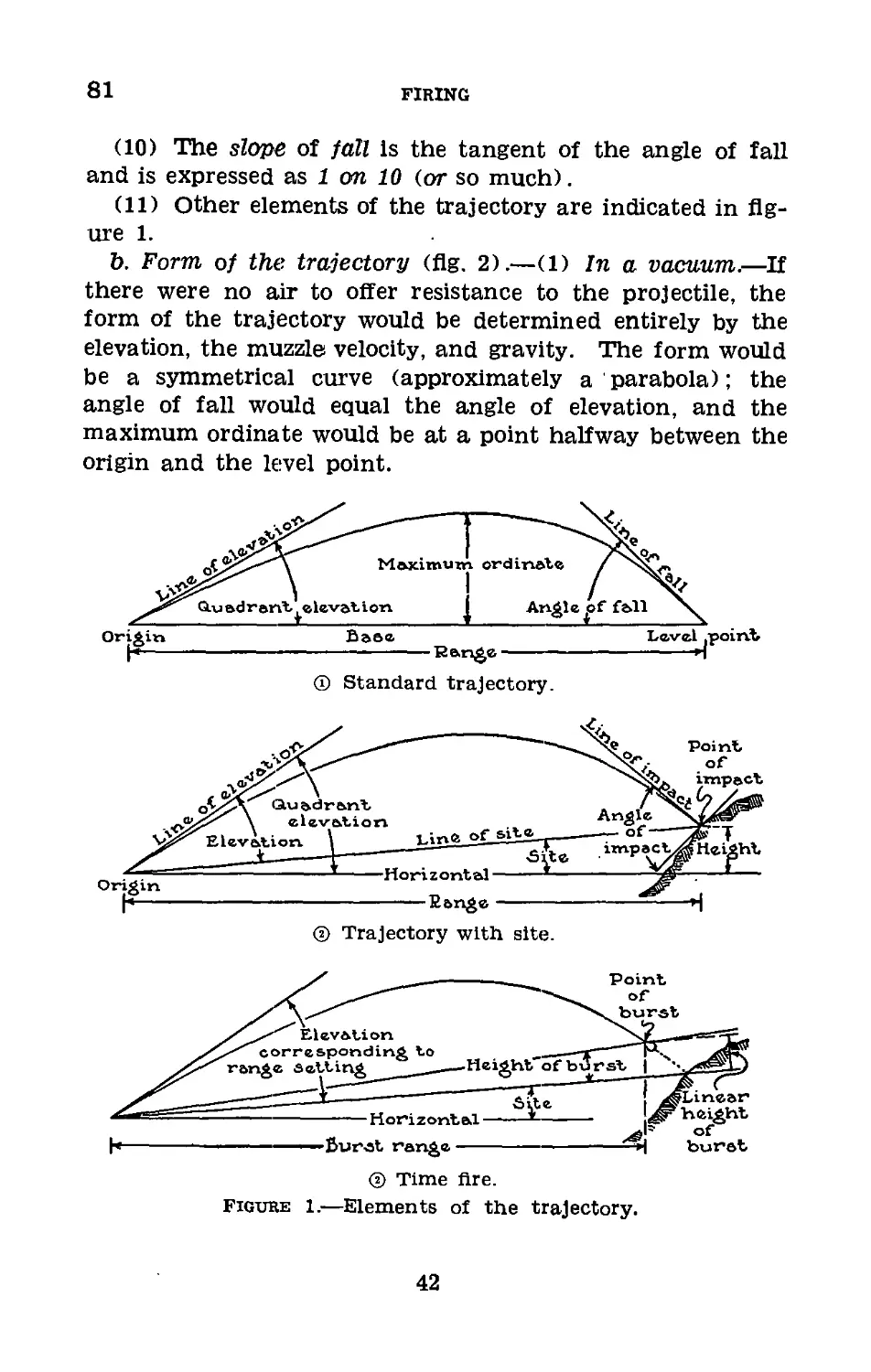
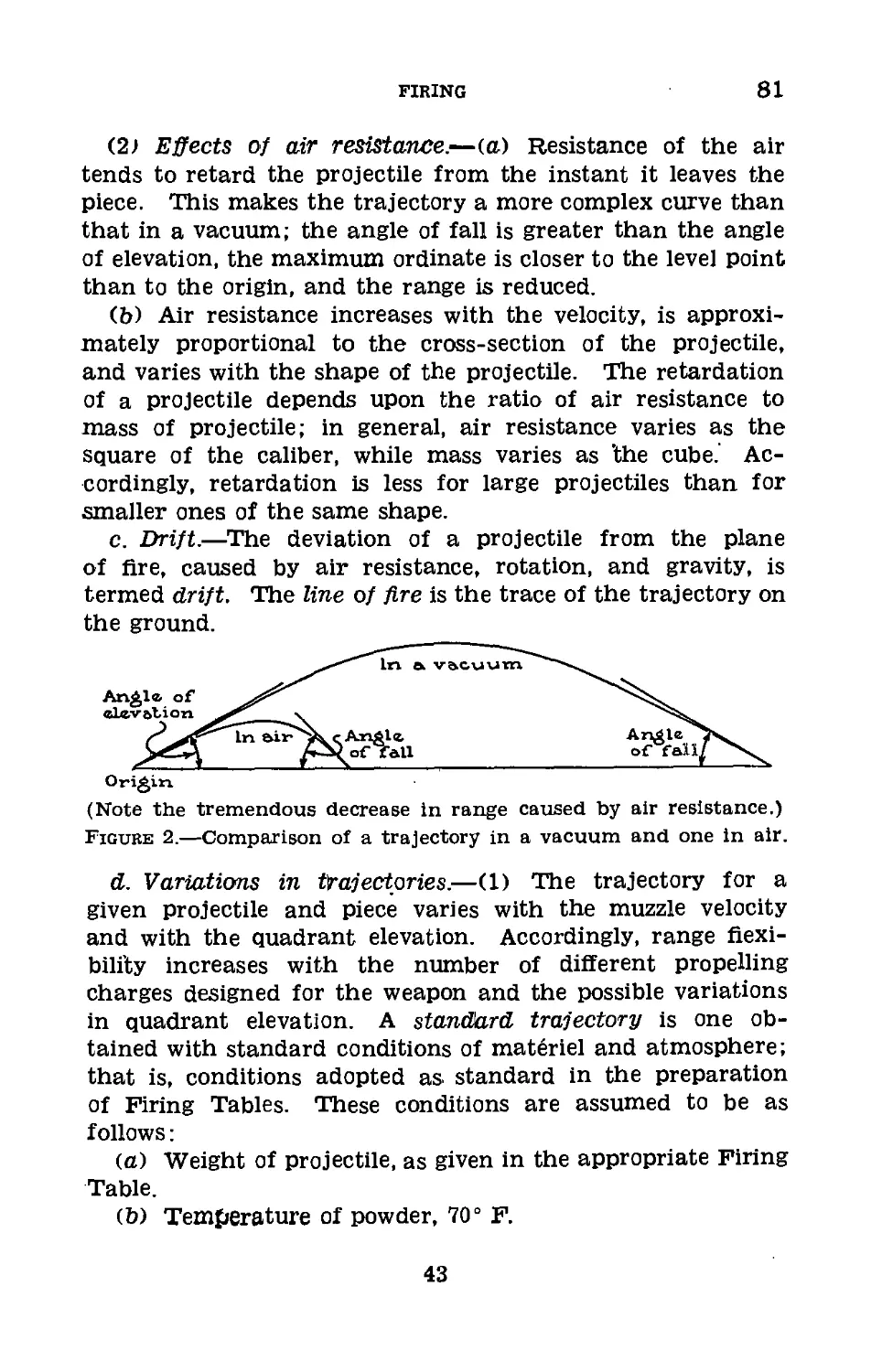
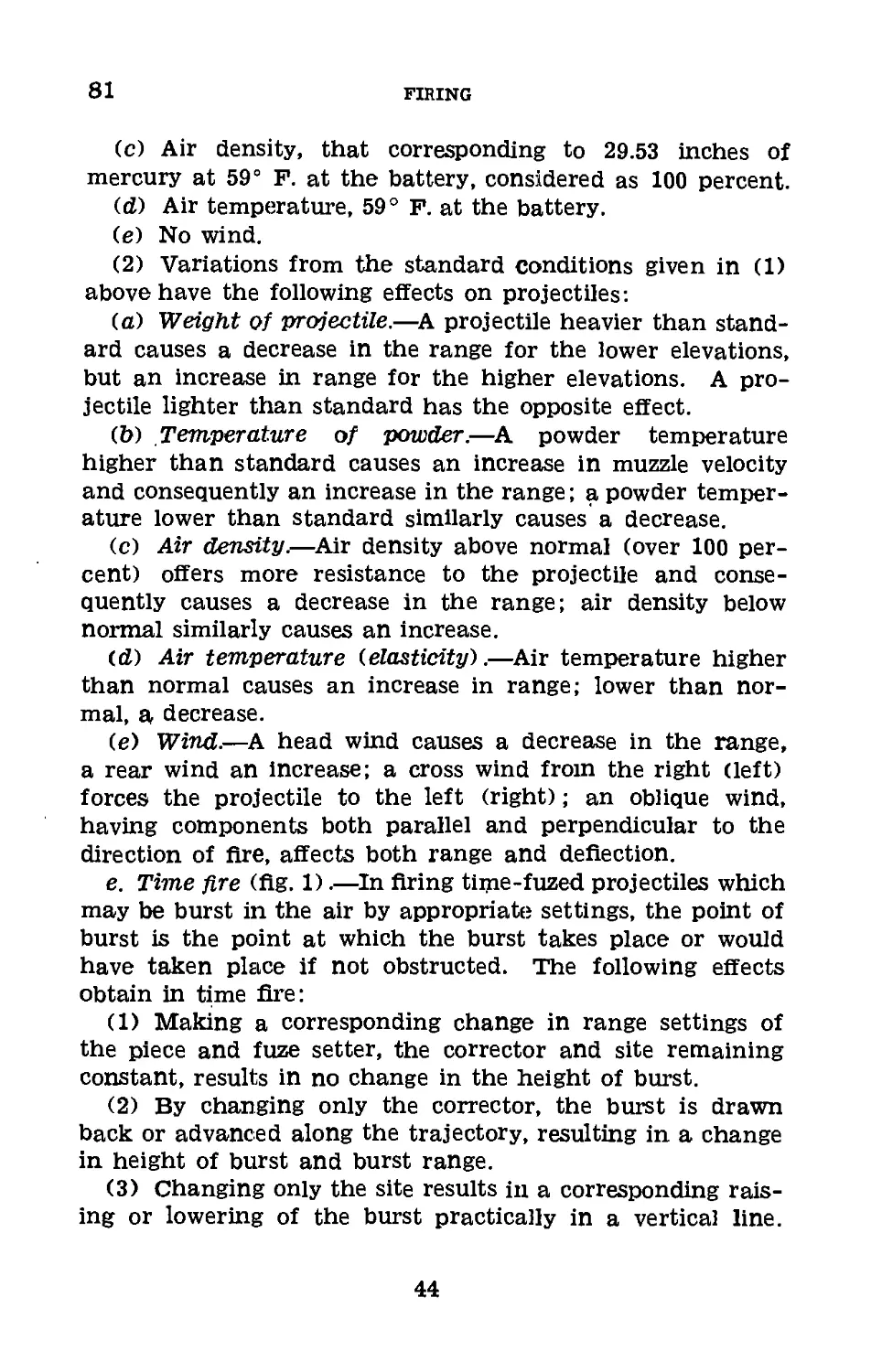
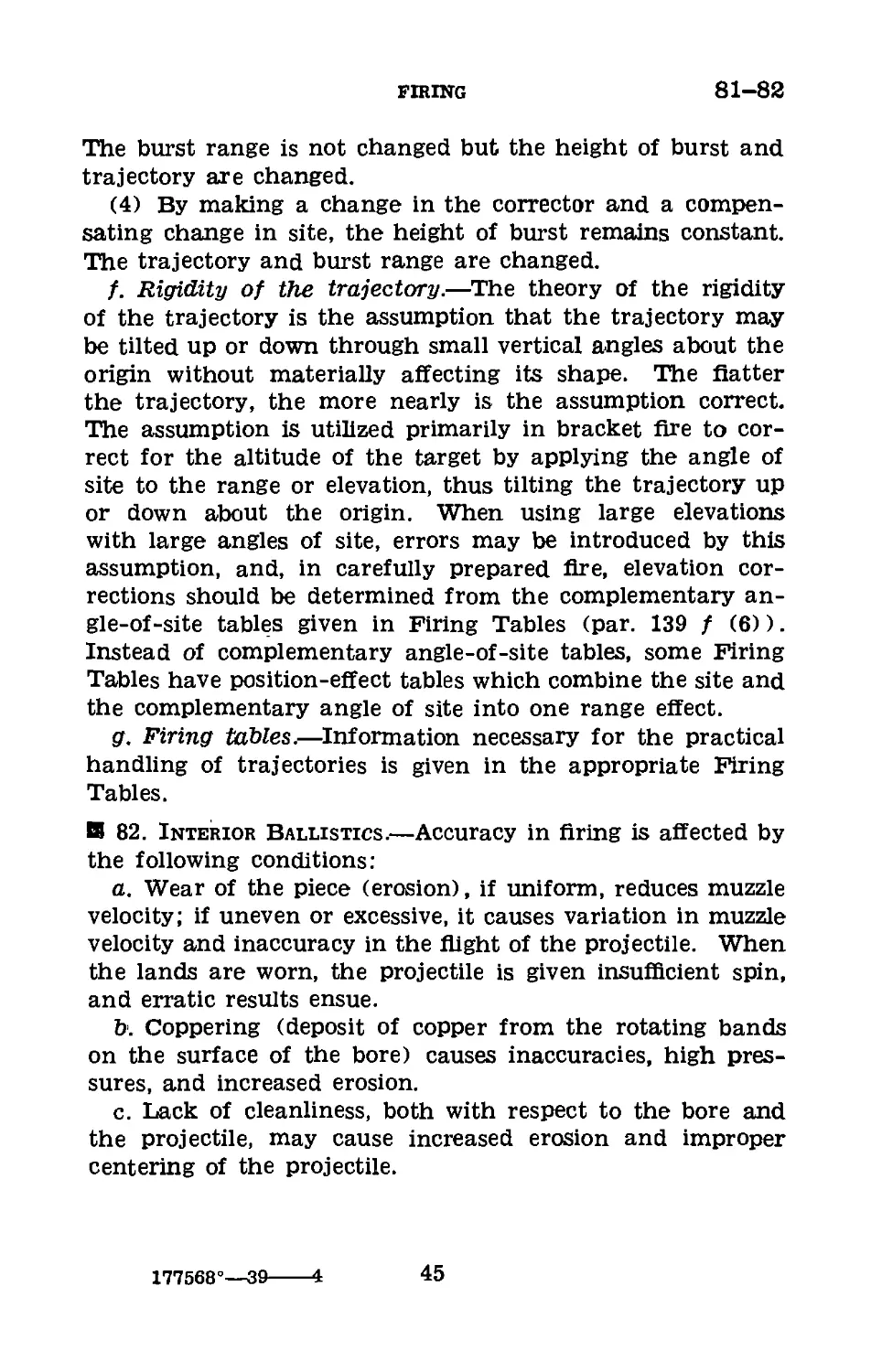

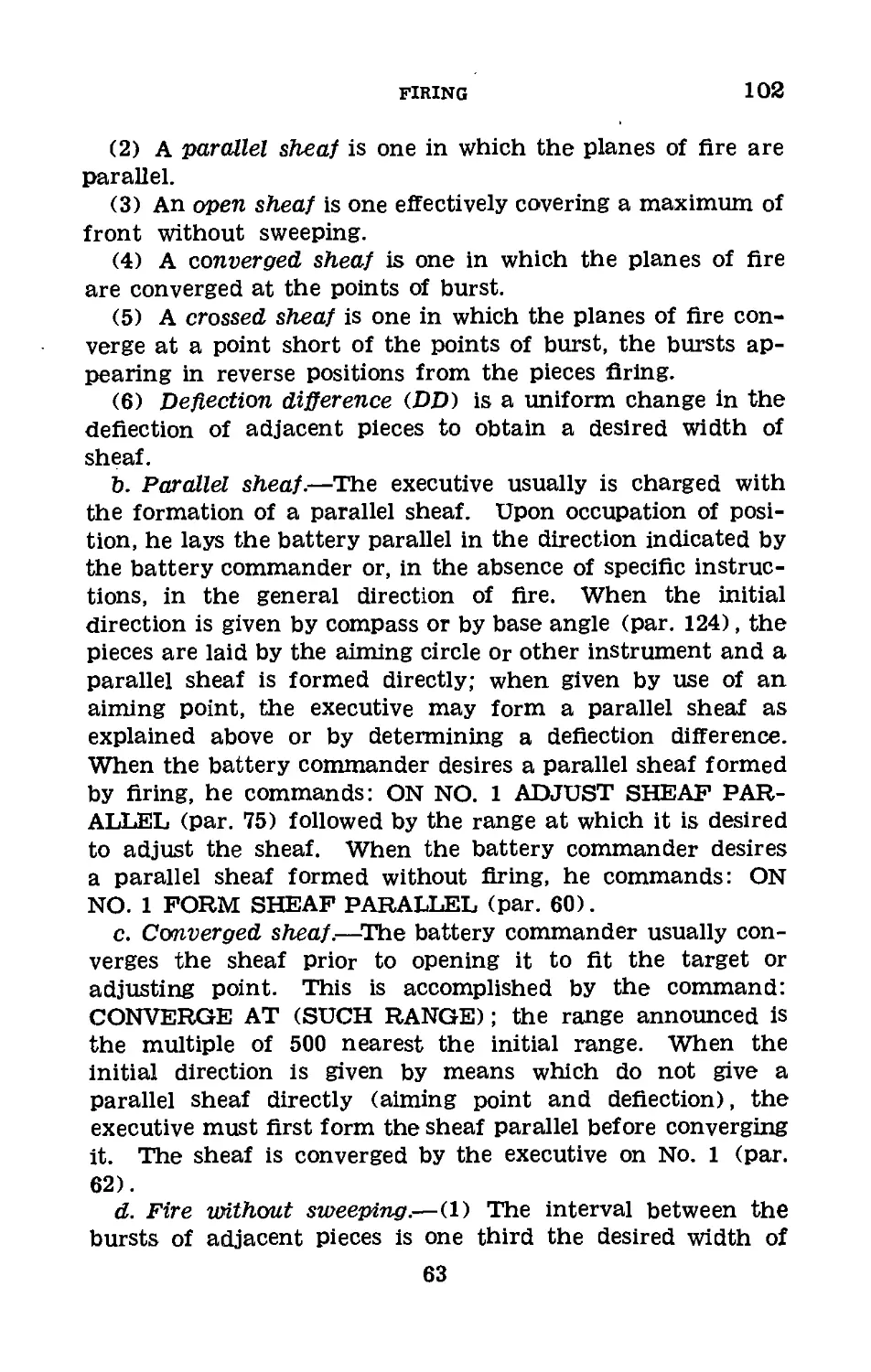
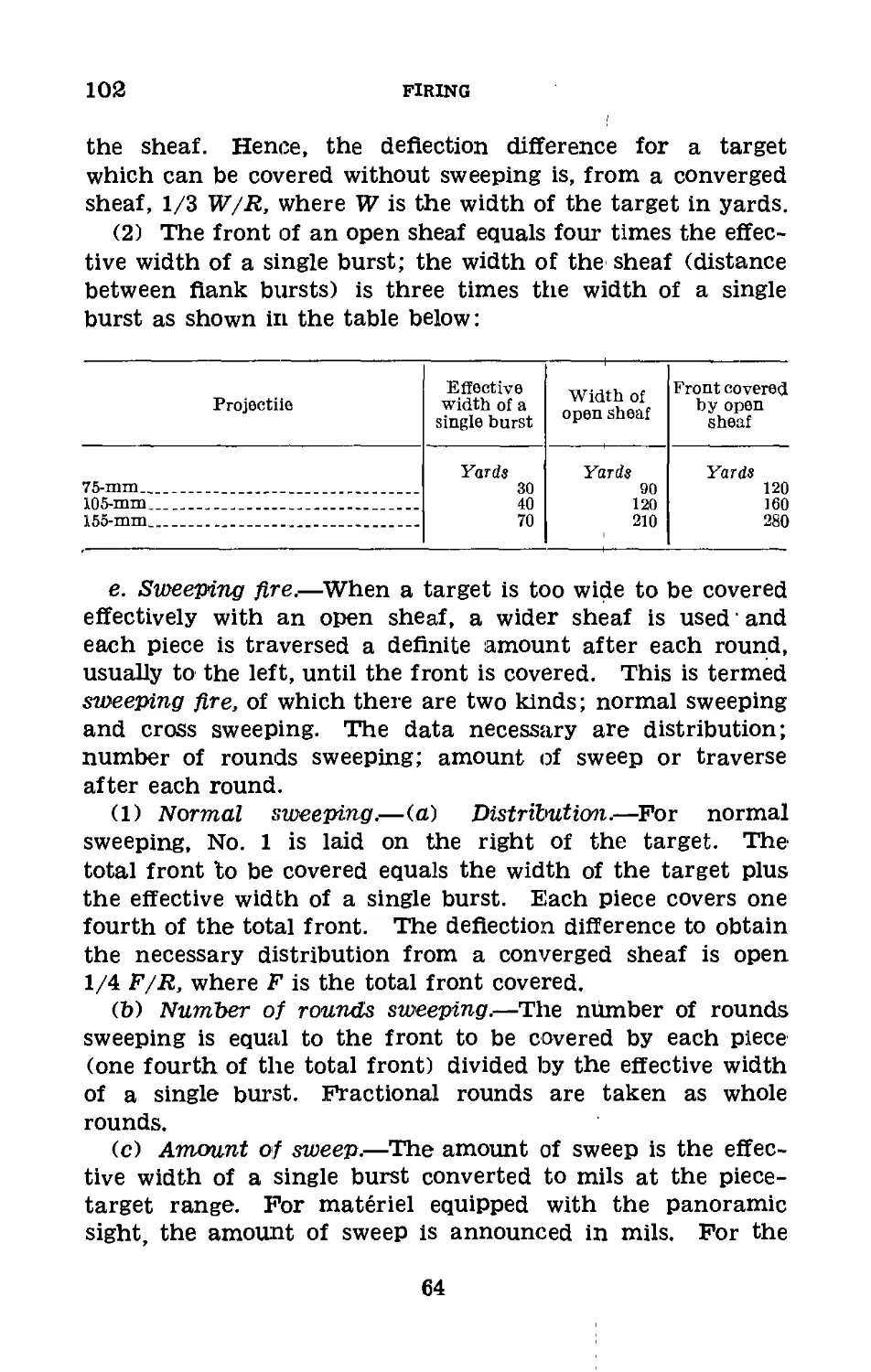
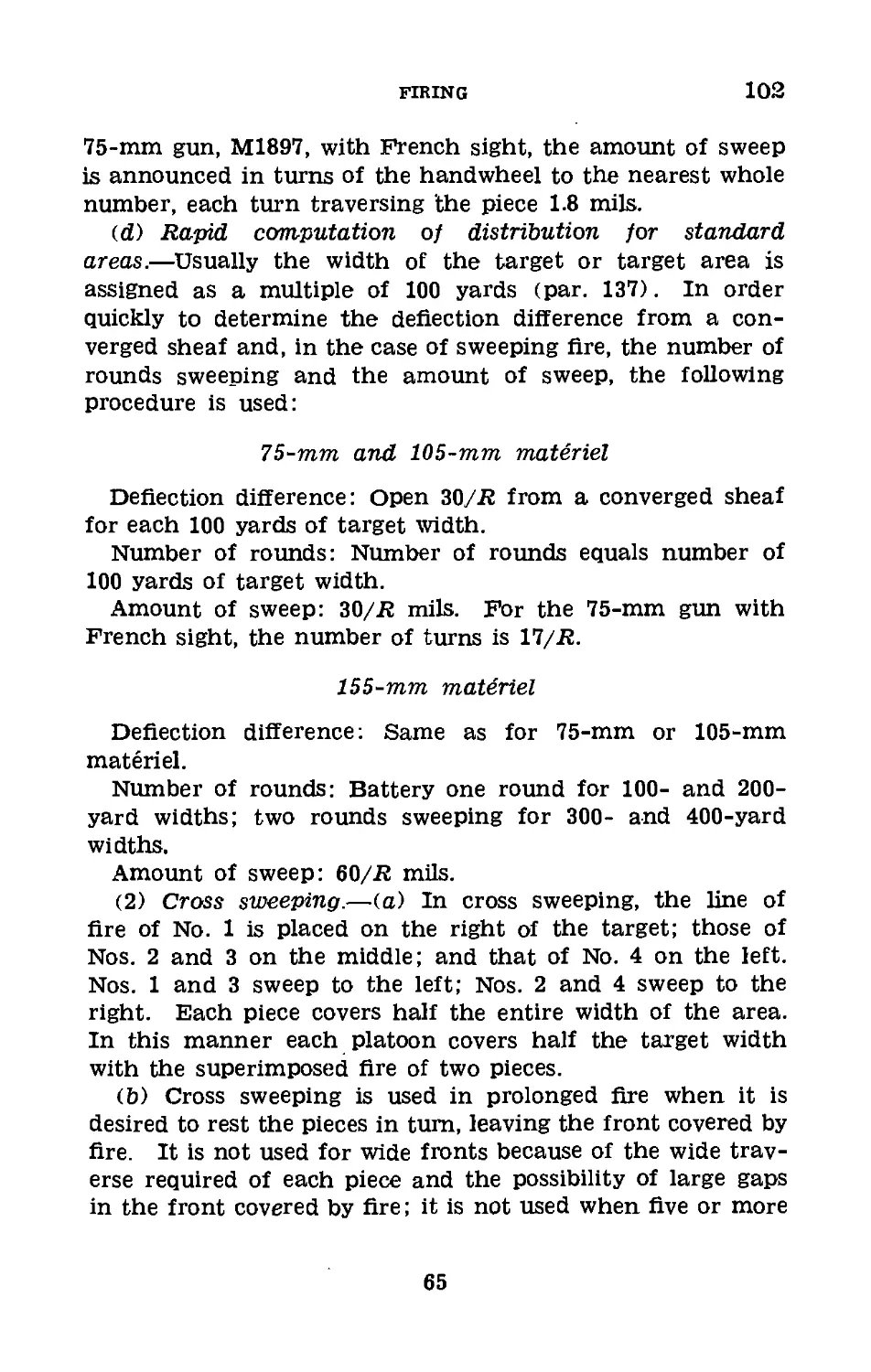
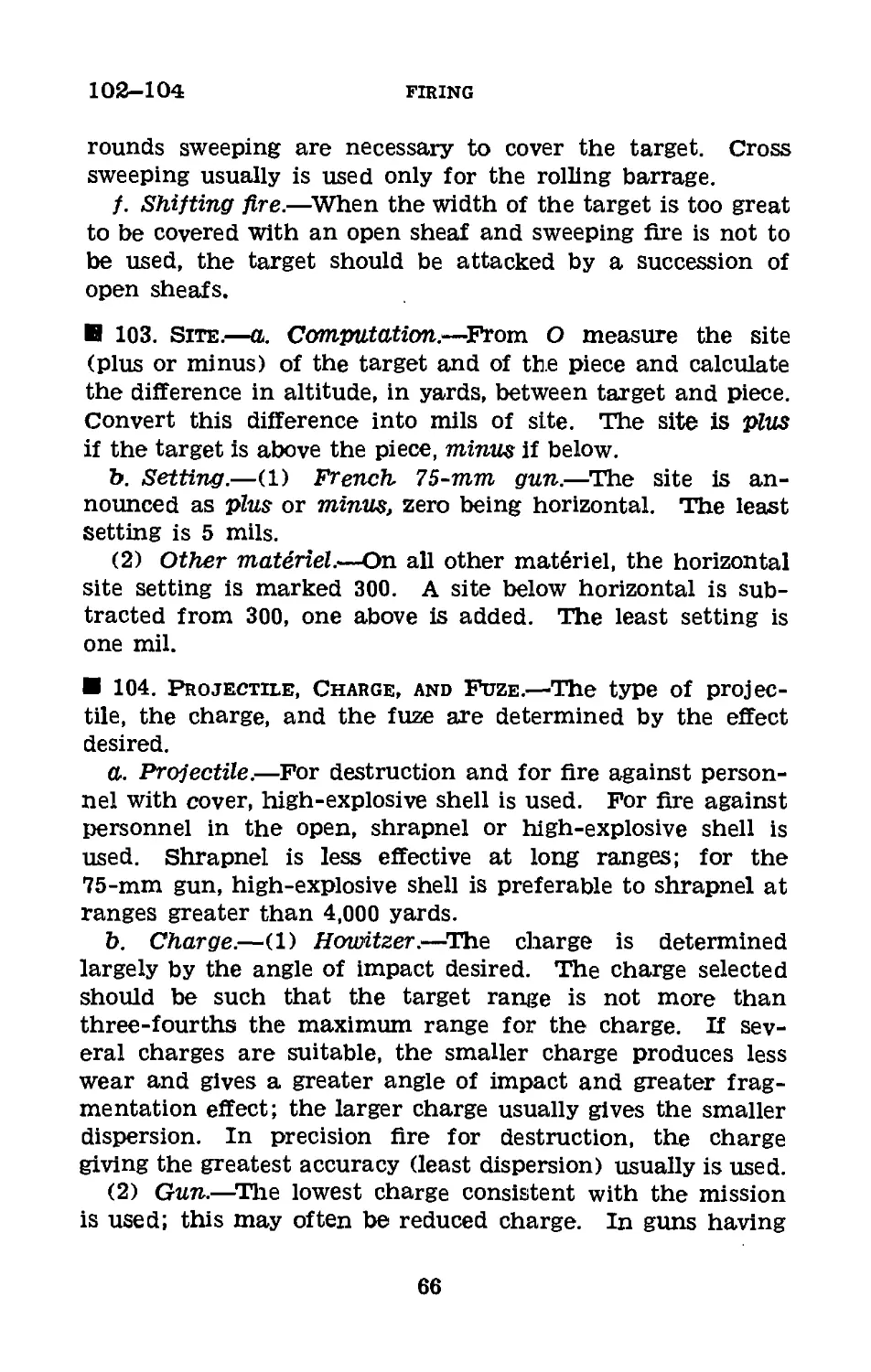
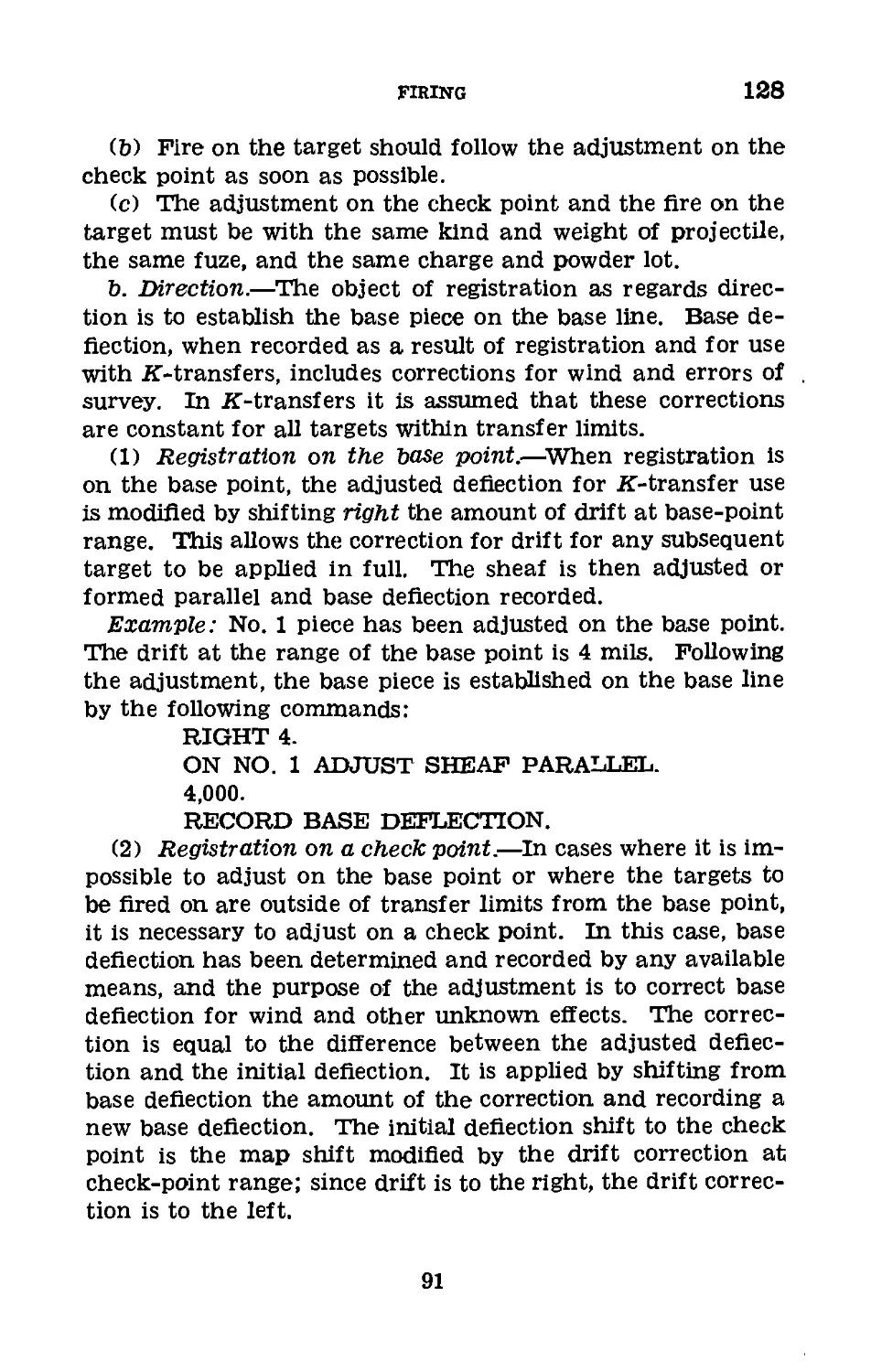
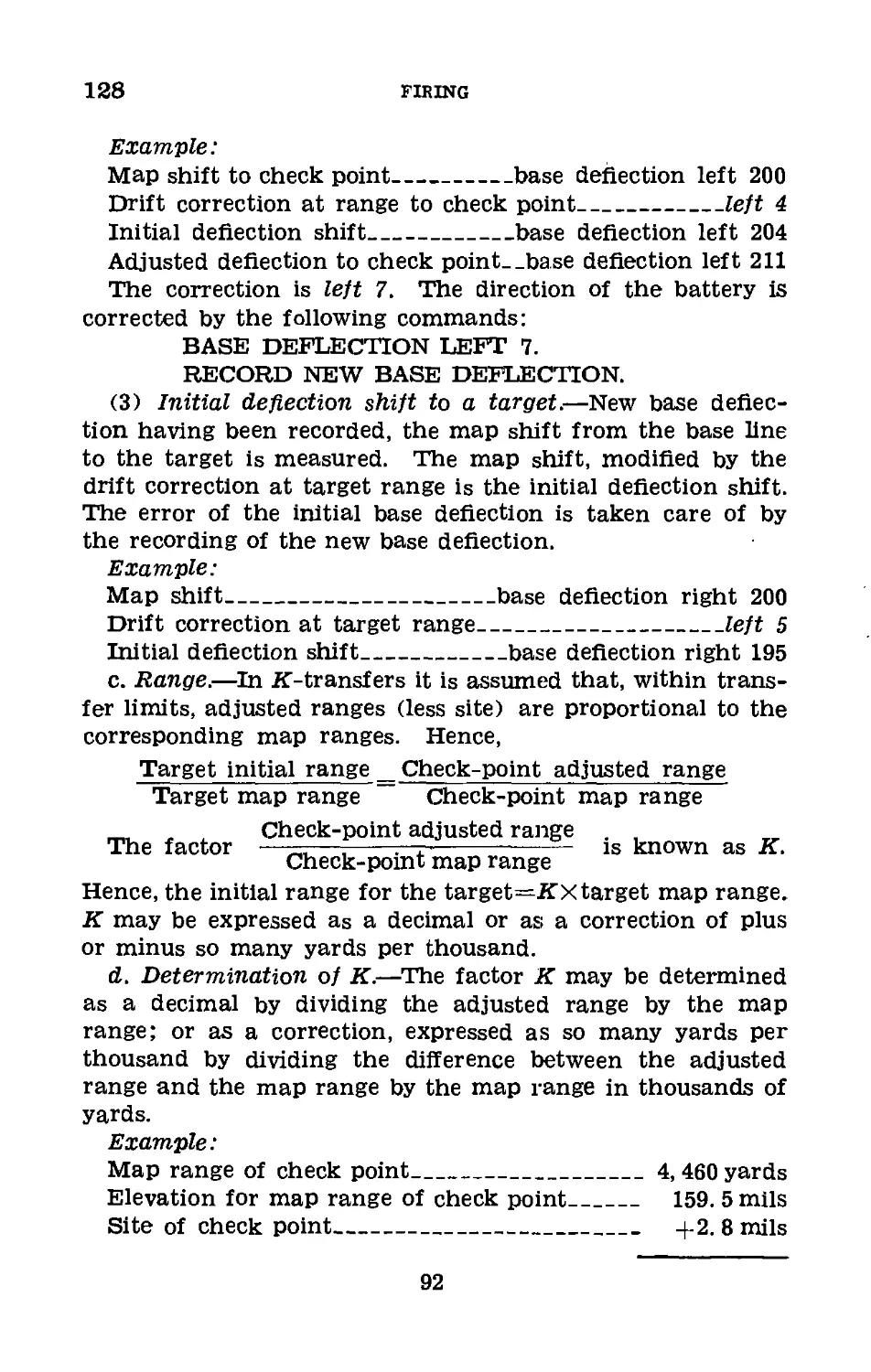
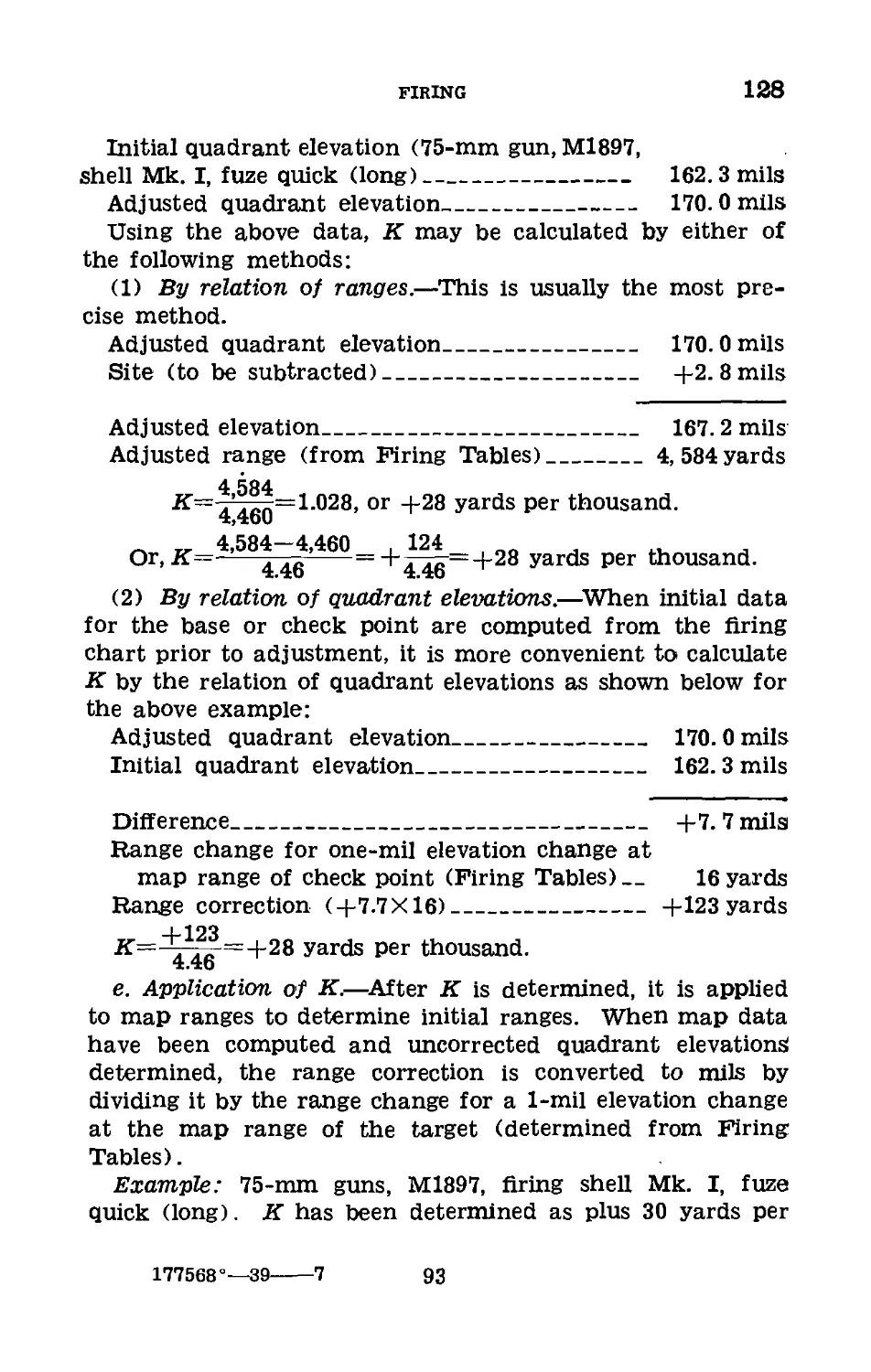
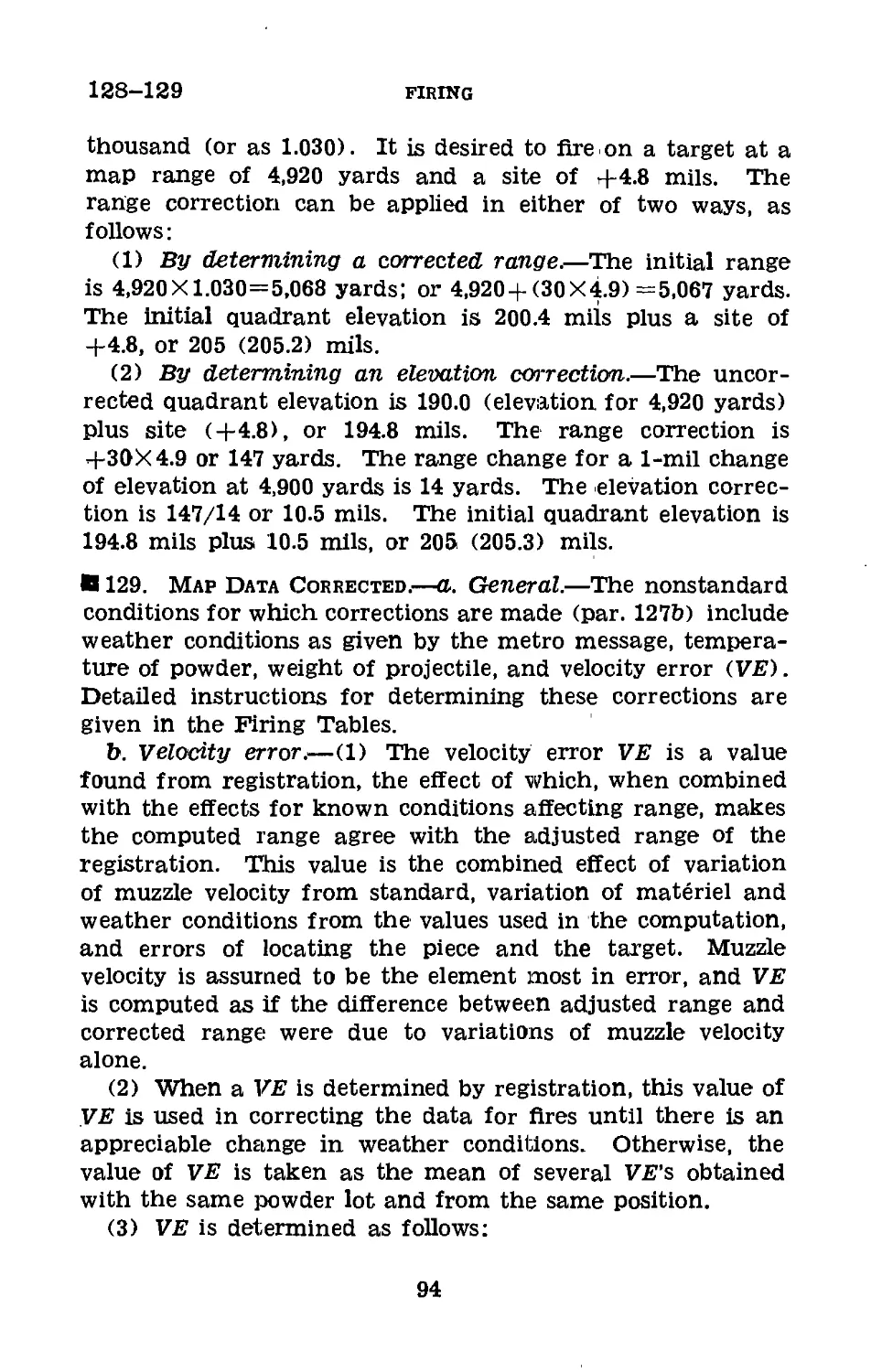
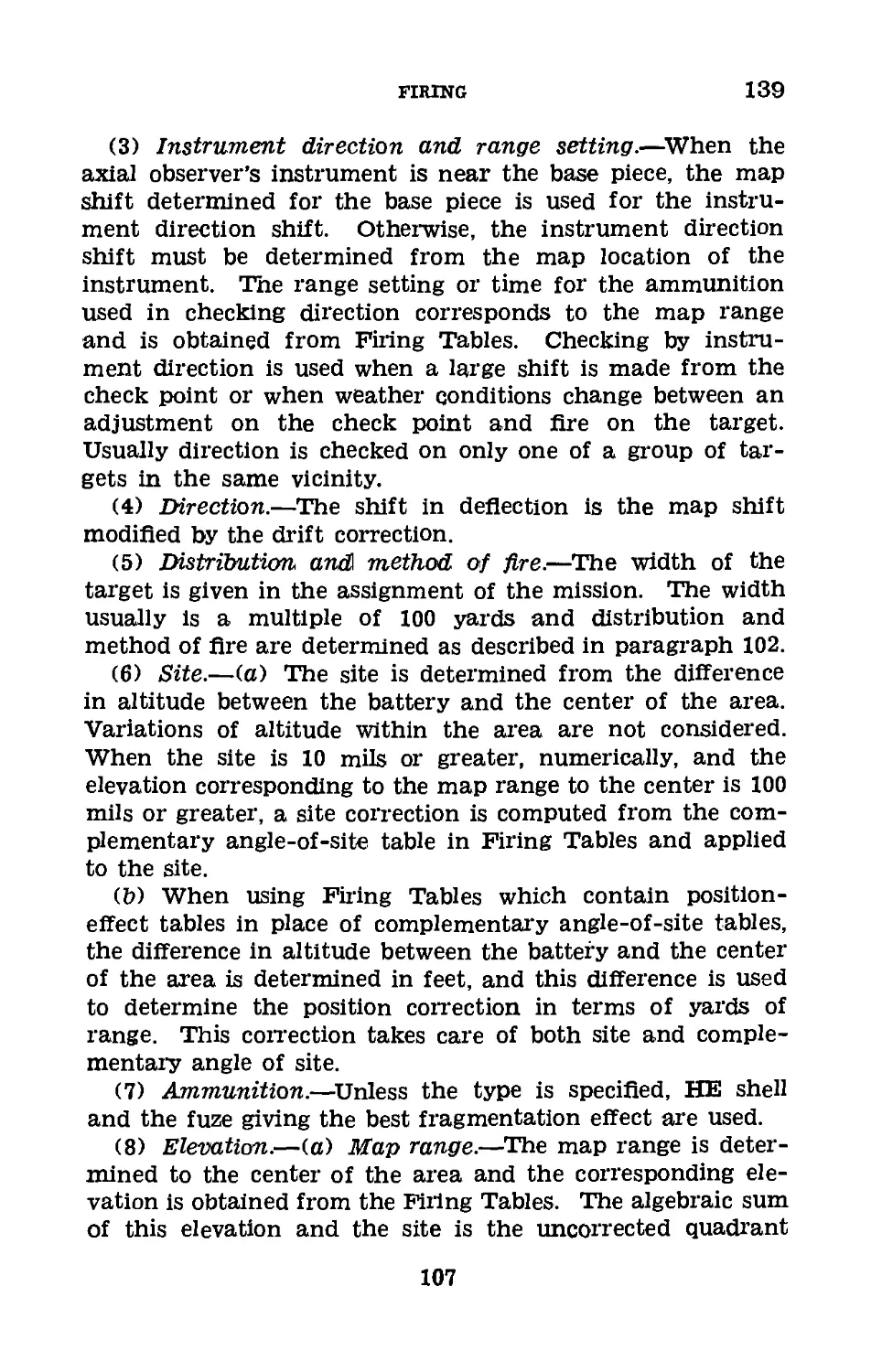
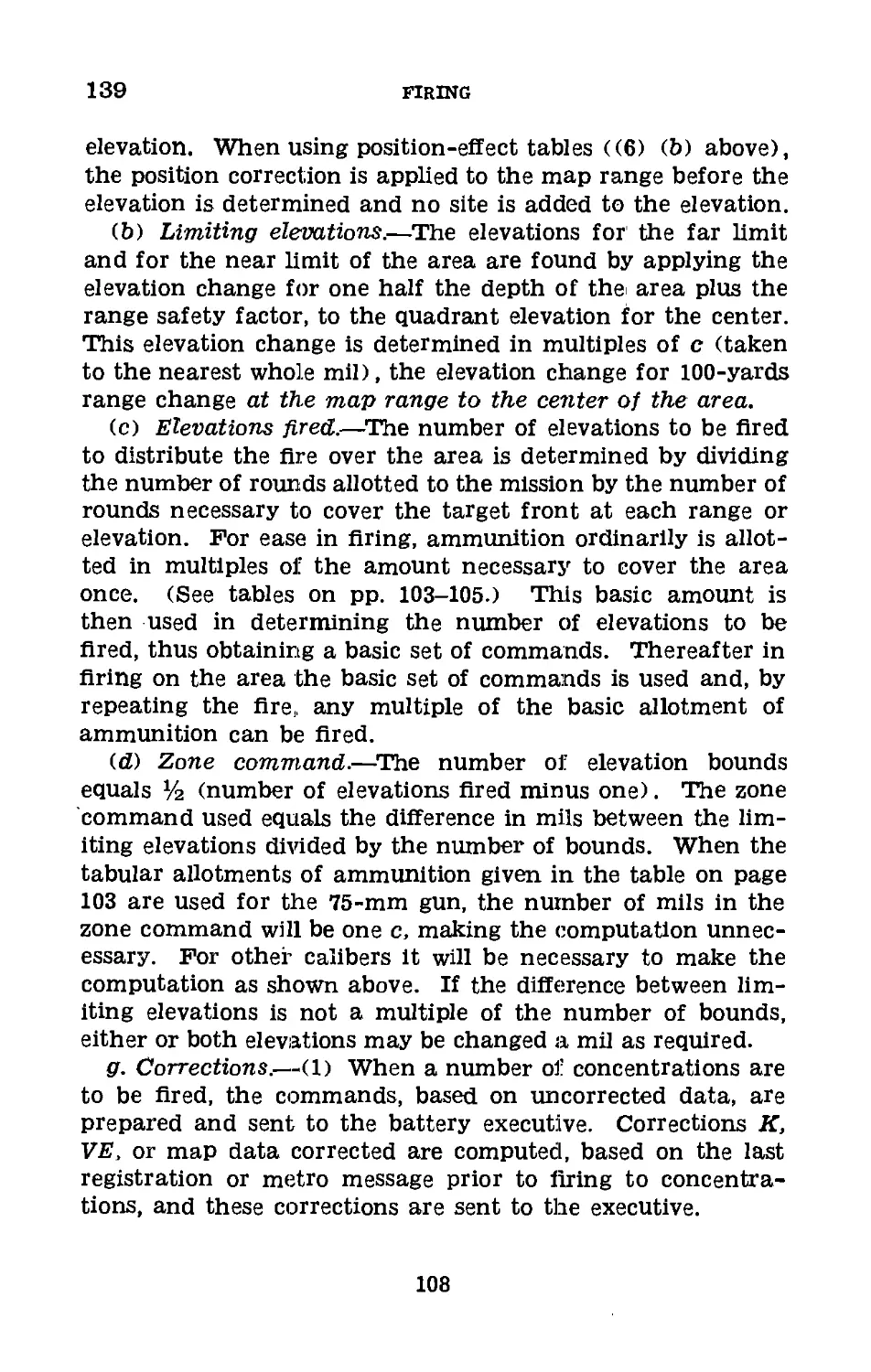
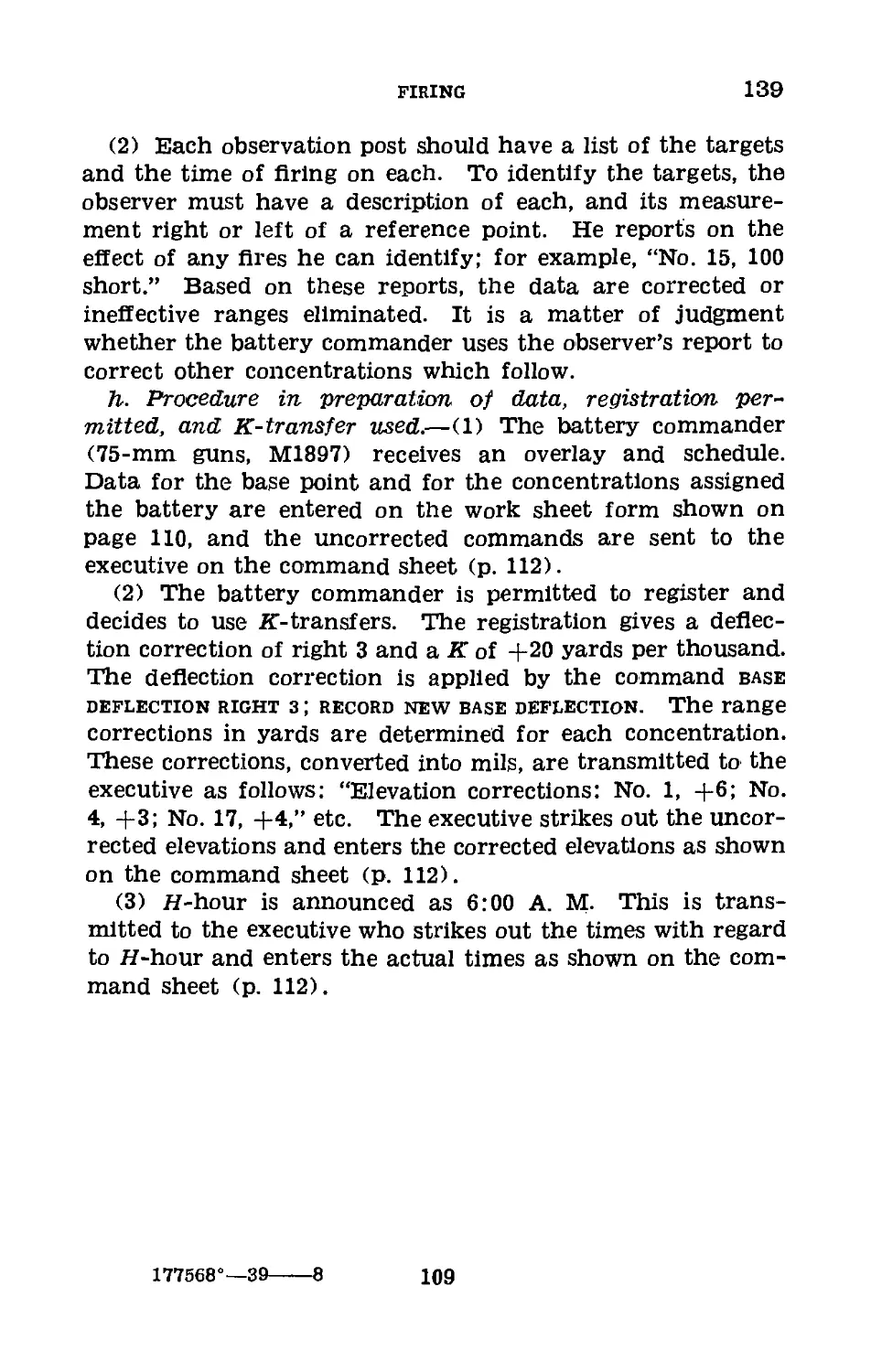
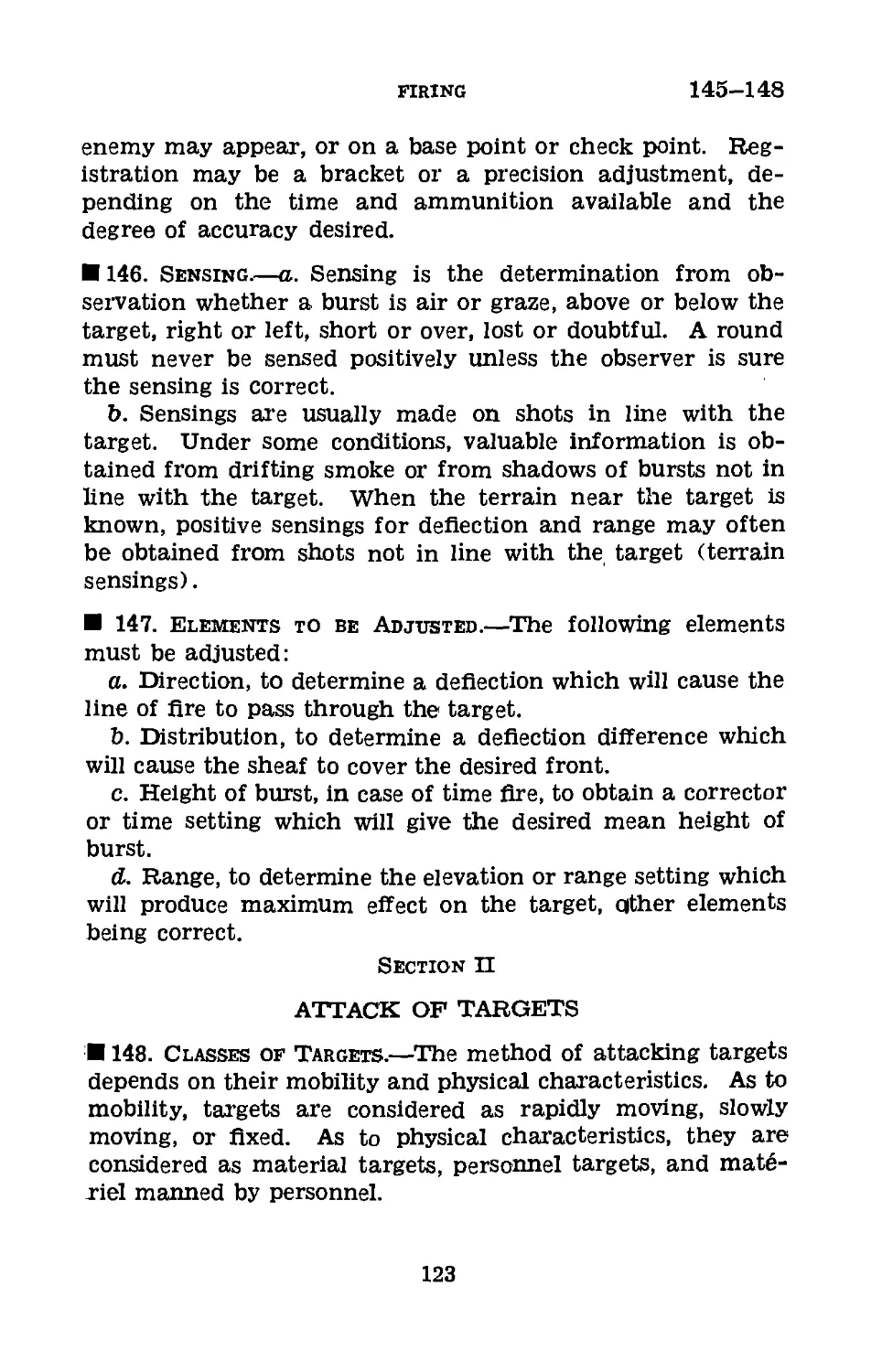
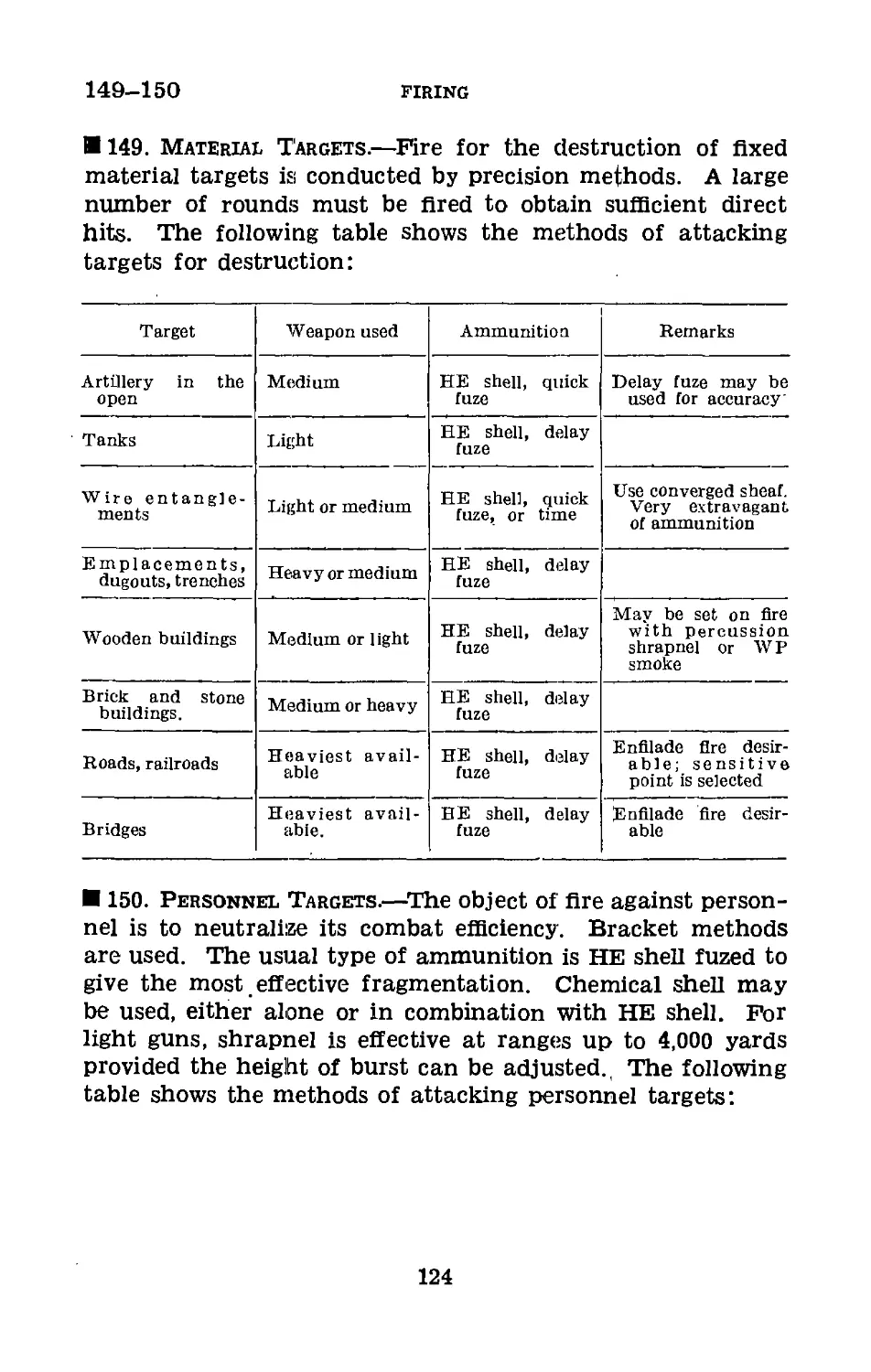
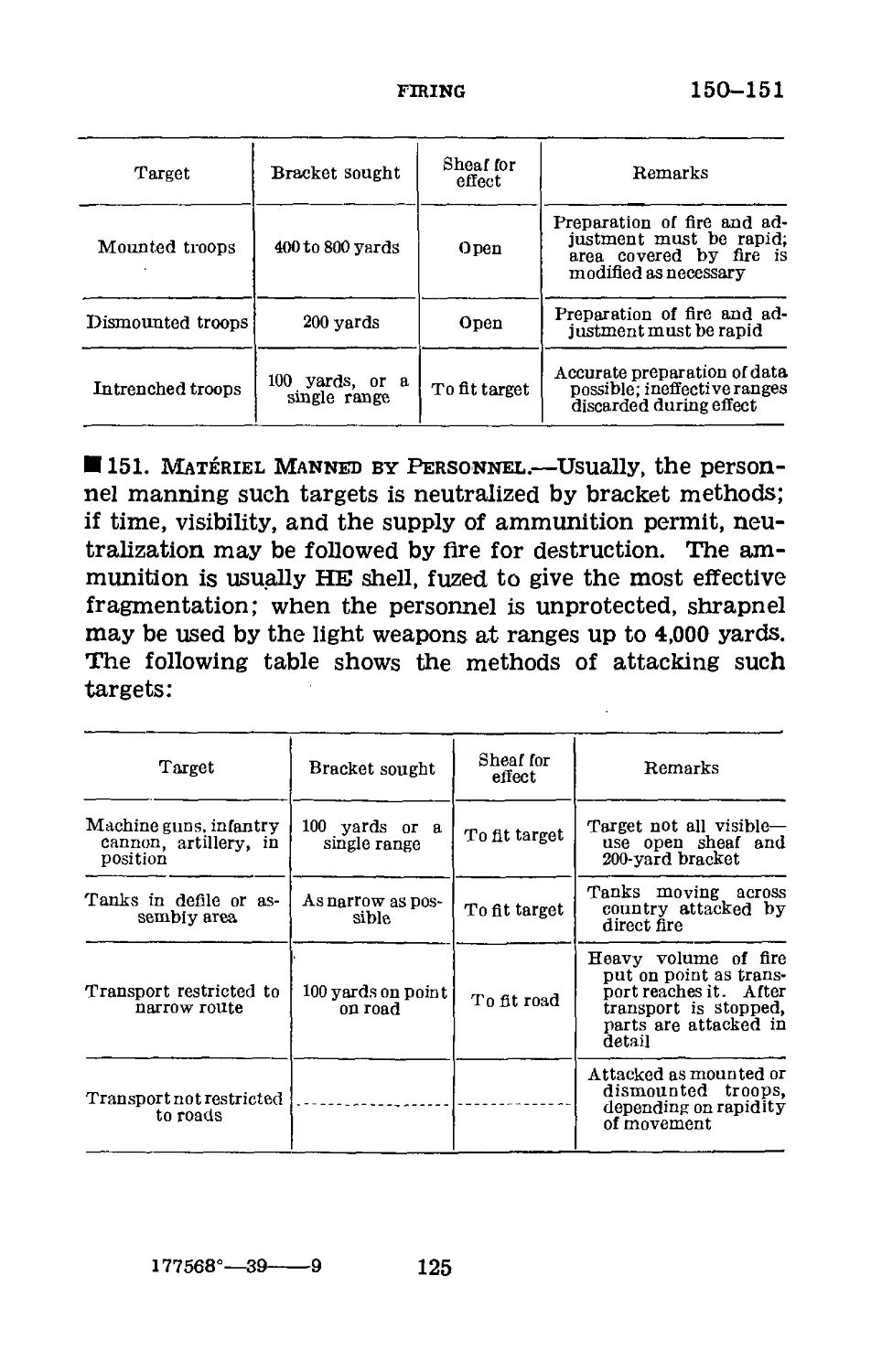
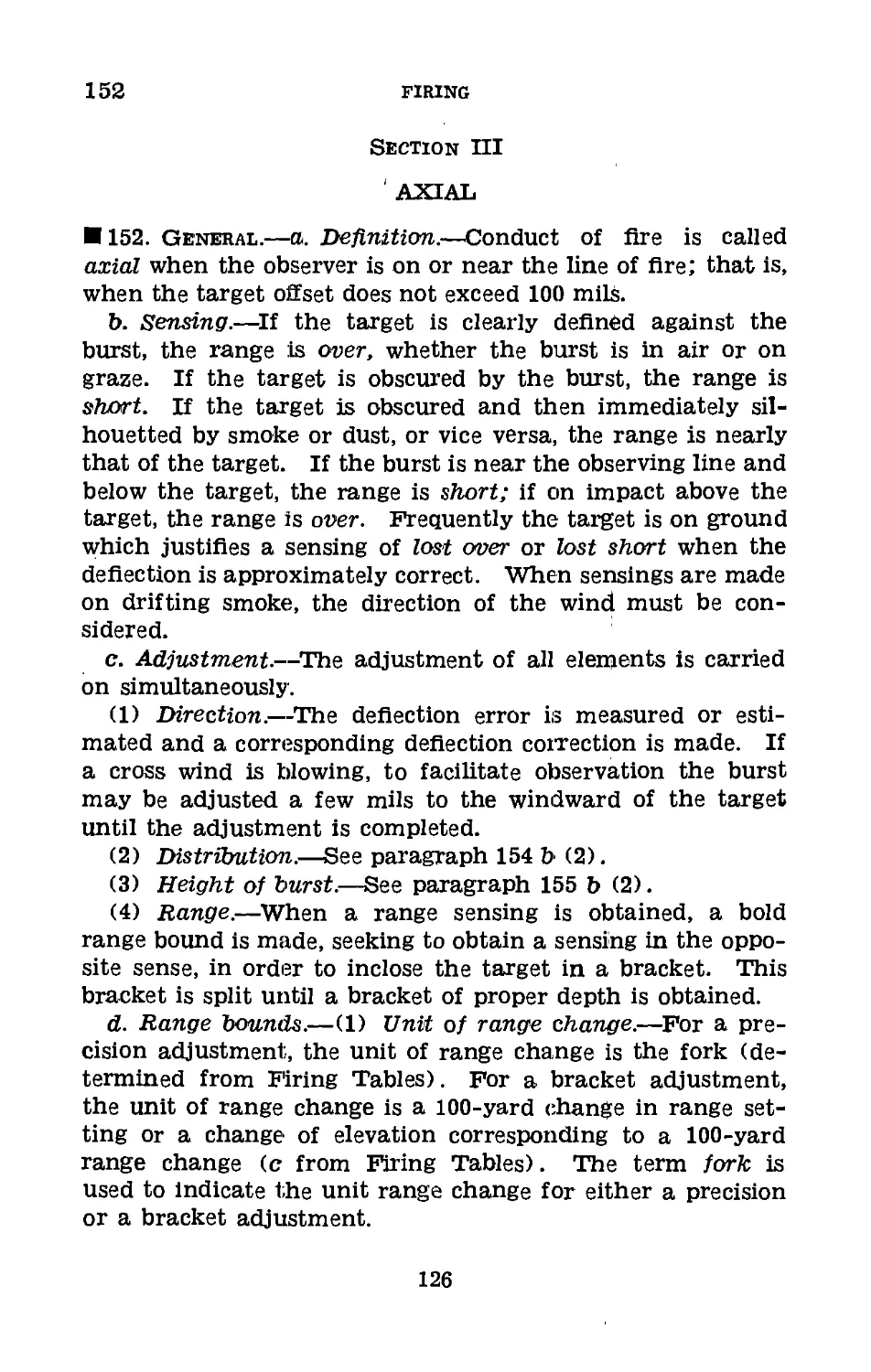

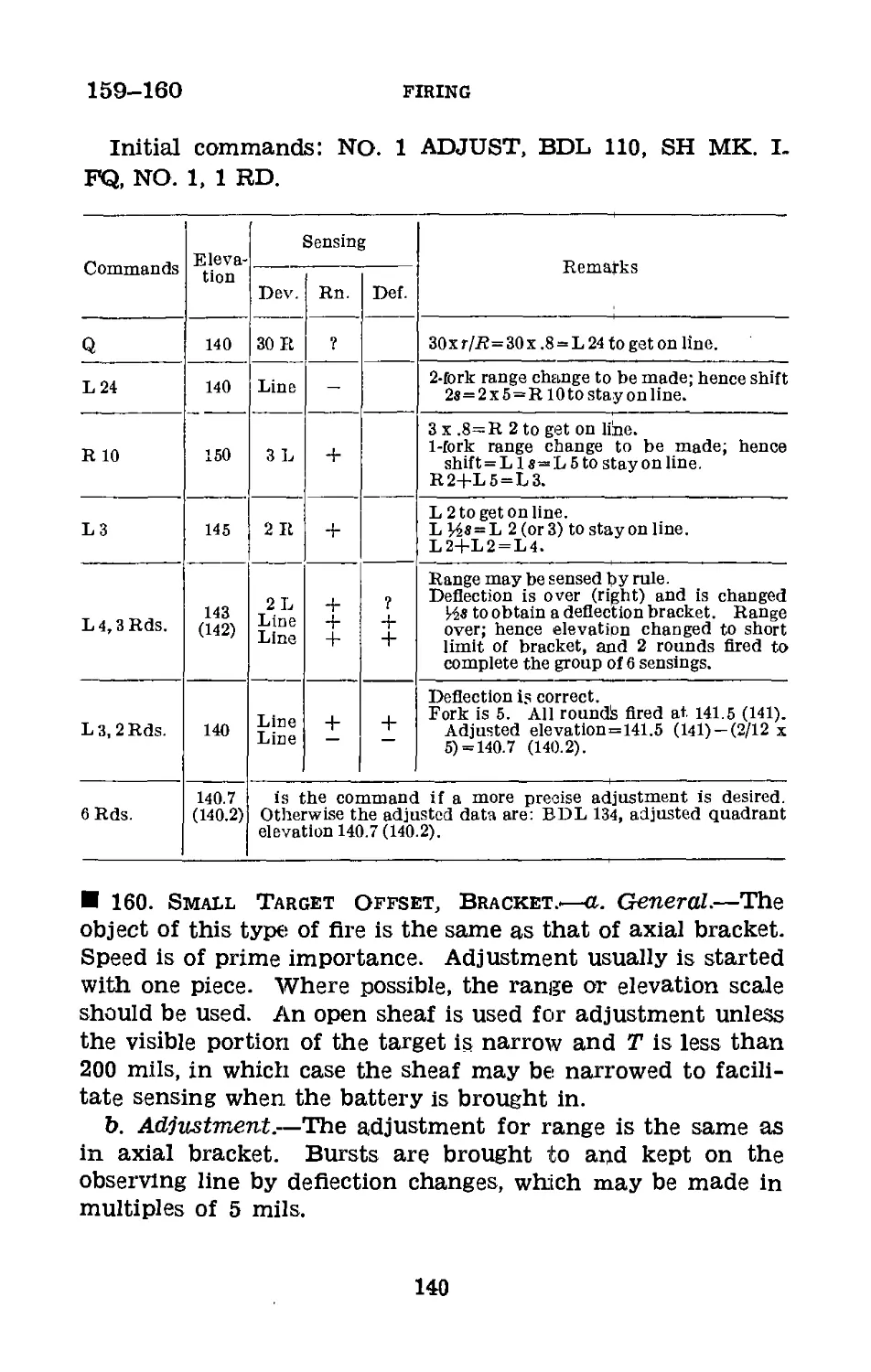
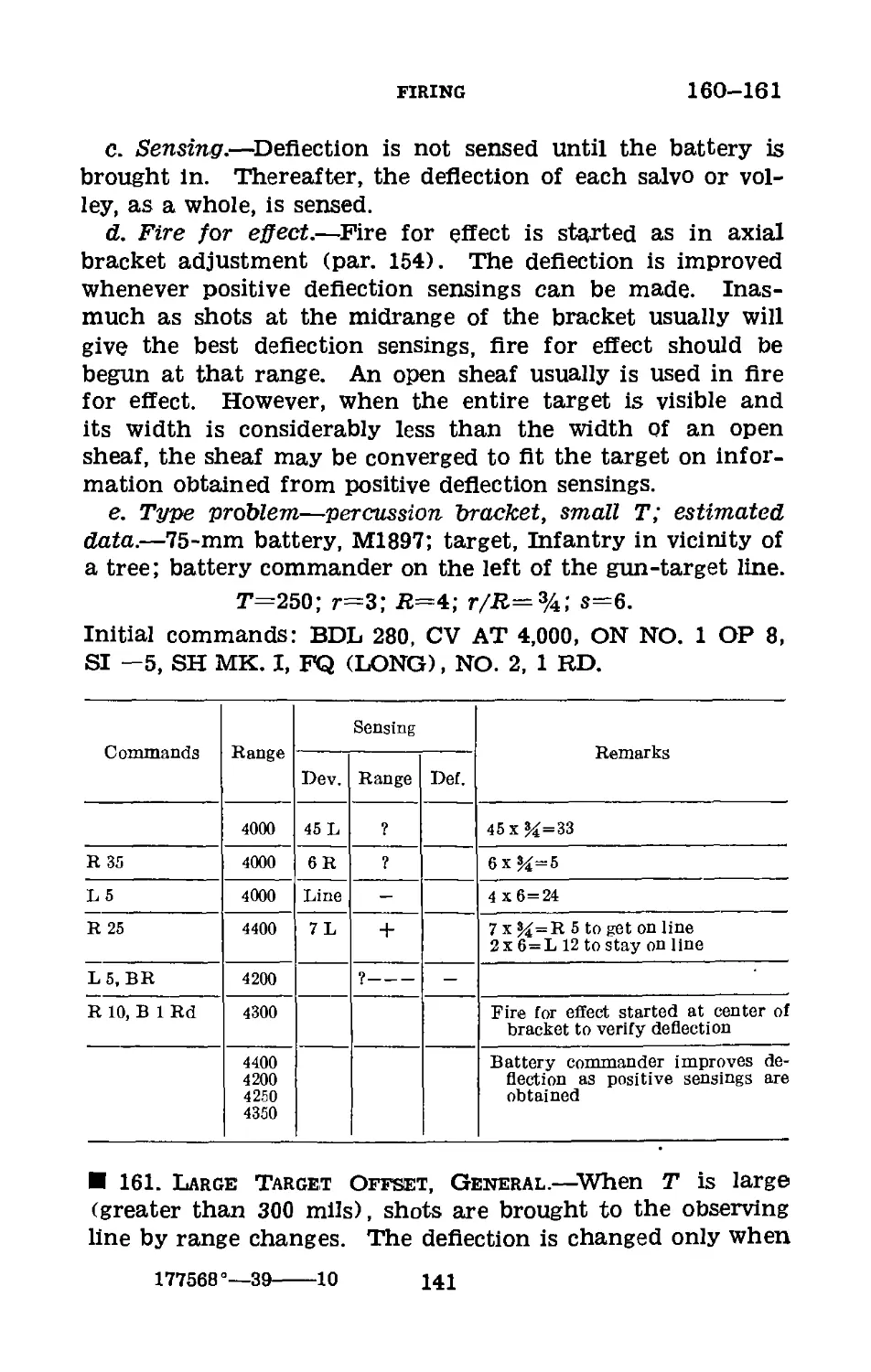
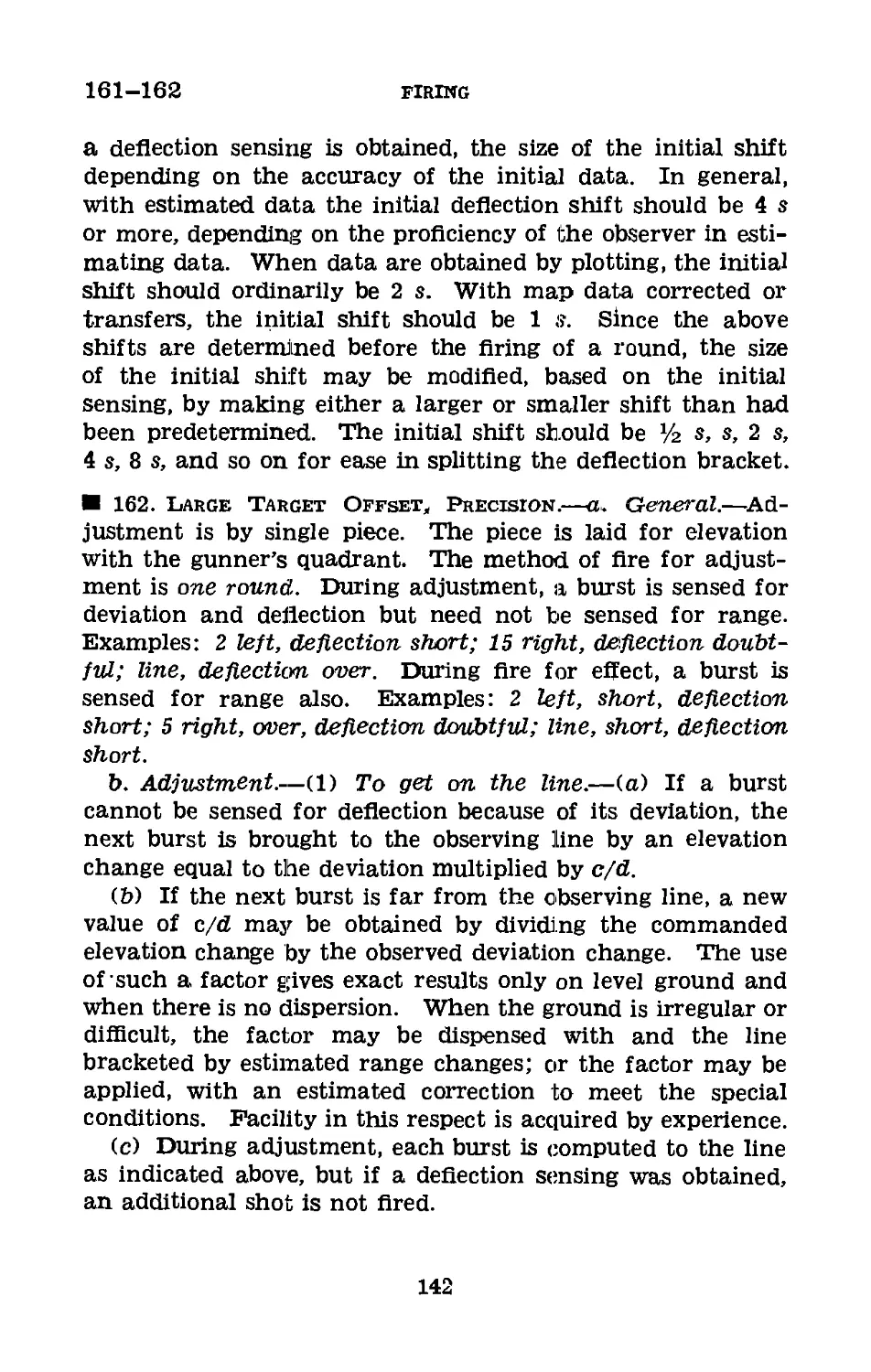
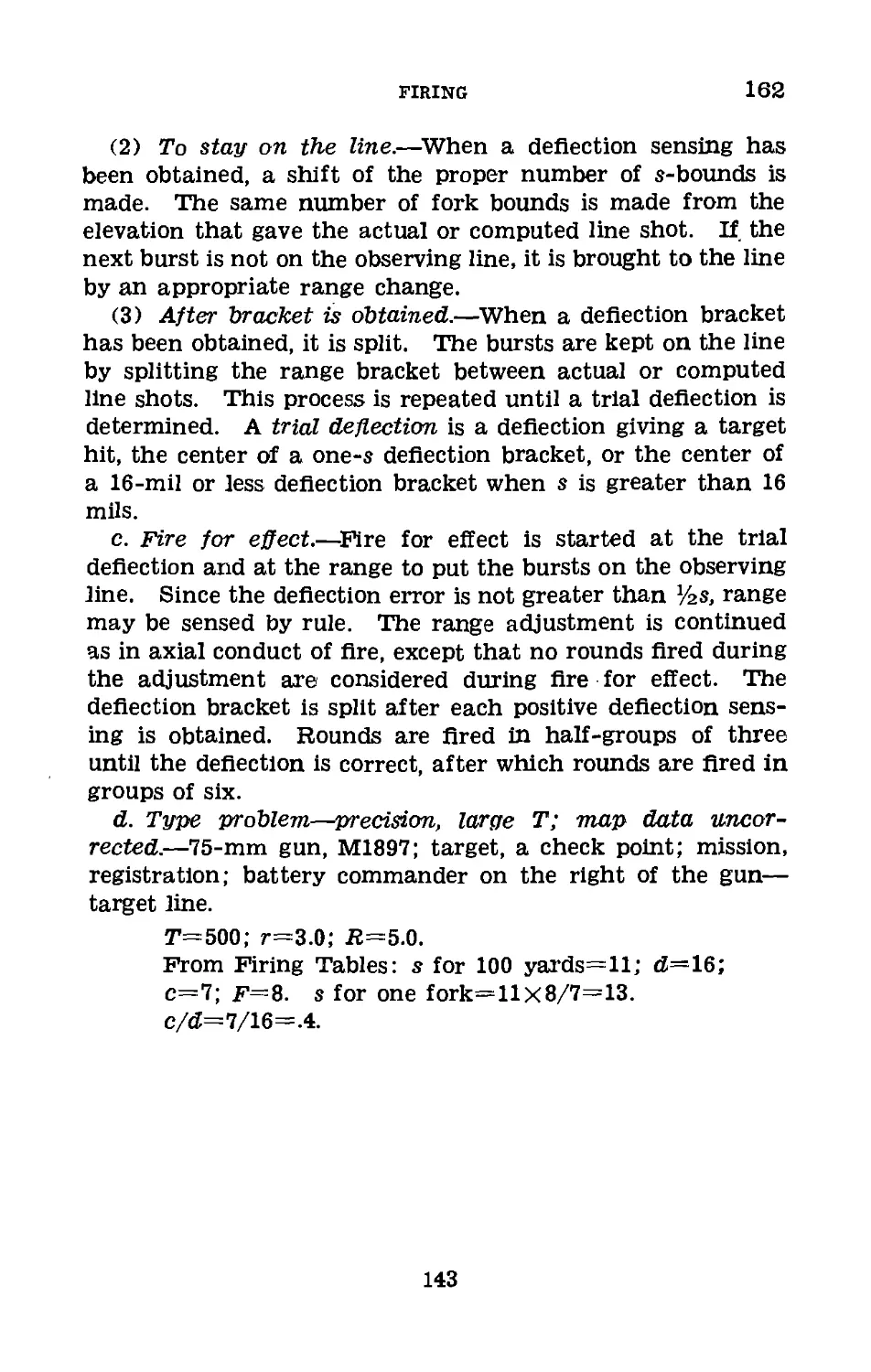
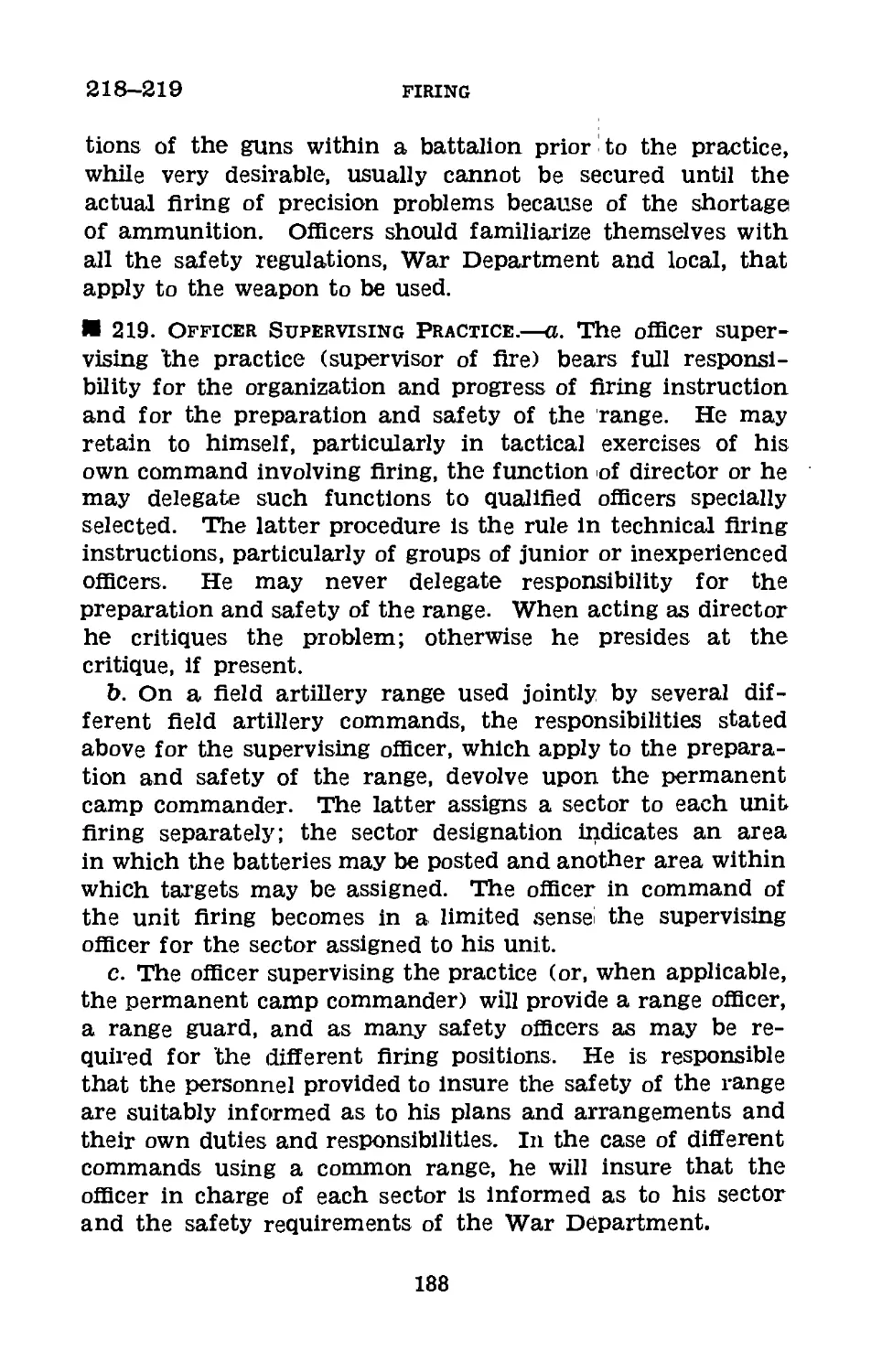
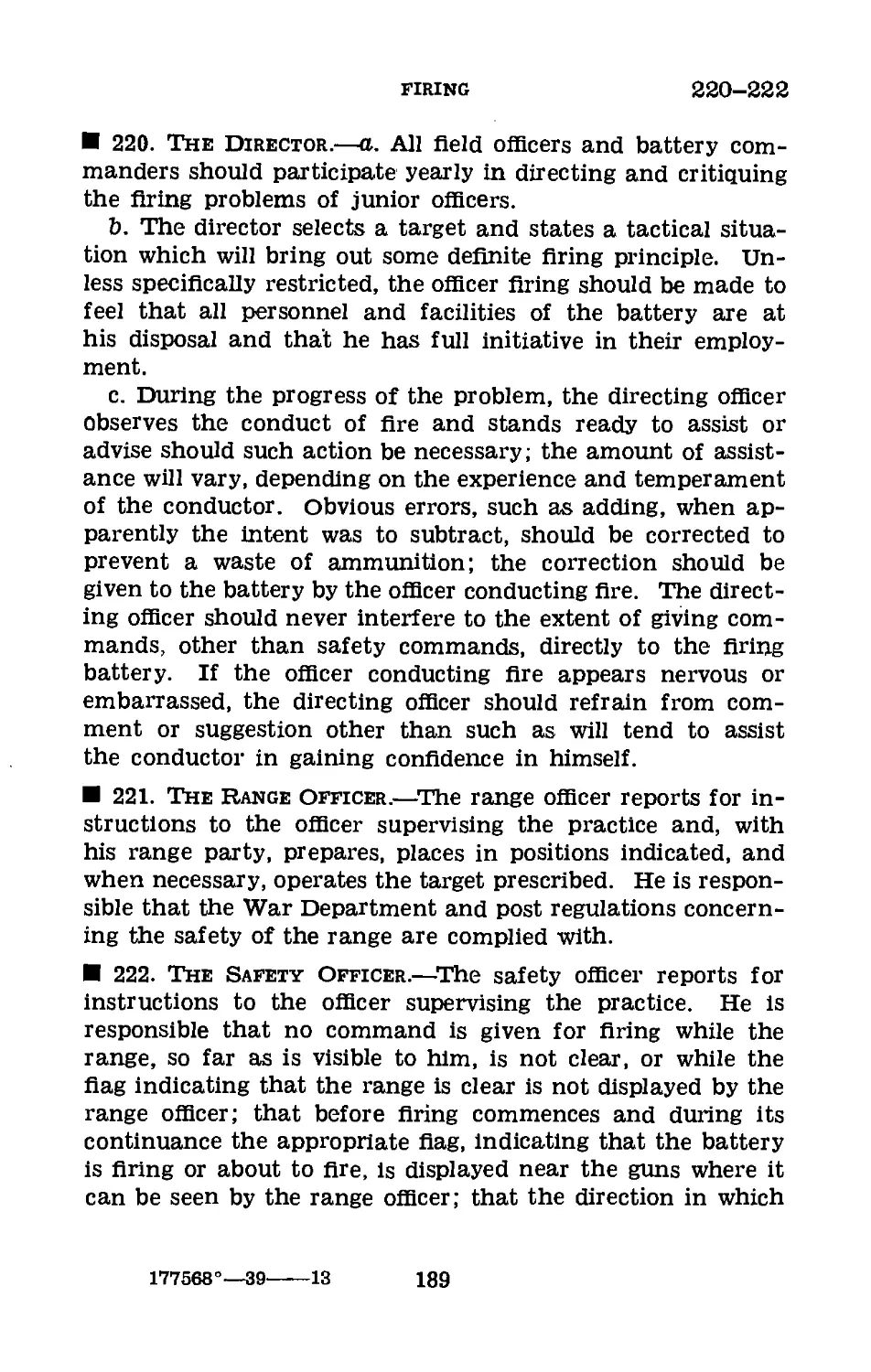
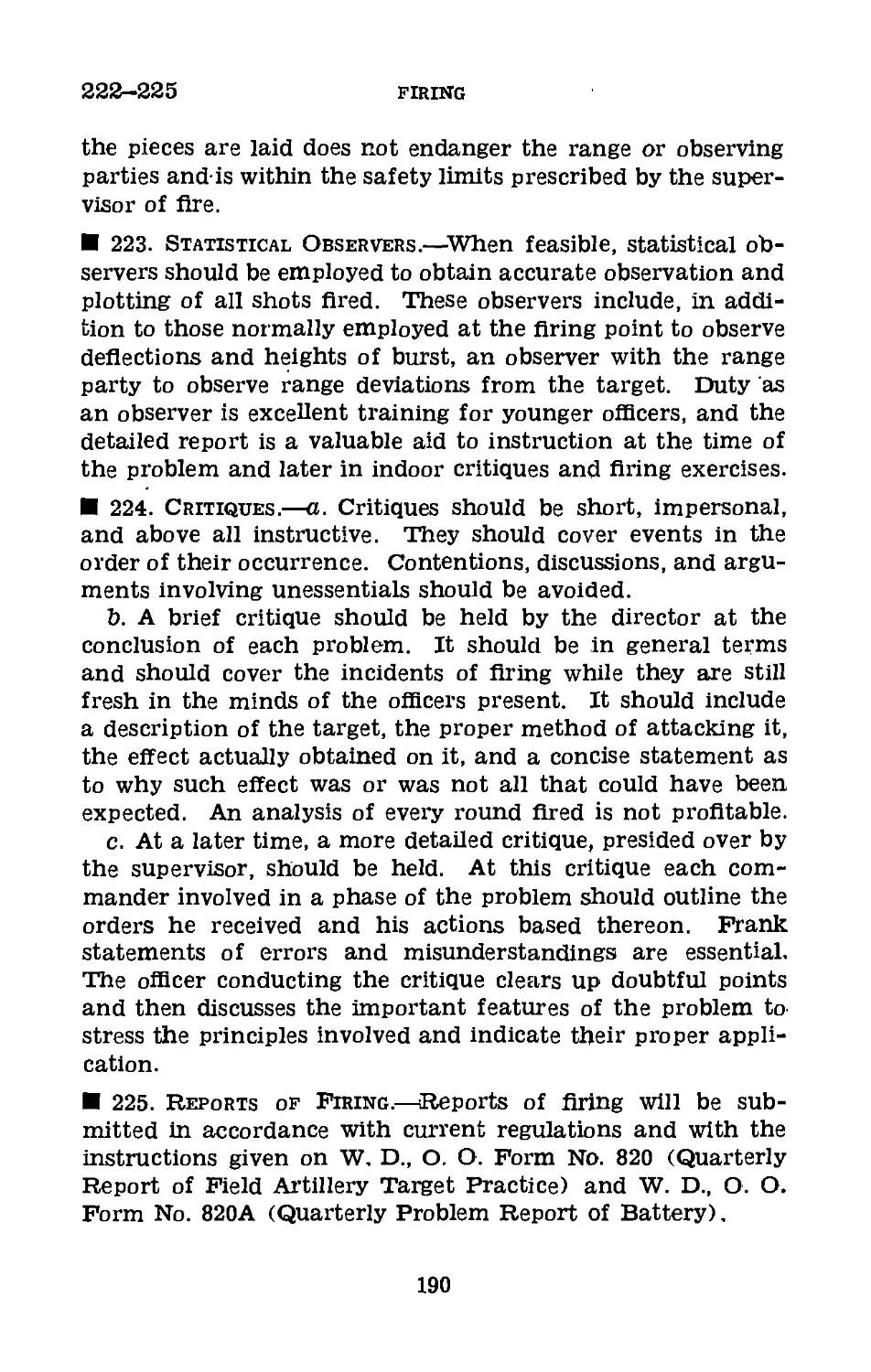
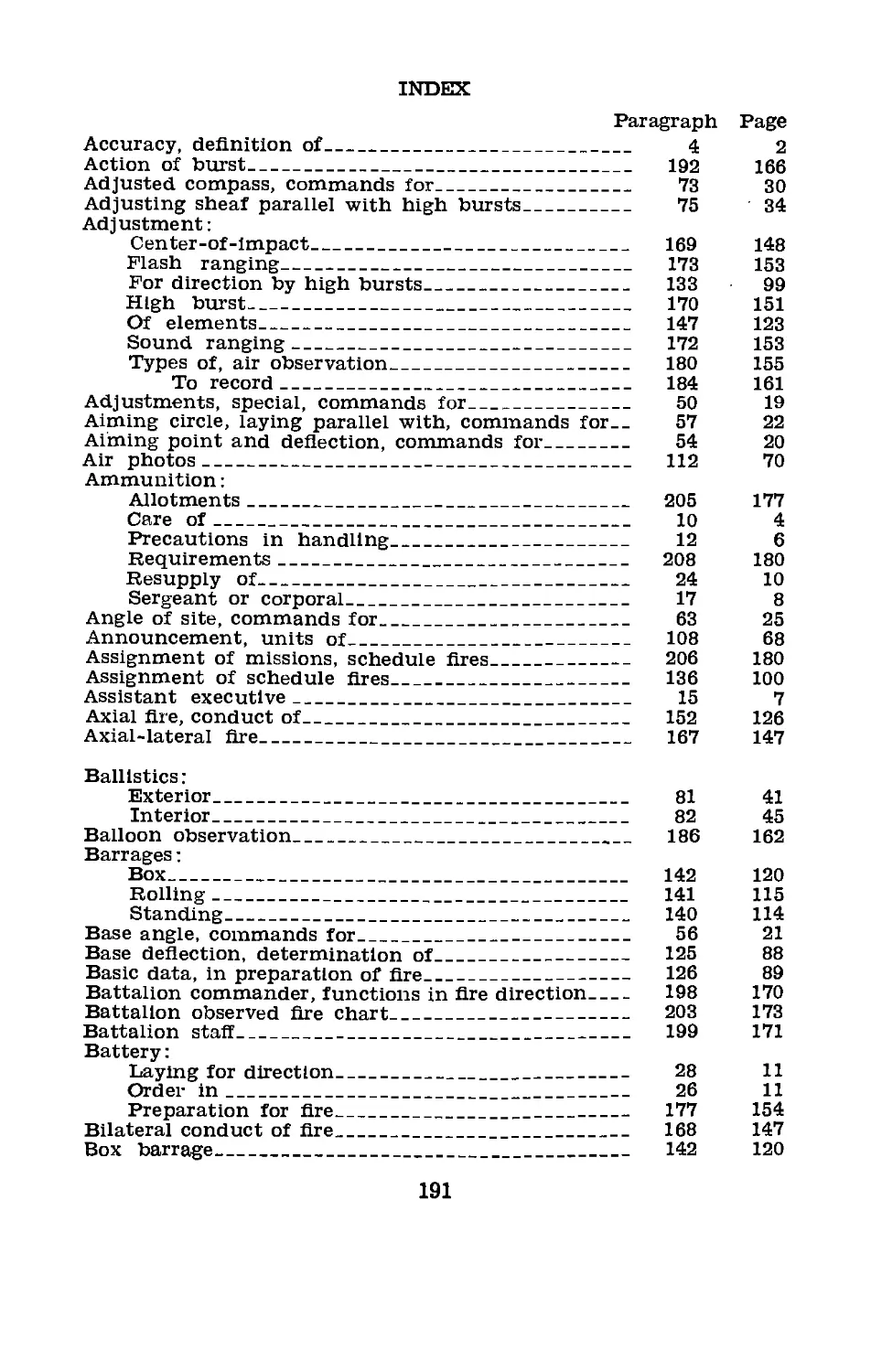
Tags: weapons
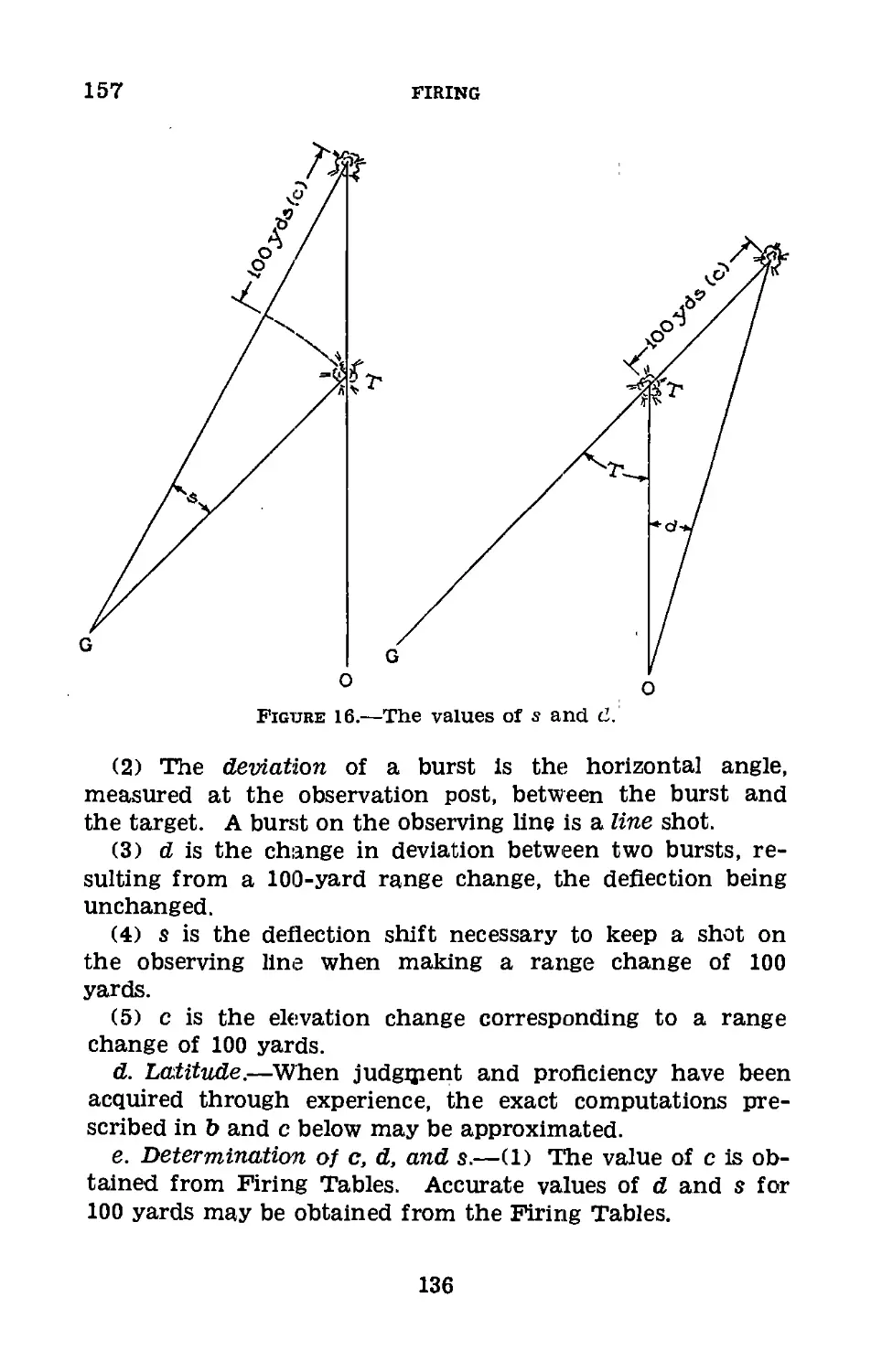
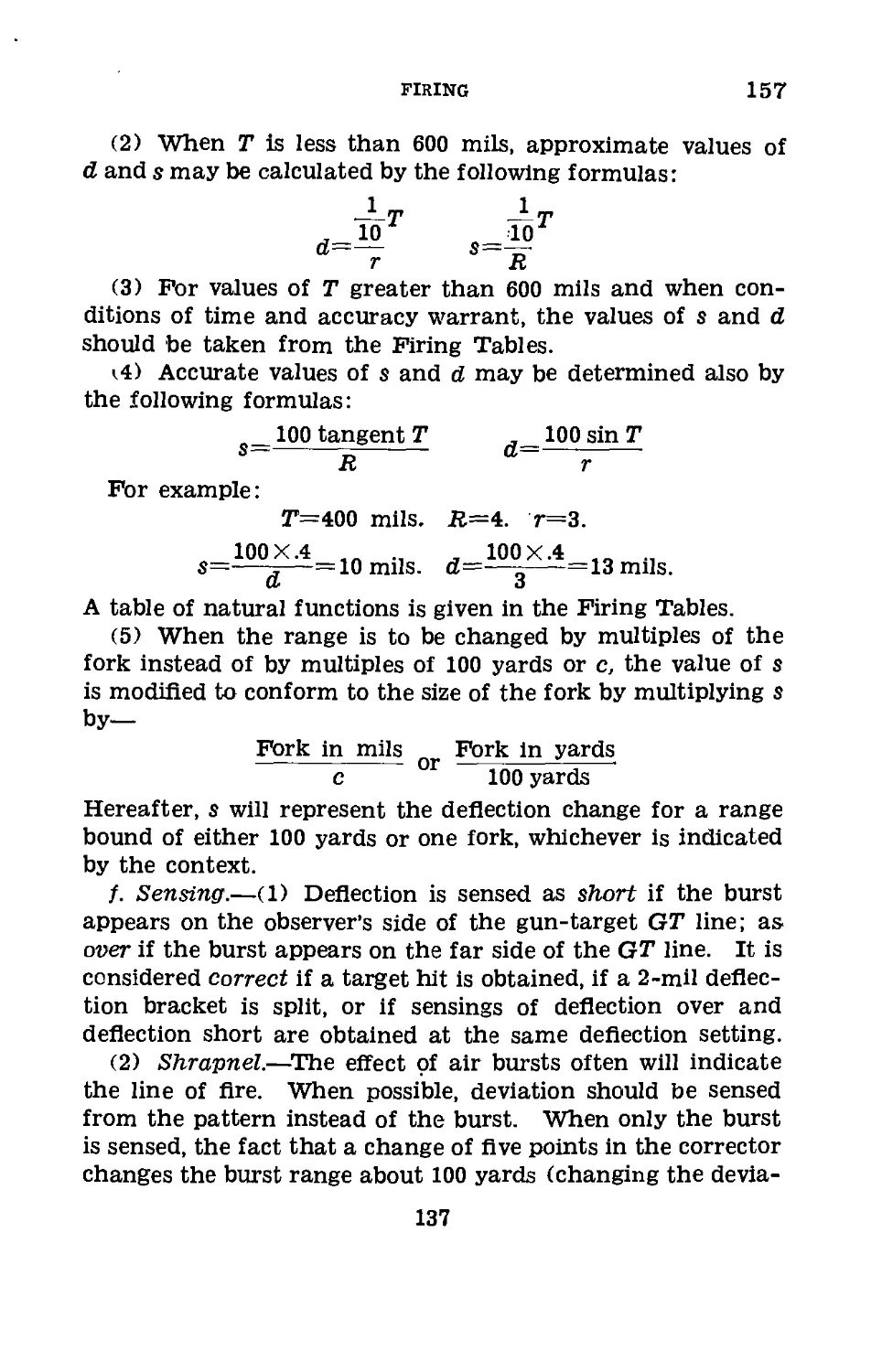
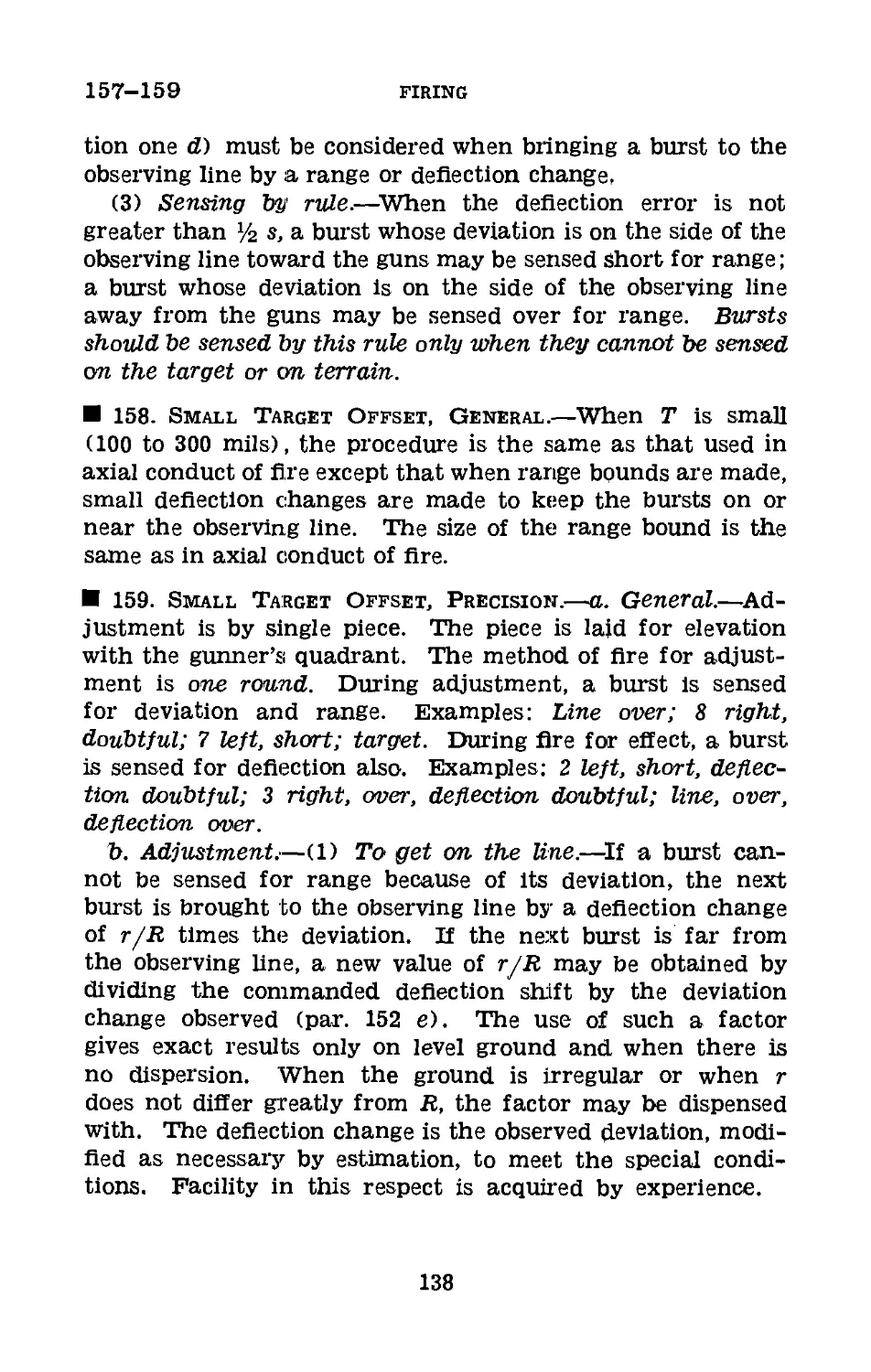
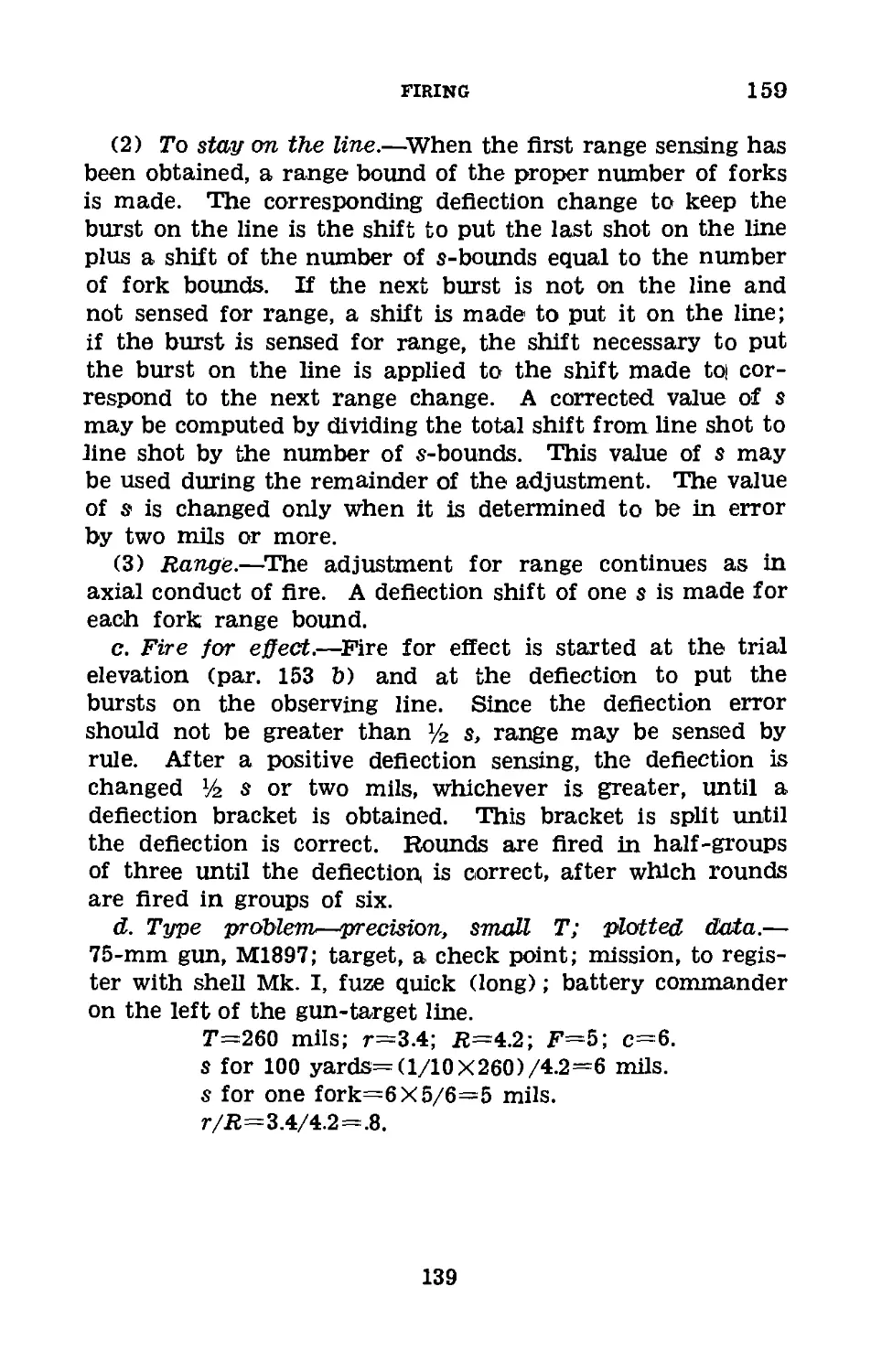
Year: 1939


Text
                    FM 6-40
MH I
Copy 3
-1 WAR DEPARTMENT
FIELD ARTILLERY
FIELD MANUAL
FIRING
FM 6-40
FIELD ARTILLERY
FIELD MANUAL
&
FIRING
Prepared under direction of the
Chief of Field Artillery
UNITED STATES
GOVERNMENT PRINTING OFFICE
WASHINGTON: 1939
For sale by the Superintendent of Documents, Washington, D. C.
Price 25 cents
WAR DEPARTMENT,
Washington, October 10, 1939.
FM 6-40, Field Artillery Field Manual, Firing, is published
for the information and guidance of all concerned.
[A. G. 062.11 (7-14-39).]
By order of the Secretary of War:
G. C. MARSHALL,
Chief of Staff.
Official :
E. S. ADAMS,
Major General,
The Adjutant General.
ii
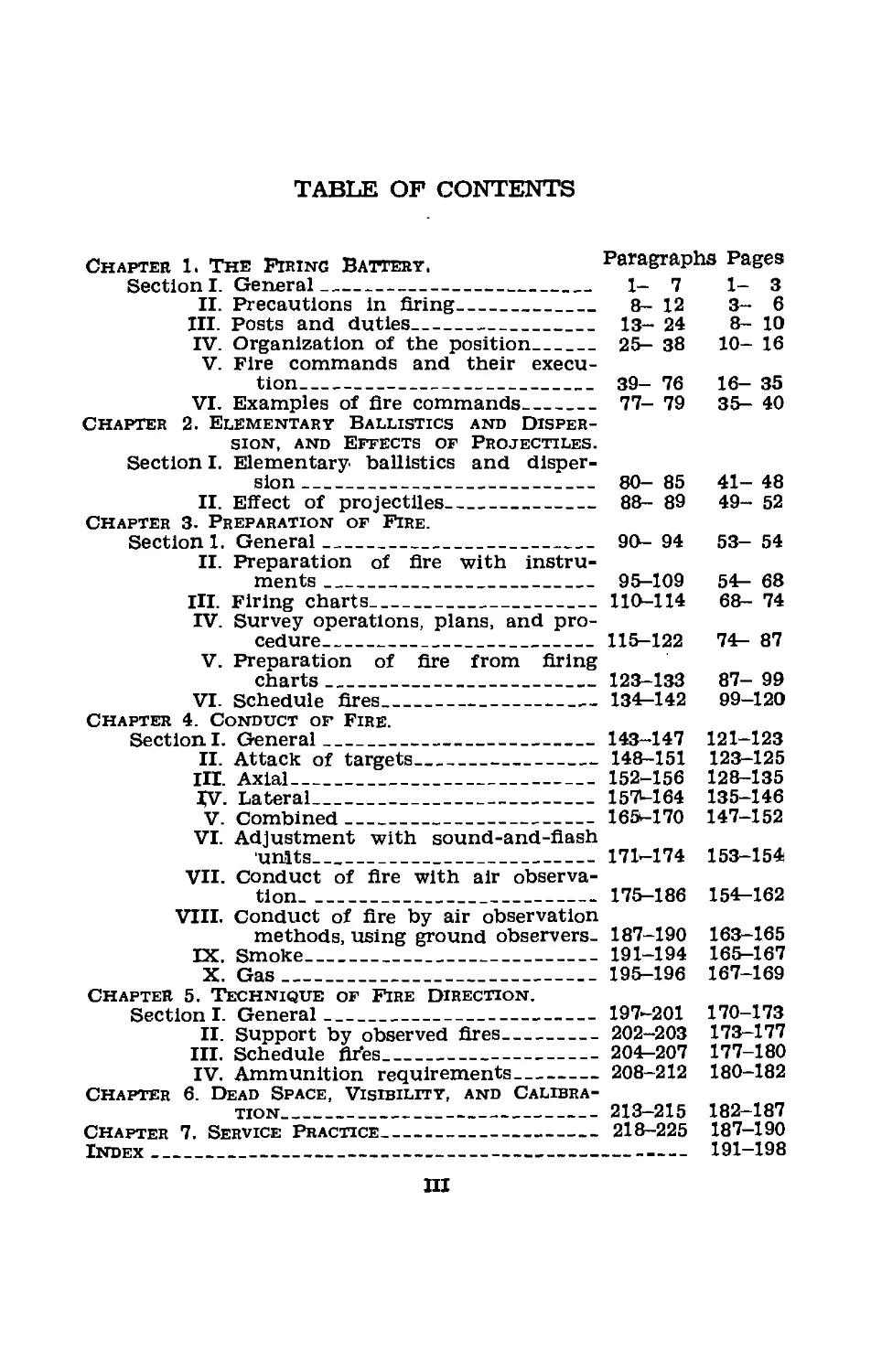
TABLE OF CONTENTS
Chapter 1.	The Firing Battery.	Paragraphs Pages
Section I. General__________________________ 1-7	1-3
II.	Precautions In firing____________ 8-12	3-6
III.	Posts and	duties_________________ 13-	24	8-	10
IV.	Organization of the	position_____ 25-	38	10-	16
V.	Fire commands and their execu-
tion_____________________________ 39-	76	16-	35
VI.	Examples	of fire commands_______ 77-	79	35-	40
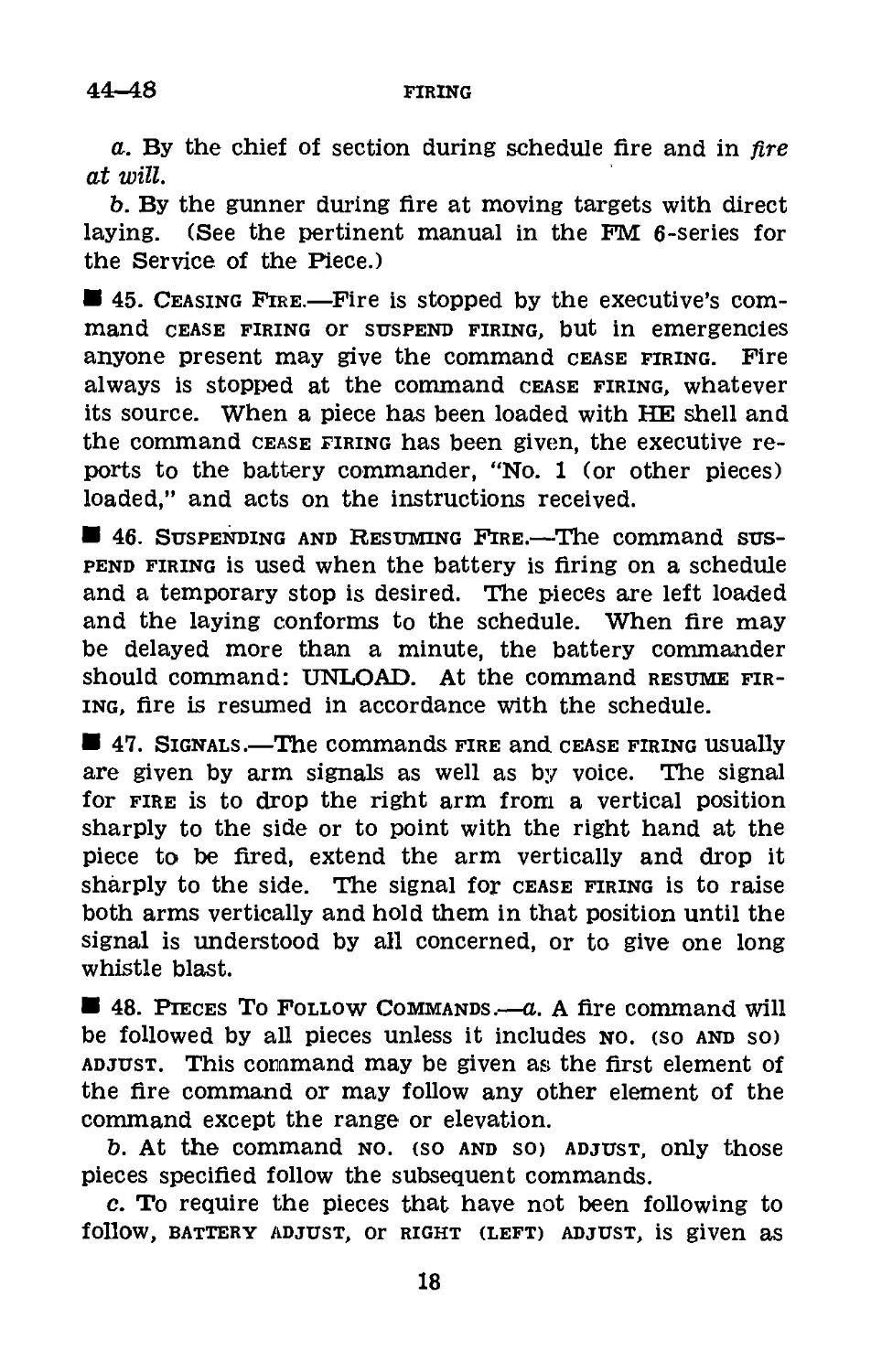
Chapter 2.	Elementary Ballistics and Disper-
sion, and Effects of Projectiles.
Section I. Elementary ballistics and disper-
sion ___________________________________________ 80— 85	41— 48
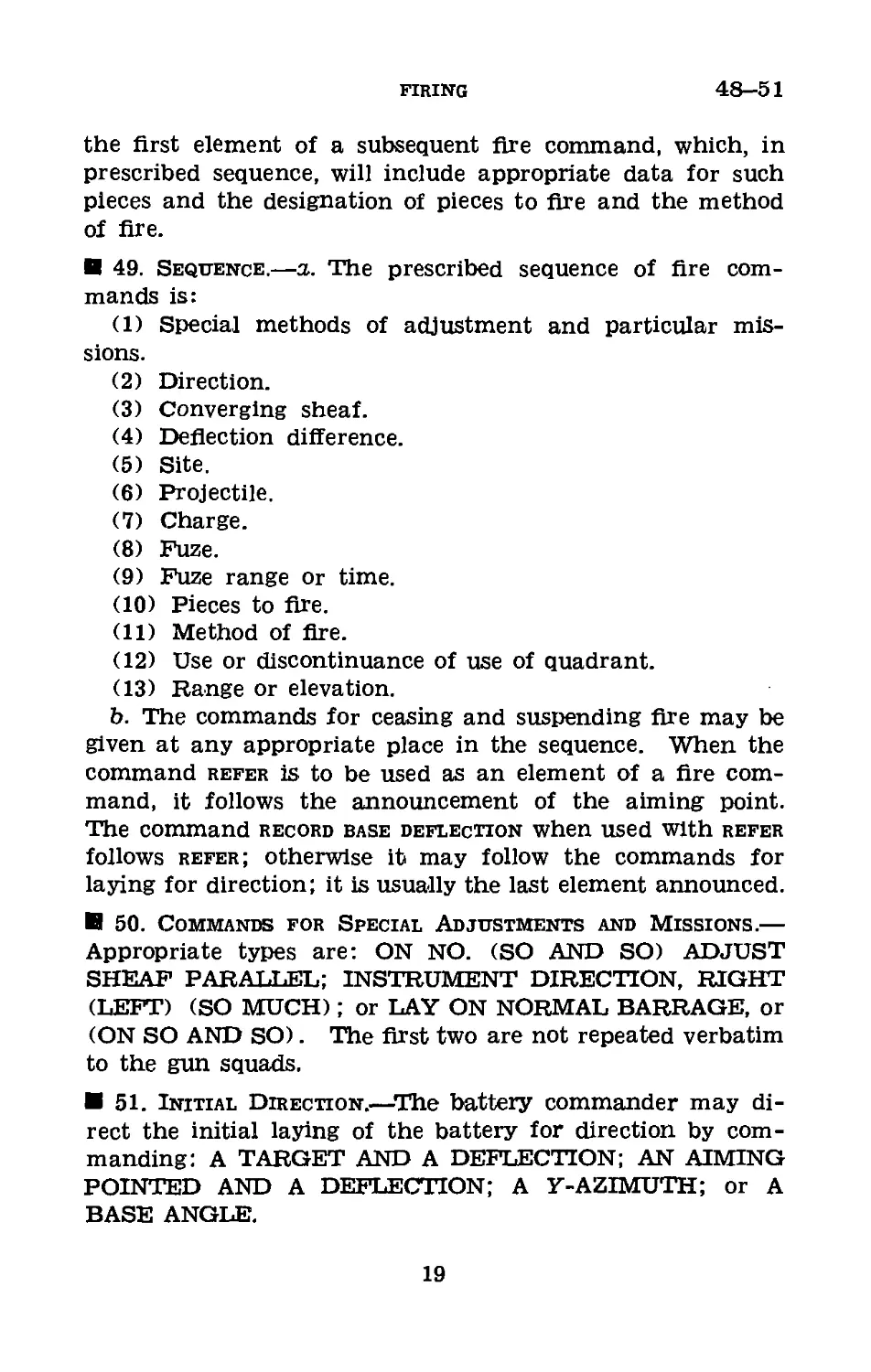
II. Effect of projectiles____________ 88- 89	49— 52
Chapter 3.	Preparation of Fire.
Section 1. General__________________________ 90- 94	53- 54
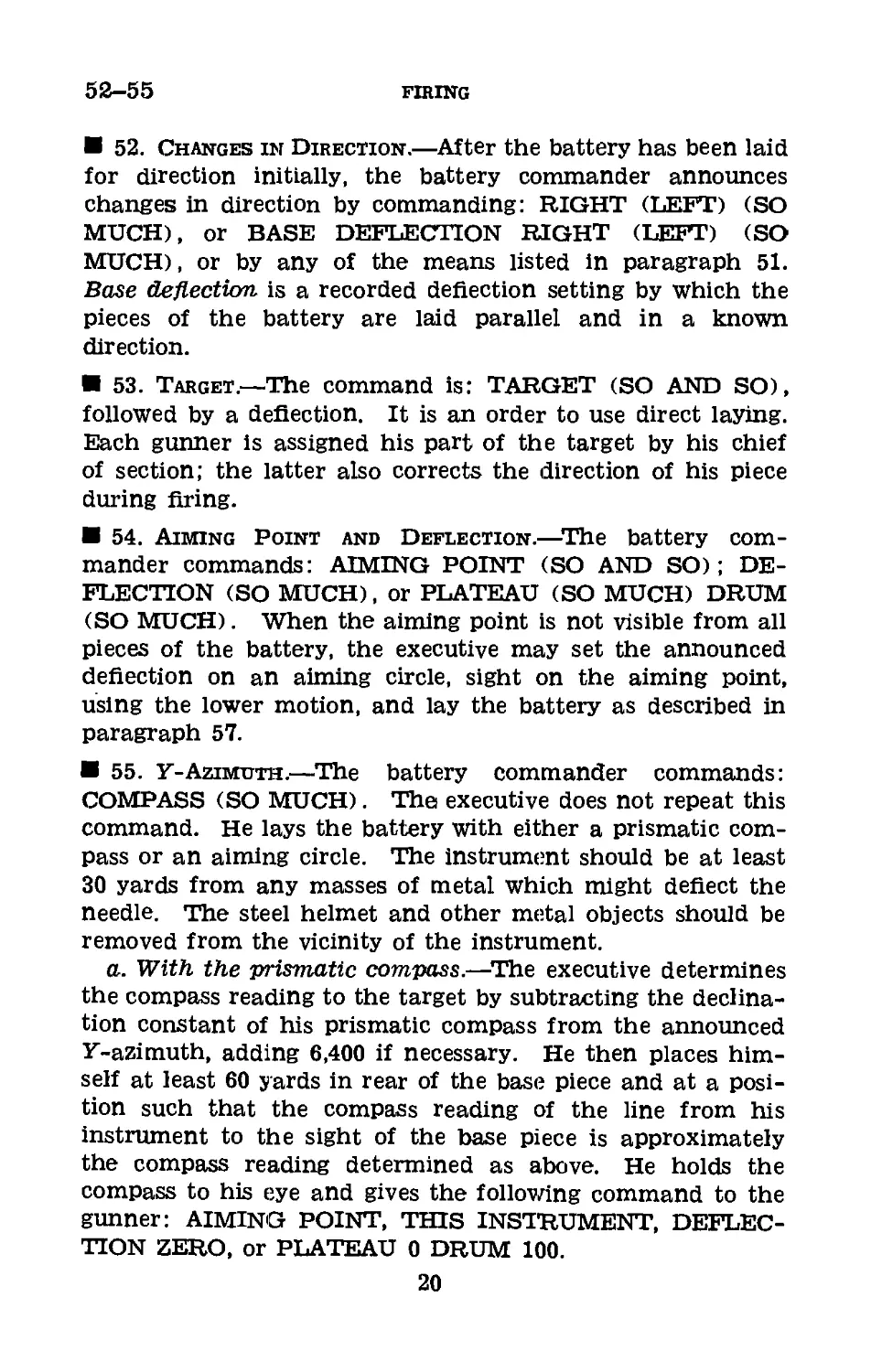
II.	Preparation of fire with instru-
ments _______________________________ 95—109	54— 68
III.	Firing charts____________________ 110-114	68- 74
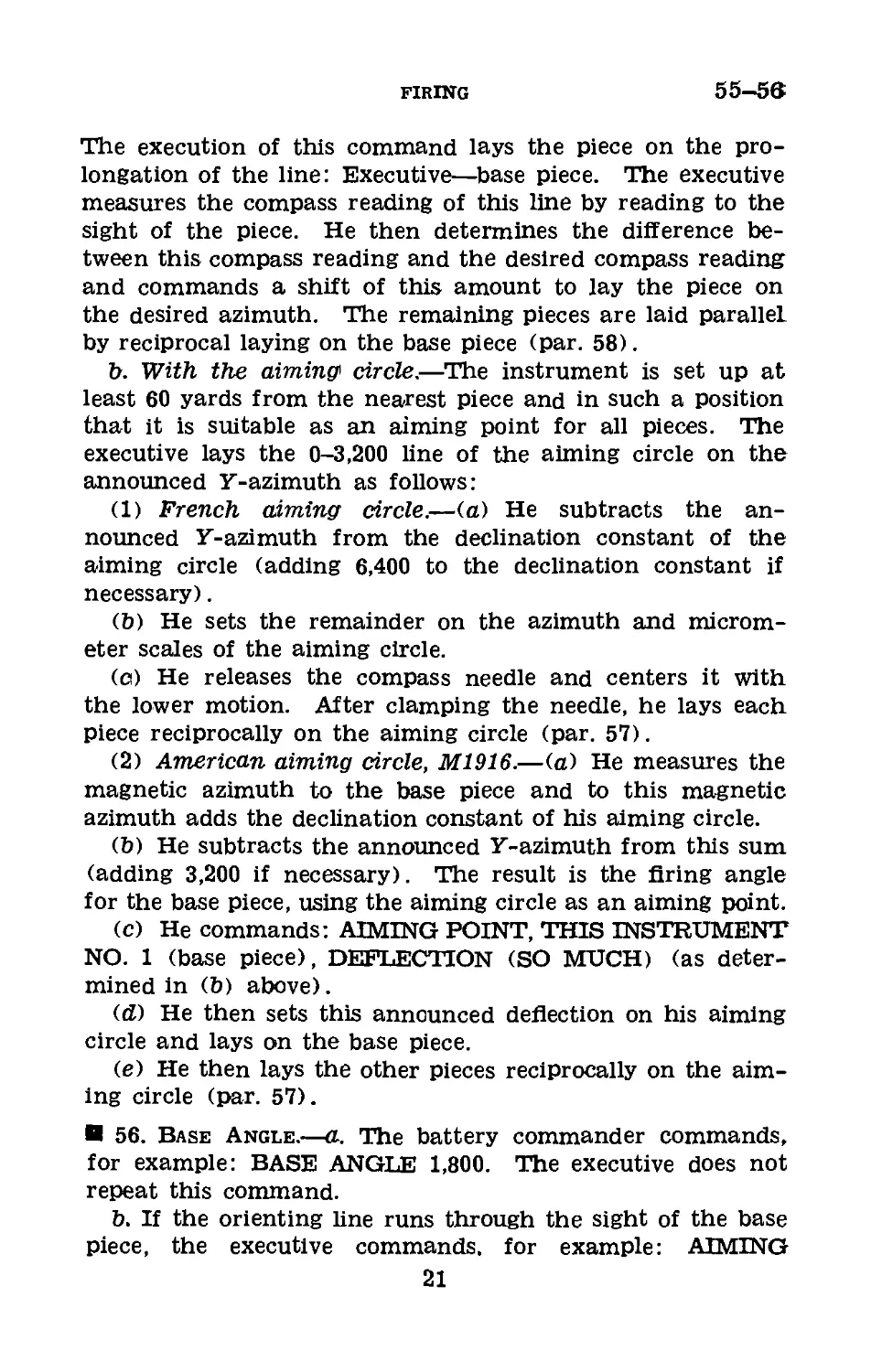
IV.	Survey operations, plans, and pro-
cedure________________________________ 115-122	74- 87
V.	Preparation of fire from firing
charts_______________________________ 123-133	87- 99
VI.	Schedule	fires__________________ 134-142	99-120
Chapter 4.	Conduct of Fire.
Section I. General__________________________ 143—147	121-123
II.	Attack of targets________________ 148-151	123-125
III.	Axial___________________________ 152-156	128-135
JV. Lateral_________________________ 1571-164	135-146
V.	Combined________________________ 165t-170	147-152
VI.	Adjustment with sound-and-fiash
units________________________________ 171-174	153-154
VII.	Conduct of fire with air observa-
tion__________________________________ 175-186	154-162
VIII.	Conduct of fire by air observation
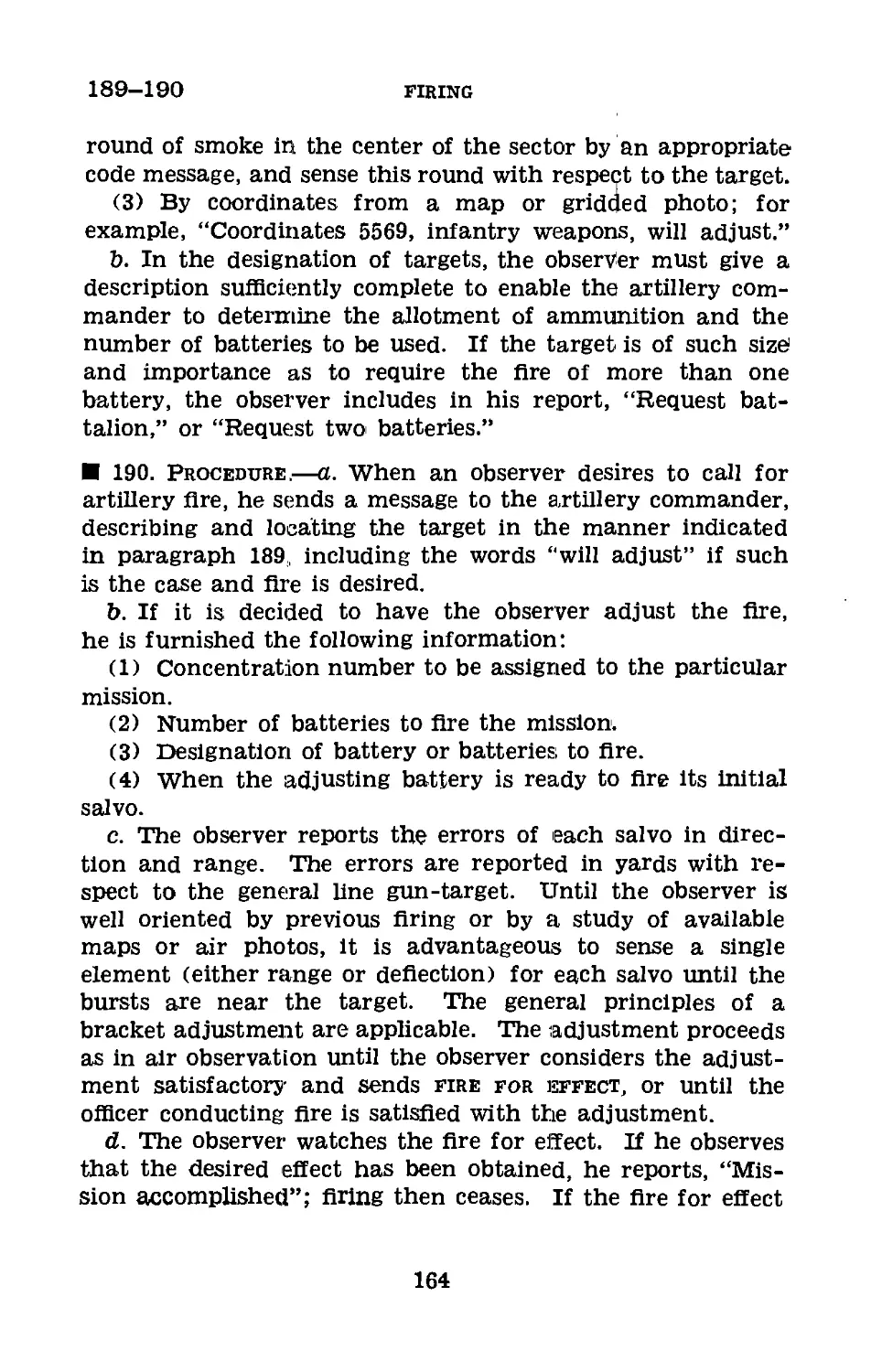
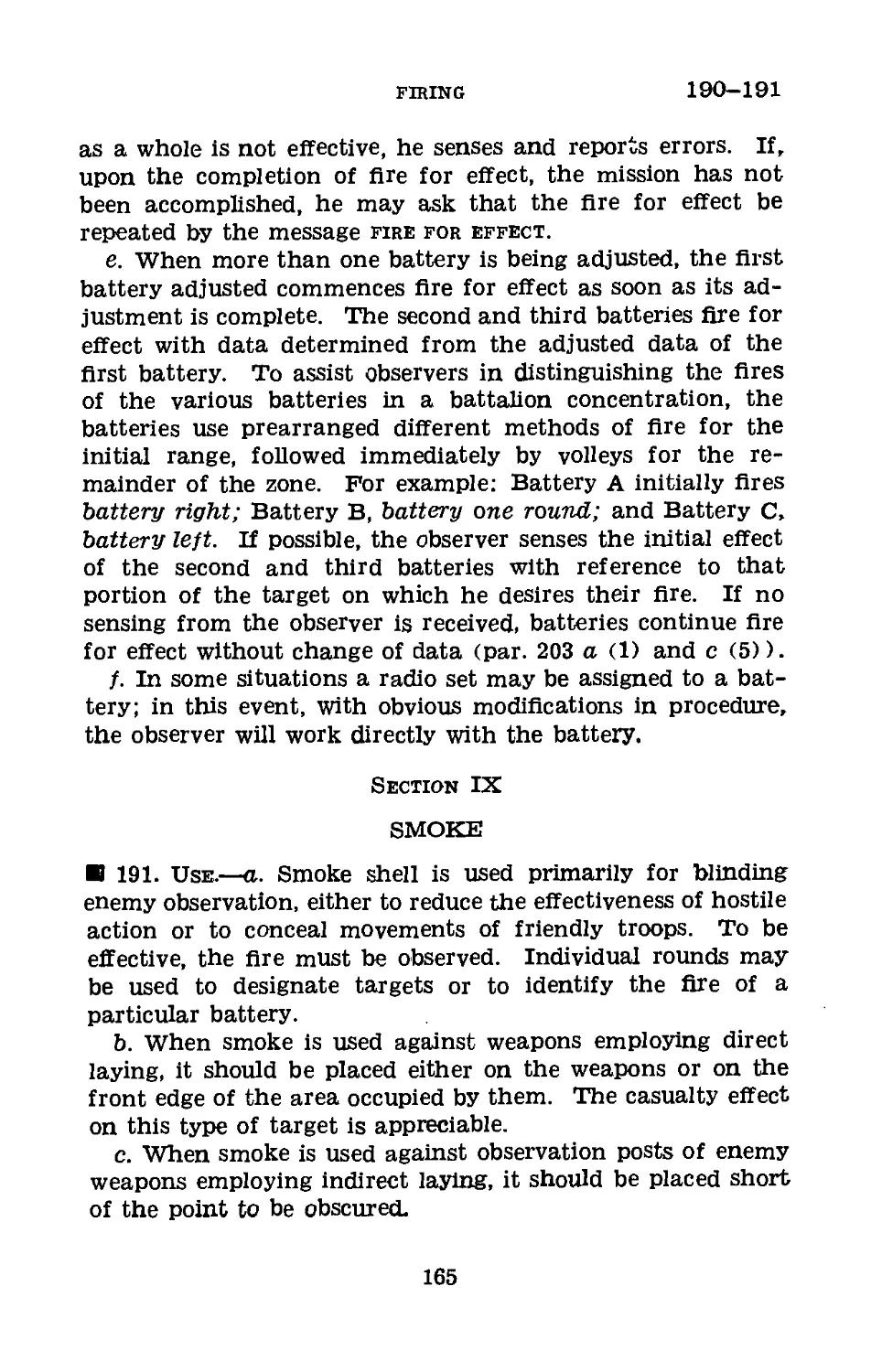
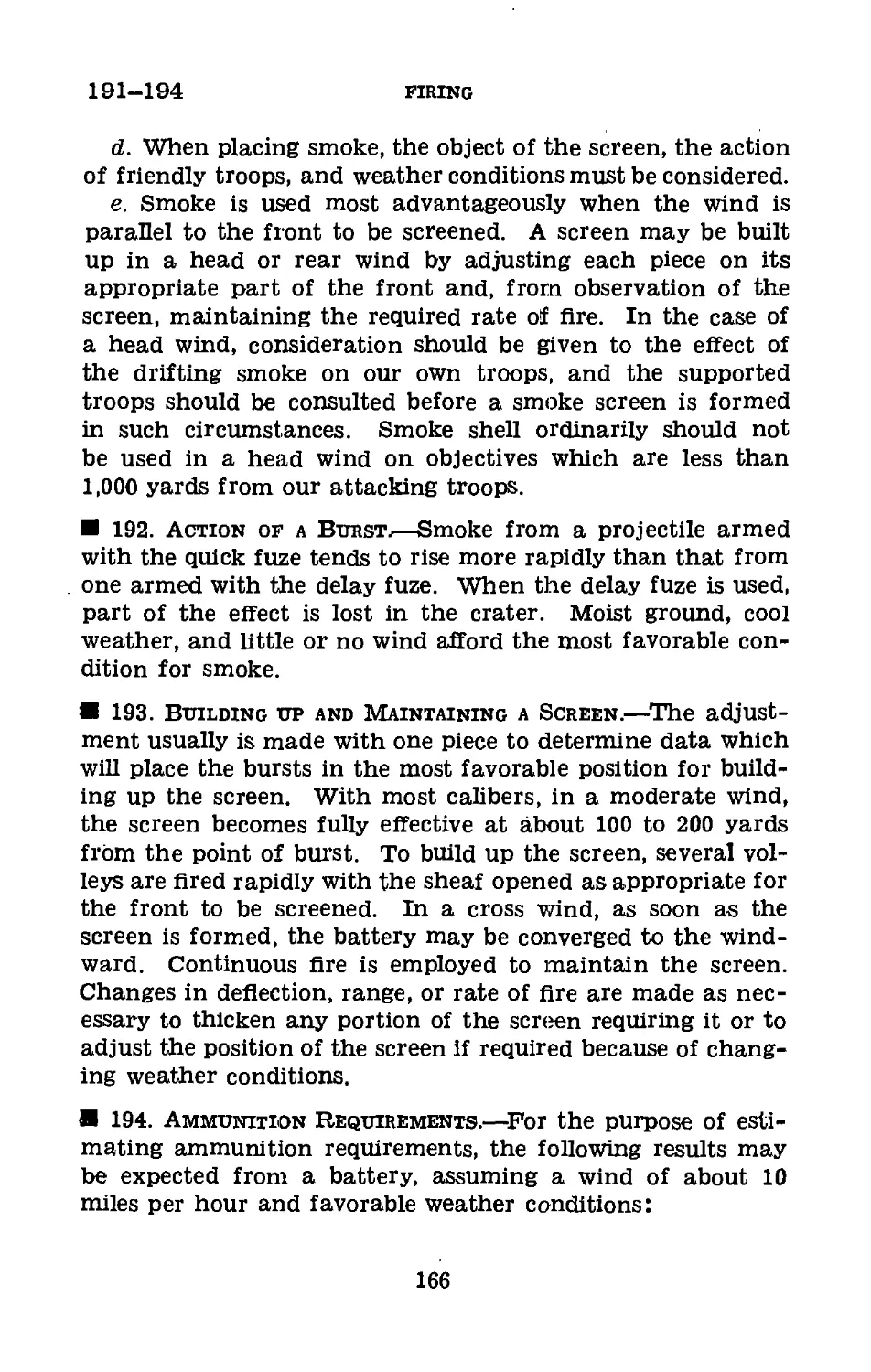
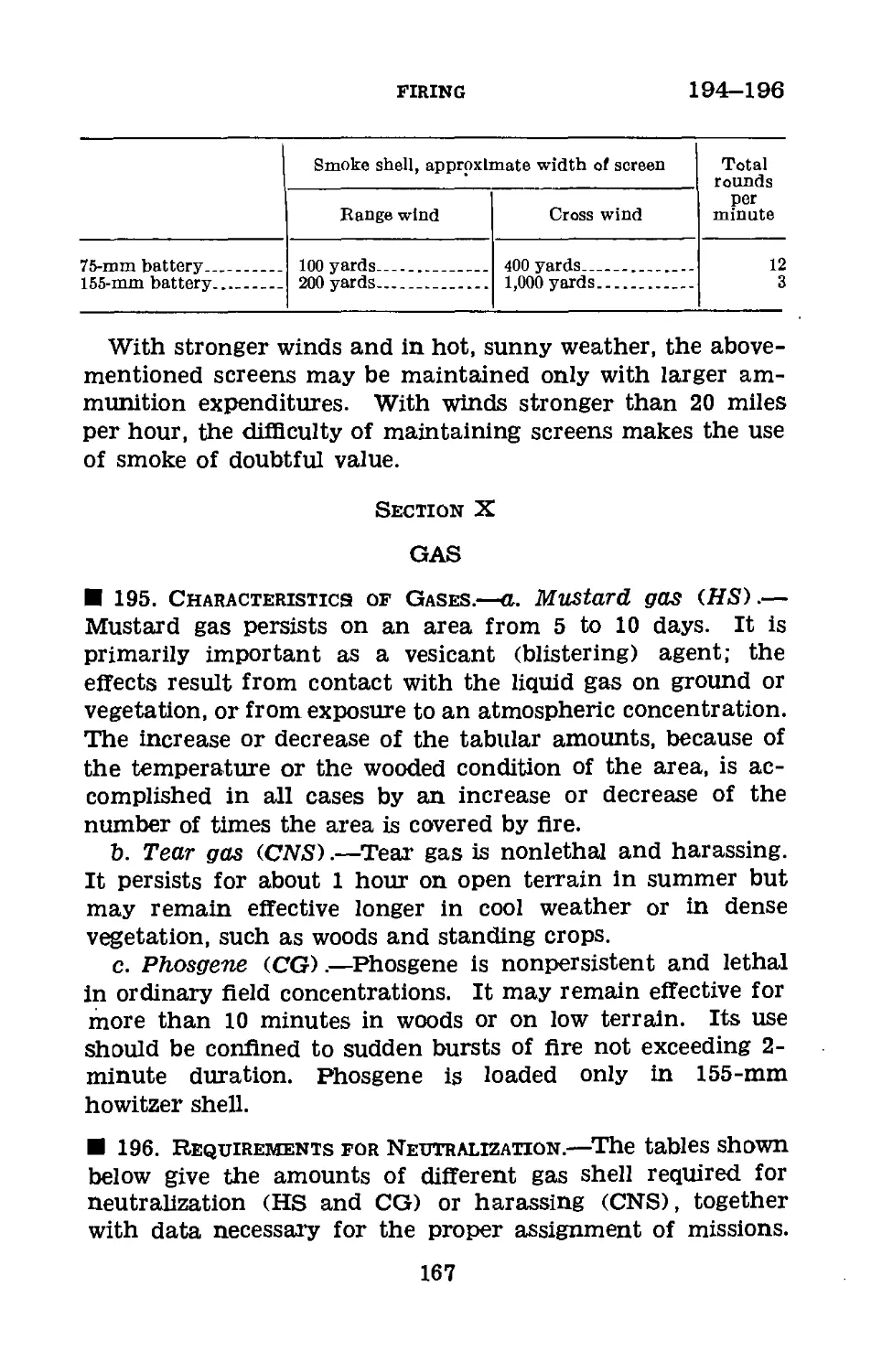
methods,	using ground	observers- 187-190	163-165
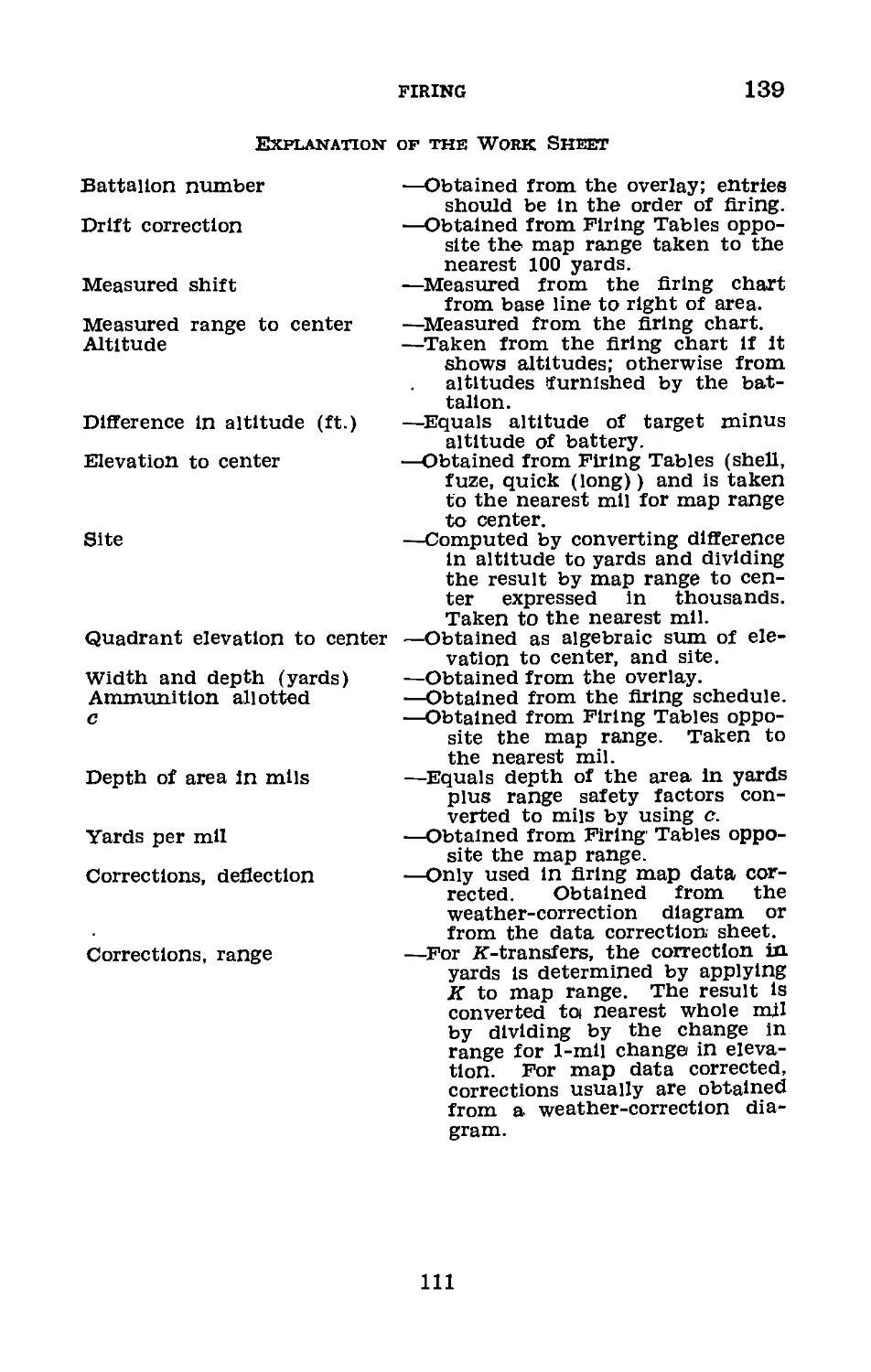
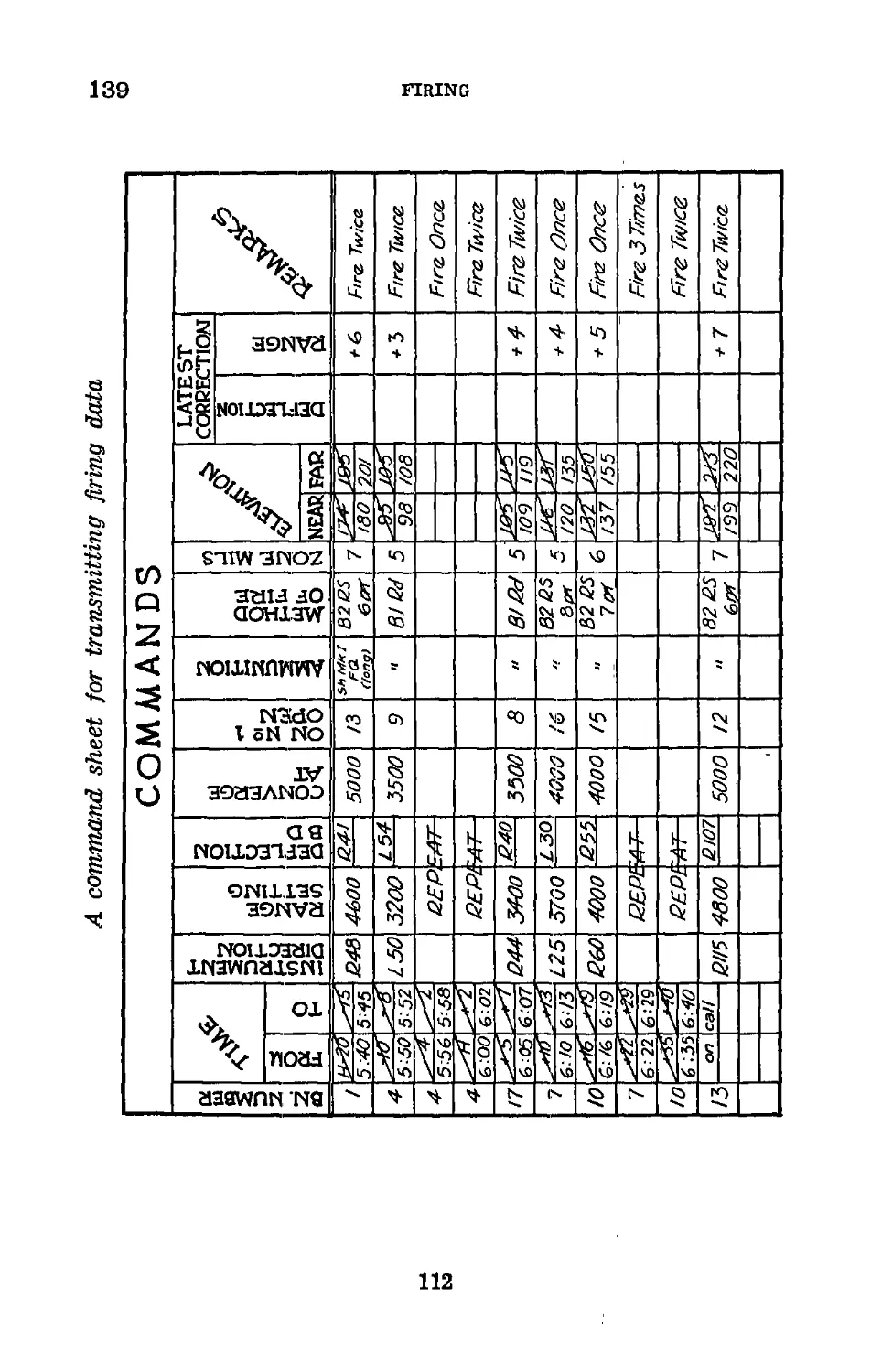
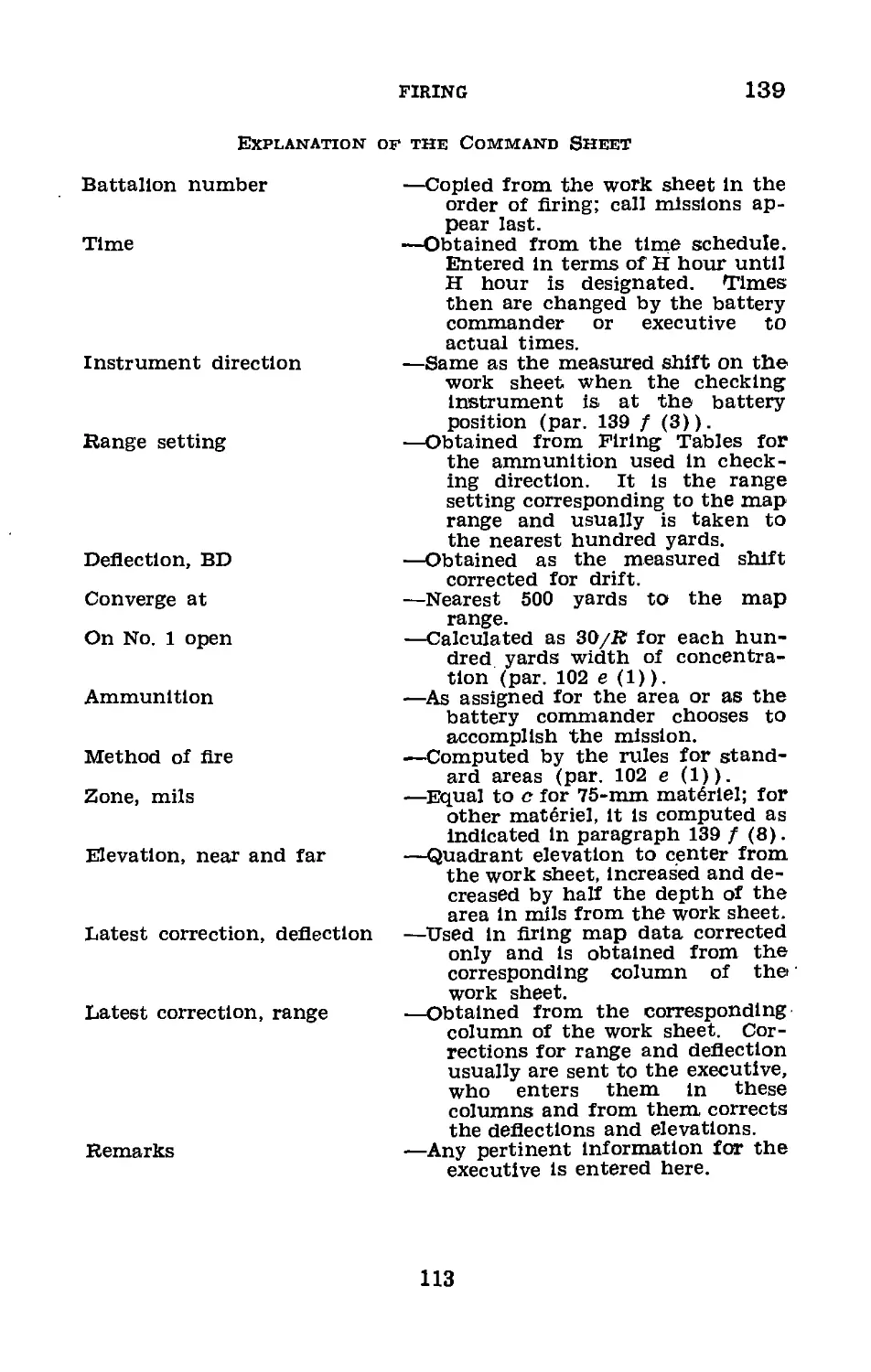
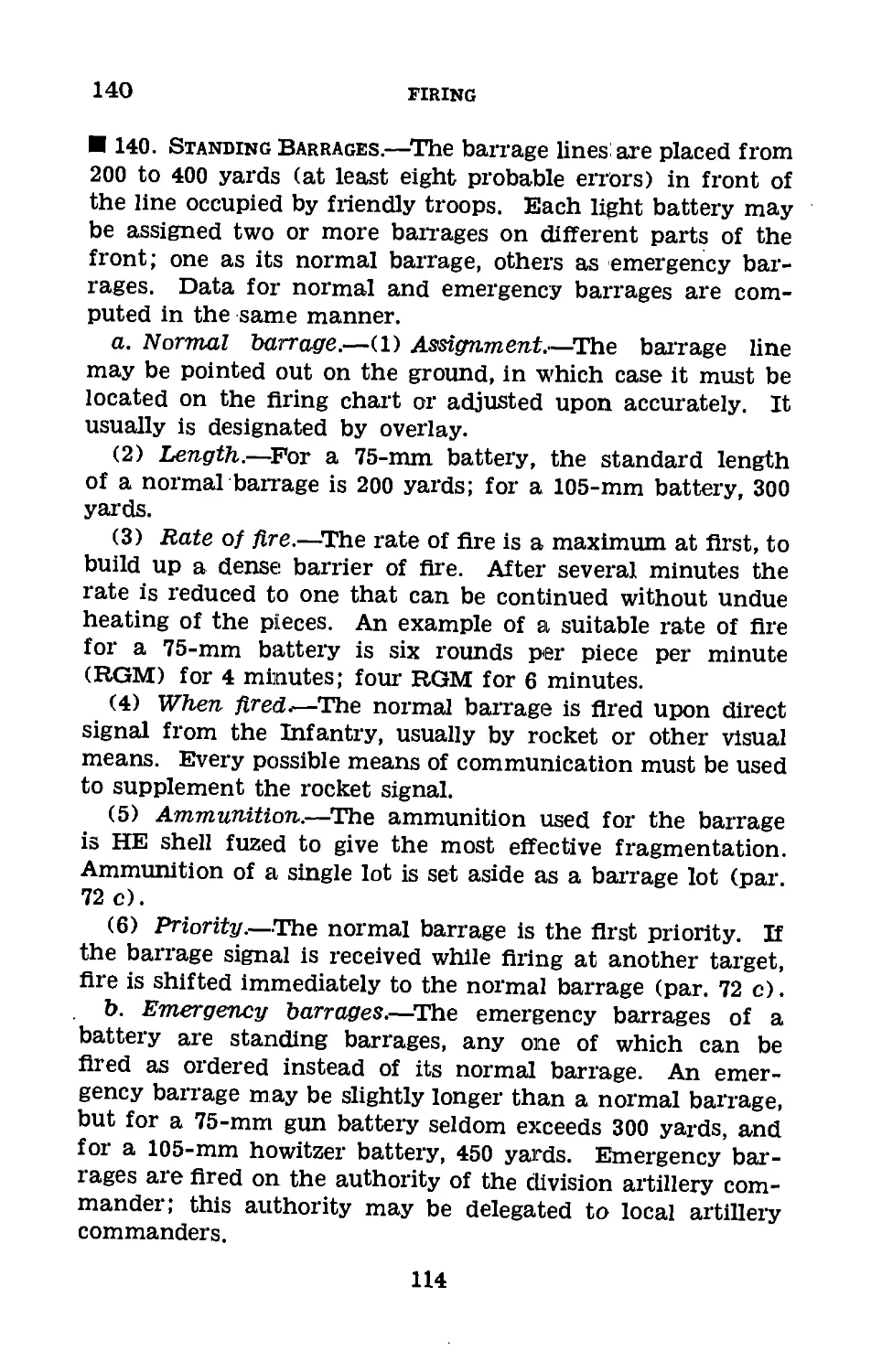
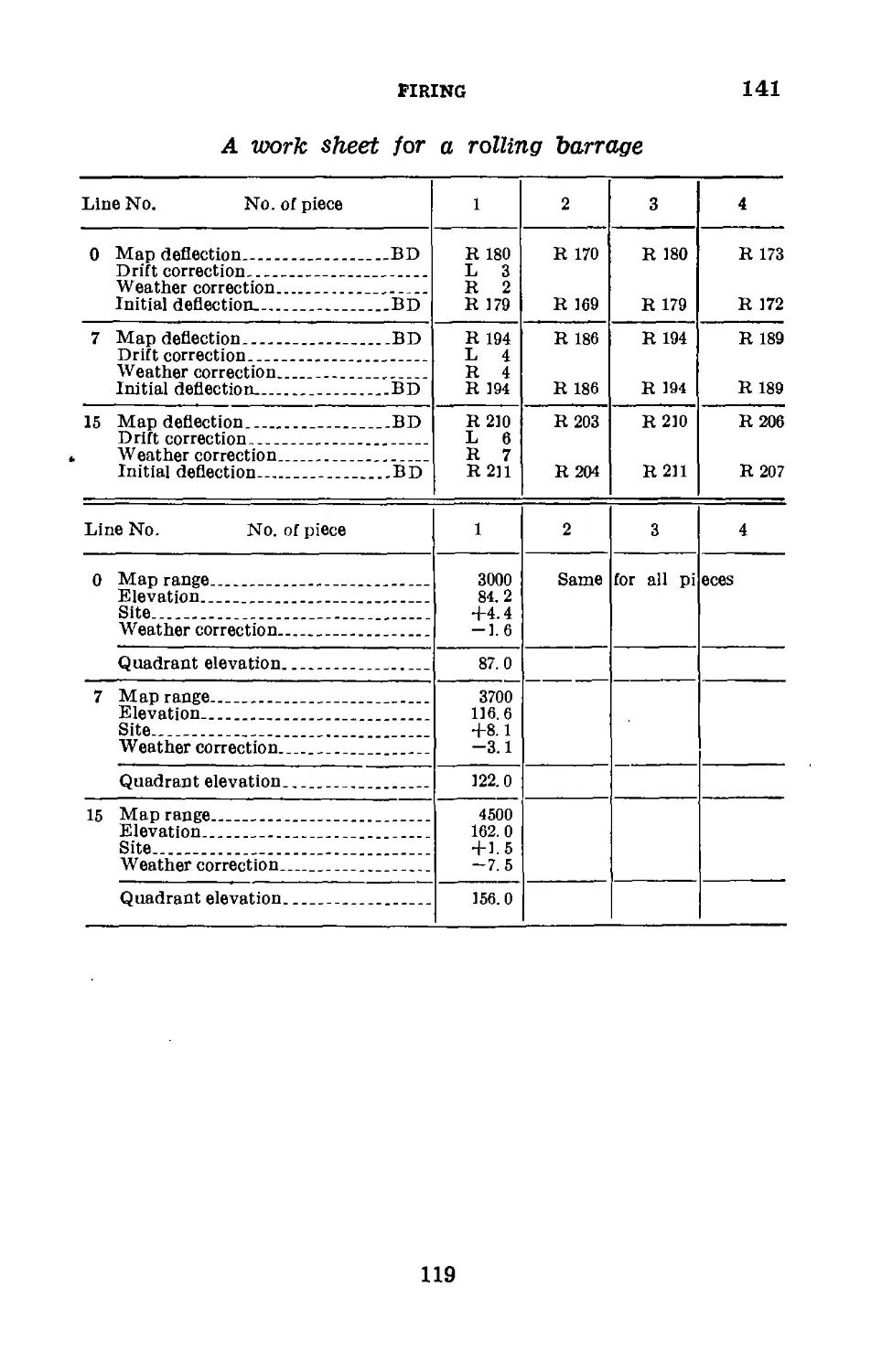
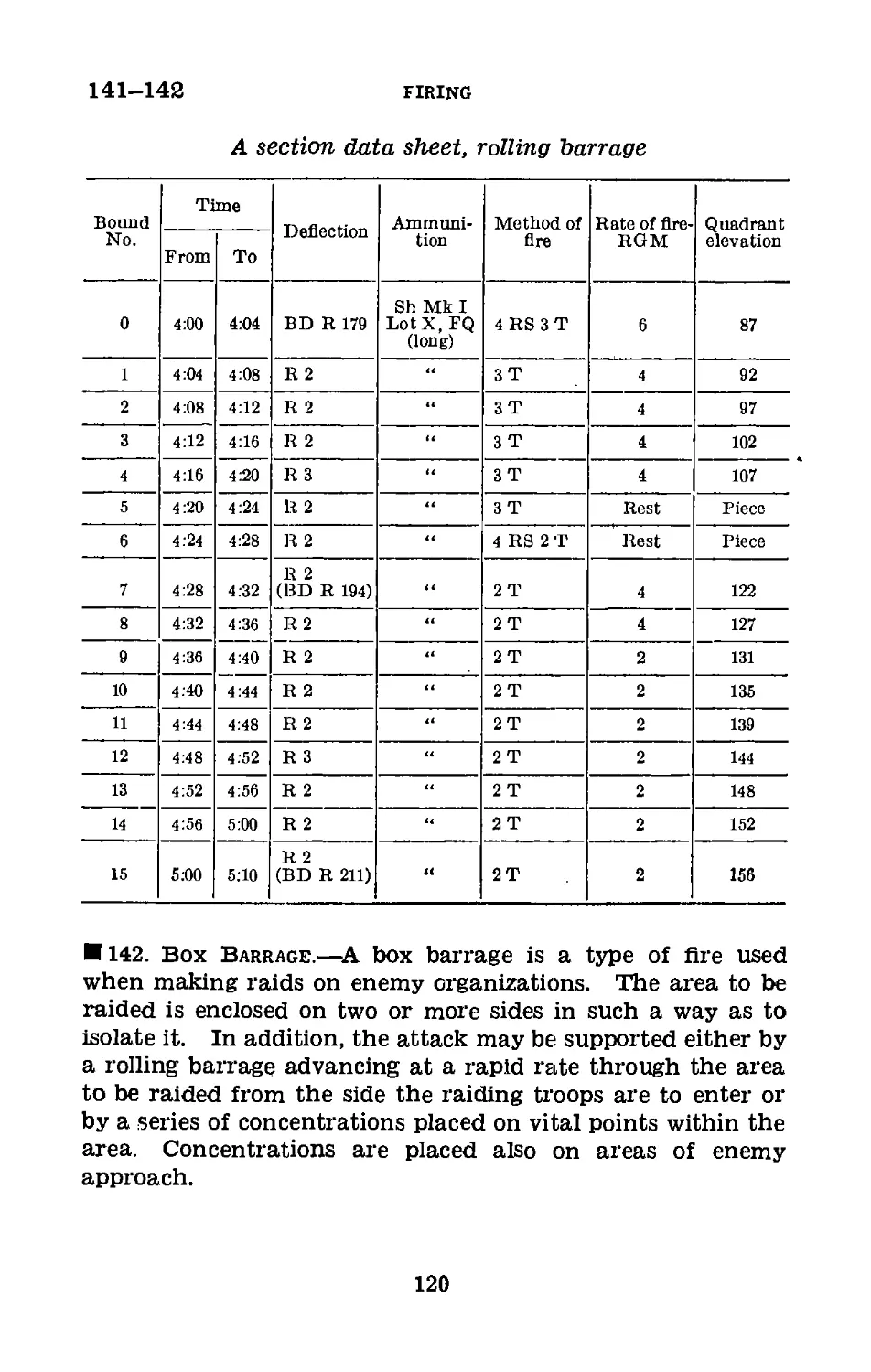
IX.	Smoke___________________________ 191-194	165-167
X.	Gas______________________________ 195-196	167-169
Chapter 5.	Technique of Fire Direction.
Section I. General__________________________ 197-201	170-173
II.	Support	by	observed	fires______ 202—203	173-177
III.	Schedule fifes__________________ 204-207	177-180
IV.	Ammunition requirements__________ 208-212	180-182
Chapter 6.	Dead Space, Visibility, and Calibra-
tion____________________________________________ 213-215	182-187
Chapter 7.	Service Practice___________________ 218-225	187-190
Index___________________________________________________ 191-198
Ш
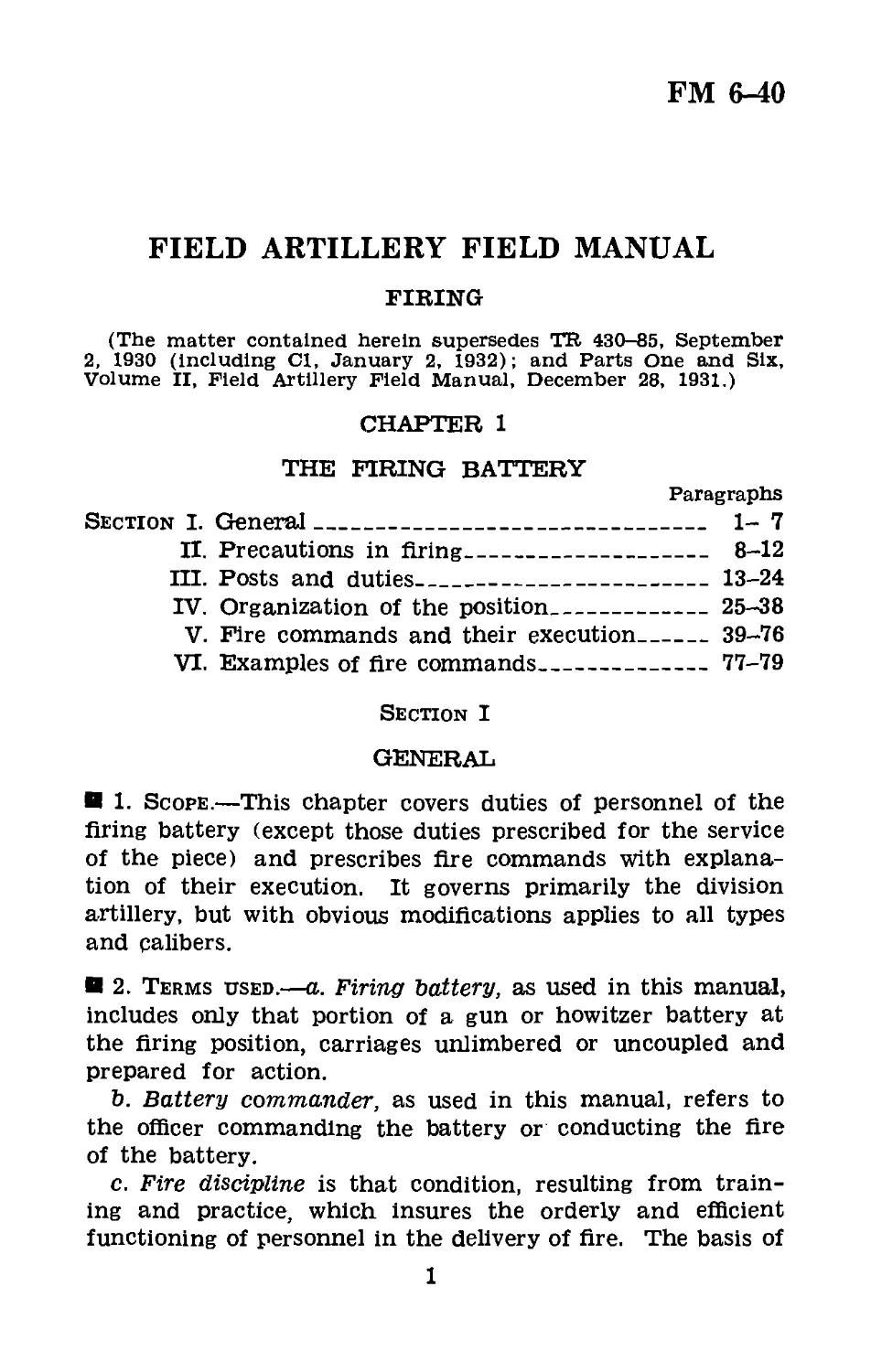
FM 6-40
FIELD ARTILLERY FIELD MANUAL
FIRING
(The matter contained herein supersedes TR 430-85, September
2, 1930 (Including Cl, January 2, 1932); and Parts One and Six,
Volume II, Field Artillery Field Manual, December 28, 1931.)
CHAPTER 1
THE FIRING BATTERY
Paragraphs
Section I. General________________________________ 1- 7
П. Precautions in firing___________________ 8-12
HI. Posts and duties________________________13-24
IV.	Organization of the position____________25-38
V.	Fire commands and their execution______39-76
VI.	Examples of fire commands_______________77-79
Section I
GENERAL
	1. Scope.—This chapter covers duties of personnel of the
firing battery (except those duties prescribed for the service
of the piece) and prescribes fire commands with explana-
tion of their execution. It governs primarily the division
artillery, but with obvious modifications applies to all types
and calibers.
	2. Terms used.—a. Firing battery, as used in this manual,
includes only that portion of a gun or howitzer battery at
the firing position, carriages unlimbered or uncoupled and
prepared for action.
b. Battery commander, as used in this manual, refers to
the officer commanding the battery or conducting the fire
of the battery.
c. Fire discipline is that condition, resulting from train-
ing and practice, which insures the orderly and efficient
functioning of personnel in the delivery of fire. The basis of
1
2-4
FIRING
fire discipline is the thorough training of the individual
soldier.
 3. Training.—a. The object of training is the perfection
of fire discipline throughout the firing battery as a whole.
Training includes instruction in the care, preservation, de-
scription, and nomenclature of materiel; the acquirement
of a knowledge of the duties of all cannoneers in the squad
by each member thereof, and a thorough understanding of
fire command; and the development of manual dexterity and
teamwork in the mechanical operations involved. The
executive is charged with this training.
b.	Gun squad training is the preliminary phase of train-
ing in fire discipline; firing battery instruction is the ad-
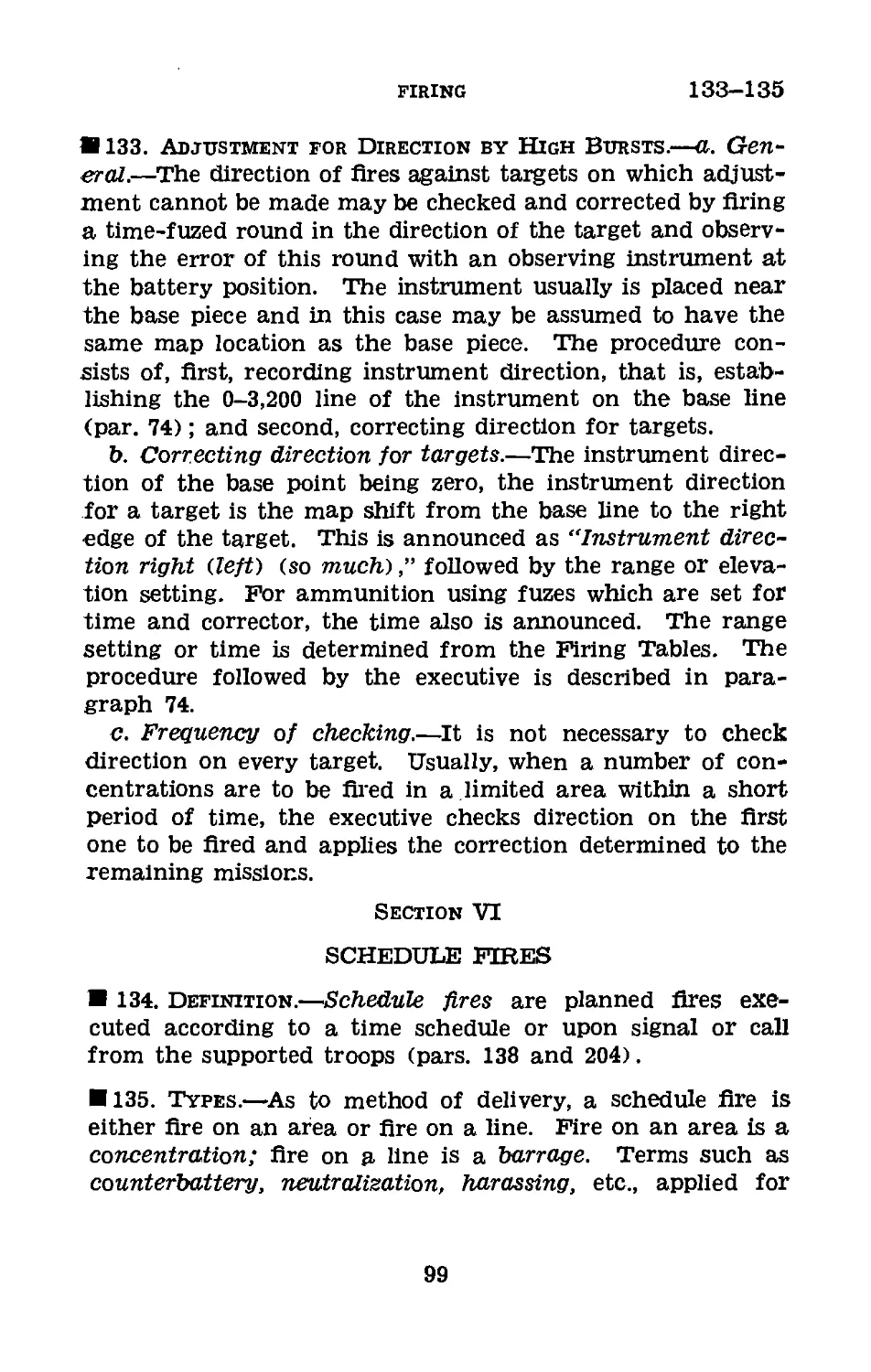
vanced phase. Training of the firing battery should be
started shortly after instruction of gun squads is begun.
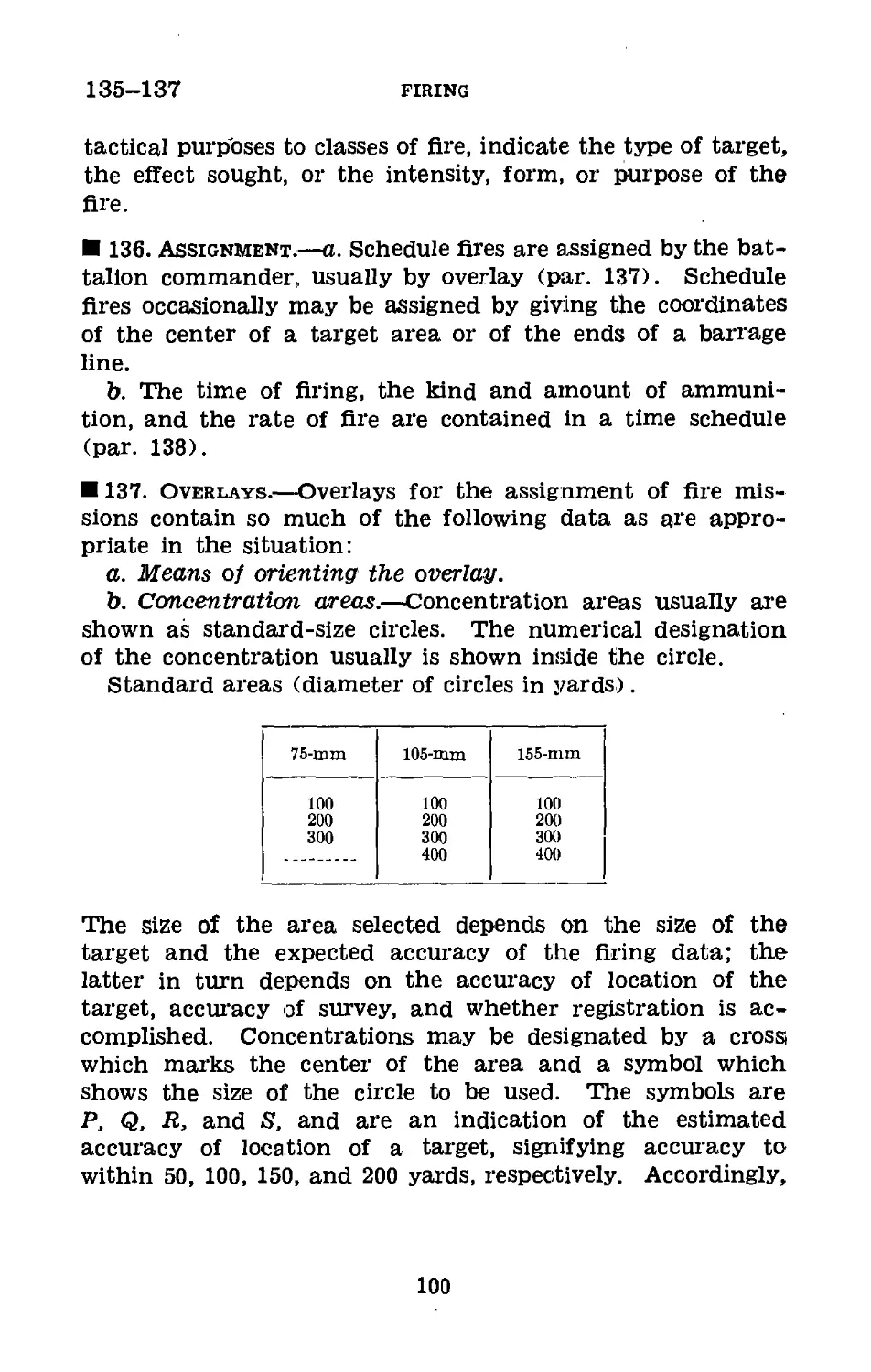
c.	Firing battery instruction is started in the gun park.
As proficiency is gained, the training advances to varied
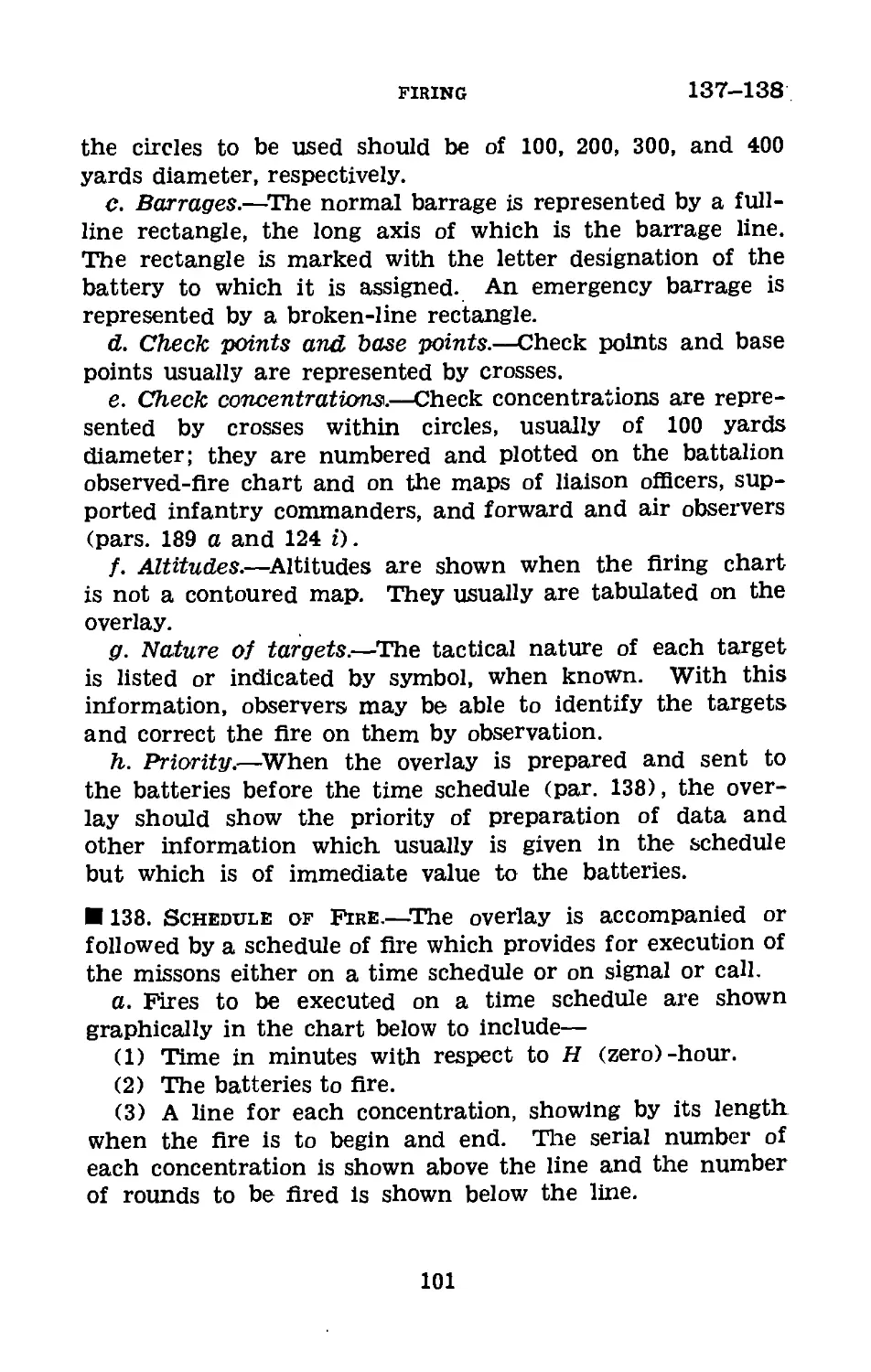
terrain and simulated service conditions. Occupation and
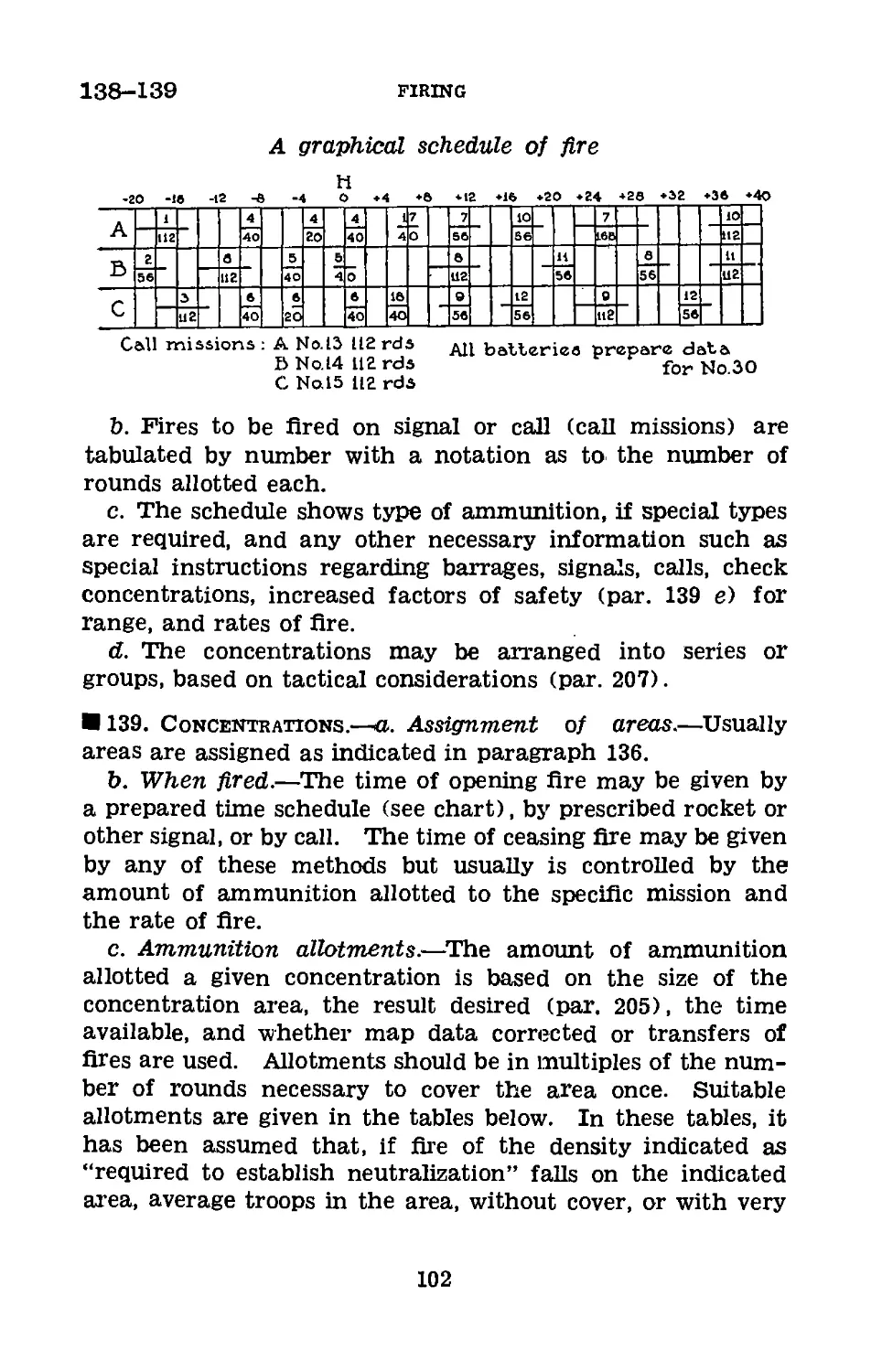
organization of position under varied conditions, including
darkness and bad weather, should be practiced. Fire on
targets is first simulated, followed by subcaliber and service
practice.
d.	Each battery should maintain a minimum of four
trained gun squads. Individuals of special aptitude should
be assigned appropriately to permanent positions, but at
drills posts should be changed frequently in order to develop
flexibility and permit the ready replacement of absentees or
casualties.
e.	During maneuver or campaign as well as during the
training year, frequent drill of the firing battery is necessary
to maintain a high standard of fire discipline. However,
during actual firing, while correction of errors is necessary,
instruction in the service of the piece will be avoided since
it interferes with the effective delivery of fire.
 4. Accuracy and Speed.—Accuracy in the performance of
individual duties must be stressed; it is obtained by insistence
upon exactness from the beginning. Speed acquired by
prompt performance of individual duties in regular sequence
must not be stressed at the expense of accuracy
2
FIRING
5-9
	5. Lost Motion.—To eliminate the effects of lost motion,
settings must be made in a uniform manner as prescribed
for the particular piece or instrument concerned.
	6. Checking.—a. Frequent checks of setting and laying
are necessary to insure accuracy, both at drill and during
firing. Checking during firing is usually restricted to lulls
in action, except that when firing close to friendly troops
constant checking by the executive and assistant executive is
indispensable. It must be made with an absolute minimum
of delay in firing.
b. When a piece is discovered to have fired with an error
in laying, the error is corrected and reported immediately to
the battery commander. When a piece is plainly and unac-
countably in error, firing with it ceases and it is reported out
of action until the error is found and corrected.
 7. Uniformity.—Uniformity is necessary both in giving
and in executing commands. However, while instruction
always should conform to the spirit and principles of this
manual, latitude is allowed in the practical application,
thereof, and subordinates are encouraged to use their skill
and ingenuity in solving the problems which occur in
service.
Section II
PRECAUTIONS IN FIRING
	8. Reference.—Special measures peculiar to a particular
weapon will be found in the pertinent manual of the FM 6-
series for the Service of the Piece.
	9. Care of Materiel.—a. As soon as practicable after ar-
tillery materiel has been used, it is cleaned and put in order
under the supervision of an officer. Lost or unserviceable
parts are replaced or repaired. The work is not complete
until everything is again ready for immediate service.
b.	Before the piece begins firing, the chief of section veri-
fies that the recoil mechanism contains the proper amount
of liquid; thereafter he carefully observes the functioning
of the recoil system.
3
9-10
FIRING
c.	In the case of separate-loading ammunition, the powder
chamber is swabbed out after each round to extinguish
sparks. During firing, a pail of water is kept under each
piece and the bore is washed whenever fire is suspended for a
short time. Usually it is sufficient to wash the bore forward
a distance of 2 feet from the breech for light and medium
and 6 feet for heavy artillery.
d.	During prolonged firing, it is desirable to rest each
piece at least 5 minutes of each hour.
e.	When time permits during suspension of fire, the breech-
block is dismounted, cleaned, and oiled, and the bore cleaned
as prescribed in Technical Regulations for the materiel.
f.	Permissible rates of fire for short bursts (up to 10 min-
utes) and for prolonged fire are given in FM 6-130; these
rates are exceeded only if the situation demands it.
 10. Care of Ammunition.—Ammunition is sorted and
stored by lots. When received boxed or crated, it is kept
packed as long as practicable; after it is unpacked, it is pro-
tected from dirt and ground moisture by being placed on
paulins or raised off the ground. Each lot is covered by a
paulin or other material to protect it from rain and sun and
to keep the temperature uniform throughout that particular
lot. The paulin or other covering should be raised to allow
free circulation of air.
a.	Projectiles.—Unpacked projectiles and complete rounds
are piled. Piles or groups are located 10 or more yards apart
and contain not more than one hundred rounds of 75-mm
ammunition, fifty 155-mm projectiles, or twenty-five 240-mm
projectiles. When piled, the height will not exceed five
layers for 75-mm ammunition and three layers for 155-mm
projectiles. Planks or brush are placed between layers.
Projectiles of 240-mm caliber are never piled but may be laid
horizontally. Care is taken to prevent injury to the rotating
bands; they are always examined before firing and any burrs
removed with a file. Chemical shell are piled at a distance
from the battery, in a direction downwind from the prevail-
ing wind, and are inspected frequently for leakage. Adapter
plugs are left in projectiles until immediately before the fuzes
4
FIRING
10-11
are to be inserted, and the projectiles are not fuzed until
immediately before they are to be fired.
b.	Powder charges.—It is especially necessary that powder
charges be kept dry and ventilated. They are kept in mois-
ture-proof containers until just before use. Powder charges
are so stored as to reduce the possibility of their ignition in
case of a flare-back or other accident at the piece.
c.	Fuzes and primers.—Fuzes and primers are kept dry
and stored separately from the other components of the
ammunition. They are not carried on the person. Primers
are especially sensitive to shock. Fuzes are seated securely
(screwed home with the fuze wrench issued for that pur-
pose) before firing. If difficulty is encountered in screw-
ing home a fuze or if a fuze is otherwise defective, it is laid
aside temporarily and at a convenient time it is buried 3
feet deep or turned over at the position to ordnance person-
nel if available. Before returning ammunition to a vehicle
or container, a careful check is made to insure that the
combination fuzes are set at safety and that other types of
fuzes are removed from projectiles and properly stored or
disposed of otherwise. The precautions to be taken in the
use of any particular type of fuze are given in the Technical
Regulations pertaining to the materiel.
d.	Misfires.—See the FM 6-series for the Service of the
Piece.
 11. Unloading a Piece.—a. Unloading fixed ammunition or
projectiles is to be avoided whenever possible. If unloading
a piece becomes necessary, in case the projectile cannot be
extracted readily or becomes separated from the cartridge
case when the breech is opened, it is removed under the di-
rect supervision of an officer, using a rammer which bears
only on the projectile and provides for clearance around the
fuze.
b. When unloading fixed ammunition, the breech is opened
very slowly to reduce the likelihood of separating the car-
tridge case from the projectile and of scattering loose pow-
der from the propelling charge inside the breech. Should
the cartridge case separate from the projectile, the piece is
brought to the horizontal and the breech recess cleaned to
5
11-14
FIRING
remove the loose powder. When the rammer is used, the
recess in the -rammer head is inspected to insure that it is
free from foreign matter. Projectiles being removed should
be prevented from falling to the ground when forced to the
rear.
 12. Precautions in Handling Ammunition.—The following
precautions also are observed:
a.	Ammunition is not tossed, rolled, or dropped.
b.	Smoking in the vicinity of explosives is prohibited; care
is taken to avoid sparks or open flames nearby.
c.	A round of ammunition held in preparation for reload-
ing the piece is kept free from the path of recoil.
d.	Tampering with or disassembling any component of a
round is prohibited.
e.	Any ammunition exposed to gas is wiped off immediately
with an oiled rag.
f.	Personnel handling chemical projectiles are provided
with gas masks and gloves.
g.	All rounds are examined before loading.
h.	With pieces using separate loading ammunition, prim-
ers are not inserted until after the breechblock is closed and
locked in its recess.
i.	When the long lanyard is used, it will not be attached
until the piece is otherwise ready to fire.
j.	Pieces are examined before firing is begun to insure that
their safety features are in order and that the bores are
clear.
Section III
POSTS AND DUTIES
	13. General.—Individuals at the firing battery are dis-
mounted; they are not restricted to posts designated herein
when their duties require their presence elsewhere.
	14. Executives.—The post of the executive is a position
near the pieces from which he can best supervise the firing
battery and be in communication with the battery com-
mander. He should be able to see all the pieces and be seen
6
FIRING
14-16
by the chiefs of section, and his voice must be heard dis-
tinctly by all cannoneers. His principal duties are to—
a.	Establish the firing battery in position.
b.	Organize the position.
c.	Comply with the fire commands of the battery com-
mander.
 15 Assistant Executive.—The post of the assistant ex-
ecutive when at the firing battery is in the vicinity of the
pieces where he can best perform his duties. His principal
duties when at the firing battery are to—
a.	Assist the executive and to act as executive in the lat-
ter’s absence.
b.	Supervise and check the work of gun squads.
 16. Chief of Piece Section.—The chief of a piece section
goes where he can control the service of his piece, hear
commands, and perform his duties effectively. A convenient
post is 2 yards from the end of the trail on the side oppo-
site the executive. His duties are—
a.	To place the piece in position, to announce to his gun
squad its number in battery, to measure and announce the
minimum elevation (or range), and to enforce camouflage
and gas defense discipline.
b.	To identify and point out to the gunner the aiming
point, the referring point, or the target.
c.	To follow fire commands, but to repeat only such part
as may be called for by a member of his squad.
d.	For direct laying in which his section is used, to assign
a part of the target to his gunner. (See the pertinent man-
ual of the FM 6-series for the Service of the Piece.)
e.	For indirect laying, to indicate the general direction to
be given the piece and to operate the gunner’s quadrant
when used.
f.	To show that his piece is ready to fire by extending his
right arm vertically as soon as his gunner calls “Ready.”
g.	Except when otherwise prescribed, to give the command
fire, dropping his arm sharply to his side.
h.	To execute prearranged fire when a written schedule
for it is furnished him.
7
16-17
FIRING
i.	To supervise and check the work of the gun squad and
to report to the executive errors discovered in the laying;
for example, “No. 1 fired 5 mils right.”
j.	To report when the piece is out of action and the
reason therefor; for example, “No. 1 (or so and so) out, must
dig trail trench deeper to reach that range.”
k.	To conduct the fire of his section in fire at will and
at other times when so directed.
I.	During firing, to watch the recoil system and measure
the length of recoil. To ascertain by inspection that the
recoil cylinder contains the proper amount of liquid and
that the pressure in the counterrecoil system is correct.
m.	To have the section ammunition properly handled,
cared for, and stored by lot, and the materiel and equipment
cleaned as prescribed.
re. To keep the data for the gun book and data pertaining
to his piece.
o.	To apply calibration corrections to his piece when and
as prescribed by the battery commander.
p.	To enforce strict compliance with safety precautions.
 17. Ammunition Sergeant or Corporal.—The battery com-
mander will designate an ammunition sergeant or corporal.
His post is at the battery ammunition dump, if there is one;
otherwise, in the vicinity of the post of the executive. His
duties are to—
a.	Have charge of such ammunition at the position as is
not issued to the sections.
b.	Receive, inspect, sort, and care for ammunition not
delivered directly to sections.
c.	Issue ammunition to piece sections, dividing each lot
equally among them.
d.	Keep accurate records, by lot, of all ammunition issued
to the battery, tabulating receipts, issues, and expenditures;
prepare ammunition reports.
e.	Keep the executive informed as to the amount and
kinds of ammunition on hand.
f.	Dispose of ammunition left at positions, making the
necessary reports.
8
FIRING
18-22
 18. Telephone Operator.—The telephone operator is usu-
ally seated in rear of the battery and toward the windward
flank. His duties are to—
a.	Have charge of and operate all telephone communica-
tion at the position.
b.	Have ample slack wire left at the battery and to see
that the wire is not damaged during the occupation of posi-
tion.
c.	Establish communication promptly and report to the
executive, “Communication established.” To report to the
executive when communication is out.
	19. Linemen.—Linemen at the position of the firing bat-
tery are with, and under the command of, the telephone
operator.
	20. Recorder.—The battery commander designates a re-
corder. The recorder is seated beside the telephone opera-
tor. His duties are to—
a.	Record all fire commands and messages.
b.	Tabulate his record so that he can instantly give the
executive the setting for any piece.
c.	Record the minimum elevation (or range) and the base
deflections.
d.	Keep a file of fire schedules.
 21. Chief Mechanic.—The chief mechanic normally is at
the battery position. His duties are to—
a.	Inspect materiel, observe the functioning of the pieces,
and make such repairs as can be made properly at the
position.
b.	Assist the ammunition sergeant.
 22. Sentinels.—Sentinels are posted as the executive may
direct. Their duties are as follows:
a.	Sentinels at pieces.—To alert gun squads, report un-
usual events, prevent pieces from being disturbed, and, upon
the signal for firing the normal barrage, to load and fire the
pieces until relieved.
b.	Gas sentinels.—To keep gas alarms in serviceable condi-
tion, to be on the alert to discover gas, to sound the alarm,
and to give assistance in gas defense.
9
22-25
FIRING
c.	Circulation sentinels.—To enforce orders with respect to
movement of individuals, animals, and vehicles in or near the
position.
d.	Rocket sentinels.—To distinguish pyrotechnic signals;
to operate rocket boards; to call, “Barrage” immediately upon
seeing the barrage signal; and to report other signals in
accordance with his orders.
e.	Security sentinels.—To prevent surprise, to assist in de-
fense, and to direct and guide authorized persons to the
battery position.
 23. Replacement of Casualties.—During action, casual-
ties are replaced as follows: the executive, by the senior
present; the assistant executive, not replaced; chief of piece
section, by the gunner (who continues to act as gunner also);
gunners and cannoneers, by redistribution of duties by the
chief of section or by the executive if necessary; others, as
the executive may direct. Permanent assignments and
reassignments are made by the battery commander as ap-
propriate. Casualties are reported to higher authority daily
or at such times as called for.
 24. Resupply of Ammunition.—Under the direction of the
battery commander, the executive, assisted by the ammuni-
tion sergeant, supervises the ammunition supply. As the
necessity for resupply is foreseen, the battery commander
requests the necessary amounts and types from the bat-
talion. The battery commander makes a daily ammunition
report to the battalion.
Section IV
ORGANIZATION OF THE POSITION
 25. Definition.—Organization of the position is the sys-
tematic performance at the firing battery position of all
functions which contribute to the prompt opening and de-
livery of accurate fire and to the concealment and protec-
tion of personnel, materiel, and ammunition. Organization
begins when the position is selected and is continuous
through occupancy.
10
FIRING
26-28
 26. Order in Battery.—All carriages are unlimbered or
uncoupled and prepared for action. The pieces may be
placed in line at regular intervals or they may be placed
irregularly, in which case they are said to be “staggered.”
The pieces of a battery when staggered should not be so
separated as to preclude the direct control, by the executive,
of the firing battery as a whole. When the pieces are in
line and the interval between muzzles is 20 yards, they are
said to be at “normal” intervals. Pieces in position are
designated from right to left as No. 1, No. 2, No. 3, and No.
4, without regard to the permanent numerical designations
of sections.
 27. Occupation of Position.—a. When a position is oc-
cupied after dark or positions have been selected for each
individual piece, the executive designates to each chief of
section the position for his piece and the direction of fire.
Each chief of section conducts his section individually to
the position designated.
b. Where practicable, in order to avoid a multiplicity of
tracks, the position is occupied from the march formation.
The position is approached from a flank in section column.
When opposite the piece positions, the trucks or carriages
are halted in the track made by the leading vehicle or car-
riage; the pieces and caissons are uncoupled or unlimbered
and run into position by the cannoneers; trucks are un-
loaded; and the trucks or limbers are then moved on past
the position, leaving a single track passing the position.
c. The executive checks communication at the battery
and posts the telephone operator at the position from which
he will normally give commands.
 28. Laying the Battery for Direction.—The executive
lays the battery as commanded by the battery commander,
or, if no commands have been received, lays it parallel in
the direction indicated by the gun marker. In the latter
case, if no aiming point or compass has been indicated, he
should lay on a definite У-azimuth (par. 55) usually a mul-
tiple of 100 mils.
11
29-30
FIRING
 29. Referring Pieces.—a. To refer a piece which has been
laid for direction, an aiming point is announced and the
deflection is measured and recorded. The command for
referring is, for example:
AIMING POINT, AIMING STAKHS.
REFER,
b.	A common aiming point used for referring should be
fixed, continuously visible, and as distant from the battery
as possible. It should contain a clearly defined vertical line
or a definite point on which the gunners can lay.
c.	When a common aiming point is used, aiming stakes
should be set up (for emergency use) at such a time as
does not interfere with the firing. When a common aiming
point is not used, the executive orders the aiming stakes set
up as soon as the position is occupied. The command is:
AIMING STAKES OUT.
d.	Two aiming stakes are used for each piece. One stake
is set up at a convenient location at least 100 yards from
the piece; the other stake is set up at the midpoint between
the first stake and the piece. Both stakes are set up so
that they and the sight of the piece are on the same straight
line. Whenever aiming stakes are used, the pieces are also
referred to an auxiliary aiming point which is used in case
the aiming stakes are knocked down during firing. During
darkness, a light is attached to each aiming stake, the near
light lower than the far light. Each light is completely
screened except for a harrow vertical slit visible through the
sight.
 30. Displacement Corrections.—a. When a gunner sees
that his aiming stakes are out of line, he notifies the chief
of section (who notifies the executive) and uses the far stake
for laying until the piece can be moved or a correction is
authorized by the executive. The correction is made by the
gunner who—
(1)	Lays on the far stake.
(2)	Refers to the near stake.
(3)	Lays on the far stake with the new reading.
(4)	Realines the stakes (as soon as practicable) by mov-
ing the near stake.
12
FIRING
30-32
b. Lateral displacement is most likely to occur when the
axle of the piece is not level. This is particularly true of
materiel equipped with pneumatic tires. Lateral displace-
ment may be prevented by placing sandbags against the
outside of each wheel. When gun platforms are used, wheel
guides are constructed.
 31. Determining Piece Intervals.—If the pieces are stag-
gered, the executive determines the interval from No. 1 to
each of the other pieces by measuring or pacing the distance
from No. 1 along a line perpendicular to the line of fire to
points opposite each of the other pieces. These intervals
are recorded and used for forming the sheaf as explained
in paragraph 62.
 32. Determining Minimum Range or Elevation.—a. As soon
as each piece is established in position and laid in the
direction indicated by the gun marker, the executive causes
the minimum range or elevation to be measured.
(1) Minimum range is used only in the hasty occupation
of a position and when the range to the mask does not exceed
600 yards. In such case, the executive selects the greatest
minimum range setting reported to him by the chiefs of
section, adds thereto the range in yards from gun to crest of
mask, and reports the sum to the battery commander; for
example, “Minimum range 1,600 (or so much).” Site zero
(or 300) is used in determining the minimum range setting
unless otherwise ordered. The foregoing is a rapid method
providing a satisfactory safety factor for clearing an unoccu-
pied crest.
(2) Minimum elevation is used in all cases except the
above. The executive—
(a)	Selects the greatest minimum elevation reported by
the chiefs of section.
(b)	Adds thereto the elevation (from Firing Tables) for
the piece-mask range for the type of available ammunition
having the lowest velocity.
(c)	Adds two forks at the piece-mask range (from Firing
Tables).
(d)	If the mask is occupied by friendly troops, adds the
value in mils of a height of 5 yards at the piece-mask range.
177568
13
32-35
FIRING
(e)	Reports the sum to the battery commander as the
minimum elevation.
b. The battery commander normally will advise the
executive as to the probable sector of fire and require a
report as to the minimum elevation throughout the sector.
A few probable critical points can be selected readily by
Inspection and the minimum elevations determined for them.
In this way, accidents will be avoided in instances where the
mask is very irregular. The executive may be required to
determine minimum elevation for a particular projectile,
charge, and fuze; further, he may be required to determine
1't for each piece.
c. Pieces are not fired at a quadrant elevation less than
the minimum elevation or that corresponding to the mini-
mum range setting and site as determined by the executive.
If a fire command includes an elevation (or range) less than
the minimum elevation (or range), the executive reports to
the battery commander, “Minimum elevation (so much)” or
“Minimum range (so much).”
 33. Opening Fire.—a. When the above operations have
been completed, the executive reports to the battery com-
mander, “Battery ready.”
b. If complete fire commands are received before these
operations have been completed and if it is obviously safe
to fire, the opening of fire takes precedence.
c. Further steps in the organization of position are com-
pleted as rapidly as possible provided they do not interfere
with the fire.
 34. Improving Emplacements.—As time permits, such of
the following improvements are carried out as are appro-
priate for the type of materiel: construction of trail trenches,
backed by trail logs; leveling of the ground occupied by the
pieces; and construction of wheel platforms or firing-base
supports.
 35. Defensive Measures (FM 6-20).—a. References.—
Chapters 1 and 2, Engineer Field Manual, Volume П; Chap-
ter 8, Basic Field Manual, Volume I.
b.	Concealment.—Positions should be concealed from en-
emy ground and air observation. To this end, the movement
14
FIRING
35-37
into position should be concealed, pieces irregularly emplaced,
camouflage correctly employed, circulation controlled, and
the use of lights and fires restricted. Measures for conceal-
ment must not delay preparations for promptly opening fire.
c.	Protection.—The position must be prepared for defense
against artillery fire and direct attack by ground troops and
aircraft. Passive means, such as camouflage, cover, and con-
cealment, are used. Active defensive means comprise the
fire of small arms and of the pieces themselves. Construc-
tion work must harmonize with the camouflage scheme and
ordinarily be executed at night.
d.	Gas defense.—Orders for gas defense should cover such
of the following as are appropriate: location, use, operation,
and maintenance of gas alarms; adjustment, removal, and
care of gas masks; reporting of gas attacks and of their ter-
mination; defensive measures; assistance for casualties; and
protection of material objects. All personnel must be in-
structed in defensive measures and selected individuals taught
gas protection.
	36. Reliefs.—During long-continued action, personnel is
divided into reliefs. Sentinels are posted at the pieces when
the latter are not actually firing, the remainder of each gun
crew being allowed to rest in sheltered positions near by.
	37. Records.—a. The following records are kept:
(1)	Each chief of piece section keeps a notebook and data
for the gun book. In the notebook he keeps data of semiper-
manent value to his piece, such as calibration corrections,
base deflection, and data for defensive fires. The data for
the gun book are the number of rounds fired, defects, repairs,
and similar pertinent information.
(2)	Each gunner records, on data boards set up for each
piece when necessary, base deflection, calibration corrections
when appropriate, minimum range or elevation, and data for
primary defensive fire missions. Base deflection and mini-
mum range or elevation are also entered on the shield of
pieces equipped therewith.
(3)	Each cannoneer operating a fuze setter keeps, when
appropriate, calibration corrections for the fuze setter.
15
37-40
FIRING
(4)	The ammunition sergeant keeps a record by lot of all
ammunition at the position, consisting of a tabulation of
receipts, issues, and expenditures, and reports of ammunition
expenditures. The ammunition report is prepared from
this record.
(5)	The recorder keeps a record of all fire commands,
reports, and messages as prescribed in paragraph 20.
b. Extract copies of fire missions or fire schedules may be
furnished by the battery commander to each chief of piece
section and complete copies to the recorder. All schedules
are carefully preserved.
c. Except as prescribed no records of fire commands are
made.
 38. Evacuation of Casualties.—Firing is not Interrupted
because of casualties. Available first aid is administered
immediately. The slightly wounded walk to battalion aid
stations; others, including gas cases, are removed by litter
or ambulance at appropriate times.
Section V
FIRE COMMANDS AND THEIR, EXECUTION
 39. Definitions.—a. Fire commands are commands which
convey all the information necessary for the commencement,
conduct, suspension, and cessation of fire, and activities inci-
dent thereto.
b. Firing data are the elements of a fire command which
prescribe the settings of instruments and fuzes in the firing
battery.
c. The base piece is the piece (usually No. 1) for which
initial data are computed and with reference to which data
for other pieces are found.
 40. Origin and Transmission.—Fire commands originate
with the battery commander. They are sent to the firing
battery by telephone, radio, signal flags, signal lamp, voice
relay, or messenger. The executive repeats the commands of
the battery commander to the gun squads, except as noted
herein.
16
FIRING
41-44
И 41. Numbers.—Numbers are announced as illustrated in the
following examples:
10_______________One zero.
25_______________Two five.
300_______________Three hundred.
1,400_______________One four hundred.
6,000 ______________Six thousand.
3,925_______________Three nine two five.
4,050_______________Four zero five zero.
10,300 ______________One zero three hundred.
11,000_______________One one thousand.
100.7_______________One zero zero point	seven.
245.4_______________Two four five point	four.
 42. Repetition.—Fire commands are not repeated by any
member of the firing battery except on request of a subor-
dinate or when a fire command has manifestly been unheard
or misunderstood. The subordinate who fails to understand
elements of a fire command which pertain to his duties asks
his superior for them thus: “Site?” “Corrector?” The tone
of the reply is informatory and only loud enough for the
individual to understand it. Repetitions are prefaced by
“The command was (so and so).”
	43. Initial Commands; Changes.—The fire commands for
the first firing from a position must contain all the elements
necessary to cause instruments and fuzes to be set and the
pieces to be laid, loaded, and fired. Thereafter the range or
elevation is announced and, unless otherwise prescribed, only
such other elements as are changed. When firing more than
one piece, a change for an individual piece or pieces will be
preceded by the command no. i (or other pieces) (so and
so) . An individual change is announced and set after any
general change of the same element.
	44. Opening Fire.—For the executive, the indication to
fire is the battery commander’s command for the range or
elevation, except when otherwise specified herein. Fire is
begun at the command fire; or no. i (or other piece) fire;
or resume firing. The command to begin fire is given by the
executive except in the following cases:
17
44-48
FIRING
a.	By the chief of section during schedule fire and in fire
at will.
b.	By the gunner during fire at moving targets with direct
laying. (See the pertinent manual in the FM 6-series for
the Service of the Piece.)
 45. Ceasing Fire.—Fire is stopped by the executive’s com-
mand cease firing or suspend firing, but in emergencies
anyone present may give the command cease firing. Fire
always is stopped at the command cease firing, whatever
its source. When a piece has been loaded with HE shell and
the command cease firing has been given, the executive re-
ports to the battery commander, “No. 1 (or other pieces)
loaded,” and acts on the instructions received.
 46. Suspending and Resuming Fire.—The command sus-
pend firing is used when the battery is firing on a schedule
and a temporary stop is desired. The pieces are left loaded
and the laying conforms to the schedule. When fire may
be delayed more than a minute, the battery commander
should command: UNLOAD. At the command resume fir-
ing, fire is resumed in accordance with the schedule.
 47. Signals.—The commands fire and cease firing usually
are given by arm signals as well as by voice. The signal
for fire is to drop the right arm from a vertical position
sharply to the side or to point with the right hand at the
piece to be fired, extend the arm vertically and drop it
sharply to the side. The signal for cease firing is to raise
both arms vertically and hold them in that position until the
signal is understood by all concerned, or to give one long
whistle blast.
 48. Pieces To Follow Commands.—a. A fire command will
be followed by all pieces unless it includes no. <so and so)
adjust. This command may be given as the first element of
the fire command or may follow any other element of the
command except the range or elevation.
b. At the command no. (so and so) adjust, only those
pieces specified follow the subsequent commands.
c. To require the pieces that have not been following to
follow, BATTERY ADJUST, Or RIGHT (LEFT) ADJUST, is given aS
18
FIRING
48-51
the first element of a subsequent fire command, which, in
prescribed sequence, will include appropriate data for such
pieces and the designation of pieces to fire and the method
of fire.
 49. Sequence.—a. The prescribed sequence of fire com-
mands is:
(1)	Special methods of adjustment and particular mis-
sions.
(2)	Direction.
(3)	Converging sheaf.
(4)	Deflection difference.
(5)	Site.
(6)	Projectile.
(7)	Charge.
(8)	Fuze.
(9)	Fuze range or time.
(10)	Pieces to fire.
(11)	Method of fire.
(12)	Use or discontinuance of use of quadrant.
(13)	Range or elevation.
b. The commands for ceasing and suspending fire may be
given at any appropriate place in the sequence. When the
command refer is to be used as an element of a fire com-
mand, it follows the announcement of the aiming point.
The command record base deflection when used with refer
follows refer; otherwise it may follow the commands for
laying for direction; it is usually the last element announced.
 50. Commands for Special Adjustments and Missions.—
Appropriate types are: ON NO. (SO AND SO) ADJUST
SHEAF PARALLEL; INSTRUMENT DIRECTION, RIGHT
(LEFT) (SO MUCH); or LAY ON NORMAL BARRAGE, or
(ON SO AND SO). The first two are not repeated verbatim
to the gun squads.
 51. Initial Direction.—The battery commander may di-
rect the initial laying of the battery for direction by com-
manding: A TARGET AND A DEFLECTION; AN AIMING
POINTED AND A DEFLECTION; A Y-AZIMUTH; or A
BASE ANGLE.
19
52-55
FIRING
 52. Changes in Direction.—After the battery has been laid
for direction initially, the battery commander announces
changes in direction by commanding: RIGHT (LEFT) (SO
MUCH), or BASE DEFLECTION RIGHT (LEFT) (SO
MUCH), or by any of the means listed in paragraph 51.
Base deflection is a recorded deflection setting by which the
pieces of the battery are laid parallel and in a known
direction.
	53. Target.—The command is: TARGET (SO AND SO),
followed by a deflection. It is an order to use direct laying.
Each gunner is assigned his part of the target by his chief
of section; the latter also corrects the direction of his piece
during firing.
	54. Aiming Point and Deflection.—The battery com-
mander commands: AIMING POINT (SO AND SO); DE-
FLECTION (SO MUCH), or PLATEAU (SO MUCH) DRUM
(SO MUCH). When the aiming point is not visible from all
pieces of the battery, the executive may set the announced
deflection on an aiming circle, sight on the aiming point,
using the lower motion, and lay the battery as described in
paragraph 57.
	55. Y-Azimuth.—The battery commander commands:
COMPASS (SO MUCH). The executive does not repeat this
command. He lays the battery with either a prismatic com-
pass or an aiming circle. The instrument should be at least
30 yards from any masses of metal which might deflect the
needle. The steel helmet and other metal objects should be
removed from the vicinity of the instrument.
a.	With, the prismatic compass.—The executive determines
the compass reading to the target by subtracting the declina-
tion constant of his prismatic compass from the announced
Y-azimuth, adding 6,400 if necessary. He then places him-
self at least 60 yards in rear of the base piece and at a posi-
tion such that the compass reading of the line from his
instrument to the sight of the base piece is approximately
the compass reading determined as above. He holds the
compass to his eye and gives the following command to the
gunner: AIMING POINT, THIS INSTRUMENT, DEFT AC-
TION ZERO, or PLATEAU 0 DRUM 100.
20
FIRING
55—5в
The execution of this command lays the piece on the pro-
longation of the line: Executive—base piece. The executive
measures the compass reading of this line by reading to the
sight of the piece. He then determines the difference be-
tween this compass reading and the desired compass reading
and commands a shift of this amount to lay the piece on
the desired azimuth. The remaining pieces are laid parallel
by reciprocal laying on the base piece (par. 58).
b.	With the aiming circle.—The instrument is set up at
least 60 yards from the nearest piece and in such a position
that it is suitable as an aiming point for all pieces. The
executive lays the 0-3,200 line of the aiming circle on the
announced У-azimuth as follows:
(1) French aiming circle.—(.a) He subtracts the an-
nounced У-azimuth from the declination constant of the
aiming circle (adding 6,400 to the declination constant if
necessary).
(b) He sets the remainder on the azimuth and microm-
eter scales of the aiming circle.
(c) He releases the compass needle and centers it with
the lower motion. After clamping the needle, he lays each
piece reciprocally on the aiming circle (par. 57).
(2) American aiming circle, M1916.—(a) He measures the
magnetic azimuth to the base piece and to this magnetic
azimuth adds the declination constant of his aiming circle.
(b)	He subtracts the announced У-azimuth from this sum
(adding 3,200 if necessary). The result is the firing angle
for the base piece, using the aiming circle as an aiming point.
(c)	He commands: AIMING POINT, THIS INSTRUMENT
NO. 1 (base piece), DEFLECTION (SO MUCH) (as deter-
mined in (b) above).
(d)	He then sets this announced deflection on his aiming
circle and lays on the base piece.
(e)	He then lays the other pieces reciprocally on the aim-
ing circle (par. 57).
 56. Base Angle.—a. The battery commander commands,
for example: BASE ANGLE 1,800. The executive does not
repeat this command.
b. If the orienting line runs through the sight of the base
piece, the executive commands, for example: AIMING
21
56-58
FIRING
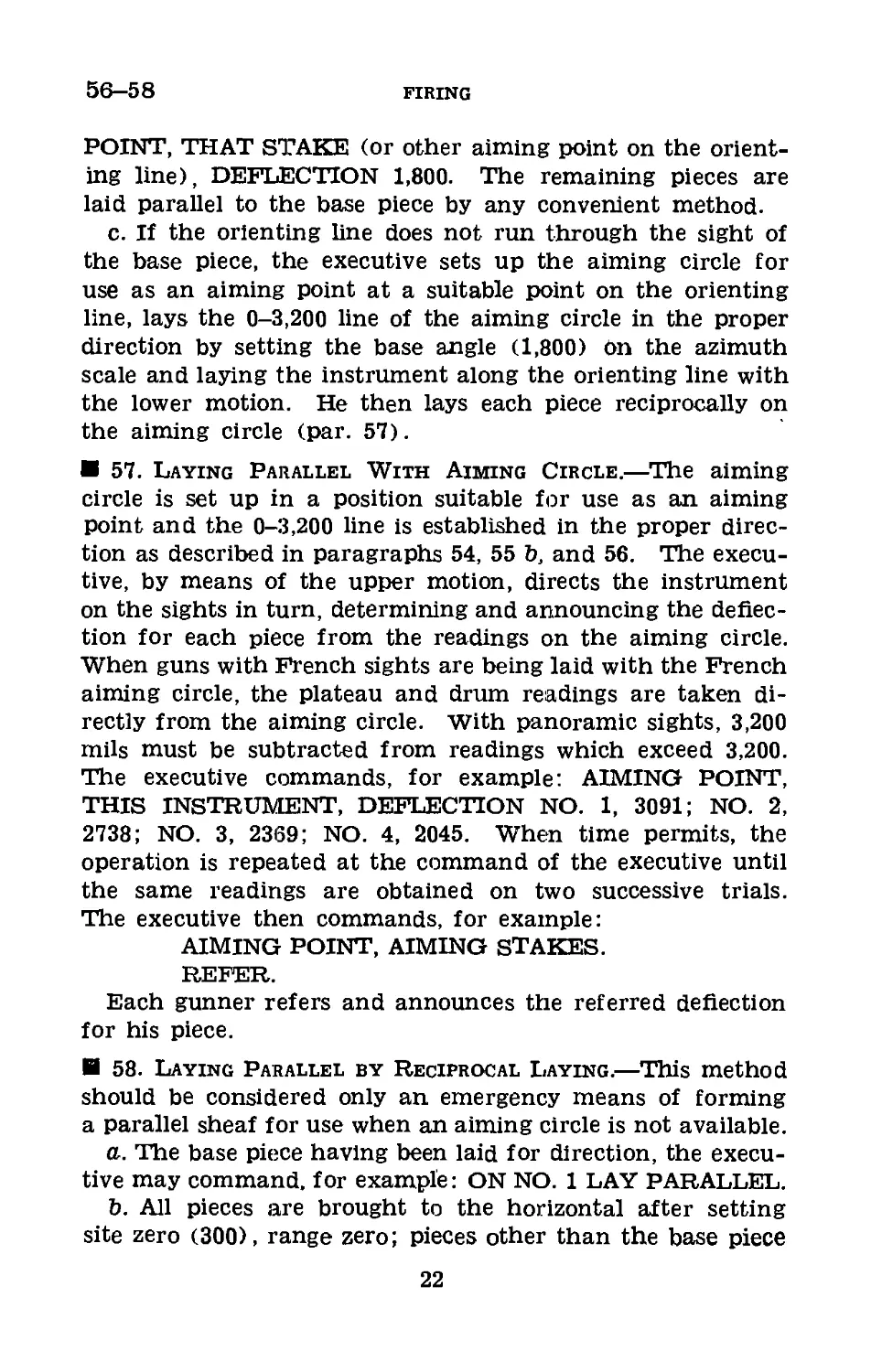
POINT, THAT STAKH (or other aiming point on the orient-
ing line), DEFLECTION 1,800. The remaining pieces are
laid parallel to the base piece by any convenient method.
c. If the orienting line does not run through the sight of
the base piece, the executive sets up the aiming circle for
use as an aiming point at a suitable point on the orienting
line, lays the 0-3,200 line of the aiming circle in the proper
direction by setting the base angle (1,800) On the azimuth
scale and laying the instrument along the orienting line with
the lower motion. He then lays each piece reciprocally on
the aiming circle (par. 57).
 57. Laying Parallel With Aiming Circle.—The aiming
circle is set up in a position suitable for use as an aiming
point and the 0-3,200 line is established in the proper direc-
tion as described in paragraphs 54, 55 b, and 56. The execu-
tive, by means of the upper motion, directs the instrument
on the sights in turn, determining and announcing the deflec-
tion for each piece from the readings on the aiming circle.
When guns with French sights are being laid with the French
aiming circle, the plateau and drum readings are taken di-
rectly from the aiming circle. With panoramic sights, 3,200
mils must be subtracted from readings which exceed 3,200.
The executive commands, for example: AIMING POINT,
THIS INSTRUMENT, DEFLECTION NO. 1, 3091; NO. 2,
2738; NO. 3, 2369; NO. 4, 2045. When time permits, the
operation is repeated at the command of the executive until
the same readings are obtained on two successive trials.
The executive then commands, for example:
AIMING POINT, AIMING STAKES.
REFER.
Each gunner refers and announces the referred deflection
for his piece.
В 58. Laying Parallel by Reciprocal Laying.—This method
should be considered only an emergency means of forming
a parallel sheaf for use when an aiming circle is not available.
a.	The base piece having been laid for direction, the execu-
tive may command, for example: ON NO. 1 LAY PARALLEL.
b.	All pieces are brought to the horizontal after setting
site zero (300), range zero; pieces other than the base piece
22
FIRING
58-61
are traversed to their centers and by shifting trails are
pointed approximately parallel to the base piece. The gun-
ner of the base piece refers in turn to the sights of the
other pieces and announces the deflection reading of each,
for example: “No. 2, 1580; No. 3, 1560; No. 4, 1550.”
c.	Each gunner sets as deflection the reading announced
for his piece, and using the sight of the base piece as the
aiming point, lays for direction; the chief of section reports,
“No. (so and so) ready.” When time permits, the operation
is repeated at the command of the executive until the same
readings are obtained on two successive trials.
d.	When the pieces have been laid, the executive an-
nounces an aiming point and causes the pieces to be re-
ferred.
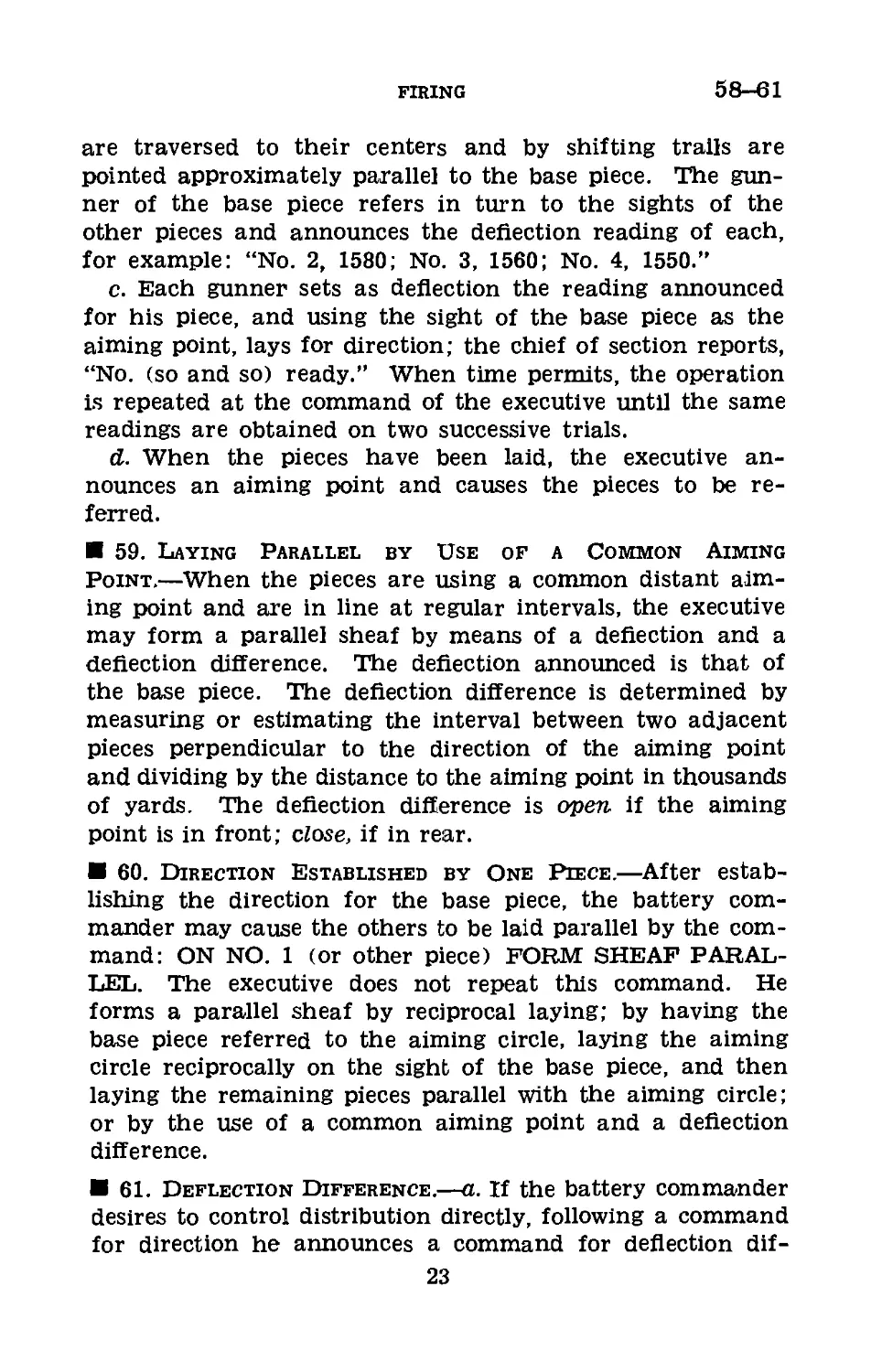
 59. Laying Parallel by Use of a Common Aiming
Point.—When the pieces are using a common distant aim-
ing point and are in line at regular intervals, the executive
may form a parallel sheaf by means of a deflection and a
deflection difference. The deflection announced is that of
the base piece. The deflection difference is determined by
measuring or estimating the interval between two adjacent
pieces perpendicular to the direction of the aiming point
and dividing by the distance to the aiming point in thousands
of yards. The deflection difference is суреп if the aiming
point is in front; cZose, if in rear.
 60. Direction Established by One Piece.—After estab-
lishing the direction for the base piece, the battery com-
mander may cause the others to be laid parallel by the com-
mand: ON NO. 1 (or other piece) FORM SHEAF PARAL-
LEL. The executive does not repeat this command. He
forms a parallel sheaf by reciprocal laying; by having the
base piece referred to the aiming circle, laying the aiming
circle reciprocally on the sight of the base piece, and then
laying the remaining pieces parallel with the aiming circle;
or by the use of a common aiming point and a deflection
difference.
 61. Deflection Difference.—a. If the battery commander
desires to control distribution directly, following a command
for direction he announces a command for deflection dif-
23
61-62
FIRING
ference; for example: ON NO. 1 (or other piece) OPEN
(CLOSE) (SO MUCH).
b. If the battery commander desires to control distribution
indirectly through the executive, he will give a command for
convergence (par. 62) followed by a deflection difference to
obtain the desired width of sheaf; for example: CONVERGE
AT 3,000, ON NO. 1 OPEN 8.
 62. Converging the Sheaf.—a. The command given by
the battery commander is: CONVERGE AT (SO MUCH).
The executive does not repeat this command. He causes the
sheaf to be formed parallel by any one of the methods de-
scribed in paragraphs 57, 58, and 59. He then determines
the individual corrections to converge Nos. 2, 3, and 4 on No.
1 at the range announced by the battery commander, and
gives the commands necessary to accomplish this conver-
gence. When the pieces are at regular intervals, this may
be effected by a command for deflection difference; for
example: ON NO. 1 CLOSE (SO MUCH).
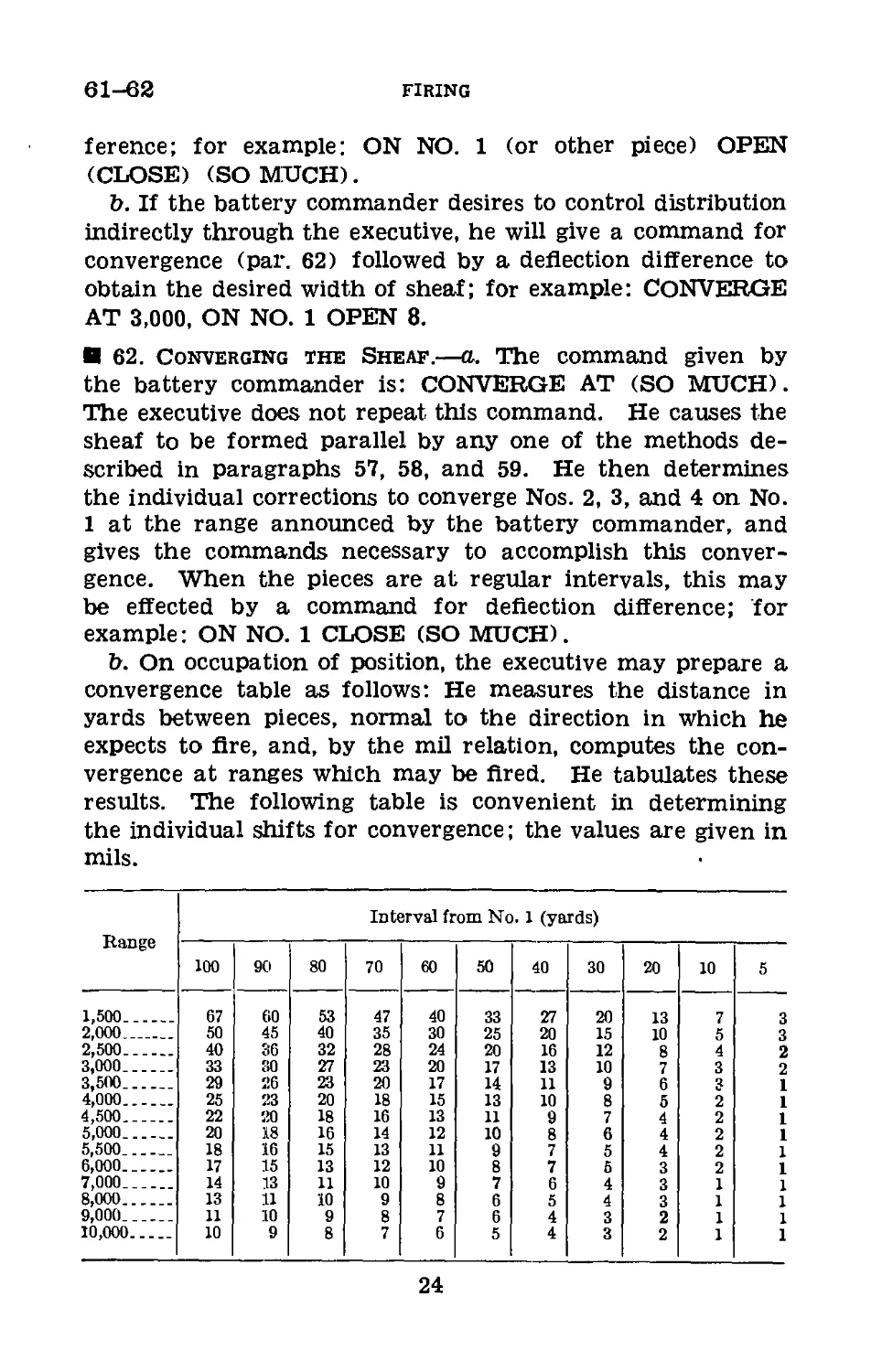
b. On occupation of position, the executive may prepare a
convergence table as follows: He measures the distance in
yards between pieces, normal to the direction in which he
expects to fire, and, by the mil relation, computes the con-
vergence at ranges which may be fired. He tabulates these
results. The following table is convenient in determining
the individual shifts for convergence; the values are given in
mils.
Range
1,500.
2,000..
2,500.
3,000.
3,500.
4,000.
4,500.
5,000.
5,500.
6,000.
7,000.
8,000.
9,000.
10,000.
Interval from No. 1 (yards)
100	90	80	70	60	50	40	30	20	10
67	60	53	47	40	33	27	20	13	7
50	45	40	35	30	25	20	15	10	5
40	36	32	28	24	20	16	12	8	4
33	30	27	23	20	17	13	10	7	3
29	26	23	20	17	14	11	9	6	ч
25	23	20	18	15	13	10	8	5	2
22	20	18	16	13	11	9	7	4	2
20	18	16	14	12	10	8	6	4	2
18	16	15	13	11	9	7	5	4	2
17	15	13	12	10	8	7	5	3	2
14	13	11	10	9	7	6	4	3	1
13	11	10	9	8	6	5	4	3	1
11	10	9	8	7	6	4	3	2	1
10	9	8	7	6	5	4	3	2	1
5
3
3
2
2
24
FIRING
63-66
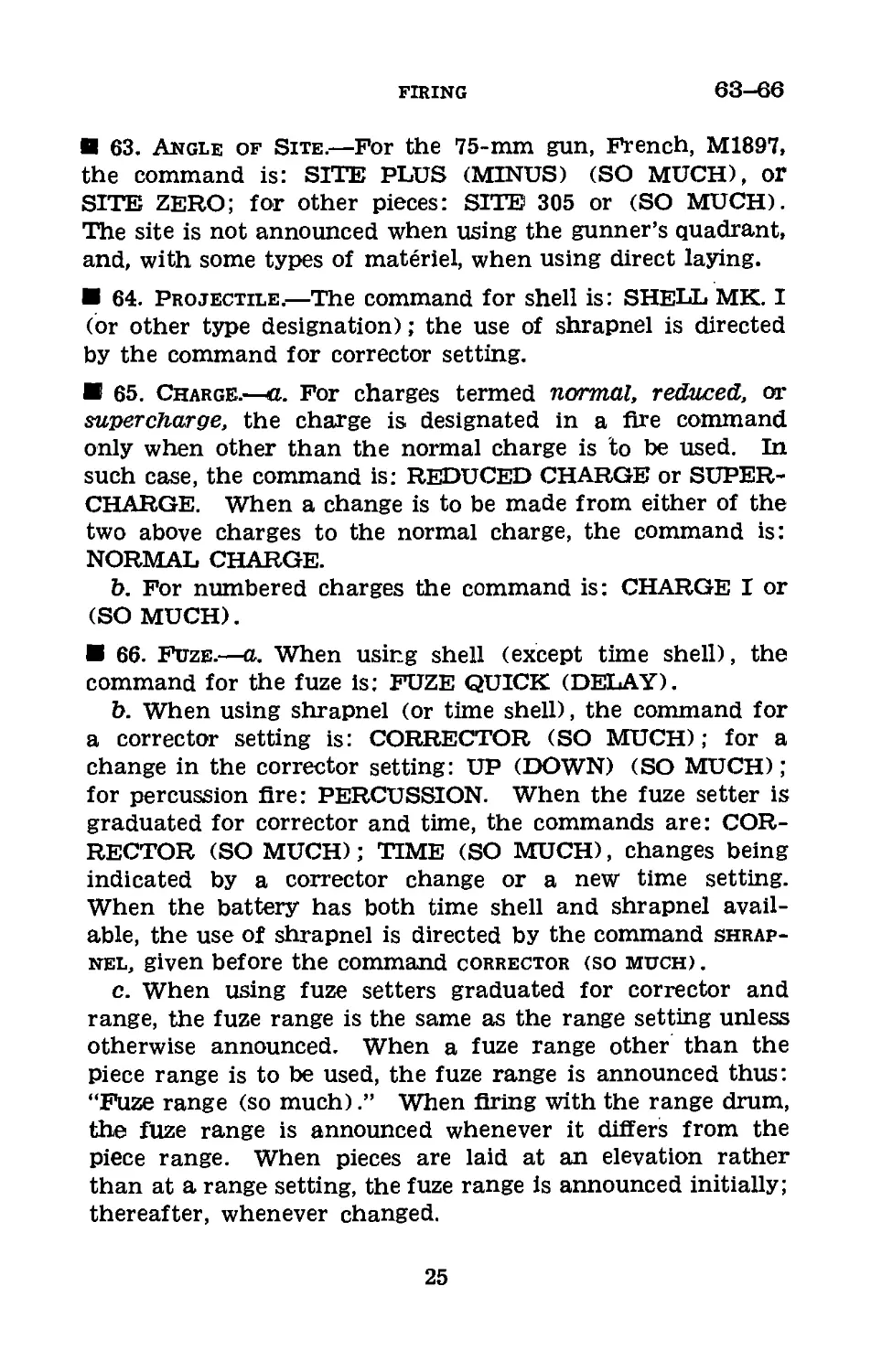
 63. Angle of Site.—For the 75-mm gun, French, M1897,
the command is: SITE PLUS (MINUS) (SO MUCH), or
SITE ZERO; for other pieces: SITE 305 or (SO MUCH).
The site is not announced when using the gunner’s quadrant,
and, with some types of materiel, when using direct laying.
 64. Projectile.—The command for shell is: SHELL MK. I
(or other type designation); the use of shrapnel is directed
by the command for corrector setting.
 65. Charge.—a. For charges termed normal, reduced, or
supercharge, the charge is designated in a fire command
only when other than the normal charge is to be used. In
such case, the command is: REDUCED CHARGE or SUPER-
CHARGE. When a change is to be made from either of the
two above charges to the normal charge, the command is:
NORMAL CHARGE.
b. For numbered charges the command is: CHARGE I or
(SO MUCH).
 66. Fuze.—a. When using shell (except time shell), the
command for the fuze is: FUZE QUICK (DELAY).
b. When using shrapnel (or time shell), the command for
a corrector setting is: CORRECTOR (SO MUCH); for a
change in the corrector setting: UP (DOWN) (SO MUCH);
for percussion fire: PERCUSSION. When the fuze setter is
graduated for corrector and time, the commands are: COR-
RECTOR (SO MUCH); TIME (SO MUCH), changes being
indicated by a corrector change or a new time setting.
When the battery has both time shell and shrapnel avail-
able, the use of shrapnel is directed by the command shrap-
nel, given before the command corrector (so much) .
c. When using fuze setters graduated for corrector and
range, the fuze range is the same as the range setting unless
otherwise announced. When a fuze range other than the
piece range is to be used, the fuze range is announced thus:
“Fuze range (so much).” When firing with the range drum,
the fuze range is announced whenever it differs from the
piece range. When pieces are laid at an elevation rather
than at a range setting, the fuze range is announced initially;
thereafter, whenever changed.
25
67-68
FIRING
 67. Pieces to Fire.—a. To fire the battery, the command
is: BATTERY. To fire one platoon, the command is:
RIGHT (LEFT), indicating the right (left) platoon. To
fire any other combination of pieces, the command is:
NUMBER(S) (SO AND SO). The command fire at will
directs all pieces to fire.
b. When a change in pieces to fire or the method of fire,
or both, is to be made, the commands for both elements are
given. Decreasing or increasing the number of rounds in a
method of fire does not constitute a change of method.
 68. Methods of Fire.—The methods of fire are salvo fire,
volley fire, volley fire sweeping, continuous fire, by piece at
my command, fire at will.
a.	Salvo fire.—The command is: RIGHT (LEFT), and In-
dicates the flank from which pieces are to be fired succes-
sively. Fire is opened at the executive’s command fire,
pieces being fired at the command of chiefs of section, in
order from the right (left), at intervals of 2 seconds. The
interval of 2 seconds may be changed by adding at (so
many) seconds. This interval will be used until the method
is changed or another interval announced. The executive
gives the command fire when he sees that the pieces are
ready to fire. If one or more pieces are apparently in error
or are very slow, they are called out and the remaining
pieces fired.
b.	Volley fire.—The command is: (SO MANY) ROUNDS.
Fire is opened at the executive’s command fire, given im-
mediately after the range or elevation. Each piece to be
fired fires the specified number of rounds as rapidly as is
consistent with accuracy without regard to other pieces, each
round being fired at the command of the chief of section,
no. (so and so) fire. There are three exceptions to the
above, as follows:
(1)	When firing at a moving target with direct laying,
the announcement of the range is the authority to fire; each
piece is fired at the command of the gunner. (See the per-
tinent manual in the FM 6-series for the Service of the
Piece.)
(2)	When safety regulations require personnel to take
cover, the designated pieces fire simultaneously at the execu-
26
FIRING
68
tive’s command, which is given when the pieces are ready to
fire and cover has been taken.
(3)	When the battery commander prescribes a time inter-
val during the firing of a single piece; for example, з rounds
at 10 seconds. Each round is fired at the executive’s com-
mand.
c. Volley fire, sweeping.—(1) Normal sweeping.—The com-
mand is: (SO MANY) ROUNDS SWEEPING (RIGHT),
(SO MANY) TURNS (MILS). Fire is opened and executed
as prescribed for volley fire, except that after each round
the gunner traverses the piece the number of turns of the
handwheel or the number of mils specified in the command.
The sweep is always to the left unless right is included in
the command. When the last round of the sweep has been
fired, the gunner traverses the piece back to the original
laying.
(2) Cross sweeping.—The command is: (SO MANY)
ROUNDS CROSS SWEEPING, (SO MANY) TURNS (MILS).
The execution is the same as for normal sweeping, except
that even-numbered pieces sweep to the right.
d.	Continuous fire.—The command is: CONTINUOUS
FIRE RIGHT (LEFT) AT (SO MANY) SECONDS. If fire
is by a single piece, right (left) is omitted and at so many
seconds may be omitted, in which case the piece is fired as
rapidly as it can be laid accurately. Continuous fire, when
executed by more than one piece, is a succession of salvos,
the pieces being fired consecutively at the interval desig-
nated in the command. The fire is continued until the
method of fire is changed or until the command cease
firing is given. Changes of data are applied so as not to
stop the fire or break its continuity.
e.	By piece at my command.—To fire each piece individu-
ally at his command, the battery commander commands:
BY PIECE AT MY COMMAND. When the battery is ready
to fire, the executive reports to the battery commander,
“Battery is ready,” and, when the battery commander’s
command to fire is received, commands, for example: NUM-
BER (SO AND SO) FIRE.
f.	Fire at will.—The command is: TARGET (SO AND SO),
FIRE AT WILL. This method is used for firing at a target
27
68-71
FIRING
attacking or about to attack the battery. Direct laying is
employed. The laying is as prescribed in the pertinent
manual of the FM 6-series for the Service of the Piece.
Without further command from the executive or the battery
commander, each piece opens fire at the command of the
chief of section and fires as rapidly as possible until the
command cease firing is given.
 69. Holding Fire.—a. If the battery commander does not
desire the pieces to be loaded, he commands: DO NOT
LOAD before announcing the range or elevation. To begin
fire after the command do not load, the battery commander
commands the range or elevation.
b. If the battery commander desires the pieces to be loaded
but the opening of fire to be held, he commands: AT MY
COMMAND before announcing the range or elevation..
The command is not repeated by the executive. When the
pieces are ready to fire, the executive reports, “Battery is
ready.” To begin firing, the battery commander commands:
FIRE, which is repeated by the executive, at my command
continues in effect until a method of fire is announced not
followed by at my command.
	70. Gunner’s Quadrant.—The command to use or discon-
tinue using the gunner’s quadrant is announced immediately
before the range or elevation. The command is: QUAD-
RANT or WITHOUT QUADRANT.
	71. Range or Elevation.—a. The command for range is
the announcement of the range setting, as, “4,800”; for ele-
vation' the elevation setting, as, “140.6.” When firing more
than one piece and the pieces are laid at different elevations,
and in this case only, the command same elevation may be
used.
b.	The command for the executive to fire a series of
ranges in a definite sequence is zone, followed by the range
bound (if other than 100 yards) and the limiting ranges.
For example: ZONE, 4,800, 4,600; or ZONE 200, 2,200, 2,600.
The executive does not repeat the command but gives com-
mands to fire at the following ranges: the first range an-
nounced, and ranges differing by 100 yards or by the amount
of the range bound announced, until the final limiting range
28
FIRING
71-72
is reached; then ranges halfway between those fired in the
reverse order. The ranges fired for the first command given
above are 4,800, 4,700, 4,600, 4,650, 4,750. For zone fire using
elevations, the command must include the elevation bounds
as well as the limiting elevations; in other respects the pro-
cedure is similar. For example: ZONE 6 MILS, (QUAD-
RANT) 148, 160; the elevations fired are 148, 154, 160, 157,
and 151.
c.	If it is desired to fire through a zone two or more times,
appropriate commands are repeated as necessary.
d.	The command for the range or elevation always is given
in each series of fire commands when it is intended that
pieces be loaded and fired.
 72. Schedule Fires.—a. Written data for concentrations
and standing barrages usually are sent to the executive by
command sheet. The arrangement of entries on this sheet is
such that the executive can announce his commands in
proper order by reading from it. Frequently, however, the
executive will find it necessary to furnish each chief of sec-
tion written data for each mission to be fired on a time
schedule. Data for a rolling barrage are furnished by the
battery commander on section data sheets to the chiefs of
section, who are individually responsible for announcing data
and giving the commands to fire according to the schedule.
b. The number of rounds to be fired is determined from
the method of fire, zone and range (elevation) commands,
and appropriate entries in the “Remarks” column of the
command sheet. When time limits are shown for missions
other than a rolling barrage, the executive causes the fire to
start at the designated time. These time limits simply re-
quire that the missions be completed within the specified
time without restricting the executive as to the rate of fire.
c. The normal barrage may be started by the piece senti-
nels (par. 22) or at the executive’s command barrage. Com-
plete data, including rates of fire and duration, for all stand-
ing barrages should be furnished each chief of section. Suf-
ficient ammunition for several complete barrages is stored
in a place convenient for prompt use. One round is always
kept ready for immediate loading. When not engaged in
firing, the battery is kept laid on its normal barrage. The
177568°—39----------3	29
72-73
FIRING
battery commander should warn the executive by the com-
mand lay on normal barrage when he foresees a lull in fir-
ing during which the barrage may be called for.
 73. Determining the Adjusted Compass.—a. 1i the initial
laying was by compass, the battery commander may order
the executive to “Report the adjusted compass.” In this
case the executive determines the difference between the
deflection of his base piece after adjustment and the deflec-
tion of the base piece which resulted from the initial laying
by compass. He applies this difference, in the proper sense,
to the initial compass and reports the result as the adjusted
compass.
b. If the initial laying was not by compass, or if it is
desired to obtain the adjusted compass by actual measure-
ment, the base piece having been adjusted, the procedure is
as follows:
(1)	The battery commander commands: MEASURE THE
ADJUSTED COMPASS.
(2)	The aiming circle having been set up so as to be suit-
able as an aiming point for the base piece, with the 0-3,200
line approximately in the direction of fire, the executive
commands: NO. 1 (the base piece), AIMING POINT
THIS INSTRUMENT, MEASURE THE DEFLECTION. The
gunner of the base piece refers to the executive’s instrument
and announces the deflection.
(3)	Using the French aiming circle.—The executive lays
reciprocally so that the 0-3,200 line on the aiming circle
is pointed in the direction of the line of fire. He then
measures the clockwise angle to compass north by centering
the needle with the upper motion. This angle subtracted
from the declination constant (plus 6,400 if necessary) gives
the adjusted compass. The executive reports, “Adjusted
compass (so much).”
(4)	Using the American aiming circle, M1916.—The exec-
utive measures the magnetic azimuth to the base piece. He
then subtracts the reading given by the gunner of the base
piece from the magnetic azimuth (adding 3,200 if necessary).
This amount plus the declination constant of the aiming
circle is the adjusted compass. (The quadrant in which the
gun is pointing must be considered, otherwise it would be
30
FIRING
73-74
possible to obtain results 3,200 mils in error when using the
panoramic sight or a multiple of 1,600 mils in error when
using the French sight.)
 74. Instrument Direction.—a. To record.—(1) Immedi-
ately following registration on the base point (or check
point), the executive on order of the battery commander,
lays the 0-3,200 line of his observing instrument which has
been set up close to and behind the base piece on a high
burst above the base point, and thus determines the direc-
tion: Base piece—base point. He then records this direc-
tion as instrument direction, by referring it to any conveni-
ent reference point. He is thus able at any subsequent time
to lay the 0-3,200 line of his instrument in the direction of
the base point, provided he does not move his instrument.
(2)	For example, the base piece having been adjusted for
direction, the battery commander may command: RECORD
INSTRUMENT DIRECTION, 4,300.
(3)	The executive—
(a)	Sets up his observing instrument near the base piece.
(b)	Selects an angle of site and a corrector setting that
will surely give bursts visible through the instrument.
(c)	Sets the azimuth and micrometer scales of the instru-
ment at zero.
(d)	Directs the line of sighting in the direction in which
the burst is expected and elevates the instrument to the
angle of site selected.
(e)	Commands, for example:
SITE PLUS 30.
CORRECTOR 35.
NO. 1 ONE ROUND.
4,300.
FIRE.
(/) Turns the vertical hair of the instrument to the burst
with the lower motion, thus placing the 0-3,200 line of the
instrument in the desired direction.
(ff) With the upper motion, directs the line of sighting
on a convenient point and records the reading, for example,
453, so that the 0-3,200 line of the instrument can be laid
in the same direction at any time.
31
74
FIRING
(.h) Reports to the battery commander, “Instrument di-
rection recorded.”
(4)	The direction of the reference point should be ma-
terialized by stakes for night use. The position of the in-
strument should be marked by a stake.
(5)	When registration is not permitted, the battery com-
mander may direct the executive to establish and record
instrument direction without firing. In this case, the execu-
tive sights his instrument on the base point, if necessary,
lining it in from a crest in front or in rear of the position.
If the base point is not visible from any point near the
position, he lays the instrument in the direction of the base
point by the same means used to lay the piece; for example,
by a base angle announced by the battery commander.
b. Subsequent use of instrument direction.—(1) Schedule-
fire missions subsequently sent the battery include a refer-
ence to the instrument direction; that is, the map shift from
the base point (check point), on which direction was re-
corded, to the right edge of the standard area (target)
upon which fire is to be delivered. Just prior to delivering
a concentration, the executive lays his observing instru-
ment in this new direction and fires an air burst with the
base piece, using the computed deflection. The deviation
of this burst from the vertical hair of the instrument is
noted and the entire battery is then given a deflection cor-
rection of this amount, thus insuring a plane of fire cor-
rected for changed atmospheric conditions and direction
errors of laying.
(2) For example, the battery commander, in sending data
to the executive for a concentration, may command:
INSTRUMENT DIRECTION LEFT 146.
3,800.
BASE DEFLECTION LEFT 150.
ON NO. 1 OPEN 3.
SHELL MK. I.
FUZE QUICK.
BATTERY ONE ROUND.
ZONE 5 MILS.
QUADRjINT.
115, 125.
32
FIRING
74
(3) The executive—
(a)	Having established the 0-3,200 line of the instrument
as in a above, places the line of sighting in the direction
ordered by applying the instrument-direction shift to the zero
of the instrument with the upper motion. For the foregoing
command, sets the azimuth and micrometer scales at 6,254
(6,400—146) without disturbing the lower motion.
(b)	Selects an angle of site and a corrector setting which
will give bursts visible through his instrument and com-
mands, for example:
BASE DEFLECTION LEFT 150.
ON NO. 1 OPEN 3.
NO. 1 ADJUST.
SITE 340.
CORRECTOR 35.
NO. 1 ONE ROUND.
3,800.
FIRE.
(c)	Observes this round seven mils right of the instru-
ment direction and completes the commands for the fire
mission, as follows:
BATTERY ADJUST.
LEFT 7.
SHELL MK. I.
FUZE QUICK.
BATTERY ONE ROUND.
QUADRANT.
115.
FIRE.
120.
FIRE. (And continues the mission ordered.)
c. To measure an instrument-direction shift.—To deter-
mine the instrument-direction shift to a target on which an
adjustment has just been made, the battery commander
may, when no other method is practicable, direct the execu-
tive to fire a high burst over the target and report the
instrument-direction shift.
33
75-76
FIRING
 75. Adjusting Sheaf Parallel With High Bursts.—a.
The base piece having been laid for direction, the battery
commander commands, for example:
ON NO. 1 (the base piece) ADJUST SHEAF PAR-
ALLEL.
4,000.
b. The executive—
(1)	Gives the necessary commands to have the other pieces
laid approximately parallel to No. 1.
(2)	Sets up his observing instrument and lays the 0-3,200
line approximately in the direction of fire.
(3)	Selects an angle of site and a corrector which surely
will give bursts visible through his observing instrument, and
elevates his instrument to the angle of site selected.
(4)	Determines the angles subtended by the interval from
the base piece to each of the remaining pieces at the range
given (4,000 yards).
(5)	Commands, for example:
SITE 350 (PLUS 50) (or SO MUCH).
CORRECTOR 35 (or SO MUCH).
BATTERY BY PIECE AT MY COMMAND.
4,000.
NO. 1 (the base piece) FIRE.
(6)	Puts the vertical hair of his instrument (the azimuth
scale of which has been set at zero) on the point of burst of
the base piece and then commands: NO. 2 FIRE.
(7)	Turns the upper motion of the instrument and meas-
ures the angle between the points where the first round burst
and the second round burst, and, to correct the error ob-
served (if any), commands: NO. 2 RIGHT (LEFT) (SO
MUCH).
(8)	Adjusts the other pieces in a similar manner, causing
the pieces to be fired at intervals appropriate for accurate
observation of deviations, and correcting each piece indi-
vidually.
(9)	Reports to the battery commander, “Sheaf adjusted.”
 76. Report by Operator of Beginning and Completion of
Fire.—At the first round of a salvo or similar series of fire,
the telephone operator reports to the battery commander,
34
FIRING
76-77
“On the way.” If the rate of fire is slow, he may report
each round, “No. 1 on the way,” “No. 2 on the way,” and so
on. On the completion of the salvo or series, the operator
reports, “Round completed.”
Section VI
EXAMPLES OF FIRE COMMANDS
 77. 75-mm Guns With Panoramic Sights.—a. Direct lay-
ing.—(1) Initial commands:
TARGET, THAT COLUMN OF INFANTRY.
DEFLECTION 10.
CORRECTOR 30.
BATTERY ONE ROUND.
2,200.
(2)	To change data:
DOWN 5.
TWO ROUNDS.
2,600.
b.	Fire at will.—(1) The battery commander (or executive)
commands:
TARGET, THAT CAVALRY.
FIRE AT WILL.
(2)	The chiefs of section repeat the above commands.
c.	Aiming point and. deflection, battery in line at regular
intervals.—(1) For the initial laying of the battery with the
battery commander controlling the distribution directly, to
form an open sheaf and begin fire with one gun, the battery
commander commands:
AIMING POINT, TO THE RIGHT FRONT, THAT
BARE TREE.
DEFLECTION 240.
ON NO. 1 OPEN 7.
SITE 290.
CORRECTOR 35.
NO. 2 ONE ROUND.
4,000.
The executive repeats the above command, and, at the proper
time, adds: FIRE.
35
77
FIRING
(2)	To change data after firing a salvo, the battery com-
mander commands:
LEFT 20.
NO. 2 RIGHT 5.
UP 5.
4,200
The executive repeats these commands, adding: FIRE.
d.	Compass, registering on a base point.—(1) The battery
commander commands:
COMPASS 1,450.
SHELL MK. I.
FUZE QUICK.
NO. 1 ONE ROUND.
QUADRANT.
200.
(2)	The declination constant of the instrument is, for
example, 200 (or 6,600). The executive sets up the aiming
circle in a position suitable for use as an aiming point by
all pieces, subtracts from the declination constant (6,600)
the announced У-azimuth (1,450), sets the remainder (5,150)
on the azimuth scale of the aiming circle and centers the
needle with the lower motion. He then lays the battery
reciprocally on the aiming circle (par. 57), commanding, for
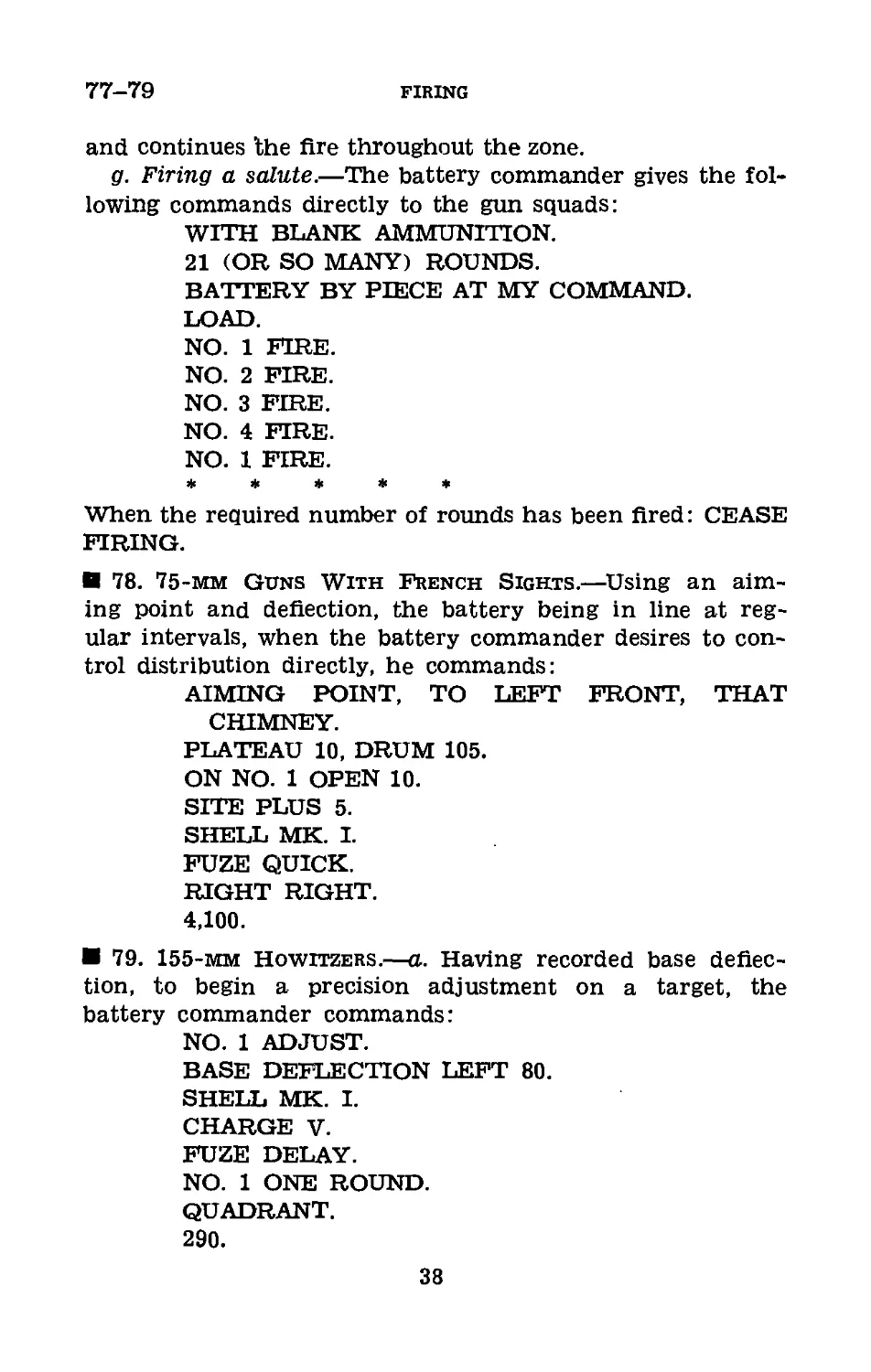
example:
AIMING POINT, THIS INSTRUMENT (aiming cir-
cle).
DEFLECTION NO. 1, 800; NO. 2, 400; NO. 3, 2,900;
NO. 4, 2,500.
AIMING POINT, AIMING STAKES.
REFER.
SHELL MK. I.
FUZE QUICK.
NO. 1 ONE ROUND.
QUADRANT.
200.
FIRE.
(3)	On completion of the adjustment of the base piece,
the other pieces having followed the deflection changes, the
battery commander commands:
36
FIRING
77
RIGHT 5.
RECORD BASE DEFLECTION.
(4)	The executive repeats these commands and, at the
proper time, reports, “Base deflection recorded.”
e.	Base angle, recording base deflection without adjust-
ing.—(1) The battery commander commands:
BASE ANGLE 1,800.
RECORD BASE DEFLECTION.
(2) The executive converts the above commands, thus:
AIMING POINT, THIS INSTRUMENT.
DEFLECTION NO. 1, 1,400; (and so on).
AIMING POINT, AIMING STAKES.
REFER.
RECORD BASE DEFLECTION.
(3) The executive reports, “Base deflection recorded.”
/. Shift from, base deflection and zone fire, staggered posi-
tion.—(1) The battery commander, controlling distribution
indirectly through the executive, commands:
BASE DEFLECTION RIGHT 100.
CONVERGE AT 5,000.
ON NO. 1 OPEN 12.
SITE 305.
SHELL MK. I.
FUZE QUICK.
BATTERY TWO ROUNDS SWEEPING, 6 MILS.
ZONE, 4,900, 5,100.
(2) The pieces of the battery are at the following inter-
vals from No. 1: No. 2, 10 yards; No. 3, 35 yards; No. 4, 90
yards.
(3) The executive converts the command of the battery
commander thus (par. 62):
BASE DEFLECTION RIGHT 100.
NO. 2 RIGHT 2, NO. 3 RIGHT 7, NO. 4 RIGHT 18.
ON NO. 1 OPEN 12.
SITE 305.
SHELL MK. I.
FUZE QUICK.
BATTERY TWO ROUNDS SWEEPING, 6 MILS.
4,900.
FIRE.
37
77-79
FIRING
and continues the fire throughout the zone.
g. Firing a salute.—The battery commander gives the fol-
lowing commands directly to the gun squads:
WITH BLANK AMMUNITION.
21 (OR SO MANY) ROUNDS.
BATTERY BY PIECE AT MY COMMAND.
LOAD.
NO. 1 FIRE.
NO. 2 FIRE.
NO. 3 FIRE.
NO. 4 FIRE.
NO. 1 FIRE.
4c 4c 4c 4c *
When the required number of rounds has been fired: CEASE
FIRING.
	78. 75-mm Guns With French Sights.—Using an aim-
ing point and deflection, the battery being in line at reg-
ular intervals, when the battery commander desires to con-
trol distribution directly, he commands:
AIMING POINT, TO LEFT FRONT, THAT
CHIMNEY.
PLATEAU 10, DRUM 105.
ON NO. 1 OPEN 10.
SITE PLUS 5.
SHELL MK. I.
FUZE QUICK.
RIGHT RIGHT.
4,100.
	79. 155-mm Howitzers.—a. Having recorded base deflec-
tion, to begin a precision adjustment on a target, the
battery commander commands:
NO. 1 ADJUST.
BASE DEFLECTION LEFT 80.
SHELL MK. I.
CHARGE V.
FUZE DELAY.
NO. 1 ONE ROUND.
QUADRANT.
290.
38
FIRING
79
Ь. Having completed the previous mission, to begin a
bracket adjustment, the battery commander commands:
BATTERY ADJUST.
BASE DEFLECTION RIGHT 140.
CONVERGE AT 7,500.
SITE 300.
SHELL MK. I.
CHARGE V.
FUZE QUICK.
NO. 2 ONE ROUND.
WITHOUT QUADRANT.
450.
c. To adjust for direction with a high burst and to fire
through a zone.
(1)	The battery commander commands:
INSTRUMENT DIRECTION LEFT 95.
TIME 22.
370.
BASE DEFLECTION LEFT 107.
CONVERGE AT 6,000.
ON NO. 1 OPEN 10.
SHELL MK. I.
CHARGE V.
FUZE QUICK.
BATTERY ONE ROUND.
ZONE 7 MILS.
QUADRANT.
313, 327.
(2)	The executive sets his observing instrument in the
direction ordered and commands:
BASE DEFLECTION LEFT 107.
ON NO. 1 OPEN 7.
NO. 1 ADJUST.
SITE 350.
CORRECTOR 50.
CHARGE V.
TIME 22.
NO. 1 ONE ROUND.
370.
FIRE.
39
79
FIRING
(3)	The executive observes the burst to be 5 mils left of
the vertical hair of his instrument. He then commands:
BATTERY ADJUST.
RIGHT 5.
SHELL MK. I.
CHARGE V.
FUZE QUICK.
BATTERY ONE ROUND.
QUADRANT.
313.
FIRE.
40
80-81
CHAPTER 2
ELEMENTARY BALLISTICS AND DISPERSION, AND
EFFECTS OF PROJECTILES
Paragraphs
Section I. Elementary ballistics and dispersion_______80-85
II. Effects of projectiles_____________________86-89
Section I
ELEMENTARY BALLISTICS AND DISPERSION
	80. Definitions.—Ballistics treats of the motion of the
projectile and the conditions affecting it. Interior ballistics
deals with the motion of the projectile in the piece; exterior
ballistics with the motion of the projectile after leaving the
piece. Gunnery is the practical application of ballistics so
that the desired effects may be obtained from fire. Gunnery
is divided into two phases: Preparation of fire and conduct
of fire.
	81. Exterior Ballistics.—a. The trajectory.—The trajec-
tory is the curve described by the center of gravity of a pro-
jectile in flight.
(1)	The origin is the center of the muzzle of the piece.
(2)	The level point is the point on the descending branch
of the trajectory at the same altitude as the origin.
(3)	The base of the trajectory is the straight line joining
the origin and the level point.
(4)	The plane of fire is the vertical plane containing the
axis of the bore when the piece is laid.
(5)	The line of site of a point is the straight line con-
necting the origin with that point.
(6)	The plane of site is the plane containing the line of site
and a horizontal line perpendicular to it.
(7)	The line of elevation is the axis of the bore prolonged
when the piece is laid.
(8)	The angle of fall is the angle between the base of the
trajectory and the tangent to the trajectory at the level
point.
(9)	The angle of impact is the angle between the tangent
to the trajectory at the point of impact and the plane tan-
gent to the surface of the ground at that point.
41
81
FIRING
(10)	The slope of fall is the tangent of the angle of fall
and is expressed as 1 on 10 (or so much).
(11)	Other elements of the trajectory are indicated in fig-
ure 1.
b. Form of the trajectory (fig. 2).—(1) In a vacuum.—If
there were no air to offer resistance to the projectile, the
form of the trajectory would be determined entirely by the
elevation, the muzzle velocity, and gravity. The form would
be a symmetrical curve (approximately a parabola); the
angle of fall would equal the angle of elevation, and the
maximum ordinate would be at a point halfway between the
origin and the level point.
® Standard trajectory.
® Trajectory with site.
® Time fire.
Figure 1.—Elements of the trajectory.
42
FIRING
81
(2) Effects of air resistance.—(a) Resistance of the air
tends to retard the projectile from the instant it leaves the
piece. This makes the trajectory a more complex curve than
that in a vacuum; the angle of fall is greater than the angle
of elevation, the maximum ordinate is closer to the level point
than to the origin, and the range is reduced.
(b	) Air resistance increases with the velocity, is approxi-
mately proportional to the cross-section of the projectile,
and varies with the shape of the projectile. The retardation
of a projectile depends upon the ratio of air resistance to
mass of projectile; in general, air resistance varies as the
square of the caliber, while mass varies as the cube. Ac-
cordingly, retardation is less for large projectiles than for
smaller ones of the same shape.
c.	Drift.—The deviation of a projectile from the plane
of fire, caused by air resistance, rotation, and gravity, is
termed drift. The line of fire is the trace of the trajectory on
the ground.
Ln a. vacuum
Angle of
clev&tion

Ln air*
Origin,
(Note the tremendous decrease in range caused by air resistance.)
Figure 2.—Comparison of a trajectory in a vacuum and one in air.
d.	Variations in trajectories.—(1) The trajectory for a
given projectile and piece varies with the muzzle velocity
and with the quadrant elevation. Accordingly, range flexi-
bility increases with the number of different propelling
charges designed for the weapon and the possible variations
in quadrant elevation. A standard trajectory is one ob-
tained with standard conditions of materiel and atmosphere;
that is, conditions adopted as standard in the preparation
of Firing Tables. These conditions are assumed to be as
follows:
(a)	Weight of projectile, as given in the appropriate Firing
Table.
(b)	Temperature of powder, 70° F.
43
81
FIRING
(c)	Air density, that corresponding to 29.53 inches of
mercury at 59° F. at the battery, considered as 100 percent.
(d)	Air temperature, 59° F. at the battery.
(e)	No wind.
(2)	Variations from the standard conditions given in (1)
above have the following effects on projectiles:
(a)	Weight of projectile.—A projectile heavier than stand-
ard causes a decrease in the range for the lower elevations,
but an increase in range for the higher elevations. A pro-
jectile lighter than standard has the opposite effect.
(b)	Temperature of powder.—A powder temperature
higher than standard causes an increase in muzzle velocity
and consequently an increase in the range; a powder temper-
ature lower than standard similarly causes a decrease.
(c)	Air density.—Air density above normal (over 100 per-
cent) offers more resistance to the projectile and conse-
quently causes a decrease in the range; air density below
normal similarly causes an increase.
Cd) Air temperature (elasticity).—Air temperature higher
than normal causes an increase in range; lower than nor-
mal, a decrease.
(e) Wind.—A head wind causes a decrease in the range,
a rear wind an increase; a cross wind from the right (left)
forces the projectile to the left (right); an oblique wind,
having components both parallel and perpendicular to the
direction of fire, affects both range and deflection.
e.	Time fire (fig. 1).—In firing time-fuzed projectiles which
may be burst in the air by appropriate settings, the point of
burst is the point at which the burst takes place or would
have taken place if not obstructed. The following effects
obtain in time fire:
(1)	Making a corresponding change in range settings of
the piece and fuze setter, the corrector and site remaining
constant, results in no change in the height of burst.
(2)	By changing only the corrector, the burst is drawn
back or advanced along the trajectory, resulting in a change
in height of burst and burst range.
(3)	Changing only the site results in a corresponding rais-
ing or lowering of the burst practically in a vertical line.
44
FIRING
81-82
The burst range is not changed but the height of burst and
trajectory are changed.
(4)	By making a change in the corrector and a compen-
sating change in site, the height of burst remains constant.
The trajectory and burst range are changed.
f.	Rigidity of the trajectory.—The theory of the rigidity
of the trajectory is the assumption that the trajectory may
be tilted up or down through small vertical angles about the
origin without materially affecting its shape. The flatter
the trajectory, the more nearly is the assumption correct.
The assumption is utilized primarily in bracket fire to cor-
rect for the altitude of the target by applying the angle of
site to the range or elevation, thus tilting the trajectory up
or down about the origin. When using large elevations
with large angles of site, errors may be introduced by this
assumption, and, in carefully prepared fire, elevation cor-
rections should be determined from the complementary an-
gle-of-site tables given in Firing Tables (par. 139 f (6)).
Instead of complementary angle-of-site tables, some Firing
Tables have position-effect tables which combine the site and
the complementary angle of site into one range effect.
g.	Firing tables.—Information necessary for the practical
handling of trajectories is given in the appropriate Firing
Tables.
И 82. Interior Ballistics.—Accuracy in firing is affected by
the following conditions:
a.	Wear of the piece (erosion), if uniform, reduces muzzle
velocity; if uneven or excessive, it causes variation in muzzle
velocity and inaccuracy in the flight of the projectile. When
the lands are worn, the projectile is given insufficient spin,
and erratic results ensue.
b.	Coppering (deposit of copper from the rotating bands
on the surface of the bore) causes inaccuracies, high pres-
sures, and increased erosion.
c.	Lack of cleanliness, both with respect to the bore and
the projectile, may cause increased erosion and improper
centering of the projectile.
177568°—39-
45
4
82-83
FIRING
d.	Improper ramming or injuries to the rotating band may
permit the escape of gases around the rotating band, greatly
increasing erosion and causing erratic velocities.
e.	Lack of uniformity in the weight of projectiles or pro-
pelling charges will cause nonuniform velocities.
f.	Varying lots of powders or variations in powder tem-
perature will result in varying velocities.
 83. Dispersion.—a. General.—If a number of rounds were
fired from a piece under conditions as nearly identical as
possible, the points of impact of the projectiles on a hori-
zontal plane would be dispersed about a point called the
center of impact. The following are characteristics of dis-
persion:
(1)	Shots are more scattered in range than in direction.
(2)	Shots fall in an area, assumed for practical purposes
to be a rectangle and called the rectangle of dispersion,
whose long axis lies along the line of fire and whose center
is the center of impact.
(3)	Shots are grouped more closely toward the center
than toward the edges of the rectangle.
(4)	As many shots fall beyond the center of impact as
short thereof, and as many to the right as to the left.
b. Range probable error.—(1) If a line AB (fig. 3) is
drawn through the center of impact perpendicular to the
line of fire, there are as many shots short of the line as
over. If a line CD is drawn parallel to AB so that there are
as many shots beyond CD as there are between CD and AB,
the distance between CD and AB, measured along the line of
fire, is the value of the range probable error, which is the
error that will be exceeded as frequently as it is not ex-
ceeded, This error for any particular weapon is determined
46
FIRING
83-84
by actual firing and is taken as the index of the accuracy
of the piece.
(2) If lines are drawn parallel to AB at intervals of one
probable error, the percentages of shots falling in each sub-
division will be approximately as indicated in figure 3.
(3) Since the range probable error is known, being given
in Firing Tables, the relative position, in range, of the
center of impact and a target lying in the rectangle of dis-
persion may be deduced from the percentage of shots over
or short of the target; that is, X (fig. 3) represents the posi-
tion of the target if 25 percent of the shots are over and
75 percent short; Y, if 10 percent are over and 90 percent
short; Z, if 37 percent are over and 63 percent short.
c.	Direction probable error.—Dispersion in direction fol-
lows the same laws as dispersion in range but is much less.
Values are given in Firing Tables.
d.	Vertical probable error.—Dispersion in a vertical plane
follows the same laws as dispersion in a horizontal plane.
The vertical probable error is the product of the range
probable error and the tangent of the angle of fall. Values
are given in Firing Tables.
e.	Dispersion on slopes.—A positive slope is one which
rises away from the piece. A negative slope is one which
descends away from the piece. Dispersion on a positive slope
is less, on a negative slope more, than that on a horizontal
plane.
f.	Height-of-burst probable error.—In time fire, disper-
sion is due to variations in trajectories and in the time of
burning of the fuzes. Distribution follows the law of errors.
The rectangle of dispersion for height of burst is derived
from the vertical projection of the points of burst; for burst
range it is the horizontal projection.
g.	Practical application.—The solution of problems, such
as the expenditure of ammunition to obtain a given number
of hits in a certain area and the distribution of shots in an
area, can be obtained by applying the necessary dispersion
scales to the area.
 84. Fork.—The fork is a unit of range change used in
conduct of fire. It is the change in elevation necessary to
47
84-85
FIRING
move the center of impact four range probable errors. Its
practical value is a function of the quadrant elevation and is
given in Firing Tables, usually in mils.
 85. Probabilities Deduced From the Laws of Disper-
sion.—These probabilities are derived by application of the
laws of dispersion. The following are among the most im-
portant of those on which the principles of conduct of fire
are based:
a.	Probability that target is within bracket.
Number of sensings		Probability (%)
At one limit	At the other	One-fork bracket	Two-fork bracket	Four-fork bracket
1 1 1 2 3	1 2 3 2 3	70 75 76 85 92.5	85 89 90 94.5 98	92.3 96 97 99+ 99+
b.	Probability that target is within zone of dispersion of
center of one-fork range bracket.—A one-fork bracket hav-
ing been obtained with one sensing at each limit, the proba-
bility that the target is within the zone of dispersion of
rounds fired at the center of the bracket is 96.8 percent.
This probability is increased as additional verifying sensings
are obtained.
c.	Probability that center of impact is within a given dis-
tance of the target.
Number of sensings		Distance in probable errors
In one sense	In the other	One	Two	Three	Four
1	1	54	Probab 86	lity (%) 98	99+
1	2	51	86	98	99+
1	3	44	80	96	99+
2	2	70	96	99	99+
3	3	99+	99+	99+	99+
48
FIRING
86-87
Section II
EFFECTS OF PROJECTILES
 86. Penetration.—a. The path of a projectile after strik-
ing the ground depends upon the angle of impact, the nature
of the ground, and the shape, weight, velocity, and rotation
of the projectile. Frequently a projectile is1 diverted to the
right or left. With angles of impact between 0 and 125 mils,
a projectile usually ricochets, leaving a narrow furrow in
the ground; the angle of ricochet is roughly one and one-
half times the angle of impact. With angles of impact be-
tween 125 and 450 mils, a projectile usually enters the
ground and either remains just below the surface or rico-
chets. With angles of impact between 450 and 700 mils, the
projectile tends to rise in the ground but usually does not
emerge.
b. Penetrations in ordinary compact soil are approximately
as follows:
Caliber	Striking velocity	Angle of impact	Penetration (vertical or horizontal)
	Foot-seconds	Mils	Feet
75-mm	  ....	730	800	4
105-mm	 					800	800	5
155-mm		 	 		770	800	7
8-incb. . 		    ...	. .	790	800	9
240-mm							806	800	14
 87. HE Shell (fig. 4).—a. Proper action of fuze and booster
causes the bursting charge to detonate. Incomplete detona-
tion of the bursting charge causes the shell to break into a
few large fragments and is termed a low order burst. A dud
is a shell which has failed to burst.
b.	The fragments of a bursting shell are divided, according
to the direction in which projected, into three general groups;
side spray, base spray, and nose spray.
c.	The following are characteristics of the effect of shell
bursts: The main effect is from the side spray; effect is small
when the height of burst is above normal; the small depth
covered by fragments requires accurate range adjustment.
49
87-88
FIRING
d.	The effect of a shell bursting on ricochet is similar to
that of an air burst, the axis of the shell being inclined
upward. Ricochet fire is used only with the light artillery.
S-------Direction of fire
Figure 4.—Shell bursts.
e.	With a quick fuze, the. shell usually bursts before it
penetrates. At very small angles of impact, the body instead
of the fuze may strike the ground, resulting in a nonbursting
ricochet.
f.	Areas covered effectively by fragments from HE shell
are approximately as follows:
Caliber	Effective		Radius of large effec- tive frag- ments
	Depth	Width
75-mm			 	_		Yards 5 9 9	Yards 30 40 70	Yards 150 300 550
105-mm
155-mm	        _

 88. Shrapnel (fig. 5).—a. The main effect of a shrapnel is
from the balls; however, the case, which does not rupture,
and the head and fuze are effective. The balls upon being
ejected are contained roughly within a cone, the apex of
which is at the point of burst. The apex angle of the cone
is termed the angle of opening.
b. Against inflammable targets, incendiary effects may be
obtained with low or graze bursts.
50
FIRING
88
Point of
© Range, 2,000 yards.
* .........—---------------------------
® Range, 4,000 yards.
Point of
® Range, 6,000 yards.
Figube 5.—Normal bursts, 75-mm shrapnel.
51
89
FIRING
 89. Chemical Shell.—a. Fuses.—Since it is usually desired
to distribute the filler of the shell in air rather than in a
crater, a quick fuze should be used if the shell will not
ricochet. If the angle of impact will give a large proportion
of ricochets, a delay fuze should be used.
b. Smoke.—The type of smoke shell in use is WP, contain-
ing white phosphorus. In addition to its smoke-producing
effect, WP has a marked incendiary effect and inflicts severe
burns on personnel.
52
90-93
CHAPTER 3
PREPARATION OF FIRE
Paragraphs
Section I. General_________________________________ 90-94
II. Preparation of	fire	with	instruments_____ 95-109
Ш. Firing charts___________________________ 110-114
IV.	Survey operations, plans, and proce-
dure _____________________________________ 115-122
V.	Preparation of	fire	from	firing	charts_123-133
VI.	Schedule fires_________________________134-142
Section I
GENERAL
	90. Definition.—Preparation of fire is the determination
of firing data. The object of preparation is to obtain the
most accurate data possible under existing conditions.
	91. Units of Measure.—The unit of length or distance is
the yard. The unit of angular measure is the mil (да) equal
to 1/6,400 part of the circumference of a circle. Practically a
mil is the angle subtended by one yard at a distance of 1,000
yards. The mil relation is expressed by W=Rxm where m
is the angular width of the object in mils, W is the width
of the object in yards, and R is the range or distance in
thousands of yards. The mil relation is approximately true
for angles of less than 400 mils.
	92. Data Necessary to Open Fire.—The following infor-
mation is necessary to have the battery deliver the desired
fire:
a.	Direction.
b.	Distribution.
c.	Projectile, fuze, and, when necessary, charge.
d.	Pieces to fire and method of fire.
e.	Site and range, or quadrant elevation.
 93. Steps in Preparation.—There are three general steps in.
preparation of fire as follows:
a.	Determining basic data which are direction, distribu-
tion, site, and range.
53
93-96
FIRING
b.	Determining corrections for conditions not standard.
a. Converting basic or corrected data to settings for the
piece.
В 94. Kinds of Preparation.—Preparation of fire is made
with instruments or from firing charts, depending upon the
time and facilities available for getting basic data and cor-
rections. In either case the preparation is as accurate as
circumstances permit.
Section II
PREPARATION OF FIRE WITH INSTRUMENTS
И 95. General.—Instruments ordiharily are used for the
preparation of data when time is pressing or when other
facilities are lacking. Means available are the battery com-
mander’s telescope, aiming circle, prismatic compass, range
finder, field glasses, and calibrated hand or other object.
Fires with data prepared with instruments must be ob-
served and data corrected as a result of observation.
В 96. Direction.—Direction is obtained by determining the
firing angle, the У-azimuth of the direction of fire, or the
shift from a known direction. Direction is usually de-
termined from an observation post and converted for use at
the battery. Occasionally, direction may be determined by
actual measurement at the battery.
a.	Terms used.—(1) The firing angle is the clockwise hori-
zontal angle from the target to the aiming point, vertex at
the piece. The piece as here used means the base piece
(usually No. 1).
(2)	The measured angle is the clockwise horizontal angle,
vertex at the observation post, between the target and the
aiming point, base point, or other datum point. The one ex-
ception to this is in the computation of a shift (par. 100),
in which case the measured angle is the smaller (not neces-
sarily clockwise) angle between the base point and target
as measured at the observation post.
(3)	The target offset is the horizontal angle between the
piece and observation post, vertex at the target.
54
FIRING
96-97
(4)	The aiming-point offset is the horizontal angle be-
tween the piece and observation post, vertex at the aiming
point.
b.	Deflection.—The firing angle, corrected, is converted
to a setting, termed the deflection, to be applied to the
sights. An increase of deflection moves the plane of fire to
the left; a decrease moves it to the right.
(1)	Panoramic sight.—If graduated from 0 to 3,200, the
deflection is the firing angle when the latter is less than 3,200;
if greater, it is the firing angle less 3,200. If graduated from
0 to 6,400, the deflection is the firing angle.
(2)	French sight.—To convert a firing angle to deflection,
add the deflection constant, 100, to the firing angle; subtract
the largest multiple of 1,600; the largest even number of
hundreds in the result is the plateau setting; the remainder,
after subtracting this even number of hundred mils, is the
drum setting.
c.	Abbreviations and symbols.
M, measured angle.
A, firing angle.
T, target or target offset.
P, aiming point or aiming-point offset.
G, piece.
O, observation post.
OP, distance, in thousands of yards, from О to P.
OG, distance, in yards, from О to G.
r, distance, in thousands of yards, from О to T.
R, distance, in thousands of yards, from G to T.
 97. Determining Direction at the Observation Post.—
a. General.—The principle of each method of determining
direction is to visualize an angle at О whose sides are parallel
to the sides of the direction angle used to lay the piece and
thus equal to it. For example, in figure 6, ОТ’ is parallel to
GT and OP’ is parallel to GP. It is evident that the target
offset T equals the angle TOT’ and the aiming-point offset P
equals the angle POP’. These offsets applied to the angle
TOP (the measured angle M'> give the angle T'OP’, which
is equal to the angle TGP (the firing angle A), since their
sides are parallel.
55
97-98
FIRING
Figure 6.—Determination of direction at O,
b. Determination of offsets (fig. 7).—The angle OTG is
the target offset T. The line O’G is visualized from G per-
pendicular to ОТ (or ОТ extended). By the mil relation, T
equals O'G divided by 0'771,000. For practical purposes,
ОТ is used instead of O'T when they do not differ by more
than 500 yards. In such case, T=O’G/r. When the differ-
ence between ОТ and O'T is more than 500 yards, 0'771,000
is used. The value of O'G usually is estimated. The aiming-
point offset P is determined in like manner.
 98. Determining the Firing Angle.—a. General (fig. 6).—
To determine the firing angle, visualize the measured angle
TOP and apply to it the target offset and the aiming-point
offset, away from the piece, either by computation or me-
chanically, so that the sides of the resulting angle T'OP’
will be parallel to the sides of the firing angle TGP. For
computation, the sign of each offset is determined as fol-
56
FIRING
98
7 = 600/5.8 = 103 m (sign + )
P = 700/4 = 175 m (sign -)
A = M+ T-P = 5765 + 103
-175 = 5693 m
7 = 500/3=167 (sign -)
P=450/3.5=129 m (sign + )
4 = 520-167 +129=482 m
7=450/3.6 = 125 m (sign + )
P=550/4.2 = 131 m (sign + )
4 = 2100 + 125+131 = 2356 ш
7 = 700/4=175 1» (sign -)
P=250/3.7 = 68 ih (sign —)
4 = 1400-175-68=1157 ги
Figure 7.—Calculation of the firing angle.
57
98
FIRING
lows: If the offset, applied away from the piece, cuts into
the measured angle, it is minus. If the offset, applied away
from the piece, increases the measured angle, it is plus.
If the offset, applied away from the piece, is so large that it
starts inside the measured angle and continues outside of
it, or starts outside and then extends inside the measured
angle, the part within which it starts controls the sign.
b.	Examples of determination of the firing angle by com-
putation.—Figure 7 illustrates the four cases.
c.	Mechanical computation.—The battery commander’s
telescope or aiming circle may be used to determine the firing
angle by applying the offsets mechanically, as follows:
(1)	Set the azimuth and micrometer scales at zero and
lay on the target, using the lower motion.
(2)	Determine the size of the target offset. With the
upper motion, turn the index away from the piece by the
amount of the target offset, measuring the amount on the
scales of the instrument. The 0-3,200 line of the instrument
remains on the target.
(3)	With the lower motion, turn the vertical hair to the
target. The 0-3,200 line of the Instrument now has been
moved away from the piece by the amount of the target off-
set and is parallel to the GT line.
(4)	With the upper motion, bring the vertical hair to the
aiming point. This measures the angle T'OP.
(5)	Determine the size of the aiming-point offset. With
the upper motion, turn the vertical hair away from the piece
this amount, measuring the amount of movement by the
micrometer scale. The reading of the scale is now the
firing angle A.
d.	Rapid plotting.—The determination of the firing angle
and the range by rapid plotting is particularly appropriate
when the target offset or aiming-point offset is so large that
use of the mil relation is not sufficiently accurate (that is,
when the offset is greater than 400 mils). It consists of
drawing a diagram to scale and measuring therefrom the
firing angle and the range.
e.	О as an aiming point (fig. 8),—(1) If an instrument at
the observation post is used as an aiming point, M is the
58
FIRING
98-99
clockwise angle from the target to the piece. It is corrected
by T and the result is increased by 3,200 mils if the piece
is on the right, or decreased by 3,200 mils if the piece is on
the left.
Figure 8.—Calculation of the firing angle with О as aiming point.
(2) When all of the pieces are visible through the instru-
ment at O, the deflection may be determined for each in
turn. When this condition does not exist, the executive’s
instrument or a single piece may be laid by the instrument
at O. The remaining pieces are laid reciprocally on the exec-
utive’s instrument or on the sight of the directing piece.
 99. Determining Direction by У-Azimuth.—a. Terms
used.—Compass north is the north direction indicated by a
compass. Y-north or grid north is the north direction of a
У-grid of a map or grid. Y-azimuth of a line is the clock-
wise angle, measured at any point on the line, from У-north
to the line. A compass north seldom coincides with mag-
netic north because of errors of individual compasses. All
compasses should be calibrated with reference to a control
line, usually У-north. The У-azimuth of the north direction
indicated by a compass is the declination constant of the
59
99
FIRING
compass. When the declination constant is applied to a
compass reading, the result is the У-azimuth of the direction.
b.	Use of the prismatic compass (fig. 9.)—The method of
determining the У-azimuth of the line of fire, using a pris-
matic compass at O, is as follows:
(1)	Take the compass reading of the target from O.
(2)	Add the decimation constant of the instrument, thus
obtaining the У-azimuth of the target from O. (If the sum
is greater than 6,400, 6,400 is subtracted.)
погЪИ 1
Ueclination
conet bnt
Compass reading of T= 1250 m
Declination constant = 190 m
У-azimuth of T from 0 = 1250 +190 = 1440 m
Y-azimuth of T from G = 1440 —286 = 1154 m
Figure 9.—Determining Y-azlmuth with the prismatic compass.
(3)	Apply the target offset away from the piece; the result
is the У-azimuth of the GT line. The compass reading
with declination constant added is the clockwise angle from
У-north to the target and, in determining signs of offsets,
is considered the measured angle. When using a compass,
the measured angle always falls to the left of the ОТ line.
If the target offset cuts into this angle (piece on the right
of the line ОТ, or ОТ extended), the offset is minus', if the
60
FIRING
99-101
target offset falls outside this angle (piece on the left), the
target offset is plus.
c.	Use of the aiming circle.—(1) Set the declination con-
stant on the azimuth and micrometer scales.
(2)	With the lower motion, center the magnetic needle,
the final movement being with the slow motion. The
0-3200 line is now on У-north.
(3)	Clamp the needle. With the upper motion, turn the
vertical hair to the target. This measures the У-azimuth
of the target from O.
(4)	Determine the target offset. Apply this to the У-
azimuth found in (3) above. This is done mechanically as
follows: with the upper motion, turn the vertical hair away
from the piece by the amount of the offset, measuring the
amount of movement by the micrometer scale. The reading
is the У-azimuth of the GT line.
 100. Determining Direction by Shifts From a Known
Direction (fig. 10).—a. Computation.—If base deflection
(par. 52) has been recorded on the base point, the initial
direction for a target is usually determined as a shift from
base deflection. The computation of the shift is similar to
the computation of a firing angle, considering the base point
as the aiming point. The angle of a shift is measured from
the base point to T; it is right if the target is to the right of
the point, left if the target is to the left of the point. The
signs' of the offsets are determined as in paragraph 98 a, the
measured shift being considered the measured angle. If the
combined offsets are greater than the shift and the sign is
minus, the shift is in the opposite direction from the meas-
ured shift.
b. Rapid plotting.—Shifts may be plotted as in determin-
ing the firing angle (par. 98 d).
 101. Direct Methods of Determining Direction.—a. Di-
rect measurement.—If the target can be seen from the posi-
tion of the piece, the firing angle may be measured with the
sight or with an instrument set up adjacent thereto.
b.	Lining in.—If the target can be seen from a position in
rear of the piece, the piece may be laid for direction by lin-
ing the axis of the tube on the target by eye.
177568°—39----5
61
101-102
FIRING
c.	Laying on an airplane.—Direction for a target may be
given by laying a piece or an instrument at the battery posi-
tion on an airplane which signals when it is on the GT line.
The airplane may signal when it is on the GT line extended
to the rear of the battery. The piece may be laid by setting
the deflection scale so that the line of sighting is parallel to
the axis of the bore, and traversing the piece to place the
vertical hair on the airplane; otherwise, the piece is laid in
a known direction and the shift to the airplane is measured
by the sight. When an instrument is used, the same pro-
cedure is followed, the piece being laid reciprocally on the
instrument.
Figuhe 10.—Shifts.
d.	Air burst.—A round is fired in the general direction of
the target at a range which will not endanger friendly troops
and at a site and correcter to give a visible air burst. When
the burst is seen, its deviation from the target is measured
at the observation post and the direction of the piece is cor-
rected accordingly.
 102. Distribution.—a. Terms used.—(1) A sheaf consists
of the planes of fire of two or more pieces of a battery, con-
sidered as a group.
62
FIRING
102
(2)	A parallel sheaf is one in which the planes of fire are
parallel.
(3)	An open sheaf is one effectively covering a maximum of
front without sweeping.
(4)	A converged sheaf is one in which the planes of fire
are converged at the points of burst.
(5)	A crossed sheaf is one in which the planes of fire con-
verge at a point short of the points of burst, the bursts ap-
pearing in reverse positions from the pieces firing.
(6)	Deflection difference (DD) is a uniform change in the
deflection of adjacent pieces to obtain a desired width of
sheaf.
b.	Parallel sheaf.—The executive usually is charged with
the formation of a parallel sheaf. Upon occupation of posi-
tion, he lays the battery parallel in the direction indicated by
the battery commander or, in the absence of specific instruc-
tions, in the general direction of fire. When the initial
direction is given by compass or by base angle (par. 124), the
pieces are laid by the aiming circle or other instrument and a
parallel sheaf is formed directly; when given by use of an
aiming point, the executive may form a parallel sheaf as
explained above or by determining a deflection difference.
When the battery commander desires a parallel sheaf formed
by firing, he commands: ON NO. 1 ADJUST SHEAF PAR-
ALLEL (par. 75) followed by the range at which it is desired
to adjust the sheaf. When the battery commander desires
a parallel sheaf formed without firing, he commands: ON
NO. 1 FORM SHEAF PARALLEL (par. 60).
c.	Converged sheaf.—The battery commander usually con-
verges the sheaf prior to opening it to fit the target or
adjusting point. This is accomplished by the command:
CONVERGE AT (SUCH RANGE); the range announced is
the multiple of 500 nearest the initial range. When the
initial direction is given by means which do not give a
parallel sheaf directly (aiming point and deflection), the
executive must first form the sheaf parallel before converging
it. The sheaf is converged by the executive on No. 1 (par.
62).
d.	Fire without sweeping.—(1) The interval between the
bursts of adjacent pieces is one third the desired width of
63
102
FIRING
the sheaf. Hence, the deflection difference for a target
which can be covered without sweeping is, from a converged
sheaf, 1/3 W/R, where W is the width of the target in yards.
(2) The front of an open sheaf equals four times the effec-
tive width of a single burst; the width of the sheaf (distance
between flank bursts) is three times the width of a single
burst as shown in the table below:
Projectile	Effective width of a single burst	Width of open sheaf	Front covered by open sheaf
	Yards 30 40 70	Yards 90 120 210	Yards 120 160 280
	 _ 	 105-mm
155-mm... 		         _

e.	Sweeping fire.—When a target is too wide to be covered
effectively with an open sheaf, a wider sheaf is used' and
each piece is traversed a definite amount after each round,
usually to the left, until the front is covered. This is termed
sweeping fire, of which there are two kinds; normal sweeping
and cross sweeping. The data necessary are distribution;
number of rounds sweeping; amount of sweep or traverse
after each round.
(1) Normal sweeping.—(a) Distribution.—For normal
sweeping, No. 1 is laid on the right of the target. The
total front to be covered equals the width of the target plus
the effective width of a single burst. Each piece covers one
fourth of the total front. The deflection difference to obtain
the necessary distribution from a converged sheaf is open
1/4 F/R, where F is the total front covered.
(t>) Number of rounds sweeping.—The number of rounds
sweeping is equal to the front to be covered by each piece
(one fourth of the total front) divided by the effective width
of a single burst. Fractional rounds are taken as whole
rounds.
(c) Amount of sweep.—The amount of sweep is the effec-
tive width of a single burst converted to mils at the piece-
target range. For materiel equipped with the panoramic
sight, the amount of sweep is announced in mils. For the
64
FIRING
102
75-mm gun, M1897, with French sight, the amount of sweep
is announced in turns of the handwheel to the nearest whole
number, each turn traversing the piece 1.8 mils.
(d) Rapid computation of distribution for standard
areas.—Usually the width of the target or target area is
assigned as a multiple of 100 yards (par. 137). In order
quickly to determine the deflection difference from a con-
verged sheaf and, in the case of sweeping fire, the number of
rounds sweeping and the amount of sweep, the following
procedure is used:
75-mm and 105-mm materiel
Deflection difference: Open 30/B from a converged sheaf
for each 100 yards of target width.
Number of rounds: Number of rounds equals number of
100 yards of target width.
Amount of sweep: 30/B mils. For the 75-mm gun with
French sight, the number of turns is 17/B.
155-mm materiel
Deflection difference: Same as for 75-mm or 105-mm
materiel.
Number of rounds: Battery one round for 100- and 200-
yard widths; two rounds sweeping for 300- and 400-yard
widths.
Amount of sweep: 60/B mils.
(2) Cross sweeping.—(a) In cross sweeping, the line of
fire of No. 1 is placed on the right of the target; those of
Nos. 2 and 3 on the middle; and that of No. 4 on the left.
Nos. 1 and 3 sweep to the left; Nos. 2 and 4 sweep to the
right. Each piece covers half the entire width of the area.
In this manner each platoon covers half the target width
with the superimposed fire of two pieces.
(b) Cross sweeping is used in prolonged fire when it is
desired to rest the pieces in turn, leaving the front covered by
fire. It is not used for wide fronts because of the wide trav-
erse required of each piece and the possibility of large gaps
in the front covered by fire; it is not used when five or more
65
102-104
FIRING
rounds sweeping are necessary to cover the target. Cross
sweeping usually is used only for the rolling barrage.
f. Shifting fire.—When the width of the target is too great
to be covered with an open sheaf and sweeping fire is not to
be used, the target should be attacked by a succession of
open sheafs.
 103. Site.—a. Computation.—From О measure the site
(plus or minus) of the target and of the piece and calculate
the difference in altitude, in yards, between target and piece.
Convert this difference into mils of site. The site is plus
if the target is above the piece, minus if below.
b. Setting.—(1) French 75-mm gun.—The site is an-
nounced as plus or minus, zero being horizontal. The least
Setting is 5 mils.
(2) Other materiel.—On all other matdriel, the horizontal
site setting is marked 300. A site below horizontal is sub-
tracted from 300, one above is added. The least setting is
one mil.
 104. Projectile, Charge, and Fuze.—The type of projec-
tile, the charge, and the fuze are determined by the effect
desired.
a.	Projectile.—For destruction and for fire against person-
nel with cover, high-explosive shell is used. For fire against
personnel in the open, shrapnel or high-explosive shell is
used. Shrapnel is less effective at long ranges; for the
75-mm gun, high-explosive shell is preferable to shrapnel at
ranges greater than 4,000 yards.
b.	Charge.—(1) Howitzer.—The charge is determined
largely by the angle of impact desired. The charge selected
should be such that the target range is not more than
three-fourths the maximum range for the charge. If sev-
eral charges are suitable, the smaller charge produces less
wear and gives a greater angle of impact and greater frag-
mentation effect; the larger charge usually gives the smaller
dispersion. In precision fire for destruction, the charge
giving the greatest accuracy (least dispersion) usually is used.
(2) Gun.—The lowest charge consistent with the mission
is used; this may often be reduced charge. In guns having
66
FIRING
104-107
supercharge, it is used only when necessary to obtain greater
range or accuracy.
c.	Fuze.—(1) Impact.—For action against personnel, the
quick fuze usually is used. When firing at ranges at which
ricochets occur, the delay fuze should be used (par. 87).
In fire for destruction, the quick fuze is used where frag-
ment or blast effect is desired; the delay fuze when pene-
tration is necessary.
(2) Time.—A corrector setting giving an equal number of
airs and grazes is desired for adjustment. The height of
burst depends upon site as well as corrector setting, and
both must be determined accurately in order to be effective.
The corrector for the first firing must be estimated. Cold
weather requires a corrector higher than standard; warm
weather, a corrector lower than standard. When a cor-
rector giving the proper height of burst for adjustment has
been determined, it should be used to start later adjustments.
 105. Pieces to Fire.—Precision fire habitually and bracket
fire occasionally are started with one piece. However, in
bracket fire when the data are accurate, when the target is
fleeting, or when observation is difficult, it is advantageous
to start fire with the battery.
 106. Method of Fire.—a. If fire is opened with a single
piece, the method of fire usually is one round. When the
battery or platoon is fired during adjustment, the method
of fire usually is by salvo. When the target is moving rap-
idly, or is capable of extremely rapid movement, it may be
desirable to adjust with battery (or platoon) volleys.
b. In fire for effect, the method of fire usually is by volley
or volley fire sweeping. In some cases, continuous fire may
be employed.
 107. Range.—a. Determination.—Range is determined by
the most accurate means available. When the range is de-
termined from the observation post, any difference between
r and R must be considered.
b. Range settings.—Range scales are designed to give the
elevation for a definite projectile and charge; hence, settings
67
107-110
FIRING
for other combinations of projectiles and charges must be
determined from the Firing Tables.
c. Elevation settings.—When the gunner’s quadrant or ele-
vation scale is used, the elevation corresponding to the range
is obtained from the Firing Tables and to this is applied the
site.
E 108. Units of Announcement.—If data are prepared very
accurately, the settings so computed may be used. Usually,
it is sufficiently accurate to announce initial data in the fol-
lowing units: deflection or compass, to the nearest 10 mils;
convergence, to the nearest 500 yards; deflection difference,
to the nearest mil; site, to the nearest 5 mils; corrector, to
the nearest five points; range, to the nearest 100 yards; and
elevation, to the nearest 10 mils.
 109. Minimum Elevation.—To determine the minimum
elevation before a position is occupied by the pieces, the pro-
cedure is as follows:
a.	Measure the site of the mask from the position to be
occupied, using an aiming circle or other instrument.
b.	Add thereto the elevation for the piece—mask range for
the available ammunition having the lowest muzzle velocity.
c.	Add two forks at the piece—mask range.
d.	If the mask is occupied by friendly troops, add the num-
ber of mils subtended by 5 yards at the piece—mask range.
Section П1
FIRING CHARTS
 110. Description.—a. A firing chart is a diagram, accu-
rately constructed to a known scale, showing the relative po-
sitions of batteries, base points, base lines, check points,
targets, and other data pertaining to the preparation of fire
(par. 124). It usually is constructed on a grid sheet but may
be on a map, if available, or map substitute (air photo).
b. Subject to restrictions imposed by higher authority, the
battalion commander prescribes the firing chart to be used
by his battalion. The firing chart used by the batteries for
68
FIRING
110-111
the preparation of firing data must be a duplicate of the
one on which fire missions are assigned by the battalion.
c. This section discusses the characteristics of the several
types of firing charts. The operations by which a firing
chart is built up are considered in section IV. The battalion
observed-fire chart is described in chapter 5.
 111. Maps and Grids (AR 100-15 and TM 2180-5).—If an
accurate map or map substitute of suitable scale is available,
it is used for the firing chart. If suitable maps are lacking,
as will usually be the case, composites, mosaics, or provi-
sional fire-control data sheets may be used to build up
firing charts. Single vertical air photographs may be used
alone or in conjunction with maps or charts.
a.	Grid systems.—When a map with a standard grid is
not available, a grid system may be improvised. A point is
arbitrarily assigned coordinates and a definite direction is
arbitrarily assigned a У-azimuth. The grid system of each,
subordinate unit must conform to this system.
b.	Coordinates.—The distance of any point east of the
zero У-line is the X coordinate and the distance north of
the zero X-line is the Y coordinate. In writing coordinates,
the X coordinate is written first and the whole inclosed in
parentheses. Thus, to the nearest yard (204.729-186.684);
to the nearest 10 yards (204.73-186.68); to the nearest 100
yards (204.7-186.7). It is seldom necessary to give more
than two digits to the left of the decimal for each coordi-
nate ; for example, (04.729-86.684). If the point is fixed
within an area 10,000 yards square, only one digit need be
given before the decimal. Thus the above coordinates would
be (4.729-6.684); to the nearest 100 yards, (4.7-6.7). If a
large number of points are being designated by abbreviated
coordinates, the decimals and dash may be omitted, thus
(4767).
c.	Measurements.—(1) Angles.—Measurements of angles
on a map or chart are made with a protractor.
(2) Y-azimuth.—The У-azimuth of a line may be meas-
ured at any point where this line crosses a У-llne or X-line.
(3) Distances.—Distances are measured by accurate
scales, graduated in yards.
69
111-112
FIRING
d. Computation of basic data from coordinates.—When a
map has been distorted or when two points are on different
sheets of the map, or when extreme accuracy is desired, it
is advantageous to determine the direction and range by
trigonometric calculation.
 112. Air Photos.—Air photos for field artillery use are
generally plain verticals, mosaics, or obliques. Plain ver-
ticals and mosaics are used in the construction of firing
charts. Obliques are used principally in designation of tar-
gets of opportunity and in maneuvering observed fires; they
may be used to transfer data to the firing chart by means of
restitution.
a.	Scale.—The scale of the plain verticals and mosaics
must be determined. On the margin of the photo can be
found the focal length of the camera and the height of the
plane when the picture was taken. The representative frac-
tion equals the focal length divided by the height of the
plane. This scale is only approximate. A more accurate
method is to compare photo distances with corresponding
ground distances. This establishes a ratio between photo
distances and ground distances, and the true ground distance
may be found from a photo distance by the use of this ratio.
b.	Gridding.—(1) A grid may be transposed from a grid-
ded photo to another photo on which the same terrain ap-
pears by noting the relation of the grid lines to terrain fea-
tures. The same method may be used in transposing the
grid from a map to a photo with varying degrees of accuracy.
(2) To transfer a grid from a map or control sheet to a
photo, the following procedure is usual (fig. 11):
(a) Select on the photo three well-distributed points, such
as A, B, and C, which appear on the map or whose coordi-
nates are known. The scale of the photo is then determined
as described above.
(t>) From the map, A is found to be 190 yards south of
X-grid line 81, for example. About A on the photo strike
an arc northward with radius of 190 yards to the scale of the
photo.
(c)	Repeat this for B, the radius here being 400 yards in
the same direction.
70
FIRING
112
(d)	With a straightedge, draw the 81 X-grid line tan-
gent to the two arcs. Draw the remaining X-grid lines
parallel and 1,000 yards apart to the scale of the photo.
Figure 11.—Transferring a grid to an air photo.
(e)	In a similar manner, construct the У-grid lines.
c. Restitution.—Restitution is the process of determining
map, or chart, locations of features appearing on air photos.
The following are suitable methods:
(1)	Tracing-paper method.—(a) This is analogous to trac-
ing-paper resection. It is suitable for determining the loca-
tion of a few points, preferably located near the center of the
photo.
(b) Identify on the photo at least three points (prefer-
ably five) that appear on the chart. Mark these points and
the point to be located, on the tracing paper. This is done
most readily by tacking the photo over the tracing paper and
pricking through each point. On the tracing paper, draw
rays from the point whose location is desired to each of the
known points. Place the tracing paper on the chart so that
the ray to each of the known points passes through the
71
112
FIRING
chart location of the corresponding point. The point whose
location is desired is then in its true relative position to the
known points, and it is located on the chart by pricking
through its position on the tracing paper on to the chart.
(2)	Grid method.—This method is suitable for transfer-
ring a mass of detail. Three or more well-distributed points
about the margin of the area to be transferred are selected
on the photo and identified on the chart. The points are
joined by straight lines on both the photo and the chart to
form homologous figures. The opposite sides of these two
figures are divided into the same number of equal parts, and,
by joining the points of division, the two areas (photo and
chart) are subdivided into the same number of small homolo-
gous figures. Locations then are transferred by inspection,
the detail appearing in each figure of the photo being trans-
ferred to the corresponding figure of the chart.
(3)	Intersection method (fig. 12).—(a) Two well-separated
points whose chart locations are known are identified on the
photo. The line joining them is taken as a base. The loca-
tion of a point is determined as follows: On the photo, draw
lines from the point to the ends of the base; on the chart,
using the corresponding base, draw back rays making the
same base angles as on the photo; the intersection of these
rays is the chart location of the point.
(b) When several points are to be transferred, the same
procedure can be followed graphically. Stack together the
photo and two sheets of tracing paper, with the photo on
top; fasten these down securely with thumbtacks. With a
sharp needle, prick through the two ends of the selected
base line (ab, fig. 12) and each of the several targets, such as
Ti, T2, and Тз. Remove the photo; on the upper tracing
paper draw the rays, ab, aTi, аТз. On the lower tracing
paper draw the rays ba, bTi, ЪТ., ЪТз. Place both sheets of
tracing paper on the firing chart so that point a on the upper
sheet is over a on the chart, and b on the lower sheet is over
b on the chart. Orient the upper sheet by means of the
ray ab, and the lower sheet by means of ba. Prick through
the intersections of corresponding rays; for example, the in-
tersection of rays aTi and bTi. This process locates the tar-
gets on the chart.
72
FIRING
112-113
Upper tracing paper
Lower tracing paper
Doth sheets superimposed on chart
Figure 12.—Intersection method of restitution.
(c) For accurate results, known points must be located
accurately and angles of intersection must be greater than
500 mils. Serious errors may result if the direction line join-
ing the photo images selected as control points is in error
due to distortion.
 113. Use of Single Vertical as a Firing Chart.—In ex-
ceptional cases, a firing chart may be constructed on a single
73
113-116
FIRING
vertical air photo showing the target area. The problem is
one of locating the gun position with respect to the photo.
To accomplish this, either two points on the photo or one
point on the photo and a direction must be identified and
the scale of the photo must be known.
 114. Use of Mosaic as a Firing Chart.—The mosaic is
used as a firing chart in the same general manner as is a
fire-control map. Angular measurements are relatively ac-
curate. The scale of the mosaic must be determined and
mosaic distances converted to true ranges by use of the
factor, true distance/mosaic measurement, determined as in
paragraph 112 a. Altitudes must be determined by com-
parison with a contoured map or by use of an instrument.
Locations of points often may be determined by inspection.
Registration on selected points is desirable. In the absence
of registration, a true distance to some point in the target
area must be determined. These considerations are treated
more completely in section IV.
Section TV
SURVEY OPERATIONS, PLANS, AND PROCEDURE
 115. Purpose of and Necessity for Survey.—a. The pur-
pose of artillery survey is to gather topographic data of the
proper character and in the proper amount to enable bat-
talion and higher headquarters to assign targets, and bat-
teries to compute firing data.
b. Regardless of the type of map available, field artillery
units must be trained to build up firing charts of a scale and
accuracy comparable to a 1:20,000 fire-control map. Survey
is the only means of effecting this,
 116. Primary Data To Be Obtained.—The primary data
to be determined and plotted on the firing chart are some or
all of the following:
a.	An initial point, which serves as an origin (starting
point) of the survey operations.
b.	An orienting line, defined in paragraph 124 e.
74
FIRING
116-118
c.	One or more place marks which are points whose co-
ordinates and altitudes are known. These points are used
as origins for battery survey work.
d.	Observation posts, base point or points, check points,
and other points for reference and control.
e.	Targets. The accurate location and plotting of targets
is a continuing process, 'to the end that eventually the chart
shows the locations of all known targets of importance in the
area which it embraces.
f.	Battery positions. These may be located directly by the
battalion survey operations or, more usually, determined by
the various battery surveys and their coordinates reported.
g.	A declinating station, defined in paragraph 120 c (7).
 117. Declinating.—a. Plane table.—Magnetic objects such
as steel helmets and pistols should be removed from the
vicinity of the instrument. Orient the plane table (par. 118).
Attach the declinator and turn it until the needle points to
the index. Draw a fine line along the edge of the declinator.
Repeat at least three times. The mean of the lines is the
proper position of the declinator.
b. Aiming circle.—Set up the aiming circle over a point
from which several points of known У-azimuth can be seen
(par. 120 c (7)). These points should lie in different quarters
of the compass. Level the instrument carefully. Set the
scale at zero and center the needle. With the upper motion,
turn successively to the known points and record the read-
ings. Check by continuing around to the first point read,
and if the readings on this point differ by more than one
mil, the measurements are discarded and the readings are
made again. Subtract the compass reading to each of the
points from its known У-azimuth. The average of the differ-
ences is the declination constant (par. 99) of the instrument.
 118. Orientation.—a. Methods.—A plane table may be
oriented by means of a declinated instrument (declinator or
aiming circle) or by means of a known line.
(1)	By declinated instrument.—(a) Declinator.—Rotate
the declinated plane table until the compass needle is opposite
its index. Lock the table and verify by checking the position
of the needle.
75
118
FIRING
(Ь) Aiming circle.—If a distant visible point is plotted on
the table, read the У-azimuth of the distant point with a
decimated aiming circle. Through the plotted point draw a
line whose direction is the У-azimuth read. Lay the alidade
along this line, rotate the table until the alidade is alined
on the distant point, and lock the table. Check to see that
the board is not oriented 3,200 mils'from the true direction.
(2)	By a known line.—(.a) Table at one end of the line.—
Place the alidade along the plotted line and rotate the table
until the alidade is alined on the far point. Clamp the table
and verify the sighting. Check as in (1) (b) above.
(b) Table on a line joining two known points.—Place the
alidade along the plotted line and orient the table by eye.
Rotate the table until the line of Sighting is on the proper
point, clamp the table, and verify. Without disturbing the
board, reverse the alidade and sight on the other known
point. If the line of sighting falls exactly on the point, the
table is oriented; if no't, either the sighting was improperly
done or the table is not on the line. Make the necessary cor-
rections and repeat the operation.
(3)	By a three-point resection.—Resection (b (4) below)
is primarily an orientation of the table.
b. Location of points.—Points may be located horizontally
by inspection, traverse, intersection, resection, from an air
photo, or by a combination of any of the above methods.
Points may be located vertically by contours or by calcula-
tion from the angle .of site.
(1)	Inspection.—A map or air photo may show the de-
sired point, or a feature very close to it, from which the
point may be located by eye.
(2)	Traverse.—(a) Procedure.—The board is set up and
oriented at a known station. A ray is drawn through the
plotted station toward the next station. Orientation is nor-
mally either by back sight or by needle. In making a needle
traverse, it is necessary to occupy only every other station.
The back-sight method of orientation is more accurate; the
alidade is placed, reversed, upon the ray drawn from the
previous point to the occupied station and the board rotated
until the previous point is sighted on. Distances are de-
termined by pacing, stadia, or taping. Taping is the most
76
FIRING
118
accurate. When taping on slopes, care must be taken that
the tape is held level while measurements are being made.
(b) Instrument traverse.—This is a traverse in which the
angles between legs are measured with an angle-measuring
instrument.
(3)	Intersection.—When two or more known points can be
occupied, a distant point may be located by setting up and
orienting the board at each known point and drawing rays
to the point to be located. The intersection of the rays is
the position of the desired point. The known points must
be chosen so that the angle between the rays is not less than
500 mils. Accuracy of the work should be checked by sights
from a third known point, if possible.
(4)	Resection.—Resection is the location of the occupied
station by means of rays drawn from other points located on
the chart or map. Angles of intersection should not be less
than 500 mils. In a three-point resection, except by the
back-azimuth method, the known points and the occupied
station must not lie on the circumference of the same cir-
cle; the farther the occupied point is from the circumference
the greater the accuracy. When the resection is complete,
the location of the occupied point should be checked by
sighting on a known point not used in the original operation.
(.a) Three-point resection, triangle-of-error method.—Set
up and level the board and orient it as accurately as pos-
sible. Sight on each of three distant plotted points, draw-
ing a ray from the plotted position of each. If these rays
intersect in a point, the orientation is correct, and the inter-
section of the rays, p, is the correct location of the occupied
point, P. If the intersections of the rays form a triangle,
the orientation is faulty and a better orientation is necessary.
In this case, a trial location of p may be obtained by esti-
mating, or sketching in, two circles as shown in figure 13 ©.
In this figure, one circle is constructed to pass through a
(the plotted position of the distant point A), b (the plotted
position of the distant point B), and ab (the intersection of
the rays through a and b). Similarly, the second circle is
constructed to pass through b, c, and Ъс. A circle through a,
c, and ac can be used in place of either of the two drawn.
The intersection of the circles gives an approximate location
177568°—39---6	77
118
FIRING
of p. The board is reoriented by laying the alidade along
the line from p to the most distant point and sighting that
point. A new set of rays is drawn. If these rays intersect
in a point, the location of p is correct. If a second triangle
is formed, corresponding vertices of this and the original
triangle are joined, and the intersection of these lines will
give a fairly close location for p (fig. 13 (2) and (2)).
Figure 13.—Solution of the triangle Of error.
(b) Three-point resection, tracing-paper method.
1. With plane table.—Attach a sheet' of transparent
paper to the table, orient the board roughly, and
clamp. Through an estimated location of p,
sight on A, B, and C successively and draw rays,
disregarding a, b, and c. Place the transparent
1 paper over the map or chart and move the former
until the appropriate rays pass through a, b, and
c. The point p is now over its true position and
may be marked by pricking through the tracing
paper. The use of five instead of three points is
more accurate.
78
FIRING
118-119
2. With instrument.—The angles between the distant
points may be measured with an aiming circle or
other angle-measuring instrument and plotted on
transparent paper. This is not as accurate as
direct sighting, since to the errors of the instru-
ment those of plotting are added.
(c) Back-azimuth method.—This method requires an
accurately declinated angle-measuring instrument and three
distant visible points located on the map or chart. The back
azimuth of a given line is the azimuth plus 3,200 mils. Set
up a declinated instrument at the point to be located and
measure the У-azimuth of each of the three distant points.
Add 3,200 mils to each У-azimuth and through each plotted
point draw a ray having its proper back azimuth. The inter-
section of the rays will be the location of the station P. This
is the only method that can be used when P is on the circum-
ference of a circle passing through A, B, and C.
 119. Trigonometric Methods.—a. General.—When time
and equipment are available and when other conditions war-
rant the degree of accuracy sought, survey locations in bat-
talion and higher units should be obtained by instrument
readings and computation rather than by graphical methods.
Either a transit or an aiming circle may be used. The com-
putation may be with logarithm tables or with the slide rule.
To avoid gross errors, the following checks should be incor-
porated in every survey:
(1)	All traverses should be closed.
(2)	When establishing vertical control, the mean of fore-
sight and backsight readings should be used when possible.
(3)	When using a transit to obtain the distance to a far
point, two triangles having a common side, which is the
distance desired, should be established and solved for the
common side. The two results should not vary more than
0.5 percent (5 yards per thousand). The bases of the tri-
angles should be of such length and direction that the angle
subtended by each at the inaccessible point will be at least 50
mils (3°).
(4)	When using an aiming circle to obtain the distance
to a far point, one triangle ordinarily is solved. The base
79
119
FIRING
should be of such length that the angle in mils subtended by
it at the far point will be, numerically, at least 4 percent of
the range to the far point.
(5)	Whenever possible, the angles at the ends of a base
should be read cumulatively three to six times, and the
average used.
b. Solution of the right triangle.—(1) The following trigo-
nometric formulas are used in the solution of right tri-
angles (fig. 14):
c= V a2 3-t-ba
Sin A=>—
c
Cos A=—
c
Figure 14.—The right triangle.
(2) If the coordinates of two points, A and B, are known,
a right triangle may be formed with the line joining the two
points as the hypotenuse. By using the appropriate formu-
las above, the У-azimuth of the line joining the points and
the distance between them can be found. In figure 14, the
difference of the X-coordinates of points A and В would be*
the side b of the triangle and the difference of the У-co-
ordinates the side a.
(3) Conversely, if the distance between two points A and
B, the Y-azimuth of the line AB, and the coordinates of one
of the points are known, the coordinates of the second point
can be found by solving the right triangle for the two sides,
80
FIRING
119-120
these sides being the differences of the X and У coordinates
of the two points. By applying these differences to the
coordinates of the known point in the proper direction, the
coordinates of the unknown point can be obtained.
c. Solution of the oblique triangle.—(1) In determining
the location of a distant point, an oblique triangle usually
must be solved for the distance from one end of the base to
the unknown point. The elements of the oblique triangle
which will usually be known are two angles and the included
side. The following trigonometric formulas are used (fig.
15):
C=180°-(4 + B)
а Ъ c
Sin A~Sin В Sin C
Б
Figure 15.—The oblique triangle.
(2) If the point C is to be located by calculation from a
known point A, the base c is laid out and the У-azimuth of
AB is determined by the most accurate means possible (pref-
erably by reading the angle from another known point).
The angles at A and В are read with an instrument and the
angle C determined as shown above. The side b would then
be obtained by solving the equation	11116
Sin В Sin C
distance AC (b) and the У-azimuth of AB being known,
the У-azimuth of AC can be determined and the coordinates
of point C calculated. If the plotted location only is de-
sired, the direction AC can be laid off on the chart and the
computed distance AC laid off from A.
 120. Survey Operations of Units.—To secure the maximum
benefit from the work of all survey details, they should enter
into survey operations progressively at the earliest possible
time, with the purpose of assisting in and expediting the
81
120
FIRING
delivery of coordinated fire. Each echelon should cooperate
so as to produce effective and timely control. Lower units
should be aided and not delayed by the survey work of
higher units. By a well thought out plan, survey will be
accomplished with a minimum of confusion and loss of time.
ct. Brigade.—(1) General.—Survey by the brigade to coor-
dinate regimental and battalion survey should start as soon
as occupation of the area is contemplated. It should be
carried on aggressively so as to provide a framework on
which lower units may base their survey operations. It must
provide sufficient control so that the positions will be occu-
pied and fire delivered in furtherance of the division plan.
It must provide the coordination necessary to concentrate the
fire of the brigade where and when called for.
(2) Orientation.—The survey operations of the lower units
of the brigade should be coordinated by a brigade orienting
system. At the earliest possible time, the nature of this
system and the accurate locations of useful points for regis-
tration, reference, and control should be furnished the regi-
ments. This information should be made available by the
time the survey parties of the lower units arrive in the
brigade area.
b. Regiment.—(1) General.—Survey by the regiment to
coordinate the battalions should start when information is
received from the brigade commander that occupation of a
position area is contemplated. Regimental survey details
should go forward as soon as possible in order to assist the
brigade survey officer. All information received by the regi-
ments should be sent to battalions without delay in order to
prevent duplication of effort and to furnish early coordina-
tion between units.
(2) Orientation.—As soon as the brigade survey plan has
been determined, regimental details should begin the estab-
lishment of control in each battalion area. Battalion survey
details move forward as soon as possible in order to complete
the work necessary to coordinate fire.
c. Battalion.—(1) General.—Surveys by the battalion to
coordinate battery surveys should be begun by reconnais-
sance details as soon as it is known a position is to be
occupied, and should be improved constantly, This work
82
FIRING
120
must not interfere with rapid preparation and immediate
opening of fire when the tactical situation so demands.
(2) Initial orienting point.—(a) With a map.—Select an
accessible point from which at least one other known point
can be seen. The selected point may be one that can be
located on the map by direct identification or a resection may
be necessary to determine its map location.
(b)	Using a mosaic.—An initial orienting point is selected
which surely can be identified on the photo.
(c)	Using an extemporized chart.—When no horizontal
control has been furnished by higher units, the initial orient-
ing point and orientation are chosen arbitrarily so that the
battalion area will be included on the chart. Arbitrary co-
ordinates are assumed for the orienting point and a definite
direction is assigned an arbitrary У-azimuth. These values
are sent to batteries so that all grids in the battalion will
be coordinated.
(d)	Altitudes.—If no vertical control is available, an alti-
tude which will give no negative values is assumed for the
initial point. Other altitudes are then determined from
site readings.
(3) Orienting line (par. 124e).—(a) The pieces of each
battery should be visible from, and within calling distance
of, one or more points on the orienting line. When practica-
ble, one orienting line is used for all batteries in the battalion.
(b)	Under favorable conditions of terrain, an orienting
line through the base piece and the base point will give
excellent results. Often by taking an instrument up the
slope in front of or behind the guns, the base point can be
seen. Upon lining in the instrument on the line base piece—
base point, this line can be staked out (par. 101b). In this
case an orienting line for each battery may be used.
(c)	Stakes marking the orienting line are placed so that
at least one stake or other point on the orienting line can be
seen from any point (on the line) that is to be used. Stakes
are carefully alined, firmly driven, marked for identification,
and protected from disturbance.
(d)	An orienting line permits greater uniformity of laying
than does a compass needle. When one orienting line is
used by all batteries or when all orienting lines are tied in to
83
120
FIRING
one control net, corrections found by adjusting one piece may
be used by all batteries.
(4)	Place marks.—A place mark, usually a stake firmly
planted, tagged for identification, and marked with the co-
ordinates and altitude, is located by the battalion recon-
naissance officer, often by traverse from the initial orienting
point. A place mark must be near the battery position, pref-
erably visible from the base piece, and, if possible, on the
orienting line.
(5)	Observation posts.—The battalion observation post
and generally one or more auxiliary (lateral) observation
posts are located by the most accurate means available.
These points are chosen with a view to the location of refer-
ence points, base points, check points, and targets, and for
the observation of fire.
(6)	Points for registration, reference, and control.—Refer-
ence points, base points, and check points are located ac-
curately by intersection or other means from two or more
known points. When points are to be located by restitution
from air photos, two or more points which can be identified
on the photos must be located on the chart.
(7)	Declinating station.—A declinating station is a point,
free from local magnetic attraction, marked by a stake, with
lines of determined У-azimuth radiating from the point and
marked on the ground by stakes. The lines should pass
through well-defined distant objects. Such a station is nec-
essary if instruments are not already declinated.
(8)	Information for the batteries.—At the earliest possible
time, each battery is furnished the following information:
the location and У-azimuth of the orienting line; the loca-
tion of the battery place mark with its coordinates and alti-
tude; the location of the declinating station; the locations
of the reference point, base point, and targets; when there
is no map, the coordinates to use for the southwest corner
of the grid sheet.
d. Battery.—(1) General.—The survey work of the bat-
tery is a continuation of that of the battalion. In the ab-
sence of a battalion survey, the battery will locate the piece
position, observation post, and other important points in the
84
FIRING
120-121
manner indicated for the battalion in locating place marks
and other points.
(2) Location.—The coordinates and altitude of the base
piece are determined from the place mark, usually by trav-
erse. Other pieces of the battery are located with reference
to the base piece.
(3) Night occupation.—The positions of pieces and of the
executive’s instrument are determined and marked by stakes
during the hours of daylight and prior to the occupation.
Means to lay the battery promptly upon arrival must be
provided.
e. Orientation of observing instruments.—If registrations*
or adjustments are to be made during darkness, all observing
instruments, battalion and battery, should be laid during
daylight by the best means available, and a means for their
orientation during darkness must be provided. For com-
bined observation, the instruments should be laid with re-
spect to a definite point in the target area (usually a base
point) and preferably sighted upon it.
 121. Survey Plans.—a. (1) The brigade commander, in
formulating his survey plan with the assistance of the brigade
survey officer, must consider the division plan of action and
the part the artillery is to play in furtherance of the division
mission. He must decide—
(a)	What type of map or map substitute is to be used as a
firing chart for the units of the brigade.
(b)	How much survey is necessary to accomplish the artil-
lery mission.
(2)	In general the brigade survey detail should locate—
(a)	An initial orienting point in each regimental area.
(b)	Points suitable for registration, reference, and control.
(3)	If time permits and the regimental and battalion sur-
vey details are available, complete survey should be accom-
plished before the arrival of the batteries in the position area.
(4)	The brigade survey officer should continue to coordi-
nate and to improve the survey of the units of the brigade as
long as the positions are occupied. He should continue to
locate distant points in front of and in rear of positions of
85
121
FIRING
units of the brigade so as to be ready for displacement either
to the front or to the rear.
(5)	If possible, an orienting line, or lines, should be estab-
lished by the brigade survey officer for the coordination of
the various units.
b. The regimental commander with his survey officer must.
plan to carry forward with dispatch the control needed by the
battalions. Initial points, if not provided by brigade, must be
established by regimental survey. From these points the
regiment must provide at least one point for each battalion.
c. (1) The battalion commander, in formulating his survey
plan with the assistance of his reconnaissance officer, must
consider the complete battalion survey, with base pieces, ob-
servation posts, visible reference points, suitable base point or
points, and control points by which targets may be resti-
tuted—all accurately plotted to a known scale in their proper
relation one to the others. He must decide—
(a)	How much of the complete survey is necessary to
accomplish the mission.
(b)	How much of that which is required is already at hand
in the form of topographic data previously plotted.
(2)	The following considerations have a direct bearing on
his survey plan:
(a)	Mission of the battalion.
(b)	Maps, photos, and other topographic information avail-
able.
(c)	Whether registration is unlimited, limited, or pro-
hibited by weather, battle conditions, or orders.
(d)	Whether adjustments requiring accurate orientation
of observing instruments are anticipated.
(e)	Time available for survey.
(3)	The instructions of the battalion commander may
include—
(a)	What is to be used as a firing chart; map, mosaic, or
grid sheet.
(b)	Whether battery survey details will work directly under
the battalion reconnaissance officer or independently.
(c)	Identification on the ground of base, check, and refer-
ence points.
86
FIRING
121-124
(d)	Which survey requirements are to be given priority,
both as to time and accuracy.
 122. Priority and Procedure.—Survey is of major impor-
tance in assuring the delivery of accurate fire at all times
regardless of darkness, fog, or other unfavorable weather con-
ditions, and when registration is restricted or prohibited. The
procedure and priority of survey operations vary with the
kind and amount of topographic data already at hand and
with the mission; that is, whether observed-fire or unob-
served-fire mission will be required and whether registration
is unrestricted, restricted, or prohibited. Regardless of the
initial type of firing chart and initial survey operations, a
complete survey should eventually be made and a complete
firing chart constructed.
Section V
PREPARATION OF FIRE FROM FIRING CHARTS
 123. General.—This section includes the determination
of basic data from firing charts and the correction of data for
conditions not standard. Generally, data taken from a firing
chart, whether the chart consists of a map, a mosaic, or an
improvised chart, are described by the term map, as map data,
map range, map shift, and so on.
 124. Definitions.—a. Basic data are the uncorrected direc-
tion, distribution, site, and range determined from a firing
chart.
b.	The base point is a well-defined point, accurately located
on the firing chart, and used as an origin for shifts. Usually
it is registered upon.
c.	The base piece is the piece, normally No. 1, for which
initial data are computed, and with reference to which data
for the other pieces are determined.
d.	The base line is the line joining the base piece and the
base point, or is a line of known direction (for example, com-
pass 4,000) passing through the base piece, used as an origin
for shifts.
87
124-125
FIRING
e.	An orienting line is a line of known direction marked on
the ground and plotted on the firing chart, used to obtain
initial direction by means of a base angle.
/. The base angle is the clockwise angle from the base line
or gun-target line (extended when necessary) to the orient-
ing line.
g.	A check point usually is a visible point on which an
adjustment is made to correct data for subsequent firing;
it may be a center of impact or burst center of a number
of rounds fired with the same data. A base point may be
used as a check point.
h.	A reference point is an unmistakable object used to
identify less prominent objects by describing their relation
to, or angular direction from, the reference point.
i.	A check concentration is a concentration (or fire) pre-
pared upon a terrain feature previously selected, for the
purpose of assisting a forward observer (or liaison officer)
to identify targets in its vicinity and to bring fire to bear
upon them (par. 137 e).
j.	Registration is an adjustment on a base point or on a
check point. The results of the registration are used to
determine corrections in direction and range.
 125. Determining Base Deflection.—The deflection to
establish the base piece on the base line is determined by one
of the following methods:
a.	Without registration.—In the absence of registration,
the base piece is laid on the base line with survey data deter-
mined from the firing chart (par. 126 a).
b.	Registration.—The base piece having been registered,
the recorded base deflection may be one of the following,
depending on whether the basic data are to be corrected
for drift only, for wind and drift, or neither:
(1)	When only observed fires are to be delivered, no cor-
rections for wind or drift are necessary and the adjusted
deflection is recorded as base deflection.
(2)	When К-transfers are to be delivered, the basic data
for targets are corrected for drift; hence the drift correction
is removed from the adjusted deflection before recording
base deflection.
88
FIRING
125-126
(3)	When fire with map data corrected is to be delivered,
the basic data for targets are corrected for wind and drift;
hence corrections for wind and drift are removed from the
adjusted deflection before recording base deflection.
 126. Basic Data.—a. Direction.—(1) Direction to lay the
base piece on the base point may be determined as a Y-azi-
muth; as a base angle; or, if an aiming point is located accu-
rately on the firing chart, as a firing angle, which is con-
verted to deflection.
(2) Direction to lay the base piece on a target may be
determined in any of the foregoing ways, but usually is
determined as the map shift from the base line to the
target. When the target is shown on the firing chart as
an area, the map shift is measured from the base line to
the right edge of the area. When only the center of the
target appears on the firing chart, the map shift is meas-
ured to that point, and the additional shift necessary to
place No. 1 piece on the right edge of the target area is
computed by the mil relation. Direction usually is measured
with a protractor. However, when the accurate coordinates
of the piece, base point, and target or aiming point are
known, the У-azimuth of each side of the angle sought may
be computed trigonometrically and the angle determined
from the difference of the У-azimuths.
b.	Distribution.—Distribution and method of fire are cal-
culated from the measured front of the target as prescribed
in paragraph 102.
c.	Site.—Altitudes of the piece and target are determined
from a contoured map, if one is available; otherwise the rela-
tive altitudes are determined by site readings or by estimation.
d.	Range.—Range usually is measured with a plotting scale.
When the chart is of a different scale than the plotting scale,
the measurement is converted to yards by applying to the
measured range the factor, true distance/chart measurement.
When the accurate coordinates of the piece and target are
known, the range may be computed.
e.	Minimum elevation.—When a contoured map is available
and the map location of the battery is known, minimum ele-
vation may be computed. From the relative altitudes of the
89
126-128
FIRING
base piece and the mask and the range to the mask, the site
of the mask is computed. Allowance must be made for height
of trees on the mask when computing its site. The remainder
of the operation is given in paragraph 109. The determina-
tion of dead space is covered in paragraph 213.
 127. Corrections.—a. When fire can be observed and ad-
justed on a target, it is not necessary that the basic data be
corrected for conditions of weather and materiel, as these
corrections are applied by the adjustment itself. However,
when time and facilities permit, it is desirable that adjust-
ments be started with corrected data in order to conserve
time and ammunition. When fire cannot be adjusted on a
target (for example, observation impossible, or surprise effect
desired) the basic data must be corrected for conditions not
standard.
b. When registration is not permitted or cannot be accom-
plished, the base piece is laid on the base line by survey
methods and the basic data are corrected by computation for
conditions not standard (par. 81 d). Data corrected in this
manner are called тиар data corrected. For method of cal-
culating map data corrected, see Firing Tables and FM 6-130.
c. A transfer of fire consists of registration on a point
whose position relative to the piece and targets is known, and
the determination from this registration of corrections to be
applied to the basic data for the targets. The method of
transfer depends on whether map data corrected have been
computed for the targets. If map data corrected have been
prepared, VE-transfers (par. 131) may be used; if not, K-
transfers are used.
 128. К-Transfer of Fire.—a. General.—(1) A K-transfer
of fire consists of, first, registration on a check point (usually
the base point) to establish the base piece on the same line
and to determine a range correction factor (Ю; and second,
correction of the map range of the target by use of the K.
(2)	Conditions favorable to К-transfers are as follows:
(a)	The deflection for the target should be within 300 mils
of that for the check point; the range should be between 3/4
and 4/3 of the range of the check point. These limits are
termed transfer limits.
90
FIRING
128
(b)	Fire on the target should follow the adjustment on the
check point as soon as possible.
(c)	The adjustment on the check point and the fire on the
target must be with the same kind and weight of projectile,
the same fuze, and the same charge and powder lot.
b.	Direction.—The object of registration as regards direc-
tion is to establish the base piece on the base line. Base de-
flection, when recorded as a result of registration and for use
with K-transfers, includes corrections for wind and errors of
survey. In К-transfers it is assumed that these corrections
are constant for all targets within transfer limits.
(1)	Registration on the base point.—When registration is
on the base point, the adjusted deflection for К-transfer use
is modified by shifting right the amount of drift at base-point
range. This allows the correction for drift for any subsequent
target to be applied in full. The sheaf is then adjusted or
formed parallel and base deflection recorded.
Example: No. 1 piece has been adjusted on the base point.
The drift at the range of the base point is 4 mils. Following
the adjustment, the base piece is established on the base line
by the following commands:
RIGHT 4.
ON NO. 1 ADJUST SHEAF PARALLEL.
4,000.
RECORD BASE DEFLECTION.
(2)	Registration on a check point.—In cases where it is im-
possible to adjust on the base point or where the targets to
be fired on are outside of transfer limits from the base point,
it is necessary to adjust on a check point. In this case, base
deflection has been determined and recorded by any available
means, and the purpose of the adjustment is to correct base
deflection for wind and other unknown effects. The correc-
tion is equal to the difference between the adjusted deflec-
tion and the initial deflection. It is applied by shifting from
base deflection the amount of the correction and recording a
new base deflection. The initial deflection shift to the check
point is the map shift modified by the drift correction at
check-point range; since drift is to the right, the drift correc-
tion is to the left.
91
128
FIRING
Example:
Map shift to check point________base deflection left 200
Drift correction at range to check point_________left 4
Initial deflection shift________base deflection left 204
Adjusted deflection to check point__base deflection left 211
The correction is left 7. The direction of the battery is
corrected by the following commands:
BASE DEFLECTION LEFT 7.
RECORD NEW BASE DEFLECTION.
(3)	Initial deflection shift to a target.—New base deflec-
tion having been recorded, the map shift from the base line
to the target is measured. The map shift, modified by the
drift correction at target range is the initial deflection shift.
The error of the initial base deflection is taken care of by
the recording of the new base deflection.
Example:
Map shift_______________________base deflection right 200
Drift correction at target range_________________left 5
Initial deflection shift________base deflection right 195
c.	Range.—In К-transfers it is assumed that, within trans-
fer limits, adjusted ranges (less site) are proportional to the
corresponding map ranges. Hence,
Target initial range Check-point adjusted range
Target map range Check-point map range
, Check-point adjusted range
The factor ———;--------r-r------------
Check-point map range
is known as K.
Hence, the initial range for the target=KXtarget map range.
К may be expressed as a decimal or as a correction of plus
or minus so many yards per thousand.
d.	Determination of K.—The factor К may be determined
as a decimal by dividing the adjusted range by the map
range; or as a correction, expressed as so many yards per
thousand by dividing the difference between the adjusted
range and the map range by the map range in thousands of
yards.
Example:
Map range of check point_________________ 4, 460 yards
Elevation for map range of check point___ 159. 5 mils
Site of check point______________________ 4-2. 8 mils
92
FIRING
128
Initial quadrant elevation (75-mm gun, M1897,
shell Mk. I, fuze quick (long)____________________ 162.3 mils
Adjusted quadrant elevation_____________________ 170.0 mils
Using the above data, К may be calculated by either of
the following methods:
(1)	By relation of ranges.—This is usually the most pre-
cise method.
Adjusted quadrant elevation___________________ 170. 0 mils
Site (to be subtracted)_______________________ 4-2. 8 mils
Adjusted elevation___________________________ 167.2 mils
Adjusted range (from Firing Tables)__________ 4, 584 yards
4 584
K~ .’-=1.028, or 4-28 yards per thousand.
4,46U
_ „ 4,584-4,460	, 124 oo .
Or, K=-------------= 4-_r~rzr=4-28 yards per thousand.
4.46	4.46
(2)	By relation of quadrant elevations.—When initial data
for the base or check point are computed from the firing
chart prior to adjustment, it is more convenient to calculate
К by the relation of quadrant elevations as shown below for
the above example:
Adjusted quadrant elevation_______________________ 170. 0 mils
Initial quadrant elevation______________________ 162. 3 mils
Difference_____________________________________ 4-7. 7 mils
Range change for one-mil elevation change at
map range of check point (Firing Tables)_____	16 yards
Range correction (4-7.7X16)____________________ 4-123 yards
4-123
=4-28 yards per thousand.
4.4b
e.	Application of K.—After К is determined, it is applied
to map ranges to determine initial ranges. When map data
have been computed and uncorrected quadrant elevations
determined, the range correction is converted to mils by
dividing it by the range change for a 1-mil elevation change
at the map range of the target (determined from Firing
Tables).
Example: 75-mm guns, M1897, firing shell Mk. I, fuze
quick (long). К has been determined as plus 30 yards per
177568°—39----7
93
128-129
FIRING
thousand (or as 1.030). It is desired to fire on a target at a
map range of 4,920 yards and a site of 4-4.8 mils. The
range correction can be applied in either of two ways, as
follows:
(1) By determining a corrected range.—The initial range
is 4,920X1.030=5,068 yards; or 4,9204-(30X4.9) =5,067 yards.
The initial quadrant elevation is 200.4 mils plus a site of
4-4.8, or 205 (205.2) mils.
(2) By determining an elevation correction.—The uncor-
rected quadrant elevation is 190.0 (elevation for 4,920 yards)
plus site (4-4.8), or 194.8 mils. The range correction is
4-30X4.9 or 147 yards. The range change for a 1-mil change
of elevation at 4,900 yards is 14 yards. The elevation correc-
tion is 147/14 or 10.5 mils. The initial quadrant elevation is
194.8 mils plus 10.5 mils, or 205 (205.3) mils.
 129. Map Data Corrected.—a. General.—The nonstandard
conditions for which corrections are made (par. 127b) include
weather conditions as given by the metro message, tempera-
ture of powder, weight of projectile, and velocity error (VE).
Detailed instructions for determining these corrections are
given in the Firing Tables.
b. Velocity error.—(1) The velocity error VE is a value
found from registration, the effect of which, when combined
with the effects for known conditions affecting range, makes
the computed range agree with the adjusted range of the
registration. This value is the combined effect of variation
of muzzle velocity from standard, variation of materiel and
weather conditions from the values used in the computation,
and errors of locating the piece and the target. Muzzle
velocity is assumed to be the element most in error, and VE
is computed as if the difference between adjusted range and
corrected range were due to variations of muzzle velocity
alone.
(2) When a VE is determined by registration, this value of
VE is used in correcting the data for fires until there is an
appreciable change in weather conditions. Otherwise, the
value of VE is taken as the mean of several VE's obtained
with the same powder lot and from the same position.
(3) VE is determined as follows:
94
FIRING
129-130
(a)	Subtract the initial range from the adjusted range.
This gives the range correction. Change the sign and divide
the result by the effect of a 1-foot change in muzzle velocity
at the map range; this gives the velocity error (VE). The
initial range includes corrections for all known effects of
weather and materiel.
Example: 75-mm gun, M1897, firing shell Mk. I, fuze quick
(long).
Map range (5,150) + corrections for known conditions of
weather and material (4-IOO) =initlal range (5,250).
Adjusted range (5,300)—initial range (5,250) =correction
(4-50) ; effect=—50.
Velocity error (VE) =------ran|e -.=Z_5O	25
range effect of 1 f/s 2.0
foot-seconds.
(b)	The known effects of weather and materiel originally
corrected for may have included an old VE. On completion
of the registration, a value of VE is determined as in (a)
above. If an old VE was included, the result obtained after
registration is a VE-change; it is the difference between the
VE used in calculating the initial data and the total VE
which must be used to obtain the adjusted data. The VE
which must be used in subsequent fire on targets is the alge-
braic sum of the VE-change obtained from registration and
the VE used in calculating the initial range for the check
point. If no old VE was included in the known effects of
weather and materiel on the check point, the value of the
VE obtained as in the example above is used as the VE. In
computations for future targets, the value of VE is applied as
an effect. In the example above, as the Initial range was less
than the adjusted range, the sign of the VE-effect was minus
and the sign of the correction will be plus.
 130. Weather-Correction Diagram.—a. When weather cor-
rections are to be determined for a number of concentrations,
a weather-correction diagram may be constructed, usually
after the receipt of each new metro message. Rays are drawn
through the plotted position of the base piece at intervals of
400 mils, sufficient in number to include the target area. The
necessary computation is simpler when these rays are drawn
95
130-131
FIRING
to coincide with exact hundreds of У-azimuth. When the
targets occupy a sector less than 200 mils wide, the diagram
may be reduced to a single ray through the center of the
target area.
b. Corrections are1 computed for materiel, weather, and VE
for the portion of each ray in the target area at intervals of
2,000 yards. Basic data for each check point and target
should include drift correction and site; hence these correc-
tions do not appear on the diagram.
c. Corrections for each thousand yards of range along rays
100 mils apart are determined by interpolation, and, from
these, corrections for specific targets are determined by in-
spection. These corrections usually are determined to the
nearest mil.
 131. VE-Transfer.—A VE-transfer is a transfer based on
map data corrected, to which have been applied corrections
determined by a registration immediately prior to firing on
targets. This must not be confused with map data corrected,
which may include an old VE or the mean of several old VE’s.
The conditions favorable for a VE-transfer are, in general,
the same as for a K-transfer (par. 128 a (2)).
a.	Use.—The VE-transfer is most commonly used when
map data corrected have been computed for the check point
and a number of targets prior to registration. Upon registra-
tion, the VE-change determined therefrom (par. 129 b (3)
(b)) is computed and is used to determine corrections for
the data already computed for the targets.
b.	Deflection.—In registration upon a check point, which
may be the base point, to determine a new base deflection
suitable for use with VE-transfers to follow immediately, the
initial deflection for the check point should include correc-
tions for drift and wind. The difference between the ad-
justed deflection and the initial deflection is the correction
due to unknown causes. This correction is applied to the
base deflection to obtain the new base deflection in the same
manner as for a K-transfer (par. 128 b (2)).
Example correcting base deflection by adjustment on a
check point:
96
FIRING
131
Map shift to check point_____________base deflection right 100
Drift correction for check point_________________________left 4
Wind correction (calculated from metro message)----------left 5
Initial deflection______________base deflection right 91
Adjusted deflection_____________base deflection right 88
The correction for unknown conditions is left 3; the direc-
tion of the battery is corrected by the command:
BASE DEFLECTION LEFT 3.
RECORD NEW BASE DEFLECTION.
c.	Directum for targets.—Wind and drift corrections are
computed from Firing Tables for each target and are applied
to the map shift.
d.	Range.—Following registration, a VE is determined as in
paragraph 129 b (3). When map data corrected have been
computed for targets prior to registration, only the VE-
change is applied as an additional correction, because any VE
in use before registration already has been applied to the
data for the targets. If map data corrected have not been
computed, the algebraic sum of the old VE and the VE-
change (par. 129 b (3)) is used when computing the correc-
tions to be applied to the basic data for the targets.
Example: 155-mm howitzer, firing shell Mk. I, charge V,
fuze quick (long). Registration on a check point with map
data corrected, including an old VE of —20 f/s, gives a VE-
change of —13 f/s. '
Map range of target______________________-___ 6, 800 yards
Corrections for known conditions of weather and
matdriel (including old VE of —20 f/s)_____4-165 yards
Initial range for target (before registration)___ 6, 965 yards
Effect of one-foot change in muzzle velocity at
map range________________________________________ 7.8 yards
Effect of VE-change of —13	f/s (—13X7.8)______—101 yards
Correction_______________________________________4-101 yards
Initial range for target after registration
(6,9654-101)_____________________________________ 7, 066 yards
If map data corrected had riot been computed for the target
prior to registration, the VE-effect on the target would have
been obtained by using a VE of —33 f/s ((—20) 4-(—13)).
97
132
FIRING
 132. Discussion of Corrections.—a. When time permits
and a metro message is available, weather corrections are
prepared. EVen when registration is permitted by orders,
the corrections are prepared in advance, as registration often
cannot be accomplished because of the lack of visibility or
the amount of firing in the area.
b.	In choosing between K- and VE-methods of transfer,
the following considerations are applicable:
(1)	К-transfers are easier to compute, hence will result in
fewer errors of computation.
(2)	The VE-method Is more accurate for direction. When
the cross-wind effects are large and E'-transfers are used,
corrections for cross wind may be applied as in VE-transfers
or direction may be checked by a high burst (par. 133).
(3)	Within transfer limits, the E'-transfer is about as
accurate in range as the VE-transfer, particularly at mid-
ranges.
c.	With separate-loading ammunition, the problem of cor-
recting the data should be one of the considerations when
determining the number of different charges to be used. If
several charges are necessary, it may be easier to compute
map data corrected for each target rather than for one or
more rays across the firing area. The К determined for one
charge is of little value for correcting data using other
charges. The VE determined for one charge will not give
accurate results with another charge, but is used if necessary.
The degree of accuracy that can be expected from using a VE
for charges other than the one used in the check adjustment
must be based on experience with the particular type of
weapon and ammunition.
d.	When registration is limited to one battery per battalion,
all batteries are laid by the same survey data, usually an
orienting line, and base deflections are recorded. Upon com-
pletion of the registration, the adjusting battery reports its
deflection correction and the К or VE determined. The
remaining batteries apply the deflection correction to their
base deflections and use the reported К or VE in determining
their range corrections.
98
FIRING
133-135
 133. Adjustment for Direction by High Bursts.—a. Gen-
eral.—The direction of fires against targets on which adjust-
ment cannot be made may be checked and corrected by firing
a time-fuzed round in the direction of the target and observ-
ing the error of this round with an observing instrument at
the battery position. The instrument usually is placed near
the base piece and in this case may be assumed to have the
same map location as the base piece. The procedure con-
sists of, first, recording instrument direction, that is, estab-
lishing the 0-3,200 line of the instrument on the base line
(par. 74); and second, correcting direction for targets.
b. Correcting direction for targets.—The instrument direc-
tion of the base point being zero, the instrument direction
for a target is the map shift from the base line to the right
edge of the target. This is announced as "Instrument direc-
tion right (left) (so much),” followed by the range or eleva-
tion setting. For ammunition using fuzes which are set for
time and corrector, the time also is announced. The range
setting or time is determined from the Firing Tables. The
procedure followed by the executive is described in para-
graph 74.
c. Frequency of checking.—It is not necessary to check
direction on every target. Usually, when a number of con-
centrations are to be fired in a limited area within a short
period of time, the executive checks direction on the first
one to be fired and applies the correction determined to the
remaining missions.
Section VI
SCHEDULE FIRES
 134. Definition.—Schedule fires are planned fires exe-
cuted according to a time schedule or upon signal or call
from the supported troops (pars. 138 and 204).
 135. Types.—As to method of delivery, a schedule fire is
either fire on an area or fire on a line. Fire on an area is a
concentration; fire on a line is a barrage. Terms such as
counterbattery, neutralization, harassing, etc., applied for
99
135-137
FIRING
tactical purposes to classes of fire, indicate the type of target,
the effect sought, or the intensity, form, or purpose of the
fire.
 136. Assignment.—a. Schedule fires are assigned by the bat-
talion commander, usually by overlay (par. 137). Schedule
fires occasionally may be assigned by giving the coordinates
of the center of a target area or of the ends of a barrage
line.
b. The time of firing, the kind and amount of ammuni-
tion, and the rate of fire are contained in a time schedule
(par. 138).
 137. Overlays.—Overlays for the assignment of fire mis-
sions contain so much of the following data as are appro-
priate in the situation:
a.	Means of orienting the overlay.
b.	Concentration areas.—Concentration areas usually are
shown as standard-size circles. The numerical designation
of the concentration usually is shown Inside the circle.
Standard areas (diameter of circles in yards).
75-mm	105-mm	155-mm
100	100	100
200	200	200
300	300	300
—	400	400
The size of the area selected depends on the size of the
target and the expected accuracy of the firing data; the
latter in turn depends on the accuracy of location of the
target, accuracy of survey, and whether registration is ac-
complished. Concentrations may be designated by a crossi
which marks the center of the area and a symbol which
shows the size of the circle to be used. The symbols are
P, Q, R, and S, and are an indication of the estimated
accuracy of location of a target, signifying accuracy to
within 50, 100, 150, and 200 yards, respectively. Accordingly,
100
FIRING
137-138
the circles to be used should be of 100, 200, 300, and 400
yards diameter, respectively.
c.	Barrages.—The normal barrage is represented by a full-
line rectangle, the long axis of which is the barrage line.
The rectangle is marked with the letter designation of the
battery to which it is assigned. An emergency barrage is
represented by a broken-line rectangle.
d.	Check points and base points.—Check points and base
points usually are represented by crosses.
e.	Check concentrations.—Check concentrations are repre-
sented by crosses within circles, usually of 100 yards
diameter; they are numbered and plotted on the battalion
observed-fire chart and on the maps of liaison officers, sup-
ported infantry commanders, and forward and air observers
(pars. 189 a and 124 i).
f.	Altitudes.—Altitudes are shown when the firing chart
is not a contoured map. They usually are tabulated on the
overlay.
g.	Nature of targets.—The tactical nature of each target
is listed or indicated by symbol, when known. With this
information, observers may be able to identify the targets
and correct the fire on them by observation.
h.	Priority.—When the overlay is prepared and sent to
the batteries before the time schedule (par. 138), the over-
lay should show the priority of preparation of data and
other information which usually is given in the schedule
but which is of immediate value to the batteries.
 138. Schedule of Fire.—The overlay is accompanied or
followed by a schedule of fire which provides for execution of
the missons either on a time schedule or on signal or call.
a.	Fires to be executed on a time schedule are shown
graphically in the chart below to include—
(1)	Time in minutes with respect to H (zero)-hour.
(2)	The batteries to fire.
(3)	A line for each concentration, showing by its length
when the fire is to begin and end. The serial number of
each concentration is shown above the line and the number
of rounds to be fired Is shown below the line.
101
138-139
FIRING
A graphical schedule of fire
b.	Fires to be fired on signal or call (call missions) are
tabulated by number with a notation as to the number of
rounds allotted each.
c.	The schedule shows type of ammunition, if special types
are required, and any other necessary information such as
special instructions regarding barrages, signals, calls, check
concentrations, increased factors of safety (par. 139 e) for
range, and rates of fire.
d.	The concentrations may be arranged into series or
groups, based on tactical considerations (par. 207).
 139. Concentrations.—a. Assignment of areas.—Usually
areas are assigned as indicated in paragraph 136.
b.	When fired.—The time of opening fire may be given by
a prepared time schedule (see chart), by prescribed rocket or
other signal, or by call. The time of ceasing fire may be given
by any of these methods but usually is controlled by the
amount of ammunition allotted to the specific mission and
the rate of fire.
c.	Ammunition allotments.—The amount of ammunition
allotted a given concentration is based on the size of the
concentration area, the result desired (par. 205), the time
available, and whether map data corrected or transfers of
fires are used. Allotments should be in multiples of the num-
ber of rounds necessary to cover the area once. Suitable
allotments are given in the tables below. In these tables, it
has been assumed that, if fire of the density indicated as
“required to establish neutralization” falls on the indicated
area, average troops in the area, without cover, or with very
102
Ammunition allotments for neutralisation, 75-mm HE shell
Diam. of circle, yards	100		200		300
Kind of data	Tr. of fire	Map data cor.	Tr. of fire	Map data cor.	Tr. of fire	Map data cor.
Rounds sweeping	None	None	2	2	3	3
g Range safety factor	50 yds. Ис	100 yds. 1c	50 yds. Ис	100 yds. 1c	50 yds. Ис	100 yds. 1c
Number ofranges used to cover area once	5	7	7	9	9	11
Ammunition required to cover area once	20	28	56	72	108	132
Time required to cover area once	1 min.	2 min.	3 min.	3 min.	5 min.	6 min.
Ammunition required to establish neutralization	40	56	112	144	216	264
Time required for one battery to establish neutralization	2 min.	3 min.	5 min.	6 min.	9 min.	11 min.
Rate of fire. Short bursts. Rounds per battery per minute	24		24		24
Ammunition allotments for neutralization, 105-mm HE shell
104
Diam. of circle, yards	100		200		300		400
Kind of data	Tr. of fire	Map data cor.	Tr. of fire	Map data cor.	Tr. of fire	Map data cor.	Tr. of fire	Map data cor.
Rounds sweeping	None	None	2	2	3	3	3	3
Range safety factor	50 yds.	100 yds. 1 c	50 yds.	100 yds. 1 c	50 yds. M e	100 yds. 1 c	50 yds.	100 yds. 1 c
Number of ranges used to cover area once	3	5	5	7	7	9	9	11
Ammunition required to cover area once	12	20	40	56	84	108	108	132
Time required to cover area once	1 min.	2 min.	3 min.	4 min.	6 min.	7 min.	7min.	9 min.
Ammunition required to establish neutralization	24	40	80	112	168	216	216	264
Time required for one battery to establish neu- tralization	2 min.	3 min.	5 min.	7 min.	11 min.	14 min.	14 min.	17 min.
Rate of fire. Short bursts. Rounds per battery per minute	16		16		16		1
Ammunition allotments for neutralization, 155-mm HE shell
Diam. of circle, yards	100		200		300		400
Kind of data	Tr.of fire	Map data cor.	Tr. of fire	Map data cor.	Tr. of fire	Map data cor.	Tr.of fire	Map data cor.
Rounds sweeping	None	None	None	None	2	2	2	2
»-• ® Range safety factor	50 yds. И c	100 yds. 1 c	50 yds. И c	100 yds. 1 c	50 yds. Ис	100 yds. 1 c	50 yds. Ис	100 yds. 1 c
Number of ranges fired	3	5	5	7	7	9	9	11
Ammunition required to cover area once and to establish initial neutralization	12	20 2 min.	20	28	56	72	72	88
Time required to establish neutralization	1 min.		2 min.	3 min.	7 min.	9 min.	9 min.	11 min.
Rate of fire. Short bursts. Rounds per battery per minute	12		12		8		8
139
FIRING
slight protection, will be neutralized. It is obvious that more
cover or better troops, or both, will alter the situation mate-
rially. The tabular amounts are for HE shell, fired without
observation. The times are based on the maximum permis-
sible rate of fire for short bursts.
d.	Types of firing data.—Firing data are prepared from
a firing chart and are either transfers of fire or map data
corrected. Map data corrected are prepared when metro
messages are available. Transfers of fire are prepared when-
ever registration can be effected. When possible, schedule
fires are observed and the data modified according to the
observations.
e.	Safety factors.—To insure enclosing the target in the
concentration area, considering possible errors in the cor-
rected data, the depth of each area is increased by adding
a definite amount to the near and far limits. This amount
is called a range safety factor; for a transfer of fire it is
50 yards (%c), for map data corrected it is 100 yards (c).
These range safety factors are applied by the battery com-
mander without special instructions from the battalion com-
mander. When the determination of altitude is inaccurate,
larger range safety factors and increased allotments of am-
munition may be prescribed by the battalion commander.
Safety factors for direction are not used because the errors
of direction are considered in selection of the size of the
area assigned and because direction is usually checked.
f.	Preparation of data.—(1) Accuracy.—In determining
data for schedule fires, the following limits Of accuracy are
considered satisfactory;
Shifts---------------------------------------nearest	mil
Altitudes------------------------------------nearest	5 feet
Sites--------------------------------------- nearest	mil
Ranges-------------------------------------- nearest	10 yards
Elevations---------------------------------- nearest	mil
Corrections------------------------------- nearest mil
(2)	Systematic procedure.—A suitable work sheet for re-
cording data is shown on page 110. A form for recording
and transmitting commands is shown on page 112.
106
FIRING
139
(3)	Instrument direction and range setting.—When the
axial observer’s instrument is near the base piece, the map
shift determined for the base piece is used for the instru-
ment direction shift. Otherwise, the instrument direction
shift must be determined from the map location of the
instrument. The range setting or time for the ammunition
used in checking direction corresponds to the map range
and is obtained from Firing Tables. Checking by instru-
ment direction is used when a large shift is made from the
check point or when weather conditions change between an
adjustment on the check point and fire on the target.
Usually direction is checked on only one of a group of tar-
gets in the same vicinity.
(4)	Direction.—The shift in deflection is the map shift
modified by the drift correction.
(5)	Distribution and method of fire.—The width of the
target is given in the assignment of the mission. The width
usually is a multiple of 100 yards and distribution and
method of fire are determined as described in paragraph 102.
(6)	Site.—(a) The site is determined from the difference
in altitude between the battery and the center of the area.
Variations of altitude within the area are not considered.
When the site is 10 mils or greater, numerically, and the
elevation corresponding to the map range to the center is 100
mils or greater, a site correction is computed from the com-
plementary angle-of-site table in Firing Tables and applied
to the site.
(b) When using Firing Tables which contain position-
effect tables in place of complementary angle-of-site tables,
the difference in altitude between the battery and the center
of the area is determined in feet, and this difference is used
to determine the position correction in terms of yards of
range. This correction takes care of both site and comple-
mentary angle of site.
(7)	Ammunition.—Unless the type is specified, HE shell
and the fuze giving the best fragmentation effect are used.
(8)	Elevation.—(a) Map range.—The map range is deter-
mined to the center of the area and the corresponding ele-
vation is obtained from the Firing Tables. The algebraic sum
of this elevation and the site is the uncorrected quadrant
107
139
FIRING
elevation. When using position-effect tables ((6) (b) above),
the position correction is applied to the map range before the
elevation is determined and no site is added to the elevation.
(b)	Limiting elevations.—The elevations for the far limit
and for the near limit of the area are found by applying the
elevation change for one half the depth of thei area plus the
range safety factor, to the quadrant elevation for the center.
This elevation change is determined in multiples of c (taken
to the nearest whole mil), the elevation change for 100-yards
range change at the map range to the center of the area.
(c)	Elevations fired.—The number of elevations to be fired
to distribute the fire over the area is determined by dividing
the number of rounds allotted to the mission by the number of
rounds necessary to cover the target front at each range or
elevation. For ease in firing, ammunition ordinarily is allot-
ted in multiples of the amount necessary to cover the area
once. (See tables on pp. 103-105.) This basic amount is
then used in determining the number of elevations to be
fired, thus obtaining a basic set of commands. Thereafter in
firing on the area the basic set of commands is used and, by
repeating the fire, any multiple of the basic allotment of
ammunition can be fired.
(d)	Zone command.—The number of elevation bounds
equals У2 (number of elevations fired minus one). The zone
command used equals the difference in mils between the lim-
iting elevations divided by the number of bounds. When the
tabular allotments of ammunition given in the table on page
103 are used for the 75-mm gun, the number of mils in the
zone command will be one c, making the computation unnec-
essary. For other calibers it will be necessary to make the
computation as shown above. If the difference between lim-
iting elevations is not a multiple of the number of bounds,
either or both elevations may be changed a mil as required.
g. Corrections.—(1) When a number of concentrations are
to be fired, the commands, based on uncorrected data, are
prepared and sent to the battery executive. Corrections K,
VE, or map data corrected are computed, based on the last
registration or metro message prior to flring to concentra-
tions, and these corrections are sent to the executive.
108
FIRING
139
(2) Each observation post should have a list of the targets
and the time of firing on each. To identify the targets, the
observer must have a description of each, and its measure-
ment right or left of a reference point. He reports on the
effect of any fires he can identify; for example, “No. 15, 100
short.” Based on these reports, the data are corrected or
ineffective ranges eliminated. It is a matter of judgment
whether the battery commander uses the observer’s report to
correct other concentrations which follow.
7г-. Procedure in preparation of data, registration per-
mitted, and К-transfer used.—(1) The battery commander
(75-mm guns, M1897) receives an overlay and schedule.
Data for the base point and for the concentrations assigned
the battery are entered on the work sheet form shown on
page 110, and the uncorrected commands are sent to the
executive on the command sheet (p. 112).
(2) The battery commander is permitted to register and
decides to use И-transfers. The registration gives a deflec-
tion correction of right 3 and a if of 4-20 yards per thousand.
The deflection correction is applied by the command base
DEFLECTION RIGHT 3 J RECORD NEW BASE DEFLECTION. The range
corrections in yards are determined for each concentration.
These corrections, converted into mils, are transmitted to the
executive as follows: “Elevation corrections: No. 1, 4-6; No.
4, 4-З; No. 17, 4-4,” etc. The executive strikes out the uncor-
rected elevations and enters the corrected elevations as shown
on the command sheet (p. 112).
(3) H-hour is announced as 6:00 A. M. This is trans-
mitted to the executive who strikes out the times with regard
to H-hour and enters the actual times as shown on the com-
mand sheet (p. 112).
177568°—39---8
109
ОТТ
					s>	*4	•N	A		О Ob OQ>	BATTALION NUMBER
				Q>	V>	СЛ	A	£	^4	(Ss	DRIFT CORRECTION
				vj	093	LM	to		& Co	0& e>	MEASURED SHIFT
					4U0	| 5790 |	V4 Vi §	| 00<L<2 1	47Э0	4500	MEASURED RANGE TO CENTER
				/270 |	1240	| /230 |	| /220 |	| /240 |	/255	/240	ALTITUDE			> 50 H C„
				Ж	£		И	* In	&	* Cn	DIFFERENCE IN ALT. (ft)
				co Co	&	$3	§	<o	§i	/62.0	ELEVATION TO CENTER			2 К DE OF
					NJ	NJ		Cn	Cn	N	SITE
				& NJ	$		5	§	ЧЧ	6\ к N>	QUADRANT ELEVATION TO CENTER			SHE BATTERY .	L
				\200 «200 ।	001» 001	\200 « 200 |	00/ » 00/\	1 /00 « /00	200 »200		WIDTH AND DEPTH (Y&rds)
				*3	ж	&	§	&			AMMUNITION ALLOTTED			Spn
						Vi	Vl	VI	-4		n			4
					6s	V»					DEPTH OF AREA (Mil*)
				£	So	3)	to	M M	51	Gc	YARDS PER MIL
										to Ol	DEFLECTION		CORI
					* SZ			&	4. co (Sc	1 g	WRDS	I	?ECTI
				+	+ Vl	£	u	+ CM	* <S\	* Ox	MILS	1	ONS|
A work sheet for computing firing data
FIRING
139
Explanation
Battalion number
Drift correction
Measured shift
Measured range to center
Altitude
Difference In altitude (ft.)
Elevation to center
Site
Quadrant elevation to center
Width and depth (yards)
Ammunition allotted
c
Depth of area In mils
Yards per mil
Corrections, deflection
Corrections, range
of the Work Sheet
—Obtained from the overlay; entries
should be In the order of firing.
—Obtained from Firing Tables oppo-
site the map range taken to the
nearest 100 yards.
—Measured from the firing chart
from base line to right of area.
—Measured from the firing chart.
—Taken from the firing chart If It
shows altitudes; otherwise from
altitudes furnished by the bat-
talion.
—Equals altitude of target minus
altitude of battery.
—Obtained from Firing Tables (shell,
fuze, quick (long)) and is taken
to the nearest mH for map range
to center.
—Computed by converting difference
In altitude to yards and dividing
the result by map range to cen-
ter expressed in thousands.
Taken to the nearest mil.
—Obtained as algebraic sum of ele-
vation to center, and site.
—Obtained from the overlay.
—Obtained from the firing schedule.
—Obtained from Firing Tables oppo-
site the map range. Taken to
the nearest mil.
—Equals depth of the area In yards
plus range safety factors con-
verted to mils by using c.
—Obtained from Firing Tables oppo-
site the map range.
—Only used In firing map data cor-
rected. Obtained from the
weather-correction diagram or
from the data correction sheet.
—For К-transfers, the correction in
yards Is determined by applying
К to map range. The result Is
converted toi nearest whole mH
by dividing by the change in
range for 1-mll change in eleva-
tion. For map data corrected,
corrections usually are obtained
from a weather-correction dia-
gram.
Ill
A command sheet for transmitting firing data
COMMANDS
| ВЫ. HUMBER I	A		INSTRUMENT DIRECTION	RAMGE SETTING	DEFLECTION BD	CONVERGE AT	II	AMMUNITION	METHOD OF FIRE	1 ZONE MILS 1	4		LATEST CORRECTION		& xV
													DEFLECTION 	1	td ID 2 S
	i	2
											NEAR	FAR
/			R48	4600	04!	5000	/3	ShMkI Fa (fonq)	32 QS	7				*6	Ftr<z, Twice
	5:40	5-45									i80	20/
4		^^6	150	3200	154	3500	9	H	В! Rd	5		JQ^		*3	Fire Twice.
	5-50	5-52									98	/08
4				BEP.											Fire. Once
	556	5:58			:н/
4				PEPi	 XT										Fira Twice
	6:00	€02			Я7
n			R44	3400	1240	3500	8	tf	В! Rd	5	l&J			+ 4	Fire Twice
	€>05	6:07									/09	U9
7			125	о/GO	L30		/6	'f	B2QS 8prf	5	//€''			+ 4	Fira /Once
	€>J0	645									/20	135
Ю			R60	4000	P55	4000	/5	>•	82 RS 7 erf	to	1^2^			+ 5	Fire Once
	€>:/€>	679									/37	/55
1					Л -Г										Fire 3 Times
	6-22	6-* 29			f4 t
Ю				REPL											Pre Twice
	6:35	6:40			H /
15	OF)	call	RH5	4800	R107	5000	!2	it	82 RS 6r/f	7		^/^		+ 7	Fire Twice
											/99	220


139	FIRING
FIRING
139
Explanation of the Command Sheet
Battalion number
Time
Instrument direction
Range setting
Deflection, BD
Converge at
On No. 1 open
Ammunition
Method of fire
Zone, mils
Elevation, near and far
Latest correction, deflection
Latest correction, range
Remarks
—Copied from the work sheet In the
order of firing; call missions ap-
pear last.
—Obtained from the time schedule.
Entered In terms of H hour until
H hour is designated. Times
then are changed by the battery
commander or executive to
actual times.
—Same as the measured shift on the
work sheet when the checking
Instrument is at the battery
position (par. 139 f (3)).
—Obtained from Firing Tables for
the ammunition used In check-
ing direction. It Is the range
setting corresponding to the map
range and usually is taken to
the nearest hundred yards.
—Obtained as the measured shift
corrected for drift.
—Nearest 500 yards to the map
range.
—Calculated as 30/Л for each hun-
dred yards width of concentra-
tion (par. 102 e (1)).
—As assigned for the area or as the
battery commander chooses to
accomplish the mission.
—Computed by the rules for stand-
ard areas (par. 102 e (1)).
—Equal to c for 75-mm materiel; for
other materiel, It Is computed as
indicated In paragraph 139 / (8).
—Quadrant elevation to center from
the work sheet, Increased and de-
creased by half the depth of the
area In mils from the work sheet.
—Used In firing map data corrected
only and Is obtained from the
corresponding column of thei
work sheet.
—Obtained from the corresponding
column of the work sheet. Cor-
rections for range and deflection
usually are sent to the executive,
who enters them In these
columns and from them corrects
the deflections and elevations.
—Any pertinent Information for the
executive Is entered here.
113
140
FIRING
 140. Standing Barrages.—The barrage lines are placed from
200 to 400 yards (at least eight probable errors) in front of
the line occupied by friendly troops. Each light battery may
be assigned two or more barrages on different parts of the
front; one as its normal barrage, others as emergency bar-
rages. Data for normal and emergency barrages are com-
puted in the same manner.
a.	Normal barrage.—(1) Assignment.—The barrage line
may be pointed out on the ground, in which case it must be
located on the firing chart or adjusted upon accurately. It
usually is designated by overlay.
(2)	Length.—For a 75-mm battery, the standard length
of a normal barrage is 200 yards; for a 105-mm battery, 300
yards.
(3)	Rate of fire.—The rate of fire is a maximum at first, to
build up a dense barrier of fire. After several minutes the
rate is reduced to one that can be continued without undue
heating of the pieces. An example of a suitable rate of fire
for a 75-mm battery is six rounds per piece per minute
(RGM) for 4 minutes; four RGM for 6 minutes.
(4)	When fired.—The normal barrage is fired upon direct
signal from the Infantry, usually by rocket or other visual
means. Every possible means of communication must be used
to supplement the rocket signal.
(5)	Ammunition.—The ammunition used for the barrage
is HE shell fuzed to give the most effective fragmentation.
Ammunition of a single lot is set aside as a barrage lot (par.
72 c).
(6)	Priority.—The normal barrage is the first priority. If
the barrage signal is received while firing at another target,
fire is shifted immediately to the normal barrage (par. 72 c).
b.	Emergency barrages.—The emergency barrages of a
battery are standing barrages, any one of which can be
fired as ordered instead of its normal barrage. An emer-
gency barrage may be slightly longer than a normal barrage,
but for a 75-mm gun battery seldom exceeds 300 yards, and
for a 105-mm howitzer battery, 450 yards. Emergency bar-
rages are fired on the authority of the division artillery com-
mander; this authority may be delegated to local artillery
commanders.
114
FIRING
140-141
c.	Preparation of data.—(1) Direction.—The shift in de-
flection Is the map shift modified by the drift correction.
(2)	Distribution and method of fire.—iA close spacing of
shots is desired; hence for 75-mm shell the width of a burst
is considered as 15 yards; for the 105-mm shell, 20 yards. The
width of the barrage is measured perpendicular to the line
of fire. If the width is less than four times the effective width
of burst given above, fire without sweeping is used; if greater,
normal sweeping is used. Distribution and method of fire are
determined as described in paragraph 102 except for the value
used as width of burst.
(3)	Ammunition.—HE shell and the fuze giving the best
fragmentation are used.
(4)	Range.—The pieces are laid for range by quadrant.
When the quadrant elevation for the right piece to the right
of the line and for the left piece to the left of the line do not
vary by more than one c, range and site are determined to
the center of the line and a single quadrant elevation is used
by all pieces. When the variation is more than one c, data
are computed to lay each piece for range at the center of its
section of the line.
d. Corrections.—Usually the fire commands, based on un-
corrected data, are furnished the executive on a command
sheet. After each registration or after the receipt of each
new metro message, corrections are computed and sent to the
executive.
 141. Rolling Barrage.—a. Definition.—A rolling barrage is
a system of fire which is placed in front of the infantry in an
attack and which advances in short bounds, usually of 100
yards, at a prescribed rate. It consists of a line of fire put
down by the light artillery and deepened by concentrations
fired by light and medium artillery on sensitive points in
advance of the barrage line. The rolling barrage requires a
large number of pieces and a large amount of ammunition.
b.	Assignment.—The basic information for a rolling bar-
rage is given on an overlay shown below on which are shown
each line on which fire is to be placed, the time limits (with
reference to H-hour) between which fire is to be placed on
the line, and the rates of fire at different periods of the
barrage.
115
141
FIRING
An overlay for a rolling barrage
ю
n
<0
1299
15
14
13
12
11
10
9
8
6
5
1
4
3
2
56-60
52-56
48-52
44-48
40-44
36-40
32-36
20-24
16-20
12-16
a-i2
28-32
24-28
4-a
0-4
RATE OF FIRE
0-4 , 6 ROM
4-20 , 4RGM
20-70 , 2 RGM
----12 97------
60-70
<0
n
<0
0
c.	Length.—The standard front assigned a battery is 100
yards.
d.	Rate of fire.—The rate of fire is a maximum at first, and
then is reduced so that the number of rounds per hour will
not exceed the rate for prolonged fire.
e.	Ammunition.—HE shell with the quick fuze is used for
the 75-mm gun unless the entire barrage is to be fired at
ranges less than 3,000 yards, in which case the delay fuze may
be used. When using ammunition with the unit fuze, the
fuze is always set at quick.
116
FIRING
141
f.	Preparation of data.—(1) General.—The overlay is
placed on the firing chart and tacked down or critical lines
may be transferred to the firing chart. A critical line is a
beginning line, a finish line, or a line where there is a change
of direction or a decided change of slope of the ground. If a
barrage is deeper than 1,500 yards and there are no critical
lines other than the beginning and finish lines, the middle
line of the barrage should be taken as a critical line. In de-
termining data for the barrage, it is assumed that range and
deflection bounds between critical lines are uniform. Data
are determined for each critical line and corrected; data for
the intermediate lines are found by interpolation.
(2)	Direction.—For each critical line, the map shift for No.
1 is measured and the distribution to place Nos. 2 and 3 on the
center of the line and No. 4 on the left of the line is computed.
The deflections for each piece are determined as shifts from
base deflection.
(3)	Method of fire.—As a rule, cross sweeping is used in
order that pieces may be rested. The effective width of
burst for 75-mm shell is considered to be 15 yards. The
number of rounds and the amount of sweep are determined
as in paragraph 102 except for the value used as width of
burst.
(4)	Range.—Usually, range and site are determined to the
center of each critical line and the corresponding quadrant
elevation used by all pieces.
(5)	Resting pieces.—When the barrage lasts more than an
hour, provisions are made to rest the pieces for cleaning and
cooling. Sometime during each hour, each piece is rested
from 5 to 10 minutes, the rate of fire of the other piece
covering the same part of the barrage being doubled to keep
the amount of fire constant. The period of rest should co-
incide with the period of fire on a line, so that changes of
rate of fire will be made when other data are being changed.
The time of resting and of increasing the rate of fire to
compensate for the resting of another piece is indicated on
the command sheet for the pieces concerned.
(6)	Corrections.—The fire commands, except deflection
and quadrant elevation, are entered on section data sheets.
After the last registration or after the last metro message,
117
141
FIRING
corrected deflections and quadrant elevations for each criti-
cal line are determined and entered on the section data
sheets and the sheets are completed by interpolating between
critical lines.
g. Conduct of fire.—It is seldom that any adjustment is
allowed for a rolling barrage. Surprise Is a large factor in
an attack, and even a transfer seldom can be made. Since
the Infantry follow the barrage at a prescribed distance, it
is of primary importance that the barrage line advance at
a uniform rate and that the fires of adjacent batteries over-
lap properly. If the barrage is suspended for any reason,
the data used when fire is resumed are those scheduled for
the time of resuming fire unless other instructions have
been received.
h. Type problem.—The work sheet below is a work sheet
for the rolling barrage indicated in the overlay (p. 116) for
a 75-mm (M1897) gun battery in staggered positions.
The section data sheet below is an example of a section
data sheet for No. 1 piece to fire Its part of this barrage.
118
FIRING
141
A work sheet for a rolling barrage
Line No.	No. of piece	1	2	3	4
0 Map deflection..		BD Drift correction		 Weather correction				 Initial deflection	BD	R 180 L 3 R 2 R 179	R 170 R 169	R 180 R 179	R 173 R 172
7 Map deflection.				BD Drift correction					 Weather correction			 Initial deflection	BD	R 194 L 4 R 4 R 194	R 186 R 186	R 194 R 194	R 189 R 189
15 Map deflection...		BD Drift correction	.	 Weather correction	 Initial deflection	BD	R 210 L 6 R 7 R211	R 203 R 204	R 210 R 211	R 206 R 207
Line No.	No. of piece	1	2	3	4
0 Map range					 Elevation					 Site..				3000 84. 2 +4.4 -1.6	Same	for all pi	eces
Weather correction
Quadrant elevation		87.0
7 Map range		 Elevation.						 Site			3700 116.6 +8.1 -3.1
Weather correction
Quadrant elevation		122.0
15 Map range	 Elevation.				 Site			4500 162.0 + 1.5 -7.5
Weather correction
Quadrant elevation		156.0
119
141-142
FIRING
A section data sheet, rolling barrage
Bound No.	Time		Deflection	Ammuni- tion	Method of fire	Rate of fire- RGM	Quadrant elevation
	From	To
0	4:00	4:04	BD R 179	Sh Mk I Lot X, FQ (long)	4RS3T	6	87
1	4:04	4:08	R 2		3T	4	92
2	4:08	4:12	R 2		3T	4	97
3	4:12	4:16	R 2		3 T	4	102
4	4:16	4:20	R 3		3T	4	107
5	4:20	4:24	R 2		3T	Rest	Piece
6	4:24	4:28	R 2		4 RS 2 T	Rest	Piece
7	4:28	4:32	R 2 (BD R 194)		2T	4	122
8	4:32	4:36	R 2		2T	4	127
9	4:36	4:40	R 2		2T	2	131
10	4:40	4:44	R 2		2T	2	135
11	4:44	4:48	R 2		2T	2	139
12	4:48	4:52	R 3		2T	2	144
13	4:52	4:56	R 2		2T	2	148
14	4:56	5:00	R 2	<<	2T	2	152
15	5:00	5:10	R 2 (BD R 211)	4<	2T	2	156
 142. Box Barrage.—A box barrage is a type of fire used
when making raids on enemy organizations. The area to be
raided is enclosed on two or more sides in such a way as to
isolate it. In addition, the attack may be supported either by
a rolling barrage advancing at a rapid rate through the area
to be raided from the side the raiding troops are to enter or
by a series of concentrations placed on vital points within the
area. Concentrations are placed also on areas of enemy
approach.
120
CHAPTER 4
CONDUCT OF FIRE
Paragraphs
Section I. General________________________________143-147
II. Attack of targets_____________________148-151
Ш. Axial___________________________________152-156
IV.	Lateral_______________________________ 157-164
V.	Combined______________________________ 165-170
VI.	Adjustment with sound-and-flash units.. 171-174
VII.	Conduct of fire with	air observation___175-186
VIII.	Conduct of fire by air observation meth-
ods, using ground	observers_________187-190
IX.	Smoke__________________________________191-194
X.	Gas___________________________________ 195-196
Section I
GENERAL
 143. General.—a. Conduct of fire is the technique of plac-
ing artillery fire upon the selected target.
b.	When fire on the target can be observed, artillery fire
usually consists of adjustment and fire for effect. The object
of adjustment is to determine, from the observed positions of
the bursts and the target, the firing data to begin fire for
effect. The object of fire for effect is to place fire on the
target. Effect is desired during adjustment, and adjustment
should continue during fire for effect.
c.	Artillery fire should be observed if possible, and the ter-
rain at the target studied. When fire on the target cannot
be observed, a careful preparation is made, the data are cor-
rected, and a definite area is covered by fire (par. 139).
d.	This chapter covers conduct of fire when adjustment
is possible. The term battery commander is used to desig-
nate the officer conducting fire.
121
143-145
FIRING
e. The following abbreviations are used for commands and
sensings:
A, air (sensing)	G, graze (sensing)
Adj, adjust	I Dir, instrament direction
AMC, at my command	Kr, corrector
AP, aiming point	L, left
B, battery	Mk, mark
BD, base deflection	Op, open
BL, battery left	Pl, plateau
BR, battery right	Q, quadrant
Ca, compass	R, right
CF, cease firing	Rd(s), round (rounds)
Ch, charge	RGM, rounds per gun per
Cl, close	minute
Cv, converge	Rn, range
D, down	RS, rounds sweeping
Dev, deviation	Sh, shell
Df, deflection	Shr, shrapnel
Dr, dram	Si, site
El, elevation	T, target (sensing)
FD, fuze delay	T, turns
FQ, fuze quick	U, up
	Z, zone
 144. Types of Fire.—Artillery fire may be classified as
precision fire and bracket fire.
a.	The primary object of precision fire Is to destroy the
target. It consists of a precision adjustment to place the
center of impact on the target, and precision fire for effect.
Precision methods may be used for an accurate registration.
b.	The object of bracket fire is to inclose the target in a
suitable bracket and then to cover the bracket thoroughly
with fire. The fire consists of a bracket adjustment and zone
fire for effect.
c.	The type of fire used depends upon the nature of the
target, the purpose of the fire, and the time available.
 145. Registration.—Registration is an adjustment on a
selected point to determine data for use in preparation of
fire. It may be an adjustment on a point near which the
122
FIRING
145-148
enemy may appear, or on a base point or check point. Reg-
istration may be a bracket or a precision adjustment, de-
pending on the time and ammunition available and the
degree of accuracy desired.
 146. Sensing.—a. Sensing is the determination from ob-
servation whether a burst is air or graze, above or below the
target, right or left, short or over, lost or doubtful. A round
must never be sensed positively unless the observer is sure
the sensing is correct.
b. Sensings are usually made on shots in line with the
target. Under some conditions, valuable information is ob-
tained from drifting smoke or from shadows of bursts not in
line with the target. When the terrain near the target is
known, positive sensings for deflection and range may often
be obtained from shots not in line with the target (terrain
sensings).
 147. Elements to be Adjusted.—The following elements
must be adjusted:
a.	Direction, to determine a deflection which will cause the
line of fire to pass through the target.
b.	Distribution, to determine a deflection difference which
will cause the sheaf to cover the desired front.
c.	Height of burst, in case of time fire, to obtain a corrector
or time setting which will give the desired mean height of
burst.
d.	Range, to determine the elevation or range setting which
will produce maximum effect on the target, qther elements
being correct.
Section П
ATTACK OF TARGETS
 148. Classes of Targets.—The method of attacking targets
depends on their mobility and physical characteristics. As to
mobility, targets are considered as rapidly moving, slowly
moving, or fixed. As to physical characteristics, they are
considered as material targets, personnel targets, and mate-
riel manned by personnel.
123
149-150
firing
 149. Material Targets.—Fire for the destruction of fixed
material targets is conducted by precision methods. A large
number of rounds must be fired to obtain sufficient direct
hits. The following table shows the methods of attacking
targets for destruction:
Target	Weapon used	Ammunition	Remarks
Artillery in the open	Medium	HE shell, quick fuze	Delay fuze may be used for accuracy
Tanks	Light	EE shell, delay fuze
Wire entangle- ments	Light or medium	EE shell, quick fuze, or time	Use converged sheaf. Very extravagant of ammunition
Emplacements, dugouts, trenches	Heavy or medium	EE shell, delay fuze
Wooden buildings	Medium or light	HE shell, delay fuze	May be set on fire with percussion shrapnel or WP smoke
Brick and stone buildings.	Medium or heavy	EE shell, delay fuze
Roads, railroads	Heaviest avail- able	HE shell, delay fuze	Enfilade fire desir- able; sensitive point is selected
Bridges	Heaviest avail- able.	HE shell, delay fuze	Enfilade fire desir- able
 150. Personnel Targets.—The object of fire against person-
nel is to neutralize its combat efficiency. Bracket methods
are used. The usual type of ammunition is HE shell fuzed to
give the most effective fragmentation. Chemical shell may
be used, either alone or In combination with HE shell. For
light guns, shrapnel Is effective at ranges up to 4,000 yards
provided the height of burst can be adjusted., The following
table shows the methods of attacking personnel targets:
124
FIRING
150-151
Target	Bracket sought	Sheaf for effect	Remarks
Mounted troops	400 to 800 yards	Open	Preparation of fire and ad- justment must be rapid; area covered by fire is modified as necessary
Dismounted troops	200 yards	Open	Preparation of fire and ad- justment must be rapid
Intrenched troops	100 yards, or a single range	To fit target	Accurate preparation of data possible; ineffective ranges discarded during effect
 151. Materiel Manned by Personnel.—Usually, the person-
nel manning such targets is neutralized by bracket methods;
if time, visibility, and the supply of ammunition permit, neu-
tralization may be followed by fire for destruction. The am-
munition is usually HE shell, fuzed to give the most effective
fragmentation; when the personnel is unprotected, shrapnel
may be used by the light weapons at ranges up to 4,000 yards.
The following table shows the methods of attacking such
targets:
Target	Bracket sought	Sheaf for effect	Remarks
Machine guns, infantry cannon, artillery, in position	100 yards or a single range	To fit target	Target not all visible— use open sheaf and 200-yard bracket
Tanks in defile or as- sembly area	As narrow as pos- sible	To fit target	Tanks moving across country attacked by direct fire
Transport restricted to narrow route	100 yards on poin t on road	To fit road	Heavy volume of fire put on point as trans- port reaches it. After transport is stopped, parts are attacked in detail
Transport not restricted to roads			Attacked as mounted or dismounted troops, depending on rapidity of movement

177568°—39----9
125
152
FIRING
Section HI
AXIAL
 152. General.—a. Definition.—Conduct of fire is called
axial when the observer is on or near the line of fire; that is,
when the target offset does not exceed 100 mils.
b.	Sensing.—If the target is clearly defined against the
burst, the range is over, whether the burst is in air or on
graze. If the target is obscured by the burst, the range is
short. If the target is obscured and then immediately sil-
houetted by smoke or dust, or vice versa, the range is nearly
that of the target. If the burst is near the observing line and
below the target, the range is short; if on impact above the
target, the range is over. Frequently the target is on ground
which justifies a sensing of lost over or lost short when the
deflection is approximately correct. When sensings are made
on drifting smoke, the direction of the wind must be con-
sidered.
c.	Adjustment.—The adjustment of all elements is carried
on simultaneously.
(1)	Direction.—The deflection error is measured or esti-
mated and a corresponding deflection correction is made. If
a cross wind is blowing, to facilitate observation the burst
may be adjusted a few mils to the windward of the target
until the adjustment is completed.
(2)	Distribution.—See paragraph 154 b (2).
(3)	Height of burst.—See paragraph 155 b (2).
(4)	Range.—When a range sensing is obtained, a bold
range bound is made, seeking to obtain a sensing in the oppo-
site sense, in order to inclose the target in a bracket. This
bracket is split until a bracket of proper depth is obtained.
d.	Range bounds.—(1) Unit of range change.—For a pre-
cision adjustment, the unit of range change is the fork (de-
termined from Firing Tables). For a bracket adjustment,
the unit of range change is a 100-yard change in range set-
ting or a change of elevation corresponding to a 100-yard
range change (c from Firing Tables). The term fork is
used to Indicate the unit range change for either a precision
or a bracket adjustment.
126
FIRING
152-153
(2)	First bounds.—The size of the first bound made during
adjustment depends upon the accuracy of the initial data but
should not be less than the depth of the bracket sought. In
general the following bounds should be made:
(a)	One fork when using map data corrected for weather
conditions or when making a transfer of fire.
(b)	Two forks when using map data uncorrected for
weather conditions, when using an accurate range-finder
range, or when making a small shift.
(c)	Four forks when using estimated data, which include
data obtained from a map or an air photo on which the gun
and target are not located accurately, or data from a small-
scale map.
(d)	Six or more forks for a target which is moving very
rapidly or which is distributed greatly in depth.
(3)	Bounds close to friendly troops.—If firing close to
friendly troops, fire is opened with a range which is surely
over. The range is then decreased by small bounds until a
short range is found.
(4)	Bounds when range error is known, approximately.—
If it is possible to sense the approximate amount of range
error, a corresponding range bound in multiples of forks
should be made.
e. Use of r/R.—When the observation post is in front or
rear of the battery position an appreciable distance, the ob-
served deviations will differ from the deflection errors. A
burst is brought to the ОТ line by a deflection change equal
to the value of the deviation multiplied by the factor r/R
(par. 96 c). If the deviation of the next burst is large, a
new value of r/R may be obtained by dividing the deflection
shift commanded by the deviation change obtained. By a
similar procedure, the correct height of burst or width of
sheaf may be determined.
 153. Precision Fire.—a. General.—(Precision fire Is used
when destruction or an accurate adjustment is desired. It
must be observed and should be conducted without delays.
The gunner’s quadrant is generally used. The adjustment
may be by battery, platoon, or piece; each piece is adjusted
Independently on its proper part of the target. If pieces are
127
153
FIRING
adjusted successively, the adjusted elevation of the first piece
is used as the initial elevation of the others. In accurately
calibrated batteries, the adjusted elevation of the first piece
may be used as the trial elevation of the others.
b. Adjustment.—The object of precision adjustment is to
obtain a trial elevation for each piece. A trial elevation is the
center of a one-fork or less elevation bracket, or an elevation
giving a target hit. One sensing at each limit of the bracket
is sufficient to determine a trial elevation. The method of
fire during adjustment is, for a single piece, one round; for
a platoon or battery, salvos fired at intervals which will per-
mit recording the sense of each round. The fork (taken to
the nearest mil) corresponding to the initial quadrant eleva-
tion is used. If a bracket is not obtained after a total ele-
vation change of eight forks, a new value of the fork, corre-
sponding to the last quadrant elevation, is used. The first
round from a cold piece is often erratic and should be dis-
regarded if it is a limit of the final bracket.
c. Fire for effect.—(1) Fire for effect is started at the
trial elevation. Groups of six sensings are desired for each
piece. A shot fired during adjustment at an elevation later
used in the first effect group may be considered as part of that
that group.
(2)	If the trial elevation is determined by a target hit, five
shots are fired immediately in one series.
(3)	If the trial elevation is the center of a one-fork bracket,
the first group of six shots is fired in half groups of three. If
the shots of the first half-group are all in the same sense,
the elevation is changed one-half fork, or to the limit of the
bracket, in the proper direction, and enough shots are fired
to complete three sensings at this elevation. The group is
considered to have been fired at the mean of the two eleva-
tions used.
(4)	An adjusted elevation is computed after each group
and the next group is fired at this elevation. If the first
group of fire for effect gives an equal number of overs and
shorts, the adjusted elevation is the one at which the group
was fired; otherwise, the adjusted elevation is determined as
follows: Find the difference between the number of overs
and shorts, neglecting target hits. Add, this number of
128
FIRING
153-154
twelfths of a fork to the elevation used, if the number of
shorts exceeds the number of overs; subtract if the overs
predominate. For this calculation, the fork taken to the
nearest mil corresponds to the elevation at which the group
was fired. Further fire for effect is in groups of six rounds,
additional rounds being fired, if necessary, to obtain six
sensings. After the second group, the adjusted elevation is
determined by making one half of the change indicated
above; after the third group, one third; and after the fourth
and following groups, one fourth. If there are five observa-
tions in one sense in the first group for effect and six in this
same sense in the second, adjustment is begun anew.
d. Registration.—For registration, the first or second group
of fire for effect should be included, depending upon the
accuracy desired.
 154. Percussion Bracket.—a. General.—(1) The object of
percussion bracket adjustment is to inclose the target in a
bracket of appropriate depth, or to find a range which will
give both shorts and overs, and to adjust the deflection and
distribution. Targets suitable for bracket fire are usually
transient, which makes speed essential; registration on se-
lected points expedites opening fire.
(2)	Adjustment may be with one piece until a 400-yard
range bracket is split, or a 200-yard range bound is made;
thereafter battery salvos are used to complete the adjust-
ment. When initial data are accurate, the target is fleeting,
or observation is difficult, fire should be started with battery
salvos.
(3)	When fire is opened with one piece, the initial sheaf
is computed to fit the visible part of the target. When ad-
justment is started with the battery, an open sheaf is used
unless accurate map data are employed or a small shift is
made. This increases the chance of a range sensing from
the first salvo.
(4)	A salvo or volley is said to be bracketing when the
number of rounds sensed short is equal to the number sensed
over; it is said to be mixed when sensings of both over and
short are obtained, but more are in one sense than in the
other.
129
154
FIRING
Ь. Adjustment.—(1) Direction.—The deflection error of
the piece most nearly correct Is measured, and an appropriate
deflection correction is made.
(2) Distribution.—If the first deflection is greatly in error,
the deflection shift may not be correct. In this case, to in-
crease the chance of obtaining a range sensing, fire is con-
tinued with an open sheaf until the deflection is approxi-
mately correct, when the sheaf is adjusted to fit the target.
A change of deflection difference, to the nearest mil, is made
with reference to the piece most nearly correct for deflection.
When a piece is materially out of its place in the sheaf, it is
corrected by an individual deflection shift. If only a part
of the target is visible, the sheaf is adjusted to the visible
part of the target. On a very narrow target, adjustment is
made with a converged sheaf. If the entire target is visible,
the sheaf is adjusted so as to pass to fire for effect without
change of distribution.
(3) Range.—A 200-yard range bracket usually is consid-
ered sufficient for adjustment. When the target is fixed, of
little depth, and clearly visible, a 100-yard bracket should
be sought. When the target is moving rapidly, has great
depth, or is poorly defined, a 400-yard or greater bracket
may be necessary. One sensing is sufficient basis for a
range change during adjustment. Fire for effect is started
after one sensing at each limit of the bracket or when a
bracketing or mixed salvo or a target hit is obtained.
Verification of the bracket is sought during fire for effect.
c. Fire for effect.—(1) A definite zone is covered; the
density of fire depends upon the nature of the target and
the amount of ammunition available.
(2)	The deflection is changed as necessary so that the
mean line of fire will pass through the center of the target.
(3)	If all elements of the target are not visible or if the
target is not fixed, an open sheaf should be used. If the
target cannot be covered with an open sheaf, it is attacked
by sweeping fire or by successive shifts (par. 102).
(4)	The bracket determined during adjustment is covered
rapidly, using 100-yard bounds, and then the intermediate
ranges are included; ranges clearly ineffective are discarded.
If a single sensing has determined one limit of the bracket
130
FIRING
154-155
and no rounds are observed In the sense of this limit during
early fire for effect, a zone extending 100 yards outside this
limit should be included In later fire.
(5)	If the target Is moving in the direction of range, fire
for effect is started at the limit toward which movement is
taking place. If a bracket is obtained with one sensing at
one limit and more than one at the other, fire for effect is
started at the limit at which only one sensing has been ob-
tained, to get prompt verification. In general, when begin-
ning fire for effect, delays incident to changing range set-
tings should be avoided.
(6)	If, during adjustment, a bracketing or mixed salvo or
a target hit is obtained, this range is considered the center of
the desired bracket and fire for effect is started at this range.
If a 200-yard bracket is appropriate, the remainder of the
zone is covered promptly; if a 100-yard bracket, fire is con-
tinued at the bracketing or mixed range unless a decided
preponderance of the effect is sensed either over or short, in
which case a range 50 yards in the appropriate direction is
included.
 155. Time Bracket.—a. General.—(1) The principles of
percussion bracket adjustment and fire for effect apply to
time-bracket fire. In addition to adjusting the other ele-
ments, a mean height of burst is sought which will give the
most effective distribution of shrapnel balls or shell frag-
ments at the target.
(2)	An air burst silhouetting the target may be sensed over;
one obscuring the target, short. When the effect of an air
burst is over, the range is over; when short, a sensing of short
should be taken with caution unless the burst is low or the
effect is very short.
(3)	Bursts are classified as follows:
(a)	Graze, a burst on impact with the ground.
(t>) Graze above, a graze more than one probable error
above the base of the target (in determining proportions,
considered doubtful for height of burst).
(c)	Graze below, a graze more than one probable error
below the base of the target.
(d)	Air, an air burst above the base of the target.
131
155
FIRING
(e)	Below, an air burst below the base of the target (in
determining proportions, considered a graze).
(4)	An equal number of airs and grazes indicates a zero
height of burst. Three airs and one graze indicate a mean
height of burst of one probable error above the base of the
target. Three grazes and one air indicate a mean height of
burst of one probable error in the ground.
b. Adjustment.—(1) Deflection, distribution, and range.—
The adjustment of deflection, distribution, and range is the
same as in percussion bracket.
(2) Height of burst.—(a) A low height of burst, giving
from one third to one half of the bursts on graze, is desirable
for adjustment. Height of burst usually is regulated by
changes in corrector or time; in some cases by changes in
site. Bold changes are made until a corrector bracket is
obtained. This bracket is split until a corrector bracket of
either two or three points is obtained. A corrector change of
less than two points is never made.
(b)	When the adjustment is started with salvos, usually
the best corrector change after the first salvo, when all rounds
are in the same sense (all air or all graze), or are lost, is 10.
When the grazes and airs are equal in number, no corrector
change is given; when they are unequally divided and the
same division is repeated in the next salvo fired without a
corrector change, a corrector change of 5 mils is indicated.
No corrector change is indicated if all rounds fired result in
grazes above.
(c)	To avoid running off the corrector scale, the first cor-
rection of a large error in height of burst should be made by a
site change. If the first salvo is more than 15 mils above or
below the target, the site is changed a multiple of 5 mils near-
est to the measured or estimated error. After a site change,
previous range sensings are not used to establish the limit of
a bracket.
(d)	When the adjustment is started with a single piece, the
first corrector change usually is 10. The corrector is brack-
eted in the same manner as when using salvos. A corrector
bracket established by one piece Only does not give accurate
information of the position of the height-of-burst center.
Hence, after a height-of-burst bracket has been established
132
FIRING
155-156
with one piece and the battery has been brought in, the usual
corrector change is five if a corrector change is indicated.
(e)	After the zero corrector for the day (the corrector set-
ting which gives a zero height of burst under the existing
atmospheric conditions) has been found, an initial corrector
change of five usually will be sufficient if the site has been
accurately determined.
c. Fire for effect.—(1) The principles of percussion bracket
fire for effect apply in general. The height of burst with
shrapnel is obtained by drawing the burst back along the
trajectory, from a zero height of burst, by raising the cor-
rector; for shell, it is obtained by raising the bursts verti-
cally, from a zero height of burst, by means of the site or
quadrant elevation.
(2)	With the 75-mm gun firing shrapnel at a normal height
of burst, from one fourth to one eighth of the bursts will be
grazes. If the last corrector setting for adjustment gave an
equal number of air and graze bursts, the corrector should
be raised two or three points when going to effect; if three
fourths were graze bursts, the corrector should be raised five;
if three fourths were air bursts, no corrector change should
be made.
(3)	When firing shell with the 75-mm gun, an effective
height of burst is about 15 yards, indicated at midranges by
one fourth to one eighth grazes. The height of burst for
effect, when the height of burst for adjustment was zero, is
obtained by raising the site (or quadrant elevation) 15/Я mils.
This amount is modified as appropriate when the final height
of burst for adjustment was other than zero.
(4)	When firing on slopes, appropriate changes of the cor-
rector are made to correspond with the degree of the slope.
•
 156. Direct Laying.—a. General.—In direct laying, the
line of sighting of each piece is directed upon the point indi-
cated as the target, thus laying the piece for direction and
site. With certain types of materiel, direction only is obtained
by direct laying; site Is obtained by leveling a bubble. Con-
duct of fire is the same as with indirect laying except for the
adjustment of the deflection and distribution. For certain
types of targets, the battery may be handled as a unit; for
133
156
FIRING
others, such as tanks and armored cars, attacking on a broad
front, each piece may be handled individually by its chief of
section or by an officer, as directed by the executive.
b.	Moving targets other than tanks and the like.—Moving
targets usually remain visible a very short time, and extreme
rapidity and accuracy of fire are necessary in order to obtain
effect.
(1)	Method of fire.—The method of fire is by volley.
(2)	Deflection.—The initial deflection and subsequent de-
flection corrections to compensate for wind, drift, and move-
ment of the target are announced by the battery commander.
The first shots should be ahead of the target rather than be-
hind it. A rough rule for the initial deflection lead for move-
ment of the target normal to the line of fire is 5 mils for a
walk, 10 mils for a trot, and 15 mils for a gallop.
(3)	Distribution.—The battery commander trains his
chiefs of section to Indicate to their respective gunners the
particular part of the target on which to lay.
(4)	Height of burst.—If shrapnel is used, the height of
burst must be adjusted promptly, since the effectiveness of
fire decreases rapidly as the burst varies from normal.
(5)	Range.—Depending upon the direction of movement
of the target, bold range bounds, 400 to 800 yards, are made
in order to obtain a bracket promptly. In order to bring
dense fire on the target, fire for effect is usually by volleys
of two rounds.
c.	Antitank fire.—Fire against tanks and other armored
combat vehicles ordinarily is by individual light piece, with
direct laying, conducted by the chief of section.
(1)	Preparations.—Ranges to the critical points in the
probable area of approach are determined, notation being
made*of defiladed areas. The piece is placed on level ground
and arrangements made to facilitate rapid shifting of the
trail. The piece is laid at the center of the sector, with
traverse centered and deflection zero (plateau 0 drum 100).
The ammunition is HE shell with the delay fuze.
(2)	Conduct of fire.—The conduct of fire for the various
types of materiel is described in the pertinent manual in
the FM 6-series for the Service of the Piece. The initial
134
FIRING
156-157
deflection for a target (which is modified as conditions war-
rant) is that which affords the proper lead for movement of
the target. Thei lateral component of target movement in
mils during a 2-second interval gives the proper deflection
lead for a range of 1,000 yards. Counting “four” in quick-
time cadence approximates a 2-second interval. This is
modified as the range is greater or less than 1,000 yards.
Bold range changes are made until the range is effective or
just short of the target. Fire is maintained at this range
until the target has passed through the fire, when an appro-
priate range change is made. The range is not set at less
than 400 yards.
Section IV
LATERAL
 157. General.—a. Definition.—Conduct of fire is termed
lateral when the target offset T exceeds 100 mils. Deflec-
tion errors cannot be measured accurately as in axial con-
duct of fire. Procedure during adjustment consists, in gen-
eral, of two operations: bringing the burst into line with the
target as viewed by the observer; and keeping the bursts in
this position during the changes incident to adjustment.
b.	Adjustment.—(1) When T is small (100 to 300 mils),
range adjustment is more difficult than deflection adjust-
ment; hence the procedure is designed to facilitate range
adjustment. When T is large (more than 300 mils), deflec-
tion adjustment is more difficult than range adjustment;
hence the procedure is designed to facilitate deflection
adjustment.
(2)	When T is small, the target is bracketed for range;
when T is large, the target is bracketed for deflection.
These brackets (range or deflection) are established by
shots which are on the ОТ line or which are computed
thereto. The bracket is split until a point is reached where
fire for effect may be started.
c.	Terms used (fig. 16).—(1) The observing line ОТ is
the line joining the observer and the target.
135
157
FIRING
(2)	The deviation of a burst Is the horizontal angle,
measured at the observation post, between the burst and
the target. A burst on the observing line Is a line shot.
(3)	d is the change in deviation between two bursts, re-
sulting from a 100-yard range change, the deflection being
unchanged.
(4)	s is the deflection shift necessary to keep a shot on
the observing line when making a range change of 100
yards.
(5)	c is the elevation change corresponding to a range
change of 100 yards.
d.	Latitude.—When judgment and proficiency have been
acquired through experience, the exact computations pre-
scribed in b and c below may be approximated.
e.	Determination of c, d, and s.—(1) The value of c Is ob-
tained from Firing Tables. Accurate values of d and s for
100 yards may be obtained from the Firing Tables.
136
FIRING
157
(2) When T is less than 600 mils, approximate values of
d and s may be calculated by the following formulas:
(3) For values of T greater than 600 mils and when con-
ditions of time and accuracy warrant, the values of s and d
should be taken from the Firing Tables.
v4) Accurate values of s and d may be determined also by
the following formulas:
100 tangentT
100 sin T
For example:
T=400 mils. X=4. r=3.
A table of natural functions is given in the Firing Tables.
(5) When the range is to be changed by multiples of the
fork instead of by multiples of 100 yards or c, the value of s
is modified to conform to the size of the fork by multiplying s
by—
Fork in mils Fork in yards
c	100 yards
Hereafter, s will represent the deflection change for a range
bound of either 100 yards or one fork, whichever is indicated
by the context.
f. Sensing.—(1) Deflection is sensed as short if the burst
appears on the observer’s side of the gun-target GT line; as
over if the burst appears on the far side of the GT line. It is
considered correct if a target hit is obtained, if a 2-mil deflec-
tion bracket is split, or if sensings of deflection over and
deflection short are obtained at the same deflection setting.
(2) Shrapnel.—The effect of air bursts often will indicate
the line of Are. When possible, deviation should be sensed
from the pattern instead of the burst. When only the burst
is sensed, the fact that a change of five points in the corrector
changes the burst range about 100 yards (changing the devia-
137
157-159
FIRING
tion one d) must be considered when bringing a burst to the
observing line by a range or deflection change,
(3) Sensing by rule.—When the deflection error is not
greater than У2 s, a burst whose deviation is on the side of the
observing line toward the guns may be sensed short for range;
a burst whose deviation is on the side of the observing line
away from the guns may be sensed over for range. Bursts
should be sensed by this rule only when they cannot be sensed
on the target or on terrain.
 158. Small Target Offset, General.—When T is small
(100 to 300 mils), the procedure is the same as that used in
axial conduct of fire except that when range bounds are made,
small deflection changes are made to keep the bursts on or
near the observing line. The size of the range bound is the
same as in axial conduct of fire.
 159. Small Target Offset, Precision.—a. General.—Ad-
justment is by single piece. The piece is laid for elevation
with the gunner’s quadrant. The method of fire for adjust-
ment is one round. During adjustment, a burst is sensed
for deviation and range. Examples: Line over; 8 right,
doubtful; 7 left, short; target. During fire for effect, a burst
is sensed for deflection also. Examples: 2 left, short, deflec-
tion. doubtful; 3 right, over, deflection doubtful; line, over,
deflection over.
b. Adjustment.—(1~) To get on the line.—If a burst can-
not be sensed for range because of its deviation, the next
burst is brought to the observing line by a deflection change
of r/R times the deviation. If the next burst is far from
the observing line, a new value of r/R may be obtained by
dividing the commanded deflection shift by the deviation
change observed (par. 152 e). The use of such a factor
gives exact results only on level ground and when there is
no dispersion. When the ground is irregular or when r
does not differ greatly from R, the factor may be dispensed
with. The deflection change is the observed deviation, modi-
fied as necessary by estimation, to meet the special condi-
tions. Facility in this respect is acquired by experience.
138
FIRING
159
(2) To stay on the line.—When the first range sensing has
been obtained, a range bound of the proper number of forks
is made. The corresponding deflection change to keep the
burst on the line is the shift to put the last shot on the line
plus a shift of the number of s-bounds equal to the number
of fork bounds. If the next burst is not on the line and
not sensed for range, a shift is made to put it on the line;
if the burst is sensed for range, the shift necessary to put
the burst on the line is applied to the shift made to| cor-
respond to the next range change. A corrected value of s
may be computed by dividing the total shift from line shot to
line shot by the number of s-bounds. This value of s may
be used during the remainder of the adjustment. The value
of s is changed only when it is determined to be in error
by two mils or more.
(3) Range.—The adjustment for range continues as in
axial conduct of fire. A deflection shift of one s is made for
each fork range bound.
c. Fire for effect.—Fire for effect is started at the trial
elevation (par. 153 b) and at the deflection to put the
bursts on the observing line. Since the deflection error
should not be greater than '/2 s, range may be sensed by
rule. After a positive deflection sensing, the deflection is
changed s or two mils, whichever is greater, until a
deflection bracket is obtained. This bracket is split until
the deflection is correct. Rounds are fired in half-groups
of three until the deflection, is correct, after which rounds
are fired in groups of six.
d. Type problem—precision, small T; plotted data.—
75-mm gun, M1897; target, a check point; mission, to regis-
ter with shell Mk. I, fuze quick (long); battery commander
on the left of the gun-target line.
T=260 mils; r=3.4; R=4.2; F=5; c=6.
s for 100 yards= (1/10X260)/4.2=6 mils.
s for one fork=6X5/6=5 mils.
r/R=3.4/4.2=.8.
139
159-160
FIRING
Initial commands: NO. 1 ADJUST, BDL 110, SH MK. I-
FQ, NO. 1, 1 RD.
Commands	Eleva- tion	Sensing			Remarks
		Dev.	Rn.	Def.
Q	140	30 R	?		30 x t/R=30 x .8 = L 24 to get on line.
L 24	140	Line	-		2-fork range change to be made; hence shift 2s=2x5 = R lOto stay online.
R 10	150	3 L	+		3 x .8=R 2 to get on line. 1-fork range change to be made; hence shift = L18 - L 5 to stay on line. R2+L5 = L3.
L3	145	2 It	+		L 2 to get on line. L H« = L 2 (or 3) to stay on line. L 2+L 2 = L 4.
L 4,3 Rds.	143 (142)	2 L Line Line	+ + +	? + +	Range may be sensed fey rule. Deflection is over (right) and is changed № to obtain a deflection bracket. Range over; hence elevation changed to short limit of bracket, and 2 rounds fired to complete the group of 6 sensings.
L 3, 2 Rds.	140	Line Line	+	+	Deflection is correct. Fork is 5. All rounds fired at 141.5 (141). Adjusted elevation = 141.5 (141) —(2/12 x 5) = 140.7 (140.2).
6 Rds.	140.7 (140.2)	is the command if a more precise adjustment is desired. Otherwise the adjusted data are: BDL 134, adjusted quadrant elevation 140.7 (140.2).
 160. Small Target Offset, Bracket?—a. General.—The
object of this type of fire is the same as that of axial bracket.
Speed is of prime importance. Adjustment usually is started
with one piece. Where possible, the range or elevation scale
should be used. An open sheaf is used for adjustment unless
the visible portion of the target is narrow and T is less than
200 mils, in which case the sheaf may be narrowed to facili-
tate sensing when the battery is brought in.
b. Adjustment.—The adjustment for range is the same as
in axial bracket. Bursts are brought to and kept on the
observing line by deflection changes, which may be made in
multiples of 5 mils.
140
FIRING
160-161
c. Sensing.—Deflection is not sensed Until the battery is
brought in. Thereafter, the deflection of each salvo or vol-
ley, as a whole, is sensed.
d. Fire for effect.—Fire for effect is started as in axial
bracket adjustment (par. 154). The deflection is improved
whenever positive deflection sensings can be made. Inas-
much as shots at the midrange of the bracket usually will
give the best deflection sensings, Are for effect should be
begun at that range. An open sheaf usually is used in Are
for effect. However, when the entire target is visible and
its width is considerably less than the width of an open
sheaf, the sheaf may be converged to At the target on infor-
mation obtained from positive deflection sensings.
e. Type problem—percussion bracket, small T; estimated
data.—75-mm battery, M1897; target, Infantry in vicinity of
a tree; battery commander on the left of the gun-target line.
T=250; r=3; R=4; r/R=%; s=6.
Initial commands: BDL 280, CV AT 4,000, ON NO. 1 OP 8,
SI —5, SH MK. I, FQ (LONG), NO. 2, 1 RD.
Commands	Range	Sensing			Remarks
		Dev.	Range	Def.
	4000	45 L	?		45 x ^=33
R 35	4000	6R	?		6 X 24=5
L 5	4000	Line	-		4 X 6=24
R 25	4400	7 L	+		7 x	5 to get on line 2 x 6=L 12 to stay on line
L 5, BR	4200		?		-
R 10, В 1 Rd	4300				Fire for effect started at center of bracket to verify deflection
	4400 4200 4250 4350				Battery commander improves de- flection as positive sensings are obtained
 161. Large Target Offset, General.—When T is large
(greater than 300 mils), shots are brought to the observing
line by range changes. The deflection is changed only when
177568°—39-10	141
161-162
FIRING
a deflection sensing is obtained, the size of the initial shift
depending on the accuracy of the initial data. In general,
with estimated data the initial deflection shift should be 4 s
or more, depending on the proficiency of the observer in esti-
mating data. When data are obtained by plotting, the initial
shift should ordinarily be 2 s. With map data corrected or
transfers, the initial shift should be 1 s. Since the above
shifts are determined before the firing of a round, the size
of the initial shift may be modified, based on the initial
sensing, by making either a larger or smaller shift than had
been predetermined. The initial shift should be У2 s, s, 2 s,
4 s, 8 s, and so on for ease in splitting the deflection bracket.
 162. Large Target Offset, Precision.—a. General.—Ad-
justment is by single piece. The piece is laid for elevation
with the gunner’s quadrant. The method of fire for adjust-
ment is one round. During adjustment, a burst is sensed for
deviation and deflection but need not be sensed for range.
Examples: 2 left, deflection short; 15 right, deflection doubt-
ful; line, deflection over. During fire for effect, a burst is
sensed for range also. Examples: 2 left, short, deflection
short; 5 right, over, deflection doubtful; line, short, deflection
short.
b. Adjustment.—(1) To get on the line.—(a) If a burst
cannot be sensed for deflection because of its deviation, the
next burst is brought to the observing line by an elevation
change equal to the deviation multiplied by c/d.
(b) If the next burst is far from the observing line, a new
value of c/d may be obtained by dividing the commanded
elevation change by the observed deviation change. The use
of such a factor gives exact results only on level ground and
when there is no dispersion. When the ground is irregular or
difficult, the factor may be dispensed with and the line
bracketed by estimated range changes; or the factor may be
applied, with an estimated correction to meet the special
conditions. Facility in this respect is acquired by experience.
(c) During adjustment, each burst is computed to the line
as indicated above, but if a deflection sensing was obtained,
an additional shot is not fired.
142
FIRING
162
(2) To stay on the line.—When a deflection sensing has
been obtained, a shift of the proper number of s-bounds is
made. The same number of fork bounds is made from the
elevation that gave the actual or computed line shot. If. the
next burst is not on the observing line, it is brought to the line
by an appropriate range change.
(3) After bracket is obtained.—When a deflection bracket
has been obtained, it is split. The bursts are kept on the line
by splitting the range bracket between actual or computed
line shots. This process is repeated until a trial deflection is
determined. A trial deflection is a deflection giving a target
hit, the center of a one-s deflection bracket, or the center of
a 16-mil or less deflection bracket when s is greater than 16
mils.
c. Fire for effect.—Fire for effect is started at the trial
deflection and at the range to put the bursts on the observing
line. Since the deflection error is not greater than V2S, range
may be sensed by rule. The range adjustment is continued
as in axial conduct of fire, except that no rounds fired during
the adjustment are considered during fire for effect. The
deflection bracket is split after each positive deflection sens-
ing is obtained. Rounds are fired in half-groups of three
until the deflection is correct, after which rounds are fired in
groups of six.
d. Type problem—precision, large T; map data uncor-
rected.—75-mm gun, M1897; target, a check point; mission,
registration; battery commander on the right of the gun—
target line.
T=500; r=3.0; R=5.0.
From Firing Tables: s for 100 yards=ll; d=16;
c=7; F=8. s for one fork=Ux8/7=13.
c/d=7/16=.4.
143
162-163
firing
Initial commands: NO. 1 ADJUST, BDR 280, SH MK. I,
FQ (LONG), NO. 1, 1 RD.
Commands
Eleva-
tion
Sensing
Remarks
Dev. Rn. Def.
35 x .4=14 mils elevation change to get on
line
5 x .4=2 mils elevation change to get on
line; shot is a computed line over at 212.
Change deflection 2 u, and change eleva-
tion 2 forks from 212 to stay on line
12 x .4=5 mils elevation change to get on
line
2 x .4=1 mil elevation change to get on
line; shot is a computed line short at
200. Change deflection 1 s (splitting
deflection bracket), and split range
bracket of 200-212 to stay on line
Computed line over at 205. 1-s deflection
bracket has been obtained; fire for effect
is started at the center of the deflection
bracket, and at the center of the cor-
responding range bracket between line
shots
Range may be sensed by rule. Positive
deflection sensing Obtained; hence de-
flection bracket is split. All shots in
same sense for range; hence the group will
be completed by firing a half-group one-
half fork short of 203
Group of 6 rounds assumed to have been
fired at 201
199.7
(198. 7)
is the proper command if a more precise adjustment is desired.
Otherwise the adjusted data from, the adjustment are BD R
300, elevation 199.7 (198.7)
 163. Large Target Offset, Bracket.—a. General.—The
object of this type of fire is the same as that of axial bracket.
Speed is of prime importance. Adjustment usually is started
with one piece. Where possible, the range or elevation scale
should be used. An open sheaf is employed during
adjustment.
144
FIRING
163
b.	Adjustment.—Bursts are brought to and kept on the
observing line by the methods used In precision adjustment,
except that range changes are made In hundreds of yards
unless smaller changes are found necessary to secure deflec-
tion sensings. The range change in hundreds of yards to
bring a burst to the line is the deviation divided by d. The
battery is brought in when a 2-s deflection shift is made. It
may be brought in sooner if needed to obtain sensings.
c.	Sensings.—Deviation is sensed only as long as Are is
continued with one piece. Range Is sensed when the battery
is brought In. Deflection Is sensed for each round as long
as the adjustment is continued with one piece. Thereafter
the deflection of each salvo or volley as a whole Is sensed.
In firing salvos, It is advisable to begin with the piece
farthest from the observer, in order to get the maximum
information from the salvo.
d.	Fire for effect.—Fire for effect is started when a deflec-
tion bracket approximately the width of an open sheaf is
split. The range, corresponding to the deflection shift made,
which will keep the bursts on the observer-target line is
taken as the center of the range bracket appropriate for
the target. Inasmuch as shots fired at the midrange of the
bracket will usually give the best deflection sensings, fire for
effect should be begun at that range. During fire for effect,
the sheaf may be narrowed to fit the target as a result of
positive deflection sensings.
e.	Type problem—percussion bracket, large T; plotted data,
range-finder distances.—75-mm battery, M1897; target, in-
fantry weapon in the open; battery commander on the
right of the gun-target line. The battery commander de-
cides to inclose the target in a 100-yard range bracket, using
an open sheaf.
T=600; r=3; R=5
d from Firing Tables=19 (use 20).
s=14 (use 15).
145
163-164
FIRING
Initial commands: BDR 200, CV AT 5,000, ON NO. 1 OP 6,
SI O, SH MK. I, FQ, NO. 2, 1 RD.
Commands	Range	Sensing			Remarks
		Dev.	Range	Def.
	5000	55 R		?	55/20=3
	4700	20 L		-	20/20= 1 Line short at 4800
L 30, BL	5000			?-	-
L 30	5200		??++	+
R 15	5100		?—?	—
L8, Bl Rd	5150 5100 5200				The battery commander improves deflection as positive sensings are obtained
 164. Target Offset Greater Than 1,300 Mils.—a. When T
is greater than 1,300 mils, the range change to bring a burst
to the line may be determined by the mil relation. For ex-
ample: T=l,400; r=2; an observed deviation is 50 mils; the
range change necessary to bring the shot to the line is
50X2=100' yards. The initial deflection bound also is deter-
mined by the mil relation. Example: R=5; the estimated
deflection error of initial data is 400 yards; the initial deflec-
tion bound is 400/5, or 80 mils. The target is bracketed for
deflection and the bracket split successively.
b. Instead of using s-bounds to stay on the line (par. 162
b (2)), the range change for a given deflection change may be
determined by the formula: Range change in yards=deflec-
tion change in yards X tangent (1,600—T).
c. In the example in a above, the range change correspond-
ing to a deflection bound of 80 mils may be calculated as
follows:
80 mils=400 yards.
400Xtangent 200 mils=400X.2=80 yards.
146
FIRING
165-168
Section V
COMBINED
 165. General.—Combined observation requires two or more
observers, placed so that their ОТ lines intersect at an angle of
300 mils or more.
 166. Measured Error.—If the error of a shot with reference
to the target can be measured, deflection and range changes
are made to bring the next shot to the target. Thereafter,
groups of shots (usually six in a group) are fired. The groups
are numbered 1, 2, and so on, and the changes made are de-
termined by dividing the error of each group by its number
up to Include 4, after which divide by 4. To save ammuni-
tion, the rounds in the first group may be numbered from
1 to 6, inclusive, and changes, as indicated by dividing the
error by the assigned number of the round, made after each
round. Subsequent fire should be in groups as indicated
above. Constant weather conditions are presupposed; if de-
cided changes occur, corrections are based on the last group
fired.
 167. Axial-Lateral.—The deflection is adjusted by an axial
observer OA, on or near the GT line, and the range is then
adjusted as in axial fire, range sensings being determined
from the deviations reported by a lateral observer OL, who
should be displaced more than 300 mils. If the positions of
the piece, target, and observers are known accurately, de-
flection is corrected from OA reports and then the elevation
correction for each round is determined by multiplying OL
deviations by the factor c/d (par. 162 b).
 168. Bilateral.—a. In bilateral conduct of fire employing
two or more observers, the observers should preferably be on
opposite sides of the GT line. The angle between the ОТ
lines should be at least 500 mils. The right observer Is
called OB, the left observer OL, whether on the same or
opposite sides of the line of fire. To permit accurate
measurements of range and direction errors, shots are plotted
on a bilateral chart (fig. 17). This chart is made to a large
147
168-169
FIRING
scale, preferably 1: 2,000; hence, usually it shows only the
target area.
b. The chart is constructed as follows:
(1)	Draw a vertical line representing the GT line and
near the center indicate the target. Through the target
draw lines representing the ОТ lines of the observers. For
example, GT range is 10,000 yards; OR-T distance is 5,000
yards, with a T of 300 mils; OL-T is 4,000 yards, with a T
of 400 mils.
(2)	Through the target draw a line perpendicular to the
GT line G’G’, and lines perpendicular to each ОТ line R’R’
and L'L’. With the target as an origin, graduate the GT
line in 100-yard Intervals, to the scale of the chart. Lay off
on G’G’, on both sides of the target, intervals representing
5-mil deflection shifts, using the same scale as before and.
applying the mil relation. The amount of this interval in
yards is, in the example, 5X10=50 yards. R’R’ and L’L’ are
graduated in a similar manner for 5-mll deviation intervals.
The interval in yards on R’R’, in the example, is 25 yards;
on L'L’, 20 yards.
(3)	Through the graduations on G’G’, draw lines parallel
to GT; through those on L'L', lines parallel to OL-T; and
through those on R’R', lines parallel to OR-T.
(4)	A shot is fired, the reports of the observers are trans-
ferred to the chart, and the intersection of the deviation lines
locates the position of the shot. The error in deflection and
the error in range are read by inspection with reference to
GT and to G’G’, respectively, and the adjustment is made as
indicated in paragraph 166. For example, OR reports, “20
right”; OL reports, “13 right.” The shot is plotted as shown
and is seen by inspection to be 8 mils right and 60 yards over.
 169. Center-of-Impact Adjustment.—a. General.—A cen-
ter-of-impact adjustment is used for registration when a
precision adjustment on an accurately located check point is
impracticable. Two observers are used; for accurate results,
their observing lines should intersect at an angle of 500 mils
or more. The position of the piece and of each observer
must be plotted accurately on the firing chart., Each observer
reports the deviation of each round from a designated refer-
148
FIRING
169
LINE.
o£
OL	6	OR
Figure 17.—Bilateral adjustment chart.
149
169
FIRING
ence point, which also must be accurately plotted on the
firing chart. The adjustment consists essentially of deter-
mining the center of impact of a group of rounds fired with
the same data; this center of impact is taken as the position
of a check point.
b. Adjustment.—(1) Preliminary data.—A point is selected
in the center of the target area, on terrain that is visible to
both observers. Observation at night of HE shell bursts on
impact is extremely difficult; if an adjustment is to be made
at night, the point should be on smooth ground and prefer-
ably on a forward slope, otherwise many rounds may be lost
because of minor irregularities of terrain. Firing data are
computed to place a burst on the point selected, and an in-
strument direction from a reference point is determined for
each observer so that the burst will appear in his field of
view.
(2) Procedure.—Each observer sets the azimuth scale of
his instrument at zero, lays on the reference point with this
setting, and then, with the upper motion, lays his instrument
in the direction ordered. An orienting round is fired from
the registering piece. Each observer, using the upper motion,
places the vertical hair of his instrument on the burst and
reports its deviation from the reference point. If the burst
is not visible to both observers, the battery commander
changes the data and fires again, continuing until a burst
visible to both observers is obtained. A group of at least six
rounds then is fired without change of data. Each observer
reports the deviation of each round from the reference point.
Unless the altitude of the check point can be determined
from a map, at least one observer reports the site of each
round. If no communication is available, the rounds are fired
on a prearranged time schedule. In this case, each observer
records the deviation of each round, noting lost rounds in
their proper sequence.
c. Data from the adjustment.—The battery commander
calculates and plots the mean deviation of the rounds as
reported by each observer, excluding the orienting round and
the rounds not reported by both observers. The intersec-
tion of these two rays is the map location of the check point.
150
FIRING
169-170
The adjusted deflection is the deflection at which the group
of rounds was fired. The adjusted range Is the range corre-
sponding to the quadrant elevation at which the group of
rounds was fired, after the range has been corrected for posi-
tion effect or the elevation corrected for site and comple-
mentary angle of site (par. 139 / (6)). The map shift and
map range for the check point (located by firing) are meas-
ured; the deflection correction Is determined (pars. 128 and
131), and a К or VE is computed.
 170. High-Burst Adjustment.—a. General.—A high-burst
adjustment Is used for registration when registration on a
ground check point is impracticable. It is similar to a cen-
ter-of-impact adjustment (par. 169), except that the check
point is in the air. Two observers are used; for accurate
results, their observing lines should Intersect at an angle of
500 mils or more. Usually one of the observers is axial with
his instrument near the registering piece. The adjustment
consists essentially of locating vertically and horizontally
the burst center of a group of rounds fired with the same
deflection and quadrant elevation; this burst center is taken
as the position of the check point. The time of burning of
the fuze may be varied during the adjustment by changing
the fuze range or corrector without affecting the results.
Laying for elevation is with the gunner’s quadrant.
b. Adjustment.—(1) Preliminary data.—Firing data are
computed to place a burst at a point near the center of the
target area at such a height that all bursts not erratic will
be visible to both observers. These data are computed as
follows:
(a) Deflection, as measured on the firing chart and cor-
rected for drift.
(t>) Corrector, usually the center of the corrector scale.
(c)	Fuze range or time, the range setting to the nearest
50 yards equivalent to the map range. If the fuze setter is
graduated in time, the time corresponding to the map range
is used.
(d)	Quadrant elevation, the elevation corresponding to the
map range plus a site necessary to place the burst at a suit-
able height. The site should be as low as possible consistent
151
170
FIRING
with the ability of both observers to see all rounds. It usually
should be about 15 mils greater than the site of the mask at
the battery position (assuming an axial observer).
(e)	An instrument direction from a reference point and
a site to the computed burst center are determined for each
observer.
(2) Procedure.—Each observer sets his observing instru-
ment in the computed direction and with the computed site.
An orienting round is then fired and each observer places the
vertical hair of his instrument on the burst. The axial ob-
server reports the deviation from the reference point, and the
site; the lateral observer reports the deviation from the ref-
erence point. If the burst is not visible to both observers,
the battery commander changes the data (usually the cor-
rector or fuze range) until a satisfactory burst is obtained.
Thereafter, a group of at least six rounds is fired without
a change of quadrant elevation or deflection. The axial ob-
server reports the deviation and the site of each round; the
lateral observer reports the deviation only. If neither of the
observers is near the piece, one of the observers reports de-
viation and site; the other, deviation only.
c. Data from the adjustment.—The battery commander
plots the mean deviation of the group of rounds as reported
by each observer, excluding the orienting round and rounds
not observed by both observers. The intersection of these two
rays is the horizontal map location of the check point. The
site of the check point is determined from the mean of the
site readings reported. If the observer reporting site was
not near the piece, the altitude of the check point is computed
and its site from the piece calculated. The adjusted deflec-
tion is the deflection at which the group of rounds was fired.
The adjusted range is the range corresponding to the quad-
rant elevation at which the group of rounds was fired, after
correcting the elevation for the site (and complementary
angle of site) of the burst center, or by correcting the range
for the position effect for the difference in altitude of piece
and burst center. The map shift and the map range are
determined from the firing chart. The direction correction
is determined and a К or VE is computed.
152
FIRING
171-174
Section VI
ADJUSTMENT WITH SOUND-AND-FLASH UNITS
 171. General.—The primary mission of observation (sound-
and-flash) units is the collection of information, particularly
the location of enemy batteries; a secondary mission is the
adjustment of artillery fire, normally for medium and heavy
artillery.
 172. Sound Ranging.—A sound-ranging adjustment Is most
effective when the target is located by sound ranging and the
adjustment by sound ranging on the projectile follows im-
mediately. The sound-ranging officer informs the battery
of the coordinates of the target, the number of rounds to be
fired, and the interval between rounds. The battery com-
mander prepares data for the target, at the proper time
reports, “Battery ready,” and fires at the signal fire of the
sound-ranging officer. The sound unit reports the error of
the center of impact of the group as (so many) yards east
or west and (so many) yards north or south of the target.
The battery commander corrects his data accordingly and
fires the next group without signal. The adjustment con-
tinues in this manner until the sound-ranging officer signals
adjustment completed. Normally, a group of two rounds is
sufficient to determine a trial elevation and a group of six
rounds to determine the adjusted elevation. In fire for effect,
the battery commander should use a safety factor of 50 yards.
	173. Flash Ranging.—The procedure is the same as for a
sound-ranging adjustment. The flash-ranging officer reports
the error of each group of shots, the battery commander
making compensating changes.
	174. Registration.—For registration with the assistance of
a flash-ranging unit, the method is usually the location of
the center of impact (par. 169) or the location of the burst
center (par. 170). The battery commander furnishes the
flash-ranging unit the coordinates of the point for which
data have been computed. At the end of the firing, the flash-
ranging officer furnishes the battery commander the coor-
153
174-178
FIRING
dinates of the center of impact or burst center, and in the
latter case, the altitude of the burst center,
Section VII
CONDUCT OF FIRE WITH AIR OBSERVATION
	175. Communication.—Communication is normally by two-
way radio supplemented by the authorized emergency
methods. The Fire-Control Code or Air-Ground Liaison
Code is used.
	176. Preliminary Arrangemewts.—A conference between
the observer and the officer conducting the fire is desirable.
The following instructions should be given the observer:
a.	Location of battery positions.
b.	Location of panel stations, call letters, and frequencies
of radio stations.
c.	Code range, reference point, base point, or other method
to be used in designating targets.
d.	Assigned targets when such can be foreseen.
e.	Methods of fire if other than normal.
f.	Mission of the artillery unit, its field of fire, and the
nature of its targets.
 177. Preparation by the Battery.—-Before the observer
reports for observation, it is desirable that the battery be
adjusted to obtain a uniform distribution and preparations
made to insure a prompt opening of fire when the observer
appears.
 178. Designation of Targets.—a. General.—Previously as-
signed targets are referred to by the designation arranged
during the preliminary conference. Targets discovered by
the observer may be designated by coordinates from a map,
firing chart, or air photo; by reference to some terrain
feature; by dropping a marked map or photo; by reference
to a prearranged reference point or check concentration;
by calling for fire on the base point and then giving the loca-
tion of this fire with reference to the target; or by having
the battery lay on the airplane for direction, and then send-
ing a code range or the altitude of the airplane, from which
154
FIRING
178-180
the battery commander computes the range by the mil rela-
tion after measuring the site of the airplane.
b. Examples.—(1) Battery in action at 6,934.
(2)	Enemy infantry concentration, 500 yards north 300
yards west of hill 204.
(3)	Reference point (is) 500 right, 1,000 over; hostile
reserves.
(4)	Mark base point.—The battery commander fires on his
base point or with arbitrary data on a point in the middle of
his sector at a convenient range, using smoke shell if avail-
able. The observer then reports the error of this round with
respect to the target; for example, “200 right, 500 short.”
(5)	Lay on me, altitude 4,000.—The battery commander
replies, “Will lay on you.” The airplane flies along the GT
line and, when directly over the target, the pilot makes a short
climbing turn or the observer fires a distinctive pyrotechnic
signal. An instrument or the panoramic sight of the piece is
used to lay on the airplane for direction and to measure the
site. The altitude, which Is given in feet, is reduced to yards
and the range determined by the mil relation.
(6)	Lay on me, 400 less.—The range given is so much more
or less than a previously agreed upon code range.
 179. Procedure.—a. After a target on which the observer
desires to adjust has been reported to the artillery, the ob-
server signals will adjust. If the artillery commander does
not wish to adjust on the target by air observation, he signals
no. If he does want air observation, he signals wait a few
minutes, and, at the proper time, battery ready.
b. When the observer does not signify that he will adjust,
the artillery commander takes either of the following actions:
(1) If he does not desire to adjust on the target, he signals
MESSAGE RECEIVED.
(2) If he wants to fire on the target at once and desires
the assistance of the air observer, he signals request adjust-
ment ON TARGET JUST REPORTED.
 180. Types of Adjustment.—The type of adjustment used
depends on the type of fire suited to the target (bracket or
precision), the expected accuracy of the Initial data, the visi-
155
180-181
FIRING
billty of the target, and the time available both to the observer
and to the battery for completion of the adjustment. There
are three types; bracket, ladder bracket, and precision.
a.	Bracket adjustment Is normal and is used when no type
is specifically designated. When necessary, It may be re-
quested by the code group, bracket adjustment.
b.	Ladder bracket adjustment is used when initial data are
determined by inaccurate methods, or when the direction of
fire of the adjusting battery is not fixed clearly In the mind
of the observer. This method has the advantage of laying
down on the ground a scale for measuring errors. It may be
specified by the code group, ladder.
c.	Precision adjustment is seldom used with air observation
except when the larger calibers adjust on important targets.
It is designated by the code group, precision adjustment.
 181. Bracket Fire.—a. Preparation of fire.—(1) Gen-
eral.—When the target has been previously assigned, the
battery Is laid by the most accurate method possible, pref-
erably by a transfer of fire. There must be no delay after
the observer reports. When a target has been discovered
and reported by an air observer, it is essential that data be
computed promptly. Great accuracy of initial laying is of
little importance; speed is essential.
(2)	Direction.—The deflection is computed to place No. 1
piece on the .right of the target.
(3)	Sheaf.—Tile deflection difference is that for a 9o-yard
sheaf.
(4)	Site.—The site can be computed only when a map is
available; otherwise, the site of the target is estimated or
is assumed to be zero.
(5)	Ammunition.—(a) HE shell with a type of fuze ap-
propriate for the target usually is used for adjustment and
fire for effect.
(t>) The use of smoke shell at the beginning of the adjust-
ment is desirable if the initial data are inaccurate, if there
is much artillery fire In the vicinity of the target, if visibility
is poor, or if for other reasons there is likelihood of the round
being lost. Usually HE shell Is substituted as soon as the
fire has been brought near the target. Smoke shell may be
specified by the observer.
156
FIRING
181
(6)	Method of fire.—The method of fire is always battery
right. For the initial salvo, the battery commander com-
mands: AT MY COMMAND, and fires as soon as the ob-
server sends fire. When the battery fires, the battery com-
mander signals battery fired. If the time of flight is short
and no delay is expected, the battery commander may signal
battery fired, immediately after the command for range is
sent to the battery. Normally, the command fire is sent
by the observer only for the first salvo; thereafter the bat-
tery commander fires as soon as he can apply the correc-
tion. If observation is intermittent or if for other reasons
the observer desires the battery to fire each salvo at his
signal, he sends at my command after each observation; the
battery is reported ready and fires on the observer’s
command.
b. Adjustment.—(1) General.—(.a) The observer locates
the target and the GT line and determines a tentative scale
on the ground from study of a map or knowledge of the
ground. By use of this scale he estimates the amounts of
range and deflection errors.
(t>) The sequence of sensing is the same as that of an-
nouncing fire commands. No announcement is made of an
element which is correct, except for range.
(c)	Individual errors are not reported unless great enough
to waste the fire of the piece or pieces concerned and then
only after the same error has been observed in two or more
successive salvos.
(d)	The battery commander keeps a record of sensings and
commands, correcting each element of data as the sensing
on that element is received. The correction always corre-
sponds to the sensings, even though the sensing is not con-
sistent with what has gone before.
(2)	Unobserved rounds.—(a) If the observer does not see
the shots because of his faulty position, he reports, “Not in
position to observe.” The battery commander repeats the
fire with the same data.
(t>) In case the observer is in position to observe but does
not see the shots, he reports, “Lost.” The battery commander
changes his data by an arbitrary amount in the direction
most likely to increase the probability of observation, or fires
177568°—39---11	157
181
FIRING
with the previous data, using smoke shell, and reports to the
observer, “Smoke shell.”
(3)	Direction.—The observer senses the right of the sheaf
with respect to the right of the target. The sensing is given
to the nearest 10 yards; for example, “70 left.” If the error
is less than 10 yards, the sensing is given as “Left (right).”
The battery commander makes a deflection change in the
opposite sense by an amount equal to the direction error
divided by R.
(4)	Sheaf.—If the width of sheaf is not suitable, the ob-
server reports, “Sheaf too wide (narrow).” The battery com-
mander closes (opens) on No. 1 piece an arbitrary amount.
The sheaf is modified until it is correct. The total amount
of closure is never greater than that for a converged sheaf.
(5)	Range.—The range error of the center of impact
is sensed to the nearest 100 yards; for example, “300 over.”
If less than 100 yards, the error is reported as “over (short).”
A mixed salvo or volley is reported as “mixed over (short).”
If the observer does not desire the range changed, he sends
repeat range. If all elements of data are correct, the ob-
server reports, “Target.” If the desired bracket has not been
established and the observer reports “Over” or “Short,” the
battery commander changes his range 100 yards in the proper
direction and fires a salvo. If a mixed over (.mixed short) is
reported, the battery commander assumes the center of his
bracket as being 50 yards short of (over) the last range fired.
If bracketing or target is reported, the battery commander
assumes this last range fired as the center of the bracket
when the target has depth; otherwise he fires for effect at
that range until additional information is received. In gen-
eral, the size of the range bracket to be established and the
zone to be searched are the same as in ground conduct of fire.
c. Procedure following adjustment.—(1) In general, the
battery commander applies corrections equal and opposite to
the observer’s reports until he has the data necessary to fire
for effect. The adjustment usually is followed immediately
by zone fire for effect.
(2) On completion of the adjustment, the battery com-
mander notifies his battalion commander of that fact or,
158
FIRING
181-182
acting on instructions which he has previously received, sends
the observer one of the following messages:
(a)	Will fire for effect.—This report is sent if he desires
the observer to report on the effect of his fire. For the light
calibers, the observer usually reports the sense of the pre-
ponderance of fire; for the medium and heavy calibers, he
often reports the sense of each volley. Data are modified,
when desirable, in accordance with the observer’s reports.
Fire continues until the amount of ammunition allotted or
warranted by the nature of the target has been expended or
until the observer reports, “Mission accomplished.”
(b)	Change target.—Upon receipt of this report, the ob-
server adjusts on another target previously assigned or
searches for a new target. At the completion of fire for
effect, the observer may signal change target, and report the
location of the last fire with respect to the new target.
(c)	Wo further need of you.—This report is sent on com-
pletion of a mission. Upon receipt of this message, the
observer calls the headquarters of the highest artillery or-
ganization to which he is assigned, reporting, "Mission
completed.”
(3) The commander of the artillery organization to which
the airplane has been assigned, upon completion of the ob-
server’s missions, sends go home.
d. Observation interrupted.—If observation is interrupted
before adjustment is completed, fire for effect may be started,
covering a greater area than would otherwise be needed.
There is no definite rule for the size of the areas to be
covered. The battery commander should take into consid-
eration the nature and importance of the target and the in-
formation received from the observer before the interruption
occurred, in determining whether fire for effect is justified
and, if so, the depth of the zone to be searched.
 182. Ladder Bracket Fire.—a. Preparation of fire.—In
general, the initial data are determined as for bracket fire
(par. 181 a). The following are exceptions:
(1)	Distribution.—The fire is converged on No. 1 piece.
(2)	Ammunition.—Smoke shell is particularly desirable,
since the loss of one round makes accurate sensing for
range impossible.
159
182-183
FIRING
(3)	Range.—The range for each piece, after No. 1, Is in-
creased progressively 200 yards.
b. Adjustment.—The adjustment is carried on as in
bracket adjustment.
(1) The observer senses the direction with respect to the
right of the target and the range error of the center cf
impact of the ladder.
(2) The use of the ladder may be discontinued when the
battery commander notes that the fire is near the target;
usually, when the direction error does not exceed 100 yards
and the range error does not exceed 400 yards. The ad-
justment is then continued as in a bracket adjustment. The
sheaf is opened on No. 1 piece to 90 yards.
c. Fire for effect.—(1) On a fleeting target, the battery
commander may start fire for effect when the direction error
has been sensed as 100 yards or less and the range error as
400 yards or less; that is, when one shot of the ladder has
struck within 100 yards of the target in direction and range.
(2) If smoke shell is used in the initial adjustment, the
sensing of at least one salvo fired with the type of ammuni-
tion which will be used in fire for effect usually is essential
because of the differences in ballistic qualities of the two
types of ammunition.
 183. Precision Fire.—a. General.—Precision fire may be
either by a single piece or by battery. In general, the initial
data are determined as in bracket fire (par. 181).
b. Adjustment by single 'piece.—The procedure follows
ground conduct of fire except that range bounds are made in
terms of c instead of forks, until a trial elevation is deter-
mined. The observer senses each round with respect to the
adjusting point or the center of the target. When a trial
elevation has been obtained, the battery commander begins
fire for effect, signaling by series of з rounds. The observer
senses the deflection of the half-group and the range error of
each round; for example, “20 right, mixed over (over, over,
short).” A second half-group of three rounds usually com-
pletes the adjustment.
c. Adjustment by battery.—The method of fire is battery
right at five seconds. If the error of the initial salvo is
160
FIRING
183-185
large, the observer senses the salvo as a whole, as in bracket
adjustment. When fire has been brought near the target, the
observer senses each round with respect to its proper part of
the target. The battery commander adjusts each piece inde-
pendently from a record of the sensings. The adjustment is
carried only so far as circumstances permit. Volley fire for
effect then is used, the observer sensing the general effect of
the fire.
 184. Recording an Adjustment.—When a battery completes
fire following an adjustment with air observation and the
battery probably will be called on to fire later on the same
target with unobserved fire, the procedure is as follows:
a.	Immediately following fire on the target, an adjustment
is made on a check point, using ground observation. The
check point should be as near the target as practicable. It
need not be located on a map. The adjusted deflection and
range of the check point and of the target are recorded.
b.	Immediately preceding a second firing on the target, an
adjustment is made on the check point. The deflection and
range corrections found necessary for the check point are
applied to the recorded data on the target, thus giving the
new initial data for the target.
 185. Surveillance of Fires.—a. The observer may be given
the mission of reporting the effect of schedule fires (barrages
and concentrations). The commander of the artillery or-
ganization must arrange to transmit reports promptly from
the radio station direct to the battery. The observer must
be given the objectives, the time of firing, and, if practicable,
the direction of the GT line for each objective.
b. When the observer sees Are that is ineffective, he reports
the error of the fire as a whole with respect to the center of
the target; for example, “No. 345, 50 left, 100 over” (meaning
that fire on target No. 345 is 50 yards left and 100 yards over).
These corrections are applied by the battery commander.
Usually the corrections are applied to succeeding concentra-
tions by К-transfer methods.
c. If it is impracticable to report errors with respect to the
GT line, the observer may refer' to grid direction; for ex-
161
185-186
FIRING
ample, “No. 345, 50 east, 100 south.” The battery commander
plots the location of the center of impact as reported and
determines the deflection and range corrections.
 186. Balloon Observation.—a. Characteristics. — Factors
which influence the use of balloon observers for artillery mis-
sions Include the following:
(1)	The balloon is extremely vulnerable to attack by enemy
aircraft.
(2)	The observer may be hampered by unfavorable weather
conditions.
(3)	The number of balloons available is limited.
(4)	The distance from the observer to the target Is great,
making a close precision adjustment Impracticable. How-
ever, the observer is able to use field glasses.
(5)	The observer in the balloon does not have the vertical
view possible to the airplane observer. Since his position Is
high, however, most of the enemy terrain is visible and he
can estimate the amount as well as the sense of the errors
in most cases.
(6)	Observation is continuous and telephone communica-
tion to the batteries reliable. Hence, there Is little probability
of misunderstandings or failures.
b. Methods.—(1) Adjustments.—Because of vulnerability
of the balloon, adjustments must be rapid; usually bracket or
ladder bracket.
(2) Procedure.—Generally the procedure is the same as
described for the airplane observer. The balloon observer
often will be carrying out missions for more than one unit;
hence coordination is Important.
(3) Sensings.—(a) When practicable, the observer senses
with respect to the GT line.
(b) The observer may report errors with respect to grid
directions.
(c) The observer, when necessary, may report errors with
respect to the balloon-target line. The battery commander,
knowing the relative position of the balloon and battery, plots
and interprets the sensings.
162
FIRING
187-189
Section VUI
CONDUCT OF FIRE BY AIR-OBSERVATION METHODS,
USING GROUND OBSERVERS
	187. General.—With forward observation, fire may be con-
ducted at the battery or battalion observation post by air-
observation methods. The forward observer senses and re-
ports errors. This section covers primarily the duties of the
observer.
	188. Preliminary Arrangements.—So far as conduct of fire
is concerned, the following information is given the observer
before he goes forward:
a.	Any special missions.
b.	A list and description of the base points (if more than
one), the battalion reference points, and such check points
and check concentrations as have been designated.
c.	If a map or photo is available, that of the forward
observer should have plotted on it the above-mentioned points
and, in addition, all concentrations which have been planned
by his unit.
d.	Information as to locations of batteries, although not
essential, will expedite adjustment.
 189. Designation of Targets.—a. The location of the tar-
gets may be given by any of the following methods:
(1)	By concentration number when the target coincides
with a prepared concentration or check concentration; for
example, “Concentration 15, working party, will adjust.”
(2)	By reporting the target with reference to some identi-
fiable point such as a base point, a reference point, a num-
bered concentration, a check concentration, or a terrain
feature; for example, “(Check) concentration No. 40 (Is) 300
left, 400 short, (of) machine guns, will adjust.” Should an
observer desire to identify a check concentration on the
ground, he may call for fire thereon; for example, Mark
(check) concentration. No. 40. A battery salvo fired with
data taken from the observed-fire chart will indicate its loca-
tion for all practical reference purposes. When a satisfactory
reference point Is not available, the observer may call for a
163
189-190
FIRING
round of smoke In the center of the sector by an appropriate
code message, and sense this round with respect to the target.
(3)	By coordinates from a map or gridded photo; for
example, “Coordinates 5569, infantry weapons, will adjust.”
b. In the designation of targets, the observer must give a
description sufficiently complete to enable the artillery com-
mander to determine the allotment of ammunition and the
number of batteries to be used. If the target is of such size
and importance as to require the fire of more than one
battery, the observer includes in his report, “Request bat-
talion,” or “Request two, batteries.”
 190. Procedure.—a. When an observer desires to call for
artillery fire, he sends a message to the artillery commander,
describing and locating the target in the manner indicated
in paragraph 189, including the words “will adjust” if such
is the case and fire is desired.
b.	If it is decided to have the observer adjust the fire,
he is furnished the following information:
(1)	Concentration number to be assigned to the particular
mission.
(2)	Number of batteries to fire the mission.
(3)	Designation of battery or batteries to fire.
(4)	When the adjusting battery is ready to fire its Initial
salvo.
c.	The observer reports the errors of each salvo in direc-
tion and range. The errors are reported in yards with re-
spect to the general line gun-target. Until the observer is
well oriented by previous firing or by a study of available
maps or air photos, it is advantageous to sense a single
element (either range or deflection) for each salvo until the
bursts are near the target. The general principles of a
bracket adjustment are applicable. The adjustment proceeds
as in air observation until the observer considers the adjust-
ment satisfactory and sends fire for effect, or until the
officer conducting fire is satisfied with the adjustment.
d.	The observer watches the fire for effect. If he observes
that the desired effect has been obtained, he reports, “Mis-
sion accomplished”; firing then ceases. If the fire for effect
164
FIRING
190-191
as a whole Is not effective, he senses and reports errors. If,
upon the completion of fire for effect, the mission has not
been accomplished, he may ask that the fire for effect be
repeated by the message fire for effect.
e.	When more than one battery is being adjusted, the first
battery adjusted commences fire for effect as soon as its ad-
justment is complete. The second and third batteries fire for
effect with data determined from the adjusted data of the
first battery. To assist observers in distinguishing the fires
of the various batteries in a battalion concentration, the
batteries use prearranged different methods of fire for the
initial range, followed immediately by volleys for the re-
mainder of the zone. For example: Battery A initially fires
battery right; Battery B, battery one round; and Battery C,
battery left. If possible, the observer senses the initial effect
of the second and third batteries with reference to that
portion of the target on which he desires their fire. If no
sensing from the observer is received, batteries continue fire
for effect without change of data (par. 203 a (1) and c (5)).
f.	In some situations a radio set may be assigned to a bat-
tery; in this event, with obvious modifications in procedure,
the observer will work directly with the battery.
Section IX
SMOKE
 191. Use.—a. Smoke shell is used primarily for blinding
enemy observation, either to reduce the effectiveness of hostile
action or to conceal movements of friendly troops. To be
effective, the fire must be observed. Individual rounds may
be used to designate targets or to identify the fire of a
particular battery.
b.	When smoke is used against weapons employing direct
laying, it should be placed either on the weapons or on the
front edge of the area occupied by them. The casualty effect
on this type of target is appreciable.
c.	When smoke is used against observation posts of enemy
weapons employing indirect laying, it should be placed short
of the point to be obscured.
165
191-194
FIRING
d.	When placing smoke, the object of the screen, the action
of friendly troops, and weather conditions must be considered.
e.	Smoke is used most advantageously when the wind Is
parallel to the front to be screened. A screen may be built
up in a head or rear wind by adjusting each piece on Its
appropriate part of the front and, from observation of the
screen, maintaining the required rate of fire. In the case of
a head wind, consideration should be given to the effect of
the drifting smoke on our own troops, and the supported
troops should be consulted before a smoke screen is formed
in such circumstances. Smoke shell ordinarily should not
be used in a head wind on objectives which are less than
1,000 yards from our attacking troops.
 192. Action of a Burstj—Smoke from a projectile armed
with the quick fuze tends to rise more rapidly than that from
one armed with the delay fuze. When the delay fuze is used,
part of the effect is lost in the crater. Moist ground, cool
weather, and little or no wind afford the most favorable con-
dition for smoke.
 193. Building up and Maintaining a Screen.—The adjust-
ment usually is made with one piece to determine data which
will place the bursts in the most favorable position for build-
ing up the screen. With most calibers, in a moderate wind,
the screen becomes fully effective at about 100 to 200 yards
from the point of burst. To build up the screen, several vol-
leys are fired rapidly with the sheaf opened as appropriate for
the front to be screened. In a cross wind, as soon as the
screen is formed, the battery may be converged to the wind-
ward. Continuous fire is employed to maintain the screen.
Changes in deflection, range, or rate of fire are made as nec-
essary to thicken any portion of the screen requiring it or to
adjust the position of the screen if required because of chang-
ing weather conditions.
 194. Ammunition Requirements.—For the purpose of esti-
mating ammunition requirements, the following results may
be expected from a battery, assuming a wind of about 10
miles per hour and favorable weather conditions:
166
FIRING
194-196
Smoke shell, approximate width of screen	Total rounds
Range wind	Cross wind	per minute
75-mm battery....		 100 yards	 400 yards			 155-mm battery	  200	yards		 1,000 yards			12 3
With stronger winds and in hot, sunny weather, the above-
mentioned screens may be maintained only with larger am-
munition expenditures. With winds stronger than 20 miles
per hour, the difficulty of maintaining screens makes the use
of smoke of doubtful value.
Section X
GAS
 195. Characteristics of Gases.—a. Mustard gas (HS).—
Mustard gas persists on an area from 5 to 10 days. It is
primarily important as a vesicant (blistering) agent; the
effects result from contact with the liquid gas on ground or
vegetation, or from exposure to an atmospheric concentration.
The increase or decrease of the tabular amounts, because of
the temperature or the wooded condition of the area, is ac-
complished in all cases by an increase or decrease of the
number of times the area is covered by fire.
b. Tear gas (CNS).—Tear gas is nonlethal and harassing.
It persists for about 1 hour on open terrain in summer but
may remain effective longer in cool weather or in dense
vegetation, such as woods and standing crops.
c. Phosgene (CG).—Phosgene is nonpersistent and lethal
in ordinary field concentrations. It may remain effective for
more than 10 minutes in woods or on low terrain. Its use
should be confined to sudden bursts of fire not exceeding 2-
minute duration. Phosgene is loaded only in 155-mm
howitzer shell.
 196. Requirements for Neutralization.—The tables shown
below give the amounts of different gas shell required for
neutralization (HS and CG) or harassing (CNS), together
with data necessary for the proper assignment of missions.
167
196
FIRING
The 200-yard circle is the standard size of concentration,
except in the case of phosgene (CG) shell, the 100-yard circle
Is the standard target area used. For the firing of HS and
CNS, larger areas are broken up into standard circles and the
necessary number of batteries is assigned. CG is never fired
on large areas for casualty effect.
Gas shell—75-mm gun battery
[Area assigned is a circle 200 yards In diameter]
Kind of gas		HS (Mustard)			CNS (Tear gas)
	Temp, above 50° F.
Conduct of fire by—	Obsn	Registra- tion and transfer of fire	No regis- tration. Map data corrected	Obsn	Registra- tion and transfer of fire	No regis- tration. Map data corrected
Rounds sweeping 1	2	2	2	0	0	0
Range safety factor	0	50 yds. Ис	100 yds. lc	0	50 yds. He	100 yds. lc
Ranges fired in cover- ing the area once	5	7	9	5	7	9
Rounds required to cover the area once	40	56	72	20	28	36
Number of times the area is covered	8	8	8	1	1	1
Total rounds required to establish required density	320	448	576	20	28	36
Time required for one battery 2	27min.	37 min.	48 min.	lmin.	1И min.	1И min.
Rate of fire, rounds per battery per minute		12			24
i For the purpose of computation, the effective width of burst of gas shell filled with
CNS may be taken as 70 yards.
2 The time required to fire the necessary number of roimds of HS is based upon the
prolonged rat,e of three rounds per gun per minute, since none of the total amounts
above could be fired by one battery in 10 minutes at the maxirhum rate of six rounds
per gun per minute. The amounts of CNS given are fired by one battery at the
maximum rate; the effect lasts for about one hour. CNS is used for harassing pur-
poses to force the wearing of the gas mask.
Notes
1. To neutralize areas larger than 400 yards by 400 yards with HS (mustard),
divide the area into 200-yard circles. Fire on each area by registration, transfer of
fire methods, but cover the area only four times.
168
FIRING
196
2.	For densely wooded areas, reduce by 25 percent the amounts of HS (mustard)
fired.
3.	For temperatures between 32° F. and 50° F., increase tabular amounts of HS
(mustard) by 25 percent.
4.	Do not fire HS (mustard) when temperature is below 32° F., except where later
effect under higher temperature is desired.
Gas shell—155-mm gun. or howitzer battery
Kind of gas	HS (Mustard) Temp, above 50° F.			CG (Phosgene)
Area assigned	200-yard circle			100-yard circle
Conduct of fire by—	Obsn	Registra- tion and transfer of fire	No regis- tration. Map data corrected	Obsn	Registra- tion and transfer of fire	No regis- tration. Map data corrected
Rounds sweeping Range safety factor	None	None	None	Not fired		Not fired
	0	50 yds. Йе	100 yds. 1c		50 yds. Йс
Ranges fired in cover- ing the area once	5	7	9		3
Rounds required to cover the area once	20	28	36		12
Number of times the area is covered by each battery	3	3	3		2
Total rounds required to establish required density	60	84	108		72
Minimum time re- quired by each bat- tery	5 min.	7 min.	9 min.		2 min.
Number of batteries necessary to fire re- quired amount in minimum time	1	1	1		3
Notes
1.	HS need not be fired at the maximum rate, but CG must be fired at the maxi-
mum rate and in not to exceed 2 minutes. CG is effective only in strong concen-
trations and its effect lasts for only about 10 minutes.
2.	Where the CG (phosgene) target is larger than a 100-yard circle, the circle should
be selected within the upwind portion of the target.
3.	To neutralize areas larger than 400 yards by 400 yards with HS (mustard),
divide the area into 2u0-yard circles. Fire on each area by observation-fire methods,
but cover the area only twice.
4.	For temperatures between 32° F. and 50° F., increase tabular amounts of HS
(mustard) by covering each target area an additional time.
5.	Do not fire HS (mustard) when temperature is below 32° F., except where later
effect under higher temperature is desired.
169
197-198
CHAPTER 5
TECHNIQUE OF FIRE DIRECTION
Paragraphs
Section I. General______________________________ 197-201
П. Support by observed fires____________ 202-203
IH. Schedule fires_______________________ 204-207
IV. Ammunition requirements______________ 208-212
Section I
GEN Ek AL
 197. General.—Within the battalion It Is desirable that the
technique of fire direction be developed to the points where
the battalion commander can maneuver the fire of his bat-
teries with the same relative efficiency that a battery com-
mander maneuvers the fire of his pieces. Both speed and
accuracy are characteristic of good fire direction. Speed is of
especial Importance for the light artillery battalion in direct
support.
 198. Functions of the Battalion Commander in Fire
Direction.—a. The fire-direction functions of the battalion
commander should result in the assignment of specific fire
missions to the batteries of his battalion. His task is one of
translating the more general plans of higher commanders
and the general fires requested by the supported unit com-
mander into specific fire missions practicable of execution by
the firing units at his disposal.
b. The fire-dlrectlon functions of a battalion commander
of a light artillery battalion in direct support are for—
(1)	Handling observed fire missions to—
(a)	Organize observation facilities within his battalion
with a view to the location of tactical objectives and the
maneuvering of fire.
(b)	Organize communication facilities so that fire missions
originating with any observer can be promptly transmitted
to and executed by any fire unit.
(c)	Organize his staff with a view to rendering prompt and
continuous support.
170
FIRING
198-200
(d)	Determine the amount of fire to be placed on a given
objective and to assign batteries to fire.
(2)	Schedule fires to—
(a)	Determine specific fire missions for the batteries, based
upon the more general missions assigned by higher com-
manders, conference with supported troops, observation of
terrain, reports from liaison sections and forward or air
observers, and a study of the situation.
(b)	Decide specifically, in conformity with approved plans,
when fire is to be placed on each objective, the number of
batteries to be employed, and the type and amount of ammu-
nition to be used.
(c)	Designate the particular battery or batteries to execute
each mission, and to assign the missions in a manner and in
ample time to permit effective delivery of fire.
(d)	Arrange for the execution by other units of artillery
of such fire as his batteries cannot execute effectively.
(e)	Make necessary decisions with reference to registra-
tion, survey, organization of observing facilities for registra-
tion, and methods to be used in obtaining corrections for
basic data.
c. The technical fire direction functions of commanders of
units other than those in direct support vary with the mis-
sions of the battalions. With the general missions in mind,
the variations in technique become obvious.
	199. Battalion Staff.—Fire-direction activities center in
a fire-direction group. The location of this fire-direction
group, with the necessary equipment for operating, is called
the flre-direction center. The fire-direction center is a part
of the command post and includes telephone and radio
personnel, the battalion observed fire chart (par. 203), the
firing chart, and the necessary personnel of the battalion
staff. The personnel of the battalion staff usually consists of
8-3 and one or two additional staff-officer assistants, the
sergeant major, a draftsman, and a clerk.
	200. Plan for Fire Direction.—The battalion com-
mander’s plan for fire direction must be such as to enable
him to direct effectively the battalion observed fire missions
171
200-201
FIRING
originating with observers at observation posts, with liaison
officers, or with air observers. It must also provide a flexible
scheme of schedule fires, observed if possible, or, if unob-
served, effected by transfer of fire after registration or by
map data corrected.
Я 201. Sources of Fire Missions.—A. From higher author-
ity.—In general, higher commanders indicate only where the
mass of the fire will be placed and such localities as re-
quire special attention to further the plans of the higher
infantry commanders. These missions are distributed to
battalions and broken down into appropriate battery targets.
b.	From supported units.—A conference with the com-
mander of the supported unit is essential. The following
specific points must be covered: plan of the supported unit
commander (par. 207); probable location of front line ele-
ments at various times during the action; areas covered by
fires of the supported unit; tactical localities particularly
threatening to the success of the supported unit; targets
which the supported unit commander desires the artillery to
attack; details of signals to be employed; details of schedule
fires to include, when practicable, an estimate of the times
when such fires will be required; scheme of repeating any
fires; plans for special operations; defensive fires; selection
of check concentrations and points of common reference;
and communication between supported and supporting units.
c.	Deduced from a study of the situation.—Usually the
missions provided in a and b above will utilize the full fire
power of the battalion. When time or other contingencies
do not permit of the detailed planning with the supported
commander, the battalion or higher commander, from his
knowledge of the situation, selects certain localities as being'
of use to the enemy and assigns as targets critical points in
such localities.
d.	Reported by liaison officers or forward or air observers.—
These usually will be definite targets appearing during the
action, or requests for changes in schedule fires. The bat-
talion commander, in accordance with the plan of the sup-
ported unit commander, must determine whether such mis-
sions will be executed and the amount of fire to be delivered.
172
FIRING
201-203
e.	Reported by observers other than liaison officers ar for-
ward ar air observers.—These are attacked as the battalion
commander may direct.
Section П
SUPPORT BY OBSERVED FIRES
 202. Principles of Procedure.—Targets which are located
by observers and on which observed fire can be placed are
usually reported by liaison officers, ground observers, and air
observers. These are principally targets of opportunity.
Speed is essential; data are corrected by observation. The
following general principles govern:
a.	The observer who discovers a target adjusts or conducts
fire on that target.
b.	When an observer other than a battery observer dis-
covers a target, he reports the nature of the target and its
location to the battalion fire-direction center. Usually the
observer is directed to adjust the fire, his reports being con-
verted into fire commands by a battalion staff officer who
conducts the Are at the fire-direction center. The observer
may be assigned a battery, given direct telephone communica-
tion thereto, and directed to conduct the fire of the battery.
c.	Within the restrictions imposed by the battalion com-
mander, battery commanders, without specific authority, fire
on targets appearing in their normal zones.
 203. Battalion Observed' Fire Chart.—a. General.—The
battalion observed fire chart, set up at the fire-direction
center, is a special type of firing chart (par. 110), the con-
struction of which is based on data obtained by registration,
by survey, from map data, or a combination of these, and is
designed to accomplish the following:
(1) Provide a means for the quick determination of initial
data for the adjustment of fire by forward, liaison, or air
observers; and data for the concentration of the fire of the
battalion after one battery has been adjusted on the target.
(2) Provide a convenient and accurate means for recording
adjusted data on various targets.
177568'
173
203
FIRING
Ь.	Construction.—(1) The observed fire chart may be con-
structed on a duplicate of the firing chart used for the assign-
ment of schedule fires, on a grid sheet, or on a plain sheet of
paper. It usually is preferable to have the observed-fire chart
separate from the firing chart.
(2)	The base point or points, check concentrations, and
other points which may be used by observers in designating
targets are plotted on the chart. When the true locations of
these points are not known, the position of a base point is
selected arbitrarily on the chart, and the other points plotted
relative to it.
(3)	The plotted locations of battery positions on the ob-
served-fire chart are usually based on adjusted data obtained
by registration of each battery on an identified point, nor-
mally a common base point. When registration is impossible
or is limited to a single piece in the battalion, the true posi-
tions must be determined by survey and be plotted.
(4)	The type of ammunition used for registration is the
type to be used in subsequent fires assigned from the observed
fire chart. When only observed fires are to be delivered, a
bracket adjustment on the base point usually is sufficiently
accurate.
(5)	Each battery, upon completion of registration on the
base point, reports its adjusted compass and quadrant ele-
vation (or adjusted range setting).
(6)	The position of each battery is plotted on a back
azimuth ray drawn through the base point, the direction of
the ray being determined by the adjusted compass. The
distance from the base point to the battery position Is plotted
according to the range or range setting, assuming a site of
zero (or the mean site In the case of a sharply sloping target
area), corresponding to the adjusted quadrant elevation
(figs. 18 and 19).
c.	Use.—(1) A target may be reported with reference to
the base point or a check concentration or, if a grid sheet is
used, by coordinates. Adjustment of fire is by air observation
methods.
(2)	When a target is reported with reference to the base
point or other reference point by a forward observer, a bat-
174
FIRING
203
Figure 18.—Plotting a battery on the observed fire chart.
175
203
FIRING
BASE POINT
A ADJUSTED RANGE SETTING
BASE POINT
A - 4600
В - 4400
C - 4450
Figure 19.—Completed battalion observed fire chart.
talion staff officer assigns it a number and so notifies the
observer, determines the initial data for a battery, and con-
ducts the fire of that battery, converting the reports of the
observer Into fire commands (pars. 189 and 190).
(3)	When a target is reported with respect to a check
concentration, the initial deflection and range are obtained by
measurement from the chart. Corrections to place the fire
on the target are made with respect to the observer’s sensings.
(4)	A battery having been adjusted on a target, the loca-
tion of the target is plotted (fig. 20) from the adjusted data
and numbered to agree with its original designation (the
forward observer numbers the target on his map in accord-
ance with (2) above). Thereafter, using any battery of the
battalion, fire may be placed on the target at any time with
little or no adjustment.
176
FIRING
203-205
(5)	If the importance of the target is such as to warrant
the fire of more than one battery, its location is plotted from
the adjusted data of one battery (fig. 20). The shift and
range for other batteries may then be scaled directly from
the chart (fig. 21).
d. Battery observed fire chart.—Except when acting alone
in support of other arms, a battery rarely constructs an
observed fire chart.
Section IH
SCHEDULE FIRES
 204. General.—The complete scheme of schedule fires in-
cludes the fires requested by the supported unit and those
directed by higher authority (pars. 198 b and 201). The de-
termination of the number and time of firing of all concen-
trations planned is dependent upon the batteries, ammuni-
tion, and time available. A detailed treatment of schedule
fires is found in chapter 3.
 205. Ammunition Allotments.—The amount of ammuni-
tion to be expended on a mission is primarily dependent on
the size of the assigned area, its tactical importance, the
state of ammunition supply, and whether registration is per-
mitted. It may be stated in orders from higher authority.
The amount of ammunition allotted is in accordance with
the effect desired, usually initial neutralization followed by
sufficient rounds to maintain neutralization during the period
of the operation for which it is planned to take the target
under fire. For the simplification of the task of the bat-
tery commander in executing his assigned missions, the
allotment for the effect stated above is translatable into
terms of the number of times he is required to fire through
the standard area, using standard elevation and deflection
changes (par. 139). For example, in the case of the 75-mm
gun, 112 rounds is assumed to establish neutralization on
a 200-yard standard area. This requires the battery to fire
through twice; 56 rounds (the amount required to fire
through once), repeated at intervals during a given period,
is assumed to maintain neutralization on this target once
the initial neutralization is established.
177
FIRING
'А'	/ /
А - 4600
В - 4400
С - 4450
Figure 20.—Plotting a target from the adjusted data of Battery A.
178
’В1 'С"
BASE POINT
А - 4600
В - 4400
С - 4400
Figure 21.—Determining Initial data lor Battery C to fire on
No. 20.
179
206-208
FIRING
 206. Assignment of Missions.—Missions are usually as-
signed to the batteries by means of an overlay (par. 137).
Supplementary to the overlay is a time schedule (par. 138),
either tabular or graphical. These should reach the batteries
in ample time to permit careful, detailed preparation of fire.
 207. Flexibility.—To provide flexibility for a scheme of
schedule fires and to admit of close coordination with the
actual progress of an attack, it is desirable that the entire
operation be subdivided into maneuver phases, each termi-
nating with the capture of a critical objective. For example,
assume that in a certain situation the infantry regimental
commander concludes that in order to reach an objective (as
designated by higher authority) he must first capture a series
of critical terrain features which, from the regimental point
of view, are intermediate objectives. He decides on an ap-
propriate scheme of maneuver. The operations necessary to
capture each intermediate objective, as well as the final ob-
jective, constitute a maneuver phase so far as the infantry
regiment and its direct support artillery unit are concerned.
Normally a separate schedule is prepared for each of these
successive phases, the concluding fires for each phase, which
provide defensive fires to cover the Infantry on the objective,
usually coinciding with the initial fires for the next. Each
series of fires can then be initiated or lifted by prearrange-
ment or on call from the supported unit commander. The
schedule is drawn, initially, to conform to the estimated rate
and manner of advance of the supported unit with relation to
the beginning of each maneuver phase. To insure adapting
the supporting fires to variations in the rate of advance, pro-
vision must be made for moving the time of the schedule
forward or backward and for repeating or eliminating any
part of it.
Section IV
AMMUNITION REQUIREMENTS
 208. General.—This section deals with ammunition re-
quirements and allotments for the various tactical fires. The
figures given in the tables should be used as a general guide
only; combat experience and other factors may indicate wide
departures therefrom.
180
FIRING
209-212
	209. Neutralization With HE Shell.—See section VI,
chapter 3.
	210. Destruction With HE Shell.—The tables shown be-
low give general guides as to ammunition requirements for
destruction and for cutting barbed-wire entanglements, re-
spectively. The amounts listed are based on the following
assumptions:
a.	That observation is good and continuous.
b.	That the target is reasonably destructible.
c.	That the caliber used is capable of destroying the target.
d.	That the ranges are short or midranges for the weapon
used.
e.	That the initial firing data are at least as accurate as
map data uncorrected.
Destruction of an object (at effective ranges, dispersion not
excessive)
Caliber	Number of rounds
	For ad- justment	For effect	Total
75-mm .... _ .... .......	. .	...	15	85	100
105-mm...	.........	15	G5	80
155-mm		 .	....._	15	45	60
240-mm		15	25	40
Cutting barbed-wire entanglements
Range
Caliber
75-mm	105-mm	155-mm
Number of rounds 600 800 1,200	Number of rounds 475 525 950	Number of rounds 350 450 700
Yards:
2,500______________________________________
4,000______________________________________
7,000______________________________________
Note—These amounts are an average to cut a breach 30 yards wide in a band of
barbed wire 30 yards deep, on level ground. Increase these amounts by two thirds
for each additional 30 yards in depth.
	211. Smoke.—See section IX, chapter 4.
	212. Neutralization With Gas Shell.—See section X,
chapter 4.
181
21’3
CHAPTER 6
DEAD SPACE, VISIBILITY, AND CALIBRATION
	213. Dead Space.—a. Definitions.—(1) Dead space is
ground which cannot be reached by fire with the piece and
ammunition considered.
(2)	The grazing point is a point at the near limit of dead
space where the slope of the ground is equal to the slope of
the trajectory.
(3)	The grazing trajectory is the trajectory which is tan-
gent at the grazing point.
(4)	The point of impact of the grazing trajectory is the
far limit of dead space.
b.	Limitation.—The determination of dead space is pos-
sible only with an accurate contoured map and is conse-
quently of limited application.
c.	Determination by the quadrant-elevation method.—
Draw a ray from the plotted position of the piece through the
mask. By inspection, determine the grazing point of the
mask considered. Determine the quadrant elevation of this
point. For greater accuracy, determine the quadrant eleva-
tions of other points on the ray 50 to 100 yards short or over
the initial grazing point tested; the point requiring the
greatest quadrant elevation marks the beginning of dead
space. The point of impact, or end of dead space, is deter-
mined by finding a point beyond the mask which requires the
same quadrant elevation as that of the grazing point. A
test point of impact is selected by inspection, based on the
range corresponding to the elevation for the grazing point
and the height of the ground. Its quadrant elevation is
determined; if less than that of the grazing trajectory, it is
in dead space; if greater, it is beyond dead space. By a
process of trial and error, the point of impact may be
determined to any desired degree of accuracy.
d.	Determination by the trajectory-diagram method.—(1)
Description.—The trajectory diagram is a series of trajec-
tories drawn to a horizontal scale of 1: 20,000 and to a
vertical scale of 1: 1,200. The altitude of the piece is that
182
FIRING
213
of the central horizontal line; the diagram provides for
masks varying from this altitude by 300 feet. Its use is
analogous to the profile method of determining visibility.
(2) Graphical use (fig. 22).—A profile of the ground along
the ray tested may be constructed to the same horizontal and
vertical scale as the diagram. By superimposing the diagram
on the profile in their correct relation, the grazing trajectory
is determined; the point where this trajectory strikes the
ground marks the far limit of dead space.
(For clarity, only the grazing trajectory Is shown)
Figuhe 22.—Graphical determination of dead space using a trajectory
diagram.
(3) General use (fig. 23).—The graphical determination of
dead space as in (2) above is accurate but tedious. The use
of the trajectory diagram applies the same principle, but elim-
inates much of the work. The general use is as follows:
(a)	Place the upper edge of the trajectory diagram along
the ray to be tested, with the upper left-hand printed corner
at the plotted position of the piece.
(b)	By inspection, determine the probable grazing point
and determine its altitude with respect to the gun. This
183
213
FIRING
point generally is taken as a contour line near the crest and
on the negative slope.

1240 1220 1200 1160 1160 1140		%. ®	F
		IZZ/AA


	Teat pc (IN dead	int

	Point of impact	spac

(For clarity, only the grazing trajectory is shown)
Figure 23.—Determination of dead space using a trajectory diagram.
(c)	Drop a perpendicular from the point where the upper
edge of the diagram intersects the contour taken as the graz-
ing point (not shown in fig. 23). This perpendicular is
dropped to the horizontal line, on the diagram, which is the
same height above the piece as is the grazing point. The
trajectory through this intersection is the grazing trajectory.
For greater accuracy, if time permits, several points in the vi-
cinity of the test, grazing point may be tested; the one re-
quiring the highest trajectory is taken as the beginning of
dead space.
(d)	Move to the right, projecting the intersection of each
contour with the upper edge of the diagram to the horizontal
line of the diagram representing the height of that contour
above the piece. Points below the grazing trajectory are in
dead space; those above are not. The point where the projec-
tion and the trajectory meet marks the far limit of dead
space.
e.	Dead space chart.—Rays are drawn from the plotted
position of the battery at convenient angular intervals for
the sector under consideration, the spacing being closer in
184
FIRING
213-215
varied terrain than In comparatively level terrain. Dead
space along each ray is determined by either of the methods
described. Corresponding points of dead space on adjacent
rays are connected. Areas in dead space are hatched for
emphasis. If the chart is made for two kinds of ammunition,
the area inaccessible to both is double hatched.
 214. Visibility Chart.—a. A visibility chart is a map or
overlay showing what areas are visible from an observation
post. The determination of visibility is possible only when an
accurate contoured map is available, and is consequently of
limited application. The location of the observation post and
a means of orientation must be placed on the chart. When
operating in wooded country, an estimated height of the trees
is added to the height of the ground as shown by the con-
tours. Visibility should be checked from the ground. When,
the ranges from an observation post to a target and to an
Intervening crest, and the altitudes of the observation post,
target, and crest, are known, the visibility or invisibility of
the target from the observation post, insofar as the interven-
ing crest is a factor, can be determined by applying the fol-
lowing rule: If the angle of site of the intervening crest is
algebraically greater than the angle of site of the target, the
latter will be invisible, and vice versa.
b. To construct a visibility chart, place a piece of trans-
parent paper on the map and draw radiating lines from the
observation post through the sector, crossing the points most
in doubt. On each ray construct a profile with an exag-
gerated vertical scale, and on the profiles draw straight lines
from the OP, tangent to the highest points of intervening
crests or obstacles. The points on these tangents, indicating
the limits of the invisible areas, are then transferred to the
map. Having transferred these points, the boundaries of the
visible and invisible areas are then sketched in on the map.
 215. Calibration.—a. Definitions.—(1) Calibration is the
comparison of the shooting qualities of a given piece with
some standard.
(2) Calibration correction is a correction applied to the
.range or elevation setting to make a piece fire in agreement
with a reference piece.
185
215
FIRING
Ь. Procedure.—(1) Preliminary.—All pieces of the battalion
are calibrated at the same time and at two ranges, one me-
dium and one long. The pieces should be on level ground, in
line, and as close together as practicable. The targets should
be located with a site as near zero as possible. The same
ammunition lot is used by all pieces, the latter having been
boresighted previously. An observing party is stationed at a
known distance to the flank of the GT line to determine the
range error of each shot.
(2)	Firing.—At least seven rounds are fired from each piece
at each range as rapidly as is compatible with accurate lay-
ing; more than 16 rounds from each piece at each range
usually are unnecessary.
(3)	Calculation of mean range.—Disregarding the first
round fired from each piece, the mean range is calculated
for each piece at each range from the range deviations
reported.
(4)	Calculation of corrections.—In order that all correc-
tions will be plus, the piece having the greatest mean range
is selected as the reference piece. Assume for any other
test piece that the range difference was due to difference
in muzzle velocity. By use of the firing tables this differ-
ence is converted into foot seconds (VE-effect) of ihuzz’.e
velocity. The VE-effect is then converted into yards of
range effect for each 500 yards of range. The range effects
are then converted into mils and the sign changed to plus,
thus making them corrections. The correction in mils may
be applied either on the angle-of-site scale or on the gunner’s
quadrant.
(5)	Adjustment when using two ranges.—When pieces are
calibrated at two ranges, the VE-effect is determined for each
range. If they do not vary more than 10 foot-seconds, the
mean is used for all ranges. Otherwise, interpolated values
are used for other ranges.
(6)	Precision adjustment.—When it is impracticable to
have a flank observing party, each piece may be adjusted by
precision methods and the VE-correction determined from
the difference in adjusted quadrant elevations.
186
216-218
CHAPTER 7
SERVICE PRACTICE
 216. General.—a. The term service practice Includes all
practice in which subcaliber or service ammunition is fired.
b.	Service practice should combine all the basic elements
of field artillery training; tactical employment, mobility,
signal communication, and firing. This is accomplished best
by the employment of tactical field exercises culminating in
subcaliber or service firing.
c.	Preliminary to service practice, officers should receive
adequate training in the conduct of fire by use of black-
board, terrain board, and the field artillery trainer. Also,
regimental and battalion commanders should require their
officers to attend conferences on the various types of prob-
lems to be fired, to assure themselves that all gunnery prin-
ciples are understood and will be correctly applied.
d.	The enlisted personnel of the battery should be well
trained in the various duties incident to service practice.
A thorough knowledge of safety regulations both for the
range and for the materiel is essential for all participants.
 217. Planning.—Careful planning is necessary if the max-
imum of instruction and profit is to be obtained from the
limited allowances of ammunition available. Such plan-
ning should take the following points into consideration:
relative amounts of service and subcaliber ammunition to be
used; illustration of as many different tactical situations as
possible; existing proficiency of officers and organizations;
illustration of the maximum possible number of different
types of fire, with proper emphasis on fire direction, mov-
ing targets, air observation methods, and night adjustments;
and a logical distribution of progressive training extending
over the longest period consistent with local range facilities
and with other training objectives.
 218. Preparatory Steps.—Before firing, all instruments,
sights, quadrants, and fuze setters should be calibrated and
checked and the guns themselves carefully inspected, paying
particular attention to their recoil mechanisms. Calibra-
187
218-219
FIRING
tions of the guns within a battalion prior' to the practice,
while very desirable, usually cannot be secured until the
actual firing of precision problems because of the shortage
of ammunition. Officers should familiarize themselves with
all the safety regulations, War Department and local, that
apply to the weapon to be used.
Я 219. Officer Supervising Practice.—a. The officer super-
vising the practice (supervisor of fire) bears full responsi-
bility for the organization and progress of firing instruction
and for the preparation and safety of the range. He may
retain to himself, particularly in tactical exercises of his
own command involving firing, the function of director or he
may delegate such functions to qualified officers specially
selected. The latter procedure is the rule in technical firing
instructions, particularly of groups of junior or inexperienced
officers. He may never delegate responsibility for the
preparation and safety of the range. When acting as director
he critiques the problem; otherwise he presides at the
critique, if present.
b. On a field artillery range used jointly by several dif-
ferent field artillery commands, the responsibilities stated
above for the supervising officer, which apply to the prepara-
tion and safety of the range, devolve upon the permanent
camp commander. The latter assigns a sector to each unit
firing separately; the sector designation indicates an area
in which the batteries may be posted and another area within
which targets may be assigned. The officer in command of
the unit firing becomes in a limited sensei the supervising
officer for the sector assigned to his unit.
c. The officer supervising the practice (or, when applicable,
the permanent camp commander) will provide a range officer,
a range guard, and as many safety officers as may be re-
quired for the different firing positions. He is responsible
that the personnel provided to insure the safety of the range
are suitably informed as to his plans and arrangements and
their own duties and responsibilities. In the case of different
commands using a common range, he will insure that the
officer in charge of each sector is informed as to his sector
and the safety requirements of the War Department.
188
FIRING
220-222
 220. The Director.—a. All field officers and battery com-
manders should participate yearly in directing and critiquing
the firing problems of junior officers.
b. The director selects a target and states a tactical situa-
tion which will bring out some definite firing principle. Un-
less specifically restricted, the officer firing should be made to
feel that all personnel and facilities of the battery are at
his disposal and that he has full initiative in their employ-
ment.
c. During the progress of the problem, the directing officer
observes the conduct of fire and stands ready to assist or
advise should such action be necessary; the amount of assist-
ance will vary, depending on the experience and temperament
of the conductor, obvious errors, such as adding, when ap-
parently the intent was to subtract, should be corrected to
prevent a waste of ammunition; the correction should be
given to the battery by the officer conducting fire. The direct-
ing officer should never interfere to the extent of giving com-
mands, other than safety commands, directly to the firing
battery. If the officer conducting fire appears nervous or
embarrassed, the directing officer should refrain from com-
ment or suggestion other than such as will tend to assist
the conductor in gaining confidence in himself.
	221. The Range Officer.—The range officer reports for in-
structions to the officer supervising the practice and, with
his range party, prepares, places in positions indicated, and
when necessary, operates the target prescribed. He is respon-
sible that the War Department and post regulations concern-
ing the safety of the range are complied with.
	222. The Safety Officer.—The safety officer reports for
instructions to the officer supervising the practice. He is
responsible that no command is given for firing while the
range, so far as is visible to him, is not clear, or while the
flag indicating that the range is clear is not displayed by the
range officer; that before firing commences and during its
continuance the appropriate flag, indicating that the battery
is firing or about to fire, is displayed near the guns where it
can be seen by the range officer; that the direction in which
177568°—39---13
189
222-225
FIRING
the pieces are laid does not endanger the range or observing
parties andis within the safety limits prescribed by the super-
visor of fire.
	223. Statistical Observers.—When feasible, statistical ob-
servers should be employed to obtain accurate observation and
plotting of all shots fired. These observers include, in addi-
tion to those normally employed at the firing point to observe
deflections and heights of burst, an observer with the range
party to observe range deviations from the target. Duty as
an observer is excellent training for younger officers, and the
detailed report is a valuable aid to instruction at the time of
the problem and later in indoor critiques and firing exercises.
	224. Critiques.—a. Critiques should be short, impersonal,
and above all instructive. They should cover events in the
order of their occurrence. Contentions, discussions, and argu-
ments involving unessentials should be avoided.
b. A brief critique should be held by the director at the
conclusion of each problem. It should be in general terms
and should cover the incidents of firing while they are still
fresh in the minds of the officers present. It should include
a description of the target, the proper method of attacking it,
the effect actually obtained on it, and a concise statement as
to why such effect was or was not all that could have been
expected. An analysis of every round fired is not profitable.
c. At a later time, a more detailed critique, presided over by
the supervisor, should be held. At this critique each com-
mander involved in a phase of the problem should outline the
orders he received and his actions based thereon. Frank
statements of errors and misunderstandings are essential.
The officer conducting the critique clears up doubtful points
and then discusses the important features of the problem to
stress the principles involved and indicate their proper appli-
cation.
 225. Reports of Firing.—Reports of firing will be sub-
mitted in accordance with current regulations and with the
instructions given on W, D., О. O. Form No. 820 (Quarterly
Report of Field Artillery Target Practice) and W. D., О. O.
Form No. 820A (Quarterly Problem Report of Battery),
190
INDEX
Paragraph Page
Accuracy, definition of_______________________________ 4	2
Action of burst_____________________________________ 192	166
Adjusted compass, commands for_______________________ 73	30
Adjusting sheaf parallel with high	bursts_____ 75	34
Adjustment:
Center-of-lmpact________________________________ 169	148
Flash ranging___________________________________ 173	153
For direction by high bursts____________________ 133	99
High burst______________________________________ 170	151
Of elements_____________________________________ 147	123
Sound ranging___________________________________ 172	153
Types of, air observation_______________________ 180	155
To record___________________________________ 184	161
Adjustments, special, commands for___________________ 50	19
Aiming circle, laying parallel with,	commands for__ 57	22
Aiming point and deflection, commands for_________	54	20
Air photos__________________________________________ 112	70
Ammunition:
Allotments______________________________________ 205	177
Care of__________________________________________ 10	4
Precautions In handling__________________________ 12	6
Requirements____________________________________ 208	180
Resupply of______________________________________ 24	10
Sergeant or corporal_____________________________ 17	8
Angle of site, commands for__________________________ 63	25
Announcement, units of______________________________ 108	68
Assignment of missions, schedule fires______________ 206	180
Assignment of schedule fires________________________ 136	100
Assistant executive__________________________________ 15	7
Axial fire, conduct of______________________________ 152	126
Axial-lateral fire__________________________________ 167	147
Ballistics:
Exterior_________________________________________ 81	41
Interior_________________________________________ 82	45
Balloon observation_________________________________ 186	162
Barrages:
Box_____________________________________________ 142	120
Rolling_________________________________________ 141	115
Standing________________________________________ 140	114
Base angle, commands for_____________________________ 56	21
Base deflection, determination of___________________ 125	88
Basic data, In preparation of fire__________________ 126	89
Battalion commander, functions in fire direction__	198	170
Battalion observed fire chart_______________________ 203	173
Battalion staff_____________________________________ 199	171
Battery:
Laying for direction_____________________________ 28	11
Order in_________________________________________ 26	11
Preparation for fire____________________________ 177	154
Bilateral conduct of fire___________________________ 168	147
Box barrage_________________________________________ 142	120
191
INDEX
Bracket:	Paragraph Page
Large target offset_______________________________ 163	144
Percussion_________________________________,______ 154	129
Small target offset________________________,______ 160	140
Time--------------------,------------------_--- 155	131
Bracket Are_________________________________________   181	156
Ladder___________________________________________  182	159
Burst, action,	of____________________________________ 192	166
Calibration__________________________________+____ 215
Care of ammunition___________________________,_____ 10
Care of materiel_____________________________,______ 9
Casualties, replacement	of__________________._____ 23
Ceasing fire, commands for_______________________ 45
Center-of-lmpact, adjustment_________________,____ 169
Changes in direction, commands for_________________ 52
Characteristics of gas____________________________ 195
Charge___________________________________________ 104
Commands for_____________________________,_____ 65
Chart, visibility_______________________________   214
Charts, firing_______________________________  110-114
Checking_____________________________________4______ 6
Chemical shell___________________________________   89
Chief mechanic_____________________________________ 21
Chief of piece section_____________________________ 16
Classes of targets________________________________ 148
Commands:
Fire_________________________________________________39^76
Examples_______________________________  77-79
Uniformity_______________________________,___ 7
Common aiming point, laying parallel by use of,
commands for_______________________________________  59
Communication, two-way radio..-------------------- 175
Compass, determining adjusted, commands for._____	73
Concentrations__________________________________   139
Converging the sheaf, commands for________________  62
Corporal, ammunition------------------------------- 17
Corrections:
Data__________________________________________ 127
Displacement___________________________________ 30
Weather_______________________________________ 132
Critiques____________________________________,___ 224
185
4
3
10
18
148
20
167
66
25
185
68-74
3
52
9
7
123
16-35
35-40
3
23
154
30
102
24
8
90
12
98
190
Data:
Basic, preparation, of fire________________________  126	89
Corrections___________________-------,---- 127	90
Map, correction of_________________________________ 129	94
Necessary to open fire----------------------------- 92	53
To be obtained in survey--------------------------- 116	74
Dead space_____________________________________________ 213	182
Declinating____________________________________________  117	75
Defensive measures-----------------------------,---- 35	14
Definitions_________________________________________ 2, 25,	1, 10
39, 80, 90, 124, 134, 152, 157, 216 16,41,
53, 87,
99, 126,
135,187
192
INDEX
Paragraph Page
Deflection, commands for_____________________________ 54	20
Deflection, difference, commands for_________________ 61	23
Designation of targets____________________________ 178,189 154, 163
Destruction with HE shell___________________________ 210	181
Determining adjusted compass, commands for________	73	30
Determining base deflection_________________________ 125	88
Determining firing angle_____________________________ 98	56
Determining minimum range or elevation_______________ 32	13
Determining piece Intervals__________________________ 31	13
Diagram, weather correction_________________________ 130	95
Direct laying_______________________________________ 156	133
Direction:
Adjustment for by high bursts___________________ 133	99
Changes In, commands for_________________________ 52	20
Determining at observation post__________________ 97	55
Determining by direct methods___________________ 101	61
Determining by shifts from known direction____	101	61
Determining by Y-azlmuth_________________________ 99	59
Established by one piece, commands for________	60	23
How obtained_____________________________________ 96	54
Initial, commands for____________________________ 51	19
Plan for fire___________________________________ 200	171
Director, service practice__________________________ 220	189
Dispersion___________________________________________ 83	46
Laws of__________________________________________ 85	48
Displacement corrections_____________________________ 30	12
Distribution of fire________________________________ 102	62
Duties of— '
Ammunition sergeant or corporal__________________ 17	8
Assistant executive______________________________ 15	7
Chief mechanic___________________________________ 21	9
Chief of piece section___________________________ 16	7
Executives_______________________________________ 14	6
Linemen__________________________________________ 19	9
Recorder_________________________________________ 20	9
Sentinels________________________________________ 22	9
Telephone tiperator______________________________ 18	9
Elements to be adjusted_____________________________ 147	123
Elevation or range, commands for_____________________ 71	28
Emplacements, Improvement of_________________________ 34	14
Executives___________________________________________ 14	6
Exterior ballistics__________________________________ 81	41
Fire:
Axial___________________________________________ 152	126
Axial-lateral___________________________________ 167	147
Bilateral -------------------------	168	147
Bracket_________________________________________ 181	156
Ladder______________________________________ 182	159
Concentrations__________________________________ 139	102
Conduct of______________________________________ 143	121
Data necessary to open___________________________ 92	53
Distribution of_________________________________ 102	62
К-transfer of___________________________________ 128	90
Lateral_________________________________________ 157	135
193
INDEX
Fire—Continued.	Paragraph. Page
Method of______________________________________  106	67
Opening___________________________________________33	14
Precision___________________________________ 153, 183 127,160
Preparation for________________________________93,94	53,54
By battery___________________________________177	154
Procedure___________________________________ 179, 190 155,164
Report of operator at beginning and completion
of-----------------------------------------__	76	34
Schedule of______________________________________138	101
Types of_______________________________________  144	122
Fire chart, battalion observed______________________ 203	173
Fire commands_____________________________________ 39-76	16-35
Fire direction:
Examples_____________________________________  77-79	35-40
Functions of battalion commander in_________198	170
Plan for_________________________________________200	171
Technique of____________________________________ 197	170
Fire missions, sources of___________________________ 201	172
Firing, reports of_________________________________  225	190
Firing angle, to determine____________________________98	56
Firing charts:
Air photos_______________________________________112	70
Description of__________________________________ 110	68
Maps and grids___________________________________Ill	69
Preparation of fire from________________________ 123	87
Use of mosaic as________________________________ 114	74
Use of single vertical as______________________  113	73
Fires:
Schedule_______________________________________  204	177
Flexibility	of______________________________ 207	180
Surveillance of_______________,_____________1__	185	161
Flash ranging	adjustment____________________________ 173	153
Fork__________________________________________________ 84	47
Fuze________________________________________________ 104	66
Commands for______________________________________ 66	25
Gas:
Characteristics_________________________________ 195	167
Requirements for neutralization of______________ 196	167
Gas shell, neutralization with_____________________  212	181
Grids----------------------------------------------  111	69
Gunner’s quadrant, commands for_______________________70	28
HE shell______________________________________________ 87	49
Destruction with______________________________   210	181
Neutralization with___________________________   209	181
High bursts:
High burst adjustment_______________________________ 170	151
Adjusting sheaf parallel with, commands for_,_	75	34
Adjustment for correction by____________________ 133	99
Holding fire, commands for____________________________ 69	28
Improving emplacements__________________________, 	34	14
Initial direction, commands for______________________   51	19
Initial fire commands___________________________, 	43	17
194
INDEX
Paragraph. Page
Instrument direction, commands	for___________________ 74	31
Interior ballistics------------------------------------  82	45
К-transfer of fire____________________________________ 128	90
Ladder bracket fire___________________________________ 182	159
Large target offset___________________________________ 161	141
Bracket__________________________________________ 163	144
Precision________________________________________ 162	142
Lateral conduct of fire_______________________________ 157	135
Laws of dispersion, probabilities	deducted from_______	85	48
Laying battery for direction___________________________ 28	11
Laying parallel by reciprocal laying,	commands for__ 58	22
Laying parallel on common aiming point, commands
for____________________________________________________ 59	23
Laying parallel with aiming circle, commands for__ 57	22
Linemen________________________________________________ 19	9
Lost motion, to eliminate_______________________________ 5	3
Map data, correction__________________________________ 129	94
Maps__________________________________________________ 111	69
Material targets______________________________________ 149	124
Materiel, care of______________________________________  9	3
Materiel manned by personnel__________________________ 151	125
Measured error________________________________________ 166	147
Methods of fire_______________________________________ 106	67
Commands for______________________________________ 68	26
Minimum elevation_____________________________________ 109	68
Minimum range or elevation, to determine_______________ 32	13
Missions:
Assignment of, schedule fires____________________ 206	180
Sources of fire__________________________________ 201	172
Special, commands for_____________________________ 50	19
Neutralization:
Of gas, requirements for____________________________	196	167
With gas shell____________________________________ 212	181
With HE shell_____________________________________ 209	181
Numbers, use of, in fire commands______________________ 41	17
Observation, balloon___________________________________ 186	162
Observation post, determining	direction at_________ 97	55
'Observers, statistical_______________________________   223	190
Occupation of position_________________________________ 27	11
Officer:
Range__________________________________________________ 221	189
Safety____________________________________________ 222	189
Officer supervising service practice___________________ 219	183
Offset:
Large target__________________________________161-163	141—146
Small target_________________________________ 158-160	138-141
155-mm howitzers, commands for_________________________ 79	38
Opening fire___________________________________________ 33	14
Commands for____________________________—----- 44	17
Order in battery_____________________________________   26	11
195
INDEX
Paragraph Page
Orientation______:_____________________________,___	118	75
Origin of fire commands___________:____________;___	40	16
Overlays_______________________________________:  137	100
Percussion bracket------------------------------------154	129
Personnel, matdrlei	manned	by______________________ 151	125
Personnel targets__________________________________   150	124
Piece, to unload_______________________________r 	11	5
Piece Intervals, to determine__________________________ 31	13
Pieces:
Referring_______________________________________   29	12
To fire___________________________________________105	67
Commands for_______________________________   67	26
To follow commands_________________________„___ 48	18
Plan for fire direction-----------------------------  200	171
Planning service practice__________________________   217	187
Plans, survey________________________________________ 121	85
Position, occupation of_________________________*_____ 27	11
Posts of—
Ammunition sergeant or	corporal_________+_____ 17	8
Assistant executive_________________________*_____ 15	7
Chief mechanic__________________________________   21	9
Chief of piece section____________________________ 16	7
Executives________________________________________ 14	6
Linemen___________________________________________ 19	9
Recorder_________________________________________  20	9
Sentinels_________________________________________ 22	9
Telephone operator______________________________   18	9
Precautions In handling ammunition__________________   12	6
Precision:
Large target offset______________________________ 162	142
Small target offset_____________________________  159	138
Precision Are________:_________________________ 153, 183 127,160
Preliminary arrangements, conduct of fire______ 176, 188 154,163
Preparation for fire:
Basic data from firing charts_____________________ 126	89
Battery__________________________________________   177	154
Kinds of_________________________________________  94	54
Steps In__________________________________________ 93	53
Preparatory steps In service practice----------,  218	187
Priority and procedure of survey______________________ 122	87
Probabilities deduced from laws of dispersion______	85	48
Procedure, conduct of fire____________________________ 179	155
Principles of, In observed fire____________„  202	173
Projectlie___________________________________________ 104	66
Commands for-------------------------------------- 64	25
Projectlies, penetration of___________________________ 86	49
Purpose and necessity of survey______________________ 115	74
Range______________________________________________   107	67
Range officer________________________________________ 221	189
Range or elevation, commands for______________________ 71	28
Reciprocal laying, laying parallel by, commands
for_________________________________________________ 58	22
Recorder---------------------------------------------- 20	9
196
INDEX
Paragraph Page
Recording an adjustment_____________________________ 184	161
Records_______________________________________________ 37	15
Referring pieces______________________________________ 29	12
Registration_____________________________________ 145, 174 122, 153
Reliefs______________________________________________ 36	15
Repetition of fire commands__________________________ 42	17
Replacement of casualties____________________________ 23	10
Report by operator of beginning and completion of
fire________________________________________________ 76	34
Reports of firing___________________________________ 225	190
Resuming fire, commands for__________________________ 46	18
Resupply of ammunition------------------------------- 24	10
Rolling barrage------------------------------------- 141	115
Safety officer___________________________________. 222	189
Schedule fires______________________________________ 204	177
Assignment______________________________________ 136	100
Commands for_____________________________________ 72	29
Definition______________________________________ 134	99
Flexibility_____________________________________ 207	180
Types___________________________________________ 135	99
Schedule of fire____________________________________ 138	101
Scope of manual_______________________________________ 1	1
Sensing_____________________________________________ 146	123
Sequence of fire commands____________________________ 49	19
Sentinels____________________________________________ 22	9
Sergeant, ammunition_________________________________ 17	8
Service practice:
Definition______________________________________ 216	187
Director________________________________________ 220	189
Officer supervising_____________________________ 219	188
Planning_______________________________________  217	187
Preparatory steps in____________________________ 218	187
75-mm guns with French sights, commands for______	78	38
75-mm guns with panoramic sights, commands for__ 77	35
Shrapnel_____________________________________________ 88	50
Signals, commands for________________________________ 47	18
Site________________________________________________ 103	66
Small target offset_________________________________ 158	138
Bracket_________________________________________ 160	140
Precision_______________________________________ 159	138
Smoke, use of_____________________________________ 191, 211 165,181
Smoke screen, to build and maintain------------------ 193	166
Sound ranging adjustment_____________________________ 172	153
Special adjustments and missions, commands for__ 50	19
Speed, definition of___________________________________ 4	2
Standing barrages____________________________________ 140	114
Statistical observers________________________________ 223	190
Surveillance of fires________________________________ 185	161
Survey:
Data to be obtained______________________________ 116	74
Operations of units______________________________ 120	81
Priority and procedure___________________________ 122	87
Plans____________________________________________ 121	85
Purpose and necessity____________________________ 115	74
Suspending fire, commands for------------------------- 46	18
197
INDEX
Paragraph Page
Target, commands for__________________________________53	20
Target offset:
Greater than 1,300 mils_________________________ 164	146
Large ______________________________________ 161-163	141-146
Small_______________________________________ 158-160	138-141
Targets:
Classes of_________________________________+ _	148	123
Designation of______________________________ 178,189	154,163
Material_________________________________________149	124
Personnel______________________________________  150	124
Technique of fire direction_________________________ 197	170
Telephone operator_________________________________   18	9
Time bracket________________________________________ 155	131
Training, object of___________________________________ 3	2
Transmission of fire commands_______________________  40	16
Trigonometric methods______________________________  119	79
Types of adjustment, with air observer_____________  180	155
Types of fire__________________________________. _	144	122
Types of schedule fires______________________________135	99
Uniformity in giving commands__________________________7	3
Units, survey operations of_____________________i-	120	81
Units of announcement______________________________  108	68
Units of measuring____________________________________91	53
Unloading a piece_____________________________________11	5
Use of mosaic as firing chart________________________114	74
Use of single vertical as firing chart_____________  113	73
Use of smoke____________________________________ 191,211	165,181
VE transfer__________________________________________131	96
Visibility chart____________________________________ 214	185
Weather-correction diagram__________________________ 130	95
Weather corrections________________________________  132	98
Y-azimuth:
Commands for_________________________________________ 55	20
Determining direction by____________________„	99	59
О
198