/




Text
                    auiine каш
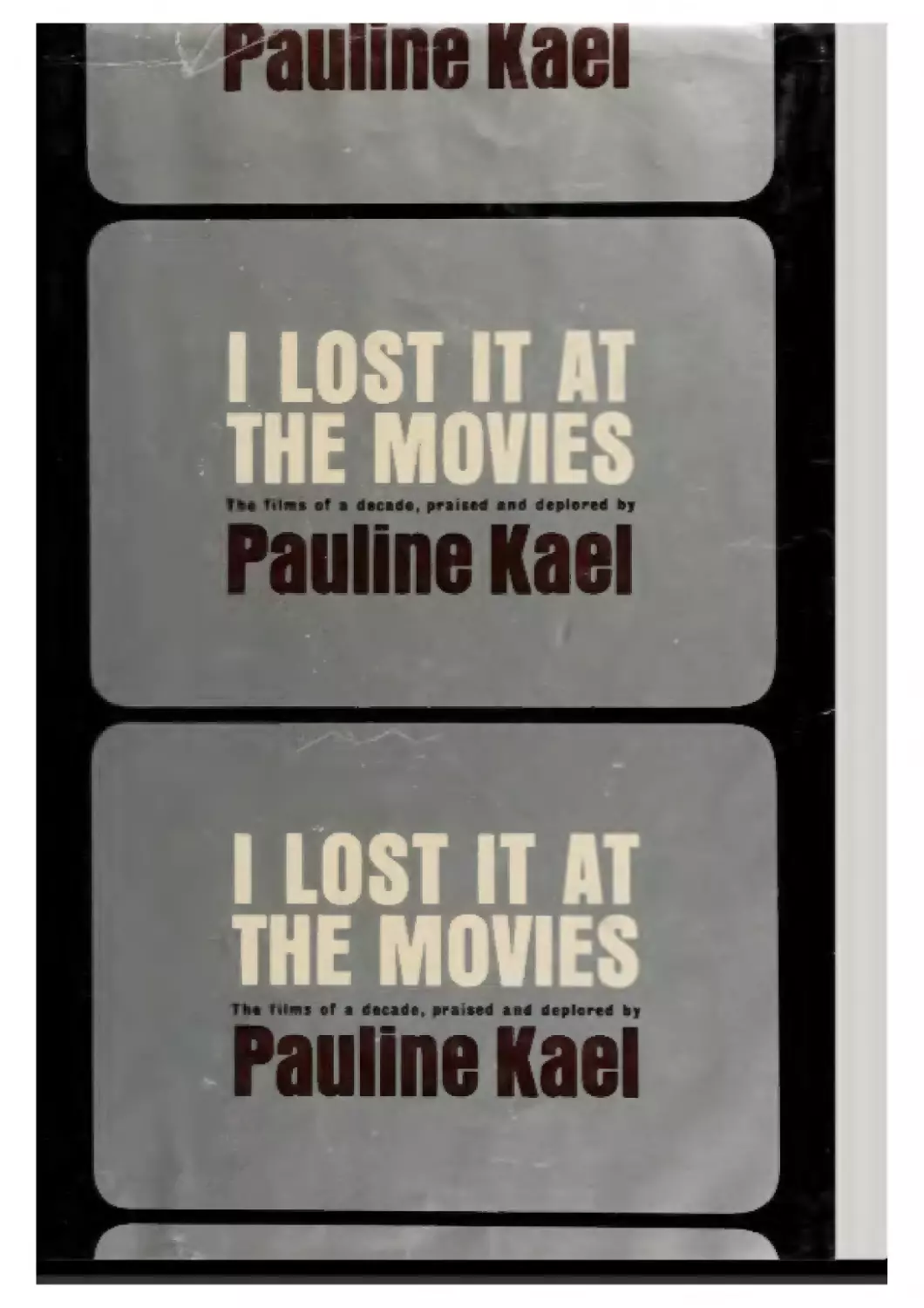
I LOST IT AT THE MOVIES
Ты fiimt tf  aucide, prtiiH «пр deployed by
Pauline Kaei
LOST IT
Th* hlmi nT « acido, priced ind depic^d My
Pauline Kaei
ILM iM i 00
In a style somewhere between Elizabethan wit and the American wisecrack here is a collection of Pauhne Kaei s writing on film selected from her articles and reviews Here are most of the important films and Irenas of tne past decade — a golden age of him wnicn contrasts sharply with the poverty of film criticism in the US —or as Miss Kael more gently puts it “In this country the movie reviewers are a destructive bunch of solidly stupidly respectable mummies Pauline Kael has lost her illusions about the critics as well as tne movies, ano her responses to movies are fresh honest and uninhibited m their expression.
I LOST IT AT THE MOVIES is a deligntfuliy mixed bag Miss Kael ranges widely, from Singin' in the Ram to Jules and Jim, from DeMille tc de Sica, from Paul Newman to Jean-Paul Belmondo. At one pwint she discusses the virtues of the American commercial move — the good hack job — at another she explains why Ameiican auatences nave accepteo Ingmar Bergman but not Satyajit Ray. She debunks a sacred cow like Hiroshima Mon Amour and celebrates a neglected him liki The Beggar s Opera. Full of puns paradoxes burlesque and caricature as well as serious argumentation her book is a lively chronicle ot tne best (and the worst) American and foreign films of tne past decade
Pauhne Kaei in two moods:
When Shoeshine jpened in 1947,1 went to see it alone after one of those terrible lovers’ quarrels that leave one in a state of incomprehensible despair I came out of the theater tears streaming and overheard the petulant voice o* (Cvnhnuea on гвсопа Пар)
I LOST IT AT THE MOVIES
I LOST IT
AT THE MOVIES
I’ACLIAE KAIJ.
An Atlantic Monthly Press Book
LITTLE, BROWN AND COMPANT • BOSTON • lURUNJO
copyright 1954, © >955. 1961. 1062, >063, 1964, 1965, by PAULINE EARI.
ALL BIGHTS RESERVED NO PART UP THIS BOOK MAY fit REPRODUCED IN ANY FORM WITHOUT PERMISSION IN WRITING ПОМ THE PUBLISHER, EJCCPFT BY A REVIEWER WHO MaY QUOTE BRIEF PASSAGES W A REMEW TO BE PRINTED IN A MAGAZINE OR NEWSPAPER
LIBRARY OR CONGRESS CATALOG LARD NO 65 Ю908
FIRST EDITION
"Throwing the Race” is reprinted by реппьмоп of Moviegoer "The Sick-Soul-of-Eurvpe Parties: La Notte, La Dolce Vita, Manenbad" is reprinted from The Mawachusetts Review, © 1963. The Massachibrtts Review, Inc. * I hi Earrings of Madame de . . . ," ' 1 he Culden Coach," “Smiles of a Summer Night arc reprinted by permission of Kulchur. “Morality I’lzys Right and Left,” “Is There a Cut foi Film Criticism?," “Fantasies of the Art House Audience,’ and "Salt of the Earth" are repnnted by permission of Sight and Srund. "CuniiniUnent and the Straitjacket,” "Circles and Squares," ’Hud," “The Innocents,” “One, t wo, Three," 'Billy Budd," "Hemingway’s Adventures of a Young Man,” and “Films of the Quarter,” note on L’Arventura, are repnnted from Film Quarterly, bv permission of the Regents of the University of California
Arl.AN1lC-LTTTLE, BKOV.N BOOKS ARE PUBLISHED BY LITTLE, BROWN AND COMPANY kN ASSOCIATION WITH THF ATLANTIC MONTHLY PRESS
Publtthid simultaneously in Canada by Little, Btows о Company (Canada) Limited
PR IN I 111 IN THE UNITED STATES OF AMERICA
lAiAiAiAiA
Acknow lodgments
1 wish to express my gratitude to the John Simon Guggenheim Foundation and its president, Mr Gordon N Ray.
I wish to thank Peter Dawson and William Abrahams of the Atlantic Monthly Press, and Gary -Arnold and Alan Hislop for editorial advice and assistance. And 1 wish to express my admiration and respect for Dwight Macdonald, who despite my hectoring him in print has, personally, returned good for evil.
Acknowledgment is nude to the Atlantic Monthly, Film Quarterly, Partisan Renew, Sight and Sound, the Massachusetts Review’, Kulchur, Art Film Publications. the Second Coming, Film Culture, and Moviegoer for permission to use matinal which they originally published
Contents
INTRODUCTION	i
Zeitgeist and Poltcrgci't; Or, Ate Movies Going
to Pieces?	3
I: BROADSIDES	29
Fantasies of the Art-House Audience	31
'J Ъе Glamour of Delinquency	44
On the Waterfront, East of Eden, Blackboard Jungle . . ,
Commitment and the Straitjacket	62
Room at the l op. Look Back in Anger, The Entertainer, Sons and Losers, Saturday Night and Sunday Morning .
Hud, Deep in the Divided Heart of Hollywood 78
II RETROSPECTIVE REVIEWS: MOVIES
REMEMBERED sstth PLEASURE	95
The Earrings of Madame de .. . (1953)	97
The Golden Coach (1953)	101
Smiles of a Summer Night (1935)	105
I*i Grande Illusion (1937)	108
Forbidden Games (1952)	111
vill • CONTEXTS
Shoeshine (1947)	114
The Beggar's Opera (1953)	116
The Sesen Samurai (1934)	119
111: BROADCASTS and REXTEWS, 1961-1963 125
Breathless, and the Daisy Miller Doll	127
The Cousins	132
Canned Americana	136
West Side Story	141
UAwentura	148
One, Two, Three	150
The Mark	155
Kagi	160
The Innocents	163
A View from the Bridge, and a Note on The
Children's Hour	172
The Day the Earth Caught Fire	176
The Cofne-Dressed-As-the-Sick-Soul-of-Fnrope Parties: La \otte, Last Year at Manenbad, La Dolce Vita	179
A Taste of Honey	196
Victim	201
Lolita	203
Shoot the Piano Player	210
Jules and jun	216
Hemingway’s Adv< ntures of a Young Man 222
Fires on the Plain (Nohi)	225
Repls mg to Listeners	228
Billy Budd	234
Yo/imbo	=39
Devi	245
CONTENTS • IX
How the Long Distance Runner Throws the Race	256
8!i: Confessions	of a Movie Director	261
IV:	POLEMICS	267
Is There a Cure for Film Criticism? Or, Some Unhappy Thoughts on Siegfried Kracauer’s Theory of Frtm; The Redemption of Physical Reality	26g
Circles and Squares	292
Morality Phys Right and Left	319
INDEX	347
Infrodurtion
UXiAiXl/
Zeitgeist and Poltergeist: Or. Are Movies Going to Pieees?
Reflections from «he side of the pool at iho Beverly Hill* Hotel
“Bring your bathing suit,” said the movie producei, who was phoning inc to confirm our date tor lunch at hrs hotel, and before 1 could think of a way to explain that I didn’t have one with me, he added, “And remember, you’re meeting people for cocktails in mv suite at six, so just bring your change of clothes-” Now I was completeh out of my depth 1 jusl sard 1 would join him at 2.30 and hung up. Somehow 1 didn't want to come right out and say that I did 111 have a change of clothes in the evening sen^c that he meant. Los Angeles dislocates my values, makes me ashamed of not being all the things I’m not and dun t ordinarily care to be. Each time I get on the jet to return tu San Francisco it’s like turning the time machine backward and being restored to an old civilization that I understand.
Ixk Angeles is onlv 400 miles away from where I live and so close by jet that 1 can breakfast at home, give a noon lecture at one of the universities in LA, and be back in time to prepare dinner But it’s the city of the future, and I am more a stranger there than in a foreign country. In a foreign country people don’t expect you to be just like them, but ш Los Angeles, which is infiltrating the world, thev don’t consider Hut you might be different because they don’t recognize any values except then own And soon there may not be any others.
4	• IMHODI'CTION
beehug rather seedy in the black and brown Italian suit which ba 1 seemed quite decent m San Francisco. 1 arrived at the pool of the Beverly Hills Hotel, sans bathing suit or change of clothes And as I walked past the recumbent forms to the producer, also recumbent, who was limply waving to me, I remcml-eud Katharine Hepburn as poor Alice Adams in her simple organdy frock among the plushly overdressed rich girls at the party Only here it was I who was overdressed; they were expensively undressed. Tbev didn’t look young, and thev didn t act old, these people eating and drinking and sunning themselves around the pool. 1Ъеу seemed to be ageless like crocodiles; and although they weren t fat, they were flabby.
Despite the narcissism of their attitudes, and the extraordi nary amount of loving care they lavished on their bodies, each giving way to the sun-blcsvcd fantasy of himself, stretching thus way and that to catch or avoid the ray’s, it was impossible to feel superior to them, 'ibey could alioid to make this spectacle of themselves.
In San Francisco, vulgantv, “bad taste,” ostentation are regarded as a kind of alien blight, an invasion or encroachment from outside. In Los Angeles, there is so much money and power connected with ostentation that it is no longer ludicrous: it i-ommands a kind of re.pect For if the mighty behave like this, then quiet good taste means that you can’t afford the conspicuous expenditures, and you become a hrtic ashamed of your modesty and propriety . Big money and its way of life is exciting; the vulgarity of the powerful is ugly, but not boring, ‘iliis, you begin to feel, is how people behave when they’re strong enough to act out theu fantasies of wealth In this en vnonment, if yuu’rc not making it in a big way, vuu’rc worse than nothing — you’re a failure But if you tan still pass fur voung. maylx: there’s still time to make it; nr, at least, you can delay the desperation and self-contempt that result from accepting these standards that so few can meet. It’s easv to reject all this when Im back m San Francisco. But not here You can t really laugh at the Beverly Hills Hotel and people who pay $63
ZEITCEISl AND POLTERGEIST •	$
a day for a suite that’s hke a schoolboy's notions of luxury It s too impressive. Laughter would stick in the throat — like sour grapes.
What ‘‘sensible’* people have always regarded as the most preposterous, unreal and fantastic side of life in California — the sun palace of Los Angeles and its movie-centered culture — is becoming embarrassingly, “fantastically” actual, not just here but almost anywhere. It embodies the most common, the most widespread dream — luxun in the sun. a state of permanent vacation And as it is what millions of people want and will pav money for, the llulhwood fantasy is economically practical. Across the country, homes become as simple, bare and convenient as simulated motels, and motels are frequently used as residences
But pioneers softer from stresses we don t know about, and the people I met in los Angeles seem to have developed a terrible tic. they cannot stop taifang about their “cultural explosion.” The producer wait on and on about it, about then new museums, and their concerts, and that galleries, and their legitimate" collegiate theater It was like my first trip to New York, when I wanted to see skyscrapers and go to shows and hear pz7, and New Yorkers wanted me to admire the flowers blooming in Rockefeller Plaza. I wanted to talk about the Los Angeles that fascinated and disturbed me, and about movies and why there were fewer good movies m 1963 than in any year in my memory. He discussed the finer things in life, trvmg to convince me and maybe himself that Los Angeles, in its cultural boom, was making phenomenal strides toward bccom-ing like othei cities — only, of course, more so.
I dutifully wrote in my notebook but not about what he was saying Perhaps, because the whole scene was so nightmarish, with all the people spending their ordinary just-hkeanv-other-day at the pool, conducting business by the telephones whose wires stretched around them like lifelines, and this earnest man in wet trunks ordering me double Bouibons 011 the locks and
6 • IXTROnvCHON
biking culture while deepening his tan, I began to think about horror movies.
Zeitgeist and Poltergeist: Or. trr Me view tkoinfi te Pleees?
The week before, at home, some academic inends had been over and as we talked and drank we looked at a television showing ol iud Browning’s 1931 version of Dracula. Dwight Frye's appearance on the screen had us suddenly squealing and shrieking, and it was obvious that old vampire movies were part of our common experience. Wc talked about the famous ones, Mumaus Nurfcratu and Dies it’s Vumpyr, and we began to get fairly involved in the lore of the genre — the strategy of the bite, the special earth for the coffins, the stake through the heart versus the rays of the sun as disposal methods, the cross as vampire repellent, et al We had begun to surprise each other by the affectionate, nostalgic tone of our mock erudition when the youngest person present, an instructor in English, said, in a clear, firm tone, “The Beast with Five Fingers is the greatest horror picture I've ever seen. Stunned that so bright a voung man could display such shocking taste, preferring a Warner Brothers forties mediocrity to the classics, I gasped, “But why?" And he answered, “Because it's completely irrational. It doesn't make am sense, and that’s the true terror."
Upset by his neat little declaration — existentialism in a nutshell — by the calm matter-of-factness of it, and by the way the others seemed to take it for granted, I wanted to pursue the subject. But О llcnrv's remark “Conversation in 7 eras is seldom continuous" applies to California, too. Dracula had ended, and the conversation shifted to oilier, more “serious” subjects.
But his attitude, which had never occurred to me, helped to explain some of my recent moviegoing experiences. I don’t mean that 1 agree that The Beast with Five Fingers is a great honor film, but that his enthusiasm for the horror that cannot be rationalized by the mvthology and rules of the horror
ZEITGEIST AND POLI ERG El ST •	7
game 1 elated to audience reactions that had been puzzling me.
Last year 1 had gone to see a famous French film, Georges Franjos Eyes Without а Гасс, which had arrived in San Francisco m a dnbbcd version called The Horror Chamber of Dr. Faustus and was playing on a double horror ball in a huge Market Street theater. It was Saturday night and the theater, which holds 2646, was so crowded I had trouble finding a seat.
Even dubbed, Eyes Without a Face, which Fran,u called a "poetic fantasy,' is austere and elegant: the exquisite photography is bv the great Shuftan, the music by Maunce Jarre, the superb gowns by Givenchy. It's a svmbohst attack on science and the ethics of medicine, and though I thought this attack as simpleminded in its way as the usual young poet’s denunciation of war or commerce, it в in some peculiar way a classic of horror.
Pierre Brasseur, as a doctor, experiments systematically, removing the faces of beautiful young kidnaped women, trying to graft them onto the ruined head of his daughter. I le keeps failing, the girls are destroyed and set he persists — in some terrible parody of the scientific method. In the end, the daughter — still only eyes without a face — liberates the dogs on which he abo experiments and they tear off his bead.
It's both bizarrely sophisticated (with Abda Valh as his mis tress doing rhe kidnaping in a black leather coat, recalling the death images from Cocteau's Orpheus) and absurdly naive. Franp’s style is almost as purified as Robert Bresson’s, and although I dislike the mixture of austerity and mysticism with blood and gore, it produced its effect — a vague, floating, almost lync sense of horror, an almost abstract atmosphere, impersonal and humorless. It has nothing like the fun of a good old horror satire like The Pride of Frankenstein with Elsa Lanch ester's hair curling clectiically instead of just frizzing as usual, and Ernest Thesiger toying with mandrake roots and tiny ladies and gentlemen tn glass |ars. It’s a horror film tlrat takes itself verv seriously, and even though I thought its intellectual pretensions silly, I couldn't shake off the exquisite, dread inrages.
8 • INTRODUCTION
But the audience seemed to be reacting to a different movie. They were so noisy the dialogue was inaudible; they talked until the screen gave promise of bloodv ghastliness. 'I hen the chatter subsided to rise again in noisy appioval of the gory scenes. When a girl in the film seemed about to be mutilated, a joung man behind me jumped up and down and shouted encouragement ' Somebody’s going to get it,” he sang out gleefully. Ihe audience, which was, I'd judge, pudominantly between fifteen and twenty five, and at least a third feminine, wras as pleased and excited by the most revolting, obsessive images as that older, mostly male audience is when the nudes appear in The Immoral Mr. Teas or Not Tonight, Henry. They'd gotten what they came for. they hadn’t been cheated. But nobody seemed to care what the movie was about or be interested in the logic of the plot — the reasons for the gore.
And audiences have seemed indifferent to incomprehensible sections in big expensive pictures. For example, how is it that the immense audience for I he Bridge on the River Kivui, after all those hours of watching a story unfold, didn't express discomfort or outrage or even plain curiosity about what exactly happened at the end — which through bad direction or perhaps sloppy editing went by too fast to lx* sorted out and understood. Was it possible that audiences no longer cared if a film was so untidily put together that information crucial to the plot or characterizations was obscure or omitted altogether? What Ever Happened to Baby Jane? was such a mess that Time, after calling it "the year's scariest, funniest and most sophisticated thriller,” got the plot garbled.
In recent years, largely because of the uncertainty of producers about what will draw-, films in production may shift from one script to another, or may be finally cut so that key sequences are omitted. And the oddity is that it doesn't seem to matter to the audience. I couldn't tell what was going on in parts of 55 Deys at Peking. I was flabbergasted when Cleopatra, with no hint or preparation, suddenly demonstrated clairvoyant powers, only to dispense with them as quickly as she had
ZEITGEIST AND POLTERGEIST • g
acquired them. The audience for The Cardinal can have little way of knowing whose baby the priest’s sister is having, or of understanding how she can be in labor for days, screaming in a rooming house, without anybody hearing her. Flicy might also be puzzled about how the priest’s argument against her marriage, which they have been told is the only Catholic position, can, after it leads to her downfall and death, Ire casually dismissed as an error.
It would be easy to conclude that people go to see a “show" and just don’t worry if it all hangs together so long as they’ve got something to look at. But 1 think it’s more complicated than that: audiences used to have an almost rational passion for getting the story straight. They might prefer bad movies to good ones, and the Variety list of ‘all-time top grossers" (such as The Greatest Show on Earth and Going My Way) indicates that they did, but although the movies might be banal or vulgar, they were rarely incoherent. A movie had to tell some kind of story that held together: a plot had to parse. Some of the appreciation for the cleverness of, say, I htchcock’s early thrillers was that they distracted you from the loopholes, so that, afterwards, you could enjoy thinking over how you'd been tricked and teased Perhaps now “stories" have become too sane, too explicable, too commonplace for the large audiences who want sensations and regard the explanatory connections as mere "filler — the kind of stuff you sit through or talk through between jolts.
It’s possible that television viewing, with all its breaks and cuts, and the inattention, except for action, and spinning the dial to find some action, is partly responsible for destruction of the narrative sense — that delight in following a story through its complications to its conclusion, which is perhaps a child's first conscious artistic pleasure. The old staples uf entertainment — inoffensive genres like the adventure story or the musical or the ghost story or the detective story — arc no longer commercially safe for moviemakers, and it may be that audiences
IO • INTRODUCTION
don’t have much moie than a TV’ span of attention left they want to be turned on and thn spend most of then time turning off Somelhmg similar and related may be happening in reading tastes and habits: teen-agers that I meet have often read Salinger and some Orwell and l^ard of the Flies and some Jovcc Cary and sometimes even I^ostovevsky, but they are not inter ested m the “classic” English novels of Scott or Dickens, and what is more to the pomt. they don t read tfie Sherlock Holmes stories or even the modern detective fiction that in tin: thirties and forties was an accepted part of the shared experience of adolescents. V\ hatever the reasons — and they must be more than TV, lhev must have to do with modem life and the sense of urgency it produces —audiences can no longet be depen Jed on to respond to conventional forms.
Perhaps they want much more fiom entertainment than the civilized, but limited rational pleasures of genre pieces. More hkelv, and the box-office returns support this, they want члпе-thing different. Audiences that enjoy the shocks and falsifications, the brutal senes of titillations of a Vfondo Cane, one thrill after another, don't care am longer about the conventions of the past, and are too restless and apathetic to pay attention to motivations and complications, cause and effect, They want less effort, more sensations, more knobs to turn
A decade ago. The Haunting, an efficient, professional and to all appearances “commercial'' genre piece, might have made money. Bi the end of 196?, its grosses in the United States and Canada, according to Variety, were $700,coo This ma\ bt compared with $9,350,000 for Irma La Douce, $4.600,000 for The Birds, $3,900.000 fur 55 Davs at Peking — all three, I think, much less enjoyable movies, or to be more exact, terrible movies, and m varying degrees pointless and incomprehensible. A detective genre piece, The List of Adnan Messenger, also incomparably better th in the three films cited,, and with a tricky "star" selling campngn, grossed only $1,500.000 It’s eass to imagine that Robert Wise, after the energetic excesses of West Side Story, turned to The Haunting for a safe, sane respite, and that
Z1ITCE1ST AXD POITFUGFTST
11
John Huston, after wrestling with Freud, tnmcd to an intriguing detective story like Adnan .Messenger for a lucrative, old fashioned holiday. But what used to be safe seems now to be folly. How can audiences preoccupied with identity problem.', of their own worry about a case of whodunit and why and how"’ Following chics may be too much of an effort for those who, in the current teen-age phrase, “couldn t care less ’ They want shock treatment, not diversion. and it takes more than ghosts to frighttti them.
The [hunting is set in that pleasantly familiar “old dark house ‘ that is itself an evil presence, and is usually inhabited by ghosts or evil people In our childhood imaginings, the unknowable things that have happened in old bouses, and the whispers that someone may have died in them, make them mysterious, “dirty M; only the new house that has known no life or death is safe and clean. But so many stones have used the sinister dark house from-which no-one-can-cscape and its murky gardens for our ritual entertainment that we learn to experience the terrors as pleasurable excitations and reassuring reminders of how frightened we used to be before we leanud our way around. Tn film, as in story, the ambiance is fear, the film specialty is gathering a group who are happed and helpless. ( Although the women are more easily frightened, the men arc abo powerless. I heir superior strength doesn’t count for much against unseen menaces this may explain why the genre was often u ed for a male comedian — like Bob Hope in The Ghost Breakers. Russ Tamblyn serves a similar but feeble cowardly-comic function in The Haunting.) The action is confined to the house and grounds (the maze); the town is usually tar away, just far enough awav so that “nobods wall hear you if rou scream. ’
In recent years film festivals and art houses have featured a peculiar variant of the trapped m the old-dark-house genre (Bunuel’s The Exterminating Angel is the classic new example), but the characters, or rather figures, are the undead or zombies of the vampne movies. “We live as in coffins frozen side by side in a garden — Last Year at Manenbad. “I m dead”
12 • INTRODUCTION
— the heroine of I! Mare “They're all dead in there” — the hostess describing the party of La Notie Their vital juices have been sucked away, but they don’t have the revealing marks on the throat. X\ t get the message: alienation drains the soul without leasing any marks. Or. as Bergman says of Im trilogy, "Most of tlie people in these three film* are dead, vompleteh dead They don’t know how to love or to feel any emotions they arc lost because thev can t reach anyone outside of themselves.” This “art’ vanant is a message movie about failure of com-municatiun and lack of love and spiritual emptiness and all the rest of that. It’s the closest thing we’ve got to a new genre but it has some pciultanties. The old dark home was simply there, but these symbolic decadent or sterile surroundings are supposed to reflect the walking death of those within the maze ITic < h meters in the old dark house tried to sohe the riddle of their imprisonment and tned to scape, esen in No Exit the drama was in why the characters were there, hut in the new hotel in hell movies the characters don’t even want to get out of the maze — nor one sunmscs du the directors, despite their moralizing. And audiences apparently respond to these films as modern and relevant just because of this paralysis and inaction and minimal storv line. If in the group at the older dark house, someone was not who we thought he was, in the new dull party gatherings, it doesn't matter who anybody is (which is a new honor).
Although The Haunting is moderately elegant and hrerate and expensive, and the director gussies things up with a Man-enbadish piece of statuary that mav ui may not be the key to something or other, it’s basicalk a tiaditional ghost story, 'there is the dedicated scientist who wants to contribute to science in some socially unacceptable or scientifically reproachablc area — in this case to prove the supernatural powers of rhe house. (The scientist is, somewhat inexplicably, an anthropologist, perhaps Margaiet Mead has set the precedent fur anthropologists to dabble in and babble on am thing —so that the modem concept of the anthropologist is like the old concept of the
ZEITGEIST AND PO1TERGFIST
’ *3
philosopher or, for that matter, the scientist.) And, in the expository style traditional for the genre, he explains the lore and jargon of psvchic research, meticulously separating out ghost from poltergeist and so on. And of corn sc the scientist, in the great tradition of Frankenstein, must liave the abnormal or mad assistant- the role that would once have belonged to Dwight Frve is here modernized and becomes the Greenwich Village lesbian, Claire Bloom And there is the scientist’s distraught wife who fears that her husband s brilliant career will be turned, and so on The chaste heroine, Juhe Harris (like an updated Helen Chandler, Dracula's anemic victim), is the movies’ post-Freudian concept of the virgin repressed, h vs ten cal, insane — the source of evil.
It wasn’t a great movie bur 1 certainly wouldn't have thought that it could offend ancone. Yet part of the audience at The JI aunt mg wasn't merely bored, it was hostile — as if the movie, by assuming interests they didn't have, made them feel resentful or inferior. I've never felt this kind of audience hostility toward crude, bad movies. People are relaxed and tolerant about ghoulish quickies, grotesque 'hockers dubbed from Japan, and chopptd-np Italian spectacles that scramble mythologies and pile on actions, one stupiditv after another Perhaps they prefer incoherent, meaningless movies because the) are not required to remember or connect. They can feci superior, contemptuous — as they do toward television advertising. Fven when it’s a virtuoso triumph, the audience is contemptuous toward advertising, because, alter all, they see through it —they know’ somebody is trying to sell something. And because, like a cheap movie obviously made to pn money nut of them, that is all advertising means, it's OK But the few, scattered people at The Haunting were resiless and talkative, the couple sitting neai me arguing — the man threatening to leave, the woman assuring him that something wuuld happen In their terms, they were cheated, nothing happened. Anti, of course, they missed what was happening all along, perhaps because of nervous impatience or a primitive попил that the real things are physi
14 • tniroductton
cal, perhaps because people take from art and from popular entertainment only what they want; and if they arc indifferent to storv and motive and blank out on the connections, then a movie w ilhout physical action or crass jokes or built in sentimental responses has nothing for than I am afraid that the young instructor in English spoke for his times, that there is no terror tor modem audiences if a story is carefully worked out and follows a tradition, even though the tradition was developed and perfected precisely to frighten entertainingly.
No w onder that studios and producers are unsure what tn do next, scan best sella lists fur trends, consult audience-testing polls, anxiously chop out what a preview audience doesn’t like. The New York 7 ones eludes the representatives of some seven companies who didn’t want to invest in What Ever Happened, to Baby fane? but how could businessmen, brought up to respect logic and a good commercial script, possibly guess that this confused mixture of low camp and Grand Guignol would delight the public?
And if I may return for a moment to that producer whom 1 left sunning himself at the side of the pool — "Did you know that Irma La Douce is already the highest-grossing comedy in him history?" he asked inc at one point, not in the droning voice of the civic-minded man discussing the cultural development of the community, but in the voice of someone who's rcallv involved in what he’s saying “Yes,” 1 sard, but is it even a comedy? It’s a monstrous mutation/’ The producer shrugged his dark round shoulders helplessly; "Who knows what’s a comedy any mure?”
It is not just general audiences out for an evening's cnleitain-ment who seem to leave lost the narrative sense, or become in different to narrative, WTrat 1 fhmk arc processes of structural disintegration are at work in all types of movies, and though it's obvious that many of the old forms were dead and had to be broken through, it’s rather scarv ro see what's happening — and not just at the big picture palaces. Art house films are even
ZEITGEIST AND POLTERGEIST •	1$
more confusing. Why, at the end of Godard's My Life to Live, is the heroine shot, rather than the pimp that the rival gang is presumably gunning for? Is she just a victim of bad marksmanship? If we express perplexity, we are likely to lie told that we arc missing the existentialist point; it's simply fate, she had to die. But a cross-eyed fate? And why is there so little question ing of the organization of My Kame Is Ivan with its lyric inter hides and patriotic sections so ill assembled that one might think the projectionist had scrambled the reels? (They often do at art houses, and it would seem that the more sophisticated the audience, the less likely that the error will be discovered. When I pointed out to a theater manager that the women in Brink of Life were waiting for their babies after they had mis-carried, he told me that he had been playing the film for two weeks and I was his first patron who wasn’t familiar with Bergman's methods.)
Fire art-house audience accepts lack of clarity as complexity', accepts clumsiness and confusion as “ambiguity” and as style, Perhaps even without the support of critics, (hey would accept incoherence just as the larger audience does they may fed that movies as incomprehensible as Virtdiana are more relevant to their experience, more true to their own feelings about life, and more satisfying and complex than works they can understand.
1 trust 1 won’t be mistaken for the mrt of boob who attacks ambiguity or complexity. I am interested in the change from the period when the meaning of art and form in art was in making complex experience simple and lucid, as is still the rase in Knife in the Water or Bandits of Orgosolo, to the cunent acceptance of art as technique, the technique w'hich in  томе like This Sporting Life makes a simple, though psvthologically confused, story look complex, and modern betause inexplicable.
It has become easy — especially' for those who consider ’‘time’' a problem and a great theme — to believe that fast editing, out of normal sequence, which makes it difficult, or impossible, for the audience to know if any action is taking place, is somehow more “cinematic” than a consecutively told story'. For a half
16 • INTRODUCTION
century movies have, when necessary', shifted action in tunc and place and the directors generally didn't think it necessary to slap us in the face with each cut or to call out, "Look what 1 can do! Yet people who should know better will tell you how  cinematic” The Loneliness of the Long Distance Runner or This Sporting Life is — as if fiddling with the umc sequence was good in itself, proof that the medium is really being used. Perhaps, after a few decades of indoctrination in high art, they are convinced that a movie is cinematic when they don't understand what’s going on 7 his Sporting Life, which Derek Ihll, among others, has called the be t feature ever made in England, isn’t gracefully fragmented, it’s smashed. The chunks are so heavy and humorless and, in an odd way, disturbing, that we can tell the film is meant to be bold, powerful, tragic.
There’s a woman writer I’d be tempter! to call a three time loser: she’s Catholic, Communist, and lesbian, but she comes on more like a triple threat. She’s in with so many groups that her books are rarely panned. I thought of her when 1 read the reviews of This Sporting Life this film has it made in so many wavs, it carries an identity card with all the outsiders. T he hero is "bewildered,” the heroine "bimsed” and afraid of life,” the brutal rugby games arc possibly a “microcosm of a corrupt society,” and the film muikily suggests all sorts of passion and protest, like a group of demonstrators singing ' We Shall Overcome” and leaving it to you to fill hi your own set of injustices. Foi Show magazine, "The football scenes bear the aspect of a savage rile, with the spectators as paiticipants hungry for sacn fice. The love story ... is simply another kind of scrimmage, a batllc between two people who cannot communicate . . For the New York Times, the film “translates the confusions and unrequited longings of the angry young men and women of our tune into memorable universal truths.” (I wish the reviewer would spell out one or two of them fur us.) The Times has an unusual interpretation of the love story: “The woman . . . only succumbs to him physically and the real roots he seeks are unattainable." I his reminds me of my confusion as a schoolgirl
ZEITGEIST AXD POLTERGEIST
17
when a jazz inusiaan who had been introduced to me during the break called out “Dig you later” as he went back to the stand.
In the Observer, Penelope GiUutt offers extraordinary praise. "T/us Sporting Life is a stupendous film It has a blow like a fist. 1 ve never seen an English picture that gave such expression to the violence and the capacity for pain that there is in the English character. It is there in Shakespeare, in Marlowe, in Lawrence and Orwell and Hogarth, but not in our cinema like this bcfoie I hit Sporting Life is hard to write about because everything important about it is really subverbal.' But then so are trees and animals and cities. Isn г it precisely the artist's task to give form to his experience and the critic’s task to verbalize on how this has been accomplished? She goes on to write of the hero. '“I he events almost seem to be happening to Inin >n the dark. Half of them are told while he is under dentist’s gas, in flashback, which is a clumsy device if one is telling a story but the natural method if one is searching around a character ” English dental hygiene is notorious; still, isn t telling a story, with or without gas and flashbacks, a pretty good * natural” method of searching around a character? But something more seems to be involved; “The black subjective spirit of the film 1$ overpowering. It floods the sound track, which often has a peculiar resonance as though it were happening inside one’s own head ' Sort of a sunken cathedral effect? 1 he bells arc clanging in the reviewers heads, but what’s happening on the screen?
In one way ot another, almost all the enthusiasts for a film like this one will tell you that it docsn t matter, that however you interpret the film, vou will be right (though this does not prevent some of them from working out elaborate interpreta-bons of Manertbad or I he Eclipse or VtriJiand). Walter Las-sally says that ' Antonioni’s oblique atmospheric statements and Bunud’s simbcihsm, for example, cannot be analyzed in terms of good or bad . for they contain, in addition to any obvious meanings, everything that rhe viewer may read into them.” Surely he can read the most onto a blank screen?
IЯ • ISTBODrcrrON
There's not much to be said for this theory except that it’s mighb. democratic. Rather pathetically, those who accept this Rorschach blot approach to movies are hesitant and uneasy about offering uaan>m They should be reassured bv the belief that whatever they say is right but as it refers not to the film but to them (turning cnbrnni into autobiography) thev are afraid of self exposure. I dom think thev really believe the theory — it's a sort of temporary. public convenience station. More and more people come out of a movie and can’t tell sou what thev ve seen, or even whether thev liked rt.
.An author like Davhl Stores may stun them with mforma-bon like “jThis Spirting Life] works pin eh m terms of teding Onlv frivolous judgments can be made about it m conventional terms of style.” Has he discovered a new method of conveying feeling witliuut style? Or has lie simply found the arrogance to frustrate normal responses? No one wants to have Ins capacity for feeling questioned, and if a viewer tnes to play it cool, and discuss T/ns Sporting Life in terms of corrupt professional football, he Mill won't score on th«t muddv field there are no goaf posts. Lindsay Anderson,, who directed, says, ‘This Sporting Life is not a film about sport In fact, 1 wouldn't rcalh call it a story picture at all Wc have tried to make a tragedy . . . we were nuking a film about something unique.'' A tragedy without a story is unique all right. a disaster.
In movies, as m other art forms, if you arc interested only m technique cn if vou reject technique, the icsult is just about the same if vou liave nothing Io express it is very much like thinking vou have so much to express that vou don't know how to say it Something related to absorption in technique is involved in the enthusiasm of voung people for what is callid * the New American Cinema,'' though these films arc often made b those who reject craftsmanship as well as meaning, ihey tend to equate technique with science and those who produced the Bomb. 'Uns approaih, which is a little like the attack on scientific method in Eyes Without a l ace, is mol to explain why they must make movies without taking rime to learn how.
ШГСЕЬТ ЛЧО pot TTRGEISI
’9
They're in a hurrv, and anyway, technique might corrupt them.
’Ibe spokesmen for this cinema attack rationality as if it were the enemv of art (“as/ the heavy Boots of Soldiers and Intellect/ march across the/ flowerficlds of subconscious and so forth bv Jonas Mekas). They have composed a rather strange amalgam in whi< h reason = lack of feeling and imagination = hostility to art = science = the enemy = Nazis and police — the Bomb. Some* here along the line, criticism is also turned into an enemy of art. The group produces a kind of euphoric publicity which is published m place of criticism, but soon it may liave semi intellcctually respectable critics. In the Nation of April 15, 1964, Susan Sontag published an extraordinary essay on Jack Smith's Flaming Creatures called ‘ A Feast for Open Eyes" in which she enunciates a new critical principle: “Thus Smith’s crude technique senes, beautifully, the sensibility embodied in Flaming Creatures — a sensibility based on indiscrimmateness, without ideas, besond negation." I think in treating indiscrimmateness as a value, she has become a real swinger. Of course we can reply that if anything goes, nothing Iiappens, nothing works. But this is becoming irrelevant. In Los Angeles, among the independent film makers at thar midnight screenings 1 was told that I belonged to the older generation, that Agce-alcohol generation they called it, who could not respond to rhe new films because I didn t take pot or LSD and so couldn’t learn just to accept everything. This narcotic approach of torpid acceptance, which is much like the lethargy of the undead in those failurc-ofcouununication movies. may explain why those films liave seemed so "true” to some people (and why the directors’ moralistic messages sound so false). This attitude of rejecting critical standards has the dubious advantage of accepting everyone who says he is an artist as an artist and conferring on all his “noncommercial ' productions the status of art. Miss Sontag is on to something and if she stays on and ndcs it like Slim Pickens, it's the end of criticism — at the very least.

20 • INTMODUCTIOM
Its ten yean since Dylan Tliomis answered Max a Dcren’s rail for з new poetry of film with ’ I'm not at all sure that I want such a thing, mvseif. as a poetic film 1 think films fine as they arc. if only thev were better! ... 1 like stories, you know — I like to see something going on.’ Movies have changed in these ten years, disastrously ш the last few years; they have become “cinema.”
At the art house level, critics and audiences haven’t vet discovered the beauty of mdiscnminatcncss, but there’s a lot of talk about "purely visual content’’ — which might be called the punciplc of ineffabihty. Time calls Resnais’s Muriel “another absorbing exemse in style." Dwight Macdonald calls Marien-bad “ рше cinema, a succession of images enjoyable in them-selves.” And Richard Roud. who was responsible (and thus guilty) for the film selection at the New York Film Festivals, goes all the wav: films like La Notts, be says, provide an схрспспсс m pure form.”
Once nutters reach this plane, it begins to seem almost un clean to гаьс issues about meaning arid content and cliaracter, or to question the relevance of a sequence, the quality of a performance. Someone is sure to sneer, "Are vou looking for a parapluasable content? A film, like a poem, is” Or smile pits inph and remind you that Patrom Gnffi had originally intended to call 11 Mare "landscape with Figures.”, doem’t that tell you hew you should look at it? It does indeed, and ir’s nut my idea of a good time. After a few dismal experiences we discover that when we are told to admire a film for its pure form or its structure, it is going to exhibit irritating, confusing, and ostentatious technique, which will, mfunaungh, be all we can discover m it. And if we should mention that we enjoy the dramatic and nar rahve elements tn movies, we arc almost certain to be subjected to the contemptuous remark, “Why docs степи have to mean something’ Do vou expect a work by Bach to iman something?"
The only way to answer this is by some embarrassingly basic: analysis, pointing out that words, unlike tones, refet ro something and that movie image-» aie lately abstract or geometric
ZF1TGFIST VXD РОСГЕЯъСШ
21
designs, 2nd that when thev include people and places and actions, thev have implications, associations Robbe-Gnllet the scenarist ot A farienhad, mav say that the him is a pure construction, an object without reference tn anything oubide itself, and that the existence of the two characters begins when the film begins and aids ninety three minutes later, but. of course, we are not bom when we go in to sec a movie — though we may want to die by the time we leave. And we can't even leave .Marit-nbad behind bciaue. although it isn’t particularly mono rablc {it isn’t cwn particular!' offensive), a kind of creeping Mancnbadism is the new aesthetics of “poetic” cinema, Ihis can only sound like pedantrv to those interested in “pure” art who tend to considei ana lists as an enemv. anyway (though many of them are in it). The very same people who say tliat a movie shouldn't mean am thing, that art is beyond meaning, also say that it must be seen over and over again because it reveals more meaning with subsequent viewings. And although the structure of nianv of the new films is somehow supposed to be the art, we arc frowned upon if we question the orgam zabon of the maienai. lheie is nothing, finally, that we are allowed to question or criticize. We arc supposed only to interpret — and that as we wish.
The leaders of this new left wing formalism are Resnais, who gives us his vision of a bomb-shattered, fragmented universe, and Antonioni, the master practitioner of the fallacy of expressive form, who sets out to demonstrate that boredom (and its accompanvmg crotiusm j is the nckness of our time (but doesn’t explain how it helps to add to it). If their characters have a cunous way of usuig their sophisticated vacuity as a come-on. are they not tn their creators' image? They make assignations (as m 7 he Eclipse), but nobody comes.
The movie houses may soon look as desolate as 11 Mure —set in Capu in winter I’ve never seen so many people sleeping through movies as at Lincoln Cenrer no wonder thett is talk of "cinema” achieving the social status of opera. Л few more seasons of such art and it will be evidence of sour interest in
22 • ГЭТЖОВГСТЮК
culture and your sense of civic rcsponsibdih if sou go to the movies.
The ' techniques” of such films die so apparent, so obtrusive, tliat they mas easily be assumed to be “advanced,” “modem," 'new. It s perfectly true you don t come out of an oldei movie like Rerun's La Grande Illusion. or Flaherh $ Man of Aran, or Berguun's Smiles of a Summer Sight saying, What technique!’ Nor do you come out of a conceit bv Serkin exclaiming about his technique — you’ re thinking of the music But those who adore Jose Iturbi always say, “What technique!”; what else is there to respond to? And the comnu nt — which means how-fast he can play or how ostentatiously — is not so ven far from the admiration for Anlotiiom or lone Nilsson or Bressons Trial of foan of Arc ( though they are generally admired for how slow thev can play |.
My attitude to what is happening to movies is more than a little ambivalent. I don't think that my own preferences or the preferences of others for coherence and wit and feeling are going to make much difference Movies are going to pieces; thev re disintegrating, and the something called anerna is not movies raised to зп art bur rather movies diminished, movies that look “artistic.” Movies are being stripped of all the “nunessennals ’ — that is to say, faces, actions, details, stories, places — everything that nukes them entertaining and jovful They are even bang stripped of the essentials — light (The Eclipse), sound (The Silence), and movement in чипе ot the New American Cinema films (there is sure to be one called Stasis). It’s obvious that the most talented film artists and the ones most responsive to our rime and the attitudes of Camus and Sartre are the ones moving in this direction. 'Ihe others, those trying to observe the older conventions, are usually ( though not always) banal, trivial, ludi-crouslv commercial, and out of touch, somehow. It is the highest talents, the most dedicated, who are driven to the dead aid of “pure” anrnu — just as oui painters arc driven to obliterate the image, and a dramatist like Beckett to reduce words to sounds.
Cinema, I suspect, is going to become so rarefied, so private
ZEITGEIST AND ГОГТТКСЕГП
• зз
in meaning, and so lading in audience appeal that in a few scars the foundations wdl be desperately and hopelessly trying to bnng it back to life, as thev arc now doing with theater The parallel course is, already, depressing!! apparent. Clancy Sigal’s (admiring) account of Beckett’s bndgome might have been written of Bergman’s The Silence:
Endgam. t two main characters . . , occupy a claustrophobic space and a deeply ambiguous relationship. . . . Outside, die world is dead of some great catastrophe. . . . The action of the play mainly comprises anxious bickenng between the two principal characters. Eventually, Clov dresses for the road to leave Hamm, and Hamm prepares for death, though we do not see the moment of parting . . . none of the actors is quite sure what the plav is about. Beckett affects complete ignorance ol the larger implications. “I onh know what's on the page,” he savx with a fnendly gesture.
Is Beckett leading the way or is it all in the air? His direction that die words of Play should be spoken so fast tliat they can t be understood is paralleled bv Resnais's editing of Munel so fast that you can’t keep track of what's going on Penelope Gil liatt writes, “You may have to go to the film at least twice, as I did, before the warmth of it seeps through . . Beckett has already anticipated the problem and provided the answer with the stage direction, "Repeat play exactly."
\\Ъеп movies, the only art which everyone felt free to enjoy and have opinions about, lose their connection with song and dance, drama, and die novel, when tliey become cinema, w hich people fear to criticize just as they fear to say vvliat they think of a new piece of music or a new poem or punting, they will become another object of academic studi and appreciation, and will soon be an object of excitement only to practitioners of the art/ Although L'Aixentura is a great film, had I been present at Cannes in iybc. where Antonioni distributed his explanatory statement, beginning, ”’Ihere exists in the world today a very senous break between science on the one hand . . . ,”
Z4 * INTRODUCTION
1 might tasih have joined m the hisses, which he didn't really deserve until the following year, when La Nolte revealed that he'd begun to believe his own explanations — thus making liars of us all.
When we see Dwight Macdonald’s cultural solution applied to film, when we sec the prospect that movies will become 3 product for ‘Masvcult’ consumption, while the "few who care” wdl have their High Culture cinema, who wants to take the high road? There is more energv, more ongmahty, more excitement. more art in Amcncan kitsch like Gimgu Dm. Easy lai mg, the Rogers and Astaire pictures hie Swingtime and Top Hat, m Strangers on a Train, His Girl Friday, The Crimson Pirate, Citizen Kane, The Lady Eve, To Hine and Have Not, The Afru.an Queen, Singfn m the Kam, Sweet Smell of Success, or more recently, The Hustler, Lolita, I he Manchurian Candidate, Hud, Charade, than in the prcsuin. d ' High Culture'' of Hiroshima Mon Amrur, Manenbad, La Notte, The Eclipse, and the Torre Nilsson pictures. As Nabokov remarked, "Nothing is more exhilarating than Philistine vulgarity.”
Regrettably, one of the surest signs of the Philistine is his reverence for the superior tastes of those w ho put him down. Macdonald believes that “a work of High Culture, however inept, is an expression of feelings, ideas, tastes, visions that are idiosyncratic and the audience similar!; responds to them as individual- ” No Hie "pure” cinema enthusiast who docsn t react to a film but feels he should, and $0 goes Lick to it over and over, is not lesponding as an individual but as a compulsive good pupil determined to appreciate what his cultural superiors say is "art ” Movies arc on their way into academia when they’re turned into a matter of duty: a mistake in judgment isn’t fatal, but too much anxiety about judgment is. In this country, respect for High Culture is becoming a ritual.
if debased art is kitsch, perhaps kitsch mav be redeemed bv honest vulgarity, mav become ait Out best work transforms kitsch, makes art out of it. tliat is the peculiar greatness and strength of American movies, as Gudaid m Breathless and Truf
ZEITGEIST AND POlTEXCEISr •	2?
faut in Shoot the Piano Player recognize. Huston’s The Maltese Falcon is a classic example. Our first and greatest film artist D- W. Griffith was a master of kitsch, the senumvnt and melodrama m his films arc much more integral to their greatness than tlie critics who lament Griffith's lack vf mind (!) perceive.
The mm-ies are still where it happens not for much lungei perhaps, hut the movies are still the art form that uses the materia) of our lives and the art form that we use. I am not suggesting that we want to see new and higger remakes of the nred old standbis of the film repertory, who wants to see the new Сппштоп, another Quo Vudis'' And meaning* dun t have to be spread out fur us like a frec-lunch counter there are movies that are great experiences like Long Day's Journey into Night, and just a few years back time wete movies which told good stories —movies like The Treasure of Sierra \hdre. From Here to Eternity, The Nun's Story.
People go to the movies for the various ways thev express the experiences of uur fives, and as a means of avoiding and postponing the pressures we feel, llus latter function of art — generally referred to disparagingly as escapism—may also be considered as refreshment, and m terms of modern big city life and small town boredom, it nu' be a ma|ur factor m keeping us sane.
In the last few vears there has appeared a new land of film-goer- lie isn't interested in movies but in cmema. A great many of the film makers are m this group- they’ve never gone to movies much and they don’t care about them. They're interested in what they can do in the medium, not in what has been dune. This is, of course, their privilege, though I would suggest that it mav explain why they have such limited approaches to film. I'm more puzzled by the large numbers of those who are look mg for importance in cinema, fur example, a doctor friend called me after he’d seen The Pink Panther to tell me I needn't “bother' with tliat one, it was just slapstick. When I told him I d akeady seen it and had a good time at it, he was irritated; he informed me that a movie should be more Hun a waste of umc,
26 • INTRODUCTION
it should be an exercise of taste that will enrich your life. Those looking for importance are too often contemptuous of the crude vitality of American films, though this ctudity is not always offensive, and inai repn sent the only way that energy and talent and inventiveness can find an outlet, can break through the planned standardization of mats entertainment. It has become a mark of culture to revere the old slapstick (the Mack Sennctt two-rcclcrs and early Chaplins that aren‘t really as great as all that) and put down the new. But in a movie as shopworn as Wfto’s Been Sleeping in My Bed? there is, near the end, an almost inspired satirical striptease bv Carol Burnett Ihe Nutty Professor is too long and repetitive, but Jerry Lewis has some scenes that hold their own with the silent classics. I enjoyed The Prize, which opens badly but then becomes a lively, blatant entertainment; but there's no point in recommending it ro someone who wants his Ide enriched. I couldn’t persuade friends to go see Charade, which although no more than a charming confectionery tnfle was, 1 think, piobabh the best American film of last year —as artificial and enjoyable in its way as The Big Sleep. The word had got around that it isn t important, that it isn t serious, that it doesn’t do anything for you
Our academic bureaucracy needs something alive to nourish it and movies still have a little blood which the academics can dram away. In the West several of the academic people I know who have least understanding of movies were suddenly interested by laurence Alloway’s piece Called "Critics in the Dark ’ in Encounter By suggesting that movie criticism had never gotten into the right hands —i.e., theirs, and by indicating projects, and by publishing in the prestigious Encounter, Alloway indicated large vistas of respectability lor future film critics. Perhaps aho they were drawn to his condescending approach to movies as a pop art. Many academics have always been puzzled that Agee could care so much about movies. Alloway, by taking the position that Ague's caring was a maladjustment, re-established then safe, seicne worlds in which if a man gets
ZEITGEIST AND rOLILRCEtST •	27
excited about an idea or an issue, they know there’s something the matter with hnn ICs not much consolation, but 1 think the cinema the academics will be working over will be the cinema they deserve.
[1964]
Broadsides
Fania*iPM of the Лг1-11опче Audience
For several decades now educated people have been condescending toward the children, the shopgirls, all those w ith “humdrum” or “impoverished'’ lives—the mass audience—who turned to movies for "ready-nude” drcams. The educated might admit that they sometimes went to the movies designed for the infantile mass audience — the number of famous people who relax with detective fiction makes this admission easy — but presumably they were not “taken in”; they went to get away from the tensions of their complex lives and work But of course when they really want to enjoy movies as an art, they go to foreign films, or “adult” or unusual or experimental American films.
I would like to suggest that the educated audience often uses “art” films in much the same self-indulgent way as the mass audience uses the Hollywood “product,” finding wish fulfillment in the form of cheap and easy’ congratulation on their sensitivities and their liberalism. (Obviously any of my generalizations are subject to numerous exceptions and infinite qualifications; lets assume that 1 know this, and that I use large generalizations m order to be suggestive rather than definitive.)
By the time Alain Resnais's Hiroshima Mon ;\mour reached American art houses, expectations were extraordinarily high. Dwight Macdonald in Esquire liad said It is the most original, moving, exciting and important movie I've seen in y ears, somehow managing to combine a love story with propaganda against war and the atomic bomb without cither losing its full force.” Ibe rest of the press seemed to concur. The Saturday Review
32	• BROVDSIBFS
considered it “a masterpiece.” 1Ъе New York Herald Tribune decided that "it establishes beyond any man's cavilling the potentialities of the film as an art” — something one might have thought already established. Time decided that the theme was that Hiroshima, like God, is love. It is the Calvary of the atomic age. It died for man’s sins ...” 1 met a couple who had seen the him five nights in a row; a University of California professor informed me that if I didn’t like this one, he would never speak to me again Dwight Macdonald wrote more and went further:
It is as stylised as Potemkin or Ten Days that Shook the World, as pure and powerful as cinema ... ft is also a novclistic exploration of mcmon, a recherche du temps perdu comparable to Proust . . . For the first time since Eisenstein — we have a cinematic intelligence so quick, so subtle, so onginal, so at once passionate and sophisticated that it can be compared with Joyce, with Picasso, with Berg and Bartok and Stravinsky. 7Ъе audience was extraordinarily quiet — no coughing, whispering, rustling of paper; a hypnotic trance. . It was oddly like a religious service, and if someone had made a wisecrack, it would have seemed not ш nritation but a blasphemy.
Surely movies — even the greatest movies — are rarely received in such an atmosphere of incense burning. Breathless and L’Av-ventura were to be cither admired or disliked or ignored, but Hiroshima Mon Amour was described in hushed tones; it was some soit of ineffable deep experience. Why?
Hie picture opened with those intertwined nude bodies — this could be symbolic of a true intermingling, but it irresistibly set off some lewd speculations about just и hat was going on. And what was that stuff they' were covered with? Beach sand? Gold dust? Ashes’* Finalh, 1 accepted it as symbolic bomb ash, but I wasn’t liappy with it. (Later I discovered that it was supposed to be "sweat, ashes and dew ”) Then the French girl said she had seen everything in Hiroshima, and the Japanese man told her she had seen nothing m Hiroshima. Then they said the same things over again, and again, and perhaps again. And I lost pa
FANTASIES ОГ THE ARI HOUSE AUDIENCE •	33
tience. I have never understood why writers assume that repetition creates a lyric mood or underlines meaning with profundity. My reaction is simply, “OK, Г got it the first tune, let's get on with it.” Now, this is obviously not how wc arc supposed to react to Marguerite Duras’s dialogue, which is clearly intended to lie musical and contrapuntal, and I was going to try to get in the right, passive, receptive mood for a ritual experience, when some outnsht fraud made me sit up and pay attention. The action — or inaction —in bed was intercut with what pui ported to be documentary shots of the effect of the bomb on Hiroshima. Only I had seen some of die footage before in a Japanese atrocity movie that was about as documentary as Peyton Place This clumsily staged imposture made inc suspect that the Japanese man didn't know Hiroshima either, and I began to look askance at the truth he was supposed to represent. W here did he get this metaphysical identity with Hiroshima? As the film went on. and the heroine recounted her first love for a German soldier, how he had been killed on the last day of fighting, how she liad been dragged away and her head shaved, how she had gone mad and been hidden away in the cellar by her shamed parents, I began to think less and less of the movie and more about whv so many people were bowled over by it.
Was it possibly an elaborate, masochistic fantasy for intellectuals? Surely both sexes could identify with the girl’s sexual desperation, her sensitivity and confusion — and liad anvone dreamed up worse punishments for sexuality? Only a few years ago it had looked as if James Dean in East of Eden and Rebel Without a Cause had gone just about as far as anybody could in being misunderstood. But this heroine not only had her head shaved by people who didn't understand her love and need of the German, but she went crazy and was locked in a cellar. You can't go much further in being misunderstood. And, at the nsk of giving offense, is this not what sends so many people to analysts — the fear that they'll go crazy if thev don’t get love?
The Japanese, it may be noted, is rather dull and uninteresting: he says no more tlian an analyst might; he is simply a
34 ' BKOADSIDtS
sounding board And if, being Japanese, he is supposed to rep resent the world’s conscience, he brings an unsunabh bland, piofcssioiully sympathetic and upper-class manner to the function But everybody who has suffered sexual deprivation — and w ho hasn't? — can identify with her and perhaps fantasize brutal parents and cellars Even her insanity can be equated with thrive rough nights when a love affair fell apart or that nervous ex haustion at the end of the academic year that sends so many to the hospital or the psychiatric clinic.
It seemed to be a woman's picture —in tlie must derugaton sense of the term. And shll she went on talking: her feelings, her doubts, her memonc >, kept pouring out It began to seem like True Confession at the higher levels of spiritual and sexual cummumon; and I decided the great lesson for us all was to shut up Dm woman tbeautifully as Emmanuelle Riva interpreted her) was exposing one of the worst faults of intelligent modern women she was talking ill her emotions out — as if bed were the place to demonstrate sensibility It’s unfortunate that what people believe to be rite most important things about tliemsthes, their innermost truths and secret» — the real sou or me — that we dish up w hen somebody looks si mpathetic, is very likely to be the driveling nonsense that we generally have enough brains to forget about The real you or me that we conceal be cause we think people won't accept it is slop — and why should anybody want it?
But here was the audience soaking it up — audiences ol social workas, scientists, ductors, architects, protessors — living and loving and suffenug just like the stenograph» watching Su-ju Hair-ward. Are the experiences involved really so different’ Few of us have seen our losers killed by pairisan bullets, but something kills love anyway — something always does — and it’s probably highly gratify mg tor mam people to identity with a heroine who vn t responsible: it is the insane world that has punished her for her sexual expresdon. Eiiinutiuelle Ro a s sexual expression is fat more forthright than a Hollywood heroines, which nukes it more appealing to an educated audience, and. of course, her
FANTASIES OF TllF 'Xl-HOUSE AUDIENCE • JJ character and her maimer if indicating her emotional problems leave a higher “tone." (It may be relevant to note that the educated audience, «huh generally ignores Miss Hi ward, did rum out for J Want to Lne, in which the «.haractcr of Barbara Graham was turned into a sort of modern Tess of the d Urbcr-lilies—not only innocent of enme hut horribly sinned against and nobler than an y bodv else )
But what docs her sad story have to do with Hiroshima and the bumb? Would not some other pKyxhusexual story of depination (say, Camille or Stella Dallas > be just as relevant to the honors of war if it were set m Hiroshima’ It would sevm so. However. the setting itself expbins another aspect of the film's strong appeal, pirticvbrh to liberal intellectuals There rs a email bit of dialogue "They male movies to sell soap, why not a music to sell peace?” I don’t know how many movies you Live gone to lately that were made to sell soap, but American nioi-.es are like advertisements, and we can certainly assume that indirectly they sell a way of life that includes soap as well as an infinity of other products. But what makes tlie dialogue crucial is that the audience for Hiroshima Men Amcin feeb virtuous because they want to buy peace And the question 1 want to ask is- who's selling it?
Recently, at a cocktail party of artists and professors. I not..rd displayed on a table right next to the pickled Jerusalem artichokes, two French publications — Io Duel’s new volume on Eroticism tn the Cinema and Kenneth Anger's Hollywood Babylon Both b>oks are like more elegantly bid out issues of Con/i dcntial and all those senu-nainekss magazines which feature hideously outsized m iniman. glands, only these books are sup-perc-d to be chic — the btest intellectual camp. Ihc Lo Duca book featmes stills from a Kenneth Anger muuc in which nude bdies are wrapped in chains. Anger, you may recall, made his reputation with a film called Hreuorks, in which a roman candle explodes inside a sailor s fly. 1 Its own book has a dust jacket photograph of Jayne Mansfield— an aenal view down her dress
зб • FBOVDMDFS
Hut nukes her breasts look like long strips of cooked tripe. The book itself is a recount rug of the legends (that is to say the dirty stones, scandals, and gossip) that Anger heard while growing np in southern Califurn».
What ’•truck me about these books, which function as entertainment to what might be called highbrows, was that then chic seemed to consist largely in a degradation of the female image. The stars and starlets are displayed at then most grotesque, just as they are ш the cheapest Xmcncan publications (in fact the photos arc probably derived from those source*). This female image is a parodt ot woman — lascivious face, wet open mouth, gigantic drooping breasts. She has no character, no mdividuilih site's blonde ur brunette or redhead, as one might consume a martini, an old-fashioned, or a gm and tome.
Now 1 am told that cun the junior high school boys of Атака use photographs like these as pinups, and that this is their idea of the desirable female. 1 don't belies e it. 1 would guess dial tliey pretend to this ideal because thev're afraid they won't be considered mank and sexy if they admit they find this nuige disgusting. 1 don’t believe that these photographs are erotic in any urdinan sense. 1 think that the grotesqueness of this female image is what people enjoy Here are some possible reasons, bust, these spongy, subhuman sex mages reduce* women to the lowest animal level. And in the modem world, where women are competent, independent, and free and equal, the men have a solid, competitive hostility — they want to see women degraded even lower tlian they were ш the X ictorian era. Here is woman reduced to nothing but a blob tliat will giatify any male impulse. And. of course, a woman who has no interest in life but love presents no challenge to the male ego. Second, there’s the old .plit between sacred and profane love — and many men feel that the mure degraded the female, the more potent they would become. 'Third, there’s the vast homosexual audience which cn joys derision of the female. 1 would guess, and here’s a big gm erahzahon, that mote homosexual, lhaii heterosexuals love to chortle over the nude photos of Anita Ekberg. Site’s so ptepos-
JANIASIES Ol ТПГ. ЛЖТ H11VSE AUDIENCE •
tennis— а living satire of tlie female It’s my guess that the audience for nudic-cutie magazines uses them m much the same way the wealthy and educated use expensive Trench publications on the same theme, the-, want tn laugh at the subjects and/or feel superior to them.
When the parodied female becomes known, becomes a “per sonahtv,” derision give, way to admiration and sympathy and "understanding.” In publications like the British Sunday Times you will find discussions with pi-sages like "Marilyn Monroe grew up without affection and al times she was near suicide. When she talks about herself the awareness of her bitter past is песет quite absent.” Time and Life present ho psychoanalytical comments on htrself. And Dwight Macdonald in Enquire explains that ' the expensive difficulties she makes for her cm-plovers are not so much pnma donna assertiveness as symptoms of resentment and boredom." Sociologists read Zolotow’s book on her character change», and Cecil Beaton rhapsodizes dial “she was bom the portwar day we had need of her. Certainly she has no knowledge of the pad Lake Giraudnuxs Ondinc, she is only fifteen ycais old: and she will never die.” He's right, at least, about her not having knowledge of the past- she seems to have swallowed al] the psychoanalytical cliches about maltreated children, and when she talks about her past she simply spews them up. And the educated public loves these burbling tuts of i reudian “insight” when they come out of the mouth-> of “babes." In The Misfits, our heroine, with the sure instincts of the faithful dog, and the uncoirupled clarity of the good clean peasant, looks at each character in the film and knows him fur what he is. The innocent eye can see the inner man —she’s the female of the species of the strong, silent beio. but '•he's also the traditional whore with the heart of gold Ila performance m The У liyfits appears uncontrollably nervous, but it's almost as if ha confused state were the final proof of ha sincerity. The public loves ha the more because life seems too much for ha.
La Verity is a tired and trite and mcdiamcal piece of slick moviemaking. Conceptually, it's ratha like Of Human Bondage
5 8 • BROADSIDES
— seen from Mildred's point of view Although the Urie and the film's structure suggest that we are going to see the relativity of truth, the movie seems desicncd to show us the truth about Bngitte Bardot, just as The Misfits was written around Monroe Iihese ladies are then congiatulated for their histrionic achievements in playing themselves; certainly thev arc prfcct in the roles — no one che could play them so well — but then, could they play anyone else?) This confusion of art and life which takes the form of sensationalism is beconmig verv popular in this Freudiamzed penod (Clouzot coyly plays with this confusion by having Bardot, the subject of a book by Simone de Beauvoir, accused m the courtroom of La Verite of having read a book by de Beauvoir)
It is supposed to be dartng and modern to make these messed-up accounts of messed up lives — though they may seem very much like the old Sundav supplements with their daring ex posts*. In this new form, however, the appeal is not onlv to the mass audience but also to the mure literate, who arc led to be lieve that they arc getting some imide psychological dope.
Apparently these screen incarnations of male fantasies, Monroe (once a calendar girl come to comic strip life, an implausible but delicious affront to respectability) and Bardot (the distillation of all those irresponsible, petulant teenagers who may neve: know that human experience has depth and expressiveness and potentialities beyocxl then immediate range of impulses) arc objects of enthusiasm not so much for their (former or present) polymorphous perverse physical charms and their (former or present) comedv talents, as for their messy, confused public-private lives — the nervous breakdowns, miscarriages, overweight problems, husband troubles, and all those mental and physical ills which now comprise the image of a great star, 'ilie new heroine of our films is becoming the wretched star herself In the pre-Frcudian age, the exploitation of personal ailments in films like The Misfits and La Vvrtte would have been regarded as disgusting. It is disgusting, and the condescending type of sympathetic “understanding” which is now widely pur-
FANTASIES OF THE ARI HOUSE AUDIENCE • 39 rod is an insult to Freud and man In the Fnvolous, abswd old day a, stars were photographed in their bubble baths now they bathe m tears of self-pity—while intellectual critics tap their understanding type w nters.
The “mass" audience looks up at the “stars”; the educated audience looks down sympathetically, as if reading a case history They all stew in their own narcissism. 1 he mass audience is beginning to catch up On a recent television piogram Ed Sullivan clucked sympathetically at Brigitte Bardot and told her how much he sympathized with the hard lite of glamour girls like ha and Munroe and Taylor, and, final irony, told her how much he admired the way she had “handled herself
The educated American is a social worker at heart he feeh especially sympathetic toward these slovenly ladies because their slovenliness maiks them as misfits who couldn t function in his oidcrly woild Hie same man wlio is enchanted with Monroe in rhe seduction scene of Home Like It Hot — crawhug all over Tony Curtis while hanging out uf her drtss both fore and aft — expects his girl friends or wife to be tnm, slender and well-groomed. 1 he decor in the homes and offices of the American profe-sional classes is clean and functional — Scandinavian with a guilty dash of Japanese (as reparation fur the bomb, we sit close to the earth). Upon occasion, the American will desert the art house for an American picture, particulailv if it is advertised with the intellectually fashionable decor. For this decor is an article of faith: it is progressive and important: it calls business men and artists to conferences at Aspen, where it is linked with dccussions of such topics as “Man the Problem Solver." And so American movies now often come, packaged as it were, with several minutes of mgemuus, abstract, eye-catching titles. Uns send-otf — the graphics look provided by S lul Bass and other designers — has virtually nothing to do with tlie style or mood of the picture, but it makes the movie look mure ттн1стп. (How can tlie picture be dismissed as trash when it looks like vow ow n expensive living room?) This hpe of design, using basic colon
4Э • BROADSIDES
and almost no soft lines, was, of course, devised so that advertising would be clear and effective with a minimum of cost. In movies, a photographic medium, complexity and variety and shadings of beauty are no more expensive than simplification. But modern graphic design, which has built an aesthetic on advertising economics, has triumphed: new big productions (like The Misfits) open with such a proud array of flash) designs tliat the movie itself comes on rather apologetically.
The advertising campaign for new films often uses a motif that appears again at the opening of the film; presumably, if the ad was good enough to get vou there, vou 11 appreciate having it amplified. Perhaps the next Hollywood “genius” will be the man who can design the whole movie to look like a high powered ad. At present, the movie that begins when the packaging is out of the way is in a different, and older, style of ad vertising art. 'I his style was summed up by a memlier of the audience a few weeks ago when I was looking at a frightfully ex pensive, elaborately staged movie, The beautiful heroine, m pale blue, was descending an elegant beige staircase, when a voice from the dark piped up— Alodess, because ..." XMien the beautiful heroine in pale blue finally got into her creamy white lace and the properly nondcnominational clergyman intoned, ‘Wilt thou, Robert, take this woman . . . ,” another voice in the theater groaned, I will.”
'1Ъе social wurker-at-heart finds true reassurance when the modem-designed movie also has modem design built into the theme: a movie like Twelve Angry Mm. Ask an educated American what he thought of Twelve Angry Men and more likely than not he will reply, “ That movie made some good points” or “It got some important ideas across.’ His assumption is that it carried these ideas, which also happen to be his ideas, to the masses. Actually, it didn’t this tense, ingenious juryroom melodrama was a flop with the mass audience, a success only at revivals in art houses.
I he social psychology of Twelve Angry Mm is perfectly attuned to the educated audience, the hero, Homy bonda —the
FANTASIES OI THE ART HOUSE AVOIENCE • 41 one against the eleven —is lean, intelligent, gentle but strong; tin’s liberal, fair minded architect is their hero. And the boy on trial is their dream of a victim he is of some unspecified minor ity, he is a slum product who never had a chance, and, to clinch the case, his father didn’t love him It isn’t often that professional people can sec themselves on the screen as the hero — in this case the Lincolncsque architect of the future —and how they love it! They arc so delighted to sec a movie that demonstrates a proposition thev have alreadv accepted that they cite Twelve Angry Men and The Defiant Ones as evidence that American movies are really growing up.
It is a depressing fact that Americans tend to confuse morality and art (to the detriment of both), and that, among the educated, morality tends to mean social consciousness. Not implicit social awareness (Antonioni isn't “saving anything," thev com plain of L'Awentura) but explicit, machmc-tooled, commercialized social consciousness. ‘‘The old payola won't work any more," announces the hero of The Apartment, and even people who should know better are happv to receive the message. How’ reassuring The Apartment is, with its cute, softhearted Jewish doctor and bis cute, soft-hearted, fat, mama-comic Jewish w ife — so unworldly and lovable that they take the poor frustrated sap for a satyr (almost as deadly in its “humor” as Rock Hudson being mistaken for a homosexual in Pillow Talk). In The Apartment, the little people arc little dolls; the guys at the top arc vicious and corrupt and unfaithful to their wives as well Hie moial is, stick at the bottom and you don’t have to do the dirty. This is the pre-bomb universe; and its concept of the “dirty” is so old-fashioned and irrelevant, its notions of virtue and of vice so smugly limited, that it’s positively cozy to see people for whom deciding to quit a plushy job is a big moral decision. '1 he “social consciousness” of the educated is so unwieldy, so oseistulled, that the mass audience may w ell c-atvli up bcfoie the intellectuals have found any grounds to move on to — though surely many should be happy to vacate the premises of I ieud and Marx.
4- • BROADSIDES
The art-house audience is at its dreamiest for Russian films ’ike Ballad of a Soldier and The Cranes Are Flying. How eager they are to believe the best about the Soviet Union, to believe that love is hack, propaganda is out, and it’s all nght to like Russian movies because the Russians are really nice people, very much like us, only better These sentiments have been cncour aged by the theaters and by the cultural exchange agreement, and at showings of The Cranes Arc Flying there was a queasy hide prefaton note: "At the same time you are watching this Soviet film, Sonet audiences are watching an American motion picture I was happy for the voice in the theater which piped up, ‘ But it's six л.м in the Soviet Union.’’
The Cranes Are Flying and Ballad of a Soldier are both good examples of ninctccnth-ccntury patnotism and nineteenth-century family values; neither seems to belong to the Communist period at all — they’re reminiscent of American war epics of the silent era. And sophisticated Americans love the simple, dutiful characters that they would laugh al in American movies. It’s a long time since audiences at art houses accepted the poor, ravished unhappy heroine who has to mam the cad who rape, her Ihev go even fattlict toward primitivism at Ballad of a Soldier: they love the "touching” and “charming ’ hero and heroine who express such priggish repugnance at a soldier’s unfaithful wife (how w-'uld these two react if they caught the wife sleeping with a German, like the heroine of Hiroshima Mon Amour?). Ballad of a Soldier takes us back to the days w hen love was sw eet and innocent, authority was good, only people without principles thought about sex, and it was the highest honor tn fight and die for your country These homely values, set m handsome, well photographed landscapes, apparently arc novel and refreshing— perhaps they’re even exotic — to art-house audiences It’s a world that never was, but hopeful people would love to associate it with bfe in the Soviet Union
Are these recruiting posters so morally superior to American lingerie ads like Butterfield 8? Are they as effective in the U.S.S R as in the outside woild? We can sec the results of Butterfield 8:
FANTASIES OF THE ARI-HOUSE AUDIENCE • 4Ч half the junior high school guls m Ament a arc made up to look like Elizabeth Taylor, and at the Academy Award Show it was hard to tell the stars apart — there were so many little tm Lizzies. It's more difficult to gauge the effects of Russia's antique middle class morality Perhaps educated Americans love the Russians more (han the Russians do All over America people arc suddenly studying Russian; and they sometimes give the impression that the first word they want to learn is "W elcome.'”
A congressional subcommittee headed by Kathryn Granahan, a Democrat from Pennsylvania who is known as Ama tea's lead ing ladv smut-huntcr, is exploring the possibility that the influx o£ foreign films, most especially the French film Les Liaisons Dan^ereuscs, may be a Communist plot to undermine American moral structure — that is to say that Americans arc being offered a preoccupation with sex so that they will become degenerate, coirupt, too weak to combat the Communist threat. Mis. Granahan has stated that the social, cultural and moral standards of France arc among the greatest impediments to a strong NATO stand against international Communism.
In other words, she takes the position that a strong state, a state capable of defending itself, must be a Puritan state, and that individual freedom and the loosening of M'xual standards threaten the state. This is, of course, the present Communut posinon- even American jazz is regarded as a threat Nothing could be cleaner — in nineteenth-century terms —than Russian movies. Observers at the Moscow Film Festival reported that the Russians were quite upset after the showing ot The Trials of Oscar Wilde thev had been under the impression that Wilde was imprisoned for his revolutionary politics — for socialism, not for sodomy. Russians have been protected horn just such information, discussion and art as Mrs. Granahan would protect us from Apart from what appears to be a wholly unfounded notion that the Russians are trying to poison us via French sexual standards, there is an interesting issue here For absurd as the Granahan position seems to be, I have heard a variant of it from many people who would scoff at the way she puts it.
• BROADSIDES
Everywhere in the United States enthusiasts for La Dolce Vita explain that it’s a great lesson to us — that Rome fell betause of sexual promise ши and high living, and we will too — that the Communists arc going to win because of om moral laxity, onr decas. It’s as if poor old Gibbon had labored m vain, and the churches’ attitudes have triumphed. Even those who no longer believe in God seem to accept the alea that European and American habits and values are loose and sinful and will bring destruction down upon us.
May I suggest that this is just as nonsensical as the Grana-han line? If all Europeans and all Americans suddenly became heterosexual and monogamous — if evervonc took the pledge and there were no more drinking, if all nightclubs were closed, and if the rich turned their wealth over to the pool — I cannot See that our power position in this nuclear age would in any way be affected. And it's astonishing that sensible people can get so sentimental about Russian movies with them Pnnran standards, the bourgeois morality that developed out of the rising salaried classes and the Stalinist drive to stamp out individual freedom. Queen Victoria squats on the Kremlin; and Americans who fought to nd themselves of all that repressive Victorianism now beat their breasts and cry, look how good they are, look how terrible we art — why, we don't deserve to win. Has Puritanism so infected our thinking that we believe a nuclear war would be won bv the pure in heart?
[1961]
Tlie Glamour of Molinquoncy (In the it at er front, F.ant of Eden, lllarlibonrd dunfjle . . .
A “regular” movie says yes Io the whole world or it says not much of anything. What is there in The Long Gray Line, A
TOE CLWOHl OF DELINQUENCY • 4$
Man Called Peter, lhe Prodigal or Not as a Stranger dial can shr an audience out of its apathy — an < xposcd beating heart, a man fighting a vullure —and who cares? And who really cares about the bhnd prosperity that produces these entertainments'’ lhe United States has now achieved what critics of socialism liave always posited as the end result of a socialist state a prosperous, emptv, uninspiring uniformity'. (If we do not have exactly what Marx meant by a classless society, we do have something $0 close to it that, the term is certainly no longer an alluring goal.) What proim>es docs maturity hold fot a teen-ager. a dull job. a dull life, television, freezers, babies and babv sitters, a guaranteed annual wage, taxes, social security, hospitalization insurance, and death Patriotism becomes a series of platitudes; even statements that ate true seem hvpoenrieal when no longer mformed with fire and idealism- It may be because this culture offers nothing that stirs vouthful enthusiasm that it has spewed up a negative reaction for the first time in American history we have a widespread mhihdic movement, so nihilistic it doesn't even have a program. and. ironically, its only leader is a movie Star: Marlon Brando.
Our mass culture has always been responsive to the mstrncts and needs of the public. though it exploits those needs without satisfy ing them, it docs nonetheless throw up images that indicate social tensions and undercurrents Without this responsiveness, mass culture would sink of its own weight. But it doesn't sinh — there is a kind of vitality in it. Even the most routine adventure pictures, with Jeff Chandler or Rorv Calhuun or Randolph Scott or John \\ ayne, empty and meaningless as they are, cater to unsatisfied appentes for action and color and dating — ingredients that are absent from the daily lives of pations. But if films and other areas of mass culture did not produce am thing that moved us more directly, they would become as ngid and fonnaliztd as bullet —a senes of repeated gestures for a limned audience of connoisseuis (the western has reached this point). When more ambitious film makers want to make a film with
46 • BROADSIDES
dramatic conflict, they draw upon the hostility to conformity embodied in the crazy, mixed-up kid
The phenomenon <_f films touching a social nene is not new. The gangster films m the thirties expressed a fundamental hos tility to society and authontv; the gangsters nude their own way, even if they paid for it by prison or death But in the thirties the gangsters were not the onh rebels, there was a large active body of political rebellion, given partial expression m films by the dispossessed heroes who asked for a job. a home, and a life. In the fifties there is no American political rebellion, there is not even enough political theory Io give us a feasible explanation of delinquency itself — the new dissidents who say that a job, a home, and the life that goes with them aren’t worth the trouble. One thing seems evident, when the delinquent becomes the hi то in our films, it is because tlie image of instinctive rebellion expresses something in many people that they don’t dare express These kids seem to be the only ones who arc angry about apathy: they seem to be the only ones with guts enough, or perhaps they are the only ones irresponsible enough, to act out a no to the whole system of authority, morality and prosperity.
The depth of Brando’s contact with some sections of the public may be gauged by the extraordinary resentments expressed toward James Dean for what was considered an imitation of Brando ш East of Eden (though Dean’s acting suggests Montgomery Clift as much as it docs Brando, while his facial qualities suggest Gregory Peck); and the jeers and walkouts on Blackboard Jungle because Vic Morrow employed a Brando style. 'I he reaction is quite archaic —as if Brando fans feared that other actors were trying to rake some power away from their god, tliat the public might worship graven images instead of the I rue god.
Aliena I i«>n
Alienation, the central theme of modern literature, has, like everything else, entered mass cultuie. Films borrow the artist
1 HE Cl WOT* OF DELINQUENCY • 47
bcio of literature onh to him him into the boob of A Song to Remember, Rhapsody in Blue, Moulin Rouge, Limelight; the alienation of a Stephen Daedalus or a Marcel, the heroic expense of extending consciousness, becomes incxplnable, but glamuroU'. mi'Cn. t lhe artist suffers because he cant get the girl; she. lacking the audience's hindsight, doesn’t hiow that he’s so good a catch that one day a movie will solemnize Ins life. The irons of the artist\ suffering is his inability to guess that Hollywood will nuke him immortal ) Those at work in films base, however. to one degiee or another, projected alienated non artist heroes and heroines in some of the best, though not always eummcrdalh successful, films of recent years: The Stars Look Down, Odd Man Out, An Ouhzist of the Blands, The Ven, The Member of the Wedding, A Streetcar Named Desire, From Here to Eternity. Tn these films, aherution is not merely the illusion of cynicism or cowardice whuff is dispelled m the rousing finish of a Casablanca or a Stalag if.
*lhe subject matter of On the Waterfront is almnanun at the lowest social level, in From Here to Eternity Prewitt had for mutated hrs position (“If a nun don’t go his own way, lies nothin’ ’) and was willing to take the п-As. Terry Malloy, the hero of On the Waterfront, rs alienated at the instinctive level of the adolescent and the bum. and the drama, as those who made the film see it, is in his development of consciousness and responsibility, hrs taking Ins place as a man.
The attempt to create a hero for the mass audience is a challenge and a great Ing trap. On the Waterfront meets the challenge, falls mto the trap. The creation of a simple bcio is a problem that doesn’t come up often in European films, w here the effort is to create characters who move us by then humanity — their weaknesses, their wisdom, their complexity — rather than by their heroic dimensions Our films, however, denv the human weaknesses and complexities that Europeans insist upon It’s as if we refused to accept the human condition, wx don t want to sec the image of ourselves in those cheats and cuckolds and cowards. We want heroes, and Hollywood produces than by
48 • B»O\lblDU
simple fiat Robert I aylor or John Wayne is cast as the hero and that s that; any effort to lelatc the hero’s actions to his character is minimal or routine Real heroism is too dangerous a subject for Hollywood— for there is no heroism without failure ruled or faced, and failure. which is at the heart of drama, is an unpopular subject in America.
On the V uterfront succeeds brilliantly m creating a figure out of the American lower depths, a figure simple m reasoning power but complicated 111 motivation and meaning; it fails to wan complete assent when it attempts to make this figure into a social and symbolic hero — by fiat But how should we inter pret the view of Harper’s that, “if the makers ot On the Waterfront had chosen to have it merely a dccadently sophisticated underworld travelogue, a kind of Amencan ‘Quai des Brumes,' they would have been truer to thenuelves, then subject and then an. Still better, they could of <tood m bed.” If I read this right, the implication is that if the film dealt with detent, it would be more honest, but it would be decadent 'llus is a view which quite possibly has affected those who nude the film, and Harper's, inadvertently and revcahngly. justifies the artists fear of “decadence' by its contempt for “decadence ”
It’s hkdy that those who made the film — Kazan. Schulberg, Sp egcl, Brando, Bernstein — share in the American fantasy of success, a fantasy which they spectacularly act out m then own careers, and want to believe that their materia) fib into a drama ot man $ triumph A drama of nun’s defeat would seem somehow antisocial, un American, “arty,” and even decadent. It’s qmte likely also that art to them is a call to action as much as a reach into consciousness, mi that they feel bound to demonstrate a victors of good over evil; they want the film to "come out right” politiuilK, though this dvnwinvtratmn probably- moves rhe audience much less thau if it had to take home an unre solved, disturbed recognition of social difficulties. (The motive power behind much of our commercial entertainment is- give the public, a happy ending so they won t have to think about it afterwards.} Perhaps the artists of On the Waterfront ftar the
ТТЛ CLAMOV* OF DEIJSQl'ENCT • 49 reality of failure not onh for lheii hero but for themselves. If the film did not resolve its drama in triumph, it might not reach the mass audience, and if it reached a smaller audience, that — tn America — would Ik failure.
From Here to Eternity did not convert its hero into a socially accepted leader, did not reduce issues to black and white, and it was a huge popular success. But a curious displacement occurred in the course of rhe film Prewitt’s fate as hero got buneJ in the commotion of the attack on Pearl Harbor, and it was easy to get the impression that it didn’t really matter what happened to him as be would probably have gotten killed anyway. And, as a related phenomenon, Montgomery Clift's fine per formal ice as Prewatt was buned in the public praise for Frank Sinatra and Bnrt Lancastci It was almost as if Prewitt wasn't there at all. as it the public wanted to forget his troublesome presence Lancaster, an amazmgly kinesthetic actoi. has built in Ьегоьш. lu> Sergeant Warden was closer to the conventional hero stereotype, and he had managed to stay alive. Ur perhaps Prewitt wasn’t troublesome enough theie was no mystery or confusion about why he behaved as he did. He had b's own value system, and perhaps his clarity picvcntcd him from stirring the audience. Formulated alienation seems aheadv part of the past; Prewitt is the last Hollywood lepresentative of depression-stele alienation
Un the Waterfront is a more ambitious film, though its moral scheme is that battle of good versus evil which is a film com numplace. No doubt those who made the film, and many of those w ho see it, view the conflict m the film not as a commonplace, but as a rendering of the “supreme” theme. But thb “supreme" theme has never been the theme of great drama became it tends to diminish man’s humanity, rather than to illuminate it Working with this theme, it is natural for the artists to take the next step and to employ the most easily accessible symbols that are ready -to-hand to the artists and perfectly familiar to the widest audience. 1 he pnest stands foi conscience and humanity; the pure, selfless girl is the hero’s reward; the
5<J • BROADSIDES
union boss represents brutal avarice And crucifixion is used m the broadest sense as an equivalent for suffering.
the center ol the dramihc structure, the priest's speech over Dugan's body in the hold, is the poorest scene of the film The priest speaks with such facility that tlie ideological mechanics become distressingly obvious, and the re enactment of the stoning of saints is an embarrassmg contrivance, an effort to achieve a supicmcly powerful effect by recall rathei than creation, lhe scene appeals not only to Catholic interest but to what we have come to recognize as Catholic taste as well. And although the concept of crucifixion m the film is scarcely the Catholic Church’s concept in using the figure of the priest the artists acquire a certain amount of unearned increment 1л making the film more acceptable to Catholics. When Ferry tells the pnest to go to hell, the patent intention is to shock the religious audience, and, of course, to cue us all we know that such sacrilege is possible only for cue who will shortly be redeemed
On the theatrical level, most of the Christian svmbohsm functions well in the film. 'Ihc artists have not further debased it; compared to what we are accustomed to in Hollywood pic tures, they have given it considerable dignity. But theatricality can too easily be confused with dramatic strength and Christian mythology provides an all too convenient source of theatrical devices — the jacket, for example, that passes from one crucified figure to another. Such devices do not give meaning, they give only dramatic effect, the look of meaning.
1 he director, hlia Kazan, is undoubtedly a master of what is generally^ regarded as “good theater’ all those movements, contrasts, and arrangements which have been developed to give inferior material the look of drama. "Good theater” is an elaborate set of techniques for throwing dust in the eyes of the audience, dust, which to many theater trained minds, is pure gold. When Kazan has real dramatic material in On the Waterfront, his staging is simple and he leh rhe actors’ faces and voices du the work; but when the material is poor or unrealized, he camouflages with ‘ effective staging” — the theater term for what is
ТПГ CLAMOUR Ok DELINQUENCY • «JI
really high pressure salesmanship Youi theater instinct tells sou that these effects arc supposed to do something for sou, but sou mas be too aware of the manipulation to fed anything but admiration (or resentment) loi the director's "know-how "
Tlie advantages of Kazan’s direction are in his fine eve for Irvine detail (tor example, m Terry’s first interchange with tlie men horn the crime commission); the disadvantages arc that the best things arc often overpowered bv the emphasis given to the wont. Rod Stager's fine performance as rhe brother stays within its own framework, while Maidens pnest в so overburdened with reference and effect that it disinfegiatcs. Though this pnest is not cut from the same cloth as Paramount's pnests, at times (and he has his coy moments) he adopts a similar protective coloration The musical score is excellent; then at a crucial moment it stops, and tlie silence compels awareness of the music. There are a few places where Kazan’s dextenty fails completely: moving the union men around as a herd is too "staged to be convincing. And even "good theatei" doesn't allow tot elements that are hissed in without bang thought out (the ship owner, an oddly ambiguous abstraction, роечЫу cartooned in obeisance to the labor-union audience) or tossed in without being felt (the complacent, smthng faces ot the priest and the gul at the end — converted, by a deficiency of artistic sensibility, into pure plaster). Many weaknesses go back to the script, of course i for example, the failure to show the reasons for the union men s loyalty to the buis), but Kazan, by trying to make assets out of habdifrcs, forces consideration of his responsibility.
If one feels bound to examine the Haws and facilities of On the Waterfront it is because, intermittently, and especially in Brando s scenes with the girl in the saloon and with his brother ш the cab. the film is great Brando’s performance is the finest we have had m American films smee Vivien Leigh's Blanche DuBois. Mailon Brando has that ability' shared by most great actors he can convey the multiple and paradoxical meanings in a character.
52 • HR0ADS1DFS
Brando makes contact with previously untapped areas in American social and psyche logical experience. If one had doubts about the authenticity of lem's character, audience mamfesta tions would confirm its truth. Brando's inarticulate wise guy attracts a startling number of its kind; there they ate m the theater, gratified by their image, shouting at the screen and guffawing at Brando 1 heir derision is just like Terry’s derisive compliments to the girl, they, too, are afraid to expose their vulnerability They’ are exhibitionistic in their excitement when Terry gestures and voices disbelief in social values: it is not Terry as a candidate for redemption who excites them, but Terry the tough. Thev have a truer sense of Гелу and themselves than those who conceived the film.
lhe writer and directoi placed this imaginatively compelling figure m a structure which, while theatrically fairly sound, is not the diamatic complement the figure de-erves. Terry has his own Kind of consciousness; he is too compelling tn ad out their consciousness and to fit the social role they assign him. Телу is credible until he becomes a social hero. Docs moral awaken mg for a Terry mean that he acquires the ability to change the external situation, or does it mean simply an intensification and a broadening of his alienation? We know that movie heroes can always conquer evil, but in the early sequences we didn’t know that Terry was going to be turned into this kind of “regular” hero, lhe othei piolagomsts have been oversimplified until they seem to be mere symbols rather than human bemgs who might have some symbolic meaning. As dramatic characters they lack dimensions, as symbolic representations of the waterfront struggle they arc inadequate. Our social problems are much too complex to be dramatically rendered in a Christian parable. The artists who made the film have a icmarkablc negative similarity thev do not risk alienation from the mass audience. And they do not face up to the imaginative task — nor to the social risk — of creating fresh svmbols. Have they earned the right to show their hero risking his life in ordci to save his soul?
lhe myth of die creation of a saint (or, indeed, a multiplicity
THE GLAMOUR OF ПЕГ 1NQUENCY •	$3
of saints) which cripples the dramatic development of Terry's character, docs an even more obvious disservice to the social questions the film raises. Hie myth structure forces a superficial answer to questions lor which no one has a satisfactory answer. Hie honest muon posited at the end is an abstraction, which could not even be dramatically posited if the film had not already abstracted the longshore local it treats from the total pictuie of wateifionl unionism and American business. An item in Time for September 27,1954, is to the point:
John Dwyer, a brawny lunng boss on the brawling New York City docks (and a prototype of Marlon Brando’s movie role in On the Waterfront), quit Ins $io,ooo-a-year job last year to fight the racket-ridden International Longshoremen’s Association As vice president of tire A F.L.’s new nval dock union, he won thousands of dock-wallopers away from the I.L.A. But last month the I.L.A. won a Labor Relations Board election (by a scant 263 votes out of 18,551), and thereby held on to contioi of waterfront jobs.
The A.F.L. brasshats, retreating from their attempt to reform the docks, cut their organizing losses (about 81,000,000), ended their all-out campaign and fired John Dwyer. When Dwyer protested, thev ignored his letters and hung up on phone calls. Last week Dwvet bitterly told his men to "forget about the ATL and go back to the I.L.A ” Brusquely, lhe I.LA. snubbed Dwyer and said A.F.L rank-and-filers could come back only if they paid up back dues. For a happy ending dockers could go to the movies.
1 his kind of data suggests why alienation is such a powerful theme in our art. if, for the individual, efforts to alter a situation end 111 defeat, and adjustment (with decency) is impossible, alienation may be all that's left Would Tcrrv seem so compelling if his behavior and attitudes did not express a profound mass cy nicism and a social truth? More goes into Ins alienation than lhe activities of a John Fnendl), and Ins char acter is powerful liecause it suggests much more — the desire of adolescents tv find an acceptable ethic, quasi homosexual elements in this ethic, adolescent hostility toward adult compromises, the identification with an antisocial code, the intensity of
• bkOAD'tDFS
aspirations. Terry's scene with his brother m the cab is drama because these accumulated elements explode, These dements and mam more derive, not merely from a corrupt union, but from the dislocation of youth in our society, and ultimately, if one takes a pessimistic view, they derive from the Luman condition The betrayal experienced by the boy who kills the pigeons is not altogether mistaken With On the Waterfront alienation reaches the widest audience at the level of the raw unconscious hero w ho suggests the unconscious alienation experienced at all social levels. The artists who wanted to affect everybody just aboil I did.
Artists who aim at nobility max achieve something pretentious and overscaled, but their aim tells us something about the feel mg and tone of American life that is not wholly to be deprecated. Abroad, it is deprecated, and the excesses of On the Waterfront gave European critics a gloating edge ot triumph. Is it perhaps evidence of cultural condescension that the festival committees which had passed over From Here to Eternity and On the Waterfront honored Marty, a thin, mechanical piece of sentimental realism — as if to sav. "Stick to little things, you Americans, when you try to du something bigger, you expose your dreadful vulgantv ”
On the Waterfront came as a public shock in 1954 because Hollywood films have stayed away from rhe real America, just as, while feeding Christians to the lions, they have stayed away from the real Rome. According to Harper’s, “The things movies ’sav' arc so much better stated through indued suggestion, u.d Hollywood has developed so many techniques of skillful evasion, that the burden of censorship and the pressure groups has always been more apparent than real. Art thnves on limitation- ” One wi nders if Harper’s goes to movies often enough to sec Hollywood’s techniques of skillful evasion ’ in operation. If thtic is anything “skillful” in our films, it is merely in product differentiation — in making each new film just like the others that have sold, yet with some little difference in casting or locale or extra costliness that can give it special appeal Within
THE CLAMOUR OF DELINQUENCY •	??
the temple* of The Egyptian you can see the shape of the lowest theater, mouldy in motive and manner. When you hear the whore of Babylon ask the hero for "the greatest gift any man can give a woman — his innocence — that he can give only once” yon know that those responsible for the film have long since surrendered their greatest gift Л bad film can be a good joke, as Duel in the Sun once so delightfully demonstrated; but Valley of the Kings, Garden of Evil, The High and the Mighty are not even very good jokes. Despite its defects, and they are major, On the Waterfront provides an imaginative experience. If one regrets that the artists, having created an authentic, image of alienation, failed to take that image seriously enough, one remembers also that most films provide no experience at all.
Itomancc
fhc alienated hero acquires a new dimension m East of Edew James Dean’s Cal, even more inarticulate and animalistic than Terry, is a romantic figure, decorated with all sorts of cliarming gauchenes, and set, anachronisticallv. in a violent reverie of pre World War 1 youth At one level he’s the All Anient an bov (and the reverse of the usual image of the artist as a youth J: he’s not too good at school, he's sexually active, lie’s not interested in politics but has a childlike responsiveness to parades, he doesn't care about words or ideas. Yet this lack of intellectual tendencies is projected as evidence of sensitivity and punt) of feeling; the strangled speech, the confused efforts at gesture, as poetry. I Ins is a new image in American films; the young boy as beautiful, disturbed anima), so full of love he’s defenseless. Maybe his father doesn't love him, but the camera does, and we’re supposed to; we’re thrust into upsetting angles, caught in infatuated close ups, and prodded. ‘ Look at all that beautiful desperation '
Hie film is «werpowermg: it’s like secmg a scries of teasers — violent moments and highly charged scenes without structural coherence (one begins to wonder if the leaser is Kazan's special
>6 • BMOSDMDIS
genre?). \\ hen Cam strikes Abel, the sound track amplifies the blow as if worlds were colliding; a short heavy dose of expression ism may be followed by a padora) romp or an elaborate bit of Americana; an actor may snddenlv assume a psychotic stance, another actor shatter a train window with his head. With so much going on. one might forget to ask why. Die explanation provided (Cal wants his father to love him) is small reason for the grotesque melodramatic flux. But from a director's point of view, success can be seen as etfectivencss, failure as dullness — and East of Eden isn’t dull
If. after the film, the air outside the theater seem<- especially clean and fresh, it is not only from relief at escaping the cracker band humanism, it's the restorative power of normal, uncoerced perspective: it’s a little like coming out of a loony bin A boy’s agonies should not be dwelt on so lovingly; being misunderstood may easily become the new and glamorous lyricism ith East of Eden. Hollywood has caught up with lhe mam line of Лпкпсап avant-garde vinnna — those embarrassingly autoerotic twelve-minute masterpieces in which rejected, inexplicable, and ambiguous figures arc photographed in tortured chiaroscuro, films which exude Symbolism as if modern man were going to find himself by chasing the shadow of an alter ego in a dark alley When alienation is exploited fur erotic gratification, film catches up with the cult realities of city patks and I urkish baths; clcai meanings or definite values would be too grossly explicit — a vulgar intrusion on the Technicolor mghr of the soul.
'Ihe romance of human desperation is ravishing foi those who wish to identify with the hero’s amoral victory; everything he does is forgivable, his crimes are not crimes al all, because he was so ternbly misunderstood. (And who in the audience, what creature that ever lived, felt he was loved enough?) This is the victory that vve used to think of as a child’s fantasy now it is morality for nursery school and theater alike, t he concept of Terry was a little behind the times: he was posited as heroic because he acted for the social good. Cal is the hero simply and completely because of his need, and his frenzied behavior,
THE CI AMOVU ОТ DEI.IVyUF.NCY •	57
the “bad" things that he does, establish him as a hero by demonstrating his need. (When Peta Lone as Af said he couldn't help what he did, who would have thought Inin heroic? We have come a shppen distance.) This is a complete negation of previous conceptions of heroine: the hero is not responsible for his actions — the crazy, mixed-up lad becomes a romantic hero by being treated on an infantile level. And the (hmax of the film is not the boy's growing up btvond this need or transferring it to more suitable objects, but simply the satisfaction of an infantile fantavv he displaces his brother and is at last accepted bv his father.
In theater and film, the mixed up Ld lias evolved hom the depression hero, but the explanation from the thirties (poverty did this j no longer works, and tlie refinement of it in On the Waterfront (corruption did this) didn’t work. It gives way m East of Eden to something even more facile and fashionable: the psychiatric explanation (lack of love did this). Although it s rather bizarre to place tins Inpcd-up modern type in the setting of a historical novel, the reminiscent haze ha, some advantages: the liaoc mcohcTCTirx' of motive would probably be even more apparent in a modern setting Cal’s poetrv of movement would be odd indeed if he were leaping and careening in the streets of 1955.
The ripe of heroism entrenched in most older and routine films is based on the obscenity: "right makes might and might makes right” (The hero can back up his moral and ethical edge on the villain with stronger fists.) And an absurd corollary is attached the girl loves the man who fights for the right. East of Eden introduces a rather drimaving new formula need for love makes nght, and the girl loves the boy w ho most needs to be loved.
Films can, and most of them do. rtducc all tlie deprivations and coercions, desires and hopes of social and individual experience, to the simple formula of needing love. In The lining at Heart, the bitter depression hero овсе played by John Garfield is bi ought up to date the young composer (Frank Sinatra)
58 • BRtMDMDES
is simply an oddball, bitter because he is an orphan and the world has never made a place for him. But Dons Das accepts him and when he feels all warm and cozy in her iniddlexrlass family, his bitterness melts. (Most artists are, of course, bitter against precisely the middle-class coziness that Dons Day and her family represent.) In a more sophisticated version, we get Gloria Grahame in The Cobweb, she is all fixed-up and able to save her niairiagc (and square the Production Gode) once she know's her husband rcallv needs her. (I amen Bacall gives her no teal competition: she has been analyzed — she is mature and doesn’t need anybody.) 'Die convenient Hollywood explanation for alienation—for failure to integrate in the economy, for hostility to authority and society — is, then, lack of love and acceptance. You’re bland and happy when you re loved, and if you re unhappv, it’s not really your fault, you just haven't been loved. 'Uns is the language of the jukebox, and when Freud is reduced to this level, psychoanalysis becomes the language of idiocy. (In a few years, films will probably reflect the next national swing: so 1 got love, now what?)
Snow «lobs in ЗппчЫпе Land
Nobody is satisfied with Hollywood’s approach to delinquency, but who has a better one? The psychiatncally-onented social workers and teachers are advised that they will be included in the delinquent’s hostility to authority and tliat they must get through to the boy. But is the boy mistaken in feeling that they are trying to give him a snow job and that they are part of the apparatus of deadly adjustment to what he is reacting against? Blackboard Jungle says that the boy is mistaken, and though in many ways a good film, like I he Wild One it’s a snow job. The Wild One had taken a news story as the basis for a nightmare image: the leather jacketed pack of motorcyclists take over a town; their emblem is a death’s head and crossed pistons and rods, and Brando is their leader, Lee Marvin his rival. But the movie seemed to be frightened of its subject
THE CLAMOUR OF DELINpUF.XCY •	59
nutter and reduced it as quickly as possible to the trivial mean-inglessness of misunderstood boy meets understanding girl; the audience could only savor the potentialities. Blackboard Jungle lifts a group of mixed-up kids from the headlines and tries to devise a dramatic structure for them out of the social problem drama. Delinquency is treated as a problem with a definite solution: the separation of the salvageable from the hopeless, and the drama is in the- test ha’s effort to reach the salvageable, (Like the newspapers, both films avoid discussion of why the boys form that own organizations, with rigid authority, strict codes, and leaden.) Although the script of Blackboard Jungle is sane and intelligible, the thematic revolution (like tht end of lhe Wild One) is an uneasy dodge —not because it isn’t well worked out, but because the film draws its impact from a situation tliat can't be so easily worked out It s hard to believe in the good teacher's idealism, audiaices audibly assent to the cynical cowardice of lhe other teachers — even though it’s rather overdune. Somehow it's no surprise when we excavate the short story on which the rathei shoddy novel was based tu find that in the oiigin.il version, “To Break the Wall,” the tcachci did not break through. 1 his, like Dwyer's “forget about the A.F.L. and go back to the I.LA.,” has the ring of truth — what Harper’s might call decadence."
If a film deals with boys rejecting society and ignores what they reject, it’s easy to pretend there are no grounds for rejection—they're just mixed up. In dcnvrng that there are reasons for not wanting to adiust, the films are left to wrestle clinically’, rather than diamahcalh, with the bovs’ anger, dealing with the boys at face value, just as the newspapers do The strongest film element ь always the truculent boy, whose mixture of shyness, fear and conceit has a peculiarly physical assertiveness there's bravado in his display of energy That energy —which adjusted, genteel types subdue or have had drained away or never had — is itself an assault upon the society' that lias no use fur it. 1 le can be invited to work if otf only m games, or m leathacraft in some youth center.
6о • BBQ MISIDES
The delinquent is disturbing because he is delinquent from values none of us really believe in. he acts out his indifference to what we arc all somewhat indifterenl to. And in acting il out, he shocks us bv making us realize that necessary values arc endangered. Wben he is moods and uncooperative and suspicious of die adult, official world we understand something of what he is reacting against and we think we perceive values that he must be struggling for, But when he attacks the weak, when he destroys promiscuously, when, as in Mud at the World, he wantonly throws a whisky bottle and kills a baby, we become possible targets and victims of a moral indifference that we both share and do not share.
In the gangster films we knew where we were: if we identified with the small businessmen trying to protect their livelihoods and thcr pride against extortion, the gangster was an enemy; and if the gangster rubbed out a rival or, when cornered, shot a policeman, there were occupational hazards for gangsters and police, and they were rational. But in the delinquent films we who feel ourselves to be innocent, and even sympathetic, be come as vulnerable as a cop Just as Negro hatred of whites includes ev cn the w hites who beheve in equality, so the ddin quent’s violence may strike any one of us. The huld-np victim who offers no resistance is as likely to be bcitcn as the one who resists, and despised for his cowardice as well.
Confused feelings ul identification and fear turn us mto the mixed-up audience There's been plenty of violence in Hollywood films for many sears, but it did not stir up the violent audience reactions pioduccd by On the Waterfront and Blackboard Jungle (many theaters have had, for the first tune, to call m police to keep order). In these films the violence means something, it's not just there to relieve the boredom of the plot as m The Prodigal, and pressure groups arc right in seeing it as a threat. Tins violence is dischirgcd from boredom with Amen can life, and we have iio available patterns mto which it fits, no solutions for the questions it raises, and, as yet, no social ot
THE CLAMOUR OF DELINQUENCY • 61 political formulations that use indifference toward prosperity and success as a starting point for new’ commitments.
Though film> take up social discontent only to dissolve it m unconvincing optimism, the discontent has grown out of that optimism. A Polynesian coming to an industrial country foi the first time might see a technological civilization as a stare of nature; Americans who have lost the passion for social involvement see the United States almost the same was (we have lost even the passion for techoology). Our economic system, our social order, arc accepted, not with respect, but as facts, accepted almost at the same level on which Tcgiilai ” films art accepted —a convrctionless acceptance which is only a han's breadth away from violent negation. When language is debased to the level of the pitch nun, why not use animal grunts? They’re more honest, and thev sav more Whv respect authority which is weak, uncertain, and corrupt’ Why care about social relations when they liave reached such interpersonal virtuosity that no one shows off or presses an opinion too hard’ Why care about acquiring the millionaire's equipment ot the middle-class home; does anyone really enjoy a power-driven lawn mower? Every thing nr America makes life easier, and if Americans are not really happy, they’re not really unhappv either- Tf they feel some pangs of dissatisfaction, what can thev blame it on? Only themselves — guiltily —and so the 1BX1 operator who begins to fantasize, the file clerk who can't fight off sleep, hie themselves to the analyst. What a relief to go to the movies and hear nuxed-up kids sav it out loud They don't always say it in attractive ways, but it is a no and somebody Iras to say it. It's explosively present.
1 hough the expressions of the mixed-up fads are antisocial, in a society which insists that all is w’ell, these expressions are interpreted as a psychological disorder It’s a social he to pretend that these kids are only in conflict with themselves or that they merely need love or understanding. Instinctively, the audience knows better. Pressures can ema .ulate the theme and remove it from tht screen, this exploitation and destruction of every
62 • BROADSIDES
theme is tlie history of American movies Marlon Brando can be cleaned up and straightened out for the approval of the family magazines, just as he is in his music rules; he can become a model of affirmation, impersonating baseball players or hand leaders in ' regular pictures. But won t lus tans want to kill his pigeons?
[195>]
Commitment and the Straitjacket
Room at I hr Tap. hn>k tfarh in Angrr.
The Entertainer. Soa* and 1мгег»ч Salttrilay Sight and Sunday }!/>rning ...
The new look in English films is reality, the streets, the factories and towns, houses and backyards of gnm, modern, industrialized England. The voung English authors and directors arc Striking at social problems ot every type-, but the backgrounds, the environment, show us a larger theme: the ugliness, the fatalism, the regimentation of daily life. In Hollywood, hi the thirties, W amer Brothers produced the socially conscious gangster and depression melodramas that starred Paul Muni. James Cagney, Edward C. Robinson. Viewed today, most of those films don t look like much But they were an angry re action to tlie frustrations, poverty, and injustices of the thirties, and they had tremendous impact at the time. That English mcniemakmg should now become just about the most socially conscious in the world is amazing when you consider that, as the critic-director 1 ouv Richardson put it, “It is a frightening and disturbing comment on British democracy that certain institutions — the monarchy, the army, the church, the public school, the prisons, the police — are guarded from any candid presentation with as hard aid tough зп non curtain as the Russian bloc has ever imposed ’ How can you produce social
COMMITMENT AND THE STRAITJACKET •	63
cnticistn when vou can’t criticize the >official organs of power? You look at the way people live.
'Ihe new English movement got its impetus and much of its style from the documentaries made under the group title "Free Cinema." In the midfifhes, these short explorations of the modem cities, with their jazz clubs, night life, seaside resorts, factories, and markets were the first films shot by a group of young critics — Richardson. Karel Reisz, Lindsay Anderron.
But unlike the French New Wave group of cntics who became both directors and scenarists, when the Fnglish critics began to nuke features, they did not prepaie their own sccna-rios. They joined with some of the new English literary figures — John Braine, John Osborne, Mm Sillitoe, Wolf Mankowitz, and others lheii features arc not so cheap as the French ones — nor so individual in style and subject matter. Thev share the documentary’ look of the Free Cinema shorts; in fact, the five big films art all the work of two cameramen — Freddie Francis photographed Room at the Top, the first feature by Jack Clayton, Sons and Ixnra by Jack Cardiff, and Saturday Nigjht and Sunday Morning, the first feature bv Karel Reisz; Oswald Moms did Look Back in Anger, the first feature by Гопу Richardson, and his second. The Entertainer
The semi documentary surface of these films is linked to an ideology which is m its way peculiar to English film critics — the ideology of commitment, If you lead Sight and Sound, in winch so many films aie appraised for the degree of the dircc tor's commitment to a social pomt of view» (good if left wing, bad if nut), you wall discover that in this ideology, location 'hooting, particular!» around working-cb's locations, is, in itself, almost a proof of commitment In judging works from other countries, the English will overestimate a film like Marty. and they 11 suggest that a film that is stylized or that deals with upper-class characters is somehow "evasive” — that it doesn’t want to come to terms with the material Tins attitude gives the critics an extraordinarily high moial tone, lliey are alwavs pecking away at failures of conviction or commending a show of
6^	• BROADSIDES
conviction. A feu issues back, the editor, Penelope Houston, praised some new actors in these terms: ‘'Hit kind of purposeful acting is something encouragingly new on the British screen; and the cinema cannot be allowed to imagine it can continue to do without it.” Doesn't that sound a bit l.ke a high minded social worker addressing bei cliargcs? As a result of this rigid and restrictive critical vocabulary. Sight and Sound, 'till the finest magazine m the film world, is becoming monotonous. The critics are too predictable — and this is a danger for the new movement in English films as well.
look what happens to these ciitics when they confront a picture like I’m All Right. Jack — a cynical slapstick farce about the W elfare State. Wherever the innocent hero turns. lie sees corruption, and when he tries to expose it, he is considered insane. 1 he big businessmen arc die villains in the plot, and they indulge in all kinds of familiar skullduggery, but the film also shows the trade unionists as smug and self-centered. And though the same of union practices is much more affectionate, it ts so accurately aimed — and we are so unused to it — that it comes off much the better As the shop steward. Peter Sellers is avid to protect the workers’ rights — he's earnest, he’s monstrously self-senous. lie wean, a little Hitler mustache — that mustache was always an oddls lower niiddlcclass adornment on Hitler; this shop steward is lower middle class in his habits, but he’s a fanatical proletarian in theory He speaks in a self-educated jargon that derives from political pamphlets. Die movie satuizes this little stuffed shirt and the featherbedding practices of his union.
Now, we mas assume that the English workers know what their unions are, but the committed critics still regard them as both underdogs and sacred cows. Hie reviewer for 1 dim and hlrning said. ‘Something rather frightening has liappened to the Boulting Brothers. Thee have turned sour Гт All Right, Jack is lhe latest in their run of social comedies 1 hope it is the last . . .” Earlier satire» by the Boultings, the critic went on,
COMMITMENT AND lilt STRAITJACKET • 65 wot innocent fun, but this was “malicious, and worse, depressingly cynical
In its guide to filmgoeiv, Sizht and Sound dismissed Гт All Right, Jack as “more jaundiced than stimulating," and Penelope Houston wrote, . this is a picture made from no standpoint, ether than from the shoulder-shrugging confidence that "everything is fair game.’ It looks hkc the work of sour liberals, men who have rebred from the contest and are spending thar time throwing stones at the placers " Doesn't that make you wonder what the “contest” is that moviemakers are supposed to he involved m? The only possible interpretation is tliat it s all right to see human foils on the right, but that it's not fair game if you find it on the left It's a little like the old argument that you shouldn’t pumt out anything wrong with the Soviet Union, or wu were giving aid to the reactionaries How long docs it take for liberal film journals to catch up with what, as Stanley Kaufimann pointed out, Shaw indicated long ago, that hade unionism would be the capitalism of the working class? Miss Houston goes on to say of the Boultings. **, . . they are not social satirists because they too overtly revel in the dislocations that give them something to laugh at. One would hate to share all th&r laughter " Isn't that a preposterously prissy approach to satire — as if to say th it if vou reallv laugh at the social scene, there must be something the nutter with sou The critic’s jargon isn’t far removed from the shop steward's.
There are other recent lightweight English films that deal wirh the contemporary scene that are worth a look. Exfne^to Bongo, a satire on entertainment crazes, specifically rock-'n-roll, is the best British musical comedy япсе the days of Jessie Matthews, Sonme Hale, and Jack Buchanan (he script is by Wolf Mankowitz, who has an car for the poetry of unlikely places. You mav have heard his fine dialogue m the shoit film, The Bespoke Overcoat; in Evpresso Bongo, be stylizes theatrical sentimentality and vulgarity. The talent-agent hero —a Lar and pretender who is more likable and humane than mam honest
66 • BROADSIDES
heroes— is the closest retime in these films to Anhie Rice, The Entertainer.
Sapphire в a thriller about a light skinned Negro girl found dead on Hampstead Heath The manhunt involves going into the Negro sections of Ixmdon. and going aho into the psychological areas of the antagonism of Negroes and whites. Although the movie has its self-conscious preacliments, it goes much farther m some wavs than American movies, 'lhere is an amusingly haughh barrister with a little beard—a Negro bishop’s son, played by Gordon Heath When asked if he had intended to mam Sapphue. he explains that he couldu t possible — "She was part white.'
You mav note that the movie itself falls into a prejudicial racial cliche uobodv wastes am tears over high-yellow Sapphire — she was tning to pass, and so, presumably, she earned her fate as a corpse But her dark brothet is a phvrtcian in the Midland* He s not ashamed of his skin; he wears a philosophic smile, and he’s intelligent, understanding, and “dignified” — the type of Negro who’s always piatsed for bringing credit to his people. He’s a bore, but we see a lot of him, probably to offset some of die location shots of Negio streets and the view we get of jazz dives. Most of the Negroes 1 know aren't happy about looking Negro, but on the screen it’s certamh a blessmg that Negro parts must almost always be played by Negroes. In the movies, the unfortunate fact that Anne Frank was Jewish, and hence, not acceptable as the heroine of an expensive p»o-ducnon, was rectified by casting Millie Perlons >n the role. Soon, Jeffrey Hunter, like FL В Warner before him, will make Jesus Christ more socially acceptable. (You may liave observed that, although Christ is always plaved bi a Gentile, a Jew is frc-quently castas Judas.)
Another thriller, Tiger Buy, has good performances by Hayley Mills and Horst Bucholtz, and excellent use of locale —the dockland of Cardiff in Wales Here, too, there is a Urge concentration of Negroes in the overcrowded tenements. Until this
COMMITMENT AND THE STRAITJACKET •	6?
list year, Bntish pictures scarcely gave any evidence that there were Negroes on the island.
Room at the Top is the good old story of the bright, ambitious bov from the provinces who wants to make good ш the big city. Stendiial set it in the post-Na poleonic period m The Red and the Black; Theodore Dreiser set it tn the beginnings nf indus* lahzation in Ап American Tragedy. In Room al the Top, the boy conies hum the modern industrial slums of York shire: he has acquired a cvmcal education in a German prison Gimp, and be has become a civil servant, lake Julien Sorel and Qvdt Gnfnths, Joe Lampton is on the make; unlike them, he doesn't get killed for his sexual transgressions, though he does get beaten up m a manner which suggests a ntual punishment. Room at the Top, like its predecessors, is about class, money and power —and about how sex, which и used to get than, haps the user. The rheme of the opportunistic social climber is a good, solid theme; the surprise of Room at the Tup is the English cettmg. We wouldn t be surprised by a cnstumc picture which had, m a bit part, a comic parvenu whom the elegant nobleman could pul down. But an aggressive, unfunny souug parvenu, a slum-bred man who wants to break through the class structure and get into the Establishment — that’s new. In this country, it would be a rags-to-nchcs storv, the birth of a tvcoon — but in English films it’s the sort of thing that just isn’t done.
The movie tells a storv, and it’s absorbing, and, fur rhe must part, convincing in a way that few recent American films have been. In tins country, it helped bnng adults back into the movie houses. This was partly because of the supeib love scenes, and partly, no doubt, because of the unusually blunt dialogue. ’ Frank,” or "gams ‘ are, 1 think, the words the advertisers prefer I he movie has the look, and occasionally the sound, of four-letter words
Lock Back m Anger doesn't need four-letter words , the hero’s polysyllabic discourse is infinitely more abu-ive and shocking
63 • BROADSIDES
British understatement is Rone; the case is marvelously overstated. I’m afraid it s almost at the level of confession that 1 must state that although Look Back in Anger is obviously a mess in any number uf ways, I think tins mess — and The Entertainer, also a mess — are the most exciting films to have come out of England m this period.
Duung the scars when 1 was programming fur the Berkeley Cinema Guild, 1 developed some pride in being able to get people to come to see a picture 1 thought ought to be seen. But 1 couldn't convince any great number of people to look at Look Back in Anger. 1 wiotc that it was like a blazing elaboration of that une stunning interchange in 7 he Wild One when Brando is asked, “What aie you rebelling against?” and he replies, "What have you got?” But the audiences that packed the theater far 7 he Wild One didn’t show up for the intellectual wild one.
Why did people who were so happy with Room <rt the Top ignore Look Back in Anger? It’s true, Joe Lampton is a relatively simple man with a goal — he wants to get somewhere — and Jimmv Porter can’t think of anyplace to go. But he tells us something about where wc arc —which Lampton is incapable of doing. Just as declamation, Look Back in Anger is exciting— and both it and The Entertainer ate original ni their dialogue and characters. And, after all, none of these English movies is great as a movie. Comprod to the work of a great director like Renoir ot De Sica, Room at the Top, or Sons and Lovers, or Saturday Night and Sunday Morning arc a high-school girl’s idea ot cinema art. Look Back in Anger got the worst possible reception from the American press. ‘Ibe New* York Herald Tribune really invited an audience with the statement: " Ihe hero is probably the must unpleasant seen on film in years . . . it [the movie] dodges noi one drearv issue.” Bosley Crowther in the New York Times lured them further with the information that Jimmy Porter was " a conventional weakling, a tout me cry baby, who cannot quite cope with the probkins of a tough environment, and so, vents Ins Spleen in nasty words.” I won t
COMMITMENT AND Till STRAITJACCET • 6) dcgiade you and me bv attempting to quote the barbarous language of the local cntics they didn’t distinguish themselves any more than usual It’s bad enough to look at the New Yorker the masterly John McCartcn opened with, ’ The hero of Look Back in Anger, a chaiacter called Jimmy Porter, is insufferable, and so is the film, of English origin, in which he figures McCartcn seems to judge cliaracters on the basis of whether they'd be unassertive and amiable drinking companions. Wouldn’t he find Hamlet insufferable, and Macbeth, and Othello, and Lear?
We tend to take for granted a certain level of awareness — the awareness that binds us to our friends, that draws us to new ones. If someone I knew said of Look Back in Anger what Variety did, 1 w ould feel as it the Grand Cam on had suddenly-opened at my feet. On what basis could one go on talking with someone who said that “Look Back in Anger’s thin theme is merely an excuse for Osborne to vent hrs spleen on a number of conventions which have served the world fairly well fin a number of years." Like colonialism, one supposes, and the class system, and segregation, and a feu other conventions. How can good movies reach an audience when they’re filtered through minds like these’ We need some angry young cntics; we particularly need them tn San Francisco, where a large audience for giMwI films depends on the judgments of one not very gifted man who can virtually make or break a foreign film.
Look Back m Anger is a movie about the intellectual frustrations of a nun who feels too much — an idealist who hasn’t lost his ideals they’re fem ring. It is about the way his sensitivity turns into pain and suffering and mto torture of others. It is about die failures of men and women to give each other what they need, with the result that love becomes infected. And it is about class resentments, the moral vacuity of those in puwet, the absence of courage. It’s about humanity as a lost cause —it's about human defeat Riihard Burton brings to the role the passion his countrvman put mto the lines- "Do not go gentle mto that good night Rage, tagc, against the dvmg of the fight."
70 - BROADSIDES
And the sordid flat jimmy Porter lives in becomes a fierv landscape when he cries out against ugliness, injustice, stupidity.
Will Mummy like it?” he taunts his wife. Her "Mummy" stands for all the stale conventions of class society; and it is the “Mummy ' in her that he keeps striking at.
Much of the movie is tn terrible taste —the hero crows like a roostei, but perhaps just because nobodv seems worried about the excesses, something breaks through If we’re going to have talking pictures, let us acknowledge the glory of talk, and be grateful for rhetoric which has the splendor of wrath and of wit.
It was Osborne who once remarked that "lhe Butish Royal Family is the gold filling m a mouthful of decay.” His play The Entertainer — also filmed by Tony Richardson — is a study of decay and desperation. The Entertainer is wlut Death of d Salesman tntd to be. Please don’t misunderstand. I’m not suggesting they’re on the same level, Osborne is immensely talented.
J he Entertainer reached wider audiences than Look Back in Anger But that doesn’t mean it was well received, lhe New Yorker gave rt a great send-off Brendan Gill took care of it ui a single paragraph, beginning with, "The Entertainer is a very good and a very depressing picture, and 1 hope you’ll be brave enough to go and see it.” Somehow one knows that few will. Even body has heard that it’s depressing,' but it’s bad movies that are depressing, not good ones, lhe rejection of both these films as “depressing” seems to stem from lhe critical school which regards all art as entertainment for tired businessmen — and theatrical and cinematic art as after dinner entertainment lhe bred busine^man doesn’t want to get involved m the work or to care about it — it’s just supposed to aid his digestion But suppose the play or film tells vou w hy your stomach is sour — or exates or upsets you so that you can’t rest easily that rught. Well, most critics, wanting to keep you just as you are — whether vou’rc a bred businessman or not — will caution you against it. 'lhey have a whole slock ot cautionary terms. They
COMMITMENT VVD THF STRAITJACKET •	71
will point oul that it is “slow’ or “turgid” or deals with dismal' or “squalid” life or "nukes demands on the audience or is “full of talk.” You may have noticed that (Titles regard talk as something that is only acceptable in very small amounts — too much talk, one might think, like too much alcohol, cannot be absorbed in the bloodstream If tired businessmen find Look Buck in Anger or The Entertainer negative or depressing, who cares? \'o doubt, they find the plots of Shakespeaie too complicated and lhe speeches ever so lung, Is it the function of critics to congratulate them on their short span of attention by sug getting that all Shakespearean plays should be simplified and cut? 'lhe critic who docs that has become a tired businessman. Archie Rice, the Entettamer, was described bv the dean of American film critics, the colosssus of the New York Times, as “a hollow, hypocritical heel too shallow and cheap to be worth verv much consideration.' In this country, the movie reviewers are a destructive bunch of sohdlv, stupidlv respectable mummies —and it works either wav. maternal or Egvptian, Archie Rice is no hvpoente, he is a man in a state of utter despair — but he is too sane and too self-aware to ask for pity or sympathy. He is one of tire few really created characters in modern drama or films. And the movie, if it gave us nothing but Olivier’s interpretation of this character, would be a rare and important experience The Entertainer is not a satisfying whvle work Типу Richardson may not be the fihn director people hoped he was: in both these Osborne films, he tncs to set stylized theater pieces in documentary, Free Cinema-type locations. And though the locations art in themselves fascinating, and although the material of the drama has grown out of these locations and is relevant to them. Richardson can’t seem to achieve a unity of style. The locations stem rather arbitiarv they’re too obviously selected because they’re 'revealing'' and photogenic.
It is. by the way, somerhmg of a shock to discover that the overwhelmingly hlcrate Osborne didn’t attend a university; his
72
BROADSIDES
mother was a harmaid. Winch leads us to another author from the working classes.
Sons and Losers was made with American money, hut it was made in England, with outdoor shooting in the industrial Midlands. The director, Jack Cardiff, was formerly Known as one of the finest cameramen in England. The script is mainly bi Само Idinbcrt, foimerly the editor of Sight and Sound, and easily the best of the English film critics; and the cast, except for Dean Stockwell, is also English Sens and Lovers is one of the bol movie adaptations of a major novel — still, when you think it os er, that isn't saying as much as it might seem to.
Ihe camera work by Keddie Pianos, in black and white CinemaScope, is extraurdinarih beautiful, the pictorial quali ties, pattieularlv of the outdoor scenes, make a stronger impression than the story line. It’s a curiously quiet, pastoral sort of film: the rhythm is off — the pictonal style, exquisite as it is, is neither Lawrentian nor a visual equivalent or even approximation of Lawrence’s prose. The visual beauties aren’t informed by Lawrence's passionate sense of life. 'Ihe artist’s fire simply isn’t there —the movie is temperate, earnest, episodic. Perhaps the writer and director are too gentlemanly for Lawrence, too hesitant They seem afraid of making some terrible mistake, and so they take no chances. But it’s like The Beavt m the Jungle—nothing happens, and that’s the most terrible thing of all. 'Ihe movie becomes a rather tepid series of scenes illustrating Lawrence’s themes, carefully thought out and. mostly, in very good taste.
1 he movie fulfills a genuine function if it directs people to the book — but this is a boomerang. Pick up rhe book again at almost any point, and the movie simply disappears There's a richness and a fullness in the novel. So many of us fur years have been referring to it casually as great, then you start reading again — and it really is great, But the movie has beauty fur rhe eye, and the image of Trevor Howard as Mr. Morel is something to carry m memory forever.
COMMITMENT AND THE STRAITJACKET • 73
Prom the sublime to the ridiculous: Gin the musics grant us a few years' moratorium on post-coital discussions? There are two sequences of this tvpe in Sons and Lovers — and they’re the worst scenes m the movie — embarrassing, even grotesque, ’Ihe first is with the frightened, inhibited girl who lias submitted saenficially — and the young hero then accuses her of having hated it The second is with the emancipated older woman who accuses the hero of not having given all of himself. Lawrence dues have scenes like this, but they're the culmma trnns of relationships that have been developed over hundreds of pages, they're not really adaptable to the theatrical convention which speeds them up. In the film, it's as if, as soon as two people hit the sack, they know' exactly what’s wrong with their relationship and why it’s got to end What happens to the crucial love affairs in the film version of Sons and Lovers is rather like what happened to the Crusades in the Cecil B. De-Mille version — they became one quick, decisive Kittle.
In fairness to Sons and Lovers, I should point out that the worst ot the cunent post-coital sequences is in another film — the very fine experimental American film, Shadows The despoiled virgin sits up, and with eyes swimming with tears, say's, T didn’t know it would be ч> awful.'’ Show me the man that won't reduce to insect size. If dll these sequences from recent films could be spliced together, a good title might be “Quo Vadis.”
Die press treated Sons and Lovers quite respectfully, it’s a very respectful movie. 7 imt even announced that "this production. m only 103 minutes, includes everything important in Lawrence’s 500-page novel ” An incredible statement! Was it perhaps a deliberate suggestion to Time's readers that there was no reason to read Lawrence? But then, it’s a little difficult to know wliat T mu's reviewer thought was important in the novel — he tells us that 'Wendy Hiller is repellently pitiable as the carnivorous mother who entraps D. IL Lawrence's hero." The Aew Yorker provided a further simplification. Paul Morel’s stiugglc for freedom of spirit and for sexual expression — his
7<| • BROADS1DPS
problem-. with the two women — are summed up by Whitney Balliett as “short-lived alliances” with a gul who "devouis only his spirit and a woman who “devours only his flesh.” Lawrence, it would appear, was writing a nice ^Id-fashioned novel about sacred and profane love.
It was left to I ife magazine to supply the final w ord: according to Life,' As in most of Lawrence's works, die villain in Sons and Ltners is overindustrialization, which m the process of re during its victims to slavery; also subverts their healthy passion. Although the message is dated, the film is given immediacy and shaip reality . . and so forth
Just how 4 dated" this message is you can see in Saturday Night and Sunday Morning— set in those same Midlands a half-century later. Industrialization has swallowed up the whole W’orkmg class The movie is supposed to be a young man’s < om-ing of age and accepting adult responsibility—becoming, to use the wretched new cant — "mature But when you look at what he’s going to accept, your heail may sink. He lias spuit and vitality, and he has a glimmer that there should be some fun in life, and maybe a little action What does he do to express his dissatisfaction? He throw’s a few spitballs, he has an affair with a married woman, and he announces that he’s not going to become like his parents But he picks a proper, porcelain bnde with an uplift so high it overreaches her mind. Caught m this gigantic penal colony of modem industrial life, she looks ahead to the shiny appliances of a housing tiact —for her, it’s the good life. W hy are vou always throwing things1’’ she asks him primly, ’Hie film ends sweetly and happily, but what future can the hero have when the movie is over but to f ill into the stink mg stupor of lus parents, get drunk, quarrel with his wife, and resign himself to bringing up little working-class brats?
It’s easy to see why Saturday Night and Sunday Morning is a big box4>fficc success in England it expresses honest workingclass attitudes and its characters are mass audience characters. Unlike the people of Look Back tn Anger and The Entertainer
COMMITMENT AND THE STKArr JACTET • yj — both financial failuies— the) don't talk about anything outside the working-class range ol experiences. Thcv’rc concerned with the job. the pint, the tiDv, the house with plumbing inside. But it’s hard to know why the American critics should be so enthusiastic about this rather thin film — in this country, it’s plavmg to art house audiences who. one might suppose, would be more exated by a wider range of emotion and experience.
Saturday .Night and Sunday Morning goes about as far as a meme can toward sari>fvng the rcqturement for ' commitment" ft is entirely set in working-class locations, the hero r> a Nottingham factors worker, and the film is all told from hts point of stew i hat may explain why English critics have been calling it everything from * the finest pit tore of the year’ to “the greatest Enghih pntuu of all time,’ and describing the hero as the most revolutionary* hero the British screen has had. 1 don't know what they’re talking about. The film is brilliantly photographed — once again by Freddie Francis — and \lbcrt Finney is very good as the ben But the calculation is all too evident in the composition and timing. Even thing is held in check, even punch is called and then pulled. When the hero and his cousin are fishing, the caught fish signal* the end of the scene; a dog barks for a fade-out. The central fanground sequence is like an exerase in cinematography, and the hero's beating is just another mechanical plot necessity*. (Couldn’t wc also have a long lasting moratorium on the hero s being beaten up as a punishment for adultery? We had it in Room at the lop, in Sons and Lovers, and now in Saturday Right and Sunday Morning. I don’t care if I never sec aiiuiha nun beaten up.)
What we see in this “committed" movie makes hash of the whole theory ol commitment When we look at the wav people five, what wc see raises questions that go bevund the stope of the ‘‘committed answers lliis rcahtv of working-class life в the dehumanization that the anarchist theoreticians predicted. The concept of creative labor or satisfaction m work would be a howling joke m these gteat factories — and a howling joke to
• BHOsPSWES
the union men — a complacent mass of Philistines. How can anyone take pride even in honest labor? Fcithabcdding is an essential part of the system. further advances in welfare — guaranteed annual wages, pensions — are rational social advances; but these lives are so impoverished that more material comforts are like the satin quilting in a casket. The workers arc well paid and taken care of — and nobodi’s out to break am charm. The chains of industrialism are $0 vast, so interlocking, so unyielding that they have become part of the natural landscape.
The hero has no push. either intellectual or economic, to get out of hiv envnonment. He’s a worker who's going to remain a worker — unless the final stage of mechanization gn es way to automation — then the state may support him for not working. He knows that if he stays where he is, he has protection, security, medical care.
But Prometheus wasn't a hero by virtue of bang chained to a rock. And what is revolutionary" about showing us working-class life if the rebellious hero is showu as just voung and belligerent — a man who needs to many and settle dowm? How is he different from his fellows? Most of them aren t aware that their lives lack anything We rails around his poor little spark — but there’s no fire It’s the old Warner Brothers trick you identify with Humphrey Bugart, the cynic who sneers at hollow* patriotism, then he comes through for his country and his girl It turns out that he always really believed in the official values; he ]mt didn't like the tone, the bad form of officialdom Our worker hero tells us his acceptance of the conventions is somehow diffetent hom his paients’ acceptance.
An artist's commitment must be to a fuller vision of life than simply a commitment to rhe improvement of working-class living standards; conceivably this fuller vision may encompass an assault on working-class values. There is a crude kind of sense in the notion tliat working-class life is reahh the lives of the pm ileged rich never seem quite real But this often tics in with left-wing sentimentality and the assumption that the artist who attempts to deal with the desperate and dissatisfied offshoots of
COMMITMENT AND TOE STRAITJACKET •	77
industrialism — those trying to find some person il satisfaction in lift or m art — is somehow dodging the real issues. The Fng hsh dress up thru theory of commitment — but sometimes the skeleton of Stalinism scam to be sticking out.
Time magazine, perliaps by the use of God's eye, sees Saturday Night and Sunday Morning as a "stirring tribute to the yeonian spmt that still seems to survive m the . . icdbnck chronics of working life in England. After ooc years, if Silhtoe и nght, the Saxons are still unconquered.’’ If that's umunquered man, how doe» conquered nun live? 'lhe indomitable Bosley Crowther says. "Unlike L’Arvirntura and other pictures about emptiness and despair, this one is desr-cved and condusne. Il is strong and optimistic. It is Tn.' " Crowther has never been farther out.
Isn’t this Welfare State hfe just about what the Soviet worker looks forward to? Greater comfort, mote material goods, less work. Ibis endpoint of controlled, socialized capitalism doesn't seem very different from the ideals of industrialized life under the Soviet system —except that in the Welfare State one is not officially required to be enthusiastic. The worker feeds the ma-chme. and if he doesn't want more material goods then what does he want? He mas, one has the nagging suspicion, begin to want the romance and adventure of wars and catastrophes. Nobody 111 this parody of the good society is neglected or mistreated. Nobody cries out. e must supplv our own cry of rage.
These films, even Гт All Right, Jack, F.xpresso Bongo, Sapphire, and Tiger Bar share a true horror — the people live without grace, they hve in little ugh rooms, and they get on each other $ nerves, and then speech is cliargcd with petty hostilities. Fhe main difference between the English working class and the American working class experience may be the mirade of spate — otn space and the privacy it affords us — which allows for day -to-day freedom of thought and action.
Thinking about the attitudes toward life m this group of films, I became aware of a lack they have in common. For years. I've been making fun of the way the movies use love as the great
78 • BROADSIDES
healer, the solution to everything, And I suddenly realized that in these films, for all their sex, the only satisfactory love affair is in Room at the 7’o/> —and Ihe hero sacrifices that for position. I m not sure what conclusions can be drawn froe this desolate view of the human spirit — hut it’s rather scary. Life without beauty, without hope, without grace, without art, with out love — and Crowther finds it "strong and optimistic."
11Q61]
Hud, Deep in Ihe Divided Heart of Ilollyw nod
.As a schoolgirl, my suspiciousness about those who attack American ‘‘materialism’’ was first aroused by the refugees from Hitler who so often contrasted their ‘culture” with our “vulgar materialism” when I dbcovcrcd that their "culture” consisted of I heir having had servants in Europe, and a swooning acquaintance with the poems of Kilke, the novels of Stefan Zweig and Lion Feuchtwanger, the music of Mahler and Bruckner. And as the cultural treasures thev brought over with them were likely to be Meissen poicelain. Biedcrnivier furniture, oriental carpets, wax fruit, and bookcases with glass doors, it wasn't too difficult to reconstruct their “culturc’and discover that it was a stuffier, more middle-class materialism and sentimentality than they could afford in the new world.
Ihese suspicions were intensified by later experience. Ihe most grasping Europeans were, almost inevitably, the ones who leveled the charge of American materialism Just recently, at a film festival, a be hmd-the-iron-curtam movie director, who interrupted my interview with him to fawn over every Hollywood dignitary (or supposed dignitary) who came in sight, concluded the interview with. “You Americans won't understand this, but 1 don t make movies just for money "
HUD, DELP IN THE DIVIDED HFSRT OF HOLlKWoOn • 79
Americans are so vulnerable, so confused and defensive about prospenh —and nowhere more so than m Hollywood, where they vexin to feel they can cleanse it, justify then right to it, by gilding it with "culture,” as if to say, see, we're not materialistic, we appreciate the finer things. (“The hunting scene on the wall of the cabana isn’t wallpaper it’s handpainted.”) Those who live by making movies showing a (usurious way of life wottv over the American 'image” abroad. But, the economics of moviemaking being what they are, usually all the producers do about it is worry —which is probably just as well because films made out of social conscience have generally given an even more distorted view of America than those made out of business sense, and are much less amusing.
The most conspicuous recent exception is Bud —one of the few entertaining American movies released in к/ц and just possible the most completely schizoid movie produced anywhere anytime. Hud is a commercial Hulk wood movie that is ostensibly an indictment of materialism, and it has been accepted as that by most of the ennes. But those who made it protected their material interest in the him so well that they turned it into the opposite a celebration and glorification of materialism — of the man who looks out for himself — which probable appeals to movie audiences just because it confirms then own feel ings. This response to Hud may be the only time the general audience has understood him makers better than they understood themselves. Audiences ignored the cant of the makers liberal, serious intentions, and enjoyed the film for its vital clement the nihilistic “ЪсеГ who wants the good things of life and doesn't give a damn fot the general welfare. The writers’ and dircctoi s ‘ anb-materiahsm’’ turns out to be a lot like the refugees' anh-materialisui: they had their Stefan Zweig side — young, tender Lun (Brandon de Wilde) and Melvyn Douglas's I lomer. a representative of the “good” as prating and tedious as Polonius; and they had their protection, then solid salable property of Meissen and Biedermciet, in Paul Newman.
Somehow it all reminds one ol the old apochnphal story con-
8с • BROADSIDES
fcrence — ‘It’s a modem western, see, with thb hell-raismg, pleasure-loving man who doesn't respect any of the virtues, and, at the end, well fool them, he doesn’t get the girl and he doesn’t change!’’
“But w holl want to see tbit’"
"Oh, that’s all fixed — we’ve got Paul Newman fur the part.” They could cast him as a mean man and know that the audience would never believe in his meanness. For there ate certain acton who base such extraordinary audience rapport tliat the audience docs not believe in their villainy except to relish it, as with Brando; and there are others, like Newman, who ui addition to diis rapport, project such a traditional heroic frankness and sweetness that the audience dotes on them, seeks to protect them from harm or pain. Casting Newman as a mean mater i-ahst is like w ntmg a manifesto against the banking system while juggling your investments so you can break the bank. Hud’s shouted last remark, his poor credo. "The world s so full of crap a man's going to get mto it sooner or later, whether he’s careful or not." has. at least, the ring of his truth. I he generalized pious principles of the good old codgei belong to no body.
llie day Hud opened in San Francisco the theater was packed with an audience that laughed and reacted with pleasuie to the verve and speed and economy, and (although I can t be sure of this) enjoyed the surprise of the slightly pci verse ending as much as I did. It was like the split movies of the war years — with those cynical heel heroes whom we liked because they ex pressed contempt for the sanctimonious goods guys and over-stufled family values, and whom we still liked (because they were played by actors who teemed contemptuous) even when thev reformed
It’s not hkelv that those earlier commercial writers and directors were self-deceived about what they were doing they w ere tn mg to put something over, and knew they could only go so far. They made the hero а "ЬсеГ so that we would identify with his rqcction of official values, and then slyly squared every-
HI D. DKEP IN THE DIVIDED HF CRT OF HOLLYWOOD  8l tiling bv having turn ruin into a conventional hero And it seems to me that we (my college friends) and perhaps the audience at large didn’t take all this very seriously, that we enjoyed it fur its obvious hokum and glamour and excitement and romance, and for tlie wisecracking \mencan idiom, and the tempo and rhythm of slick style. \\ e enjoyed the pretense tliat the world was hke this — fast and funny; this pretense which was necessary foe its enjoyment separated the good American cumincrcial movie— the good “hack" job like Cdsablanta or To Hine and Huie Nut — from film art and other art This was the best kind of Hollywood product: the result of the teamwork of talented, highly paid professional hacks who were making a In mg; and wc enjoyed it as a product, and assumed that those involved in it enjoyed the money they made.
V."hat gave the Hollywood movie its vitality and its distinctive flavor was that despite the melodramatic situations, the absurd tnumphs of virtue and the inordinate punishments for trivial vice —perhaps even because of tlie stale conventions and the necessity to infuse some life that would make the picture seem new withui them — the “feel" of the time and place (Hollywood, whatever rhe locale of the story) came through. and often the attitudes, the problems, the tensions. Sometimes more of American life came through in routine thrillers and pnson-bieak films and even in the vachluig-set comedies than in mi purtant, “venous’ films hke The Best Years of Our Lives or A Place in the Sun. paralvzed, self-conscious imitations of European art, oi films hke Gentleman’s Agreement, with the indigenous paialwis of the Hollywood “problem” picture, which is morally solved in advance. And when the commercial film makers had some freedom and leeway, as well as talent, an ex traordmary amount came- through — the rhvthm of American life tliat gives film» hke She Done Him Wrung, I’m No Angel, the Rogers-Astaire musicals. Bringing Up Baby, 1 he Thin Man, The Lady Eve, Double Indemnity, Strangers on a Tram, Pat and Mike, 1 he Crimson Pirate. Singin m the Rain, The Big Sleep, or the mure recent The Manchurian Candidate and
Sa • BROADSIDES
Charade a freshness and spirit that makes them nnhkc the films of any other country'. Our movies are the best proof that Americans are liveliest and freest when we don t take otusehes too seriously.
Taking Hud as a commercial movie, I was interested to see that the audience reacted to Hud as a Stanley Kowalski on the range, laughing with his coarseness and sexual assertiveness. and sharing his contciiipt for social values. Years before, when I saw rhe movie version of Л Streetcar Named Desire. 1 was shocked aud outraged at those in the audience who expiessed their delight when Brando as Stanley jeered at Blanche. At the time, 1 didn t understand it when thev laughed their agreement as Stanlev exploded in rage and smashed things. It wa* only later, away from the spell of Vivien Leigh's performance, that I could reflect that Stanlev was clinging to his brute s bit of truth, his sense that her gentihty and coquetry were intolerably fake. And it seemed to me that this was one of the reasons why Streetcar was a great plav — that Blanche and Slanlei upset us, and com pheated our tesponses. This was no Lillian Hellman melodrama with good and eval clay pigeon- The conflict was genuine and dramatic. But Hud didn t have a dramatic adversary; his adversaries were out of Lillian Hellmanland.
The setting, however, wasn’t melodramatic, it was comic — nut the legendary vest of mvth-making movies like the sluggish Shane but the modern West 1 grew up in, the ludicrous real West. The comedy was in the realism, the nuungruincs uf Cadillacs and cattle, crickets and transistor radios, jukeboxes. Dr Pepper signs, paperback books — all emphasizing the standardization of culture in the loneliness of vast spaces. My West warn t Texas; it was northern California, but our Sonoma County ranch was very much like this one — with the frame house, and "the couple’s" cabin like the housekeeper's cabin, and the hued hands' bunkhouse, and my father and older brothers diaigmg over dirt roads, not in Cadillacs but in Studebakers, and the Saturday nights m the dead little town with its movie hou«, and ice cream parlor. T his was the small tow n West I and so many
HVD, DEEP IN IB1 DIVIDFD HEART OF ПОГГ YWOOD • 8? of my friends came out of —escaping from the swaggering small-tow n hotshots like Hud But I didn t remember any boss like Brandon de Wilde s Lun: he wasn't bom in the M c$t or m anvbodv’s imagination; that seventeen tear -old blank sheet of paper has been handed dow n from generations of lazy luck wnteis His only "realm * is from de \\ ilde’s having plavcd the part before: from Shane to Hud, he has been our observer, our bov in the West, testing heroes. But in Hud, he can’t fill even this cardboard role oi representing the spectator because New man’s Hud has himself come to represent the audience And J didn't remember any dean old man like Melvyn Douglas's Homer- his principles and rectitude wcren t created either, they w ere handed dow n from the authors' mouthpieces of the socially conscious plays and movies of the thirties and forties. Occupied towns rn the war movies frequently spawned these righteous, prophetic elder citizens.
Somewhere in the back of my mind. Hud began to stand for the people who would vote for Goldwater, while Homer was clearly an upstanding Srevcnsunian. And ir seemed rather typi cal of the weakness of the whole message picture idea that the good liberal-, who made the film made tilth own spokesman a fuddy-duddy, worse, made hun inhuman — except for the brief sequence whim he isn't a spokesman fur anvthmg, whin he follows the bouncing ball and sings "Clementine” at the movies. Hud, rhe "villain of the piece, is less phony than Hvmei
In the next few days I recommended Hud to friends (and now 'friends” no longer mean college students but academic and professional people) and was bewildered when they came back indignant that Id wasted their time. 1 was even more liewil-dertd whin the reviews started conuug  nil; what were the cntics talking about7 Unlike the laughing audience, thev were taking Hud at serious message value as a work of integrity, and, even in some eases, as a tragedy. In the New York Herald Tribune, Judith Cnst found that "Both the portraits and the people are completely without comptumisc — and therein is not only the
84 • BROADSIDES
foundation hut also the rare achievement of this film.” In the Saturday Review, Arthur Knight said that “it is the kind of creative collaboration too long absent fiom our screen . by the end of the film, there can be no two thoughts about Hud. he’s purely and simply a bastard And by the end of the film, foi foi all liis charm, he has succeeded in alienating everyone, including the audience." According to Bosley Crowther in the New York L lines:
Hud is a rancher who is fully and foully diseased with all the germs of materialism that are infecting and sickening modem man . . . And the place where he lives is not just Texas. It is the whole country today. It is the soil in which grows a gimcrack culture that nurtures indulgence and greed litre is the essence of this picture. While it looks like a modem Western, and is an outdoor drama, indeed, Hud is as wide and profound a contemplation of the human condition as one of the New England plavs of Eugene O’Neill. . . The striking, important thing about it is the chritv with which it unreels. The succness and integrity of it are as crystal-dear as the plot is spare . . the great key scene of the film, a scene in which [the} entire herd of cattle is deliberately and dutifully destroyed . . helps fill the screen with an emotion that I’ve seldom felt from any film. It brings the theme of infection and destruction mto focus with dazzling clarity.
As usual, with that reverse acumen that nukes him invaluable, Crowther has put his finger on a sore spot, lire director carefully builds tip the emotion that Crowther and probably audiences 111 general feel when the cattle, confused and trying to escape, arc forced into the mass grave that has been dug by a bulldozer, and arc lheic systematically shot down, covered with lime, and buned. This is the movie’s big scene, and it can be no accident that the scene derives some of its emotional power horn the Nazis’ final solution ot the Jewish problem; it's inconceivable that these overtones would not have occuired to the group — picdonunantly Jewish — who made the film, \\ ithin the terms of the story, this emotion that is worked up is wrung, because it is not Hud the bad man who wants to destroy the
HUD. DEFP IN THE DIVIDED МЖЛКТ OF HOLLYWOOD • 8$ herd; it is Homer the good num who accedes to what is neccs-san to slop the spread ut infection And is all this emotion ap propnate to the slaughter of animals who were, after all, raised to be slaughtered and would, in the normal course of events, be even mure brutally slaughtered m a few weeks? What's involved is simply the difference in money between what the government pa vs for the killing of the animals and their market value. It would not have been difficult for the writers and director to arrange the action so that the audience would feel quick relief at the destruction of the herd. But 1 would guess that they couldn’t resist the opportunity for a big emotional scene, a scene with impact, even though the emotions don’t support the meaning of the story. They got their big scene: it didn’t matter what it meant.
So it's pretty hard to figure out the critical congratulations for clarity and integrity', oi such statements as Penelope Gilliatt’s in the Observer, "Hud is the most sober and powerful film from Amenia fur a long time. The hue of it is ven skillfully con trolled, the scene when Melvyn Douglas's diseased cattle have to be shot arrives like the descent of a Greek plague. Whose enoi are the gods punishing? Was Homer, in busing Mexican cattle, merely taking a risk, or committing hubris? One of the things you learn on a ranch, or any ocher place, is that nobody is responsible fur natural catastrophes; one of the dungs you learn in movies and other dramatic forms is the symbolic use of catastrophe. 1 he locusts descended on Paul Mum in The Good E^rth because he had gotten nch and bad a fanner in the movies who neglects his humble wife and goes in for high living is sure to lose his ciops Hud plays it buth ways: the texture of the film is wisecracking naturalism, but when a powerful sequence is needed to jack up the action values, a disaster is used for all the symbolic overtones that can be hit — and without any significant story' meaning I don't think the line of Hud is so much "controlled" as adjusted, set by conflicting aims at seriousness and success.
It hardly seems possible but perhaps Crowther thought the
S6 • BROADSIDES
cuttle were symbolically “fully and foully diseased with all the genus of materialism tliat are infecting and sickening modem man Those sick cattle must have something to du with the language he uses in describing the film It is a drama of moral corruption — of the debilitating drease ol av-aricious self-seeking — that is creeping across the land and infecting the minds of young people in this complex, materi ihstic age It is forged in the smoldering confrontation of an aging cattleman and his corrupted son.” Scriptwriters have only to toss in a few bitter asides about our expense-account civilization and strew a few platitudes hke, “Little bv little the country changes because of the men people admire/* and the movie becomes "a drama of moral corruption.”
Hie English critics got even more out of it Derek Prouse experienced a "catharsis” in The Sunday Times, as did Peter John Dvcr in Sight and Sound Dyer seems to react to cues from his experience at other movies; his review, suggesting as it does a super fans identification with the film makers' highest aspirations, is worth a little examination "From the ominous discovery of the first dead heifer, to the massacre of the diseased herd, to Homer’s own end and Hud’s empty inheritance of a land he passively stood by and watched die, the story methodically unwinds hke a pvthon hmg sated in the sun ” People will be going to Hud, as Charles Addams was reported to hive gone to Cleopatra, "to see the snake.” Over squeezes out more meaning and lots more svmbohsm than the film makeis could squeeze in. (A) Homer just suddenly up and died, of a broken heart, one supposes. It wasn’t prepared for, it was merely convenient (B) Hud's inheritance isn’t empty he has a large ranch, and the land has oil. Dyer projects the notion of Hud's emptiness as a human being onto hb inheritance. (Cj Hud didn’t passively stand bv and watch the land dit. 'lhe land hasn’t changed. Nor was Hud passive: he worked the ranch, and he certainly couldn't lx held responsible tor the cattle becoming infected — unless Dyer wants to go so far as to view that infection as a sy mbol ot or a punishment for Hud’s sickness. Even 1 lomer, who
HVD, DEEP IN THE DIVIDED HE SRI OE HOLLYWOOD • 87 blamed Hud for iust abont even tiling eke, didn t accuse him of infecting the cattle ITser would perhaps go that far, because somehow "the aridity of the cattlc-lcss landscape minois hb own Iwncn future.” \\Tiv couldn t it equallv minor Homa's barren past? In this scheme of symbolic interpretation, if there was a dog on the ranch, and it had worms, Hud the worm would be the reason Writing of the "terse and elemental pohnty of lhe him,' Dyer says, "’lhe earth is livelihood, freedom and death to Homer, an implacably hostile prison to Hud” — though it would be just as easy, and perhap- more true to the audience's experience of the film, to interpret Hod’s ppnortunmn as luve of hie and Homer s righteousness as rigid and life-destroying — and unfair lhe scriptwriters give Homa principles (which are hardh hktlv to mine the audience); but they're careful to show that Hud is misunderstood and rejected when he makes affectionate matures to ins father
Dya loads meaning onto Hud’s actions and behavior: ftn example, "Instead of biomo-hustmg he got-' in fin a (doubtless) metaphorical bout of pig-wresthng."' Why "instead of’ — as if there were biuncu-hutme to du and he dodged it — whin there is nothing of the kind in the film? And wlut wuuld the pig wrt'tbng be a metaphor for? Docs Dyci take pigs tn represent women, or does he mean tliat the pig-wrestbng shows Hud s swinishness’ Having watched mv oldei brothers tnrng to catch greased pigs in this traditional western small town sport, 1 took the sequence as an indication of how bunng and empty smalltown hfe is, and how coarse the games in which the bens work off a little steain. I had seen the same boss who wrestled greased pigs and who had fairly crude ideas of sex and sport enter a blaz ing building to save lhe lives of panic stricken horses, and emerge chaired but al peace with the world and themselves
Are the reviewers riving to justify having enjoyed the movie, or just looking for an angle, when they interpret the dlustratnr details morafly5 Any number of dieiu got their tip on Hud’s character by his taking advantage of a husband’s absence to go
S3 * BROADSIDES
to bed with the wife But he couldn't ven well make love to her when her husband was home — although that would be par for the course of "art’ movies these davs. lhe summer nights arc very long on a western ranch. As a child, I could stretch out on a hammock on the poich and read an Oz book from cover to cover while my grandparents and uncles and aunts and parents didn’t stir from their card game. Hie young men get tired of placing cards Ihey either think about sex or try to d-i something about it 'llicrc isn't much else to do —the life doesn t exactly stimulate the imagination, though it does stimulate the senses. Dyer takes as proof of Hud’s bad character that "his appetites are reserved for married women ” Whit alternatives are there for a young man m a small town? \\ ould it be proof of a good character to seduce young girls and wreck their reputa lions? there are always a few widows, of course, and, sometimes, a divorcee like Alma, the housekeeper. (Perhaps the first female equivalent of the ‘ white Negro" in our films: Patricia Neal plays Alma as the original author Lam McMurtry described rhe Negro housekeeper, the “chuckling" Halmca with ‘‘her rich teasing laugh.”) But they can hardly supply the demand from the married men, who are m a better position to give them favors, jobs, presents, houses, and even farms. I remember my' lather taking me along when he visited our local widow I played m the new barn which was being constructed by workmen who seemed to take their orders from my father. At six or seven, I was very proud of iny father for being the pioteetor of widows.
I assumed the audience enjoyed and responded to Hud’s chasing women because this represented a break with western movie conventions and myths, and as the film was flouting these conventions and teasing the audience to eniov the change, it didn't occur to me that m this movie Ins activity would be construed as "bad ” But Crowther finds that the way Hud ' indulges himself with his neighbor’s wife'1 is "one of the sure, unmistakable tokens of a dangcious social predator ” Is this knowledge derived from the film (whete 1 didn t discover it; or from Crow
HUD, DEEP IN THE DIVIDED HTART OF ПОТ 1ЛWOOD •	8,
ther’s knowledge of life? If the latter, I can only supply evidence against him from my own life My father who was adulterous, and a Republican who, like Hud, was opposed to any govern mcnt interference, w'as in no sense and m no one’s eyes a social predator. He was generous and kind, and democratic in lhe western way that Easterners still don I understand: it was not out of guilty' condescension that mealtimes were communal af fairs with the Mexican and Indian ranchhands joining (he family, it was the way Westerners h\ed.
If Homer, like my father, had frequented niairied women or widows, would Dyer interpret that as a svmbol of Homer’s evil? Ch, as Homer voiced sentiments dear to the scriptwriters and critics, would his ’'transgressions” he interpreted as a touching indication of human frailty? What Dyer and others took for symbols were the cliches of melodrama —where character traits are sorted out and separated, one set of attitudes and behavior for the good characters, another for the bad characters. In melodrama, human desires and drives make a person weak or cor rupt: the heroic must be the unblemished good like Homer, whose goodness is not tainted with understanding. Reading the cues this way, these critics missed what audiences were reacting to, just as Richard Whitehall m Films and Filming describes Newman’s Hud as ' the hair-on-thc-chest-male”— although the most exposed movie chest since Valentino’s is just as hairless.
I suppose we're all supposed to react on cue to movie rape (or as is usually the case, attempted rape); rape, like a cattle massacre, is a box-office value. No doubt in Hu J we’re really-supposed to believe that Alma is, as Stanley Kaufhnann says, “driven off by his [Hud’s] vicious physical assault.” But in teims of the modernity of the settings and the characters, as well as the age of the protagonists (they're at least in their middle thirties), it was more probable that Ainu left the ranch because a frustrated rape is just too sordid and embarrassing for all concerned — tor the drunken Hud who forced himself upon hei, foi her for defending herself so titanically, for young Lon lhe innocent who "saved” her. Alma obviously wank to go to bed with
90 • BROAMIDES
I hid, but she lias been rejecting his propositions because she doesu t want tu be just another casual dame to him; she wants to be treated differently from the others. If Lon hadn’t rushed to protect his idealized view of her, chances are that the next monnng Hud would have fdt guilts and repentant, and Alma would have been graicful to lum for having used the violence necessary to break down her resistance, thus proving that she uxts different. I he, might have been celebrating nlual rapes annual!’ on their anniversaries.
Rape is a strong word when a man knows that a woman wants him but won’t accept him unless he commits himself emotionally. Alma's mixture of provocative camaraderie plus reservations invites ‘ rape.” (Just as. in a different wav. Blanche DoBois did — though William-» erred in having her go mad it was enough, it was really more, that she was broken, finished.) ГЪе scriptwriters for Hud, who, I daresav, are as familiar as critics with theories of melodrama, know that heroes and vil lams both want the same things and that it is their wav of trying to get them that separates one from the other ITier impart this knowledge to Alma, who tells Hud that she wanted him and he could have had her if he'd gone about it different!’. But tins kind ot knowmgness, employed to make the script more clever, more trank, more modern, puts a strain on the credibility of the melodramatic actions it explicates — and embellishes. Similarly, the writers invite a laugh by having Alma, seeing the nudes Lun has on Ins wall, say, "1 m a girl, they don t do a thing for me.” Before the KinsCv report on women, a woman might say, "They don't do a thing for me,” but she wouldn't have prefaced it with I’m a girl because she wouldn’t have known that erotic reactions tu pictures are not characteristic of women
’1Ъе Ravetches have been highly praised for the screenplay: Pendupe Gilliatt considers it "American writing at its abrasive best’’; Brendan Gill says it is ‘'honestly writtenTime calls it "a no compromise script ’ Dyer expresses a fairly goicral view when he says it’s "on a level of sophistication totally unexpected from their scripts fur two of Rut’s least successful, Faulkner-
UVD, DEEP IN Tira. DIVIDED HEART OF HOLLYWOOD • QI inspired films.' '1Ъв has some special irony because not only к their technique in Hud a continuation of the episodic method they used in combining disparate Faulkner stories into The Long Hot Summer, but the dialogue quoted most appreciatively by the reviewers to illustrate then new skill (Alina’s rebuff ot Hud. "No thanks, I've had one cold hearted bastard ш my hie, I don't want another”) is lifted almost verbatim from that earlier script (when it was Joanne Woodward telling off Paul Newman). They didn't get acclaim for their integrity arid honesty that lime because, although the movie was entertaining and a box-office hit, the matenal was resolved as a jolly comedy, the acton and actre-a.es were p.uied off, and Newman as Ben Quick the ham burner turned out not rcallj to be a bam burner after all Илу hadn t yet found the "courage that keeps Hud what Time called him, an unregeneiate heel” and "a cad to the end.” It mas have taken them several sears to learn that with enough dose ups of hts blue, blue eyes and hrs hurt. Sensitive mouth, Newman's Ben Quick could have burned bams all right, and audiences would have loved him more foi it.
In neither him do the episodes and characters hold together, but Ritt, m the interim having made Hemingway's Afhcnturet uf a loung Mun and failed to find a style appropriate to it, has now, with the aid of James Wong Howe's black and white cinematograph* , found something like a reasonable dean visual equivalent for Iluningway's prose. Visually Hud is so apparently simple and precise and unadorned, so skdetonic, that we may admire the bones without being quire sure of the name of die beast. 11ns Westerner is part gangster, part Chamfmm, part rebel without a-causc, part the traditional cvmchero who pre tends not to care because he cares so much. (And it is also part Edge of the City, at least die part about Hods having accidentally killed hts brother and Humus blaming him for it. Ritt has plagiarized his first film m true hack style, the episode was integral m Edge о/ the City and the friendship of Cassavetes and Poilier — piobabh the must beautiful scenes Ritt has directed — drew meaning from it; in Hud it's a fancy "traumatic”
<J1	- BROADSIDES
substitute for explaining why Hud and Ноша don't get along )
When I jtu says Hud is "rhe most brazenly honest picture to be made in tlie U.S. this season" the key word is brazenly. The film brazens it out In the New Yorker Brendan Gill writes, Il’s an attractive irony of the situation that, despite the in tegnty of its makers, Hud is bound to prove a boxoffke smash. I find this coincidence gratifying. \ irtuc is said to be its own reward, but money is nice, too, and I m always pleased to see it flowing toward people who have had oilier things on their minds. Bthesing in this coincidence is like believing in Santa Claus. Gill’s last sentence lacks another final 'too." In Hollywood. a "picture w ith integrity” is a money making message picture. And tLat’s what Crowthn means whtn he says, “Hud is a film that does its makers, the medium and Hollywood proud.” He means something similar when he calls his own piaise of the film a danng endorsement —as it it placed him in some kind of jeopardy to be so forthright.
If most of the critics who acclaimed the film appeared as innocent as Lun and as moralistic as Homa, Dwight Macdonald, who perceived that "it is poor Hud who is forced by the script to openly practice the actual as against the mythical .American Way of lafe” regarded this perception as proof of the stupidity of the film.
But tlie movie wouldn't necessarily be a good movie if its moral message was dramatically sustained in the story and action, and perhaps it isn't necessarily a had movie if its moral message is nol sustained in the story and action. By all tuimal theories, a work that is split cannot be a work of art, but leaving rht validity of these principles aside, du they hold for leaser works — not works of art hut works of commerce and craftsmanship, sometimes fused by aitisrry? Is a commercial piece of entertainment (which may or may not aspire to be, or pretend to be, a work ot art J necessarily a poor one it its maicrul is confused or duplh.it, or reveals elements at variance with its stated thane, or shows the divided intentions of the craftsmen who
HVD, DEEP IN THE DIVIDED HEART Ol HOLLYWOOD • 9? made it? My answer is no, that in some Elms the more ambivalence that comes through, the more the film may mean to us or the more fun it may be. lhe process bv which an idea for a movie is turned mto the product that reaches us is so involved, and so manv compromises, cuts, and changes mai have taken place, so much hope and disgust and spoilage and waste may be embodied in it or mummified in it. tliat the tension in the product, or some sense of urgenev still left m it, mas be our only contact with the life in which the product was pru<.ev-cd. Commercial products m which we do not sense oi experience divided hopes and aims and ideas may be the dullest — ones in which everything alive was processed out, or perhaps ones that were never alive even at die beginning Hud is so astutely made and yet such a mess that it tells us much mure than its message It is redeemed by its fundamental dishonesh. It is perhaps an archetypal Hollywood movie: split in so mam revealing ways that, like On the Waterfront or from Here to Eternity, it is the music of its year (even though it’s shallow and nut nearly so good a film as either uf them).
My fru-nds were angry tliat I'd sent them tu Hud because, hke Macdonald, they “saw through it.” thev saw that Hud was nut the villain, and they knew that though he expressed vulgar notions that offended them, these notions might not be unpopular. lhe film itself fluts with this realization when Homer is berating Hud, Lon ask>. "\УЪу pick on Hud, Grandpa’ Ntarh evervbudv around town is hke him.
My fnends, more or less socialist, detest a crude Hud who doesn t believe in government interference because thev believe in mure, and more drastic, government action to integrate the schools and end discrimination in housing and cmplovmeut. However, they’ are so anti-CTA that at Ihanksgiving dinner a respected professor could drunkenlv insist tliat he had positive proof that the CIA had engineered the murder of Kenneth with no voice but mine laised in doubt They want centialized power when it works for their iivil-libertanan aims, but they dread and fear its international policies. The<. hate cups but call them at
94 * broadsides
the first hmt of a prvwler they arc split, and it shows in a million wavs. Г imagine they’re very like the people who made Hud. and like them they do rather well for themselves. They're so careful to play the came at their job» that if they hadn't told you that they’re really screwing the system, you'd never guess it. bo&u
II
цх1хш;
Retrospective Reviews: Movies Remembered with Pleasure
The Earrings of Madame de ,..
(1953)
Madame de, a shallow, narcissistic beauts', has no more feeling for her husband than for his gifts: she sells the diamond earrings he gave her rather than confess her extravagance and debts. Later, when she falls m love with Baron Donati, he presents her with the same pan of earrings and they become a token of life itself. Once she has experienced love she cannot live without it she sacrifices her pride and honor to wear the jewels, she fondles them as if they were parts of her lover’s body. Deprived of the earrings and of the lover, she sickens . . unto death
Tins tragedy of love, which begins m careless flirtation and passes from romance, to passion, to desperation is, ironically, set among an aristocracy that seems too superficial and sophisticated to take love tragically. Yet the passion that develops in this silly, vain, idle society woman not only consumes her but is strong enough to destroy three lives.
t he novella and the movie could scarcely be more unlike- the austere, almost mathematical style of Louise de Vihnonn be comes the framework, the logic underneath Ophuls’s lush, romantic treatment. In La Ronde he had used Schnitzler’s plot structure but changed the substance hum a cynical view of sex as the plane where all social classes are joined and leveled (venereal disease is transmitted horn one couple to another m this wry roundelay) — to a more general treatment of the fad ures of love. For Ophuls 1 j Ronde became the world itself — a spinning carousel of romance, beauty, desire, passion, expert-
ц8 • RblROSPECT1VE REVIEWS: MOVIES RENUMBERED
cnee, regret Although lie uses the passage of the earnngs as a plot motif in the same way that Louise de Vilmorin had, he deepens and enlarges the whole conception by the creation of a woild m such flux that the earnngs themselves become the only stable, rccuirent element —and they, as they move through many hands, mean something ditierent in each pair of hands, and something fatally different for Madame de because of the different hands they have passed through. It may not be accidental that the film suggests de Maupassant: between Ln Runde and The Eamngs of Madame de . Ophuls had worked (rather unsuccessfully) on three de Maupassant stones w Inch emerged as Lc Plaisir
In these earlier films he liad also worked with Danielle Dan rieux; |>erhaps he was helping to develop the exquisite sensibility she brings to Madame de — the finest performance of her career Her deepening powers as an actress (a development rare among screen actresses, and particularly rare among those who began, as she did, as a little sex kitten ) make her seem even mote beautiful now than in the memorable Mavvrlmg — almost twenty years earlier — when, too, she had played with Charles Boyer. The performances by Danielle Dainetix, Charles Bover, and Vittorio ITe Sica are impeccable — ensemble playing of the smoothness usually said to be achieved only by years of repertory work
However, seeing the film, audiences arc hardly aware of the performances A novelist may catch us up in hu flow of words, Ophuls catches us up m the restless flow of bis images —and because he does nut use the abrupt cuts of montage” so much as the moving camera, the gliding rhythm of his films is romantic, seductive, and, at times, almost hypnotic. James Mason once teased Ophuls with the pngle. "A shot that does not call for tracks is agony for poor dear Max.” 'lhe virtuosity of Ins camera technique enables him to present complex, many layered material so fast that we may be charmed and dazzled by his audacity and hardly aware of how much he is telling us. it is no empty exercise m dccoi when Madame de and the Baron dance
ТНЬ EARS INGS OF МЛ1ММЕ ПК . .
’ 99
in what appears to be a continuous movement from ball to ball. How much wc learn about then luxurious lives, the social foitns of their societv, and the change in their attitudes toward each other! By the end, thev have been caught in the dance; the trap-pings of romance have become the trap of love.
’lhe director moves so fast tliat the suggestions, the feelings, must be caught on the wing, Ophuls wall not linger, nor will he tell us anything \\ c mav see Madame de as a sort of Anna Karenina in reverse; Anna gets her lover but she finds her life shallow and empty; Madame de’s hfe has been so shallow and empty she cannot get het lover. She is destroyed, finally, by the fact that women do not have the same sense of honor that men do, nor the same sense of pnde. MTicn, out of love for the Baron, she thoughtlessly lies, how could she know that he would take her lies a? proof that she did not really love him1 What he thinks dishonorable is merdy unimportant to her She places love before honor (what woman docs not?) and neither her husband nor her lover can forgive her. She cannot undo the simple mistakes that have ruined her, life rushes by and the camera mows inexorably.
The very beauty of The Earring* of Madame de ... is often used agauist it: the sensuous camerawork, the extraordinary romantic atmmphcre, the gowms, the balls, the staircases, the chandeliers, the polished, epigrammatic dialogue, lhe preoccupation w ith honor are all regarded as evidence of lack of substance. Ophuls's reputation lias suffered from the critics disinclination to accept an artist for what he tan do — for what he loves — and their effort to castigate him for not being a different type of artist. Style —great personal style —is so raie tn moviemaking that critics might be expected to clap their hands when they sec it; but, in the modern world, sty le lias become a target, and be cause Ophuls’s style is linked to lovely ladies in glittering costumes in period decor, socially-minded critics have charged him with being trivial and decadent Lindsay Anderson, not too surprisingly, found him "uncommitted, unconcerned with profundities ( Anderson's Every Day Except Chn*tmas is commit led
1ОО • UETROSPFCIIVE REVIEWS MOVIES REMEMBERED
all right. but is it really so profund'*) and, in his rather condescending review of The Earrings of Madame de ... in Sight and Sound, he suggested that "a less sophisticated climat e might perhaps help; what a pity he is not, after all, coming to make a film in England. It’s a bit like telling Boucher or Watteau or I ragonard that he should abandon his pink chalk and paint real people in real working-class situations.
The evocation of a vanished elegance — the nostalgic fin de siecle grace of Ophuls’s work — was perhaps a necessary setting for the nuances of love that were his theme. If his characters lived crudely, if their levels of awareness were not so high, their «notions not so refined, they would not be so vulnerable, nor so able to perceive and express their feelings. By removing love from the real wrorld of ugliness and incoherence and vulgarity, Ophuls was able to distill the essences of love Perhaps he cast this loving look backward to an idealized lime when men could concentrate on the refinements of human experience because m his own period such delicate perceptions w'ere as remote as the Greek pursuit of perfection.
Born Max Oppenheimer in Germany in 1902 (he changed his name betause of family opposition to his stage career) he worked as an actor and then dnectcd more than 200 plays be foie he turned to movies in 1950. His first film success, Liebelci, came in 1932, because he was Jewish, his name was removed from tlie credits, ‘lhe years that might have been his artistic maturity were, instead, a series of projects tliat didn't materialize or, if started, couldn’t be completed. lie managed to такса few movies — in Italy, in France, in Holland, he became a Trench citizen, then, after the fall of France, he went to Switzerland, and from there to the United States, where, after humiliating expenentes on such films as Vendetta he nude Letter from an Unknown Woman, Caught, and The Reckless Moment. In 1950 111 Trance he finally got back to his own type of material with Ixr Ronde; the flight from Hitler and the chaos of the war had lost him eighteen years. W orking feverishly, with a bad heart, he had only a few yean left — he died in 1957. No wonder
THE COLDEN CO STH
101
the master of ceremonies of Ixi Ronde sass, “J’adorc 1c passe”; the past of Ophuls's films is the pcntxl just before he was bum. There was little in Ins own lifetime for which he could have been expected to feel nostalgia. Perhaps the darting, swirling, tracking camerawork for which he is famous is an expression of the evanescence of all beaut}’ — it must be swooped down on, followed It will quickly disapjiear
[1961]
The Golden Coach*
(1953)
At his greatest, Jean Renoir expresses the beauty in our com mon humanity —the desires and hopes, the absurdities and fol lies, that we all. to one degree or another, share As a man of the theater (using this term m its widest sense to include movies) he has become involved in the ambiguities of illusion and “reality,” thtatei and “life” — tlie confusions of identih in tlie role of man as a role-player Lhe methods and the whole range of ideas that were once associated with Pirandello and are now associated w'th Jean Genet are generally considered highly theatrical. Rut perhaps it is when theater becomes the most theatrical — when the theater of surprise and illusion jabs at our dim notion» of reality — that we become conscious of the roles w e plav.
Jean Renoir’s The Calden Couch is a comedy of love and ap pearances. In her greatest screen pei formance, Anna Magnani, as the actress who is no more of an actress than any of us, tncs out a senes of love roles in a play within a play within a movie. The artifice has the simplest of results, we become caught up in a chase through the levels of fantasy, lindmg ourselves at last
* Based on Prosper Nferinies one-act play. I-e Camisse du Sumi Sucre-ment, which was deiived from the same Peruvian story that served as source material for an episode in Thornton \S ilder’s The Hiidge of Sun Luts Rey.
102	• RETROSPECTIVE REVIEWS MOVIES REMEMBERED
with the actress, naked in loneliness as the curtain descends, bur awed by the wonders of man’s artistic creation of himself. Suddenly, the meaning is restored tn a hne we have heard and idle discounted a thousand times: ‘‘All the world’s a stage.'
The commedia dell arte players woe actors who created their own roles. They could trust in inspiration and the free use of imagination, thev could improvise became they had an acting tradition that provided taken foi granted situations and relationships, and they had the technique that comes out of скреп-ence, The Golden Coack, Renoir’s tribute to the commedia dcll’arle, is an improvisation on classic comedy, and it is also his tribute to the fabulous gifts, the inspiration, of Anna Mag-nam At her greatest, she, too, expresses the beauty in our common humanity'. Tt is probably not coincident with this that Renoir is the must sensual of great directors, Magnam the most sensual of great actresses. Though he has taken Prosper Men-mdc’s vehicle and shaped it for hei, it will be forever debatable whether it contains her or is exploded by her, But as this puzzle is parallel with ihe theme, it adds anothei layer to the ironic comedy.
Perhaps onlv those of us who truly lose this film will feel that Vlagnani, with her deep sense of the ridiculous in herself and others, Magnam with her roots in the earth so strong that she can pull them out, shake them in the Face of pretension and convention, and sink them down again stronger than ever —the actress who has come to be the embodunent of human стрел ence, the most "real” of actresses —is the miraculous choice that gives this film its gusto and its piercing beauty. If this woman can wondet who she is, then all of us must wonder. Renoir has shaped the material not only for her but out of her and out of othci actresses’ lives. Talking about the produrtion, he remarked, "Anna Magnam is probably the greatest actress 1 have ever worked with. She is the complete ammal - an animal created completely for the stage and screen . . Magnam gives so much uf herself while acting that between scenes ... she
ТТГГ GOLDEN COACH
1OJ
collapses and the mask f ilh. Between scenes she goes into a deep state of depression . . ' Like the film itself, the set for the film is an unreal world where people suffer In The Golden Coach we see Magnam m a new dimension: not simply the usual earthy "woman of the people,” hut the artist who exhausts her resources in creating this illusion of volcanic reality.
I he work has been called a masque, a fairy tale, and a fable — each a good try, but none a direci hit the target shimmers, our aim wavers. The Gohlen Coach is light and serious, cvmcal and exquisite, a blend of color, wit, and Vivaldi What could be more unreal than the time and place — a dusty frontier in Renaissance Peru (You can’t even fix the time in the Renaissance—the aichitecture is already Baroque.) A band of Italian players attempts to btmg art to the New World. Magnam is Camilla, the Columbine of the troupe; among her lovers is the Spanish viceroy, who. as the final token of his bondage—the proof of Ins commitment to lore over positron and appearances— presents her with the svmbol of power in the colony, the golden coach Through this formal “taken-for-granted situation. life (that is to say, art) pours out —inventive, prepoy tcrous, outrageous, buoyant. And in the midst of all the pleasures of the senses, there is the charging force of Magnam with her rumbling, cosmic laughter, and her exultant cry — “Mama mia!”
The script has its awkward side, and those who don’t get the fed of the movie arc quick to point out the flaw’s. Some passages of dialogue arc clumsily written, others embarrassingly over-explicit (“Where does the theatre end and hfe begin?” — which isn't even a respectable question) Much of the strained rhvthm in the dialogue may be blamed on the fact that Renoir’s writing m English doesn't do justice to Renoir the film artist. And, though Magnam herself, m her first English-speaking role, is locally magnificent, some of the others speak in dreary tones and some of the minor characters appear to be dubbed. The “international cast — in tins case, largely Italian, English and French — never really seems io work; at the basic level they don’t speak
1О.| • RETBOSPECTlVr *FV1£WS. MOVIES HFMEMBFUTn
the same language. And Renou allows some of the performers more latitude than their talent warrants; though Duncan Lamont and Ricardo Rich arc marvelous love foils. Paul Campbell is shockingly uiept, and the scenes in which he figures go limp. Another defi.it is in the directorial rhythm, This was Renoir’s second color film, and as m his first. The River, which was also a collaboration with his great cinematographer nephew. Chude Renou. static patches of dialogue deaden the movement; his sense of film rhythm seems to falter when he works in color. Instead of indulging in the fancy fool’s game of Freudian speculation tliat he fails when he tncs to compete with his bather, it scans ampler to uggest that he gets so bemused by the beauty' of color that he carelessly neglects the language of cinema winch he him elf helped to develop.
Rut in the glow and warmth of The Golden Coach, these defects arc trifles- When the singing, tumbling mountebanks transform the courtvard of an mn into a plas house, the screen is full of joy in creative make-believe. When, at a crucial point in the story , Magnani announces that it is the end of the second act, and the топе suddenly becomes a formalized stage set, wc realize that we have been cnjiantcd, that we had forgotten where we were. When the liaud of the creator becomes viable, when the actor holds the mask up to view, the sudden revelation that this world wc have been absorbed in is not bfe but theater brings us closer to the actor-chaiaders So mans movies pretend to be life rhat we are brought up short, biought to consciousness, by this movie tliat proclaims its theatricality. And the presence of the artists — Renou and Magnani — is like a great gift When, m the last scene of The Golden Coach, one of the most exquisitely conceived moments on film, the final curiam is down, and Magnani as the actress stands alone on • tagc, bereft of her lovers, listening to the applause that both confirms and destroys the illusion, the depth of her loneliness seems to be the truth and the pity of all roles played.
I”?6*)
SMILES ОГ л SUMMER Х1СПТ
• lOJ
Smile* of a Summer
(19551
Late m 1955 Insmar B.Tgman made a nearly perfect «oik — the exquisite carnal comedv Smiler of a Summer Sight It was the distillation of elements he had worked with for several stars in the 195: Secrets of Women (ongmally called J hr aiting Women), the 1953 A Lc -> - n tn Lose, and the early 1955 Dreams; these episodic comedies of infidelity aie like early attempts or drafts. Thev were all set in the prevent, and the themes were plainh exposed, the dialogue. full of arch epigrams, was often clumsy, and the ideas, like the settings, were frequently depressingly middle class and novelettish. Structurally, thev were sketchy and full of flashbacks There were scattered lovely moments, as if Bergman s eve were looking ahead to the visual elegance of Smiles of a Summer Night, but the plot threads were still woolly. Smiles of a Summer N ight was nude after Bergman directed a stage production ut The Merry Widow, and he gave the film a tum-of-the-century setting. Perhaps it was this distance that made it posdblt for him to create a work of art out of what had previously been mere clever ideas. He not onlv tied up the themes in the intricate plot structure of a love roundelav, but in using the lush period setting, he created an atmosphere that saturated the themes. Ibe film is bathed in beauty, removed from the banalities of 'hurt skirts and modern-day streets and shops, and, removed in time, it draws us closer,
Bergman found a high style within a set of boudoir farce conventions: 111 Smiles of a Summer Sight boudoir farce become» lyric poetry. 'Hie sexual chases and the round dance are romantic, nostalgic: the coy bits of feminine plotting are gossamer threads of intrigue The film becomes an elegy to transient love, a gust of vv 1 nd and the whole vision mav drift away.
Ihcrc arc four of the most beaunfu! and talented women
io6 • RFFROSPECIIVE REVIEWS .MOVIES REMEMBERED
ever to appear in one film: as the actress, the great Eva Dahl beck, appearing on stage, giving a house parts and, in one in spired suspended moment, singing “Freut Euch des Ixbens”; the impudent love-loving maid, Harriet Andersson — as a blonde, but as opulent and sensuous as in her other great roles, Margit Carlquist as the proud, unhappv countess, Ulla Jacobsson as the eager iirgin
Even Bergman s epigrams are much improved when set in the quotation marks of a sts bred pcntxl piece, ( though I must admit I can’t find justification for such bright exchanges as the man's question. What can a woman ever see in a man?’* and her response, ”W omin are seldom interested tu aesthetics. Be sides, wc can always tom out the light.' I would have: thousht you couldn t get a laugh on that one unless vuu med it in an old folks home, hut Bagman is a man of the theater —audiences break up on it. j Bagman’s sensual scenes are much more charming, more unexpected in the period setting, when thev are dehberateh unreal they have grace and wit. Hovv different n is to watch the same actor and actress making love in the stuck elevator of Scaets of Women and in the golden pavilion of Smiles of a Summtr Night Ever, thing is subtlv improved in the Soft light and delicate, pet finned atmosphere
Tn Bergmans modern comedies, marriages arc contracts that bind the sene» in banal boredom foreva The female strength liu in convincing lhe man that he's big enough to act like a man in the world. although secretly he must acknowledge his dependence on ha (J. M Ваше med to say the same thing m the cozv, complacent Victorian terms ot plays like What Every Woman Knows; its the same concept that Virginia Woolf taged against — rightly, I think — mlhree Сгшиш  lhe staving male is just a bad child — but it и the essence of maieness to strav Bagman s rvpii-al comedv heioinc, Lva Dahlbvck, ь the woman as eaith mocha who finds fulfillment in accepting the infantilism of the malt. In the modem comedies she is a strapping goddess with teeth big enough to cat you up and a
SMHES OF A SUMMER NIGHT
io?
jaw and neck to swallow vou down; Bergman himself is said to refer to her as "The Woman Battleship.**
But in Smile. of a Summer Night, though the iota of the seres are basically the same the perspective is different. In this vanished setting, nothing la«ts, there are no winners in the game of love; all victories arc ultimately defeats — only the game goes on When Era DalJbeck, as the actress, wins back her old lover (Gunnar Bfomslraiid), her plot has worked — but she hasn't really won much. She caught him because he gave up; they both know he’s defeated Smiles is a tragHomedy; the man who thought he “was great in guilt and in glor»” falls — he's '’only a bumpkin." This is a defeat we can all share — for have we not all been forced to face ourselves as less than wc hoped to be? lhere к no lesson, no moral — the women's faces do not tighten with virtuous endurance (the setting is too unreal for endurance to be plausible). The glorious old Mrs. hrmfeldt (Nauru Wif strand) tells us that she can teach her daughter nothing — or, as she puts it. "We can never save a single person from a single suffering — and that’s what makes us despair."
Smiles of a Summer Night was the culmination of Bereman’s “rose style and he has not returned to it (The Seventh Seal. perhaps his greatest “black film, was abo set m a remote period.) The Swedish critic Rune Waldelranz has written that Smiles of a Summer ^ight “wean the costume of the fin de siecle period for visual emphasis of the erotic comedy's hmda mental premise — that the step between tlie sublime and the ridiculous in love is a short one. but nevertheless one that a lot of people stub their toe on. Although benefiting from several ingenious slapstick situations. Smiles of a Summer Night в a comedy rn lhe most important meaning of the word. It is an arabesque en an essentially tragic theme, that of man's in'.ufh-cicncy. al the same Line as it wiltih illustrates the belief expressed fiftv sears ago bv I halmar Soderberg that the onh absolutes >n life arc 'the desire of the flesh and the incurable kanelt ness of the soul.’ ”
[1961]
lt>8 • ЖЕ1ЖО*РЕ«.ТПТ HIVIEW-S; MOVIES KEMEMBEKED
Iai Grande llluxion
(19СГЛ
hi form, Im Grande Шилюп is an escape story; set who would think of it tins way? It’s like saving that Oedipus Rex is a detective story. Ihe great work transcends the usual categories. la Grande Illusion is a perceptive study of human needs and the subtle burners of class among a group of prisoners and their cap-tors during World War 1 Ihe two aristocrats, the German prison commander von Rauffenstcin (Frith von Stroheim) and the captured French officer de Botldieu (Pierre Frcsnay), share a common world of memories and sentiments, ' though their class is doomed In the changes which have produced the war, thev must act out the rituals of noblesse oblige and sene a na tionalism they do not believe in. Ihe Frenchman sacrifices his life for men he docs not really approve of — the piebun Mare-chal (Jean Cabin) and the Jew Rosenthal thlarcel Daho). Ihese ironies and ambiguities give genuine depth to the theme — fraternization, and the illusions of natiorulity.
La Grande Illusion had an immediate, idealistic aim. Hitler was about to move into Austria and Czechoslovakia another war was imminent. Rtnun hoped to icawaken in the German people the spirit of comradeship that had developed toward the end of World War I, when he had been m a prison camp. “I nude La Grande Illusion because I am a pacifist,' Renoir said in 1938, but alreadv his hopes for the film had been destroyed. ‘Ihe new Nazi nationalism was more frenzied and inauonal than the nationalism he had argued against. Goebbels had al-readv banned the movie in Germany; bi the summer of 1940, the Nazis were m Pans, ami the punts were confiscated.
B\ then Renon had fled Fiance, and he thought that la Grande Illusion. having failed m its purpose — to guide men toward a common understanding, luving failed even to reach the
LA CKANDE ILLUSION
• IO9 men he was addiesung — would be as ephemeral as so пылу other 51ms. But La Grande Illusion 1$ |XKtry: it is not limited to a specific era 01 a specific problem, its larger subject is the nature of nun, and the years have not dimuushed its greatness.
Although the message of 1л Grande Illusion is in its hope foi international brotherhood, companion, and peace, it is also an elegs for the death of the old European aristocracy. It's rare fur a man who aligns hrmstlf with the rising working classes Io perceive the beauty and elegance of the decaving elite and the way of life that 1$ finished no nutter which countries win rhe war. Compare Renoir's treatment of the career officers with, say, Eisenstein’s in Potemkin, and you have the measure of Renoir's humanity. Eisenstein idealizes the proletariat, and cruelly caricatures the military; Renoir isn’t a sociologist or a historian who might show that there were heroes and swine m both groups — he simph isn’t concerned with swine. His officers — von Rauflen-stem and de Bueldieu — were at home in the international sportsmanship of the prewar world, but the skills maneuvers, courage and honor that made military combat a high form of sportsmanship are a lost art, a fool's game, in thia mass war. Ihe war, uomcalh. has outmoded the military. These officers are commanding men who, in their terms, are not even soldiers; the fighting itself has become a senes of base humiliations. They have lost sympathy with the world, thev have lost even their self-respect All they have left is then sense of the rules of the fool’s game — and they play bv them Von Rauffcnstein’s gnef at his slaughter of de Boeldieu is 4) moving and painful because von Rautienstem knows the stupiditv and waste of it When he cuts the spng of geranium, the only flower in the fortress, it к fur the death of nubihtv — and his own manhood. (Von Stroheim had used the geranium m the fortress чепе of Queen Kelly — but the flower wasn’t cut efl, the whole picture was.) Von Raufleustem and de Bocldiiu arc in a great romantic tradition: Cyrano had bis plume they draw on then white gloves, perhaps the district ufficei m Kenya dressed for dinner even when his only guests might be Mau-Mau. 'fhey go in style.
ПО • KETKOSPECmrE REVIEWS: MOVIES KEMEMBEKLO
Marechai, the mechanic wlio has become an officer, has no sense of style — he is uneasy in the presence of urbanity and polish; but he is the common man raised to his finest qualities: he has natural gallantry. Perhaps it is not going too far to suggest that Renoir is a bit like Marechai, with his joy in life, his survival power. Renou gives more of himself than an aristocrat would think proper. 1 к has none of that aristocratic reserve, the attitude that what you don’t express is more important than what you express But, unlike Marechai, Renoir is an artist he celebrates the life that Marechal lives.
To a generation unfamiliar with the young Gabin and the young Fresnay, a generation that thinks of von Stroheim in terms of his legendary, ruined masterpieces, the performances of these three actors are fresh and exciting — three different styles of acting that illuminate each other. The miracle of Gabm's performance in this ty pe of good, simple hero role is that y ou’re not aware of any performance. With Fresnay and von Stroheim, you are, and you should be, they represent a way of life that is dedicated to superbly controlled outer appearances. Try to imagine an exchange of loles between, say, Gabin and Fiesnay, and you see how "tight" the casting and acting are. This is true, also, for the lesser roles a few words and we know the worlds of these characters, w ho speak m their own tongues — French, German, or English, and who embody their backgrounds, classes, and attitudes.
In cinema there is the artistry that brings the medium alive with self-conscious excitement (Eisenstein's Potemkin, Orson Welles’s Citizen Kane) and there is the artistry that makes the medium disappear (Lu Grande Illusion, De Sica's Shoeshine). La Grande Illusion is a triumph of clarity and lucidity ; every detail fits simply, easily, and intelligibly. There ts no unnecessary camera virtuosity, the compositions seem to emerge from the material. It's as if beauty just happens (is it necessary to state that this unobtrusive artistry is perhaps the most difficult to achieve?), lhe characters, the dialogue, the fortress, the farm, the landscape, all fuse into rhe story and the theme The result is the
FOUIDDFX GAMES
III
greatest achievement in narrative film It's a little embarrassing to state this so baldly» but La Grande Illusion, like Renoir’s earlier, but ven different. Partie de Campagne, is just about a perfect work (in fact, I can’t find a flaw in it). There was no reason for Renoir to tap this vein again. I Its next great work was the tragi-comic carnal chase, La Reqle du Jeu, which accelerates in intensity until it becomes a macabre fantasy.
It is not difficult to assess Jean Renoir s position as a film director, he is the master of the French school of naturalistic cinema. Even the best works of Feyder, Carne, Duvivier, Pagnol, don t have the luminosity of the great Renoir films. (It is one of those ludicrous paradoxes of fame that, even in film reviews, Renoir is commonly identified as the son of the great Impressionist. as if his own light, which has filled the screen for almost four decades, were not strong enough to prevent confusion.) How can his special radiance be explained? Perhaps it’s because Renou is thoroughly involved in his films; he reaches out toward us, he gives everything he has. And this generosity в so extraordinary that perhaps we can give it another name passion.
Forbidden Game»
(1952)
Ibis is perhaps the greatest war film since La Grande Illusion — neither, it should be noted, deals with actual warfare. The director, Rent Clement, is well known for such films as Battle of the Rads, Les Maudtts, M Ripois, Gervaise, but none of these approaches the stature of Forbidden Games. Nor do his other films approach Forbidden Games in mood or style; the cold попу winch is one of his strongest chaiactenstics is here transformed by love and tenderness — it becomes Licet at mg. Forbidden Games is so fully felt that Clement’s method of presentation — a scries of harsh contrasts between the intuitive,
• м TMOSPEcnvr. REVIEWS' MOVIES RFMLMBERtD almost lyric understanding of the two children and the ludicrous, bestial human comedy of the adults — is an act of kindness to the audience: without the contrasts we would dissolve m tears of pity for us all.
If you are one of those Americans who think that American taste is nut up to European taste, may we point out that in Paris itself, this him was a commercial disaster until it was awarded the Grand Prix at Venice. Whatever your judgment of the work as film art (though a masterwork, it has many imperfections). Forbidden Grimes is one of that small body ot him experiences that docs not leave you quite the same. (If you “think you may have seen it, but aren t sure” — you haven’t seen it)
Forbidden Games begins in 1940 on a crowded highwav outside Pans; suddenly, German planes swoop down aud strafe the refugees. A delicately beautiful five-year-old girl (Bngittc Fossey) gets up and wanders away from the dead bodies of her parents, clutching her dead puppv in her arms. A farm bos (eleven-year-old Georges Poujouly) finds her and lakes her home to his crude, backward peasant family. Hie two children become playmates: their game —their passion — is to collect dead animals for their pnvate cemeten. and for thb game, thev steal crosses from churches and graveyards.
Ihe film is a tragicomic fable on the themes of love, innocence. Christianity, war, and death Its methods arc suggestive rather than explicit For example, there is no explanatory voice to tell us that Paulette is displacing emotion from her dead parents Io the dead dog, and then tu other dead animals and insects — we experience the displacement It is only if we wash tu that we may interpret Paulette's discovers and attachment to the symbols of death as a paiody of the Church's fixation on death; in this inrerprerahnn. Paulette's and Michels game is secret and forbidden because the cemetery game has become the province — the monopoly— of the Chuich As a paiallcl, we have the peasants' confused, helpless altitude toward death, which is revealed in the film s comic lughpumt a mother's attempt to give her dy ing <on a purge.
1OLBIIDEX GAMES
• nj
'lliese contrasting attitudes tow aid death arise from contrast' mg kinds of innocence — each illuminating the other Paulette's punt}’ contrasts with her coquetn toward Michel, her inflexible dedication to the game. It is a babe»-in-the-woods kind of innocence—only the woods are a cemetery. She and Michel are gentle with each other, and though helpless when attacked by adults, they arc impervious and wise: they know adults arc enemies to he manipulated or ftared The peasants liave their own horrifying innocence: they are not the warm, earthy characters of Marcel Pagnol; though well-intentioned, the} are quarrelsome, animalistic, stupid, superstitious, ignorant. They lakt Christian rituals and svmbols at the must literal level; they haven’t enough mental range or religious feeling to understand other anotion.il uses for these si ml ю1$. Michel is betrayed by his father not from malignance but out of that true abyss in which patents don t think the ptomrics thev give to children count.
Nobody points out — even in an ironic aside — what is in deed an ironic aside to the whole conception that the adults, so shocked by the theft of the bunal crosses, are not at all shocked, or even much concerned, by the game of war and death happening a few* miles away.
The film plays a subtle game m our imaginations — a game uf lost and found. Paulette, the uiphaned Parisian, is as lost with the peasant family a few mile, from Pans as she would be with a tnbe in deepest Africa; the peasants with their Christian symbols are as strange to her as witch doctors throwing |U|ti bones To the peasants she is a charming toy, but irrelevant to their lives. With Michel. Paulette is happv and safe — emotionally she has been found. When is she more in contact with reality": when she is with Michel or when she has been separated from him — when the “authorities" of the Red Cross liave her marked (and incorrectly identified^? Forbidden Games ends in pure tragedy — in one of the most desperately painful of all closing sequences, Ihe ending is an opening mto chaos-our normal complacencies, our little reassurances, are stripped away, and we, with the child, arc lust.	|iq6i '
114 * RETROSPECTIVE REMEWS: MOVIES ДЕМГМвьКЬО
Shoflfiftinr
(1947)
Wlicn Shoeshine opened in 1947, I went to see it alone after one of those terrible lovers’ quarrels that leave one in a state of incomprehensible despair. I came out of tlie theater, tears streaming, and overheard the petulant voice of a college gnl complaining to her bovfiicnd, “Well I don’t sec what was so special about that movie." I walked up the street, crying blindly, no longer certain whether my tears were for the tragedy on the screen, the hopelessness I felt for myself, 01 the alienation I felt from those who could not expcncnce the radiance of Shoeshine For if people cannot feel Shoeshine, what can they feel? My identification with those two lost boys had become so strong that I did nut feel simply a mixture of pity and disgust toward this dissatisfied customer but an intensified hopelessness about even thing . . Later I learned that the man w ith whom I had qturrdcd had gone the same night and had also emerged in tears. Yet our tears for each ulhei, and foi Shoeshine did not bring us together Life, as Shoeshine demonstrates, is too com plcx for facile endings.
Shoeshine was not conceived in the patterns of romance or melodrama, it is one of those rare works of art which seem to emerge from the welter of human experience without smoothing away lhe raw edges, or losing what most movies lose —the sense of confusion and accident m human affairs- James Agees immediate response to the film was, “Shoeshine is about as beautiful, moving, and heartening a film as vou are ever likely to sec.” A few months later he retracted Ids evaluation of it as a woik of art and wrote that it wag not a completed work of art but “the raw ot at best the roughed-out mateuals of art.' I think he should have trusted Ins initial response: the greatness of Shoeshine ь in that feeling wc get of human emotions that
SHOESH'VE • 115 hive not been worked-over and wurked into something (a pat tern? a structure?) and cannot really be comprised in such a structure We receive something more naked. something that pours out of the screen
Orson Welles paid tribute to this quality of the film when he said in iq6o, ' In handling a <amera I fed that 1 have no peer. But what De Sica can do, that I can't do. I tau his Shoeshine again recently and the camera disappeared, the screen dr-appeared. it was just life . . .”
When Shr>eshtne came to this countrv, Life Magazine wrote, New Italian film wall shock the world . . . will act on US. audiences bkc a punch in the stomach.’ But few Americans felt that punch in the stomach Perhaps hke lhe college girl they need to be lut by an actual fist before they can feel. Ur, ptiliaps, to take a mure charitable view' of humanity, they feared the pain of the film. Just about everybody has heard of Shoeshine — it is one of the greatest and most Famous films of all time — but how many people have actually seen it? Thev didn’t even go to sec d m Italy, As De Sica has said, "Shoeshine was a disaster for the woducer It cost less than a million lite but in Italy few people saw it as it was released at a time when the first American films were reappearing . . .” Perhaps in the US. people stayed away because it was advertised as a social protest picture —which is a little like advertising Hamlet as a political study about a struggle for power.
Shoeshme has a sweetness and a simplicity that suggest greatness of feding, and this is so rare in film works that to cite a comparison one searches bevond the medium — if Mozart had written an opera set in poverty, it might have had this kind of painful bcautv- Shoeshine, written by Cesare Zavattini, is a social protest film that rises above its purpose. It is a lyric study of how two boys* betnned by’ society betray each other and themselves. The two young shoeshine boys who sustain then friendship and dreams amid the apalhv of postwar Rome arc
• Rxuld<> Smordnm (Giuseppe) became a biki, Franco hiterknghi (PasquaJe) became a film star.
116 • REIMOSPECTIVE REVil WS: MOVIES REMEMBERED destroyed by their own weaknesses and desnes when sent to prison for black marketcermg This tragic study of the corruption of innocence is intense, compassionate, and above all, humane.
[1961]
lALXlXLXJA
The Огрдаг'я Opera*
(1953>
The Beggar’s Opera came to be written after a suggestion by Swift that a “Newgate pastoral might make an odd pretty sort of thing (His coupling of Newgate, the notonous London prison which held its executions outside the pnson walls — to the delight of huge crowds — with the term “pastoral ” might be likened to a more recent usage. In her most famous song, Billie Hobday described a Negro body hanging from a poplar tree as a ‘ pastoral scene of the gallant South.") John Gay worked out rlie idea in a new form: a musical play with the lyrics fitted to existing music. To Tzmdoners, weary of the bombast of Italian opera (described by a character in a contemporary plav as “squeaking Recitative, paltry Eunuchs . . and trills of insignificant. outlandish Vowels"’) Gay’s corrupt gang of thieves, highwaymen, whores, and informers were the fresh, sweet breath of England. And most of the music was already popular Gay and the composer-arranger John Pepusch assembled and composed some 69 songs including the favorite carols, airs from operas, dances and tunes of the period, for which Gay wrote new words.
T he English were happs with the form — the ballad-opera — in which dialogue is dialogue and Songs arc distinct and separate songs. (1’robablv more people than would care to admit it
* Tins is the onlv him version of John Gay's The Beggar’s Opera. 1 he Bertolt Brecht-Kurt Weill The Threepenny Opera which was filmed by Pabst ,n 1931 merely uses the John Cay original as source materia) for the characters and concepts.
THE beggar's opera • 117 feel the same way the recitatives of "grand’1 opcia are what time us to dunk in the intermissions.) The Beggars Opera, produced io 1728, was so successful that it started what in Hollywood is known as a "cycle”: there were about fifty balladoperas produced in the next decade.
The Beggar's Opera is a many-leveled satire John Gay satirized not only the familiar heroics and absurdities of Italian opera, but the politics of the das (Macheath the highwayman represented Robert Walpole, the most powerful man in Eng land — famous for his talents and innovations in fiscal policy), as well as the foibles of well known personalities (the rivalry' of Pollv and Lacy referred to the feud between two leading actresses). Those targets are now a matter fur historians, but the large butt of the joke — the corruption and hypocrisy of mankind — still sits around. And by 1953, a new set of conventions, as tired and inflated as Italian opera, were ready for potshots: lhe conventions of the movies — the westerns, the swashbucklers, die musicals, the chaste heroines, the intrepid Robin Hood type heroes, the phony realism Although the story is a mordant mixture of Hogarthian corruption and revels out of Breughel, tins production docs not emphasize what I suppose it's customary to call the latent savagery ot the matenal Arthur Bliss arranged the score so that we come out humming the light, sweet airs; Christopher Fry adapted the text freely, retaining the mocking, raffish spirit — but only for our pleasure. And lhe actors arc having such a good time playing scoundrels that their zest for villainy is infectiously satiric. The Beggar's Opera is more fun Ilian any other neglected movie of the past decade.
f he only filmed opera that 1$ light, playful, and sophisticated, it may have suffered at box offices from the (deservedly) bad reputations of the mans filmed operas that use the stage-set like an embalming table. It may have suffered even more from its greatest virtues it is unrealistic in style, and the brilliant, unabashed theatricality, the choreographed chases and betrayals and captures, the elegant inarch to the gallows, the dazzling, macabre ballet under the titles at the end as the prisoners and
118 • RETROSPECTIVE REVIEWS: MOVIES REMEMBERED
jailers whirl amidst their stocks and irons, may have been too much of a jolt for movie audiences. Most movie directors attempt to conceal their artifice in a realistic surface; here, artifice is used with the carefree delight and audacity of early Douglas Fairbanks films —delight in the film medium Not even in Pirandello productions is there a more exquisite stylization of the derangements of art ind life than in the hanging scene. We wait for the rescue, we know something must save Machearh, and something theatrically perfect does: Macheath as the actor playing Macheath simph refuses to be hanged. Only Filch, the obscene dwarf, holding a mirror on a long stick so that he can see the hanging, could be disappointed. Or perhaps movie audiences who expect to see vice exploited and then castigated, not satirized with grace and wit
Hie star of The Beggar's Opera is Laurence Oliuer, the champion of the English speaking theater, the actor who so rarely has an opportunity to demonstrate that he is, in addition to everything else, a great comedian (Olivier's stature may, ironically, have contributed to the films failure: the critics were so happy to pounce on any possible weakness in an actor of such heroic dimensions— and Olivier's pleasant bantrmc, though adequate to the demands of the score, is not a great voice), lie has never so freely entertained himself—and us — as in this role of the lei herons Captain Macheath escaping the law and the doxies. A wide range is not necessary to a screen actor (Humphrey Bogart did not have it, and was nonetheless admirable for what he could du) but Ohnei s range is truly astonishing. Ihe Observer remarked. He is the only leading English actor of whi-m even the most malicious tongue has never said: ‘of course, he always plays himself " His Macheath is a brilliant caricature of the tranantic bandit; he has a glance that makes a wicked point and a gesture to counterpoint, and his exuberance — his joy in the role — leaps through the whole production.
Although Olivier, and Stanley Holloway (a magnificent Lockit), arc almost Ihe only ones wdio do their own singing, the
THE SEVEN SUtVUI • 119 others perform in such an offhand and unpretentious manner that the dubbing is inoffensive. The dubbing even comes in for a bit of parodv when Dorothy Tutin, as dear Polly Peachuin. sings while knhis a little boat: she obviously isn’t singing as someone rowing would, she smiles like a cat who has swallowed a canary, as indeed she lias. In a more flamboyant parodv of movie tricks, Olivier carries on a love duet (’ Oh what pain it is to part”) while fighting off hordes of enemies.
Athene Sesler is a great Mrs. Trapes; George Devine is Peachum. Mary Clare is Mrs Peachum, Daphne Anderson is Lucy Lockit. Margot Grahame, as I he Actress, is less ethereal and more buxom than in lhe Informer of almost twenty years before; several of the other placers have recently become much better known — Hugh Griffith ('lhe Beggar) for his work m Ben Hur: Yvonne Furneaux (Jenny Diver) for Lu Dulce Vita
Peter Brook was celebrating his tenth anniversary as the "grand old enfant ternble ’ of the English theater when he directed tins, his first, film; he was twenty-eight. In the theater Brook is something of a one man production crew: he has been known to do his ow’ii lighting, decor, and even music. He is the only English theatrical prodigi comparable to the American Orson Welles. Both came a cropper m the movies, but with a differ ence: Welles had his wounds licked bv the critics, Brook had his face stepped on and it was seven sears before he returned to films, and even then not in England. But, ironically, the cameraman Guy Green has Since become a well-knowm English direc-toi (7he Angry Silence, The Mark}.
[iq61]
The Seven Samurai
(195-1)
In l he Seven Samurai, the greatest battle epic since The Birth of a Nation of 1915. Akira Kurosawa achieves what mod
120	 RETROSPECTIVE REVIEWS: MOVIES REMEMBERED
cm American and European epic makers vainly attempt: the excitement of the senses Laurence Olivier had charged the screen with glorious exultation in Henry V, Kurosawa makes this exultation his theme, lighting itself is the subject of lhe Seven Samurai — an epic on violence and action, a raging, sensuous work of such overpowering immediacy that it leaves you both exhilarated and exhausted.
It bears a resemblance to the Hullvwood western. The beauty of the western genre is its formalization and stylization the darity and 'implitih of the actions and motives Although The Seven Samuiai is bnllunth complex visually, and although it can be interpreted m terms of such complex themes as the problems of honor, the meaning of human cooperation, the interlaced responsibilities of defenders and defended, it preserves the chnalni -implicitv of the western plot which is even more wonderful m the nucleai age Seven hired knights defend a village against forty mounted bandits — their pay, a few handfuls of nee. Even bods knows what the fighting is about, who the marauders are, who the protectors arc, and the particular piece of land where the battle will be joined.
An American critic attempting to describe what kind of movie The Seven Samurai is, and to assess its qualities as a work of art, may experience some constraint Kurosawa has said, "1 haven t read one review from abroad that hasu t read fake meanings mto im pictures.” I might feel more uneasy about my ignorance of Japanese traditions and the false meanings" I may read into Kurosawa's work had I not learned that Kurosawa himself was responsible for the framing device of Riishomon: by Yankee cunning I caliulatc that if hr could nsc above such blunders, my interpretation of his work may not be destroyed bv occasional errors For example, is the setting fifteenth ot sixteenth century Japan' I can t tell the difference. And I can’t really understand the Japanese code of sexual honor —the intense shame of the fanners’ wives who, having been abducted by the brigands, are so dishonored that they choose death lather than rescue and reunion with their famdies.
Tilt SEVEN S1MVKM
1 21
As if the disadvantage of not comprehending Japinevc tradi bon were not enough, there is another handicap. In the now standard reference volume The Japanese Film, Anderson and Richie point out that “Tlie West, having seen only a much-art: print under die title The Magnificent Siien, has not set seen what Kurosawa intended to show, 'lhe complete . . . film has an epic-like quality, due m part to skillful repetition of events, which tn the opinion of many puts it among the best films ever made, not onlv in Japan but anywhere in the world " But all we can discuss is the movie we can see.* And even distorted by oiu point of view, and cut for our short span of attention (or was it cut so dial people could get in and out of theaters faster?), it’s incomparable as a modem poem of force.
There is an additional problem for this critic: The Seven Samurai is the kind of action packed, thundering hooves, death-dealing spectacle winch is considered a man ’s picture. I propose to turn this hazard to my advantage by suggesting that the weaknesses of the film are dosdv linked to the limitations of this virile, masculine genre.
The Seven Samurai tixik over a vear to photograph and cwt a half nullum dollars, it was the biggest film made in Japan up to that time, and 'loho, appalled at the time and costs, considered abandoning die project. Kurosaw’a employed a wide range of technical devices an experimental use of supei powered telephoto lenses to make action and objects seem overwhelm uigly close, deep focus, giant close-ups, slow motion, amazing tracking shots. The effect of these photographic methods and of rhe raw, fast editing is that The Seven Samurai down t seem like a historical or "period" film at all everything is going on now, light on top of us. Kurosawa can create diversion that
• ГЬк production ran three hours twentv minutes in Japan; as shown at \enae in 1*>54. it ran two horns thirty-five ininutr», as Liter one uh ltd in the United btates under tlie trie I he \tagnifwent Snm it runs two hunts tweiit-. ok. uuuutci. Ati Ли.спиш рп<1ти П<.п, also calhd t he Klagmpcent Seven, bawd oil the story luatcrul ot tire Japanc-c rim but changing die samuiai into gunmen. wa> n. leased in I960.
122
«П ROSPECriVE re views: movies remembered
doesn’t divert from the subject: when the fanners scan the street for hungry samurai, he presents a little scherzo of elegant figures moving through humbler humanity. The stance, the formalized camage of the samurai, gives substance to the farmers' desperate faith in them: surely thev could dispose of countless ordinary men. 'Ilie pace and cinematic feeling, lhe verve, the humor arc completely modem. Kurosawa is perhaps the greatest of all contemporary film craftsmen: his use of the horizon for compositional variety, the seemingly infinite camera angles, the conqxrsibons that are alive with action, the almost abstract use of trees, flowers, sky, rain, mud, and moving figures are all active. In The Scxen Samurai your eye does not rest — you do not sec any of the static, careful arrangements, the crawling, overcomposed salon photographs of Hollywood’s big productions.
The musical score is considered to be one of the best Japanese film scores ever written, but that really doesn’t say much for it. There is no specifically Japanese tradition for film music, and the budgetary allowances for composers are minuscule, lhe result is what sounds to us like a parody of European music. Audiences for Ra*homon have sometimes accused the projectionist of putting on a record of Ravel's Bolero; the music for The Seven Samurai is often absurdly anachronistic — with premature echoes of “ОГ Man River,” Ravel, American movie music for westerns, and others. This, however, is a minor weakness.
There is a major weakness. When violence itself becomes the thane, when it is treated with such extraordinary range that we are caught up in what is literally an epic of action, wc need protagonists commensurate with the piclonal grandeur There is one Kyuzo, a swordsman who has no interest in life but the perfection of his swordsmanship His early scenes in stills and slow motion — a fable of swordplay which must then become futile sword death —arc among the most beautiful in the film. But the principal characters are far more familiar —and at the
THE SEVEN SAMI BAI
123
creative level, familiarity should and must breed contempt. As the braggadocio link between the farmers and the samurai, Toshiro Mifune gives the movie much gusto, but he overplays: like many another great liam. he calls too much attention to himself. No actor can do mure with his knees and his behind than Mifune, but he also bares hn teeth almost as often as Кик Douglas. It is not merely that his defects as an actor jeopardize his spontaneity and uninhibited energy, but that his overacting exposes the cliches of the role — which is basically a comic him. The role of Takashi Shimura is also a senes of cliches: his Kambci is the idealized father-leader figure —sage, kindly, selfless, mature, just. And there is the callow young hero who gets his sexual initiation, and so forth. When the battle is over and the village saved, one of the remaining samurai remarks, ‘ Again we survive." Kambci corrects him; “Again we lose —the winners arc those farmers, not us.” To liave come so Far for this! Raging, stampeding violence — scenes of slaughter and devastation tliat, as Tons Richardson remarked, are “not unworthy of the Gova of Los Desastres” — and then this litrle “deep thought' which is not only highly questionable but ludicrously inadequate. It’s as if the epic makers didn’t realize that what we have witnessed overpowers such flabby little thoughts (which bear a dismal resemblance to the "humanistic” thinking of “message" w esterns).
Here is the problem of the men’s action pictures; other wc get the ritual conflict of slick bad men versus strong silent heroes, i.c., evil pitted against good in a frame of reference too silly to take seriously, or we get the ritual conflict set in the commonplaces of a shopworn, socially conscious frame of reference which tries to give depth and meaning to the ritual and succeds only in destroying its beautiful simpheitv. The Seven Samurai triumphs over these problems by pouring all its energies mto the extremities of human experience — into conflict itself — but it still looks for social “truths” beyond the action and provides an explicit content so banal that the epic beauties
11^	• RETROSPECTIVE REVIEWS MOVIES REMEMBERED
seem to be a virtuoso exercise Perhaps Kurosawa, like his obsessive master swordsman, has no thoughts beyond the perfection of Ins craft. Action is all — the pity is that he doesn’t seem to know that in The Seven Samurai it is enough.
[1961]
Broadcasts and Reviews.
ПггшЫекя, and the Daisy Miller Doll
Breathless, the most important New Wave film which has reached the United Stales, is a frightening little chase comedy with no big speeches and no pretensions Michel, the young Parisian hood (Jean-Paul Bthnondo), steals a car, kills a high wav patrolman, chases after some money owed hnn for past thefts, so he and hu> voting American girl fnend can get away to Italy. He finances this chase after the money bi various other crimes along the wav Meanwhile, the police are chasing hnn. But both Michel’s flight and the police chase are halt hearted. Michel isn’t desperate to get away — his life doesn't mean that much to him; and the police (who are reminiscent of Keystone Cops у carry on a routine bumbling manhunt. Part of the stylistic peculiarity of the work — its art — is thar while yon re watching it, it’s light and playful, ott the-cuft, even a little silly. It seems accidental that it embodies more of the modern world than other nmvies.
What sneaks up on you in Breathless is that the engagingly cos young hood with his loose, random grace and the impei vious, passively butch American girl are as shallow and emptv as the slimy young faces you see in sports cars and in suburban supermarkets, and in newspapers after unmotivated, pointless crimes. And you re left with the horrible suspicion that this is a new race, bred in chaos, accepting chaos as natural, and not caring one way or another about it or anything else. Hie heroine, who has literary interests, quotes WiW Balms, ' Between gnef
Il8 • BROADCASTS SVD REVIEWS,
and nothing, 1 will take gnd Rut that's just an attitude she likes at that moment, at the end she demonstrates that it's false The hero states the truth for them both “Id choose nothing” 1 he characters of Breathless are casual, carefree moral idiots. The European critic. Louis Marcorellcs, describes their world as total immorality, lived skin-deep ,\nd possible because we Americans live among just such people and have come to take them for granted, the film may not. at first, seem quite so startling as it is. And that’s what's frightening about Breathless: not only arc the characters familiar in an exciting, revealing way, thev are terribly attractive.
11 you foolishly depend on the local reviewers to guide you, you may have been put oft Breathless. To begin with, where did they get the idta that the title refers to the film's fast editing? That’s about like suggesting that the title Two-Way Stretch refers to the wide screen. The French title, A Bout de Souffle. means "Out of Breath,” and it refers to Lhe hero, who keeps going until he’s winded. T heir confusion is, however, a tribute to rhe film's fast, improvisatory style, the go go go rhythm. Ihe jazz score, lhe comic technique arc perfectly expressive of the lives of the characters; the jump-cuts convey the tempo and quality of the activities of characters who don’t work up to anything but hop from one thing to the next. And as the film seems to explain the people in tluv own terms, the shlc has the fresh ness of “objectivity.” It does seem breathlessly voung, newly created.
If you hold the Chronicle's review of Breathless up to the light, von mas sec H-E-L-P shining through it.
Certain scenes are presented with utter candor, lacking in form and impact in their frankness. A Jong encounter, for instance, in the small room of Jean Scbcrg, with whom Belmondo claims to be in love, is repetitious — hut extrc-melj lifelike. And then voung Godard suddenly will present another scene in which a police inspector is tailing Miss Scbetg and searching for Belmondo. 'Uns is staged so clumsily that one wonders whether parody is what the director intends- But Belmondo’s peril is grave and his reaction to his predic
BRE CTHLESS, AND THE DAISY МП I.ER DOLL •	1 2Q
ament is sensitive. . . . Always energetic and arrogant he still suggests both a lost quality and a tender hunioi This is his facade to shield his small cynical world from all that he docs not understand
lhe hero of the film understands all that he wants to, hut the critic isn’t cynical enough to see the basic fact about these characters: they just don’t give a damn. And that's what the movie is about. The Examiner's critic lamented that Breathleu was a hodge-podge" and complained tliat he couldn't '’wann up' to lhe characters — which is a bit like not being able to warm up to the four Mission District kids who went out looking for homosexuals to beat up, and managed to cause the death of a young schoolteacher. For sheer not getting the-pomt, it recalls the remark recently overheard from a well-groomed, blue rmse-on-the-hair tvpe elderly lady: “That poor Eichmann! I don’t think he's got a Chinaman's chance."
How do we connect with people who don’t give a damn? Well, is it really so difficult? Even if they weren’t all around us, they'd still be (to quote Double Indemnity^ cl^rr,than гКи
Thev are as detached as a foreign colons, as uncommitted ач visitors from another planet, yet the youth of several countries/ seem, to one degree or another, to share the same characterise tics. They’re not consciously against society: they have no ideol ogies at all, they 're not even rebels w ithout a cause 1 hey're no rebelling against anything — they don't pay that much attert-Hon to what doesn't please or amuse them. There is nothin ; thev really want to do, and there's nothing they won't do. No that they re perverse or deliberately cruel: they have charm and-intelligence — but thev live on impulse. Gf*
T he codes of civilized living presuppose that people have an inner life and outer aims, but this new race In es for the moment, because that is all that thev care about. And the standards of judgment we might bring to bear on them don’t touch them and don’t interest than. They have the narcissism of youth, and we are out of it, we are bores. These are the youthful representatives ot mass society. They seem giddy and gauche
IJO • BROADCASTS AND REVIEWS, 1961-1965
and amusingly individualistic, until you consider that this individualism is not onh a reaction to mass conformity, but, more terrifyingly, is the new foim that mass society takes: indifference to human values.
Godard has med this, as it were, documentary background for a gangster story. In the traditional American gangster films, wc would have been cued lor lhe gangster's fall he would base shown the one vanity or sentimental weakness or misiudgment that would prove fatal. But Breathless has removed the movie gangster from his melodramatic trappings of gangs and power: this gangster is Bogart apotheosized and he is romantic in a modern scuse ]ust because he doesn’t care about anything but tlie pleasures of love and fast cars. There is not even the American gangster's hatred of cops and squealers Muhel likes cops because the, re cops, This gangster is post-LTtranger and he isn’t interested in motives: it's all simple to him, “Killeis loll, squealers squeal Nobody cares if Michel lives or dies, and he docsn t w orry about it much either.
Yet Godard h is too much affection for Michel to make him a squealer: a killer yes, a squealer no. Despite the unrest and anarchy in the mural atmosphere. Michel is as romantic as Pepe Lc Moko and as true to love (and his death scene is just as operatic and satisfying). A murderer and a gul with artistic pretensions She asks him what he thinks of a reproduction she is tiring on the wail, and he answers, “Not bad." This doesn’t show that he's sufficiently impressed and she reprimands him with, “Renoir was a very gicat painter.’ In disgust he replies, "I said 'Not bad.'” 'Iliere’s no doubt whiih of them responds mure. He’s honest and likable, though socially classifiable as a psy chopath; she’s a psychopath, too, but the two-classifiable sort — socially acceptable but a sad, sweet. affcctless doll.
There are more ironies than can be sorted out in Patricia-Jean Sebcrg from Iowa, selected by Otto Preminger from among thousands of American girls to plav the French national heroine. Joan of Arc, and now the national hcrome of fiance — as the representative American girl abioad. Patricia, a naive,
BRFAim.FSS. AND 1 Hb DUSY XtlLLER DOLL •
assured, bland and boyish creature, is like a new Daisy Miller — but not quite as envisioned by Henn James. She has the independence, but not lire moral qualms or the Puritan conscience or the high aspirations tliat James saw as the special qualities of the American girl She is, indeed, the heiress ol the ages — but in a more sinister sense than James imagined she is so free that she lias no sense of responsibility or guilt She seems to be plaving at existence, at a career, at Hove ’; she’s "trving thtm on But that's all she’s capable ol in the way of experience. She doesn't want to be bothered; when her loser be comes an inconvenience, she turns him in to the police.
Shot down and dving, the voung man gaBantlv trits to amuse her, and then looks up at her and temarks — without judgment or reproach, but rather, descriptively, as a grudging compliment. ' You really are a bitch.’’ (The actual word he uses is considerably stronger.) And in her flat, little-girl, cornbelt voiqe, she says, “I don’t know what the word means. If she docs know, she doesn't care to see how it applies to her More likely, she really doesn t know-, and it wouldn't bother her much anyway. lhe codes of love and loyalty', m which, if sou betjav a lover you're a bitch, depend on stronger emotions than her idle attachment to this lover — one among many. Thev depend on emotions, and she is innocent of them As she had observed earlier, When we look into each other's eyes, wc get nowhere." An updated version of the betraying blonde bitches who destroyed so пишу movie gangsters, she is innocent exen of guilt. .As Jean Seberg plays her — and that’s exquisitely — Patricia is the most tern fyingly simple muse goddcss-bitch of modern movies. Next to her, the scheming Stanwyck of Double Indemnity is as archaic as 'Ihcda Bara in A Foot There Was.
Jean-Paul Belmondo, who plavs the hood, is probably the most exciting new presence on the чтесп since the appearance of Brando; nobody holds the screen this wav without enormous reserves of talent Al twenty six, he has already appeared in nine plays and nine movies; he may be. as Peter Brook says, the best young actor in Europe today. In minor .parts, the Alfred Hitch
132 • BROADCASTS AND RFVIEWS. 1961-1063
cock personal appearance bit is compounded, and I'ruffaut ( The 400 Blows), Chabrol (Le Reau Serge, The Cousins), and Godard himself flit through Trullaut supplied the new* item on which Godard based the script, Chabrol lent his name as supervising producer But it is Godard’s picture, and he has pointed out how he works; "The cinema is not a trade. It isn’t teamwork. One is always alone while shooting, as though facing a blank page.’ His movie is dedicated to Monogram Pictures — who w ere. of course, the producers of cheap American gangster-chase movies, generally shot in city locations. (Breathless was made for $90,000.) Another important director appears in the film —Jean-Pierre Melville —who a few years ago performed one of the most amazing feats on film he entered into Jean Cocteau s universe and directed, with almost no funds, the brilliant film version of Cocteau’s L*s Enfant* Terrible*, sometimes known as The Strange Ones. He is regarded as a sort of spiritual father to the New Wave; he appears m the movie as a celebrity bemg interviewed. (The true celebrity and progenitor of the movement is, of course, Cocteau.) Asked by Patricia,' Wliat is your ambition?” the celebrity teases her with a pseudo-profun dity: “To become immortal, and then to die.
Tht" Тоыятя
7 he Cousins was so badly received in this country that my liking it rnay s etui merely perverse, so let me take it up tn some detail. Perhaps the best introduction to this skillful, complex film is through the American critics who kept people from seeing it. The ineffable Bosley Crowther wrote in the New York Times that it "has about the most dismal and defeatist solution for the problem it presents —the problem of youthful disillusion— of any picture we have ever seen, . . . M Chabrol is the gloomiest and most despairing of the new creative I'rcnch di
thf covsrws • 133
rectors His altitude is ridden with a sense of defeat and ruin ' Youthful disillusion is a fact and that rs how The Cousins treats it. 1Ъе movie doesn't offer am solution because it docsn t pose any problem. Robert Hatch wrote m the Vrtrun.
The latest of the “New Wave” French imports is The Cowans, a cutmtn mumc-city mouse stury that dips mtn the lives and affairs of today's Pans student bohemia. The picture is wntten and directed bv Chude Chabrol, but I had the feeling that it was an exercise in self-expression thrown together bv the characters themselves. It ic just such a rtorv as these bnght, aimless, superficially lough and perilously debauched boys and girls might consider profound and moving.
Time put il down more coolly m a single-paragraph renew that distorted the plot and missed the point:
The Соилт ... is a fairly clever, mildly depressing study of France's I-got-itbcat general.-n Made for Si6c.ooc by a zy ytai-old fi'm critic named Claude Chabml, the film offers a switch on the st-n of the cib mouse (Jean-Claude Brulv) and the country mouse 'Gerard Blain). In this case the citv mouse is really- a rat. Enrolled in law school, he seldom attends classes, spends his time shacking up with “can't-say-no” girls, arranging for abortions, curing one hangover and planning the next, When the country cousin, a nice boy but not too bright in school, comes to live with him. the rat nibbles away at the country boy’s time, his girl friend (Juliette Maynid), and his will to work. In the end, the country соияп fails his examinations and the city cousin casually shoots him dead with a gun he didn’t know was loaded. And that, the moral would seem to be. is one way to keep ’em down on the farm after they’ve seen Paree.
The critical term, "depressing,” hke “gloomiest and rncr-t despairing,” almost guarantees that readers will stay away.
Time's reviewer may not have been bnefed on the Catholic backgiound of The Cousins, or may have thought that its kmd of religiosity would not be inspirational enough for .American audiences. After all. il was Tim.’ that cautioned the public that it they went to see Diary of a Country Priest — surely the one
И4 ' BMlWCvSTS AND REVIEWS, 1961-196?
great religious film of recent sears — they “might be grateful for a resident theologian in the lobby.” Yet Time, m its laudatory review of The Hoodlum Priest, indulges m a piece of upbeat theology that might confuse amone. Time describes what happens when the priest telk the condemned convict about Christ's love, and, according to Time
Suddenly, wonderfully, a new dnnen i in vf reahtv surrounds and penetrates the scene: the dimension of divine love Like an imposable hope it flickers in his heart In this hope the condemned man and his audience are so intensely interfused and mutually identified . . . that the spectator not only shares the victim’s agony in the gas chamber but mat even, at one transcendent moment m this film, feel himself dead in the dead man, fed the dead man living 111 himself. The experience- is extraordinary — nothing less than an iljuvicu of immortality.
The Ccusins, oddly enough, is about |irst such an interchange — but with a complete of hope. The hero, who is, of course, the city cousin, knows that he is dead m the dead nun. Why did Ameiican revieweis consida the honest, plodding, unimaginative, provincial cousin the hero? Possibly identification — they have certainly behaved like country innocents about The Cousins What is exciting about its content is precisely the oblique view we get of the decadent, bizarre, nch young nihilist — the dissipating cynic who is the antithesis of all bouigvois virtues. It is he, not his hardworking, conscientious, romantic and idealistic cousin, who has moral force, and it is hu character that ts relevant to the actual world. The only’ certainties in Ins life are promise inty and vice, but he recognizes them for what they are and he has established a code of behavior —it might even be construed as a code of honor.
The Cousins has the most remarkable collection of faces in recent films; in even shot there is someone to look at And there are the remarkable puncipak: the suave Jean-Claude Bnaly as the city cousin — we first see him made up like 1 on lousc-Lautrec in his Japanese-gentlanan photogiaphs; Geiard
THE C.Ol SIX'S
Blain in the difficult role of the countr boy; and a new swung actress, Juliette Maynicl, who has the most astomsbngly beauti ful cat-eves since Michele Morgan m her trenchcoat and beret came out of lhe fog of Port of Shadows.
As a production. The Cousins glitters as if it were tcmbly expensive. It contains some of the best orgies on film, and even scene is smooth and elegant. Perhaps it is Chabrol’s almost extravagant command of the medium — the fluency of movement and lhe total subordination of the large cast to their roles and milieu — that made Americans less sympathetic than they have been toward unpolished, rough, uncontrolled work. In the film socicv and art-house audiences, awkwardness and pretension are often associated with film art. and there seems to be almost an appente for filmic inadequacy — which looks like proof of sincerity and good intentions. How eL>c can one explain the enthusiasm for that feeble refugee from a surrealist short — the union-suited devil of Black Orpheus'* \ou may like or dislike The Cousins but vou certamh won’t feel that the director is an amateur to whom you should be cluntable.
The sensationalism and glossy stylishness of The Cousins suggests commercial film making at its most proficient As a critic, Chabrol is identified with his studies of Hitchcock. He particularly admires Strangers on a Train, which, as you may recall, also :U2gcsted a peculiar role transference between two rnen — Farley Granger and Robert Walker —and dealt with a particularly corrupt s*>cial chmate of extreme wealth and extreme perversity. Chabrol is the showman of the New ЛХасе, but he is also a moralist who uses the dissolute milieu of student life for a senuus, though clue, purpose. The students arc products of the pmt Nazi world, and in one disturbing sequence, the city cousin interrupts a wild party he is giving to stage an extraordinary ntual with Wagnei on the hi-fi, he puts on an SS officer's hat and walks among his drunken guests with a lighted candela brum, as he rentes in German what sounds like a mawkish paiudv of German romaiiiic p»»efп
'1Ъе uldei characters arc, iromcallv, misleading or treacherous
1>6 • HHOADCAaTS AND REVIEW'S, 11)61 196?
«r disgusting. there is, for example, a kmdlv bookseller, whom, at first, one might take to be the chorus, as he counsels lhe conntrv boy to stick to ins studies and stay away from the nasty sophisticates. Rut his advice is dated and it won’t work. The others —the procurer, and the Italian industrialist — are obsessed by sexual desires they can’t satisfy. Ihc stiidcnb abhor the mdustnalbt because he is an old-fashioned kind of lecher who wants to buy his way uito the company of youth, 'lhe students are, within their own terms, honest in the way they take their pleasure: The Cousins, more than anv other film I can flunk of, desenes to be called 1Ъе Lost Generation, with all the glamour and romance, the easy sophistication and quick desperation that the title suggests.
Chabrol shows that the old concepts of romance are inadequate to a world of sexual ambiguities, and he shows that, from die point of siew of the bright and gifted, and in our world — where the present, as much as the futuie. is uncertain — a country cousin who plods to mike good and get ahead must be a little dull witted. Perhaps that countn boy is not really so honest as he seems, his diligence, his sobneb. all his antique virtues may be just a self deceiving defense against the facts of modem life. lhe heroine, who almost thinks she loves him, realizes that this is just an intellectual and aesthetic response; she would like to be able to believe in a pure, sweet and endur-uig love. It would be so much prettier than the truth about herself Tlie others treat him with a gentle nostalgia —as toward a figure from the past.
( nuned Ampricana
In "IdCl films, protagonists wx-re fighting their impulses, try mg to subordinate their drives to their aspuations; they were capable of ideas and ideals. Now, Frcudnmzcd writers tell us
CANNED AMERICANA
>57
more about their people than the people themselves know, and they are shown as 'mart, or as gaming insight, when thev discover what wc hasc already been posted on —their sexual desires, that fears and anxieties. The authors condescend to us, at the same time putting us in a position to feel superior to the people in the musics who know’ so much less than we do. lhe only figures m some of the recent films who could be called characters are more exactly caricatures — the father as played by Pat llmglc in Splendor in the Gras*, the mother as played by Una Merkel in Summer and Smoke.
Perhaps in modem terms, character is a caricature, lhe only person who gives any sense of c haracter to AH F ~Jl Down, is the mother, pkued bi Angela Lansburv — and once again, it's a howling caricature. And yet the moments when she really moves us (and .\ngcla Larubury is at times extraordinarily musing, renimbcent of Bette Davis at her best) are when she steps free of the caricature and becomes a character, This makes me wonder a little if perhaps one of the reasons why character is disappearing is that audiences don’t want to respond or feel. It's much easier to laugh at or feel superior to a caricature than feel with a character. For isn’t tlie essence, the defining quality of a caricature, tliat it tells us how to react? It’s a character with the responses built in.
AH Fall Down is deep in William Inge temton — homespun and Gothic — that strange area of nostalgic Americana where the familiar is the Freudian grotesque. It’s also a peculiar kind of fantasy in which hideous lecherous women (schoolteachers seem to be the worst offenders) paw handsome young men and tlie one girl who might seem attractive disqualifies herself by becoming pathetically piegnaiit. The типе turns out to be the portrait of the writer as an adolescent ( Brandon de Wilde plays the part) who grows up — “matures” — when he leams that the older brother he idolizes (played by Warren Beattv) is an empty wreck. Does anybody really grow up the way this boy grows up’ He learns the truth, squares his shoulders, and walks out into tlie bright sunlight as Alex North's music rises and
t}8 • BROADCASTS AND REVIEWS, 1961-1965
swells in victor. 1 Ims many movies have pulled this damned visual homily on us, this synthetic growing mto-a-man, as if it happened all at once and forever, this transition to self knowledge and adulthood' Suggested party game, ask your friends to tell about the summer they grew up. lhe one who tells the best he has a promising career ahead as a I lollywood screenwriter.
Inge’s Splendor in the Grass script is based on a neo-Freudian fantasy, popular among teen agers, that sexual repression drives you crazy Splendor in the Grass is hysterically on the side of young love; it deals with a high-school pair of sweethearts — Warren Beatty and Natalie Wood—whose parents think they are too у oung to marry. And so, deprived of sexual love together, the boy turns to a floozv, tire girl, maddened by loss of him. goes to a mental institution. 1Ъс parents arc the usual hypocritical monsters you expect from this sort of adolescent-slanted movie that pretends to deal with real youthful problems but actually begs the question bv havuig the two kids tenderly and truthfullv and presumably, permanently, m love. Ihe movie docs not even unplicitlv come out for the rights of adolescents to sexual experimentation; it just attacks the corrupted grownups fur failure to understand that these two kids arc in love, and for failure to value love above all else. In other w’ords, it’s the old com but fermented by Kazan m a new way —with lots of screaming and a gang-bang sequence, and blood and beatings, and girls getting pawed on their twitching little school girl be-hmds This latter feature, rather than nostalgia, may explain whv the movie is set in the flapper days of rqib: the girls act with then butts instead of their busts, and Miss V ood probably has the most active derriere since Clara Bow.
'1 litre's supposed to be something on fire inside Alma, the heroine of Summer and Smoke, but from Geraldine Page’s performance and Peter Glenville’s direction, t’arn’t smoke that rises, just wispy little old tired ideas goui' to rqoin the Holy Ghost. There's nothing on fire in the movie. 'Ihe movie looks
CAXNtD AMERICANA •	1 JO
artistic, but it’s the opposite of art. it dulls the senses. There are many ways in which a performance can go wrong. Geraldine Page mav have discovered a new one: she’s technically so careful, so studied, so perfect in a way tliat she's a bore — all delicate shadings and no surprises Who wants to see a performance that’s so meticulously worked-out and worked-over, it’s finished, it’s dead? Boidcs. Miss Page’s lonely, inhibited spinster, Alma, is rather an unfortunate mixture of Julie Harris and Zasu Pitts.
The subject matter of Summer and Smoke is a little anecdote about two people, a preacher’s daughter who represents spirit and a doctor’s son who represents flesh. Each influences the other and so they wind up exchanging roles: she becomes a loose woman and he becomes a dedicated, selfless man. It’s a little QFD sort of plot stretched out for two hours of over-composed photography and decomposed characters There’s one of those hypocritical preachers who looks left over from a stock company of Rain, stage Mexicans flash their gleaming teeth, Thomas Gomez turns up once more, swearing and shouting; and Rita Moreno — w ho is always described as fiery and tigerish — comes on like a parody of Carmen Jones. Her dance of inflamed jealousy is Icthally funny, but in this context of what arc called poignant emotions you become too dispirited to laugh. And there’s the ingenue or overgrown infant, Pamela Tiffin, with a face as soft and dunply as a baby’s bottom — and )ust as expressive. Couldn’t the stork take her back?
Sometimes Tennessee Williams seems to think with the mind of Stanley Kowalski If Alma is being spiritual and skittish and old-maidish when she screams at a cock-fight, carry me back to old virginity.
The men who filmed The Roman Spring of Mrs. Stone 'cem to think the idea of an aging woman buying companionship and love so daring and unusual that they fumble around with it almost as much as the doctor in the screen version of Suddenly, Last Summer, who couldn't seem to cope with the simple facts of Sebastian's homosexuality and kept saying, "You don’t mean
>40 • BROADCASTS AND REVIEW’S, I<j61-iq6s
that —'No, it cant be that' —“What art vou saying?” — ‘What do you mean" I assumed the youngest child in the audience would get the point befoie he did, By trying so diligently to make Mrs. Stone sympathetic and understandable the director and writer, Jose Quintero and Gavin Lambert, kill all interest m her. Wc could accept a woman busing love, but why make her haggle over it?
The Roman Spring of Mrs. Stone is rather hke Sunset Boulevard— without the madness and the wit hi the scene at the tailor’s we can almost hear the clerk murmur — "After all, if the lady is paying . . In Sunset Boulevard there was a calculated grotesque — crazy old Norma Desmond in her macabre man sion Mrs. Stone is more like Elsie Dinsmore on her last legs, and the camera and script persevere over it all so long that the effect is unintentionallv grotesque
Why explain so much? An»one who has ever watched the middle aged and elderly women going in for their Arthur Mur ray lessons knows that you di-n't even have to go to Rome to drift . . .
The Tennessee Williams novella (tn the tradition of tlie D. H. I a wren ce "Ixively Lady” stones) is about a proud cold-hearted bitch without cates or responsibilities who learns that sex is all that holds her to life, it is the only sensation that momentarily saves her from the meaningless di if t of her existence. ТЪе movie is so insistent about the “shocking- mechanics of purchasing love that that’s what the film seems to be about. It s too bad because the role seemed ideal for \ ivien Leigh, who had been brilliant in the role of the aging woman in The Deep Blue Sea; but as Mrs. Stone she’s parched and monotonous — though Warren Beatty somehow manages to come through Quintero's direction is so lacking in rhythm that one might think the Roman spring had got him, that he wxs losing control along with Mrs. Stone.
In a variation of this theme in Breakfast at 1 iffam’s, Patricia Neal ь amu'ing in a rather unpenetrable role — she stems to be
WEST SIDE STOKE • I4I
playing a lesbian and she’s also keeping George Peppard. I don't think it’s wise to let the mind linger too long user that.
Side Story
Sex is the great leveler, taste the great divider 1 have premoni tions of lhe beginning of the end when a man who seems charm ing or at least remotely possible starts talking about movies. When he says, "I saw a great pictuie a couple years ago — 1 wonder what топ thought of it’" I start looking for the nearest exit. His great picture generally turns «ut to be He Who Must Die or something else that 1 detested — frequently a socially conscious problem picture of the Stanlcv Kramer variety. Boobs m the make always tn to impress with theu high level of sen ousness (wLe guys, with their contempt for all seriousness).
It’s experiences hke this that drive women into the arms of tnickdrivcrs — and, as this is America, the trockdnvers all too often come up with lhe same kind ot status seeking tastes: they want to know what you thought of Black Orpheus or Never on Sunday or something else you’d much rather forget-
Whtn a reallv attractive Easterner said to me, I don’t generally hke musicals, but have vou seen Wfcrt Side Story? It’s really great,” I felt a kind of gnawing discomfort. I love musicals and so I couldn't help being suspicious of the greatness of a musical that would be so overwhelming to somebody who didn’t like musicals. I lie gentleman’s remark correlated with other expressions of taste —the various encounters in offices and on trains and planes with men who would put on solemn faces as they said. “I don’t ordinarily go for poetry but have you read Th» is Mv Beloved’”
1 had an uneasy feeling that maybe it would be better if I didn’t go to see West Side Story — but, if you’re driven to seek the truth, you’re driven. I had to leam if this man and I were
1^1 • BROADCASTS 'ND REVIEWS, I961-I963
really as close as he suggested or as far apart as I feared. Well, it’s a great musical for people who don’t like musicals.
You will notice that nobod’. says West Side Storv is a good movie; they sav it’s great —they accept the terms on which it is presented It aims to be so much more than a "mere ' musical like Hingin' in the Ratn (just alxjut the best Hollywood musical of all time) that it is concerned with nothing so basic to the form as lightness, grace, proportion, diversion, comedv It is not concerned with the musical form as a showcase for star performers in their best routines; it aspires to present the ballet of our times — our conflicts presented in music and dance. And, according to most of the critics, it succeeds. My anxiety as I entered the theater was not aliased by a huge blow-up of Bosley’ Crowthers review proclaiming the film a "cinematic masterpiece."
West Side Story begins with a bl ist of stereophonic music that had me clutching my head. Is the audience so impressed by science and technique, and by the highly advertised new developments that they accept this jolting series of distorted sounds gratefullv — on the assumption, perhaps, that because it’s so unlike ordinary sound, it must be bcrtiT? Everything about West Side Story is supposed to stun you with its newness, us size, the wonders of its photography, editing, choreography, music. It’s nothing so simple as a musical, it’s a piece of cinematic technology .
Consider the feat , first you take Shakespeare's Romeo and Juliet and remove all that cumbersome poetry; then vou make the Montagues and Capulets really important and modern by turning them mto rival street gangs <>f native-born and Puerto Ricans. (You get nd of the parents, of course; America is a young country — and who wants to be bothered by the squabbles of oldei people?) There is Jerome Robbins to convert the street rumbles into modern ballet — though he turns cut to be too slow and painstaking for high-powered moviemaking and the co-director Robert Wise takes over. (May I remind yon of some of Robert Wise’s previous credits — the names mav be
WEVl SIDE STORY • 143 conetnied as symbolic. So Big, Executive Suite, Somebody Up There Likes Me, 1 Want to Live.) Hie writers include Arthur Laurents, Ernest Lehman, and, for the lyrics, Stephen Sued heim. The music is said to be by Leonard Bernstein (Bcinstan’s father at a recent banquet honoring his seventieth birthday: “Yon don’t expect your child to be a Moses, a Maimomdcs, a I conn rd Bernstein ” No, indeed, nor when you criticize Bernstein's music do vou expec t people to jump in outrage as if you were demeaning Moses or Maimonides.) Surely, only Saul Bass could provide the titles fur such a production, as the credits in elude rm-re consultants and assistants, production designers, sound men, editors, special eflccts men, and so forth than you might believe possible — until you sec the result Is it his much-vaunted mgeniousne» or a hidden streak of cynicism — a neat comment on all tins technology — that he turns the credits into graffiti?
The попу of this hyped-up, slain bang production is that those involved apparently don't really believe that beauty' and romance can be expressed m modern rhythms — tor whenever their Romeo and Juliet enter the scene, the dialogue becomes painfully old fashioned and maw'kish, the dancing turns to simpering, sickly romantic ballet, and sugary old stars hovei in the sky. When I rue love enters the film, Bernstein abandons Gershwin and begins to echo Richard Rodgers, Rudolf Friml, and Vidor Herbert. There’s even a heavenly choir When the fruity, toothsome Romeo-Tony meets his J ulict Mana, even thing becomes gauzy and dreamv and he murmurs, “Have we met before?” That’s my favorite piece of synthetic mysticism since the great exchange in Black Orpheus: “My name is Orpheus.” “My name is Eurvdice.” "Then we must be m love.” When Tony, floating on tne clouds of romance (Rivhard Bcvmci unfortunately doesn't look as if he could walk) is asked, “What have you been taking tonight?” he answers, "Л trip to the moon.” Match that for lyric eloquence! (You d liave to go back to Golden Boy.)
When Tony stabs Mana's brother and voui mind fills in with "О, I am fortune’s fool,” the expensive script venters come up
144 ’ BROADCASTS AND REMEWS, ig61 !</>$
with a bnlhant exclamation for him “Maria!” he cries. Do not let this exquisite simplicity mislead son — for they do not call the name ‘Maria hghtlv. She is nu mere girl like Juliet —the has the wisdom of all women, she is the mother of us all. And that is why, no doubt, they depart from Shakespeare’s plot al the end. suffering Mana survives, And. of course, the appeal to the Catholic audience — which might otherwise become uneasy as both gangs are probably Catholic — is thereby assured. West Side Story plays the game in even conceivable was: it makes a strong appeal to youth by expressing the exuberant, Frustrated desires of south in the ugh, constricted city life, but it finally be trays this youth by representing the good characters as innocent and sweet, and making the others seem latlicr comic and foolish, rhcy’rc like Dead End kids dancing —and without much improvement in the humor of lhe Dead End kids.
How can so main critics have fallen for all this frenzied hokum —about as original as, say. South Pacific at home — and with a score so derivative that, as we left the theater, and overheard some young man exclaiming “I could listen to that music forever, ’ my little daughter answered "Wc have Ixxn listening to it forever." (Al his father’s banquet, Bernstein rc called that at his debut when he was thirteen he had plaved variations of a sung “in the manner of Chopin, Liszt and Gershwin. Now i will play it in the manner of Bernstein.’ How, I wonder?) Perhaps the clue is in the bigness, and in the preten-sions that are part of the bigness. Arthur Knight in the Saturday Review called il “A triumphant work of art ”; Stanley K-iuff mann m the New Republic says:
The best film musical ever made. . When the film begins, and the Jets move down the streets of the West Side (studio settings faultlessly blended with location shots), as they mold wvagger into ballet, wc know that we are not seeing dance numbers, we are seeing street gangs for the first lune as they really arc— only we have not been able to perceive it for ourselves. ... It is Robbins' vision —of city life expressed in stylized movement that sometimes flowers into dance and song — that lifts this picture high. If a tune
WEST SIDE STORY •
capsule is about to be buried anywhere, this film ought to be included, so that possible future generations can know how an artist of ours made our most congenial theatrical form respond to some of the beauty in our time and to the humanity in some of its ugliness.
A candidate for a time-capsnk is surely no ordinary multimillion dollar spectacle Hasn't Kiuflmann, along with a lot of other people, fallen victim to the show of grandeur and importance? И there is anything great in the American musical tiadi tion — and I think there is —it’s in the light satire, the high spirits, the giddr romance, the low cumedv, and the unpretentiously stylized dancing of men like Fred Astaire and the younger Gene Kelly. There’s more beauty there —and a lot more humanity — than m all this ;ct propelled ballet. Nothing in West Side Stun' gave me the pleasure of an honest routine like Donald O’Connor’s ‘Make ’Em Laugh' number iu Smgin’ in the Rum or almost an\ old Astaire and Rogers movie.
Despite Kauflmann’s teeling that "we are seeing street gangs for the first time as they really are,’ I wonder how- the actual street gangs feel about rhe racial composition of the movie’s gangs. For, of course, the Puerto Ricans are not Puerto Ricans and die only real difference between these two gangs of what I am tempted to call ballerinas — is that one group has faces and hair darkened, and the other group has gone wild for glittering yellow hair die; and their stale exuberance, though magnified b\ the camera to epic proportions, suggests no social tensions more world shaking than the desperation of young dancers to get ahead — even at the risk of physical injury. They’re about as human as the Munchkins in The Wizard of Ox, Maria, the swtet virgin fredi from Puerto Rico, is the most mac hine tooled of Hollywood ingenues — clever little Natalie Wood. Like the new Princess telephone, so ineeninush constructed that it tran scends its function and niakes cumin initiation superfluous (it seems to be designed so that teen-agers can read advertising slogans at each other), Natalie Wood is the newly constructed love-goddess — so peifcctly banal she destroys all thoughts of
1^6 • BBOADCASTV AND BFVTEW'S, 1961-1963
love. In his great silent film Metropolis. Fritz I Jtig had a robot woman named the false Maria: she had more spontaneity than Natalie Wood '- Mana
I had a sense of foreboding when I saw that Fnar Lawrence had become a kindly old Jewish phainuasr called "Doc," but I wa> haidlv prepared lot lus ultimate wisdom — "You kids nuke this world louse1 When will you stop?" lliese words Bosley Cruwthet tells us should be heard bv thoughtful people — sympathetic people — all ovet the land ^Ъу, I wonder? What is there in this message that has anything to da with thought? '1 hesc message movies dealing with Negro and white, or Puerto Rican and white, hke to get a little extra increment of virtue — unearned — bv tossing in a sweet, kmdlv, lu unless old Jew hill of prophetic cant. (Presumably, Jews should not be discriminated against because thev are so philosophic and impotent.) lhe him makers wouldn't dram of having a voung. pibhmg, aggressive Jew in the film — mst as they don't dare to differentiate or characterize the racial backgrounds of the white gang. (Onlv sweet, reformed 1 om can be identified as a Pole.) Yet this is a movie that pretends to deal with racial tensions, lhe I; lies keep telling us this is what it’s about and die critics seem to accept the authors' word for it.
’But," counter the enthusiasts for the film, ‘’surely you must admit the dancing is great ' \o. it isn’t —it’s trying so hard to be great it isn't even good Ihose unpressne, widely admired opening shots of New York from the an overload the story with values and importance — technological and sociological, 'lhe Romeo and Juliet story could, of course, be set anywhere, but West Side Story wrings the last drop of spurious importance out of the setting, winch domiiiates the enfeebled love story. The dancing is also designed to be urgent and impoitaiit it 1$ supposed to be lhe hue poem of the streets, with all the jagged rhythms of modern tensions, lhe bigger the leap the more, I suppose, the dancer is expressing — on the theory that Лгпепса is a big, athletic countrv VVlio would have thought that Busby Berkeley’s amusing old geometric patterns and aenal views
WES1 SIDE STORY • 147 would come back th& way? Add social ideas to geometry, and you have the new West Side Story concept of dance. And just as tlie American middle classes thought they were being daring and accepting jazz when they listened to the adaptations and arrangements of big orchestras that gave jazz theines the familiar thick, sweet sludge of bad symphonic music, and thought tliat jazz was being elevated and honored as an art when Lovis Arm strong played with the lagging, dragging New; York Philharmonic (under Leonard Bernstein), they now think that American dancing is elevated to the status of art by all this arranging and exaggerating — by being tinned into the familiar "high art of ballet. lhe movements are so huge and sudden, so portentously "elive" they’re always near explosion point. The dancing is obviously Lnnig to sav something, to glorify certain kinds of movement. And looking at all those boys in blue jeans doing their calisthcnic choreography, Americans say, ' Why it s like ballet . . . it's art, it’s really great!” What is lost is not merely the rhythm, the feel, the unpretentious movements of American dancing at its best — but its basic emotion, which, as in jazz music, is the contempt for respectability, l he possibilities  f dance as an expressive medium are not expanded in West Side Story, they’re contracted I would guess that in a few decades the dances in West Side Store will look as much hke hilariously limned, dated pemd pieces as Busby Berkeley's "Remember the Forgotten Man” numbei in Gold Digger- of 1933.
After West Side Story was deluged with Academy Awards as the best movie of 1961, Munav Schumach reported in the New York Trrrwa that ' there seemed to be general agreement that one reason it won "was that its choreography, music, and direction were devoted to the serious theme oi tlie brotherhood of man " A few weeks ago, m a talk with a Hullvwuod director, when 1 expressed surprise at the historical novel he had undertaken to film, he explained that the ' idea of the Ьюк appealed to him because it was really about "the brotherhood of man. I averted my eyes in embarrassment and hoped that my face
148 • BRO MX ASTS AND REVIEWS, 1961-196^
wasn’t breaking into a crooked grin. It’s a great conversation closer — the ‘ brotherhood of man ” Some suggested new "serious” themes for big movies: the sisterhood of women," no man is an island, ’ the inevitability of death, the continuity of man and nature, "God Is AH.”
Sometimes, when 1 read film critics, 1 think I can do without brothers.
I/Лг ven turn
In answer to ihe question. "What is th* best filto of 1Э61?”
It had begun to look as if onh those with a fresh eye — working in poverty and inexperience and tn underdeveloped conn tries, discovenng the incxlium for themselves— could do anything new and important (like The Apu 7 rilogy) .The future of movies seemed ro he with film makers who didn't know that it had all been done before. For those with great traditions behind them, the only field to explore seemed to be comedy — and black” comedy at that — or, at least, works which suggest black comedy. Eroica, Kdgi, Breathless, The Cousins, Smiles of a Summer \ ight, The Seventh Seal.
L’Awentura is, easily, the film of the year, because Antuniuni, by making his movie about this seis problem — depleted modem man — demonstrated that the possibilities for serious, cultivated, personal expression m the film medium were not vet exhausted L’Av venture is a studs ot the human condition at the higher social and economic levels, a study of adjusted, compromising man—afflicted bv short memory, thin i emorse, easy betrayal. 1 he characters are passive as if post analytic, active only in trying to discharge their anxiety— sex is their sole means of contact and communication. Too sliallow to be truly lonely,
l’awentvha • 14g
thev зге people trying tu escape their boiedom in each other and finding it there. Ihey become reconciled to life only by resignation. CLndia, the only one capable of love, is defeated like the rest; her love turns to pity.
It's a barren view ol life, but it's a view Perhaps compassion is reserved fur the lives of the pnoi the corruption of innocence is tragic in Shoeshine; the intransigeance of defeated min is noble in Umberto D.; hupe and gullibility arc the saving grace of Cabina But modem artists cannut view themselves (or us) tragically; rightly or wrongly, we fed that uc defeat ourselves — when weie we innocent? when are wc noble? how can we be “taken in”? Antonioni’s subject, the fall (that is to say, the ex posure) of mh. handsome, gifted man is treated accumulatively and analytically—an oblique, tangential view of love and socwtv, a view not raised to the plane of despair. In its melancholy L'Awenturu suggests Chekhov. Because it is subtle and ascetic, yet laborious in revealing its meanings, it suggests the Henn James who chewed more than he bit off. And perhaps became the characters use sex destructively as a momentary black-out. a> a meins of escaping self aw iruivss bv humiliating someone dse, it suggests D. H Lawrence Most of all, I think, it suggests the \ irginia Woolf of lhe Wives: the mood of L’Av-venturd is “Disparate arc wc Antonioni is an avowed Marx 1st — but from this film I think we can say that although he may believe m the socialist criticism of society, he has no faith in the socialist solution. When you think it over, prolrahh more of us than would care to admit it fed the same wav. A terrible calm hangs over evervtlimg in lhe movie; Antonioni's space is a kind of vacuum in which people are aimlessly moving — searchers and lost are all the same, disparate, without goals or joy.
For those who can take movies or leave them alone. La Dolce Vita is obviouslv the film of the year audiences can enjoy its “vice' (the name they give their own fantasies when somebodv else acts them out) and thev can hold up their hands in horror (pecking through the fingers j at ail that wicked decadence and all those orgies.
1$О ’ broadcasts AND ttVIEWS. 1961-1965
Onf. Tiro. Three
1 try to reach jar a simple, visual phrase that tells you what the ptciure is ail about and evokes the essence of the story. — Saul Bass
His design for One. Two, Three shows a cartoon of a gid holding up three balloon-breasts. Is he trying to tell us something about the picture’ Is his comc-on really a warning to stay away’ Bass says, “A successful communication entices the viewer to participate. The minute you're in a position of getting hnn to pick up a shovel and hurl a spadeful in the pile, you're begin mug to reach him.1'
Just about every reviewer of One, Two, Three has been "enticed” into shoveling it on. One, Two. Three has been almost universally prared: in Show Arthur Schlesinger, Jr, went so far as to call it an "irresistible evocation of the mood of Mark Twain. A couple of months ago, I lamented the disappearance of the uproarioush funnv fibn —the film which left one helpless, spent, and gasping for breath. My regrets were premature. One. Two, Three is such a film.” And so forth. The cntics have been picking up theu shovels all right, but they're digging the grave of humor. As a member of the audience, I felt degiaded and disgusted, as if the dirt were being hurled right in my face.
One, Two, Three is overwrought, tasteless, and offensive — a cumcdv that pulls out laughs the way a catheter draws unne. It is supposed to be a topical sabre of East West relations, and it was actually sliot in Berlin and Munich (where the Branden-berg Gate was reconstructed), but the real location is the locker room where tired salesmen swap the latest vanants of stale old jokes. Л few examples and you can descend ro the level of its rancid humor. When Arlene Francis, the wife of the Coca-Goto executive James Cagney, learns that the young Communist
one, two. гния • 151
Ilont Buchholz doesnt wear am shorts, she savs "Doesn't wear any shorts! No wonder thev’re winning the cold war1" Нет little daughter, who has apparently inherited her mothers wit, explains that a girl is pregnant with the cute itmark, “She's going to have puppies." People are described as sitting around on their “assets”; when Cagnev is being bossv, Miss Francis addresses him as "My Fuehrer"; there is much humor about the SS background of various characters, and wx are invited to laugh at the Russians for rejecting a shipment of Swin cheese because it was full of holes ’1 here is the bv-now-to-be-expected female impersonation hit. with the man wearing balloons for boobies, so that the sequence can end with that weary old punch hue, “I never saw one vellow one and one green one before. If you find these jokes fresh and funny, then bv all means rush to see One, Two, Three, which will keep shouting them at you for two hours. It’s like vou-knowr-w h.it hitting the fan.
Though I haven’t seen anything but rave reviews for One, Two, Three. 1 think that, like Saul Bass, the reviewers give the show away by that tone, b the quality of the language they use 111 piaismg it They, too, evoke ‘ the essence of the store.” Here, for example is Time
One, Two, Three is a veU-mell, hard-sell, Sennctt-with-a->ound-track satire of iron curtains and color lines, of people’s Jemocker-acy, Coca-Colonization, peaceful nocxivtence, and the Deep Southern concept that all facilities arc created wparatc but equal. What’s more, Director Б1П1 Wilder makes his attitude stick like Schlagoben slung in the spectator's kisser. He purpvъеЬ neglects the high precision of hilaritv that made Some Like It Hol a screwball classic and 7 he Apartment a ixrriess comedy of ofhcetnauslup. But in the rapid, hratal, whambuD style of a man swatbug flies with a pile driver, he has produced a sometimes btWjidtred. often wondei fully funny exercise m nonstop nuttmess. . . .
Surely it takes a ven peculiar movie to dove Time’s reviewers to such a rat-tat-tatty prose i\nd. as examples of what ts icferred to as the "edge and tern pet " of W ilder s and 1, A L Diamond’s writing. Time quotes these remarks;
>5- • l»BOADCSSTS AMD XEVIF.WS, I9611963
Cagney's wife ( Vrk-nc I ranciy. *’But she tin t star long. Doesn’t school open soon?” Cagney. In Georgia’ You nnrr know ” Cagney’s ten-year-old son. hopefully, when the buss’s daughter has a fainting spdl- "If she dies can 1 have niv mom back?” First Communist, bitterly; “Is everybody in this world corrupt’” Second Communist, thoughtfully : “1 don’t know everybody.”
There is a temptation to ascribe tins last remark to a hit of \clf-awarencss on the part of Time’s reviewer, It’s almost inconceivable that he or they could write this way about a film they’d realls tnjoyed.
And here is Brendan Gill in the New Yorker
I he Messrs Dutnund and Wilder have had the gall to manufacture a hundred outrageous wisecracks about the desperate duel that Russia and the West art cunently waging . . the whole German people, as il >n a tn fling aside, are indicted as lickspittles or martinets, and wc st watching and rearing with delight For this tour de force of fratricidal subversion we have to thank not onh Mr Cagney, who makes it shamefully attractive, but, again, Mr Wilder, who produced and directed the picture, and who Could no doubt wring a hearty yuck fr.nn bubonic plague.
Exactly .Mid it's hard to belies e that a nun w ho uses a phrase about wmiging "a heartv sixth from bubonic plague" doesn't somehow know that that’s not how one would ordinarily describe a good comedy. Brendan Gill says that ir ' all miraculously works” hut it doesn't work —not even in his own enthusiastic description. Mr Wilder's not very secret formula » to keep 'em coming. Gag follows gag at breathtaking speed, and one ends bv consenting to his highhanded methods as one consents to a roller coaster that is already clicking up fhe first tearful slope; what dse is there to du?” What else is there to do! \ou can get sick Gill says, "By the tune the picture is over, we arc exhausted, but what has caused onr exhaustion is laughter, and few of us will object to paying such a price for tlut I don’t think it’s laughter that causes uur exhaustion; it’s tlie coercive, frenzied, insulting crudity of it all, the assembly-hne approach
ONE, 1WO, ТПЖЕЕ •	143
to gags. As Gill said. Diamond and W ilder ‘ manufactured ’ the wisecracks Time and rhe New Yorker are amazingly accurate ui thtir descriptions; what's astonishing is that having described a ven. had movie they then tell us how good it is.
In Hollywood it 1$ now common to hear Billy Wilder called the worlds greatest movie director This judgment tells us a lot about Hollywood Wilder hits his eflects hard and sure; he’s a des er. lively director whose work lacks feeling or passton or grace or beauty or elegance. His eye is on the dollar, or rather on success, on the entertainment values that bring ш dollars. But he has never before, except perhaps in a different way in Лее tn the Huie, exhibited such a brazen contempt for people. Is it possibly life in Hollywood that is so conducive to this extreme materialist position — a view of the world in whuh human experience is reduced to a need tor sex and gadgets (with even sex turned into a gadget 1, a view in which people sell out their souk and their convictions for a pair of silk stockings, in which Americans, Russians, and Germans—all men —are brothers in pettv coiruptiun and Luciviouxness? Holhwood may see itself as a microcosm of America, and may consider that its shoddy values are the Amtntan wav of hfe that the rest of the world aspires to, but is this degraded view of political conflicts and human values really supposed to be tunny? It would have to be relevant to something first Surch satire must liavv some closer relationship to its targets than these cheap ' topical" jokes which were dated decades before Berlin was divided. Is One, Two. Three rcallv the irreverent political satne the critics have called it, ot is it just a lot of scattershot and noise and simulated action — I lellzapoppin in Berhir
In Eroica in 1957 Andrzej Munk made a satire on a far more unlikely subject, the “heroic” 1044 W arsaw uprising. The black humor was in the disjunction between the humanity of the cliaractcrs and the absurditv — the insane inhununitv — of the situation Munk was tough and sardonic enough to hush al sentimental mvths about coinage, about war, about prison camp life; he used comedy as a way of expressing and reactuig to dts-
1^4 • BROADCASTS AND REVIEWS. 1961-1963
illusionment, and the horror in his comcdv shocks us mto a new kind of clarity and vision.
Perhaps a diabolic satire could bt written on the theme of Coca-Cola haves and have-nots, but Wilder's comedy isn’t black and there are no disjunctions: his method is as mercenary as the characters. In the New Republic, Stanlev Kauflmann, who thinks “the film has an overall intelligent energy," says, “the picture is worth seeing just to watch Cagney , . . or to hear him say, ‘the race that produced the 1 a] Mahal, William Shakespeare and striped toothpaste can’t be all bad ’ ” Really? It's amazing how many critics can quote lines like that admiringly, and can sum up the томе with such boomerang compliments as “breakneck,” “screwball," “hard hitting,” “relentlessly maintains the pace that refreshes.” Dwight Macdonald, who picked One, Two, Three as one of his best films of the year, says, "Hie mood is established when Cagney complains that the East Ger mans are hijacking his shipments — ‘and they don t even return the empties!’ It’s all like that Wife (Arlene Francis is just right): ‘Our marriage has gone flat, like a stale glass of becri’ Cagney: ‘Why do you have to bring in a competing beverage?’ ” Yes, it’s all like that Ihere is one nice touch — an old man sing mg “Yes, We Have No Bananas" in German, and there's also the dance of a behind on a table that’s quite a “set piece. But even the portrait ol Khrushchev slipping from its frune, revealing Stalin’s picture beneath, was a reprise of a dimly remembered gag. And the three Commissars whom Wilder revived from his earlier script for Ninotchka have become coarsened with the years — another indication of the changing climate of Hollywood. ‘Ihey were grotesquely pathetic and sentimental m 1939; now they are even more grotesquely crude than lhe Cagney character And buried beneath all this there is the almost unrecognizable corpse of a Molnar play.
This being the age of the big production and the big promotion, there is a tie-in with Coca Cola winch provides truck banners, supermarket ads, contests, and window displays Who is laughing at whom? 'Ihe target has been incorporated in the
ТНГ MARK • 155
profits of the joke Perhaps Wilder (who owns go per cent of the picture) is closer to his Coca-Colonucr than one might have expected Is this dollar diplomacy?
I felt that we in the audience were all being manipulated m some shameful way, and that whenever this feeling might become conscious and begin to dry up the laughs, Wilder showed his manipulative skills by throwing in little sops to sentiment — even more ugly in their way than the "wisecracks.” Arlene Fran cis ha» said of her iole. "My character is a warm, sensible woman who has a good marriage. ’ Thais better satirical dialogue than anything 1 heard 111 One, Two, Three — a movie that shovels on the w it.

The )hirli
The advertising campaign fur the Anglo-American production The Mark includes this statement:
SENSATIONALISM BE DAMNED . HERE’S THE TRUTH ABOlIT “THE MARK.” Because The Mark deals with themes that are, to say the least, touchy, we were a little reluctant to discuss it frankly. We were more than hesistant to tell the story m our advertisements for fear of being accused of “sensationalism ” And so wc thought in vague general terms about the picture and its high quality. Now, sensationalism be damned, wc want tu be truthful and fair to this very uncommon 61m. What’s it about? In five words, it’s about a victim of sexual deviation. You follow bun through psychiatry, through group therapy, through his tenuous meetings with women — and finally the uric woman who takes him across the threshold — into manhood, lhe words arc blunt and dramatic. And they’re words you don't have to be a psychiatnst to understand At the expense of a blush, or even a moment's discomfort, why don't you make an appoinnncnr with The Mark?..
In other words the advertising for the movie tries to do just what the movie has the good taste not to do: the advertising
1s6 • BROADCASTS AND REVIEWS, I961-I963
tries to work up prurient interest in the theme But there is another peculiarity in the advertising — the term “a victim of sexual deviation ” Now the problem of the hero of the film is that he was sexually driven Io a ten-year old girl, which I Hunk can fairly be classified as a sexual perversion. The term "deviation" suggests that it is about a homosexual —which w'ould certainly have mote box-uffice appeal.
This tunc the advertising campaign mav, ironically, be more perceptive than the movie I had the uncomfortable feeling dur ing 7 he Murk that somehow the film makers had gotten their case histones scrambled. Now it may be that the psychological background given the hero is based on the cases of those who attack little girls, but it wasn’t very convincing, it didn’t have the right ring. ’Ibe family pattern of the suffocating, seductive monster mother and the rejected, castrated father certainly suggested the development of a homosexual And m that rather touchingly sweet scene in which the hero, having at last made it with a mature woman, wakes m the morning, and embraces her tenderly and in very masculine fashion, I was irresistibly reminded of a young man I once knew, a New York dancer, who talked to me late one night about how much analysis had done for him He wasn’t queer any more and he didn’t need to feel humiliated and weak and afraid of people. He told me that after his first night with a woman, he’d awakened to the new day and the first thought that came to him was, "Now I don’t have to be afraid Io shake hands with people.’ Well, a week after this culogv of heterosexuality, he was beaten up and robbed by a Negro he’d picked up.
The good taste uf I he Mark is what’s pleasant about it, it’s also what’s the matter with d. When you ’re seeing it, you te earned along for the most part It’s intelligent and decent, it’s generous toward the characters. It has all the virtues of a fine, sensible, humane thesis picture. Maybe it’s as good as a movie is hkcly to be without any real imagination, or without taking any chances: it’s made with intelligence rather than with art — bul perhaps with not too high an order of intelligence. Could a
THE МЛЖК • I57 movie that realty dealt with a sex drive toward children be in such unoffending good taste? In The Mark discretion is earned so far that there is nothing left to be discreet about. 1 hey have made the hero superficially plausible, and while we're watching it, it’s convincing enough that he didn’t actually consummate his attack on the child he experienced a violent revulsion after abducting her, vomited and then took her safely home. But he felt he needed to be locked up he made no defense at his tn.d and spent three years in prison. Yes, it’s phusiblc, but maybe we're too ready to be convinced — because isn't it a lot moie comfortable and easy to feel noble and generous and able to identify with a sex criminal who isn't really guilty of anything but confused intentions?
When you think it over, The Mark falls apart. You can’t help wondering why the film makers have evaded the actual commission of a sex crime would lie somehow not be a suitable subject for a compassionate studs il he had actually attacked the child? What the movie turns out to be about is a man who has expiated a crime he hasn’t committed; in other words, he’s morally one up on all of us, and still, he’s being branded and mistreated by society. So many of these movies with what purport to be daring themes manage to dodge the issue. In a movie attack on capital punishment the man who is sentenced to death cannot be guilty; in race relations movies, the Negroes and Jews who are mistreated by sadists and bullies are men of such transcend ent heroism that they are scarcely recognizable as human bemgs. Wc can only assume that if Jews or Negroes are show n as bad tempered or nasty, or if the boy accused of homosexuality were really guilty of it, the movie would suggest that they should be in the hands of sadists and bullies. Suppose that instead of Stuart Whitman, the innocent while-collar hcru of The Mark, we visualize Peter Lorre, the miserable, sweating, fat child attacker of M, also desperate to be caught and knowing that he can’t control himself — and, finalk, when trapped, screaming that he can! help himself. Would the audience feel compas-
i;8 • broadcasts and reviews, 1961 1963
sion if he, by some Huke, were turned os er to a prison so enlightened it provided first-rate group thc-гарг, and was then discharged — because maybe he could now control himself? I’d say audiences would have a hard time accepting him as a hero, and thev might easily identify with that horrid, sensation mongering newspaperman who makes a scandal when he secs the hero of lhe Mark playing with a child. Isn’t it our knowledge all the way through, not only that he hasn’t done am thing but also that he no longer even wants to and that he certainly won’t, that makes all the chit-chat about probabilities so easy to assent to? We can feel virtuous for being on his side and feel superior to the people who are suspicious ol him -.imph because we are ш on the lowdown we know he is innocent. The томе tells us that we all have our dark impulses; but it really enables us to identify with our most progressive, commendable, enlightened social consciousness l»ecau>c it has taken the danger out of the dark side.
I must admit also that I got the uncomfortable feeling at times 1 hat wc were supposed to feel sympathetic toward Whitman because he wras such a pained, unhappy, dull man — dull despite his indicated intelligence and business skill (That was quite a business, incidentally — I ve never worked for one like that, "A public-relations firm" one reviewer called it — I couldn't tell what it was; I decided it was just a moviemaker's dream of lhe creative life in business.) But about Whitman's anxious expression — I had the feeling that had he showed a frivolous side, had he ever forgotten his problem or showed a desire for drink, or even a hobby, the concept of the film would have collapsed. Weren't we being asked to be sympathetic because of his desperate, single minded anxiety rather than for his humanity (which might include some other traits of character, some irrelevancies that would give him human relevance)? One difference between The Mark and Dostoyevsky, between thesis and art, is that Dostoyevsky would have given the man so many other dimensions. This hero never forgets the crime be almost
THE MARI • >59
committed — it is the only focus of interest in him. Tie has no life as a character; he i« a w alking anxiety’.
It’s interesting to note that in The Hustler, the томе had tension and excitement at the billiard table and was diffuse and rhetorical away from it —in the lose affair and other relation ships Here, in The Mark, the emotions that one would expect to go into the love affair go into the analytic sessions. Hie audi-ence transfers all its affection to Rod Steiger’s Brendan Behan-like analyst; in the only personally characterized of the roles, he is warm and lovable, and it is suggested that such human gen-etusily is rather eccentric — he's a droll fellow.
I suspect Lhe irony is unconscious tliat in this ever so discreetly Freudian view of things, the only person allowed any eccentricity, or behavior not directly concerned with the hero’s problem, is the analyst. Are people only free to show some human feeling and spirit when they’re post analytic themselves — when they've been through the scientific fire and been tested? Is it only then that you can act like an old-fashioned human being — i e., in the screenwriters' terms, a “characler"? Or is it perhaps that the film makers have such a dogged devot-.on to analysis that they transfer all charm to the analyst? He can afford to have weaknesses and still be lovable. Unfortunately m their plot concept, he alone can afford to be human.
Even simple, intelligent films arc becoming rare, and I cn josed The Mark But I wish that it hadn't so carefully plotted the human soul and then handed us the blueprint; I wish it had used insight to explore a character, instead of using the data of psvchiatn to sketch one; I wish Stuart Whitman's head, particularly from the side and back, weren’t so remarkably thick and ugly; I wish the director, Guv Green, had an eye foi more than the obvious; I also wish the scriptwriters had not indulged in such symbolic touches as the broken dish, with the hero bend ing down to pick up the pieces of his shattered life. I wish, I wish it were a really good movie instead of just a commendable one.
16о • BROADCASTS AND REVIEWS, >961'1063
JALMAlXiX
Kagi
Among the good films ignored or ludicrously misinterpreted by the critics is, currently, the Japanese film Kagr, or Odd Obsession, a beautifully stylized and highly original piece of film nuking — perverse in the best sense of the word, and worked out with such finesse that each turn of the screw tightens the whole comic structure. As a treatment of sexual opportunism, it’s a bit reminiscent of Double Indemnity, but it’s infinitely more complex, the opening plunges us mto the seat of the material. A young ductor, sensual and handsome, smug with sexual prowess, tells us that his patient, an aging man, is losing his virility’. And the old man bends over and bares his buttocks — to take an injection. But the old man doesn’t get enough charge from the injection, so he induces the young doctor, who is lus daughter's suitor, to make love to his wife Bv observing them, by artificially making himself jealous, the old man is able to raise his spirits a bit.
'ibe comedv, of course, and a peculiar kind nf black hunun comedy it is, is that the wife, superbly plavcd by Machiko Kvo, is the traditional, obedient Japanese wife —and she cooperates m her husband s plan. She is so obedient and cooperative that, once aroused by the young doctor, she literally kills her old husband with kindness —she excites him to death. l he ambiguities are malicious and ironic: the old man’s death is both a perfect suicide and a peifect murder And all four characters are observed so coldly, so dispassionately that each new evidence of corruption thickens the cream of the jest.
The title Ktfgi —the key —fits the Tanizaki novel, but does not fit the film, which might better be called the keyhole Every body is spying on everybody else, and although each conceals bis motives and actions, nobody is fooled, ’lhe screen is our
клс1
161
keyhole, and we are the voyeurs who can see than all peeking at each olher When the old nun takes obscene pictures of his wife, he gives them to the young man io develop 1 he voung man shows them to bis fiancee. the daughter, whose reaction is that 'he can do anything her mother can du
Brit a further laser of irony is that she can't For the film is also a withering satire on the Westernized modem Japanese girl, 'lhe mother — mysterious, soft, subtle — uses her traditional obedience fur her own purposes. She never says what she thinks about anything — when she starts a diary she puts down romantic hypocnsv worthy of a schoolgirl — and she is infinitely desirable lhe daughter, a college student who explains what is going on quite explicitly, is just as corrupt as her mother, but has no interest or appeal to ha parents ui even to ha fiance. In ha sweaters and skirts, and with her forthright speech, she is sexually available but completely unattractive. When she tells ha father that nothing so simple as adulters is being pnebsed bv ha mother and the voung doctoi. she seems simply ludicrous, ha mother can Iowa ha eyes and murmur distractedly about the tariblc things she is asked to do —and excite any man to want to try out a few.
The director, Kon Ichikawa, is piobahh the must important new voung Japanese director His studv of obsessive expiation, The Burmese Harp, was subjected to a brutal, hack editing job, and has reached only a small audience m this country; Enfo (1958), based on Mishima's novel about a great enme, the voung Zen Buddhbt homing the Golden Pavilion, has not vet plavcd here. (An carliei film of Ichikawa’s—a puppet version of a Kabuki dance —was destroved by MacArthur's aides be cause, according to Japanese film histoiun Donald Rn hie, they regarded Kabuki as feudalist» What did they think Mac \rthui was?)
Kugi, m ide m 1959, a *1*1»1 prize at the Cannes Festival in 1960 (the other special prize went to L’Arverrtura). Kagt was givai “Special commendation for ‘audacity of its subiecl and its plastic qualities' ’ I've indicated the audacity of the
161 • BROADCASTS AND REVIEWS, ICjhl-iqb?
subject; let me say something about the film's plastic qualities. It is photographed in color, with dark blue tones predominating, and with an especially pale soft pinkish white for flesh tones. 1 don I think I’ve ever seen a movie that gave such л feeling of flesh Macfwko Kyo, with her soft, sloping shoulders, hei rhyth mic little paddling walk, is like some ancient erotic fantasy that is more suggestive than anything I lollvwood has ever thought up. In what other movie docs one see the delicate little hairs on a woman’s legs? In what other movie is flesh itself nut merely the surface of desire but totally erotic’ Ry contrast, the daugh ter, like the exposed, «in-tanned healthy American girl, is an erotic ioke—she is aware, liberated, passionate, and, as m our Hollywood movies, the man’s only sexual objective is to get into her and have done with it With Machiko Kyo the uuiside is also erotic substance.
Ichikawa’s cold, objective cameia observe* the calculations and designs, the careful maneuvers in fives that are fundamentally driven and obsessive; and there’s deadly humor in the contrast between what the characters pretend they’re interested in and what they actually care about.
Kitgi is conceived at a level of sophistication that accepts pornography as a fact of life which, like other facts of life, can be treated in art. The subject matter is pornography, but the movie is not pornographic. It’s a polite, almost clinical comedy about mural and sexual corruption It even satirizes the clinical aspects of sex. Modern medicine, with its injections, its pills, its rejuvenating drugs, adds to the macabre side of the comedy. For Kufii has nothing to do with love: the characters arc concerned with erotic pleasure, and medicine is viewed as the means of prolonging the possibilities of this pleasure. So there is particular humoi in having the doctors who have been hastening the old man’s death with their hvpodermics try to place the blame- for his death on the chiropractor who has been working on his muscles. They have all known what they were doing, just as the foui principals all know, and even the servant and the nurse. The film has an absurd ending that seems* almost tacked
THE rVXOCFNTS •	16-$
on (it isn’t in the book): if it ended with the three survivors sitting together, and with Machiko Kyo reading her chan aloud, it could be a perfect no exit situation, and the movie would have no major defects or even weaknesses
Reading the reviews, you'd think that no American movie critic had even so much as heard of that combination of increasing lust and diminishing potency which destroys the dignitv of old age for almost all men; you’d think they never behaved like silly, dirty old men. Japanese films in modern settings have a hard time with the art-house audience: perhaps the Americans who make up the foreign-film audience are still too bomb scarred to accept the fact that business goes on as usual in Japan. In Krigi the beds —where a good part of the action takes place — are Western-style beds, and when the people ply each other with liquor, it’s not saki, it’s Hennessy. Kngi is the first Japanese comedy that has even bad a chance in the art houses: if the judgments ot incompetent critics keep people from seeing it, when will we get another’ Crowther finds the husband of Kagi “a strictly unwholesome type.” Let’s put it this way: if you’ve never gotten a bit weary of the classical Western sex position, and if you’ve never wanted ro keep the helit on during inter course, then you probably won’t enjoy Kagi. But if you caught vour breath at the Lady Wakasa sequences in f/getw, if you gasped when Masayuki Mori looked at Machiko Kyo and cried out, "I never dreamed such pleasures existed’1 then make haste for Kagi
The Innocent»
When you see The Innocenti,, you think how amazing that this crew of film makers could take such familiar material and make it so flesh. Then you read the reviews and discover that this material, far tr im being familiar to movie critics, is incom-
• BROADCASTS AND REVIEWS, 1961-1963
prchcnsible to them Thev don’t even get it. From Paine Knickerbocker in the San Francisco Chtuntcle you will discover that 7 he Innocents “is dominated by the idea that two children —a brother ami his sista — may be developing very unhealthy atti tudcs toward one another” and that it deals with “their incestuous love fur one another.” (As a fnend remarked, "Now wc know why Miles was sent down from school, that sinister business is all solved — he'd snuck his sister into the dormitory.”) If you read Bodev Crowtha in the New York Times, you wall find a new enigma the children “. . . are played with glibness and social precocity, but it is difficult to grasp whether their mannas arc actually adult or tlie figments of the governess* mind.” If you look at Show Business Illustrated, you may have this illumination "What unnatural, hypnotic hold have Quint and Miss Jesscl over the children? What was their relationship with these othcrworldh tots? H’-mocexuality has lieen one of the favorite guesses among those who have had a go at the James nddle." (Maybe , . , but not in relation to The Turn of the Screw!) In the Observer, yuu will find Penelope Gilliatt, the most erratically bulliant of modern film critics, at low ebb “In the book, rhe governess is vaguelv attracted to the unde who hires her; Jack Clayton, bom after Freud, shows that she’s really m love with one of tlie children . , ” And in the New Statesman, John Coleman, stuffilv rationalistic, says: "Perhaps tlie children . . - arc possessed; and, on these perhapses, intelligent interest dissipates.”
Don’t let these new developments in Jamesian scholarship keep you away from the movie — which is closer to Henry James thau you might thmk from the reviews. It’s a movie with the pleasures of elegance and literacy, lhe little girl’s song by Paul Dehn before the titles and then rhe hands with the titles are marvelous; from the verv first scene, we know these people know what they're doing and we can iclax. It's going to be all right there may be mistakes, but they won t be vulgar or stupid mistakes. Hie presence of Michael Redgrave and Deborah Kerr is wonderfully reassuring: when they speak, the nuances are all
ТПГ INNOCENTS • 165 there, and just the right note of suppressed hysteria in the voices. 'Ihe house and the park are magnificent — so magnificent they’re rather unreal (unreal in a way that’s right for 77w Turn of the Screw). I don't know where this photographer Freddie Francis sprang from. You may recall that in the last year 111st about even time a British movie is something to look at, it turns out to be his (Room at the Top, Sons and Lovers, Saturday Night and Sunday Morning —in each case with a different director), and what he has done foi The Innocents seems at times almost more inspired than the work of Jack Clayton, the director; Georges Auric, the composer; and William Archibald, Truman Capote, and John Mortimer, the scenarists. It’s always difficult in a movie to judge who should get the credit, who the blame In this case, it is simply a matter of trying to judge who should get the most credit.
Who. for example, thought of using those curiously frozen, indistinct long shots of Miss Jessel’s ghost? We peer at these images with the governess’s eyes, and we are transfixed bv their bcautv They're like the memory of an old photograph: we retain a definite impression even though it's impossible to describe what was 111 it. And did we even see it or did we just hear about it and think wc saw it? Or did w c only see something like it?
And who thought of the man clous shot of Deborah Ken with her long hair floating as she kisses the bus, so that as het frightened lips draw back in confusion, we see the hairs hanging below her chin like the sparse beard of an old Chinese?
The Innocents is not a great movie, but it’s a very good one, and mavbe Deborah Ken’s performance should really be called great. The story isn’t told quite clearly enough the elegant setting and our story sense lead us to expect a stately plot fine, but instead of moving in a dear developmental rhythm, the plot advances through sudden leaps, as if the film makers have concentrated on the virtuoso possibilities of the material There is a beautiful montage sequence, exquisite in itself, but too long and elaborate to advance the story; what is even worse, the sequence comes too fast upon us; and the abrupt developments
166 • BROADCASTS AND REVIEWS. 1961-1963
and some noisy, easy effects tend to disturb the pleasures of analyzing what is going on. Perhaps the problem is simply that, reading the novel, we can set the book down, smile and enjoy thinking it over, and then take it up again. Here we are rushed along without time for reflection.
It’s probably the combination of a rather jerky rhvthm in the film with our missing reader’s pauses for reflection that slightly (but only slightly) interferes with our enjoyment of the possible interpretive levels of the material — the game the film makers and the original author play, of suggesting that the apparitions the governess sees may have some horribly unspecified kind of control over the children, or may be evidence of the intensifying monomama of the governess who has terrifyingly absolute power over them. Ibe fun of it all is the deliberate mystification — represented in the film by the tear that the ghost of Miss Jessel drops. All eke can bt more or less comprised within the svstem of the repressed governess’s madness; but not that little wet tear, that little pearl of ambiguity.
People love to be scared by ghost stories: James intensifies this pleasure by allowing as to scare ourselves — we perceive the ghosts in terms of what most frightens us. WTiat is really beautiful about The Innocents is that almost everything is at the right distance. 1Ъе children are so impersonal tliat we are not anxious about them; their fates arc never quite real. It is all a game of a ghost story: we know that in this cultivated domain the ghosts wouldn’t dream of doing anything so vulgar as themselves impinging on the action James was a man of taste, and the film makers, even when they fail as artists, remain gentlemen: the movie may not be up to James, but it doesn't violate his code. Whatever happens m 1 he Innocents happens because of tear. And the fascination in this kmd of ghost story is that the horrors cannot be resolved.
It is the unreality of The Innocents — the distance — which makes the whole concept work, lhe further away the ghosts are, the more truly ghostly. Close scenes, like the dialogues between the governess and the housekeeper (which have the alltoo-carc-
ТИР. INNOCENTS •	167
fully -placed middle-class sounds of radio — they go at each other with all the conspiratorial finesse of veterans of Johns Other Wife), even the close scenes between the governess and the children — are too familiar, We listen attentively to the arch patterns in the speech, the loaded remarks, and we assent: yes, they’re really getting it —the overtones, the suggestions are good, they’re excitingly well done But the mystery — that comes when the camera pulls away and we half sec something m the distance, or it comes when Miles recites a poem that seems so remote and strange for a child to reate that our perspectives on age and understanding become blurred and confused. Tlie landscape with the ghost of Miss Jessel — was it perhaps after all not a photograph we remember, but the work of some painter whose name we can’t recall, though we seem to remember something else by him so much hke this landscape, or is it all just a mirage from the summer heat? This Miss Jessel is not merely the best ghost I've ever seen, she is the only one who has the qualities I associate with ghostliness — that is to say, not only the governess but we, the audience, think we have seen her before. (Quint is less successful: it’s understandable that he should be conceived more physically as a sexual, almost animal force, but he looms up as the familiar bestial menacing type out of horror films. His first appearance on the bell tower is by far the best: there, dim and indistinct, he puzzles us. We’re sure we saw something but we can’t describe what.)
The dialogue has, at times, the same beauty and ambiguity as the images. I assume that Truman Capote, who is one of the finest prose stylists — as distinguished fiom writers — this country has ever produced, is responsible for some of these phrases. And the boy who plays Miles, a child named Martin Stephens, is superb, not only visually, but m his poised and delicate enunciation of lines that are so beautiful they communicate a sense of the terror latent in such beauty. He is a true creature of Henry James — the writer with his chddrcn who arc too beautiful to live. Ibis beauty is what makes The Innocents the best ghost movie I’ve ever seen: the beauty raises our terror to a
168 • BROADCASTS AND REVIEWS,
higher plane than the simple fears of most ghost stories, (t is the great virtue of the men who made this movie that they perceive the qualities of the Jamesian method wc arc not simply being tricked, we are earned to a level wheic trickery — that is to say, master craftsmanship — is art.
I don t know why so many of the critics have been so remarkably uneothusiastic about The Innocents. Stanley kaufimanii wrote in the New Republic, In his famous essav 1 he Ambiguity of Henry Jamas, Edmund Wilson advanced the possibility that the story is a sexual allegory, the ghosts bting figments imagined by the repressed governess. If this is the case, it is doubly Freudian because James created the allegory unconsciously.” Henry James, the most conscious craftsman m American liter aturc. writing an unconscious allegory! “Now we are engaged in a small civil war, testing whether that notion can long endure . . . the film will not settle this controversy, but it does settle that there is only one way in which James’ story can be well dramatized not for stage or television or screen but as a radio play. This is fur two reasons. The ghosts are much less effective when seen than when described; and a radio play can confine it self to the highlights, as James does.”
I don’t think that anybody who tries to put a great work of literature on the screen stands much of a chance of reproducing its greatness in another medium and probably much of its rich ncss will be lost, but there is an nresistible and certainly not-to-be-condemned desire to visualize works we love. It is perhaps testimony to the love of literature that we want to cast a beautiful actress as Eustacia Vye or Dorothea Brooke, that we can t help conceiving a film version of The Confidence Mun. We may squirm when we see the work wc love on the screen hut surely wc must recognize that someone else has been carried away by his love. And in the case of 1 he Innocents, we don’t have to squirm. The Turn of the Screw was not that great, and this is no simplification or vulgarization. It is an interpretation of a literary work that honors its sources, just as Olivier in taking
ТПЕ IX.NCК.ГSTS •	>69
Shakespeare from the stage to the screen shows his lose for both Shakespeare and for the new medium.
One can understand, if not be vers sympathetic toward, the punst monotony that Shakespeare is for the stage, Henry James for the printed page (Suggested parlor game- try to think of five good movies not adapted 01 derived from am other medium I But Kauffmann s suggestion that radio is the onh possible medium is positively freakish.
Brendan Gill dismisses the movie for the Neu Yorker audience with a paragraph — “the ston," In inform'- ns, “isn’t intrinsically pictorial.” Mell, Гт not sure lust what 'Tory is intrinsically pictorial, nor am 1 convinced that tht motion picture is just a pictorial medium. The story is a suspense story; and there is a fairlv solid tradition by now that the movies are pretty good at handling suspense. And if uc think of a story that seems to be pictorial, like say, 7 Ле Return </ the Native, does thal nctevsank mean its pictoual qualities would be easy to transfer Io the screen'’ Possibly a him version, by substituting its own picton.il qualities, would wreck Hardy far more chan it can endanger a indodramarist like James, whose dialogue and method arc so highly dramatic. Surely it all depends on who does it, and bow.
l ime magazine, ш a semi-comphmtntary review of the him. raises what 1 guess can fairly be called theological objections. It I were religious 1 think I would cry blasphemy and sacrilege at the way Time rams God and Satan into its movie review's.
Henry James once deplored The Turn of the Screw as a shameless potbikr There is irony m the confession. For m this httlc novel the creative flame that bods the pot rushed up from black abysses of religion seldom plumbed in this author’s insuperably civil art. Though the book is known to schoolboys [what schoulbm s?| merely as a grand ghost story, it is experienced by mature readers as a demonological document of shuddery profundity Mature readers are evidently those who can make hell-tire with only Time to bum.] Some of that profundity is sacrificed tu saleability in this film . . .
Ijo • BROADCASTS AND REVIEWS, 1961-196}
and so forth. I am afraid these "black abysses of religion” are just a big hole Time is digging, filling it in with every important picture no matter what its culture or traditn in — thus the Jap anese film Ikiru becomes “the Calvary of a common man ’ and I he TneDav Loser becomes, of all things, a studs of religious "desperation."
Time, having discovered these black abvsscs, next suggests that the film makeis don’t understand the nature of evil and horror in Henry James:
The film is seriously flawed bv a fundamental misconception that arises from a fundamental disagreement among students of the novel. Sime say the ghosts are irreally real; others say they arc hystencal fantasies developed bv the governess. who has repicsscd a passion for her employer . . . But the men who wrote this picture, Truman Capote and Playwright Archibald, unhappily press hard, much harder than James did, foi the psychiatnc interpretation. They have obviously failed to perceive that in suggesting a normal, cverydav basis for the ghastly phenomena, they must in-esitablv relieve the spectator of his nameless horror of what hap pen-.
The movie (and James) do not suggest a “normal everyday basis ' for the ghastly phenomena- they suggest that ghastly phenomena may be hidden m the normal everyday — for there is nothing more frightening than evil and horror there And it is this level, this possibilitv m the nos'd that makes it, like other James works, so fascinating to the modern reader. It is the evil in tlie governess’s singlenundedness, her insistence, her determination, it is the destructive power of her innocence that makes the storv great. F don't see why Time and so many of the other reviews call this a "psychiatnc interpretation'’ as if it were a new-fangled modern wav to read James — invented presumably by Edmund Wilson. Pick up almost any story by James — Portrait of a Lady or Madame de Maines — and you find yourself caught up m the destructive elements in virtue, and you arc frequently told the story by a narrator whose interpretation of the material is. precisely, an exposure of himsdf You read
THE INNOCENTS
*7*
James because of the intellectual pleasure of speculating about what is really going on. The I urn of the Screw is not any different in method: what made it a ‘ potboiler in James s terms was simply the use of spooks rather than the more conventional ‘'influences” of his other work — lhe haresses and villains and social climbers who try to possess your soul, marry you for monci; or drain your energy. How’evcr you interpret either 1 he Turn of the Screw or The Innocents, the theme is the abiding Jamesian theme: the corruption of innocence. And the trickery is Jamesian — not letting you be sure whether the children are innocents who are corrupted bv the servants who once had control oxer them, or whethet they are destroyed by’ the innocent who now controls them (m her idealism, she may expect children to be so innocent that she regards actual children as corrupt).
The evidence that the screenwriters haven't slanted it is that the critics who complain of slanting are all complaining < if different slants. Some of the reviewers have made a good deal of fuss about the supposedly ' Freudian' perspective or slant im-po-ed on the material by having the child Miles kiss the governess on the mouth — I don’t see how this slants the tnatena] m any direction 1 once worked as a governess for six weeks and I’ve never been so mauled in my life: the ten-year old would trap me in coiners demanding kisses. Docs this prove that the child was corrupt or possessed by an adult spirit, or that I, who got almost as nervous about it as the governess in The Innocents, was hysterical? Both interpretations are possible.
Unless Time is suggesting that every housewife keeps a set of hallucinations next to the mixmaster, 1 don’t see how the spectator is relieved of hii horror by the possibility that the source of evil is in the governess’s tortured Puritan mind. That kind of evil is not what is usually meant by ‘ normal everyday.” For whether the children see the ghosts or not, the governess certainly does sec them, and her forcing Miles to confront the ghost falls him Is there really more horror in this confrontation if Miles actually sees a ghost than if he dies from fear of her7
172 • BROADCASTS AND REVIEWS, I961-I963
A good strong, determined woman, so tortured by fears and visions that all her passion goes into making others look her fear in the face, is about as complexly dreadful a demon as any horror story can encompass.
Deborah Kerr's performance is in the grand manner — as modulated and controlled, and yet as flamboyant, as almost anything you'll see on the stage. And it’s a tribute to Miss Ken’s beauty' and dramatic powers that, after twenty' years in the movies — years of constant overexposure — she is more exciting than ever. Perhaps she is a demon.
As for the reviewers who have kept people away from the movie — perhaps the title includes them?
Л from the В ridge, mid a Note on The (hihlren'x Hour
I wouldn’t have thought A View from the Bridge was worth much discussion, but it has gotten such vcry-important-picture treatment from the press (including Dwight Macdonaldl) that I think maybe 1 should sav a few unkind words. A View from the Bridge is an attempt to make a neo-realist Greek tragedy about a longshoreman in Brooklyn. Eddie Carbone (Raf Val-lone) neglects his wife (Maureen Stapleton) because he’s m love —although he doesn’t know it —with his wife’s eighteen-\ ear-old niece. He helps two of his wife’s cousins enter the country illegally, but when one of them (Jean Sorel) makes love to the niece, he accuses him of being homosexual, and then betrays both men to the immigration department.
Tlie audience — what there is of it—often brings a special cachet of good wall toward these slum-set or — to judge by ap pearances — proletarian dramas. It is supposed to be a more important effort than, say, a story of incest in a middle-class family, and the audience — which, for a film like this, tends to
Л VIEW FROM THE- BRIDGE
>73
be a liberal, educated audience — respects the good will of the author and those involved in the project Hie converse is that the critic who says "But it isn't any good'" is regarded as a snob who doesn’t care about the best interests of the proletarians — and certainly a snob toward the honest, hardworking moviemakers who do care.
Miller’s intention is to create tragedy: but what wc sec is a man behaving so insanely and stupidly that we keep wondering why he isn’t put away or treated We keep wondering why his wife doesn't have him locked up or whs the lawyer — played by Morris Carnovsky in his full rich tones of pear-shaped passion (he seems to be playing Arthur Miller as an old man) — doesn't send him to a doctor? They all just wait for the disaster; we can only assume they don’t want to disturb the tragic inevitability.
We get the feeling of inevitability simply because w e see the mechanics of what Miller is trying to do, and wc get the feeling of tragedy simply because the atmosphere is so obviously ominous we know it's all going to end badly. We all know what Miller is trying to do: he seems incapable of keeping a secret. It’s not so much a drama unfolding as a sentence that’s been passed on the audience. What looks hke and, for some people, passes for tragic inevitability is just pour playwriting.
We begin to wonder why we’re being put through all this when nothing good can conic of it — no poetry, no deepening awareness. Tlie problem is right at the center of Miller’s conception in some peculiarly muddled democratic way he is trying to make a tragic hero out of a common man. But a hero cannot be a common man: lie must have greater aspirations, ambitions, drives, or dreams than other men. What docs Eddie Carbone want? He wants his wife’s niece. According to the press sheets on the film, he is “a man blindly obsessed with an unnatural passion for his wife’s niccc." Well, what’s so unnatural about it? You'll note that even the incest theme is fake — the girl is his vnfe’s niece. When you think of the number of uncles who make passes at their own nieces, vou begin to sec how absurd this "unnatural passion” theme is. Presumably the norm for
174 ' BROADCASTS AND REVIEWS, 1461-1463
Eddie — what would lie “natural" — would be that after twenty years he should ’till be physically attracted only to his wife. XVell, the wife we see is Maureen Stapleton in a wrapper, biting her lips like a rabbit working on a carrot — earning naturalism to those extremes of Actor’s Studio perfection in which the people on stage and screen seem not only like the people next door but like the people next door when thev’re discussing crabgrass or the lack of rainfall Л nuu would have to be blindly obsessed to want her at all When, behaving like Arthur Miller’s official view ot a good normal wife, she asks her husband why he doesn't want to go to bed with her, vou fairly want to cry' out for hnn —‘ Because you’re so damned unattractive.” You will notice that drunalisls who write abou* proletarian characters often have this view of a good normal healths marriage in which a man is supposed to have a good normal healthy desire for even his fat dull wife. There’s something peculiarly condescending and sanctimonious about this view of the common man he’s supposed to be happv and settled and content with so much less than a more complex or uncommon man asks of life, 'Ihe play is written in the old sentimental proletarian tradition in which the working man is good and monogamous and the nch are conupt and lascivious; Miller has much m common with Wilde’s Algernon Moncrief? “Really, if the lower orders don’t set us a good example, what on earth is the use of them?”
A View from the Bridge has a couple of good performances — Raf Vallone is a powerful, commanding presence, and he’s a marvelous image (a sort of mban man with a hoc) and Raymond Pellegrin is very good. Hie movie, despite the little preview trailer with Lumet and Miller, which suggested almost a documentary approach to Brooklyn, w'as made in France in two versions _ French and English. As Stanley Kaufhnann pointed out, Vallone’s English, enunciated with difficulty, is completely wrong for the role of Eddie- Arthur Miller specializes in a kind of colloquial speech winch sounds ridiculous on the tongue of a man who is obviously struggling to pronounce a foreign Ian-
A VIEW FROM IHE BRIDGE *	17$
gunge. Perhaps the idioms are <o familiar, Miller thinks they’re universal.
There is, in the structure of the work, an even more serious error Eddie, in order to discredit the niece’s suitor, accuses him of being homosexual, and at one point, in order to degrade the boy >n the niece’s eyes, kisses him The accusation is supposed to be without foundation: the boy is supposed to be tompletely straight. Why, then, this particular accusation? The charge is specious and irrelevant unless Eddie has some suppressed homosexual drive which makes him accuse others Where docs the charge come from if not from the character of one or the other? (As Eddie keeps saying, “something isn’t right.’’) In having both accused and accuser innocent, Miller is left with a loose motive that has no relationship to anybody’s character: it doesn’t belong m the play at all And the kiss — which w ould have a kind of dramatic honor if Eddie was attempting to degrade the boy by revealing what he himself experienced as degradation — has no meaning, it's just embarrassing. It has its irony, however; after all these years of tabus, we finally get two men kissing on the screen and neither of them is even supposed to be enjosing it. You’d think there were no homosexuals in America, only heterosexuals falsely accused. (If 1 may indulge in a little game of psychologizing, I would say that, given the character of Eddie as a man unconsciously in love with his niece, he would probablv be delighted if he thought the boy was homosexual, because he would then have no real competition for the girl )
Those arc my unkind words on A View from the Bridge, ex cept to add that Sidney laimct doesn't do a very good job of direction, and that, in particular, his handling uf the crowd in the street toward the end of the film is oppressively clumsy.
Miller seems to w ant to love his worker stereotypes; Lillian Ht liman hates her upperclass stereotypes. William Wyler’s production of The Children’s Hour is such a portentous, lugubrious dirge (that seems to be part of the funeral of Hollywood moviemaking) that ) developed a rather perverse sympathy for the
17<» • BROADCASTS AND REVIEWS. 1961-196)
rich old lady villamess — I thought the schoolteachers treated her abominably. W here I come from, if somebody, particularly an older person, says. “I’ve been wrong, I m sorrv. wliat can I do to make amends?” you take the hand they hold out to vou. I st never understood Lillian I Jellmanland, where rich people are never forgiven for their errors. But then, has Miss Hellman even recognized hers? I can’t help thinking she wouldn't waste any sympathy on sexual deviation among the rich. Aren’t we supposed to feel sorry for these girls because they’re so hardworking. and because, after all, they don’t do anything — the lesbianism is all in the mind (I always thought this was why lesbians needed sympathy — that there isn’t much they- can do).
There has been some commiseration with Wyler about the studio hacking out the center of the film: that’s a bit like complaining that a corpse has had a vital organ removed. Who cares? I’m not sure the material of 1 he Children's Hour would work even if you camped it up and played it fur lauglis; I don’t know what else you could do with it.
The» Day the Earth €auyht Eire
1 mentioned on the last broadcast that I had been disappointed in The Day the Earth Caught Fire, and that I would discuss it on this broadcast, and 1 received an extraordinary communication from a man who says he would "like to dissuade me" from an unfavorable review He cautions me that I should not apply the same standards to science fiction that 1 would to The Seventh Seal or L’Avwntura — and I can only assure him that I had not intended to. I have read his communication carefully and I cannot disagree that The Day the Earth Caught Fire attempts to accomplish a worthy purpose. 1 hope tliat he — and you — will not think I am anxious for nuclear war or and to see the world go off its axis if 1 say that, worthy purpose or
THF DAY THE ЕЛПТН CAUGHT ПЖЕ • 177
но, The Day the Earth Caught Fire is not a very good movie. And perhaps I can make this a little stronger by sasing that precisely because its avowed aims are so high, it should be a better movie artists who want to save the world should not nuke the world seem so banal. It rather takes the gloss off things, don’t you think?
In bookstores you can buy a paperback of The Day the Earth Caught Fire and on the jacket you’ll see the blurb: ’The book of the movie that the Saturday Review calls esen greater than On the Beach " This is the kind of greatnesy, isn't it, that dwarfs our poor powers of speech or analysis? It is the greatness not of ait but of calamity. The film is, 1 suppose, better than On the Beach, but I shall always be grateful to Stanley Kramer for either intentionally or unintentionally m< hiding that beautiful moment when Gregory Peck, after spuming Asa Gardner’s ad-stances, returns to find her in a wheat field, and asks, "Is your invitation to spread a little fertilizer still open?”
After seeing The Day the Earth Caught Fire I was so puzzled bv the ecstatic reviews that I did a bit of research. Iliere had to be some reason why Arthur Schlesinger, Jr., wrote a think piece with such glowing embers as, "Life today is filled with tragic choices” (one of them was his decision to become a film reviewer), and why this film was being treated so seriously. As science fiction it isn’t nearly so amusing as, say, The Time Machine, and as drama it doesn't exist. I think I found a partial answer in Variety:
PITCH TO INTELLECTUALS & WORRYERb FOR
U’S USA-USSR EXPLOSION PIC
A sort of nuclear question hangs over Universal — how to sell the public (domestic market) on a downbeat picture dealing with the No. i issue of tlie day’?
Film is the British "Day the Earth Caught Fire,” which cost U $350,000 for western hemisphere rights Yam depicts SoMrt-U.S. simultaneous test explosions at either pole which get the planet off its axis and out of its orbit, headed for the sun and extinction. Tlie horror is left unresolved at fadeout
17S • BROADCAST'S ViD Ri.Vir.WS, I961-I963
Auxiety m the U echelons ь not whether the pc can turn a nice profit — thev're convinced it can, obviously— but the shrewdest policy for tapping revenue. As a first step toward solution, but as parr of the total effort in any case, the distrib is wooing the $0-uiTled opinion-makers per one of the most intensive pie release screening schedules ever to engage a major company. Slated over a nine week period, the showings are being aimed almost exclusively for the intelligentsia — scientists, diplomats, religionists, labor leaders, and such.
Pic has alnadv been screened for such groups as the National Pres» Club Committee for a Sane Nuclear Policy-, National Conference ot Christians and Jews. National Lawyers’ Guild, United World Federalists, Svnagoguc Council of America. and American Assn, for tlie United Nations.
Variety subsequently reported that Universal had speut more than twice- the purchase puce of the film on the promotion, and that rhe schedule of preview screenings had set a new high record for the compain I think the intellectuals — the opinion makers —were wooed and flattaed and won. And 1 guess Universal is getting muie than its money back As science fiction the film is really a bit of a cheat, for it employs stock disaster footage — subtly but completely- wrong for the final catastrophe: we expect something more imnd shattering than familiar newsreel honors of fire and flood and famine.
I don’t think there’s leallv too much more to say about this film, though at least it disposes of tlie mvth of aty room wit We view the disasters through the eyes and imagmatums of the newspapermen of the London Daily Express, and what should be black giavevard humor among the newspapermen is just tattletale gray. So mam newspaper cntks have applauded the veracity of this picture of newspaper Lie that 1 suppose they couldn't nsc any higher to the occasion. One trouble with the film is that the film makers, who want to do good. portray average men because they think that wall help us identify with them. But as protagonists, average — w-hiv h comes to mean steieotvpcd — men are so limited and unimaginative that when
THE COMF-DRF«ED-AS-lHESlCX-SOVl.-OF-Eri*OPB PARllIS •	179
we react on their commonphce level, even tlie end of the world is a dud.
The Come-Dre.sspd-As-tliP-Sirk-Soul-of-Europo Parties
la» .Vwftr, t^ixt Year at Harienbtul* la It tiler I ira
Ld Nolte and Mar un had are moving in a new filmic direction they are so introverted, so intenor that 1 think the question must be a'ked, is there something new and deep in them, or are they simply emptv? XMim they are called abstract, is that just a fancy term for empty? La Nolte is supposed to be a study in the failure of communication, but what new perceptions of this problem do we get by watching people on the scieen who can't communicate if we are never given am insight into what they would have to say if they’ could talk to each other?
For the past year on the radio J had tried to persuade, goad, and even shame people mto seeing L’An enfura. v hidi I think is a great film. Then Ij Nutts opened in San Francesco and pco pie were phoning and writing to tell me hnw marvelous it was and to thank me for opening the world of Antonioni to them. They hadn't much liked L'Awentura, but they loved La Notts and felt that now they understood why 1 had been so excited about Antonioni. And I dislike La Notfe. Perhaps detest is the better word.
Antonioni is a master of the medium —but in a highly individualistic and peculiar way. He has none of the conventional directors tnvks of the trade, perhaps not even the ordinary-syntax, and he is painfully inept and obvious when he hao to fall back on a simple action sequence (like the street fight in La hiotte). But be doesn't often need this kind of simple expertise
1^0 • BROADCASTS AND REVIEWS, I9611963
because he doesn't tell conventional stories He uses a seemingly random, peripheral course of development, apparent!) merely following the characters through inconsistencies and madvert cnees; and without all the usual plot cues and paraphernalia, we can be far more interested in following him. We go into byways, wc don’t stay on the US. 40 of most American plots. In L'Av ventura, and in 1л Notte, Antonioni’s camerawork is an extra ordinarily evocative mixture of asceticism, lyricism and a sense of desolation. He is a master of space; he can take bleak landscapes and compose or transform them into visions of elegance and beauty- Ihe people arc rich but the atmosphere is cold it is upper-class ncoreahsm — the poetrv of men al and spiritual poverty. But in La Notte, the architectural sense, integral to the theme and characters of L Awentura, begins to dominate the characters, and as the abstract elements take over, the spacial becomes glacial: drama and character and even narrative sense are frozen
During La Notte, a woman sitting in back of me kept explain mg the movie to her husband She had obviously come tn the wrong sort of art film, and she was trung to give a conventional narrative interpretation of the story'. Determined not to admit that she had led him to the theater by mistake, she was soon reduced to a desperate admiration of the scenery and clotlies. But then something carnc on the screen that she could exclaim over with delight and full approval — it was the per formance of the Negro girl contortionist in the nightclub scene, which, like the ЬксЬч legant Negro performers m Fellini’s films, was, of cour-.e, introduced to show the decadence and boredom of the beholders. There was nothing else in the movie the female Babbitt in back of me could enjoy and she gave up.
Most of the audience seemed 10 accept Antoniooi’s terms. But I wonder if perhaps Americans don’t accept the all-passion-is-spent bit in a special way that relates to the failure of his method and something distasteful and offensive 111 his whole conception There is a glamour that Ins characters seem to find in their own desolation and emptiness, and I think to an Amei-
THE COMh-DIWSSED-AS-niE-SICK-sOtTL-Or-EVUOPL PARTIES •	181
lean art-house audience this glamorous world-weariness looks very elegant indeed How exquisite!) bored and decadent are the Antonioni figures, moving through their spiritual wasteland, how fashionable is their despair
The images are emptied of meaning. Marcello Mastrounrn is used as a handsome, mindless ma>k, the actor as mature juvenile, the experienced, tired, fortyish man of all these films (he is also the hero of Lu Dolce Vita, and the hero of Martcnbad is just like him). The mtdlcctual gifts attributed to Mastroianm m La Notte are not so much unconvincing, unproved, as totally alien His face fads to show the ravages of an artist’s mmd.
And there is the repeated view ot Jeanne Moieau walking awav from the camera, Jeanne Moreau is a brilliant film actress and her face is a mane! of sullen boredom that can suddenly be brought t<> hte by a smile, esen a forced, meaningless reflex of a smile: but what arc wc to make of this camera fixation on her rear? In Marumbad I had laughed at the views of Delphine Sevngs elegant backside, with its delicate Swiss-watch movements, the walk thdt was so absurdh high toned that 1 took it, rightly or wrongly, for parody, but in La Notte, obviously we are supposed to be interested in Jeanne Moreau’s thoughts and feelings while we look at her firni the back, walking around the cits What kind of moviemaking, what kind of diama is this? Is the delicate movement of the dcmcrc supposed to reveal her Angst, or merely her ennui? kre we to tn to interpret the movement of her rear, or are we to try to interpret the spacial and atmospheric qualities of the city streets — and the only kind of mlerptetauon we can draw from the settings is, for example, that the impersonal modem glass oti reflects the impersonal Life of modem man, that citv people have lost their roots in the earth and all that sort of tiling It isn’t much, is it?
In La Norte we see people for whom life has lost all meaning, bur we are given no insight into whv I hex 're so damned inert about then situation that I wind up wanting to throw stones at people who live in gla>-. houses. At a performance oi Chekhov’s Three Sisten, only a boob asks. * Well, why don’t lhev go to
18з • 1ROADC1S1S AND REVIEWS. 1961-106}
Moscow?’ Wc can see w hy they don t. Chekhov show ed us why these particular women didn i do what they said they longed to do But m movies like La Notte or Mancnbad, or, to some de gree. Гл Dolce Vita the men and women are not illuminated or ridiculed — they arc set in an atmosphere from which the possibilities of joy, satisfaction, and even чтр1е pleasures are eliminated. Fhe mood of the protagonists, if we can call them that, is lassitude; there is almost no conflict, onlv a bit of struggling — perhaps squirming is more accurate — amid the unvoiced acceptance of defeat. They are the post-analvuc set —they have done everything, they have been to Moscow and everywhere eke, and it’s all dust and ashes: they are beyond hope or conviction or dedication. It's easy enough to say "They are alienated; there fore, they exist,” hut unless we know what they are alienated from, their alienation is meaningless — an empty pose- And that is just what alienation is in these films —an empty pose, the figures are cardboard intellectuals — the middle-class view of sterile artists. Steiner s party from La Doh-.’ Vita к still going on m La Norte, just as the gathering of bored aristocrats m La Dolce Vita is still going on in Manenbdd
lhe characters m this group of films seem pawns or puppets rather than characters (this, of course, is earned to the extreme in Marienbad of deliberately treating them as pawns), 'they have very little personality or individuality; they have no convincing existence Mastroianai in La N itte is supposed to be a talented and famous writer, but would he behave any diflerently in the course of the film if he were a handresser, or the advertising manager of an airline, or a movie star? But then how can wc accept him as a wnier? Л writer, we assume, is invoked in the life around him, he interprets and helps to transform his experience, he has needed will as well as talent to develop hrs individuality and to fight conformity and insensitivity. When we are told that the hero of La Norte is a writer, he automatically acquires an importance, an almost symbolic status that his character in no way । testifies.
And here, perhaps, wc begm to get at something centrally
TUF COME DHESSFD-tS-THP SICS-5OUL-OF-EV»OPE РАНИЛ •	18}
wrong in this group of films. La Dolce Vita, La Notte, and Marienbad are all about people who are bored, successful and nch— international cafe societv —but xn at least two of them we are told they are artists, and because we know that artists embody and express their age. its soul and its temper, wc are led to believe that these silly manikins represent the soul-sickness, the failure of communication, the moral isolation of modern niau
Fellini and Antonium ask us to share their moral disgust at the htc they show us—as if they were iHummatnig uur fives, but are thev’ Nothing, seems more self-indulgent and shallow than the dissatisfaction of the enervated rich: nothing is easier to attack or expose. The decadence of anstocracv and its attraction to and for Bohemia, are nothing new, not especially characteristic of our age, nor even much of a social problem. Unless we can recognize this barren way of fife tn ourselves, then all wc arc being asked to do is stare in honor at the decadent upper classes — a pastime as shallow as their own. They show ns people walking m a dream, dead without esen putting up a fight for life; it’s as if there were nothing to fight for, as if no new experiences were possible. In La Notte the wife goes back to where she and her husband used to go, reads him a letter to lenund him how he used to fed. Lake the nagging hypochondriacs who enjoy poor health, she lias nothing to do but savor the dregs of old experiences as she wanders aimlessly tn her melancholy. Well, what has defeated them all? I don’t want to sound hke a Dons Day character — the All American middle-aged girl — but when 1 pul the coffee on in the morning and kt tlie dogs out, I don 't think I fed more alienated than people w ho did the same thing?» a hundred years ago
I have heard that at the graduate-school level Antonioni's endings arc said to be very bcautifuL even inspiring, that the “shared hopcluiness mdh.atrs that modem huuijii experience need not be altogether downhill, that you must make the best of a bad world, and that there is nobility and beauty tn resigning yourself to the futility of life. Surely tins is the last gasp of de-
1S-| • BROADCASTS AND REVIEWS, I961 1963
pletcd academia. In Lu Nolle Antonioni has intentionally created a ghastly spectacle two people sharing an empty hie lhe problem of interpretation is simply whether we can accept the meanings and overtones with winch he surrounds this dead marriage; i- it so central and so symbolic that all these ornaments and icicles can be hung from it?
I reject the terms of tlie film on commonplace grounds why the devil do they stay together, why doesn’t she leave him if this is how she feels? What has made this a world in which there are no alternatives, no hope? And what is so shocking about a married couple, after ten years or so, no longer being in love oi hav mg anything to say to each uther? \\ hat is so dreadful about their looking for other people to whom they Can feel some response? Why are they shown as so withered away, destroyed, dead because they arc wenn of each other"* And if the\ have no other interests, why should we care about them?
And isn’t it rather adolescent to treat the failure of love with such solemnity? For whom docs love last’ Why try to make so much spiritual desolation out of the transient nature ot what we all know to be transient, as if this transiency somehow defined oui time and place? If it is the sickness of our time that married people get fed-up with each other, when was the world healthy? 1 thought it was the health of our culture that when married people Lave had ir, they arc free and sufficiently independent to separate. (Perhaps the marriage in La Notte just lasted too long. 1 don 1 know anybody who has staved married for ten years — nobody except relatives.) Surely there arc some institutions, like magazines, to winch we must apply criteria other than durability we do not, for example, call Dwight Macdonald s politics a failure because it ceased publication or the Saturday Review of Literature a success because it is interminable
The symbol of the end of the world and the failure of human relations is a big dull party in both La NoHe and La Dolce X'itd. But I don’t understand howr these film artists van think thes arc analyzing or demonstrating their own — that is to say. oui own. emptiness by showing the rich failing to enjoy a big party.
THE COME-DRESSED-AS-TUT-SICK-SOUE-OF EUROPE PARTIES •	185
Whose experience arc 11 id expressing — or is the partv just an easy photogenic ssmbol of modern hfc that is being loaded with meanings it can't cam?
I suspect many Americans arc attracted by this view* of fabulous parties, jaded people, baroque palaces; to an American who works damned hard, old world decadence doesn’t look so bad — all those desperately unhappy beautiful people, surrounded by champagne, lobster, dance orchestras, and a wide selection of gorgeously dressed sex patlncrs to be had for the lifting of an cvebrow Forgive me if I sound plaintive: 1 ve never been to one of these dreadfully decadent big parties (the people I know are more likely to give bnng-your-own-bottle parties). And isn’t it likely that these directors, disgusted though they mas be, also love the spec taele of wealth and idleness, or why do they concentrate on these so empty and desiccated nth tspes? If the malaise is general, why single out the rich for condemnation? If the malaise affects only the rich, is it so very important? As usual, there is a false note in the moralist's voice.
These movies are said to be “tiue' and “important" because this kind of high life has l>ccn observed (gossip columnists assure us that they have been eyewitnesses); do the people who read the gossip columns get so much vicarious pleasure that thev think they re living it? Here we are in an age of increasing mechanization and dehumanization — with the trends hombh the same under both capitalism or socialism, with no relief in sight, and people go to Fellini’s and Antonioni's Marxist-Catholic-Hollvw'ood glamour parades and come away carrying the banner that fornication is the evil of our times! And whom do these directors pick to symbolize tlie victims of materialism: the artists — lust the ones who escape into freedom, T’ll admit that I once knew an apparently bored artist, a famous composer, burn wealthy, who said to me, "lhe days arc always two hours too long for me." I wauled to hit him with a poker because the days are always too short for me and I am always trying to prolong them by staying up half the night But I decided that he was using Ins boredom as a come-on — a lure so that people would
186 • BROADCASTS AND REVIEWS, 1961-1963
want to fascinate him. to awaken him from his sleeping beauty banco.
The term "'sleeping bcautv pros ides, 1 think, a fairly good transition to Lost Year at Manenbad— or Sleeping Beauty of the International Set, the high-fashion experimental film, the snow job in the ice palace. Here wc arc, back at the no-fun party with nun-people, in what is described to us as an enormous, luxurious, baroque, lugubrious hotel — where corridors succeed endless corridors. I can scarcely quote even that much of the thick malted prose without wanting to interject — ‘"Oh. come ofi il. lire mood is set by climaxes of organ music and tins distended narration; it's all solemn and expectant — like High Mass. But then you hear the heroine’s thin little voice, and the reiterated questions and answers, and you feel you shouldn't giggle at High Mass, even if it’s turning into a game of Idiot's Delight. Surely conversation about whether people met before at Fredenksbad or Manenbad or Baden Salsa can only be a parody of wealthy indolence — but is the film supposed to be comic? Probably not, but it’s always on the edge — so the effect is ludicrous. The settings and costumes seem to be waiting for a high romantic theme or a fantasy: the people, pawns who are manipulated mto shifting positions, <eem to be placed for wit, or for irony But all wc get are games, and tricks that look like parodies of old movies and decorators’ versions of film art. Once agani the sick souk are damned w ell dressed — from the look of all these movies, you might begin to suspect that soul sickness is a product of the couturier.
The author Rohbe-Gnllct says: ' I his movie is no more than the story of a persuasion, and one must remember that the man is not telling the trulh 'lhe couple did not meet the year before.’ ‘Ibc director Resnais says: “1 could песет have shot tins film d 1 had not been convinced that their meeting had actually taken place.” But who caies it thei met before and who cares what happens to them? Enthusiasts for lhe film start "rgumg about whether something happened last year at Manenbad, and this becomes rather mote important than what happens on the
THF COME-DKF.SSED-AS-THS-eiCK-SOUl.-OF-EUIlOPE РлЛГГЕ5 •	18?
screen in front of them — which isn’t much. The people we see have no warmth, no humor or pain, no backgrounds or past, no point of Contact with living creatures, so who cares about then past or future, or their present? Does it matter if it’s a chess game or a recurring dream game? Resnais dissolves time all nght — bv destroying anv sense of relationship to events or characters. He savs he has cut out the explanatory scenes’’ and the dialogue whose sole purpose is "to keep the action going” — I think this is exactly what he is giving us: all the mechanics of drama without anv drama Wc know nothing about these people except that dies- move up and down corridors, open and close doors, change dollies, so it seems a mere idle game, as idle as the march game the men play, to speculate about what has happened or is going to happen to them. (About the only question I came <-ut asking was- how many changes of costume did the girl actually have?} It is one thing tn cut out the unnecessary mechanical transitions of film (as Godard did in Breathless), but Resnais cuts away something that is basic to drama — our caring about the characters and what they’ are doing. (I don’t mean thu in the naive sense that wc must like the characters; there are many ways of caring.)
Resnais. “Perhaps it mav seem pointless to some people to train a camera on the inner minds of the characters rather than on then external behavior, but it is fascinating oikc in a while.' But that is exactly what we get — their external behavior; wc gel nu sense of what he calks then “inner minds'* at all. (I wonder what he flunks their outer minds are hke.) He says that in order to “bang the art of film -making to thb abstract plane,” he “has eliminated the “non-essentials’— plot, action and rational explanations. . My films are an attempt, still verv crude and tentative, to visualize the complexity of the mechanism of thought.’ But without those “nun-essentials" of plot and action and rational explanations we are left with figures going through unmotivated movements. If changing clothes and going m to dinner is all that is in then heads, he doesn't have much to visualize. And it the crisis of ail this thought is whether
188 • FkO.UJCASTS AND REVIEWS, 1961 1963
to change partners, going from one clummv to another, how arc we to find the gill’s vacillations and visions anything but faintly comic? If she sees herself as a femme fatale in feathers, posturing hke an early movie siren — Evelyn Brent or Marlene Dietrich in a Von Sternberg setting — if this is all that is in her head, then hasn t Resnais selected a singularly vacuous spcci men of woman, and of man, to suggest the complexity of the mechanism of thought? (’llic international playgirl figure in La Notte, Monica \ itti. can be seen, rather hke Delphinc Sev rig, as a parody derived from Hollywood’s glamour periods, but is the parody intentional in her case either?)
I don’t know the source of this notion that film making should be brought to an abstract plane” (is this plane, bv some analogy with mathematics, supposed to be higher than the level on which directors like D. W. Griffith and Jean Renoir have worked?) and 1 don't know what battles wdl be fought on that plane stopped of plot and action and rational explanations, bur there seem to be a few skeletons from old movies lying about, llie characters of Maricnbad, it is indicated, du what they must do: it's all supposed to be preordained, simple and irrevocable, »n a world without choice or responsibility And in this not so ven mtcllcctually-rcspec table aspect Marumbad is a "classier version ot those forties you-can-callit-.upeinatural-if-vi>u-waot-to movies like Flesh and I antasy — only now it’s called ‘Jungian.”
Resnais: “Make of it what vou will _ . whatever you decide is right.” ’1 liis is like making a mess and asking others to dean it up, it's also a cheap wav of inviting audiences and critics hi make fools of themselves. And they do: they come up with “solutions’* like “Marienbed is supposed Io be interpreted hke a Rorschach test — y ou arc supposed to give it whatever meanings you wish but, but —a Rorschach test is a blot, an accident onto which von pio|tct your own problems and visions; it is the opposite of a work of art, which brings the artist’s vision to you. And Nfarienbad, though it’s silh, albeit at times amusing and pretty, is m no way an accidental blot. And whatever is there to
THE COME-DRFSSED-A5-THE SICK-SOUL OF-Fl'ROPE PARTIES •	1S9
decide about? Л riddle that has nu answer mav seem deep if that’s your turn of mind or it max just seem silly and pointless. Did they meet before or didn’t they? It’s rather like W Inch Twin Has the Toni. You have to work hard to pretend it’s a complicated metaphysical question. If you compose a riddle and then say all solutions arc right, then obviously there is no solution. and the interest must be in the complexity or charm or entertainment of the nddle and the ideas or meanings it sug-gests to you — in its artfulness. And at this level, Marienbad is a mess —or. rather, it’s a neat mess, and it’s too heavy to he so hghtw eight.
No wonder nobody remembers anything — if the days of the intervening year were all alike and all chopped into pieces hke this hour and a half. The fragmentation of conventional chronology doesn't do more, in this case, than break up in bits and then arbitrarily rejieat the externals of behavior. (It has, however, the advantage of disguising the banality of lhe material by making it confusing — and as an extraordinary number of people take contusion for depth, even the embarrassingh paranoid Guns 0/ the frees may acquire a following now that Jonas Mekas has re-edited —and fragmented — it )
Mustn't the movie be seen— if it is to be enjoyed — as an exercise in decor and romantic mystification? I was intrigued by the palaces and parks and wanted to know where they were, who had built them, and for what purposes (I was interested in the specific material that Resnais was attempting to make unspecific). 1 enjoyed some of the images: an over-exposed moment when the screen is flooded w ith light; dancers and game-players whn might be evocative of something or other if glimpsed lust briefly or in lhe distance. But when this exercise goes on for an hour and a half, the figures abstracted from all living detail become as tiresome as shadow dancers. Lousy story, but greit sets, lhe trouble with sets like this is, what possible story could be told in them? Robbe Gullet and Resnais tell the audience to do the artists' work arid inhabit the empty movie with life and meaning Tins peculiar presumption, all too common in avant-
19° • BROADCASTS AND RFVTFWS, 1961-1965
garde” film circles, сан pass for new and daring and expen mental in art houses, And those familiar vnth “avant garde" film program notes with their lianny premise that what can’t be seen m the film is v hat makes the film important, will recog nize Robbe-Gnllet as the definitive, classical practitioner of the genre.*
Let s leave the ice palace and go down to Fellini’s hotel in hell, his gilded apocalypse. If Fellini meant it when he said his aim was “to put a thvrmometei to a sick world,” his method and subject mat lei make no sense, ft’s a waste of effort to stick a thermometer into a pesthole, It's hke poking your head into a sack of fertilizer and then becoming indignant because you’re covered with excrement lhe aim, the scale, the pretensions, the message are too big for the subject matter; tabloid sensationalism and upper-class apalhv and corruption. Fellini is shocked and horrified — hke the indignant housewives who can’t get enough details on Elizabeth I’aylor’s newest outrage, and think she should be banned from the screen. 1 don’t think he’s simply exploiting the inc idents and enmes and orgies of modem Rome m the manner of a Hollywood biblical spectacle, but La Dolce Vita is a sort of a Ben Hur for the more, but not very much more, sophisticated And in attempting a modern parallel with the revelations of the apocalypse, he’s very clo«e to the preachers who describe the orgies of high life and the punishments of eternal hell fire.
* "In Ktarienhad the important phenomenon is always the basic lack of substance at the heart of this reality. In Manenbad, what is chimerical is last year.’ What happened — tf something did happen unce upon a time — constantly producer sort of a gap in the story. . In Murwnbad, at first we believe that there was no Iasi year and then wc notice that List year lias crept m everywhere- there you have it. entirely, in the* same way we behtve that tlitie was no .Martenhad (the place, that is), and then we realize we’re at home there (turn the beginning 1 he event refund by the young w.itnan has, at the end. contaminated everything So much so that she hasn't stopped straggling and believing she won the game, since she alwavs re fused ail ot it, and at the end. she realizes that it's tori late, that m the final analysis she lias accepted every thing. As if all that were true, although it well might nut be But true and false no longer have any meaning " How’s that again’
THE COMt-nUtSStD-AS-Iire-MCK-SOtT-OF-FTTlUPF FABIltS • IQI
It doesn’t make ven much difference in die world if people who have a lot of money or people who want publicity arc bored or diunk or autocratic or queer They may be disgusting (and thev may also be highly entertaining) but they don t do much harm, and their casual promiscuity which docsn Г hurt anvonc except powibh themselves is not so shocking or immoral as, for example, the cruelties that can be found at any social level — like die way middle-class and laboring people can feel virtuous and righteous while takmg out then frustrations on their children. Is Гdlini really so appalled by the rich gul and die hero making love m the prostitute’s room, bv the transvestites, by the striptease which gives the woman gratification'* Is he at heart a country bov who can never take for granted the customs and follies of the big city’ Perhaps, and perhaps also a showman who knows that these episodes will be jukv fodder fur the mass audi* ence — middle-class and working people always hungrv to learn the w orst about the terrible dirty rich
The movie is so moral in rts emphasis that all vice (all non-mnorent fun? i seems to be punished by boredom and defeat But why are people looking so eagerly at the movie, hoping tot ever more bonifying views of that unrestrained high hfe’ lire sweet. soft life is just what hardworking, moralistic people envy; mavbe they don t think its so dull and awful as Fellini tells them it is, And Fellini prevents mure and more and more of it — until the audience is more tired than the characters at the all night parties. (Perhaps you don t decide it’s dull until after you’ve had a lot ot it? Morabtv becomes a function of exhaustion.) Surely to audiences the driukiug and bodies and striptease parties are more interesting than the message of condemnation, which is hke a moral consolation prize tor the opportunities thev don t have He uses the swarming photug raphers as a chotus of Funes, a remarkable piece of sophomoric self indulgence: they arc as eager as be ro "expose vice, i.e — tu catch the nch m the act (Perhaps the artists who capture the popular imagination are those who retain the fervor and grandiloquence of a high-school orator people all over the world
192 • BHOADCVSTS AND MVtT.WS, 19611963
were mur ed by the spiritual message of La Strada that everyone has a purpose in the шток.)
La Dolce \ itj wants to be a great film — it cries out its mten tions — and it’s frequently tier er, as m the statue hanging bom the helicopter, and it’s sometimes effective, as. near the end, when Marcello throws the feathers. And that is all it is. Perhaps w hat it needs to be more than that is some more venous examination of human foils perhaps we need to see some intelligent, hardworking or creative people who nevertheless have the same outlets — or vices, rf vou w ill — as these shallow people There are plenty of senuus artists, as well as plenty of business and professional men, who arc lecbciuus. promiscuous, homosexual, there arc plenty of narcotic* addict- mi Wall Street (maybe it helps, if vou ve got to wear one of those hats). Why use the sdlv publicity seekers or aimless nth as scapegoats for ail our follies? Docs no Communist or working-class girl ever fantasize taking off her clothes in public? Does no American college gul ever fantasize changing place- with a whore? lhe nch are in a position to act cut our fantasies, but surely an artist like 1‘dhni. knowing that these fantasies are general, should not allow the middle class to duck with glee and honor at seeing the nch do just what the middle class secretly wants to do. The world wouldn I end d they- did. nor would capitalism or Communism rise or fall. Fellini’s desire for a great theme notwithstanding, even if the subject of “vice" were treated more seriously, it still w ouldn t make an apocahpse.
La Dolce Vita is very different in directorial style from the semi abstract kind of movement in La and the fooling around ш the intellectual sports arena of Manenbad. I'd better say that scry clearly, because as 1 dMike all tluee, there is a temptation to lump them together \nd they are lumpy. Structurally, all three are disasters, and perhaps that s whv it’s so easy to confuse them. If you remember a scene at a purty — was it in La IMce Vita or La Notte, or Manenbad, or was n in the big hotel of L’Avventura? 'Ihc Morandi paintings link the Stance episode ot La Dolce Vita with Im Notte; and both have the
THE COME-DRESSED-SSTHF VlCX-SCrttL-OF £< EoPE РМПН • IQ"?
same dull writer hem placed bv the same actor. \\Ъо can remember who did what to whom m which movie? fhc nch hostess of La .N \ tie, who greets her guests in the garden, and punts to the house, saying, Ч'Ьел'ге all dead in there.’ might lust as well be pointing at the hotel in Marwnb’jd. Are the people who рЬь the Manenbad game any different from those who play games on the floor in La Notte? Did they meet last year in La Drive Vtta?
lhe episodes m these films don’t build, they arc all  >n the same level. The view is panoramic, and there’s even a rather peculiar concept of documentary — man-, people placing them selves, some using that own names, or names file their own, or no names , names, like definite characterization, seem to be regarded as unimportant). Despite the length of the films, so much is vague and unspecified. and the cliaiacters are inexplicable. We sometimes get the impression that Fellini thinks that the lives and fates ol the people m La Dolce Vita arc very important, but we can t tell if Emma, the hero's mistress, is supposed to be some kind of life-force the hero should cling to in order to be saved, or just a jealous nagging ninny. People say the gul in Manenbad is an amma or perhaps they say she is the eternal feminine. But what due do we have fur her? You could say of Garbo tliat -.he was all women, but this girl is no woman, she’s just a nameless puzzle for rhme who want to create artifi cial problems for themselves. And who can say what lite wife m La Notte is — is she weak or strong, docs she stav with her husband out of inertia or pity or indifference? The directors show us people playing pointless games in order to reveal the pointlessness of their lives; like the fairground in recent English movies, it’s an oddly simple minded device (and a maladroit svmbul —as some of the most active and energetic people relax with games of chance and skill | And, depressingly, it’s a boom crang the latest intellectual game is devismg interpretations of these movies. If it is all a dream, it is a had dicam
All these films have then sourer. I think, in Renoir's great The Rides of the Game (1939J — but how different hu- party
1<)4 " BROADCASTS IND REVIEWS, 1961-1963
was: it was a surreal fmtasv, the culnnnation of the pursuit of love, a great chase, a great satirical comedy, a dance of death. The servants were as corrupt as the masters- And how dirfcrcnt were the games — the shooting parts in which almost all living creatures were the targets, and then the unplanned shooting parts. But the themes were set — the old castle tliat seems to svmbolizc the remains of European Civilization, and the guests with their weekend activities — sex and theatricals and games. Renou s him was a dazzling, complex entertainment, brilliantly structured, building its themes toward a climax. Ihese new-party films are incoherent message movies — at least La Dolce Vtta and La Notte arc. Who can say what Manenbad is’ (Manenbad has at least one definite relationship to The Rules of the Game Chanel dressed the ladits in both.) They are important, not because they arc great movies (they are not) bur because of the way people are responding to them. Thar audience may be enormous (as tor Lo Duhe Vita) or small, but Fellini, Antonioni, Resnais have caught its pulse they are telling people what the) want to hear, which, 1 think, means they arc obscuring problems >n a way that people hke to see them obscured. The message of La Dolce Vita or La Notte isn’t very different from what they might hear in any church, bnl it looks different, and so they are bang struck and moved by all sorts of "profound" ideas (oui hves arc a living death, we have lost the capacity to act, we are losing the ’’life force.” and all tliat ).
At the aid of La Nolte (conceptually, the ugliest sequence in modern films), the writer and his wife leave the party, and dawn’s early light finds them walking across the golf course and coupling —if wc can call it that —near a sandtrap 1 couldnt resist subversive thoughts-, why can t he wait until they get home? And finally 1 whispered to my companion, a professor ot English, How can he do it with his clothes on”" and my fntiid answered, “Maybe that’s why those Italian suits are be coming so popular” The sleepwalking busband and wife drr a turn worthy of the contortionist.
These reactions will no doubt infuriate La Nolle lovers —
THF COMT D*FSSFD-AS ГПЕ-ЯСК-SOn.-OF-EUHOFF ГЛЖПЕ5 •	19$
I know ven а*ell that we are supposed to be so involved in the interior problems of the characters that we shouldn t tlmik in such terms. But how far can wc go in following a director who has refined narrative and character out of his drama, who is attempting to turn the peripheral elements of drama mto its cento, who is so preoccupied with boredom and isolation and dulling aud the failure of communication and the impermanence of desire, that he lias lost the sense that people ’hare other inter ests and pleasures not so inipetmanent? (lhe only parent in these mtn les is Steiner, who murders his children! Don’t these people even hare any pets’) If there are people this bored and vacuous, how did thev get this way, and what makes the directors think these people arc so central to the modern world that the- symbolize our experience? (I admit that when I talk with people w ho find La Notte "beautiful, they sound as weak and emptv as the people m the movie Surely this must be the paw er of suggestion’ They also accept Antonioni's self-senous, literary dialogues art )•
Is Antonioni so different from his contortionist? Doesn’t he experience a sense of accomplishment after completing this ugly, pointless, but difficult-todo act. tins film with its titillations for the blase (the nymphomaniac m the hospital) and its arty intellectual appeal for the naive (the tape recorded puetry )? But, more dishonest than the contortionist, he condemns the act while pet burning it. he builds in the morality for the audience so that they can feel the desolation of theu uwn emptiness — oh, the pity of it aD. And if they have ever experienced despair. they can imagine that it was hke this, part of the universal sickness of the rich and gifted, and that they, too. were elegantly above it all.
Antuniuni’s daw n r$ not merely tlie dawn of people who have been up all night; it is dawn as the fag end of the night before;
• Even while I was saying thew. words on lhe radio, I was aware that tbii" wxicn’t adequate. that I was somehow dodging the issue. Though I believe that whatever moves people в iiupoiUnt. I _m, iierhaps by tem-perur-nr unable to understand or ivmpatluzc with those who are drawn to the La Notte view ot life
iq6 • BROADCASTS AND REVIEWS. 1961-196?
it is the cold light nt which you see yourself and know that there is no new day — iust more sleepwalking and self-disgust.
In film after film, the contortionist and the sleepwalkers. The symbols are artistically arranged, beautifully composed, but they are not really under control lhe directors are not saving what they flunk they ate saying. All we need to undermine and ndi cule this amdess, high-sble moral turpitude passing itself off as the universal human condition is one character at the parties — like, say, Martha Rayc in Monsieur Verdoux —who enjoys even minute of it, who really has a ball, and we have the innocent American exploding thb European mythology of depleted modem nun who can no longer luve Ixxausc he has lost contact with hfc.
.1 Taste of Honey
lhe audiences at popular Xmcrican movies seem to want heroes they can look up to; the audiences at art houses stem to want heroes they can look down on Does this mean that as we become more educated, we no longer believe m the possibilities of heroism? The 'realistic,' "adult’ movie often means the movie in which the hero is a little man hke, presumably, the little men m the audience.
A year or so ago art-house audiences were carried away by Ballad of d Soldier and its ‘ refreshing” look of purity and innocence. The new refresher may be A Taste of Honev. llic incx perieoced young hero of Ballad of a Soldier was too shy and idealistic to make any direct overtures to the heroine, the hero of A Taste of Honey goes bevond inexperience, he’s inadequate — and audiences love him all the mote for it. 1 didn't much like the material of Ballad of a Soldier, but it was well handled Io achieve its effects; I do like Shclagh Delaney’s material, but the movie treatment is rather coarse. Гопу Richardson is beginning
Л TAJIK OF HOXET
IQ?
to gain assurance of tht wrong kind: in A Taste of Honey his direction is more controlled than in Look Back in Лп^ет or The Entertainer, but it is at the expense of some of the best material in the modern theater. His treatment of A Taste of Honey is both more pretentious and less exciting than the slender material of the play lie has Icained how to package the material and build in the responses hke an American director He doesn’t take a chance on oui reaching out to the characters or feelings; everything is pushed at us. What should be a lyric sketch is all filled in and spelled out until it becomes almost a comic melodrama..
Ibc play, written by an eighteen year-old working-class I encash ire girl, has fredi dialogue and feeling and warmth 1Ъе ston is simple: Jo (Rita '1 ushingham), a schoolgirl, temporarily abandoned by her fun loving mother who goes off with a new husband, has an affair with a Negro seaman, and then meets a lonely fellow-spirit, a homosexual, Ceoff (Murray Melvin), who mows m with her and looks after hei during her pregnancy. 1 use the novelettish term "fellow spirit” intentionally, because I think it helps to establish the ids llic frame of reference. Tlie story is about a little mock paradbc that is lost: the mother comes back and throws Geoff out, but Ju has liad her taste of the hones’ of sweet companionship A Taste of Honey is a fairv tale set in modern industrial ugliness. I it tie, sad, sh\, dignified Geoff in this ston is a combination Peter Pan and home making Wendy w ho had to have a pretend baby, and he’s a fairy godmother as well. The girl Jo is herself a Peter Pan figure: stubborn, independent, capering and whnnsical, ignoring most of the world, moved only by what interests her- Tlie background music — children’s songs — further aligns Jo and Geoff with the world and the charm of children Iben pleasures are innocent and carefree; by contiast, the grown ups arc almost all horrible objects, sexual m a rusty, grotesque way.
The dialogue has lovely turns of humor — and rather old-fashioned but sweet pathos. The film kept reminding me of Janet Gay nor and Charles Farrell in Seventh 1 leaven, of scenes
igS • BROADCASTS AND REVIEW'S, 1961-1963
in A Man's Castle and other old Frank Borzage films. They, too, were set in poverty, and the characters found humor and poetry m it lhe sweet man is now a motherly little queen who looks after the heroine, but the basic emotion is the same as it was m the gentle sentimental love stories of the twenties and thirties —the hero and heroine, friendless babes in the woods who need each other. Geofl's last scenes — suddenly fascinated by the children in the street, then moving off alone — take us nght back to a Chaplin finale, but now’ the httle fellow*' is earned to its psvchascxual extreme.
Perhaps the greatest charm of A Taste of Honey, and this is a distinctively modern charm, is in the poctrv of role confusion, lhe mother and daughter don't have a parent-child relahon-slup, they are more like bickering siblings. And Ju and Geoff are not like woman and man but like лил-bickering siblings, Geofl the older sister looking after Jo. the disorderly younger sister, in what is a bit of a parody of the maternal relationship Jo has not previously experienced These lole confusions are presented by Shelagh Delaney with simple directness and without any mor alizing.
What’s the matter with the film’ Perhaps 1 can get at this indirectly. Have you ever, after an exhausting all night party or conversation, taken a walk at dawn? It’s cleansing and beautiful and you decide that you’ll cliange your way of life, get up early, breathe the fresh air- But by nightfall, your drinking companions arc good and who wants to go to bed in order to get up early? If you think at all about lhe clear ail of dawn, it s with a shudder. How awful it would be to have to get up to go out into it, and vou laugh at yourself for having thought it was your air. Well, the movie is about the way the morning an feels for those who naturally get up in it, but it appears to be made by people who stay ed up all night and then, tired and hung over, discovered the morning air and thought it was a gieat thing and more people should know about it.
It’s not as if it w ere done in I lollywood — you may have
A TASTF OF HONEY •
heard about the llollvwood producer vho wauled to make the film with Audrey Hepburn as Jo and give it a tvpical American upbeat ending bv having the child bom dead. You have to be familiar uiih llollvwood's curious codes to understand tliat killing off the little bastard squares everything; and the heroine, having suffered, would rhen be redeemed. This film doen t attempt to lick the material at the Hollywood level. but the director simply can’t find lhe innocence or the imagination oi the style tliat the boisterous, contagious material deserves and needs. he makes too mn, h of «very good thing. '1 he performers are good, but the camera emphasizes their qualities until even their best work seems overdone If only vve could discover the lync qualities in Rita Tushingham’i Jo — but Richardson doesn t give us credit for enough vision (perhaps because his own eve Isn’t very good); he keeps shoving close-ups at us until we’ve had too much of her homely gamin beauty. And the mother (Dora Bryan), in particular, is handled with low comic crudity. It’s enough to sec hvr singmg and on a dance floor; do we also need the easy laugh of seeing her m a room alone bending over, with the camera glued to her corseted backside? Do we need to see her aging flesh in the bathtub1 Do we need to have her behaving hke a ciudc villaincss, turning the hapless, unwanted little Geoff out of the house? (You may want to quip "odd girl out” but the director treats it like the most heartrending eviction since Way Down East.)
As a director, Richardson does moralize. Iles always looking for points he can dnve home, for larger social nuances — for lhe obvious that he finds so meaningful, ( lhe working-class author couldn t be expected to have the social consciousness that an educated liberal can supply.) He isn t content with the material, he wants to make a statement. And what can make a statement so visually as the grimy w'urkmg-class wastelands of industrial England? Richardson uses actual locations, but he uses them like sets; the backgrounds are cleverly selected, but merely cleverly selected. The documentary backgrounds are additional visual
200 • BROSDCVSTS AND REVIEWS, Igftl-iqfij
material they don’t so much help to tell Jo and Geoff’s story as to reveal the director’s storv
There is an attempt to tell the storv by images in the contrast of the fairground scenes. In the first, a remarkable and upsetting sequent e, Jo is miserable with her mother’s raucous and Ugly friends and she uncontrollably, but consciously and de libcrately, makes a pest of herself and makes everyone miser abk- In the second, Jo is with Geoff they are orphans in the storm who have found each other, and the fairground is an enchanted, innocent background for their delight. Unfortunately, the fairground, the setpiece of so mans recent English movies, has become overloaded with social comment all too obvious as a symbolic playground for impoverished lives it has now become an actual playground foi impoverished directorial imaginations. It is but one example of Riclurdson’s strong and J think lament able tendency to use backgrounds for too facile a social com ment (he's very keen on the poetrv m naturalism) — which is not so very different from the way Hollywood composers use soaring passages of romantic music to swell up emotional response to the plot.
With all these reserv atiuns, Llic iihn is one to see Shelagh Delaney’s dialogue is as clear and surprising as dawn. What a movie this and the Osborne adaptations might have been! lhe English have so many good actors, so much good material, and so many unimaginative directors It’s like gathering together all the ingredients foi an exquisite souffle and putting a scullion in charge.
A Taste of Honey doesn't do anvthing for the art of the film, but it has, nevertheless, altered our environment. Tlie sad-eyed queen is the new hero. Audiences longing for a hero to lavish their sympathies on have a new unfortunate they can clasp to their social worker hearts: the ideal ‘little man,” the homemaker, the purc-m heart, childlike, non threatening male, the man a girl can feel safe with—and who could be more “deprived"? Hies tan feel tender and tolerant, and they can feci contemptuous, and in the know at the same time: the man a
VICTIM
201
girl can feel safe with is a joke, he’s not a man at all. I he role confusion of the storv becomes the source of gratification for the audience: Geofl is poetic because he's inadequate, and you’re nut just having a dirty laugh, vou te accepting hie. Romance and comedy are one: the hero is the butt And the audience, having had him both ways, feels worldly and satisfied.
Virtim
It was a bit startling to pick up an Enghdi newspaper and see that the review of Victim was entitled ' I’en-letter word' —but as it turned nut, the Observer was referring not to Lenny Bruce’s much publicized hyphenated word but to the simple term “homosexual, which it appears is startling enough in a movie to make the Johnston office refuse to give Victim a seal of approv al.
1 suppose it’s too crude simply to say that Victim is 7 he Mark in drag but that’s not so fai from the truth. Like the man who wanted to rape a child but didn't, the hero of Victim wants to but docsn t make it with another guy. lhe lesser chaiacters make out, they don’t have the hero’s steel will, and thev are very pathetic indeed, given to such self-illuminating expressions as "Nature played me a dirty trick.’’ I’m beginning to long for one of those old fashioned movie stereotypes — the vicious, bitchy old queen who said mean, funnv things. We may never again have those Franklin Pangburn roles, now; that homosexuals are going to be treated seriously, with sympathy and respect, hke Jews and Negroes. It’s difficult to judge how far sensitivities will go: Rem* mbrance of Things Past may soon lx frowned upon like Huckleberry Finn and I h< Merchant of Venice. Social progress makes strange bedfellows.
Victim manages tu get past other censorial bodies by being basically a thriller, a fairly slick suspense story about a black
202 • BROADCASTS AND REVIEWS, igbl igfiy
mailing ling. But it’s a cleverly conceived moralistic thriller as lhe victims of the ring arc homosexuals, various characters are able tn point out the viciousness of the English laws, which, bv making humoscxualitv a enme. make homosexuals the victims of ninety per cent of the blackmail cases. Just about everyone in the movie has attitudes designed to illuminate the legal problem» of homosexuality; without the thriller siructuit, the mor alizing message could get -awfullv sticky. As it is, the him is moderately amusing.
A numbei ot the reviewers were uneasy about the thesis that consenting adults should be free from legal prosecution for their sex habits; thet felt that if homosexuality were not a ciime it would spread, (I he assumption seems to be that heterosexuality couldn't hold its own in a free market.) Time's attitude to the film is a classic example of Time's capacity foi worrying:
But what seems at first an attack on extortion seems at last a coyly sensatu-nal exploitation ot homosexuality as a theme— and, what’s mure offensive, an implicit approval of homosexuality as a practice. Almost all the deviate^ in rhe film are fine fellows — well dressed, well spoken, sensitive, find . . Nowhere does the film suggest that homosexuality is a serious (but often cutable) neurosis that attacks the biological basis of hie itself.
On one page 7 mu? is worried about the population explosion, and on the next it’s upset because homosexuals aren t reproducing. (An unwarranted assumption, by the way.)
Time should ically be ven happy with the movie, because the heio of the film is a man who has never given way to Ins homosexual impulses- he has fought them — that’s part of his heroism. Maybe that’s why he seems such a stuffy stock figure of a hero. Oedipus didn't merely want to sleep with Jocasta, he slept with her
There is, incidentally, a terribly self-conscious and unconi mc-ing attempt to distinguish between the ' love” the banister feels for his wife and the physical desire — presumably some lower order of emotion — tliat he felt for a boy who is muie interest-
LOLITA
2ОЧ
nig in every way than his wife And I find it difficult to accept all the upper-class paraphernalia of stage melodrama; it's hard to believe m people who live at the level on which if you feel insulted by someone’s conversation, you show him the door. Generallv when I tell someone to leave, that's when he most wanb to stay, and I m stuck for eighteen hours of sordid explanations of how he got so repulsive and how much he hates himself. A minor problem in trying to take Victim seriously even as a thriller is that the suspense involves a senes of "revela-tions that several of the highly placed characters have been concealing their homosexuality; but actors, and especially Eng hsh actors, generally look so queer any way, that it's hard to be surprised at wlrat we’ve always taken for granted — in tact, in this suspense context of who is and who isn t, it’s hard to believe in the actors who are supposed to be straight.
Some months ago, reviewing The Mark, I discussed the uncomfortable feeling I got that we were supposed to feel sympathetic lowaid the hero because he was such a pained, unhappy, dull man. and that his sexual problem was the only focus of interest in him. In Victim there is so much effort to make us feel sympathetic toward the homosexuals that they are never even allowed to be gay. Hit dreadful иону involved is tliat Dirk Bogarde looks so pained, so anguished from the self-sacrifice of repressing his homosexuality, that the film seems to give rather a black eye to the heterosexual life.
Lolita
The ads asked ‘ How did thev ever make a movie of Lolita for persons over 18 years of age?’’ A few days later the question mark was moved, and the ads asked "How did they ever make a movie ol Lolita?” and after that, the caution “for persons over 18 years of age.’ Either way, the suggestion was planted
1-4 • ВЖОЛОСЛЭТ5 AND ЖЕ VIEWS. 1961-1963
that the movie had “licked" the hook, and that Lolita had been turned into the usual kmd of sexi movie. Ilic advertising has been slanted to the mass audience, so rhe art-house audience isn't going. A sizable part of the mass audience doesn't like the movie (their rejection в being interpietcd as a vote for "whole-somcncss,” which according to \~anetv в about to stage a comeback) and rhe art-house audience is missing out on one of the few American films it might enjoy
Recommend the film to friends and thev reply, “Oh I've had it with Lolita ' It turns out (now that Lolita can be purchased for fifty cents and so is m the category of ordinary popular books) that they' nevei thought much of it; but even though they didn t really like the book, thev don t want to see the movie because of all the changes that have been made in the book (One person informed me that he wouldn't go to sec the movie because he'd heard they'd turned it into a comedy.) Others had heard so much about the book. thev thought reading it superfluous (they had as good as read it — thev were tired of it); and if the book was too much talked about to necessitate a reading, surely going to the film was really de trop?
Besides, wasn’t the girl who plavcd Lolita practically a ma iron? ‘I he New York Tinies had said. "She looks to be a good seventeen," and the rest of the press seemed to concur in tins peculiarly inexpert judgment Time opened its review with "W nid up the Lolita doll and it goes to Hollywood and commits nvmphanticide and closed with “Lolita is the saddest and most important victim of the current reckless adaptation fad . . In the Observer the premieic of the film was described under the heading “Lolita fiasco" and the writer concluded that the novel had been “turned mtu a film about tins poor English guv w ho is btmg given the nmaiound bv rhis sly young broad- In the New Ripublic Stanley Kiuirmann wrote, 'It is clear that Nabokov respects the novel It is equally clear tliat he docs not respect the film — at least as it is used in \incnca ... lie has given to films the Lolita that, presumable, he thinks the medium
LOUTS
•	20^
deserves . . ” After all tins, who would expect anything from the film?
lhe surpiise of Lolita is how enjovable it is: it’s the first new American comedy since those great days in the forties when Preston Sturge- recreated comedy with verbal slapstick I^ilita is black slapstick and at tunes it s so far out tliat you gasp as vou laugh. An inspired Peter Sellers cicates a new comic pattern — a crazy quilt of pwchvlugical, sociological commentary so "hrp" it’s surrealist. It doesn't cover everything Лете are structural weaknesses, the film falls apart and there's even a foiled and humiliating attempt to '"explain ' the plot. Hut when the wit is galloping who’s going to look a gift horse in the mouth? Curies, who fed decay in Леи bones.
The reviews are a comedy of giay matter Doubts may have lemained after Arthur Schlesinger, Jr’s, ex cathedra judgment that Lolita is "willful, cynical and repellent . . ft is not only inhuman; it is anti human. I am reluctantly glad that it was made, but 1 trust it udl have no imitators." llien, ’’for a learned and independent point of view, Show invited Dr. Reinhold Nichulir, the renowned theologian, to a screening in New York and asked him for an appraisal, The higher pnrnate discovered that “the theme of this triangular relationship exposes the unwholesome attitudes of mother, daughter, and lovei to a mature observer.” (Ripeness is all . . . but is it enough?) Him mature observer docs however find some "few saving mural imighb — Лоид11 he thinks Лс film obscures" Ляп — such as * Ле lesson of Lolita s essential ledcmprion in a happy mairiage.” (Had any peripheral redemptions lately?) If you're still hot on the trad of insights, don't overlook Ле New Republics steams revelation that “the tempo of tlie original might . . . have been tastefully preserved” if Humbert liad narrated the film. "The general tone could have bven ‘Yes, this is what 1 did Леп and thought lovcb Dreadful, wasn’t it? Still ... it has us funny side, no?* "It lias its funny side, oui out
lhe movie adaptation tnes something so far bevond the simple ’narrator' that a number of the reviewers have com
20б • BROADCASTS AND HIVTFWi. 1961-1963
plained Bosley Crowther, who can always be counted on to miss the point, writes that "Mi Kubrick inclines to dwell too long over scenes that have slight purpose, such as scenes in which Mr. Sellers docs various comical impersonations as the sneaky villain who dogs Mr Mason's trail.” These scenes "that have slight purpose are, of course, just what make Lolita new, these are the scenes that make it, for all its slackness of pace and clumsy editing, a moie exciting comedy than the last American comedy, Seine Like It Hot Quilty, the success, the writer of scenarios and school plavs, the policeman, the psychologist; yudty the genius, the man whom Lolita loves, Humbert's brother and rormenler and parodist; Ouilti the man of the world is a conception to talk about alongside Melville's The Confidence Man. ‘'Are you with someone?” Humbert asks the policeman And Quilty the policeman replies, "Гт not with someone. Гт with vou.”
The Ouilty monologues are worked out almost like the routines of silent corned', — thev not only cam tire action forward, they comment on it, and tins comment is the new action of the film. There has been much critical condescension toward Sellers, who’s alleged to be an impel sonator rather than an actor, a nun with many masks but no character Now Sellers does a turn with the critics' terms, his QuiJty is a character employing masks, an actor with a merciless talent for impersonation He is indeed the sneaky villain who dogs Mr. Masons trail” — and he digs up cverv bone tliat "Mi Mason” ineptly Ines to bun, and pie-sents them to him Humbert can conceal nothing. It is a little hke the scene in Victor Siostrum's magnificent 1 he Wind, in winch Lillian Gish digs a grave tor the m in she has murdered and then, hum her w indow', watches in horror as the windstorm uncovers the body. But in Lolita onr honor ь split by laughter: Humbert has it coming— not because he’s liavmg 'relations” with a minor, but because, in order to conceal hu sexual predilections, he has put on the most obsequious and mealy minded of masks. lake the homosexual professors who are rising fast m American academia because they are so cautious about protect-
LOLITA • 207
inp their unconventional sex Ines that they can be trusted not to be troublesome to the college administrations on any important issues (a convoluted form of blackmail), Humbert is a worm and Qmlty knows it.
Peter Sellers works with im^eruble physical equipment, set he has somehow managed to turn his lumbering, wide-hipped body into an advantage b. acting io perfection tht nun without phya-Cal assets. The soft, slow moving, paper-pushing middle-class man is his special sdf-effaang hpc. and though only in his mid thirties he all too easily incarnates sly, smug middle aged man. Even his Facial muscles are kept flaccid, so that he always looks weary, too tired and cynical for much ot a response, lhe rather frightening snength of his Qmlty (who has enormous — almost sinista — iesenes of energy) is peculiarly effective just because of his ordinary, “|юшиГ look. He does something that seems impossible: he makes unattractiveness magnetic.
Qmlty — rightly, in terms of the film as distinguished from the novel—dominates Lolita (which could use much mure of him) and James Mason's Humbert, who makes attractiveness tired and exhausted and impotent, is a remarkable cuuntcipoii Qmlty who doesn't care, who wins fohta and throws her out, Quilty the homewrecker is a winner; Humbert, slavishly, pain-fullv m love, absurdly suffering, the lover of the ages who degrades himself, who cares about nothing but Lolita, is the classic loser Mason is better than (and different from) what almost anyone could have expected. Mason’s career has been so mottled a beautiful Odd Man Out, a dull Brutus, an uneven, oftai bnl-lunt Xurman Maine in A Star fs Bom, a good Captain Nemo, and then in igbo the beginnings of comic style as the English naval commander who pretends to liave gone over to the Russians in A Touch of Larceny And now. m Lolita he's really щ command of a comic style the handsome fare gloats in a rotting smile. Mason seems to need someone strong to play again st. He’s very good m the scenes with Charlotte and with her friends, and especially good in the bathtub scene (which Niebuhr thinks “may arouse both the laughter and the distaste of the audi-
:э8 • FPO \DC CSVS ANU REMEWS. lc;61 1963
ence — ini.igine being so drained of reactions that sou have to be aroused io distaste' I but hr scenes with Lolita, when he must dominate the action, fall rather fLt
Perhaps the reviewers have been Ending so mans faults with Lolita because this is such an cas\ way to show off some fake kind of erudition: even newspaper reviewers can demonstrate that they’ve read a hook by complaining about how different the movie is from the novd, The movie is different but not that different, and if vou can get over the icviewers’ preoccupation with the sacredness of the novel (thev don't complain this much about Hollywood’s changes m biblical stuncs) you 11 probabh find that even the characters tliat are different (Charlotte Haze, especial h, who has become the culture vulture rampant) are successful m terms of the film She lies Winters's Charlotte is a triumphant caricature, so overdone it recalls Blake's “You never know what is enough until vou know what is more than enough
Sue Lvon is perhaps a little less than enough — but not because she looks seventeen. (Have the reviewers looked at the schoolgirls of America lately? J lie classmates of my fourtccn-ycar-old daughter are not merely nubile: some of them look badly uwd.) Rather it is because her role is msufficimlh written. Sue Lvon hersvlf a> good (at times her face is amusinglv suggestive of a miniature Elvis Presley) though physically too young to be convnumg in her last scenes. (1 don't mean that to sound paradunval but merely descriptive.J Kubnck and company have been attacked most for the area m w huh they have been simply accurate: they could have done up Sue Lyon in childish schoolgirl clothes, but the facts of American life arc tliat adolescents and even pre adolescents wear nylons and make-up and two-piece strapless bathing suits and have figures.
Lolita isn’t a consistently good movie but that’s almost beside tht point, excitement is sustained bv a brilliant idea, a new variant on the classic chase theme — Quiltv as 1 lambert's walk ing paranoia, the madness that chases Humbert aud is chased by hnn, over what should be the dcluMuuarv landscape of the
1OUTA
2<X)
actual United States. This panoramic confusion of normal and nud that can be experienced traveling around the country is, unfnitunatcly, lost: the film badly needs the towns and motels and highways of the U.S. It sutlers nor only from the genteel English landscapes, but po-stbly also from the photographic str 1c of Oswald Moms —perhaps justly famous, but subtly wrong (and too tasteful) for Lolita. It may seem like a dreadfully “un-cinematic” idea, bur I rather wish that Kubnck, when lie real ized tliat he could n t shout 111 the US. (the reasons must have been economic) liad experimented with shlized vets.
1 here u> a paradox involved 111 the film Lolita. Stanley Kubnck shows talents in new areas (theme and dialogue and comedy j, and is at his worst at what he's famous for. lhe killing was a simple-minded suspense film about a racetrack robben, but he structured it brilliantly with each facet shining m place; Paths of Glory was a simple minded pacifist him, but he gave it nervous rhythm and a sense of urgency. Lolita is so clumsily structured that you begin to wonder what was shot and then cut out, why other pieces were left in, and whether the beginning was mrrnded to be rhe end. and it is edited in $0 dilatory a fashion that after the first hour, almost every scene seems to go on too long. Its as if Kubrick lost hts nene. If he did, it's no wonder, the wonder is, that with all rhe pressures on American moviemakers — the pre\'urc> to evade, to conceal, to compromise. and to explain everything fur the literal minded — he had the nerve to transform tliis satire on the myths of love into the medium that has become consecrated to the meths Lolita is a wilder comedy for being, now, tamdy entertainment. Movie theaters belong to the same world as the highways and motels: m first run theaters, ' for persons over 18 sears of age" does not mean that children зге prohibited but simply* that there are no reduced prices for children In second run neighborhood theaters, “for persons over 18 years of age" is amended by ' unless aciotii panicd by a member of the family.” 1 hat befits the story of Humbert 1 lumbert.
:ю • bruvdtasts and reviews. 1961-1963
Shoot the Piano Player
The cover uf David Goodis's novel Down There, now issued by Cruvt Press under the title of the film adapted from it, Shoot the Piano Plover, carries a statement from Henry Miller — “Truffaut's film was so eood J had doubts the 1юок could equal it. I have just read the novel and I think it is even better than the film Г don't agree with Miller's judgment. I like the David Good is book, but its stnctlv a work in a limned genre, well-done and consistent; Truffaut’s film busts out all over — and dial’s what's wonderful about it The film is comedy, pathos, tragedv all scrambled up — much I think as most of us really experience them (sureh all our lives are filled with comic hor rors) but not as wc have been ted to expect them tn films.
Shoot the Piano Player is about a man who has withdrawn from human experience; he wants not to care any more, not to get involved, not to feel He has reduced life to a level on which he can cope with it —a reven between him and the piano. Everything that happens outside his solitan life seems erratic, accidental, unpredictable — but he can predict the pam In a flashback we see whs when he did care, he failed the wife who needed him and caused her death In the course of the film he is once more brought back into the arena of human contacts; another girl is destroyed, and he withdraws again mto solitude.
Iruffaut 1$ a free and inventive director—and he fills the рьпо pLycr’s encounters with the world with good and bad jokes, bits from old Sacha Guitn fihn>, downs and thugs, tough kids, songs and fantasy and snow scenes, and homage to the American gangster films — not the classics, the socially conscious big-stiuho gangster films of the thirties, but the grade В gangster films uf rhe forties and fifties. Like Godard, who dedicated Breathless to Monogram Pictures, Truffaut 1$ young, and he
SFIOOI THE PIANO PLAVER
ill
loves the cheap American gangster films of his childhood and youth And like them. Shoot the Piano Player was made on a small budget. It was also made outside of studios with a crew that, according to witnesses, sometimes consisted of Truffaut, the actors, and a cameraman Part of his love of cheap .American movies with their dream imagery of the American gangster — the modem fain- tales for European children who go to movies — is no doubt reflected in his taking an American underworld novel and transferring its setting from Philadelphia to France.
Charles Aznavour who plays the hero is a popular singer turned actor — rather like Frank Sinatra in this country, and like Sinatra, he is an instinctive actor and a great camera sub ject. .Aznavoui s piano player is like a tragic embodiment of Robert Hutchins’s Zukerkandl philosophy (whatever it is, stay out of it i. he is the thinnest-skinned of modem heroes. It и his own capacity to feel that makes him cut himself off: he experiences so sensitively and so acutely that he can’t bear the suffering uf it — he thmks that if he doesn't do anything he won’t feel and he won’t cause suffering to others. The girl, Mane Dubois — later the smoky-steam-engine girl of Jules and Jimis like a Hollywood forties movie type, she would have played well with Humphrey Bogart —a big, clear-eyed, crude, loval, honest girl The film is closely related to Godard's Breathless; and both seem to be haunted by the shade of Bogart.
Shoot the Piano Player is both nihilistic in attitude and, at the same tune, in its wit and good spirits, totally invoked m hfc and fun. Whatever Truffaut touches seems to leap to hfc — even a gangster thriller is transformed into the human comedy. A comedy about melancholia, about the hopelessness of hfc can only give the lie to the theme; for as long as we can ioke, life is not hopeless, we can enjoy it. In Truffaut's style there is so much pleasure in hfc tliat the wry, lonely little piano pUver, the sardonic htrle man who shrugs off experience, is himself a beanhful character l"his beauty is a tribute to human experience, even if the man is so hurt and defeated that he can only negate experience. The nihilism uf the character — and the
212	• BROADCASTS AND REVIEWS, l(j61 1965
anarchic nihilism of the director’s style — have led reviewers to call the film a surrealist farce it isn t that strange.
When I refer to Truffaut's stvle as anarchic and nihilistic, 1 am referring to a style, not an alienee of it. 1 disagree with the critics around the counlrv who find the film disorganized; they seem to ding to the critical apparatus of their grammar-school teachers, llitv want unity of theme, easv to-follow-transitioib m mood, a good, coherent, old fashioned plot, and heroes they can identify with and villains thev can rqect. Stanley Kauff mann ш the New Republic compares Shoot the Piano Player with the sweepings of cutting room floors; Tune decides tliat 'the moral, if any, seems to be that shooting the piano plaver might., at least, put the poor devil out of his misery." But who but Time is looking for a moral? Wliat s exciting about movies like Shoot the Piano Player, Breathless (and also the superb Jules and Jim. though its very different from the other two) is that thev, quite literally, move with the fames lhev arc full of unresolved, inexplicable, disharmonious elements, irony and slapstick and defeat all compounded — not arbitrarily as the reviewers claim — but in terms of the film maker’s efforts to find some expression for his own anarchic experience, instead of making more of those tiresome well-made movies that no longer mean much to us.
The subject matter of Shoot the Pumo Player, as of Breath-less, seems small and unimportant compared to the big themes of so manv films, but it only seems small it is an effort to deal with contemporary expencnce in terms drawn out of that experience For both Godard and Truffaut a good part of this experience has been mnviegomg, but this is just as much a part of their lives as reading is for a writer. And what writer docs not draw upon what he ha< read?
A number of reviewers have complained that in his improvisatory method, Truffaut includes и relevancies, and they use as chief illustration the opening scene — a gangster who is running away from pursuers bangs mto a telephone pole, and then is helped to his feet by a man who proceeds to walk along with
SHOOT THE flANO PLATER
21?
him, while discussing his marital life. Is it really so irrelevant? Only if you grew up m that tradition of the well-made plav in which this bystander would have to reappear as some vital huk in the plot But he's relevant in a different way heir he helps to set us in a world in which his semi-normal existence seems just as much a matter of cliance and tnnge behavior and simplicity as the gangster’s existence— which begins to seem semi-nonital also. 1Ъе bystander talks; we get an impression of bis way of life and his need tn talk about it, and he goes out of the film, and that is that. 1 ruffaut would have to be as stodgy and dull wilted as the reviewers to bring him luck and link him into the story. For the meaning of these films is that these fortuitous encounters illuminate something about our lives in a way that the old neat plots don't.
there is a tension m the method: we never quite know where we are, how wc arc supposed to react — and this tension, as the moods change and wc arc pulled m different ways, gives us the excitement of drama, of ait, of our life Nothing is clear cut, the ironies crisscross and bounce 1 he loval. courageous heroine is so determined to live by her code that when it’s violated, she comes on too strong, and the piano player is repelled by her inability to respect tlie weaknesses of others. Thugs kdnapmg a little boy discuss their possessions with him — a conversation worthy of a footnote m Veblen $ passages on conspicuous expenditure.
Onh a rc ilh carefree, sophisticated film maker could bung it off —and satisfy our desire for the unexpected that is also right. Truffaut is a director of incredible taste; he never carries a scene too far. ft stems extraordinarily simple to compbin that a virtuoso who can combine mans moods, has not stuck to «>ne familiar old mood — but this is what the reviews seem to amount to. The modem novel has abandoned the old conception that each pure must be in place — abandoned it so thoroughly that when we read something hke Angus Wilson’s Anglo-Saxon Attitude in which each piece dots finally fit in place, we art astonished and amused at the dextentv of the accomplishment. That is the way Wilson works and it s wonderfully satisfying, but few
2Ц * browcasts and reviews, 1961-1963
modern novelists work that way; and it would be as irrelevant to the meaning and quality of, say, Tropic of Capricorn to complain that tlie plot isn’t neatly tied together like Great Expectations, as to complain of the film Shoot the Piano Player that it isn’t neatly tied together hke The Bicycle Thief. Dwight Macdonald wrote that Shoot the Piano Player deliberately mixed up "three genres which arc usually kept apart, ciune melodrama, romance, and slapstick comedy.” And. he says, "I thought the mixture didn’t jell, but it was an exhilarating try." What Г think is exhilarating in Shir t the Piano Player is that it doesn't ’’jell and that the different elements keep us in a state of suspension — wc react far more than we do to works that “jell Incidentally, it's not completely accurate to sai that these genres are usually kept apart although slapstick rarely enters the mixture except in a far-out film hke Beat the Deni or Lovers and Thieses or the new 7he Manchurian Candidate, there are numerous examples of crime melodrama-roinancoconicdy among well-known American films — pamcularly of the forties — for example The Maltese Falcon, Casablanca, 7 he Big Sleep, 1 о Have and Hase Not. (\ot all of 1 luffaut's models aie cheap В pictures.)
Perhaps one of the problems that American critics and audiences may have with Shoot the Piano Player is a peculiarly American element in it — the romantic treatment of the man who walks alone. For decades our films were full of these gang sters, outcasts, detectives, cynics; Bogart epitomized them all — all the men who had been hurt bv a woman or betraved by their fnends and who no longer trusted anybody And although I think most of us enjoyed this romantic treatment of the man beyond the law, we rejected it intellectually. It was part of hack moviemaking —we might love it but it wasn’t really intellectually respectable. And now here it is, inspired by our movies, and coming back to us via France. The heroine of Shoot the Piano Player says of the hero, "Even when he’s with somebody, he walks alone." But this French hero tames his isolation much farther than the carhci American hciu when hi> girl is having a
SHOOT THE PIANO PLATE* •	21$
fight on his behalf and he is impelled ru intervene. he says to himself, “You’re out of it. Let them fight it out. He is brought into it; but where the Amencan hero, once impelled to move, is a changed nun and, redeemed bv line 01 pitnohsm oi a sense of fair play, he would take tht initiative, save his girl, and conquer everything, this French hero simply moves into the situation when he must, when he can no longer Stas out of it, and takes the consequences. He finds that the contact with people is once again defeating. He realh docsn t believe in anything; the Amer ican hero onh pretended he didn't.
Breathless was about active, thoughtless voung people, Shoot the Piano Player is about a passive, melancholic character who л acted upon. Yet the world that surrounds the principal figures in these two movies is similar the clowns m one arc police, m the other gangsters, but this hardh matters. What we react to in both is the world of absurdities that is so much like our ow n world in which people suddenly and unexpectedly turn into downs. But at the renter is the sentimentalist — Belmondo in Breathless, .Aznavour here — and I think there can be no doubr that both Godard and I rufhiut love their heioes
I here are incidentally a numba of little in-group jokes included ш the film, a few of these are of sufficiently general interest to be worth mentioning, and, according to Andrew Sams, thev have been verified by Truffaut. The piano player is given the name of Saroyan as a tribute to Wdlum Sarovan, particularly for his volume of stones The Man tn the Flying Trapeze, and also because Charles .Aznavour, hke Sarovan. is .Armenian (and. I wuuld ьштпье, for the playful irony of giving a fife-evading hero the name of one of the most rambunctious of lifc-embraemg writers). Ont of the hero's brothers m the film is named Chico, as a tribute to the Marx Brothers. And the impresario in the film, lhe major villain of the work, is called Lars Schmeel, as a disapproving gesture toward someone Trutiaut does not admire — the impresario Lan Schmidt, known to us simply as Ingrid Bergnuns current husband, but apparently
216 • BROADCASTS AND REVIEWS. iq61-ly6y
known to others — and disliked bv Truffaut —foe his theatrical activities in Paris.
If a more pretentious vocahulan oi a philosophic explanation will help- the piano plavei is intensely human and sympathetic, a character who empathizes with others, and with whom we, as audience, empathize; hut he docs not want to accept the responsibilities of his humanity — he asks only to be left alone And because he refuses voluntary involvement, he is at the mercy of accidental forces. He is, finaih, man tn ini’ to preserve his little bit of humanity in a chaotic world — it is not merely a world he never made hut a world he would much rather forget about But schizophrenia cannot he willed and so long as he is sane, he is only partly successful: crazv accidents happen — and sometimes he must deal with them lhal is to sav, no matter how far he retreats from life, he is nut completely safe And 'I rudaut himself is so completely engaged in life that he pleads for the piano player's right to be left alone, to live in his with drawn state, to be out of it. 1 ruftaut's plea is, of course. "Don t shoot the piano player.”
Ju lea and -ftm
When the Legion of Decency condemned Jules and ftm, the statement read: the story has been developed "in a context alien to Christian and traditional natural morality It certainly has. The Legion went on to say: “If the director has a definite moral viewpoint to express, it is so obscure that the visual a morality and immorality of the film are predominant and conse ciuently pose a serious problem for a mass medium of entertain ment.” It would be possible to make a fraudulent case for the film’s morality by pointing out that the adulterous individuals suffer and die, but this is so specious and so irrelevant to the meanings and qualities of the work that surely the Legion, expert
JULES AND JIM • З17 in these matters, would recognize that it was casuistry. 1Ъе Lc giun isn't wrong about the visual amoralitv either, and yet, Jules and Jim is not only one of the most beautiful films ever made, and the greatest motion picture uf recent years, it is also, viewed as a work of art, exquisitely and impeccably mural. Truffaut does not have “a definite moral viewpoint to express and he does not use the screen foi messages or special pleading or to sell sex tor money; he uses the him medium to express his love and knowledge of life as completely as he can.
The film is adapted from Henn Pierre Rochd’s autobiographical novel, written when he was seventy four, with some addi tiona! material from his even later work, Deux Anglmses et le Continent. If some of us have heard of Roche, it's probably just the scrap of information that he w'as the man who introduced Gertrude Stein to Picasso —but this scrap shouldn’t be discarded, because both Stein and Picasso are relevant to the characters and period of JuL s and Jim, Rochd is now dead, but the model for Catherine, the Jeanne Moreau role, is a German literary woman who is still alive; it was slit who translated Lolita into German. Truffaut has indicated, also, that sonic of the material which he improvised on location was suggested by Apollinaire’s letters to Madeleine—a girl whom he had met for a half-hour on a train,
lhe film begins in Paris before the l ust World War. Jules the Austrian (Oskar M emer) and Jim the Frenchman (Henn Scrre) are Mutt and Jeff, Sancho Panza and Dun Quixote, de voted friends, contentedly arguing alxiut life and letters. Catherine enters their hves, and Jules and Jim try to have both the calm of their friendship and the excitement of her imperious, magical presence, She marries Jules who can’t hold her. and in despair he encourages Jim’s interest in her —“That way she’ll still be ours .’ But Catherine can’t subjugate Jim. he is loo independent to be dominated by her whims. Not completely captn ited, Jim fails to believe >11 her love when she most des perately offers it. She kills herself and him.
Hie music, the c imera and editing movement, the rhythm of
218 • BROADCASTS AND REVIEW'S» 19611963
the film earn us along without pauses for reflection Truffaut doesn't linger, nothing « held tuo long, nothing is overstated or even stated. Per hap- that's why others besides the Lemon of Decency have complained Stanley Kaufhnann in the New Republic says that Jules and Jim 'Joses sight of purposes , . . It is a ennfuoon of the sheer happiness of bang in the studio with the reason for being there” Truffaut, the most youthfully alive and abundant of all the major film directors, needs a reason for making movies about as much as Picasso needs a reason for picking up a hush or a lump of clay. And of what film maker could a reference to a studio be less apt? lie works everywhere and with am thing at hand. Kaufimann says of Jules and Jim, “There is a lot less here than meets the eye,” and Dwight Macdonald, who considers Kauttmann his onh peer, is reassured “one doesn’t want to be the onh square," he writes. If it gives him comfort to know there are tw о of them
What is the film about" It’s a celebration of life in a great histoneal period, a pi nod of ferment and extraordinary achievement m painting and music and literature Together Jules and Jim have a peaceful friendship (and Jun has a quiet love affair with Gilbcrtc) but when Jules and Jim arc with Catherine they feel alive Anything may happen — she’s the catahst, the trou hit-maker, the '.otirct of despair as well as tlie адшее of jov. She is the enchantress who makes art out of life.
At the end, Jules, who lias always given in to everything in order to keep Catherine. experiences relief at her death, although he has always delighted in the splendor she conferred on his existence. (Don't wc all experience this sort of relief when w-e say goodbye to a particular!, brilliant houseguest?) The dullness in Jules, the bourgeois under the Bohemian, the passivity is made dear from the outset it is why the girls don t fall in love with him At the end, the excitements and the huimliatiuns are over 1 le will have peace, and after a lifetime with Catherine he has tamed it
Catherine is, of course, a little crazy, hut that's not too surpnsing. Pioneers can easily become fanatics, maniacs. And
JULtS AVP JIM • 21Q
Catherine к part of л new breed —the- independent, intellectual modem woman, so determined to lhe as freely as a man that while claiming equality she uses even feminine wile to gam extra advantages, to demonstrate her superiority, and to increase her power position. She is the emerging twentieth-century woman satirized by Stnndberg, who also adored her; she is the woman with rights and responsibilities who entered Western literature after the tum tf the century and has almost always been seen by the male authors as demanding the rights but refusing the responsibilities. This is the traditional male view of the feminist, and the film’s view is not different. Don’t wc now hear complaints that Negroes are so sensitive about their rights that you can’t treat rhem casually and equally as you would anybody else, you can't disagree on a job or question their judgment, you have to defer to their sensitivities and treat them as if they were super-whites — alwais in the right? So it is with Catherine.
Catheime, m her way, compensates for tlie homage she de itunds. She has despite her need to intrude and to dominate, the gift for life. She holds nothing in reserve; she lives out her desires, when she can t control the situation, she destroys it. Cadiame mav be wrong-headed, as those who aspire to be free spirits often arc (and dies make this wrongness more visible Ilian pliable, amiable people do), but she is devoid of hypocrisy and she doesn't he. In one of the most upsetting and odd little scenes in the film she takes out a bottle which she says is “vitriol for lying eyes'* — and Jim doesn’t react any moie than if it were aspirm Catherine the free spirit has tlie insanity of many free spirits — she beheses that she knows truth from lies, right from wrong Her absolutism is fascinating, but it is also rather clearly morally insane. She punishes Jim because he has not broken with Cilberte, though she has nut broken with Jules Only the relationships fhe sets and dominates are right Catherine suffers from the fatal ambivalence ot the “free and equal wunun toward sex she can least men, but if they leave her, she is as abandoned and desolate, as destroyed and helpless
2X0 - BROADCASTS AND REVIEWS, I961-I963
as any clinging vine (perhaps more destroyed — she cannot even ask for sympathy). Jules and Jim is about die impossibility of freedom, as it is about the many losses of innocence.
ЛИ these elements are elliptical in the film — you catch them out of the corner of sour eye and mind. So much happens m the span of an hour and three quarters that even if you don’t take more than a fraction of the possible meanings from the material, you still get far more than if vou examined almost any other current film, frame by frame, under a microscope, Jules and Jim is as full of character and wit and radiance as Mancnhad is empty, and the performance by Jeanne Moreau is so vivid that the bored, alienated wife of I a Notte is a faded monochrome In Jules and Jim ahtnanon is lust one aspect of her character and we see how Catherine got there, she become# alienated when she can t gel her own way, when she is blocked It is not a universal condition as in La Notte (neither Jule- nor Jim shares in it): it is her developing insanity as she is cut off from what she wants and no lunger takes pleasure in life.
Jules and Jim are portraits of artists as voung men, but they are lire kind of artists w ho grow up into something else — they become specialists in some field, or journalists; and the dedication to art of their youth becomes the civilizing influence in their hves. lhe war blasts lhe images of Bohemian life; both Jules and Jim are changed, but not Catherine. She is the unreconstructed Bohemian who dues nut settle down. She needed more strength, more will than thev to live the artist's life — and this determination is the uncivilizing factor. Bohemianism has made her, underneath all the graces, a moral barbarian freedom has come to mean whatever she says it is. And when she loses what she believes to be freedom — when she cm no longer dictate the tcims on which Jim will live — she is lost, isolated She no longer makes art out of life- she makes life hell.
She chooses death, and she calls on Jules to observe her choice, the last demonstration of her ром cr over life and death, because Jules by a lifetime of yielding his own freedom to her has become, to her, a witness. He can only observe grand ges-
J VIES IM) JIM •	221
tines; he cannot make them. In the last moment in the car, when self destruction is completely determined, she smiles the smile of the statue: this was the mystery that drew them to her — the smile that looks so easy and natural hut which is self-contained and unpenetrable.
Jules and Jim ends after the burnnig of the books in Germany, the end of зп epoch, as Trufiaut has said, for intellectual Bohemians hke Jules and Jim. lhe film is, in a way, a tribute to the books that were burned. 1 can’t think of another movie so full of books, and of references to books and of writing and translating hooks. Books were the blood of these chaiacters. the>' took their ideas of life from books. and writing books was their idea of Ining.
Julet and Jim is, among other things, the best movie ever made about what I guess most of us think of as the Scott Fitz-geiald period (though it begins much earlier). Catherine jump mg into the waters of the Sane to demonstrate her supumacy over Jules and Jim. who are discussing Lhe weaknesses of women, is not unlike Zelda jumping over that balustrade. This film treatment of the period is a work of lyric poetn and a fable of the world as playground, a work of art as complex and suggestive in its way as the paintings and poetry and novels and music of the pcnod tliat it is based on. It is a tribute to the school of Pans when art and Pans were svnonvmous; filnucally it is a new school of Pans — and the new school of Pans is cinema You go to movies, you talk movies, and vou make movies, lhe voung French painters don't compare with the Americans, and French literature is m a fancy trance, hut oh, how tlie young French artists can make movies!
Several of the critics, among them Kauffmann, have complained that tlie song Jeanne Moreau sings is irrelevant to the action of the film. It’s embarrassing to have to point out the obvious, that the song is die thane and spirit of the film: Jules and Jim and Catherine are the ones who “make their way ш life’s whirlpool of days —round and round together bound.” And. in the film, the song is an epiphany: when Catherine sings,
222  BROADCASTS AND REVIEWS, 19611963
the story is crystallized. and the song, like Jim and the child rolling on the hill, seems to belong to memory almost before it is over In the same way, Lhe still shots catch for us, as for the characters, the distillation, the beauty of rhe moment, Throughout the film, Georges Delcrue’s exquisite music — simple and fragrant, popular without being banal — is part of the atmosphere, it is so evocative that if you put the music on the phonograph, like the little phrase from Viuteuil's sonata, it brings back die images, the emotions, the experience. Though emo honally in the tr.idinon of Jean Renoir, as a work of film craftsmanship Jules and Jim is an homage to D. W. Griffith Trufiaut explores lhe medium, plays with it, overlaps Scenes, uses fast cutting in the manner of Breathless and leaping continuity m the manner ot Zero for Conduct, changes the size and shape of the images as Griffith did, and in one glorious act of homage he recreates a frame out of Intolerance, the greatest movie ever made Jules and Jim is the most exciting movie made in the West since L’Awentura and Breathless and Truffaut's earlier Shoot the Piano Plover, because of the beauty and warmth of its images, it is a richer, a more satisfy ing film than any of them. I think it will rank among the great lync achievements of the screen, right up there with the work uf Giiffirh and Renoir.
II ruling w ay’s Adventure# of a Young Man
1 don't want to waste space discussing this film, which is rather like a Portrait ol lhe Artist as a Young Mau as Norman Rockwell might have conceived it for a Saturday Evening Post cover — the dreariest kind of Americana, with all the full-bodied flavor of a can of Campbell's cream of chicken soup served cold, nght trom the tin. It’s the moviemakers’ mixture as before of
HFMINGWAY’s AOVfc.Vn'RFS OF A YOONC MAN • 224
Frcudiaiiism and anti-Momism in which the young man is tom between the castrating mother and the castrated father, and must free himself m order to become a man Adventures of a Young Man, one of the thickest servings of this formula. fails to take into consideration what makes the young man m the film an artist- 1 suggest it didn't come out of that All-American niatih hunting and fishing with Papa — it probably had something to do with the cultural aspirations of that nagging castrating mom, the sillainness of the story. But the film is hardly worth talking about —heavy and dull and clearly marked with moral signposts, each episode a lesson in growing up Even the high spots — the sequences with Dan Dailcv and Paul Newman and the roman be cvnicism uf the Rnardo Monlalban scenes — lack rh\thm and structure. I want to discuss a basic moral issue tliat the film raises.
I think it is a disgrace and a moral offence to take short stories by Hemingway and a piece of a novel and combine them with incidents bum his life in a sentimental pastiche which is then presented as some sort of biographical film about Ernest Hemingway. It’s a violation of his life as well as of his work — the integrity of neither is respected in this kind uf beatment. And 1 fear that this kind of opportunistic screcnwnting will soon leave only оЬч urc writers with Jives they can call thar own. It's so easy to do — and it has the superficial jushficabun rbal most writers' early work is partly autobiographical. But, in destroying the buuudaties between a man's hfe and his art, the meanings are all homogenized, lhe problem is not merely that the writer lias drawn aU of his characters out of himself, and the film reduces him to tht ont that most resembles him, but that his particular qualities as a writer — the sliape and form he gave to his experiences — are destroyed. His art is turned back into an imitation of the raw material uut of which he nude his art. And it's part of the personality cull of modem hfe that the movies are more interested in exploiting Tkmmgwav himself than in trying to find some wav of making а томе tliat would do anything like jushec to hrs sty le and method. Ihere has rarely been
224 * BRO.VDC.CSTS AND REVIEW'S. 1q6i 1963
even an approximation of the particular qualities of Hemingway’s work in Hie films based on his novels — the closest was perhaps the first ten minutes of Robert Siodmak’s The Killers, and lhe next closest, the fiist two-thirds of The Macomber Affair Adycntures of a Young Man follows the direction set m Fhe Snob's of Kilimanjaro — in which the hero. plaved bv Gregors Peck, seemed already to be drawn more from Hemingways life and legend than from the ston on which the film was based From a film like Adventures of a Young Man you would never be able to guess what kind of a WTiter Hemingway was trying to be, nor anything of the qualities of his style. He cleaned out the stuffy upholstery of “fine” wilting; this movie brings it right back again, padding out the dean lines. Even when his dialogue is retained, it is set in a context of Cinemascope and De Luxe colored calendar art — and paced in such an old fashioned wav that you may want to cry out that this is the film equivalent of even thing Hemingway was trying to eliminate horn his writing
'Hie movie is neither about his life nor is it tiuh drawn from hi$ work. Time says, "lime has given Hemingway's life an aura of the magical Hence this is an enchanted movie in the same way that forests and sleeping beauties and Prince Charmings in children’s storybooks are enchanted " But Hemingway was a true wider, not a false magician, and m order to turn him mto the Prince Charming of a movie, the film violates what he was as a man also He has been turned into the most commonplace and generalized public idea of a struggling artist, and 1 suppose we can look forward to the same kind of sugar-coated sanctification of I). II Lawrence, James Joyce, Thomas Voile, and just about anybody else vou can think of —all turned into the same figure of the artist — all endowed “with an aura of the magical'1 (1 wonder where Time gets all its nimbuses?) Movies have betn doing it to painters and singers and actors and dancers — 1 suppose writers are next. Thus everyone who pulled himself out of the mediocrity of ins surroundings is brought back to it, and glorified fur having Ixxii just like everyone else. The movie-
FIRES ON ТПГ PT.AIN (КОВ1) • 225 makers who claim to be watering the flowers on the graves of the great seem to use their own water
Firr# on the Plain t Xobi )
Cautious as I am about «nperlatnes, I think the term "masterpiece” must be applied to Fires on the Plain. It has the disturbing power of great art it doesn't leave you quite the same. A few hours after seeing it. or a few days or weeks, it rushes up and overwhelms you.
If Dostoyevsky had been a film maker telling lus Grand inquisitor story with a camera, it might have been much like this great visual demonstration that men arc not brothers. Fires on the Plain is an obsessive, relentless cry of passion and disgust. The subject is modem man as a cannibal, and after a few minutes of I ires on the Plain, this subject does not seem at all strange or bizarre: it seems, rather, to be basic. When violence is earned to the extremes of modem war, cannibalism may appear to be the ultimate truth.
The setting is Leyte Tamura, the hero, is one of the strag glcrs of the dr, integrating retreating Japanese army — terrified of the Xmericans, the Filipinos, and each other Tamura walks across the plain unharmed because he is aheads a dead man; he i$ tubercular, no one wrant$ his flesh In the middle of this desolation, there aie bonfires — ambiguous flames in the distance that kindle hope. (Perhaps they are signal fires? Perhaps hilipmo farmers are burning com husks? Perhaps there is still some normal life going on?) At the end Tamura approaches the flames and the last illusion is dispelled.
What can be said of a work so powerfully felt and so intensely expressed that it turns rage into beauty? Fires on the Plain is an appalling picture: it is also a work of epic poCtn. The director, Kon Ichikawa, and the writer, his wife Natto Wada, are among
2:6 • broadcasts and rtvtews, 1961-196?
the foremost screen artists of Japan; their other collaborations include The Burmese Harp, En/o. and Kugi. Fires on the Г Fun is based on the book bv Shohci Ooka, the greatest Japanese novel to conic out of the war, which, as the translator Ivan Moms says, drawls a sliocking analogy "between the cannibalism of the starving soldiers . , . and the Christian doctrine of the Mass "
Tires on the Plain is a passion film—and a new vision of hell. The passion that informs the character of T amura is so intense, so desperate and overwhelming, that he seems both painfully close to us and at the same time remote, detached from what is ordinarily thought of as emotion lhe atmosphere of the film is also remote from onr normal world there is nothing banal, nothing extraneous to the single-minded new of man in extremis. And what is both shocking and. in some terrible sense, beautiful is the revelation of man’s extraordinary passion for life even in an inferno. The soldiers will commit any crime, will kill each other, devour each other, to go on living a few more minutes, a few more hours. Even though there is no future, they are trying to sustain life as if there were; it becomes the new vanant of La Grande Illusion — that if they can just make it to this forest or that port, they will be caved. Histori cally, m terms of World War II, some were saved, but Ichikawa’s film is not, at this level, realistic, it is not merely about World War II. or the experience’s on Leyte; it is not an anti-war film in the usual sense We see no erases, no cures, no enemy; it goes bey ond nationalism or patriotism All men are enemies. It is a post nuclear-war film —a vision of the end, the final inferno. And oddly, when sun ival is the only driving force, when men live onh to live, survival comes to seem irrelevant.
There is a fiendish irony involved 111 the physical condition of the hero- he alone can be a hero —act human — because he can’t save his own life anyway. lie can be human because he is bevond self-interest; he becomes a Japanese Christ figure. Tamura, so close to death, is passionately — instinctively and intellectually — committed to the amenities of humanity and
FI HI 5 О?» ПТГ PLAIN XOBl) • 227 t
civilization. He shares hr potatoes with another man because this is how men behave; he refuses to tat human flesh because this practice is a destruction ot human behavior. It в the only place left to draw the line: Tamura has been denaded in every other way; he has murdered a helpless, terrified girl, but can-nibalism is the find degradation. It is the line he will not cross' it becomes the only remirnmg dividing hue, not between man and beast hut between beast and beast who clings to the memory, the idea of man. Tamura's rejection of cannibalism is the only morality left Yet, m the cue uniMances, ho behavior — obsessed with the image of man — is what is called * unrealistic”; that is to say, m total war, man preserves himself i if he о locks i only bv destroying hb humanity. Nothing is left.
Just as Ivan Karamazov о obsessed with the evil in the world that stands in the wav of believing in God because he Hants to believe, Ichikawa’s revulsion is the negative image of aspiration and hope. In this film, so harshly realistic, so apparentlv inevitable that it becomes surrealistic, man is defined as man who cannot forget he в man. As in Celine’s novels, there is the poetry of disgust, of catharsis There is even a black form of humor in a weird Mack Scnnctt-hke sequence — the sudden astonishme nt of comtdv as a succession of soldiers discard their shoes and put un the ones discarded by others
lhe film follows the novel verv duselv except (hat tn tlie novel Tamura docs cross the line he cats human flesh, or “monkev meat” as the soldiers rail it (a term that's like a hideous self inflicted use of the wartime American expression of contempt for the Japanese). And there is an epilogue to the novel which has not been filmed At the end of the novel, several v ears have passed, and Tamura, w ho lias been telling the story, is revealed to be a madman in a mental hospital near Tokyo. Guiltilv, he believes that m meeting the profterrd flesh of a dvmg soldier who had raised his emaciated arm and said, ‘When I'm dead, you may eat this,” he rqertcd God s flesh. His new formulation is that “all men are cannibals, all women arc whures Each uf us must act according to his nature.” In hu
228 • broadcasts and reviews, 1961 1963
madness, he concludes, °	. if as a result of hunger human
beings were constrained to eat each other, then this world of ours was no more than the result of God s snath. And if 1 at this moment, could vomit forth anger, then I, who was no longer human, must be an angel of God, an instrument of God’s wrath.’ Ichikawa (wisely, I think) has infused the whole story with this obsessive angchc wrath, rather than attempting to film the epilogue.
As an ironic aside to the subject of mankind devouring its humanity, man becoming "monkey meat,' here is John Coleman's description in the New Stufesmun of an English audience’s reaction to the film:
Fires an the Plain is showing to an audience uf hump-headed morons . . . screams of laughter welcoming such acts as the impaling of a mad dog on a bayonet (the spray of blood that hit the ground really rolled them in the aisles), titters as the Japanese hero declines the invitation to cannibalism, bellows of fun аз machine guns stuttered and gaunt men ran away.
I have seen just one review in a San Francisco paper it seems to have been written by one of those turnip-headed morons. J don't know how American audiences — if there are ans—will react. If it s am thing like the English reaction, perhaps the mad Tamura is right and all men are cannibals.
IKeplying to Listeners
I am resolved to start the New Year right, I don’t want to carry over any unnecessary rancor from 1962. So let me discharge a few debts I want to sav a few words about a communication from a woman listener. She begins with, ‘Miss Kacl, 1 assume vou aren’t married —one loses that nasty, sharp bite in one’s voice when one learns to care about others.” Isn’t it remarkable
REPLYING TO LISTt NERS
22Q
that women, who used to pndc themselves on their chastity, are now |Ust as complacently proud of their married status? They’ve read Freud and they’ve not only got the idea that being married is healthier, more ‘'mature,” they've also got the illu sion that it improves their character. This lady is so concerned that I won't appreciate her full acceptance of femininity that she signs herself with her husband’s name preceded by a Mrs. Why, if this Mrs. John Doe just signed herself Jane Doe, I might contuse her with one of those nasty’ virgins, I might not understand the warmth and depth of connubial experience out of which she writes.
I wonder, Mrs John Doe. in vour reassuring, protected marital state, if you have considered that perhaps caring about others may bring a bite to the voice? And I wonder if you have considered how difficult it is for a woman in this Freudianized age, which turns out to be a new Victorian age in its attitude to women who do anything, to show’ any intelligence without being accused of unnatural aggressivity, hateful vindictiveness, or lesbianism The latter accusation is generally made by men who have had a rough time in an argument; they like to console themselves with the notion that the woman is semi-masculine, lhe new Freudiamsm goes beyond Victorianism in its placid assumption that a woman who uses her mind is trying to com pete with men It was bad enough for women who had brains to be consideied freaks like talking dogs: now it’s leeringlv assumed that they're trying to grow a penis —which any man wall tell you is an accomplishment that puts canine com ersation m the shadow’s.
Mrs. John Doe and her sisters who write to me seem to interpret Freud to mean that intelligence, hke a penis, is a male attribute lhe true woman is supposed to be sweet and passive — she shouldn’t argue or emphasize an opinion or get excited about a judgment. Sex — or at least regulated marital sex — is supposed to act as a tranquilizer. In other words, the Freudian ized female accepts that whole complex of passivity that the feminists battled against.
2JO • BROADCASTS AND REVIEWS, 1961-1963
Mrs. Doe, you know something, I don't mind sounding sharp — and I’ll take mv stand with those pre Freudian feminists, and you know something else, I think you're probablv so worried about Competing with male egos and those brilliant masculine intellects that vou probably bore mtn to death
This lady who attacks me for being nasty and sharp goes on to write, 1 was extremely disappointed to hear your co'hc speech on and about the radio station, KPFA. It is unfortunate you were unable to get a hbtral education, because that would have enabled you to know that a great many people have many fields of interest, and would have saved you from displaying your ignorance on the matter ” She. incidentally, displays her liberal education bv spelling caustic: c-o-s-t-i-c, and it is with some expense of spirit that I read this kind of communication. Should 1 try to counter my education — liberal and sexual — against hen. should 1 explain that Pauline Kael is the name I was given at birth, and that it does not reflect my marital vicissitudes which might overcomplicate nomenclature’
It is not really that I prefer to call myself bv mv own name and hence Miss that bothers her or the other Mrs Does, it is that 1 express ideas she doesn’t like. If I calk-d myself bv three names like those poetesses in the Saturday Review of Literature, Mrs. Doe would still hate my guts. But significantly she attacks me for being a Miss. Having become a Mrs., she has gamed moral superiority: fur the modern woman, officially losing her virginity is a victory comparable to the Victouan woman's officially keeping hers. I’m happy for Mrs Doe that she’s got a husband, but in her defense of KPFA she writes like a virgin mmd And is that really something to be happy about?
Mrs. Doe, tl ie happily, emotionally-secure-mature liberally educated womanly-woman has her opposite number in lhe mailbag. Here is a letter from a manly man Dus is the letter m its entirety: “Dear Miss Kael, Since you know so much about the art of the film, why don’t you spend youi time making it’ But first, you will need a pair of balls' Mr. Dodo (I use tlie repetition in honor of your two attributes), movies are made and cnli
BEPLYtNC TO LISTENFJb

cism is written by the use of intelligence, talent, taste, emotion, education, imagination and discrimination. 1 suggest it is time vou and youi cohorts stop thinking with your genital jewels. There is a standard answer to this old idioev of if-vou know so much about-the-art-of-the-film-wh'-don’t-you make movies. Vou don't have to lay an egg to know if it tastes good. If it makes you feel better, I have worked making movies, and I wasn’t hampered by any biological deficiencies.
Olliers may wonder win 1 take the time to answer letters of this sort the reason is that these two examples, although cruder than most of the mail, simph carry’ to extremes the kind of thing so many of sou wnte. There are, of course, some letter writers who take a more “constructive” approach Id like to read you pari of a long letter 1 received yesterday:
I haven't been listening to your programs for very long and haven’t heard all of them since I began Intoning . . but I must say that while I have been listening. 1 have nut heard one favorable statement made of any "name’' movie made in the last several years. . . . I have heard no movie which received any kind of favorable mcntr»n which was not hard to find plating, either because of its lack of popularity or because of its age. In vour remarks the other evening about De Sica's earlier movies von praised them all without reservalivn until you mentioned his “most famous film — The Bicycle Thief, a great work, no doubt, though I personally find it too carefully and classically structured.” You make me think that the charge that the favorabihh of your comments on anv given movie vanes inversely with its populantv, is indeed true even down io the last nuance.
Bui even as J wnte this, I can almost feel you begin to tighten up. to start thinking of something to say to show that 1 am wrong I really wish you wouldn’t feel that way. 1 would much rather you leaned back in your chair, looked up at the ceiling and asked your self, “Well, how about it? Is it true or not? Лш 1 really biased against movies other people hke, because they’ hke them’ When J see a popular movie, do I set it as it is or do I really just try to pick it apart’’’ You see, I’m not like those other people that have been haranguing you. I may be presumptuous, but 1 am trying sincerely
2^2 • BKOADCASTS ANT RFVIFWS, 1961 1963
to be of help to you. I think vou have a great deal of potential at a reviewer.	Rut I am convinced that great a potential as you
have, you will never realize any mote of that potcntiil than von have now until you face those question-, mentioned before, honestly, senouslv, and courageously, no matter how painful it may be. I want you to think of these questions, 1 don't want you to think of how to convince me of their answers. 1 don't want you to look around to find some popular movie to which you can give a good review and thus "prove me wrong." Tliat would be tvading the issue of whether the questions were really true or not !• nrthennore, 1 am not “attacking” you and you have no need to defend yourself to me.
May I interrupt? Please, attack me instead — it’s this kind of “constructive criticism’' that misses the point of everything I’m trying to say that drives me mad Il's enough to make one howl with despair, this concern for my potential — as if I were a cow giving thin milk. But back to the letter —
In fact, 1 would prefer that you make no reply to me at all about the answers to these questions, since I have no need of the answers and because almost any answer given now, without long and thoughtful consideration, would almost surely be an attempt to justify yourself, and that's just what you don't have to do, and should nt do. No one needs to know the answers to these questions except vou, and vou are tlie only person who must answer. In short, 1 would nut for the world have you silence any voices in you and most certainly not a concerned little voice saying, 1 Am I really being fair? Dv I see the whole movie or just the part 1 like—or just the part 1 don't hke?”
And so on he goes for another few paragraphs. Halfway through, I thought this man was pulling ms leg; as I got further and read "how you missed the child like chaim and innocence of The Parent Trap ... is quite beyond me,’ 1 decided it’s mass culture that’s pulling both legs out fiom under us all Pear man. the only real question your letter made me ask mvself is, hat’s the use?” and I didn t lean back in my chair and look
REPLYING ГО LISTENERS
= 33
up at the ceiling, I went fo the liquor cabinet and poured myself a good stiff drink
How completely has mass culture subverted even the role of the critic when listeners suggest that because the mimes a critic reviews favorably arc unpopular and hard to find, that the critic must be playing some snobbish game with himself and the public? Why are vou listening to a mmonh radio station like KPFA? Isn't it because you want something vou don’t get on commercial radio? I nv to direct you to films that, if you search them out, will give you something you won't get from The Parent Trap You consider it rather “suspect" that 1 don't praise more “name” movies Well, what makes a “name" movie-is simply a saturation advertising campaign, the same kind of campaign that puts samples of liquid detergents at your door. The “name" pictures of Hollywood are made the same way they are sold by pretesting the various ingredients, removing all possible dements that might affront the mass audience, adding all possible elements that will titillate the largest number ot people. As the CBS television advertising slogan put it — “Titillate — and dominate." South Pacific is seventh in Variety's hst of all hmc top grossers. Do vou know anybody who thought it was a good movie? Was it populai in anv meaningful кике or do wc just call it populai because it was sold? 1 he tie-in campaign for Dons Day in Lover Come Back included a Dons Day album to be sold for a dollar with a purchase of Imperial margarine. \\ ith a schedule of 13 million direct mail pieces, newspaper, radio, tv and store ads, Lover Come Buck became a "name'’ picture.
1 try not to waste an time discussing obviously bad mov ies — popular though they mav be, and 1 don't discuss unpopular bad movies because you're not gomg to see them anyway; and there wouldn't be much point or sport in hitting people who arc already down I do think it’s important to take time on movies which are inflated by critical acclaim and which some of vou might assume to be tlie films to see.
= ?4 • BWOADCJUrtS AND «VIEWS, iq6i-iq6j
I here were чипе extraoidinarily unpleasant anonymous letters after the last broadcast on "The Ness American Ciiieina Some were obscene; the wittiest called me a snail earing the tender leaves off voung artists I recognize tout assumptions; the cntic is supposed to lx rational, clever. heartless and cmpt\. envwu» uf the creative fire of the artist, and it the cntic 1$ a woman, she is supposed to be cold and castrating The artist и-supposed to be delicate and sensitise and in need of tender care and nunr»shm«.nt \\ ell, this luiicteciitli-centun romanticism is pelt silly in twentieth-centurv Bohemia
1 regard cnbiism as an art, and if in this countrv and in this age it is рас he cd with hunestv. it » no mure remunerative than the work of an avant-garde film artist My dear anonymous letter writers, if you think it so eass to be a cntic, so difficult to be a poet or a painter or film experimenter. may I suggest you try both’ You mn discover why there are so few critics, so many poets.
Some of vou write me Battering letters and I'm grateful, but one last request if vou wntc me, please don’t say, ’Th» is the first time 1 ve ever written a fan letter " Don't say it, even if it s true. You nuke me feel as if 1 were taking youi virginity — and it’s just too sordid
iAlXiAiA!/
BiUy Rudd
Bdh Budd is not a great motion picture, but it is a very good one — a clean, honest work of intelligence and craftsmanship It ranks as one uf the best films of 1962. and bv contrast, it exposes what a slovenly, incoherent production Mutiny on the Bounty is Bdly Budd nut uulv has a strung <tory hne. it has a tore of meaning that charges the story, gives it tension and intellectual excitement.
In the film version of Billy Budd, Melville’s story has been
ВШ. г BUDD  Z55
stripped for action; and I think this was probably the right method — the ambiguities of the story probably come through moie dearly than if the film were not so straightforward in its narrative Imc, The very clcannesv of the narrative method, Peter Ustinov’s efficient direction, Robert Kraskcr's stylized, controlled photography, hdp to release the meanings. The film could easily have been clogged bv metaphysical speculation and homo-crotn overtones. Instead, it is a good, tense movie that doesn't try to tell us too much — and so gives us a ven1 great deal.
Terence Stamp is a remarkably mtelligent casting selection fur Billy If he were a more feminine ty pe — as the role is often filled on the stage — all the overtones would be cheapened and limited. Stamp, fortunately, can wear white pants and suggest angelic splendor without falling into the narcissistic po<es that juveniles so often mistake firr grace. Robert Rvan gives a fine performance in the difficult role of Claggart. Rvan has had so few chances at amthni2 like characteiization in his movie career that each time he comes across, it seems amazing that he could have retained such power and technique. I don’t know how many dozens of times I’ve seen him, but the loles that I icmembei arc his prizefighter in lhe Set-Up, the anti-Semite ui Crossfire. the vicious millionaire in Max Ophuls'» Cirught. tlie projectionist ш Clash by Nigfit, the central figure in God's Little Acre. Considering that he is a very specialized phvsica! b pe — the tall, rangy American of Western mythology — hrs variety of , haractetizanons is rather extraordinary. Perhaps just because he is the type who looks at home in cowboy movies, critics rarelv single out hrs performances for commendation. lhe American reviewers of Billy Budd seem mine concerned to compLni that his Claggart doesn’t have an English accent than to judge hrs pertonnance. But it is not at all necessarv that Claggart speak with an English accent his antecedents are deliberately vague in MchiHe as in the film, and the men on board arc drawn hum all over. It may even be better that Claggart s accent does not define Ins background for us.
Ryan’s Claggart has the requisite Sa tame dignity; he makes
2j6 • BIWlADCASrS A'D REVIEWS, 1961-1963
evil comprehensible. Ihe evil he defines is the way the world worts, but it is also the sJf hatred that nul.es it necessary for him to destrov the шще of goodness. In the film Claggart is drawn to Bill’ but overcomes Ins momentary weakness. Melville, with all his circumlocutions, makes it overwhelmingly clear that Claggjrt’s “depravity according to nature” is. among •thcr tilings, homosexual. or as he coyly puts it, “a nut not to be cracked by the tap of a lady’s fan Billv'j innocence and good ness arc intolerable to Claggart because Bills is so beautiful.
\cithcr Stamp nor Ryan can be faulted. Unfortunate^, the role of Captain Vere as pined In Ustinov к а чггйяк misconception that weakens the film, parhculark in the last section. Ustinov gives a fine performance but it doesn't belong in the story of Billv Budd it reduces the meanings to something clearcut and banal Ustinov’s phvsical presence is all wrong; his warm, humane, semual face turns Melville’s Starrv \'crc mto something like a cliche of the man who wants to do the right thing, rhr liberal Wc bc/ieve him when he presents his arguments about justice and law'
Perhaps it is Ustinov's principles that have prevented him from seeing farther mto Melville’s equivocations Ustinov has explained that he was concerned "with a most humble situation where people are compelled bv the letter of the law, which is archaic, to carry out sentences winch thev don’t wish to do That obviously produces a paradox which is tragic." This is. no doubt, an mipoitaut subject for L stinov. but it is not the kmd of paradox that interested Melville. Melville, so plagued bj Billy Budd that he couldn't get it in final form (he was still reining it when he died), had far more imrcttlmg notions of its content. As Ustinov presents the film, the conflict is between the almost abstract forces of good (Billy) and evil (Claggart) with the Captain a human figure tragically lorn by the rules and demands of authority. Obvioudy. But what gives the story its fascination, its greatness, is the ambivalent Captain; and there is nothing in Ustinov's performance, or in his conception of the story, to suggest tlie unseemly haste with which Vere
BILLY BUPP - 237
tries to hang Billy. Tn Melville’s account the other officers can t understand whv Vere doesn't simplv put Billy in confinement "in a way dictated by usage and postpone funher action in so extraordinary a ease to such fame as they should again join the squadron, and then transfer it to the admiral. lhe surgeon thinks the Captain must be "suddenly affected m Ins mind ’ Melville's Vere, who looks at the dead Claggart and exclaims, "Struck dead by an angel of God. Yet the angel must hang!” is not so much a tragic victim of the law as he is Claggart’s master and a distant relative perhaps of the Grand Inquisitor. Sweet Starry Vere is the evil we can’t detect: the man whose motives and conflicts we can’t fathom Claggart wc can spot, but he is merely the underling doing the Captain’s work: it is the Captain, Billy ’s friend, who continues tlie logic by which saints must be destroyed.
Though it is short, Billy Budd is one of the most convoluted, one of the strangest works Melville wrote (in some ways even stranger tlian Pierre). Among its peculiarities is a chapter entitled "A Digression,” which is given over to a discussion between the ship's purser and the ship's surgeon after Billy’s death Their subject is why Bills's body during the hanging did not go through the movements which are supposed to be invariable in such cases, lhe absence of spasm — w Inch is a euphemism for ejaculation — is rather like a variation or a reversal of tlie Famous death stmk of Father Zossima in The Brothers Karamazov. I don’t want to stretch the comparison too far, but it’s interesting that Melville and Dostoyevskv, so closelv contemporary—Melville bom m 1819, Dostoyevsky m 1821—should both have been concerned in works written just befoie their own deaths with the phv ical phenomena uf death. Billv Budd, by the absence of normal human reactions at the moment of death, turns into a saint, a holy innocent, both more and less than a man. Father Zossima, by the presence of all-too-mortal stench after death, is robbed of his saintliness. Melville’s linger mg on this singularity about Billy Budd’s death didn't strike me so forcibly the first fame 1 read the story, but reading it
• BROADCISTS AND REVIEWS, I961-I965
again recently, and, as it happened, readme it just after William Burroughs's The Ndhed Lunch, with all its elaborate fantasies of violent deaths and gaudy ejaculations, Melville’s treatment seems odder than ever Bilk Budd’s goodness is linked with presexuality or nonsexuality; his failure to comprehend evil in the universe is linked with his not being really quite a nun. He is, in Melville's view, too pure and beautiful to be subject to the spasms of common musculature.
Before this rereading 1 had associated the story only with that other work of Dostoyevsky's to which it bears more obvious relationships — The Idiot. It is, of course, as a concept rather than as a character that Billy resembles Ptince Myshkiu It may be worth pointing out that in creating a figure of abnormal goodness and simplicity, both authors found it important for their hero to have an infirmity — Myshkin is epileptic. Billy stam mers. In both stones the figure is also both naturalh noble and also of aristocratic birth: Myshkin a prince, Billy a bastard found in a silk-lined basket. And in the stiucture of both, the heroes have their opposite numbers — Myshkin and Rogozhin, Billy and Claggart. For both authors, a good man is not a whole man; there is the other side of the human com. the dark side Even with his last words, "God bless Captain Vere," Billy demonstrates that he is not a nun. he is unable to comprehend the meaning of Vue's experience, unable to comprehend that he will die just because he is innocent.
What’s surprising about the film is how much of all this в suggested and comes through. What is missing in the film — the reason it is a verv good film but not a great one — is that passion which gives Melville's work its extraordinary beauty and power, f wonder if perhaps the key to this failure is in that warm, humane face of Pctet Ustinov, who perhaps, not just as an actor, but also as adaptor and director, в too much the relaxed worldly Furopcan to share Melville’s American rage — the emotionality tliat is blocked and held back and still pours thiough in his work. Melville is not a civilized, E uropean writer; ht is our greatest writer because he is the American primitive
TO JIMBO • 23g
struggling to say more than he knows how to say, struggling to say more than lie knows He is perhaps the most confused of all great writers; he wrwtles with words and feelings It ь probably no accident that Bilk’s speech is blocked. Dostoievsky is believed to have shared Myshkin s epilepsv, and when Melville can’t articulate, he flails tn all directions. Even when we can't understand clearh what he is tr.ing to sav, we respond to his Promethean torment, to the unresolved complexities.
lhe movie- dues not vtruggle, it moves carefuih and rhythmically through the action to the conclusion. Its precision — which is its greatest virtue — is, when compared with the oblique, disturbing novella, evidence of its limitations. Much of what makes lhe slon great is in Melville’s effort to achieve new meanings (and some of the meanings we can only guess at front his retreats and disguises) and it is asking rather too much uf the moviemakers to say what he wasn't sure about himself But as Ustinov interprets Vere, Bills is just a victim of unfortunate ciicunistances, and the film и no more than a tragedy of justice There's a good deal in the film, but the giandeur of Melville is not there.
Yojimbo
Kurosawa has made the fn>t great shaggy -man movie. Yo-urrtba । Пи Bodyguard) is a glorious comedy-satire of force the story of the bodyguard who kills the bodies he is hired to guard Our Westerner, the freelance professional gunman, the fastest draw in the West, has become the unemplovxd samurai; the gun for hire has become the sword for hire. But when our Westerner came mtu town, although his own past was often shady, he picked the right side, the farmers against the gamblers and cattle thieves, the side of advancing law and order and decency and .schools and 1 hutches, loshini Mifune, the samurai
2^0 • RROADCSSrS AND REVIEWS, IqGl-lpfij
without a master, the professional killer looking for employment, walks into a town divided by two rival merchants qinr-rcling over a gambling concession, eadi supporting a gang of killers. 7hc hero is the Westerner all right, the stranger in town, the disinterested outsider with his special skills and the remnants of a code uf behavior, but to whom can he give his allegiance? Nobods represents any principle, the scattered weak are simple weak
lhe Westerner has walked into the gangster mrnic both sides are treacherous and ruthless (trigger-happy, thci would be called in American pictures;. He hues out Io each and systematically eliminates both. He is the agent of their destruction be cause they oflend his sense of how things should be he destroys them because they disgust him This black Robm Hood with his liemuscd contempt is more treacherous than the gangsters; lie can defend his code only by a masterly nsc of the doublccross, and he enjos-> himself with an occasional spree of demolition (“Destruction’s our delight ), lhe excruciating humor of his last line, as he suivess the carnage —"Now tliere’Il be a little quiet ш this town” — is tliat we’ve heard it so many times before, hut not amidst total devastation His clean up has been so thorough and so outrageously bloody that it has achieved a hilarious kind of style.
We would expect violence earned to extremity to be sicken-ine; Kurosawa, m a triumph of bravura technique, makes it explosively comic and exhilarating By taking the soft romantic focus off the Westerner as phi cd by Gan Cooper or Alan Ladd or John Wayne, Kurosawa has made him a comic heio —just because of what he does, which was always incredible Without his nimbus, he is unbelievably, absurdly largcr-than life In Shane, the rather ponderously "classic ’ version of the Western, good and evil were white and black 7Ъе settlers, morally strong but physically weak, naive and good but not very bright or ghmor-ons, liad to be repre^mted in then fight against the rustlinggambling murderous pnuce of darkness by a disinterested prince of light. Shane was Galahad 7Ъс Western dog, who howled at
TOJTMBO • Х41
his master’s grave in Shane, who crossed the road to frame the action at the bccmmng and end of The Ox-Bow Incident, has a new dimension in 1 ojimbo — he appears with a human hand for a Ixine. This dog signals us that in this movie the conventions of the farm are going to be turned inside out. well have to shift expectations, abandon sentiments: in tins terrain dog eats man. And if we think that man, having lost his best fiiend, can still count on his mother, Kurosawa has another shock for us A boy from one gang, held prisoner bv the other, is released; he rushes to his mother, erving "Oka” (ma or mother). She responds by slapping him Mother out sentimental: first things first, and what she cares about is that gambling concession. Tins Eastern Western isn 1 mtrch a confusion in the punts nf the compass; Kurosawa's control and his sense of film rhvthm are so sure tliat each new dislocation of values produces both surprise and delight, so that when the hero hits to free an old man who has been trussed-up and suspended in air, and the old nun protests that he’s safer where he ts, we giggle in agreement
Other directors attempt to recreate the pastntss of a story, to provide distance, perspective. For Kurosawa, the setting may be feudal or, as m this case, mid-rmieteenth century, but we react (as we are supposed to react) as modern men. His time is now, his action so immediate, sensuous, raguig. that we are forced to disbelieve, to react with iecredulity, to admire. (This is partly the result of using telephoto lenses that put us right into the fighting, into tire confusion of bared teeth and gasps and howls.) I Ic shakes spears m our faces. T his is mure alive than any living we know; this, all our senses tell us, is art, nut life. Ironic detachment is our saving grace.
Of all art forms, movies arc most in need of having their concepts of heroism undermined. The greatest action pictures luce often been satrncal even before Douglas Fairbanks, Sr., mocked the American dreams, our Iwo-reelcrs med the new techniques of the screen to parody the vacuous heroics of stage melodrama, George Stevens' Gungo Dm, a model of the action genre, was so exuberant and high -spirited that it both exalted and mocked
• BROaDCASIS amd RFVirus, 1961-1965
a schoolboy's version of heroism, but in recent years John Ford, particularly, has turned the \\ estern mto an almost static pictorial genre, a devitalized, dehydrated form which is “enriched” with pastoral beauty and evocative nostalgia fur a simple, heroic way of life, ILe cliches we 1 etamed from childhood pirate, buccaneer, gangster, and Western movies have been awarded the status of myths, and writers and directors have been making infatuated tributes to the myths of our old movies. If, by now, we dread going to see a “great’' Western, it's because “great” has come to mean slow and pictonallv composed. We 11 he lulled to sleep in the “affectionate, ’ “pure,” “authentic” scenery of lhe West (in ’epics like My Darling Clementine, She Wore a Yellow Ribbon, Fort Apache) or, for a change, well be clobbered by messages in “mature” Westerns like The Gunfighter and High bioon (the message is that the nivths wc never be lieved in anyway were false). Kurosawa slashes the screen with action, and liberates us from the pretensions of uur "serious ” Westerns. After all those long, lean-hipped walks across the screen with Cooper or Fonda (tlie man who knows how to use a gun is, by movie convention, the man without an ass), wc arc restored to sanity by Mifune's heroic personal characteristic — a titanic shoulder twitch.
lhe Western has always been a rather hypocritical form, lhe hero represents a way of life that is becoming antiquated, ihe solitary defender of justice is the last of the line; the era of lawlessness is over, courts arc coming in. But the climax is the demonstration that the old way is the only way that works — though we are told that it is the last triumph of violence. The Westerner, the loner, must take tlie law mlo liis hands foi one last time in order to wipe out the enemies of tlie new system of justice. Yojimbo employs an extraordinary number of rhe conventions of (he form, but takes the hypocrisy for a nde 1Ъе samurai is a killer with a (ode of honor and all that, but no system of justice is supplanting him. He’s the last of the line uot because law and order will prevail, but because his sword for hire is already anachronistic. Guns arc coming in. One of his
YOJIMBO • 243 enemies is a gun-'lingcr. who looks and acts a parody of Amer ican Method actors. 1 hat ridiculous little gun means the end of the warrior caste: killing is going to become so easy that it will be democratically available to all. In Yo/imbo goodness tri mnphs satirically: lhe foil at the point of the sword is a huge joke. The samurai is not a man with a poker face, and he's not an executioner who hates his job. He’s a man of passion who takes savage satisfaction m his special talents \ loltnce triumphs whoever wins, and our ideas of courage, chivairy, strength, and honor bite the dust along with the "bad’ men. 'Ihe dogs will have then human fodder.
Yojimbo is not a film that needs much critical analysis; its boisterous power and good spmts are right there on the surface. Lechery, avarice, cowardice, coarseness, animality, are rendered by hre; they become joy m life, m even the lowest forms of human life. (Kurosawa's grotesque vanants of the John Ford stock company include a giant — a bit mentally retarded, perhaps.) The whimpering, maimed and cringing are so vivid they seem joyful, what 111 hie might be pathetic, loathsome, uilen-sive is made comic and beautiful. Kurosawa makes us accept even the most brutish of Ins creatures as moie alive than the man who doesn't yield to temptation. There is so much displacement that we don t have time or inclination to ask why we are enjoying tlie action; we respond kmesthetically. It’s hard to believe that others don’t share this response. Still, I should remember Bosley' Crow ther with his "rhe dramatic penetration is not deep, and the plot complications are many and hard to follow in Japanese.” And Dwight Macdonald, who writes, “It is a dark, neurotic, claustrophobic film . .” and, “'Ihe Japanese have long been noted for their clever mimicry of the West. Yo/imbo is the cinematic equivalent of their ten cent ball point pens and their ninety-eight-ccnt mini cameras. But one expects more of Kurosawa. ’
More? Kuiosawa, one of the few great new masters of the medium, has had one weakness: he has often failed to find themes that were Commensurate with the surge and energy of
2^4 • BROADCASTS AND REVIEWS, 1961-1963
his images, M times he has seemed tu be merely a virtuoso stylist, a painter turned director whose visual imagination liad outstripped his content But in at least three films, eye and nund have worked togcthei at the highest levels. His first major inter national success, Roshomon (1950)—despite the longcurs of the opening and dosing sequences —is still the classic film statement of the relativism, the nnknuwability of truth. The Seven Samurai (1954) is mcomjiarablc as a mixlcm poem of force. It is the Western form carried to apotheosis — a wut celebration of the joys and torment' of fighting, seen in new depth and scale, a brutal imaginative ballet on the nature of strength and weakness. Now, in Yojimbo, Kurosawa has made a farce of force. And now that he has done it, we can remembei how good his comic scenes always were and that he frequently tended toward parody
Ikiru is often called Kurosawa's masterpiece. (It does have one great moment —the old man’s song m the swing Throne of Blood, winch I much prefer, has at least two great moments — Isuzu Yamada’s handwashing scene, and that dazzling filmic achievement of Shakespeare’s vision when Biruain Wood dues come to Dunsinane.) Movies are, happily, a popular medium (winch makes it difficult to understand why Dwight Macdonald with his dedication to high art .sacrifices his time to them), but does that mean that peuple must look to them for confirmation of their soggiest humanitarian sentiments? l he prissy liberals who wouldn t give a man with the D.’l .’s a quarter tor a shot ( ‘He’ll waste it on drink”) are just the ones who love the message they take out of Ikiru, not that one man did manage to triumph over bureaucracy but that rhe meaning of life is in doing a bit of goody good good lot others. I have talked to a number of these people about why thev hated The Manchurian Candidate and I swear not une of them can remembei that when the liberal senator is killed, milk pours out. Yojnnbo seems so simple, so marvelously obvious, but those who are sen tuncntai don’t get it: they think it’s a mistake, that it cuuldn t
ur.vi • 2.4s
have been intended as a killing comedy. It’s true that even Shakespeare didn’t dare give his clowns hot blcxxl to dnnk But Kurosawa dares.
Deri
The Afm Trilogy has been widely acclaimed as a masterpiece, which indeed it is, though I would guess that in the years since its relea’e fewer Americans have seen it than have seen David and Lisa in anv week since its release, Fewer have seen Satvapt Ray’s new film, Don, tlun have siren David and Lisa ш am night once its release. Ingmar Bergman, who was also a slow starter with American audiences, has definitely caught on, v hy not Rav?
Bergman is sensual and erotic; he provides “stark” beauty and exposed nerves and conventional dramatic conflicts and a theme that passes fur contemporarv—the coldness of intellectuals. Husbands fail their wives and drive them стазу because they don’t understand them and all that. (Really, it's not people who don’t understand us who drive us nuts — n’s when those who shouldn't, do.) But I would guess that what gives his movies their immense appeal is their semi-intellectual, or, to l>e more rude, “metaphysical'' content. His characters are like schoolboys who have just beard the startling new idea that “God is dead”; this sets them oft on torments of deep thought. Bergman’s greatest “dark” film, The Sei enth Seal, reminds one of the nightmares of life and death and religion that one liad as a child: the sense uf mvsten and lhe questions that no one will answer suggest the wav religious symbols function in child* Imod and in fear. Bergman s power over audiences is that he has not developed philosophically' bevond the awesome quec buns audiences trained m more rational philosophy still respond emotionally to Bergman’s kind uf mysticism, his scardung for
246 • BROADCASTS AVD REVIEWS, 1961-1963
the meaning of hfc,” his fatalism, and the archaic ogres of childhood and religion. Bergman is not a deep thinker, but he is an artist who moves audiences deeply bv calling up their buned fears and feelings. People come out of his movies with “something to think about” or, at least, to talk about.
'Ihove who find Bergman profound and sophisticated are ven likely to find Satyajit Kay rather too simple. 1 think that Ray, like Kurosawa, is one of the great new film masters, and that his simplicity is a simplicity arrived at, achieved, a master’s distillation from his experience; but it is —and this mav be another reason why audiences prefer Bergman — the simplicity to which we must respond with feeling. It is not the simplicity of a film hke David and Lisa —which is simplicity at a pre-art level, the simplicity of those who don’t perceive complexities and have not vet begun to explore their medium.
People say that David and List is a “heartfelt” experience, but they gobbit it up so easily because il appeals to feelings thev alrcadv had. It’s a movie about mental disturbances that couldn t disturb anybody. Similarly, Sundays and Cybele, also a phenomenal box-office success, is gobbled up as "artistic” (it’s artistic” the same way that Harper's Bazaar fiction is ‘ beautifully literate”). Bosley Crowther says that Sundays and Cybele is ‘ what Lolita might conceivably have been had it been made bv a poet and angled to be a rhapsodic song uf innocence and not a smirking joke.” Surely only a satirist like Nabokov could have invented this eminent critic whose praise gives the show away —“angled to be a rhapsodic song of innocence,”
(One of the delights of hfe in San Francisco is observing the cultural chauvinism of New York from a safe distance. Variety informs us that improvement is expected m West Coast movie tastes now that the Western edition of the New Yurk Times brings ns Boslev Crowther. And Dwight Macdonald, who calls any place outside New York “the provinces,'1 has a solution for the problems of American movies they should be nude doser to the intellectual life of the nation — in New York. But it's the
DEVI • =47
Eastern banks, not rhe Western minds. tliat are destroying our movies.)
'lhe concept of humanity is so strong in Ray’s films that a man who functioned as a villain could only be a limitation of vision, a defect, an intrusion of melodrama mtu a work of art which seeks to illummare experience and help us fed. There is, for example, a defect of this kind m De Sica’s L mberto D; the landlady is unsvmpathetualb caricatured »o that we do not: understand and respond to her as wc do to the >thcrs in the film. I don t think Ray cvci makes a mistake of this kind his films are so far hum the world of melodrama that such a mis take is almost unthinkable. We see his characters not in terms of good or bad, but as we see ourselves, in terms of failures and weaknesses and strength and. above al], as part of a human continuum — fulfilling, altering, and finally accepting ourselves as part of this humanity, recognizing that uo matter how much we want to burst the bounds of experience, there is only so much we can do. Ibis larger view of human experience—the simplicity of De Sica at his best, of Renoir at his greatest, is almost miraculously present m every detail of Sahajit Ray's films Ray's method is perhaps the most direct and least impaired by commercial stratagems in the whole history of film. He docs not even invent dramatic devices, shortcuts to feelings He made no passes al the commercial market, he didn’t even leach out toward Wertern conceptions of drama and construction, although as one of the founders of the Calcutta film society, he must have been familiar with these conceptions. He seems to have had, from the beginning, the intuitive knowledge that this was not what he wanted.
In the background of almost every’ major new figure m film today wc sec the same great man — J tan Renoir. In France, rhe critic Andre Bazin taught a film loving juvenile delinquent named Francois I tuffaut ’'first ” as Truffaut says,' lo love Renoir and then to know him." lhe lives of Ray and Renoir intersected m 1950, when Ray, a young painter working as a layout artist for a British advertising firm, was struggling to work out
• BROVDTAST5 AND REVIEWS, ly61 1963
a film treatment for Pother Panchali, and Renoir was in Cal cutta filming The River, a movie that despite its weaknesses is pcihaps a genre in itself —the only fictional film shot in a remote culture in which the director had the taste and sensitivity to present an outsider - view without condescension or a perfunctory "documentan" style Ray has said that "the only kind of professional encouragement I got came from one single man" — jean Renoir, who “insisted that I shouldn't give up. '
There is a common misconception that Ray is a “primitive" artist and although, initially, this probabh worked to his advantage 111 this country {Pother Panchali was taken to Ire autob. ogtaphnal, and “true” and important because it dealt w ith rural poverty], it now works to his disadvantage, bevausc his later films are taken to be corrupted by exposure to “art,” and thus less "true ’ The Apu hilogv expresses India in transition, showing the development of the bm Apu’s consciousness from the primitive, medieval village life of Pother Panchali through the modern city streets and schools of Benares to the University of Calcutta m Aparajito, and then, in The World of Apu, beyond self-Lonsciotbiievs to the destruction of his egotism, and the re birth of feeling, the renewal of strength. But Rav himself is not a primitive artist any more than, say. Robert Flahcrtv was when he chronicled lhe life of the Eskimos in Nanook of the North Ray was a highly educated man at the beginning of his film career, and he was influenced by a wide variety of films, those of Renoir and De Sica in particular (Sent bv his employers to England foi three months in 1950, he went to more than ninety films, and he has reported that the one that helped most ro clarify his ideas was The Bicycle Thief.) Among his other influ cnccs arc certainly Dovzhenko’s Earth and Eisenstein, and prob ably Von Sternberg. Just as Nanook, although a great work, seems primitive compared with a later, more complex Flaherty film like Man of Aran, Pother Panchali has a different kind of beauty, a more primitive kind, than later Ray films. But Ray’s backgiound is not Apu’i: “My grandfather w'as a painter, a poet, and also a scientist who, m addition to editing the first chil
ЬЕМ -	24»)
drcn's magazine in Bengal. had introduced the half-tone block t<» India. My father was equally well known. He . _ wrote, among other works. Bengal’s classic Book of Nonsense —an Englishman might tail him India's Edward Lear.” After graduating from the University of Calcutta with honors in physics and economics, the nineteen year-old Ray, at the urging of Rabindranath Tagore, went to study at lagorc's school. Santnn-ketan ’lliere. he “developed some skill in drawing” and "read width in the history of art . . . studying in particular Chinese calligraphy.” After Tagore s death, he left the school ("Ihere were no films there and somehow. 1 don’t know how it hap ptned, but films appealed to me"). In Calcutta he worked as art director for a Bntnh advertising firm: “I stayed with them a lung while and went through every department. XMicn I was in a position to do so I introduced into their advertisements a fusion of modem western and Bengal tradition, to give it a new look.”
In addition, he illustrated books, and it was after he had illustrated an edition of rhe popular novel Pother Panchali that he began to flunk about visualizing it on the screen.
What 1 lacked was first-hand acquaintance with the milieu of the story. I could, of course, draw upon the book itself, winch was a kind of cncvdopaedia of Bengali rural life, but I knew that tins was not enough. In any case, one had only to dnve six miles out of the aty to get to the heart of the authentic village. While far from being an adventure in the phvsteal sense, these cvplorahons . . . nevertheless opened up a new and fascinating world. To one bom and bied m the atv, it had a new fLvoi. a new texture; and its values were different It made you want to observe and probe, tu catch the revealing details, the telling gestures, tlie particular turn, of speech. You wanted to fathom the mysteries of ''atmosphere."
Ray's statements and articles have been widely published, and his English is peifcctly clear, but the critics can't resist the chance to play sahib. Pother Panchali provided Crowther with an opportunity for a classic example of his style and perception
2<;О • MOADCASTS AND MVIEWS, I961-I963
Chief amon? the delicate revelations that emerge from its lotaeh fanned account of the pathetic little joys and sorrows of a poor Indian fanuh ш Bengal is the touching indication that prncrtx does not nulhh love and that even the most afflicted people can find some modest pleasures m the» worlds Any picture as loose in structure or as listless tn tempo as this one is would barely pass as a 'rough cut in HnTIvwoud.11 In a reviewed Aparajito. kiiigsley Anus, then Esquire's movie cntic, thought that Satyajit Ray, the director, seems to Lave set out with the idea of photographing without rearrangement the life of a poor Indian family, of reporting reality ш as unshaped a form as possible. The World of Apu, which died at the box office, got short shnft from Macdonald: “Father was about a family in a village, Apu is about a young writer in a city, a more complex theme, and Гт not sure Ray is up to iL" (Somehow he makes us feel that he’s more sure than he ought to be; he condescends promiscuously.)
Each of the films of The Apu Trilogy represents a change, I thmk a development, of style. Unfortunately, those who responded to the slow rbvthm of Father Panchah felt that this pace was somehow more hue to India than the faster pace of the third film. The World of Apu Hut Ray s rhvthm is derived from his subject matter, and for the college students and artists of The World of Apu, the leisurely Bow of the seasons on which Father Panchah was based would be ludicrous. Even those who prefer Pather Panchah to his later work should recognize rhat an artist cannot retain his first beautiful awkward expressiveness and innocence, and that to attempt to do so would mean redoing consciously what bad been beautiful because it was not completely conscious. An artist must either give up art or develop. there are; of course, two ways of giving up stopping altogether or taking the familiar Hollywood course —making tricks our of what was once done for love.
Ray began his film career with a masterpiece, and a tnlogy at that; this makes it easy to shrug ofl his other films as very-fine but not really up to the trilogy (even critics who disparaged
DEVI • 251
each film of the trilogy as it appealed, now use the tnlogy as tlie measure to disparage his -sther works) It is true that the other films are smaller in scope But if there had been no tnlogy, I would say of Deri, “This is the greatest Indian film ever made.” And if there had been no tnlogy and no Deri, I would say the same of las still later Two Daughters, based on Tagore stones, of which the first, The Postmaster, is a pure and simple masterpiece ot the filmed short story form. (The second has memorable scenes, beauty, and wit, but is rather wcarymg.) Ray’s least succcs'ifnl film that has been impelled. The Music Room ['made early, foi respite, between the second and third pans of the trilogy), has meh grandeur in its beat scenes that we must revise customary dramatic standards. By our usual standards it isn’t a mud movie it s often crude and 11 ’s poorly constructed, but it’s a great experience. It’s a study of noblesse oblige earned to extremity, to a kind of aesthetic madness. It recalls the film of The Magnificent Ambersons and, of course, The Cherry Orchard but, mure painfully, it calls up hideous memunes of our own expansive gestures, our own big-role playing We are forced to see the recklessness and egomania of our greatest moments — and at the same time we aie forced to sec the sordid banality uf being practical, lhe hero is great because he destroys himself; he is also mad. I was exasperated by the defects of The Music Room when I saw it; now, a month later, 1 realize that 1 will never forget it Worrying over its faults as a film is like worn mg over whether Kmg Lear is well constructed: it doesn’t really matter.
Ray is sometimes (for us Westerners, and perhaps for Easterners also?) a little bonng. but what inapir artist outside film and drama isn’t? What he has to give is so rich, so contcmpla Use in approach (and this we arc completely unused to in the film medium — except perhaps in documentary) that we begin to accept oui lapses of attention during the tedious moments with the same kiud of relaxation and confidence and a flection thai we fed for the bonng stretches in the great novels, the epic poems
252 • WUlADClSTS \kd mevtews, 1961-1965
Although India is second only to Japan in the number of movies it produces, Rai is the 0nlv Indian director he is, as set, in a class bi himself Despite the financial conditions under which he works, despite official disappioval of hb themes, despite popular indifference to his work, he is m a position that almost any film maker an where in the world might enw The Indian film industry и so thoroughly corrupt that Ray could start fresh, as if it did not exist Consider the Americans, looking under stones for some tiny piece of subject matter thev can call their own. and then judge the wealth, the prodigious, fabulous heritage that an imaginative Indian can draw upon. Just because there has been almost nothing of value done m films id India, the whole country and its culture is his to explore and express to the limits of his ability; he 1$ the first major artist to draw upon these vast and ancient reserves. The 1 lolhwood director who re makes biblical spectacles or Fannie Hurst stones for the thud or sixth or ninth time is a poor nun — no matter how big hrs budget — compared to the first film artist of India. American directors of talent can still try to beat the system, can still feel that maybe they can do something worth doing, and every once in a while someone almost docs In India, the povurtv of the masses, and their desperate need for escapist films, cancels out illusions. Ray knows he can't reach a mass audience m India (he can’t spend more than Sqo.ccn on a production). Outside of West Bengal, his films are not understood (Bengali is spoken bv less than fifteen percent of India s population — of those, only twenty percent can read) hi other provinces his films, subutlcd. appeal onlv to the Indian equivalent of the .American art house audience—the urban intellectuals — not only bccmbc the masses and the rural audiences want their traditional extravaganzas but because thev can t read Probably India produces so many filnu just because of the general illiteracy if Indians could read >ubtitles, American and European films nuglit be more popular (India has so many languages, it $ impractical to dub for the illiterates — the only justification for dubbing, by the way.)
DEVI - 2?3
It’s doubtful if Rav could finance his films at all without the international audience that he reaches, evtn though it’s shockingly small and he doesn’t reach it easih Indian bureaucrats, as "image" conscious as our own, and much more powerful m the control nf films, prefer to send abroid the vacuous studio productions which they assure us are “technically” superior to Ray’s films (cvervonc and everything in them is «о clean and shiny and false tliat they suggest interminable IV commeraah).
Devi, based on a theme from Tagore, is here thanks tn the personal intercession of Nehn^ who removed the censors’ export ban. According to official Indian policy. Devi is misleading in its view of Indian life. We can interpret this to mean that, even though the film is set m the nineteenth cenrurv. the government is not happy about the world getting the idea that there arc or ever were superstitions m India In the film, the young heroine is believed bj her rich father-in-law to be an incarnation of the goddess Kali. 1 d-*n't know uh) the Indian government was so concerned about the* — am one who has ever tried to tell children how. for example, saints function in Catholic doctnnc may recognize that we have a few things to explain, too. Tho-e who grow up sunounded bv Christian symbols and dogmas are hardly in a position to point a finger of sliame al Kah worship — particuLrh as it seems so closely related to prayers to the Virgin Mary, Mother of God. As the film makes char, Kah is generally called “Ma.”
’lhe film has $0 mans Freudian undertones that I was not surprised when the film maker sitting next to me m the empty theater muttered. Hunk wliat Buiiud would do with this.’’ I'm grateful that it’s Ray, not Bunuel, and that the undertones stay u heic they belong — down under Runud would have made it explidt. Ray never tells us that this is the »-ld man's wav of taking his son’s bnde away from hnn-. he doesn't tell as that this is the old man s way of punishing his Westernized, Christianized son; he never says that religion is the last outpost of the old man’s sensuahtv, his return to childhood and “Ma” love. But we experience all this, jnst as we experience the easy drift
254 • BROADCASTS AND REVIEWS, iqfil 1963
of the lovely silly young girl into the auto-intoxication. the narcissism of believing that she is a goddess. She is certainly beau tiful enough In one sense the film к about what Christians might call the sm of pride: the girl who finds it not too difficult to believe that she is a goddess, fails to cure the nephew she adores; when the child dies, she goes mid. But that is a Christian oversimplification what we see is the girl's readiness to believe, her liquid acquiescence, not so much pnde as a desire to please — the culmination, we suspect, of what the culture expects of a high-lxim girl. And. surrounded by so much luxury, what is there for lhe girl to d<> but trv to please? ‘lhe whole indolent life is centered on pleasure.
Ray creates an atmosphere that intoxicates us as well; the household is so rich and the rich people so overripe, lhe handsome, soft-ey ed men in their silks and brocades are unspeakably fleshly, the half-naked beggars on the steps outside arc clothed m then skins, but the rich are eroticized by their garments. And perhaps because of the camera work, which seems to derive from some of the best traditions of the dient screen and the thirties, perhaps because of the Indian faces themselves, the eyes have depths — and a disturbing look of helplessness — that we are unused to It’s almost as if these jieople were isolated from us and from each other by their eyes. It is not jest that they seem exotic to us. but that each is a stranger to the others. Their eyes link than to the painted eyes of the Hindu idols, and, in the film it is this religion which separates them Ihey are lost behind then eyes.
Sharmila Tagore (Tagore’s great granddaughter), fourteen when she- placed Apu $ bride, is the seventeen year old goddess; she is exquisite, perfect (a word 1 don’t use casually) in both these roles. And the men arc wonderfully selected—so that thev manage to suggest both the handsomeness of almost mythological figures and the rotting weakness of their way of life. Ray has been developing his own stock company, and anyone who mistook the principal players in the trilogy foi people just acting out their owii lives for the camera, may be startled
PFV1 • 255 now to see them m a nineteenth-century mansion, In the early parts of the trilocv, Ray was able to convince many people that he had simply turned his cameras on life; he performs the same miracle of art on this decadent, vanished peuod. The setting of Devi seems to base l»cen caught bv the camera just before it decays, lhe past is preserved for us, disturbingly, ironically, in its jeweled frame. Are wc not perhaps in the position of the "advanced,” ineffective young husband who knows that his childish wife can t he Kali because he has "progressed” from Kali worship to the idols of Christianity? (Can we distinguish belief in progress from the sin of piide’)
It is a commentary on the values of our societv that those who saw truth and greatness in 7 he Apu Trilogy, particularly in the opening film with its emphasis on the mother's struggle to feed the family, are not drawn to a film in which Rav shows the landowning class and its collapse of beliefs. It is part of our heritage from the thirties that the poor still seem “real” and the nch “trivial.” Devi should., however, please even Marxists if they would go to sec it; it is the most convincing study of upper class decadence I have ever seen. But it is Rav’s feeling for the beauty within this disintegrating way of life that makes it convincing. Eisenstein cartooned lire upper classes and made them hateful; they became puppets in the show he was staging Rav, by giving them the respect and love that he gives the poor and struggling, helps us to understand their demoralization, lhe nch, deluded father in law of Devi is os human in hrs dreamy sensuality7 as Apu s own poet father. Neither can sustain his way of hie or his beliefs against the new pressures; and neither can adapt
Like Renoir and De Sica, Ray sees that life itself is good no matter how bad it is. It is difficult to discuss art which is an affirmation of life, without fear of becoming maudlin. But is there am other kind of art, on screen or elsewhere? "In cinema,” Ray says, "we must select every thing for the camera according to the nchness of its power to reveal.”
25Ь • BROADCASTS AND REVIEW'S, I961-I963
Hott lhe Long Distance Itunner Throws the Race
Alan Sillitoc’s short story The Loneliness of the Long Distance Runner is very, good in a simple but disturbing and suggestive way, ITic lung distance runner who is writing Ins own story expresses a rejection ol official values that, to one degree or another, we all share, or at least feel. Like Kafka’s heroes, or Dostoyevsky’s in .Notes from Underground, this hero’s anxieties and fears and pettiness get under our skin. He is a small minded, spiteful hoy-man; nevertheless, he expresses what wc often feel to be otu most courageous side. He savs, “I’m not having any. It’s all yours.' He is a close relative of those juvenile delinquents tliat Hollywood dropped as heroes because they became too hot to handle. It became increasingly difficult to resolve the plots, to explain them away. They went from A pictures tn R and C and D pictures, where from the start they could be so ludicrous and meaningless that disposing of them wasn't any problem Sillitoe s hero, however, is more defined than a delinquent or a rebel; his origins are in poverty and deprivation but he’s not a worker; he’s a proletarian, all right, but a proletarian chief, and at the end of the sforv he’s becoming a more clever, a bigger thief.
The narrator of the story is a thief with an outsiders view of society, an outlaw's rejection of the whole shebang. He is as intransigent, as dedicated to his outlaw view — to his own brand of cunning — as Joyce’s hero was to silence, exile, and cunning. But, and this is what makes the figure so peculiarly disturbing, he is almost subhuman H,s contempt and resentment are the whole man: he has no responsibilities toward his family, he isn’t interested in anything but living it up like a loid with some tarts for his pleasure His only feeling of connection is with Ins
now THE LONG DISIANCE RUNNER THROW'S THE HACK •	З57
father who lived miserably and died in humble pain — rejecting the modern medicine offered him; Colin is as unyielding lie would kill the representatives of authority, he tells us, if he had the chance. He represents, and this is the power of his image, not only the rejection that we share, but the undeilving threats of that rejection He doesn’t merely say no to Lhe more dehumanized and brutal aspects of modem society but to education, art. humanity, sympathy1, love, and all the rest of what wre care about. He asks no quarter and he gives none. He is consistent m his outlaw’s position — as we arc not —and he is thus not a whole man. He shows us how narrow, how Pygmy-like would be our view of life if we were consistent in our rejections He is the lepresentativc of the hatred building up in the modern urban consciousness — hatred which we know to he at lust partly valid.
The movie, also wTttlcn by Silhtoe, turns him mto a socialist hero who, in one supremely embarrassing moment, even discovers some rudimentary furm of socialism all by hiimelf. he explains that he wouldn't mind working if tlie bosses didn’t get the profits. As a theatrical experience this risks comparison with the unforgettably embarrassing last few minutes of Odets’s Auuke and Sing when the hero, having al last discovered the meaning of it all, rushes on stage with a copy of The Com-muinxt Manifesto.
1 <im Courtenay’s performance draws upon the original conception of Cohn Smith. But Silhtoe's movie script and Tony Richardson’s directum have turned the story into a study of class warfare — and a very familiar kind of class warfare at that, ‘lhe race of the story with ib> undifferentiated competing runners, has, for example, bcrome a competition against a posh public school And the film is full of easy ironies — the Borstal boys singing Jerusalem is intercut with shots of a boy who has run away being beaten up by the authorities; die workshop scene shows the Borstal boys dismantling gas masks. 'Ilic bite of the original character was that Cohn wasn't merely at war with
158 • BKOADTASTS AND 1EVIEWS, 1961-1063
the upper classes but tliat he refused the proletarian role. He wasn’t a worker; he was a thief, lhe film, supplying the usual ironies of class distinctions, ridiculing the old-school-tie once mnre, obscures the point, tnes to make a much easier point — one more demonstration of social inequality nndcr capitalism.
J о make Cohn a more conventional, "misunderstood'’ victim of society, his character is softened. The Colin who had the best time of his life when his mother collected the 500 pounds death benefits on his father, becomes the Cohn who bums the death money his mother hands him His fantasies about living it up with some tarts become a poignant romantic interlude with a scared, love-hungry working-class girl, In the movie he’s calculating and resentful only with representatives of the authoritarian society; he's gentle and defenseless and loyal and naive and touching with his own kind — though stern as the ham in Hamlet when his mother mbbehaves (“You brought vonr f mey man into the house before mv father was cold’’). He’s a sensitive, good boy; he’s even given a gamin like charm and a sudden, crooked smile tliat lights up the withdrawn, aged, downtrodden face I thmk we arc supposed to feel — “Why, look, he never had a chance to be young. He only steals for a lark, for a bit uf a good time, foi fun He’s really innocent and harmless.’1 The implication is unmistakable that in a different social system, tins basicalh good Cohn, which the movie suggests is the true Cohn that society is crushing, would take over. He’s defiant, not as in the story because die ugliness and meeh anization of modern life make work and adaptation seem like a living death, he’s defiant because of social injustice.
In making Culm moic human, m making him stand for the beautiful, innocent hfe, and in making the usual kinds of social comments (the poor dun t stand a chancel, the film destroys the impact of the storv. There Cohn represented something m us that we have to deal with, that we can’t resolve. Silhtoe and Richardson by stuffing “poetrv' in, with little innocent idyll* of the fun of pinching a car, and wandering hand in hand at the beach with a phvmate girl, have destroyed the true poetry of
HOW HIS 1.0NC DtSTAXCE RUVNTR THROWS THF RACE ' 2^9 the original conception — which was tn lhe singleness of vision: a terrifying view of modem hfe, a madman’s view that forces us to see how mad we arc
1 he story isn’t a great story, but its power is in its narrowness. We begin by assenting to Colin s view of society; then, when wc see where it’s leading us, we can no longer wholly extricate ourselves. There’s a kind of grandeur about Cohn’s dedication to his small piece of truth, his thiefs honesty, He doesn’t have — or even want — the happiness of the movie hao with his sweet girl; his happiness is m lhe pow er he feds when he throws the race, the power of showing w hat he is.
He’s tough —and J mean the word as American teen-agers now use it. To be "tough” is to be casually but calculating^ defiant toward all authority. and fearless about consequences, lhe word has replaced the earlier term "cool”; it’s obviously related to the vuntnt teim m Japan, "duruT or dry. For an earlier generation, “cool” indicated an altitude toward life, for this new generation, middle class as well as working class, “tough means >omcthmg very like Cohn Smith’s total rqei> bon. l he term that American teen-agers now' use as the opposite of “tough” is “spaz.” A spaz is a person who is courteous to teachers, planv fur a career, is toll uf soft sentiments and believes in official values. A spaz is something like what adults still call a square; I assume the word is derived from the spaz’s efforts and his nervousness about doing all the nght things — he isn’t cool and relaxed, “Spaz (from spastic?) is piobably a somewhat mure brutally graphic way of saying someone’s a "jerk."
Just as the Colin Smith of the story sets himself as alive and the in-laws as dead, these American middle-class teen-agers see the adult world as a dead world of boredom, hypocrisy, a world uf stupid, disappointed people. To be "tough' means largely that you’re supposed to be more ahve than other people because they're working to get ahead in the dead, meaningless system; you're alive because you re contemptuous of them. The joke is dial, like Colm. these kids want the material benefits of the system — money', cars, good tunes, 'lhe middle-class Americans
16с • BHOADCASrS VNP REVIEWS, 1961-1963
di n t, of course, have to steal, they just sponge off their families — with methods that, from what I vC observed, are as cold and spiteful as Colin's thieving.
1 have Ixxn bonified hearing these lads talk about their own parents; thes're accurate but they’re not any more compassion-ate toward what they consider the enenv. than Cohn who wants to shoot the in-laws. They feel too superior, too sure of their aliveness and of adult dcadness for compassion. What they get from books reinforces their contempt for middle-class values — as indeed it should. But thev have nothing to put in the place of dead values but a style, an attitude, lhe "toughness" which, however, is aesthetically and intellectually preferable to spaz anxieties for good grades, security, and respectability'. To be tough is a good start, it helps to clear away hypocrisy and gentility, but it's too limited, too egocentric, too contemptuous of effort It can turn into a singleness of response, a narrowing of experience, something as subhuman as Cohn Smith's idea of life.
Why. with this story that affects us in so many important ways, did the author and director change it — reducing a major conflict in morality and attitudes to the fictions and platitudes of proletarian south battling against the pngs and bullies of the capitalist system? Perhaps because Saturday Night and Sunday Morning, also based on .Man Silhtoe material, had been the biggest box-office success in England in 1961, The Loneliness of the Ix>ng Distance Runner was reshaped for the screen to express a similar kind of social consciousness. Perhaps Silhtoe thought that the story he had written was less important than the opportunity the screen provided for class-warfare propaganda. So far as I can see lhe film succeed* onh with the liberals of the art-house audience, those who have long since been trained to salivate when they hear the tinkle uf class distinctions. Had he stuck to his storv he might have janed audiences into some new emotional responses. 'Hie anarchist thief is close enough to the t miitional life and political sympathies of liberals to be an uncomfortable image; and he is, in the form of our
845: confessions of л movie dthfctoe • 261 younger generation — not nccessanlv of juvenile delinquents but let us say, of “prematurely alienated tecn-agcn — a basic, common symptom of our time
I wonder if 1 may raise a related issue — without giving too much oftense. lhe left wingers -:f the thirties and forties, partly on the basis that property was theft anyway, became contemptuous uf what thes chose to call bourgeois morality Mans of them casualh stole books and records from shops on the basis that they really wanted them and thus liad mote of a right to them than the 'hopkeepers. And the- became mi casual that it was not at all unusual for them to steal from their fnends and from homes where they were guests (which was safer than steal mg from stores, because their liberal friends and hosts couldn t possibly call the police) Stealing as an expression of Contempt fur property values is not something hberah might care to discuss openly, but it is very much a part of accepted liberal attitudes.
It may be that the theme of Sdhtoe’s stun in which the rejection of bourgeois morality becomes a wav of life upset even the author, that he prefared to dean it up fur the movies, to make the proletarian protagonist а мстил instead of an egomaniac. The pity is that the movie audience which might have been upset, forced to think out some of its attitudes toward theft and propertv and work „nd social organization, is instead reconfirmed in its liberal complacencv. lhe Cohn of the movie is their hero he showed the Governor The Cohn of lhe story might have made our liberal flesh crawl
4 onfessions of a ^fovie Director
Some years ago a handsome, narcissistic actor who was entertaining me with stones about his love affairs with various ladies and gentlemen, concluded by smiling seductively as he an-
2бг • BROADCASTS AMD REVIEWS, 1961-146}
nounced, “Sometimes 1 have so mam ideas I don’t know which one to choose 1 recall thinking — as 1 edged him to the door — that he had a strange notion of what an idea was.
l he director hero of is the center of the film universe, the creator on whose word eventhing waits, the man sought after bv everyone, the one for whom all possibilities arc open. Guido can do anything, and so much possibility confuses him He’s hke the movies’ famous couturier who can’t decide what he’s going to do fur the spring collection ("I ve simply got to get an idea. I’ll go mad if 1 don't. Everybody's depending on me.’*) I’m afraid tliat Gtudo’s notion of an “idea’ isn’t much more highly developed than my silly actor friend's, and it's rather shockingly hke the notion ot those god awful boobs who know they could be great writers because they have a great story — they just need someone to put it into words Indeed the director conforms to the popular n itions of a successful genius, and our ladies-magazine fiction has always been fond of the "sophisticated'' writer or director looking for a story and finding it in romance, or m his own backyard “Accept me as 1 am” is Guido's final, and successful, pica to the wife figure (although tliat is what she has been rejecting for over two hours).
Just as La Dolce Vita confirmed popular suspicions about the depravity of the rich and gifted, SW confirms the popular view of a ’ big” film director's life — the world is Ins once he finds that important ‘ idea” (it’s so important that the boobs will never tell theirs for fear of "giving it away,” i.c., having it stolen — the fewer their ‘'ideas,’ the greater theu (tai of plagiarism). Perhaps the irrelevance of what we sec (principally Ins conflicts between Ins love for his wife, the pleasures of his mistress, his ideal of innocence, and his dreams of a harem 1 to the composition of a work of art may be indicated by a comparison can one imagine that Dostoyevsky, say, or Goya or Berlioz or D W. Griffith or whoever, resoh cd his personal life before producing a work or that his personal problems of the moment were even necessarily relevant to the work at hand? ’Ibis notion of an artist “facing himself” or ‘ coming to grips with himself ’ as a
856: coxfessioxs of a movie ппи-сгож • :6ч precondition to “creation’' is. however. familiar to us from the popular HeudiADijed lives of artists (and of everyone else).
It is perhaps easy for educated audiences to see an ’advance’ in 6Im when a film maker deals with a ‘’creative crisis" or “artist s block/' a subject so often dealt with in modern wntmg; but is it applicable to film’ What movie in the half-century histon of movies has been held up bv the director’s having a creative block’ No топе with a budget and crew, writers and sets. Tlie irrelevance of what we see to the processes of making a movie can, of course, be explained awav with, “He’s having a breakdown and all this is his fantaty life Someone's fantasy hfc is perfectly good material for a movie if it is imaginative and fascinating in itself, or if it illuminates his non fantasy life in some mteresting wav But 8 И is neither; it’s surpnsmglv like the confectionary dreams of Hollywood heroines, transported by a hack's notions of Freudian anxiety and wish fulfillment. 856 is an incredibly externalized ver-ion of an artist’s inner life —a gorgeous multi ringed circus that lias very little connection with what, even for a movie director, is most hkeh ro be solitary, concentrated hard work. It’s more like the fantasy hfc of someone who wishes he were a movie director, someone who has snaked up those movie versions of an artist's life, in which in the m dst of a carnival or ball the hero receives inspiration and dashes away to transmute life mto art “What's the film about’ Wliat s on sour mind this time?" asks Guido's wife. In 856 the two questions are one
Creativity is the new cant — parents are advised not to hit it with a stick, schoolteachers are pruned to watch for it, foundations encourage it, colleges and subsidized health farms nourish it in a regulated atmosphere; the government is advised to honor it We’re all supposed to be so in awe of it that when it’s m crisis, the screen should be tom asunder by the conflicts. But the creativity cou-game, a great subject for comedv, is rather embarrassing when it’s treated only semi satiiicalh When a satire on big, expensive movies is itself a big, expensive movie, how can we distinguish it from its target’ When a nun makes
264 - BfcOAIX.lSTS AND BEVIIWS, 1961-1963
himself the batt  ( hn own joke, wc may fed too uncomfortable to laugh. Exhibitionism is its own reward.
&Hi suggests some of 1 dlim s problems as a director, but thev arc not so fantastic nor so pwchoanalvtic as the ones he parades.
major one is rhe grubhs, disheartening economic problem that probably affects Felini m an intensified fnun precisely because of the commercial success of In Ddce Vita and the business hopes it raised A meme director has two 'worst" enemies: commercial failure and commercial >access. After a failure, he has a difficult tune raising money for hts next film, after a success, his next must be bigger and “better. In recent sears no major Hollywood director with a suing of “big successes lias been able to finance a small, mexpenuve production —and this rs not for want of trying From the point of view of studios and banks, an expenditure of half a million dollars is a much bigger nsk than an investment of several million on a "name" property with big stars, a huge ads erasing campaign and almost guaranteed bookings. Commenting on the cost of Ski (and Visconti’s The Leopard), Show reported that “In terms of lire spent, thev have nearly been Italian Cleo/xrtrm. But what Hollywood bought death in Cleopatra was a big empty box WTiat the Italians got in Ska was a work of immense visual beauty and impressive philosophy. a sort of spec tacle of the spint that was more than they had paid for. A masterpiece is always a bargain.” Show s “philosophy” к the kind sou look for, like fethm’s ‘ ideas " Ski does mdecd make a spectacle of the spirit what else can you do with spirit when sou're expected to turn out masterpieces7
According tu Fdlini, we ‘ need new tn terra of judgment to appreciate this film Yeah. “In ms picture everything happens," says Guido, which is intended to mean that he is an artist magician; hut the man who trusts to alchemy is like the man who hopes to create a masterpiece m his sleep anti find it miraculously- then upon awakening. Fcllnu throws in his disorganized ideas, and lets the audiences sort out the meanings for themselves. Ski is big, its "boaiiful’ but what в it? Is it really a magical work of art? 'I here ь an optimum size fur a
$14: CONFESSIONS О» A MOVTF ГШСЕСТПМ • 165 bouse if it becomes too big it becomes a mansion or a show-place and wc- no longer feel the vital connections of firmly Ide. or the way the rooms reflect personalities and habits and tastes. Wlicn a movie becomes a spectacle, we lose dose involvement in the story; wc may admire the action and the pageantry or, as in the decor, the witty pliantasmagona, the superb professionalism ' (“Tliat Fellini sure can make movies”), but it lias become too big and impressive to relate to lives and fedings. Fellini’s last home movie was Nights of Catnna: bib is a mad-house for a movie director who celebrates 1л Dofce Vita, Le, a funhouse. ‘What marvelous casting,” his admirers exclaim, lespondmg not to the people in his films, bui to Ins cleverness in finding them That is all one can respond to, because the fiist appearance of his “characters’ tells us all that is to be known about them. They arc “set” — embalmed. No acting is necessarv he uses tltcin for a kmd of instant caricature His “magic" is that his casting couch is the world Ife uses ‘real" aristocrats and *‘ieal celcbuties as tliem»dvcs, he turns businessmen into stars, and then he confesses that he's confused about hfe and art — the confu-ion which gives his films that special, ‘ professional chic.
lake those professors of English who bust that thev re not interested m what's going on in the world, they’re interested only m literature, or critics who sav they’re not interested in content but in struiture, or young poets who tell us thev’re not interested in anything except then own creativity, Guido announce,, “I have nothing to say but 1 want to say it." The less self, the more need to expiess it’ Or, as the wife said to ha drunken busband. If you had any brains, you'd take them out and play with them.”
And the "spa is just the place to do it, as Manenbad dem onstrated. 'Those who honed their wits interpreting wliat transpired Lust Year at Manenbad now go to woik on 84^, separating out ‘memories’' and fantasies from "realm. A professoi who teaches ntm told me he had gone to see 8$4 several times to test out various theories of bow lhe shifts between the three
гбб • BBOADCSSTS AND ttVIFWJ, 1961-1963
categories were accvmplbhed, and still hadn't discovered the answer When I suggested that he had set himself an insoluble problem, because HU is all fantasi, he became very angry at what he called my pavernty and cited as a dear example of "rcahb " the sequence of the screen tests for the mistress and wife (one of the most nightmarish episodes in the him) and as an example of “memory” tlie Saraghnta dancing on the beach (which compares as a “memory” with, sav. the monster washed up al the end of La Dolce Vita).
This is the first (and, predictably, not the last) tnmie in which die director seems to be primarily interested in glonfying his self-imprisonment. And this failure to reach out imaginatively —which traditionally lias been considered artistic suicide — is acclaimed as a milestone m film art by those who accept self-absorption as ‘creativity.’’
8<o began as a “sequel'' to Ixi Dolce Vita —tafang up the story of the “Umbnan angel.” Now Fellini turns ha into Claudia Cardinale, a ratha full bosomed angel with an ambiguous smile Fluttering about diaphanously, she's not so different from Cid Chans>e or Rita Has worth in gauze on the ramps of an MGM or Columbia production number. She becomes a showmans ideal of innocence—pukhntudinous punty, the angel muse as “star” (of the movie and the movie within the movie) —a stalemate endlessly reflected, an infinite regression.
Polemic»
Is There a Cure for Film Criticism?
Or, Some I nlutppy Thought» on Siegfried Kraeauer’s Theory of Film: The Krdrmpiion of I'hgxiral Ih uliiy
Siegfried Kracauer is the sort of man who can’t say "It’s a lovely day” without first establishing that it is das, that the term "day” is meaningless without the dialectical concept of "night,” that both these terms have no meaning unless there is a world in which day and night alternate, and so forth. Bv the time he lias established an epistemological system to support his right to observe that it's a lovely day, our day has been spoiled. Kracauer doesn't mean to spoil movies for us. It’s obvious that he really loves certain movies — and he does his best to justify this affection by bending and twisting his theory to include, or at least excuse, the movies he likes. Ibis is made possible by our confusion about what tlie theory is.
It’s always said of George Lukacs that his best stuff isn’t in English; Kracauer's best stuff isn't m English either. Reading this book is slow going —and not because it’s overwhelmingly deep. After 215 pages we get to this.
Tlie time honoured differentiation between form and content of artistic achievements affords a convenient starting-point tor an analvsis of story types. It is true that m any given case these two components of the work of art interpenetrate each other insduNy: each content includes form elements, each form is also content . . . But it is no less true that the concepts "form” and “content' have a basis in rhe properties of the artistic work itself And the near-imposoibility of neatly validating these Concepts in tlie material is
г-ja • пн Evncs
rather a point in then favour. With complex Eve entities the accuracy ot definitions docs nnt suffer from the fact that thev retain J finite of indistinct meanings Quite the contrary, they must be elusive to achieve maximum precision — which implies that any attempt to remove their seeming vagueness for the sake of senianti-callv irreproachable concepts is thoroughly devious.
Kracauer really cannot be accused of devionsness, and certainly his form and content are insoluble.
What do movies have to do with the “redemption” of "physical reality”? Our physical reality — what we experience about us — is what w e can I redeem if it’s good, marvelous; if it isn't, we can weep or booze, or try to change it Redemption, Eke sublimation, is a dear, <weet thought. And Kracauer’s theory of film is a theory imposed on motion pictures he’s too much of a theoretician to develop a critical attitude or approach on the basis of what he likes (that would be too simple, too sensible). He presents a theory and then presents foundations and documentation (dogmentation, 1 almost said) to support it. Ihe foundations are so laboriously laid that there is a tendency to accept certain assumptions, just Io get things moving (after all, who wants to stay at the pre film level forever?). But we may not feel too cheery about «here things arc heading when informed that "lhe following historical survey1, then, is to provide the substantive conceptions on which the subsequent systematic considerations proper will depend.” Doesn't exactly sound like an invitation to a party, docs it? So many people who fled from Hitler, shipped of their possessions, seem to have come over earning the worst of German pedantry in their heads
Theory of Him The Redemption of Physical Reality is expensively got out by Oxford University Press, it в, 1 suppose, Kracauer s major work since that Freudian Marxian heavy entertainment From Cahgari to Hitler, which is always referred to as a landmark in film scholarship — 1 suppose it is, m the sense that nobody else has done anything like it, Cott sei dank! The book carries such dust jacket blurbs as Paul Rotha saying it is "The most important work to date in the English language on the
rs rm ar v erhe fok Frist ежтеьм? • 271 theory and aesthetics of the Film. It will make a deep impact in all places where the Cinema is regarded as an art. And Richard Griffith, the curator of the Museum of Modern Art Film Libran, savs "Dr. Kracauer’s work supersedes all previous aesthetic theories of the film. ’
There is, m any art, a tendency to turn one's own preferences mto a monomaniac theory; m film criticism, the more confused and single-minded and dedicated (to untenable propositions) the theorist is, the mure likely he is to be regarded as serious and important and “deep'’ — in contrast to relaxed men of good sense whose pluralistic approaches can be disregarded as not fundamental enough Dunng the vears m which dialecticians were stating the thesis that “the art of the motion puture is montage” some very good movies were being made that had nothing whatever to do with montage.” (Arid those who were making a religion of the thcon usually pointed out as examples the films Eisenstein made long after he'd abandoned — or been forced to abandon — “montage.”) Related monomaniac schools developed — for example. Sight and Sound wants movies to be  firm” (a term one might think more applicable to a breast ?-r a conviction).
Siegfried Kracauer is in the great, lunatic tradition: he believes tliat the cinema is “aminated by a desire to picture transient material life, hfe at its most ephemeral. Street crowds, involuntary gestures, and other fleeting impressions are its very meat . . . films are true to the medium to the extent that thev penetrate the world before our eves . . He says that this assumption "that films are true to the medium to the extent that thev penetrate rhe world before опт eves ...” is “the premise and axis" of his book. But what does it mean? Either it’s a general sort of remark, a harmless tautology indicating that movies have something to do with the world — like presenting images of it; or he is trying to distinguish two classes of movies, those which presumably ‘ penetrate the world before our eyes” and those which don't But as wt don’t know what he means by this репс trahon, we accept his "premise and axis” as meaningless and
27Z • POT.FMICS
move nn At almost every step in Lis reasoning we must do the same: would it be some terrible evidence of superficiality if we could penetrate what he’s talking about?
For Kracauer, as for Hegel, all nature and all history are marching toward une lulinmation.
If film is a photographic medium, it must gravitate toward the expanses of outer reality —an «-pen-ended, limitless world which bears little resemblance to the finite and oidertd cosmos set by tragedy. Unlike this cosmos, where destiny defeats ch.1 nee and all the light falls on human interaction, the w-orld of film is a flow of random shots involving both humans and inanimate objects . . . Once you start from the assumption that the camera retains major characteristics ot photography, you will find it impossible to accept the widely sanctioned belief or claim that film is an art hke traditional arts. Works of art consume the raw material horn winch they are drawn [I’d luve an example! He sounds like a matenalist running amc-k in a neighbour's field], whereas films as an outgrowth of camera work arc bound to exhibit it. [Is it the medium or Kracauer standing on its head? Tlie camera work is an outgrowth, if wr must use such vegetable tenns, of the conception of the film.] However purposefully directed, the motion picture camera would cease to be a camera if it did not record visible phenomena for their own sake. It fulfils itself m rendering “the npple of the leaves."
1 am puzzled to know how this npple of the leaves theory could possiblv help us to see mto lhe art of the film: often the worst and must embarrassing part of a film is the accidental, the uncontrolled, the amateurish failure which exhibits its unachieved intentions; and the finest moment may lie a twitch uf the actress’s cheek achieved on the fiftieth take. There are accidents which look hke art and there is art that looks accidental; but how can you build an aesthetic on acc1 Jen! — on the npple of the leaves? flow do you discriminate between the “accidental’ that is banal or awkward or pointless and the "accidental” that is "cinema” — without referring to some other standards of excellence or even relevance? How can you say
IS THERE A CURE FOR FILM CRITICISM? • Z“3
"accidents were the ven soul of slapstick”? In comcdv what looks accidvntal is generally lhe result of brilliant timing and deliberate anarchy and wild invention and endless practice.
W hat it comes down to in Kravauer is that film is Lumiere’s "nature caught in the act” — or nen-realism- the look of so many goud movies during the pernxl he was gestating this liook be comes his dcfimtion of cinema itself.
kkliat is this nature tliat is appealed to. a nature that excludes works that are staged, shlized. or even carefullv wrought, if nor simply another kind of selection from nature? Kracauer regards films dealing with the life of the poor or films using non-prufessionals a< more “natural Why? "Film,’ he tells us, “gravitates toward unstaged reality” and “the artificiality of stagy settings or compositions nin> counter to the medium's declared preference for nature m the raw.” How and when did the medium declare its preference. J wonder’ ‘Hie trouble with this kind of Hegelian prose is th it the reader is at first amused bv what seem to be harmless metaphors, and soon rhe metaphors are being used as if thev were observable historical tendencies and aesthetic phenomena, and next the metaphor becomes a stick to castigate those who have other tastes, and other metaphors.
What are we to make of a statement hke “Herschel not only predicted the basic features of the film camera but assigned to it a task which it has never since disowned: "the vivid and lifelike reproduction and handing down to the latest postentv of any transaction in real fife ... ’ ”? \\ ell. I can't say that the film camera lues ever disowned this task, any more than it ever claimed it. But I can certainly cite numerous people who have used it for recording life they arranged for the camera Griffith and Eisenstein, for example—and just about everybody ebe who ever made a movie. When Kracauer says “Film ... is uniquely equipped to record and reveal plivsical reality and, hence, gravitates toward it,” either he is including whatever is photographed in “reality — an empty generalization — or «tv mg to claim that film "gravitates” toward ‘raw," "unstaged”
274 ' POUMIC S
reality, nature caught m the ripple of the leaves, and is once again indulging in the metaphorical sleight of mind by which he seeks to convince us that him "gravitates” — i.e., is drawn toward his idea of what movies should be. ' Imagine a film which, m keeping with the basic properties, records interesting aspects of physical reality but does so in a technically imperfect manner; perhaps the lighting is awkw ird or the editing unm spued Nevertheless such a film is more specifically a film than one whi h utilises brilhantlv all the cinematic devices and tricks to produce a statement disregarding camera-reality.” But what is camcia-rcalilv? W hat an it be but the area of reality he wants the camera to record? To put it simply and crudely, Earth is no more r«tl (han Smile* of a Summer Night. Kracaucr is indulging in one of the oldest and most primitive types of thinking — he's like a religious zealot who thinks his life of prayer and fasting is more “real” than the worldly life of men in big cities, and that “nature” has somehow dictated his diet of nuts and berries.
“It is evident that the cinematic approach materialises in all films which follow the realistic tendency." Obviously — by his definition of cinema. Can tautology go much further? But then, nnce he has convinced himself that the art of the motion picture follows natural laws, he forgets that these natural "laws" are simply descriptive, and begins to talk about the "medium’s recording obligations” — as if natural laws were prescriptions and commands, to be followed and obeyed. And it is but a short next step for "nature” to decide what the content of films should or must be.
'lhe limiting ground of the motion picture camera is in principle unlimited FDon’t trust tins man. You’d better get a license — he’d be the first to him you in for poaching ]; it is the external world expanding in all directions. Yet there are vertain subjects within that world which may be termed ‘cinematic’ because they seem to exert a peculiar attraction on lhe medium. It’s as if the medium were predestined (and eager) to exlubit them.” The “medium ’ has become such an animate creature
IS TTTFRF A CVRF FOR FILM CRITICISM? • 275 that we might as well start looking around for ways to punish it when it misbehaves.
Starting from Kracauer's basts of looking for what cannot be done in any other medium.  urely one could make an equally good case for the tricks and magic of Mehes, In what other medium would much of Cocteau s Orfihee or Drever’s Vampyr or Karel Zeman’s Invention of Destruction be possible? Kracauer says M< In-, "filled to transcend" the theater "by incorporating genuinely cinematic subjects” we can translate this to mean that once sou define "“genumeh cinematic ” as "the npple of the leaves” or "nature caught in the act,” the staged or dehberateb-magical becomes “unci nematic”—bv- definition. But why should we go along with him in placing this game of arbitrary definitions that simply- lead us back to his starting point? It’s a dull game: a nursery game,
“Mary Jane, be a good girl and eat your neo-rtalist bread pudding.”
“I had tliat for supper last mght. Tonight 1 want something choke, like sonic Jean Cocteau nomelle vague ice cream,”
"But that isn't good toi vou. Neo-icahst btcad pudding is much more nourishing. If vou don't eat what’s good for you, you won’t grow up straight and healthy."
"If vou like it so much, why don’t you eat it yourself?” “You need it more than I do "
“I think I 'm going to throw up.”
In his eflort to disimguish “cinematic subjects.” Kncauer draws some curious lines of demarcation. He finds, for example, that m film inanimate obiects stand out as protagonists and all but overshadow the rest of the cast.” Tie cites "unruly Muiphv beds.' “the mad automobiles in silent comedy," and so on. 1 would suggest that these inanimate objects are лпегаПу used on screen as props, in basically the same way they are used m vaudeville, m the theater, or in the circus — and tliat there is nothing the matter with such use in a film or in any other medium; no line of demarcation is other possible or песе<>ап.
276 • POLEMICS
Chaplin’s ' Murph? bed routine in One Л-M. is either funny or not funny (I don’t lose my mind over it); it probably could be done very similarly on stage. So what?
Other examples cited, the cruiser Potemkin and the oil derrick in Louisiana Story, arc less feasible on stage, but how does that make them more cinematic than something winch is easy to put in a theater? Both arc, incidentally, much less interesting objects on the screen than they are generally asserted to be: the exciting action in Potemkin lias little reference to the cruiser itself (extras can run around on a stage, too), and I have never discovered any source of ereat cinematic excitement in Louisiana Story. “Tlie fact," says Kracauer, “that big objects are as inaccessible to the stage as small ones suffices to range them among cinematic subjects.’’ Who cares whether the objects on the screen are accessible or inaccessible to the stage, or, for that matter, to painting, or to the novel or poetry? Who started this divide and conquer game of aesthetics in which the different media are assigned their special domains like salesmen staking out their territories — you stick to the Midwest and III take Honda?
Film aestheticians are forever telling us that when they have discovered what the motion picture can do that other arts can't do, thev have discovered the “essence,” the “true nature of motion picture art. 1t is like the old nonsense that man is what differentiates him from the other animals — which is usually said to be his soul or his mind ot his ability to transmit information from one generation to another, etc. But man is also what he shares with the other animals. And if you try to reduce him to some supposed quality that he alone has, you get an absurdly distorted view of man. And the truth is, as we learn more about animals and about man, the less we are sure about what differentiates him from other animals, or if it's so very important. And what motion picture art shares with other arts is perhaps even more important than what it may, or may not, have exclusively.
'I*hosc who look for the differentiating, defining "essence" generally overlook the mam body of film and stage material and
IS THERE A CURE FOR FILM CRITICISM? •	277
techniques which are very much the same. Except for the physi-cal presence of the actors in a theater, there is almost no “difference” between stage and screen that isn’t open Io question; there is almost no effect possible in one that can’t be simulated, and sometimes remarkably well achieved, in the other. Of course, there are effects in films that seem marvelously “filmic” —like the long tracking shots at the opening of Welles’s Touch of Evil, or the ladies burning in Drcver’s The Passion of Jeanne d’Arc and Day of Wrath, or the good old car racing the train at the close of Intolerance; but it isn’t beyond the range of possibility for a stage director to get very similar effects. Closeups, long-shots, fast cutting are all possible on the stage, even though thej' require somewhat different techniques. And there is no more reason for a stage director to avoid fluid techniques that resemble movies (he can’t avoid them in staging, say, Shakespeare or Buchner or Peer Gynt or To Damascus) than for a moviemaker to avoid keeping his camera inside one room — if a room is where his material belongs. We can take pleasure in the virtuoso use of visual images in Dovzhenko’s Arsenal or Gance’s Napoleon; wc can also take pleasure in a virtuoso performer like Keaton simply changing hats in Steamboat Bill, Jr.
Perhaps the most lovable side of Kracauer is his desperate attempt to make musicals, which he obviously adores, fit his notion of cinema as nature m the raw. A man who likes Fred Astaire can’t be all pedant. How touching he becomes when lie tries to explain that it is Astaire’s dancing "over tables and gravel paths into the everyday world . . . from the footlights to the heart of camera-reality” that makes him acceptable. He’s like a man trying to sneak his dear — but naughty — friends mto heaven.
As if our delight in the performance of a song oi dance depended on the degree to which it grew out of the surrounding material — as if our pleasure had to be justified! ’Ibis is a variant of the pedagogical Puritan notion that you mustn't enjoy a poem or a story' unless it teaches you a lesson: you mustn’t enjoy
2“S • ГО1гм ICS
a movie unless it grows out of “nature." "In making its songs appear an outgrowth of life’s contingencies, the genie shows aii affinity, however mediated, for tlie cinematic medium.” Phew! Our pleasure in song and dance, as in motion picture itself, is in the ingenuity with which mm u^es the raw material of his existence— not m the raw material itself, or m a visible link u ith it
Once again he falls hack on his strange use of language. “Astaire’s comummate dancing в meant to belong among the real-life events with which he tovs in his muocals, and it is so organised that it imperceptibly emerges from, and disappears in, the flow of these happenings.” The crucial word here is “meant. /ш means it — some cosmic force? I think it may be almost disingenuous of Kracauer to pretend tliat the Astaire-Rogers intbicah represent the "flow of life.” Isa’t it enough that they represent the American film musical comedy tradition of rhvtlim and romance and high spirits, a tiadinon that has collapsed under the weight of “serious” ideas and "important" dance’’ He cannot accept even the carlv classic Rend Clair comedies for their wit and choreographic grace and movement, their poetic, imaginative stylization — but because ... it is the vicissitudes of hfe from which these ballets issue.”
In othtr words he attempts to build an aesthetic not on art (the formalized expression of experience) but on whether the raw material nf art is still visible (or he can pretend it’s visible) m the finished work — a very curious standard indeed \\Ъу not then sunplv rejec t all art and go back to “nature”? I lis “aesthetics." earned out with any intellectual tigour. re/erts art If you can only accept dancing in films bv such bizarre claims as ' . . . what could be more inseparable horn that flow (of life) than ‘natural’ dancing?” some nebulous conception of “nature has become your standard of art. It is, of course, on this same basis tliat reviewers of musicals often piaise works like On the Toivn or West Side Story—and denigrate infinitely better musicals hke Singin’ m the Ram or The Band Wagon — though patently nothing is more embarrassing I han the transparent efforts to
IS THERE A CURE »Ob FILM CRITICISM? • 279 make it appear that the musical numbers are 'giowing out of the store1. 'lhe dialogue becomes as flat and functional as the recitatives of opera. In a musical production like The Kingand I, the best sequent^ is the theatrical presentation of the Uncle Tom’s Cabin ballet; the attempted integration of song into the plot, the contrived “natural” ways in which the characters break mto little songs, arc puerile and depressing It is this clumsy effort to make things look “natural” instead of accepting the stvhzation of song and dance which helps to make so many musicals seem simpering and infantile.
But when Astaire goes into an exuberant routine that involves leaping over luggage and chairs, we arc as aware of the pietense, the convention th at this “grows out ‘ of the plot situation, as wr are aware of the conventions of any backstage musical, with the elaborate presentation of opening night and the understudy becoming the star. Surely nobody but “serious’ cntics takes one set of conventions for “hfe” and hence cinema art. and the other sei of conventions for the dreadful error of "stagmess.” Vliat matters is "imply how good the numbers arc (and how much talent or artistry have gone into making the conventions of musical film amusing and acceptable). A poorly choreographed dance ova luggage and chain would be no better because it seemed to “grow out” of the plot.
The lengths to which many theoreticians of the film will go to avoid accepting any foim of convention or stylization is extraordinary. You may begm to suspect that they" regard style as decadent; as if it were nature spoiled. For example, Kiacauer’s lengthy consideration of photographs omits color — which оЫт ously involves types of control tliat would be a bit upsetting to this theory of “accidents and "nature” and unadulterated hfe ” In his system the rtvliztd use of color would be like tampering with nature And music’ “The all-important thing is . . . tliat musical accompaniment enlivens the pictures by evoking the more mateual aspects of reality.” (But the more music docs so, the worse it is as music. Even program music hke Respighi’s Pma or Fountains does not woke pines or fountains,
:8о • POLEMICS
but only images in the minds of people who would rather daydream than listen.)
And how is this for another effort to justify dancing by reference to the “candid" camera? "Records of dancing sometimes amount to an intrusion into the daucer’s intimate privacy. His self forgetting rapture may show m queer gestures and distorted facial expressions which are not intended to be watched . . . However, the supreme virtue of the camera consists piecisely in acting the voyeur." But the supreme virtue of an Astaire is precisely that you don’t sec the sweat and grimaces and months of nerv e-wracking preparation you set the achieved elegance. Astaire has the wit to make the dance appear casual and, as audience, we recognize that this nonchalant case is the true grace note of his control We are never for a minute taken in by the ruse that the dance is spontaneous; it is partk because we recognize the dance to be difficult and complex, that we enjoy the convention that it just happened.
Here is an example of Kracauer’s critii al method at w ork on the film Hamlet, with reference to Olivier’s “To be or not to be," spoken from a tower, with the ocean underneath:
No sooner does the photographed ocean appear than the spectator experiences something like a shock. He cannot help recognising that this little scene is an outright intrusion; that it abruptly introduces an clement incompatible with the rest of the imagery. How he then reacts to it depends upon lus sensibilities. Those indifferent to the peculiantics of the medium, and therefore unquestioningly accepting the staged Elsinore, are likely to resent the unexpected emergence of crude nature as a letdown, while those more sensitive to tlie properties of film will in a flash realise the make-believe character of the castle’s mythical splendour.
If vou have to be sensitive to realize that!
Of course the ocean is an intrusion; it intrudes on the stylized sets, it disturbs our acceptance and enjoyment of the Shakespearean conventions, and it adds an extra, visual layer of meaning to the soliloquy itself by introducing a redundancy
IS THEM Л CUBE F0« FILM CRITICISM? • z8l
— another means of suicide. But those "so sensitive to the properties of film” tliat they want to throw out the castle and have more ocean, are throwing out Shakespeare. I don’t wish to demean the visual grandeur of the ocean, but can’t we have some poetry and drama, too? Those who unquestioningly accept the staged Elsinore arc not 'indifferent to the peculiarities of the medium '; they are testifying to the director's success in involving them in tlie world he lias created on the screen. Yes, the ocean is a miserable mistake in Hamlet, but in Castcllani’s Romeo and Juliet the Friar’s little outdoor scene gathering herbs is exquisite — a moment of absurd sweetness and innocence. Surely there are no hard and fast rules: it all depends on how it's done. In Richard III, Olivier succeeds with the soliloquies as neither he nor anvone else has done on film before; instead of treating them as outmoded or improper theatrical conventions and trying to fuse them with the dramatic action, he ignored film theories and used the soliloquy as a perfectly valid cinematic device. These moments when Richard puts the audience in his confidence are the most exciting in the film — intimate, audaci ous, brazen. \KTiat better demonstration could we have of the variety, the infinity of possibilities in moviemaking?
Kracaucr finds that “the medium has always shown a predilection for . . . phenomena overwhelming consciousness [If consciousness is overwhelmed, what becomes of phenomena?] . . . elemental catastrophes, the atrocities of war, acts of violence and tenor, sexual debauchery, and death.” Is it the “medium” that shows this predilection’ If so, it is not the only medium that does. Shakespeare dealt with such phenomena in poetic drama, Tolstoy in War and Peace, Beethoven m his symphonies, Goya in his Disasters of War, Picasso m Gm’rmcd. Was it the film ‘ medium” that showed a predilection, or is it that artists like Griffith, Eisenstein, Pudovkin, Dovzhenko, Kurosawa wanted at certain times m their creative lives to deal with such phenomena, just as they might want at other times to express more personal emotions? The Shakespeare who wxote
• Pill FMTCS
Macbeth also wrote the sonnets; is Gnffith's Broken Blcr-mm, less cinematic than The Brrth of a Nation or Intolerance7
In no other art do theoreticians msist that the range of subject matter is determined by the medium We can love Middleman, h without having to rqect The Wings of the Dove But Ctdessa-steeped him critics tell us that Eisenstein’s “goal, a cinematic one, was the depiction ot collective action, with the masses as the true heio —and this battle hymn lias become the international anthem of film mtiosm. In the fall 1961 New Politics, Ernest Calhnbach wntes “a letter tn a young film maker’’ and says “Get lliee to Cuba, and after that to Lahn Am erica chew here, and then Africa.” Would the same advice be given to a young writer or painter’ Win are moviemakers obliged tu make history? In the dialectics of film criticism, th* violent movements of men arc as “natural" as the nppling of the leaves. But, but —suppose the young film maker doesn't know Spanish, can t stand the sight of blood, was drawn to the film medium after seeing L’ Awentura. and has pn nared a fine, elliptical scenario on the uneventful life of Emily Dickinson? Hell probabh make a rembk movie, but surely the first pi aoga-tne of an artist in any medium is to make a fool of himself. Callcnbach. like so man' film critics, regards Kracauer’s position as basically sound. Writing of Theory of Film, he summarizes rhe views. and savs. ” 1 rue. But what of the exact wavs m which the potentially good materials are handled?” In other words, after vou get to Cuba, where presumably vou can find Kracauer’s and Callenbach's kind of fihme “collective action which n somehow raw na ture, how should vou proceed’ Let s leave them to work it out, but it’s worth noting that Kracauer’s position is still dominant in much of film criticism.
Callcnbach savs rhe “general position must be retained Theory oj Film is indeed a landmark." You d think there wire no movies made between pod-ievolutionary Russia and post-war Ilah and . Cuba The application ot this kind of theory m the past decades has resulted m such critical evaluations as Richard Griffith’s selection of A A'ous Let Liberte as Rene Clair s
IS THERE Л CVRE 1OR 11LM CRITICISM? • 283
“masterpiece” (over 1-e Million!) and hu derision that IJ Grande Illusion was “fatally the projection of a literary argument Nevertheless, the Mm was a determined attempt to com ment upon events and if possible to niBueuce them ” lliat tells us what counts in making movies, doesn’t it? You can mitigate vour crimes against the “medium if vou attempt to influence history- — in the direction the critic approves. The standard film histones still judge movies by the values of the “Resistance.” Probably de Broca's The Fhe-Day Lover can t be taken vcnously unless he goes to Cuba; then mitigating social al titudes can be discovered in it.
Ammcin audiences and exhibitors have their own variant of die Kracauer position; they want the theater screen to do what the television screen can’t do overpower them Hie wide screen is a Procrustes bed, and all movies that don’t fit its proportions have thru tops and bottoms cut off. in the reissue of Gone with the Wind, Vivien Leigh not only has lost her feet, she ends m mid-thigh; in the now standard “SupcrScopc” Henry V, Olivier has no hair, often no head. Movies are blown-пр and reissued with their color drained away, lhe focus blurred. Just as siknt movies are projected al sound speed (enabling audiences to laugh at the jerky, primitive, early flickers) every com-povitiou in a widened film mav be destroyed — but movies are bigger than ever. It might be thought that the ’‘small” movie is the donum of the foreign film theaters, but increasingly the ал-houses are not only projecting even thing m wide-screen but are looking forward to more “art blockbusters.” on the model of La Dolce Vita and Two Women. However, if the arthouse audience has its monomania for one element at the expense of others, it is for what is euphemistically described as a more “adult,” “frank,” or “realistic” treatment of tinman relations. One man's “reality” is poverty and mass movements; another nun’s reahtv is sex
Some ennes are wet behind the ears: Kracauer is dry behind the ears. “One thing is evident whenever a film-maker turns the
г8^ • ₽oi.F.xncs
spotlight on a historical subject or ventures into the realm of fantasy, he runs the risk of defying the basic properties of Ins medium Roughly speaking, he seems no longer concerned with physical reality' but bent on incorporating worlds which to all appearances lie outside the orbit of actuality."
Why doesn’t he just conic out with it and admit that he thinks art is unnatural? Let’s stop spinning and look at some movies Is De Sica defying the basic properties of his medium when he trims the great Emma Gramatica into an angelic old rattlebrain living through the skies of Miracle in Milon (never mentioned in the book)? Is he "obeying" these “basic properties of the medium'' when he takes a “non professional,” a college professor, and turns him into the great Umberto D (cited some fifteen times)? Both films are staged and acted; how and why is the fantasy defying the medium, and how is it that Umberto D, which is just as staged as a movie set in medieval Japan or Gothic Ruritania, is supposed co have an “unfixable flow" — "tlie omnipresent streets breathe a tiistesse which is palpably the outcome of unfortunate social conditions,” May wc not deduce that for Kracauer the "basic properties’ of the film have more to du with "unfortunate social conditions" than with art? But Miracle in Milan also has something to dn with ‘ unfortunate social conditions” though De Sica’s form is a comic fahlc about human brotherhood and innocence, a fantasy demnnstra tion that the pure in heart must seek the Kingdom of Heaven because, literally and ironically, they have no kingdom on earth.
Is this too stylized a treatment of social conditions to be compatible with Kracauer'* notions of cinema? But then how is it that Eisenstein's triumphs of geometry and engineering "convey to us the paroxysmal upheavals of real masses”? When he moves real masses (of extras) he’s helping us to sec the “blind drive of things,” and some of the most imaginative stylization of all time in handling masses — in Metropolis— can onlv be justified as cinema by a real howler "the fleeing crowds (in tlie flood episode) arc staged veraciously and rendered through a combination of long shots and close shots which provide exactly the kind
IS THERE A CURE НИ FILM CRITICISM? • 38$ of random impressions wc could receive were wc to witness this spectacle in reality.’’ But all is not really well. “Yet the cinematic impact of the crowd images suffers from the fact 1 hat lire scene is laid in architectural surroundings which could not lx moie stylized." In other words, a movie is a movie unlv if you can pretend it isn’t a movie. Bv stylized he obviously* means "unreal" or “unnatural”; he should visit the new science fiction Los Angeles airport, which is glaringly "real. ’ There, "raw life’’ makes Metropolis seem far more prophetic than say. October Pethaps a belief in progress (via the dialectic, of course) is also part uf his concept of “nature
Middle-class Marxists hate actors (who wants to be bothered by the mysteries of personality?) almost as much as they hate fantasy. Films with “non-actors" win Kracauer's special approbation: they have “a documentary touch."
‘Flunk of such storv films as 'l he Qimt One, Los Ohidados, or the De Stea films. Bicycle I lucres and Umberto D in all of them the emphasis is on the world around us; their protagonists are not so much particular individuals as types representative of whole groups of people. [Jaibo a type! There isn't one great character in hreratnre, m dtama or in fi’m who is a type. And in our daily lives, only the people we don’t get to know function as types.] These narratives serve to dramatise social conditions in general. Tlie preference for real people on the screen and the documentary approach seem to be closely related.
The inferences become inevitable the non-actor is 'real.” The professor who gives such a great performance as Umberto D is acceptable because Kracauer can confuse him with nature m the raw, and he’s ever so much more real” than a highly trained actress like I'mma Gramahca. (If a famous old actor had plaved Umberto D, Kracauer would probably have to go into prolix apologetics before reconciling the film with the “documentary approach ’’) But some hidden standards must also be at work The Roof, winch would seem to satisfy all Kracaucr’s notions of the “medium s” requirements, is never mentioned. Pethaps even the "medium" is depressed by dull movies.
186 • POLI M ICS
Кгасапет'а description of the nature of cinema excludes, limits, rejects. Le Sang dun Poite and Un Chien Andalou are tensed uut as “a film type” — "stagy fantass” which "cannot help producing an uncincmatic effect." And with them go all the marvelous possibilities fur assoaational editing, which for some of us makes a film like Un Chien AndWou seem an indication of whole new areas m art We hadn't recognized, it seem', that such ‘ inner life" interests ignore camera-reality. He sets us straight about Cocteau — "a litterateur i al her than a film-maker”; that quickly disposes of some of the greatest works of our time. Orphtc (never mentioned) is, by his system of definitions, not а типе at all
Soon we learn that "a sensitive spectator or listener" at Lhe film version of Monotri's The Medium is “caught in a terrifying clash between cinematic realism and operatic magic ... he feels he is being torn asunder.” (Kracaucr’s aesthetic sensibilities are so delicate that he suffers excruciating tortures when his film sense is violated; now how can any reasonable person get so upset by a moderately successful film version of a mediocre opera?) But not only does the audience suffer: we learn that ’ the cinema takes revenge upon those who desert it” — poor Powell and Pressburger, their crime was tliat “having thrown out the cinema as a means of capturing real life” they “reintroduce it to evolve an imager- which is essentially Qage imagery, even though it could not be staged in a theatre.” (Isn’t it amusing to discover that although what is essentially "anema" is what can t be dune in other media, there is such a thins as “essentially stage imagery, even though it could not be staged in a theatre”)
Couldn't we introduce at tins point, some sensible criteria instead of these essences and retrogressions and punishments? The trouble with Toles of Hoffmann is not that “it is cinema estranged from itself” or that its imagery' is stagv, but that it suffers from the same monotony and failuie of imagination that hhght so mans ballet presentations. Kracaucr says, “It is natural for film —and therefore artistically promising —to prefer the
IS TIILRE Л CURE FOR HIM CRITICISM1 • 287 enchantments of an obscure railway station to the painted splendour of enchanted woods.” Couldn't we say simply that as anything a camera can record is “natural,” nature is not a criterion in judging movies? An obscure railway station mav be enchanting, so may painted woods. Oberon’s procession m Reinhardt's A Midsummer Night’s Dream is an exquisite, magical moment on film — indicating that what is the matter with most of the movie is not the ’'uncmematic” use of stylized sets, but the wuy they arc conceived and used, how the actors and camera move, how the lines are spoken, the quality of the visual imagery, the rhvthm of the action and editing, or any of the infinite number of elements that may come between a creative artist and the acliicvemcnt of his goal It may even be that Reinhardt’s goal was not imaginative enough, or it may be the front office thought it was too imaginative and put restrictions on liim. But there is nothing imcincmatic about the attempt. What an artist wants to do can’t always be set in obscure railway stations or in the streets, or in contemporary settings. Why should theorists who see lhe poem of the streets want to throw out the poem of the past and of imaginary worlds?
Reading all this exaltation of the "documentary” approach, you get the impression that anema theorists think that Griffith shot The Birth of a Nation while the battles were raging, that Eisenstein was making newsreels, and that Rossellini and Bunuel were simply camera witnesses to scenes of extraordinary brutality. Ironically, the greatest director of all tune to work with documentary material — the one great example Kracaucr might point to —Lem Riefenstahl, whose Triumph of the Will ind Ofym pwd are film masterpieces of a documental v nature if anything is, is not mentioned in Theory of I ilm. The Redemption of Physical Reality. Mightn’t wc infer that politics has something to do with Kracaucr’s “reality"?
I should like to See motion picture art brought back into the world of the other arts (which it has never left, except in film theory) and see movies judged by the same kind of standards that ate used in other arts, not by the atkmpt to erect a "reality"
г8Я • рот гхпгз
standard. Reality, hke Cod and History, tends to direct people to wherever thev want to go. The “reality” standard leads Kra-caticr mtn this kind of criticism: ". . . Bergman's The Seventh Seal is essentially a miracle play, yet the medieval beliefs and superstitions it features arc questioned throughout bv the inquisitive mind of the knight and the outright scepticism of his squire. Both characters manifest a down-to-earth attitude And their secular doubts result in confrontations which in a measure acclimatise rhe film to the medium ” I would say that when a film theorist, whose book is being used as a text in many film courses, must look for “secular doubts" and "confrontations’'m order to find cinematic qualities in a work, that he has sacrificed much <>f the art of the motion picture to his theory, and that, in his attempt to separate motion picture from other arts, he has sacrificed the most elementary responsiveness towards work in any medium — the ability to perceive a movie or a poem or an opera or a painting in something hke its totahri, to respond Io its qualities, and to see it in relation to Lhe artist's work as a whole. 11c scons overdue for secular doubts.
Obviously English is not Kracauer’s native language, and it scans cruel and unfair to protest his usage of it. But how can we nidge what he's saying when he sets up terms and classifica tions (like “mental reality”) that seem to mean something for him that they could hardly mean to anyone else? Are we pel-haps being mure generous to his ideas than we would be if we could decipher them?
What good arc Kiacauer’s terms if no one else can apply them? How can anyone tell what fits Ins scheme? It’s so arbi trary, it's hke a catechism to which he owns the only set of correct answers. Who could guess that Rosebud, the sled of Citizen Kane, is one of the "symbols true to the medium"? What about the battle on the ice in Nevsky? (A great game for a bookmaker — most of us would lose our shirts.) It turns out that "It is nothing but an excrescence on the body of an intrigue imposed upon lhe medium.” Tins man Kracauer is really one up on us.
IS ПИКЕ Л CURE FOR FTTM CRITICISM? • 289
He’s full of surprises: when he calls something “a veritable tour de force” this is a term of opprobrium it means it isn't cinematic. If certain novels (The Grapes of Wrath) become "remarkable films” and others (Madame Bmery in the Jean Renoir version) “can hardly be called genuine cinema.” what would lie your guess as to the reason? Would you ever hit on a difference which is m the adapted novels themselves”? “First, Steinbeck's novel deals in human groups rather than individuals . . . Through his very emphasis on collective misery, collective fears and hopes, Steinbeck meets the cinema more than haltway. Second, his novel exposes the predicament of the migratory farm workers, thus revealing and stigmatising abuses in our society. This roo falls in hne with the peculiar potentialities of film ' Not onh wouldn't I ever guess — but to go back a step, I remember Valentine Tessier at the opeta and other scenes in Renoir’s Madame Rosary (“all the traits of a theatrical film") with great pleasure, and I remember The Grapes of Wrath ("a classic of the screen ”) as a blur of embarrassing sentimental pseudo-biblical pseudo-documentary, a perfect representation of what Bertrand Russell called the fallacy of the superior virtue of the oppressed.”
How does Kracauer react to verbal comedy? To Preston Sturges, or On Approval or Kind Hearts and Coronets or, going back, to Sacha Guitry? Your guess is as good as mine, because verbal comedv doesn’t really fit into his ideas of cinema and he doesn't bother with it. Ik refers to the Preston Sturges comedies as “borderline cases” — I assume he means on the border of his (i.e., the medium’s) acceptance.
Could we ever have guessed that the avant-garde experiments would have to be justified by their beneficial results? “Nor should it be forgotten that, like Bunuel, many an avant-garde artist became realistic-minded and outward bound; Jons Ivens and Cavalcanti, for instance, turned to social documentary.”
How can wc make dear co Kracauer that “the snow-covered courtyard” m Le Sang (Tun Po^te —“a stagy fantasy'” and “un cinematic cilect foi him — might mean more to us than all his
ХОС • POLEMICS
nppling leaves? Tlie rippling leaves arc admired and then, more often than not, forgotten; Cocteau's images reverberate in our memories And what does he single out to attack m Un Chien Andakni ("a hybrid”) but rhe "small street crowd seen from far above which is not integrated into contexts suggestive of camera reality.’’ Bunuel and Dali “availed themselves of the camera in a literary rather than genuinely cinematic interest.” That “small street crowd seen from far above” is one of the most startling and disturbing images in films; I, at least, have forgotten must of those street crowd scenes he thinks it should resemble.
What we actually respond to or renumber from a film mav be almost totally unrelated to Kracauer's definitions. (You can’t exactly sav he has standards— his standards arc concealed as definitions of what a movie is It’s a timid way out: you never have tn defend vour choices; the medium has made them for you.) For example, although kracauer uses Rene Clair to bolster his arguments against what he calls “surrealistic imagery,” the only part of Clan’s Porte des Lilas 1 eared for vras the litrlc set piece of the children acting out a crime as the adults read a newspaper account of it — an almost sunealist little ballet with no connection to the rest of the film. The only sequence I recall from RicksluiH Man is the distant view' of an Englishman s little dance of rage as he’s kept waiting in hr nckshaw. Aparajito was beautiful, but it is all hazy m memory except for that sudden ecstasy of die child reciting poetry .
In film after film, what we recall mav be a gesture or a bit of dialogue, a suggestion, an imaginative moment of acting, even the use of a prop, Suddenly something —almost an1 thing — may bring a movie to hfe. It is art and imagination tliat brmg the medium to life; not as Kracauer would have it, the recording of “reality.” I can t remember much of tlie streets and crowds and the lifelike milieu even from the neo-realist films —who does? But who can forget tlie cry of lhe bov al the end of Shoeshine, or the face of Umberto D, or Anna Magnani's death in Open City? I would suggest these experiences are very uinJai
IS TITFRE A CURE FOR FILM CRITICISM? •	2Q1
to the expenences we have in the theater. But shouldn’t we rake our bits and pieces of human revelation w hcrever we hud them? Thvre isn't so much to be had that we need to worry about whether what we get from а томе is only possible m “cinema ’ or w hether wc could have received a similar impression, or even the total conception, m a novel or in the theater.
Does evetv movie have to r&estabksh tlie existence of the outside world7 Surely wc can take something for granted when wc step from the  tnct into the movie house. Kiacauer seems to think we go into the movie house to sec the street we have left, 'lhe indeterminate Bow of hfe is precisely what we are leaving — we go to see a distillation.
How can so many of the aspects of film — the very qualities that draw us to the medium—be improper to it? And the movies that suggest directions, hopes, possibilities? How is it that he has so little interest m the visual and emotional excitements of a Futurist experiment hke Menilmontantt (What does he think of Merulmontant — one of the dazzling masterpieces of the screen7 It narrates “fictitious incidents cinlieddcd m poetised actuality.” Is that supposed to be bad or good? I rather think, bad.)
After 3Э0 pages Kracauer triumphantly reaches "Tlie Redemption of Physical Reality” and when he finally presents the proof of the pudding, it turns out to be — a pudding. “In order to make us expenence phwcal reality, films must show what thev picture. This requirement is so little self-evident that it raises the issue of the medium's relation to the traditional arts." ^nd so on mto tlie night We’ve covered all that heavily trod old ground from Nietzsche to Comte to W hitchead, and Spengler to Toynbee and Durkheim. Kracauer must think we read books on the movies to get oui knowledge of history and philosophy.
How is it that the ‘medium' stands so square for liberal, middle-class social consciousness? And how is it that in a period when even a college freshman lias heard something about how our perspectives affect our notions of "reality,” Kracauer goes
2Ц2 • POLTMtrS
on writing about hrs view of unfortunate >ocul conditions” as "reality ’? Films are not made by cameras, though many of them look as if thej were, just as a lot of dialogue sounds as if il w ere written by hpewnten.
Art is the greatest pime. the supreme entertainment, became wu discover the game as you play it. There is only one rule, as we learned in Orphee. Astonish us! In all art we look and listen for what we has e not experienced quite that way before. We want to see, to feel, to understand, to respond a new way Why should pedants be allowed to spoil the game?
Thire are men whose concept of love is so boring and nagging that you decide if that's what love is. you don’t want it, rou want something else. That’s how I feel about Kracauer’s “cinema.” I want something else.	*1063]
жш
< ircles and Squares
Joys and Sarris
. . . the first premise of the auteur theory is the technical competence of a director as a criterion of value. . . . The second premise of the auteur theory is the diitmguuhablc personality of the director as a criterion of value. . . . The third and ultimate premise uf the auteur theory и concerned with interior meaning. the ultimate glory of the ctru-ma as an art Interior rm am ng is extrapolatid from the tension between a director's personality and his mateiial. - . -
Some times a great deal of com must be husked to yield a few kernels of internal meaning. 1 recently saw Every Night at Eight, one of the many maddeningly routine films Raoul Welsh has directed m hu long career. This 19?5 erfort featured George Raft. Alice Faye, Frances Langford and Patsy K.liv in one of those familiar plots about radio shows of the period. The film keeps moving along m the phasantlv unpretentious mannet one would expect of Walsh until one incongruously
C1RCIFS SM» qjl’CRES • 2ЦЗ
intense scene with George Raft thrashing about tn hi* deep, re-reding his inner jean in mumbling drcam talk. The girl he loves comes into the room m the mtdrf of hrs uncoiruciotn avowals of feeling, and listens sympathetically This unusual scene uds later amplified in High Siena iiith Humphrey Bogart ami Ida Lupine. The paint is that one of the screens must vtrile directors employed an essentially feminine narrative device to dramatize the emotional vulnerability of his heroes, If 1 had not been aware of Walsh in Every Night at Eight, the cnitial hnh to High Sierra uou/d have passed unnoticed. Such are lhe joys of the auteur theory.
•—Andrew Sarris. “Notes on the Auteur Theory in 1962,” Film Culture. \\ inter 19621963.
Perhaps a little more com should be husked, perhaps, for example, we can husk away the word internal’ (is ' internal meaning” any different from ''meaning"?). We might ask why the link is “crucial ”? h it because the device was "incongruously intense” in Every Ntgfit al Eight and so demonstrated a try for something deeper on Walsh’s part? But if his merit is his pleasantly unpretentious manner (which is to say, 1 suppose, that, recognizing the limitations of the senpt, he wasn’t trying to do much) then the incongruous device was probably a misconceived attempt that disturbed the maimer — like a bad play-wright interrupting a comedy scene because he cannot resist the opportunity to tug at sour heartstrings We might also ask why this narrative device is "essentially femnnne' is it more feminine than masculine to be asleep, or to talk in one's sleep, or to reveal feeling? Or, possibly, does Sarris regard the device as fcminme because the listening woman becomes a sympathetic figure and emotional understanding is, in this virile” context, assumed to be essentially feminine’ Perhaps only if one accepts the narrow notions of virility so common in our action films can this sequence be seen as “essentially feminine,” and it is amusing that a cntic can both support these cliches of the male world and be so happv when thev are violated.
'Ihiv is how we might quibble with a different kind of cntic
2Q4 * POLEMICS
but we would never get anywhere with Sams if we tned to examine wliat he is saying sentence bv sentence.
So let us ask, what is rhe meaning of the passage? Sams has noticed that in High Surra (not a scry mod movie) Raoul Walsh repeated an uninteresting anti obvious device that he had earlier used in a worse movie. And for some inexplicable reason. Sam-- concludes that he would not have had tins joy of discovery without the auteur theory.
But in every art form, critics traditionally notice and point out the way the artists borrow from themselves (as well as from others) and how the same devices, techniques, and themes reappear in their work This is obviou- in listening to music, seeing plays, reading novels, watching actors; we take it for granted that this is how we perceive the development or tlie decline of an artist l and it may be necessary to point out to auteur critics that repetition without development is decline). \\Ъеи vou see Hitchcock ’s Saboteur there is no doubt that he drew heavily and dumsilv from The v9 Steps, and when vou see North by Northwest you can see that he is once again toeing with the ingredients of The 39 Stepi — and apparently having a good brne with them. Would Sams not notice the repetition in the Walsh films without the auteur theoiv? Or shall we take the more cyn ical view that without some cummilmeiit to Walsh as an auteur, he probably wnnldn’t be spending bis time looking at these тлх"?
Tf we may be permitted a literary analogy', we can visualize Sarris researching in the archives of lhe Saturday Evening Post, tracing the development of Clarence Bndington Kelland, who. bv the application of something like the auteur theory, would emerge as a much more important wnrer than Dostoyevskv; for in Ke Hand’s case Sarris’s three circles, the three premises of the auteur theorv, hive been consistently congruent. Kelland n technically competent (even “pleasantly unpretentious”), no writer has a more ‘’distinguishable personahtv,” and if ‘'interior mean ing" is what can be extrapolated from, say Hatan' or Advise jnd Consent or What Ever Happened to Baby Jane* then surely
circles Axo sqvabfs •
KelLind's stones with then attempts to force a kt of character and humor into the familial plot outlines зге loaded with it. Poor misguided Dostoievsky, too full of wliat he has to say to bother with “technical competence, tackling important themes in each work (study the worst crime in the auteur book] and with his almost incredible units of personality and material leavmg sou nothing to extrapolate from, hell never make it. If tlie editors of Movie ranked authors the way this do directors, Dostoyevsky would probahlv be in that almost untouchable category of the ambitious."
It should be pointed oat that Sams's defense of the auteur theorv is based not only on aesthetics but ап a rather odd pragmatic statement "Thus to argue against tlie auteur theory m XmcTica is to assume that we have anyone of Bazin's sensibility and dedication to pi os ide an alternative, and we simply don’t ’ Which I take to mean that the auteur theory is necessary in tlie absence of a critic who wouldn't need it This is a new approach to aesthetics, and I hope Sams';, hnmilih docs not camouflage his double-edged argument. If his aesthetics is based on expexh ency, then it may be expedient to point out that it takes extra ordman mtclbgence and ducnminaboii and taste to use any theory in the arts, and that without those qualities, a theory' becomes a rigid formula (which is indeed what is happening among auteur critics), lhe greatness of critics hke Bazin in France and Agee m .America may have something to do with their using their full range of intelligence and intuition, rather than reiving on fc rmnlas. Criticism is an art, not a science, and i critic who follows rules will fail in one of his most important functions perceiving what is original and important in new work and helping others to see
Thr Outer Circle
. the fu^t premise of the auteur thcorv is the technical cum pctence of a director as a criterion of value.
Illis seems less the premise of a theors than a commonplace of judgment, as Sams lumsdl indicates when he paraphrases
296 • POLEMICS
it as, “A great director ha^ to be at least a good director.’ But tins commonplace, though it sounds reasonable and basic, is a shakv premise: sometimes the greatest artists in a medium by-pass or v iolate the simple technical competence that is so necessary for hacks. For example, it is doubtful if Antonioni could handle a routine directorial assignment of the ripe at which John Sturges is so proficient (Escape from Fort Braio or Bad Day at Black Rock), but surely Antonioni’s L'Awentura is the work of a great director And the greatness of a director hke Cocteau has nothing to do with mere technical competence: his greatness is in being able to achieve his own personal expression and stile \nd just as there were writers like Melville or Dreiser who triumphed over various kinds of technical incompetence, and who were, as artists, incomparably greater than the facile technicians ot their dav, a new great film director may appear whose very greatness is in bis struggling toward grandeur or in massive accumulation of detail An artist who is not a good technician can indeed create new standards, betause standards of technical competence arc based on comparisons with worl already done.
Just as new work in other arts is often attacked because it violates the accepted standards and thus seems crude and ugly and incoherent, great new directors are very likely to be condemned precisely on the grounds that they re not even g<xxl directors, that they don’t know their “business." Which. in some cases, is true, but does it matter when that ’business has little to do with what they want to express in films? It may even be a hindrance, leading them to banal shekness, instead of discovery of their own methods. For some, at least, Cocteau may be right “lhe only technique worth having is the technique you invent for yourself.” l he director must be judged on the basis of what he produces — his films — and if he can make great films without knowing the standard methods, without the usual craftsmanship of the “goixl director, then that is the way’ he works. I would amend Sarris’s premise to, * In works of a lesser rank,
CIRCLES AND SQUARES • ZQ7 technical competence can help to redeem the weaknesses of the material ' In fact it seems to be precisely this category that the auteur cntics are most interested m — the routine material that a good craftsman can make into a fast and enjoyable movie. What, however, makes the auteur critics so incomprehensible, is not their preference for works of this category (in this they merely follow the lead of children who also prefer simple action films and westerns and horror films to works that make demands on their understanding) but their truly astonishing inabililv to exercise taste and judgment within their area of preference. Movicgomg kids are, I think, much more reliable guides to this kind of тенте than the auteur critics: every kid I've talked to know's that Henry Hathaway's North to Alaska was a surprisingly funny, entertaining movie and Ha tan! (classified as a "masterpiece” by half the Cottiers Conseil des Dix, Peter Bog danovich, and others) was a terrible bore.
The Middle Circle
the second premise of the auteur theory is the distin-gutshable personality of the director as a criterion of value.
Up to this point there has really been no theory, and now. when Sarris begins to work on his foundation, the entire edifice of civilized standards of taste collapses while he’s tacking down his floorboards. Traditionally in any art, the personalities ot all those involved in a production have been a factor in judgment, but that the distinguishability of personality should in itself be a criterion of value completely confuses normal judgment. The smell of a skunk is more distinguishable than the perfume of a rose; does that make it better? Hitchcock's personality is certainly more distinguishable m Dial M for Murder, Rear Window, Vertigp, than Carol Reed’s in The Stars Look Down, Odd Man (Jut, The Fallen Idol, The Third Man, An Outcast of the Islands, if for no other reason than because Hitchcock repeats while Reed tackles new subject matter But how does this distinguishable personality function as a criterion for judging the
aqS • roi fmics
works'1 W e recognize the hands of Сагпё and Prcvert in Le Jour s« Leve, bat that к not what makes it a beautiful film; we can just as easily recognize their hands in Quai lies Brume? — which is not such a good film We can recognize that Le Ptaisir and The Earrings of Madame de . ate both the work of Ophuls» but Le Plaisir is nut a great film, and Madame de is.
Often the works in which wc are most aware of the person alitv of the director are his worst films — when he falls back on the devices he has ahead- done to death. When a famous director m ikes a good movie, we look at the movie, wc don’t think about the director's personality; when he makes a stinker we notice his familiar touches because there’s not much else to watch XVhkn Preminger makes an expert, entertaining whodunit like Liura, we don’t look for his personality (it has become part of the texture of the film); when he makes an atrocity like Whirlpool, there's plenty of time to look for his “personality ’ — if that’s у our idea of a good time.
It could even be argued, I think, that Hitchcock’s uniformity, his mastery of tricks, and his cleverness at getting audiences to respond according to his calculations — the feedback he wants and gets from them — icveal not so much a personal style as a personal theory* of audience psychology, that his methods and approach arc not those of an artist but a prestidigitator lhe auteur critics respond just a, Hitchcock expects the gullible to respond 'this is not so surprising — often the works auteur cntics call masterpieces are ones that seem to reveal the con tempt of the director for the audience.
It’s hard tu believe that Sams seriously attempts to apply' "the distinguishable personality of the director as a criterion of value” because when the premise becomes troublesome, be just tries to brazen his way out of difficulties For example, now that John Huston’s work has gone flat* Sarris casually dismisses hnn with:
* And, bv the way, the turruiig p< int came, I think, not with Moby ZJn-fc. as Sams iiiditaUs, but much earlier, with Moulin R»«*e. this may out be so apparent tn auteur critics concerned prmunly with style and individual
CIRCLES AND SptVRFS -
“Huston is virtually a forgotten man with a few actors’ classics behind him ..." If 1 he Maltase Falcon, perhaps the most high-stvle thriller ever made in America, a film Huston both wrote and directed, is not a director’s film, what is? And if the distinguishable personality of the directoi is a criterion of value, thvn how can Sarris dismiss the Huston who comes through so unmistakably in The Treasure of Sierra Madre, The African yuevn, or Beat the Dml, or even ui a muddled Huston film like Key Largp? If these are actors’ movies, then what on earth is a director’s movie?
Isn t the auteur theory a hindrance to clear judgment of Huston s movies and of his career? Disregarding the theory we see some fine film achievements and we perceive a remarkably distinctive directorial talent; vve also see intervals of weak, half hearted assignments like Across the Pacific and In This Our Life. Hien, after Moulin Rouge, except for the blessing of Beal the Devil, wc see a career that splutters out in ambitious failures like Moby Dick and confused projects hke The Roots о/ Heaven and The Misfits, and strictly commercial projects like Heaven Knows, Mr, \llison, And this kind of career scans more characteristic of film historv, especially in the United States, than the ripening development and final mastery envisaged by the auteur theory — a theory that makes it almost de ngeur to regard I htchcock’s American films as superior to his early English films. Is Huston's career so different, say, ftoin Fntz Lang’s? How is it that Huston’s early good — almost great — work, must be rejected along with his mediocre recent work, but Fntz Lang, lx mg sanctified as an auteur, has his bad recent work praised along with his good? Employing more usual norms, if you respect the Fntz Lang who made M and You Only Live Once, if у ou enjoy the excesses of style and the magnificent absurdities of a film hke .Metropolis, then it is onh good sense Io rqect the
Ku, ho, because what was shocking about Mouhn Rougt was that the content was scnnmeuUl mush. But critics wbo accept even the wont ot Minnelli probably wouldn’t have been bothered by the fact tliat Afuului Hauge was soft in the center, it had su many fancy touebes at the edges
300 • POLEMICS
ugk stupidity of Journey to the Lost City. It is an insult to an artist to praise his bad work along with his good; it indi calcs that vou are incapable of judging either.
A fev years ago, a friend who reviewed Jean Renoir’s University of California production of his play Carola, hailed it as “a woik uf geniu' Wlicn I asked my friend how he could so describe this very unfortunate play, he said, "Why, of couise, it’s a work of genius. Renoir’s a genius, so anything he does is a work of genius.' 11ns could almost be a capsule version of the auteur theory (just substitute Ilatari! for Carola) and in this rcductio ad absurdum, viewing a work is superfluous, as the judgment is a prion. It’s like buying clothes by the label this is Dior, so it’s good. (11ns is nut so far from the way the auteur enucs work, either.)
Sarris doesn’t even play his own game with any decent attention to the rules: it is as absurd to praise Icing’s recent bad work as to dismiss I luston'i early gixid work; surely it would lie more consistent if he also tried to make a case for Huston’s bad pic tures? That would be more consistent than devising a category called “actors' classics” to explain his good pictuies away. If The Maltese I alcon and The Treasure of Sierra Madre are actors’ classics, then what makes Hawks’s To Have and Have Not and lhe Big Sleep (winch weie obviously tailored to the personalities of Bogart and Bacall) the work of an auteur?
Sams believes that what makes an auteur is “an dan of the soul.” (This critical language is barbarous W here else should dan come from? It’s Hke saying “a digestion of the stomach.” Л film critic need not be a theoretician, but it is necessary that he know how to use words. This might, indeed, be a first pre mise for a theory.) Those who have this tian presumably have it forever and their films reveal the "organic unity” ot the di rectors’ careers; and those who don’t have it — well, they can only make "actors’ classics." It’s iionic that a critic trying to establish simple "objective" rules as a guide for critics who he thinks aren’t gifted enough to use taste and intelligence, ends
CIRCLES AND SQUARES • JOI
up — where, actually', he began — with a theory based on mystical insight This might really make demands on lhe auteur critics if they did not simply take the easy wav out bv arbitrary decisions ot who's got '‘if’ and who hasn't. I hen decisions are not merely not based on their theory; their decisions are bevond critkam It’s like a woman’s tilling as that she feels a certain dress does something for her: her feeling has about as much to do with critical judgment as the auteur critics' feeling that Minnelli Лда "it," but Huston never had it ”
Even if a girl hud plenty of "it,” she wasn't expected to keep it forever. But this "elan is not supposed to be affected by the vicissitudes of fortune, the industrial conditions of moviemaking, the turmoil of a country, or the health uf a director. Indeed, Sams says, “If directors and other artists cannot be wrenched from their historical environments, aesthetics is reduced to a subordinate branch of ethnography.” May I suggest that if, in order to judge movies, the auteur critics must wrench the directors from their historical environments (which k, to put it mildly, impossible) so that they can concentrate on the detection of tliat “clan," they are reducing aesthetics to a form of idiocy. Elan as the permanent attribute Sarris posits can only be explained m terms of a cult of personality. May I suggest that a mure meaningful description uf clan is what a man feels when he is working at the height of his powers —and what we re spond to in works of art with the excited cry of ' Ibis time, he's really done it" or “ Ibis shows what he could do when he got the chance” or He's found his style” or I never realized he had it in him to do anything so good," a response to his joy m creativity.
Sams experiences "joy ” when he recognizes a pathitic little link between two Raoul Walsh pictures (he never docs explain whether lire discoveiv makes Inm think the pictures arc any better) but he w’ants to see artists in a pristine state — their essences, perhaps? — separated from all the life that has formed them and to whic h they tn to give expression
?О2
POLEMICS
CIRCLES AND SQV MtES • 305
Ihr Inner Circle
"Ihe third and ultimate premise of the auteur theory is concerned with interior meaning, the ultimate glory of the cinema as an art Interior meaning is extrapolated from the tension between a director’s personality and his material.
1 Ins is a remarkable formulation it is the opposite of what we have always takvn for granted in the ails, that the artist expresses himself in tire units of form and content. What Sarris believes to be “the ultimate glory of the cinema as an art ’ is what has generally been considered the frustrations of a man working against the given material. Fantastic as this formulation is, it does something that the fir4 two premises didn’t do. it clarifies the interests of the auteur critics. If we have been pux-zkd became the auteur critics seemed so deeply involved, even dedicated, in becoming connoisseurs of trash, now we can see by this theoretical formulation that trash is indeed then' chosen province of film.
Their ideal auteur is the man who signs a long-term contract, directs any script that’s handed to him, and expresses himself by shoving bits ot style up the crevasses of the plots. If his “style” is m conflict with the story line or subject matter, so much the better —more chance for tension Now we can see why there has been so much use of the term "personality" in this aesthetics (lhe leim which seems so inadequate when discussing the art of Griffith or Renoir or Murnau or Dreyer) —a routine, commercial movie can sure use a little “personality ”
Now that we have reached the inner circle (the bulls eye turns out to be an empty socket) we can see why the shoddiest films are otten praised the most. Subject matter is irrelevant (so long as it isn’t treated sensitively — which is bad) and will qmckly be disposed of by auteur critics who know that the smart director isn’t lesponsible for that any wav; ihev’ll get on to the important subject —his mise-en-scene. ‘llic director who fights to do something he cares about is a square. Now we can at least begin to understand why there was such contempt toward Hus
ton for what was, in its wav, a rather extraordinary effort — the Mobv Dick that failed; wliv Movie considers Roger Coinian a better director than tied Zannemann and ranks Joseph Losey next to God, why Bogdanovich, Mekas, and Sams give their highest critical ratings to What Ever Happened lo Baby Jane? (mighty big crevasses there). If Carol Reed had made only movies hke The Man Between — in which he obviously worked to try to make something out of a ragbag of worn-out bits ot material —he might be considered ' brilliant too. (But this is doubtful although even tlie worst Reed is superior to Aldrich’s Baby Jane, Reed would probablv be detected, and lejected, as a man interested in substance rather than sensationalism.)
I am angrv, but am I unjust? I lore's Sarris
A Cukor who works with all sorts of projects has a more developed abstract stvle than a Bergman who is free to develop his own scripts. Not that Bergman lacks personality, but his work has declined with the depletion ot his ideas largely because his technique never equaled Ins sensibihtv. Joseph L. Mankicwicz and Billv Wilder are other examples of wntcr-dircctors without adequate technical mastery. By contrast, Douglas Sirk and Otto Preminger have moved up the scale because their miscellaneous prrqects. reveal a stylistic consistency.
Hovv neal it all is — Bergman’s "work has declined with the depletion of his ideas largely because his technique never equaled his sensibilityBut what on earth does that mean? How did Sams percave Bergman's sensibility except through his tech mque? Is Sarris saying what he seems to be saying, that if Bergman had developed more "technique,” Iris work wouldn't be dependent on his ideas? I'm afraid tins is what he means, and that when he refers lo Cukor’s "more developed abstract style” he means by “abstract” something unrelated to ideas, a technique not dependent on the content of the films. Ibis is curiously reminiscent of a view common enough in the business woild, that it’s better not to get too involved, too personally mtcrcstcd in business problems, or they take over vour life; and besides, you don’t function as well when you’ve lost vour objee-
504 • РОГ.Г 'IKS
tints Bui this is the opptaitc of how an artist work- His technique, his style, is determined by hi> range of involvements, and his preference for certain themes. Cukor’s style is no more abstract (1) than Bergman's: Cukor has a range of subject mattei that he can handle and when he gets a good script within his range (like The Philadelphia Story or Pat and Mike} he does a good job; bur he is at an immense artistic disadvantage, compared with Bergman, because ht is dependent on the ideas of so many (and often bad) scriptwriters and on mateiial which is often alien to his talents. It's amusing (and/or depressing) to see the was auteur critics tend to downgrade wntcr-dircctors — who are in the best position to use rhe film medium for personal expression.
Sams does some pretb. fast shuffling with Huston and Berg man, win doesn’t he just come out and admit that wntcr-dircctors are disqualified by his third premise? They can t arrive at that “intenoi meaning, the ultimate glory of the cinema" because a writer director has no ten-nun between his personality and his material. so there’s nothing for the auteur cntic to extrapolate from.
Wliat is all this nonsense about extrapolating “interior” meaning from the tension between a director's personality and his material’ Л competent commercial director generally does the best he can with what he’s got to work with Wliere is the “tension’’? And if you can locate some, what kind of meaning could vou draw out of it except that the director’s having a bad time with lousy material or material he doesn t like? Or mavbe he's tnnig to speed up the damned production so he can do something else that he has some Л - /< .» for? Are these cntics honestly’ (and futilely) looking for "interior meanings” or is this just some form of intellectual diddling that helps to sustain their pnde while they're viewing silly movies? Where is the ten sion in Howard Hawks's films? Wlitn he has good mateiial, he’s capable of better than good direction, as he demonstrates in films like Twentieth Century, Bringing Up Baby, His Ctrl Friday; and in To Hove and llaie Not and The Big Sleep he
CIRCLES AND SQUARES • JO J
demonstrates that with help from the actors, he can jazz np ridiculous scripts. But what “interior meaning" can lx: extrapolated from an enjoyable, harmless, piece of kitsch like Only Angels Have Wings; what can the auteur critics see m it bexond the sex and glamor and fantasies of the high-school boss' universe — exactly what the mass audience liked it for? And when Hawks's material and/or cast is dull and whin his heart isn’t in the production —when bv the auteur theon he should show his "per sonality,” the result is something 4>gg\ like The Big Sky
George Cukors modest statement, "Give me a good script and Г11 be a hundred times better as a director"* provides some notion of how a director may experience the problem of the gnen material X\Tiat can Cukor do with a script hke The Chairman Repeat but try to kid it, to diess it up a bit, to show oft the talents of fane Fonda and Claire Blouin and Glynis Johns, and to give the total production a little flair and craftsmanship At best, he can make an entertaining bad movie A director with something hke magical gifts can make a silk purse out of a sow’s ear. But if he has it in him to do more in life than nuke silk purses, the triumph is minor —even if the purse is lined with gold. Onlv by the use of the auteur theory does this little victory become ‘ ultimate glory." For some unexplained reason those traveling in auteur circles believe that nuking tlut pui^e out of a sow’s car is an infinitely greater accomplishment than making a solid earning case out of a good piece of leather (as, for ex-imple, a Zinnemann does with from Here to Eternity or The Ann’s Story).
I suppose we should be happy for Silk and Preminger, tle-
* lu a nor her sense. it ь jieihaps immodest. I would say, give Cukor a clever script with light, witty dialogue, and he will know what to do with it But I wouldn't expect more than glossy entertamnKnt. (It seems ahnmt too obvious to mention if, but tan Sann realty discern the '‘drstuigubhahle personality" of Gcotgc Cukor and hrs "abstiact” style in film- hke B/iuuom Junction, Les Gtrls. The Actresv, A Life of Her Own, The Mode/ and the \f rnige Broker, Tdward, My Son. A Woman's fact. Rtneo and Juliet. A Double Lcfc'’ I «т-h I could pul han to the test I can onh inspect that num auteur critics would haw a hard tunc seeing those telltale trace, of the beloved in then w-orfc )
зоб • гот г xncs
vated up the glorv "scale,” hut I suspect that the “stvlistic consistency* of, say, Preminger, could be a matter of his limitations-. and that the only wav you could tdl he made some of his movies was that he used the same placers so often (Landa Darnell, Jeanne Cram, Gene Tiernev, Dana Andrews, ct al, gave his movies the Preminger look) . But the argument is ludicrous anyway, because it Preminger shows stylistic consistency with subject matter as varied as Carmen Jones, Anatomy of a Mur dcr, and Advise and Consent, then b> am rational standards he should be attacked rattier than elevated I don’t think these films are stylistically consistent, nor do 1 think Picminger is a great director — for the very simple reason that his films are consistently superficial and facile. (Advise and Consent, an auteur “masterpiece” — Ian Cameron, Paul Mavcrsbcrg, and Mark Shivac of Xfniie and Jam Douchct of Cahicrs du Cm. ma rate it first on their ten best fists of 1962 and Sams gives it his top rating—seems not so much Pi emniger directed as other-directed. That is to say, it seems calculated to provide what as many different groups as possible want to see: There’s something for the liberals, something for the conservatives, something for the homosexuals, something fur tlie family.) An editorial m Movie states ‘ In order tu enjov Preminger’s films the spectator must apply an unprejudiced intelligence; he is constantly re qinred to examine the quality not only of the characters* decisions but also of lus own reactions,' and He presupposes an intelligence active enough to allow the spectator lo make connections, companions and judgments.' May I suggest that tins spectator would have better things to do than tlie editors of Movie who put out Preminger issues? 'Ihey may have, of course, the joys of discovering links between Centennial Summer, Forever Amber, 1 hat Lady in Ermine, and The Thirteenth Letter, but I refuse to believe in these ever-sointellectual protestations. The auteur critics aren't a vm convincing group.
I assume tliat Sams's theory is not based un hi> premises (the necessary causal relationships are absent), hut rather tliat the premises were devised m a clumsy attempt to prop up the
CIRCLES AND SQUARES • 307
“tlieon..” (It’s a good tiling he stopped at three, a few mure arvlcs and we’d really be in hell, which might turn out to be the last refinement of film tastes—Abbott and Costello comedies, perhaps?) these critics work embanassinelv hard trying to give Mime St mhlimc of intellectual respectability to a preoccupation with mindless, repetitions commercial products — the kind of action movies that the restless, rootless men who wander on hurt) secund Street and in die 1 euderlom of all our big cities have always preferred just because they could respond to them without thought These mimes soak up yuur time-1 would suggest that they don’t serve a verv different function fur Sams or Bogdanovich or the young men of Movie — even though thev devise chlorate theories to justify soaking np then- time. An educated mau must have to work pretty hard tu set his intellectual horizons at the level t>f I Was a Male War Bride (which, incidentally, wasn't even a good commercial movie).
“Interior meaning” seems to be what those m the know know It’s a mystique — and a mistake, 'lhe auteur critics never tell us by what divnmig rods thev liavc discovered the clan of a Minnelli ur a \i holas Ray or a Leo McCarey. They’re nut critics; they’re inside dopesters. There must be another circle that Sams foi gut to get to — the one w here the secrets arc kept.
Outside (he Circles, or VI hat 1» a Film Critic?
1 suspect tliat there's some primitive form uf Platonism m tlie underbrush of Sams’s aesthetics.* He says, for example, tliat “Bazin's greatness as a critic . . . rested in his disinterested conception of the uiiaiu as a universal entity.” I don t know w-fiat a “universal uinty is, but I rather imagine Bazin s stature as a critic has less to do with "umvasah than w uh intelligence, knowledge, experience, sensitivity, perceptions, fervor, nnagina
* Thu mii?hk help to evpLun >uch quaint statements av Bazin “was, if any thing, generous to л fault, seikiiis tn every him непс vestige of the cinematic al’ —aid Mvrt n  uir-pb llr nwnts Hut have txm nude and зге being made, but some pi etn lent entib . If Bazin th-yught in these tenm, duei Sams gu dung with him'
jgS - POIEMICS
tion, dedication, lucidity — the traditional qualities associated with great critics, lhe 10k of the critic is to help people see whit is in the work, what is m it that shouldn t be. what is not m it that could he He is a good cntic if he helps people understand more about the work than the1, could sec for themselves; he is a great critic, if by his understanding and feeling for lhe work, tn his passion, he can cxeitc people so dial they want to experience more of the art that is there, waiting to be seized. He is not necessarily a had cntic if he makes errors in judgment. (Infallible taste is inconceivable; what could it be measured against? I He is a bad critic if he does nut awaken the cuiiositx, enlarge the interests and understanding of his audience. ‘lhe art of the critic is to transmit his knowledge of and enthusiasm for art to others,
1 do not understand what goes on in the mind of a critic who thinks a theory is what hts confreres need because the? are not “great’ critics. Any honest man can perform die critical function to lhe liinils of his tastes and powers I daresay that Bog danovich and \ F. Perkins and Rudi Franchi and Mirk Shivas and all the rest of the new breed of specialists know more about movies tlian some people and could serve at least a modest critical function if they could remember that art is an expression of human experience If they are men of feeling and intelligence, isn't it time foi them to be a little ashamed uf their “detailed criticism of movies like River of No Return?
1 believe that we respond most and best to work in any art form (and to other experience as well ] if we are pluralistic, flexible, relative in our judgments, if we are eclectic. But this does not mean a scrambling and cvnfuMon of systems. Eclecticism is not the same as lack of scruple; eclecticism is the selection of the best standards and principles hom various systems of ideas. It requites more care, more orderliness to be a pluralist than to apply a single theon Sarris, who thinks he is applying a single theory, is too undisciplined to recognize lhe conflicting implications of his arguments. If he means to take a Platonic position, then is it nut necessary fur him to till ib what his ideah
CIRCLES AND SQrARfS • 3O9 of movies arc and how various examples of film live up to or fail to meet his ideals? And if there и an ideal to be achieved, an objective standard, then what docs elan have to do with it? ('Ihc ideal could he achieved by plodding hard work or by inspiration or am other way; the method of achieving the ideal would be as irrelevant as the "personality” of tlie creator.) As barns uses them, vitalism aud Platonism and pragmatism do not support Ins autiur theory, thev unJeimme it.
Those, hke Sams, who ask for objective standards seem to want a theory? of criticism which makes the critic unnecessary. And he is expendable if categories replace experience; a critic with a single theory is like a gardener who uses a lawn mower on everything that grows. Their desire for a theory that will solve all tlie riddles of creativity is ui itself pethaps an indication of their narrowness and confusion; they’re like those puzzled, lust people who inevitably approach one after a lecture and ask, ‘ But what is your basis foi judging a movie?” When one answers that new films are judged in terms of how they extend our experience and grve us pleasure, and that our ways of judging how they do this are drawn not onh from older films but fiom other works of art. and theories of art, that new films arc generally related to what is going on tn the other arts, that as w ide a background as possible in literature, {Minting, music, plulorophy, political thought, etc., helps, tliat it is the wealth and variety uf what he has to bring to new works that makes the critic's reaction to them valuable, the questioners are always unsatisfied, ihey wanted a Simple answer, a formula; if thev approached a chef they would probably ask for the one magic recipe that could be foDowed m all cooking.
And it is very difficult to explain to such people that criticism is exciting just because there is no formula to apply, just because you must use every tiling you arc and even thing you know that is relevant, and tliat film cnticnm is paniculailv exuting just because of the multiplicity of elements in film art
Ibis range of experience, aud dependence on cxpe-aiuc, is pitifully absent from die work of the auteur critics; they setm
jio
POIFM1CS
CIKCLES AMI SQUAHES • Ji 1
to view movies, not merely in isolation from the other arts, bat m isolation even from their own experience. Iliosc who become film specialists early in life are often fixated on the period of film during whu h they first began going to movies, so it's not too surprising that the Movie group—nisi out of college and some still m—arc so devoted to the films of the forties and fifties. But if they don't widen then interests to include earlier work, how can they evaluate films in anything like their historical continuity, how can thev perceive what is distinctive m films of the forties? And if they don’t have interests outside films, how can they evaluate what goes on in films’* Film aesthetics as a distinct, specialized field is a bad joke- tlie Movie group is like an intellectual club for the intellectually handicapped. And when is Satib going to discover that aesthetics is indeed a branch of ethnography, what does he think it is — a sphere of its own, separate from die study ot man m his environment?
Some Spw-ulAtion'i on th** Ippi-n! uf <h«- Анпшг Theory
If relatively sound, reasonably reliable judgments were all that we wanted from film criticism, then Sight end Sound might be considered a great magazine. It isn't, it's something far less — a good, dull, informative, well-written, safe magazine, the best film magazine in English, but it doesn’t satisfy desires for an excitement of the senses. Its critics don t often outrage us. neither do thev open much up foi us; its intellectual range is too narrow, its approach too professional. (If wc recall an article or review, it's almost impossible to remember which Peter or which Deiek wrote it.) Standards uf quality are not enough, and Sight and Sound tends to dampen enthusiasm. Movie, bv contrast, seems spirited- one feels that these writers do, at least, love movies, tliat they ie not condescending. But they too, perhaps even more so, are uidKtinguishable lead-ahkes, united by fanaticism in a ludicrous cause; and for a group that discounts
content and story, that believes the director is the autein of what gives the film value, they show an inexplicable fondness — almo t an obses--inn — for detailing plot and quotmg dialogue. W ith all the zeal of south seis ing an ideal, they carefully reduce movies to trivia.
It is not merely that the auteur theory distorts experience (all theor doa that, and helps us to see more sharply for having done so) but that it is an aesthetics which is fundamentally antiart. And this, I dunk, is the most serious charge that can possibly be brought against ail aesthetics, lhe auteur theory, which probably helped to liberate the energies uf the French clitics, plays a very ditferent role in England aud with the Film Culture and New York Film Bulletin auteur critics ш the United States — an anti intellectual, anti art role
The Freni h auteur critics, rejecting the socially conscious, problem pictures so dear to the older generation of American critics, became connoisseurs of values in American pictures that Americans took for granted, and if thev were educated Americans, often held in contempt The French adored the American gangsters, and tlie vitality, the strength, of oui action pictures — all those films m which a couple of tough men slug it out for a girl, after going through hell together in oil fields, or building a railroad, or blazing a trail. In one sense, the French were per-feeth right —these were often much more skillfully made and fir more interesting vuualh than the movies with a message which .Americans wete so proud of, considered so adult Vulgar melodrama with a fast pace can be much more renting — and more honest, too — than feeble, pretentious attempts at drama —which usually meant just putting "ideas” into melodrama, anyway. Where the French went oft was in finding elaborate intellectual and psychological meanings in these simple action films. (Nu doubt wc make some comparable mistakes in interpreting French films. )
Like most swings of the critical pendulum, the theory was a corrective, and it helped to lemind us of the energies and crude strength and guod humor that Europeans enjoyed in our movies.
5U
POLEMIC*
CIRCLES V<D SPVABES • 313
Hie French saw something in our movies that then- own movies lacked; they admired it, and to some degree, the have taken it over and used it m their own way (triumphantly nt BreutWe.vs and Shoot the Piano Player, nut ver successfully m then semi-Ameiicari thrillers) Our movies were a product of American industry. and in a sense, it w as Xmenca itself that thev loved in our movies — our last frontiers, our robber-barons, our naivete, our violence, our efficiency and speed and technology, our bizarre combination uf sentimentality and inhuman mechanization.
But for us, the situation is different. It is good for us to be reminded tliat our masi culture is not altogether poisonous in its eflect on other countries, but what is appeahngh exone — ' American” — for them is often intolerable for us. lhe fieewavs uf cities hke I os Angeles nuv seem mad and marvelous to a foreign visitor, to us they arc the nightmares we spend our days 111. The industrial products of Hollywood that we grew up on arc not enough to satish our interests as adults. We want a great deal mure from oui movies than we get from the gangster carnage and the John 1 urd westerns that Europeans adore. I enjoy some movies by George Cukor and Howard Hawks but I wouldn't be much interested in lhe medium if that were all that movies could be. We sec many elements in foreign films that our movies lack. We ahu see that our films have lost the beautv and innocence and individuality of the silent punixl. and the sparkle and wit of the thirties, there was no special reason for the French critics, preoccupied with their needs, to become sensitive to ours. And it was not surprising that, in France, where him directors work in circumstances more comparable to those of a dramatist or a composer, critics would become fixated on American directors, nut understanding how confused and inextricable are the roles of the front office, the producers, writers, editors, and all the rest of them — even the marketing research consultants who may pretest the diawmg powers of the ston and stars — in Hollvwoud. Fur the Fiench. the name of a director was a guide on what American films to see, it a director
was associated with a certain type of film that they liked, or if a director’s work showed the speed and efficiency that they enjoyed. I assume that anyone interested in movies uses the director's name as -ome sort of guide, both positive and negative, even though wc recognize that at times he is little more than a stage manager For example, in the forties, my fnends and I would keep an eve out for the Robert Siodmak films and avoid Irving Rapper films (except when thev starred Bette Davis whom we wanted to sec even m bad movies j; I avoid Afcrvyn IxRov films (though I went to sec Home Before Dark for Jean Simmons’s performance); I wish I could avoid Peter Glenville’s pictures but he uses actors I want to see. It’s obvious that a director like Don biegel or Phil Karlson docs a better job with what he's got to work with than Peter Glenville, but that doesn’t mean there's any pressing need to go see even, tawdry little gangster picture Siegel ur Karlson directs; and perhaps if they tackled more difficult subjects they wouldn t do a better job than Glenville 'lhere is no rule or theon involved in am of this, just simple discrimination; we judge the nian from his films and leant to predict a little about his next films, we don’t judge the films from the man.
But what has happened to the judgment of the English and New York critics who have taken over the auteur theory’ and used it to erat a film aesthetics based on those commercial movies that answered a need for the French, but which are not merely ludictoush inadequate to uur needs, but arc the results of a system of production tliat places a hammerlock on American directors? And how' can thev, with straight faces, probe for deep meanings m these products’ Even the kids thev’re made for know enough not to lake them seriously How can these critics, sensible enough to deflate our overblow n message movies, reject the total content of a work as unimportant and concentrate on signs of a director’s "personality" and ’interior meaning"? It’s understandable that they're trying to find movie art in the loopholes of commercial production — it’s a harmless hobby and we all play it now and then What’s incomprehensible is that
314 • POLEMICS
they prefer tlieir loopholes to unified film expression. If they weren’t so determined to exalt products over works that attempt to express human experience, wotildn t they have figured out that the mi$e en-scene which they seek out m these products, the director's personal style which comes through despite the material, is only a mere suggestion, a hint of what an artist can do when he’s ra control of the material, when the whole film becomes expressive? Isn't it obvious that rnrse-tn-sedne and subject material — form and content —can be judged separately only m bad movies or trivial ones? It must be black conicdv tor directors lo read this new criticism and discover tliat films 111 which thev felt trapped and disgusted are now said to be their masterpieces. It's an aesthetics for 19S4: failure is success.
I am too tar from the English scene to guess at motives, and far away also from New York, but perhaps close enough lo guess that the Americans (consciously or unconsciously) are making a kind of social comment- like the pop irtrsts, the New Realists with their comic strips and Campbell s soup can paintings, thev are saying, ‘‘See what America is, this pink is the fact of oar lives. Art and avant-gardism are phony; what isn’t any good, 1$ good. Only squares believe in art. Ihe artifacts of {industrial civilization are the supreme truth, tlie supreme joke.” Ihis is a period when men who consider themselves creative scoff at art and tradition It is perhaps no accident that in the same issue of Film Culture with Sams's auteur theory there is a lavishly illustiated spread on “’lhe Perfect Filmic Appositeness of Mana Montez.”—a fairly dose movie equivalent foi that out-sized can of Ckampbell’s soup. Tlie editor, Jonas Mekas, has lus kind of social comment. This is his approach to editing a fihn magazine: “As long as the ‘lucidly minded’ critics will stay out, with all their 'form,' content,’ 'art, ’structure,' ’clarity,’ 'importance —everything will be all right, just keep them out For the new soul is still a bud, still going through its most dangerous, most sensitive stage. Doesn’t exactly make one feel welcome, does it? Im sure I don’t know what the problem is: are there so many “lucidly minded" critics in this country (hke Andrew
CIRCLES ЛМР SQUARES •	31 J
Sams?) that they must be fought ofF And area t these little “buds" that have to be protected from critical judgments the same little film makers who are so convinced of then importance that thev can scarcely conceive of a five-minute film which doesn’t end with what they, no doubt, regard as the ultimate social comment (he mushroom cloud rising. Those “buds often behave more like tough nuts.
Sarris with his love of commercial trash and Mekas who writes of the “cul-de-sac of Western culture’’ which is 'stifling the spiritual life of man” seem to have irreconcilable points of view. Sarris with his joys m Raoul Walsh seems a long way from Mekas, the spokesman for the “independent film makers” (who couldn't worm their way into Sarris’s outer circle). Mekas nukes statements hke " 1 he new artist, bv directing his ear inward, is beginning to catch bib of man’s true vision." (Dear Lon Chaney Mekas, please get your car out of sour eve. Mekas has at least one thing in common with good directors- he likes lo dramatize.) But to love trash and to feel that you arc stifled by it are perhaps very close positions. Does the man who paints the can of Campbell’s soup love it or hate it? I think the answer is both that he is obsessed bv it as a fact of our bves and a symbol of America. When Mekas announces, “1 don t want any part of the Big Art Game’’ he comes even closer to Sarris, And doesn't the auteur theory fit nicely into the pages of an “independent film makers” journal whi n you consider that the work of those film makers might compare verv unfavorably with good films, but can look fairly interesting when compared with commercial products. It can even look original to those who don’t know-much film history. The ’ independent fihn makers,” Lord knows, arc already convinced about their importance as the creative figures — the auteurs; a theory which suggested the importance of writing to film art might seriously damage their egos. T hev go even farther than the auteur critics’ notion that the script is merely something to transcend: (hey often act as if anyone who’s concerned with scripts is a square who doesn’t dig film. (It's obvious, of course, that this aesthetic based on images and
316 • POLEMICS
a contempt for words is a function of economics and technology, and that as soon as a cheap, lightweight 16mm camera with good synchronous sound gets on the market, the inde pendent film makers will develop a different aesthetic.)
The auteur theory, silly as it is, can nevertheless be a danger uus theory — not only because it constricts Lhe experience of the critics who employ it, but because it offers nothing but commercial goals to the voung artists who mav be trying to do something in film. .Movie with its celebration of Samuel Fuller’s ' brutality’’ and the Mackie Mekas who “knows that everything he has learned from his socielv about life and death is false’’ give readers moie of a charge than they get from the hmp pages of Sight and Sound and this journal This is not intended to be a snide remark about Sight and Sound and Film Quarterly: if they- arc not more sensational, it is because they are attempting to be responsible, to hoard the treasures of our usable past. But they wall be wiped off the cinema landscape, if they can't meet the blasts of anti art with some fire of their own,
The muon of Mekas and Sarris may be merely a marriage uf convenience; but if it is strung enough to withstand Sarris’s Hello and Goodbye to the New American Cinema” (in the Village Voice, September 20, 1962), perhaps the explanation lies in the many shared attitudes of the Mekas group and the auteur critics. Neither group, for example, is interested in a balanced view of a film; Mekas says he doesn t believe in negative criticism" and the auteur critics (just like onr grammar school teachers) conceive of a review as "an appreciation." 'Hie directors thev reject arc so far beyond the pale that then films are not even considered worth discussion. (Sarris who distributes zero ratings impartially to films as varied as Yojimbo, The Manchurian Candidate, and Billy Budd could hardly be expected to take tune off from his devotional exercises with Raoul Walsh to explain why these films arc worthless.) Sarris, too, can resoit to the language of the hipster — ‘What is it the old jazz man savs of his art? If vou gotta ask what it is, it ain’t? Well, the cinema is hke that.” ’Hus is right at home in Film Culture, al
Cmcr.ES AND SQUARES • JI 7
though Sarris (to his everlasting credit) doesn't employ the accusatory, paranoid style of Mekas: "You criticize our work fmm a punst, formalistic and classicist point uf view But we say to vou: What's the use of cinema if man's soul goes rotten? The “vou’ is, I suppose, the same you who figures in so much (bad) contemporary prophetic, righteous poctrv and prose, the “you who is responsible for rhe Bomb and who, by some fantastically self indulgent thought processes, is turned into the enemy, the critic, Mekas, the childlike, innocent, pure Mekas, is not about to be caught by "the tightening web uf lies”; lie refuses “to continue the Big Lie of Culture.’ I’m sure that, in this scheme, any attempt at cleat thinking immediately' places Us in the enemy (amp, turns us mto the bomb-guilty "vou," and I am forced to conclude that Mekas is nut altogether wrong — that if we believe in the necessity (nut to mention the beauty) of clear thinking, we arc indeed his enemy. I don’t know how it’s possible for anvonc to criticize his work from a "punst, formalistic and classicist point uf view ’ — the method would be too fai from the object; but can’t we ask Mekas: is man’s soul going to be in better shape because your work is protected from criticism? How much nonsense dare these men permit themselves? When Sams tells us, “If the auteur critics of the Fifties h id not scoied so many coups of clairvoyance, the auteur theorv would nut be worth discussing in the Sixties," does he mean am more than that he has taken over the fiats uf the auteur critics m the fifties and goes on applying them in the sixties’ Does he seriously regard his own Minnelli worship as sonic sort of objective verification of the critics who praised Minnelli in the fifties? If that's his concept of critical method, he might just as well join forces with other writers in Film Culture, In addition to Mekas (“Poets are surrounding America, flanking it from all sides,”) there is, for example, Run Rice: “And the beautiful part about it all is that you can, mv dear critics, scream protest to the skies, you're too late, lhe Musicians, Painters, Writers, Poets and Film Makers all fly in the same sky, aud know Ex actly where It's ‘AT.’” Rite knows where he’s at about as much
318 • POLEMICS
as Stan Brakhage who says, “So the money vendors liave begun it again. To the catacombs then . . In the pages of Film Culture they escape from the money changers in Jerusalem by going to the catacombs in Rome. “Forget ideology,” Brakhage tells us, 'for film unborn as it is has no language and speaks hke an aborigine." We’re all familiar with Brakhage’s passion for obstetrics, but does being a primitive man mean being a foetus? 1 don’t understand that unborn aborigine talk, but I’m prepared to believe that grant by grunt, oi squeal by squeal, it will be as meaningful as most of Film Culture. I am also prepared to believe that for Jonas Mekas, culture is a “Big Lie.’’ And Sarris, looking for another culture under those seats coated with chewing gum, coming up now and then to announce a “discovery " hke Joanne Dm, has he found his spiritual home down there?
Isn’t the anti-art attitude of the auteur critics, both m England and here, implicit also in their peculiar emphasis on virility? (Walsh is, for Sarris, “one of the screen’s most virile directors." In Movie we discover: “When one talks about the heroes of Red River, or Rio Bravo, or Hatari! one is talking about Hawks himself. . . . Finally everything that can be said in presenting Hawks boils down to one simple statement: here is a man.”) I don’t think critics would use terms like “virile’’ or “masculine” to describe artists like Drcver or Renoir; there is something too limited about describing them this way (just as when we describe a woman as sensitive and feminine, wc are indicating her special nature). We might describe Kipling as a virile writer but who would think of calling Shakespeare a virile writer? But for the auteur critics calling a director virile is the highest praise because, 1 suggest, it is some kind of assurance that be is not trying to express himself in an art form, but treats moviemaking as a professional job. (Movie: Haw ks “makes the very best adventure films because he is at one with his heroes. . . . Only Raoul Walsh is as deeply an adventurer as I law ks. . . 1 law ks' heroes are all professionals doing jobs — scientists, sheriffs, cattlemen, big game hunters: real professionals who know their capabilities.
MORAITTY PLAYS RIGHT AND LEFT •	319
. . . Thev know’ exactly what they can do with the available resources, expecting of others only what they know can be given.”) 'lhe auteur critics are so enthralled with their narcissistic male fantasies (Movie: “Because Hawks’ films and their heroes are so genuinely mature, they don’t need to announce the fact for all to hear”) that they seem unable to relinquish their schoolboy notions of human experience. (If there are any female practitioners of auteur criticism, I have not yet discovered them.) Can we conclude that, in England and the United States, the auteur theory is an attempt by adult males to justify staying inside the small range of experience of their boyhood and adolescence — that period when masculinity lookid so great and important but art was something talked about bv poseurs and phonies and sensitive feminine types? And is it perhaps also their wav of making a comment on our civilization bv the suggestion that trash is the true film art? I ask; I do not know
I’963]
Morality Plays Right and Left
l<lvrrli*«ing: \ight People
Ads for men's suits show the model standing against a suspended mobile. But the man who buys knows that the mobile doesn't come with the suit it’s there to make him feel that the old business suit is different now I he anh Sovietism of Night People serves a similar function. But the filmgoer who saw the anti Nazi films of ten years ago will have no trouble recognizing the characters in Night People, just as ten vears ago he could have detected (under the Nazi black shirts) psychopathic killers, trigger happy cattle rustlers, and the screen v illam of earliest vintage — the man w ho will foreclose the mortgage if he doesn’t get the girl, 'lhe Soviet creatures of the night are direct descend-
3-0 • FO LEV ICS
ants of the early film archetype, the bad man. Tlitr-e who male films hke Night People may or mai nut be privately concerned with the film's political message (the sun manufacturer may or mas not be concerned with the future of wire sculpture); in the film politics is period decor — used to give melodrama the up-to-date look that will sell
.Sight People is set m Berlin: a U.S. soldier is kidnaped, he is rescued by з U.S. intelligence Officer (Gregory Peck) who knows how to deal with the Russians They are "headhunting cannibals” and must be treated as such, ilie film is given a superficial credibility bv documentary style shots of American soldiers. In glimpses of Berlin, and by the audience’s knowledge that Americans in Europe have in fact been kidnaped. One might even conceive that someone who understood the nature of Communism might view certain Communists as “cannibals.” But it would be a mistake to confuse the political attitudes pre sented m Night People with anvthmg derived from historical understanding. Nunnalh Johnson, who wrote, directed, and produced the film, has referred to it as “Dick Tiacv in Berlin His earlier anti Nazi production lhe Moon is Down could be described as ‘Dick 1 racy in Norway,' and mam of his films could be adequately designated as just plain ‘ Dick Tracy.”
A< tiul kidnapmgy have posed intricate political and moral problems Should the victim be ransomed by economic concessions, should a nation submit to extortion’ Vere .some of the victims observers for the U.S. and where does observation stop and espionage begin? We know that out government must have espionage agents m Europe —can we believe in the innocence of every victim' If they were guilty of some cliarges but not guilty of all the cliarges, what kind of protest is morally pos sible? lhe drama in the case of a Robert \ ogelcr or a William Chris is in the fathoming of moral and political ambiguities. \\ fide purportedly about air bast West kidnaping, Night People presents a crime and a rescue. Hie hero has lighted the wrong before wc have even had a chance tu explore our recollections of what may be involved m political kidnapings. Soviet ambi
MORALITY PLATS RICHT AND LEFT
• 3 = 1
turns and inliigue become a simple convenience to the him maker: the label ‘"Communism" is the guarantee that the hero is up against a solid evil threat For the sake of the melodrama, the Communism cannot be more than a label
Night People is nnt much worse or much better than a lot of other movies — they're made cimcallv enough and they may, for all we know, be accepted cynically David Riesman has pointed out that nobods believes advertising, neither those who write it nor those who absorb it. And the same can be said fnr most of oiu movies Somebodv turns the stuff out to make a liv mg; it would seem naive to hold him responsible for it. In a stale of suspended belief a writer can put the conflict of East and West into the capable hands of Dick I raev the film wasn’t rcallv written, it was turned out And the audiences that buy standardized commodities may be too sophisticated about mass production tv believe films and advertising, but they are willing to absorb products and claims —with suspended belief. Audiences don’t believe, bui thev don’t not believe either And when you accept something without believing it, vou accept it on faith You bus the product by name W ho would believe in Rose Marie' el the audience, after taking it in, emerges singing the Indian Ixive Call and it becomes a suhstannal part of American sentimental tone. W ho would behevt that Night People presents a political analysis’ Yet lhe political attitudes that don’t originate m political analysis become part of national political tone. Acceptance is not belief, but acceptance may imply the willingness to let it go .it that and to prefer the accessible politics (to which one can feel as cvnical and "knowing” as toward an ad) to political thought that requires effort, arten tion, and involvement.
lhe bit players who once had steady employment as S.S, guards are right at home in their new Soviet milieu; the familiar psychopathic faces provide a kind of reassurance that the new world situation is not so different from the old one (we beat these bullies once already). Perhaps Night People can even
322	• PniF>UC4
seem realistic because it в so familiar The make-believe that в acted out often enough attains a special status; it becomes a real part of our experience. ( Filins hke Quo Vadis, The Prisoner of 7^mda. Showboat, Th< Merry Widow have been nude so many tunes that to the mass audience flies have the status of classics; are thev not immortal if three generations hare seen them?) Advertising. using the same appeals —the Familiar with the “new ' look —also depends upon repetition to make its point. If we bdiei'ed an advemung claim, hearing it once would be enough It is because we do not believe that adventsing uses repetition and vanatmn mto infinite to get its claims accepted.
Tbe suggestion that politics as used m melodrama is advertising decor is not intended metaphorically. I wish to suggest that films (and other forms of commercial entertainment) are becoming inseparable from advertising, and that advertising sets tlie stage for our national morality play.
Advertising has been borrowing from literature, art. and the theater; films meanwink are taking over nut merely lhe look of advertising art — clear, blatant poster design — but the ven content of advertising. Pul together an advertising photograph and a movie still from flow to Marrv a Millionaire (another Nunnally Johnson pnxluctionj and thev merge mto each other, thev belong to the same genre Tbe new vuung Hollywood heroine is not too readih distinguishable from the model in the Van Raalte ad; if the ad в a few years old, chances are this ir the same girl In a few months she will be on the front of типе magazines and <>n the back of news magazines endorsing her favorite cigarette. She is both a commudih for sale and a salesman for other commodities (and her value as one depend'- upon her value as the other). In am traditional sense. Giegon Pcv'k is not an actor at all; he is a model, and the model has become the American ideal Advertising dramatizes a way of Ide with certain consumption patterns, social attitudes and goals, the same way of life dramatized m films: films aie becoming advertising in motion.
MORAL! IY PI AYS KIGHT AND 1.ГГТ • 323
Is Executive Suite* in substance any different from an institutional ad —"This Стираю Believes in the Future of Ameni a "? Break it down into shots — the hems home, the manufacturing process scene. the mother playing catch with het son. and vou are looking at pages in Sunset, Life, and Today's Woman. Then open Time, and there are the acton from the film speafang into dictaphones to illustrate the message: 'Cameron Hawley, author ot Executive Suite, says ‘I use my Dictaphone Тпаь-М.А5ТЕ> constantly and with great success " If we are no longer sure what medium wc arc in, the reason is that there arc no longer am- organic differences.
The common aim of attracting and pleasing the public has synthesized their methods and their content, the film and the ad tell their <torv so that the customer can take it all in at a glance. They show him to himself as he wants to be. and if flatten.' is not enough, science and progress may clinch the sale, lhe new toothpaste has an actuating agent; new shirts and shorts have polvcstcr fiben running through them; A i^ht People is filmed in CmsmaScopt with Stereophonic Sound. Can we balk at technical advances tliat *'2cco iears of expet unent and research have brought to us"? New “technical advance.'" increase not only the physical accessibility of cultural goods, the content of the goods becomes increasingly accessible The film’s material has been assembled, the plot adapted; sound engineers have amplified the heio’s voice, and the haome’s figure has been surgically reconstructed (actresses who scorn falsies can now have plastic bieasts built-in). I he new wide screen surrounds us and sounds converge upon us. Just one thing is lost- the essence
* In contrail with. the Mtuarivn in the film, wane ot the actual probkins of furniture manufacturers might provide material for farce how to make lurai'T that will Collapse after a «an<.fulh t aluviUted interval , rclneeratoi mannfacturrr. ate studying Hie problem of “replacement"—ic. deigning, rr тцт-- та that will necciaitate replacement ш ten усата rathe t than fifteen or twenty wars) or that will be oulmr-dcd by a new style (automobik-mannlaeturcis are wrestling with cotnuincu' lag—-people just don't yet under rand that the 19it* car is to be ducaided with the 19$U hat), l he de signet-hero of Executive Suite can be a real menace to Aznmtan btrnness. я", d dtsig ns last tno long
V4 • POLEMICS
of film 'magic” winch lay in our imaginative absorption, our entering into the film (as ue might enter into the world of a Dostoycvskv nos cl or Middlemarrh}. Now the film can come to us — one more consummation of the efiorts to diminish the labor (and the joy) of imaginative participation.
Mi thb has been done tut us, all that’s left for us is to bm. Suppose an audience does buy a film —what do thev do with it? The audience is not exactly passive, it has its likes and its dishkes and it expresses them — in terms drawn mort from advertising, however, than fiom art. The audience talks freely about the actor's personality, the actress’s appeal, the hkableness of their actions Film critics become expens in “craftsmanship” and mechanics; Drcver’s Day of Wrath is consideied impossibly slow and dim, while Night People is found to be “racy," “well-made," and “fast-paced' — praise more suitable to the art of a Studebaker than to the art of the film. A patron who wanted to mull a Hollywood film over for a while would be judged archaic — and lightly so. 1 here is nothing to mull over a trained crew did all tliat in advance.
Melodrama, perhaps the ma t highh developed tvpe of .linen can film, is the chief vehicle for political thought in uur films (Casablanca, Edge of Durkin To Haxe and Have N> t, North Star}. Melodrama, hke the morality plav, is a popular form; structurally melodrama is the morabtv play with the sermons omitted and the pattern of oppositions issuing in sensational action, Its intention us primarily to entertain (by excitation) rather than to instruct (entertainingly). labels stand for the sermons that are dispensed with, and the action is central.
In some of the war and postwar films the wmers and directors ‘wined to fed they were triumphing over Hollywood and over melodrama itself by putting the form to worthwhile social ends, they put sermons back in The democratic messages delayed and impeded the action, of course, but they helped to save the fates of those engaged in the work. (Perhaps without the pscudo-justification piuvided by speeches about democracy, the artists would have l<cen shattered by the recognition that
МОЖЛ1ПТ PLAYS Я1СПТ ANT» LEFT • 325
films like Cornered aroused and appealed to an appetite for violence i While the hypocrisy of the method made the films insulting and the democratic moralizing became offensive dogma, the effort did indicate the mural and political duturhances, and the sense trf responsibility, of die film makers. Night People reduces the political thought to what it was anyway — labeling — and nothing unpedes the action The film is almost pure’ melodrama The author doesn't try to comince himself or the public that he’s performing an educational service or that the film should he taken serioush. ’Ibe csnicism is easier to take than hypocrisy, but it also shows just how far we are going.
Heroism is the substance of melodrama, as of standaid westerns and adventure films, but there is little effort in Hollywood to nuke it convincing or even to relate it to the hero’s character l in Nigfit People a few additional Libels — the heio went to a Catholic college, he was a professional football player — suffice We have come a long way since the days when Douglas Fairbanks, Sc., winked at the audience xs he perfurmed his feats; now the audience winks at the screen.*
The political facts of hfe mar shatter the stereotypes of Hollywood melodrama but economic facts support them. The formula hero-defeab-villaiii lias been tested at the box office since the beginning of film history and it may last until the end. Melodrama is simple and rigid and yet flexible enough to accommodate inclf to historical changes. Ibe hero is always the defender of the right and he is our representative. He rarely changes labels; on the few occasions when he is not an American he demonstrates that thO'C on our side arc just like us. (Gregory Peck's first screen role was in Dayx of Glory- as a heroic Soviet soldier he fought lhe evil Nazis.)
* The New Yorker ume. sophisticated cunvumphon to extremes it и 'Inuwing” about cvcntliug The к икг is mppu>cd to "see thru&h” what he burs— whether it's a production uf Macbeth a lace pr gmxr, a bi ueraphv of Freud, or а Яс luucut "executed b» Vergnes himself). One mH admit that the consumer who doesn't take anvthmg too wnously is ac ahcbiaDv preferable to the unipt ihminlili v-mwimcr who talr, bej.r^ so senoush that he pores over Consumer Reports.
Згб • polemics
l he villains are marked by one constant: thev are subhuman. If the hero of Night People did not know that the enemy arc cannibals, he might feel some qualms about the free dispensation of strychnine (he must feel as sure as Hitler that those opposing luni arc heyond reconciliation). Film melodianra, like political idcologv with which it has much in мшипоп. has a convenient way of disposing of the humanity of enemies, we stand for humanity; they stand for something else. 1 he robbers who are shot, the Nazis who are knifed — they are cowards or fanatics and they don’t deserve io live. I car, on the one hind, and, on the other, devotion to a "misguided” cause to the disregard of personal safety are evidence of subhumanity. lhe villains are usually more expressive than the heroes because then inhumanity is demonstrated precisely by the display of extreme human emotions. (Gregory Peck, who is always a hero, is rarely called upon to register anv emotion whatever. The devil can be ex pressive, but the hero is a stick of wood.) Ihe villains ate not human: if thev were, they’d be on our side. When historical circumstances change and our former enemies become allies, w e let bygones be bygones and they are restored to human estate. Thus the little yellow bastards are now cultured Japanese, the blood guilty Germans are now hardworking people, so akm to Americans in their moral standards and ability to organize an efficient economy; now it is Hie Russians, the courageous pioneers and fighting men of the war years, who are treacherous and subhuman (In Night People the enemy are variously described as “the creeps over there, ’ “burglars,” "a methodical bunch office.”) Political melodrama looks ahead.
This is the level of the anti Communism of Night People, And it is at the- level that the advertising entertainment medium has political effect. In a culture which has been movie centered for thirty years, films arc a refledaou of popular American thought as well as an influence upon it. At the Army-McCarthy hcnings, the participants, conscious of the radio and television audience, find it necessary to proclaim, each in his turn, that he hates Communists. McCarthy imputes weakness and political
MORALITY Pt AYS RIGHT AND LEFT • J2J unreliability to the Secretary of the Army bv suggesting that Stevens merelv didikes Communists. In other words, if he knew what they were, he would hate them he brks the hero’s sure-ness. McCarthy draws political support by the crude, yet sur pnsmglv controlled, intensity of his hatred of Communists; the intensity suggests that he, hke Intelligence Officer Peck, knows bow to take care of rats, and his lack of scruples becomes a political asset. Further knowledge is iirelevant; tlie hero does not need to look too closely into the heart of evil.
Knowledge mav even be dangerous The hero should know that Communists are rats without needing to examine the nature of Communism. Is our thinking so primitive that wc fear that a close look will not only expose its to destruction but will turn us mtn rats, that Communism is contagious? Is that why there is so much fear that people mas read Communist literature. and why those who have had no contact with Communism are deemed the only safe anti-Cummumsts? Hie man of con science wh< • examines the enemy sees human beings — the priiru five explanation is that he got too close and was infected If you know cnouch to hate Communists, sou know enough: if vou know more, perliaps you can no longer hate. The ritualistic nature of this popular antiCommunism was made apparent m the public reaction to Acheson’s remark that he wouldn't turn his back ou Algei Hiss Acheson spike as one human being talking about another, he was attacked for his failure to recognize that Soviet agents are not supposed tu be regarded as human beings.
The moiahtv play had meaning as an instructive dramatization, an extemalization of the conflict within man Our popular culture and popular politics and even our popular religion take this conflict and proiect it onto the outside world 'Ibe resulting simplification has immediate advantages: wc are exonerated, thev are guilty. In contrast with drama which sensitizes man to human complexity, melodrama desensitizes men \o wonder the public has no pitience with real political issues, nor with the moral complexities of Shakespeare or Greek tragedv . The movies
ЗзЯ  FOLLMICS
know how to do it better in a film, Stevens or McCarthy would риле his case; m a film. Oppenheimer would be innocent or guilts A reporter who made a telephone survey asking, "Arc vou listening to the Army McCarthy hearing1’ got the housewife s response. No, that’s not my idea of entertainment" ft is the stereotyped heroes and villains of her brand of entertainment who react upon our public figures — so that if Stevens admitted that he had functioned m the real world of conciliation and compromise, he would be publicly dishonored (yet he cannot prove his basic honesty without making that admission).
Senator McCarthy has not the look of a man in the gnp of a fixed idea; rather he has the look of a man who has the fixed idea well m hand. When national issues can be discussed m terms of fending out rats” (and even McCarthy’s political opponents accept the termt the man with the fixed idea is the man who appears to stand for something. He has found the role to plav When Senator McCarthy identifies himself with right and identifies anyone who opposes him with the Communist conspiracy', he carries the political morality play to its paranoid conclusion —a reductiu ad absuidum in which right and wrong, and political good and evil, dissolve into: are you for me or against me1 But the question may be asked, are not this moiahty and this politics fundamentally just as absurd and just as dangerous when practiced on a national scale in our commercial culture’ lhe world is not divided into good and evil, enenuev ate nut all alike. Communists are not just Nazis with a different accent; and it is precisely the task of political analysis (and the incidental function of literature and drama, to help os understand the nature of our enemies and the nature of our opposition to them A countiv which accepts wars as contests between good and evil is suffering from the delusion that the m»ralitv plav svmbobzes real political conflicts.
Some political theorists would like to manipulate this delu 'ion: thev hold that the only way to combat Communism is to employ the 1 useful ms th” that the cunent world struggle is a battle between Christianity and atheism, that the fre-c world
MORALliY РГ AYS RICH! AND LEU • 3-Q
represents God on earth and the Communist countries, the anti Christ. Such a “useful myth' may very likely, however, be purchased (for the most part) just as cynically as it is sold. Is a truth a myth for the public th it accepts it without conviction? Or does “Fight for God" become more like the advertising slogan "Always Buy Chesterfields” — a slogan which does not prevent the Chesterfield smoker from having nagging fears of lung cancer and heart disease? The modem man who fights m a mythical holy crusade knuvvs he’s compelled to fight — whether it’s for God or not.
Cecil B. DeMiHe, who might lay claim to having falsified history as much as anv man alive, is now at work on The Ten Commandments (in Vista Vision). He states: “It’s amazing how much our story parallels the world situation today’ — the parallel mav be a bit elusive, but no doubt DeMille will make his point Other film makers, suddenly confronted with Cinemascope, have been raiding his domain; thev appear lo be so dazzled by the width of the screen they feel it can onlv be filled bv God. Then primitive awe is similar to that of the public which is attracted to “big” pictures Though it is easv to scoft at the advertising which emphasizes the size of a picture — the cast of thousands the number of millions spent — magnitude in itself represents an achievement to the public. The whole farmlv goes to The Robe or The Greatest Show on Earth — it’s an event like Gone with the Wind oi Duel in the Sun, as big as a natural catastrophe. Pnimtivism takes many forms. We no longer hear arguments on all sides about what causes wars global atomic warfare is so big it seems tv be something only God can explain (Night People is not a small picture the closing shot leaves the hero confronting the heavens.)
The danger in manipulation and cynicism is not that those who extol the greatness of the democratic idea and the greatness of the common nun while treating the public as common foots are Machiavellians scheming to impose an ideology upon the public. The democratic ideology has been imposed on them:
5JO • POLEMICS
MORALITY PLAYS RICH! AND LEFT

they are dnven by economic necessity (and political necessity) to give the public what it wants. I be teal danger is that we may lose the rapacity for those extensions in height, m depth, m space which are the experience of art and thought. И the public becomes accustomed to being pleased and pandered lo, the content is drained out of democratic political life, ( ihe pimp who peddles good clean stuff is nevertheless engaged m prostitution.)
After dozens of anti-Nazi films and countless slick stones and articles, the public had had enough of Hitler What thev weaned of had only the slenderest connection with the subject of Nazism; they got tired of the old toimula with the Nazi label But they didn’t reject the formula, they settled for a change of labels. In the same way Hollvwood may well exhaust anh-Com-murusm before it lias gotten near it. Night People is just the beginning of a new cycle —a cycle which begins by exploiting public curiosity and ends by satiating it.
Ml our advertising is propaganda, of course, but it has become so much a pait of our life, is so pervasive, that we just don t know what it is propaganda for Somehow it keeps lhe wheels rolling and that seems to be what it’s for. Why don't other peoples see that we are the heroes and the Russians cannibals? One reason is that America’s public relations romance with itself is a spectacle to the rest of the world. In Hollywood produitions, the American soldiers and civilians abroad arc soft touches, chivalrous under the wisecracks, patronizing and generous towards unfortunate little people tlie world over; aroused by injustice, the American is Robin Hood freed bv birth from the threat of the Sheriff of Nottingham. 11 i<»ugh this propaganda fails us abroad (too many Americans having been there) it functions at home as an entertaining fotm of self-congrarnlatiun and self-glorification: it makes the audience feel good While we consume our own propaganda, other people are not so gullible about us. Thev have a different way of being gullible- they are influenced bv Communist propaganda about us.
1*г*»райаи«!я— Sall of lhe Earth
One wonders if lhe hero of Night People, so sharp at detecting the cannibal under the Communist tunic, would rerngmze the Communist position when he saw' it. Salt of the Earth is as clear a piece of Communist propaganda as wc have had m nianv years, but the critic of lhe New York Times saw. “. . in substance, simply a strong pndalxmr film with a particularly sympathetic mleresl in the Mexican Americans w ith whom it deals." and the critic of the Los Angeles Daily News had tins to sav: "If there is propaganda in fins picture il is not an alien one, but an assertion of principles no thoughtful American can reject Ibere are Americans, then, who have nut learned that Communist propaganda concentrates on local grievances. They fail to recognize that Communism makes use of principles that no thoughtful American (or Frenchman or Englishman) can reject. Communism in each region appears to be divested of its Soviet accoutrements; its aspect is not alien m Central America, South America, Europe, Asia, or Africa. It is effective because it organizes, or captures the direction of, groups struggling for status.
Despite the reactions of some critics, it is not likely that the American film audience would icact favorably to the publicity campaign, “At last! An honest movie about American working people.' If American working people seek an imigc of their altitudes and beliefs they wall find it in Hollywood films — thev have helped to pul it there. Though a Hollywood version glam onzes their lives, it does justice to their dreams. If they did go to see Salt it is not likely that more th >n a small proportion would see am thing that struck home, and that pcihaps would be only as a reminder of depression days.
At special showings or at art film houses, it’s a different store. Salt can seem true and real for thore liberals and progressives whose political thinking has never gone beyond the thirties. Depression social consciousness is their exposed nerve; touch it
332 • POLEMICS
and it becomes the only realitv, more vivid than the actual conditions they live in. Many Americans felt the first stirrings of political awareness m the thirties, and nothing that has happened since has affected them comparabh lliey look back to the social theater and WPA art as to a Golden Age. The prosperity that followed is viewed almost as a trick, a device to conceal the truth and to prevent the oppressed woikers from mining together to defeat ruthless big business. Prosperity is inregrated with so much ads ei rising and cynicism that it seems a sham — it doesn't look real. In search uf something to believe in, they see the hollowness of the films plaved out in modern apartments and neat little cottages and tend io situate truth in the worst possible setting — in what has lx.cn left out of Hollywood films. What looks ugh and depressing must be true, since what looks prosperous is as empty as an ad (Tlie film that uses a Santa Baibaia mansion for the home of its heroine doesn’t advertise its documentary background, hnt a film using a shack, even if it is a facade, stresses truth and realism ) The depths to which they may fall have a greater emotional claim on them than the prosperity they (fearfully) enjoy The worst makes the greatest claim to truth
Salt of the Earth is not hkelv to be effective propaganda for overthrowing the capitalist bosses at home, a task which the Communists arc not likely to envision in the United States anv-wsiy. But it is extremely shrewd propaganda foi the urgent business of the U.S.SR. making colonial peoples believe that thev can expect no good from the United States; convincing Europe and Asia and the rest of the world that there are no Civil liberties in the USA and that our capitalism is really fascism. 'Hie American Communists arc not so much interested these davs in glonfi ing the Sonet Union as in destroying European and Asiatic faith in the United States Fifteen years ago it w'ould have been casv to toss oft a film like Salt with “it’s w'orse than propaganda, it's a dull томе." Flippancy makes us rather uneasy lod.n: Communist propaganda, seizing upon our failures and our imperfections, and, when these are not strong
MORAL! Г¥ PLAYS RIGHT AND LEI Г
33?
enough, inventing others, has very neath succeeded in discrediting us lo the whole world The discreditable aspects of American life are realities to be dealt with Communist propaganda, however, treats than as opportunities.
The raw material of Salt of the Earth is a 1951-1951 strike of Mexican \mencan zinc miners in New Mexico, The film, made m 1953, was sponsored bv the International Union of Mme, Mill and Smeller W bikers (expelled from the CIO in 195c as Communist dominated), and financed by Independent Productions Corporation (the money was “borrowed from liberal Ameucans’’). The writer, director, and producer arc blacklisted 111 Hollywood as fellow travelers.
What brought these people together to make a film — zinc miners, liberal Americans, blacklisted film makers? Tin's was no mere commercial enterprise, and in our brief historv as a nation of film addicts, there has never been anything like a group of several bundled people working together in devotion to film art. If art was tin ir 11m, how misguided their effort — for what work of art, in any Geld, has ever resulted from “group discussion and collective constructive criticism'’ ("no less than 400 people had read, or heard a reading of, the screciipliv bv the time we com menced production ). Collective constnn five criticism — where have we heard that term before? It is not irony but justice that the artists who chose this method came out with a film as dreary and piogrammatic as the films made by those who have collective criticism forced upon them.
Here is the opening of the film and our introduction to the heroine, Esperanza “Л woman at work chopping wood. Though htr back is to the camera, we sense her weariness in toil bv the set of her shoulders ... we begin to gather that she is large with child The woman carries Lhe load of wood to an outdoor fire, staggering under its weight. . . It doesn’t take us long to find out that this is eternal downtrodden woman, but if we’re slow, her first words set us straight "How shall I begin my story that has no beginning? How shall I start the telling of all that is v et becoming?"
334 * polemics
1 he miners of Sult of the Earth are striking for equality (principally equality of safety renditions I with the " knglos,” but the strike is nut a bargaining weapon for definite hunted ob|ectrves. It is inflated with lessons, suggestions and implications until it acquires symbolic status This is tlie dialogue as the hero Ramon watches Esperanza, his wife, nursing the baby
Raman: A fighter, huh?
Esperanza. He was bum fighting. And bom hungry
Ramon; Drink, drmk, Iiumto. You'll never haw it so good.
Esperanza Hell have it good. Some day.
Roman (half-whispering): Not just Jtunitu. You’D have it good too, Esperanza. \\ c’re going to win this strike.
Espcranxa: What makes you so sure?
Ramon (brooding/: Because if we lose, we lose more than a strike. We lose the union And the men know this. And if we win, we w.n more than a few de minds. We win , . . (gmping for words) something 1 ggcr Hope Hope for our kids. Juamto can't grow strung on milk alone.
This is a strike in which the workers grow. “Have you learned nothing from this strike?” Esperanza asks her husband, and speaks of her own development: “I want to rise. And push everything up with me as I go . . . "Strike’' hi Salt of the Earth is uved in its revolutiunarv meaning, as a training ground m solidarity, a preparation for the big strike to come — a micro cosm of the coming revolution.
If the author had cut up a pamphlet and passed out the parts, he wouldn’t have given out anything very different from this:
Esperanza- They tned to turn people against us. They printed hes about us in their newspapers. . . They said . . that all the Mexicans ought to be sent back where thev came hum But the men said . . .
Antonto (slapping newspaper •• How сап I go back where I came from Hie shack I was bom in is buned under company property.
MORALITY Pl M S Ricin VXD ТЕРТ • 335
Kahnsk) Whv don't nobody ever tcD tbt busses lo go back where they came from?
’Cents: Wouldn’t be no bosses in the state of New Mexico if they did.
Alfredo (dreamily ): Brother! Live to see thf day!
Antonio Talk about wide open spaces! bar as the eye can see —nu Anglos.
Ramon holds up a finger, comcting him
Ramen No Anglo bosses.
Tins pedagogical tone, so reminiscent of the thirties, is num tamed throughout modi of tlie film. Social realism has never been able to pass up an opportunity for instruction- these strikers are always teach' n g each other little constructive lessons I lore is Ramon reprimanding Frank, the "Ando" muon organizer, for his failure to recognize a picture of Juarez:
Напюп If I didn't know » picture of George Washington, you’d say I wa-> an awful dumb Mexican.
Frank (deeply cbagnned): I’m an awful dumb Anglo I se got a lot to learn.
Then, of course, there are the big lessons when Esperanza is in laboi and the Shenfl is asked to get the doctor he responds with, “You kiddin'2 Companv doctor wont come lo no picket line' A miner's widow then speaks to the men picketing. “ Ihey, up there, your bosses — they don't care whether sour children fave or die. Let them be born like animals! (A pause.) Remember this while vou re maichmtr. vou men Remember well.” (She spits m the road, )
Another facet of social realism is the inflation of dialogue to the rank of folk wisdom (Ramon “ ’No monev down. Easy term pQvments* 1 tell vou something this instalment plan, its tlie curse of the working class.’') and folk wit (Esperanza "Finding scabs in Zinc town, Ramon said, wav fake looking fur a nch man in heaven . . .”) These "oppressed" arc not contused by book leanung and busies lies. They are the custodians of the ical social truth.
3j6 - POITMICS
The story is nol just slanted the slant is the story. Even the babv's christening parts — in the nighttime —is interrupted by deputy sheriffs with a repossession order for the radio. When the company gets an eviction order, we see the depubes dumping the precious accumulations of a lifetime on to the road the shnne, a kcwpie dolt a faded photograph.” And, of course, the photograph of Juarez is ’ smashed in the dust.” If you have half an esc fnr this sort of thing, you'll know when sou first see Esperanza's shiny radio that it will be taken away from her. just as you il know- when you see the photograph of Juarez that it wouldn't be framed except t<> be smashed
Detail upon detail adds up to a picture of fascism. How can responsible critics fail to see what they’re getting’ Well, something lias been added to this old populai front morality play, something tliat seems to give it new credibility.
The superintendent of the mine  from his Cadillac} suggests to the sheriff tliat it would be nice to cut Ramon "down to size.” The shenff “t< ’uehes his Stetson courteously" and. a few moments later, gives the signal to four depubes — Vance, Kuubrough and two others. They arrest Ramon (who offers no resistance), handcuff him and thrust him mtn their car. Vance, "a pale, cavernous, slackjawed man,” is “slowly drawing on a pigskin glove." After an exchange ot a few words, the “gloved hand comes up, swipes Ramon across hr, mouth.” as Vance says softly, "Now you km-w that ain't no way to talk to a white man.”
Ram -n sits tt-гье now, «waiting the next blow. A tackle of blood runs down lus chin. Hie two deputies in front sit like wax dummies, paying no attention to what is going on in back.
Kimbrough- Hey, Vance. You said this Mcx was full of pcppei. He don' t look so peppery now.
Vuncr.- Oh, but he is. This bullfighter s full of elide.
He doves a gloved fist into Ramon's belly. Ramon gasps, his eves bulge. . . . Vance stakes hnn in the abdomen again. Kimbrough snickers. .	. Ramen is doubled up, his head between his
legs. Vance pulls him ereci-
Vence Hold your head up, Pancho. That ain't no way to sit.
Ka>n< n (a mutter in Spanuh): 1*11 outlive you all, you lice.
МОЛЛГ-ПТЕ FLA1S RIGHT *VD l.F.FT -	337
Vance (softly): How's that7 Wliat’s th it Spic talk?
He strikes Ramon in the belli Rainon gives a choked cry. . . . Kimbrough holds op Ramon’s bead while X ante punches him inethodicalh. Ramon ea-p* in Spanish
Ramon. M rthcrof God . . . have mercy. . . .
As if tins were nol enough, the next shots of Ramon being struck in the bells arc intercut with Esperanza's contractions as she gives birth. h inally, "the two images merge, and undulate, and blur ... we hear the feeble wail of a newborn infant
This full dress racial treatment is the politically significant ingredient in Salt of the Earth, Although social!), economically and legally the United States has been expunng its sms against mmonties m record time, it is still vulnerable The Communists exploit this vulnerability: the message for export is that America is a fascist country which brutally oppresses the darker peoples.
Frank, Salt’s union organizer, tells us that equahn's the one thing the bosses can't afford.” lhe explanation iffeied is pitifully inadequate- '‘The biggest dub they have over the .Angli locals is, 'well —at least you get more than rhe Mexicans.’” Ramon replies, “Okay, so discrimination hurts the Ando too, but it hurts me more. And I’ve had enough of it.” 11ns catechism of Communist economics has a creaky sound- A rational Ramon in a him set in 1951 might very well ask Why can t this company affmd equality when $0 mam others can?
To ask that would expose the mystification central to Su/t of the Earth by indicating that this community is no microcosm of Our society, and that the situation depicted is grotesqueh far from typical. The film’s strike has not been placed against the background of American life which would provide piespcctive and contrast. It stavs within a carefully composed system of references. (Esperanza describes the help the striking nunas got — “messages of solidarity and the crumpled dollar bills of working men, After fifteen years of wanting to know who the company president is, the miners come across a picture ot lum in a 'Man of Distinction ad One of the men in the union truck that delivers food to the starving miners is a Negro; when a
• POLEMICS
mine comes over, die Negro leans down and shakes his hand warmly.”)
Let's lake a look at the film's claims to truth and "honesty " ilie union president (who plated Ramon) has written that a Production Committee had “the responsibility of seeing that our picture ran true to hte from start to finish Occasionally there were meetings m which the union people pointed out to our Hollywood fnends that a scene we had fust shot was not true in certain details. When that happened, we all pitched in to correct the mistake.” 1 think we mas- accept the evidence that those several hundred people who nude the film believed that it was true; from this it docs not follow, however, that we can assume that all the film’s inc idents belong to the period of the 1951-1952 strike.
Let's take a further look at what the union president writes: "We don't have separate pay lates any more. . . . Hunk God for от union and for the men who organized it. Back m the thirties, they were blacklisted, thrown off company property and told to take thar houses with them . . . Salt of the Earth was not intended to be a documeutan record ol that paitxular strike (1951 1952). But 1 will say this. It is a true account of our people’s Ines and struggles. ’ So perhaps Lhe eviction in the film does not derive hum the 1951 -1952 strike; perhaps the miners in 1951-1952 were not striking for equal safety conditions at all. And it would still be a ‘ true,' holiest movie to those who made it. If they accept this film as "fundamentally” true of then lives, a "symbolic” truth that is higher, more true tlun tlie plain details of tliat strike, then, probablv. they can also take the next step, and believe that their struggle is typical and symbolic of American society (the sheriff who takes orders and bribes from tlie bosses svmbolizes government as capitalism’s hired man, the company officers represent the decadent quality of American busmess; the love story of Ramon and Esperanza symbolizes the vitality of the masses, etc.).
Can the people who had a "constructive ’ hand in the script
MORALITY ri-AYS RIGHT AND LEFT •	"539
believe in the abstract, symbolic characters as representations of thar lives' Don t the miners' wives see that something is wrong somewhere when the famous Mexican actress who plays Esperanza, the symbol of their fives, is so unlike them? The miners’ wives — big women m slacks and jackets, with short penna-nenttd hair, and a pleasant, rather coar-e planiness — suggest the active, liberated manner of free American women Esperanza, fine-boned, gentle and passive, her long hau pulled back, dressed m drib, long skirts, is the Madonna on the picket hue. Can the women accept nubility' incarnate as the inugc of themselves? Or is it that they have gotten so far mto symbolic thinking that thev believe in this heroine not merely is their representative but as the svmbol of all suffering humanity (’Esperanza" means "hope'') — so that she doesn't really have to be at all like them, since she represents a higher truth about them? J think wc must allow for the possibility tiiat those who see themselves as symbols arc capable also of holding rather symbolic notions of truth.
Just for fun, let’s try out Salt's realistic method. We decide that a true account of Negro life in a Northern citv begs to be done. We take the simple story of a Negro girl led into a life of vice and enme by a white business man who seduces her and then casts her off on his corrupt cronies. We follow her to the brothel where she is forced to work (our biothel scents are the first authentic record of a brothel to be included in a work of art). Wc take incidents from actual newspaper stones (the polite own the brothel, city big-shots cover up for the police). Real prostitutes not only phv themselves, they supply us with information that makes it possible fur us to give accurate representations of the impotent _nd perverted white businessmen who arc thru clients, lhe girls are rather a buxom crew, but our heroine (we were fortunate indeed to secure the services of Miss Greer Garson, who had dreamed all her Ide of playing a noble Negro prostitute)* suggests endurance and infinite pa
* Mi» Rosama Revueltas (Езрегата): "In a way it seemed 1 had waited all im life to be m thn picture My own mother was a imncr's daughter."
34° • POLEMICS
ticncc. The heroine’s only fnends are among the other prostitutes — and, as there is a white girl among them, she learns that not all white people are customers there are white workers, too. The brutal mechanization of the heroine’s existence is forcefully presented in a sequence intercutting from her гост to the rooms of the other girls. WTien, finally, the girls realize that in solidarity there is strength, they force the white madam (a cold, shrewd, hard-eved aristocrat) to grant them better percentages.
Have we told any lies’ There is nothing in it that hasn’t happened at some time All we had to do was select the data carefully and build up the story so that no "extraneous” material showing other forms of Negro hfe entered in. And it would be simple enough to inflate the dialogue so that the brothel be comes a microcosm of America, a symbol of race relations under fascism. Perhaps the best was to expose the falsification is to point out the brothel down the street — with white workers and a Negro clientele, and hence to suggest that perhaps America is too vast and pluralistic an enterprise to be symbolized tn any one brothel.
If we want to know something about the treatment of minority peoples in the United States we don't look at one community, we examine and compare data in various communities, cities, industries and institutions. We examine the extraordinary social phenomenon of pecking (in one town the Insh peck the Italians, in the next the Italians peek the Mexicans, in other towns the Mexicans peck the Negroes, and some cities are a regular chicken yard, with Armenians or Portuguese last in the hue j and other forms of internecine warfare among minorities. We look at rhe hfe of the integrated as well as the unintegrated minorities; we don’t assume that the life of the Mexican American zinc miner is more symbolic of the treatment of minorities than tlie life of the comer grocer whose name is Ramirez.
Compare Salt of the Earth with the films — social films, too — of artists whose work is informed with individual imagination Buiiucl, whose shocking Los Ohidados gives the he to the con
МО1ЛШГ PLAYS RIGHT AND LEFT • 34I cept that the oppressed are the salt of the earth De Sica, whose joyful little masterpiece Miracle in Milan flouted the expectations of -\mencans who looked to Italian neo-reahsm for sombre, senous "truth.” Eisenstein, who selected and stacked his images for ideological purposes, but who did it, at least, on a grand scale. The enemy was flamboyantly gross and evil, the violence obsessively brutal. Barbaric splendor, excesses overflowed the bounds of the ideology — just as Griffith’s fairy talc riches could not be contained m the moralistic framework of Intolerance Hicse artists use the fihn as a feast for eye and mind.
The proletarian moralitv play is a strict form, the heroes and villains illustrate a lesson. 'Hie hero is humanity, tlie struggling worker trying to reach consciousness of his historical role. He is vital, full of untapped strength; the brutal oppression to which he has been subjected has made him all the more human.* He is a man who can learn. The villains are the hero’s class enemies — they are representatives of a decadent ruling class and they must be taught a lesson. Though they control economic power, they arc personally weak: they have lost the life force. They are subhuman, 'lhe play is not so much a sermon as a guide to action. It serves as a demonstration of the potential strength of the working class —or, m this case, minority peoples. Saif of the Earth is full of violence; it avails itself of the excitations of melodrama, but the violence is symbolic.
Communists have their own fear of infection the member or sympathizer who explores other ideas ma’, be deflected from orthodoxy; he may succumb to the attractions of "bourgeois” thought. Unless he stays within the bounds of the approved
* The glorification of the common man demet him hn humanity in the very process of setting him np as mote human than others It you believe ш the greatness of the oppressed, you ate very likely not looking at tlie oppressed at all. but at an image of what they should be Marx pr- dieted that a degenerate society would degrade the working class, the latter day ‘Marxists" accept the notion of a degenerate society but bold as a concomitant the curious notion of an uixontaminated "oppressed.” The concept is not analytic, of course, but propagandistic.
,41 ' POLEMICS
ideas, he jeopardizes his own dedication to the cause and he may infect the circle of his acquaintances.
“Social realism’’ is supposed to derive its art from reality The art is negligible and nothing could be further from reality than these abstractions pet forming symbolic actions in a depressing setting. Ilic setting does refer to the real world, however, and Salt of the Earth can seem "true" to people who have been in tlie Imperial Valley' or New Mexico or the southern states. 1 hey have seen shocking living conditions and they may feel the moral necessity to do something about them. Communist propaganda takes this desire and converts it mto a sense of anxiety and dis tress by demonstrating” that ah of American power supports this shocking situation and thus uses this situation for a total condemnation of American hfe. The mural sensibility tliat has given vitality to American principles is manipulated by these propagandists into a demal that America stands foi those principles, and into an insistence that the real principles uf American life arc revealed in the sore spot, lhe mural person feds helpless and alienated unless he accepts the path that is offered to him — identifying his moral interests with the revolutionary aims of the working class.
It is symptomatic of the dangers in a commercialized culture that these people —lhe ones who made the him and the ones who believe it — can find nothing else m American life to which they can give allegiance They are articulate, literate. They are, no doubt, sincere in then dedication to the cause of the downtrodden. A film like Salt of the Earth seems so ridiculously and patently false that it requires something like determination to consider that those who make it believe in it. They serve a higher truth —and, of course, they have a guiding thread for their beliefs, a lifeline which directs them through the maze of realities and symbols. Those who hold the other end of the hue are very shrewd in jerking it —now this way, now that But what artist with vision or imagination could keep his fist closed so tight?
MORALITY ГГ STS RICH! AND LE1T • 34З
S’«fr at rht’ Eurth
The Editor, Sight and Sound
Sir.— Had I praised Salt of the Earth no doubt your correspondents w'ould have considered me properly ’'objective’' and my line of thought would not have been turned into an obstacle course. As I expressed something less than delight, alter Lassally found that, “Her destriplion . . clearly derives from the viewpoint of one who has never been in close contact with, working class people,” J. D, Corbluth thought it “a pity that some critics are rather far away from real life and those sections of the populace who work with their hands.'
Surely Mr Corbluth has let the cat out of the social realist bag. manual workers are more real than othei people, lhe callus is mightier than the pen
lhe crude view of reality held by some of the correspondents is, not too surprisingly, shared by the producer and director — “we were agreed that Our films must be based in actuality. . . . A true account of the miners of the South West and their fam dies, predominantly Mexican Americans, begged to he told We asked the miners and their families to play themselves . , .” etc. For social realists, artistic truth means not the artist's fidelity to lus individual vision, but an approximation, a recreation of “actual" existence. (Cocteau seek, to “rehabilitate the commonplace,” the social realist seeks to deify it.) 'lhe miners arc not to play roles but to "play themselves.’’ ’Hus aesthetic: would take art back to before the beginnings ot art: it amr\ ostensibly, to reproduce the raw material from which art derives. A ludicrous aesthetic but not without a purpose: by means of it, material which is not really raw at all can be ofiaed as more true (based in “actuality”!) than art which is a clear and open transformation of experience. Salt is real to them because, they claim, it happened once, Les Parents Terribles is not real — though it happens forever.
Ralph Bond suggests that the method of ‘collective construe-
34-1	• POLEMICS
five criticism" means simply that vou consult strikers when sou arc making a film about a strike —as if it were no more than using good sense. W c arc all aware, or 1 thought wc were, that artists who begin by sacrificing independent judgment in order to serve and express the masses, end up merely dramatizing political directives. WHiaf a parody of democracy lhe makers of Salt hold up for our admiration four hundred people sit in on the script! Visualize Dreyer confronted with a committee asking for a little more earthly humor in a scene, or Cocteau trsing to explain to a few hundred people why he needed the glazier in the “zone.”
To the degree that Christopher Brunel can so confuse the film with a slice of life that he can reprove me for not being "moved by the struggles of the Mexican Americans for a better life” the social realist method has succeeded, with him at least. Salt wasn’t a strike, it was a movie; but the confusion goes to the heart of the propagandistic aesthetic —vou re considered a strike breaker if vou didn't like it
Communist propagandists do not attack the values of American prosperity because that prosperity would be too attractive to poverty-ridden countries. They chuni it’s an illusion, “a big he," and that the "real" America is a picture of class war: poor workers are dispossessed, capitalists set race against race, only the plutocrats enjoy the benefits of productivity’, etc. (Russian propaganda identifies Cadillacs with capitalists, zXmericans identify Cadillacs with Negroes.)
G. M. Hoellering is mistaken in thinking that had 1 not known who made the film, I would not have objected to it. Esperanza tells us that the house belongs to the company "but the flowers, the powers arc ours” — docs one have to be briefed? (Did Mr. Hoellering accept the saccharine nobility of Greer Garson or the w artime Claudette Collscrt? Why should he be more will ing to accept Miss Revucltas’s saccharine deprivation?) If we’re familiar with propaganda methods we know that ‘ oppressed women don’t have babies like the rest of us, that they go through epic labor pains, with the life force finally triumphant
MORSI 1TY PT AYS HIGHT ANO till • 34> in the birth of the little w orker, I low1 else is mediocre propaganda to achieve symbolic stature? Whi n the oppressed ’ see themselves as a chosen people, and they certainly do in Salt, they become as moralh and aesthetically offensive as any other righteous band. If those who made lhe film experienced fearful pressures,” so did the Seventh Dav Adventists m Hitler s concentration camps — did it ennoble them or make their dogma anv more acceptable.? A man mas be ennobled when be fights for a good cause; a cause is not ennobled by fighting men.
At no point did I suggest that Communists, fellow travelcis, or aiivone else should be prevented from making movies, publishing books, or otherwise addressing the public. But. believing in the free dissemination of ideas, I must defend my right to criticize any of those ideas. Is it in good faith that some of the correspondents set up a double standard — defending freedom of expression for those who would set up an image uf a fascist United States, and attacking freedom of expression for anti-Communists as witch hunting? I cannot accept the implication that because Communists and fellow travelers have been subjected tu some abuse in the United States, thev are therefore exempt from analysis of their methods, purposes, and results. Is one not to call a spade a spade, because Senator McCarthy lumps together spades, shovels, and plain garden hoes?
Are wc to pretend that there arc no spades? Arc wc to look at Salt and say with Mr Brunel, “AU right, so it’s propaganda — for a better understanding between races." But why, then, does the film caricature the Anglo-Saxons and why are the representatives of business and government all Anglo-Saxons? If Salt is supposed to be an accurate "realistic” picture of lhe United States, what explains this split — wdnch is at complete variance with die statistical facts of American hfe’
The social realist aesthetic develops out of a political dogma, and the whole meaning of the aesthetic is that art must, so to speak, pay its way — by serving immediate socio-political ends. When a film is as loaded as Salt, surely the critic is obliged
3-|6 • POLEMICS
to examine what it’s aiming at. Or is the film critic supposed to limit himself to sight and sound as if they had no relation to meaning?
Yours faithfully.
Pauline Kael
San Francisco.
1*954]

Abbott and Coshlio. jot
Aw in the Hole, 153
Acheson Dean. 327
Across the Pacify, 199
Acrivs». The, 305
Addami Chailes, 86
Advise and Consent, 294, 306
African liucen, The, 24, 299
Agee, James, ig. 26. 114. 295
Aldrich. Robert, jc J; dir, Whil Ever Happened to Bab) Jane’, 8, 14. 294. pj
Alexander Nevsky, 288
All tall Down, 137-138
AUawav, Laurence, 26
Атгпсап Tragedv. An, 67
Anns, Kingsley, 250
Anatomy of a Murder, 306
Anderson. Daphne. 119
Anderson. Joseph L, and Richie.
DonaU, >21
Anderson, Lindsas, 18, 6j. 99-100; dii, This Sporting Ltfe, 15-18; Every Das Ecu.pt Christmas,
Andersson, Harriet. 106
Andrews. Dana. 306
Anger, Kenneth, j;. dir, Fircworfar, 35
Anglo-Saxon Attitudes, 21 j
Anger Silence, The, 119
A \'ous La Liberte 282
Antonioni, Michelangelo, 17, 21-23. 41. 140. 179-181, 183-185,194-195, 296; dir. La Notte, 12, 20,
24, 179-184, 188 192-196, 220; The Eclipse, f, 21-22, 24; L‘Av-venturd, 23. 32, 41, 77, 148-149, 161, it6. 179-180, 192, 222, 282, 296
Aparantn. 248. 250. 290
Apartment, The. 41,151
Apclhtuue, Guillaume, 217
Apu Trilogy, The 148, 245, 248. 250-251, 255
Archibald W dliam, 165, 170
Armstrong Ixiuis, 147
Arsenal. 277
Astaire, Fred, 24, Hi, 145. 2—-zho
Aunc, Georges, 165
Avvciitura, L’, 23 32» 41, 77, 148-149,161,176 179-180,192, 222, 282, 296
Awdte and Sing. 257
Aznavour, Chaiks, 211. 215
Bacau I auaen, 58, 300
Bad Day at Black Kock. 296
Ballad of a Soldier, 42, 196
Ballett. Whitnei, -4
Bandits of Orgs^olo, 15
Band Wagon, The. 278
Вага, Theda. 131
Bild it, Bngittc, 38-39
Barrie, J M, 106
Bass Saul. 39, 14a. 150, 151
Battle of the Roils. 111
Вали, Andre, 24“, 295, 307 Bsuii in the Jungle, I he,
JJO • INDEX
Bemt with fne Fmgen, The, 6 Beat th, De.d, 114. 209 Beaton, Cecil, 37
Beatty. Warren. 137-158, 140
Beau Serge. Le, 131
Beckett, Simud. 21-13
Beggar'» Opera, The, 116-119
Be lmondo Jean Paul, 127-12$, 131, :i<5
Ben-Hur, no, 19a
Btrgmau, Ingmar. 12, 15, 12—23, 105-107, 245-246, 2Ч8, 303-324, du. trJoes. 12; Bank of Life, 15; Smiles of a Summo Night, 22. 105-107. 14З, 274; The Silence. 22. 13; Secret» of Women, 105. 106; A lesson in Lose, 105, Dvami 105; The Seventh Seal, 107,14S, 176, 245, 2З8
Bergman. Ingnd. 215
Berl-Jc. Busby, 146-147
Bernstein. Leonard, 48, 143-144, M7
Be- poke ChrWxL', The. 65
Bert Years 1 f Our Lna, lhe, 81
Beymer, Rrdurd, 143
Bhruani funetran. 305
Bicycle Ihref, The, 214, 231, 248, 285
Big SJtv. The, 305
Big Sleep, The, 26, 81, 214. 300. 1-4
Bulb Budd, 234-239, 316
Birds, Fhc, 10
Bath of a Notion, The, 119, 282, 287
B|umstnnel, Gunnar. 107
Bfacfc Orpheus, 135. 141. 143 Pladrh"Urd I uncle _ 46. $$-60 Blain, Gerard, 133-135
Bliss, Arthur, 117
Blood of a Poet, The < Le Sang d tin Poete). 246, 2З9
Bloom, Clnre 13. 305
B-prik. Ihil. 203
Bogart, Humphaey, 11Ч, 130, 311, 214, 393. 300
BogdanovKh. Peter, 397, 31 3, 307-jcS
Bund, Ralph- 343
Romgc, Frank. 198: dir. Seventh
Нелеп, i9~. A Mci’t Castle, 198
B- iiitnuc Brothers. 64-65
Bow. Clin. 13З
Boyer. Charles. 98
Brame. John, 63
Brakhage. San, 318
Brando Muk-n, 42-46, 48, 51-53, 58. 62, 68.82, 131
Brasseur, Picric 7
Breakfast at Tiffany'», 140
BieathL ... 24, 32, 12--132, 148, 187, 210-212, 215, 222, 312.'
Brecht, Bertolt, 116~
Brent, Evelyn, 18S
Brcssm, Robert. 7, 22. dir. The Trial of foan of Arc. it, Diary of a Ccruntr* Pncrt, 133
В nah-. Jean Claude, 133-134
Bnde of Fiankenslem, The, 7 Bndge of San Luu Ro, The. 101 Bndge on the finer Kwai, 1 he, 3
Brmgmj Up Bain, Si, 304
BnnJt of lafe, 15
BrrJten Blossoms, 182
Bruok, Peter, 119, 131; dir- The
Beggar'» Opera, 116-119
Brother' Karamazov, The, 237
Bi<jwruna. Tod, 6, dir, Dracula, 6
Bruce, I cum, 201
Brand. Christopher. 344-345
Brvan, Dora, 199
Buchanan, Jack, 65
Biichner. Georg, 277
Bucholte, Horst. 66,151
Bunod. Lms. 11, 17, 253. 287, 2S9,
I'fDFX
35*
39c. 14c: <br. The FTtermmatmg Angel, 11, X'mdiana. 15, 17; Los Ohui-dn*. 285, 340; Un С*чгп Xndaiou (with Dab), 386. 293
Bunrn se Harp, The, 161, 326
Bnmrtt Caiul. 26
Bui rough»- V JLim, 138
Burton, Richard, U)
Buttcrpdd 8. 42
Слсхет, Jamis, 61, 150. 151, a 54
Calbnun, Run. 45
Callrnbjch. Ernest. 282
Cameivn. Ian, 306
Campbell, Paul, >04
Салил Alber, ::
Capote, Truman ib;, 167, 170
Card H. Jack, 63. 7 a; d.r^ Suns and
Oners, 63. 68, 71-^75. 165
CardmJ The, 9
Cardinale, Claudia, 266
Cariqust, Slarpt 106
Cormcn Jones, 306
Carr-. Marcel, 11», 298 dir„ Port of Shadows, 48. 135, 198: Le J>w se Leie, 298
Camtnsky, Munn 173
Cj’.ia, 500
Corrtme du Samt Sacnment. Le.
1 л
Cary. Joyce, io
Casablanca. 47, 81, 314. 334
Cassaietci. John, 91; du., Shadows, 71
СиЬеПми, Renato. 281, <Lx.. Romeo and lultet, 281
Caught 10c, 235
Caiaicanti Albert o. 2S9
Celine, Luun-I'erdinand, «7
Centennial Summer. 306
Chabri 1, Claude, 133-133, 135-156, d.r. Le Beau Serge. 133;
The Cotnrw, 132-136, 148
С/ытирюл, 91
Chandler, I lelen, 13
Chandki Jeff, 45
Chaptrn, Charles, 26, 198, z*fr, dn .
Limelight, 47. Mrnmeur VerdnuX, 196c One A_\L, 2-6
Chapman Report, l he. 30;
Cfunade, 24. 36, 83
Cha ruse, Cjd, 266
CbdJiuv. Anton. 149. 181-182
Cherry Orchard, lhe, 151
Chien AntLdou, (jn, 286, 290
Children's Hour, The, 175-176
Cimarrr.n,
Citizen К me 34. 110, 388
Clan, Rent, 278, 182-283. s4°> dm -A Nous La Liberte, z*i2; Le Milltcn, 3S3, Г rfe dn Lilas, 390
Clare, Maty, 119
Clash hi N^ht 255
Clayton, Jack, 63, 164-167; dir, RtK.m at the T op, 63. 67-68, 75, 78, 165, The Berpoke Oreroat, 65; The Inn-exnls, 163-172
Clement, Rene. 111-112; dir. For, bidden Comer. 1 r 1-113; Battle of the RiiL, in. Les Maudds. 111. Af ineur Ripocs, 111, Ger raise. 111
Скурит»a, 8, 86 264
Clift, Muntgomirry, 46. 44
Camzat, H.C^ 38; dir. La Verite, 37» 3®
Cobweb, The, 58
Coctuau, Jean, 7, 133. 175, 286. 29c. 396, 343-344; dii, Orpheus. 7. 375, 386. 592; The Biocd of a Poet, 2S6, 389; Ln ParenU Ter-ribles. 343
Colbert, Claudette 344
Coleuiau, John, 164, 22.8
Conpdcnce Men. t he 168,206
Coo pci, Cary. 24a, 242
»XDTX
J5* ‘
Corblnth. J D, 343
Gmiun. RiTgrr. 303
Ct'mcn'J, ji 5
Courtvnav, Turn. 257
Сыпят. 1 he. 133-136, 148
Cram. Jeanne. 3C6
Ctonci ore Flung, The. 41
Cnmann Pirate, The, 24, 81
Crist. Judith, 83
Cm««Sre, 135
Crowther, Bosk**, 68,71 **7,78.84 85-86. 8-8-69, 9:, 131. 14:, 14ft. 163-164. 206, 243, 146, 249-150
Cukor, George. 303-305. 312; dir, Pai and Mike, 81, 304; A Star в Born, io~; The Philadelphia Story, 304; Bhawani function, 305; Les Gtrfa, 305; The Actress 505; A Life of Her O^n. 305; lhe Model and the .Mamagc Broker. 305; Eduard, My Son, 30 5; A Wnran'i Face, 305; Ro-rneo and Juliet, 3c 5; A Double Life, 30 5. The Chapman Report, 3°5
Curb», Tony, 39
Dahueck, Eva, 106-107
Dai les. Dan. sxj
Dali, Sals ador 290
Da ho, MarctL 10З
Darnell. I tnda. 306
Darhcux, llunlk, 98
Daitdand /ла. 245-246
Dasn. Bette, 137, 313
Day, Duns, 58, 183, 233
Day in the Cvuntre, A (Parttc de Сапфо?» w), 111
Dai of Wrath, 277, 334
Day the Earth Caught Foe, lhe, 1-6 1-rQ
Days of dory, 315
Dean, lames. 33. 46.. 55
Death of a Sukiinan, 70
Dr В»a-r iiir Simcne, 38
dr Baca, Philippe. 283. dir. The
FneDay Loser, 170, 283
Deep Blue Sea, The, 140
Drhn. Paul, 164
Dcfumt One», I he. 41
Dcfany. sbrlagh. 196.19S, zoo
iKkrue. Gouge'. 122
dr Maupassant. Guy. 98
DsMiIte, Cecil B, 73. 319. dir. The Ten Commandment!, 329, lhe Grearert Sh/.s in 1arth. 9, 3:9
Deren. Mava, 20
De Sica, Vittmxi, 63, 98, 110. 115, 4». 47- =43- *5S’ j84- i8>* 341, dir., Shue Line, 11. 114-116. 149, 290; Umberto D 149, 247, 284-285, 290. The Bicvde Thief, 214. 231, 148, 285 Tun Wornen, 2S3. Miracle m Milan, 2S4, 341; The Roof, 285
Dcui ЛпсЬгиег et It Continent, 217 Deii 245,251,253-255 de Х’йгоопп L ъле, 97, 98
Desiuc. George, 119
de W tide. Btaodoo, 79. 83, 137
Dial M fur Murder, 297
Diamond. I \ L, 151-153
Dun of a Country Priert. 133
Dietrich. Marlene, 188
Doicc Vita La. 44 119. 149, 181-1S4. 190-196, 261, 264-266, 2Ч3 Dastoycssky. Fyodor, 10, 15S, 225, г6-- -’H-iQS» 34
Double Indenmiri. 81, 139, 131, 16c
fir1hl# Life, A, J' 5
Douchct. Jean, 3-6
Douglas Kirk, 123
Douglas. Mchyn, 79, 83. 85
Dli/Iu-uLj, Alexandei. 24 3, 277,
18»; dir., Earth, 24S, 174; Arsenal, 377
Dow-n /here. 110
Dracula, 6
Dreams, 105
DreirfT, Theмкле, 67, -<j6
Diescr. CarL 6.175, 277. 302, 318, 324, 344, dii, Vampyr, 6, 275; 'Ihe I’aswm of feanne d Are, 177; Dav of Wrarh, 277, 324
Dm. Joanne, 318
Dubois. Marie, zi 1
Duel in the Sun, 55, 329
Dnras, Marguerite, 33
Dnvnur. JulfCn, 111; dir, Flesh and Fantasy. 188
Dwr, Petri John, 86-91
Earrings of Madame De . . .. lhe, 97-101. 39Я
Earth, 248, 274
Eat of Eden. 33,46. 55-57
Easy I лгц 34
Eclipse, The, 17, 2»-Z2. 24
Edge of Гкс-Епсм, 334
Edge of the City. 91
Eduard. My Son. 305
Egyptian. Ihe, 55
8И, 261-266
Eisenstein, Seigti, 32, 109—110, 248, =?5-	*73- 2З1-282,
ХЧ4. 287, 341-. dir, Potemkin, 32, 109-110, 2-6; Ten Dart That Shook the World (October 1, 32, 2S5; Alexander N’evdH, 28s
Elbe1 g, Anita, 36
Endgame 23
Enfant. Тг-пЫ< a, Ln 11 he Strange
Ones), 132
Enjo, 161. 226
Pntertamer, The 63.66,70-71,74, • 97
Franco. 148,153
гмлл • 353
Erotscum m the Стета 35
Escape fnm Fort Bravo, 296
Ftrangcr, L', 130
Every Day Except Chmtmat, 99 Every Night at f nfht. 392-293 Executive Suite. 143, 323 Expre»sn Bongo, 63, 77 Exterminating Angel, The, 11 J rev M rthout a Face {I he Honor
Chamber if Dr, Fanstwi, 7, 18
I aikBsS-Kv, Donol.U, S*, 11b. 241, 5-5
Fallm Idol. J he, 297
FanrU. Charles, 197
Faulkner. William, 90-91
Faye, Alice, 393
FclLru, FedeiM», 180, 183, 1З5, 190-193, 194, 264-266. du.. lot Dolce Vita, 44. 119, 149 181-184, 190-196. 262, 264-266, 283; \ightv of Cahma. 140, 365; La Strode, 19:. A* r. 262-266
Есускт, Jacqnes, 111
55 Dor- at Peking, 8, to
Film Culture, 293, 311, 314. 316-318
Film Quarterly, 316
F diru and Filming, 04
Fmncr, Albert, 75
Ft>« on the PLm (Xubii, 215-228
Ftrenorfa. 35
Fitzgerald. F Stott, 221
Fitzgerald, Zvkb, zzi
Frve-Dav Lover, The, 170, 283
Flabcrti. Robert, 22. 248; dn_ Man of Aran, 23. 248; Vunooh of the North, 248; L._ii2_na Story, 376
1 iumi"2 C’earure- 19
Eit.6 and I antarr, 188
Funda. Henry. 40, 342
Fonda. Jane. 305
Fool There Was, A. 131
554 • INDEX
Forbidden Gama. 111-113
Ford. Jnhn. 241-245. 512; dir, 'l he
Long Cray Line, 44, The Informer 1 iq; My Darltng Clementine, 242; She Wore a Yellow Ribbon, 242: Fort Apache. 242; The Grapes of Wrath, 289
Forever Amber. 506
Fort Apache, 242
Fossey, Bngirtc, 112
400 Bl us, The, 132
Franchi, Rudi, 308
Francis Arlene, 150.152, >54
Francis. Freddie, 63, 72, 75, «65
Franju, Georges, 7; dir., Eyes Without a Face, 7, 18
Frankenstein, 13
Fresnay, Pierre, 108, no
Freud, 11
Flunk Rud,-If. 143
From Catigari to Hitler, 270
From Here to Eternity, 25, 47, 49, 54- 9J- ?°5
Fry, Christopher, 117
Frye, Dw>ghr, 6, 13
Fuller, Samuel, 316
Furneaux. Yvonne, 119
Gab ln, Jean, 108,110
Gance, Abel. 277; dir., Napoleon. »77
Garbo, Greta, 103
Garden of Eid, 55
Gardner, Ava, 177
Garfield. John. 57
Garson, Greer, 339, 344
Gav, John, 116-117
Gaynor, Janet, 197
Genet, Jean, 101
Gentlemans Agreement. 81
Gershwin, George. 143—144 Genatsv. 111
Ghost Breakers, The, 11
Gil) Brendan, 70, 90, 92, 152-153, 169
Gilliatt, Penelope, 17, 33, 85, 90, !f»4
Gish, Lillian, 206
Glenville, Peter, 138. 313; dir . Summer and Smoke, 137-139
Godard, Je.in-Lnc, 15, 24 118, 130, 133. 1 "7, no-313, 215 dir., My Laie to Lne, 15; Breathless, 14, 32, H7-I32, 14Я, 187, 210-212, 31;, 222, 312
God's Little Acre, 335
Goebbels, Joseph, ir>8
Coing Mv Way, g
Gold Diggers of /955, 147
Golden Bov, 143
Gulden Coach, The, 101-1.4
Gomez, Thuma-s 139
Gone With the Wmd. 283. 329
Good Earth, The. 85
Goodis, David. 210
Grahame, Gloria, 58
Grahame, Margot, 119
Giamanca, Emma, 384-285
Grana han. Kathryn, 43-44
Grande Illusion, La, 22, iob-111, 226, 283
Granger. Farley, 135
Grapes of Wrath, The, 389
Great Expectations, 214
Greatest Show on Earth, The, 9, 3»9
Green, Guy, 119, 159. dir.. The Angry Silence, 119; The Mark, II9, I55-I59, 201, 203
Griffith. D \V., 25, 18», 222, 262, 273, 281-282, 287, 302, 341. dir., T he Birth of a Notion, 119, 283, 28-; Way Down East, 199; Intolerance, 232, 377, 282, 341; Broken Blossoms, 282
Griffith, Hugh, 119
Griffith, Richaid, 171, 282-18}
Guitry, Sacha, 210, 289; dir, Lovers and Thieves, 214
Gunfighter, The, 242
Gunga Din, 24, 241
Guns of the Trees, 1З9
Hai k, Sonnie, 65
Hamlet, 115, 258, 280-281
Hardy, Thomas, 169
Harper's, 48, 54, 59
Hanis, Julie, 13, 139
H atari!. 294, 297, 300, 318
Hatch, Robert. 133
Hathaway, Henry, 297; dir. Car den of Evil, 55; North to Alaska, ;97
Haunting, The, 10-13
Hawks, Howard, 300, 304, 312, 31S-319; dir. His Girl Friday, 24, 304; To Have and Have Nut, 24, 81, 214, 300, 304, 324; The Pig Sleep, 26, 81, 214, 300, 304; Bringing L'p Baby, 81, 304: Hatart!, 294, 297, 300. 318; Twentieth Century, 304; Only Angels Hate Wings, 305; t he Big Skv, 305; I Was a .Male War Bride, 307; Red River, 318; Rio Bravo, 3*8
Hawley, Cameron, 323
Hayward, Susan, 34-35
Hayworth, Rita, 266
1 leath, Gordon, 66
Heaven Knows, Mr Allison, 299 Hegel, 272-273
Hellman, Lillian, 82, 175-176 Hellzapoppin', 153
Hemingway, Ernest, 91, 223-224
Hemingway’s Adventures of a Young Man, 91, 222 -225
Henry V, 120, 283
Hepburn, Audrey, 19g
index • 355
Hepburn, Katharine, 4
Herbert, Victor, 143
He Who Must Die, 141
High and the Mighty, The, 55
High Noon, 242
High Sierra, 203-294
Hill, Derek. 16
Hiller, Wendy, 73
Hingle, Pat, 137
Hiroshima Mon Amour, 24, 31-35, 41
Hrs Girl Friday, 24, 304
Hiss, Alger, 327
Hitchcock, \lfrcd, 9, 131-132,135. 294, 297-299; dir., The Birds, io; Strangers on a Train, 24, 81, 135; Saboteur, 2944 The 39 Steps, 294; Sorth by Northwest, 294; Dial M for Murder, 297; Rear Window*, 297; Vertigo, 297
Hoelkring, G M.. 344
Holiday, Bilik, 116
Holloway, Stanley, 118
Hollywood Babylon, 35
Home Before Dark, 313
Hoodlum Priest, The, 134
Hope, Bob, 11
Houston, Penelope, 64-65
1 Inward, Trevor, 72
How to Marry a Millionaire, 322
Howe, James Wong, 91
Huckleberry Finn. 201
Hud, 24, 79-94
Hudson, Rock, 41
Hunter, Jeffrey, 66
Hustler, The, 24, 159
Huston, John, 11, 25, 298-304; dir., The List of Adrian Messenger, 10-ii; Freud, 11; The African Queen, 24, 299; The Maltese Falcon, 25, 214, 299-300; The Treasure of Sierra Madre, 25, 299-300; The Mis-
3 цб • IVDFX
Huston, Ji hn (Conf j
fits, 37-3&, 40, 299; Moulin Rouge, 47, 298-299; Beat the Devil, 214, 299; Moby Dick. 298-299, 303; Key Largo, 299; Across the Pacific, 299, In This Our Life. 299, The Roots of Heaven, 299; Heaven Knows, Mr. Allison, 299 Hutchins, Robert, 111
I Want to Live, 35, 143
I W as a M tie Wat Bnde, 307 Ichikawa, Kon, 161-162, 223-228;
dir, Kagi, 148, 160-163, 226; lhe Burmese Harp, 161, 226; Fn/o, 161, 226; Fires on the Plain (Nobi), 223-228
Idiot, The, 238
Ikiru, 170, 244
I’m AH Right, Jack, 64-65, 77
Fm No Angel. 81
immoral Mr. Teas, 1 he. 8
Informer, The. 119
Inge, W illmni, 137-138
Innocents The 163-172 Intedenghi, Franco, 113
In This Our lafe, 299
Intolerance, 222, 277, 282, 341
Invention uf Destruction (The
Fabulous World of Jules Verne), *75
Irma la Douce, 10, 14
I vens, Jons, 289
Jacobsson, Ulla, ic6
James, Henry, 131, 149, 164, 166-‘7*
Japanese Film, The. 121
Jane, Maunce, 7
Johns, Clynis, 3c 5
Johnson. Nunnally 32c, 322; dir.. Night People. 319-331
Journey to the Lost City, 300
Jour re Line, Lr, 298
Jules and Im, 211-112, 216-222
Kagi <Odd Obsession), 148, 160-163. 226
Kaibon. Plul, 313
Kauffmann Stanley, 63, 89, 144-145, 154, 168—169, ’74> IO4~ 203, 212, 218, 221
Kazan, Eha, 48, 50-51, 55; dir., East of Eden, 33, 46, 55—57; On the Waterfront, 47—55. 57, 60, 93; A Streetcar Named Desire, 47, 81; Gentleman's Agreement. 81; Splendor m the Grass, 137-138
Keaton, Bester, 277
Kelland. Clarence Bodrngtofl, 294-*95
Kelly, Gene, 145; со-dir., Singin'm the Rain. 14, 81, 142, 145, 278; On the Town, 378
Kelly, Patsy, 292
Kerr, Deborah, 164-165, 172
Key Largo. 299
Killers. The, 224
Killing, The, 109
Kind Hearts and Ccronets, 289
King and I l he, гуд
King Lear, 231
Knickerbocker, Pa ne. 164
Knife m the Water, 15
Kmglit. Arthur. 84, 144
Kracauer, Siegfried, 269-292
Kramer, Stanley, 141. 177; dir., l he Defiant Ones. 41; Not as a Stranger. 45, On the Beach. 177
Ktaskir, Robert, 235
Kubrick, Stanley, 206, 209; drr, Lolita, 24, 203-209, 246; The Killing, 209, Paths of Glory, 209
Kurosawa, Akira, 119-122, 124, 239-246, 281, dir,, The Seven
Samurai, 119—124, 244; Ra*h-nmi.n, 120, 112, 244; Ikiru. 170, 244. Ynjimbo. 239-245, 316: Throw of Blood, 244
Kyu Machiko, 160. 162-163
Ladd, Alan, 241'
lady Eve, 'I he, 24, 81
Lambert. Gann. 72, 14"
Ijniotit, Duncan, 104
Lancaster, Bnrt. 49
Lanebester, Elsa, 7
Lang, Fritz, 146. 2- 9-300; dir,, ,M, 57, 157, 399; Metropolis, 146, 184-285, 299; Clash by Night, 235; You Only Live Once, 299; Journey tn the Lost City, 300
Langford, Fiances, 292
Lanjbury. Angy la. 137
Lassally, Walter, 17. 143
Lost Year at .Manenbud. 11, 17, 20-21, 24, 179, 181-183, 186-190, 192-196, no, 265
Laura, 298
Laurents, Arthur. 143
Lawrence, D IL, 17, 72-74, 14 >, 49- «4
Lehman. Ernest, 143
Leigh, Vivien, 51, 8a, 140, 283
Lesson in Lose A, 105
Leopard, The, 264
LeRcy, Mtnvyn, 313; dir.. Quo Vadi*’, 25, 322; Gold Diggers of 1933, 147; Hume Before Dark, 313; Ro.te-.Mane, 321
Les Guls. 305
Letter from an Unknown Woman, ICO
Ixwis, Jerry, 26; dir., The Nutty
Professor. 26
Unisons Dingereuscs, Let 43
14»'bcin, i ao
ПМ, 37, 74, 115,323
INDEX • 3 57
Life of I let Они, A, 305
Limelight, 47
Lirt of Adnan Messenger, The. 10-
11
to Doc a, 35
Lolita, 24, 203-209, 217, 246
Loneliness of the Lc ng Distance
Runner, The, 16, 256-261
Long Day’s Journey into Night, 35
Long Gray Line, The, 44
Long Hot Summer. The, 91
Look Hack tn Anger, 63, 67-71, 74,
‘97
Lord of the Flies, 10
Lone, Peter, 57, 157
Los Angeles Daily Neus, 331
L<ncy, Joseph, 303
Louisiana Story, 376
Lover Come Bach. 233
Lovers and I kieses, 214
Lukacs, George, 269
T.itmct, Sidney, 174-175; dii, Lt ng
Day’s Journey into Night 25;
Twelve Angry Men. 40-41; A
View from the Bridge, 172-175
Luniietc, Louis, 373
Lupino, Ida, 293
Lyon, Sue, 2c8
M. 57. 157, 299
MacArthur, General Douglas A., 161
.Macbeth, 282
Macdonald, Dwight, 20, 24, 31-32, 37- 9=-93- «5+ ‘7=. »84- 2‘4-218. 243-244, 346, 250
Macomber Affair, The, 224
Madame Bovary, 289
Madame de Motives, 170
Mad at the World. 6a
Magnrni, Anna, 101-104, 29°
Magnificent Ambersons, I he, 251
Magnificent Seven, The, 121
3,8	• INDEX
Malden. Karl, 51
Maltese Falcon, The, 25, 214, 299-3<jO
Man Between, I he, 303
.Man Called Peter, A, 45
Manchurian Candidate, l he, 24, Si, 214, 244, 316
Minkrewxz, Joseph I.., 305; dir., Cleopatra, 8, 86, 264; Suddenly Last Summer, 139
Manknwitz, Wolf, 63, 65
.Man of Aran, 22, 248
M<m on the thing Trapeze. The, st5
Man's Castle, A, 198
Mansfield, Jayne, 35
MarcowUes, Louis, i±S
Мате, II. 12, 20-21
Mark. The, 119. 155-159, 2O1r za3
Martv, 54. 63
Mania, Lee, 58
Маи Brothen, 215
Mason, James, 98, 206-207
Mistroianni. Marcello, 181-1S2
M it thesis, Jessie, 65
M audits, Les, 111
Mayerlmg, 98
Maytrsberg. Paul, 306
Maynicl, Juliette, 133, 135
McCarty, Leo, 307, dir , Going M>
W jy. 9
McCarten, Jr-hn, 69
McCarthy, Senator Joseph. 326-328, 44S
McMurtry, Larry, 88
Mead, Margaret, 12
M. drum. The, 286
Mekas, Jonas, 19. 189, 303, 314-31b, dir., Cuns of the 1 rees, 189
Mdiis, George, 275
Melville, Herman, 206, 234-239, 296
Melville, Jean-Pierre, 132; di. Les
En fonts Terrible*. 132
Melvin, Murray, 197
Member uf the Wedding, The. 47
Men, I he, 47
MenUmontant, 291
Mcnoth, Gian-Carlo, 286, dir, lhe
Medium. 2З6
Merchant of Venice, The. 201
Merimcc, Prosper, 101-102
Merkel, Una, 137
Merry Widow, The, 1 05, 322
Metropolis. 146. 284-285, 299
MiJdlemarch, 282, 324
Mid ummer hight's Dream, A, 287
Mifune, Toshiro, 123, 239-24-, 242
Miller, Arthur, 173-175
Miller, Henry, 210
Million, La , 283
Mitts, Hayley, 66
Minnelli. Vincente, 209. 331, 307, 317; du.. The Cobweb, 58; lhe Band Wagon, 278
Miracle m Milan, 284, 341
Misfits. 1 he, 37-38, 4c, 299
Mishima Yukio, 161
Moby Dick, 298- 299, 303
Model and the Xlaroage Broker, The, 305
M< Itur, Ferenc, 154
M mdo Cane. 10
Monroe, Manlyn, 37-39
Моп-пиг Rifxns, 111
Monsieur Verdoux, 196
Montalban, Riiardu. 223
Montez, Mana, 314
Moon в Down, The, 32a
Morandi, Giorgio, 192
Moreau, Jeanne. 181, 117, 220-221
Moreno. Rita. 139
Morgan, Michele, 135
Mori, Masayuki, 163
Moms, Ivan, 226
Moms, Oswald, 63, 209
INDEX • 33g
Morrow, Vic, 46
Mortimer, John. 165
Moulin Rouge, 47, 298-299
Movie, 29 5, 3 3, 306-3C7, 310,
316, 31S-319
Mum, Paul, 62- 83
Muni. Andrzej, »5J; dii., Frotco,
’58
Muriel, 20, 23
Murnau. Fred W., 6, 301; dir.,
Ni-sferatu, 6
Musre Room. The, 251
Mutiny on the Bounty, 234
Mv Darling Clementine, 242
Mr Life tn Live (Vtvns Sd Vie), 15
My Name a Ivon, 15
Nabokov, Viadimi*, 24, 204, 246
Naked Lunch, The, 238
Nonuok uf the North, 248
Napoleon, 277
N’eal, Patricia, S3, 140
Never on Sunday, 141
New Republic, 2 5
New York Fdm Bulletin. 311
New York Herald Tribune, 33, 68
New Y ork Times, 14, 16, 204. 246,
38»
New Yorker, 153, 325
Newman, Paul, 79-80, 83, 89, 91,
-3
Niebuhr, Dr Reinhold, 205, 207
Night People 319-331
Nights of Cabina, 149, 265
Nimtchka, 154
No Exit, 1 a
North, Mex, 137
North bv Nt rthweet, 294
Nonh Star, 324
North to Alaska, 297
Nosferatu, 6
Not as a Stranger, 45
Not J (might, Henry, 8
Notes from Underground. 256
Nolte, La. 12, 20, 24, 179-184, 188, 192-196, 220
Nun's Story, The, 25, 305
Nutty Professor, The. 26
Олпу, W11.1 им, 320
Observer, 17, 118, 201, 204
O'Connor, Donald, 145
October (Ten Days 7 hat Shook the
World), 32. 283
Odd Man Out 47, 207, 297
Or diput Вл-х. 108
Of Human Bondage, 37
Olt\u.r, Laurence. 71.118-t зо, 168, 280-281, 283; dir, Henry V, iso, 283; Hamlet, 280—281; Richard III, 281
Ohvdados, Los, 285, 340
Olympiad, 387
On Approval, 289
On the Beach, 177
On the Town, 278
On the Waterfront, 47-55, 57, 60, 98
One AjM., 2-6
One, two, Three, 150-155
O’Neill, Eugene, 84
Only Angels Ноге Wings, 305
Ooka, Shohei, 226
Open City, 29c
Ophuls, Max, 97-101, 235, 298; dir-. The Farrngx of Madame De . , 97-1 1, 298; La R<>nd<*. 97-98, ioe-101; Le Pluuir. 98, 298; Lu-.belei, 100; Vendetta (part), 100; Letter from an Unknown Woman, 100; Caught, 100, 235, The Rcckkis Moment, 100
Oppenheimer, J. Robert, 328
Orpheus, 7, 275, 286, 292
Orwell, George, 10, 17
}6о • 1XDFX
OsTxirnc. John. 65, 69-7», 200
Outcast of the Islands An, 47, 597
Oi-Bou Incident, The. 441
Рляут, G M , 1164 dir, 1 he Three
penny Opera, 116
Page, Gerald nc, 13З-139
Pagnol, Marcel, 111, 114
Pangburn, Franklin, 201
Parent Trap, The, 232-233
Parents icrriblc., les (The .'Storm Within), 343
Partie de Comfiagne (A Day tn the
Country}, 11»
Passion of Jeanne d'Arc, 1 he, z~~t
Pat and Mite , 81, 304
Father Panchali, 245-230
Paths of Glory, 209
Patron 1 Ghffi, Giuseppe, 2c; dir., Il Mare, iz, 20-21
Peck. Gregory 46, 177, 234, 320, 322, 325-327
Peer Grnf. 277
Pellegrin, Raymond. 174
Peppard. George, 141
Pepusch, John, ri6
Perkins, Millie, 66
Perkins, V F308
Peyton Place, 33
Philadelphia Story, The, 304
Picasso, Pablo, 32, 217-218, 281
Pickens, Slim, 19
Pierre. 237
Pillow 7 alk. 41
Pnik Panther, The. 25
Pirandello, Luigi, 101, 118
Pitts, Za>u, 139
Flare in the Sun, A, 81
Plaisir, Le, 98, 298
Play, 23
Portier, Sidney, 91
politics. 184
Port of Shadows (Quai J,  Brome f,
4». 135. 298
Poife des Ldas, 290
Portrait of a Lady, 170
Potemkin. 32. 109-110, 276
Poii|Oiity. Georges, 112
Powell, Michael, and Prvssburger, Emcric, 286; dir.. Idles of Hoffmann, 2 86
Preminger, Otto, 130, 298, 303, 303-306; dir., The Cardinal, 9; Advise and Consent, 294, 306; Laura, 298; Whirlpool. 298. Car men Jones. 306; Anatomy of a Murder, 306; Centennial Summer, 306; Fcireicr Amber, 306; That Lady tn Ermine, 306; The Thirteenth Letter, 306; liner of No Return, 308
Presley, Elvis, 208
Prdvert, Marvel, 298
Prisoner of Zenda, Ihe, 322
Price. I he. 26
Prodigal. The 43, 60
Prouse, Dtrtk, 86
Pudovkin, V. I, c8t
Quai des Brumes (Pert of Shadow's), 48, 135, 298
Queen Kelly, 109
Quiet One, The, 285
Quintero. Josi, 14
Quo Vadis?, 25, 322
Rut. Geokck, 292-293
Ram, 139
Rapper, Irving, 313, du , Rhapsody in Blue, 47
Rashnmon, 120, 122, 244
Ravetch, Irving and Hauk, llimct, Jr. 90-91
Ray, Nicholas, 307; dir . 55 Days at Peking, 8, 10; Rebel Without a Cause, 33
Ray, Satyajit, 245-255; dir., The Лри 1 rilogy, 148, 245, 248, 250-251, 255; Doi, 245. 251, 253-255; Father Panchali, 248-250; Aparajito, 248, 250, 290; lhe World of Apu, 248, 250; The Music Room, 251; Two Dough-ten, 251
Raye, Martlia, 196
Rear Window, 297
Rebel Without a Cause, 33
Reckless Moment, The, 100
Red and the Black, The. 67
Red Rn er, 318
Redgrave, Michael, 164
Reed, Carol, 297, 303; dir., The Stars Look Down, 47, 297; Odd Man Out, 47, 207. 297; An Outcast of the Islands, 47. 297; The Fallen Idol, 297; 1 he 1 hird Man, 297; The Mon Between, 303
Regie du leu La (The Rules of the Came, The',, 111, 193-194
Reinhardt, Max 2S7; dir., A Mid summer Wight’s Dieom, 287
Rcisz, Kaiel, 63; dir., Saturday Night and Sunday Morning, 63, 68, 74-77,165. 260
Remembrance of Things Past, 201
Renoir, Claude, 104
Renoir Jean. 22, 68, 101-104, 108-111, 188, 193-194. 222, 247-248, 255, 289, 300, 302, 318; dir.. La Grande Illusion, 22, 108-111,226,283; The Golden Coach, 101-104; l he River, 104, 248; A Day in the Country, 111; The Rules of the Game, 111, 193-194; Madame Bovary, 289
Resnais, Alain, 20-21, 23, 31, 186-189, 194, dir., Larf Year at Mari-enbad. 11, 17, 20-21, 24, 179, 181-183, 186-190, 192-196, 220,
index • 561
265; Muriel. 20, 23; Hirodiima Mon Amour, 24, 31-35, 41
Return of the Native, The, 169
Rcvucltas, Rosa lira, 339, 344
Rhapsody in Blue, 47
Rice, Ron, 317
Richardson, Tony, 62-63, 123, 196-197, 199-200, 257-258; dir.. The Loneliness of the Long Distance Runner, 16, 256-261; Look Back in Anger, 63. 67-71, 74, 197; The Entertainer, 63, 68. 70-71, 74. 197; A Taste of Honey. 196-201
Richard HI, 2S1
Richie, Donald, 161
Rickshaw Man, 290
Riefenstahl, Leai, 287; dir., Triumph of the Will, 287; Olympiad, 287
Riesman, David, 321
Rio Bravo, 318
Rioli, Ricardo, 104
R:tt, Martin. 90-91. dir . Hud, 24, 79-94; The Long Hot Summer, 91; Hemingway's Adventures of a Young Man, 91, 222-215;
of the City, 91
Riva, Emmanuelle, 34
Rher, The, 104, 248
River of No Return, 308
Robbe-Grillet, Alain, 21, 186, 189-190
Robbins, Jerome, 142, 144
Robe, The, 329
Robinson, Eduard C., 62
Rocb6, Henri-Piet re, 217
Rodgers, Richard, 143
Rogers, Ginger, 24, 81, 145, 278
Roman Spring of Mrs. Stone, ihe, 139-140
Romeo and Juliet, 142, 281, 305
Ronde, La, 97-98, 100-1 >1
562 • 1NDLX
Roof. The. 285
Room <rf the lop. 63, 67-68. 75, 78, 165
Roota of / iefftvn The. 29g
Rose Matte pi
Rossellini, Roberto, 187: dir.. Open
City. 190
Rothj, Paul. *70-171
Rood, Richaid. *0
Rules 0/ the Cante, 1 he {La Regie du Jeu], 111 193-194
Russell. Bertrand 189
Ryan, Robert, 235-236
Saboteur, 294
Salinger, J 1), ic
Salt ol the Lu, th. 331-346
San Francisco Chronicle, 128
San Francisco Examiner, «29
Sapphire, 66, 77
Saroyan William, 215
Sams Andrew, 215, 292-319
Sartre, JianPiul. 22
Saturday Evening Post tax, 294
Saturday Night and Sunday Morning. 63, 68, 74-77, 165, 260
Saturday Review, 31, 177, 184. 130
Schlesinger, Arthur, Jr., 150, 177, so;
Schmidt, Lan, 215-216
Schnitzler Xiiliut, 97
Sehnlbetg Budd. 48
Schtmiar li, Murray, 147
Scott. Randolph, 45
Scbery, Jean, 12S, 130-131
Secrets of V omen, 105-106
Seller, Peter, 64. 205-207
Sennett, Mack, 26, 151, 227
Sent. Henn. 217
Set up, The, 235
Sewn Sdtnurar, lhe, 119-124, 244
Seventh Heaven, 197
Sei entk Seal, The. 107, 148. 176,
245, 288
Sevier, Athene, 119
Scvng, Dclphmc, 181, 188
Shadows, 73
Shakespeare, 142, 154, 169, 244-245, 277, 280-282, 318, 327
Shane, 82-83,14O-241
She Di ne Him Wrong, 81
She Wore d Yellow Ribbon, 242
Shmiura. Takashi, 123
Shiva- Mark 306, 308
Shoeshine, 110, 114-116, 149. 290
Shoot the Piano Player, 25, 210-216, 222, 312
Shi >w, 16, 205, 264
Show Busmeis Illustrated, 164
Sh< nboct, 322
Shuttan, Eugen, 7
Siegel. Don, 313
bigal, Clancy, 23
Sight and Sound. 63-65, 72, 271, 310. 3«6
Silence, The. 22-23
Sillitoe, Alan, 63, 77, 356-258, 260-261
Simmons. Jean. 313
Sinatra, trank. 49, 57. 211
Singin' rn the Riixn, 24, 81, 142, Mi- :7S
Siodmak, Robert, 224. 313; du.. The CrunjFin Pinite, 34, bi; The Killers, 324
Sirk, Dungta, 303, 305
Sjustrom, Victor, 206; dir., The Wind, 206
Smiles ol a Summer Night. 22, 105-107, 148, 2"Г4
Smith. Jack, 19; dir.. Flaming Creatures, 19
Smordi Ш, Rinaldi >, 115
Snow of Kilinun/uro, The, 224
So Big, 143
Soderberg, lljaltnar, 107
Some Like It Hot. 30, 151, 2u6
Sorrvb-dy Up I here Likes Me, 143
Sondheim, Stephen, 143
Sung to Remember, A, 47
Sons and Ixnery, 63, 68, 72-75, 165
Sentag, Susan, ig
Sorel Jean, 172
South Pacific, 144, 233
Spiegel, Sjtn, 48
Splendor m the Grass, 137-138
Splitting Life, Thu, 15-18
Stalag 17, 47
Stamp, Terence, 235-136
Stanwyck, Barbara, 131
Stapleton, Maureen, 172, 174
Stoi I» Bom, A, 207
Stars LuiA Down. The. zgy
Steamboat Bill, fr^ 277
Steiger, Rod 51,15g
Stein, Gettiude, 217
Stendhal. 67
Stephens, Manin 167
Sternberg, Josef von, 188, 2414
Stevens. George, 241 du- Gunga Dm, 24, 241, Sv.mgtme, 24, A Place tn the Sun, Si; Silane, 82-83, 240-241
Stevens Secretary of the Army Hubert. 527“318
Stockwell, Dean, 72
St< rex'. Da, id, 18
Strada. La. 192
Strangers on a Tram, 24, 81, 135
Streetcar Named Desire, Л, 47, 82
Strindberg, August, 21g
Stiobcim, Erich von, 10Ч-110
Sturges, John, 296; dir., The Af.rg nificent Seven, 121; Escape from Fort Provo, 296; Bud Day at Black Rock, 296
Sturge:, Preston, 205. 28g; dir. The Ladv Eve, 24. 81
Suddenly, Last Summer, 13g
INDFX • 363
Sunday Times (bond >n , 37
Sundays and Cvbcle. 246
Sullivan, I d 30
Summer and Smoke, 137-13g
Sunset Bonin ard. 140
Sweet Smell nf Sucrxra, 24
Swmgtimc. 24
Tacobi*. Rabindranath. 24g, 251, *5?"*54
Tagore, Shannila, 254
Tales of Hoffmann, 286
Tamblyn, Russ, 11
Tanizaki, Junichiro, 160
Taste of Honey, A, 196-201
Taylor, Elizabeth, 3g, 43. 190
Taylor, Robert, 48
Ten Commandments. The, 32g
7 en Dav , 'I hat Shook the World (October), 32, 285
Tessier, Valentine. 28g
That I aids in Lrminc, 306
Theory of Film, the Redemption of Physical Rculttv, 269-292
Thesiger, Ernest. 7
Thin Man. 7 he, 81
Third Man, The, 297
Thirteenth Letter, The, 306
39 Steps, The. 294
This is My Beloved, 141
Thutnai, Dylan, 20
Three Guineas, 106
Threepenny Opera, The. 116
Three Sisters, iSi
Throne . i Bloud, 244
Tierney, Gene, 306
Tiffin. Pamela, 139
Tiger Boy, 66,77
l ime, 8, 2 i, 32, 37, 53, 73, 77, go-92, 133-П4. ‘5‘-*5J- *69-271, 202, 204, 212, 224, 323
Time Machine, The, 177
To Damascus, 177
3^4 • INDEX
To Have and Have N’t t, 24. 8>, 214, 50c, 304, 324
7 <p Hat, 24
Tone NiKvm. Leupdda, 22, 24
Touch of Evi, 2-7
Touch of I^trcem, A loy
Treasure of Sierra \tadrc. The 25, 209-3^
TimZ of Jr кт of Arc, The, 22 7riaii uf Oscar V tide. The, 43 Triumph of the Will, 287 Тгорк of Capncum. 214 Tmffaut, Franpws 4-z5- ,31»210-218, 221-222, 247; dir. Shoot the Рыло hLnei. 25, 210-216, an, 312, The 400 Bl»>uy, 132; Jules and ftm 211—212, 216-222
Turn of rhe Screw, The 164-165. 168-160, i~i
Tudungham. Rita. 197. 199
Tutin. Dorothy, 119
Ttiebc Angr» Vkn, 4'>~4i
Twentieth Century, 304
Two D lughtcrv, 251
Two-Way Stretch, 128
Two Women, 2S3
L’getsu, 163
Umberto D 149. 247, 284-3Я5, 29П
Ustinov, Pehn, 235-259; dir, Bdt> Bud J. 234-239, 316
Vatter of the King*. 55
Vaffi. Alicia, 7
Vallouc, Rat. 172,1-4
VampfT, 6, 375
Variety, 9-12, 69, 177-178, 14.
333 246
V endvtra 11
Veritd, La. 37-38
Vertigo, 297
Victim, 201-203
View from the Bridge A. 172-175 Vmdwnj. 15,17
Visconti. Luchmo. 264, dir. The
Leopard, 264
Vitti, Monica, 188
Vogrlcr. Robert. 320
Wada, Xvrrci, 325-226
Waldckranz, Rune, 107
Walker, Robert, 135
Walsh. Raoul. 292-394, 501, 315-316, 318; dir. Every Night at fright, 292-293; High Siena, 293-=94
War and Peace. 2З1
Warner, H. B.,66
Wares. J he. 14»)
W a» Down East 199
Wayne John, 45, 48, 240
Weill, Kurt, 116
Welles, Oison. 110, 115. 119. 177; dir . Citizen Kane, 24. 110, 28З;
1 he ALgrajicmt Amber» nr, 251;
Touch of Evi, 277
Werner. Oskar, 217
West Side Stary, 10, 141-147. 278
VC hat Ever Happened to Baby
Jane’, 8, 14. 294, 303
What Everr Woman Knows, 106
WhrrtpooL 298
Whitehall Rithaid. 89
Whitman, Stuart, 157-159
Wh '» Been Sleeping m \fv Bed*. 36
W jtstrand, Nauna, 107
Wilde, (Xcir, 174
W'ilder, В1П}, 151-155, 303; du., Irma la Douce, ic, 14. Some Lite It Hot, 39. 151, 206; The .Apartment. 41, 151; Siahg 17. 47, J1 able Indemnity, 81, 139. 131 160; Sunset Bvuhnaid, 14c, One.
Two. three. 150-155; Лее m
rvDEX • 365
the Hole, ijj
WJdci. Thomtun. ici
Wild One, 1 he, 58-59, 68
WJJ Ptdmt, 117
Tennessee, 90, 139-140
Wilson, Angus, 213
Wilson, Edmund, ib-S, 170
W'ind, The, 206
Wines of the Dene, The, 282
Winters. SireDey, 208
Wise, Robert, 10, 142; dir. The llarmtmg, 10-13; West Side Story, 10, 141-147, 278; I Want to Lhe 35. 143; So Big, 143; Ex-ecutnu Slide, 143, 313; Somebody Up T here later Me, 143; The Set-up, 235
W tund of Ot, 1 he, 145
Women’* hatX, A, 305
Wood. Natalie, 138, 143-146
Woodwaid, Joanne, 91
Woolf, Virginia, io6, 149
World c*f .Anu The. 248, 230
Wyler, William, ijs-i-’fr, dir.. The Bert Yean of Our Lives, 81; The Chddrehi Hour, 175-176; Ben-Hur, 119,190
Yakuts. Isuzu. 244
Yottmbo, 239-245, 316
You Only Live Once, 299
Young at Heart, The, 57-58
ZiVATTnn. Cesabe. 115
Zeman. Karel, 275; dir.. Invention of Destruction 275
Zero /o' Cc-'iduef. 222
Zinnemann, Fred, 303, 305; du, Fmm Here to Eternity, 25, 47, 49, 4> 9b 3°5- 1 b* Story. 25, 305, Thr Men, 47; The Member of the bedding. 47; High Noon, 242
Zolotu*. Maurice, 37
791,*3
Kiel
I LOST IT AT THE MOVIES
UOGA SPRING’. rUBLIC 1Я
DO 02 ЗЗР^ЬЬ? 1»
(Cooxnusd	hrtl Яар)
a college girl complaining to her boyfriend Weil I aon t see what was so special about tnar movie I walked up the street crying blindly no longer certain whether my tears were for the tragedy on the screen the hopelessness I tell for myselt or the alienation I telt fiom those wno could net expe* ence the radiance ot Shoesnine. For if people cannct fee Shoeshine, wnat can they foel?"
From the sublime to the rid.culous: can the movies grant us a tew years moiatonum of post-coital discussions? There are two sequences oi this type in Sons and Lovers — and they re ihe worst scenes in the movie — embarrassing even giotesque Tne fust is with the frightened innibiied girl who has submitted sacnhcialiy— .nd the young hero then accuses her of naving hated it The second is with tne emancipated older woman who accuses the hero of not having given all of himself. Lawrence aoes have scenes like this, but they re the culmination of relationships that have been developed over hundreds of pages they re not realty adaptable tc rhe theatrical convention that speeds them up In the film it’s as it as soon as two people hit the sack thoy know exactly what's wrong with their relationship and why it’s got to end What happens to the ctucial love affairs in the him vers "»n of Sons and Lovers is rather hke what happened to the Crusades m tne Cech в DeMiile version — they became one quck, decisive battle."
Pauline Kael gives meaning to the word ’ review." The reader will want to re-wew old movies in new ways, new movies in original ways.
4ecAsr Dy Appfoaum ana Cvlis
PAULINE
KAEL
Pauline Kael lives in. Berkeley,
California. She has broadcast
weekly about the movies on. the
Paci’ica network; she has owneo
and managed two art-film housest
for which she supplied hundreds
of highly literate program notes;
she has made documentary and
experimental shorts, she has
written for a variety of magazines^
among them Sigfif and Sound,
the Atfanfrc, Partfsan Review, The
New York Times Book Review,
and Film Quarterly, she has lec
tured at universities across the
country —' from UCLA loCCNY;
and she recently spent a year in
HMMMHIIIIIJIN
97M1J64IT649 2015-02417Ш
22
'uggonheim