/




Text
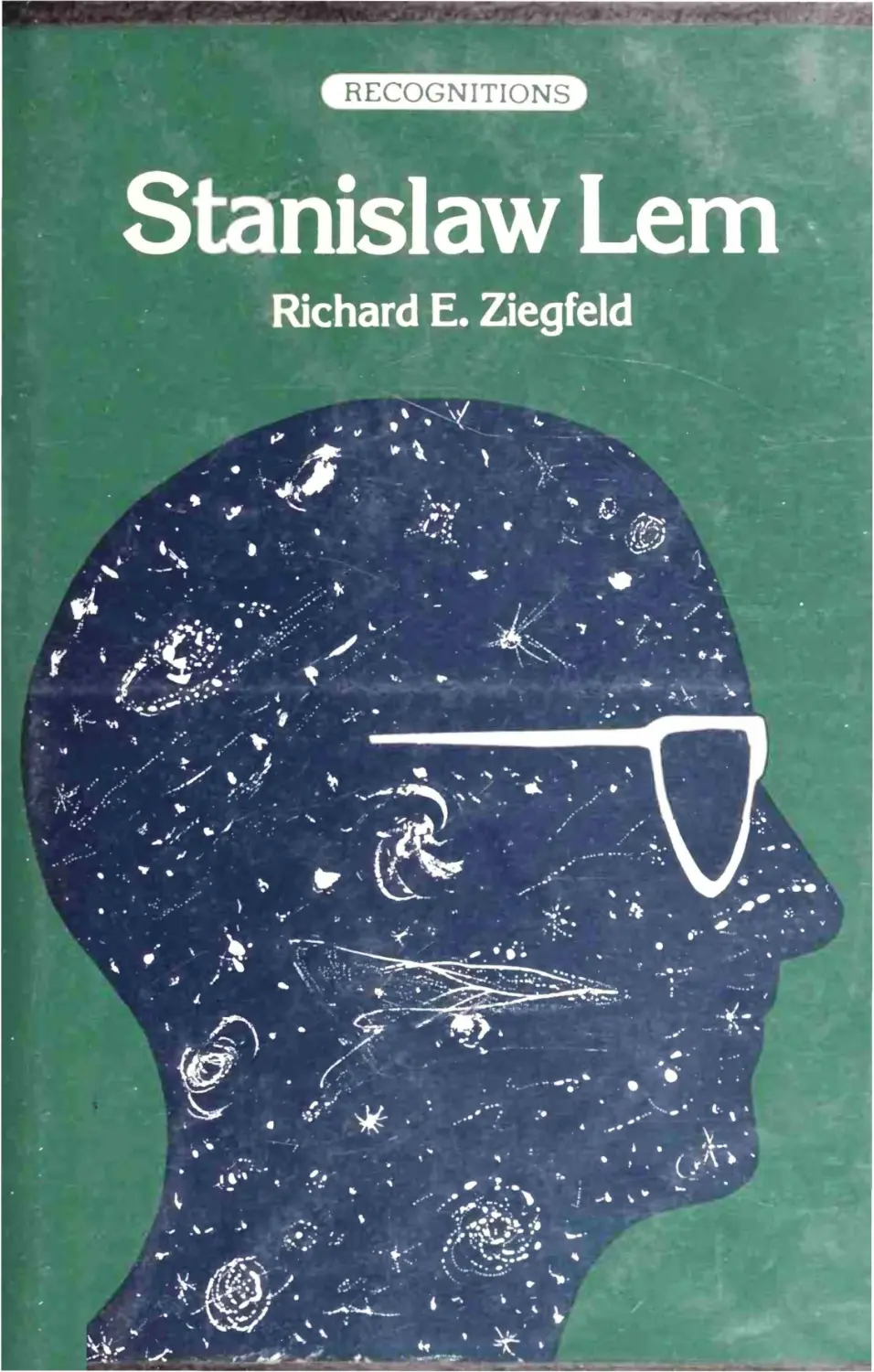
                    Stanislaw Lern
Richard E. Ziegfeld

Frederick Ungar Publishing Co.
New York

Stanislaw Lem

u;Jge:§§iiite)§D
detective! suspense
Bruce Cassiday, General Editor

Victorian Masters of Mystery by Audrey Peterson
Roots of Detection edited by Bruce Cassiday
Raymond Chandler by Jerry Speir
P. D. James by Norma Siebenheller
John D. MacDonald by David Geherin
Ross Macdonald by Jerry Speir
The Murder Mystique: Crime Writers on/Their Art
edited by Lucy Freeman
Dorothy L. Sayers by Dawson Gaillard
Sons of Sam Spade: The Private Eye Novel in the 70s
by David Geherin
science fiction! fantasy
Sharon Jarvis, General Editor

Fritz Leiber by Tom Staicar
Isaac Asimov by Jean Fiedler and Jim Mele
Ray Bradbury by Wayne L. Johnson
Critical Encounters: Writers and Themes in Science Fiction
edited by Dick Riley
Critical Encounters II: Writers and Themes in Science }~iction
edited by Tom Staicar
The Feminine Eye: Science Fiction and the Women Who Write It
edited by Tom Staicar
Frank Herbert by Timothy O'Reilly
Ursula K. LeGuin by Barbara J. Bucknall
Theodore Sturgeon by Lucy Menger
Also of Interest
The Bedside, Bathtub & Ar1nchair Companion to Agatha Christie
edited by Dick Riley and Pam McAllister
Introduction by Julian Symons

Copyright

©

1985 by Frederick Ungar Publishing Co., Inc.

Printed in the United States of America

Ziegfeld, Richard E.
Stanislaw Lem.
Bibliography: p.
Includes index.
1. Lem, Stanislaw. 2. Authors, Polish-20th centuryBiography. I. Title.
PG7158.L392Z53 1985 891.8'537 83-18009
ISBN 0-8044-2994-4
ISBN 0-8044-6992-X (pbk.)

Table of Contents

Preface

vii

Introduction

ix

1 The Marginal Man:
Biography

1

2 Tichy at Large:
Star Diaries and Memoirs of a Space Traveler

12

3 A Mystery of the Insoluble Typus:
The Investigation

27

4 Death with Full and Continuing Consciousness:
Return from the Stars

37

5 Belief in Cruel Miracles:
Solaris

49

6 My Case:
Memoirs Found in a Bathtub

63

7 The Realm of Perfected Death:
The Invincible

70

8 Futuristic Fables:
Mortal Engines and Cyberiad

82

v

vi

Contents

9 Inspired Bumbling:
Tales of Pirx the Pilot and
More Tales of Pirx the Pilot

10 Random Noise or a Letter:

93

105

His Master's Voice

11 The Book of Ungranted Wishes:

117

A Perfect Vacuum

12 Shipwrecked in Reality:

123

Futurological Congress

13 A Mystery of the Soluble Typus:

128

Chain of Chance

14 The Protean Teller of Tales:
Lem's Achievement

136

Notes

146

Bibliography

162

Index

177

Preface

This is, perhaps, the first full-length book on Stanislaw Lem in
the English language. It is not, however, an exhaustive, scholarly interpretation of Lem's books. Instead, readers will get an
overview of his career, biographical background, an indication
of what the key books are about, and a survey of the major
themes and literary techniques.
I have raised issues about Lem's \vork while fully aware that
individual topics merit whole chapters in a book. A brief list of
possible concerns for scholars might include these items: Analysis of the untranslated material, both fiction and theoretical
titles; attention to the newly translated titles as they appear in
English; thematic studies on topics such as cybernetics,
chance, and Lem's use of science; and studies on his literary
technique, discussing narrative persona, formal experimentation, satire, style, and symbols for communication.
The bibliography in this book is extensive but not definitive.
It includes information on Polish publication of Lem's books
and on most English-language material through 1982 but nothing on foreign-language criticism or foreign-language reception. I have been unable to verify several English-language
citations on articles by and about Lem; rather than risk fostering "ghost" bibliographical entries I have omitted them.
At the beginning of each chapter I have cited two dates.
The first refers to Polish publication on the original edition.
The second date indicates year of American publication.
A number of people have been helpful during the years I

vii

viii

Preface

have devoted to the Lem "obsession." My thanks go to Helen
Wolff and Grace Budd at Helen and Kurt Wolff Books. They
have believed in Lem and have made the preparation of this
book a much more pleasant task by furnishing copies of manuscripts that have not yet been published, providing information on Lem, and facilitating contact with his supporters. Dick
Riley, then editor at Frederick Ungar, agreed with me that
Lem deserved more attention; Larry Zuckerman and Sharon
Jarvis tightened the manuscript. Ina Rae Hark and John Ower
read and helped hone an early chapter. Olga Amsterdamska
and Gene Moore shared my enthusiasm about Lem when very
few American university faculty members knew his name. Neil
Barron and Hal Hall helped me locate citations in the small science-fiction journals. Finally, Lem himself assisted on several
factual matters and offered a helpful critique of the manuscript.
Two people merit special thanks. Paulette Ziegfeld freed
me to write and was supportive when "the gods" chose the
years between 1979 and 1982 as the time to thrust numerous
unpleasant obstacles in my path. And last I want to single out
Franz Rottensteiner, who replied to questions with copious detail, persuaded Lem to answer biographical questions, and
shared his vast archive of bibliographical information as I labored to straighten out a complicated bibliography and publication history. He furnished information on Lem's book sales,
faithfully alerted me to forthcoming publications by or about
Lem, and, most significantly, before I could ask, he offered to
read the manuscript of this book-all this for a person he did
not know and has never met. Every literary artist should have
an agent and friend like Franz Rottensteiner.
R.E.Z.
January 15, 1983

Introduction

Stanislaw Lem is truly a Renaissance man. He finished medical
school, he has worked as a scientific research assistant, and he
is author of one of the most varied bodies of writing in the history of literature. He has studied and is able to write authoritatively about innumerable topics. He is intimately familiar with
several foreign cultures (especially American folkways). He is
able to read four modern foreign languages and regularly slips
Latin phrases into his writing. He has published successful
books in more genres than most literate readers could name.
Michael Kandel, critic and widely respected translator of
Lem's works, has said that Lem is a "writer of great diversity"
yet one "haunted by ... only a few fundamental ideas." It is
true that the same core ideas come up repeatedly in different
form and accompanied by evolving detail. But a list of Lem's
"few fundamental ideas" is staggering in the scope and the
number of his concerns. He rC'g'llarly raises the subject of the
individual and his relationship to other men, to the universe, to
other nonhuman civilizations, to space, and to machines. He is
just as likely, however, to worry over bureaucracy, the military, communication, mysterious phenomena, biological evolution, particle theory, and the origin of the universe. Space
travel, statistical probability, generic theory, the state of Western science fiction, and philosophical theories on God, epistemology, and ethics are also major concerns.
Lem's basic views have not changed radically over the years
(except with respect to his optimism). However, he has been so

ix

x

Introduction

prolific that certain ideas cannot help but show up repeatedly.
Perhaps this is why Kandel has been lured into the impression
that Lem has only a few fundamental ideas. But with three or
four exceptions, each book is so diverse intellectually that
reading a Lem novel is like enrolling in one of those infamous
surveys of Western civilization: they make a serious attempt in
fourteen weeks to summarize the two-thousand-year history of
a people. The difference is that Lem provides skillful mastery
over every subject as few teachers in such courses do.
Stylistic diversity, generic range, and a flair for the intellectual overview characterize Lem's work. Just as important is
the fact that he combines great intelligence and learning with
a provocative sense of ambivalence. The ambivalence drives
him into an ironic stance from which he seeks to observe and
analyze every facet of a problem. Thus, Lem provides a vast
intellectual feast. To make this feast manageable to the reader,
this book has two strategies. The first is a clear, simple overview
of his career through 1982. Within individual chapters, it refers
to five elements: a plot precis and discussion of plot, theme,
characterization technique, and symbolism. Where appropriate, special attention is paid to critical problems with each book.
Finally, comparison is used to evaluate the place of each book in
the Lem corpus.
Second, this book's critical approach to Lem's work is the
type about which Richard Howard wrote in Alone with America. He argued, after his mentor, Anden, that the only truly usefulliterary criticism is advocacy. This critical stance advances
the work of a writer with whom a reader is not familiar or
presses forward a little-known portion of an acknowledged
master's corpus. At points where Lem's work may not appeal
to certain readers, there is an obligation to offer a candid report on those potential difficulties. Nevertheless, the goal is to
share a sense of enthusiasm about Lem's virtues and, in the
process, to assist in facilitating greater American awareness
that Stanislaw Lem is one of the outstanding writers in twentieth-century letters.

Stanislaw Lem

1

The Marginal Man:
Biography
Most of Stanislaw Lem's adult attitudes and literary concerns
surfaced during his childhood in Poland before the Nazi occupation. He has written charmingly about this phase of his life
in an autobiography called Wyzoki Zamek (High Castle, untranslated). High Castle powerfully recreates his frame of mind
and the detail of incidents that shaped his life; however, the
book is strikingly devoid of the external detail normally included in biographies, such as names, dates, and locations. Lem
treats autobiography as a form of speculative fiction, through
which the adult Lem mulls questions concerning a child's version of reality and history-beginning the book, for example,
by noting that he is a Lilliputian. The unusual tenor of the
autobiography becomes most obvious when he says that he offers insignificant details because they seem more interesting
than later memories of the facts and that he finds it easier to
speak of circumstances in his childhood than of people. Hence,
an account of Lem's life will provide a limited amount of traditional biographical material.
Lem was born September 12,1921, into a medical family in
Lvov, Poland. Both his father and uncle were doctors. He does
not speak frequently of his father, Samuel Lem, but clearly he
was a significant influence in his life. Of his mother, Sabina
(nee Wollner), he says virtually nothing. Lem has no siblings.
Lem's earliest memories are of books, chiefly science and
literature, and of his father's medical waiting room in one portion of their apartment. These twin interests in science and lit1

2

Stanislaw Lem

erature have dominated his life. He recalls having been
fascinated by his father's anatomy books, even when he was
very small. He was equally fascinated with the purity and precision of signs. Other aspects of his youthful personality,
though, did not augur a bright future in science, where attention to detail and process are critical. He notes, for example,
that during his adolescence he had difficulty distinguishing the
morning from the evening (a fairly severe handicap for a budding scientist) and that he exhibited little desire, when assigned classroom experiments, to follow them through
patiently.
In talking of his childhood, he describes himself as a "monster" who was frequently sick and who loved food-especially
visits to the chocolate and pastry shops-so much that culinary
images pervade this stage of his life. He had many acquaintances but few close friends. Once he cites examples of his behavior, though, it becomes apparent that he was not a monster
in the conventional sense. The monster in Lem is his playful
but dogged refusal to accept any authority he considers unworthy of his respect. As a child he did not act out his resistance to
authority, but from the autobiography it is evident that Lem
thoroughly disagreed with much that took place around hinl.
His personality as a child is best described as reflective, irreverent, somewhat distant, occasionally ambivalent, deeply individualistic, and highly creative. His adult personality and his
work are very similar.
Lem's description of his adolescence includes a bit more
conventional biographical detail, as he nostalgically reflects on
several teachers and friends, but he still refers to the friends in
vague terms such as "Jurek G." or "Julek D." and notes that he
cannot recall the faces of his neighbors. The most striking feature of this period in his life is his deepening sense of distance
from people and events around him. At this point in the autobiography he mentions the "high castle," with its obvious allusions to separation from others.
Lem says that his youthful years were unremarkable, describing himself as fat and physically weak and saying that his
father did not beat him, while his mother slapped him only

The Marginal Man

3

once. His insistence on an unremarkable childhood notwithstanding, two features of those years stand out-his imaginative, quirky rendition of his thoughts and the passion with
which he approached reading. For instance, he mentions
wanting siblings but adds that he would only have used them
as little slaves! He read voraciously-encyclopedias for entries
on elephants, birds, plants, and the physiology of the Negro;
anatomy and science books; and Jules Verne, H. G. Wells, Stapledon, Rilke, Conrad, Saint-Exupery, Fedro, Karl May, and
many East European writers, including Sienkiewicz, Slwacki,
and Pitigrilli. Later, he was also influenced by Dostoevsky,
Gombrowicz, and Bruno Schulz. Lem's imaginative approach
to intellectual or creative activity remains evident.
Of his creativity, he commented recently that he virtually
never knows where he is headed as he begins a book. "This
casual, improvised, spontaneous way of writing is the general
characteristic of all I do. For, surprising as it may seem, it
is also true with discoursive [sic] books. When I started writing
'Summa ... '-I had no plan, no clear-cut draft. In a word it
was an open work .... I just spontaneously and organically took
to writing."
Lem's interests have also remained diverse. They have
spilled over into his rage to avoid repetition, so that he detests
and fears repeating himself in his books. Consequently, any
reader intent on pigeonholing writers by genre will have a difficult time categorizing Lem's works. He has experimented
with thirty genres, including poetry, short stories, novels, science fiction, detective fiction, fantasy, scientific treatises, literary criticism, cybernetic theory, sociological material, book
reviews of works that do not exist, book reviews of works that
do exist, philosophical essays, literary critical theory, extended
polemical responses to his critics, autobiography, radio plays,
film scripts, television plays, and saga novels with recurrent
characters.
In addition to traditional literary and scientific sources, he
was also influenced by popular culture in the first film "talkies" where he saw Jolson, King Kong, and Boris Karloff. As an
adult, he has been willing to pay attention to pop culture forms

4

Stanislaw Lem

and to utilize them, but in doing so he has applied the literary
standards associated with serious fiction and essay writing. His
insistence on imposing quality in pop forms has contributed
significantly to serious East European readers and critics accepting science fiction much earlier than their counterparts in
the United States.
During Lem's adolescence, his iconoclastic resistance to incompetent authority figures developed into a barely concealed
disgust that manifested itself, in his autobiography, in the form
of a long harsh critique on upaper writing" in th~ schools and
on a military camp he attended. He was not opposed to work
or to writing, but he loathed being forced to write on topics
that did not interest him or that were not conducive to discoveries. When forced to do an assignment, he was often sloppy in
his work, showing little interest in or aptitude for detail. However, when working independently, he found himself, much to
his own surprise, capable of patient, close work with experimental projects or theory. He became intrigued with water
and electricity experiments, built an electric motor, and once
worked on constructing a pedalless bicycle, which would
somehow gallop.
When he finished his college-level work at Karol Szajnochas
Gymnasium in 1939, he decided to proceed with medical studies at Lvov Medical Institute. The years between 1939 and
1950, before he took creative writing seriously, were turbulent
ones for Lem, partly because of World War II, but also, in part,
because he started translating some of his iconoclastic thoughts
into action. I-Iis medical studies were interrupted in 1941 when
the war forced the closing of all Polish universities. During the
remaining war years, Lem took on various jobs, working as a
welder and as a car mechanic for a German business. The situation was quite dangerous, but he has joked about it in interviews by noting that he got involved in a bit of sabotage
because he was such a poor mechanic.
In 1944, when the Red Army freed Lvov and reopened the
universities, Lem resumed his medical studies at Lvov. In 1946
he moved with his parents to Cracow. There he finished his

The Marginal Man

5

Medical Absolutorium in 1948 at Jagellonian University without having taken a diploma, because anyone with a medical diploma was being drafted for life as a military doctor, a prospect
that did not excite Lem.
He had begun working in 1947 as a scientific research assistant at Jagellonian University and became involved in editing
the state-financed journal Zycie Nauki. While there, he published several scientific articles in the journal. During these
years with Zycie Nauki he first read about the topic that has
become his life-long concern--cybernetics.
Lem ventured into literary writing in 1946 when he wrote
and published a few poems and short stories. The poems appeared in a weekly Catholic paper, Tygodnik Powszechny, and
the three stories in the Kattowitz weekly named New World of
Adventure. One of those short stories was science fiction, while
another was about espionage in Oak Ridge. Lem is not certain
how he came to write science fiction or where his interest first
developed. Shortly thereafter he published a few more short
stories including "Garden of Darkness," which were "lyricalromantic tales" and stylistic imitations of Rilke's work.
He finished his first novel, Czas nieutracony (Time Not Lost,
untranslated), and submitted it to a private publisher in 1948
(Gebethner and Wolff), but the house folded. Then, because
the manuscript was considered politically controversial for its
discussion of cybernetics, it meandered through all of the staterun publishing houses until 1954-1955. It was finally published
in a thoroughly rewritten version. The editorial process, which
substantially altered the book, was so stringent that Lem refers
to that experience as "mild brain washing." The version currently available in Polish and German is the original rendition,
written prior to the "editing" process. Lem also wrote Astronauci (Astronauts, un translated) around this time, a book that
he describes as a ,"naive SF novel." The period between 1948
and 1950 was especially difficult for him because he had decided not to practice medicine but had yet to settle on a career as
a writer.
In 1951 he wrote a play with Roman Hussari called lacht

6

Stanislaw Lem

Paradise (Yacht Paradise, untranslated) that was produced by a
theater group in Szcercin. Between 1952 and 1955, he also
wrote scientific articles for the weekly New Culture.
On August 29, 1953, during the interim between the composition and the publication of Time Not Lost, he married Barbara Lesniak, who is a practicing physician. During the early
1950s, Lem was in a delicate situation politically as a person
without a visible career. He had been expelled from the Authors League in 1951 for not having a published book to his
credit, he had no medical diploma, and he had no job because
he had been forced to relinquish his editorial position with Zycie Nauki.
In 1955 he and his wife moved to Kliny, a suburb of Cracow,
where they took up residence in a house they inherited. They
still live in Kliny today. Lem's father died that year, a loss that
continues to arouse strong emotions for Lem. As recently as
1981, he noted that his father worked at the hospital the day he
died, an unusual detail to recall twenty-five years later in an
interview. In 1955 he also received the first of many literary
awards that would be bestowed upon him: The Golden Order
of Merit from the city of Cracow.
Lem's period of mature writing began after 1956. During
the dozen years between 1956 and 1968 Lem was extremely
productive, writing nineteen projects. These include five science-fiction novels, ten books of science-fiction short stories
that initiate his four cycles (Pirx the Pilot, Ijon Tichy, the robot
fairy tales, and the Trurl-Klapaucius cycle), one science-fiction
play, and three television plays. He also wrote a book on cybernetic sociology and his theoretical masterpiece-Summa technologiae, a 650-page treatise that has been described as
"breathtakingly brilliant and risky."
During these years he published the works that garnered
him a pan-European reputation as one of the strongest literary
writers of the mid-twentieth century: Star Diaries (1957), The
Investigation (1959), Return froln the Stars (1961), Solaris
(1961), Memoirs Found in a Bathtub (1961), The Invincible
(1964), Cyberiad (1965), and Hi., Lllaster's Voice (1968). Lem's
work became very popular, especially with Russian readers, so

The Marginal Man

7

that his books have been translated into thirty languages and
have sold well over eleven million copies. By the end of the
twel ve-year golden period, posi ti ve critical commentary was
abundant. Lem was being hailed as "the Titan of East European science fiction," and as "one of the most significant SF
writers of our century and a distinctive voice in world literature." His countrymen were also beginning to recognize the
merit of his work, as was apparent when he won the Second
Degree Literary Award from the Polish Minister of Culture
and Art (1965).
When he began to \vrite Philosophy of Chance, an attempt
to establish an empirical theory of literature, he realized how
little he knew about structural linguistics. Characteristic of
Lem, he responded to this shortcoming by studying mathematicallinguistics and structuralist literature for a full year.
After 1968, he seems to have encountered a crisis that
prompted significant experimentation with literary form. An
example is A Perfect Vacuum, which contains a series of satirical, zany reviews about nonexistent books. Lem has indicated
dissatisfaction with some of his early theoretical writing, but
most especially he developed a "resistance to science fiction
creativity" out of a sense that the genre was suffering" 'ecological pollution' ... in terms of theme and repertoire." In
the intervening fourteen years, he has written a substantial
number of nonfiction books (criticism, theory, cybernetics,
and philosophy) in which he expresses deep concern about
man's future, but he has written little new fiction. During this
time, though, a number of books with new titles have recollected or rearranged previously published material. Since Lem
is only in his early sixties, he may still renew his commitment
to fiction writing.
As his interest in traditional science fiction has waned, Lem
has become more· directly involved once again in scientific
matters, writing in journals such as Philosophical Studies and
becoming a member of the Commission "Poland 2000," a division of the Polish Academy of Sciences. His reputation among
scientists is such that he was the sole nonscientist invited in
1971 to the Soviet-American Conference on Extra-Terrestrial

8

Stanislaw Lem

Intelligence. In the late 1960s he began receiving literary
awards quite regularly, and in 1973 he won the First Degree
Award from the Minister of Culture and Art.
Lem also became involved in a continuing dialogue with
other science-fiction writers and academic theoreticians-in
journals such as Quarber Merkur, Science-Fiction Studies, and
Science Fiction Commentary. In 1973 the Science Fiction Writers of America bestowed an honorary membership on Lem,
but four years later, in 1977, writers whom he had criticized
used a technicality to engineer its revocation.
Lem's high standards and his critical reaction to science fiction have been the chief source of the rancor. He considers
much American science fiction windy, unoriginal re-presentations of an idea and only pseudoscientific. Ironically, Lem has
been criticized for not including enough "hardware" in his science-fiction novels and for suggesting that many scientific
problems have no answer. Lem has retorted that another
problem with science fiction is the "pretense that insoluble
problems (such as those of a logical typus) are soluble." He also
feels that contemporary science fiction lacks something, although he is not certain what. He believes that the problem
may stem from an insufficient theoretical base for the genre.
He is waiting, he notes, for new philosophical thoughts, new
sociological concepts, galactic variety, insight into the thoughts
of "Automatons," insight into fate, and new thoughts on the
nature of the universe.
The substance of his complaint alone would never have set
off a quarrel as nasty as the Science Fiction Writers Association
debacle, but the tone of some Lem comments, coming from a
foreigner living in a Communist country, was more than
enough to incite wrath. He wrote several highly critical articles between 1973 and 1975 in Science-Fiction Studies that
were dominated by reasoned, if acerbic, comments about the
genre. His statement that "practically all SF is trash" did not
do much to win friends, but it could not be construed as a personal attack. Even a title as inflammatory as "Philip K. Dick: A
Visionary Among Charlatans" did not set off an explosion.

The Marginal Man

9

However, an article in the Frankfurter Allgemeine Zeitung
(February 22, 1975) was very blunt and contained disparaging
references to specific authors, so that when published in the
SFWA Forum, it evoked an incredible uproar, resulting in an
international scene and the revocation of Lem's honorary
membership.
The revocation move then prompted a protracted public
debate (through letters in the science-fiction journals) between
Lem's antagonists and his supporters, involving the most
prominent figures in the American science-fiction community.
The article in the Frankfurter Allgemeine Zeitung had been
sufficiently strident to create problems, but to make matters
worse, it took three years for anyone to discover and indicate
in print that the American reprinter-who should not be dignified with the appellation "Translator"-had "adapted" the
German newspaper article so freely that he had transformed a
stringent piece of criticism into a bone-jarring, sensationalistic,
almost rude diatribe. One example suffices to illustrate the incredible liberties taken. Lem's title had actually been "SF, or
Phantasy Come to Grief." The reprinter rendered it in English
as "Looking Down on Science Fiction: A Novelist's Choice for
the World's Worst Writing." Instead of generating much-needed light in American science-fiction circles, the article in the
German newspaper (as rendered in the English translation) led
to a great quantity of unproductive heat.
In the meantime, Lem lectured twice at Jagellonian University. The first year he was associated with the Philology Faculty, lecturing on literature; during his second tenure, he spent
two years on the Philosophy Faculty.
Lem's nonliterary affiliations and interests are as diverse as
his literary forms. He is cofounder of the Polish Astronautical
Society and a member of the Polish Cybernetics Association.
He has continued studying cybernetics and has worked on the
theory of evolution and everything at the elementary level
having to do with philosophy and physics. He has been most
influenced by Vienna-circle philosophers such as Russell and
Wittgenstein. He reads in four foreign languages-German,

10

Stanislaw Lem

English, French and Russian-so that he can keep up with scientific literature in the original. He learned English from the
lectures of Russell, Norbert Wiener, Wittgenstein, Sir Arthur
Stanley Eddington, and Richard Feynman, whose works he
studied for the science but also for the quality of the prose.
He has noted that his favorite writer is Shakespeare (and
Hamlet his favorite character in literature), his favorite artist
Hieronymous Bosch, his favorite composer Chopin, and Don
Quixote his favorite book. Lem has no hobbies, but he plays
tennis and tries his hand at skiing. He also enjoys the company
of his son, Tomek, born March 14,1968.
Lem's most recent book, Wizja Lokalna (Official Hearing
On the Spot, untranslated) appeared in 1982 in Poland. That
year his Polish publisher also initiated a new series of his selected works.
During 1982-83 Lem spent a year in West Berlin at the Institute for Advanced Study, writing and reading material he
missed during the year of Polish martial law.
Currently Lem is working on a Tichy novel that he has tentatively dubbed "LEM" (for "Lunar Expedition Misery"). It
depicts "autonomous robot developments." He has not done
much fiction writing lately, but he is also talking of one new
Pirx story and a new collection of reviews on books "that do
not exist but should."
Lem has been careful since the 1950s to disguise his criticism
of the Communist regime in the East, but anyone writing material as critical as his lives dangerously. His Western supporters are very concerned about his safety in Poland during the
current unrest and martial law. Despite opportunities to flee to
the West, Lem has insisted that he wishes to remain in his native Poland.
Lem's approach to life, one which drives him to explore
problems that may not yield solutions and then to insist that
writers be honest about reporting their continuing inability to
discover solutions, makes him a difficult taskmaster-for himself and for others in the literary community. That he finds
himself set apart is not surprising when he explains his perception of the function of art. He said, "[Art] gives man a remind-

The Marginal Man

11

er that he is not just a consumer but a creator as well. It
awakens in him the urge to struggle and perform great deeds;
it fills him with the craving to pass on the Promethean fire to
generations to come." Lem stands apart because he is attempting to be a creator and not just a consumer.

2

Tichy at Large:
Star Diaries
and
Memoirs of a Space Traveler
Lem spent twenty years writing the stories that appear in
Dzienniki gwiazdowe (first Polish edition 1957, fourth edition,
1971). The American edition divides the collection into separate books-Star Diaries (1976) and Memoirs of a Space Traveler (1981). The Star Diaries collection has twelve stories (all
numbered voyages), while the second collection, containing
nine stories, offers two numbered voyages, five reminiscences,
an Ijon Tichy story, and Tichy's open letter to the universe. All
tales in both volumes include space adventures or futuristic
settings involving !jon Tichy. The long gestation period for the
collection shows. The tone varies from whimsy to heavy intellectual discussion. The stories also vary in complexity, as some
are simply anecdotes, while others comprise sophisticated philosophical arguments about ontology, metaphysics, and epistemology. And the length of the stories ranges from seven to
sixty-two pages so that some are one-idea tales while others are
substantial novellas with numerous themes.
Star Diaries is a collection of stories, so it does not contain a
continuous plot. Nevertheless, there are unifying elements.
Themes recur, topics for satire overlap, the character Tichy reappears, and the setting is always in outer space.
The truly significant unifying elements, though, are not
overt. The first factor that creates cohesion is the tone devel-

12

Tichy at Large

13

oped by the narrator, who always establishes substantial distance between himself and conventional social practices, as in
the thirteenth voyage, when Tichy refuses to side with either
of the story's antithetical forces, Pinta or Panta, which are vying for his allegiance. Lem establishes the distance through
many means, the most striking of which is satire. Lem satirizes
all sorts of topics, people, and institutions, but he imposes no
systematized method, opting instead for repeated, random
jabs at his targets. Some satiric thrusts are as brief as a paragraph. This random use of satire fosters unity because it provides the reader with a familiar generic mode.
Another significant recurrent element, the philosophical
tale from the Swiftian tradition, follows from the satiric mode
as Lem contemplates issues such as man's place in the universe, the role of religion, or the nature of history as a form of
intellectual discourse. Invariably these tales involve making
fun of or attacking the proponent of a particular intellectual
position. The jest or the attack then develops into a "veritable
orgy of parodies. " These three devices-distancing, satire, and
philosophical tale-create unity by exploring various elements
of the human experience. The final cohesive element is the
"consistency of theme" wherein Lem mocks man's pretensions, parodies history, and discusses time travel.
Thematically, the stories in Memoirs are passingly similar to
those in Star Diaries. But Lem sharpens the thematic focus in
the later volume by concentrating on an investigation of what
happens when man exercises his capacity for invention without being able to anticipate adequately what will result.
Finally, the stories in Memoirs of a Space Traveler adhere
more closely to traditional plotting practice (with an Aristotelian beginning, middle, and end) and concentrate more on
"story" than on philosophical disquisition. Ideas are still present, but they do not usurp plot and character as they sometimes do in Star Diaries.
The plots incorporate many different topics, including, for
example, time loops (seventh voyage), humanity's candidacy in
the United Planets (eighth), clones (fourteenth) and a genealogy of Tichy's family (twenty-eighth). However, as Michael Kan-

14

Stanislaw Lem

del points out in his note at the end of Star Diaries, the plots in
this first book fall into three basic types: playful anecdote,
pointed satire, and outright philosophy.
The twenty-second voyage (1954) best illustrates the playful
anecdote. After he has begun the voyage, Ijon Tichy discovers,
to his decided disappointment, that he has lost his penknife.
Then he lands on Andrygon, a location he describes as "an old,
dilapidated wreck of a planet, which should have been taken
out of circulation long ago." He has arrived during the school's
final exams and finds himself having to prove that life on Earth
is possible (because the Andrygonians are convinced that such
a possiblity would constitute "an anonlaly of nature").
The most sustained incident has Tichy listening to Father
Lacymon relate the difficulties that Father Oribazy enountered in doing missionary chores. In his zeal to teach ignorant
natives about church martyrs, Father Oribazy describes the
sacrifices of saints such as John, who allowed himself to be
boiled alive in oil. The natives are skeptical but after repeatedly checking with the good Father about his professed desire to
be a saint, they accommodate his wishes in a literal fashion that
he had not anticipated. As Father Lacymon finishes his tale
about the "problems" involved in missionary work, Tichy,
much to his delight, locates the lost penknife, an insignificant
event that contrasts with the weightier circumstances of the
story, all the more because of Tichy's reaction. Lem's denouement involves a grotesque sequence, yet the anecdote is humorous, because Lem is playing with what would happen if
various exaggerations were taken seriously. The device of the
lost penknife adds whimsy.
While some other Lem tales are as light as this one, most are
more astringent. The twenty-fifth voyage (1954) illustrates the
second type of tale: pointed satire. In this case, the satire is directed at methods of scientific research and at people who engage in factionalism in philosophy and theology. The subject in
this case is the application of scientific methods in the great
potato hunt. The precipitating event occurs when a "brave
hunter" is attacked by the deadly potato (that is, a "multicellular organism well known on Earth, namely the Solanum

Tichy at Large

15

tuberosum, a bulbaceous, gametopetalous, multiseminiferous
species." Lem's use of ironic deflation quickly sets the tone for
the remainder of the tale. HIt is difficult to describe what took
place after ... it turned out that Gorbras had brought back on
his spacesuit bits of potato leaves. The intrepid stellar adventurer, stung to the quick by the insinuation that for four
straight hours he had been fighting potatoes, demanded an immediate retraction of this vile calumny." As Lem describes reactions by the contending scientific factions, including the
physicalists, the semanticists, and the neopositivists, the spoof
becomes increasingly ridiculous, until finally a faction develops
that is called the "holists-pluralists-behaviorists-physicalists."
The third plot type, Lem's philosophical tales, divides into
two modes, the playful and the serious. The twentieth voyage
(1971) illustrates the playful mode. In this novella-length story,
set in the twenty-seventh century, Ijon Tichy gets a visit from
himself, Ijon Tichy, asking him, Ijon Tichy, to direct an organization called THEOHIPPIP (that is, TeleotelechronisticHistorical Engineering to Optimize the Hyputerized Implementation of Paleological Programming and Interplanetary
Planning). Were Tichy a man who sought power or were he an
evil person, this satire would not carry the same force. As is,
Tichy is a personable, bumbling, well-intentioned guy who
makes an incredible mess of history, especially when he assumes a measure of power like God or Zeus in Greek mythology. Because Tichy is depicted as a fallible person, the reader
does not become distracted by his concern with Tichy's motives or with ideological issues. Instead, the reader concentrates on the insidious problems that arise when man pretends
to be capable of more than he really is able to handle. Lem is
convincing because Tichy's persona takes over to explain various anomalies in nature, and the detail persuades us that
Tichy's is a real, even if bizarre, world.
As Tichy reconstructs history, his project passes through
three phases-Genesis (given over to scientists), Historical Division (to philosophers and artists), and Social Affairs. During
the second phase, the most interesting of the three, Lem uses
the roman a clef device to achieve his imaginative zenith.

16

Stanislaw Lem

Here Tichy explains how he handles a group he labels "unprincipled designers," whom he must fire from their jobs and pack
off to other historical eras. Homer Gumby ends up in ancient
Greece, where he writes books. "The Iliad and Odyssey are roman d clef; the irascible Zeus, for instance, that's a satire on
me [Tichy]."
One of the most telling philosophical scenes arises when
Tichy explains the history of evolution and man's relation to it.
His assistant Goody designs a project named BARF (Binary Anthropogenesis for Reciprocal Feedback). Tichy gets a bit concerned about his assistant when Goody gives dolphins "frontal
radar." Alarmed, Tichy forces his assistant to curtail the project at this point. He then accepts the monkey as "a working
model for the program." This fiasco leads to the creation of
God who offers the "'discreet assistance'" that comes to be
known as miracles. Ultimately, though, Tichy learns a painful
lesson about the revision of history: "Every telechronic intervention set off an avalanche of events, which couldn't be held
in check without appropriate measures, and those in turn produced new perturbations." Poor Tichy finds that when man
oversteps his limits, he wreaks havoc with his own environment. Since the twentieth voyage is devoted almost exclusively to parodistic detail concerning two philosophical issues-the
nature of history and man's relation to it-the tale is literary
but its subject is philosophical.
The twenty-first voyage (1971) illustrates Lem's serious philosphical mode. This 62-page novella is quite unlike the twentieth voyage because it utilizes virtually no individualized
characters. Instead, Lem works with prototypes, schools of
thought, or intellectual positions as a pretext to pursue and satirize philosophical arguments in an undisguised fashion. Many
passages, taken out of context, could easily be passed off as
pure philosophy.
In the narrative frame for this story, Lem dispatches Tichy
to Dichotica where he meets Father Darg, proponent of a new
faith called Duism. The story consists of a history of Duism and
debate among Tichy, Darg, and a few other shadowy, undeveloped figures over issues such as the immortalization of man,

Tichy at Large

17

physiological engineering, faith, God, freedom, orthodoxy, and
mind control.
The sections on physical aberrations and "autoevolutionary"
physical development do not succeed especially well as literature, but once Lem begins his discussion of God and faith, the
twenty-first voyage becomes a fascinating, albeit disturbing,
essay on man's approach to faith and freedom in an age of cynicism. The chief problem under discussion is how the individual relates to government and society. The Dichoticans' faithDuism-is ultimately a paradox: "You believe by doubting and
you doubt by believing; yet this state too is not the final one."
The compelling, unsettling complication is that this group is
willing to proselytize by using machines to control minds;
hence, no need for missionary work by humans. The ultimate
paradox arises when the Prior indicates that his society's unlimited capacity for mastery of its environment-a virtual omnipotence-leaves people with no need or desire to act.
"Nothing remains for us then but to sit here among the fossils
of rats, in this maze of 'dried-up sewers'." When Tichy leaves,
he is a changed man. This difficult, often slow-moving tale represents Lem in one of his darker moods.
Nearly all of the stories collected in the second portion of
the Star Diaries (that is, in Memoirs Of a Space Traveler) present unappreciated inventors and scientists each of whom has
a single obsession. In the collection's eighteenth journey we
again find Tichy acting as God, but this time he has vountarily
chosen the role. In the "Further Reminiscences" section,
Tichy is visited by or seeks out a series of strange scientists. In
Reminiscence I (1961), Corcoran has invented a "world"; in IV
(1961), Molteris has developed a time machine; in V (1963),
Newton and Snodgrass initiate an escalating campaign to improve washing machines; and in "Doctor Diagoras" (1964),
Diagoras works on an invention for which he has no plan.
Each of these invention stories begins with a typical sciencefiction device, but then Lem includes a twist that incorporates
a fresh perspective on the time-worn device. For example,
once Tichy is in the lab of a scientist named Zazul, he sees a
pair of trousered legs in an alcohol solution and threatens to re-

18

Stanislaw Lem

port the scientist to the authorities for having killed a man in
order to set up a cloning operation. Zazul bets him that when
he learns the detail behind the specimen Tichy will not report
him. The problem, it turns out, is that Zazul cloned himself
and then, when he decided he wanted a permanent record of
his achievement, got into a disagreement with the clone over
who should be "preserved" in alcohol. Unfortunately for this
"constructor," the clone was the victor in the ensuing struggle
for control. As the story ends, Tichy concedes to Zazul, the
clone, that he has won the bet. Tichy cannot report a clone for
murdering its creator. Through humorous twists, in this and
other stories, Lem reinforces the dominant theme in Memoirs:
artificial intelligence will develop independently of man once
it evolves sufficiently.
A striking feature of Star Diaries and Memoirs is Lem's inventiveness in four areas-wordplay, names, humor, and incidents in the plot. The quality of his wordplay and his choice of
names is most evident in the twentieth voyage, where Tichy is
Director of THEOHIPPIP. Examples of choice acronyms include GENESIS (which stands for Generators for the Establishment of Isochronalities), CUPID (Cyclochronic Unidirectional
Polarization of Inchoate Differentials), and BIPPETY (for Biogenetic Implementation of Parameters to Perfect Terrestrial
Intelligence). Interesting names among errant program directors in Tichy's project to revise history include, in addition to
Homer Gumby, P. Lado (Plato), Harris Doddle (Aristotle),
Lenny D.Vinch (Leonardo da Vinci), and Harry Bosch (Hie ronymous Bosch).
With respect to humor, Lem's imagination emerges primarily through understatement, as in the twenty-third voyage
(1961), which is about a group of "Whds" who have virtually
perfected the miniaturization process. Tichy notes that "certain risks" are involved in this readily available miniaturization
process, but this is a mild understatement. Two incidents illustrate Lem's humor. Once Tichy spills a gray powder on the
floor only to have a Whdian exclaim: "Look out, you're spilling
my daddy." For daddy, the risk in miniaturization is indeed
grave. Another time, Tichy nearly self-destructs when he be-

Tichy at Large

19

comes unduly enthusiastic and the miniaturization device
jams, reconstructing him as "Napoleon Bonaparte in imperial
uniform."
This incessant, inventive use of humorous understatement
becomes an important aspect of the persona for Tichy and
many other Lem characters because it reflects their paradoxical position. They are forever attempting something grandiose, only to see the project backfire. Eventually, an interesting
temperament arises: the character is open to new possiblities,
but he is still reticent in a fashion that wins the reader's heart.
Lem's humor reinfores this aspect of his character's persona.
Lem's inventiveness with respect to plot is especially evident in the stories from Me1noirs. For example, in "Reminiscence II" (1961), Decantor announces that he has spent
forty-eight years inventing an immortal human soul, but Tichy
tells him that people will not want the static immortality that
Decantor describes, so most likely no one will buy his product.
Having killed his wife and invested forty-eight of his fifty-eight
years in order to produce this soul, Decantor is disappointed
that no one will be interested. Tichy, though, is horrified by
what Decantor has done, so instead of investing money in the
project, as Decantor has requested, Tichy buys the soul and
smashes it. Then he announces that he has killed the immortal
soul.
Because of Lem's fertile imagination, he adds a dimension
to his plots that few writers ever achieve. The zany quality reflects an attitude that Dominique Sila, a Lem critic, says is an
essential element of Lem's outlook on life. Lem has rejected
traditional values and structures and is utilizing his rich imagination to cope with the problem of needing new values and to
create a new world. In the process, Lem encounters the a\vesome nothingness of the universe and subsequent existential
absurdity. The absurdity is sufficiently disconcerting that a
playful attitude aids in defusing man's terror. In this absurd situation, man will distinguish himself only if he creates something new; hence, Lem's obsession with inventors and
constructors.
Science fiction, then, is also the most appropriate genre for

20

Stanislaw Lem

Lem, because it allows him to search more openly for his new
world. Sila notes, though, that the best source for rich inventiveness is in a child's playful approach to life. Thus, the powerful infusion of whimsical imagination into most of Lem's work,
not just Star Diaries, contributes significantly to his sense of
how man can survive in the threatening conditions of the late
twentieth century.
In Star Diaries he touches on many of the themes that will
occupy him for the next twenty years. The most important of
these is man's situation in the universe. Lem is concerned with
what makes man unique and with the tools he needs to survive
in an alien, hostile environment. Essential to survival, Lem asserts, is each individual's creative, untrammeled exercise of
the imagination. Here he alludes to man's Godlike status in the
universe, and at times he seems to revel in the power and the
brilliaBce of man's ingeniousness. He is willing to concede the
wonder of many technological advances.
Invariably, though, Lem pulls the reader up short by calling
attention to the folly in man's attempt to be God; this point is
rendered in a particularly delightful manner in the eighteenth
and twentieth voyages. When he portrays man's folly, he utilizes humor, irony, and playfulness, and he depicts man in a variety of guises, including, most conspicuously, the bumbler (in
the eighteenth, twentieth, and twenty-third voyages, and in
"Reminiscence IV"). In this guise, man is unable to foresee
adequately the consequences of his actions. Tichy almost always accepts responsibility for his faulty efforts aBd pleads
good intentioBs, thereby defusing a reader's anger about his
costly errors.
In Star Diaries Lem approaches the first of many paradoxes
that will appear in his work: man is capable of wondrous creations but only rarely does he develop his inventions without
prompting many thorny problems. For Lem, man has boundless potential to do good but delivers very little. This paradox is
existential, and it prompts Lem to formulate a description of
man uncannily similar to Camus's in The Myth of Sisyphus.
Tichy makes the point in "Reminiscence I" when he says of his
strange guest inventors that each has a single obsession causing

Tichy at Large

21

him to "burn with that consuming fire of objectivity that forces
a man to renew efforts that are doomed to failure." Man ennobles himself through his effort, but he is nevertheless not going
to succeed.
The paradox takes an inverse form in the twenty-first voyage: if man were omnipotent (capable of doing anything he
pleased), he would have no motivation to do anything. This
paradox from Duism (phrased as "because we can, we do not")
leads to a belief in an obvious contradiction: the existence of an
impenetrable and mysterious God who is in many respects tantalizingly similar to man. Thus, the Duistic paradox may be approached as the dark side of man's condition with respect to
potential and action.
Lem also notes that man incessantly but futilely attempts
to plan his creativity or at least to know in advance what he
will create when he explores. This thematic point is very nicely rendered in "Reminiscence I" and in UDoctor Diagoras."
Much to Tichy's delight, Corcoran manages to create a world
in a box that is an exact replica of the real one-no mean accomplishment. Nevertheless, Doctor Diagoras disparages Corcoran's feat by indicating that it is merely mimicry. He, Doctor
Diagoras, is working on a truly significant possibility-development of fungoids-in which he does not know what he seeks.
Lem seems to agree with Diagoras that charting unexplored
territory is more noteworthy than planned research. Ironically,
in this story, though, Lem conveniently fails to note that spontaneous quests such as Diagoras's are often the source of the
follies for which he so regularly chastises man, as when Tichy
bungles the reverse acceleration of an electron (eighteenth
voyage).
In a nascent form, Lem raises a final thematic point about
man's state, which he will develop more fully in Solaris and
The Invincible. This is man's desperate need to maintain
communication with other men and alien forces. The idea surfaces in "Reminiscence II" when Decantor indicates that his
manufactured soul will be blind, deaf, and paralyzed for eternity (i.e., not able to communicate in any fashion). Tichy is revolted and horrified at the prospect of no change and of total

22

Stanislaw Lem

silence. Yet this thematic thrust is redolent with implicit irony
because later in his career Lem will scathingly attack man for
striving so desperately to establish contact with alien forces
or phenomena.
A second, implicit thematic issue follows from Lem's attitude toward man and more particularly toward man's creativity. Lem despises any social force that resorts to tyranny,
induces conformity, or calls for perfection. He is probably
so vehement about these issues because they threaten man's
freedom; more importantly, though, they jeopardize the exercise of creativity. Lem does not develop this theme through
expository speeches. It shows up in his biting satiric attacks
on the institutions that foster tyranny, conformity, and the
illusion of perfection (especially in the twelfth and twentyfourth voyages).
This concern with tyranny may explain Lem's curious, unpredictable attitude toward Western and Communist political
institutions that often puzzles readers. In the twenty-fourth
voyage (1961), he begins with a spoof on "Civic Initiative" (i.e.,
free enterprise). By the time the tale closes, though, it is not
nearly so clear that the capitalistic West is the sole object of his
derision. After his initial escapade with the authorities (the Zycie Nauki incident and the censorship of Time Not Lost), Lem
most likely remained politically "safe" in a precarious political
situation in Poland because he so often sets his satiric material
in the West. This may be a deliberate ploy on Lem's part (even
if not intentional, it is effective), but the Eastern bloc does not
escape the Star Diaries cycle of stories unscathed. Lem's approach to tyranny would seem to indicate that he is neither
pro-West nor pro-East, because in their desire for monolithic
control, both superpowers threaten to shackle the opportunities for an artist or thinker to exploit his creativity to its fullest
extent.
The final significant thematic development concerns man's
relation to the artificial intelligence he creates, such as robots.
Lem initiates his discussion in thr('~ tales when he talks about
man as creator (or God). At this puint he does not offer much
detail on his views, but he relates the theme from a different

Tichy at Large

23

perspective in each tale. In "Reminiscence I," when, almost as
an afterthought, Corcoran assesses his ability to invent a world
in a box, he questions whether we are boxes on shelves, too, for
some higher God, who exists, in his turn, within the box of a
God who exists on yet another, even higher plane. The tone
here is one of wonderment and curiosity. In "Reminiscence
V," the creations get out of hand and lead to a hilarious yet bizarre, almost Kafkaesque denouement. In this case, the humor
dominates, black though it is.
In "Doctor Diagoras," Lem evokes Frankenstein as the tale
closes, but without the high camp tone of "Reminiscence V.'"
The spooky monster in Lem's story threatens to run amok, but
Lem depicts Doctor Diagoras in a realistic fashion and bestows
a serious high-mindedness on his character that distinguishes
this story from Frankenstein. Here Diagoras is asserting the
nobility of man's capacity to create new knowledge and to foster spontaneity in his creations, so that the dominant tone is almost triumphant. The eerie, frightening element is significant
because of its placement in the story's denouement, but it has
nowhere near the force of the preceeding optimism.
In Star Diaries, Lem approaches his theme about artificial
intelligence (cybernetics) indirectly through plot incident and
tone. Subsequently in Cyberiad he will be much more direct
and thorough in examining the philosophical and sociological
ramifications.
Lem's approach to theme is fairly traditional, but in his
characterization technique hE' usually defies Aristotelian standards in one major respect. He develops one or two characters
intensely and then peoples the story with a gallery of stereotypes, caricatures, mouthpieces for philosophical positions, and
shadowy phantoms who serve only to facilitate the movement
and development of the protagonist and one or two other
characters at most.·Lem's technique is not bred of an inability
to flesh out characters but of his sense that most individuals
"see" the world in the fashion he employs in his characterization technique. In Star Diaries the only character who is thoroughly fleshed out is Ijon Tichy. A few characters such as
Father Darg in the twenty-first voyage emerge from shadow-

24

Stanislaw Lem

dom, but most do not. In Memoirs the eccentric scientists in
the "Reminiscence" sections become credible foils for Tichy,
but even these characters have more in common with a stereotype of the brilliant, weird scientist than they do with fully-developed central characters. Tichy is as well-developed here as
any character, but he acts more as implied author, facilitating
Lem's own views, than he does as an active character in a literary work.
The character of Tichy assumes numerous "shapes" from
story to story so that finally the question arises: who is Tichy?
Tom Lewis provides a solid starting point when he writes that
"Tichy himself is a paradox, a man of the most ordinary sensibilities and petty concerns concealed beneath a cloak of
intellectual prowess, personal ambition, and renowned accomplishments. For although he has acquired a reputation as the
most resourceful and enterprising space voyager of his age, he
is nevertheless easily intimidated, often the butt of ridicule,
prone to carelessness, and given to let things slide." Paradox is
the key word in Lewis's depiction of Tichy, because the character does shift wildly, albeit plausibly, between alleged brilliance and gross ineptitude. Sometimes he is the sage who
listens with forbearance while fools prattle on; at other times,
though, he is the foolish inventor or the bumbling space voyager. At one moment he is offensively supercilious and then later
winsomely humble. He is a conscientious man who frequently
errs, and in the process makes a mess of a situation.
Ultimately, the word schleuliel must be used to describe
Tichy, but he is a schlemiel with a twist. Traditionally, the
schlemiel is a likeable, \vell-intentioned character who never
quite succeeds; he persists good naturedly in his quest to fulfill
his goal. Eventually he wins reader sympathy for his noble if
failed tenacity in the face of overwhelming misfortune, as in
the seventh voyage when the earnest Tichy, trying to cope
\vith time loops, is repeatedly beaned with a hammer held by
another, future version of himself.
The twist in Tichy as schlemiel emerges when he displays
the flashes of brilliance, when he is indeed taken seriously as
an authority, and when his supercilious condescension toward

Tichy at Large

25

fools renders him anything but the likeable bumbler. This
twist in Tichy's character does not supersede the core of his
personality, but it modifies it: Tichy is the elitist's schlemiel.
In Star Diaries, symbolism is not a major device. For the
most part, Lem's symbolism in this work acts as a reflector or
as catalyst for action. In the seventh voyage the existence of
only one spacesuit, for example, reflects Tichy's problem with
time loops. Even though only one Tichy personality exists (and
consequently only One spacesuit), there are at least two temporal manifestations of him at any given moment in the story.
Thus, when both of these manifestations want a spacesuit, it
becomes apparent that the story's crucial issue is time loops. In
voyages twenty-two and twenty-five, the lost penknife and
flashlight symbolize the triviality of events that often mar the
operation of sophisticated machinery or that trigger foolishness on man's part. Likewise, the tangled underbrush through
which Tichy must muddle to reach Doctor Diagoras's laboratory reflects the inchoate, unplanned nature of the scientist's
research on fungoids.
On the other hand, the inventors and their inventions in
Melnoirs of a Space Traveler act as catalytic symbols (as objects
that precipitate significant action in the plot). These two symbols are especially important because they indicate Lem's
belief in man's unique creativity; at the same time, the inventions also indicate man's foolishness or ineptitude.
Most of this symbolism is simple in that Lem establishes one
basic point and then drops the symbol. In other books, his symbolism will become more complex and more pervasive. With
Star Diaries he seems intent on satiric attack and straight
philosophical discourse rather than traditional literary matters.
In fact, the overtly philosophical tales contain so little literary
action that virtually no occasion for symbolism arises. In the
anecdotal tales and in the uReminiscence" stories in Melnoirs
he simply chose not to introduce much symbolism. Symbolism
in the Star Diaries series is, then, functional but only occasionally significant.
Lem begins vvith simple anecdotes and gradually shifts his
tone so that the philosophical elements in his work and the

26

Stanislaw Lem

more complex forms dominate, but no inexorable progression
exists. He mixes simple anecdote and pointed satire throughout the collection until he shifts at the end to the philosophical
material.
The most telling shift in the sequence occurs in Lem's attitude. Early in his career, he balanced optimism with sober acknowledgment of problems in man's situation. He also
combined tolerance for man's foibles with a sense of whimsy.
Later, though, his vision became increasingly pessimistic, as is
evident in a statement he made in another context: "I ... started with a tone of 'happy futuristic optimism' and gradually arrived at a darker vision of things .... My pessimism (which, by
the way, is far from absolute) originated with my despair in the
lack of perfection to be found in human nature. . . . I was attempting in my successive books to show the inevitable handicap of the human condition."
This darker vision is apparent primarily in the tone, which
has become a bit shrill and less tolerant in a sense it never was
in the early tales. Lem is still capable of light moments, but
they are offset significantly by the sharpness and the brooding
of the philosophical tales.
Diverse as the collection is, Star Diaries offers an interesting
overview on Lem's career because it covers his development
from guarded optimism into his darker vision, as no other single title in his corpus does.

3

A Mystery of
the Insoluble Typus:
The Investigation
In Sledz two (The Investigation; 1959, 1974), Lem explores a
genre other than science fiction. The main character, Lieutenant Gregory, is a Scotland Yard detective investigating a bizarre case in which corpses are moving or are being stolen
from mortuaries for unknown reasons. Given all of the detective-story trappings, the reader expects that Gregory will
eventually solve the case. The detective attempts to use all of
the normal means to produce an explanation for the mysterious activity, relying on the search for empirical evidence. He
even resorts to considering theories propounded by the brilliant, if odd, Doctor Sciss, a mathematician who argues that
there has to be a statistical explanation for the phenomenon.
Toward the story's close, though, Gregory reluctantly draws
the conclusion that no solution exists. His supervisor, Inspector
Sheppard, upset by Gregory's willingness to acquiesce before
an isolated but significant failure in the scientific method, insists on closing the case by manufacturing a plausible but false
solution. Gregory, originally an advocate of scientific police
work, complies with Sheppard's order to close the case, but not
before vehemently indicating his disagreement with Sheppard's decision.
This novel may be read as an unusual detective story that
may variously intrigue, frustrate, or even irritate the detectivefiction aficionado. But if \\'e read the book solely on this level, a

27

28

Stanislaw Lem

natural question arises: why did Lem deliberately construct a
detective novel, only to undermine the most basic conventions
of the genre? The answer to the question lies in reading it as an
innovative, indirect approach to intellectual issues that he
raises throughout his career. His objective, then, is not to write
detective fiction but to utilize the genre as a vehicle for presenting his metaphysical speculation about man and truth.
Read in this way, the novel concerns the clash between traditional and contemporary values.
Throughout a large portion of the book, Gregory, as the naive detective, represents the traditional values. However, after
his startling experience with this seemingly insoluble case, the
seasoned Gregory has reluctantly concluded that if he is to be
practical and honest with himself, he must support contemporary values. And the questions facing Gregory illustrate the difference between the traditional and contemporary values. Is
truth in an absolute form accessible? What is the potential for
discovering solutions to our inevitable dilemmas? What is
man's potential in the scheme of things? Does order exist in
the universe?
Lem does not state these questions directly in the text, but
as Gregory's character evolves from dedicated detective to uncommitted skeptic, Lem is clearly grappling with these four issues. By introducing an innovative literary maneuver, he
dramatizes the clash between traditional and contemporary
values and forces the reader to experience the difference. This
device is especially effective because instead of discussing the
conflict in discursive terms, he demonstrates it by manipulating the reader's expectations.
The distinction between traditional and contemporary value systems in literature is readily apparent in the debate over
the first of the four questions. Traditional writers assume that
truth is accessible and that when it appears it is absolute, a conviction that was dominant in nineteenth-century European literature until precursors of twentieth-century developments
such as Dostoevsky and Nietzsche began questioning traditional assumptions. Recent writers have argued, to the contrary,
that if truth exists, it is obscure, fragmentary, and relative.

A Mystery of the Insoluble Typus

29

Contemporary novelists, especially the Europeans, offer little assurance that the protagonist will discover absolute truths.
Alain Robbe-Grillet notes, for example, that the truths or the
Usignificances of the world around us are no more than partial,
provisional, even contradictory, and always contested." We
might conclude, then, that detective fiction seeks out certainties within the realm of truth, while the contemporary novel
searches for possibilities within the same realm.
In The Investigation Lem approaches the problem of truth
by setting up all of the trappings of the detective novel, including Scotland Yard detectives. Even the tone of the novel-an
obsessive concern with solving the case through normal police
routine-derives from detective-fiction conventions. Lieutenant Gregory doggedly refuses to concede, until the very end of
the book, that the phenomenon is a miracle, so even when the
attempt makes him look like a fool, he badgers Sciss as his only
remaining logical suspect, because he is so thoroughly convinced that an absolute, "unrelative" version of the truth exists.
After having convinced the reader that he is involved with
detective fiction, Lem then introduces hints that this may not
be an ordinary detective story. He refers to an invisible spirit,
he describes the commission of the crime as " 'absolutely inhuman'," and he alludes to ghosts and flying saucers-all elements that point to supernatural influences.
This undermines detective-fiction conventions, because Lem
describes occurrences that appear to violate natural law. The
strange event treated in The Investigation questions our assumptions about the laws of nature, so that after we have read
about corpses moving we perceive those laws in a different
light, from an unfamiliar perspective. Doctor Sciss and Lieutenant Gregory offer varying hypotheses to explain what is occurring, but Lem is interested primarily in exploring the limits
of our knowledge,. especially with regard to science, a discipline in which we assume that our empirical data are reliable.
However, during a major portion of the novel, Doctor Sciss
and Gregory attempt to use empirical data as the means to discovering a viable hypothesis for why the bodies are moving,
but eventually, though, Lem's questions about the nature of

30

Stanislaw Lem

truth assume more importance than the scientific method, especially when it fails to produce the desired results. At the conclusion, a startling point has emerged clearly: Lem considers
the scientific method to be an inadequate means for ascertaining the truth. He thereby strikes out at one of the most basic
assumptions in detective fiction.
The second basic issue, the existence of solutions to our inevitable dilemmas, is closely related to the question about the
accessiblity of truth. Traditionalists are convinced that such solutions exist and that a comprehensive perspective and' a complete, unified body of information is available, a position that
reflects a basic optimism. Contemporary theorists, on the other hand, contend that we work from an incomplete frame of
reference (a fragmentary perspective) and with inadequate information, a position fraught with pessimistic attitudes.
Differences in perspective on this issue, based on genre, appear immediately. The code surrounding the solution in detective novels is rigid. Not only must there be a solution, but the
criminal must be a reasonable suspect, so that the perceptive
reader has a fair opportunity to discover the solution in advance for himself.
Contemporary fiction takes a position that is almost diametrically opposed. It delights in provoking the reader, even at
the close of the book, by not disclosing a solution.
As Lem approaches the issue of solutions, he is aware of divergent genre expectations, but he deliberately defies those of
detective fiction after he establishes this genre in the novel. In
his book Summa technologiae, Lem makes the following observation concerning solutions: "I believe in no final solutions." In
The Investigation Lem prepares the reader for the ending to a
certain extent, but the conclusion must, nevertheless, come as
a shock. One of Lem's most explicit hints that he may violate
detective-fiction conventions occurs when he describes the
strange features of this case in terms of how difficult it is to obtain a solution: "Gregory b<,.v:an to feel that he was standing on
the boundary between the definite and the indefinite. Each of
his thoughts seemed about to reveal one of many possible
meanings, then vanished, melting away with every desperate

A Mystery of the Insoluble Typus

31

effort he made to grasp it fully. And he, pursuing understanding,
seemed about to plunge into a sea of ambiguous details in which
he would drown, comprehending nothing even at the end."
The reader who has studied other Lem novels recognizes
this passage as a foreshadowing device, but, given the dominance of detective-fiction trappings, Lem's refusal to answer
the three staple questions-who, why, and how-startles the
reader. Inspector Sheppard may manufacture an artificial sol ution for the case, which he acknowledges as false, and close the
case despite Gregory's objections, but this compromise fails to
ameliorate the reader's sense of shock and outrage.
The source of the reader's shock may be traced to the development of conventions concerning the ending of a novel. In
traditional literature, the author provides a solution that ordinarily contributes to a closed ending (a convention upheld by
the detective-fiction genre). However, since many twentiethcentury writers began making extensive use of the open ending, the reader has become somewhat inured to the device;
consequently, readers in general have lost the sharp sense that
conventions deriving from genre considerations have evolved
radically within a remarkably brief period of time.
A glance forward in Lem's corpus to Memoirs Found in a
Bathtub corroborates this point. The protagonist and narrator,
who has no name, becomes embroiled in a seemingly endless
tangle of bureaucratic nonsense within the Pentagon, circa
3146, as he tries to resolve his own case (he has been informed
that he has a mission but cannot determine what the mission is
or how to accomplish it). The combination of existential dilemmas and science fiction/futuristic trappings so thoroughly prepares the reader for the open ending that he is not the least
surprised when he fails to learn the narrator's mission and
when the narrator fails to resolve his dilemma. In The Investigation, though, when Lem causes the reader to expect a closed
ending, which would reflect detective fiction conventions, but
instead provides an open ending, he vividly reminds the reader of the dramatic evolution in our values and in the literary
forms that reflect those values.
The third question, concerning man's place in the scheme

32

Stanislaw Lem

of things, is a logical extension of the first two questions. Instead of asking whether truth is accessible or whether solutions
exist, we now focus on man's capacity to discover the solutions
that mayor may not exist. The traditionalist's optimism that solutions are possible is reflected in his assumption that man is
capable of bringing about those solutions. Consequently, the
traditionalist's description of man's place in the universe invests him with powers that liken him to God. The contemporary writer, not nearly so sanguine about the potential for
solutions, also lowers his estimation of man's capacity and, in
his description, concedes man's limitations. Man is of no less interest to the twentieth-century writer than he was previously,
but the estimation of his abilities has been diminished.
Detective fiction mirrors traditional assessments of man's
abilities by concentrating the novel's action on a human (the
detective) who is wily, highly intelligent, and endowed with
unlimited skill in resolving difficult cases. Such literature exhibits confidence in man's ability to cope with his problems.
Contemporary fiction, though, has thoroughly reassessed man
and has found him to be sadly deficient. The most salient example of this new literary perspective on man is the rise of the
antihero, who is isolated, unheroic, and unable to master his
personal life or milieu.
In his approach to the third issue-man's place in the
scheme of things-Lem again contravenes detective-fiction
conventions, as he causes his protagonist, Gregory, to evolve
from the standard detective-fiction hero into an antihero or a
marginal man who ultimately rejects traditional values. Because of his experience, Gregory himself also changes his mind
about what man is capable of accomplishing. As a detective, he
depends upon his assumption that a criminal perpetrator exists, so initially it does not even occur to him that such an individual may not be present. When events begin to force him to
consider the possiblity that inexplicable forces may be at work,
he becomes apprehensive and pursues the hapless Doctor Sciss
unmercifully. According to the Sherlock Holmes prototype,
the detective should be master of events and should be capable of imposing order on his universe. By the end of The In-

A Mystery of the Insoluble Typus

33

vestigation, though, Lem depicts the detective as an
undistinguished, limited person who is unable to master his
universe, and who struggles for answers that seem not to exist.
Gregory is not happy with his plight, but when the Inspector
insists that they bolster traditional values by providing a semblance of order (close the case even if they have been unable
to discover a solution), Gregory resists the defensive sham.
Lem conveys Gregory's dilemma explicitly when the Lieutenant explains why he has pursued Doctor Sciss so obsessively:
"Actually, I'm more on the defensive, and my position is quite
hopeless. I feel like a cornered rat. I only want to defend myself against the allegedly miraculous character of this case ....
If we take this story seriously even for one moment, the ground
opens up beneath our feet, our whole civilization turns into jelly,
people can appear and disappear, everything is possible."
Frightening as the prospect is to him, Gregory finally accepts the possibility that there is no solution to the case and
adopts a conception of man that is not nearly so grandiose as
that associated with traditional values.
Had Lem portrayed Gregory as a doubter from the beginning, the surprise would not have been nearly so great, but
once more Lem manipulates genre-derived expectations: he
allows the reader to assume that Gregory is a traditional detective-fiction hero and then forces the reader, along with Gregory, to experience growing doubts as the protagonist adopts a
twentieth-century, existential conception of man's capacityand limitations.
If man is no longer to be depicted as master of his universe,
we naturally begin asking the fourth question-about whether
the order that we previously perceived in cosmic occurrences
truly exists and about what forces control the universe if man
does not. Traditionalists argue that universal order exists, despite man's occasional doubt or shortsightedness in perceiving
it. According to contemporary values, on the other hand, such
order may not exist at all, except perhaps as an artificial construction of man's mind. Moreover, alien, supernatural, or
powerful natural forces may affect events and even supersede
man's limited efforts.

34

Stanislaw Lem

Literary conventions concerning this fourth questionabout order and power-follow logically from the answer to
the second question, regarding solutions. In detective fiction,
order may be disrupted during the course of the novel, but it
must be restored at the conclusion and man's supremacy in the
universe reasserted. In contemporary fiction, it is not uncommon, though, for an author to disrupt the world and then conclude his book without having restored order.
In his consideration of the fourth issue, Lem does not make
an immediate frontal assault on traditional values. Instead, he
allows the unfolding mystery involving the apparent violation
of natural and biological laws to force questions: corpses simply
do not come back to life and move, especially after rigor mortis
has set in, so how are the characters to explain the strange
events when all of the normal, scientific procedures have
failed? When Lem focuses the action of the novel on a violation of biological law, he implicitly suggests that universal order has been disrupted and may not even exist. Gregory
attempts to discern order by gathering empirical evidence
through conventional procedures, while Doctor Sciss utilizes
statistical methods to generate hypotheses and possible explanations. Gregory's deep conviction-that universal order exists-causes him to exclude religious and supernatural
explanations.
When it finally becomes apparent that the scientific method
is not going to yield a conventional answer, the characters,
finding it difficult to accept an obvious conclusion, resort to
doubtful alternatives. Sciss tenders the first of such alternatives
and raises the problem of universal order when he suggests
that perhaps the corpses are moving because a mutation of the
cancer virus is trying "to create a new kind of order-a kind of
posthumous order."
Gregory discards this hypothesis, but the suggestion is important for Lem's purposes. Traditional scientists such as Sciss
would rather create doubtful hypotheses to explain a seemingly chaotic phenomenon than concede that universal order does
not exist. Lem attributes such suggestions to the peculiar Doc-

A Mystery of the Insoluble Typus

35

tor Sciss, whose views Gregory does not take seriously in the
long run, because Lem \vants the reader to realize that the attempt to deny the existence of aberrant events in nature or to
rationalize them serves little purpose. A similar far-fetched reaction arises when Gregory pursues Sciss as a suspect long after
it is clear that Sciss is not involved. Lem would prefer that man
accommodate his description of the world, as Gregory eventually does, to include the following concession: certain events
suggest that universal order may not exist (the tenuous quality
of the formulation is crucial, for Lem is not arguing an absence
of such order).
By having characterized Gregory as a staunch supporter of
natural order who desperately desires a solution to the case,
Lem renders the detective's gradually dawning, fumbling
speculation about order effective in the dramatic sense; as a
corollary, Gregory's conversion to contemporary values is also
plausible. After his conversion, Gregory tentatively voices his
concern in the following statement:
What if everything that exists is fragmentary, incomplete, aborted, events with ends but no beginnings ... with us constantly
making categories, seeking out, and reconstructing, until we
think we can see total love, betrayal and defeat, although in reality we are all no more than haphazard fractions .... The mind,
for its own self-preservation, finds and integrates scattered fragments. Using religion and philosophy as the cement, we perpetually collect and assemble all the garbage comprised by
statistics in order to make sense out of things, to make everything respond in one unified voice like a bell chiming to our glory. But it's only soup .... [Lem's ellipses]. The mathematical
order of the universe is our answer to the pyramids of chaos.

This passage sets the tone for the novel's conclusion. Lem
has not asserted that chaos rules, but he has confounded both
scientist and detective-symbolically the most dedicated believers in natural order-to the point where the latter is pondering whether universal order is an intellectual creation of
man's mind. Thus, the bewildered reader finds the quintessen-

36

Stanislaw Lem

tial advocate of order and pattern suggesting metaphysical
heresy. The tone at the conclusion is not assertively defiant,
but it is ambivalent and provocative.
No one device in The Investigation is unique or even especially innovative when considered outside the context of this
novel, but the juxtaposition of the two value systems and the
peculiar violation of genre conventions provide a distinctive
literary experience. When Lem makes it clear that he will not
solve the case and that he intends to mix elements of detective
fiction and the contemporary novel so thoroughly as to withhold a solution, the reader finds it necessary to reevaluate his
previous impressions of the book and ask whether it succeeds
on its own terms.
Lem's mixture of conventions, far from being a flaw, is especially effective because instead of including lengthy discussion
about the debate over traditional and contemporary values, he
manipulates the reader's implicit expectations with regard to
genre to force him to experience the debate for himself in the
literary mode. Lem's response to criticism of Philip Dick's
Ubik not only provides an answer to Dick's critics but also offers a telling answer to critics who charge that The Investigation is impure with respect to genre: "What is involved is a
modern authorial strategy \vhich some people may find intolerable, but which cannot be assailed with factual arguments,
since the demand for absolute purity of genres is becoming
nowadays an anachronism in literature. The critics and readers
who hold Dick's 'impurity' with respect to genre against him
are fossilized traditionalists." Lem's mixture of genre may confound the "fossilized traditionalists" and it may cause the literary historian to pause as he attempts to categorize The
Investigation according to genre. But in symbolically demonstrating the conflict between two value systems, the maneuver
effectively presents Lem's recurrent theses about man in a
fresh, telling fashion.

4

Death with Full and
Continuing
Consciousness:
Return from the Stars
Although Powr6t z gwiazd (Return from the Stars; 1961, 1980) is
one of Lem's earlier novels, it appeared only recently in the
United States. The plot in this book is one of Lem's least complex. Hal Bregg, an astronaut on the Prometheus Expedition to
the stars, has just returned to Earth, after 127 years in space,
yet he has aged only 10 biological years. The society to which
he returns has evolved markedly, so he must learn to cope
with significant changes. Instead of being an alien from outer
space or a human in outer space, Bregg is an alien in his original environment. In Lem's version of this twist in plot, he radically divests the astronaut of any familiar home base and
thoroughly destroys his frame of reference. In similar sciencefiction plots, the returning voyager is confused, but he usually
has some familiar custom, person, or setting to assist in the orientation process. Lem's plot is unusual because he provides
Bregg with virtually no people or devices by which to orient
himself un til he has become reconciled to the necessity of trying to adjust to the new culture.
The story is narrated from Bregg's point of view. His values
reflect attitudes we associate with the twentieth century,
though the actual temporal setting is never specified. The
straightforward plot deals with Bregg's adjustment to this new

37

38

Stanislaw Lem

society as he passes through seven stages from confusion to a
typically Lemian accommodation to change. Each of the first
five stages is developed in a separate chapter.
In Chapter One, after leaving the safety of the carefully
controlled reentry location (called "Adapt"), Bregg undergoes
a confusing initiation on Earth. Changes in customs and technology leave poor Bregg almost helpless, as he is even unable
to locate his contact person on Earth at the transportation station. Lem effectively draws the reader into Bregg's confusion
by utilizing neologisms-primarily when the new humans give
Bregg directions, talking to him about his "switch," the "polyduct," an "ulder," and the "rast" as means of transportation
and referring to "Soamo," "Vuk," "real Ammo," "cosmolyte,"
"studios," and a form of cinematic art called a "real."
Hence, Bregg has difficulty in performing tasks as simple as
moving from place to place. The first woman he encounters offers him "brit" and makes him feel like a very strange duck indeed. Since he hears someone refer to the twenty-seventh
hour, he knows that this civilization tells time differently.
Clothes are sprayed on and the currency system is entirely different. Technology has advanced to such a point that nearly
anything a person wants is available. Lem reinforces the sense
of confusion by offering absolutely no geographical orientation
to Bregg's new environment, so the reader feels as dislocated
as Bregg does.
Next Bregg learns about the technology, makes an initial adjustment to its wonders, and then seeks out tentative contact
with a sympathetic new-style human-Aen Aenis. She is a star
of the "real" who, unlike the other new-style humans, is unafraid of Bregg even though he has not been "civilized" by a
process called betrization that renders the new-style human
incapable of committing a violent act.
Bregg then concentrates on learning about the betrization
process. He achieves a superficial understanding of it, but he is
still drawn to violence that the future civilization no longer has
the stomach to handle. Bregg subsequently has an affair with a
new-style human-Eri Marger-who provides him with a full
understanding of how thoroughly a betrizated human differs

Death with Full and Continuing Consciousness

39

from Bregg. In a powerful recognition scene he realizes how
crude and cruel yet vital the twentieth century is in comparison with Eri's refined, effete society.
Bregg also evaluates the advantages and disadvantages of
the two societies, concerning himself mostly with what makes
man human. Experiences with Eri and two surviving astronauts, Olaf and Thurber, lead Bregg to a provocative distillation of values from the old and the new societies. The
experiences affect Bregg significantly, but as is characteristic
of so many of his novels, Lem does not specify the precise nature of the protagonist's transformation and the ultimate consequences, so the reader is left to speculate on his own about
man's future.
On one level the plot simply records Bregg's adjustment to
this new society. On another level, though, the plot enriches
the thematic issues concerning what it means to be human.
Thus, the uncomplicated plot becomes essential to the embodiment of the themes in the novel. Seldom has Lem done a
better job of enlivening his philosophical concerns through his
plot.
The plot offers many technological advances in the opening
two chapters and some space travel in the flashbacks, but the
technology gives way to thematic issues, and the space travel
never becomes anything more than a tool by means of which
Lem is able to talk about where man is headed in the future.
While the basic plot outline causes this novel to sound as
though it were thoroughly steeped in science-fiction conventions, it has relatively little hardware.
Almost all of the thematic material about nlan's future focuses on the question of what it means to be human if man selects stability and the absence of fear as his highest priorities.
Lem answers the question about man by describing Bregg and
the new-style humans in a variety of situations that illuminate
different aspects of the theme. The discussion of what it is to
be human involves three segments: description of the old-style
human (Hal Bregg), description of the new-style human (Aen
and Eri, primarily) and evaluation of the advantages and disadvan tags of each style.

40

Stanislaw Lem

As the story opens, the old-style human has become an alien
on Earth who experiences profound isolation, but Lem implies
that even when Hal left Earth for the lengthy expedition, he
was already alienated. This profound sense of "otherness,"
then, is not peculiar to Hal's return from the stars (although
the sensation intensifies at that moment). It is instead symbolic
of the old-style human's individuality, a character trait that
prompts him to seek new perspectives and solutions to puzzles
long unsolved. The old-style human does not enjoy the problems connected with change, but he accepts change as a natural feature of life. Nor does he relish danger or risk, but he is
able to cope with these experiences. He is capable of choice
and senses that his freedom to choose is essential to his ability
to explore for solutions. Much of the time he finds himself
aware of a fundamental paradox-he is sick of risk, yet stablility bores him so acutely as to evoke feelings of hatred. These
traits culminate in a last attribute-Bregg is capable of the violence necessary for heroism.
The most salient element of the new society is the betrization process, which renders the whole community incapable of
violence, including war and political strife. The dearth of violence eliminates fear and danger. When betrization is coupled
with technological advances, virtually all instability and risk
disappear. The new-style human lives in a harmonious, desirefree en vironmen t and experiences almost no change in his surroundings or life process. Thus, he is unaccustomed to
adapting to new circumstances. Because anything he wants is
provided, he becomes extremely passive, so even sex means little to the new-style human.
A corollary to the new-style human's passivity is his susceptibility to control by robots. Perhaps the most striking effect of
betrization is the burgeoning sense of indifference and the
waning concern for maintaining a sense of hope (hope seems
irrelevant in a society that provides everything). The spirits of
competition, and hence, heroism are being bred out of the
race and with the disappearance of these attributes, this race is
losing the curiosity necessary for exploration. These people
have no sense of isolation or individuality and so perceive no

Death with Full and Continuing Consciousness

41

reason to seek a better or different mode of existence. With
the loss of all these features, Bregg fears, life will no longer retain the romance, adventure, and potential for change that
provide him with his individual sense of meaning and his
awareness of man's significance in the universe.
When Bregg evaluates the advantages and disadvantages of
the two modes of existence, his preference for the old one is
evident, but his open, friendly demeanor and his willingness to
concede the positive aspects of the new culture provide an atmosphere conducive" to an enlightening discussion of the issue.
He notes, for example, that the rigorous screening process for
choosing parents is eminently sensible because in twentiethcentury culture we exercise more discretion before granting
an individual permission to build a tree house than we do on
his "right" to parent a child. Bregg is in complete accord as
well with the drive to end war and international political conflict. Moreover, having lived for years with high levels of risk
and insecurity, he finds the prospect of a stable, harmonious
existence very appealing. Even if he is offended by the evaluation, he understands the new society's scathing rejection of the
old-style culture, when it describes Bregg's world with terms
such as "animality," "barbaric," "benightedness," and "cruelty." Additionally, he concedes that he can understand and handle the rationale for these changes when they are stated in
general terms.
His problem with the new culture arises on two points. He
has enormous difficulty when these principles affect him personally, and he is very uneasy when he realizes that the "immovable cornerstone of this world" is betrization. With the
first, he lights on an unchangeable feature of human natureself-interest. Many people are in favor of sweeping, significant
social change so long as it does not touch them personally.
Were Bregg's reaction limited to provincial self-interest, his
critics would perhaps be correct in their dismissal of him and
his reaction to the new world. Bregg, however, is concerned
with several larger philosophical issues: individual freedom,
control, meaning, significance of the human species, and man's
curiosity to explore his universe. In short, Bregg distinguishes

42

Stanislaw Lem

between abstraction and particularity because in abstraction
the generalizations fail to take into account the less obvious
but nevertheless meaningful values involving the human soul,
which he fears the new world has lost.
Betrization is a problem for Bregg because he perceives violence as an evil that regrettably accompanies the values he
prizes dearly. But betrization, while eliminating that evil, simultaneously anesthetizes the soul. A complex chain of reactions may ensue. The demise of curiosity is accompanied by a
loss of the heroic spirit through which an individual believes
he is capable of new, courageous acts that lead to solutions.
Loss of curiosity may also prompt loss of desire for change and
loss of the flexibility necessary to anticipate and cope with unforseen, uncontrolled new dangers in the environment. Control is essential to the freedom to choose; here, the rise of a
powerful class of robots becomes an issue because it threatens
man's freedom. Finally, in the existential framework, choice is
critical if man is to maintain his sense of individual meaning
and if he is to retain a sense of why the human species is
unique.
This description of old-style and new-style men leads to a
thorny problem for the reader: how to obtain an accurate
sense of Lem's theme-about man-through his protagonist
Hal Bregg. Reactions by reviewers George R.R. Martin and
John Updike indicate how readers can be misled about the
theme once they misunderstand Bregg's character and Lem's
handling of generic traditions. Martin writes that Bregg is a
"macho type who doesn't fit in a tranquil future .... That ... is
old, old, old." Martin then summarily dismisses Bregg, Return
from the Stars, and Lem for having indulged in a cliche-ridden
theme-the rejection of an effete futuristic culture. Likewise
John Updike, ordinarily a perceptive reader of Lem's work, describes Bregg as a romantic lady-killer who makes Robert Mitchum and Richard Widmark "look courtly" and who "seems a
bit brutal and thick even to us of the unbetrizated present."
The mistake in these readings arises from the temptation to
latch onto only one portion of Bregg's character, the narrator's
perspective, and Lem's argument.

Death with Full and Continuing Consciousness

43

First, to an understanding of Bregg's character. While Bregg
is romantic and finds he cannot forgo a measure of violence, he
is also capable of sensitive, humane reactions that evoke reader
empathy. For example, Bregg experiences touching bewilderment and helplessness not only in the face of new technology
but also in the realm of love (with Eri). Moreover, when he discovers why Eri has decided to leave her husband and accompany him, Bregg reveals a genuine regret. " 'Eri,' I croaked, 'I
... [Lem's ellipses] only now. I swear! Only now do I understand, only now, that you went with me because you were
afraid.' "
The depth of Bregg's sorrow emerges when he attempts suicide in the aftermath of the disaster with Eri because of shame
that he was not more perceptive about Eri's reason for leaving
her husband, Seon. Bregg evaluates his own action very harshly:
I had taken advantage of the situation so terribly and had forced
her to go with me, and ... everything had taken place on account of that-it was worse than anything I could have imagined, because it robbed me even of my memories, of that night
[when Bregg and Eri made love], of everything. Alone, with my
hands, I had destroyed all, through a boundless egoism, a lie that
had not let me see what was at the very surface.

Bregg is also capable of renouncing his desire for Eri by
leaving her behind and proceeding alone-a sacrifice for her
that pains him enormously. Thus, Hal Bregg is a much more
complex and vulnerable character than either Martin or Updike has indicated. No man capable of acknowledging his mistakes as Bregg does and of giving himself such a hard time
should be dismissed as a mere macho type.
Lem's goal is, I believe, to point again and again to the paradox of man's plight. If he wishes to progress, he does so at great
expense. Len) is not arguing that Bregg is unequivocally correct (narrative irony reinforces this point, as do the flaws in
Bregg's character that make him anything but a hero); nor is
Lem waiting anxiously for the advent of the betrization process. Return from the Stars is neither utopian nor dystopian literature. It is a sober examination of both sides of the issue.

44

Stanislaw Lem

Finally, misreadings arise because of Lem's manipulations of
utopian and dystopian forms. When generic distinctions were
more precise and authors observed them with some care, a
reader could assume that a readily discernible system of values
follo\ved. Thus, in science fiction, a dystopian work could be
expected to reject a future world, and a utopian work would
embrace the values of the future culture. When Martin and
Updike hear Bregg acknowledging the inevitability of violence
in his life, perhaps they conclude that Return is a dystopian
novel. Unfortunately, this conclusion glosses over fine points in
Lem's presentation. Since he likes features of both worlds, he
refuses to compose a work that is clearly dystopian or utopian.
As with The Investigation, Return froln the Stars defies classification.
The significance of these misreadings for character and
genre emerges more sharply when we progress to Lem's conclusions about man's situation. Lem's position is embedded in
his depiction of Hal Bregg. As an astronaut, Bregg is subjected
to three psychological tests. "The Wringer" tests the candidate's capacity to withstand the physical stress of 400 g. "The
Ghost Palace" and "The Coronation" test the candidate's resources for dealing with emotional stress resulting from isolation in space and then indefinite waiting while being
suspended until rescue comes. "The Ghost Palace" indicates
that man is isolated but finds the reality of his isolation difficult
to accept. "The Coronation" alludes to the existential crisis
that arises when a person faces the nothingness of the universe. This latter test, Lem says, "went most against what lay
in a man-an utter annihilation, a doom, a death with full and
continuing consciousness." Most men subjected to "The Coronation" go insane, but Bregg survives it, indicating that he is
unusual. Lem imbues this test with significance that transcends the Prometheus Expedition, though. He links it to the
state of man in the new culture, where people lack desire, purpose, and meaning.
To remain fit for survival, twentieth-century man must be
alive emotionally. The new-world man as Lem describes him,
with his danger-free existence, becomes passive and indiffer-

Death with Full and Continuing Consciousness

45

ent to such a degree that he can be described as experiencing a
"death with full and continuing consciousness." Thus, Bregg is
that rare person who can act as a bridge between two cultures
and who can begin to appreciate both. He is able to get along
with the old-style pioneer astronauts, and he is able to love Eri.
He can withstand the psychological stress of the three tests,
but he can also achieve a beatific moment in which he and astronaut Tom Arder experience something he refers to as a "fusion of worlds. "
He has no words with which to describe what happened to
Arder and him, and when Eri asks what it was, he replies simply,
"I don't know." He also indicates that the vision did not show up
on their cameras, even though it was perfectly visible to them.
Bregg is, in short, capable of a spiritual experience during which
he realizes that there are places and events in the universe for
which man has no explanation and which will, despite man's
best efforts to understand them, remain unfathomable.
Indirectly, Lem has pointed Bregg toward a fundamental
verity of psychology. The human psyche cannot distinguish between feelings of pain and feelings of pleasure, so if we suppress pain, we also cancel out the capacity for pleasure. Bregg
can handle pain (the three tests) and so he is open to euphoria.
The problem for the new-sty Ie man is that in eliminating pain,
he has eliminated his capacity for pleasure and the sense of his
soul. In the end, he has removed his source for meaning in
life-hope that he can alter his feelings or state of being.
If Lem has depicted Bregg as a character who bridges both
worlds-the old and the new-he has also brought us back to
an essential paradox in man's plight: man yearns for a time
when he will be free of danger, pain, and risk, but 'Nere he to
achieve that state, his unhappiness would be so profound that
he would repudiate this way of living. Lem highlights this paradox when he has Bregg quote Plato: "0 wretched one-you
will have what you wanted." Having created a character who
bridges both worlds and a novel that contains both utopian and
dystopian elements, Lem then refuses to indicate with any certainty where he thinks man is headed. In the moving conclusion to the novel, though, he shows Bregg discovering, amidst

46

Stanislaw Lem

the change and the crumbling ruin of his world, an immutable
place on Earth. The symbolic significance of this scene makes
an obvious statement about the paradox in man's situation. To
exclude either flux or immutability is to miss out on Lem's
main point, for the essence of man lies in his planet's flux and
in its immutability.
Since Lem utilizes Bregg's character as a means for launching much of his philosophical material, it is not surprising that
Bregg's consciousness comes to dominate the first-person narrative. Lem develops Bregg fully as a conventional character
and normal human being. The Lem trademark is already evident: one character's consciousness so dominates the story that
the reader's impressions of other characters pale markedly.
Even so, Eri and Tom Arder are fairly well-developed, major
characters, whose positions on critical issues appear reasonable, even if different from Bregg's.
Lem's depiction of women is a potential sore spot, but the
problem is not so serious as it initially appears to be. Bregg's
rough treatment of Eri, the source of Updike's dismay, is certainly subject to charges of chauvinism, but it is important to
note that the fear he induces in Eri is not limited to women
characters. Bregg has the same effect on all of the new-style
humans, because ordinarily in this world they need not deal
with someone capable of violence (as Bregg is). Eri is, nevertheless, eventually shown to be an intelligent, sensitive person
capable of feelings like those of an old-style human. Intellectually she is Bregg's equal (teaching him a great deal about the
new style), and when Bregg finally transcends his need to control Eri, Lem depicts her as a coequal partner in a poignant
love relationship. When Eri differs substantially from Bregg, it
is not because she is a woman; the disparity results from her
status as a new-style human.
The other two women in the story will present some problems for feminists, but once again, the issue is less serious than
it first appears. Aenis comes off as a shallow, somewhat hardened "voman, for "vhom a casual sexual encounter means little,
an evaluation prompted by Bregg's dismay at her liberated attitude toward sex. Aen Aenis, a futuristic version of a Holly-

Death with Full and Continuing Consciousness

47

wood movie queen, is, in one sense, little more than a
fulfillmen t of a male fan tasy.
However, before condemning the characterization of Aen,
we may find it useful to consider Lem's goal here. He utilizes
character development symbolically to indicate Bregg's
growth and adjustment to the new culture. The first people
Bregg encounters barely register on his consciousness; they do
not even have names. Then he meets Aenis, who impresses
him at the moment because she is his first "guide" to the new
world; she fades quickly, though, never to be mentioned again.
Finally, with Eri, he develops a significant relationship and
learns to adjust to life with an enormously different breed of
humans. The progression in characterization from flat stereotype to fully developed individual reflects Bregg's evolving relationship with the new world.
Lem's characterization technique is not his only use of symbolism. In fact, Return is one of his richer novels in terms of
symbol. Given his penchant for philosophy, the profusion of
symbol is important. Writers interested in philosophical literature have always struggled with the problem of how to interweave the two disciplines, but for Lem the issue is particularly
acute because he has, on occasion, justifiably been taken to
task for allowing characters, especially Ijon Tichy, to slip off
into philosophical jags that involve almost no literary elements
such as human in teraction. Often the science-fiction frame of a
narrator's trip to another planet is the only literary device in a
short story.
In Return from the Stars, Lem regularly creates visible,
physical counterparts for the ideas he wishes to convey. For
the betrization process, Lem has a drink, called "brit," to be
administered to the "wild" individuals such as Bregg. The
drinking of brit comes to be a focal point in Bregg's social encounters with new-style humans. The stars signify eternity,
while the Prometheus expedition to the stars symbolizes oldstyle man's active spirit of curiosity and the desire for knowledge that prevails in the face of overwhelming odds. The
new-style human's loss of interest in, and actual rejection of,
the space program then becomes enormously revealing. Cla-

48

Stanislaw Lem

vestra, a lotus-land Lem describes in terms not unlike those
used by the Jamaican Tourism Bureau in ads in the New Yorker
magazine, represents the lure of the new-style human existence.
Many of the symbols function as simple reflectors for abstract
statements made elsewhere in the novel. Some of the symbols,
however, provide a deeper function when they contribute to
the development of an issue. One example involves a scar Bregg
sustained from an accident during the trip to the stars. Eri notices it during a quiet, intimate moment and inquires about it.
Initially Bregg is reticent, unwilling to discuss it, because as Eri
perceptively observes, he is so acutely aware of their differences
that he does not think she would understand what motivated
him to get involved in the dangerous incident that caused the
injury. Hence, the scar represents the violence and danger of
the old-style life. It does more, though, than reflect Bregg's values. It also intensifies his sense of isolation.
Finally, Eri's persistence in asking about the scar prompts
Bregg to open up to her about the adventure in space; this
breakthrough contributes to the sense that Bregg and Eri can
overcome their differences and develop an understanding of
each other's values. In this respect, the scar functions as a catalytic symbol. The irony in philosophical terms is that the scar
simultaneously highlights Bregg's isolation from, and his capacity for, intimacy with Eri, the representative new-style human.
Symbolic technique of this sort abounds in Return from the
Stars, so that on this point the novel is quite sophisticated.
Lem has indicated that he does not consider Return to be
one of his better books. Although he has not been specific
about what he considers weak, his subsequent movement away
from conventional plotting and character development may
be the key. Return does not pretend to be structurally inventive. There is ample reason, though, on another ground, for
disagreement with Lem's assessment. As philosophical literature, Return is more effective than most attempts in the
genre-including his own later works-because in Return he
succeeds in using symbol to integrate idea and literature.

5
Belief in Cruel Miracles:
Solaris
So far, Sofaris (1961, 1970), has been Lem's most popular novel.
It has also received very positive critical response. Such a reaction is quite understandable, for in this book Lem retains the
literary elements that attract a mainstream reading audience-strong plotting, tight narrative, traditional characterization, abundant symbolism, and love interest. Even though he
turns to a new topic (man's reaction to an alien, incomprehensible force) and poses a long string of riddles for himself and
the reader, the novel is warm and psychologically probing as
only a few other Lem \\70rks are.
In this book a scientist named Kelvin joins an expedition to
the planet Solaris. The planet has two suns and an unstable orbit that may be caused by a strange, highly-evolved, organic
ocean that interacts with the human space travelers. The crew
is comprised of four men, Kelvin, Snow, Sartorius, and Gibarian (who has committed suicide under suspicious circumstances before Kelvin arrives). Both Sno\\7 and Sartorius,
laconic and secretive men, dissemble about the events that led
to Gibarian's death. Gradually Kelvin learns about these events.
The ocean is capable of generating a physical "being" derived from each .crew member's past. These "likenesses," referred to as "Phi-creatures," are biologically so similar to their
human sources that Kelvin is able to prove the biological dissimilarity conclusively only when he performs a blood test under a microscope. The creatures also have two other
interesting features: they appear capable of regeneration, and

49

50

Stanislaw Lem

they cannot tolerate being separated from their human
sources. Kelvin's Phi-creature is Rheya, his wife, who committed suicide when he left her ten years earlier, a situation about
which he feels very guilty.
The tale's three main plot lines develop from the mystery
about Gibarian's suicide and the appearance of the Phi-creatures. The Kelvin/Rheya love story adheres closely to the tradition of the "realistic novel," despite the science-fiction
trappings related to the reappearance of a dead person.
Rheya's love for Kelvin and her agony about their potential
separation (since she is not human) are immensely appealing,
presenting as they do a male-female relationship missing from
most of the other Lem books.
The second plot line concerns the ocean and its machinations in relation to man. The ocean is, it seems, alive and is involved in a never-ending process of transformation,
"ontological autometamorphosis." No matter what experiments the scientists in Kelvin's crew attempt in order to understand the ocean or to outwit it, it outmaneuvers them.
Moreover, the Phi-creatures appear to function as highly sophisticated spies, capable of knowing what their human counterparts are thinking.
The mystery lies in how the ocean works, because no apparatus for communication with the Phi-creature is visible. The
Phi-creature's existence frightens and baffles the crew members, but the being itself is not the source of the anxiety because Rheya especially seems to be a victim who cannot
control what happens to Kelvin and who seems as frightened
and disconcerted as he is.
Terror for the human characters arises from the ocean's inability or unwillingness to communicate with man, so Kelvin,
Snow, and Sartorius spend an inordinate amount of time trying
to understand the ocean and its Phi-creatures, or, having failed
to do this, attempting as Sartorius does to destroy that which
strikes him as incomprehensible.
The third plot line consists mostly of Kelvin's reflections
about puzzles related to the planet Solaris, such as what mimoids, symmetriads, and asymmetriads are and how the planet

Belief in Cruel Miracles

51

came to have two suns. A vast body of literature about Solaris
has developed; Kelvin surveys the work by its most prominent
thinkers. The third plot line is overshadowed in Salaris by the
other two more traditional ones, but this predilection in the
third plot line for expository experimentation and playing will
eventually dominate Lem's work.
The narrative is tight and very engaging, even though the
sorties into Solarian history appear to be digressions. It turns
out that they are very important. Even the chapter titles indicate how traditional this novel is-"Arrival," "Solarists," "The
Visitors," "Sartorius," "Rheya," "The Conference," etc. Almost
all of the titles relate to an incident or a character. This taut,
fast-paced plot is probably the key element in Solaris's enormous appeal with the mass reading public because it presents a
tragedy of well-intentioned people making mistakes and hurting one another. Mysteries and puzzles abound, but Lem
solves enough of them to satisfy the average reader, even
though a number of them remain to bedevil the most persisten t lover of puzzles.
Lem uses a fair amount of scientific hardware, but he
spends more time on imaginative creation of a hypothetical
natural world-Solaris-and on beings that in traditional science fiction ought to be monsters. Instead, Lem transfigures
them into philosophical problems. As will so often be the case,
he is more concerned with theme, so that the hardware is the
medium for the message rather than the message itself.
Thematically the book is rich and diverse. The dominant
mood, though, derives from Lem's composition process. Although he often knew where he was headed as he wrote a novel, with Solaris he did not and so was writing spontaneously.
More startling, however, is his statement almost twenty years
after he wrote the book. Even then he was unable "to grasp
just what it was I wanted to say in Salaris." Later, in a 1979 interview, he specified his intention as one of epistemology:
"This is a gnosseological drama whose focal point is the tragedy
of man's imperfect machinery for gaining knowledge." Virtually all of the themes and variations in Salaris follow from this
epistemological concern.

52

Stanislaw Lem

Lem's complex thematic statement develops as a response
to this question: How does man react if he is confronted with
an active, incomprehensible, uncommunicative, but benign
entity? Through the characters, Lem posits several reactions.
Gibarian commits suicide. Sartorius tries to destroy the alien
through "Operation Liberation "-like a Faust in reverse, says
Snow. Snow retreats into a schizoid shell, refusing to acknowledge the validity of his visitor and having decided to wait-essentially unchanged-on Solaris for a possible solution to his
problems about the planet. He prefers this option to that of returning to Earth where he would be labeled insane for revealing what he knows.
These responses Lem clearly rejects in favor of Kelvin's, because each in its own way represents a capitulation or a refusal
to come to terms with the new world. Kelvin is transformed by
these events and (like Hal Bregg) experiences a spiritual, aesthetic vision at the novel's close. The major difference is that
Kelvin's apocalyptic vision includes an additional elementlove. Love, for Lem, provides tremendous creative power and
a source for admirable action by the main characters.
Kelvin passes through a number of trying experiences, including an encounter with a haunting woman, a confrontation
with a vast body of knowledge, a frightful bout over his sanity,
a horrifying yet \vondrous dream, and a challenging exposure
to the natural world. Then, at the book's end, Lem relates the
Kelvin/Rheya love story to his main theme. He is not optimistic about love, observing: "The age-old faith of lovers and poets
in the power of love ... that finis vitae sed non amoris [the
end of life is not the end of love] is a lie, useless and not even
funny." However, despite this cynical statement, Kelvin returns to love as a source of hope, as he decides to stay on Solaris, with his memories of Rheya, in a balanced state that
involves hoping for nothing yet living in expectation, "in the
faith that the time of cruel miracles was not past." Lem depicts
dialectical tension, but he offers no indication that the positive
forces have even the slightest edge over the negative.
Darko Suvin, the editor of Science-Fiction Studies, adds a
useful insight concerning this dialectical balance. He suggests

Belief in Cruel Miracles

53

that after acknowledging man's limitations, Lem also posits the
necessity of trusting man because he will eventually accept his
limitation and evolve toward a higher level of existence. Lem
tantalizes the reader with hope, while still refusing to become
either optimist or pessimist.
The key to man's confrontation with the alien force is his relation to the problem of knowledge. The huge body of obsessive Solarist literature develops because man has difficulty
accepting a phenomenon that he cannot explain or understand. In other words, the existence of an inexplicable phenomenon is a visible, irritating reminder of the limits to man's
knowledge.
The nonthreatening quality of the ocean contributes to the
epistemological theme, because were the alien force an aggressive entity, this thematic concern would have to take a
backseat to the adventure element of the plot. In Solaris the
ocean does not present a clear danger, so Kelvin and other Solarist adventurers may approach it reflectively as a challenging
object of study.
A significant corollary to a limitation in man's knowledge is
a sense that man's anthropomorphism ought to be limited.
Ironically and unfortunately, Lem finds, man still wishes to supersede his iimitations and to believe that all the universe
ought to be made "human." Lem seeks to indicate the folly of
this perspective.
Another corollary develops from Lem's extension of the
theme concerning the limits of man's knowledge. He argues
that science is open-ended and history antieschatological.
Man's limitations emerge in part because the sciences, Lem argues, are not absolute as some thinkers have argued, nor is history headed for a purposeful end, as Western thinkers so often
contend. Lem reinforces these points in Solaris through his depiction of the field of Solaristics, which seems never to achieve
a state of equilibrium. Here it becomes obvious that the material that appeared extraneous to the plot is in fact critical to
Lem's thematic purpose. Lem reinforces the infinite nature of
the universe-in literary terms-when he depicts the openended, dialectical balance at the novel's close.

54

Stanislaw Lem

Lem's assertions about science and history have implications
for theology as well. These become apparent in his discussion
of a god he describes as "imperfect." This god evolves, but he
"keeps increasing in power while remaining aware of his powerlessness." Most importantly, though, this is a despairing god
who nevertheless persists, a god "who saves nothing, fulfills no
purpose-a god who simply is." This is the only kind of god
that an existential thinker could fathom. He exists without purpose.
This god offers an effective response to Sartre's dilemma
about explaining man's spirituality. Sartre denied the existence
of the traditional God. He argued that God has usually been
defined as the perfection of being toward which man strives.
Man, in turn, he says, has been defined by Western thinkers in
terms of his relation to this perfect God. Sartre sees man as an
imperfect being who must perpetually seek a goal that he cannot fulfill, from which he derives meaning. A being that
achieved a culmination of its purpose-that is, a state of perfection-would be a contradiction. Hence, Sartre argues, God
does not exist. Sartre is then faced with the problem of explaining man's spirituality and the persistence of the belief in the
existence of a god.
Lem offers an intriguing alternative when he describes the
imperfect god. This god, Lem contends, is not man, nor is it a
creation of man. The god develops and exists on its own terms,
independent of man. Lem links this god to the religious quality
of Solaristics as a field of study, arguing that modern man approaches the study of science and space as men formerly contemplated the theological God-with a sense of mystery and
reverential awe.
The last major thematic concern is the psychology of man's
reaction to the alien force. Here the amorphous, experimental
quality of Lem's writing comes through. The emotional issues
surface primarily because of the nature of the Phi-creatures,
who develop from each man's subconscious desire and guilt.
Gibarian's creature is a giant Negress about which almost nothing is known, while Sartorius is perpetually badgered by some
scurrying critter, which he must repeatedly restrain to keep it

Belief in Cruel Miracles

55

from escaping his chambers. Snow's "companion" is even
more elusive, with little information available except that it exists and that it plagues him. The other space travelers' creatures are for the most part negative. Rheya, Kelvin's visitor,
tortures him because he feels guilty about her suicide ten years
earlier, but he also loves her deeply and has positive, even
erotic feelings about her. In emotional terms, Kelvin's positive
response to Rheya significantly overshadows the guilt complex.
The existence of these Phi-creatures leads Kelvin to question his own sanity, just as Earthlings in the past had questioned the sanity of a previous space traveler named Berton
when he reported the existence of a giant child's face (his Phicreature). Kelvin temporarily alleviates the concern about sanity when he performs independent experiments and discovers
that the other crew members have similar experiences. Lem
does little, though, to explain the presence of the Phi-creatures, the source of these beings in man's mind, or the madness
that lurks in the shadow of this phenomenon.
A number of critics, most notably David Ketterer and
Manfred Geier, have tried to explain the Phi-creature psychological puzzle. Geier developed an elaborate Freudian framework in order to argue that the phenomenon is a manifestation
of Kelvin's schizophrenia. It is natural to seek an explanation
for Lem's tantalizing puzzle, but Geier's interpretation raises
as many serious problems as it solves. More critically, I would
contend, it violates the spirit of Lem's intent in Solaris.
Geier's argument seems weak because Kelvin develops solid
scientific proof for the existence of the Phi-creatures, other
crew members corroborate his findings, and Berton wrote a
chronicle in the past indicating a similar experience. Given
these considerations, Geier can only support his thesis on
schizophrenia by arguing that the whole narrative frame is a
schizophrenic delusion of an unreliable, pathologically ill narrator. Too much internal evidence works to the contrary, indicating that in large measure Kelvin represents Lem's views.
Geier's approach prompts a faulty impression: that the
problem is explicable in the terms of a logical social science
such as psychology. Lem's stated goal (reiterated in several in-

56

Stanislaw Lem

terviews) is to depict the limits of man's knowledge by offering
an insoluble puzzle. How does the ocean develop Phi-creatures and what do they signify? In a sense, Geier attempts to
explain what Lem sought to render inexplicable.
A final consideration with respect to Geier's position. If the
reader concludes that Kelvin is mad, it becomes unduly easy to
dismiss this character's confrontation with the limitation of
man's knowledge. Only if the reader is convinced that Kelvin
is sane will he participate fully in Kelvin's agonizing search for
the meaning of the Phi-creatures.
If Geier's concern with pathology in Solaris has a legitimate
application, it is with the epistemological theme. Commonly a
person confronted with limitations experiences frustration,
anxiety, anger, and fear. These emotions are manifested in all
of the crew members to some degree, and in Gibarian and Sartorius the problem becomes acute. Kelvin, however, strikes
me as eminently sane. His key problem is not self-perception,
but how others perceive him. When man has been grappling
with a problem he seems unable to resolve and one individual
explores new frontiers in his quest for a solution, he often violates sacred beliefs and visions of the world. Berton is a fine example in Solaris. For his pain and courage he was rewarded
wi th skepticism, ridicule, and accusations that he was insane.
Sanity, then, involves capitulation to accepted explanations
of given phenomena, so that when an individual tests the limits of existing epistemological boundaries, questions inevitably
arise about his sanity. Ultimately, with respect to the psychological realm in Solaris, Lem seems most interested in piquing
the reader's curiosity while refusing to provide any answers.
Like the thematic development, symbolism in Solaris is rich
and diverse. In fact, Lem probably renders symbol more central and compelling in this novel than in any other except for
His Master's Voice or Cyberiad. The symbolism in Return from
the Stars is integral and thorough with respect to the philosophical issues, but it is not nearly as engaging as that in Solaris. Some of the symbols are relatively clear and easily
accessible in Solaris, such as the hindrances to communicationmirrors, glass, and doors. Most of the others, though, are pro-

Belief in Cruel Miracles

57

vocative, implicit, and difficult to pin down. David Ketterer
suggests that much of the symbolism relates to reproduction.
For example, the spaceship is described in sexual, procreative
terms; Solaris is a sun (pun on son), and the ocean, long a watery symbol of fertility, contains many references to female
sexuality. Ketterer argues that this reproductive capacity is
used in an illegitimate fashion by crew members and other humans in Solaris and that Lem is thereby emphasizing the fallacy in anthropomorphism.
Ketterer is correct to point out the negative aspect of this
symbolism. However. he does not emphasize sufficiently its
positive aspect. Lem is iust as intrigued by man's capacity for
reproduction and creativity (referred to usually as invention,
discovery, construction, or exploration) as he is r~pulsed by
man's arrogance about his power. Hence, Ketterer's reading of
individual symbols excludes a positive element that seems important to a balanced, complete understanding of Lem's purpose.
The Phi-creatures, another important symbol, do stand for
man's erotic guilt as both Ketterer and Geier suggest. It is just
as crucial, though, to note that Rheya is a "programmed
mind," (Lem's phrase), who represents all machines. In Mortal
Engines and Cyberiad, Lem devotes much more time to the
relation between man and machine (cybernetics), but he offers
a nascent presentation in his concern about Rheya's love for
Kelvin. This is one of the few instances in which he considers
heterosexual love in relation to cybernetics.
The two remaining significant symbols-the ocean and the
planet Solaris-stand for the alien forces that indicate the limits of man's knowledge and the implacable silence of the universe. The ocean, in addition to its reproductive qualities, also
evokes an aura of mystical spirituality. It reaches out and interacts with man, probing his mind via the Phi-creatures and
wafting like a ligllt breeze around the human subject it is investigating. Its mysteriousness ties it to the subconscious element of the human being. Finally, the ocean presents a
challenge to man that frustrates while also elevating him so
that he may pursue ever-higher goals.
On the other hand, the planet Solaris challenges and appeals

58

Stanislaw Lem

to the intellectual, scientific portion of man's being and to that
which is (despite being inexplicable) visible, physical, and susceptible to study by the Solarists in a way that the ocean is not.
Ultimately the Solarists represent the portion of man that becomes obsessed with knowing and with defying the limits of
knowledge. When these scientists exceed their boundaries unduly and lapse into anthropomorphism, Lem scorns them, but
at the same time, when their zeal feeds their desire to explore
space, Lem appears willing to acknowledge a measure of glory
in man's desire.
A final, relatively obscure symbol merits attention-the silence of the ocean and Solaris-because in later works it becomes one of Lem's most prominent symbols. On one level, the
silence alludes to nature's indifference about establishing contact with man, but on a deeper level, it stands for the radical,
fundamental nothingness of the universe. Lem's silence, in short,
signifies Camus's existential absurdity and Sartre's nothingness.
A thorough understanding of Lem's thematic intention also
requires an examination of his puzzles. He employs two
types-those related to plot and those related to philosophical
issues. Usually he poses a problem, such as who the Phi-creatures are-and then he allows the reader to experience vicariously the protagonist's struggle with the dilemma. Even the
veteran Lem reader cannot be certain which puzzles will be
solved and which left hanging as a reminder of man's limitation and fallibility. In Sofaris, the one important unresolved
concern is what becomes of Rheya after Snow "handles the
problem."
With philosophical puzzles the situation is somewhat different. In many instances involving the plot puzzles, Lem offers a
solution. With philosophical puzzles the reader is ordinarily
able to make sense of at least a portion of the conundrum. For
example, some cognitive sense about the ocean and the planet
Solaris is available. However, in a significant number of instances Lem offers tantalizing leads but no hard evidence or
scientific explanation. Kelvin knows that at times the ocean is
aware of his presence and that at other times it is not, but he

Belief in Cruel Miracles

59

does not know why or how, whether it is lack of interest or lack
of awareness.
Ultimately Kelvin learns, as critic David Lavery remarks,
that the "planet-ocean remains an unfathomable mystery.7t
Kelvin will come to understand this natural force only when
he yields to "its sway." The key to this philosophical puzzle is
that man must eventually learn in certain situations to forgo
control, give in to the subconscious aspects of his personality
and world. Here the unique feature of Kelvin's reaction at the
end emerges-he is willing as no other crew member is to go
with the mystery and the chaos of the ocean/planet and, in the
process of yielding "control" over his destiny, to renounce his
anthropomorphic vision of the universe. The possibility, of
course, is that Kelvin will learn of an entirely new mode of being, which the other control-obsessed crew members (i.e., typical human beings) could never entertain. Despite his
willingness to yield control, he remains on Solaris, a point that
will become important in a comparison with The Invincible.
Lem also poses numerous insoluble puzzles about physical
features of Solaris, such as the meaning of mimoids, asymmetriads, symetriads, the agilus, fungoids, and extensors, phenomenon for which there is no earthly counterpart. Mimoids, it
seems, are "wave formations of thousands of tons of water ...
in which objects external to the ocean are imitated within its
textures." The "visions" within the mimoid are fluid-visible,
available for examination-yet transient and inscrutable. Lem
offers a wealth of additional physical detail about the mimoid
and the other phenomenon but little else about their meaning,
function, or etiology. Once again, Lem provides puzzles to
tease and provoke, not to solve.
With respect to the- puzzle of the Phi-creatures, Kelvin
learns several things about them. They are capable of human
emotions and experience a painful panic if their source leaves
them. Their blood is not identical with human blood, they regenerate injured body parts (therefore, are not rnortal in the
usual sense), and their skin is soft, like that of a newborn child.
Lem leaves a host of unexplained issues, though: how are these

60

Stanislaw Lem

beings created, how can they get inside a man's mind, and why
are they so painfully dependent? The Phi-creatures function as
some of the more interesting aliens in science-fiction literature
precisely because they are so human without being humans.
For this very reason, however, they are all the more disturbing
when Lem explores questions about what it means to be a man.
The last important puzzle concerns the dreams that Kelvin
experiences. He is convinced that the ocean is visiting him to
prompt the nocturnal visions. Lem offers no explanation for the
origin or purpose of the dreams. However, Kelvin changes because of them. He experiences horror about the potential violence and evil in the universe, a horror much like what
Nietzsche describes in The Birth of Tragedy as the Dionysian
force. Kelvin's experience involves a grotesque dream vision
that recurs several nights in a row. His insight is visual, but later
it becomes nonvisual. Then he feels himself "being invaded
through and through, I crumbled, disintegrated, and only emptiness remained. Total annihilation was succeeded by such terror that its memory alone makes my heart beat faster today." At
this point, the sequence of dream experiences has made possible
a thorough restructuring of the protagonist's being.
Kelvin then enters a second phase of transformation, wherein he has a waking vision of magnificen t birds. The second portion of this revelation comes not as a vision but as an
experience when he leaves the spaceship at the novel's end to
explore Solaris for himself-alone. This segment of the process
takes place after some interval, but Kelvin emerges from the
dreams to have a spiritual experience while challenging a natural phenomenon on his own terms. Kelvin's solitary experience echoes those of Hans Castorp in Mann's Magic Mountain
and Zarathustra in Nietzsche's Thus Spoke Zarathustra.
With this comparison to Mann and Nietzsche, the significance of Kelvin's insistence on going out alone emerges. Kelvin had to leave behind the limited human beings such as
Snow in order to confront himself and to take on the existential challenge of being open to change (i.e., choice), just like
Castorp and Zarathustra on their mountains. In Kelvin's case,
the change is to accept a new posture and a new world in

Belief in Cruel Miracles

61

which man is not supreme and must instead wait expectantly
while believing in "cruel miracles." The dream, by whatever
inexplicable means, has prompted an actual existential reshaping of the novel's hero, not to render him glorious, but to render him capable of surviving life in the new world.
It may be obvious by now that Lem follows his usual characterization strategy in Solaris-an intense narrative consciousness dominates, while most other characters fade sharply. Kris
Kelvin is that imposing consciousness who passes through a
tragic rite of initiation, but two figures emerge from shadowdom to develop in to particularized characters-Snow and
Rheya. Lem is sketchy on Snow's background, but the character's emotions and his views develop fairly well, especially concerning the wisdom he has gained through his ear lier
experience with Phi-creature visitors.
Rheya is an interesting character because her realness fluctuates. At times she is extremely vivid and convincing, particularly when she expresss her love for Kelvin and her agony over
their differences. At other times she seems flat and stereotypical (that is, not human). Of course, since she is not human, Lem
may have intentionally depicted her in this manner. She may
also have fluctuated in her humanness and depth as a character because Lem was trying to portray her as a reflection of
Kelvin's consciousness, since his narrative vision was the medium for all other detail in the story. That is, when Kelvin is interested in her, she is live and real (after all, she is a creature of
his making), and when he is preoccupied with other issues such
as Sartorius's attack on the ocean, she fades. Anomalies in the
depiction of Rheya aside, several characters other than Kelvin
emerge as unusually warm, significant individuals.
The depiction of Rheya may pose some difficulties for feminists-similar to those with Eri and the other women in Return
from the Stars-for occasionally Rheya seems to be little more
than an embodiment of an erotic male pipedream. Lem redeems her, however, in the depth and the poignancy of his
portrait. Rheya's emotional pain over her circumstance and
physical condition is so alive and plausible that she emerges
eventually as a significant foil for Kelvin.

62

Stanislaw Lem

Reservations about characterization aside, Solaris is nevertheless an admirable novel. The plot is innovative. Lem discusses themes that show up elsewhere in his canon, such as
communication with aliens, anthropomorphism, epistemology,
and sanity. He devises several challenging, enigmatic symbols,
including the ocean and the Phi-creatures. The ever-present
puzzles are intriguing. The characterization is solid. No one element is vastly different from or remarkably superior to its
counterpart in the other novels, yet S%ris stands as one of
Lem's best works. Why? In part, this is because he executes a
large number of elements more effectively here than in other
books. More importantly, though, the novel has a genuine human warmth and a spontaneity in plotting that some of Lem's
other novels augur but do not deliver quite so sensitively. 80laris has the human touch that involves not only the mind but
the heart.

6

My Case:
Memoirs Found in a Bathtub
Pamif}tnik znaleziony w wannie (Memoirs Found in a Bathtub;
1961, 1973) uses a futuristic narrative frame and a smattering of
scientific technology, but it is primarily a satiric/ grotesque depiction of a bureaucracy gone wildly awry. Lem opens the novel with a narrative frame presented by an unspecified
individual from an advanced civilization. This person reports
the discovery of an ancient relic, a common science-fiction device, called "Notes from the Neogene," dating from the "very
close of the Prechaotic, that period of decline which directly
preceded the Great Collapse." The Collapse occurred because
a country called "Ammer-ka," noted for its "fanatic devotion
to the deity Kap-Eh-Taahl," experienced "papyralysis," a crisis
that led to "historioparalysis."
The combination of the futuristic setting and the humorous
spelling of key words creates a sense of "safe" distance from
twentieth-century culture. This allows Lem, the Polish East
Bloc writer, to skewer with exquisite precision not just the
American social structure (actually a secondary concern for
him), but more importantly the ideological clash between East
and West and the problems caused when the bureaucracy becomes a pervasiv,e social phenomenon in any technologically
advanced culture.
The most notable archaelogical discovery by this advanced
culture-in the year 3146-is the Third and Last Pentagon
(the setting for the "Notes from the Neogene"), a structure
that had been written off by residents of this futuristic society
63

64

Stanislaw Lem

as a figurative concoction by the last faithful survivors of the
capitalistic era. This Pentagon structure, which housed a com·
munity of "Priests and warriors of Kap-Eh-Taahl," existed in
"absolutely hermetic isolation" and was referred to as "the
Building." The absolute isolation of the Last Pentagon becomes a crucial detail in the story.
The plot within the frame (that is, the "Notes," which are
referred to informally as the "Memoirs Found in a Bathtub")
offers one nameless individual's chronicle of his grotesque ex·
perience with the Building after he has been told that he has a
"Special Mission" to perform. During the course of the attempt to discover and carry out his mission, the narrator
encounters nearly every bureaucratic obstacle createddeliberately or inadvertently-by man. The material within
the narrative frame draws substantially on two Kafka stories,
The Castle (primary source) and The Trlal (secondary), as
Lem's narrator concerns himself with "his case," and as he
wanders down seemingly endless corridors, discovering that
no one knows what his mission is or how to solve his case. But
while the tone in Kafka's stories is dominantly nightmarish
(with a humorous touch), Lem's story creates a far more balanced blend of humor, satire, and nightmare.
Lem employs a flashback from the futuristic frame to a contemporary setting, but otherwise he develops the story in a
simple, chronological fashion, using an episodic structure that
resembles an interior picaresque. The narrator wanders through
the landscape within the Building instead of across the countryside, indicating the limited scope of his hermetic world and
the pervasive control the bureaucracy exercises over the
individual.
The thematic issues in this novel range widely: existential
concerns, sanity, conformity, the nature of tru th, and the
struggle between warring ideologies. Lem's foremost concern
in MeTnoirs-the individual's response to a monolithic, insular
bureaucracy-raises two thorny related questions. Is this novel
existential? How is the reader to interpret the Building/ Antibuilding anti thesis?
Melnoirs contains all of the elements that we associate with

My Case

65

existential literature. The narrator, ordered in a written notice
to assume a Special Mission (the "Project" in Sartre's existential frame), initiates his undertaking confident that he has a
mission and that he will be able to fulfill it. Immediately,
though, he encounters snafus in determining what that assignment involves. General Kashenblade assures him that he has a
mission, but, when pressed about detail, notes that words fail
him and adds only that the mission is "extremely hazardous."
Lt. Blanderdash, the next bureaucratic obstacle, asked about
specific instructions on the mission, offers the following "illuminating" tidbit: "It's difficult, complicated ... [Lem's ellipses]
unusual too-I'm sorry, your name?"
Next, Major Erms offers a hint that the narrator's instructions may be in code. By now the narrator is shaken and comments: "I was beginning to doubt the very existence of the
instructions themselves." This snafu subsequently leads the
narrator through the usual elements of existential angst. He
loses the sense that his actions are consequential, fears the void
or the nothingness of an absurd world, develops traits of paranoia, and asserts that there are no answers to life's difficult
questions. He even attempts to flee his problem and begins to
believe that nothing is expected of him and that action has no
place in this world. Worse yet, he develops an intense awareness of chaos in the universe, senses isolation, and, finally, as he
withdraws from involvement in this hermetic society, develops a self-centered obsession with his own case.
That existential elements are present in Memoirs is obvious.
Not so obvious is how Lem wishes the reader to respond to
them. It is tempting when concentrating on one aspect of the
book-the parallels between Memoirs and Kafka and Sartreto assume that Memoirs is an existential novel. However, a
broader reading of the text reveals that Lem makes extensive
use of parody and. satire on other topics, so it seems likely that
he intends to include existentialism in his satiric net.
A partial list of topics for satire indicates just how pervasive
Lem's barbed wit becomes. He pokes at capitalism, socialism,
bureaucratic rules on paperwork, fear of others and of life, division of labor, government secrecy and coding systems, the

66

Stanislaw Lem

Inilitary bureaucracy, the bureaucracts who administer the
military bureaucracy, and the secretaries who serve the bureaucrats. The irony implicit in the satire also points to the irony in the title of the novel. It is difficult to remain completely
serious when the reader recalls where the record of this ostensibly "heroic" existential quest is located-in a bathtub.
A passage from the text, describing an encounter between
the narrator and a secretary, is typical of the tongue-in-cheek
atmosphere that Lem fosters throughout the story:
"But you have no appointment," she repeated over and over
again. I demanded an appointment. But that was out of the
question, she said; I would have to submit my petition in triplicate through the proper channels, then get the necessary signatures. But my Mission was Special, Top Secret. I tried to explain
without raising my voice; it could only be discussed in absolute
privacy. But she was busy with the phones-answering with a
word or two here, pressing a button or two there ... and hardly
seemed a\vare of my existence.
After an hour of this I swallowed my pride and began to
plead with her. But pleading didn't have the least effect, so I
showed her the contents of my folder .... I might have been
showing her old newspapers for all the response this produced.
She was the perfect secretary: nothing existed beyond the narrow limits of her routine. Driven to desperate measures, I let
out a stream of terrible confessions ... about how I had unwittingly caused the suicide of the little old man ... I began to invent things.... I demanded the worst-arrest, dishonor-I
screamed in her ear. But she waved me away as if I were a fly,
and continued to answer the phone with complete indifference.

If existentialism is to be taken as an alternative to these zany
snafus with the bureaucracy, rather than as one more subject
for Lem's satire, this philsophical option must come across in a
serious manner. It simply does not. The narrator's pursuit of
his mission and his concern with his case, while depressing at
times, becomes ludicrous and grotesque. His existential crisis
takes place in the bathroom, where the memoirs are later
found. Moreover, four pages before the novel's end, in the

My Case

67

midst of the narrator's frenzied queries about whether he is insane, Lem notes that the Building smiled at the narrator. In
this light, it is necessary to conclude that Memoirs works as a
subtle spoof on existentialism.
That Lem's satire is all-inclusive, as he takes a poke at socialist bureaucracies as well as at capitalism and existential
thought, leads into an explanation of the otherwise troublesome Building/ Antibuilding antithesis. Initially, the Building
appears to stand for the bureaucracy and nothing else. Lem
describes its physical structure and its traits like those of a living being, while depicting a particular bureaucracy. When
Lem later posits the presence of an Antibuilding, it seems likely that he is creating a force opposed to the establishment and
to bureaucracy. But then he indicates that the Antibuilding is
just as mired in bureaucracy as the Building is. Moreover, he
deliberately obscures the precise nature and function of the
Building and the Antibuilding, noting only that each "shifts" in
response to movement by the other. The key to interpreting
the meaning of these two forces emerges from a little ditty:
Hey, the Building, hey!
What makes the Building stay?
The Antibuilding makes it stayl
Heyl

In specific terms, the antithesis represents the antagonism
between the East and the West, between Communism and
Capitalism, but on a universal level the antithesis suggests the
see-saw dialectic between any set of competing ideologies.
Lem seems uninterested in taking sides with either ideology,
appearing far more concerned with the negative effects of the
Cold War tension on all persons involved in it. He damns bureaucracies in bot~ the East and the West. They foster facelessness, frustration, confusion, codes that lead to undue secrecy,
inaction, rigidity, and loyalty oaths. Moreover, no one possesses
an essential overview on how the system works, so everyone
must cope with obstacles, isolation, humorlessness among the
bureaucrats, and assumptions of infallibility.

68

Stanislaw Lem

Lem makes extensive, relatively obvious use of symbols, the
notable exception being the Building/ Antibuilding antithesis.
"My case" stands for an individual's existential situation in the
world and the hermetic isolation of the Last Pentagon for the
insularity of the bureaucracy. A razor suggests the narrator's flirtation with suicide, tests and codes refer to the secrecy and paranoia that the bureaucracy engenders, and endless corridors
point out to the labyrinthine nature of bureaucratic structure.
Lem's characterization technique is interesting because he
utilizes it to symbolize man's limited perspective on events
taking place around him. With the exception of the narrator,
Lem renders all of the characters as caricatures. When a character is fleshed out to any extent, the individualistic trait is provided only as a means of presenting that person as a grotesque.
This happens in the case of an old man whose only distinguishable feature is a little finger that will not stay in place, a symbol
of ostentation, haunting the poor fellow even after his death
when, in the casket, the pesky finger on the corpse perks up
just enough for the narrator to notice it.
The narrator, unlike these grotesques, is depicted in a traditional manner, from a limited, first-person perspective. The
only realistic, plausible human reactions in the novel come
from him. Lem thereby points to the fact that every person
perceives the world in a radically egocentric manner. All that
can be conveyed fully, Lem seems to suggest, in any single
character's perspective is his own understanding of the event.
Any other perspective is rendered one-dimensional by the single character's inclination to interpret signs, actions, and words
in a fashion that will advance his own purposes.
Since the other figures in Memoirs are caricatures, the narrator provides the only character development. The change
actually involves deterioration, as the narrator loses his initial
zeal and slips into an increasingly depressed state of mind,
made virtually inevitable because of the hermetic isolation of
the Pentagon. It is important to note, though, that the narrator
is only the implied author and that his perspective does not
represent Lem's. Lem's perspective lies mostly in the material
from the narrative frame. While he utilizes black humor to de-

My Case

69

pict the Cold War era, his satiric inversion, his humor, and the
narrative frame from the year 3146 create sufficient distance
from the narrator's hapless plight and doleful perspective that
the reader may emerge from the world of the hermetically
sealed Pentagon with a sense of measured optimism-somehow, Lem implies, mankind will survive.
Lem's main point in Memoirs is not to raise stock sciencefiction issues. He utilizes the science-fiction narrative frame
primarily as a means of instilling hope and as a rationale for
launching an amusing, provocative, satiric, occasionally depressing tour de force on Cold War ideologies, bureaucracy in
the 1950s, and existentialism.

7
The Realm of Perfected
Death:
The Invincible
With Niezwycir;zony i inne opowiadania (The Invincible; 1964,
1973), Lem produces yet another variation on his recurrent
concern for man's situation in the universe. As in Solaris, he
generates a plot about how man reacts in the presence of an
alien force. He also indulges in his passion for puzzles, prompting Ursula Le Guin to describe it as a mystery novel. At the
same time, The Invincible represents a significant variation in
Lem's art, in both literary technique and theme. Invincible is
redolent with science fiction hardware and is given over to
plot-instead of philosophical analysis-as few other Lem novels are. The difference is most apparent when one character
interrupts a prolonged discussion of a mystery by stating:
"Whether the cloud's behavior is triggered by conscious mental activity or not is completely immaterial at this point. ...
Our present task is not to find a single hypothesis that will answer all our problems, but rather one that will guarantee us
maximum possible security in the course of our stay on this
planet."
The puzzles in The Invincible are also handled much differently from the way they are in Solaris. Here Lem solves most
of the puzzles, and he chooses those that involve active agents
rather than existing passive phenomena. He even depicts a significantly different type of alien force.
The development of the theme in Solaris and The Invinci70

The Realm of Perfected Death

71

hie runs along different lines as well. Solaris combines philosophical exposition with action, while The Invincible begins
with an overlapping thematic concern-reaction to an alien
force-but The Invincible also includes a fairly well-developed
presentation on a topic that is inchoate in Solaris-evolution of
machines (one aspect of cybernetics).
In this novel a space navigator named Rohan is on a mission
with the Invincible spaceship to Regis III in search of the Condor, a missing ship which left no evidence of its demise save a
garbled radio message. When the Invincible finally locates the
Condor, its scientists are baffled initially by the condition of
the remains. The ship has, it turns out, been attacked by a
Black Rain variously referred to as "The Cloud," "metallic particles," and "flies." Once the Invincible crew discovers the
power invested in the Black Rain, it begins to understand the
significance of a "city of ruins" Rohan locates. (It turns out to
be an impenetrable growth of discarded machinery that the
rain has somehow rendered nonfunctional.) The balance of the
plot is devoted to adventures with the metallic rain.
The rain has a number of intriguing properties. The diamond-hard, metallic, Y-shaped particles are capable of flight.
They lack rationality and the ability to seek out new intelligence, but they have a memory-storage facility that allows
them to learn from previous situations and upon which they
can call in times of danger. Approached individually, they are
innocuous. However, once they join as a unit, they are capable
of elaborate self-protection movements; their swarming capacity renders them superbly mobile and adaptable in defensive maneuvers. And they can also attack. Through evolution
they have learned that the most efficient means of handling
enemy forces is not to kill but to render them amnesiac and
helpless in a state of virtual infancy. They are extremely sensitive to movement of forces within their field of range, but if an
alien remains perfectly still, he can exist unmolested in their
midst.
The Black Rain differs from Sofaris's alien ocean in several
important ways. It is most noticeably an active agent capable
of, and at times intent upon, conquering aliens. Hence, it poses

72

Stanislaw Lem

a visible threat that the ocean and the planet Solaris did not.
Without the threat of bodily harm on Solaris, Kelvin was able
to study and even become involved with the silent alien and to
feel sympathy for it. Such is not the case in The Invincible,
where Rohan must either devise a means to conquer the Black
Cloud or retreat before it. Peaceful coexistence is not an option. Thus, adventure dominates The Invincible because the
alien is so different from man.
The plot passes through four distinctive stages that dovetail
nicely with Lem's thematic concerns about man's relation to
machines. Initially, the element of the unknown prompts fear
and expectancy, as the crew of the Invincible investigates
nearly a dozen mysteries-for example, where is the lost Condor, what happened to it, how does the metallic rain work,
how does it render men amnesiac, and what is the city of ruins? As Lem's characters solve this series of mysteries, they relax enough to be able to hypothesize about the rain. Thus far,
Lem is following a pattern he has often used in the past.
Next, though, he has the crew launch a foolhardy attempt at
conquest that precipitates a futile, devastating conflagration
between the human warriors (and their technology) and the
Cloud. When it becomes apparent that the crew members and
their normal weapons cannot prevail, the ship's captain, Horpach, orders an attack by their huge and purportedly invincible tank, called the Cyclops. The ensuing battle between the
Cyclops and the Cloud develops into an extraordinary spectacle that teaches Rohan and the Invincible crew a painful, humiliating lesson.
Finally, Rohan goes back into the battle carnage for a lastditch effort to rescue "misplaced" crew members. During the
lonely mission, Rohan comes to terms with man's limitations,
as have Bregg, Tichy, and Kelvin before him. This time, however, he does not attempt cohabitation. He not only preaches
retreat but also advises that man should leave the planet, never to intrude again-not just because it presently appears to be
an insuperable force but because Rohan has come to respect its
integrity. He has decided that there are places man does not
belong. Rohan's venture away from the ship, like Kelvin's in

The Realm of Perfected Death

73

Solaris, develops into an existential struggle-on a physical and
emotional level-through which man's capacity is vigorously
tested.
The tight plot in The Invincible contains very few digressions or secondary thematic concerns. Plot is the dominant element of this novel, but for some reason, difficult to explain, it is
not as captivating as the plot in Solaris or in other Lem works.
Perhaps the simplicity and the straightforward character of
the Cloud's attack is less provocative than the psychological
probing by the Phi-creatures capable of eliciting love, guilt,
and erotic sexual reactions. On the other hand, the abundant
hardware is well-integrated and, according to Ursula Le Guin,
"elaborate and impeccable," while the science is "solid and
central. "
The thematic scope of The Invincible is more narrowly focused than it is in Solaris. Here Lem explores two interrelated
issues: man's invincibility and capacity for heroism; and man's
relation to an evolving artificial intelligence. The question of
man's invincibility is closely related to the issue of the limitations of his knowledge. This time, though, Lem concentrates
on man's potential in an adventurous contest with a tangible,
attacking foe.
A cybernetic theme introduces a new feature into an old
topic-that is, man's relation to the universe-but most striking in The Invincible is the presentational mode for the theme
of man's invincibility. Lem confronts his protagonist with an
old-fashioned, threatening foe, which engages him in a battle
scene of Homeric proportions. The question now shifts from
whether man will prevail (anthropomorphism) to whether
man will survive attack by a hostile force. Somewhat unusually
for Lem, this shift aligns The Invincible with traditional science fiction.
Lem approache~ the subject of man's invincibility or dominance in the universe by calling attention first to human technological advances in the opening "Black Rain" chapter. He
then depicts a crew confident of its capacity to handle whatever difficlties it may encounter.
In the ensuing incidents, Lem develops a two-part approach

74

Stanislaw Lem

to the question of man's invincibility. Much to the crew's astonishment, the Cyclops, representative of the apex of man's
technological advancement, meets its match in the Black Rain.
For the first time Lem goes beyond mocking man's pretensions about dominating the universe and depicts the defeat of
his hardware. Put another way, he cuts man down to size more
ruthlessly than usual. The battle scene between the Cyclops
and the Cloud receives extraordinarily thorough treatment, a
full chapter of 20 pages in a novel that runs only 183 pages.
The crew watches from the distance as the supposedly invincible Cyclops lumbers into battle, reminiscent of the fight scenes
in The Iliad where observers report on the magnificent deeds
of heroic warriors. The crew's dismay as the Cyclops meets its
match shifts from horror to fear when the Rain manages to
convert the Cyclops completely and turns it against its constructors so that the crew is forced to protect itself from the
Rain and its own technology.
Having posited the fallibility of man's technology, Lem
turns to the more basic issue, the survival of the physical man.
Here he reverts to his standard view. Man is tenuously balanced between foolish pride and moments of genuine glory.
This portion of Lem's theme arises in the depiction of the protagonist Rohan, who disparages the attitudes of his fellow crew
members:
How foolhardy, how ludicrous this "victory at any price," this
"heroic persistence of man," this obsession with retaliation for
the death of their companions, who had perished only because
they themselves had sent them to their deaths ... [Lem's ellipses] We were simply not cautious enough, we relied too much
on our powerful weapons. We made mistakes, and now we must
take the consequences. We and no one else are responsible.

Having used Rohan to criticize man's folly, Lem then casts
him as the test material on the question of man's capacity for
survival. Ironically, the character most skeptical about man's
capacity for heroism is the only individual who accomplishes a
singular, heroic action.

The Realm of Perfected Death

75

Lem refines his thematic statement on man primarily
through the struggle Rohan experiences at the end of the
book. The captain, Horpach, manipulates the situation so that
Rohan feels responsible for seeing what he can do to rescue
four men who might have survived the catastrophe. Rohan's
encounter with the carnage and his struggle against the natural elements prompt an existential crisis. Rohan has confirmed
that three of the four men are dead. If he is to confirm the fate
of the fourth man, he will seriously deplete his oxygen supply
and thereby take a potentially fatal risk merely to fulfill his
duty and to soothe his conscience. Or he could return safely to
the ship. Lem does not indicate whether Rohan finds the
fourth man, but he follows this moment with a detailed account of a painful trek back to the ship, during which Rohan is
in mortal danger.
Nearly exhausted, Rohan has one of the by now stock aesthetic experiences for Lem's protagonists: he sees "a mirror
image of the bottom of the valley" in a mountain range, from
which emerges a "gigantic human figure whose head projected into the darkness." Lem has a simple explanation for this
seemingly supernatural event. It happens because of certain
light conditions in the Alps which prompt a reflection of a person standing there-a "colossal shadow in the clouds." He argues that the incident has no symbolic meaning. Its placement,
however, makes it difficult to dismiss the incident. Rohan has
been through a harrowing, precarious trial and has achieved
his aesthetic vision. Surely, Lem's denial notwithstanding, the
colossal shadow may be read as an allusion to man's potential,
particularly because it is placed at a critical juncture-five
pages from the novel's end.
Given the Cyclops's (and thereby the crew's) humiliating
defeat and Rohan's skepticism about man's capacity for heroism, his fate offers.an interesting reconstruction of Lem's statements (through Rohan) earlier in the novel on the subject of
heroism. During his "rise" here at the novel's end, Rohan's
fear of the Cloud dissipates and he even manages to outwit it
by remaining still. Thus, by the novel's conclusion, Rohan has
become a figure of heroic proportions, even if his accomplish-

76

Stanislaw Lem

ment is not heroic by traditional standards. One of Lem's comments in Mortal Engines is useful here. He says that "science
explains the world, but only Art can reconcile us to it." Rohan's
experience in the mountains of Regis III reconciles him to
man's limitations.
The final significant aspect of Rohan's trek is his symbolic
return to the ship, where Lem reasserts the tenuousness of
man's survival and his potential for glory. At this point the description of the Invincible spaceship represents Lem's sentiments about man. He describes Rohan's approach:
With unsteady, exaggerated strides, stiffly drawn up to his full
height, his fists clenched in order to suppress the unbearable
trembling of his fingers [caused by physical exhaustion], he
strode straight towards the twenty-storey-high [sic] spaceship
that, bathed in a blaze of light, stood outlined before the paling
sky. There it towered, majestic as ever in its motionless grandeur-as if it were indeed invincible.

Lem juxtaposes tenuousness with simple grandeur. His subjunctive formulation perfectly crystallizes his thematic pointas if it were indeed invincible. Man is not invincible, but he is
worth y of respect.
Lem's second, related thematic topic is cybernetics. Within
that field he takes up man's relation to artificial intelligence
and its evolution. In keeping with the thematic technique in
the rest of the novel, Lem does not include much analysis of
the two subdivisions of cybernetics. For the most part, he simply derives a plot that involves cybernetic issues. In the next
two books, Mortal Engines and Cyberiad, he will work out the
ramifications of cybernetics in some detail.
In The Invincible, the material on the evolution of artificial
intelligence is concentrated in chapters entitled "In the Ruins"
and "Lauda's Hypothesis." The former chapter describes a city
of "undefinable formations" several stories high. When the
buildings were destroyed they formed webs of matter that
eventually created an overgrowth much like that in a jungle.
The city is dead and apparently useless. In this expository

The Realm of Perfected Death

77

chapter, Lem offers no answers to questions about the city's origin or demise. Clearly, though, the location was not occupied
by humans.
In "Lauda's Hypothesis," an older biologist among the crew,
named Lauda, advances a theory about the city of ruins that
lays out the basic cybernetic issues. He suggests that inhabitants from a Lyre constellation spaceship may have crashed on
Regis III. The only survivors were robots that somehow managed to reproduce themselves and engage in an evolutionary
battle against living things and other forms of artificial intelligence. The robots conquered living forces, while the evolutionary struggle of the artificial intelligences was between
those with the ability to miniaturize and those that settled into
one place. The miniaturization trait defeated the stationary;
thus, the mobile, tiny rain pellets are still active, while the stationary mechanisms are the metallic forest in the city of ruins.
The Rain has no rational capacity; it does have a superb
memory bank. Lauda surmises that the Rain, then, can adapt
but not think. He sees no prospect for man to defeat the Black
Cloud and insists that the best course for the crew is to retreat
from Regis III. If Lauda's hypothesis is correct, the future for
man is, he concedes, very bleak indeed. His theory addresses a
number of critical issues. He says that the simpler rather than
the more complex mechanism won out because it did not need
its creator the way the complex mechanism did. Lauda also
points to the virtual indestructibility of this system. The other
scientists raise additional provocative questions about how the
Cloud learns, how it adapts to forces it has not previously encountered, whether it is conscious, and how it communicates
between units.
Lem's presentation on cybernetics has advanced since Solaris, when he simply mentions the issue. In The Invincible he
offers a full chapter of description and a full chapter of hypothesis and questions on cybernetic evolution. In Mortal Engines
and Cyberiad he will work out the fictional ramifications of
some of the questions raised in The Invincible.
The symbolism in the book is not particularly difficult or
complicated, yet it is important. The two cybernetic symbols

78

Stanislaw Lem

are crucial. The Rain (miniaturization principle) comes to represent a nonrational form of artificial intelligence superior to
man's technology and capable, except in the rarest of cases, of
destroying man. Lem has not yet slipped into dystopian literature or into the dark vision he adopts later in his career, but
the tenuous balance between despair and hope is becoming increasingly wobbly, as his description of the Cloud suggests.
The city of ruins (stationary principle) acts as a prefiguration of
man's future if he were to remain on Regis III, subject to attack by the Cloud.
If the city is symbolic of the Cloud's effect on artificial intelligence, the case of the crew member named Kertelen provides an indication of what happens when the Cloud conquers
foolhardy man, rendering him totally amnesiac. Absence of order arises when the human has no memory whatever; this absence frequently shows up in Lem's work under another
guise-chaos. The Cloud is capable, then, of causing chaos
within a human being without killing him physically.
Within the realm of human technology two symbols are
noteworthy. The Cyclops is an eighty-ton, specially automated
weapon, replete with radioactive protection, an antimatter
projectile cannon, an ejector that allows it to rise above the
ground, an electronic brain, a retractable inhaustor (i.e., a telescopic hand), and radio television transmitters. It represents
the most advanced military technology, reserved for extreme
circumstances, and the crew takes it as an article of faith that
powerful weapons will suffice. When the Cyclops fails, man is
forced back to reliance on his own devices.
As a symbol, the Cyclops is more than a machine, though.
The crew treats it as a warrior hero, so that in a sense it becomes a character in the novel, functioning as an Achilles or
Paris venturing out to do battle on behalf of his less courageous, less capable colleagues. The force and reality in this development become apparent in the following narrative
exposition on the Cyclops's progress against the Cloud:
A sense of gloating satisfaction ran through the group [the
crew]. It did not really matter, nor did it lessen the intensity of

The Realm of Perfected Death

79

their emotion, that this feeling had no rational foundation. Perhaps their pleasure stemmed from the subconscious impression
that the cloud had finally met up with a worthy opponent.

With respect to the normal hallmarks for character development-detail, plausibility, complexity, depth-the Cyclops is a
better-developed individual than any person in the novel except Rohan and another nonhuman force, the Cloud. Even the
Cloud is treated as a character to the extent that the cre\v
members repeatedly react to it as though it were a person capable of rational thought. Evidence of this development surfaces several times when Rohan becomes irritated with his
colleagues for forgetting that the opponent is nonhuman and
nonrational. The Cyclops, then, comes to represent man's
technological limitations and failure.
The Invincible, on the other hand, symbolizes man's physical capacity for survival. The military weaponry does not survive, but man's tool for exploration does-the spaceship. Lem
seems to be suggesting that the source of man's fall is his proud
belief that he should/ can conquer the universe (symbolized by
weapons such as the Cyclops), while the source of man's heroic
rise and his justifiable cause for satisfaction come from his instruments of discovery. And which of man's accomplishments
is most awe inspiring? His spaceships, of course. If man is to
survive in this brutal universe, it will be because he maintains
his lust for intellectual inquiry. Hence, the importance of the
Invincible and its prominence in the title of the novel.
Similarly, Lem portrays the Invincible in literally a positive
light. As Rohan emerges from the chaotic darkness of his trek
out onto Regis III, the ship's lights come on. In the fifteen lines
of the tale that remain, Lem infuses the narrative with words
such as "glowed," "splendor," "blaze," "majestic," and "grandeur"-positive allusions to man's potential if he but learns to
concentrate on his virtue (exploration) and to forgo his "Achilles heel" (anthropomorphism and a desire for conquest). The
symbolic light accentuates the positive potential.
Lem's depiction of man, in terms of character, includes the
usual dominant consciousness of one individual-Rohan. Ro-

80

Stanislaw Lem

han changes in the course of his experience on Regis III, as do
Bregg and Kelvin. Several noteworthy distinctions emerge,
though. Most salient is Rohan's potential as a traditional hero.
Most of Lem's fictional protagonists (Bregg, Kelvin, Tichy,
Pirx, the unnamed narrator in Memoirs Found in a Bathtub)
experience fear and uncertainty, but their opponents are almost always cerebral/emotional forces: the bureaucracy;
the unknown; the insoluble puzzle; the perplexing, highly
evolved futuristic society; and one's own emotional insecurity.
Rohan stands out because of his repeated confrontations with
physical danger.
The irony is that the one character who succeeds in achieving a heroism of sorts when he survives his trek and outwits
the Cloud also presents a second striking difference in relation
to the other Lem protagonists-he wisely argues that man
should withdraw from the province of the Rain. Perhaps Lem
is able to progress in taming man's anthropomorphic lust because this time his protagonist approached genuine heroism in
the physical realm. In any case, Rohan comes out of the same
mold as Bregg and the others, but Lem adjusts the individual
specimen to offer yet another variation.
The only other character to come alive is the commander,
Horpach, a middle-aged veteran of space who, like Snow in Solaris, acts as a mentor for the younger protagonist. The difference here is that Horpach is a deeper, a more engaging figure
than Snow. He offers sage advice, as does Snow, about how the
younger protagonist might handle problems with which the
mentor has already grappled. However, unlike Snow, Horpach
becomes directly involved in the action, especially in the chapter called "The Conversation," where he yields some of his
power and responsibility to Rohan. In doing so he precipitates
a conflict with Rohan, who does not care to accept the new responsibility, and he reveals compelling detail about his own
quandary as ship commander.
The balance of the characters presents one more anomaly.
The cast beyond Rohan and Horpach is huge and virtually devoid of distinguishable traits. The novel contains no female
characters, and among the men the only feature that prevents

The Realm of Perfected Death

81

confusion is their designation by function. Usually Lem's secondary cast is filled by a limited number of flat, unimportant
characters who receive minimal development but who possess
one or two memorable traits. In The Invincible more than thirty characters cross the stage, but most receive no development
beyond a name and a designation as biologist, cyberneticist, or
oceanographer. Even Lauda, whose hypothesis is at the novel's
thematic core, is merely an older biologist. Lem does not indicate why he leaves his secondary characters almost anonymous
or why in this instanee the cast is so large. One possibility is that
he wanted to acknowledge how many people are in support
when one man performs an outstanding deed as Rohan does.
While some differences arise wi thin the character types at
Lem's disposal, the pattern from novel to novel remains, and
the technique is consistently solid, betraying little evidence of
progress or disintegration in Lem's ability to develop characters.
In its literary techniques and form, The Invincible is a very
traditional book. It also reverts to the staple topic of man's position in the universe. At the same time, though, it develops a
new thematic issue more thoroughly than has been the case in
the past. Within the Lem corpus, then, this book is simultaneously traditional and anomalous.

8
Futuristic Fables:
Mortal Engines and Cyberiad
Lem's futuristic fables combine features of both science fiction
and traditional fables. High technology and cybernetic themes
are juxtaposed with feudal settings and archaic language. The
stories mesh future and past modes in order to illuminate present-day quandaries. The fables are collected in Bajki robotow
(Mortal Engines; 1964, 1977) and Cyberiada (Cyberiad; 1965,
1974). Some critics consider these twenty-six fables to be his
finest achievement. Franz Rottensteiner has said that Cyberiad is "one of the great works of wit in our time."
Their most salient features are their inventiveness and their
Aristotelian wholeness. The inventiveness shows up chiefly in
the ingenious plot and in Lem's manipulation of genre. In this
cycle Lem blends a number of Aristotelian features that tend
to surface in small clusters in other volumes. He utilizes rounded characters and incorporates plot, metaphor, serious themes,
rich tone, and inventive form. Consequently, this cycle reads
brilliantly on three levels-as playful tales for children, as pleasurable adventure stories, and as provocative intellectual presentations on the subjects of man, society, and cybernetics.
The material in Mortal Engines was written just prior to
that in Cyberiad. The thematic and generic interrelation between the cycles is apparent upon first reading. The chief difference lies in the characterization technique. The characters
in Mortal Engines are mostly flat depictions of robots and machines. Lem introduces the notion of constructors in a cursory

82

Futuristic Fables

83

fashion. In Cyberiad, though, the rogue pair of Trud and KIa..
paucius comes into its own as fleshed-out, thoroughly engaging
characters. Because the two cycles are so similar, it is useful to
treat them as a single unit below.
The inventiveness of plot is manifested in a number of ar..
ease Lem's ingenuity is remarkable when he raises cybernetic
issues, but he is also quite good when he inverts narrative
viewpoint to depict man from the perspective of robots and
when he conjures solutions to the complicated, riddlelike situa..
tions in which his characters become mired.
In Mortal Engines, the fable called "The Advisers of King
Hydrops" features four ministers to "His Supreme Fishiness
King Hydrops" who all curry the king's favor. Their competition causes a race to see who can become smallest. Eventually
Dioptricus is so successful at miniaturization that he becomes
almost invisible. The miniaturization process goes wildly awry,
though, when Minister Amassid deliberately traps Dioptricus
in an old tin can, which is then left in the attic by an itinerant
tinker. Through this tale Lem alludes to the insane dash
among technology buffs toward ever more miniaturized parts,
even if the cost is ludicrous self-sacrifice.
In "King Globares and the Sages," also from Mortal Engines, the king summons three of his sages to astound and stimulate him with the strangest of tales. If they fail, they will be
executed. Each makes a valiant, innovative attempt, but the
first two fail. The third tells how the king's ancestor Allegoric
created the world, which turned out to be infinitely sublime
and stupid. Thus, in rendering the king the highest compliment and the worst insult possible, the sage astonishes the king
and saves his own neck. This tale demonstrates man's inventiveness and folly, but Lem also uses it as a forum for the interesting aesthetic credo alluded to earlier: "Science," he says,
"explains the world, but only Art can reconcile us to it." This is
a theoretical explanation of what happens to numerous Lem
protagonists such as Bregg, Kelvin, Rohan, and Hogarth.
In Cyberiad, "Trurl's Machine" features Trurl and Klapaucius in a deadly struggle with a machine that insists two plus

84

Stanislaw Lem

two equals seven. The story hints at potential problems for
man as machines grow increasingly intelligent and in the process increasingly tyrannical.
"The Second Sally or the Offer of King Krool" is an inversion of "Trurrs Machine" because this time when one inventor's construction becomes an illustration of Murphy's law,
Trurl and Klapaucius gain a small victory-testimony to man's
flexibility in the face of adversity.
"Trurl's Electronic Bard" reveals the height of man's inventiveness and his extraordinary capacity for mischief. In this
tale, Trurl constructs an electronic poet. After overcoming numerous difficulties, such as "great apes" printing out as "gray
drapes," Trurl unveils the wonderful creation, only to watch it
precipitate one of the zaniest snafus of all times, as it bans all
living poets.
In "The Mischief of King Balerion," the boys, Trurl and Klapaucius, provide the king with the power to transform his personality and guise. Unfortunately, the politician/king abuses
the creation unabashedly by playing hide-and-seek so that he
will not have to rule the country. By the time the tale concludes, the evasive tactics of politicians have been rendered so
grotesque that no ruler or bureaucrat could read this tale without cringing and no subject could read it without delight.
The plot in these two books adheres to Aristotelian standards more than any Lem tale except So/aris or the Pirx cycle.
It is consistently tight and integral to the work. In fact, in this
case, plot is as important as any device, because Lem uses it
regularly as the conveyance for his thematic musings on man's
situation in general and cybernetics in particular.
Science fiction comes into play because the setting is in the
future and Lem discusses advanced technology. However,
there is little detail about the technology, so that the dominant
feel of the book is an "other-worldliness" that eludes location
or specification. Perhaps it is best described as the place where
the imagination is housed.
Lem's thematic concerns range as widely in this series as they
do in any of his works. He parodies rampant bureaucracy, political oppression, man's pride, and man's infinite capacity for envy

Futuristic Fables

85

and vengeance. Lem also offers inspiring testimony to man's
creativity. His chief concern, though, is cybernetics. In virtually
every tale, he provides his fullest fictional sally into the subject of
the interface between man and machine. More important, however, is the richness of the melody Lem composes: his range
includes consciousness, machine independence, ethics, man's
ingratitude, military abuse of robots, and endless unforeseen
complications-to list but a few specific topics.
His method is simple but effective. He depicts man and machine existing side by side in circumstances that force interaction as diverse as any in a human community. Gradually it
becomes apparent that Lem foresees man and machine existing as peers in a relationship replete with all the problems that
burden a human one.
At the same time, he adamantly calls upon the wizards of
communication and technology to remember that even if machines become man's equal, man may not shirk his ethical responsibilities and should not assume that the parity of man and
machine collapses all distinctions between the two entities. As
Michael Kandel aptly notes in the introduction to Mortal Engines, man is unique in his capacity for consciousness. uConsciousness," he says, "not life, is sacred to Lem."
Probably the most shocking and far-reaching implication in
Lem's approach to cybernetics is his insistence that man not
treat the machine as a thing. Artificial intelligence, when refined, would quite clearly be imbued with a capacity for independent thinking, action, and response to man. This point is
manifested especially well in "Trurl's Machine," when the
thinking machine decides that two plus two equals seven.
Several corollaries follow. With autonomous action comes
the possibility that certain machines will be stronger than certain humans. As a result, machines sometimes tyrannize humans, as in "Trurl's Machine." Man, of course, is just as capable
of tyranny, as we observe in "Automatthew's Friend" when
Automatthew and his machine Alfred vie for honors as uMost
Tyrannical Ruler."
In several stories Lem brutally indicates man's capacity for
ill-begotten motives in relation to machines. Especially humor-

86

Stanislaw Lem

ous, but revolting, is Lem's "Erg the Self-inducting." Here the
machines cause the problem by humiliating a human, Erg.
They place him on display in a cage. He then spends the dura..
tion of the story plotting revenge, which consists of manipulat..
ing a machine princess who wishes to marry outside her kinda human. Lem's use of the universal conflict between parents
and children over marriage, this time in a cybernetic encoun..
ter, splendidly illuminates the problems involved in man's re ..
lation to machines. Here, as Kandel remarks, man reverses the
original humiliation and insists on acting as a slavemaster, a sit ..
uation that cannot persist as machines gain autonomy. The
compu ters are no more noble than the humans here, but Lem
severely chides man for his assumption that computers are
merely mechanical lackeys to be manipulated.
Another interrelated pair of complications follows from the
slave/master mentality. As technology becomes increasingly sophisticated, man lapses into a paradox. He becomes dependent
on machines for their assistance, but he is irritatingly ungrate ..
ful to them. The best example of this situation is in "Automatthew's Friend" when Automatthew and Alfred become
stranded on an island. Alfred has been very helpful in the past,
so helpful that Automatthew has become very dependent, but
when Automatthew asks his advice this time, Alfred imposes
machine logic that Automatthew does not care to hear: com..
mit suicide by the least painful means-drowning. Alfred per ..
ceives nothingness or nonexistence as a state of perfection.
Automatthew is so distraught by the advice, logical though it
be, that he treats his companion in a most unfriendly manner.
Angry that Alfred is indestructible, Automatthew spends the
remainder of his life demonstrating man's capacity for ingrati ..
tude and seeking vengeance on his poor friend.
At this juncture another of Lem's tenets emerges. The rna..
chine, Alfred, is engaging in a skill at which he is superior to
Automatthew-application of logic. But humans are not always
logical. Here the critical distinction between man and rna..
chine emerges in its most salient form in the whole cycle.
Man's consciousness will not allow him to apply logic if logic
dictates suicide or acquiescence before the existential terror of

Futuristic Fables

87

nothingness. Automatthew wants to live, but more than life he
desires to be conscious.
An extension of man's reluctance to treat machines as peers
is his difficulty accepting the reality of his creations. Lem effectively conveys this cybernetic issue in "Trurl's Perfection"
when an ousted tyrant, Excelsius, demands that Trurl restore
his power. Trurl declines, but compromises by building him a
miniature kingdom, arguing that small is not real, even though
it is an exact replica, because all he did was manipulate atoms.
Klapaucius disagrees, contending that humans are nothing
more than rearranged atoms.
The issue here is the ethic associated with doing something
just because we can and then acting as though that creation
has no reality simply because we created it in a form other
than a duplicate of human consciousness. Klapaucius wonders
aloud, for instance, whether Excelsius's subjects suffer any less
from his despotism simply because they are wee people.
When a contrite Trurl decides to fix his mistake, he and Klapaucius inadvertently discover atomic energy, raising one
more concern, the unforeseen consequences of cybernetic innovation. Lem raised this issue in Star Diaries, too. The crucial
difference is that this time he renders the point, as he does
most of his other cybernetic concerns in this cycle, through
character. As a result, the potency and the human element involved in cybernetics emerge in a far more powerful fashion
than in the other volume, even when it applies to forms of existence other than man (i.e., machines).
The mishaps of the well-intentioned pair of constructors
point to one more critical aspect of the cybernetic advancesthe potential for abuse and serious, negative side effects. The
most visible abuse arises in the military /political arena. In addition to the light-hearted treatment of King Balerion's hideand-seek foolishness, Lem also raises the concern in a more
serious manner in· "The Computer that Fought a Dragon."
Here King Poleander Partobon demands construction of a
worthy foe. As his assistant attempts to comply, he accidentally
creates a terrible creature called an electrosaur. When the
electrosaur gets out of hand, worthy plenipotentiaries then

88

Stanislaw Lem

build bigger and bigger counterfoes until it is necessary to consider antidragons. Man is sufficiently ingenious to escape this
particular donnybrook, but not before the paradoxical nature
of his creative power becomes apparent. The creativity carries
with it a powerful potential for destruction that easily comes
into play whenever pride, fear, or the desire to alleviate boredom emerge.
A serious side-effect of the technological boon is bureaucracy and paperwork run amok. Lem treats this issue humorously
in the fifth and sixth "sallies" of The Cyberiad (that is, adventures based on the model of Sinbad). In the fifth sally, the constructors save the Steelypips from a comet by slinging paper at
it. In the sixth sally they stymie Pugg the Pirate, who has a
Ph.D. and a voracious appetite for knowledge, by giving him a
demon machine that mires him down with a profusion of facts
lacking any distinction between relevant and irrelevant. There
is no hope for Pugg "since this is the harsh sentence the constructors passed upon him for his pirately assault-unless of
course the tape runs out, for lack of paper." Once again, Lem's
playfulness and satire sharply focus the problems that arise
when a society becomes as fascinated with and dependent
upon machines as twentieth-century civilization has. (Lem
treated this issue at length in Memoirs Found in a Bathtub.)
Lem's fictional approach to cybernetics is different from
that of so many science-fiction/ fantasy writers. The others
treat the cybernetic interface as an alien phenomenon that has
little to do with our daily lives. But while Lem locates his cybernetics in a never-never world, he treats the incidents as familiar human encounters, intimately involved with the
mundane problems of daily existence. Readers identify with
Lem's concerns as they seldom do with alien or more abstract
renditions of the topic.
Lem's interest in a range of cybernetic issues is more thoroughly worked out in the futuristic fables than in any other
books. Michael Kandel has noted cybernetics is unquestionably
the key to an understanding of Lem's intellectual posture. Because Lem considers Western science fiction to be bankrupt,
and artists in general have not yet come up with an acceptable

Futuristic Fables

89

Ii terary means of reconciling man to the problems associated
with the man/machine interface, Lem is still struggling to devise a literary approach that will create the startlingly new
perspective. New form is always the artist's source of hope, because innovative form is the vehicle for fresh insight into eternal human puzzles.
As in his treatment of plot and theme, Lem's handling of
character in this cycle is more Aristotelian than usual. There
are only two major cliaracters--the inventor/constructors
Trurl and Klapaucius-who, like their predecessor Ijon Tichy,
are important for Lem because of their capacity to create wonderful inventions. But Tichy reacts to the problems created by
other scientists; in the futuristic fables, Trurl and Klapaucius
almost always invent the problem themselves. At first glance
this may appear to be a minor variation. It becomes more important, though, since the constructors are more fully rounded
characters than Tichy. Consequently, the reader identifies
more thoroughly with them and with their difficulties.
Moreover, they, too, function as an elitist's schlemiel. They
are feisty, proud, foolish, perverse cynics who mock man. They
are likewise ingenious survivors and lovable rogues who evoke
a bountiful measure of sympathy for man. Additionally they
exhibit the charm of irresistible pixies who could easily garner
fierce fan loyalty if American readers ever discover Cyberiad.
Trurl and Klapaucius do not change noticeably in Cyberiad.
The major development takes place between the original cycle
(in Mortal Engines) and Cyberia d. In the earlier cycle the inventors are rendered as generalized characters, often unnamed machines, while in Cyberiad they are particular
individuals named Trurl and Klapaucius.
One other key to these charactelis is their dual status as sorcerers and engineers. If they were strictly professional engineers working on. the cutting edge of technology, readers
would quickly become impatient with their bungling. Their
role as sorcerers who derive from an antiquated past adds a
quixotic aura that defuses the reader's irritation when science
fails. This aura develops because the sorcery calls attention to
the incredible distance man has traveled in a few hundred

90

Stanislaw Lem

years. Were Trurl and Klapaucius not sorcerers as well as engineers, we would quickly cease to appreciate their flexibility
and creativity.
The final noteworthy aspect of their characters is one that
critic John Rothfork mentions-their role as slapstick comedians much like Laurel and Hardy, where the Laurel-like Trurl
causes the snafu and the Hardy-like Klapaucius has to rescue
him, after a fashion. This comic device also assists in minimizing the tragedy inherent in Lem's depiction of man's scientific,
technological, and ethical failures.
While character is more traditional and in some respects of
higher quality in this cycle than elsewhere, Lem's most noticeable artistic advance is in the arena of metaphor. As John Rothfork contends, "The Cyberiad may very well be one of the
seminal works creating new metaphors, identifying new concerns, and even suggesting a new genre to deal with unprecedented experiences." The force of Lem's technique lies in the
consistency with which he provides natural, recognizable concrete objects to represent each new cybernetic issue he raises.
These include the electronic bard for artistic concerns in a cybernetic age; the eight-story thinking machine for computer
tyranny; the dragon for military weaponry gone wild; Excelsius's miniature box world for the reality of man's creations; or
Trurl's Femfatulatron, the "erotifying device"-Lem's termdesigned to save the kingdom from the prince's unhappy efforts to settle upon an acceptable mate. As Rothfork suggests,
by now Lem's metaphorical technique is so strong that he
must be considered one of the outstanding writers working in
the latter half of the twentieth century.
Another apparent change in the futuristic fable cycle has to
do with Lem's narrative perspective. At times Lem has brooded darkly about man's capacity to solve his problems. In the futuristic fables, though, Lem accomplishes what psychologists
suggest to persons frantic about coping with insoluble dilemmas and inalterable situations: If the person cannot alter external circumstances, he should change his own perceptions and
attitude.
Lem accomplishes this compromise through a number of

Futuristic Fables

91

means. A subtle yet powerful device is his acceptance of the
vagaries in man's nature. Lem has always been aware of the issue and has consistently ridiculed the traits. In the futuristic fables he invents fallible, inconsistent humans whom he
obviously loves. In this cycle he is able to observe their flawed,
erratic actions without becoming enraged by their failure to
live up to his ideals.
Tone is the other noticeable manifestation of Lem's coping
mechanism. He uses chiefly language and black humor to produce the tone. One major element of the linguistic charm lies
in anachronisms such as Uelectroknights" and "cyberhorses."
More pervasive, though, is an extension of the anachronismsthe hybrid between linguistic / generic conventions of the fable
and the vocabulary of computer technology.
From the fable tradition Lem draws stock phrases such as
"once upon a time Trurl the constructor built .... " He also utilizes humorous, hyperbolic inversion in addressing dignitaries:
"Their Most Sublime and Radiant Constructors Trurl and Klapaucius, Delight and Terror of the Universe." There are, additionally, many features of the courtly tradition, with kings,
princes, and princesses making inordinate demands on their
subjects and capitulating to capricious whims; happy endings
as a result of deus ex machina interventions; and suitors competing for the hands of fair maidens. Thus, science fiction
thrusts the reader into a fear-inducing, unknown future, but
the fable wisks him back to the comforting familiarity of a distant, ostensibly charming past.
Another element in Lem's tone is the black humor that he
creates through situational hyperbole. Each situation in which
Trurl and Klapaucius find themselves is rife with the potential
for real-life tragedy, but Lem copes with these sources of terror and anguish by resorting to farce, high camp, and black humor. This device is .especially evident in stories such as "The
Mischief of King Balerion" and uThe Tale of the Computer
that Fought a Dragon," where Lem uses parody to make light
of and thereby defuse maddening situations such as a bureaucrat's evasiveness and horrifying situations such as the escalation of the nuclear arms race.

92

Stanislaw Lem

The final element in Lem's tone develops from his playful
attitude. He exhibits a delightful penchant for graphic but innovative descriptions of man and the difficulties in which he
becomes embroiled. One of the funnier, illustrative scenes
arises when a robot describes man:
In the morning they wet themselves in clear water, pouring it
upon their limbs as well as into their interiors, for this affords
them pleasure. Afterwards, they walk to and fro in a fluid and
undulating way, and they slush, and they slurp, and when anything grieves them, they palpitate, and salty water streams from
their eyes, and when anything cheers them, they palpitate and
hiccup, but their eyes remain relatively dry. And we call the
wet palpitating weeping, and the dry-laughter.

Cyberiad combines the best features of Aristotelian and
non-Aristotelian literature. In the spirit of the Aristotelian tradition, Lem employs rounded characters, fully developed thematic statements that blend with the narrative, and charming
plots that con tain a beginning, a middle, and an end. From the
anti-Aristotelian tradition he borrows elements of the antihero,
concern about existential angst, black humor, generic experimentation, and a taste for the ludicrous. Because the cycle integrates the best features of both traditions, it must be
considered Lem's most outstanding work to date and, more
significantly, one of the singular imaginative works of fiction in
the twentieth century.

9

Inspired Bumbling:
Tales of Pirx the Pilot
and
More Tales of Pirx the Pilot
Opowiesci 0 pilocie Pirxie (1968) appeared in the United States
in two volumes as Tales of Pirx the Pilot (1979) and More Tales
of Pirx the Pilot (1982). The collection contains ten tales about a
space pilot named Pirx who matures from cadet to commanding officer. He lives at an unspecified date in the future when
space travel has become commonplace and is alternately tedious and exciting.
These tales are often labeled simple and light, yet they contain both serious thematic material and the Lem trademarkchallenging intellectual investigation. The difference is that
Pirx is a thoroughly likable, ostensibly average character and
the plots are often so powerful that readers overlook Lem's
subtle allusions to his standard thematic fare-cybernetics,
chance, and man's isolation. Moreover, the books can be read
for mere pleasure, so that readers not interested in the intellectual issues are still attracted to the works. This characteristic
made More Tales a hit with American readers.
While the Pirx ta~es are set in the future, Lem so thoroughly
highlights the pedestrian quality of space travel and so deftly
humanizes his robots that science fiction is not an appropriate
label for this collection. Most science fiction depends on distancing devices that promote a sense of the alien or of otherness-wonder, fear, the unknown, the odd. Lem minimizes

93

94

Stanislaw Lem

the sense of otherness to such an extent that it seems necessary
to refer to a subgenre, such as space literature, in order to describe this work accurately.
Lem's plots in the Pirx stories are quite traditional, yet critical to each story. He sets them in the future, but most of them
are detective stories that, unlike The Investigation, provide solutions. The first few stories in Tales of Pirx the Pilot are philosophically interesting but also a bit slow, so plot is not crucial
here. Beginning with "Terminus," though, Lem devises plots
as intriguing as any by the best mystery writers, including
Christie and Doyle.
In the early stories, Pirx is portrayed as an inexperienced,
bumbling cadet. ("Test" and "Conditioned Reflex" show him
literally being tested-particularly for psychological stability.)
In "Terminus" (1961), Pirx has already won a post as commanding officer on a decrepit spaceship bound for Mars. Eventually he discovers that the ship has been renamed because it
was involved in a terrible accident years earlier. The only survivor, a robot named Terminus, unwittingly recorded the desperate messages of the dying crew members, stranded in
separate rooms, who were trying to communicate with one another. Pirx is fascinated and terrified by what he hears. Then
he complicates matters by returning messages, thereby initiating a haunting, agonizing exchange with Terminus. This story
gains its force partly because Lem unfolds the mystery about
the accident slowly, but just as compelling is the taut drama
between Pirx and the robot. This tension arises because Pirx is
not certain whether those desperate cries for help reflect present-day personalities housed within the computer or whether
they are strictly an inadvertent record of a distant tragedy.
In "The Hunt" (1965), Lem uses a dangerous mission to
comment on man-machine relations. Pirx sets out with a team
of military experts to capture a sophisticated computer
equipped with artificial intelligence, advanced weaponry and
a capacity for autonomous action. When Pirx and his patrol
team locate the computer, called the Setaur, an all-out battle
ensues. Pirx gets caught in the crossfire behveen the Setaur
and his own transporters. Pirx's worst fear becomes reality

Inspired Bumbling

95

when the transporters mistake him for the Setaur and begin
firing lasers at him. Ironically, the Setaur saves Pirx, so that
Lem's solution to this exciting adventure story dovetails nicely
with his cybernetic theme. In the process, the solution crystallizes the potential power of man-machine relationships.
"Ananke" (1971) is one of Lem's finest stories (novellalength). Pirx is placed on a commission and charged with investigating the mysterious crash landing of the spaceship A riel.
The germane concern is why the ship's computer confused
landing data and tried with tragic results to abort the touchdown. The inquiry is particularly urgent because the Ares, a
ship with an identical computer, is scheduled to land nine days
later. The story sharply draws the line between two basic approaches to computers and robots. Pirx represents the older,
traditional view. He respects machines, yet he is always a bit
skeptical. A contrary perspective is held by pilots who trust
machines implicitly and look only for mechanical failures or
sabotage as possible causes of the tragic accident. When Pirx
discovers that a former commanding officer named Cornelius
(who lost his command under hush-hush circumstances) was a
member of the landing crew at the base station where the A riel crashed, he insists on considering a human factor other than
sabotage. The tension over how the commission members
should handle the human factor Pirx has uncovered produces a
superb story. The supporting apparatus, including thematic
statement, characterization, and symbol, are extremely well
integrated, as is Lem's concern with psychological pathology.
In these three tales, and several others in the collection,
Lem employs one of his staple plot devices: the investigation of
a past accident or difficult circumstance. Never before,
though, has he so effectively devised gripping plots. The Pirx
cycle shows Lem at his best as spinner of tales.
The quality of Le!ll's plotting affects theme. The intellectual
standards remain constant. The variation arises in the complexity and the touch with which Lem delivers the substantive
statement. In the Pirx stories his thematic structure is much
less complex, and it is delivered with as light a touch as Lem
has generated (except perhaps in Cyberiad).

96

Stanislaw Lem

He concentrates on four topics-cybernetics, the role of
chance, the nature of space travel, and isolation. In his musing
on cybernetics, he devotes most of his time to exploring in
what respect man and machine differ and to what extent. The
most intriguing tale on this subject is "The Inquest." Here Pirx
embarks on a mission in which the object is to test human lookalike robots that utilize a nonlinear reasoning process. (The intelligence of current computers is limited because they can
perform only linear reasoning functions.) The human and robot participants are paid a handsome fee on the condition that
they keep the test pure by concealing their ancestry.
Almost immediately, though, the participants begin streaming into Commander Pirx's office to confess their origins or to
cast suspicion on the parentage of other crew members.
Through this tale Lem simultaneously observes how similar
and how different the two entities are. First, he works at merging the distinctions. He indicates that in some intellectual pursuits these robots are just as intelligent as humans and in some
intellectual pursuits better (such as mathematical computation). Their physical beings are so similar that they have undistinguishable blood and they ingest food for the sake of
appearance (a step beyond the Phi-creatures in Solaris). Lem
even invests them with emotions, including the lust for power.
At one point, it appears that the robots might prove themselves absolutely safe, perhaps even superior to astronauts for
space missions-a provocative cybernetic prospect. In the end,
though, Pirx parlays his fallibility and human decency into a
winning combination and defeats a sinister robot. As Jarz<;bski
points out, Lem introduces a paradox when he depicts a weakness being transformed into strength, yet Lem repeats this
paradox many times throughout his works. Man's hardiness develops, Lem seems to be saying, from his adaptability and his
capacity to trade off fallibility and decency for strength. The
quality that the robots still lack, he asserts, is the ability to handle unpredictability.
In "The Inquest" (1968), Lem portrayed a sinister robot, but
in "The Hunt" he reverses his approach to cybernetics: this
time the robot is the quarry. Read as individual entities, these

Inspired Bumbling

97

stories are mildly disturbing because of the extent to which
Lem blurs the distinctions between man and machine. Howev·
er, read in tandem, they become more disconcerting. In "The
Inquest," the distinguishing human traits are fallibility, decen·
cy, and flexibility, decency obviously being the most noble of
the three features. In "The Hunt" Lem tells of a machine that
demonstates an extraordinary measure of decency. The cyber·
netic implications are profound. Technology may not yet have
developed flexibility for the nonlinear robots. However, if rna·
chines can lust for power and perform altruistic acts as expres·
sions of decency, no apparent insurmountable obstacles
remain to block development of a human computer.
Given that Lem poses several highly provocative cybernetic
scenarios, it becomes critical to ascertain his attitude toward
these possibilities. Several clues are available, yet, as so often
happens in a discussion of Lem's attitude, the results are
mixed, making it appear that Lem is ambivalent. He seems to
revel in shocking the average, relatively uninformed layman
by revealing that technology has obscured the distinctions be·
tween man and robots to an amazing degree: here, it takes
Pirx an excruciatingly long period of time before he discerns
who is human and who a robot. In this instance Lem poses as a
liberal, avant-garde scientist or intellectual who openly em·
braces these cybernetic developments.
At other times, Lem reveals a more conservative guise, in
which he adamantly insists on emphasizing the distinctions be·
tween man and robot. This attitude is most evident in two sto·
ries-"On Patrol" and "Ananke." In these two tales, Lem
addresses an issue mentioned earlier, the human predilection
to place blind trust in computers and robots. "On Patrol" uses
chance mechanical failure to demonstrate how costly such un·
questioning trust can be; two men lose their lives. In "Ananke"
Lem uses a human. failing to illustrate that machines are only
as safe and reliable as the men operating them.
While Lem admires man's technical ingen ui ty in refining
computers, he is also unwilling to swallow the technological
package whole. He pulls up short of unqualified enthusiasm
because, ever the trenchant observer of human behavior, he

98

Stanislaw Lem

perceives that there is a dark side to scientific advances. Repeatedly he draws the reader's attention to the potential for
tragedy whenever man loses track of the distinctions between
himself and a machine. An exchange in "Conditioned Reflex"
sums up Lem's view: " 'They would not have saved you if you
had trusted blindly in the monitors.' He paused. 'On the one
hand, we have no choice but to trust in our technology. Without it we would never have set foot on the Moon. But ... sometimes we have to pay a high price for that trust.'" [Lem's
ellipses]
It may be tempting to conclude that Lem is ambivalent
about cybernetic advances. This would, I think, be an inaccurate inference. Lem is able to choose a course with respect to
this subject, but he is observing a circumstance that is itself invested with paradoxical, risky opportunities. In accurately reporting the mixed character of the situation, Lem must
perforce indicate both problems and benefits. He is not ambivalent, nor is he superimposing a doomsday scenario. He is simply suggesting that he sees before him a situation fraught with
marvellous opportunities to alleviate human suffering and
drudgery and the tragic potential to reimpose suffering
through other, as-yet-unrealized means.
Lem's second theme, the role of chance, is closely related to
cybernetics, but with this topic he goes beyond man's role to
consider universal conditions. When discussing man's nature
and his responsibilities, Lem exhibits a thoroughly existential
belief that individuals are capable of choosing their own
courses of action responsibly. In sum, he emphasizes man's capacity for self-determination in relation to other individuals.
When he contemplates man's relation to the universe, Lem's
estimation of man's control over his world alters. In relation to
more advanced forces and civilizations in the universe, man
obtains far less control; chance, Lem contends, is a powerful
force.
Thus, in numerous tales, Lem points to crucial instances
where chance plays a more influential role than individual human choices. Pirx experiences this phenomenon a number of
times, but Lem provides an interesting perspective on the sub-

Inspired Bumbling

99

ject in the tale entitled "On Patrol." Here, even though Pirx
investigates the accidental death of two astronauts and discovers the glitch that caused the accident, he garners no fame.
"Pirx remained an unknown in the world of science. Only the
most assiduous readers could infer ... that, thanks to Pirx,
pilots of the future would be spared the fate of Thomas and
Wilmer."
Lem's handling of chance and of Pirx's role has ramifications
for the portrait of man. Lem is uneasy with grandiose statements about man's glory, so he works diligently to deflate the
traditional romantic vision of man. He concedes that man is capable of a measure of heroism, but he minimizes man's potential for heroism in the traditional sense. On numerous
occasions, Pirx is given the opportunity to perform a courageous or noble deed-by dint of pure chance. In sum, Lem
does not cancel out man's potential for valor, but in candidly
describing the universe, he feels compelled to emphasize the
enormous influence exerted by random chance.
Lem's remaining two themes-the nature of space travel
and isolation-are related to one another and to the other two
themes discussed above. Presently we approach space travel as
an exciting, challenging venture, as cause for making heroes of
our astronauts. Lem forecasts a day, though, when the situation will alter radically. He anticipates space travel becoming
very boring because of the astronaut's isolation and the inordinate amount of travel time. In deflating the popular image of
space travel, he accomplishes two functions. First, as he diminishes our sense of awe about space travel, he again places limits
on our pride about man's accomplishments. Second, he is able
to focus once more on the prevalence of man's existential
struggle with isolation and nothingness.
He addresses these themes most thoroughly in the first portion of Tales of P~rx the Pilot, especially in "Test," "Conditioned Reflex," and "On Patrol." His concern with these themes
is probably the main reason the plots are slower and less compelling than the others. Through these stories, Lem investigates the
psychological effects of boredom, isolation, and the terror man
experiences in certain space travel circumstances.

100

Stanislaw Lem

Lem does not draw any new thematic conclusions in these
stories about man's existential situation, yet he does utilize a
number of symbols quite effectively to focus the reader's attention on these existential concerns. The best examples are
the test flight in "Test," the "loony dip" in "Conditioned Reflex," and the three little pigs in a box ("On Patrol"). The test
flight and the "loony dip" concentrate on man's capacity to
handle isolation. The three little pigs in a box point to the ingenuity that individuals exhibit when they wish to circumvent
the rules.
While Lem's views on these matters have not altered much
over the years, his contribution in the Pirx stories is the exploration of detail. In the earlier books he sketched the broad
strokes. In this collection he is setting down the detail in a fashion reminiscent of Sartre's work, using the literary forum to explore practical applications of abstract philosophical theses
about man. In short, the thematic thrust of the Pirx cycle is to
test philosophical tenets.
A final comment about presentation of theme: while Lem's
views have remained stable, in the Pirx cycle he alters his
touch. The ponderous, talky quality of some Star Diaries stories and of substantial sections of certain novels appears only
briefly in the first tales of the initial Pirx volume, and then it
disappears. It is not clear why Lem shifts away from this narrative persona, but perhaps the trait vanished when the real
world impinged upon Lem's literary creations.
The balanced vibrancy of the thematic material may derive
from Pirx's character, for Pirx is an unusual Lem persona. Pirx
has a playful, pixie quality, his consciousness appears to be engaged with life and other individuals, and he is capable of action that leads to solutions.
The pixie in him comes through in "On Patrol" when he
sneaks his three pigs in a box into the space ship and when he
tweaks his nose at his instructors while still in school. There is
also a pixie quality in his bumbling when he is still a cadet. He
makes mistakes, but his willingness to admit errors and his expressions of awe before his missions are disarming, as when he
thought, "My Gawd, I'm next, now it's my turn!"

Inspired Bumbling

101

His bumbling, however, diminishes as he matures into his
responsibilities. He never entirely shakes off the mien of the
schlemiel, but he does change to the extent that the author of
the jacket copy for the first Pirx volume can note that Pirx "is a
bumbler but an inspired one." Moreover, as Jarz~bski notes,
even though Pirx is a bit of a dreamer, he solves problems and
puzzles" because of being a dreamer \vho is able to get away
from established patterns of thought."
The mature Pirx is not a hero in the traditional sense. He is
likable and worthy of the reader's respect for a number of reasons. Most importantly, his ability to act effectively distinguishes him from most other Lem protagonists. Pirx is also
adept at working his weaknesses to his own advantage.
Finally, the Pirxian consciousness is palpably different. Pirx
is involved in the world and interacts with other people and
robots as fe\\1 other Lem protagonists do. Evidence for this feature emerges when we observe the other characters in the
Pirx cycle. The usual array of flat foils is present, but numerous
characters emerge as real. Lem develops their background
and gets inside their minds a bit, as with Savage and Challier in
"Conditioned Reflex," Calder in "The Inquest," Setaur in "The
Hunt," and Cornelius in "Ananke."
A curious phenomenon occurs as Pirx becomes increasingly
conscious of others and gets involved with them (i.e., overcomes his isolation to a limited extent). The progression to
deeper characterization arises mostly among robots, so that Setaur in "The Hunt" is one of Lem's most sympathetic "others,"
and Calder in "The Inquest," although sinister, is so thoroughly human that Pirx does not know until very late what his ancestry involves. Even when Calder falls from grace for reasons
related to being a computer, a reader has to struggle to remind
himself that this character is a robot. The reader is more likely
to think of Calder's fall in terms of tragedy precipitated by a
tragic flaw than as a bright flag indicating that he is a robot. In
sum, Lem treats his robots as individuals.
Pirx is perhaps the only Lem character, then, who noticeably matures. Rohan and Bregg change when they accept
man's limitations (an alternative that might loosely be con-

102

Stanislaw Lem

strued as maturation), but no other character learns as Pirx
does to handle more responsibility or to become more effectively involved with other people. He is, in short, one of the
only Lem characters who seems able to bridge the gap between himself and the "other."
A brief comparison of the personas in Lem's works may
highlight his major characterization techniques. First, there is
a comparison to make with Ijon Tichy (Star Diaries, Memoirs
of a Space Traveler, and Futurological Congress). Pirx is a good
C.O. and astronaut, but all in all he is still an average guy.
Tichy, on the other hand, has earned an intellectual reputation
and fame that Pirx only dreams about. Meanwhile, Pirx is consistent and an eminently likable person, whereas Tichy's persona is dominated by an unpredictability that reveals him as
amiable at one moment and at the next moment as irascible,
high-handed, and vicious. Pirx knows his astronautics, yet he
exhibits little facility for theory or other branches of science.
Tichy is a scientist/philosopher through and through, interested in both the abstract and practical applications of his knowledge. Finally, Pirx is capable of significant action, whereas
Tichy is usually so mired in his philosophical reflections that he
can do very little.
The second character cluster includes the protagonists that
function as a reflector or a consciousness much like the personas in Henry James's novels. The consciousness of the majority
of Lem's protagonists is dominated by three traits: they are isolated, they seem to be in another world, and they pursue their
goals with a dogged persistence. They act, but they seldom
solve problems. For the most part they simply reconcile themselves to the difficulties they encounter. Their distance from
others and from solutions to problems leaves them outside the
mainstream of life. Examples include Kelvin, Rohan, Bregg,
Gregory, Hogarth, and the unnamed narrator in Memoirs
Found in a Bathtub.
The remaining character type includes Trurl and Klapaucius. Pirx exhibits a likable, playful aspect in his personality,
but he has a serious side. Trurl and Klapaucius exhibit some
negative traits such as vengefulness; however, they attract

Inspired Bumbling

103

more sympathy and a stronger reaction than Pirx does. Even
though Pirx is not as lovable, Lem draws him in more detail
than he does Trurl and Klapaucius. Finally, Pirx is a man of action but not a constructor, as are the rogue pair.
Lem's relation to these four types of protagonist is interesting. Despite all their differences, Lem exhibits no special preference for any type. There is also a common core of traitsisolation, wit, playfulness, irony, a taste for philosophical
thought, and a sense of existential responsibility coupled with a
cognizance of the randomness inherent in the universe. There
is no means by which to prove the assertion, but based on
Lem's attitudes in interviews and in his autobiographical writings, I suspect that each of the four types reveals a different aspect of their creator's personality.
In Cyberiad Lem imposed uniform excellence on the plot,
characterization, thematic statement, and figurative language,
evoking suggestions that Cyberiad may be his best work. However, in some works, his use of individual techniques supersedes the quality of that particular device in Cyberiad. Plot in
the Pirx volumes offers more compelling drama, but his use of
symbolism is also very striking. Virtually every story is deeply
anchored in reality by vivid and universally accessible symbolism.
Symbols ordinarily serve one of four functions, several of
which I have alluded to above. In order of ascending importance, they reflect abstractions rendered elsewhere in the
work or explicate an abstraction by adding detail or by simplifying a complex thought. They crystallize material that is otherwise diffuse, subtle, or elusive. They act as a catalyst in the
plot action, thereby assuming more and more meaning. Lem
uses many reflective symbols, but most often his symbols crystallize material or function as catalysts. \Vhen symbols serve
these two purposes, they become more integral than simple
reflectors, and they tend to reverberate rT!ore richly.
In a large number of situations Lem devises symbols that
can function as story titles. "Test" crystallizes the initiation
process to which Pirx is subjected, while "Ananke" draws together the various human failings that led to the tragic crash of

104

Stanislaw Lem

the A riel. In these cases, the symbol is not just integral; it becomes essential in the strict philosophical sense. Were Lem to
remove such a symbol, the story would lose its integrity.
He uses even more catalytic symbols than he does crystallization symbols. The cathode ray glitch in "On Patrol" symbolizes mechanical failure, but it also precipitates the central
tragedy of the tale. Or again, the wall in "Conditioned Reflex,"
precipitates the accident Pirx investigates. It prompts the central existential issue because men perceive the wall as a challenge; in their foolhardy attempts to conquer it, they lose to it.
Lem is especially good when he is devising catalytic symbols
for the chance occurrences that dominate man's existence
(such as the flies in CCTest") and for communication (the letter
in "The Inquest" and Pirx's telegram in "Ananke"). The two
flies, which should not have been in the spaceship and could
get there only by random chance, nearly create a disaster.
Both the letter and the telegram are instrumental in revealing
a culprit who threatens other men.
Finally Lem is superb at creating the powerful, reverberating symbol. A good example is the message Pirx sends in the
telegram in "Ananke": "THOU ART THE MAN." This symbol
works as a Biblical allusion, as a sign of an individual character's fallibility and guilt, and as a universal representation of
man's state. The sophisticated symbolism in the Pirx cycle allows Lem to present his philosophical and cybernetic material
in a most delightful "verbal suit of clothes."
Lem has written more brilliantly than he does in the Pirx
cycle, and he has been more original elsewhere on intellectual
matters. The cycle has its merits nevertheless. Pirx is lovable
after the fashion of Trurl and Klapaucius, and his inspired bumbling provides a winning note of guarded optimism about
man's potential, despite his foibles. Moreover, with the exception of Cyberiad, Lem has not written a work that presents serious themes through such intriguing plots. Finally, the most
effective device for rendering the intellectual material, striking in form if not original in substance, is his masterful technique with symbol. Light as the tone of Pirx cycle is, it
possesses a unique charm.

10
Random Noise
or
a Letter:
His Master's Voice

Glos pana (His Master's Voice; 1968, 1983) is an intense, rich
book that reveals Lem's best and worst traits as a novelist. European critics think very highly of the work; some even consider it Lem's fictional magnum opus. Lem exhibits a deftness
with intellectual material, characterization, and symbolism
that makes such esteem understandable. This novel is obviously the product of a mature writer approaching the apex of his
cognitive powers.
At the same time, Lem's self-assurance with philosophical
considerations and theoretical physics once again lures him
into long abstract dissertations on the nature of the universe.
When he focuses on literary concerns, he mesmerizes the
reader with the charming persona of Professor Hogarth, and
when he concentrates on his vision of the cosmos he proves to
be an eloquent and knowledgeable spokesman for the scientific community. His renditions of theoretical physics are as lively
as they have ever been. Were this book divided into two volumes, one a fictional novella of one hundred pages, and the
other a theoretical treatise on man and the universe, each
would most likely be labelled "brilliant." The flaw in the novel
lies in the transitions between literature and theoretical mate105

106

Stanislaw Lem

rial because Lem does not glide gracefully back and forth between the two disciplines.
In its concern with communication in the universe, this
book is similar to Solaris and The Invincible. Here, the movement in Lem's thought is strikingly evident, as he indicates the
progress occurring in theoretical physics. The interest he exhibits in the role of chance also links this novel with The Investigation and Chain of Chance.
The story, set in the Nevada desert, concerns Professor Peter Hogarth's experience with a scientific project (His Master's
Voice) funded for the purpose of deciphering a signal from
outer space, possibly a message from a distant civilization.
Originally, the sound is thought to be random noise, but Doctor Ralph Loomis discovers a repetitive pattern. The project
develops into a protracted, frustrating, but illuminating investigation of interstellar communication and of man's role in
that arena.
Lem encloses the story of the Nevada test project within a
double framing device. The first frame is Thomas Warren's
editorial preface indicating that the book is the fragmentary
autobiographical notes of the late Professor Hogarth. The autobiographical notes, in turn, use Hogarth's reflections on his
own life to frame the project called "His Master's Voice"
(HMV), which contains several compelling subplots. The first is
the discovery of a pattern in the midst of random noise. With
this plot line Lemjuxtaposes amusing con men with the world's
most brilliant theoretical scientists in order to highlight the serendipity involved in the early stages of any scientific frontier.
Next, Lem fosters intrigue among the scientists at HMV, as
they vie with one another in the Nevada desert, with government "spooks" who lurk everywhere, and with a separate, duplicate project called "His Master's Ghost."
Finally, within the Nevada project, Lem sets up two additional subplots. The first is the Frog Eggs Project, one of many
competing research cell groups that developed as offshoots of
the original HMV Project. Here, on the Frog Eggs Project, the
scientists believe they are on the trail of the basic creative life
force in the universe. Lem withholds precise detail about this

Random Noise or a Letter

107

discovery-tantalizingly and appropriately-in order to suggest the mystery of the creation process. The other subplot,
the TX Bomb Project, is also an HMV offshoot research development. This one focuses on destructive instead of creative
forces. Here Hogarth and his cohorts, the most brilliant scientists on the project, develop the ultimate bomb. Lem uses this
subplot to interpolate his concern with man's propensity for
evil. Written in 1968, the TX bomb subplot offers an uncanny
foreshadowing of the current controversy over the neutron
bomb.
The main plot line progresses through the chaotic inception
of the HMV Project to the hope that the message can be deciphered. It culminates in the demise of the project as the scientists flounder with the discouraging problems that the various
teams inside HMV encounter as they attempt to work out the
ramifications of the available evidence and of their theories
about the clues they do have.
When Lem is developing plot, the story holds the reader's
interest. When he moves into theoretical matters for long
stretches, plot disappears entirely. However, even when the
plot performs its magical disappearing act, Lem develops the
discrete units so nicely that despite flaws at the transition
points, the structure causes the reader to respect Lem's
accomplishment.
This plot contains, as usual, only a modest dose of sciencefiction hardware, yet it is thoroughly imbued with science. The
plot differs from many science-fiction titles primarily on this
point. The science consists almost exclusively of theoretical
hypotheses.
The theoretical material contributes to the development of
Lem's stock thematic concerns: the state of man, the nature of
the universe, and communication. With analysis of the thematic development, it .becomes obvious why so many readers
think highly of His Master's Voice, for in addition to the three
topics on which this chapter will concentrate, Lem raises a vast
array of other issues. This novel, written as Lem approached
age fifty, has the feel of a book intended to stand as the culmination of the author's intellectual position. It turns out that

108

Stanislaw Lem

Lem's position alters radically in the next books, but change
does not affect the sense that Lem has reached an apex with
His Master's Voice. He touches on man's capacity for heroism,
versions of reality, determinism and chance, despair, multiplicity, and language. He also delves into truth, the arms race, theories on the creation of the universe, and a comparison of
Christianity and Buddhism. Even a list this long fails to do justice to the thematic range of the work.
The three chief thematic concerns are interrelated, as is so
often the case in the world according to Lem. Put succinctly;
he reflects on the role of communication as it impinges upon
these relationships-man and other humans; man and higher,
nonhuman civilizations; man and the universe.
Communication between men is possible, says Lem, but it
is severely hampered by a number of impediments, including
the shortcomings of language and the isolation inherent in the
nature of human consciousness, theses about which he has
written in the past.
The most interesting twist in Lem's approach to this theme
is his concern with the role of evil. He develops his idea effectively through the character of Peter Hogarth. Hogarth, a brilliant mathematician held up as a paragon within the scientific
community, reveals himself in a most gracious manner to be
thoroughly imbued with a streak of evil, a trait prompted by
an instinct for survival. This feature of his character severely
obstructs communication.
Lem employs three unusually effective plot incidents to illustrate his thesis. Hogarth notes that society accepts biographies that portray artists afflicted with flaws but will not
tolerate dissipation and evil in biographies about scientists. He
then indicates that he, the renowned scientist, was so evil as a
child that he watched with fascination as his mother experienced an agonizing death. The horror of this incident obliterated whatever idealism he ever possessed about the
individual's essential goodness and at a precociously early time
in his life caused him to decide that no absolutes existed.
The second incident concerns the experiences of a character named Donald Prothero, one of Hogarth's best friends on

Random Noise or a Letter

109

the HMV Project, who lived through death-camp horrors with
the Nazis. This scene chillingly illustrates how evil infiltrates
group situations and how deeply the instinct for survival runs.
When survival is at stake, Lem seems to suggest, communication becomes a low priority.
The third scene is a brief vignette that arises as the HMV
project culminates. The HMV has gathered the most brilliant
minds from Western science in an ostensibly altruistic attempt
to communicate with a higher civilization. The result, though,
symbolizes the ultimate paradox in man's nature. The scientists hoped to discover new vistas in communication. Instead,
Hogarth observes, they develop devices, capable of destroying
the Earth, symbolized by Prothero's deadly TX bomb: "The
finest brains out of a billion beings address themselves to the
task of sowing universal death, doing what they would rather
not do and what they stand in opposition to, because there is
no alternative for them." Lem does not elaborate on why these
brilliant men have no alternatives. He simply concludes that
such is man's plight-he will do evil.
Having established that evil is inherent in man, even our
best, such as Peter Hogarth, Lem indicates that survival dictates several coping mechanisms. For Hogarth the two most
important devices are irony and laughter. The irony manifests
itself in the distance Hogarth maintains from the other characters (especially in his vaunted iconoclasm) and in his wry, skeptical wit. The laughter does not surface often, but it is most
salient when he describes how he survived the horror as he
watched his mother die.
Lem's approach to evil may appear obscure in relation to
the topic of communication, but it is intimately interr.elated.
Evil, as Lem portrays it, isolates men or causes them to kill one
another and to develop the potential to destroy their environment-the ultimate in disruption of communication. In other
words, Lem is not considering the interruption of social niceties; he is worried about the cessation of dialogue and the destruction of life in the form we know it. And if man instinctively disrupts communication with other humans, it is not surprising that he bungles interaction with higher civilizations.

110

Stanislaw Lem

Twentieth-century humans incessantly point to their potential for communication with other life forms and pursue this
goal obsessively. Lem argues that our ability in this area is limited and that we are a lower-level civilization at this point in
our evolutionary process. He develops his evidence on two
fronts. He points to man's limitations by showing how the
promising HMV Project goes astray and ends up devising technology designed to disrupt communication. He contrasts our
civilization with that of the higher forms of life by detailing
how costly it must be in terms of resources and time for this
civilization to beam its message over such vast temporal and
spatial distances.
In human terms, the expenditure involved in beaming this
message seems extravagant, but Lem uses this apparent profligacy as a source of hope. Certainly the evidence Lem accrues
concerning man's relation to men and his achievement in comparison to higher civilizations is discouraging. Moreover, as he
describes the universe and man's relation to it, he uses involved discussion of theoretical physics to reinforce his staple
tenet: the universe is utterly indifferent to the fate of the human race.
Nevertheless, Lem is able to read man's shortcomings in relation to the higher race from two perspectives. He does not
wish to encourage falsely, so he concentrates on man's disappointing failures in relation to the higher race. However, he
also utilizes those shortcomings as a prod and a source of hope.
His evidence develops from the HMV project. Even though
the best minds in the human race are presently incapable of
cracking the code, two auspicious signs emerge. Another civilization is capable of emitting signals that seem to harbor the
potential for communication. Just as exciting, though, is the evidence that despite its indifference to the fate of man, the universe seems to favor life over death and chaos (as in the Frog
Eggs development, which points to the potential for life).
Lem will never become a romantic because he is always so
aware of the ineffable quality of the universe and of man's inherent flaws, but once again, as in Sofaris and so many other

Random Noise or a Letter

111

novels, he points to a faint light, perhaps best described as a
candle flickering near an open window. The only difference
between this novel and the earlier ones is that Lem's sense of
tenuous optimism has survived in the face of his increasing disappointment over man's bungling.
Lem's vehicle for the thematic pronouncements is Peter
Hogarth, the subject of the story and its autobiographical narralor. Hogarth is the most fully rounded, intriguing character
anywhere in Lem's corpus. This vitality may derive from
Lem's clear identification with Hogarth, a connection to which
Lem alludes explicitly: "I do not think I identified with a hero
so thoroughly and without camouflage elsewhere."
Peter Hogarth is not likable in the way that Pirx, Trurl, or
Klapaucius are. He is not even as capable of action as the reflective Ijon Tichy. Hogarth has other negative traits as well.
He is cynical (as he so candidly admits), and he allows himself
to become involved in a morally repugnant line of research.
Yet it is precisely his candor and the gravity of his flaws that
make him the only Lem character of heroic proportions. He
possesses a classic flaw of tragedy: the source of his greatnessthe dispassionate taste for challenges and for pure mathematical/ scientific analysis-is also the source of his undoing. He
and his colleagues cannot resist the temptation to develop
ideas even when they are clearly evil.
Hogarth is a compelling figure because of these traits. Despite the fact that he shares many qualities with Lem's other
"isolated consciousness" protagonists, Hogarth elicits strong
reader reaction because of fundamen tal characteristics Aristotle cited as essential to good characterization. The reader is, for
example, fascinated by the man's genius (here the char~ and
the intimacy of the persona are powerful) so that the reader
identifies with the great man during his rise to eminence.
Then later, as Hogarth fails, the reader experiences pity because he wishes to distinguish himself from Hogarth's undesirable fate.
Most striking is Hogarth's attitude toward his failure. He juxtaposes a graceful acceptance with a fierce resolution to sur-

112

Stanislaw Lem

vive. He does not rage, as Tichy and many other Lem
protagonists do, against the failure of the absolute and his own
ideals. In earlier novels, Lem frequently asserted that art could
reconcile man to the world, but the characters themselves
were not as convincing in their demonstration of the principle
as they might be. A disjunction between theoretical assertion
and psychological reality was always evident. With Hogarth,
Lem achieves a breakthrough. This character reflects a psychologically convincing quietude that should not be mistaken
for acquiescence, for, like Camus's Bernard Rieux in The
Plague, Hogarth still searches for means by which to understand and transcend his failings.
Lem builds the quiet power in Hogarth's persona through
style. He utilizes complicated syntax and long sentences to create a sense of baroque richness. The numerous parenthetical
asides, appositives, and dependent clauses reflect Hogarth's
skill in developing complex theories that require an ability to
envision consequences long before they arrive. Despite the
length and the complexity of the sentences, the prose is clear
and precise-much like the mind of a mathematician.
The richness of the prose calls to mind Strether Lambert's
style in Henry James's The Ambassadors. James's prose suggests a leisurely and reflective persona who has the time to rework his style repeatedly until it achieves precisely the nuance
and the rhythm he desires. Lem's style leads to a similar persona for Hogarth. His scholarly background and his work as a
theoretician on elite projects have given him the time to pursue his thoughts at length without as many interruptions as he
would likely encounter in another environment. One passage
from the foreword illustrates the quality of the style and the
persona:
When I came, in my reading, to the place where the subject was
destruction, I expected, after the mention of my iconoclastic inclinations, further, bolder inferences, and thought that at last I
had found a biographer-which did not overjoy me, because it
is one thing to strip oneself, and another, entirely, to be
stripped. But Yowitt, as if frightened by his own acumen, then

Random Noise or a Letter

113

returned-inconsequently-to the accepted version of me as
the persistent, modest genius, and even trotted out a few of the
old-standby anecdotes about me.

The style contributes beautifully to the development of Hogarth's personality, but one change in his character merits attention. At the outset Hogarth proudly calls attention to his
status as skeptic. He is so iconoclastic about science that he is
described as unconstructive. He devises a proof to show that a
particular problem cannot be solved, he soundly criticizes anthropomorphic science fiction, and he considers the Frog Eggs
discovery inconsequential to the larger picture. Lem develops
him as the consummate debunker of romantic illusion. Yet at
the novel's close, he is accused of being a romantic. And, indeed, his change of heart is remarkable.
Hogarth concedes that the HMV Project failed to crack the
code, but when he addresses the topic of the transmission as a
"letter" (i.e., message), he resists going all the way with his
hard-headed skepticism: "I was convinced that we had received a 'letter'." Hogarth presses the point further: "I am convinced that it was not hurled into the darkness as a stone is into
water. It was conceived as a voice whose echo would returnonce it was heard and understood."
At first glance, it is difficult to justify this change in Hogarth's character, especially in the light of Lem's persistent
ridicule of writers who stumble into the alien contact fallacy.
Perhaps Lem is withdrawing into authorial irony, trying to undermine Hogarth's credibility at the last moment, but a more
feasible interpretation is available. Hogarth readily concedes
man's evil, the fall of the absolute, and the insolubility of some
problems, because he doesn't need idealistic, external structures to give him a sense of purpose or the resources with
which to survive. Each man has his limit, though, at which
point he cannot concede anything more. Hogarth has reached
his limit on the issue of purpose and the potential for communication (symbolized by the letter).
Lem echoed this point in a 1979 interview. He said that he
was interested in showing the "inevitable handicap of the hu-

114

Stanislaw Lem

man condition" (this would be Hogarth as the skeptic). Lem
countered, though, by adding that dark as his vision is, his
pessimism is "far from absolute." Radical as Hogarth's shift
may appear, it is plausible when viewed in the light of this
in terpretation.
Lem develops other characters thoroughly, especially members of the inner circle at HMV-Donald Prothero, Saul Rappaport, Yvor Baloyne, Eugene Nye, and Tihamer Dill. He even
provides integral biographical background with insightful digressions such as that on Prothero's harrowing experience during World War II and on the role Dill's father played as
Hogarth's mentor. The wider circle of fleshed-out characters
may result from the setting. After the demise of the HMV Project, Hogarth says that nothing has changed, that he was "never able to conquer the distance between persons" because "we
are only able, imperfectly, darkly, to visualize ourselves." Lem's
characterization technique seems to suggest, though, that
briefly in the hothouse intimacy of an elite, important project
(he calls it a "local subculture") Hogarth and his colleagues developed a camaraderie unprecedented in Lem's fictional
world.
Lem's technique \vith symbols in this book is similar to Melville's in Moby Dick. In each chapter, Melville very nearly
overwhelms the reader with a plethora of shipping and whaling detail, but then at the last moment he interpolates a paragraph that ties the concrete detail to an abstraction. Lem's
proportion of symbolic detail is not so extreme as Melville's,
but the symbolism in His Master's Voice is remarkably pervasive. The detail that threatens to overwhelm is concerned with
physics and biology. Here Lem displays a fine talent for relaying difficult technical matters to lay readers. Frequently,
though, the reader becomes tempted to ask if all the detail belongs in a novel. Eventually Lem relates it all to a number of
philosophical tenets discussed above in the segment on theme.
Six symbols stand out. All six function as catalysts for the
action. The most peripheral symbol is the desert location in
Nevada at the former nuclear test site, a fitting symbol for
HMV. It indicates the solitude necessary for outstanding intel-

Random Noise or a Letter

115

lectual work (and literally fosters the proper atmosphere), but
it also suggests how easily the solitude can metamorphose into
evil forms when obscured by the secrecy surrounding a top
secret project.
Two symbols relate to creative and destructive forces in the
universe-Frog Eggs and the TX bomb. The Frog Eggs symbolism is Lem's springboard for discussions on evolutionary biology and on how the universe began. This symbol is intellectually interesting but not especially compelling in literary
terms. As symbol, the TX bomb, on the other hand, is intriguing because it ties in with the conspiracy subplot and with the
thematic material on man's propensity for evil. Lem's presentation on this symbol is too complex and provocative to allow
discussion here, but it merits further investigation by the reader who wants to understand Lem's philosophical perspective.
The other three symbols relate to the theme of contact and
communication. His Master's Voice is the "Transmitter" that
signifies the need for contact. It can also be related to a nonreligious god, much more intelligent and powerful than man. His
Master's Voice is a pervasive but subtle symbol. The random
noise, discovered before the repetitive pattern in the signal,
represents lack of order in the indifferent universe. It is integral to the first portion of the plot, but its significance diminishes once Loomis discerns that the "letter" exists. The letter is
the encoded message beamed out by the mysterious force.
Lem develops the letter symbol in rich detail. The letter in
His Master's Voice has a resonant quality similar to the scarlet
letter in Hawthorne's tale, the mountain in Mann's Magic
Mountain, Caddy's dirty drawers in Faulkner's Sound and the
Fury, and the green light in Fitzgerald's The Great Gatshy.
The letter in Lem's novel becomes the focal point for most
plot activity and the impetus for many thematic statements.
While there is hope for a solution to the code, the letter unites
the scientists; when i solution appears remote, the letter is the
source of discord that destroys the inner circle. Lem also uses it
to probe grand philosophical notions such as his concern for
the limitations in language and the effect those limitations
have on contact with other civilizations in the universe.

116

Stanislaw Lem

The symbol's pervasiveness becomes most apparent when
Lem uses it to query whether the sender is benevolent or hostile. He even uses the intractability of the code in the letter as
a springboard for a scene on the insolubility of some scientific
problems.
The letter becomes most critical, though, when Lem associates it with hope and purpose in life, as he insists that the letter means something, that it is a message.
Quite clearly, if Lem removed the letter from His Master's
Voice, it would not be the same novel, nor would the book be
nearly so effective as a work of art.
His Master's Voice has the gravity of the great European
Education novels from the nineteenth century and the early
twentieth century-The Brothers Karamazov, The Magic
Mountain, Wilhelm Meister, and The Man Without Qualities.
The only difference is that Lem is working in a futuristic setting and is concerned with avant-garde scientific topics. Like
those classic novels, His Master's Voice is sometimes ponderous
and talky, but as James Blish implied in his comments on Solaris as a philosophical novel, slowness is not a defect, because
Lem wants the reader "to slow down ... and think." Because
of its jerky transitions between philosophy and literature, His
Master's Voice may not prove to be a classic novel. However,
the rich philosophical vision, the tragic scope of Hogarth's
character, and the intricately wrought symbolism cause it to
come very close to what Henry James called "The Real
Thing."

11

The Book of
Ungranted Wishes:
A Perfect Vacuum
Lem says that Doskonola proinia (A Perfect Vacuum; 1971,
1978) is a collection of reviews of nonexistent books. The impetus for the book is the intellectual and spiritual crisis that Lem
experienced beginning around 1968. He began to doubt the
utility of traditional approaches to life's questions and became
increasingly pessimistic. Consequently, he found himself incapable of writing any more traditional literature. When he finally broke out of the self-imposed prison, these highly innovative
pieces were the result.
While satire is evident, this label does not suffice because
Lem's structure is so thoroughly experimental. The book has
some features of science fiction (future setting, descriptions of
social structure in advanced civilizations), but what science fiction the book contains consists mainly of theories about the future, so that this label is not adequate. Even though Lem says
that the book offers reviews of nonexistent books, that description fails because the book also provides parodies, satire, and
outlines for stories Lem would like to write but cannot. These
projects he calls "ungranted wishes." The key to the work is its
search for a new genre that will allow him to write.
The book s tone is critical because the book has practically
no plot or character. Lem is extremely witty and humorous in
this volume, especially when he indulges in cutting, self-reflexive satire on his intellectual stance and on his own problems
7

117

118

Stanislaw Lem

with writing. He employs voluminous detail, hilarious exaggeration, and a sublime sense of the ridiculous to produce a tone
that fluctuates between wry irony and seeming desperation.
When the tone settles on wry irony, it is most enjoyable. When
it slips into the extreme tone that betrays his despair, the work
retains its wit, but it is not nearly so palatable.
Plot, such as it is in these sixteen "book reviews," is embedded in elaborate spoofs or in digressions about a person who
presents a theoretical position. One example is Lem's proof of
probability in "De Impossibilitate Vitae," in which he traces
the chance occurrences that led to the birth of Professor
Kouska. This account embodies the absurd by asserting that
Kouska's origins go back to a meteor that fell 2.5 million years
ago. Additionally, Lem parodies the nouveau roman (the new
novel), attitudes toward sex, James Joyce scholarship, and the
destruction of creativity. He also mocks the indifferent public
and attempts to rewrite classics. He even mocks the laws of
probability, one of his own pet topics.
Lem points out three types of review in the volume, but not
all are generic forms. The first two are parody and outlines of
books that Lem thinks ought to be written. The third group
contains pieces that invert the intellectual views Lem has held
for quite some time, particularly his skeptical optimism about
contact with other civilizations.
The most successful chapter is the terse but savagely selfironic review of Lem's A Perfect Vacuum. After an elaborate
discussion of whether a book reviewer has any creative freedom and a summary of the three types of reviews contained in
the volume, Lem launches a self-portrait that skewers him and
places him on the spit. He concedes that "there are not all that
many significant, highly promising ideas in A Perfect Vacuuln, " but he does take credit for the "displays of agility."
Then he indicates that the volume includes "an attack on
Lem's Holy of Holies-on the theory of probability ... on which
he built and developed so many of his voluminous conceptions. "
The self-parody reaches its zenith when he discusses "The
New Cosmogony" review. He admits that it is not a review at

The Book of Ungranted Wishes

119

all and asks a rhetorical question about what it is. This response
follows:
A bit heavy for a joke, loaded down as it is with such massive
scientific argumentation-we know that Lem has devoured encyclopedias; shake him and out come logarithms and formulas .... If I did not know any other book of Lem's I might
conclude that the thing was meant to be a gag for the benefit of
some thirty initiates-that is, physicists and other relativists-in
the entire world. That, however, seems unlikely. What then? I
suspect, again, that there was an idea, an idea that burst upon
the author-and from which he shrank. Of course he will never
admit to this.

This self-immolation is funny and disarming, so when the reader knows how perceptive this writer is about his own writing,
it is difficult to become upset with Lem's involved games later
in the book. However, the parodistic, satiric jabs at himself are
so searing, so nearly masochistic, that the reader has to wonder
what deep-seated anguish Lem is masking.
Lem's final point in the first chapter provides a fairly provocative clue to the source of his crisis. He has begun to perceive the universe as a game. Once this former worshipper of
science comes to doubt science, he faces a terrible dilemma.
He cannot write serious fiction when he no longer has uThe
Faith." Just as awful is the option of writing yet another science-fiction novel about the universe as a game. These preliminaries aside, he focuses on the crux of the matter: "What then
remained? For a sound mind, nothing but to keep silent." This
is a fairly extreme solution for a writer. The only device he
could muster to overcome the block was the "trick of the
'pseudo-review'. "
The device seems. to perform two functions. It creates safe
layers of ironic protection between the painful topic and the
writer; and it allows him to act (that is, to write) without having
to take seriously what he now perceives as a game. If he plays
tricks, and tells the reader that he is playing tricks, then it is

120

Stanislaw Lem

not legitimate for the reader to take the book seriously or to
find fault with it nearly as quickly.
This opening review sets the tone for the rest of the book.
Typical of Lem's parodistic gamesmanship is the review of Patrick Hannahan's epic "Gigamesh," an elaborate takeoff on
Joyce scholarship. The prose defies illuminating summary, so
one example is in order. No action takes place; we simply play
with \vord derivations: "So then, when read in reverse, 'Gigamesh' becomes 'Shemagig.' Shema is the ancient Hebraic injunction taken from the Pentateuch.... Because it is in
reverse, we are dealing here with the Antigod, that is, the personification of evil. 'Gig' is of course now seen as 'Gog' (Gog
and Magog)." For those readers willing to forgo traditional plot
and character in order to "ride along blindly," this material is
great fun. Those not ready to slow down for an afternoon of intellectual frolicking had best not stop here.
The one chapter containing a reasonably sustained thematic
statement is the last one, "The New Cosmogony," in which Alfred Testa delivers a Nobel Prize acceptance speech. His chief
concern is the problem of how to perceive life since the notion
of the silent universe (Silentium Universi) has gained credence. Testa lights on a number of controversial issues in physics (such as whether the laws of nature are fixed or are in need
of transformation), but he devotes most of his time to the development of the point Lem raised in the opening chapter, the
Universe as a Game.
Testa elaborately details the nature of the Players, the Rules
of the Game, and the consequences of the Game having been
constructed as it is. The Players are the higher beings that control the universe. Two rules of the Game reveal the heretical
nature of Lem's new position. As in His Masters Voice, he is
concerned with communication between civilizations. The
rules, though, create a paradox that immobilizes the participants. Rule One: lower-order civilizations cannot find the Players who are silent and invisible. Rule Two: "The Players do not
approach the younger civilizations"; the Players do, however,
"wish the younger civilizations well." The philosophical and
artistic ramifications of this situation are critical. First, this

The Book of Ungranted Wishes

121

view of the world virtually eliminates communication, thereby
inverting Hogarth's assertion that His Master's Voice is a letter.
Second, the Players' benevolent wish for the younger civilizations indicates that Lem does not perceive the universe as hostile. Third, the paralysis that results from the standoff makes
hope an even more precious commodity than it was in earlier
Lem novels. Finally, in personal terms, for the writer, the
Rules of the Game render the continued creation of art extremely problematic.
The remainder of the collection does very little to present
developed thematic material. A more accurate description
would be that Lem raises topics on which he makes random,
isolated comments. Examples: the evolutionary process (in
"Die Kultur als Fehler"); consciousness and the demise of the
distinction between natural and artificial ("Being Inc. "); and a
description of genius-the nature and fate of those who possess
it ("Gruppenfuehrer Louis XVI," "Odysseus of Ithaca," and
"The New Cosmogony"). Lem also touches on cybernetics,
probability, silence, and man as creator. These are the stock
topics refashioned into satire and parody.
A final concern is character. A narrator acting as implied author names and describes the individuals who wrote the nonexistent books-Taudlitz, Professor Kouska, Dobbs, etc. Testa
even speaks for himself. However, virtually no character depth
emerges with which to envision these authors or to make them
real human beings.
The narrator is nameless; we learn no facts about his life. A
meager amount of insight into his personality emerges as he
evaluates books and reacts to ideas. Otherwise he is like the
Players in Lem's Game of the Universe. We know they are
present, but we cannot fathom or see them.
Other writers have used nameless implied authors to narrate their tales. Somehow, Lem's handling of the device is different. This narrator is not the simple, functional medium for
the author's views. He expresses opinions, he refers to himself
with the first-person singular pronoun, and he reveals shards of
his personality-just enough to tantalize the reader into speculation about who he is. The most precise, albeit risky, analogy

122

Stanislaw Lem

about the narrator's personality is that he inhabits his narrative
world in the way a schizoid individual lives his life. He has not
lost contact with reality like a schizophrenic, but he walks a
fine, perilous tightrope to maintain his balance. This narrator
seems to desire communication, but he wants to circumscribe
how much he reveals about himself and seeks minimal direct
contact with the real world. He wants to be present but not to
be noticed, if notice will set him up for difficult social exchanges or criticism. He would like to be near the world but
not in it. This is an unusual description of a narrator, but then
the narrator in this book is not an ordinary literary figure.
Lem perceptively and poignantly crystallizes the thrust of
this book, including the character of the narrator, when he remarks in the introduction that Stanislaw Lem "could not write,
but regretted not writing" and so writes a book that "turns out
to be a tale of what is desired but not to be had. It is a book of
ungranted wishes." This is a very funny, witty book, redolent
with the pain that prompted the author to create it.

12
Shipwrecked in Reality:
Futurological Congress
Kongress Juturologiczny (Futurological Congress; published in
Bezsennos6 in 1971; 1974) is an elaborate spoof on modern
man's dependence on drugs. Like Return from the Stars, Futurological Congress raises questions about how man will
evolve if technology provides everything and eliminates pain.
In this case the analogy for the betrization process is a chemically-induced, beautiful rendition of reality, an intricate deception that "saves" the individual from having to cope with the
real world.
The similarities end at this point because in Futurological
Congress Lem handles the topic in a startlingly different fashion. Hal Bregg reluctantly worked his way into the new world
and tried to reconcile himself to it. Moreover, he is mildly optimistic. In Futurological Congress, Ijon Tichy does not conceal
his disgust and rebels by spewing out bitter, mocking satire.
Lem also treats his subject seriously in Return. While he covers
some of the same material in Futurological Congress (spray-on
clothes, etc.), he does not take seriously the idea of a society
that offers all pleasure but no pain.
The tone in Futurological Congress is very similar to that in
A Perfect Vacuum. In Futurological Congress Lem has not
been reduced to silence, but Tichy howls with disillusionment
and pain. The powerful but restrained grotesque element in A
Perfect Vacuum is very nearly out of control in Futurological
Congress, so the tone becomes excruciatingly zany.
In terms of genre, the story is a satirical presentation in a

123

124

Stanislaw Lem

science-fiction setting, but it also involves a drug-induced hallucination that borders on a nightmare. The hallucination or
nightmare, which consumes a major portion of the tale, is so
realistic and chaotic that it destroys any semblance of traditional generic form.
The plot, what there is of it, is relatively simple. While attending a futurological congress, Tichy naively drinks tap water laced with an hallucinatory drug called "benignimizers."
Four months of wildly funny but horrifying scenes follow, during which Tichy learns about the new world and confronts
some provocative philosophical questions concerning the nature of reality. On the last page of the story he emerges from
his hallucination, or at least he seems to. (Lem has so severely
fragmented and distorted reality through unreliable narration
devices that no reader could feel safe in making assertions
about the ending.)
Neither A Perfect Vacuum nor Futurological Congress has
traditional Aristotelian plot, yet the two works are quite dissimilar in their anti-Aristotelian approach. A Perfect Vacuum is
a highly cerebral reflection of an ingenious consciousness that
seldom acts in the Aristotelian sense (i.e., little movement occurs even within the realm of the intellect).
Lem thoroughly infuses Futurological Congress with action,
but the action, for all practical purposes, has no structure. A
framing device establishes a problem on Day One of the congress in the first fifteen pages; the framing device also offers a
tenuous solution on Day Two (the last page). There is additionally a diary that establishes a very rough chronology. For more
than 130 pages, though, the action touches down wherever the
drug-zapped Tichy cares to light before it skitters off to another incident or topic. Lemts rendition of the drug experience is
very realistic.
The characterization is not so thoroughly anti-Aristotelian as
the plotting, but Tichy is a relatively flat character who, as a
passive victim, experiences all these strange events. Despite
this, Tichy retains a crusty, lively, cynical sense of identity. His
character exhibits movement to the extent that his dislike for
and horror concerning what he calls the "psychemized society"

Shipwrecked in Reality

125

increases markedly. Real change (development), though, does
not occur. Professor Trottelreiner and Symington are the only
other distinguishable characters, but even they are quite flat.
Lem's thematic goal is to illuminate the problems that seem
likely to develop when drugs are used to ease man out of pain,
to eliminate internal struggle, and to reconcile the irreconcilable. He foresees excessive recourse to flight and escape, rampant conformity, and susceptibility to control by a few
power-greedy individuals such as Symington, whose company
will manufacture any version of reality a customer desires except the genuine article-unadorned reality. Most horrifying
for Tichy, and, one assumes, for Lem, is the dependence the
human seems likely to develop on the jazzed-up version of reality, thereby rendering himself virtually incapable of handling reality without drugs.
Through different drugs, Lem posits the existence of multiple versions of reality: Duetine allows an individual to develop
an additional consciousness so that he can hold a conversation
with himself. This society has an "up'n'at'm" drug that allows a
person to see reality (to be used only in extraordinary circumstances), and it has dehallucinides to provide the illusion that
there are no illusions. The combination of Tichy's hallucinations and the drugs just cited is deadly. Lem wittily complicates his rendition of reality to the point where the reader is
uncertain of what is real and what is not-as in Pirandello's Six
Characters in Search of an Author and Henry IV. Ultimately,
though, through this elaborate game, Lem forces the reader to
examine the nature of reality.
Again Lem does little systematic development of theme.
His chief literary technique for establishing the theme implicitly is to combine interrelated devices-hyperbole, satire, and
the grotesque. For example, Tichy goes to this congress in Costa Rica, but the Hilton Hotel where he is staying is destroyed
by an LTN bomb (Love Thy Neighbor) dropped by disillusioned radicals of the 1960s. In an awful prefiguration (from 1971)
of an actual historical act, Tichy encounters a revolutionary
toting a "papalshooter" that he intends to utilize on the Pope.
Badly hurt in the bombing, Tichy wakes up in a hospital to dis-

126

Stanislaw Lem

cover that he now inhabits the body of a very thin black woman. Several of his female nurses have no breasts. Some shock.
This shock does not compare, though, with the jolt he experiences when he discovers that his friend Trottelreiner has
been given random parts of Tichy's body, a specimen that had
been deemed beyond repair. In a later hallucination, he carries Trottelreiner's physical grotesquerie even further when
Trottelreiner turns up with no feet (there is a cult of "defeetists"). Now Trottelreiner is hinged to a metal pedestal of some
sort so that when Tichy flees his office, and he tries to pursue
his errant colleague, he topples over in a ludicrous, ignominious fashion.
As was the case with A Perfect Vacuum, summary can offer
only a feeble sense of the mood in Lem's tale. A form letter
sent by a hospital specializing in body transplants indicates just
how zany this book is:
Dear Patient (first name, last name)! You are presently located
in our experilnental state hospital. The measures taken to save
your life were drastic, extrel1lely drastic (circle one). Our finest
surgeons, availing themselves of the very latest achievelnents of
modern medicine, performed one, two, three, four, five, six, seven, eight, nine, ten operations (circle one) on you. They were
forced, acting wholly in your interest, to replace certain parts of
your organism . ... Although it was found necessary to remove
your arms, legs, spine, skull, lungs, stomach, kidneys, liver, other (circle one or 1nore), rest assured that these mortal remains
were disposed of in a manner fully in keeping with the dictates
of your religion; they were, with proper ritual, interred, enbalmed, mummified, buried at sea, cremated with ashes scattered in the wind-preserved in an urn-thrown in the garbage
(circle one) . ... We have supplemented your organism with the
very be'st, the best, perfectly functional, adequate, the only
available (circle one) organs at our disposal, and they are fully
guaranteed to last a year, six months, three lnonths, three weeks,
six days (circle one).

Eventually the lists, the exaggeration, the understatement,
and the bizarre occurrences culminate in a tone quite unlike

Shipwrecked in Reality

127

any other in Lem's corpus. Lem has been zany before but never continuously for 150 pages.
In Futurological Congress Lem performs literary experiments different from those he dreamed up in A Perfect Vacuum. In the 1970s, Lem was thoroughly disillusioned; he
responds to his intellectual, aesthetic despair by experimenting in the hope that new structures may provide relief. In
some scenes, these experimental works are brilliant. In others,
because they aim so high, they fail gloriously. Undoubtedly,
much of this experimentation will repel traditional readers
who still seek a good thriller with an Aristotelian plot. The innovation will simultaneously attract those readers who are "afflicted" with Lem's malady and desirous of sharing their loss of
faith with a kindred spirit. Good as this formal experimentation is, it will be some time before we can objectively evaluate
its worth and its success.

13
A Mystery of the
Soluble Typus:
Chain of Chance
Written in 1975, Katar (Chain of Chance; 1976, 1978) is the
most recent Lem title available in English. The title, Chain of
Chance, accurately points to Lem's chief concern-the role of
chance in the grand scheme of things.
Lem says that this story is a " 'rational variant' of The Investigation." His reference to a novel from the late 1950s also provides an indication about the tone of this work. The
topsy-turvy quality that resulted from formal experimentation
is gone, as is the feverish sense of despair. In a sense, Chain of
Chance is one of Lem's most thoroughly Aristotelian novels.
Some reviewers have marveled at the generic diversity of
this tale. Compared with the genre experimentation Lem has
done in recent years, this book is traditional. It makes use of
conventions from the murder mystery, the detective novel,
the espionage novel, the nouveau rOlnan, and science fiction,
so that it is not susceptible to instant pigeonholing. Nevertheless, Lem is simply drawing on existing traditions. He does not
defy these traditions as he does in The Investigation, nor does
he seek out new generic possibilities as he does in Futurological Congress, A Perfect Vacuum, and Wielkos6 urojona (Imaginary 1l1agnitude), a \vork quite similar to A Perfect Vacuum.
The story concerns a middle-aged American astronaut
named John (no last name). More than a dozen people have

128

A Mystery of the Soluble Typus

129

died in suspicious circumstances. The executor for the estate of
one victim, Arthur Adams, has hired the former astronaut to
investigate Adams's death. Many clues point to murder. Some
cast suspicion on ordinary citizens, while others smack of international espionage and political intrigue.
The novel has three sections, based on location. The setting
is at an unspecified future date in Europe-Italy and France.
In the first section, the astronaut, suspecting foul play in
Adams's death, retraces the man's steps during his last hours
on a trip from Naples to Rome, hoping that someone will make
an attempt on his life. In this section Lem initially leaves the
reader in the dark about 'who the astronaut and Adams are and
why John is tracing this man's steps from Naples to Rome.
In the second section, the astronaut goes to Paris as a lastditch measure to consult the famous Doctor Philippe Barth
about the case. Before he can reach Barth, though, he is nearly
killed in a terrorist bombing incident at the Rome airport.
The third section begins when he arrives in Paris and succeeds in persuading Barth to listen to his problem. In the third
section, case histories of two types are narrated. Each type
constitutes a major plot line. The first type involves victims the
astronaut knows about. He provides detailed case histories on
the fate of a dozen individuals. The second type involves a
French victim, Proque, who died under circumstances suspiciously similar to those of the other twelve victims. The astronaut, though, knows nothing about Proque's case until the
French police get in touch with him. The solution to this mystery complements Lem's theories on probability.
Lem offers a plethora of clues. All of the victims in the astronaut's group are wealthy, single, non-Italian males who had
traveled to Italy for a rheumatism cure in the mineral baths.
They were men of regular habits who left Italy on short notice
without requesting a. ticket refund on unused visits to the mineral baths. None was fluent in Italian and most had allergies. As
they left Italy, they seemed to be suffering from palsy and
paranoia; food suddenly tasted differently. There were no diabetics among the group, and each was afflicted with varying

130

Stanislaw Lem

stages of baldness, although several concealed the fact by
wearing a toupee. John has been hired because he adheres to
this description on virtually every point.
This plot starts slowly and builds momentum. The opening
chapter is reflective and involuted. In the second chapter the
narrator's hints about the case whet the reader's appetite, but
after a while, interest in the case histories palls. In Chapter
Three, when Lem narrates the Proque case history, the pace
picks up and culminates in a good, old-fashioned thriller, replete with a conventional, Aristotelian solution.
This novel has a moderate dose of material on statistics and
probability, and science is abundantly present in the discussion
about the drugs involved in the mystery, but there is very little
science-fiction hardware.
Like Futurological Congress, which concentrates on one
theme (reality), Chain of Chance concentrates on one issueprobability. Lem raises the issue under the guise of a mystery
tale, but the role of chance is clearly as important to him as
the plot.
While he has written about probability in numerous instances, several changes appear in the development of the subject. In his approach Lem seems to be doing less struggling and
raging. He assumes the posture of the reporter observing a situation and then relays the information to a reader.
Lem has shifted his position a bit concerning the individual's capacity to make a difference. In earlier books, the specters of probability and determinism were raised, but the
protagonist always seemed, in an existential sense, to have the
resources to place an imprint on his surroundings. In Chain of
Chance Lem constructs the narrative so that John simply cannot be construed as the instrumental factor in the solution to
the question of why all these men have died as they have. This
is obviously a darker vision of man's situation.
In other books, Lem has concentrated heavily on the unknown that surrounds situations involving chance, as in The Investigation, when Gregory does not know why the corpses are
moving. In Chain of Chance Lem is more interested in provid-

A Mystery of the Soluble Typus

131

ing philosophical insight into the qualities and function of
randomness.
In spite of his increased emphasis on chance, Lem does not
abandon his idea that many aspects of daily existence are deeply interrelated. This point comes out when he relates the two
plot lines-one about John and the other about Proque.
Another area for change, which is not directly related to the
subject of chance, is Lem's increased concern for psychological
matters. This topic shows up mostly in the astronaut's experience with Annabella, a young woman he saves in the bombing
incident. His dreams about her arise from deep subconscious
rumblings, reminiscent of those concerning Rheya in Solaris.
Despite the power of these dreams, Lem does little to articulate
conscious thoughts or statements about the astronaut's feelings.
Several thematic shifts notwithstanding, Lem retains one of
the techniques at which he has been especially effective in recent years-conjuring the deeply integrated symbol. Lem includes a few "speeches" on probability, yet most of his
thematic points emerge through his symbolism. In fact, all of
the major symbols concentrate on various aspects of chance.
Four of the five dominant symbolic devices are catalysts for
the plot and the thematic material. The two most salient ones
are the case histories themselves and the astronaut's actions.
The cases on which the astronaut and the French police are
,vorking embody chance. By manipulating events in two directions, Lem repeatedly reinforces his sense of how random
events are-calling attention to both similarities and differences. Chance similarities highlight the potential for murderthe men all coming for mineral bath cures, all being fairly wellto-do, all being non-Italian, etc. In short, the similiarities· make
the case.
On the other hand, once Lem has established the existence
of a case (or in Aristotelian terms, the existence of a problem to
be solved), he deepens the reader's awareness of chance by focusing on the differences or the randomness in the case. Despite the numerous similarities, the men die from different
causes and by variant means. The victim named Briggs consti-

132

Stanislaw Lem

tutes a significant exception when he simply disappears, so
that they have no solid evidence he has actually died. And Proque's case ties into the grand scheme, but since he has not
been to the mineral baths, this discrepancy arouses grave
doubts about whether his case is related to the astronaut's
group. As Lem piles up detail upon detail in the case, he greatly intensifies the reader's feeling that chance is the dominant
element in this case and in general.
The astronaut's key actions reinforce the point being raised
through the plethora of minor, seemingly insignificant detail
in the case. When he rescues Annabella, his action relates
chance to heroism. After the fact, the newspapers laud the astronaut as a hero for saving Annabella. However, events leading up to the ostensibly heroic action thoroughly emphasize
the serendipity that allowed the astronaut to become a hero instead of a victim of the bombing.
Then when the astronaut experiences the symptoms that
the victims exhibited (paranoia, delusions, trembling, etc.) and
happens to become a factor in the solution of the case, his action illustrates Lem's thesis about the role of chance. John had
to have the presence of mind to leave a note for Barth and he
had to display sufficient calm under pressure to take the action
that saves him from suicide; otherwise the case would not have
been resolved. Nevertheless, Lem uses the other three major
symbols to suggest strongly that the astronaut was no hero.
Two of these remaining symbols act as catalysts for the plot.
The chemicals Ritalin and thiocyanates, which turn out to be
the instrumental cause of the problem, become dangerous
only because of extremely rare developments. In this case, the
victims apply hair ointment, containing Ritalin, as treatment
for baldness. As Lem notes, a massive overdose, which could
occur only in freak circumstances, would be necessary for the
Ritalin to be lethal: "In order to produce a psychotropic reaction, one would have to apply two hundred grams of the ointment daily and exceed the recommended dosage of Ritalin."
Lem uses the other symbolic object, almonds, to prevent John
from committing suicide during his hallucination. The almond
becomes a symbol of chance because John happens to buy

A Mystery of the Soluble Typus

133

them and happens to mention them in his note; but he could
just as easily not even have purchased them. Through the preceding four symbols, Lem deeply integrates significant detail
to make a case for chance.
With his fifth symbol, he steps back to offer a grand, somewhat abstract analogy to demonstrate the capriciousness of the
circumstances that allowed the astronaut to survive his harrowing experience and to participate in the solution to the
case. This symbol is that of a sharpshooter aiming his rifle at a
postage stamp one-half mile away, on which a fly has alighted,
and hoping to hit both stamp and fly. Lem uses this symbol to
render his clearest and most thorough thematic statement
about the interrelation of chance and probability. The chance
of a single, outstanding marksman hitting both is astronomically small. If, though, one hundred mediocre shooters fired
enough rounds, eventually one of them would hit both stamp
and fly-the laws of probability at work. When Lem ties this
analogy to the astronaut's actions, linking him to the one hundred mediocre shooters, he radically deflates the individual's
role in the larger scheme of things. His point is that without
Barth, Inspector Pingaud, Saussure, Dunant, Proque, and a
number of other characters, as well as a healthy dose of
chance, the case would never have been solved.
This thorough reduction of man's individual significance ties
in nicely with Lem's characterization technique. For a large
portion of the story, Lem attributes no name to the astronaut.
Late in the story he is given a first name. Even though he is a
former astronaut (potential hero to us in the late twentieth
century), Lem undercuts the protagonist's accomplishments as
an astronaut. Then he manipulates the details of the ostensibly
heroic actions so that the role of the individual is made to appear minor. Finally, and perhaps most telling, is a missing
character and plot fe~ture. The astronaut does not undergo the
transformation that is a Lem trademark with characters such
as Kelvin and Rohan. The astronaut becomes throughly persuaded concerning the importance of the laws of probability
and chance, yet he is not an altered man for his experience. As
used before, the transformation scene not only changed the

134

Stanislaw Lem

characters, it had also offered two implications. It had posited
that the individual makes a difference and that man's capacity
for action renders heroism possible. When Lem characterizes
the astronaut and shapes the plot as he does, he reveals a much
darker vision of man's place in the universe. He has not eliminated man's role, but he has diminished it significantly.
Characterization depth in this novel is sound. Lem provides
as many full characterizations here as he does in the most conventional novels he has written. The astronaut is the isolated
consciousness, but Lem offers abundant, convincing detail that
fleshes out three other important characters-Barth, the victim Proque, and a chance participant, Jerome Dunant. Lem
appears to be implying through his characterization technique
that the concerted group effort is more important than the action of one individual and that despite the randomness of
events, there is an interrelatedness that causes circumstance to
conjoin fortuitously at opportune moments.
The only female character of any consequence is Annabella.
She is a significant factor in the plot, but Lem does little to develop her beyond her role as catalyst for the astronaut's heroic
action and the press attempt to conjure him as a hero.
A rendition of the plot and analysis of theme, character, and
symbol offer some indication of \vhat this book is about. A few
additional observations are necessary, though, in order to refine the reader's sense of this book's value. These three features point to Lem's achievement as an artist and thinker.
First, he demonstrates a trait John Updike refers to as "Olympian playfulness." This appellation nicely crystallizes Lem's position in relation to his material. Like the Greek gods, he seems
to be in control, involved in the outcome of events, but nevertheless aloof in a benevolent manner from the circumstances
over which he presides. The playfulness comes out mostly in
Lem's obvious delight in complicating the case to a point
where the reader wonders how Lem will ever pull together all
of the detail and then solve the case. Lem's vision may be darker, but he seems to have a better sense that he can control
those dark circumstances.
The other two points are related to the Olympian playful-

A Mystery of the Soluble Typus

135

ness. bern's skill in working out the detail in the case is simply
outstanding. He provides dozens of relevant and irrelevant
considerations, yet manages to tie the whole array of facts into
a neat bundle. His skill as a master storyteller is sufficient to
make the book worth reading solely on the level of the mystery story.
Finally, Lem's mastery of detail provides a semblance of order that is frankly surprising, given the plethora of chance
events and chaos in the story. It is difficult to pin down the
source or location of this placid aura of control, but the most
convincing possibility is the combination of Olympian playfulness and the brilliant mastery of story detail.
This is not one of Lem's flashier books. It does, though, demonstrate a deft craftsmanship and philsophical wisdom that
render it a very satisfying aesthetic experience.
In recent years Lem has not exhibited the strong drive to
produce that he did in the 1960s, but with Chain of Chance he
offers a hint that he may have emerged whole, although altered, from the crisis of the late 1960s and the 1970s.

14
The Protean Teller
of Tales:
LeIn's AchieveInent
The reception of Lem's work has followed an interesting
course. In Europe he achieved recognition as soon as his novels
were published. In the intervening thirty years, he has built a
remarkable reputation as popular author, serious writer, and
rigorous intellectual. No living author in the United States has
a comparable standing. Bellow is a serious writer who sells
well, but he has not done the demanding theoretical writing
that would place him in Lem's class. Robert Penn Warren has
done scholarly criticism, but he does not sell the way Lem
does, nor has he written a theoretical tome that would rival
Summa technologiae or Science Fiction and Futurology. Perhaps the closest English-language counterparts would be
Pound or Eliot.
Polish reaction to Lem's work has been mixed, depending
upon the group commenting. His sales are very respectableby 1981 between 30,000 and 105,000 copies sold for each major work of fiction. Some tales such as Solaris have sold many
more copies. The bulk of academic criticism on Lem is by Polish scholars. His interest in Western matters and his frequent
veiled criticism of Socialist practices have not hurt him with
most readers, yet according to his agent he has "largely been
ignored in his own country." Polish officials have, nevertheless,
bestowed their most prominent literary prizes on him.
Germany and Russia have been the most enthusiastic for-

136

The Protean Teller of Tales

137

eign markets (first translation in 1955 and 1957 respectively).
The German interest in Lem has continued unabated to the
present. He is published by Suhrkamp Press, one of Germany's
most prestigious houses, and his sales figures are unusually
good for a foreign writer. The German academics have been
the most enthusiastic about Lem's work.
The Russian following, despite official discomfort, has been
very positive; several hundred thousand copies of Solaris were
sold by 1974. Lem regularly sells out his paper quota on first
editions, thereby creating a black market for his books. He has
been popular with Soviet astronauts (Titov, for example) and
with members of the scientific community, but the Soviet
Writer's Union has ignored him.
While the French took much longer to become involved
with Lem's work-first translated in 1962-the reaction has
been positive. Most critiques have been brief and superficial.
The English-language reception is still in its infancy. The
British, like the Americans, discovered Lem much later than
their Continental counterparts. When they did, they exhibited
excitement about the experimental works and boredom with
the conventional books. Interestingly enough, the Americans
have liked the conventional work and have been uneasy with
the experimental pieces. This divergent reaction may have
arisen because the more recent Lem books are closer in spirit
to literary trends in Europe, where experimentation continued
when American writers (and readers) for the most part lost interest in formal innovation.
The American response has been curiously mixed. Lem has
been praised by Leslie Fiedler, Ursula Le Guin, Theodore
Sturgeon, Theodore Solotaroff, John Updike, and Kurt Vonnegut, but as noted above, he has also been unceremoniously removed from the Science Fiction Writers of America.
The first English-~anguage translation of a book, Solaris, did
not appear until 1970, although the first excerpt appeared in
1962. Then, despite an ambitious adoption plan by the publisher Herder and Herder, the project fell through, and it took another three years for the next translation to appear, when
Seabury Press took over the publishing plan. Between 1973

138

Stanislaw Lem

and 1977, Seabury brought out seven titles that represent the
so-called golden phase of Lem's career.
In 1978, he was adopted by one of the most respected foreign-author publishers in the United States, Helen and Kurt
Wolff Books, a co-publisher with Harcourt Brace Jovanovich.
Helen Wolff has brought out eight books between 1978 and
1983. Wolffs work to date means that approximately one-half
of Lem's corpus is available in English, the fiction having been
covered fairly well; most of the remaining fiction is early or mi . .
nor work.
However, in terms of the nonfiction, virtually nothing has
developed. Wolff has attempted to arrange for an abridged
version of Summa technologiae, but no volumes have appeared yet from a commercial publisher. The only sources of
nonfiction so far have been articles or very brief book excerpts,
published in scholarly journals such as Science-Fiction Studies
or Polish Perspectives, outlets the average reader is not likely
to locate.
American publishers have been slow to pick up on the Lem
phenomenon and have yet to establish him with the general
reading public as an intellectual force in theoretical fields. But
his reputation has grown steadily so that publishers now perceive him as one of the dozen or so foreign writers capable of
penetrating the American book market successfully.
Although Lem sells well in this country in paperback, his
name does not prompt immediate recognition, even among
science-fiction fans. Among science-fiction authors, though, he
is very well known, albeit controversial. He is either lionized
for his literary talent or considered anathema because of his
harsh criticism of Western science fiction.
There has been solid academic reaction but no startling
groundswell. Most of the English-language academic criticism
covers his first five books, with the overwhelming portion of
that work having been done on Solaris.
The major New York-based review organs such as Library
Journal, Kirkus Review, and Publishers Weekly were positive
about Lem from the outset, but three events brought him to

The Protean Teller of Tales

139

the attention of American readers. First, Darko Suvin and
Franz Rottensteiner included his short stories in their anthologies of foreign science fiction (1970 and 1973). These events
opened the door.
Next, Theodore Solotaroffs front page New York Times Book
Review coverage (September 29, 1976) presented the initial indication that the mainstream American literary group was
aware of Lem. Solotaroff went way out on a limb on his behalf,
evaluating him as Uboth a polymath and a virtuoso storyteller
and stylist. Put them together and they add up to genius." Solotaroff also summed up his capacity for variety in subject and
style: "Now mordant, now droll, now arcane, now folksy, now
skeptical, now haunted, and always paradoxical." Finally, he
praised his ability to create a vision: "His imagination is so
powerful and pure that no matter what world he creates it is
immediately convincing because of its concreteness and plenitude, the intimacy and authority with which it is occupied."
Then, in 1978, Helen Wolff persuaded the New Yorker to take
up Lem's cause. With long, feature reviews in 1979 and 1980 by
John Updike and showcase excerpts from Lem's new books
(1978 and 1981), it became apparent that he had moved one step
further, to acceptance by the American literary establishment.
This consideration by the New York Times Book Review and
the New Yorker is especially striking because Lem has two
counts against him. He is a foreign writer, and he produces science fiction. Approximately one dozen foreign-language writers receive automatic coverage by the New York Times Book
Review, such as Grass, Boll, Borges, Fuentes, Calvino, and
Frisch. None of these is a science-fiction writer. Even among
American science-fiction writers, only Le Guin, Asimov, and a
few others receive mainstream review response, and none has
ever received front-page coverage. Thus, given the prevailing
conditions in the American literary market, Lem's reception
has been remarkable, even if tardy.
His academic supporters have not been numerous, but those
he has have been very influential and have acted as virtual patron saints. Most notable have been Darko Suvin, prominent

140

Stanislaw Lem

editor of Science-Fiction Studies; Michael Kandel, a scholar as
well as Lem's brilliant English translator; and Franz Rottensteiner, an Austrian scholar and literary agent.
In terms of reception, Lem's achievement is clear. He is already well thought of in Europe, and he is gaining ground in
the United States. However, ascertaining a writer's achievement solely on the basis of reception is a tricky business, because reader taste varies from culture to culture and era to
era-often in a fickle manner. Reception also indicates only
how readers have reacted. It does not reveal whether their
conclusions are sound or why they drew them.
As is the case with most major literary figures, Lem has excelled both as an artisan and as a thinker. His work as an artisan is most outstanding with respect to four technical devices:
plot, genre, tone, and symbol.
Diversity and ingenuity are the keys to plot and genre in
Lem's work. The diversity appears in many areas. Some of
Lem's books include sustained plots with conventional, Aristotelian structure, while others are radically anti-Aristotelian, as
Lem denies the reader solutions to puzzles and merrily
thumbs his nose at conventional notions of structure. Sometimes Lem is an old-fashioned spinner of intriguing tales, at
other times a philosopher explaining his positions on meaty intellectual issues concerning man and science. Unlike a Faulkner, Lem is not a storyteller who concentrates on the same
core of subject matter. Readers may question how the same
man could have written all these different books and begin
wondering if he may not have stumbled across a modern-day
Proteus. The reader encounters an elitist's schlemiel charged
with revising history, a clone murdering its inventor, corpses
that disappear, a Kafkaesque tale of a character lost in the Pentagon, a frightening foe in the form of Black Rain, playful tales
about inventor/constructors who live in a Medieval rendition
of the future, a famous scientist who grapples with evil, and a
man tortured by a drug-induced nightmare. The diversity in
plot explains in part why Lem's books appeal to so many different readers. More important, though, the diversity is a constituent element of Lem's genius-his powerful imagination.

The Protean Teller of Tales

141

Lem's imagination surfaces primarily in the ingenuity of his
plots. The mind that conjures such unusual, sometimes bizarre,
situations and events is rare. As Lem pursues inventive plots,
he employs numerous techniques. The most salient are his surprise endings, his masterful twists in narrative perspective, and
his skill with accurate, compelling detail.
Lem's talent with genre is also remarkable. He has experimented with thirty genres and subgenres. He is also master of
numerous conventional forms such as the novel, the short story, detective fiction, science fiction, and satire. Far more striking, though, is his work in fashioning new genres and in
combining traditional forms. His futuristic fables and his reviews of nonexistent books offer exciting, risky attempts to
break through to new structures. His generic combinations are
not so unconventional formally, but when Lem juxtaposes elements of various forms, he often jars his reader into fresh perspectives on familiar subjects: The Investigation mixes mystery
and science fiction, Return from the Stars integrates utopian
and dystopian elements, and Chain of Chance incorporates a
whole host of generic possibilities.
The riskiness of such generic innovation renders predictions
on reception difficult, but unquestionably the writers who
achieve lasting reputations have almost always been leaders
with respect to generic innovation. In works such as Solaris,
Lem has demonstrated his ability to handle conventional plotting, but a sign of his literary courage is his unwillingness to
settle for comfortable acclaim as a superb conventional storyteller. Lem passes up traditional plotting in order to search for
the genuinely new form. His adventurous work in genre may
well contribute to an international acknowledgment that Lem
is one of the few masters in twentieth-century literature.
Lem's achievement in genre leads inexorably to his strength
with tone. Hallmar~s of Lem's tone, similar to his work in
genre, include diversity and the unexpected juxtaposition of
seemingly unrelated elements. Lem is adept at creating variant tones, so that even Theodore Solotaroffs apt description of
them is insufficient. Lem and his narrators have also been serious, playful, whimsical, satirical, self-critical, optimistic, realis-

142

Stanislaw Lem

tic, romantic, acerbic, zany, desperate, sedate, long-winded,
and poignant. When it COlnes to startling juxtapositions, Lem
offers, for example, unparalleled mixes of comedy and nightmare (in Memoirs Found in a Bathtub and Futurological Congress), while Cyberiad juxtaposes childlike playfulness with
biting wit and the blackest of humor. To accomplish these ends
Lem is most likely to employ one of six devices: long lists, hyperbole, irony, bizarre occurrences, pun/neologism, and meticulous attention to telling detail.
In the use of symbol, Lem has made more dramatic progress
here than in any other facet of his artisanship. Early in his career, his symbols were functional but of limited importance to
the integrity of the literature. As he has matured, symbol has
played an increasingly dominant role in his art. He has accumulated an impressive array of symbols, including the Cyclops,
the ocean, Ananke, His Master's Voice, and the sharpshooter
aiming his rifle at a postage stamp one-half mile away.
Lem's use of symbol has become noteworthy primarily because he employs it to create memorable objective correlatives
and because he has enlisted symbol to enrich his intellectual
statements. He can accomplish these goals only when he consistently offers symbols that function as catalysts or that crystallize the action and the characters in his literary creations.
Several other features of Lem's symbolic technique are
worth mentioning. Later in his career, his symbols are more
than integral; they achieve a pervasive quality and in a few
outstanding instances, they become the book, as in His Masters Voice. He accrues detail, as Melville did in Moby Dick, until there comes a moment when the reader realizes that the
author is seldom providing explicit intellectual statements.
The reader must derive intellectual substance from his study
of a complex, detail-laden network of symbols. If innovative
genre is a hallmark of literary genius, so is the ability to generate symbols as pervasive and memorable as those Lem offers.
Overall Lem's characterization skill is not on a par with his
ability in the areas discussed above, yet he has succeeded with
his four character groups in creating noteworthy personages:
Tichy, Pirx, Trurl/ Klapaucius, and the consciousness types.

The Protean Teller of Tales

143

Lem's cast of outstanding characters is small; nevertheless, the
good ones have been lively and have appeared with sufficient
frequency in the various books that character cults have begun
to develop, with some readers looking for the Tichy books, other for those that involve Pirx.
Lem's craftsmanship with plot, genre, tone, and symbol constitutes one element of his literary reputation. His stature as a
thinker is equally important. The range in Lem's intellectual
interests and themes is enormous. He is capable of integrating
knowledgeable statements on topics including philosophy, theology, science, literary criticism, literary theory and history,
engineering, pop culture, language, politics, and social concerns. Despite the diversity of the topics he addresses in his
books, Lem's intellectual achievement may be divided into
four categories: philosophy, social commentary, literary theory, and science.
His contribution as a philosophical novelist is impressive because of the range and depth of his concerns. While he writes
about epistemology, reality, ethics, and theology, his favorite
concern is man-man in relation to other men, the universe,
and higher civilizations. He writes about communication,
choice, freedom, isolation, sanity, hope, heroism, and creativity. In short, Lem devotes himself to a thorough, albeit unsystematic, working out of the usual existential concerns. As a
philosophical innovator, he has made relatively few significant
statements, but he is a superb "translator" who brings a marvelous flair to the philosophical novel and who renders ideas
provocatively in literary guise. In this respect his work is reminiscent of Thomas Mann's-learned and interesting, although
not startling.
Lem's social commentary is similar. When he focuses on social
customs, bureaucracies, trends, and attitudes, he does not offer
any particularly new ~tatements, yet he is so skilled as a parodist
and satirist that his contribution in this realm must be singled
out for attention. He has already been compared with Swift and
Voltaire, with good reason. Probably the only reason he has not
achieved wide notoriety as one of the brilliant satirists in the
history of this highly intellectual genre is that he has experi-

144

Stanislaw Lem

mented with so many other literary forms. His satiric social commentary is nonetheless devastating in its wit and its accuracy.
His contribution to literary theory, the third category, is a
step above that in philosophy or social commentary because
here he is not only an excellent derivative thinker but also a"
very creative one. With Science Fiction and Futurology, he
boldly steps into the unknown: he seeks the theoretical foundations of the science-fiction genre, a task few other literary
theorists have assayed-and none with the energy and the
thoroughness Lem brings to the task.
His achievement with respect to scientific thought raises
him to the pinnacle among intellectual artists. In this arena his
contribution has involved popularizing contemporary scientific knowledge about physics, astronomy, biology, and probability. Most significantly, though, he makes a genuine contribution
through his literary and nonfiction renditions of cybernetic issues. While he has not advanced the technology, he has done
what only a limited number of thinkers have accomplished: he
has explored the social, psychological, and intellectual ramifications of the man-machine interface-within the scientific
community and outside it, in fanciful books such as Cyberiad
and in substantial tomes including Summa technologiae.
In more general terms, Lem has made two other admirable
advances. He has significantly enhanced the reputation of science fiction and has helped move the genre into the mainstream. Second, he has made a serious intellectual contribution
to a humanistic perspective on future technological developments.
In sum, Lem's artistic and intellectual contributions have
been outstanding. Hence, Gerald Jonas may be correct in singling out Lem as the one science-fiction writer capable of winning the Nobel Prize. The chief reason Jonas can risk such a
statement is that Lem has the extra-artistic credentials as an intellectual to cause mainstream reviewers and literary historians to forgo their prejudice against science fiction.
Presently Lem commands greater respect in Europe than in
the United States, partly because the Europeans have always
taken science fiction more seriously than we have. More critical, though, is the fact that the Europeans have had access to

The Protean Teller of Tales

145

Lem's philosophical! scientific treatises-Cybernetic Dialogues, Philosophy of Chance, Science Fiction and Futurology,
and the monumental SU1nma technologiae. Without much
doubt, when English-language readers gain access to his masterpiece, SU1nma technologiae, Lem's reputation in this country will take a significant stride forward. In the meantime,
Lem has established himself in Europe as a dominant figure in
twentieth-century letters.
Just how significant he becomes in the United States will depend in large measure on his publisher's success in providing
access to Lem's theoretical writing, so that the American reading public obtains an accurate picture of the whole intellectual
corpus. The publisher is committed to bringing out Summa,
but difficulties have arisen about obtaining a quality translation of such a long, complex book. If the publisher resolves the
translation dilemma, Lem should earn from the American literary community the serious consideration that he so richly
deserves.

Notes

Page

Quote

Source

Introduction
ix

Ua few fundamental
ideas"

Introduction to Mortal Engines: xvii.

Chapter 1
1

UHigh Castle"

Available in Polish as Wyzoki Zamek
and in German as Das hohe Schloss;
not yet available in English.

1

memories of the
facts

Stanislaw Lem, Das hohe Schloss: 44

1

of people

Ibid., p. 58.

3

and Bruno Schulz

U
Knowing is the Hero of My
Books ... ,n [lnt. by Andrej Ziembicki) , Polish Perspectives 22, 9
(1979): 64.

3

Uorganically took to
writing"

Ibid., p. 65.

&• • •

146

Notes
Page

147
Quote

Source

4

Lvov Medical
Institute

Conflicting information is circulating.
Lem wrote Franz Rottensteiner that
he began in 1939, but Balcerzan's
Polish book on Lem cites 1940 (this
date was derived from interviews
\vith Lem).

4

such a poor
mechanic

"Interview with Stanislaw Lem,"
Quarber Merkur 38 (November
1974): 20.

5

"mild brain
washing"

Lem to Franz Rottensteiner, January,
1983.

6

"breathtakingly
brilliant and risky"

Peter Nicholls, ed., Encyclopedia of
Science Fiction, p. 351.

7

eleven million
copies

Franz Rottensteiner to author, June
8, 1982. The figure is a conservative
guess because Soviet sales records are
spotty at best.

7

"Ti tan of East
European science
fiction"

Brian Ash, Who:S- Who in SF, p. 136.

7

"voice in world
literature"

Encyclopedia of Science Fiction: 351.

7

"theme and
repertoire"

Stanislaw Lem, "The Future Without
a Future," [Int. by Zoran Zivkovic],
Pacific Quarterly (Moana) 4, 3(1979):
256.

7

Soviet-American
Conference

Lem, "In Response to Professor Benford," Science-Fiction Studies 5
(1978): 92.

148
Page

Stanislaw Lem
Quote

Source

8

Science Fiction
Writers of America

Detail on action and dates drawn
from Pamela Sargent and George
Zebrowski, "How It Happened: A
Chronology of the Lem Affair,"
Science-Fiction Studies 4(1977): 12943. Reference to revocation, p. 130.

8

"pretense that
insoluble problems"

Science-Fiction Studies 1, 1(1973): 30.

8

nature of the
universe

"Interview," Quarber Merkur, p. 23.

8

comments about
the genre

All in Science-Fiction Studies. "Remarks Occasioned by Dr. Plank's Essay 'Quixote Mills' .. 1, 2(1973): 78-83;
"The Time Travel Story," 1, 3(1974):
143-54; "Todorov's Fantastic Theory
of Literature" 1,4 (1974): 227-37; and
"Philip K. Dick: A Visionary Among
Charlatans" 2, 1(1975): 54-67.

8

"SF is trash"

Stanislaw Lem, "Remarks Occasioned
by Dr. Plank's Essay 'Quixote Mills',"
p.82.

9

February 22, 1975

Darko Suvin, "What Lem Actually
Wrote," Science-Fiction Studies 5
(1978): 85.

9

Lem's honorary
membership

For a copy of English text, see Science-Fiction Studies 4(1977): 127-28.

9

science-fiction
community

"The Lem Affair," Science-Fiction
Studies 4(1977): 100-02; "Stanislaw
Lem and the SFWA," Science-Fiction
Studies 4(1977): 126-44; "On the
Lem Affair," Science-Fiction Studies
4(1977): 314-16; "The Lem Affair
(Continued)," Science-Fiction Studies
5(1978): 84-87.

Notes
Page

149
Quote

Source

uWorld's Worst
Writing"

For a detailed comparison of the German and English versions, see Darko
Suvin, "What Lem Actually Wrote,"
85-87. Title adaptation from p. 85.

10

his favorite book

Stanislaw Lem, UPromethean Fire"
[Int.], Soviet Literature, no. 5(1968),
p.170.

10

upolish martial
law"

New York Times Book Review, March
20, 1983, p.7.

10

uLunar Expedition
Misery"

p.35.

10

"autonomous robot
developments"

Franz Rottensteiner to author, April
19, 1982.

11

"generations to
come"

Lem, uPromethean Fire," p. 169.

9

Chapter 2
12

period of twenty
years

Tichy also appears in Sesame, Book of
Robots, Lunar Nights, Invincible, Futurological Congress, and Official
Hearing On the Spot.

13

Swiftian tradition

Jerzy Jarz~bski, "Stanislaw Lem, Rationalist and Visionary, ScienceFiction Studies 4(1977): 113.

13

"orgy of parodies"

Ibid., p. 112.

13

time travel

Michael Kandel, "Translator's Note,"
in Star Diaries, p. 274.

14

outright philosophy

Ibid., p. 274.

Stanislaw Lem

150
Quote

Source

14

Uout of circulation
long ago"

Ibid., p. 223.

14

"anomaly of
nature

Ibid., p. 224.

14

"multiseminiferous
. "
specIes

Ibid., p. 238.

15

"It is difficult to

Ibid., p. 238.

Page

t9

describe"
15

ubehavioIistsphysicalists"

Ibid., p. 239.

16

"Tichy"

Ibid., p. 148.

16

"new
perturbations"

Ibid., p. 152.

17

Unot the final one"

Ibid., p. 213.

17

udried-up sewers"

Ibid., p. 219.

18

uspilling my daddy"

Ibid., p. 234.

19

uimperial uniform"

Ibid., p. 236.

19

outlook on life

Dominique Sila, "Lems Spiele mit
dem Universum," Ueber Stanislaw
Lem,52-67.

21

"doomed to failure"

Stanislaw Lem, Memoirs of a Space
Traveler, p. 36.

23

"boxes on shelves"

Ibid., p. 50.

24

"let things slide"

Tom Lewis, Review of Star Diaries,
World Literature Today, 51(Summer
1977), pp. 464-65.

Notes
Page
26

151
Quote

Source

"I started with a
tone"

Stanislaw Lem, "The Profession of
Science Fiction: XV: Answers to a
Questionnaire," tr. Maxim and Dolores Jakubowski, Foundation 15 Oanuary 1979), p. 48.

Chapter 3

29

"significances of
the world"

Alain Robbe-Grillet, For a New Novel,
p.141.

29

within the same
realm

See Robert Scholes, Structural Fabulation, p. 30.

29

invisible spirit

Stanislaw Lem, The Investigation, p.
20.

29

"as absolutely
inhuman"

Ibid., p. 40.

30

"no final solutions"

Stanislaw Lem, Summa technologiae,
p.400.

30

"Gregory began to
feel"

Investigation, p. 50.

31

reflect those values

Stanley Fogel, "The Investigation:
Stanislaw Lem's Pynchonesque Novel," Riverside Quarterly 6(1977): 287.

32

criminal
perpetrator exists

Lem, Investigation, exists p. 161.

33

"Actually I'm .
more on the
defensi ve"

Ibid., p. 139.

34

"kind of
posthumous order"

Ibid., p. 136.

152
Page

Stanislaw Lem
Quote

Source

35

"pyramids of
chaos"

Ibid., p. 179.

36

"fossilized
tradi tionalists"

Stanislaw Lem, "Philip K. Dick: A Visionary Among the Charlatans," p.
61.

Chapter 4

41

"cornerstone of this
world"

Stanislaw Lem, Return from the
Stars, p. 207.

42

"old, old, old"

George R. R. Martin, Book World,
June 22, 1980, p. 7.

42

"look courtly"

John Updike, New Yorker, September
8, 1980, p. 110.

42

"unbetrizated
present"

Ibid.

43

"you were
afraid'"

Lem, Return, p. 197.

43

"I had taken
advantage"

Ibid., pp. 198-99.

44

Ucontinuing
.
"
consClousness

Ibid., p. 212.

45

60

1 don't know"

Ibid., p. 227.

45

0 wretched
one"

Ibid., p. 212.

48

one of his better
books

Lem, Pacific Quarterly intervie\v, p.
256. 1 feel Return from the Stars to
be a rather poor work."

60

60

Notes
Page

153
Quote

Source

ChapterS
50

URheya"

In Polish the name is "'Harey." Since
no English counterpart exists, it
makes no sense to change the name
in the English translation, although
Kilmartin and Cox, the translators,
did so.

50

Uautometamorphosis"

Stanislaw Lem, Solaris, p. 24.

51

~~Solaris"

Lem, Pacific Quarterly interview, p.
258.

51

uThis is a
gnosseological
drama"

Ibid., p. 259.

52

uThe age-old faith"

Lem, Solaris, p. 204.

52

"time of cruel
miracles was not
past"

Ibid.

53

higher level of
existence

Darko Suvin, "Three World Paradigms for SF: Asimov, Yefremov,
Lem," PacifiC Quarterly 4, 3(1979):
276.

53

anthropomorphism
ought to be limited

Lem, Pacific Quarterly interview, p.
259.

53

infinite nature

Suvin, pp. 279-80.

54

..aware of his
powerlessness"

Solaris, p. 198.

154
Page

54

Stanislaw Lem
Quote
U

a god who simply

."
IS

Source

Ibid., p. 199.

54

creation of man

Ibid., p. 198.

55

Ketterer and Geier

David Ketterer, uSolaris and the Illegitimate Suns of Science Fiction," Extrapolation 14(1972): 73-89; Manfred
Geier, "Stanislaw Lems Phantastischer Ozean," Ueber Stanislaw
Lem, pp. 96-163.

56

mirrors, glass, and
doors

Ketterer: 80.

56

critically acclaimed
authors anywhere

Ibid., p. 75.

57

female sexuality

Ketterer's thesis; see pp. 84-87.

57

Ketterer and Geier
suggest

Ketterer, p. 87 and Geier, pp.
150-52. Much of Geier's monograph
is devoted to this assertion.

57

Uprogrammed
mind"

Lem, Pacific Quarterly interview, p.
258.

59

"its sway"

David L. Lavery, " 'The Genius of the
Sea': Wallace Stevens' 'The Idea of
Order at Key West,' Stanislaw Lem's
Solaris, and the Earth as a Muse," Extrapolation 21(1980): 105.

59

"wi thin its
textures"

Ibid., p. 102.

60

"being invaded
through and
through"

Lem, Solaris, p. 180.

Notes
Page

155
Quote

Source

Chapter 6
63

"the Great
Collapse"

Stanislaw Lem, Memoirs Found in a
Bathtub, p. 1.

63

"Kap-Eh-Taahl"

Ibid., p. 10.

64

-'hermetic
isolation"

Ibid., p. 10.

65

"extremely
hazardous"

Ibid., p. 18.

65

"It's difficult,
complicated"

Ibid., p. 25.

65

"I was beginning to
doubt"

Ibid., p. 58.

66

" -But you have no
appointment' "

Ibid., pp. 81-82.

67

"Hey, the Building,
heyl"

Ibid., p. 157.

Chapter 7
70

mystery novel

Ursula Le Guin, "European SF,"
Science-Fiction Studies 1, 3 (1974):
183.

70

" 'stay on this
planet' "

Stanislaw Lem, The Invincible, p.
104.

73

"solid and central"

Le Guin, p. 183.

74

--How foolhardy,
how ludicrous"

Lem, The Invincible, p. 142.

Stanislaw Lem

156
Page

Quote

Source

75

for Lem's
protagonists

Jerzy Jarzf;bski, 115. Jarzf;bski cites
Maciej Szybist as his source: "His Master's Voice From the Radio," Zycie
Literackie 26 (1969).

75

"bottom of the
valley"

Lem, The Invincible, p. 177.

75

"gigantic human
figure"

Ibid.

75

"shadow in the
clouds"

Foundation interview, p. 43.

76

"science explains
the world"

Lem, Mortal Engines, p. 113.

76

"as if it were
indeed invincible"

Lem, The Invincible, p. 183.

76

"undefinable
formations"

Ibid., p. 31.

78

"A sense of gloating
satisfaction..

Ibid., p. 126.

Chapter 8
82

Cyberiad; 1965,
1977

The publishing history of the fables is
complicated. The eleven fables collected in Mortal Engines were originally part of the Polish volume
entitled Bajki robot6w (Fables for Robots; 1964). Most but not all of the
Bajki robot6w fables were added to
the 1967 edition of Cyberiada. The
1972 edition of Cyberiada includes all
eleven fables that Kandel collected in

157

Notes
Page

Quote

Source
Mortal Engines. For details on the
history, see Franz Rottensteiner's bibliography in Quarber Merkur no. 38
(1974): 70-71.
The Mortal Engines collection, however, contains other material, including "Dr. Vliperdius" from the Polish
edition of Star Diaries (not in the
American edition), uThe Hunt" from
More Tales of Pin: the Pilot, and The
Mask, published in Poland in a volume entitled Mosko.

82

twenty-six fables

Eleven in Mortal Engines; fifteen in
Cyberiad.

82

Uin our time"

Franz Rottensteiner, UStanislaw Lem:
A Profile," Luna Monthly 31(December 1971), p. 8.

83

UScience explains
the world"

Stanislaw Lem, Mortal Engines, p.
113.

84

Ugray drapes"

Stanislaw Lem, Cyberiad, p. 45.

85

usacred to Lem"

Lem, Mortal Engines, p. xx.

86

slavemaster

Michael Kandel, UStanislaw Lem on
Men and Robots," Extrapolation
14(1972): 17.

88

model of Sinbad

Foundation interview, p. 43.

88

Ufor lack of p~per"

Lem, Cyberiad, p. 160.

88

intellectual posture

Kandel, Extrapolation, p. 14.

89

sorcerers and
engineers

Jerzy JarzE;bski's terms, p. 123.

Stanislaw Lem

158
Page

Quote

Source

90

after a fashion

John Rothfork, "Cybernetics and a
Humanistic Fiction: Stanislaw Lem's
The Cyberiad," Research Studies 45,
3(1977): 125.

90

"unprecedented
.
"
expenences

Ibid., p. 126.

90

"erotifying device"

Lem, Cyberiad, p. 108.

91

"cyberhorses"

JarzE;bski, p. 121.

91

Uthe constructor
built"

Lem, Cyberiad, p. 9.

91

UTerror of the
Universe"

Ibid., p. 80.

92

UIn the morning
they wet
themselves"

Ibid., p. 290.

Chapter 9
93

tedious and exciting

Pirx also appears in Invasion from Aldebaran, Book of Robots, Lunar
Night, The Hunt, and Bezsennoi6.

96

transformed into
strength

JarzE;bski, p. 121.

98

U'high price for
that trust' "

Stanislaw Lem, Tales of Pirx the Pilot,
p. 112.

99

"fate of Thomas
and Wilmer"

Ibid., p. 139.

100

"My Gawd, I'm
next"

Ibid., p. 14.

Notes

159

Page

Quote

Source

101

Uestablished
patterns of
thought"

Jarz~bski,

104

uverbal suit of
clothes"

Stanislaw Lem, His Master's Voice, p.
47.

p. 120.

Chapter 10
109

"no alternative for
them"

Stanislaw Lem, His Master's Voice, p.
194.

III

"without
camouflage
elsewhere"

New York Times Book Review, March
20, 1983, p. 35.

112

uWhen I came"

Ibid., pp. 3-4.

113

"we had received a
'letter' "

Ibid., p. 192.

113

uheard and
understood"

Ibid., p. 195.

113

uhandicap of the
human condition"

Foundation interview, p. 48.

114

ufar from absolute"

Ibid., p. 48.

114

Uto visualize
ourselves"

His Master's Voice, pp. 198-99.

114

"a local subculture"

Ibid., p. 67.

116

Uto slow down ...
and think"

James Blish, Magazine of Fantasy
and Science Fiction 40(1971): 43.

Chapter II
117

"ungranted wishes"

Stanislaw Lem, A Perfect Vacuum, p.
8.

Stanislaw Lem

160
Page

Quote

Source

118

"ideas in A Perfect
Vacuum"

Ibid., p. 5.

118

"displays of agility"

Ibid.

118

"so many of his
voluminous
conceptions"

Ibid., p. 6.

119

"A bit heavy for a
joke"

Ibid.

119

"to keep silent"

Ibid., p. 7.

119

"trick of the
'pseudo-review' "

Ibid.

120

"(Gog and Magog)"

Ibid., p. 32.

120

"The Players do
not approach"

Ibid., p. 221.

120

"wish the younger
civilizations well"

Ibid., p. 222.

122

"regretted not
writing"

Ibid., p. 5.

122

"book of ungranted
wishes"

Ibid., p. 8.

Chapter 12
124

"psychemized
society"

Stanislaw Lem, Futurological Congress, p. 67.

126

"Dear Patient"

Ibid., pp. 49-50.

Chapter 13
128

"a rational variant"

Foundation interview, p. 42.

161

Notes
Page

Quote

Source

132

"recommended
dosage of Hi talin .,

Stanislaw Lem, Chain of Chance, p.
171.

134

"Olympian
playfulness"

John Updike, New Yorker, February
26, 1979, p. 116.

Chapter 14
136

each major work of
fiction

Franz Hottensteiner and Klaus
Staemmler, "Stanislaw-Lem-Bibliographie," Ueber Stanislaw Lem, ed.
Werner Berthel (Frankfurt: Suhrkamp, 1981), pp. 222-32.

136

"ignored in his own
country"

Franz Rottensteiner to author, June
8, 1982.

137

sold by 1974

"Stanislaw
Lem
Bibliographie,"
Quarber Merkur: 81.

137

black market for his
books

J. M. Purcell, "Tarkovsky's Film Solaris (1972): A Freudian Slip?", Extrapolation 19(1978): 131.

137

Herder and Herder

Rottensteiner, Luna Monthly, p. 22.

139

"with which it is
occupied"

All three quotations from Theodore
Solotaroff, New York Times Book Review, September 29, 1976, p. 1.

139

(1978 and 1981)

New Yorker, July 24, 1978, PP:. 2~-42;
September 18, 1978, pp. 36-44; December 11, 1978, pp. 38-54; October
12, 1981, pp. 42-48; November 2,
1981, pp. 48-53; November 30, 1981,
pp. 44-53; December 21, 1981, pp.
45-50.

Bibliography

L Works by Lem

A. Books (by Polish publication date)

Man from Mars. Not translated. Czlowiek z Marsa. Katowicz in Co
Tydzien Powiesc, 1946. Science-fiction novel.
Astronauts. Not translated. Astronauci. Warsaw: Czytelnik, 1951. Science-fiction novel about an expedition to Venus. Lem is already
exhibiting concern about how man will use his technology.
Sesame. Not translated. Sezam i inne opowiadania. Warsaw: Iskry,
1954. Story collection-includes early Tichy tales.
The Magellan Nebula. Not translated. Oblok Magellana. Warsaw:
Iskry, 1955. Science-fiction novel about life on the spaceship Gaea.
TiTne Not Lost. Not translated. Czas nieutracony. Cracow: Wydaw·
nictwo Literackie, 1955. Nonscience-fiction trilogy. About an isolated intellectual who searches for his place in society.
Cybernetic Dialogues. Not translated. Dialogi. Cracow: Wydawnictwo Literackie, 1957. Modeled on the Berkleyan dialogues. Imposes a cybernetic view on sociology, human consciousness, and
language.
Star Diaries. Tr. Michael Kandel. New York: Seabury Press, 1976;
Dzienniki gwiazdowe. Warsaw: Iskry, 1957.
Eden. Not translated. Eden. Warsaw: Iskry, 1959. Science-fiction novel about humans on an alien planet. An early rendition of Lem's
concern about evolution and the problems involved when people
try to control the evolutionary process.
ITlvasion from Aldebaran. Not translated. lnwazja z Aldebarana. Cra-

162

Bibliography

163

cow: Wydawnichvo Literackie, 1959. Story collection. Some stories
that have not been translated; the first Pirx tales, which have been
translated.
The Investigation. Tr. Adele Milch. New York: Seabury Press, 1974;
Sledz two. Warsaw: Wydawnictwo Ministerstwa Obrony Narodowej, 1959.
The Book of the Robots. Not translated. Ksifjga ro bo tow. Warsaw:
Iskry, 1961. Story collection. The first Tichy; more Pirx; an untranslated tale.
Memoirs Found in a Bathtub. Tr. Michael Kandel and Christine Rose.
New York: Seabury Press, 1973; Pamifjtnik znaleziony w wannie.
Cracow: Wydawnictwo Literackie, 1961.
Return from the Stars. Tr. Barbara Marszal and Frank Simpson. New
York: Helen and Kurt Wolff Books/Harcourt Brace Jovanovich,
1980; Powrot z gwiazd. Warsaw: Czytelnik, 1961.
Solaris. Tr. from French by Joanna Kilmartin and Steve Cox. New
York: Walker and Co., 1970; Solaris. Warsaw: Wydawnictwo Ministerstwa Obrony Narodowej, 1961.
Getting into Orbit. Not translated. Wejscie na orbite. Cracow: Wydawnictwo Literackie, 1962. Essays on fiction, futurology, and
technology.
Lunar Night. Not translated. Noc ksifjiycowa. Cracow: Wydawnictwo
Literackie, 1963. Story collection and four TV plays. More Tichy;
more Pirx; Professor Tarantoga; other material.
Bajki roboto w. Cracow: Wydawnictwo Literackie, 1964. See Mortal
Engines for detail.
The Invincible. Tr. from German by Wendayne Ackerman. New
York: Seabury Press, 1973; Niezwycifjiony i inne opowiadania.
Warsaw: Wydawnictwo Ministerstwa Obrony Narodowej, 1964.
The Polish edition contains additional stories.
Summa technologiae. Not translated. Summa technologiae. Cracow:
Wydawnictwo Literackie, 1964. Long philosophical treatise (600
pages) on specific topics, such as cybernetics and biological engineering; also contains pronouncements on general issues, such as
reason, biology, and the nature of consciousness.
Cybe ria d. Tr. Michael Kandel. New York: Seabury Press, 1974; Cyberiada. Cracow: Wydawnictwo Literackie, 1965.
Polowanie. Cracow: Wydawnictwo Literackie, 1965. See Mortal Engines for detail. Includes three new Pirx, one Trurl and Klapaucius,
and a nonseries story.
Let Us Save the Universe and Other Stories. Not translated. Ratujumy

164

Stanislaw Lem

kosmos i inne opowiadania. Cracow: Wydawnictwo Literackie,
1966. Story collection. Repeats on Pirx and Tichy.
High Castle. Not translated. Wysoki Zalllek. Warsaw: Wydawnictwo
Ministerstwo Obrony Narodowej, 1966. Anecdotal, analytical autobiography (very loose on chronology). Covers the early years.
His Masters Voice. Tr. Michael Kandel. New York: Helen and Kurt
Wolff Books/Harcourt Brace Jovanovich, 1983; Glos pana. Warsaw: Czytelnik, 1968.
Philosophy of Chance. Not translated. Filozofia przypadku. Cracow:
Wydawnictwo Literackie, 1968. A theoretical attempt to counter
the abstractness of Roman Ingarden's phenomenological school of
literature-with an empirical theory. As long as Summa technologiae. Two sections. 1. General level establishes hypotheses and
rules. 2. Practical application of general theory (on various literary
works). Lem seeks to establish the verifiable value in particular
works of art.
Tales of Pirx the Pilot. Tr. Louis Iribarne. New York: Helen and Kurt
Wolff Books/Harcourt Brace Jovanovich, 1979; Opowiesci 0 pilocie
Pirxie. Cracow: Wydawnictwo Literackie, 1968. Contains "The
Test," "On Patrol," "The Albatross" (1959; originally in Invasion
from Aldebaran), "Terminus" (1961; originally in The Book of the
Robots), and "Conditioned Reflex" (1963; originally in Lunar
Night).
Stories. Not Translated. Opowiadania. Cracow: Wydawnictwo Literackie, 1969. Story collection. All repeats.
Science Fiction and Futurology. Not translated. Fantastyka i futurologia. Cracow: Wydawnictwo Literackie, 1970. An attempt to generate an empirical theory for the science-fiction genre. Two volumes
(total nearly 1200 pages).
Futurological Congress. Tr. Michael Kandel. New York: Seabury
Press, 1974; Bezsennos6. Cracow: Wydawnictwo Literackie, 1971.
The American edition contains only Part One of Bezsennosc. "Non
Serviam" is in the American edition of A Perfect Vacuum, and
"Ananke" is in More Tales of Pirx the Pilot.
A Perfect Vacuum. Tr. Michael Kandel. Ne\v York: Helen and Kurt
Wolff Books/Harcourt Brace Jovanovich, 1978; Doskonala
proinia. Warsaw: Czytelnik, 1971. American edition contains
"N on Serviam" from Bezsennosc.
Imaginary Magnitude. Tr. Marc Heine. New York: Helen and Kurt
Wolff Books/Harcourt Brace Jovanovich, forthcoming; Wielkosc

Bibliography

165

urojona. Warsaw: Czytelnik, 1973. An experiment in form, this
time with introductions to nonexistent books.
Selected Stories. Not translated. Opowiadania wybrane. Cracow: Wydawnictwo Literackie, 1973. Story collection featuring repeats on
Tichy, Pirx, and Trurl and Klapaucius; The Hunt; and The Invincible.
Essays and Sketches. Not translated. Rozprawy i szkice. Cracow: Wydawnictwo Literackie, 1975. On literature, science fiction, and science.
Chain of Chance. Tr. Louis Iribarne. New York: Helen and Kurt
Wolff Books/Harcourt Brace Jovanovich, 1978; Katar. Cracow:
Wydawnictwo Literackie, 1976. [Also referred to as Running
Nose.]
Maska. Cracow: Wydawnictwo Literackie, 1976. See Mortal Engines
for detail. Includes "The Mask," a new Tichy memoir, a new Trurl
and Klapaucius story, and reprints of three TV plays from Lunar
Night.
Suplement. Not translated. Cracow: Wydawnictwo Literackie, 1976.
Story collection. Three Tichy, one Cyberiad, and one Pirx.
Mortal Engines. Tr. Michael Kandel. New York: Seabury Press, 1977.
Contains material from four Polish volumes. 1. Bajki robotow (Fables for Robots) in Cyberiada, 3rd ed. Cracow: Wydawnictwo Literackie, 1972; 2. Polowanie (The Hunt). Cracow: Wydawnictwo
Literackie, 1965; 3. Maska (The Mask). Cracow: Wydawnictwo Literackie, 1976; 4; "The Sanatorium of Dr. Vliperdius" in Dzienniki
gwaizdowe, 4th ed. Warsaw: Czytelnik, 1971.
The Repetition. Not translated. Powtorka. Warsaw: Iskry, 1979. Contains "Powtorka," "Godzina przyjec professor Tarontogi," and
"Noc ksi~iycowa." A new Trurl and Klapaucius, a Professor Tarantoga play, and a radio script.
Golem XlV. Not translated. Cracow: Wydawnictwo Literackie, 1981.
The "Golem" speech from Imaginary Magnitude, a new speech,
and an Afterword.
Memoirs of a Space Traveler: Further Reminiscences of /jon Tichy. Tr.
Joel Stern and Maria Swiecka-Ziemianek. New York: Helen and
Kurt Wolff Books/Harcourt Brace Jovanovich, 1981. Contains remaining tales from Dzienniki gwiazdowe (Star Diaries).
The Cosmic Carnival of Stanislaw Lem. Ed. Michael Kandel. New
York: Continuum Publishing, 1981. An anthology. Contains "The
Test" from Tales oj Pirx the Pilot; "Les Robinsonades" from A Per-

166

Stanislaw Lem

fect Vacuum; four futuristic fables; and excerpts from Return from
the Stars, Solaris, The Invincible, and Futurological Congress.
More Tales of Pirx the Pilot. Tr. Michael Kandel and Louis Iribarne
with the assistance of Magdalena Majcherczyk. New York: Helen
and Kurt Wolff Books/Harcourt Brace Jovanovich, 1982. Contains
"Pirx's Tale," "The Accident," "The Hunt" (1965 in Polowanie);
"The Inquest" (1968 in Opowiesci 0 pilocie Pirxie); and ccAnanke"
(1971 in Bezsennosc).
Official Hearing On the Spot. Not translated. Wizja Lokalna. Cracow: Wydawnictwo Literackie, 1982. Tichy tale with a new twist
on evolution.
B. Books (by American publication date)

Solaris, 1970.
The Invincible, 1973.
Memoirs Found in a Bathtub, 1973.
Cyberiad,1974.
Futurological Congress, 1974.
The Investigation, 1974.
Star Diaries, 1976.
Mortal Engines, 1977.
Chain of Chance, 1978.
A Perfect Vacuum, 1978.
Tales of Pirx the Pilot, 1979.
Return from the Stars, 1980.
The Cosmic Carnival of Stanislaw Lem, 1981.
Memoirs of a Space Traveler, 1981.
More Tales of Pirx the Pilot, 1982.
His Master's Voice, 1983.
Imaginary Magnitude, forthcoming.

c. Nonfiction in Periodicals
"Promethean Fire" [Interview]. Tr. Yuri Sdobnikov. Soviet Literature
5(1968): 166-70.
"Ten Commandments of Reading the Magazines." Tr. Franz Rottensteiner. Science Fiction Commentary, no. 6 (1969), p. 26.
"Sex in SF." Tr. Franz Rottensteiner. Science Fiction Commentary,
no. 3 (1970), pp. 2-10, 40-49.

Bibliography

167

"Poland: SF in the Linguistic Trap." Tr. Franz Rottensteiner. Science
Fiction Commentary, no. 9 (1970), pp. 27-33.
"You Must Pay For Any Progress [Interview]. Tr. Franz Rottensteiner. Science Fiction Commentary, no. 12 (1970), pp. 19-24.
"Letter." Science Fiction Commentary, no. 14 (1970), p. 5.
"Unitas Oppositorum: The Prose of Jorge Luis Borges." Science Fiction Commentary, no. 20 (1971), pp. 33-38.
Review, Robbers of the Future by Sakyo Komatsu. Tr. Franz Rottensteiner. Science Fiction Commentary, no. 23 (1971), pp. 17-18.
"Lost Opportunities." Tr. Franz Rottensteiner. Science Fiction Commentary, no. 24 (1971), pp. 17-24.
"Robots in Science Fiction." Tr. Franz Rottensteiner. Science Fiction:
The Other Side of Realism. Ed. Thomas Clareson. Bowling Green,
Ohio: Bowling Green University Popular Press, 1971, pp. 307-25.
"Letter." Science Fiction Commentary, no. 26 (1972), pp. 28-30,
89-90.
"Letter." Science Fiction Commentary, no. 29 (1972), pp. 10-12.
"Culture and Futurology." Polish Perspectives 16, 1(1973): 30-38.
"On the Structural Analysis of Science Fiction." Tr. Franz Rottensteiner and Bruce R. Gillespie. Science-Fiction Studies 1, 1(1973):
26-33.
"Remarks Occasioned by Dr. Plank's Essay "Quixote Mills'." ScienceFiction Studies 1, 2(1973): 78-83.
"The Time Travel Story." Tr. Thomas Hoisington and Darko Suvin.
Science-Fiction Studies 1, 3(Spring, 1974): 143-54.
uAn Interview with Stanislaw Lem" [Lem's English]. [Interview by
Donald Say]. Science Fiction Review [Also cited as Alien Cn·tic].
3(August 1974): 4-15.
"Reflections for 1974." Polish Perspectives 17, 10(1974): 3-8.
"Todorov's Fantastic Theory of Literature." Tr. Robert Abernathy.
Science-Fiction Studies 1, 4(1974): 227-37.
"Letter." Science Fiction Commentary, no. 41/42 (1975), pp. 90-92.
"In Response," Science-Fiction Studies 2, 2(1975): 169-70.
"Letter." Science Fiction Commentary, no. 44/45 (1975), pp. 96~97.
"Philip K. Dick: A Visionary Among the Charlatans." Tr. Robert Abernathy. Science-Fiction Studies 2, 1(1975): 54-67.
"SF: A Hopeless Case-With Exceptions." Tr. Werner Koopman.
Philip K. Dick: Electric Shepherd. Ed. Bruce Gillespie. Melbourne,
Australia: Norstrilia, 1975, pp. 69-94.
"Cosmology and Science Fiction." Science-Fiction Studies 4(1977):
107-10.

168

Stanislaw Lem

"Looking Down on Science Fiction: A Novelist's Choice for the
World's Worst Writing." Science-Fiction Studies 4(1977): 126-27.
Originally published in the Frankfurter Allgemeine Zeitung, February 22, 1975.
"In Response to Professor Benford." Science-Fiction Studies 5,
1(1978): 92-93.
"The Profession of Science Fiction: XV: Answers to a Questionnaire."
Tr. Maxim and Dolores Jakubowski. Foundation, no. 15(1979):
41-50.
"Review of W. S. Bainbridge's The Space Flight Revolution." Tr.
Franz Rottensteiner. Science-Fiction Studies 6, 2(1979): 221-22.
"Planetary Chauvinism: Speculation on the 'Others'." Tr. Franz Rottensteiner. Second Look 1, 10(1979): 5-9.
"The Future without a Future: An Interview with Stanislaw Lem."
[Interview by Zoran Zivikovic]. Pacific Quarterly (Moana) 4(1979):
255-59.
" ' ... Knowing Is the Hero of My Books ... '" [Interview by Andrzej
Ziembiecki], Polish Perspectives 22, 9(1979):64-69.
"From Big Bang to Heat Death." Tr. Franz Rottensteiner. Second
Look 2, 2(1980): 38-39.
"Letter." Science Fiction Commentary, no. 60/61 (1980), p. 4.
"A Conversation with Stanislaw Lem" [Interview]. Amazing, 27 Ganuary 1981), pp. 116-19.
"Lem: Science Fiction's Passionate Realist" [Interview by Peter Engel]. New York Times Book Review, March 20,1983, p. 7.
"Stanislaw Lem." Contemporary Authors Autobiography Series. Detroit: Gale, forthcoming 1984.

D. Excerpts (American and British)
"The 13th Journey." Tr. Harry Stevens. The Modern Polish Mind. Ed.
Maria Kuncewicz. Boston: Little Brown, 1962, pp. 423-38. From
Star Diaries.
"The Washtub Diary." Tr. Andrzej Konarek. Polish Perspectives
2(1964): 42-48. From "Introduction" in Memoirs Found in a Bathtub.
"The Computer Which Fought a Dragon." Tr. Krzysztof Klinger. Polish Perspectives, December, 1964, pp. 35-41. From Bajki robotow;
in Mortal Engines.
"The Eighth Journey (From the Stellar Diaries of Ijon Tichy)." Tr. An-

Bibliography

169

drej Konarek, Polish Perspectives, December, 1966, pp. 65-82.
From Dzienniki gwiazdowe; in Star Diaries.
"The White Death." Tr. Michael Kandel. Twenty Houses of the Zodiac. Ed. Maxim Jakubowski. New English Library/Times Mirror,
1979, pp. 214-19.
"The Twenty-fourth Journey of Ijon Tichy," Tr. Jane Andelman; "The
Computer that Fought a Dragon," Tr. Krzysztof Klinger; "The Patrol," Tr. Thomas HOisington; and "The Thirteenth Journey of Ijon
Tichy," Tr. Thomas Hoisington. Other Worlds, Other Seas: Science
Fiction Stories from Socialist Countries. Ed. Darko Suvin. New
York: Random House, 1970.
"Simon Merrill: Sexplosion." Tr. Andrzej Konarek. Polish Perspectives
14,10(1971): 38-43. From A Perfect Vacuum.
"How the World Was Saved." Tr. Michael Kandel. A ntigrav. Ed. Philip Strick. New York: Taplinger Publishing, 1976, pp. 27-31.
"In Hot Pursuit of Happiness." View from Another Shore: European
Science Fiction. Ed. Franz Rottensteiner. New York: Seabury
Press, 1973, pp. 3-50.
"Prince Ferrix and the Princess Crystal." Tr. Michael Kandel. Literary Cavalcade, April, 1977, pp. 41-45.
"Trurl's Machine." Tr. Michael Kandel. Literary Cavalcade, February, 1978, pp. 16-21.
"The Experiment." Tr. Michael Kandel. New Yorker, July 24, 1978,
pp. 26-42. Published as "Non Serviam" in A Perfect Vacuum.
"Parisia." Tr. Michael Kandel. New Yorker, September 18, 1978, pp.
36-44. Published as "Gruppenfuehrer Louis XVI" in A Perfect
Vacuum.
"Odds." Tr. Michael Kandel. New Yorker, December 11, 1978, pp.
38-54. Published as "De Impossibilitate Vitae and De Impossibilitate Prognoscendi" in A Perfect Vacuum.
"No Nonsense (Rien du tout, ou la consequence)." Tr. Michael Kandel. Encounter 52,4(1979): 3-7. From A Perfect Vacuum.
"The Test." Tr. Louis Iribarne. Omni, October, 1979, p. 86.
wrhe Albatross." Tr. Louis Iribarne. Penthouse, November, -1979, p.
150.
Return from the Stars. Tr. Barbara Marszal and Frank Simpson.
Omni, June, 1980, p. 54.
"Metafantasia: The Possibilities of Science Fiction." Tr. Etelka de Laczay and Istvan Csicsery-Ronay. Science-Fiction Studies 8(1981):
54-71. From Science Fiction and Fu tu rology.

Stanislaw Lem

170

"Phools." Tr. Joel Stern and Maria Swiecicka-Ziemianek. New Yorker,
October 12, 1981, pp. 42-48. "Twenty-fourth Voyage" from Memoirs of a Space Traveler.
"Project Genesis." Tr. Joel Stern and Maria Swiecicka-Ziemianek.
New Yorker, November 2, 1981, pp. 48-53. "Eighteenth Voyage"
from Memoirs of a Space Traveler.
"The Washing Machine Tragedy." Tr. Joel Stern and Maria SwiecickaZiemianek. New Yorker, November 30, 1981, pp. 44-53. From
Memoirs of a Space Traveler.
"Let Us Save the Universe." Tr. Joel Stern and Maria Swiecicka-Ziemianek. New Yorker, December 21, 1981, pp. 45-50. From Memoirs of a Space Traveler.
"The Princess Ineffable" [from "The Tale of Three Story-telling Machines" in Cyberiad]: 96-99; "The Seventh Sally" [Cyberiad]:
287-94; and "Non Serviam" [A Perfect Vacuum]: 296-317 in The
Minds I: Fantasies and Reflections on Self and Soul. Ed. Douglas
R. Hofstadter and Daniel C. Dennett. New York: Basic Books,
1981.
"The Man Who Invented Eternal Life." Tr. Joel Stern and Maria
Swiecicka-Ziemianek. Penthouse, January, 1982, pp. 122-28.
"Reminiscence II" from Memoirs of a Space Traveler.
"The Accident." Tr. Louis Iribarne. Omni, June, 1982, p. 50. From
More Tales of Pirx the Pilot.
"The Test.'· Tr. Louis Iribarne. The Best from Omni-Number Three.
New York: Omni, 1982: 28-35.

II Material about Lem
A. Book Reviews Consulted
Blish, James. Review of Solaris. Magazine of Fantasy and Science Fiction 40 (May 1971), pp. 42-43.
Lewis, Tom. Review of Star Diaries. World Literature Today 51 (Summer 1977), pp. 464-65.

Bibliography

171

Martin, George R. R. Review of Return from the Stars. Book World,
June 22, 1980, p. 7.
Solotaroff, Theodore. New York Times Book Review, September 29,
1976, p. 1. Omnibus review.
Updike, John. Review of Return from the Stars. New Yorker, September 8, 1980, pp. 106-14.
- - . Review of Chain of Chance. New Yorker, February 26, 1979,
pp.115-21.

B. Essays
Astle, Richard. "Lem's Misreading of Todorov." Science-Fiction Studies 2, 2(1975): 167-69.
Balcerzan, Edward. "Language and Ethics in Solaris." Tr. Konrad
Brodzinski. Science-Fiction Studies 2, 2Guly 1975): 152-56.
Barnouw, Dagmar. "Science Fiction as a Model for Probabilistic
Worlds: Stanislaw Lem's Fantastic Empiricism." Science-Fiction
.
Studies 6(1979): 153-63.
Benford, Gregory. "On Lem on Cosmology and SF." Science-Fiction
Studies 4, 3(1977): 316-17.
- - . "Aliens and Knowability: A Scientist's Perspective." Bridges to
Science Fiction. Ed. George Slusser, et. al. Carbondale: Southern Illinois University Press, 1980: 53-63.
Dick, Philip K. "The Lem Affair (Continued)." Science-Fiction Studies
5(1978): 84.
Dann, Jack, and Gregory Benford. "Two Statements in Support of
Sargent and Zebrowski." Science-Fiction Studies 4(1977): 137-38.
Farmer, Phillip Jose. "A Letter to Mr. Lem." Science Fiction Commentary, 25 (December 1971), pp. 19-26.
Fogel, Stanley. "The Investigation: Stanislaw Lem's Pynchonesque
Novel." Riverside Quarterly 6(1977): 286-89.
Guffey, George R. "The Unconscious Fantasy and Science Fiction:
Transformations in Bradbury's Martian Ch ronicles and Lem's Solaris." Bridges to Science Fiction. Ed. George Slusser, et. a1. Carbondale: Southern Illinois University Press, 1980, pp. 155-59.
Gunn, James. "On the Lem Affair." Science-Fiction Studies 4(1977):
314-16.
Hamling, William L. "The Editorial." Imagination, 4(May 1953), pp.
4-5.
Hofstadter, Douglas R. and Daniel C. Dennett, "Reflections." The

172

Stanislaw Lem

Mind's I: Fantasies and Reflections on Self and Soul. New York:
Basic Books, pp. 99, 294-95, 317-20.
Jarz~bski, Jerzy. "Stanislaw Lem, Rationalist and Visionary." Tr.
Franz Rottensteiner. Science-Fiction Studies 4(1977): 110-25.
Kandel, Michael A. "Stanislaw Lem on Men and Robots." Extrapo/ation 14(1972): 13-24.
- - . "On Translating the Grammatical Wit of S. Lem into English." Unpublished paper read before the American Association of
Teachers of Slavic and East European Languages, 1974.
- - - . "Lem in Review ijune 2238)." Science-Fiction Studies 4,
1(1977): 65-69.
Ketterer, David. "Solaris and the Illegitimate Suns of Science Fiction." Extrapolation 14(1972): 73-89.
Lavery, David L. "'The Genius of the Sea': Wallace Stevens' 'The
Idea of Order at Key West,' Stanislaw Lem's Solaris, and the Earth
as a Muse." Extrapolation 21(1980): 101-05.
Le Guin, Ursula K. "European SF: Rottensteiner's Anthology, and the
Strugatskys, and Lem." Science-Fiction Studies 1, 3(1974): 181-85.
- - . "Science Fiction and Mrs. Brown" Science Fiction at Large.
Ed. Peter Nicholls. London: Gollancz, 1976, pp. 31-32.
- - . "Concerning the 'Lem Affair'." Science-Fiction Studies
4{ 1977): 100.
"The Lem Affair (Continued)." Science-Fiction Studies 5(1978): 84-87.
Lundwall, Sam J. Science Fiction: What's It All About. New York: Ace
Books, 1971,pp.233,237-39.
Mullen, R. D. "I Could Not Love Thee Dear, So Much." Science-Fiction Studies 4(1977): 143-44.
OCciogrosso, Frank. "Threats of Rationalism: John Fowles, Stanislaw
Lem, and the Detective Story." Armchair Detective 13(1980): 4-7.
Offutt, Andrew. "How It Happened: One Bad Decision Leading to
Another." Science-Fiction Studies 4(1977): 138-43.
Potts, Stephen W. "Dialogues Concerning Human Understanding:
Empirical Views on God From Locke to Lem." Bridges to Science
Fiction. Ed. George Slusser, et. al. Carbondale: Southern Illinois
University Press, 1980, pp. 41-52.
Purcell, Mark. "Lem in English and French. A Checklist." Luna
Monthly, June, 1972, p. 11.
- - . "Tarkovsky's Film Solaris (1972): A Freudian Slip?" Extrapolation 19(1978): 126-31.
- - . "Filling the Void: Verne, Wells, and Lem." Science-Fiction
Studies 8(1971): 134-41.

Bibliography

173

Rose, Mark. Alien Encounters. Anatomy of Science Fiction. Cambridge, Mass.: Harvard University Press, 1981, pp. 82-95, 157-65.
Rothfork, John. "Cybernetics and a Humanistic Fiction: Stanislaw
Lem's The Cyberiad." Research Studies (Washington State)
45(1977), pp. 123-33.
- - . "Filling the Void: Verne, Wells, and Lem." Science-Fiction
Studies 8 (1981): 134-41.
- - . "Having Everything Is Having Nothing: Stanislaw Lem vs.
Utilitarianism." Southwest Review, 66 (Summer 1981), pp.
293-306.
Rottensteiner, Franz. "Stanislaw Lem: A Profile." Luna Monthly December, 1971, p. 6.
Sargent, Pamela and George Zebrowski. "How It Happened: A Chronology of the 'Lem Affair'." Science-Fiction Studies 4(1977):
129-37.
.
Sargent, Pamela. "A Suggestion." Science-Fiction Studies 5(1978): 84.
Scarborough, John. "Stanisla\v Lem." Science Fiction Writers. Ed. E.
F. Bleiler. New York: Charles Scribner's Sons, 1982, pp. 591-98.
Scholes, Robert. "Lem's Fantastic Attack on Todorov." Science-Fiction Studies 2, 2(1975), pp. 166-67.
- - . Structural Fabulation: An Essay on Fiction of the Future. Notre Dame, Ind.: Notre Dame University Press, 1975.
Scholes, Robert and Eric S. Rabkin. Science Fiction: History. Science.
Vision. London: Oxford University Press, 1977, pp. 71, 84-85.
"Stanislaw Lem and the SFWA." Science-Fiction Studies 4(1977):
126-44.
Suvin, Darko. "The Open-Ended Parables of Stanislaw Lem and 'Solaris'," an Afterword in Lem's Solaris. Tr. from French by Joanna
Kilmartin and Steve Cox. New York: Walker and Co., 1970, pp.
205-16.
- - . "On the Poetics of the Science Fiction Genre." College English 34, 3(1972): 372-82.
- - . "A First Comment on Ms. Le Guin's Note on the 'Lem Affair'." Science-Fiction Studies 4(1977): 100.
- - . "What Lem Actually Wrote: A Philologico-Ideological Note."
Science-Fiction Studies 5(1978): 85-87.
- - . "Three Worls:! Paradigms for SF: Asimov, Yefremov, Lem."
Pacific Quarterly (Moana) 4, 3(1979): 271-83.
- - . "The Social Consciousness of Science Fiction: Anglophone,
Russian, and Mitteleuropean." Proceedings of the 7th Congress of
the International Association of Comparative Literature. Ed. M.

174

Stanislaw Lem

Dimic. Stuttgart: Bieber, 1979, pp. 537-41.
Szpakowska, Malgorzata. "A Writer in No Man's Land." Polish Perspectives 14, 10(1971): 29-37.
Theall, Donald F. "On SF as Symbolic Communication." Science-Fiction Studies 7(1980): 253, 256-61.
Thomsoen, Christian W. "Robot Ethics and Robot Parody: Remarks
on Isaac Asimov's I, Robot and Some Critical Essays and Short Stories by Stanislaw Lem." The Mechanical God. Ed. Thomas P.
Dunn. Greenwood, 1982.
Wilson, Reuel K. "Stanislaw Lem's Fiction and the Comic Absurd.'"
World Literature Today 51(1977): 549-53.

III. Other Works Consulted
Ash, Brian. Whos Who in SF. New York: Taplinger Publishing, 1976,
p.136.
&CAus einem Interview mit Stanislaw Lem." Quarber Merkur 38(November 1974), pp. 20-35.
Balcerzan, Ewa. Stanislaw Lem. Waszawa: Pantstwowy Instytut Wydaniczy, 1973, pp. 175-78.
Geier, Manfred. "Stanislaw Lems Phantastischer Ozean." Ueber Stanislaw Lem. Ed. Werner Berthel. Frankfurt: Suhrkamp, 1981, pp.
96-163.
Robbe-Grillet, Alain. For a New Novel. Tr. Richard Howard. New
York: Grove Press, 1965.
Rottensteiner, Franz. "Stanislaw Lem Bibliographie." Quarber Merkur 38(November 1974), pp. 68-81.
Rottensteiner, Franz and Klaus Staemmler. "Stanislaw-Lem-Bibliographie:' Ueber Stanislaw Lem. Ed. Werner Berthel. Frankfurt:
Suhrkamp, 1981, pp. 222-43.
Sila, Dominique. "Lems Spiele mit dem Universum." Ueber Stanislaw
Lem. Ed. Werner Berthel. Frankfurt: Suhrkamp, 1981, pp. 52-67.
Suvin, Darko. Encyclopedia of Science Fiction. Ed. Peter Nicholls.
New York: Branada, 1979, pp. 350-52.

Bibliography

175

- - . "Stanislaw Lem." Twentieth Century Science Fiction Writers.
Ed. Curtis C. Smith. New York: St. Martin's Press, 1981, pp.
620-21.
Turing, A. M. "Computing Machinery and Intelligence." Computers
and Thought. Eds. Edward A. Feigenbaum and Julian Feldman.
New York: McGraw-Hill Book Co., 1963, pp. 11-35.
Wiener, Norbert. The rrHuman" Use of Human Beings: Cybernetics
and Society. Boston: Houghton Mifflin, 1950.
- - . Cybernetics: Or Control and Communication in the Animal
and the Machine, 2nd ed. Cambridge, Mass.: M.I.T. Press, 1961.

Index

Absence of fear (as theme),
39-40, 44. See also
stability.
Absolutes, 29, 53, 108, 112-113
Absurdity, 19, 58, 65. See also
existen tialism and
nothingness.
Achilles, 78
Acronyms (Lem's use of), 18
Alien forces, 21-22, 37, 52-54,
57,60-62,70-71,88,93,
113
Alienation (as theme), 40. See
also isolation.
Alone with America (Richard
Howard), x
A mbassadors, The (Henry
James), 112
American (Lem's concern with),
8-9, 63. See also
Capitalism and the West.
Anecdote, 14, 26
Anthropomorphism (as theme),
53,57-58,59,62,73,79,
80, 113
Antibuilding, 64, 67-68
Antihero, 32, 92
Antithesis, 67

Aristotle, III
anti-Aristotelian, 92, 124, 140
Aristotelian, 13, 23, 82, 84, 89,
92, 124, 127-128,
130-131, 140
Artificial intelligence, 18, 22-23,
73,76,78,85,94, 98. See
also cybernetics.
Asimov, Isaac, 139
Astronauci, 5
Astronaut, The (Chain of
Chance), 37, 99, 129,
131-134
Astronauts, 5
Astronomy, 144
Auden, W. H., x

Bajki robotow, 82
Beatific moment (for Lem's .
characters), 45, 52, 60, 75,
133
Bellow, Saul, 136
Bezsennosc, 123
Bibliography, vii, viii
Biographical
Lem's use of, viii
material on Lem, 1-11

177

178
Biological evolution, ix, 76-77,
115, 121, 144
Birth of Tragedy, The,
(Nietzsche), 60
Black humor, 68, 91-92
Blish, James, 116
Boll, Heinrich, 139
Bonaparte, Napoleon, 19
Book reviews, 3,7,10, 118, 141
Borges, Jorge-Luis, 139
Bregg, Hal (in Return From the
Stars), 37-48, 52, 72, 80,
83, 101-102, 123
Brit (symbol in Return From the
Stars), 38, 40-43, 47, 123
Brothers Karamazov, The
(Dostoevsky), 116
Buddhism (comparison with
Christianity), 108
Building/ Antibuilding antithesis
(in Memoirs Found in a
Bathtub), 64, 67
Bureaucracy (as theme), ix, 31,
63-69,80,84,88,143
Calvino, Halo, 139
Camus, Albert, 20, 112
Capitalism (Lem's attitude
toward), 65, 67. See also
American and the West.
Caricature, 23, 68
Castle, The (Kafka), 64
Castorp, Hans (Mann's Magic
Mountain), 60
Chain of Chance, 106, 128-135,
141
Chance, vii, 27, 34, 93, 96-99,
103-104, 106, 108, 118,
128, 130-135. See also
probability.

Index
Chaos (as theme), 35, 59, 65, 78,
110, 135
Characterization, x, 13, 16, 19,
23-25,42-43,46-47,49,
61-62,68-69,78-82,
89-90,93,95,100-103,
105,111-112,114,117,
121-122, 124-125,
133-134, 142-143
of women, 46-47, 61, 134
Choice, 40, 42, 60, 98, 143
Chopin, 10
Christianity (comparison with
Buddhism), 108
Christie, Agatha, 94
Communication, vii, ix, 21, 50,
56,62,85,104,106-110,
113, 115-116, 120-122,
143
con tact wi th
other humans, 38, 108, 122
nonhuman civilizations, 22,
108,110,113,115,118,
143
uni verse, 58
Communist (Lem's attitude
toward), 8, 10, 22, 67. See
also East.
Conformity (as theme), 22, 64,
125
Consciousness (as theme), 37,
44-47, 61, 85-87,
100-102, 108, 121,
124-125, 142
Constructors, 19, 74, 82, 87-89,
91, 103, 140
Control (as theme), 41-42, 59,
64,98
Creativity, 2-3, 7, 21-23, 25, 57,
79,85,88,90,115,118,

Index
143. See also imagination
and invention.
Criticism. See literary criticism.
Curiosity (as theme), 23, 40-42,
47,56
Cyberiad, 6,23,56-57,76-77,
82-92,95,103-104,142,
144
Cyben'ada, 82
Cybernectic Dialogues, 145
Cybernetics, vii, 3, 5-7, 9, 23,
57,71,73,76-77,82-88,
90,93-98,104,121,144.
See also artificial
intelligence and Lem on
cybernetics and man and
machines.
Czas nieutracony, 5
Da Vinci, Leonardo, 18
Detective fiction, 3, 27-32, 34,
36, 128, 141
Determinism, 108, 130
Dialectical balance, 52-53, 67
Dick, Philip K., 8, 36, 114
Dionysian, 60
Don Quixote (Cervantes), 10
Doskonola proznia, 117
Doyle, A. Conan, 94
Dreams, 60-61, 102, 131
Duism, 16-17, 21
Dystopian, 43-45, 78, 141
Dzienniki gwiazdowe, 12
East (Eastern Bloc) (Lem's
attitude toward), 4, 7, 22,
63, 67. See also .
Communist.
Eddington, Sir Arthur Stanley,
10

179
Education novel, 116
Eliot, T. S., 136
Epistemology, ix, 12, 51, 53, 56,
58,62,143
truth, 28-30, 32,64, 108
ways of knowing, 53
Espionage novel, 128
Ethics, ix, 85, 87, 90, 143
Evil, 15, 42, 108-109, 111, 113,
115
destructive forces, 107, 109,
115
man's nature, 91, 98
Existential, 19-20, 31, 33, 42,
44,54,58,60-61,64-69,
73,75,86,92,98-100,
103-104, 130, 143. See
also absurdity and
nothingness.
Faith (as theme), 16-17, 52, 78,
127
Fantasy, 3
Fate, 8, 75,99,110,129
Faulkner, William, 115, 140
Feynman, Richard, 10
Fiction writing, 7, 10
Fiedler, Leslie, 137
Film scripts (by Lem), 3
Fitzgerald, F. Scott, 115
Formal experimentation (by
Lem), vii, 7, 27-28, 48,
51,89,92,117,124; .
127-128, 137, 140-141.
See also crisis and genre.
Frankenstein (M. Shelley), 23
Frankfurter Allgemeine Zeitung,
9
Freedom, 17, 22, 40-42, 118,
143

180
Freudian elements in Solaris,
55
Frisch, Max, 139
Fuentes, Carlos, 139
Futuristic fables, 82, 88-91, 141
Futurological Congress, 102,
123-128, 130, 142
"Garden of Darkness," 5
Gebethner and Wolff, 5
Geier, Manfred, 55-57
Genre, x, 3, 7-8, 19,27-28,
30-31,33,36,43-44,48,
82,90-91,94,117-118,
123-124, 128, 140-144.
See also autobiography,
biography, book reviews,
detective fiction,
dystopian, espionage
novel, fantasy, film
scripts, futuristic fable,
murder mystery, novel,
nouveau roman, parody,
philosophical essay,
philosophical tale, playful
anecdote, poetry, radio
play, roman aclef, saga
novel, satire, science
fiction, short story,
sociology, space literature,
television play, tragedy,
and utopian literature.
purity of, 36
violating conventions of,
28-30,32-33,36
Glos pana, 105
God, ix, 15-17, 20-23, 32, 54,
115, 120, 134
Grass, GUnther, 139
Great Gatshy, The (Fitzgerald),
115

Index
Gregory, Lieutenant (in The
Investigation), 27-35, 102,
130
Grotesque, the (as literary
device), 14, 60, 63-64, 66,
68,84,123,125-126,
141-142. See also
hyperbole and
understatement.
Guilt (as theme), 50, 54-55, 57,
73, 104
Hamlet, 10
Hardware (in science fiction), 8,
39,51,70,73-74,107,
130. See also science
fiction.
Henry IV (Pirandello), 125
Hero, 32-33, 43, 61, 78,80,99,
101, Ill, 132-134
Heroic deeds, 32, 42, 66, 74-76,
79, Ill, 132-134
Heroism (man's capability for),
40,73-75,80,99,108,
132, 134, 143
Hieronymous Bosch, 10, 18
High Castle, 1
His Master's Voice, 6, 56,
105-116, 120, 142
History, 1, 13, 15-16, 18, 53-54,
130, 140, 143
Hogarth, Peter (in His Master's
Voice), 83, 102, 105-109,
111-114,116,121
Holmes, Sherlock, 32
Homeric devices, 73
Hope (as theme), 33, 40, 45,
52-53,69,78,88-89,107,
109-110,115-116,121,
127, 143
Howard, Richard, x

Index
Humor, 14, 18-20, 23, 63-64,

67,69,85,88,91,117,
142. See also black humor
and laughter.
Hyperbole, 91, 125-126, 142.
See also grotesque and
understatement.

181
Jar~ebski,

Jerzy, 96, 101
J olson, AI, 3
Jonas, Gerald, 144
joyce, james, 118, 120
Kafka, Franz, 23, 64-65, 140
Kandel, Michael, ix, x, 13,

85-86,88,140
Ideologies (Lem's attitude
toward), 15, 63-64, 67, 69
Iliad, The (Homer), 16
Imaginary Magnitude, 128
Imagination (as theme), 15,
18-20,84,139-141. See
also creativity and
invention.
Individual (as theme), ix, 17, 40,

64,98,123,130,133-134
Interior picaresque, 64
Invention (as theme), 13, 17, 20,
25,57, 82,84,89. See~so
creativity and
imagination.
Inventors, 20, 24-25
Investigation, The, 6, 27-36, 44,

Karloff, Boris, 3
Katar, 128
Kelvin (in Solaris), 49-53,

55-61,72,80,83,102,
133
Ketterer, David, 55, 57
King Kong, 3
Kirkus Review, 138
Klapaucius. See TrurlKlapaucius.
Kongress !uturologiczny, 123
Language, 82, 91,103,108,115,

136, 143
Laughter (as theme and tone
device), 109. See also
black humor and humor.
Laurel and Hardy, 90
Lavery, David, 59
Le Guin, Ursula, 70, 73, 137,

94, 106, 128, 130, 141
Invincible, The, 6, 21, 59, 70-81,
106
Irony, x, 20, 22, 43, 48,66,80,
139
103,109,113,118-119,142 Lem, Barbara Lesniak (wife), 6
Isolated consciousness
(characterization device),
vii, 61, 68, 79, 100, 102,
Ill, 121, 134. See also
narrative consciousness.
Isolation (as theme), 40, 44, 48,

64-65,67-68,93,99-101,
103, 108-109, 143
lacht Paradise, 6
james, Henry, 102, 112, 116

Lem, Sabina Wollner (mother),

1-2
Lem, Samuel (father), 1-2, 6
Lem, Stanislaw
achievement, 82, 134-135,

140-145
adolescence, 2, 4
adult personality, 2
ambivalence, x, 97-98
as intellectual, 3, 12, 28, 82,

88,93,95,97,104-105,

182
114, 117-118, 127, 136,
140, 142-145
as master, 104, 135, 140-141
as a monster, 2
attitude toward art, 10-11, 22,
76,83,120-121
attitude toward Return from
the Stars, 48. See also
Return from the Stars.
attitude toward science
fiction, 105, 144. See also
science fiction.
attitude toward Communism
and Capitalism, 84
autobiography, 1-3, 4. See also
High Castle.
awards
First Degree, 8
Golden Order of Merit, 6,
138
Science Fiction Writers of
America
honorary membership in,

8
revocation of membership
in, 9
Second Degree, 7
beginning his career, 5
brain washing (of Lem), 5
childhood, 1-3
commission "Poland 2000," 7
concern with psychology, 131
Conference on ExtraTerrestrial Intelligence
(CETI),7
conformity, 22, 64, 125
coping with crisis (Lem·s
own), 7, 67, 107-108,
117-122,127-128,130,
135
Cracow, Poland, 4, 6

Index
craftsmanship
in Chain of Chance, 135
in characterization, 81, 105,
112
with detail, 100, 141-142
with symbol, 82, 90, 105,
114, 143
education
Jagellonian University
(attending), 5
Karol Szajnochas
Gymnasium, 4
Lvov Medical Institute, 4
medical diploma, 5-6
favorite artists and books, 10
foreign language skills, ix, 9
golden period of, 7
iconoclastic attitude of, 4
influence by
Conrad, 3
Dostoevsky, 3, 28
Fedro,3
Gombrowicz, 3
May, Karl, 3
Pitigrilli, 3
Rilke,3,5
Russell, Bertrand, 9-10
Saint-Exupery, 3
Schulz, Bruno, 3
Sienkiewicz, 3
Slwacki, 3
Stapledon, 3
Verne, Jules, 3
Wells, H. G., 3
Wittgenstein, Ludwig, 9-10
Institute for Advanced Study,
10
Jagellonian University
(lecturing at), 9
Kliny, Poland (Lem·s
residence), 6

Index
Lvov, Poland (Lem's
birthplace), 1, 4
marriage, 6
martial law (effect on Lem), 10
mature writing of, 6
medical family, 1
medicine, ix, 5
Nazis, 1, 109
on genre "purity," 36. See also
genre.
on possibility of solutions, 65,
113, 116. See also puzzles
and solutions.
outlook, 19
optimism, ix, 26, 49, 53, 69,
111,118,123,141
pessimism (darker vision),
17,21,26,32,53,77,78,
97, 113-114, 117, 130,
134
playful attitude, 2, 19, 20, 88,
92, 134-135, 141-142
Polish Astronautical Society, 9
Polish Cybernetics
Association, 9
range of interests, ix, 3, 9, 143
reception of, vii, 6, 49,
136-137, 139-141, 145
relation to characters, 103
relation to SFWA, 8-9, 137
repetition (Lem's fear of), 3
scientific research assistant, ix,
5
self parody, 117-119
translations of, 7, 137, 145
work at Zycie Nauki, 5-6, 22
Lem, Tomek (son), 10
Lewis, Tom, 24
Library Journal, 138
Life force in universe (as
theme), 106

183
Limits (to man's knowledge), 29,
33,53,56-58,73
Linguistics, 7, 91
Literary criticism, 3, 7,9,143-144
Literary theory, ix
"Looking Down on Science
Fiction: A Novelist's
Choice for the World's
Worst Writing," 9
Love (as literary element in
So/aris), 35, 43, 45-46,
49-50,52,55,57,61,73,
91
Machines (as theme), 17, 57,
71-72,82,84-89,95,97.
See also cybernetics and
man and machines.
Magic Mountain, The (Mann),
60, 115-116
Man, ix, 10, 13, 15-16, 18-22,
24,28,32-33,35-36,39,
43-46,52-54,56-59,61,
70,72-80,82-89,91-92,
96-100, 103, 105,
107-109, 111-113, 121,
123, 133, 140, 143. See
also anthropomorphism,
cybernetics and
philosophy.
capability (potential), 15,
20-21,28,32,53,70,73,
75-76,79,84,90,99,101,
104, 106, 110, 134
funy,20, 25,53,74,78, 83-84,
104
oversteps his limits, 16, 53, 56,
58
place (situation) in universe,
13,20-21,31-32,72,44,
46,81,104,134

184

Index
Narrative persona. See isolated
consciousness.
Narrative perspective, 90
Neologism (Lem's use of), 38,
142
New Culture, 6
New World of Adventure, 5
New Yorker, 48, 139
New York Times Book Review,
139
Nietzsche, Friedrich, 28, 60
Niezwycir;zony i inne
opowiadania, 70
Nonhuman civilizations. See also
communication.
Nothingness, 19, 44, 58, 65,
86-87, 99. See also
absurdity and
existen tialism.
Nouveau roman, 118, 128
Novella, 12, 15-16,95, 105
Noveb,3, 29, 31, 36,50, 141

and machines, ix, 57, 85-86,
94,96-97
Man Without Qualities, The
(Musil), 116
Mann, Thomas, 60, 115, 143
Martin, George R. R., 42-44
Meaning (as theme), 41-42,
44-45,54,75
Melville, Herman, 114, 142
Memoirs Found in a Bathtub, 6,
31,63-69,80,88,102,
142
Memoirs of a Space Traveler,
12-26, 102
"Doctor Diagoras," 17, 21, 23
"Reminiscence I," 20-21, 23
"Reminiscence II," 19, 21
"Reminiscence IV," 17, 20
"Reminiscence V," 17,23
Metaphor. See symbol.
Metaphysics, 12, 28, 36
Military (as theme), ix, 4-5, 66,
87
Mind control (as theme), 17
Miniaturization (as theme),
18-19,77-78,83
Mitchum, Robert, 42
Moby Dick (Melville), 114, 142
More Tales of Pin: the Pilot,
93-104
Mortal Engines, 57, 76-77,
82-92
Murder mystery, 128
Myth of Sisyphus, The (Camus),
20

Ocean (symbol in Solaris),
49-50,53,56-62,71-72,
142
Odyssey, The (Homer), 16
Official Hearing on the Spot, 10
On tology, 12, 50
Opowiesci 0 pilocie Pin:, 93
Order (as theme), 28, 32-36, 78,
115, 135
Origin of the universe (as
theme), ix
Orthodoxy (as theme), 17

Narrative consciousness. See
isolated consciousness.
Narrative frame, 16, 47, 55,
63-64,68-69,106,124

Pamir;tnik znaleziony, 63
Paradox (as theme), 17, 19-21,
24,40,43,45-46,86,96,
98, 109, 120, 139

Index

185

Paris (Homeric character), 78
Parody, 13, 16,65,84,91,

117-119, 121, 143
Particle theory, ix
A Perfect Vacuuln, 7, 117-124,

126-128
Phi-creatures ("characters" in
Solaris), 49-50, 54-62, 73,

96
Philosophy, ix, 7-9, 14, 16, 26,

35,47,51,58,103-105,
114-116, 120, 131, 135,
143-145. See also
absolutes, absurdity,
anthropomorphism,
artificial intelligence,
chance, chaos, choice,
communication,
conformity, consciousness,
cybernetics, determinism,
epistemology, ethics, evil,
evolution, existential, fate,
freedom, God, hope,
individual, isolation, life
force in the universe,
limits, man, meaning,
metaphysics, nothingness,
ontology, order, origin of
the universe, orthodoxy,
probability, reality, sanity,
silence, and theology.
Philosophical essay, 3
Philosophical literature, 47-48
Philosophical Studies, 7
Philosophical tale, 13, 15, 25-26,

116, 143
Philosophical treatise,' 100, 145
Philosophy of Chance, 145
Physics, 9, 105-106, 110, 114,

120, 144

Physiological engineering, 17
Pirandello, Luigi, 125
Pirx (in Tales of Pirx the Pilot
and More Tales of Pin: the
Pilot), 6, 10, 80, 84,

93-104, Ill, 142-143
Plague, The, (Camus), 112
Plato, 18, 45
Playful anecdote (as genre), 14,

140
Plot, x, 12-20, 23, 25, 37-39,
48-51,53,58,62,64,
70-73,76,82-84,86,89,
92-95,99,103-104,
106-108,115, 117-120,
124, 127-134, 140-141,
143
Poetry, 3, 5
Poland, 1, 10, 22
Polish Perspectives, 138
Popular culture, 3, 143
Pound, Ezra, 136
Powr6t z gwiad, 37
Probability, ix, 118, 121,

129-131, 133, 144. See
also chance.
Proteus, 140
Publishers Weekly, 138
Puzzles (as theme), 22, 40,

49-51,55-56,58-60,62,
70,72,80,83,89,101,
130,140-141. See also
Lem on possibility of.
solutions.

Quarber Merkur, 8
Radio plays, 3
"Real Thing, The" (Henry
James), 116

186

Index

Reality, 1, 35, 87, 90, 94, 103,

108, 112, 122-125, 130,
143
Religion. See theology.
Return from the Stars, 6, 37-48,
56, 61, 123, 141. See also
Lem-attitude toward
Return from the Stars.
Rieux, Bernard (Camus' The
Plague), 112
Robbe-Grillet, Alain, 29
Robot, 6, 10,22,40,42,77,

82-83,85,92-97,101.
See also cybernetics and
man and machine.
Rohan (in Invincible), 71-72,

74-76, 79-81, 83,
101-102, 133
Rothfork, John, 90
Rottensteiner, Franz, viii, 82,

139-140
Saga novels, 3
Sanity (as theme), 52, 55-56, 62,

64,95,122,143
Sartre, Jean-Paul, 54, 58, 65, 100
Satire, vii, 7, 12-16, 22, 25-26,
63-67,69,88,117,119,
121, 123, 125, 141,
143-144
Schlemiel (elitist's), 24-25, 89,
101, 104, 140
Science (as theme), 1-2, 29,
53-54,73,76,83,89,99,
102,107,109,113,117,
119, 130, 139-140, 143
use of, vii
methods, 14
Science fiction, ix, 3-9, 17, 19,

27,31,37,39,44,47,
50-52,60,63,69-70,73,

82,84,88,91,93,101,
113, 117, 119, 124, 128,
130, 138-141, 144. See
also Lem-attitudes
toward science fiction.
Science Fiction and Futurology,

136, 144-145
Science Fiction Commentary, 8
Science-Fiction Studies, 8, 52,

138, 140
Scientific treatises, 3
"SF, Or Phantasy Come to
Grief," 9
SFWA Forum, 9
Shakespeare, 10
Short stories, 3, 5-6, 47, 93, 139,

141
Sila, Dominique, 19-20
Silence (as theme), 22, 57-58,

121, 123
Six Characters in Search of an
Author (Pirandello), 125
Sledz two, 27
Social commentary, 143-144
Sociology, 3, 6, 8
Solaris, 6, 21, 49-62, 70-71, 73,

77,80,84,96,106,110,
116, 131, 137-138, 141
Solotaroff, Theodore, 137, 139,
141
Solutions (as theme), 10, 27-28,
30-36,40,42,52,56,
58-59,83,94-95,100,
102, 113, 115-116,
129-130, 132-133, 140.
See also Lem-possibility
of solutions and puzzles.
Sound and the Fury, The
(Faulkner), 115
Space (as theme), 12, 24, 37, 44,

48,54,58,96,99,106

187

Index
Space literature, 94
Space travel (as theme), ix, 39,

93,96,99
Stability (as theme), 39-40, 94.
See also absence of fear.
Star Diaries, 6, 12-26, 87, 100,

to act as catalyst, 25, 48,

103-104, 114, 131-132,
134, 142
to crystallize, 103-104, 142
to explicate, 103
to reflect, 25, 48, 103

102
"Seventh Voyage," 13, 24-25
"Eighth Voyage," 13
"Twelfth Voyage," 22
"Fourteenth Voyage," 13
"Eighteenth Voyage," 17,

20-21
"Twentieth Voyage," 15-16,

18,20
"Twenty-first Voyage," 16-17,

21,23
"Twenty-second Voyage," 14,

25
"Twenty-third Voyage," 18,

20
"Twenty-fourth Voyage," 22
"Twenty-fifth Voyage," 14,

25
"Twenty-eighth Voyage," 13
Stereotypes, 23-24, 47, 61
Structuralism (school of literary
criticism), 7
Sturgeon, Theodore, 137
Style, vii, x, 5, 112-113, 139
Summa technologiae, 3, 6, 30,

136, 138, 144-145
Suvin, Darko, 52, 139
Swift, 143
Swiftian tradition (Lem's
relation to), 13
Symbol, vii, x, 25, 35-'36, 40,

46-49,56-61,62,68,
75-79, 90, 95, 100,
103-104, 109, 113-116,
131-134, 140, 142-143

Tales of Pirx the Pilot, 93-104
"Talkies" (influence on Lem), 3
Television plays (by Lem), 3, 6
Tenuousness (as theme), 76
Theme, x, 7,12-13,18,20-23,

28-36,39-42,44-46,
51-56,62,64-67,70,
73-77,82,84-89,93,
95-100, 104, 107-111,
114-115, 120-121,
125-126, 130-131, 134,
143
Theology, 13-14,35,54,143
Thus Spoke Zarathustra
(Nietzsche), 60
Tichy, Ijon (Lem character), 6,

10,12-21,23-25,47,72,
80, 89, 102, 111-112, .
123-126, 142-143
Time loops (as theme), 13,
24-25
Time Not Lost, 5-6, 22
Time travel (as theme), 13
Titov, 137
Tone, 12,23,25-26,29,36,64,
66,82,84,91-92,104,
117-118, 120, 123,
126-128, 140-143
Tragedy (genre), 101, III
Trial, The, (Kafka), 64
Trurl-Klapaucius (in Cyberiad
and Mortal Engines), 6,

83-85, 87, 89-91,
102-104, Ill, 142

Index

188
Tygodnik Powszechny, 5
Tyranny (as theme), 22, 85, 90
Ubik (Philip K. Dick), 36
Understatement (as literary
device), 18-19, 126. See
also grotesque and
hyperbole.
Universe (as theme), 8, 28, 35,
60,65,98-99,103,105,
107, 115. See also
communication and man.
as a game, 119-121
communication in, 19,44,
57-58, 106, 120
man's relation to, 13, 20,
32-34,41,53,59,70,
73-74,79,81,108,110,
115, 134, 143
Updike, John, 42-44, 46, 134,
137, 139
Utopian/ dystopian (genre),
43-45, 141.Seeruso
Lem-outlook.

Voltaire, 143
Vonnegut, Kurt, 137

Warren, Robert Penn, 136
West(ern) (Lem's attitude
toward), 10, 22, 53-54,
63,88,109, 136, 138. See
also American and
capitalism.
Widmark, Richard, 42
Wielkosc urojona, 128
Wiener, Norbert, 10
Wilhelm Meister (Goethe), 116
Wizja Lokalna, 10
Wolff, Helen, viii, 138-139
Wordplay (Lem's use of), 18
World War II, 4, 114
Wyzoki Zamek, 1

Yacht Paradise, 6

Zarathustra (Nietzsche's
character in Thus Spoke
Zarathustra), 60
Zazul (in Memoirs of a Space
Traveler), 17-18
Zeus, 15-16

Stanislaw Lem
Pictu re a Polish Renaissance man
a nd you have Stanislaw Lem-one of
the few writers of speculative fiction
whose wo rk is hailed as innovative
literature. Here is the first full-length
examination of this internationally
celebrated write r in the English
language.
Lem has produced more than
thirty-five books - incl uding many
novels and story collections, all
thought-provoking, and translated into thirty-one languages. His novel
Sola ris stunned its readers, the
stories of bumbling Pirx the Pilot
delighted and outraged them. Lem's
SF writings are fairy tales for adults
in a cybernetic age.
As Library Journal says: lILem uses
both the mystery and SF genres to
present philosophical debates on the
individual's re lationship to others, to
the universe, to a lien worlds, and to
machines .... H is work has an
authority and a breadth of vision
that few even a ttempt." And LJ adds:
lIHis growing American reputation
will be enhanced by Ziegfeld's study."
In this authori tative volume, Lem's
career as a medical student and then
a s an acclaimed writer is traced and
analyzed, and his major \vorks
di scussed. There is extensive
biographical deta il, and a comprehensive bibliography completes
the book.
Lem has been the subject of long
articles in the New York Tim es and
elsewhere, and h is stories have
appeared in the Th e New York er,
among other p u b lications. Here is a
rare opportunity to learn more about
this astonishing w rite r.
continued on back flap

continued from front flap

RICHARD E. ZIEGFELD is a communications specialist and editor
working in the print and electronic
publishing fields. He works for
Sverdrup Technology in Cleveland,
Ohio. Previously, he worked for
McDonnell Douglas Corporation for
three years. A former teacher at the
University of Texas and the University of South Carolina, with a Ph.D.
in comparative literature, he has
written widely on contemporary fiction for Paris Review, Modern Fiction
Studies, and other journals. Current
projects include a book on author/
publisher relations in the U.S. and a
book on writing for the computer
medium.

ISBN 0-8044-2994-4
Jacket design by Darby Downey

Frederick Ungar Publishing Co.
36 Cooper Square
New York, N.Y. 10003