/
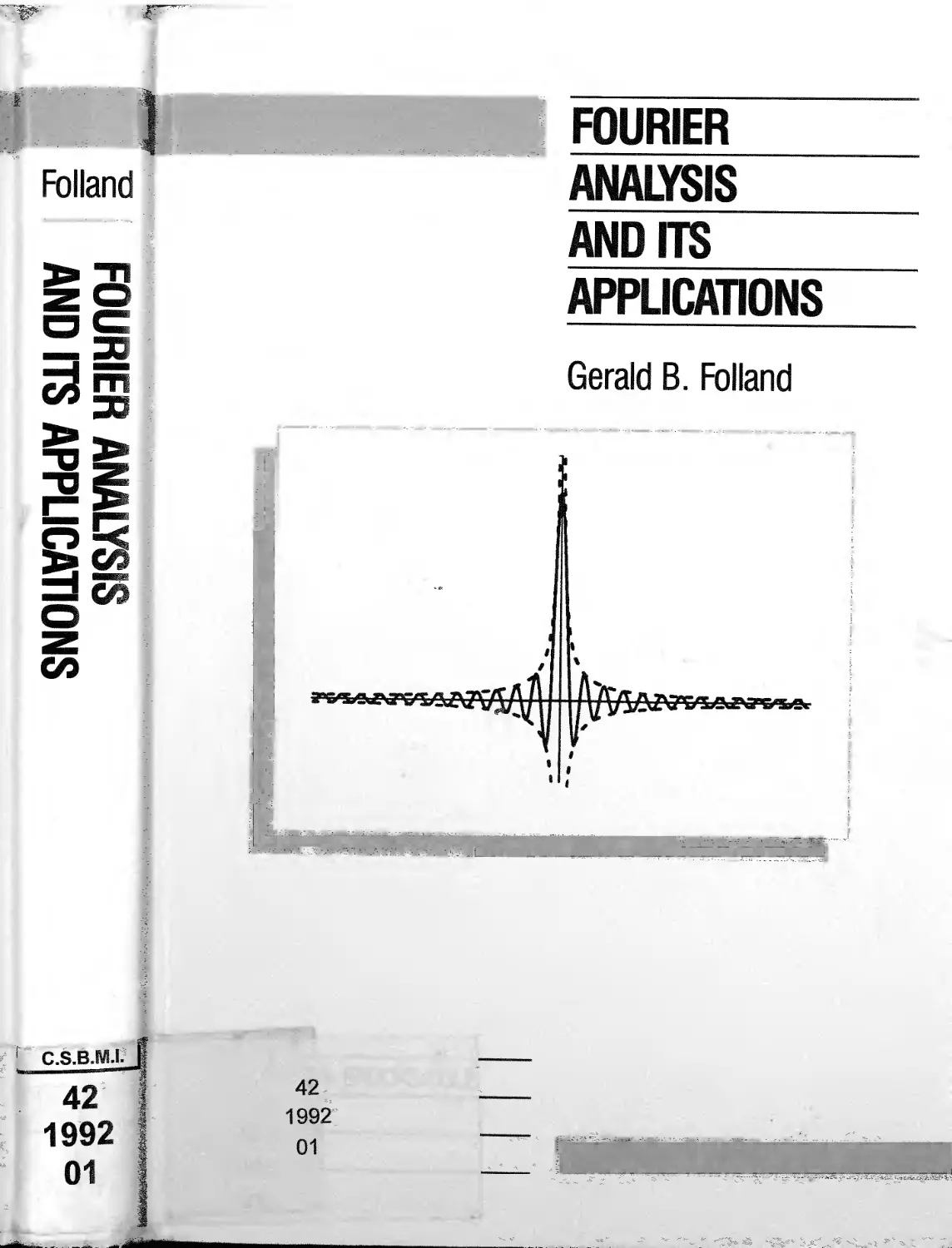


Author: Folland G.B.
Tags: mathematics mathematical analysis trigonometry fourier analysis
ISBN: 0-534-17094-3
Year: 1992
Similar

Text
..
.
,..
.
,O.!'. ..... "'. .
,<".
Folland ......
>-n ...
zQ ...
cC: ·
_ ::J:I
--I m ..
en ::J:Ii
> ..
=Hi'
E::
..
.
I (is .
Q
Z
(I)
r . C.S.S.M.I:j
..
42 I
. 1992 I
01 j
_
__.o-__ __.. ._
.. ...... '
:";; ':;"-"
-..-
FOURIER
. . .
. .
. -- -- . -
ANALYSIS
AND ITS
APPLICATIONS
Gerald B. Folland
, '
, ,
,
,
. ,
· f
. .- - . - - ,- - -'.-
_. 0 "_'.' _... .", .. '_ _ _ '. _, _._
-"-.
." . ..' -' - . .. .".: :.;- . - - - ." .-,:.--,- -.- :
_.-..,:-
. - ----
. .
.-, ".,.,'-"
--
- --
._.
.. .-- --
- . - ."...
- -
,.- .- .:-
o -_
42
1992"
01
The Wadsworth & Brooks/Cole Mathematics Series
Series Editors
Raoul H. Bott, Harvard University
David Eisenbud, Brandeis University
Hugh L. Montgomery, University of Michigan
Paul J. Sally, University of Chicago
Barry Simon, California Institute of Technology
Richard P. Stanley, Massachusetts Institute of Technology
M. Adams, V. Guillemin, Measure Theory and Probability
W. Beckner, A. Calderon, R. Fefferman, P. Jones, Conference on Harmon'lc
Analysis in Honor of Antoni Zygmund
G. Chartrand, L. Lesniak. Graphs f3 Digraphs, Second Edition
W. Derrick, Complex Analysis and Appl'lcations, Second Edition
J. Dieudonne, History of Algebraic Geometry
R. Dudley, Real Analysis and Probability
R. Durrett, Brownian Motion and Martingales in Analysis
D. Eisenbud, J. Harris, Schemes: The Language of Modern Algebraic Geometry
R. Epstein, W. Carnielli, Computability: Computable Functions, Logic, and the
Foundations of Mathematics
S. Fisher, Complex Variables, Second Edition
G. Folland, Fourier Analysis and Its Applications
A. Garsia. Topics in Almost Everywhere Convergence
P. Garrett. Holomorphic Hilbert Modular Forms
R. Gunning, Introduction to Holomorphic Functions of Several Variables
Volume I: Function Theory
Volume II: Local Theory
Volume III: Homological Theory
H. Helson, Harmonic Analysis
J. Kevorkian, Partial Differential Equations: Analytical Solution Techn'lques
S. Krantz, Function Theory of Several Complex Variables, Second Edition
R. McKenzie, G. McNulty, W. Taylor, Algebras, Lattices, Varieties, Volume I
E. Mendelson, Introduction to Mathematical Logic, Third Edition
D. Passman, A Course in Ring Theory
B. Sagan, The Symmetric Group: Representations, Combinatorial Algorithms,
and Symmetric Functions
R. Salem, Algebraic Numbers and Fourier Analysis and L. Carleson, Selected
Problems on Exceptional Sets
R. Stanley, Enumerative Combinatorics, Volume I
J. Strikwerda, Finite Difference Schemes and Partial Differential Equations
K. Stromberg, An Introduction to Classical Real Analysis
W. Taylor, The Geometry of Computer Graphics
,
FOURIER A ALYSI
A D ITS APPLICATIONS
. "
\ \ F- "' ,f"" '\.
....$>..\,
. ,,?< Wf;U'}m:4 '1,\
:z. M.m:,{MfiA t,l
.J. j
'* .'
>-.. -
Gerald B. Folland
University of Washington
Wadsworth & Brooks/Cole Advanced Books & Software
Pacific Grove, California
Brooks/Cole Publishing Company
A Division of Wadsworth, Inc.
@ 1992 by Wadsworth, Inc., Belmont, California 94002. All rights reserved. No
part of this book may be reproduced, stored in a retrieval system, or transcribed,
in any form or by any means electronic, mechanical, photocopying, recording,
or otherwisewithout the prior written permission of the publisher, Brooks/Cole
Publishing Company, Pacific Grove, California 93950, a division of Wadsworth,
Inc.
Printed in the United States of America
10 9 8 7 6 5 4 3 2 1
Library of Congress Cataloging in Publication Data
Folland, G. B.
Fourier analysis and its applications / Gerald B. Folland.
p. em. (The Wadsworth& Brooks/Cole mathematics series)
Includes bibliographical references and indexes.
ISBN 0-534-17094-3
1. Fourier analysis. I. Title. n. Series
QA403.5.F65 1992
515'.2433dc20 91-33170
CIP
Sponsoring Editor: John Kimmel
Marketing Representative: Karen Buttles
Editorial Assistant: Nancy Miaoulis
Production Coordinator: Marlene Thom
Manuscript Editor: Linda Thompson
Cover Design: Roger Knox
Art Coordinator: Cloyce J. Wall
Printing and Binding: Arcata Graphics/Fairfield
PREFACE
This book is intended for students of mathematics, physics, and engineer-
mg at the advanced undergraduate level or beyond. It is primarily a text for a
course at the advanced undergraduate level, but I hope it will also be useful as a
reference for people who have taken such a course and continue to use Fourier
analysis in their later work. The reader is presumed to have (i) a solid back-
ground in calculus of one and several variables, (ii) knowledge of the elementary
theory of linear ordinary differential equations (i.e., how to solve first-order linear
equations and second-order ones with constant coefficients), and (iii) an acquain-
tance with the complex number system and the complex exponential function
e x + iy = eX(cosy + isiny). In addition, the theory of analytic functions (power
series, contour integrals, etc.) is used to a slight extent in Chapters 5, 6, 7, and 9
and in a serious way in Sections 8.2, 8.4, 8.6, 10.3, and 10.4. I have written the
book so that lack of knowledge of complex analysis is not a serious impediment;
at the same time, for the benefit of those who do know the subject, it would be a
shame not to use it when it arises naturally. (In particular, the Laplace transform
without analytic functions is like Popeye without his spinach.) At any rate, the
facts from complex analysis that are used here are summarized in Appendix 2.
The subject of this book is the whole circle of ideas that includes Fourier
series, Fourier and Laplace transforms, and eigenfunction expansions for differ-
entialoperators. I have tried to steer a middle course between the mathematics-
for-engineers type of book, in which Fourier methods are treated merely as a tool
for solving applied problems, and the advanced theoretical treatments aimed at
pure mathematicians. Since I thereby hope to please both the pure and the ap-
plied factions but run the risk of pleasing neither, I should give some explanation
of what I am trying to do and why I am trying to do it.
First, this book deals almost exclusively with those aspects of Fourier analysis
that are useful in physics and engineering rather than those of interest only in
pure mathematics. On the other hand, it is a book on applicable mathematics
rather than applied mathematics: the principal role of the physical applications
herein is to illustrate and illuminate the mathematics, not the other way around.
I have refrained from including many applications whose principal conceptual
content comes from Subject X rather than Fourier analysis, or whose appreciation
requires specialized knowledge from Subject X; such things belong more properly
in a book on Subject X where the background can be more fully explained. (Many
of my favorite applications come from quantum physics, but in accordance with
this principle I have mentioned them only briefly.) Similarly, I have not worried
too much about the physical details of the applications studied here. For example,
when I think about the I-dimensional heat equation I usually envision a long thin
rod, but one who prefers to envision a 3-dimensional slab whose temperature
varies only along one axis is free to do so; the mathematics is the same.
v
V] Preface
Second, there is the question of how much emphasis to lay on the theoretical
aspects of the subject as opposed to problem-solving techniques. I firmly believe
that theory - meaning the study of the ideas underlying the subject and the
reasoning behind the techniques - is of intellectual value to everyone, applied or
pure. On the other hand, I do not take "theory" to be synonymous with "logical
rigor." I have presented complete proofs of the theorems when it is not too
onerous to do so, but I often merely sketch the technical parts of an argument.
(If the technicalities cannot easily be filled in by someone who is conversant
with such things, I usually give a reference to a complete proof elsewhere.) Of
course, where to draw the line is a matter of judgment, and I suppose nobody will
be wholly satisfied with my choices. But those instructors who wish to include
more details in their lectures are free to do so, and readers who tire of a formal
argument have only to skip to the end-of-proof sign I. Thus, the book should be
fairly flexible with regard to the level of rigor its users wish to adopt.
One feature of the theoretical aspect of this book deserves special mention.
The development of Lebesgue integration and functional analysis in the period
1900-1950 has led to enormous advances in our understanding of the concepts
underlying Fourier analysis. For example, the completeness of L 2 and the shift
from pointwise convergence to norm convergence or weak convergence simplifies
much of the discussion of orthonormal bases and the validity of series expansions.
These advances have usually not found their way into application-oriented books
because a rigorous development of them necessitates the building of too much
machinery. However, most of this machinery can be ignored if one is willing to
take a few things on faith, as one takes the intermediate value theorem on faith in
freshman calculus. Accordingly, in 93.3-4 I assert the existence of an improved
theory of integration, the Lebesgue integral, in the context of which one has
(i) the completeness of L 2 , (ii) the fact that "nice" functions are dense in L 2 ,
and (iii) the dominated convergence theorem. I then proceed to use these facts
without further ado. (The dominated convergence theorem, it should be noted,
is a wonderful tool even in the context of Riemann integrable functions.) Later,
in Chapter 9, I develop the theory of distributions as linear functionals on test
functions, the motivation being that the value of a distribution on a test function
is a smeared-out version of the value of a function at a point. Discussion of
functional-analytic technicalities (which are largely irrelevant at the elementary
level) is reduced to a minimum.
With the exception of the prerequisites and the facts about Lebesgue integra-
tion mentioned above, this book is more or less logically self-contained. However.
certain assertions made early in the book are established only much later:
(i) The completeness of the eigenfunctions of regular Sturm-Liouville problems
is stated in 93.5 and proved, in the case of separated boundary conditions,
in 910.3.
(ii) The asymptotic formulas for Bessel functions given in 95.3 are proved via
Watson's lemma in 98.6.
(iii) The proofs of completeness of Legendre, Hermite, and Laguerre polynomials
in Chapter 6 rely on the Weierstrass approximation theorem and the Fourier
Preface vn
inversion theorem, proved in Chapter 7.
(iv) The discussion of weak solutions of differential equations in 39.5 justifies
many of the formal calculations with infinite series in the earlier chapters.
Thus, among the applications of the material in the later part of the book is the
completion of the theory developed in the earlier part.
1
I
2
I
3
4
5
6 7
8 9
I
10
CI
CHAPTER DEPENDENCE DIAGRAM
The main dependences among the chapters are indicated in the accompany-
ing diagram, but a couple of additional comments are in order.
First, there are some minor dependences that are not shown in the diagram.
For example, a few paragraphs of text and a few exercises in Sections 6.3, 7.5,
8.1, and 8.6 presuppose a knowledge of Bessel functions, but one can simply omit
these bits if one has not covered Chapter 5. Also, the discussion of techniques
in 34.1 is relevant to the applied problems ill later chapters, particularly in 3 5 . 5 .
Second, although Chapter 10 depends on Chapter 9. except in 310.2 the
only part of distribution theory needed in Chapter 10 is an appreciation of delta
functions on the real line and the way they arise in derivatives of functions with
jump discontinuities. Hence, one could cover Sections 10.1 and 10.3-4 after an
informal discussion of the delta function, without going through Chapter 9.
There is enough material in this book for a full-year course, but one can also
select various subsets of it to make shorter courses. For a one-term course one
could cover Chapters 1-3 and then select topics ad libitum from Chapters 4-7.
(If one wishes to present some applications of Bessel functions without discussing
the theory in detail, one could skip from the recurrence formulas in 35.2 to the
statement of Theorem 5.3 at the end of 35.4 without much loss of continuity.) I
have taught a one-quarter (ten-week) course from Chapters 1-5 and a sequel to
it from Chapters 7-10, omitting a few items here and there.
One further point that instructors should keep in mind is the following. Most
of the book deals with rather concrete ideas and techniques, but there are two
viii Preface
places where concepts of a more general and abstract nature are discussed in a
serious way: Chapter 3 (L 2 spaces, orthogonal bases, Sturm-Liouville problems)
and Chapter 9 (functions as linear functionals, generalized functions). These
parts are likely to be difficult for students who have had little experience with
abstract mathematics. and instructors should plan their courses accordingly.
Fourier analysis and its allied subjects comprise an enormous amount of
mathematics, about which there is much more to be said than is included in this
book. I hope that my readers will find this fact exciting rather than dismaying.
Accordingly, I have included a sizable although not exhaustive bibliography of
books and papers to which the reader can refer for more information on things
that are touched on lightly here. Most of these references should be reasonably
accessible to the students for whom this book is primarily intended, but a few of
them are of a considerably more advanced nature. This is inevitable; the topics in
this book impinge on a lot of sophisticated material, and the full story on some
of the things discussed here (singular Sturm-Liouville problems, for instance)
cannot be told without going to a deeper level. But these advanced references
should be of use to those who have the necessary background, and may at least
serve as signposts to those who have yet to acquire it.
I am grateful to my colleagues Donald Marshall, Douglas Lind, Richard Bass,
and James Morrow and to the students in our classes for pointing out many mis-
takes in the first draft of this book and suggesting a number of improvements.
I also wish to thank the following reviewers for their helpful suggestions in re-
vising the manuscript: Giles Auchmuty, University of Houston; James Herod,
Georgia Institute of Technology; Raymond Johnson, University of Maryland;
Francis Narcowich, Texas A & M University; Juan Carlos Redondo, Univer-
sity of Michigan; Jeffrey Rauch, University of Michigan; Jesus Rodriguez, North
Carolina State University; and Michael Vogelius, Rutgers University.
Gerald B. Folland
CONTENTS
/ }
:.; <:./\
J "'_ .
I t!'}i l. ... f""1:"t
l - -,.) .i':f;'i"'i. w\
f:; :'" . ' <-" l
,, . >,
II. f
\: f,) J
>- 't>../
''',- -""- ./
....,:: .f.'"
1 Overture 1
1.1 Some equations of mathematical physics 2
1.2 Linear differential operators 8
1.3 Separation of variables 12
2 Fourier Series 18
2.1 The Fourier series of a periodic function 18
2.2 A convergence theorem 31
2.3 Derivatives, integrals, and uniform convergence 38
2.4 Fourier series on intervals 43
2.5 Some applications 48
2.6 Further remarks on Fourier series 57
3 Orthogonal Sets of Functions 62
3.1 Vectors and inner products 62
3.2 Functions and inner products 68
3.3 Convergence and completeness 72
3.4 More about L 2 spaces; the dominated convergence theorem 81
3.5 Regular Sturm-Liouville problems 86
3.6 Singular Sturm-Liouville problems 95
4 Some Boundary Value Problems 97
4.1 Some useful techniques 98
4.2 One-dimensional heat flow 101
4.3 One-dimensional wave motion 108
4.4 The Dirichlet problem 114
4.5 Multiple Fourier series and applications 121
5 Bessel Functions
5.1 Solutions of Bessel's equation 128
5.2 Bessel function identities 133
5.3 Asymptotics and zeros of Bessel functions L 38
5.4 Orthogonal sets of Bessel functions 143
5.5 Applications of Bessel functions 149
5.6 Variants of Bessel functions 158
6 Orthogonal Polynomials
6.1 Introduction 164
6.2 Legendre polynomials 166
6.3 Spherical coordinates and Legendre functions 174
6.4 Hermite polynomials 184
6.5 Laguerre polynomials 190
6.6 Other orthogonal bases 196
-
127
164
IX
x Contents
7 The Fourier Transform 204
7.1 Convolutions 206
7.2 The Fourier transform 213
7.3 Some applications 225
7.4 Fourier transforms and Sturm-Liouville problems 236
7.5 Multivariable convolutions and Fourier transforms 241
7.6 Transforms related to the Fourier transform 249
8 The Laplace Transform 256
8.1 The Laplace transform 256
8.2 The inversion formula 266
8.3 Applications: Ordinary differential equations 273
8.4 Applications: Partial differential equations 279
8.5 Applications: Integral equations 286
8.6 Asymptotics of Laplace transforms 292
9 Generalized Functions 303
9.1 Distributions 304
9.2 Convergence, convolution, and approximation 314
9.3 More examples: Periodic distributions and finite parts 320
9.4 Tempered distributions and Fourier transforms 330
9.5 Weak solutions of differential equations 341
10 Green's Functions 349
10.1 Green's functions for ordinary differential operators 350
10.2 Green's functions for partial differential operators 358
10.3 Green's functions and regular Sturm-Liouville problems 369
10.4 Green's functions and singular Sturm-Liouville problems 379
Appendices
1 Some physical derivations 386
2 Summary of complex variable theory 392
3 The gamma function 399
4 Calculations in polar coordinates 404
5 The fundamental theorem of ordinary differential equations 409
Answers to the Exercises 413
References 426
Index of Symbols 429
Index 430
.
- --.....---
CHAPTER 1
OVERTURE
/;:: ), ....\
f' <"1..'- ... /
:f " f'J'_,
I i?;;;tif:.f f" \
......... ;f:" .-'" f:t-.4 "
'''''' '.' ,- >''' ,
\ ? . ""{'i'':Mff1
" '\'
..t
zt
The subject of this book is Fourier analysis, which may be described as a collection
of related techniques for resolving general functions into sums or integrals of
simple functions or functions with certain special properties. Fourier analysis is
a powerful tool for many problems, and especially for solving various differential
equations of interest in science and engineering. The purpose of this introductory
chapter is to provide some background concerning partial differential equations.
Specifically, we introduce some of the basic equations of mathematical physics
that will provide examples and motivation throughout the book, and we discuss
a technique for solving them that leads directly to problems in Fourier analysis.
At the outset, let us present some notations that will be used repeatedly.
The real and complex number systems will be denoted by Rand C, respectively.
We shall be working with functions of one or several real variables XI,"" Xn.
We shall denote the ordered n-tuple (x],..., Xn) by x and the space of all such
ordered n-tuples by R n .
In most of the applications, n will be 1, 2, 3, or 4, and the variables Xl will
denote coordinates in one, two, or three space dimensions, together with time.
In this situation we shall usually write x,y, z instead of X]'X2,X3 for the spatial
variables, and we shall denote the time variable by t. Moreover, we shall use the
common subscript notation for partial derivatives:
{)u
ux=-
{)x'
{)2U
Uxx = {)x 2
{)2U
Uxy = {)x{)y'
etc.
A function f of one real variable is said to be of class C(k) on an interval I
if its derivatives f', .. . , f(k) exist and are continuous on I. Similarly, a function
of n real variables is said to be of class C(k) on a set D c R n if all of its partial
derivatives of order k exist and are continuous on D. If the function possesses
continuous derivatives of all orders, it is said to be of class C( (0) .
Finally, we use the common notation with square and round brackets for
closed and open intervals in the real line R:
[a, b] = {x : a x b},
[a, b) = {x : a x < b},
(a, b) = {x : a < x < b},
(a, b] = {x : a < x b}.
1
2 Chapter 1. Overture
1.1 Some equations of mathematical physics
In order to understand the significance of the ideas as they arise, it will be useful
to have a few physical applications in mind as examples of the sort of problems we
are trying to solve. Accordingly, we begin with a brief and informal discussion of
some of the basic partial differential equations of classical mathematical physics.
These equations all involve a fundamental differential operator known as the
Laplacian, which is defined as follows. If u is a function of the real variables
XI,' . . , Xn of class C(2), the Laplacian of u is the function V 2 u defined by
2 a 2 u a 2 u a 2 u
V u=-+-+"'+-.
ax? axi ax
(1.1)
The first of the equations we shall study is the wave equation:
a 2 u 2 2
Utt = a t 2 = C V u.
( 1.2)
Here u represents a wave traveling through an n-dimensional medium-where, in
practice, n will usually be 1, 2, or 3. More precisely, XI, . . . , Xn are the coordinates
of a point x in the medium; t is the time; c is the speed of propagation of waves
in the medium; and u(x, t) is the amplitude of the wave at position x and time t.
The wave equation provides a reasonable mathematical model for a number
of physical processes, such as the following:
(a) Vibrations of a stretched string, such as a guitar string.
(b) Vibrations of a column of air, such as an organ pipe or clarinet.
(c) Vibrations of a stretched membrane, such as a drumhead.
(d) Waves in an incompressible fluid, such as water.
( e) Sound waves in air or other elastic media.
(f) Electromagnetic waves, such as light waves and radio waves.
The number n of spatial dimensions is 1 in examples (a) and (b), 2 in examples
(c) and (d) (since the waves appear on the surface of the water), and 3 in ex-
amples (e) and (f). In (a), (c), and (d), u represents the transverse displacement
of the string, membrane, or fluid surface; in (b) and (e), u represents the lon-
gitudinal displacement of the air; and in (f), u is any of the components of the
electromagnetic field.
We shall not attempt to derive the wave equation from physical principles
here, since each of the preceding examples involves different physics. Examples
(a) and (f) are explained in Appendix 1; discussions of the others may be found,
for example, in Ingard [32]* and Taylor [51]. We should point out, however,
that in most cases the derivation involves making some simplifying assumptions.
Hence, the wave equation gives only an approximate description of the actual
physical process, and the validity of the approximation will depend on whether
* Numbers in brackets refer to the bibliography at the end of the book.
..
-..-
1.1 Some equations of mathematical physics 3
certain physical conditions are satisfied. For instance, in example (a) the vibra-
tions should be small enough so that the string is not stretched beyond its limits
of elasticity. In example (f) it follows from Maxwell's equations, the fundamen-
tal equations of electromagnetism, that the wave equation is satisfied exactly in
regions containing no electric charges or currents - but of course the assumption
of no charges or currents can only be approximately valid in the real world. (Of
course, it is precisely the fact that the wave equation is only an approximation
that allows it to be a useful model in so many different situations!)
The next basic differential equation on our list is the heat equation:
Ut = kV 2 u.
( 1.3)
This equation describes the diffusion of thermal energy in a homogeneous mate-
rial (that is, one whose composition does not change from point to point). As in
the wave equation, the variables x j are spatial coordinates and t is time, but now
u(x, t) is the temperature at a position x and time t, and k is a constant called the
"thermal diffusivity" of the material. A brief derivation is given in Appendix 1.
As for the number of spatial variables, the case n = 3 is the most fundamental
from the physical point of view, but the cases n = 1 and n = 2 are also of in-
terest as models of situations where the heat flow is practically all in one or two
directions. For example, the heat equation with n = 1 can be used to describe
heat flow along a wire or rod, provided that heat flow in directions perpendicular
to the axis of the rod can be neglected. It can also be used to describe heat flow
in a slab of material, such as a wall separating two rooms, where only the heat
flow from one room toward the other (as opposed to flow in directions parallel
to the wall) is significant.
Two warnings: (i) The heat equation can be used to model heat flow in both
solids and fluids (liquids and gases), but in the latter case it does not take any
account of the phenomenon of convection; that is, it will provide a reasonable
model only if conditions are such as to exclude any macroscopic currents in the
fluid. (ii) The heat equation is not a fundamental law of physics, and it does not
give reliable answers at very low or very high temperatures. In particular, it is
obvious that if u is a solution then so is u + c for any constant c; thus the heat
equation does not recognize the existence of absolute zero!
The heat equation can also be used to model other diffusion processes. For
example, if a drop of red dye is placed in a body of water, the dye will gradually
spread out and permeate the entire body. If convection effects are negligible,
equation (1.3) will describe the diffusion of the dye through the water (u(x, t)
now being the concentration of dye at position x and time t).
Next, we come to the Laplace equation:
v 2 u = o.
(1.4)
Laplace's equation arises in a number of different contexts. It is satisfied by the
electrostatic potential in any region containing no electric charge, and.by the grav-
itational potential in any region containing no mass. It is also the equation that
4 Chapter 1. Overture
governs standing waves and steady-state heat distributions - that is, solutions
of the wave equation and the heat equation that are independent of time. We
shall meet other applications of it later on.
Partial differential equations such as the ones discussed above typically have
solutions in such great abundance that there is no reasonable way of giving an
explicit description of all of them. The most common way of pinning down
a particular solution is to impose some boundary conditions. Different types of
differential equations require different types of boundary conditions, and the par-
ticular conditions that are appropriate for a given physical problem will depend
on the particular physical situation. The physics is generally a good guide to
the mathematics: "reasonable" physical conditions usually lead to "reasonable"
mathematical problems.
t
-
D
Lx
FIGURE 1.1. The region D in x-space and the region D in xt-space.
These matters may best be explained by examining a few examples. Let us
consider the heat equation: suppose we are interested in studying the diffusion
of heat in a body that occupies a bounded region D of x-space, given the initial
temperature distribution in the body. That is, we wish to solve the heat equation
(1.3) in the region
D = {(x, t) : xED, t> O}
of (x, t )-space subject to the initial condition
u(x,O) = f(x), (1.5)
where f(x) is the temperature distribution at time t = O. (See Figure 1.1.) Equa-
tion (1.5) is a condition on u on the "horizontal" part of the boundary of D,
but it is not enough to specify u completely; we also need a boundary condition
on the "vertical" part of the boundary to tell what happens to the heat when it
reaches the boundary surface S of the spatial region D. Here the particular phys-
ical conditions at hand must be our guide. One reasonable assumption is that S
is held at a constant temperature Uo (for example, by immersing the body in a
bath of ice water), thus:
u(x, t) = Uo for XES, t > O.
( 1.6)
-
1.1 Some equations of mathematical physics 5
Another reasonable assumption is that D is insulated, so that no heat can flow in
or out across S. Mathematically, this amounts to requiring the normal derivative
of U along the boundary S to vanish:
('VU . n)(x, t) = 0 for XES, t > O.
(1.7)
Here n is the unit outward normal vector to S (and we are implicitly assuming
that the surface S is smooth, so that n is well-defined). A more realistic assump-
tion than either (1.6) or (1.7) is that the region outside D is held at a constant
temperature uo, and the rate of heat flow across the boundary S is proportional
to the difference in temperatures on the two sides:
('VU' n)(x, t) + a( u(x, t) - uo) = 0 for XES, t > O. (1.8)
This is Newton's law of cooling, and a > 0 is the proportionality constant. The
conditions (1.6) and (1.7) may be regarded as the limiting cases of (1.8) as a -+ DC
or a ---t O.
At any rate, it turns out that the initial condition (1.5) together with anyone
of the boundary conditions (1.6), (1.7), or (1.8) leads to a well-posed problem: one
having a unique solution that depends continuously (in some appropriate sense)
on the initial data f. The same discussion is also valid for the heat equation in
one or two space dimensions. (In one space dimension, the "region'" D is just an
interval in the x-axis, and the "normal derivative" 'Vu . n is just Ux at the right
endpoint and -Ux at the left endpoint.)
A similar analysis applies to boundary value problems for the wave equation
(1.2), with one significant difference: the wave equation is second-order in the
time variable t, whereas the heat equation is only first-order in t. For this reason,
in solving the wave equation it is appropriate to specify not only the initial values
of u as in (1.5) but also the initial velocity Ut:
u(x,O) = f(x),
Ut(x,O) = g(x) for xED.
( 1.9)
The imposItion of the initial conditions (1.9) together with a boundary condition
of the form (1.6), (1.7), or (1.8) leads to a unique solution of the wave equation.
For example, to analyze the motion of a vibrating string of length I that is fixed at
both endpoints, we take the "region" D to be the interval [0, I] on the x-axis and
solve the one-dimensional wave equation with boundary conditions (1.6) (where
Uo = 0) and (1.9):
2
Utt = C Uxx,
U(x,O) = f(x) and Ut(x,O) = g(x) for 0 < x < I,
u(O, t) = u(l, t) = 0 for t > O.
Remark: The "velocity" Ut is not the same as the constant c in the wave
equation. c is the speed of propagation of the wave along the string, whereas Ut
is the rate of change of the displacement of a particular point on the string. (The
same is true for waves in media other than strings.)
-
6 Chapter 1. Overture
The Laplace equation (1.4) is of a rather different character, as it does not
involve time. The most important boundary value problem for this equation. the
so-called Dirichlet problem, consists in specifying the values of u on the boundary
of the region in question. That is, we solve V 2 u = 0 in a region D subject to the
condition that u agrees with a given function f on the boundary S of D. This
is a well-posed problem when D is bounded and S is smooth (except perhaps
for comers and edges). Another useful boundary value problem for Laplace's
equation is the Neumann problem, which consists of specifying the values of the
normal derivative Vu. non S:
V 2 u = 0 in D,
(Vu . n)(x) = g(x) for XES.
Here we do not quite have uniqueness, for if u is a solution, then so is u + C
for any constant C. Moreover, the boundary data g must satisfy the condition
ffs g = 0 in order for a solution to exist, because by the divergence theorem,
I fs(vu. n) dS = Ilk v 2 udV = 0
for any u such that V 2 u = O. However, there are no other obstructions to existence
and uniqueness; and since there is only one constant to be specified to obtain
uniqueness, and only one linear equation to be satisfied to obtain existence, the
Neumann problem is still regarded as well behaved.
There is one more point that should be mentioned in connection with the in-
terpretation of boundary conditions. Suppose, for example, that we are interested
in the initial value problem for the heat equation:
Ut = kv 2 u for t > 0,
u(x,O) = f(x).
If one interprets this absolutely literally, one obtains a solution by defining u(x, t)
to be f(x) when t = 0 and 0 when t > 0, but clearly this is not what is really
wanted unless f is identically zero! Rather, in such boundary value problems
there is always an implicit continuity assumption: we ask not only that u(x, 0) =
f(x) but that u(x, t) should approach f(x) as t -t O. The precise way in which
this approach is achieved (pointwise convergence, uniform convergence, mean
square convergence, etc.) will depend on the particular problem at hand. This is
not a matter that requires a lot of deep thought - merely a little care to avoid
making silly mistakes.
The wave, heat, and Laplace equations can be generalized by adding in an
extra term, as follows:
Utt - c 2 V 2 u = F (x, t),
Ut - kv 2 u = F(x, t),
V 2 u = F(x).
(1.10)
(1.11)
( 1.12)
These equations are called the inhomogeneous wave, heat, and Laplace equations;
equation (1.12) is also called the Poisson equation. Here F is a function that
o._,
1.1 Some equations of mathematical physics 7
is given in advance, and the original equations (1.2), (1.3), and (1.4) are the
special cases where F = O. The interpretation of F will vary with the particular
situation considered. In the wave equation (1.10), F may represent a force that
is driving the waves; in the case of electromagnetic fields, it represents the effect
of charges or currents (see Appendix 1). In the heat equation (1.11), F may
represent a source (or sink) of heat within the material in which the heat is
flowing. The Poisson equation (1.12) is satisfied by electrostatic potential in a
region when F is interpreted as -4n times the charge density in the region, or by
the graviatational potential when F is interpreted as 4n times the mass density.
(See Appendix 1. The difference in signs occurs because positive masses attract
each other, whereas positive charges repel.) The boundary conditions appropriate
for these inhomogeneous equations are much the same as for the corresponding
homogeneous equations.
Finally, we mention one other basic equation of phYSICS, the Schrodinger
equation :
mUt = - ;: 'V 2 u + V(x)u.
In this equation u is the quantum-mechanical wave function for a particle of mass
m moving in a potential V(x), h is Planck's constant, and i = v=T. When the
particle has a definite energy E, the time dependence drops out and one obtains
the steady-state equation
t? 2
- 2m 'V u + V(x)u = Eu.
For the physics behind these equations we refer the reader to books on quan-
tum mechanics such as Messiah [39] and Landau-Lifshitz [35]. Readers who are
not familiar with this subject can safely ignore the occasional references to the
Schrodinger equation, but those who are will find the solutions to some important
special cases in later chapters.
EXERCISES
1. Show that u(x, t) = t- l / 2 exp( _x 2 /4kt) satisfies the heat equation Ut = kuxx
for t > O.
2. Show that u(x,y, t) = t- l exp[ _(x 2 + y2)/4kt] satisfies the heat equation
Ut = k(uxx + Uyy) for t > O.
3. Show that u(x,y) = log(x 2 + y2) satisfies Laplace's equation Uxx + Uyy = 0
for (x,y) # (0,0).
4. Show that u(x,y, z) = (x 2 + y2 + z2)-1/2 satisfies Laplace's equation Uxx +
Uyy + Uzz = 0 for (x,y, z) # (0,0,0).
5. Proportionality constants in the equations of physics can often be eliminated
by a suitable choice of units of measurement. Mathematically, this amounts
to rewriting the equation in terms of new variables that are constant multiples
of the original ones. Show that the substitutions '[ = kt and '[ = ct reduce
the heat and wave equations, respectively, to u. = 'V 2 u and U7:7: = 'V 2 u.
-
8 Chapter 1. Overture
6. The object of this exercise is to derive d'A.lembert's formula for the general
solution of the one-dimensional wave equation Utt = c 2 uxx_
a. Show that if u(y, z) = f(y) + g( z) where f and g are C(2) functions
of one variable, then u satisfies Uyz = O. Conversely, show that every
C(2) solution of Uyz = 0 is of this form. (Hint: If Vy = 0, then v is
independent of y.)
b. Let y = x - ct and z = x + ct. Use the chain rule to show that Utt -
c 2 u x x = -4c 2 uyz.
c. Conclude that the general C(2) solution of the wave equation Utt = c 2 u xx
is u(x, t) = f(x - ct) + g(x + ct) where f and g are C(2) functions of
one variable. (Observe that f(x - ct) represents a wave traveling to the
right with speed c, and g(x + ct) represents a wave traveling to the left
with speed c.)
d. Show that the solution of the initial value problem
2
Utt = c U xx ,
U(x,O) = cjJ(x),
Ut(x,O) = V/(x)
IS
1 l x + ct
u(x, t) = ! [ cjJ(x - ct) + cjJ(x + ct) ] + _ 2 V/(y) dy.
c x-ct
7. The voltage v and current i in an electrical cable along the x-axis satisfy the
coupled equations
ix + CVt + Gv = 0,
Vx +Lit +Ri = 0,
where C, G, L, and R are the capacitance, (leakage) conductance, induc-
tance, and resistance per unit length in the cable. Show that v and i both
satisfy the telegraph equation
Uxx = LCutt + (RC + LG)ut + RGu.
8. Set u(x, t) = f(x, t)e at in the telegraph equation of Exercise 7. What is the
differential equation satisfied by f? Show that a can be chosen so that this
equation is of the form fxx = Aftt + B f (with no first-order term), provided
that LC i= O.
1.2 Linear differential operators
The partial differential equations considered in the preceding section can all be
written in the form L(u) = F, where L(u) stands for Utt - c 2 V 2 u, Ut - kv 2 u,
or V 2 u. In each case L(u) is a function obtained from u by performing certain
operations involving partial derivatives. which we regard as the result of applying
the operator L to the function u.
''JiIiiIIiIii
1.2 Linear differential operators 9
In general, a linear partial differential operator L is an operation that trans-
forms a function u of the variables x = (XI,"" Xn) into another function L( u)
given by
n 8 n 82
L(u) = a(x)u + :Ebi(x) 8 u. + :E cij(x) 8 .; . +....
. 1 Xl.. 1 Xl X ]
l= l,]=
(Here the dots at the end indicate higher-order terms, but it is understood that the
whole sum contains only finitely many terms.) In other words, L( u) is obtained
by taking a finite collection of partial derivatives of u, multiplying them by the
coefficients a, b i , cij, etc., and adding them up. We may describe the operator L
by itself, without reference to an input function u, by writing
n 8 n 82
L = a(x) + :E b i(x)- 8 . + :E Cij(X) 8 .8 . +.
. 1 Xl. . Xl X ]
l= l,]=l
( 1.13)
The term linear in the phrase "linear partial differential operator" refers to
the following fundamental property: if L is given by (1.13), u],..., uk are any
functions possessing the requisite derivatives, and Cl,"', Ck are any constants,
then
L(CI U l +... + CkUk) = CI L (ud +... + CkL(Uk)'
(1.14)
This is an immediate consequence of the fact that the derivative of a sum is the
sum of the derivatives, and the derivative of a constant multiple of a function is
the constant multiple of the derivative. Any function of the form Cl u 1 +. . . + Ck Uk
(where the c/s are constants) is called a linear combination of u],..., uk' Thus,
(1.14) says that L takes every linear combination of u /s into the corresponding
linear combination of L( u j )'s.
More generally, any operator L, differential or otherwise, that satisfies (1.14)
is called linear; here the inputs u and the outputs L( u) can be any son of objects
for which linear combinations make sense, such as functions, vectors, numbers,
etc. For instance, the formula L(f) = J: f(t) dt defines a linear operation taking
continuous functions on the interval [a, b] to numbers; and if Xo is a fixed 3-
dimensional vector, the formula L(x) = x x Xo (the cross product of x with xo)
defines a linear operation on 3-dimensional vectors.
A linear partial differential equation is simply an equation of the form
L(u) = F,
where L is a linear partial differential operator and F is a function of x. Such
an equation is called homogeneous if F = 0 and inhomogeneous if F i= O. The
boundary conditions we associate to a differential equation are usually of a similar
form themselves; that is, they are of the form "B(u) = f on the boundary" where
B is another linear differential operator and f is a function on the boundary. (We
shall often omit the phrase "on the boundary" and write the boundary conditions
simply as B(u) = f. Here also, the terms homogeneous and inhomogeneous refer
to the cases f = 0 and f ::ft 0.) The linearity of the operators Land B can be
restated in the following way.
-
r-
r
10 Chapter 1. Overture
The Superposition Principle. If Ul,"', Uk satisfy the linear differential equations
L( u j) = Fj and the boundary conditions B (u j) = Jj for j = 1,..., k, and Cl, . . . , Ck
are any constants, then u = Cl Ul + ... + ckuk satisfies
L(u) =CI F I +"'+CkFb
B(u) = clfi + ... + ckfk'
The importance of the superposition principle can hardly be overestimated.
We shall use it repeatedly in a number of different ways, of which the most
important are the following.
Suppose we want to find all solutions of a differential equation subject to
one or more boundary conditions, say
L(u) = F,
B(u) = f.
( 1.15)
If we can find all solutions of the corresponding homogenous problem
L(u) = 0,
B(u) = 0
( 1.16)
which is often simpler to handle, then it suffices to obtain just one solution, say
v, of the original problem (1.15). Indeed, if u is any other solution of (1.15),
then w = u - v satisfies (1.16), for L(w) = F - F = 0 and B(w) = f - f = O.
Hence we obtain the general solution of (1.15) by adding the general solution w
of (1.16) to any particular solution of (1.15).
In the same spirit, the superposition principle can be used to break down a
problem involving several inhomogeneous terms into (presumably simpler) prob-
lems in which these terms are dealt with one at a time. For instance, suppose
we want to find a solution to (1.15). It suffices to find solutions Ul and u2 to the
problems
L(ud = F,
L(U2) = 0,
B(ud = 0;
B(U2) = f,
for we can then take u = Ul + u2'
Perhaps most important, if Ul, u2,'" are any solutions to a homogeneous
differential equation L( u) = 0 that satisfy homogeneous boundary conditions
B(u) = 0, then any linear combination of the u/s will satisfy the same differ-
ential equation and the same boundary conditions. Thus, starting out with a
sequence of solutions Uj, we can generate many more solutions by taking linear
combinations. If we then take appropriate limits of such linear combinations,
we arrive at solutions defined by infinite series or integrals - and this is where
things get interesting!
Of course, there are also nonlinear differential equations involving nonlinear
operations such as L(u) = Uxx - sinu or L(u) = uUx + (Uy)3. Indeed, many
of the important equations of physics and engineering, including most of the
refinements of the wave equation to describe waves and vibrations, are nonlinear.
.--
1.2 Linear differential operators 11
However, nonlinear equations are, on the whole, much more difficult to solve than
linear ones, and their study is beyond the scope of this book.
One final note: the reader will have observed that all the differential equa-
tions we discussed in 1.1 involve the Laplacian V 2 . The reason for this is that
the Laplacian commutes with all rigid motions of Euclidean space; that is, if fT
denotes any translation or rotation of n-space, then V 2 (f ofT) = (V 2 J) ofT for
all functions f. Moreover, the only linear differential operators of order::::; 2 that
have this property are the operators aV 2 +b where a and b are constants. Hence,
the differential equation describing any process that is spatially symmetric (i.e.,
unaffected by translations and rotations) is likely to involve the Laplacian.
EXERCISES
1. Suppose Ul and u2 are both solutions of the linear differential equation
L(u) = f, where f "# O. Under what conditions is the linear combination
Cl Ul + c2u2 also a solution of this equation?
2. Consider the nonlinear (ordinary) differential equation u' = u( 1 - u).
a. Show that Ul (x) = eX j(1 + eX) and U2(X) = 1 are solutions.
b. Show that Ul + U2 is not a solution.
c. For which values of C is CUI a solution? How about CU2?
3. Give examples of linear differential operators Land M for which it is not
true that L(M(u)) = M(L(u») for all u. (Hint: At least one of Land M
must have nonconstant coefficients.)
4. What form must G have for the differential equation Un - Uxx = G(x, t, u)
to be linear? Linear and homogeneous?
5. a. Show that for n = 1,2,3,..., Un(X,y) = sintnnx) sinh(nny) satisfies
Uxx + Uyy = 0,
u(O,y) = u(l,y) = u(x,O) = O.
b. Find a linear combination of the Un's that satisfies u(x, 1) = sin 2nx -
sin 3nx.
c. Show that for n = 1,2,3,..., Un(X,y) = sin(nnx) sinhnn(l- y) satisfies
uxx + Uyy = 0,
u(O,y) = u(l,y) = u(x, 1) = O.
d. Find a linear combination of the Un's that satisfies u(x,O) = 2 sin nx.
e. Solve the Dirichlet problem
uxx + Uyy = 0, u(O,y) = u(l,y) = 0,
u(x,O) = 2 sin nx, u(x, 1) = sin 2nx - sin 3nx.
-
,-
12 Chapter 1. Overture
1..3 Separation of variables
In this section we discuss a very useful technique for solving certain linear partial
differential equations, known as separation of variables. This technique works
only for very special sorts of equations, but fortunately the equations for which
it works include many of the most important ones.
The idea is as follows. Suppose, for simplicity, that we have a homogeneous
partial differential equation L( u) = 0 involving just two independent variables x
and y, with some homogeneous boundary conditions B(u) = O. We try to find
solutions u of the form
u(x,y) = X(x)Y(y).
If the method is to work, when we substitute this formula for u into the equation
L( u) = 0, the terms can be rearranged so that the left side of the equation involves
only the variable x and the right side involves only the variable y, say P(x) =
Q(y). But since x and yare independent, a quantity that depends on x alone
and also on J) alone must be a constant. Hence we have P(x) = C and Q(y) = C,
and these equations will be ordinary differential equations for the functions X
and Y whose product is u. With luck, these equations can be solved subject to
the boundary conditions on X and Y that are implied by the original conditions
on u, and we thus obtain a whole family of solutions by varying the constant
C. By the superposition principle, all linear combinations of these will also be
solutions; and if we are lucky, we will obtain all solutions of the original problem
by taking appropriate limits of these linear combinations.
The same procedure can be used for equations for functions of more than
two variables. If there are three independent variables involved, say x, y, and z,
we look for solutions of the form u of the form
u(x,y, z) = X(x)v(y, z).
If the variables can be separated, we obtain an ordinary differential equation
for X and a partial differential equation for v, but now involving only the two
variables y and z. We can then try to write v(y, z) = Y(y)Z(z) and obtain
ordinary differential equations for Y and Z. In other words, we use separation
of variables to "peel off" the independent variables one at a time, thereby reducing
the original problem to some simpler ones.
Of course, once one has reduced the problem to some ordinary differential
equations, one must be able to solve them! For the time being all our examples
will involve homogeneous equations with real constant coefficients, whose solu-
tions we now briefly review. (See, for example, Boyce-DiPrima [10] for a more
extensive discussion.) For first-order equations the situation is very simple:
f' = af => f(x) = Ce ax .
For second-order equations, the basic fact is as follows.
1
o
-.-
1.3 Separation of variables 13
Theorem 1.1. The general solution off" +af' +bf = 0 is f(x) = C l e rlX +C 2 e r2X ,
where r]. r2 are the roots of the equation r 2 + ar + b = 0 and C l , C 2 are arbitrary
complex numbers. If rl = r2, the general solution is (C l + C 2 x )e rIX .
Here rl and r2 may, of course, be complex; see Appendix 2 for a discussion
of the complex exponential function. In certain cases it may be more convenient
to express the solution in terms of trigonometric or hyperbolic functions. In
particular:
(i) Ifrl = p + ia and r2 = P - ia, the general solution is ePX(C l cosax +
C 2 sin ax).
(ii) If a > O. the general solution off" + a 2 f = 0 is C l cosax + C2 sin ax, and
the general solution off" - a 2 f = 0 is C l cosh ax + C 2 sinh ax.
Enough generalities; let us look at a couple of specific examples.
Consider the problem of I-dimensional heat flow: we may think of a circular
metal rod of length I, insulated along its curved surface so that heat can enter or
leave only at the ends. Suppose, moreover, that both ends are held at temperature
zero. (Zero in which temperature scale? It doesn't matter: the mathematics is
the same.) Ignoring the question of initial conditions for the moment, we then
have the boundary value problem
Ut = kuxx,
u(O, t) = u(l, t) = O.
( 1.1 7)
If w:e substitute u(x, t) = X(x)T(t) into (1.17), we obtain
X(x)T' (t) = kX" (x)T(t),
X(O) = X(l) = O.
(1.18)
( 1.19)
The variables in (1.18) may be separated by dividing both sides by kX(x)T(t),
yielding
T' (t)/kT(t) = X" (x)/ X(x).
Now the left side depends only on t, whereas the right side depends only on x;
since they are equal, they must both be equal to a constant A:
T' (t) = AkT(t),
X"(x) = AX(x).
These are simple ordinary differential equations for T and X that can be solved
by elementary methods - indeed, almost by inspection. The general solution of
the equation for Tis
T(t) = Coe Akt ,
and the general solution of the equation for X is
X(x) = C l COSAX + C 2 sin AX,
A=R.
( 1.20)
(If A is positive, one might prefer to avoid imaginary numbers by rewriting (1.20)
as
C' + C' C' - C'
X (x) = C cosh Jlx + C 2 sinh IJ,X = 1 2 2 eJ.lX + 1 2 2 e - J.lX ,
Jl = VA.
r:-
f.
14 Chapter 1. Overture
But so far A is just an arbitrary (possibly complex) constant, so there is no reason
yet to choose one form over the other.) However, we must now take account of
the boundary conditions (1.19). The condition X(O) = 0 forces C l = 0 in (1.20),
and the condition X(l) = 0 then becomes C 2 sinAl = O. If we take C 2 = 0, then
our solution u(x, t) vanishes identically, which is of no interest: we are looking
for nontrivial solutions. So we take C 2 "# 0; hence sin Al = 0, which means that
Al = nll for some integer n; in other words, A = -(nll/1)2. (So A is negative
after all!) We may take n > 0, since the case n = 0 gives the zero solution and
replacing n by -n merely amounts to replacing C 2 by -C 2 .
In short, for every positive integer n we have obtained a solution Un(X, t) of
( 1.17), namely,
( -n21l2kt ) . nllX
Un(X, t) = exp [2 SIn Z
(n = 1,2,3,.. .).
(We have taken Co = C 2 = 1; other choices of Co and C 2 give constant
multiples of Un.) We obtain more solutions by taking linear combinations of the
Un's, and then passing to infinite linear combinations - that is, infinite series
L;
00 00 ( -n21l2kt ) . nllX
U = anun = anexp [2 Sln Z '
( 1.21)
Of course, there are questions to be answered about the convergence of such
series, but for the moment we shall not worry about that.
Finally, we bring the initial conditions into the picture: can we solve (1.17)
subject to the initial condition u(x, 0) = f(x), where f is a given function on the
interval (O,l)? The solution (1.21) will do the job, provided that
00
f(x) = Lan sin n x .
1
(1.22)
We have now arived at one of the main subjects of this book: the study of series
expansions like (1.22). Before setting foot in this new territory, however, let us
look at a couple of other boundary value problems.
Consider the problem of heat flow in a rod, as before, but now assume that
the ends of the rod are insulated. Thus, instead of (1.17) we consider
Ut = kuxx,
Ux(O, t) = ux(l, t) = O.
( 1.23)
The technique we used to solve (1.17) also works here, with only the follow-
ing differences. The conditions (1.19) are replaced by
X'(O) = X'(l) = 0,
(1.24)
.-.- - BIIIII!I
1.3 Separation of variables 15
which force C 2 = 0 (rather than C l = 0) and Al = nn in (1.20). Again, we may
assume that n > 0 since cos(nnx/l) = cos(-nnx/l), but now we must include
n = O. We thus obtain the sequence of solutions
( -n2n2kt ) nnx
Un(X, t) = exp 1 2 cos I
(n = 0, 1,2,. ..),
which can be combined to form the series
00 00 ( -n2n2kt ) nnx
u= anun= anexp 1 2 cosZ'
This series will solve the problem (1.23) subject to the initial condition u(x, 0) =
f(x) provided that
00
'"' nnx
f(x) = LiancosZ'
o
Thus we have arrived at another series expansion problem, different from but
similar to (1.22).
For yet another variation on the same theme, consider heat flow in a rod
that is bent into the shape of a circle, with the ends joined together. We may
specify the position of a point on the circle by its angular coordinate (), measured
from some fixed base point. Since linear distance on a circle is proportional to
angular distance (Lix = r!J.() where r is the radius), the heat equation Ut = kouxx
can be rewritten as
( 1.25)
Ut = kuoo
where k = ko/r2. We try to find solutions of the form u((), t) = 8(())T(t), and
just as before we find that
T(t) = Coe Akt ,
8(()) = C l cos() V-A + C 2 sin () V-A
( 1.26)
for some constant A. Here there are no boundary conditions like (1.19) or (1.24)
because the rod has no ends. Instead, since the angular coordinate () is well-
defined only up to multiples of 2n, we have the requirement that 8( ()) must be
periodic with period 2n. This condition does not kill off either of the coefficients
C l or C 2 in (1.26), but it does force v A to be an integer n. The upshot is that
we obtain series solutions of the form
00 2
u((), t) = Lean cosn() + b n Slnn())e- n kt,
o
and such a series will satisfy the initial condition u((),O) = f(()) provided that
00
f(()) = L(an cosn() + b n sinn()).
o
( 1.27)
r
'-
16 Chapter 1. Overture
Finally, we present an illustration of these techniques involving something
other than the heat equation. Consider the problem of a vibrating string of length
I, fixed at both endpoints. The mathematical problem to be solved is
Utt = c2uxx, u(O, t) = u(l, t) = O.
If we take u(x,t) = X(x)T(t), (1.28) becomes
X (x) T" (t) = c 2 X" (x) T (t),
X(O) = X(l) = 0
On dividing (1.29) through by c 2 X(x)T(t), we get
X"(x)/X(x) = T"(t)/c 2 T(t),
and both sides of this equation must be equal to a constant that we call-A 2 . (As
before, A might be any complex number until we pin it down further.) Hence,
X"(x) = _A 2 X(x), T"(t) = -A 2 C 2 T(t).
( 1.28)
( 1.29)
( 1.30)
The general solutions of these ordinary differential equations are
X(x) = C l COSAX + C 2 sin AX, T(t) = C 3 cosAct + C 4 sin Act.
As with the heat equation, the boundary conditions (1.30) imply that C l = 0 and
A = nn/l where n is a (positive) integer. We therefore obtain the series solutions
00 ( )
. nnx nnct . nnct
u(x,t) = Lsm[ ancos--r- +bnsln--r- .
1
We recall from 1.1 that the appropriate initial conditions for this problem are
to specify u(x,O) = f(x) and (8u/8t)(x,0) = g(x). Setting t = 0 in (1.31), we
find that
;.
t'
.
(1.31)
00
f(x) = L an sin n7 x ,
1
whereas if we differentiate (1.31) with respect to t (ignoring possible difficulties
about differentiating an infinite series term by term) and then set t = 0, we get
00
'"' nnc . nnx
g(x) = LiTbnS1n[.
1
Thus we are led once again to the problem of expanding f and g in a sine senes
of the form (1.22).
To sum up: in order to carry out the program of solving differential equations
by separation of variables, there are two problems that have to be addressed.
First, there are some technicalities connected with the convergence properties of
infinite series; these are sometimes annoying but rarely are really serious. Second
and more important, the following questions must be answered. Can a given
function on the interval (0, I) be expanded in a sine series (1.22) or a cosine series
( 1.25)? Can a periodic function with period 2n be expanded in a series of the form
(1.27)? Ifso, how?
It is to these and related questions that the next chapter is devoted.
-
1.3 Separation of variables 17
EXERCISES
1. Derive pairs of ordinary differential equations from the following partial dif-
ferential equations by separation of variables, or show that it is not possible.
a. YUxx + Uy = O.
b. x 2 u x x + XUx + Uyy + U = O.
c. Uxx + Uxy + Uyy = O.
d. Uxx + Uxy + Uy = O.
2. Derive sets of three ordinary differential equations from the following partial
differential equations by separation of variables.
a. YUxx + XUyy + XYU zz = O.
b. x 2 u x x + XUx + Uyy + x 2 u z z = O.
3. Use the results in the text to solve
Utt = 9uxx, u(O, t) = u(l, t) = 0,
u(x,O) = 2sinnx - 3sin4nx, Ut(x,O) = 0 (0 < x < 1).
4. Use the results in the text to solve
Ut = -fuuxx, ux(O, t) = ux(n, t) = 0,
u(x,O) = 3 - 4cos2x (0 < x < n).
Determine a value of to so that lu(x, t) - 31 < 10- 4 for t > to.
5. By separation of variables, derive the solutions un (x, y) = sin nnx sinh nny
of
uxx + Uyy = 0,
u(O,y) = u(l,y) = u(x,O) = 0
that were discussed in Exercise 5a, 1.2.
6. By separation of variables, derive the family
u n(x,y, z) = sinmnxcosnnyexp( ::I:: v m 2 + n 2 nz)
of the problem
v 2 u = 0,
u(O,y, z) = u(l,y, z) = uy(x, 0, z) = uy(x, 1, z) = O.
7. Use separation of variables to find an infinite family of independent solutions
of
Ut = kuxx,
u(O, t) = 0,
ux(l, t) = 0,
representing heat flow in a rod with one end held at temperature zero and
the other end insulated.
-
r
CHAPTER 2
FOURIER SERIES
'....... 0...<b>
'-' I ......"
"
G:\.,
"" i
, ,
--' ,
':-""f
, "I
:: "_c.,,,,,/
_"i
;--j
In Chapter 1 we derived three problems concerning the expansion of functions
in terms of sines and cosines. The most fundamental of these is the expansion of
periodic functions, which is of importance not only for boundary value problems
but for the analysis of any sort of periodic phenomena, and which has provided
either direct or indirect inspiration for many of the developments of modem
mathematical analysis. Most of this chapter is devoted to the study of periodic
functions. Once they are understood, the other two expansion problems of 1.3
can be solved without difficulty, as we shall see in 2.4.
In many respects it is simpler and neater to work with the complex expo-
nential function e iO instead of the trigonometric functions cos () and sin (). We
recall that these functions are related by the formulas
eiO + e- iO . e iO _ e- iO
cos () = 2 ' SIn () = 2 i '
eiO = cos () + i sin ().
The advantages of cosine and sine are that they are real-valued and are, respec-
tively, even and odd; the advantages of the exponential are that its differentiation
formula (e iO )' = ie iO and addition formula e i (o+4» = eiO e i 4> are simpler than the
corresponding formulas for cosine and sine. Accordingly, it is worthwhile to be
able to translate one formulation into the other without much effort; we urge the
readers who have not yet acquired this facility to spend a little time doing so. A
more complete list of the properties of exponential and trigonometric functions
of complex variables will be found in Appendix 2.
2..1 The Fourier series of a periodic function
Suppose that f(()) is a function defined on the real line such that f(()+2n) = f(())
for all (). Such functions are said to be periodic with period 2n., or 2n-periodic for
short. We shall assume that f is Riemann integrable on every bounded interval;
this will be the case if f is bounded and is continuous except perhaps at finitely
many points in each bounded interval. (We shall consider various other hypothe-
ses on f in subsequent sections.) Since we shall be using the complex exponential
18
n _".'.'WI!IiII!!I
2.1 The Fourier series of a periodic function 19
function, we shall allow f to be complex-valued rather than merely real-valued.
This bit of extra generality causes no additional difficulties and indeed simplifies
some things; moreover, in more advanced work it is often crucial to use complex
functions.
We wish to know if f can be expanded in a series
00
f(8) = :iao + I)an cosn8 + b n sinn8).
1
(2.1)
Here :iao is the coefficient of the constant function 1 = cos 08, and the factor of
:i is incorporated in it for reasons of later convenience (see the remark following
equation (2.6)). There is no b o because sin 08 = O.
In view of the formulas cosn8 = (e inO + e- ino )/2 and sinn8 = (e inO _
e- ino )/2i, (2.1) can be rewritten as
00
f( 8) = L cne inO
-00
(2.2)
where
C - l a .
0-2 0,
Cn = :i(an - ib n ) and C- n = :i(a n + ib n ) for n = 1,2,3,... (2.3)
Alternatively, if we start out with (2.2), by using the formulas eWo = cos n8 +
isinn8, cos(-n)8 = cosn8, and sin(-n)8 = -sinn8, we can put it in the form
(2.1) where
ao = 2co;
an = Cn + C- n and b n = i(cn - c- n ) for n = 1,2,3,... (2.4)
In what follows we shall work primarily with (2.2), but we shall also show how
to interpret the results in terms of (2.1).
As a first step towards analyzing general periodic functions in terms of
trigonometric series, let us consider the following question. If we know to begin
with that f(8) has a series expansion of the form (2.2), how can the coefficients
Cn be calculated in terms of f? The answer to this question is appealingly simple.
Let us multiply both sides of (2.2) by e- ikO (k being an integer) and integrate
from -n to n. Taking on faith for the moment that it is permissible to integrate
the series term by term, we obtain
{n 00 {n
J- rr f(8)e- iko d8 = L Cn J- n ei(n-k)O d8.
-00
But
{n ei(n-k)O d 8 = . 1 e,(n-k)O I n = (-1 )n k - (-1 )n-k = 0
J- n l(n - k) -n l(n - k)
{n ei(n-k)O d 8 = {n d 8 = 2n if n = k.
J- n J- n
if n # k,
-
20 Chapter 2. Fourier Series
Hence the only term in the series that survives the integration is the term with
n = k, and we obtain
I:T( f(8)e- ike d8 = 2nck'
In other words, relabeling the integer k as n, we have the desired formula for the
coefficients Cn:
Cn = I T( f(8)e-zne d8. (2.5)
2n -1Z
It is now an easy matter to find the coefficients an and b n for the series (2.1):
l 1 1Z
ao = 2co = - f(8)d8,
n -1Z
and for n = 1,2, 3, . . .,
1 I T( .. ] l 1Z
an = Cn + C-n = _ 2 f(8)(e-zne + ezne) d8 = - f(8) cos n8 d8,
n -1Z n -T(
b n = i(cn -C-n) = - 2 i l 1Z f(8)(e-zne _e zne )d8 = 1.. I T( f(8)sinn8d8;
n -T( n -T(
that is,
l i T(
an=- f(8)cosn8d8
n -T(
l i T(
b n = - f(8) sinn8 d8
n -T(
(Note that the formula for an here holds also for n = 0: this is the reason for the
factor of in (2.1).)
To recapitulate: if f has a series expansion of the form (2.1) (or (2.2)), and
if the series converges decently so that term-by-term integration is permissible,
then the coefficients an and b n [or Cn] are given by (2.6) [or (2.5)]. But now if
f is any Riemann-integrable periodic function, the integrals in (2.5) and (2.6)
make perfectly good sense, and we can use them to define the coefficients an, b n ,
and Cn. We are now in a position to make a formal definition.
(n 0);
(2.6)
(n 1).
Definition. Suppose f is periodic with period 2n and integrable over [-n, n].
The numbers Cn defined by (2.5), or the numbers an and b n defined by (2.6), are
called the Fourier coefficients of f, and the corresponding series
00 00
L cn ein () or ao + L(an cosn8 + b n sinn8)
-00 1
is called the Fourier series of f.
Instead of integrating from -n to n in (2.5) and (2.6), one could equally well
integrate over any interval of length 2n, for instance from 0 to 2n. The result
will be the same since the integrands are all 2n-periodic. This is an instance of
the following general fact, which is sufficiently useful to merit a special mention.
r
.
4-
i-
t
f
.
"
f
t
lie
!
i;._
;-
.
1
--_'1iIIIiIIiiIIII
2.1 The Fourier series of a periodic function 21
Lemma 2.1. IfF is periodic with period P, then J:+ P F(x) dx is independent of
a.
Proof: Let
{a+P {a+P (a
g(a) = J a F(x) dx = J o F(x) dx - J o F(x) dx.
By the fundamental theorem of calculus, g'(a) = F(a + P) - F(a), so by the
periodicity of F, g' vanishes identically. Thus g is constant. I
Another useful observation in this context is that
l a F(x) dx = { 2 loa F(x) dx if F is even,
-a 0 if F is odd.
(Recall that F is even if F( -x) = F(x) and odd if F( -x) = -F(x).) Since cos n8
is even and sin n8 is odd, we have the following result.
Lemma 2.2. With reference to the formulas (2.6),
if f is odd,
an = 2 ['r f(8)cosn8d8 and b n = 0;
n J o
2 l 1l:
an = 0 and b n = - f(8) sinn8 d8.
n 0
if f is even,
Whether the Fourier series of a 2n-periodic function f is written in the
trigonometric form (2.1) or the exponential form (2.2), the constant term in the
senes IS
1 1 11:
Co = ao = _ 2 f(8) d8,
n -1Z
which is nothing but the average or mean value of f on the interval [-n, n]. By
Lemma 2.1, it is also the mean value of f on any interval of length 2n. This fact
is very useful, and it may be more easily remembered than the integral formula;
accordingly, we display it as a lemma.
Lemma 2.3. The constant term in the Fourier series of a 2n-periodic junction f is
the mean value of f on an interval of length 2n.
The preceding discussion shows that if we wish to find a trigonometric series
that converges to a given periodic function f, the Fourier series of f is the only
reasonable candidate; but we do not yet know whether it always does the job.
Before tackling this general question, let us compute a couple of examples.
-
r
,
!
22 Chapter 2. Fourier Series
(a)
(b)
(c)
(d)
(e)
;
;
;:
!
r
1-
,-
,
t
,-
f
L
FIGURE 2.1. The triangle wave of Example 1 and some partial sums of its
Fourier series: (a) the triangle wave, (b) S], (c) S2, (d) S3, and (e) S4, where
SK = !n - (4/n) Ef(2k - 1)-2 cos(2k - 1)8.
. -'II!IIIiIIIiI!I
2.1 The Fourier series of a perwdic function 23
Example 1. Let f be the 2n-periodic function determIned by the formula
f(8) = 181 for - n 8 n;
that is, f is the triangle wave depicted in Figure 2.1(a). Since f is even, we can
calculate the coefficients an and b n by using Lemma 2.2. We have b n = 0 and
2 1 11: 2 1 11:
an=- f(8)cosn8d8=- 8cosn8d8.
non 0
Thus, for n = 0,
2 1 11: 1 1 11:
ao = - 8d8 = _8 2 = n,
non 0
and for n > 0,
an= 28sinn8 1 11: _ 2 r11: sinn8 d8= 2cosn8 1 11: = 2(-I)n- l ,
n non J o n n n 2 0 n n 2
since sinnn = 0 and cosnn = (_I)n. Now, (_1)n - 1 equals -2 when n is odd
and 0 when n is even. Therefore, the Fourier series of f is
n 4 """"' 8 _ n _ 4 cos(2k - 1 )8 (2.7)
2 - n L.J n2cosn -2 nL.J (2k-l)2 .
n=I,3,S,... k=1
The graphs of the first few partial sums of this series are shown in Figure 2. 1 (b-e).
Evidently they provide good approximations to f= after only five terms (including
the constant term), the graph of the partial sum is almost indistinguishable from
the graph of f, except that the corners are a bit rounded. Moreover, we can easily
see that the whole series converges absolutely, by comparison to the convergent
series El n- 2 .
Example 2. Let g be the 2n-periodic function determined by the formula
g( 8) = 8 for - n < 8 n.
In other words, g is the sawtooth wave depicted in Figure 2.2(a). We could use
Lemma 2.2 to calculate an and b n since g is odd, but for the sake of variety we
shall use (2.5) to calculate Cn instead. For n = 0 we have
1 1 11:
Co = _ 2 8d8 = 0,
n -1Z
and for n f:. 0 we integrate by parts to obtain
1 l 1Z J 8 -inO 11: 1 l 1Z e-inO
Cn = - 8e- inO d8 = - e. - - . d8
2n -1Z 2n -in 2n -11: -in
-1Z
= e-inO ( + ) 1 11: = (_I)n+l ,
21C -in n 2 -1Z in
-
r
.
"
24 Chapter 2. Fourier Series
(a)
(b)
(c)
(d)
!
FIGURE 2.2. The sawtooth wave of Example 2 and some partial sums of
its Fourier series: (a) the sawtooth wave, (b) S3, (c) Ss, and (d) S14, where
SN = 2Ef(-1)n+ln-l smne.
.....
2.1 The Fourier series of a periodic function 25
since e- imr = ( _1)n. Hence the Fourier series of g is
( _I ) n+l . e
"\:""'" . em .
In
n:;iO
Here n runs through all positive and negative integers. Since (_1)n = (_1)-n,
the nth and (- n )th terms of this series can be combined to give
( e ine e-ine ) 2(_1)n+l.
(_I)n+l -;- + . = sIn nO
m -In n '
and thus the Fourier series of g is
00 ( -1 ) n+l
2 L sin nO. (2.8)
1 n
The graphs of some partial sums of this series are shown in Figure 2.2(b-d).
One can see that these partial sums do approximate the original function g, but
a comparison of Figures 2.1 and 2.2 shows that the quality of the approximation
here is markedly inferior to that in Example 1. One must add many more terms
to the series to get a comparably close fit to the original curve, particularly near
the discontinuities. (See also Figure 2.8 in 2.6, showing the 40th partial sum
of the Fourier series of the reversed sawtooth wave, for an even more dramatic
demonstration of this fact.)
Analytically, the reason for this is that the terms in the series (2.7) tend to
zero much more rapidly than the terms in the series (2.8). Precisely, if one disre-
gards the even-order terms in (2.7) (which are all zero), the nth term in (2.7) is of
the order of magnitude of (2n-1)-2, whereas the nth term in (2.8) is of the order
of magnitude of n- 1 . Thus, the contributions of the high-order terms is much
less in (2.7) than in (2.8). As we shall see in 2.3, this phenomenon is intimately
related to the fact that the triangle wave is smoother than the sawtooth wave:
the former is everywhere continuous, whereas the latter has jump discontinuities.
The point is that the rougher a function is, the more difficult it is to approximate
it with perfectly smooth functions like linear combinations of cos nO and sin nO.
In fact, there sems to be some danger that the series (2.8) will not converge:
the nth term has magnitude roughly n -1 in general, and Ei n -1 diverges. On
the other hand, at a given point 0 some of the functions sin nO will be positive
and others will be negative, so there may be some cancellation effects that will
prevent divergence. This is in fact the case, as we shall prove in the next section.
For the moment, we simply wish to impress on the reader that the convergence
of Fourier series is not a simple matter.
Table 1 gives a list of some elementary Fourier series. It includes all the ex-
amples we shall need later on. The fact that all the functions in this table really
are the sums of their Fourier series (except perhaps at their points of discontinu-
ity) follows from Theorem 2.1 in 2.2.
We conclude this section by deriving an estimate on the Fourier coefficients
that will be needed to establish convergence results in the following sections.
-
'r
t
c
26 Chapter 2. Fourier Series
-
TABLE 1. FOURIER SERIES
The functions f in this table are all understood to be 2n-periodic. The formula
for f(8) on either (-n, n) or (0, 2n) (except perhaps at its points of discontinuity)
is given in the left column; the Fourier series of f is given in the right column;
and the graph of f is sketched on the facing page.
00 (_l)n+l
1. f(8) = 8 (-n < 8 < n) 2:E sin n8
1 n
2. f(8) = 181 (-n < 8 < n) n _ 4 f cos(2n - 1)8
2 n (2n - 1)2
1
3. f(8) = n - 8 (0 < 8 < 2n) 2 f sin n n8
1
4. f( 8) = { (-n < 8 < 0) n _ 2 f cos(2n - 1)8
(0 < 8 < n) 4 n (2n - 1)2
1
00 (_I)t n + l ) .
+ :E smn8
1 n
5. f( 8) = sin 2 8 ! - ! cos 28
6. f(8)={ 1 (-n < 8 < 0) 4 f sin(2n - 1)8
(0 < 8 < n) n 2n - 1
1
7. f(8)={ (-n < 8 < 0) ! + 2 f sin(2n - 1)8
(0 < 8 < n) 2 n 2n - 1
1
8. f( 8) = I sin 81 2 _ 4 f cos2n8
n n 4n 2 - 1
1
9. f( 8) = I cos 81 2 _ 4 f (-1)ncos2n8
n n 4n 2 - 1
1
10. f(8) = { in8 (-n < 8 < 0) 1 2 f cos 2n8 1. 8
- - - + - SIn
(0 < 8 < n) n n 4n 2 - 1 2
1
{
I
!
i
!
1
<-
_-_c
2.1 The Fourier series of a periodic function 27
7i'
(1)
(3)
7i'
(5)
7i'
(7)
7i'
(9)
-
(2)
7i'
(4)
7r,
(6)
7i'
(8)
11"
(10)
28 Chapter 2. Fourier Series
r
TABLE 1 (continued)
{ () (-a < () < a)
11. f(())= a = (a<()<n)
a n+O ( -n < () < -a )
Q-n
12. f(()) = { 0 (2a)-1 (I()I < a)
(a < I()I < n)
13. f(()) = { 0 (2a)-1 (I()-()ol < a)
(a < I()-()ol < n)
{ I (-a < () < a)
14. f(())= 0 -1 (2a<()<4a)
elsewhere in (-n, n)
15. f(()) = { a o -2(a-I()1) (I()I < a)
(a < I()I < n)
16. f(()) = ()2 (-n < () < n)
17. f(()) = ()(n - I()D (-n < () < n)
18. f(()) = eM (-n < () < n)
19. f(()) = eM (0 < () < 2n)
20. f(()) = sinh() (-n < () < n)
2 2: 00 sinna. ()
smn
n - a n 2
1
I + 1 2: 00 sinna ()
- - cos n
2n n na
1
1 L 2: 00 sinna
_ 2 + - (cos n()o cos n()
n n na
1
+ sin n()o sin n())
00
2: Slnna [(1- cos 3na) cosn()
1 n
- sin 3na sin n()]
,
f
'"
j.
t
1 + 2 2: 00 1 - cos na ()
_ 2 - 2 2 cos n
n n n a
1
2 00 ( l)n
; + 4 2: - 2 cos n()
1 n
sin(2n - 1)()
n (2n - 1)3
1
sinh bn 2: 00 (-I)n inO
b . e
n -in
-00
e 2nb _ 1 00 e inO
2n L b - in
-00
2sinhn 00 (-1)n+ln .
n L n2 + 1 SIn n()
1
--.: :-.
2.1 The Fourier series of a periodic function 29
(11)
1""'""""9 1""'""""9
I I . I
I I I I
I I I I
U 11"
(12)
1""'""""9 1""'""""9 1""'""""9
. . , . , , ........ ........
. , , , , , . . . . . ,
, . . , , .
. . , . 11" . .
eo 11" &....J U&....J &....J
a 7f
11"
(15) (16)
L/
11"
(17) (18)
.
,
,
,
,
,
.
.
.
V
11"
(19) (20)
(13)
-
(14)
r
30 Chapter 2. Fourier Series
Bessel's Inequality. If f is 2re-periodic and Riemann integrable on [-re, re], and
the Fourier coefficients Cn are defined by (2.5), then
f: I C nl 2 :5 2 En If(OJI 2 dO.
-00
Proof: Since Izl 2 = zz for any complex number z,
k(OJ - I:cneinel2
-N
N N
= (f(O) - L Cn einO ) ( f(O) - Lcne-inO)
-N -N
N N
= If(O)1 2 - L[cn f(O)e ino + cnf(O)e-inO] + L cmcneiCm-n)O.
-N m,n=-N
Now divide both sides by 2re and integrate from -re to re. Taking account of the
formulas
1 1£ f(O)e-inO dO = Cn,
2re -1£
1 1£ eiCm-n)O dO = { 0 if m =f n,
2re -1£ 1 if m = n,
we obtain
211{ fJf(OJ - I:cneinel2 dO
-N
= 2 {.If(OJI 2 dO - [cncn HnCn] + cncn
= 2 {.If(OJI 2 dO - ICnI 2 .
But the integral on the left is certainly nonnegative, so
0,.; 2 {.If(OJI 2 dO - I C nI 2 .
Letting N 00, we obtain the desired result. I
Bessel's inequality can also be stated in terms of the coefficients an and b n
defined by (2.6). Indeed, by equation (2.4), for n > 1 we have
2 2 - -
lanl + Ibnl = anan + bnb n
= (Cn + C-n)(Cn + c- n ) + i(cn - c- n )( -i)(cn - c-n)
= 2cncn + 2c- n c- n ,
--.
2.2 A convergence theorem 31
so that
laol 2 = 41 c o1 2 ,
lanl 2 + Ib n l 2 = 2(ICn12 + Ic_ n I 2 ) for n 2:: 1.
Therefore,
{l a ol 2 + ! f=(l an I 2 + I b n l 2 ) = f= ICnl2 < _ 2 1 j ll If(8)12d8.
1 11: -ll
-00
It turns out, as we shall see later, that Bessel's inequality is actually an equal-
ity. For now, its main significance is simply the fact that the series E lanl 2 ,
E Ib n 1 2 , and E ICn 1 2 are all convergent. As a consequence, we obtain the follow-
ing result, which is a special case of a theorem known as the Riemann-Lebesgue
lemma.
Corollary 2.1. The Fourier coefficients an, b n , and Cn all tend to zero as n 00
(and as n -00 in the case of Cn).
Proof lanl 2 , Ib n l 2 , and ICnl2 are the nth terms of convergent series, so they
tend to zero as n 00; hence so do an, b n , and Cn. I
EXERCISES
Verify the formulas of Table 1. That is, for 3 n 20, Exercise n is to show
that the series in the right column of entry n in Table 1 is the Fourier series of
the function in the left column. (Entries 1 and 2 are Examples 1 and 2 in the
text.) Some of these functions are related to each other, and you may be able
to use this fact to avoid caclulating all the Fourier coefficients from scratch each
time. Entries 3 and 4 can be derived from entries 1 and 2; entry 7 can be derived
from entry 6; entries 9 and 10 can be derived from entry 8; entries 13 and 14
can be derived from entry 12; and entries 19 and 20 can be derived from entry
18.
2..2 A convergence theorem
Question: does the Fourier series of a periodic function f converge to f? The
answer is certainly not obvious - for example, why should one be able to expand
nonsmooth functions like the examples in 2.1 in a series whose individual terms
cos nx and sin nx possess derivatives of all orders? Fourier's assertion that the
answer is yes was initially greeted with a certain amount of disbelief. In fact, the
answer is always yes provided that things are interpreted suitably, although the
situation is somewhat more delicate than one might initially expect.
In this section we shall show that the Fourier series of f converges to f under
certain reasonably general hypotheses on f; later, in 2.3, 2.6, 3.4, and 9.3, we
shall present some variants of this result under other conditions on f. We first
define the class of functions with which we shall be working.
-
l"""'"
.
32 Chapter 2. Fourier Series
Suppose -00 < a < b < 00. We say that a function f on the closed interval
[a, b] is piecewise continuous provided that
(i) f is continuous on [a, b] except perhaps at finitely many points Xl,"" Xk;
(ii) at each of the points Xl>"', xb the left-hand and right-hand limits of f,
f(Xj-) = lim f(xj - h) and f(xj+) = lim f(xj + h),
h-O. h>O h-O, h>O
exist. (If the endpoint a (or b) is one of the exceptional points Xj, we require
only the right-hand (or left-hand) limit to exist.)
That is, f is piecewise continuous on [a, b] if f is continuous there except for
finitely many finite jump discontinuities. (When we say that the limits f(xj-:r.)
exist, we mean in particular that they are finite: 00 is not allowed as a value.) We
denote the class of piecewise, continuous functions on [a, b] by PC(a, b).
Next, we say that a function f on [a, b] is piecewise smooth if f and its first
derivative f' are both piecewise continuous on [a, b], and we denote the class of
piecewise smooth functions on [a, b] by PS(a, b). More precisely, f E PS(a, b)
if and only if
(i) f E PC(a, b);
(ii) f' exists and is continuous on (a, b) except perhaps at finitely many points
Xl"", XK (which will include any points where f is discontinuous), and the
one-sided limits f'(xj-) and f'(xj+) (j = 1,...,K), and also f'(a+) and
f' (b-), exist.
In other words, f is piecewise smooth if its graph is a smooth curve except
for finitely many jumps (where f is discontinuous) and comers (where f' is
discontinuous). We do not allow infinite discontinuities (such as f(x) = l/x has
at X = 0) or sharp cusps (where f' becomes infinite). See Figure 2.3.
FIGURE 2.3. A piecewise smooth function (left) and a function that is not
piecewise smooth (right).
One last bit of terminology: a function defined on the whole real line R
is said to be piecewise continuous or piecewise smooth on R if it is so on every
bounded interval [a, b]. (That is, for f' may have infinitely many discontinuities
on the whole line but only finitely many in any bounded interval.) We denote the
spaces of piecewise continuous and piecewise smooth functions on R by PC(R)
and PS(R).
n ,_ ,
2.2 A convergence theorem 33
We now return to consideration of the Fourier series of a 2n-periodic func-
tion f(O). We recall that this is defined to be
00 00
iao + 2:)an cosnO + b n sinn8) = L cne ine
1 -00
(2.9)
where
1 j 1l 1 j n
an = - f(ljI)cosnljldljl, b n = - f(ljI) sin nljl dljl,
n -n n -n
1 j n .
Cn = "2 f(ljI)e-mlf/ dljl.
n -n
(2.10)
(We have labeled the variable of integration in (2.10) as IjI simply for later con-
venience. )
What meaning is to be attached to this series? Of course, the sum of any
infinite series is defined to be the limit of its partial sums. When we write the
series (2.9) in trigonometric form, we agree always to group together the terms
involving cos nO and sin nO as indicated above; correspondingly, when we write
it in exponential form, we agree always to group together the terms involving
e ine and e- ine . (This convention will always be in force.) Thus we take the Nth
partial sum of the series (2.9) to be the sum S ( 8) defined by
N N
S (O) = iao + L(an cosnO + b n sin nO) = LCneine,
1 -N
(2.11 )
and our aim is to show that S converges to f as N -+ 00.
If we plug the definition (2.10) of Cn into (2.11), we see that
S (O) = t j n f(ljI)eince-lf/)df/l = t j n f(ljI)ein(lf/-e)dljl.
2n -1l 2n -1l
-N -N
The last equality results from replacing n by -n; this does not affect the sum
since n ranges from -N to N. If we now make the change of variable tjJ = 1jI- 8
and use Lemma 2.1, we obtain
1 N j 1l+e N j n
S (O) = "2 L f(8 + <jJ)e in4Y d<jJ = f- L f(8 + l/J)e in4Y dtjJ.
n -N -1l+e n -N -n
In short,
S ( 0) = i 1l 1l f( 8 + tjJ )D N ( tjJ) dtjJ,
1 N
where DN(tjJ) = _ 2 L e in4Y .
n -N
(2.12)
-
r
34 Chapter 2. Fourier Series
The function DN(</J) is called the Nth Dirichlet kernel. We can express DN
in a more computable form by recognizing that it is the sum of a finite geometric
progresSlOn:
2N
DN(cP) = 1-e- iNtjJ (1 + e itjJ + ... + e i2NtjJ ) = 1-e- iNtjJ L eind>.
2n 2n 0
Since E r n = (r K + l - 1)/(r - 1) for any r::/= 1, for <P::/= 0 we have
_ 1 -iNtjJ eiC2N+l)tjJ - 1 _ 1 eiCN+1)tjJ - e- iNtjJ
DN(</J) - _ 2 e "tjJ] - _ 2 "tjJ 1 .
n e l - n e l -
Moreover, on multiplying top and bottom by e- i f/J/2, we obtain
1 eXP[i(N + !)<p] - exp[ -i(N + !)<P] 1 sin(N + !)<p
DN(<p) = - = - . (2.14)
2n exp(i!<p)-exp(-i!<p) 2n sin!</J
From this formula it is easy to sketch the graph of D N : it is the rapidly oscillating
sine wave y = sin(N + !)<p amplitude-modulated to fit inside the envelope y =
:I:(2n)-1 csc !<p. See Figure 2.4.
(2.13 )
,
"
,
,
FIGURE 2.4. Graphs of the Dirichlet kernel D 2S (</J) (solid) and its envelope
:I:(2n)-1 csc!<p (dashed) on the interval -n < dJ < n.
The pictorial intuition behind the fact that S ( 8) f( 8) is as follows: in
the integral formula (2.12) for S (8), the sharp central spike of DN(</J) at </J = 0
picks out the value f( 8), and the rapid oscillations of D N ( <p) away from <p = 0
kill off most of the rest of the integral because of cancellations between positive
and negative values. Before proceeding to the actual proof, however, we need
one more fact about DN.
-,"-
2.2 A convergence theorem 35
Lemma 2.4. For any N,
j o rr. ]
-n DN(e) de = J o DN(e) de = 2'
Proof: From formula (2.12) we have
1 1 N
DN(e) = 2n + n Lcosne,
1
so that
(n D ( e ) de = [ +1. sinne ] n _ !
Jo N 2n n L...i n 2 '
010
and likewise for the integral from -n to O.
I
Here at last is our main convergence theorem. It says that the Fourier series
of a function f E PS(R) converges pointwise to f, provided that we (re)define f
at its points of discontinuity to be the average of its left- and right-hand limits.
Theorem 2.1. If f is 2n-periodic and piecewise smooth on R, and S is defined by
(2.10) and (2.11), then
lim S (e) = i [ f(e-) + f(e+) ]
N-+oo
for every e. In particular, limN-+oo S (e) = fee) for every e at which f is contin-
uous.
Proof: By Lemma 2.4, we have
if(O-) = [(0-) l. DN(cf»dcf>,
if(e+) = f(e+) Ion DN(</J) dcjJ,
and hence by equation (2.12),
s (e) - i [fC e -) + f(e+)]
= tJ[(O + cf» - [(0-)] DN(cf» de/> + fo" [[(0 + cf» - [(0+ )]DN(cf» dcf>.
We wish to show that for each fixed e, this quantity approaches zero as N 00.
But by formula (2.13), we can write it as
j n g(</J)(eiCN+l)ifJ _ e-iNifJ) d</J
2n -n
C2.15)
-
r
-
36 Chapter 2. Fourier Series
where g( tjJ) is defined to be
f(8 + ) - f(8-) for - n < tjJ < 0,
e1q; - 1
f(8 + ) - f(8+) for 0 < tjJ < n.
e1q; - 1
g is a well-behaved function on [-n, n], as smooth as f is, except near tjJ = 0
(where eiq; - 1 vanishes). However, by l'H6pital's rule,
lim g(tjJ) = lim f(8 + ) - f(8+) = lim f'( ""! tjJ) = f'( +) .
q;-+O+ q;-+O+ e1q; - 1 q;-+O+ leHP 1
Similarly, g ( tjJ) approaches the finite limit i-I f' ( 8 -) as tjJ approaches zero from
the left. Hence g is actually piecewise continuous on [-n, n], so by the corollary
to Bessel's inequality in 2.1, its Fourier coefficients
C n = _ 2 1 j n g(cp)e-inq; dtjJ
n -n
tend to zero as n :1:00. But the expression (2.15) is nothing but C-(N+1) - CN,
so it vanishes as N 00; and this is what we needed to show. I
Let us see what this theorem says with regard to the two examples of the pre-
vious section. The function f of Example 1 is piecewise smooth and everywhere
continuous, so the Fourier series of f converges to f at every point. Thus,
n _ 4 cos( 2n - 1) e = I e I e - < e <
2 n (2n _ 1)2 lor n - - n.
(2.16)
On the other hand, the function g of Example 2 is piecewise smooth and contin-
uous except at the points e = kn with k odd. At these discontinuities we have
g(kn-) = nand g(kn+) = -n, so i[g(kn-) + g(kn+)] = O. Thus the Fourier
series of g converges to g at all points except e = kn (k odd), where it converges
to zero. Hence,
00 (_1)n+1 e
I: n sinne= 2 for -n<e<n.
1
(2.17)
In particular, if we take e = 0 in (2.16), we obtain the formula
00 1 1 1 1 n 2
(2k - 1 )2 = 1 + 9" + 25 + 49 + . . . = "8'
(As the reader may check, the same formula results from taking taking e = n.)
Moreover, if we take e = in in (2.17) and use the fact that sin inn is alternately
1 and -1 when n is odd and 0 when n is even, we find that
00 (-1 )k+l 1 1 1 n
I: 2k - 1 = 1 - 3" + "5 - "7 + . . . = 4 '
1
--
2.2 A convergence theorem 37
These are two interesting instances where numerical series can be evaluated as
special values of Fourier series. Others can be found in the exercises.
Theorem 2.1 says that the Fourier series of a 2n-periodic piecewise smooth
function f converges to f everywhere, provided that f is (re)defined at each of
its points of discontinuity to be the average of its left- and right-hand limits there.
Henceforth, when we speak of piecewise smooth functions, we shall assume that
this adjustment has been made, unless we explicitly state otherwise. This will
obviate the need to single out the points of discontinuity for special attention. In
particular, with this understanding, we have the following uniqueness theorem.
Corollary 2.2. Iff and g are 2n-periodic and piecewise smooth, and f and g have
the same Fourier coefficients, then f = g.
Proof: f and g are both the sum of the same Fourier series.
I
EXERCISES
1. Which of the following functions are continuous, piecewise continuous, or
piecewise smooth on [- n, n]?
a. f(8) = csc8. b. f(8) = (sin 8)1/3. c. f(8) = (sin 8)4/3.
d. f( 8) = cos 8 if 8 > 0, f( 8) = - cos 8 if 8 O.
e. f(8) = sin 8 if 8 > 0, f(8) = sin28 if 8 < O.
f. f(8) = (sin 8)1/5 if 8 < in, f(8) = cos 8 if 8 in.
2. To what values do the series in entries 6, 7, 12, and 18 of Table 1, 2 1,
converge at the points where their sums are discontinuous?
The Fourier series for a number of piecewise smooth functions are listed in Table
1 of 2.1, and Theorem 2.1 tells what the sums of these series are. By using this
information and choosing suitable values of 8 (usually 0, in, or n), derive the
following formulas for the sums of numerical series. (The relevant entries from
Table 1 are indicated in parentheses.)
3 00 1 =.! 00 (_I)n+l = n-2
. L 4n2 - 1 2' L 4n 2 - 1 4
1 1
00 1 n 2 00 (-1) n+ 1 n 2
4. L n2 = 6' L n 2 = 12
1 1
00 (_I)n+l _ n3
5. (2n _ 1)3 - 32 (17).
00 ( _1)n TC 1
6. n 2 + b 2 = 2b cschbn - 2b 2
00 1 n 1
7. n 2 + b 2 = 2b cothbn - 2b 2
(8).
(16) .
(18 or 19).
(18 or 19; this is a bit tricky).
-
r
,
38 Chapter 2. Fourier Series
2..3 Derivatives, integrals, and uniform convergence
This section is devoted to an examination of the behavior of Fourier series in
relation to the processes of calculus.
We shall be largely concerned here with periodic functions that are both
continuous and piecewise smooth. Pictorially, the graph of such a function is a
smooth curve except that it can have "comers" where the derivative jumps. The
fundamental theorem of calculus,
f(b) - f(a) = t f'(O) dO,
applies to functions f that are continuous and piecewise smooth, even though
f' is undefined at the "comers." To see this it suffices to express the integral
on the right as the sum of integrals over the subintervals of [a, b] on which f is
differentiable; the continuity of f guarantees that the endpoint evaluations at the
intermediate subdivision points cancel out. For example, if f is differentiable
except at the point c E (a, b), we have
t f'(O) dO = l' f'(O) dO + t f(O)dO
= [f(c) - f(a)] + [f(b) - f(c)] = f(b) - f(a).
This observation will be used implicitly in several of the following calculations,
including the proof of Theorem 2.2.
Our first main result relates the Fourier coefficients of a function to those of
its derivative. The fact that this relation is so simple is one of the main reasons
underlying the utility of Fourier series.
Theorem 2.2. Suppose f is 2n-periodic, continuous, and piecewise smooth. Let
an, b n , and Cn be the Fourier coefficients of f defined in (2.5) and (2.6), and let
a , b , and c be the corresponding Fourier coefficients off'. Then
a = nb n ,
b = -nan,
, .
C n = Inc n .
Proof This is a simple matter of integration by parts. For example,
c = 1 1£ f'(e)e-inO de = f(e)e- in o l 1£ - 1 1£ f(e)( -ine- zno ) de.
2n -1£ 2n -1£ 2n_1£
The first term on the right vanIshes because f( -n) = f(n) and e in 1£ = e- in 1£ =
(_l)n, and the second term is incn. The argument for a and b is the same; we
leave the details to the reader. I
Combining this result with the theorem of the previous section, we easily
obtain the basic results on differentiation and integration of Fourier series.
__c,
2.3 Derivatives, integrals, and uniform convergence 39
Theorem 2.3. Suppose f is 2n-periodic, continuous, and piecewise smooth, and
suppose also that f' is piecewise smooth. If
00 00
L cne inO = iao + L(an cosnO + b n sin nO)
-00 1
is the Fourier series of f( 0), then f' (0) is the sum of the derived series
00 00
L incneino = L(nb n cosnO - nan sin nO)
-00 1
for all 0 at which f' (0) exists. At the exceptional points where f' has jumps, the
series converges to i [f' (0-) + f' (0+)].
Proof: Since f' is piecewise smooth, by Theorem 2.1 it is the sum of its
Fourier series at every point (with appropriate modifications at the jumps). By
Theorem 2.2, the coefficients of e inO , cosnO, and sin nO in this series are incn,
nb n , and -nan. The result follows. I
In considering integration of Fourier series, one must keep in mind that the
indefinite integral of a periodic function may not be periodic. For example, the
constant function f(O) = 1 is periodic, but its antiderivative F(O) = 0 is not.
However, the integral of every term in a Fourier series is periodic except for the
constant term, from which we see that a periodic function has a periodic integral
precisely when the constant term in its Fourier series vanishes, i.e., when its mean
value on [-n, n] is zero. We therefore arrive at the following result.
Theorem 2.4. Suppose f is 2n-periodic and piecewise continuous, with Fourier
coefficients an, b n , Cn, and let F(O) = It f(</;) d</;. If Co (= iao) = 0, then for all 0
we have
F(O) C "'" Cn inO 1 A ( an. 0 bn 0)
= 0 + -:-e = 2" 0 + - SIn n - - cos n
niO ln l n n
(2.18)
where the constant term is the mean value ofF on [-n, n]:
1 j 7t
Co = iAo = 2 F(O)dO.
n -7t
(2.19)
The series on the right of (2.18) is the series obtained by formally integrating the
Fourier series off term by term, whether the latter series actually converges or not.
If Co :1= 0, the sum of the series on the right of (2.18) is F(O) - coO.
Proof: F is continuous and piecewise smooth, being the integral of a piece-
wise continuous function. Moreover, if Co = 0, F is 2n-periodic, for
i O+27t j 7t
F(O + 2n) - F(O) = f(</J) dcjJ = f(cjJ) dcjJ = 2nco = O.
o -7t
40 Chapter 2. Fourier Series
r
t
,
Hence, by Theorem 2.1, F(8) is the sum of its Fourier series at every 8. But
by Theorem 2.2 applied to F, the Fourier coefficients An, Bn, and C n of Fare
related to those of f by
An = _ b n
n'
Bn = an
n'
C n = n
In
(n =1= 0).
The formula (2.19) for the constant Co or Ao is just the usual formula for the
zeroth Fourier coefficient of F. If Co i- 0, these arguments can be applied to the
function f(8) - Co rather than f(8), yielding the final assertion. I
Example. Let f be the periodic function such that f(8) = 1 for 0 < 8 < 1C and
f(8) = -1 for -1C < 0 < 0, and let F(O) = J f(fjJ)dfjJ. Clearly F(O) = 101 for
101 ::; n. By entry 4 of Table 1, 2.1, the Fourier series of f is (4 j 1C) El (2n -
1)-1 sin(2n - 1)0, so by Theorem 2.4 we have
4 cos(2n - 1)0 1 1 71: 1C
F(O) = Co - 1C 7 (2n _ 1)2 where Co = 2n -71: 101 dO = 2 '
Thus we recover the result of entry 2 of Table 1.
Theorem 2.1 gave conditions under which the Fourier series of f converges
pointwise to f. However, experience in working with infinite series teaches us
that simple pointwise convergence of a series can be a tricky business, and that
we are much better off if the convergence is absolute and uniform. We recall
the definitions: suppose the series El gn(X) converges to g(x) on a set S. The
convergence is absolute if the series Ellgn(x)1 also converges for XES, and
uniform if not only does the difference g(x) - Ef gn(X) tend to zero for each
XES, but so does the maximum of this difference over the whole set S:
.' .«'
N
S Up l g(X) - L gn(x) l ---+ 0 as N ---+ 00.
xES 1
The most useful criterion for guaranteeing absolute and uniform convergence is
the Weierstrass M-test: if there is a sequence M n of positive constants such that
00
Ign(x)1 ::; M n for XES, and L M n < 00,
1
then the series El gn(X) is absolutely and uniformly convergent.
In the case of Fourier series, we have the obvious estimates
lancosnOI::; Ian I,
Ib n sin nOI ::; Ib n I,
jCnein81 = ICnl.
Hence the Weierstrass M-test will apply to a Fourier series in trigonometric form
if Eo Ian I < 00 and E1lbnl < 00, and to a Fourier series in exponential form if
-
2.3 Derivatives. integrals, and uniform convergence 41
E oo ICnl < 00. Since it follows from the equations (2.3) and (2.4) relating an,
b n , and Cn that
IC:f:nl lanl + Ibnl, lanl ICnl + Ic-nl, Ibnl ICnl + Ic-nl,
the conditions Eo lanl < 00 and L:1lbnl < 00 are completely equivalent to
the condition E oo ICnl < 00. We now present a sufficient (but not necessary)
condition for them to hold.
Theorem 2.5. If f is 2n-periodic, continuous, and piecewise smooth, then the
Fourier series of f converges to f absolutely and uniformly on R.
Proof By Theorem 2.1 and the remarks just made, it suffices to show that
the series E oo ICn I converges. Let c denote the Fourier coefficients of f'. By
Theorem 2.2 we know that Cn = (in)-lc for n i- 0, and by Bessel's inequality
applied to f',
f Ic 12 s: 2 [.l.f(6 JI2 d6 < 00.
-00
Hence, by the Cauchy-Schwarz inequality,
00 ' ( ) 1/2 ( ) 1/2
L ICnl = ICol + L I ; 1 ICol + L n L2 L Ic 12 < 00,
-00 n#O n#O n#O
since En#o (1 j n 2 ) = 2 El (l j n 2 ) < 00. (In case the reader needs reminding: the
Cauchy-Schwarz inequality says that the dot product of two vectors is bounded
by the product of their norms. It is valid in any number n of dimensions and
also in the limit as n -+ 00. We shall discuss it in more detail in Chapter 3.) I
Let us return to Theorem 2.3. If f has many derivatives, Theorem 2.3 can be
applied several times in succession to calculate the Fourier series of f', f", fl/l,
etc. Each time one takes a derivative, the magnitude of the Fourier coefficients
Cn (or an and b n ) increases by a factor of Inl, which means that the derived series
converges more slowly than the original series. Or, to put it another way, if the
derived series converges at all, the original series must converge relatively rapidly.
Thus there is a connection between the differentiability properties of a function
and the rate of convergence of its Fourier series. Here is a precise result along
these lines.
Theorem 2.6. Suppose f is 2n-periodic. If f is of class CCk-l) and f Ck - 1 ) is
piecewise smooth (thus fCk) exists except at finitely many points in each bounded
interval and is piecewise continuous), then the Fourier coefficients of f satisfy
L I nka nl 2 < 00, L In k b n l 2 < 00, L I nkc nl 2 < 00.
In particular,
nkan -+ 0, n k b n -+ 0, nkcn 0 as n -+ 00.
On the other hand, suppose the Fourier coefficients Cn (n i- 0) satisfy ICnl
Clnl- Ck + a ) (equivalently, lanl Cn- Ck + a ) and Ibnl Cn- Ck + a )) for some C > 0
and Q > 1. Then f is of class CCk).
-
42 Chapter 2. Fourier Series
r
i'
,
,
-t
Proof For the first part, we apply Theorem 2.2 k times to conclude that
the Fourier coefficients c k) of JCk) are given by c k) = (in)k cn , and similarly for
a k) and b k). The conclusions then follow from Bessel's inequality (applied to
fCk)) and its corollary. For the second part, we observe that since a > 1,
I: Injcnl CI: Inl- Ck - j + a ) 2CI:n- a < 00 for j k.
n#O n#O n>O
Thus, by the Weierstrass M-test, the series EC::oo(ini cne in8 are absolutely and
uniformly convergent for j k. They therefore define continuous functions,
which are the derivatives fU) of f( 8) = E cne in8 . I
The two halves of Theorem 2.6 are not perfect converses of each other; this
is in the nature of things. (There is no simple "if and only if" theorem of this
sort.) However, the moral is clear: the more derivatives a function has, the more
rapidly its Fourier coefficients will tend to zero, and vice versa. In particular, f
has derivatives of all orders precisely when its Fourier coefficients tend to zero
more rapidly than any power of n (for example, Cn = e-€In l ).
Another aspect of this phenomenon: the basic functions e in8 or cos n8
and sin n8 are, of course, perfectly smooth individually, but they become more
"jagged," that is, more highly oscillatory, as n ---+ 00. In order to synthesize non-
smooth functions from these smooth ingredients, then, the proper technique is
to use relatively large amounts of the high-frequency (i.e., large-n) functions.
These points are worth remembering; they are among the basic lessons of
Fourier analysis. The reader can see how they work by examining the entries
Table 1 in 2.1. For instance, the sawtooth wave in entry 2 is piecewise smooth
but not continuous; its Fourier coefficients are on the order of n- l . The triangle
wave in entry 1 is one step better - continuous and piecewise smooth, with
a piecewise smooth derivative; its Fourier coefficients are on the order of n- 2 .
These examples are quite typical.
,
,
J
L
I
!
,
!
EXERCISES
1. Derive the result of entry 16 of Table 1, 2.1, by using equation (2.17) and
Theorem 2.4.
2. Starting from entry 16 of Table 1 and using Theorem 2.4, show that
8 3 _ rc2 8 = 12 (_1)n sinn8
a. n 3
I
b. 8 4 - 2rc 2 8 2 = 48 f: (_1)n:1 4 cos n8 _ 71 4
1
00 1 rc 4
I: n 4 = 90 '
1
(-rc < 8 rc);
(-rc 8 rc);
c.
3. Evaluate Ef(2n - 1)-4 cos(2n - 1)8 by using entry 17 of Table 1.
. ,
2.4 Fourier series on intervals 43
4. By entry 8 of Table 1, we have
sin 8 = 2 _ 4 cos2n8
re re L- 4n 2 - 1
1
(0 < 8 :::; re),
(*)
and we also have
CDS /I = 1/1 sin /I = - f. 2 sin 4> d 4>.
Show that the series (*) can be differentiated and integrated termwise to yield
two apparently different expressions for cos 8 for 0 < 8 < re, and reconcile
these two expressions. (Hint: Equation (2.17) is useful.)
5. Let f(8) be the periodic function such that f(8) = e() for -re < 8 ::; re, and
let E oo cne in () be its Fourier series; thus e() = E cne in () for 181 < re. If we
formally differentiate this equation, we obtain e() = E incne in (). But then
Cn = incn, or (1 - in )Cn = 0, so Cn = 0 for all n. This is obviously wrong;
where is the mistake?
6. The Fourier series in entries L 1 and L 2 of Table 1 are clearly related: the
second is close to being the derivative of the first. Find the exact relationship
(a) by examining the series and (b) by examining the functions that the series
represent.
7. How smooth are the following functions? That is, how many derivatives can
you guarantee them to have?
00 in()
a. f(8) = E n13.2 :2n6 -I "
-00
b. f( 8) = f: cO nn8 .
o
c. f(8) = f: co :n8 .
o
2.4 Fourier series on intervals
Fourier series give expansions of periodic functions on the line in terms of
trigonometric functions. They can also be used to give expansions of functions
defined on a finite interval in terms of trigonometric functions on that interval.
Suppose the interval in question is [-re,re]. (Other intervals can be trans-
formed into this one by a linear change of variable; we shall discuss this point
later.) Given a bounded, integrable function f on [-re, re], we extend it to the
whole real line by requiring it to be periodic of period 2re. Actually, to be com-
pletely consistent about this we should stan out with f defined only on the half-
open interval (-re, re] or [-re, re), or else (re)define f at the endpoints so that
44 Chapter 2. Fourier Series
r
t
I
t
r
f( -n) = f(n). To be definite, we follow the first course of action; then the
periodic extension of f to the whole line is given by
f(8 + 2nn) = f(8) for all 8 E (-n, n] and all integers n.
For instance, the periodic functions discussed in Examples 1 and 2 of 2.1 are
the periodic extiensions of the functions f(8) = 181 and g(8) = 8 from (-n, n]
to the whole line.
If f is a piecewise smooth function on (-n, n], we can expand its periodic
extension in a Fourier series, and then by restricting the variable 8 to [-n, n],
we obtain an expansion of the original function. All of what we have said in the
previous sections applies to this situation, but there is one point that needs at-
tention. If the original f is piecewise continuous or piecewise smooth on [-n, n],
then its periodic extension will be piecewise continuous or piecewise smooth on
R. However, even if f is perfectly smooth on [-n, n], there will generally be dis-
continuities in the extended function or its derivatives at the points (2n + l)n, n
an integer, where (so to speak) the copies of f are glued together. To be precise,
suppose f is continuous on [-n, n]. Then the extension will be continuous at the
points (2n + l)n if and only if f( -n) = f(n), and in this case the extension will
have derivatives up to order k at (2n + 1) n if and only if fU) ( -n +) = fU) (n - )
for j k. (This is illustrated by the examples in 2.1: see Figures 2.1(a) and
2.2(a).) These phenomena must be kept in mind when one studies the relations
between the smoothness properties of f and the size of its Fourier coefficients as
in Theorem 2.6.
Two interesting variations can be made on this theme. Suppose now that
we are interested in functions on the interval [O,n] rather than [-n,n]. We can
make such a function f into a 2n-periodic function, and hence obtain a Fourier
expansions for it, by a twofold extension process: first we extend f in some
simple way to the interval [-n, n], then we extend the result periodically. There
are two standard ways of performing the first step: we extend f to [-n, n] by
declaring it to be either even or odd. That is, we have the even extension feven of
f to [-n, n] defined by
feven(-8) = f(8) for 8 E [O,n]
and the odd extension !odd of f to [-n, n] defined by
!odd ( -8) = - f( 8) for 8 E (0, n],
!odd(O) = O.
(See Figure 2.5.) The advantage of using !even or fodd rather than any other
extension is that the Fourier coefficients turn out very simply. Indeed, it follows
from Lemma 2.2 of 2.1 that
j n feven(8) cos n8 d8 = 2 (n f(8) cosn8 de,
-n J o
inn feven(8) sinn8 d8 = 0,
--
2.4 Fourier series on intervals 45
whereas
i7C n fodd(8) cos n8 d8 = 0,
i 7C fodd( 8) sin n8 d8 = 2 (7C f( 8) sin n8 d8.
-7C J o
Thus the Fourier series of !even involves only cosines and the Fourier series of
/odd involves only sines; moreover, the Fourier coefficients for these two cases
can be computed in terms of the values of the original function f on [0, n]. We
are thus led to the following definitions.
Definition. Suppose f is an integrable function on [0, n]. The series
00
!ao + Lan cosn8,
1
2 1 7C
where an = - f(8) cosn8 d8,
n 0
is called the Fourier cosine series of f. The series
00
Lb n sinn8,
1
2 1 7C
where b n = - f(8)sinn8d8,
n 0
is called the Fourier sine series of f.
FIGURE 2.5. A function defined on [0, n] (left), its even extension (middle),
and its odd extension (right).
If f is piecewise continuous or piecewise smooth on [0, n], its even periodic
and odd periodic extensions will have the same properties on R, but as before,
one must watch for extra discontinuities at the points nn (n an integer) where
the pieces are joined together. If f is continuous on [0, n], the even periodic
extension will be continuous everywhere, but its derivative will have jumps at the
points 2nn or (2n + l)n unless f'(O+) = 0 or f'(n-) = 0, respectively. The odd
periodic extension is less forgiving: it will have discontinuities at the points 2nn
or (2n + l)n unless f(O) = 0 or f(n) = 0, respectively. (As for higher derivatives:
there are potential problems with the odd-order derivatives of the even periodic
extension and with the even-order derivatives of the odd periodic extension at
the points nn.)
-
46 Chapter 2. Fourier Series
r
,
J
Example 1. Consider the function f( 8) = 8 on [0, re]. Its even and odd periodic
extensions are given on (- n, n) by feven (8) = 181 and fodd (8) = 8; these are the
functions whose Fourier series we worked out in 2.1. Hence,
8 = 2 (_1)n+l sinn8 = re _ 4 cos(2n -1)8
n 2 n (2n - 1)2
t:
(0 < 8 < n).
Here f is perfectly smooth on [0, n], but fodd has discontinuities at the odd
multiples of re. !even is continuous everywhere, but its first derivative has dis-
continuities at all integer multiples of n. The reader may find other examples in
Table 1.
At any rate, if we keep these remarks in mind and apply Theorem 2.1, we
arrive at the following result.
"
Theorem 2.7. Suppose f is piecewise smooth on [0, re]. The Fourier cosine series
and the Fourier sine series off converge to ! [f( 8- ) + f( 8+)] at every 8 E (0, n).
In particular, they converge to f(8) at every 8 E (0, n) where f is continuous. The
Fourier cosine series off converges to f(O+) at 8 = 0 and to f(re-) at 8 = re; the
Fourier sine series of f converges to 0 at both these points.
The results of the previous section on termwise differentiation and uniform
convergence can be applied to these series, provided that one takes account of
the behavior at the endpoints as indicated above.
Finally, we may wish to consider periodic functions whose period is some-
thing other than 2re, or functions defined on intervals other than [-n, n] or [0, n].
These situations can be reduced to the ones we have already studied by making
a simple change of variable.
For instance, suppose f(x) is a periodic function with period 21. (The factor
of 2 is merely for convenience. ) We make the change of variables
18
x=-
n'
g(8) = f(x) = f ( I: ) .
Then g is 2n-periodic, so if it is piecewise smooth we can expand it in a Fourier
senes:
00
g( 8) = L cne in (),
-00
1 I n (8) -in() d8
Cn = 2 g e .
re -n
If we now substitute 8 = nx/l into these formulas, we obtain the 21-periodic
Fourier series of the original function f:
00
f(x) = L cneinnx/I,
-00
1 I I .
Cn = 2! -I f(x)e- znnx / I dx.
(2.20)
The corresponding formula in terms of cosines and sines is
00
f( ) 1 "" [ nrex b . nnx ]
x = -zao + an cos I + n SIn I '
1
(2.21)
---- .---
2.4 Fourier series on intervals 47
where
1 r l nnx
an = 7 J_If(x) cos 1 dx,
1 r l . nnx
b n = 7 J_If(x) SIn I dx.
(2.22)
From this it follows that the Fourier cosine and sine expansions of a piece-
wise smooth function f on the interval [0, I] are
00
f(x) = !ao + Lan cos n7 x ,
1
2 r l nnx
an = 7 J o f(x) cos I dx,
(2.23)
and
00
f(x) = L b n sin n7 x ,
1
2 r l . nnx
b n = 7 Jo f(x) SIn I dx.
(2.24)
These formulas are probably worth memorizing; they are used very frequently.
Another point worth remembering is that, just as in the case of Fourier series for
periodic functions, the constant term !ao in the Fourier cosine series of a function
f on an interval is the mean value of f on that interval: !ao = 1-1 16 f(x) dx.
Example 2. Let us find the Fourier cosine and sine expansions of f(x) = x on
[0, I]. Having set e = nx j I, this amounts to finding the expansions of g( e) = Ie j n
on [0, n], which we have done above. Namely, for 0 < e < n we have
Ie 21 00 (_I)n+l . I 41 00 1
n=nL n sInne=2- n2 L (2n_l)2 cOS(2n-l)e,
1 1
so for 0 < x < I,
_21 (-1)n+l . nnx_l 41 1 (2n-l)nx
x - n L- n SIn I - 2 - n2 L- (2n _ 1)2 COS I .
1 1
Finally, what if we wish to use an interval of length I whose left endpoint is
not 0, say [a, a + I]? Simply apply the preceding formulas to g(x) = f(x + a);
we leave it to the reader to write out the resulting formulas for f(x).
EXERCISES
In Exercises 1-6, find both the Fourier cosine series and the Fourier sine series of
the given function on the interval [0, n]. Try to use the results of Table 1, 2.1,
rather than working from scratch. To what values do these series converge when
e = 0 and e = n?
1. f(e) = 1.
2. f( e) = n - e.
3. f(e) = sin e.
4. f(e) = cose.
....-
48 Chapter 2. Fourier Series
r
t
.
f
5. f( 8) = 8 2 . (For the sine series, use entries 1 and 17 of Table 1.)
6. f(8) = 8 for 0 8 !n, f(8) = n - 8 for !n ::; 8 ::; n. (For the sine series,
use entry 11 of Table 1, and for the cosine series, entry 2.)
In Exercises 7-11, expand the function in a series of the indicated type. For
example, "sine series on [0, I]" means a series of the form E b n sin( nnx / I). Again,
use previously derived results as much as possible.
7. f(x) = 1; sine series on [0,6n].
8. f(x) = 1 - x; cosine series on [0,1].
9. f(x) = 1 for 0 < x < 2, f(x) = -1 for 2 < x < 4; cosine series on [0,4].
10. f(x) = Ix - x 2 ; sine series on [0, I].
11. f(x) = eX; series of the form E oo cne2ninx on [0,1].
12. Suppose f is a piecewise continuous function on [0, n] such that f( 8) =
f(n - 8). (That is, the graph of f is symmetric about the line 8 = !n.) Let
an and b n be the Fourier cosine and sine coefficients of f. Show that an = 0
for n odd and b n = 0 for n even.
.
t.
2.5 Some applications
At this point we are ready to complete the solutions of the boundary value prob-
lems that were discussed in 1.3. The first of these problems was the one describ-
ing heat flow on an interval [0, I], where the initial temperature is f(x) and the
endpoints are held at temperature zero,
Ut = kuxx,
u(x,O) = f(x) for x E [0, I],
u(O, t) = u(l, t) = 0 for t> 0,
and we derived the following series as a candidate for a solution:
00 ( -n2n2kt ) . nnx
u(x, t) = b n exp 1 2 Sin /'
(2.25)
00
where f(x) = L b n sin n7 x .
1
The questions that we left open were: (1) Can the initial temperature f be ex-
pressed as such a SIne series? (2) Does this formula for u actually define a solution
of the heat equation with the given boundary conditions? We now know that the
answer to the first question is yes, provided that f is piecewise smooth on [0.1]
(certainly a reasonable requirement from a physical point of view): we have
merely to expand f in its Fourier sine series (2.24). Let us therefore address the
second question.
The individual terms in the series for u solve the heat equation, by the way
they were constructed. Moreover, when t > 0 the factor exp( -n 2 n 2 kt/l) tends to
zero very rapidly as n ---+ 00, so that the series converges nicely. More precisely,
-- .......
-:
2.5 Some applications 49
since the coefficients b n tend to zero as n --+ 00 and in particular are bounded by
some constant C, for any positive E we have
( -n2re2kt ) . nrex -t5n 2 re 2 kE
o < b n exp 1 2 SIn I < C e for t E, where = -p'
The same sort of estimate also holds for the first t-derivative and the first two
x-derivatives of the terms of the series for u, with an extra factor of n 2 thrown
in. Since El n k e-t5n 2 converges for any k, we see by the Weierstrass M-test that
these derived series converge absolutely and uniformly in the region 0 x I,
t E, and we deduce that termwise differentiation of the series is permissible.
Conclusion: u is a solution of the heat equation.
As for the boundary conditions, it is evident that u(O, t) = u(l, t) = 0, since
all the terms in the series for u vanish at x = 0, I, and u(x,O) = f(x) by the
choice of the coefficients b n . However, as we pointed out in 1.1, we really
want a bit more, namely, the continuity condition that u(x, t) should tend to
zero as x --+ 0, I and to f(x) as t --+ O. The preceding discussion shows that
the first of these requirements is always satisfied: for each t > 0, the series for
u(x, t) converges uniformly on [O,l],so u(x, t) is a continuous function of x. (In
particular, as x --+ 0 or x --+ I, u(x, t) approaches u(O, t) or u(l, t), which are zero.)
Moreover, if f is continuous and piecewise smooth on [0, I] and f(O) = f(l) = 0,
then the odd periodic extension of f is continuous and piecewise smooth, so
E Ibnl < 00 by Theorem 2.5. The Weierstrass M-test then shows that the series
for u converges uniformly on the whole region 0 x I, t 0, and hence that
u is continuous there; in particular, u(x, t) --+ u(x,O) = f(x) as t --+ O.
If f has discontinuities or is nonzero at the endpoints, it is still true that
u(x, t) --+ f(x) as t --+ 0 provided that 0 < x < I and f is continuous at x, but the
proof is more delicate. (See Walker [53], 4.7.) We shall not concern ourselves
with such technical refinements, as we have already established the main point:
under reasonable assumptions on the initial temperature f, the function u satisfies
all the desired conditions.
One question we have not really settled is the uniqueness of the solution.
That is, we have constructed one solution; is it the only one? The answer is
yes. One can argue that any solution u(x, t) must be expandable in a Fourier
sine series in x for each t and then use the differential equation to show that the
coefficients of this series must be the ones we found above. Alternatively, one
can invoke some general uniqueness theorems for solutions of the heat equation;
see John [33] or Folland [24]. Similar considerations apply to the other problems
we solve later, and we shall not worry about uniqueness from now on except in
situations where pitfalls actually exist.
Lest the reader become too complacent, however, let us briefly consider the
problem of solving the heat equation for times t < 0 - that is, given the temper-
ature distribution at time t = 0, to reconstruct the distribution at earlier times. [f
we take t < 0 in (2.25), the factors e-n2n2ktjP tend rapidly to infinity rather than
zero as n --+ 00, with the result that the series for u(x, t) will almost certainly di-
verge unless the coefficients b n of the initial function f happen to decay extremely
-
50 Chapter 2. Fourier Series
r
r
.
.
rapidly as n 00. Thus (2.25), in general, does not give a solution to the heat
equation when t < O. This is not merely a failure of mathematical technique,
however. The initial value problem for the time-reversed heat equation is simply
not well posed, a reflection of the fundamental physical fact that the direction of
time is irreversible in diffusion processes. One can mix hot water and cold water
to get warm water, but one cannot then separate the warm water back into hot
and cold components! More to the point, one cannot tell by examining the warm
water which part was initially hot and which part was initially cold, or what their
initial temperatures were.
Exactly the same considerations apply to the problem of heat flow on [0, I]
with insulated endpoints,
f
}
i
t
,
,
t
Ut = kuxx,
u(x,O) = f(x),
Ux(O, t) = ux(l, t) = 0,
whose solution is
1 00 ( -n 2 n 2 kt ) nnx
u(x, t) = "1ao + an exp 1 2 cos I'
where
00
f 1 "'\:'"" nnx
(x) = "1 aO + an cos I'
1
The only difference is that now we expand f in its Fourier cosine series (2.22).
x
t
FIGURE 2.6. The solution (2.25) of the heat equation with k = !, I = 1,
b l = -!, b 2 = -t, and b n = 0 for n > 2, on the region 0 x 1, 0 t 1.
Let us pause a moment to see what these solutions tell us about the physics
of the situation. In the limit as t 00, the exponential factors all vanish, so the
solution u approaches a constant - namely, 0 in the case where the endpoints
--
2.5 Some applications 51
are held at temperature 0 and iao in the case of insulated endpoints. The first
of these is easy to understand: the interval [0, I] comes into thermal equilibrium
with its surroundings. As for the second, if we recall that
2 fl
ao = 7 10 f(x) dx,
we see that the limiting temperature iao is simply the average value of the initial
temperature. In other words, no heat enters or escapes, so the various parts of
the interval simply come into thermal equilibrium with each other. Moreover, in
both cases, the high-frequency terms (i.e., the terms with n large) damp out more
quickly than the low-frequency terms: this expresses the fact that the diffusion
of heat tends to quickly smooth out local variations in temperature. A simple
illustration of these assertions can be found in Figure 2.6.
Now let us turn to the problem of the vibrating string:
2
Utt = c Uxx,
U(x,O) = f(x), Ut(x,O) = g(x), u(O, t) = u(l, t) = O.
According to the discussion in 1.3, we should expand f and g in their Fourier
. .
sme senes,
00
f(x) = L b n sin n7 x ,
1
00
g(x) = LBn sin n7 x ,
1
(2.26)
and then take
. nrex ( nrect lBn. nrect )
u(x, t) = L..J SIn I b n cos -r- + nrec SIn -r- .
1
(2.27)
Here the analysis is more delicate than for the heat equation, because there are
no exponentially decreasing factors in this series to help the convergence. The
series (2.27) for U is likely to converge about as well as the sine series for f and
g, but if we differentiate it twice with respect to x or t in order to verify the wave
equation, we introduce a factor of n 2 ; and this may well be enough to destroy
the convergence.
We can avoid this difficulty by making sufficiently strong smoothness as-
sumptions on f and g. For instance, let us suppose that f and g are of class C(3)
and C(2), respectively, that fill and g" are piecewise smooth, and that f, g, f",
and g" vanish at the endpoints 0 and I. These conditions guarantee that the odd
periodic extensions of f and g will have the same smoothness properties (even
at the points nre), and hence, by Theorem 2.6, that the coefficients b n and Bn will
satisfy
Ibnl Cn- 4 ,
IBnl Cn- 3 .
Now the nth term in the series (2.27) will be dominated by n- 4 , and if we
differentiate it twice in either x or t it is still dominated by n- 2 . Since 2:1 n- 2
-
52 Chapter 2. Fourier Series
converges, the M -test guarantees the absolute and uniform convergence of the
twice-derived series, and we are in business.
This is not entirely satisfactory, however. It is physically reasonable to as-
sume that f and g are continuous and perhaps piecewise smooth, but one may -
and indeed should - have the feeling that the extra differentiability assumptions
are annoyances that reflect a failure of technique rather than a real difficulty in
the original problem.
We can obtain more insight into this problem by recalling the trigonometric
identities
sin a cos b = -! [sin(a + b) + sin(a - b)],
sin a sin b = -! [cos( a - b) - cos( a + b) ] ,
by means of which the series (2.27) can be rewritten
00 100
u(x,t) =1 L::b n sin nt (x + ct) + 2" L::b n sin nt (x - ct)
1 1
1 L:: oo lBn nn L L:: oo lBn nn
+ - -cos-(x - ct) - - -cos-(x +ct).
2c nn I 2c nn I
1 1
The first two sums on the right are just the Fourier sine series for f, evaluated at
x :l::ct, and the last two are (up to constant factors) just the Fourier sine series for
g, integrated once and then evaluated at x :I:: ct. To restate this: let us suppose
that f and g are piecewise smooth, so that the expansions (2.26) are valid on the
interval (0, I). We use the formulas (2.26) to extend f and g from this interval
to the whole line; that is, we extend f and g to R by requiring them to be odd
and 21-periodic. We then have
u(x, t) = 1 [f(x + ct) + f(x - ct)] + 2 1 c [G(x + ct) - G(x - ct)],
(2.28)
where G is any antiderivative of g.
From this closed formula it is perfectly plain that if f is twice differentiable
and g is once differentiable, then u satisfies the wave equation, for
{)2 ] {)2
- {) 2 f(x :I:: ct) = 2 {) 2 f(x :I:: ct) = f" (x :I:: ct),
x c t
(2.29)
and likewise for G. Even here the differentiability assumptions seem a bit arti-
ficial; one would like, for example, to allow f to be a function with comers in
order to model plucked strings. Indeed, in some sense the first equation in (2.29)
should be correct, simply as a formal consequence of the chain rule, even if f" is
ill-defined. The idea that is crying to be set free here is the notion of a "weak solu-
tion" of a differential equation, which enables one to consider functions u defined
by (2.28) as solutions of the wave equation even when the requisite derivatives
of f and g do not exist. We shall say more about this in 3 9 . 5 .
T
i
f
r
,
t
,
t
"
.
1
;
I
,
c_-___
.........---
2.5 Some applications 53
Another pOInt should be raised here. One does not have to go through
Fourier series to produce the formula (2.28) for the solution of the vibrating string
problem; an elementary derivation is sketched in Exercise 6 of 31.1. It is then
fair to ask what good the complicated-looking formula (2.27) is when the simple
(2.28) is readily available. There are two good answers. First, the trick in Exercise
6, 31.1, that quickly produces the general solution of the I-dimensional wave
equation does not work for other equations (including the higher-dimensional
wave equation), whereas the Fourier method and its generalizations often do.
Second, although (2.28) tells you what you see if you look at a vibrating string,
(2.27) tells you what you hear when you listen to it. The ear, unlike the eye, has
a built-in Fourier analyzer that resolves sound waves into their components of
different frequencies, which are perceived as musical tones. * Typically, the first
term in the series (2.27) is the largest one, so one hears the note with frequency
2nc/l colored by the "overtones" at the higher frequencies 2nnc/1 with n > 1.
The difference in the convergence properties of the series solutions (2.25) and
(2.27) of the heat and wave equations reflects a difference in the physics: diffusion
processes such as heat flow tend to smooth out any irregularities in the initial
data, whereas wave motion propagates singularities. Thus, the solution (2.25) of
the heat equation becomes smoother as t increases, and this is reflected in the
exponential decay of the high-frequency terms. (See the discussion of smoothness
versus rates of convergence at the end of 32.3.) However, any sharp comers in
the initial configuration of a vibrating string will not disappear but merely move
back and forth, as is clear from (2.28); hence there is no improvement in the
rate of convergence of the solution (2.27). (Compare Figures 2.6 and 2.7, which
show solutions of the heat and wave equations with the same initial values up to
a constant factor and the same boundary conditions; the initial variations damp
out in the first case, but not in the second.)
We shall see other applications of Fourier expansions of functions on an
interval in Chapter 4. Fourier expansions are also the natural tool for analyzing
periodic functions on the line. In practice, there are two principal sources of
such functions. The first is the angular variable in polar or cylindrical coordi-
nates or the longitudinal angular variable in spherical coordinates in this context
periodicity is an immediate consequence of the geometry of the situation. The
other is physical phenomena that vary periodically (or approximately periodi-
cally) in time, such as certain types of electrical signals, the length of a day, daily
or seasonal variations in temperature, and so forth.
As an example, let us analyze the variations in temperature beneath the
ground due to the daily and seasonal fluctuations of temperature at the surface of
the earth. We shall concern ourselves only with the temperature near a particular
spot on the surface, over distances of (say) at most 100 meters. We therefore
neglect the fact that at great depths the earth is hotter than at the surface, and
we assume that (i) the earth is of uniform composition; (ii) the temperature at
the surface is a function f(t) of time only, not of position; (iii) f(t) is periodic
* Of course, this is an oversimplification.
-
r
1
54 Chapter 2. Fourier Series
t
4'-:'._.:' ',_
.. t i: ,::; , ,?{,:<
..., . &Hfb. ' ..... d»." '"
::: :.::: ..t' .". ">":: , ff!j ;;;'. :'-::' :r $. . :- .
; h- . ""'-. ':"« s:J>s:fi 'V!{" ::»,,:'>}' :Y.!" .:.
'.}'" :::::::.::}\: i: ::;""'::::&t t) ii;?J/Jt\ ::::;.? -
F:; " ...t 1 L£
x
FIGURE 2.7. The solution (2.27) of the wave equation with I = c = 1,
b l = -0.2, b 2 = -0.1, b n = 0 for n > 2, and Bn = 0 for all n, on the region
o x 1, 0 t 1.
of period 1 and so has a Fourier series
00
f(t) = I: cne2nint.
-00
(We may take the unit of time to be 1 year, so that the dominant terms in
the series will be n = :I:: 1, corresponding to seasonal variations, and n = :1::365,
corresponding to daily variations. With a bit more accuracy, we could take the
unit of time to be 4 years and the dominant terms to be n = :1::4 and n = :I:: 1461
(= :1::4 x 3651). Or, we could take an even longer period to account for long-term
climatic changes.) The boundary value problem to be solved is therefore
Ut = kuxx for x > 0,
u(O, t) = f(t).
Since f is periodic in t, we expect u to have the same property, so we look for
solutions of the form
00
u(x, t) = I: Cn(x)e2nint.
-00
Taking on faith that this series can be differentiated termwise, we find that
00
Ut = I:(2nin)Cn(x)e2nint,
-DC
00
Uxx = I: C::(x)e2nint.
-00
Hence, taking into account the initial condition, we have
C:: (x) - 2nink- l Cn(x) = 0,
Cn(O) = Cn.
,
-
2.5 Some applications 55
Since the square roots of 2in are :1::(1 + i)n l / 2 if n > 0 and :1::(1- i)lnl l / 2 if n < 0,
the general solution of this differential equation is
a exp ( (1 + i) J nt x ) + b exp ( - (1 + i) J nkn x) if n > 0,
aexp ((1- i) Jn 1 x) + bexp ( -(1- i) Jnt nl x) if n < 0,
ax + b if n = O.
In each case we must take a = 0 because of the physical requirement that the
temperature should remain bounded as x increases. (In effect we are imposing
a boundary condition at x = 00 to supplement the one at x = 0.) The initial
condition then implies that b = Cn. Hence, upon grouping together the nth and
(-n)th terms, we obtain the solution
u(x,t) = Co + fexp (- Jnkn x)
1
X [cn exp (2nint - i J"(; x) + C-n exp ( -2nint + i Jnkn x)] .
It is now easy to check that this function u really does solve the problem.
The main features to be noted here are the following. First, all of the non-
constant terms in u (the ones with n =1= 0) die out exponentially fast as x increases,
and the high-frequency ones die out faster than the low-frequency ones. (In ac-
tual fact, the daily variations in temperature become negligible at a depth of a
few centimeters, and the seasonal ones become negligible at a depth of a few
meters, where the temperature remains essentially constant at the annual mean
co.) Second, the temperature variations at depth x are out of phase with those
at the surface by an amount proportional to x and .Jjnj, because the heat takes
time to penetrate. For example, if the n = 1 term, representing the main seasonal
variations, is the dominant one, at depth x = vnk the temperature is warmer in
winter and cooler in summer.
In considering the usefulness of Fourier senes or any other sort of infinite
series, one should not lose sight of the fact that the partial sums of the series pro-
vide approximations to the full sum, and that such approximations may be just
what one needs to obtain a computationally manageable solution to a problem.
The questions about smoothness and rates of convergence that we have discussed
in some detail have a computational as well as a theoretical significance: rapidly
converging series such as (2.25) yield accurate answers much more readily than
slowly converging ones such as (2.27). An interesting discussion of rates of con-
vergence of infinite series, and the implications for numerical calculations, can
be found in Boas [7].
On the other hand, in many situations one knows the initial data only to a
finite degree of accuracy. For example, one may be studying a physical quantity
-
56 Chapler 2. Fourier Series
T
t
r:
f
f-
.
t
f(t) that vanes periodically with the time t, and one may know the values of f
approximately from physical measurements. In this context the point of Fourier
analysis is that it is usually appropriate to take a trigonometric polynomial of
fairly low degree, whose coefficients are determined so as to fit the data well, as
a mathematical model for f.
£
-
-t
EXERCISES
1. A rod 100 em long is insulated along its length and at both ends. Suppose that
its initial temperature is u(x, 0) = x (x in em, u in °C, t in see, 0 :::; x :::; 100),
and that its diffusivity coefficient k is 1.1 cm 2 /sec (about right if the bar is
made of copper).
a. Find the temperature u(x, t) for I > O. (It is something of the form
50 + Ef an(t) cos(nnx/l00), and an(t) = 0 when n is even.)
b. Show that the first three terms of the series (i.e., 50+al (t) cos(nx/I00)+
a3(t) cos(3nx/l00)) give the temperature accurately to within 1 unit
when t = 60. Using this fact, find u(0,60), u( 10,60), and u( 40,60).
Hint:
00 ] n 2
L (2n-l)2 ="8' so
1
00 1 n 2 1
L (2n _ 1)2 = "8 - 1 - "9 .123.
3
c. Find a number T > 0 such that u(x, t) is within 1 unit of its equilibrium
value 50 for all x when t > T.
2. Redo Exercises la and Ie with k = .01 (a reasonable figure if the bar is
made of ceramic). Now how many terms of the series are needed to get an
accuracy of 1 unit when t = 60?
3. Consider again the copper rod of Exercise 1 (k = 1.1). Suppose that the rod
is initially at temperature 100°C and that the ends are subsequently put into
a bath of ice water (at O°C).
a. Assuming no heat loss along the length of the rod, find the temperature
u(x, t) at subsequent times.
b. Use your answer to find u(50, t) numerically when t = 30, 60, 300, 3600.
c. Prove that your answers in (b) are correct to within 1 unit. (Hint: The
series for u( 50, t) is alternating.)
4. Consider a vibrating string occupying the interval 0 :::; x :::; I. Suppose the
string is plucked in the middle in such a way that its initial displacement
u(x,O) is 2mx/ I for 0 :::; x :::; !l and 2m(l- x)/ I for !l :::; x :::; I (so the
maximum displacement, at x = !l, is m), and its initial velocity Ut(x, O) is
zero
a. Find the displacement u(x, t) as a Fourier series.
b. Describe u(x, t) in the closed form (2.28) and show that at times t > 0,
u (x, t) (as a function of x) typically looks like the following figure:
. .
-
2.6 Further remarks on Fourier series 57
/
or
/
5. Consider a vibrating string as in Exercise 4. Suppose the string is plucked at
x = a instead of x = !l, so the initial displacement is mxja for 0 x a
and m(l- x)j(l- a) for a < x I, and the initial velocity is zero.
a. Find the displacement u(x, t) as a Fourier series. (Entry 11 of Table 1,
2.1, will be helpful.)
b. Convince yourself that the terms with large n contribute more to u(x, t)
when a becomes closer to I. (Musically: plucking near the end gives a
tone with more higher harmonics.)
6. Suppose the string in ExerCIse 4 is Initially struck in the middle so that its
initial displacement is zero but its initial velocity Ut(x, 0) is 1 for Ix - !ll <
and 0 elsewhere. Find u(x, t) for t > O.
7. Suppose that the temperature at time t at a point on the surface of the earth
is given by
u(O, t) = 10- 7 cos 2rct - 5 cos 2rc(365)t.
(Here u is measured in 0 C and t is measured in years; the coefficients are
roughly correct for Seattle, Washington.) Suppose that the diffusivity coeffi-
cient of the earth is k = .003 cm 2 jsec :::::: 9.46 m 2 jyr.
a. Find u(x, t) for x > O.
b. At what depth x do the daily variations in temperature become less than
1 unit? What about the annual variations?
2.6 Further remarks on Fourier series
There is much more to be said about Fourier series than is contained in this
chapter. Some good references for further information on both the theoretical
aspects of the subject and its applications are the books of Dym-McKean [19],
Komer [34], and Walker [53]. Also recommended is the article of Cop pel [15] on
the history of Fourier analysis and its influence on other branches of mathematics,
and the articles by Zygmund, Hunt, and Ash in [2]. Finally, the serious student
of Fourier analysis should become acquainted with the treatise of Zygmund [58],
which gives an encyclopedic account of the subject.
We conclude this chapter with a brief discussion of a few other interesting
aspects of Fourier series.
The transform point of J'iew
Given a 2rc-periodic function, its sequence {Cn} of Fourier coefficients can be
-
58 Chapter 2. Fourier Series
-.,..
i
}
l
-
--
regarded as a function f whose domain is the integers:
__ j n
f(n) = Cn = -n f(O)e- in () dO.
J_
;.
The mapping f J is thus a transform that converts periodic functions on the
line to functions on the integers. The inverse transform is the operation which
assigns to a function 4J( n) on the integers (that decays suitably as n (0) the
function E oo 4J( n )e in (). In principle all the information in f is also contained in
--
its transform f, and vice versa, but the information may be encoded in a more
convenient form on one side or the other. For example, Theorem 2.2 sho s that
the transform converts differentiation into a simple algebraic operation: pen) =
--
inf(n). We shall return to this point of view in Chapter 7.
Comparison with Taylor series
Perhaps the most well known and widely used type of infinite series expansion
for functions is the Taylor series, and it is of interest to compare the features of
Taylor series and Fourier series.
In order for a function f(x) to have a Taylor expansion about a point Xo,
f(x) = f jCn:\x o ) (x - xo)n,
o .
Ix - xol < r,
f must have derivatives of all orders at Xo. If it does, the coefficients of the Taylor
series are determined by these derivatives, and hence by the values of f in an
arbitrarily small neighborhood of Xo. The rate at which these coefficients grow
or decay as n --? 00 is related to the radius of convergence of the series and hence
to the distance from Xo to the nearest singularity of f (in the complex plane). In
general the partial sums of the Taylor series provide excellent approximations to
f near Xo but are often of little use when Ix - xol is large.
In contrast, a function f need have only minimal smoothness properties in
order to have a convergent Fourier expansion
00
f(x) = L ((21)-1 J:+ 21 f(y)e-innY/1 dY) einnx/l,
-00
x E (a, a + 21).
The coefficients of this series depend on the values of f over the entire interval
(a, a+2l). The rate at which they decay as n 00 is related to the differentiability
properties of f, or rather of its periodic extension. The partial sums of the Fourier
series will converge to f only rather slowly if f is not very smooth, but they tend
to provide good approximations over the whole interval (a, a + 21).
Thus Taylor series and Fourier series are of quite different natures: the first
one is intimately connected with the local properties of f near xo, whereas the
second is related to global properties of f. There is a situation, however, in
--_.-........
-
2.6 Further remarks on Fourier series 59
which the two can be seen as aspects of the same thing. Namely, suppose f is
an analytic function of the complex variable z in some disc I z - Zo I < R. If we
write z - Zo in polar coordinates as re i8 , the Taylor series for f about Zo turns
into a Fourier series in e for each fixed r < R:
00 00
I: an(z - zot = I:(anrn)ein8.
o 0
The formula (2.5) for the Fourier coefficients, in this case, is nothing but the
Cauchy integral formula for the derivatives of f at zoo This connection between
Fourier analysis and complex function theory has many interesting consequences,
which are discussed in more advanced books such as Dym-McKean [19] and
Zygmund [58].
Convergence of Fourier series
The study of the convergence of Fourier series has a long and complex history.
The convergence theorems we have presented in 332.2-3 are sufficient for many
purposes, but they do not give the whole picture. Here we briefly indicate a few
other highlights of the story. In the first place, the hypotheses of our Theorem 2.1
can be weakened. The same conclusion is obtained if we assume only that f is of
"bounded variation" on the interval [-n, n], which means that it can be written
as the difference of two nondecreasing functions on that interval. (It is not hard
to show that piecewise smooth functions have this property.) On the other hand,
it has been known since 1876 that there are continuous periodic functions whose
Fourier series diverge at some points, and for almost a century it was an open
question whether the Fourier series of a continuous function could be guaranteed
to converge at any point. An affirmative answer was obtained only in 1966, with
a deep theorem of L. Carleson to the effect that the Fourier series of any square-
integrable function f must converge to f at "almost every" point, in a sense that
we shall describe in 33.3. See the article by Hunt in [2].
One fundamental fact that has emerged over the years is that, in many sit-
uations, simple pointwise convergence of a series is not the appropriate thing to
look at; and there are many other notions of convergence that may be used. For
example, there is uniform convergence, which is stronger than pointwise conver-
gence; there is also "pth power mean" convergence, according to which the series
Ef In converges to f on the interval [a, b] if
b N P
lim r I:fn(x) - f(x) dx = O.
N-+oo Ja
1
We shall say much more about the case p = 2 in the next chapter. There are also
ways of summing divergent series that can be used to advantage; we shall now
briefly discuss the simplest of these.
-
60 Chapter 2. Fourier Series
"T
'"
:1
OJ
It is easy to see that if a sequence {an) converges to a, then the average
k- 1 Ef an of its first k terms also converges to a as k -+ 00, but these averages
may converge when the original sequence does not. For example, the sequence
1,0,1,0,1,0,1,0,...
is divergent; but the average of its first k terms is (k + 1)/2k or 112 according as
k is odd or even, and this tends to 1/2 as k -+ 00. Now, given an infinite series
Eo b n with partial sums SN = E b n , the average of its first k + 1 partial sums,
1
k + 1 (so + s] +... + sk),
,
is called its kth Cesaro mean, and the series is said to be Cesaro summable to the
number s if its Cesaro means (rather than just its partial sums) converge to s.
We then have the following theorem, due to L. Fejer.
.
..:
,
,.
{
t
Theorem 2.8. If f is 2n-periodic and piecewlse continuous on R, then the Fourier
series off is Cesaro summable to ! [f(8-) + f(8+)] at every 8. Moreover, iff is
everywhere continuous, the Cesaro means of the series converge to f uniformly.
The proof of this theorem is similar in spirit to that of Theorem 2.1; it can
be found, for example, in 2 of Komer [34] or 2. 7 of Walker [53]. The signif-
icance of the theorem is twofold. First, it gives a way of recovering a piecewise
continuous function f from its Fourier coefficients when the Fourier series fails
to converge. Second, even when the Fourier series of f does converge, its Cesaro
means tend to give better approximations to f than its partial sums: for example,
they converge uniformly to f whenever f is continuous, wnereas the partial sums
converge uniformly only under stronger smoothness conditions (cf. Theorem 2.5).
t
The Gibbs phenomenon
Suppose f is a periodic function. If f has a discontinuity at xo, the Fourier
series of f cannot converge uniformly on any interval containing Xo, because the
uniform limit of continuous functions is continuous. In fact, for the Fourier
series of a piecewise smooth function f, the lack of uniformity manifests itself
in a particularly dramatic way known as the Gibbs phenomenon: as one adds
on more and more terms, the partial sums overshoot and undershoot f near the
discontinuity and thus develop "spikes" that tend to zero in width but not in
height. One can see this in Figure 2.8, which shows the fortieth partial sum of
the Fourier series of the sawtooth wave function
f( 8) = n - 8 for 0 < 8 < 2n,
f(8 + 2nn) = f(8).
A precise statement and proof of the Gibbs phenomenon for this function is
outlined in Exercise L. It can be shown that the same behavior occurs at any
discontinuity of any piecewise smooth function. See Komer [34] and Hewitt-
Hewitt [28] for interesting discussions of the Gibbs phenomenon. ..
- _.
-
2.6 Further remarks on Fourier series 61
FIGURE 2.8. Graph of 2 E1° n- 1 sinn8, -2n < e < 2n (an illustration of
the Gibbs phenomenon).
EXERCISE
1. Recall from Table L, 2.1, that f(8) = 2 Ef n- 1 sinn8 is the 2n-periodic
function that equals n - e for 0 < 8 < 2n. Let
gN(8) = 2 t sinn8 - (n - 8),
1 n
so that g(8) is the difference between f(8) and its Nth partial sum for 0 <
8 < 2n.
a. Show that giv(8) = 2nDN(8) where DN is the Dirichlet kernel (2.10).
b. Using (2.12), show that the first critical point of gN(8) to the right of
zero occurs at 8 N = n/(N + !), and that
( LJ ) _ lo eN sin(N + !)8 d LJ
gN UN - . 1 u - n.
o sIn 8
c. Show that
Io n sin fjJ
lim gN(8 N ) = 2 ---;r:-dfjJ - n.
N-+oo 0 'f/
(Hint: Let fjJ = (N + !)8.) This limit is approximately equal to .562.
Thus the difference between f( 8) and the Nth partial sum of its Fourier
series develops a spike of height .562 (but of increasingly narrow width)
just to the right of 8 = 0 as N -t 00. (There is another such spike on
the left.)
-
CHAPTER 3
ORTHOGONAL SETS OF FUNCTIONS
T
.
j.:
f
t
1
,
f-
c
;"
;
J
/:
--\. f" t '"
Q\
ir; '!lHJ :;\
r. j
.J /
... -"1-- /-_/
"'-.. ' ",-
-............. -,
Fourier series are only one of a large class of interesting and useful infinite se-
ries expansions for functions that are based on so-called orthogonal systems or
orthogonal sets of functions. This chapter is devoted to explaining the general
conceptual framework for understanding such systems, and to showing how they
arise from certain kinds of differential equations. Underlying these ideas is a
profound analogy between the algebra of Fourier series and the algebra of n-
dimensional vectors, which we now investigate.
3..1 Vectors and inner products
We recall some ideas from elementary 3-dimensional vector algebra and recast
them in a more general form. We identify 3-dimensional vectors with ordered
triples of real numbers; that is, we write
a = (at. a2, a3)
rather than
a = al i + a2j + a 3 k.
The dot product or inner product of two vectors is then defined by
a.b=a1b 1 +a2 b 2+ a 3 b 3,
and the norm or length of a vector is defined by
lIali = Via. = v ai + ai + a .
We propose to generalize these ideas in two ways: by working in an arbitrary
number k of dimensions, and by using complex numbers rather than real ones.
This generalization is not just a mathematical fantasy. Although k-dimensional
vectors do not have an immediate geometrical interpretation in physical space,
they are still useful for dealing with problems involving k independent variables.
For our purposes, the main motivation for the use of complex numbers is their
connection with the exponentials e iO ; but it should be noted that the use of
complex vectors is essential in quantum physics. However, in visualizing the
62
-k
--
.....----
3.1 Vectors and inner products 63
ideas we shall be discussing, the reader should just think of real 3-dimensional
vectors.
A (complex) k-dimensional vector is an ordered k-tuple of complex numbers:
a = (at. a2,.... ak)'
The vector a is called real if its components a j are all real numbers. Addition
and scalar multiplication are defined just as in the 3-dimensional case, but now
the scalars are allowed to be complex:
a + b = (al + bb .. . , ak + b k ),
ca = (cab'''' cak) (c E C).
We denote the zero vector (0,0,...,0) by 0, and we denote the space of all com-
plex k-dimensional vectors by C k .
The inner product of two vectors is defined by
(a, b) = al b l + a2 b2 +... + ak bk> (3.1)
and the norm of a vector is defined by
lIali = (a, a)I/2 = (al a l + .. . + ak ak ) 1/2 = (l a 11 2 + .. . + lakl 2 ) 1/2. (3.2)
The reason for the complex conjugates in the definition of the inner product is
to make the norm (3.2) positive, for we wish to interpret lIall as the magnitude
or length of the vector a. (Recall that the absolute value of a complex number
z = x+iy is (x 2 +y2)1/2, and this is (z z )I/2 rather than (z2)1/2.) Notice, however,
that for real vectors, (3.1) and (3.2) become
(a, b) = albl +... + akbb lIali = (aI +... + a )1/2,
the obvious generalization of the familiar 3-dimensional case.
A word about the notation: The inner product (a, b) is often denoted by a. b
or (a, b). Also, in the physics literature it is customary to switch the roles of a
and b, that is, to put the complex conjugates on the first variable rather than the
second. This discrepancy is regrettable, but by now it is firmly entrenched in
common usage.
The inner product (3.1) is clearly linear as a function of its first variable but
antilinear or conjugate linear as a function of its second variable; that is, for any
vectors a, b, c and any complex numbers z, w,
(za+wb, c) = z(a,c) +w(b,c),
(a, zb + we) = z (a, b) + w (a, c)
Also, the inner product is Hermitian symmetric, which means that
(b, a) = (a, b) ,
and the norm satisfies the conditions
(3.3)
(3.4)
IIcali = Iciliall (c E C), (3.5)
lIall > 0 for all a # O. (3.6)
Using these facts, we now derive some fundamental properties of inner products
and norms.
-
64 Chapter 3. Orthogonal Sets of Functions
r
j
l
.
-!'
-f
"
Lemma 3.1. For any a and b in C k ,
lIa + bll 2 = lIall 2 + 2 Re(a, b) + IIb1l 2 .
Proof: By (3.3), (3.4), and the definition of the norm,
lIa + bll 2 = (a + b, a + b) = (a, a) + (a, b) + (b, a) + (b, b)
= (a, a) + (a, b) + (a, b) + (b, b) = lIall 2 + 2 Re(a, b) + IIb1l 2 . I
The Cauchy-Schwarz Inequality. For any a and b in C k ,
I(a, b) I ::; lIallllbli.
(3.7)
Proof: We may assume that b #- 0, since otherwise both sides of (3.7) are O.
Also, neither J (a, b) I nor lIalillbll is affected if we multiply a by a scalar of absolute
value one, so we may replace a by ca, with Icl = 1, so as to make (a, b) real. (That
is, if (a, b) = re iO , we take c = e- iO .) Assuming then that (a, b) is real, by Lemma
3.1 we see that for any real number t,
o < lIa + tbll 2 = II all 2 + 2t(a, b) + t 2 11b1l 2 .
This last expression is a quadratic function of t, since IIbli #- 0, and (by elementary
calculus) it achieves its minimum value at t = -(a,b)/lIbIl 2 . [fwe substitute this
value for t, we obtain
0< II 11 2 2 (a, b)2 (a, b)2 11 b 11 2 _ II 11 2 (a, b)2
- a - Hbll 2 + IIbll 4 - a - IIbll 2 '
or
0::; lIall 2 11bll 2 - (a,b)2,
which, since (a, b) is assumed real, is equivalent to (3.7).
The Triangle Inequality. For any a and b in C k ,
I
lIa+ bll < lIali + IIbli.
(3.8)
Proof: By Lemma 3.1, the Cauchy-Schwarz inequality, and the fact that
Re z ::; Izl, we have
lIa + bll 2 = lIall 2 + 2 Re(a, b) + IIbll 2
< lIall 2 + 211allllbil + IIbll 2
= (liall + II b ll)2.
I
. ..
--
3.1 Vectors and inner products 65
a
FIGURE 3.1. The sum of two vectors.
Geometrically, the triangle inequality just says that one side of a triangle can
be no longer than the sum of the other two sides; see Figure 3.1. This picture is
perfectly accurate, for the vectors a, b, and a + b always lie in the same plane no
matter how many dimensions they live in.
We recall that two real3-dimensional vectors are orthogonal or perpendicular
to each other precisely when their inner product is zero. We shall take this as
a definition in the general case: two complex k-dimensional vectors a and bare
orthogonal if (a, b) = O. The vectors a}, a2, .. . , an are called mutually orthogonal
if (ai,aj) = 0 for all i #- j. With this terminology, we have a generalization of
the classic theorem about the lengths of the sides of a right triangle:
The Pythagorean Theorem. If a}, a2, .. . , an are mutually orthogonal, then
lIal + a2 +... + an If = lIa1112 + lIa2112 +... + lanll 2 . (3.9)
Proof: We have
II a 1 + . . . + an 11 2 = (a 1 + . . . + an, a 1 + . . . + all)'
If we multiply out the right side by (3.3), all the cross terms vanish because of
the orthogonality condition, and we are left with
(a],al)+...+(an,an) = lI a I11 2 +"'+lI a nIl 2 .
I
Imporcant Remark. The proofs of the Cauchy-Schwarz and triangle inequal-
ities and the Pythagorean theorem depend only on the properties (3.3) and (3.4)
of the inner product and the definition lIall = (a, a) 1/2, not on the specific formula
(3.1). They therefore remain valid for any other GGinner product" that satisfies
(3.3) and (3.4) and the "norm" associated to it.
Some more terminology: We say that a vector u is normalized, or is a unit
vector, if lIuli = 1. Any nonzero vector a can be normalized by multiplying it by
the reciprocal of its norm: If u = Ilall- 1 a, then lIull = lIall- 1 l1all = 1. We shall call
a collection {aI, a2, . . .} of vectors an orthogonal set if its elements are mutually
orthogonal and nonzero, and an orthonormal set if its elements are mutually
orthogonal and normalized. (See Figure 3.2.) Of course, any orthogonal set can
-
r
f
f
t
66 Chapter 3. Orthogonal Sets of Functions f
,
be made into an orthonormal set by normalizing each of its elements. Thus, a
set {al, a2, . . .} is orthonormal if and only if
(ai,aj) = ij,
(3.10)
where ij is the Kronecker -symbol:
{ I ifi=j,
ij= 0 ifi=ftj.
(3.11)
FIGURE 3.2. An orthonormal set of vectors.
The vectors in any orthogonal set {a l, . . . , an} are linearly independent; that
is, the equation
Cl al + . . . + Cnan = 0
can hold only when all the scalars Cj are zero. To see this, take the inner product
of both sides with aj (1 j n); because of the orthogonality and the fact that
aj # 0, the result is
Cj(aj,aj) = cjllajll2 = 0, hence Cj = O.
It follows that the number of vectors in any orthogonal set in C k is at most k,
since C k is k-dimensional.
An example of an orthonormal set of k vectors is given by the standard basis
vectors {eb . .. , ek}' where
ej = (0,...,0,1,0,...,0)
(1 in the jth position, 0 elsewhere).
For any a = (al,"', ak) E C k , we clearly have
a = at el + . . . + akeb
so a is expressed in a simple way as a linear combination of the e j 's. But some-
times it is more convenient to use other orthonormal sets that are adapted to a
particular problem, and here too there is a simple way of expressing arbitrary
vectors as linear combinations of the orthonormal vectors.
5
"
"
::;;
_.-Il!III
---
3.1 Vectors and inner produCls 67
Indeed, suppose {u 1, . . . , Uk} is an orthonormal set in e k . [f a vector a E e k
is expressed as a linear combination of the uj's,
a = Clul +... + ckub
by taking the inner product of both sides with Uj and using (3.10) we find that
the coefficients Cj are given by
Cj = (a,uj)
(l < j k).
(3.12)
Conversely, if a is any vector in en, we may define the constants Cl,"" ck by
(3.12) and form the linear combination
i = Clul +... + ckuk'
Then the difference b = a - i is orthogonal to all the u j' s:
(b, Uj) = (a, Uj) - (i, Uj) = Cj - Cj = O.
But this means that b = 0, for otherwise {Ub"" uk, b} would be an orthogonal
set with k + 1 elements, which is impossible. In other words, i = a, and we have
the following result.
Theorem 3.1. Let {Ub"" uk} be an orthonormal set of k vectors in e k . For any
a E e k we have
a = (a, Ul)Ul +... + (a, Uk)Uk'
Moreover,
lIall 2 = I(a, ul)1 2 + .. . + I(a, uk)1 2 .
Proof: The first assertion has just been proved, and the second one follows
from it by the Pythagorean theorem. I
EXERCISES
1. Show that lIa + bll 2 + lIa - bll 2 = 2(lIa1l2 + IIb1l2) for all a, bE e k .
2. Suppose {y b .. . , Y k} is an orthogonal set in e k , not necessarily normalized.
Use Theorem 3.1 to show that for any a E e k ,
a = (a, Yl)Yl +... + (a, Yk)Yk
IIYl11 2 IIYkll 2 .
3. Let Yl = (2, 3i, 5) and Y2 = (3i, 2, 0).
a. Show that (Yl, Y2) = 0 and find a nonzero Y3 that is orthogonal to both
Yl and Y2.
b. What are the norms of Yb Y2, and Y3?
c. Use Theorem 3.1 or Exercise 2 to express the vectors (1,2, 3i) and
(0,1,0) as linear combinations of Yb Y2, and Y3.
-
68 Chapter 3. Orthogonal Sets of Functions
r
I
1
-
- <
;
f
4. Let III = (1,2i,-2i,0), 112 = !(2-4i,-2,i,0), 113 = f;(4+2i,5+8i,4+10i,0),
and 114 = (0,0,0, i).
a. Show that {lib"" 114} is an orthonormal set in C 4 .
b. Express the vectors (1,0,0,0) and (2, 10-i. 10-9i. -3) as linear combi-
nations of lib"" 114 by using Theorem 3.1.
5. Suppose {lib"" 11m} is an orthonormal set in C k with m < k. Show that for
any a E C k there is a unique set of constants {CI, . . . , Cm} such that a- Ef C jll j
is orthogonal to all the II /s, and determine these constants explicitly. (Hint:
Consider the proof of Theorem 3.1.)
The following problems deal with k x k complex matrices T = (Tij). We recall
that if T = (1jj) and S = (Sij) are k x k matrices, TS is the matrix whose (ij)th
component is El Ti/Slj, and if a E C k , Ta is the vector whose ith component is
Ej Tijaj. The (Hermitian) adjoint of the matrix T is the matrix T* obtained by
interchanging rows and columns and taking complex conjugates, that is, (T*) ij =
T ji .
6. Show that (Ta, b) = (a, T*b) for all a, bECk.
7. Show that if T = T*, the "product" defined by (a, b)T = (Ta, b) satisfies
properties (3.3) and (3.4).
8. Let tj = (Tlj,..., T kj ) be the vector that makes up the jth row of T. Show
that the following properties of the matrix T are equivalent. (Hint: Show
that the (ij)th component of T* Tis (t J , ti)')
(i) {t],..., tk} is an orthonormal basis for C k .
(ii) T*T is the identity matrix, i.e., (T*T)ij = ij.
(iii) II Tall = lIall for all a E C k .
9. Show that I(a, b)1 = lIalillbli if and only if a and b are complex scalar multiples
of one another, and that lIa+ bll = II all + IIbll if and only if a and b are positive
scalar multiples of one another. (Examine the proofs of the Cauchy-Schwarz
and triangle inequalities to see when equality holds.)
3..2 Functions and inner products
A vector a = (al,"', ak) in C k can be regarded as a function on the set {I,..., k}
that assigns to the integer j the jth component a(j) = a j, and with this notation
we can write the inner product and norm as follows:
k
(a, b) = L a(j) b(j) ,
I
( k ) 1/2
lIall = la(j)1 2
(3.13)
We now make a leap of imagination: Consider the space PC (a, b) of piecewise
continuous functions on the interval [a, b], and think of functions f E PC (a, b) as
infinite-dimensional vectors whose "components" are the values f(x) as x ranges
over the interval [a, b]. The operations of vector addition and scalar multiplica-
tion are just the usual addition of functions and multiplication of functions by
----,
-
3.2 Functions and inner products 69
constants. To define the inner product and the norm, we simply repJace the sums
in (3.13) by their continuous versions, i.e., integrals:
<I, g) = t I(x) g(x) dx,
( b ) 1/2
IIfll = llf(X)1 2 dx
(3.14)
This inner product on functions evidently satisfies the linearity and symmetry
properties (3.3) and (3.4), and it is related to the norm by the equation IIfli =
(f, J) 1/2. Hence the Cauchy-Schwarz inequality, the triangle inequality, and the
Pythagorean theorem remain valid in this context, with the same proofs. Explicitly,
in terms of integrals, they say the following:
t I(x) g(x) dx ::::
t I/(x) + g(x)12 dx ::::
t I/(x)l2dx t Ig(x)l2dx,
t I/(x)l2dx+ t Ig(x)l2dx,
(3.15)
(3.16)
and
b l n 1 2 n b
I. .Ij(X) dx = I. 1.Ij(x) 1 2 dx
when I. b f;(x) .Ij(x) dx = 0 for i -# j.
The homogeneity property (3.5) of the norm, i.e., lIefll = Icillfll, is clearly
valid in the present situation, but there is a slight problem with the positivity
property (3.6). The integral of a function is not affected by altering the value
of the function at a finite number of points, so if f is a function on [a. b] that
is zero except at a finite number of points, then IIfli = 0 although f is not the
zero function. For the class PC(a, b) with which we are working, there are two
ways out of this difficulty. One is to use the convention suggested by the Fourier
convergence theorem, that is, to consider only functions f E PC(a, b) with the
property that
(3.17)
f(x)=![f(x-)+f(x+)] forallxE(a,b), f(a)=f(a+), f(b)=f(b-).
If f E PC(a, b) satisfies this condition and f(xo) =t= 0, then If(x)1 > 0 on some
interval containing Xo, and hence IIfll > O. (See Exercises 6 and 7.) The other
is simply to agree to consider two functions as equal if they agree except at
finitely many points. The reader can use whichever of these devices seems most
comfortable; at any rate, we shall not worry any more about this matter.
The concepts of orthogonal and orthonormal sets of functions are defined
just as for vectors in C k , and we can ask whether there is an analogue of Theo-
rem 3.1. That is, given an orthonormal set {l/>n} in PC(a,b), can we express an
-
-,.-
70 Chapter 3. Orthogonal Sets of Functions
arbitrary f E PC(a,b) as E(f,<Pn)l/Jn? Here, for the first time, we have to con-
front the fact that the space PC(a, b), unlike C k , is infinite-dimensional. This
means, in particular, that we cannot tell whether the set {<Pn} contains "enough"
functions to span the whole space just by counting how many functions are in it;
after all, if one removes finitely many elements from an infinite set, there are still
infinitely many left. It also means that the sum E(f, <Pn)<Pn will be an infinite
series, so we have to worry about convergence. Hence there is some work to be
done; but we can see that we are on the track of something very interesting by
reconsidering the results of the previous chapter in the light of the ideas we have
just developed.
Consider the functions
<Pn(X) = (2n)-1/2 e inx,
n = 0, :f: 1, :f:2, . . .
We regard these functions as elements of the space PC ( - n, n); we then have
( "I.. A, ) _ J TC imx inx d _ J TC iCm-n)x d _ { I if m = n,
'Pm, 'Pn - 2 e e X - 2 e X - 0 . f
n -TC n -TC 1 m =1= n.
Thus {<Pn} oo is an orthonormal set. Moreover, if the Fourier coefficients Cn of
f E PC ( - n, n) are defined as in Chapter 2, we have
1 J TC . 1 J TC --:--
Cn = _ 2 f(x)e-mX dx = _ 2 f(x)emx dx = (2n)-1/2(f, <Pn),
n -TC n -TC
and hence
00 00 00
LCneinX = E[(2n)-1/2(f,ffJn)] [(2n)I/2<p n (x)] = L(f,<Pn)<Pn(X).
-00 -00 -00
Thus, the Fourier series of f is just its expansion with respect to the orthonormal
set {<Pn}, as one would expect from the discussion in 3.l!
Let us try this again for Fourier cosine series on the interval [0, n]. From
the trigonometric identity
cos a cos b = -i [COS( a + b) + cos( a - b)]
and the fact that
i TC k d - { k-l sinkxlo = 0 for k ::/= 0,
cos X x - I TC
o X 0 = n for k = 0,
we see that for m, n 0,
fTC 1 fTC
10 cosmxcosnxdx = 2: 10 [cos(m + n)x + cos(m - n)x]dx
{ n if m = n = 0,
= -in if m = n =1= 0,
o if m =I- n.
---
3.2 Functions and inner products 71
That is, if we define
Vlo(X) = (l/n)I/2,
Vln(X) = (2/n)1/2 cos nx for n > 0,
then {Vln}o is an orthonormal set in PC(O, n). Moreover, if the Fourier cosine
coefficients an of f E PC(O, n) are defined as before,
an = fTC f(x)cosnxdx = { 2(I/n)1/2(f, Vlo) for n = 0,
n 10 (2/n)1/2(f, Vln) for n > 0,
we have
00 00
!ao + Lan cosnx = L(f, Vln}Vln(X).
o 0
The reader may verify that the trigonometric form of the Fourier series on [-n, n]
and the Fourier sine series on [0, n] are also instances of expansions with respect
to orthonormal sets.
Now, we have been a bit cavalier in this discussion. The reader will recall that
we proved the validity of Fourier expansions only for piecewise smooth functions;
for functions that are merely piecewise continuous there is no guarantee that the
Fourier series will converge at any given point. What this means is that we need
to take a closer look at questions of convergence in the context of the ideas from
vector geometry that we are now using.
EXERCISES
1. Show that {(2/ 1)1/2 sin(n - ! )(nx / I) } is an orthonormal set in PC(O, I).
2. Show that {(2/1)1/2cos(n - !)(nx/l)} is an orthonormal set in PC(O,I).
3. Show that fO(x) = 1 and fi (x) = x are orthogonal on [-1,1], and find
constants a and b so that h (x) = x 2 + ax + b is orthogonal to both .10 and
fi on [-1,1]. What are the normalizations of .10, fi, and f2?
4. Suppose {</>n} is an orthonormal set in PC(O, I), and let </>1; and </>; be the
even and odd extensions of </>n to [-I, I]. Show that {2- 1 / 2 </>1;} u {2- 1 / 2 </>;}
is an orthonormal set in PC( -I, I). (Hint: First show that {2- 1 / 2 rp1;} and
{ 2- 1 / 2 rp; } are orthonormal, and then that (rp1;, rp;) = 0 for all m, n.)
5. Let {</>n : n > O} be an orthonormal set in PC( -I, I) such that </>n is even
when n is even and </>n is odd when n is odd. Show that {V2 </>n : n even}
and {V2</>n : n odd} are orthonormal sets in PC(O, I).
6. SupposefE PC(a,b) andf(x) = ![f(x-)+f(x+)] for all x E (a, b).
Show that if f(xo) =F 0 for some Xo E (a, b), then f(x) =F 0 for all x in some
interval containing Xo. (xo may be an endpoint of the interval.)
7. Show that if f E PC(a, b), f > 0, and J: f(x) dx = 0, then f(x) = 0 except
perhaps at finitely many points. (Hint: By redefining f at its discontinuities,
you can make f satisfy the conditions of Exercise 6.)
72 Chapter 3. Orthogonal Sets of Functions
3.3 Convergence and completeness
If we visualize a k-dimensional vector a as the point in k-space with coordinates
(al,"', ak) rather than as an arrow, then lIa - bll is just the distance between the
points a and b as defined by Euclidean geometry. Accordingly, the natural notion
of convergence for vectors is that an -+ a if and only if II an -all -+ O. This suggests
a new definition of convergence for functions. Namely, if {fn} is a sequence of
functions in PC(a, b), we say that fn -+ f in norm if IIfn - fll -+ 0, that is,
!n --> I in norm <= t l!n(x) - l(x)1 2 dx --> O.
Convergence of fn to f in norm thus means that the difference fn - f tends to
zero in a suitable averaged sense over the interval [a, b]. It does not guarantee
pointwise convergence, nor does pointwise convergence imply convergence in
norm. For example, let [a, b] = [0,1]. If we define
fn(x) = 1 for 0 x l/n, fn(x) = 0 elsewhere,
then
II/nll 2 = ll!n(X)1 2 dx = lln dx = 1/n,
so fn -+ 0 in norm, but fn(O) = 1 for all n, so fn does not converge to zero
pointwise. On the other hand, if
gn(X) = n for 0 < x < l/n, gn(X) = 0 elsewhere,
then gn -+ 0 pointwise (in fact, gn(O) = 0 for all n, and for any x > 0, gn(X) = 0
for n > lxi-I), but
2 {I 2 {1/n 2
IIgnll = J o Ign(x)1 dx = Jo n dx = n,
so gn 0 in norm. However, we have the following simple and useful result.
Theorem 3.2. If fn -+ f uniformly on [a, b] (-00 < a < b < (0), then fn -+ f in
norm
Proof Uniform convergence means that there is a sequence {M n } of con-
stants such that Ifn(x) - f(x)1 M n for all x E [a, b] and M n -+ O. But then
II/n - 111 2 = t l!n(x) - l(x)1 2 dx < t M; dx = (b - a)M;,
so IIfn - fll tends to zero along with M n .
T
s
J
,
,.
,
-
.
t
i
I
"
'-
- ........-
-
3.3 Convergence and completeness 73
It should be mentioned that the norm and inner product are themselves
continuous with respect to convergence in norm; that is, if fn -+ f in norm, then
IIfnll -+ IIfll,
(fn, g) -+ (f, g) and (g, fn) -+ (g, J) for all g.
The verification is left to the reader (Exercises 1 and 2).
PC (a, b) fails in one crucial respect to be a good infinite-dimensional ana-
logue of Euclidean space, namely, it is not complete. This means, intuitively,
that there are sequences that look like they ought to converge in norm, but which
fail to have a limit in the space PC (a, b). The formal definition is as follows. A
sequence {an} l' of vectors (or functions or numbers) is called a Cauchy sequence
if lIam - an II -+ 0 as m, n -+ 00, that is, if the terms in the sequence get closer and
closer to each other as one goes further out in the sequence. A space S of vectors
(or functions or numbers) is called complete if every Cauchy sequence in S has
a limit in S. The real and complex number system,s are complete, and it follows
easily that the vector spaces C k are complete for any k. The set R of rational
numbers is not: if {rn} is a sequence of rational numbers with an irrational limit,
such as the sequence of decimal approximations to 11:, then {rn} is Cauchy but
has no limit in R.
One can see that PC(a, b) is not complete by the following simple example.
Take [a, b] = [0,1], and let
fn(x) = X- l / 4 for x > l/n,
fn(x) = 0 for x$. l/n.
If m > n, fm(x) - fn(x) equals X- l / 4 when m- l < x $. n- l and equals 0
otherwise, so
J l / n l/n
IIfm - fnll 2 = x- l / 2 dx = 2x l / 2 1 = 2(n- l / 2 _ m- 1 / 2 ),
l/m l/m
which tends to zero as m, n - 00. Thus the sequence {fn} is Cauchy; but clearly
its limit, either pointwise or in norm, is the function
f(x) = X- l / 4 for x > 0,
f(O) = 0,
(3.18)
and this function does not belong to PC(O, 1) because it becomes unbounded as
x -+ O.
It is easy enough to enlarge the space PC(a, b) to include functions such as
(3.18) with one or more infinite singularities in the interval [a, b]: One simply
allows improper (but absolutely convergent) integrals in the definition of the inner
product and the norm. But even this is not enough. One can construct Cauchy
sequences {fn} in which fn acquires more and more singularities as n increases,
in such a way that the limit function f is everywhere discontinuous - and in
particular, not Riemann integrable on any interval.
Fortunately, there is a more sophisticated theory of integration, the Lebesgue
integral, which allows one to handle such highly irregular functions. The Lebesgue
-
74 Chapter 3. Orthogonal Sets of Functions
theory does require a very weak regularity condition called measurability, but
this technicality need not concern us. All functions that arise in practice are
measurable, and all functions mentioned in the remainder of this book are tacitly
assumed to be measurable. For our present purposes, we do not need to know
anything about the construction or detailed properties of the Lebesgue integral; all
we need is a couple of definitions and a couple of facts that we shall quote without
proof. Rudin [47] and Dym-McKean [19] contain brief expositions of Lebesgue
integration that include most of the results we shall use; more extensive accounts
of the theory can be found, for example, in Folland [25] and Wheeden-Zygmund
[56].
We denote by L 2 (a, b) the space of square-integrable functions on [a, b ],
that is, the set of all functions on [a, b] whose squares are absolutely Lebesgue-
integrable over [a, b]:
L 2 (a, b) = {I: t I/(x)1 2 dx < oo}.
(3.19)
This space includes all functions for which the (possibly improper) Riemann
integral J: If(x)1 2 dx converges, and one should think of it simply as the space
of all functions f such that the region between the graph of Ifl 2 and the x-axis
has finite area. Since
st !(s2 + t 2 )
(because s2 + t 2 - 2st = (s - t)2 0) for any real numbers sand t, we have
If(x) g(x) 1 ! (If(x)1 2 + Ig(x)1 2 ),
and thus if f and g are in L 2 (a,b), the integral
(I. g) = t I(x) g(x) dx
is absolutely convergent. Therefore, the definitions of the inner product and norm
extend to the space L 2 (a, b), as do all their properties that we have discussed
previously.
As in the space PC (a, b), there is a slight problem with the positivity of
the norm, as the condition J Ifl 2 = 0 does not imply that f vanishes identically
but only that the f = 0 "almost everywhere." The precise interpretation of this
phrase is as follows. A subset E of R is said to have measure zero if, for any
E > 0, E can be covered by a sequence of open intervals whose total length is
less than E, that is, if there exist open intervals I], h,... of lengths It. 1 2 ,. .. such
that E C Ul Ij and L1lj < E. (For example, any countable set has measure
zero: If E = {XI,X2,'.'}, let Ij be the interval of length E/2 j centered at Xj.) A
statement about real numbers that is true for all x except for those x in some set
of measure zero is said to be true almost everywhere, or for almost every x.
f ,.
. .
t
t
f
j'
,
-f
+
,.
f
f
I
c.
,.
i.
..
,
l
;
,.
f
f
,
-}
,.
. --.........
.........-
3.3 Convergence and completeness 75
It can be shown that if f E L 2 (a, b), the norm of f is zero if and only
if f(x) = 0 for almost every x E [a, b]. Accordingly, we agree to regard two
functions as equal if they are equal almost everywhere. This weakened notion of
equality then validates the statement that IIfli = 0 only when f = 0, and it turns
out also to be appropriate in many other contexts. Moreover, if two continuous
functions are equal almost everywhere then they are identically equal, so for
continuous functions the ordinary notion of equality is entirely adequate.
The crucial properties of L 2 (a, b) that we shall need to state without proof
are contained in the following theorem.
Theorem 3.3. (a) L 2 (a, b) is complete with respect to convergence in norm. (b)
For any f E L2(a,b) there is a sequence fn of continuous functions on [a,b] such
that fn f in norm. In fact, the functions fn can be taken to be the restrictions
to [a, b] offunctions on the line that possess derivatives of all orders at every point;
moreover, the latter functions can be taken to be (b - a)-periodic or to vanish
outside a bounded set.
This theorem says that L 2 (a, b) is obtained by "filling in the holes" in the
space PC(a, b). The first assertion says that all the holes have been filled, and
the second one says that nothing extra, beyond the completion of PC(a, b), has
been added in. For a proof, see Rudin [47], Theorems 11.38 and 11.42. We
shall indicate how to prove the second assertion - that is, how to approximate
arbitrary L 2 functions by smooth ones - in 7 .1.
We are now ready to discuss the convergence of expansions with respect
to orthonormal sets in PC (a, b), or more generally in L 2 (a, b). The first step
is to obtain the general form of Bessel's inequality, which is a straightforward
generalization of the special case we proved in 2.1.
Bessel's Inequality. If {</>n}l is an orthonormal set in L 2 (a, b) and f E L 2 (a, b),
then
00
L I(f, 4>n)1 2 :::; IIf1l 2 .
1
( 3.20)
Proof: Observe that
\ f, (f, 4>n)4>n) = (f, 4>n)(f, 4>n) = 1 (f, 4>n) 1 2
and that by the Pythagorean theorem,
IIE(/, Qln)Qln 11 2 = E 1(/,cPn)1 2 .
] 1
-
76 Chapter 3 Orthogonal Sets of Functions
Hence, for any positive integer N, by Lemma 3.1,
o Ik - t(/, Qln) Qln 11 2
1
= IIfll 2 - 2 Re( f, t (f, Qln),pn ) + lit (/, Qln) Qln 11 2
1 1
N N
= IIfll 2 - 2 L I(f, 4>n)1 2 + L I(f, 4>n)1 2
1 1
N
= IIfll 2 - L I(f, l/Yn)12.
1
Letting N -+ 00, we obtain the desired result. I
We are now concerned with the following problem: given an orthonormal
set {4>n}l in L2(a,b), is it true that
00
f = L(f,4>n)4>n
1
for all f E L 2 (a, b)? First we assure ourselves that the series on the right actually
makes sense.
(3.21)
Lemma 3.2. Iff E L2(a,b) and {4>n} is any orthonormal set in L2(a,b), then the
series E(f, 4>n)l/Jn converges in norm, and IIE(f, 4>n)4>n II ::s; IIfli.
Proof: Bessel's inequality guarantees that the series E I(f, 4>n)1 2 converges,
so by the Pythagorean theorem,
Ilt(f,if>n) Qln I1 2 = t l(f,M 2 --+ 0 as m,n --+ 00.
Thus the partial sums of the series E(f,4>n)4>n form a Cauchy sequence, and
since L 2 (a, b) is complete, the series converges. Finally, another application of
the Pythagorean theorem and Bessel's inequality gives
II IV, Qln)Qln 11 2 = J!Too II t (f, Qln)Qln Ir = J!T oo t 1 (f, lbn) 1 2
1 ] 1
00
= L I(f, 4>n)1 2 IIf1l 2 .
1
Now, an obvious necessary condition for (3.21) to hold for arbitrary f is that
the orthonormal set {4>,,} is as large as possible, that is, that there is no nonzero
f which is orthogonal to all the 4>n'S. (If (f, 4>n) = 0 for all n, then (3.21) implies
that f = 0.) Moreover, if (3.21) holds and the Pythagorean theorem extends to
infinite sums of orthogonal vectors, Bessel's inequality (3.20) should actually be
an equality. With these thoughts in mind, we arrive at the main theorem.
T
j
1
J
t
f
.
t
-f
k
-ot-
t
::
<.
J.
r
f
!-
-f
:
i,
t.
t
t
t
-f
t
t
I
-
-,-
............--
3.3 Convergence and completeness 77
Theorem 3.4. Let {4>n} 1 be an orthonormal set in L 2 (a, b). The following condi-
tions are equivalent:
(a) If (f, 4>n) = 0 for all n, then f = O.
(b) For every f E L 2 (a,b) we have f = El(f,f/Jn)f/Jn, where the series converges
in norm.
(c) For every f E L 2 (a, b), we have Parseval's equation:
00
IIfll 2 = L I(f, 4>n)12.
1
(3.22)
Proof We shall show that (a) implies (b), that (b) implies (c), and that (c)
implies (a).
(a) implies (b): Given f E L 2 (a, b), the series E(f, 4>n)4>n converges in norm,
by Lemma 3.2. We can see that its sum is f by showing that the difference
g = f - E(f, <l>n)<I>n is zero. But
00
(g,4>m) = (f,<I>m) - L(f,<I>n><<I>n,<I>m} = (f,4>m) - (f,4>m) = 0
n=1
for all m. Hence, if (a) holds, g = O.
(b) implies (c): If f = E(f, 4>n)4>n, then by the Pythagorean theorem,
IIfll 2 = lim Il t(f, 4>n)4>n 11 2 = lim tl(f,4>n)1 2 = fl(f,4>n)1 2 .
N-oo 1 N-oo 1 1
(c) implies (a): If (c) holds and <f,4>n) = 0 for all n then IIfli = 0, and
therefore f = O. I
An orthonormal set that possesses the properties (a)-(c) of Theorem 3.4 is
called a complete orthonormal set or an orthonormal basis for L 2( a, b). This usage
of the word complete is different from the one discussed earlier in this section,
but it is obviously appropriate in the present context. If {4>n} is an orthonormal
basis of L 2 (a, b) and f E L 2 (a, b), the numbers (f, 4>n) are called the (generalized)
Fourier coefficients of f with respect to {4>n}, and the series E(f, 4>n)4>n is called
the (generalized) Fourier series of f.
Often it is more convenient not to require the elements of a basis to be
unit vectors. Accordingly, suppose {'IIn} is an orthogonal set (and recall that,
according to our definition of orthogonal set, this entails 'IIn =F 0 for all n). Let
4>n = lI'IInll- 1 '11n; then {4>n} is an orthonormal set. We say that {'IIn} is a complete
orthogonal set or an orthogonal basis if {4>n} is an orthonormal basis. In this case
the expansion formula for f E L 2 (a, b) and the Parseval equation take the form
f = " (f, 'IIn) 'IIn IIfll 2 = " I(f, 'IIn)1 2 . (3.23)
L...J II 'IIn 11 2 L...J II 'IIn 11 2
Now, what about the orthonormal sets derived from Fourier series that we
discussed in 3.2? We have not yet proved that they are complete, for we derived
the expansion formula f = E(f, 4>n)<I>n only when f was piecewise smooth, not
for an arbitrary f E L 2 (a, b). But there is actually very little work left to do.
-
78 Chapter 3. Orthogonal Sets of Functions
Theorem 3.5. The sets
{ einX } OO
n=-oo
and { cosnx } OO U { sin nx } OO
n=O n=1
are orthogonal bases for L2( -n, n). The sets
{ cos nx } OO and { sin nx } OO
n=O n=]
are orthogonal bases for L 2 (0, n).
Proof: First consider the functions Vln(X) = e inx . Suppose f E L 2 (-n,n)
and E is a (small) positive number; we wish to show that the Nth partial sum of the
Fourier series of f approximates f in norm to within E if N is suffiEiently large.
By part (b) of Theorem 3.3, we can find a 2n-periomc function f, possessing
derivatives of all orders, such that IIf - JII < E/3. Let Cn = (2n)-I(f, Vln) and
cn = (2n)-1 (J, Vln) be the Fourier coefficients of f and 1. By Theore 2.5 of
2.3, we know that the Fourier series E cn Vln converges uniformly to f; hence,
by Theorem 3.3, it converges to f in norm. Thus, if we take N sufficiently large,
we have
111- c"V'nll <}"
Moreover, by the Pythagorean theorem and Bessel's inequality,
N N 2 N
IIEcnVln - EcnVlnl1 L ICn - cnl 2
-N -N -N
2 - 2 ( E ) 2
L.., ICn - cnl IIf - fll < "3 .
-00
Thus, if we write
1 - f,cnV'n = (I -1) + (1- f,cnV'n) + (f,cnV'n - f,cnV'n)
-N -N -N -N
and use the triangle inequality, we see that
N
Ilf - LcnVlnll < J + J + j = Eo
-N
This proves the completeness of the set {Vln} = {e inx } in L 2 (-n,n), and the
completeness of {cos nx} U {sin nx} is essentially a restatement of the same result.
The completeness of {cos nx} and {sin nx} in L 2 (0, n) is an easy corollary. (Just
consider the even or odd extension of f E L 2 (0, n) to [-n, nJ.) I
T
t
r
t
}
f'
t
1
1
I
}
!
,
!
.
i
-{
,
1
i
i
1
t
I
!
---
..............-
3.3 Convergence and completeness 79
The normalizing constants for the functions in Theorem 3.5 are, of course,
Jl/211: for einX, ..;rrn for cos nx and sin nx on [-11:,11:] (except for n = 0), and
J2/11: for cosnx and sinnx on [0,11:] (except for n = 0). With this in mind, one
easily sees that the Parseval equation takes the form
[.If(X)1 2 dx = 2" ICnl2 = laol 2 +" (la.12 + Ibnn
where an, b n , and Cn are the Fourier coefficients of f as defined in 2.1, and
f E L 2 (-11:,11:),
rr If(x)1 2 dx = laol 2 + f la n l 2 = ; f Ib n l 2 ,
10 1 1
where an and b n are the Fourier cosine and sine coefficients of f as defined in
2.4. For example, if we consider the Fourier sine series of f(x) = x on [0,11:] as
derived in 2.1, we find that
11: 00 4 r c 2 11: 3 00 1 11: 2
2 2: n2 = 10 x dx = 3' or 2: n 2 = 6'
1 1
a result which we derived by other means in Exercise 3, 2.3.
Let us sum up our theorems about the convergence of Fourier series. If f is
a periodic function, then the Fourier series of f converges to f
(i) absolutely, uniformly, and in norm, if f is continuous and piecewise smooth;
(ii) pointwise and in norm, if f is piecewise smooth;
(iii) in norm, if f E L 2 (a, b).
These results are sufficient for virtually all practical purposes. However, as we
indicated in 2.6, there is more to be said on the subject. Here we shall just
mention one more result that is a natural generalization of the theorems in this
section. If 1 '5: p < 00, we define LP(a, b) to be the space of Lebesgue-integrable
functions f on [a, b] such that
t If(x)IP dx < 00.
If p > 1, the Fourier series of any f E LP( -11:,11:) converges to f in the "LP norm,"
that is. if {Cn} are the Fourier coefficients of f.
f.bl cneinx - f(X)I P dx 0 as N 00.
f E L 2 (0, 11:),
However, this result is false for p = 1.
EXERCISES
1. Show that if fn E L 2 (a, b) and fn -+ f in norm, then (fn, g) -+ (f, g) for all
g E L 2 (a, b). (Hint: Apply the Cauchy-Schwarz inequality to (fn - f, g).)
2. Show that IlIfll- IIglil '5: IIf - gll. (Use the triangle inequality; consider the
cases IIfil IIgli and IIfli < IIgil separately.) Deduce that if fn -+ f in norm
then IIfnil -+ IIfli.
-
80 Chapter 3 Orthogonal Sets of Functions
3. Show directly that any f E PC(a,b) is the limit in norm of a sequence of
continuous functions on [a, b], by the argument suggested by the following
picture.
= lim
4. Suppose {4Jn} is an orthonormal basis for L 2 (a, b). Suppose c > 0 and d E R,
and let f//n(X) = C 1 / 2 4Jn(CX + d). Show that {f//n} is an orthonormal basis for
L 2 ( a-d b-d )
c ' c .
5. Finish the proof of Theorem 3.5. That is. from the completeness of {e inx }
on [-n,n] deduce the completeness of {cosnx} u {sinnx} on [-n,n] and
the completeness of {cos nx} and {sin nx} on [0, n].
6. Let 4Jn(X) = (2/1)1/2 s in(n -1)(nx/l). In Exercise 1,93.2, it was shown that
{ 4Jn} 1 is an orthonormal set in L 2 (0, I). Prove that it is actually a basis, via
the following argument.
a. Let f//k(X) = 1- 1 / 2 sin(knx/21). Show that {f//k}l is an orthonormal
basis for L 2 (0, 21). (This follows from Theorem 3.5 and Exercise 4.)
b. If f E L 2 (0, I), extend f to [0,21] by making it symmetric about the line
- - -
x = I, that is, define the extension f by f(x) = f(21 - x) = f(x) for
x E [0, I]. Show that (J, f//2n) = 0 and (1, f//2n-l) = 21/2(f, 4Jn).
c. Conclude that if (f, cPn) = 0 for all n, then f = O.
7. Show that {(2/1)1/2 coS(n-1)(nx/I)} is an orthonormal basis for L 2 (0,1).
(The argument is similar to that in Exercise 6, but !!tis time you !hould
extend f to be skew-symmetric about x = I, that is, f(21 - x) = - f(x) =
- f(x) for x E [0, I].)
8. Find the expansions of the functions f(x) = 1 and g(x) = x on [0, I] with
respect to the orthonormal bases in Exercises 6 and 7.
9. Suppose {4Jn} is an orthonormal basis for L 2 (a, b). Show that for any f, g E
L 2 (a,b),
(f, g) = (f, 4Jn)(g, 4Jn).
(Note that the case f = g is Parseval's equation.)
10. Evaluate the following series by applying Parseval's equation to certain of
the Fourier expansions in Table 1 of 92.1.
00 1
a. n4
1
sin 2 na
d. n 4
1
00 2
c. (n2:1)2
b.
00 1
(2n - 1)6
(0 < a < n)
t
[
i
l
.
t
,
-
!
i
f
f
,
-
f
-;-,
_. .
..--
3.4 More about L 2 spaces: the dominated convergence theorem 81
11. Suppose f is of class C(1), 2n-periodic, and real-valued. Show that f' is
orthogonal to f in L2( -n, n) in two ways: (a) by expanding f in a Fourier
series and using Exercise 9 and (b) directly from the fact that 2ff' = (f2)'.
3..4 More about L 2 spaces; the dominated convergence theorem
In this section we continue the general discussion of L 2 spaces and introduce
an extremely useful criterion for the integral of a limit to equal the limit of the
integrals.
Other rypes of L 2 spaces
The results of the previous section concerning L 2 (a, b) can be generalized in
various ways, and we shall need some of these generalizations later on.
First, one can replace the element dx of Unear measure on [a, b] by a
weighted element of measure, w(x) dx. To be precise, suppose w is a continuous
function on [a, b] such that w(x) > 0 for all x E,[a, b]; we call such a w a weight
function on [a, b]. We can then define the weighted L 2 space" L?v(a, b) to be the
set of all (Lebesgue measurable) functions on [a, b] such that
f.b If(x)1 2 w(x) dx < 00,
and we define an inner product and norm on L'fv (a, b) by
(f,g)w = l f(x) g(x)w (x)dx,
( b ) 1/2
IIfllw = l lf (X) ,2 W(X) dx
This inner product and norm still satisfy the fundamental conditions (3.3)-(3.6),
so the theorems of 3.1 apply in this situation. So do Theorems 3.2. 3.3, and 3.4.
w could also be allowed to have some singularities, as long as J: w (x) d x < 00,
or to vanish at a few points. (If w vanishes on a whole subinterval of [a, b], one
loses the strict positivity of he norm.)
Second, one can replace the bounded interval [a, b] with a half-line or the
whole line, or by a region in the plane or in a higher-dimensional space. That is,
let D be a region in R k . (A "region" can be anything reasonable: an open set, or
the closure of an open set, or indeed any Lebesgue measurable set. It does not
have to be bounded, and indeed may be the whole space.) We define L 2 (D) to
be the set of all functions f such that
Iv If(x) 1 2 dx < 00,
and we define the inner product and norm on L 2 (D) by
(f, g) = Iv f(x) g(x) dx,
( 1/2
IIfll = Iv If(x)1 2 dx)
-
82 Chapter 3. Orthogonal Sets of Functions
Here JD is a k-tuple integral, and dx is the element of Euclidean measure in
k-space (length when k = 1, area when k = 2, volume when k = 3, etc.). If one
is working only with Riemann integrals, one has to worry a bit about improper
integrals when D is unbounded, but this problem is not serious. (The Lebesgue
theory handles integrals over unbounded regions rather more smoothly.) Again,
this inner product and norm satisfy (3.3)-(3.6), so the results of 93.1 are available,
as is Theorem 3.4. However, the analogue of Theorem 3.2 is false when D is
unbounded (or more precisely, when D has infinite measure), and a glance at its
proof should show why. (See Exercise 6.) We shall state a result shortly that can
be used in its place.
Theorem 3.3 also needs to be reformulated; here is one good version of it.
Theorem 3.6. L 2 (D) is complete. If f E L 2 (D), there is a sequence {fn} that
converges to f in norm. such that each fn is continuous on D and vanishes outside
some bounded set. The fn 's can be taken to be restrictions to D of functions defined
on all ofR k that have derivatives of all orders and vanish outside bounded sets.
One can also modify L 2 (D) by throwing in a weight function, as before.
As a matter of fact, all one needs to develop the ideas of 93.1 are the following
ingredients:
(i) a vector space ,J'?, that is, a collection of objects that can be added to each
other and multiplied by complex numbers, such that the usual laws of vector
addition and scalar multiplication hold;
(ii) an inner product (u, v) on,J'? and associated norm lIuli = (u, U)I/2 that satisfy
(3.3)-(3.6).
If, in addition, the space,J'? is complete with respect to convergence in norm, it
is called a Hilbert space. In this case, Bessel's inequality and Theorem 3.4 also
hold. This general setup includes, but is not limited to, the spaces C k , L 2 (a, b),
L (a,b), and L 2 (D) discussed above.
Another example of a Hilbert space is the space /2 of square-summable se-
quences. That is, the elements of 1 2 are sequences {Cn} 1 of complex numbers
such that Lllcn 1 2 < 00, and the inner product and norm are defined by
00
({cn}, {dn}) = I:cn d n ,
1
( 00 ) 1/2
II {Cn}11 = I C nl 2
We have encountered this space before without mentioning it explicitly. Indeed,
suppose {c/>n}l is an orthonormal basis for L2(a,b). Then the mapping that
takes an f E L 2 (a, b) to its sequence of coefficients {(f, c/>n)} sets up a one-to one
correspondence between L 2 (a, b) and 1 2 that is linear and (by Parseval's equation)
norm-preserving. Such a mapping is called a unitary operator.
One further comment: We suggested thinking of functions fEeL 2 (a, b) as
vectors whose components are the values f(x), x E [a, b]. The reader who knows
about orders of infinity may be puzzled that there are uncountably many such
"components," and yet the orthonormal bases we have displayed are countable
T
I
I
f
J
t
t
-f
t!
t
f
l'
1
<'
C
:<.'
!{
if
¥.
>i-
!ti
J
- -
..---
3.4 More about L 2 spaces; the dominated convergence theorem 83
sets. The explanation is that the elements of L 2 (a, b) are continuous functions or
limits in norm of continuous functions, and the values of a continuous function
are not completely independent of each other. For example, if f is continuous
on [a, b], then f is completely determined by its values at the rational points in
[a, b], of which there are only countably many.
The dominated convergence theorem
We now state one other result from the Lebesgue theory of integration that is
of great utility even in the setting of Riemann integrable functions. It gives a
general condition under which the integral of a limit is the limit of the integrals,
and is an improvement on most of the theorems of this sort that one commonly
encounters in calculus texts. We shall use it frequently throughout the rest of this
book.
The Dominated Convergence Theorem. Let D be a region in R k (k = 1,2,3,. ..).
Suppose gn (n = 1,2,3,. ..), g, and cjJ are functions on D, such that
(a) cjJ(x) 0 and J D cjJ(x) dx < 00,
(b) Ign(x)1 ::; cjJ(x) for all n and all xED,
(c) gn(x) - g(x) as n - 00 for all xED.
Then J D gn(X) dx - J D g(x) dx.
The proof of this theorem is beyond the scope of this book (see Rudin [47],
Folland [25], or Wheeden-Zygmund [56]), but the intuition behind it can be easily
explained. If gn - g pointwise, how can the relation JD gn - JD g fail? Consider
the following two examples, in which D is the real line:
fn (x) = 1 for n < x < n + 1,
gn(X) = n for 0 < x < l/n,
fn (x) = 0 otherwise.
gn(X) = 0 otherwise.
We have
i: fn(x) dx = i: gn(X) dx = 1 for all n,
but lim n -+ oo fn(x) = limn-+oo gn(X) = 0 for all x. The trouble is that as n - 00,
the region under the graph of fn moves out to infinity to the right, and the region
under the graph of gn moves out to infinity upwards, so in the limit there is
nothing left. (See Figure 3.3.)
Now, the dominated convergence theorem essentially says that if this sort
of bad behavior is eliminated, then the integral of the limit is the limit of the
integrals. Hypothesis (a) says that the region under the graph of cjJ has finite area,
and hypothesis (b) says that the graphs of I gn I are trapped inside this region, so
they cannot leak out to infinity.
As a corollary, we obtain the following relation between pointwise conver-
gence and convergence in norm.
-
84 Chapter 3. Orthogonal Sets of Functions
t
-
I I
I .
I I
In
9n
FIGURE 3.3. The examples fn and gn of sequences for which the integral of
the limit is not the limit of the integral. The arrows indicate what happens
as n Increases.
Theorem 3.7. Suppose fn E L 2 (D) for all nand fn ---+ f pointwise. If there exists
f// E L 2 (D) such that Ifn(x)1 ::; I f//(x) I for all n and all xED, then fn ---+ f in
norm.
Proof We have If(x) I = lim Ifn(x)1 ::; 1f//(x)l, and hence
Ifn(x) - f(x)1 2 ::; (lfn(x)1 + If(x)I)2 ::; 12f//(x)1 2 .
Therefore, we can apply the dominated convergence theorem, with gn = Ifn - f1 2 ,
g = 0, and cP = 12f//12, to conclude that
IIfn - fll 2 = k Ifn(x) - f(x)1 2 dx ---+ O.
Best approximations in L 2
If {CPn} is an orthonormal basis for L 2 (D), where D is any interval in R or region
in R n , we have E(f, CPn)CPn = f for all f E L 2 (D). On the other hand, suppose
{CPn} is an orthonormal set in L 2 (D) that is not complete. If f E L 2 (D), what
significance can we attach to the series E(f, CPn)CPn? We know that it converges
by Lemma 3.2. In general its sum will not be f, but it is the unique best approx-
imation to f in norm among all functions of the form E CnCPn. (The latter sum
converges in norm precisely when E ICnl2 < 00, as the argument used to prove
Lemma 3.2 shows.) We state this result as a theorem.
Theorem 3.8. If {CPn} is an orthonormal set in L 2 (D) and f E L 2 (D), then
Ilf - I: (f, CPn)CPn II ::; Ilf - I: CnCPn II
for all choices of Cn with E ICnl2 < 00. Equality holds only when Cn = (f, CPn) for
all n.
f
i
,
I
j
l'
!
,
f
t
't
f
t
,
f
I.
-
.
;
,
J
,
r
.
1
,
t
J
-f
t
-f
- t
- t
i.
f
- ,
-t.
I
-
,
,
,
t
,
E
I
-;-:
f..
[
I
-
- -
!
-t-
-
--
3.4 More about L 2 spaces; the dominated convergence theorem 85
Proof: We have
f - cn4Jn = (f - (f, 4Jn)4Jn) + ((f, 4Jn) - Cn )4J n .
Now, f - E(f,4Jn)4Jn is easily seen to be orthogonal to all 4Jn; see the first part
of the proof of Theorem 3.4. Hence, by the Pythagorean theorem (and a simple
limiting argument, if there are infinitely many 4Jn),
lit - Lcn nf = lit - DHn) nI12 + LI(f, n) - cnl2,
The last sum on the right is clearly nonnegative, and it is zero precisely when
Cn = (f,4Jn) for all n; this establishes the theorem. I
FIGURE 3.4. A vector f and its orthogonal projection onto a plane.
The pictorial intuition behind Theorem 3.8 is shown in Figure 3.4. The
horizontal plane represents the space of functions (or vectors) of the form E Cn 4Jn;
the sum E(f, 4Jn)4Jn is the closest point to f in this plane, namely, the orthogonal
projection of f onto the plane.
One situation in which Theorem 3.8 is particularly useful is when {4Jn} is
simply a finite subset of an orthonormal basis.
Coronary 3.1. Suppose {4Jn}1 is an orthonormal basis for L 2 (D). Iff E L 2 (D),
the partial sum Ef (f, 4Jn)4Jn of the series El (f, 4Jn)4Jn is the best approximation
in norm lO f among all linear combinations of (jJl,"', (jJN'
EXERCISES
1. Show that {e2niCmX+ny)} :,n=-oo is an orthonormal set in L 2 (D) where D is
any square whose sides have length one and are parallel to the coordinate
axes.
2. Find constants a,b,A,B, C such that fo(x) = 1, Ji(x) = ax+b, and f2(x) =
Ax 2 +Bx+C are an orthonormal set in L?v(O,oo) where w(x) = e- x . (Hint:
J o oo xne-xdx = n!.)
-
....,..
86 Chapter 3. Orthogonal Sets of Functions
3. Let D be the unit disc {x 2 + y2 ::; I}, and let fn(x,y) = (x + iy)n. Show that
{fn}o is an orthogonal set in L 2 (D), and compute IIfnll for all n. (Hint: In
polar coordinates, x + iy = re i8 and dx dy = r dr de.)
4. Suppose { n} is an orthonormal set in L?v(D). Show that {Wl/2 n} is an
orthonormal set in L 2 (D) (with respect to the weight function 1).
5. Suppose f: [a,b] - [c,d] and f'(x) > 0 for x E [a,b]. Show that if { n} is
an orthonormal basis for L 2 (c,d), then { n 0 f} is an orthonormal basis for
L?v(a, b) where w = f'.
6. Find an example of a sequence {fn} in L 2(0,00) such that fn - 0 uniformly
but fn f+ 0 in norm.
7. What is the best approximation in norm to the function f(x) = x on the
interval [0, n] among all functions of the form (a) ao + al cosx + a2 cos2x,
(b) b 1 sin x + b 2 sin2x, (c) a cosx + b sinx?
3.5 Regular Sturm-Liouville problems
In 91.3 we arrived at the orthogonal bases {cosnx}o and {sinnx}l for L 2 (0,n)
by solving the boundary value problems
U" (x) + A 2 U(X) = 0,
u' (0) = u' ( n) = 0
and
U" (x) + A 2 U(X) = 0, u(O) = u(n) = O.
We derived the orthogonal basis {einx} oo for L2( -n, n) by considering periodic
functions, but we could also have found it by solving the boundary value problem
U" (x) + A 2 U(X) = 0,
u(-n) = u(n), u'(-n) = u'(n).
In fact, there is a large class of boundary value problems on an interval [a, b]
that lead to orthogonal bases for L 2 (a, b). These problems are the subject of the
present section.
First, a bit of conceptual background from finite-dimensional linear algebra.
We recall that a linear transformation T : C k _ C k is called self-adjoint or
Hermitian if
(Ta, b) = (a, Tb) for all a, bECk.
(When T is described by a matrix (Tij), this means that T ji = T ij .) It is one of
the basic results of linear algebra, known as the spectral theorem or the principal
axis theorem, that whenever T is self-adjoint there is an orthonormal basis of C k
consisting of eigenvectors for T. What we are aiming for is an analogue of this
theorem for differential operators acting on the space L 2 (a, b).
Suppose then that Sand T are linear operators that are defined on certain
subspaces gs and gT of L 2 (a, b) and map them into L 2 (a, b). We say that S
and T are adjoint to each other (or that T is the adjoint of S, or vice versa) if
2
-r
(S(f), g) = (f, T(g)) for aU f E gs and g E gT.
f
,
.
.&
"
c
€
t
.-
3.5 Regular Sturm-Liouville problems 87
S is called self-adjoint or Hermitian if
(S(f), g) = (f, S(g) for all f, g E gs.
(These definitions will suffice for our purposes; in more advanced work one needs
to be more careful about specifying the domains gs and gT')
Now suppose L is a second-order linear differential operator,
L(f) = r f" + qf' + pf,
where r, q, and p are real functions of class C(2) on [a, b]. We shall assume that
the leading coefficient r is nonvanishing on [a, b], as the existence of "singular
points" where r = 0 complicates the theory considerably. (Later we shall some-
times allow r to vanish at one or both endpoints.) For the time being, we take
the domain of L to be the space of all twice continuously differentiable functions
on [a, b].
What is the adjoint of L? If we write out the integral defining (L(f), g), we
can move the derivatives from f onto g by integration by parts, thus:
l b l b b l b b
a (rf") g dx=- a f'( rg )'dx + rf' g la = a f( rg )"dx+ [rf' g -f(r g )']a'
l b l b b
a (qf') g dx = - a f(q g )' dx + qjgla'
We therefore have
(L(jJ, g) = t(r jll +ql +pf) g dx
l b b
= a f[(r g )" - (q g )' + p g] dx + [r f' g - f(r g )' + qjg]a
= (f,L*(g) + [r(f' g - jg') + (q - r')jg]:,
(3.24 )
where L * is the formal adjoint of L defined by
L*(g) = (rg)" - (qg)' + pg = rg" + (2r' - q)g' + (r" - q' + p)g.
(3.25)
(Here we have used the assumption that r, q, and p are real.) We say that L is
formally self-adjoint if L * = L. On comparing the coefficients of L * with L, we
see that this happens precisely when 2r' - q = q and r" - q' = 0, that is, when
q = r'. In this case, L has the form
L(f) = r f" + r' f' + pf = (r f')' + pf,
(3.26)
and moreover, the second boundary term at the end of (3.24) vanishes. We have
therefore proved the following.
-
-.....,..
88 Chapter 3. Orthogonal Sets of Functions
i
J
Lagrange's Indentity. If L is formally self-adjoint,
(L(f), g) = (f, L(g)) + [r(f' g - fg')]:.
( 3.27)
,
- f
-5
Evidently the discrepancy between formal and actual self-adjointness lies in
the endpoint terms in (3.27). They can be eliminated by restricting L to a smaller
domain, consisting of functions that satisfy suitable boundary conditions. More
precisely, for a second-order operator L it is usually appropriate to impose two
independent boundary conditions of the form
B 1 (f) = alf(a) + a f'(a) + /31f(b) + /3 f'(b) = 0,
B 2 (f) = a2f(a) + a 2 f'(a) + /32f(b) + /32f'(b) = 0,
(3.28)
where the a'S and /3's are constants. We say that the boundary conditions (3.28)
are self-adjoint (relative to the operator L) if
[r(f' g - fg')]: = 0 for all f, g satisfying (3.28).
Almost all the boundary conditions that arise in practice are of the form
af(a) +a'f'(a) = 0, /3f(b) + /3'f'(b) = 0
(a,a',/3,/3' E R; (a, a') #- (0,0); (/3,/3') #- (0,0) ).
Boundary conditions of the form (3.29) are called separated, since each one in-
volves a condition at only one endpoint. Separated boundary conditions are
always self-adjoint (relative to any operator L). In fact, if f and g both satisfy
the boundary condition at a,
(3.29)
,
"
af(a) + a' f' (a) = 0,
ag(a) + a' g'(a) = 0,
(3.30)
then the expression r(f' g - Jg') vanishes at x = a; likewise at b. This is obvious
when a' = 0, in which case (3.30) becomes f(a) = g(a) = 0; on the other hand,
if a' =I 0, we can rewrite (3.30) as
f'(a) = cf(a),
g' (a) = cg(a)
(c = -aja'),
so that
r(a)[f'(a) g(a) - f(a) g'(a)] = cr(a)[f(a) g(a) - f(a) g(a) ] = O.
There is also one set of nonseparated boundary conditions that is commonly
used, namely, the periodic boundary conditions
f(a) = f(b),
f'(a) = f'(b).
(3.31)
t
-'.
t
.
"
r
:
t
These are self-adjoint relative to L provided that r(a) = r(b), for then the end-
point evaluations at a and b in (3.27) cancel each other out.
Now we are ready to formulate the boundary value problems that lead to
orthogonal bases for L 2 (a, b).
,
.
f
f
-f
,
"
-b
-
f
-
.....--
3.5 Regular Sturm-Liouville problems 89
Defimtion. A regular Sturm-Liouville problem on the interval [a, b] is specified by
the following data:
(i) a formally self-adjoint differential operator L defined by L(f) = (r f')' + p f,
where r, r', and p are real and continuous on [a, b] and r > 0 on [a, b];
(ii) a set of self-adjoint boundary conditions, B 1 (f) = 0 and B 2 (f) = 0, for the
operator L;
(Hi) a positive, continuous function W on [a, b].
The object is to find all solutions f of the boundary value problem
L(f) + AW f = 0, i.e., [r(x)f' (X)]' + p(x)f(x) + Aw(x)f(x) = 0,
B 1 (f) = B 2 (f) = 0,
(3.32)
where A is an arbitrary constant.
(A comment on condition (i): We have assumed from the outset that r does
not vanish on [a, b], so either r > 0 or r < O. If r < 0, we simply replace r, p,
and A by -r, -p, and -A, which leaves (3.32) unchanged.)
For most values of A, the only solution of (3.32) is the trivial one, f(x) = O.
If (3.32) has nontrivial solutions, A is called an eigenvalue for the Sturm-Liouville
problem, and the corresponding nontrivial solutions are called eigenfunctions.
(This usage of the term eigenvalue is somewhat specialized. A is an eigenvalue
in the usual sense of the word, not of the operator L but rather of the operator
M defined by M(f) = _w- 1 L(f).) If f and g satisfy (3.32), then so does any
linear combination clf + c2g (this is just the superposition principle at work),
so the set of all eigenfunctions for a given eigenvalue A, together with the zero
function, is a linear space called the eigenspace for A.
We summarize the elementary properties of eigenvalues and eigenfunctions
in the following theorem, which displays the importance of eigenfunctions from
the point of view of orthogonal sets. We recall that if w > 0 is a weight function
on [a, b], the weighted inner product (f, g)w is given by
(j,g)w = t j(x) g(x)w (x)dx = (wj,g) = (j,wg).
(3.33)
Theorem 3.9. Let a regular Sturm-Liouville problem (3.32) be given.
(a) All eigenvalues are real.
(b) Eigenfunctions corresponding to distinct eigenvalues are orthogonal with re-
spect to the weight function w; that is, if f and g are eigenfunctions with
eigenvalues A and 11, A #- 11. then
(f,g)w = t j(x) g(x) w(x)dx = O.
(c) The eigenspace for any eigenvalue A is at most 2-dimensional. If the boundary
conditions are separated, it is always l-dimensional.
-
<
-J
90 Chapter 3. Orthogonal Sets of Functions
i
:t
Proof (a) If A is an eigenvalue, with eigenfunction f, then
Allfll?v = (Awf,f) = -(L(f),f) = -(f,L(f) = (f,Awf) = I(f, wf) = IlIfll .
"
c
-
.
J
}.
Here we have used (3.27) and (3.33) and the fact that f satisfies self-adjoint
boundary conditions. Since IIfll?v > 0, we conclude that I = A, that is, A is real.
(b) Suppose L(J) + AW f = 0 and L(g) + /1W g = 0, where f and g are
nonzero. We have just shown that A and /1 must be real, and by the same sort of
argument,
A(f,g)w = (Awf,g) = -(L(f),g) = -(f,L(g) = (f,/1wg) = /1(f,g)w.
Thus, if A t- /1 we must have (f, g)w = O.
(c) The fundamental existence theorem for ordinary differential equations
(see Appendix 5) says that for any constants Cl and C2 there is a unique solution
of L(f) + Awf = 0 satisfying the initial conditions f(a) = Cb f'(a) = C2. That
is, a solution is specified by two arbitrary constants Cl and c2, so the space of
all solutions of L(f) + Awf = 0 is 2-dimensional. Hence the space of solutions
satisfying the given boundary conditions is at most 2-dimensional. Moreover,
if the boundary conditions are separated, one of them has the form af(a) +
a' f' (a) = O. This imposes the linear relation aCt + a' c2 = 0 on the constants Cl
and C2 and hence reduces the dimension of the solution space to one. (Of course
the other boundary condition will usually reduce the dimension to zero; this is
why there are nontrivial solutions only for certain special values of A.) I
At this point it is not evident that a given Sturm-Liouville problem has any
eigenfunctions at all. But, in fact, there are as many as anyone could wish for.
Theorem 3.10. For every regular Sturm-Liouville problem
(rf')' +pf +Awf= 0,
B 1 (f) = B 2 (f) = 0
on [a, b], there is an an orthonormal basis {CPn} 1 of L?v (a, b) consisting of eigen-
functions. If An is the eigenvalue for CPn, then limn-+oo An = +00. Moreover, if f
is of class C(2) on [a, b] and satisfies the boundary conditions B 1 (J) = B 2 (J) = 0,
then the series L,:(f, CPn)CPn converges uniformly to f.
In more detail, the content of Theorem 3.10 is as follows. By Theorem 3. 9( c),
for each eigenvalue A there are either one or two independent eigenfunctions. In
the latter case we can choose the two eigenfunctions to be orthogonal 1.0 each other
with respect to the weight w. (If CtJ, h)w t- 0, we can replace h by f2 = h - cfi
where c is chosen to make (fi, f2) = 0.) If we put all these eigenfunctions
together, by Theorem 3.9(b) we obtain an orthogonal set; and Theorem 3.10
says that this set is actually a basis. This implies, in particular, that the set of
eigenvalues is countably infinite.
We shall take Theorem 3.10 on faith for the present, but we shall prove it in
the case of separated boundary conditions in 10.3. A proof of the general case,
as well as its generalization to higher-order differential equations, can be found
in Naimark [40], Chapter II.
f-
t:
,
;l
,
f
j<.,
,.
Ii
t
f
I'
.' -
..........-
3.5 Regular Sturm-Liouville problems 91
Example. Consider the problem
f" + Af = 0,
f' (0) = af(O), f' (I) = P f(l).
(3.34)
First let us dispose of the case A = O. The general solution of f" = 0 is f(x) =
Cl + c2x. The boundary condition at 0 says that C2 = aCl, and the boundary
condition at I says that c2 = P(CI +c21). The only solution of this pair of equations
is Cl = C2 = 0 unless P = a/(1 +la), in which case we may take Cl = 1 and c2 = a.
Now for A t= 0, let us set A = v 2 , where v is positive real or positive imaginary
according as A> 0 or A < O. (By Theorem 3.9(a), we need only consider real A.)
The general solution of the differential equation f" + Af = 0 is
f(x) = Cl cosvx + C2 sinvx
(A = v 2 ).
Since f(O) = cl and f' (0) = vc2, the boundary condition at 0 says that Cz =
(a/v)cl' Since a constant multiple of a solution is a solution, we may choose
Cl = v, c2 = a, so that
(3.35)
f(x) = v cosvx + asinvx.
Now the boundary condition at I says that
_v 2 sin vi + av cosvl = P(v cosvl + a sin vi),
or
(a - P)v cosvl = (ap + v 2 ) sin vi,
or finally
tan vi = (a - P)v . (3.36)
ap + v 2
For the case of imaginary v (i.e., A < 0) we set v = ill and use the fact that
tan ix = i tanh x to rewrite (3.36) as
tanh III = (a - P)I1 .
ap - 11 2
(3.37)
In both cases we need only consider positive values of v and 11, since the actual
eigenvalue is v 2 or - 11 2 .
If v satisfies (3.36), then the function f defined by (3.35) is an eigenfunction
for the problem (3.34). In general it is not normalized, but finding the normal-
ization is a simple matter of calculus, and the equation (3.36) can often be used
to simplify the result. As an illustration, let us work out the case p = -a. (Other
cases are considered in Exercises 5 and 6.) If f is given by (3.35), then
11/11 2 = fol (1/ 2 cos 2 1/ x + 2"'1/ sin 1/ x cos 1/ x + ",2 sin 2 1/ X) dx
= [iI/ 2 (x + 1/-1 COSI/X sin I/x) + '" sin 2 1/x + i",2(x - 1/-1 COSI/X sin I/X)J:
(v 2 - ( 2 ) 2
= (v2 + ( 2 )1 + 2v cos vi sin vi + a sin vi.
.....
92 Chapter 3. Orthogonal Sets of Functions
But if P = -a, (3.36) gives
(v 2 _ a 2 ) _ a
2v - tanvl
a COS v I
sin v I '
so
IIfll 2 = (v2 + a 2 )1 + a(cos 2 vi + sin 2 vi) = (v2 + a 2 )1 + a. (3.38)
There is no way to describe the values of v and 11 that solve the transcendental
equations (3.36) and (3.37) in closed form (except when a = P), but it is easy to
find them graphically. Namely, they are the values at which the curves y = tan v I
andy = (a-p)v /(ap+v 2 ) in the vy-plane, or y = tanh III andy = (a-p)I1/(ap-
112) in the l1y-plane, intersect. The relative configuration of these curves depends
on a and p; we shall display a couple of representative cases here and let the
reader work out some others as exercises.
Case I. a = 1, P = -1, I = n. Here the situation is as depicted in Figure 3.5.
There is an infinite sequence of positive solutions to (3.36), say VI < V2 < ...,
and Vn is approximately n - 1 when n is large. There are no positive solutions
to (3.37). Hence, there is an infinite sequence of positive eigenvalues An = v
for (3.34), with An (n - 1)2 for n large, and no negative eigenvalues. (Zero is
not an eigenvalue since -1 t- 1/( 1 + n).) The (unnormalized) eigenfunctions are
given by (3.35):
fn(X) = vncosvnX + sinvnx.
.
.
.
.
,
.
............-..
...........-
..-
_.-
.--
'..............,....
FIGURE 3.5. Left: the graphs of tannv (solid) and 2v/(v 2 - 1) (dashed);
the numbers Vn are the values of v at which the graphs intersect. Right: the
graphs of tanh nil (solid) and -211/(11 2 + 1) (dashed).
Case II. a = 1, P = 4, I = n. Here the situation is as depicted in Figure
3.6. Again there is an infinite sequence {vnFl of positive solutions to (3.36),
this time with Vn n for large n; and zero is not an eigenvalue of (3.34) since
4 t- I/O + n). But now there is also one positive solution 110 to (3.37). Hence,
there is an infinite sequence of positive eigenvalues An = v for (3.34) and one
negative eigenvalue Ao = -116. The (unnormalized) eigenfunction for An = v is
fn(X) = Vn COS VnX + sin VnX,
T
t
f
!'
<
)'
t
"
.
f
t
1
f
f
J
1:'
,
}
f
--
,.
1
- I
f
!
f
l
--f
<
t
;.
.
I
J
r
f
J
-f
- .
i
t
"
k
i
1
..
1-
r.
t
,.
J.
t
t
i;.
-t
_-r
r
;
.
f
i
r
-r'
"
-t-
r.'
M
: -
............-
3.5 Regular Sturm-Liouville problems 93
.
.
,
.
.
eee
Ilo
.
.
.
.
.
.
.
.
.
.
.
.
.
.
.
FIGURE 3.6. Left: the graphs of tannv (solid) and -3v/(v 2 + 4) (dashed).
Right: the graphs of tanh nil (solid) and 311/(11 2 - 4) (dashed). The numbers
Vn and 110 are the values of v and J.1 at which the graphs intersect.
and the eigenfunction for AO = -116 is
fo (x) = 110 cosh 110 x + sinh 110 x .
EXERCISES
1. Under what condition on the constants c and c' are the boundary conditions
f(b) = cf(a) andf'(b) = c'f'(a) self-adjoint for the operator L(f) = (rf')'+
pf on [a, b]? (Assume as usual that rand p are real.)
2. Show that the problem (3.34) has no negative eigenvalues if a> 0> p and
exactly one negative eigenvalue if p > a > 0 or 0 > P > a.
3. Find the eigenvalues and normalized eigenfunctions for the problem f" +
Af = 0, f(O) = 0, f' (I) = 0 on [0, I]. (Cf. Exercise 6, 3.3.)
4. Find the eigenvalues and normalized eigenfunctions for the problem f" +
Af = 0, f'(O) = 0, f(l) = 0 on [0,/]. (Cf. Exercise 7, 3.3.)
5. Find the normalized eigenfunctions for the problem (3.34) in the case a = O.
(The answer is a bit different in the cases p > 0, p = 0, and p < 0.)
6. Find the normalized eigenfunctions for the problem (3.34) in the case p = O.
(Hint: The change of variable x -t I - x essentially reduces this to Exercise
5.)
7. Find the eigenvalues and normalized eigenfunctions for the problem f" +
Af = 0, f(O) = 0, f'(I) = - f(I).
8. The Sturm-Liouville theory can be generalized to higher-order equations. As
an example, consider the operator L(f) = f(4) on the interval [0, I].
a. Prove the analogue of Lagrange's identity for L:
l [f 4 \x) g (x) - /(X) g (4) (x) ]dx = [f'" g - [t" + f g" - f' g/ ] . (0)
b. For the fourth-order equation L(f) - Af = 0 one needs four bound-
ary conditions involving f, f', f", and fill. Such a set of boundary
-
94 Chapter 3. Orthogonal Sets of Functions
conditions is called self-adjoint for L if the right side of (*) vanishes
whenever f and g both satisfy the conditions. Show that one obtains a
self-adjoint set of boundary conditions by imposing any of the following
pairs of conditions at x = 0 and anyone of them at x = I:
f = f' = 0,
f = f" = 0,
f' = fill = 0,
f" = fill = O.
c. Show that the eigenvalues for the equation L(f) -).f = 0, subject to any
self-adjoint set of boundary conditions, are all real, and that eigenfunc-
tions corresponding to different eigenvalues are orthogonal in L 2 (0, I).
d. One can show that the analogue of Theorem 3.10 holds here, i.e., there
is an orthonormal basis of eigenfunctions. For example, consider the
boundary conditions f(O) = ff/(O) = 0, f(l) = ff/(l) = O. Show that
fn(x) = sin(nnx/l) is an eigenfunction. What is its eigenvalue? Why
can you guarantee immediately that there are no other independent
eigenfunctions?
9. Suppose p, q, and r are real functions of class C(2) and that r > O. The
differential equation r f" + q f' + p f + ).f = 0 can be written in the form
L(f) + ). w f = 0 where w is an arbitrary positive function and L(f) =
wr f" + wqf' + wpf. Show that w can be always be chosen so that L is
formally self-adjoint.
The following two problems use the fact that the general solution of the Euler
equation
x 2 f"(x) + axf'(x) + bf(x) = 0
(x > 0)
is Cl x r1 + C2xr2 where rl and r2 are the zeros of the polynomial r(r - 1) + ar + b.
(If the two zeros coincide, the general solution is Clxr1 + c2xrllogx.) In case rl
and r2 are complex, it is useful to recall that Xis = e is log x .
10. Find the eigenvalues and normalized eigenfunctions for the problem
(xf')' + ).x- 1 f = 0,
f(l) = f(b) = 0
(b > 1).
Expand the function g(x) = 1 in terms of these eigenfunctions. (Hint: in
computing integrals, make the substitution y = logx. Orthonormality here
is with respect to the weight w(x) = X-I.)
11. Find the eigenvalues and normalized eigenfunctions for the problem
(x 2 f)' +).f = 0,
f(1) = f(b) = 0
(b > 1).
12. Consider the Sturm-Liouville problem
,
(rf')' + pf +).f = 0,
a. Show that if f satisfies (**), then
;. t 1/1 2 dx = t rlt'1 2 dx - t pI/12 dx.
f(a) = f(b) = O.
(**)
(Hint: Use the fact that ).f = -(r f')' - pf and integrate by parts.)
1
t
f
i
i
J
J
.,
c
t-
t
1
l
i-
t
J
t
f
"""'"-
.............
3.6 Singular Sturm-Liouville problems 95
b. Deduce that if p(x) C for all x, then aU the eigenvalues A of (**)
satisfy A -C.
c. Show that the conclusion of (b) still holds if the boundary conditions
f(a) = f(b) = o are replaced by f'(a)-af(a) = f'(b)-fif(b) = o where
a 0 and fi O. (Hint: The analogue of part (a) in this situation is
A t Ifl 2 dx = t rlfl 2 dx- t plfI2dx+pr(bJlf(bJI2-ar(aJlf(aJI2.)
3.6 Singular Sturm-Liouville problems
In 3.5 we considered the differential equation
r f" + r' f' + pf + Awf = 0
(3.39)
on a closed, bounded interval [a, b], in which r, r', p, and w were assumed con-
tinuous on [a, b] and rand w were assumed strictly positive on [a, b]. However, it
often turns out in practice that one or more of these assumptions must be weak-
ened, leading to the so-called singular Sturm-Liouville problems. Specifically, we
allow the following modifications of the basic setup:
(i) The leading coefficient r may vanish at one or both endpoints of [a, b]. In ad-
dition, the weight w may vanish or tend to infinity at one or both endpoints,
and the function Ip I may tend to infinity at one or both endpoints.
(ii) The interval [a, b] may be unbounded, that is, a = -00 andjor b = 00.
There is an extensive theory of these more general boundary value problems,
but it is beyond the scope of this book. (Complete treatments can be found
in Dunford-Schwartz [18] and Naimark [40]; see also Titchmarsh [52].) We
shall merely sketch a few of the main features here, and we shall discuss specific
examples in Chapters 5 and 6 and Sections 7.4 and 10.4.
The first problem is to decide what sort of boundary conditions to impose.
Since we wish to use the machinery of inner products and orthogonality, we
wish to use only solutions of (3.39) that are square-integrable. Now, in the reg-
ular case, all solutions of (3.39) are continuous on [a, b] and hence belong to
L?v(a, b). However, under condition (i), the solutions to (3.39) may fail to be
square-integrable because they blow up at one or both endpoints; whereas un-
der condition (ii), solutions may fail to be square-integrable because they do not
decay at infinity. Thus, we distinguish two cases concerning the behavior of
solutions at each endpoint; to be definite, we consider the endpoint a.
Case I. AU solutions of (3.39) belong to L?v(a,c) for a < c < b. (It turns
out that if this condition is satisfied for one value of A, then it is satisfied for all
values of A.) In this case, we impose a boundary condition at a. In some cases it
may be of the form af( a) + a' f' (a) = 0, as before, but it may also be a condition
on the limiting behavior of f and f' at a - for example, the condition that f(x)
should remain bounded as x -+ a.
"'--
[ ] b-E
lim r(f' g - fi') = O.
J,E-+O a+J
(3.40)
1
I
i;
1
<
I
1
'"
,
I
"
,
t
_of
i
I
I
"!
-<
J
I
J
i
l
96 Chapter 3. Orthogonal Sets of Functions
Case II. Not all solutions of (3.39) belong to L?v(a, c). In this case we impose
no boundary condition at a beyond the one that automatically comes with the
problem, namely, that the solution should belong to L?v(a,b).
In any event, we require the boundary conditions to be self-adjoint, i.e.) if
f and g satisfy the boundary conditions then the boundary term in Lagrange's
identity should vanish. Precisely, since f and g may have singularities at a and
b, or a andjor b may be infinite, this requirement should be formulated as
(3.40) Implies that
(L(f),g) = (f,L(g)) where L(J) = (rf')' +pf,
for any smooth functions f and g that satisfy the boundary conditions, and
once this equation is established, the proof of Theorem 3.9 goes through without
change. Therefore, the eigenvalues are all real and the eigenfunctions with distinct
eigenvalues are orthogonal to each other.
However, the situation with Theorem 3.10 is different: in general, there is no
guarantee that there will be enough eigenfunctions to make an orthonormal basis.
Sometimes there are, sometimes there aren't. In the latter case, it is still possible
to expand arbitrary functions in L?v (a, b) in terJ;Ils of solutions of the differential
equation (3.39) that satisfy the given boundary conditions, but the expansion will
involve an integral rather than (or in addition to) an infinite series.
For example, consider the differential equation
f
f
l
f" + Af = 0 on (-00, (0).
The general solution is
Cl cosvx + C2 sinvx or Cleil/x + C2 e - illx (A = v 2 ).
None of these functions, for any value of A, belongs to L2( -00, (0), except for
the trivial case Cl = C2 = O. However, any f E L 2 ( -00, (0) can be written as
a "continuous superposition" (i.e., integral) of the functions e illx as v ranges
over all real numbers, by means of the Fourier transform. This is the subject of
Chapter 7.
.
l
t:
"
,
r
1
r;
f
J
J
i:=
€
-l
i
f:
!f
-f
"
-.
.............-
CHAPTER 4
SOME BOU DARY VALUE PROBLEMS
/;Nt;, '" i"\'
+-jV!.;:Jftu \ \
!i;.-ifr ,:;,.". : J
-. ,-..'. r, ""I
""<, "'-'f
{:'J
,\./
,... ""'/
____ r//
This chapter is devoted to the solution of various boundary value problems by
the techniques we have developed so far, namely,
(i) separation of variables,
(ii) the superposition principle, and
(iii) expansion of functions in series of eigenfunctions.
This subject was begun in 92.5. All the major ideas we need are already in
place, and it is just a question of learning how to combine them efficiently and
developing a feeling for the connection between the mathematics and the physics.
In the first section we discuss a few useful general techniques; the remainder of
the chapter is largely devoted to working out a variety of examples.
Our methods generally lead to solutions in the form of infinite series. In
this chapter we shall not worry much about technical questions of convergence,
termwise differentiation, and such things. In some cases, one can verify that the
series converge in a sufficiently strong sense to justify all the formal manipula-
tions according to the principles of classical analysis; even when this is not the
case, one can usually establish the validity of the solution by interpreting things
properly - for example, by abandoning pointwise convergence in favor of norm
convergence or the notion of weak convergence that we shall develop in Chapter
9. These issues were discussed in some detail in 92.5 for the boundary value
problems solved there, and similar remarks apply to the problems considered in
this chapter. At any rate, our concern here is with finding the solutions rather
than with a rigorous justification of the calculations.
We shall also not worry about questions of uniqueness. That is, our methods
will produce one solution to the boundary value problem, and we shall not try to
prove rigorously that it is the only solution. In general, a problem that is properly
posed from a physical point of view will indeed have a unique solution; or at least
any non-uniqueness will be easily visible in the physical setup. (See John [33] or
Folland [24] for further discussion of these matters.)
We shall point out here and there how Sturm-Liouville problems of a rather
general sort turn up in applications. However, when we perform specific calcu-
lations, we must limit ourselves to the differential equations that we can solve
explicitly - and at this point, this means mainly the equation f" + ).f = 0 or
97
-
T
98 Chapter 4. Some Boundary Value Problems
its close relative x 2 f" + 2xf' + ).f = 0 (discussed in 4.3). We shall solve some
problems involving more complicated equations in Chapters 5 and 6.
'"
i
t
I
l-
t
t
I
f
I-
t
4.1 Some useful techniques
We begin this chapter by discussing the sort of problems we shall be considering
and assembling a bag of tricks for them. To put the discussion on a concrete
level, let us think of the boundary value problems for the heat and wave equa-
tions that we solved in 2.5. In these problems we were solving a homogeneous
linear differential equation L(u) = 0 (either the heat or the wave equation) for a
function u(x, t) on the region a < x < b, t> O. We imposed some homogeneous
linear boundary conditions on u at x = a and x = b, and some linear initial con-
ditions on u at t = O. Let us write the boundary conditions as B(u) = 0 and the
initial conditions as I(u) = h(x), with the understanding that each of these single
equations may stand for several equations grouped together. (For example, for
the vibrating string problem, "B(u) = 0" stands for "u(O, t) = 0 and u(l, t) = 0,"
and "I(u) = h(x)" stands for "u(x.O) = hI (x) and Ut(x,O) = h 2 (x).") Thus the
boundary value problem has the form
j:
I
I
f
f
t
f
t
L(u) = 0,
B(u) = 0,
I(u) = h(x).
( 4.1 )
The technique for solving (4.1) was to use separation of variables to produce an
infinite family of functions u(x, t) = E CncjJn(t) 'fin (x) that satisfy L(u) = 0 aJ.ld
B(u) = 0, and then to choose the constants Cn appropriately to obtain I(u) = h(x).
In the examples we considered in 2. 5, the boundary conditions were such
as to lead to Fourier sine or cosine series. In this chapter we shall consider
other homogeneous boundary conditions. These will yield other Sturm-Liouville
problems and hence lead to infinite series involving the eigenfunctions for these
problems. The particular eigenfunctions will differ from problem to problem, but
the method of solution is the same in all cases.
We shall also generalize (4.1) by considering inhomogeneous equations and
inhomogeneous boundary conditions:
,
. .
L(u) = F(x, t),
B(u) = g(t),
I(u) = h(x).
(4.2)
There are several techniques for reducing such problems to more manageable
ones. We now discuss these techniques on the general level; specific examples
will be found in subsequent sections. The reader may find it helpful to read
this material in conjunction with the examples, rather than trying to absorb it
completely before reading further.
f
Technique 1: Use the superposition principle to deal with inhomogeneous terms
one at a time.
t--
t
-
f:
r
.
i
"
"
<
f
-,
f'
........
4.1 Some useful techniques 99
In problem (4.2) there are three inhomogeneous terms: F, g, and h. Sup-
pose we can solve the three problems obtained by replacing all but one of these
functions by zero:
L(u) = 0, B(u) = 0,
L(u) = 0, B(u) = g(t),
L(u) = F(x, t), B(u) = 0,
l(u) = h(x),
I(u) = 0,
I(u) = O.
(4.3)
( 4.4)
(4.5)
If Ub u2, and U3 are the solutions to (4.3), (4.4), and (4.5), respectively, then
u = Ul + u2 + u3 will be the solution of (4.2). In particular, (4.3) is just (4.1),
which we already know how to deal with, so it suffices to solve (4.4) and (4.5).
We remark that this method can sometimes be used to break down the prob-
lem still further. For example, if we are working on the interval a < x < b,
the boundary condition B(u) = g(t) generally stands for two conditions, one at
x = a and one at x = b, say Ba(u) = ga(t) and Bb(u) = gb(t). If we can solve
the (probably simpler) problems obtained by replacing one or the other of the
functions ga and gb by zero, we can solve the original problem by adding the
solutions to the two simpler problems.
Let us now turn to the inhomogeneous differential equation L(u) = F(x, t).
Suppose the homogeneous equation L(u) = 0 with homogeneous boundary con-
ditions B(u) = 0 can be handled by separation of variables, leading to solutions
u(x,t) = LCnCPn(X)'lfn(t) where the CPn'S are the eigenfunctions for a Sturm-
Liouville problem. Then the same sort of eigenfunction expansion can be used
to produce solutions of the inhomogeneous equation L(u) = F(x, t) subject to the
same boundary conditions B(u) = O. Namely, for each t we expand the function
F(x, t) in terms of the eigenfunctions CPn(X),
F(x, t) = :E Cn(t)CPn(X),
and we try to find a solution u in the form
u(x, t) = :E Wn(t)CPn(X),
where the functions Wn(t) are to be determined. If we plug these series into the
differential equation L(u) = F, the result will be a sequence of ordinary differen-
tial equations for the unknown functions Wn (t) in terms of the known functions
Cn(t). These equations can be solved subject to whatever initial conditions at
t = 0 one may require. The resulting function u(x, t) then satisfies the differen-
tial equation L(u) = F and the desired initial conditions; it satisfies the boundary
conditions B(u) = 0 because they are built into the eigenfunctions CPn. In short,
we have:
Technique 2: The Sturm-Liouville expansions used to solve L(u) = 0 with homo-
geneous boundary conditions B( u) = 0 can also be used to solve the inhomogeneous
equation L(u) = F(x, t) with the same boundary conditions.
-
100 Chapter 4. Some Boundary Value Problems
L(u) = F(x),
B(u) = c,
I(u) = h(x).
(4.6)
(
f
i
t
}
- -f
f
!
!
E
1
f
j
I
!
I
1
t
.
-;
I
1
f
,
t
Another useful device is available for solving (4.2) when the inhomogeneous
terms F and g are independent of t:
(We have written c instead of g to remind ourselves that it is constant.) In this
case, the differential equation L(u) = F with boundary conditions B(u) = c may
admit steady-state solutions, that is, solutions that are independent of t. The
superposition principle (Technique 1) can be used to break (4.6) down into the
problem of finding a steady-state solution and solving the homogeneous equation
with given initial conditions: If uo(x) and v(x, t) satisfy
L(uo) = F(x), B(uo) = c,
L(v) = 0, B(v) = 0, I(v) = h(x) - uo(x),
(4.7)
(4.8)
then u(x, t) = uo(x)+v(x, t) satisfies (4.6). (4.7) is relatively easy to solve because
it is only an ordinary differential equation for uo, and (4.8) is just (4.1) again (with
different initial conditions). To summarize:
Technique 3: To solve an inhomogeneous problem with time-independent data,
reduce to the homogeneous case by finding a steady-state solution.
Technique 3 is not Infallible. Sometimes there is no steady-state solution;
that is, the boundary conditions B(uo) = c are incompatible with the differential
equation L(uo) = F(x) when Uo is independent of t. (When this happens, there
is usually a good physical reason for it.) We also observe that in the case of
homogeneous boundary conditions B (u) = 0, Techniques 2 and 3 can both be
used to solve the equation L( u) = F (x). The solutions may differ in appearance
(the first one involves a series expansion for F), but they are actually the same.
There remains the question of solving problems with inhomogeneous bound-
ary conditions B(u) = g(t) that are time-dependent. Often the most efficient tool
for handling such problems is the Laplace transform; see 98.4. However, it is
worth noting that the superposition principle can be used to trade off inhomoge-
neous boundary conditions for inhomogeneous equations. Namely, suppose we
wish to solve
t
,
,
t
}
i
L(u) = 0,
B( u) = g(t),
I(u) = O.
( 4.9)
Let w(x, t) be any smooth function that satisfies the boundary conditions B(w) =
g(t) and the initial conditions I( w) = 0; such functions are relatively easy to
construct because no differential equation needs to be solved. But then u 'satisfies
(4.9) if and only if v = u - w satisfies
L(v) = F(x, t),
B(v) = 0,
I(v) = 0,
where F(x, t) = -L(w). In this way, problem (4.4) can be reduced to problem
(4.5), which we have already discussed.
{
"
t
{-
t
t
f
f
f
f
"
-
.........-
4.2 One-dimensional heat flow 101
The preceding discussion has been phrased in terms of time-dependent prob-
lems for ease of exposition, but the techniques we have presented apply equally
well to problems not involving time, such as the Laplace equation in two space
variables x and y, with one of these variables playing the role of t. Here there are
no "initial conditions" as opposed to "boundary conditions" but rather boundary
conditions pertaining to different parts of the boundary; and "steady-state solu-
tions" are to be interpreted as solutions that depend on only one of the variables.
But the same ideas still work.
4.2 One-dimensional heat flow
In 92.5 we solved the problem of finding the temperature u(x, t) in a rod that
is insulated along its length and occupies the interval 0 x I, given that the
ends of the rod are either (a) insulated or (b) hel9 at temperature zero. (The
reader may prefer to think instead of a slab occupying the region 0 x I of
xy z-space, where conditions are such that variations in temperature in the y z-
directions are insignificant. The mathematics is the same.) Here we play some
more complicated variations on the same theme.
Newton's law of cooling
Consider the same rod as before, and suppose the ends of the rod are in contact
with a medium at temperature zero; but now suppose that the boundary con-
ditions are given by Newton's law of cooling: the temperature gradient across
the ends is proportional to the temperature difference between the ends and the
surrounding medium. That is, we have the boundary value problem
Ut = kuxx,
Ux(O, t) = aU(O, t),
Ux(l, t) = -au(l, t),
(4.10)
subject of course to an initial conditIOn u(x,O) = f(x). Here a is a positive
constant; the fact that the coefficient is a at x = 0 and -a at x = I expresses
the fact that, if u(x, t) > 0, the temperature will be increasing as one crosses the
boundary at x = 0 from left to right and decreasing as one crosses the boundary
at x = I from left to right (and vice versa if u(x, t) < 0). The cases of insulated
boundary, or boundary held at temperature zero, are the limiting cases a --+ 0
and a --+ 00 of this setup.
We apply separation of variables. As before, if we set u(x, t) = X(x)T(t) in
(4.10) and call the separation constant -kv 2 , we obtain the differential equation
T' = -kv 2 T for T and the Sturm-Liouville problem
X" + v 2 X = 0,
X'(O) = aX(O), X'(l) = -aX(l)
( 4.11 )
for X. We solved this problem in 93.5, and the analysis there shows the following:
(i) Zero is not an eigenvalue.
-
---..,
102 Chapter 4. Some Boundary Value Problems
(ii) The positive eigenvalues are the numbers v 2 such that v satisfies
2av
tan v I = 2 2 '
v - a
and there is an infinite sequence VI < V2 < ... of such v's. (See Figure 3.5
for the case a = 1.) The normalized eigenfunction corresponding to the
eigenvalue vi is
cf;n(X) = d;;1 (Vn cos VnX + a sin vnX)
where
-,
d = !(v + ( 2 )1 + a.
(iii) The negative eigenvalues are the numbers _/12 such that /1 satisfies
,
!
-
..:-
,
-2a/1
tanhl,u = 2 2 '
/1 +a
but there are no solutions of this equation since the left and right sides always
have opposite signs.
Now we can solve the boundary value problem (4.10) subject to the initial
condition u(x,O) = f(x). Namely, we expand J in terms of the functions cf;n,
which we know to be an orthonormal basis for L 2 (0, I): f = E(f, cf;n)cf;n. Then we
solve the differential equation T' = -kv T with initial value (f, cf;n), obtaining
T(t) = (f, cf;n) exp( -kvit). Finally, we put it all together, obtaining
00
u(x, t) = ""£(f, cf;n) exp( -kv t)<Pn(X)
1
= f: (2 2 )1 2 exp( -kvit)(vn COSVnX + a sinVnX)
1 v n + a + a
,
r
L
t
t
L-
f
!
t
I
,
f
!
where
Cn = 10 1 f(x)(v n cos VnX + a sinVnX) dx.
Since all the eigenvalues are positive, the solution approaches zero exponentially
fast as t -+ 00: this is just what one would expect physically.
Suppose we replace (4.10) by
Ut = kuxx,
Ux(O, t) = u(O, t), ux(l, t) = 4u(l, t).
( 4.12)
Here the left boundary condition is just as before with a = 1, but the right
boundary condition is physically unreasonable: It says that heat is being pumped
into the rod at the right end when the temperature of the rod is already greater
than that of the surroundings, and sucked out when the temperature of the rod is
less. Nonetheless, we can still solve the mathematical problem and see what we
,
.
k
f
f
f
(i-
f
r
l'
1;
..
f
.-
4.2 One-dimensional heat flow 103
get. We solved the relevant Sturm-Liouville problem in 93.5, and we found that
in addition to the sequence {vi} 1 of positive eigenvalues, with eigenfunctions
{</>n}l' there is one negative eigenvalue -/16, with eigenfunction <Po. The solution
of (4.12) with initial data f is then
00
u(x, t) = (f, $0) exp(ktl6 t )</>0(x) + L (f, $n) exp( -kvlit)</>n(x).
1
Here the term involving the negative eigenvalue grows exponentially as t -+ 00,
unless by some chance (f, </>0) = O. But this is to be expected: If the rod is
initially hot, it keeps getting hotter because heat is being pumped in at the right
end. So the mathematics still makes some physical sense even when the physics
is unrealistic!
Inhomogeneous boundary conditions
So far we have always assumed that both ends of the rod or slab are exposed to
the same outside temperature. But perhaps the rod goes through a wall (or the
slab is a wall) between two rooms at different temperatures: The temperature on
the left is zero, for instance, and the temperature on the right is A ¥= O. Then we
should impose the boundary conditions
u(O, t) = 0,
u(l, t) = A
( 4.13)
or, for Newton's law of cooling,
Ux(O, t) = aU(O, t),
ux(l,t) = -a[u(l,t) -A].
(4.14 )
These are inhomogeneous boundary conditions that do not depend on time, so
we apply Technique 3 of 94.1 to find a solution. That is, we begin by finding
the steady-state solution uo(x) of the heat equation that satisfies (4.13) or (4.14).
This is easy: For a function Uo that does not depend on t, the heat equation
simply becomes Uo = O. The general solution of this equation is uo(x) = ex + d,
and we have merely to determine the coefficients e and d so that Uo satisfies (4.13)
or (4.14). For (4.13) the solution is
uo(x) = (Aj l)x,
and for (4.14) the solution is
A
uo(x) = 2 + a/ (ax + 1).
Now we can solve the heat equation with initial data u(x, 0) = f(x), subject
to the boundary conditions (4.13) or (4.14) - let us say (4.13), to be definite.
Namely, we set
u(x, t) = uo(x) + v(x, t) = (Aj l)x + v(x, t).
-
Vt = kvxx,
v(O, t) = v(l, t) = 0,
v(x,O) = f(x) - (Aj l)x.
i
t
!.
l
<
!
f
.
,
f
;.
t
t
t
t
f-
f.
j
t
"
"
.
"
!
104 Chapter 4. Some Boundary Value Problems
Then u satisfies
Ut = kuxx,
u(O, t) = 0, u(l, t) = A, u(x,O) = f(x)
if and only if v satisfies
Thus we now have homogeneous boundary conditions for v, with slightly different
initial data. As we know from 92.5, we can solve this problem by expanding
f(x) - (Aj l)x in a Fourier sine series; and we have essentially computed the
Fourier sine series for (Aj l)x in 92.1:
}
;:
-f
A 00 2A(-I)n+1 . nnx
T X = 2:: nn sin/"
1
"
-C-
.-
Lo
The result is
( t) - 2:: 00 (b 2A( _ l)n+l ) -n2rr.2kt/P . nnx
v x, - n - e SIn _ I '
nn
1
2 [I . nnx
b n = 7 J o f(x) SIn /dx,
and hence
,
,-
f-
A
u(x, t) = TX + v(x, t)
2A(-I)n+l (1 _n2rr.2kt/12 ) . nnx b _n 2 rr. 2 kt/12. nnx
= -e sIn- l + ne Sin/.
I nn 1
f
f
The first sum here represents the solution that starts at 0 at time t = 0 and rises
to the steady state (Aj l)x because of the influx of heat from the right, whereas
the second sum represents the transient effects of the initial temperature f(x).
;
r
t.
;
r
The inhomogeneous heat equation
Having considered inhomogeneous boundary conditIOns, we now consider the
inhomogeneous differential equation Ut = kuxx + F(x, t). Here F(x, t) models
the effect of some mechanism that adds or subtracts heat from the rod - perhaps
some heat sources along the length of the rod, or a chemical or nuclear reaction
within the rod itself. (F is measured in degrees per unit time; it represents the
rate at which heat is being produced.) To be definite, let us suppose that the rod
is initially at temperature zero and is held at temperature zero at both ends; thus,
we wish to solve
f
r
¥
,
.
f;
,
,-
,
.-
1:
l
t
.-
Ut = kuxx + F(x, t),
u(x,O) = 0,
u(O, t) = u(l, t) = O.
( 4.15)
t-
-
.
:
r
t
E
,-
f
t
-
f
l
k
-t_
]
t
.-
..........-
4.2 One-dimensional heat flow 105
If the inhomogeneous term is independent of l, i.e., F(x, t) = F(x), we
can use the same device as in the previous example. That is, we first solve the
steady-state problem
ku + F(x) = 0,
uo(O) = uo(l) = 0,
which is easily accomplished by integrating -F(x)/k twice and choosIng the
constants of integration appropriately. Then the substitution u(x, t) = uo(x) +
v(x, t) turns (4.15) into
Vt = kvxx,
v(x,O) = -uo(x),
v(O, t) = v(l, t) = 0,
which we have already solved by means of Fourier sine series.
For the general case, we can use Technique 2 of 94.1. The eigenfunction
expansion that solves the homogeneous case F = 0 is the Fourier sine series.
Hence, we begin by expanding everything in sight in a Fourier sine series:
00
u(x, t) = L bn(t) sin n7 x ,
1
00
F(x, t) = L Pn(t) sin n7 x .
1
( 4.16)
Here the coefficients Pn are computed from the known function F in the usual
way, and the coefficients b n are to be determined. If we plug these series into the
differential equation (4.15), we obtain
00 00 ( 2 2k )
b (t) sin n7 x = - n bn(t) + Pn(t) sin n7 x ,
and equating the coefficients of sin( n n x/I) on both sides yields
, n 2 n 2 k
bn(t) + f2 bn(t) = Pn(t).
This is a first-order ordinary differential equation for b n , and it is easily solved
by multiplying through by the integrating factor e n2 rr. 2 ktjP:
d [ ( n2n2kt ) ] ( n2n2kt )
dt bn(t) exp 1 2 = fJn(t) exp 1 2 .
Integrating both sides and remembering that bn(O) = 0 (from the initial condition
in (4.15)), we find that
( n2n2kt ) [I ( n 2 n 2 kS )
bn(t) = exp - f2 J o Pn(S) exp f2 ds,
( 4.17)
and the solution u is obtained by substituting this formula for b n into (4.16).
-
106 Chapter 4. Some Boundary Value Problems
1
I
The sharp-eyed reader will have noticed that this line of argument needs
some justification. We differentiated the series u = E bn(t) sin(nnx/ I) termwise
with respect to t and x without really knowing what we were doing, since the
coefficients b n (and hence the convergence properties of the series) were as yet
unknown. Only after we have found formula (4.17) and substituted it into (4.16)
can we see that the function u thus defined really solves the problem. (It always
does so in the weak sense discussed in 99.5. Moreover, if the function F(x, t)
is such that its Fourier sine coefficients Pn tend to zero reasonably rapidly as
n -+ 00, the same will be true of the coefficients b n of u in view of (4.17), and
one can then show that u satisfies (4.15) in the ordinary pointwise sense.)
Ut = kuxx + R,
u(x,O) = 0,
u(O, t) = u(l, t) = O.
J
f
I
I
I
f
1
t '
f.
t-
f
Example. Suppose the rod is radioactive and produces heat at a constant rate
R. Thus the problem to be solved is
Employing Technique 3, we first solve
u (x) = -R/k,
uo(O) = uo(l) = 0,
1
f
uo(x) = (R/2k)x(l- x).
-
[
,
I
!,
(
t
..
J
to obtain
Next we solve
Vt = kvxx,
v(x,O) = -uo(x),
v(O, t) = v(l, t) = 0
T
t
R 41 2 R '" 1. nnx
2k x (l- x) = n 3 k n 3 sIn!
n=I,3,5,...
(0 < x < I)
f
,
f
f
by expanding Uo in its Fourier sine series (cf. Exercise 10, 92.4)
}
-i
to obtain
41 2 R 1 -n 2 n 2 kt. nnx
v(x, t) = - n 3 k L n 3 exp 1 2 sIn!
n= 1 ,3,5,...
,
-f'
[
f.
,-
i
-t
and hence
t
1"
t
t
u(x, t) = uo(x) + v(x, t)
4f2 R 1 ( -n2n2kt ) . nnx
- n 3 k L n 3 l-exp f2 sIn!.
n= 1 ,3,5,...
(4.18)
00
u(x, t) = L bn(t) sin n7 x ,
1
R = 4R '" 1. nnx
n n SIn !
n=I,3,5,...
(0 < x < I).
\
t
1
f
1
f
t
t
f
I
f
!"
[
J
j, '
"
S
J
Y
-1,
i'
.t
1
(See Figure 4.1.)
Employing Technique 2, we expand u(x, t) and the constant function R in
Fourier sine series (cf. Exercise 1, 92.4):
..-
......---
-
4.2 One-dimensional heat flow 107
\
\
...;k*:) :;.\ ?g :,<.
. ... .. '" .... -. '....' w >- .,. .'.'.'.' .
,,:::;/::/:.. . ::: :}h 1}! :.. ,::,.
: .'=.:.-:::::
x
FIGURE 4.1. The temperature function u(x, t) cgiven by (4.18) with k = 0.5,
R = 1.3, and I = 1, on the region 0 x < 1, 0 t ::; 1.
The differential equation for u then gives
b (t) + n2 2k bn(t) = { 4 0 R , Inn, n odd,
n even.
The solution to this equation with initial value 0 is
41 2 R ( -n2n2kt )
bn(t) = n 3 n 3 k 1 - exp 1 2
for n odd and bn(t) = 0 for n even, which again gives the solution (4.18).
Heat flow in nonuniform materials
One can also consider heat flow in rods or slabs of nonuniform composition,
where the specific heat density a and the thermal conductivity K vary from
point to point. In this case the (homogeneous) heat equation becomes a(x)ut =
(K(x)uxh (see Appendix L). All of what we have done works in principle for
this more general situation; the difference is that one must solve boundary value
problems for the Sturm-Liouville equation (K(x)f')' + J..a(x)f = 0 rather than
kf" + J..f = 0 (with k constant).
EXERCISES
All these problems concern heat flow in a rod on the interval [0, I]; in all except
the last one, it is assumed that heat can enter or leave the rod only at the ends.
1. Suppose the end x = 0 is held at temperature zero while the end x = I is
insulated.
a. Find a series expansion for the temperature u(x, t) given the initial tem-
perature f(x).
b. What is u(x, t) when f(x) = 50?
108 Chapter 4. Some Boundary Value Problems
2. Repeat Exercise la, replacing the assumption u(O, t) = 0 by the assumption
u(O, t) = C # o.
3. Repeat Exercise la, replacing the assumption that ux(l, t) = 0 by the as-
sumption ux(l, t) = A (i.e., heat is being supplied at a constant rate at the
right end).
4. Repeat Exercise la, assuming that the rod generates heat within itself at a
constant rate R, so the heat equation is replaced by Ut = kuxx + R.
5. Take I = rr: and solve: Ut = kuxx + e- 2t sinx, u(x,O) = u(O, t) = u(rr:, t) = O.
6. In the example of the radioactive rod, suppose that the reaction that produces
the heat inside the rod dies out over time, so that the differential equation
is Ut = kuxx + Re- ct . What is the solution?
7. Suppose that a rod is insulated at both ends, has initial temperature zero,
and generates heat within itself at the constant rate R; thus, Ut = kuxx + R
and u(x.O) = ux(O, t) = ux(l, t) = O.
a. Show that Technique 3 doesn't work here; that is, there is no steady-
state solution of Ut = kuxx + R, ux(O, t) = ux(l, t) = O. Why is this to
be expected physically?
b. Solve the problem by Technique 2 (or by making a clever guess).
c. Solve the problem with the constant R replaced by Re- ct .
8. Solve: Ut = kuxx, ux(O, t) = 0, ux(l, t) + bu(l, t) = 0 (b > 0), u(x,O) = 100.
(Cf. Exercise 5, 3.5. What is the physical interpretation?)
9. Let k(x) be a smooth positive function on [0, I]. Solve the boundary value
problem Ut = (kux)x + f(x, t), u(O, t) = u(l, t) = u(x,O) = 0, in terms of the
eigenvalues {An} and the eigenfunctions {cf;n} of the Sturm-Liouville problem
(kf')' + Af = 0, f(O) = f(l) = O.
10. We have always supposed that the rod is insulated along its length. Suppose
instead that the surroundings are at temperature zero, and that heat transfer
takes place at a rate proportional to the temperature difference (Newton's
law). A reasonable model for this situation is the modified heat equation
Ut = kuxx - hu, where h is a positive constant.
a. Show that u satisfies this equation if and only if u(x, t) = e-htv(x, t)
where v satisfies the ordinary heat equation. Show also how this result
could be discovered by separation of variables.
b. Suppose that both ends are insulated and that the initial temperature is
f(x) = x. Solve for u(x, t).
c. Suppose instead that one end is held at temperature 0 and the other is
held at temperature 100, and that the initial temperature is zero. Solve
for u(x, t). (Use Technique 3, and cf. entry 20 in Table 1, 92.1.)
t
I
f
.
.
i
r
I
i
»
1
f.
I
i
f
1
i
J
I
!
}
,
E
f
f
1;
<
f,
f
P
f
..
f
t
f
f
,
.
t
!-
t
i
.
t
{
-I
f
I
,
2
Utt = C uxx,
u(O, t) = u(l, t) = 0, u(x,O) = f(x),
Ut(x,O) = g(x)
f
£-
1
-I=-
t
t-
r
r:
-
f.
Ii
.
f'
i
.
r
t
t
.£
f
t
4.3 One-dimensional wave motion
In 92.5 we analyzed the vibrating string problem,
{
it....
...........-
4.3 One-dimensional wave motion 109
by means of Fourier sine series. We now consider some related boundary value
problems.
The inhomogeneous wave equation
We can add an inhomogeneous term to the vibrating string problem to represent
an external force that affects the vibrations:
Utt = c2uxx + F(x, t),
u(O, t) = u(l, t) = 0, u(x,O) = f(x), Ut(x,O) = g(x).
( 4.19)
For example, if the string is an electrically charged wire, F could result from a
surrounding electromagnetic field.
The techniques that we developed in 94.1 and used in 94.2 to solve the
inhomogeneous heat equation work equally well he're. If F is independent of t,
one can first find a steady-state solution uo(x) by integrating F twice and then
solve the homogeneous wave equation for v = u - Uo with the initial displacement
f replaced by f - Uo. Or, for the general case, one can expand u(x, t) and F(x, t)
in Fourier sine series in x for each t,
00
u(x, t) = L bnU) sin n7 x "
1
00
F(x, t) = L Pn(t) sin n7 x ,
1
yielding a sequence of ordinary differential equations for the Fourier coefficients
of u in terms of those of F, namely,
1/ n 2 n 2 c 2
bn(t) + 1 2 bn(t) = Pn(t),
( 4.20)
These equations can be solved by standard technIques such as variation of pa-
rameters or Laplace transforms (see 98.3 or Boyce-diPrima [10]); the solution
with initial conditions bn(O) = b (O) = 0 is
I i t . nnc(t - s)
bn(t) = - SIn l Pn(S) ds.
nnc 0
(4.21 )
This formula leads to the solution of (4.19) with initial conditions f = g = O.
But then to solve (4.19) with arbitrary initial data f and g, by the superposition
principle (Technique 1) one is reduced to solving the homogeneous wave equation
with these initial data; and this we have already done. (As with the heat equation,
these calculations show only that u = Ebn(t)sin(nnx/l), with bn(t) defined by
(4.21), is a reasonable candidate for a solution; further arguments are needed for
a rigorous establishment of the fact that it really works.)
-
110 Chapter 4. Some Boundary Value Problems
Vibrations with free ends
Another boundary value problem of interest for the wave equation is obtaIned
by requiring that the spatial derivative Ux rather than u itself should vanish at
the endpoints:
_ 2
Utt - C uxx,
( 4.22)
Ux(O, t) = ux(l, t) = 0, u(x,O) = f{x), Ut(x,O) = g(x).
If one thinks of a vibrating string, this represents a stnng whose ends are free
to move on frictionless tracks along the lines x = 0 and x = I in the xu-plane.
The condition that Ux = 0 at the endpoints expresses the fact that there are
no forces directed along the tracks to oppose the tension in the string. This
may seem a rather artifical situation, but more natural interpretations of (4.22)
are available. For one, (4.22) is a model for the longitudinal vibrations of an
elastic rod or a spring that is free at both ends. ("Longitudinal" means that the
vibrations involve displacements of the material along the x-axis by compression
and extension of the rod or spring, rather than displacements perpendicular to
the x-axis as in the vibrating string.) An even better interpretation of (4.22) is
as the longitudinal vibrations of a column of air that is open at both ends, such
as a flute or organ pipe. In the case of the flute, for example, musical notes are
produced by vibrations of the air within the flute; these vibrations are largely
confined to the interval between the hole where the moving air is introduced by
the player and the first open finger-hole.
The mathematics of (4.22) is very similar to the vibrating string problem,
except that one uses Fourier cosine series rather than sine series. Indeed, we
can solve the problem by expanding everything in Fourier cosine series from the
outset: If we substitute
00
f(x) = !ao + Lan cos n7 x ,
1
00
( ) 1 nnx
g x = 1aO + L.,ancos/,
1
00
u(x, t) = !Ao(t) + L An(t) COs n7 x ,
1
into (4.22), we obtain the ordinary differential equations
2 2 2
A (t) = - n 72 C An(t),
An(O) = an, A (O) = an.
The solution to this, for n > 0, is
nnct Ian. nnct
An(t) = an cos _ I + - SIn - / '
nnc
whereas for n = 0 it is
AO(t) = ao + aot.
I
t
I
'I
I
J
f
!
t
r
i
;;
J
,
I
i
I
!
f
t
;
io--{
- !
,
.
.
f
£
l
f
:L,
r-
t
<
,
!
.
,
f
f
t.....
f.
' .'
f.-
J
r
i
,
-1
I
"
t
,
f
-i
,.
-t
t
f
t
r
'
{
t'
t
J
t
.,
J.
l
f
f
i
. :
. .......
............-
-
4.3 One-dimensional wave motion 111
Hence, the solution U of (4.22) is given by
1 nnx ( nnct Ian. nnct )
u(x, t) = 1(aO + aot) + L..J cos I an cos --;:- + nnc SIn --;:- .
1
(As usual, the formal differentiations used in arriving at this formula need to be
justified after the fact. Alternatively, one could arrive at (4.23) by separation of
variables. )
Here there is a bit of a surprise. The terms with n > 0 describe the vibratory
motion of the string (or rod, or spring, or whatever; let us call it the "device"),
and the term !ao is just a constant displacement, of no imponance; but if ao -::/=
0, the term !aot says that the device as a whole is moving with velocity !ao
- perpendicular to the x-axis in the case of a string, and along the x-axis in
the other cases. Indeed, there is nothing in the setups we have described to
prevent this, since the ends of the device are free to move. The constant ! ao =
/-1 J6 g(x) dx is the average initial velocity of the device; and in the absence of
any countervailing forces the device will continue to move with this velocity. If
the device as a whole stays put, it simply means that ao = O.
( 4.23)
Mixed boundary conditions
Another problem of interest is the one with mixed boundary conditions:
2
Ute = C Ux x ,
( 4.24)
u(O, t) = ux(l, t) = 0, u(x,O) = f(x), Ut(x,O) = g(x).
Here the left endpoint is fixed and the right endpoint is free. One can think of a
string or elastic rod with one fixed end and one free end, or a column of air that
is closed at one end and open at the other, such as a clarinet or a stopped organ
pIpe.
After separation of variables, the Sturm-Liouville problem to be solved in
this case is
X" + AX = 0, X(O) = X'(l) = O.
This was the subject of Exercise 3, 3.5, but we shall briefly derive the solution
here. If we set A = v 2 , the general solution of the differential equation is a linear
combination of sinvx and cosvx. The condition X(O) = 0 implies that X(x) =
csinvx, and the condition X'(l) = 0 then becomes cosvl = O. This means that
vi must be a half-integer multiple of n, so the (unnormalized) eigenfunctions are
X ( ) . (n - !)nx . (2n - l)nx
n x = SIn I = Sin 21 '
n = 1,2,3,...
We leave to the reader to work out the details, but it should be pretty clear now
that the solution u(x, t) of (4.22) will have the form
. (2n - l)nx [ (2n - l)nct 21an . (2n - l)nct ] (4 25)
L..J SIn 21 an cos 21 + (2n _ l)nc SIn 21 . .
1
112 Chapter 4. Some Boundary Value Problems
There is an interesting difference between the frequency spectra of the waves
(4.23) and (4.25). The nth term of the series in (4.23) represents a vibration with
period 211nc, or frequency nc121; so the allowable frequencies are the integer
multiples of the "fundamental" frequency c121. The nth term in (4.25), on the
other hand, has frequency (2n - l)c/41; so the allowable frequencies are the odd
integer multiples of the fundamental frequency c I 41. In particular, the funda-
mental frequency in the former case is twice as great as in the latter. In musical
terms, this means that an air column open at only one end produces notes an
octave lower than a column of the same length open at both ends, and that its
odd harmonics are missing. (See Figure 4.2.)
FIGURE 4.2. Profiles of the vibrations corresponding to the three lowest
eigenvalues in a pipe open at one end (left) and a pipe open at both ends
(right).
These remarks apply to clarinets but not to oboes, saxophones, or any of
the brass instruments. Oboes and saxophones have conical bores (their interior
diameter increases steadily from mouthpiece to bell) rather than the cylindrical
bore of the clarinet (whose interior diameter is essentially constant). The effect
of this, as we shall see in 5.6, is that the frequencies they produce are about the
same as the frequencies of a cylindrical column of the same length that is open
at both ends. In particular, they produce all integer multiples of the fundamental
frequency. The physics of the brass instruments is considerably more complex,
and we shall not discuss it here. For further information on the physics of musical
instruments, we refer the reader to Hutchins [31] and Taylor [51].
Other problems in wave motion
A number of other variations on these themes are possible. For example, one
can add an inhomogeneous term to the wave equation in (4.22) and (4.24), just
as in (4.19), and the same techniques of solution are applicable. One can also
consider inhomogeneous boundary conditions, such as
2
Uti = C Uxx,
u(O, t) = 0, u(l, t) = h(t).
This might represent a string that is fixed at the left end and is being shaken at
the right end, or an electromagnetic signal being sent down a wire from the end
x = I. We shall solve this problem in 8.4 by using the Laplace transform; for
the time being, we leave it to the reader to work out a special case in Exercise 7,
using the trick mentioned at the end of 4.1.
t
t
1
t
!
1
t
t
f
l
,
l
}
f
.
J
"
.
t
!
{
..f
i
I-
i
-
i
_£
{
--,
>
J
;
.
,-
r
;
-t
t
-j;
1-
r
L
.
.
f
,
j-
"'f
f.
!
i
t
r
,
.
I
"
t
<'
t
I
I
I
.
........
-
4.3 One-dimensional wave motion 113
One can also consider waves in nonuniform media - for example, a vibrat-
ing string whose linear mass density p varies from point to point. (Perhaps the
string is thicker in some places than in others.) In this case the wave equation
becomes
Uti = Tp(X)-l uxx (4.26)
where T is the tension of the string (see Appendix 1). The Sturm-Liouville
equation that results from separation of variables is then f" +2p(x)f = 0, which
produces eigenfunctions that are orthogonal with respect to the weight p(x). One
can then solve the wave equation (4.26) by using these eigenfunctions in place of
sines and cosines.
EXERCISES
1. Verify that the function b n (t) defined by (4.21) satisfies the differential equa-
tion (4.20) and the initial conditions bn(O) = b (O) = O.
2. One end of an elastic bar of length I is held at x = 0, and the other end is
stretched from its natural position x = I to x = (1 + b)l. Thus, an arbitrary
point x in the bar is moved to (1 +b)x, so its displacement from equilibrium
is bx. At time t = 0 the ends of the bar are released; thus, u(x,O) = bx and
Ut(x,O) = O.
a. Find the displacement u(x, t) at times t > O.
b. Show that the velocity at the left end of the bar alternately takes the
values bc and -bc on time intervals of length l/c. (That is, Ut(O, t) = bc
for 2ml/c < t < (2m + 1)I/c and Ut(O, t) = -bc for (2m + 1)I/c < t <
(2m + 2)I/c, m = 0, 1,2,.... Hint: Entry 6 of Table 1, 2.1.)
3. Suppose a horizontally stretched string is heavy enough for the effects of
gravity to be significant, so that the wave equation must be replaced by Uti =
c2uxx - g where g is the acceleration of gravity. (The boundary conditions
are still u(O, t) = u(l, t) = 0.)
a. Find the steady-state solution <p(x).
b. Suppose that initially u(x,O) = Ut(x,O) = O. Find the solution u(x, t)
as a Fourier series, and show that
U(x, t) = <p(x) - ! [4>(x + ct) + 4>(x - ct)]
where 4> is the odd 21-periodic extension of <p. (Cf. the discussion in
2.5.)
4. In problem (4.22) discussed in the text, assume that 16 g(x) dx = 0 (average
initial velocity is zero), and let h(x) = It g(e;) de;. Show that the solution
( 4.23) can be written as
u(x, t) = [F(x + ct) + F(x - ct)] + 2 [H(x + ct) - H(x - ct)]
where F and H are the even 21-periodic extensIOns of f and h. (Cf. the
discussion in 2.5.)
114 Chapter 4. Some Boundary Value Problems
5. Find the general solution of Utt = c 2 uxx - a 2 u, u(O, t) = u(l, t) = 0, with
arbitrary initial conditions. This is a model for a string vibrating in an elastic
medium; the term -a 2 u represents the force of reaction of the medium
on the string. (Hint: The differential equation is homogeneous; start from
scratch with separation of variables.)
6. In real-life vibrating strings, the vibrations damp out because the strings are
not perfectly elastic. This situation can be modeled by the modified wave
equation Utt = c2uxx - 2kut; the term -2kut represents the frictional forces
that cause the damping. (The factor of 2 is purely for convenience.) Find
the general solution, subject to the boundary conditions u(O, t) = u(l, t) = O.
Assume at first that k < nc/l. What happens if k nc/l? (See the hint for
Exercise 5.)
7. A string of length I = n (for simplicity) is fixed at one end and attached
to an oscillator at the other, so that u(O, t) = 0 and u(n, t) = sin kt. If the
string is initially at rest (u(x,O) = Ut(x, 0) = 0), find u(x, t). (Hints: (1) Let
u(x, t) = v(x, t) + (x/n) sinkt and solve for v. (2) When k =I- a the general
solution of f" + a 2 f = P sin kt is Cl cosat + C2 sin at + (P sinkt)/(a 2 - k 2 ).)
The typical case is when k j c is not an integer; if it is, the answer will have
a different form due to resonance between the imposed oscillations and one
of the natural frequencies of the string.
8. The total energy of a vibrating string at time t, up to a constant factor, is
E(t) = l [Ut(X, t)2 + 2ux(x, t)2] dx.
(The first term is the kinetic energy and the second term is the potential
energy. u is assumed to be real here.)
a. If the string has fixed ends and u(x, t) is written as a Fourier series as
in equation (2.24), show that
n 2 c 2 00 2 I 00 2
E(t) = ---rl I)nb n ) + 2: LBn.
1 1
(In particular, we have conservation of energy: E(t) is independent of
t. This also suggests that a natural physical requirement is that the
series E(nbnf and E B be convergent. This is the case if u(x,O) is
continuous and piecewise smooth and Ut(x,O) is piecewise continuous.
Why?)
b. Derive a similar result for a vibrating string (or bar or air column) with
free ends, with the same formula for E(t).
4.4 The Dirichlet problem
The Dirichlet problem is to find a solution of Laplace's equation in a region D
that assumes given values on the boundary a D of D:
V 2 u = 0 in D, u(x) = f(x) for x E aD.
f
I
!
i
J
f
{
t
t
f
i
!
i
J
t
J
I
f.
,
i
f
r
r
-f
t
.f
t
f
t
- .
-/
1
t
1
l
<
t
"
t
f
r
i
-.
1
f "
I
}
,/-
.
l-
f
t
-I'
1\
!
t
"
,
.
1
I
I
I
........
......--
4.4 The Dirichlet problem 115
This can be interpreted physically as finding the steady-state temperature in D
when the temperature on aD is known, or as finding the electrostatic potential
in the charge-free region D when the potential on aD is known. This problem
can be studied in any number of dimensions; here we consider the 2-dimensional
case for certain simple regions in which the method of separation of variables
is effective. Some other boundary value problems for the equation V 2 u = 0 are
considered in the exercises.
The Dirichlet problem in a rectangle
The simplest situation is that of a rectangle. We take the sides of the rectangle to
have length I and L, and we take the origin to be at the lower left corner. Thus,
D = [0, I] x [0, L] = {(x,y) : 0 x I, 0 y L},
and the boundary value problem to be solved is
uxx + Uyy = 0,
u(x,O) = fi (x), u(x, L) = h(x), u(O,y) = gl (y), u(l,y) = g2(Y)'
By the superposition principle (Technique 1) it will suffice to solve this problem in
the special cases gl = g2 = 0 and fi = h = 0, as the solution in the general case is
obtained by adding together the solutions for these two special cases. Moreover,
the cases gl = g2 = 0 and fi = h = 0 are equivalent, just by interchanging the
roles of x and y, so we work out only the first one:
uxx + Uyy = 0,
u(O,y) = u(l,y) = 0, u(x,O) = fi(x), u(x,L) = h(x).
( 4.27)
We apply separation of variables. Neglecting the inhomogeneous boundary
conditions for the moment, we search for solutions u that satisfy the homo-
geneous boundary conditions. Taking u(x,y) = X(x)Y(y), we find from the
differential equation that X" Y + Y" X = 0, or Y" / Y = -X" / X. Setting Y" / Y
and -X" / X equal to a constant lJ2, we obtain
X" + lJ2 X = 0, X(O) = X(l) = 0,
y" - lJ2y = O.
The Sturm-Liouville problem for X is a familiar one that we have seen many
times before: The eigenvalues are lJ2 = (nn/l)2 where n is a positive integer, and
the corresponding eigenfunctions are sin( nnx / I). In other words, we are working
once again with Fourier sine series in x. (Readers who foresaw this outcome
immediately upon looking at (4.27) are to be congratulated on their instincts.)
As for y, the general solution of the equation y" - lJ2y = 0 with lJ2 = (nn/l)2
--
116 Chapter 4. Some Boundary Value Problems
is a linear combination of cosh(nny/l) and sinh(nny/l), so we are looking at
solutions u of the form
00
'" . nnx ( nny . nn y )
u(x, y) = L- SIn [ an cosh I + Pn sInh I '
1
and we must determine the coefficients an and Pn to get the right boundary
conditions at y = 0 and y = L ("initial" and "final" conditions, if you like). We
expand the functions fi and h in (4.27) in their Fourier sine series:
( 4.28)
00 00
fi (x) = L an sin n7 x , h(x) = L b n sin n7 x .
1 1
On setting y = 0 or y = L in (4.28) and comparing coefficients, we find that
nnL . nnL
an = an, an cosh! + Pn sInh! = b n ,
or
nnL nnL
an = an, Pn = b n csch ! - an coth!.
The solution is obtained by substituting these formulas into (4.28). It can be
expressed more symmetrically by taking sinh[nn(L - y)/l] and sinh(nny/l) as a
basis for solutions to y" - (nn/l)2y = 0 instead of cosh(nny / I) and sinh(nny / I);
the result is
. nnx ( _ nn(L - y) . nn y )
u(x,y) = L- SIn I An sInh I + Bn sInh I '
1
nnL nnL
An = an csch!, Bn = b n csch ['
The Dirichlet problem in polar coordinates
We next solve the Dirichlet problem in a "polar-coordinate rectangle"
S = {(rcosO, rsinO) : ro < r::; r], a::; 0 ::; p}.
(See Figure 4.3.) For this we need the formula for the Laplacian in polar coor-
dinates:
n2 -1 -2
v U = Uxx + Uyy = Urr + r Ur + r Uee.
This formula is derived in Appendix 4.
{3
' :_\ --------------
FIGURE 4.3. A "rectangular" region in polar coordinates.
i
I
I
J
{
J
,
l
I
i.
t
r
t
i
r
.,
f.
r
t
i
,
f
f
i
1
!
f
t
1
Ie
{
t
,
- f
.,
t
t
J
t
'.
I
..
.
[.
t
f
i
r
t
1
f
.
J
,
i
i
f
[
(
I
.1
--
...............
-
4.4 The Dirichlet problem 117
In order to solve the Dirichlet problem on the region S, as in the rectangular
case it will suffice to do the special cases when the solution is to vanish on the two
radial pieces of the boundary or on the two circular pieces of the boundary. We
shall work out the first of these cases here and leave the second one as Exercise
7. By rotating the coordinates suitably we may assume that the initial angle a is
0, so the problem we are to solve is
Urr + r- 1 Ur + r-2uee = 0 in S,
u(r,O) = u(r, P) = 0, u(r], 8) = f( 8), u(ro,8) = g( 8).
( 4.29)
As usual, we begin by looking for product solutions u(r, 8) = R(r)8(8) that
satisfy the homogeneous boundary conditions. For such a u, Laplace's equation
becomes
r 2 R" (r) + r R' (r) 8" (8)
R(r) - 8(8) ,
so upon setting both these expressions equal to a constant 1I 2 we obtain
8" (8) + 1I 2 8( 8) = 0, 8(0) = 8(P) = 0,
r 2 R" (r) + r R' (r) - 1I 2 R(r) = O.
( 4.30)
(4.31 )
The Sturm-Liouville problem (4.30) is our old friend that leads to the eigen-
values 1I 2 = (nnjpf and eigenfunctions sin(nn8jp). The equation (4.31) for R
is a special case of the Euler equation
r 2 f" (r) + ar f' (r) + bf(r) = 0,
( 4.32)
which is one of the few types of equations with variable coefficients that can be
solved in an elementary way. Namely, just as one uses exponential functions to
solve constant-coefficient equations, one uses power functions to solve the Euler
equation. Substituting f(r) = r A in (4.32) yields
[2(2-1)+a2+b]r A =0,
so if 2 1 and 2 2 are the roots of the quadratic polynomial 2 2 + (a - 1)2 + b, the
functions r AI and r A2 satisfy (4.32). The general solution of (4.32) is then a linear
combination of these two except when 2 1 = 2 2 , in which case the general solution
is a linear combination of r AI and r AI log r.
In the case (4.31) with which we are concerned, we have a = 1 and b =
1I 2 = (nnj p)2, so the quadratic polynomial becomes 2 2 - (nnj p)2, whose roots
are 2 = :f:nn j p. Therefore, we have found the following sort of solutions to
Laplace's equation in the region S:
u(r,8) = f: sin nrp8 (anr nn / P + bnr- nn / P) .
1
118 Chapter 4. Some Boundary Value Problems
It remains only to choose an and b n to satisfy the remaining boundary conditions
in (4.29). But this is easy: If we expand f and g in their Fourier sine series,
f(8) = fcn sin n p 8 ,
1
g(8) = fdn sin n p 8 ,
1
we see that
a r nn/p + b r -nn/p - C
n 1 n 1 - n,
a r nn/p + b r -nn/p - d
non 0 - n,
and it is a simple matter to solve these equations simultaneously for an and b n .
In a similar way we can solve the Dirichlet problem in an annulus
A = {(rcos8,rsin8): ro r r], 8 arbitrary},
namely,
urr + r- 1 u r + r-2uee = 0 in A,
u(r], 8) = f(8), u(ro,8) = g(8).
The boundary conditions at 8 = 0 and 8 = P are now replaced by the requIrement
that u be 2n-periodic in 8. Thus, instead of (4.30) we ask for periodic solutions
of e" + v 2 e = 0; this forces v to be an integer and gives the eigenfunctions e::f:ine
or cosn8 and sinn8, with the result that
u(r,8) = (ao +bologr) + L eine(anrn +bnr- n ).
n=::f: 1,::f:2,...
( 4.33)
Now the coefficients an and b n are found by expanding the periodic functions f
and g in their full Fourier series rather than a Fourier sine series.
Finally, we can let the inner radius ro tend to zero and consider the Dirichlet
problem on a disc
D = {(x, y) : x 2 + y2 rr} = { (r cos 8, r sin 8) : r rl },
that is,
-1 -2 O . D
Urr + r Ur + r uee = In,
u(r], 8) = f(8).
(4.34 )
Here the inner boundary condition has disappeared, but there is still a condition
to be satisfied at r = O. Functions of the form (4.33) wilJ satisfy Laplace's
equation in the punctured disc {O < r rl}, but they will blow up at r = 0 unless
all the terms involving log r or negative powers of r vanish. In other words, we
impose the "boundary condition" on the product solutions u = Re obtained
from (4.30) and (4.31) that they should be continuous at r = O. The result is that
(4.33) must be replaced by
00
u(r, 8) = L cnrlnleine,
-00
-.......
-1
j
!
!
!
j
;
!
i
i
t
<
t
J
f.
;
!
J
t
f
l
i
t
t
i
f
!
.
J
,
J
-1
1
t '-,
-f
<
,
!
1-.:
i
,
.
t
l
;
,
t
i
l
!i
,
t
:
I
f
t
-i
l
f
t
f
t
I
f
I'
;- - :_,--
'
,
.
r
!-
t
f
t
i
,
t
,
Ie
i
.
l-
t
t
.
i
.
f
.
;
K
i.
f
I
I
.......
...-
4.4 The Dirichlet problem 119
and the condition u(r]> 8) = f(8) means that the numbers cnrln' are the Fourier
coefficients of f.
From this we can derive a useful formula for the solution to (4.34) as an
integral rather than a series. To simplify the calculation a bit, we shall take rl = 1;
the reader may verify that for the general case one merely replaces r by r j rl in
the following formulas. We recall that the Fourier coefficients of f are given by
Cn = i- j n f(cjJ)e-in</J dcjJ.
n -n
If we substitute this into the formula for u, we obtain
u(r, 8) = _ 2 1 f: rlnleinO j n f(cjJ)e-in</J dcjJ = _ 2 1 j n f(cjJ)P(r,8 - cjJ) dcjJ
n -n n -n
-00
where PCr, 8) is the Poisson kernel:
00 00 00
P(r, f/I) = L rlnleinVl = L rne inVl + L rne- inVl .
-00 0 1
The series on the right are geometric series that converge nicely for r < 1. This
fact justifies the interchange of integration and summation we have just per-
formed, and it also allows one to sum the series in closed form:
1 re- iVl
P ( r, f/I ) = . + . -
1 - rezVI 1 - re-ZVI
1 - r 2
1 + r 2 - 2r cos f/I'
1 - r 2
(1 - reiVl)(1 - re- iVl )
In short, we have the Poisson integral formula for the solution of (4.34) (with
'1 = 1):
1 j n 1 - r 2
u(r,8)=- 2 1 2 2 (8 cjJ) f(cjJ)dcjJ.
n -n + r - r cos -
( 4.35)
EXERCISES
Exercises 1-3 deal with the equation V 2 u = 0 in the square
D = {(x,y): 0 x I, 0 y I}.
1. Solve V 2 u = 0 in D subject to the boundary conditions u(x,O) = u(O,y) =
u(l,y) = 0, u(x, I) = x(l- x). (Cf. Exercise 10, 2.4.)
2. Find the steady-state temperature in D if the sides x = 0 and x = I are
insulated, the side y = 0 is held at temperature zero, and the side y = I is
held at temperature u(x, I) = x.
--
120 Chapter 4. Some Boundary Value Problems
3. Consider the Neumann problem
V 2 u = 0 in D, ux(O,y) = ux(l,y) = Uy(x, 0) = 0, Uy(x, I) = f(x).
(Thus the normal derivative of u on the boundary is prescribed.) Use Fourier
cosine series to find a solution, if possible. Show that a solution exists only
if f6 f(x) dx = 0, in which case it contains an arbitrary constant.
4. Find the steady-state temperature in the semi-infinite strip 0 x l, 0
y < 00 if u(O,y) = u(l,y) = 0 and u(x,O) = f(x). (Hint: On physical
grounds, u(x,y) must be bounded in the strip.)
Exercises 5-8 deal with the equation V 2 u = 0 in polar coordinates.
5. Suppose the inner side of the annulus {(r, B) : ro r I} is insulated and
the outer side is held at temperature u(1, B) = f(B).
a. Find the steady-state temperature.
b. What is the solution if f( B) = 1 + 2 sin B?
6. Let D be the unit disc {(r, B) : 0 < r 1}. Let P(r, B) be the Poisson
kernel, and let u(r, B) be the solution of the Dirichlet problem V 2 u = 0 in
D, u(1, B) = f(B).
a. Show that the value of u at the origin is (2n)-1 f 7I: f(B) dB. (This is the
mean value theorem for harmonic functions: the value of a harmonic
function at the center of a circle is the average of its values on the circle.)
b. Show that P(r, B) > 0 and that f 7I: P(r, B) dB = 2n for all r < 1.
c. Use part (b) to show that if f(B) M for all B, then u(r, B) < M for all
B and all r < 1. (This is the maximum principle for harmonic functions
in a disc.)
7. Solve the following Dirichlet problem:
V 2 u = 0 in S = {(r, B) : 0 < ro r 1, 0 B p},
u(ro, B) = u(1, B) = 0, u(r,O) = g(r), u(r, P) = h(r).
(Cf. Exercise 10, 33.5.)
8. Consider the Dirichlet problem on the limiting case
So = {(r, B) : 0 < r 1, 0 B p}
of the region S in Exercise 7.
a. Solve: V 2 u = 0 in So, u(r,O) = u(r, P) = 0 for r < 1, u(l, B) = f(8).
(This is problem (4.29) in the limiting case ro = 0, and the method used
to solve (4.29) can be adapted. Note that the piece of the boundary
r = ro has collapsed to a point, at which f has already been prescribed
to be zero.)
b. Try to solve the limiting case of Exercise 7: V 2 u = 0 in So, u(l, 8) = 0,
u(r,O) = g(r), u(r, P) = h(r). (You won't succeed with the present
methods. Separation of variables leads to the problem (r f')' + (A/r)f =
0, f( 1) = 0, which has no eigenfunctions in LT/r(O, 1). This is a singular
Sturm-Liouville problem whose solution requires integrals rather than
infinite series; see Exercise 9, 37.4.)
(
t
f
!
(
1
f
I
f
!
t
t
r
,
!
,
!
i
t
f
r
f
t
!
!
f
f
t
10
.
f
,
f
f
i
t
f
,
i
>
t
!
f
f
!
I
f
f
f
I
!
[
[
t
{
t
I,
I
l
f
t
I
--
...-:-
4.5 Multiple Fourier series and applications 121
4.5 Multiple Fourier series and applications
We have seen how Sturm-Liouville problems give rise to orthonormal bases for
L 2 (a, b), but we have not yet seen any examples of orthonormal bases for L 2 (D)
where D is a region in R n with n > 1. However, for rectangular regions - that
is, regions that are products of intervals - there is a simple way of building
orthonormal bases out of the one-dimensional ones. Specifically, we have the
following theorem.
Theorem 4.1. Suppose {cI>n Fl is an orthonormal basis for L 2 (a, b) and {fl/n Fl is
an orthonormal basis for L 2 (c,d). Let
Xmn(X,y) = <Pm(X)fl/n(Y).
Then {Xmn} n=l is an orthonormal basis for L 2 (D), where
D = [a, b] x [c, d] = {(x,y) : a :::; x < b, c:::; Y :::; d}.
Proof Orthonormality is easy:
(Xmn,Xm'n') = J In Xmn(X,Y)Xm'n' (x,y) dxdy
= t t <pm (x) //fn (y ) <Pm' (x) //fn' (y) d x d Y
= (t <Pm(X) <Pm'(X) dX) (t //fn(Y) //fn' (y) d Y )
= { I if m = m' and n = n',
o otherwise.
To prove completeness, we shall show that if f E L 2 (D) and (f, Xmn) = 0 for all
m and n then f = O. (The argument that follows is the truth but not quite the
whole truth; we are glossing over some technical points about the workings of the
Lebesgue integral. See Folland [25], 32.5, or Wheeden-Zygmund [56], Chapter
6.) Let
gn(X) = t f(x,Y) //fn(y) dy.
Then gn E L 2 (a,b), for by the Schwarz inequality and the fact that lIfl/nll = 1,
t Ign(x)1 2 dx ::; t (t If(X,Y) 12 d Y ) (t l//f n (Y) 12 d Y ) dx
= 1 b l d If(x,Y)1 2 dydx < 00.
-
122 Chapter 4. Some Boundary Value Problems
Moreover,
(gn,<Pm) = t t f(X,Y) /fIn(Y)<Pm(x) dydx = (f,Xmn) = 0
for all m, so since {<Pm} is complete, we have gn(X) = 0 for all n and (almost) all
x. But gn(X) = (f(x, .), fjln), so the completeness of {fjln} implies that f(x,y) = 0
for (almost) all x and y, that is, f = 0 as an element of L 2 (D). I
This theorem is valid (with essentially the same proof) in much greater gen-
erality than our statement of it. Here are four useful extensions of it:
(i) One can replace the intervals [a,b] and [c,d] by sets A c Rj and Be R k , in
which case
D = A x B = { (x, Y) E Rj+k : x E A, y E B }.
(ii) One can introduce weight functions. If {<Pn} is an orthonormal basis for
L (a,b) and {fjln} is an orthonormal basis for L (c,d), then {Xmn} is an
orthonormal basis for L?v(D), where w(x,y) = u(x)v(y).
(iii) One can consider products with more than two factors. For example, suppose
that in addition to the data in the theorem we have an orthonormal basis
{en} for L2(a, P). Then the products <P/(x)fjlm(y)en(z) form an orthonormal
basis for L 2(D), where
D = {(X,y, z) : a x < b, c y d, a:::; z :::; p}.
(iv) One can start with an orthonormal basis {fjln} 1 for L 2 (c,d), and for each
n a different orthonormal basis {<Pm,n} = 1 for L 2 (a, b). Then {Xmn} n= 1
is an orthonormal basis for L 2 (D), where Xmn(X,y) = <Pm,n(X)fjln(y). This
situation will turn up in Chapters 5 and 6; in particular, see Theorem 5.4 of
3 5 . 5 .
One more comment about the theorem should be made. The assertion that
{Xmn} is a basis should mean that if f E L 2 (D) then f = E(f,Xmn)Xmn, but one
must assign a precise meaning to such a double infinite series. In fact, there is no
problem. One arranges the terms (f, Xm,n)Xmn into a single sequence in any way
one wishes, and the resulting ordinary infinite series always converges in norm to
f.
With this bit of machinery in hand, we can find useful series expansions
for functions of two or more variables. The most basic example is the multiple
Fourier series for periodic functions. Suppose, to be specific, that we wish to
study functions f(x,y) that are I-periodic in each variable: f(x+ 1, y) = f(x,y)
and f(x, y + 1) = f(x,y). (Functions of this sort arise, for example, in the
theory of crystal lattices in solid-state physics.) Such doubly periodic functions
are competely determined by their restrictions to the unit square
S = [0, 1] x [0,1] = {(x,y) : 0 :::; x,y :::; 1 }.
I
t
1
t
j
!
i
f
.
f
f
I
t
f
i
¥
,
-
,
!
f
f
f
f
I
}
f
f
l
t
t
i
t
F
,
i
i
f
I
t
t
i
J
I
f
!
t
r
t
f
i
I
J
,
f
I
i
.....--
4.5 Multiple Fourier series and applications 123
We already know that {e2ninx} 00 is an orthonormal basis for L 2 (0, 1), so it
follows that
{Xmn(X,y) = e2niCmx+ny) : -00 < m, n < oo}
is an orthonormal basis for L 2 (S). Thus we can expand any doubly periodic f
that is square-integrable on S in a double Fourier series:
00
f = L CmnXmn,
m,n=-oo
Cmn = <!,Xmn) = 10 1 10 1 !(x,y)e- 2ni (mx+n y ) dxdy,
where the senes converges (at least) in norm. (The reader should be warned that
the question of pointwise convergence of multiple Fourier series is even more
delicate than in the one-dimensional case, but norm convergence works equally
easily in any number of dimensions.)
Similarly, we can form multiple Fourier cosine or sine series, or combine
other orthonormal bases arising from Sturm-Liouville problems, to construct
bases for functions on rectangular regions; and this procedure can be used to
solve boundary value problems in dimensions n > 1. We illustrate this with
some examples.
Example 1. We analyze the vibrations of an elastic membrane stretched across
a rectangular frame. That is, we study the following boundary value problem for
the wave equation in two space dimensions:
Utt = c 2 (uxx + U yy ) for 0 < x < I, 0 < y < L,
u(x,y,O) = f(x,y), Ut(x,y,O) = g(x,y),
u(O,y,t) = u(l,y,t) = u(x,O,t) = u(x,L,t) = O.
It is pretty clear that we shall want to use a double Fourier sine series to solve this
problem, but let us see explicitly how separation of variables leads to this con-
struction. Neglecting the initial conditions for the moment, we look for product
solutions X(x)Y(y)T(t) of the wave equation in the rectangle with zero boundary
values. The wave equation for such functions is
XYT" = c 2 (X"YT + XyIIT),
T" X" Y"
or c 2 T = X + Y'
The quantities on either side of the last equation must equal some constant, which
we shall call _v 2 , so T" + v 2 c 2 T = 0 and
X" y" 2
X =-y- v .
Now the quantities on either side of this equation must equal another constant,
which we call -11- 2 . Taking the boundary conditions into account, we therefore
have
x" + 11- 2 X = 0,
y" + (v 2 - ,u2) Y = 0,
X(O) = XU) = 0,
Y(O) = Y(L) = 0,
-..
124 Chapter 4. Some Boundary Value Problems
and hence
2 _ ( mn ) 2
!J. - T '
v 2 _!J.2 = ( 7 )2,
X( ) . mnx
x =sln-r'
Y(y) = sin n2 Y ,
(m = 1,2,3,...),
(n = 1,2,3,...).
Finally, since T" + v 2 c 2 T = 0, we have
T(t) = all cos vct + b ll sinvct where v 2 = 11 2 + (v 2 _ !J.2) = ( n ) 2 + ( 7 ) 2.
Thus we have the following solutions of the wave equation in the rectangle with
zero boundary values:
u(x,y,t)
00 (
. mnx . nny
= L SIn -r SIn L amn cos nct
m,n=l
m 2 n 2 . m 2 n 2 )
/2 + L2 + b mn Slnnct /2 + L2 .
The coefficients amn and b mn are determined by the initial conditions in the
usual way: One expands f and g in their double Fourier sine series and matches
coefficients with those of u(x,y, 0) and Ut(x,y, 0). Specifically,
00
( 0) . f( ) '"' . mnx . nny
u x, y, = x, y = amn SIn -r SIn L'
m,n=l
so that
4 r l r L . mnx . nny
amn = lL Jo 10 f(x,y) SIn -r SIn L dy dx.
Qualitatively, the interesting feature here is the set of allowable frequencies
of vibration, namely,
{nc J (m/l)2 + (n/L)2: m,n = 1,2,3,...}.
In contrast to the case of I-dimensional vibrations, these are not integer multiples
of a fundamental frequency. For example, if 1= L = nc, the lowest frequencies
are .J2, .J5, VS, VITI, m, VI7, and so forth. For this reason a rectangular
membrane does not usually produce a musical sound as it vibrates. (The more
commonly encountered case of a circular membrane will be studied in Chapter
5.)
Example 2. We consider heat flow in a rectangular solid
D = {(x,y, z) : 0 x It. 0 y 1 2 , 0 Z 13}'
---- = - - --
. ..
. .
1
I
!
.
t
i.
t
t
.
i
f
Ji
t
t
I
i'
.
t
"
i
t
r
.
t
!
k.
t
i
,
j.
t
t
t
,
i
f'
f
.
,
t
!'i-
-
i
f
..
f-
.
i
,.
t
r
,
r
l
J
f-
i
f
i
f,
r
t
f
f
f
t
i
t
I
>'
t
1
I
1
-I
I
-I
--
..........-
4.5 Multiple Fourier series and applications 125
where the top and bottom faces are held at temperature zero and the other four
faces are insulated. Thus, if the initial temperature is f(x,y, z), the problem to
be solved is
Ut = k(uxx + Uyy + Uzz), u(x,y, z, 0) = f(x,y, z),
u(x,y, 0, t) = U(X,y,l3, t) = 0,
Ux(O,y,z,t) = UxUby,z,t) = Uy(x,O,z,t) = uy(x,12,z,t) = O.
The process of separation of variables works here just as in the previous example,
except that there is one more step (because there is one more variable), and the
boundary conditions lead to Fourier cosine series in x and y rather than Fourier
sine series. We leave it to the reader to work through the details; the upshot is
that
00 00 00 [ ( n2 n 2 n 2 ) ]
u(x,y, z, t) = L L L Enln2anln2n3 exp - Ii + Ii + 1 1 n 2 kt
nl=On2=On3=1 1 2 3
n l nx n 2 n y . n 3 nz
XCOS-COS-SIn-.
11 1 2 13
Here Enl n2 equals 1 when n 1 and n2 are both nonzero, when one of n 1 and n2
is zero but not both, and! when nl = n2 = 0 (this is to account for the usual
factor of in the constant term of a Fourier cosine series), and the coefficients
ani n2 n 3 are the Fourier coefficients of the initial temperature:
8 {II {12 (13 nl nx n2 n y. n3 nz
anln2n3 = /112 1 3 Jo J o Jo f(x,y, z) cos T cos T SIn T dz dy dx.
Example 3. Suppose the rectangular box D of Example 2 is filled with a dis-
tribution of electric charge with density p(x,y, z), and the faces of the box are
grounded so that their electrostatic potential is zero. What is the potential inside
the box? What we want is the solution of
Uxx + Uyy + Uzz = -4np(x,y, z) in D,
u(O,y,z) = UUbY'Z) = u(x,O,z) = u(x,12,z) = u(x,y,O) = u(x,y,13) = O.
Here Technique 2 of 34.1 is effective. Namely, the zero boundary conditions
suggest the use of Fourier sine series in each variable, so we expand u in such a
senes:
00
( '"' b . nl nx . n2 n y . n3 nz
ux,y,z)= nln2n3slnTslnTslnT'
nl> n 2,n3=1
Computing V 2 u by termwise differentiation, we find
V 2 u(x,y, z)
00 ( 2 2 2 )
nl n2 n3 2 . nl nx . n2 n y . n3 nz
L {f+{f+{f n bnln2n3slnTslnTslnT'
nl> n 2,n3= 1 1 2 3
-
126 Chapter 4. Some Boundary Value Problems
This must be the multiple sine series for -4np, so we can solve immediately for
the coefficients bnln2n3:
32 ( n 2 n2 n2 ) -1
bnln2n3 = I I I I i + I ; + I i
n123 1 2 3
{il {i2 {i3 n nx n ny n nz
x J o Jo Jo p(x,y,z)sin-7";-sinTsin-1;-dzdydx.
This formal procedure for solving the problem can be justified easily if we impose
conditions on p so that its Fourier coefficients tend rapidly to zero (e.g., p and
its first few derivatives should vanish on the boundary of the box). It can also be
justified by more sophisticated methods just under the condition that p E L 2 (D).
EXERCISES
1. Show that if v(x, t) and w(y, t) are solutions of the I-dimensional heat equa-
tion (Vt = kvxx and Wt = kwyy), then u(x,y,t) = v(x,t)w(y,t) satisfies the
2-dimensional heat equation. Can you generalize to 3 dimensions? Is the
same result true for solutions of the wave equation?
2. Redo Example 1 in the text for the damped wave equation Utt + 2kut =
c 2 (uxx + Uyy). (Cf. Exercise 6, 34.2.)
3. Solve the wave equation (with general initial conditions) for a rectangular
membrane if one pair of opposite edges is held fixed (u(O,y, t) = u(l,y, t) =
0) and the other pair is free (Uy(x, 0, t) = Uy(x, L, t) = 0). How do the
frequencies compare with those of Example 1?
4. Let D be the rectangular box of Example 2. Suppose the faces z = 0 and
z = 13 are insulated, and the other four faces are kept at temperature zero.
Find the temperature u(x,y, z, t) given that u(x,y, z, 0) = f(x,y). (Hint:
Since f is independent of z and the z-faces are insulated, you can treat this
as a 2-dimensional problem.)
5. In Example 3, suppose 11 = 1 2 = 13 = nand p(x,y, z) = x. What is the
potential u?
6. Consider a cubic crystal lattice in which the charge density p(x,y, z) is 21-
periodic in each variable. (We suppose that the lattice extends infinitely in
all directions; this is reasonable if its actual size is very large in comparison
with the length scale being studied.) Use Fourier series to find a periodic
solution of V 2 u = -4np, assuming that the net charge in any cube of side
21 is zero. (This assumption is generally valid in practice. Why is it needed
mathematically?)
I
I
t
1
t
..
f
I
f
I
i-
t
.
!
.
t
i
i
l
1
t
f
i
i
i
I
.
t-
.
f
1
I
I
I
[
I
I
I
[
I
....
..........--
CHAPTER 5
BESSEL FUNCTIONS
The 2-dimensional wave equation in polar coordinates is
2 ( -1 -2 )
Utt = C Urr + r Ur + r Uee.
(See Appendix 4 for the calculation of the Laplace operator in polar coordinates.)
If we apply separation of variables by taking u = R(r)e(8)T(t), the wave equation
becomes
T If R lf R' elf
c 2 T = If + r R + r 2 e '
Both sides must equal a constant, which we shall call _!J.2. Setting the expression
on the right equal to _!J.2 and multiplying through by r 2 , we obtain
r 2 R lf rR' 2 2 elf
+R+!J. r =-s'
Here both sides must equal another constant, which we call v 2 , so we arrive at
the ordinary differential equations
T If + c 2 !J.2T = 0 and elf + v 2 e = 0,
which are familiar enough, and
r 2 R If (r) + rR'(r) + (!J.2r 2 -v 2 )R(r) = 0,
(5.1)
which is new. Equation (5.1) can be simplified a bit by the change of variable
x = !J.r. (It is not yet clear whether we want !J. to be real or imaginary, but at
this point it doesn't matter; there is no harm in letting x be a complex variable.)
That is, we substitute
R(r) = f(!J.r), R' (r) = !J.f' (!J.r), R lf (r) = !J.2 f' (!J.r), and r = x /!J.
into (5.1), obtaining
( X ) 2 X
!J. !J.2 f lf (x) + !J. !J.f' (x) + (x 2 - v 2 )f(x) = 0,
127
-
128 Chapter 5. Bessel Functions
or
x 2 f"(x) + xf'(x) + (X 2 - v 2 )f(x) = O.
(5.2)
This is Bessel's equation of order v. It and its variants arise in many problems
in physics and engineering, particularly where some sort of circular symmetry is
involved. For this reason, its solutions are sometimes called cylinder functions,
but we shall use the more common term Bessel functions. This chapter is an
exposition of the basic properties of Bessel functions and some of their applica-
tions. Further information on Bessel functions can be found in Erdelyi et al. [21],
Hochstadt [30], Lebedev [36], and especially the classic treatise of Watson [55].
5.1 Solutions of Bessel's equation
In this section we construct solutions of Bessel's equation (5.2) by means of
power series. For the time being, the variable x and the parameter v can be
arbitrary complex numbers, although for most applications they will both be real
and nonnegative. We shall make occasional references to the complex-variable
properties of Bessel functions, but the reader who wishes to ignore them will not
miss much as far as the material in this chapter is concerned.
At the outset, we note that (5.2) is unchanged if v is replaced by -v, so we
can take Re(v) 0 (in particular, v 0 when v is real) whenever it is convenient.
The differential equation (5.2) has a regular singular point at x = 0, so we
expect to find solutions of the form
00
f(x) = L ajx j + b
o
(ao 1= 0),
(5.3)
1
j
I
where the exponent b and the coefficients a J are to be determined. If we substitute
(5.3) into (5.2), we obtain
00
L aj [U + b)U + b - l)x j + b + U + b)x j + b + x j + b + 2 - v 2 xj+bJ = O. (5.4)
o
We separate out the terms x j + b + 2 and relabel the index of summation,
00 DC
L ajx J + b + 2 = aox2+b + al x3 + b + a2 x4 + b + .., = L aj_2 xj + b ,
o 2
00 00
L[U + b)2 - v 2 Jajx j + b + Laj_2xj+b = O.
o 2
t
I
thus transforming (5.4) into
I
I
- .. -
..........--
5.1 Solutions of Bessel's equation 129
Now, a power series can vanish identically only when all of its coefficients are
zero, so we obtain the following sequence of equations:
for j = 0, (b 2 - v 2 )ao = 0,
for j = 1, [(1 + b)2 -v 2 ]al = 0,
for j > 2, [u + b)2 -v 2 ]a J + aj-2 = O.
(5.5)
( 5.6)
(5.7)
Since we assumed that ao =1= 0, equation (5.5) forces b = :i:v, and for the time
being we take b = v. Then equation (5.6) becomes (2v + l)al = 0, so we must
have al = 0 except when 1/ = -i; even when v = -i it is consistent to take
al = 0, and we do so. Next, equation (5.7) with b = v says that
aj-2 aj-2
a j = - U + v)2 - 1/2 - - j U + 2v r
( 5.8)
From this recursion formula we can solve for all the even-numbered coefficients
in terms of ao:
a - ao
2 - - 2(2 + 2v) ,
a - _ a2 _ ao
4 - 4(4 + 2v) - 2.4(2 + 2v)(4 + 2v)'
and in general,
(-llao
a2k =
2.4... (2k)(2 + 2v)(4 + 2v)... (2k + 2v)
( -1 )k ao
- 2 2k k!(1 + 1/)(2 + v)... (k + v)'
(5.9)
In the same way, we obtain all of the odd-numbered coefficients in terms of al;
but al = 0, and hence
a2k+l = O.
The only time when this procedure runs into difficulties is when 1/ is a neg-
ative integer or half-integer. If v = -n, the numbers a2k in (5.9) are ill-defined
for k n because of a zero factor in the denominator, so in this case we do not
obtain a solution. If v = -n/2 with n odd, the recursion formula (5.8) has a
zero in the denominator for j = n, so our derivation of the string of equations
o = al = a3 = . . . breaks down at this point. However, if we rewrite (5.8) in the
original form (5.7), then for j = n it says that 0 . an = a n -2' Since we already
have a n -2 = 0, it is still consistent to take an = 0, and we do so. (We could take
an to be something else; then we would get a different solution of the differential
equation. )
In short, except when v is a negative integer we have the solutions
00 ( -1 )k x2k+1I
f(x) = ao 22kk!(1 + v)(2 + v)... (k + 1/)
-
130 Chapter 5. Bessel Functions
to Bessel's equation. It remains to pick the constant ao, and the standard choice
IS
1
ao = 2l1r(v + 1)'
(See Appendix 3 for a discussion of the gamma function.) Since the functional
equation r(z + 1) = zr(z) implies that
r(k + v + 1) = (k + v)... (1 + v)r(v + 1),
this choice of ao makes f(x) equal to
00 ( -1 )k ( X ) 2k+1I
JII(x) = k!r(k + v + 1) 2
(5.10)
A simple application of the ratio test shows that this series is absolutely convergent
for all x#-O (and also for x = 0 when Re(v) > 0 or v = 0). The function JII(x)
thus defined is called the Bessel function (of the first kind) of order v.
JII(x) is real when x > 0 and v is real (the case we shall mainly be interested
in). It tends to 0 as x -+ 0 whenever Re(v) > 0 and blows up as x -+ 0 whenever
Re(v) < 0 and v is not an integer. If we consider x as a complex variable, JII(x)
is multivalued when v is not an integer; to make a well-defined function we shall
always take the principal branch of (xj2)11 in (5.10). (That is, (xj2t = elllogex/2)
where -TC < Imlog(xj2) TC.) However, X-II JII(x) is an entire analytic function
of x for any v.
When v is a nonnegative integer n, we can use the fact that j! = r(j + I) to
write
J-n(x) = (-I)nJ n (x).
(5.11 )
f
1
t
I
i
1
i
1
L
t
t
>
fo
I
t
1
I
I
i
1
i
I
00 (-ll ( X ) 2k+n
In(x) = k!(n + k)! 2
Also, it is to be observed that the definition (5.10) makes sense when v is a
negative integer, even though the formulas leading to it do not! Indeed, we recall
that Ijr(z) = 0 when z = 0, -1, -2,...; hence if v = -n, we have Ijr(k+v+ 1) =
o for k = 0, 1,..., n - 1. Thus, the first n terms in the series (5.10) vanish, and
by setting k = j + n in (5.10) we find that
(n = 0, 1,2,...).
00 (_I)k ( x ) 2k-n 00 (-I)l+n ( x ) 2 j +n
J-n(x) = E k!(k - n)! 2 = t; j!(j + n)! 2 '
or
(In effect, we have compensated for the zero in the denominators of (5.9) by
taking the leading coefficient ao equal to 0.)
We arrived at (5.10) by taking b = v in the recursion formula (5.7). It is
easily checked that if we take b = - v instead, we get the same results with v
replaced by -v throughout; in other words, we end up with J- II (x). Thus, we
...-
....--
--
5.1 Solutions of Bessel's equation 131
have two solutions J II and J- 1I of Bessel's equation (5.2). When v is not an
integer they are clearly linearly independent, since
Xli
JII(x) 2 l1 r(v + 1)'
X-II
J- II (x) 2- lI r( -v + 1)
for X near O.
In this case the general solution of (5.2) is a linear combination of J II and J- II .
However, if v is an integer then J- 1I = (-It J II by (5.11), so in this case
we are still lacking a second independent solution. The standard way out of this
difficulty is as follows. For v not an integer, we define the Weber function or
Bessel function of the second kind Y ll by
YII(x) = cos(vn) II(x) - J- II (x)
sln(vn)
(5.12)
Y ll is a linear combination of J II and J- II , so it satisfies Bessel's equation (5.2).
Also, since the coefficient of J- II (x) in (5.12) is nonzero, J II and Y ll are linearly
independent, and we may use them (rather than J II and J- II ) as a basis for solu-
tions of (5.2). Now if we take v to be an integer in (5.12), the expression on the
right turns into the indeterminate 0/0, by (5.11) and the fact that cos nn = (_l)n.
However, it can be shown that the limit as v approaches an integer of YII(x) exists
and is finite for all x #- O. and that the function
Yn(x) = lim YII(x)
lI-+n
thus defined is a solution of Bessel's equation. (See, for example, Lebedev [36],
5.4.) In fact. one can calculate Yn(X) from (5.12), (5.10), and l'Hopital's rule.
We shall not present the details since the explicit formula for Y n will be of no
particular use to us. (However, see Exercises 3-5.) The most important feature
of Y n is its asymptotic behavior as x -+ 0, which for n 0 is given by
Yn(x) - (n 1) ( ) -n as x -+ 0
2 x
Yo(x) n log 2 as x -+ O.
(n = 1,2,3,...),
(It follows from (5.11) and (5.12) that Y- n = (-l)nYn, so the case n < 0 is
also covered.) In particular, Yn(x) blows up as x -+ 0, whereas In(x) remains
bounded; so Y n and I n are linearly independent and form a basis for all solutions
of Bessel's equation of order n. See Figure 5.1.
One may wonder why Y ll was chosen as the particular linear combination
(5.12) of J II and J- II . If the only object had been to find an expression that
gives a second solution for integer values of v. many other formulas would have
worked equally well; indeed, several variants of Y ll are found in the literature.
(See Watson [55], 3.5.) The answer has to do with the behavior of JII(x) and
YII(x) as x -+ 00, a matter that will be discussed in 5.3.
132 Chapter 5. Bessel Functions
GfII* ......Jl/llJr_...
Jo
Jl
J2
,
""
....... .... __ f#If/IJIP fJ!JI!JI!lII
, '"
, '"
, ""
, "
, /
I
I I
, I
Y 2
Yo
Yl
FIGURE 5.1. Graphs of some Bessel functions on the interval 0 x 10.
Top: J o (solid), J 1 (short dashes), and J 2 (long dashes). Bottom: Yo (solid),
Y 1 (short dashes), and Y 2 (long dashes).
EXERCISES
1. Let fi and h be solutions of Bessel's equation of order v, and let W denote
their Wronskian fif 2 - f{h.
a. Use Bessel's equation to show that W'(x) = -W(x)/x and hence show
that W(x) = C/x for some constant C.
b. Show that if fl = J II and h = J- II , then W(x) = -2sinvn/nx. (Hint:
Consider the limiting behavior of JII(x) and J- II (x) as x -+ 0, and use
the fact that r(v)r(1 - v) = n/ sinvn.)
c. Show that if fi = J II and h = Y ll then W(x) = 2/nx.
2. Deduce from (5.11) and (5.12) that Y- n = (_1)n Y n when n is an integer.
3. When v > 0 and v is not an integer, Y ll (x) is given by a power series whose
lowest-order term is clI(x/2)-II. What is the constant c lI ? Show that if n is a
positive integer, limll-+n C II = -(n - 1)!/n. (Hint: r(v)r(1 -v) = n/ sinvn.)
4. Show that when n is an integer,
Yn(X) = ! [ aJII + (_I)n+l aJ_II ] .
n a v a v lI=n
5. Let fJI(z) = r'(z)/r(z). Use Exercise 4 to show that
2 x 2 00 (_I)j+lfJ1(j + 1) ( X ) 2j
Yo(x) = -Jo(x) log 2 + - L ("')2 2 .
n no]'
(For the ambitious reader: Find the analogous formula for Y n , n > O. The
answer can be found in Lebedev [36], 5.5.)
i
J
l
I
I
i
t
t
t
5.2 Bessel function identities 133
5.2 Bessel function identities
There is a vast assortment of formulas relating Bessel functions to one another
and to various other special functions; some are algebraic relations, and others
involve integrals or infinite series. In this section we discuss a few of the most
elementary and useful of them.
To begin with, there is a nice set of algebraic identities relating J v and its
derivative to the "adjacent" functions J II -l and J II + 1 :
The Recurrence Formulas. For all x and v,
ix [X-II JII(X)] = _X-II J II + 1 (x),
ix [XII JII(X)] = Xli J II - 1 (x),
xJ (x) - vJII(x) = -xJ II + 1 (x),
xJ (x) + vJII(x) = XJ II -l (x),
xJ II - 1 (x) +xJ II + 1 (x) = 2v'lI(x),
J II - 1 (x) - J II + 1 (x) = 2J (x).
(5.13)
(5.14)
( 5.15)
( 5.16)
(5.17)
( 5.18)
Proof: To prove (5.13) we use the power series (5.10) for JII(x):
d -II d 00 (_I)k x2k 00 (-1 )k(2k)x2k-l
dx [x JII(X)] = dx 22k+lIk!r(v + k + 1) = 2 2k + lI k!r(v + k + 1)
00 (_I)kx2k-l
= 22k+II-1(k - 1)!r(v + k + 1)"
We relabel the index k in the last sum as k + 1, thus obtaining
00 (_ll+1X2k+1 -II 00 (_I)kx2k+II+1 -II
2 2k + II + 1 k!r(v + k + 2) = -x 22k+II+1k!r(v + k + 2) = -x J II + 1 (x).
The proof of (5.14) is similar:
d II d 00 (_I)kx2k+211 00 (_I)k(2k+2v)x2k+211-1
dx [x JII(X)] = dx 22k+lIk!r(k + v + 1) = 2 2k + lI k!r(k + v + 1)
II 00 ( _1)k x2k+II-1 II
= X 2 2k + II - 1 k!r(k + v) = x J II - 1 (x).
Next, performing the indicated differentiations in (5.13) and (5.14), we obtain
(_v)x- II - 1 JII(x) + X-II J (x) = -x-v J II -r1 (x),
VX Il - 1 JII(x) + Xli J (x) = Xli J II - 1 (x).
(5.15) and (5.16) are obtained by multiplying these equations through by Xll+l
and X-II+1, respectively. Finally, (5.17) and (5.18) follow by subtracting and
adding (5.15) and (5.16). I
-
134 Chapter 5. Bessel Functions
As a first application of these formulas, we shall show that the Bessel func-
tions of half-integer order can be expressed in terms of familiar elementary func-
tions. To start with, consider J- 1 / 2 (X). Since
2 k k! = 2 k (1 .2.3... k) = 2.4.6... (2k)
and
2 k r(k + ) = 2 k (k - )(k - )... ( )r( )
= (2k - 1 )(2k - 3)... (1).Ji"
we have
00 (_I)k x 2k-(1/2) ( 2 ) 1/2 00 (_1)k x 2k
L 1 / 2 (X) = 2-[/2 [2kk!] [2kr(k + !)] = nx (2k)!
But the last series is just the Taylor series of cos x. This, together with a similar
calculation for J 1 / 2 (X) (see Exercise 1), shows that
( 2 ) 1/2
J- 1 / 2 (X) = nx cosx,
( 2 ) 1/2
J 1 / 2 (X) = nx sinx.
( 5.19)
It now follows by repeated application of the recurrence formula (5.17) that
whenever lJ - is an integer,
JII(x) = x- 1 / 2 [PII(X) cosx + QII(X) sin x]
where P II and QII are rational functions. For example, taking lJ = in (5.17), we
find that
-1 ( 2 ) 1/2 ( SinX )
J 3 / 2 (X) = x J 1 / 2 (X) - J- 1 / 2 (X) = nx "X - cosx .
It is to be emphasized that the Bessel functions of half-integer order are the only
ones that are elementary functions.
Our next group of results concerns the Bessel functions of integer order. We
recall that if {an} is a sequence of numbers, the generating function for an is the
power series E an zn .
The Generating Function for In(x). For all x and all z #- 0,
f: I n (x) z. = exp [ ( z - )] .
-00
( 5.20)
1
;
1
I
j
!
t
I
J
I
I
I
I
I
f
;
!
!
I
I
f
t
...i;
...--
5.2 Bessel function identities 135
Proof: We begin by observing that
00 .
xz ""' zJ ( X ) j
exp T = L..i 1 2 '
o J.
-x (_1)k ( X ) k
exp 2 = L..i k k ' 2 .
z 0 z .
Since these series are absolutely convergent, they can be multiplied together and
the terms in the resulting double series summed in any order:
[ x ( _ )] = (_I)k z J-k ( X ) j+k
exp 2 z L..i "k' 2 .
Z j,k=O J..
We sum this series by first adding up all the terms involving a given power zn of
Z and then summing over n. That is, we set j - k = n or j = k + n and obtain
(with the understanding that Ij(k + n)! = Ijr(k + n + 1) = 0 when k + n < 0)
[ X ( 1 )] 00 [ 00 (-I)k ( X ) 2k+n ] n
exp 2 z- z = n oo E k!(k+n)! 2 z
00
= L In(x)zn.
I
-00
In (5.20), z can be any nonzero complex number. In particular, we can take
z = e iO , in which case i(z - z-l) = i sin e, so that
00
eixsinO = L In(x)e inO .
-00
(5.21)
But the expression on the left is a 2n-periodic function of e, and the expression
on the right is visibly a Fourier series! Hence, the coefficients I n (x) in the series
must be given by the usual formula for Fourier coefficients, namely,
In(x) = j 1l elxsine-inO de.
2n -1l
( 5.22)
Here is a new formula for I n , quite different from its original definition as a power
series and in some respects more useful. For instance, it shows immediately, what
is not at all evident from the power series, that IJn(x)1 1 for all real x:
IJn(x)1 j 1l leixsmO-mOI de = j 1l de = 1
2n -1l 2n -1l
(x E R).
In fact, the same is true of aU the derivatives of In(x), for differentiation of
(5.22) yields
JJk)(x) = j 1l (i sin eleix sin O-inO de.
2n -1l
There are several other formulas for I n that are equivalent to (5.22). We
collect them in a theorem.
136 Chapter 5. Bessel Functions
Bessel's Integral Formulas. For any x E C and any integer n,
1 J 1l . . e . e 1 i 1l
In(x)=- e lXSm -in d8=- cos(xsin8-n8)d8.
2n -1l n 0
(5.23)
(5.24)
I
I
Moreover,
2 i 1l / 2
In(x) = - cos(x sin 8) cos n8 d8
n 0
2 i 1l / 2
In(x) = - sin(x sin 8) sin n8 d8
n 0
if n is even;
If n is odd.
Proof The change of variable 8 - -8 in (5.22) leads to
In(x) = J 1l e-ixsine+ine d8.
2n -1l
Adding this equation to (5.22) and dividing by 2, we obtain
1 J 1l
In(x) = _ 2 cos(xsin8 - n8)d8.
n -1l
f
J
i
1
.
f
£
f
J
I
,
Here the integrand is an even function of 8, so the integral from -n to n is twice
the integral from 0 to n; hence (5.23) follows.
Next, in (5.23) we make the change of variable 8 -+ n - 8 and use the fact
that sin(n - 8) = sin 8 and cos( (jJ - nn) = (_l)n cos 4J to obtain
1 i 1l
(-It In(x) = - cos(x sin 8 + n8) d8.
n 0
We now add or subtract this equation to (5.23), depending on whether n is even
or odd, and use the identities
cos(a - b) + cos(a + b) = 2cosacosb,
cos(a - b) - cos(a + b) = 2 sin a sinb,
with the result that
l i 1l
In(x) = - cos(xsin8)cosn8d8
n 0
In(x) =! {1l sin(xsin8)sinn8d8
n Jo
(n even),
(n odd).
The integrands in these equations are invariant under the substitution 8 -+ n - 8,
i.e., symmetric about 8 = n /2, so the integrals from 0 to n are twice the integrals
from 0 to n/2. This proves (5.24). I
If one is interested in calculating In(x) numerically, the power series (5.10)
is effective for small values of x. However. Bessel's integrals (evaluated by a
numerical integration scheme such as Simpson's rule) are much more efficient
when x is reasonably large. Similar but more complicated formulas exist for
JII(x) when lJ is not an integer.
,
...--
5.2 Bessel function identities 137
EXERCISES
1. Show that J 1 / 2 (X) = ...j 2/nx sinx.
Use the recurrence formulas to prove the identities in Exercises 2-7.
2. J- 3 / 2 (X) = - V2/nx (x- 1 cosx + sinx)
3. x 2 J '(x) = (v 2 - V - x 2 )J II (x) + xJ II + 1 (x)
4. i X sJo(s)ds =xJ 1 (x) and i X J 1 (s)ds = 1- Jo(x)
5. i X S 2 J 1 (s)ds = 2xJ 1 (x) -x2Jo(x)
6. i X J 3 (s) ds = 1 - J 2 (x) - 2x- 1 J 1 (x) (Hint: J 3 (s) = s2 . s-2 J 3 (s).)
7. (v+3)x 2 JII(x)+2(v+2)[x 2 -2(v+ l)(v+3)] J II + 2 (x)+(v+ l)x 2 J II + 4 (x) = 0
(Hint: Use (5.17) to express J II + 2 in terms of J II + 1 and J II + 3 ; then use (5.17)
on the latter functions.)
8. Prove the reduction formula
i X sn Jo(s) ds = x n J 1 (x) + (n - l)x n - 1 Jo(x) - (n - If i X sn-2 Jo(s) ds.
(Hint: Integrate by parts, using the facts that (xJd' = xJo and J o = -J 1 .)
Use this formula to show that
i X s3 Jo(s) ds = (x 3 - 4x)J 1 (x) + 2x 2 Jo(x),
i X s5 Jo(s) ds = x(x 2 - 8)2 J 1 (x) + 4x 2 (x 2 - 8)J o (x).
Exercises 9-11 are applications of formulas (5.11) and (5.21).
9. Show that for aU x,
00
Jo(x) + 2 L J 2n (x) = 1,
1
00
L(2n - I)J 2n - 1 (X) = .
1
(Hint: To obtain the second formula, differentiate both sides of (5.21).)
10. Show that for each fixed x, limn-+oo n k In(x) = 0 for all k. (Hint: Theorem
2.6, 2.3.)
11. Show that for aU real x,
00
J O (x)2 + 2 L I n (x)2 = 1.
1
(Hint: Parseval's equation.) Deduce that IJo(x)1 1 and IJn(x)1 2- 1 / 2 for
n > O.
--
138 Chapter 5. Bessel Functions
12. Verify directly from the formula Jo(x) = (2jn) J;/2 cos(x sin e) de that J o
satisfies Bessel's equation of order zero.
13. Deduce from (5.24) that for n = 0, 1,2,...,
2 1 Te / 2
J 2n (x) = (_I)n_ cos(xcose)cos2nede,
n 0
2 1 Te / 2
J2n+l(X) = (_I)n_ sin(xcose)cos(2n -1)ede.
n 0
I
s
14. (Poisson's integral for J II ) Show that if Re(v) > -!,
JII(x) = Xli r 1 (1 _ t 2 t-(1/2)e ixt dt.
2 I1 n 1 / 2 r(v + !) i-I
(Hint: Write e ixt = EoUxt)j j j! and integrate the series term by term.
The resulting integrals can be evaluated in terms of the beta function; see
Appendix 3.) Deduce that
Xli j Te/2..
JII(x) = e'XSme cos 211 e de.
2 I1 n 1 / 2 r(v +!) -Te/2
t
r
,
J
J
I
i
t
5.3 Asymptotics and zeros of Bessel functions
The power series (5.10) that defines JII(x) readily yields precise information about
J II (x) when x is near 0 but is of little value when x is large. The integral for-
mulas of 5.2 are somewhat more helpful in this regard, but we still have only
a rather vague idea of how JII(x) behaves as x -+ 00. One good reason to be
concerned about this comes from the applications of Bessel functions to partial
differential equations that were sketched in the introduction to this chapter and
will be discussed more fully in 5.5. The solutions of these equations involve
the functions JII(fJ,x) where fJ, may be very large; and the boundary conditions
generally turn into equations such as JII(fJ,) = 0 or cJII(fJ,) + fJ,J (fJ,) = O. Hence,
we are particularly interested in locating the zeros of functions such as JII(x) or
cJII(x) + xJ (x).
In this section we shall assume throughout that v is real and x is positive. The
results can, however, be extended to complex v and x with suitable modifications.
We can obtain a clue as to the behavior of Bessel functions for large x by
the following device. Suppose f(x) is a solution of Bessel's equation
x 2 fl/(x) + xf'(x) + (x 2 - v 2 )f(x) = O.
Let us set g(x) = x 1 / 2 f(x), so that
g(x) f _ g'(x) g(x)
f(x) = x 1 / 2 ' (x) - x 1/2 - 2x 3 / 2 '
fl/ (x) = gl/ (x) _ g' (x) + 3g(x) .
x 1 / 2 x 3 / 2 4x 5 / 2
I
i
, -=-
....--
5.3 Asymptotics and zeros of Bessel functions 139
If we substitute these formulas into Bessel's equation and multiply through by
x- 3/2 , it reduces to
1 v2
g"(X) + g(x) + 4 -2 g(x) = O.
x
Now, when x is very large the coefficient (! - v 2 )/x2 is very small, so It IS
reasonable to expect solutions of this equation to behave for large x like solutions
of g"(X) + g(x) = O. But the latter are just the linear combinations of sin x and
cosx or, equivalently, functions of the form acos(x + b) or asin(x + b). Hence,
the solutions f(x) of Bessel's equation should look like ax- 1/2 cos(x + b) or
ax- 1/2 sin(x + b).
These intuitive ideas turn out to be completely correct, and there are various
ways of justifying them rigorously. It is a somewhat more arduous task to identify
the particular function ax- 1/2 cos(x+b) that corresponds to a particular solution
of Bessel's equation such as JII(x). Nonetheless, the answer is known, and here
it is.
Theorem 5.1. For each v E R there is a constant ell such that if x ;::: 1,
{2 ( vn n ) ell
JII(x) = V n.x cos x - T - 4 + Ell (x) where IEII(x)1 x3/2 '
(5.25)
Thus, JII(x) ax- 1 / 2 cos(x + b) where a = -J2/n and b = (2v - 1)/4n,
with an error term that tends to zero like x- 3/2 , that is, one order faster than the
x- 1/2 in the main term. It is important to note that the constant ell in the error
estimate grows with wi. (5.25) is a useful formula for JII(x) only when x » Ivl.
The proof of this result requires some rather sophisticated techniques in-
volving Laplace transforms and contour integrals. We shall give it in 8.6. The
method discussed there actually gives much more precise information about the
error terms Ell (x), and it also gives results for nonreal x and v, but the theorem
as stated here is all we shall need. Further results on the asymptotics of Bessel
functions can be found in Watson [55], Chapters VII and VIII.
At this point we can explain the significance of the second solution YII(x)
introduced in 5.1. Replacing v by -v in (5.25), we have
12 ( vn n )
J -II (x) V n.x cos x + T - 4
(x » 0),
and
cos(x+ v; _ ) =cos(vn)cos(x- v; _ ) -sin(vn)sin(x- v 2 n - ).
Hence, if v is not an integer, by combining these formulas with (5.12) and (5.25)
we find that
y; ( ) _ cos(vn)JII(x) - J- II (x) J 2 . ( _ vn _ n )
II x - . ( ) SIn x 2 4
SIn vn nx
(5.26)
.....-
140 Chapter 5. Bessel Functions
for x» 0, where the error term is again bounded by some constant times x- 3 / 2 .
That is, if we think of J II as approximately a damped cosine wave, then Y ll is
the corresponding damped sine wave. One can show that the relation (5.26)
continues to hold in the limiting cases when v is an integer.
By combining (5.25) with the recurrence formula (5.16), we also obtam an
asymptotic formula for J . Indeed, we have
J (x) = J II - 1 (x) - V JII(x).
X
But by (5.25),
{2 ( (v-l)n n )
J II - 1 (x) = y nx cos x- 2 4 + EII-l (x)
{2 . ( vn n )
= -y nx sm x-T- 4 + E II - 1 (x),
and
I V l (x) \ < ( 2 ) 1/2 EL + IvICII .
x II - n x3/2 x 5 / 2
For x 1 we have x- 5 / 2 < x- 3 / 2 , and hence
, {2 . ( vn n ) - - C
JII(x) = -y nx SIn x - T - 4 + Ell (x), I Ell (x)1 x 3 / 2 ' (5.27)
Of course this is the result we would get by differentiating (5.25) ifwe knew that
the derivative E (x) of the error term is also dominated by x- 3 / 2 . But since
the derivative of a small function need not be small, this is not automatic; the
recurrence formula saves us the trouble of calculating E .
We now turn to the problem of describing the positive solutions of the equa-
tions
aJII(x) + bxJ (x) = 0
( 5.28)
where v 0, a,b E R, and (a, b) ¥= (0,0). As we have indicated, these will be of
importance in solving boundary value problems.
In the first place, the function X-II [aJII(x) + bJ (x)] is an entire analytic
function of the complex variable x, so its zeros are all isolated; that is, there are
only finitely many zeros in any bounded region of the complex plane. It follows
that the positive solutions of the equation (5.28) can be arranged in an increasing
sequence,
o < Al < A2 < A3 < . . . ,
with limAj = 00. The main features of interest in this sequence are (i) the location
of the first few terms At> A2, etc., and (ii) the asymptotic behavior of Ak as k -+ 00.
(There is a sort of "grey area" in between where not much precise information is
known.) To investigate the second aspect, we must distinguish between the cases
b = 0 and b ¥= 0; that is, we consider separately the equations
JII(x) = 0
and
cJII(x) + xJ (x) = 0 (c = a/b).
5.3 Asymptotics and zeros of Bessel functions 141
First, the case b = O. We can read off the asymptotics of the sequence Ak of
positive zeros of J II immediately from the preceding results on the asymptotics of
the functions J II and J . Indeed, from (5.25) we know that J II (x) is approximately
X- 1/2 cos(x - ivn - !n) for large x, so its zeros should occur at approximately
the same places as those of cos(x - ivn - !n), namely, (j + iv + *)n for large
positive integers j. This can be made precise by the following lemma.
Lemma 5.1. Suppose f(x) is a differentiable real-valued function that satisfies
If(x) - cosxl E and If'(x) + sin xl E for x Mn,
where E 1. Then for all integers m > M, f has exactly one zero Zm in each
interval [mn, (m+l)n], and it satisfies IZm - (m + in)1 < 2E.
Proof We shall sketch the ideas and leave it to the reader to make the
details precise. First, we have cosmn = (_I)m and cos(m + i)n = O. Since
If(x) - cosxl < E, f has opposite signs at mn and (m + l)n, so it must have
at least one zero in between, and all such zeros must occur near (m + i)n. But
sin(m + in) = (_1)m, so the condition If' (x) + sin xl < E implies that f'(x) ¥= 0
for x near (m + i)n. Hence f is strictly increasing or decreasing near (m + i)n,
so it can have at most one zero there. I
We can apply Lemma 5.1 to the function
f( -1/2 ) ( - ) - 1 1
x) = X II X , X = x + !vn + '4n.
Since f'(x) = xl/2J (x) + ix-1/2JII(x),the estimates (5.25) and (5.27) show
that f(x) and f'(x) differ from cosx and - sin x by errors that are bounded
by a constant times x-I and so can be made as small as we please by taking x
large enough. The conclusion is that for large M, the solutions of the equation
JII(X) = 0 such that x> Mn are approximately at the points (m+iv+*)n where
m is an integer. Moreover, the approximation gets better the larger we take M.
A similar argument applies to the function
f(x) = cx- 1 / 2 JII(x) + x 1 / 2 J (x), x = x + ivn - !n.
Indeed, the second term in f(x) is approximately sin(x + in) = cosx by (5.27)
(note that we defined x so as to make this shift of in!), whereas the first term is
dominated by x-I by (5.25). Moreover,
f'(x) = -icx-3/2 Jv(x) + cx- 1 / 2 J (x) + iX-I/2 J (x) + x 1 / 2 J '(x).
The first three terms are all dominated by X-I, and Bessel's equation says that
Jt (x) = _x- 1 J (x) - (1 - v 2 x- 2 )JII(X),
--
142 Chapter 5. Bessel Functions
so
f'(x) = Xl/2 JII(X) + (terms of order X-I).
(5.25) then implies that f'(x) is approximately cos(x + in) = - sinx. Therefore,
Lemma 5.1 can be applied to f(x) to conclude that the function CJII(X)+XJ (x) =
x 1/2 f(x) has zeros approximately at the points (m + i)n for large integers m. In
other words, cJII(x) +xJ (x) has zeros approximately at (m + iv + !)n for large
integers m.
There remains the question of locating the small positive zeros of aJII(x) +
bxJ (x). We shall content ourselves with deriving a simple lower bound for the
smallest positive zeros of these functions under the conditions v 0 and a, b O.
(The cases when v < 0, a < 0, or b < 0 arise only infrequently in applications.)
Lemma 5.2. Suppose v 0, a, b 0, and (a, b) =F (0,0). If (J)1I is the smallest
positive zero of aJII(x) + bxJ (x), then (J)1I > v.
Proof: The case v = 0 is trivial, so we assume v > O. JII(x) and J (x)
are clearly positive for small x > 0, since the leading terms of their power series
(namely, Xli /2 I1 r(v + 1) and Xll-l /2 I1 r(v)) are positive. Now, Bessel's equation
can be written as
x :x [xJ (x)] = (v 2 - x 2 )J II (x).
If the first zero 'II of J II were v, the expression on the right would be positive
on the interval (0, 'II); hence xJ (x) would be increasing on this interval; hence
J would be positive on this interval, which is impossible by Rolle's theorem.
Therefore 'II > v; the expression on the right is positive on the interval (0, v);
hence xJ (x) is increasing on (0, v], so J > 0 on (0, v]. We have now shown
that JII(x) and J (x) are positive on (0, v]; but then so is aJII(x) + bxJ (x), so
(J)1I > v. I
Lemma 5.2 will suffice for our purposes, but more precise estimates on these
zeros are available. In particular, one can show that
v < (J)1I < V 2(v + l)(v + 3). (5.29)
(See Watson [55], 15.3.) Thus (J)1I is of the same order of magnitude as v.
We sum up our results in a theorem.
Theorem 5.2. Suppose v E R, a, b 0, and (a, b) =F (0,0). Let AbA2"" be the
positive zeros of aJII(x) + bxJ (x), arranged in increasing order. Then:
(a) Al > v.
(b) Ifb = 0, there is an integer M = M(v) such that
Ak '" (k +M + iv + )n as k -+ 00.
(c) Ifb > 0, there is an integer M = M(v,a/b) such that
Ak '" (k + M + iv + !)n as k -+ 00.
Here «"," means that the difference between the quantities on the left and on the
right tends to zero as k -+ 00.
. - . ......,
...--
5.4 Orthogonal sets of Bessel functions 143
EXERCISES
1. Fill in the details of the proof of Lemma 5.1.
2. In the text and exercises of 5.2, J II was computed explicitly for v = ::I:: , ::I:: .
Verify Theorem 5.1 in these cases.
3. Use Exercise 2 and the recurrence formulas to prove Theorem 5.1 when v
is a half-integer. (Proceed by induction on n, where v = :i:n + .)
4. Let {Ak} be the positive zeros of J II (v E R). Show that J II + 1 (Ak) ::I:: yl 2/nAk
for large k. (In view of Theorem 5.3 (a) below, this is of interest in estimating
the coefficients in Fourier-Bessel series.)
5. (The interlacing theorem) Suppose v E R. Prove that between every two
positive zeros of J II there is a zero of J II + 1 , and between every two positive
zeros of J II +] there is a zero of J II . (Hint: Use Rolle's theorem and the
recurrence formulas (5.13) and (5.14).)
6. Let f(x) = x 1 / 2 J II (X). Then, as shown in the text, f satisfies f" + f =
(v 2 - ! )x- 2 f.
a. Use this differential equation to show that for n = 1,2,3,...,
{(2n+ l)n
12nn (! - v 2 )x- 2 f(x) sin x dx = - [f( (2n + 1)n) + f(2nn)].
b. Suppose - < v < . Show that f must vanish somewhere in the
interval [2nn, (2n+l)n]. (Hint: By comparing signs on the two sides of
the equation in part (a), show that it is impossible for f to be everywhere
positive or everywhere negative on this interval.) Note that Theorem
5.1 yields a sharper result when n is large, but this elementary argument
is valid for all n 1.
7. Exercise 6 shows that J II has infinitely many posit ive zer os when - < v < ,
and the same is obviously true of J 1 / 2 (X) = yl 2/nx sinx. Use this fact
together with Exercise 5 (but without invoking Theorem 5.1) to show that
J II has infinitely many positive zeros for all real v .
8. Let jll denote the smallest positive zero of J II . Show that 11/-1 < jll for all
v 1. (Hint: Use formula (5.14) and Rolle's theorem.)
5.4 Orthogonal sets of Bessel functions
We recall that the differential equation (5.1) from which we derived Bessel's
equation is
x 2 f"(x) + xf'(x) + C/12X 2 - v 2 )f(x} = 0,
(5.30)
and that the solutions of this equation are the functions f(x) = g(/1x) where
g satisfies Bessel's equation (i.e., equation (5.30) with /1 = 1). Upon dividing
through by x, (5.30) can be rewritten as
v 2 [ ] ' v2
xf"(x) + f'(x)- x f(x)+/1 2x f(x) = xf'(x) - x f(x)+/1 2x f(x) = O. (5.31)
-.0.
:7-. -
"
144 Chapter 5. Bessel Functions
This is a Sturm-Liouville equation of the sort studied in 3.5, that is,
v 2
(r f')' + pf + f.iwf = 0 where r(x) = x, p(x) = --, w(x) = x.
x
If we consider this equation on an interval [a, b] with 0 < a < b < 00 and impose
suitable boundary conditions, say
af(a) + a' f' (a) = 0,
f3f(b) + p' f'(b) = 0,
we obtain a regular Sturm-Liouville problem. The eigenfunctions will be of the
form
f(x) = CJ1.J II (f..l X ) + d/.lYII(f..l x )
(5.32)
where f..l. cJ1., and dJ1. must be chosen so that the boundary conditions hold. In this
way we obtain an orthonormal basis of L?v (a, b) consisting of functions of the
form (5.32), where w(x) = x. In general the determination of the eigenvalues f..l2
and the coefficients cJ1. and dJ1. is a rather messy business, and we shall not pursue
the matter further.
More important and more interesting, however, is to consider the equation
(5.31) on an interval [0, b] under the assumption v O. Here the Sturm-Liouville
problem is singular, because the leading coefficient r vanishes at x = 0 and the
coefficient p blows up there. As a result, it is inappropriate to impose the usual
sort of boundary condition at x = 0 such as af(O) + a' f' (0) = O. Indeed, we
know that the solutions are of the form (5.32), and such functions (and their
derivatives) become infinite at x = 0 unless dJ1. = O. [nstead, the natural boundary
condition at x = 0 is simply that the solution should be continuous there, i.e.,
that dJ1. = O. We can still impose a boundary condition at x = b, so the Sturm-
Liouville problem we propose to consider is
v 2
xf" (x) + f' (x) - X f(x) + f..l 2 xf(x) = 0 (v 0),
f(O+) exists and is finite, P f( b) + f3' f' (b) = O.
The results of 3.5 concerning the reality of the eigenvalues and the orthog-
onality of the eigenfunctions for regular Sturm-Liouville problems are still valid
in the present situation. What needs to be checked is that if f and g are eigen-
functions of (5.33), that is,
(5.33)
I
f(x) = JII(f..ljx),
g(x) = JII(f..lk x ),
then
v 2
(L(f), g) = (f, L(g) where L(f) = (xf')' - -f.
x
(5.34)
However, if we apply Lagrange's identity to this operator L on the interval [E, b],
we find that
t [L(fl(x) g(x) - [(X) L(g)(x) ] dx = [x.f(x) g(x) - X[(x) gl(X) ]:.
i
..-
5.4 Orthogonal sets of Bessel functions 145
The boundary condition at x = b causes the endpoint evaluation at x = b
to vanish. As for x = E: If 1/ > 0, then f(x), g(x), xf'(x), and xg'(x) are
asymptotic to constant multiples of Xli as x -+ 0, so
IEf'(E) g(E) - Ef(E) g'(E) 1 :S CE 211 -+ 0 as E -+ O.
If 1/ = 0, then f(O) = g(O) = 1 and f' (0) = g' (0) = 0, so again the contribution
at x = E vanishes as E -4 O. In either case, we have verified (5.34).
Once this is known, the proof of Theorem 3.9 in 3.5 goes through to show
that the eigenvalues of (5.33) are real, the eigenfunctions are orthogonal with
respect to the weight function w(x) = x, and the eigenspaces are I-dimensional.
Now, if f(x) = JII(I1X), then f'(x) = I1J (I1X). Hence, the solutions of
(5.33) are the functions JII(I1X) such that
P J II (l1 b ) + p' I1J (l1 b ) = O.
It will now be convenient to set A = I1b, so that 11 = A/b. We distinguIsh between
P' = 0, in which case we have
Jv(A) = 0,
( 5.35)
and P' ¥= 0, in which case we set c = b P / P' and obtain
CJII(A) + AJ (A) = O. (5.36)
Equations (5.35) and (5.36) are of the sort we analyzed in 5.3. In either case
there is an infinite sequence {Ak} 1 of positive solutions, and the corresponding
eigenvalues of problem (5.33) are the numbers A /b2.
Thus we have identified the positive eigenvalues of the problem (5.33). There
remains the question of zero or negative eigenvalues, concerning which we have
the following result.
Lemma 5.3. Zero is an eigenvalue of (5.33) if and only if P / P' = -1/ /b, in which
case the eigenfunction is f(x) = Xli. If P' = 0 or if f3 / P' -1// b, there are no
negative eigenvalues.
Proof: When 11 = 0, the differential equation in (5.33) becomes the Euler
equation
x 2 f"(x) + xf'(x) - 1/2 f(x) = 0,
which we analyzed in 4.3. The general solution is Cl Xli + C2X-1l if 1/ > 0, or
Cl + c210g x if 1/ = O. The boundary condition at x = 0 forces C2 = 0, and then
the boundary condition at x = b becomes P b + 1/ P' = O. This proves the first
assertion.
To investigate negative eigenvalues, i.e., the case 11 2 < 0 in (5.33), we set
11 = iK. The general solution of (5.33) is then CIJII(iKX) + C2 Y ll (iKX), and again
the boundary condition at x = 0 forces C2 = O. (The behavior of Yv(x) that we
described in 5.1 still holds when x is imaginary; in particular, YII(x) blows up
--
146 Chapter 5. Bessel Functions
as x --+ 0.) Hence the boundary condition at x = b is still (5.35) or (5.36), with
A = iK b, so we must investigate solutions of the equations
JII(iy) = 0 or cJII(iy) + tyJ (iy) = 0, (c = bp / P', y > 0).
Now, from the defining formula (5.10) for J II we have
. '11 00 1 ( Y ) 1I+2k
JII(lY) = l III (y), where III(y) = k!r(v + k + 1) 2
Moreover, the recurrence formula (5.15), which is valid for all complex x, shows
that
( 5.37)
iyJ (iy) = vJII(iy) - iyJ II +l (iy) = viII III(y) - ill+2YIII+l (y)
= ill [vIII(Y) + yI II + 1 (y)],
so (5.37) can be written as
III(Y) = 0 or (c + v)Iv(y) + yI II + 1 (y) = 0
(y > 0).
But it is obvious from the above definition of III that III(y) > 0 (and likewise
III + 1 (y) > 0) for all y =1= O. Hence the first equation has no solutions, and neither
does the second one when c + v = (bP / P') + v O. This completes the proof.
(A slightly more careful analysis would show that when f3 / P' < -v / b, there
is exactly one negative eigenvalue; the situation is similar to the one analyzed in
the examples of 3.5. However, this case arises only rarely in applications.) I
We have therefore constructed a whole family (depending on the parameters
v, f3, and P') of orthogonal sets of functions on [0, b], with respect to the weight
w(x) = x, of the form fk(x) = JII(AkX/b). In order to make this a useful tool for
solving concrete problems, we need also to identify the norms of these functions,
namely,
2 r b 2
IIfkllw = J o Ifk(x)1 x dx.
I
f
I
Actually, all these eigenfunctions are real, so we can omit the absolute values
here, and we have the following result.
Lemma 5.4. If f..l > 0, b > 0, and v 0,
r b 2 b 2 , 2 /12 b 2 - v 2 2
J o J II (/1x) x dx = T J II(/1b) + 2/12 JII(f..lb).
(5.38)
Proof: Let f(x) = J II (/1x). The differential equation satisfied by f is
x 2 f" + xf' + (f..l 2 X 2 - v 2 )f = 0, or x(xf')' = (v 2 - f..l 2 x 2 )f.
If we multiply this through by 2f', it becomes
2(xf')' (xf') = (v 2 - f..l 2 x 2 )(2f' f), or [(xf,)2]' = (v 2 - f..l 2 x 2 )(f2)'.
--
....---
5.4 Orthogonal sets of Bessel functions 147
We integrate from 0 to b and use integration by parts on the right side:
(x.f)2IS = (y2 - th 2 )f2lS + /12 t f(x)2(2x) dx.
The endpoint evaluations at x = 0 all vanish. Indeed, this is obvious for (xf')2
and 11 2 x 2 f2; and it is true for v 2 f2 because either v = 0 or v > 0, and in the
latter case f(O) = J II (0) = O. Therefore, we have
2/12 t f(x)2x dx = b 2 .f(W + (/12b 2 - y2)f(b)2,
and since f'(x) = I1J (l1x), this proves (5.38). I
Equation (5.38) can be simplified in the cases where 11 = A/b and the bound-
ary condition (5.35) or (5.36) is satisfied, namely,
. r b ( AX ) 2 b 2 , 2
If JII(A) = 0, J o J II b X dx,= TJII(A) ,
. , r b ( AX ) 2 b2(A2_v2+c2) 2
If CJII(A) + AJII(A) = 0, Jo J II b x dx = , 2A 2 JII(A). (5.40)
It is customary to restate (5.39) by using the recurrence formula (5.15), which
implies that J (A) = -J II + 1 (A) whenever JII(A) = 0, thus:
. r b ( AX ) 2 b2 2
If JII(A) = 0, Jo J II b xdx = T J II+l(A) . (5.41)
We can now write down a number of orthonormal sets of Bessel functions
on [0, b] obtained from the Sturm-Liouville problems (5.33). One last, crucial
question remains: Are these sets orthonormal bases? The theorems of 3.5 do not
apply since these Sturm-Liouville problems are singular. Nonetheless, the answer
is yes, and we shall explain a method for proving this in 10.4; a complete proof
can be found in Watson [55], Chapter XVIII. We sum up the results in a theorem.
(5.39)
Theorem 5.3. Suppose v > 0, b > 0, and w(x) = x.
(a) Let {Ak}l be the positive zeros of Jv(x), and let 4Jk(x) = JII(AkX/b). Then
{4Jk}l is an orthogonal basis for L?v(O.b), and
2 b 2 2
l14Jkllw = T J II+l (Ak) .
(b) Suppose c -v...: Let O:k}l be the positive zeros of cJII(x) + xJ (x), and
let IfIk(x) = JII(AkX/b). If c > -v, then {lfIk}l is an orthogonal basis for
L?v(O, b). If c = -v, then {lfIk}O is an orthogonal basis for L?v(O, b), where
lfIo(x) = Xli. Moreover,
II Vlk II = b 2 (J.I ;2 + c 2 ) J v (J.d (k 1),
k
2 b 211 + 2
IIlfIo II w = 2v + 2 .
--
148 Chapter 5. Bessel Functions
In practice, the constant C in part (b) is almost always nonnegative. Under
this condition the Bessel functions {'Pk} 1 form an orthogonal basis for L?v (0, b)
except in the single case C = lJ = 0, when one must add in the constant function
'IIo(x) = 1. The latter case is an important one, however, and one must not forget
its exceptional character.
From Theorem 5.3 we know that any f E L?v(O, b) can be expanded in a
Fourier-Bessel series
f = LCk<Pb
1 {b
ck = lI<pkll Jo f(x)<pdx)x dx,
1 lo b
d k = 2 f(x) 'Ilk (x)x dx.
lI'IIkllw 0
or f = Ldk'llb
(The second of these expansions is also called a Dini series.) These series con-
verge in the norm of L?v (0, b), but under suitable conditions one can also prove
pointwise or uniform convergence. In fact, except perhaps at the endpoints 0 and
b, the behavior of these series is much like ordinary Fourier series. For exam-
ple, if f is piecewise smooth on [0, b] then E Cj<Pj(x) and E dj'lljJx) converge
to ! [f(x-) + f(x+)] for all x E (0, b). Of course, <pj(b) = 0 for all j because of
the boundary condition, and <Pj(x) and 'IIj(x) vanish to order lJ as x -+ 0 for all
j; thus one cannot expect the series to converge well near the endpoints unless
f satisfies similar conditions. However, if f does satisfy such conditions and is
suitably smooth, one can prove absolute and uniform convergence. See Watson
[55], Chapter XVIII.
Example. Let {Ak} be the positive zeros of Jo(x), and let f(x) = 1 for 0 =::; x =::;
b. According to Theorem 5.3(a), we have f(x) = Ef CkJO(AkX/b) (the series
converging at least in the norm of L?v(O,b) with w(x) = x), where
2 r b ( A X )
ck = b 2 Jl (Ak)2 J o J o t x dx.
Since x Jo (x) is the derivative of x J 1 (x) by the recurrence formula (5.14), we
make the substitution x = bt/Ak and obtain
2 b 2 {Ak 2 Ak 2
ck = b 2 Jl (Ak)2 A Jo JoU) t dt = A Jl (A V [tJ 1 (t)]o = AkJl (Akf
f
f
I
Other examples will be found in the exercises; the evaluations of the integrals are
usually applications of the recurrence formulas.
EXERCISES
In Exercises 1':"'4, expand the given function on the interval [0, b] in a Fourier-
Bessel series ECkJO(AkX/b) where {Ak}l are the positive zeros of J o .
--
lIP""""'
5.5 Applications of Bessel functions 149
1. f(x) = x 2 . (Hint: Exercise 8, 5.2.)
2. f(x) = b 2 - x 2 . (Hint: Exercise 1.)
3. f(x) = x. (Hint: Exercise 8, 5.2.)
4. f(x) = 1 for 0 :S x :S !b, f(x) = 0 for !b < x :S b.
5. Expand f(x) = 1 on the interval [0, b] in a series E CkJO(AkX/b) where {Ak}
are the positive zeros of cJo(x) + xJQ(x), c> O. What about the case C = O?
(Be careful!)
6. Expand f(x) = x on the interval [0,1] in a series E CkJl (AkX) where {Ak}
are the positive zeros of J 1 .
7. Expand f{x) = Xli on the interval [0, 1] in a series ECkJII(AkX) where v > 0
and {Ak} are the positive zeros of J .
8. Let f(x) = x for 0 :S x < 1, f(x) = 0 for 1 :S x 2. Expand f(x) on the
interval [0,2] in a series ECkJl(AkX/2) where {Ak} are the positive zeros of
J{.
9. Let {Ak} be the positive zeros of Jo, and let <Pk(X) = Jo(Ak vx/I ). Show that
{<Pk} is an orthogonal basis for L2(0,1) (with weight function 1). What is
the norm of <Pk in L 2 (0, I)?
5..5 Applications of Bessel functions
In the introduction to this chapter we showed that if one applies separation of
variables to the two-dimensiona] wave equation in polar coordinates,
2 ( -1 -2 )
Utt = C Urr + r Ur + r U()(),
one obtains the ordinary differential equations
T"(t) + C 2 f..l2T(t) = 0, 8"(8) + v 2 8(0) = 0,
r 2 R"(r) + rR'(r) + (f..l 2 r 2 -v 2 )R(r) = O.
( 5.42)
The heat equation works similarly, except that the equation for T is T'(t) +
kf..l2T(t) = O. Let us sketch the procedure for solving these equations.
Suppose we are interested in solving the partial differential equation in the
disc of radius b about the origin, with some boundary conditions at r = b. In the
first place, by the nature of polar coordinates, 8 must be 2n-periodic. Hence v
must be an integer n, which we can take to be nonnegative, and 8(0) = ccosnO+
d sin nO. The equation for R is now the Bessel equation of order n. Since we
want a solution of the partial differential equation in the whole disc including
the origin, we forbid R(r) to blow up at r = 0; hence R(r) must be a constant
multiple of In(f..lr). Moreover, there will be a sequence of positive numbers f..lk
for which In(f..lkr) satisfies the boundary conditions at r = b. Finally, we plug
these numbers into the equation for T and solve it.
150 Chapter 5. Bessel Functions
The problem of finding a solution with given initial conditions now reduces
to the problem of expanding the initial data in a series involving the functions e
and R derived above, that is, a series of the form
I)Cnk cosn() + d nk sinn())Jn(f..lkr). (5.43)
n,k
This is a doubly infinite series, involving the two indices nand k. However, we
point out that if the ()-dependence of the initial data involves only finitely many
of the functions cosn() and sinn(), then only the terms in (5.43) involving those
particular functions will be nonzero, so (5.43) will reduce to a finite sum of singly
infinite s ries. For example, if the initial data are radial, i.e., independent of (),
then only the terms with n = 0 survive, and (5.43) reduces to E akJo(f..lk r ).
Similar remarks apply to boundary value problems in "polar-coordinate rect-
angles" bounded by circles r = a, r = b and rays () = a, () = p, except that the
indices v and eigenfunctions e will generally be different.
We now turn to some specific applications, in which these ideas will be
explained more fully.
Vibrations
circular membrane
Let us now solve the problem of the vibrations of a circular membrane fixed
along its boundary, such as a drum, that occupies the disc of radius b centered at
the origin. According to the preceding discussion, we need to solve (5.42) subject
to the conditions that e should be 2n-periodic, that R should be continuous at
r = 0, and that R(b) = 0, and we obtain
e( ()) = Cn cos n() + d n sin n(),
R(r) = I n ( t ) where I n (),,) = O.
In particular /..l = Aj b in (5.42), so
Act . Act
T(t) = al cos b + a2 SIn b'
where again A satisfies In(A) = O.
Let Al,n, A2,n, A3,n, ... be the positive zeros of I n (x). By Theorem 5.3 we
know that {In(Ak,nrjb)} 1 is an orthogonal basis for L?v(O,b) where w(r) =
r. Moreover, {cosn()}o u {sinn()}i is an orthogonal basis for L 2 (-n,n). It
follows that the products I n (Ak,nr j b) cos n() and I n (Ak,nr j b) sin n() will form an
orthogonal set in L?v (D), where
D = { (r, ()) : 0 r b, -n () n }, w(r, ()) = r.
But if we interpret rand () as polar coordinates in the xy-plane, D is nothing but
the disc of radius b about the origin, and the weighted measure w(r, ()) dr d() is
Euclidean area measure:
w(r,()drd() = rdrd() = dxdy.
In fact, we have the following result.
",.,,;j
....----
5.5 ApplicaTions of Bessel funcTions 151
Theorem 5.4. Let Al,n> A2,n> A3,n>'" be the positive zeros of In(X). Then
{In C'ki;r ) cosnO: n 0, k I} U {In C'kbn r ) sin nO : n,k I}
is an orthogonal basis for L 2(D), where D is the disc of radius b about the origin.
Proof: This is not an instance of Theorem 4.1 of 4.4 because we are using
a different basis for functions of r for each choice of the index n; nonetheless, the
argument we used to prove that theorem also proves this one. That is, one checks
orthogonality by evaluating the double integrals that define the inner products as
iterated integrals. To prove completeness, suppose that f E L 2(D) is orthogonal
to all the functions I n (Ak.n r j b) cos n e and I n (Ak.n r j b) sin n e. Then the functions
gn(r) = inn f(r, e) cos ne de and hn(r) = inn f(r, e) sin ne de
are orthogonal to all the functions I n (Ak n r j b) (k = 1, 2, . ..) and hence are zero.
But this says that for (almost) every r, !(r, e) is orthogonal to all the functions
cos ne and sin ne; hence f = O. I
Now we can solve the vibrating membrane problem with initial conditions.
For simplicity, let us take them to be
u(r, e, 0) = f(r, e),
ut(r,e,O) = o.
The initial condition Ut = 0 means that we must drop the sine term in T(t).
Hence, taking u to be a general superposition of the solutions we have constructed,
. ( Akn r ) Aknct
ulr, e, t) = Li L)Cnk cos ne + d nk SIn ne)J n b cos b'
n=Ok=l
( 5.44)
To solve the problem we have merely to determine the coefficients cnk and d nk
so that u(r, e, 0) = f(r, e), and this means expanding f in terms of the basis of
Theorem 5.4. In view of the normalizations for the Bessel functions presented
in Theorem 5.3, we have
00 00 . ( Ak nr )
f(r,e) = LL(cnkcosne+dnksmne)Jn b '
n=Ok=1
where
1 j n rb ( Ak,or )
cOk = nb 2 J 1 (AkO)2 -n10 f(r,e)Jo rdrde,
,
and for n 1,
2 j n rb ( Ak r )
cnk = nb2Jn+l (Ak n)2 -n 10 f(r, e)J n T cos(ne)r dr de,
,
2 j n rb ( Ak nr ) .
d nk = nb2Jn+l (Ak,n)2 -n 10 f(r, e)J n b Sln(ne)r dr de.
--
152 Chapter 5. Bessel Functions
Example 1. Suppose the initial displacement is f(r,8) = b 2 - r 2 . Since f is
independent of 8, so is u; hence the only nonzero terms in (5.44) are the ones
with n = O. That is,
( Akr ) Akct
u(r,t) = L..JCkJO b cosh
1
(Ak = Ak,O),
t
1
I
I
I
I
1
I
I
t
1
where E CkJO(Akr / b) is the Fourier-Bessel expansion of the function b 2 - r 2 .
Therefore, by Exercise 2 of 5.4,
_ 8b 2 ( Akr ) Akct
u(r, t) - 7 A Jl (Ak) J o b cos hO
The most interesting aspect of the solution (5.44) is the set of allowable
frequencies, namely, the zeros of the Bessel functions,
{ nC k,n : n 0, k 1 } .
An important feature of this set is that there are only finitely many frequencies
less than a preassigned number M. Indeed, from Theorem 5.3 we know that aU
zeros of In(A) satisfy A > n, i.e., Ak n > n for all k and n. Consequently, if we
are to have nCAk,n/b < M, we must have n < bMjnc. That is, for each n I n has
only finitely many zeros Ak,n satisfying nc)'''k,n/b < M, and if n bM/nc it has
none at all; hence there are only finitely many altogether.
FIGURE 5.2. Diagrams of the eigenfunctions In(Ak nr) cos n8 of the vibrating
membrane for the eight smallest Ak,n'S. The plus r minus signs indicate the
regions where the eigenfunctions are positive or negative. Top: A1.0, AU,
Al,2, and A2,0' Bottom: Al,3' A2,1, Al,4, and A2,2'
t
(I
....--;
5.5 Applications of Bessel functions 153
The smallest numbers Ak,n are as follows, correct to two decImal places.
Al,O = 2.40,
A2,1 = 7.02,
Al,1 = 3.83,
Al,4 = 7.59,
Al.2 = 5.14,
A2,2 = 8.42,
A2,0 = 5.52,
A3,0 = 8.65,
Al,3 = 6.38,
Al,5 = 8.77.
The eigenfunctions corresponding to the first eight of these are drawn schemat-
ically in Figure 5.2. Observe that the frequencies are not integer multiples of
a fundamental frequency, even approximately; hence drums have poorer tone
quality than strings or wind instruments. In practice, drums that are designed
to have a definite pitch possess structural features that make our simple math-
ematical model rather inaccurate. (For example, the vibrating membranes of
Indian drums such as the tabla or mridangam are of nonuniform thickness.) It
should also be mentioned that the pitch of a drum depends on how the drum is
struck. If it is struck at the center, only the frequencies nCAk 0/ b (corresponding
to the circularly symmetric vibrations with n = 0 in (5.44)) 'are significant. But
if it is struck near the edge, as kettledrums normally are, the predominant fre-
quency is likely to be nCAl,db. See Rossing [46] for a discussion of the physics
of kettledrums.
The heat
in
coordinates
The heat equation in polar coordinates is
K( -1 -2 )
Ut = Ur r + r Ur + r Uee.
(We call the diffusivity coefficient K, since we are using k as an index for the
zeros of Bessel functions.) We may imagine a solid body occupying some region
in cylindrical coordinates,
R = {(r,8,z): (r,8) ED, zl S z S Z2}
(D being a region in the plane), in which the temperature, for one reason or
another, is independent of z. Suppose D is the disc of radius b about the origin.
If we impose the condition that U = 0 on the boundary of D, then exactly the
same analysis as before leads to a solution that looks like (5.44) except that
COSAk,nct/b is replaced by eXP[-A ,nKt/b2]. If instead we impose the "Newton's
law of cooling" boundary condition Ur + cu = 0 (c > 0), the results are similar
except that the numbers Ak n should be the positive zeros of bcJn(x) + xJh(x).
Rather than work out' these problems in detail, let us do a problem with
some new features. Suppose D is the wedge-shaped region
D = { (r, 8) : 0 :5 r S b, 0 s 8 sa},
where 0 < a < 2n, and let us suppose that the boundary is insulated. This means
that the normal derivative of U on the boundary must vanish, that is,
Ue(r,O) = ue(r, a) = ur(b, 8) = O.
154 Chapter 5. Bessel Functions
1
f
!
If we take u(r, 8, t) = R(r)8(8)T(t), then, separation of variables leads to the
following I-dimensional problems:
r 2 R"(r) + rR'(r) + (fj, 2 r 2 -1I 2 )R(r) = 0, R'(b) = 0;
8"(8) + 1I 2 8(8) = 0, 8'(0) = 8'(a) = 0;
T' (t) + 11 2 KT(t) = O.
(There is also an implied boundary condition at r = 0, namely, that R should not
blow up there.) The differential equation for 8 together with the boundary con-
dition at 0 imply that (up to a constant factor) 8(8) = cos1l8, and the boundary
condition at a then forces v = nn/a. In short, we obtain Fourier cosine series I
in 8, Bessel functions of order nn j a in r, and, of course, exponential functions
in t. More precisely, let V-k,n} now denote the positive zeros of J n/a(x). Then
{J nn / a V'-k,n r jb)}k::l is a set of eigenfunctions for the Sturm-Liouville problem
in r with eigenvalues 11 2 = ()-k,nj b)2. Also, by Theorem 5.3 it is an orthogonal
basis for L?v(O, b) with w(r) = r, except in the case n = O. For n = 0 one must
augment this set by including the constant function 1 (corresponding to the eigen-
value 1.1 = 0) in order to make it complete; and constant functions are solutions
of our boundary value problem. We therefore arrive at the following general
solution:
00 00 ( Akn r ) ( nn8 ) ( A nKt )
u(r,8,t) =aoo+ EankJnn/a b cos exp - .
If we wish to satisfy an initial condition u(r, 8,0) = f(r, 8), we must have
( Ak nr ) ( nn8 )
f(r, 8) = aoo + L..i L..i ankJnn/a b cos .
n=O k= 1
(5.45)
t
But the obvious analogue of Theorem 5.4 holds here, so such an expansion is
possible. In fact, taking account of the normalizations in Theorem 5.3, we find
that
2 {b {a
aoo= ab 2 10 10 f(r,8)rdrd8,
2A 0 {b {a ( Ak o r )
aOk = ab 2 (A )2); (A )2 10 10 f(r,8)J o b r dr d8
k,O 0 k,O 0 0
(k?I),
and for n, k ? 1,
4A n
a - ,
nk - b 2 [ 2 2 ] 2
a Ak,n - (nnja) Jnn/a(Ak,n)
{b {a ( Ak r ) nn8
X 10 10 f(r,8)J nn / a + cos rdrd8.
f
f
11
--'iIii
.....--
5.5 Applications of Bessel functions 155
Example 2. Suppose that a = n and the initial temperature is f(r, 8) = r 2 cos 2e.
Then (5.45) becomes
2 00 00 ( Ak nr )
r cos2e = aDO + L L ankJZn b cos2n8.
n=Ok=1
But the left side involves cos 2ne only for n = 1; so it is clear by inspection, or
from the orthogonality relations for cos 2n8 on [0, n], that only the terms with
n = L on the right will be nonzero. Hence, after canceling the cos 28 on both
sides, we are reduced to finding the coefficients ak = alk in the expansion
Z ( Ak r )
r = L..-J ak J 2 b '
k=1
Ak = Ak,I'
By Theorem 5.3, these are given by
_ 2A r b 3 ( Ak r )
ak - bZ(A _ 4)J Z (Ak)Z 10 r Jz b dr,
and by the recurrence formula (5.14),
r b ( A r ) ( b ) 4 t'k ( b ) 4
10 r 3 Jz 1- dr = Ak 10 x 3 Jz(x) dx = Ak ik J 3(Ak)'
Combining these results, we obtain the solution:
Z AkJ3(Ak) ( Akr ) ( A Kt )
u(r, 8, t) = 2b cos2e 7 (A _ 4)JZ(Ak)Z Jz b exp -};2 .
We can also solve the heat equation in an annulus 0 < a :::; r :::; b with
boundary conditions at r = a and r = b. Here the eigenfunctions in e are linear
combinations of cos ne and sin ne with n an integer, just as in the disc. But in
the variable r we obtain a regular Sturm-Liouville problem on the interval [a, b]
involving the Bessel equation of order n, and the eigenfunctions will be linear
combinations of I n (Ar j b) and Y n (Ar j b) chosen so as to satisfy the boundary
conditions. See Exercise 8.
The
in a
As a final application, let us consider the Dirichlet problem in the cylinder
D = {(r, 8, z) : 0 :::; r :::; b, 0:::; z :::; I}.
That is, we wish to solve
u" + r- 1 ur + r-zuee + Uzz = 0 in D,
u(r, e, 0) = f(r, e),
u(r, 8, I) = g(r, e),
u(b, e, z) = h(e, z).
( 5.46)
--
156 Chapter 5. Bessel Functions
Here we shall work out the special case where f = h = 0 and g is independent
of e:
u(r, e, 0) = 0,
u(r, e, I) = g(r),
u(b, e, z) = o.
(5.47)
The generalization to arbitrary g(r, e) is left as Exercise 5. The case g = h = 0
is entirely similar to this one, and the case f = g = 0 will be discussed in 5.6.
Of course the general case (5.46) can be solved by superposing the solutions to
these three special cases.
Since our boundary conditions are Independent of e, we expect the solution
to be independent of e too (but see Exercise 5), so we apply separation of variables
to u(r, z) = R(r)Z(z) and find that
r 2 R" (r) + rR' (r) + 11 2 r 2 R(r) = 0, R(b) = O.
Z"(Z) -112Z(Z) = 0, Z(O) = O.
The Sturm-Liouville problem for R has the eigenfunctions J o (J"'k r / b) where P'k} 1
are the positive zeros of J o , with eigenvalues 11 2 = (Ak/b)2. The corresponding
solutions for Z are sinh(Akz/b). Hence, we obtain
( ) ( Akr ) . Ak z
u r,z = L.JakJO b sInh T .
k=1
To satisfy the boundary condition at z = I, we expand g in its Fourier-Bessel
senes,
00 ( A r )
g(r) = LCkJO b '
1
and take
A I
ak = ck csch b .
Thus the Dirichlet problem with the special boundary conditions (5.47) is solved.
Example 3. If g(r) = 1, the coefficient ck was found at the end of 5.4 to be
2/AkJl (Ak)' Therefore,
( ) = 2 f Jo(Ak r / b ) sinh(Ak z / b )
u r, z 1 Ak J l (Ak) sinh(Ak l / b )'
EXERCISES
Exercises 1-4 deal with the heat equation in polar or cylindrical coordinates, in
which we take the diffusivity coefficient k equal to 1.
1. A cylinder of radius b is initially at the constant temperature A. Find the
temperatures in it at subsequent times if its ends are insulated and its circular
surface obeys Newton's law of cooling, Ur + cu = 0 (c > 0).
1
i
!
'I
1
i
.
"'
!
t
I
I
I
I
..AIi
...---
5.5 Applications of Bessel functions 157
2. A circular cylinder of radius p initially is at the constant temperature A.
At time t = 0 it is tightly wrapped in a sheath of the same material of
thickness , thus forming a cylinder of radius p + . The sheath is initially
at temperature B, and its outside surface is maintained at temperature B.
If the ends of the new, enlarged cylinder are insulated, find the temperature
inside at subsequent times.
3. A cylindrical core of radius 1 is removed from a block of material whose
temperature increases linearly from left to right. (Thus, if the cylinder oc-
cupies the region x 2 + y2 ::; 1, the initial temperature is ax + b for some
constants a and b.) Find the subsequent temperatures in the core if
a. it is completely insulated;
b. its ends are insulated and its circular surface is maintained at tempera-
ture zero.
4. A cylindrical uranium rod of radius 1 generates heat within itself at a con-
stant rate a. Its ends are insulated and its circular surface is immersed in a
cooling bath at temperature zero. (Thus, Ut = Urr + r- 1 ur + r-2uee + a and
u(l,t) = 0.)
a. Find the steady-state temperature v(r) in the rod. (Hint: By symmetry,
the steady-state temperature is independent of e. Since Vrr + r- 1 Vr =
r-1(rvr)r, the steady-state equation can be solved by integrating twice.)
b. Find the temperature in the rod if its initial temperature is zero. (Hint:
Again, U is independent of e. Let U = v + w with v as in part (a) and
solve for w. Exercise 2, 5.4, is helpful.)
5. Solve problem (5.46) for a general g(r, e) when f = h = O. Prove that if g
is independent of e, your solution reduces to the one in the text.
6- Find the steady-state temperature in the cylinder 0 ::; r ::; 1, 0 ::; z ::; 1 when
the circular surface is insulated, the bottom is kept at temperature 0, and
the top is kept at temperature f(r).
7. Analyze the vibrations of an elastic solid cylinder occupying the region 0 ::;
r < 1, 0 ::; z ::; 1 in cylindrical coordinates if its top and bottom are held
fixed, its circular surface is free, and the initial velocity Ut is zero. That is,
find the general solution of
2 ( -1 -2 )
Utt = C Urr + r Ur + r Uee + Uzz ,
u(r,e,O,t) = u(r,e, l,t) = Ur(l,e,z,t) = Ut(r,e,z,O) = O.
8. Show that the eigenvalues of the Sturm-Liouville problem
[xf'(x)]' _v 2 X- 1 f(x)+)..2 x f(x) = 0 (0 < a < x < b),
f(a) = f(b) = 0
are the numbers )..2 such that JII(Aa)YII(Ab) = J II (Ab) Y ll (Aa). What are the
corresponding eigenfunctions?
-
158 Chapter 5. Bessel Functions
5.6 Variants of Bessel functions
Bessel functions arise in very diverse ways in physics and engineering, and it is
often more convenient to work with certain functions related to J II and Y ll rather
than with J II and Y ll themselves. In this section we discuss some of these related
functions and the differential equations from which they arise.
Hankel functions
We saw in 5.3 that JII(x) behaves like a damped cosine when x is large and
positive, and YII(x) behaves like the corresponding damped sine:
T a 1 1
JII(X) - cos(x - lIn - 4n),
nx
YII(x) J 2 sin(x - lIn - !n).
nx
As it is often better to use e ix and e- ix instead of cosx and sin x, we are led to
consider the linear combinations
i
H I)(X) = JII(x) + iYII(x),
H 2)(X) = JII(x) - iYII(x).
H 1 ) and H 2) are called the first and second Hankel functions or Bessel functions
of the third kind. Their asymptotic behavior for large x is given by
f
I
-,
H I\X) = J n 2 x [exp i(x - i lln - in)] [1 + E 1 (x)],
H 2)(x) = J n 2 x [expi(-x + i lln + in)] [1 +E 2 (x)],
lEI (x)1 :::; C; ,
IE 2 (x)1 c; .
When stated in this form, with the error terms E 1 (x) and E 2 (x) multiplied by
e:f;ix, these formulas continue to hold for all complex x = re iO with r ;2: 1 and 161 <
n. (See Exercise 6, 8.6. There is a significant difference between e ix +E 1 (x) and
e ix [1 + E 1 (x)] when x has an imaginary part, since then e ix may be exponentially
growing or decreasing.)
Modified Bessel functions
The modified Bessel equation is
x 2 f" (x) + xf' (x) - (x 2 + 1I 2 )f(x) = O.
( 5.48)
It differs from the ordinary Bessel equation only in that x 2 is replaced by _x 2 .
In fact, it is the special case of the generalized Bessel equation
x 2 f"(x) + xf'(x) + (J.1 2 X 2 -1I 2 )f(x) = 0
......di
.......-
5.6 Variants of Bessel functions 159
in which J.1 = i, so it can be reduced to Bessel's equation by the change of variable
x -t ix. One solution of (5.48) is therefore f(x) = JII(ix), but it is more common
use the constant multiple
lll(x) = i-II JII(ix),
called the modified Bessel function. The reason is that, since ill+2k = ill ( -ll,
00 1 ( X ) II+2k
III(x) = k!r(v + k + 1) 2 '
which has the obvious advantage of being real when x and v are real.
For a second independent solution of (5.48), one could use 1_11 (x) when v
is not an integer, or YII(ix) for arbitrary v. However, the standard choice is the
function
K ( ) _ n I-II (x) - III (x)
II X - 2 sin v n .
Just as with Y II , this formula is well-defined whenever v is not an integer and can
be evaluated by I'Hopital's rule when v is an integer, and it defines a solution of
(5.48), independent of Ill, for allv. See Lebedev [36], 5.7, or Watson [55], 3.7.
.
.
.
.
.
.
.
.
.
.
.
.
.
.
.
.
.
.
.
.
.
.... [(0
......
.......
.............---.....
.
.
.
.
.
.
.
.
.
.
.
.
.
.
.
.
.
.
.
.
.
.
.
.
.
.
.
.
..
.
.
.
.
.
.
..
..
..
..
1(2
......
"-..
-......
FIGURE 5.3. Graphs of some modified Bessel functions on the interval 0 ::;
x ::; -3. Left: Io (solid) and Ko (dashed). Right: h (solid) and K 2 (dashed).
The reason for choosing KII as the second independent solution of (5.48),
like the reason for choosing Y ll as the second solution of Bessel's equation, has
to do with its asymptotic behavior for large x. Indeed, if we make the change of
variable f(x) = x- 1/2 g(x) in (5.48), as we did with Bessel's equation in 5.3, we
obtain
1 v2
gl/(x) - g(x) + "4 -2 g(x) = O.
x
When x > 1 we expect the last term in this equation to be negligibly small in
comparison to the other two, so the solutions should look like the solutions of
---
160 Chapter 5. Bessel Functions
g" - g = 0, namely, ae x + be-x. Now, all the latter functions grow exponentially
as x -+ +00 except for the ones with a = 0, which decay exponentially; so we
expect something similar to happen with solutions of (5.48). This is indeed the
case, and KII is singled out as the only solution of (5.48) that tends to 0 rather
than 00 as x -+ +00. More precisely, we have the following asymptotic formulas:
III(x) = ex [1 + E 1 (x)],
KII(x) = J 2: e- x [1 +E 2 (X)]
(x 1),
where, as usual, E 1 (x) and E2(X) are bounded by a constant, depending on 1/,
times X-I. See Exercise 7, 8.6.
The asymptotic behavior of the modified Bessel functions as x -+ 0 is just
like that of the ordinary Bessel functions, except for constant factors. That is, if
v > 0, III(x) '" CIIX Il and KII(x) '" c x-lI, whereas Io(x) '" 1 and Ko(x) '" clogx.
Thus, when v ;::: 0, III and its constant multiples are the only solutions of (5.48)
that do not blow up as x -+ O. See Figure 5.3 on the previous page.
We met III briefly in 5.4 when we were showing that certain Sturm-Liouville
problems had no negative eigenvalues. Let us now display a situation where III
enters the solution in a positive way, namely, the Dirichlet problem in a right
circular cylinder. We solved part of this problem in 5.5, and we now deal with
the remaining case:
Urr + r- 1 ur + ,-2uee + Uzz = 0 for 0::; r < b, 0 < z < I,
u(r, e, 0) = u(r, e, I) = 0, u(b, e, z) = h(e, z).
( 5.49)
For simplicity we shall assume that h is independent of e and leave the general
case as Exercise 1. When the boundary conditions are independent of e, the
solution u will be too; so just as before, we try u(r, z) = R(r)Z(z) and arrive at
r 2 R" (r) + r R(r) + /12,2 R(r) = 0,
Z"(z) - JiZ(z) = 0, Z(O) = Z(l) = O.
The boundary conditions on Z now force _/12 = (nrc/l)2 and Z(z) = sin(nrcz/l),
so the equation for R becomes
r 2 R"(r)+rR'(r) - (nrcr/l)2R(r) = 0,
which reduces under that change of variable x = nrcr/l to the modified Bessel
equation of order zero. Of course R(r) cannot blow up as r -+ 0, so R(r) =
Io(nrcr/l). Hence, by superposition we arrive at
00
) ( nrcr ) . nrcz
u(r, z = L...JanIO T SIn I'
1
To satisfy the boundary condition u(b, z) = h(z), we have merely to expand h in
its Fourier sine series on [0, I] and match up coefficients:
[ ( nrcb )] -12 {I . nrcz
an = Io I 7 J o f(z)sInldz.
--.iiII!
......-
5.6 Variants of Bessel functions 161
Equations reducible to Bessel's equation
A large number of ordinary differential equations can be transformed into Bessel's
equation by appropriate changes of independent and dependent variables. Here
is one class of such equations.
Theorem 5.5. Consider the equation
x P f" (x) + px p - 1 f' (x) + (ax q + bx P - 2 )f(x) = 0,
where (1 - p)2 - 4b 0 and q - p + 2 > O. Let
( 5.50)
0: = 1 - p P = q - p + 2 , A = 2V[aT
2 ' 2 q-p+2'
If a> 0, the general solution of (5.50) is
f(x) = Xa[CIJII(AXP) +C2 YII (AX P )],
v _ J(l - p)2 - 4b
- q-p+2 .
whereas if a < 0, the general solution of (5.50) is
f(x) = xa[c1III(AX P ) +C2 KII (AX P )].
The proof, simple in principle but tedious to write out, consists merely of
substituting f(x) = xQg(x) and x = (yjA)I/ P into (5.50) and using the chain
rule to reduce the resulting equation to the Bessel equation or modified Bessel
equation relating g and y. Instead of presenting the messy details, let us look at
some examples.
Example 1. If p = q = a = 1 and b = _v 2 , (5.50) is juS! Bessel's equation of
order v (after multiplying through by x).
Example 2. If p = q = b = 0 and a = 1, (5.50) is the equation f" + f = 0,
whose solutions are linear combinations of cos x and sin x. The solutions given
by Theorem 5.5 are linear combinations of x 1 /2 J 1 /2 (x) and X I /2 Yl /2 (x); by (5.19)
and the fact that Y 1 / 2 = -J- 1 / 2 , these are just what they should be.
Example 3. If p = b = 0 and a = -1, and q = 1, (5.50) becomes the Airy
equation f"(x) - xf(x) = 0, which arises in the study of diffraction and related
phenomena in optics. In Theorem 5.5 we have 0: = i, P = , A = j, and v = j,
so the solutions are
f(x) = xl/ 2 [CIIl/3( jx 3/2 ) + C2 K l/3( jx 3 / 2 )].
(5.51)
On the other hand, it is not hard to solve the Airy equatIOn directly by assuming
the solution to be of the form f(x) = I: anxn and determining the coefficients
an . We leave it as an exercise for the reader to do this and compare the results
with the formula (5.51).
--
162 Chapter 5. Bessel Functions
Example 4. As a final example, let us consider spherically symmetric waves in
three dimensions, that is, solutions of the wave equ ation Utt = c 2 V 2 u of the form
u(x,y, z, t) = v(r, t), where r = J x 2 + y2 + z2.
From the formula for the Laplacian in spherical coordinates (see Appendix 4),
we have v 2 u = Vrr + 2r-1Vr, so the wave equation becomes
Vtt = C 2 (Vrr + 2r- 1v r).
(5.52)
Separation of variables, with v(r, t) = R(r)T(t), leads to the equations
T" (t) + c 2 A 2 T(t) = 0, R" (r) + 2r- 1 R' (r) + A 2 R(r) = o. 1
After being multiplied through by r 2 , the equation for R is of the form (5.50)
with p = q = 2, a = A 2 , and b = O. Hence, by Theorem 5.5, the solutions are
R() - -1/2 J ( ' ) -1/2 y ( , ) _ alsinAr+a2cosAr
r- c l r 1/2 Ar + c 2 r 1/2Ar- r .
We therefore obtain as solutions of the spherical wave equation (5.52) the func-
tions
( t) al sinAr+ a 2 cosAr (b ' t b . , t)
v r, = 1 COSAC T 2 sinAC
r
and their superpositions obtained from taking different values of A. Of course, if
we want solutions that are nonsingular at the ongin we must take a2 = O. This
result can be generalized to arbitrary waves in spherical coordinates (without
special symmetry properties), and the answer turns out to involve the Bessel
functions J II where v is an arbitrary half-integer. We shall work this out in
Chapter 6.
We can now construct a model for vibrations of air in a conical pipe such
as an oboe or saxophone. We place the vertex of the cone at the origin and
take the length of the pipe, measured along the slanting side, to be I. We also
assume that the vibrations depend only on the distance from the vertex, so that
equation (5.52) applies. Here the simplest interpretation of v is as the so-called
condensation. which is the change in the air pressure p relative to the ambient
pressure Po: v = (p - Po)/Po. (In analyzing the vibrations of a cylindrical pipe
by the i-dimensional wave equation in 4.2, we took the solution u to represent
the displacement of the air. At least for small vibrations, the condensation in
this situation is given by v = -Ux. If u satisfies the wave equation then so does
Ux; so these descriptions are equivalent, although the boundary conditions look
different. In higher dimensions the displacement is a vector quantity and so is
more complicated to study. See Ingard [32] or Taylor [51].) The pressure must
be equal to the ambient pressure at the open end of the pipe, so v(l, t) = 0, and
it must be finite at the vertex. Therefore, a2 = 0 and A = nrc/l in (5.53), where
n is a positive integer, and we obtain the general solution
(5.53)
( nrcct . nrcct ) 1 . nrcr
v(r, t) = an cos -z + b n SIn -Z r SIn T'
(5.54)
,.....--
-';";..,.,
5.6 Variants of Bessel functions 163
Initial conditions v(r, 0) = f(r) and vt(r, 0) = g(r) can be satisfied by expanding
r f(r) and rg(r) in their Fourier sine series on [0, I]; see Exercise 3. Note that
the allowable frequencies are the integer multiples of the fundamental frequency
1/2c, just as in an open cylindrical pipe.
EXERCISES
1. Solve (5.49) for a general h(8, z).
2. Find the general solution of the Airy equation f"(x)-xf(x) = 0 by assuming
that f(x) = Eo anxn and determining the coefficients an. Since x = 0 is a
regular point of the differential equation, ao and a 1 can be chosen arbitrarily;
show that the solution fi with Go = 1, a 1 = 0 and the solution h with ao = 0,
al = 1 are given by
fi(x) = r(j)3-1/3xl/2I_l/3(jx3/2),
f2(x) = r(j)31/3xl/2Il/3(jx3/2).
3. Determine the coefficients an and b n in (5.54) if v(r, 0) = 0 and vt(r, 0) = l-r.
4. A flexible cable hangs from a hook. (Assume the cable is on the z-axis, with
bottom at z = 0 and top at z = I.) Since the tension at the point z on the
cable is proportional to the weight of the portion of the cable below z, i.e.,
proportional to z, the appropriate wave equation to describe oscillations of
the cable is Utt = c2(zuz)z where u is the displacement. Since the top of
the cable is fixed, u(l, t) = 0; and obviously the displacement u(O, t) at the
bottom must be finite. Find the general solution of this boundary value
problem. (Hint: Use Theorem 5.5 and Exercise 9, 5.4.)
."
,...
CHAPTER 6
ORTHOGONAL POLYNOMIALS
1
f
J
I
!
i
j
i
!
!
i
!
75?,,}.,.
/0' Q.
{if . ,."c. , ,"',\
-. n-r<t. il{\..-::.. ... "'\
::Ai' '.' i
" -i. "'. f
V.-, .).",1
'';/ / -
<. . -1'<:.d' .
--:- ..
Some of the most useful orthogonal bases for L 2 spaces consist of polynomial
functions. This chapter is a brief introduction to the most important of these
orthogonal systems of polynomials; the last section also contains a discussion of
some other interesting orthogonal bases.
!
!
t
I
!
I
6..1 Introduction
Let (a, b) be any open interval in R, finite or infinite, and let w (x) be a positive r
function on (a, b) such that the integrals J: xnw(x)dx (n = 0,1,2,...) are all
absolutely convergent. Then there is a unique sequence {pn}o of polynomials of
the form
Po (x) = 1,
P2(X) = x 2 + b 1 x + b o ,
PI (x) = x + ao,
P3(X) = x 3 + C2 x2 + CI X + co,...
which is orthogonal with respect to the weight function w on (a, b). Indeed, the
constant ao is fixed by the requirement that PI should be orthogonal to Po:
0= (Pt.Po)w = f.b (x + ao)w(x) dx
==>
_ J: xw(x)dx
ao - - .
J: w(x) dx
Once ao, and hence Pi> is known, the orthogonality conditions (P2,Pl)w = 0
and (P2,PO)w = 0 give two linear equations that can be solved for the two
constants b o and b 1 in P2' Once these have been found, the three equations
(P3,P2)w = (P3,Pl)w = (P3,PO)w = 0 can be solved for the constants co, c], C2 in
P3. Continuing in this way, we see that the coefficients of all the polynomials
Pn are determined by the orthogonality conditions. (It is not difficult to show
by induction that the systems of linear equations determining the coefficients all
have unique solutions, and to construct a recursive formula for the solutions.)
In short, associated to each weight function w on an interval (a, b) as above,
there is a unique sequence {Pn}o of polynomials determined by the requirements
that
164
5
I
J
.
I
...;.oi
...--
6.1 Introduction 165
(i) Pn is a polynomial of degree n,
(ii) (pn,Pm)w = 0 for all n =1= m,
(iii) the coefficient of x n in Pn is 1.
If we keep conditions (i) and (ii) but drop condition (iii), we have the freedom
to multiply each Pn by an arbitrary nonzero constant Cn, and Cn can be chosen to
make Pn satisfy another auxiliary condition in place of (iii). For example, it can
be chosen so as to make IIPn IIw = 1 or to fix the value of Pn at some point.
Before proceeding, let us point out one simple fact that will be used repeat-
edly in this chapter.
Lemma 6.1. Suppose {pn}o is a sequence of polynomials such that Pn is of (exact)
degree n for all n. Then every polynomial of degree k (k = 0, 1, 2, . . .) is a linear
combination of Po,. . . ,Pk'
Proof If f is a polynomial of degree k, choose the constant ck so that f
and ckPk have the same coefficient of x k . Then f - Pkck is a polynomial of
degree k - 1, so we can choose ck-l so that f - ckPk and ck-lPk-l have the same
coefficient of X k - 1 . Then f - ckPk - ck-lPk-l is a polynomial of degree k - 2,
and we can proceed inductively to choose ck-2, . . . , Co so that f - E CnPn = O. I
The classical orthogonal polynomials we shall be studying in this chapter are
eigenfunctions for certain singular Sturm-Liouville problems. We could proceed
as we did in the case of Bessel functions, by first writing down the differential
equation to be solved, finding its complete solution by the method of power series,
and then singling out the polynomial solutions for special attention. However,
since our aim here is to develop the basic properties of these polynomials as
quickly and cleanly as possible, we have chosen to relegate these calculations to
the exercises and to adopt a more direct approach. In each of the classical systems
the polynomials Pn can be defined by a formula of the form
Pn(X) = w ) ::n [w(x)p(x)n]
(6.1 )
where C n is a constant, w(x) is the weight function with respect to which the
Pn'S are orthogonal, and P(x) is a certain fixed polynomial. These formulas
are known as Rodrigues formulas (the original formula of Rodrigues being the
one pertaining to Legendre polynomials). From (6.1) it is easy to prove the
orthogonality relations for the Pn'S, to derive the differential equation that they
satisfy, and to find their normalization constants. (The constants C n in (6.1) are
firmly fixed by tradition in each case, and they usually are not chosen to make
IIPn IIw = 1. Hence, in order to expand general functions in terms of the basis
{Pn}, it is necessary to know IIpnllw.)
Since the Sturm-Liouville problems leading to the classical orthogonal poly-
nomials are all singular, the general Sturm-Liouville theory does not guarantee
that these orthogonal systems are complete. However, they are complete, and we
shall establish this by invoking some theorems from Chapter 7. (The results in
""-
-<
166 Chapter 6. Orthogonal Polynomials
Chapter 7 do not depend on the material in Chapter 6, so the reader is free to
skip ahead and read them at any time.) We shall also derive generating functions
for these polynomials and sketch some of their applications. Much more can
be said, but for a more complete discussion we refer the reader to the books of
Erdelyi et al. [21], Hochstadt [30], Lebedev [36], Rainville [44], and Szego [50].
EXERCISE
1. Let {pn}o be an orthogonal set in L?v(a, b), where Pn is a polynomial of '
degree n. 1
a. Fix a value of n. Let XI, X2, . . . xk be the points in (a, b) where Pn changes
sign, i.e., where its graph crosses the x-axis, and let q(x) = n (x - Xj).
Show that Pnq never changes sign on (a, b) and hence that (Pn, q)w =j:. O.
b. Show that the number k of sign changes in part (a) is at least n. (Hint:
If k < n then (Pn, q)w = O. Why?)
c. Conclude that Pn has exactly n distinct zeros, all of which lie in (a, b).
(Geometrically, this indicates that Pn becomes more and more oscilla-
tory on (a, b) as n 00, rather like sinnx.)
6..2 Legendre polynomials
The nth Legendre polynomial, denoted by Pn, is defined by
1 d n 2 n
Pn(X) = 2 n ' d n (x - 1) .
n. x
(6.2)
The function (x 2 - l)n is a polynomial of degree 2n with leading term x 2n , so Pn
is a polynomial of degree n. For the first few values of n we have
Po(X) = 1, P 1 (x) = X. P 2 (x) = !(3x 2 - 1),
P 3 (x) = !(5x 3 - 3x), P 4 (x) = i(35x 4 - 30x 2 + 3).
I
f
See Figure 6.1. The coefficients of Pn can be calculated by using the binomial
theorem (Exercise 1), but all we shall need is the leading one:
Pn(X) = d n (x 2n +...) = [ (2n)(2n - 1)... (n + l)x n +. .. ]
2 n n! dx n 2 n n!
_ (2n)! n
- 2 n (n!)2 x +...,
1
(6.3)
where the dots denote terms of lower degree.
We begin by establishing the orthogonality properties of the Legendre poly-
nomials. In what follows we shall be working in the space L2( -1,1) (with weight
function w (x) = 1), and ( , ) will denote the inner product in this space.
6.2 Legendre polynomials 167
\
\
\
: \
. \
. \
. \
. \
: \
.
,
I
I
I
I ·
, .
I :
, .
, .
I ·
I ·
.
.
P2
P 4 P6
FIGURE 6.1. Graphs of some Legendre polynomials on the interval -1
x 1. Left: P 2 (long dashes), P 4 (short dashes), and P 6 (solid). Right: P 3
(long dashes), P 5 (short dashes), and P 7 (solid).
Theorem 6.1. The Legendre polynomials {Pn}o are orthogonal in L2(-I, 1), and
2 2
IIPnll = 2n + 1 .
(6.4)
Proof The key observation is that if f is any function of class C Cn ) on
[-1, 1], we have
2 n n!(f, Pn) = 1 1 f(x) d d n n (x2 - l)n dx = (_I)n 1 1 fCn)(x)(x2 - l)n dx. (6.5)
-1 x -1
The second of these equations follows by an n-fold integration by parts; the
endpoint terms are all zero because the function (x 2 - 1)n = (x - 1 )n(x + 1)n
vanishes to nth order at x = :I: 1 and hence its first n - 1 derivatives all vanish at
x = :I: 1. If f is a polynomial of degree less than n then fCn) = 0, so (f, Pn) = O.
In particular, this is true of Po,..., P n - b so (Pm, Pn) = 0 for m < n. By the same
reasoning with m and n interchanged, we also have (Pm, Pn) = 0 for m > n, so
the Pn's are mutually orthogonal.
On the other hand, if we take f = Pn, by (6.3) we have
f{n)(x) = (2n)! = 1 .2.3... (2n) = 1 .3.5... (2n - 1),
2 n n! 2.4...(2n)
so by (6.5),
IIPnll2 = 1 .3. 5 ; . (,2n - 1) 1 1 (1 _ x2)n dx.
n. _]
--
168 Chapter 6. Orthogonal Polynomials
But by the substitution x = -IY and the formula for the beta integral (Appendix
3),
1 1 (1 _ x 2 )ndx = 2 [1 (1 _ x2)ndx = [1 (1 _ y)ny-l/2dy = r(n + l)r(!)
-1 Jo 10 r(n + )
_ n!Vi _ n! _ 2 n + 1 n!
- - - ,
r( n + ) (!)( ) . .. (n + !) 1 . 3 . 5 . .. (2n + 1)
which proves (6.4). I
We next derive the differential equation satisfied by the Legendre polynomi-
also
Theorem 6.2. For all n 0 we have
[(1 - X2)p (X))' + n(n + I)P n (x) = O.
(6.6)
Proof Let g(x) = [(1 - x 2 )Ph(X)]'. Since Ph is a polynomial of degree
n - 1, x2Ph is of degree n + 1, and hence g is of degree n. In fact, by (6.3), its
leading term is
(2n)! d [ 2 n-l ] (2n)! n
2 n (n!)2 dx (-x )(nx ) = -n(n + 1) 2 n (n!)2 x .
Thus, in view of (6.3), g + n(n + I)Pn is a polynomial of degree n - 1, so by
Lemma 6.1 it is a linear combination of Po,. . . , P n - 1 :
n-l
g(x) + n(n + I)Pn(x) = [(1 - x2)p (x))' + n(n + I)P n (x) = CjPj(x).
o
By orthogonality, the coefficients Cj can be calculated in terms of inner products:
(g + n(n + I)Pn, P j ) (g,P j ) + n(n + 1)(Pn,Pj)
Cj = IIPjll2 = IIPjll2
Now (Pn,Pj) = 0 for j < n, and
(g, P j ) = [IJ{l - x 2 )Ph(X)]' Pj(x) dx.
After two integrations by parts, in which the boundary terms vanish since x 2 - 1 =
o when x = :1:1,
(g. P j ) = [1 Pn(X) [(1 - x 2 )P}(x) r dx.
But [(1 - x 2 )P;(X))' is a polynomial of degree j, hence is a linear combination
of Po,..., Pj, hence is orthogonal to Pn. Therefore, Cj = 0 for all j < n, and we
are done. I
.......
,......
6.2 Legendre polynomials 169
,
Theorem 6.2 says that the Legendre polynomials are eigenfunctions for the
Legendre equation
[(1 - X 2 )y']' + AY = 0,
(6.7)
the eigenvalue for Pn being n(n + 1). This is an equation of Sturm-Liouville
type on the interval (-1,1), but it is singular since the leading coefficient 1 - x 2
vanishes at both endpoints. To arrive at the appropriate boundary conditions to
define a Sturm-Liouville problem, one must examine the behavior of the solutions
of (6.7) near x = :::1::1.
Briefly, the situation is as follows. The points x = ::i: 1 are regular singular
points for equation (6.7), and it is easily verified that the characteristic exponents
at each of these singular points are both zero. Hence, for any A, equation (6.7)
will have one nontrivial solution that is analytic at x = 1, whereas any second
independent solution will have a logarithmic singularity there; the same is true at
x = -1. We may therefore impose boundary conditions on (6.7) by requiring that
the solutions have no singularity at x = :f: 1, a requirement that can be phrased
as follows:
lim y(x) and lim y(x) exist.
x-d x-?-1
( 6.8)
The Legendre polynomials are then eigenfunctions for the Sturm-Liouville prob-
lem defined by (6.7) and (6.8) . We shall now establish the completeness of the
Legendre polynomials, which implies in particular that there are no other eigen-
functions for (6.7) and (6.8).
Theorem 6.3. {Pn}o is an orthogonal basis for L 2 (-I, 1).
Proof: Suppose f E L 2 ( -1, 1) is orthogonal to all the Pn' s, and hence (by
Lemma 6.1) orthogonal to every polynomial. Given a small positive number E,
there is a continuous function g on [-1, 1] such that IIf - gll < 1E (Theorem
3.3, 93.3). By the Weierstrass approximation theorem, which we shall prove in
97.1, there is a polynomial P such that IP(x) - g(x)1 < !E for aU x E [-1,1], and
hence such that
( 1 ) 1/2
liP - gll = II IP(x) - g(x)1 2 dx < !eJ2: < 1E.
But then
IIfll 2 = (f,f) = (f - g,f) + (g - P,f) + (P,f),
and since (P, J) = 0 by hypothesis, the Cauchy-Schwarz inequality yields
IIfll 2 IIf - glillfil + IIg - Plillfil < Ellfll,
so that IIfll < t. Since E is arbitrary, f = O.
I
-
170 Chapter 6. Orthogonal Polynomials
In view of Theorem 6.1, the expansion of a function f E L 2 ( -1, 1) in terms
of Legendre polynomials is given by
00 2n + 1 2n + 1 1 1
f = L CnPn, where Cn = 2 (f, Pn) = 2 f(x)Pn(X) dx.
o -1
(6.9)
The series L: CnPn converges in norm; it can also be shown to converge pointwise
provided that f is piecewise smooth, just as in the case of Fourier series.
A related type of expansion is sometimes useful. We observe that (x 2 - l)n
is an even function of x, so that its nth derivative 2 n n!P n (x) is even or odd
according as n is even or odd. Therefore, just as we passed from Fourier series
on [-n, n] to Fourier cosine and sine series on [0, n], we can pass from series of
Legendre polynomials on [-1, 1] to series of even or odd Legendre polynomials
on [0, 1]. The result is the following.
Theorem 6.4. {P2n} O and {P2n+d o are orthogonal bases for L 2 (0, 1). The
norm of P k m L 2 (0, 1) is (2k + 1)-1/..::.
The details of the proof are left to the reader (Exercise 11). The functions
P 2n and P 2n + 1 are the eigenfunctions of the Sturm-Liouville problems on (0, 1)
defined by the Legendre equation (6.7) and the boundary conditions
lim y(x) exists,
x-?1
lim y(x) exists,
x-?1
y'(O) =0
y(O) = 0
(for P 2n ),
(for P 2n +d.
The following identity gives the generating function for the Legendre poly-
nomials. We shall derive it by means of contour integrals. Another approach
(see Rainville [44] and Walker [53]) is to take this identity as a definition of the
Legendre polynomials and develop the theory from there; in fact, this is what
Legendre did originally.
Theorem 6.5. For -1 x 1 and Izl < 1 we have
00
LPn(x)zn = (1 - 2xz + z2)-1/2.
o
(6.10)
(Here z may be complex, and the principal branch of the square root function is
used on the right.)
Proof: Given x E [-1, 1], let y denote the circle of radius 1 about x in the
complex plane. Applying the Cauchy formula for derivatives (Appendix 2) to the
formula (6.2), we have
1 d n 2 n 1 { (C 2 - 1)n
Pn(X) = 2 n n! dx n (x - 1) = 2ni J y 2 n (C _ x)n+l dC.
!
6.2 Legendre polynomials 171
Thus, if Izl is small enough so that the geometric series E[z((2 - 1)/2(( - x)]n
converges uniformly for ( E Y (izi < is good enough),
00 n _ 1 1 00 z n ((2 - l)n
Pn(x)z - 2rci y ( 2 ) (( _ x)n+l d(
[ 2 ] -1
= 1 1 1 _ z(( - 1) d(
2rci y(-x 2((-x)
1 1 2d(
= 2rc i y z - 2x + 2( - z (2 .
The zeros of z - 2x + 2( - z(2, as a function of (, occur at
1 - V I - 2x z + z2 1 + V I - 2x z + z2
(1 = and (2 = .
Z Z
When Izi is small, v I - 2xz + z2 is approximately 1 - xz (by the tangent line
approximation), so (I is close to x while (2 is very large. In particular, (I is inside
the circle y and (2 is outside, so a simple calculation with the residue theorem
gIves
P( ) n- R 2 _ (1 2 2 ) -1/2
L..i n x z - eSC=Cl 2 2 y Y2 - - X z + z .
z - x + - z
o
Thus (6.10) is proved assuming that Izi is' sufficiently small. But then the series
on the left of (6.10) is the Taylor series of the analytic function on the right, and
its radius of convergence is th e dista nce from the origin to the singularities of the
latter function at z = x:f: i V I - x 2 , namely, 1. The formula is therefore valid
for all z such that Izi < 1. I
Corollary 6.1. For all n we have Pn( 1) = 1 and Pn( -1) = (_I)n.
Proof: On setting x = :f: 1 in (6.10) we have
00 n 1
LP n (l)z = 1 - z '
o
00 n 1
L P n(-I)z = 1 + z '
o
But the Taylor series of the functions (1- z) -1 and ( 1 + z) -1 are just the geometric
series E zn and E( _1)n zn. The result follows by comparing coefficients of zn. I
Formula (6.10) has an interesting physical interpretation. If a charge (or
mass) is located at the point a in R3, the induced electrostatic (or gravitational)
potential at the point x is, up to a constant multiple, Ix - ai-I. Suppose that a is
at a unit distance from the origin; let r = lxi, and let e be the angle between the
vectors x and a. Then by the geometric interpretation of the dot product,
[ ] -1/2 2
Ix - al- 1 = (x - a) . (x - a) = (r 2 - 2rcose + 1)-1/ .
--
1 72 Chapter 6. Orthogonal Polynomials
1 ':"'"
" '
Therefore, by (6.10), if r < 1 we have
00
Ix- al- 1 = 2:Pn(cos8)r n .
o
That is, the Legendre polynomials give the expansion of the potential about the
origin in powers of r = Ixl. Other applications of Legendre polynomials wIll be
given in 96.2.
We conclude this section with a formula relating the Legendre polynomials
and their derivatives.
Theorem 6.6. For all n 1 we have
P +1 (x) - P -1 (x) = (2n + l)Pn(x).
Proof: The second derivative of (x 2 - 1 )n+l is
ix [2(n + l)x(x 2 - l)n] = 2(n + 1) [(x 2 - l)n + 2nx 2 (x 2 - l)n-l],
and by writing x 2 = (x 2 - 1) + 1 on the right we see that
::2 (x 2 - l)n+l = 2(n + 1)(2n + l)(x 2 - l)n + 4(n + l)n(x 2 - l)n-l.
Therefore, by formula (6.2),
1 d n-l d 2
p, ( ) ( 2 l ) n+l
n+l X = 2n+l(n + I)! dx n - 1 dx 2 X -
(2n + 1) d n - 1 ( 2 l) n 1 d n - 1 ( 2 l) n-l
= x- + x-
2 n n! dxn-1 2 n - 1 (n - I)! dx n - 1
(2n + 1) d n - 1 2 n
= 2 n n! dx n - 1 (x - 1) + P n - 1 (x).
Differentiating both sides and applying formula (6.2) once more, we are done. I
Theorem 6.6 can also be stated as
J Pn(x)dx= 2n 1 [P n + 1 (X)-P n - 1 (X)] +C
(n 1),
( 6.11 )
a useful integration formula. (This formula holds also for n = 0 if we set
P- 1 (x) = 0.)
--
6.2 Legendre polynomials 173
EXERCISES
1. Show that
p, ( ) = ""' (-I)J (2n - 2j)! n-2j
n X 2 n .i:...J j!(n _ j)!(n _ 2j)!x
J n/2
2. Deduce from Exercise ] that
P 2k - 1 (0) = 0,
(-I)k(2k)!
P 2k (0) = 2 2k (k!)2 .
3. Find the general solution of the Legendre equation
[0- x 2 )y']' + AY = 0
(-I<x<l)
where A is an arbitrary complex number. To do this, rewrite the equation in
the form
(1 - X2)y" - 2xy' + v(v + l)y = 0
where v is again an arbitrary complex number, set y = Eo anxn, and deter-
mine the coefficients an recursively in terms 'Of ao and al' Use the ratio test
to verify that the resulting series converge on (-1, 1).
4. With reference to Exercise 3, show that the Legendre equation has a poly-
nomial solution precisely when v is an integer, and that this solution is a
constant multiple of P II if v 0 or P -11-1 if v < O.
5. Show that the generating function F(x, z) = (1- 2xz + z2)-1/2 of Theorem
6.5 satisfies (1 - 2xz + z2)(8F j8z) = (x - z)F, and deduce the recursion
formula
(n + 1)P n + 1 (x) - (2n + l)xPn(x) + nP n - 1 (x) = O.
6. Expand x 2 , x 3 , and x 4 in series of Legendre polynomials. (Hint: No calculus
is needed. Cf. the proof of Lemma 6.1.)
7. Let f(x) = 1 for 0 < x < 1 and f(x) = -1 for -1 < x < O. Expand f is a
series of Legendre polynomials. (Hint: Use equation (6.11) and Exercise 2.)
8. Let f(x) = x for 0 < x < 1 and f(x) = 0 for -1 < x < O. Expand f in a
series of Legendre polynomials. (Hint: Use equation (6.11); you can leave
the answer in terms of the numbers Pn(O) or evaluate the latter by Exercise
2.)
9. As in the proof of Theorem 6.5, write
L 1 (C2 - l)n
Pn(X) = 2ni y 2 n (C _ x)n+l dC.
For -1 < x < 1, take y to be the circle of radius v I - x 2 about x, and
deduce Laplace's integral formula
Pn(X) = Ion (x + i v l-x 2 cose)n de.
10. Deduce from Exercise 9 that IPn(x)1 1 for -1 x 1.
11. Deduce Theorem 6.4 from Theorem 6.3.
,-,-.. _ .,=..., .....= = .;:.- ..__...= .: :. :.=-"," o;:;.;;. = -. .,;;.y-=-. -- '--'" -...-=.,.- -. '..-_' _',-.,-'- :--...,.- -----.;:"..,.,....-- .." - -
174 Chapter 6. Orthogonal Polynomials
6.3 Spherical coordinates and Legendre functions
In this section we shall solve some boundary value problems involving the Lapla-
cian in spherical coordinates. We recall (see Appendix 4) that the spherical co-
ordinates of a point x = (x,y, z) E R 3 are given by
x = rcos8sin4>,
y = rsin 8 sin 4>,
Z = r cos 4>,
and that the Laplacian in spherical coordinates is given by
2 2 1 . 1
V U = Urr + -Ur + 2 . 4> (urjJ sIn4»dJ + . 2 U()(}.
r r sIn r 2 sIn 4>
(6.12)
To begin with, we consider the Dirichlet problem for the unit ball in R3:
V 2 u(r, 8, 4» = 0 for r < 1,
u(1,8,4» = f(8,4».
(6.13 )
Applying the method of separation of variables, we look for solutions of V 2 u = 0
in the form U = R(r)8(8){J)(4». Substituting this expression into the equation
V 2 u = 0 and rearranging the terms, we obtain
2 . 2 [ R" 2R' ] . ((J)' sin 4»' _ 8"
r SIn 4> R + r R + sIn 4> (J) - - 8 .
(6.14 )
Both sides must equal a constant m 2 . Thus 8" + m 2 8 = 0 and hence
8(8) = ae im (} + be- im (}.
Since 8 represents the longitude in spherical coordinates, 8 must be 2n-periodic;
hence m must be an integer, which we may take to be nonnegative.
We now set the left side of (6.14) equal to m 2 and separate rand 4>:
r 2 R" + 2r R' _ m 2 ((J)' sin 4»'
R - sin 2 4> - {J)sin4> .
Here both sides must equal a constant A, and the equations for (J) and R can be
written
((J)'sin4»' m 2 {J)
. 4> 2 + A{J) = 0,
SIn sin 4>
r 2 R" + 2rR' - AR = O.
( 6.15)
( 6.16)
Equation (6.15) can be transformed into a close relative of the Legendre equation
( 6. 7) by the substitution s = cos 4>. (Recall that 4>, the co-latitude, ranges over the
interval [0, n]. The transformation 4> s = cos 4> is a one-to-one correspondence
>
6.3 Spherical coordinates and Legendre functions 175
between [O.n] and [-1,1].) Indeed, if q is a quantity depending on s and hence
on </>, we have
dq dq ds . dq
dc/J = ds dc/J = - Sin c/J ds '
1 dq dq
or sinc/J dc/J - - ds '
Hence, if we set
s = cos</>, S(s) = S(cos</» = (f)(</»
and note that sin 2 </> = 1 - s2, we have
1 d ( . d(f) ) d ( 2 dS )
sin c/J d c/J Sin c/J d </> = d s (l - s ) d s .
Therefore, (f)(</» satisfies (6.15) if and only if S(s) = (f)(arccoss) satisfies
[ 2 ' ] ' m 2 S
(1 - s)S - 1 _ s2 + AS = O.
( 6.17)
When m = 0 this is just the Legendre equation (6.7). In general, (6.1 7) is called
the associated Legendre equation of order m.
When m is a positive integer, as it is in our case, it is easy to find solutions
of (6.1 7) in terms of the solutions of the ordinary Legendre equation
[(1 - S2)W'J' + AW = O.
( 6.18)
Indeed, let W be a solution of (6.18). If we apply the product rule for (m + 1 )th
order derivatives,
m+l ( 1) '
(f g)Cm+l) = "" m + . fCk) gCm+l-k)
La k!(m + 1 - k)!
to f(s) = ] - s2 and g(s) = w'(s), we obtain
[(1- S2)W'fm+l) = (1 - s2)w Cm + 2 ) - 2(m + l)sw Cm + 1 ) - m(m + l)w Cm ),
so by differentiating (6.18) m times we obtain
(1- s2)w\m+2) - 2(m + l)sw cm +1) - m(m + l)w Cm ) + Aw Cm ) = O. (6.19)
Now let
S = (1 - s2)m/2w Cm ).
We have
(1 - s2)S' = -ms(1 - s2)m/2w Cm ) + (1 _ s2)Cm/2)+lw Cm +1),
--
-=""-= --,:;--,-,-,,,,,,,,,__.........- .. _- ,=-' :-::";I...-.... ";;:' "'",,< :i=;'.-';=:;- -;--=,, -- ----.- -.. ..-.............--- .-..,- - :;;- . ':« '.'- ---. ----..--.,.;:=--.,," ., - .--. p "-.'.'. _..-= ----
176 Chapter 6. Orthogonal Polynomials
and hence, after a straightforward calculation,
[(1-S2)S']' = (l_s2)m/2
[ m 2 w(m) ]
x (1 - s2)w(m+2) - 2(m + I)Sw(m+l) + - m(m + l)w(m) .
1- S2
But in view of (6.19), this means that
[ (1 - S2)S' ] ' = m 2 S - AS.
1- S2
In other words, if w satisfies (6.18), then S = (1 - s2)m/2w(m) satisfies (6.17).
In particular, if we take A = n( n + 1) and take w to be the Legendre polyno-
mial Pn, we obtain the associated Legendre function p:rz:
p,m ( ) = ( 1 _ 2 ) m/2 dm Pn(S) = (1 - s2)m/2 d n + m ( 2 _ l) n
n s s d m 2 n' d n+m s .
s n. S
(6.20)
(Note: Some authors insert an extra factor of (_I)m into the definition of Pir'(s).)
We observe that p:rz(s) = 0 when m > n, since Pn is a polynomial of degree n,
so Pir' is of interest only for n m. But for m = 1,2, 3, . .. and n m, Pir' is a
solution of the boundary value problem
[(1- S2)y']' + 1 2 2 + n(n + l)y = 0,
y( -1) = y(l) = O.
(6.21)
Theorem 6.7. For each positive integer m, {P:rz} m is an orthogonal basis for
L 2 (-I, 1), and
II pm 11 2 _ (n + m)! 2
n - (n - m)! 2n + 1 .
Proof The orthogonality of Pir' and P:Jf for n # n' follows by the usual in-
tegration by parts from the fact that Pir' satisfies (6.21); cf. the proof of Theorem
3.9 in 3.5. Also, from (6.20) we see that
P:::+k(s) = (1 - s2)m/2 qk (s)
where qk is a polynomial of degree k (we have set n = m + k since n m), and
(P:::+k> P:::+ k ,) = fl qk(S)qk' (s)( 1 - s2)m ds.
i-I
That is, the polynomials qk are orthogonal with respect to the weight function
w(s) = (1 - s2)m on (-1,1). The completeness of the set {qk}O in L?v(-I, 1)
--
....--
6.3 Spherical coordinates and Legendre functions 177
follows from the Weierstrass approximation theorem, just as in the proof of
Theorem 6.3. But then if f E L 2( -1, 1) is orthogonal to all the P::;+k in L 2( -1, 1),
the function g(s) = (l_s2)-m/2 f(s) win be orthogonal to all the qk in L?v{ -1,1):
o = II f(s)P:::+k (s) ds = II g(s)qds)( 1 - s2)m ds.
It follows that g = 0 and hence f = 0, so the set {P::;+k} O is complete.
Finally, we compute the norm of P:rz. To simplify the notation we fix nand
set
Ym = p:rz(s) (m = 1,2,..., n),
First, from (6.20) we have
Yo = Pn(s).
, = [( 1 _ s2 ) (m-l)/2 dm - 1 Pn(s) ]
Ym-l ds dsm-1
= _(m_l)s(I_S2)(m-3)/2 dm-lPn(s) +(1_s2)(m-l)/2 dmP n(S)
ds m - 1 ds m
= -(m - l)s(1 - s2)-IYm_l + (1 - s2)-1/2Ym.
In other words,
_ y 2 ' (m - l)s
Ym- I-SYm-I+ y Ym-l'
1 - s2
Square both sides and integrate from -1 to 1:
IIYmll 2 =
f 1 [ 2, 2 ) , (m - 1)2 S2 ( 2 ] d
i-I (1- s )(Ym-d + 2(m - 1 sYm-lY m -l + 1 _ S2 Ym-d s.
( 6.22)
Now integrate the first two terms on the right by parts. For the first one, by (6.21)
(with m replaced by m - 1) we obtain
fI (1 - s2)(y:n_d 2 ds = - fl Ym-l [(1 - s2)y:n-d' ds
i-I i-I
fl [ (m - 1)2 ] 2
= i-I n(n + 1) - 1 _ S2 (Ym-d ds,
whereas for the second one, we have
fl SYm-ly:n-l ds = - fl Ym-l[sYm-d'ds
i-I i-I
= - fl SYm-ly:n-l ds _ fl (Ym_d 2 ds,
i-I i-I
---
178 Chapter 6. Orthogonal Polynomials
which implies that
1 1 , 1 1 2
2 SYm-lYm-l ds = - (Ym-d ds.
-] -1
Substituting these results into (6.22), we find that
IIYmll 2 = [n(n + I) - m(m - I)) [I (Ym_l)2 ds = (n + m)(n - m + 1)IIYm_11l 2 ,
It therefore follows by induction that
IIYmll 2 = (n + m)... (n + 2)(n + 1)(n - m + 1)... (n - l)nIlYoIl 2 ,
or, in other words,
IIp m ll2 = (n + m)! IIR 112 = (n + m)! 2
n (n - m)! n (n - m)! 2n + l'
where we have used Theorem 6.1 for the last equation.
I
We now return to the Dirichlet problem (6.13). What we have found so far
is that in the separated solution U = R(r)8(8)4>(4» of Laplace's equation, 8(8)
has the form ae im () + be- im () with m a nonnegative integer, and 4>(4)) has the
form y( cos 4» where Y is a solution of the associated Legendre equation (6.17).
Moreover, since we wish u to be a continuous function on the unit ball, y(:1:1)
must be finite, and when m > 0, y(:1: 1) must actually be zero. The reason is that
the longitude e is not well-defined along the z-axis, where cos 4> = :1: 1, so the
function y(cos4»(ae im () + be- im ()) will be discontinuous there unless y(:1:1) = O.
The Legendre polynomials Pn (for m = 0) and the associated Legendre func-
tions PJil (for m > 0) are solutions of these boundary value problems. and since
they form complete orthogonal sets in L 2 ( -1, 1), there are no other independent
solutions.
In particular, the eigenvalue A in the Legendre equation must be of the form
n(n + 1) where n is a nonnegative integer, so the equation (6.16) for R becomes
r 2 R" + 2rR' - n(n + I)R = O.
(6.23)
This is an Euler equation, and its general solution is
R(r) = ar n + br- n - 1 .
Since we want the solution to be continuous at the origin, we must take b = O.
In short, we have found the following family of solutions of Laplace's equa-
tion:
Umn(r, 8, 4» = rne imfJ PAm I (cos 4»
(n=0,1,2,...; Iml n).
....0lIl
".--
6.3 Spherical coordinates and Legendre functions 179
Here it is understood that pR = Pn, and we are using the letter m in a slightly
dIfferent way than we did before in order to list e im8 and e- im8 separately. We
therefore hope to solve our original problem (6.13) by taking a superposition of
these solutions:
00 n
u(r, 8, cjJ) = L L cmnrneim8 PAml(coscjJ),
n=O m=-n
for which the boundary condition u( 1, e, cjJ) = f( 8, cjJ) becomes
(6.24)
00 n
f(8, cjJ) = L L cmne im8 pJml(coscjJ).
n=O m=-n
( 6.25)
Now, {eim8} =_00 is a complete orthogonal set on (-n, n), and since the
substitution s = cos cjJ gives
1 1 F(s) ds = rr F(coscjJ) sin cjJ dcjJ
-1 J o
for any F, Theorems 6.1 and 6.7 show that for each m, {PA ml (cos cjJ)} Iml is a
complete orthogonal set on (0, n) with respect to the weight function sin cjJ. It
follows that the functions
Ymn(8,cjJ)=eim8PAml(cjJ) (n=O,I,2,...; Iml n),
considered as functions on the unit sphere S in R 3 , form an orthogonal basis of
L 2 (S) with respect to the surface measure da(8,cjJ) = sincjJd8dcjJ. Moreover, the
normalization constants can be read off from Theorems 6.1 and 6.7:
IIY 11 2 - 2 (n + 1m!)! 2 4n (n + 1m!)!
mn - n (n _ I m I)! 2n + 1 2n + 1 (n - I m I)! .
The functions Y mn are called spherical harmonics.
The series (6.25) is just the expansion of f with respect to the basis of
spherical harmonics, so the coefficients Cmn in (6.25) are given by
(f, Y mn)
Cmn = IIY mn ll2
= (2 +/)(nl-I;!)! rr rr f(8,cjJ)e-im8PAml((j»sin(j>d8d(j>.
n n + m. J o J- n
We have therefore proved the following result.
( 6.26)
Theorem 6.8. The solution of the Dirichlet problem (6.13) is the series (6.24) in
which the coefficients Cmn are given by (6.26).
This is not the end of the story, however. There are two additional important
facts about the solution (6.24) that should be pointed out. The first, a significant
feature that is obscured by the use of spherical coordinates, is that each term of
the series in (6.24) is a homogeneous polynomial in the Cartesian coordinates
(x,y, z). The second is that the infinite series in (6.24) can be re-expressed as
an integral that is in some respects more useful; it is the 3-dimensional analogue
of the Poisson integral formula that we presented in 4.4. We now discuss these
two facts in the form of theorems.
--
180 Chapter 6. Orthogonal Polynomials
Theorem 6.9. For each m and n, the (m, n)th term in (6.24) is a homogeneous
polynomial of degree n in the Cartesian coordinates (x,y, z).
Proof Firs! consider the case m 2:: O. As in the proof of Theorem 6.7, we
observe that Pir'(s) = (1 - s2)m/2qn_m(S) where qn-m is a polynomial of degree
n - m that is even or odd according as n - m is even or odd. Thus we can write
qn-m(s) = E2j n-m ajsn-m-2j, and hence
PJr(cos<jJ) = sin m I: aj cosn-m- 2 ] .
2j'5,n-m
Therefore,
rne imB PJr(cos<jJ) = [re iB sin<jJ]m L ajr2j(rcos )n-m-2j
2j n-m
= (x + iy)m I: aj(x 2 + y2 + z2)j zn-m-2j,
2j'5,n-m
which is a homogeneous polynomial of degree n. The same calculation shows
that for m < 0,
rne imB pAm'(cos ) = (x - iy)lm l I: aj(x 2 + y2 + z2)j zn-l m l-2]. I
2j'5,n-lml
Theorem 6.9 implies that the series (6.24), when rewritten in Cartesian co-
ordInates, is just the Taylor series of the solution u about the origin. It also
implies that the spherical harmonics Y mn are the restrictions of homogeneous
harmonic polynomials to the unit sphere. The theory of spherical harmonics can
also be developed from the beginning from this point of view; see Folland [24],
Stein-Weiss [49], or Walker [53].
Theorem 6.10. Iff is a continuous function on the unit sphere Ixl = 1, the solution
of the Dirichlet problem
V 2 u(x) = 0 for Ixl < 1,
u(x) = f(x) for Ixl = 1
is given by
1 ! ( 1 - Ixl 2
u(x) = 4n J 1yl =1 (1 _ 21xl cosa + IXI 2 )3/2 f (Y) da(y),
(6.27)
where a is the angle between the vectors x and y and a is the surface measure on
the unit sphere.
-'"'IiI
,.--
6.3 Spherical coordinates and Legendre functions L 81
Proof First suppose x is on the positive z-axis, so that the spherical coor-
dinates of x are (r, *, 0) (the 8 coordinate is undefined along the z-axis). Since
PA ml (1) = 0 for m ¥- 0 (obvious from the definition) and pR(I) = Pn(l) = 1
(Coronary 6.1), by Theorem 6.8 we have
00
u(r, *, 0) = L Cn rn ,
n=O
2n + 1 i n j n
Cn = 4 f( 8, cjJ)Pn(COS cjJ) sin cjJ d8 dcjJ.
n 0 -n
In other words,
u(r, *, 0) = 1- fn fn [ f,(2n + 1 )Pn (cos cjJ )r n ] f( 8, (j» sin (j> d 8 d(j>
n J o J -n 0
(6.28)
But since
(2n + 1 )r n = ( 2r :r + 1) r n ,
by Theorem 6.5 we have
00 n ( d ) 1
(2n + I)Pn(coscjJ)r = 2r dr + 1 (1 _ 2rcos</J + r2)1/2
1 - r 2
(1 - 2rcoscjJ + r 2 )3/2'
If we substitute this into (6.28) and write y for the point whose spherical coordi-
nates are (1,8, cjJ), we obtain (6.27) for the special case that x is on the positive
z-axis. But (6.27) is expressed in a way that is independent of the particular
Cartesian coordinate system used. Thus, given any vector x, we can choose the
positive z-axis to be in the same direction as x, and the same reasoning then
shows that (6.27) is valid at x. I
A number of other boundary value problems involving the Laplacian in
spherical coordinates can be solved by modifying the calculations leading up
to Theorem 6.8. Some of these problems are examined in Exercises 3-6. We
shall conclude this discussion by showing how to handle problems that lead to
the equation V 2 u = -fl 2 U rather than V 2 u = O.
Suppose, for example, that we wish to calculate the temperature u(x, t) in a
solid ball of radius 1 given that the initial temperature is f(x) and the surface of
the ball is held at temperature zero:
Ut = kv 2 u for Ixl < 1,
u(x,O) = f(x),
u(x, t) = 0 for Ixl = L (6.29)
We first separate out the t dependence by taking u = X(x)T(t), which gives
T' V 2 X 2
kT = X- = -fl ,
--
...... ---:r.> -" ' __"- --;:.' :;"'_""':" -'<;,"""",- 1'>.;;.;;':-o.::=-=-==-.c_=;,,;o- ;--:;::-:,; - ,,",:.--:;;:= -,-, -".,.-,;' ::, < - -z.. =- ---'- - = :;.... ;::' -'-.- .'- -« - .,;; '''--'-.,;;; .---.. .---:-- . . -.,-
;
L 82 Chapter 6. Orthogonal Polynomials
so that T(t) = Ce- p2kt and
V 2 X = -lix for Ixl < 1,
X(x) = 0 for IXI = 1.
( 6.30)
We now express x in spherical coordinates and proceed just as we did for the
Dirichlet problem (6.13). The reader may verify without difficulty that if we
take X = R(r)8(8)4)(4» in (6.30), we obtain exactly the same equations fore
and 4) as we did before, so that 8(8) = e ime and 4)(4)) = PAml(cos4» where m
and n are integers with Iml ::; n. The only change is that instead of the Euler
equation (6.23) for R, we obtain
r 2 R" + 2rR' + [,u 2 r 2 - n(n + 1)]R = O.
(6.31 )
This is almost, but not quite, a Bessel equation. In fact, if we set
R(r) = r- 1 / 2 g(r),
a simple calculation shows that (6.31) turns into
r2g"(r) + rg'(r) + [,u 2 r 2 - (n + i)2]g(r) = O.
As we observed at the beginning of Chapter 5, the change of variable r -7 rIp
transforms this into Bessel's equation of order n + i. Therefore, the solutions of
(6.31) that are finite at r = 0 are constant multiples of
R(r) = r- 1 / 2 I n +(1/2) (,ur).
(Recall that the power series expansion of I n +(1/2)(pr) about r = 0 involves the
powers r n +(1/2)+2j with j 2:: 0, so the expansion of R involves the powers r n + 2j .
These exponents are positive integers, so R is analytic at the origin.) The bouna-
ary condition in (6.30) becomes R( 1) = 0, so ,u must be one of the positive zeros
of I n +(1/2)' Denoting these zeros by ,ul' ,u ,..., we arrive at the following family
of solutions of the heat equation that vanish on the unit sphere:
u(r, 8,4>, t) = L Cl mn r- 1 / 2 In+(1/2)(,uir)eime PAm I (cos4»e-(p[)2 t . (6.32)
l,m,n
Since the spherical harmonics e ime PAm I (cos (jJ) form a complete orthogon
set with respect to the surface measure sin 4> d 8 d 4> on the unit sphere, and the
Bessel functions In+(1/2)(,uir) form (for each fixed n) a complete orthogonal t
with respect to the measure r dr on (0, 1), it follows that the functions
F1mn(r, 8,4» = r- 1 / 2 I n +(1/2) (,uir)e ime PAm I (cos4»
in (6.32) form a complete orthogonal set with respect to the volume measure
dV(r,8,4» = r 2 sin4>drd8d4>
.:-
,
.
,.
v
6.3 Spherical coordinates and Legendre functions 183
:
!
on the unit ball. The normalizations are given by Theorem 6.7 and Theorem 5.3:
---
,
!
;
2 _ 2n(n + Im!)!J n +(3/2)(tt/)2
II F 1mn II - (2n + l)(n -1m!)!
To solve problem (6.29) we merely have to expand f with respect to this basis
and plug the resulting coefficients ckmn into (6.32).
The Legendre polynomials Pn and associated Legendre functions Pir' are spe-
cial solutions of the Legendre equations (6.18) and (6.17). For other applications
_ for example, the solution of the Dirichlet problem in a conical region - it
is important to study the general solutions of these equations and to allow the
parameters A and m to be nrbitrary complex numbers. These solutions go un-
der the general name of Legendre functions. Accounts of the theory of Legendre
functions can be found in Erdelyi et al. [21], Hochstadt [30], and Lebedev [36].
There are several other coordinate systems in R 3 in which the technique of
separation of variables can be applied to the Laplace operator, including the so-
called spheroidal. toroidal, and bipolar coordinates. Separation of variables in
these coordinates can be used to solve, for example, the Dirichlet problem in the
interior of an ellipsoid of revolution, the interior of a torus, or the region between
two intersecting spheres; the solutions all involve the Legendre functions. For a
detailed account of these matters, we refer the reader to Lebedev [36].
EXERCISES
1. Solve the following Dirichlet problem: V 2 u(r, e, 4» = 0 for r < 1, u(l, e, 4» =
cos4> for 0::; 4>::; in, u(l,e,4» = 0 for in < 4>::; n. (Hint: Exercise 8, 6.2.)
2. Solve the following Dirichlet problem: V 2 u(r, e, 4» = 0 for r < 1, u(1, e, 4» =
cos 2 e sin 2 4>. Express the answer both in spherical coordinates and in Carte-
sian coordinates.
3. Solve the Dirichlet problem for the exterior of a sphere: V 2 u(r, e, 4» = 0 for
r> 1, u(l, e, 4» = f(e, 4», and u(r, e, 4» -+ 0 as r -+ 00.
4. Solve the following Dirichlet problem in the upper hemisphere r < 1,4> < in:
V 2 u(r,e,(j» = 0 for r < 1 and 4> < in, u(l,e,"4» = f(4)) for 4> < in,
u(r, e, in) = O. (Hint: Theorem 6.4.) What is the answer, explicitly, when
f(4)) = I? (Use Exercise 7, 6.2.)
5. Suppose the base of the hemispherical solid r < 1, 4> < in is insulated while
its spherical surface r = 1 is held at a steady temperature f( <p). Find the
steady-state temperature in the solid. (Hint: Theorem 6.4.)
6. Solve the Dirichlet problem in a spherical shell a < r < b: V 2 u(r, e, 4» = 0
for a < r < b, u(a, e, 4» = f(e, 4», u(b, e, 4» = g(e,4». (Hint: Do the cases
f = 0 and g = 0 separately; then use superposition.)
7. Solve the wave equation for the vibrations in a spherical cavity when the
boundary is held fixed: Utt = c u V 2 u for r < I, u(1, e, 4>, t) = O. (Find the
general solution for arbitrary initial conditions.)
.
-,
182 Chapter 6. Orthogonal Polynomials
so that T(t) = Ce-p, 2 kt and
\72X = -lix for Ixl < 1,
X(x) = 0 for Ixl = 1.
( 6.30)
We now express x in sphencal coordinates and proceed just as we did for the
Dirichlet problem (6.13). The reader may verify without difficulty that if we
take X = R(r)8(8)4)(4» in (6.30), we obtain exactly the same equations for 8
and 4) as we did before, so that 8(8) = e im8 and 4)(4)) = p ml (cos 4» where m
and n are integers with Iml n. The only change is that instead of the Euler
equation (6.23) for R, we obtain
r 2 R" + 2rR' + [f.-l 2 r 2 - n(n + 1)]R = O.
(6.31 )
This is almost, but not quite, a Bessel equation. In fact, if we set
R(r) = r- 1 / 2 g(r),
a simple calculation shows that (6.31) turns into
r 2 g" (r) + rg' (r) + [f.-l 2 r 2 - (n + i )2]g(r) = O.
As we observed at the beginning of Chapter 5, the change of variable r -+ r / f.-l
transforms this into Bessel's equation of order n + i. Therefore, the solutions of
(6.31) that are finite at r = 0 are constant multiples of
R(r) = r- 1 / 2 I n +(1/2) (f.-lr).
(Recall that the power series expansion of I n +(1/2)(f.-lr) about r = 0 involves the
powers r n +(1/2)+2j with j 2:: 0, so the expansion of R involves the powers r n + 2j .
These exponents are positive integers, so R is analytic at the origin.) The bound-
ary condition in (6.30) becomes R( 1) = 0, so f.-l must be one of the positive zeros
of I n +(1/2)' Denoting these zeros by f.-lr,f.-l ,..., we arrive at the following family
of solutions of the heat equation that vanish on the unit sphere:
u(r, 8, 4>, t) = L Cl mn r- 1 / 2 I n +(1/2) (f.-lir)e im8 p ml (cos </J)e-(p,'f)2t.
l,m,n
( 6.32)
Since the spherical harmonics e im8 p ml (cos 4» form a complete orthogonal
set with respect to the surface measure sin 4> d 8 d 4> on the unit sphere, and the
Bessel functions In+(1/2)(f.-lir) form (for each fixed n) a complete orthogonal set
with respect to the measure r dr on (0, 1), it follows that the functions
F1mn(r, 8, 4» = r- 1 / 2 I n +(1/2) (f.-li r )e im8 p ml(cos4»
in (6.32) form a complete orthogonal set with respect to the volume measure
dV(r,8,4» = r 2 sin4>drd8d4>
!<IJ!'iII
6.3 Spherical coordinates and Legendre functions 183
on the unit ball. The normalizations are given by Theorem 6.7 and Theorem 5.3:
IIR 1 1 2 = 2n(n + Im!)!J n +(3/2)(tt[)2
lmn (2n + 1 )(n - 1m!)!
To solve problem (6.29) we merely have to expand f with respect to this basis
and plug the resulting coefficients ckmn intO (6.32).
The Legendre polynomials Pn and associated Legendre functions Pir' are spe-
cial solutions of the Legendre equations (6.18) and (6.17). For other applications
- for example, the solution of the Dirichlet problem in a conical region - it
is important to study the general solutions of these equations and to allow the
parameters A and m to be arbitrary complex numbers. These solutions go un-
der the general name of Legendre functions. Accounts of the theory of Legendre
functions can be found in Erdelyi et al. [21], Hochstadt [30], and Lebedev [36].
There are several other coordinate systems in R 3 in which the technique of
separation of variables can be applied to the Laplace operator, including the so..
called spheroidal. wroidal, and bipolar coordinates. Separation of variables in
these coordinates can be used to solve, for example, the Dirichlet problem in the
interior of an ellipsoid of revolution, the interior of a torus, or the region between
two intersecting spheres; the solutions all involve the Legendre functions. For a
detailed account of these matters, we refer the reader to Lebedev [36].
EXERCISES
1. Solve the following Dirichlet problem: V 2 u(r, 8, cjJ) = 0 for r < 1, u(l, 8, cjJ) =
coscjJ for 0 cjJ in, u(l, 8, cjJ) = 0 for in cjJ n. (Hint: Exercise 8, 6.2.)
2. Solve the following Dirichlet problem: V 2 u(r, 8, cjJ) = 0 for r < 1, u( 1,8, cjJ) =
cos 2 8 sin 2 cjJ. Express the answer both in spherical coordinates and in Carte..
sian coordinates.
3. Solve the Dirichlet problem for the exterior of a sphere: V 2 u(r, 8, cjJ) = 0 for
r> 1, u(1, 8, cjJ) = f(8, cjJ), and u(r, 8, cjJ) -+ 0 as r -+ 00.
4. Solve the following Dirichlet problem in the upper hemisphere r < 1, cjJ < in:
V 2 u(r,8,(j» = 0 for r < 1 and cjJ < in, u(I,8,.cjJ) = f(cjJ) for cjJ < in,
u(r, 8, in) = O. (Hint: Theorem 6.4.) What is the answer, explicitly, when
f(cjJ) = I? (Use Exercise 7, 6.2.)
5. Suppose the base of the hemispherical solid r < 1, cjJ < in is insulated while
its spherical surface r = 1 is held at a steady temperature f(cjJ). Find the
steady..state temperature in the solid. (Hint: Theorem 6.4.)
6. Solve the Dirichlet problem in a spherical shell a < r < b: V 2 u(r, 8,cjJ) = 0
for a < r < b, u(a,8,cjJ) = f(8,cjJ), u(b,8,cjJ) = g(8,cjJ). (Hint: Do the cases
f = 0 and g = 0 separately; then use superposition.)
7. Solve the wave equation for the vibrations in a spherical cavity when the
boundary is held fixed: Utt = c u V 2 u for r < 1, u(1, 8, cjJ, t) = O. (Find the
general solution for arbitrary initial conditions.)
-
,..,.
184 Chapter 6. Orthogonal Polynomials
8. Solve the initial value problem Ut = k[(l-x2)Ux]x for -1 < x < 1, u(x,O) =
f(x). (This could be a model for the diffusion of a liquid through a gel whose
diffusivity at position x is proportional to 1 - x 2 . )
6.4 Hermite polynomials
The nth Hermite polynomial Hn(x) is defined by
2 d n 2
Hn(x) = (_I)ne X _e- x .
dx n
(6.33)
Simple calculations show that
Ho(x) = 1, HI (x) = 2x, H 2 (x) = 4x 2 - 2,
H 3 (x) = 8x 3 - 12x, H 4 (x) = 16x 4 - 48x 2 + 12.
In general, we have
X2 n d n X2 d X2
e- Hn(x) = (-1) dx n e- = - dx [e- Hn-l (x)]
_X2 ,
= e [2xHn-l (x) - Hn-l (x)],
or
Hn(x) = 2xH n - 1 (x) - H -1 (x),
(6.34)
which allows one to compute Hn by induction on n (see Exercise 1). In particular,
it follows from this formula that the leading term of Hn(x) is 2x times the leading
term of Hn-l (x), and hence that Hn is a polynomial of degree n whose leading
term is (2x)n. Moreover, since e- x2 is an even function, Hn is even or odd
according as n is even or odd.
We now investigate the orthogonality properties of the Hermite polynomials.
We shall be working with the spaces L 2 (R) and L?v(R) where
2
w(x) = e- x .
The symbol w will always have this meaning throughout this section. For future
reference we note that
1 00 2 l oo 2 l oo
e- x dx = 2 e- x dx = y-l/2e- Y dy = rei) = -,fii.
-00 0 0
Theorem 6.11. The Hermite polynomials {Hn}o are orthogonal on R with respect
to the weight function w(x) = e- x2 , and
IIHnll = 2 n n!-,fii.
......
6.4 Hermite polynomials 185
Proof: If f is any polynomial we have
roo 2 roo d n 2
(f,Hn)w = 1-00 f(x)Hn(x)e- X dx = (_I)n 1-00 f(x) dx n e - x dx
= I: fC n ) (x)e- X1 dx.
For the last equation we have integrated by parts n times; the boundary terms
vanish because P(x)e- X2 0 as x ::1:00 for any polynomial P. If f is a
polynomial of degree less than n, and in particular if f = Hm with m < n, then
fen) = 0 and hence (f,Hn)w = O. This proves the orthogonality of the Hermite
polynomials. On the other hand, if f = Hn we have f(x) = (2x)n +. .. and hence
In) = 2 n n!, so
IIHnll = 2 n n! I: e- x2 dx = 2 n n!Jn. I
We next establish the completeness of the orthogonal set {Hn}o in L?v(R).
Actually we shall prove a slightly stronger statement, for use in the next section.
Theorem 6.12. Suppose f is afunction on R such that If(x)leltxle-x2 is integrable
on Rfor all t E R. If
I: f(x)P(x)e- X2 dx = 0 for all polynomials P,
then f = 0 (almost everywhere).
Proof: Since e itx = Eo (itx)n In! and
I t (it )n I ::; f Itxr = e 1txI for all N 0,
o n. 0 n.
the dominated convergence theorem (applied to the partial sums of the series)
implies that
1 00 . 2 00 ( it ) n 1 00 2
e llX f(x)e- X dx = I:: -y x n f(x)e- X dx.
-00 0 n. -00
The hypothesis on f implies that all the integrals on the right vanish. By the
Fourier inversion theorem, which we shall prove in 7.2, it follows that f(x)e- X2 =
0, and hence f(x) = 0, almost everywhere. 1
Corollary 6.2. The set {Hn}o is an orthogonal basis for L?v(R).
Proof: If f E L?v (R) and (f, Hn)w = 0 for all n, then (f, P)w = 0 for all
polynomials P by Lemma 6.1, 6.1, and
roo 2 ( rOO 2 ) 1/2 ( rOO 2 ) 1/2
1-00 If(x)leltxle-x dx::; 1-00 If(x)1 2 e- X dx 1-00 e2ltxle-x dx < 00
by the Cauchy-Schwarz inequality. It follows from Theorem 6.12 that f = 0 in
( . I
Our next step in investigating the Hermite functions is to derive their gen-
erating function.
--
. - ";::=':". :!-"--Y':'.,,_..,.:c;-..:: _-:..;-_-;;; ;.- -_ ,<_ ,-<'''.-'_;. ':'-=-=-0'-:Y-;:-"- o::.-"V;"_,,,-:,-. --:---:,"-;--,-. -.;.:.',",,-;-=:7 ",. ..., ,; _. _ ,-" ...... -- -.,--'-..5;' :::::-......----r;;;:'"-=-. :.-:;.....,...,_. ,=z:_=- -..:: .""- '_:,..'..:J:>.:" :.:;...- - - .-.--:--.."......."':.'.. -.,.------.. --'<.--..- -. -.
186 Chapter 6. Orthogonal Polynomials
Theorem 6.13. For any x E Rand Z E C we have
00 n
LHn(X); = e2xz-z2.
o n.
( 6.35)
I
i!
Proof This formula can be proved by the same method as Theorem 6.5 (see
Exercise 7), but we shall adopt a different approach here. We begin by observing
that if u = x - z (where x is fixed) we have djdu = -djdz, and hence
d n e-(X-Z)2 1 = (_l)n d n e- u2 1 = e- u2 Hn(u) 1 = e- x2 Hn(x).
d zn z=o dun u=x u=x
Therefore, by Taylor's formula,
2 00 2 zn
e-e x - z ) = Le- x Hn(x),.
o n.
Multiplying through by e x2 , we obtain (6.35). I
Differentiation of (6.35) with respect to x yields
00 n 00 n+l 00 n
LH (X); = 2ze-2Xz-z2 = 2 LHn(X) = 2 L H n-l(X) ( 1)"
o n. 0 n. 1 n.
where for the last equation we have made the substitution n ---t n-l. If we equate
coefficients of zn on the lef and right, we find that
Ho = 0, H = 2nHn-l for n > O. (6.36)
Combining (6.36) with (6.34) yields the recursion formula
Hn(x) = 2xH n - 1 (x) - 2(n - 1)H n -2(X) (6.37)
and also the differential equation
Hn(x) = x H (x) - _ 2 1 H (x),
n n
or
H (x) - 2xH (x) + 2nH n (x) = O.
This equation can be written in Sturm-Liouville form by multiplying through by
2
e- x :
[e- X2 H (X)]' + 2ne- x2 Hn(x) = O.
In short, the Hermite polynomials are the eigenfunctions for the singular Sturm-
Liouville problem
[e- x2 y']' + Ae- x2 y = 0, -00 < x < 00, (6.38)
the only "boundary condition" being that the solutions are required to be in
L?v(R).
For many purposes it is preferable to replace the Hermite polynomials by
the Hermite fu.nctions h n defined by
h ( -x2 f 2
n x) = e Hn(x).
See Figure 6.2. We summarize their properties in a theorem.
....--
6.4 Hermite polynomials 187
--
ho hI
- h 2
- .... -...
, ......
,
,
...
...
...
...
...
...
... ""
... -
.. ...
-
h3
,
..
...
FIGU RE 6.2. G raphs of some normalized Hermite functions h n = hn/llhnll =
hn/ v 2n1r)f2n on the interval -4 _< x ::; 4. Top: hQ... (long dashes), hI (sho_rt
dashes), and h 2 (solid). Bottom: h3 (long dashes), h4 (short dashes), and hs
(solid).
Theorem 6.14. The Hermite functions {hn}o are an orthogonal basis for L 2 (R)
(with weight function 1). They satisfy
xhn(x) + h (x) = 2nhn-l (x),
xhn(x) - h (x) = hn+l (x),
h (x) - x 2 h n (x) + (2n + l)h n (x) = O.
( 6.39)
( 6.40)
(6.41 )
,
i
f
>
1
t
i:
i
i
i
t
t
Proof The orthogonality of the hn's follows from Theorem 6.11, since
(h n , h m ) = i: H n (x)H m (x)e- X2 dx = (Hn, Hm)w.
Similarly, their completeness follows from Theorem 6.12. If we write Hn(x) =
ex2f2hn(x) in (6.36), we have
2nex2f2hn_l(X) = [eX2f2hn(x)]' = ex2f2[xhn(x) + h (x)],
which is (6.39). In view of this result, (6.37) (with n replaced by n + 1) becomes
hn+l (x) = 2xh n (x) - 2nh n - 1 (x) = 2xh n (x) - [xhn(x) + h (x)] = xhn(x) - h (x),
which is (6.40). Finally, if we combine (6.40) (with n replaced by n - 1) and
(6.39), we obtain
2nh n (x) = 2n[xh n - 1 (x) - h -1 (x)] = x[xhn(x) + h (x)] - [xhn(x) + h (x)]'
= x 2 h n (x) - h (x) - hn(x),
which is (6.41). I
L
188 Chapter 6. Orthogonal Polynomials
Equation (6.41) shows that the Hermite functions are the L 2 eigenfunctions
for the Sturm-Liouville equation
y" - x 2 y + J-y = O.
( 6.42)
!
(6.42) and (6.38) are both referred to in the literature as the Hermite equation.
The Hermite equation (6.42) arises in the study of the classical boundary
value problems in parabolic regions, through the use of parabolic coordinates.
These are coordinates (s, t) in the plane related to the Cartesian coordinates (x,y)
by
x = S2 - t 2 , Y = 2st (-00 < s < 00, t 0).
The curves s = c and t = c (c constant) are the parabolas x = c 2 - (y /2C)2 and
x = (y /2c)2 - c 2 opening to the left or the right, with focus at the origin. See
Figure 6.3.
!
I
I
s= -2
t = 3
t = 2
s = 1
t = 1
s = 0
t = 0
s =-1
t = 1
t = 2
s =-3
t = 3
FIGURE 6.3. The parabolic coordinate system. This system is singular along
the ray t = 0 (indicated by a heavy line), where the coordinates (s, 0) and
( -s, 0) define the same point.
Let us consider the Laplace's equation in R 3 , in which we convert to parabolic
coordinates in the xy-plane. A routine calculation with the chain rule shows that
2 1
V U = Uxx + Uyy + U zz = 4(S2 + t 2 ) (uss + Utt) + Uzz.
As the reader may readily verify, if we substitute U = S(s)T(t)Z(z) into the
equation V 2 u = 0 and separate out Z first, we obtain the ordinary differential
equations
Z"(z) + ,u 2 Z(z) = 0,
S" (s) - 4,u2 S 2 S(S) + J-S(s) = 0,
T" (t) - 4,it 2 T(x) - ;"T(t) = O.
I
--
,...--
6.4 Hermite polynomials 189
Moreover, the substitutions S(s) = f( s) and T(t) = g(i t) convert the
equations for Sand T into the Hermite equation (6.42); more precisely, with
a = s and 'i = i t we have
f" (a) - a 2 f(a) + 2 f(a) = g" ('i) - 'i 2 g( 'i) + 2 g( 'i) = O.
Hence, by takmg it = 21-l(2n + 1) we obtain the solutions
u = exiJ.l.z h n ( s)hn(i t) = e-l:: i J.l. z e 2 J.l.(t2-s2) Hn( s)Hn(i t).
Of course, a complete analysis of the Laplacian in parabolic coordinates requires
a study of all solutions of the Hermite equation (6.42) for arbitrary values of it;
these solutions are known as parabolic cylinder functions. This analysis is beyond
the scope of this book, and we refer the reader to Erdelyi et al. [21] and Lebedev
[36]; however, see Exercise 9.
The Hermite functions are also of importance in quantum mechanics, as
they are the wave functions for the stationary states of the quantum harmonic
oscillator. To be more precise, the wave functions for the stationary states of a
quantum particle moving along a line in a potential V(x) are the L 2 solutions of
the equation
1i 2
2m u"(x) - V(x)u(x) + Eu(x) = 0,
whereli is Planck's constant, m is the mass of the particle, and the eigenvalue E is
the energy level. For a harmonic oscillator the potential is V(x) = ax 2 (a > 0), so
the substitutions u(x) = f([2amjIi 2 ]1/4 x ), = [2am/ h2 1 1 / 4 x turn this equation
into the Hermite equation
f"( ) - 2 f( ) + J2;: = O.
Thus the stationary wave functions are the Hermite functi ons h n ([2am/1i 2 ]1/4 x ),
and the corresponding energy levels are (2n + 1'tt -J a/2m.
EXERCISES
1. Show by induction on n that
(-I)l (2x)n-2 j
Hn(x) = n! 2:: '!(n - 2 ")! .
j$n/2 ] ]
2. Find the general solution of the Hermite equation y" - 2xy' + ity = 0, where
it is an arbitrary complex number, by taking y = Eo anxn and solving for
an in terms of ao and a]. Show that the resulting series converge for all x.
--
- .....' " .......£.=."'i::;;i==---;-;r;:--=---...,,p-",,",... --;- -:.....-.;-:r;::.....""_-'--;:-":;;-::;-;.¥':;"T-..-Z;-=-";- -'--' . -- " .,.."z".......- ..... . """' _.- .-" ,__ _._--.- . -",- _u ... .-. . ,-,---- -"0" -.---' < .-- .-
-..........
190 Chapter 6. Orthogonal Polynomials
3. Show that the Hermite equation in Exercise 2 has a polynomial solution of
degree n precisely when A = 2n, and that this solution is (a constant multiple
of) Hn.
4. Expand the function f(x) = x 2m (m a positive integer) in a series of Hermite
polynomials. (Hint: Apply the formula used in the proof of Theorem 6.11.)
5. Expand the function f(x) = e ax in a series of Hermite polynomials. (Hint:
Either proceed as in Exercise 4 or use Theorem 6.13.)
6. Let f(x) = 1 for x > 0, f(x) = 0 for x < O. Expand f in a series of Hermite
polynomials. (Hint: e- x2 Hn = _[e- X2 Hn-d'. Use Exercise 1 to evaluate
Hn(O).)
7. Prove formula (6.35) by the method used to prove Theorem 6.5 - namely,
plug definition (6.33) into the series EHn(x)zn In!, apply the Cauchy integral
formula for derivatives, sum the resulting geometric series, and finally apply
the residue theorem.
8. Show that if 4>n(X) = hn(ax) where a> 0, then {4>n}o is an orthogonal basis
for L 2 (R), and that l14>nll 2 = a- 1 2 n n!.vn.
9. Let (s, t, z) denote parabolic coordinates in R 3 as in the text. Consider the
following Dirichlet problem in the parabolic slab 0 ::; t ::; 1, 0 ::; z ::; 1:
'V 2 U (s , t, z) = 0 for t < 1, 0 < z < 1;
u(s, t, 0) = u(s, t, 1) = 0, u(s, 1, z) = f(s, z).
Assume that fJ f oo If(s, z)1 2 dsdz < 00 and find a solution in terms of
Hermite functions.
6.5 Laguerre polynomials
Let a be a real number such that a > -1. The nth Laguerre polynomial L
corresponding to the parameter a is defined by
-a X d n
L a ( ) = x e _ ( a+n -X )
n X , d X e .
n. x n
( 6.43)
(This formula makes perfectly good sense for any complex number a. However, it
defines a polynomial of degree n only when a is not a negative integer, and these
polynomials satisfy orthogonality relations only when a > -1.) Some authors
reserve the term Laguerre polynomial for the case a = 0 and call the L 's for
a =1= 0 generalized Laguerre polynomials.
By the product formula for nth derivatives, we have
n 1 d k -x d n-k a+n
L a -a X e X
n(x) = X e L...t k'( _ k)' d k d n-k
k=O . n . X X
_ (n + a)(n - 1 + a) .. . (k + 1 - a) _ k
- to k!(n - k)! ( x) .
( 6.44)
--
6.5 Laguerre polynomials 191
Thus L is indeed a polynomial of degree n, and its leading term is (_I)n x n / n!.
We shall now develop the basic properties of the polynomials L . The techniques
will be very similar to those used for Legendre polynomials in 6.2, so we shall
be brief.
Theorem 6.15. The Laguerre polynomials {L } o are a complete orthogonal set
on (0,00) with respect to the weight function
w(x) = xae-x,
and their norms are given by
IIL II = r(n + + 1) .
n.
Proof If f is any polynomial, an n-fold integration by parts shows that
l oo 1 l oo dn
f(x)L (x)xae-X dx = - f(x)-(xa+ne- X ) dx
o n! 0 dx n
( _I ) n l oo
= jCn)(x)xa+ne- x dx.
n! 0
If f is of degree less than n, in particular if f = L?n with m < n, then fen) = 0;
this proves that (L , L?n)w = 0 for n ::J:. m. On the other hand, if f = L then
jCn) = (_I)n by (6.44), so
IIL a l1 2 - 1 l oo a+n -x d _ r(n + Q; + 1)
n w-, x e x- I .
n. 0 n.
To prove completeness, we assume that g E L?v(O,oo) satisfies (g,L ) = 0
for all n and show that g = O. To do this, we transfer the problem from (0,00)
to (-00,00) by using the formula
roo F(x) dx = roo F(y2) 2y dy = 1 00 F(y2)IYI dy,
J o 10 -00
( 6.45)
valid for any integrable function F on (0,00). To begin with, since every polyno-
mial, and in particular every monomial x n , is a linear combination of L 's (by
Lemma 6.1, 6.1), the conditions (g,L )w = 0 together with (6.45) imply that
I
f
1
[
L-
i
i
[
l oo 1 00 2
0= g(x)x n xae- X dx = g(y2)IYI2a+l y 2n e - y dy
o -00
for all n. But also
1 00 2
0= -00 g(y2)ly/2a+ly2n+le- Y dy
r
192 Chapter 6. Orthogonal Polynomials
for all n, simply because the integrand is an odd function. Therefore,
0= i: g(y2)IYI2a+l P(y)e- y2 dy
for every polynomial P. But then the function f(y) = g(y2)IYI2a+l satisfies the
hypotheses of Theorem 6.12, for by the Cauchy-Schwarz inequality and (6.45),
i: Ig(y2)IIYI2a+leltYle-y2 dy
< (L: Ig(y2JI2IYI2a+le-Y' dY) 1/2 (L: IYI2a+le2ItYle-Y' d Y ) 1/2
= IIgllw (L: IYI2a+le2Ityle-Y' d Y ) 1/2 < 00.
Therefore, by Theorem 6.12, g = O. I
Remark. The assumption a > -1 is necessary in Theorem 6.15. If a -1
then the function w(x) = xae- x is not integrable at the origin, so the integrals
defining (L , L(k}w and IIL II?v all diverge.
We next show that the Laguerre polynomials satisfy the Laguerre equation
[xa+le- X y']' + nxae-Xy = 0,
(6.46)
which can also be written in the form
xy" + (a + 1 - x)y' + ny = 0
(6.47)
in view of the fact that
[xa+le- X y']' = xa+le- X y" + (a + 1 - x)xae-Xy'.
(6.48)
Theorem 6.16. The Laguerre polynomial L satisfies equation (6.46).
Proof: Let Yn = L . By (6.48),
[xa+le-Xy ]' = xae- x [-xy + xy + (0' + I)Y ].
The expression in square brackets on the right is a polynomial of degree n whose
leading term is the leading term of -xy . By (6.44), this is the same as the
leading term of -nYn, namely, (_I)n-l x n /(n - I)!. In other words,
[xa+le-Xy ]' = xae-X( -nYn + P)
( 6.49)
where P is a polynomial of degree less than n. By Lemma 6.1, 6.1, P must be
a linear combination of the Laguerre polynomials Yk = Lk with k < n. We shall
show that P is orthogonal to all these polynomials with respect to the weight
w(x) = xae-x, from which it follows that P = 0 and hence that Yn satisfies
( 6.46).
j-iJ
...--
6.5 Laguerre polynomials 193
Indeed, by (6.49),
10 00 P(x)Ydx)xae- X dx
= 10 00 nYn (X)Yk (x)xae- X dx + 10 00 [xa+le-Xy (x)]'Yk(X) dx.
The first term on the right vanishes since (Yn,Yk)w = 0, and after two integrations
by parts and another use of (6.48), the second term becomes
10 00 Yn(x)[x a + 1 e- X y,,(x)]' dx = 10 00 Yn(x)Q(x)xae- X dx
where Q is a polynomial of degree k. But Yn is orthogonal to all such polynomials,
so the integral vanishes. I
Theorem 6.16 implies that the Laguerre polynomials L are the eigenfunc-
tions for a Sturm-Liouville problem on the interval (0,00) associated to the dif-
ferential equation
[xa+le- X y']' + Axae-Xy = O.
(6.50)
This problem is singular both because (0,00) is an infinite interval and because
(6.50) has a regular singular point at x = O. The boundary conditions for this
problem are as follows. At infinity the only condition is that the solution should
be square-integrable with respect to the weight w(x) = xae- x . On the other
hand, from the theory of regular singular points, one knows that (6.50) has one
solution that is analytic at x = 0 and another that is asymptotic to x-a (or log x
when a = 0) as x O. For a 0 the analytic solution is singled out by requiring
it to remain finite as x - 0, whereas for -1 < a < 0 it is singled out by requiring
that its first derivative remain finite as x - O.
We now derive the generating function for the Laguerre polynomials.
Theorem 6.17. For x > 0 and Izl < 1,
00 -xzj(l-z)
L L (x)zn = 1 _ z)a+l
o
(6.51)
Proof The idea is the same as the proof of Theorem 6.5. Namely, if x > 0,
let y denote a circle in the right half-plane centered at x. We successively apply
the defninion (6.43), the Cauchy integral formula for derivatives, the formula for
the sum of a geometric series, the substitution (J = (1 - z)' (which transforms y
into another circle y'), and the Cauchy integral formula once again to obtain
'--
194 Chapter 6. Orthogonal Polynomials
00 00 -a X d n
La(x)zn = X e _(xa+ne-X)zn
L..t n L..t n' dxn
o O'
x-aex oc {,a+n e -{
= 2ni zn J y (, _ X)n+l d'
= x-ae x {,a e -{ 00 ( 'Z ) n d
2ni Jv ' - X L ,- X '
y 0
x-ae X 1 ,ae-{
= d'
2n i y ,( 1 - z) - X
x-ae X 1 aae-a/(I-z)
= da
2ni( 1 - z)a+l y' a - X
-a X
X e a -x/(I-z)
- (1 _ z)a+l X e .
These formal calculations are valid for Izl sufficiently small and prove (6.51) for
such z; but then (6.51) is valid for Izi < 1 since the right side is analytic there.
We leave the details of the justification to the reader. I
Perhaps the most striking application of Laguerre polynomials is in the
quantum-mechanical analysis of the hydrogen atom. We shall sketch the ideas
very briefly and refer the reader to Landau-Lifshitz [35] (whose notation for La-
guerre polynomials, however, differs from ours) for a complete treatment.
Consider a system consisting of an electron and a proton. Since the proton
is about 2,000 times more massive than the electron, we shall neglect its motion
and consider it to be fixed at the origin. The electron is then moving in an
electrostatic force field with potential _€2 jr where € is the charge of the proton
and r is the distance from the origin. According to quantum mechanics, if the
electron is in a stationary state at the energy level E E R, its wave function u is
a function in L 2 (R 3 ) satisfying the equation
h 2 €2
_ 2 V2u + -u + Eu = 0, (6.52)
m r
where n is Planck's constant and m is the mass of the electron. By an appropriate
choice of units we may, and shall, assume that h = m = € = 1.
We apply the method of separation of variables to solve (6.52), using spher-
ical coordinates and taking u = R(r)8(8)<1:.>(4». By the same calculations as in
6.3 we find that 8(8) = e im () and <1:.>(4)) = pAm I (cos 4» where m and n are integers
with n 1m I, and R satisfies
r 2 R" + 2rR' + [2Er 2 + 2r - n(n + 1)]R = O. (6.53)
We are primarily interested in the states where the energy level E is negative,
that is, where the electron and proton are bound together in an atom. Assuming
E < 0, then, we make the substitutions
v = (_2E)-1/2, S = 2v- 1 r, R(r) = S(2v- 1 r) = S(s),
.
r--
6.5 Laguerre polynomials 195
which (by a routine calculation) turn (6.53) into
s2S" + 2sS' + [vs - !s2 - n(n + 1)]S = O. (6.54)
Finally, we set S = sne- s / 2 '"£ in (6.54), and after some more computation we
obtain
s'"£" + (2n + 2 - s)'"£' + (v - n - 1)'"£ = O.
This is the Laguerre equation (6.47) with a = 2n + 1 and n replaced by v - n - 1.
The only solutions of this equation that lead to solutions u = R8<f.> of (6.52) that
are in L2(R3) are the Laguerre polynomials. Hence v must be an integer > n + 1,
and after reversing these substitutions we end up with the solution
Rnv(r) = (2v- 1 r)n e -r/1l L; +'/_1(2v-lr) (6.55)
of (6.53). The eigenfunctions for the original problem (6.52) are
Umnll = Rnll(r)eimO p ml (cos (p) (Iml < n < v), (6.56)
and the eigenvalue E of Umnll is - i v - 2 .
We conclude with two important points concerning the physical interpreta-
tion of these results. First, when an electron jumps from one energy level - i v - 2
to a lower one -i,u-2, it emits a photon of frequency (h/2)(,u-2 - v- 2 ). The
fact that these frequencies are (up to a constant factor) differences of reciprocal
squares of integers was known experimentally before the invention of quantum
mechanics, and it provided one of the decisive early confirmations of the quan-
tum theory.
Second, for each eigenvalue - iv-2 with v > L there are several different
eigenfunctions in the list (6.56). In fact, there are v allowable values of n (namely,
0,..., v-I), and for each such n there are 2n + 1 allowable values of m (namely,
-n,..., n). Hence for each v there are
11-1
I)2n + 1) = v 2
n=O
independent eigenfunctions. Actually, one must also take into account the spin of
the electron, which has two eigenstates ("up"and "down"); this effectively doubles
the number of independent eigenfunctions at each energy level. The collections
of eigenfunctions at the various energy levels constitute the "electron shells" that
form the basis for the periodic table of elements.
One final remark: The eigenfunctions (6.55) for the Sturm-Liouville prob-
lem (6.53) do not form a complete orthogonal set. Problem (6.53) has both a
discrete and a continuous spectrum; this means that the expansion of a general
function in terms of the eigenfunctions of ( 6. 5 3) involves not only a sum over the
eigenfunctions with eigenvalues - iv-2 that we found above, but also an integral
over a collection of (non-L2) eigenfunctions corresponding to eigenvalues E > O.
Physically this means that an electron-proton system has not only bound states
but also unbound states in which the electron has enough energy to escape from
the electrostatic potential well. An analysis of the unbound states can be found
in Landau-Lifshitz [35].
--.
-..,
196 Chapter 6. Orthogonal Polynomials
EXERCISES
1. Consider the Laguerre equation xy" + (Q + 1 - x )y' + AY = 0 where A and Q
are arbitrary complex numbers.
a. Assuming that Q is not a negative integer, find a solution in the form
y = Eo anx n with ao = 1, and show that this solution is a constant
multiple of L when A is a nonnegative integer n.
b. Assuming that Q is not a positive integer, find a solution in the form
y = Eo bnx n - a with b o = 1.
2. By differentiating formula (6.51) with respect to z, show that
(1 - z2) :z LL (x)zn = [x + (1 + Q)(z -1)] LL (x)zn,
and hence derive the recursion formula
(n + I)L +1 (x) + (x - Q - 2n - l)L (x) + (n + Q)L -1 (x) = O.
3. By differentiating formula (6.51) with respect to x as in Exercise 2, show
that
(L )'(x) - (L _d'(x) +L _I(X) = O.
4. Use formula (6.44) and Exercise 1, 6.4, to show that
-1/2 (_1)n
Ln (x) = 2 2n n! H 2n hlx),
L I / 2 (x) = (-It H 2n + 1 (VX)
n 2 2n + 1 n! VX
5. Expand the function f(x) = Xli (v > 0) in a series of Laguerre polynomials.
(Hint: To compute (f,L )w, use formula (6.43) and integrate by parts n
times. )
6. Expand the function f(x) = e- bx (b > 0) in a series of Laguerre polynomials.
(Hint: Either proceed as in Exercise 5 or use Theorem 6.17.)
6.6 Other orthogonal bases
In this section we give a brief introduction to the other classical orthogonal sets of
polynomials and to a few other orthonormal bases for L 2 spaces, not connected
with differential equations, that have proved to be of importance.
ChebysheJ' * polynomials
The nth Chebyshev polynomial Tn is defined by the formula
Tn (cos 0) = cosnO.
(6.57)
* The number of ways of transliterating the Russian name Chebyshev is almost infinite: Tcheby-
shev, Tchebichef, Tschebyschev, Cebysev, etc.
,..--
6.6 Other orthogonal bases 197
Explicitly, we have
cos nO = Ree ine = Re(cos 0 + i sinO)n = Re t .'( n .)' (cosO)"-J (i sin oj1.
. o }.n ).
J=
The rea] terms in the sum are those with j even, say j = 2k, and (i sin 8)2k =
(cos 2 8 - l)k, so
8 '"" n! n-2k 8 ( 2 8 l) k
cos n = L (2k)'( _ 2k)' cos cos - .
k$.n/2 . n .
Therefore,
'T' ( ) '" n! n-Zk ( 2 l) k
1.nX = L (2k)!(n-2k)!X x - .
k$.n/2
Since {cosn8}o is an orthogonal basis for L 2 (0, n), the substitution 8 =
arccosx shows that {Tn}o is an orthogonal basis "for L?v( -1,1) where w(x) =
(1 - x 2 )-1/2. Indeed, if m #- n,
1 Tn(x)Tm(X) (1: f1T:
_', (I-X 2 )1/2 dx = 10 Tn(cos 0) Tm(cos 0) dO = 10 cosnOcosmOdO = 0,
which gives the orthogonality. Likewise, if f is orthogonal to all Tn,
1 1 f(x)Tn(X) f1T:
0= -1 (I_X2)1/2 dX = Jo f(cos8)cosn8d8,
whence f = 0; this gives the completeness. The same substitution shows that the
differential equation y" + n 2 y = 0 for oos n8 turns into the Chebyshev equation
(1 - X2)y" - xy' - n 2 y = 0,
or
[(1- X2)1/2y']' + n 2 (1 - x2)-1/2y = 0,
satisfied by Tn.
The generating function for the Chebyshev polynomials is given by
n 1 - z2
1 + 2 L Tn(x)z = 1 2 2 '
1 - XZ + Z
This formula is easily proved by substituting x = oos 8, writing
00 00 00
1 + 2 L Tn (cos 8)zn = 1 + 2 L(cOS n8)zn = LeinO zn,
1 1-00
and summing the geometric series. We actually performed this calculation in
4.4, where this generating function (with x = cos 8 and z = r) turned out to be
the Poisson kernel.
Chebyshev polynomials are of great importance in the theory of polyno-
mial interpolation and approximation. We refer the reader to Rivlin [45] for a
comprehensive account; see also Korner [34], 43-45.
.....
1 :>.:"
...
198 Chapter 6. Orthogonal Polynomials
Jacobi polynomials
Let a and p be real numbers greater than -1. The nth Jacobi polynomial p a,p)
associated to the parameters a and p is defined by
p(a,p\x) = (_1)n (l-x)-a(l +x)-p d n [ (I_X)a+n(l-rx)p+n ] .
n 2nn! dxn
(6.58)
;
i
i
t
)
I
When a = p = 0, p a,p) is the Legendre polynomial Pn. The techniques we
used in 6.2 to investigate the Legendre polynomials can be generalized to yield
analogous results for the Jacobi polynomials:
(i) For each a and p, {p a,p)} o is an orthogonal basis for L?v( -1,1) where
w(x) = (1 - x)a(l + x)p, and
p,(a,P) = 2 a + P + 1 r(n + a + l)r(n + p + 1)
II n IIw (2n+a+p+l)n!r(n+a+p+l)"
(ii) p a,p) satisfies the Jacobi equation
(1 - x 2 )y" + [p - a - (a + p + 2)X]yl + n(n + a + p + l)y = O.
(iii) The generating function for the Jacobi polynomials p a,p) is
00 2a+p
""' p(a,p) (x)zn -
;:0 n - W( 1 - z + W)a( 1 + z + W)P'
w = V I-2xz+z 2 .
For more details, see Erdelyi et al. [21], Hochstadt [30], and Szego [50].
We have observed that Legendre polynomials are the special case of Jacobi
polynomials with a = p = O. Chebyshev polynomials are also essentially a
special case of Jacobi polynomials, with a = p = -!. Indeed, from the fact that
{p -1/2,-1/2)} and {Tn} are both orthogonal bases for L?v(-I, 1) where w(x) =
(1 - x 2 ) -1/2, or from the fact that the Jacobi differential equation reduces to the
Chebyshev equation when a = P = -!, it follows that Tn must be a constant
multiple of p -1/2,-1/2). In fact, it turns out that
2 2n ( 1 ) 2
1'. _ n. p,( -1/2,-1/2)
n - (2n)! n .
In the cases a = p > -!, the Jacobi polynomials are sometimes given a dif-
ferent normalization and called Gegenbauer polynomials or ultraspherical polyno-
mials. Precisely, the nth Gegenbauer polynomial C associated to the parameter
A > 0 is defined by
CA(x) = r(2A + n)r(A + !) p,(A-(1/2),A-(1/2)) (x).
n r(lU)r(A + n +!) n
--<
.......
· 6.6 Other orthogonal bases 199
The reason for the new normalization is that the Gegenbauer polynomials have
the simple generating function
00
L C (x)zn = (1 - 2xz + Z2)-A.
n=O
The Jacobi polynomials p (k-3)/2, (k-3)/2), or equivalently the Gegenbauer
polynomials C k-2)/2, play the same role in the theory of spherical harmonics in
R k as the Legendre polynomials do in R3; see Erdelyi et al. [21] and Stein-Weiss
[49]. For some of the deeper properties and uses of Jacobi polynomials, see Askey
[3].
Haar and Walsh functions
There are two interesting orthonormal bases for L 2 (0, 1) consisting of step func-
tions. The first one is the system of Haar functions
{h(o)} u {h jn : j > 0, 0 n < 2 j }
constructed as follows:
{ I if 0 < x < 1,
h(o)(x) = 0 otherwise,
and for j 0 and 0 n < 2 j ,
{ 2j/2 if 2- j n < x < 2- j (n + !),
hjn(x) = 0 2j/2 if 2- j (n +!) < x < 2- j (n + 1),
otherwise.
See Figure 6.4.
It is customary to parametrize the Haar functions by a single index m rather
than the two indices j and n by defining
h(m) = hJn for m = 2 j + n.
However, the use of two indices makes the geometry clearer; namely, j indi-
cates the length of the interval on which h jn is nonzero (to wit, 2- j), whereas n
indicates the position of that interval within [0, 1].
It is an easy exercise to see that the Haar functions are orthonormal. Indeed,
the product hjn(x)hj'n'(x) vanishes identically if j = j' and n i= n', whereas if
j > j' it either vanishes identically or equals -J:2 l / 2 h jn (x). This is obvious if
you think about the graphs of the hjn's for a minute; and it is equally obvious
that fd hjn(x) dx = O. Thus the hJn's are orthogonal to one another; similarly,
hjn(x)h(o)(x) = hjn(x), so h jn is orthogonal to h(o)' Moreover,
10 1 h 2-J(n+l )
2 2 '
IIhjnll = hjn(x) dx = . 2 J dx = 1.
o 2-Jn
-..
---< _ >" """ ,--. . ,,,'_':'-;"":-""'.'_:"__" -:-;"=--,,."T=-_.::-',--"""_'"-.--z.;;...- ::'.=.--::--;;.T "_", ...::_,,__,---::h;_.:_-,::-..-=__ ___',.': _ .">'::: . ;O........ -....-'.-:-: ,""-O;. --=_""_c; -"'.-_ ; '""7"'--._ ' _' .."""......._.. _' - 7""--::--... -,:-.. "o--
200 Chapter 6. Orthogonal Polynomials
'"
..
..
..
..
..
..
..
II
..
-
. .
. .
. .
. .
. .
. .
. .
. .
. .
. .
. .
. .
....&
hlO h ll
'" ""
" "
" "
" "
" II
" II
I. "
'1 "
" II
" I.
I. .
" I
" I
" ,
" .
'1 .
I. .
" .
'I ,
1.& L..
h 22 h23
.
.
I
.
'""'-
h(o)
hoo
"
"
'.
'I
"
I,
I.
"
"
1.&
h 20
I,
"
"
"
"
"
"
"
"
1.&
h 21
FIGURE 6.4. Graphs of the first eight Haar functions.
It is also easy to see that the Haar functions are complete in L 2 (0, 1). The
key observation is that the space of linear combinations of h(o) and the h In's with
j < J equals the space of functions on [0, 1] that are constant on each interval
(2- J k, 2- J (k + 1)) (0 k < 2 J ). (The former space is evidently contained in
the latter one, and they both have dimension 2 J , so they coincide.) It follows
that the set of all finite linear combinations of the Haar functions is the space of
all step functions on [0, 1] whose discontinuities occur among the dyadic rational
numbers 2- j k (j,k 0), and this space is dense in L 2 (0, 1).
In short, the Haar functions form an orthonormal basis for L 2(0, 1).
To construct our second orthonormal basis consisting of step functions, we
begin with the Rademacher functions rn(x). For n 0, one divides the interval
[0,1] into 2 n equal subintervals; rn(X) is the function which alternately takes the
values + 1 and -Ion these subintervals, beginning with + 1 on the first subinterval.
In other words, rn(X) = (-1 )dn(x) where dn(x) is the nth digit in the binary
decimal expansion of x. See Figure 6.5.
A Walsh function is a finite product of Rademacher functions. More pre-
cisely, if n is a nonnegative integer, let bb'''' b 1 be the digits in the binary
decimal for n (i.e., n = b k .., b 1 in base 2); then the nth Walsh function wn(x) is
defined to be
Wn(X) = rl(x)b i ...rk(x)b k .
See Figure 6.6.
6.6 Other orthogonal bases 201
1""""1
1""'11""'11""'1
. .
. .
. .
. .
. .
. .
. .
. .
. .
. .
. .
. .
. .
. .
&..A &..A &..A -.
T3
"----
&......I ......
TO
Tl
T2
FIGURE 6.5. Graphs of the first four Rademacher functions.
1""""1
I""""'"
"----
&......I ......
Wo
WI
W2
WJ
1""'11""'11""'1
1""'1 1""'1 p-
I I
I I
. I
I I
I I
I I
I I
I . I
. I I
I . I
. I I
. I I
. I I
. I I
&..A &......I &..A
1""""'"1 p-
1""'11""""1
.
.
.
.
.
.
I
.
.
I
.
I
.
I
&..A &..A &..A -.
W4
&......I &......I
&......I &..A -.
Ws
W6
W7
FIGURE 6.6. Graphs of the first eight Walsh functions.
The set {Wn}go of Walsh functions is an orthonormal basis for L 2 (0,1).
Indeed, since the product of two Walsh functions is again a Walsh function, the
orthogonality follows from the fact that fOI Wn(X) dx = 0 for n > 0; this, in turn,
is true because the total length of the intervals on which Wn(X) = 1, and of the
intervals on which Wn(X) = -1, is i. Also, Wn(X)2 = 1 (except at a finite number
of points), so clearly IIwnll2 = L The completeness follows by the same argument
as for the Haar functions.
The property of the Haar functions that was emphasized by Haar in the 1910
paper where he introduced them is the fact that the expansion of any continuous
function f on [0,1] in a series of Haar functions converges uniformly to f -
a feature that is conspicuously false for Fourier series and other orthogonal se-
ries arising from Sturm-Liouville problems. Walsh subsequently introduced his
functions Wn in 1923 as an orthonormal set of step functions that qualitatively
--
- = -.,,-:.. ___ .' ,, ,_ - ",::-. o,;--:: "_ " __>.:'." _'_' -;>'-;;:: ::; '.""-':-___':. ::;?'";:_=". :--;,-:;-:_'; -._T' '-'- r-,==-__T. ,;:. -= _-:: .::::::-'::.-= =::- -:; _ .:.-,; _- . - _ -.-.- .-;--. .... --- "-'-.' - '.------"""
202 Chapter 6. Orthogonal Polynomials
resemble the trigonometric functions more than the Haar functions, in that they
live on the whole interval [0, 1] rather than on small subintervals and become
more and more oscillatory as n increases. Haar and Walsh functions have since
been found to be interesting for various other theoretical reasons. They have also
found a lot of practical applications due to their simplicity from the point of view
of numerical calculations. In particular, the fact the the Walsh functions assume
only the two values :i: 1 makes them particularly handy to use with digital pro-
cessing equipment. An account of the applications of Haar and Walsh functions
in signal and image processing and related fields can be found in Beauchamp [4].
Wavelets
The Haar functions h jn are generated from a single function by dilations and
translations. Indeed, if
x(x) = { 1
if 0 < x < i,
if i < x < 1,
otherwise,
we have
hjn(x) = 2 j / 2 X(2 J x - n).
(6.59)
Since we were interested in functions on [0,1], we assumed that 0 :::; n < 2 j , but
(6.59) makes sense for any integers j and n, and a modification of the arguments
we gave above shows that {hjn} =-oo is an orthonormal basis for L 2 (R). Like
the Haar basis for L 2 (0, 1), this basis has both good and bad features. One of its
main advantages is that it is "localized": The term (f,hjn)h jn in the expansion
of a function f affects, and is affected by, the behavior of f only in the interval
where hJn #- 0, and as j -- +00 this interval becomes smaller and smaller. Hence,
in order to study the behavior of f in a small interval, one needs to look only at
the terms in the series E(f, hJn)h jn such that h jn "lives" on that interval. On the
other hand, there is a disadvantage: When f is a smooth function the expansion
E(f, hjn)h jn is only slowly convergent, and of course the partial sums are not
smooth functions but step functions.
One of the exciting discoveries of recent years (1986-88, to be precise) is
that this defect can be remedied while still preserving the localization property.
In fact, we have the following result.
Theorem 6.18. For any positive integer k there exist functions fjI of class C(k) on
R that vanish outside a finite interval, such that the functions
fjljn(x) = 2 j / 2 fj1(2 j x - n)
(j, n = 0, :i:l, :i:2, :i:3,...)
constitute an orthonormal basis for L 2 (R).
--
,.....-
6.6 Other orthogonal bases 203
The functions fIIjn in this theorem are called wavelets; the basic function fjI
is called the mother wavelet. The mother wavelets are not given by any simple
formula but rather by a computationally effective recursive algorithm. Other con-
structions, involving spline (piecewise polynomial) functions or Fourier integrals,
lead to variants of this theorem in which the mother wavelets fjI(x) do not van-
ish outside a finite interval but do decay rapidly as x :1:00. (Theorem 6.18, as
stated, is due to I. Daubechies; the variants just mentioned, which came a little
earlier, are due to G. Battle, P. G. Lemarie, and Y. Meyer.)
Wavelet expansions share with Fourier series the property of being rapidly
convergent when the function in question is smooth, but since wavelets (unlike
trigonometric functions) are localized, one can use them to study local smooth-
ness properties of functions. In fact, there is a close relationship between the
smoothness properties of f near a point Xo and the decay properties of the coef-
ficients (f, fjljn) as j +00 for those j, n such that fjljn(XO) #- O. (Of course this
relationship holds only for properties involving only derivatives of order k, k
being the order of smoothness of the wavelets themselves.)
From a practical point of view, this has the following consequence. To be
definite, let us consider a function f E L 2 (R) that vanishes outside an interval
[-I, I]. We can expand f in a Fourier series E cne1T:inx/1 or a wavelet series
E(f, fjljn)fjlJn. If f is everywhere smooth, these two representations of fare
comparably efficient, that is, one has to take about the same number of terms
in both cases to approximate f to a given accuracy. However, suppose f is
smooth except for a small number of singularities such as jump discontinuities.
The presence of even one singularity ruins the rapid convergence of the whole
Fourier series. but the presence of a singularity at Xo has little effect on the
terms in the wavelet series except for the ones with fjljn(XO) #- O. Hence, for
functions with a small number of singularities the wavelet series is a much more
efficient representation than the Fourier series. This makes wavelet series (and
their higher-dimensional analogues) particularly useful in problems in signal and
image processing having to do with edge detection and related phenomena.
The subject of wavelets and their applications (both in engineering and in
pure mathematics) underwent an explosive development in the late 1980s. A
more detailed discussion of these matters is beyond the scope of this book; we
refer the reader to Daubechies [16], Mallat [38], and the articles by Daubechies
and Meyer in [13].
"'--'
.-.-r-..-.-'-;;-;:-o-:>T. -;'-',., '_- :'.;'_ ,'.-f" _- ;'- :-:::-";O
CHAPTER 7
THE FOURIER TRANSFORM
...
# " c.",. \. 1'" 0/,
"
{
. "
f.H --- . .
i -. : !;. !.-->:fr-,.... G r;
t , ,;,:; ;,:; ;; )
\:" , '\J
-
<' /
Up to this point, the main theme of this book has been the theory and application
of infinite series expansions involving various orthonormal sets of functions. We
now turn to the study of integral transforms, a different but related collection of
techniques for analyzing functions and solving differential equations. We begin
with the Fourier transform, which provides a way of expanding functions on
the whole real line R = (-00,00) as (continuous) superpositions of the basic
oscillatory functions eil;x (C; E R) in much the same way that Fourier series are
used to expand functions on a finite interval. To provide some motivation, let
us perform a few formal calculations.
Suppose that f is a function on R. For any I > 0 we can expand f on
the interval [-I, I] in a Fourier series, and we wish to see what happens to this
expansion as we let I -+ 00. To this end, we write the Fourier expansion as
follows: For x E [-I, I],
1 00
f( x ) = - "\:'""' C eirmx/I
21 L-t n,1 '
-00
C n I = 1 1 f(y)e-irmy/I dy.
, -I
Let /).C; = n/l and C;n = n/).c; = nn/l; then these formulas become
1 00
f(x) = 2n E cn,leil;n x /).C;,
-00
C n I = 1 1 f(y)e-il;nY dy.
, -I
Let us suppose that f(x) vanishes rapidly as x -+ ::1:00; then Cn,1 will not change
much if we extend the region of integration from [-I, I] to (-00,00):
Cn,1 J: f(y)e-il;nY dy.
--
This last integral is a function only of C;n, which we call f(C;n), and we now have
f(x) ](C;n)eil;n x /).C;
2n L-t
-00
(Ixl < I).
204
r
6.6 Other orthogonal bases 205
This looks very much like a Riemann sum. If we now let I -+ 00, so that N; -+ 0,
the should become = and the sum should turn into an integral, thus:
f(x) = 2 L: J( )ei'X d , where J( ) = L: f(x)e-i'X dx. (7.1)
These limiting calculations are utterly nonrigorous as they stand; nonetheless,
the final result is correct under suitable conditions on f, as we shall prove in
due course. The function J is called the Fourier transform of f, and (7.1) is the
Fourier inversion theorem.
Before proceeding, we establish a couple of notational conventions. We
shall be dealing with functions defined on the real line, and most of our integrals
will be definite integrals over the whole line. Accordingly, we shall agree that
an integral sign with no explicit limits means the integral over R (and not an
indefinite integral):
J f(x)dx = L: f(x)dx.
Moreover, L 2 will mean L 2 (R), the space of square-integrable functions on R.
We also introduce the space L 1 = L 1 (R) of (absolutely) integrable functions
onR:
L 1 = {f: J If(x)1 dx < 00 } .
(Here, as wIth L 2 , the integral should be understood in the Lebesgue sense, but
this technical point will not be of any great concern to us.) We remark that L 1
is not a subset of L 2 , nor is L 2 a subset of L 1 . The singularities of a function in
L 1 (that is, places where the values of the function tend to 00) can be somewhat
worse than those of a function in L 2 , since squaring a large number makes it
larger; on the other hand, functions in L 2 need not decay as rapidly at infinity as
those in L 1 , since squaring a small number makes it smaller. For example, let
if 0 < x < 1,
otherwise,
if x > 1,
otherwise.
Then f is in L 1 but not in L 2 , whereas g is in L 2 but not in L 1 . (The easy
verification is left to the reader.) However, we have the following useful facts:
(i) If f ELI and f is bounded, then f E L 2 . Indeed,
If I M ===> Ifl 2 Mlfl ==> J If(x)1 2 dx :S M J If(x)1 dx < 00.
(ii) If f E L 2 and f vanishes outside a finite interval [a, b], then f ELI. This
follows from the Cauchy-Schwarz inequality:
{ -2/3
f(x) =
{ -2/3
g(x) =
b ( b ) 1/2
J If(x)1 dx = 1 1 . If(x)1 dx < (b - a)I/2 1 If (X) 12 dX < 00.
--
_-,.. .c,_..-....-.---;-C" ;.-. .. ....'-,_- -.::';:'-=-_=:.._.', .'r'.'- -- . . :::;:-...:..: ,. ,, '....; -:::"::;":"""""' .;- .;r-
-,
206 Chapter 7. The Fourier Transform
7.1 Convolutions
Before studying the Fourier transform, we need to introduce the convolution
product of two functions, a device that will be very useful both as a theoretical
tool and in applications. This idea may seem a bit mysterious to the reader who
has never seen it before; we shall make a few comments on its meaning following
Theorem 7.2, but a fuller appreciation of its significance can best be achieved by
seeing how it arises throughout the course of this chapter.
If f and g are functions on R, their convolution is the function f * g defined
by
f * g(x) = / f(x - y)g(y) dy, (7.2)
provided that the integral exists. Various conditions can be imposed on f and g
to ensure that the integral will be absolutely convergent for all x E R, for example:
(i) If f ELI and g is bounded (say Igi M), then
/ If(x - y)g(y)1 dy :S M / If(x - y)1 dy = M / If(y)ldy < 00.
(ii) If f is bounded (say If I M) and g E L 1 , then
/ If(x - y)g(y)1 dy M / Ig(y)1 dy < 00.
(iii) If f and g are both in L 2 , then by the Cau chy-Schwarz inequality,
! If(x - y)g(y)1 dy J ! If(x - yJl2dy ! Ig(y)1 2 dy = IIfllllgll < 00.
(iv) If f is piecewise continuous and g is bounded and vanishes outside a finite
interval [a,b], then f * g(x) exists for aU x, since the function y -+ f(x - y)
is bounded on [a, b] for any x.
(v) It can be shown that if f and g are both in L 1 , then f * g(x) exists for
"almost every" x, i.e., for all x except for some set having Lebesgue measure
zero; moreover, f * g ELI. See Folland [25], 8.1, or Wheeden-Zygmund
[56], 9.1.
This list can be extended. In what follows we assume implicitly that the functions
we mention satisfy appropriate conditions so that all integrals in question are
absolutely convergent. The reader may supply specific hypotheses at will; it would
often be quite tedious to list aU possible ones.
We now investigate the basic algebraic and analytic properties of convolu-
tions.
Theorem 7.1. Convolution obeys the same algebraic laws as ordinary multiplica-
tion:
(iJ f * (ag + bh) = a(f * g) + b(f * h) for any constants a, b;
(iiJ f * g = g * f;
(iiiJ f * (g * h) = (f * g) * h.
--
r- 0
",- -
,-..
7.1 Convolutions 207
Proof: (i) is obvious since integratIon is a linear operation. For (ii), make
the change of variable z = x - y:
f * g(x) = I f(x - y)g(y) dy = I f(z)g(x - z) dz = g * f(x).
For (iii), use (ii) and interchange the order of integration:
(f * g) * h(x) = I f * g(x - y)h(y) dy = II f(z)g(x - y - z)h(y) dz dy
= II f(z)g(x - z - y)h(y) dydz = I f(z)g * h(x - z) dz = f * (g * h)(x). I
Theorem 7.2. Suppose that f is differentiable and the convolutions f * g and f' * g
are well-defined. Then f * g is differentiable and (f * g)' = f' * g. Likewise, if g
is differentiable, then (f * g)' = f * g'.
Proof: Just differentiate under the integral sign:
(f * g)'(x) = 1x I f(x - y)g(y) dy = I f'(x - y)g(y) dy = f' * g(x).
Since f * g = g * f, the same argument works with f and g interchanged. I
We emphasize that in Theorem 7.2 one can throw the derivative in (f * g)'
onto either factor. Thus f * g is at least as smooth as either f or g, even when
the other factor has no smoothness properties.
Let us pause to make a few remarks that may shed some light on the meaning
of convolutions. In the first place, let us think of the convolution integral as a
limit of Riemann sums,
I f(x - y)g(y) dy L f(x - yj )g(Yj )t1Yj.
The function Jj(x) = f(x - yj) is the function f translated along the x-axis by
the amount Yj, so the sum on the right is a linear combination of translates of
f with coefficients g(Yj )tJ..Yj. We can therefore think of f * g as a continuous
superposition of translates of f; and since f * g = g * f, it is also a continuous
superposition of translates of g.
Second, convolutions may be interpreted as "moving weighted averages."
We recall that the average value of a function f on the interval [a, b] is defined
to be (b - a)-1 J: f(y) dy. More generally, the weighted average of f on [a, b]
with respect to a nonnegative weight function w is
J: f(y)w(y) dy
J: w(y) dy .
Suppose now that g is nonnegative and J g(y) dy = 1. If we write f * g(x) as
J f(y)g(x - y) dy, we see that f * g(x) is the weighted average of f (on the whole
-
208 Chapler 7. The Fourier Transform
line) with respect to the weight function w(y) = g(x - y). If g(x) = 0 for Ixl > a
then g(x - y) = 0 for Ix - YI > a, so f * g(x) is a weighted average of f on the
interval [x - a, x + a]. In particular, if
g(x) = { (2a)-1 if -a <: x < a,
o otherwIse,
then
1 (x+a
f * g(x) = 2a }x-a f(y) dy,
which is the (ordinary) average of f on the interval [x - a, x + a].
One respect in which convolution does not resemble ordinary multiplication
is that whereas f. 1 = f for all f, there is no function g such that f * g = f for
all f. (The Dirac " -function" does the job, but it is not a genuine function; we
shall discuss it in Chapter 9.) However, we can easily find sequences {gn} such
that f * gn converges to f as n --+ 00. The intuition is provided by the remarks of
the preceding paragraph: If g(x) vanishes (or at least is negligibly small) outside
an intervallxl < a, then f * g(x) will be a weighted average of the values of f
on the interval [x - a, x + a], and if a is very small this should be approximately
f(x).
To be precise, suppose gEL 1 , and for € > 0 let
&(x) = g ( : ).
(7.3)
That is, gE is obtained from g by compressing the graph in the x-direction by a
factor of € and simultaneously stretching it in the y direction by a factor of 1 j € .
(We are thinking of the case € < 1; if € > 1 the words compressing and stretching
should be interchanged. See Figure 7.1.) As € --+ 0 the graph of & becomes a
sharp spike at x = 0, but the area under the graph remains constant:
J gE(x)dx = J g ( : ) d ( : ) = J g(y)dy.
More generally, the substitution x = €y yields
l b l blE
gE(X) dx = g(y) dy.
a alE
(7.4)
With this in mind, we can state a precise theorem.
Theorem 7.3. Let g be an L 1 function such that J oo g(y) dy = 1, and let a =
J oo g(y) dy and P = J o oo g(y) dy. (Note that a + P = 1 and that a = P = ! if g
is even.) Suppose that f is piecewise continuous on R, and suppose either that f is
bounded or that g vanishes outside a finite interval so that f * g(x) is well-defined
for all x. If gE is defined by (7.3), then
lim f * gE(X) = af(x+) + Pf(x-) for all x.
E-+O
...oi!i
,.-
7.1 Convolutions 209
FIGURE 7.1. A function gtx) (left) and its dilates g2(X) = !g(!x) (middle)
and gl/2(X) = 2g(2x) (right).
In particular, if f is continuous at x, then
lim f * gE(X) = f(x).
E-O
(7.5)
Moreover, if f is continuous at every point in the bounded interval [a, b], the
convergence in (7.5) is uniform on [a,b].
Proof: We have
f. g,(x) - of(x+) - fif(x-) = lJf(X - y) - f(x+)] g,(y) dy
+ 10 00 [f(x - y) - f(x-)] gE(y) dy,
so we wish to show that both integrals on the right can be made arbitrarily small
by taking E sufficiently small. The argument is the same for both of them, so we
consider only the second one. Given > 0, we can choose c > 0 small enough
so that If(x - y) - f(x-)I < when 0 < y < c, and we break up the integral as
f + f c oo . By (7.4),
lfo c [f(x - y) - f(x-)] g,(y) dyl 50 8 foc Ig,(y)1 dy = 8 foef< Ig(y)1 dy
::; 10 00 Ig(y)1 dy,
and we can make this as small as we wish by choosing suitably. To estimate
the integral from c to 00, we use the assumption that either f is bounded (say
If 1 ::; M) or g vanishes outside a finite interval (say g(x) = 0 for Ixl > R). In
the first case, by (7.4),
IfO[f(X - y) - f(x-)]g,(y)dyl 50 2M t' Ig,(y)ldy = 2M 1: Ig(y)ldy,
....... .
"- "", , :...,......-='U"", "" -,__, i:-:,,-,....z-:: :,. ;;-", -= .':: ,:;<;:..==-=-= -:::-_:......::;_, ;.. ___:: "OO.,-:7?;.__. .;;::-. ,-:-__ ,'-;-CC ,,_.:..--;-",-. '" - . ,:",=;::-; .::,'.:-;.., .;::-.;. -+'. . . '.: , '-: -:;"::-.' ;0.::.: :'::-- -;,., _ ""-.'-"':-;::'-<"";:-3
210 Chapter 7. The Fourier Transform
which tends to zero along with f. In the second case, gE(X) = 0 for Ixi > fR, and
in particular gE(X) = 0 for x > c if f < c/R, so the integral from c to 00 actually
vanishes for f small.
Finally, if f is continuous on [a, b], then f is uniformly continuous there,
so the choice of c in the preceding argument can be made independent of x for
x E [a,b]. It follows easily that the convergence of f* gE(X) to f(x) is uniform
on [a, b]. I
There are several variants of Theorem 7.3, which say that f * gE -t f in some
sense or other as f -t 0 under suitable hypotheses on f and g. We shall content
ourselves with stating a result for norm convergence of L 2 functions.
Theorem 7.4. Suppose g E L 1 is bounded and satisfies J g(y) dy = 1. Iff E L 2 ,
then f *g(x) is well-definedfor all x, and if gE is defined as in (7.3), f *gE converges
to f in norm as f -t O.
The proof of this result is not really difficult, but it involves some approxi-
mation arguments that are a bit beyond the level of the present discussion. See
Folland [25], Theorem 8.14, or Wheeden-Zygmund [56], Theorem 9.6.
The family {gd in Theorems 7.3 and 7.4 is called an approximate identity,
since the operation of convolution with gE tends to the identity operator as f -t O.
See Figure 7.2.
v
FIGURE 7.2. A function f with an infinite singularity and a jump disconti-
nuity (left), f * G O . 1 (middle), and f * G O .3 (right), where G is the Gaussian
(7.6).
--
r
l
7.1 Convolutions 211
One of the functions g that is most often used in this context is the Gaussian
G(y) = n- 1 / 2 e- y2 .
It satisfies J G(y) dy = 1 because
(7.6)
1 00 2 oo 2 10 00
e- Y dy = 2 e- Y dy = e- t t- 1 / 2 dt = rei) = n 1 / 2 .
-00 0 0
(7.7)
G is even, so that when it is used as the g in Theorem 7.3 we have a = P = !.
G and its dilated versions G f have the property that all their derivatives are
bounded integrable functions. Indeed, it is easily established by induction that
G(k)(y) = P k (y)e- y2 where P k is a polynomial of degree k, and it follows that
IG(k)(y)1 Cke- 1Y1 , with similar estimates (involving some powers of E) for
G E . Hence we can apply Theorems 7.3 and 7.4: If f is (say) bounded and
piecewise continuous, then f * G E is of class C(oo)" and it approximates f when
E is small. These convolutions may be regarded as "smeared out" or "smoothed
out" versions of f. What we have developed here is a method of approximating
general functions by smooth ones, a useful technical tool in many situations. In
particular, it yields a proof of the following fundamental result.
The Weierstrass Approximation Theorem. Iff is a continuous function on [a, b]
(-00 < a < b < (0), then f is the uniform limit of polynomials on [a, b]. That is,
for any > 0 there is a polynomial P such that
sup If(x) - P(x)1 < .
a:5:x:5:b
FIGURE 7.3. A continuous function f on [a, b] (left) and a continuous ex-
tension of f to R (right).
Proof Extend f to be a continuous function on the whole real line that
vanishes outside the interval [a - 1, b + 1]; see Figure 7.3. By Theorem 7.3,
f * G E -+ f uniformly on [a, b] where G is given by (7.6). Thus, given > 0, if E
is sufficiently small we have
1 l b + 1 2 2
sup f(x) - - e-(X-Y) IE f(y) dy < 2'
a:5:x:5:b E Vii a-I
"'"--
--- c ,_":;:"-=-._ -:,- ,;",,-;<,;,,,,,- -;-o:-,.:" . "':'-_"''--'" :'-:,.iiI :,- """r.""::-:'S'...-;;. -:\,? "'-"J:'- _- ,,",-:-:..-. ::. .;-T_ -,--:. -",,--';,::::'.. --:-::--=-::-'...-:-:---:"" .'--"""_ - - -- - "- ----:-..., ;-_::' -;;;_'" __,";::r- ""-."-'---"-:-"' :":-; ::"
212 Chapter 7. The Fourier Transform
As x ranges over [a,b] and y ranges over [a - 1, b + 1], (x - Y)/f ranges over
the bounded set [c, d] where c = (a - b - 1) / f and d = (b - a + 1) / f, and the
Taylor series Eo ( _1)n t 2n / n! for e- t2 converges uniformly on this set. It follows
easily that we can replace e-(x-y)2/ E 2 in the above integral by a suitable Taylor
polynomial without changing the integral by more than . In other words, if N
is sufficiently large,
sup If(x) - P(x)1 <
a-:;'x-:;'b
where
P(x) = t r b + 1 (-I)n X y)2n f(y)dy.
f"fif 0 J a -l f nn.
But P(x) is a polynomial of degree 2N, as one can see by expanding (x - y)2n
by the binomial theorem:
N 2n _ (_I)k-n(2n)! r b + 1 2n-k
P(x) = L L Ckn xk , ckn - f2n+ln!k!(2n _ k)!"fif Ja-l y f(y) dy.
n=Ok=O
I
The Gaussian is not the only commonly used approximate identity. Another
one is given by
1
H(y) = n(1 + y2)'
which, as we shall see, arises in the solution of the Dirichlet problem for a half-
plane. It shares with G the properties of being even and having derivatives of all
orders that are bounded integrable functions, so it also provides smooth approx-
imations to general bounded functions. Another approximate identity with these
properties, and an extra one that makes it particularly useful in some situations,
is given by
K(y) = { C-le-l/(I-y2) for Iyl < 1,
o for IYI > 1,
1 1 2
C = e- 1 /(I- Y )dy.
-1
(7.8)
K possesses derivatives of all orders, even at y = ::1::1 (because e- 1 /(I-y2) vanishes
to infinite order as y approaches 1 from the left or -1 from the right), and it
vanishes outside the bounded set Iy I 1. Hence the convolutions f >Ie K E are
well-defined for any piecewise continuous f, bounded or not, and they provide
smooth approximations to all such f. Some other applications of K are given in
Exercises 7 and 8.
EXERCISES
1. Which of the following functions are In L I ? in L 2?
a.
SIn x
Ix1 3 / 2
b. (1 + X 2 )-1/2
1
c. x 2 _ 1
d.
1 - cos X
x 2
....d
r
7.2 The Fourier transform 213
2. Let f(x) = Ixl- P where i < P < 1. Show that f is in neither L 1 nor L 2 , but
that f can be expressed as the sum of an L 1 function and an L 2 function.
3. Let f(x) = 1 if -1 < x < 1, f(x) = 0 otherwise.
a. Compute f * f and f * f * f.
b. Let /£,(x) = f-l f(f-l x) as in (7.3) and let g(x) = x 3 -x. Compute /£'*g
and check directly that /£, * g -+ 2g as f -+ O. (Note that 2 = J f(x) dx.)
4. Let f(x) = e- x2 and g(x) = e- 2x2 . Compute f * g. (Hint: Complete the
square in the exponent and use the fact that J e- x2 dx = "Jii.)
5. For t > 0, let fi(x) = (4nt)-1/2 e -x 2 /4t. Show that fi * Is = fiH' (Hint: First
do Exercise 4 as a warmup.)
6. For t > 0, let fi(x) = x t - 1 jr(t) for x > 0 and fi(x) = 0 for x O. Show
that fi * Is = fiH. (Hint: The integral defining fi+s can be reduced to the
integral for the beta function.)
7. Show that for any > 0 there is a function cp on R wIth the following
properties: (i) cp is of class C(oo), (ii) 0 cp(x) I for all x, (iii) cp(x) = 1
when 0 x 1, (iv) cp(x) = 0 when x < - or x > 1 + . (Hint: Define
f by f(x) = 1 if -i x 1 + i , f(x) =' 0 otherwise. Show that f * K E
does the job if K is as in '(7.8) and f < i .)
8. Show that for any f E L 2 and any > 0, there is a functIOn g such that (i) g
is of class C(oo), (ii) g vanishes outside a finite interval, and (iii) IIf - gll <
Proceed by the following steps.
a. Let F(x) = f(x) if Ixl < N, F(x) = 0 otherwise. Show that IIF - fll <
i if N is sufficiently large.
b. Show that g = F * K E does the job if K is as in (7.8) and f is sufficiently
small.
7.2 The Fourier transform
--
If f is an integrable function on R, its Fourier transform is the function f on R
defined by
l( ) = / e-i,x f(x) dx.
We shall sometimes write Jinstead of 1, particularly when the label f is replaced
by a more complicated expression. We shall also occasionally write
Y[f(x)] = 1( )
for the Founer transform of f. (This involves an ungrammatical use of the
symbols x and but is sometimes the clearest way of expressing things.)
Since e-i,x has absolu e value 1, the integral converges absolutely for all
and defines a bounded function of :
11( )1 / If(x)1 dx.
(7.9)
Iii!oo-
.- O_- --:-:r_ ------::--r_--.' ;.-__- ".--_'''--,""""'''1.'''.--_''0 ._::- ----::--' ' - ". :":':'.?".,.: '.:'.- "::;':..-1'''.-'':'"_--: =-
--,
214 Chapter 7. The Fourier Transform
Moreover, since le- il1X f(x) - e-i x f(x)1 :::; 2If(x)l, the dominated convergence
theorem implies that j(1J) - j(c;) -+- 0 when 1J - C;, that is, j is continuous.
The following theorem summarizes some of the other basic properties of the
Fourier transform.
Theorem 7.5. Suppose f EL I .
(a) For any a E R,
Y[f(x - a)] = e-i j(c;) and y[e iaX f(x)] = j(c; - a).
(b) If > 0 and hex) = -lf(x/ ) as in (7.3), then
[hf(c;) = j( c;) and Y[f( x)] = []]t5(c;).
(c) If f is continuous and piecewise smooth and f' EL I , then
[f'fCc;) = ic;j(c;).
On the other hand, if x f( x) is integrable, then
Y[xf(x)] = i[]]' (c;).
(d) If also g ELI. then
(f * gf= jg.
Proof: For the first equation of (a), we have
Y[f(x - a)] = J e-i x f(x-a) dx = J e-i x-i a f(x) dx = e-ia j(c;).
The other equations of (a) and (b) are equally easy to prove; we leave them as
exercises for the reader. As for (c), observe that since f' EL I , the limit
lim f(x) = f(O) + roo f'(x) dx
x-++oo J o
exists, and since f E L 1 this limit must be zero. Likewise, limx-+-oo f(x) = O.
Hence we can integrate by parts, and the boundary terms vanish:
[f'f(c;) = J e-i x f' (x) dx = - J (-ic;)e-i X f(x) dx = ic;j(c;).
On the other hand, if xf(x) is integrable, since xe-i x = i(d/dc;)e-i 'we have
Y[xf(x)] = J e-l Xxf(x)dx = i Jc; J e-i x f(x)dx = i[]]'(c;).
-"'"
r e ...
-.
I
!'
7.2 The Fourier transform 215
Finally, for (d),
(f * g) (c;) = J J e-i x f(x - y)g(y) dy dx
= J J e-i (x-y) f(x - y)e-i y g(y) dx dy
= J J e-i z f(z)e-i y g(y) dz dy (z = x - y)
= f(c;)'g(c;). I
Parts (a), (b), and (c) exhibit a remarkable set of correspondences between
functions and their Fourier transforms. In essence: Translating a function cor-
responds to multiplying its Fourier transform by an exponential and vice versa;
dilating a function by the factor corresponds to dilating its Fourier transform
by the factor 1 / and vice versa; differentiating a function corresponds to mul-
tiplying its Fourier transform by the coordinate variable and vice versa. (Of
course, this formulation is a bit imprecise; ther.e, are factors of -1, i, and to
be sorted out.) This symmetry between f and f extends also to part (d): It will
follow from (d) and the Fourier inversion formula below that
f * g = 2n(fg)"'.
(7.10)
Before developing the theory further, let us compute three basic examples
of Fourier transforms.
1
-a
a
FIGURE 7.4. Graph of the function Xa.
Example 1. Let Xa be the functIOn depicted in Figure 7.4:
Xa(X) = { I if Ixl <. a,
o otherwIse.
Then
j a -ia ia . J:
( J: ) = -l x d = e - e = 2 sma \:,
Xa \:, e x _ 'J: J: .
-a l\:, \:,
(7.11 )
Example 2. Let f(x) = e- ax2 / 2 where a > O. We observe that f satisfies the
differential equation f'(x) + axf(x) = O. If we apply the Fourier transform to
--
-,
216 Chapter 7. The Fourier Transform
this equation, by Theorem 7.5(c) we obtain i(;,J( ) + ia[J']'( ) = 0, or [hf( ) +
a-l J( ) = O. This differential equation for J is easily solved:
Ll]f( ) _ _
f( )
==>
2
logf( ) = - 2a + 10gC
==>
J( ) = Ce-1;2j2a.
a
To evaluate the constant C, we set = 0 and use (7.7):
c = 7(0) = ! f(x)dx = ! e- ax ' f2 dx = ffz ! e- Y ' dy = J2; .
Therefore,
Y[e- aX2 / 2 ] = )2; e-1;2/ 2 a .
(7.12)
(A neat derivation of this result using contour integrals is sketched in Exer-
cise 1.)
Example 3. Let f(x) = (x 2 + a 2 )-1 where a > O. We shall calculate J here by
contour integration; another derivation that uses the Fourier inversion formula
but no complex variable theory is sketched in Exercise 2. If < 0, e-il;z is
a bounded analytic function of z in the upper half-plane, so by applying the
residue theorem on the contour in Figure 7.5 and letting N 00 we obtain
_ I e-il;x _' . e-il;z _ . eal; _ n aI;
f( ) - 2 2 dx - 2nlRes z =l (2 2) - 2nl- 2 . --e
x +a z +a za a
( < 0).
Similarly, if > 0 we can integrate around the lower half-plane to obtain f( ) =
(nja)e- a ( Of course, for = 0, /(0) = J f(x) dx = n/a. Conclusion:
Y[(X 2 + a 2 )-I] = e-all;l.
(7.13)
N
-N
FIGURE 7.5. The contour for Example 3.
.___u _ --
r-
7.2 The Fourier transform 217
The equation [f'f(e;) = ie;l(e;) of Theorem 7.5(c) is the analogue of Theorem
2.2 in 92.3 for Fourier series. The moral here, as in the theory of Fourier series,
is that the smoother f is, the faster 1 decays at infinity, and vice versa. The
examples worked out above illustrate this principle. The function of Example 1
vanishes outside a finite interval but is not continuous; its Fourier transform is
analytic but decays only like lie; at infinity. The function of Example 3 is smooth
but decays slowly; its Fourier transform decays rapidly but is not differentiable
at e; = O. The function of Example 2 has both smoothness and decay, and is
essentially its own Fourier transform.
One other basic property of Fourier transforms of L 1 functions should be
mentioned here. We observed earlier that if f EL I , then 1 is a bounded, con-
tinuous function on R; but something more is true.
The Riemann-Lebesgue Lemma. Iff E L 1 , then l(e;) 0 as e; ::1:00.
Proof: First suppose that f is a step function, that is, f(x) = E Cj4Jj(x)
where each <P j is a function that equals 1 on some bounded interval Ix - x j I < a j
and equals 0 elsewhere. By (7.11) and Theorem 7.5(a), j(e;) = 2e;- l e- ixj l; sinaje;,
which vanishes at infinity. Hence, so does 1.
For the general case, if f EL I one can find a sequence {fn} of step func-
tions such that J Ifn(x) - f(x)1 dx O. (When f is Riemann integrable, this
assertion is essentially a restatement of the fact that the integral of f is the limit
of Riemann sums. It is true also for Lebesgue integrable functions, but the proof
naturally requires some results from Lebesgue integration theory. See Folland
[25], Theorems 2.26 and 2.41.) But then by (7.9),
s p Iln(e;) -1(e;)1 J Ifn(x) - f(x)1 dx 0 as n 00,
that , f n f uniformly. Since each fn vanishes at infinity, it follows easily
that f does too. I
The Fourier inversion theorem
We now turn the Fourier inversion formula, that is, the procedure for recov-
ering f from f. The heuristic arguments in the introduction to this chapter led
us to the formula
f(x) = 2 J ei x l(e;) de;.
(7.14)
(Note that this is the same as the formula that gives f in terms of f, except for the
plus sign in the exponent and the factor of 2n. This accounts for the symmetry
between f and f in Theorem 7.5.) Our task is to investigate the validity of (7.14).
Like the question of whether the Fourier series of a periodic function f converges
to f, this is not entirely straightforward.
j;;;...,
--,
218 Chapter 7. The Fourier Transform
The first difficulty is that 1 may not be in L 1 , as (7.11) shows, and in this
case the integral in (7.14) is not absolutely convergent. Even if it i one cannot
establish (7.14) simply by substituting in the defining formula for f,
J e' X l( ) d(, = J J ei (x-y) f(y) dy d("
and interchanging the order of integration, because the integral J ei (X-Y2d is
divergent. The simplest remedy for both these problems is to multiply f by a
"cutoff function" to make the integrals converge and then to pass to the limit as
the cutoff is removed.
One convenient cutoff function is e-E2 2 /2: For any fixed € > 0 it decreases
rapidly as -? ::1:00, and to remove it we simply let € O. Accordingly, instead
of (7.14), for f ELI we consider
J ei xe-E2e/21((,) d = If ei (X-Y)e-E2 2/2 f(y) dyd(,.
2n 2n
Now the double integral is absolutely convergent and it is permissible to inter-
change the order of integration. The (,-integral is evaluated by (7.12):
J e i {(x-Y)e-,2<, /2dl; = g- [e-,2{2/2] (y - x) = v;n e-(x- y )2/ 2 ,2.
In other words,
J ei Xe-E2 2/2 j( ) d = 1 J f(y)e-(x-y)2/2E2 dy = f * cpE(X)
2n €V2n
where
cp(X) = e-x2/2, cpE(X) = !cp ( X ) = e-x2/2E2.
v 2n € € € 2n
But this is precisely the situation of Theorem 7.3 and example (7.6) in 9 7 . 1 (with
E replaced by E ), and we conclude that if f is piecewise continuous,
lim J ei Xe-E2 2/27((,) d(, = 1 [ f(x-) + f(x+) ]
E-02n
for all x. We have arrived at our main result.
The Fourier Inversion Theorem. Suppose f is integrable and piecewise continuous
on R, defined at its points of discontinuity so as to satisfy f(x) = -i [f(x-)+ f(x+)]
for all x. Then
f(x) = Hm J ei xe-E2e/21((,) d ,
E -+0 2n
xER.
(7.15)
Moreover, if 1 EL I , then f is continuous and
f(x) = 2 J ei?:x l( ) d("
xER.
(7.16)
-
r
7.2 The Fourier transform 219
Proof: The only thing left to prove is the last assertion. But
\ei Xe-E21 12/2 ](e;) I s \](e;)I,
so if ] EL I , we can apply the dominated convergence theorem to evaluate the
limit in (7.15):
2 J ei x ](e;) de; = ! 2 J ei x e-E2 2 /2 ](e;) de; = i [f(x-) + f(x+)].
The integral on the left is 1/2n times the Fourier transform of J evaluated at -x,
and we have already pointed out that Fourier transforms of integrable functions
are continuous. Hence f is continuous and i [f(x-) + f(x+)] = f(x). I
The inversion formula (7.16), or its variant (7.15), expresses a general func-
tion f as a continuous superposition of the exponential functions ei x. In this way
it provides an analogue for nonperiodic functions of the Fourier series expansion
of periodic functions.
......
Corollary 7.1. Iff = g, then f = g.
Proof: If] = g, then (f - gf= 0, so f - g = 0 by (7.16). I
If 4J is the Fourier transform of f E L 1 , we say that f is the inverse Fourier
transform of 4J and write f = y-I4J. The operation y-l is well-defined by
Corollary 7.1.
Remark. Functions f such that f and] are both in L 1 exist in great abun-
dance; one needs only a little smoothness of f to ensure the necessary decay of
] at infinity. For example, if f is twice differentiable and f' and f" are also
integrable, then (f"r(e;) = -e;2 ](e;) is bounded, so I](e;) I s C j( 1 + e;2), whence
] EL I . (See also Exercise 7.) Such functions have the property that f and] are
bounded and continuous as well as integrable, and hence f and] are also in L 2 .
A number of variations on the Fourier inversion theorem are possible. For
one thing, a version of (7.15) is true for functions f ELI that are not piecewise
continuous; namely, if f ELI, we have
f(x) = lim J ei Xe-E2 2/2 ](e;) de;
E-+O 2n
for "almost every" x E R, in the sense of Lebesgue measure. For another, one can
replace the cutoff function e-E2 2/2 in (7.15) by any of a large number of other
functions with similar properties. (See Folland [25], Theorem 8.31; also Exercise
5.)
On the more naive level, one can ask whether the integral in (7.14) can be
interpreted simply as a (principal value) improper integral, that is, whether
f(x) = lim _ 2 1 1 r ei x ](e;) de;.
r-+oo n -r
"""---
-,
220 Chapter 7. The Fourier Transform
This amounts to using the cutoff function that equals 1 on [ - r, r] and 0 elsewhere,
and letting r -7 00; it is the obvious analogue of evaluating a Fourier series as
the limit of its symmetric partial sums as we did in g2.2. Just as in that case,
piecewise continuity of f does not suffice, but piecewise smoothness does.
Theorem 7.6. If f is integrable and piecewise smooth on R, then
1 l ' . -- [ ]
lim _ 2 el Xf( )d = i f(x-)+f(x+)
'-00 n _,
(7.17)
for every x E R.
Proof We have
l ' ei (x-y) d = ei'(X-y) - e-i,(X-y) = 2 sin r(x - y)
_, i(x - y) x - y ,
so
l ' eir:XJ( ) d = 1 ' ! ei (x-y) f(y) dy d
2n _, 2n _,.
= J sinr(x-Y) f( ) d = J sinrY f( X- ) d.
n x-y y y n y y y
This has the form f * gE(X) where € = l/r and g(x) = (sinx)/x, just as in
the arguments leading to (7.15). The trouble is that (sinx)/x is not in L 1 , so
Theorem 7.3 is not applicable. (See Exercise 6.) However, it is well known that
roo sinry d = 1 0 sinry d = n
Jo y y -00 y Y 2'
where the integrals are conditionally convergent. (See Boas [8], g9D.) Hence, we
can write
2 J:, el xJ( )d - i[f(x-) + f(x+)]
= 1 0 sin ry [ f(x _ y) _ f(x+ ) ] dy + roo sin ry [ fe x - y) - f(x- ) ] dy,
n -00 y n Jo y
and it suffices to show that both integrals on the right tend to zero as r - 00.
Consider the integral over (0,00); the argument for the other one is much
the same. For any K > 0 we can write it as
{Ksinr y [ ] (OOsinry [ ]
Jo y f(x - y) - f(x-) + J K Y f(x - y) - f(x-) dy.
(7.18)
If K 2:: 1 we have
I roo sin ry I roo
JK y f(x - y)dy :::; JK If(x - y)ldy
-"'IIIIi
7.2 The Fourier transform 221
and
roo sinry f(x-)dy = f(x-) roo sinz dz.
JK Y jrK Z
These are the tail ends of convergent integrals, so they tend to zero as K 00,
no matter what r is (as long as, say, r 2 1). Hence we can make the integral over
(K,oo) in (7.18) as small as we wish by taking K sufficiently large.
On the other hand, the integral over (0, K) in (7.18) equals
J elry - e- iry 1 [ ]
2i g(y) dy = 2i g(r) - g( -r)
where
g(y) = f(x - y)y- f(x-) if 0 < y < K,
g(y) = 0 otherwise.
Since f is piecewise smooth, g is piecewise smooth except perhaps near y = 0,
and g(y) approaches the finite limit f'(x-) as y decreases to O. Hence g is
bounded on [0, K] and thus is integrable on R. But then g(r) and g( -r) tend to
zero as r -+ 00 by the Riemann-Lebesgue lemma, so we are done. I
The Fourier transform on L 2
We have developed the Fourier transform in the setting of the space L 1 , but
our experience with Fourier series suggests that the space L 2 should also play
a significant role. This is indeed the case. There is an initial difficulty to be
overcome, in that the integral J e-il;x f(x) dx may not converge if f is in L 2 but
not in L 1 , but there is a way around this problem. The key observation is that the
analogue of Parse val's formula holds for the Fourier transform. Namely, suppose
that f and g are L 1 functions such that 1 and g are in L 1 . Then f, g, 1, and g
are also in L 2 (cf. the remark following the Fourier inversion theorem), and by
(7.16) we have
2n(f, g) = 2n J f(x) g(x) dx = J J f(x)eil;xg(e;,) de;, dx
= J J f(x)e-il;X g(e;,) dx de;, = J l(e;,) g(e;,) de;, = (1, g).
In other words, the Fourier transform preserves inner products up to a factor of
2n. In particular, taking g = f, we obtain
11111 2 = 2nllfll 2 ,
which is the "Parseval formula" for the Fourier transform.
Now, if f is an arbitrary L 2 function, we can find a sequence {fn} such that
fn and 1n are in L 1 and fn f in the L 2 norm. (This follows from Theorem
....
. r .:; ..=o'_-;, _,_: -".<-,:,-;-.-.--,,::,,"_:;:.,:-. ,- ,,:(:_,:::-:' -_ "" ' '''''_-':; .....; . _==-..:..c"""'7x.::;:;:
-,
222 Chapter 7. The Fourier Transform
2.7 of 9 2 .4, which we stated without any proof, but we now have the machinery
to construct such sequences explicitly; see Exercise 8, 97.1.) Then
-- -- 2 2
IIfn - f mil = 2nllfn - fmll -+- 0 as m, n -+- 00,
so {1n} is a Cauchy sequence in L 2 . Since L 2 is complete, it has a limit, which
is easily seen to depend on!,y on f and not on the approximating sequence {fn}.
We define this limit to be f. In this way, the domain of the Fourier transform
is extended to include all of L 2 , and a simple limiting argument shows that this
extended Fourier transform still preserves the norm and inner product up to a
factor of 2n, and that it still satisfies the properties of Theorem 7.5. In short, we
have the following result.
The Pbmcherel Theorem. The Fourier transform, defined originally on L 1 n L 2 ,
extends uniquely to a map from L 2 to itself that satisfies
(1, g) = 2n(f,g) and 11711 2 = 2nllfll 2 for all f,g E L 2 .
Moreover, the formulas of Theorem 7.5 still hold for L 2 functions.
If f is in L 2 but not in L 1 , the integral J f(x)e-if. x dx defining 1 may not
converge pointwise, but it may be interpreted by a limiting process like the one
we used In the inversion formula (7.15). That is, if f E L 2 , as € 0 the functions
gE defined by
gE ( ) = J e-if.xe-E2x2/2 f(x) dx
converge in the L 2 norm, and pointwise almost everywhere, to 1. Likewise, the
functions fE defined by
.f(x) = J eif.xe-E2f.2/21( )d
2n
converge in the L 2 norm, and pointwise almost everywhere, to f.
The Fourier inversion theorem is also a useful device for computing Fourier
transforms. Indeed, upon setting cp = 1 the inversion formula (7.16) can be
restated as
cp = 1 => f(x) = (2n)-I ( -x).
(The original formula (7.16) is valid when cp and are in L 1 , but in the present
form it continues to hold for any cp E L 2 .) But this means that if cp is the Fourier
transform of a known function f, we can immediately write down the Fourier
transform of cp by setting = -x:
-- --
cp = f => q;( ) = 2nf( - ).
For example, from formula (7.11) we have
!T [ sinxax ] = { O n if I I < a,
otherwise.
r
i
!
7.2 The Fourier transform 223
TABLE 2. SOME BASIC FOURIER TRANSFORMS
Functions are listed on the left, their Fourier transforms on the right a and c
denote constants with a > 0 and c E R.
......
1. f(x) f( )
2. f(x - c) e-ic l( )
e icx f(x) ......
3. f( - c)
4. f( ax) a-l1(a-l )
--
5. f' (x) i f( )
6. xf(x) i(l)'( )
7. (f * g)(x) l( )g( )
8. f(x)g(x) (2n)-I(J * g)( )
9. e- ax2 / 2 J2n j a e-e /2a
10. (x 2 + a 2 )-1 (nja)e-al 1
11. e- a1xl 2a( 2 + a 2 )-1
12. Xa(X) = { (Ix I < a) 2 -1 sina
(Ix I > a)
13. x-I sin ax nXa( ) = { (I I < a)
(I I > a)
Here X-I sin ax is a function that is in L 2 but not in L 1 ; the calculation of its
Fourier transform directly from the definition is a somewhat tricky business.
Table 2 contains a brief list of basic Fourier transform formulas that we
have derived in this section. All of them will be used repeatedly in what follows.
Much more extensive tables of Fourier transforms are available - for example,
Erdelyi et al. [22]. (Most of the entries in [22] are in the form of Fourier sine or
cosine transforms; see 97.4, especially the concluding remarks.)
One final remark: The definition of the Fourier transform that we have
adopted here is not universally accepted. Two other frequently used definitions
are
1( ) = vk J e-i x f(x) dx,
for which the inversion formulas are
f( ) = J e-2rci x f(x) dx,
f(x) = vk J ei x 1( ) d ,
f(x) = J e2rci x f( ) d .
Some people also omit the minus sign in the exponent in the formulas defining
1, 1, and f; it then reappears in the exponent in the inversion formula. 1 has the
advantage of getting rid of the 2n in the Plancherel theorem, 11111 2 = IIf1l 2 , but the
L
"""!I
..-
224 Chapter 7. The Fourier Transform
disadvantage of introducing one in the convolution formula, (f * g r = Vfii]g.
1 obviates the 2n's in both these formulas, 11/11 2 = IIfll 2 and (f * gf = Ig, but
introduces them in the formula for derivatives, (f'f( ) = 2ni /( ). In short,
one can choose to put the 2n's where one finds them least annoying, but one
cannot get rid of them entirely.
EXERCISES
1. If f(x) = e- ax2 / 2 with a > 0, then J( ) = J e-i x-ax2/2dx. Derive formula
(7.12) by completing the square in the exponent, using Cauchy's theorem to
shift the path of integration from the real axis (1m x = 0) to the horizontal
line Imx = - /a, and finally using (7.7).
2. Show directly that Y[e- a1x1 ] = 2a( 2 +a 2 )-1 and hence derive (7.13) from
the Fourier inversion formula.
3. Complete the proof of Theorem 7.5(a, b).
-.
4. Let f be as in Exercise 3, 7.1. Compute f and (f * fr from the formulas
in that exercise and verify that (f * fr = (J)2.
5. Suppose g ELI, J g(x)dx = 1, and g ELI.
a. Show that g(£5 ) 1 as £5 0 for all E R.
b. Show that for any continuous f EL I ,
lim _ 2 1 J ei Xg(£5 )J( ) d = f(x)
0-+0 n
for all x. What if f is only piecewise continuous? (Mimic the argument
leading to (7.15), using the Fourier inversion theorem for g.)
6. Show that J o oo x- 1 lsinxldx = 00. (Hint: Show that J( I)nx-llsinxldx >
2/n.)
7. Suppose that f is continuous and piecewise smooth, f E L 2 , and f' E L 2 .
Show that J ELI. (Hint: First show that J(1 + 2)IJ( )12d is finite; then
use the Cauchy-Schwarz inequality as in the proof of Theorem 2.3, 2.3.)
8. Given a > 0, let f(x) = e- x x a - 1 for x > 0, f(x) = 0 for x O. Show that
J( ) = r(a)( 1 + i )-a.
9. Use the residue theorem to show that
Y [ 1 ] = .2:..e-I I/V2 ( cos + sin KL ) .
x 4 + 1.j2 .j2.j2
10. Let f(x) = (sinhax)/(sinhnx) where 0 < a < n.
a. Use the residue theorem to show that
00
J( ) = 2iI)-I)ne-nl 1 sinhina.
1
b. Use the fact that 2 sinh ina = e ina - e- ina and sum the geometric series
to show that
-. SIn a
f( ) = cosh + cosa '
- -- - --,- -- - - --
r--
7.3 Some applications 225
11. Given v > -i, let f(x) = (1 - x 2 )/J-(1/2) if Ixl < 1, f(x) = 0 if Ixl > 1.
Show that l( ) = 2 I1 n 1 / 2 r(v + i) -11 JII( )' (Cf. Exercise 14, 5.2.)
12. For a > 0, let fa(x) = a/ [n(x 2 + a 2 )] and ga(X) = (sinax)/nx. Use the
Fourier transform to show that:
a. fa * fb = fa+b' b. ga * gb = gmin(a,b)'
13. Use the Plancherel theorem to prove the indicated formulas. In all of them,
a and b denote positive numbers.
1 sin(at) sin(bt) .
a. t 2 dt = n mln(a, b). (Cf. formula (7.11).)
1 t2 n
b. (t2 + a 2 )(t2 + b 2 ) dt = a + b ' (Cf. formula (7.13).)
1(1 . ) -a (1 . ) -b d 22-a-bnr(a + b - 1) (H b 1. use
c. + It - It t = r(a)r(b) . ere a, > l'
Exercise 8.)
14. Let h n be the nth Hermite function as defined in (6.33). Show that hn( ) =
V21i(-i)nhn( ). (Hint: Use induction on n. For ho the result is true by
formula (7.12). Assuming the result for h n , prove it for hn+l by applying the
Fourier transform to equation (6.40).) This shows that the Hermite func-
tions are an orthogonal basis of eigenfunctions for the Fourier transform.
15. Let In(x) = e- x / 2 L (x) for x > 0, In(x) = 0 for x < 0, where L denotes
the Laguerre polynomial defined by (6.43), and let dJn( ) = (2n)-1/27n( ).
a. Show that
{2 (2i - l)n
<Pn( ) = V n (2i + 1)n+l .
(Hint: Plug the definition of L into the formula defining 7n and inte-
grate by parts n times.)
b. Deduce from part (a) and Theorem 6.15 that {<pn}o is an orthonormal
basis for the space {f E L 2 : y-l f(x) = 0 for x < O}.
7..3 Some applications
The Fourier transform is a useful tool for analyzing a great variety of problems
in mathematics and the physical sciences. Underlying most of these applications
is the following fundamental fact.
Suppose L is a linear operator on functions on R that commutes with trans-
lations; that is, if L[f(x)] = g(x) then L[f(x + s)] = g(x + s) for any s E R.
Then any exponential function e ax (a E C) that belongs to the domain of L is an
eigenfunction of L.
The proof of this is very simple: let f(x) = e ax and g = L[f]. Then for any
s E R.
g(x + s) = L[ea(XH)] = L[e as e aX ] = e as L[e aX ] = e as g(x).
--
"""'II
226 Chapter 7. The Fourier Transform
Setting x = 0, we find that g(s) = g(O)e aS for all s E R; in other words, g = C f
where C = g(O). Thus L[f] = C f.
Suppose in particular that the domain of L includes all the imaginary expo-
nentials eic;x, and let h(l;,) be the eigenvalue for eic;x; thus L[eiC;X] = h(l;,)eic;x. If L
satisfies some very mild continuity conditions, one can read off the action of L on
a more or less arbitrary function f from the Fourier inversion formula. Indeed,
that formula expresses f as a continuous superposition of the exponentials eic;x,
f(x) = 2 1 n f J(I;,)eiC;X dl;"
and so
L[f](x) = 2 1 n f j(I;,)L[eiC;X] dl;, = {n f f(l;,)h(l;,)eiC;X dl;,.
(The continuity conditions on L are used here to justify treating }he integral as
if it were a finite sum.) Thus, in terms of the Fourier transform f, the action of
L reduces t<l the simple algebraic op.!ration of multiplication by the function h,
(L[f])'" = hf, so passage from f to f may simplify the analysis of L immensely.
Alternatively, if h is the Fourier transform of a function H, we can express L as
a convolution: Lf = f * H.
In order for these calculations to work according to the theory we have de-
veloped so far, f and H must be L 1 or L 2 functions. However, as we shall see
in 9.4, it is possible to extend the domain of the Fourier transform to include
much more general sorts of functions, and the present discussion then extends
to the more general situation. In any case, at this point we are only giving an
informal presentation of the ideas rather than precise results.
Perhaps the single most important class of operators L to which this analy-
sis applies is the class of linear differential operators with constant coefficients:
L[f] = 2: cjf(j). Here, of course, we have L[eiC;X] = 2: Cj(il;,)j eic;x; hence for
any f, (L[f]f(l;,) = 2: Cj(il;,)j J(I;,), as we already know from Theorem 7.5(c).
This fact is the basis for the use of the Fourier transform in solvIng differential
equations, as we shall now demonstrate.
Partial differential equations
In Chapters 2 and 3 we saw how to solve certain boundary value problems for
the heat, wave, and Laplace equations by means of Fourier series. We now use
the Fourier transform to solve analogous problems on unbounded regions. The
crux of the matter is Theorem 7.5(c), which says that the Fourier transform
converts differentiation into a simple algebraic operation. By utilizing this fact
we can reduce partial differential equations to easily solvable ordinary differential
equations.
To begin with, consider heat flow in an infinitely long rod, given the initial
te perature f(x):
Ut = kuxx (-00 < x < (0),
u(x,O) = f(x).
(7.19)
._-,. ._ -.-- . - --
r
7.3 Some applications 227
There are no boundary conditions for t > 0 because there is no boundary, but we
shall assume (for the time being) that u(x, t) and f(x) vanish sufficiently rapidly
as x -+ ::1:00 to be integrable over the whole line. Then we can apply the Fourier
transform in x to convert (7.19) into
( , t) = -k 2u( , t),
-.
u( , 0) = f( ).
For each fixed , this is a simple ordinary differential equation in t with an initial
condition; its solution is
u( , t) = J( )e-k 2t.
It remains to invert the Fourier transform, which can be done in either of
two ways. The first is to apply the Fourier inversion theorem to obtain the Fourier
integral formula for u:
u(x, t) = 2 J J( )e-k 2tekx d .
The second is to use Theorem 7.5(d) to obtain a formula for u as a c nvolution;
this has the advantage of expressing u in terms of f rather than f. Namely,
by formula (7.12) with a = 1/2kt, we see that the inverse Fourier transform of
e-k 2t is
Kt(x) = 1 e-x2/4kt.
V 4nkt
Therefore,
u(x, t) = f * Kt(x) = 1 J f(y)e-(X-y)2/4kt dy.
v 4nkt
(7.20)
Once we have this formula in hand, we can verify directly that it works.
It is a simple exercise (Exercise 1 of 1.1) to check that Kt(x) satisfies the heat
equation, from which it follows by differentiating under the integral that u(x, t)
does also; and that u(x, t) -+ f(x) as t -+ 0 (assuming, say, that f is continuous)
follows from Theorem 7.3. Moreover, the hypothesis that fELl can be relaxed
considerably. Since Kt(x) decays very rapidly as x -+ ::1:00, the integral in (7.20)
will converge as long as f(x) grows less rapidly at infinity than any function e Ex2
(E > 0), and an easy extension of the arguments just sketched shows that u still
satisfies (7.19) in this case.
The physical interpretation of (7.20) is as follows. Imagine that the whole
infinite rod starts out at temperature zero, and at time t = 0 a unit quantity of
heat is injected at the origin. As t increases this heat spreads out along the rod,
producing the temperature distribution Kt(x). If, instead, the heat is injected
at the point y, the resulting temperature distribution is Kt(x - y). Now, in the
problem (7.19), at time t = 0 there is an amount f(y) dy of heat at the point y,
which spreads out to give Kt(x - y)f(y) dy at time t > O. By the superposition
principle, these temperatures can be added up to form (7.20).
-..,
228 Chapter 7. The Fourier Transform
Is (7.20) the only solution of (7.19)? Alas, the answer is no, for there exist
nonzero solutions v(x, t) of the heat equation with v(x, 0) = O. (The construction
is rather complicated; see John [33] or Korner [34].) However, such functions
v(x, t) grow very rapidly as x -+ ::1:00, so they can be dismissed as physically
unrealistic. What is true is that if the initial temperature f(x) is bounded, then
(7.20) is the only bounded solution of (7.19).
Let us now turn to the Dirichlet problem for a half-plane:
uxx + Uyy = 0 (x E R, y > 0),
u(x,O) = f(x).
(7.21 )
Here again we must impose a boundedness condition to obtain uniqueness, and
the reason is simple: If u(x,y) satisfies (7.21), then so does u(x,y) + y. We
therefore assume that f is bounded and (for the moment) integrable, and we
seek a bounded solution of (7.21).
As with the heat equation, we begin by taking the Fourier transform in x:
_ 2U( ,y) + u( ,y)yy = 0,
u( , 0) = J( ).
This is an ordinary differential equation in y, and its general solution is
u( ,y) = C 1 ( )el IY + C2( )e-I IY,
......
C 1 ( ) + C2( ) = f( ).
Because of the boundedEess requirement, we must reject the solution e1c;lY, so we
take C 1 = 0 and C 2 = f. Hence, by Theorem 7.5(d), u(x,y) = f * Py(x) where
Py( ) = e-I IY, so by (7.13) (with y in place of a),
p ( x ) - y
Y - n(x 2 + y2) .
Thus,
u(x,y) = f * Py(x) = J y{ X - )) dl.
n t +y
This is the Poisson integral formula for the solution of (7.21), and Py(x) is called
the Poisson kernel. Since Py E L 1 , (7.22) makes sense for any bounded f and
defines a bounded function u:
(7.22)
If I :s; M ==>
lu(x,Y)1 < M J (2 Y 2) dt = M.
n t +y
One can check directly that It satisfies Laplace's equation; and if f is (say) con-
tinuous, we have u(x,y) -+ f(x) as y -+ 0 by Theorem 7.3.
The I-dimensional wave equation can be solved by the same technique, lead-
ing to the solution found in Exercise 6, 1.1. We leave the details to the reader
(Exercise 3).
-',--_'__;--;-_ _'__._._ .'_ ..' .' "'_U_:-_7-:-:.__.__ ____:', ::-_:___,' -=-.-=--r--"'.-. '=--'. ,:; '-._ '.."---C -::----. -.----;---;-:__::__:__.._. .;:- -- ..
--
7.3 Some applications 229
Signal analysis
Let f( t) represent the amplitude of a signal, perhaps a sound wave or an electro-
magnetic wave, at time t. The Fourier representation
f(t) = 2 J J(w)e iwt dw,
J(w) = J f(t)e- iM dt
exhibits f as a continuous superposition of the simple periodic waves e lW1 as w
ranges over all possible frequencies. This representation is absolutely basic in the
analysis of signals in electrical engineering and information theory. Whole books
can be, and have been, written on this subject; here we shall just present a couple
of basic results to give the flavor of the ideas. For more extensive treatments we
refer the reader to Bracewell [11], Dym-McKean [19], Papoulis [42], and Taylor
[51].
In the first place, the power of a signal f ( t) is p oportional to the square of the
amplitude, If(t)12, so the total energy of the signal is proportional to J If(t)1 2 dt.
Hence, the condition that the total energy be finite is just that f E L 2 .
Second, electrical systems can be mathematically modeled as operators L
that transform an input signal f into an output signal L[f]. Many (but of course
not all) such systems have a linear response, which means that the operator L is
linear. Also, their action is generally unaffected by the passage of time (a given
input signal produces the same response whether it was fed in yesterday or today),
which means that L commutes with time translations. In this case, the general
principles enunciated at the beginning of this section apply, and we see that L is
described by
,..
(L[f]r= hf,
or L[f] = f * H,
I'
I
I
where h is a certain complex-valued functlOn and H is its inverse Fourier trans-
form. h is called the system function and H is called the impulse response. (H(t)
is the output when the input is the Dirac £5-function; see Chapter 9.) If we write
h(w) in polar form as h(w) = A(w)eiO(w), A(w) and O(w) represent the amplitude
and phase modulation due to the operator L at frequency w.
Physical devices that work in real time must obey the law of causality, which
means that if the input signal f(t) is zero for t < to, then the output g(t) = L[f](t)
must also be zero for t < to. In other words,
f(t) = 0 for t < to ===> f * H(t) = roo f(s)H(t - s) ds = 0 for t < to.
ito
The only way this can hold for all inputs f is to have H(t - s) = 0 when t < to
and s > to, and for this to be true for all to we must have H(t - s) = 0 when
t - s < 0, i.e., H(t) = 0 for t < O.
This condition on H places rather severe restrictions on the system function
h, and it often implies that certain desirable characteristics of an electrical system
can be achieved only approximately. For example, one often wishes to filter out
all frequencies outside some finite interval - say, outside the interval [-Q, Q].
230 Chapter 7. The Fourier Transform
A device to accomplish this is called a band-pass filter, and the system function
for an ideal band-pass filter would be the function h(w) that equals L if Iwl
o and equals 0 otherwise. But by a slight modification of formula (7.11), the
corresponding impulse response HU) would be H(t) = (sinOt)/2nt, which does
not obey the causality principle. It is, of course, the business of engineers to
figure out ways to circumvent such difficulties!
Because of their importance in engineering as well as pure analysis, L 2 func-
tions whose inverse Fourier transforms vanish on a half-line have been studied
extensively. They are known as Hardy functions, and the space of Hardy func-
tions is denoted by H 2 . See Exercise 15 of 7.2 for the construction of a useful
orthonormal basis for H 2 , and Dym-McKean [19] for the physical interpretation
of this basis and further information on H 2 .
Let us now turn to a basic theorem of signal analysis that involves a neat in-
terplay of Fourier transforms and Fourier series. Suppose f represents a physical
signal that we are allowed to investigate by measuring its values at some sequence
of times tl < t2 < .... How much information can we gain this way? Of course,
for an arbitrary function f(t), knowing a discrete set of values f(td, f(t2),'"
tells us essentially nothing about the values of f at other points. However, if
f is known to involve only certain frequencies, we can say quite a bit. To be
precise, the signal f is called band:!imited if it involves only frequencies smaller
than some constant 0, that is, if f vanishes outside the finite interval [-0,0].
In this case, since e iwt does not change much on any interval of length tJ.t w- 1 ,
one has the intuitive feeling that f(t + tJ.t) cannot differ much from f(t) when
tJ.t 0- 1 ; hence one should pretty well know f once one knows the values f(t j)
at a sequence {tj} of points with tj+l - tj 0- 1 .
This bit of folk wisdom can be made into an elegant and precise theorem
by combining the techniques of Fourier series and Fourier integrals. Namely,
suppose that f E L 2 and f is band-limited. Then 1 E L 2 and 1 vanishes outside
a finite interval, so 1 EL I . It follows that the Fourier inversion formula holds
in the form (7.16). With this in mind, we have the following result.
The Sampling Theorem. Suppose f E L 2 and l( w) = 0 for I wi O. Then f is
completely determined by its values at the points t n = nn/O, n = 0, ::1::1, ::1::2,.... In
fact,
f(t) = f ( nn ) sin(Ot - nn) .
0 Ot - nn
-00
(7.23)
Proof Let us expand 1 in a Fourier series on the interval [-0,0], writing
-n in place of n for reasons of later convenience:
00
l(w) = L c_ne-innw/D.
(Iwl 0).
-00
The Fourier coefficients C- n are given by
1 l D. -- 1 1 00 n ( nn )
C-n = 20 -D. f(w)einnw/D.dw = 2Q -DC f(w)einnw/D.dw = O f 0 .
--
r
1
7.3 Some applications 231
Here we have used the fact that J( w) = 0 for Iwl > a and the Fourier inversion
formula (7.16). Using these two ingredients again, we obtain
] j Q Q 00
f(t) = - J(w)e iwt dw = J...- j f ( nn ) e-innw/Qeiwt dw
2n _Q 2a _Q a
-00
= J...- 00 ( nn ) ei(Qt-nn)w/Q Q = 00 ( nn ) sin(at - nn)
2a f a i(at- nn)/a Lf a at- nn .
-00 -Q -00
-.
(Termwise integration of the sum is permissible because the Fourier series of f
converges in L 2( -a, a), and we are essentially taking the inner product of this
series with e iwt .) I
There is a dual formulation of this theorem for frequency samplinj of time-
limited functions. That is, suppose f(t) vanishes'for It I > L. Then f is deter-
mined by its alues at the points W n = nn/L by the same formula (7.23) (with f
replaced by fl. The proof is essentially the same, because of the symmetry be-
tween f and f. The sampling theorem can also be modified to deal with signals
whose Fourier transform vanishes outside an interval [a, b] that is not centered
at 0; see Exercise 7.
It is worth noting that the functions
Sn(t) = sin(at - nn)
at - nn
(n = 0,::1:1,::1:2,...)
form an orthogonal basis for the space of L 2 functions whose Fourier transforms
vanIsh outside [-a, a], and that the sampling formula (7.23) is merely the expan-
sion of f with respect to this basis. Indeed, the calculations in the proof of the
sampling theorem show that Sn is the inverse Fourier transform of the function
Sn(W) = { (n/a)e-innw/Q if Iwl <: a,
o otherwIse.
The assertion therefore follows from the Plancherel theorem and the fact that
the functions e-innw/Q constitute an orthogonal basis for L2( -a, a). Further
discussion of the expansion (7.23) and related topics can be found in Higgins
[29].
From a practical point of view, the expansion (7.23) has the disadvantage
that it generally does not converge very rapidly, because the function (sinx)/x
decays slowly as x 00. A more rapidly convergent expansion for a function
f can be obtained by oversampling, that is, by replacing the sequence of points
nn/a at which f is sampled by a more closely spaced sequence nn/;.,a (;" > 1).
If this is done, one can replace (sinx)/x by a function that vanishes like x- 2 as
x 00. The precise result is worked out in Exercise 8.
232 Chapter 7. The Fourier Transform
Heisenberg's inequality
It is impossible for a signal to be both band-limited and time-limited; that is,
it is impossible for f and 1 both to vanish outside a finite interval unless f is
identically zero. Indeed, if f E L 2 (say) and l(w) = 0 for Iwl > Q, the integral
1 ! . ......
F(z) = 2n e 'WZ f(w) dw
makes sense for any complex number z; moreover, we can differentiate under
the integral to see that F ( z) is analytic. Thus, f is the restriction to the real axis
of the entire analytic function F, and in particular, f cannot vanish except at
isolated points unless it vanishes identically. In exactly the same way, if f =F 0
......
vanishes outside a finite interval then f has only isolated zeros. ......
These facts are aspects of a general principle that says that f and f cannot
both be highly localized. That is, if f vanishes (or is very small) outside some
......
small interval, then f has to be quite "spread out," and vice versa. Another piece
of supporting evidence for this idea is Theorem 7.5(b), which says in essence
......
that composing f with a compression or expansion corresponds to composing f
with an expansion or compression, respectively. To obtain a precise quantitative
result along these lines, we introduce the notion of the dispersion of f about the
point a,
h.af = !(X - a)2If(x)1 2 dx / ! If(x)1 2 dx.
D..af is a measure of how much f fails to be concentrated near a. If f "lives
near a," that is, if f is very small outside a small neighborhood of a, then the
factor of (x - a)2 will make the numerator of D..af small in comparison to the
denominator, whereas if f "lives far away from a," the same factor will make
the numerator large in co parison to the denominator. The following theorem
therefore says that f and f cannot both be concentrated near single points.
Heisenberg's Inequality. For any f E L 2 ,
...... 1
(D..af)(D..af) "4 for all a, a E R.
(7.24)
Proof: For technical convenience we shall assume that f is continuous and
piecewise smooth, and that the functions xf(x) and f'(x) are in L 2 . (The
smoothness assumption can be removed by an additional limiting argument; see
Dym-McKean [19]. If xf(x) is not in L 2 then I1af = 00, whereas if f'(x) is not
in L 2 then D..aj = 00, as the calculations below will show; in either case, (7.24) is
trivially true.) Let us first consider the case a = a = O. By integration by parts,
we have
f x f(x)f (x) dx = X1f(X)121: - f (If(x)1 2 + xf(x) f'(x) ) dx,
7.3 Some applications 233
,
f
r
or
l
I
,
r
r
I
i
r
I
l
L B [J(x)[2dx = -2 Re L B xf(x) f (x) dx + X[f(X)[21:
= -2Re L B g(x)f< x) dx + x 1 J(X)[21:.
Since f, g, and f' are in L 2 , the limits of the integrals in this equation as A -00
and B 00 exist. Hence, so do the limits of Alf(A)1 2 and Blf(B)1 2 , and these
limits must be zero. (Otherwise, If(x)lrv IXI-1/2 for large x, and f would not be
in L2.) We can therefore let A -00 and B 00 to obtain
/ If(x)1 2 dx = -2Re / xf(x)f'(x)dx.
By the Cauchy-Schwarz inequality, then,
(J [f(X) 12 dX) 2 S 4 (J x 2 [f(x) [2dx ) (J if(x)[2dX) . (7.25)
But by the Plancherel theorem, J Ifl 2 = (2n)-1 J 111 2 and
/ If'(x)l2dx = 2 / 1[f'r( )12 d = 2 / 211( )12 d .
Hence (7.25) can be rewritten as
(/ If(x)1 2 dX) (/ 11( )12 d ) 4 (/ x 2 If(x)1 2 dx ) (/ 211( )12 d ) ,
which is (7.24) with a = a = O.
The general case is easily reduced to this one by a change of variable.
Namely, given a and a, let
F(x) = e- iax f(x + a).
It is easily verified tl1at F satisfies the hypotheses of the theorem and that tlaf =
l.:loF and tlaf = tlof. (See Exercise 9.) We can therefore apply the preceding
argument to F to conclude that
.-. .-. 1
(tlaf)( tlaf) = (tloF)( tlof) 2: 4.
I
Quantum mechanics
The Fourier transform is an essential tool for the quantum-mechanical descrip-
tion of nature. It would take us too far afield to explain the physics here; but
for those who have the necessary physical background, we present a brief dis-
cussion of the mathematical formalism. For more details, see Messiah [39] or
Landau-Lifshitz [35].
,
234 Chapter 7. The Fourier Transform
In quantum mechanics, a particle such as an electron that moves along the
x-axis is described by a "wave function" f(x), which is a complex-valued L 2
function such that IIfli = 1. If(x)1 2 is interpreted as the probability density that
the particle will be found at position x; that is, J: If(x)1 2 dx is the probability
that the particle will be found in the interval [a b]. (The condition IIfli = 1
guarantees that the total probability is 1.)
The Fourier transform of the wave function f essentially gives the probability
density for the mo entum of the particle. More precisely, we define a modified
Fourier transform f by
l(p) = k J ( ) = k J f(x)e- ixppr dx,
where /1 is Planck's constant. Then the Plancherel theorem implies that
J Il(PJl 2 dp = 2 J iJ(h- 1 pJI 2 dp = 2 J IJ({JI 2 d{ = J IJ(xJ1 2 dx = 1.
Thus 11(p) 1 2 can be interpreted as a probability density, and it is the probability
density for momentum.
Similar considerations apply to particles movIng in 3-space. One merely has
to use the 3-dimensional version of the Fourier transform; see 7.5.
Heisenberg's inequality is a precise formula.!ion of the position-momentum
uncertainty principle. The numbers !J.af and !J.af are measures of how much the
probability distributions Ifl 2 and 111 2 are spread out away from the points a an
a. (If we take a and a to be the mean values of these distributions, !J.af and !J.af
are their variances.) A simple change of variable shows that !J.af = /12 !J.aprJ, so
Heisenberg's inequality says that
(lJ.af)(!J.a1) /12 /4.
The uncertainty principle is often cited as one of the mysteries of quantum
mechanics, but the inverse relationship between the spatial or temporallocaliza-
tion of a wave and the localization of its frequency spectrum is a general phe-
nomenon that pertains to waves of any sort. What is strange about the quantum
world is that particles behave in some respects like waves.
Other applications
The Fourier transform is a ubiquitous tool in many fields of science as well as
in pure mathematics. For discussions of some of its other applications we refer
the reader to Bracewell [11], Dym-McKean [19], Korner [34], Papou!is [42], and
Walker [53], [54].
EXERCISES
1. Use the Fourier transform to find a solution of the ordinary differential
equation U" - u + 2g(x) = 0 where gEL 1. (The solution obtained this way
is the one that vanishes at :J::oo. What is the general solution?)
-,- -"I!!i
7.3 Some applications 235
2. Use the Fourier transform to derive the solution
U(x, t) = f * Kt(x) + 1 00 (t G(y, s)Kt-s(x - y) dy ds
-00 Jo
of the inhomogeneous heat equation Ut = kuxx + G(x, t) with initial con-
dition u(x,O) = f(x), where Kt is as in (7.20). (Observe that if we set
Kt(x) = 0 and G(x, t) = 0 for t :::; 0, then the second term of u is the
convolution of G with K in the x and t variables.)
3. Consider the wave equation Utt = c 2 uxx with initial conditions u(x,O) =
f(x) and Ut(x, 0) = g(x).
a. Assuming that all the Fourier transforms in question exist, show that
u(C;, t) = j(C;) cosctc; + g(C;)(CC;)-1 sinctc;.
b. Invert the Fourier transform to obtain d' Alembert's formula for U (Ex-
ercise 6, 1.1). (Hint: For the first term, write cosctc; = !(e ict ' +e- ict ,)
and use Theorem 7.5(a); for the second one, cf. formula (7.11).)
4. Solve the Dirichlet problem in an infinite strip: Uxx + Uyy = 0 for x E Rand
o < y < b, u(x,O) = f(x), u(x, b) = g(x). (Hint: First do the case f = O.
The case g = 0 reduces to this one by the substitution y -+ b - y, and the
general case is obtained by superposition. Exercise 10, 7.2 is useful.)
5. Let S be the infinite cylinder of radius a, given in cylindrical coordinates
(r, e, z) by the equation r = a. Find the electrostatic potential u inside S if
the portion of S with Izl < I is held at potential 1 and the rest of S is held
at potential O. (u is clearly independent of e, so the problem to be solved is
Urr+r- 1 Ur+Uzz = 0 inside S, u(a, z) = 1 if Izi < I and u(a, z) = 0 otherwise.
Use the Fourier transform in z, and express the answer as a Fourier integral.)
6. Suppose f E L 2 represents a signal. Show that the best approximation to fin
the L 2 norm among all signals that are band-limited to the interval [-0,0]
is go(t) = (2n)-1 J!!Q j(w)e iwt dw. That is, show that IIgo - fll :::; IIg - fll
for all g such that g(w) = 0 for Iwl > O. (Use the Plancherel theorem, and
cf. Theorem 3.8 of 3.4.)
7. State and prove a version of the sampling theorem for sIgnals whose Fourier
transforms vanish outside an interval [a, b]. (A simple-minded answer to
this problem is the following: If, say, 0 < a < b, then [a, b] c [-b, b], and
one can apply the sampling theorem with 0 = b. But this gives a formula
for f in terms of its values at the points nn / b, whereas the optimal theorem
involves the more widely spaced points 2nn/(b - a). Hint: If j vanishes
outside [a, b], consider g(t) = e- i (b-a)t/2 f(t).)
8. Suppose f E L 2 (R), j(w) = 0 for Iwl > 0, and A> 1.
a. As in the proof of the sampling theorem, show that
00
j(w) = A L f ( ) e-innW/AQ for Iwl:::; AO.
-00
.,
236 Chapter 7. The Fourier Transform
b. Let gA be the piecewise linear function sketched below. Show that the
inverse Fourier transform of gA is
( t ) = coso.t - COSAo.t
gA n(A - 1)0.(2 .
1
o
-AO -0
o AO
c. Observe that J = gAJ. By substituting the expansion in part (a) into the
Fourier inversion formula, show that
1 AQ 00
f(t) = 2n LAQ J(W)gA(w)e iwt dw = A L f ( ) gA (t - ).
-00
This gives a sampling formula for f in which the basic functions gA (t) decay
like t- 2 at infinity.
9. Suppose that f satisfies the hypotheses of Heisenberg's inequality, and let
F(x) = e- iax f(x + a).
a. Show that /J.af = IJ.oF.
b. Show that J( ) = eia(,+a) J( + a) and thence that /J.aJ = /J.oJ.
10. Show that Heisenberg's inequality (/J.of)(/J.oJ) ! is an equality if and only
if f' + cf = 0 where c is a real constant, and hence show that the functions
that minimize the uncertainty product (/J.of)(/J.of) are precisely those of
the form f(x) = Ce-cx2f2 for some c > O. (Hint: Examine the proof
of Heisenberg's inequality and recall that the Cauchy-Schwarz inequality
IJ fgl :::; IIfllllgll is an equality if and only if f and g are scalar multiples
of one another.) What are the minimizing functions for the uncertainty
product (lJ.af)(/J.af) for general a, a? (Cf. Exercise 9.)
7.4 Fourier transforms and Sturm-Liouville problems
In 7.3 we solved some boundary value problems by applying the Fourier trans-
form. The same results could have been obtained from a slightly different point of
view, starting with separation of variables. For example, for functions u(x, t) =
X(x)T(t) the heat equation Ut = kuxx separates into the ordinary differential
equations T' = - 2kT and X" + 2 X = 0 where 2 is the separation constant.
Solution of these equations leads to the products u(x, t) = e-,2kt e i'X and hence
to their continuous superpositions
u(x, t) = J c( )e-,2ktei'X d .
r
7.4 Fourier transforms and Sturm-Liouville problems 237
If the initial condition is u(x,O) = f(x), one sees from the Fourier inversion
formula that c( ) = (2n)-1 J( ), which leads to the solution (7.20).
What is at issue here is the singular Sturm-Liouville problem
X"(x) + 2X(x) = 0,
-00 < x < 00.
The general solution of this equation is Cl eU;x + C2e-ic;x for =f:: 0 or Cl + C2X for
= O. None of these functions is in L 2 (R) except for the trivial case Cl = C2 =
0, so there is no possibility of finding an orthonormal basis of eigenfunctions.
Instead, the expansion of an arbitrary f E L 2 (R) in terms of these eigenfunctions
is given by the Fourier inversion formula
f(x) = 1 00 J( )eic;X d = roo [ J( )eic;X + J( _ )e-ic;X ] d
2n -00 2n J o
(7.26)
(with the integral suitably interpreted).
The reader may wonder what justification we have for restricting attention to
real values of in this situation. The practical answer is that (7.26) works, so no
nonreal values of are needed. A rather vague but more satisfying reason, which
applies also to other problems of this sort, is the following. When 1m =f:: 0, eic;x
blows up exponentially as x -+ 00 or x -+ -00, so it fails so miserably to be in L 2
that it cannot be of any pertinence to an L 2 problem. But when is real, eic;x is
close enough to being in L 2 that it can contribute to an eigenfunction expansion
by an infinitesimal amount, as in (7.26).
Let us now consider two singular Sturm-Liouville problems pertaining to
functions on the half-line [0,00):
X"(x) + 2 X(x) = 0 (0 < x < 00),
X" (x) + 2X(X) = 0 (0 < x < 00),
X'(O) = 0;
X(O) = O.
(7.27a)
(7.27b)
In (7.27a) the solutions that satisfy the boundary condition are multiples of
cos x, whereas in (7.27b) they are multiples of sin x. Again, none of these
functions are in L2(0,00), so there is no orthonormal basis of eigenfunctions.
Instead, we can hope to find expansion formulas similar to (7.26), namely,
f(x) = 10 00 a( ) cos x d ,
f(x) = 10 00 b( ) sin x d
for f E L 2 (0, 00). In fact, such formulas can easily be derived from the Fourier
transform by the same device by which we obtained Fourier sine and cosine series
on [0, n] from Fourier series on [-n, n], namely, consideration of the even and
odd extensions of f to R.
Indeed, if f ELI (R) and f is even, then
J( ) = J f(x)(cos x - i sin x) dx = J f(x) cos x dx = 2 10 00 f(x) cosc;x dx.
",,",- -
- ;c___c:.'..f ,:::: . ", -'C': -:-:'--=-_'_-='i--...,:.-.- F.",''''.C..'' - -
-...,.
- .'31
238 Chapter 7. The Fourier Transform
--
From this it is clear that f is also even, so the inversion formula (suitably inter-
preted as a limit as in Theorem 7.6) becomes
1 J -- 1 r oo --
f(x) = 2n f( )(cos x + i sin x) d = n J o f( ) cos x d .
In the same way, we see that if f is odd, then so is J, and
J( ) = -2i 10 0c f(x) sin x dx,
f(x) = i roo J( ) sin x d .
n J o
These formulas involve only the values of f and Jon [0, (0), so we can use them
on functions that are initially defined only on [0,(0). This suggests the following
definitions.
Suppose now that f EL I (0, (0). We define the Fourier cosine transform and
Fourier sine transform of f to be the functions 9;[f] and 9;[f] on [0,(0) defined
by
g,:[f]( ) = 10"" f(x) cos x dx and .9;[f]( ) = 10">0 f(x) sin x dx.
Thus, if !even and /odd are the even and odd extensions of f to R, 9;[f] and
9;[f] are the restrictions to [0,(0) of !Jeven and !iJodd' The inversion formulas
therefore become
2 h oo 2 i oo
f(x) = - 9;[f]( ) cos x d = - 9;[f]( ) sin x d ,
non 0
(7.28)
giving the desired expansions of f in terms of cosines and sines. Here, of course,
the integrals must be interpreted suitably. For example, if f is piecewise contin-
uous we have
2 h oo 2 2 [ ]
lim - e- f c; /2 9;[f]( ) cos x d = ! f(x-) + f(x+) .
f-+O n 0
The Parseval formula for 9; is obtained as follows:
roo 1 roo '" 1 J oo --
Jo 19;[f]( )12 d = "4 Jo Ifeven( )12 d = 8 -00 Ifeven( )12 d
n / 00 2 n roo 2
= 4 -00 I !even (x) I dx = 2" J o If(x)1 dx,
and similarly for 9;. From this one obtains the analogue of the Plancherel theo-
rem: 9; and 9; extend to maps from L 2 (0, (0) onto itself that satisfy
119;[f]11 2 = 119;[f]11 1 = IIf1l 2 .
--'"
r
7.4 Fourier transforms and Sturm-Liouville problems 239
This fact, in conjunction with (7.28)) gives the eigenfunction expansions for
L 2 (0, (0) associated to the Sturm-Liouville problems (7.27).
g; and!7; have operational properties similar to the ones for the ordinary
Fourier transform given in Theorem 7.5, but they are not quite as simple. For
example, here is how g; interacts with convolutions. Suppose f and g are (say)
bounded and integrable on [0, (0), and let F and G be their even extensions
to R. It is easily verified that F * G is also even, so the convolution formula
(F * Gr = Jf; turns into g;[h] = g;[f] .g;[g] where 2h is the restriction of F * G
to [0, ). (The factor of 2 is there because g;[f] is the restriction of j, rather
than f, to [0, (0).) We can evaluate h directly in terms of f and g, as follows:
We have
F * G(x) = loo F(y)G(x - y) dy + 10 00 F(y)G(x - y) dy
= 1 00 F(y)G(x + y) dy + 1 00 F(y)G(lx - yl) dy,
where we have substituted - y for y in the first integral and used the evenness of
F and G. When x 0, the arguments y, x + y, and Ix - yl are all positive, so in
this last expression we can replace F and G by f and g. In short, we have
g;Ul. g;[g] = g;[h],
1 roo
h(x) = 2: J o f(y) [g(x + y) + g(lx - yD] dy. (7.29)
Similar formulas for g;[f] . !7;[g] and !7;[f] . !7;[g] exist; see Exercise 2.
Also, see Exercise 3 for the interaction of g; and !7; with derivatives.
Example. Consider heat flow in a semi-infinite rod insulated along its length
and at the end:
Ut = kuxx for x)t > 0)
Ux(O, t) = 0)
u(x,O) = f(x).
Separation of variables in the differential equation together with the boundary
condition ux(O, t) = 0 leads to the product solutions e-c; 2 kt cosC;x and hence to
their superpositions
u(x) t) = 10 00 c( )e-c;2kt cos x d .
Setting t = 0 and applying (7.28), we see that c( ) = (2jn)g;[f]( ), or
2 1 00 2
u(x, t) = - g;[f]( )ec; kt cos x d .
n 0
This is the Fourier integral formula for the solution. A formula that gIves the
solution directly in terms of f instead of g;[f] may be derived from it as follows.
By a simple modification of (7.12),
e- v2kt = g;[gt](v) where gt(x) = 1 e-x2j4kt,
vnkt
-..
240 Chapter 7. The Fourier Transform
so by (7.29),
u(x,t) = 1 roo f(y) [ e-(X-y)2/4kt+e-(x+y)2/4kt ] dY.
2 vnkt 10
Of course this is nothing but the solution u(x, t) = F * Kt(x) derived in 7.3,
where F is the even extension of f to R. The reader should take a minute or two
to figure out why the latter construction gives the right answer.
We have shown how to derive Fourier cosine and sine transforms from the
ordinary Fourier transform; one can also go the other way. Indeed, any function
f on R is the sum of an even function and an odd function:
f = fo + fl where fo(x) = f(x) +2 f ( -x) , fl (x) = f(x) -2 f ( -x) .
Since the even and odd parts of e-ic;x are cos x and -i sin x, we then have
f( 1;) = L: fo( x) cos I;x d X-I t: Ii (x) sin I;x dx = 2.9';[/0](1;) - 2i9;IIi]( 1;).
This observation is helpful for using tables of Fourier transforms such as Erdelyi
et al. [22], where most of the entries are given in terms of cosine and sine trans-
forms.
EXERCISES
1. Compute the following transforms, where k > O.
a. .9;[e- kx ]
b. 9;[e- kx ]
c. 9;[ (l + x)e- x ]
d. .9;[xe- X ]
2. Let f and g be in L 1 (0, (0). Show that .9;[f]9;[g] = .9;[ h] where
h(x) = 10'''' f(y) g(lx - yl) ; g(x + y) dy,
and that .9;[f].9;[g] = 9;[H] where
H(x) = roc f(y) sgn(x - y)g(lx - yl) - g(x + y) dy,
10 2
with sgn(t) = 1 if t > 0 and sgn(t) = -1 if t < O.
3. Suppose that f is continuous and piecewise smooth and that f and f' are
in Ll(O,oo). Show that
9;[f']( ) = .9;[f]( ) - f(O),
.9;[f'l( ) = - 9;[f]( ).
4. Solve the heat equation Ut = kuxx on the half-line x > 0 with boundary
conditions u(x,O) = f(x) and u(O, t) = O. (Exercise 2 is useful.) Then solve
''---''If!IIJI
r
7.5 Multivariable convolutzons and Fourier transforms 241
the inhomogeneous equation Ut = kuxx + G(x, t) with the same boundary
conditions. (Cf. Exercise 1, 7.3.)
5. Solve the Dirichlet problem in the first quadrant: Uxx + Uyy = 0 for x, y > 0,
u(x,O) = f(x), u(O,y) = g(y). (Hint: Consider the special cases f = 0 and
g = O. Use Exercise 2.)
6. Solve Laplace's equation Uxx + Uyy = 0 in the semi-infinite strip x > 0, 0 <
y < 1 with boundary conditions ux(O,y) = 0, Uy(x,O) = 0, u(x, 1) = e- x .
Express the answer as a Fourier integral. (Use Exercise 1.)
7. Do Exercise 6 with the first two boundary conditions replaced by u( 0, y) = 0
and u(x,O) = O.
8. Find the steady-state temperature in a plate occupying the semi-infinite strip
x > 0, 0 < y < 1 if the edges y = 0 and x = 0 are insulated, the edge
y = 1 is maintained at temperature 1 for x < c and at temperature zero for
x > c, and the faces of the plate lose heat to the surroundings according to
Newton's law with proportionality constant h. That is, solve
Uxx + Uyy - hu = 0, ux(O,y) = Uy(x, 0) = 0,
u(x, 1) = 1 if x < c, u(x, 1) = 0 if x c.
Express the answer as a Fourier integral.
9. Consider the singular Sturm-Liouville problem
(rf'(r)) , + Ar- 1 f(r) = 0 for 0 < r < 1,
f(l) = O.
(*)
a. Show that the substitution r = e-X, g(x) = f(e- X ) converts (*) into the
problem g" + Ag = 0 for 0 < x < 00, g(O) = O. Put this together with
the Fourier sine transform to derive the "eigenfunction expansion" of a
function f E LY/r(O, 1) associated to (*).
b. Use the result of (a) to solve Exercise 8b in 4.4:
\72u = 0 in {(r, 8) : 0:::; r :::; 1, 0:::; 8 :::; P },
u(r,O) = f(r), u(r, P) = g(r), u( 1,8) = O.
7.5 Multivariable convolutions and Fourier transforms
In this section we consider functions of n real variables, that is, functions on
the space R n of n-tuples of real numbers. The notation for points in R n will be
x = (Xl>"', Xn). We denote by x. y and Ixl the usual dot product and norm on
Rn:
x. y = X1Y1 + X2Y2 + . . . + XnYn,
1/2 ( 2 2 ) 1/2
Ixl = (x. x) = Xl + ... + X n .
. - -
_- _ r.' _ ,o- - ___
,
242 Chapter 7. The Fourier Transform
Also, an integral sign with no limits will denote integration over all of n-space:
J f(x) dx means L: . ., L: f(Xl>"', Xn) dXl . .. dXn.
Most of the ideas of 7.1-2 can be generalized in a straightforward way
to functions of several variables. * We proceed to sketch the extensions of our
previous results to functions on R n , providing details only where new ideas are
required.
Convolutions are defined just as before:
f * g(x) = J f(y)g(x - y) dy.
The basic algebraic properties of convolution stated in Theorem 7.1 and the
differentiation property of Theorem 7.2 (with ordinary derivatives replaced by
partial derivatives) remain valid in the n-variable case, with the same proofs:
f * (ag + bh) = a(f * g) + b(f * h), f * g = g"if: f, (f * g) * h = f * (g * h),
8j(f * g) = (8 j f) * g = f * (8 j g) (8j = 8 j8xj)'
Since
d(rx) = (r dxd'" (r dXn) = rndx (r> 0),
the appropriate analogue of the dilation formula (7.3) is
gl;(x) = E- n g(E-Ix).
(7.30)
The factor E- n is the right one to ensure that the integral of gl; is independent
of E:
J g,(x) dx = J g(f-1X) d(f-1X) = J g(y) dy.
The notion of one-sided limits does not make sense for functions of several
variables, but we still have the following analogue of Theorems 7.3 and 7.4.
Theorem 7.7. Suppose g ELI and J g(x) dx = 1, and let gl; be defined by (7.30).
(a) Suppose that either f is bounded or g vanishes outside a bounded set, so that
f * g is well-defined. Iff is continuous at x, then
lim f * gl;(x) = f(x).
1;-+0
If f is continuous on a closed, bounded set D. the convergence is uniform on
D.
(b) Iff E L 2 , then
lim IIf * gl; - fll = o.
c5-+0
* An exception: The notions of one-sided limits, piecewise continuity, and piecewise smoothness
have no obvious counterparts for functions of more than one variable We shall not concern our-
selves with minimal smoothness hypotheses for functions of several variables, which reqUIre a more
sophisticated theory.
......
,....--
'
7.5 Multivariable convolutions and Fourier transforms 243
Proof: The proof of part (a) is essentially the same as the proof of Theorem
7.3: We write
f * gf(X) - f(x) = J [f(x - y) - f(x)] gf(Y) dy
and estimate the integral over the regions IYI < c and IYI > c separately. The
integral over lyl < c is small for c near 0 because f(x - y) - f(x) is small there
and the integral of 1& I is bounded by a constant independent of c; the integral
over IYI > c tends to zero along with E because & concentrates at zero as E -+ O.
We leave the details to the reader. (The proof of part (b) is also the same as the
proof of Theorem 7.4 - which we omitted.) I
The Fourier transform of an integrable function f on R n is defined by
l( ) = Y[f(x)] = J e-i .x f(x) dx.
The estimate If( )1 J If(x)1 dx and the fact that f( ) is continuous and tends
to zero as I I -+ 00 are still valid. The basic transformational properties of the n-
dimensional Fourier transform are just as in Theorem 7.5, with one new feature.
Theorem 7.8. Suppose f E LI(R n ).
(a) For any a ERn,
Y[f(x - a)] = e-ia' l( ) and y[e iaoX f(x)] = l( - a).
(b) If > 0 and h(x) = -n f( -lx), then
[hr( ) = l( ) and Y[f( x)] = (l) ( ).
(c) If {) f/8xj exists and is in L I . then
[{)f/{)xjr( ) = i jf( ),
whereas if xjf(x) is integrable, then
Y[Xjf(x)] = i8 l/{) j'
(d) If gEL I and f * gEL I, then
(f * gf= 19.
(e) The Fourier transform commutes with rotations: If R is a rotation ofR n , then
Y[f(Rx)] = l(R ).
--
" r= """":"' -;:-:;;: -=-'1 . _--::--::- -:-'._ -::::;-T--;;-:-:-.-",-"_:-; "'''-:=_
0"111
244 Chapter 7. The Fourier Transform
Proof The proof of (a)-(d) is just as in the one-variable case. As for (e),
what we need is the fact that rotations preserve dot products and volumes, that
is, . x = R . Rx and d(Rx) = dx:
Y[f(RX)] = J e-il;.x f(Rx) dx = J e-iR?;.Rx f(Rx) d(Rx)
= J e-i 'Y f(y) dy = J(R ). I
Another useful and elementary fact is the following. Suppose f is a product
of functions of the individual variables:
f(x) = fl (xdf2(x2)'" fn(xn).
Then the Fourier transform of f is the corresponding product of one-dimensional
Fourier transforms:
J( ) = Jl ( dJ2( 2)'" In( n).
This is s because e-i?;'x = (e-i lXl)... (e-i nXn), so the n-dimensional integral
defining f decomposes into a product of one-dimensional integrals. An important
example is the Gaussian f(x) = e-alxI2/2 (a > 0), which is the product of the
functions /j(Xj) = e- ax J/2. In view of formula (7.12), we have
9'[e-a1xl'/2j = C: )"/2 e- I <I'/2a (a> 0). (7.31)
With this fact in hand, the arguments leading up to the formulas (7.15) and
(7.16) give the following n-dimensional Fourier inversion formula:
The Fourier Inversion Theorem. If f is integrable and continuous on R n , then
f(x) = lim 1 J ei?;'Xe-E21?;f/2 J( )d , x ERn. (7.32)
E-+O (2n)n
--
If also f is integrable, then
f(x) = (2;)n J ei?;.x J( ) d . (7.33)
As in the one-dimensional case, if f is merely in L 1 , formula (7.32) remains
valid for almost every x, and the cutoff function e-E2 2/2 can be replaced by
a number of others. However, The n-dimensional analogues of Theorem 7.6,
in which the Fourier inversion integral is interpreted as the pointwise limit of
integrals over a family of bounded regions Or that expand to fill out R n as r -t 00,
are rather delicate and not terribly useful, and we shall not attempt to discuss
them here.
The Plancherel theorem also remains true in the n-dimensional settIng, with
the same proof, except that the factor of 2n must be replaced by (2n)n:
(J, g) = (2nt(f, g), IIJII 2 = (2n)nllfIl 2 .
As before, the Fourier transform and inverse Fourier transform of L 2 functions
can be calculated by limiting processes like (7.32).
,- ..-.if
r .....
"
[
7.5 Multivariable convolutions and Fourier transforms 245
Applications
The general discussion of linear operators that commute with translations at the
beginning of S 7.3 is valid in any number of dimensions. In particular, the Fourier
transform converts any constant-coefficient differential operator into multiplica-
tion by a polynomial. For example, if
n au n a2u
L[u] = au+ Lb j ax- + L Cjk ax-axk
j=1 ] j,k=l ]
then
n n
(L[u]}"( ) = P( )u( ) where P( ) = a + iL bj j - L Cjk j k'
j=1 jK=1
Formally, t!2en, we can solve the inhomogeneous equation L[u] = f on R n by
taking u = f / P. If P ( ) is never zero, this leads to a Fourier integral formula for
u,
( - 1 J l( ) i?;.x d J:
U x) - (2n)n P( ) e 't»,
(7.34)
or to the convolution formula u = f *K where K is the inverse Fourier transform
of 1/ P. If P has zeros, the situation is technically more complicated since one
......
has to worry about the integrability of f / P, but the same ideas work in principle.
We shall discuss the examples of the Laplace, heat, and wave operators in 310.2;
see also Folland [24], slF. (Note. in any event, that (7.34) is not the only solution
of the equation L[u] = f. In general there will be many others, but most or all
of them grow rapidly at infinity so that they cannot be represented in terms of
Fourier transforms.)
We can solve the initial value problem for the heat equation in R n ,
Ut = k''V 2 u,
u(x,O) = f(x),
by taking the Fourier transform in x just as before. In view of (7.31), the result
IS
u(x, t) = f * Kt(x),
Kt(x) = (4nkt)-n/2 e - 1 x I2 /4kt,
(7.35)
which has the same physical interpretation as before. Similarly, to solve the
Dirichlet problem in a half-space
H={(x],...,x,Hd:xn+l >o}
in R n + 1 , we adopt the notation y = x n + 1, X = (X 1, . . . , Xn), so that the problem is
2 2 O . H
'V u = 'V xU + Uyy = In ,
u(x, 0) = f(x).
""'!II
246 Chapter 7. The Fourier Transform
Taking the Fourier transform in x and imposing the requirement of boundedness,
we obtain u( , t) = j( )e-I IY as before, and hence u(x,y) = f * Py(x) where
Py( ) = e-I IY. The calculation of the inverse Fourier transform of e-I IY is
trickier than in the i-dimensional case, but it is still feasible; we leave it to the
reader as Exercise 2. The result is the n-dimensional Poisson integral formula:
u(x,y) = f * Py(x),
r((n+l)/2) y
Py(x) = n(n+l)/2 ( 2 2 ) (n+l)/2 .
Ixl +y
If we try to solve the initial value problem for the wave equation
2 2
Utt = C \7 u,
U(x,O) = f(x),
Ut(x,O) = g(x)
by taking the Fourier transform in x, we obtain the ordinary differential equation
Utt( , t) = _c21 12u( , t),
U( , 0) = f(,),
Ut(',O) = g( ),
the solution to which is
U( , t) = J( ) cosctl 1 + g( ) sinc II lt .
Here the inversion of the Fourier transform requires the theory of generalized
functions, which we shall discuss in Chapter 9. In 39.5 we shall obtain the formula
for U when n = 2 and n = 3, the most important cases for physics. (The formula
gets progressively more complicated as n increases.)
The n-dimensional version of Heisenberg's inequality is as follows. We de-
fine the dispersion of f about the point a E R n to be the vector l:1af whose jth
component is
(flaf)j = J (Xj - aj)2 I J(x)1 2 dx / J IJ(x)1 2 dx.
Then Heisenberg's inequality says that (l:1 a f)j(l:1 a J)j 2: ! for each j and each
a, a E R n . The proof is exactly the same as in the I-dimensional case. Quantum-
mechanically, this means that there is an uncertainty inequality for each of the
n components of the position and momentum vectors.
Fourier transforms of radial functions
The fact that the Fourier transform commutes with rotations (Theorem 7.8(e))
has the following interesting consequence. A function f on R n is called radial if
f(Rx) = f(x) for all rotations R, that is, if f(x) depends only on Ixl. Theorem
Z.8(e) i: plies that if f is radial - say, f(x) = fo(lxl) - the!1 so is J - say,
f( ) = fo(I I). In this case the integral formula relating f and f can be rewritten
_,_,.....oil!
r
,
t
!
[
i
i
I
I
f
,
[
i
7.5 Multivariable convolutions and Fourier transforms 247
in polar coordinates to yield fo directly in terms of 10. The two-dimensional
case works as follows: With x = (rcos8,rsin8) and = (pcos<f;,psin<jJ), we
have x. = rp cos(8 - <jJ), and hence
](!;) = J J(x)e- ix ., dx = 10 00 10 2 " fo(r)e-irpcos(8- )rd6 dr.
By the substitution 8 -t 8 + <jJ + !n and Bessel's integral formula (5.23) we see
that the 8-integral is independent of <jJ and equals
(2n
J o eirpsine de = 2nJ o (rp).
In other words,
lo(p) = 2n 10 00 fo(r)Jo(rp)rdr
(n = 2).
(7.36)
The integral on the right (without the factor of 2n) is called the Hankel trans-
form of order zero of fo. The Hankel transform and its relatives are explored in
Exercises 7-9. The 3-dimensional version of (7.36) is simpler:
- 4n l oo
fo(p) = - fo(r)rsinrpdr
p 0
(n = 3).
(7.37)
This can be proved as an elementary exercise in spherical coordinates (Exercise
3). The formula for general n turns out to be
lo(p) = (2n)n/2 10 00 !o(r)(rp)I-(n/2) J(n/2)-1 (rp)r n - 1 dr.
(7.38)
We leave the verification of this as an exercise for the ambitious reader (Ex-
ercise 4). Observe that when n = 3, (7.38) agrees with (7.37) since J 1 / 2 (X) =
(2/nx)I/2 sinx. A complete discussion of the Fourier transform in n-dimensional
spherical coordinates can be found in Stein-Weiss [49], Chapter 4.
EXERCISES
1. Find a solution of the following differential equations in R 2 in terms of
Fourier integrals.
a. Uxx + 2uyy + 3ux - 4u = f.
b. Uxxxx - Uyy + 2u = f.
2. The purpose of this exercise is to show that for x ERn and y > 0,
1 J i,.x -YI,ld _ r( (n + 1)/2) Y
(2n)n e e - n(n+l)/2 ( 2 2 ) (n+l)/2' (*)
Ixl +y
-
Iiii>....
- '--"="- . ...-<-' - <7"'" ;.' :\-'.-;:.-,<;;;. .,. -.-::--;-_ ::-. ,--,:.;o-' ,-.-".-:;--...--
--.
248 Chapter 7. The Fourier Transform
a. Combining the formula (t2+ 1)-1 = J o oo e-(t2+1)sds with (7.13), we have
] J oo -ibt 1 J oo oo 2
-b _ e dt _ -ibt -t s -s d dt
e _- 2 -- e e e s
n -00 t + 1 n -00 0
(b > 0).
Reverse the order of integration and apply (7.12) to obtain
-b oo e-s -b 2 /4s d
e = -e s
o vns
b. Now set b = YI I and plug into the left side of (*), obtaining
(b > 0).
1 J ei,.xe-Y1'1 d = 1 r roo ei'.x e- s e- y21 '1 2 /4s dsd .
(2n)n (2n)n JRn Jo JnS
Reverse the order of integration and apply (7.31) to obtain the right
side of (*).
3. Prove (7.37). (Hint: lo{p) = J( ) where = (O,O,p). Recall that the volume
element in spherical coordinates (r, (), <p) is r 2 sin <p d r d () d <p where <p is the
angle from the z-axis.)
4. (For those with experience in n-dimensional integration) Prove formula
(7.38). (Hint: Reduce the problem to showing that
is ei,'xda(x) = (2n)n/2 p l-(n/2)J(n/2)_1(P)
where, = (p, 0,...,0), S is the unit sphere in R n , and da is the element of
surface measure on S. Then show that this formula follows from Exercise
14, 35.2.)
5. Use (7.37) to find the Fourier transform of Ixl- i e- ixi on R 3 . Then use this
result to find a solution of the equation u - V 2 u = f on R 3 in the form
u = f * K. (Assume at first that f E Ll(R3) so that the Fourier transform
can be applied, but then show that the solution exists and is a bounded
function whenever f is a bounded function.)
6. On R n , let f(x) = 1 if Ixl < L, f(x) = 0 otherwise. If, E R n and I I = p,
show that:
a. if n = 2, J( ) = 2np- 1 J 1 (p);
b. if n = 3, j(,) = 4np-3(sinp - pcosp);
c. for general n, j( ) = (2n)n/2 p-n/2 I n / 2 (p).
7. Let us identify R 2 with C and write points in R 2 in polar coordinates as reif).
Suppose f E Ll(R2) is of the form f(re w ) = fo(r)eikf) for some integer k.
Show that J(pei<P) = 2ni k go(p)eik<p where
go(p) = (J'lkfo)(p) = i oo fo(r)Jk(pr)rdr
is the Hankel transform of order k of fo.
7.6 Transforms related to the Fourier transform 249
8. Deduce from the Fourier inversion formula and the Plancherel theorem on
R 2 that the Hankel transform in Exercise 7 is self-inverse and preserves the
norm on L (O, 00):
Jfk(Jfkf) = f,
1 00 If(r)1 2 rdr = 1 00 IJfkf(r)1 2 rdr.
9. Suppose that f(r) is of class e(2) on [0,00) and that r f(r), r f' (r), and r f" (r)
are integrable on [0, 00) and tend to zero as r -t 00. Show that
Jfk [f"(r) + r- 1 f'(r) - (kjr)2 f(r)] = -p2Jfkf(p),
where Jfk is the Hankel transform of Exercise 7.
10. Consider the heat equation in R n in which the initial values are assumed
radial:
Ut = k''V 2 u,
u(x, t) = f(lxl).
a. Show that the solution u is radial, so that u(x, t) = uo(lxl, t). (This is
easily seen by taking the Fourier transform.)
b. Show that for n = 2 or n = 3 we have
e-r2/4kt roo .2 ( rs )
uo(r, t) = 2kt J o f(s)e- S /4kt Io 2kt s ds
e-r2/4kt roo 2 ( rs )
uo(r, t) = r-Jnki J o f(s)e- S /4kt sinh 2kt s ds
(n = 2),
(n = 3),
where Io is the modified Bessel function of order zero. (Hint: Take
x = (0, r) (n = 2) or x = (0,0, r) (n = 3) and write the convolution
(7.35) for u(x, t) in polar or spherical coordinates.)
11. Suppose T is an invertible linear transformation of R n . Show that (f 0 Tj =
I det TI- 1 J 0 (T- 1 ) "', where (T- 1 ) * is the inverse transpose of T.
7.6 Transforms related to the Fourier transform
The concept of the Fourier transform can be modified to fit into a number of other
situations. One of these is the expansion of a periodic function in a Fourier series,
as we mentioned in 32.6. Here we briefly discuss two other important transforms
of Fourier type and then sketch the big picture that encompasses all these ideas.
The discrete Fourier transform
The discrete Fourier transform is a linear mapping that operates on complex
N-dimensional vectors in much the same way that the Fourier transform oper-
ates on functions on R. To motivate it, we consider the problem of numerical
approximation of Fourier transforms.
-...
250 Chapter 7. The Fourier Transform
In order to use the Fourier transform
](,) = i: e-lxl; f(x) dx
in machine computations, we must approximate it by something that involves
only a finite number of algebraic calculations performed on a finite set of data.
We accomplish this in several steps.
First, we replace the integral over (-00,00) by the integral over a finite inter-
val. In other words, we assume that f vanishes outside some bounded 'interval
[a, a + Q]. It will be convenient to assume that a = 0, which can always be
achieved by replacing f(x) by f(x - a).
Next, we shall try to calculate ](,), not at every, E R but only at a finite
sequence of points contained in some bounded interval [-C, C]. (The choice of
'"
C may perhaps be determined by a knowledge of the rate at which f(,) decays
as , -+ 00.) Which sequence shall we choose? Since f vanishes outside an
interval of length Q, the sampling theorem (or rather its analogue with f and
] interchanged; cf. also Exercise 7 of 7.3) indicates that J can be completely
reconstructed from its values at the points 2nm/Q with m an integer. Hence, we
shall content ourselves with calculating
1 C m ) = fon e- 2 .. rnx / n f(x) dx,
CQ
1m I:::; 2n '
Finally, we replace the integral on the right by the left-endpoint Riemann
sum obtained by subdividing the interval [0, Q] into N equal subintervals with
endpoints nQ/!+l (n = 0,..., N):
l C m ),. }: e-2nimn/N f( n ) .
n=O
(For this to be a good approximation, the exponentials e-2nimx/fJ. must be essen-
tially constant over each subinterval of length Q/N, and this entails 1m I « N.
Hence, we should choose N» CQ/2n.)
In short, our approximation procedure leads to the following:
if f ( nJ) ) = an, then 7' ( 2 m ) am for Iml «: N, where
N-l
am = L e-2nimn/N an.
n=O
Now, since e- 2nim = 1, the sequence {am} is periodic with period N: am+N =
an. Hence, the information in it is completely contained in the finite sequence
Zio,...,aN-l' We have therefore arrived at a mapping that transforms a vector
--
"
7.6 Transforms related to the Fourier transform 251
a = (ao,..., aN-d E eN into another vector a = (ao,..., aN-d E eN. This is the
discrete Fourier transform.
Precisely, the N-point discrete Fourier transform is the linear map 9N : eN -t
eN defined by
9Na = a,
N-l
am = L e-2nimn/N an (0:::; m < N).
m=O
(7.39)
The discrete Fourier transform shares a number of nice properties with the ordi-
nary Fourier transform. One is that it converts discrete convolution into ordinary
multiplication:
9N(a*b) = (a o b o ,...,aN- 1 b N -d,
(7.40)
where the discrete convolution a * b is defined by
N-l
(a* b)n = L akb[n-k],
k=O
[n _ k] = { n - k if n k,
n,-k+N ifn>k.
(Alternatively, (a* b)n = '2:f:Ol akbn-k where nand k are considered as integers
modulo N.) The proof of (7.40) is an easy exercise that we leave to the reader.
Another important point in which the discrete Fourier transform resembles the
Fourier transform is in its inversion formula, which we now derive.
Lemma 7.1. For m = 0, . . . , N - 1 let
e = (1 e 2nim/N e 2ni2m/N e 2ni(N-l)m/N )
m, , ,,,.., .
Then {em} :J is an orthogonal basis for eN, and II em 11 2 = N for all m.
Proof Since the components of em all have absolute value 1, we have
II em 11 2 = 1 + 1 + 1 + . . . + 1 = N.
On the other hand, if I t= m then (ej, em) can be calculated as the sum of a
geometric series:
N-l 1 2ni(l-m)
(e e ) = "" e 2ni (l-m)n/N = - e = 0
/, m 1 _ e2ni(l-m)/N
n=O
since e 2ni (l-m) = 1.
According to this lemma, for any a E eN we have
I
1 N-l
a = N L (a, em)em.
m=O
(7.41)
--
252 Chapter 7. The Founer Transform
But the inner products (a, em) are just the components of a:
N-l
(a, em) = L ane-2nimnlN = am,
n=O
so (7.41) becomes a = N- 1 2: :6 amem, or in other words,
N-l
an = L e2mmnlNam.
m=O
This is the inversion formula for the discrete Fourier transform.
As we have already indicated, the discrete Fourier transform is commonly
used to provide a numerical approximation to the ordinary Fourier transform.
From a computational point of view, however, the discrete Fourier transform has
a potentially unpleasant feature. Namely, let us define an "elementary operation"
to be a multiplication of two complex numbers followed by the addition of two
complex numbers. It is clear from the definition (7.39) that the calculation of each
am requires N elementary operations, and there are N am's; hence the calculation
of a requires a total of N 2 elementary operations. When N is large, as it often
must be for high-quality numerical work, N 2 is enormous, so the discrete Fourier
transform may become computationally unmanageable.
When N is prime, not much can be done about this. However, when N is
composite, the calculations can be substantially reduced by arranging them more
efficiently. Suppose N = N 1 N 2 , and let us write the indices m and n in (7.39),
respectively, as multiples of N l and N 2 plus remainders:
m = m'N I + m",
n = n' N 2 + nil,
where m" and n' range from 0 to N 1 - 1 and m' and nil range from 0 to N 2 - 1.
Then
e-2mmnlN = e- 2ni [(m"n' INd+(m'n" I N 2)+(m l n" IN)],
so
N2- 1
am = L C(m", n")e- 2ni [(m'n" I N 2)+(m l n" IN)]
n"=O
where
N I -l
C(m " n il ) - """" e -2nim"n'INl a
, - L-c n' N2+ n "'
n'=O
The point is that the same sum C(m", nil) occurs in the calculation of am for
N 2 different values of m (namely, mil, N 1 + mil, 2N l + mil, etc.), so one can
save time by just calculating it once and using it over and over. In fact, the
calculation of each C(m", nil) requires N 1 elementary operations, and there are
N 1 N 2 = N different C(m", n")'s, so NN 1 elementary operations are needed to
.
7.6 Transforms related to the Fourier transform 253
calculate them all. Once this is done, N2 elementary operations are required to
calculate each am, and there are N of those. The total is therefore N(N 1 + N 2 )
elementary operations, as opposed to N 2 = N(N 1 N 2 ) by the original method.
Since N 1 + N 2 is much less than N 1 N 2 when either of N l or N 2 is large, this
represents a substantial improvement.
When N 1 or N 2 can be factored further, this process can be repeated to
increase the efficiency still more. The end result is that if N = N 1 N 2 . . . Nk> the
number of elementary operations can be reduced from N 2 to N(N 1 +... + N k ).
In particular, if N is a power of 2, say N = 2 k , the reduction is from 2 2k = N 2
to k2k+l = 2Nlog 2 N; this is the case most frequently used in practice. The
resulting algorithm for calculating discrete Fourier transforms is known as the
fast Fourier transform.
The fast Fourier transform, or variants of it, has been used by numerical
analysts as far back as Gauss in 1805 (see Heideman et al. [27] for an interesting
account of its history), but it did not become widely known until it was set forth
by Cooley and Tukey [14] in 1965. Since then it has effected a marriage of
Fourier analysis and numerical analysis whose ,impact on scientific computing
has been nothing short of revolutionary. The paper of Cooley and Tukey [14]
is still hard to beat as an introduction to the fast Fourier transform; for more
extensive treatments and some applications, see the books of Brigham [12] and
Walker [54].
The discrete Fourier transform is not merely a computational device. It also
has important applications in pure mathematics, particularly in number theory.
See Dym-McKean [19] and Komer [34].
The Mellin Transform
The Mellin transform L is a variant of the Fourier transform that pertains to
functions on the interval (0,00) rather than the whole line R. It is defined by
L f(l;) = roo y-i f(y) dy .
Jo Y
If we make the substitution x = logy in this integral, we find that
L f(l;) = i: e-ix f(e X ) dx.
In other words, L f is simply the Fourier transform of f 0 exp, so that properties
of the Mellin transform can easily be derived from the corresponding properties
of the Fourier transform. Here are two examples. First, the inversion formula
for the Mellin transform is
f(y) = f(e X ) = _ 2 1 roo elx L f(l;) dl; = _ 2 1 roo yi L f(l;) dl;.
nJ-oo nJ-oo
Second, the fact that Fourier transforms convert convolution into multiplication
becomes
L(f x g) = (L f)(L g),
.......
...........
254 Chapter 7. The Fourier Transform
where the "multiplicative convolution" f x g is defined by
f x g(y) = 10 00 f(z)g ( ) d: .
Fourier Transforms on Groups
By now we have encountered a number of "Fourier-type" transforms:
i. The map that takes a 2n-periodic function f to its sequence {Cn} oo of
Fourier coefficients,
f 1 j n -inx f( ) d
----+ Cn = 2 e x x,
n -n
and the inverse map that takes a sequence {Cn} oo to the corresponding
Fourier series:
00
{ } OO inx
Cn -00 L....t cne .
-00
11. The Fourier transform on R,
Y f(,) = k e-ixc; f(x) dx,
and its inverse
y-l g(x) = 2 1 n k eixc; g(,) d,.
iii. The discrete Fourier transform
N-l
(9fva)m = L e-2nimn/N an,
n=O
and its inverse
N-l
(9;..r-l b )n = 2: e2nimn/Nbm.
n=O
iv. The Mellin transform
L f(') = 10 00 y-iC; f(y) d; ,
and its inverse
L- 1 g(x) = 2 1 n k yiC; g(,) d,.
In each of these transform pairs, the spaces on which the functions are defined
have the mathematical structure of a group. The direct transform maps functions
on a certain roup G to functions on another group G, and its inverse maps
functions on G back to functions on G. In (i) G is the additive group R/2nZ of
--
7.6 Transforms related to the Fourier transform 255
real numbers modulo 2rc and G is the additive group Z of integers; in (ii) both
G and G are the additive group R; in (iii) both G and G are the additive group
Z/NZ of integers modulo N; and in (iv) G is the multiplicative group of positive
real numbers, whereas G is the additive group R. Moreover, in each of these
cases the transfor m T an d its inverse T- 1 have the form
Tf(v) = C L E(u,v)f(u)du, T- 1 g(u) = C' kE(U,V)g(v)dv. (7.42)
(The integral should be replaced by a sum in the cases where G or G is Z or
Z / NZ, and d u should be replaced by d u / u in case (iv).) Here C and C' are
constants, and E (u, v) is a map from G x G to the multiplicative group of complex
numbers of absolute value 1 that is a group homomorphism in each variable:
E(x,n) = e inx in case (i), E(x,,) = eixc; in case (ii), E(n,m) = e2rcimn/N in case
(hi), and E(y,,) = yi in case (iv).
In fact, the Walsh expansions discussed in 6.6 also fit into this setup. There
G is the group whose elements are sequences {an} 1 where each an is 0 or 1, and
the group operation is addition modulo 2 in each component; G can be identified
as a set with the unit interval [0, 1] by identifying the sequence {an} with the
digits in the binary decimal expansion of a number in [0,1]. G is just ,the set
{Wn}o of Walsh functions themselves, which form a group under multiplication.
The transform taking a function f on the unit interval [0,1] to its sequence {Cn}o
of Walsh coefficients, and the inverse transform that combines these coefficients
into a Walsh series,
Cn = r 1 f(x)wn(x) dx, f(x) = f: CnWn(x),
Jo 0
are of the form (7.42) when we identify [0, 1] with the group G; the pairing E is
given by E(x, Wn) = Wn(X).
There is a general theory that encompasses all these examples. Its develop-
ment requires ideas from topology and measure theory that are beyond the scope
of this book, but we shall attempt a brief statement of the main idea. Let G
be any locally compact Abelian group, that is, an Abelian (commutative) group
with a topological structure such that the group operations are continuous and
every point has a compact neighborhood. Then there exist (a) another locally
compact Abelian group G, called the dual group, (b) translation-invariant vol-
ume elements du on G and dv on G, and (c) a map E(u, v) from G x G to the
group {z E C : Izi = I} which is a homomorphism in each variable, such that
(7.4 2) holds. The functions ev ( u) = E ( u, v) can be thought of as basic building
blocks for synthesizing general functions on G via (7.42) just as the exponential
functions e inx are the basic building blocks for synthesizing periodic functions
on the real line. This theory can also be extended to non-Abelian locally com-
pact groups, but the functions E(u, v) must be replaced by more complicated
functions coming from the linear representations of the group.
An introduction to these general theories of Fourier analysis may be found
in Dym-McKean [19], Gross [26], and the articles of Graham, Weiss, and Sally
in Ash [2].
L, .. .. " '"
-,
CHAPTER 8
THE LAPLACE TRA SFORM
/
/0 "\,
ft \
I "f:! 1',_",. ""
:::. i'''" .""hl yr
t::; ! 0; . "r; t ", t
t...... --" <I
; !
" :1
y
'* _""L
,...
Suppose f is an integrable function on R such that f(t) = 0 for t < O. In the,
integral defining the Fourier transform of f,
J(w) = 10 00 f(t)e- iwt dt, (8.1)
we can take w to be a complex number. Indeed, if w = a + ip with a and p
real, we have le-iwtl = e pt , so the integral (8.1) converges not just for real w
but for all w with negative imaginary part, and it defines an analytic function
on this domain. Moreover, if we restrict w to the half-plane 1m w < -a, we can
weaken the requirement that f be integrable: The integral (8.1) will converge for
all functions f( t) that grow no faster than eat. In this situation it is customary
to make the change of variable z = iw and to define the Laplace transform of f
to be
Y f(z) = J( -lZ) = 10 00 f(t)e- zt dt.
The Laplace transform is really a special case of the Fourier transform,
pertaining to functions that live on the positive half-line, but it is more "user-
friendly" than the general Fourier transform, for two reasons. First, because of
the exponential decrease of the function e- zt for Re z > 0, t > 0, the problems
about convergence of the integral are much less delicate. Second, because Laplace
transforms are analytic functions of z, one has all the machinery of complex vari-
able theory to help study them. In particular, as we shall see, the Fourier inversion
formula leads to an inversion formula for the Laplace transform in terms of a
contour integral, and the techniques of residues, deformation of contours, etc.,
are at our disposal.
For a comprehensive treatment of the Laplace transform we refer the reader
to Doetsch [17]; see also Bellman-Roth [5] for a different slant on the Laplace
transform and its uses.
8.1 The Laplace transform
Let us begin with some precise definitions. We shall denote by g the class of
functions f on the positive half-line [0, 00) that are piecewise continuous and
256
....
8.1 The Laplace transform 257
satisfy an estimate
If(t)1 Ce at for some C 0, a E R.
(8.2)
Occasionally, negative values of the variable t will intervene, and we adopt the
convention that elements of g are always extended to be zero on the negative
halfline. In other words, we regard the elements of g either as functions on
[0,00) or as functions on R that satisfy f(t) = 0 for t < O.
In this connection, it will be useful to introduce the Heaviside step function
H(t) defined by
H(t) = { I if t 0,
o if t < O.
(8.3)
Any possible confusion about whether or not a function f(t) vanishes for t < 0
can be removed by multiplying f(t) by H(t). Thus, for example, we may wish
to consider the function f E g given by f( t) = cos t for t O. According to
the convention in the preceding paragraph, the extension of f to R is given by
f(t) = H(t) cos t.
If f E g, its Laplace transform Y f is the function of the complex variable
z defined for Re z » 0 by
Y f(z) = 10 00 f(t)e- zt dt.
(8.4)
More precisely, if If(t)1 Ce at and Re z = a + r for some r> 0, then
10 00 If(t)e-ztl dt 10 00 Ce- rt dt < 00.
Thus the integral in (8.4) converges absolutely for Re z > a, and the convergence
is uniform in the half-plane Re z a + E for any E > O. The same is true of
the derived integral Jo oo f(t)( _t)e- zt dt, so differentiation under the integral sign
is legitimate, and we conclude that Y f is an analytic function of z in the half-
plane Re z > a. It may happen that Y f can be extended analytically to a larger
(connected) domain in the complex plane; such an extension is unique if it exists,
and we shall also denote the extended function by Y f.
Remark. In developing the theory of the Laplace transform. we could en-
large the class g somewhat by allowing functions that have integrable singulari-
ties; what one really needs is for f(t)e- zt to be in L 1 (0,00) for Re z sufficiently
large. However, the only functions not in g that we shall wish to consider are
those of the form f(t) = t- a + g(t) where 0 < a < 1 and g E g. We shall
calculate the Laplace transform of t- a shortly (formula (8.6)); beyond this, we
shall not bother to extend the theory beyond the class g.
Besides being analytic, Laplace transforms of functions in g share one other
basic property.
1<0....
"
258 Chapter 8. The Laplace Transform
Lemma 8.1. Suppose f E g and If(t) I < Ce at . Then
(a) Y f(x + iy) -+ 0 as IYI-+ 00 for each fixed x> a;
(b) Y f(x + iy) -+ 0 as x -+ +00, with Y arbitrary.
Proof: (a) follows from the Riemann-Lebesgue lemma, since Y f(x+iy) =
g(y) where g(t) = e- xt f(t). As for (b), for x > a + ] we have If(t)e-(x+iy)tl
Ce- t , and e- t is integrable on [0, (0). We can therefore apply the dominated
convergence theorem to see that for any sequence {Zn} such that Xn = Re Zn -+ 00,
limY f(zn) = 10 00 limf(t)e- Znl dt = 10 00 Odt = O.
I
In working with Laplace transforms of several functions at once, the follow-
ing point arises. We would like, for example, to say that the Laplace transform
is linear:
Y(clf + C2g) = CI Y f + C2 Y g.
The trouble is that if f and g satisfy estimates of the form (8.2) with different
values of a, Y f and Y g will not have the same domain. (If If(t)1 Ce at
I
and Ig(t)1 C' e a t, then Y f and Y g are defined for Re Z > a and Re Z > ai,
respectively.) However, the intersection of their domains will always include a
half-plane of the form Re z > A (namely, A = max(a, a l )), and when we say
"Y(clf + C2g) = C2Y f + C2Y g" we mean that the equation holds on this
half-plane. Of course, if Y f and Y g can be continued analytically to a larger
common domain, this equation will still hold in the larger domain, so the question
of domains will never be really troublesome. Similar remarks hold for other
equations relating Laplace transforms of different functions.
Operational properties
As one would expect, Laplace transforms enjoy a set of operational properties
similar to those of the Fourier transform. In adapting the latter results to the
Laplace transform, however, we must take account of a couple of points arising
from the fact that we are now dealing with functions that live only on the positive
half-line and are zero on the negative half-line. This will affect the differentia-
tion formulas, since there will probably be some discontinuities in f and/or its
derivatives when it is brought suddenly to zero at t = 0 even if f(t) is perfectly
smooth on [0,(0), and it also affects the translation formulas.
Moreover, the convolution integral for functions that vanish for t < 0 reduces
to an integral over finite intervals. Indeed, suppose that f{t) and g(t) both vanish
when t < O. Then f(t - s) = 0 for s > t and g(s) = 0 for s < 0, so
f * g(t) = { J f(t - s)g(s) ds f t 0,
o If t < O.
Since the integration is over the finite interval [0, t], there is no problem with
behavior at infinity: it suffices for f and g to be say, piecewise continuous, no
....-
F'-
8.1 The Laplace transform 259
matter how rapidly they may grow at infinity, in order for f *g to be well-defined.
In particular, f * g is well-defined for f, g E g', and in that case f * g also belongs
to g'. (See Exercise 17.) The formula
f>l< g(t) = lot f(t - s)g(s) ds (t 0)
may be taken as a definition of convolution for functions f and g that are defined
only for t 0; it coincides with our old definition if we agree to extend such
functions to be zero for t < O.
With these things in mind, we state the properties of Laplace transforms
analogous to the properties of Fourier transforms in Theorem 7.5.
Theorem 8.1. Suppose f E g'.
(a) For any a> 0 and c E C,
Y [H(t - a)f(t - a)] = e- az Y f(z) and Y [ect [(t)] = Y f(z - c).
(b) If a > 0,
Y[f(at)] = a- 1 y f(a- 1 z).
(c) If f is continuous and piecewise smooth on [0,00) and f' E g', then
Y [f'(t)] = zy f(z) - f(O).
(d) Y[J f(s)ds] = z-IYf(z).
(e) Y[tf(t)] = -(Yf),(z).
(f) Ift- 1 f(t) E g', then
Y[t- 1 f(t)] = 1 00 Yf(w)dw.
Here J:O denotes integration over any contour in the w-plane starting at z
along which 1m w stays bounded and Re w -7 00.
(g) If g E g' then Y(f * g) = (Y f)(Y g).
Proof The verification of these formulas is entirely similar to the proof
of Theorem 7.5. (a) and (b) are proved by a change of variable in the integral
defining Y f. For (c), integrate by parts: If a is sufficiently large so that If(t)1
Ce at and If'(t)1 Ce at , then for Rez > a we have
Y[f'](z) = 10 00 f'(t)e- zt dt = f(z)e-ztl: - 10 00 f(t)( _z)e- zt dt
= - f(O) + zY f(z).
(d) results from applying (c) to cp(t) = J f(s) ds: We have cp(O) = 0 and cp' = f, so
Y f(z) = zY cp(z). (e) is just a matter of differentiating under the integral. For
(f), let g(t) = t- 1 f(t): By (e), Y f = -(Y g)', and by Lemma 8.1, Y g(z) -7 0
as Re z 00. These two conditions determine Y g uniquely as J:O Y f( w 1 dw.
(The precise contour of integration is immaterial, by Cauchy's theorem.) Finally,
(g) is obtained by writing Y(f * g) as a double integral and reversing the order
of integration. We leave the details to the reader (Exercise 18). I
.........
-::<;;;: , .';- -;-.' -:,.:-. --,--.,_',-'- ':":---:- .7.--:- --:-. ..- .--
-...,
260 Chapter 8. The Laplace Transform
If f possesses derivatives of higher order in g, the formula of Theorem
8.1 ( c) can be iterated; for example,
Y[f"](z) = zY[f'](z) - 1'(0) = z2 Y f(z) - zf(O) - f'(O).
A bit of confusion may arise here, as our convention that f( t) = 0 for t < 0 usually
destroys any differentiability of f at t = O. Rather, f' (0) should be interpreted
as the right-hand derivative of f at 0 or as the limit f' (0+). In the same way, if
f is k times differentiable on [0,00) (including right-hand derivatives at 0) and
f,f',...,JCk) E g, then
Y[f(k)](z) = zk Y f(z) - zk-l f(O+) - zk-2 I' (0+) - .,. - f(k-l)(O+). (8.5)
Computation of Laplace transforms
Let us now compute some Laplace transforms. As a first example, consider f( t) =
t ll where v > -1. f is in g if v 0; in fact, f satisfies estimates If(t) I :s; Cae at
for any a > 0 (although the constant C a blows up as a -7 0), so Y f is defined
for Re z > O. This conclusion also holds for -1 < v < 0: The singularity of f at
t = 0 is integrable, so e- zt f(t) is integrable on [0,00) whenever Re z > O. If z is
real and positive, we can make the substitution u = zt to obtain
Y f(z) = roo t ll e-ztdt = roo u ll e- u du = r(v + 1) .
10 zll+1 10 zll+1
This formula continues to hold in the whole half-plane Re z > 0, for either of
two reasons: (i) because two analytic functions in the half-plane Re z > 0 that
agree on the real axis must agree everywhere, or (ii) by the same substitution
u = zt as above, although for z nonreal one must use Cauchy's theorem to shift
the contour from argt = 0 to arg(zt) = O. In short, we have
Y[t ll ] = r(v + l)z-II-1
(v > -1).
(8.6)
(This formula also holds for complex v with Re v > -1.) (8.6) can be generalized
by applying Theorem 8.1(a): For any a E C,
Y[t ll eat] = r(v + 1)(z _ a)-II-I.
(8.7)
Of particular interest is the case where v is a nonnegative integer n. Let us
define an exponential polynomial to be a linear combination of functions of the
form t n eat with n = 0, 1, 2, . .. and a E C. Moreover, we recall that a rational
function F(z) is called proper if, when F is written as the quotient of two poly-
nomials, the numerator has smaller degree than the denominator. Equivalently,
a rational function F is proper if and only if F(z) -70 as Izi 00.
--
8.1 The Laplace transform 261
[
i
Theorem 8.2. f is an exponential polynomial if and only if Y f is a proper rational
function.
Proof: If f is an exponential polynomial, then Y f is a linear combination
of terms of the form (z - a)-n-l and hence is a rational function that tends to
zero as Izl -7 00. Conversely, if F(z) is a proper rational function, F can be
decomposed by partial fractions into a linear combination of functions of the
form (z - a)-n-l with n 0, so F is the Laplace transform of an exponential
polynomial. (Recall that we are working over the complex numbers, so the de-
nominator can be completely factored into linear factors; there are no irreducible
quadratics. ) I
The Laplace transforms of the trig functions cos at and sin at can be com-
puted directly from the integral (8.2), or by expressing them in terms of e ziat
and using (8.7) (with 1) = 0), or by using formula (8.5). The latter method works
as follows: Setting Y[ cos at] = F (z), we have
-a 2 F(z) =Y[-a 2 cosat] =Y[(cosat)"] = z2 F (z) - z,
since cosO = 1 and (cos)'(O) = O. Likewise, if Y[sinat] = G(z) then -a 2 G(z) =
z 2 G(z) - a. Solving these equations for F and G, we find that
{
Y[cosat] = 2 Z 2 '
Z +a
Y[sinat] = 2 a 2 '
Z +a
Once these results are known, one can compute other Laplace transforms by
using Theorem 8.1. For example, by Theorem 8.1(f),
[ ] 1 00 dw 1 00 rc 1
Y t- 1 sin t = 2 = arctan w = 2 - arctan z = arctan -,
z w +1 z z
and then by Theorem 8.1(d),
[I t sin s ] 1 1
Y -ds = -arctan-.
o s z z
The function on the left side of this last formula is known as the sine integral
function and is denoted by Si( t):
1 .
Si(t) = r sIns ds.
J o s
Some other related functions that will turn up in applications are the exponential
integral, error function, and complementary error function:
1 00 -s
E 1 (t) = ds
t S
2 t 2 2 1 00 2
erf(t) = ..;if J o e- s ds, erfc(t) = ] - erf(t) = ..;if t e- s ds.
--
-- ----;-o._-.":-. ''''''--'';... --;:"'-:;:.."'"--.:-'--_-.'-,..-:;;-.
--......
262 Chapter 8. The Laplace Transform
---------...
--..
..
..
..
..
erf
erfc
FIGURE 8.1. Left: the functions Si(t) (solid) and E 1 (t) (dashed) on the
interval 0 t 6. Right: the functions erf(t) (solid) and erfc(t) (dashed)
on the interval -3 t 3.
See Figure 8.1. (There is another variant of the exponential integral, Ei( t) =
J oo s- l e s ds, but this is more appropriate for negative values of t.)
Equation (8.6) suggests a method of computing Laplace transforms of func-
tions that are represented by power series on [0, ). Namely, suppose f E g and
f(t) = Eo an tn for t 2: O. If it is possible to treat the series as a finite sum, we
should have
00 00 I
Y f = LanY[t n ] = Lan 1 '
o 0 z
One difficulty immediately presents itself: Because of the factors of n!, the series
on the right may not converge. For example, if f(t) = e- t2 = Eo(-l)nz2n/n!,
the transformed series is Eo( _1)n(2n)!/n!z2n+l, and it is easily verified by the
ratio test that this series diverges for every z. However, it turns out that there are
no other difficulties: If the transformed series converges at all, its sum is indeed
Y f. More precisely, we have the following theorem, in which we can also allow
fractional powers in the series for f.
Theorem 8.3. Suppose f(t) = Eo antn a for t 2: 0, where 0 a < 1. If the series
00
L lanjr(n + a + l)b- n
o
(8.8)
converges for some b > 0, then the series and the integral
00 oo
F(z) = Lanr(n + a + l)z-n-a-l and Y f(z) = f(t)e- zt dt
o 0
both converge for Re z > b, and they are equal there.
Proof The series F(z) converges for Izl > b, and in particular for Re z > b.
by comparison to the convergent series (8.8). Moreover, since (8.8) converges,
its nth term must tend to zero as n 00, and it follows that
Cb n Cb n Cb n
lanl r(n+a+ 1) r(n+ 1) - nr'
--"fill
r
.
t
8.1 The Laplace transform 263
Therefore,
If(t)1 f lanlt n + a Ct a f (b n tr = Ctae bt ,
o 0 .
which implies that the integral defining Y f converges for Re z > b. Moreover,
by the same estimate, if Re z = b + > b,
N N 00
L antn+ae-zt e-(b+c5)t L lanlt n + a e-(b+c5)t L lanlt n + a Ct a e- c5t
o 0 0
for all N. t a e- c5t is integrable on [0,00), so we can apply the dominated conver-
gence theorem to conclude that
Y [(z) = lim roo t antn+ae-zt dt = lim t anr(n : 1+ 1) = F(z). I
N-+oo 10 0 N-+oo 0 zn a
Example. Let us compute the Laplace transform of the Bessel function
00 (_I)n t2n
Jo(t) = 2 2n (n!)2 .
Formally transforming the series termwise, we obtain
Y J. z _ (-1)n(2n)!
o( ) - 7 22n(n!)2z2n+l .
An application of the ratio test shows that the series on the right converges for
Izl> 1, so by Theorem 8.3 this formula is correct for Re z > 1.
With a little more work we can find the sum of the series. We have
(2n )! = 1 . 2 . 3 .. . (2n) = 1 . 3 . 5 .. . (2n _ 1)
2 n n! 2.4.6...(2n) ,
(-I)n(2n)! _ (-I).(-3)...(-2n+l) _ (-1)(-3)(-2n+l)
2 2n (n!)2 2 n n! - - 2 2 2 n!'
Now recall the binomial series:
00 n
(1 + w)a = La(a - 1)... (a - n + 1);-
o n.
If we take a = - i and compare with the preceding formulas, we see that for
Izl> 1,
so
(IWI < 1).
(-I)n(2n)! =! ( 1 + ) -1/2 = (z2 + 1)-1/2.
7 22n (n!)2 z 2n+l Z z2
Thus,
Y Jo(z) = (z2 + 1)-1/2, (8.9)
where the branch of the square root is the one that is positive for z > O. We
have proved this formula for Re z > 1. However, since Jo is a bounded function
on [0,00), the integral defining Y J o converges for Re z > 0, and (z2 + 1) -1/2 is
an analytic function in this half-plane (its singularities are at z = :l:i). Hence, by
analytic continuation, (8.9) is valid for Re z > O.
-,
264 Chapter 8. The Laplace Transform
TABLE 3. SOME BASIC LAPLACE TRANSFORMS
Functions are listed on the left; their Laplace transforms are on the right. a and
c denote constants with a > 0 and c E C.
1. f(t) F(z) = Y f(z)
2. H(t - a)f(t - a) e- az F(z)
3. e ct f(t) F(z - c)
4. f(at) a- 1 F(a- 1 z)
5. f'(t) zF(z) - f(O)
6. f(k)(t) zkF(z) - E -1 zk-l-j f(j)(O)
7. fJ f(s) ds Z-1 F(z)
8. tf(t) -F'(z)
9. t- 1 f(t) f; F(w)dw
10. f*g FG
11. t ll e ct (Rev> -1) r(v + 1 )j(z - c)ll+l
12. t n e ct (n = 0, 1, 2, .. .) n!j(z - c)n+l
13. (t + a)-1 e az E 1 (az)
14. sin ct cj(z2 + c 2 )
15. cos ct zj(z2 + c 2 )
16. sinh ct cj(z2 - c 2 )
17. cosh ct zj(z2 - c 2 )
18. sin Viii V 1laj4z3 e- a / 4z
19. t- 1 sin Viii 1l erf (ya/4z )
20. _a 2 t 2 (vn j2a)ez2/4a2 erfc(zj2a)
e
21. erf at z-lez2/4a2 erfc(zj2a)
22. erf Vi Ljz v z+l
23. e t erf Vi Ij(z - I)JZ
24. erfc(aj2Vi) -1 -a.Ji
Z e
25. t- 1 / 2 e--J{ii ..JiiTZ e a / 4z erfc( ya / 4 z )
26. t-l/2e-a2/4t ..JiiTZ e -a.,fZ
27. t-3/2e-a2/4t 2a- 1 vn e-a.,fZ
28. t ll J II (t) (v > -!) 2 11 1l- 1 / 2 r(v + i )(z2 + 1)-11-(1/2)
29. Jo ( Vi) -1 -1/4z
Z e
I
;
I
{
r
,
f
8.1 The Laplace transform 265
Table 3 gives a brief list of basic Laplace transform formulas. The deriva-
tions of all the entries in it are contained in the text or exercises of 8.1-2. Much
more extensive tables of Laplace transforms and inverse Laplace transforms are
available; see Erdelyi et aL [22] and Oberhettinger-Badii [41].
EXERCISES
[n Exercises 1-7, compute the Laplace transform of the given functions. Assume
throughout that a > O. When two functions are in the same problem, the trans-
form of one can be easily obtained from the transform of the other by means of
Theorem 8.1.
1. a. sinh at b. cosh at
2. cos 2 t (Hint: double angle formula.)
3 alt2 b f
. a. e- . er at
4. a. (t + a)-1 b. (t -t- a)-2
5. f(t) = t for 0 :S t :S 1, = e 1 - t for t > 1 (Do this two ways: by computing
the integral defining Y f directly, and by writing f(t) = t[H(t) - H(t - 1)] +
H(t - l)e 1 - t and using Theorem 8.1(a).)
6. t- 1 / 2 e- VCii
7. t a L (t) where L is the Laguerre polynomial of 6.5
8. Use partial fractions to find the exponential polynomial whose Laplace trans-
form is:
2(z-t-l)
a. z 2 + 2z
4
b. 2
z( z + 2)
1
c. z(z2+1)
9. Let f(t) = eat and g(t) = e bl . Compute f * g directly and by using the
Laplace transform.
10. Compute f * g by using the Laplace transform:
a. f(t) = g(t) = Jo(t)
b. f(t) = t a - 1 , g(t) = t b - 1 (a, b > 0)
c. f(t) = sin t, g(t) = sin 2t.
11. Suppose f is a-periodic, that is, f(t + a) = f(t) for t > O. Show that
Yf(z) = 1 az where F(z) = loa f(t)e-ztdt.
(One way is to use the fact that J o oo = Eoo J :+I)a. Another is to compare
the Laplace transforms of f(t) and H(t - a)f(t).)
12. Use the result of Exercise 9 to compute the Laplace transforms of the 2n-
periodic functions that are given on the interval (0,2n) as follows:
a. f(t) = t for 0 < t < n, = t - 2n for n < t < 2n (the sawtooth wave)
b. f(t) = 1 for 0 < t < n, = -1 for n < t < 2n (the square wave)
c. f(t) = t for 0 < t < n, = 2n - t for n < t < 2n (the triangle wave)
--"'
..,
266 Chapter 8. The Laplace Transform
13. Let f(t) = e t and g(t) = (1it)-1/2. Show that f* g(t) = eterfVi. Then use
this fact to evaluate Y[e t erf Vi] and Y[erf Vi].
In Exercises 14-16, compute the Laplace transforms of the given functions by
using Theorem 8.3, perhaps in conjunction with Theorem 8.1. Assume that a > O.
You may also need the duplication formula r(2z).Jn = 2 2z - 1 r(z)r(z + !).
14. a. sin JQt b. t- 1 sin JQt c. t- 1 / 2 cos JQt
15. Jo(JQt)
16. t ll JII(t) (v > -!)
17. Prove that if f E g and g E g, then f * g E g. More precisely, show that:
a. If f and g are piecewise continuous, then f * g is continuous.
b. If If(t)1 :S C 1 e at and Ig(t)1 :S C 2 e bt , then If * g(t)1 :S C 3 e ct where
c = max(a, b) if a =1= band c = a + 1 (or indeed a + €) if a = b.
18. Fill in the details of the proof of Theorem 8.1.
8.2 The inversion formula
In order to make the Laplace transform an effective tool, one needs to know how
to recover f from Y f. This can be accomplished by a suitable adaptation of
the Fourier inversion formula.
Specifically, suppose that f E g and If(t)1 :S Ce at . Choose some number
b > a and set g(t) = e-btf(t). Then g is integrable on [0,(0), so we can take its
Fourier transform (recalling that g(t) = 0 for t < 0):
g(w) = h oo e- bt f(t)e-irotdt = Y f(b + iw).
Assuming that f (and hence g) is piecewise smooth and is (re)defined to be the
average of its right and left limits at any points of discontinuity, we. can apply
Theorem 7.6 of 7.2 to obtain
e- bt f(t) = g(t) = lim _ 2 1 l ' g(w)eirot dw = lim 2 1 1 r Y f(b + iw)e irot dw.
r-+oo 1i -r r-+oo 1i -r
Let us set z = b+iw; as w ranges over the interval [-r, r], z ranges over the vertical
segment from b - ir to b + ir, and we denote the integral over this segment by
fb+ir Al d . d
Jb-ir' so, Z=l W,SO
1 l b + ir
e-btf(t) = lim ---: Y f(z)e(Z-b)t dz.
r-+oo 21i 1 b-ir
Finally, we multiply through by e bt and obtain
1 l b + ir
f(t) = lim _ 2 ' Y f(z)e zt dz.
r-+oo 1il b-ir
This is the desired inversion formula. Notice, in particular, that it does not
depend on the choice of b, as long as b is large enough so that the line Re z = b
lies in the half-plane where Y f is analytic. * We sum up the results in a theorem.
* This could also be proved by invoking Cauchy's theorem.
-----
r="
8.2 The inversion formula 267
Theorem 8.4. Suppose that f E - say If(t)1 Ce at - and that f is piecewise
smooth on [0,(0). If b > a.
1 l b + ir
i [ f(t-) + f(t+) ] = lim _ 2 ' Y f(z)e ZI dz
r-+oo 1(,1 b-ir
(8.10)
for all t E R. (In particular, the expression on the right equals if(O+) when t = 0
and 0 when t < 0.)
Corollary 8.1. If f and g are in and Y f = Y g, then f = g. (More precisely,
f(t) = g(t) at all t where both f and g are continuous.)
Proof: After suitable modification at pOInts of discontinuity, f and g are
both given by the integral (8.10). I
By Corollary 8.1, a function f E is uniquely determined (up to modifi-
cations at discontinuities) by its Laplace transform F; we shall say that f is the
inverse Laplace transform of F and write f = y-l F:
f=y- 1 F F=Yf.
In practice, one is often given an analytic function F (z) that one hopes to
be the Laplace transform of some function f(t), and one tries to compute f by
substituting F for Y f in the inversion formula (8.10). This procedure is a bit
risky if one does not know in advance that F really is a Laplace transform, as
the example in Exercise 10 shows. However, it usually works, and the following
theorem gives some conditions, sufficiently general to include all the examples we
shall discuss, which guarantee that it does. The proof is a bit technical, but we
present it in some detail since there seems to be no convenient reference for it.
(See also Doetsch [17] for some other results along these lines.)
Theorem 8.5. Let F (z) be an analytic function in the halfplane Re z > a, and for
b > a, r > 0, and t E R let
1 l b + ir
frb(t) = _ 2 ' F(z)e zt dz.
, 1(,1 b-ir
Suppose that F (z) satisfies an estimate
IF(z)1 < C( 1 + Izl)-Q
(a > i)
(8.11 )
for Re z > a, and that for some b > a, fr b(t) converges pointwise as r -t 00 to
a function f(t) in the class . Then lim -+oo frb(t) = f(t) for all b > a, and
F=Y '
.......
--
268 Chapter 8. The Laplace Transform
b+ir
b ' + i r
b+ir
r+zr
I
b-ir
b' - ir
b-ir
r-zr
(a)
(b)
J
FIGURE 8.2. Contours for the proof of Theorem 8.5.
Proof: The fact that limr oo J,.b(t) is independent of b follows by applying
,
Cauchy's theorem to the rectangle in Figure 8.2(a); the estimate (8.11) guarantees
that the integrals over the top and bottom sides tend to zero as r -+ 00. Moreover,
if t < 0, the estimate (8.11) together with the exponential decay of e zt as Re z -+
+00 shows that the integral of F(z)e zt over the top, bottom, and right sides of
the rectangle in Figure 8.2(b) tend to zero as r -+ 00, and it follows that f(t) = 0
for t < O.
Now let gb(w) = F(b + iw), and let gr,b(W) = gb(w) if w E [-r,r] and
gr,b(W) = 0 otherwise. Estimate (8.11) implies that gb and gr,b are in L 2 (R) and
that grb -+ gb in norm as r -+ 00. By the Plancherel theorem, grb -7 gb in norm
, ,
as r -+ 00. It then follows from a standard lemma of measure theory that there
is a sequence r J ' -+ 00 so that gr' b -+ gb almost everywhere. (See, for example,
J'
Folland [25], 2.4, where the essentially identical argument for L 1 is given.) But
1 1 r . e bt 1 00 . e bt
J,.,bU) = _ 2 F(b + iw)e(b+zw)t dw = _ 2 gr,b(w)ezrot dw = _ 2 gr,b(-t).
n -r n -00 n
Hence,
2ne- bt f(t) = im 2ne- bt J,., b(t) = gb( -t).
J OO J'
Since f E by assumption, we can take b so large that e- bt f(t) is integrable on
(0,00); then by the Fourier inversion theorem (with the substitution t -+ -t) and
the fact that f( t) = 0 for t < 0, we have
F(b + iw) = gb(w) = _ 2 1 1 00 gb( _t)e- irot dt
n -00
= h oo e- bt f(t)e- irot dt = Y f(b + iw).
That is, F = Y f.
I
1
.......
".--
8.2 The inversion formula 269
Theorems 8.4 and 8.5 are both aspects of the Laplace inversion theorem.
Their power lies in the fact that the methods of complex analysis can be brought
to bear to evaluate the integral (8.10) or at least to extract significant information
about it. This general statement can best be substantiated by considering some
examples.
Example 1. As a first class of examples, consider the proper rational functions of
z. We saw in Theorem 8.2 that the inverse Laplace transforms of such functions
F are exponential polynomials, and y-l F can be evaluated by decomposing
F into partial fractions and using the formula y-l [(z - a)-n-l] = eatt n In!.
However, rather than using partial fractions, one can use the residue theorem.
Namely, we choose b large enough so that F(z) is analytic for Re z b (i.e., so
that aU the poles of F have real part less than b), and we choose r large enough
so that all the poles of F are contained inside the rectangular contour Yr shown
in Figure 8.3(a). Then
2 1 . 1 F(z)ezt dz = L ResF(z)e zt .
1[1 y .
T all poles of F
-r+ir
b+ir
b+ir
r+ir
CII
II
o
o
o
o
o
II
00
o
00
o
-
-r-ir
b-ir
b-ir
r-zr
(a)
(b)
FIGURE 8.3. Contours for Example 1. The poles of the function Fare
indicated by dots.
We claIm that the integrals over the top, bottom, and left sides of Yr vanish as
r -+ 00 when t > O. Indeed,
1 1 F(z)ezt dz l ::; max IF(x + ir)l j b ext dx = e t bt max IF(x + ir)l,
top x b -00 x b
which tends to zero as r -+ 00 by the assumption on F. Similarly for the integral
over the bottom; the integral over the left side is even better since leztl = e- rt
there. In view of Theorem 8.4, then, we have
y-l F(t) = L ResF(z)e zt (t > 0). (8.12)
all poles of F
......
270 Chapter 8. The Laplace Transform
This is an effective formula for calculating the inverse Laplace transform of a
proper rational function.
For t < 0, of course, e zt is small when Re z is large positive rather than large
negative, so by the same argument as before, one can close up the contour in
the right half-plane as in Figure 8.3(b) and conclude by Cauchy's theorem that
y-l F(t) = O.
Example 2. The same technique can be applied to meromorphic functions with
infinitely many poles, provided that a suitable way can be found to close up the
contour of integration. As an example, let us find the inverse Laplace transform
of
1 n
F(z) = z2 - z sinh nz '
F is analytic in the whole complex plane except for poles at the points z = -:f:.in
for n = 1,2, 3, . ... The singularity at z = 0 is removable, for as z -t 0,
sinhnz-nz [(nz)+(n 3 z 3 j3!)+...]-nz (n 3 j3!)+... n 2
F(z) = = = -t -.
z2 sinhnz z2[nz +...J n +... 3!
We shall consider the integral of F(z)e zt over the rectangular contour Yr as in
Figure 8.3(a), but we shall choose r carefully so as to avoid the poles of F, namely,
r = N + ! where N is a positive integer. Since
sinh n [x -:f:. i(N + !)] = -:f:.( _1)N i cosh nx,
we have
I F ( . ( 1 ) I Cl C 2 C
x -:f:. I N + '1) N2 + N cosh x N '
Hence, the same estimates as before show that the integral of F(z)e zt over the
top, bottom, and left sides of Yr (r = N + !) tends to zero as N -t 00, whereas
the integral over the whole contour is 2n i times the sum of the residues inside.
Moreover,
zt . e zt -n(z-in) e int -1 (_l)n+le int
Res- F ( z ) e = 11m - ' . = - . . - .
In z-in z S1nh nz in cosh nIn In
since coshnin = cosnn = (_l)n. Therefore, letting N -t 00, we obtain
N
y-l F (t) = J oo L (Resin + Res-in) F (z )e zt
1
N ( int -int ) 00 ( l)n+]
= lim ""'(-1 )n+l + = 2 ""' - sin nt.
N-oo L-i In -In L-i n
1 1
This we recognize as the Fourier series of the sawtooth wave function, discussed
in 2.1; and it is easy to check directly that the Laplace transform of this function
is indeed F (cf. Exercise 12a, 8.1). Thus the Laplace inversion formula provides
a new way of deriving Fourier series! (See also Exercises 4 and 9.)
-_:..
r
8.2 The inverSIOn formula 271
Example 3. If the function F(z) has branch points, the preceding ideas do not
work; however, one can often gain information by making suitable branch cuts
and deforming the contour of integration onto the cut. To illustrate this tech-
nique, consider the following example. Let -.Ji denote the principal branch of
the square root function - that is, let the branch cut be made along the negative
real axis (-00,0], and for z (-00,0] let -.Ji be the square root of z with positive
real part - and let
e-a.jZ
F(z) = -.Ji (a> 0).
F is analytic in the cut plane C\( -00,0]; it is bounded except near the origin and
tends to zero faster than any power of I z I as z -t 00 in any sector I arg z I 1C - € .
(The latter is true since Re -.Ji -t 00 as z -t 00 in this region.)
o
11
- ------------ 12
13 0
---------------e b
o
---------------e b
(a)
(b)
(c)
FIGURE 8.4. Contours for Example 3: (a) the initial contour, (b) transition,
(c) the final contour.
To compute y-l F, we apply Theorem 8.5 and deform the contour Re z = b
(b > 0) in Figure 8.4( a) so that it wraps around the branch cut, as in Figure
8.4(c). This procedure may be justified by connecting the old and new contours
with rectangular arcs, as in Figure 8.4(b). The integral of F(z)e zt over the whole
contour in Figure 8.4(b) is zero by Cauchy's theorem; and since IF(z)1 1/lzI 1 / 2 ,
the same estimates as in the previous examples show that the integral of F(z)e zt
over the top, bottom, and left sides of the rectangle vanish as r -t 00. Hence, in
the limit we are left with the contour in Figure 8.4(c), where the rays )/1 and )/3
are to be envisioned as the top and bottom edges of the branch cut and )/2 is a
circle of radius € about the origin, with € ready to vanish on demand.
The integral over )/2 tends to zero along with the radius €, for
1;':2 F(z)e Zl dzl (lI}, xIF(Z)eztl) (length of )/2) 21C€ = 21Ce€t-J"i.
Now, with € = 0, we parametrize )/1 by z = -x, 0 < x < 00, and note that
-.Ji = iVX and d z = -dx, so that
1 1 1 1 00 e-iavx
_ 2 ' F(z)e zt dz = -- 2 . 'vx e- xt dx.
1C l )11 1C l 0 l X
.......
--. _,----
...
272 Chapter 8. The Laplace Transform
The integral over )/3 is similar except that the orientation is reversed and Vi =
-iVX:
1 1 1 i oo eia.,fX
_ 2 ' F(z)e zt dz = _ 2 . °vx e - xt dx.
Xl h Xl 0 -l X
Hence, adding things up, we find that
1 l b+ioo 1 i oo . r;;
y-1F(t) = F(z)e zt dz = _ cosa v x e- xt dx.
2Xl b-ioo X 0 .JX
With the substitution y = VX, this becomes
2 1 00 2
y- 1 F(t) = - e- Y tcosaydy.
X 0
But this is a Fourier cosine transform that we have already evaluated in Chapter
7: Since e- y2t is an even function of y,
2 i oo 2 1 1 00 2' 1 2
_ e-Y tcosaydy = - e-Y tezaYdy = _e-a /4t.
X 0 X -00 Vnl
Thus we have obtained the result
c::t7-1 [ e-a..;z ] = e-a2/4t , Y [ 1 -a 2 /4t ] _ e-a..;z
.,.z; Vi..[ill or Vnl e - VZ .
(8.13)
Here we have actually obtained a new Laplace transform formula. The Laplace
transform of (xt)-1/2 e -a 2 /4t is not easy to evaluate directly; it can be done by a
tricky calculation, but one would be hard put to discover that calculation without
knowing the answer in the first place.
EXERCISES
In Exercises 1-5, use the residue theorem to evaluate the inverse Laplace trans-
forms of the given functions.
1. The functions in Exercise 6, 8.1.
2 3z 2 + 12z + 8
. (z + 2)2(z + 4)
3 4z 2 + z + 15
. z(z2 - 2z + 5)
4. z-2 tanh(xz /2) (Cf. Exercise 12c, 8.1)
5. [z cosh Vi]-1 (Note: Despite the square root, cosh Vi = Eo zn j(2n)! is
an entire function of z.)
6. Find the inverse Laplace transforms of e-a..;z and z- l e- a ..jZ by using for-
mula (8.13) and Theorem 8.1.
_.y'....
r
I
f
!:
I
,
8.3 Applications: Ordinary differential equations 273
7. Find the inverse Laplace transform of F (z) = z- 1 10g( 1 + z) by the technique
used to derive (8.13). (Note: y-l F is not in because it has a logarithmic
singularity at t = 0; however, it is the derivative of a function in .)
8. Find the inverse Laplace transform of z- l e- a ../Z by the technique used to
derive (8.13). (Hint: In contrast to the situation in the text, the integral over
the circle Y2 in Figure 8.4c does not tend to zero. Show that
1 1 00 xt. . r;;
y-l[z- l e- a ../Z] = 1 _ _ e- Slna v x dx
n 0 x
and use Exercise 14b, 8.1.)
9. Suppose f is 2n-periodic: f(t + 2n) = f(t) for t > O. Show that if one
calculates the Laplace transform F = Y f according to Exercise 11, 8.1,
and then calculates y-l F by the method used in Example 2, the result is
always the Fourier series expansion of f.
10. Let F(z) = e z2 and f(t) = (1/2vn)e- t2 / 4 . Show that for any real b,
1 l b + ioo
r(t) = _ 2 . F(z)e zt dz,
n 1 b-ioo
but F is not the Laplace transform of f. (Cf. Exercise 3, 8.1, and formula
(7.12). In fact, F cannot be the Laplace transform of any function in
because F (z) f+ 0 as Re z -t 00. This example shows that one must take
care in applying the inversion formula to a function F when one does not
know in advance that F is the Laplace transform of something.)
8.3 Applications: Ordinary differential equations
The Laplace transform is a very efficient way of solving ordinary differential
equations with constant coefficients. Of course, such equations can also be solved
by more elementary methods, but the Laplace transform has the advantage of
handling inhomogeneous equations and incorporating initial conditions with a
minimum of fuss. Moreover, one can often read off important properties of the
solution from its Laplace transform without computing the inverse transform
explicitly.
Let us therefore consider a kth-order equation with initial conditions:
u(k) + ak-] u(k-l) +... + alu' + aou = f,
u(O) = co, u'(O) = C],..., u(k-l)(O) = ck-l'
(8.14)
Here ao, . . . , ak -1, co, . . . , Ck -1 are constants, and we assume that f E . Hoping
that the solution u will also be in (which in fact it is), we apply the Laplace
transform to (8.14). In view of formula (8.5), we obtain
zk Yu - (zk-1CO + zk- 2 Cl +... + ck-d + ak_lzk-lyu
- ak_l(zk-2 Co +... + Ck-2)'" + al zYu - al c O + aoYu = Y f.
""'-
">;:'": ,:-,-,--::,_"-O_'.--;-;;':';:_------;-:"".==-7_---':"--:-:"-;- .-'."", ., _ " -;:-..7.'- . - ."'..-:- -."'":--..ii'..-.. .
"
274 Chapter 8. The Laplace Transform
In other words, we have
PU=F+Q
where
U = Yu, F = Y f, P(z) = Zk + ak_l zk - 1 +... + al z + Go,
Q(z) = coz k - 1 + (Cl + ak_lco)zk-2 +... + (Ck-l + ak-l c k-2 +... + a2 c l + al c O)'
The essential features here are the following. In the original problem (8.14)
there are three ingredients: the differential operator Lu = u(k) + ... + aou, the
inhomogeneous term f, and the initial data Cj. On the Laplace transform side,
these ingredients turn into the polynomials P and Q and the function F. P
depends only on the operator L; F depends only on f, and Q depends on Land
the initial data but not on f.
It is now easy to obtain the solution. In fact, we have
U=FG+R where G= andR= .
G and R are both proper rational functions, so they are Laplace transforms of
exponential polynomials g and r; as we saw in 8.1-2, g and r can be calculated
by using the inversion formula and the residue theorem or by decomposing G
and R into partial fractions. Therefore, in view of Theorem 8.1 (g), the solution
u is given by
u = f * g + r.
The term f * g represents the solution to (8.14) in which the initial data C j are all
replaced by zero. whereas the term r represents the solution to (8.14) in which f
is replaced by zero. In other words, if we think of (8.14) as a model for a physical
system influenced by an external force f, f * g is the response of the system to
f while r is the response of the system to the initial conditions.
In most real-life situations, the motion of the system will damp out in tIme
if no external forces are applied; that is, the solutions of (8.14) with f = 0
(namely, the functions r above) will decay exponentially as t -+ 00. In this case
the solutions r are called transients. It is easy to determine when this happens
in terms of the Laplace transform. Indeed, the Laplace transform of r is the
rational function Q/ P. The partial fraction decomposition of Q/ P is a linear
combination of terms of the form (z - Zj)-n j where the z/s are the zeros of P,
and y-l [C z - Zj)-n j ] = tnj-lezjt. Hence, the solutions of(8.14) with f = 0 tend
to zero as t -+ 00 if and only if the zeros of P all have negative real part.
Example 1. Consider the equation
u" + 2u' + 5u = f,
u(O) = co,
U'(O)=Cl'
(8.15)
u can be interpreted, for instance, as the displacement of a unit mass attached
to a spring: u" is the acceleration, 5u is the restoring force of the spring, 2u'
,....,.
r
I
r
t
f
I
!
!
!
!
8.3 Applications: Ordinary differential equations 275
represents a frictional force proportional to the velocity; and f is an external
force acting on the mass. With U = Y u and F = Y f as before, we have
z 2 U(z) - (coz + Cl) + 2zU(z) - 2co + 5U(z) = F(z),
or
U(z) = F(z) + coz + Cl + 2co .
z2 + 2z + 5 z2 + 2z + 5
The zeros of z2 + 2z + 5 are at z = -1 :I:: 2i, so by formula (8.12) we have
y-1 [ 1 ] = Res_ . e zt + Res_ _ . e zt
z2 + 2z + 5 1+21 z2 + 2z + 5 1 21 z2 + 2z + 5
e (-1+2i)t e (-1-2i)t
1 -t . 2t
4 . + 4 . = -,:e SIn ,
l - l
and likewise
co-I [ coz + Cl + 2Co ] -t 2 1 ( ) -t . 2
cZ z2 + 2z + 5 = coe cos t + -,: Cl + Co e SIn t.
Hence,
u(t) = ! lot e s - t sin2(t - s) f(s) ds + coe- t cos2t + !(Cl + co)e- t sin2t. (8.16)
For a particular f, it is a matter of choice whether one computes u from
the convolution integral in (8.16) or by inverting its Laplace transform directly.
For instance, suppose the system is initially at rest, is subjected to a unit force
between time 0 and time 1, and then is allowed to move unhindered. That is,
suppose that in (8.15) we have
f(t) = H(t) - H(t - 1) = { 0 1 if 0 t < 1,
if t > 1,
Co = Cl = 0,
where H is the Heaviside function (8.3). Then
r ffiin (l,t)
u(t) = ! J o e s - t sin(t - s) ds,
which can be evaluated by some (slightly tedious) calculus.
have F(z) = Y f(z) = (1 - e-Z)/z, so
Alternatively, we
1
U(z) -
- z(z2 + 2z + 5) - z(z2 + 2z + 5)"
e- Z
(8.17)
By formula (8.12), one easily obtains
-1 [ 1 ] 1 e(-1+2i)t e(-1-2i)t
Y z(z2 + 2z + 5) ="5 + -8 - 4i + -8 + 4i
1 1 -t 2 1 -t. 2 ( )
= "5 - "5 e cos t - 10 e SIn t = v t ,
.......
::,,_ -,-.-.--:--,=""",:- -"''''-_'-:-,,,,",,,,,'_-o, :''__':-,_.-_ ._ _: .<___ . - .-;-_-, .' .. -.,.-= "'" ---
-,
276 Chapter 8. The Laplace Transform
and then by Theorem 8.1(a),
u(t) = v(t) - H(t - l)v(t - 1).
Warning. One must take care if one tries to compute the inverse Laplace
transform of (8.17) directly from the inversion formula:
1 l b + ioo ezt dz 1 l b + ioo eZle-Z dz
u(t) = - - -
2ni b-ioo z(z2 + 2z + 5) 2ni b-ioo z(z2 + 2z + 5)
If t > 1, one can close up the contour in the left half-plane and obtain both
integrals as the sum of the residues at z = 0 and z = -1:1:: 2i, as in (8.12).
However, if 0 < t < L the exponential e(t-l)z in the second integral tends to zero
in the right half-plane. Hence the contour for the second integral must be closed
up to the right; there are no poles in that region, so the integral is zero. Hence
one obtains the solution u(t) = v(t) for l < 1 and u(t) = v(t) -v(t-l) for t > 1,
as above.
(b > 0).
The Laplace transform works equally well for systems of simultaneous ordi-
nary differential equations. Consider, for example, the first-order system
u' = Au + f,
u(O) = e.
Here u = (u b .. . , Uk) and f = (fi,..., fk) are (column) vectors of functions,
A = (Aij) is a k x k matrix of constants, and e is a constant vector. Assuming
that the components of f are in g>, from which it will follow that the same is
true of the components of u, we apply the Laplace transform componentwise to
obtain
zU(z) - e = AU(z) + F(z), or (zI - A)U(z) = F(z) + e,
where U = Yu, F = Yf, and I is the identity matrix.
To solve for U, we must invert the matrix (zI - A). Cramer's rule (the for-
mula for inverting a matrix in terms of determinants) shows that the ent ies of
(zI - A)-] are proper rational functions of z whose denominators are the char-
acteristic polynomial det(zI - A) (and whose poles are therefore the eigenvalues
of A). Hence, we can form the matrix
<I> = (<pij) = y-l [(zI - A)-I]
whose entries are the inverse Laplace transforms of the entries of (zI - A)-I;
these entries will be certain exponential polynomials. Now, since
U = (zI - A)-IF + (zI - A)-Ie,
we have
u = <I> * f + <l>e,
where <I> * f is the vector whose ith component is E j <Pij * Jj and <l>e is the vector
whose ith component is E j <Pijc]" This formula has the same interpretation as
in the scalar case: <I> * f is the response of the system to f and <l>e is the response
to the initial conditions.
_< =-,4
r
1
r
8.3 Applications: Ordinary differential equations 277
Example 2. Consider the system
u = -8Ul - 9U2 + fb Ul(O) = Cb
U = 4Ul + 4U2 + h, U2(0) = C2,
Here we have
A = ( 8 -:),
zI _ A = ( z + 8 9 )
-4 z - 4 '
so by an easy calculation, det(zI - A) = (z + 2)2 and
( z-4
(zI _ A)-1 = (Z 2)2
(z+2)2
-9 ) ( 1 6
(Z+2)2 _ z+2 - (Z+2)2
z+8 - 4
(z+2)2 (z+2)2
-9 )
(z+2)2
1 6 .
z+2 + (z+2)2
By formula (8.7), the inverse Laplace transform of this is
( 4Jll (t) 4J12(t) ) ( e-2t - 6te- 2t -9te- 2t )
cI>(t) = 4J21 (t) 4J22(t) = 4te- 2t e- 2t + 6te- 2t .
Hence, the solution of the homogeneous equation u' = Au with initial condition
u(O) = c is
( Ul(t) ) = ( 4Jll(t) 4J12(t) ) ( Cl ) = ( Cl e - 2t - (6Cl + 9C2)te-2t )
U2 (t) 4J21 (t) 4J22 (t) C2 C2 e - 2t + (4Cl + 6c2)te-2t '
and the solution of the inhomogeneous equation u' = Au + f with u(O) = 0 is
u - ( 4Jll * fi + 4J12 * h )
- 4J21 * fl + 4J22 * h .
For example, let us take Ii (t) = e- t and h(t) = 0; then
Ul(t) = (e- 2t _6te- 2t ) * e- t = lot (e- 2S _6se- 2S )e s - t ds = (6t+5)e- 2t - 5e- t ,
U2(t) = 4ce- 2t * e- t = lot 4se- 2s e s - t ds = 4e- t - 4(t + l)e- 2t .
The Laplace transform can sometimes be useful in solving differential equa-
tions with nonconstant coefficients. However, one potential difficulty must be
kept in mind: Some of the solutions to the equation may not belong to the class
g> because they either blow up at some point to or grow faster than exponen-
tially as t -t 00. In this case, the Laplace transform method will not detect such
solutions.
---... _....rl.;.... _-.__-- -:- ,n; .', o',,"_.>--"
-....
278 Chapter 8. The Laplace Transform
Example 3. Consider Bessel's equation of order zero:
tu" (t) + u' (t) + tU(t) = O.
If u satisfies this equation and u, u', and u" are in g>, we can apply the Laplace
transform, setting V = Yu, and use Theorem 8.1 to obtain
- fz [z 2 V(z) - zu(O) - u'(O)] + [zV(z) - u(O)] - fz V(z) = 0)
or
(Z2 + l)V' (z) + zV(z) = O.
This gives V' /V = -z/(z2 + 1), whence log V = -! log(z2 + 1) + 10gC, or
V (z) = C (z2 + 1) -1/2.
We recognize this as the Laplace transform of C Jo that we calculated in 8.1.
However, the second independent solution Yo of Bessel's equation has completely
disappeared. The reason is that Yo is singular at the origin. Yo itself blows up only
logarithmically as [ -+ 0, which is not bad enough to cause serious problems; but
Yo and Yo' blow up like [-1 and [-2, respectively. This means that they do not
have Laplace transforms, as the integrals Jo oo Yo (t)e- zt dt and Jo oo Yo'(t)e- zt dt
diverge; therefore, the preceding calculations cannot be applied to them.
EXERCISES
In Exercises 1-8, solve the given initial value problem by using the Laplace trans-
form.
1. u" + 4u = sin wt, u(O) = u'(O) = 0 (w > 0)
2. u" + 4u' + 4u = f(t), u(O) = co, u'(O) = Cl
3. u" + 2u' + 2u = H(t - n) - H(t - 2n), u(O) = 0, u'(O) = 1
4. ul/1 - u' = f(t), u(O) = 1, u'(O) = -1, u"(O) = 0
5. U(4) - U = t, u(O) = u'(O) = u"(O) = ul/1(O) = 0
6 U'I = 3Ul - 2U2, Ul (0) = Cl
. U2 = 4Ul - U2, U2(0) = C2
u = Ul - 2U2 + 2e 4t , Ul(O) = 3
7. u2 = - 3U l + 2U2 - 3e 4t , U2(0) = 8
u - U2 + Ul - -Ul U2 = 2t + 1, Ul (0) = U2(0) = 1
8. u + u = t, u 2 (0) = -]
9. Consider the differential equation t 2 u" - 2u = 2t (t> 0).
a. Use the Laplace transform to find a family of solutions containing one
arbitrary constant.
b. What is the general solution of this equation, and why does the proce-
dure in part (a) not yield it? (Hint: The equation t 2 u" - 2u = 0 is of
Euler type.)
8.4 Applications: Partial differential equations 279
10. Solve the equation tull - (1 + t)u' + u = 0 by Laplace transforms. (For this
equation the Laplace transform does yield the general solution.)
11. A radioactive isotope II decays into another isotope h. h decays, in turn,
into h, and h decays into the stable isotope I4' Let Nj(t) be the amount of
isotope Ij at time t, and let c], C2, and c3 be the decay rates. Then,
N = -CIN], N = CINI - C2N2, N = C2N2 - C3 N 3, N 4 = C3N3'
Suppose one starts at t = 0 with an amount A of the pure isotope II' How
much 14 is there at time t?
8.4 Applications: Partial differential equations
The Laplace transform is a usefuJ tool for solving, a wide variety of boundary
value problems. In this section we present a small but fairly diverse selection of
applications. The reader may observe that the initial stages of the calculations in
these problems, leading to a formula for the Laplace transform of the solution,
are similar to one another; but the final forms of the solutions are quite different.
This illustrates the flexibility and power of the Laplace transform technique.
Let us consider the telegraph equation
uxx = aUtt + PUt + yu
(a, P, y 0, ap =1= 0).
(8.18)
This includes as special cases the wave equation (a = c- 2 , p = Y = 0) and
the heat equation (P = k- 1 , a = y = 0). (8.18) may be interpreted as the
equation for transmission of an electromagnetic signal along a cable, where the
constants a, P, yare related to the resistance, inductance, capacitance, and leakage
conductance of the cable. (See Exercise 7, 1.1, and also Korner [34], 65-
66.) We shall study (8.18) for t > 0 and x in either an interval [0,1] or a half-
line [0,00), the latter being a useful model for a very long cable. We shall be
particularly interested in solving (8.18) subject to an inhomogeneous boundary
condition u(O, t) = f(t). One should think of f(t) as the signal that is sent from
the end x = 0 of the cable; in the case a = 0 one may think of a time-varying
temperature that is imposed on the end of a rod.
In addition to the boundary condition u(O, t) = f( t) we need some initial
conditions:
u(x,O) = 4J(x),
Ut(x,O) = VI(X).
(If a = 0, so that (8.18) is first-order in t, the second condition should be omitted.)
However, by the superposition principle, this general problem can be reduced to
the two special cases f = 0 and 4J = VI = O. Although the Laplace transform can
be used for both of these cases, we shall concentrate on the second one. The first
one can also be handled by Fourier sine series (in the case of a finite interval) or
the Fourier sine transform (in the case of a half-line); but see Exercises 6-8.
-- - "0 .,c.' , , .- 'c .-- - ,- ,".,, '<., ,.c. .-.=-.'- ."o"..._."
.--.....,
280 Chapter 8. The Laplace Transform
We first consider the case of a half-line, where our problem is
Uxx = aUt( + PUt + yu,
U(O, t) = f(t),
U(X,O) = Ut(x, 0) = O. (8.19)
(There is also an implicit assumptIOn that u(x, t) remains bounded as x -+ 00.)
We wish to apply the Laplace transform with respect to t, so we assume that
f E g> and search for a solution U that is in g> as a function of t along with its
derivatives U x , Uxx, Ut, and Utt. In this case we have
.2"[ uxxJ = 10'''' : (x, t)e- zr d t = : 2 10 00 u(x, t)e -zr d t = [.2" u]xx,
so if we set F = Y f and U = Yu, the Laplace transform of (8.19) is
U xx = (az 2 + pz + y)U,
U(O, z) = F(z).
Here we have an ordinary differential equation for U as a function of x, with z
playing the role of an extra parameter. The general solution is
U = aleXq + a2e-Xq,
al + a2 = F(z),
q = V az2 + pz + y,
where we take the principal branch of the square root (the one lying in the right
half-plane). Since x > 0, to have something that is bounded and analytic in
some half-plane Re z > a so as to invert the Laplace transform, we must reject
the solution e xq and take
U(x, z) = F(z)e- Xq ,
Q= v az 2 +pz+y.
It remains to invert the Laplace transform. In general this results in a rather
complicated expression involving Bessel functions; we shall restrict our attention
to some important special cases that turn out more simply.
The first such case is that of the wave equation, namely, a = c- 2 , P = y = O.
Here we have
U(x, z) = e- xz / c F(z),
whose inverse Laplace transform can be read off immediately from Theorem
8.1(a):
U(x, t) = H(t - c- 1 x)f{t - c- 1 x).
This comes as no surprise: the signal f(t) simply moves down the line, reaching
position x after a time delay of c- 1 x.
Almost equally easy is the case in which p2 = 4ay, so that az 2 + p z + y is a
perfect square. In this case, let us write Q = c- 2 (as before) and b = P /2a; then
az 2 + pz + y = c- 2 (z + b)2, so
U(x, z) = e-x(z+b)fc F(z).
--
8.4 Applications: Partial differential equations 281
Again the inverse Laplace transform can be read off from Theorem 8.1:
u(x, t) = e- bx / c H(t - c- 1 x)f(t - c- 1 x).
This represents the important situation in which the signal gets weaker by the
factor e- bx / c as it progresses down the line but is otherwise undistorted.
Next we have the case of the heat equation, that is, a = y = 0, p = k- 1 , in
which
U(x, z) = e- x vz / k F(z).
Here we can express the solution u as a convolution by computing the inverse
Laplace transform of e- x vz / k . In 8.2 we showed that
y [ e-x2 /4t ] = e-x-vz .
v4nt 2Vi
It follows from Theorem 8.1 (f) that
2 [ x e- x2 / 4t ] = roo xe-x..;w dw = e-x-vz
v4nt 3 Jz 2-/W
and then from Theorem 8.1 (b) that
y [ x e-x2/4kt ] = e- x vz / k .
V 4nkt 3
The solution u is therefore the convolution of f (with respect to t) with the
function x( 4nk(3)-1/2e-x2/4kt:
X I t 2
u(x, t) = f(t - s)s-3/2 e -x /4ks ds.
.J4nk 0
The case a = 0, p > 0, y > 0 is similar; see Exercise 1.
Let us now look at the transmission problem on a finite interval [0, I], with
zero boundary conditions at the right end. We shall restrict attention to the case
of the wave equation:
2
Utt = c uxx,
u(x,O) = Ut(x, 0) = 0,
U(O, t) = f(t),
u(l, t) = O.
Taking the Laplace transform, we obtain the ordinary differential equation
Z2 U(x, z) = c 2 Uxx(x, z),
U(O, z) = F(z),
U(l, z) = 0,
whose solution is
U( ) = F( ) sinh[(l- x)z/c]
x, z z sinh(lz /c)
(8.20)
I
!
l
-,
282 Chapter 8. The Laplace Transform
At this point there are a couple of options for inverting the Laplace transform.
Perhaps the most illuminating method is as follows: We multiply and divide by
e- lz / c to obtain
sinh[(l- x)z/c] _ e(l-x)z/c _ e-(l-x)z/c _ e- zx / c _ e z (x-21)/c
sinh(lz/c) - e 1z / c - e- lz / c ] _ e- 2Iz / c
and then expand the denominator in a geometric series:
sin [(l- x)z/c] = (e-xz/c _ e-(21-x)z/c) e-2nlz/c
sInh(lz/c) Lo
= e-xz/c _ e-(21-x)z/c + e-(21+x)z/c _ e-(41-x)z/c + e-(41+x)z/c _ . ".
After multiplying this by F(z). we can invert the Laplace transform simply by
using Theorem 8.1(a):
( X ) ( X ) ( 21 - X ) ( 21 - X )
u(x, t) = H t - eft - c - H t - c f t - c
+ H (t - 21 ; x ) f (t _ 2/ ; X ) _ .. . .
(8.21)
Observe that for any fixed t, only finitely many terms of this series are nonzero,
namely, the first n terms when t < nl / c. The physical interpretation is immediate.
The first term represents the wave traveling down the line from the source x = O.
When it reaches the end x = I, it reflects and returns upside down; this is the
second term, with its minus sign. When it gets back to x = 0 it reflects again and
goes forward in its initial form; this is the third term. And so forth.
Another way one might think of obtaining u from (8.20) is to write u as the
convolution of f with the inverse Laplace transform of
G( ) _ sinh[(l- x)z/c]
z,x -
sinh(lz/c)
The trouble with this is that G is not the Laplace transform of a function: Al-
though it decays exponentially as I Re z I -+ 00 for 0 < x < I, it does not vanish
as 11m zl -+ 00. (It is the Laplace transform of a generalized function, but that's
another story.) However, if F = !l' f is a meromorphic function with suitable
decay at infinity, one may be able to invert the Laplace transform of F(z)G(x, z)
directly by using the calculus of residues as we illustrated in 98.2. For example,
suppose that the signal f is a simple sine wave:
f(t) = sin t.
Then F(z) = (z2 + 1)-1, and so
1 l b + loo zt 1 l b + loo sinh[ (l - x) z / c]
u(x,t) = _ 2 . e F(z)G(x,z)dz = _ 2 . (2 1)' h(l / ) dz.
TCl b-ioo TCl b-lOO z + SIn z c
-
r
8.4 Applications: Partial differential equations 283
The integrand is a meromorphic function of z with poles at z = :::1:::.i and z =
:::1:::.innl/c (n = 1,2,3,...; the singularity at z = 0 is removable). The extra factor
of z2 + 1 is enough to guarantee that the contour of integration can be closed up
in the left half-plane, so that u(x, t) is the sum of the residues of e zt F(z)G(x, z)
at all its poles.
We shaUleave the details of the this calculation to the reader (Exercise 10);
the results are as follows. When l/nc is not an integer (the typical case), the poles
are aU simple. After adding together the residues at i and -i and those at innl/c
and -innl/c, one finds that
. sin[(l- x)/c] 2lc . nnct . nnx
u(x, t) = sint sin(l/c) + Lt f2 _ n 2 n 2 c 2 SIn -z sIn Z'
1
(8.22)
If l/nc is an integer N, the frequency of the sIgnal f(t) coincides with one of the
natural frequencies of the transmission line, and a resonance phenomenon occurs.
Mathematically, this is reflected in the fact that th poles of F(z) coincide with
two of the poles of G(x, z), resulting in a pair of double poles at :::1:::.i = :::1:::.iNnc/l.
These two poles must be treated separately, and the result is
'"' 21c . nnct . nnx ( X ) . Nnx
u(x,t) = Lt 1 2 _ 2 2 2 sln-Z SIn Z + 1 - Y sintcos--z
n-:#N n n c (8.23)
1 . . Nnx 1 . Nnx
+ 2Nn slntsIn--z - Nn tcostsln--Z'
The most important term in (8.23) for large t is the last one, which becomes
unbounded as t -+ 00: this is the resonance effect. It is interesting to note that
the sum of the other terms in (8.23), as well as the whole sum in (8.22), remains
bounded as t -+ 00, for the series can be bounded uniformly in x and t by a
multiple of :En- 2 . Even though the line is (so to speak) becoming more and
more crowded with multiply reflected signals as t increases, as formula (8.21)
shows, they tend to cancel one another out unless resonance occurs.
EXERCISES
1. Solve: Ut = kuxx - au for x > 0, u(x,O) = 0, u(O, t) = f(t).
2. Find the temperature in a semi-infinite rod (the half-line x > 0) if its initial
temperature is 0 and the end x = 0 is held at temperature 1 for 0 < t < 1
and thereafter held at temperature O.
3. Consider heat flow in a semi-infinite rod when heat is supplied to the end at
a constant rate c:
Ut = kuxx for x > 0, u(x,O) = 0, ux(O, t) = -c.
a. With the aid of formula (8.13), show that
fk ft 2
u(x, t) = cy n J o s-I/2e- x /4ks ds.
--
,.....,
284 Chapter 8. The Laplace Transform
b. By substituting (J = x / v 4ks and then integrating by parts, show that
ff- kt - 2 / 4kt x
u(x t)=c -e x -cxerfc-.
, n v4kt
4. A semi-infinite rod is initially at temperature 1. Its end is in contact with
a medium at temperature zero and loses heat according to Newton's law of
cooling:
Ut = kuxx for x > 0, u(x,O) = 1, uxCO, t) = cu(O, t).
a. Show that
Gt7 ( ) _ 1 cVk -x-.jZ[k
cZ U x, z - - - e.
z z(cVk + VZ)
b. Using entry 23 of Table 3, show that the temperature at the end is given
by u(O, t) = e c2kt erfc(cVkt). (Hint: Multiply and divide by Vi - cVk.)
5. Consider heat flow in a rod of length I with initial temperature zero when one
end is held at temperature zero and the other end at a variable temperature
f( t):
Ut = kuxx, u(x,O) = 0, u(O, t) = 0, u(l, t) = f(t).
Let vex, t) be the solution to this problem in the special case f(t) == 1. (The
explicit formula for v is given in Exercise 7, but it is not needed here.) Use
the Laplace transform to obtain Duhamel's formula for u in terms of v:
a [t
u(x, t) = at 10 f(s)v(x, t - s) ds.
6. Consider heat flow in an infinite rod: Ut = kuxx for x E R, u(x,O) = f(x).
a. Obtain the differential equation kU xx = zU - f(x) for U = Yu, and
show that the only solution of this equation that tends to zero as Re z
+00 is
U(x, z) = [I X eCy-x)-.jZ[k f(y) dy + [00 eCX-Y)-.jZ[k f(y) d Y ] .
v4kz -00 h
(Cf. Exercise 1, 7.3.)
b. Invert the Laplace transform by using formula (8.13) to obtain the con-
volution formula for u that was derived in 7 .3.
7. Consider heat flow in a rod of length I:
Ut = kuxx, u(x,O) = 0, u(O, t) = 0, u(l, t) = A.
a. Show that Yu(x, z) = [A sinhx -.jz/k ]/[zsinhl -.jz/k ].
......
8.4 Applications: Partial differential equations 285
b. By the technique used to obtain (8.21), show that
( t) = A ( f (2n + 1)1 + x _ f (2n + 1)1- X )
u x, L-..t er r;;;r::;, er . r;;;r::;, .
o v4kt v4kt
(Compare this with the Fourier expansion of u obtained in 4 2:
( t) - Ax 2A (_1)n+l _n 2 n 2 kt/12 . nrex
u x, - T - L-..t nre e sin/.
1
The former series converges very rapidly when t is small, whereas the
latter one converges very rapidly when t is large. Hence they are both
computationally useful.)
8. In this exercise we solve the vibrating string problem
Utt = c 2 uxx, u(O, t) = u(l, t) = 0, u(x,O) = f(x), Ut(x,O) = 0
by the Laplace transform.
a. Show that U = Yu satisfies c 2 U xx -z 2 U = -zf(x), U(O, z) = U(I, z) =
O.
b. Show that U(x, z) = G(x, z)/ sinh(lz/c) where G(x, z) equals
! sinh (1- x)z fX f(y) sinh yz dy+.! sinh xz fl f(y) sinh (1- y)z dy.
c c J o c c c J x c
(Hint: Use variatiOn of parameters, taking sinhxz/c and sinh(l-x)z/c
as a basis for the solutions of the homogeneous equation c 2 vxx - z 2 v =
0.)
c. Show that
G(x, innc / I) = (- iJ" 1 b n sin n7 x where b n = i l f(Y) sin n? dy.
d. Observe that G(x, z) is an entire analytic function of z, so U(x, z) is
analytic except for poles at the points inrec/l. Thence apply the Laplace
inverson formula to obtain the Fourier series for u that was derived in
2.5.
9. Consider the boundary value problem
Utt = c2uxx, u(x,O) = Ut(x, 0) = 0, u(O, t) = 0, ux(l, t) = f(t).
(This represents vibrations in a string or air column when the left end is fixed
and the right end is subjected to a force proportional to f(t).) Let U = Yu
and F = f.
--...,
286 Chapter 8. The Laplace Transform
a. Show that
U(x, z) = F(z) csinh(xz/c) .
z cosh(lz /c)
b. By the method used to derive (8.21), show that
00
u(x, t) = c I)-l)n [g(t - <Pn(X)) - g(t - cPn( -x))]
o
g('l") = 10 7 f(t) dt,
where
cPn(X) = (2n + 1)1- x .
c
c. Show that u(l, t) = c(f *S)(t) where S is the square wave with period 21
(cf. Exercise 12b, 38.1). In particular, if f is constant, show that u(l, t)
is a triangle wave (cf. Exercise 12c, 3 8 . 1 ).
10. Complete the derivation of (8.22) and (8.23).
8.5 Applications: Integral equations
A number of problems in pure and applied mathematics lead to equations of the
form
fo' K(I, s )u(s) ds = f( I) or u(l) + fo' K(I, s Juts) ds = f(l).
(8.24)
Here t ranges over (0,00), f and K are given functions, and the equation is to
be solved for u. (Generally K is considered as "fixed," and one is interested
in the relationship between f and u.) These equations are known as Volterra
integral equations of the first and second kind, respectively. There are several
techniques for studying such equations; here we are concerned with the use of
the Laplace transform in the situation where the function K(t,S) depends only on
the difference t - s:
K(t, s) = k(t - s).
In this case the integrals in (8.24) are convolutions, and the integral equations
become
k * u = f or u + k * u = f.
Assuming that u, f, and k possess Laplace transforms U, F, and K, these equa-
tions are equivalent to
K U = F or (1 + K) U = F,
so that
F F
U= K or U= I+K '
It now remains to invert the Laplace transform to obtain the solution u.
-
8.5 Applications: Integral equations 287
In the first case, U = F / K, this may not be possible. K (z) is analytic in
some half-plane Re z > a and tends to zero as z 00 there, so 1/ K blows up
as z 00. In particular, 1/ K is not the Laplace transform of any function,
and neither is F / K unless F has suitable decay properties at infinity. (Worse
things can happen: K may have zeros with arbitrarily large real part, in which
case F / K will not be analytic in any right half-plane unless F has zeros at the
same places as K.) The intuitive reason for this difficulty is that the operation of
convolution with k tends to make functions smoother, so the equation u * k = f
has no solution unless f is already smooth.
In the second case, U = F /(1 + K), this problem does not arise. Since K(z)
vanishes as z -- 00, 1 + K(z) is approximately 1 for large z, so applying the
inversion formula to F / (1 + K) is not too different from applying it to F. In fact,
F ' h ,-K
I+K =F+KF w ereK = I+K '
Assuming that K' is the Laplace transform of a function k' (which it generally
is), we obtain
u = f + k' * f.
Thus, the solution u is given in terms of f by the same sort of Integral equation
as the original one that gave f in terms of u.
Let us compute a few examples.
Example 1. Let k(t) = Ae- t , where A is a constant. To solve
u(t) + A lot es-tu(s) ds = f(t),
we apply the Laplace transform to obtain
AU ( Z )
U(z) + = F(z).
z+1
Hence
z + 1 A
U(z) = A 1 F(z) = F(z) - A 1 F(z).
z+ + z+ +
Inversion of the Laplace transform now yields
u(t) = f(t) - A lot e CA + 1 )Cs-t) f(s) ds.
Example 2. Let k(t) = t. Applying the Laplace transform to
u(t)+ lot (t - s)u(s) ds = f(t)
,
-
. ,
288 Chapter 8. The Laplace Transform
yields
U(z) + Z- 2 U(Z) = F(z),
or U(z) = z2 F(z) = F(z) _ F(z) .
z2 + 1 z2 + 1
Therefore,
u(t) = f(t) - h t sin(t - s) f(s) ds.
For particular functions f it may be easier to find the inverse Laplace transform
of z2 F(z)/(z2+ 1) directly instead of using the convolution integral. For example
if f(t) = t, then F(z) = l/z2, so U(z) = 1/(z2 + 1) and u(t) = sint.
Example 3. Consider the Volterra equation of the first kind
h t (t - S)4 U (S) ds = f(t).
The Laplace transform of this equation is
4'
z; U(z) = F(z),
U( ) = z 5 F(z)
or z 24'
Now, by formula (8.5),
Z5 F(z) = Y [f(5)](z) + z4f(0) + z3 f' (0) + z2 f" (0) + zf(3)(0) + f(4)(0).
Hence, iff is five times differentiable, if fU) E g for j 5, and if fU)(O) = 0 for
j 4, then the solution is u(t) = f(5)(t)/24. But if f is not sufficiently smooth,
or if it does not vanish to fourth order at t = 0, then z5 F(z) is not the Laplace
transform of any function, and the original equation can be solve<i only in terms
of generalized functions.
The integral equation u + k * u = f is often called the renewal equation
because it occurs in the study of renewal processes such as changes in population
because of births and deaths. Suppose, for example, that a community contains
No people at time t = 0, and we wish to determine the population N(t) at times
t > O. This can be done in terms of the following empirically determined pieces
of information:
(i) For all T> 0, the probability p(T) that a person will live for at least T units
of time after birth.
(ii) The age distribution a( -r) of the initial population. That is, for /)..-r small,
a( -r)/)..-r is the proportion of the initial population whose age is between -r
and -r + /)..-r.
(iii) The birth rate R, which we shall assume to be constant. That is, in a time
interval /)..t, on the average each person will produce Mt offspring.
,
r '....
..
t
r
!
l
I
;
f
,
i
--- - :c:",
8.5 Applications: Integral equations 289
Now, at time t the population will consist of people from the original group and
people who have been born in the meantime. In the initial population, for each
r > 0 there are Noa(r) dr people of age r, and of these, Nop(r + t)a(r) dr will
survive to time t (when their age will be r + t). Adding all these up, we find that
the number of survivors of the initial population is
q;(t) = No 10 00 p( r + t)a( r) dr.
This is not quite a convolution, but it is a function that can be calculated from
the known functions p and a. Also, at each time s with 0 < s < t there will
be RN(s) ds people being born, and of these, Rp(t - s)N(s) ds will survive to
time t (when their age will be t - s). Adding all these up, we find that the added
population due to births is
R lot p(t - s)N(s) ds.
Therefore,
N(t) = q;(t) + R lot p(t - s)N(s) ds.
This is a Volterra equation that can be solved for N(t) in terms of q; and p.
A number of other processes can be modeled by the same equation. For
instance, instead of people dying and being born, one can think of mechanical
equipment wearing out and being replaced. See Bellman-Roth [5].
We conclude this section with one of the oldest examples (due to Niels Abel,
around 1825) of a problem in analytical mechanics that leads to an integral equa-
tion. Think of the y-axis as being vertical, and think of particles moving in the
xy-plane under the influence of gravity. Consider a curve C rising to the right
from the origin, such as the solid curve in Figur,e 8.5, and consider a particle con-
strained to move along C (a skier on a ski jump, perhaps). Suppose the particle
starts at rest at the point P on C and falls along C under the influence of gravity
(with no other forces present). If we know the equation of C, it is a fairly simple
matter to alculate the time for the particle to reach the origin. Abel's problem
is the inverse of this one: Determine the curve C so that the time for a particle to
reach the origin from the point P at height h on C is a given function f( h).
To analyze Abel's problem, let a denote the arc length of the curve C, mea-
sured from the origin. We think of a as a function of the y-coordinate along C,
a = a(y). The kinetic energy of the particle at height y is equal to the change in
potential energy from height h to height y,
1 ( da ) 2
2 m fIt = mg(h - y),
where m is the mass of the particle and g is the acceleration due to gravity.
Hence,
da = - J 2g(h - y) dt.
.,
290 Chapter 8. The Laplace Transform
(The minus sign is there because the particle is moving towards the origin, so
that a is a decreasing function of t.) On the other hand, da = a'(y) dy, so
dt = _ a'(y) dy
y 2g( h - y)'
If we integrate from y = h to Y = 0, on the left we obtain the time f(h) for the
particle to reach the origin, so
1 0 a'(y) dy l h a'(y) dy
f(h) = - = .
h y 2g(h - y) 0 y 2g(h - y)
(8.25)
This is Abel's integral equation for the arc-length function a. It is a Volterra
equation of the first kind.
...
.........
( A1i,A)
,
"
, "
I '\
, '\
, '\0
...
'\0
..
...
...
FIGURE 8.5. A cycloid; the solid portion of the curve is a tautochrone.
Let us solve Abel's equation in the special case when f(h) is a constant T
- that is, when the particle takes the same time T to reach the origin no matter
where it starts. (The curve C that has this property is called the tautochrone.
The idea is that C should be nearly flat near the origin but steep farther away,
so that a particle that starts near the origin will travel slowly, whereas a particle
that starts far away will pick up speed quickly.) We apply the Laplace transform
to (8.25), with f(h) = T, using the fact that Y[t- 1 / 2 ] = r( )z-I/2 = yn/z .
Setting S = Y a', we obtain
T
- -S z -
z - () 2gz'
or S(z) = T V2i J...-
vn -JZ'
and hence
a'(y) = TV2i .
n -./Y
We can use this formula to find an equation for the curve C. Recalling the
standard formula for arc length, we have
( dx ) 2 [ , ] 2 A
1 + dy = a (y) = y '
2gT 2
A = 2 '
n
--
r
J
.
I
J
l
j
{
t
i
!
!
i
J
t
,
I
!
8.5 Applications: Integral equations 291
or
dx = J A ; y dy.
This equation can be integrated by the substitution y = !A(1 - cosO), which
gIves
A - Y _ 1 + cos 0 _ (1 + cos 0)2
y - 1 - cos 0 - sin 2 0
d y = ! A sin 0 dO,
so that
dx = !A(1 + cos O)dO.
Integrating this and taking account of the fact that x = 0 when y = 0 (i.e., when
o = 0), we obtain the parametric equations for C:
x = !A(O + sinO),
y = !A(1 - cosO),
2gT 2
A= 2 '
n
These are the equations for a cycloid with a minimum at the origin and height
A; see Figure 8.5. This cycloid extends indefinitely to the left and the right as
indicated by the dashed curve in the figure, but the portion of it that solves
the tautochrone problem as stated above is the half-arch between the origin and
(!An, A), corresponding to the parameter interval 0 0 n and shown as a solid
curve in the figure. (All the other half-arches of the cycloid are also tautochrones.)
EXERCISES
In Exercises 1-4, solve the given integral equation for u.
1. u(t) - a 2 t (t - s)u(s) ds = t 2 (a > 0)
2. u(t) - t (t - s)3 u (s) ds = f(t)
3. u(t) + 2 t u(t - s)cosasds = sinat (a> 0)
4. lot u(s)u(t - s)ds = t 5 e- 3t
5. Suppose kEg and Yk = l/n where P IS a polynomial of degree n.
Suppose also that f and its first n derivatives are in g and that f(O) =
f'(O) = ... = f C n-l)(o) = O. Show that the equation u * k = f has the
solution u = k * [P(D)f] where
P(z) = anzn +... + al z + ao,
P(D)f = anf Cn ) +... + alf' + aof.
6. Use Exercise 5 to solve f6 u(t - s) erf.JS ds = f(t), where f(O) = f' (0) =
f"(O) = O. (Cf. entry 22 of Table 3.)
7 A company buys No new light bulbs at time t = 0 and thereafter buys new
bulbs at the rate r(t). Suppose the probability that a light bulb will last T
--
--:""""!!
292 Chapter 8. The Laplace Transform
units of time after purchase is p(T). Let N(t) be the number of light bulbs
in use at time t. Show that
N(t) = Nop(t) + l r(s)p(t - s) ds.
8. In Exercise 7, suppose that p(T) = e- cT . What should the replacement rate
r(t) be if the number of light bulbs needed for use at time t is (a) N(t) = No
or (b) N(t) = N o (2 - e- l )?
9. Show that there exists a curve C as in Figure 8.5 such that the time to fall
to the origin along C from height h is proportional to h a , if and only if
-! < a !. What are the solution curves in the case a = !? (Hint: The
restriction on a appears only after Abel's equation is solved for a'.)
8..6 Asymptotics of Laplace transforms
In this section we explore an important and useful principle, namely, that the
behavior of Y f(z) as z 00 is intimately connected with the behavior of f(t) as
t O.
To avoid confusion, we need to make a few prefatory remarks. We shall
be looking at functions f(t) on the half-line [0, (0) and considering their Taylor
expansions about t = O. This is in conflict with the convention we adopted earlier
that f(t) is taken to be zero for t < 0, for functions that vanish for t < 0 (or their
derivatives) will usually have a discontinuity at t = 0, so they will not possess
a Taylor expansion. Rather, when we speak of a function f beinlt of class CCk)
near 0, we mean that it is the restriction to [0, (0) of a function f on R that is
of class C(k) on some interval centered at 0, and f(k)(O) is by definition f(k) (0).
(The same point arose in connection with formula (8.5).)
The crucial point is that if f(t) vanishes to high order as t 0, then Y f(z)
vanishes to high order as Re z 00. More precisely, suppose f E g and If(t) 1
cot b for t 1, where Co and b are positive numbers. Since f grows at most
exponentially for large t, it then satisfies an estimate of the form
If(t) 1 < ct b eal for all t > 0
(a,b,c 0).
(8.26)
Y f( z) is then defined for Re z > a, and it satisfies the following estimate.
Lemma 8.2. Iff E g and f satisfies (8.26), then for any E > 0 there is a constant
C E such that
IY f(z)1 C E Izl- b - l when Re z a + 1 and I arg zl !n - Eo
(8.27)
--
8.6 Asymptotics of Laplace transforms 293
Proof If z = x + iy with x > a, we have
t
!
!
IY f(z)1 10 00 If(t)e-ztl dt c 10 00 tbe-Cx-a)t dt = cr(b + l)(x - a)-b-l
(by the substitution t = u/ (x - a)). Now, if Re z = x a + 1 and I arg zl =
I arctan(y /x)1 !n - E, then
x - a = x a x a 1 x a 1 (sin E )( x 2 + y2) 1/2 = a: 1 (sin E) I z I,
t
I
!
I
!
I
J
so
IY f(z)1 C:!zl-b-l, Co = cr(b + 1 )(a + 1 )b+l (csc E)b+l. I
Now suppose that g E g and and g is of class C Ck + 1 ) near t = O. Taylor's
theorem says that g is the sum of a polynomial of degree k and a remainder term
that vanishes to order k + 1 at t = 0:
k
g(t) = L Cjt j + rk(t),
o
Cj = gU\(O) , Irk(t)1 ct k + 1 for t near O.
}.
(8.28)
(The estimate for rk can be deduced from any of the standard formulas for the
remainder term in Taylor's theorem. For example, Lagrange's formula says that
for some 'l" E (0, t),
gCk+l)( 'l") k+l
rk(t) = (k + 1 )! t ,
and for 'l" sufficiently near 0, gCk+l)('l")/(k + I)! is bounded by some constant
c.) Since g satisfies an estimate If(t) I < ce at , where we may assume a > 0, and
since the Taylor polynomial also satisfies such an estimate, so does the remainder
rk' Therefore, rk satisfies (8.26) with b = k + 1. Hence, applying the Laplace
transform to (8.28) and using (8.6), we obtain
k
Y g(z) = :E j!CjZ-U+l) + Yrk(Z),
o
where Yrk(Z) satisfies the estimate (8.27) with b = k + 1.
More generally, suppose that f E g has the form f(t) = t a g(tp) where
a> -1, p > 0, and g is of class C Ck + 1 ) near t = O. (We could even allow a to be
complex here, with Re a > -1, but we shall stick with the real case for simplicity.)
Substituting the expansion (8.28) into the formula for f(t), we obtain
k
f(t) = :E Cjt a + jp + tark(tp),
o
Itark(tP)1 ct a + Ck + 1 )P for t near O.
-
_ .;"'-;;;''''': '_ . ;::. _3 <,..;:-- -:'::":fr-:;;-::;-_"' ';:-.,"" _y", :. '-' '-'"",,-.
.....,
294 Chapter 8. The Laplace Transform
Then the same reasoning as before gives
k
Y f(z) = Lr(a + jp + I)CjZ-a- jp -l + Rk(z),
o
where Rk satisfies the estimate (8.27) with b = a + (k + I)P + 1.
In brief, if f can be expanded in powers of t (including fractional ones)
about t = 0, the leading terms of the expansion give the leading terms of the
expansion of Y f(z) about z = +00. The formula for such an expansion and
the relevant estimates for the remainder term are connected to the derivatives of
f (or of a related function g) at l = 0 via Taylor's theorem, but this is largely
beside the point as far as the calculation of Laplace transforms is concerned. The
essential features of the results derived above are summed up in the following
theorem.
Watson's Lemma. Suppose that f E and that for some a > -1 and P > 0 we
have
k
f(t) = LCjt a + iP + rk(t) where Irk(t)1 ct a +(k+l)P for t near O.
o
Then for any E > 0 there are positive constants C k E and A such that
,
C£J f( ) - L k r( a + j P + l)c j R ( ) h
aZ- Z - 'p 1 + k z were
o za+] + (8.29)
IRk(z)1 Ck,E Izl-[a+ C k+l)P+l] when Re z A and I arg zl !n - E.
In particular, iff is of class CCk+l) near t = 0, then
k fU) (0)
Y f(z) = L zj+l + Rk(z) where
o
IRk(z)1 Ck,Elzl-Ck+2) when Rez A and I argzl !n - E.
(8.30)
The significance of Watson's lemma is that, under the stated conditions on
f, Y f( z) can be written as a simple sum of powers of z plus an error term that
is of smaller order of magnitude than any of the terms in the sum as Re z 00.
This often provides an effective means of calculating Y f(z) when Re z O.
Moreover, the constant Ck,E that bounds the error term can be estimated by the
calculation in the proof of Lemma 8.2.
One important point needs to be explained here. Suppose f has derivatives
of all orders at t = O. Then one is tempted to let k ---} 00 in (8.30) to obtain the
series EO' fCj)(O)/ zj+l. However, this series may be divergent for every z. The
o ::'
r
-
8.6 Asymptotics of Laplace transforms 295
trouble is that the constants C k to in the error estimate may grow rapidly as k
,
increases, so that for any fixed value of z, the error term may actually get larger
instead of smaller as more and more terms are added. This divergence, however.
does not prevent the partial sums of the series from being useful approximations
to Y f( z) for Re z large.
This rather paradoxical phenomenon is commonly expressed by saying that
the series Eo f(j)(O)/zj+l is an asymptotic expansion of Y f(z) and writing
00 (')
Y f(z) rv '" f J. (0) as Izl --? 00, I arg zl !n - f.
zJ+ 1 k
o
(8.31)
The meaning of (8.31) is precisely that (8.30) holds for all k. The difference
between a convergent power series and an asymptotic expansion,
F(z) = I:ajz- j versus F(z) rv I:ajz- j ,
is this: In both cases, the partial sums E ajz- j provide approximations to F(z)
in some sense; but in the first case, one can fix z and let k --? 00 to obtain F (z)
exactly, whereas in the second case, one must fix k to obtain an approximation
that gets better and better as z --? 00. (Similar remarks apply to the more genera]
asymptotic series obtained by letting k --? 00 in (8.29).)
Even if the series E fU)(O)z-U+l) does converge, its sum may not be Y f(z).
All that is guaranteed is that it will equal Y f(z) plus an error term that tends
to zero more rapidly than any power of z as Re z --? 00. In this connection one
should compare Watson's lemma with Theorem 8.3 of 38.1. That theorem asserts
that if f is the sum of its Taylor series on the whole positive real line, and if
the series Ef U )(O)z-U+l) converges, then its sum is actually Y f(z). (Thus,
Y f(z) is analytic in the exterior of some circle Izi = A, and E fU)(O)z-U+l)
is its Laurent series there.) In Watson's lemma one assumes less about f - the
Taylor series of f might not converge everywhere, and its sum need not be f
itself (i.e., f need not be analytic) - and one gets a weaker conclusion about
Yf.
A couple of examples may help to elucidate this sItuation.
Example 1. Let f(t) = 1/(1 + t). For z > 0 we can make the substitution
t = (u/ z) - 1 in the integral defining Y f(z), obtaining
roo -tz roo z-u
Yf(z) = J o +t dt= Jz du=ezEl(z),
where E 1 (z) = Jzoo u- 1 e- u du is the exponential integral function mentioned in
38.1. (This result remains valid for Re z > 0 by analytic continuation.) E 1
is a non-elementary function that turns up in many applications. It has been
extensively tabulated (and, more recently, built into various pieces of computer
software); but one can obtain E 1 (z) only for a finite range of values of z in
-
--,
296 Chapler 8. The Laplace Transform
this way. Hence, a simple approximation to E 1 (z) that is valid for large z is of
considerable utility.
The Taylor series of f about t = 0 is the geometric series Eo ( -1 )n tn, so
Watson's lemma gives the asymptotic expansion of E 1 :
E ( ) - Z 2: 00 (_1)n n! - Z ( -1 - 2 2 - 3 6 -4 )
l Z rve =e z -z + z - z +....
Zn+l
o
It is easily seen by the ratio test that the series on the right diverges for all z.
However, the content of (8.32) is that the partial sums of this series give good
approximations to E 1 (z) when Re z is large. From a practical point of view, it is
usually sufficient just to take the first term:
(8.32)
El(Z) z-l e -z.
How good an approximation is this? We can estimate the error by the argument
used to prove Lemma 8.2. Indeed, 1/( 1 + t) = 1 + ro (t) where
Iro(t)1 = 1 1 t - 11 = 1 1-: t I t.
j
Hence,
IYro(x + iY)1 [00 te-Xl dt = -\ [00 ue- u du = -\.
J o x J o x
Hence, the approximation e Z E 1 (z) z-1 gives accuracy to four decimal places
if Re z > 100. If a finer approximation is needed, one can add on the next few .. 1
terms. This will give increased accuracy if Re z is sufficiently large, but ,the more
terms one adds on, the larger Re z must be for the extra .5lccuracy to take effect.
Example 2. Let f(t) = H(t - 1), so that Y f(z) = z-l e -z. Here f(t) vanishes
identically for t < 1, so all the terms in the series Ef U )(0)z-U+ 1 ) are zero. The
conclusion to be drawn from Watson's lemma is that Y f(z) tends to zero more
rapidly than any power of 1 z 1 in the sector 1 arg z I in - E, which i indeed the
case since IY f(z)1 = Izl- 1 e- Rez . This example also shows that one cannot take
E = 0, for if Imz -!> 00 while Rez remains fixed, z- l e- z tends to zero no more
rapidly than z-l.
We now show how to use Watson's lemma to derive the asymptotic formulas
for Bessel functions stated in 5.3. The main point here is that the Hanke]
functions
-1lI1l T J
H ( 1) _ T + . y; _ . e .1 II - -II
II - .Ill [II - [ .
sIn v n
H (2) _ T 'V _ .e illll J II - J- 1I
and II -.111- 1 ,1,11--[ .
sIn v n
can be represented as Laplace transforms. The proof of this fact is rather com-
plicated, but we recommend it to the reader as a virtuoso display of contour
integral techniques. See Watson [55], Chapter VI, for further information on
integral representations of Bessel functions.
,....-
8.6 Asymptotics of Laplace transforms 297
Theorem 8.6. For Re v > -! and Re W > 0,
H I\W) = . 2 ( W ) 1I eiw [00 (t2 _ 2itt-(1/2)e- Wl dt, (8.33)
lr(V + !hm 2 J o
H 2)(w) = 2i ( W ) 1I e-iw [00 (t2 + 2itt-(1/2)e- Wl dt. (8.34)
r(v + !hm 2 J o
Proof The starting point is two formulas that we have asked the reader to
verify as Exercise 16 of 8.1 and Exercise 14 of 5.2, namely,
..2'[t V Jv(tJ] = 2Vr + !J (z2 + 1)-V-(1/2)
(Re v > -!)
(8.35)
and
v 1 1
JII(w) = W eirw(1 _ r 2 t-(1/2)dr
2 l1 r(v + !hm -1
(Rev> -!).
(8.36)
By the substitution r = iz, formula (8.36) can be restated as
Ii e- ZW (z2 + 1)V-(I/2)dz = i2 Vrr :: !J0f Jv(w)
(Rev> -!). (8.37)
We apply the Laplace inversion formula to (8.35), obtaining
wlI JII(w) = 2 l1 r(v + !) [b+iOO e zW (z2 + 1)-II-(l/2)dz
V1i 21Cl Jb-ioo
(b > 0) (8.38)
for Rev> -! and w > O. The function (z2 + 1)-11-(1/2) has branch points at,
z = ::J:i; we are using the branch of it in the right half-plane specified by the!
stipulation that arg( z2 + 1) = 0 when z is real and positive. This branch extends;
to the complement of the shaded region in Figure 8.6(a), and by deforming the':
contour in (8.38) as in Example 3 of 8.2, we obtain
JII(w) = 2 l1 r(v +!) 1. [ ezw(z2 + 1)-I1-(1/2)dz,
w ll V1i 21Cl J Y1
(8.39)
where Yl is the contour in Figure 8.6(a).
The integral in (8.39) has the advantage over the one in (8.38) that it con-
verges for all v E C whenever Re w > 0, because the factor e Zw now pro-
vides exponential decay. Moreover, the integra] in (8.39) vanishes when v =
-!, -i, -i,... by Cauchy's theorem, since then there are no branch cuts; this
cancels the pole of r(v + !) at these points. Thus the left and right sides of
(8.39) are analytic functions of v and w for v E C and Rew > 0, and since they
agree for Re v > -! and w > 0, they agree everywhere. In other words, (8.39) is
.,:,,,.-,c
298 Chapter 8. The Laplace Transform
11
12
z
z
If.
7---. '- --""'''''
P1 P2
--.
9:1
E!
) "'r.: ' tf. . ?&'..:a- I_-
-z
-z
(a)
(b)
12
z
P Q
R 13
-l
S (d)
1 0
.
,
.
P2 :
,
I
.
I
-l 0-------------------------
(c)
14
z
-z
(e)
FIGURE 8.6. Contours for the proof of Theorem 8.6.
valid for Rew > 0 and all v E C (except for v = -1, - , - ,..., where the right
side has a removable singularity); the branch of (z2 + 1)-11-(1/2) is specified by
the requirement that arg( z2 + 1) = 0 at Pl'
We make the substitution z -!> -z in (8.39):
{ ezW(z2 + 1)-I1-(1/2)dz = ( e- zW (z2 + 1)-11-0/2) dz,
.I Y1 .I Y2
where Y2 is the contour in Figure 8.6(b) and arg(z2 + 1) = 0 at P 2 . Further, we
replace v by - v, obtaining
J- II (w) = wllr( -v + 1) { e- ZW (z2 + 1)11-(1/2) d z
2 11 vn 2nl .I Y2
(Re w > 0). (8.40)
Next, we manipulate (8.40) by deforming the contour still further. 'Namely,
we make the branch cuts for (z2 + 1)11-(1/2) along the segment [-i, i] .and the ray
[-i, oo-i] as in Figure 8.6(c). The complement of these cuts is a simply connected
region, and the branch of (z2 + 1 )11-(1/2) there is specified by the requirement that
d-,
I
!
I
J
}
j
I
j
I
!
I
I
I
i
,
j
I
-""'-"
--
8.6 Asymptotics of Laplace transforms 299
arg(z2 + 1) = 0 at P2' The contour Y2 can then be deformed into the contour Y3
in Figure 8.6(d). arg(z2 + 1) is equal to 0 at P and hence is equal to -2n at Q,
-5n/2 at R, and 3n/2 at S.
We now make the assumption that Rev> -i. In this case the singularities
of (z2 + 1 y-(1/2) at i are integrable, so we can squeeze the contour Y3 onto the
branch cuts. Taking account of the behavior of arg( z2 + 1) on the different sides
of the branch cuts, we obtain
( e- zW (z2 + It- O / 2 ) dz
2nl J Y3
1 -2ni[II-(1/2)] j i
= - e. e- zw (z2 + 1)11-(1/2) dz
2nl -i
e-2ni[II-(1/2)] _ e2ni[II-(1/2)] J OO-l ( /
+ . e- zw (z2 + 1)11- 1 2) dz,
2nl -i
where the branch of the power function in these last integrals is specified by the
condition 1 arg(z2 + 1)1 < n. In view of (8.37), first term on the right of (8.41)
equals
_ ie-illnsinn(-v + !) (i e- zW (z2 + 1)11-(1/2)dz
n J-i
_ _illn 211 sinn(-v + !)r(v + !) T ( )
- e . r:;; JII Z ,
wlIv n
(8.41)
whereas the second term equals
sin2n(-v + !) (oo-i e-zw(z2 + It-(1/2) dz.
n J- 1
If we substitute these results into (8.41) and thence into (8.40), and use the facts
that
r(v + !)r( -v + !) = . n l '
sIn n ( - v + !)
sin2n(-v + 1) = 2sinn(-v + !)cosn(-v +!) = 2sinn(-v + !)sinvn,
we obtain
J- II (w) = e-illn JII(w) + 2w lI sin 1 vn (oo-i e- zW (z2 + 1)11-(1/2) dz,
2 l1 r(v + !)vn J-i
from which it follows immediately from the definition of H I) that
H I)(W) = . 2 1 ( W ) 1I (oo-i e- zw (z2 + 1)11-(1/2) dz.
lr(V + !)vn 2 J-i
But this is nothing but formula (8.33), as one sees by making the substitution
z = t - i. Formula (8.34) is proved in exactly the same way by making the branch
cuts for (z2 + 1)11-(1/2) along [-i, i] and [i, 00 + i) and deforming the contour Y2
in (8.40) onto the contour Y4 in Figure 8.6(e). I
,
--,
300 Chapter 8. The Laplace Transform
Now we can obtain the asymptotic formulas for the Bessel functions. For
simplicity we shall assume that v is real, although this is not actually necessary.
For v > -i we have
( ) II-CI/2)
(t 2 ::J: 2itt- C1 / 2 ) = (::J:2itt-(l/2) 1::J: i
= 2 11 - C1 / 2 ) exp[(::J:i)(i vn + !n)]tll-i + r(t)
(8.42)
where IrU)1 :S Ct ll + C1 / 2 ), so Watson's lemma gives
2' [(12 ot 2it)"-(1/2)] (w) = 2 v -( 1/2) exp [(oti)( tvn + !n)] l(v + t )W-v-t + R(w),
where IR(w)1 :S Clwl- II - C3 / 2 ) as Rew -+ 00. Substituting this result into (8.33)
and (8.34), we obtain
HP)(w) = exp[Hw - t vn - !n)] ( J n Hl(W)) ,
HS 2 )(w) = exp[ -i(w - t vn - !n)] ( J n + e 2 (w)) ,
(8.43)
(8.44)
where el(w) and e2(w) are dominated by Iwl- 3 / 2 as Rew -+ 00.
Formulas (8.43) and (8.44) were derived under the assumption that v > -i,
but they are actually valid for all v. Indeed, we have
illTl J J -illTl T J
H( 1 ) . e -II - II . illTl e .Ill - -II iIlTl H,C l )
= I . = Ie . = e
-II sIn( -vn) SIn vn II ,
and likewise H'!..11 = e- illTl H 2). Hence, the effect of replacing v by -v in (8.43)
or (8.44) is merely to multiply both sides by e illTl or e- iIlTl .
Let us now take w to be real and positive, and write x instead of w to
emphasize this restriction. Then the exponentials e:f:.ix have absolute value 1, so
(8.43) and (8.44) can be rewritten as
H I)(X) = exp[i(x - i vn - in)] V ;x + E 1 (x),
H 2)(x) = exp[-i(X - i vn - in)] V ;x + E2(X),
where E 1 (x) and E 2 (x) are dominated by x- 3 / 2 as x -+ 00. These formulas at
last yield Theorem 5.1 of 5.3:
H, C l) ( X ) + H,(2) ( x ) a
JII(x) = II II = - cos(x - ivn - in) + E(x)
2 nx
-
r
8.6 Asymptotics of Laplace transforms 301
where E(x) = -![E 1 (x) + E 2 (x)] is dominated by x- 3 / 2 as x -!> 00. They also
yield
( 1 ) ) (2) ( a
y; ( ) _ HII (x - HII x) _ 2 . ( 1 _ 1 ) + El (x) - E 2 (x)
II X - 2 . - - SIn x - 'Z vn 4' n 2 .,
1 nx 1
which establishes formula (5.26) even in the case when v is an integer.
Of course (8.43) and (8.44) give just the leading terms of the asymptotic
expansions of H I)(W) and H 2)(w). The complete expansions may be obtained
by expanding the term [1 ::J:(t/2i)]II-(l/2) in (8.42) in its Taylor series and applying
Watson's lemma. These expansions can be shown to be valid not just in the sector
I argwl < -!n - E but in the larger sector I argwl < n - E; they therefore yield the
asymptotic formulas for the modified Bessel functions III and KII by taking w to
be purely imaginary; see Exercises 5-7. Further results about the asymptotics of
Bessel functions can be found in Watson [55], Chapters VII and VIII.
EXERCISES
1. From the result of Exercise 3, 8.1, find an asymptotic expansion for e z2 erfc z
in the sector I arg zl -!n - f-
2. Use the result of Exercise 1 to do the following:
a. Evaluate limx-++00[xe4X2 erfc(2x)].
b. Show that u(O, t) l/c vnkt for large t, where u(x, t) is the solution of
Exercise 4, 8.4.
3. The incomplete gamma function is defined by
r(a, z) = 1 00 e- W w a - 1 dw
for a E C and I arg z I < n. (The path of integration is a ray parallel to the
positive real axis.) Show that for fixed a,
r(a,z) = zae-zY[(l +t)a-l],
and deduce an asymptotic formula for r(a, z) in the region I argzl -!n - E.
4. Find the asymptotic expansion of Y[(1+t 2 )-I] in the sector I argzl -!n-f-
5. Derive the complete asymptotic expansions of H I)(W) and H 2\w) in the
sector I argwl < -!n - E from Theorem 8.6.
6. Suppose v > --!. The function f(z) = (z2 - 2iz)II- C I/2) is analytic in the
right half plane when we take the principal branch of the power function.
For lal < -!n and t > 0, let fa(t) = f(eiat).
a. Show that Y fa(w) is analytic in the half-plane Rew > O.
b. By Cauchy's theorem, show that the formulaY fo(w) = eiay fa(eiaw)
holds in the intersection of the half-planes Re w > 0 and Re( eiaw) > 0,
302 Chapter 8. The Laplace Transform
and hence that it gives the analytic continuation of Y fo ( w) to the half-
plane Re(eiaw) > O. As a varies from -in to in, this yields the analytic
continuation of Y fo(w) to the slit plane I argwl < n.
c. Let Eakw-lI-k-CI/2) be the asymptotic expansion of Y fo(w) for
I argwl in - E. By applying Watson's lemma to fa (Ial < in) and
using part (b), show that the expansion Y fo(w) Eakw-lI-k-CI/2) is
actually valid in the larger sector I arg w I n - €.
d. The results of parts (a)-(c) still hold if z2 - 2iz is replaced by z2 + 2iz.
Conclude that the expansions of H 1 ) and H 2) in Exercise 5 are valid
for I argwl n - E.
7. Use Exercise 6 to show that the modified Bessel functions I II and KII satisfy
eX r ]
III(x) = V2nX II + E 1 (x) ,
KII(x) = J 2: e- x [1 +E 2 (X)]
for x 1, where EI (x) and E 2 (x) are bounded by a constant (depending on
v) times X-I.
r
1
"
I
-J
t
1
i
01
t
t
01
i
I
i
;1
1
I
i
i
,
CHAPTER
GENERALIZED FUNCTIO S
The concept of a function has undergone a profound transformation over the past
couple of centuries. In the early days of mathematical analysis, people thought
of functions as being defined by specific formulas involving algebraic operations
and perhaps some limiting processes. The modern notion of a function as a
more or less arbitrary rule that assigns to each number x in some domain another
number f(x) evolved during the nineteenth century - a development that was
largely influenced by the new science of Fourier analysis, where functions of a
quite general sort arise naturally. By the end of that century, a few visionary
souls began to realize that even this broad concept of a function was in some
ways too confining and that it would be useful to consider objects that are "like
functions but more singular than functions."
The most widely known example of such a generalized function is the so-
called Dirac delta function c:5(x), which is supposed to have the properties that
(x) = 0 for all x =1= 0 but J:!..a (x) dx = 1 for any a > O. One can think of
c (x) as representing the charge density of a particle of charge c on the x-axis
that occupies only the single point x = 0: There is no charge except at the origin,
but the total charge is c. This may be an idealization (although it seems to be a
highly accurate characterization of an electron), but it is a very useful one.
Within the traditional realm of functions, the Dirac function does not make
sense: The integral of a function (x) that vanishes except at x = 0 is zero no
matter what value is assigned to (O). Even if one tries to set (O) = 00 and
modify the notion of integral so that this infinite value will have a real effect, one
is at a loss to distinguish between "00" and "200" in such a way that the integral
of is 1 while the integral of 2 is 2.
Engineers and physicists began using generalized functions in a nonrigorous
way in the early part of this century, and they usually managed to produce the
right answer in the end - a fact which caused much gnashing of teeth among
professional mathematicians. It was not until the late 1940s that a way was
found to put these ideas on a firm footing. In fact, there are several approaches
to the subject of generalized functions. The one we shall follow is the one most
widely used, Laurent Schwartz's theory of distributions. It will take some work
to master the conceptual foundations of this theory, but the effort will be repaid
303
.,
304 Chapter 9. Generalized FunctlOns
by the power of the new tools at our disposal and the ease with which they can
be used.
A more extensive and detailed treatment of the material in this chapter can
be found in Zemanian [57], and an alternative approach to the theory of distri..
butions in Lighthill [37]. There is also a different but related way of developing
generalized functions via the operational calculus of Mikusinski; see Erdelyi [20].
In this chapter we shall be working with complex-valued functions of n real
variables. We shall continue to use the convention we adopted in Chapter 7 that
an integral sign with no limits attached denotes integration over all of n..space:
J f(x) dx = kn f(x) dx;
for n = 1, J f(x) dx = L: f(x) dx.
9.1 Distributions
Before proceeding to the main business at hand, we need to introduce a little ter-
minology. First, a bit of shorthand notation for partial derivatives in n variables:
If a = (a 1, . . . , an) is an n-tuple of nonnegative integers, we set
lal = al + .. . + an,
a a1a1f
a f = .
{) x a ! .., ax an
1 n
Next, if f is a function on R n , the support of f is the closure of the set of
all points x such that f(x) =1= 0, in other words, the smallest closed set outside
of which f vanishes identically. We denote the support of f by supp(f), and
if supp(f) c E we say that f is supported in E. (Most of the functions, one
encounters in elementary mathematics vanish only at isolated points, so their
support is all of R n . However, functions with smaller support turn up frequently
in more advanced topics; for example, the theory of Laplace transforms pertains
to functions supported in the half..line [0,00).)
We shall denote by C6°O)(R n ), or just Ca oo ) if the dimension n is understood,
the space of functions on R n whose (partial) derivatives of all orders exist and
are continuous on R n and whose support is a bounded subset of R n . We call the
elements of C6°O) test functions. We have encountered test functions already in
Chapter 7, where we wrote down the example
( ) { e-l/(1-x2) if I x l < 1
lJIo x = ,
o otherwise
for the case n = 1. To make a similar example in several variables, simply apply
this function to each variable and multiply the results together:
'Po(x) = lJIo(xd IJIO(X2) . . . lJIo(Xn).
--
r
i
! 9.1 Distributions 305
;
!
I The partial derivatives of 'Po are just products of the ordinary derivatives of
!
i lfIo(Xj), and
r supp('P o ) = {x: IXjl 1, 1 j n}.
It is in the nature of test functions that they are usually not expressible by simple
elementary formulas. Nonetheless, they exist in great abundance - great enough
to provide close approximations to quite general functions. Indeed, it follows
from Theorem 7.7 of 7.5 that for any continuous function f of bounded support
there is a sequence of test functions that converges to f uniformly, and for any
g E L 2 (R n ) there is a sequence of test functions that converges to g in norm.
Now we come to the key idea that will enable us to generalize the concept of
function. A continuous function f on R n is traditionally specified by giving its
values f(x) at all points x E R n , but f can equally well be specified by giving the
values of the integrals J f(y)cjJ(y) dy as cjJ ranges over all test functions. Indeed,
let us fix a particular IfI E Cd OO ) such that J lfI(y) d,y = 1 (for example, we could
take IfI = c'P o where 'Po is as above and l/c = J'Po(Y) dy), and let us set
IfIx,dY) = E- n IfI (E- 1 (x - y))
(x E R n , E > 0).
Now, if we know J f(y)cjJ(y) dy for all test functions cjJ, then in particular we know
J f(Y)lfIx,dy) dy for all x and E. But by Theorem 7.7,
lim ! f(y)lfIx,dy) dy = lim E - n ! f(y)IfI ( E-l(x - y) ) dy = f(x), (9.1)
f-O f-O
and we therefore know f(x) for all x.
The intuition behind this is the following. IfI is supported in some ball
{y : Iyl < R}, so IfIX,f is supported in the ball Bx,f = {y : Ix - yl < RE}, which is a
small neighborhood ofxwhen E is small. As we explained in 7.1, J f(Y)lfIx,dy) dy
is a weighted average of the values of f in this neighborhood, and these values
are close to f(x) when E is small since f is continuous. In other words, we can
think of J f(y) IfIX,f (y) dy as a "smeared-out" version of f(x), and f(x) itself can
be recovered as a limit of these smeared-out values. Let us introduce a notation
that will suggest this idea as well as saving space:
f[cjJ] = ! f(y)cjJ(y) dy
(cjJ E Cd 00 )).
The same considerations apply to functions on R 1 that are only piecewise
continuous, except that (9.1) does not hold at the points of discontinuity. (If f
has a jump discontinuity at x, the integral f[lfIx,d may converge to any value as
E -!> 0, depending on what IfI is. For example, if IfI is supported in [0, (0) the
limit will be f(x-), whereas if IfI is even the limit will be i[f(x-) + f(x+ )]. See
Theorem 7.3, 7.1.) More generally, suppose f is any function on R n such that
L If(y) I dy < 00 for any bounded set KeRn.
,
....,
306 Chapter 9. Generalized Functions
Such functions are called locally integrable. Then the integrals f[ cfJ] are absolutely
convergent for all test functions cfJ; and it can be shown that (9.1) holds, perhaps
not at every single x, but at least for "almost every" x in the sense of Lebesgue.
(See Folland [25], Theorem 8.15, or Wheeden-Zygmund [56], Theorem 9.13.)
In short, if f is a continuous function on R n , then f can be specified either
by giving the values f(x), x ERn, or the smeared-out values f[cfJ), cfJ E Ca oo ). The
same is true of locally integrable functions with discontinuities, provided that
two functions that agree "almost everywhere" are regarded as identical.
The dependence of f[cfJ] on cfJ is simpler than the dependence of f(x) on x
in two important respects.
(i) It is linear: f[ClcfJl +C2cfJ2] = clf[cfJd+c2f[cfJ2] for any cfJbcfJ2 E Ca oo ) and any
complex constants Cl, c2' This is a consequence of the fact that integration
is a linear operation, and it is expressed by saying that the correspondence
cfJ ---+ f[ cfJ] is a linear functional on the space Ca 00 ) .
(ii) It is continuous, in the sense that if {cfJk} is a sequence of test functions
that are all supported in a fixed bounded set K and QJk ---+ 0 uniformly, then
f[cfJk] ---+ O. This is obvious:
J f(y)cfJk(y) dy :::; s p I cfJk (y)I L If(y) I dy ---+ 0 L If(y)1 dy = O.
Now, the point is that there are other linear functionals on Ca oo ) that are not given
by integration against a function f, especially if we relax the continuity condition
(ii), and these functionals will be our "generalized functions," or "distributions"
as they are commonly called. We proceed to a formal definition.
Definition. A distribution is a mapping F : Ca (0) ---+ C that satisfies the following
conditions:
(i) Linearity: F[ClcfJl + c2cfJ2] = c1F[cfJd + C2F[cfJ2] for all QJt.cfJ2 E Cci OO ) and all
CbC2 E C.
(ii) Continuity: Suppose {<Pk} is a sequence in Ca (0) such that supp( cfJk) is con-
tained in a fixed bounded set D for all k, and suppose that the functions cfJk
and all their derivatives aacfJk converge uniformly to zero as k ---+ 00. Then
F[cfJk] ---+ O. We shall adopt the traditional notation g'(R n ), or g' for short,
for the space of all distributions on R n . (The prime is an indication that g'
is a space of linear functionals.)
Remark: The continuity requirement (ii) is an extremely weak one. It is
used occasionally in deriving properties of distributions, but verifying that it is
satisfied is almost never an important issue. The fact is that any linear functional
F[ cfJ] that is defined in any reasonably explicit way and makes sense for all cfJ E
Ca oo ) will automatically satisfy (ii). In what follows, when we define distributions
we shall usually omit mentioning the condition (ii) and leave its verification as
an easy exercise for the reader.
r
J
.-1
1
i
,
"
t
.
j
!
t
1
,
i
.
!
I
!
!
j
I
,
1
j
f
i
t
.!
t
.!
!
J
I
.
i
j
-- -
9.1 Distributions 307
One should understand the definition of distribution intuitively as follows.
A distribution F is like a function, but it may be too singular for the pointwise
values F(x) to make sense; only the smeared-out values F[4>] are well-defined.
Nevertheless, it will often be convenient to use the notation F(x), and in partic-
ular to write
F[4>] = J F(x)4>(x) dx,
as if F were a function. This is a useful fiction, like the fiction that a derivative
dy /dx is a quotient of infinitely small quantities dy and dx.
Let us look at a few examples.
Example 1. As the preceding discussion shows, every locally integrable function
can be thought of as a distribution.
Example 2. The simplest example of a distribution that is not a function is the
Dirac delta function a, which is defined by
a[4>] = 4>(0).
If we think of a[4>] as being formally an integral J a (x)4>(x) dx, this agrees with
the idea of a as a function that is 0 for all x#-O but with integral equal to 1, for
then a(x)4>(x) = 4>(O)a(x) will be 0 for x#-O and have integral equal to 4>(0).
Example 3. Let C be a smooth curve in R n , and let d a denote the element of
arc length on a. We can then define a distribution F on R rt by
F[4>] = fc 4>(x) da(x).
In other words, if C is parametrized by x = x(t),
F[4>] = k 4>( x(t)) lx' (t)1 dt.
This distribution is a sort of "delta function along C." That is, if one wishes
to visualize F as a sort of function, one should think of a function F(x) that is
o when x is not on C and infinite when x is on C, in such a way that integral
J F(x)4>(x) dx picks out the values of 4> on C and then integrates them over C.
For instance, suppose C is the unit circle in the plane R 2 . In polar coordi-
nates (r, e), the distribution F is precisely a (r - 1); that is,
F[<I>] = t" <1>(1, 0) dO = t" 10 00 <I>(r, O)t5(r - I)rdr dO.
Example 4. Let S be a smooth surface in R3, and let dS be the element of
surface area on S. Just as in Example 3, we can define a distribution F on R3 by
F[4>] = Is 4>(x) dS(x),
and F can be thought of as a "delta function along S." More generally, if M is any
smooth k-dimensional submanifold of R n (0 < k < n), the natural k-dimensional
measure on S defines a distribution on R n .
308 Chapter 9. Generalized Functions
It does not make sense to say that two distributions F and G are equal at
a single point, but it does make sense to say that they are equal on an open set;
namely, if U c R n is open,
F = G on U F[<j>] = G[q;] for all 4; with supp(<j» c U.
(If F and G are locally integrable functions, this notion of equality on U really
means that F(x) = G(x) for almost every x E U.) For example, if f is any
continuous function on R n , f + a = f on {x E R n : x i= O}, because a[cf>] = 0
for all test functions cf> whose support does not contain O. The support of a
distribution F can then be defined as the smallest closed set K such that F = 0
on the complement of K. Thus, the support of the distribution defined by arc
length on a curve C in Example 3 is the closure of C.
Operations on distributions
The next order of business is to establish the following fundamental fact: It IS
possible to extend the operation of differentiation from functions to distributions in
such a way that every distribution possesses derivatives of all orders that are also
distributions. To explain the idea, let us first consider functions of one variable. If
F is a continuously differentiable function on R, we can calculate the smeared-out
values of its derivative F' in terms of the smeared-out values of F by integration
by parts. Indeed, if cf> E Ca 00 ) (R),
F'[cf>] = ! F' (x)4;(x) dx = F(x)<j>(x)l oo - ! F(x)<j>' (x) dx.
But cf>(x) = 0 when Ix I is large, so
F'[cf>J = - ! F(x)<j>' (x) dx = -F[4;'].
Now, cf>' is again a test function, so the expression F[cf>'] makes sense not just
when F is a differentiable function but when F is an arbitrary distribution. We
can therefore take this equation as a definition of F'[<j>] when F is a distribution.
That is, for any distribution F on R we define the distribution F' by
F'[cf>] = -F[<j>']
(F E g' (R), cf> E Caoo)(R)).
This operation can be repeated any number of times, yielding
FCk)[<j>] = (-1) k F[cf> C k)]
(F E g' (R), cf> E Ca oo ) (R)).
Moreover, the same calculation also works for partial derivatives of functions of
several variables, enabling us to define the partial derivatives of all orders of a
distribution on R n (with the notation introduced at the beginning of the section):
(8 a F)[cf>] = (_1)la I F[8 a cf>]
(F E g'(R n ), q; E Caoo)(R n )).
(9.2)
,
r
"
1
.
j
i
!
{
i
1
!
J
i
f
-.-
9.1 DistributIOns 309
This freedom in taking derivatives is one of the main reasons why distribu-
tions are nice to work with, and it is also one of the best sources of interesting
examples. For instance, we have the derivatives of the delta function:
8 a t5[4>] = (-1 ) la1 t5[8 a 4>] = (-1 ) laI 8 a 4>(O).
We can also obtain distributions as derivatives of functions that are not
differentiable in the ordinary sense. For instance, let n = 1 and consider the
Heaviside function H(x) that equals 0 for x < 0 and equals 1 for x O. If 4> is
any test function on R, we have
H'[4>] = -H[4>'] = - 1 00 H(x)4>'(x) dx = - roo 4>'(x) dx = 4>(0),
-00 Jo
since 4>(00) = O. In other words, H' = t5. This accords with the intuition that
H'(x) = 0 when x # 0 while H'(O) is infinite in such a way as to make the jump
H(O+) - H(O-) equal to 1.
More generally, suppose f is a piecewise smooth function on R that is dif-
ferentiable at all x # 0 but has a jump discontinuity at O. What is the relation
between the distribution derivative of f and its ordinary pointwise derivative,
which exists for all x # O? To avoid confusion, let us denote the distribution
derivative by f' and the pointwise derivative by f( 1 ) . We then have
1[4>] = - f f(x)4>'(x)dx = - too f(x)4>'(x)dx - 10 00 f(x)4>'(x)dx
= - f(X)<p(X)I oo + too fl)(X)4>(x) dx - f(X)4>(X)I: + 10 00 fl)(X)4>(x) dx
= - f(O- )4>(0) + f(O+ )4>(0) + L: f.1)(x)4>(x) dx,
that is,
f' = [fCO+) - f(O-)]t5 + fCl).
In other words, the distribution derivative f' equals the ordinary derivative on
the set {x : x # O}, but it has an extra multiple of the delta function thrown in
to account for the jump of f at O.
Similar formulas apply to all piecewise smooth functions. Indeed, a slight
elaboration of the preceding argument establishes the following result.
Theorem 9.1. Suppose f is piecewise smooth on R with discontinuities at Xl> X2, . . ..
Let fC 1 ) denote the pointwise derivative off, which exists and is continuous except
at the Xj'S and perhaps some points where it has jump discontinuities, and let f'
denote the distribution derivative of f. Then for any test function 4>,
f'[4>] = J 4>(x)f(l) (x) dx + L [f(xj+) - f(xj-)] 4>(Xj).
In other words,
f' (x) = fCl)(x) + L [f(xj+) - f(xj-)] t5(x - Xj). (9.3)
. .; -<>,
310 Chapter 9. Generalized Functions
We leave the verification of Theorem 9.1 to the reader as Exercise 2. Observe
that only the discontinuities of f, not those of f', show up here. It is easy to see
that if f is piecewise smooth and continuous, then J fCl)cjJ = - J fcjJ' for all test
functions cjJ even if fCl) has jumps - simply integrate by parts over each interval
where fC 1 ) is continuous and add up the results - so in this case the distribution
derivative f' coincides with fC 1 ) .
In connection with partial derivatives of distributions in several variables,
the following fact is worth pointing out. One is taught in advanced calculus that
if the second partial derivatives of f exist and are continuous, then the mixed
partials
{) i2fxj = ;Xi (%D and {) :tXi = ;Xj ( £ )
are equal, but there are examples where these derivatives exist but are discontinu-
ous and unequal. In the context of distributions, the latter pathology never arises:
Equality of mixed partials always holds for distribution derivatives. This is because
equality of mixed partials always holds for test functions (whose derivatives are
all continuous), so
8 2 F [cjJ] = F [ 82cjJ ] = F [ 82cjJ ] = 8 2 F [4>]
8Xi8xj 8Xi8xj 8xj8xi 8xj 8x i .
This does not contradict the calculus books, for in the nasty example always
presented there the derivatives 8 2 f/8xi8x] and 8 2 f/8Xj8Xi are equal except at
one point, and hence they are indistinguishable as distributions.
A number of other basic operations can be extended from functions to dis-
tributions in much the same way as differentiation. One such operation is trans-
lation: If F (x) is a function on R n and y E R n , we can translate F (x) by y to
form the function Fy(x) = F(x - y). In terms of the smeared-out values F[cjJ], we
have
J Fy(x)cjJ(x) dx = J F(x-y)cjJ(x) dx = J F(x)cjJ(x+y) dx = J F(x)cjJ_y(x) dx,
by the substitution x x + y; in other words, Fy[cjJ] = F[cjJ-y]. We can now use
this equation to define the translate Fy of a distribution F by a vector y:
Fy[cjJ] = F[4>-y], or J F(x - y)<f>(x) dx = J F(x)cjJ(x + y) dx. (9.4)
(This is one of the situations where it is notationally convenient to pretend that
distributions are functions. The second formula in (9.4) is only a symbolic way
of writing the first one, but it is surely easier to remember.) For example, the
translates of the delta function are given by
J a(x - y)cjJ(x) dx = J (x)cjJ(x + y) dx = cjJ(y).
.......
r
1
9.1 Distributions 311
Another important operation is dilation: If F(x) is a function on R n and a
is a nonzero real number, we can form the new function F(ax). When n = 1, by
the substitution y = ax we have
i: F(ax)q;(x) dx = lal- 1 I: F(y)q;(a- 1 y) dy.
(If a is negative, the substitution y = ax reverses the limits +00 and -00; putting
them back in the right order changes the factor a-I to lal- 1 .) For general n, the
same calculation can be performed in each variable, with the result that
J F(ax)q;(x) dx = lal- n J F(x)q;(a-1x) dx.
(9.5)
If q;(x) is a test function, then so is q;(a-1x), hence this equation can be taken
as the definition of the dilation of an arbitrary distribution F by the factor a.
That is, if we introduce the notation f[a](x) for f(ax), the dilation F[a] of a
distribution F is defined by
F[a][q;] = lal- n F[q;[I/a]].
As in the case of translations, this fonnula gives the precise definition of F[a]
when F is a distribution, but the idea is n10re clearly expressed in the symbolic
integral fornlula (9.5).
For example, let F = &. We have
J o (ax) l/J (x) dx = lal- n J o(x)q;(a- 1 x) dx = lal- n q;(a- 1 0)
= lal-nq;(O) = lal- n J o(x)q;(x) dx.
In other words, o(ax) = lal-no(x). This is a nice illustration of the care that
must be taken in manipulating distributions. If one merely thinks of &(x) as a
function that is zero for x t 0 and 00 for x = 0, then o(ax) is a function with
exactly the same properties, and there is no way to distinguish between them.
Nonetheless, they differ by a factor of lal- n when they are integrated against test
functions!
The last operation we shall consider here is multiplication by smooth func-
tions. Suppose g is an infinitely differentiable function on R n . Then gq; is a test
function whenever q; is, and for any continuous function F we have
J [g(x)F(x)] cp(x) dx = J F(x) [g(x)cp(x)] dx.
Now, if is a distribution. this equation gives the definition of the distribution
g F. In other words,
(gF)[q;] = F[gq;].
(9.6)
--
312 Chapter 9. Generalized Functions
This seemingly innocuous definition can contain some surprises. As an ex-
ample, let n = 1, g(x) = x, and take F to be either the delta function or its
derivative. Both (x) and o'(x) vanish for x 1= 0, so one might guess that xo(x)
and xo'(x) should be identically zero. The first of these guesses is correct. but
the second is not. One must go back to the definition to see what happens:
![XO(X)]</J(X)dX = J (x)[x</J(x)] dx = [x</J(x)]x=o = 0,
so xo(x) = 0, but
! [xo'(x)] </J(x) dx = J o'(x) [x</J(x)] dx = - J o(x) [x </J(X)]' dx
= -[</J(X) +xcp'(x)]x=o = -</J(O) = - J o(x)</J(x)dx.
In other words, xo'(x) = - (x)! The reader should work out some more exam-
ples of this sort to become comfortable with the ideas; see Exercises 5--7.
We conclude this section with one final example to illustrate how theorems
of analysis can be expressed in the language of distributions. For simplicity we
take n = 3. If f is a differentiable function on R 3 , the smeared-out values of its
gradient \7 f can be defined by integration against a vector-valued (i.e., R 3 -valued)
function i/J via the dot product:
J 3 ! af 3 ! a</J" !
(\7 f). i/J = L _ a " <Pj = - L f _ a = - f(\7. i/J).
1 Xl 1 Xl
Now, suppose R is a region in R 3 that is bounded by a smooth, closed surface S,
and let X be the function defined by X(x) = 1 for x E Rand X(x) = 0 for x R.
Then the distribution gradient of X is defined according to the above formula by
(\7X)[.;b] = - k (\7 . .;b)(x) dx.
On the other hand, from a geometric point of view V' f(x) is a vector that points
in the direction of steepest increase of f at x, with magnitude equal to the rate
of increase in that direction. In the case of our function x, the only place where
the values of X change is along the surface S, and there the "direction of steepest
increase" is the direction pointing directly into R, that is, the inward normal.
Moreover, the "rate of increase" in this direction is infinite in such a way as to
give a jump from 0 to 1 as S is crossed. In short, it seems a reasonable guess that
\7 f = -ndS where n is the unit outward normal to Sand dS is surface measure
on S, i.e., the "delta function along S" in the sense of Example 4. In other words,
for any vector-valued test function <p we should have
Is n. i/J(x) dS(x) = -(V'X)[i/J] = L (\7 . i/J)(x) dx.
This is precisely the divergence theorem. Analogous results hold in any number
of dimensions. (For n = 2, see Exercise 8.)
-
I
I
J
!
i
.i
i
I
.1
1
j
J
l
........
9.1 Distributions 313
EXERCISES
1. If f is a function on R n and a > 0, let f[a](x) = f(ax). A function f is
called homogeneous of degree A if f[a] (x) = a A f(x), and a distribution F is
called homogeneous of degree A if F[e/>[a]] = a-n-AF[e/>] for aIle/> E CaOO)(R n ).
a. Show that these definitions coincide for locally integrable functions.
b. Show that if F is homogeneous of degree A, then 8 a F is homogeneous
of degree A - lal.
c. Show that 8a is homogeneous of degree -n -Ial.
2. Prove Theorem 9.1.
3. Show that the product rule holds for derivatives of products of C(oo) func-
tions and distributions. Specifically, suppose g E C(oo)(R) and F E g'(R).
Show that (gF)' = g' F + gF' in the sense of definitions (9.2) and (9.6). (In
R n , the same result holds for partial derivatives..)
4. Let f(x) = x 2 for x < 1, f(x) = x 2 + 2x for 1 S x < 2, and f(x) = 2x
for x 2. Compute the distribution derivative f' (a) by using Theorem 9.1,
(b) -by writing f(x) = x 2 H(2 - x) + 2xH(x - 1) where H is the Heaviside
function, and using Exercise 3.
5. In dimension n = 1, show that
xja(k)(X) = { O ( -1)jk(k - 1)... (k - j + l)a(k- j )(x) if j s k,
if j > k.
(Hint: (f g)(k) = EJ=o fU) g(k- J) k!/ j!(k - j)!.)
6. In dimension n = 1, show that if g E C( (0), then
k
g(x)a(k)(x) = I) -1)J "(kk ')' gU)(o)a(k-j)(x).
o J. J .
(This generalizes Exercise 5.)
7. In R n , show that IxI 2 V 2 a(x) = 2n (x).
8. In dimension n = 2, show that the following assertion is equivalent to
Green's theorem. Let D be a region in R 2 bounded by a smooth closed
curve C. Let n be the unit outward normal to D on C and a the arc length
measure on C, and define f(x) = 1 for xED, f(x) = 0 for x D. Then
V f = -na.
9. Let T: R n -? R n be an invertible linear transformation. If F is a distribution
on R n , define the composition F 0 T by (F 0 T)[e/>] = I det TI- 1 F[e/> 0 T- 1 ]
Show that this definition coincides with the usual definition of F 0 T when
F is a function. Can you generalize this to a nonlinear but continuously
differentiable invertible transformation T?
,::...:__. ---:c---::::-,_'::-: ._.'_' .-_ 7--:", - .---_ -'-'_'_-'" -- --. .. - '.- -
-.,
314 Chapter 9. Generalized Functions
9.2 Convergence, convolution, and approximation
There is a natural notion of convergence for distributions, an analogue of point-
wise convergence for functions, called weak convergence; namely, we say that a
sequence {Fk} of distributions converges weakly to a distribution F if
Fk[cP] F[cP] for all test functions cPo
Similarly, if {Ft} is a family of distributions depending on a real parameter t, we
say that Ft F weakly as 1 to if Ft[cP] F[cP] as t -t to for all cPo
This notion of convergence can be applied, in particular, when the Fk's and
F are all locally integrable functions. In this context, the appropriateness of
the term "weak convergence" comes from the fact that if Fk converges to F in
almost any reasonable sense (with the unfortunate exception of simple pointwise
convergence), then Fk converges to F weakly. For instance, if Fk and Fare
locally integrable functions, then Fk F weakly if anyone of the following
conditions is satisfied:
(i) Fk F pointwise, and there is a fixed locally integrable function G such
that IFk(x)1 G(x) for all k and X.
(ii) Fk -t F uniformly on every bounded subset of R k ,
(iii) Fk F in the L 2 norm on every bounded subset of R n ; that is, if KeRn
is bounded, JK IFk - FI2 -t O.
The first two of these assertions are easy consequences of the dominated con-
vergence theorem (Exercise 1), and the third follows from the Cauchy-Schwarz
inequality: If K = supp( cP),
2 2
IFk[cP] - F[cP]1 = L (Fk - F)q; L IFk - FI2 L IcPI2 O.
The main interest of weak convergence, however, derives from the fact that
the weak limit of a sequence of functions may be no longer a function but a more
singular distribution. The most basic example is the following.
Theorem 9.2. Suppose f is an integrable function on R n such that J f(x) dx = 1,
and let /E(x) = f-nf(f- 1 x) for f > O. Then /E a weakly as f O.
Proof Le! l(x) = f( -x) and IE (x) = f-n f( -f-1xl. 1 is also integrable
and satisfies J f = 1, so Theorem 7.7 of 37.5 asserts that fE * q;(x) cP(x) for all
x as f -t 0 when cP is any bounded continuous function. In particular, this is true
when cP is a test function and x = 0, that is,
IE * cP(O) = ! /E (x)cP(x) dx -t cP(O) = ! a(x)cP(x) dx.
But this says precisely that /E -t a weakly.
I
--
r
1
1
'I
,
f
,
!
!
j
t
j
!
j
i
o{
,
'j
J
I
'j
J
!
9.2 Convergence, convolution, and approximation 315
The geometric interpretation of this theorem is clear: As E -? 0, the graph
of A becomes a sharp spike near the origin that gets both taller and narrower as
E -? 0 in such a way that the integral J A remains equal to 1; in the limit one
gets the intuitive picture of a as a spike of infinite height and zero width, with
integral equal to 1. See Figure 9.1(a).
As we pointed out in 39.1, one of the main reasons for the utility of dis-
tributions is the fact that one can differentiate much more fearlessly than with
functions. In this connection, the following result is of sufficient importance to
be stated as a theorem, although its proof is a triviality.
Theorem 9.3. Differentiation is continuous with respect to weak convergence; that
is, if Fk -? F weakly, then 8 a Fk -? 8 a F weakly for any a.
Proof For any test function cp,
(8 a Fk)[cp] = (_1) l a I Fd8 a cp] -? (_1) l a I F[8 a cp] = (8 a F)[cp].
I
Theorem 9.3 is in marked constrast with th usual situation for functions: If
fk -? f pointwise or uniformly, say, there is no- guarantee that the derivatives of
fk will converge to the derivatives of f (or anything else) pointwise or uniformly.
The following example may be illuminating. Take n = 1, and let
fk(x) = k- 1 coskx.
Then Ifdx) I k- 1 , so fk -? 0 uniformly, and this also implies that fk -? 0
weakly. Now, f (x) = - sinkx, so limk_oo fk(x) does not exist for any x except
the integer multiples of re. Nonetheless, Jk -? 0 weakly, that is,
lim J cp( x) sin kx d x = 0 for any test function cpo
k-oo
This also follows from the Riemann-Lebesgue lemma, since
! t{J(x) sinkx dx = 4>(k) t( -k) .
Intuitively, the idea is that f is very rapidly oscillatory when k is large, and its
average value is zero, so its smeared-out values f [cp] are close to zero.
If A is as in Theorem 9.2, then 8 a A -? 8 a a as E -? 0, for any derivative
8 a . By choosing f to be something simple and graphing the derivatives 8 a A
for E small, one can obtain some pictorial intuition about the derivatives of the
delta function. Figure 9.1(b) depicts J/ in the case n = 1, f(x) = re- 1 / 2 e- x2 .
One can see that ff has a positive spike to the left of the origin and a negative
spike to the right. The height of these spikes is proportional to E -2 and the area
between them and the x-axis is proportional to E -1, in contrast to A where the
height is proportional to E and the area is constant. In fact, by some simple
calculations that we leave to the reader, the area of these spikes is l/Evn and
..... "'. .. " ""' "-..----..,.'''-= =- _y--'' -,..
.:-:""I'I!
316 Chapter 9. Generalized Functions
(a)
(b)
(c)
FIGURE 9.1. The functions (a) (x), (b) f: (x), and (c) xI: (x), where f(x) =
n-1/2e-x2 and E = 0.4.
the x-coordinates of their centers of mass are ::I:iEvn. Hence, one can think of
these spikes as being roughly like delta functions centered at :tiE vn and scaled
by the factor 1/ E vn, so the effect of integrating a test function </; against f: is
roughly
J [ <5 (x + 1 Evn) - <5(x - 1 Evn) ] </;(x) dx = </;( -iEvn) - </;( iEvn) ,
Evn 2 2 Evn
which converges as E -+ 0 to -</;'(0) = <5'[</;].
These approximations can also shed light on mysterious results like the iden-
tity x<5'(x) = -<5(x) derived in 39.1. With f(x) = n-1/2e-x2 as above, we have
, 2x 2 2 2 2x 2 2
xf:(x) = - 3vn e-X If = &(x) where g(x) = - r:;; e- x .
E n v n
A straightforward integration by parts shows that J g(x) dx = - J f(x) dx = -1,
so by Theorem 9.2, & -t -<5 weakly as E -t O. Figure 9.1(c) gives the picture:
x f: (x) has a pair of negative spikes near the origin, and the area between the
spikes and the x-axis is 1. As E -t 0, this approaches the negative of the delta
function.
By now it should be clear that if one can represent a distribution as a weak
limit of smooth functions, one can obtain insights into its structure that may be
hard to obtain otherwise. The question therefore arises as to which distributions
--
r-
1
J
I
,j
1
J
I
J
.
9.2 Convergence, convolution, and approximation 317
can be so represented, and fortunately the answer is: all of them. The idea, just
as in Theorem 9.2, is to smooth a given distribution out by convolving it with a
smooth approximate identity.
To make this work, we need to add one more thing to our list of operations
that can be performed on distributions: convolution with test functions. [f F is a
locally integrable function and ify is a test function, we recall that the convolution
F * dJ is defined by
F * <f;(x) = J F (y)<f;(x - y) dy.
(9.7)
But the function <f;x(Y) = <f;(x - y) is a test function for each x, so the integral
on the right makes sense when F is an arbitrary distribution if it is interpreted
as F[ x]. Hence we can take (9.7) as a definition of F * <f; for any F E g' and
<f; E Ca oo ). F * <f; is a genuine function, defined pointwise by (9.7), and in fact it
possesses derivatives of all orders in the traditional sense.
Theorem 9.4. IfF is a distribution and dJ is a test function, then F * ify is a function
of class C(oo), and ea(F * <f;) = F * ea<f;.
Proof For simplicity, suppose for the moment that n = 1. The support of
<f; is contained in {y : IYI :::; r} for some r > 0, so if Ixl :::; C and Ihl :::; 1 the
functions Y <f;(x + h - y) are an supported in {y : IYI :::; R} where R = r + C + 1.
Moreover, <f; and all its derivatives are uniformly continuous. It follows that the
functions IfIx,h and Xx,h defined by
IfIx,h(Y) = ify(x + h - y) - <f;(x - y), Xx,h(Y) = <f;(x + h - Y - <f;(x - y) - <f;' (x - y)
and all their derivatives are supported in {y : lyl :::; R} and converge uniformly
to zero as h O. Therefore, by the continuity condition in the definition of
distribution,
(F * <f;)(x + h) - (F * <fy)(x) = F[lfIx h] -t 0 as h -t 0,
,
which shows that F * <f; is continuous, and
(F * <f; ) (x + h) - (F * <f;) (x) ( F "", ) ( ) F [ ] 0 h 0
h - * 'P X = Xx,h as ,
which shows that F * <f; is differentiable (in the classical sense) and its derivative is
F * <f;'. The same argument can now be applied to F * <f;' to obtain (F * <f;)" = F * <f;",
and so forth; by induction, (F * <f; )(k) = F * <f;(k) for all k. For functions of several
variables, the same argument can be applied in each variable to show that the
partial derivatives of F * <f; of all orders exist and are continuous. I
We need one more preliminary result before coming to the theorem about
approximating distributions by smooth functions.
- c ...,..-..
318 Chapter 9. Generalized Functions
Lemma 9.1. SU1!.P0se F is a Eistribution and q; and /If are test functions. Then
(F * cP )[/If] = F[q; '!< /If] where q;(x) = q;( -x).
Proo.f If F is a locally integrable function, the assertion is that
J (F * cp)(x)/If(x) dx = J F(y)( * /If)(y) dy,
which is true since both of these integrals are equal to the double integral
J J F(y)q;(x - y)/If(x) dxdy.
The idea is the same when F is a distribution, but a bit more needs to be said
in that case sinc the integrals are only symbolic. The trick is to think of the
integral defining q; * /If as a limit of Riemann sums:
J q;(x - y)/If(x) dx = lim 2: q;(Xj - Y)/If(Xj)!J.Xj.
(To be precise, one can fix a cube that contains sUPP(/If) and subdivide it into
small subcubes; Xj is the center of the jth subcube and !J.Xj is its volume, and the
limit is taken over finer and finer subdivisions.) Since q; E C6°O)' it is not hard
!.O verify that the sums on the right and their derivatives converge uniformly to
q; * /If and its derivatives, and they are all supported in the bounded set {x + y :
x E suPPtq;), y E supp(/If)}. Hence, by the continuity condition in the definition
of distribution,
F[ * /If] = limF [2: q;(Xj - y)/If(Xj)jj.Xj] = lim 2: F[q;(xj - Y)]/If(Xj)!J.Xj
= lim I)F * q;)(Xj)/If(Xj)!J.Xj = J (F * q;)(x)/If{x) dx = (F * q;)[/If]. I
Theorem 9.5. Let q; be a test function on R n with .f q;(x) dx = 1, and let q;E (x) =
E-nq;(E-1X). Then for any distribution F, F '!< cPE --+ F weakly as E -- O.
Proof Let (x) = q;( -x) as in Lemma 9.1; then is again a test function
whose integral equals 1. Hence, for any test function /If,
- --
q;E * /If --+ /If and aa(q;E * /If) = q;E * aa/lf --+ aa/lf
uniformly as E --+ O. Moreover, for E < 1 the functIOns q;E * /If are all supported
in a common compact set. (Na ely, if q; is supported in {x : Ixi :::; a} and /If is
supported in {x: Ixi :::; b}, then q;E * /If is supported in {x: Ixi :::; a + b}.) It then
follows from Lemma 9.1 that
(F * q;E)[/If] = F[q;E * /If] --+ F[/If],
that is, F * q;E --+ F weakly.
I
-
r
' f
' .
1
I
I
I
f
;
;
- >--
9.2 Convergence, convolution, and approximation 319
Theorems 9.4 and 9.5 together show that every distribution is the weak limit
of a sequence of infinitely differentiable functions. (It is even the weak limit of
a sequence of test functions; see Exercises 4-5.) Thus, although from one point
of view distributions are much more general than functions, from another one
they are not far from being functions. In fact, one can adopt the notion of weak
limits of functions as a definition of distributions and develop the theory from
there; see Lighthill [37].
It should be pointed out that Theorem 9.5 is not the only way of producing
smooth approximations to a distribution F. (For instance, as Theorem 9.2 shows,
when F = one does not need <f; to be a test function.) In particular cases one
can often produce approximating sequences directly without invoking a genera]
theorem.
One can use the formula of Lemma 9.1 to define the convolution of two
distributions provided that at least one of them has bounded support. Namely, if
F and G are distributions and G has bounded support, one defines
(F * G)[<f;] = F[G * <f;],
G(x) = G( -x).
(9.8)
Here G * <f; is defined by (9.7). It is infinitely differentiable by Theorem 9.4 and
has bounded support since both G and <f; do; hence.it is a test function and F
can be applied to it. For example, take G = : then G = G and
(F * )[<f;] = f[ * <f;] = F[<f;].
That is, F * = F for any F, so is the identity element for the convolution
product.
If F and G are distributlOns on R n , one can define F(x)G(y) as a distribution
on R 2 n (the so-called tensor product of F and G) in the obvious way: Its action
on the test function <f; E Cci oo )(R 2n ) is
J J F(x)G(y)<f;(x, y) dxdy.
More precisely, for each fixed y, <f;(x, y) is a test function of x, and we can apply
F to it. The resulting function F[<f;(., y)] is easily seen to be a test function of
y, and we can apply G to it. We could also perform these operations in the
opposite order; the answer is the same. For example, it is easily verified that
(x) (y) = (x,y), (x,y) being the delta function on R 2n .
However, in general it does not make sense to try to define the product
F(x)G(x) as a distribution on R n . For example, there is no reasonable way to
define 2(x) = (x) . (x). (See Exercise 2.)
EXERCISES
1. Suppose Fk (k = 1,2,...) and F are locally integrable functions on R n and
Fk --+ F pointwise. Show that Fk --+ F weakly if there is a locally integrable
G such that IFk(X)1 G(x) for all k and x, or if Fk -7 F uniformly on every
bounded subset of R n .
-.,
320 Chapter 9. Generalized Functions
2. On R, let Fk(x) = k if k- 1 < x < 2k- 1 , Fk(x) = 0 otherwise. Show that:
a. Fk 0 pointwise, but Fk weakly;
b. Ff 0 pointwise, but Ff diverges weakly.
3. Construct a test function X on R n such that X(x) = 1 for Ixl :::; 1 and X(x) = 0
for Ixl 3. (Hint: Let f(x) = 1 if Ixl < 2, f(x) = 0 otherwise, and pick
'II E Cd (0) supported in {x : IXI < I} such that J 'II = 1. Show that X = f * 'II
does the job.)
4. Let X be as in Exercise 3. If g is locally integrable and E > 0, let gf (x) =
X(EX)g(X). Show that gf g weakly as E O.
5. Show that any distribution F is the weak limit of a sequence of test functions.
(Hint: Let q;f be as in Theorem 9.5, and let X be as in Exercise 3. Consider
X(Ex)(F * c;Df)(X).)
6. Show that if {xk} is any sequence of points in R n with IXk I 00, then
(x - Xk) 0 weakly.
7. In dimension n = 1, show that h- 1 [ (x + h) - (x)] converges weakly to
f(X) as h O.
8. In dimension n = 1, show that Xf H(x) H(x) weakly as E 0 where H
is the Heaviside function. Then show that EX f - 1 H(x) (x) weakly as
E O.
9. [n dimension n = 1, show that k N sinkx 0 weakly as k 00, for any N.
10. [n dimension n = 2, let (Ir be the arc length measure on the circle of radius
r about the origin. Show that (2nr)-1(Ir weakly as r -7 O. What is the
analogue in dimension n = 3?
11. Suppose F is a distribution and q; is a test function on R n . Show that
({)aF) * q; = F * ({)aq;) = {)a(F * q;) for any a.
9..3 More examples: Periodic distributions and finite parts
Throughout this section we shall be working in dimension one, i.e., with functions
and distributions of one rea] variable. (The ideas, however, can be extended to
functions of several variables.)
Periodic distributions
A distribution F on R is called periodic with period P if F (x + P) = F (x) in the
sense of equation (9.4):
F [q;(X - P)] = F [q;(x)] for all test functions q;.
We shall consider the case P = 2n; the general case is easily reduced to this one
by the change of variable x -7 2nx/ P.
Let {Ck} oo be a sequence of constants such that for some positive constants
C and N we have
ICkl :::; Clkl N for k i= 0,
(9.9)
--
r
i
1
9.3 More examples: Periodic distributions and finite parts 321
and let us form the Fourier series
00
L Ck eikx .
-00
(9.10)
Of course this series cannot converge pointwise unless ck --+ 0 as k --+ :too,
but we claim that it converges weakly to a periodic distribution. Indeed, let
us consider the series obtained by omitting the constant term from (9.10) and
formally integrating N + 2 times:
f(x) = L(ik)-N-2 cke lkx.
kiO
By the assumption (9.9), the coefficients b k = (ik)-N-2ck satisfy Ibkl ::; Cl k l- 2 ;
hence the series (9.11) converges absolutely and uniformly, and its sum f is
a continuous periodic function. But since (9.11) converges uniformly, it also
converges weakly, i.e., the partial sums of the series converge weakly to f. By
Theorem 9.2, then, for any positive integer j the j-times differentiated series
converges weakly to the jth distribution derivative of f. In particular, for j =
N + 2, we obtain '
(9.11)
00
L Ck eikx = Co + weak lim ""' Ckeikx = Co + f(N+2) (x);
K -+00 L..,
-00 1::;lkl::;K
that is, the series (9.10) converges weakly to the periodic distribution f(N+2) +co.
Conversely, suppose F is a periodic distribution obtained by differentiating
a continuous periodic function f some number of times, say F = f(m). We can
assume that f is actually continuously differentiable (if not, just integrate it once
after subtracting off a constant so that it has mean value zero; see Theorem 2.5,
2.3). By Theorem 2.3 of 2.3, the Fourier series of f converges absolutely and
uniformly, and hence weakly, to f:
f(x) = L Cke ikx .
But then by Theorem 9.3, the m-times differentiated series converges weakly to
F = f(m):
00
F = L(ik)mCke ikX .
-00
Moreover, the sequence {C k } is bounded (in fact C k --+ 0 as k --+ :1::00), so the
coefficients Ck = (ik)mC k satisfy (9.9) with N = m.
One more thing is needed to give a complete picture: the fact that every
periodic distibution can be written in the form F = Co + f(m) where Co is a constant,
f is a continuous periodic function, and m is a positive integer. The proof is not
really deep, but it involves a rather technical use of the continuity condition in
the definition of distribution, and we shall omit it. Taking this fact for granted,
then, we can sum up our results in the following theorem, a full proof of which
can be found in Zemanian [57].
f
I
r
,
"""'"'''' ,7 '", ,c .,=.-c ", _ . " - .
322 Chapter 9. Generalized Functions
Theorem 9.6. If F is any periodic distribution, then F can be expanded in a weakly
convergent Fourier series,
00
F(x) = L Ck eikx ,
-00
00
that is, F[<jJ] = L ck J <jJ(x)eikXdx for <jJ E C6°O)'
-00
and the coefficients Ck satisfy
Ck C(I+lkl)N
for some C, N O. Conversely, if {Ck} is any sequence satisfying this estimate, the
series E oo Ckeikx converges weakly to a periodic distribution.
If F is a continuous periodic function, its Fourier coefficients are given by
the familiar formula
1 j n .
ck = - F(x)e- 1kx dx.
2n -n
What if F is merely a distribution? Unfortunately, in that case formula (9.12)
does not make sense as it stands. The integral of a distribution over a finite
interval such as [-n, n] is generally not well-defined because of possible singu-
lar behavior of the distribution at the endpoints. However, there are ways to
finesse this difficulty, one of which is indicated in Exercise 1: Formula (9.12) is
essentially correct. In practice, one usually represents a distribution F as some
mth-order derivative of a piecewise smooth function f as above, and computes
the Fourier series for F by differentiating the Fourier series for f.
Perhaps the most fundamental example of a periodic distribution that is not
a function is the periodic delta jUnction
(9.12)
00
<5 per (X) = L <5(x - 2kn),
(9.13)
-00
the sum of the delta functions at all the integer multiples of 2n. <5 per does not
have mean value 0 - its integral over any interval of length 2n is 1 - so it is
not the derivative of any periodic function. But per - (2n)-1 has mean value 0,
and it is the derivative of the sawtooth wave
1
f(x) = 2n (n - x) for 0 < x < 2n,
f(x + 2kn) = f(x).
This is clear from Theorem 9.1 and Figure 9.2(a): f has slope -1/2n except at
the points 2kn, where the jump from - to produces a delta function. The
Fourier series of f is easily computed to be Ef(sinkx)/nk (see Table 1, 3 2 . 1 ),
and hence
( ) 1 j f ( ) 1 1 k 1 ikx
Uper X = 2n + x = 2n + n cos x = 2n e .
1 -00
(9.14)
j
I
J
o}
--..
r
{
t
1
!
'i
,
-l
liillllR!i;J:<>', 'C'
9.3 More examples: Periodic distributions and finite parts 323
(a)
(b)
FIGURE 9.2. (a) The sawtooth wave f; (b) the square wave g.
In other words, <5 per is the distribution whose Fourier coefficients ck are all equal
to 1/2n. This is also the result one gets by formally using the standard formula
for Fourier coefficients:
1 j n ( ) -ikx d 1 J ( ) -lkx d 1
ck = 2n -n Uper X e x = 2n U x e x = 2n '
As another example, let us consider the square wave
.g(x) = -1 for - n < x < 0, g(x) = 1 for 0 < x < n,
g(x + 2nn) = g(x),
whose Fourier series is
( ) = 4 "" sin kx
gx nL.J k'
k odd
(9.15)
What is g'? On the one hand, by differentiating (9.15) we obtain
g'(x) = L coskx.
k odd
(9.16)
On the other hand, from Figure 9.2(b) it is clear that g' vanishes except at mul-
tiples of n; at the even multiples there is 2 times a delta function, and at the odd
multiples there is - 2 times a delta function - that is,
00 00
g'(x) = 2 L <5(x - 2kn) - 2 L 6(x - (2k + l)n) = 2<5 per (x) - 2<5 per (x - n).
-00
-00
Hence, by (9.14),
2 00 2 00 2 00 2 00
g'(x) = n Lcoskx - n Lcos k (x - n) = n Lcoskx - n L(-I)k coskx,
1 1 1 1
which agrees with (9.16).
--..oI!I
324 Chapter 9. Generalized Functions
Finite parts of divergent integrals
The only functions that define distributions by the rule F[4>] = J F(x)ljJ(x) dx
are the locally integrable ones. However, certain kinds of functions with nonin-
tegrable singularities can also be made into distributions. Here we shall consider
the basic examples arising from negative powers of the variable x.
The simplest example is the function f(x) = X-I. If 4> is a test function, the
integral J x- I 4>(x) dx is not absolutely convergent unless 4>(0) = 0, but it has an
obvious interpretation as a so-called principal value integral:
P. V. J 4>(x) dx = lim ( 4>(x) dx.
x 10-+0 J1xl>E X
The limit on the right exists because of cancellation between the negative values
of x-Ion the left and the positive values on the right. More precisely, since X-I
is an odd function, whenever 0 < E < a we have
1 1 j -f 1 1 a 1
- dx = - dx + - dx = 0,
E<lxl<a X -a X 10 X
so
( 4>(x) dx = 1 4>(x) - 4>(0) dx + ( cP(x) dx.
J1xl>E X E<lxl<a X J1xl>a X
Now, [cP(x) - cP(O)]/x approaches the finite limit 4>'(0) as X 0, so it is bounded
on [-a, a]. Hence, we can let E 0 and define a distribution X-I by the formula
X-I [cP] = P. V. J 4>(x) dx = ( 4>(x) - cP(O) dx + ( 4>(x) dx, (9.17)
X J1xl<a x J1xl>a x
where the integrals on the right are absolutely convergent. Moreover, since the
result is independent of a, we can let a 00 to write
X-I [4>] = P.V. J cP(X) </>(0) dx.
Here the letters P. V. mean that the integral over R is interpreted as the limit of
the integrals over the symmetric intervals [-a, a]. X-I agrees with Ijx on the
complement of the origin, that is, if 0 supp(4)) then X- 1 [4>] = J[4>(x)jx]dx,
the integral here being absolutely convergent. We also have, from the definition
of the principal value integral, that X-I is the weak limit of the locally integrable
functions FE as E 0, where
FE (x) = { O l/X if Ix I > E,
if Ix I E.
(9.18)
(For a smooth approximation to X-I, see Exercise 4.)
--
r
9.3 More examples: Periodic distributions and finite parts 325
Now let us consider a higher negative integer power of x, say f(x) = x- k
where k 2. Here the problems of making f into a distribution are a bit n10re
serious. If k is even, there is no cancellation of positive and negative values to
help make an integral J x-k<f;(x) dx converge, and even if k is odd, the principal
value of this integral usually does not exist; see Exercise 7. However, another
method is at our disposal. In the sense of first-year calculus we have
-k (_1)k-l d k - 1 -1
X = (k-l)! dx k - 1 x ,
and we have merely to reinterpret this equation in the sense of distributions;
namely, if X-I is the distribution defined by (9.17), we set
-k ( -1 )k-l d k - 1 -1
X = (k-l)! dx k - 1 X .
Here the derivatives are to be interpreted in the "sense of formula (9.2), that is,
X-k [ cjy ] = 1 X-I [<;b(k-l) ]
(k - 1)!
_ 1 J <f;(k-l)(X) - <f;(k-l) (0)
- (k - 1)! P.V. x dx.
(9.19)
It is sometimes preferable to have a formula for X- k [<f;] that more closely
resembles J x-k<f;(x) dx. If <f; and its first k - 1 derivatives vanish at x = 0,
then I<f;(x) I Clxl k for x near 0 by Taylor's theorem; one can then simply
integrate (9.19) by parts k - 1 times to obtain J x-k<f;(x) dx, the latter integral
being absolutely convergent. The same idea will work in general if we choose
the constants of integration cleverly at each stage, by taking the anti derivative of
cjyU+ 1 )(x) to be not cjyU)(x) but cjy(j)(x) - cjy(j)(O). Indeed, if we set
V/(x) = <f;(k-2)(x) - <f;(k-2) (0) - x<;b(k-l)(O),
we have V/'(x) = <f;(k-l)(x) - <f;(k-l)(O) and hence
,
J <f;(k-l)(X) - <;b(k-l) (0) . [l - f l R ] <f;(k-l)(X) - <f;(k-l) (0)
P. V. dx = hm + dx
x E-+O -R f X
R-+oo
= Hm [ V/(x) I -t + V/(x) R ] + P. V. J V/(x) dx.
E -+0 X _ R X X 2
R-+oo f
Since V/(x) vanishes to second order at x = 0 by Taylor's theorem, there is no
singularity in the last integral at x = 0, and also V/(x)/x --+ 0 as x --+ O. Hence the
endpoint terms at:f:E vanish as E --+ 0, and since V/(x)/x --+ <f;(k-l)(O) as x --+ :f:oo,
the endpoint terms at :f:R cancel out as R --+ 00. In short,
J <f;(k-l)(X)_<f;(k-l)(O) - J <f;(k-2)(x)_<f;(k-2)(0)-x<f;(k-l)(0)
P.V. dx - P.v. 2 dx.
x x
t
t
-,
...........
326 Chapter 9. Generalized Functions
We now repeat the process, taking the antiderivative of <jJ(k-2)(x)_
<jJ(k-2)(0) - X<jJ(k-l) (0) to be <jJ(k-3)(x) - <jJ(k-3)(0) - X<jJ(k-2) (0) -1 x2 <jJ(k-l)(0),
and obtain
J <jJ(k-l)(X) - <jJ(k-l)(O)
P.V. dx
x
J <jJ(k-3)(x) - <jJ(k-3)(0) - X<jJ(k-2) (0) -1 x2 <jJ(k-l)(0)
= 2P.V. x 3 dx.
After k - 1 such steps and division by (k - I)!, we obtain the desired result:
-k _ J 1 [ k-l <jJ(j)(0) j ]
X [<jJ] - P.v. xk <jJ(x) - j! x dx.
(9.20)
Again, the singularity at the origin has disappeared because the remainder term
in Taylor's formula is dominated by Ixl k . Each of the terms x-k<jJ(x) and
xj-k<jJ(j) (0)/ j! is absolutely integrable at infinity except for j = k - 1, and the lat-
ter one is integrable in the principal-value sense. The convergent integral (9.20)
is called the finite part of the divergent integral f x-k<jJ(x) dx and is often written
as such:
X-k[<jJ] = F.P. J <jJ; ) dx.
Formally, one can rewrite (9.20) as
J k-l A,(j) ( 0 ) J .
X-k[<jJ] = x-k<jJ(x) dx - L 'f/ j! x J - k dx,
o
or
X -k ( ) = -k _ (j)(x) J j-k d
x x L "' x x.
o J.
Of course, all the integrals on the right are divergent; the intuitive idea is that
we have converted the nonintegrable function x- k into a good distribution by
subtracting off some infinite multiples of the delta function and its derivatives.
This point can also be made by considering the approximations FE to X-I defined
in (9.18). For example, the distribution derivative of FE (x) is the sum of (i)
the function that equals -x- 2 for Ixl > E and 0 for Ixl < E and (ii) the delta
functions corning from the jumps, namely, E- 1 0(X + E) + E-l (X - E). Thus,
X- 2 = -limE->oF; is formally x- 2 minus an infinite multiple of o(x). (See also
Exercise 4.)
Similar but more con1plicated instances of systematically "subtracting off
infinities" from divergent integrals to obtain finite answers occur with some fre-
quency in quantum field theory, where they play an essential role in perturbative
renormalization theory. See, for example, Bogoliubov-Shirkov [9].
-
1
J
j
I
I
t
,
t
[
>o
9.3 More examples: Periodic distributions and finite parts 327
One can play a similar game with nonintegral powers. To avoid worrying
about fractional powers of negative numbers, let us consider the functions
X';'\x) = { X-A f x > 0,
o If x ::; 0,
(). < 1).
X,;A is a continuous function if A < 0, and for 0 ::; A < 1 its singularity at the
origin is integrable; hence it defines a distribution in the obvious way. If A 1
then J; X-A dx = 00 for any a > 0, but if A is not an integer we can still n1ake
X-A into a distribution by the same procedure as above. Namely, we define
X;A = (_I)k d k X -A for k < A < k -r 1,
(A - l)(A - 2)... (A - k) dx k
(9.21 )
that is,
X -A [ A. ] _ 1 ['00 k-AA.(k) ( ) d
+ 'f/ - (},-I)(A-2)"'(A-k)J o x 'f/ x x.
(9.22)
X';A[</J] is again called the finite part of the divergent Integral J o oo x-A</J(x) dx.
One can obtain a formula similar to (9.20) that expresses X;A[</J] as the integral of
X-A against a modified form of </J obtained by subtraction of a Taylor polynomial,
but it is not quite as simple as (9.20). See Exercise 9.
This procedure does not work when A is an integer. One can define X;k by
taking distribution derivatives of the function f(x) = log x for x > 0, f(x) = 0
for x :::; 0; but the behavior of the distributions thus defined is not what one
would expect in some respects. Most strikingly, X;k is not the weak limit cf
X;A as A -+ k. In fact, limA-_ k X;A does not exist! What actually happens is this:
One can allow the exponent A to be a complex number, and then X;A becomes
a meromorphic distribution-valued function of A E C with simple poles at the
negative integers, and the residue at A = -k is a multiple of (k-l). See Exercise
10.
In the formulas (9.19), (9.20), and (9.22), it is not really necessary for dJ
to belong to C6°O)' It suffices for </J and its derivatives up to order k to vanish
at infinity rapidly enough to guarantee the absolute convergence of all the rele-
vant integrals at infinity; in this more general situation these formulas are still
said to define the finite part of the integral J oo x-k</J(x) dx or J o oo x-A</J(x) dx.
Moreover, one can define the finite part of the integral J; x-A</J(x) dx, where
o < a < 00, in an entirely similar way; see Exercise 13.
EXERCISES
1. Let
1 2rc / l 2rc
x(x) = e- 1 / t (1-t)dt e- 1jt (l-t)dt
Ixl 0
= 0 for Ix 1 2n.
for Ixl < 211:,
-..",
328 Chapter 9. Generalized Functions
a. Show that X E C6°O)' supp(X) = [-2n, 2n], X(x) + X(x - 2n) = 1 for
o x 2n, and X(x) + X(x + 2n) = 1 for -2n ::; x O. (The last
two statements are equivalent; to prove them, substitute s = 1 - t in the
integral defining X.)
b. Show that J oo f(x)x(x) dx = J n f(x) dx if f is continuous and 2n-
periodic. (Thus, if F is a 2n-periodic distribution, one can take F[X]
as a definition of J n F(x) dx.)
c. Show that if F is a 2n-periodic distribution with Fourier series L: Ckeikx
then ck = (1/2n)F[x(x)e- ikX ].
2. Let f(x) = I sin xl, and recall from Table 1, 32.1, that
f(x) = 2 _ 4 cos2kx .
n n L-t 4k 2 - 1
1
a. Show directly from the formula f(x) = I sinxl that f"(x) = -I sinxl +
2 per(x) + 2 per(x - n).
b. Show that the twice-differentiated Fourier series of f is the sum of the
Fourier series of - f(x), 2 per(x), and 2l5per(x - n).
3. Experiment with differentiating some of the other Fourier series in Table 1,
32.1, in the manner of Exercise 2.
4. Let gE(X) = x/(x 2 + f2) (f > 0).
a. Show that gE --? X-I weakly as f --? O. (Hint: Show that
gd</>] = f x </>(xl- </> O) dx + f </>(X)2 dx
J1xl<a x + f Jlxl a x + f
and use the dominated convergence theorem to obtain (9.17) as f -+ 0.)
b. Sketch the graphs of gE and - g: . You should be able to see that for
E near 0, -g:(x) is approximately x- 2 for Ixl > 2f, but that there is
a sharp negative spike in the region Ixl < fV3 that (roughly speaking)
approaches -oo£5(x) as f -+ O. Cf. the discussion following (9.20).
5. Let fa(x) = (x - ia)-I. Show that as a approaches 0 from the right, fa -+
X-I + ni weakly, whereas as a approaches 0 from the left, fa -+ X-I - ni
weakly. (Hint: (x - ia)-1 = (x + ia)/(x 2 + a 2 ); use Exercise 4a.)
6. Show that X-I is the distribution derivative of the locally integrable function
f(x) = log Ixl.
7. Suppose </> is a test function on R. Show that J1xl>E x- 3 </>(x) dx has a finite
limit as f -+ 0 if and only if </>' (0) = O. (Hint: Write </>(x) = </>(0) + x</>' (0) +
1x2</>"(0) + R(x) according to Taylor's theorem.)
8. Show that (9.22) holds not just for k < .to < k + 1 but for all .to < k + 1
except.to = 1,..., k. (Hint: First show that (9.22) holds if .to < 1 and k is any
positive integer. For this range of l, X;A is an ordinary function, and you
can use elementary calculus.)
;
"""""
I
i
oj
- ;
,
,
0'
i
i
J
i
i
i
!
;
j
-
,.--
9.3 More examples: Periodic distributions and finite parts 329
9. Show that for A < k + 1,
r 1 [ k-l cjJU)(O) O J roo
X;A[<p] = 10 X-A <p(x) - j! Xl dx + 1 1 x-AcjJ(x) dx
k-l cjJU)(O)
+ L jI(j + 1 - A)"
o .
(Perhaps the best way is to allow A to be complex. Show by elementary
calculus that the quantity on the right equals J o oo x-AcjJ(x) dx when ReA < 1,
and that this quantity and X;A[cjJ] (as defined in (9.22)) are both analytic
functions on the half-plane Re A < k + 1 except at A = 1,..., k. The result
follows. )
10. Show (a) by using Exercise 8 and (b) by using Exercise 9 that if k is a positive
integer, (A - k)X;A converges weakly as A -? k to (_I)k (k-l)/(k - 1)!.
(Corollary: The weak limit as A k of X;A does not exist.)
11. Show that X;A is homogeneous of degree "':"A in the sense of Exercise 1, 3 9 .1.
Show also that X- k is homogeneous of degree -k.
12. Let L+(x) = log x if x > 0, L+(x) = 0 if x O. For n = 1,2,3,..., define
X;k to be (-1 )k-l /(k-l)! times the kth distribution derivative of L+. Show
that X;k is not homogeneous of degree -k, but rather (with the notation of
Exercise 1, 39.1)
X;k[cjJa] = a- 1 + k X;k[cjJ] _ a-I+k log a cjJ(k-I)(O).
13. Show that if A < 1 and cjJ is C(oo) on [0, a],
1 a - ];a xk-AcjJ(k) (x) dx k a j - A ,/.,U-l) ( a )
x AcjJ(X) dx = 0 _ If'
o (A-1)"'(A-k) (A-1)'''(A-j)
J=1
for any positive integer k. Show moreover that the expression on the right
makes sense for any noninteger A < k + 1. (The expression on the right is
taken as the definition of the finite part of J; x-AcjJ(x) dx for k < A < k+ 1.)
14. Use formulas (9.19) and (9.22), together with the remarks at the end of the
sectiop., to derive the following formulas concerning finite parts of divergent
integrals. (Note, in parts (b) and (c), that the answer may be negative even
when the integrand is positive!)
a. F.p. l °O x-4e-xl dx = .Jn.
-00
1 00 dx
b. F.P. 2( 2 1) = -no
-00 x x +
c. F.P. 10 00 x p - 1 e- x dx = r(.u) for 11 < 0, f.1 not an integer. (Of course,
this integral defines r(f.1) for 11 > 0.)
--
330 ChapTer 9. Generalized Functions
9.4 Tempered distributions and Fourier transforms
In Chapter 7 we developed the theory of the Fourier transform for functions
that are integrable or square-integrable on R n ; we now wish to extend it to more
general sorts of distributions, including functions that do not decay at infinity.
If f and g are integrable functions, by reversing the order of integration we
have
I j(y)g(y) dy = II f(x)g(y)e- lYox dxdy = I f(x)g(x) dx.
That is, in our distributional notation, f[g] = f[g]. This suggests that we define
the Fourier transform j of a distribution F by F[4>] = F[ ], but there is a
problem: When 4> is a test function. is not a test function (unless 4> = 0), so
F[ ] may not make sense. Indeed, since 1> has bounded support, the integral
defining (.;) converges for all complex vectors .;, and (.;) is an entire analytic
function of each variable b'" , n. In particular, for each fixed 2,'" , n, 4>(';)
can vanish only for isolated values of b so it cannot have bounded support.
One possible way to proceed is to define the Fourier transform of a distri-
bution to be a linear functional on a suitable space of analytic functions that
includes the Fourier transforms of test functions (a so-called analytic functional
or ultradistribution); see Zemanian [57]. The disadvantage of this, beyond the
necessity of developing a theory of analytic functionals, is that distributions and
their Fourier transforms are no longer the same sort of object, so one loses much
of the useful and elegant symmetry between F and j.
For most purposes, a better solution to this problem is to enlarge the class
of test functions to make it invariant under Fourier transformation and, corre-
spondingly, to restrict the class of allowable distributions. The nicest way of
doing this was discovered by Laurent Schwartz. We define a Schwartz function
to be a function 4> of class C(oo) such that 4> and all its derivatives 8 a 4> vanish at
infinity more rapidly than any power of lxi, or equivalently, such that P(x)8 a 4>(x)
is bounded on R n for any a and any polynomial P. We call the set of all Schwartz
functions on R n the Schwartz class and denote it by :7(R n ), or just:7.
Every polynomial is a sum of monomials, for which we introduce a notation
analogous to our notation for partial derivatives:
X a - X al X a2 X an
- 1 2'" n .
The definition of the Schwartz class can then be expressed as follows:
4> E:7 sup Ix P 8 a 4>(x)I < 00 for all a,p.
x
(9.23)
The Schwartz class includes all test functions, as well as functions like e- 1xI2 , or
more generally P(x)e- 1xI2 where P is any polynomial. Another example is given
by
4>(x) = [1 - x(x)] exp( -l x I 1 / 2 ),
(9.24 )
--
...-
"l
1
I)
,
;"
-I
,
-1
,
,
i
;
1
!
t
!
I
>
f
,
,
-!
j
t
j
--1
-i
j
. -oj
,
1
,
1
j
f
,
!
1
f
,
I
i
J
j
j
i
1
i
i
f
I
C' U
9.4 Tempered distributions and Fourier transforms 331
where X is a test function such that X(x) = 1 for x near O. (See Exercise 3 of 3 9 . 2
for the construction of such a function. Its purpose here is to kill off the non-
differentiability of exp( -lxI 1 / 2 ) at the origin.) This function and all its derivatives
decay at infinity more slowly than exponentially but still faster than any power
of Ixl.
As we pointed out in Chapter 7, the smoothness of a function on R n tends
to be reflected in the rapid decay of its Fourier transform and vice versa. Since
Schwartz functions have both smoothness and rapid decay, the same should be
true of their Fourier transforms. Indeed, we have the following result.
Theorem 9.7. If <f; E:7, then E:7.
Proof If <jJ E:7, then {)a<jJ remains bounded when multiplied by any poly-
nomial. In particular. for any a and p,
(1 + xt)(1 + xi)... (1 + x )x {)aq;(x)
is bounded, that is,
Ix P {)a<jJ(x) I < Ca,p
- (1 + xf)(1 + xi)... (1 + x )"
The function on the right is clearly integrable on R n (its integral equals Ca,pnn),
and therefore so is x P {)a<jJ(x).
Next, the integrability of x P {)a<jJ(x) for all a, P implies the integrability of
{)a [xP <jJ(x)] for all a, p. Indeed, by the product rule for derivatives, {)p [x a <jJ (x)]
is a linear combination of terms of the form x P ' {)a' <jJ(x) with IP'I :::; IPI and
la'i :::; lal, and the latter functions are integrable.
This being the case, for any a, P the Fourier transform of {)p [xa<jJ(x)] is a
bounded function. But by Theorem 7.8 of 37.5,
{{)p [xa<f;(x)]} = ilal+IPI.:P {)a (.:).
Hence satisfies (9.23), so E:7. I
Remark. The Fourier inversion formula says that <jJ(x) = (2n)-n( r( -x).
Hence, it follows from Theorem 9.7 that <jJ E :7 if and only if E :7.
The Schwartz class is preserved not only by the Fourier transform but by a
number of other basic operations. For example, it is obvious that if <jJ E:7, then
so are {)a<jJ and xa<jJ for any a, and so is <jJ(x - y) for any y. It follows easily from
the product rule for derivatives that the product of two Schwartz functions is a
Schwartz function. In view of Theorem 9.7, the fact that (<jJ * IjI r = Iji, and the
Fourier inversion formula, this also implies that the convolution of two Schwartz
functions is a Schwartz function.
The distributions with which one can do Fourier analysis are those that are
defined not only on test functions but also on Schwartz functions. To be precise,
we make the following definition.
332 Chapter 9. Generalized Functions
Definition. A tempered distribution is a mapping F : :7 C that satisfies the
following conditions:
(i) F[CI </;1 + C2</;2] = CI F [</;d + C2 F [</;2] for all </;b </;2 E:7 and aU Cb C2 E C.
(ii) There exist a positive integer N and a constant C 0 such that for all </; E .9,
IF[</;] I :::; C L s p Ix P 8 a </;(x)I.
lal+IPI::;N
The standard notation for the set of all tempered distributions on R n is:7' (Rn),
or:7' for short.
(9.25)
Remark. The estimate (ii) looks rather different from the continuity con-
dition in the definition of distribution in 39.1. However, it clearly implies (and
is actually equivalent to) the following condition, which is analogous to the one
in 39.1:
(ii') Suppose {</;k} is a sequence in:7 such that x P 8 a </;k(x) converges uniformly
to zero on R n as k 00, for all a and p. Then F[</;k] O.
It is easy to verify (see Exercise 1) that if </; E:7, there is a sequence {</;k} C
C6°O) that converges to </; in the sense of (ii'): x P 8 a [</;n(x) - </;(x)] 0 uniformly
for all a, p. From this we draw two conclusions. First, if F and G are tempered
distributions and F[</;] = G[</;] for aU </; E Ca oo ), then F[</;] = G[</;] for all </; E:7.
(If </; E:7, choose a sequence {</;k} C C6°O) as above; then F[</;] = limF[</;k] =
limG[</;k] = G[</;].) Second, if F is a distribution that satisfies the estimate (9.25)
for all </; E C6°O), then F can be extended in a unique way to :7 to make a
tempered distribution. (If </; E :7, again choose {</;k} C C6°O) converging to </;:
Then x P 8 a [</;j(x) - </;k(x)] 0 uniformly as j,k 00, so F[</;j - cpk] 0; hence
limk-+oo F(</;k) exists, and we define F[</;] to be this limit.) The upshot is that
the set of tempered distributions can be identified with the set of distributions that
satisfy the estimate (9.25) for some N.
What (9.25) means, roughly, is that F is of "finite order" (so to speak, F
is only finitely many derivatives away from being a genuine function) and that
F grows at most polynomially at infinity. If F is actually a locally integrable
function, F is tempered whenever
f ( 1 + Ix 12 ) -N1F(x)1 dx < 00
(9.26)
for some N, as this condition implies the absolute convergence of J F(x)cp(x) dx
whenever </; vanishes at infinity faster than any power of Ixl. All polynomials
and all L I and L 2 functions are tempered, as is (1 + Ixl2)a for any a, but e 1xl is
not. (One can easily see that J e1xl</;(x) dx diverges when 1> is given by (9.24).)
Also, the periodic delta function Ek:-oo (x - 2nk) on R is tempered (we shall
discuss this below), but Ekl (k)(x - 2nk) is not, because it involves derivatives
of arbitrarily high order.
---
,...-
:
I;
,: 1
,.{
r. .J
- .
:. . .
, .;
...
,
.
j
,f
1
<
;
c.
i
-J
{
i
!
1
,
1
-
I
j
_.
J
t
"
!
1
,t
1
t
.,
f
i
i
!
--i
J
I
J
i
J
i
J
j
I
9.4 Tempered distributions and Fourier transforms 333
In 39.1 we discussed several basic operations on functions that can be ex-
tended to distributions: differentiation, translation, dilation, and multiplication
by smooth functions. The first three of these operations map tempered distribu-
tions to tempered distributions, simply because they map the Schwartz class to
itself. For instance, if F E:7, then {)aF is given by ({)aF)[4>] = (-I)la I F[{)a4>l
If 4> is a Schwartz function, then so is {)a4>, so this formula defines {)a F as a
tempered distribution. The same is true for translations and dilations. As for
multiplication by smooth functions, if F is a tempered distribution and g is a
C( (0) function such that g and all its derivatives grow at most polynomially at
infinity (i.e., I{)a g(x)1 Ca( 1 + IxlNa) for all a), then gF is a tempered distribu-
tion; see Exercise 2. Examples of functions satisfying this condition include all
polynomials and the imaginary exponentials g(x) = e ia . x . (If g does not satisfy
this condition, g F may grow too rapidly at infinity to be tempered.)
In 39.2 we showed how to define the convolution of a distribution and a
test function. Exactly the same process gives the convolution of a tempered
dis!ribution ith a Schwartz function; namely, if F E:7 1 and 4> E:7, F * 4>(x) =
F[4>x] where 4>x(Y) = 4>(x - y). A slight modification of the proof of Theorem 9.4
shows that this is a C(oo) function. Moreover, F * 4> and all its derivatives have at
most polynomial growth at infinity (see Exercise 3), so F * 4> can also be regarded
as a tempered distribution. With this understanding, the obvious analogue of
Lemma 9.1 holds:
(F * 4>)[VI] = F[4> * VI], where c/J(x) = c/J( -x).
(9.27)
To this list of operations we can now add the Fourier transform; namely, if
F is a tempered distribution, we define J, another tempered distribution, by
][4>] = F[ ],
4>E:7.
(9.28)
This is well-defined by Theorem 9.7. The basic operational properties of the
Fourier transform given in Theorem 7.8, 37.5, all remain valid for tempered
distributions F. To wit,
Y[F(x - a)] = e-ia' J( ), Y[eia,xF(x)] = J( - a),
Y[F(tx)] = ItI- n J(t-l ),
y[{)aF(x)] = ilal aJ( ), Y[xaF(x)] = ilal{)aJ( ),
(9.29)
(9.30)
(9.31)
and if g is a Schwartz function,
.....
(F * gr= fg.
(9.32)
The verification of these formulas is a simple matter of plugging in the definitions
and using the fact that the formulas are true for Schwartz functions. For example,
(y[{)aF]) [4>] = ({)aF)[ ] = (_I)laIF[{)a ] = (-I)lali-laIF[(xa4>t]
= i 1aI J[x a 4>] = i1al(x a J)[4>].
11II1I1I11'Ii\;r'c , -,C-='-'. .-._..'
---
334 Chapter 9. Generalized Functions
The formula (9.32) is a bit trickier; perhaps the easiest way is to use (9.27) and
the easily verified fact that Y -1 ( * I(J) = ;]; IJI:
(F * </»11J1] = (F * </»[I(J] = F[ * I(J] = F[( lJIr] = J[ IJI] = ( J)[IJI].
We also have the Founer inversion theorem. For Schwartz functions, the
theorem can be stated as
y- 1 </>(x) = (2 )n J eix,:</>( ) d = (2 )n (-x),
and in this form it holds also for tempered distributions:
y-l F(x) = (2n)-n J( -x).
(9.33)
- -
(Here, of course, F( -x) denotes the distribution f defined by F[</>] F[</>], </>
being defined by (9.27).) Indeed, if we set G(x) = f( -x) and lJI(x) = </>( -x), we
have
G[</>] = G[ ] = J[IJI] = F[I(J] = (2n)n F[</>],
so that F = (2n)-nG, or y-1 F = (2n)-nG.
Finally, the natural notion of convergence for tempered distributions is that
Fk -- F F k [</>] -- F[</>] for all </> E:7.
We shall call this temperate convergence. It is very much like weak convergence
but is a bit more stringent, since the condition F k [</>] --+ F[</>] must hold for a
larger class of </>'s.
If Fk and F are functions, a sufficient condition to have Fk --+ F temperately
is that Fk --+ F pointwise and IFk(x)1 ::; G(x) for all k and x where G satisfies a
condition of the form (9.26) - for example, IFk(x)1 ::; C(1 + Ixl)N for some N.
This follows easily from the dominated convergence theorem.
Theorem 9.8. If Fk --+ F temperately, then {)a Fk --+ {)a F temperately and Jk --+ J
temperately.
Proof This is the same one-line argument that proved Theorem 9.3:
Jk[</>] = Fd ] --+ F[ ] = h</>]
for all </> E:7, and likewise for {)a Fk'
I
Theorem 9.8 is useful for computing specific Fourier transforms: if one
can express a distribution F as lhe temperate limit of a sequence of integrable
functions Fb one can compute fk in the old-fashioned way and then pass to the
limit.
It is high time we computed some examples. Others will be found in the
exercises and in Sections 9.5 and 10.2.
--
!
I:
,
!
"
{
1
.
,
-
!
-j
-i
.
,
-
c.
,
-,
j
,
,
t
!
-i
j
f
<
\
i
.
,
.!
i
-
9.4 Tempered distributions and Fourier transforms 335
Example 1. Let us start with the delta function:
a[<I>] = [ ] = (O) = J cp(x) dx.
The integral on the right is F[ <1>] where F is the constant function 1, so
= 1.
We can generalize this by using formulas (9.29) and (9.31):
[8a (x - a) ] (.;) = i1al,ae-ia':a(.;) = i1al,ae-ia.:.
(9.34 )
Then, by (9.33) and the fact that 8a ( -x) = (-1 )laI8a (x), we also have
[xae-ia,xl'(.;) = (2n)ni 1aI 8 a £5(.; + a).
(9.35)
In particular, taking a = 0, we see that, up to constant factors, the Fourier trans-
forms of the derivatives of the delta function are the monomials ,a and vice versa.
Thus, the Fourier transforms of the linear combinations of and its derivatives
are precisely the polynomials and vice versa.
Incidentally, the fact that £5 is the inverse Fourier transform of the constant
function 1 can be written formally as
s: ( ) - 1 J ix.: d J:
u x - (2n)n e ",.
This bit of apparent nonsense is actually a convenient shorthand for the Fourier
inversion formula; namely, if we replace x by x - y, integrate both sides against
a test function c/J, and reverse the order of integration on the right, we obtain
<I>(x) = J <I>(y)£5(x- y ) dy = 1 J r r <I>(y)ei(x-Y)':dyd, = 1 J (.;)eix':d.;
(2n)n ) (2n)n'
which is indeed the Fourier inversion formula.
Example 2. Formula (9.34) gives a painless way of computing the Fourier trans-
forms of piecewise polynomial functions. We shall illustrate the technique on the
case of continuous, piecewise linear functions. Suppose XI < xl < ... < xb and
suppose f is a continuous function that vanishes outside [x], Xk] and is linear on
each interval [xj,xj+d for 1 j < k, as in Figure 9.3(a). Then f' is a piece-
wise constant function, so by Theorem 9.1, f" is a linear combination of delta
functions; namely,
k
f"(x) = L mj (x - Xj)
1
-......
336 Chapter 9. Generalized Functions
-1
1
(a)
(b)
FIGURE 9.3. The functions of Example 2.
where m j is the difference in the slopes of f to the right and to the left of x j'
But then by (9.34), (f1/r( ) = E} mje- iX /;', so by (9.31),
k
J( ) = - 12 L mje- ix /;,.
1
Despit the factor of 1 / 2, there is no singularity at = 0 because f is in L 1 and
hence f is continuous: The sum on the right is guaranteed to vanish to second
order at = O.
For instance, if f is the "triangle function" in Figure 9.3(b), the slope of f
changes from 0 to b at XI = -1, from b to -b at X2 = 0, and from -b to 0 at
X3 = 1. Hence
..... 1' . 2b
f( ) = - 2 (bel - 2b + be- l ) = 2 (1 - cos ).
Example 3. We showed in 7.5 that the Fourier transform of a radial function
f(x) = [o(lxl) is another radial function, 7( ) = lo(I I), where in dimensions 2
and 3, fo(p) is given in terms of fo(r) by
1 00 4n 1 00
2n fo(r)Jo(rp)dr (n = 2), - fo(r)rsinrpdr (n = 3).
o p 0
If we choose a sequence of radial f's so that the corresponding fo's converge
temperately to (r-l), we obtain the Fourier transforms of the "delta functions"
on the unit circle in R 2 and the unit sphere in R 3 , that is, arc length a on the
unit circle and area measure S on the unit sphere:
(j( ) = 2nJo(I I), S( ) = 4n Si II I . (9.36)
Remark. One could also arrive at (9.36) by applying the definition of thej
Fourier transform in a more straightforward way, namely,
(j( ) = r e-ix. da(x) = j n e-i l COSO-i 2 smO de
J 1 xl=1 -n
and similarly for S. Indeed, this is really nothing but the calculation that pro-
duced the formula for Fourier transforms of radial functions in 7.5.
--
r
9.4 Tempered distributions and Fourier transforms 337
Example 4. In dimension n = 1, let
;
i
.
,
!
( ) _ { -I if x < 0,
sgn x - 1 . f 0
1 x> ,
It (x) = { _eEX f x < 0,
e- EX if x > O.
For E > 0, It is an integrable function whose Fourier transform is easily calcu-
Lated:
i J ( ) = _ 1 0 e(E-i )x dx + roo e-(E+i )x dx = -1. + L. = -2i .
E -00 J o E - l(, E + l E 2 + 2
Clearly, It sgn temperately as E 0, so in view of Exercise 4 of 9.3 and
Theorem 9.8, we have
(sgnr= -2iX- 1 where X-I [4>] = P.v. J x- I 4>(x)dx.
The Fourier inversion theorem then also gives
(X- 1 r( ) = -in sgn(c;,).
Example 5. Every continuous periodic function on R is bounded on R and hence
tempered. Since repeated differentiation of continuous periodic functions yields
all periodic distributions on R, periodic distributions are all tempered, and their
Fourier series (as in Theorem 9.6) converge temperately. Hence, by Theorem 9.8
and formula (9.35),
00
F(x) = L Ck eikx
-00
00
==? F( ) = 2n L Ck ( - k).
-00
In particular, taking F to be the periodic delta function t5 per , for which ck =
(2n)-1 for all k (cf. (9.14)), we obtain
00
per(X) = :L (x - 2nk),
00
Jper( ) = L ( - k).
(9.37)
-00
-00
Thus, per is its own Fourier transform, except for some adjustment of 2n's! (In
fact, since (ax) = a-l (x), we have ( - k) = 2n (2n - 2nk); hence (9.37)
can be rewritten as Jper( ) = 2n per(2n ).) If we now go back to the definition
...... ......
of the distribution Fourier transform, f[4>] = F[4>], and take F = per, we obtain
the following theorem.
The Poisson Summation Formula. If 4> E :7(R), then
00 00
:L 4>(k) = :L (2nk).
(9.38)
-00 -00
'.c,.c.-..,...__ ..
338 Chapter 9. Generalized Functions
A slightly more elaborate argument will show that (9.38) is valid not only
for cjJ E :7 but for any cjJ such that IcjJ(x) I :S Clxl- 1 - E and 1 (c;)1 :S Clc;l- 1 - f for
some E > 0, a condition which ensures the absolute convergence of both series in
(9.38). See Dym-McKean [19] or Folland [25].
We conclude this section with a few remarks about Laplace transforms of
distributions. The Laplace transform can be applied to any distribution F on
R that (i) is supported in the half-line [0, (0) and (ii) is of at most exponentia]
growth, in the sense that the distribution Fa(t) = e- at F(t) is tempered for some
a 2: O. (This class of distributions includes all tempered distributions supported
in [0, (0) as well as all functions of the class g of Chapter 8.) Indeed, if F is
such a distribution, for Re z > a the integral
.:£F(z) = hoc e-ztF(t)dt = ![e-atF(t)]e-tz-a)ldt
can be interpreted as Fa[E z _ a ] where Ez-a(t) is any Schwartz function that agrees
with e-(z-a)t on [0, (0). (The function e-(z-a)l itself is not Schwartz, since it
blows up as t -? -00, but this is irrelevant since Fa is supported in [0, (0).) This
formula then defines the Laplace transform .:£ F(z) as an analytic function in
the half-plane Re z > a.
For instance, the Laplace transforms of the delta function and its derivatives
are given by
.:£[ (k)](Z) = ! (k)(t)e-Z1 dt = (_I)k :tkk e-zt = zk.
1=0
(9.39)
Most of the basic operational properties of the Laplace transform can be
generalized in a straightforward way to distributions. The formula for the Laplace
transform of a derivative is even simpler in this setup than it was before:
.:£[F'](z) = z.:£ F(z).
(9.40 )
The discrepancy between (9.40) and the formula .:£[f'](z) = z.:£ f(z) - f(O)
derived in 98.1 is merely a reflection of the discrepancy between the pointwise
and distributional derivatives of a piecewise smooth function. Indeed, if f( t) is
continuous and piecewise smooth on [0, (0) and f( t) = 0 for t < 0, according to
Theorem 9.1 the distribution derivative f' and the pointwise derivative f(l) are
related by f' = f(l) + f(O) . Therefore, by (9.39) and (9.40),
.:£[f(I)](z) = .:£[f'](z) - f(O).:£ (z) = z.:£ f(z) - f(O).
In the same way, in the formula (8.5) for the Laplace transform of f(k), the terms
involving the initial values fU)(O+) (j < k) are a reflection of the derivatives of
the delta function that enter into the distributional kth derivative of f because
of the fact that f(t) = 0 for t < O.
......,
.,.-
j
!
J
-
-!
!
I
J
j
I
!
£
,
,
j
j
I
i
!
I
f
1
"',c.
9.4 Tempered distributions and Fourier transforms 339
EXERCISES
1. Suppose F is a tempered distribution on R n th is homogeneous of degree
a in the sense of Exercise 1, 9.1. Show that f is homogeneous of degree
-n-a.
2. Let X be a test function on R n such that X(x) = 1 for Ixl ::; 1. (See Exercise
3, 9.2.) Given cP E :7, let cPf.(x) = X(EX)cP(X). Show that xPaacPf.(x)
xP{)acP(x) uniformly on R n for all a and p.
3. Suppose g is a C(oo) function on R n such that laa g(x)1 ::; Ca(l + Ixl)N a for
all a.
a. Show that gcp E:7 whenever cp E:7.
b. Show that if F is any tempered distribution, gF (defined by (9.6)) is
also tempered.
4. Suppose F is a tempered distribution and cp is a Schwartz function. We wish
to show that for some N 0, laa(F * cP)(x) I ::; C a (1 + Ixl)N for all a. Do this
by proving the following estimates:
a. For any x, Y E R n and any K 0, IYI K < (1 + Ix - yl)K (1 + IxI)K.
b. supy lyPaacP(x - y)1 ::; Cap(l + IxI)IPI.
c. I(F * cP)(x) I ::; C(l + Ixl)N for some N O. (Use (9.25).)
d. Finally, repeat this argument with cP replaced by aa cP to obtain the esti-
mate for aa(F * cP).
5. In 7.5 we showed that Y[e-alxI2] = (n/a)n/2 e -Il:1 2 /4a for a> O.
a. Show that this formula remains valid for all complex a such that Re a >
O. (These are the values of a for which e-alxl2 is an integrable function
on R n .) (Hint: Both sides of the formula are analytic functions of a in
the half-plane Re a > 0.)
b. Show that if b E Rand b ::/= 0, e-alxl2 converges temperately to e-iblxll
as a approaches ib from the right half-plane. Deduce that
( ) n/2
Y[e-iblxI2] = e-lmr.(sgnb)/4 I I e il '12/4b,
where sgn b is as in Example 4.
c. Show that the solution of the free-particle Schrodinger equation
.!. au _ n 2
i at - v u,
u(x,O) = f(x)
(f E :7)
for t > 0 is
e- inn / 4 J . 2
u(x t) = f(x - y)e llYI /4t dy.
, (4nt)n/2
..........
340 Chapter 9. Generalized Functions
6. Use the method of Example 2 to compute the Fourier transforms of the
piecewise linear functions pictured below.
(-!,1)
(2, t)
(1,-1)
(3,0)
(1, -1)
(a)
(0, -2)
(b)
7. Let f(x) = 0 for x < -2, f(x) = (x + 2)2 for -2 ::; x ::; -1, f(x) = 2x + 3
for -1 ::; x < 0, f(x) = 3(x - 1)2 for 0 ::; x :::; 1, and f(x) = 0 for x 1.
Compute J( ); use the method of Example 2, but work with fill rather than
f". (Note that fill involves both the delta function and its derivative.)
The following problems deal with distributions on the real line. H is the Heavi-
side function, X- k and X;A are the distributions defined in 9.3, and sgnx is as
in Example 4.
8. For a E C and x E R, let fa(x) = 1/(x - a). (If a tj, R, f is a smooth
function on R. If a E R, fa is to be interpreted as a distribution defined by
a principal-vaiue integral; in other words, fa(x) = X- 1 (x - a).) Show that
__ { 21lie-ial;, H( - ) if Ima > 0,
fa( ) = -21lie ia<;H( ) if Ima < 0,
-1lie-za sgn( ) if Ima = O.
(Hint: If a is real, use Example 4 and (9.29). If Ima ::/= 0, it is probably
easiest to show that fa is the inverse Fourier transform of the integrable
function on the right.)
9. Show that (X-kr( ) = (-i)k1l(sgn ) k-l /(k - I)! for any positive integer
k. (Use Example 4 and (9.31).)
10. Show that fI = 1l - iX-I. (Use either the result or the method of Example
4.)
11. Show that (X r = 1lik (k) + {_i)k+lk!X-k-l. (Use Exercise 10 and (9.31).)
12. Show that (X;Ar( ) = e i1C (A-l)(Sgn<;)/2r(1 - A)I IA-l if A > 0 and A is not
an integer. (First do the case 0 < A < 1, for which X;A is a function, by
considering X;A as the limit as E 0 of the integrable function e- EX X-A.
Then, for k < A < k + 1, use (9.21) and (9.31).)
13. Show that
(X r( ) = e- i1C (Jl+l)/2r(1 + ,u)X;Jl-l( ) + e i1C (Jl+l)/2r(l + ,u)X;Jl-l(_ )
whenever ,u > -1 and,u is not an integer. (If -1 < ,u < 0, this is a restate-
ment of Exercise 12 with A = -,u. For k < ,u < k + 1, use (9.31). For the
case where ,u is an integer, see Exercise 11.)
i
-:
j
i
t
i
I
f
........
r
9.5 Weak solutions of differemial equations 341
14. Use the Poisson summation formula (and the remark following it) to derive
the following formulas for a > o.
00 r:;;00
a. L e- a2k2 = van L e-k2n2ja2.
-00 -00
00 1 n 00 1 n 1
b. L k 2 + a 2 = a cothna, and L k 2 + a 2 = 2a cothna - 2a 2 '
-00 1
15. Prove the following generalization of the Poisson summation formula:
00 00
L cP(x + k) = I: (2nk)e2nikx.
00
-00
(Hint: Apply the Poisson formula to the function Ij/(Y) = cP(x + y).)
9 .5 Weak solutions of differential equations
Let L be a linear partial differential operator, say L(u) = Elal k aaaa u , whose
coefficients aa = aa(x) are C(oo) functions. Classically, when one considers the
differential equation L(u) = f, one envisages f as a continuous function and u
as a function such that the derivatives aa u that occur in L(u) all exist in the
sense of elementary calculus, and the equation L( u) = f is to hold pointwise.
However, we can now broaden the scope of the subject: f and u can be arbitrary
distributions, and the equation L( u) = f should hold in the sense of distributions,
i.e., for any test function cP, (L(u))[cP] = f[cP]. More generally, we say that the
equation L( u) = f holds on an open set V c R n if this relation is valid for any
test function cP that is supported in V, that is,
I: (-I)la 1 u [aa(aacP)] = f[cP]
lal k
(cP E C6°O)' supp( cP) c V).
(9.41 )
Of course, one should ask what is gained by this added generality, as one is
not often called on in practice to solve L( u) = f when f is an arbitrary distribu-
tion. The special case where f is a delta function, f(x) = (x - xo), is extremely
important; it is the subject of Chapter L 0, and its significance will be explained
there. In this section, however, we are concerned with the case where f is a
smooth (or at least continuous) function on some open set V. That is, we have
a classical differential equation, but we look for functions or distributions u that
satisfy the equation in the sense (9.41) rather than pointwise. These are called
weak solutions.
Series solutions as weak solutions
Weak solutions are often easier to obtain than classical solutions. For instance,
they are the natural outcome of the techniques of separation of variables and
.l"".'"
342 Chapter 9. Generalized Functions
orthogonal expansions discussed in the earlier chapters of this book. These tech-
niques typically yield a sequence {Uk} of special classical solutions to the differ-
ential equation L( u) = 0 on a region V, and one then attempts to form a larger
class of solutions by taking infinite linear combinations L ckuk' Such infinite se-
ries will indeed be solutions if they converge and if one can justify interchange of
differentiation and summation so that L(L CkUk) = L. CkL(Uk)' In the classical
regime these convergence questions are sometimes rather painful, bUI if one is
content with weak solutions the problems usually disappear. It suffices for the
series L ckuk to converge weakly on V, i.e., for:E CkUk[cP] to converge for any test
function cP supported in V, and this is usually true under very mild conditions
on the coefficients ck' (Cf. the discussion of weak convergence of Fourier series
in 39.3.) Once LCkUk converges weakly, the equation L(LCkUk) = LCkL(uk)
holds automatically, since differentiation and multiplication by C(oo) functions
are continuous with respect to weak convergence. In this way one can justify the
validity of the series solutions to boundary value problems that are derived in a
formal, computational way.
More specifically, suppose we are interested in finding solutions U for some-
thing like the I-dimensional heat equation or wave equation on an interval (a, b)
with boundary conditions at a and b, say Bl (u) = B 2 (u) = O. The method of
separation of variables leads to series solutions of the form
U(X, t) = I: ckfk(t)<Pk(x),
(9.42)
where the cPk's are the normalized eigenfunctions for an appropriate Sturm-
Liouville problem,
L(cPk) + AcPk = 0,
B 1 (cPk) = B 2 (cPk) = 0,
the fk's are certain contInuous functions of t, and the Ck'S are chosen so as to
satisfy initial conditions. Each term ckfk(t)cPk(x) satisfies the original differential
equation by construction. Hence, in order to show that u(x, t) is a weak solution
on the region a < x < b, t > 0, it suffices to show that the series (9.42) converges
weakly there, i.e., that if Ij/(x, t) is any test function supported in this region then
the numerical series
LCk fo'''' l A(t)(h(x)'f/(x, t) dx dt
(9.43)
converges.
The key to this convergence is the following calculation. For the moment
we think if Ij/(x, t) as a function of x alone, with t as an extra parameter, and
accordingly write Ij/t(x) = Ij/(x, t); then (9.43) can be written as
L ck 10 00 fk(t)(cPb Ij/ t) d t.
(9.44 )
.....,;;jj
9.5 Weak solutions of differential equations 343
( We shall assume that the coefficients of the Sturm-Liouville operator L are C(oo),
so that L can be applied any number of times to flit to yield a smooth function.
Since fIIt(x) vanishes near the endpoints a and b, by Lagrange's identity we have
-,
,
j
!
!
-J
i
1
f
.
-:
-
!
i
f
j
'i
l
,
i
4
-
j
'j
-,
-1
I
1
1
1
t
1
f
!
I
.
,
,
:
- --
(q;bLm( fll t» = (Lm(q;k)' fli t) = A'k(q;b 11f t),
and hence
I(q;b flit ) I ::; IAkl-mllq;kIlIlLm( fll t)!I = CmIAkl- m .
(9.45)
Now, the eigenvalue Ak is typically of the order of magnitude of k 2 . If this is
the case, the estimate (9.45), which is valid for any positive integer m, shows
that (q;b fli t) tends to zero as k 00 more rapidly than any negative power of
k; moreover, it is nonzero only for t in a bounded interval. That being so, one
needs only some very mild control over the coefficients ck and the functions fk(t)
to ensure the convergence of (9.44).
For example, for the vibrating string problem
2
UtI = C Uxx,
u(O, t) = u(l, t) = 0, u(x,O) = g(x), Ut(x,O) = 0
the series solution is
"" krect . krex
u(x, t) = L.J ck COS -y- sIn!,
2 r f . krex
ck = 7 J o g(x) sIn! dx.
Here we have fk(t) = cos(krect/l), q;k(X) = sin(krex/l), and Ak = (kre/l)2. If g is
(say) bounded on [0, I], the coefficients Ck are also bounded, and clearly Ifk(t)1 ::; 1
for all k and l. Hence the preceding calculation shows that the integrated series
(9.44) converges rapidly for any test function fII; this is what we wished to show.
The same sort of argument works equally well for many other boundary value
problems.
Weak versus classical solutions
For some kinds of differential equations it turns out that all weak solutions are
actually smooth functions and hence are classical solutions; a theorem to this
effect is called a regularity theorem. If this is the case, one often obtains classical
solutions by the two-step process of first finding weak solutions and then proving
that they are smooth functions. Here the theory of distributions is an important
technical tool even though it does not show up in the final result. On the other
hand, when regularity theorems do not hold, the study of weak solutions is likely
to reveal interesting phenomena connected with the differential equation that are
not readily accessible by classical methods.
More precisely, a differential operator L with C(oo) coefficients is called hy-
poeUiptic on an open set V if, whenever f is a C( (0) function on an open subset
We V, every weak solution of L(u) = f on W is a C(oo) function on W. Here
are some examples.
"'"""'!IIIII
344 Chapter 9. Generalized Functions
(i) Every ordinary differential operator L(u) = aku(k) + ... + alu' + aou is hy-
poelliptic on any open set where the leading coefficient ak does not vanish.
(ii) The Laplace operator V 2 is hypoelliptic on R n .
(iii) The heat operator (a/at) - kv 2 is hypoelliptic on R(n+1).
(iv) A differential operator L = Elal k aaaa of order k is called elliptic on an
open set V if the kth-order part of L is everywhere nondegenerate on V,
i.e., if Elal=k aa(x),a ::/= 0 for all x E V and all nonzero, E R n . It is a
fundamental theorem that if L is elliptic on V, then L is hypo elliptic on V.
(This is the origin of the word hypoelliptic.) Note that examples (i) and (H)
are special cases of this one, but (Hi) is not.
The proofs of the foregoing regularity theorems are beyond the scope of this
book, as is the question of what one can say about the smoothness of a solution
u of L( u) = f when L is hypo elliptic and f is not C( (0) but satisfies some weaker
smoothness conditions. See Folland [24]. Some partial results for the Laplace
and heat operators are given in Exercises 3-4.
The wave operator (a 2 /at 2 ) - c 2 V 2 is not hypo elliptic. We have observed
earlier that if g is any twice differentiable function on R, then u(x, t) = g(x - ct)
is a solution of the wave equation Utt - c2uxx = 0 in one space dimension; the
right hand side f(x, t) = 0 is as smooth as possible, but u need fl.;:>t be C(oo). (The
same example works in higher dimensions; Take u(x, t) = g(XI - ct).)
In fact, now that we have the notion of weak solution, the assumption that
g is twice differentiable can be discarded. Suppose g is any locally integrable
function on R; then u(x, t) = g(x - ct) is locally integrable on R 2 , and for any
test function cP on R 2 ,
(Utt - c2uxx)[cP] = u[cPtt - c2cPxx] = J J g(x - ct) [cPtt(x, t) - c2cPxx(x, t)] dx dt.
If we make the change of variable y = x - ct, z = x + ct, V/(y, z) = cP(x, t), then
cPtt - c2cPxx = -4c 2 V/yz (cf. Exercise 6, 1.1) and dydz = 2cdxdt, so
(Utt - c2uxx)[cP] = -2c J J g(y)V/yz(y, z) dy dz.
Performing the z-integration first, we have
J V/yz(y, z) dz = VlY(Y, z)I:_oo = 0,
and hence (Utt - c2uxx)[cP] = O. Thus u is a weak solution of the wave equation
that is nonclassical if g is not differentiable. (Actually, g could be taken to be
any distribution on R; see Exercise 5.)
The wave equation in n dimensions
In 7.5 we made an attempt to solve the wave equation in n space dimensions
by means of the Fourier transform. We got as far as showing that the Fourier
-
r
-1
,
9.5 Weak solutions of differential equations 345
transform (with respect to the space variables) of the solution of the initial value
problem
2 2
Utt = c '\7 u,
u(x,O) = f(x), Ut(X,O) = g(X)
IS
u(" t) = ](,) cosctl,1 + g(,) Si: II'I .
(9.46)
In order to complete the solution, we need to find the inverse Fourier transforms
of Ic,I- 1 sinctl,1 and cosctl,l. Actually, if we can do one of these we can do the
other, since
tl J: 1 _ d sin ctl,1
cosc 'ID - dt cl,1 .
Hence, our task is to find the tempered distribution K(x, t) such that
(9.47)
K(, t) = sinctl,1
, cl,I'
(9.48)
In the case n = 3, the one of greatest physical importance, we essentially
solved this problem in Example 2 of 9.4, where, we showed that 4nl,I- 1 sin 1'1
is the Fourier transform of surface measure on the unit sphere in R 3 . From
this it follows easily that for any t > 0, Ic,I- 1 sinctl,1 is the Fourier transform
of (4nc 2 t)-1 times surface measure on the sphere of radius ct about the origin.
Indeed, if we denote the element of surface measure by dS, we have
1 ( e-i 'xdS(x) = ( e-lct .y dS(y) = t Sinlct,1 = sinctl,l .
4nc 2 t J1xl=ct 4n J 1yl =1 Ict" cl,1
(The first equation IS true by the change of variable x = cty, since dilation of the
coordinates by a factor of ct produces a dilation of surface measure by a factor of
(ct)2.) It follows that the inverse Fourier transform of the second term in (9.46)
IS
4 1 2t ( g(x - y) dS(y) = 4 L 2t ( g(y) dS(y).
nc Jlyl=ct nc J1x-yl=ct
Moreover, in view of (9.47), to compute the inverse Fourier transform of the first
term we simply replace g by f and differentiate with respect to t. The result is
U(x, t) = a a t 4 1 2 ( fey) dS(y) + 4 I 2 ( g(y) dS(y).
nc t Jlx-yl=ct nc t J1x-yl=ct
From this formula one can see clearly how a disturbance starting at position Yo
at time t = 0 propagates out to the sphere Ix - Yol = ct at time t, traveling with
speed c and decreasing in amplitude as it goes.
For n = 1 the solution U was calculated in Exercise 2, 7.3, so we henceforth
assume n > 1. For n = 2 or n 4 we do not have a ready-made formula for the
inverse Fourier transform of Ic,I- 1 sinctl'l, but we can proceed as follows. For
E > 0, let
G ( J: ) = sinctl,1 -EI I
E 'ID, t cl,1 e .
,_,. c..'_'''_
--.......o!III
346 Chapter 9. Generalized Functions
GE( ' t) is an integrable function of for each t> 0 and GE( ) Ic l-l sinctl 1
temperately as E 0, so to calculate K we can apply the inverse Fourier transform
to G E and then take the limit as E O. For this purpose, we observe that
_ e-(E-ict)I 1 - e-(E+ict)I 1 _ 1 l E + ict -sl 1
GE( ,t) - 2' I I - _ 2 ' . e ds.
lC lC E-lct
(9.49)
In Exercise 1 of 7.5 we sketched a proof that for s > 0,
1 ! e-sl leix. d _ r( n + 1 )/2) s
(2n)n - n(n+l)/2 ( 2 2) (n+l)/2'
Ixl +s
By essentially the same argument, or simply by analytic continuation, this formula
remains valid for all complex s with Res> 0 (for which e-sl 1 is still an integrable
function of ), provided that one interprets the square root on the right as the
principal branch. Combining this result with (9.49) and reversing the order of
integration (which is legitimate since the integrals converge absolutely), we have
1 ! 1 l E+ict h
ix. _ -sl 1 ix.
(2 )n GE( ,t)e d - 2'(2 )n . e e d ds
n lC n E-lct Rn
r(C n + 1)/2 ) l E+ict s
= ds
2icn(n+l)/2 E-ict (l x l 2 + s2) (n+l)/2
_ r((n+l)/2) [ 1 1 ]
- 2ic(1-n)n(n+l)/2 (l x l 2 + (E+ict)2)(n-l)/2 - (l x l 2 + (E_ict)2)(n-l)/2 .
(9.50)
Now we wish to let E 0, and at this point a crucial distinction appears be-
tween the cases n odd and n even. If n is odd, the exponent (n-l)/2 is an integer,
( ) (I-n)/2
and as E 0 the two terms in brackets in (9.50) both become IxI 2 -(ct)2 ;
so they cancel out except on the sphere Ixl = ct, where they both blow up. (More
precisely, their difference tends uniformly to zero on the sets Ixl :::; ct - and
Ixl ct + for any > 0.) The result is that K(x,t) = lim E -+oy- 1 G E (x,t) is
a distribution supported on the sphere Ixl = ct. As we have already seen, when
n = 3 it is (4nt)-1 times surface measure on this sphere; for larger n it is more
singular.
On the other hand, if n is even, the exponent (n - 1) /2 is a half-integer. If
Ixl > Cl, the two terms in brackets in (9.50) both approach the positive number
( ) (n-l)/2
Ixl 2 - (ct)2 as E 0, so once again they cancel out. But if Ixl < ct,
Ixl 2 + (E + ict)2 and Ixl 2 + (E - ict)2 approach the negative number Ixl 2 - (ct)2
from the upper and lower half-planes, respectively - that is, from opposite sides
of the branch cut for the square root. Therefore, the two terms in brackets add
-
If
9.5 Weak solutions of differential equations 347
up instead of canceling out. The result is a distribution whose support is not
the sphere Ixl = ct but the whole closed balllxl ct, and which agrees with the
function
r((n+l)/2) (_I)(n/2)
c(l- n)n(n+l)/2 ((ct)2 _lx I2 )(n-l)/2
on the open balllxl < ct.
The physical significance of this is that in odd dimensions (except n = 1),
a wave starting at a point Xo at time t = 0 reaches the points on the sphere
Ix - xol = ct at time t and then departs, leaving no trace behind; but in even
dimensions, such a wave reaches the sphere Ix - Xo I = ct at time t and then leaves
a gradually decaying tail as it proceeds onward. It is lucky that we live in 3
dimensions; in an even-dimensional world, light and sound signals would not be
so readily intelligible as they are!
The function (9.51) blows up along the sphere Ixl = ct, and when n > 2
it does so fast enough to be nonintegrable. Thus, when n is even and n > 2,
K = lim E -+oy- I GE is not a function, and care must be taken in interpreting the
limit of (9.50) as a distributIOn. We shall not attempt to say any more about this
case here, nor about the case when n is odd and n > 3. (The complete results
can be found in Folland [24] or John [33].) However, when n = 2, (9.51) lS an
integrable function, and y- 1 G E (x, t) converges to it temperately; hence it is the
desired distribution K. Since r( ) = i0!, we therefore have
(9.51 )
,
,
,
1
.
J
K(x, t) = { (2n)-1 ((ct)2 -lxI2) -1/2 for Ixl < ct,
o for Ixl > ct,
and the solution u of the wave equation whose Fourier transform is given by
(9.46) is
1 8 1 f(x-y) d 1 1 g(x-y) d
28 1/2 y+ 2 1/2 y.
nc t Iyl<ct ((ct)2 -lyI2) nc Iyl<ct ((ct)2 -lyI2)
The distribution K(x, t) given by (9.48) is itself a solution of the wave equa-
tion, with initial data K(x,O) = 0 and Kt(x,O) = (x). This gives another im-
portant example of a weak solution of the wave equation that is not a classical
solution.
We conclude by remarking that there is a useful and elegant device for solving
the wave equation in terms of superpositions of plane waves, known as the Radon
transform. An introduction to the Radon transform can be found in Folland [24]
or Walker [53].
EXERCISES
1. Show that the series solution of the problem
_ 2
Utt - C Uxx,
u(O. t) = Ux(l, t) = 0, u(x,O) = f(x), Ut(x,O) = g(x)
""-';Y" " "',."..=C ",-<C. 'C _-..-_c-..'
""""I
348 Chapter 9. Generalized Functions
given by formula (4.25) is a weak solution of the wave equation on the region
0< x < I, t > 0, whenever f and g are in L 2 (0, I).
2. Show that the Fourier series solution of the Dirichlet problem In a rectangle
uxx + Uyy = 0,
u(O,y) = u(l,y) = 0, u(x,O) = fi (x), u(x,L) = h(x)
(see 94.4) is a weak solution of Laplace's equation whenever fi and hare
in L 2(0, I).
3. Suppose u is a tempered distribution on R n and f = V 2 u is a Schwartz
function. Prove that u is C(oo). (Hint: let X be as in Exercise 3, 99.2,
and let X be its inverse Fourier transform. Show that u = u * X + v where
v( ) = 1 1-2 [x( ) - l]J( ) and that u * X and v are both C(oo) functions.)
4. Suppose u is a tempered distribution on R n x Rand f = (Bu/Bt) - V 2 u is a
Schwartz function. Prove that u is C(oo). (See the hint for Exercise 3.)
5. Suppose g is a distribution on R. Show how to make sense of u(x, t) =
g(x - ct) as a distribution on R2, and show that u is a weak solution of the
wave equation. (Exercise 9 of 99.1 may be helpful.)
6. Show that the only weak solutions of the differential equation F' = 0 on R
are the classical solutions, i.e., the constant functions. (If F' = 0, let q;E be
as in Theorem 9.5, 99.2. Show that (F * q;E)' = 0, and then let E 0.)
d
r
:J
1
1
CHAPTER 10
GREE 's FUNCTIONS
,
i
i
j
I
j
L
r
J
,
{
i
"......
c;; <t,
fl# ", I''' fE-
t \ i\Ht..'\... -":f
U! ,I.i . 'ri. "':
..... "";"f"'> ) '" (',
.::: 1 ;; t w.J . <
.J..
'r;
'(.1<'<"
'--_.:.
Suppose L is a linear (ordinary or partial) differential operator with smooth co-
efficients, and suppose we are interested in solving the inhomogeneous equation
L(u) = f for a reasonably broad class of functions, f. This can be done if we
can solve the equation L( u) = f in the special case when f is a delta function.
Indeed, suppose that for each Y we can find a distribution G(x, y) such that
,
,
I
,
I
!
I
I
Lx [G(x, y)] = (x - y).
( 1 0.1 )
(Here the subscript x on L means that L is to be applied to G as a function of
x, whereas Y is merely a parameter.) Formally, then, we can solve L(u) = f by
setting
u(x) = ! G(x, y)f(y) dy,
(10.2)
I
!
I
because
L(u)(x) = ! Lx [G(x, Y)]f(Y) dy = ! (x - y)f(y) dy = f(x).
(10.3)
If we are interested in solving the equation L(u) = f on a region D, the
variables x and y should be restricted to D, and the integration in (10.2) and (10.3)
is over D. We may also wish u to satisfy some linear, homogeneous boundary
conditions on the boundary of D, say B(u) = O. This may be accomplished by
requiring G(x, y) to satisfy these conditions as a function of x for each y, for then
B(u) = ! Bx[G(x,Y)]f(Y)dY= O.
Of course, this all needs to be made more precise. One needs to add con-
ditions on f and on the y-dependence of G so that the integral J G(x, y)f(y) dy
is well-defined and so that the interchange of integration and differentiation in
( 1 0.3) is valid. One also needs assurance that the distributions G are sufficiently
regular for the boundary conditions B(G) = 0 to make sense. However, the basic
idea is sound. A distribution G(x,y) satisfying (10.1) is called a fundamental so-
lution or Green's function for the differential operator L. If boundary conditions
349
-
350 Chapter 10. Green's Functions
Bx [G(x, y)] = 0 are also imposed, G is called a Green's function for the boundary
value problem L(u) = f, B(u) = O.
The basic theory of Green's functions for ordinary differential operators is
fairly simple, and we present it in 910.1. For partial differential operators a
comprehensive treatment would require a book by itself (for example, Stakgold
[48]); we shall restrict ourselves to the construction of a few important examples
in 910.2. In the last two sections we use Green's functions for Sturm-Liouville
problems to derive eigenfunction expansions. thereby completing the discussion
in 93.5.
10.1 Green's functions for ordinary differential operators
Let L be a kth-order linear ordinary differential operator on an interval (a, b),
where -00 ::; a < b ::; 00:
L(u) = Pk(X)u(k) + Pk-l (x)u(k-l) + '" + PI (x)u' + Po(x)u.
(10.4)
We assume that the coefficients Pj(x) are all continuous on (a, b) and that the
leading coefficient Pk(X) is nonvanishing on (a, b). The fundamental existence
theorem for ordinary differential equations then guarantees that the solutions of
the homogeneous equation L(u) = 0 are of class C(k) and form a k-dimensional
vector space. We fix a point y E (a, b) and investigate the solutions of the equation
L(u)(x) = (x - y),
x E (a, b).
We first observe that, since (x - y) = 0 except at x = y, u(x) must agree
with a solution u-(x) of the homogeneous equation on the interval a < x < y
and with another such solution u+(x) on the interval y < x < b. The question
is how these solutions should fit together at x = y in order to produce a delta
function when L is applied.
If L is first-order, the answer is immediate from the discussion in 99.1.
There we showed that if u is a function that is smooth except at x = y and
has a jump discontinuity at x = y, then the distribution derivative u' is the
pointwise derivative of u plus [u(y+) - U(y-)] (x - y). Thus, in order to obtain
L(u) = PIU' + Pou = (x - y), we have merely to choose u- and u+ so that
Pl(y) [u+(y) - u_(y)] = 1.
Since PI (y) #- 0 by assumption, and since the value u(y) of a solution of the
homogeneous equation at the given point y can be chosen arbitrarily, this is
always possible.
A similar idea works in the kth-order case. Here we wish to produce a
delta function not in u' but in u(k), and the way to do this is to require a jump
discontinuity in u(k-l) at x = y. The lower-order derivatives u U ), j < k - 1,
r -
..,
10.1 Green's functions for ordinary differential operators 351
should be everywhere continuous; otherwise u(k) will involve not only the delta
function but some of its derivatives. In other words, we require that
u )(y) = u )(y) for 0 ::; j < k - 2,
u -1)(y) _ U -I\y) = Pk(y)-I.
(10.5)
Again, these equations can always be satisfied, because pdy) #- 0 and the values
of a solution of the homogeneous equation and its first k - 1 derivatives at the
point y can be specified arbitrarily. We sum up the results in a theorem:
Theorem 10.1. Let L be given by (10.4), where the coefficients Pj are continuous
on (a, b) and Pk(x) #- o for x E (a, b). Given y E (a, b), let u+(x) and u-(x) be
solutions of L(u) = 0 that satisfy the relations (10.5). Then the function
u(x) = { u-(x) for a < x < . y < b, (10.6)
u+ (x) for a < y < x < b
satisfies L(u) = (x - y).
The general solution of L(u) = 0 contains k arbitrary constants, so we have
a total of 2k degrees of freedom in choosing two solutions u- and u+. The
equations (10.5) impose k constraints, so there remain k arbitrary constants in
(10.6) that can be used to satisfy boundary conditions or initial conditions. (Note:
These constants are constant only with respect to x; they may (and usually do)
depend on y.) This is the general procedure for constructing Green's functions;
we now investigate how it works in some imponant particular cases.
Green's functions for initial value problems
Let us assume (for simplicity) that the interval (a, b) is R and find the Green's
function G(x,y) for the initial value problem
L(u) = f,
u(O) = u'(O) = ... = u(k-l)(O) = o.
(10.7)
G(x,y) will be constructed from solutions u+ and u_ of L(u) = 0 satisfying
(10.5), and we also want G to satisfy the initial conditions (10.7). The only
solution of L( u) = 0 satisfying these conditions is u = O. Hence, if y > 0 we
must take u- = 0, whereas if y < 0 we must take u+ = 0; and then u+ [resp. u-]
is completely determined by (10.5). Namely, if y > 0 the first k - 2 derivatives of
u+ at y must vanish while u(k-l)(y) must equal Pk(y)-I, and these initial values
for u+ at y uniquely determine u+; likewise for u- if y < O. In other words, if
for y E R we denote by Vy(x) the solution of the initial value problem
L(v y ) = 0, v j)(y) = 0 for j < k - 1, v k-l)(y) = Pk(y)-I,
then u+ = Vy when y > 0 and u- = -v y when y < O. In short,
(10.8)
{ Vy(x)
G(x,y) = -V y (X 6
i fO<y<X }
if x < < 0 = Vy(x) [H(x - y) - H(-y)].
otherwIse
O:'
"""'I!I!!II
352 Chapter 10. Green's Funclions
See Figure 10.1. (Note: If one is interested only in solving the differential equa-
tion on the half-line [0,00), so that x and yare positive, one can write simply
G(x,y) = H(x - Y)Vy(x).) The solution of the initial value problem (10.7) is
then
u(x) = ! G(x,y)f(y) dy = { It vy(x)f(y) dy
- I vy(x)f(y) dy
= fox vy(x)f(y) dy.
ifx>O
ifx<O
(10.9)
y
x
FIGURE 10.1. Schematic representation of the Green's function G(x,y) for
the initial value problem. In the unshaded regions, G(x,y) = O.
It is straightforward to verify directly that this formula gives the solution
of (10.7). In the first place, Vy depends continuously on y, so the integral
It vy(x)f(y) dy is well-defined. Moreover, we have
u'(x) = fox v (x)f(Y) dy + vx(x)f(x) = fox v (x)f(Y) dy
since Vy(y) = 0 for any y, in particular for y = x. The same calculation, applied
successively to the derivatives of u, shows that
uU)(x) = fox vJ,j) (x)f(y) dy
(j k-l)
and
U(k)(X) = fox V}k) (x)f(y) dy+vl k - 1 ) (x)f(x) = fox V}k) (x)f(y) dY+PkCx)-1 f(x).
l
')
.
1
--
r
o .
10.1 Green's functions for ordinary differential operators 353
From this it is clear that uU)(O) = 0 for j ::; k - 1 and that
k k l x
L(u)(x) = LPj(x)uU)(x) = LPj(x) v j)(x)f(Y) dy + f(x)
000
= fox L(vy )(x)f(y) dy + f(x) = f(x).
Let us see how the formula (10.9) works in the simple special case where L
is first-order and PI = 1. That is, we consider the initial value problem
L(u) - u' +pu = f,
u(O) = o.
The solutions of the homogeneous equation u' + pu = 0 are the constant multiples
of
vo(x) = exp [- fox p(t) dt] ,
and in particular, the solution Vy satisfying Vy (y) = 1 is
Vo (x)
vy(x) = ()"
Vo Y
Hence, formula (10.9) becomes
u(x) = vo(x) foX [vo(y)]-lf(y)dy,
which is the solution obtained by the standard elementary technique of using the
"integrating factor"
exp [foX p(t) dt] = [vo(x)] -1.
Let us also examine the case where L has constant coefficients:
L(u) = PkU(k) +... + PIU' + Pou
(Ph'" ,Po E C).
L commutes with translations, so if v (x) is a solution of L( v) = 0, then so is
v(x - y) for any y E R. In particular, if Vo is the solution of
L(vo) = 0, vo(O) = vo(O) = '" = va k - 2 ) (0) = 0, va k - 1 )(0) = Pk 1 , (10.10)
then the function vy(x) in (10.8) is simply given by
Vy(x) = vo(x - y),
and formula (10.9) becomes
U(x) = fox vo(x - y)f(y) dy.
(10.11)
:;-,
--...oIIIIII!
354 Chapter 10. Green's Functions
This is the solution of the initial value problem (10.7) that we obtained in 98.3
by means of the Laplace transform. Indeed, applying the Laplace transform to
(10.11) and (10.10), we have
Yu = (Yvo)(Y f) and (Yvo)(z) = 1 .
Pk zk +... + PI Z + Po
The Laplace transform is perhaps the easiest technique for calculating Vo and
hence the Green's function. (Note: when one uses the Laplace transform, one is
always implicitly working on the half-line [0,00). However, the inverse Laplace
transform of (Pkzk + ... + PO)-1 is an exponential polynomial on [0,00), and
the solution Vo of (10.10) is given by this exponential polynomial on the whole
line. As we have observed in (10.9), the formula (10.11) then gives the desired
solution u(x) whether x is positive or negative.)
Example 1. Let L(u) = u" + )12U, where )1 is a complex constant. The Laplace
transform of Vo is
1
(Yvo)(z) = 2 2 '
z +)1
which has simple poles at z = :f::.i)1. Hence,
vo(x) = [ Resi,u + Res-i,u ] 2exz 2
z +)1
ei,ux _ e-i,ux 1.
2i)1 = )1 sIn)1x.
Thus the Green's function for the initial value problem is
G(x,y) = [H(X - y) - H(-y)] sin)1(x - y)
and the solution of L(u) = f, u(O) = u'(O) = 0, is
1 l x
u(x) = - f(y) sin)1(x - y) dy.
)1 0
(10.12)
Green's functions for boundary value problems
We now consider differential operators L on a closed interval [a, b] together with
boundary conditions involving the two endpoints. We shall restrict attention to
second-order operators and separated boundary conditions; however, the results
can be extended to higher-order operators and more general boundary condi-
tions. (For instance, see Exercise 7.) A comprehensive treatment can be found
in Dunford-Schwartz [18] or Naimark [40].
Specifically, let
L(u) = P2(X)U" + PI (x)u' + Po(x)u,
---
r
,
.-w
10.1 Green's functions for ordinary differential operators 355
where Po, PI, and P2 are continuous on [a, b] and P2 =I 0 on [a, b]. We shall study
the boundary value problem
L(u) = f,
au (a) + a'u'(a) = 0, pu(b) + P'u'(b) = 0
(aa'#O, PP'#O).
(10.13)
There is a potential difficulty here that does not arise in the case of initial
value problems, which may be illustrated by the following example. Consider the
boundary value problem
u" = f,
u'(0) = u'(I) = O.
(10.14)
If we set
F 2 (x) = fox F 1 (t) dt,
F 1 (x) = fox f{t) dt,
the general solution if u" = f is
u(x) = F2(X) + CI X + co.
We then have u'(x) = F 1 (x) + Cl' Since FdO) = 0, the condition u'(O) = 0
forces Cl = O. But then we cannot have u' (1) = 0 unless it happens that F 1 (1) =
fd f(t) dt = O. That is, problem (10.14) has no solution unless fd f(t) dt = 0, and
in that case the solution is not unique because the constant Co is still arbitrary.
In particular, since fd (t - y) dt = 1 for 0 < y < 1, there is no solution with
f(x) = (x - y), i.e., no Green's function.
This difficulty arises whenever the homogeneous equation L( u) = 0 has
nonzero solutions that satisfy the boundary conditions in (10.13). (In the pre-
ceding example, the constant functions are such solutions.) This situation is just
like the problem of solving systems of linear equations: If the n x n matrix A
is nonsingular, the equation Ax = y has a unique solution x for any y; but if
the homogeneous equation Ax = 0 has nontrivial solutions, the equation Ax = y
has either no solutions or infinitely many solutions, depending on what y is. We
therefore assume henceforth that there are no nonzero solutions of
L(u) = 0,
au(a) + a'u'(a) = pu(b) + P'u'(b) = O.
Under this hypothesis we shall construct the Green's function.
We can always find nontrivial solutions of L(u) = 0 satisfying one of the
boundary conditions, because of the fundamental existence theorem for ordinary
differentia] equations. Thus, let Va(x) and Vb(x) be nonzero solutions of the
problems
L(va) = 0,
L(vb) = 0,
aVa(a) + a'v (a) = 0,
pVb(b) + P'vb(b) = O.
, - -- , C ,U _ _, _
356 Chapter 10. Green's Functions
and let W(x) be their Wronskian:
W ' ,
= vavb - Vb Va.
Then any constant multlple of Va satisfies the boundary condition at a in (10.13),
whereas any constant multiple of vb satisfies the boundary condition at b. Con-
versely, the constant multiples of Va [resp. Vb] are the only solutions of L(u) = 0
satisfying the boundary condition at a [resp. b]. This is because a function u
satisfies the boundary condition at a if and only if the vector (u(a), u' (a)) is
proportional to (0:', -0:), and a solution of L(u) = 0 is uniquely determined by
the initial values u(a) and u' (a); likewise at b.
Moreover, since there are no nonzero solutions of L(u) = 0 satisfying both
boundary conditions, Va and vb are linearly independent, and their Wronskian
W is therefore nonvanishing.
Now, if y E (a, b), the Green's function G(x,y) for problem (10.13) must
satisfy the equation L( u) = 0 for x < y and x > y, and it must satisfy the
boundary conditions in 00.13). Hence we must have
G(x ) = { CaVa(X) for x < y
,y CbVb(X) for x > y
for some constants C a and C b . Moreover, these functions must match up at
x = y according to the relations (10.5):
CaVa(y) = Cbvb(Y)'
CbVb(y) - CaV (Y) = P2(y)-I.
We can solve these two equations for the constants C a and C b :
c - Vb(Y)
a - P2(Y) W(y)'
C _ Va(Y)
b - P2(Y)W(y)"
This procedure works because, as we observed above, W (y) =t= O.
In short, we have
G(x ) = Va(X)Vb(Y)
, Y P2 (y ) W (y)
if x < Y,
G(x ) = Vb(X)Va(Y)
, Y P2 (y) W (y )
if x> Y,
or
G(x ) = Va(X-)Vb(X+)
,Y P2(Y) W(y)
(x_ = min(x,y), x+ = max(x,y)).
(10.15)
The solution to (10.13) is therefore
u(x) = V (x) r b vb(y)f(y) dy + V (x) l x va(y)f(y) dv.
a Jx P2(y) W(y) b a P2(y) W(y) .
00.16)
.
-J
T
!
10.1 Green's functions for ordinary differential operators 357
Formula (10.15) can be simplified when the boundary value problem (10.13)
is self-adjoint, as defined in 3.5. That is, suppose that the coefficients Po, PI, P2
of L and the constants a, a', P, P' in (10.13) are real and that PI (x) = P2(x).
The Wronskian W satisfies
W ' ( f ) ' ( , ) ' II II
P2 = P2 vavb - P2 vbva = P2 v a v b - P2 v b v a
= Va( -PI Vb - POVb) - Vb( -PI V - POVa) = -PI (VaVb - VbV )
= -PI W.
Thus
(P2 W )' = P2 W ' + P2W = P2 W ' + PI W = 0,
so P2W is actually a constant C. and we have (with the notation of (10.15))
G( ) = Va (x- )Vb(x+)
x,y C'
The value of the constant C can be determined in several ways - for example,
by evaluating W(y) at some convenient point.
An interesting feature here is that G is symmetric in x and y: G(x,y) =
G(y,x). This can also be deduced on abstract grounds from the self-adjointness
of the boundary value problem.
Example 2. Consider the boundary value problem
u" + 11 2 U = f,
u' (0) = u' (I) = 0
(11 E C).
Here P2(X) = 1, a = 0, and b = I, and we can take
VO(x) = cos I1X,
VI(X) = COSI1(x -I).
Then
W(x) = -11 cos I1X sin I1(X -I) + 11 sin I1 X cos l1(x - I) = 11 sin[l1 x - l1(x -I)]
= 11 sin 111,
so by (10.15),
G ( x ) = cos I1 X - c s I1(X+ - I)
,y J1 S lfl l1 1
(x- = min(x,y), x+ = max(x,y)).
Observe that this makes sense only when 111 is not an integer multiple of n. If
11 = nn/l, then the homogeneous problem u" + 11 2 U = 0, u'(O) = u'(I) = 0 has
the nontrivial solution u = cos(nnxll), and the Green's function does not exist.
"'O'C"--C''' CC
358 Chapter 10. Green IS Functions
EXERCISES
Find the Green's function G(x,y) for the problems in Exercises 1-10. Exer-
cises 1-3 are initial value problems; 5-7 are boundary value problems of the sort
discussed in the text; 8 is a boundary value problem with periodic boundary con-
ditions; and 9-11 deal with problems on an unbounded interval with a boundary
condition at infinity (which work much like the problems in the text). Note that
the differential equations in Exercises 4 and 5 are Euler equations.
1. ul/ + 4u' + 4u = f, u(O) = u'(O) = 0
2. ul/ + 9u' + 20u = f, u(O) = u'(O) = 0
3. U(4) + u = f, u(O) = u' (0) = ul/ (0) = u lll (0) = 0
4. x 2 ul/ + 4xu' + 2u = f, u(l) = u'(I) = 0 (x> 0)
5. x 2 ul/ - 2xu' -r 2u = f on (1,2), u(l) = u(2) = 0
6. ul/ + tl2U = f on (0. !n), u(O) = u' (!n) = 0 (tl i= 1,3,5,...)
7. ul/ + tl2U = f on (0,1), u(O) = 0, u'(I) = -u(l) (tantl + tl i= 0)
8. ul/ + tl 2U = f on (0,1), u(O) = u(I), u'(O) = u'(I) (tl/2n not an Integer)
(Hint: Work directly from the formulas (10.5) and the boundary conditions.
e ijix and e- ijix are probably easier to work with than COStlx and Sintl x .)
9. ul/ + tl2U = f on (0,00), u(O) = u(oo) = 0 (Imtl > 0)
10. ul/+tl2u=fon(0,00), u'(O)=u(oo)=O (Im.u> 0)
11. ul/ + u' - 2u = f on (-00,00), u(:!:oo) = 0
12. Verify directly that the function u defined by (10.16) satisfies (10.13).
10.2 Green's functions for partial differential operators
Our first object in this section is to find Green's functions for the heat, wave, and
Laplace operators on all of R n by means of the Fourier transform. In the absence
of boundary conditions, the Green's function is far from unique, as one can add
on any solution of the corresponding homogeneous equation. However, in each
case physical considerations will single out one particular Green's function, which
will also emerge naturally from the Fourier analysis.
At the outset, let us make the following general observation. If L is any
differential operator with constant coefficients (such as the heat, wave, or Laplace
operator), then L commutes with translations: If g(x) = f(x-xo) then (Lg)(x) =
(LJ)(x-xo). In particular, if g satisfies the equation L(g) = (x), then G(x, y) =
g(x - y) satisfies Lx( G) = (x - y), i.e., G is a Green's function for the operator L
on all of R n . The Green's functions we shall construct are all of this translation-
covariant sort.
Let us begin with the heat equation. We wish to solve
gt - kV 2 g = (x,t) = (x) (t)
(x E R n , t E R).
(10.17)
We shall think of g as representing the heat distribution in R n in response to the
injection of a unit quantity of heat at the origin at time t = O. In particular, since
nothing happens before time t = 0, we shall require that g(x, t) = 0 for t < O.
--
1"
i
i
;
-
,
1
i
-1
:
.
1
i
!
i
i
t
I
!
j
,
!
;
!
j
I,
!
I
!
,
I
r
10.2 Green's functions for partial differential operators 359
Taking the Fourier transform of (10.17) with respect to x, we obtain
gt + kl 12g = (t),
g( ,t) = 0 for t < O.
The methods of 10.1 quickly give the solution: For each , g( , t) must vanish
for t < 0, satisfy the homogeneous equation gt + kl 12 g = 0 for t > 0, and
jump from 0 to 1 at t = O. The unique function satisfying all these conditions is
g( , t) = H(t)e-ktl 12, where H is the Heaviside function, and its inverse Fourier
transform is
g(x t) = H(t) e-lxI2/4kt.
, (4nkt)n/2
The corresponding solution of the general inhomogeneous equation Ut - kv 2 u = f
IS
(10.18)
u(x,t) = (f*g)(x,t) = II f(y,s)g(x'-y, t-s)dyds.
Observe that this is just like the solution of the ipitial value problem Ut = kv 2 u,
u(x,O) = f(x) obtained in 7.3 except that now the convolution is in both x and
t.
Incidentally, one could also take the Fourier transform of (10.17) in both x
and t. Denoting the full Fourier transform of g by S{,tg to distinguish it from
the Fourier transform in x denoted by g above, we have
iT(.9(tg)( , T) + kl 12(.9(tg)( , T) = 1, or (.9(tg)( , T) = kl l} + iT '
Inversion of the Fourier transform again yields the result (10.18); see Exercise 1.
Let us now turn to the Green's function for the wave equation:
2 2 -
G tt - c V G = c5(x, t) = (x) (t).
(10.19)
Again, we think of G as representing the wave motion resulting from a sharp
impulse at the origin at time t = 0, and accordingly we require that G( x, t) = 0
for t < O. Fourier transformation in x yields
'" 2 2'"
G tt + c I I G = (t),
G( , t) = 0 for t < O.
Thus the function y(t) = G( , t) must satisfy y" + c21 12y = 0 for t > 0, together
with the initial conditions (10.5), namely, y(O) = 0 and y'(O) = L The solution
IS
G( t) = H(t) sin ctl 1
, cl 1 .
(10.20)
Apart from the factor H(t), which does not enter into the Fourier inversion, Gis
the distribution that gives the solution of the initial value problem for the wave
C' , < < , < o -- - , ," , _ nn
360 Chapter 10. Green's Functions
equation. We studied it in 9.5, and from the discussion there we can read off
the formula for G in space dimensions 1, 2, and 3:
G(x t) = { I if 0 < I I < ct,
, 0 otherwIse;
G(x, t) = { (2n)-1 ((ct)2 - Ix12) -1/2 if 0 ::; Ixl < ct,
o otherwise;
G(x,t) = { (4nc2t)-IO"ct(x) if t > 0.'
o otherwIse.
Here O"r(x) is surface measure on the sphere of radius r about the origin in R3;
i.e., if q; E Ca oo ) (R3), O"r[q;] is the integral of q; over the sphere Ixl = r.
Here also it is instructive to consider the full Fourier transform ,tG of G
in both x and t. Formally, applying t to (10.19) gives
n = 1:
n =2:
n = 3:
22c;r c;r 1
(--r2 + c I I )(.7x.tG)( , -r) = 1, or (.yx,tG)( , -r) = c21 12 _ -r 2 '
However, 1/ (c21 12 - -r 2 ) is not a locally integrable function, so one must take
care in interpreting it as a distribution. In fact, ,tG is the Fourier transform
in t of the function G given by (10.20), which we can calculate as follows. For
f > 0, let
-. -. eit(cl l+i€) _ eit( -cl l+i€)
Gd , t) = e-€tG( , t) = H(t) 2icl 1 .
G€(:, t) is an integrable function of t, and its Fourier transform rd , -r) in t is
easily calculated:
r ( ) - roo -i7:tG ( t ) dt _ 1 1
€ , -r - Jo e €, - 2cl l(cl 1 + if - -r) - 2cl l( -cl 1 + if - -r)
1
- c21 12 - (-r - if)2.
Clearly G€ G temperately as f 0, so tG is the distribution limit as f
decreases to 0 of the function r € .
In the physics literature, the Green's function G defined by (10.20) is called
the retarded Green's function, because the convolution integral
u(x, t) = (f * G)(x, t) = r roo f(x - y, t - s)G(y, s) ds dy
JR.n J o
that solves Un - c 2 V 2 u = f expresses u at time t in terms of the values of f at
earlier times t - s. Although this is the most natural Green's function for most
purposes in classical physics, other choices are possible. One is the advanced
Green's function
Gadv(x, t) = G(x, -t),
--
'If
-1
-
,
.
'-
:
1/,
>
I
.
10.2 Green's functions for partial differential operators 361
which vanishes for l > 0 rather than t < 0 and gives a solution of Utt - 'V 2 u = f
whose values at time t are determined by the values of f at later times. Its full
Fourier transform is
9{,tGadv = lim hE,
E-+O, €>O
1
h€ ( , 7:) = 21 12 ( . )2 '
C - 7: + If
There is yet another Green's function, the causal Green's function or Feynman
propagator G F , that is of fundamental importance in quantum field theory. It is
most easily defined in terms of the Fourier transform in both x and t:
!7x,tGF = lim 4>€,
€-+O, €>o
1
4>€( , t) = c21 12 _ t2 _ if '
An explanation of the significance of G F is beyond the scope of this discussion
(see Bogoliubov-Shirkov [9]). The point we wish o make, however, is that there
are many Green's functions for the wave operator, whose Fourier transforms
are distributions that agree with the function (c21 12 - 7( 2 )-] on the set where
17:1 =t= cl l. The difference between any two such Green's functions is a solution
of the homogeneous wave equation, and its Fourier transform is a distribution
supported on the cone 17:1 = cl l.
Finally, we turn to the Laplace equation In R n , whose Green's function
satisfies
\72 N(x) = (x).
(10.21)
We denote the Green's function by N in honor of Isaac Newton, because when
n = 3 it represents the gravitational potential generated by a particle of mass
1/4n located at the origin. (It is also the electrostatic potential generated by a
particle of charge -1/ 4n located at the origin.)
In dimension n = 1 the equation (10.21) is an ordinary differential equation;
it was analyzed in 1 0.1. The case n = 2 turns out to be somewhat special, so for
the time being we shall assume n 2: 3. We shall need the following basic facts
about integration in spherical coordinates in R n . (See Appendix 4. The reader is
free to think only of the familiar case n = 3, but we do the general case in order
to display the pattern; it is really no more difficult.) If f(lxl) is a radial function
on R n , then
J f(IXI) dx = Wn 10 00 f(r)r n - 1 dr,
(10.22)
where Wn is the (n -1 )-dimensional measure of the unit sphere Ixl = 1. (Of course
W3 = 4n; see Appendix 4 for the calculation of Wn in general.) In particular,
1 Ixl-C dx = Wn l b rn-c-l dr,
a<lxl<b a
which has a finite limit as a 0 when c < n and a finite limit as b 00 when
c> n.
......
362 Chapter 10. Green's Functions
Now, taking the Fourier transform of (10.21), we obtain
_1 12 N( ) = 1, or N( ) = _1 1-2.
According to the preceding remarks, when n 2:: 3 the singularity of N at the origin
is integrable, so N is a tempered distribution; however, it is not an L 1 function
because it is not integrable at infinity. Hence, calculating its inverse Fourier
transform requires a bit of thought. We begin by noting that N is radial and
homogeneous of degree -2; hence N must be radial and homogeneous of degree
2 - n. (Cf. Exercise 1 of 9.1 and equation (9.30).) It is therefore reasonable to
guess that N(x) should be a constant multiple of IxI 2 - n . (Again, the singularity
of this function at the origin is integrable, so it defines a tempered distribution.)
This guess turns out to be correct, and its validity can be established by either
of two methods: (i) calculating the inverse Fourier transform of _1:1- 2 explicitly,
or (ii) showing directly that \72IxI 2 - n is a constant times (x). We shall proceed
by the second method here; the first one can be carried out by a clever use of
Gaussian integrals that is explained in Exercise 4.
To find the distribution derivative \72IxI2-n, we shall approximate Ixl 2 - n by
smooth functions and calculate their Laplacians. Namely, for f > 0 we set
( ) (2-n)j2
FE (x) = Ixl 2 + f2 .
Since
alxl 2 a 2 2
_ a = _ a (XI +... + X n ) = 2Xj,
Xj Xj
we have
aR ( 2 ) -nj2
ax = (2 - n)Xj Ixl 2 + f
]
(10.23)
and
a 2 R ( ) -nj2 ( ) -(n+2)f2
-T = (2 - n) Ixl2 + f2 - n(2 - n)x} Ixl 2 + f2 ,
ax.
]
and hence
n a2 R ( ) -nj2 ( ) -(n+2)j2
\72F E = I: -T = n(2 - n) Ixl 2 + f2 - n(2 - n)lxl 2 Ixl 2 + f2
1 aX j
2 ( ) -(n+2)j2
= n(2 - n)f I x l 2 + f2 .
We observe that
\72 FE (x) = f- n 4>(f- 1 X) where <1>(x) = n(2 - n) (l x l 2 + 1) -(n+2)j2,
which has the standard form of an approximate identity except that J 4>(x) dx
is not equal to 1. However, this can be remedied by dividing 4> by the constant
--"'IiI
..
-
10.2 Green's functions for partial differential operators 363
C = J <P(x) dx. We then have (by Theorem 9.2 of 9.2) that C- h v 2 FE converges
weakly to as (: -+ O. Since FE (x) converges weakly to Ixl 2 - n by the dominated
convergence theorem, it follows that V 2 ( C- 1 IxI2-n) = (x).
It remains to evaluate the constant C. By (10.22), we have
J J n-l
C = <P(x) dx = n(2 - n)wn (r 2 :1)(n+2)/2 dr.
This integral can be evaluated by the substitution
r 2 L
s= =1-
r 2 + 1 r 2 + 1 '
2rdr
ds = (r 2 + 1)2
which gives
r n - 1 r n - 2 2r,dr s(n-2)/2
dr = = ds
(r 2 + 1)(n+2)/2 2(r 2 + l)(n-2)/2 (r 2 + 1)2 2 '
so that
n r 1 1 1
C = (2 - n)wn 2 J o sC n - 2 )/2 ds = (2 - n)wns n / 2 0 = (2 - n)wn.
Thus, if we take
N ( x ) _ 1
- (2 - n)wnlxln-2'
we have V 2 N = . In particular, for n = 3, N(x) = -1/4nlxl is (except for a
factor of ::I:4n) the familiar Newtonian or Coulomb potential.
This procedure breaks down when n = 2: In this case Ixl 2 - n is the constant 1,
and its Laplacian vanishes identically. However, starting from equation (10.23),
the preceding calculations are valid even for n = 2 if we omit the factor 2 - n.
Hence, if we can find a function Fr:(x) such that
oF E Xl
OXj - Ixl 2 + (:2'
(10.24)
we will have V 2 FE C where
C = 2 r dx = 2n roo 2r dr = _ 2n 1 00 = 2n.
Jil2 (lxl 2 + 1)2 J o (r 2 + 1)2 r 2 + 1 0
But (10.24) is easily solved for FE by integration:
FE (x) = 10g(l x 1 2 + (:2) = 10g(lx12 + (:2) 1/2
As (: -+ 0, FE (x) -+ log IXI weakly, so the Green's function is (2n)-11 0g Ixl.
We sum up the results in a theorem.
J;<-", -'-.--O'_-CC-' -.' ..... ..
--.......
364 Chapter 10. Green's Functions
Theorem 10.2. Let N(x) be defined on R n by
1
N(x) - (n 3),
- (2 - n )Wn Ixl n - 2
1
N(x) = 2n log Ixl (n = 2),
where Wn is the (n - 1 )-dimensional measure of the unit sphere Ixl = 1 in R n . Then
\l2N = .
Let us return for a moment to the Fourier analysis with which we began. For
n 3, it is indeed true that function N of Theorem 10.2 is the inverse Fourier
transform of _1 1-2: see Exercise 4. When n = 2, 1 1-2 is not locally integrable
near the origin, and in order to interpret it as a distribution one must define a
"finite part" of the divergent integral J 4>( )1 1-2 d as in 9.3. If this is done
suitably, the distribution thus defined is the Fourier transform of (2n)-11 0g Ixl;
see Exercise 5.
Green's functions with boundary conditions
We begin with a few general remarks about finding Green's functions for the heat,
wave, or Laplace operators on a region D subject to homogeneous boundary con-
ditions on the boundary of D. In the first place, such a Green's function will no
longer have the form G(x, y) = g(x- y), because the boundary conditions are not
translation-invariant. However, if we denote by go(x - y) the free-space Green's
function constructed above and by G(x, y) the Green's function subject to the
boundary conditions B [G(X, y)] = 0, the difference h(x, y) = go(x - y) - G(x, y)
will satisfy the homogeneous differential equation and the inhomogeneous bound-
ary conditions B [h(x, y)] = B [ go (x - y)]. In this way, solving the inhomogeneous
equation with homogeneous boundary conditions can be reduced to solving the
homogeneous equation with inhomogeneous boundary conditions. (This reduc-
tion mayor may not be useful in practice.)
Situations where the Green's function with boundary conditions can be writ-
ten down explicitly in closed form are extremely rare. One such is the Dirichlet
problem for the half-space {x: Xn > O}:
\l G(x,y) = (x - y) for Xn,Yn > 0,
G(x,y) = 0 for Xn = 0, Yn > O.
The solution is simply
G(x, y) = N(x - y) - N(x - y'),
y' = (Yb'" ,Yn-b -Yn),
where N is the free-space Green's function of Theorem 10.2. To see that this
works, observe that
\l G(x, y) = (x - y) - (x - y'),
and this agrees with (x - y) except at the point x = y' which (for Yn > 0) is
outside the region Xn > O. Moreover, N(x-y) depends only on Ix-yl, and this is
unchanged if Yn is replaced by -Yn when Xn = 0; hence G(x, y) = 0 when Xn = O.
--
II!I"
'I
10.2 Green's functions for partial differential operators 365
The physical interpretation is clear: think of N(x - y) as the electrostatic
potential due to a charge at y. To make the potential zero on the plane Xn = 0,
put an equal and opposite charge at the point y' on the other side of that plane.
This is an instance of Kelvin's "method of images." A similar construction works
for the Dirichlet problem for a ball; see Exercises 6 and 7.
In Chapter 4 we discussed a method for solving inhomogeneous equations
with homogeneous boundary conditions by means of Fourier series or other
Sturm-Liouville expansions. This technique can also be used to write down the
Green's function for such problems in terms of infinite series. For example, let
us consider the inhomogeneous heat equation on an interval [0, I] with initial
temperature zero and both ends held at temperature zero:
Ut - kuxx = F(x, t),
u(x,O) = u(O, t) = u(l, t) = O.
(10.25)
We solved this problem in 4.2 by expanding everything in a Fourier sine series,
obtaining
00 nnx i t 2 2 k( )/1 2
u(x, t) = I: sin / Pn(s)e- n 1C t-s ds
l 0
where
00
F(x,t) = I:Pn(t)sinnnx/l.
1
(See equations (4.16) and (4.17).) Since the Fourier coefficients Pn(t) of Fare
given by
2 (I . nny
Pn(t) = 7 Jo F(y, t) SIn ,dy,
this can be rewritten as
2 i t i l 00 2 2 k( )/1 2. nnx . nn y
u(x,t) = 7 I:e- n 1C t-s sln/sln,F(y,s)dyds
o 0 1
= 10 00 l G(x, t;y,s)F(y,s) dyds
where
2 _ 2 2 k(t - )/1 2 . nnx . nn y
G(x. t;y,s) = 7 L....i H(t - s)e n 1C s SIn / sIn ,.
1
(10.26)
This G is therefore the Green's function.
The formula (10.26) can also be derived by taking F(x,t) in (10.25) to be
the delta function (x - y) (t - s) and solving according to the method of 4.2.
Namely, the Fourier coefficients Pn(t) of this delta function are
Pn(t) = j l d(X - Y)d(t - s) sin n7 x dx = jd(t - s) sin n? ,
""_- ---o "'_
"""""'l1lI
366 Chapter 10. Green's Functions
so if we write u(x, t) = Ef bn(t) sin(nnx/ I) in (10.25), the coefficients bn(t) must
satisfy
, n 2 n 2 k 2 . nny
bn(t) + 1 2 bn(t) = 7 (t - s) sIn!,
The solution to this, for 1 > 0, is
bn(O) = o.
b (t) - H(t _ ) -n2712kCt-s)/p . nny
n - I s e SIn l '
which gives (10.26).
The same ideas apply to other boundary value problems. In summary,
Sturm-Liouville expansions can be used either to solve an inhomogeneous differ-
ential equation with homogeneous boundary conditions directly or to compute
the Green's function, which in turn yields the solution of the equation. The
preferability of one formulation over the other is a matter of choice. The ad-
vantage of the Green's function is that it expresses the solution of the general
equation L(u) = f in a simple way, namely, u(x) = J G(x, y)f(y) dy, in terms of
the solution of the specific equation L(u) = (x - y).
For more information on Green's functions for boundary value problems,
see Stakgold [48].
EXERCISES
1. Show that the Fourier transform in both x and t of the function g(x, t)
defined by (10.18) is (kl 12 + i'i)-I. (Hint: Take the Fourier transform first
in x, then in t.)
2. Let L be a partial differential operator in the variables XI, . . . Xn with constant
coefficients. Suppose {Kt}t>o is a family of tempered distributions depending
smoothly on t such that
£'1m K L(K ) J:' 0 li £'1j K ( ) { 0 for j m - 2,
Ut t = t lor t >, m U t t X = S ( ) J:' . - 1
t-O u X lOr] - m - ,
where Ot = (%t) and the limits are in the sense of temperate convergence.
a. Show that if f is a Schwartz function, u(x, t) = f * Kt(x) solves the
initial value problem
OtmU = L(u), 01 u(x, 0) for j m - 2, ot- 1 u(x, 0) = f(x).
b. If G(x,t) = H(t)Kt(x), show that (ot - L)(G) = (x) (t).
(Note that the fundamental solutions for the heat and wave operators dis-
cussed in the text are examples of this construction.)
3. Show that the formula N(x) = Ixl 2 - n /(2 - n)wn of Theorem 10.2 also gives
a Green's function for the Laplacian in dimension n = 1 if we take WI = 2.
(This is as it should be: The "unit sphere" in R consists of the two points
::I:: I, and the zero-dimensional measure of a set is the number of points in
the set.)
-
r
10.2 Green's functions for partial differential operators 367
4. Applying the characterization of the Fourier transform for tempered distri-
butions, F[ ] = flcp], to F(x) = e-tlxI2j2, one sees that for any Schwartz
function cp on R n ,
J e-tlxI2/2 (x) dx = cn nl2 J e- 12/2tq,( ) d .
Suppose 0 < a < n. Multiply both sides of this equation by t[(n-a)j2]-1 and
integrate in t from 0 to 00. Reverse the order of integration on both sides,
and substitute t t- 1 on the right side, to show that
J IxIQ-n (x) dx = 2 Q n nI2 r(!a) J I I-Qq,( ) d ,
r(!(n - a))
or in other words,
2 a nj2r ( 1 )
7[l x l a - n ] = n ,;a I I-a
r(!(n - a))
(0 < a < n).
In particular, if n 3 the inverse Fourier transform of _1,,-2 is
r(!n - 1) _ r(!n)
4nnj2lxln-2 (2 - n)2nnj2Ixln-2
1
(2 - n )Wn Ixl n - 2 .
5. On R 2 , let
tAx) = - r( 1 - !a) ( l x l a - 2 _ 1 )
2 a nr(!a)
(0 < a < 2).
a. Deduce from the result of Exercise 4 that
j ( ) = _I I-a + nr(1 - !a) ( ).
a 2 a - 2 r(!a)
b. Show that fa(x) (2n)-ll og Ixl temperately as a 2-. (Hint: Use
the fact that r(1- !a) = 2r(2 - !a)/(2 - a).)
c. Show (using the hint of part (b)) that
lim [ nr(1- !a) _ f d ] = 2n [ log2+r'(I) ] .
a-2- 2 a - 2 r(!a) JI I<l 1 la
d. Deduce that the Founer transform F of (2n)-110g Ixl is given by
F[cp]=- f cp( )-cp(O) d - f cp( ) d +2n [ log2+r'(1)]cp(0).
JI I<1 1 12 JI I>1 1 12
.C
: ---::-"-'-.=- , - 'O(->:;...< .::-"",. -0--:;-, . .-
368 Chapter 10. Green's Functions
6. Let B = {x: Ixl < I} be the unit ball and S = {x: Ixl = I} be the unit sphere
in R n , n 2: 3.
a. Show that if XES and y -# 0, then Ix - yl = Ilylx - Iyl-l y l. (Hint:
lal 2 = a. a.)
b. Let N be as in Theorem 10.2. Show that
G(x, y) = N(x - y) _IYI2-n N( x _ lyl-2Iy)
= (2 _ )Wn [IX - Y1 2 - n -llylx _IYI- 1yI 2-nj
is the Green's function for the Dirichlet problem on B, that is,
\7 G(x, y) = (x - y) (x, Y E B),
G(x, y) = 0 (x E S, Y E B).
7. In this problem we identify the plane R 2 with C. Let D = {z : Izl < I} be
the unit disc and C = {z : Izi = I} be the unit circle.
a. If Iwl < 1, show that the fractional linear map f(z) = (z - w)/( w z -1)
maps D and C onto themselves and maps w to O.
b. By Theorem 10.2, N(z) = (27l')-ll og Izl satisfies \72 N = , and N(z) =
o for Izl = 1. Part (a) then suggests that the Green's function for the
Dirichlet problem on D, namely, the solution of
\7 G(z, w) = (z - w) (z, WED),
G(z, w) = 0 (z E C, wED),
should be
G(z, w) = 2 log I ; _WI I = 2 1 7l' [log Iz - wi-log Iz - w - 1 1- lo gl w l].
Verify this.
8. Find the Green's function for the vibrating string problem
Utt - c2uxx = f(x,t) for 0 < x < l, t > 0,
u(x,O) = Ut(x, 0) = u(O, t) = u(l, t) = 0
in the form of a Fourier series.
9. Find the Green's function for the Dirichlet problem on the unit square,
\72u = f, U(XbO) = U(Xb 1) = U(0,X2) = U(I,X2) = 0,
in the form of a double Fourier series. (We denote the coordinates by (XI, X2)
rather than (x,y) so that (YbY2) can be the point where the Green's function
has its singularity.)
--
.
,
,
.
,
1
j
!
i
f
j
"
{ -
,
!
J
!
I
I
i
i
i
f
!
-
10.3 Green's functions and regular Sturm-Liouville problems 369
10.3 Green's functions and regular Sturm-Liouville problems
In this section we study the Green's function for the inhomogeneous Sturm-
Liouville problem
U" + p(x)u + AU = f for a < x < b,
u'(a) = au(a), u'(b) = pu(b),
(l0.27)
(10.28)
and use it to derive the completeness of the eigenfunctions for the associated
homogeneous problem. Here p(x) is a real-valued continuous function on [a, b]
and a and p are real constants.
Problem (10.27-28) is of a rather special type, and we restrict our attention
to it in order to simplify the exposition. However, the ideas we are about to
present work in greater generality:
(i) The general Sturm-Liouville equation
[r(x)u']' + p(x)u + AW(X)U = f
can be reduced to (10.27) by a change of independent and dependent vari-
ables known as the reduction to Liouville normal form. The exact formulas
are rather complicated and of little practical importance in general, so we
shall omit them; the interested reader may find them in Birkhoff-Rota [6].
The main point is that the results we prove for (10.27) can be extended to
the more general case.
(ii) The boundary condition u'(a) = au(a) can be replaced by the condition
u(a) = 0 (which is the limiting case of the former condition as a 00),
and likewise the condition u'(b) = pu(b) can be replaced by u(b) = O.
The arguments and calculations are almost the same, although some of the
formulas turn out a little differently. The reader is invited to work out these
cases in Exercises 4-8.
(iii) The same techniques can also be applied to other (nonseparated) self-adjoint
boundary conditions. See, for example, Exercise 3.
(iv) The method of Green's functions also yields expansion theorems for singular
Sturm-Liouville problems. We shall present some examples in g10.4.
The Green's function for (10.27-28) was calculated in g10.1. We review the
results here, but with slightly different notation to take account of the dependence
of the relevant functions on the complex parameter A. Let Va(X;A) and vb(X;A)
be the solutions of the initial value problems
v;: + PVa + AVa = 0,
Vb + pVb + AVb = 0,
v (a; A) = a,
vb(b;A) = p.
Va(a;A) = 1,
vb(b;A) = 1,
(10.29)
(Here and below, primes denote differentiation with respect to x.) Thus Va sat-
isfies the boundary condition at a in (10.28), whereas vb satisfies the boundary
condition at b. The Wronskian
W ' I
= vavb - Vb Va
;_--::r ,,::;- _ -:;-_ __.
.........
370 Chapter 10. Green's Functions
satisfies
W' = VaVb - VbV = -Va(P + A)Vb + Vb(P + A)Va = 0
because of the differential equation (10.27), so W is independent of x and is a
function only of A. By equation (10.15), then, the Green's function is given by
G ( . A ) = Va(X-;A)Vb(X+;A)
x,y, W(A)
(x- = min(x,y), x+ = max(x,y)).
(10.30)
The Green's function fails to exist when W(A) = O. This happens precisely
when Va and Vb are constant multiples of one another, i.e., when the solution of
u" + pu + AU = 0 that satisfies one of the boundary conditions also satisfies the
other one, or in other words, when there is a nonzero solution of u" + pu + AU =
o that satisfies both boundary conditions. But such solutions are precisely the
eigenfunctions for the Sturm-Liouville problem, so the zeros of W(A) are the
eigenvalues.
We need to invoke the following fact from the genera] theory of ordinary
differential equations, proved in Appendix 5: If the coefficients of a linear ordi-
nary differential equation depend analytically on a complex parameter A, then the
solution satisfying a fixed set of initial conditions also depends analytically on A.
In our case this means that Va and vb are entire analytic functions of A, and hence
so is the Wronskian W(A). Moreover, it then follows from (10.30) that G(X,y;A)
is an entire analytic function of A except for poles at the zeros of W(A), i.e., the
eigenvalues.
The crucial step in deriving eigenfunction expansions is to calculate the
residues of the Green's function at its poles. For this it will be important to
know that the poles are all simple, that is, that the zeros of Ware all simple.
Lemma 10.1. The zeros of Ware all simple; that is, if W(AO) = 0, then W(A)
vanishes only to first order as A --t AO'
Proof W can be evaluated by computing VaVb - VbV at any convenient
point x in [a, b], say x = b:
W(A) = va(b;A)vb(b;A) - vb(b;A)v (b;A) = PVa(b;A) - v (b;A).
It follows that for any A and AO,
W(Ao)Va(b;A) - W(A)va(b;Ao) = v (b;A)va(b;Ao) - v (b;Ao)va<b;A).
On the other hand,
v (a;A)Va(a;AO) - v (a;Ao)va(a;A) = a - a = 0,
-
f
"
10.3 Green's functions and regular Sturm-Liouville problems 37]
so
W(Ao)va(b;A) - W(A)va(b;Ao) = V (X;A)Va(X;AO) - V (X;Ao)Va(X;A)I:
= f.b [v:J(x;l)Va(X;'-o) - v:J(x;lo)Va(x;l)] dx.
But
V (X;A) = -AVa (X; A) - p(X)Va(X;A), V (X;AO) = -AoVa(X;AO) - P(X)Va(X;AO),
and hence
W('-o)va(b,l) - W(l)va(b,'-o) = (l - lo) f.b Va (x; l)Va(x; lo) dx.
In particular, if W(AO) = 0, then
:.:.( va(b;lo) = - f.b va(x;l)va(x;'-o) dx.
As A AO the right-hand side approaches the constant - f: Va(X;Ao)2dx, which
is negative since AO and Va(X;Ao) are real. Thus va(b;Ao) -# 0 and W(A)/(A - AO)
approaches a nonzero constant, i.e., W vanishes.' to first order. I
We need one more ingredient before coming to the main results: some
asymptotic formulas for Va, Vb, W, and G as IAI 00. These are obtained
by the following trick. By a slight modification of equation (10.12), the solution
of the initial value problem
U" + ,iu = f, u(a) = u'(a) = 0
IS
1 (X
u(x) = 11 J a f(y) sinl1.(x - y) dy,
from which it follows easily that the solution of the initial value problem
U" + 11 2 U = f, u(a) = 1, u' (a) = a
IS
u(X) = cos.u(x - a) + a sin 11 (x - a) 1-1.. (X f(y) sin 11 (x - y) dy.
11 11 J a
But by (10.29), when f(x) = -P(X)Va(X;11 2 ) the solution to this initial value
problem is va(X; 112). Therefore, Va(X; 112) satisfies the integral equation
Va(X;11 2 ) = cosl1(x - a) + a sinl1(x - a) _1.. (X P(Y)Va(y;,u2) sinl1(x - y) dy.
11 11 J a
(10.31)
In exactly the same way, one sees that Vb(X; 112) satisfies the integral equation
Vb(X;11 2 ) = cosl1(b - x) + P sin.u(b - x) _1.. (b P(Y)Va(Y; .u 2 ) sin.u(y - x) dy.
.u 11 J x
(10.32)
With this in hand, we now derive the asymptotic formulas for Va, Vb, and
their derivatives. In each case the function in question is represented as a prin-
cipal term plus an error term whose order of magnitude is roughly 1/11 times the
principal term and which is therefore relatively small when 11 is large.
r-
.........
372 Chapter 10. Green's Functions
Lemma 10.2. For a ::; x :S band J1 E C we have
Va(X; J12) = cos J1(x-a) + J1-1 E 1 (x; J1), v (x; J12) = -J1 sinJ1(x-a) + E 2 (x; J1),
vb(X; J12) = cos J1(b - x) + J1-1 E 3 (x; J1), vb(X; J12) = J1 sinJ1(b - x) + E 4 (x; J1),
W(J12) = J1 sinJ1(b - a) + ES(J1),
where the error terms Ej(x; J1) satisfy
IEj(x; .u)1 :S CeI1m,uICx-a)
IEj(x; .u)1 :S CeI1m,uICb-x)
I E s(J1)I :S Cel Im,uICb-a),
(j = 1,2),
(j = 3,4),
with C independent of x and /1.
Proof Since Va, Vb' and their derivatives are jointly continuous in x and
J1, they are bounded by some constant for a ::; x :S band 1J11 ::; 1 or 1J11 ::;
2J: Ip(Y)ldy, and the same is true of the functions cosJ1(x - a), sinJ1(x - a),
etc. Hence, when J1 satisfies one of these inequalities, the conclusions of Lemma
10.2 are true provided one takes the constant C large enough. We shall therefore
assume that J1 is greater than both 1 and 2 J: Ip(Y)1 dy. Let us set
F,u(x) = e- I Im,uICx-a)va(X; J12),
M,u = max IF,u(x)l.
a x b
Then (l 0.31) can be restated as
F,u(x) =e-11m,uICx-a) [COSJ1(X - a) + sinJ1(x - a)]
_.!. (X p(y)F,u(y)e- 1 Im,uICx-y) sinJ1(x - y) dy.
J1 J a
Since Isinzl ::; ellmzl and I coszl :S ellmzl for all z E C, we see by taking absolute
values on both sides that
I a 1 M l b Ai
M,u :S 1 + J1 + 1.uI a Ip(Y)1 dy :S 1 + lal + 2,u ,
by the assumption on J1. Therefore M,u :S 2(] + lal), or in other words,
IVa(X; J12)1 :S 2( 1 + lal)e l Im,uICx-a).
( 10.33)
Now, according to (10.31), Va(X;J12) = COSJ1(x - a) + J1- 1 E 1 (x;J1) where
E 1 (x;J1) = asinJ1(x - a) -l x p(y)va(Y;J1 2 )sinJ1(x - y)dy,
"""""
...
10.3 Green's functions and regular Sturm-Liouville problems 373
so by (10.33), we have
lEI (x; ,u)1 lale l Im,uICx-a) + 2( 1 + lal) l X Ip(Y)le l ImttICy-a)e l Imttl(X-Y)dy
$ (Ia l + 2( I + laD [IP(Y) I dy ) e 11m pl(x-a).
This gives the desired estimate for El' Moreover, if we differentiate (10.31) in x
we obtain v (X;p,2) = -p,sinp,(x - a) +E 2 (x;,u) where
E 2 (x;,u) = acos,u(x - a) -l x p(y)Va(y;,u2)cos,u(x - y)dy,
and another application of (10.33) then gives the desired estimate for E 2 . The
estimates for E3 and E4 are derived in an entirely similar way, using (10.32)
instead of (10.31).
Finally, we have
W(,u2) = Va (x; ,u2)Vb (x; ,u2) - vb(x; p,2)v (x; p,2)
= ,u cos,u(x - a) sin,u(b - x) +,u sin,u(x - a) cos,u(b - x) + Es
= ,u sin,u(b - a) + Es,
where
Es =E4 cos,u(x - a) + E 1 sin,u(b - x) + EIE4
- E 2 cos,u(b - x) + E3 sin,u(x - a) - E2E3.
All the products on the right are dominated by e l Im,uICb-a), so we are done. I
Lemma 10.3. There exist positive constanlS C] and C 2 such that
IG(X,y;,u2)1 C 1 1,uI-l
provided that (iJ l,ul > C 2 . and (iiJ either Re,u ..:.. (k + )n(b _a)-1 for some integer
k or I Im,u I (b - a) -1.
Proof: The numerator of G(x,y;,u2) in formula (10.30) is
va(X-; ,u2)Vb(X+; ,u2),
and by Lemma 10.2 we have
IVa(x-; ,u2)Vb(X+; ,u2)1 Cel Im,uICx- -a+b-x+) CellmttICb-a)
(10.34)
since x- - x+ < O. The denominator is W(,u2), and again by Lemma 10.2 we
have
IW(tl 2 )1 l,usin,u(b - a)l- CeI1m,uICb-a).
- - - , , "u," ,
---
374 Chapter 10. Green's Functions
Now, I sin(s + it)1 2 = cosh 2 t - cos 2 s for any real sand t. Since cosht !e 1tl it
follows that I sin(s + it)1 !e 1tl provided that either coss = 0 or It I > 1. Hence,
if we take C 2 = 8C, under the stated conditions on /1 we have
IW(/12)1 ( 1/11- C) eIImttl(b-a) il/1l eIIm .uICb-a).
Combining this with (10.34), we obtain the desired result:
I G ( . 2 )1 = Va(X_;/1 2 )Vb(X+;/1 2 ) < 8C
x,y,p, W(/12) - 1/11'
I
Finally we are ready to state and prove the main results, which we present
as two theorems.
Theorem 10.3. The set of eigenvalues of the Sturm-Liouville problem
u" + p(x)u +Au = 0, u'(a) = au(a), u'(b) = pu(b)
is infinite. The eigenvalues are all real, and they can be arranged in a sequence
{An} 1 with Al < A2 < . . . and limn_oo An = +00.
Proof: The eigenvalues are the zeros of W, and we proved that they are all
real in g3.5. Hence we need to examine the behavior of W(/12) when /12 is real,
i.e., when /1 is real or pure imaginary. By Lemma 10.2 we have
W(/12) = /1 sin/1(b - a) + E s (/1), IE s (/1)1 CellmJiICb-a)
for some C > O. If /1 is pure imaginary, say /1 = it, we have
I W( _t 2 )1 It sinh t(b - a)1 - CeltICb-a).
Since sinhs !e S for s large and positive, we see that
IW(-t 2 )1 (!Itl- C)e1tl(b-a) > 0
for It I > 4C. Hence there are no eigenvalues A with A < _(4C)2.
On the other hand, if /1 is real, then W(/12) is real (since it is the Wronskian
of the real functions Va and vb), and we have
W(/12) = J1 [sin/1(b - a) + E6(/1)], IE 6 (/1) I = 1/1-1 E s (/1)1 CI/1I- 1 .
Thus if 1/11> 2C then W(/12)/ /1 equals sin/1(b-a) plus an error of magnitude less
than!. But sin(k + !)n = (_I)k, so for all sufficiently large integers k, W(/12)
will have opposite signs at /1 = (k - !)n/(b - a) and /1 = (k + !)n/(b - a), and
hence it will have a zero in between. This proves that W has infinitely many
zeros. We have seen that they are all real and greater than _(4C)2; and since
W is an entire analytic function, there can be only finitely many of them in any
bounded interval. It follows that they can be arranged in an increasing sequence
{An} with limAn = +00. I
Remark. This argument actually gives more precise asymptotic information
about the An's - namely, for large n, An = /1 where /1n is approximately a zero
of sinf.1(b - a), that is, an integer multiple of n/(b - a).
A
10.3 Green's functions and regular Sturm-Liouville problems 375
Theorem 10.4. Let {An}l be the eigenvalues of the regular Sturm-Liouville prob-
lem
u" + p(x)u + AU = 0, u'(a) = au(a), u'(b) = pu(b),
and let 4>n be a real eigenfunction with eigenvalue An.
(a) For any A E C that is not one of the eigenvalues,
G (x Y o A ) = Res G(x,y;') = c 4>n(X)4>n(y)
" L-i C=An A _ , L-i n A - An '
1 1
where the Cn 's are certain constants and the series converges uniformly for
x,y E [a,b].
(b) If u is of class C(2) on [a, b] and satisfies the boundary conditions u'(a) =
au(a), u'(b) = pu(b), and Cn is as in part (a), then
00 rb
u(x) = 2: an4>n(x) where an = Cn(U, 4>n) = Cn Ja U(y)4>n(y) dy.
1 a
(C) {4>n}l is an orthogonal basis for L2(a,b), and l14>nll 2 = C;I.
(N + !)1r( -1 + i)
(N + !)1r(1 + i)
o.
(N + !)1r( -1- i)
(N + !) 1r( 1 - i)
FIGURE 10.2. The contour in the proof of Theorem 10.4.
Proof We begin with (a). Let YN be the square contour of side length
(2N + l)n centered at the origin, as in Figure 10.2, and suppose A is not an
eigenvalue. By Lemma 10.3, if N is sufficiently large (in particular, N> 21AI) we
have
I G(x,y; ,) I CI'I-l/2 C'
'-A I' -AI N3/2 for' on YN,
so
r G(x,y;O dY < ( l th f ) = (8N +4)n
I YN '-A ':0 - N3/2 eng 0 YN N3/2'
which tends to zero as N 00, uniformly in x andy. Moreover, G(x,y; 0/(' -A)
is an analytic function of , in the whole plane except for poles at A and at the
eigenvalues An, so by the residue theorem,
0 - I . 1 G(x,y;O d Y - R G(x,y;O +2: 00 R G(x,y;O
- 1m 2 . Y' ':0 - es A Y' es A Y , ,
N -00 n l ':0 - A ':0 - A n ':0 - A
YN 1
BiF'.
---
376 Chapter 10. Green's Functions
the convergence being uniform in x and y. The residue at A is simply G(X,y;A),
whereas in view of Lemma 10.1 and formula (10.30), the residue at An is
Va(X-; An)Vb(X+;An)
(An - A) W'(An)
(X- = min(x,y), X+ = max(x,y), W' = dd ) .
But Va(X;An) and Vb(X;An) are both constant multiples of CPn(X), so no matter
whether x < y or x > y we have
Va(X-;An)Vb(X+;An) = Cncpn(X)CPn(Y)
for some constant C n . Therefore, the residue is
C CPn(X)CPn(Y) where C Cn
n (An _ A) , n = W'(An)'
This proves (a).
Next, suppose u is of class C(2) on [a, b], u: (a) = au(a), and u' (b) = au(b).
Pick a number A that is not an eigenvalue, and set f = u" + p u + AU. Then
u is the solution of the boundary value problem (10.27-28), and hence u(x) =
J: G(x,y;A)f(y) dy. Therefore, by part (a),
u(x) = r b f: Cn f/>n (X)CPn (y) f(y) dy = f: CnCPn(X) r b CPn(y)f(y) dy.
} a 1 A - An 1 A - An } a
Moreover,
t cPn(y)f(y)dy= t cPn(y)[u"(y)+p(y)U(y)+AU(y)]dY
= t [cP (y) + P(Y)cPn(Y) + AcPn(Y)] u(y) dy
= (A - An) t cPn(Y)U(Y) dy.
(The second equality comes from integration by parts, where the boundary terms
vanish because u and CPn both satisfy (10.28); the third one is true because cP +
PCPn + AnCPn = 0.) This proves (b).
As for (c), we proved that {CPn}l is an orthogonal set in 3.5. Moreover, we
have just proved that any u E L 2 (a, b) satisfying the conditions of part (b) can
be expanded in terms of the CPn'S. It is easy to see that every u E L 2 (a, b) can be
approximated in the L 2 norm by such functions. (For example, first convolve u
with a smooth function to make it C(2), then multiply it by a smooth function
that equals 1 on [a + €, b - €] and vanishes to second order at a and b.) From this
it follows easily, as in the proof of Theorem 3.6 of 3.3, that every u E L 2 (a, b)
can be expanded in terms of the CPn'S, that is, that the CPn'S form a basis. Finally,
we know that the coefficients an in the expansion u = 'L, ancpn must be given by
an = (u, CPn)/IICPnIl 2 . On comparing this with part (b) we see that IICPnll 2 = c;l. I
-"'II
r
10.3 Green's functions and regular Sturm-Liouville problems 377
Theorem 10.4 proves not only the completeness of the eigenfunctions for
regular Sturm-Liouville problems but provides an efficient way of computing
the normalization constants, once one has a formula for the Green's function.
Namely, the proof of part (a) shows that
ResA=A n G(x,Y;A) = CnCPn (X)CPn (y)
where CPn is a real eigenfunction with eigenvalue An, and the norm of CPn is simply
-1/2
C n .
Example. Consider the Sturm-Liouville problem associated to Fourier co-
. .
SIne senes:
u" + AU = 0,
u'(O) = u'(l) = O.
At the end of 10.1 we calculated the Green's function for this problem, namely,
COSA 1 / 2 X_ COSA 1 / 2 (X+ -I)
G(x,y;A) = .1. 1 / 2 sin 1.1. 1 / 2 .
-<--
i--
(The ambiguity in the sign of the square root is immaterial, as both numerator and
denominator are even functions of .1. 1 / 2 .) The poles of G occur at An = (nn/l)2,
n = 0, 1,2, . ... Since A 1/2 sin 1.1. 1/2 LA for A near 0 and cos 0 = 1, the residue at
o is simply 1-1; the eigenfunction is CPo (x) = 1 and IICPoll2 = I. Also, since the
derivative of sin 1.1. 1 / 2 is !IA- 1 / 2 coslA I / 2 , for n > 0 the residue at (nn/l)2 is
t
L
r
;
,
cos(nnx-/l)cos[(nnx+/l) - nn] _ 2 nnx nny
1 - _ I c OS- l c os- l .
21 cos nn
..,-
.
The eigenfunction is CPn(X) = cos(nnx/l), and IICPnll 2 = 1/2. Of course in this
case II CPn II can be computed easily by elementary calculus, but this method works
also in more complicated situations.
EXERCISES
1. Derive the eigenvalues and normalized eigenfunctions for the problem u" +
AU = 0, u(O) = u'(!n) = 0, from the Green's function in Exercise 6, 10.1.
2. Derive the eigenvalues and normalized eigenfunctions for the problem u" +
AU = 0, u(O) = 0, u'(I) = -u(I), from the Green's function in Exercise 7,
10.1.
3. Derive the eigenvalues and a set of normalized eigenfunctions for the prob-
lem u" + AU = 0, u(O) = u(I), u'(O) = u'(I) from the Green's function in
Exercise 8, 10.1. (The boundary conditions here are of a different type from
those considered in the text. In this problem, for each eigenvalue except 0
the eigenspace is 2-dimensional. If CPl and CP2 are an orthogonal basis for
the eigenspac e, the correspo nding residue of the Green's function has the
form Cl CPl (X)CPl (y) + C2CP2(X)CP2(Y)' The resulting eigenfunction expansion
. -- "'.. '." .
"""""'l1lI
378 Chapter 10. Green's Functions
is the Fourier series on [0,1]; one obtains the exponential or trigonometric
form by taking Q;1(X) and Q;2(X) to be e ipx and e- ipx or cOSJ-lX and sinJ-lx,
A = J-l2.)
Exercises 4-8 form a sequence whose purpose is to derive the results of this
section for the Sturm-Liouville problem u" + pu + AU = 0 in which the boundary
conditions (10.28) are replaced by one of the following sets of conditions:
(I) u(a) = 0, u'(b) = fJu(b) (II) u'(a) = au(a), u(b) = 0
(III) u(a) = u(b) = 0
In cases I and III the function Va in (10.29) is redefined to be the solution of
V + PVa + AVa = 0,
Va(a;A) = 0, v (a;A) = 1,
and in cases II and III the function vb is redefined to be the solution of
Vb + pVb + AVb = 0,
vb(b;A) = 0, vb(b;A) = 1.
4. Prove Lemma 10.1 in cases I-III. (The proof is essentially unchanged in case
I. In cases II and III, show that W(A) = va(b;A) and hence that
W(Ao)V (b;A) - W(A)v (b;Ao) = (AO - A) t va (X; A)Va(X;Ao) dx. )
5. Show that in cases I and III, (10.31) is replaced by
Va(X; J-l2) = J-l-l sin J-l(x - a) - J-l-l LX p(y )Va(Y; J-l2) sin J-l(x - y) dy
and deduce as in Lemma 10.2 that
Va(X;J-l2) = J-l-l sinJ-l(x - a) + J-l- 2 E 1 (x;J-l 2 ),
v (X;J-l2) = COSJ-l(x - a) + J-l-l E2{x;J-l2)
where IEj(x; J-l2)1 Ce l Im.ul(x-a). (Hint: The estimate Mp 2(1 + lal) in
the proof turns into Mp 2/1J-l1 here.) Obtain also the corresponding results
for vb in cases II and III. .
6. Show that W(J-l2) = -cosJ-l(b-a)+J-l-1Es(J-l) in cases I and II. and W(J-l2) =
_J-l-l sinJ-l(b - a) + J-l-2Es(J-l) in case III, where (in all cases) IEs (J-l) I
Ce l Impl(b-a).
7. Show that Lemma 10.3 is valid in case III as it stands, and is valid in cases
I and n if the condition Re /l = (k + ) n / (b - a) is replaced by Re J-l =
kn/(b - a).
8. Show that Theorems 10.3 and 10.4 remain valid in cases I-III.
A"
r
10.4 Green's functions and singular Sturm-Liouville problems 379
10..4 Green's functions and singular Sturm-Liouville problems
The techmque of the previous section for deriving the eigenfunction expansion
associated to a regular Sturm-Liouville problem can be briefly summarized as
follows. First calculate the Green's function G(X,Y;A), and then find the eigen-
function expansion of G by integrating G(x,y; ')/(A - ,) around a suitable large
contour. Once this is accomplished, the expansion of a general u E L 2 (a, b)
follows without difficulty as in the proof of parts (b) and (c) of Theorem 10.4.
The same technique can also be applied to singular Sturm-Liouville prob-
lems, once one has calculated the Green's function G(x, y; A). G is always an
analytic function of A except along the real axis. It may turn out to be analytic in
the whole plane except for poles at the eigenvalues, and in this case one obtains
a complete set of eigenfunctions just as in the regular case. On the other hand, G
may also have other singularities, such as branch cuts. along portions of the real
axis. In this case one can still obtain an eigenfunction expansion by choosing a
contour of integration that wraps around the singularities, but it will end up as
an integral rather than, or in addition to, a series.
A complete account of these matters is beyond the scope of this book. Here
we shall merely work out two important examples that illustrate these phenom-
ena. The method of contour integrals for deriving eigenfunction expansions is
developed in greater generality in Titchmarsh [52] and Stakgold [48]; see also
Dunford-Schwartz [18] and Naimark [40] for other techniques.
Example 1. Our first example leads to the Fourier-Bessel series discussed in 5.4.
The Bessel equation
X 2 U" (x) + xu(x) + (AX 2 - v 2 )u(x) = 0
(v 0)
(10.35)
is of Sturm-Liouville type when written in the form
d [ ] v2
dx xu' (x) - -Xu(x) + AXU(X) = 0
(v 0).
(10.36)
We consider this equation on the interval [0, 1], with the boundary conditions
u(l) = 0,
lim u(x) exists and is finite.
x-o
We make two remarks before proceeding further. First, our methods apply
equally well when the condition u( 1) = 0 is replaced by u' (1) + cu( 1) = O. Second,
equation (10.36) can be put into the form u" + pu + AU = 0 considered in 10.3
by the substitution u(x) = X- 1 / 2 V(X), which transforms (10.36) into
1 v2
v"(x) + 4 -2 v(x) + AV(X) = O.
x
(This calculation was essentially performed at the beginning of 5.3.) However,
we shall work directly with (10.36). The calculations would be essentially the
(10.37)
1".- ... -c- m.
"""""
380 Chapter 1 O. Green's Functions
same if we used (10.37) but with some extra factors of xl/2 that drop out at the
end when the substitution is reversed.
Henceforth we set
A=f,i.
The solutions of (10.36) are then linear combinations of J II (/1x) and Y II (/1x). The
Wronskian JIIY - YIIJ was shown in Exercise 1 of 5.1 to equal 2/nx, and it
follows that the Wronskian of J II (/1x) and Y ll (/1x) is
J II (/1X) ix Y II (/1x) - Y II (/1x) ix J II (/1x) = /1[J II Y - YIIJ ](/1X)
2 2
= /1 n/1x = nx '
(10.38)
In order to construct the Green's function, we define solutions VO(X;A) and
Vl(X;A) of (10.36) that satisfy the boundary conditions at 0 and 1, respectively.
Vo must be a multiple of J II (/1x), and we shall take
. 2 _ -II _ 00 (-I)j /12 J ( X ) II+2j
vo(x,/1 ) -/1 JII(f.-lx) - j!r(v + j + 1) 2
The reason for dividing by /111 is to make VO(X;A) an entire analytic function of
A = /12 with no branch point at O. For VI we take
VI (x; /12) = J II (f.-l)Y II (/1x) - Y II (/1)J II (/1x).
It is not obvious from inspection that this depends only on /12 rather than /1 or
that it is an entire analytic function of fl,2. However, we clearly have VI (1; /12) = 0,
and by (10.38),
v (1;/12) = /1[JII(/1)Y (/1) - YII(/1)J (/1)] = 2 .
n
Hence VI is an analytic function of A = /12 because the differential equation
(10.36) depends analytically on A and the initial conditions at x = 1 are fixed.
Moreover, by (10.38), the Wronskian of Vo and VI is
W(X;A) = W[vo, vd = /1-11 J II (/1) W[JII(/1X), Y II (/1x)] = /1-11 J II (/1) n 2 x '
Now the Green's function for (10.36) is given by formula (10.15):
G ( X . A ) = VO(X-;A)Vl (X+;A)
,Y, yW(Y;A)
n J II (/1X-) [JII (/1) Y II (/1x+) - Yv(/1)J II (/1X+)]
2 J II (/1)
(10.39)
"
10.4 Green's functions and singular Sturm-Liouville problems 381
(Note: Here it is important that G is the Green's function for (10.36) rather than
(10.35). The Green's function for (10.35) is G(X,Y;A)/Y.)
The singularity of G(X,Y;A) at A = 0 is easily seen to be removable. (The
quotient JII(f.1X)/JII(f.1) tends to Xli as A 0, and Vl(X;A) is analytic at A = 0.)
Hence, G is an analytic function of A in the whole complex plane except for simple
poles at the points A = f.12 "# 0 where J II (f.1) = O. These points are the eigenvalues,
which we know in advance to be real. Since i-II J II (it) > 0 for all real t "# 0, as
is obvious from its Taylor expansion, J II has no purely imaginary zeros. Hence
the eigenvalues are all positive, and we can write them in an increasing sequence
{An = f.1 }1 where f.1n is the nth positive zero of J II .
Moreover, from the asymptotic properties of JII(z) and YII(z) discussed in
5.3 and 8.6, or rather their extension to the case where z is a complex variable,
one sees that G(X,Y;A) is dominated by IAI-l/2, except near the poles. Without
going into all the details, the idea is as follows. We have
JII(z) rv V2/nz cos(z - lIn -in),
YII(z) rv V2/nz sin(z - lIn -in).
If we replace J v and Y ll by the expressions on the right in (10.39), we obtain
n v 2 /n 3 f.13 x - x + cos(f.1x- - lIn -in) sinf.1(1 - x+)
2 y 2/nf.1 cos(f.1- lIn -in) ,
which is bounded by a constant times 1/ f.1..jx -x+ except near the points f.1 =
lIn + in + (k + )n. (The factor 1/ ..j x_x+ necessitates a little extra care in
establishing convergence near the origin but is essentially harmless; it is related
to the fact that the eigenfunctions are orthogonal with respect to the measure
x dx rather than linear measure dx.)
With this estimate in hand, one can integrate G(x,y; ')/(A - ,) around a
sequence of large squares about the origin, as in the proof of Theorem 10.4(a),
to obtain
G( . ' ) - R G(x,y;')
X,Y,A - L.J es,=.u A _,
1
n 00 Y II ( ,1/2)J II ( ,1/2x_ )J II ( ,1/2 x +)
= - 2 Res,=.u (A - ,)J II (,1/2) .
Since
.l ( r1/2 ) = J ( ,1/2)
d' II " 2,1/2 '
this gives
G(X,Y;A) = -n t f.1nYII(f.1n)JII f.1n )JII(f.1nY) .
1 (A - f.1n)J II (f.1n)
. -i",,"- . _: - - .- .
--,
382 Chapter 10. Green's Functions
But from the recurrence formula zJt(z) - vJII(z) = -zJ II + 1 (z) it follows that
Jt(/ln) = -J II + 1 (/In), and by (10.38) we have
= -YII(/ln)J (/ln) = J II + 1 (/In) Y ll (/In),
1l /l n
or
2
- 1l/ln Yn(/ln) = ], ( r
11+ 1 /In
Therefore,
G(x,y;A) = f 2JII(/l X)JII(/lnY .
1 (A - /In)J II + 1 (/In)
The Fourier-Bessel expansion of an arbitrary u E L?v(O, 1), where w(x) = x,
now follows from (10.40) as in the proof of Theorem 10.4(b, c). Suppose to begin
with that u is of class C(2) on [0,1] and that u(O) = u(l) = 0, pick a number A that
is not an eigenvalue, and set f = (xu')' - (v 2 /x)u + AXU. (The extra boundary
condition u(O) = 0 ensures the continuity of fat 0.) Then
(10.40)
10 1. DC 2J II (/ln X ) 10 1
u(x) = G(x,y,A)f(y) dy = L (A )2], ()2 JII(/lny)f(y) dy.
o 1 - /In 11+1 /In 0
Since J II (/lnY) satisfies Bessel's equation
2
[yJ (/lnY)]' - JII(/lnY) + AyJII(/lnY) = (A - /l )yJII(/lnY),
y
an integration by parts gives
l Jv(pny)f(y) dy = (A - p ) l yJv(PnY)U(y) dy.
Therefore,
u(X) = fcnJv(PnX) where Cn = J )2 (I u(y)Jv(Pny)ydy.
1 11+1 /In J o
A routine limiting argument then shows that this expansion is valid for an arbi-
trary u E L?v(O, 1). Except for some technical details, therefore, we have proved
the first part of Theorem 5.3 of 5.4; the second part can be established in exactly
the same way. (See Exercise 3.)
Example 2. To illustrate what happens in situations where the eigenfunction
expansion involves an integral rather than a sum, we shall derive the Fourier
expansion of a function u E L 2 (R) from the Sturm-Liouville problem
u"(x) + AU(X) = 0,
-00 < x < 00,
(10.41)
,
I
j
I
I
j
1
f
.
subject to the "boundary conditions" that solutions should be in L 2(R). But
(10.41) has no nonzero L 2 solutions for any value of A. Indeed. the solutions of
10.4 Green's functions and singular Sturm-Liouville problems 383
(10.41) are of the form u(x) = Cleipx +C2e-iPx where A = f.12. Since e iJix fails to
decay at -00 or +00 according as Imf.1 > 0 or Imf.1 :::; 0, the integral J lu(x)\2 dx
will diverge at either -00 or +00 (or both) no matter what Cl, C2, and f.1 are, unless
Cl = C2 = O.
We can, however, try to find an L 2 Green's function, that is, to solve
GXX(X,y;A) + AG(X,y;A) = (x - y)
(10.42)
subject to the condition that G should be in L 2(R) as a function of x for each
y. This is not possible if A E [0,00), for the same reason as before: G must
satisfy (10.41) for x < y and x > y, and for A 0 the solutions of (10.41) do
not decay at either -00 or +00. However, for any other A there is one solution
of (10.41) that decays at -00 and another one that decays at +00, and we can fit
them together to solve (10.42). Specifically, if A E C\[O,oo), we denote by f.1 the
square root of A with positive imaginary part, and we set
V-(X;A) = e- 1JiX ,
V+(X;A) = e ipx
(A = f.12, 1m f.1 > 0).
Then v- E L2( -oo,y) and V+ E L 2 (y, 00) for any y, and their Wronskian is
V_(X;A)V (X;A) - V+(X;A)V (X;A) = 2if.1.
The desired Green's function is then given by the usual prescription (10.15):
G( . ) = V_(X_;A)V+(X+;A) = eiplx-yl
X,y,A 2if.1 2if.1 .
Since Imf.1 > 0, this is indeed exponentially decaying as Ixi 00.
N + i/N
o 0----------
N - i/N
FIGURE 10.3. The contour YN in Example 2.
G is an analytic function of A except along the positive real axis, where it
has a branch cut: As A approaches a point a E (0,00) from above or below, f.1
will approach the positive or negative square root of a. Rather than integrating
G(x,y; ,)/(, -A) over a large square as we did in the previous cases, therefore, we
shall integrate it over the contour YN in Figure 10.3. Since IG(x,y; ,)\ ::; 1/21'11/2,
!("1 .
384 Chapler 10. Green's Functions
the integral over the circular part of "IN will vanish as N 00, whereas the integral
over the horizontal parts becomes an integral over the upper and lower edges of
the branch cut. Thus, if we denote the positive square root of , E [0,(0) by , by
the Cauchy integral formula we have
G(X,y;A) = lim 1 G(x,y; ,) d'
N oo 2n l YN , - A
1 roo ei lx-YI 2 1 roo e-i lx-YI 2
= 2ni J o (2i )( 2 - A) d( ) - 2ni J o (-2i )( 2 _ A) d( )
_ 1 roo ei lx-YI 1 roo e-i lx-YI _ 1 1 00 ei lx-YI
- 2n J o A - 2 d + 2n Jo A _ 2 d - 2n -00 A _ 2 d .
Moreover, the substitution - shows that
1 00 ei lx-YI _ 1 00 e-i lx-YI
-00 A - 2 d - -00 A _ 2 d ,
so the sign of x - y is immaterial and we have
1 1 00 ei (x-y)
G(X,y;A) = 2n -00 A _ 2 d .
The Fourier inversion formula follows easily from this. Suppose that u is
of class e(2) on R and (to make life easy) that u vanishes outside some bounded
interval. Pick A f/:. [0, (0) and set f = U" + AU. Then u is the unique solution of
U" + AU = f that vanishes at :too, and hence
J 1 r r ei (x-y)
u(x) = G(x,Y;A)f(y) dy = 2n J J A _ 2 f(y) d dy.
We reverse the order of integration and integrate by parts,
J e-i y f(y)dy = J e-i Y[u"(y) + Au(y)]dy = (A_ 2) J e-i Yu(y)dy,
to obtain the Fourier integral representation of u:
u(x) = 2 J eil;x (J e-iI;Yu(y) d Y ) dc;.
One final comment: in the examples we have presented in this chapter, the
eigenfunction expansion associated to a Sturm-Liouville problem involves either a
discrete sum or an integral. However, in many singular Sturm-Liouville problems,
the expansion involves both these ingredients. Typically such problems arise
from the Schrodinger equations of quantum-mechanical systems that possess both
bound and unbound states. We have discussed one such example, the hydrogen
atom, in 6.5.
10.4 Green's functions and singular Sturm-Liouville problems 385
EXERCISES
1. Derive the Fourier sine expansion ( 7.4) of a function on [0, (0) from the
Green's function in Exercise 9, 10.1.
2. Derive the Fourier cosine expansion ( 7.4) of a function on [0,(0) from the
Green's function in Exercise 10, 10.1.
3. Work out Example 1 with the boundary condition u( 1) = 0 replaced by
u'(I) = O. Proceed as follows: Let vO(X;,u2) = ,u-1I JII(,ux) as in the text, and
let
Vl(X;,u2) = ,u[J (,u)YIl(,ux) - y (,u)JII(,uX)].
a. Show that VI (l; ,u2) = -2/1l and v (l; ,u2) = 0, and hence that VI is an
analytic function of A = ,u2.
b. Show that the Wronskian of Vo and V] is 2,u-1I+1 J (,u)/1lX and that the
Green's function is
. 2 _ 1l JII(,ux-) [J (,u)YIl(,ux+) - y (,u)JII(,uX+)]
G(x,y,,u ) - 2J/( ) .
< II ,u
c. Show that the singularity at A = 0 of G(X,y;A) is removable if v > 0
and that the residue at A = 0 is 2 if v = O. (Hint: VI (X;A) is analytic at
A = O. For the second assertion, use Exercise 5 of V.l.)
d. Let {,un}f. be the positive zeros of J . Show that the residue of G(X,Y;A)
at A = ,un IS
2,u JII(,unX)JII(,unY)
,u - v 2 J II (,u)2
(Hint: From Bessel's equation, ,u J ' (,un) + (,u - v 2 )JII(,un) = 0, and
from (10.38), Y (,un) = 2/1l,u n J II (,un).)
e. Deduce part (b) of Theorem 5.3, 5.4, in the case c = O.
r..p --. -.-'-,
-.............
.
'\ . -,- '\
,0'"' Q \
li:j t: tjCf[(A ,\
:> . I
-?" s 2:
r? £',J
' , S ,-2/
.... -
./
- ..... ,. ......
APPENDIX 1
SOME PHYSICAL DERIVATIONS
The wave, heat, and Laplace equations, and various modifications of them, arise
in many contexts in mathematical physics. It is hardly within the scope of this
book to provide a complete catalogue of these contexts, let alone a discussion of
the physical principles involved in them. Here we shall limit ourselves to a brief
indication of how the differential equations are derived from physical laws in a
few important situations.
The equations of electromagnetism
The fundamental equations of the classical (nonquantum) theory of electricity
and magnetism are Maxwell's equations, which relate the electric field E, the
magnetic field 8, the charge density p, the current density J, and the speed of
light c. (c is an absolute constant; the other four quantities are functions of
position x and time t.) In Gaussian cgs units, the equations are
la8
VxE=---
c at'
v . E = 4np,
V' x 8 = .! aE + 4n J
c at c'
V . 8 = O.
(Al.l )
An explanation of the physics underlying these equations may be found in many
textbooks; Purcell [43] is a good one.
Maxwell's equations imply that the electric and magnetic fields satisfy inho-
mogeneous wave equations. Indeed, for any vector field F we have
V 2 F = -v x (V x F) + V(V. F),
in which V 2 F denotes the vector field obtained by applying the Laplacian to F
componentwise. If we combine this identity with Maxwell's equations and the
fact that differentiation in x and differentiation in t commute with each other,
we find that
2 ( 1 (8 ) 1 a 2 E 4n aJ
V E= -V x -c at +4nVp= c 2 at 2 + Ci8i +4nVp,
and
V 2 8 = -V x ( .! aE + 4n J ) = a 2 8 _ 4n V' x J.
c at c c 2 at 2 c
That is, E and 8 satisfy the inhomogeneous wave equations
Ett - c 2 V 2 E = -4n(c 2 V p + J t ),
Btt - c 2 V 2 8 = 4ncV x J.
In regions where there are no charges or currents, E and 8 satisfy the homoge-
neous wave equation.
386
.A
Some Physical Derivations 387
Gravitational and electrostatic potentials
Newton's law of gravitation may be expressed as follows: A mass m located at a
point y induces a gravitational field F(x) at all other points x whose magnitude is
proportional to Iy - xl- 2 and whose direction points from x to y. In other words,
y-x
F(x) = C ly_xI3 '
where by an appropriate choice of units we can take C = 1. (The gravitational
force felt by a mass M at x is then MF(x).) More generally, the field induced
by a distribution of mass throughout a region of space with mass density p(y) is
found by dividing the region up into infinitesimal pieces and adding up the fields
induced by the masses in each piece, leading to
F(x) = J J J I: 3 p(y)dy.
With F given by this formula, it is easily verified by differentiation under the
integral that
F(x) = - Vu(x)
where u is the gravitational potential defined by
u(x) = - J r f ! p(y) dy = - If! p(x + y) dy.
J Iy - xl Iyl
(Al.2)
(The second equation follows by the substitution y x + y.)
From formula (Al.2) it follows that u satisfies the inhomogeneous Laplace
equation
V 2 u(x) = 4np(x).
Briefly, the derivation is as follows. We shall assume (to make the argument
easier) that the mass density p(y) is twice continuously differentiable and vanishes
outside some bounded set. Then
V2u(x) = _ I r f ! V2 p(x + y) dy = _ lim J r f f V 2 p(x + y) dy.
J. Iyl E--O J J1Y1>E Iyl
(Note that V 2 p(x + y) is the same whether we apply V 2 in x or y.) Now let
tjJ(y) = Iyl-l.
A short calculation shows that V 2 tjJ(y) = 0 for y # 0, so
V 2 u(x) = lim J r f f [ p(x + y)V 2 tjJ(y) - tjJ(y)V 2 p(x + y) ] dy
E-O J J1Y1>E
= lim J ' f f v. [ p(x + y)VtjJ(y) - tjJ(y) V p(x + y)]dY.
E--O J J1Y1>E
. ,
388 Appendix 1
Thus, by the divergence theorem,
V 2 u(x) = -lim J r f [ P(X + y) 8 84> (y) - 4>(y) 8 8 P (x + y) ] dy.
€ o J 1yl =€ n n
Here 8/8 n denotes the outward normal derivative on the sphere Iyl = E, and dy
denotes the element of area on this sphere. But (84)/8n)(y) = -IYI-2, so when
Iyl = E we have 4>(y) = E- I and (84)/8n)(y) = _E- 2 . Thus
V 2 u(x) = lim -;. J r f [ P(X + y) - E 8 8 P (x + y) ] dy
€ o E J 1yl =€ n
= 4n lim [ mean value of p(x + y) - E 8 8 P (x + y) on Iyl = E ] .
€ o n
As E -+ 0, this tends to 4 p(x), as we claimed.
Exactly the same argument shows that the electrostatic potential u generated
by a distribution of charges with charge density P satisfies V 2 u = -4np. (The
minus sign is there because the electric field of a positive charge points away from
the charge whereas the gravitational field of a mass points toward the mass.) The
same result can be derived in more generality from Maxwell's equations (AI. 1 ).
Indeed, if the magnetic field is static (Dt = 0) we have V x E = O. This implies
that E is the gradient of a potential function -u, and then
V 2 u = V. (Vu) = -V. E = -4np.
The vibrating string
Consider a perfectly elastic and flexible string stretched along the segment [0, I]
of the x-axis, with mass density p(x). The string is allowed to vibrate in a
direction perpendicular to the x-axis, say vertically. Let u(x, t) denote the vertical
displacement of the string at position x and time t . We aim to show that the wave
equation (or a modified form when p is not constant) provides a good model for
the motion of the string. As we shall see, the wave equation does not express a
fundamental physical law in this situation; rather, it is an approximation that is
valid when the displacement u, and more importantly its slope Ux, is small.
Consider the small segment of the string on the interval [x, x + ]. The
vertical motion of this segment is determined by Newton's second law F = ma,
where m = p(x) is the mass of the segment. a = Utt is the acceleration, and
F is the total vertical force acting on the segment. The force F comes from the
tension forces T 1 and T 2 pulling on the left and right ends of the segment (see
Figure ALl). Since the string is assumed flexible (so that it offers no resistance
to bending), the tension forces are tangent to the string. Moreover, we shall make
the assumption (valid for small displacements) that the magnitude of the tension
forces is a constant T. Thus, the vertical components of the forces T 1 and T 2
are T sin al and T sin a2 where a j is the directed angle from the positive x-axis
to Tj. Thus, Newton's law F = ma becomes
p(x)Utt(x,t)fDc = Tsinal + Tsina2'
(A1.3)
-...,
I
I
I
I
I
Iii
Some Physical Derivations 389
On the other hand, it is clear from Figure AI.I that tan 0z is the slope of the
graph of u at x + D.x, whereas tanol is the negative of the slope at x; that is,
tan 01 = -ux(x, t),
tan 02 = ux(x + D.x, t).
(AlA)
We now use the approximation sin e tan e, valid when e is small, which yields
(approximately)
p(X)Utt(X,t)!1x = Ttanol + Ttanoz = T[ux(X +D.x, t) - ux(x,t)].
Dividing through by !1x and letting D.x 0, we obtain
p(X)Utt(X, t) = Tuxx(x, t).
(A1.5)
This is the wave equation for a string with variable mass density. If the density
P is constant, we obtain the standard wave equ tion
Z
Utt = C Uxx,
c Z = p- 1 T.
Tl
°1
T 2
x x + D.x
FIGURE AI.l. The curve represents a portion of a vibrating string; the ver-
tical scale is greatly exaggerated for the sake of legibility.
The preceding derivation is the one found in many books, but it may leave
the reader feeling a bit uneasy. We used the approximation sin e tan e; why
could we not equally well have made the approximation 01 0z? 01 and 02 are
clearly almost equal when !1x is small, but setting 01 = 0z would turn the wave
equation into Utt = 0, which is wrong!
Very well, let us dispense with the approximation sin e tan e. The exact
formula for sines in terms of tangents is
sin e = tan e = tan e .
sece V I + tan Z e
['Po --
-.......,
390 Appendix 1
If we use this formula in (A1.3) together with the relations (AlA), on letting
/1x 0 as before we obtain the nonlinear equation
( ) 8 ux(x, t) uxx(x, t)
P x)Utt(x, t = T _ 8 J = T [ ( ) 2 ] 3/2'
X 1 + Ux(x, t)2 I + Ux x, t
We now arrive at the linear equation (A1.5) by making the assumption that the
slope Ux is everywhere close enough to zero so that its square is negligible.
For a more thorough and rigorous development of wave equations for vi-
brating strings, see Antman [1].
Heat flow
We shall derive a model for the diffusion of heat in a region of space occupied
by a substance whose composition may change from point to point, based on
an intuitive notion of heat as an incompressible fluid that can flow throughout
the region. The result will be a partial differential equation for the temperature
u(x, t) at position x and time t. The basic physical assumptions are as follows.
First, if the temperature at the point x is changed by an amount /1u, the
amount of thermal energy in a small volume /1 V centered at x will change by an
amount proportional to /1u and to /1V:
/1£ = a(x)/1u/1V.
The coefficient a(x) is the specific heat density at x. (In terms of more commonly
used physical quantities, the specific heat density is the product of the specific
heat [or heat capacity] and the mass density.) It follows that the rate of change
of the total thermal energy in a region D is
I fin a(x)Ut(X, t) dx.
The next assumption is that the amount of thermal energy in D can change
only by the flow of heat across the surface S that bounds D or by the creation
of heat within D. Thus, if we denote by F(x, t) the rate at which heat is being
produced at the point x at time t, we have
flln a(x)udx, t)dx = (flux of heat across S into D) + fl In F(x, t) dx. (Al.6)
Finally, heat flows from hotter to colder regions, and it does so at a rate
proportional to the difference in temperature. More precisely, the flux of heat
per unit area in the direction of the unit vector n at the point x is proportional
to the negative of the directional derivative of the temperature in the direction
n at x. The proportionality constant is called the thermal conductivity at x and
is denoted by K(x). Thus, the total flux of heat across the closed surface S into
the interior region D is
- lis K(x) (x, t) dx
Some Physical Derivations 391
where {) / {) n denotes the inward-pointing normal derivative along Sand dx de-
notes the element of area on S. But by the divergence theorem, this equals
ffl v. [K(X)Vu(x,t)] dx.
Combining this with (A1.6), we see that
Ilfv cr(x)ut(x,t)dx= fffv( v. [K(X)Vu(x,t)] + F(x, t)) dx.
But if this is to hold for arbitrary regions D, the integrands on the left and right
must be equal:
a(x)ut(x, t) = V . [K(x)VU(x, t)] + F(x, t).
This is the general form of the heat equation for nonuniform bodies. If the body
is uniform, so that the specific heat density a and the thermal conductivity K are
constant, we have
Ut(x, t) = kV 2 u(x, t) + F(x, t)j
K
k=-
a'
which is the inhomogeneous form of the standard heat equation. (Of course the
homogeneous equation Ut = kV 2 u is the special case F = 0.) In this situation
the constant k is called the diffusivity.
Remark. We have assumed that a and K are independent of the temperature
u. This mayor may not be a reasonable assumption in a particular physical
situation. If it is not, the differential equation for heat flow becomes nonlinear.
iftj'"
..r.."...........- --- .......
. (\"'\ ;'.. (
/,_,0 ""E .......
fn. '\
ff" ({(;U',;!f[A 1 J
1'<'1'
J APPENDIX 2
SUMMARY OF COMPLEX VARIABLE THEORY
....,
This appendix is meant to provide a reasonably coherent but very abbreviated
synopsis of the results from complex variable theory that are used in this book.
It is not meant to be an outline for the logical development of the subject, which
would require a somewhat different organization of the topics. For more details
we refer the reader to books on complex analysis such as Boas [8] or Fisher [23].
Elementary functions of a complex variable
The exponential and trigonometric functions of a complex variable z are defined
by
00 n
Z I: z
ex p z = e = -
n ' '
o .
_ 00 (_1)n z2n
cosz - (2n)! '
. 00 (_I)n z 2n+l
SIn z = I: (2n + I)! .
o
(The other trigonometric functions are defined in the usual way in terms of co-
sine and sine: tan z = (sin z)/(cos z), etc.) It follows immediately from these
equations that
2
sIn z =
e iz _ e- iz
2i
e iz = cos z + i sin z,
cosz =
e iz + e- iz
The familiar identities for the exponential and trigonometric functions of a real
variable remain valid in the complex domain. For example, one has the addition
formulas
e Z + W =eze w , e- z = l/e z ,
cos( z :I:: w) = cos z cos w =t= sin z sin w, sin( z :I:: w) = sin z cos w :I:: cos z sin w,
the Pythagorean identity,
sin 2 z+cos 2 z = 1,
and the differentiation formulas
d
_ e z - e z
dz - .
d .
d z SIn z = cos z,
d .
d z cos z = - sIn z.
The hyperbolic functions
e Z + e- z
coshz= 2 '
. e Z _ e- z
slnhz = 2
392
...oif:e>jIj
Summary of Complex Variable Theory 393
are related to the trigonometric functions by
cosh iz = cos z,
cos iz = cosh z,
sinh iz = i sin z,
sin iz = i sinh z.
If z = x + iy with x and y real, we can use the addition formulas together with
these equations to express e Z , sin z, and cos z in terms of real functions of real
variables:
e x + iy = eXe iY = eX (cosy + isiny),
cos(x:l:: iy) = cosx cos iy =t= sin x sin iy = cosx coshy =t= i sin x sinhy,
sin(x:f: iy) = sin x cos iy:l:: cosx sin iy = sin x coshy:l:: i cosx sinhy.
If z is a nonzero complex number, a logarithm of z is any number w such
that z = e W . Writing z = x + iy in polar coordinates as
z = YCOSe + lysine = re i8 ,
we see that logr+ ie is a logarIthm of z. In order,to make this into a well-defined
function, we must restrict e to an interval of length 2n, sayeE (eo, eo + 2n].
The resulting function
f(re i8 ) = logr + ie,
eo < e ::; eo + 2n
is called a branch of the logarithm function, and the ray e = eo along which f is
discontinuous is called the branch cut. The principal branch is the one defined by
eo = -n, i.e., -n < e ::; n. The notation log z is commonly used to denote any
branch of the logarithm function; of course one must be careful to specify which
branch one is using.
Once one has specified a branch of the logarithm, one defines complex powers
of complex numbers by
za = exp(alogz).
If a is an integer, this definition of za coincides with the elementary algebraic
one. Otherwise, the function za has more than one branch, and each branch has
discontinuities along its branch cut.
Analytic functions
If U is an open set in the complex plane, a function f: U C is called analytic
if its derivative
f'(z) = lim f(z +/).z) - f(z)
b.z-+o /).Z
(A2.1 )
exists at every point of U. f is said to be analytic at a point Zo if it is analytic
in some open set containing Zo, and entire if it is analytic in the whole complex
plane. Since the complex number /).Z is allowed to approach zero in any fashion
whatever, analyticity is a much stronger condition than real differentiability. In
;.7,.
---....
394 Appendix 2
particular, since the limit in (A2.1) must be the same when /J.z approaches 0 along
the real or the imaginary axis, one sees that an analytic function must satisfy the
Cauchy-Riemann equation
of = i of
oy ox'
Conversely, if the partial derivatives 0 f /0 x and 0 f /0 y exist and are continuous
on an open set U and satisfy (A2.2) there, then f is analytic on U.
The functions zn, e Z , cos z, and sin z are analytic in the whole complex
plane. Sums, products, and compositions of analytic functions are analytic, as
are quotients as long as the denominator is nonzero, and the usal rules of calculus
are valid.
Nonelementary analytic functions are generally constructed from the elemen-
tary ones by limiting processes such as infinite series or integrals. In particular,
we have the following general procedures for manufacturing analytic functions.
(i) Power series. Given a sequence {an}o of complex numbers, we can form
the series Eo an(z - zo)n. It is easily seen that the set of z for which this series
converges is a disc D = {z : Iz - zol < r} centered at Zo (0 < r S (0), perhaps
together with some or all of the points on the circle {z : Iz - zol = r} when r < 00.
The sum of such a series is always an analytic function on the disc D, and its
derivative can be calculated by termwise differentiation of the series.
(ii) Integrals. Suppose f(z, t) is a function defined for z in an open set
U C C and t in a real interval [a, b], -00 < a < b < 00. Suppose that f is
jointly continuous in z and t, and analytic in z for each fixed t. Then the integral
F(z) = J: f(z, t) dt is an analytic function of z E U, and its derivative can be
calculated by differentiating under the integral sign: F'(z) = J:(of/oz)(z, t) dt.
The same is true for integrals over an infinite interval (a = -00 and/or b = (0)
provided that the integral converges uniformly for z in any compact subset of U.
The facts in the preceding two paragraphs are special cases of the following
general theorem.
(A2.2)
Weierstrass's Uniform Convergence Theorem. Suppose {fn} is a sequence of an-
alytic functions on an open set U C C that converges uniformly on all compact
subsets of U to a limit f. Then f is analytic on U, and fJk) converges uniformly
to f(k) on compact subsets of U for all k O.
Power series
We have just pointed out that power series Eo an(z - zo)n define analytic func-
tions in their disc of convergence. One of the most fundamental results of com-
plex function theory is that the converse is also true.
Theorem. Every analytic function possesses derivatives of all orders. If f is analytic
in a disc D centered at Zo, then f can be expanded in a power series in D. The
coefficients of the series are uniquely determined by f and Zo, and they are given
,
Summary of Complex Variable Theory 395
by Taylor's formula:
00
fez) = I:an(z - zo)n for ZED,
o
fen) (zo)
an = , .
n.
Among the important consequences of this theorem are the following:
(i) Iff is analytic in a connected open set U and f = 0 on some disc Dc U,
then f = 0 on U. Indeed, if f vanishes on D, then f(n)(zo) = 0 for all n and all
Zo E D. By the theorem, f vanishes on every disc in U centered at any point of
D, hence on very disc in U centered at any point in one of these discs, and so
forth. Since U is connected, it follows easily that f = 0 on U.
(ii) If f is analytic on a connected open set U and not identically zero, then
the zeros off are isolated. Indeed, if Zo E U and f(zo) = 0, the coefficients an in
the Taylor series for f about Zo cannot all vanish (by (i)), so there is a smallest
integer N such that aN =1= O. (We say that f has a zero of order N at zo.) But
then f(z) = (z - zO)N g(z) where g(z) = Eo aN+n(z - zo)n. g is continuous at
Zo and g(zo) = aN =1= 0, so g(z) =1= 0 for z near zo0 The same is then true of f
except at z = zoo
(iii) If f and g are analytic on a connected open set U and f = g on some
set that has a limit point Zo E U. then f = g on U. If not, f - g would have a
nonisolated zero at zo0
If f is analytic in a punctured disc jj = {z : 0 < Iz - zol < r} about Zo but
not at Zo, f is said to have an isolated singularity at Z00 In this case, it is still
possible to expand f in a power series about Zo, but one must allow negative
powers of z - Zo:
00
f(z) = I: an(z - zo)n,
-00
o < Iz - zol < r.
(A2.3)
Again this series is uniquely determined by f and Zo; it is called the Laurent
series of f about Z00 There are three cases to consider:
(i) an = 0 for all n < O. In this case f can be made analytic at Zo by (re)defining
f( zo) to be ao, and the singularity at Zo is called removable.
(ii) an = 0 for n :::; -N but a-N =1= 0, where N 1. In this case the singulanty
at Zo is called a pole of order N. It is not hard to show that f has a pole of
order N at Zo if and only if 1/ f has a zero of order N at Z0 0
(iii) an =1= 0 for infinitely many negative n. In this case the singularity at Zo is
called essential
The residue of f at an isolated singularity Zo is the coefficient a-I of (z - ZO)-l
in the Laurent expansion (A2.3); it is denoted by Reszo f. If the singularity is a
pole of order 1, the residue is given simply by
Resz o f = lim (z - zo)f(z).
Z-+Zo
ti -- -- ----- .-= -
. ............
396 Appendix 2
If the singularity is a pole of order JvT > 1, the residue can be computed by
applying Taylor's formula to the function g(z) = (z - zO)N f(z):
. 1 d N - 1 [ N ]
Resz o f = 1 11Jo (N _ 1)1 dz N - 1 (z - zo) f(z) .
If the singularity is essential, there is no general method for computing the residue
except to find the Laurent series.
Contour integrals
For purposes of integration theory, curves in the complex plane can best be de-
scribed in parametric form. Thus, let us define a contour in C to be a continuous
map y : [a, b] C from the real inverval [a, b] into C whose derivative y'(t) exists
and is nonzero at all but finitely many values of t and is piecewise continuous in
the sense of 2.1. If y is a contour, we say that a function f is analytic on y if f
is analytic on some open set containing the range {y(t) : a t b} of y. In this
case, we define the integral of f over y to be
J/(Z)dZ = l f(r(t))r'(t)dt.
If y is a contour and q; : [c, d] [a, b] is a C(I) map with q;(c) = a, q;(d) = b,
and q;' (s) > 0 for s E [c, d] (so that q;(s) is an increasing function of s), then
yo q; is another contour, but it is essentially the same as y in the following senses.
First, the points y(t) and y 0 q;(s) trace out the same set in the complex plane
as t runs over [a, b] and s runs over [c, d], and in the same order. Second, it
follows easily from the chain rule that I y f(z) dz = Iyoq; f(z) dz for any analytic
function f. We therefore regard y and yo q; as different parametrizations of the
same contour.
On the other hand, if q; : [c, d] [a, b] is a C(1) map with q;(c) = b, q;(d) = a,
and q;'(s) < 0 (so that q;(s) is a decreasing function of s), then the ranges of y and
yo q; are the same but are traced out in the opposite order, and Iyoq;f(z)dz =
- I y f(z) dz. In this situation we say that the contours y and yo q; are the same
except for having opposite orientations.
A simple closed contour is a contour y : [a, b] C such that y(a) = y(b)
but y(s) 1= y(t) unless {s, t} = {a, b}. Any simple closed contour y divides the
complex plane into two regions, the interior and exterior regions of y. y is called
positively oriented if the interior region lies on the left with respect to the direction
of motion along y as t increases, that is, if the vector iy' (t) obtained by rotating
the tangent vector y' (t) counterclockwise through a right angle always points into
the interior of y at the point y(t). Simple closed contours are usually assumed to
be positively oriented unless one specifies otherwise.
Suppose U is a connected open set in C that is bounded by finitely many
simple closed contours, as in Figure A2.1. U will be in the interior of one of
these contours, which we call Yo, and in the exterior of the others, which we call
....i!!lc'J
Summary of Complex Variable Theory 397
1'0
FIGURE A2.1. A region bounded by simple closed contours.
Yl,"', Yk' (In particular, U may be the whole interior of Yo, in which case the
other y/s are absent.) We assume that the contours Yj, 0 j k, are positively
oriented; thus the "oriented boundary" of U consists of Yo, -Yl,'" - Yk where
_Yj denotes Yj with the opposite orientation. With this understanding, the main
theorems concerning integrals of analytic functions, are as follows.
Cauchy's Theorem. Let U and Yo, . . . , Yk be as described. If f is analytic on U
and on the Y j 's, then
k
1 f(z)dz - :E 1 f(z)dz = O.
Yo 1 Yj
This follows immediately from Green's theorem and the Cauchy-Riemann
equation (A2.2):
1 f(z)dz- "£ 1 f(z)dz= J r ( i f - f ) dXdy= J r Odxdy=O.
Yo 1 Yj Ju x y Ju
The Residue Theorem. Suppose Y is a simple closed contour with interior region
U. If f is analytic on Y and on U except for singularities at z 1, . . . , zk E U, then
k
1 f (z)dZ = 2ni:EReszjf.
I' 1
This result is obtained by applying Cauchy's theorem to f on the region
U obtained by excising small, disjoint discs D 1 ,..., Dk centered at the points
Z],..., Zk from U. If Yj is the circle that bounds Dj, Cauchy's theorem gives
II' f(z) dz = E I Yj f(z) dz. On the other hand, I Yj f(z) dz can be evaluated by
parametrizing Yj as Yj(t) = zj+re it , 0 t 2n, and using the Laurent expansion
(A2.3) of f about Zj:
1 00 r 2n
f(z)dz = :E Jo anrneintireit dt.
Yj -00 0
All these integrals vanish except for the one with n = -1, which equals 2nia_l'
(Cf. the discussion of Fourier coefficients in 2.1.)
-
i .
--oil!
398 Appendix 2
The Cauchy Integral Formula. Suppose y is a simple closed contour with interior
region U and exterior region V. If g is analytic on y and on U, then
1 g(z) dz = { g(a) if a E U,
2n i y z - a 0 if a E V.
This is the special case of the residue theorem in which f(z) = g(z)/(z - a).
By differentiating both sides with respect to a, we obtain the following.
The Cauchy Integral Formula for Derivatives. Suppose y is a simple closed contour
with interior region U and exterior region V. If g is analytic on y and on U, then
for all k 0,
k! . 1 g(z) dz = { g(k) (a) if a E U,
2nl y (z - a)k+l 0 if a E V.
..4£. ;,J( .
APPENDIX 3
THE GAMMA FUNCTION
f . ; . rA'j:.,\
_ _ ;P2i td';r ': . ' . : : ,
_:£ < -
. 'I ."
':i'....J r-
-\
- ..
.,<-
The gamma function r(z) is defined in the complex half-plane Re z > 0 by
r(z) = oo t z - 1 e- t dt.
(A3.1 )
(The reader who wishes to think of z as a real variable is free to do so; the
complex nature of z is not essential for most of the following calculations.) The
condition Re z > 0 is needed for the integral to be convergent at t = 0; the factor
e- t ensures the convergence at infinity no matter what z is. It is easily verified
that the integral converges uniformly in any vertical strip Re z N and that
one can perform differentiation under the integral sign; hence r( z) is an analytic
function in the right half-plane Re z > O. The most important basic property of
the gamma function is the following.
The First Functional Equation.
r(z + 1) = zr(z).
(A3.2)
Proof: Write out the integral for r( z + 1) and integrate by parts:
r(z + 1) = foo tZe- 1 dt = lim _tZe-t I N -I- foo zt z - 1 e- t dt
10 0-+0, N-+oo 0 10
= 0 + zr(z). I
Equation (A3.2) can be iterated:
r(z+2) = (z+ l)r(z+ 1), r(z+3) = (z+2)r(z+2), r(z+4) = (z+3)r(z+3),
and so forth. Consequently,
r(z + n) = z(z + 1)... (z + n - l)r(z).
(A3.3)
In particular, since
r(l) = oo e- t dt = _e-tl: = 1,
by taking z = 1 in (A3.3) we see that
r( n + 1) = 1 . 2 . .. nr( 1) = n!
399
--
400 Appendix 3
Thus r(z), or rather r(z+ 1). provides a natural extension of the factorial func-
tion to numbers other than integers.
We can rewrite (A3.3) as
r(z) _ r(z + n)
- z(z+l)'''(z+n-l)"
(A3.4 )
The right side of (A3.4) is well defined for Re z > -n except for poles at z =
0, -1, . . . , - n + 1. Consequently, it can be taken as a definition of r( z) for Re z >
-no The functional equation ensures that these definitions (for different values
of n) are all consistent with each other and with the original definition on their
common domains; therefore, we obtain an extension of r( z) to a meromorphic
function in the whole plane, analytic except for simple poles at the nonpositive
integers. See Figure A3.1.
f\
FIGURE A3.I. Graph of r(x) on the interval -5 < x < 5, showing the
vertical asymptotes at the nonpositive integers.
The importance of the gamma function arises partly from its connection with
factorials, partly from the functional equation, and partly because the integral
(A3.1) (and related integrals) tend to occur often in practice. Another integral
that turns up frequently is the so-called beta function
B(z,w) = 10 1 u z - 1 (1- U)W-I duo
This integral converges when Re z and Re ware both positive. It can be evaluated
in terms of the gamma function, as follows.
't
The Gamma Function 401
Theorem. IfRe z > 0 and Re w > 0,
B( ) = r(z)r(w)
z,W r(z+w)'
(A3.5)
Proof: We write out r(z)r(w) as an iterated integral and manipulate it:
r(z)r(w) = oo oc tz-1 sW- 1 e- t - s ds dt
= oc 1 00 t z - 1 (r _ t)W-1e-r drdt (r = s + t)
= oo r t z - 1 (r _ t)W-1e-r dt dr (reverse order of integration)
= 10 00 l (ru)Z-l[r(1 - U)]W-l e -' rdu dr (u = tlr)
= oo rz+w- 1 e- r dr oc u z - 1 (l _ u)W-1du
= r(z + w)B(z, w). I
From this result, we obtain another important property of the gamma func-
tion.
The Second Functional Equation.
n
r(z)r(l - z) = . .
SIn n z
(A3.6)
Proof: If 0 < Re z < 1, we can take w = 1 - z in (A3.5) and obtain
fl fl ( 1 ) -z du
r(z)r(l- z) = B(z, 1 - z) = 10 u Z - 1 (1 - u)-Zdu = 10 u - 1 U'
which by the substitution u = 1 j (1 + v) becomes
l OC dv
r(z)r(1 - z) = (1 r
o V Z + v
This integral can be evaluated by standard contour-integral techniques (one makes
a branch cut for the function 1 j v Z ( 1 +v) along the positive real axis and integrates
it over the contour in Figure A3.2), and its value is found to be nj sinnz. (See,
for instance, Boas [8], llA.) Thus (A3.6) is proved when 0 < Re z < 1. But
both sides of (A3.6) are analytic functions on the whole complex plane except
for poles at the integers; since they agree for 0 < Re z < 1, they must therefore
agree everywhere. I
'1i:- -
402 Appendix 3
-1- e----------
o
FIGURE A3.2. The contour in the proof of the second functional equation.
Corollary A3.1. For n = 0, 1,2, . . .,
r(n + !) = !( )... (n - !)vn.
Proof Taking z = ! in (A3.6) we see that r(!)2 = n, which proves the
assertion for n = 0 since formula (A3.1) shows that r(!) is positive. The genera]
case then follows by taking z = ! in (A3.3). I
Corollary A3.2. r( z) is never zero, and 1 jr( z) is an entire analytic function.
Proof n j sin n z is never zero (otherwise sin n z would have poles), so any
zeros of r(z) must be canceled by poles of r(l - z). But the latter occur when
z is a positive integer, and we already know that r(n) = (n - I)! =1= O. Since
r( z) is nonzero and analytic everywhere except for its poles, L jr( z) is analytic
everywhere with zeros at the poles of r(z). I
The second functional equation can often be used to simplify formulas in-
volving the gamma function. [t also provides a means of extending r( z) from
its original domain to the whole complex plane in a single step rather than the
piecemeal way in which we did it; namely,
n
r(z) = r(l - z) sin nz '
The right side can be defined by the integral (A3.I) if Re(1 - z) > 0, i.e., if
Re z < L Consequently, this equation gives the extension of r(z) to the half-
plane Re z < 1.
We conclude with one further useful formula.
The Duplication Formula. For all z E C we have
r(2z)vn = 2 2z - 1 r(z)r(z + !).
-.....-.
The Gamma Function 403
Proof: Since both sides of the formula are meromorphic functions in the
whole complex plane, it suffices to prove the formula for Re z > 0 In this case,
taking w = z in (A3.5) and observing that u(l- u) is symmetric about u = !, we
see that
r(z)2 fl [ ] Z-l fl/2 [ ] Z-l
r(2z) = 10 u(1 - u) du = 2 10 u(1 - u) duo
By the substitution
u = !(l - v 1 / 2 ), du = _!v- 1 / 2 dv, u(1 - u) = !(l - v)
and another application of (A3.5), this becomes
r(z)2 = 2 1 - 2z fl v- 1 / 2 (1 _ v)Z- l dv = 21-2z r(!)r(z) .
r(2z) 10 r(z + !)
Since r(!) = Vii, the desired result follows by solving this equation for r(2z). I
Further information about the gamma functIon can be found in Erdelyi et
al. [21], Hochstadt [30], and Lebedev [36]
-. - ..---
--.0III\I
/.
!',,: . (-' '\
"<::' ",
"cUiHm J
", . ,/
,.; <:>- <->--
APPENDIX 4
CALCULATIONS IN POLAR COORDINATES
In this appendix we derive the formula for the Laplace operator in the standard
polar coordinate systems in the plane and in 3-space, and make a few remarks
about integration in polar coordinates in n-space.
The Laplacian in polar coordinates
Polar coordinates (r,O) in R 2 are related to Cartesian coordinates (x,y) by
x = r cos 0,
y = r sin O.
If U is a function of class C(2) on a region in R 2 . by the chain rule we have
au au ax au ay .
Ur = ar = ax ar + ay ar = uxcosO + UySlnO,
au au ax au ay .
ue = ao = ax ao + ay ao = -uxrs1nO + UyrcosO.
(A4.1 )
For future reference we note that the equations (A4.1) can be solved simultane-
ously for Uy, yielding
Uy = Ur sin 0 + r-1ue cos O. (A4.2)
Now, differentiating the equations (A4.1) by the chain rule once more, we obtain
Urr = (uxx cos 0 + Uxy sin 0) cos 0 + (uxy cos 0 + Uyy sin 0) sin 0
= Uxx cos 2 0 + 2u x y sin 0 cos 0 + Uyy sin 2 0
and
Uee = -(-uxxrsinO + uxyrcosO)rsinO - uxrcosO
+ (-uxyr sin 0 + uyyr cos O)r cos 0 - uyr sin 0
= r 2 (uxx sin 2 0 - 2uxy sin 0 cos 0 + Uyy cos 2 0) - r(ux cos 0 + Uy sin 0).
The last equation can be rewritten as
r-2uee = Uxx sin 2 0 - 2uxy sin 0 cos 0 + Uyy cos 2 0 - r- 1 u r ,
and upon adding this to Urr we find that
-1 -2
Urr + r Ur + r Uee = Uxx + Uyy.
In other words, the Laplacian of U is given in polar coordinates by
V' 2 u = Urr + r- 1 Ur + r- 2u ee.
(A4.3)
404
-
Calculations in Polar Coordinates 405
z
,.
,
,
,
,
r "
,
,
,
,
,
,
,
./
.
./
FIGURE A4.1. Cylindrical coordinates (left) and spherical coordinates (right).
The Laplacian in cylindrical and spherical coordinates
Cylindrical coordinates (p, e, z) in R 3 are obtaineq by using polar coordinates
(p, e) in the xy-plane and leaving z unchanged; that is. they are related to Carte-
sian coordinates (x,y, z) by
x = pcose,
y = p sin e,
z = z.
(See Figure A4.1. We use p instead of r here because we are going to use r for
the radial variable in spherical coordinates.) Since holding x and y fixed is the
same as holding p and e fixed, partial derivatives with respect to z have the same
meaning in Cartesian or cylindrical coordinates. It therefore follows immediately
from (A4.3) that the Laplacian is given in cylindrical coordinates by
'f"72 -1 -2
v U = uxx + Uyy + uzz = upp + p up + P uee + uzz.
(A4.4)
Spherical coordinates (r, e, q;) in R 3 are related to Cartesian coordinates
(x, y, z) by
x = r cos e sin q;,
y = r sin e sin q;,
z = r cos q;
and to cylindrical coordinates (p, e, z) by
p = r sin q;,
e = e,
z=rcosq;.
Thus e is the longitude on a sphere about the origin and q; is the co-latitude, i.e.,
the angle from the north pole. (See Figure A4.1.) e can be any real number but
should be restricted to an interval of length 2n such as (-n, n] or [0,2n) to give
unique cooordinates. On the other hand, q; is quite specifically restricted to the
interval [0, n].
-
..,
406 Appendix 4
The Laplacian in sphencal coordinates can be calculated from the preceding
results without any further tedious calculations by the following observations. In
passing from cylindrical to spherical coordinates, the longitude e is unchanged,
and the cylindrical variables (z, p) are related to the spherical variables (r, cjJ) by
the equations
z = r cos cjJ,
p = r sin cjJ.
These equations are identical, except for the names of the variables, to the equations
relating polar and Cartesian coordinates in the plane. By relabeling the variables
in formulas (A4.2) and (A4.3). therefore, we see that
up = Ur sin 1J + r- 1 u</J cos cjJ,
-1 -2
Uzz + Upp = Urr + r Ur + r U</J</J'
Substitution of these formulas into (A4.4) gives
'("'72 -1-2
v U = Upp + Uzz + p up + P Uee
-1 -2 -1' '" ( ) -1 ",-2
= Urr + r Ur + r U4></J + P Ur SIn 'fJ + rp U</J cos 'fJ + P Uee,
and one more application of the formula p = r sin cjJ gives the final result:
2 2 I I 1
\7 U = Urr + -Ur + 2 cjJ U4> + 2 U </J4> + . 2 Uee.
r r tan r r 2 sm cjJ
(A4.5)
This rather ugly formula can be cleaned up a bit by observing that
2 I 1 2
Urr + -Ur = -(ru)rr = _ 2 (r. Ur )r,
r r r
ta cjJ U</J + U</J</J = Si cjJ (u</J sin cjJ )4>'
Hence
2 1 I . I
\7 U = -(ru)rr + 2 . cjJ (u</JsIncjJ)</J + . 2 Uee
r r SIn r 2 sm cjJ
1 2 I . I
=2(r Ur)r+ 2' cjJ (u</Jsm<b)</J+ .2 Uee.
r r SIn r 2 sm cjJ
(A4.6)
Integration in polar coordinates
We recall from calculus that the element of area in the plane is given in Cartesian
and polar coordinates by
dA = dxdy = rdrde.
Thus, integration over the plane is reduced to I-dimensional integrals by the
formulas
J e r (...) dA = roo 1 00 (...) dx dy = r 2n roo (...) r dr de.
JR2 J 00 -00 Jo Jo
,
Calculations in Polar Coordinates 407
In three dimensions, the element of volume is given in Cartesian, cylindrical, and
spherical coodinates by
dV = dxdydz = pdpd8dz = r 2 sincjJdrd8d</;.
Thus,
iik./". .)dV = f:t" 10"\ ..)pdpdOdz
= Ion t" 10"\..) r 2 sin q, d r dO dcI>.
There are versions of polar or spherical coordinates in R n for any n, consist-
ing of a radial variable r = Ixl and n - 1 angular variables 8 1 , . . . , 8n-l' The exact
formulas for the angular variables are somewhat messy and rarely usefuL For
most purposes the important thing is that the n-dimensional element of volume
dx is given by
dx = r n - 1 drdS
where dS is the element of (n-I)-dimensional measure on the unit (hyper)sphere
Ixl = 1 in R n . (Of course, dS = d8 when n = 2 and dS = sin cjJ d8 dcjJ when n = 3.
The factor of r n - 1 is there because the surface measure of a sphere of radius r is
proportional to r n - 1 .) In particular, the integral of a function that depends only
on the distance Ixl from the origin is given by
kn f(lxl) dx = Wn 1 00 f(r)r n - 1 dr,
(A4.7)
where Wn is the (n - 1 )-dimensional surface area of the unit sphere.
Wn can be calculated in terms of the gamma function (see Appendix 3) by
the following device. We first observe that by the substitution t = s1/2,
1 00 2 1 00 2 1 00
e- t dt = 2 e- t dt = s- 1/2 e- s ds = r(!) = Vii.
-00 0 0
Now we calculate the integral of e- 1x12 over R n in two ways. In Cartesian coor-
dinates we have e- 1x12 = e- xf . . . e-x , so the integral reduces to the product of n
equal I-dimensional integrals:
k.. e- 1xl ' dx = (1: e-t' dt) n = .,,"/2.
On the other hand, by (A4.7) and the substitution r = sI/2,
r e- 1x12 dx = Wn roo e- r2 r n - I dr = Wn roo s(nI2)-l e -S ds = wn r(n/2).
JRn Jo 2 Jo 2
408 Appendix 4
On comparing these two equations, we find that
2rc n / 2
Wn = r(n/2)"
(A4.8)
Finally, we mention one other consequence of (A4.7) that is useful for com-
parison tests in determining the convergence or divergence of multiple integrals:
if 0 < a < 00 and 0 < C < 00,
{ Ixl-adx = Wn {C r n - 1 - a dr < 00 {=::;> a < n,
J1xl<c Jo
{ Ixl-adx = Wn 1 00 rn-l-adr < 00 {=::;> a > n.
Jlxl>c C
(A4.9)
(A4.10)
iI'! >'
APPENDIX 5
THE FUNDAMENTAL THEOREM
OF ORDINARY DIFFERENTIAL EQUATIONS
The fundamental existence and uniqueness theorem of ordinary differential equa-
tions asserts that, under suitable hypotheses, an nth-order ordinary differential
equation admits a unique solution y such that y, y', . . . y(n-l) have specified values
at a particular point. A precise statement and proof can be found, for example,
in Birkhoff-Rota [6]. In this appendix we present a proof of the fundamental
theorem for the case of second-order linear equations. This is all we need for the
purposes of this book, and the proof is considerably simpler than in the general
case.
We shall consider the second-order linear equation
r(x)y" + q(x)y' + p(x)y = f(x)
(A5.I)
on the closed interval [a, b], with the assumption that p, q, and r are contin-
uous functions on [a, b] with either real or complex values and that r(x) =1= 0
for x E [a, b]. (Similar results also hold for differential equations on an open
interval (a, b); one simply applies the following arguments on an arbitrary closed
subinterval of (a, b).) Since r(x) =1= 0, we can divide (A5.I) through by rex) and
rewrite it in the form
y" = a(x)y' + (3(x)y + y(x),
where a = -qlr, {3 = -plr, and y = fIr. For an equation in this form, the
fundamental existence and uniqueness theorem is as follows. For use in 9 10 . 3 ,
we have also incorporated the theorem on analytic dependence on parameters
into it.
Theorem. Suppose a, {3, and yare continuous functions (with real or complex
values) on [a, b]. For any constants c, c' E C and any Xo E [a, b] there is a unique
solution y of the initial value problem
y" = a(x)y' + {3(x)y + y(x),
y(xo) = c, y' (xo) = c',
(A5.2)
on the interval [a, b]. Moreover, if a, {3, and y depend analytically on a complex
parameter A, so does the solution y.
The remainder of this appendix is devoted to the proof of this theorem. The
first step is the following lemma, which in effect gives the solution for the simple
special case a = {3 = O.
409
410 Appendix 5
Lemma AS.I. If g is a continuous function on [a, b], Xo E [a, b], and c, c' E C, the
function
h(x) = {X (x - t)g(t) dt + c' (x - xo) + c
lxo
is twice differentiable and satisfies
h'(x) = (X g(t)dt-rc', h"(x)=g(x), h(xo)=c, h'(xo)=c'.
lxo
Moreover, if g depends analytically on a complex parameter A. so does h.
Proof The formulas for h and its derivatives are obvious once one notes
that
d l x j x d (x t) l x
- d (x - t)g(t) dt = (x - x)g(x) + d - g(t) dt = g(t) dt.
xxo Xo x Xo
The assertion about analytic dependence is also obvious, as one can differentiate
with respect to A under the integral. I
Returning to the general problem (A5.2), we propose to obtain a solution y
as the sum of an infinite series El Yn whose terms are defined as follows. The
first one is given by
Yl (x) = {X (x - t)y(t) dt + c' (x - xo) + c,
lxo
and for n > 1, Yn is defined inductively in terms of Yn-l by
Yn(X) = {X (x - t)[Q(t)Y -I(t) + P(t)Yn-l(t)] dt.
lxo
(A5.3)
Thus, by Lemma A5.1,
Y ' = y(x), Yl (xo) = c, Y (xo) = c',
Y = Q(X)Y -1 + P(X)Yn-b Yn(Xo) = y (xo) = 0
(n > 1),
(A5.4 )
and if Q, P, and y depend analytically on A, so do the functions Yn.
To establish the convergence of the series El Yn, we need an estimate on
the size of Yn. To begin with, since Yl, yL Q, and P are continuous functions on
[a, b], there are constants A and B such that
IYl (x)1 ::; A, IY (x)1 ::; A, IQ(x)1 + IP(x)1 ::; B
(a ::; x ::; b).
(A5.5)
Moreover, if these functions depend analytically on A, the constants A and Bean
be chosen so that the estimates (A5.5) hold for all A in a given compact set K.
id' _"
Ordinary Differential Equations 411
Lemma A5.2. If (A5.5) holds, then
1 ( )1 < A(LB)n- 1 I x - xoln-l
Yn X - (n-1)! '
1 ' ( x )1 < A(LB)n- 1 Ix - xoln-l
Yn - (n-l)!
for all n, where L = max( b - a, 1).
Proof The assertion is true for n = 1 by (A5.5). We therefore proceed by
induction to deduce the estimate for Yn (n > 1) from the estimate for Yn-l' By
the definition (A5.3) of Yn and the inductive hypothesis, for Xo x b we have
IYn (x) 1 :s; f (x - t) [Ia( t) I + IP (t) I] A (LB) :2 t 2)t o ) n-2 d t.
But la(t)1 + IP(t)1 B and x - t X - Xo b - a L, so
l x A(LB)n-2 n-2 A(LB)n-l
IYn(x)1 Xo LB (n _ 2)! (t - xo) dt = (n - I)! .
A slight modification of this calculation shows that the desired estimate also holds
for a x xo. But, by Lemma A5.1, (A5.3) also implies that
y (x) = l X[a(t)Y -I(t) + P(t)Yn-l(t)] dt.
Xo
Hence the same estimate holds for Y but with one less factor of L (because of
the absence of the factor x - t). But since L 1 by definition, the estimate is
still true with the extra L thrown in. I
Since Ix - xol b - a L for x E [a, b], it follows from Lemma A5.2 that
A(L 2 B)n-l
IYn(x)1 (n - I)! '
, A(L 2 B)n-l
IYn(x)1 (n - I)!
The convergence of the series r(L2B)n-l j(n - I)! (to e L2B , in fact) therefore
implies that the series r Yn and r Y converge absolutely and uniformly for
x E [a, b] (and A in a compact set K). Moreover, by (A5.4) we have
00 00 00
LY = yr + a(x) LY -1 + P(x) LYn-l
1 2 2
00 00
= y(x) + a(x) LY + P(X) LYn,
1 1
(A5.6)
so the twice differentiated series also converges absolutely and uniformly. There-
fore, the function
00
Y - LYn
1
-
412 Appendix 5
exists on [a, b] and is twice differentiable in x (and analytic in A, since the uni-
form limit of analytic functions is analytic by Weierstrass's theorem on uniform
convergence). Moreover, (A5.6) says that
y" = a(x)y' + P(x)y + y(x),
whereas by (A5.4),
00
y(xo) = Yl (xo) + Yn(Xo) = c,
2
00
y'(xo) = yl( x o) + y (xo) = c'.
2
In short, y solves the original problem (A5.2).
This completes the proof of existence. Uniqueness now follows easily. In-
deed, suppose Y(t) and y(2) are both solutions of (A5.2), and let y = Y(I) - Y(2)'
Then Y satisfies
y" = a(x)y' + P(x)y,
y(xo) = y' (xo) = O.
Pick an arbitrary point XI E [a, b] and let z be a solution of the problem
Z" = a(x)z' + P(x)z,
z(x]) = y(xd, z' (x]) = y' (x.) + 1.
(We have just seen that such a solution exists.) Then the Wronskian W = y z' - zy'
satisfies W(xo) = 0 and W(Xl) = Y(Xl)' However,
W' = (yz' - zy')' = yz" - zy" = y(az' + pz) - z(ay' + py) = a(yz' - zy') = aJ1l,
so if we set A(x) = J:O a(t) dt, we have
(e-AW)' = e-A(W' - A'W) = e-A(W' - aW) = O.
Thus W = Ce A for some constant C. The condition W(xo) = 0 forces C = 0; but
then y(x]) = W(xd = O. In short, y vanishes identically on [a, b], so Y(t) = Y(2)'
The proof is complete.
. iiIIf. . .
ANSWERS TO THE EXERCISES
Section 1.2
1. Cl + C2 = 1.
2. c. C = 1 or O.
4. Linear if G(x, t, u) = g(x, t)u + h(x, t); homogeneous if G(x, t, u) = g(x, t)u.
5 sin(2nx) sinh(2ny) sin(3nx) sinh(3ny) 2 sin(nx) sinh n( 1 - y)
. e. sinh 2n - sinh 3n + sinh n .
Section 1.3
1. a. X" = cX, y' = -cyY. b. x 2 X" + xX' = cX, Y" = -(1 + c)Y.
c. Not possible. d. X" = c(X' + X), Y' = -cr:.
2. a. X" = CIXX, Y" = C2YY' Z" = -(Cl + C2)Z.
b. y" = Cl Y, Z" = C2Z, x 2 X" + xX' + (Cl + C2 x2 )X = O.
3. u(x, t) = 2 sin nx cos 3nt - 3 sin 4nx cos 12nt.
4. u(x, t) = 3 - 4e- 2t / 5 cos2x; to = 1010g 10 + log 4 26.5.
7. un (x, t) = e-(2n+l)2 n 2kt/41 2 sin(2n + 1)nxj21.
Section 2.2
1. a. Not piecewise continuous. b. Continuous. c. Continuous and piece-
wise smooth. d. Piecewise smooth. e. Continuous and piecewise smooth.
f. Piecewise continuous.
2. 6. O. 7. . 12. (4a)-I. 18. coshbn.
Section 2.3
cos(2n - 1)8 _ nl813 n 2 8 2 n 4
3. L..J (2n _ 1)4 - 24 - 16 + 96 on (-n, n).
1
7. a. 12. b. 00. c. O.
Section 2.4
4 sin(2n - 1)8
1. 1 ; n L..J 2n - 1 .
1
2 n 4 cos(2n - 1)8 .
. 2 + n (2n - 1)2 '
3 2 _ 4 cos2n8 . sin 8.
. n n L..J 4n 2 - 1 '
1
nsin2n8
4. cos 8; n L..J 4n 2 - 1 .
1
2 f: sinn8 .
1 n
413
414 Answers to the Exercises
re 2 00 (_I)n .
5. 3 + 4 L 2 COS n8,
1 n
6 re _ 2 cos(4n - 2)8 .
. 4 re (2n - 1)2 '
4 1 . (2n - l)x
7. re L., 2n _ 1 Sin 6 .
1
8. _ 2 1 + 4 2 coS 2n - 11 rex .
re (n - 1)
4 00 (_1)n+l (2n - 1 ) rex
9. re L 2n _ 1 cos 4 .
1
10 8[2 1 . (2n - l)rex
. re3 L., (2n _ 1)3 SIn [ .
1
00 e2ninx
11. (e-l)'" 1 2 . .
L., - rein
-00
2 (_I)n+l . £J 8 sin(2n-l)8
re L., n Sinnu - re L (2n _ 1)3 .
] 1
4 (-1 )n+l sin(2n - 1 )8
re L., (2n - 1)2 .
1
Section 2.5
1 50 400 1 -(2n-l)2 re 2(l.I)t (2n-l)rex
. a. - re 2 L., (2n-l)2 exp 10 4 cos 100 .
1
b. u(0,60) = 10, u(10,60) = 12, u(40,60) = 40.
c. T = 3600 (1 hour) is more than enough.
2. 10 terms are needed at t = 60; T = 396,000.
3 400 1 -(2n-l)2re 2 (l.I)t . (2n-l)rex
. a. n L., 2n _ 1 exp 104 SIn 100 .
1
b. u(50,30) = 100, u(50,60) = 100, u(50, 300) = 90, u(50, 3600) = 3.
4 8m (_l)n+l . (2n - 1 )rex (2n - 1 )rect
. a. re 2 L., (2n _ 1)2 SIn x cos [ .
1
2ml 2 1 . nrea . nrex nrect
5. a. re 2 a(l- a) n 2 SIn I SIn I cos .
6 41 (_l)n+l . (2n - l)re . (2n - l)rex . (2n - l)rect
. cre2 L., (2n _ 1)2 SIn I SIn I Sin [ .
1
7. a. 10 - 7e-.576x cos(2ret - .576x) - 5e- 1 1.0x cos(730ret - 11.0x).
b. 21 em; 4.6 m.
Section 3.1
3. a. Y3 = (10, 15i, -13) (or any nonzero multiple thereof).
b. IIYIIl = V38, !lY211 = m, IIY311 = v494 .
c. (1,2,3i) = JG(2-9i)yl + iJ(4-3i)Y2+ 4k(10-69i)Y3; (0,1,0) =
3i 2 15i
-jgYI + nY2 - mY3.
-,J ilp>,
Answers to the Exercises 415
4. b. (1,0,0,0) = jUI + !(2 + 4i)u2 + -h(4 - 2i)u3;
(2, 10-i, 10-9i, -3) = 6Ul - 5U2 - 15iu3 + 3iu4'
5. Cj = (a, Uj)'
Section 3.2
3. h(x) = 3x 2 - 1 or any constant multiple thereof.
Section 3.3
4 00 1. rex 4 00 (_l)n+l rex
8. f(x) = re I: 2n _ 1 sln(n - )T = re I: 2n - 1 cos(n - )T;
1 1
81 00 (_1)n+l. 1 rex
g(x) = re 2 (2n _ 1)2 sln(n - 1)T
_ 41 (_1)n+l(2n-l)re-2 ( l ) rex
- re 2 L.." (2n _ 1)2 cos n - '1 T'
1
re 4 re 6 re 2 a 2 (re - a)2
10. a. 90 ' b. 960 ' c. 4 (cothre - recsch re). d. 6
Section 3.4
2. fl (x) = x-I and f2(x) = x2 - 2x + 1 will do.
3. IIfnll 2 = re/(n + 1).
re 4
7. a. 2 - re cosx.
b. 2 sin x - sin 2x.
2 . 4
c. sIn x - - cosx.
re
Section 3.5
1. cc' = r(a)/r(b).
3. (2/1)1 / 2 s in(n- )rex/I, n= 1,2,3,....
4. (2/1)1 / 2cos(n - )rex/I, n = 1,2,3,....
5. If fJ < 0, the eigenvalues are the numbers An = v where the vn's are the pos-
itive solutions of tan v I = - f3 / v, and the corresponding normalized eigen-
functions are
1;n(x) = 21fJI COSVn X .
IlfJl + sin 2 vnl
If fJ = 0, the eigenvalues are An = (nre/I)2, i.e., the squares of the solutions
of tan vi = 0, including Ao = O. The normalized eigenfunctions are cPn(x) =
(2/1)1/2cos(nrex/l) (n > 0) and <po(x) = /-1/ 2 . If fJ > 0, the eigenvalues
are the squares of the positive solutions Vn of the equation tan v I = - fJ / v ,
together with the square of the unique positive solution f.lo of tanh f.ll = fJ / f.l.
The normalized eigenfunctions are
<Pn(x) =
2fJ
2 COSVn x , <Po(x)=
IfJ - sin vnl
2fJ
cosh f.lo x .
I fJ + sinh 2 f.lo l
--
416 Answers to the Exercises
6. If a > 0, the eigenvalues are An = lJ where the lJn's are the positive solutions
of tan lJ 1 = a / lJ, and the normalized eigenfunctions are
n(X) =
20:
. 2 COS lJn (l - x).
la + SIn lJnl
If a 0, there are modifications to be made as in Exercise 5.
7. The eigenvalues are An = lJ where the lJn's are the positive solutions of
tanlJ = -lJ, and the normalized eigenfunctions are n(X) = Cn sinlJnx, Cn =
[2/(1 + COS 2 lJn)]1/2.
9. w(x) = r(x)-1 exp JX r- 1 (t)qU) dt.
( nn ) 2 0 . nnlogx
10. An = 10gb ' cjJn(X) = V 10gb SIn 10gb '
( ) _ 4 . (2n - 1) n log x
g x - L...J n(2n _ 1) SIn 10gb .
1
) 2
_ 1 nn _ 2 -1/2' nnlogx
11. An - 4" + ( 10gb ' n(X) - 10gb x SIn 10gb .
Section 4.2
In Exercises 1-4, let
2 r l . (2n - 1 )nx
b n = 7 10 f(x) SIn 21 dx.
_ -(n - )2n2kt . 1 nx _ 200
1. a. u(x,t) - L...Jbnexp 1 2 sln(n- Z)T' b. b n - n(2n-l)"
1
( 4C ) -(n - i)2n 2 kt . 1 nx
2. u(x, t) = C + L...J b n - n(2n _ 1) exp 1 2 sln(n - Z)T'
1
_ 00 ( (-I)n 8A1 ) -(n - i)2n 2 kt . 1 nx
3. u(x, t) - Ax + b n + (2n _ 1)2n 2 exp f2 sln(n - z)T'
4 ( t) _ R(21x - x 2 )
. U x, - 2k
00 ( 16R12 ) -en - i)2n 2 kt . 1 nx
+ b n - kn 3 (2n _ 1)3 exp 1 2 sln(n - z)T'
5. u(x, t) = (e- 2t - e-kt)(sinx)/(k - 2) if k # 2, u(x, t) = te- 2t sin x if k = 2.
4R e- ct - e-n2n2kt/12 . nnx. 2 2 2
6. u(x, t) = n 2:: n((n 2 n 2 k/l2) _ c) SIn I if c # n n k/f for any odd n.
n odd
If c = N 2 n 2 k/1 with N odd, the coefficient ofsin(Nnx/l) is N- 1 te-N2n2kt/12.
7. b. u(x, t) = Rt. c. u(x, t) = R(1- e-ct)/c.
-:rr,z
Answers to the Exercises 417
8 ( ) 200 sin 2 vn l -1I 2 kt
. U x, t = . 2 e n COS Vn X where VI, V2... are the pos-
1 (l b + Sin vnl) cos vnl
itive solutions of tan V I = b / V .
9. For each t, let L. an (t)<Pn (x) be the expansion of f(x, t) in terms of the
eigenfunctions n(X). Then
00 t
u(x, t) = L n(x)e-Ant r e AnS an(s) ds.
1 Jo
le-ht 41 00 e-[h+(2n-l)2 n 2 k t /f 2 ]t (2n - 1 )nx
10. b. u(x,t) = - n 2 (2n _ 1)2 COS I .
. 00 2 2 kt/f 2
Slnho:X (_I)nne- n n . nnx
c. u(x, t) = 100 sinh 0:1 + 200n 0: 2 /2 + n 2 n 2 Sin!,
0: = JI .
Section 4.3
2 ( ) _ bl _ 4bl 1 (2n - 1 )nx (2n - 1 )nct
. u x, t - 2 n 2 (2n _ 1)2 COS I COS I .
1
3 ( ) _ gx(x -I) 4/2g 1 . (2n - l)nx (2n - l)nct
. u x, t - 2c 2 + n 3 c 2 L( (2n _ 1)3 Sin I cos I .
00 .' nnx 2 n 2 n 2 c 2 2
5. u(x, t) = L(an COSAn t + b n slnAnt) Sin l' An = f2 + a .
1
6 -kt ( 1 b . 1 ) . nnx 2 n 2 n 2 c 2 2
. u(x, t) = e an COSAnt + n SlnAn t Sin!, An = f2 - k. [f
1
k > nc/I, some of the An'S will be imaginary, and COSAn t and sinAn l will in
effect be hyperbolic functions. In this case, e- kt COSAnt and e- kt sinAnt are
exponentially decreasing in t since IAn I < k.
2k 00 (-1 )n+l. . .
7. v(x,t) = - L (2 2 k 2 ) (kslnkt- nCSlnnct)Slnnx. If k = Nc, the
n 1 n n c -
Nth term of the series is (-I)N(sinNct + NctcosNct)(sinNx)/2N 2 c.
Section 4.4
8/ 2 1 . (2n-l)nx . (2n-l)ny
1. u(x,y) = n 3 (2n-l)3 sinh(2n-1)n Sin I sinh I .
y 41 1 (2n-l)nx . (2n-l)ny
2. u(x,y) = 2" - n 2 (2n-l)2 sinh(2n-l)n cos I sinh I .
L oo Ian nnx nny
3. u(x,y) = C + "nh cos _ I cosh _ I ' where the an's are the coef-
nn Sl nn
1
ficients of the Fourier cosine series for f (with ao = 0).
4 ( ) -nny/f. nnx 2 /o f f( ) . nnx d
. u x,y = cne sin!, cn = 7 x Sln l X.
1 0
---
418 Answers to the Exercises
00 rn + r 2n r- n . 1 j n
5. a. u(r, e) = L Cn O 2 e m6 , Cn = 2 f(e)e- in6 de.
-00 1 + ron 1C -n
r 2 + r5 .
b. u(r,e) = 1 +2 ( 2 SIne.
r 1 + ro)
7. Let g(r) = LCnsin n l 1Clo g r and h(r) = Ldnsin n l 1Clo g r . Then u(r,e) =
ogro ogro
00
L(anenn6/logrO + bne-nn6/l0grO) sin n l 1C logr , where an + b n = Cn and
1
anennP/logro + bne-nnP/logro = d n .
8. a. u(r, 0) = bnrnnlp sin m;/ , b n = foP f(O) sin 7/ dO,
Section 4.5
2. Like Example 1, but replace
{ sin } t m 2 n 2 b -kt { sin } (m1Cc)2 (n1Cc)2 k 2
cos 1CC f2 + L2 y e cos t 12 + L2 - .
00 00
3. u(x,y, t) = L L(amn cOSAmnt + b mn sin Amnt) sin m7 x cos n2 Y where
m= 1 n=O
A n = (m c)2 + (n )2 . There are some extra frequencies arising from the
terms with n = O.
4. u(x,y. z, t) = f amn exp [ - ( 2 + 7: ) 1C2kt ] sin m l 1Cx sin n y where
m,n= 1 1 2 1 2
4 {II {12 " m1Cx . n1CY
amn = 1 1 / 2 10 10 f(x,y) SIn T sIn Tdydx.
5 ( ) _ 128 (_I)n I +l sinnlxsin(2n2 - l)ysin( 2n 3 - l)z
. u x,y, z - - 2 2 '
1C nl(2n2 - 1)(2n3 - 1)[n 1 + ( 2n 2 - 1)2 + ( 2n 3 - 1) ]
the sum being over all positive integers n], n2, and n3'
6. If p(x,y, z) = 2:: cnI n 2 n 3 exp 1Ci(nlx + n2Y + n3z)/1 with Cooo = 0, then
( ) _ 4/ 2 cnIn2n3 1Ci(nl x + n2Y + n3 z )
u x, y, z - - 2 2 2 exp I
1C (nbn2,n3) (0,0,0) n] + n 2 + n 3
Section 5.4
2 A - 4
1. 2b Ak J l (Ak) Jo(Ak x / b ).
2. 8b 2 L JO;Ak x / b ) .
A k J 1 (Ak)
[ 1 1 { Ak ]
3. 2b L Ak J l (Ak) - Ak J l (Ak)2 10 Jo(s) ds Jo(Ak x / b ).
J 1 (Ak/ 2 )
4. Ak J l (Ak)2 Jo(Ak x / b ).
,
Answers to the Exercises 419
Ak J l (Ak)
5. 2 (A +C2)JO(Ak)2JO(AkX/b) (c # 0). When c = 0 we have J[(Ak) =
-JO(Ak) = 0 for aU k. The eigenvalue zero must be included, and the expan-
sion of f is simply f(x) = 1.
6 2 J 1 (Ak x )
. L Ak J 2(Akr
7 2 Ak J II+l(Ak) J; (A x)
. L (A _ v2)JII (Ak)2 Ilk'
8. 4J 1 (Ak/ 2 ) - Ak J O(Ak/ 2 ) J (A /2)
L (A _ I)J 1 (Ak)2 1 k X .
9. H<Pk1l 2 = lJ 1 (Ak)2.
Section 5.5
_ AkJl (Ak) ( Ak r ) -A t/b2
1. u(r, t) - 2A L (A + b 2 c 2 )Jo(Ak)2 J o be,
AkJQ(Ak) + bcJo(Ak) = O.
2. u(r t) = B + 2p(A - B).. , .,J[ (AkP/(P + O)) .J, ( Akr ) e-A t/(p+6)2
, (p + £5) L Ak J l (Ak)2 0 P + £5 '
JO(Ak) = o.
Ak J 2(Ak) -A 2 t ,
3. a. u(r, e, t) = 2a cos e L (A _ 1 )J 1 (Ak)2 J 1 (Akr)e k + b, J 1 (Ak) = o.
b. u(r,e,t)=2acoseI: J 1 (Ak,l r ) e-Ai.1t+2bI: JO(J'-k,Or) e- Atot ,
Ak,1 J2(Ak,d Ak.O J I (Ak,O)
J 1 (Ak,l) = 0, JO(Ak,O) = o.
4. a. v(r) = a(1 - r 2 )/4.
b. u(r, t) = %(1 - r 2 ) - 2a I: 05A \ e-A t, JO(Ak) = o.
k 1 k
. ( Aknr ) . ( AknZ )
5. u(r,e,z)=LL(akncosne+bknslnne)Jn b SInh b '
n=O k= 1
b 2 I n b ( e) In(Ak n r ) . e d de d . . 1 I
kn = b 2 . h ' g r, J ( ; ) 2 SIn n r r , an Slml ar y
11, sm /ik,n -n 0 n+ 1 /ik,n
for akm where In(Ak,n) = O.
6. u(r, z) = G() Z + f:: akJo(Ae) sinh Akz, JQ(Ak) = O. G() = 2 t r I(r) dr,
1
2 fl
ak = J O (Ak)2 sinhAk 10 r f(r)Jo(Ak r ) dr (k > 0).
7. u(r, e, z, t) = I:(amnk cos ne + bmnk sin ne)Jn(Ak,n r ) sin mnz cos J.1mnk ct ,
2 _ 2 2 ,2 J ' ( , ) - 0
J.1 mn k - m 11, + /ik,n' n /ik,n - .
Section 5.6
1. u(r, e, z) = L(amn cos me + b mn sin ne)I m ( n7 r ) sin n z , where
.
420 Answers to the Exercises
b mn = 7tlIm( 7tb/I) !o1 In. h(O, z) sinmO sin n;z dO dz, and similarly for
amn.
8/ 3
3. an = 0, b 2n = 0, b 2n - 1 = cn 4 (2n _ 1)4 '
4. u(z, t) = L (a k cos + b k sin ) JO().kRh, JO(}-k) = o.
Section 6.2
3. y = ao [ 1 + Ef Ck x2k ] + al [x + EI d k x2k+l] where ao, al are arbitrary and
k 1/ (1/ - 2) . . . (1/ - 2k + 2) (1/ + 1) (1/ + 3) . . . (1/ + 2k - 1)
ck = (-1) (2k )! '
k (1/ - 1) (1/ - 3) . . . (1/ - 2k + 1) (1/ + 2) (1/ + 4) . . . (1/ + 2k)
d k = (-1) (2k + I)! .
6. x 2 = P2(X) + jPo(x), x 3 = !P 3 (x) + Pl(X), x 4 = lsP 4 (x) + P2(X) +
tsPo(x).
00 k (4k + 3)(2k)!
7. (-1) (2k + 2)22k(k!)2 P2k+l'
1 1 [ P2k+2(0) (4k + I)P 2 dO) P 2k - 2 (0) ]
8. 4 Po + 2: P1 + L.i 2(4k + 3) - (4k + 3)(4k - 1) + 2(4k _ 1) P 2k .
1
Section 6.3
1. u = ! + ircos</> + EI Ckr2kP2dcos</» where
P 2k + 2 (0) (4k + 1 )P 2k (0) P 2k - 2 (0)
ck = 2(4k+3) - (4k+3)(4k-l) + 2(4k-l)'
2. In spherical coordinates, u = j - jr 2 p 2 (cos</» + ir2(cos28)P}(cos8), or
u = j - ir2(3cos2</> - 1) + ir 2 (cos28)sin 2 (j>. In Cartesian coordinates,
u = j(1 + 2x2 _ y2 - z2).
3. u = Em,n cmnr-n-leimO pAm I (cos </» where Cmn is given by (6.26).
4. u = E Cn r2n + 1 P 2n + 1 (cos </», Cn = (4n + 3) f011:/2 f( q; )P 2n + 1 (cos </» sin dJ ddJ.
When f(</» = 1, Cn = (-I)n(4n + 3)(2n)!/(2n + 2)2 2n (n!)2.
5. u = E cn r2n P 2 n(cos</» where Cn = (4n + 1) f;/2 f(</»P 2 n(cos</» sin </> dq;.
_ [ rn - a 2n + 1 r- n - 1 r n - b 2n + 1 r- n - 1 ] imO Iml
6. u - L Cmn b n _ a2n+lb-n-l + d mn an _ b2n+la-n-l e Pn (cos</»
where Cmn and d mn are the coefficients for the expansions of g and f in
spherical harmonics given by (6.26).
7. u = L r- 1 / 2 I n + C1 / 2 ) (J1{r)e imO pAm I (cos </»[al mn cOSJ1{ct + b 1mn sinJ1{ct]
where J1 ,J1q,... are the positive zeros of I n + C1 / 2 )'
8. u=Ecne-nCn+l)ktPn(x) wherecn = i(2n+ l)f2 1 f(s)P n (s)ds.
""- .
Answers to the Exercises 421
Section 6.4
2. y = aoyo + a1Yl where
_ (-A)(4-A)...(4k-4-A) 2k
Yo-l+L. (2k)' x ,
1 .
_ (2 - A) (6 - A) . . . (4k - 2 - A) 2k+ 1
Y1 - X + (2k + I)! x.
(2m )! H 2k
4. 22m La (2k)!(m - k)!'
00 n
5 a 2 /4 '\:"" a H
. e L. 2 n , n.
n.
o
1 1 00 (_I)k
6. 'iHo + 2-J7i 2 2k (2k + l)k! H 2k + 1 .
9. u(s, t, z) = L Cmn hn(i ) h n ('J2mn s) sin mnz where
h n (1 2mn)
J2iii i 1 1 00 .
Cmn= 2 n - 1 , f(s,z)h n ( J2mn s)slnmnzdsdz.
n. 0 -00
Section 6.5
(-A)(1 - A)'" (n - 1 - A) n
1. a. 1 + n! (0: + 1)(0: + 2) .. . (0: + n) x .
b x-a + (-0: - A)(1 - 0: - A)'" (n - 1 - 0: - A) x n - a
. L. n!(I-a)(2-0:)...(n-0:) .
1
00 ( l)nLa
5. r(v + 0: + 1)r(v + 1) L r(o: + n ;1)r(: - n + 1)
o
6. (b+ I)-a-l ( b I )" L
Section 7.1
1. a. L 1 . b. L 2 . c. Neither. d. Both.
3. a. f * f(x) = x + 2 if -2 x 0, = 2 - x if 0 x 2, = 0 otherwise.
f * f * f(x) = !(x + 3)2 if -3 x -1, = 3 - x 2 if -1 x 1,
= !(3 - xf if 1 < x < 3, = 0 otherwise.
b. /E * g(x) = 2x 3 + (8E 2 - 2)x.
4. f * g(x) = vnj3 e-2X2/3.
--. - ---- -- -- -- --
422 Answers to the Exercises
Section 7.3
1. u(x) = g * e- ixi = e- x [Xoo e Y g(y) dy + eX L oo e- Y g(y) dy.
4 1 [/ sin(ny jb)f(t) dt / sin(ny jb)g(t) dt ]
. 2b cosh[n(x - t)jb] - cos(nyjb) + cosh[n(x - t)/b] + cos(nyjb) .
5 ( ) = ! / eiz sin l Io(r ) d J: ( T d ' fi d B I f . f d
. u r, z n Io(a ) .1:0 = mo 1 e esse unctlOn 0 or er
zero) .
7. f(t) = f ( nn ) eiCb-a)CQt-nn)/2Q sin(Qt - nn) .
L Q Qt-nn
-00
Section 7.4
k 2 2
1. a. 2+k2 ' b. 2+k2 ' c. ( 2+1)2 ' d. ( 2+1)2 '
4. (First part) u(x, t) = 1 roo f(y) [ e-CX-y)2/4kt _ e-cx+y)2/4kt ] dy.
2 vnkt 10
5. u(x,y) = h oo K(x,y, z)f(z) dz + h oo K(y,x, z)g(z) dz where
K(s, t, z) = 2 [ (s _ z 2 + t2 - (s + z 2 + t2 ] .
2 roo cos x cosh y
6. u(x,y) = n 10 (1 + 2) cosh d .
2 roc sinx sinhy
7. u(x,y) = n 10 (1 + 2) sinh d .
8. u(x,y) = 2 roo sinc cosx cosh(yJ 2 + h) d .
n10 cosh J 2+h
9. a. f(r) = 2 roo ](v) sin(v logr) dv, where ](v) = r 1 f(r) sin(v logr) dr .
n 10 10 r
b. u(r, 8) = ; h oo [A(v)e ll () + B(v)e- II ()] sin(v logr) dv where
A(v) = g(v) _e- lIb ](v) B(v) = ellb](v) - g(v) (f, g as in part (a)).
e llb - e- llb ' e llb - e- llb
Section 7.5
----
1. a. u(x,y) = -=l II f( , 1/). eiC XH1Y)d dl1.
4n 2 2 + 211 2 - 3l + 4
----
b. u(x y) = f l f( , 11) eiC XHlY)d dl1.
, 4n 2 1 J 4 + 11 2 + 2
5. 4n(1 + 1 12)-1; u = f * K where K(x) = e- 1x1 j4nlxl.
Section 8.1
a z
1. a. 2 2 . b. 2 2 .
Z -a z -a
J 31i1f ;::
Answers to the Exercises 423
z2+2
2. z(z2 + 4)"
2 / 4 2 1 2 2
3. a. (Vii /2a)e Z a erfc(z/2a). b. z- e Z j4a erfc(z/2a).
4. a. e az E 1 (az). b. a-I - ze az El (az).
5 _ e-Z(2z+1)
. z2 z2(z+I)'
6. vn/z ea/4Z erfc( v a / 4z ).
7 r(n+a+ 1)(z-1)n
. n!zn+a+l .
8. a. 1 + e- 2t . b. 1 - e- 2t - 2te- 2t . c. 1 - cost.
9. (a - b)-I(e at - e bt ) if b =F a, teat if b = a.
10 . b r(a)r(b) a+b-l 2' l' 2
. a. SIn t. . r (a + b) t . c. 3 SIn t - 3 SIn t.
1 n 1 nz 1 nz
12. a. _ 2 - . h . b. - tanh _ 2 ' C. _ 2 tanh _ 2 .
z z SIn nz z z
13. 1 and 1
(z - 1)-jZ z v z + 1
14. a. ; e-a/4Z. b. nerf( va/4z ). c. Vn/z e-a/4Z.
15 -1 -a/4z
. z e .
16. 2Vrc::n+ !) (z2 + 1)-v-(1/2).
Section 8.2
2. e- 2t - 2te- 2t + 2e- 4t .
3. 3 + e t cos 2t + 4e t sin 2t.
4 7l _ 4 cos( 2n - 1) t
. 2 n (2n-l)2 .
5.1+ 4 (_I)n e-(2n-l)2 11 h / 4 .
n 2n - 1
1
6£-I[-avz]= a -a 2 /4t
. e 2 vnt 3 e ,
7. El (t).
8. (See 6.)
£-l[z- l e- aVZ ] = erfc ( 2 )'
Section 8.3
1. u(t) = 2(W; _ 4) (wsin2t - 2sinwt) if w =F 2, u(t) = (sin2t - 2tcos2t) if
w=2.
2. u(t) = J f(t - s)se- 2s ds + coe- 2t + (Cl + 2co)te-2t.
3. u(t) = e- t sin t + !H(t - n) [1 + e n - t cos t + e n - 1 sin t] - !H(t - 2n) [1 -
e 2n - t cos t - e 2n - t sin t].
424 Answers to the Exercises
4. u(t) = J f(t - s)[coshs - l]ds + 1 - sinht.
5. u(t) = -t +! sinht +! sint.
6. Ul (t) = et[cl cos 2t + (Cl - C2) sin 2t], U2(t) = e t [c2 cos 2t + (2Cl - C2) sin 2t].
7. U 1 (t) = 5e- t - 2e 4t + 2te 4t , U2 (t) = 5e- t + 3e 4t - 3te 4t .
8. Ul(t) = sint + 1 + t + !t 2 , U2(t) = cost - t - !t 2 .
9. a. u(t) = ct 2 - t. b. u(t) = Cl t 2 + C2t-1 - t.
10. u(t) = Cl et + C2(t + 1).
[ -Clt -C2t -C3 t ]
11 N 4 (t) - A 1 _ C2 c 3 e _ Cl C3 e _ Cl C2 e
. - (c2- c d(C3- c d (CI- C 2)(C3- C 2) (CI- C 3)(C2- C 3)'
Section 8.4
1. U(X, t) = x r t f(t _ s)e-aSs-3/2e-x2/4kSds.
v4nk 10
2. u(x, t) = erfc for 0 < t < 1, u(x, t) = erfc - erfc x for
v4kt v4kt V 4k(t - 1)
t2:1.
Section 8.5
1. u(t) = 2a- 2 (coshat - 1).
2. u(t) = f(t) + ! J f(t - s)[sinhs - sins] ds.
-t
3. u(t) = ae sint v a 2 -1 if a> 1, u(t) = te- t if a = 1, u(t) =
v a 2 - 1
-t
ae sinht V l - a 2 if a < 1.
V I - a 2
4. u = ::I:V3Q t 2 e- 3t .
6. u(t) = J [fll1 (s) + f" (s)] erf vIS ds.
8. a. r(t) = cN o b. r(t) = 2cN o - (c - I)N o e- t .
9. When a = !, the curves are straight lines.
Section 8.6
1 z2 J:' 1 (-l)n(2n)! -2n-l
. e er 1 c Z f'.J r:;; 2 2n I Z .
v n 0 n.
2. a. 1/2..[ii.
3. r(a, z) f'.J zae-z [1 + 2::1 (a - 1) . .. (a - n )z-n-l].
4. roo -ztl dt f'.J E(-I)n(2n)!z-2n-l.
10 t + 0
5. H l)(W) f'.J e i [Z-(II1r/2)-(1r/4) LV 2 E r(k + ! + v)r(k + ! - v) (2iw)-k,
nz 0 r(!+v)r(!-v)k!
H 2\W) f'.J e- i [z-(II1r/2)-(1r/4)] V 2 E r(k +! + v)r(k +! -v) (-2iw)-k
nz 0 r(!+v)r(!-v)k!
I -'
Answers to the Exercises 425
Section 9.1
4. f'(x) = 2xH(2 - x) + 2H(x - 1) + 2 (x - 1) - 4£5(x - 2).
Section 9.4
6. a. _ -2( e2ic; _ 2e i c;/2 + e-ic; - e- 2i c;).
b. _ -2( _2e i c; + 3 + ie-iC; - 2e- 2i c; + i e - 3i C;).
7. i -\2e2i - 2e i c; - 8i + 6 - 6e- i c;).
Section 10.1
1. G(x,y) = (x - y)e- 2 (x-y) [H(X - y) - H( -y)].
2. G(x,y) = [e- 4 (X-Y) - e-S(X-Y)] [H(X - y) - H( -y)].
3. G(x,y) = v(x - y) [H(X - y) - H( -y)] where
v(x) = a 3 [eaX(sinax - cosax) + e-aX(sinax + cosax)], a = 2- 1 / 2 .
4. G(x,y) = (x- 1 - yx- 2 ) [H(X - y) - H(I- y)l.
( X - x 2 )( 2 - y) ( 2x - x 2 )( 1 - y)
5. G(x,y) = 3 for x < y, = 3 for x > y.
y y
In the following formulas, x- = min(x,y) and x+ = max(x,y).
6. G(x,y) = -sin,ux-cos,u(x+ - in)/)1cosi)11r.
7. G(x,y) = (sin)1x-)[sin)1(x+ - 1) - )1cOS)1(x+ -1)]/(,usin)1 + )12cOS)1).
eiJ.l(x+-x-) eiJ.l(x--x+) cOS)1(x+ - x- - i)
8. G(x, y) = . . - . . = 1
2z)1(I-e ' J.l) 2z)1(I-e- l J.l) 2)1sin z )1
9. G(x,y) = _)1-1 (sin)1x_)e i J.lx+.
10. G(x,y) = (i)1)-I(cOS,uX_)eiJ.lX+.
11. G(x,y) = _je X - Y for x < y, = _je- 2 (X-Y) for x > y.
Section 10.2
. _ 2 . nnc(t - s) . nnx . nny
8. G(x, t,y,s) - H(t - s) nnc SIn I SIn I SIn I'
1
00
9. G(x, y) = - 4 2 L 2 1 2 sin mnxl sin mnYI sin nnX2 sm nnY2.
n m,n=1 m +n
Section 10.3
1. An = (2n _1)2 for n = 1.2,3,...; <Pn(x) = sin(2n -1)x, lI<pnll 2 = !n.
2. An =)1 where ,u],)12,'" are the positive solutions oftan)1+,u = 0; <Pn(x) =
sin)1n x ; lI<pnll 2 = i(cOS 2 )1n + 1).
REFERENCES
1. S. S. Antman, The equations of large vibrations for strings, American M ath-
ematical Monthly 87 (1980), 359-370.
2. J. M. Ash (ed.), Studies in Harmonic Analysis, Mathematical Association of
America, Washington, D.C., 1976.
3. R. Askey, Orthogonal Polynomials and Special Functions, Society for Indus-
trial and Applied Mathematics, Philadelphia, 1975.
4. K. G. Beauchamp, Applications of Walsh and Related Functions, Academic
Press, 1984.
5. R. E. Bellman and R. S. Roth, The Laplace Transform, World Scientific,
Singapore, 1984.
6. G. Birkhoff and G. C. Rota, Differential Equations (4th ed.), John
Wiley, New York, 1989.
7. R. P. Boas, Partial sums of infinite series, and how they grow, American
Mathematical Monthly 84 (1977), 237-258.
8. R. P. Boas, Invitation to Complex Analysis, Random House, New York, 1987.
9. N. N. Bogoliubov and D. V. Shirkov, Fields, Benjamin/Cummings,
Reading, Mass., 1983.
10. W. E. Boyce and R. C. DiPrima, Elementary Differential Equations (4th ed.),
John Wiley, New York, 1986.
1 L R. Bracewell, The Fourier Transform and its Applications (2nd ed.), McGraw-
New York, 1978.
12. E. O. Brigham, The Fast Fourier Transform, Prentice Englewood Cliffs,
N.J., 1974.
13. J. Combes, A. Grossmann, and P. Tchamitchian (eds.), Wavelets: Time-
Frequency Methods and Phase Space, Springer-Verlag, New York, 1989.
14. J. W. Cooley and J. W. Tukey, An algorithm for the machine calculation of
complex Fourier series, Mathematics of Computation 19 (1965), 297-301.
15. W. A. Coppel, J. B. Fourier-on the occasion of his two hundredth birthday,
American Monthly 76 (1969), 468-483.
16. I. Daubechies, The wavelet transform, time-frequency localization and
analysis, IEEE Transactions on Information 36 (1990), 961-1005.
17. G. Doetsch, Introduction to the Theory and Application of the Trans-
form, Springer-Verlag, Berlin, 1974.
18. N. Dunford and J. T. Schwartz, Linear Operators, Part II: Spectral Theory,
John Wiley, New York, 1963.
19. H. Dym and H. P. McKean, Fourier Series and Integrals, Academic Press,
New York, 1972.
426
- ,,-,
References 42T
20. A. Erdelyi, Operational Calculus and Generalized Functwns, Holt, Rinehart,
and Winston, New York, 1962.
21. A. Erdelyi et al. (the Bateman Manuscript Project), Higher Transcendental
Functions (3 vols.), McGraw-Hill, New York, 1953-55.
22. A. Erdelyi et al. (the Bateman Manuscript Project), Tables of Integral Trans-
forms (2 vols.), McGraw-Hill, New York, 1954.
23. S. D. Fisher, Complex Variables (2nd ed.), Wadsworth & Brooks/Cole, Pa-
cific Grove, Calif., 1990.
24. G. B. Folland, Introduction to Partial Differential Equations, Princeton Uni-
versity Press, Princeton, N.J., 1976.
25. G. B. Folland, Real Analysis, John Wiley, New York, 1984.
26. K. I. Gross, On the evolution of noncommutative harmonic analysis, Amer-
ican Mathematical Monthly 85 (1978), 525-548.
27. M. T. D. H. Johnson, and C. S. Burrus, Gauss and the history of
the fast Fourier transform, Archive for the History of the Exact Sciences 34
(1985), 264-277.
28. E. Hewitt and R. Hewitt, The phenomenon: an episode
in Fourier analysis, Archive for the History of the Exact Sciences 21 (1979),
129-160.
29. J. R. Higgins, Five short stories about the cardinal series, Bulletin of the
American Mathematical Society (New Series) 12 (1985), 45-89.
30. H. Hochstadt, The Functions of Mathematical Physics, John Wiley, New
York, 1971; reprinted by Dover, New York, 1986.
31. C. M. Hutchins (ed.), The Physics of Musical Sounds: Readingsfrom Scientific
American, W. H. Freeman, San Francisco, 1978.
32. K. U. Fundamentals of Waves Oscillations, Cambridge Univer-
sity Press, Cambridge, U.K., 1988.
33. F. John, Partial Differential Equations (3rd ed.), Springer-Verlag, New York,
1978.
34. T. W. Korner, Fourier Analysis, Cambridge University Press, Cambridge,
U.K., 1988.
35. L. D. Landau and E. M. Lifshitz, Mechanics (Non-relativistic The-
ory) (3rd ed.), Pergamon Press, Oxford, 1977.
36. N. N. Lebedev, Special Functions their Applications. Dover, New York,
1972.
37. M. J. Lighthill, Introduction to Fourier Analysis Generalized Functions,
Cambridge University Press, Cambridge, U.K., 1958.
38. S. G. Mallat, A theory for multiresolution signal decomposition: the wavelet
representation, IEEE Transactions on Pattern Analysis Machine Intelli-
gence 11 (1989), 674-693.
39. A. Messiah, Mechanics, vol. I, John Wiley, New York, L961.
428 References
40. M. A. Naimark, Linear Differential Operators (2 vols.), Frederick Ungar,
New York, 1967 and 1968.
41. F. Oberhettinger and L. Badii, Tables of Laplace Transforms, Springer-Verlag,
New York, 1973.
42. A. Papou!is, The Fourier Integral and its Applications, McGraw-Hill, New
York, 1962.
43. E. M. Purcell, Electricity and Magnetism (2nd ed.), McGraw-Hill, New York
1985.
44. E. D. Rainville, Special Functions. Macmillan, New York, 1960.
45. T. J. Rivlin, Chebyshev Polynomials (2nd ed.), John Wiley, New York, 1990.
46. T. D. Rossing, The physics of kettledrums, Scientific American 247 (Nov.
1982),172-178.
47. W. Rudin, Principles of Mathematical Analysis (3rd ed.), McGraw-Hill, New
York, 1976.
48. I. Stakgold, Green's Functions and Boundary Value Problems, John Wiley,
New York, 1979.
49. E. M. Stein and G. Weiss, Introduction to Fourier Analysis on Euclidean
Spaces, Princeton University Press, Princeton, N.J., 1971.
50. G. Szego, Orthogonal Polynomials (3rd ed.), American Mathematical Society,
Providence, R.I., 1967.
51. C. A. Taylor, The Physics of Musical Sounds, American Elsevier, New York,
1965.
52. E. C. Titchmarsh, Eigenfunction Expansions Associated with Second Order
Differential Equations. vol. I, Oxford University Press, Oxford, U.K., 1946.
53. J. S. Walker, Fourier Analysis, Oxford University Press, New York, 1988.
54. J. S. Walker, The Fast Fourier Transform, CRC Press, Littleton, Mass., 1991.
55. G. N. Watson, A Treatise on the Theory of Bessel Functions (2nd ed.), Cam-
bridge University Press, Cambridge, U.K., 1944.
56. R. Wheeden and A. Zygmund, Measure and Integral, Marcel Dekker, New
York, 1977.
57. A. C. Zemanian, Distribution Theory and Transform Analysis, McGraw-Hill,
New York, L965; reprinted by Dover, New York, 1987.
58. A. Zygmund, Trigonometric Series, Cambridge University Press, Cambridge,
U.K., 1968.
- ,.,c:
INDEX OF SYMBOLS
C (complex numbers), 1
C k (complex k-space), 63
C A) (Gegenbauer polynomial), 198
C(k) (differentiable functions), 1
Ca oo ) (test functions), 304
g' (distributions), 306
£1 (exponential integral function), 261
erf (error function), 261
erfc (complementary error function), 261
7 (Fourier transform), 213, 243, 333
7- 1 (inverse Fourier transform), 219
H (Heaviside step function), 257
h n (Hermite function), 186
Hn (Hermite polynomial), 184
H I), H 2) (Hankel functions), 158
III (modified Bessel function), 159
J II (Bessel function), 130
Kv (modified Bessel function), 159
Y (Laplace transform), 257
y-l (inverse Laplace transform), 267
L] (integrable functions), 205
L 2 (square-integrable functions), 74, 81
L?v (weighted L2), 81
L (Laguerre polynomial), 190
Pn (Legendre polynomial), 166
Pir' (associated Legendre function), 176
P Q,P) (Jacobi polynomial), 198
PC (pieceWIse continuous functions), 32
PS (piecewise smooth functions), 32
R (real numbers), 1
R n (real n-space), 1
:7 (Schwartz functions), 330
:7' (tempered distributions), 332
Si (sine integral function), 261
Tn (Chebyshev polynomial), 196
X-I (principal value distribution), 324
X-k, X;A (finite parts), 326, 327
Y ll (Bessel function), 131
Y mn (spherical harmonic), 179
(Dirac delta function), 307
per (periodic delta function), 322
ij (Kronecker delta symbol), 66
( , ) (inner product), 63, 69
( , )w (weighted inner product), 81
1111 (norm), 63, 69
IllIw (weighted norm), 81
* (convolution), 206. 258, 317
429
Abel's equation, 290
absolute convergence, 40
adjoint, 68, 86, 87
Airy equation, 161
almost everywhere, 74
analytic function, 393
analytic functional, 330
approximate identity, 210
associated Legendre equation, 175
associated Legendre function, 176
asymptotic expansion, 295
band-limited function, 230
Bessel equation. 128
modified, 158
Bessel function, 128ff.
modified, 159
of the first kind, 130
of the second kind, 131
of the third kind, 158
Bessel's inequality, 30, 75
Bessel's integral formulas. 136
best approximation, 84
beta function, 400
branch cut, 393
branch of a function, 393
principal, 393
Cauchy mtegral formula, 398
Cauchy-Riemann equation. 393
Cauchy-Schwarz inequality, 64, 69
Cauchy sequence, 73
Cauchy's theorem, 397
Cesaro mean, 60
Cesaro summation, 60
Chebyshev equation, 197
Chebyshev polynomial, 196
complementary error function, 261
complete space. 73
contour, 396
430
convergence:
absolute, 40
in norm, 72
temperate, 334
uniform, 40
weak, 314
convolution, 206ff., 242, 258, 317ff., 333
discrete, 251
cylinder function, 128
parabolic, 189
cylindrical coordinates, 404
d'Alembert's formula. 8
delta function, 306
periodic, 321
delta symbol, 66
differential operator, 9
diffusivity, 390
Dini series, 148
Dirac delta function, 306
Dirichlet kernel, 34
Dirichlet problem, 6, 114ff., 17 4ff., 228,
245
discrete convolution, 251
discrete Fourier transform. 251
dispersion, 232
distribution, 306ff.
periodic, 320ff.
tempered, 331ff.
dominated convergence theorem, 83
duplication formula, 402
eigenfunction, 89
eigenspace, 89
eigenvalue, 89
elliptic operator, 344
entire function, 393
error functlon, 26]
essential singularity, 395
Euler equation, 117
even extension, 44
--" -..>i
even function, 21
exponential integral function, 261
exponential polynomial, 260
fast Fourier transform, 253
finite part, 326, 327
formal adjoint, 87
formally self-adjoint operator, 87
Fourier-Bessel series, 148
Fourier coefficients, 20, 77
Fourier cosine series, 45
Fourier cosine transform, 238
Fourier integral formula. 227, 239
Fourier inversion theorem, 217ff.. 244. 334
Fourier series, 20ff., 77
Fourier sine series, 45
Fourier sine transform, 238
Fourier transform, 213ff., 333ff.
discrete, 251
fast, 253
inverse, 219
fundamental solution, 349
gamma function, 398
incomplete, 301
Gaussian, 211
Gegenbauer polynomial, 198
generating function, 134
for Bessel functions, 134
for Hermite polynomials, 186
for Laguerre polynomials, 193
for Legendre polynomials, 170
Gibbs phenomenon, 60
Green's function, 349ff.
Haar function, 199
Hankel function, 158
Hankel transform, 247, 248
Hardy function, 230
heat equation, 3, 6, 13, 48ff., 101ff., 153ff.,
181, 226, 245, 281, 358
Heaviside step function, 257
Heisenberg's inequality, 232
Hermite equation, 188
Hermite function, 186ff.
Index 431
Hermite polynomial, 184ff.
Hermitian operator, 87
Hilbert space, 82
homogeneous equation, 9
homogeneous function, 312
homogeneous distribution, 312
hydrogen atom, 194
hypoelliptic operator, 342
impulse response, 229
incomplete gamma function, 300
inhomogeneous equation, 9
inner product. 63, 69
integrable function, 205
inverse Fourier transform, 219
inverse Laplace transform, 267
isolated singularity, 395
Jacobi equation, 198
Jacobi polynomial, 198
Kronecker delta symbol, 66
Lagrange's identity, 88, 93
Laguerre equation. 192
Laguerre polynomial, 190ff.
Laplace equation, 3, 6, 114ff., 174ff., 228,
245, 361ff.
Laplace transform, 256ff., 338
inverse, 267
Laplacian. 2
Laurent series, 395
Lebesgue integral, 73
Legendre equation, 169
associated, 175
Legendre function, 183
associated, 176
Legendre polynomial, 166ff.
linear combination, 9
linear differential equation, 9
linear differential operator, 9
hnear functional, 306
locally integrable function, 306
432 Index
Maxwell's equations. 386
measurability, 74
measure zero, 74
Mellin transform, 253
modified Bessel equation, 158
modified Bessel function, 159
Neumann problem, 6, 120
Newton's law of cooling, 5, 101, 108
norm,63,69
normalized vector, 65
odd extension, 44
odd function, 21
order of a zero or pole, 395
orthogonal basis, 77
orthogonal functions, 69
orthogonal polynomials, 164ff.
orthogonal set, 65, 69
complete. 77
orthogonal vectors, 65
orthonormal basis, 77
orthonormal set, 65, 69
complete, 77
parabolic coordinates, 188
parabolic cylinder functions, 189
Parseval's equation, 77
partial differential operator, 9
periodic boundary conditions, 88
periodic delta function, 322
periodic distribution, 320ff.
periodic extension, 43
periodic function, 18
piecewise continuous function, 32
piecewise smooth function, 32
Plancherel theorem, 222, 244
Poisson equation, 6
Poisson integral formula, 119, 228, 246
Poisson kernel, 119, 228
Poisson's integral for Bessel functions, 138
Poisson summation formula, 337
polar coordinates, 404
pole, 395
principal branch, 393
principal value, 324
proper rational function, 260
Pythagorean theorem, 65, 69
Rademacher function, 200
radial function, 246
Radon transform, 347
recurrence formulas for Bessel functions,
133
regular Sturm-Liouville problem, 89
removable singulanty, 395
renewal equation, 288
residue, 395
residue theorem, 397
Riemann-Lebesgue lemma, 31, 217
Rodrigues formula, 165
sampling theorem, 230
sawtooth wave, 23, 60
Schrodinger equation, 7, 189. 194, 339
Schwartz class, 330
Schwartz function, 330
self-adjoint boundary conditions, 88
self-adjoint operator, 87
separated boundary conditions, 88
separation of variables, 11 ff.
sine integral function, 261
singularity of an analytic function, 395
singular Sturm-Liouville problem. 95
specific heat density, 390
spherical coordinates, 405
spherical harmonic, 179
square-integrable function, 74
steady-state solution, 100
Sturm-Liouville problems, 88ff., 95, 236ff.,
369ff.
superposition principle, 10
support, 304, 308
system function, 229
tautochrone, 290
telegraph equation, 8, 279ff.
temperate convergence, 334
tempered distribution, 332ff.
tensor product, 319
-, iT'
Index 433
test function, 304
thermal conductivity, 390
thermal diffusivity, 391
time-limited function, 231
transient, 274
triangle inequality, 64, 69
triangle wave, 23
ultradistribution, 330
ultraspherical polynomial, 198
uncertamty principle, 234
uniform convergence. 40
unitary operator, 82
unit vector, 65
vector, 63
vibrating air column, 11 Off., 162
vibrating membrane, 123, 150ff.
vibrating string, 16,51, 108ff., 387
Volterra integral equation, 286
Walsh function, 200
Watson's lemma, 294
wave equation, 2, 6, 16, 51ff., 108ff.,
150ff., 246, 280ff.. 344ff., 359ff.
wavelet, 202
weak convergence, 314
weak solution, 341 ff.
Weber function, 131
Weierstrass approximation theorem, 211
Weierstrass M-test, 40
Weierstrass's uniform convergence
theorem, 394
weighted L 2 space, 81
weight function, 81