/



















Text
Книга для развития навыков устной речи
у учащихся VI—X классов средней школы
Издание второе,
исправленное
Государственное
учебно-педагогическое издательство
Министерства просвещения РСФСР
Москва * 1961
Художник В. И. Г И Н У КО В
ПРЕДИСЛОВИЕ
В этой книге собрано 87 рассказов в картинках. Сюжеты рассказов заим-
ствованы у художников 3. Ленгрена, X. Бидструпа, В. Буша, Л. и Ю. Че-
репановых и др.; многие сюжеты переработаны.
К каждой серии картинок даны вопросы, отвечая на которые ученик посте-
пенно пересказывает сюжет рассказа. Иногда под одним номером даётся не-
сколько вопросов. Это делается в тех случаях, когда могут возникнуть затруд-
нения при ответе на первый вопрос. В других случаях дополнительные во-
просы помогают глубже раскрыть ситуацию или проанализировать детали.
К некоторым рассказам даются вопросы, выходящие за рамки содержания
данного рассказа. Они обращены непосредственно к ученику и касаются его
самого. Работающие с книгой могут самостоятельно задавать подобные воп-
росы к другим рассказам.
Книгой рекомендуется пользоваться начиная с VI класса и далее на про-
тяжении всех лет обучения английскому языку в средней школе.
В книге четыре раздела, каждый из которых предназначен для одного
класса — VI, VII или VIII; рассказы, помещённые в последнем разделе, пред-
назначаются для учеников IX—X классов.
Новые слова и выражения даются под картинками после вопросов.
Работающий с книгой может по своему усмотрению использовать расска-
зы,. рекомендуемые для того или иного класса на более ранней (или более
поздней) стадии обучения.
Основное применение книга найдёт в школьных кружках английского язы-
ка, Формы работы с ней могут быть самые разнообразные. Так, например, учи-
тель может задавать вопросы всему классу с тем, чтобы ученики отвечали, гля-
дя только на картинки. Вопросы могут задавать сами учащиеся. Их может за-
давать весь класс одному ученику или один ученик другому или всему классу.
При этом в любом случае учитель должен следить, чтобы отвечающие, не
видя текста вопросов, воспринимали их на слух и отвечали, глядя только на
картинку.
После того как все вопросы по отдельной картинке исчерпаны, учителю
следует предложить кому-либо из учеников самостоятельно, без наводящих
вопросов, пересказать содержание картинки. В заключение следует пере-
сказать рассказ целиком. После этого можно Предложить учащимся закрыть
книги и написать изложение по рассказу.
3
Может практиковаться письменный и устный пересказ с предварительной
подготовкой. Письменный пересказ без предшествующих ему устных форм ра-
боты, но с использованием вопросов к картинкам можно рекомендовать в ка-
честве одного из видов контрольной работы.
В тех случаях, когда ученик работает с книгой самостоятельно, рекомен-
дуется сначала посмотреть на картинку и вспомнить названия основных пред-
метов и действий, изображённых на ней. После этого следует ответить на во-
просы к данной картинке, затем вслух пересказать её содержание, не глядя на
вопросы, и в заключение пересказать содержание всего рассказа.
Учитель по своему усмотрению может использовать эту книгу также непо-
средственно на уроке.
Основное назначение книги — дать увлекательный материал для развития
речи учащихся.
Sid

1. NICK AND HIS CAT
I.	1. What is Nick doing?
2.	Why is Nick putting
his books into his bag?
3.	What is the cat doing?
II. 1. What is Nick doing now?
2. What is the cat trying to do?
3. Does Nick see the cat?
HI. 1. What is Nick doing
when he is walking
to school?
2. Is Nick happy?
3. Why do you think he
is happy?
IV. 1. Where is Nick?
2.	Where is he sitting?
3.	Who is standing near
Nick’s desk?
4.	What does the teacher see?
5.	Is the teacher surprised to
see a cat in school?
to be surprised [so'praizd] — удивляться
7
2. NICK TRIES TO SURPRISE HIS FRIENDS
I.	1. Where are Nick and his friends?
2.	What are the boys doing?
3.	Is there a lot of fish in Nick’s jar?
4.	Is there a lot of fish in his friend’s jars?
II.	1. Where is Nick now?
2.	What is he buying?
3.	Is the fish big or little?
8
III.	1. Where is Nick now?
2.	Are his friends still fishing?
3.	What is Nick taking out of his bag?
4.	What does he want to do?
5.	Do his friends see what Nick is doing now?
IV.	1. What is Nick taking out of the water?
2.	What can you say about Nick’s friends? Are they surprised?
3.	Why are Nick’s friends surprised?
to surprise [sa'praJz] — удивлять
to be surprised — удивляться
to fish — ловить рыбу
market — рынок
still — всё ещё
to bait a hook — наживлять крючок
9
3.	A SCARECROW
I.	1. Is Nick in the street?
2.	Is he at home?
3.	Where is he standing?
4.	What has he in his hand?
5.	What is he doing?
6.	Where is the flower pot?
II. 1. What has Nick in his
hand now?
2. What is he doing?
III. 1. Is there only a pot of
flowers on the window-
sill?	*
2. What else do you see on
the window-sill?
3. Why did Nick put a
scarecrow near the pot
of flowers?
Do you like flowers?
Have you flowers at home?
Have you flowers in your classroom?
Do you water your flowers every day?
Who must water the flowers in the classroom?
scarecrow ['skeokrou] — чучело (огородное)
to pot — сажать цветы в горшок
'watering-pot — лейка
to water — поливать
to 'scare a'way — отпугивать
.10
4. NICK WANTS TO BE AN ACROBAT
I.	1. Where is Nick?
2.	Are there many people in the circus?
3.	Whom does Nick see
in the circus?
4.	Is the acrobat sitting
or standing on a
chair?
5.	Where is the chair?
6.	Where is the second
chair?
7.	Is it difficult for the
acrobat to do his trick?
II. 1. Where is Nick now?
2.	Where is he standing?
3.	What has he in his
hands?
4.	What is he trying to do
with the chair?
5.	Where is Nick putting the chair?
6.	Does Nick want to sit down on the chair?
7.	Where is the other chair standing?
8.	Is there anything else on the table?
ii
HI. 1. Where is Nick going now?
2.	Is his left arm broken?
3.	Can Nick become an acrobat if his arm is broken?
4.	Is Nick happy?
acrobat ['aefcrobat] — акробат
difficult t'dlffkalt] — трудный
trick — здесь номер программы
wardrobe ['woidroub] — платяной шкаф
broken — сломанный
to become ТЬГкдт] — становиться, делаться
ie
5.	NICK TRIES TO HATCH
CHICKENS
I.	1. Where is Nick?
2.	Is he standing near a
basket?
3.	What is there in the
basket?
4.	Does the hen want to
sit on the eggs?
5.	What is Nick doing?
у. 1. What has Nick
in his right
hand?
2.	What has he in
his left hand?
3.	What is he
doing?
4.	Is the water in
the kettle hot or
cold?
5.	Why is Nick
pouring hot
water into the
water-bag?
III. 1. What did Nick do with the water-bag?
2.	Where is the water-bag now?
s3. What is Nick doing now?
4. Why did he put the water-bag on the eggs?
5. Do you think there will be any chickens for Nick?
to hatch chickens — выводить цыплят
kettle — чайник
'water-bag — грелка
to pour [po:] — лить
IS
6. A GOOD CATCH
I.	1. What is the old man doing?
2.	What has he in his hand?
3.	Is the weather good or bad?
4.	Why can you say that the weather is bad?
5.	Is the wind strong?
II. 1. Where is the old man’s hat now?
2.	Where is the old man’s umbrella now?
3.	Did the wind blow the old man’s hat off his head?
4.	Did the wind blow the old man’s umbrella out of his
hands?
14
Ш. 1. Did the old man’s umbrella fall into the river?
2.	Where is the old man standing now?
3.	What has he in his hands?
4.	Is the old man’s umbrella full of fish?
5.	Is the old man happy to have a good catch?
a good catch — хороший улов
umbrella — [лт^ЬгеТа] зонт
wind — ветер
to blow (blew) off — сдуть
15
1. A BIG CATCH
I.	1. Where is Nick?
2.	What is he doing?
3.	What has he in his hands?
II.	1. What is Nick doing now?
2.	Why is he pulling at the fishing-rod?
3.	Does he think that he caught a big fish?
16
III.	1. Is Nick happy or frightened?
2. Why is Nick frightened?
a big catch — большой улов
to catch (caught [ko;t]) — ловить, поймать
to fish — ловить рыбу
'fishing-rod — удочка
to pull [puli] (at) — тянуть, тащить
to be frightened ['fraitnd] — испугаться
hippo ['hipou] — бегемот
8. NICK AND THE MOUSE
I.	1. Was Nick at home last night? '
2.	What was he doing?
3.	What was he drawing?
4.	Do you like his picture?
5.	What did Nick suddenly see when he was drawing a
flower?
® Рассказы
в картинках
17
П. I. Was Nick afraid of the
mouse?
2.	What did he decide to
draw?
3.	Was the mouse afraid of
Nick?
4.	Did the mouse come up
to Nick?
III. 1. What do you see in the picture?
2.	Where did Nick put his picture?
3.	Why do you think he did so? Did he want to frighten the
mouse away?
4.	Did he frighten the mouse away?
5.	What did the mouse do when it saw the cat in the picture?
6.	Can you say that Nick is a clever boy?
mouse [mans] — мышь
to draw — рисовать
to be afraid [o'freid] бояться
to decide [di'said] — решать
to frighten [fraitn] a'way — отпугивать
18
9. NICK IS BECOMING SUNBURNED
1. What is Nick doing?
Why is he lying in the sun? Does
he want to become sunburned?
2.
II. 1.
2.
Is Nick’s body sunburned?
Do you think he was lying in the sun for a
long time?
III. 1. Is there a white spot on Nick’s body?
2. Why is there a white spot on his body?
3. What is the form of the white spot?
to become sunburned [Ьг'клш 'aaa/baint] — загореть
to be sunburned — быть загорелым
to lie in the sun — лежать на солнце, загорать
spot — место; пятно
form — форма
2»
19
10. NICK TRIES TO LEARN TO DIVE
I.	1. Where is Nick?
2.	What is he doing?
3.	Is he looking at the spring-board?
4.	Is there anybody on the spring-board?
5.	What is the man on the spring-board going to do?
II. 1. Is Nick smiling?
2. What is Nick doing?
3. Why is Nick taking off his
trousers?
20
jH 1. Is Nick in the swimming-
pool now?
2.	Where is he?
3.	Is there water in
the bath?
4.	What is Nick going
to do?
to dive — прыгать в воду; пырять
'swimming-pool — бассейн
'spring-board — вышка для прыжков в воду
to be going (to) — собираться, намереваться (сделать что-либо)
Hl. NICK IN THE SWIMMING-POOL
I.	1. Where are Nick
and Mike?
2.	What are they
going to do?
3.	Must they dive at
the same time or
not?
21
II.	1. Did Mike dive into the water?
2.	Did Nick do the same?
3.	Why did Nick not dive?
III.	1. What is Nick doing now?
2.	What is Mike doing?
3.	Does Mike see Nick?
4.	Does Nick see Mike?
22
IV.	I- Who finishes first?
2.	Whom does Mike see when he finishes?
3.	Is Mike surprised to see Nick?
4.	What is Nick doing? Is he having a rest?
5.	Who swims faster, Nick or Mike?
Can you swim?
Do you like to swim?
Do you swim in the swimming-pool or in the river?
Can you run fast?
Агё you a good swimmer?
Are you a good runner?
'swimming-pool — бассейн
to be going (to) — собираться, намереваться (сделать что-либо)
to dive — прыгать в воду
fast [fa:st] — быстрый
to be surprised [sa'praizd] — удивляться
12.	HOW NICK READ A BOOK
(It happened last week)
I.	Where was Nick standing?
2.	What was there in the show-window?
3.	Was one of the books shut or open?
29
4.	Was Nick looking at the open book?
5.	Do you think he was reading it?
IL L Did Nick walk *into the book shop or go out of it?
2.	What did he do in the book shop?
3.	Why did he turn the page?
4.	Was he interested in the book or not?
24
jjj Is there any difference between the first and the third
pictures? If there is any, say what the difference is.
'book shop — книжный магазин
'show-window — витрина
to be interested ['mitrrstid] in — интересоваться
to turn a page — перевернуть страницу
difference L'difrons] — разница
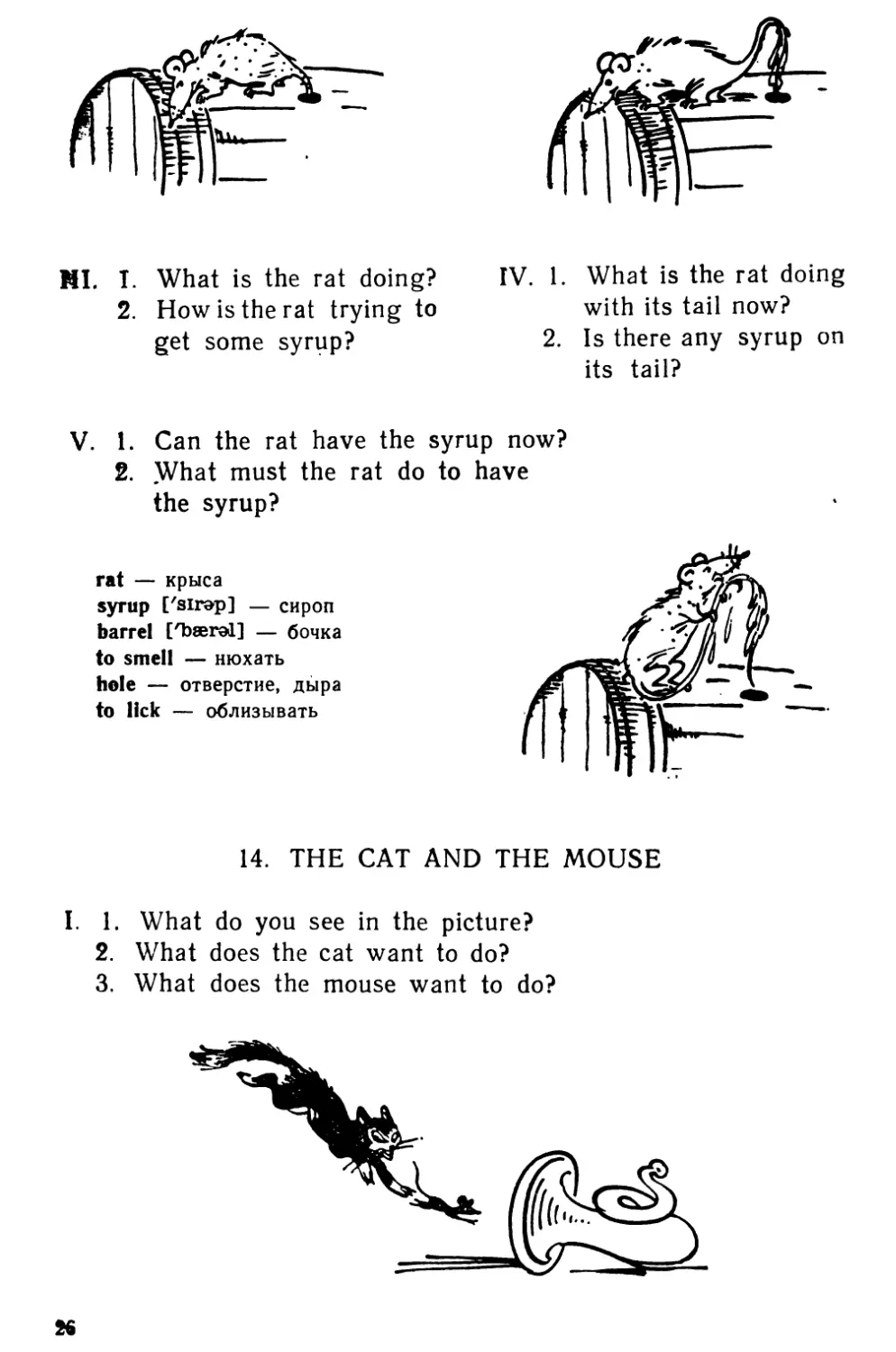
13. THE RAT AND THE SYRUP
I.	1. Where do you see the rat?
2.	Does the rat know that there
is syrup in the barrel?
3.	What is the rat doing? Is it
smelling something?
4.	. Do you think it wants to
have some syrup?
What does the rat find?
What does the rat see through
the hole?
Is the hole large or small?
Can the rat get to the syrup?
25
MI. I. What is the rat doing? IV. 1. What is the rat doing
2. How is the rat trying to	with its tail now?
get some syrup?	2. Is there any syrup on
its tail?
V. 1. Can the rat have the syrup now?
2. What must the rat do to have
the syrup?
rat — крыса
syrup ['sirop] — сироп
barrel ['bseral] — бочка
to smell — нюхать
hole — отверстие, дыра
to lick — облизывать
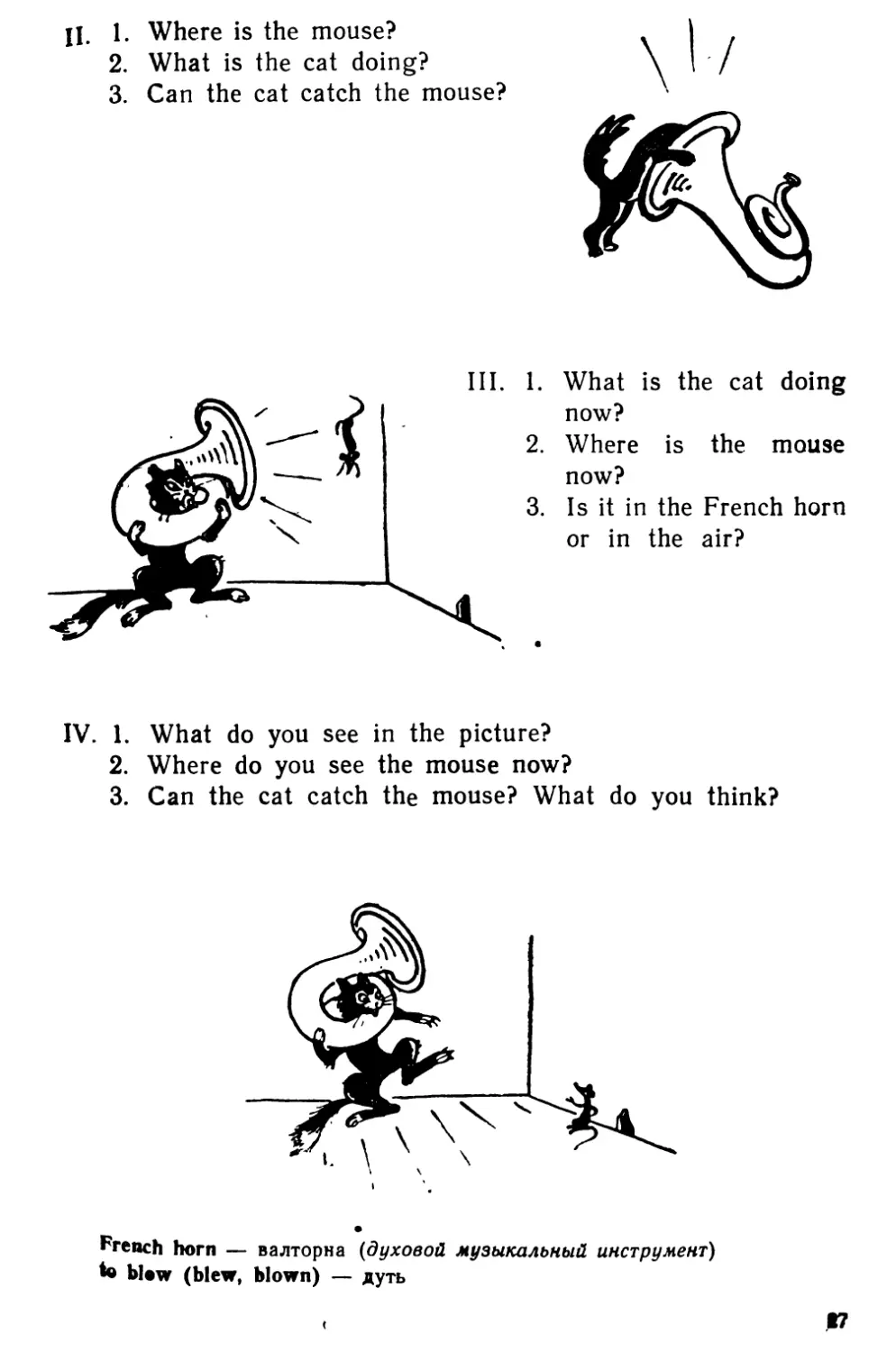
14. THE CAT AND THE MOUSE
I.	1. What do you see in the picture?
2.	What does the cat want to do?
3.	What does the mouse want to do?
26
II. 1- Where is the mouse?
2. What is the cat doing?
3. Can the cat catch the mouse?
III. 1.
What is the cat doing
now?
Where is the mouse
now?
Is it in the French horn
or in the air?
IV. 1. What do you see in the picture?
2.	Where do you see the mouse now?
3.	Can the cat catch the mouse? What do you think?
French horn — валторна (духовой музыкальный инструмент)
to blew (blew, blown) — дуть
17
15. LAZY-BONES
I.	1. Where do you see Nick?
2.	What do you see near
his bed?
3.	Where is the alarm
clock?
4.	What time is it?
5.	Is it time to get up?
IL 1. What time is it?
2.	Is the alarm clock
ringing?
3.	Is it time to get up?
4.	Is Nick getting up?
HL 1.
5.	Will Nick be late for school? What do you
What do you see in
the picture?
What is Nick do-
ing?
Is he sleeping
again?
What did he do
with the pillow?
Where is the
pillow?
think?
7. Is Nick a lazy-bones? Why do you think he is?
When do you get up?
Have you an alarm clock?
Do you always hear it?
Are you sometimes late for school? If so, why?
'lazy-bones — лентяй, лодырь
a'larm clock — будильник
to ring (rang, rung) — звонить
pillow — подушка
28
16. THE BALL IN THE TREE
I 1. Where is the ball?
2.	How did it get there?
3.	Does the boy want to get
it back?
4.	What does he ask the old
man to do?
IL 1. What has the old man
in his hand?
2.	What is the old man
looking at?
3.	Do you think the old
man is going to help
the boy?
4.	What does the old man
throw at the ball?
29
to throw (threw, thrown) — бросать
to be going (to) — собираться, наме-
реваться (сделать что-либо)
umbrella [лго'ЬгеНэ] — зонтик
to 'get 'back — получать назад
III. 1. Where is the ball
now?
2.	Where is the old
man’s umbrella?
3.	Does the boy help,
the old man to get
back his umbrella?
4.	Can he help the
old man?
5.	Why does the boy
not help the old
man?
6.	What is the boy
doing?
If. LITTLE BOBBY’S
BIRTHDAY
I.	1. What is the old
man buying?
2.	Where is the old
man buying a book?
3.	Do you think the
old man is buying
a good book?
4.	Why is he buying
this book?
5.	To-day is his grandchild’s birthday. Do you think he is
buying the book for his grandchild?
30
Л 1. Whom is the old man giving the present?
2. Who else is standing near the boy?
III.	1. Where are Bobby and his grandfather now?
2.	Does Bobby like his grandfather’s present?
3.	Does Bobby like his grandfather’s hat?
4.	Does Bobby like his grandfather’s walking-stick?
5.	What is Bobby doing?
6.	Who likes the book?
7.	What is Bobby’s grandfather doing?
'book shop — книжный магазин
'grandchild — внук
to ride horseback on a'walking-stick — скакать верхом на палочке
31
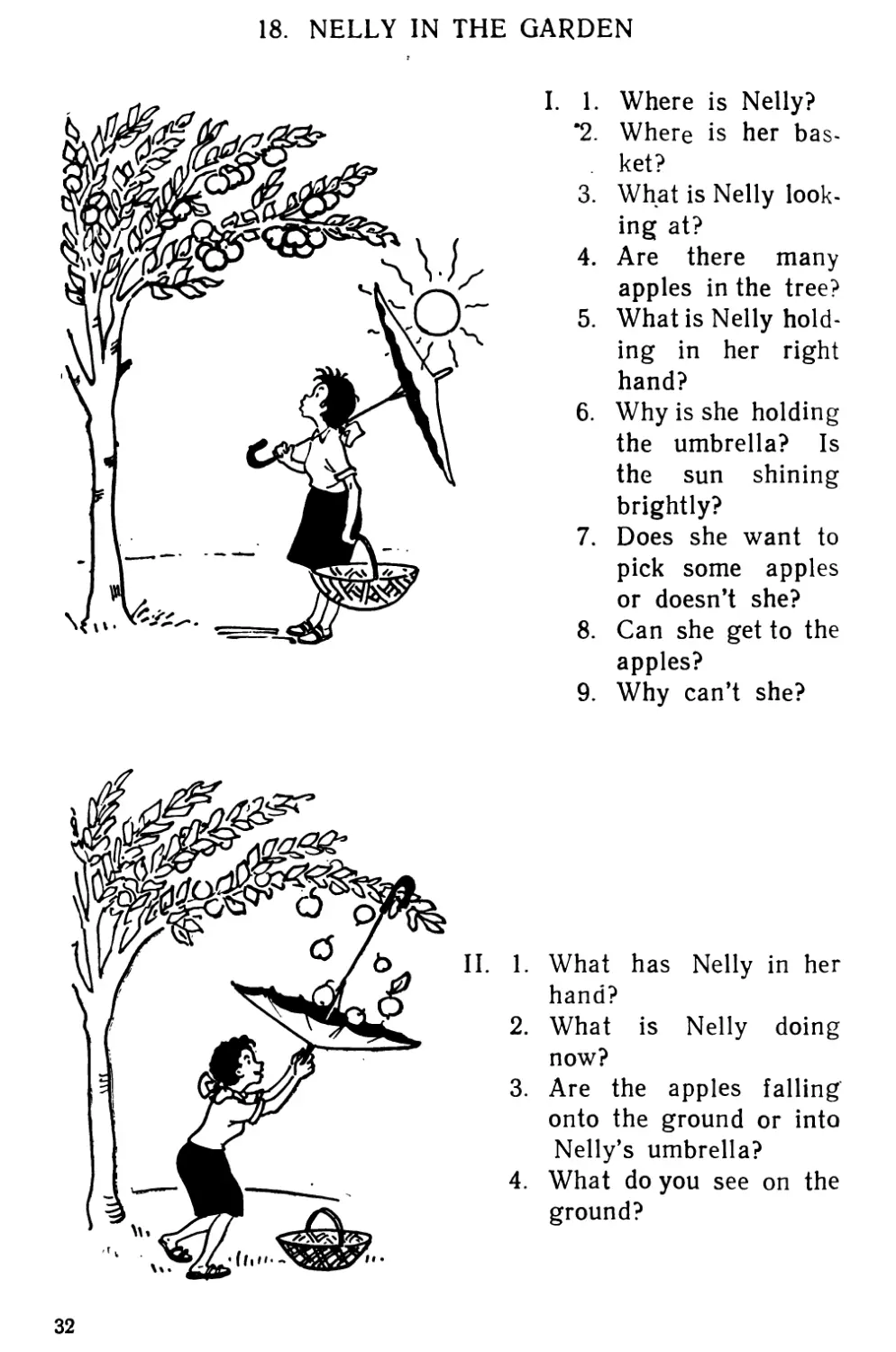
18. NELLY IN THE GARDEN
I.	1. Where is Nelly?
*2. Where is her bas-
. ket?
3.	What is Nelly look-
ing at?
4.	Are there many
apples in the tree?
5.	What is Nelly hold-
ing in her right
hand?
6.	Why is she holding
the umbrella? Is
the sun shining
brightly?
7.	Does she want to
pick some apples
or doesn’t she?
8.	Can she get to the
apples?
9.	Why can’t she?
1.	What has Nelly in her
hand?
2.	What is Nelly doing
now?
3.	Are the apples falling
onto the ground or into
Nelly’s umbrella?
4.	What do you see on the
ground?
32
III. I- Where is Nelly putting
her apples?
2.	Are there many apples
in her basket?
3.	Do you think Nelly is
tired?
4.	Is she happy?
to pick — здесь рвать (яблоки)
umbrella [лтОэгеЬ] — зонтик
to hold — держать
to shake — трясти
19. NICK IN THE CIRCUS
I.	I. What do you see in the picture?
2.	Are there many children in the circus?
3.	What is the lion-tamer doing?
4.	Where is the lion-tamer’s head?
II. I. What is Nick doing?
2.	What has Nick in his right hand?
33
3. Whom is Nick speaking to?
4. Is the lion-tamer surprised to see Nick near the cage?
5. What do you think Nick is going to do?
Ш. T. Did the lion-tamer let Nick into the cage?
2, What is Nick doing in the cage?
3.	Can the lion shut its mouth?
4.	Why can’t it?
5.	Do you think Nick is a brave boy?
Hon-tamer ['lajuanteime] — укротитель львов
cage — клетка
to be surprised [so'praflzd] — удивляться
to let( (let, let) — допускать, позволять
brave — храбрый
34
3*

1. NICK TRIES TO GET WARM
I.	1. Is Nick in the room or in the
street?
2.	Where is Nick standing?
3.	What is he looking at? Is he
looking at the sky?
4.	What does he see in the sky?
5.	Is the sun shining?
6.	Is the weather good or bad?
II.
1.
2.
3.
4.
What has Nick in his right
hand?
What has he in his left hand?
What is he doing?
Why can we say that the water
in the kettle is hot?
III.	1.
2.
3.
4.
kettle — чайник
'water-bag — грелка
to pour [po;] — лить
steam	— nap
Where is Nick lying?
Where is Nick’s water-bag?
Is Nick warm or cold?
Why is he warm?
87
2. NICK IS GOING TO MAKE A BOAT
I.	1. What do you see on the
floor?
2.	What has Nick in his
right hand and what
has he in his left hand?
3.	Is he going to make
something?
4.	Do you know what he
is going to make?
П. 0. Where dfd Nick put the
board?
2. What is Nick doing
with It?
III. I. What do you see in the
picture?
2. What is Nick carrying?
3. Can you see Nick's boat?
Do you think he has
made it?
tool — инструмент
board — доска
'hand-saw — ножовка
to saw (sawed, sawn) — пилить
to saw something in two — распи-
ливать что-либо пополам
38
3.	NICK, THE WATCH-MAKER
I.	1. What is Nick doing?
2.	There is something in his hands. What
is it?
3.	Is the alarm clock in order?
4.	Why do you think it is not? What do you
think has happened to it?
5.	Do you think Nick is going to repair the
alarm clock?
II. 1. What is Nick doing now?
2. Where is Nick sitting?
3. Do you think Nick will be
able to repair his alarm
clock?
Did Nick repair his alarm
clock?,
What is he doing in the
picture?
IV. 1. Is Nick still sitting at
his desk?
2. Is Nick putting the
parts of his alarm clock
into a paper bag?
3. What is Nick doing in
the picture?
39
V. 1. Where do we see
Nick now?
2.	What is he asking
the watch-maker to
do?
3.	Is it easy or difficult
to repair Nick’s
alarm clock now?
4,	Why do you think
it is difficult?
'watch-maker — часовщик
alarm clock [эПо^тпкЬк] —
будильник
in order — в порядке
to re'pair — чинить
difficult ['ditfrkalt] —
трудный
4. NICK is LOOKING FOR WORMS
I.	1. Where is Nick?
2.	What is Nick doing in the garden?
3.	Is he digging for worms?
4.	What does he want to have worms for? Does, he want to
go fishing?
5.	Why do you think he wants to go fishing?
&	Did Nick get any worms?
2. What is he buying?
3. Does he think there are worms in the apples? Are the
apples good or bad?
40
IV.
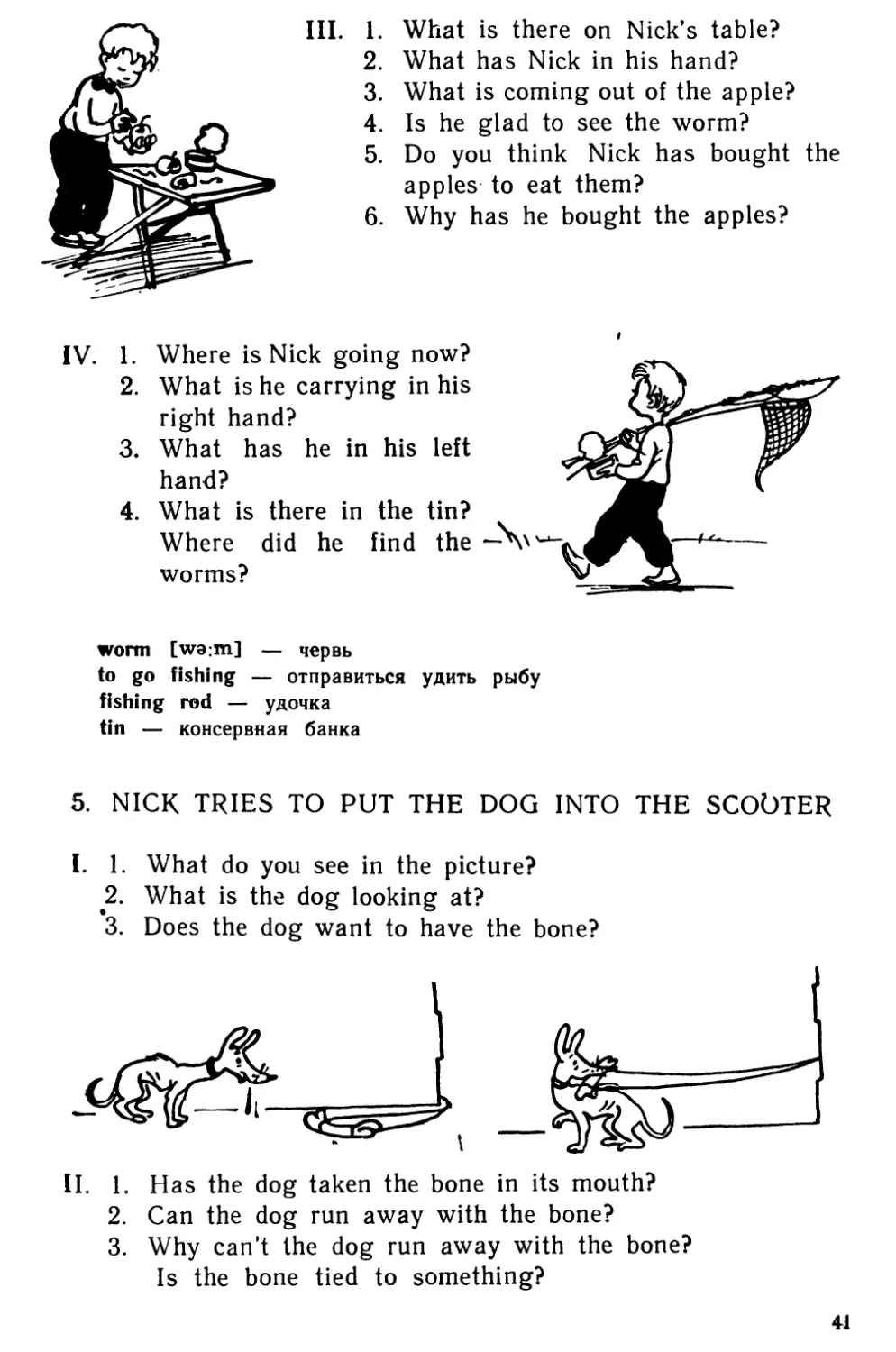
III.	1. What is there on Nick’s table?
2.	What has Nick in his hand?
3.	What is coming out of the apple?
4.	Is he glad to see the worm?
5.	Do you think Nick has bought the
apples to eat them?
6.	Why has he bought the apples?
1.
2.
3.
4.
Where is Nick going now?
What is he carrying in his
right hand?
What has he in his left
hand?
What is there in the tin?
Where did he find the —4'
worms?
worm [wa:m] — червь
to go fishing — отправиться удить рыбу
fishing red — удочка
tin — консервная банка
5. NICK TRIES TO PUT THE DOG INTO THE SCOOTER
I.	1. What do you see in the picture?
2.	What is the dog looking at?
3.	Does the dog want to have the bone?
II. 1. Has the dog taken the bone in its mouth?
2. Can the dog run away with the bone?
3. Why can't the dog run away with the bone?
Is the bone tied to something?
41
2. What is the dog doing?
Is it drawing^ Nick’s
scooter?
3. Where is Nick?
scooter — самокат
to draw — тянуть, везти
III. 1. Who has tied the bone?
2. What is the dog trying
to do? Is it trying to
run away with the
bone?
3. What is Nick doing?
IV. 1. Has Nick put the dog
into the scooter?
6. TOM HELPS HIS FATHER TO CARRY LOGS
I,	I. What is Toni’s father doing?
2.	Is he carrying many logs?
3.	Is Tom going together with his father?
4.	Is Tom carrying any logs?
5.	Is Tom going in front of his father or behind him?
6.	What is Tom going to do?
II.	1. How many logs has Tom in his arms?
2.	What is Tom going to do now?
3.	Does Tom like to carry logs?
42
ft
III.	1. How many logs is Tom carrying now?
2.	Is he going to pick up another log?
IV.	T. Where is Tom going now?
2.	Is he going in front of his father or behind him?
3.	Is Tom’s father surprised to see his son with so many
logs in his arms?
4.	Can you say that Tom likes to help his father?
leg — полено
7. NICK ATTACHES A STAMP
I.	1. What has Nick in his right hand? -
2.	What is Nick doing?
3.	Who is sitting on the floor?
4.	What is the dog doing?
5.	What is the dog’s master doing?
43
What is Nick
doing now?
What is the dog
doing?
III. 1. Has Nick attached
the stamp to the
envelope?
2. Is Nick pleased
with what he has
done?
to a'ttach a stamp — при-
клеить марку
envelope ['envUoupJ —
конверт
to lick — лизать
to be pleased [ pli;zd] —
быть довольным
8. NICK AT SEA
Where do you see
Nick?
Is he in a boat?
Is his boat moving?
Is the wind blow-
ing?
Why is Nick’s boal
not moving?
44
What has Nick in his
hands?
Is he pumping air into
the sail?
Is Nick pumping air
into the sail to make
the boat move?
Is Nick’s boat moving
now?
5. Will your boat move if you pump air into the sail? What do
you think?
at sea — в море
pump — насос
to pump — качать, накачивать
sail — парус
9. WHY NICK BOUGHT A BIRD
I.	I. Where did Nick go yesterday?
2.	What were the people doing at the market?
3.	What was the man with the cage doing at the market?
4.	Was Nick going to buy some food?
5.	What was he going to buy?
6.	Did Nick like the bird?
7.	Where was the bird?
4i
II. 1. What was Nick doing
at five o’clock in the
evening?
2.	Where was he sitting?
3.	Where was the bird
sitting?
4.	Do you think Nick
was making a biid-.
house or a toy boat?
5.	Why was Nick mak-
ing a bird-house?
III. 1. Where did Nick go after he had mads
the bird-house?
2. What had he in his hands?
3. What did he do with the bird?
Where did Nick hang
the bird-house?
Can you say now why
Nick had bought the
bird?
Do you think it was
good of him to do so?
cage — клетка
to hang (hung, hung)—вёшать
'bird-house — скворечник
to set (set, set) free — отпус-
кать на свободу
was good of him — хорошо по-
4.
5.
6.
10. NEW-YEAR’S
TREE
I.	1. What was Nick
carrying on
New-Year’s
eve?
2.	Was it a large
fir-tree?
3.	Was it a good
fir-tree? Were
there many
needles on it?
ступил
46
II.	1. Did Nick go home on foot?
2.	Did he go home by tram or by bus?
III.	I. Did Nick get off the tram with the same fir-tree?
2.	Did the fir-tree go bad while Nick was in the tram?
3.	Did it look like a fir-tree?
4.	Were there many needles on it?
5.	Why did the needles stick to the clothes of the passengers?
on 'New-Year’s 'eve — в канун Нового года
on foot — пешком
by tram — трамваем
by bus — автобусом
to 'get 'off a 'tram — выйти из трамвая
needle — иголка
passenger ['psesind^o] — пассажир
to stick (stuck, stuck) — здесь прилипать
47
11. HOW NICK WAS BUYING BALLOONS
I.	1. What did Nick want to buy last Monday?
2.	How many balloons did he buy?
3.	How many balloons did the man hold?
4.	What did Nick give the man for the balloon he had bought?
II. 1. The salesman put his hand into his pocket. Why did he do
so? Was he going to give Nick the change?
2.	Why did the man’.give Nick all the balloons?
III. 1. Did Nick take the balloons?
2.	Whom was the man looking for when he took the change
out of his pocket?
3.	Could he give the change to Nick?
Why couldn’t he?	flW
4.	Why was Nick lifted into the air?
Was it because of the balloons?	vZZ
5.	What could poor Nick do to get back
to the ground? Could he let the bal-
loons go and jump to the ground? f
balloon [ba'lurn] — воздушный шар	I П
to hold (held, held) — держать	nillFTTTb
change — здесь сдача	UHmIIUL
to lift — поднимать (ся)	"
to 'let 'go — отпускать
12.	PUCK
[. 1. Where was Mr. Smith
last week?
• 2. What did Mr. Smith do
at the stadium?
3. How many players were
there on each side?
4. How many pucks were
there on the ice?
1.	Where did Mr. Smith go
during the game?
2.	What was there in his left
hand?
3.	What do you think he
bought in the shop?
III.	1. What for did Mr. Smith
buy so many pucks?
Was he going to make
it easier for the players
to play?
2.	Could the players go on
playing with so many
pucks on the ice?
puck — хоккейная шайба
stadium t'steidiom] — стадион
parcel — пакет, свёрток
to 'go 'on 'playing — продолжать
играть
49
13.	MR. SMITH AND THE GAT
I.	J. What did Mi. Smith
see on the roof one
day?	ф
2.	WKat was the cat
doing?
3.	Did Mr. Smith likes
the cat’s mewing?
4.	Why didn’t he like it?
Б, Was he angry with
the cat?
6.	Do you think the cat
woke up Mr. Smith?
II.	1. Did Mr. Smith decide to chase the cat away or did he
decide to listen to its mewing?
2.	What did Mr.
Smith throw at the
cat?
3.	Did the cat like it?
4.	What did the cat
do?
III.	1. Where drd Mr.
Smith go the next
morning?
2. What had he on
his right foot?
3. What had he on
4. What did Mr.
his left foot?
Smith have to
buy?
5. Why did he have
to buy a new pair
of shoes?
root — крыша
to mew — мяукать
to decide [dl'sald] —
решать
to 'chase a'way — про-
гонять
slippers—домашние туфлв
SO
14.	HOW MR. SMITH HELPED THE LITTLE BOY
I.	1.
2.
3.
4.
5.
6.
II.	1.
2.
3.
4.
5.
6.
What were the boys doing in the yard one day?
How many boys were playing hockey when Mr.
Smith was passing
by?
Was little Henry play-
ing hockey too?
Was Henry laughing
or crying when Mb.
Smith saw him?
Why was, little Henry
crying? Did he want
to play hockey? Could he?
Why couldn’t he play hockey?
What did Mr. Smith do to help the boy?
Did the boy stop crying?
What did he begin to
do at once?
What did he begin to
play hockey with?
Was Henry happy
again?
Was Mr. Smith
happy?
III.
1'. Was Mr. Smith happy when he
was walking home?
2.	Why was he sad?
3.	What had happened to his
walking-stick?
4.	Did the little boy break Mr.
Smith’s walking-stick?
5-	Who broke it?
to 'pass 'by — проходить мимо
'hockey stick — клюшка
'walking-stick — трость
51
15.	HOW MR. SMITH SAVED HIS HAT
1.	Was the weather good when
Mr. Smith went out for a
short walk?
2.	What was the weather like?
3.	Was the wind strong?
4.	Why do you think it was
strong?
Did the wind blow off
Mr. Smith’s hat?
5.	What did Mr. Smith usual-
ly have about him when
he went for a walk?
II.	1. Did Mr. Smith’s hat flow over the fence?
2.	Was the dog in the dog-house?
3.	Was Mr. Smith afraid of the dog?	,
4.	Was Mr. Smith going to pick up his hat with his walking-
stick?
III.	1. Do you think Mr. Smith could pick up his hat?
2.	Why couldn’t he?
52
IV.	1. Where is Mr. Smith’s walking-stick?
2.	Where is Mr. Smith’s hat?
3.	Was Mr. Smith sad or happy to lose his hat and walking-
. stick?
fence — забор
'walking-stick — трость
16.	MR. SMITH AND THE PACKET
I.	1. Whom do you see in the
picture?
2.	Where is Mr. Smith
standing?
3.	What is he looking at?
4.	What does he see in the
shop-window?
5.	Do you think he is going
to buy something in the
shop?
6.	What do you think he is-
going to buy?
II. 1. Where is Mr. Smith
now?
2.	Who else is in the
shop?
3.	What has the salesman
in his hands?
4.	Does Mr. Smith want to
buy a racket?
5.	Why do you think he is
going to buy a racket?
5S
HL I. Where do you see Mr. Smith
now?
2. What is he doing?
3. What did he buy a racket for?
racket — ракетка
salesman
carpet —
dust а
ковра
— продавец
ковёр
carpet — выбивать пыль из
to
17. MR. SMITH AND THE FLOWER
I.	1. Is Mr. Smith fond of flowers?
2.	Where is Mr. Smith standing?
3.	What is there in his hand?
4.	What does he want to get with the help of his walking-stick?
5.	Can Mr. Smith pick up the flower?
6.	Why can’t he?
54
II.	I. Is Mr. Smith holding on to a tree with his walking-stick?
2.	Why is he doing so?
3.	Do you think he can reach the flower?
III.	I. Where is Mr. Smith now?
2.	Why is he in bed?	*
3.	Where are his shoes, trousers and hat?
4.	What has happened to Mr. Smith?
5.	Why do you think he has fallen into the water?
6.	Has he picked up the flower?
to be fond (of) — Л®-
б«гь
bank — берег реки
'walking-stick —
трость
to reach — доставать
to hang (hung, hung)—
висеть, вешать
Use — верёвка
56
18. JACK, THE HUNTER
I.	1. Where is Jack going?
2.	Who is going hunting with him?
3.	What has Jack in his left hand?
4.	Where is his gun?
1.	Where is the dog now?
2.	What do you think it is doing in the hole?
3.	What does Jack think the dog is doing in
the hole?
III.	1. Where do you see the dog now?
2.	What has the dog in its mouth?
3.	Where is Jack’s gun?
4.	Is Jack surprised to see his dog with a bone in its mouth?
5.	Why do you think Jack has dropped his gun?
hunter — охотник
to go hunting — пойти на охоту
to be surprised [sa'praizd] — удивляться
to drop — бросать
56
19. TIGER!!! TIGER!!!
I.	1.
2.
3.
What is Nick doing?
Why is Nick running
away?
Why is he frightened?
Is it because he sees
a tiger?
II. 1. What is Nick doing
now?
2. Where is he sitting?
3. Is he afraid of the
tiger now? Why do
you think he is not?
tiger — тигр
to watch television [/teU'vijnj
— смотреть телевизионную
передачу
cage — клетка
20. HOW NICK PLANTED A TREE
I.	1. What did Nick do yesterday?
2.	What was he carrying in his hands?
3.	Who helped Nick to carry the tree?
4.	Did the dog 'carry the tree in its mouth?
57
II. т.
2.
3.
4.
What did Nick do in order to plant
the tree?
Did he dig a hole?
Did he water the earth?
Was the dog looking at the tree
while Nick was planting it?
III. 1. Did Nick plant the tree?
2. Do you think he did the job well?
3. Is Nick satisfied with what he had done?
IV.
T.
2.
3.
4.
What did Nick do after he had
planted the tree?
Did Nick’s dog go home with
him?
What had the dog done before
going home?
Where can you see the tree that
Nick had planted?
in order to — для того, чтобы
spade — лопата
'watering-pot — лейка
to water — поливать
while — в то время как
to be satisfied ['ssetnsfaM] —
чувствовать удовлетворение
job — работа
to 'pull 'out — выдёргивать, вы-
рывать
58
21.	NICK, THE DOG-TRAINER
I.
I.
2.
3.
4.
5.
Did Nick go for a walk
last Saturday?
Did he go out alone?
Who went with him?
What was Nick showing
the dog?
Do you think Nick decided
to train his dog?
II.	1. What did Nick do with the stone?
2.	Did he throw it?
3.	How far did he throw the stone?
4.	Did he want his dog to rush for the stone?
5.	Did the dog rush for the stone?
III.	1. Did Nick’s dog bring back the stone?
2.	Whom did the stone hit?
3.	What did Nick and his dog have to do?
dog-trainer — дрессировщик собак
to train — дрессировать
Did he want his dog to rush... — Хотел ли он, чтобы его собака бросилась,-
to rush for — бросаться за
to hit (hit, hit) — ударять, попадать
»
22.	A GOOD WATCH
(It happened the other day)
I. 1. Was Mike leaving? Was he leaving for school? Why do you
think he was leaving for school?
2. What had Mike in his hand?
3. Whom did he leave to watch the refrigerator?
4.	Who was waiting
behind the refri-
gerator?
5.	Did the dog want
to go out with
Mike?
6.	Did the cat want
to see if there was
something good
in the refrigera-
tor?
II.	I. Did the dog run after Mike?
2.	What did it open when it ran after Mike?
3.	What did the cat do when it saw that the refrigerator
was open?
4.	Did the cat get into the refrigerator at once?
5.	Why did it do so? Was it because it wanted to see if there
was something good in it?	x
6.	Did the cat find anything good in the, refrigerator?
7.	What did it find there?
8.	Was Mike’s dog a good watch? Why wasn’t it?
watch — сторож
refrigerator [rl'fridgo rerto] — холодильник
60


1. NICK IS FOND OF READING
I.	1. Where do you see
Nick?
2.	Is he going to see a
film? Why de you
think he is?
3.	Is he queuing for
tickets?
4.	What has he in his
hands?
5.	What is he doing with the book?
6.	Does he find his book interesting? Why do you think he
does?
II. 1. Where do you see Nick now? Is he in the hall?
2. What is Nick doing?
III.	1. Has the show begun?
2.	What is Nick doing?
3.	Why can you say that Nick likes his book better than
the film?
4.	Why can you say that Nick is fond of reading?
to queue [kjm] — стоять в очереди
show — демонстрация (фильмл]
63
2. TENDER-HEARTED NELLY
I.	1. Where do you see Nelly?
2.	What is she doing?
3.	Where are the bears?
4.	What is the weather like? Is it hot or cold?
5.	Why can you say that the weather is hot?
6.	Why can you say that the bears are hot? Why can you
say that Nelly is hot too?
II.	1. What is Nelly doing now?
2.	What is she buying?
3.	How many ice-creams is she buying?
4.	Don’t you think that to have two ice-creams is too much for
one girl?
64
III.	1. What is Nelly doing now?
2. What has she in her left hand?
3. Why isn t she eating her ice-creams?
IV. I. Whom did Nelly give the ice-creams?
2.	Who is eating the ice-creams?
3,	Are the bears glad to have some ice-cream? Why? Is
Nelly glad too? Why?
4.	Can you say that Nelly'is a good girl? Why can you say so?
tender-hearted — добросердечный
temperature ['teunprit/э] — температура
cage — клетка
thermometer [Ba'lmomlto] — термометр
25 degrees [di'grliz] above [adjAv] zero — 25 градусов выше нуля
3.	ABSENT-MINDED MR. PINCH
5 Рассказы в картинках
1.	What is Mr. Pinch doing? Is he speak-
ing over the telephone or is he
reading a newspaper?
2.	What has he in his right hand, the
receiver or his telephone book?
3.	Where is his telephone book, is it in his
pocket or in his left hand?
4.	What is hanging on his left arm, his
umbrella or his hat?
65
П. 1. Is Mr. Pinch still speaking
over the telephone?
2.	What has he in his left hand?
3.	What is hanging on the hook?
4.	Why is Mr. Pinch’s umbrella
hanging on the hook?
5.	Why can you say that Mi.
Pinch is absent-minded?
absent-minded ['flBbsent'mamdid] — рассеянный
to speak over the telephone ['teUfoun] говорить по телефону
receiver [rr'alrvo] — телефонная трубка
umbrella [am'brelo] — зонт
still — всё ещё
hook — рычаг
4.	DICK AND DAN
IN THE FOREST
I.	1. Where are Dick and
Dan?
2.	What are they do-
ing?
3.	Why is Dick climb-
ing the ladder?
4.	Are the boys going
to spoil the nest?
Why can you say
they are?
66
What has happened
to the ladder?
What has happened
to the boys?
Why couldn’t they
spoil the nest?
II. 1.
2.
3.
III. 1.
2.
IV.
3.
1.
2.
3.
What do you see
in the picture?
Where are the boys
now? Are they
happy? Why
aren’t they?
Where are the little birds? Are they happy? Why are they?
Who is coming up to the swamp?
What do the hunter and his dog see?
Do you think the
hunter will help the
boys out of the swamp?
67
V. 1. Is the hunter helping the boys out of the swamp?
2. Who is helping them to get out of the swamp?
3. What is the hunter doing? Why doesn’t he have to help the
boys out of the swamp?
VL 1. Where are the boys going now?
2. Why are they dirty? Why are they sad?
3. Will their mothers praise them? Why do you think their
mothers will scold the boys?
to climb [klaim] — взбираться
to spoil — здесь разрушать, разорять
swamp [swomp] — болото
hunter — охотник
to smoke — курить
to scold — ругать, бранить
<68
5. HOW NICK GOT RID OF THE WASPS
I.	1.
2.
3.
4.
5.
Where was Nick resting
one day last summer?
Was he sitting on a-
bench in the park or was
he walking around?
What was he doing?
What was lying on the
bench beside Nick?
Was it difficult for Nick
to read?
6. Why was it difficult for him to read? Was it because the
• wasps were flying around?
III. Г, What did Nick buy in the shop?
II. *1. Where did Nick go?
2. What did he see in
the shop-window?
3, What did they sell
in that shop?
2.	What did Nick do with
the flower he had
bought?
3.	Did the wasps like the
flower? Why do you
think they did?
4.	Was Nick a clever boy?
Why can you say he
was?
to 'get 'rid (of) — избавляться от
wasp [wasp] — oca
difficult f'diftkalt] — трудный
-shop-window — витрина
69
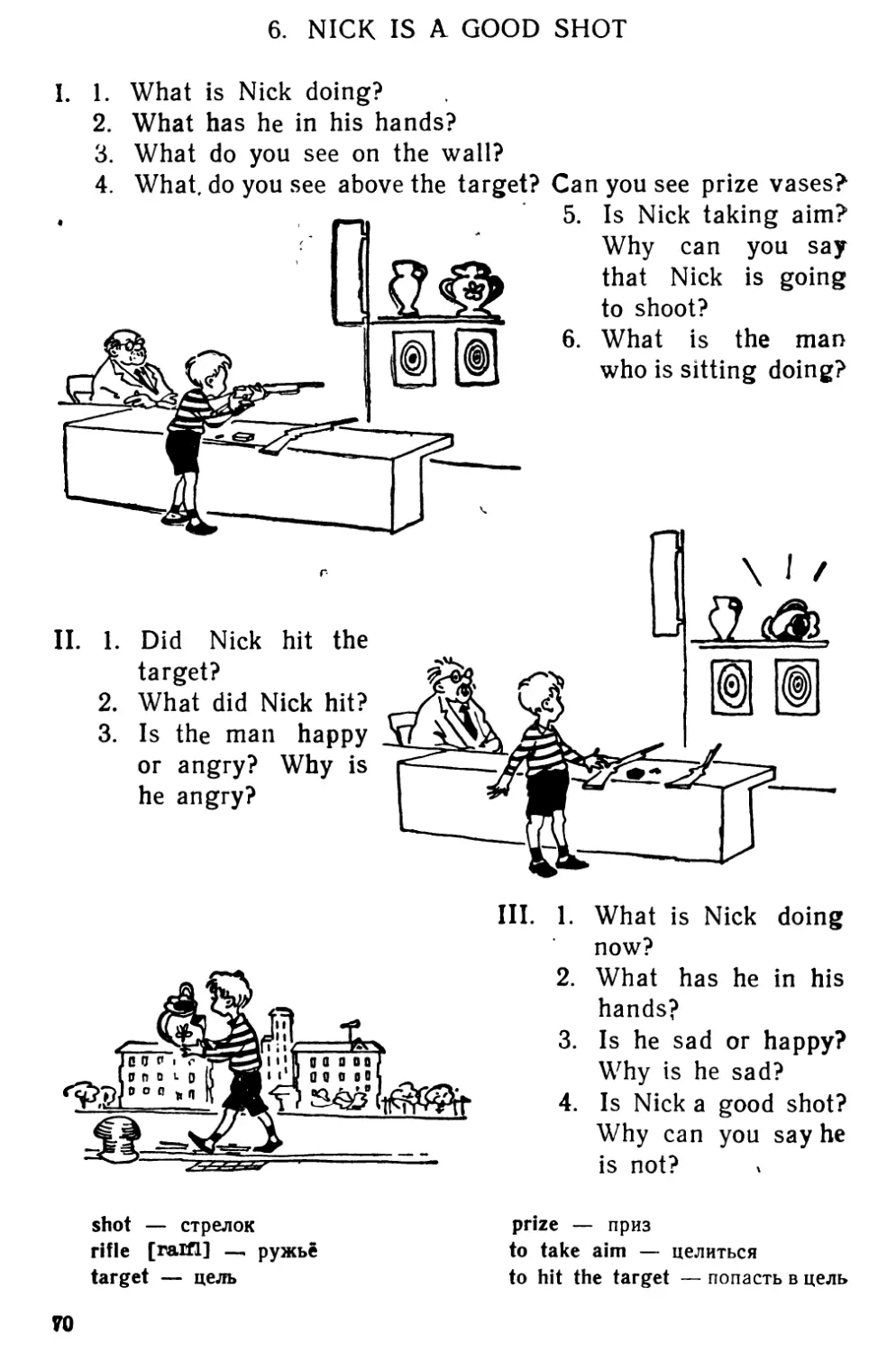
6. NICK IS A GOOD SHOT
I. 1. What is Nick doing?
2. What has he in his hands?
3. What do you see on the wall?
4. What, do you see above the target? Can you see prize vases?
5. Is Nick taking aim?
Why can you say
that Nick is going
to shoot?
6. What is the man
who is sitting doing?
II. 1.
2.
3.
Did Nick hit the
target?
What did Nick hit?
Is the man happy
or angry? Why is
he angry?
shot — стрелок
rifle [гаШ] ружьё
target — цель
III. 1. What is Nick doing
now?
2.	What has he in his
hands?
3.	Is he sad or happy?
Why is he sad?
4.	Is Nick a good shot?
Why can you say he
is not?
prize — приз
to take aim — целиться
to hit the target — попасть в цель
TO
7. BOBBY STAYS ALONE
I—III. 1.
2.
3.
4.
5.
Where do you see
Bobby?
What is Bobby doing
in the first (in the
third) picture?
Are there many or
few books around on
the floor?
Is Bobby satisfied
with what he has
done?
Can Bobby read?
Why can’t he?
IV — VI. 1. Where do you see Bobby now?
2. What is he going to do with the flowers in the vase?
3. What has Bobby done with the flowers?
7f
VII. 1. Where do you see Bobby
now?
2. What is Bobby doing? Is he
pulling at the table-clqth?
3. Do you think he will break
the cups and the jar?
VIII. 1. Where do you see Bobby
now?
2. What is he doing?
3. Do you think he got
tired?
alone [a'toun] — один
to be satisfied ['saetisfaid'] — чувствовать удовлетворение
to 'overturn — перевернуть
table-cloth ['Ье1ЫИк>0] .— скатерть
drawer ['dro;a] — здесь ящик
8. SAM TRIES TO MAKE THE ELEPHANT MOVE
L 1. What do you see in the picture?
2.	What is Sam doing? Is he trying to make the elephant move?
3.	How is he trying to make the elephant move?
4.	Does the elephant want to move?
П. T. Is Sam at the side of the elephant?
2.	What has he in his hands?
3.	Is he trying to push the elephant off?
72
III.	1. What is Sam doing
now?
2.	Is Sam trying to
make the elephant
move beating him?
3.	Does the elephant
pay any attention
to Sam?
IV.	1. Is Sam tired after all he has done?
2.	Does he know how to make the elephant move?
3.	What is Sam thinking about?
V.	1. Could Sam rest a little?
2. Why couldn’t he?
3. What did the elephant do when Sam decided to rest a little?
elephant ['elifenit] — слон
to pay attention — обращать внимание
to decide [di'saJdJ — решать
9. MR. SMITH TRIES TO HELP HIS FRIEND DICK
(It happened last month)
I.	1. Whom did Dick meet in the street
one day?
2.	What did Dick show Mr. Smith?
3.	What was the matter with Dick?
4.	Did Dick want to have his tooth
pulled out?
73
II.	1. Did Mr. Smith decide to help Dick?
2.	Did he tie a rope to Dick’s bad tooth?	*
3.	Where did Mr. Smith tie the other end of the rope? Did he
tie it to the spare wheel of a motor-car?
4.	Was Dick afraid? Why was he?
III.	1. Did the car begin to move?
2.	Why did Mr. Smith take Dick by the hand?
3.	Was Dick still more afraid than before?
IV.	1. Where do you see the wheel? Where is
the car?
2.	Dick is no longer afraid. Why isn’t he?
3.	Mr. Smith is astonished. Why is he?
4.	Were Dick’s teeth good or bad?
to
out — вырвать зуб
решать
have a toothache ['tu:0ejk] — страдать
от зубной боли
have a tooth pulled
decide [di'said] —
tie — привязывать
to
to
to
rope — верёвка
spare
пасное колесо
motor-car ['moutaka:] —•
автомобиль
still — ещё больше ।
wheel [wi:l] — за-
74
10. HOW JIM LEARNT TO SKATE LAST WINTER
I.	1. Could Jim skate? Was he
a good skater? Why can
you say he was not?
2.	Did Jim want to learn
to skate? Why can you
say he did?
3.	Was it easy or difficult
for him to learn to skate?
Why can you say it was
difficult?
I.	What did Jim tie to, his back?
2.	Did he like skating with the
pillow tied to his back?
3.	Was he still afraid of falling
down? Why wasn’t he?
1.	Did the pillow help Jim?
2.	Why didn’t it?
3.	Why can we say that the
pillow didn’t help Jirri? What
happened to his nose? Did he
smash it?
4.	Could Jim tie another pillow, to save his
nose?
5.	Is it possible to skate with two pillows,
one on one’s nose and the other on one’s
back? What do you think?
pillow — подушка
to smash — разбить
possible —’ возможный
75
11. USE THE RUBBISH CANI
(It happened the other day)
I — П. 1. Where did Nick go yesterday after classes?
2.	Why did Nick go to the park? Did he go there to have
a rest?
3.	Where was Nick sitting?	*
4.	What was he doing?
5.	Who was sitting near him?
6.	What was the young man doing? What was he reading?
7.	What was Nick reading? Why did he stop reading?
8.	Was the young man eating sweets?
9.	What did he do with the wrappings?
Did Nick think it right to throw wrappings on the
ground?
11.	What did Nick take in his right hand?
12.	What did he take in his left hand?
13.	Did the young man see Nick doing all that?
76
Ill, I. What did Nick do with the sign?
2.	What did Nick do with the young man’s hat?
3.	Did the young man see what was written on the sign?
4.	Did Nick help to keep the park clean?
5.	Did Nick teach the young man a good lesson?
rubbish can — урна для мусора
wrapping ['гаерй)] — конфетная обёртка
to stick (stuck, stuck) — ставить, втыкать
12. NICK HAS FOUND
A WAY OUT ...
I. 1. Where do you see
Nick?
' 2. What do you see
under the heli-
copter?
3. What is coming
out of the heli-
copter?
4. Are Nick and his
friends in danger?
77
II. I. Where is the helicopter?
Is it hanging in the air
or is it moving?
2.	What are Nick’s friends
doing? Are they taking
water from the sea?
3.	How many men are
putting out the fire?
4,	How many pails have
they?
5.	Is the smoke still com-
ing out of the heli-
copter?
III. 1. Have Nick and his friends put out the fire?
2. Where are they flying now?
3. Are the boys out of danger now?
a way out — выход из положения
still — всё ещё
helicopter ['helikopta] — вертолёт
smoke — дым
in danger L'deind^a] — в опасности
to put out the fire — тушить пожар
out of danger — в безопасности
78
13. LITTLE ANDREW, THE
I.	1. Who has a camera, little
Andrew or his uncle?.
2.	Who is giving the camera
to little Andrew?
3.	Who is going to take pic-
tures?
4.	Whose picture is going to
be taken?
5.	Are there birds flying
around? Are they pigeons?
6.
PHOTOGRAPHER
Do you think little Andrew’s uncle is teaching the boy how
to take pictures or how to catch pigeons?
IL I. What do you see little Andrew doing now?
2.	Who is going to take a picture and whose picture is going
to be taken?
IIL I. What is little Andrew’s uncle doing
now?
2.	What has he in his hands?
3.	What does he see in the picture?
4.	Is he surprised to see a pigeon
instead of his head?
photographer [fo'togrofo] — фотограф
pigeon ['pidjin] — голубь
instead [in'sted] of — вместо того, чтобы
79
14. MR. SMITH AND THE SNOWMAN
(It happened the other day)
I.	1. Was it summer or
winter?
2.	Was it snowing or
raining?
3.	What were the two
little boys doing in
the yard?
4.	Who was watching
them make a snow-
man?
5.	Was the snowman
big or small?
6.	Were the boys bigger or smaller than the snowman?
7.	Was the snowman ready?
8.	Why do you think it was not?
II. 1. Did Mr. Smith go to
the greengrocer’s?
2.	Was Mr. Smith
going to buy some
vegetables or some
fruit?
3.	What was he going
to buy?
4.	Why can you say
that he was going
, to buy some car-
rots? •
Did Mr. Smith buy the
carrots for the boys?
Did he buy many
carrots?
How many carrots
did he buy?
Was he going to eat
the carrots he had
bought?
80
5.	What did he buy those carrots for? What did he do with
them?
6.	Did the boys like the snowman’s nose? Were they pleased
to see the snowman ready?
the greengrocer’s ['gri/ngrousoz] — овощной магазин
carrot ['itaerat] —морковь
15. A HEAVY BOX
(It happened last week)
I.	1. What was James doing?
2.	What had he on his shoulders?
3.	Was the box big or small? Was it heavy or light? Why do
you think it was light (heavy)?
4.	Did James think that the box was heavy? Why can you say
he did not?
5.	What did James see on his way?
II. Г. Where did James put the box? Why
did he put it on the scales?
2. Was he surprised to see how heavy
the box was?
III. 1. Was it difficult or easy
for James to carry the
box after he had
weighed it?
2. Why can you say it was
difficult?
on his way — на пути
scales — весы
to weigh [wei] — взвешивать
в Рассказы в картинках
81
16. MR. SMITH IS PLANTING TREES
I.	1. Where do you see Mr. Smith?
2.	What is Mr. Smith doing?
3.	Is it warm or cold?
4.	Why do you think it is cold?
II. 1. Where is Mr. Smith now?
2.	What is he looking at?
3.	What does the thermometer read?
4.	Is Mr. Smith afraid that his tree
will be beaten by the frost?
III.	1. Where is Mr. Smith now?
2.	What did he do to make the young tree warm?
3.	Is the tree warm now?
Mr. Smith warm now?
4.	Why can you say that
Mr. Smith loves trees?
Is
thermometer [0o'momrto] — термо-
метр
frost — мороз
82
17. MR. KAY TRAINS HIS DOG
I. 1.
2.
3.
4.
Where do you see Mr. Kay?
What has he in his hands?
What is the dog doing?
Is it sitting on its hind
legs looking at the walk-
ing-stick?	_____
What is Mr. Kay doing? ~
Is he training his dog? — ~;
What do you see in
the picture?
Is Mr. Kay throwing
the walking-stick into
the river?
Is the dog ?eady to
rush for the walking-
stick?
III. 1.
2.
3.
4.
5.
Where is Mr. Kay’s walking-stick?
6.
Where is the dog?
Where is Mr. Kay?
Did the dog rush
into the river?
Did Mr. Kay want
the dog to rush into
the river?
Is Mr. Kay glad to
see his dog still on
the bank?
83
IV. 1. Where is Mr. Kay and where is his dog?
2. What is Mr. Kay doing?
5. Do you see now why Mr.
master’s walking-stick?
. 1. What do you see in the
picture?
2.	What is the big dog
doing?
3.	Is it swimming away
with Mr. Kay’s walking-
stick?
4.	Will Mr. Kay have his
walking-stick back?
What do you think?
/’s dog did not rush for his
to train — учить, тренировать
'hind [hamd] 'legs — задние лапы
'walking-stick — трость
to rush — кидаться, бросаться
still всё ещё
18. HOW TO MAKE USE OF THE ELEPHANT
L 1. Where do you see the two Indian girls?
2.	What are they doing?
3.	Is the vegetable garden large or small?
84
4.	Is it hot or cold?
5.	Are the girls tired or not?
6.	' Are they hot?
7.	Where is the elephant standing?
II. 1. Who is watering the vegetable garden now?
2.	What are the two girls doing?
3.	Are they tired now?	f
4.	Will the elephant get tired
to make use of something — пользоваться, извлекать пользу
elephant ['elifont] — слон
Indian ['Indian] — индийский
to water — поливать
86-
19. HOW THE CAT WENT FISHING
?. 1. What did Mr. Cross often do last summer?
2.	Where did he go fishing?
3.	Did he fish for pleasure? What do you think?
4.	Who was fishing near him?
5.	Did the cat catch a lot of fish?
6.	Was the cat fond
IL I. What did the cat decide to do?
2.	Did he decide to fish in Mr. Cross’ pail? Why did he?
3.	Did Mr. Cross
4.	Who of the two had more fish by the end of the day
Mr. Cross or the cat? What do you think?
for pleasure ['pleja] — ради удовольствия
'fteherman — рыбак
36
№

1.	NICK, THE PAINTER
L 1. Where do you see Nick? Is he in the street or in the forest?
2.	What are the people in the forest doing?
3.	What has Nick in his hands?
4.	What do you think he is going to do?
5.	Why do you think he is going to paint?
II.	1. What is Nick doing now?
2.	What are the people around him doing?
3.	Why are the people in the forest watching Nick paint?
4.	Do they think Nick is going to paint a landscape?
89
III.	в. Did many people gather around Nick?
2.	What do they see in Nick’s picture?
3.	What has Nick written? Why?
painter — художник, живописец
easel — мольберт
'oil-paints — масляные краски
“to paint a landscape ['laendskeip] — писать пейзаж
rubbish can — урна (для мусора)
2. NICK AT THE POLE-VAULT
I. 1. Is Nick at the stadium
or at school?
2. Why is Nick running
with the pole in his
hands? Is he going to
pole-vault?
90
JI. I- Where is Nick now?
2. Why is he high up in the air? Is his pole long?
III. 1. Is Nick going to land safely?
2. Where is he going to land, on the grass or on the water?
3. Where is Nick’s pole?
IV. 1. Has Nick landed
safely? Why hasn’t
he?
2. Why did it happen?
stadium ['steidtam] — стадион
pole-uault ['poul'voJt] — пры-
жок с шестом
to pole-vault — прыгать с ше-
стом
pole — шест
safely — благополучно
3. TENNIS PLAYERS
I.	1. How many boys do you see in the picture?
2.	Do you see them going to the stadium or to the river?
3.	What are they going to do at the stadium?
4.	What are they carrying along with them?
91

II.	1. Where do you see the boys now?
III.	1. Where do you see the boys now?
2.	Are they playing tennis or dominoes?
3.	Whom do you see playing tennis?
4.	Are the boys going to be good sportsmen?
'tennis-racket — теннисная ракетка
'tennis-court — теннисный корт
dominoes ['dommouz] — домино
4.	ABSENT-MINDED NICK
I.	1. Where was Nick last week?
2.	Where there many people in the hall?
3.	What did Nick see on the screen?
4.	What did Nick see the woman in the picture doing?
5.	What was the woman ironing?
• 6. What did Nick do when he saw the woman ironing a shirt?
7.	Did he stand up?
8.	Why did Nick stand up? Was he going to leave the place?
93
Л 1. Did Nick leave the place at once or did he stay till the end
of the show?
2. What did Nick
do after he had
left the cinema?
3. Did he run fast
or slowly?
III. 1. What did Nick see
when he arrived
home?
2. Why was the room
full of smoke?
3. Why did Nick leave
the cinema when he
saw the woman iron-
ing a shirt?
to iron ['aion] — гладить
show — сеанс
smoke — дым
absent-minded ['sBbsont'malnidrd!] —
рассеянный
screen —экран
5. EGGS IN THE REFRIGERATOR
(It happened the other day)
I.	1. Was the refrigerator
switched on when
Kate was putting in
some eggs?
2.	Was it eggs on the
plate or was it butter?
3.	Why did Kate put the
eggs into the refri-
gerator?
94
II. 1. Who came up to the refrigerator when Kate went out of
the room for a moment?
2. What did Dan do?
3. Did Kate see Dan switch off the refrigerator?
III. 1.
2.
What did Kate see when
she opened the refrige-
rator?
Were there any eggs in
the refrigerator?
3.
4.
refrigerator [rl'fndjereita] — холодильник
to 'switch 'on — включать
to 'switch 'off — выключать
to hatch — высиживать цыплят; вылупляться из яйца

Why were there no eggs
in the refrigerator? Was
it because the eggs
hatched?	1
Why did chickens hatch
in the refrigerator?
6. PETE DOES NOT WANT ТО HAVE HIS HAIR CUT
I.	1. Where did little Pete go the
other day?
2.	Did he go to the barber’s
alone or with his father?
3.	Why had he to go to the
barber’s?
4.	Did he want to go there?
5.	Why can you say he did not
want to have his hair cut?
95
6.	What did he do at the barber’s?	t
7.	Was the barber ready to cut Pete’s hair?
8.	Why can you say he was ready?
9.	Could the barber cut Pete’s hair?
10.	Why can you say he could not?
II.	What did Pete’s father do at the barber’s? Did he try to
make Pete have his hair cut?
II. I. What did Pete’s father begin to do?
2.	Why did he begin to crop his hair?
3.	Did Pete have a look at his father?
4.	Did Pete stop crying or did he go on?
III. I. What did Pete’s father go on doing?
2. Why did he go on cropping his hair?
3.
to have one’s hair cut — постричься
(the) barber’s — парикмахерская
barber — парикмахер
Did it help? Did Pete
stop crying and let the
barber begin to work?
Who had his hair cut,
Pete or his father?
Whose hair needed cut-
ting, Pete’s or his
father’s?
What should Pete’s
father have done to
make his son have his
hair cut?
alone [эЛошт] — один
scissors ['si;zaz] — ножницы
to crop — подрезать, подстригать
96
7. HOW MR. BAGGS NEARLY KILLED A HARE
I. 1. What is Mr. Baggs doing?
2. What does he see appear from behind the hill?
3. Is he going up the hill or down the hill?
4. Does he think it is a hare?
5. Is he going to shoot
at the hare at once?
6. What do you think
his dog will do in a
minute?
II. 1. What is Mr.
Baggs doing?
2. What is his dog
doing?
3. Is the hare
going to be
shot?
III.
1.
2.
3.
4.
Who appears from behind the hill?
Is Mr. Baggs
surprised to see a
man instead of a
hare?
Why is the man’s
head bandaged?
Is it because he
has a toothache or
is it because he
has been wounded?
97
5.	Where is Mr. Baggs’ dog? Is it still after the hare?
6.	Is Mr. Baggs glad not to have fired a shot?
early — почти
to hunt — охотиться
hare — заяц
to 'take 'aim — прицелиться
to be bandaged — быть перевязанным
to have a toothache ['tu:0eik] — иметь зубную боль
to be wounded ['wundld] —- быть раненным
8. HOW NICK PLANTED A TREE
I.	1. What is Nick doing?
2.	What is the weather like?
3.	Is it summer or winter? Is it hot or cold?
II. 1. What has Nick in his hands?
2. What is he doing?
3. Will the tree take root? What do you
think?
III. 1. What is Nick doing? Is he driving in
a stake?
2. What has he in his hands?
3. Has he tied the tree to the stake?
99
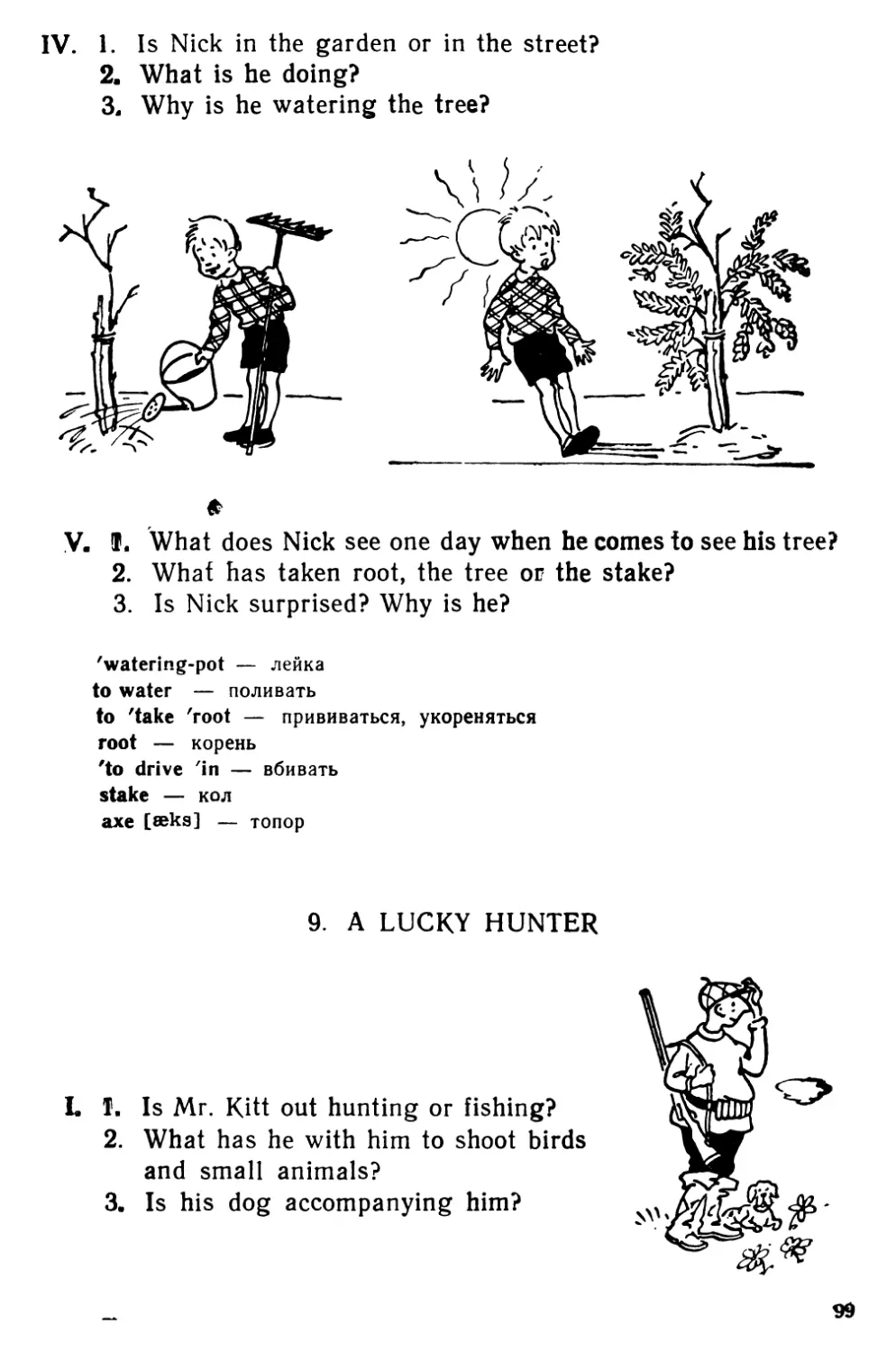
IV. 1. Is Nick in the garden or in the street?
2. What is he doing?
3. Why is he watering the tree?
V. I. What does Nick see one day when he comes to see his tree?
2. What has taken root, the tree or the stake?
3. Is Nick surprised? Why is he?
'watering-pot — лейка
to water — поливать
to 'take 'root — прививаться, укореняться
root — корень
'to drive 'in — вбивать
stake — кол
axe [®ks] — топор
9. A LUCKY HUNTER
L J. Is Mr. Kitt out hunting or fishing?
2. What has he with him to shoot birds
and small animals?
3. Is his dog accompanying him?
99
II. 1. Can you say that Mr. Kitt and
his dog noticed something? Why
can you?
2. What is Mr. Kitt doing?
3. Is he taking aim and getting
ready to. shoot?
III. I. What do you see in
the picture?
2. Are Mr. Kitt and his
dog running fast or
are they moving very
slowly?
3. Why arg the man and
the dog running fast?
I.	What do you see in the
picture?
2.	Where did the dog
bring his master?
3.	What is Mr. Kitt saying
to the dog? Can you
think of it?
How many ducks is Mr.
Kitt carrying?
Is he satisfied with the
hunting? Is his dog satis-
fied too? Why can you say
they both are?
Is the butcher satisfied?
Why can you say he is?
to go hunting —• идти на охоту
to accompany [оТсдтроШ] — сопровождать
to 'take 'aim — целиться
to be satisfied ['BSBtisfald] — удовлетворяться
butcher ['butj’o] — мясник
100
10.	HOW MR. LOW GOT WET
(7t happened the other day)
>
I. 1
IL
What was the weather like
when Mr. Low went out for
a walk?
Was the sun shining or did
it look like raining?
Did Mr. Low take his um-
brella with him?
Who was carrying his um-
brella?
How did the dog carry Mr.
Low’s umbrella?
1.	Why did Mr. Low stop
for a while?
2.	Did he stop to make sure
that it was beginning to
rain?
3.	Did his dog stop too oc
did it not?
1.
2.
3.
Ш
Did it rain heavily that
day?
Did Mr. Low try to get
his umbrella back from
the dog?
Was the dog willing to
let go the umbrella?
Why wasn’t it?
101
umbrella [лт'ЬгеЛа] — зонтик
to 'make 'sure [Jua] — убеждаться
to 'let 'go — отпускать, выпускать
to be willing — хотеть
at 'last — наконец
IV. 1. Who got the umbrella
at last?
2.	Who was walking
without an umbrella?
3.	Who got wet, Mr.
Low or his dog?
4.	Why did the dog not
want Mr. Low to
have his umbrella?
5.	Can you explain how
the umbrella was
opened?
11. ONE, TWO, THREE..!
I.	1. How many people are there in the picture?
2.	What is the boy doing? Is he holding a stake?
3.	What is the boy’s father doing? Is he going to drive the
stake into the ground? Is he ready to strike with the beetle?
4.	Is the boy’s father strong or weak?
5.	Is it dangerous for the boy to hold the stake?
П. 1. What has happened to the boy? Has his father hit him
with his beetle?
2. Is the stake as long as it was? Why is it?
102
3. Is the boy as tall as he was? Why isn’t he?
4. Who was driven in, the stake or the boy?
stake — кол
to drive (in, into) — вбивать,
вгонять
to strike — ударять
beetle -— деревянная кувалда
dangerous ['d'emd^aros] ___ опас-
ный
to hit (hit, hit) — ударять, по-
падать
tall — высокий
12.	MR. A. AND MR. B.
Compare the two pictures!
1.	What has Mr. A. in his hand?
2.	What has Mr. B. in his
hands?
3.	What are both of them going to do?
4.	What can you say about the tree Mr. A. has to fell?
5.	What can you say about the tree Mr. B. has to fell?
6.	Who of the two is better prepared for the job? What do you
think?
7.	Are Mr. A. and Mr. B. alike? What is the difference between
them?
to compare [кэш'реэ] __ сравнивать
saw - пнла
axe (eka] — топор
to fell (fel,ed’felled) ~ валить (дерево)
. h - работа
inference	- раЗНица
103
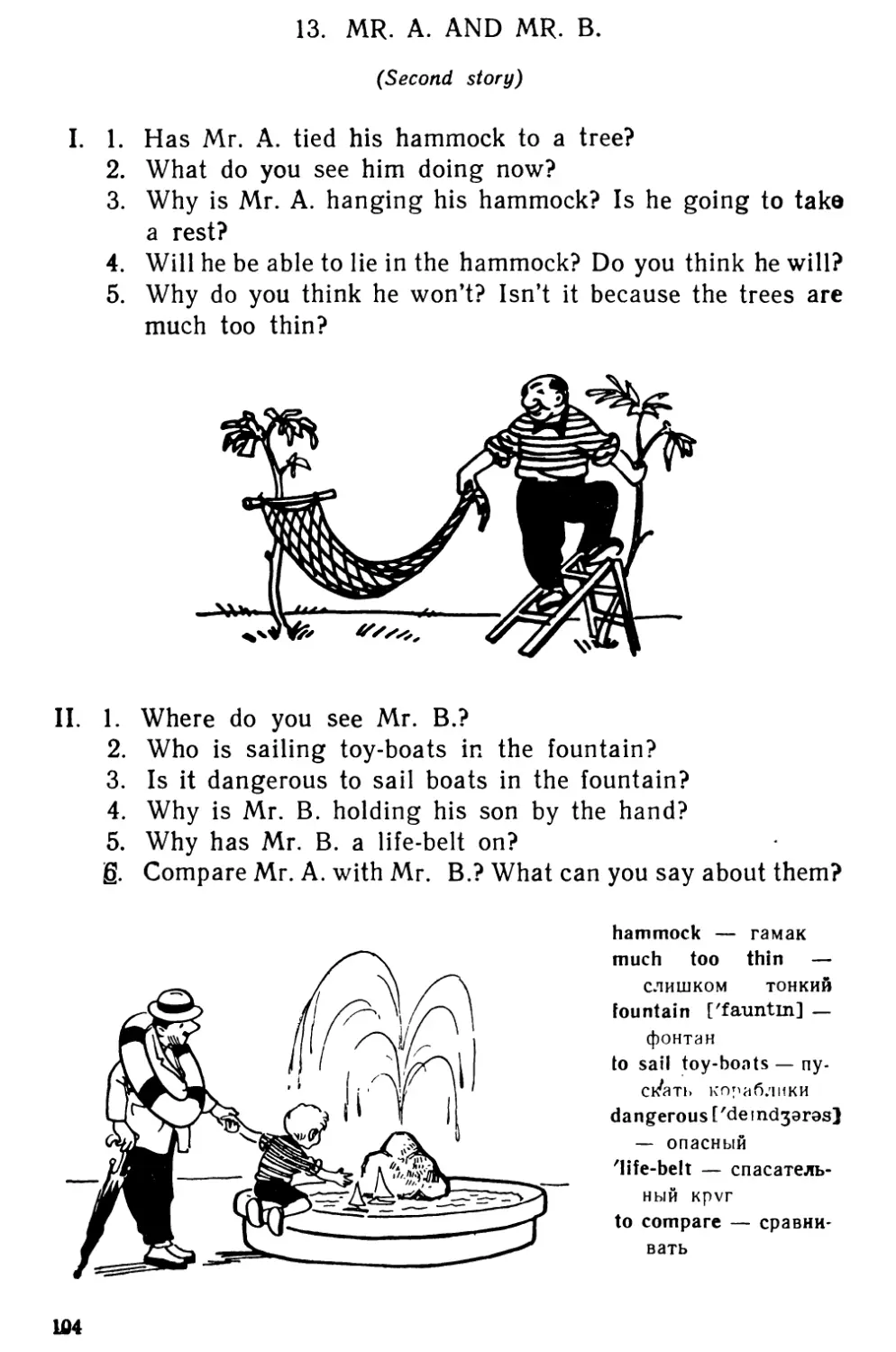
13.	MR. A. AND MR. B.
(Second story)
I.	1. Has Mr. A. tied his hammock to a tree?
2.	What do you see him doing now?
3.	Why is Mr. A. hanging his hammock? Is he going to take
a rest?
4.	Will he be able to lie in the hammock? Do you think he will?
5.	Why do you think he won’t? Isn’t it because the trees are
much too thin?
II. 1. Where do you see Mr. B.?
2.	Who is sailing toy-boats in the fountain?
3.	Is it dangerous to sail boats in the fountain?
4.	Why is Mr. B. holding his son by the hand?
5.	Why has Mr. B. a life-belt on?
g. Compare Mr. A. with Mr. B.? What can you say about them?
hammock — гамак
much too thin —
слишком тонкий
fountain ['fauntin] —
фонтан
to sail toy-boats — пу-
скать кораблики
dangerous t'deindjaros]
— опасный
'life-belt — спасатель-
ный Kpvr
to compare — сравни-
вать
104
14. THE KEEPER AND THE CROCODILE
I.	1. What do you see in the picture?
2.	What is the keeper doing? Is he sweeping the floor of the
cage where the crocodile lives?
3.	Does he see the crocodile watching him? Where is the
crocodile?
4.	What is the crocodile going to do?
5.	Why is the crocodile going to swallow the keeper? Is it
because the crocodile does not like the keeper?
II. 1. What do you see in this picture?
2.	Can you see the keeper? Why can’t you?
3.	Who is sweeping the floor?
4.	Why did the crocodile swallow the keeper? Was it because
it did not like the keeper or was it because he himself
wished to sweep
the floor? Why can
you say that it
was, because the
crocodile wished to
sweep the floor?
keeper — смотритель
crocodile [^krokodaHl] —
крокодил
to sweep — мести, подме-
тать
to swallow — проглотить
105
15.	WET PAINT
(It happened the other day)
1.	1. What did Jim touch with his shoulder in the street?
2.	Was there any sign on the lantern post?
3.	What did it read?
4. Did Jim notice the sign?
5.	What colour was Jim’s shirt?
6.	What colour was the spot on Jim’s shirt?
7.	Was the lantern post painted black and
white or blue and yellow?
II. 1. What did Jim do
then? Did he rub
his shoulder
against the post?
2. Why did Jim rub
his shoulder
against the lan-
tern post?
IIL I. Did the spot on Jim’s shirt
become black after he had
rubbed it against the post?
2. Was it clever of Jim to have
done that?
'Wet 'paint! — Осторожно, окрашено!
sign [вадп] — объявление
lantern — фонарь
post [poust] — столб
spot — пятно
to rub — тереть (ся)
106
16.	AT THE TELEPHONE BOOTH
I.	1., Where do you see Mr. Brown?
2.	Why is he standing at the telephone booth? Is it because he
is going to ring somebody up?
3.	What is the man in the booth doing? Is he speaking over
the telephone?
4.	What is Mr. Brown waiting for?
II.	1. Is there Mr. Brown alone waiting for the man to finish
his telephone talk? How many people are there?
2.	Is the man in the booth going on with his talk?
107
III.	1. What do you see in the picture?
2.	The man is leaving the booth. What has he in his hands?
3.	Are the people surprised to see him leaving with the
telephone in his hands?
4.	Will the people have to go and look for some other booth?
Why do you think they will?
booth [bu-:5] — будка
to ring somebody up — позвонить кому-либо
17. HOW MR. PRINSTON KILLED A HARE
(It happened last summer)
I.	1. Where was Mr. Prinston hunting, in the fields or in the
mountains?
What did Mr. Prinston
do when he saw a hare
running across the
meadow?
108
II.
1.
2.
3.
Did Mr. Prinston kill the hare?
What did Mr. Prinston
do with his gun when
he saw that he missed
the target?
What did he do with his
boot, when he missed
the target?
2. Why did he throw his
boot at the hare?
IV. 1. Did Mr. Prinston hit the hare with his boot? Why can
you say he did?
2.	Did he go home with the hare or his boot in his hands?
3.	Did Mr. Prinston kill the hare with his boot? In what
way did he kill it?
4.	Was Mr. Prinston a good shot?
5.	Was he good at throwing?
hare —* заяц
meadow ['medouj — поляна
to miss — не попасть, промах-
нуться
target — цель
to hit (hit, hit) — попадать
shot — стрелок
to be good at something (at
doing something) — уметь
хорошо делать что-либо
109
18. NICK LEARNS TO SHOOT WITH
A BOW AND ARROW
I.	1. Where do you see Nick? Is he in the yard or in the street?
2.	What has he in his hands?
3.	Where is the arrow?
4.	Has Nick hit the target?
II. 1. What is Nick doing now? Has he drawn a new target?
2.	Why has Nick drawn a new target?
3.	Does Nick think that he will hit the new target?
Why do you think he does?
4.	Is Nick a good shot? Why can you say he is not?
bow [ban] — лук
arrow ['serou] — стрела
fence — забор
to hit (hit, hit) — попадать
target — цель
shot — стрелок
110
19. DICK AND DAN ARE FOND OF TABLE-TENNIS
I.	1. What do you see in the picture?
2.	Whom do you see playing table-tennis, Dick and Dan or
their fathers?
3.	What are Dick and Dan doing? Are they watching their
fathers playing table-tennis?
4.	Do you think Dick and Dan want to play a game of
table-tennis too? Why do you think they do?
II. 1. Whom do you see playing table-tennis now?
2.	Is it Dick and Dan who are playing table-tennis now?
3.	Are their fathers surprised to see Dick and Dan playing
table-tennis? Why are they?
4.	What did Dick and Dan do with the legs of the table?
Did they shorten them?
5. Can
play
now?
настоль-
the grown-ups
table-tennis
Why can’t they?
'table-tennis —
ный теннис
to shorten — укорачи- —7
вать
frown-up ['grOUn'Ap] —.
взрослый
111
20. HOW DAVY TAUGHT A HARE A GOOD LESSON
I.	1. What was Davy doing last Sunday?
2.	Did he break a ski?
3.	Why did he break a ski? Do you think it was because a
hare got in his way?
II.	1. Is the hare happy?
2.	Why do you think the hare is laughing?
a!
III.	I. Did Davy make a bow of his ski and scarf?
2.	Is the hare happy now? Why do you think he is not?
3.	Do you think Davy taught the hare a good lesson?
112
hare — заяц
to get in one’s way — попадаться под ноги, мешать
bow [Ъал1] — лук
scarf — шарф
21. ON A HIKE
I.	1. Is Nick out hiking?
2.	Is his rucksack big or small? Is it heavy to carry?
3.	Is Nick tired? Why do you think he is?
113
II.	1. What is Nick looking at?
2.	How many miles is there left for him to go?
3.	Why do you think he is happy?
4.	What do you see on the mile-post?
Ill,	1, Where is the crow now?
2.	How many miles is there really left for Nick to go?
3.	Is Nick happy or not?
Why can you say that he is not happy?
oa a hike — в походе, на прогулке ’(загородной)
'nicksack — рюкзак
'mile-post — километровый (мильный) столб
crow [krou] — ворона
114
22. NICK KEEPS GOAL
I.	1. What is Nick doing?
2.	Who is standing nearby?
3.	What is the weather like?
II. 1. Is it still raining?
2.	How does Nick feel in the rain?
3.	How does the cameraman feel?
4.	Who is more comfortable, Nick or the cameraman?
to keep goal — стоять в воротах
cameraman ['кявтагапюп] — кинооператор
115
23. IN THE LONDON UNDERGROUND
I.	1. Is Mr. Fox (the one who is fat) going up or down?
2.	Is Mr. White going up or down?
3.	Is Mr. Fox smoking?
4.	Is Mr. White smoking?
II.	1. Mr. Fox asked Mr. White for a light, didn’t he?
2.	Did Mr. White give Mr. Fox a match or a cigarette?
116
III.	1. What is Mr. Fox doing?
2.	Is he lighting his ciga-
rette with a match or from
Mr. White’s cigarette?
iM " и

IV.	1. Can Mr. Fox let Mr. White
2. Why cannot he?
have his cigarette back?
'underground — метро
fat — толстый
to smoke — курить
to 'ask for a 'light — просить
прикурить
to 'give a 'light — давать при»
курить
match — спичка
cigarette [sigo'ret] — сигарета
11?
24. THEIR WAY OF LIFE
In these pictures you see the workers and employees o!
a capitalist firm, and the capitalist who is the owner of the firm.
I.	1. What does the worker do all
his life?
2.	Are the boxes he carries light
or heavy?
3.	Has the worker much time
to rest?
II.	1. What do you see in this
picture?
2.	Who are working in the shop
of a plant?
3.	Is their work hard or easy?
III.	1. Whom do you see in
this picture? What is
the man doing?
2.	Is he a book-keeper?
3.	Where does he work?
118
IV.	I. Is the woman in the
picture a typist?
2.	Is she busy typing?
3.	What do typists do in
the office every day?
Have they much work
to do?
Whom do you see In
this picture?
Is the manager good
to the workers?
Why do you think he
is not?
VI. I. Whom do you see in this picture? Is it the boss?
2.	What is the boss doing?
3.	Do workers like their bosses? Why do you think they do
not?
a way of life — образ жизни
employee [ emploi'i:]—служащий
firm — фирма
•wner ['ouno] владелец
shop — цех
book-keeper ['buik ki;po] — бух-
галтс о
office — контора
to type — печатать на машинке
typist — машинистка
manager ['maenldgo] — управ-
ляющий
boss — босс, хозяин
119
25. DOWN WITH COLONIALISM!
I.	[. Whom are the Negroes carrying on their shouldeis?
2.	What do you see on the Negroes legs?
3.	What do you see in the imperialist’s hand?
fl. 1. What are the Negroes doing?
2.	What do you see' in the Negroes’ hands?
3.	What is the white imperialist doing?
4.	Is this picture typical of the Africa of to-day?
colonialism [ka'louniaitzm] — колониализм
chain — цепь
imperialist [im'piofoalist] — империалист
whip [wip] — кнут
typical t'tipfkl] — типичный
120
26. HE’S GOT IT RIGHT!
I.	1. What is the errand-boy carrying in his hands?
2.	Who is to get the parcel?
3.	Where is the parcel from?
4.	How do you know that the parcel is from Africa?
II. 1. What is the errand-boy carrying in his hands?
2.	Is the parcel bigger this time?
121
III. 1. What do you see in the pictu&e?
2. Is the parcel still bigger this time?.
IV. 1. What do you see in this picture?
2. Who has arrived home instead of the parcel?
3. Is it the colonialist who had been robbing the people In
Africa?
He’s got it right — Получил по заслугам
'errand-boy — рассыльный
parcel — посылка
instead [m'sited] of — вместо
colonialist [ko'lounlolist] — колониалист
to rob — грабить
122
27. THE SPUTNIK SPINS AROUND THE WORLD
1.	Where is the Sputnik flying now?
2.	Do you see many people watching it?
II.
1.	Where is the Sputnik flying now?
2.	Who are watching it?
3.	Are the Chinese peasants happy to watch the Soviet
Sputnik?
123
HI. L Now the Sputnik is over New York. Is the capitalist glad
to see the Soviet Sputnik?
2. Why can you say he is not?
SV. 1. Where is the Sputnik now? Is it over the Antarctic?
2. Is the polar explorer glad to see the Sputnik?
V. 1. Where do you see the Sputnik now?
2. Is the Indian boy amazed to see the Sputnik over his head?
124
VI. I.
2.
What does the white overseer notice in the sky?
Is he glad to see the Soviet Sputnik?
Are the exploited glad to
Antarctic [asnit 'aiktik] — Антарк-
тика, антарктический
polar — полярный
explorer [iks/plo:ro] — исследователь
to be amazed [o'meizd] — изум-
ляться
overseer	— -
What con try was the first t i
en was the first Soviet	ЯП artificaiI satellite?
How many sputniks havlJ tn,k bunched?
haVe bee” Punched in the Soviet Union?
(^C) exploited [iks'ploitrd] экс-
плуатируемые
запускать
ar i icial [aiiti'ftf э]] — искусственный
satellite ['seetolait] сателлит, спутник
о spin — вращаться
надсмотрщик
СОДЕРЖАНИЕ
Предисловие «...	...		...5
Form Six ...................................*	.	.	...	5
1.	Nick and His Cat...............................................  7
2.	Nick Tries to Surprise His Friends	...............8
3.	A Scarecrow .......	...............
4.	Nick Wants to Be an Acrobat ...	.	.	.	.	11
5.	Nick Tries to Hatch Chickens .	.	.	12
6.	A Good Catch ....	...............14
7.	A Big Catch ....	. .	15
8.	Nick and the Mouse ...	.	.	17
9.	Nick Becomes Sunburned .	.	.	.19
10.	Nick Tries to Learn to Dive	.	.20
11.	Nick in the Swimming-Pool .	.	21
12.	How Nick Read a Book .	.	.23
13.	The Rat and the Syrup .	.25
14.	The Cat and the Mouse ,	.25
15.	Lazy-bones............... .28
16.	The Ball in the Tree ...	.29
17.	Little Bobby’s Birthday	.39
18.	Nelly in the Garden	32
19.	Nick in the Circus .	.	.33
Form Seven......................................................... 35
1.	Nick Tries to Get Warm ......	•			37
2.	Nick Is Going to Make a Boat ....	•			38
3.	Nick, the Watch-maker				4	3?
4.	Nick Is Looking for Worms		•	•		40
5.	Nick Tries to Put a Dog into the Scooter .	4	•		41
6.	Tom Helps His Father to Carry Logs .	.	.	•	• A		42
7.	Nick Attaches a Stamp		•	• e		43
8.	Nick at Sea		•	•		44
9.	Why Nick Bought a Bird		•	4	ф		45
10.	New-Year’s Tree					46
126
11.	How Nick Was Buying Balloons .							48
12.	Puck		•	a	•	•	a	о	•	a		49
13.	Mr. Smith and the Cat		a	a	•	a	«	a	a		50
14.	How Mr. Smith Helped the	Little	Boy .	a	•	•	9	a		51
15.	How Mr. Smith Saved His	Hat .	a	•	•	•	e	a			52
16.	Mr. Smith and the Racket .	• •	• «		•	a	a	a		53
17.	Mr. Smith and the Flower .	• •	• •		«	•	9			54
18.	Jack, the Hunter	• •	•		• «	9		56
19.	Tiger!!! Tiger!!! ....	• •	a		» • •	a		57
SO.	How Nick Planted a Tree .		• •		a	4	•			57
21.	Nick, the Dog-trainer .		• •		a	•	4		59
	A Good Watch .		•		•	a	a		60
r. 		 1. Nick Is Fond of Reading 2. Tender-hearted Nelly	...		»	•	•	4 •	а	я	• * • • • «	63 ,	64 65
3.	Absent-minded Mr. Pinch
	Dick and Dan in the Forest ....		66
5.	How Nick Got Rid of the Wasps .		69
6.	Nick Is a Good Shot			70
7.	Bobby Stays Alone .......		71
8.	Sam Tries to Make the Elephant Move .		72
9.	Mr. Smith Tries to Help His Friend Dick .	•	•	4	•		73
10.	How Jim Learnt to Skate Last Winter .	«		•	в	•	75
11.	Use the Rubbish Can! ......	•	4	•	•	*	.	76
12.	Nick Has Found a Way Out .	.	.	.	4	•	f	«	77
13.	Little Andrew, the Photographer .		79
14.	Mr. Smith and the Snowman ....		80
15.	A Heavy Box			81
16.	Mr. Smith Is Planting Trees ....		82
17.	Mr. Kay Trains His Dog			83
18.	How to Make Use of the Elephant .	« • « •	84
19.	How the Cat Went Fishing ....		86
Ferms Nine-Ten ...			a	a	a	• •	87
1.	Nick, the Painter ...	.	.	a	•		a	•	89
2.	Nick at the Pole-vault	.	.	• •	a	•		a	a	90
3.	Tennis Players ....	.	.	• «		a	91
4.	Absent-minded Nick		a	a		• •	93
5.	Eggs in the Refrigerator ....		к		a	94
6.	Pete Does Not Want to Have His Hair	Cut ,		• •	95
7.	How Mr. Baggs Nearly Killed a Hare			a	a	97
8.	How Nick Planted a Tree .			a	a	98
9.	A Lucky Hunter				•	99
10.	How Mr. Low Got Wet .			a	a	101
11.	One, Two, Three					102
127
12.	Mr. A. and Mr. В	•				103
13.	Mr. A. and Mr. В. (Second story) ....				104
14.	The Keeper and the Crocodile					105
15.	Wet Paint	  .				106
16.	At the Telephone Booth					107
17.	How Mr. Prinston Killed a Hare					108
18.	Nick Learns to Shoot with a Bow and Arrow				110
19.	Dick and Dan Are Fond of Table-tennis .				111
20.	How Davy Taught a Hare a Good Lesson .				112
21.	On a Hike					113
22.	Nick Keeps Goal					115
23.	In the London Underground					116
24.	Their Way of Life	 .	.				118
25.	Down with Colonialism! ....	.	.				120
26.	He’s Got It Rightl	 .	.	•			121
27.	The Sputnik Spins Around the World	*			123
Марк Исаакович Дубровин
Рассказы в картинках
(на английском языке)
Редактор Ю. М. Поляков
Художественный редактор И. Л. Волкова
Технический редактор Р. В. Цыппо
Корректор К. П. Лосева
Сдано в набор 23/XTI 1960 г. Подписано к печати 18/TI
1961 г. 60X92’/ie. Печ л. 8. Уч.-изд. л. 5,96 Тираж 160 тыс. экз.
Учпедгиз. Москва, 3-й проезд Марьиной рощи, 41.
Тип. им. X. Хейдеманна, г. Тарту, Юликооли, 17/19. ЭССР
Заказ № 47.
Цена 15 коп.